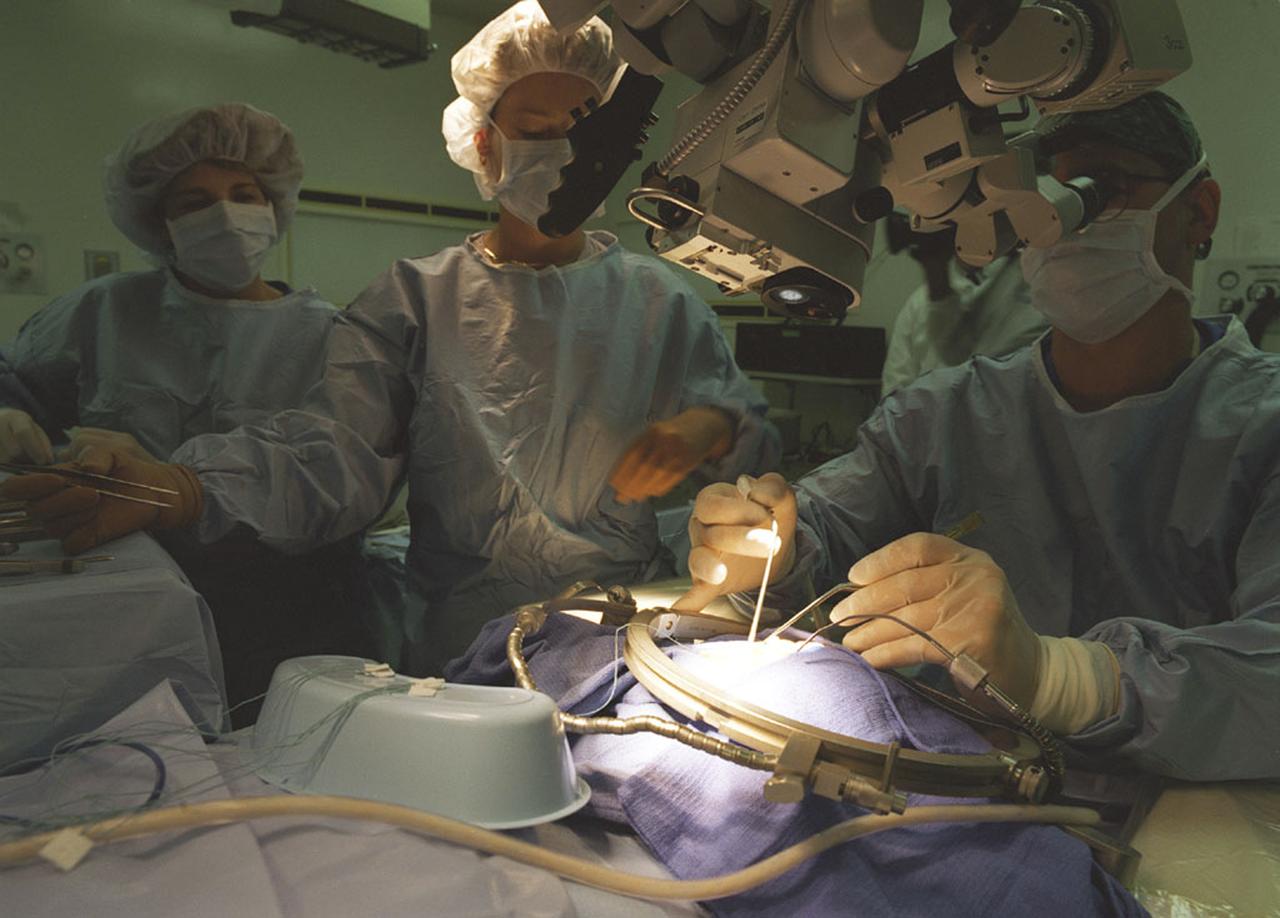
A special lighting technology was developed for space-based commercial plant growth research on NASA's Space Shuttle. Surgeons have used this technology to treat brain cancer on Earth, in two successful operations. The treatment technique, called Photodynamic Therapy, requires the surgeon to use tiny, pinhead-size Light Emitting Diodes (LEDs) (a source that releases long wavelengths of light ) to activate light-sensitive, tumor-treating drugs. "A young woman operated on in May 1999 has fully recovered with no complications and no evidence of the tumor coming back," said Dr. Harry Whelan, a pediatric neurologist at the Medical Hospital of Wisconsin in Milwaukee. Laser light has been used for this type of surgery in the past, but the LED light illuminates through all nearby tissues, reaching parts of a tumor that shorter wavelengths of laser light carnot. The new probe is safer because the longer wavelengths of light are cooler than the shorter wavelengths of laser light, making the LED less likely to injure normal brain tissue near the tumor. It can be used for hours at a time while still remaining cool to the touch. The LED light source is compact, about the size of a briefcase, and can be purchased for a fraction of the cost of a laser. The LEDs, developed and managed by NASA's Marshall Space Flight Center, have been used on seven Space Shuttle flights inside the Microgravity Astroculture Facility. This technology has also been successfully used to further commercial research in crop growth.
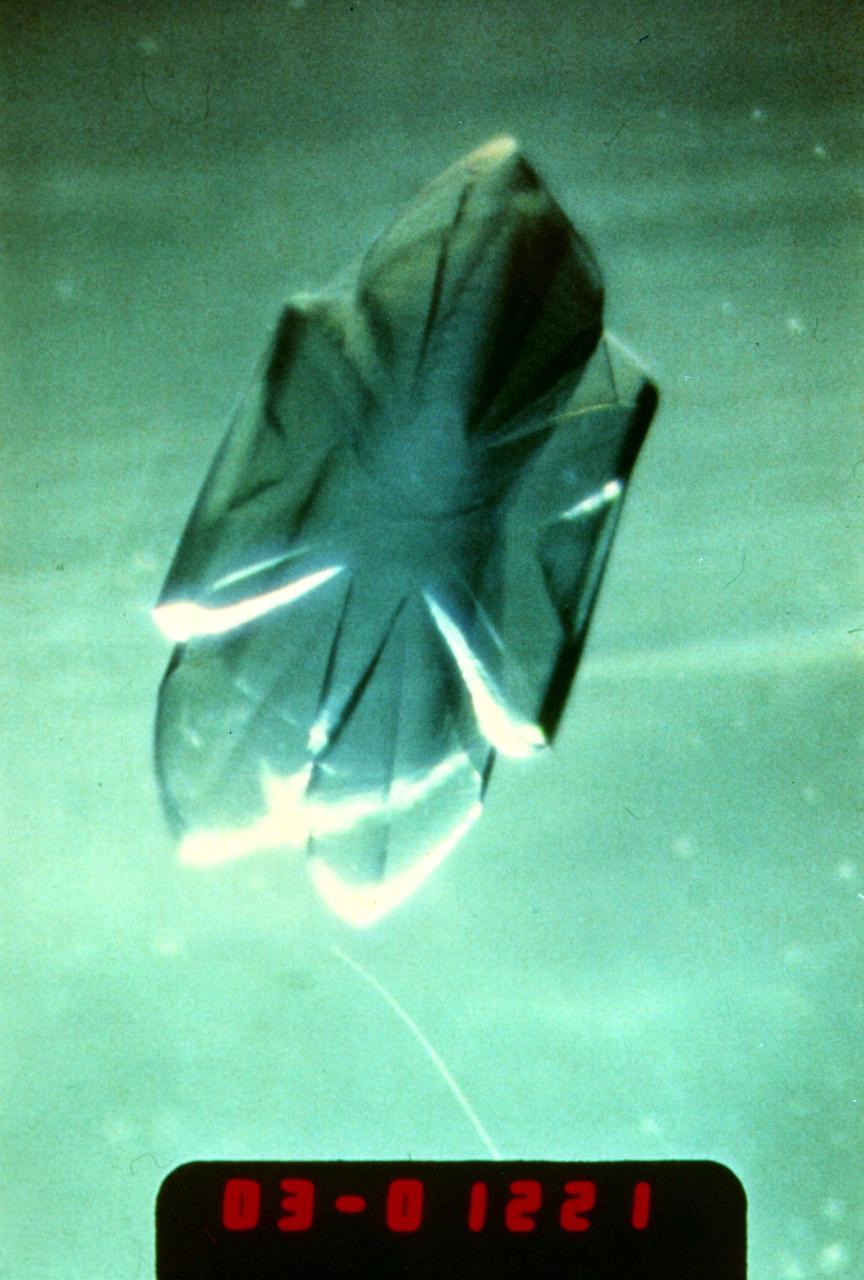
(PCG) Protein Crystal Growth Isocitrate Lyase. Target enzyme for fungicides. A better understanding of this enzyme should lead to the discovery of more potent fungicides to treat serious crop diseases such as rice blast. It regulates the flow of metabolic intermediates required for cell growth. Principal Investigator for STS-26 was Charles Bugg.
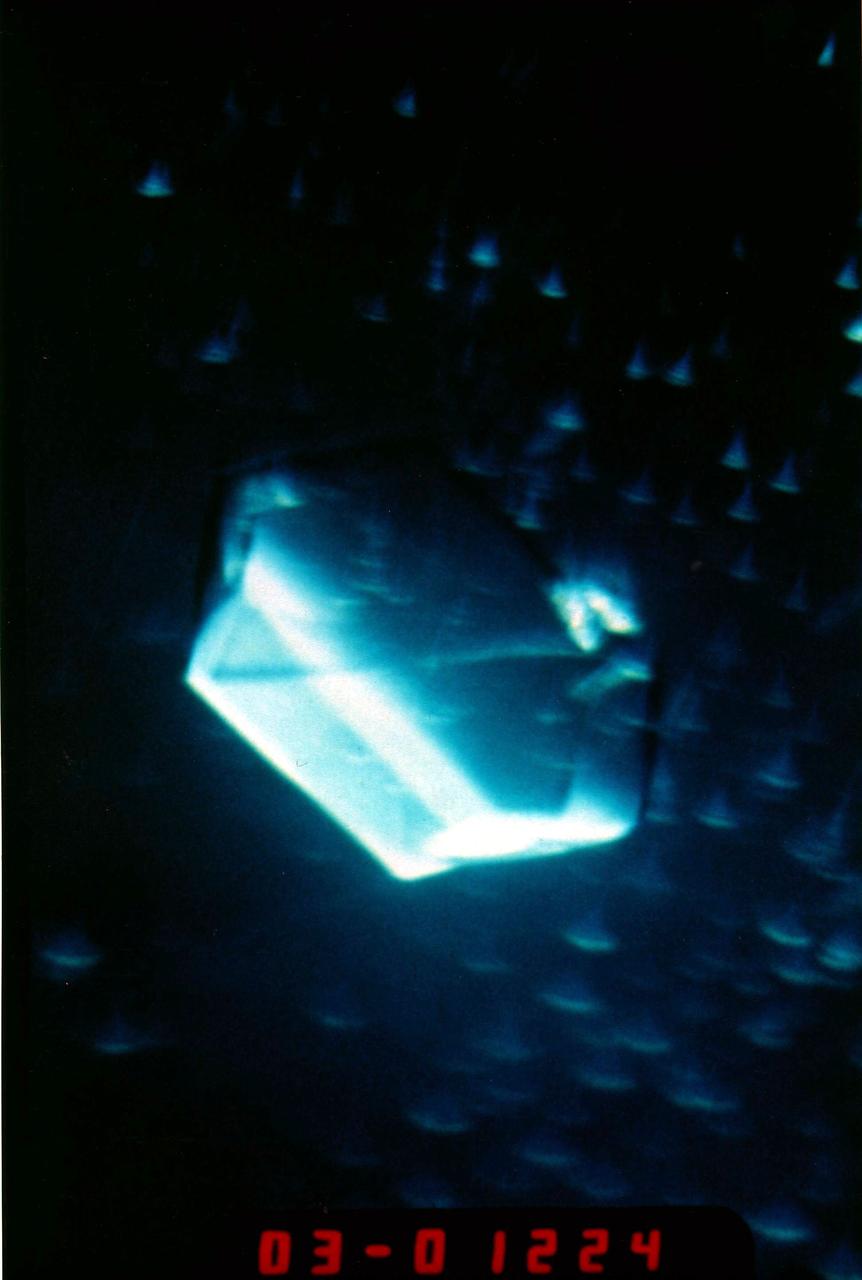
(PCG) Protein Crystal Growth Isocitrate Lysase. Target enzyme for fungicides. A better understanding of this enzyme should lead to the discovery of more potent fungicides to treat serious crop diseases such as rice blast. It regulates the flow of metabolic intermediates required for cell growth. Principal Investigator on STS-26 was Charles Bugg.
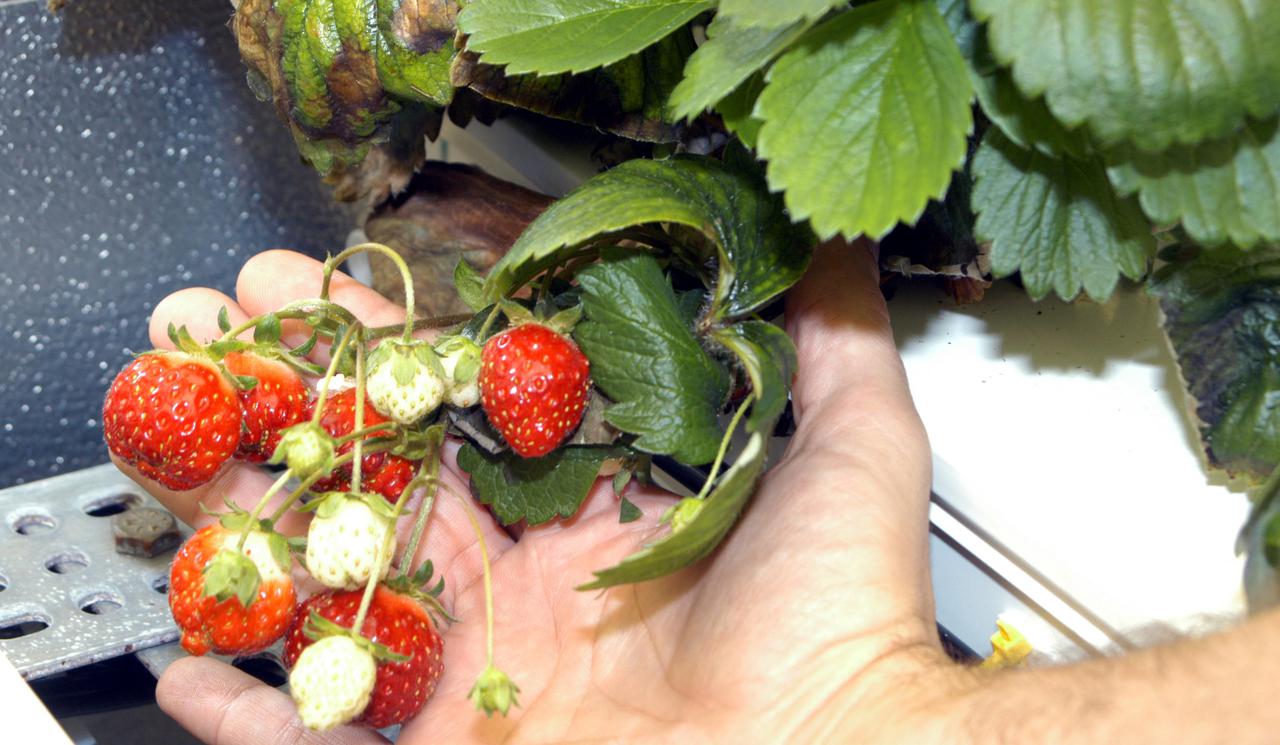
KENNEDY SPACE CENTER, FLA. - A crop of strawberries grown in a controlled environment chamber at the Space Life Sciences Lab is displayed during a tour of the facility for members of the news media. In missions to the International Space Station or early planetary outposts, plant production systems will likely be small and rely upon the spacecraft or habitat environment to regulate temperature, relative humidity, and carbon dioxide concentrations. Various crops are being grown in conditions that might be experienced in a spacecraft to evaluate the effects of different environmental conditions on plant growth, crop yield, and product quality.
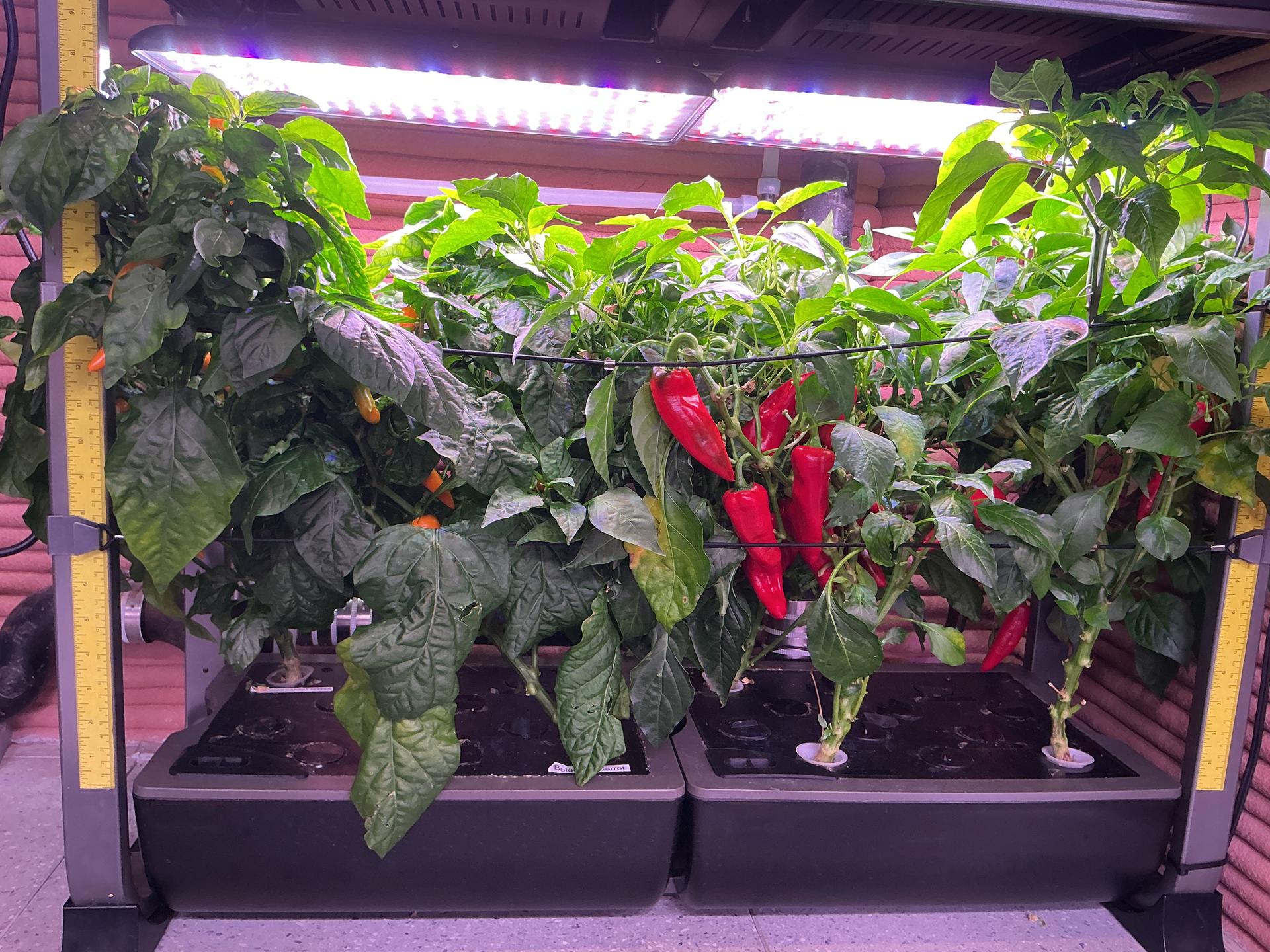
jsc2026e403177 (June 10, 2026) -- Image of vegetables grown in the Crew Health and Performance Exploration Analog (CHAPEA) Mission 2 hydroponic crop growth system. Credit: NASA
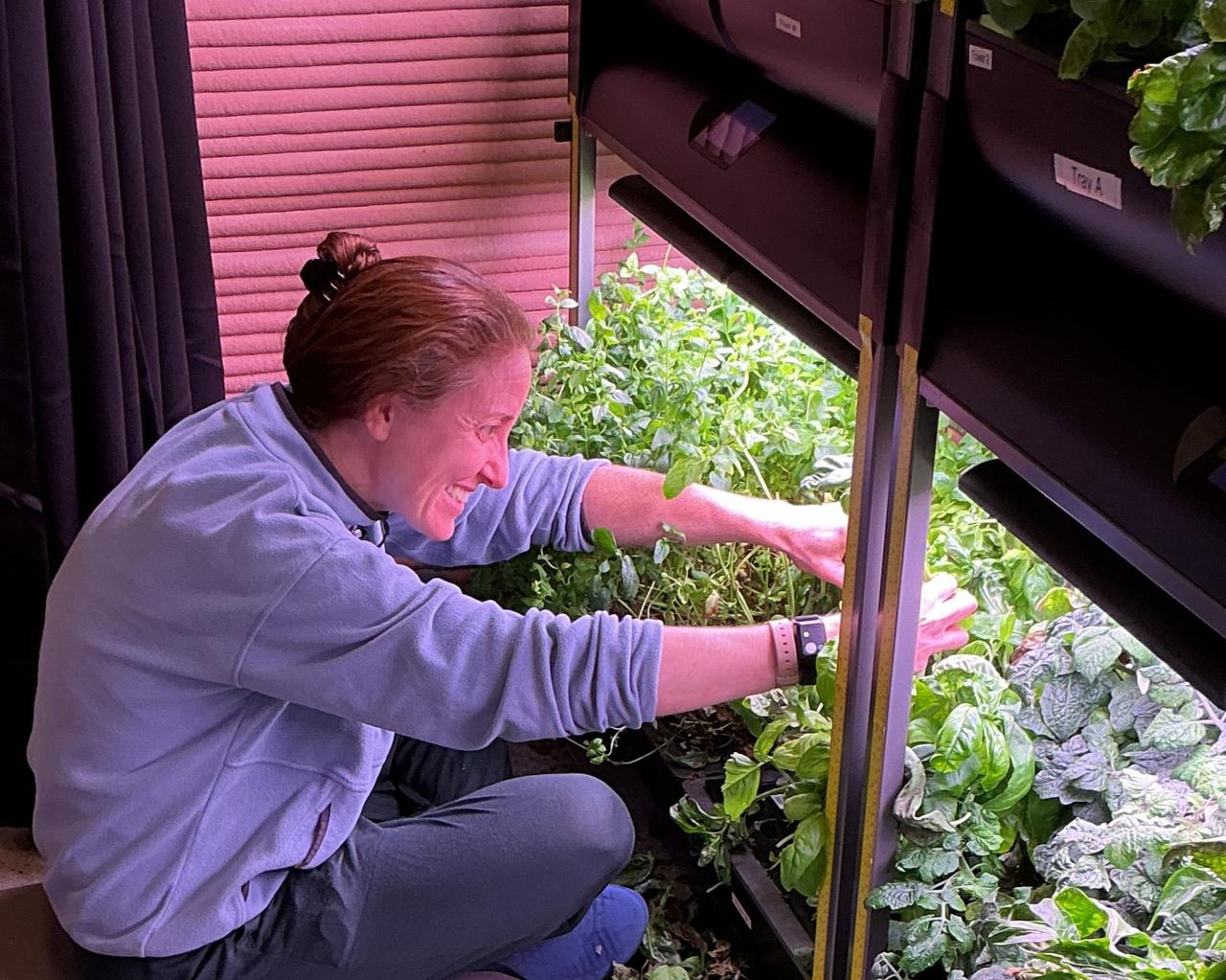
jsc2026e403169 (Feb. 22, 2026) -- Ellen Ellis, Crew Health and Performance Exploration Analog (CHAPEA) mission 2 medical officer, trims plants to promote growth in the habitat’s hydroponic crop system. Credit: NASA
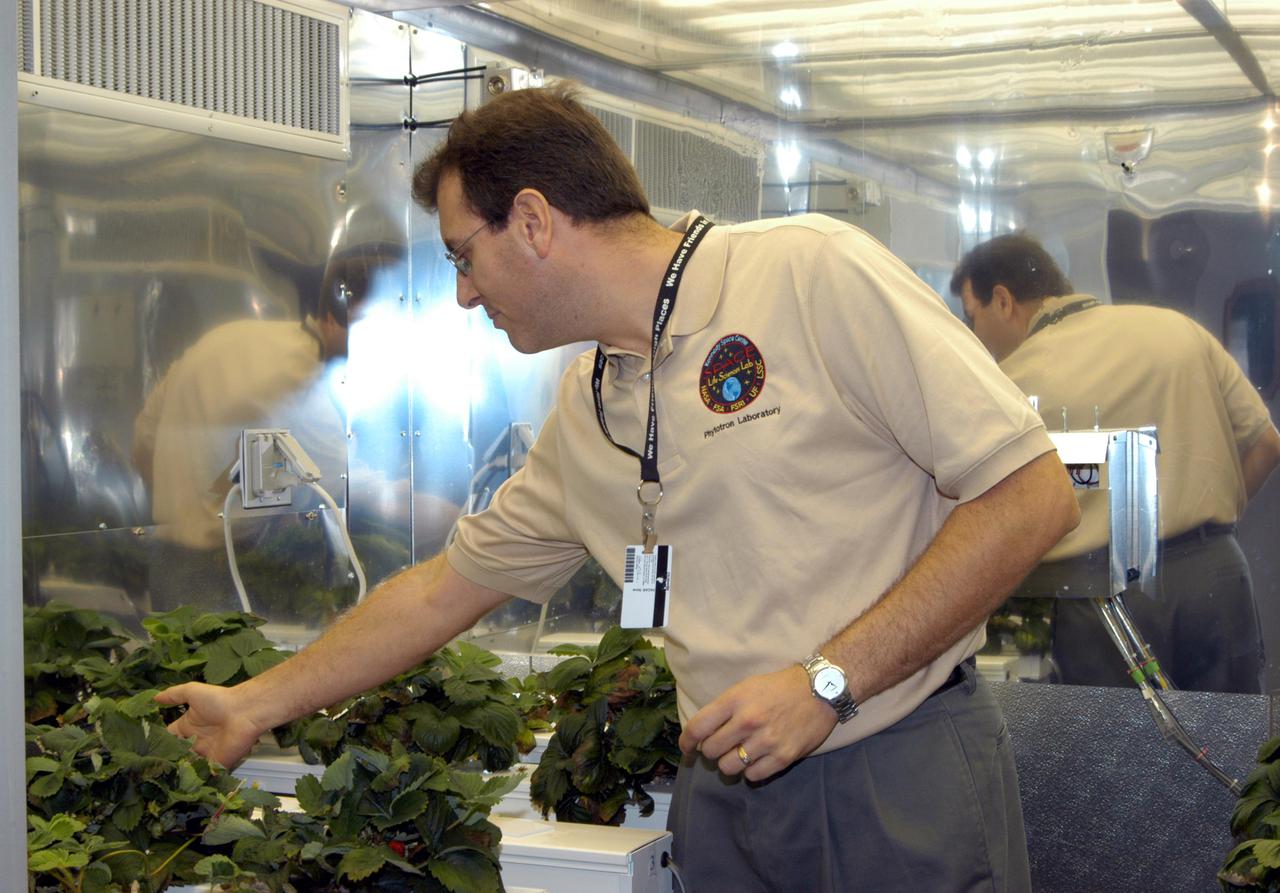
KENNEDY SPACE CENTER, FLA. - Jeff Richards, a plant physiologist with Dynamac Corporation, displays a crop of strawberries grown in a controlled environment chamber at the Space Life Sciences Lab during a tour of the facility for members of the news media. In missions to the International Space Station or early planetary outposts, plant production systems will likely be small and rely upon the spacecraft or habitat environment to regulate temperature, relative humidity, and carbon dioxide concentrations. Various crops are being grown in conditions that might be experienced in a spacecraft to evaluate the effects of different environmental conditions on plant growth, crop yield, and product quality.
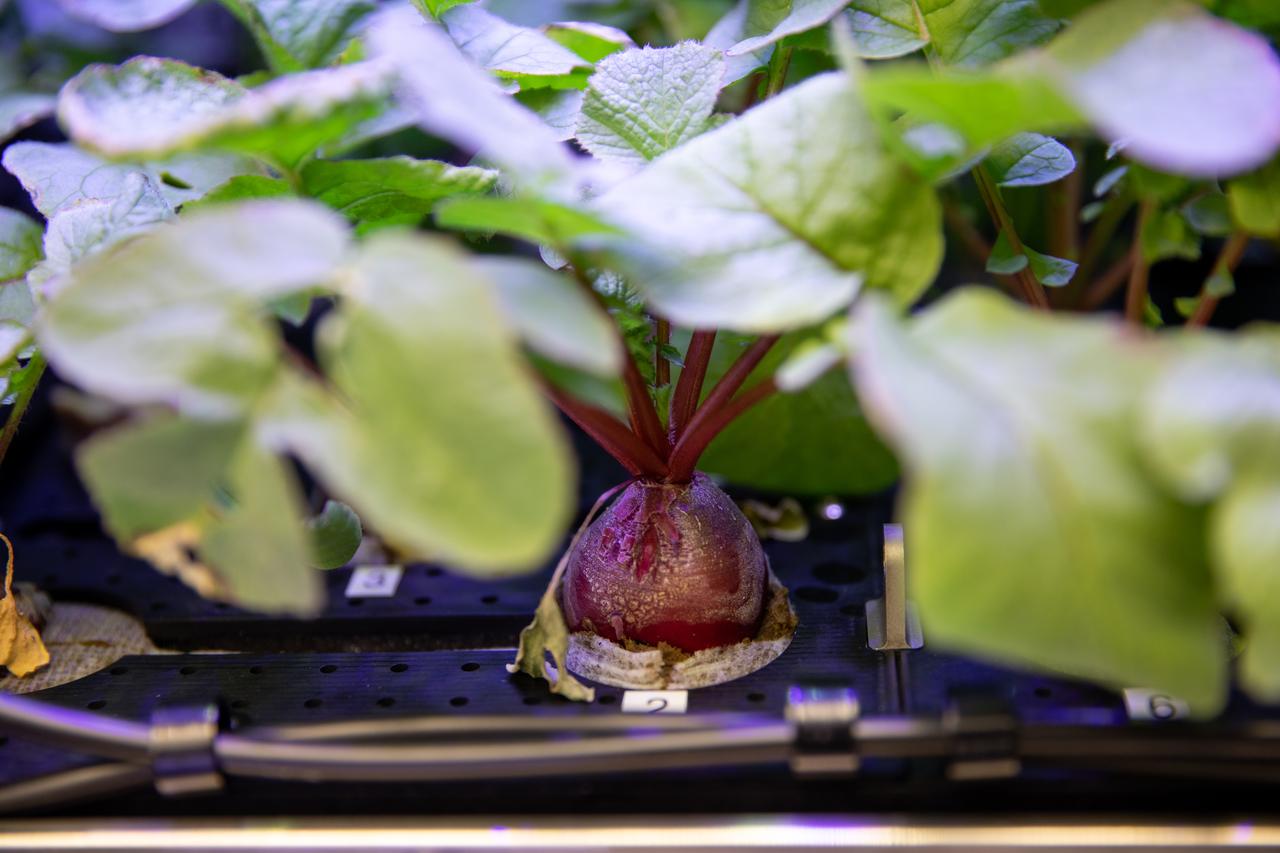
A view of radishes growing in the Advanced Plant Habitat (APH) ground unit inside the Space Station Processing Facility at NASA’s Kennedy Space Center in Florida on Dec. 14, 2020. The radishes are a ground control crop for the Plant Habitat-02 (PH-02) experiment. The experiment also involves growing two similar radish crops inside the International Space Station’s APH. NASA astronaut Kate Rubins harvested the first crop on Nov. 30, and the second harvest aboard the orbiting laboratory is planned for Dec. 30. Once samples return to Earth, researchers will compare those grown in space to the radishes grown here on Earth to better understand how microgravity affects plant growth.
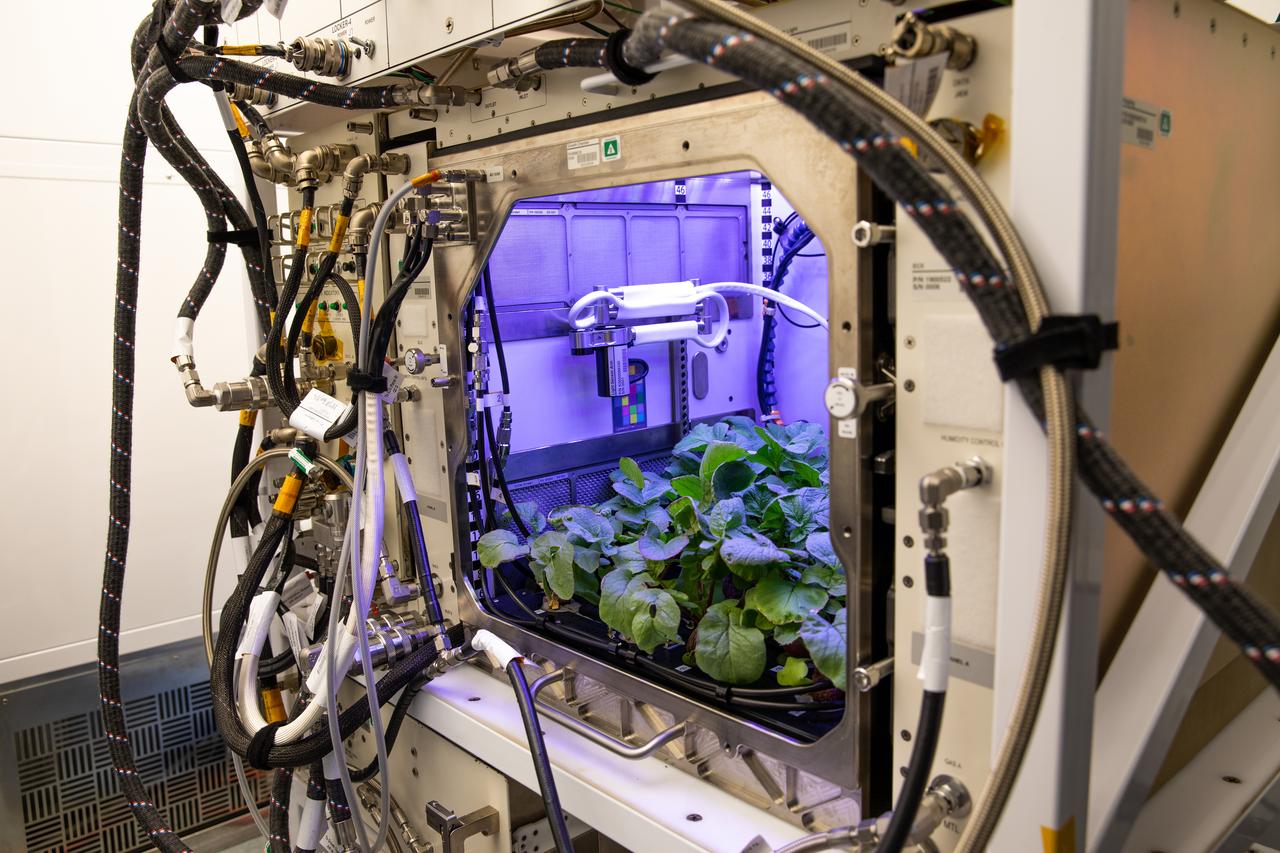
A view of radishes growing in the Advanced Plant Habitat (APH) ground unit inside the Space Station Processing Facility at NASA’s Kennedy Space Center in Florida on Dec. 14, 2020. The radishes are a ground control crop for the Plant Habitat-02 (PH-02) experiment, which also involves growing two similar radish crops inside the International Space Station’s APH. NASA astronaut Kate Rubins harvested the first crop on Nov. 30, and the second harvest aboard the orbiting laboratory is planned for Dec. 30. Once samples return to Earth, researchers will compare those grown in space to the radishes grown here on Earth to better understand how microgravity affects plant growth.
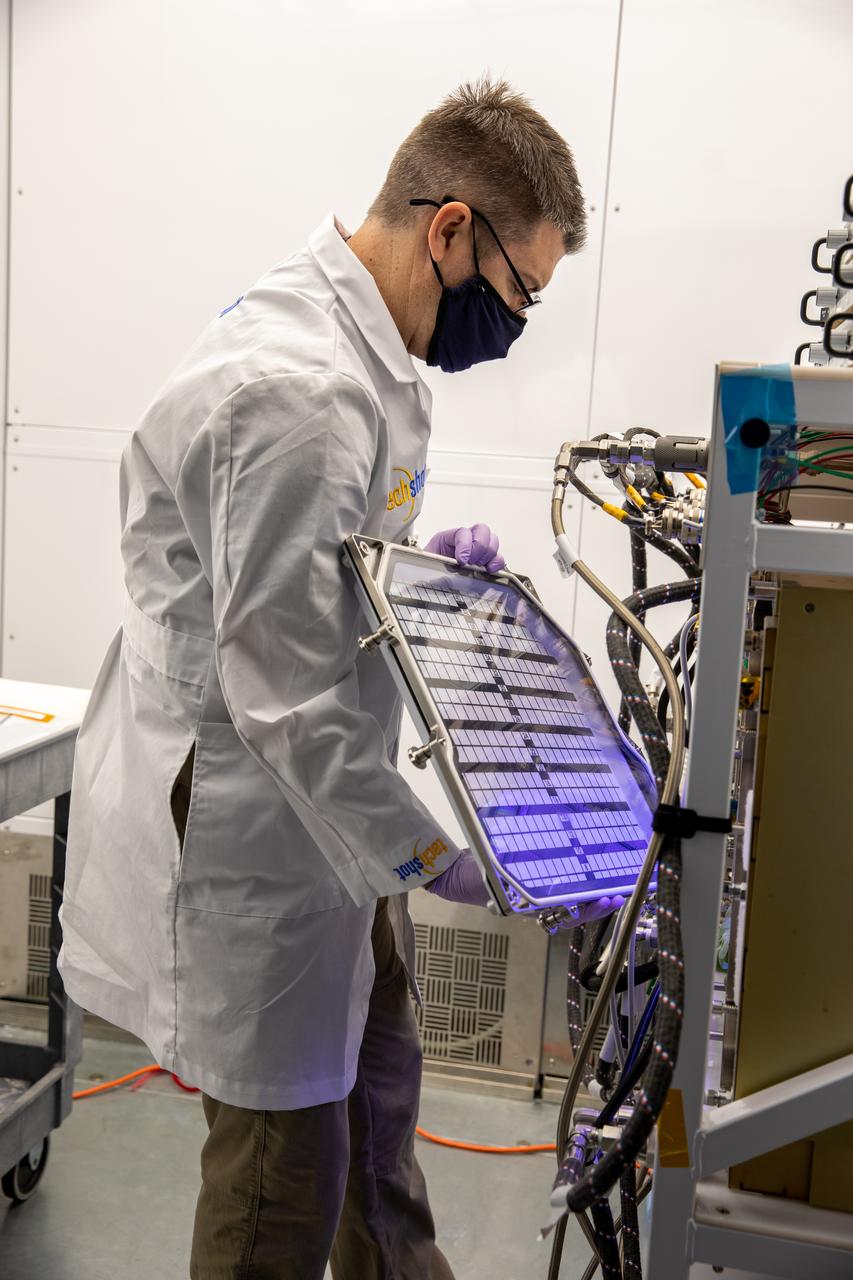
A researcher prepares to harvest radishes grown in the Advanced Plant Habitat (APH) ground unit inside the Space Station Processing Facility at NASA’s Kennedy Space Center in Florida on Dec. 14, 2020. The radishes are a ground control crop for the Plant Habitat-02 (PH-02) experiment, which also involves growing two radish crops inside the International Space Station’s APH. NASA astronaut Kate Rubins harvested the first crop on Nov. 30, and the second harvest aboard the orbiting laboratory is planned for Dec. 30. Once samples return to Earth, researchers will compare those grown in space to the radishes grown here on Earth to better understand how microgravity affects plant growth.
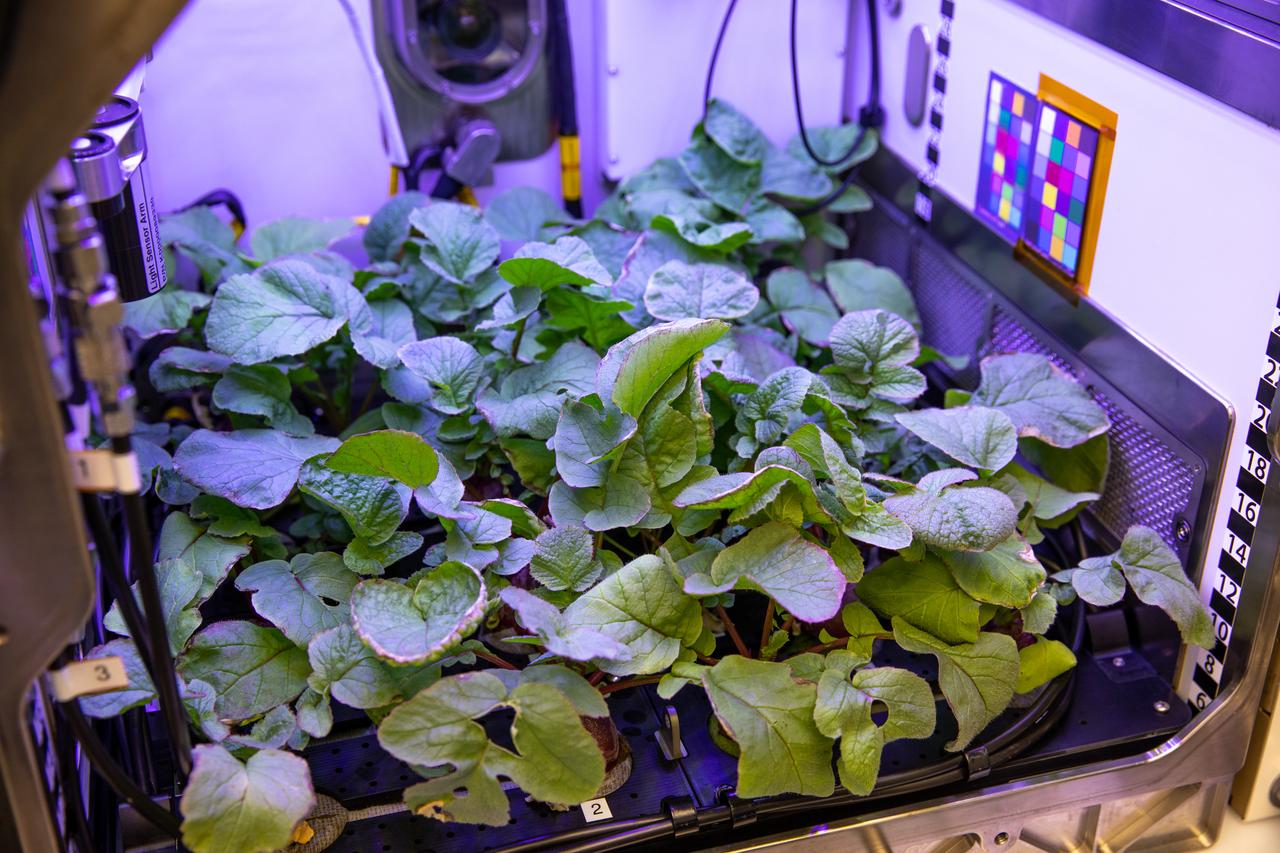
A view of radishes growing in the Advanced Plant Habitat (APH) ground unit inside the Space Station Processing Facility at NASA’s Kennedy Space Center in Florida on Dec. 14, 2020. The radishes are a ground control crop for the Plant Habitat-02 (PH-02) experiment. The experiment also involves growing two similar radish crops inside the International Space Station’s APH. NASA astronaut Kate Rubins harvested the first crop on Nov. 30, and the second harvest aboard the orbiting laboratory is planned for Dec. 30. Once samples return to Earth, researchers will compare those grown in space to the radishes grown here on Earth to better understand how microgravity affects plant growth.
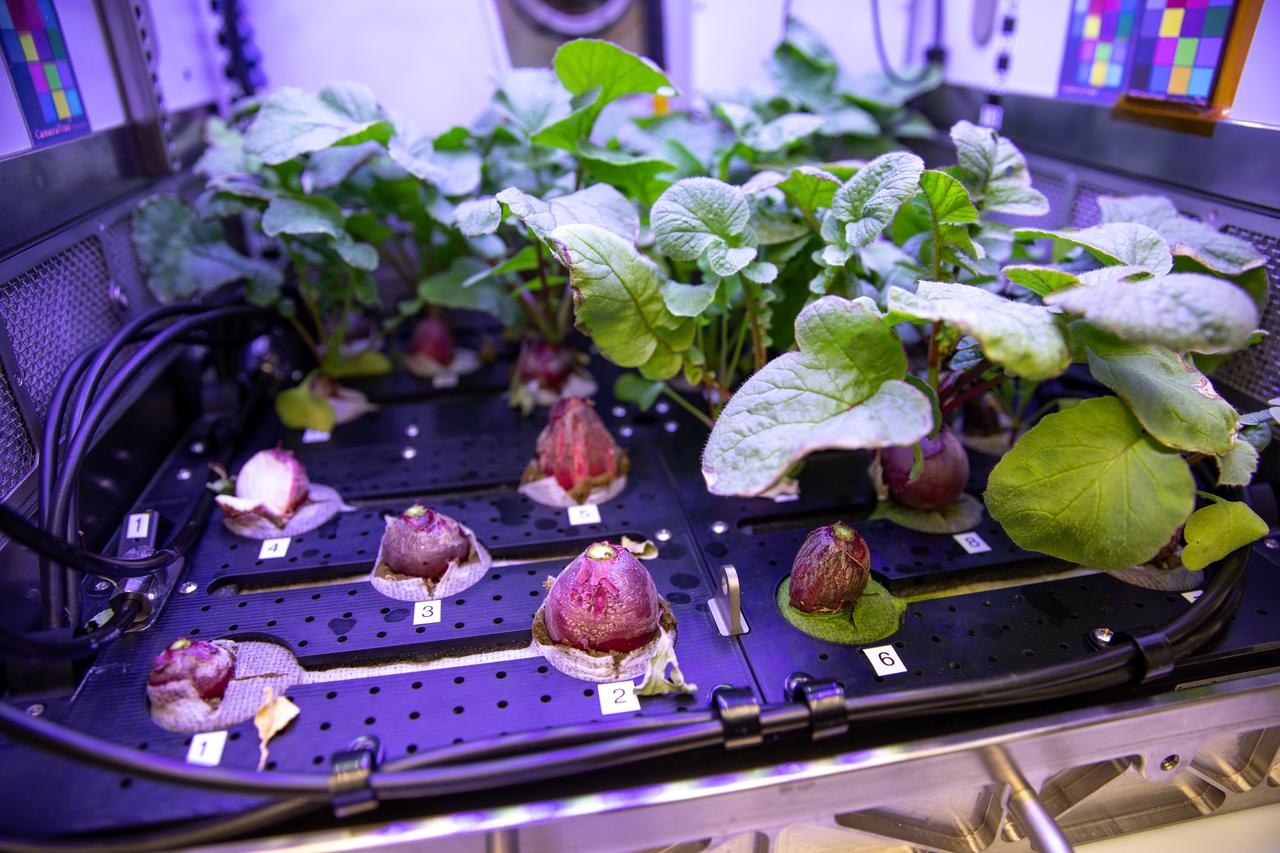
A view of radishes growing in the Advanced Plant Habitat (APH) ground unit inside the Space Station Processing Facility at NASA’s Kennedy Space Center in Florida on Dec. 14, 2020. The radishes are a ground control crop for the Plant Habitat-02 (PH-02) experiment. The experiment also involves growing two similar radish crops inside the International Space Station’s APH. NASA astronaut Kate Rubins harvested the first crop on Nov. 30, and the second harvest aboard the orbiting laboratory is planned for Dec. 30. Once samples return to Earth, researchers will compare those grown in space to the radishes grown here on Earth to better understand how microgravity affects plant growth.

ISS040-E-009116 (10 June 2014) --- In the International Space Station?s Harmony node, NASA astronaut Steve Swanson, Expedition 40 commander, harvests a crop of red romaine lettuce plants that were grown from seed inside the station?s Veggie facility, a low-cost plant growth chamber that uses a flat-panel light bank for plant growth and crew observation. For the Veg-01 experiment, researchers are testing and validating the Veggie hardware, and the plants will be returned to Earth to determine food safety.
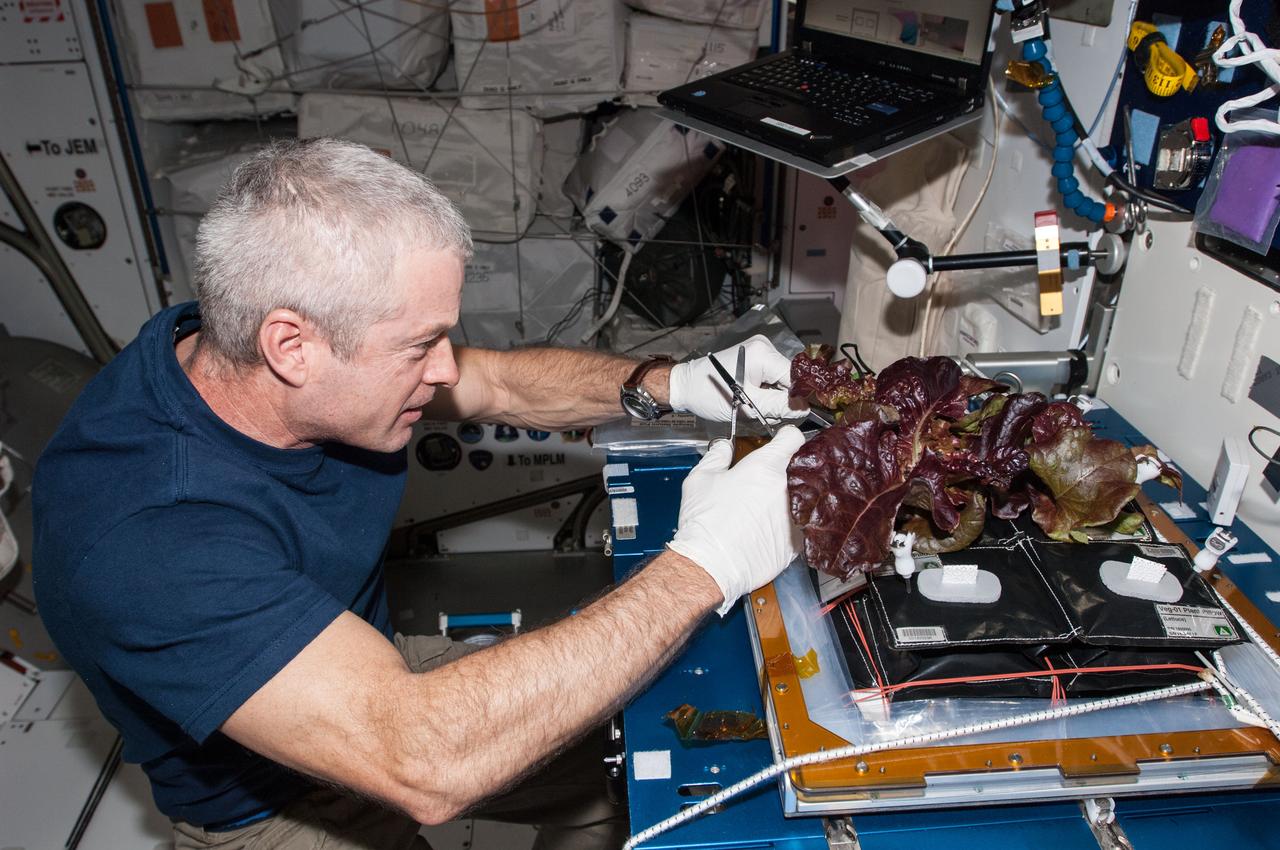
ISS040-E-009125 (10 June 2014) --- In the International Space Station?s Harmony node, NASA astronaut Steve Swanson, Expedition 40 commander, harvests a crop of red romaine lettuce plants that were grown from seed inside the station?s Veggie facility, a low-cost plant growth chamber that uses a flat-panel light bank for plant growth and crew observation. For the Veg-01 experiment, researchers are testing and validating the Veggie hardware, and the plants will be returned to Earth to determine food safety.
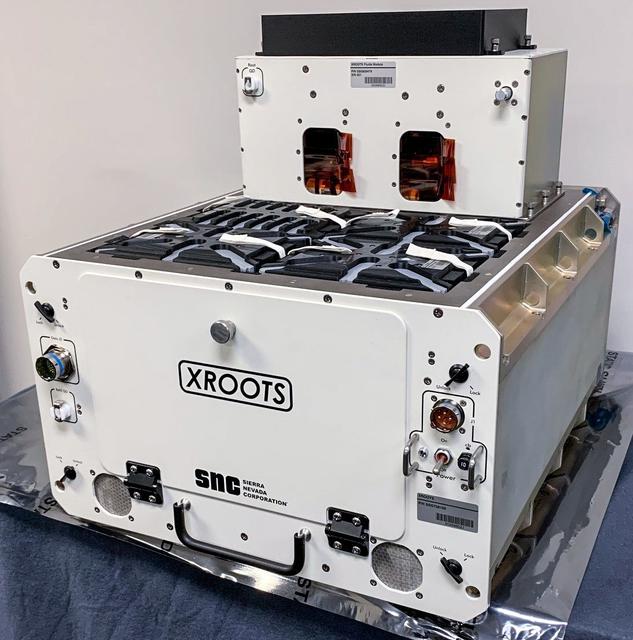
jsc2021e037285 (2/12/2021) --- A preflight view of the XROOTS hardware. The eXposed Root On-Orbit Test System (XROOTS) investigation uses hydroponic and aeroponic techniques to grow plants without soil or other growth media. Video and still images enable evaluation of multiple independent growth chambers for the entire plant life cycle from seed germination through maturity. Results could identify suitable methods to produce crops on a larger scale for future space missions.
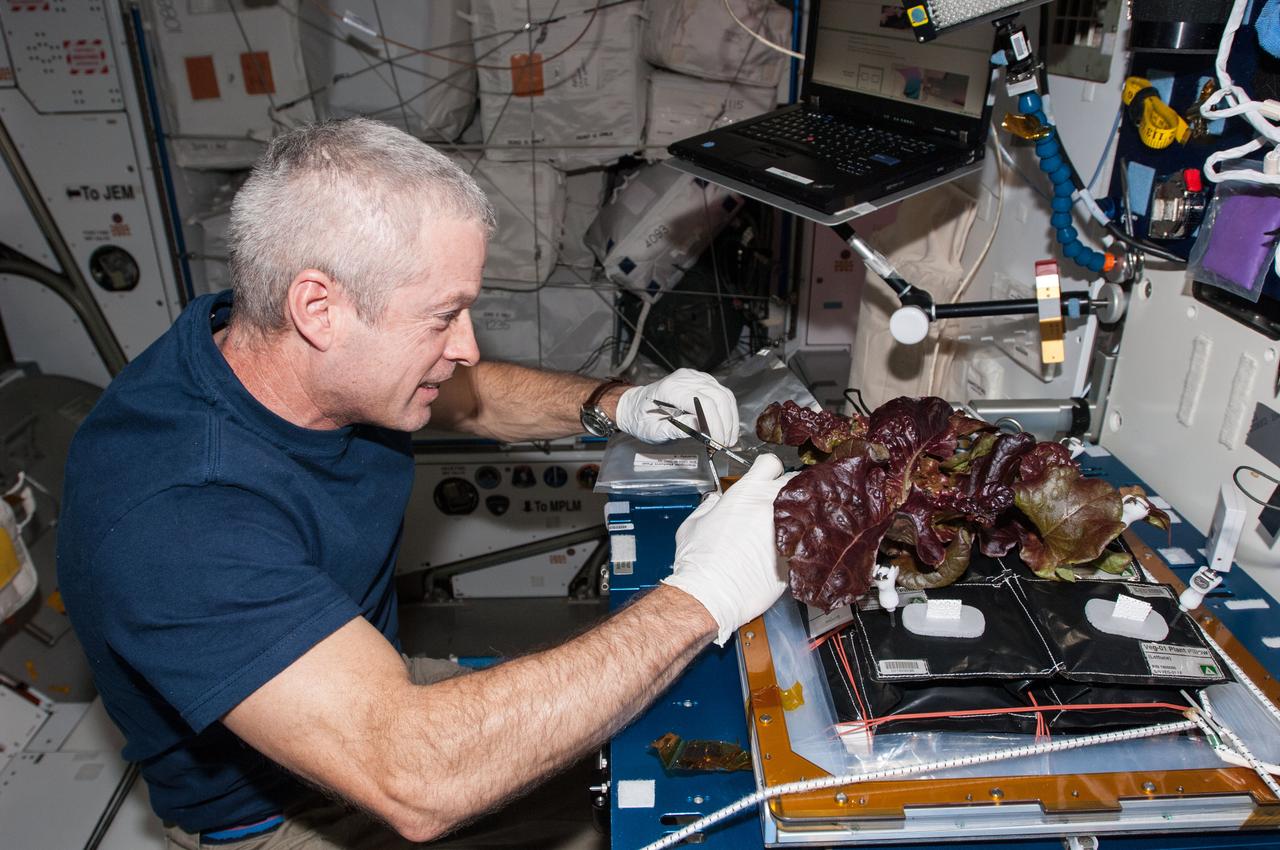
ISS040-E-009124 (10 June 2014) --- In the International Space Station?s Harmony node, NASA astronaut Steve Swanson, Expedition 40 commander, harvests a crop of red romaine lettuce plants that were grown from seed inside the station?s Veggie facility, a low-cost plant growth chamber that uses a flat-panel light bank for plant growth and crew observation. For the Veg-01 experiment, researchers are testing and validating the Veggie hardware, and the plants will be returned to Earth to determine food safety.
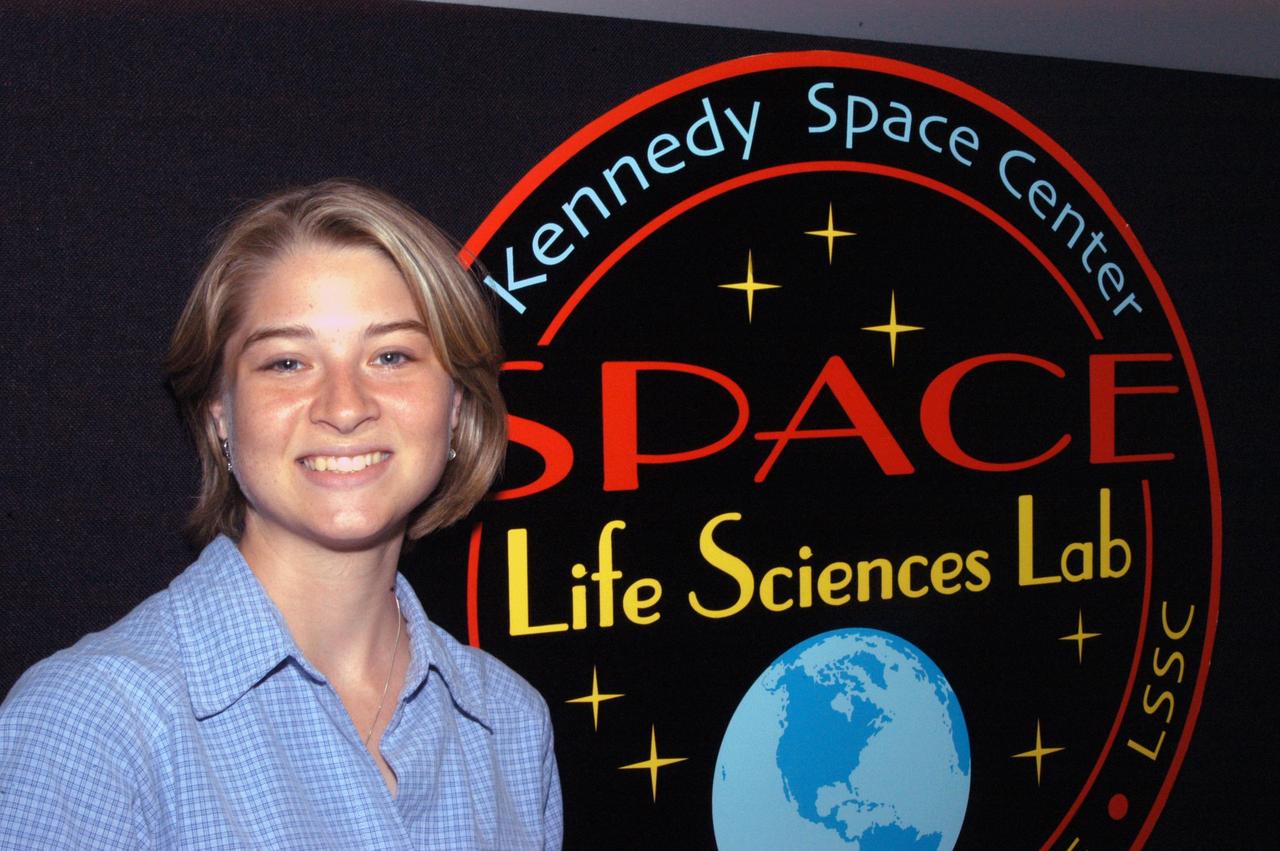
KENNEDY SPACE CENTER, FLA. - Kimberly Beck, a college trainee in Controlled Biological Systems in the Spaceflight and Life Sciences Training Program, is helping with growth studies supporting payload development. Behind her is part of the WONDER (Water Offset Nutrient Delivery Experiment) flight payload that is investigating hydroponic plant crop production in microgravity.

iss067e149651 (June 24, 2022) --- NASA astronauts Jessica Watkins and Bob Hines work on XROOTS, which used the station’s Veggie facility to test liquid- and air-based techniques to grow plants rather than traditional growth media. These techniques could enable production of crops on a larger scale for future space exploration.
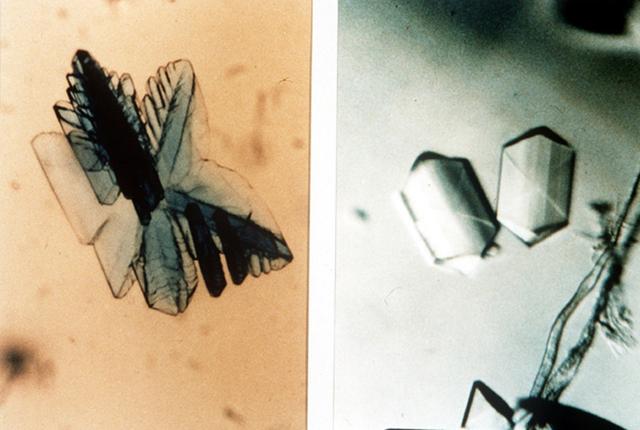
The comparison of protein crystal, Isocitrate Lyase earth-grown (left) and space-grown (right). This is a target enzyme for fungicides. A better understanding of this enzyme should lead to the discovery of more potent fungicides to treat serious crop diseases such as rice blast; it regulates the flow of metabolic intermediates required for cell growth. Principal Investigator is Larry DeLucas.
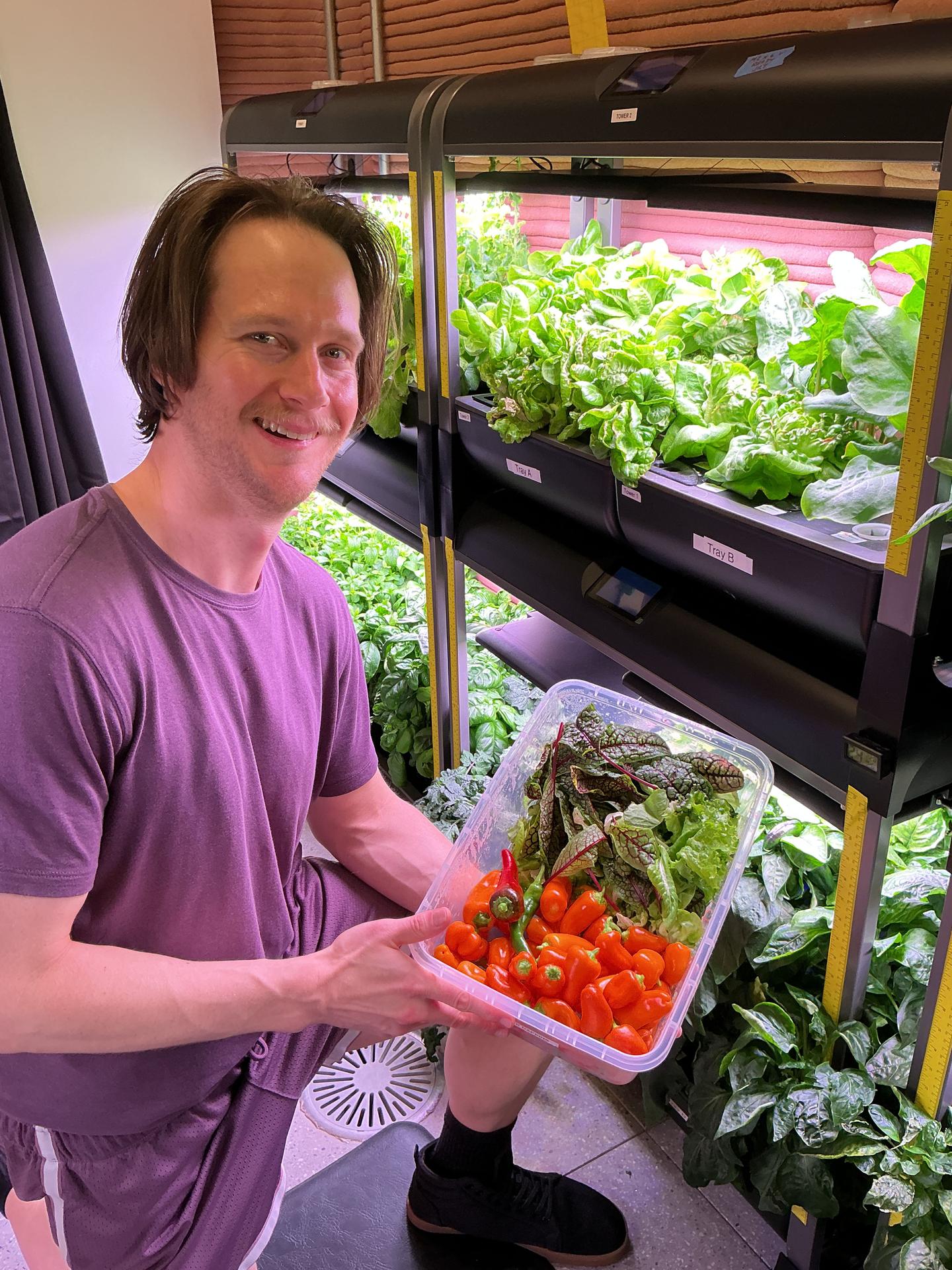
jsc2026e403163 (Feb. 4, 2026) -- Matthew Montgomery, Crew Health and Performance Exploration Analog (CHAPEA) Mission 2 science officer, showcases vegetables collected during a recent harvest from the hydroponic crop growth system. Credit: NASA
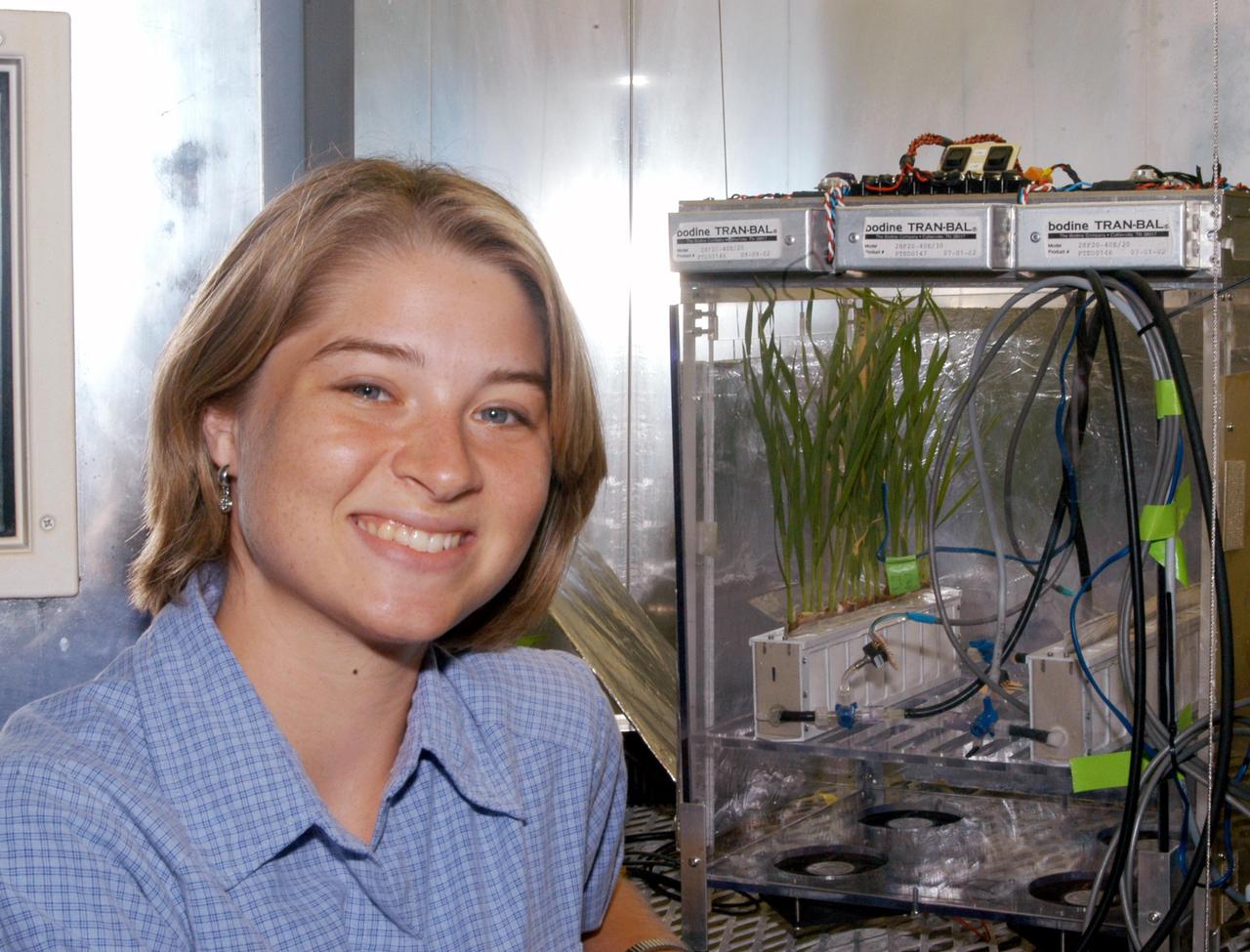
KENNEDY SPACE CENTER, FLA. - Kimberly Beck is a Controlled Biological Systems trainee in the Spaceflight and Life Sciences Training Program. She is helping with growth studies supporting the WONDER (Water Offset Nutrient Delivery Experiment) flight payload, which is investigating hydroponic plant crop production in microgravity.

iss066e023184 (October 29, 2021) -- An astronaut cuts slices of red chile pepper during a taste test of chile peppers grown as part of the Plant Habitat-04 investigation aboard the International Space Station. The chile peppers started growing on July 12, 2021, and represent one of the longest and most challenging plant experiments attempted aboard the orbiting laboratory. NASA astronaut Mark Vande Hei conducted the first harvest of the pepper crop on October 29, 2021. Crew members sanitized the peppers and completed a scientific survey after their taste test. The Crew-3 astronauts will take over the crop when they arrive at the orbiting laboratory, and will conduct a final harvest of the peppers in late November. They will also sanitize and sample the crop, and complete surveys. Some peppers from the final harvest and their leaves will return to Earth for further analysis. What we learn will inform future crop growth and food supplementation activities for deep space exploration.
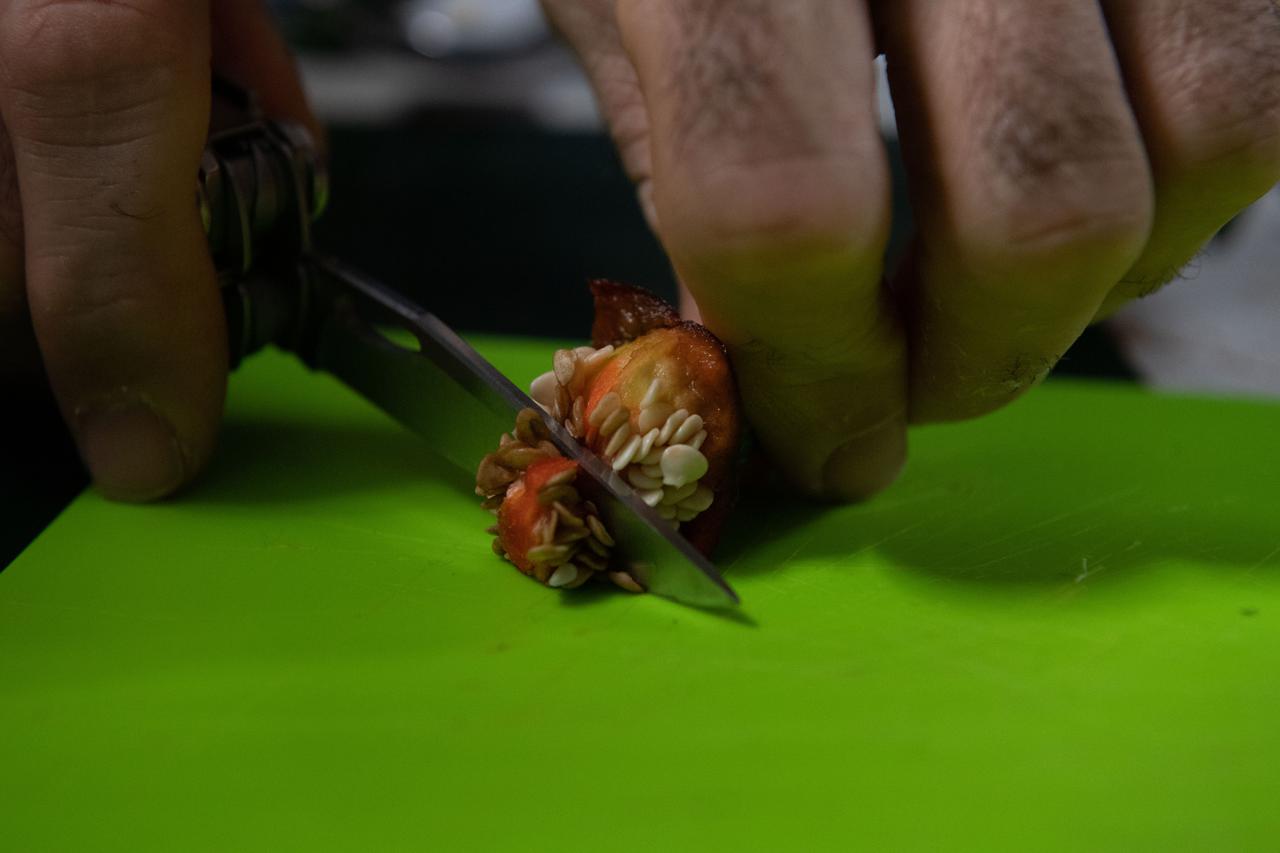
iss066e023187 (October 29, 2021) -- An astronaut cuts slices of red chile pepper during a taste test of chile peppers grown as part of the Plant Habitat-04 investigation aboard the International Space Station. The chile peppers started growing on July 12, 2021, and represent one of the longest and most challenging plant experiments attempted aboard the orbiting laboratory. NASA astronaut Mark Vande Hei conducted the first harvest of the pepper crop on October 29, 2021. Crew members sanitized the peppers and completed a scientific survey after their taste test. The Crew-3 astronauts will take over the crop when they arrive at the orbiting laboratory, and will conduct a final harvest of the peppers in late November. They will also sanitize and sample the crop, and complete surveys. Some peppers from the final harvest and their leaves will return to Earth for further analysis. What we learn will inform future crop growth and food supplementation activities for deep space exploration.

A researcher takes measurements of a radish crop harvested from the Advanced Plant Habitat (APH) ground unit inside the Space Station Processing Facility at NASA’s Kennedy Space Center in Florida on Dec. 14, 2020. The radishes are a ground control crop for the Plant Habitat-02 (PH-02) experiment, which also involves growing two similar radish crops inside the International Space Station’s APH. NASA astronaut Kate Rubins harvested the first crop on Nov. 30, and the second harvest aboard the orbiting laboratory is planned for Dec. 30. Once samples return to Earth, researchers will compare those grown in space to the radishes grown here on Earth to better understand how microgravity affects plant growth.
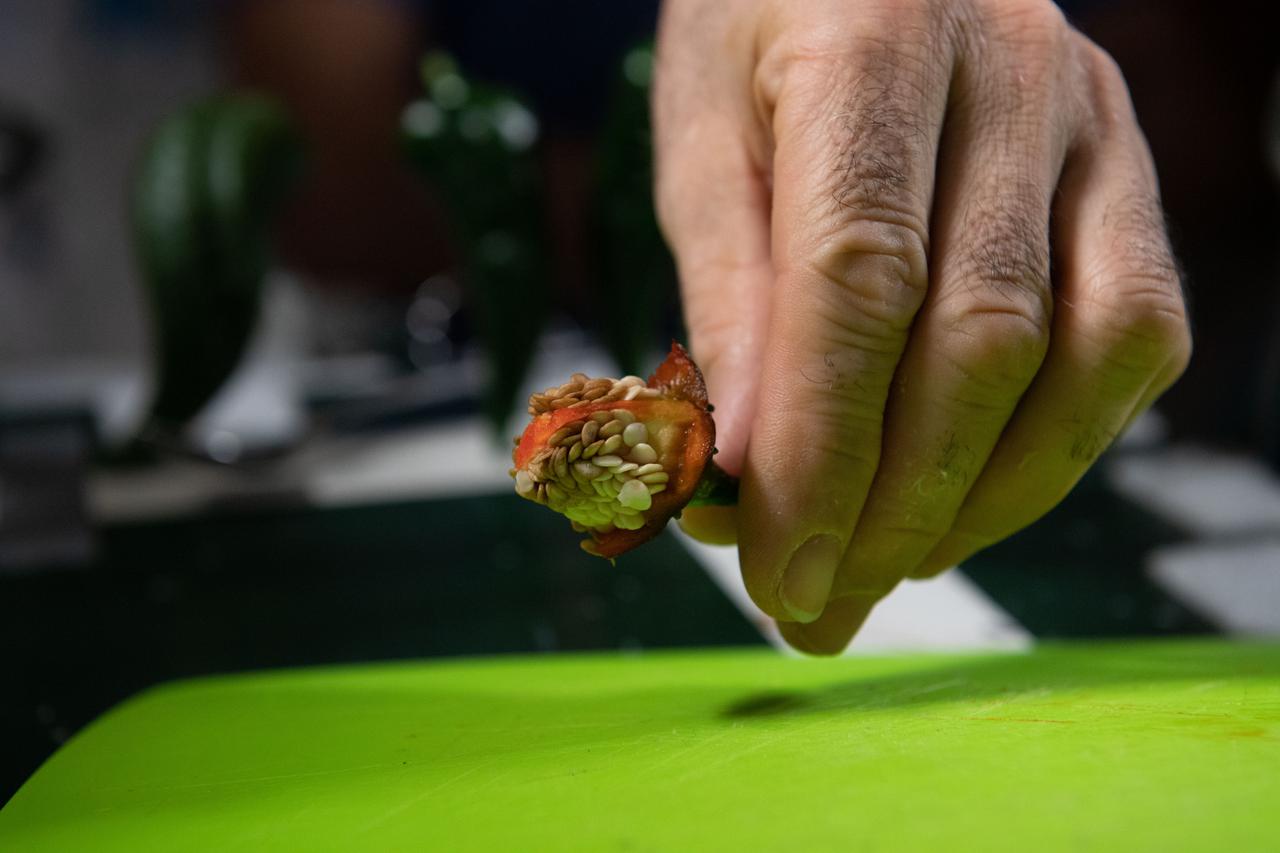
iss066e023185 (October 29, 2021) -- An astronaut cuts slices of red chile pepper during a taste test of chile peppers grown as part of the Plant Habitat-04 investigation aboard the International Space Station. The chile peppers started growing on July 12, 2021, and represent one of the longest and most challenging plant experiments attempted aboard the orbiting laboratory. NASA astronaut Mark Vande Hei conducted the first harvest of the pepper crop on October 29, 2021. Crew members sanitized the peppers and completed a scientific survey after their taste test. The Crew-3 astronauts will take over the crop when they arrive at the orbiting laboratory, and will conduct a final harvest of the peppers in late November. They will also sanitize and sample the crop, and complete surveys. Some peppers from the final harvest and their leaves will return to Earth for further analysis. What we learn will inform future crop growth and food supplementation activities for deep space exploration.
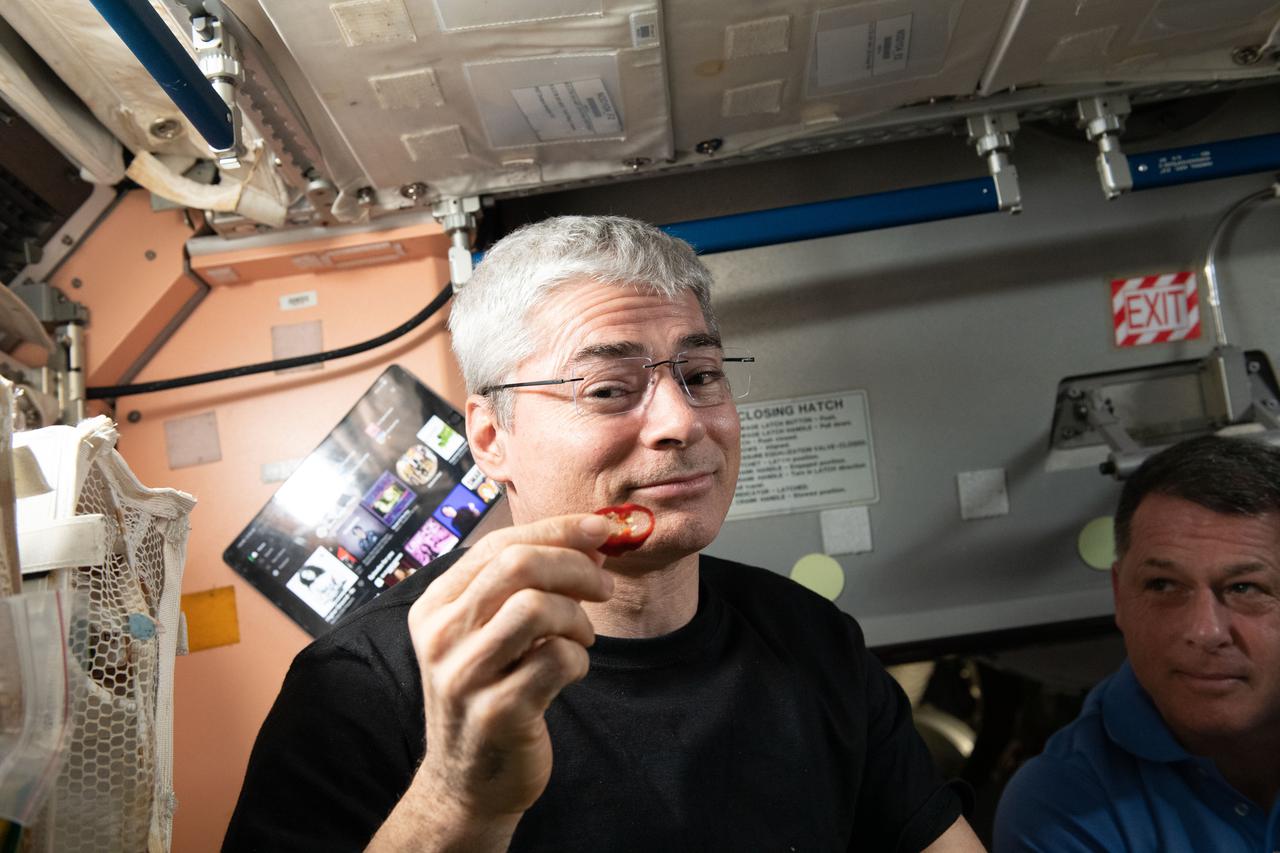
iss066e023179 (October 29, 2021) -- NASA astronaut and Expedition 66 Flight Engineer Mark Vande Hei samples a red chile pepper grown as part of the Plant Habitat-04 experiment aboard the International Space Station. The chile pepper seeds started growing on July 12, 2021, and represent one of the longest and most challenging plant experiments attempted aboard the orbiting laboratory. Vande Hei conducted the first harvest of the pepper crop on October 29, 2021. Crew members sanitized the peppers and completed a scientific survey after their taste test. The Crew-3 astronauts will take over the crop when they arrive at the orbiting laboratory, and will conduct a final harvest of the peppers in late November. They will also sanitize and sample the crop, and complete surveys. Some peppers from the final harvest and their leaves will return to Earth for further analysis. What we learn will inform future crop growth and food supplementation activities for deep space exploration.
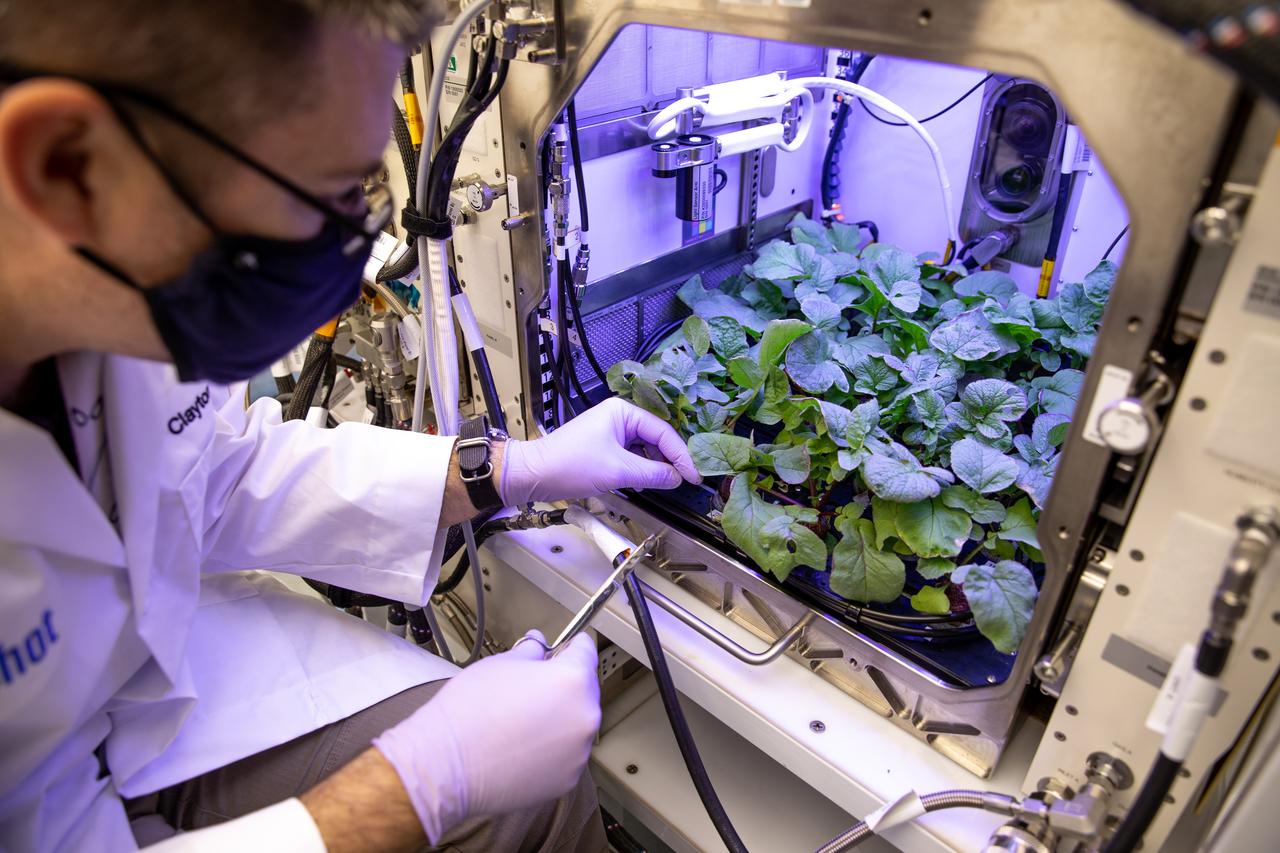
A research scientist harvests radishes grown in the Advanced Plant Habitat (APH) ground unit inside the Space Station Processing Facility at NASA’s Kennedy Space Center in Florida on Dec. 14, 2020. The radishes are a ground control crop for the Plant Habitat-02 (PH-02) experiment. The experiment also involves growing two similar radish crops inside the International Space Station’s APH. NASA astronaut Kate Rubins harvested the first crop on Nov. 30, and the second harvest aboard the orbiting laboratory is planned for Dec. 30. Once samples return to Earth, researchers will compare those grown in space to the radishes grown here on Earth to better understand how microgravity affects plant growth.
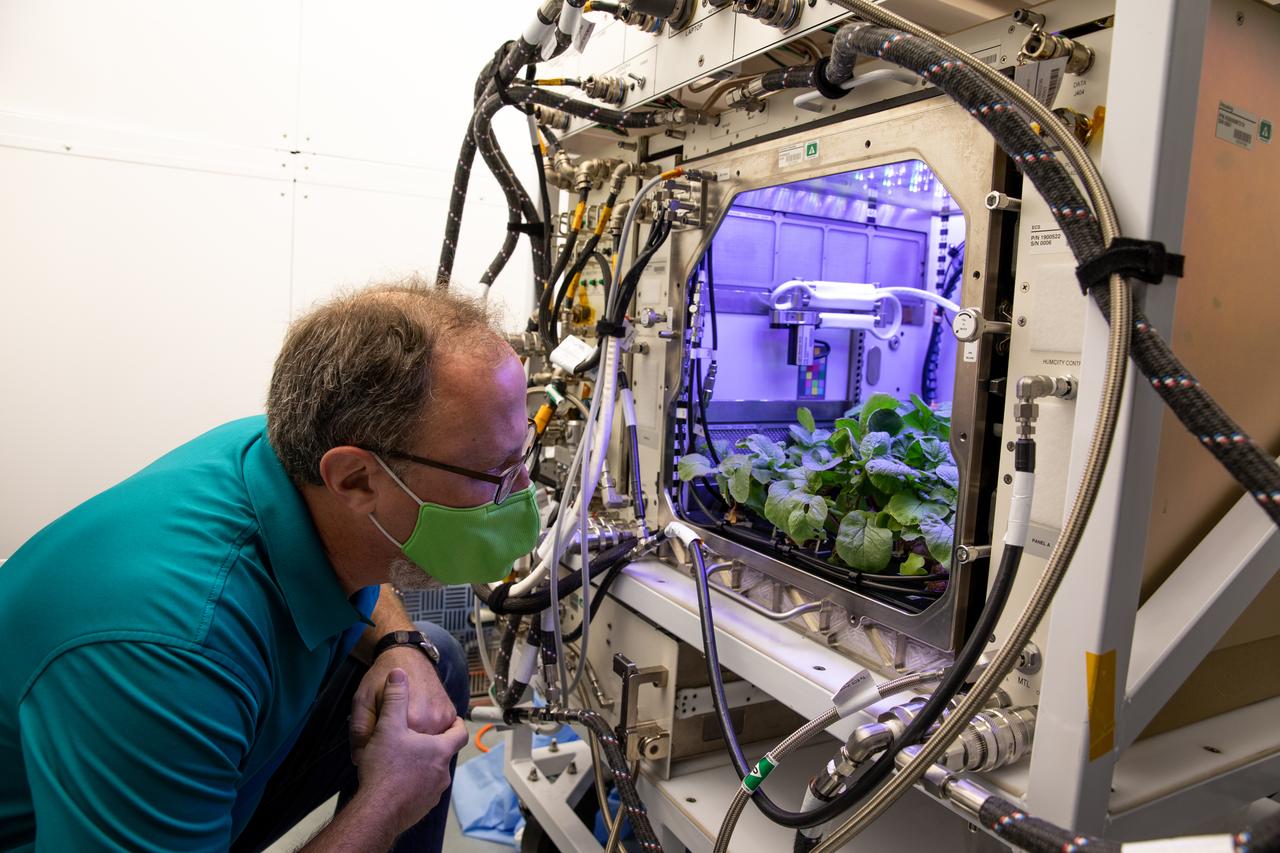
Dave Reed, Florida operations director for Techshot, Inc., observes radishes growing in the Advanced Plant Habitat (APH) ground unit inside the Space Station Processing Facility at NASA’s Kennedy Space Center in Florida on Dec. 14, 2020. The radishes are a ground control crop for the Plant Habitat-02 (PH-02) experiment, which also involves growing two similar radish crops inside the International Space Station’s APH. NASA astronaut Kate Rubins harvested the first crop on Nov. 30, and the second harvest aboard the orbiting laboratory is planned for Dec. 30. Once samples return to Earth, researchers will compare those grown in space to the radishes grown here on Earth to better understand how microgravity affects plant growth.
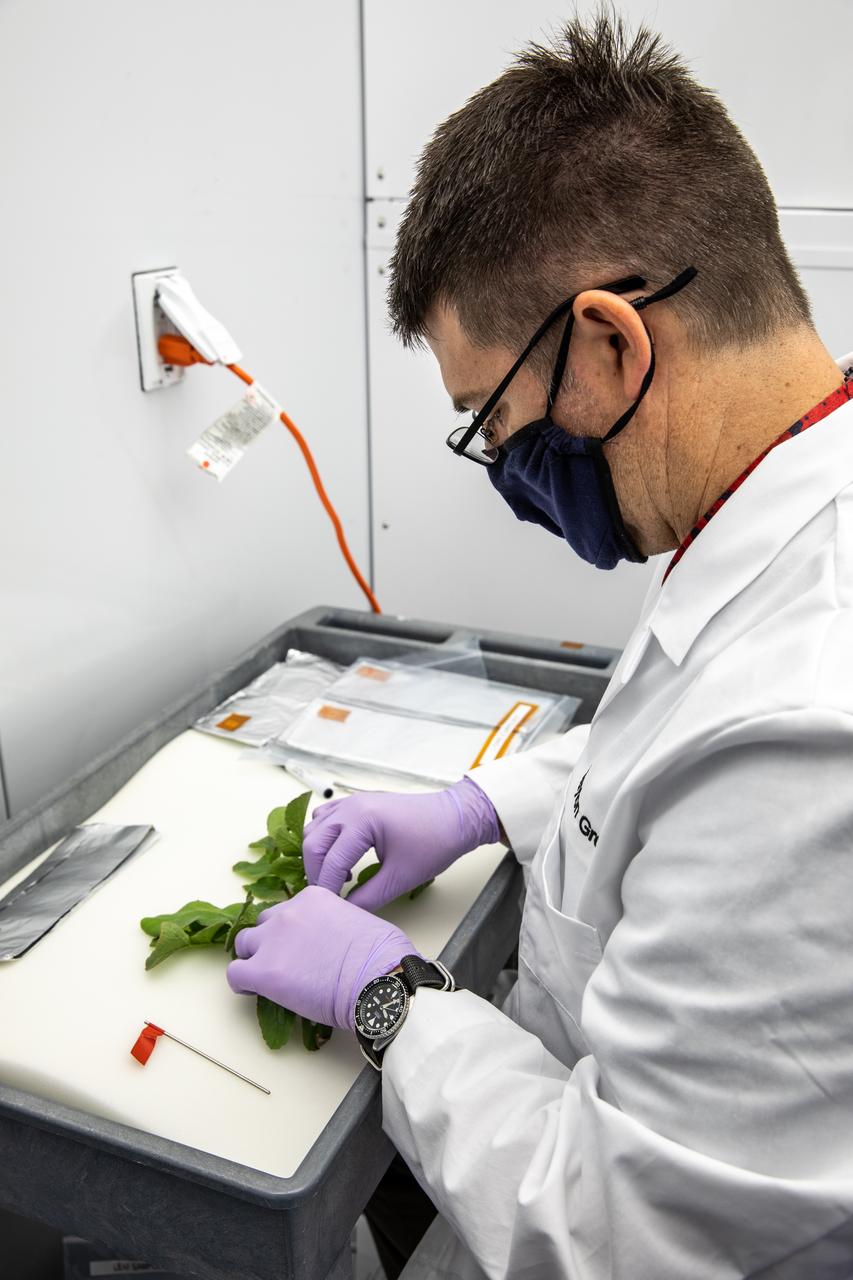
A research scientist collects measurements of radishes harvested from the Advanced Plant Habitat (APH) ground unit inside the Space Station Processing Facility at NASA’s Kennedy Space Center in Florida on Dec. 14, 2020. The radishes are a ground control crop for the Plant Habitat-02 (PH-02) experiment, which also involves growing two similar radish crops inside the International Space Station’s APH. NASA astronaut Kate Rubins harvested the first crop on Nov. 30, and the second harvest aboard the orbiting laboratory is planned for Dec. 30. Once samples return to Earth, researchers will compare those grown in space to the radishes grown here on Earth to better understand how microgravity affects plant growth.
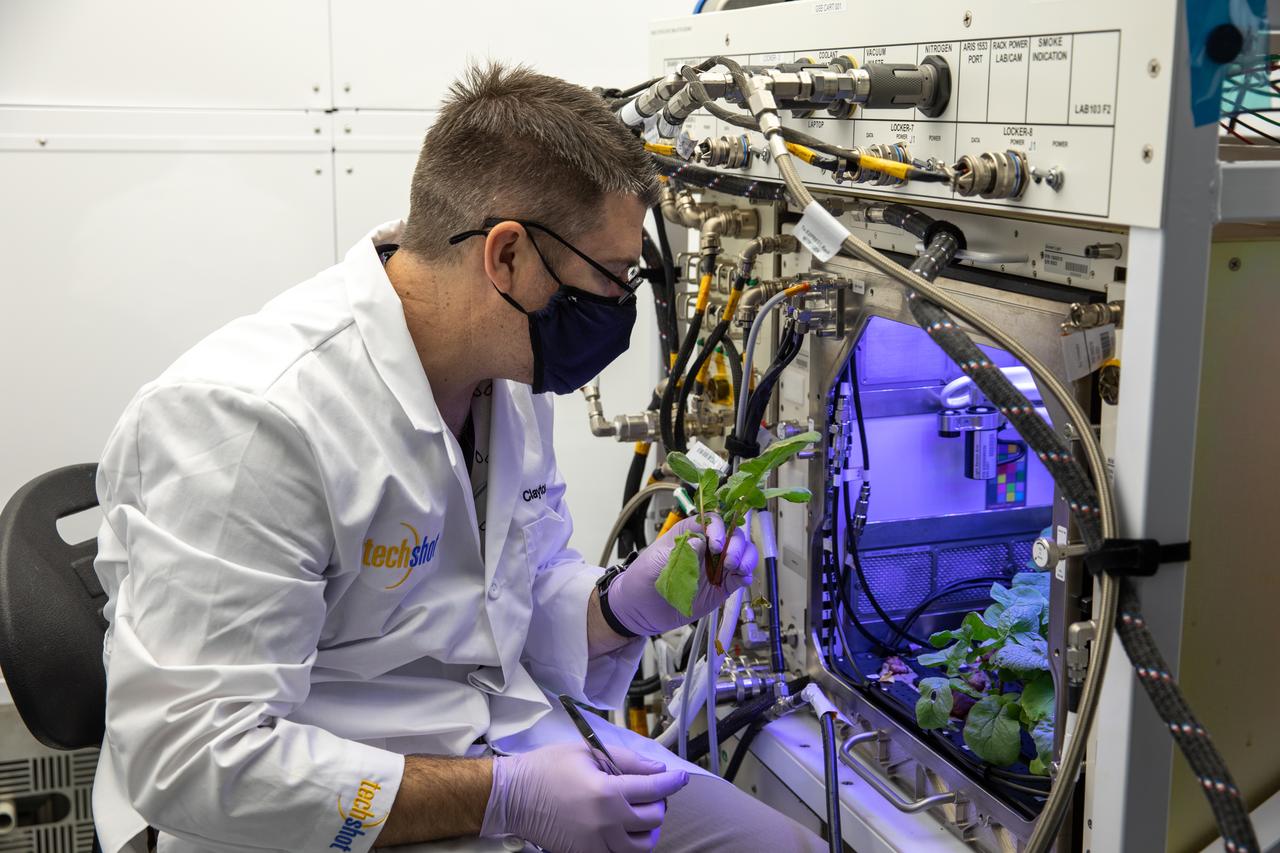
A research scientist harvests radishes grown in the Advanced Plant Habitat (APH) ground unit inside the Space Station Processing Facility at NASA’s Kennedy Space Center in Florida on Dec. 14, 2020. The radishes are a ground control crop for the Plant Habitat-02 (PH-02) experiment. The experiment also involves growing two similar radish crops inside the International Space Station’s APH. NASA astronaut Kate Rubins harvested the first crop on Nov. 30, and the second harvest aboard the orbiting laboratory is planned for Dec. 30. Once samples return to Earth, researchers will compare those grown in space to the radishes grown here on Earth to better understand how microgravity affects plant growth.
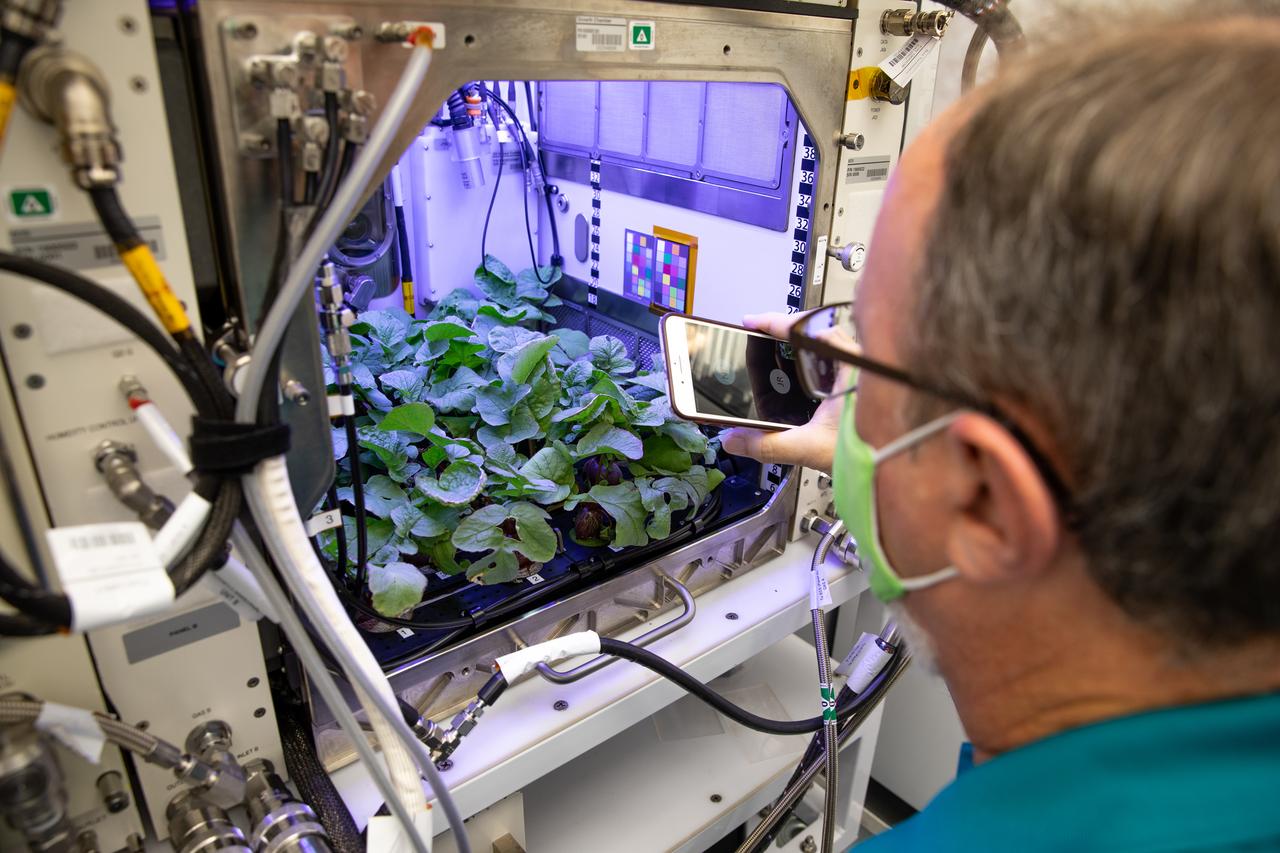
Dave Reed, Florida operations director for Techshot, Inc., observes radishes growing in the Advanced Plant Habitat (APH) ground unit inside the Space Station Processing Facility at NASA’s Kennedy Space Center in Florida on Dec. 14, 2020. The radishes are a ground control crop for the Plant Habitat-02 (PH-02) experiment. The experiment also involves growing two similar radish crops inside the International Space Station’s APH. NASA astronaut Kate Rubins harvested the first crop on Nov. 30, and the second harvest aboard the orbiting laboratory is planned for Dec. 30. Once samples return to Earth, researchers will compare those grown in space to the radishes grown here on Earth to better understand how microgravity affects plant growth.
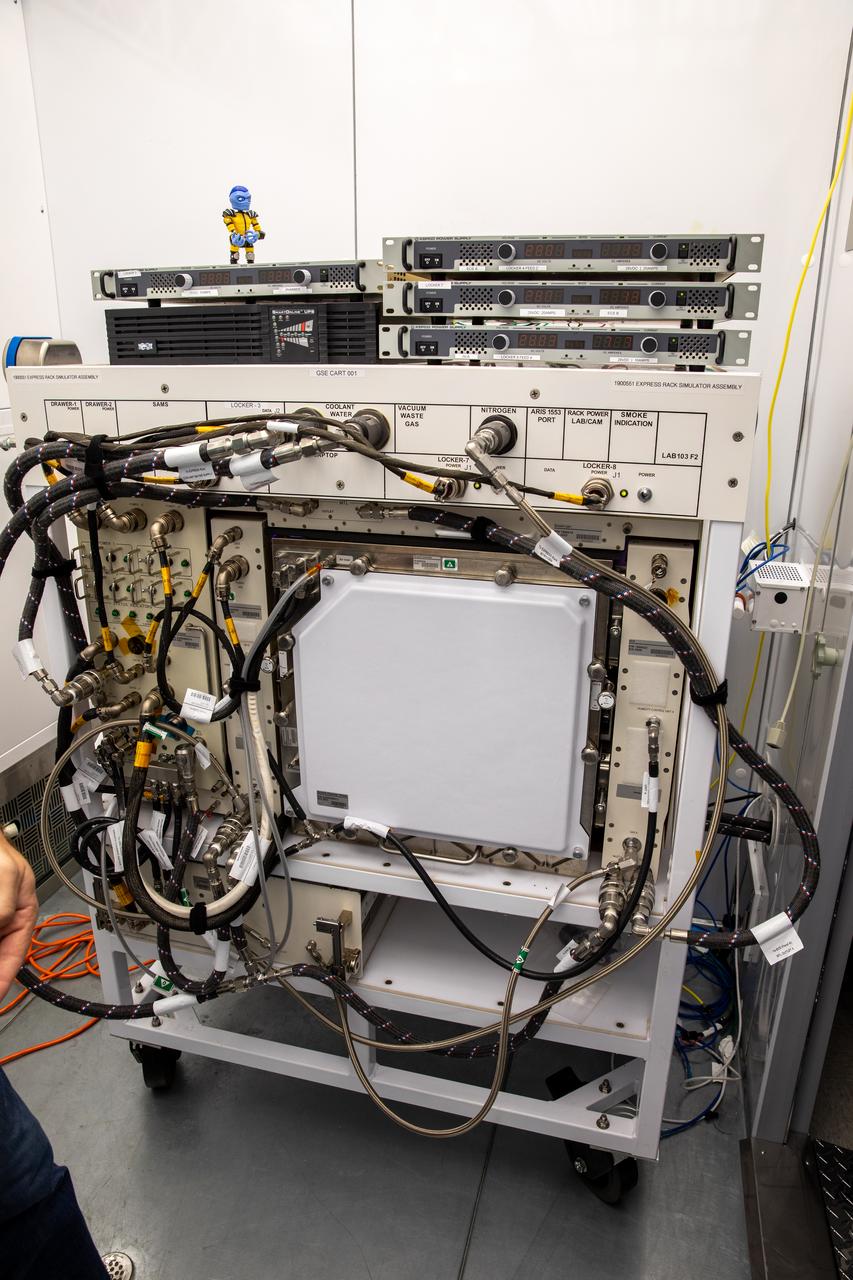
In view is the Advanced Plant Habitat (APH) ground unit inside the Space Station Processing Facility at NASA’s Kennedy Space Center in Florida on Dec. 14, 2020. Part of the Plant Habitat-02 (PH-02) experiment, a ground control crop of radishes was grown at Kennedy and harvested on Dec. 14. The experiment also involves growing two similar radish crops inside the International Space Station’s APH. NASA astronaut Kate Rubins harvested the first crop on Nov. 30, and the second harvest aboard the orbiting laboratory is planned for Dec. 30. Once samples return to Earth, researchers will compare those grown in space to the radishes grown here on Earth to better understand how microgravity affects plant growth.
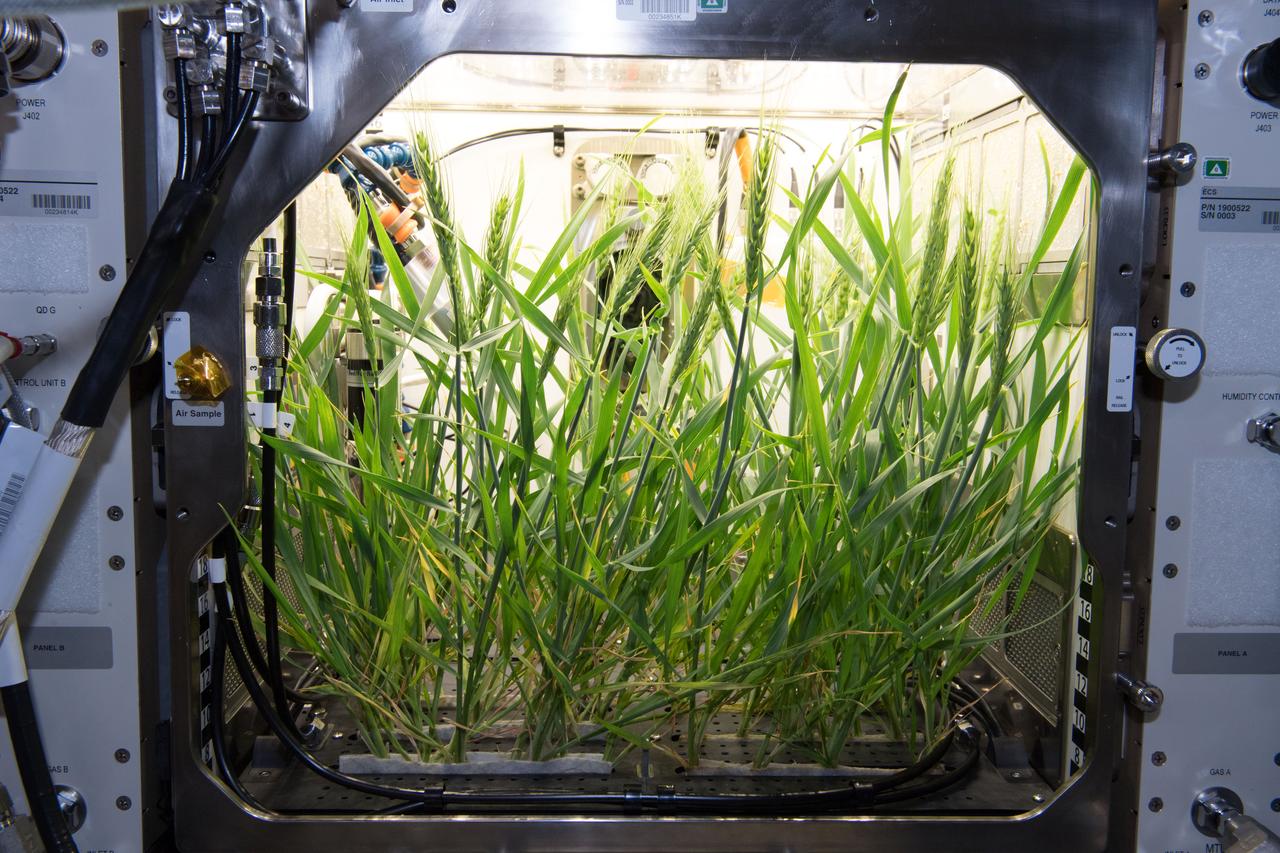
The first growth test of crops in the Advanced Plant Habitat aboard the International Space Station yielded great results. Arabidopsis seeds – small flowering plants related to cabbage and mustard – grew for about six weeks and the dwarf wheat for five weeks. The APH is now ready to support large plant testing on ISS. APH is a fully enclosed, closed-loop system with an environmentally controlled growth chamber. It uses red, blue and green LED lights, and broad spectrum white LED lights. The system's more than 180 sensors will relay real-time information, including temperature, oxygen content and moisture levels back to the team at Kennedy Space Center.
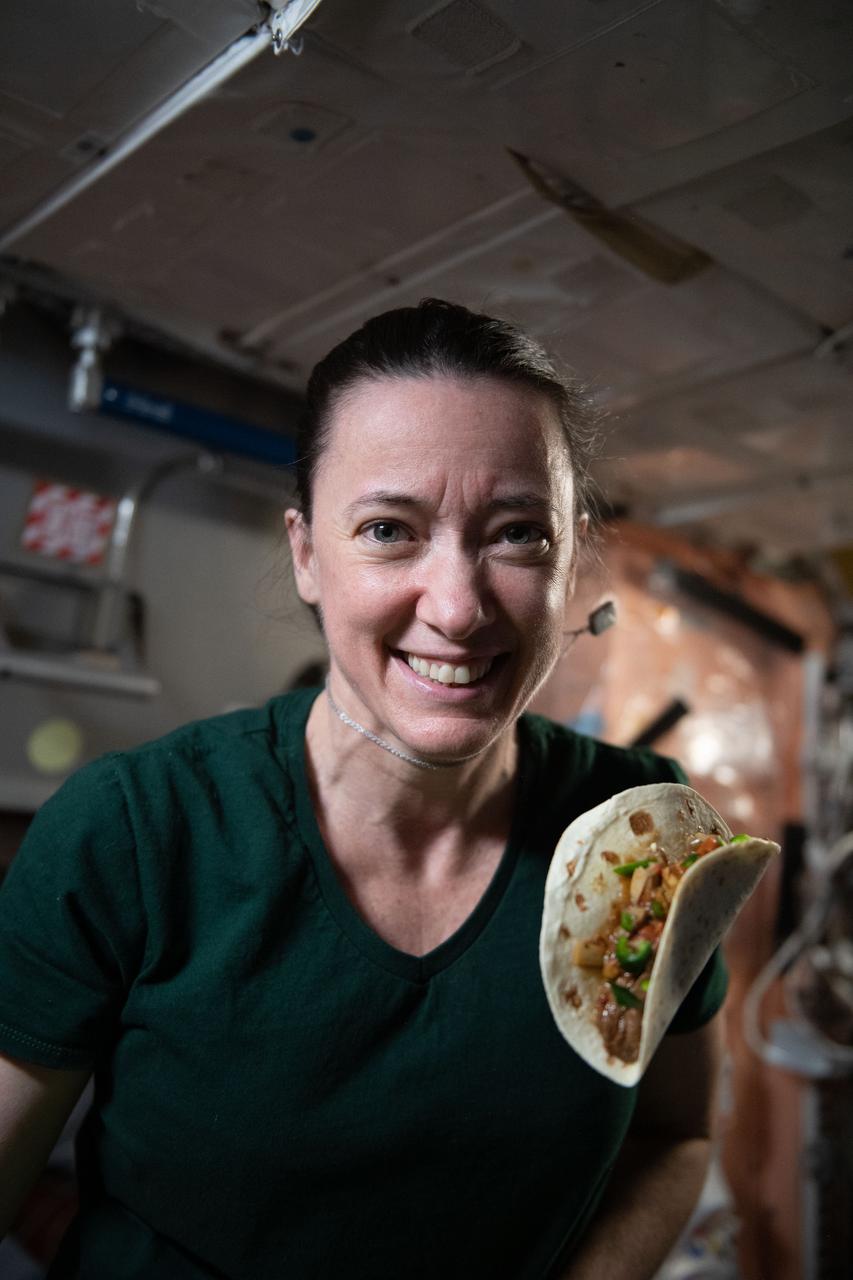
iss066e023198 (October 29, 2021) -- NASA astronaut and Expedition 66 flight engineer Megan McArthur is seen with a taco made using fajita beef, rehydrated tomatoes and artichokes, and chile peppers. The chile peppers were grown as part of the Plant Habitat-04 investigation aboard the International Space Station. The crop started growing on July 12, 2021, and represent one of the longest and most challenging plant experiments attempted aboard the orbiting laboratory. The chile peppers started growing on July 12, 2021, and represent one of the longest and most challenging plant experiments attempted aboard the orbiting laboratory. NASA astronaut and Expedition 66 flight engineer Mark Vande Hei conducted the first harvest of the pepper crop on October 29, 2021. Crew members sanitized the peppers and completed a scientific survey after their taste test. The Crew-3 astronauts will take over the crop when they arrive at the orbiting laboratory, and will conduct a final harvest of the peppers in late November. They will also sanitize and sample the crop, and complete surveys. Some peppers and their leaves from the final harvest will return to Earth for further analysis. What we learn will inform future crop growth and food supplementation activities for deep space exploration.

A researcher from NASA’s Kennedy Space Center in Florida prepares pepper seeds for planting inside science carriers on April 8, 2021, inside the Space Life Sciences Lab for the Plant Habitat-04 (PH-04) experiment. The seeds will fly to the International Space Station on SpaceX’s 22nd Commercial Resupply Services (CRS-22) mission. When the experiment starts, astronauts will grow the pepper seeds in the Advanced Plant Habitat (APH) growth chamber, which will monitor the experiment with more than 180 sensors. The astronauts will observe plant growth for about four months and conduct two harvests to study whether microgravity affects growth, flavor, or texture. Since peppers take longer to germinate, grow, and develop than previous crops grown in space, the PH-04 experiment also will test the durability and reliability of the various systems within the APH.

A researcher from NASA’s Kennedy Space Center in Florida prepares pepper seeds for planting inside science carriers on April 8, 2021, inside the Space Life Sciences Lab for the Plant Habitat-04 (PH-04) experiment. The seeds will fly to the International Space Station on SpaceX’s 22nd Commercial Resupply Services (CRS-22) mission. When the experiment starts, astronauts will grow the pepper seeds in the Advanced Plant Habitat (APH) growth chamber, which will monitor the experiment with more than 180 sensors. The astronauts will observe plant growth for about four months and conduct two harvests to study whether microgravity affects growth, flavor, or texture. Since peppers take longer to germinate, grow, and develop than previous crops grown in space, the PH-04 experiment also will test the durability and reliability of the various systems within the APH.

Inside the Space Life Sciences Lab at NASA’s Kennedy Space Center in Florida, researchers plant pepper seeds in a science carrier on April 8, 2021, in preparation for the Plant Habitat-04 (PH-04) experiment. The seeds will fly to the International Space Station on SpaceX’s 22nd Commercial Resupply Services (CRS-22) mission. When the experiment starts, astronauts will grow the pepper seeds in the Advanced Plant Habitat (APH) growth chamber, which will monitor the experiment with more than 180 sensors. The astronauts will observe plant growth for about four months and conduct two harvests to study whether microgravity affects growth, flavor, or texture. Since peppers take longer to germinate, grow, and develop than previous crops grown in space, the PH-04 experiment also will test the durability and reliability of the various systems within the APH.

A researcher from NASA’s Kennedy Space Center in Florida prepares pepper seeds for planting inside science carriers on April 8, 2021, inside the Space Life Sciences Lab for the Plant Habitat-04 (PH-04) experiment. The seeds will fly to the International Space Station on SpaceX’s 22nd Commercial Resupply Services (CRS-22) mission. When the experiment starts, astronauts will grow the pepper seeds in the Advanced Plant Habitat (APH) growth chamber, which will monitor the experiment with more than 180 sensors. The astronauts will observe plant growth for about four months and conduct two harvests to study whether microgravity affects growth, flavor, or texture. Since peppers take longer to germinate, grow, and develop than previous crops grown in space, the PH-04 experiment also will test the durability and reliability of the various systems within the APH.

A close-up photo of a pepper seed prepared by researchers at NASA’s Kennedy Space Center in Florida is shown before it’s planted inside a science carrier on April 8, 2021, inside the Space Life Sciences Lab for the Plant Habitat-04 (PH-04) experiment. The seeds will fly to the International Space Station on SpaceX’s 22nd Commercial Resupply Services (CRS-22) mission. When the experiment starts, astronauts will grow the pepper seeds in the Advanced Plant Habitat (APH) growth chamber, which will monitor the experiment with more than 180 sensors. The astronauts will observe plant growth for about four months and conduct two harvests to study whether microgravity affects growth, flavor, or texture. Since peppers take longer to germinate, grow, and develop than previous crops grown in space, the PH-04 experiment also will test the durability and reliability of the various systems within the APH.

Inside the Space Life Sciences Lab at NASA’s Kennedy Space Center in Florida, a researcher plants pepper seeds in science carriers on April 8, 2021, in preparation for the Plant Habitat-04 (PH-04) experiment. The seeds will fly to the International Space Station on SpaceX’s 22nd Commercial Resupply Services (CRS-22) mission. When the experiment starts, astronauts will grow the pepper seeds in the Advanced Plant Habitat (APH) growth chamber, which will monitor the experiment with more than 180 sensors. The astronauts will observe plant growth for about four months and conduct two harvests to study whether microgravity affects growth, flavor, or texture. Since peppers take longer to germinate, grow, and develop than previous crops grown in space, the PH-04 experiment also will test the durability and reliability of the various systems within the APH.
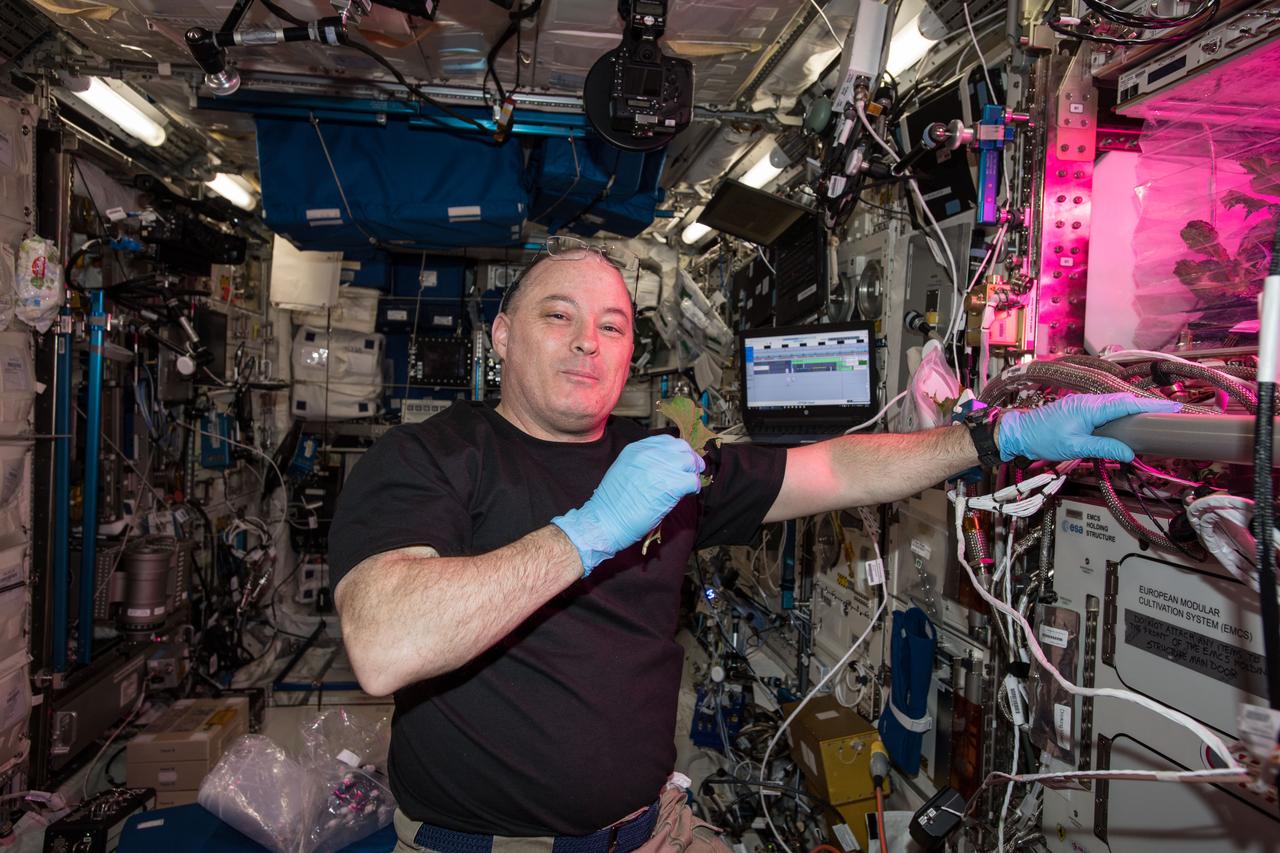
iss055e001193 (March 8, 2018) --- NASA astronaut Scott Tingle eats a piece of lettuce harvested as part of the ongoing space crop study VEG-03. The botany experiment uses the Veggie plant growth facility to cultivate a type of cabbage, lettuce and mizuna which are harvested on-orbit with some samples consumed by astronauts and others returned to Earth for testing.
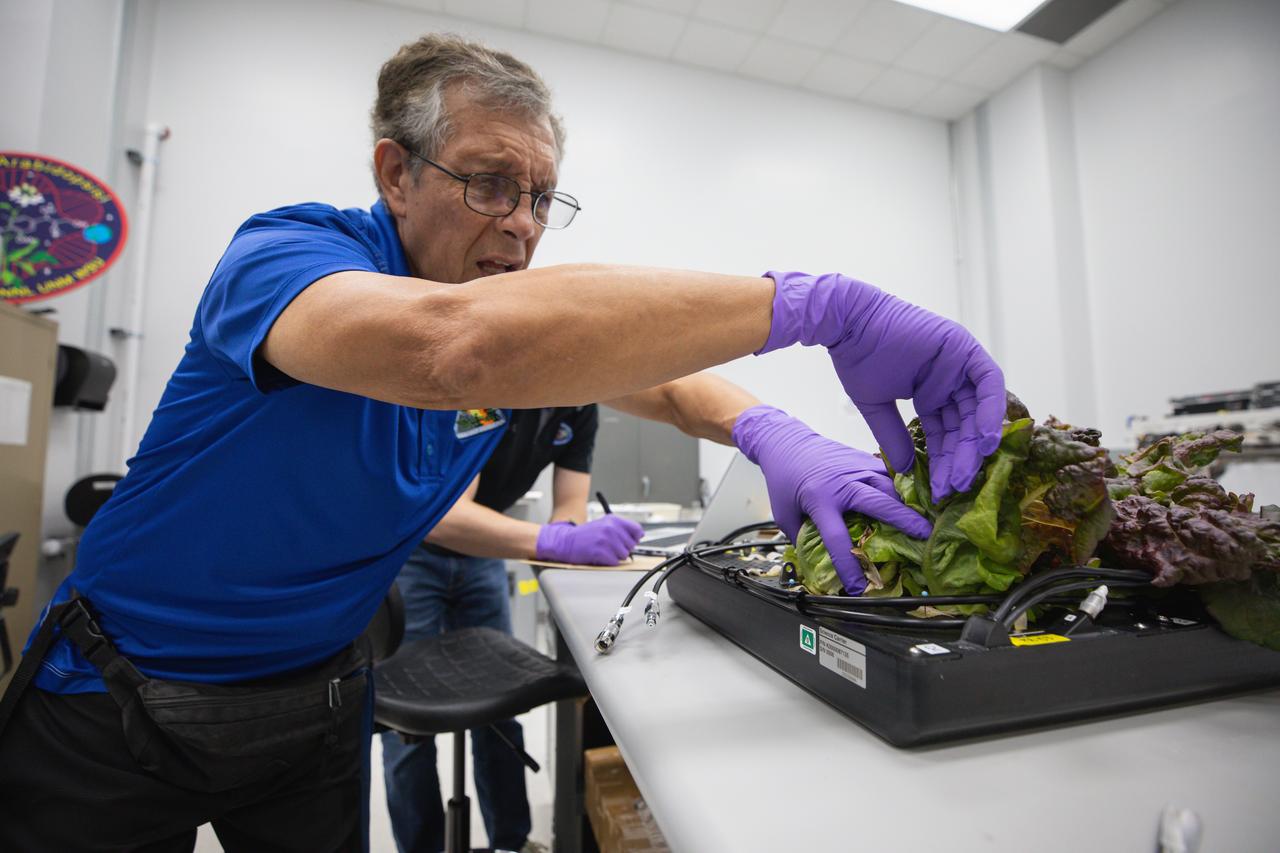
Space crop production scientist Oscar Monje harvests Outredgeous romaine lettuce for preflight testing of the Plant Habitat-07 (PH-07) experiment inside a laboratory at the Space Systems Processing Facility at NASA’s Kennedy Space Center in Florida on Thursday, Aug. 29, 2024. PH-07 will be sent to the International Space Station on NASA’s SpaceX 31st commercial resupply services mission to study how optimal and suboptimal moisture conditions impact plant growth, nutrient content, and the plant microbiome.
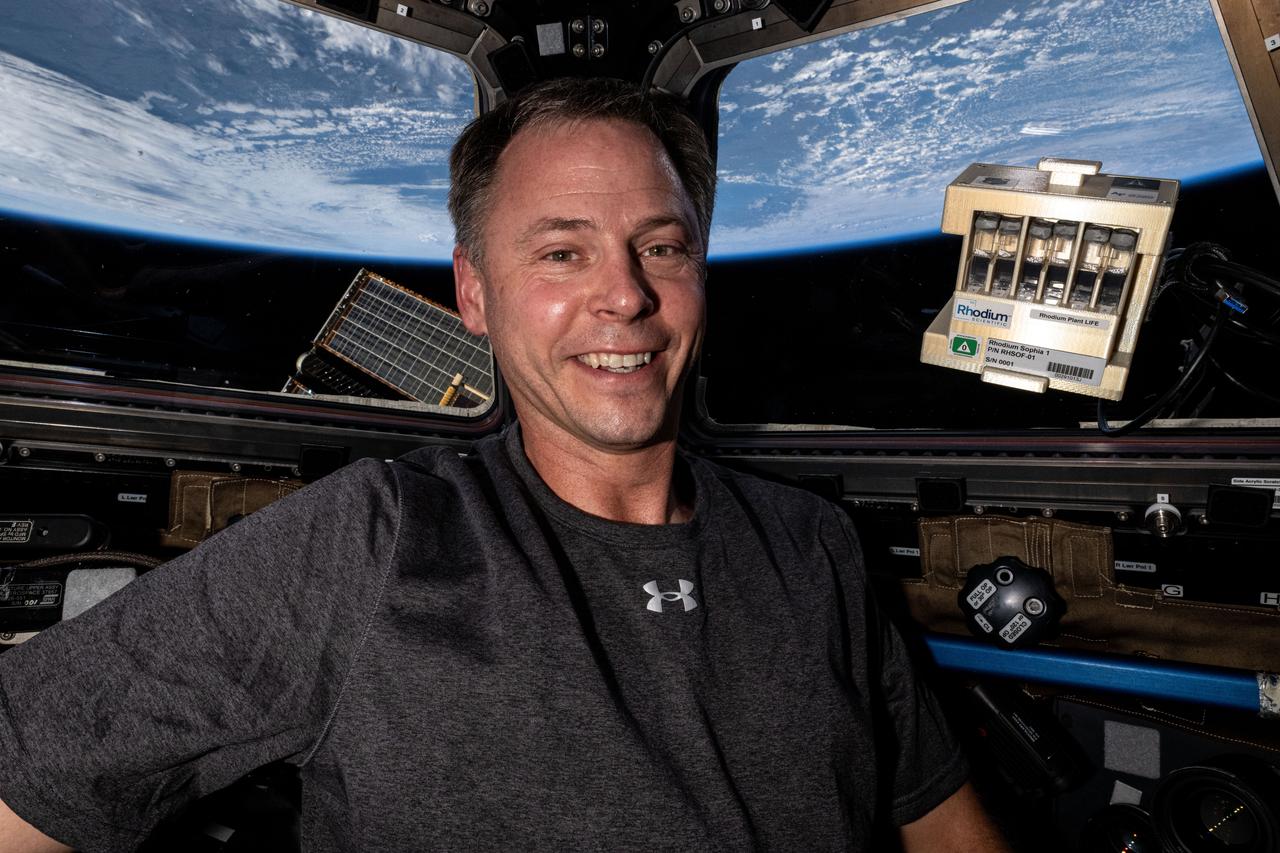
iss072e034791 (Oct. 11, 2024) --- NASA astronaut and Expedition 72 Flight Engineer Nick Hague is pictured inside the cupola with space botany hardware that supports the Rhodium Plant LIFE investigation. The experiment studies the affects of radiation and microgravity on plant growth to promote self-sustainable long-term human missions and increase crop production on Earth. The International Space Station was orbiting 259 miles above the Alps in Austria at the time of this photograph.
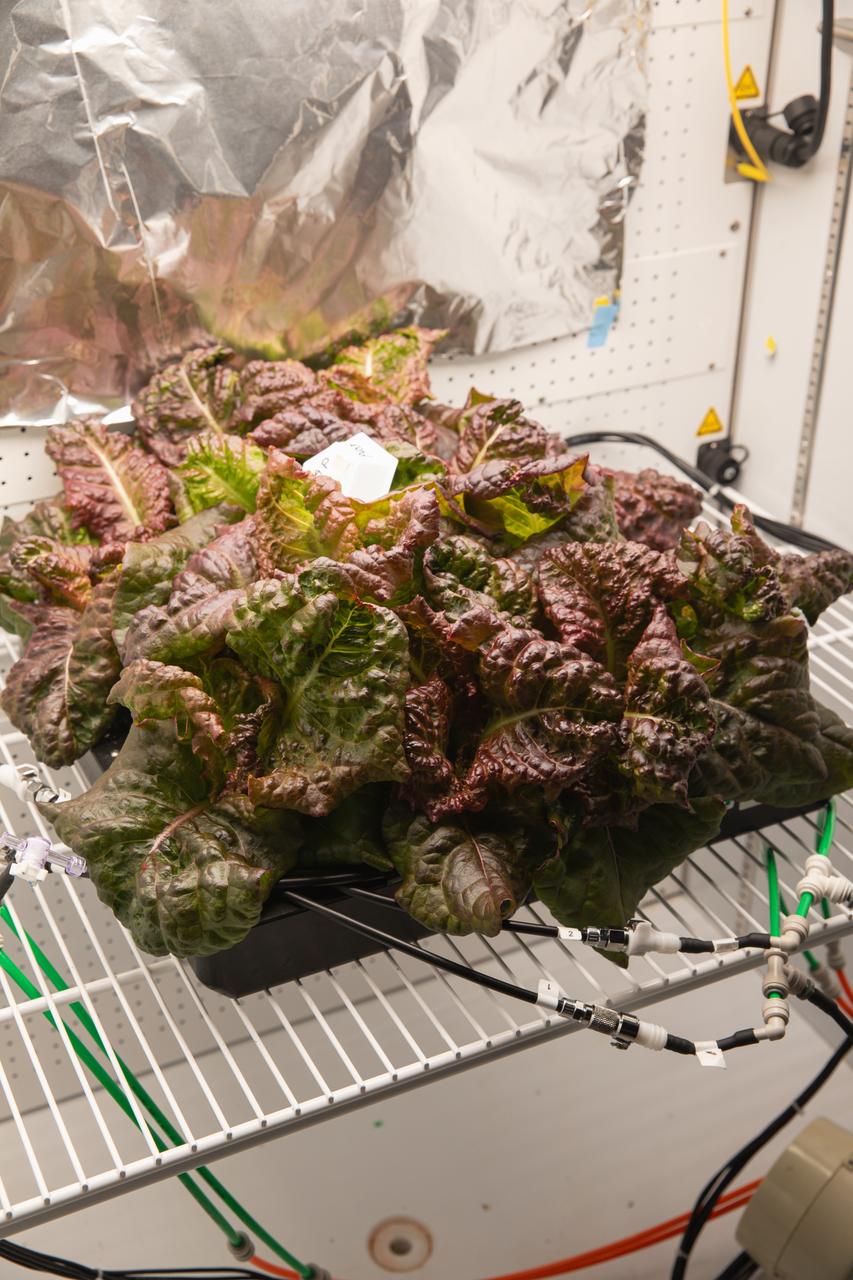
Space crop production scientists inside a laboratory at the Space Systems Processing Facility at NASA’s Kennedy Space Center in Florida harvest Outredgeous romaine lettuce for preflight testing of the Plant Habitat-07 (PH-07) experiment on Thursday, Aug. 29, 2024. PH-07 will be sent to the International Space Station on NASA’s SpaceX 31st commercial resupply services mission to study how optimal and suboptimal moisture conditions impact plant growth, nutrient content, and the plant microbiome.
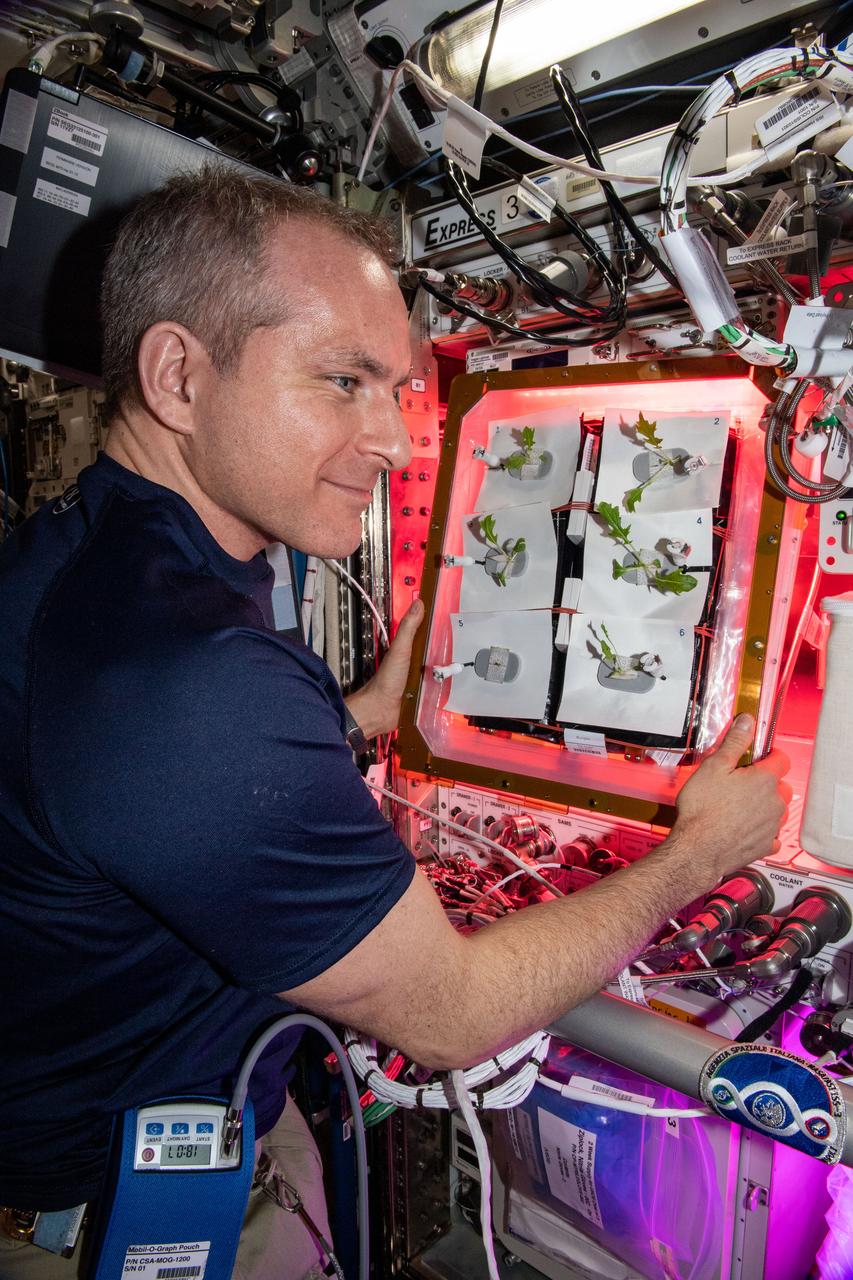
iss059e113779 (June 18, 2019) --- Canadian Space Agency astronaut David Saint-Jacques checks plants being grown for the Veg-04A space botany experiment taking place inside the International Space Station's Columbus laboratory module from the European Space Agency. The study focuses on the impact of light quality and fertilizer on leafy crop growth for a 28-day grow-out, microbial food safety, nutritional value, taste acceptability by the crew, and the overall behavioral health benefits of having plants and fresh food in space.
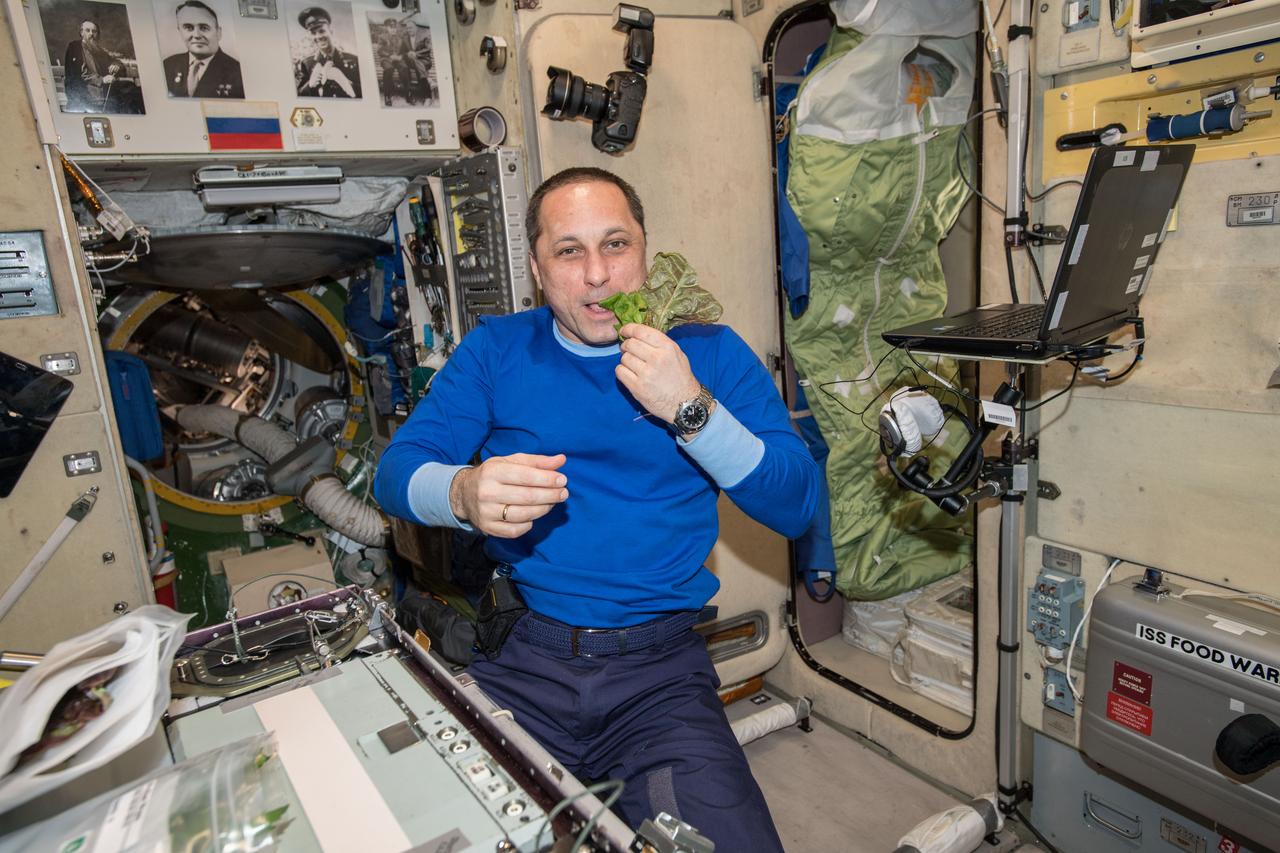
iss055e001536 (March 8, 2018) --- Expedition 55 Commander Anton Shkaplerov eats a piece of lettuce harvested as part of the ongoing space crop study VEG-03. The botany experiment uses the Veggie plant growth facility to cultivate a type of cabbage, lettuce and mizuna which are harvested on-orbit with some samples consumed by astronauts and others returned to Earth for testing.
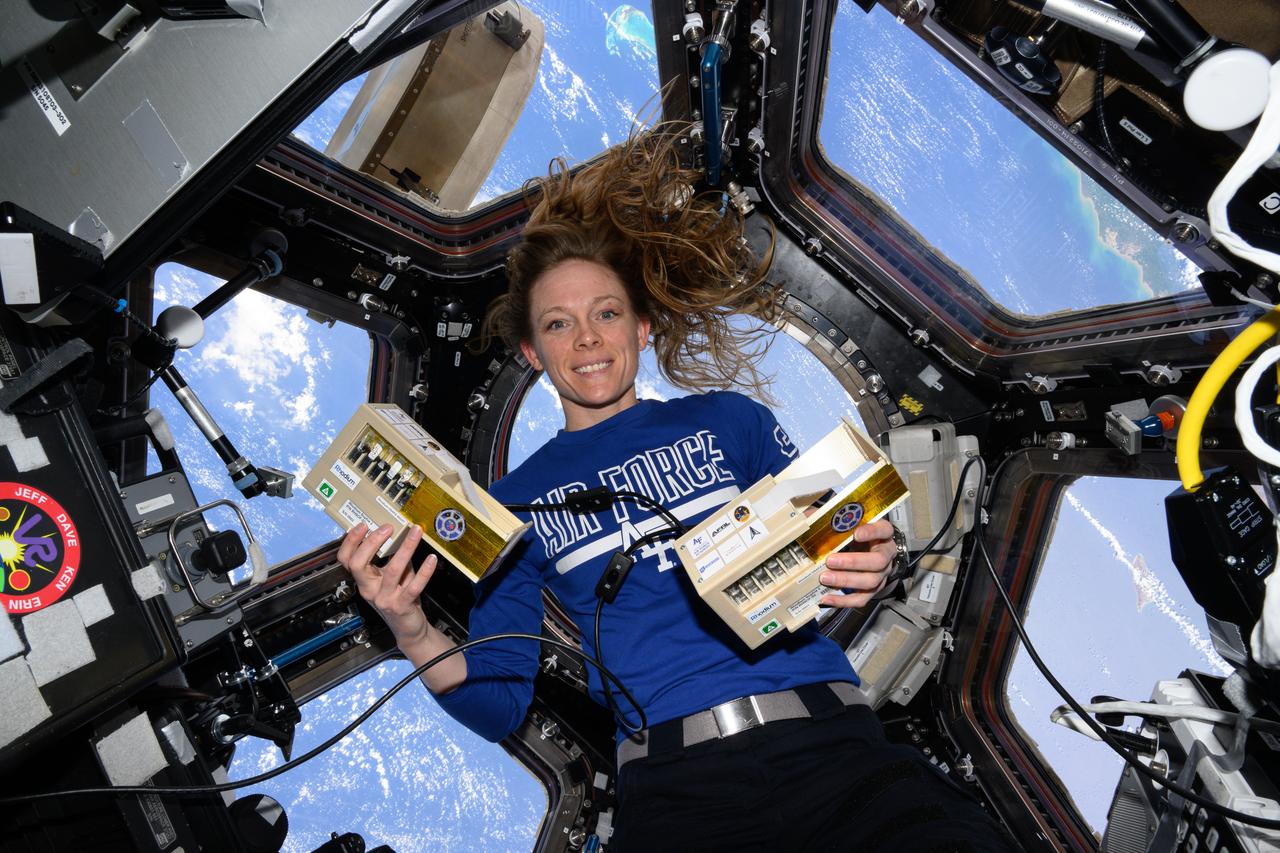
iss073e0076885 (5/21/2025) --- NASA astronaut Nichole Ayers is pictured inside the cupola with space botany hardware that supports the LEO Integrated Flori-culture Experiment (LIFE) 01 (Rhodium Plant LIFE) investigation. The investigation studies the affects of radiation and microgravity on plant growth to promote self-sustainable long-term human missions and increase crop production on Earth.
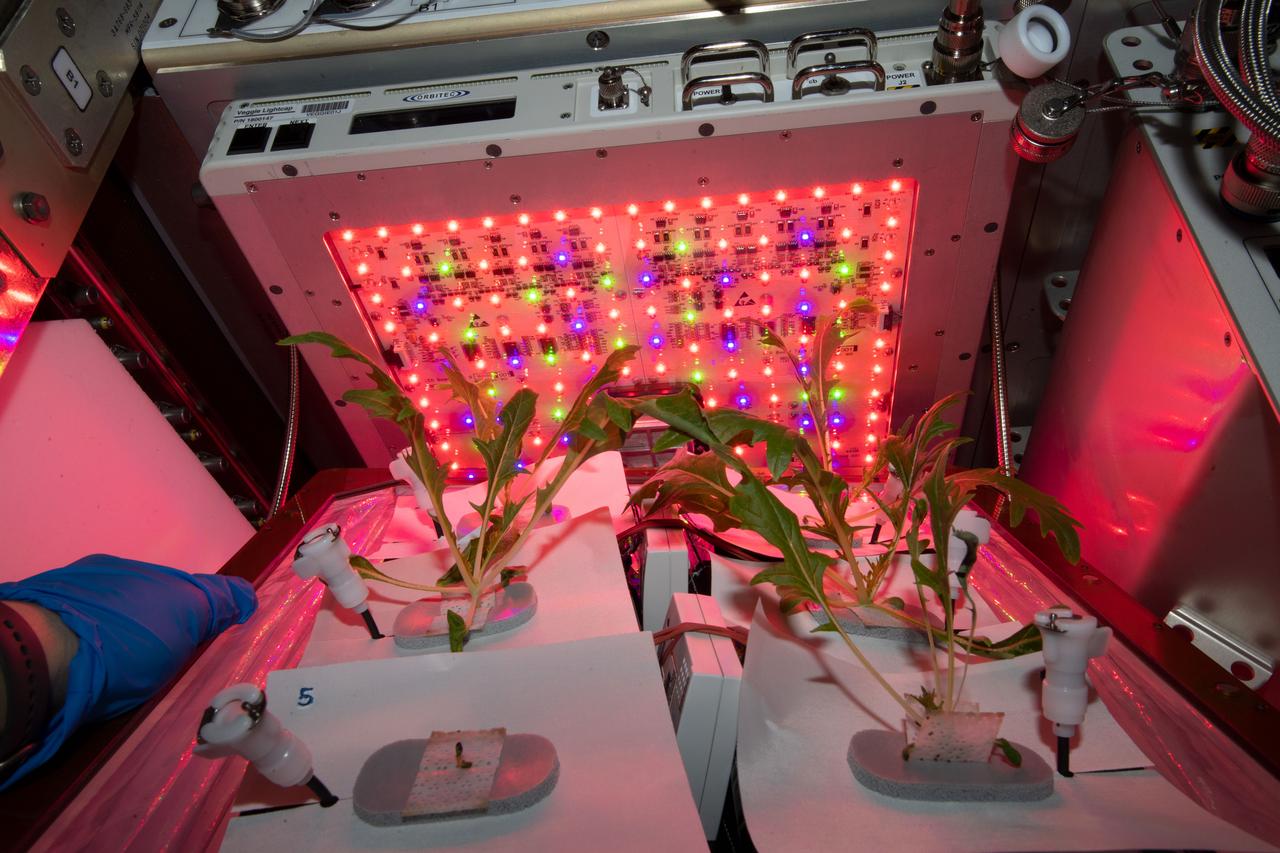
iss059e117376 (6/22/2019) --- Photo documentation taken during VEG-04 Water Check and Mass Measurement Device Operations aboard the International Space Station (ISS). The crew checks plants for water and waters if needed then if there are any leafs that have been broken off. The research of Veg-04A focuses on the impact of light quality and fertilizer on leafy crop growth for a 28-day grow-out.
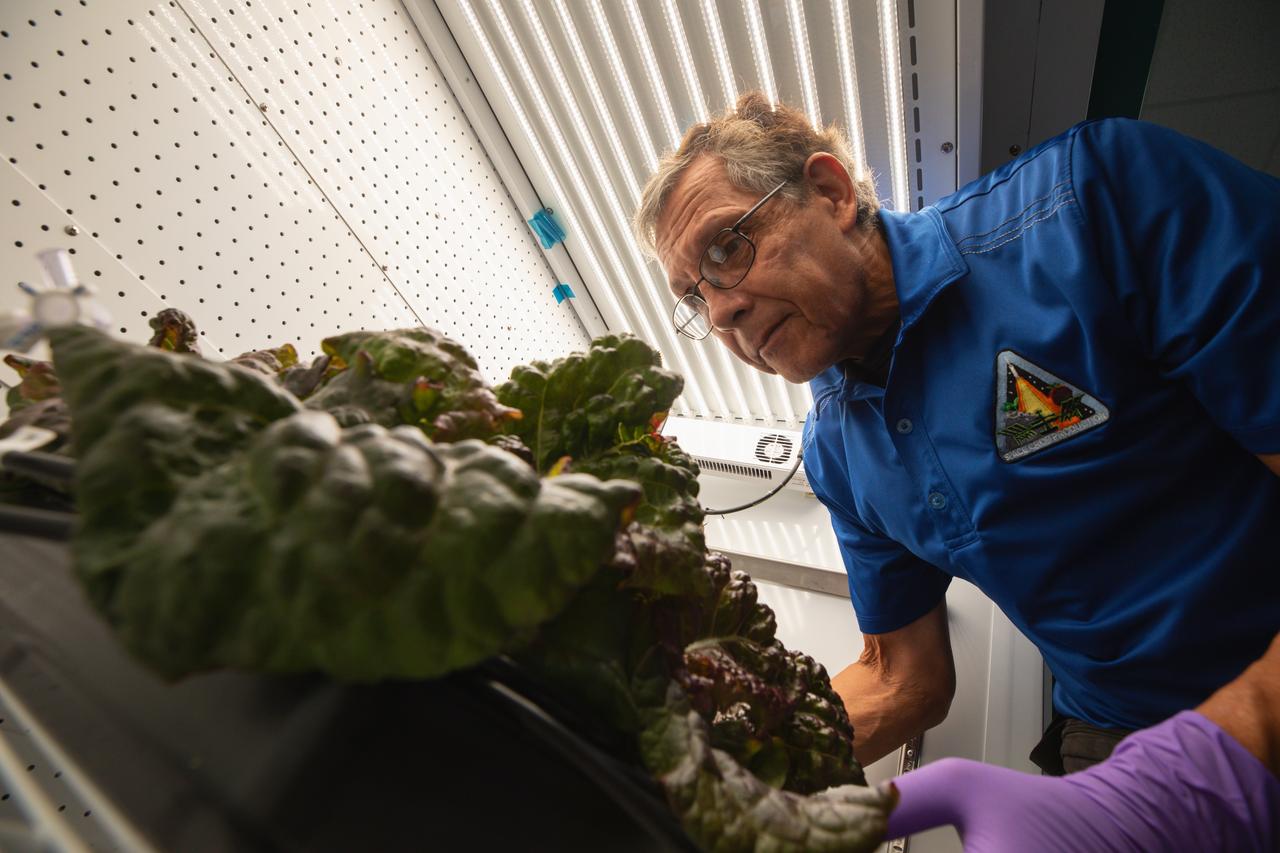
Space crop production scientist Oscar Monje harvests Outredgeous romaine lettuce for preflight testing of the Plant Habitat-07 (PH-07) experiment inside a laboratory at the Space Systems Processing Facility at NASA’s Kennedy Space Center in Florida on Thursday, Aug. 29, 2024. PH-07 will be sent to the International Space Station on NASA’s SpaceX 31st commercial resupply services mission to study how optimal and suboptimal moisture conditions impact plant growth, nutrient content, and the plant microbiome.
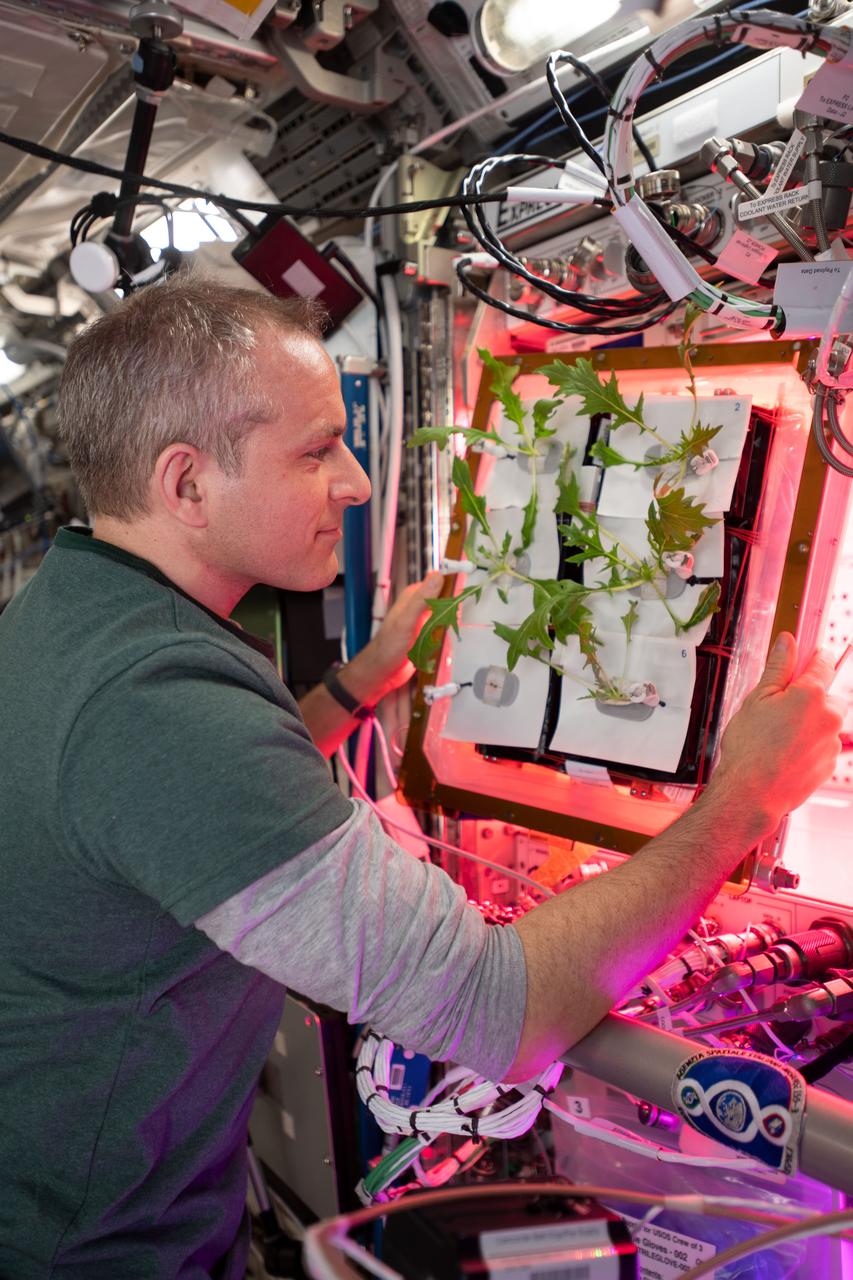
iss059e117393 (6/23/2019) --- Canadian Space Agency (CSA) astronaut David Saint-Jacques is photographed during VEG-04 Water Check and Mass Measurement Device Operations. Saint-Jacques is watering the plants if needed and looking for any leaves that have broken off. The research of Veg-04A focuses on the impact of light quality and fertilizer on leafy crop growth for a 28-day grow-out.
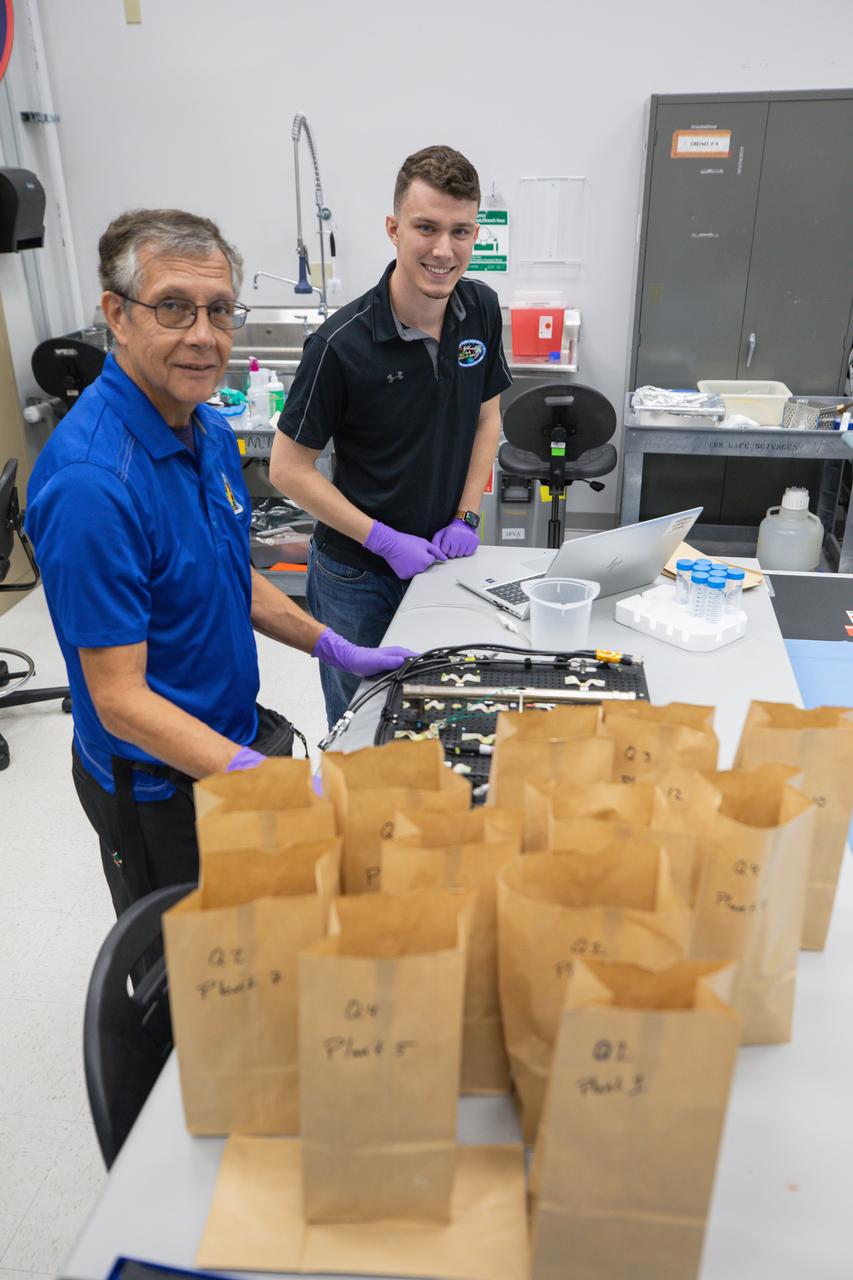
Space crop production scientists Oscar Monje (left) and Blake Costine harvest Outredgeous romaine lettuce for preflight testing of the Plant Habitat-07 (PH-07) experiment inside a laboratory at the Space Systems Processing Facility at NASA’s Kennedy Space Center in Florida on Thursday, Aug. 29, 2024. PH-07 will be sent to the International Space Station on NASA’s SpaceX 31st commercial resupply services mission to study how optimal and suboptimal moisture conditions impact plant growth, nutrient content, and the plant microbiome.
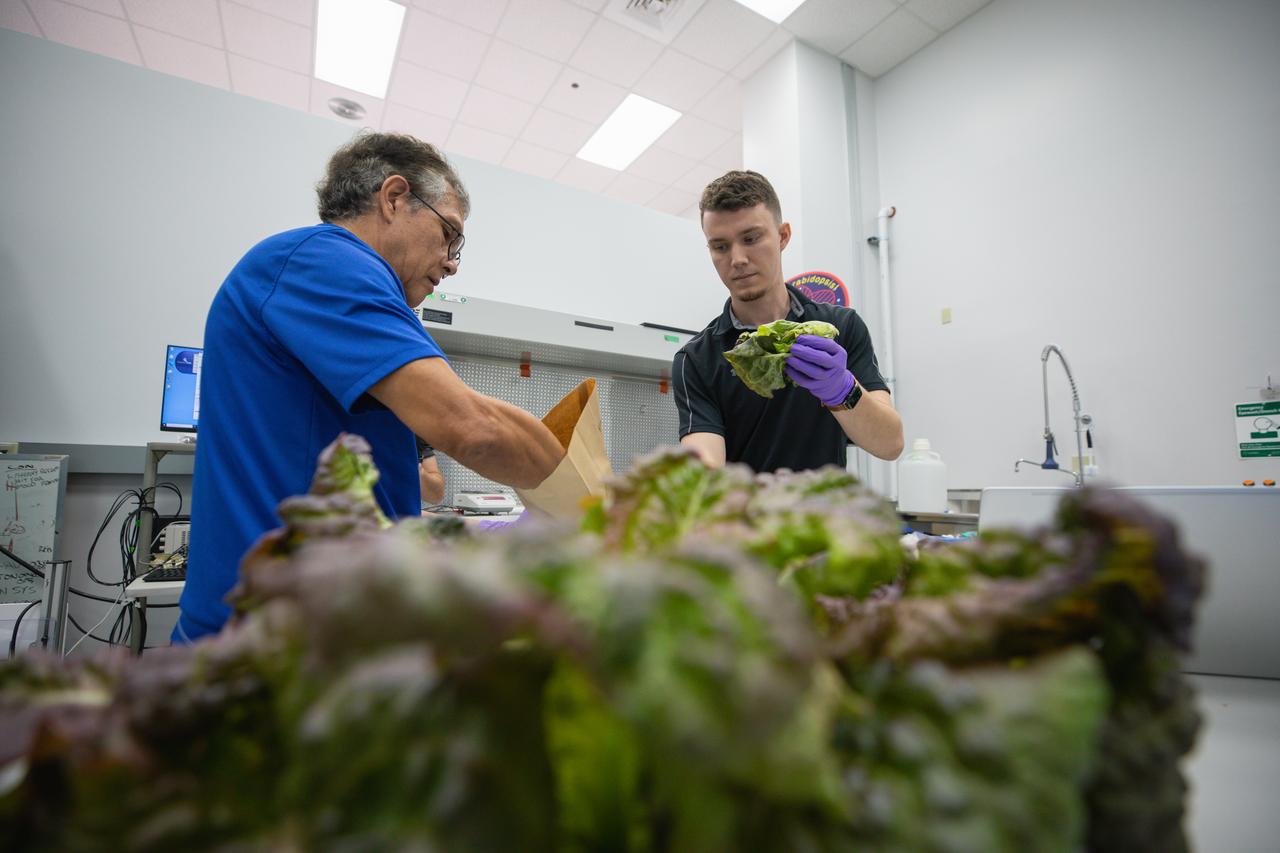
Space crop production scientists Oscar Monje (left) and Blake Costine harvest Outredgeous romaine lettuce for preflight testing of the Plant Habitat-07 (PH-07) experiment inside a laboratory at the Space Systems Processing Facility at NASA’s Kennedy Space Center in Florida on Thursday, Aug. 29, 2024. PH-07 will be sent to the International Space Station on NASA’s SpaceX 31st commercial resupply services mission to study how optimal and suboptimal moisture conditions impact plant growth, nutrient content, and the plant microbiome.
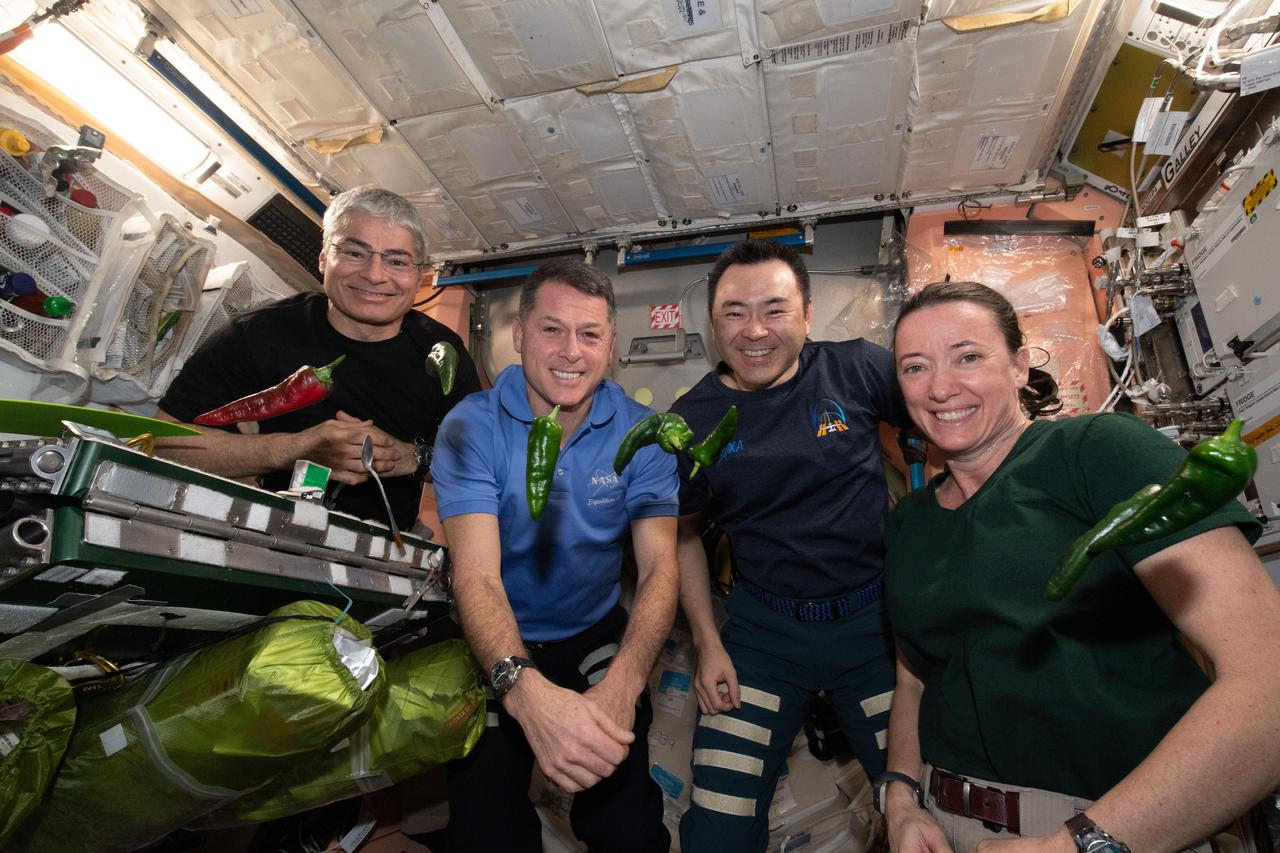
iss066e023260 (October 29, 2021) -- Expedition 66 astronauts are pictured with the first harvest of chile peppers grown aboard the International Space Station as part of the Plant Habitat-04 investigation. The chile peppers started growing on July 12, 2021, and represent one of the longest and most challenging plant experiments attempted aboard the orbiting laboratory. The chile peppers started growing on July 12, 2021, and represent one of the longest and most challenging plant experiments attempted aboard the orbiting laboratory. NASA astronaut and Expedition 66 flight engineer Mark Vande Hei conducted the first harvest of the pepper crop on October 29, 2021. Crew members sanitized the peppers and completed a scientific survey after their taste test. The Crew-3 astronauts will take over the crop when they arrive at the orbiting laboratory, and will conduct a final harvest of the peppers in late November. They will also sanitize and sample the crop, and complete surveys. Some peppers and their leaves from the final harvest will return to Earth for further analysis. What we learn will inform future crop growth and food supplementation activities for deep space exploration. Pictured, from left, are Expedition 66 flight engineers NASA astronauts Mark Vande Hei and Shane Kimbrough, JAXA (Japan Aerospace Exploration) astronaut Aki Hoshide, and NASA astronaut Megan McArthur.
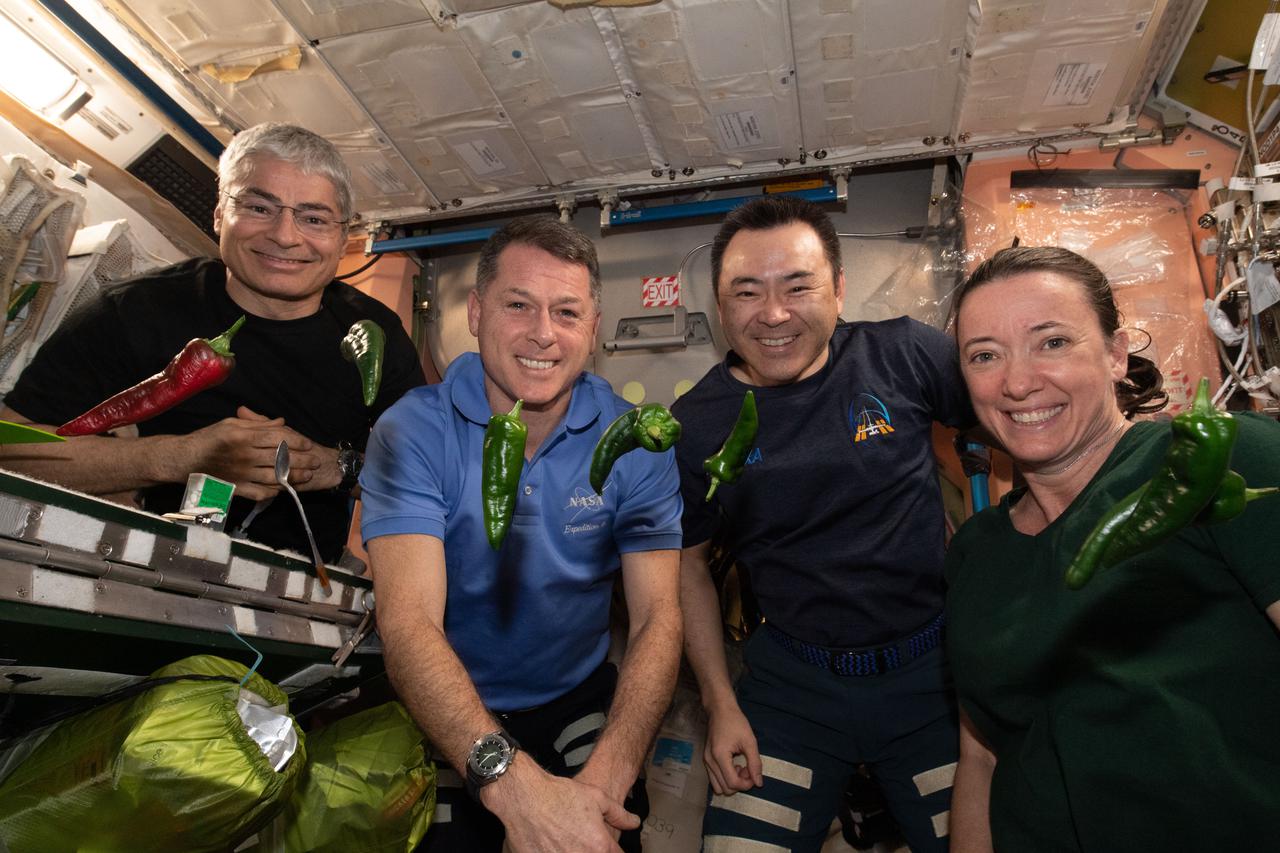
iss066e023259 (October 29, 2021) -- Expedition 66 astronauts are pictured with the first harvest of chile peppers grown aboard the International Space Station as part of the Plant Habitat-04 investigation. The chile peppers started growing on July 12, 2021, and represent one of the longest and most challenging plant experiments attempted aboard the orbiting laboratory. The chile peppers started growing on July 12, 2021, and represent one of the longest and most challenging plant experiments attempted aboard the orbiting laboratory. NASA astronaut and Expedition 66 flight engineer Mark Vande Hei conducted the first harvest of the pepper crop on October 29, 2021. Crew members sanitized the peppers and completed a scientific survey after their taste test. The Crew-3 astronauts will take over the crop when they arrive at the orbiting laboratory, and will conduct a final harvest of the peppers in late November. They will also sanitize and sample the crop, and complete surveys. Some peppers and their leaves from the final harvest will return to Earth for further analysis. What we learn will inform future crop growth and food supplementation activities for deep space exploration. Pictured, from left, are Expedition 66 flight engineers NASA astronauts Mark Vande Hei and Shane Kimbrough, JAXA (Japan Aerospace Exploration) astronaut Aki Hoshide, and NASA astronaut Megan McArthur.
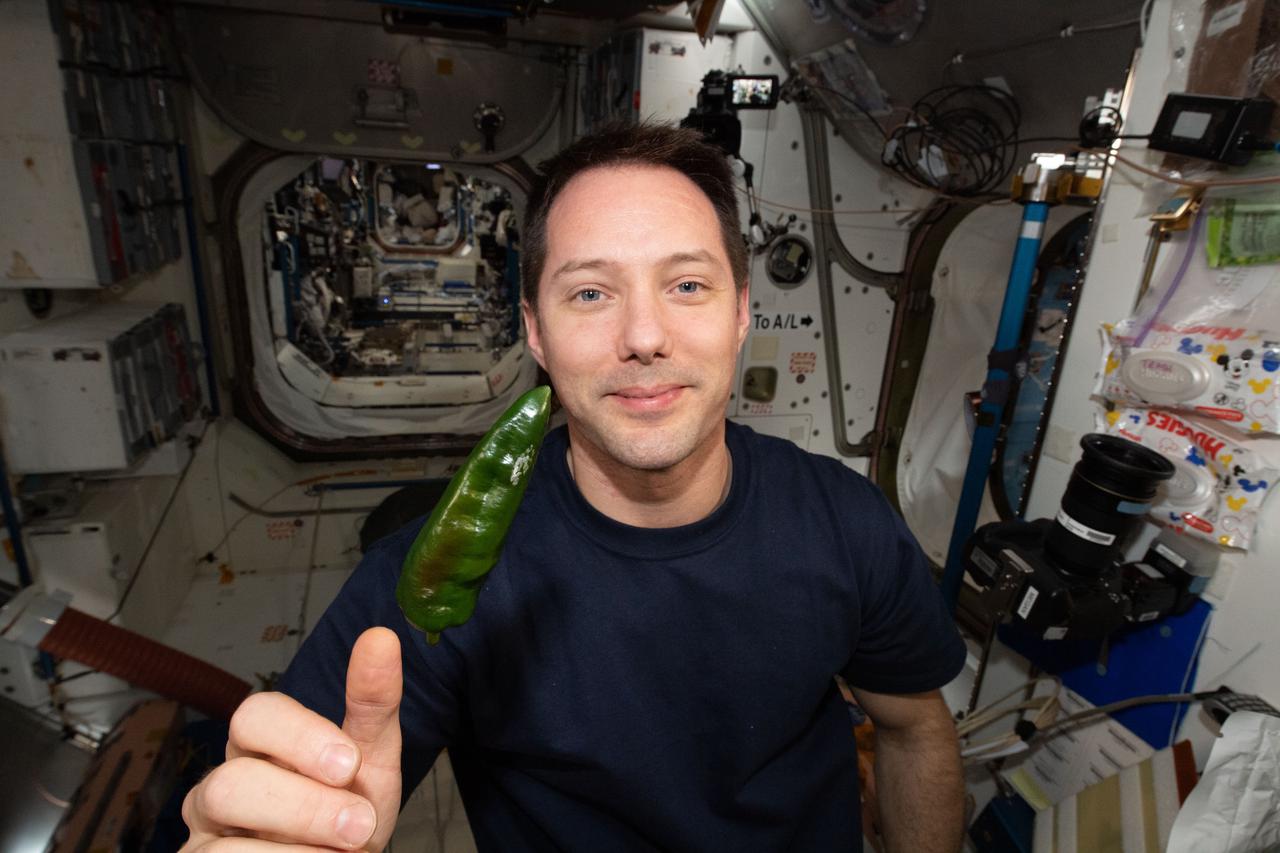
iss066e023273 (October 29, 2021) -- ESA (European Space Agency) astronaut and Expedition 66 commander Thomas Pesquet is seen with a green chile pepper during a taste test as part of the Plant Habitat-04 investigation aboard the International Space Station. The chile peppers started growing on July 12, 2021, and represent one of the longest and most challenging plant experiments attempted aboard the orbiting laboratory. The chile peppers started growing on July 12, 2021, and represent one of the longest and most challenging plant experiments attempted aboard the orbiting laboratory. NASA astronaut and Expedition 66 flight engineer Mark Vande Hei conducted the first harvest of the pepper crop on October 29, 2021. Crew members sanitized the peppers and completed a scientific survey after their taste test. The Crew-3 astronauts will take over the crop when they arrive at the orbiting laboratory, and will conduct a final harvest of the peppers in late November. They will also sanitize and sample the crop, and complete surveys. Some peppers and their leaves from the final harvest will return to Earth for further analysis. What we learn will inform future crop growth and food supplementation activities for deep space exploration.
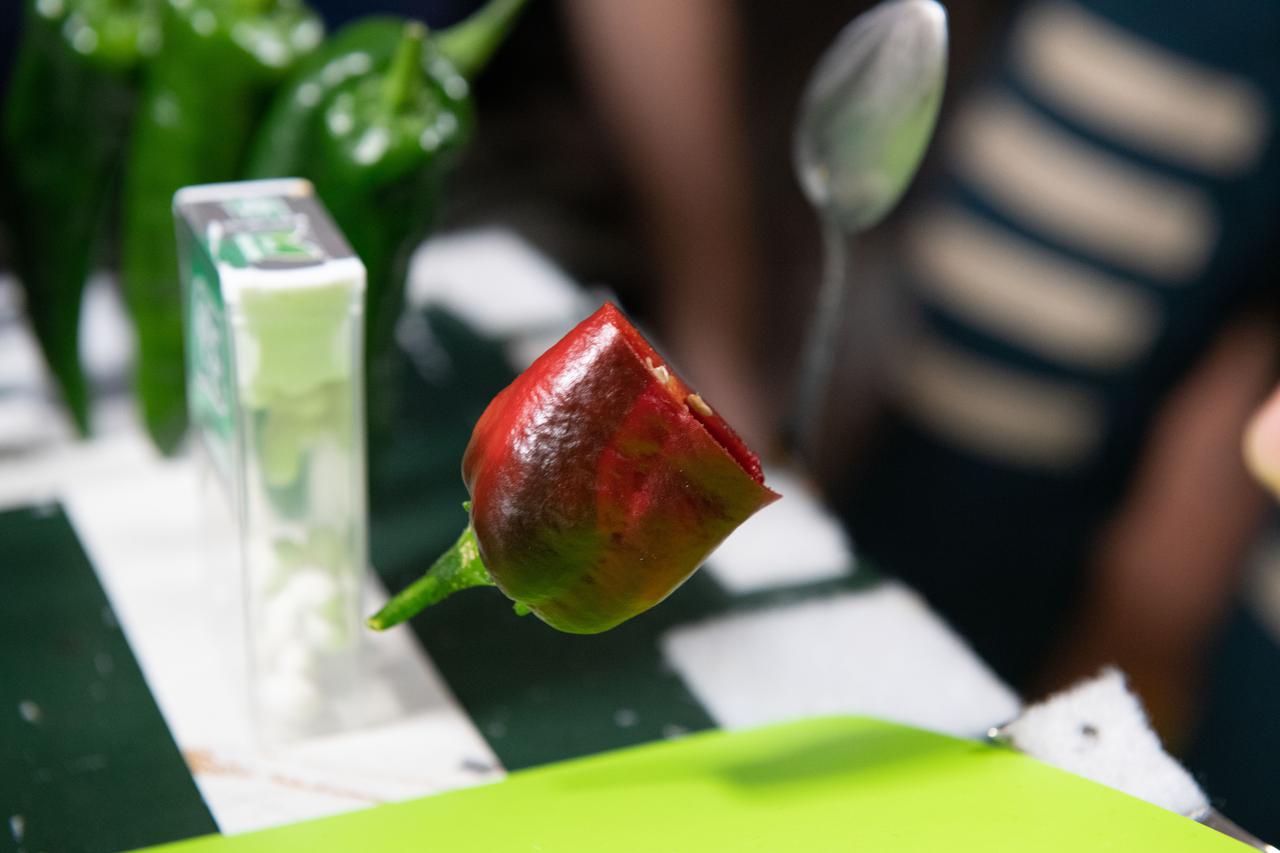
iss066e023165 (October 29, 2021) -- A red chile pepper is seen floating above a cutting board during the tasting of peppers grown as part of the Plant Habitat-04 investigation aboard the International Space Station. The chile peppers started growing on July 12, 2021, and represent one of the longest and most challenging plant experiments attempted aboard the orbiting laboratory. NASA astronaut and Expedition 66 flight engineer Mark Vande Hei conducted the first harvest of the pepper crop on October 29, 2021. Crew members sanitized the peppers and completed a scientific survey after their taste test. The Crew-3 astronauts will take over the crop when they arrive at the orbiting laboratory, and will conduct a final harvest of the peppers in late November. They will also sanitize and sample the crop, and complete surveys. Some peppers and their leaves from the final harvest will return to Earth for further analysis. What we learn will inform future crop growth and food supplementation activities for deep space exploration.
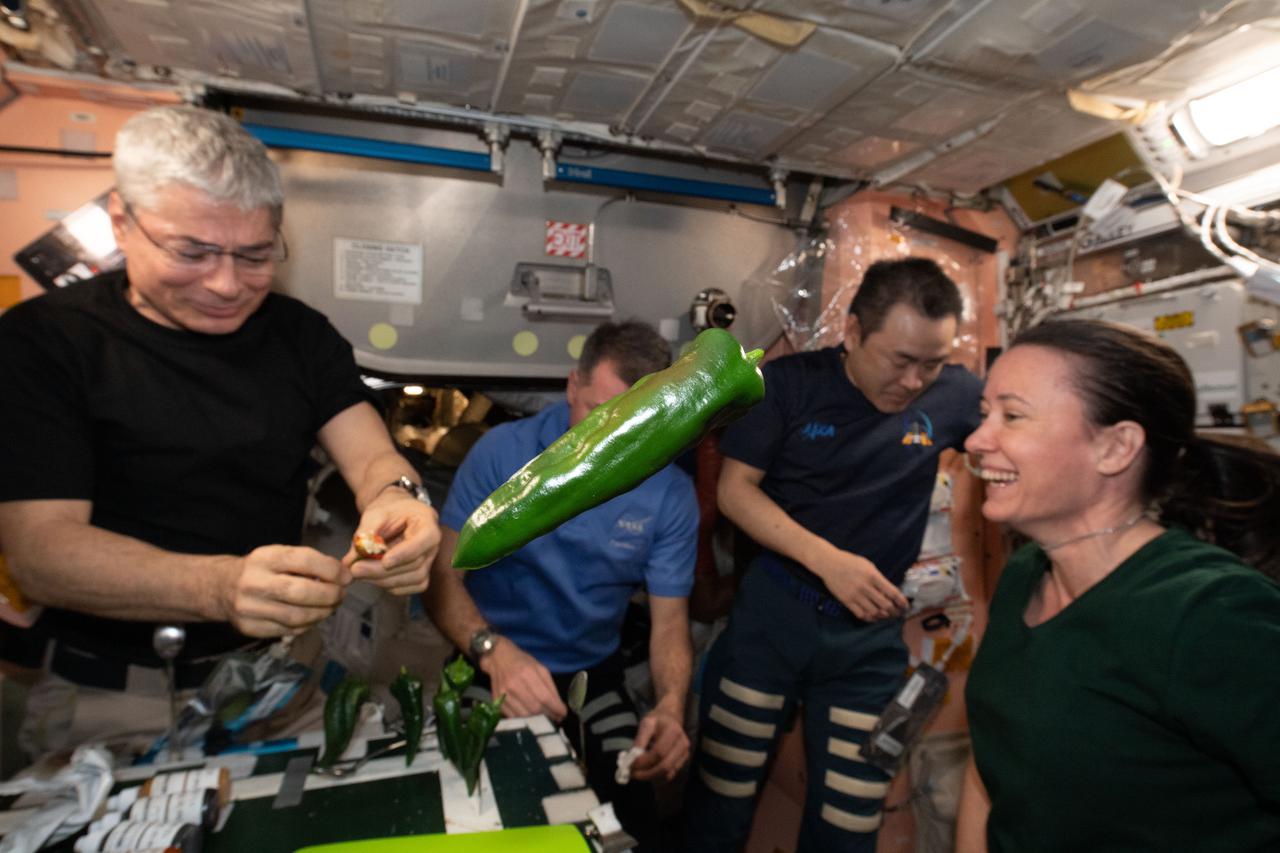
iss066e023272 (October 29, 2021) -- A green chile pepper is seen floating as Expedition 66 crew members conduct a taste test as part of the Plant Habitat-04 investigation aboard the International Space Station. The chile peppers started growing on July 12, 2021, and represent one of the longest and most challenging plant experiments attempted aboard the orbiting laboratory. The chile peppers started growing on July 12, 2021, and represent one of the longest and most challenging plant experiments attempted aboard the orbiting laboratory. NASA astronaut and Expedition 66 flight engineer Mark Vande Hei conducted the first harvest of the pepper crop on October 29, 2021. Crew members sanitized the peppers and completed a scientific survey after their taste test. The Crew-3 astronauts will take over the crop when they arrive at the orbiting laboratory, and will conduct a final harvest of the peppers in late November. They will also sanitize and sample the crop, and complete surveys. Some peppers and their leaves from the final harvest will return to Earth for further analysis. What we learn will inform future crop growth and food supplementation activities for deep space exploration.
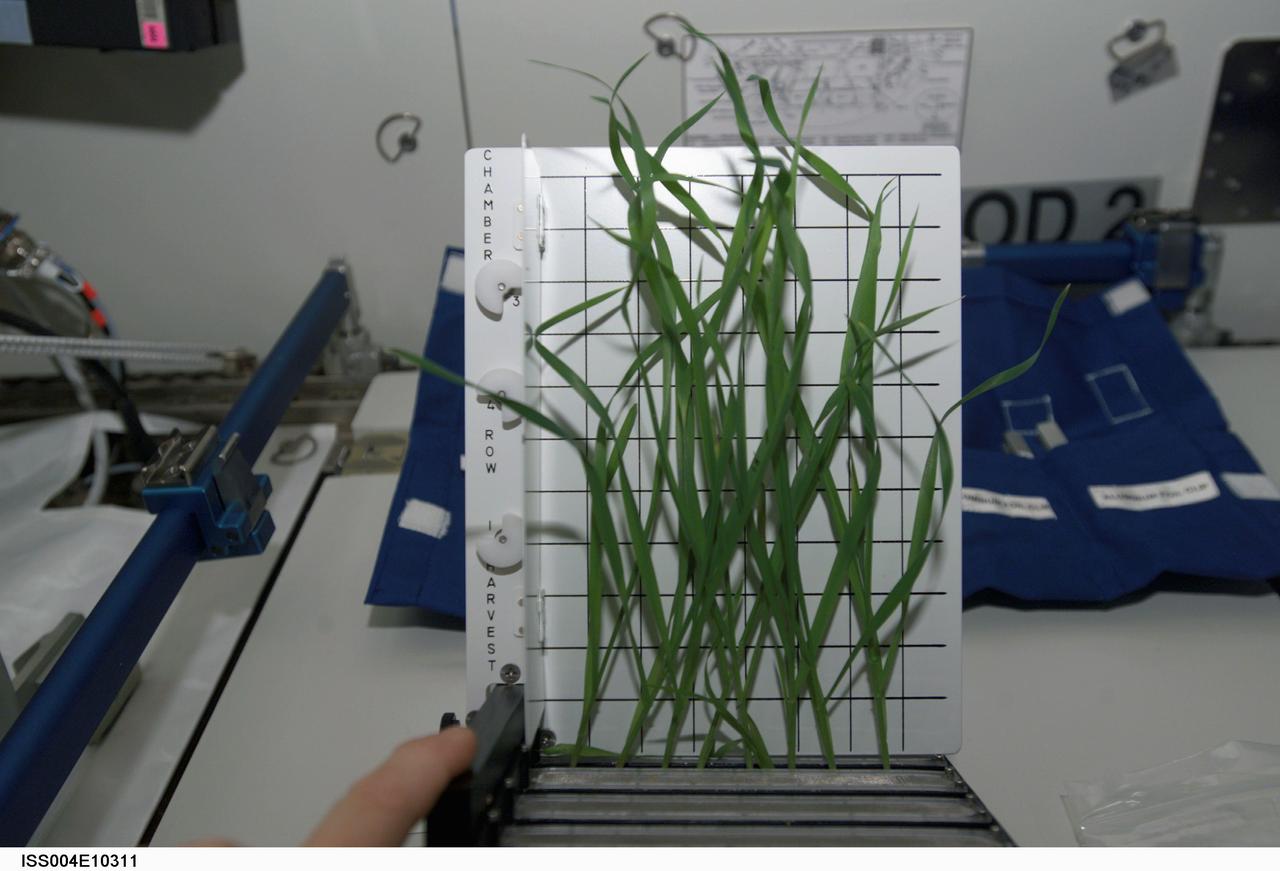
Dwarf wheat were photographed aboard the International Space Station in April 2002. Lessons from on-orbit research on plants will have applications to terrestrial agriculture as well as for long-term space missions. Alternative agricultural systems that can efficiently produce greater quantities of high-quality crops in a small area are important for future space expeditions. Also regenerative life-support systems that include plants will be an important component of long-term space missions. Data from the Biomass Production System (BPS) and the Photosynthesis Experiment and System Testing and Operations (PESTO) will advance controlled-environment agricultural systems and will help farmers produce better, healthier crops in a small area. This same knowledge is critical to closed-loop life support systems for spacecraft. The BPS comprises a miniature environmental control system for four plant growth chambers, all in the volume of two space shuttle lockers. The experience with the BPS on orbit is providing valuable design and operational lessons that will be incorporated into the Plant Growth Units. The objective of PESTO was to flight verify the BPS hardware and to determine how the microgravity environment affects the photosynthesis and metabolic function of Super Dwarf wheat and Brassica rapa (a member of the mustard family).
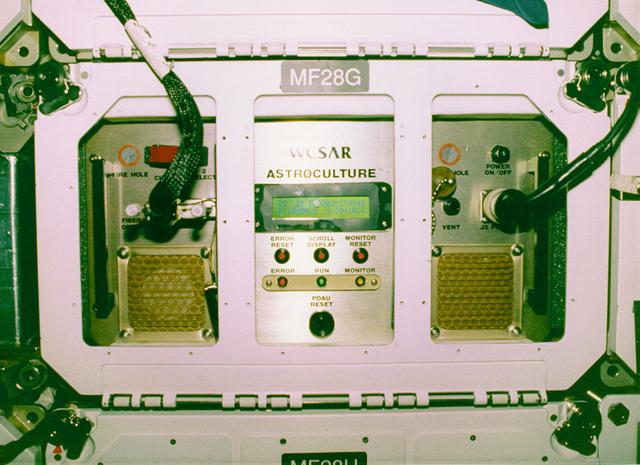
Research with plants in microgravity offers many exciting opportunities to gain new insights and could improve products on Earth ranging from crop production to fragrances and food flavorings. The ASTROCULTURE facility is a lead commercial facility for plant growth and plant research in microgravity and was developed by the Wisconsin Center for Space Automation and Robotics (WSCAR), a NASA Commercial Space Center. On STS-95 it will support research that could help improve crop development leading to plants that are more disease resistant or have a higher yield and provide data on the production of plant essential oils---oils that contain the essence of the plant and provide both fragrance and flavoring. On STS-95, a flowering plant will be grown in ASTROCULTURE and samples taken using a method developed by the industry partner for this investigation. On Earth the samples will be analyzed by gas chromatography/mass spectrometry and the data used to evaluate both the production of fragrant oils in microgravity and in the development of one or more products.
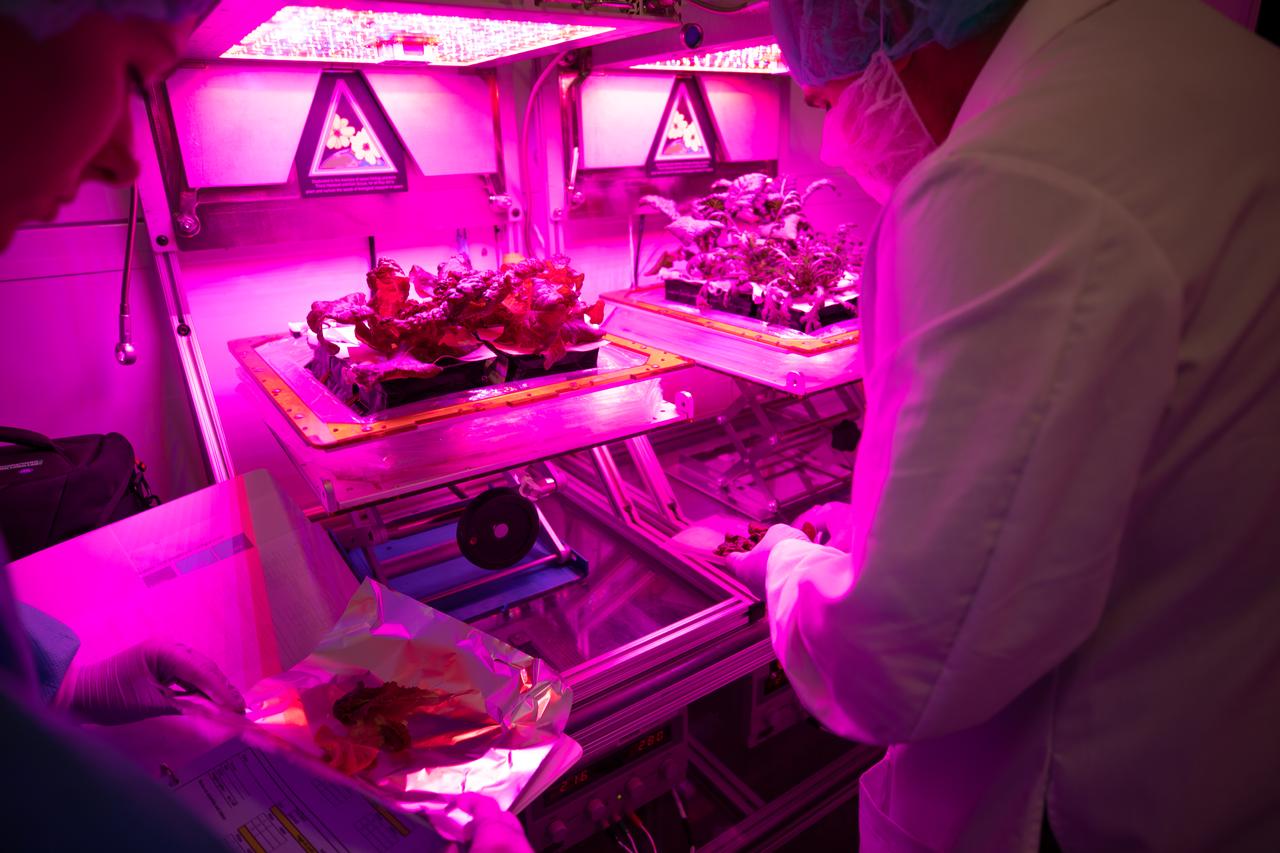
Kennedy Space Center Veggie Project Manager Trent Smith harvests test crops inside the Veggie growth chamber in the Florida spaceport’s Space Station Processing Facility on Sept. 30, 2019, for a science verification test (SVT) to study their potential to grown in space. The harvest included ‘outredgeous’ red romaine lettuce, which has been grown in space before, and two new plant cultivars – amara mustard and shungiku, an Asian green comparable to an edible chrysanthemum. All three lettuce plants were grown from seed film, making this the first SVT with this new plant growth material. Earlier this year, the amara mustard and shungiku plants were grown for the first time using seed bags – referred to as pillows – during the Sustained Veggie project, a study funded by the Human Research Program.
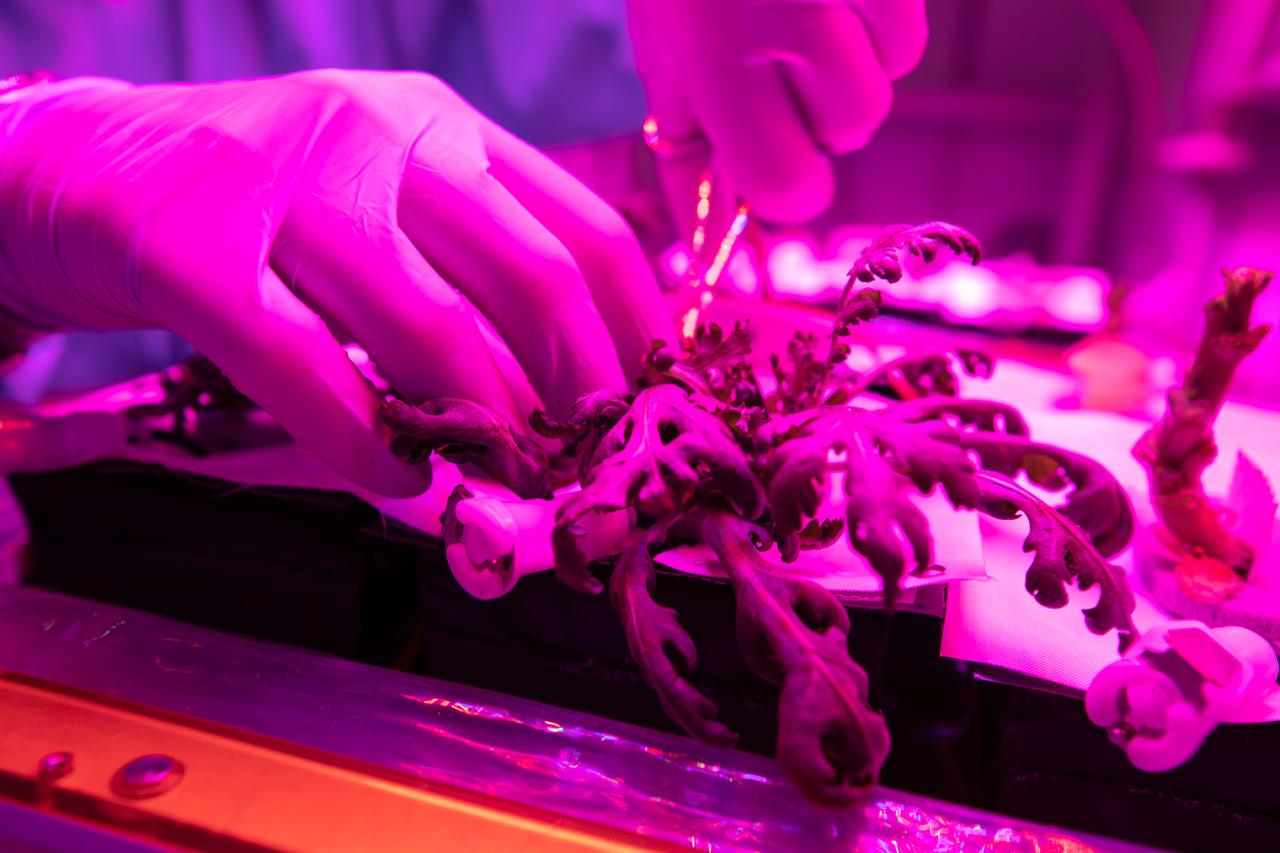
Test crops are harvested inside the Veggie growth chamber in the Space Station Processing Facility at NASA’s Kennedy Space Center in Florida on Sept. 30, 2019, for a science verification test (SVT) to study their potential to grow in space. The harvest included ‘outredgeous’ red romaine lettuce, which has been grown in space before, and two new plant cultivars – amara mustard and shungiku, an Asian green comparable to an edible chrysanthemum. All three lettuce plants were grown from seed film, making this the first SVT with this new plant growth material. Earlier this year, the amara mustard and shungiku plants were grown for the first time using seed bags – referred to as pillows – during the Sustained Veggie project, a study funded by the Human Research Program.
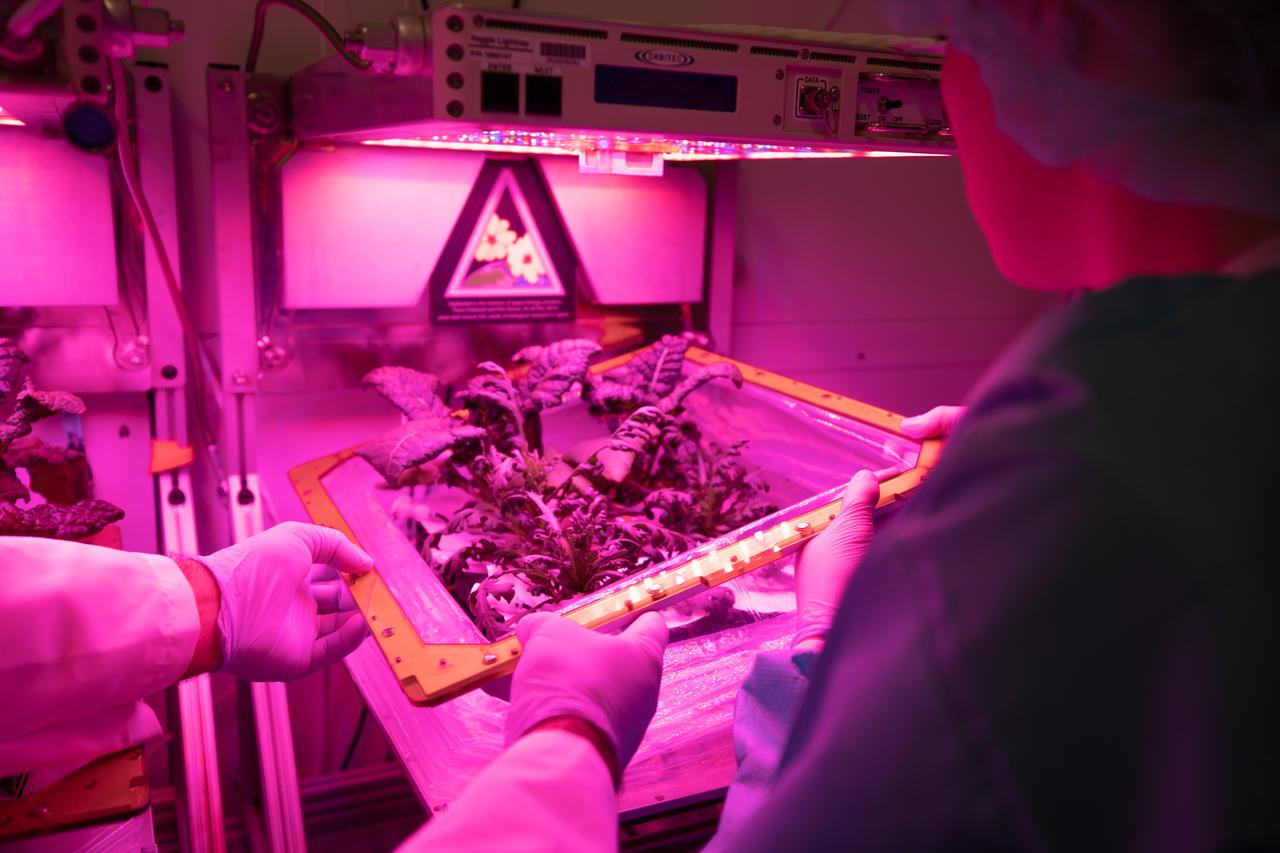
Kennedy Space Center employees harvest test crops inside the Veggie growth chamber in the Florida spaceport’s Space Station Processing Facility on Sept. 30, 2019, for a science verification test (SVT) to study their potential to grown in space. The harvest included ‘outredgeous’ red romaine lettuce, which has been grown in space before, and two new plant cultivars – amara mustard and shungiku, an Asian green comparable to an edible chrysanthemum. All three lettuce plants were grown from seed film, making this the first SVT with this new plant growth material. Earlier this year, the amara mustard and shungiku plants were grown for the first time using seed bags – referred to as pillows – during the Sustained Veggie project, a study funded by the Human Research Program.
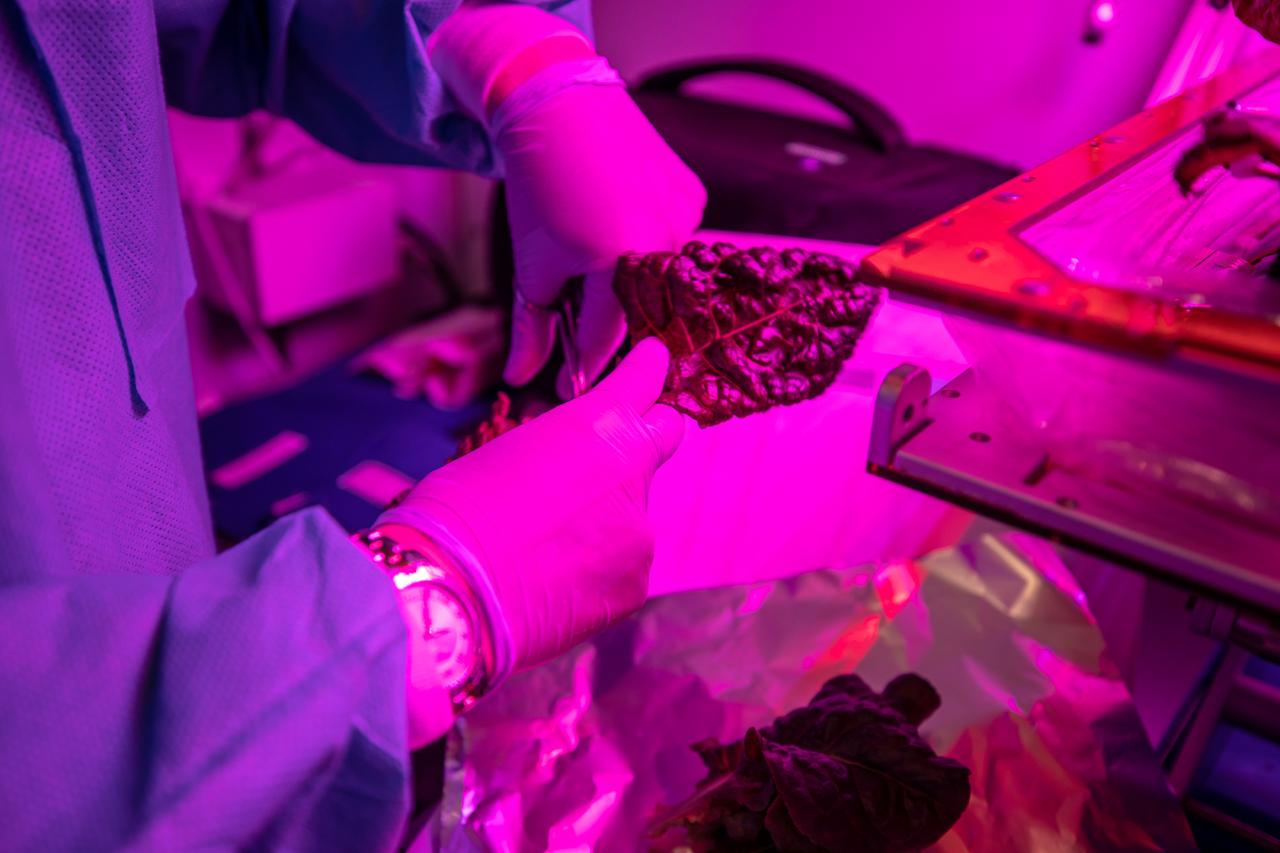
Test crops are harvested inside the Veggie growth chamber in the Space Station Processing Facility at NASA’s Kennedy Space Center in Florida on Sept. 30, 2019, for a science verification test (SVT) to study their potential to grow in space. The harvest included ‘outredgeous’ red romaine lettuce, which has been grown in space before, and two new plant cultivars – amara mustard and shungiku, an Asian green comparable to an edible chrysanthemum. All three lettuce plants were grown from seed film, making this the first SVT with this new plant growth material. Earlier this year, the amara mustard and shungiku plants were grown for the first time using seed bags – referred to as pillows – during the Sustained Veggie project, a study funded by the Human Research Program.
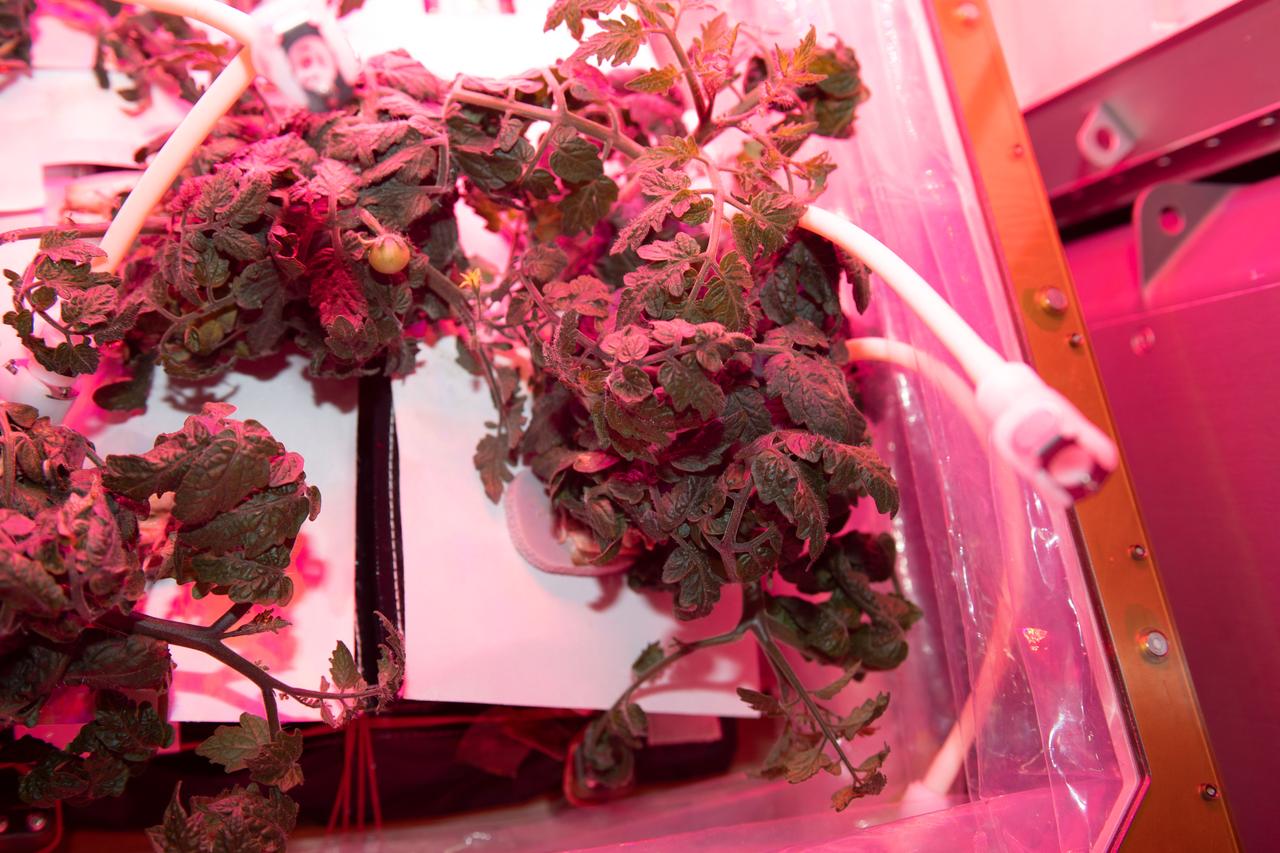
iss068e045298 (Feb. 5, 2023) --- A view of red dwarf tomato plants growing in the Veggie plant growth facility aboard the International Space Station as part of the Pick-and-Eat Salad-Crop Productivity, Nutritional Value, and Acceptability to Supplement the ISS Food System (Veg-05) investigation. Veg-05 is the next step in efforts to address the need for a continuous fresh-food production system in space. This experiment focuses on studying the impact of light quality and fertilizer on fruit production, microbial safety, nutritional value, taste acceptability by the astronauts, and the overall behavioral health benefits of having plants and fresh food in space.
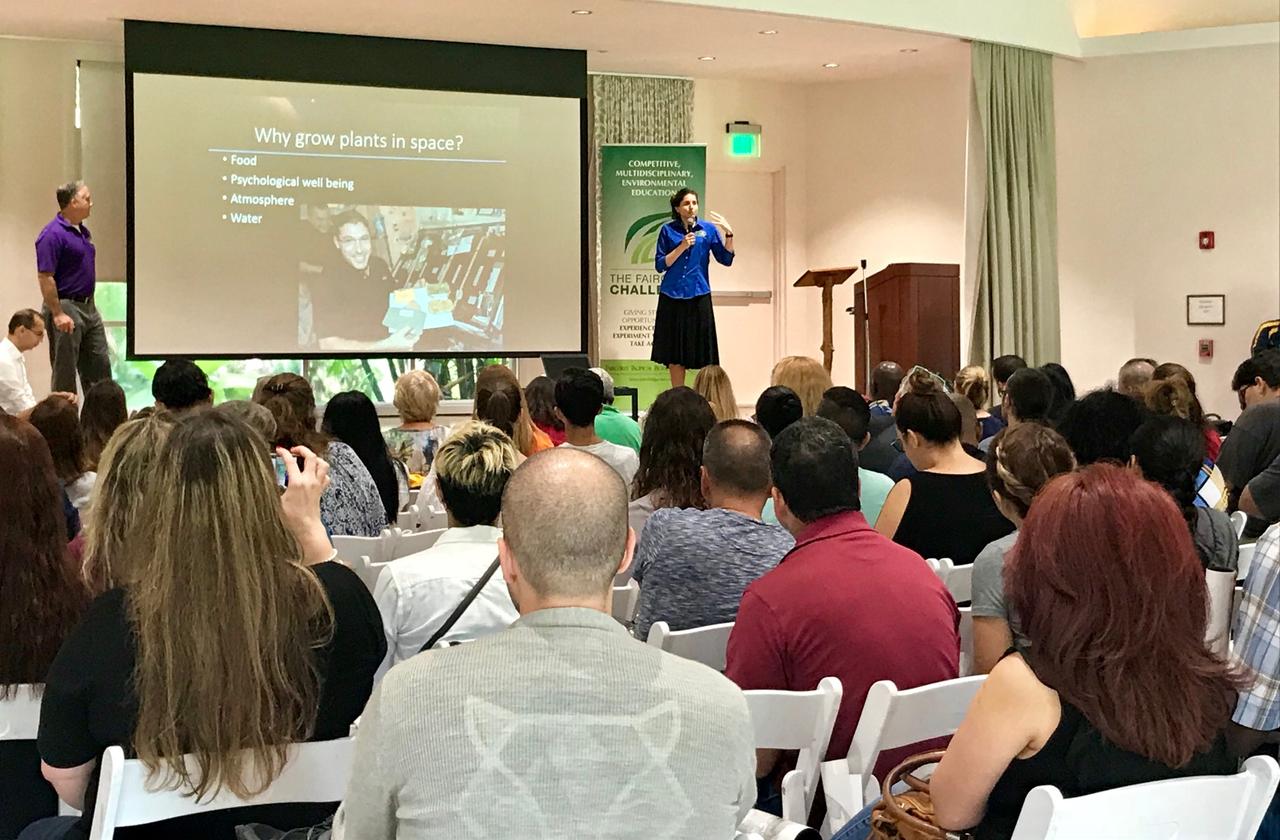
Kennedy scientists Trent Smith, left, and Dr. Gioia Massa speak to middle and high school teachers at Fairchild Tropical Botanic Garden in Miami during the kickoff of the 2017-2018 Fairchild Challenge-Growing Beyond Earth. More than 130 teachers gathered for the opening workshop, where they learned about food production in space and the Veggie hardware currently on the International Space Station. NASA has partnered with Fairchild to create this STEM-based challenge in which students will follow specific research protocols and analyze plant growth factors, flavor and nutrition, in order to help NASA choose the next crops for astronauts to grow aboard the station.

iss066e008110 (October 20, 2021) -- NASA astronaut and Expedition 65 Flight Engineer Mark Vande Hei prepares to photograph chile peppers growing in the Advanced Plant Habitat as part of the Plant Habit-04 experiment being conducted aboard the International Space Station. The chile pepper seeds started growing on July 12, 2021, and represent one of the longest and most challenging plant experiments attempted aboard the orbiting laboratory. They will be harvested twice, once in late October and again in late November. Astronauts will sanitize the peppers, eat part of their harvest, and return the rest to Earth for analysis. What we learn will inform future crop growth and food supplementation activities for deep space exploration.
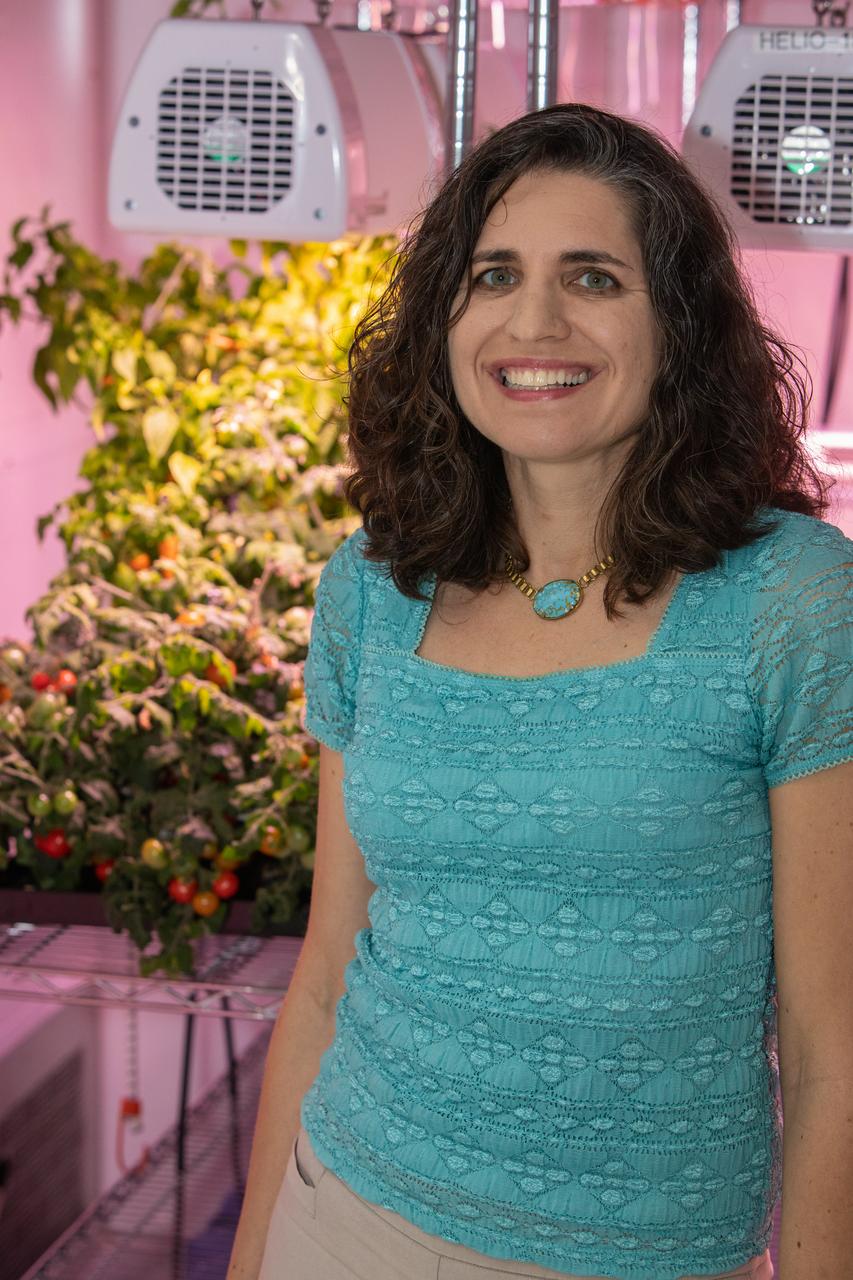
Gioia Massa, a NASA project scientist, poses inside a lab at the Space Station Processing Facility located at the agency’s Kennedy Space Center in Florida. Massa’s responsibilities include studying the effects of a microgravity environment on plant growth, discovering the perfect conditions for growing plants in space and determining what plant species grow the most effectively under those conditions. Massa and her team are currently experimenting with growing plants aboard the International Space Station to develop the knowhow to supplement astronauts’ packaged diets with freshly grown crops, which should facilitate long-duration exploration missions into deep space.
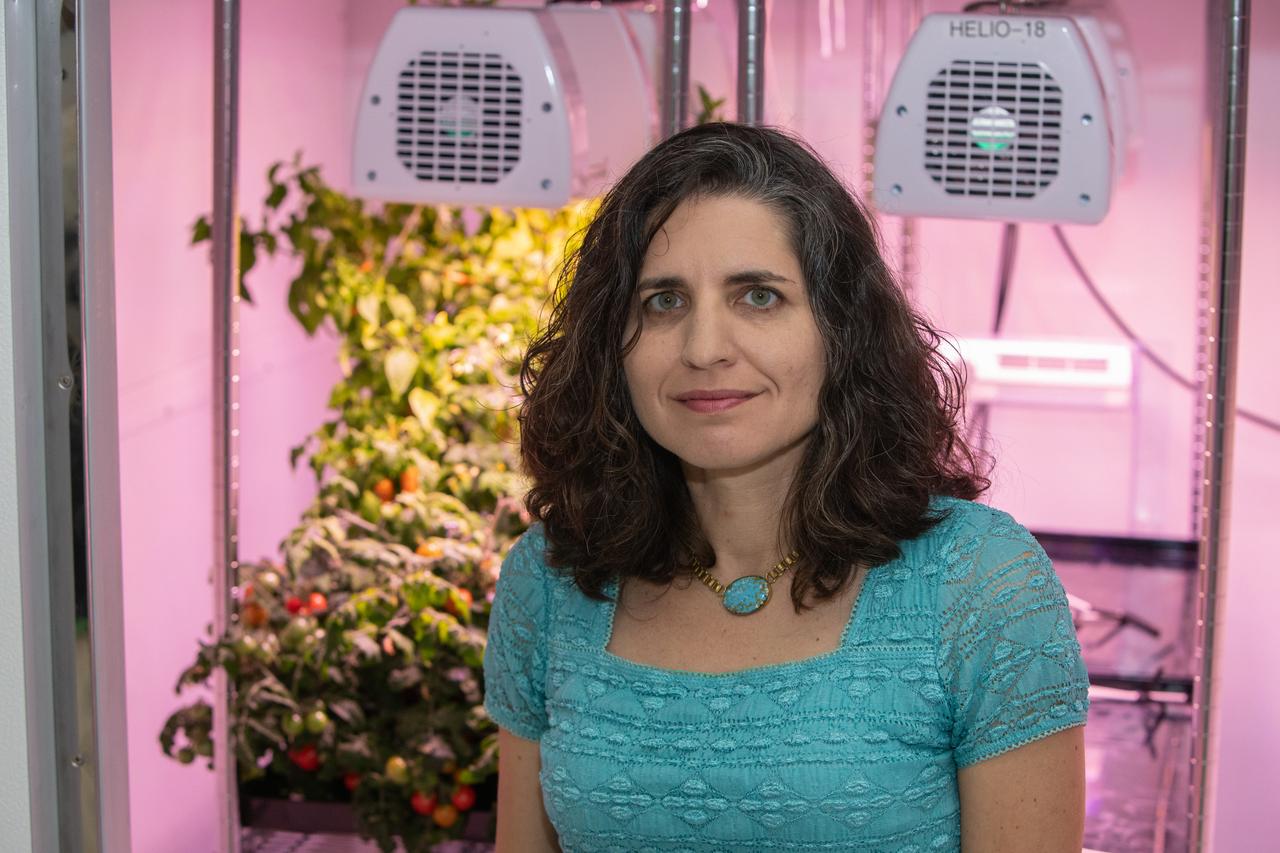
Gioia Massa, a NASA project scientist, poses inside a lab at the Space Station Processing Facility located at the agency’s Kennedy Space Center in Florida. Massa’s responsibilities include studying the effects of a microgravity environment on plant growth, discovering the perfect conditions for growing plants in space and determining what plant species grow the most effectively under those conditions. Massa and her team are currently experimenting with growing plants aboard the International Space Station to develop the knowhow to supplement astronauts’ packaged diets with freshly grown crops, which should facilitate long-duration exploration missions into deep space.
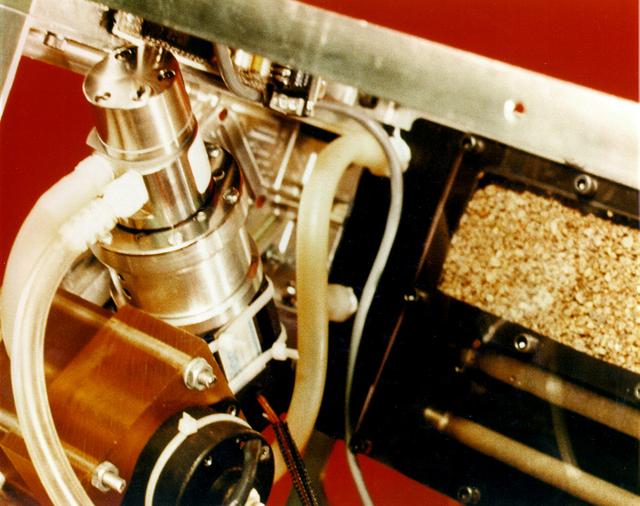
Research with plants in microgravity offers many exciting opportunities to gain new insights and could improve products on Earth ranging from crop production to fragrances and food flavorings. The ASTROCULTURE facility is a lead commercial facility for plant growth and plant research in microgravity and was developed by the Wisconsin Center for Space Automation and Robotics (WSCAR), a NASA Commercial Space Center. On STS-95 it will support research that could help improve crop development leading to plants that are more disease resistant or have a higher yield and provide data on the production of plant essential oils---oils that contain the essence of the plant and provide both fragrance and flavoring. On STS-95, a flowering plant will be grown in ASTROCULTURE and samples taken using a method developed by the industry partner for this investigation. On Earth, the samples will be analyzed by gas chromatography/mass spectrometry and the data used to evaluate both the production of fragrant oils in microgravity and in the development of one or more products. The ASTROCULTURE payload uses these pourous tubes with precise pressure sensing and control for fluid delivery to the plant root tray.
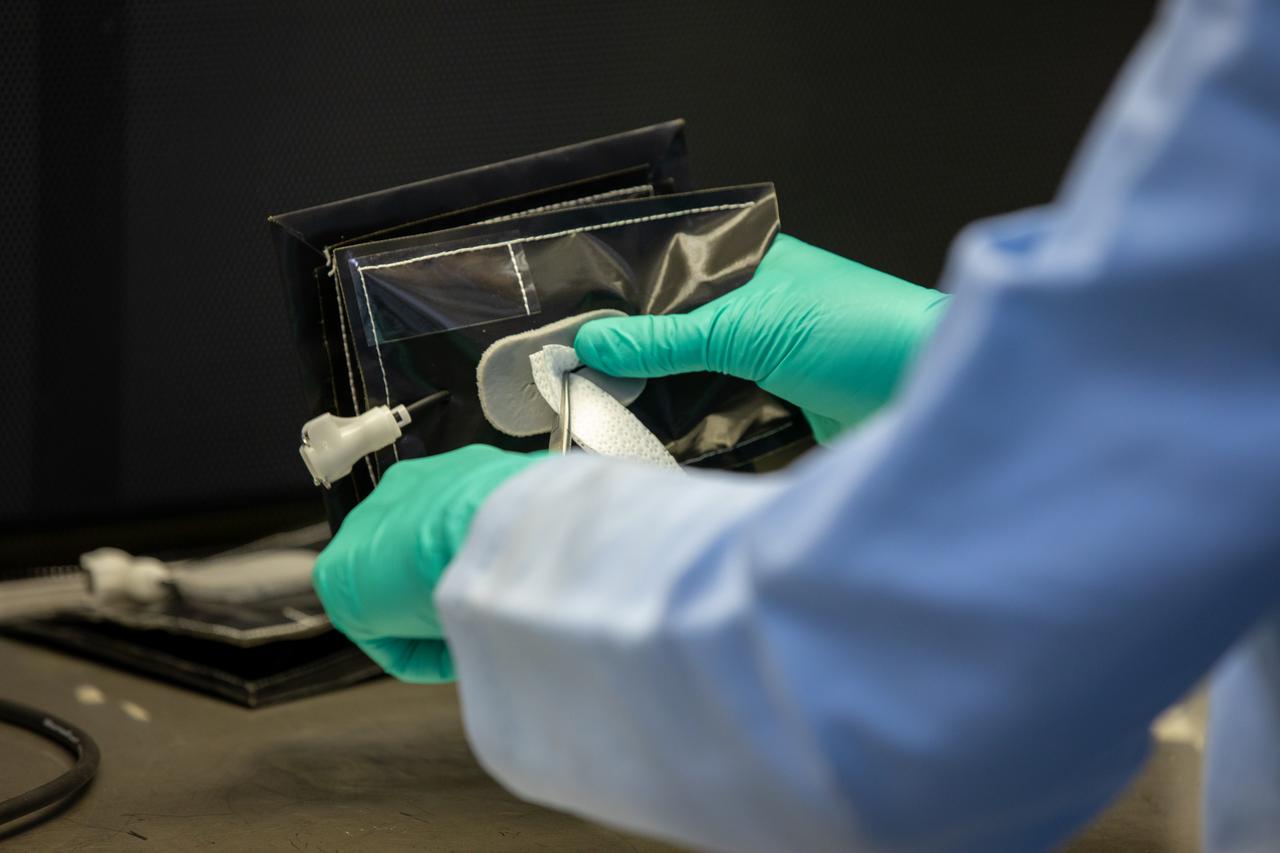
Jess Bunchek, a pseudonaut and associate scientist at NASA’s Kennedy Space Center, measures the seed wick emerging from a plant pillow in the Florida spaceport’s Space Station Processing Facility on Jan. 16, 2019. Researchers will then glue seeds for two crops onto the wicks. A common method used to grow plants in space, the pillows are being sent to the International Space Station for a series of VEG-03 experiments that will study the growth of three types of leafy greens in a microgravity environment and a new seed handling material. The experiments will be launched to the orbiting laboratory aboard a Northrop Grumman Antares rocket and Cygnus spacecraft on the company’s 13th resupply services mission. Liftoff is scheduled for Feb. 9, 2020, at 5:39 p.m. EST from the agency’s Wallops Flight Facility in Virginia.
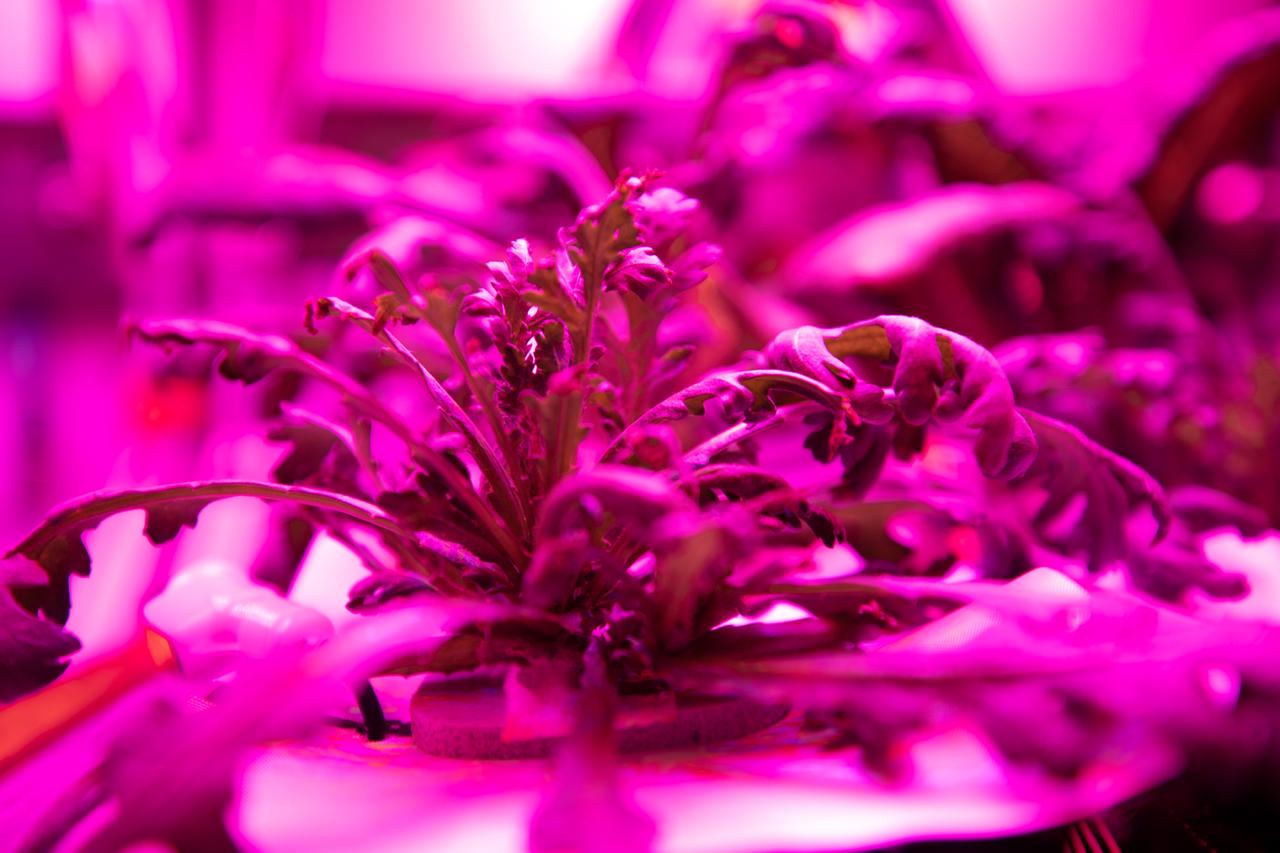
Three crops grown under a test condition representative of the International Space Station are photographed moments before harvest for a science verification test (SVT) in the Space Station Processing Facility at NASA’s Kennedy Space Center in Florida on Sept. 30, 2019. The SVT will study the potential of the three plant cultivars to grow in space. The harvest included ‘outredgeous’ red romaine lettuce, which has been grown in space before, and two new plant cultivars – amara mustard and shungiku, an Asian green comparable to an edible chrysanthemum. All three lettuce plants were grown from seed film, making this the first SVT with this new plant growth material. Earlier this year, the amara mustard and shungiku plants were grown for the first time using seed bags – referred to as pillows – during the Sustained Veggie project, a study funded by the Human Research Program.
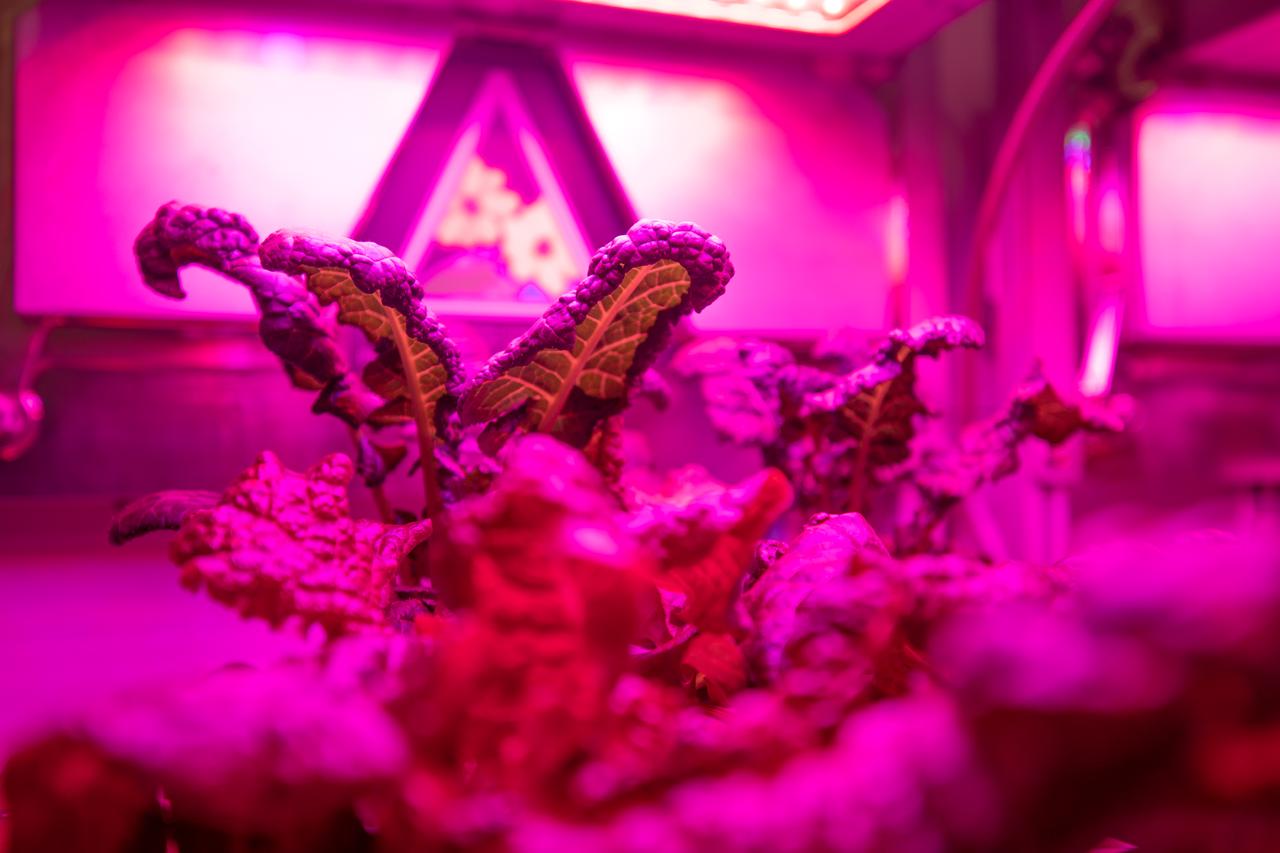
Three crops grown under a test condition representative of the International Space Station are photographed moments before harvest for a science verification test (SVT) in the Space Station Processing Facility at NASA’s Kennedy Space Center in Florida on Sept. 30, 2019. The SVT will study the potential of the three plant cultivars to grow in space. The harvest included ‘outredgeous’ red romaine lettuce, which has been grown in space before, and two new plant cultivars – amara mustard and shungiku, an Asian green comparable to an edible chrysanthemum. All three lettuce plants were grown from seed film, making this the first SVT with this new plant growth material. Earlier this year, the amara mustard and shungiku plants were grown for the first time using seed bags – referred to as pillows – during the Sustained Veggie project, a study funded by the Human Research Program.
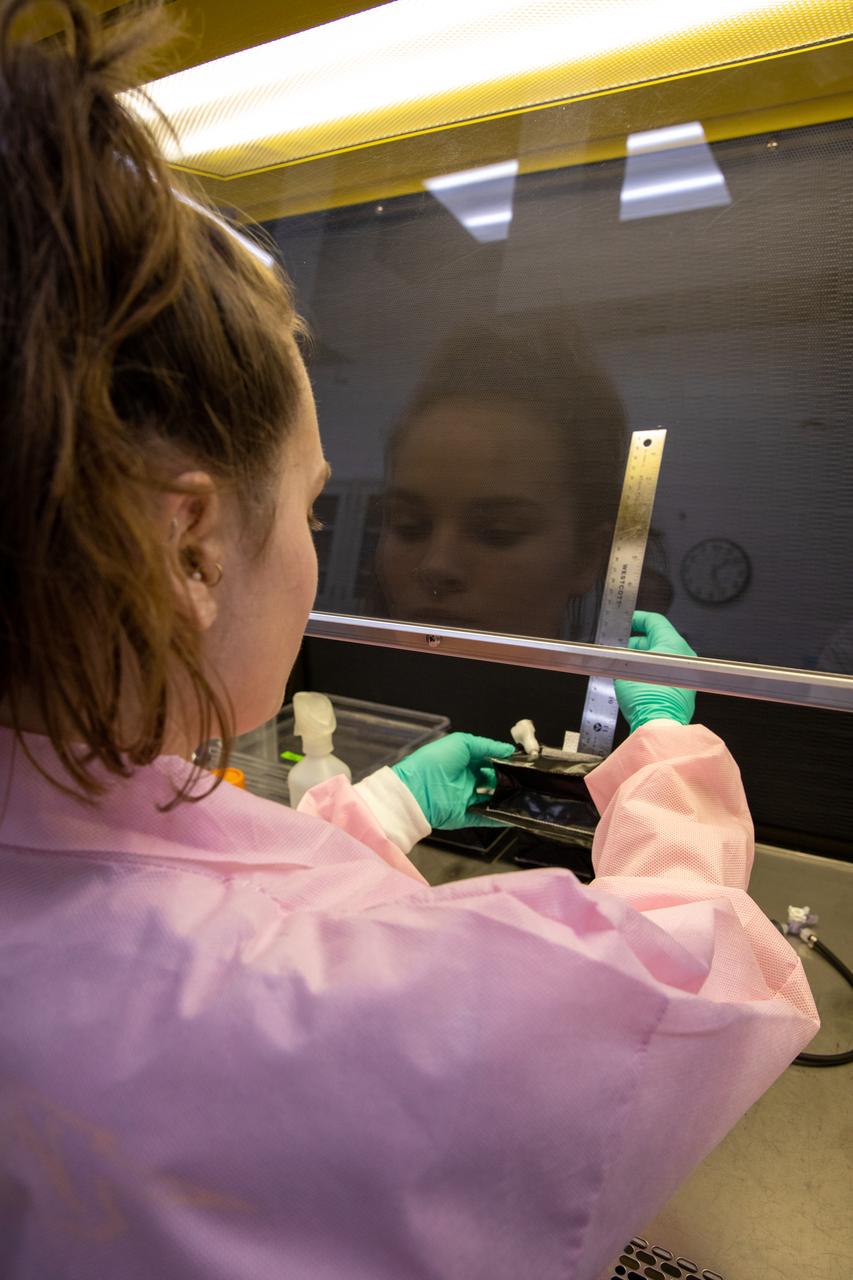
Emily Kennebeck, an intern at NASA’s Kennedy Space Center in Florida, measures the seed wick emerging from a plant pillow in the Space Station Processing Facility on Jan. 16, 2019. Researchers will glue seeds for two crops onto the wicks. A common method used to grow plants in space, the pillows are being sent to the International Space Station for a series of VEG-03 experiments that will study the growth of three types of leafy greens in a microgravity environment and a new seed handling material. The experiments will be launched to the orbiting laboratory aboard a Northrop Grumman Antares rocket and Cygnus spacecraft on the company’s 13th resupply services mission. Liftoff is scheduled for Feb. 9, 2020, at 5:39 p.m. EST from the agency’s Wallops Flight Facility in Virginia.
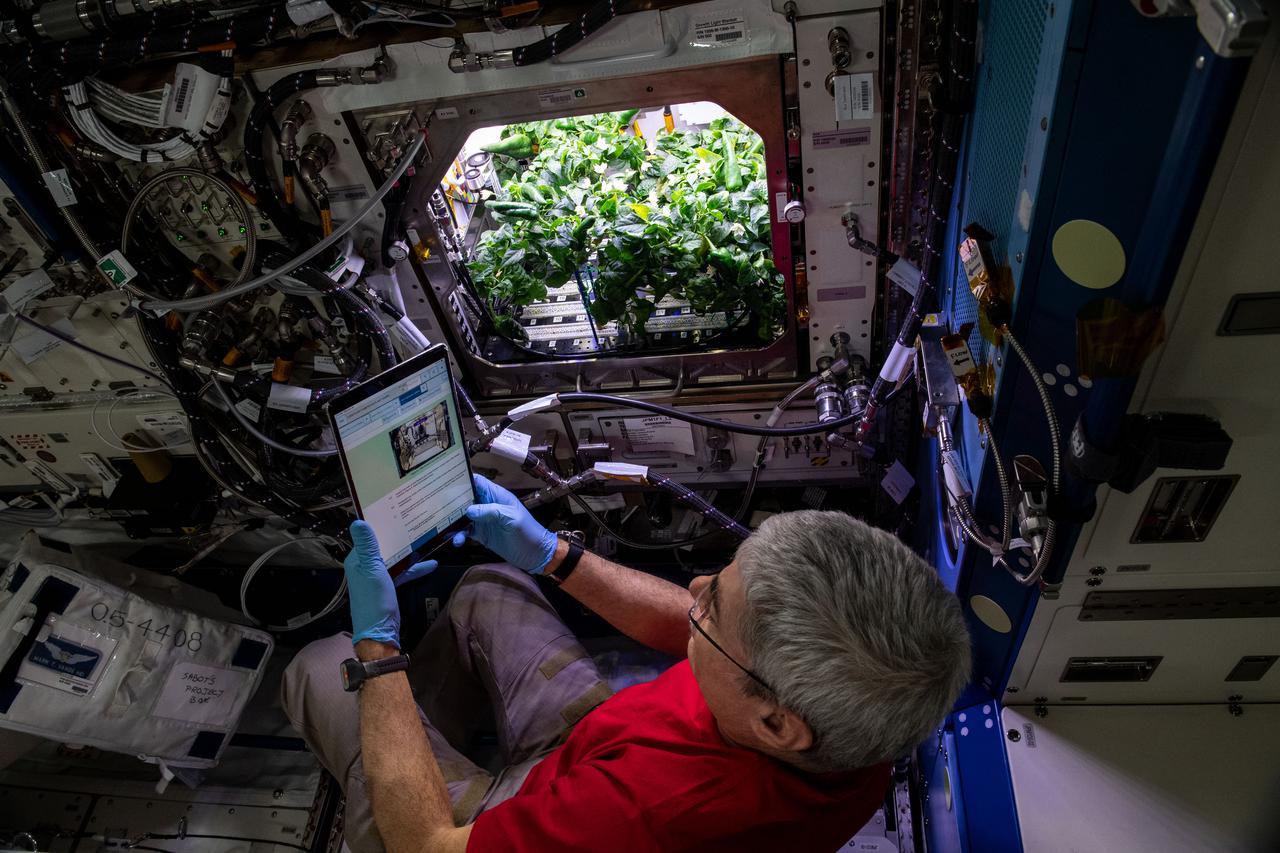
iss066e008125 (October 20, 2021) -- NASA astronaut and Expedition 65 Flight Engineer Mark Vande Hei prepares for the routine debris removal procedure for chile peppers growing in the Advanced Plant Habitat as part of the Plant Habit-04 experiment being conducted aboard the International Space Station. The chile pepper seeds started growing on July 12, 2021, and represent one of the longest and most challenging plant experiments attempted aboard the orbiting laboratory. They will be harvested twice, once in late October and again in late November. Astronauts will sanitize the peppers, eat part of their harvest, and return the rest to Earth for analysis. What we learn will inform future crop growth and food supplementation activities for deep space exploration.
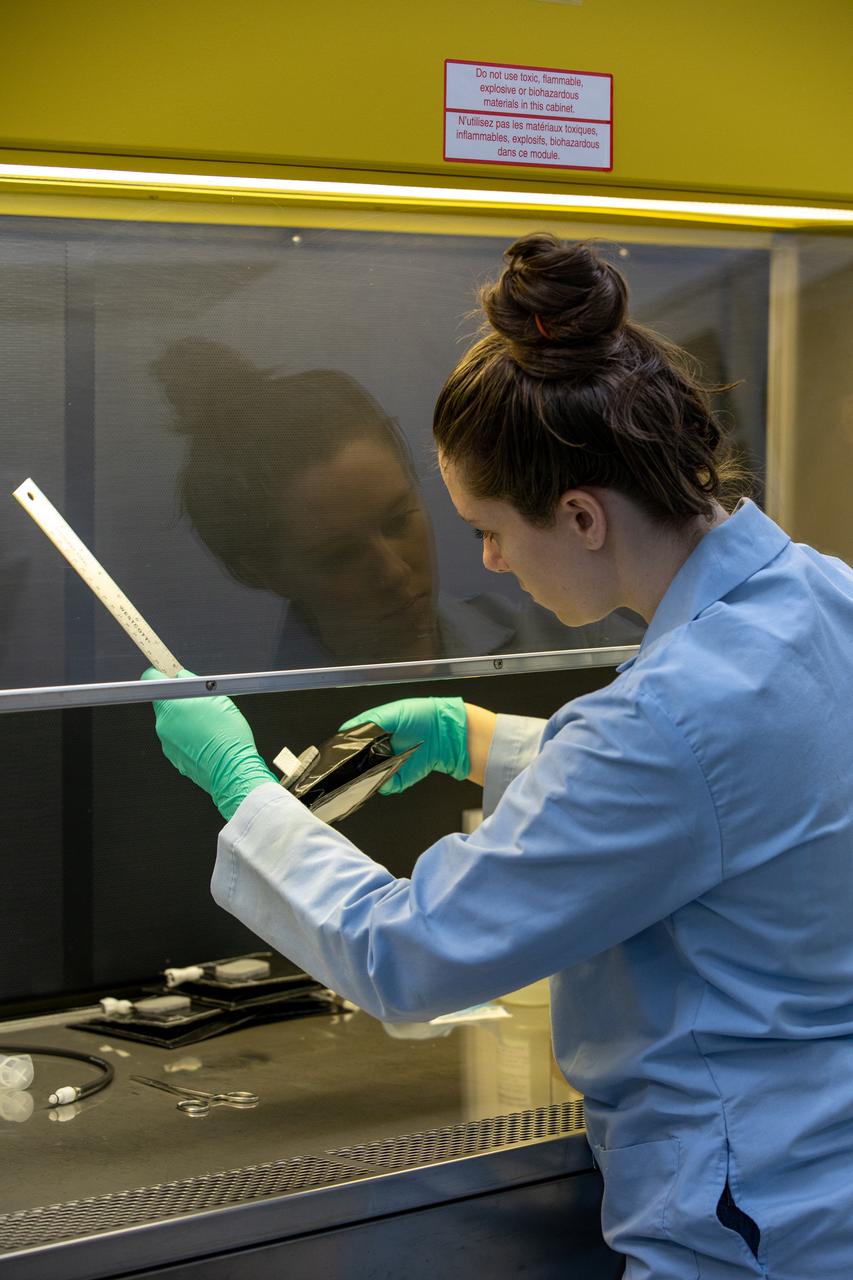
Jess Bunchek, a pseudonaut and associate scientist at NASA’s Kennedy Space Center, measures the seed wick emerging from a plant pillow in the Florida spaceport’s Space Station Processing Facility on Jan. 16, 2019. Researchers will then glue seeds for two crops onto the wicks. A common method used to grow plants in space, the pillows are being sent to the International Space Station for a series of VEG-03 experiments that will study the growth of three types of leafy greens in a microgravity environment and a new seed handling material. The experiments will be launched to the orbiting laboratory aboard a Northrop Grumman Antares rocket and Cygnus spacecraft on the company’s 13th resupply services mission. Liftoff is scheduled for Feb. 9, 2020, at 5:39 p.m. EST from the agency’s Wallops Flight Facility in Virginia.
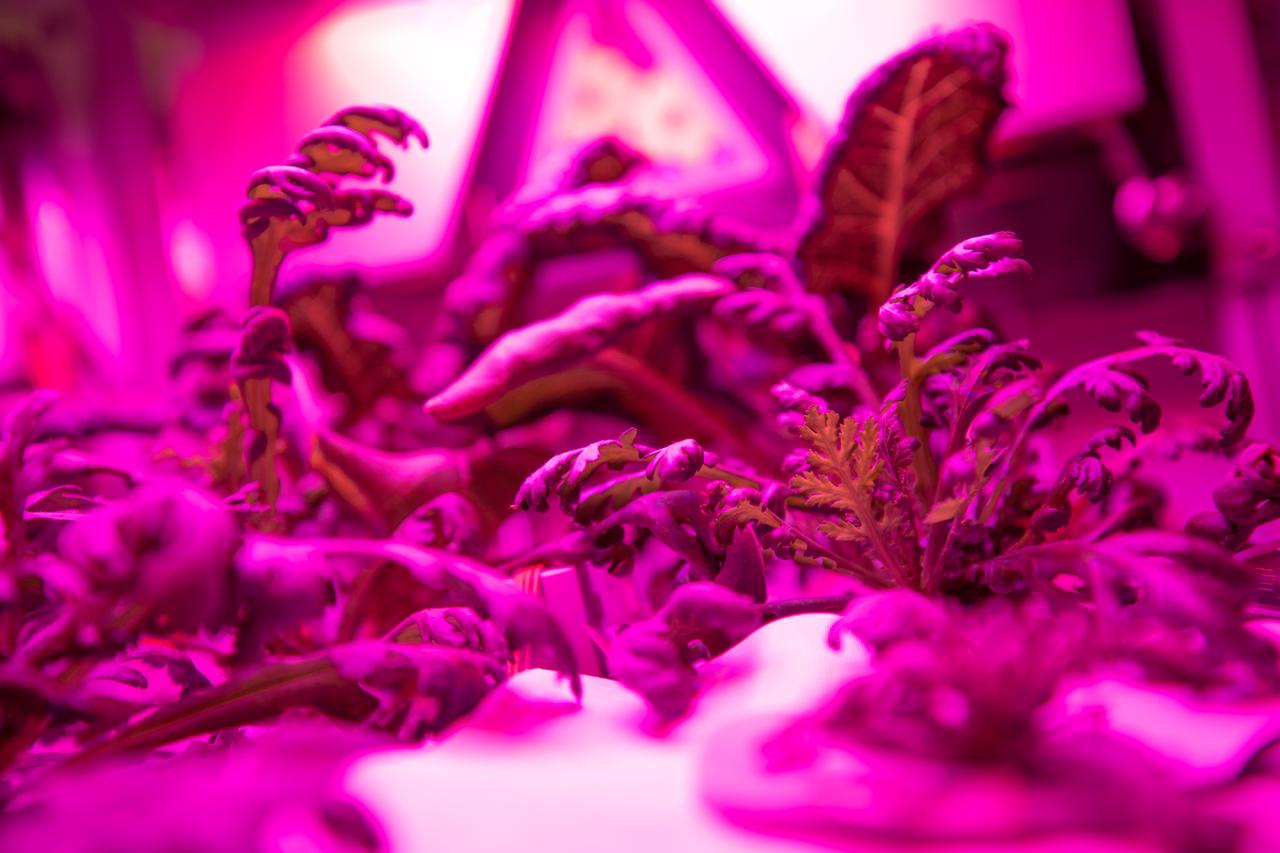
Three crops grown under a test condition representative of the International Space Station are photographed moments before harvest for a science verification test (SVT) in the Space Station Processing Facility at NASA’s Kennedy Space Center in Florida on Sept. 30, 2019. The SVT will study the potential of the three plant cultivars to grow in space. The harvest included ‘outredgeous’ red romaine lettuce, which has been grown in space before, and two new plant cultivars – amara mustard and shungiku, an Asian green comparable to an edible chrysanthemum. All three lettuce plants were grown from seed film, making this the first SVT with this new plant growth material. Earlier this year, the amara mustard and shungiku plants were grown for the first time using seed bags – referred to as pillows – during the Sustained Veggie project, a study funded by the Human Research Program.
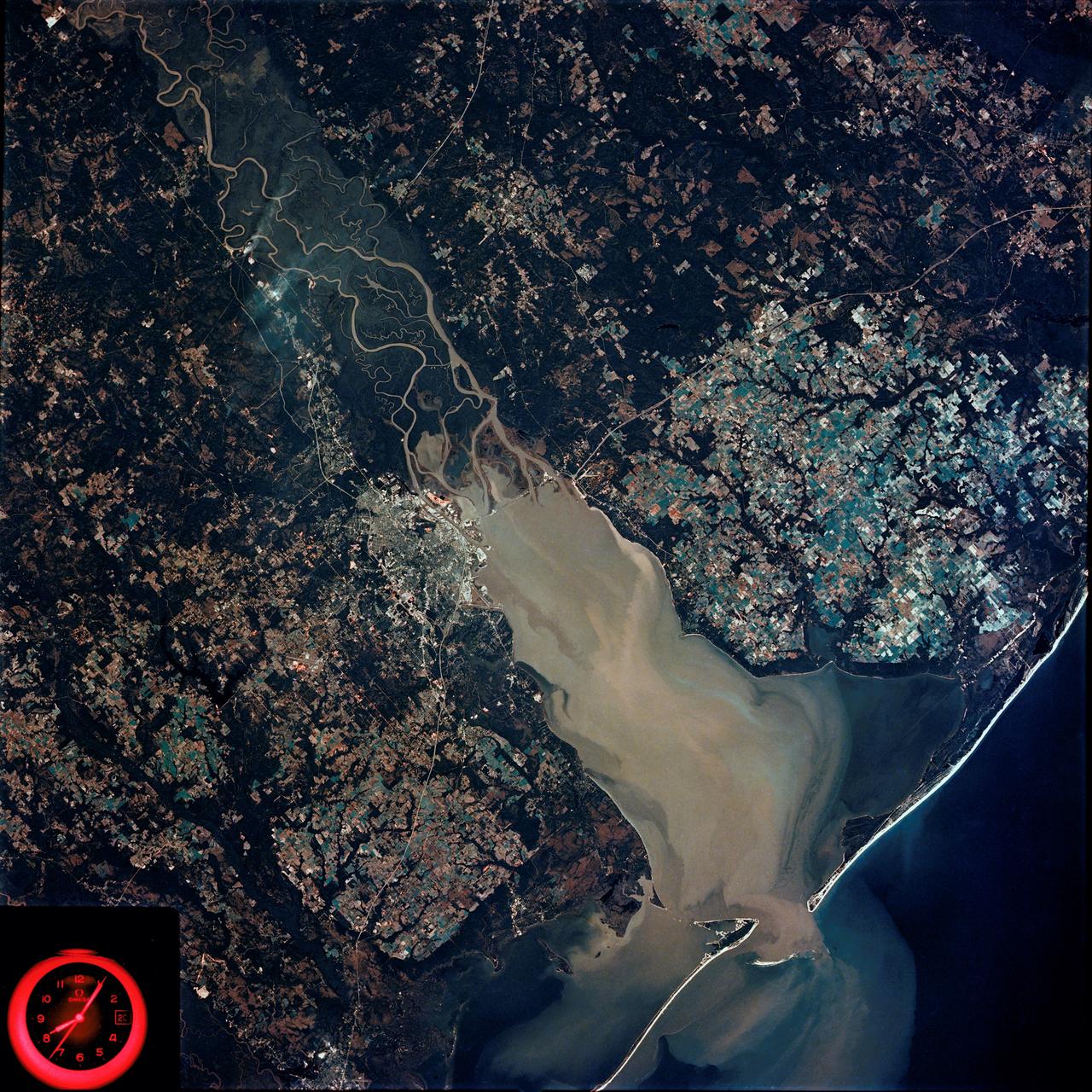
SL4-92-300 (February 1974) --- A near vertical view of the Mobile Bay, Alabama area is seen in this Skylab 4 Earth Resources Experiments Package S190-B (five-inch earth terrain camera) photograph taken from the Skylab space station in Earth orbit. North of Mobile the Tombigbee and Alabama Rivers join to form the Mobile River. Detailed configuration of the individual stream channels and boundaries can be defined as the Mobile River flows into Mobile Bay, and thence into the Gulf of Mexico. The Mobile River Valley with its numerous stream channels is a distinct light shade in contrast to the dark green shade of the adjacent areas. The red coloration of Mobile Bay reflects the sediment load carried into the Bay by the rivers. Variations in red color indicate sediment load and the current paths within Mobile Bay. The waterly movement of the along shore currents at the mouth of Mobile Bay is shown by the contrasting light blue of the sediment-laden current and the blue of the Gulf predominately. Agricultural areas east and west of Mobile Bay are characterized by a rectangular pattern in green to white shades. Color variations may reflect the type and growth cycle of crops. Agricultural areas (light gray-greens) are also clearly visible in other parts of the photograph. Interstate 10 extends from near Pascagoula, Mississippi eastward through Mobile to the outskirts of Pensacola, Florida. Analysis of the EREP photographic data will be undertaken by the U.S. Corps of Engineers to determine bay dynamic processes. Federal agencies participating with NASA on the EREP project are the Departments of Agriculture, Commerce, Interior, the Environmental Protection Agency and the Corps of Engineers. All EREP photography is available to the public through the Department of Interior's Earth Resources Observations Systems Data Center, Sioux Falls, South Dakota. 57198 Photo credit: NASA