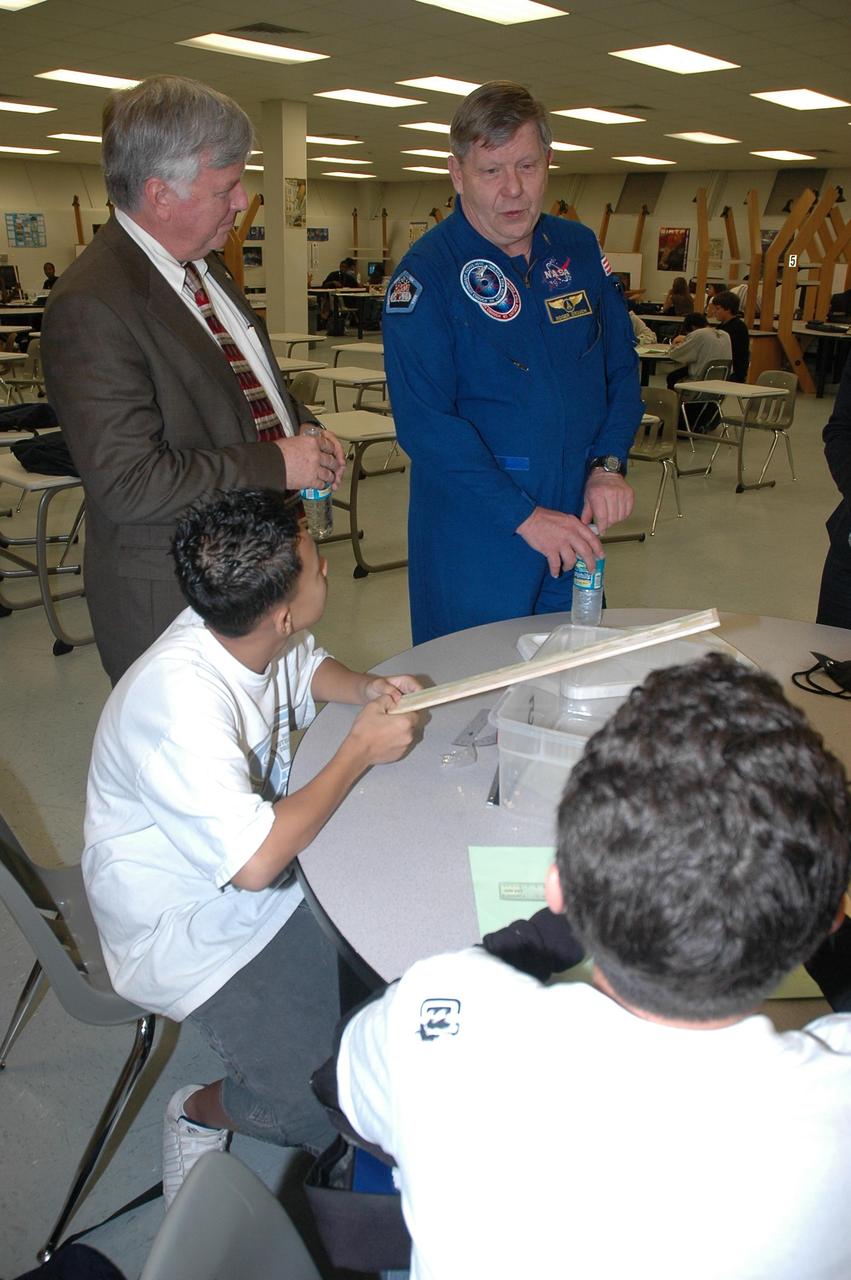
KENNEDY SPACE CENTER, FLA. - Center Director Jim Kennedy (left) and astronaut Roger Crouch talk to students at South Plantation High School in Plantation, Fla. Kennedy and Crouch are visiting the NASA Explorer School (NES) to share the vision for space exploration with the next generation. During the visit, Crouch is talking with students about our destiny as explorers, NASA's stepping stone approach to exploring Earth, the moon, Mars and beyond, how space impacts our lives, and how people and machines rely on each other in space. The Agency's NES program establishes a three-year partnership annually between NASA and 50 NASA Explorer School teams, consisting of teachers and education administrators from diverse communities nationwide. Photo credit: NASA/Cory Huston
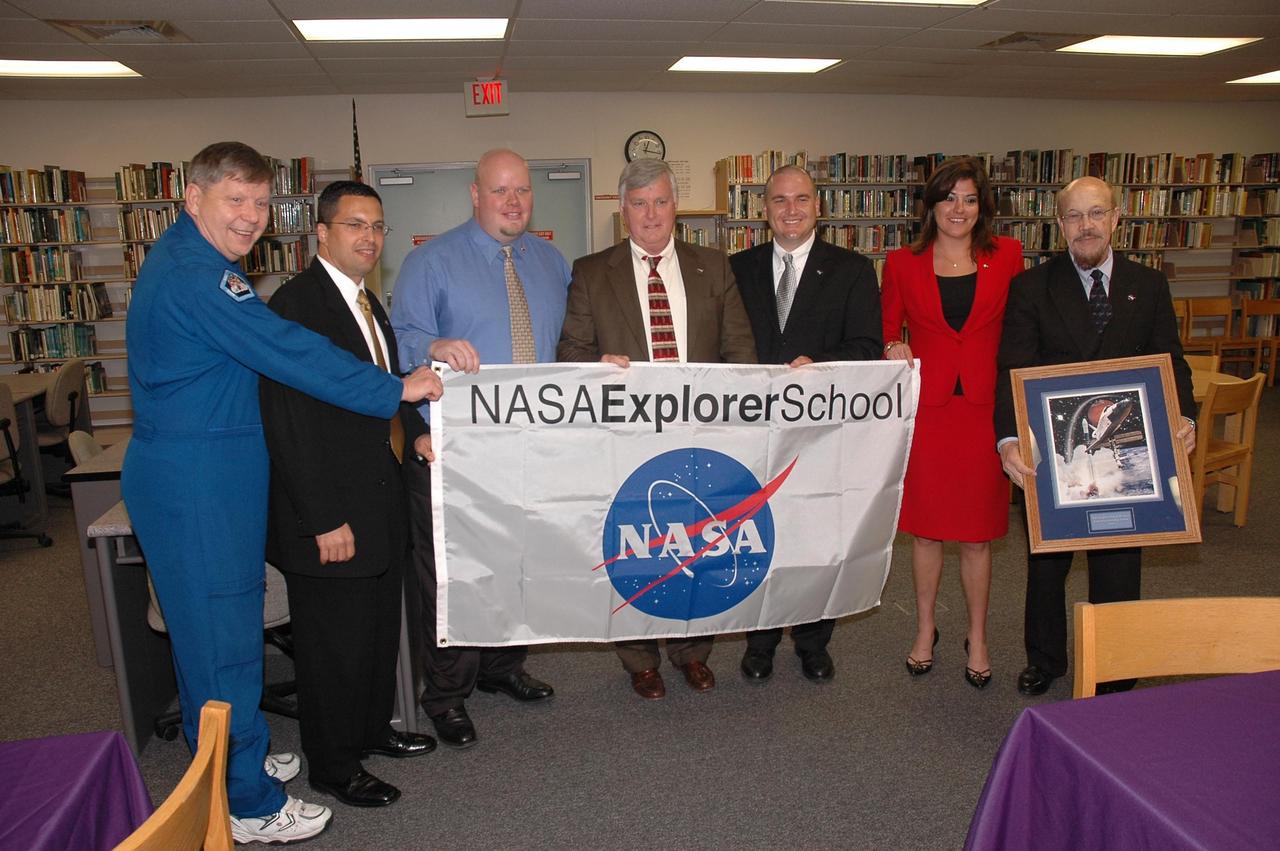
KENNEDY SPACE CENTER, FLA. - Center Director Jim Kennedy (center) and astronaut Roger Crouch (far left) present a NASA Explorer School (NES) banner to the NES team at South Plantation High School in Plantation, Fla. Kennedy, Crouch and other NASA KSC officials are visiting the school to share the vision for space exploration with the next generation. During the visit, Crouch is talking with students about our destiny as explorers, NASA's stepping stone approach to exploring Earth, the moon, Mars and beyond, how space impacts our lives, and how people and machines rely on each other in space. The Agency's NES program establishes a three-year partnership annually between NASA and 50 NASA Explorer School teams, consisting of teachers and education administrators from diverse communities nationwide. Photo credit: NASA/Cory Huston
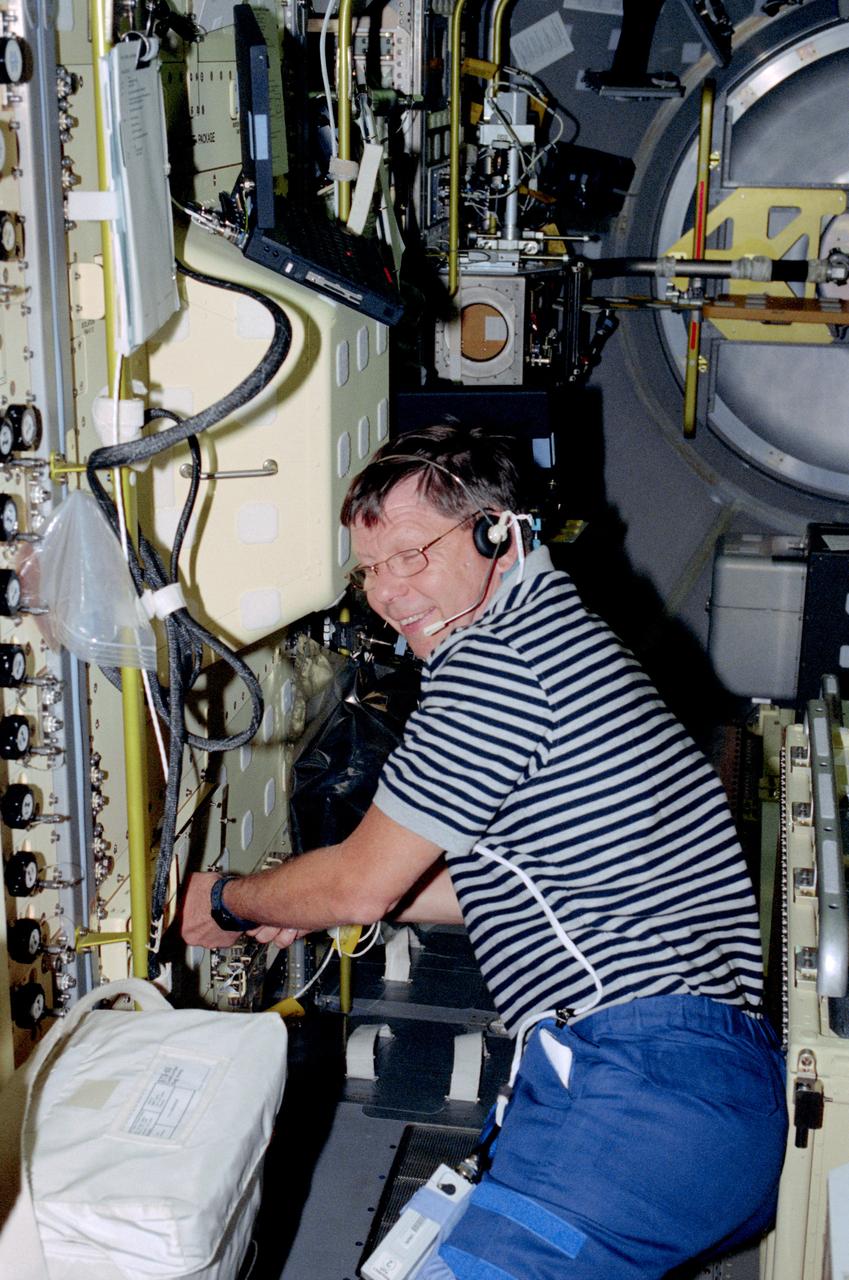
STS083-308-025 (4-8 April 1997) --- Payload specialist Roger K. Crouch, talks to ground controllers while working at Combustion Module-1 in the Spacelab Science Module. Crouch, along with five other NASA astronauts and a second payload specialist supporting the Microgravity Sciences Laboratory (MSL-1) mission were less than a fourth of the way through a scheduled 16-day flight when a power problem cut short their planned stay.
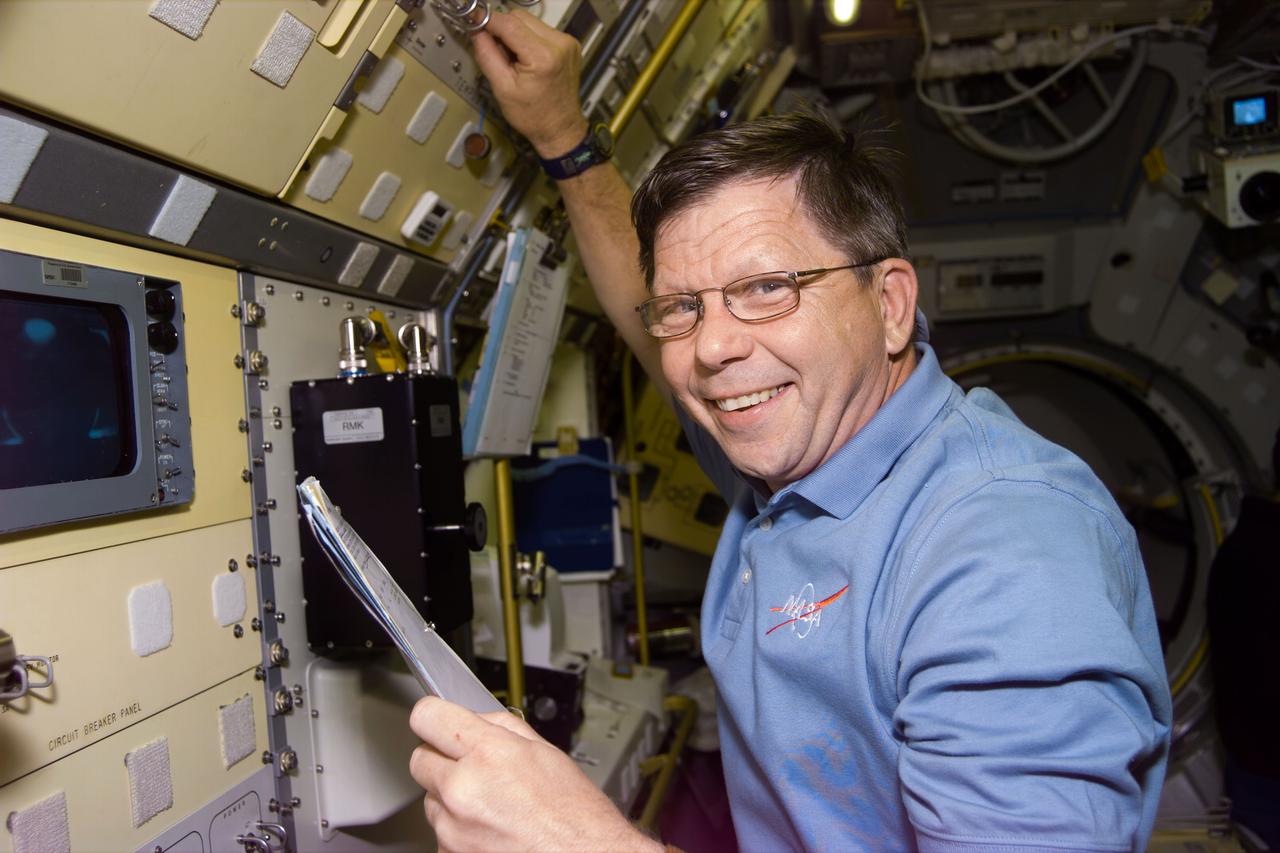
S94-E-5019 (6 July 1997) --- Roger K. Crouch, payload specialist for the Microgravity Sciences Laboratory (MSL-1) mission, is seen at the experiment racks during Flight Day 6 aboard Spacelab. The photo was recorded with an Electronic Still Camera (ESC) and later downlinked to ground controllers in Houston, Texas.
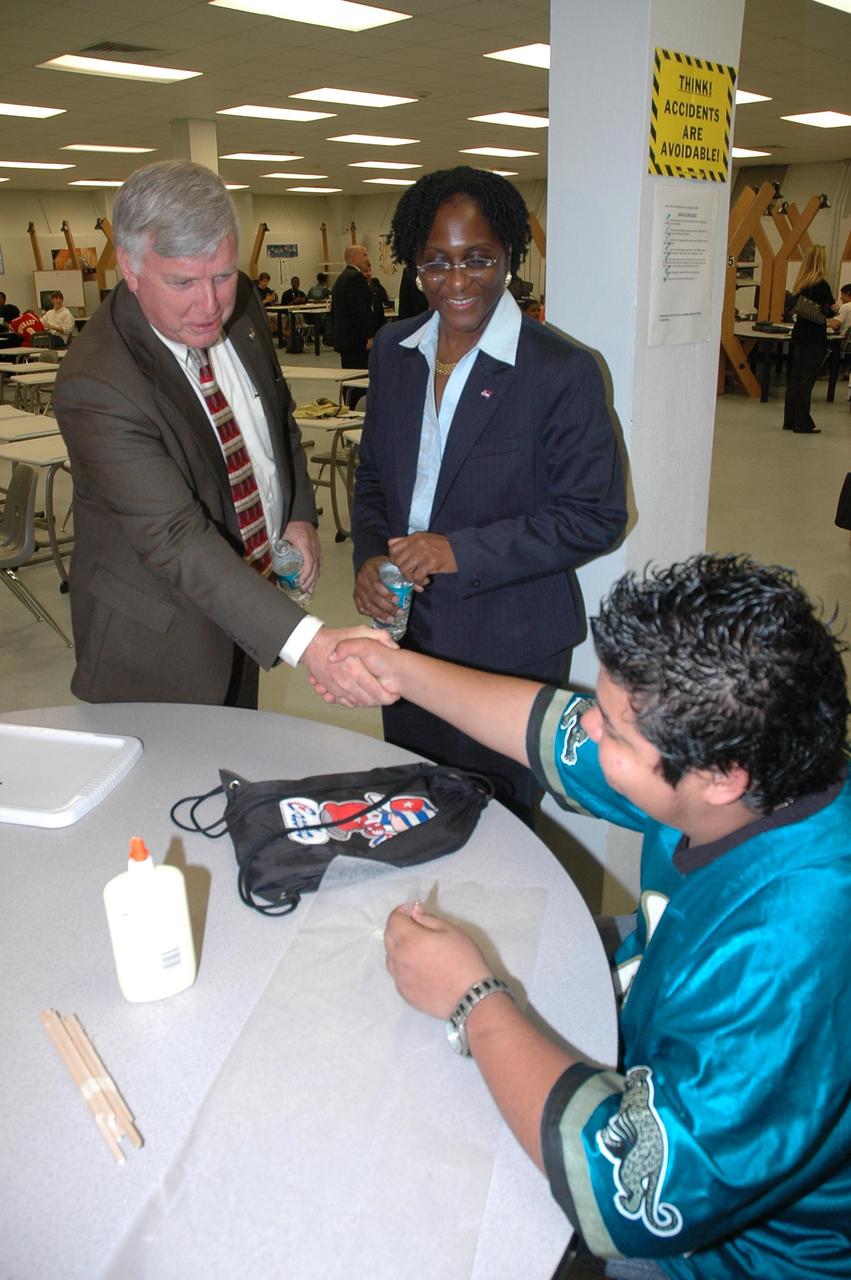
KENNEDY SPACE CENTER, FLA. - Center Director Jim Kennedy and Hortense Burt, with the Education Office at NASA's Kennedy Space Center, greet a student at South Plantation High School in Plantation, Fla. Kennedy, Burt and other Kennedy representatives are visiting the NASA Explorer School (NES) to share the vision for space exploration with the next generation. Astronaut Roger Crouch joined the Kennedy team. During the visit, Crouch is talking with students about our destiny as explorers, NASA's stepping stone approach to exploring Earth, the moon, Mars and beyond, how space impacts our lives, and how people and machines rely on each other in space. The Agency's NES program establishes a three-year partnership annually between NASA and 50 NASA Explorer School teams, consisting of teachers and education administrators from diverse communities nationwide. Photo credit: NASA/Cory Huston
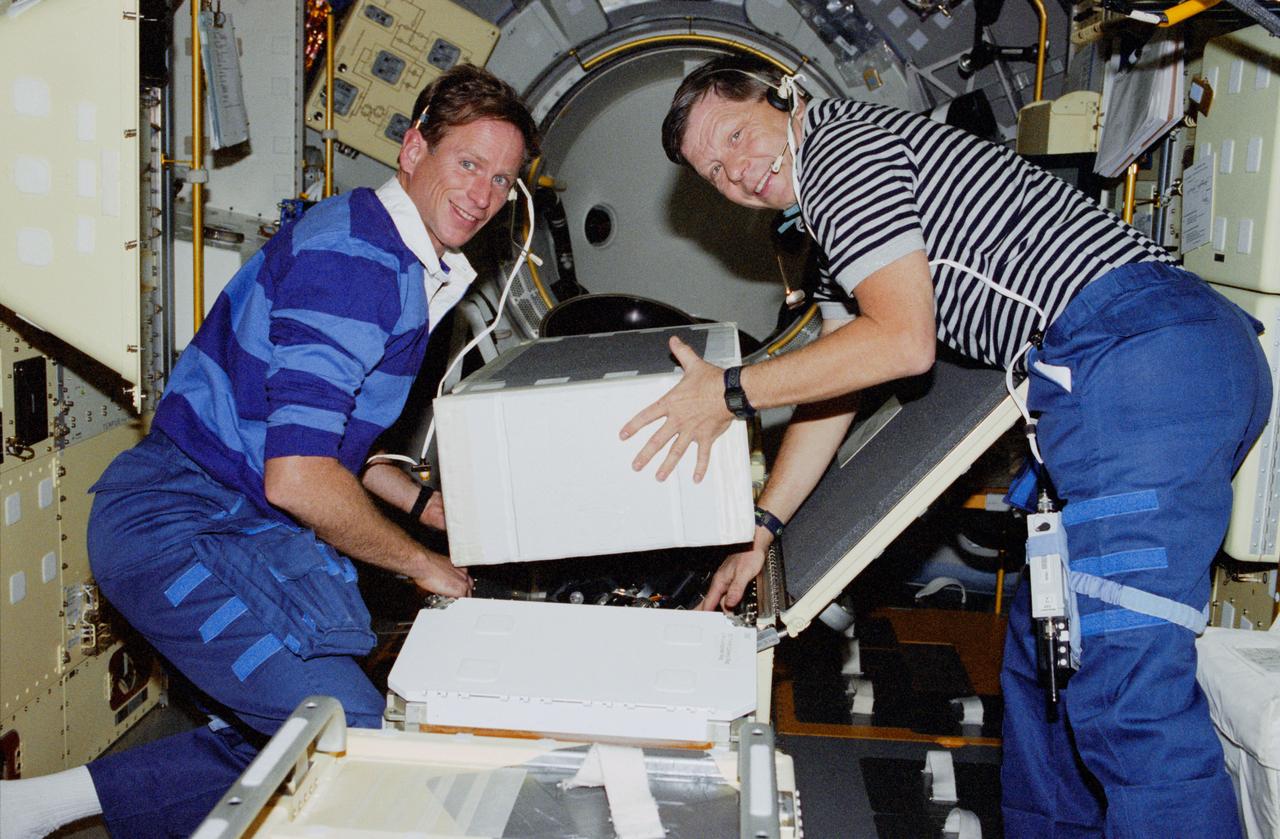
STS083-308-021 (4-8 April 1997) --- Payload specialist Roger K. Crouch and astronaut Michael L. Gernhardt, mission specialist, load boxes as they prepare to deactivate the Spacelab Science Module. Crouch and Gernhardt, along with five other NASA astronauts and a second payload specialist supporting the Microgravity Sciences Laboratory (MSL-1) mission, were less than a fourth of the way through a scheduled 16-day flight when a power problem cut short their planned stay.
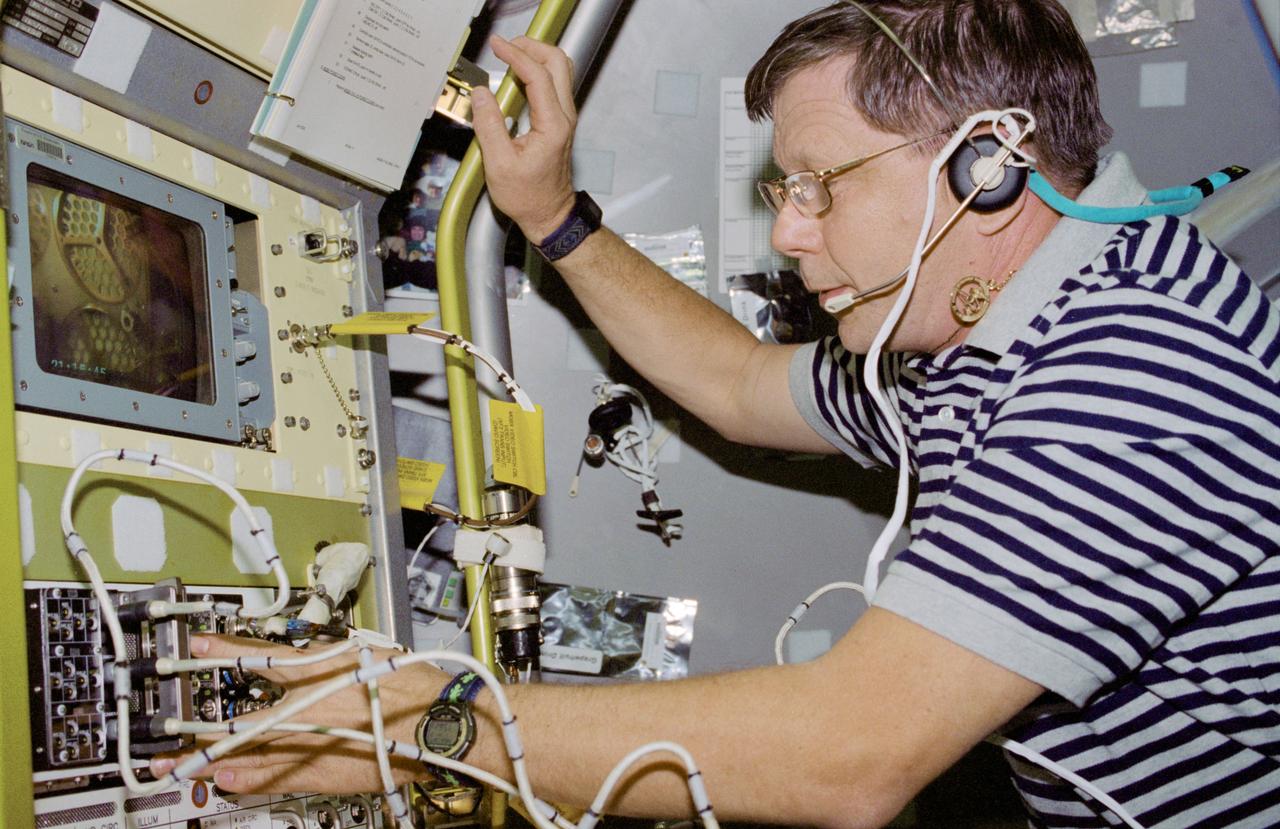
STS083-346-024 (4-8 April 1997) --- Payload specialist Roger K. Crouch performs the activation for the Mid Deck Glove Box (MGBX). Made to accommodate a variety of hardware and materials testing, the facility offers physical isolation and a negative air pressure environment so that items that are not suitable for handling in the open Spacelab can be protected. One experiment that was performed on STS-83 is the Internal Flows in a Free Drop (IFFD), an experiment that investigates rotation and position control of drops by varying acoustic pressures.
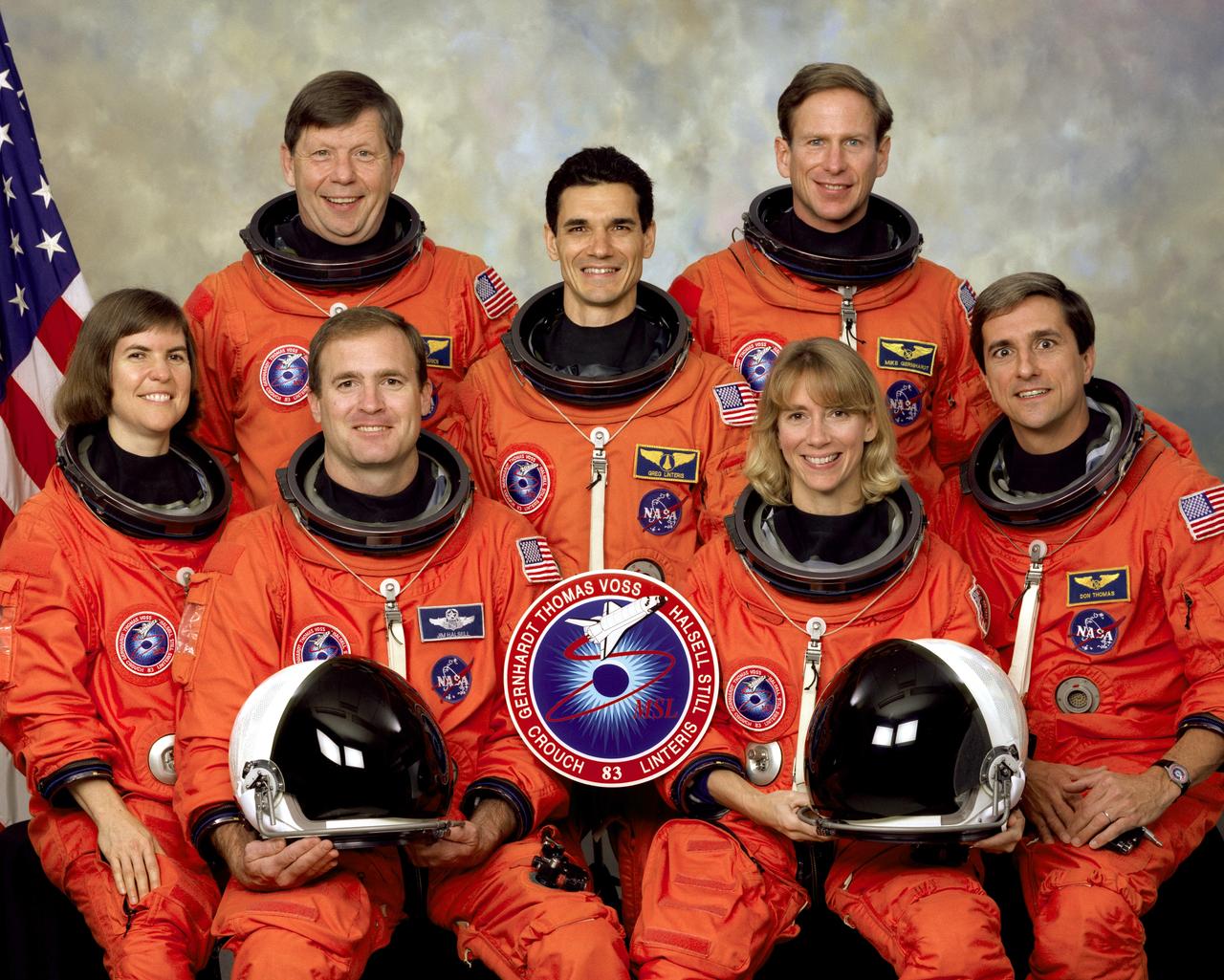
Five NASA astronauts and two scientists comprised the crew for the STS-83 mission in support of the first Microgravity Sciences Laboratory 1 (MSL-1). Pictured on the front row (left to right) are Janice E. Voss, payload commander; James D. Halsell, commander; Susan L. Still, pilot; and Donald A. Thomas, mission specialist. On the back row (left to right) are payload specialists Roger K. Crouch, and Gregory T. Linteris; and Michael L. Gernhardt, mission specialist. Dr. Crouch and Dr. Linteris are experts in several disciplines treated on MSL-1. STS-83 launched aboard the Space Shuttle Columbia on April 4, 1997. The five launched again in July 1997 for the STS-94 mission.
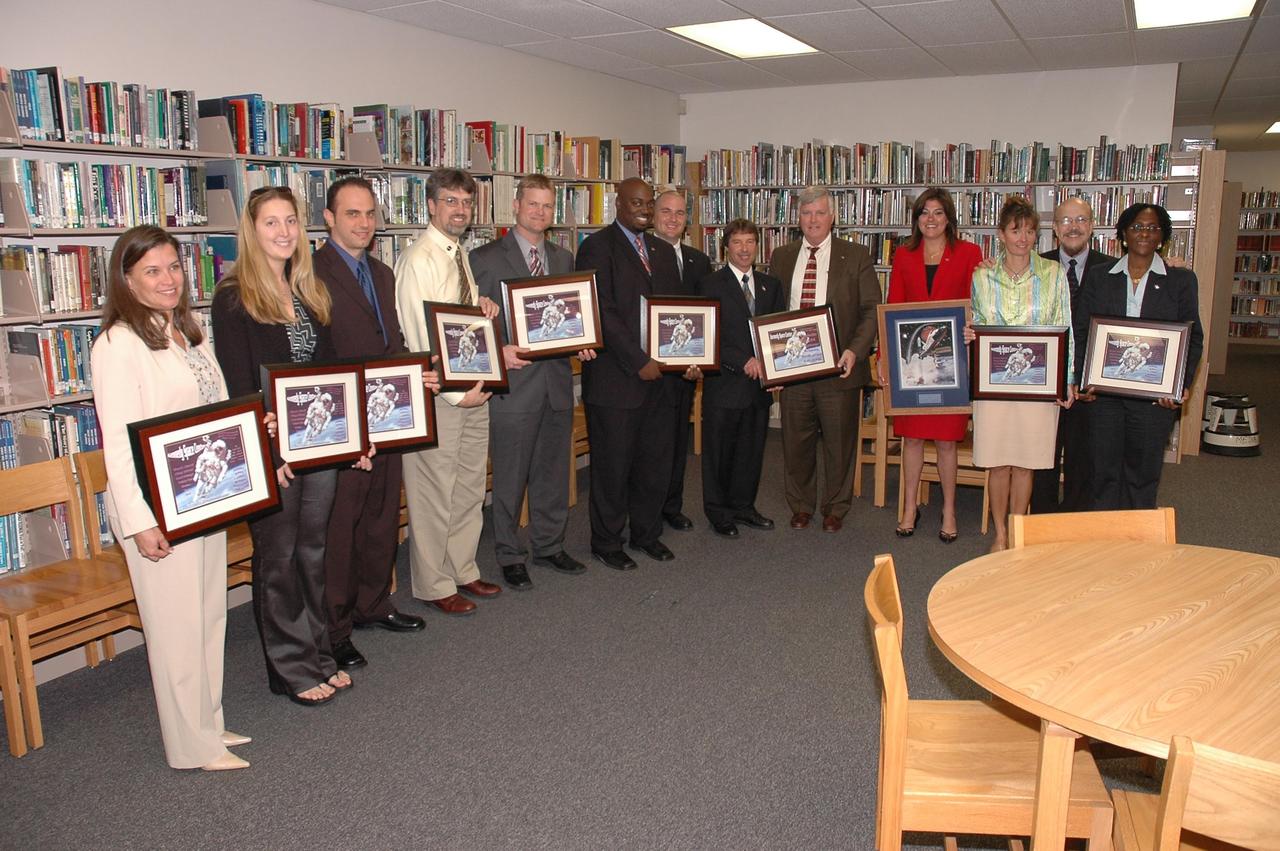
KENNEDY SPACE CENTER, FLA. - The NASA Explorer School (NES) team at Kennedy Space Center poses with the NES team at South Plantation High School in Plantation, Fla. Center Director Jim Kennedy is fifth from the right. On the far right is Hortense Burt, with the Education Office at Kennedy. The Kennedy team, which also included astronaut Roger Couch, is visiting the school to share the vision for space exploration with the next generation. During the visit, Crouch is talking with students about our destiny as explorers, NASA's stepping stone approach to exploring Earth, the moon, Mars and beyond, how space impacts our lives, and how people and machines rely on each other in space. The Agency's NES program establishes a three-year partnership annually between NASA and 50 NASA Explorer School teams, consisting of teachers and education administrators from diverse communities nationwide. Photo credit: NASA/Cory Huston
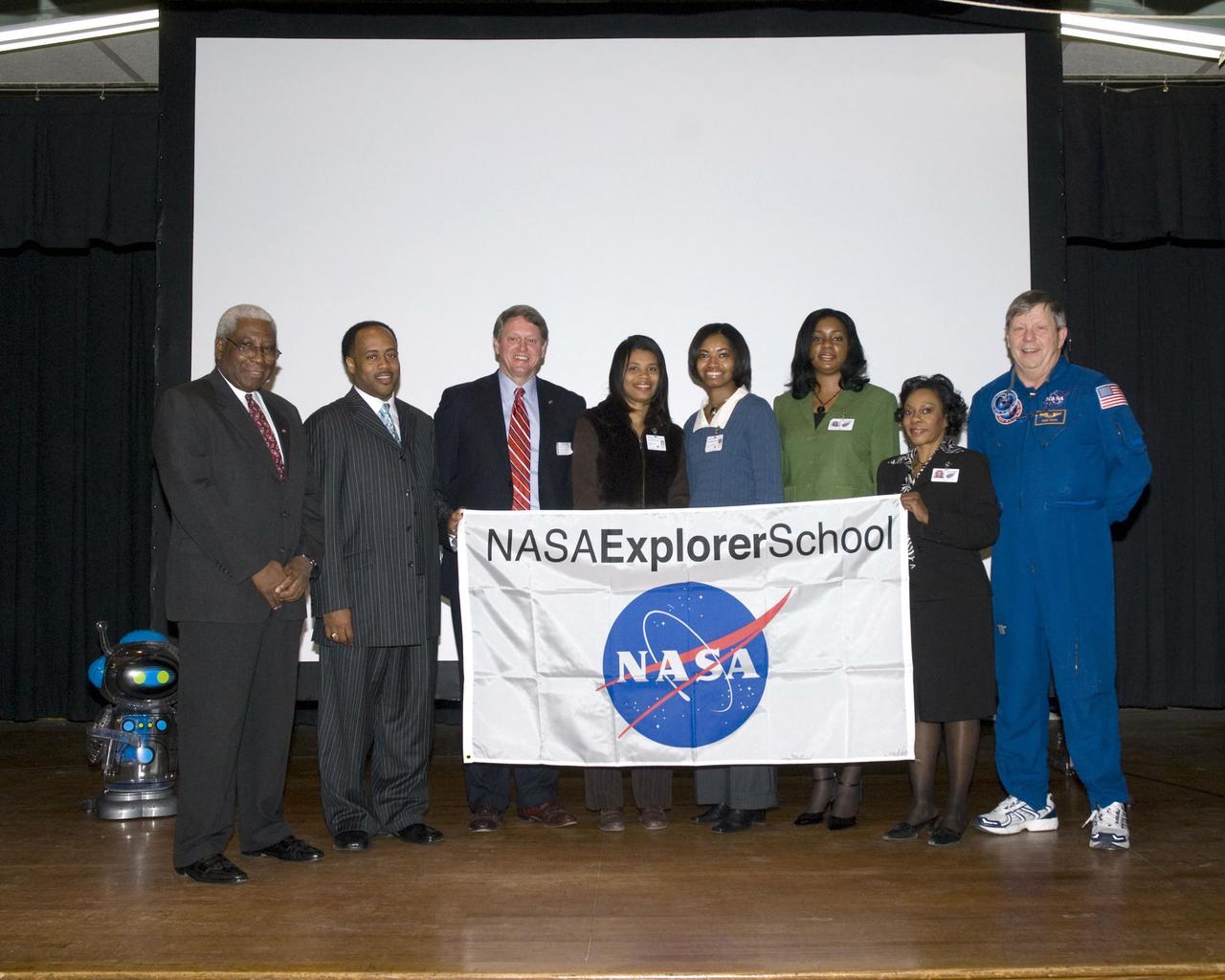
The NASA Explorer School-East Oktibbeha County School District team recently celebrated the start of its three-year partnership with NASA during a two-part kickoff event Nov. 7 and 8. Pictured from left are, Oktibbeha County School District Superintendent Dr. Walter Conley; NES Team Administrator James Covington; Stennis Space Center Deputy Director Gene Goldman; Sharon Bonner; NES Team Lead Yolanda Magee; Andrea Temple; Carolyn Rice; and special guest astronaut Roger Crouch.
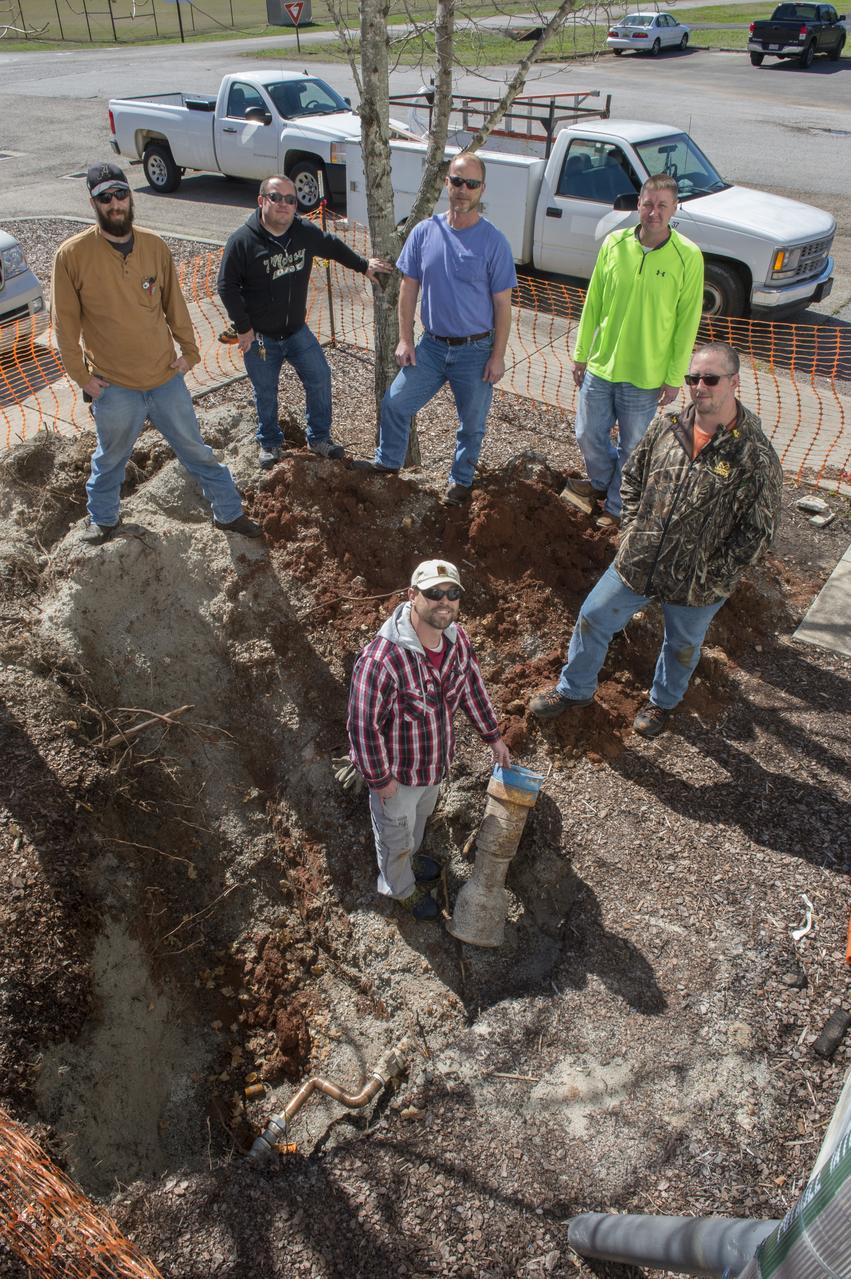
Members of Marshall's Facilities Operations and Maintenance Office team, including, clockwise from left, Robert Drane, Jeremy Holmes, Don Davis, team foreman Dusty Crouch, Wesley Brook and Lucas Broadway, gather to inspect and replace a pipe fitting.
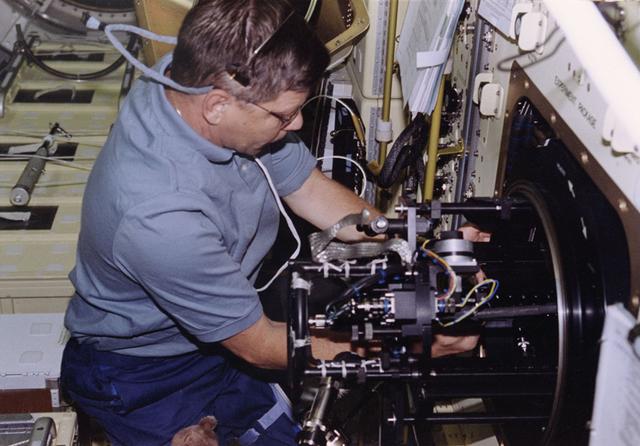
Astronaut Roger Crouch performs a change-out of the experiment in the Combustion Module-1 combustion chamber during STS-94.
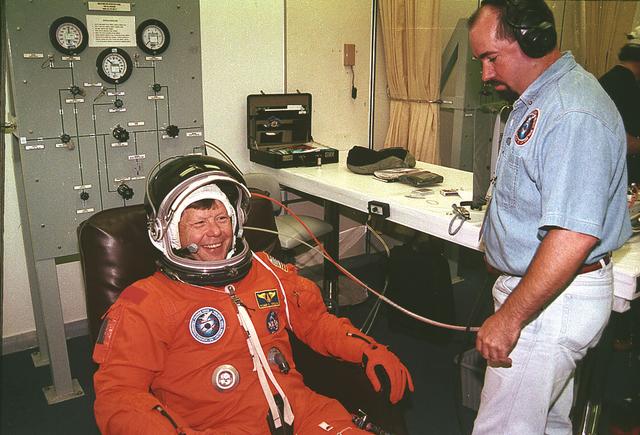
STS-94 Payload Specialist Roger K. Crouch is helped into his launch/entry suit by a suit technician in the Operations and Checkout (OC) building after the suit has been given a pressure test. He is the Chief Scientist of the NASA Microgravity Space and Applications Division. He also has served as a Program Scientist for previous missions and is an expert in semiconductor crystal growth. Crouch and six other crewmembers prepare to depart the OC and head for Launch Pad 39a, where the Space Shuttle Columbia will lift off.
STS-94 Payload Specialist Roger K. Crouch prepares to enter the Space Shuttle Columbia at Launch Pad 39A in preparation for launch. He is the Chief Scientist of the NASA Microgravity Space and Applications Division. He also has served as a Program Scientist for previous Spacelab microgravity missions and is an expert in semiconductor crystal growth. Since Crouch has more than 25 years of experience as a materials scientist, he will be concentrating on the five physics of materials processing experiments in the Middeck Glovebox Facility on the Blue shift. He will also share the workload with Thomas by monitoring the materials furnace experiments during this time. Crouch and six fellow crew members will lift off during a launch window that opens at 1:50 p.m. EDT, July 1. The launch window will open 47 minutes early to improve the opportunity to lift off before Florida summer rain showers reach the space center
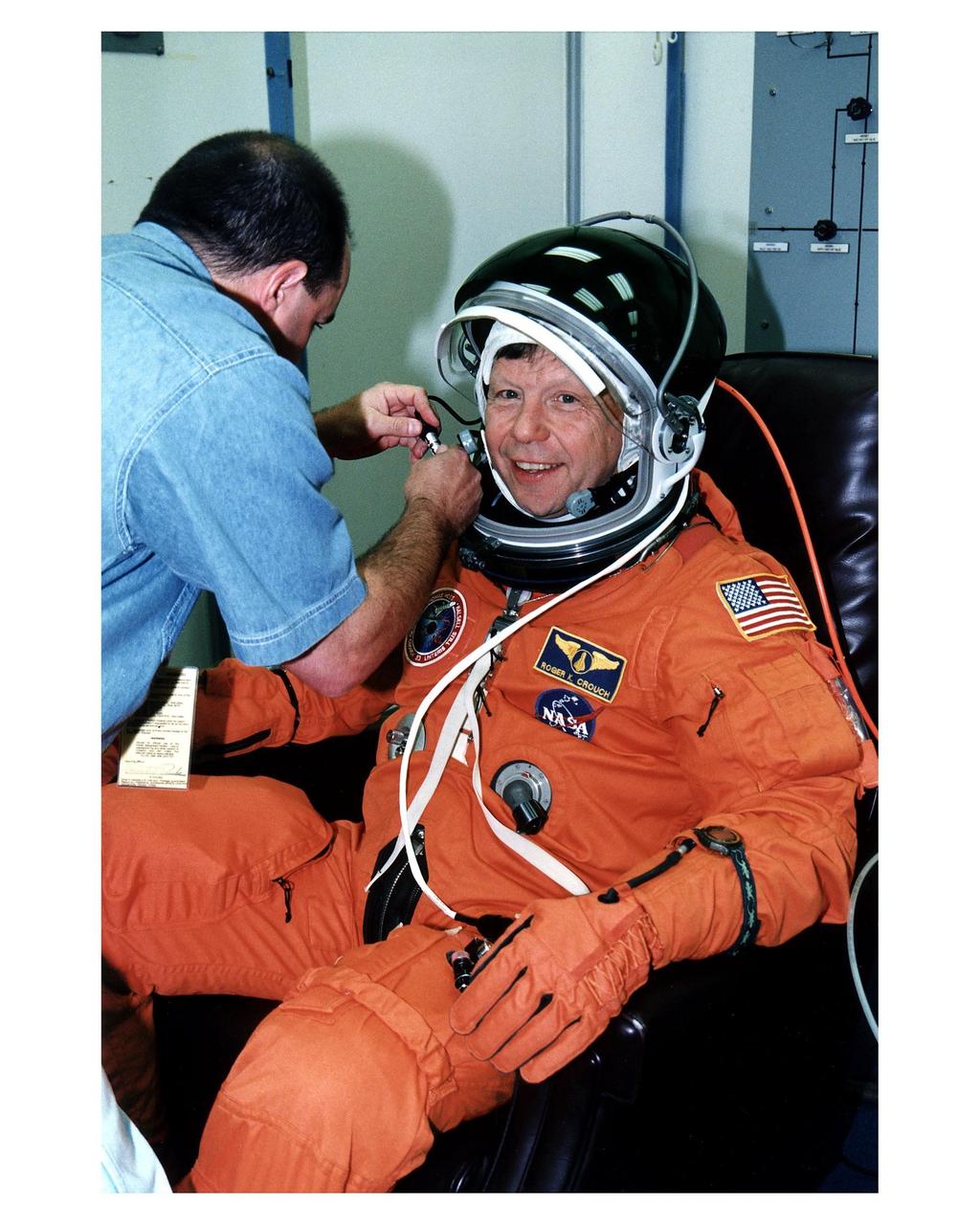
STS-83 Payload Specialist Roger K. Crouch is assisted into his launch/entry suit in the Operations and Checkout (O&C) Building. He is the Chief Scientist of the NASA Microgravity Space and Applications Division. He also has served as a Program Scientist for previous Spacelab microgravity missions and is an expert in semiconductor crystal growth. Since Crouch has more than 25 years of experience as a materials scientist, he will be concentrating on the five physics of materials processing experiments in the Middeck Glovebox Facility on the Blue shift. He will also share the workload with Thomas by monitoring the materials furnace experiments during this time. Crouch and six fellow crew members will shortly depart the O&C and head for Launch Pad 39A, where the Space Shuttle Columbia will lift off during a launch window that opens at 2:00 p.m. EST, April 4

STS-83 Payload Specialist Roger K. Crouch and Pilot Susan Leigh Still arrive at Kennedy Space Center's Shuttle Landing Facility prior to Columbia's launch
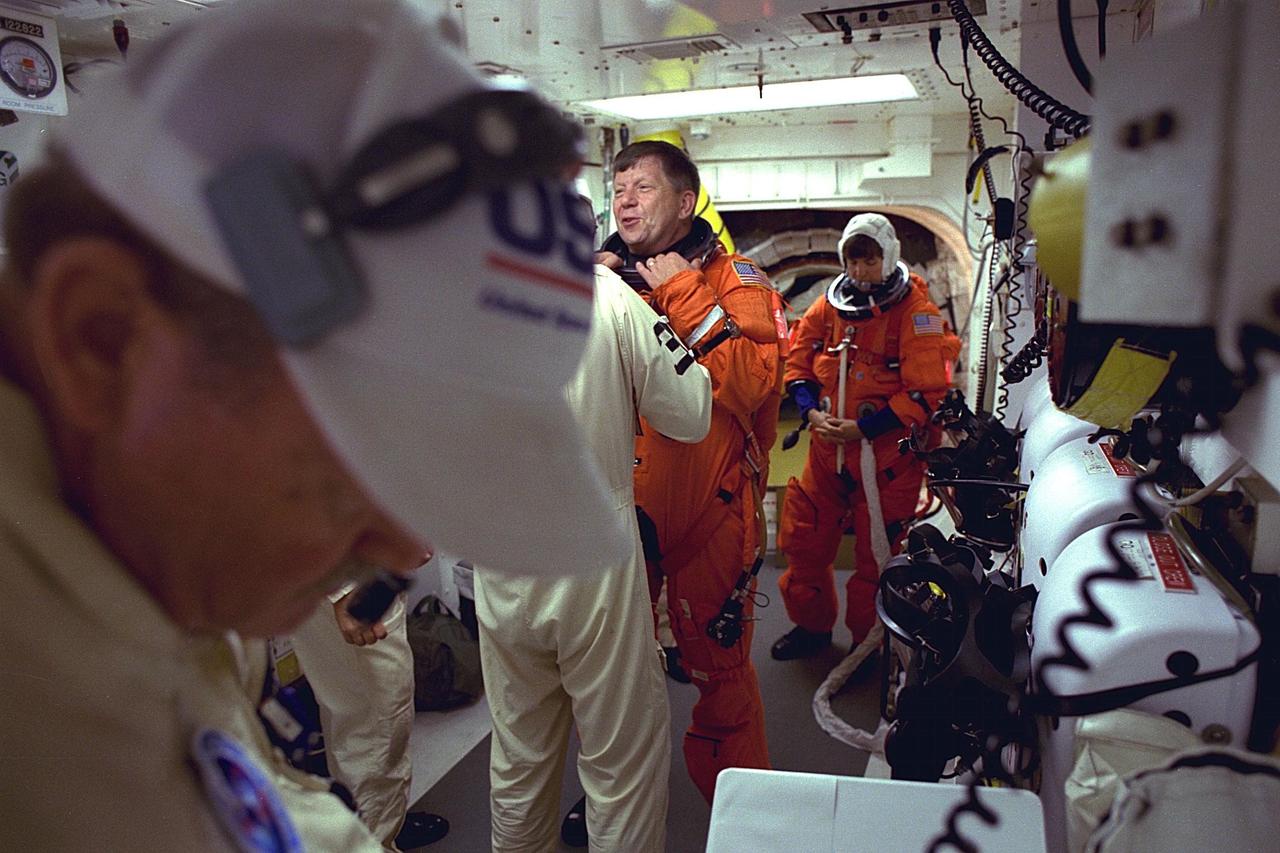
STS-94 Payload Specialist Roger K. Crouch and Payload Commander Janice E. Voss prepare to enter the Space Shuttle Columbia at Launch Pad 39a with assistance from white room closeout crew members.
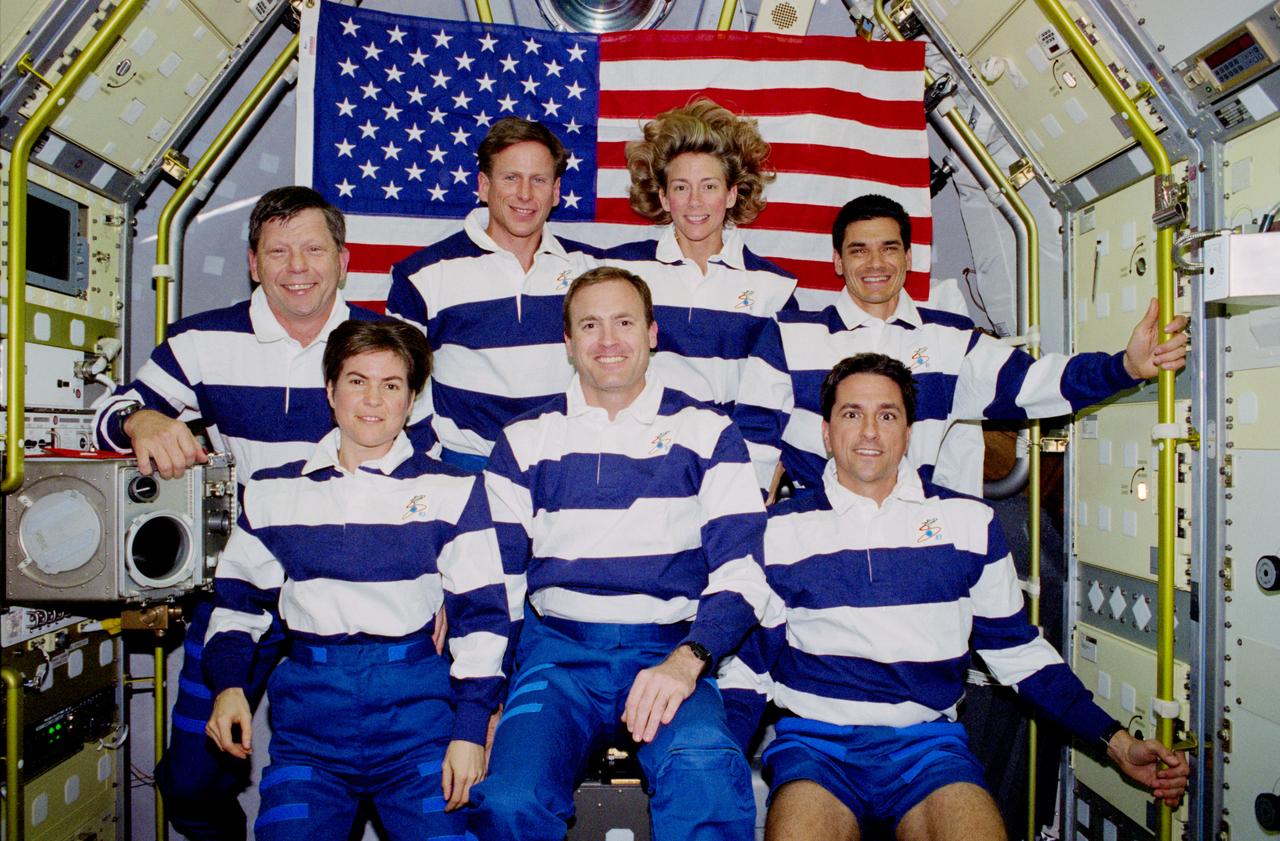
STS083-325-004 (4-8 April 1997) --- Five NASA astronauts and two payload specialists pose for the traditional inflight crew portrait during a Microgravity Science Laboratory 1 (MSL-1) shift changeover in the Spacelab Module aboard the Space Shuttle Columbia. In front (from the left) are astronauts Janice E. Voss, James D. Halsell, Jr. and Donald A. Thomas. From left to right in the rear are Roger K. Crouch, along with astronauts Michael L. Gernhardt and Susan L. Still, and Gregory T. Linteris. Crouch and Linteris are payload specialists.
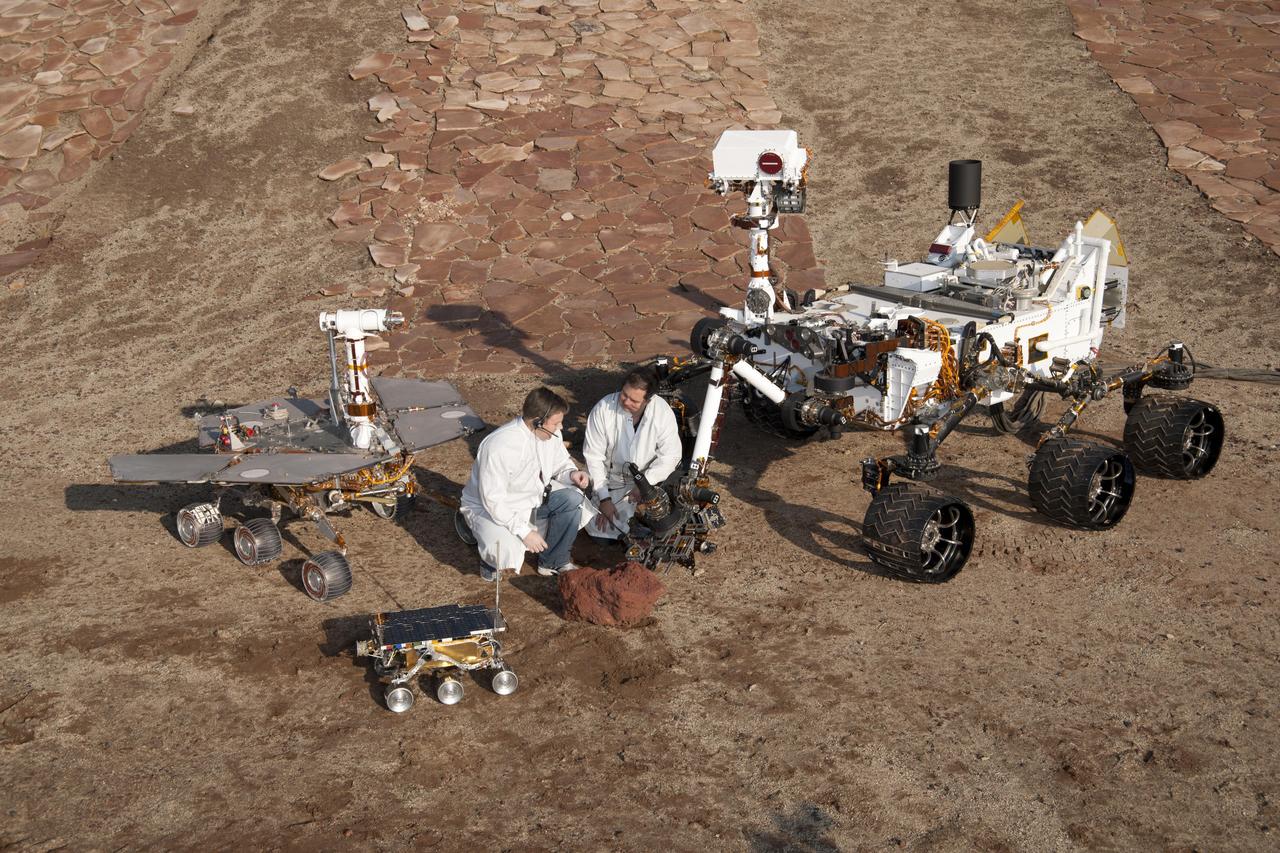
Two spacecraft engineers stand with three generations of Mars rovers developed at NASA JPL, Pasadena, Ca. Front and center is a flight spare of Sojourner, left is a working sibling to Spirit and Opportunity, right is test rover Curiosity.
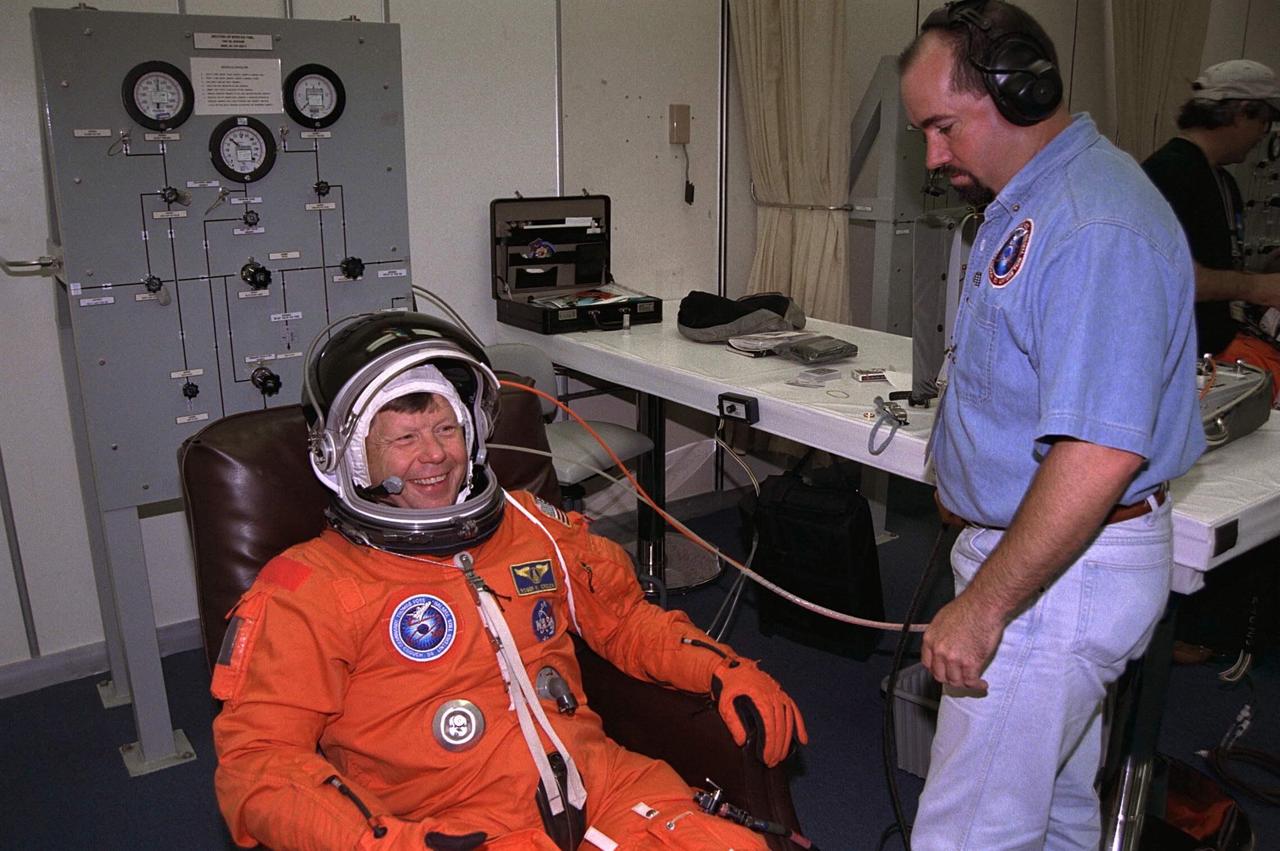
STS-94 Payload Specialist Roger K. Crouch is helped into his launch/entry suit by a suit technician in the Operations and Checkout (O&C) Building after the suit has been given a pressure test. He is the Chief Scientist of the NASA Microgravity Space and Applications Division. He also has served as a Program Scientist for previous Spacelab microgravity missions and is an expert in semiconductor crystal growth. Since Crouch has more than 25 years of experience as a materials scientist, he will be concentrating on the five physics of materials processing experiments in the Middeck Glovebox Facility on the Blue shift. He will also share the workload with Thomas by monitoring the materials furnace experiments during this time. Crouch and six fellow crew members will shortly depart the O&C and head for Launch Pad 39A, where the Space Shuttle Columbia will lift off during a launch window that opens at 1:50 p.m. EDT, July 1. The launch window was opened 47 minutes early to improve the opportunity to lift off before Florida summer rain showers reached the space center
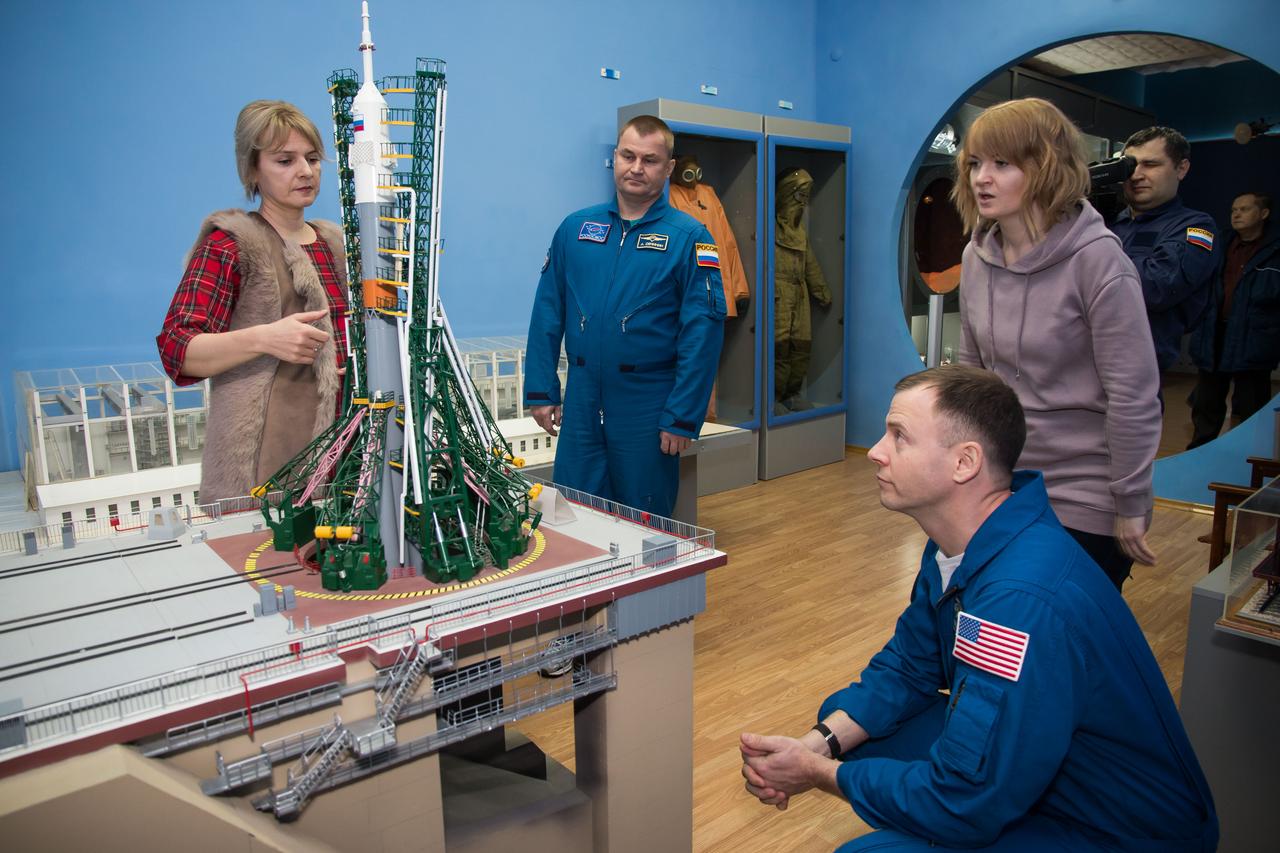
In the city of Baikonur, Kazakhstan, Expedition 55 backup crewmembers Alexey Ovchinin of Roscosmos (second from left) and Nick Hague of NASA (crouching) receive a briefing on the elements of a Soyuz rocket model March 6 during a traditional tour of the cit
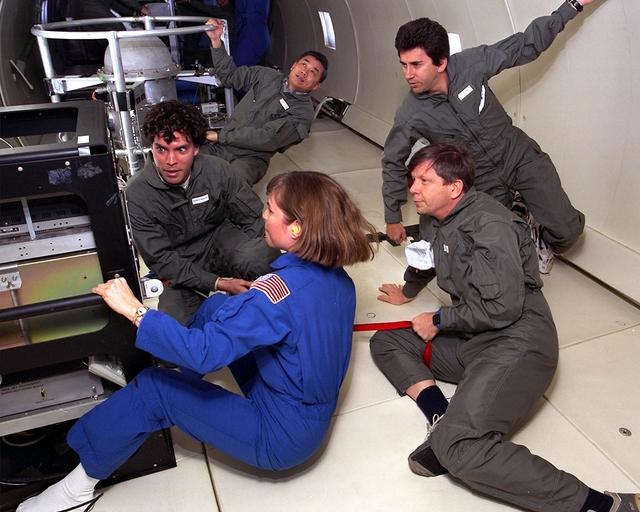
Mission specialist Janice Voss (center, foreground) trains with payload specialists Paul Rorney (right, background) and Roger Crouch (right, foreground) for the Materials Sciences Lab-1 (MSL-1) mission flown in 1997. They are aboard the NASA KC-135 low-g training aircraft.
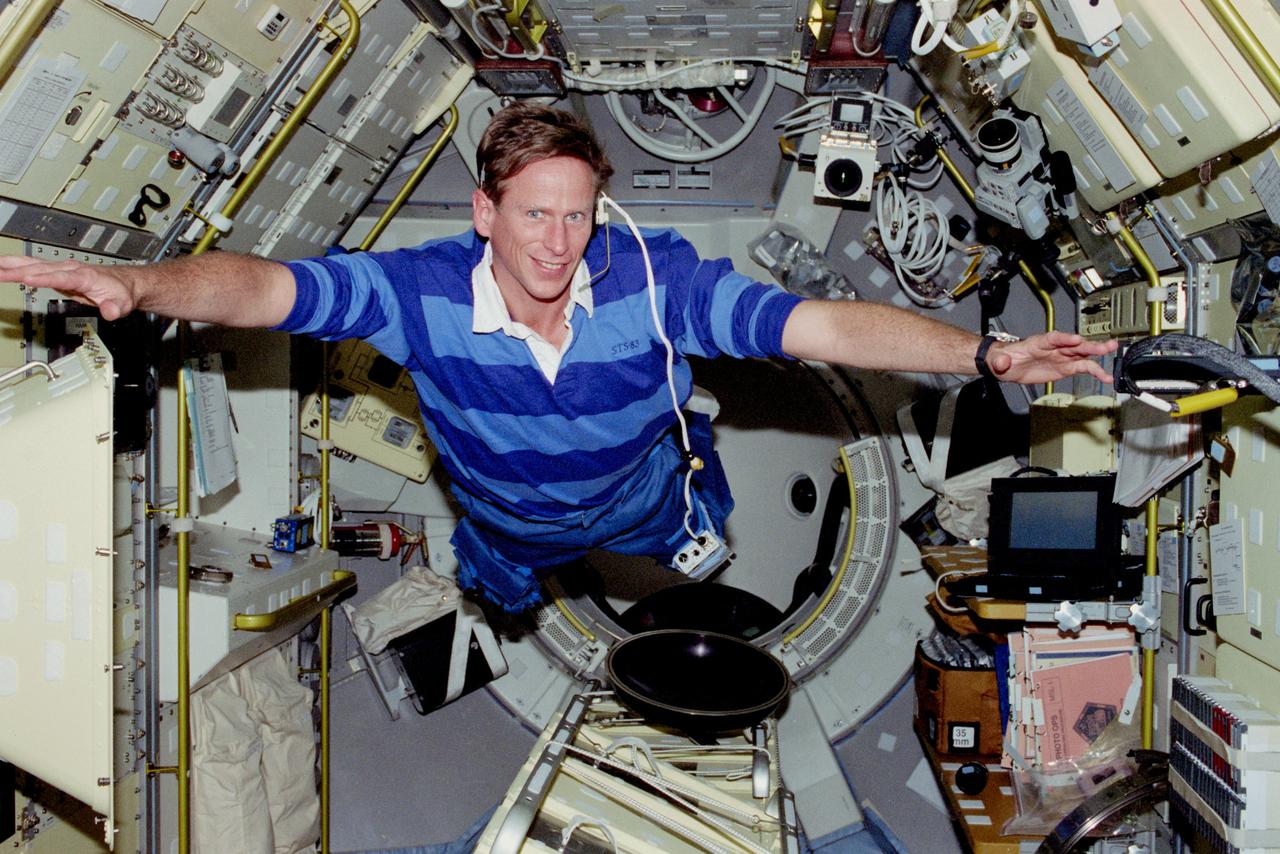
STS083-308-014 (4-8 April 1997)--- Astronaut Michael L. Gernhardt, mission specialist, appears comfortable with the Microgravity characteristic of space flight as he prepares to go to work in the Spacelab Science Module in the cargo bay of the Earth-orbiting Space Shuttle Columbia. Gernhardt, along with four other NASA astronauts and two payload specialists supporting the Microgravity Sciences Laboratory (MSL-1) mission were less than a fourth of the way through a scheduled 16-day flight when a power problem cut short their planned stay.
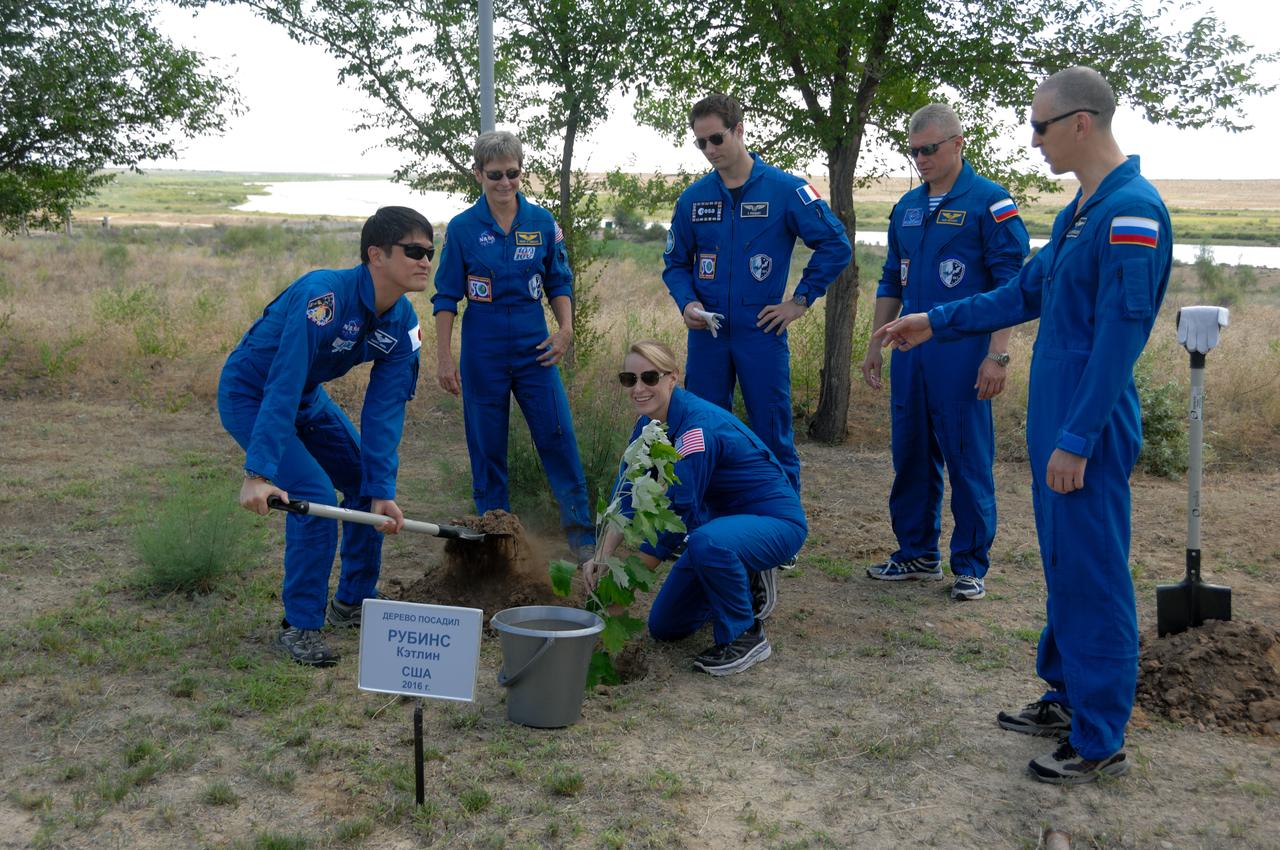
At the Cosmonaut Hotel in Baikonur, Kazakhstan, Expedition 48-49 crewmember Takuya Onishi of the Japan Aerospace Exploration Agency (left) lends a hand to NASA’s Kate Rubins (crouching) as she plants a tree in her name June 30 in traditional pre-launch activities. Standing from left to right are backup crewmembers Peggy Whitson of NASA, Thomas Pesquet of the European Space Agency and Oleg Novitskiy of Roscosmos and prime crewmember Anatoly Ivanishin of Roscosmos. Rubins, Ivanishin and Onishi will launch July 7, Baikonur time, on the Soyuz MS-01 spacecraft for a planned four-month mission on the International Space Station. NASA/Alexander Vysotsky
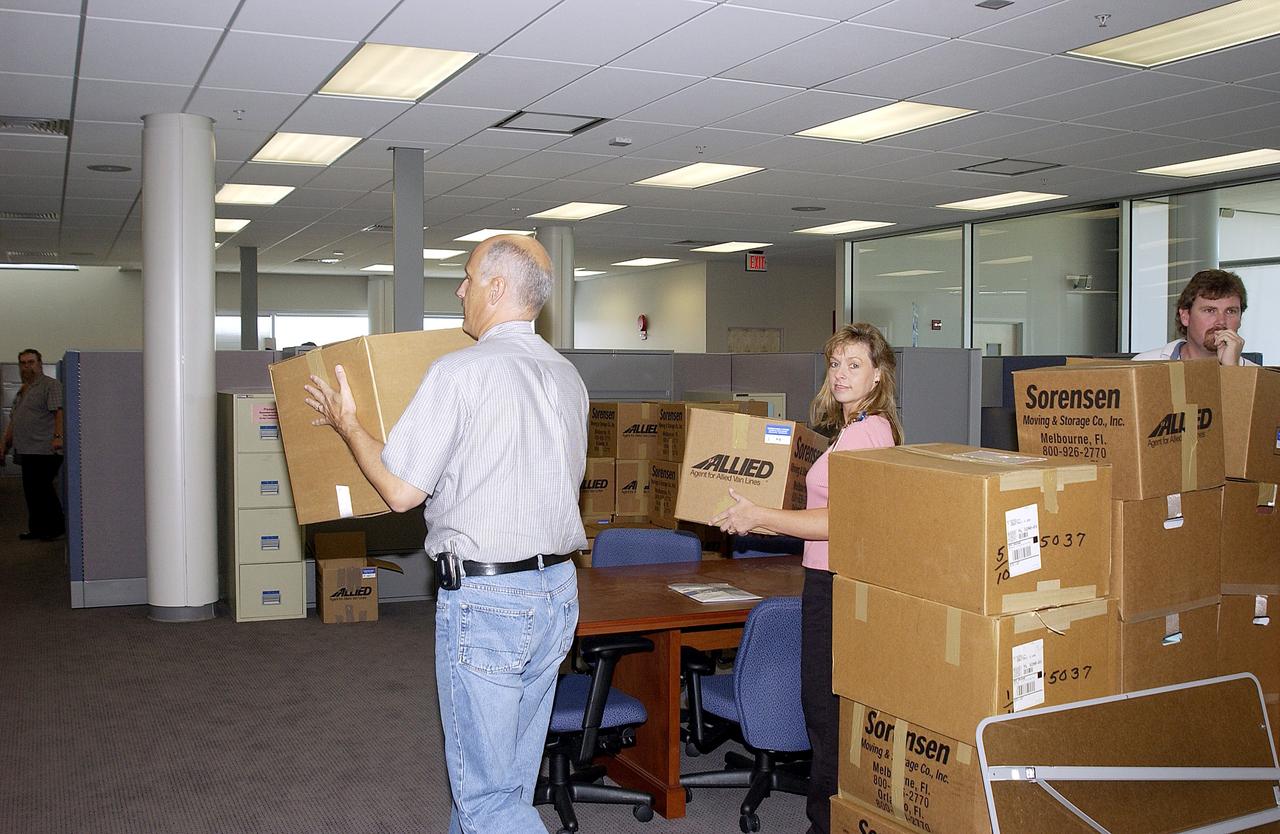
KENNEDY SPACE CENTER, FLA. - Ivan Rodriguez, with Bionetics, and Michelle Crouch and Larry Burns, with Dynamac, carry boxes of equipment into the Space Life Sciences Lab (SLSL), formerly known as the Space Experiment Research and Processing Laboratory (SERPL). They are transferring equipment from Hangar L. The new lab is a state-of-the-art facility being built for ISS biotechnology research. Developed as a partnership between NASA-KSC and the State of Florida, NASA’s life sciences contractor will be the primary tenant of the facility, leasing space to conduct flight experiment processing and NASA-sponsored research. About 20 percent of the facility will be available for use by Florida’s university researchers through the Florida Space Research Institute.
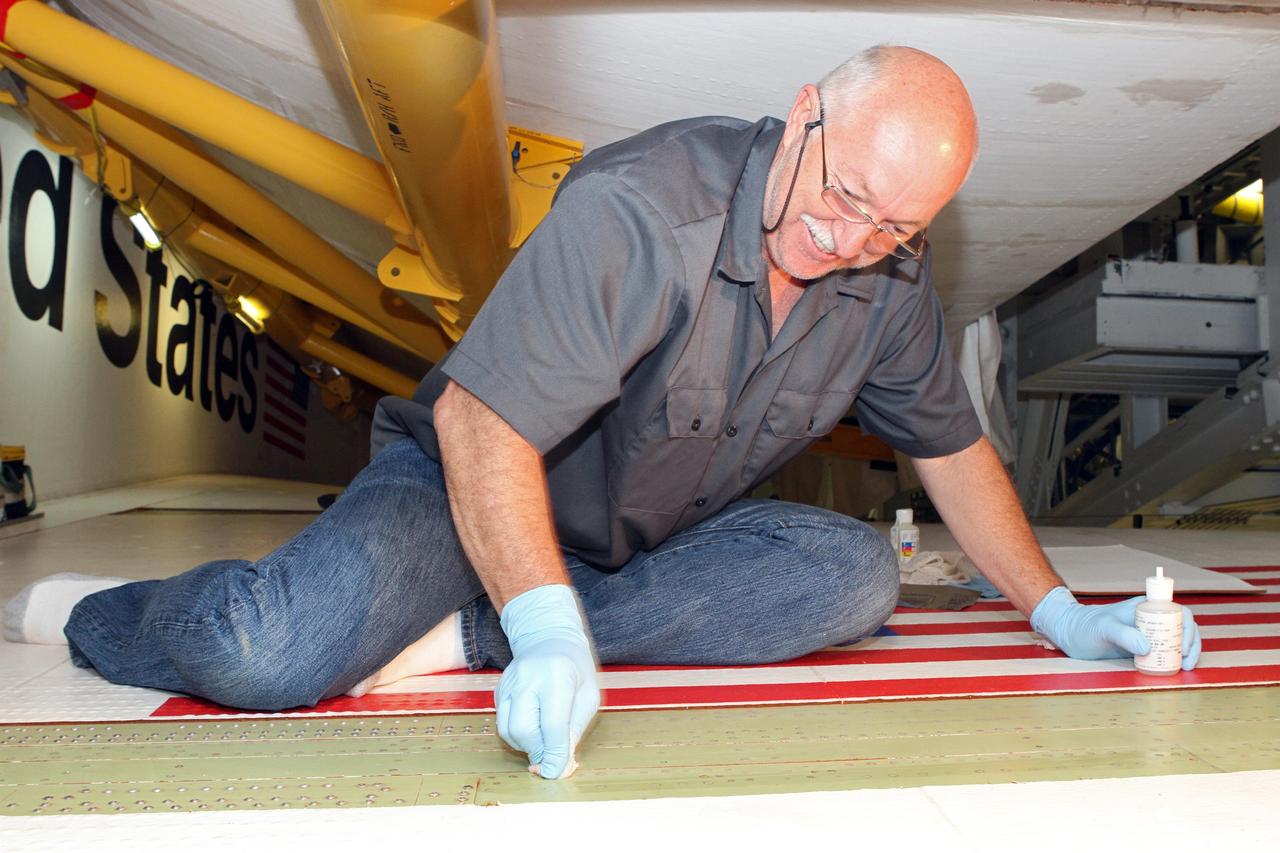
CAPE CANAVERAL, Fla. – Inside Orbiter Processing Facility-2 at NASA's Kennedy Space Center in Florida, Mike Williams, a thermal protection system technician with United Space Alliance, crouches on space shuttle Endeavour's right wing as he prepares the wing surface for tile bonding. Ongoing transition and retirement activities are preparing the spacecraft for public display at the California Science Center in Los Angeles. Endeavour flew 25 missions during its 19-year career. Photo credit: NASA/Cory Huston
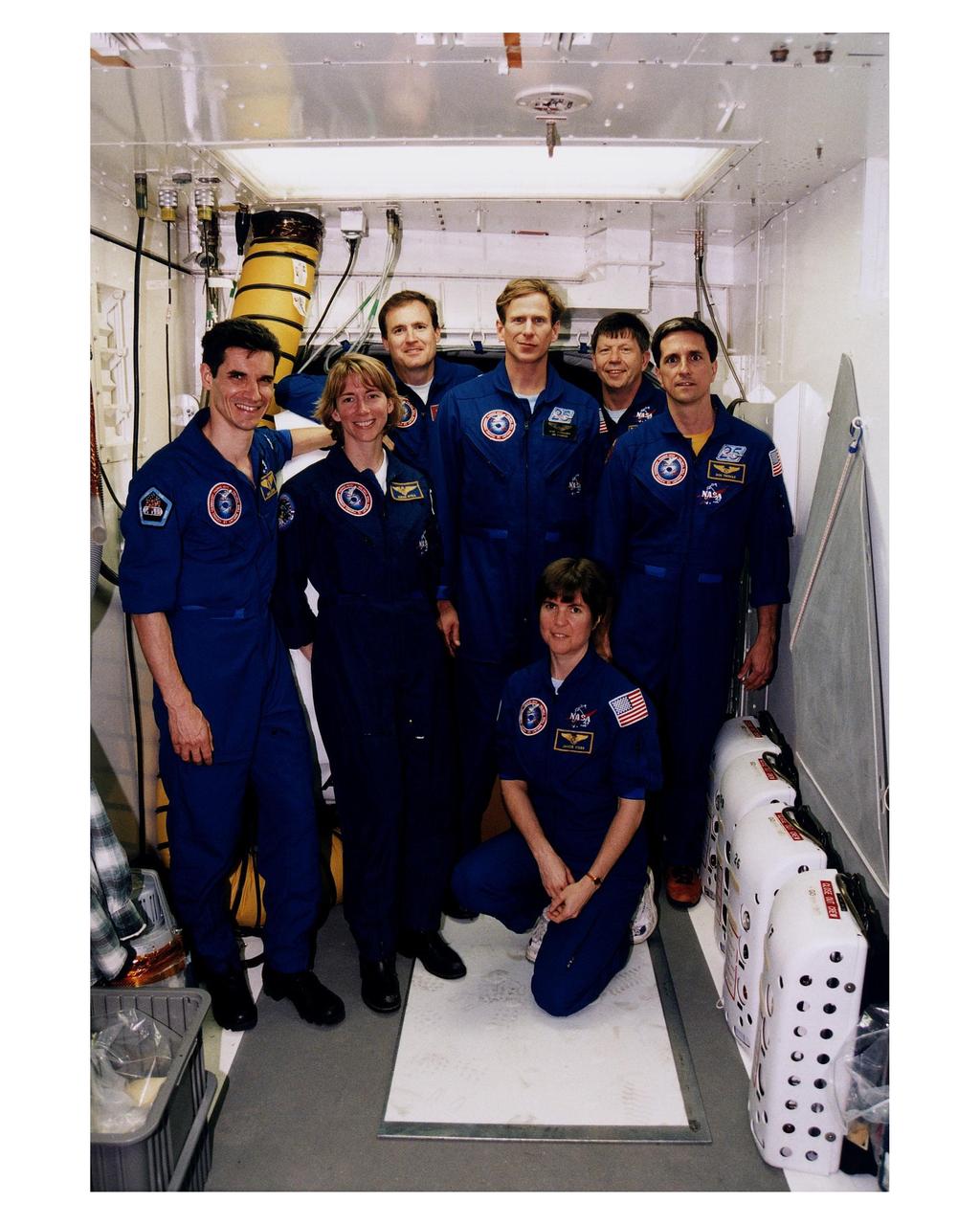
The STS-83 crew poses in the White Room at Launch Complex 39A during the crew's <a href="http://www-pao.ksc.nasa.gov/kscpao/release/1997/40-97.htm">Terminal Countdown Demonstration Test (TCDT).</a> From left to right, standing, they are Payload Specialist Gregory T. Linteris, Pilot Susan L. Still, Mission Commander James D. Halsell, Mission Specialist Michael L. Gernhardt, Payload Specialist Roger K. Crouch, and Mission Specialist Donald Thomas. Mission Specialist Janice E. Voss is kneeling
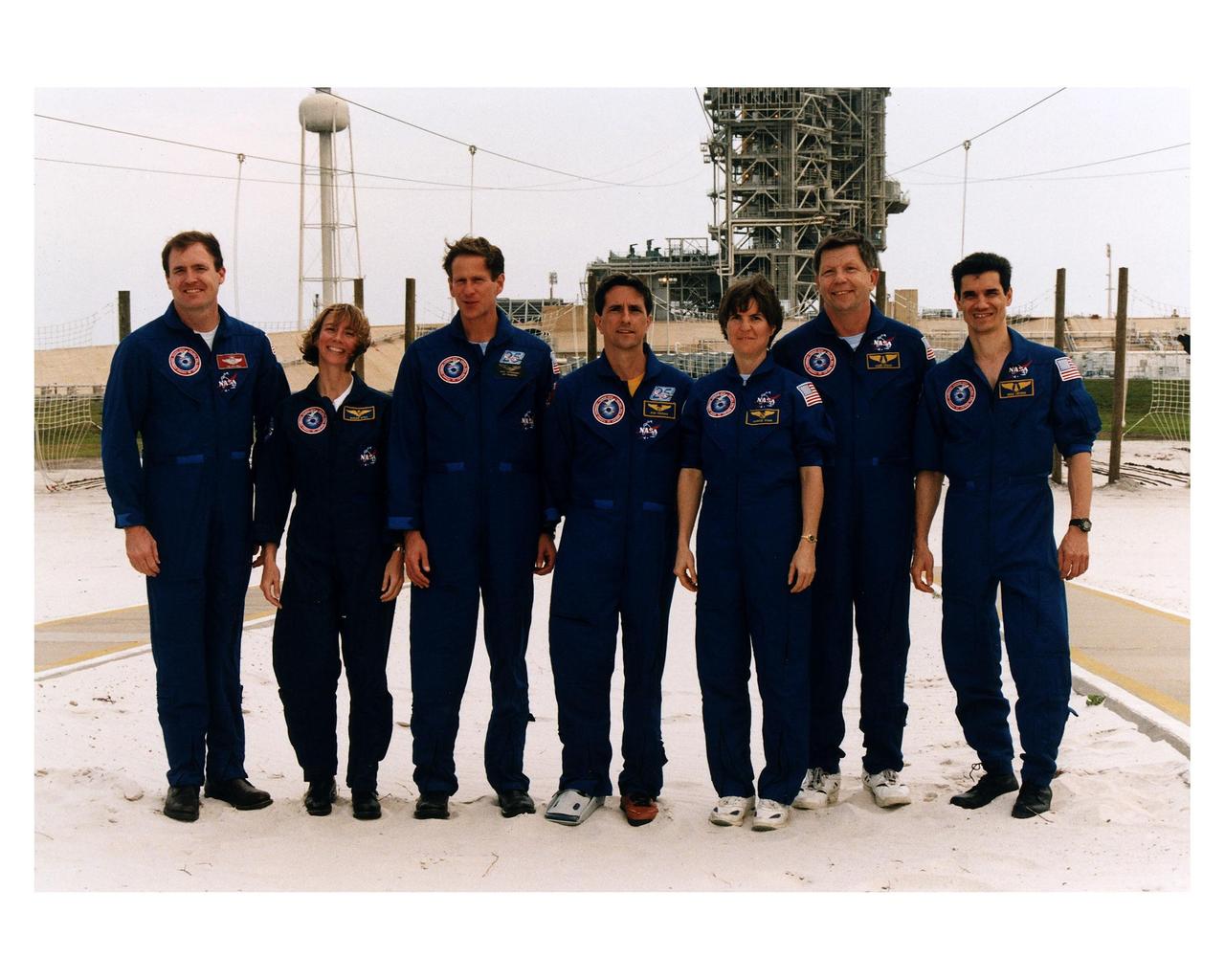
The STS-83 crew poses for the media at Launch Complex 39A during the crew's <a href="http://www-pao.ksc.nasa.gov/kscpao/release/1997/40-97.htm">Terminal Countdown Demonstration Test (TCDT).</a> From left to right, they are Mission Commander James D. Halsell; Pilot Susan L. Still; Mission Specialists Michael L. Gernhardt, Donald Thomas, and Janice E. Voss; and Payload Specialists Roger K. Crouch and Gregory T. Linteris
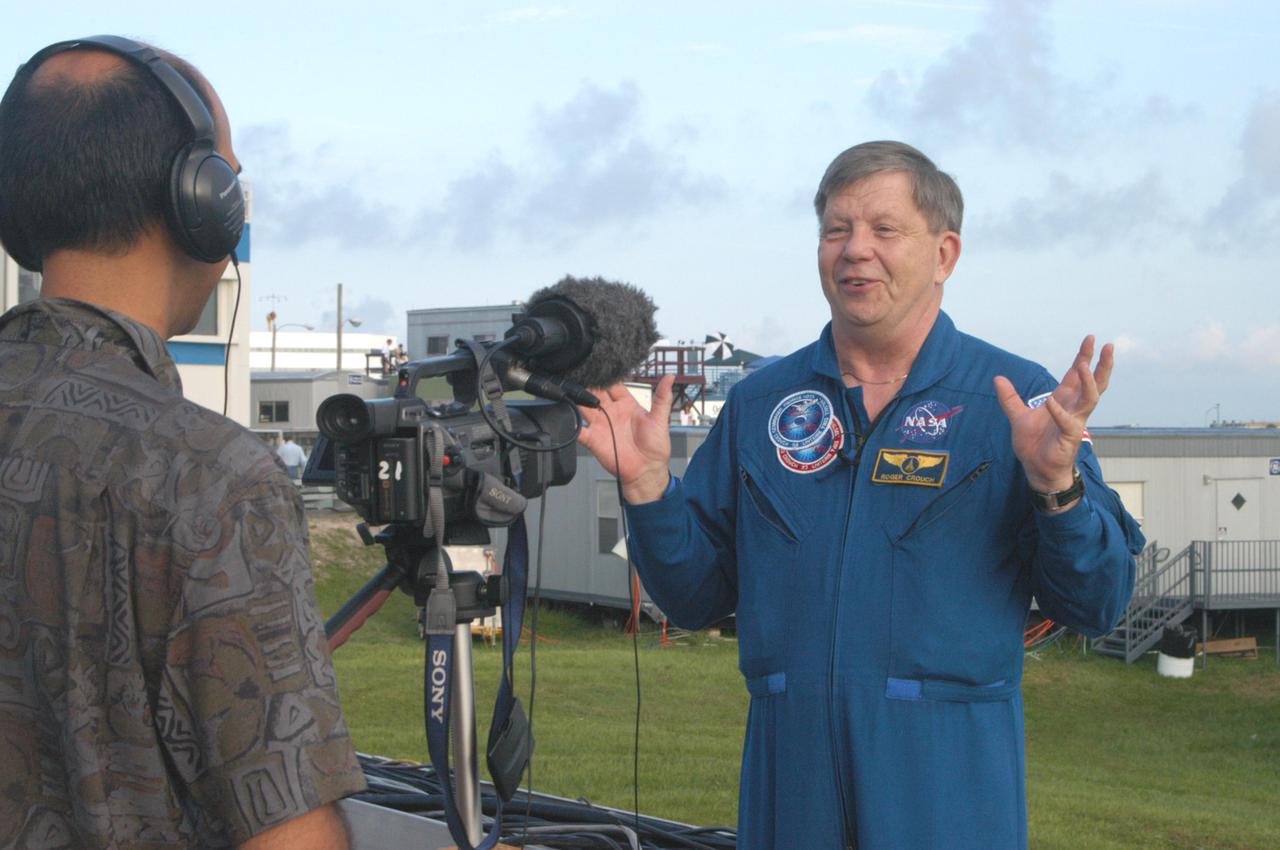
KENNEDY SPACE CENTER, FLA. - Roger Crouch, a payload specialist, talks to the media prior to the launch at 3:51 p.m. of Space Shuttle Discovery on the historic Return to Flight mission STS-114. He has flown on two Shuttle missions, STS-83 and STS-94. STS-114 is the 114th Space Shuttle flight and the 31st for Discovery. The 12-day mission is expected to end with touchdown at the Shuttle Landing Facility at 11:06 a.m. July 25.
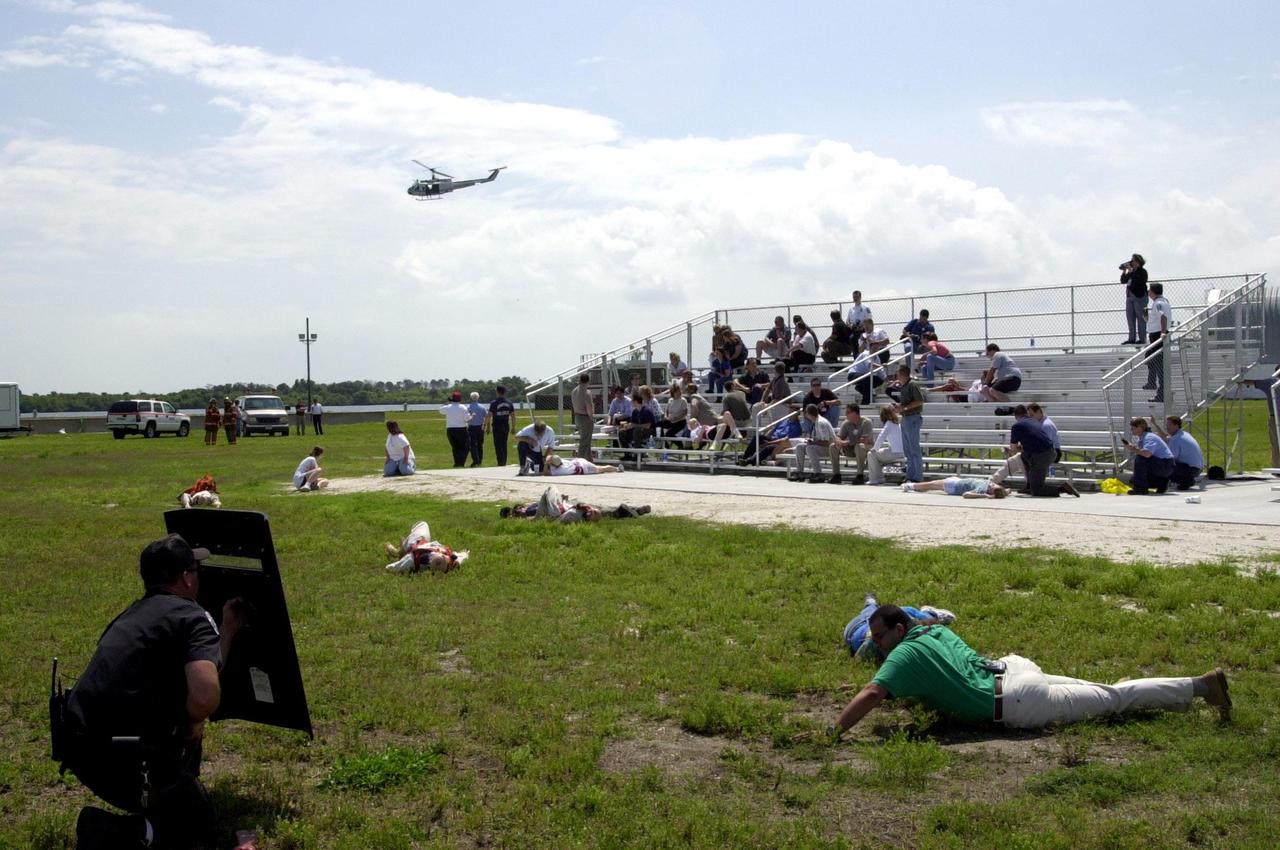
KENNEDY SPACE CENTER, FLA. -- During a staged mass casualty exercise in the Launch Complex 39 area, a security officer crouches behind a shield as if under fire by a sniper. Employees play roles of the victims (seen on the ground and in the bleachers). In the background, a helicopter arrives on the scene.The exercise was staged to validate capabilities of KSC’s fire, medical helicopter transport and security personnel to respond to such an event

KENNEDY SPACE CENTER, FLA. -- During a staged mass casualty exercise in the Launch Complex 39 area, security personnel crouch behind a shield as if under fire by a sniper. Employees play roles of the victims (seen on the ground and in the bleachers). The exercise was staged to validate capabilities of KSC’s fire, medical helicopter transport and security personnel to respond to such an event

STS-83 Payload Specialist Gregory T. Linteris, Mission Specialist Janice E. Voss, and Payload Specialist Roger K. Crouch participate in emergency egress training at Launch Complex 39A during the crew's <a href="http://www-pao.ksc.nasa.gov/kscpao/release/1997/40-97.htm">Terminal Countdown Demonstration Test (TCDT).</a> They are seen here in one of the pads' seven <a href="http://www-pao.ksc.nasa.gov/kscpao/nasafact/pads.htm#emergenc">slidewire baskets.</a
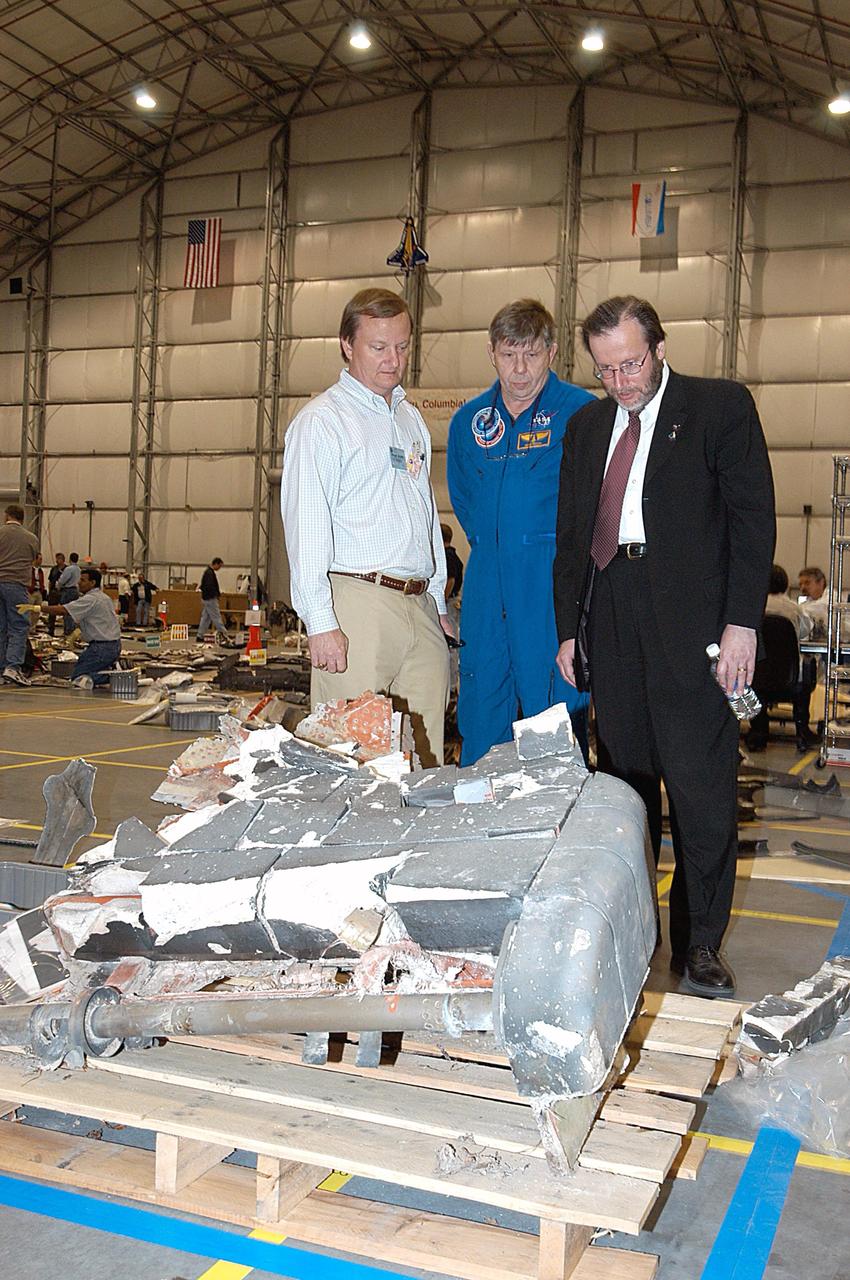
KENNEDY SPACE CENTER, FLA. - In the RLV Hangar at KSC, Shuttle Launch Director Mike Leinbach (left) shows some of the debris from Space Shuttle Columbia to former payload specialist Dr. Roger Crouch (center) and NASA Chief of Staff and White House liaison Courtney Stadd. The search of more than 500,000 acres of primary recovery area for Columbia material has passed the halfway mark. To date about 28 percent of Columbia, by weight, has been delivered to the hangar.
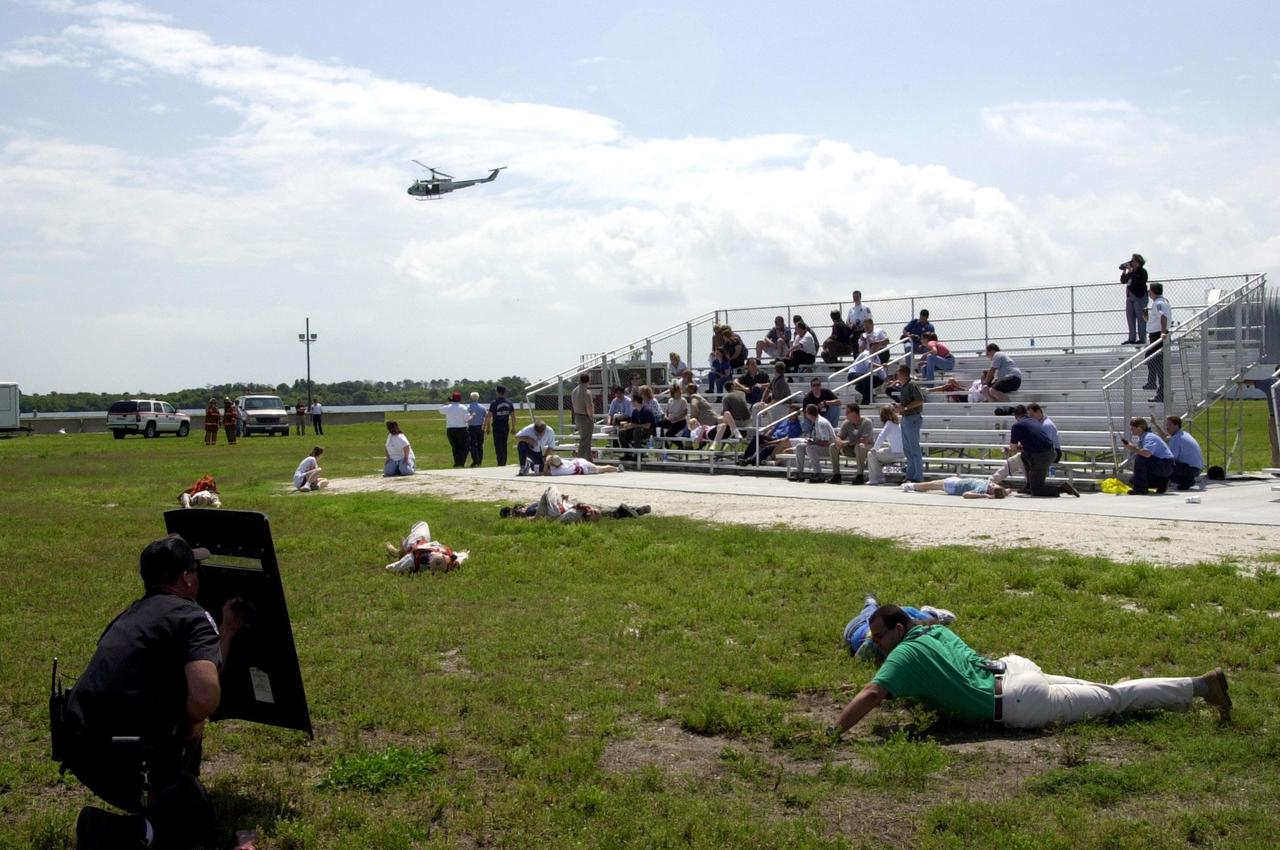
KENNEDY SPACE CENTER, FLA. -- During a staged mass casualty exercise in the Launch Complex 39 area, a security officer crouches behind a shield as if under fire by a sniper. Employees play roles of the victims (seen on the ground and in the bleachers). In the background, a helicopter arrives on the scene.The exercise was staged to validate capabilities of KSC’s fire, medical helicopter transport and security personnel to respond to such an event
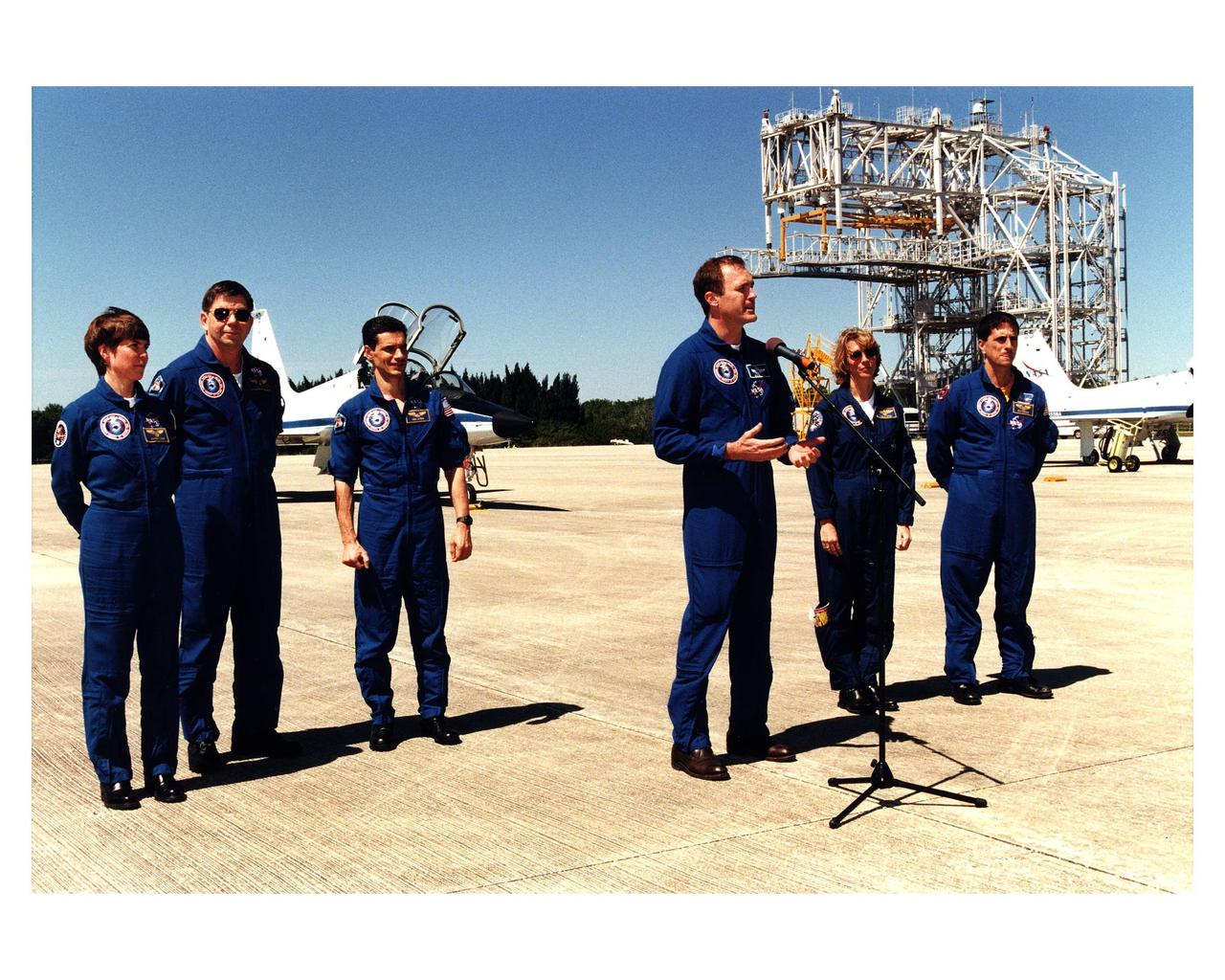
With the mate-demate device as backdrop, six of the seven STS-83 crew members speak to the media after arriving at Kennedy Space Center's Shuttle Landing Facility prior to Space Shuttle Columbia's launch. From left to right, they are Payload Commander Janice E. Voss; Payload Specialists Roger K. Crouch and Gregory T. Linteris; Commander James D. Halsell, Jr.; Pilot Susan Leigh Still; and Mission Specialist Donald A. Thomas. Mission Specialist Michael L. Gernhardt arrived separately later in the afternoon
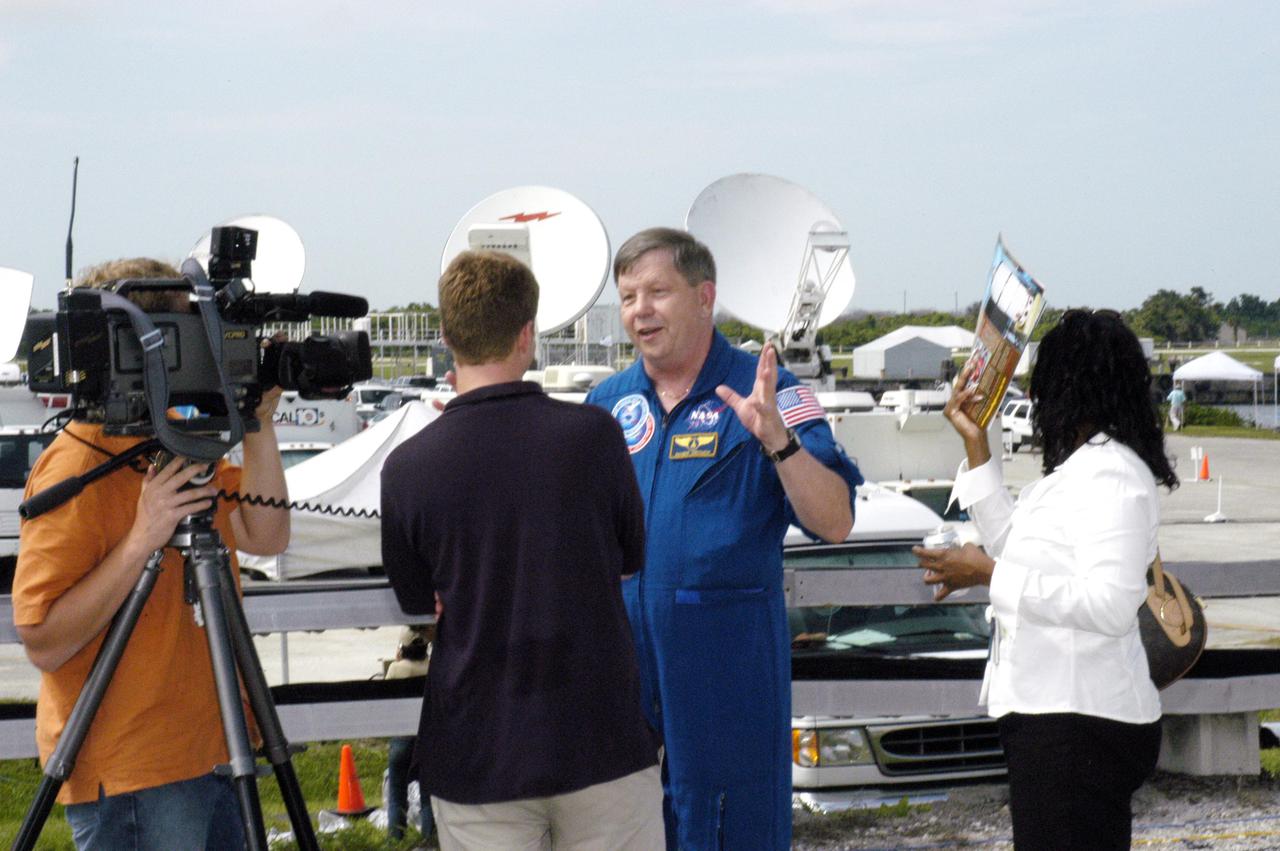
KENNEDY SPACE CENTER, FLA. - Roger Crouch (center), a payload specialist, talks to the media prior to the launch of Space Shuttle Discovery on the historic Return to Flight mission STS-114. He has flown on two Shuttle missions, STS-83 and STS-94. STS-114 is the 114th Space Shuttle flight and the 31st for Discovery. More than a thousand media representatives from 36 states, the District of Columbia and 32 countries converged on the News Center for the historic launch.
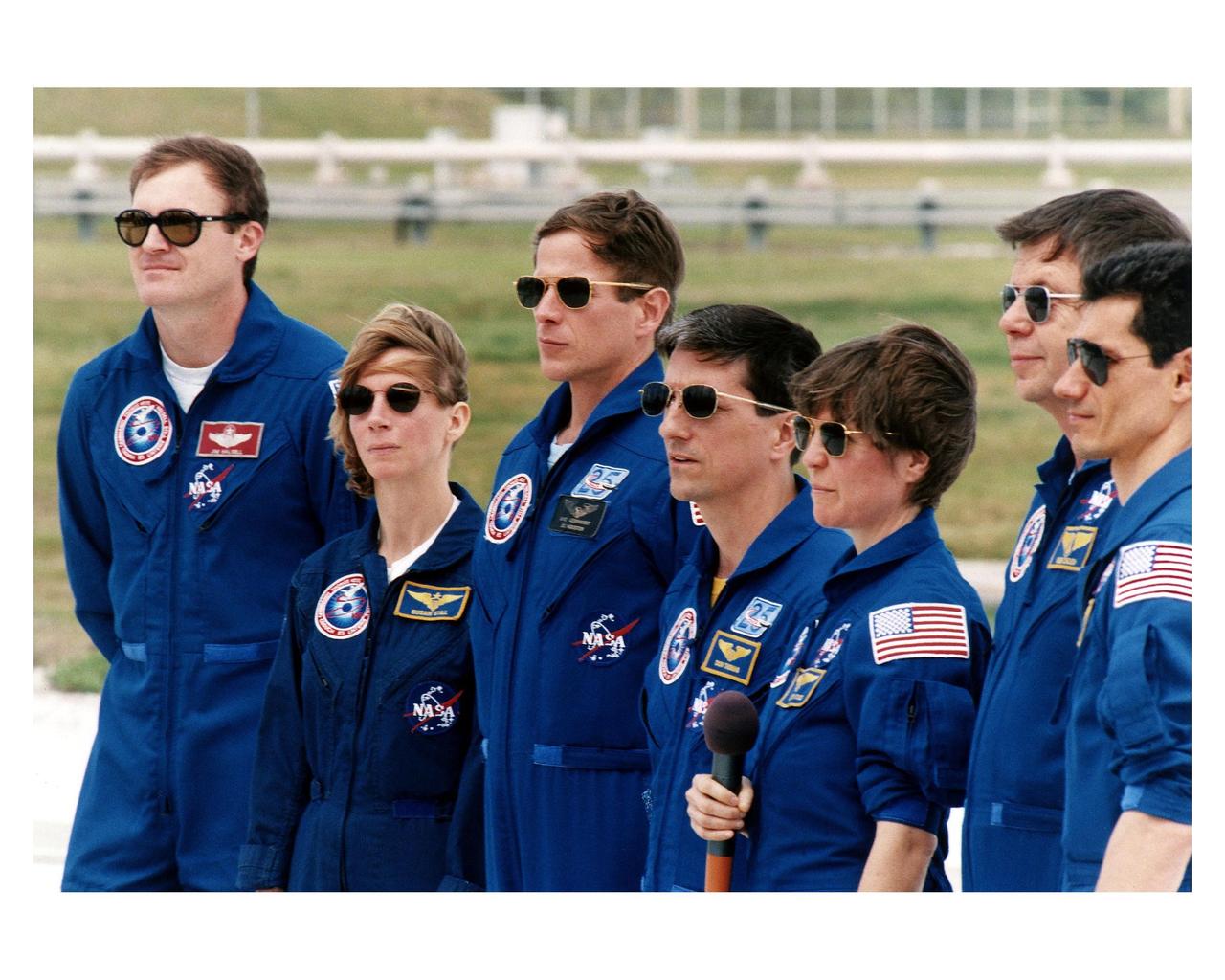
The Space Shuttle Mission STS-83 crew talks to the media at Launch Complex 39A during the crew's <a href="http://www-pao.ksc.nasa.gov/kscpao/release/1997/40-97.htm">Terminal Countdown Demonstration Test (TCDT).</a> From left to right, they are Mission Commander James D. Halsell; Pilot Susan L. Still; Mission Specialists Michael L. Gernhardt, Donald Thomas, and Janice E. Voss (holding microphone); and Payload Specialists Roger K. Crouch and Gregory T. Linteris
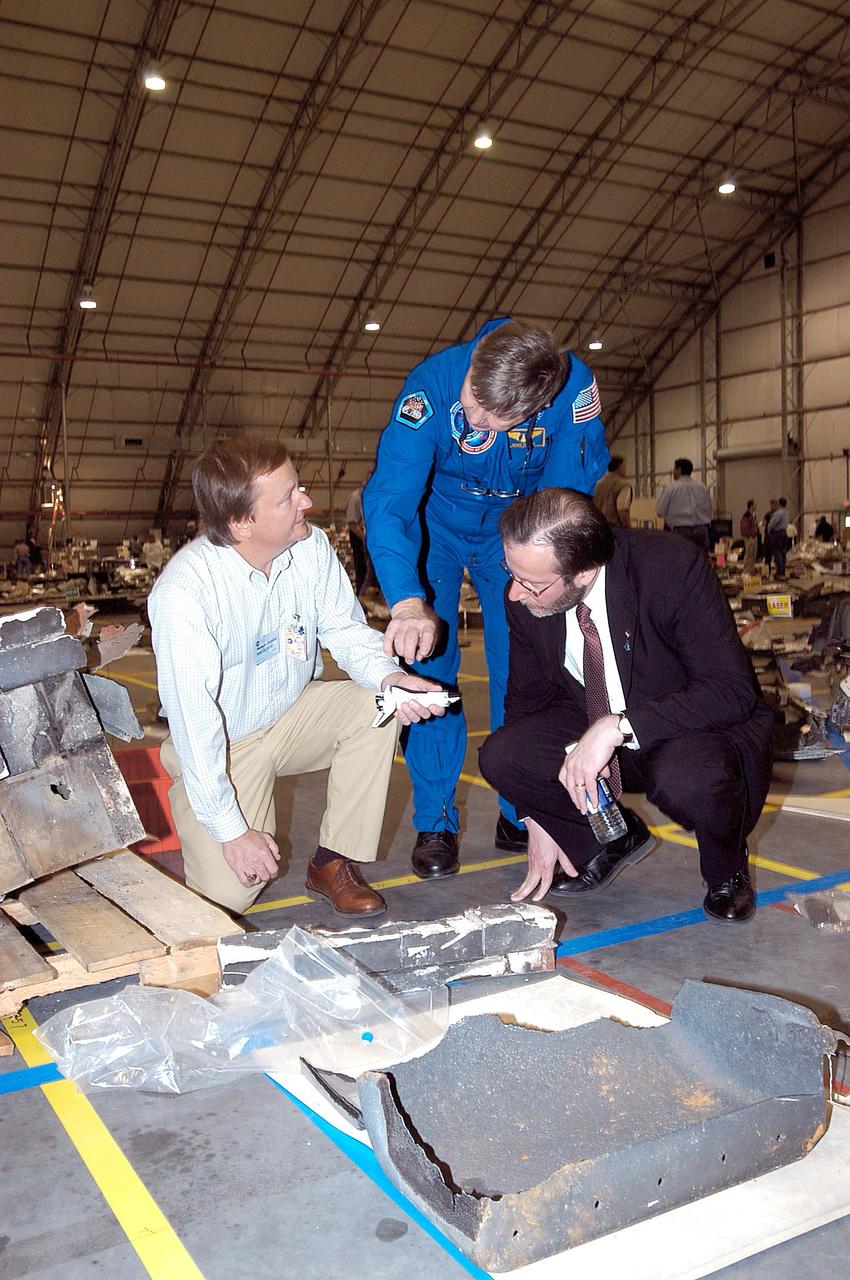
KENNEDY SPACE CENTER, FLA. - In the RLV Hangar at KSC, Shuttle Launch Director Mike Leinbach (left) shows some of the debris from Space Shuttle Columbia to former payload specialist Dr. Roger Crouch (center) and NASA Chief of Staff and White House liaison Courtney Stadd. The search of more than 500,000 acres of primary recovery area for Columbia material has passed the halfway mark. To date about 28 percent of Columbia, by weight, has been delivered to the hangar.
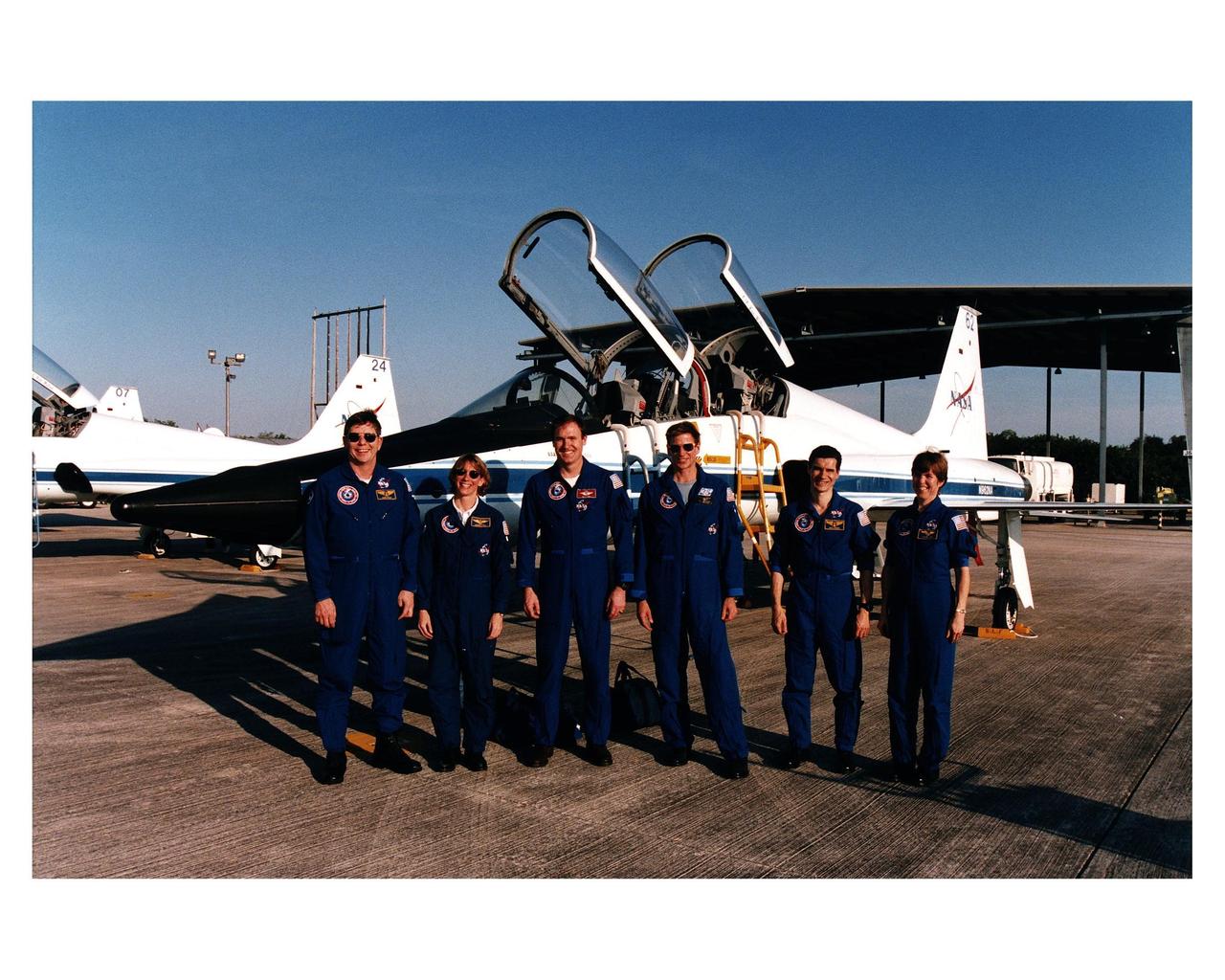
Six of the seven astronauts assigned to the STS-83 crew arrive at Kennedy Space Center's Shuttle Landing Facility in preparation for their <a href="http://www-pao.ksc.nasa.gov/kscpao/release/1997/40-97.htm">Terminal Countdown Demonstration Test.</a> From left to right, they are Payload Specialist Roger K. Crouch, Pilot Susan L. Still, Mission Commander James D. Halsell, Mission Specialist Michael L. Gernhardt, Payload Specialist Gregory T. Linteris, and Mission Specialist Janice E. Voss
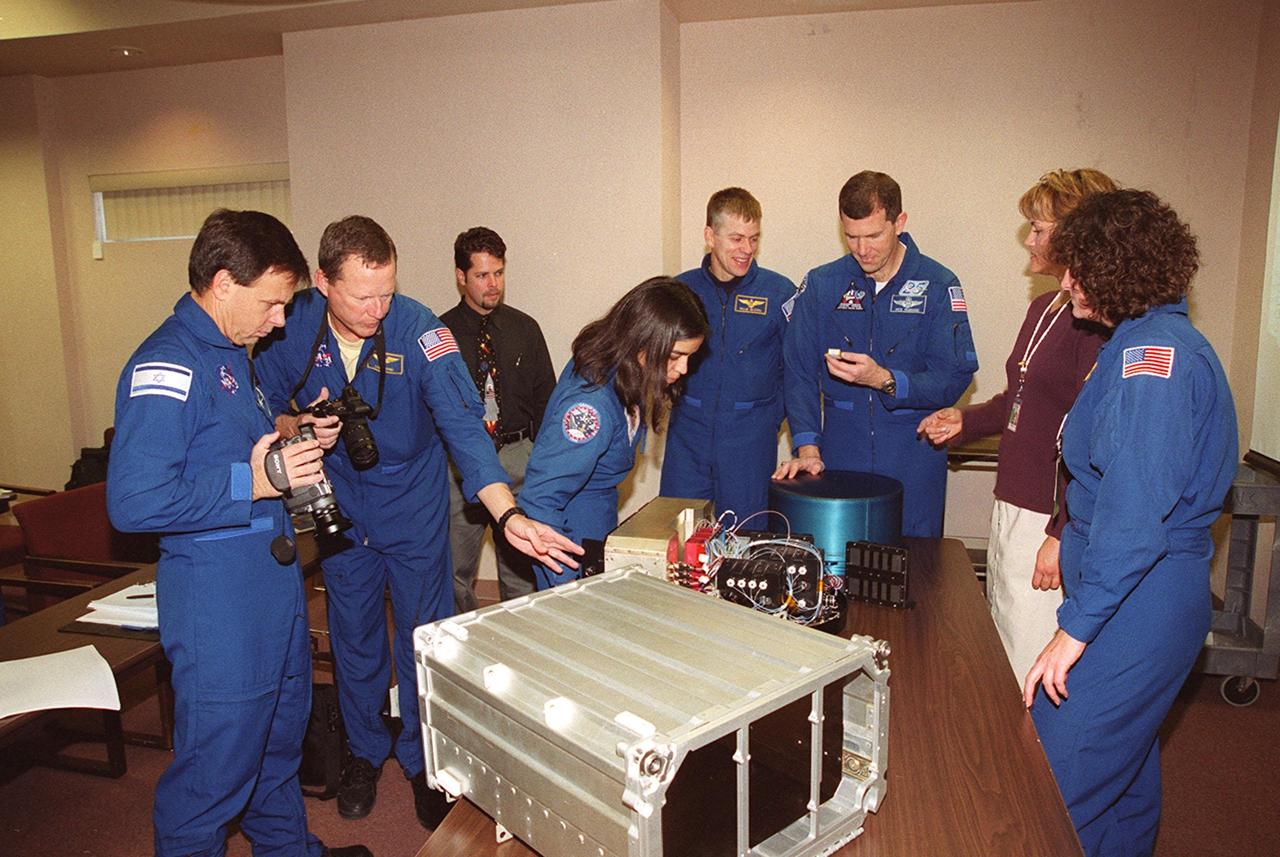
KENNEDY SPACE CENTER, FLA. -- As part of In-Flight Maintenance training, members of the STS-107 crew check out one of the Biotube experiments that will be part of their research mission. From left (in uniform) are Payload Specialist Ilan Ramon of Israel, Mission Specialists David M. Brown and Kalpana Chawla, Pilot William C. “Willie” McCool (crouching behind the table), Commander Rick D. Husband, and Mission Specialist Laurel Clark. STS-107 will carry the SPACEHAB Double Module in its first research flight into space and a broad collection of experiments ranging from material science to life science. It is scheduled to launch July 19, 2001
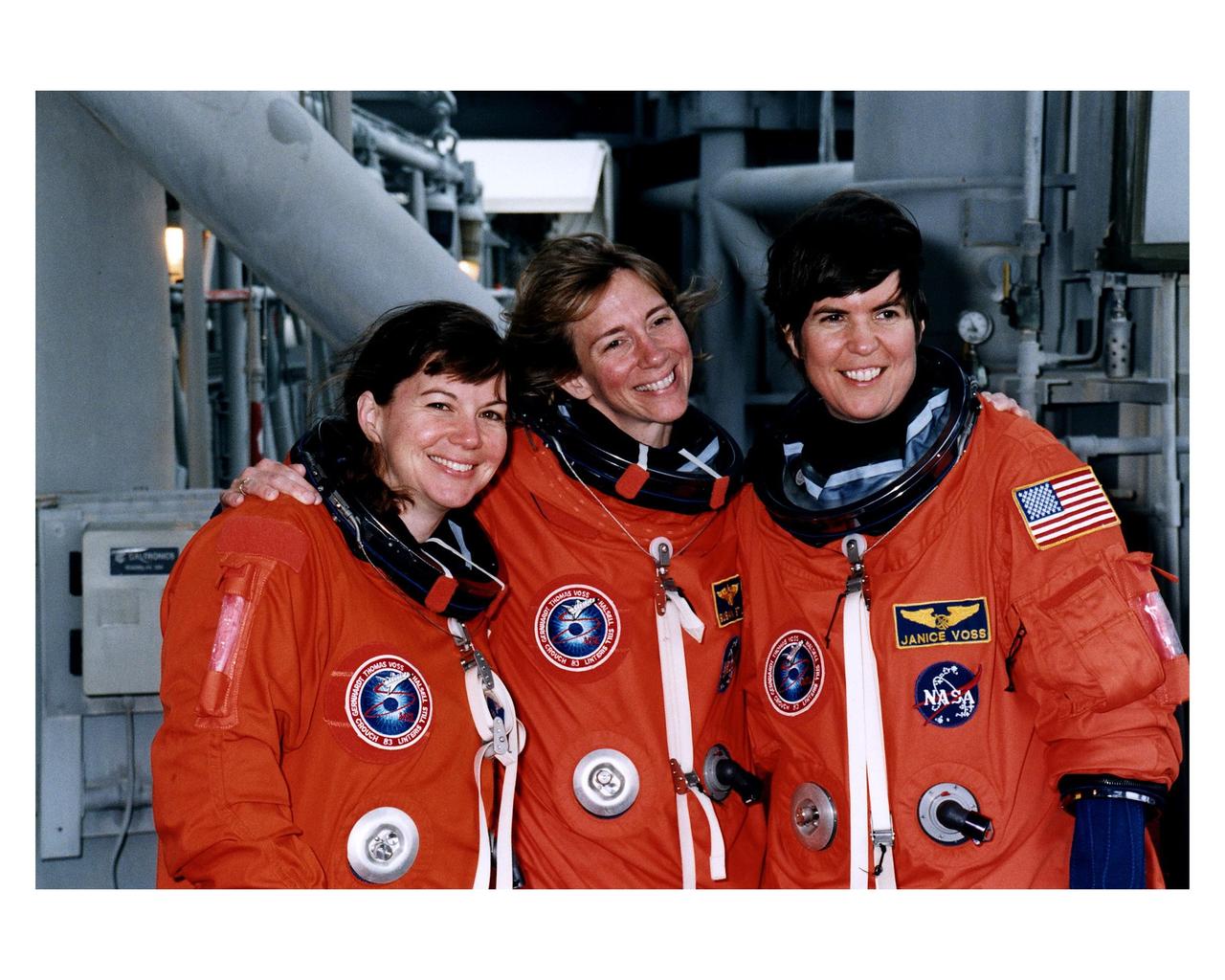
STS-83 Alternate Mission Specialist Catherine "Cady" Coleman, Pilot Susan L. Still and Payload Commander Janice Voss mug for the camera at the 195-foot level of Launch Pad 39A during Terminal Countdown Demonstration Test (TCDT) exercises for that mission. The other crew members for the 16-day Microgravity Science Laboratory-1 (MSL-1) mission are Mission Commander James D. Halsell, Jr.; Mission Specialist Donald A. Thomas; Payload Specialist Gregory T. Linteris; Mission Specialist Michael L. Gernhardt; and Payload Specialist Roger K. Crouch
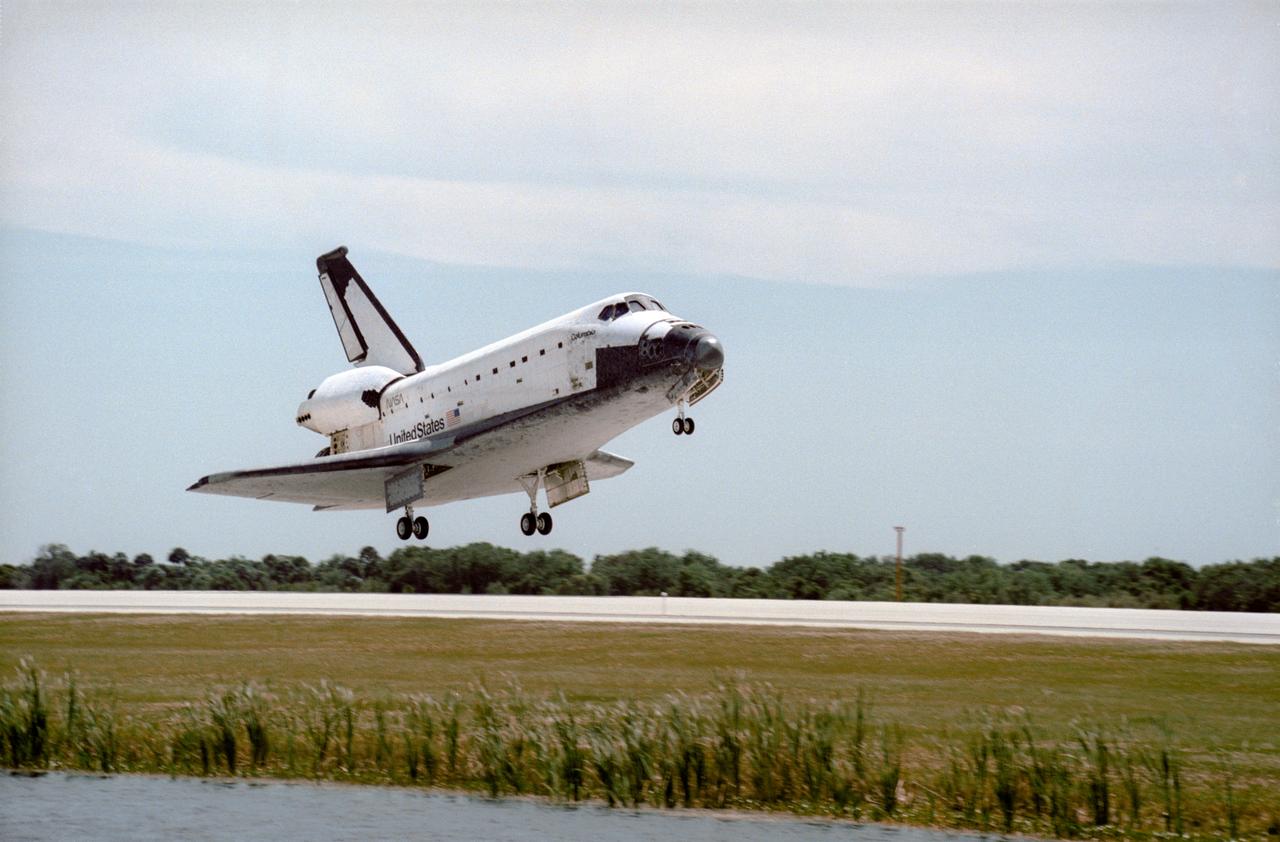
STS083-S-009 (8 April 1997) --- The Space Shuttle Columbia nears touchdown on the Shuttle Landing Facility (SLF) runway at the Kennedy Space Center (KSC), after completing almost four days of a scheduled 16-day mission in Earth-orbit. A problem with one of three fuel cells led to an early landing for the seven-member Microgravity Science Laboratory 1 (MSL-1) crew. Touchdown occurred at 1:33:11 p.m. (EDT), April 8, 1997. Onboard Columbia were James D. Halsell, Jr., Susan L. Still, Janice E. Voss, Donald A. Thomas, Michael L. Gernhardt, Roger K. Crouch and Gregory T. Linteris.
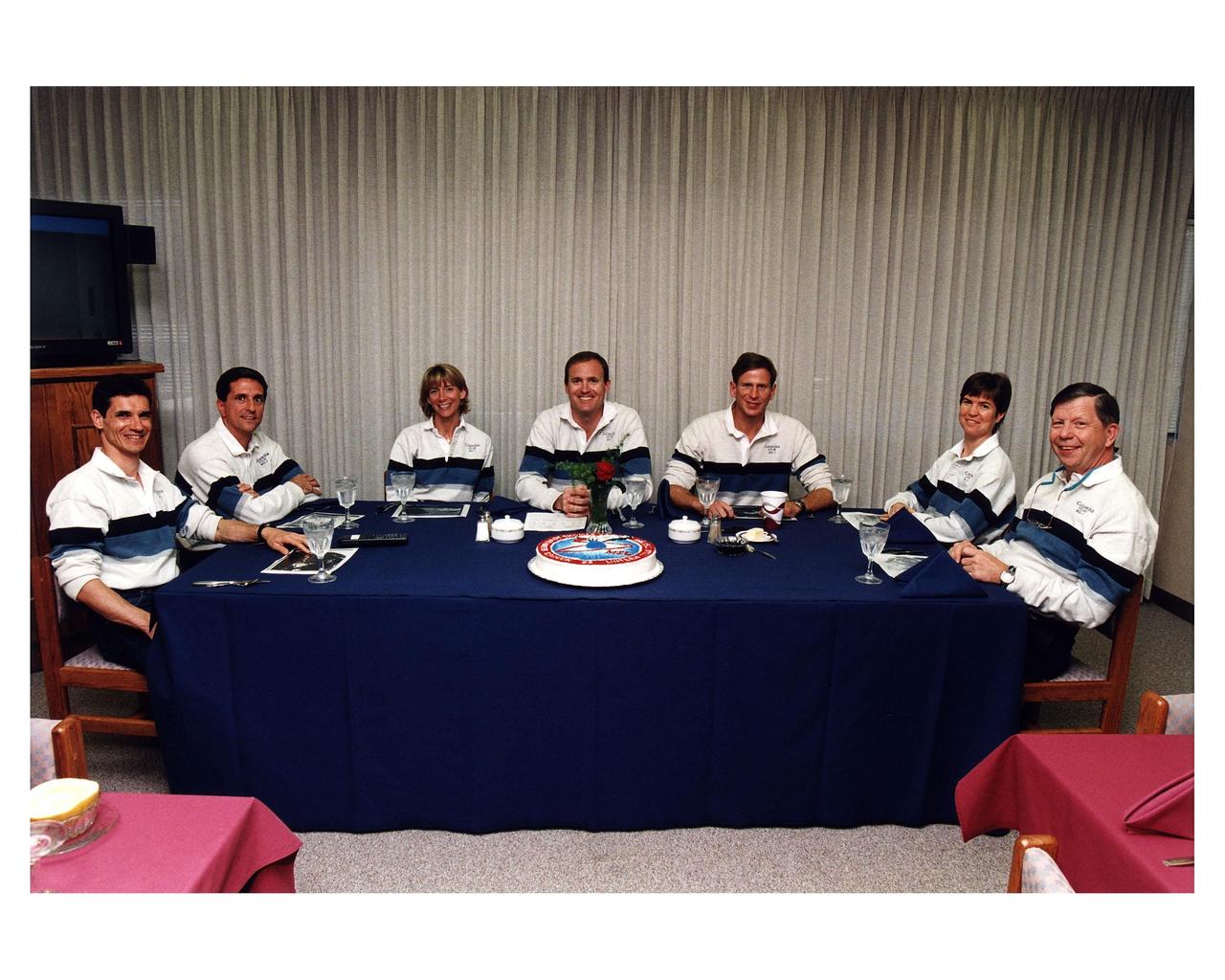
The STS-83 flight crew enjoys the traditional pre-liftoff breakfast in the crew quarters of the Operations and Checkout Building. They are (from left): Payload Specialist Gregory T. Linteris; Mission Specialist Donald A. Thomas; Pilot Susan L. Still; Mission Commander James D. Halsell, Jr.; Mission Specialist Michael L. Gernhardt; Payload Commander Janice E. Voss; and Payload Specialist Roger K. Crouch. After a weather briefing, the flight crew will be fitted with their launch/entry suits and depart for Launch Pad 39A. Once there, they will take their positions in the crew cabin of the Space Shuttle Columbia to await a liftoff during a window that will open at 2:00 p.m. EST, April 4
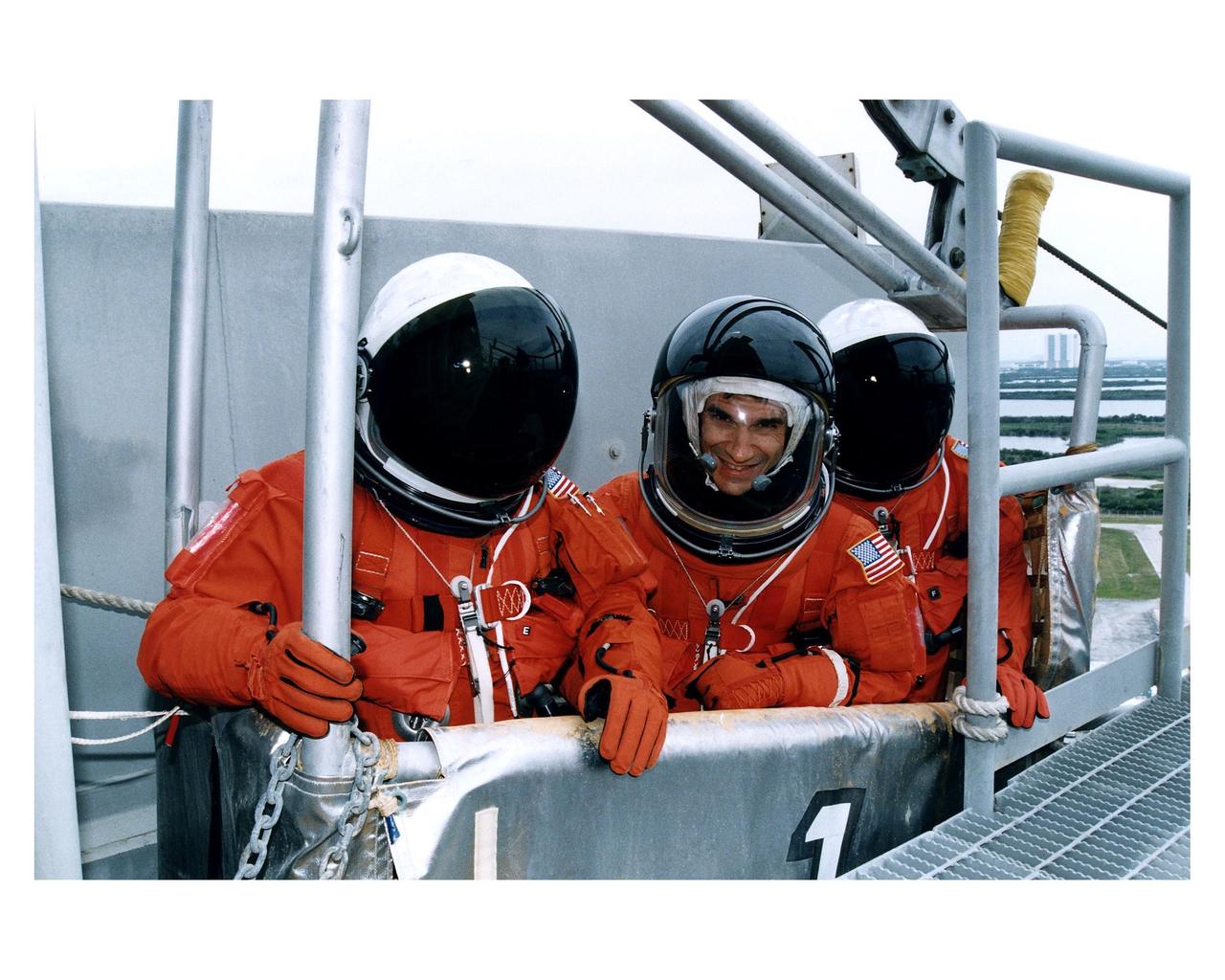
Three members of the STS-83 flight crew check out one of the baskets for the emergency egress slidewire system at Launch Pad 39A during Terminal Countdown Demonstration Test (TCDT) exercises for that mission. Payload Specialist Gregory T. Linteris is in the center of the group. Other crew members on the 16-day Microgravity Science Laboratory-1 (MSL-1) mission are: Mission Commander James D. Halsell, Jr.; Pilot Susan L. Still; Payload Commander Janice Voss; Mission Specialists Michael L. Gernhardt and Donald A. Thomas; and Payload Specialist Roger K. Crouch
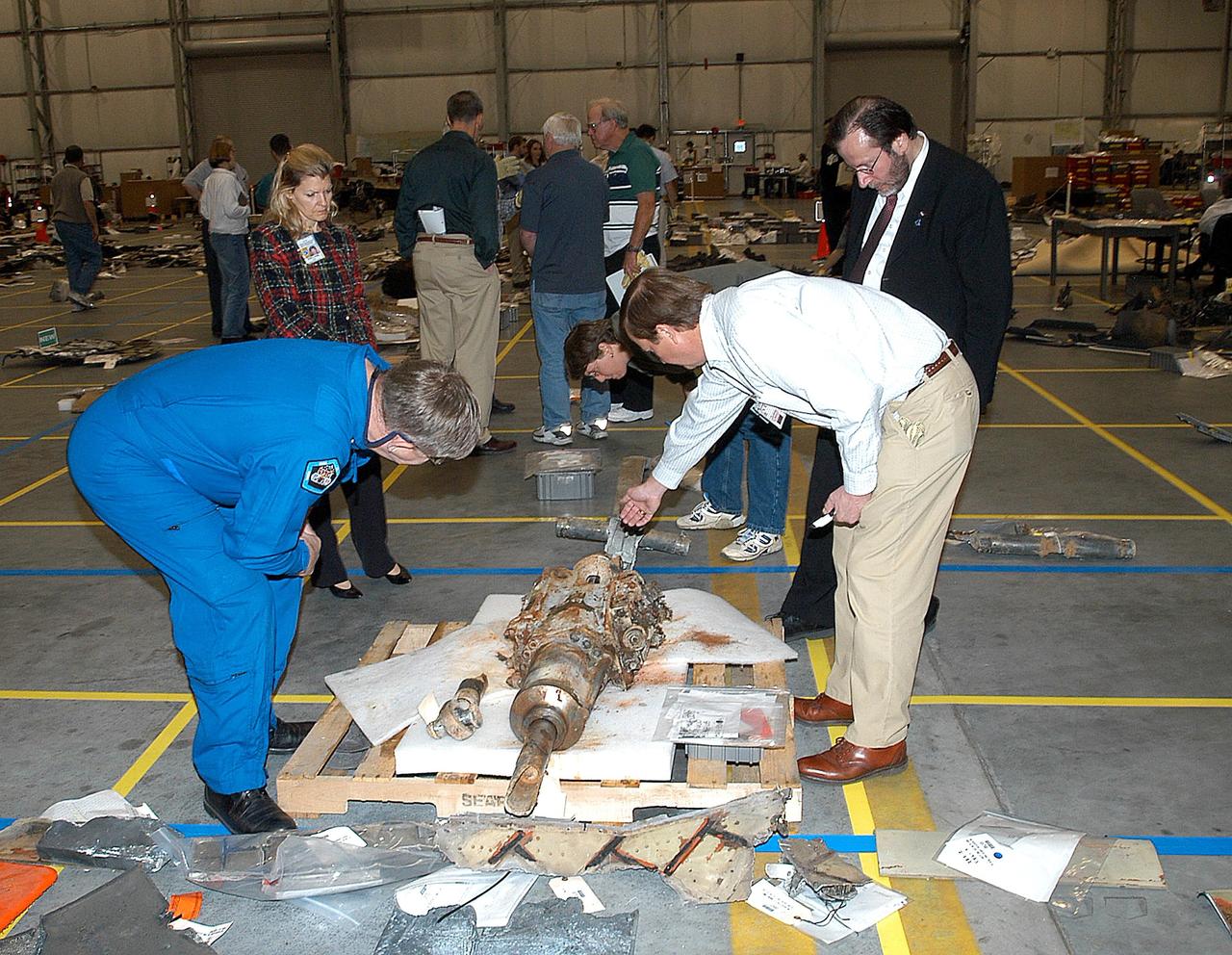
KENNEDY SPACE CENTER, FLA. - - In the RLV Hangar at KSC, examining a piece of debris from Space Shuttle Columbia are former payload specialist Dr. Roger Crouch (left), Shuttle Launch Director Mike Leinbach (right, pointing) and NASA Chief of Staff and White House liaison Courtney Stadd (right). The debris is one of more than 35,000 pieces collected so far. More than 1,218 pieces have been identified. The search of more than 500,000 acres of primary recovery area for Columbia material has passed the halfway mark. To date about 28 percent of Columbia, by weight, has been delivered to the hangar.
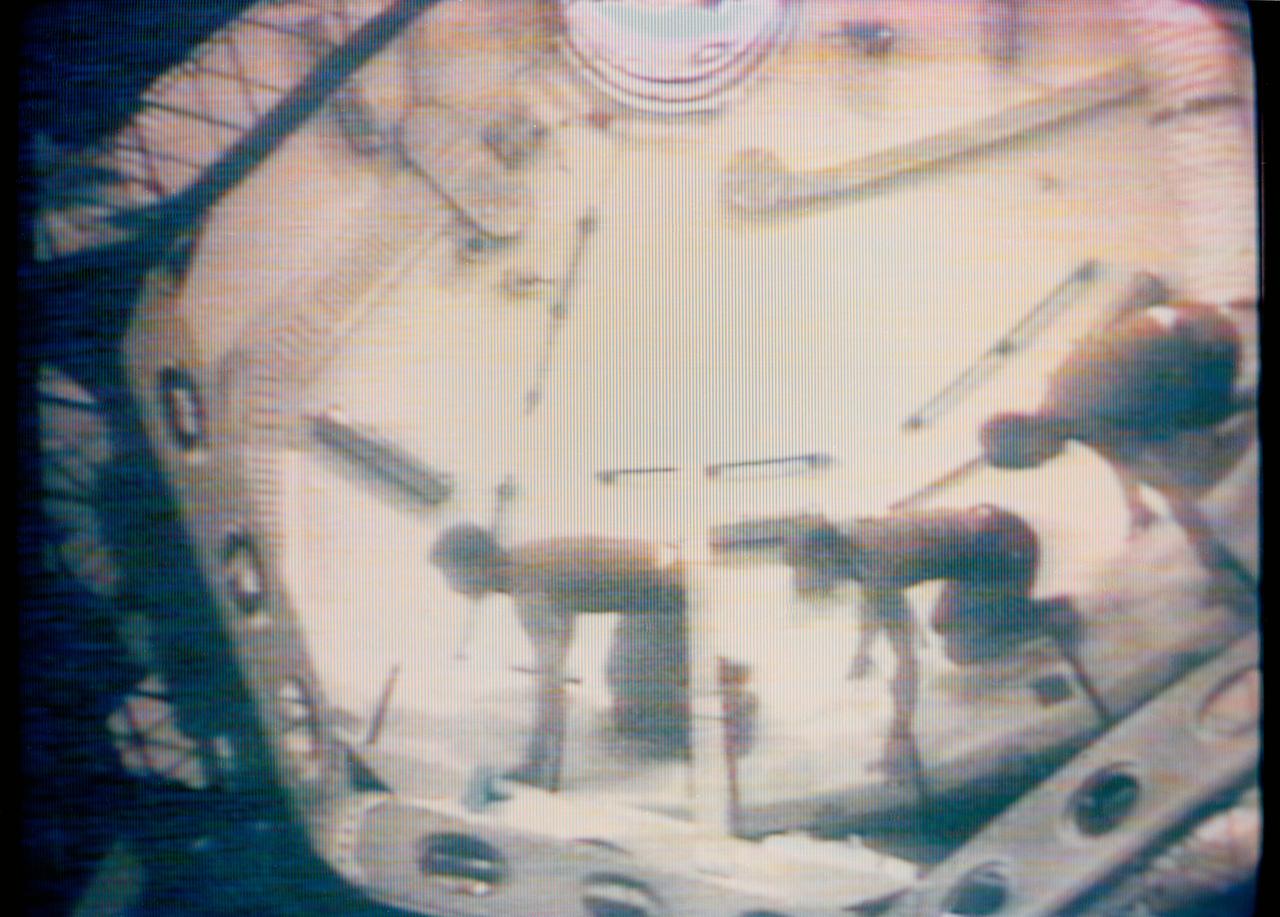
S73-27262 (1 June 1973) --- The three Skylab 2 crewmen give a demonstration on the effects of weightlessness in the Orbital Workshop of the Skylab 1 and 2 space station cluster in Earth orbit, as seen in this reproduction taken from a color television transmission made by a TV camera aboard the space station. Astronauts Charles Conrad Jr., Joseph P. Kerwin and Paul J. Weitz are crouched in a fast-start stance to race around the dome area of the OWS forward compartment. The astronauts had ease of motion and good maneuverability in the zero-gravity of space. Photo credit: NASA
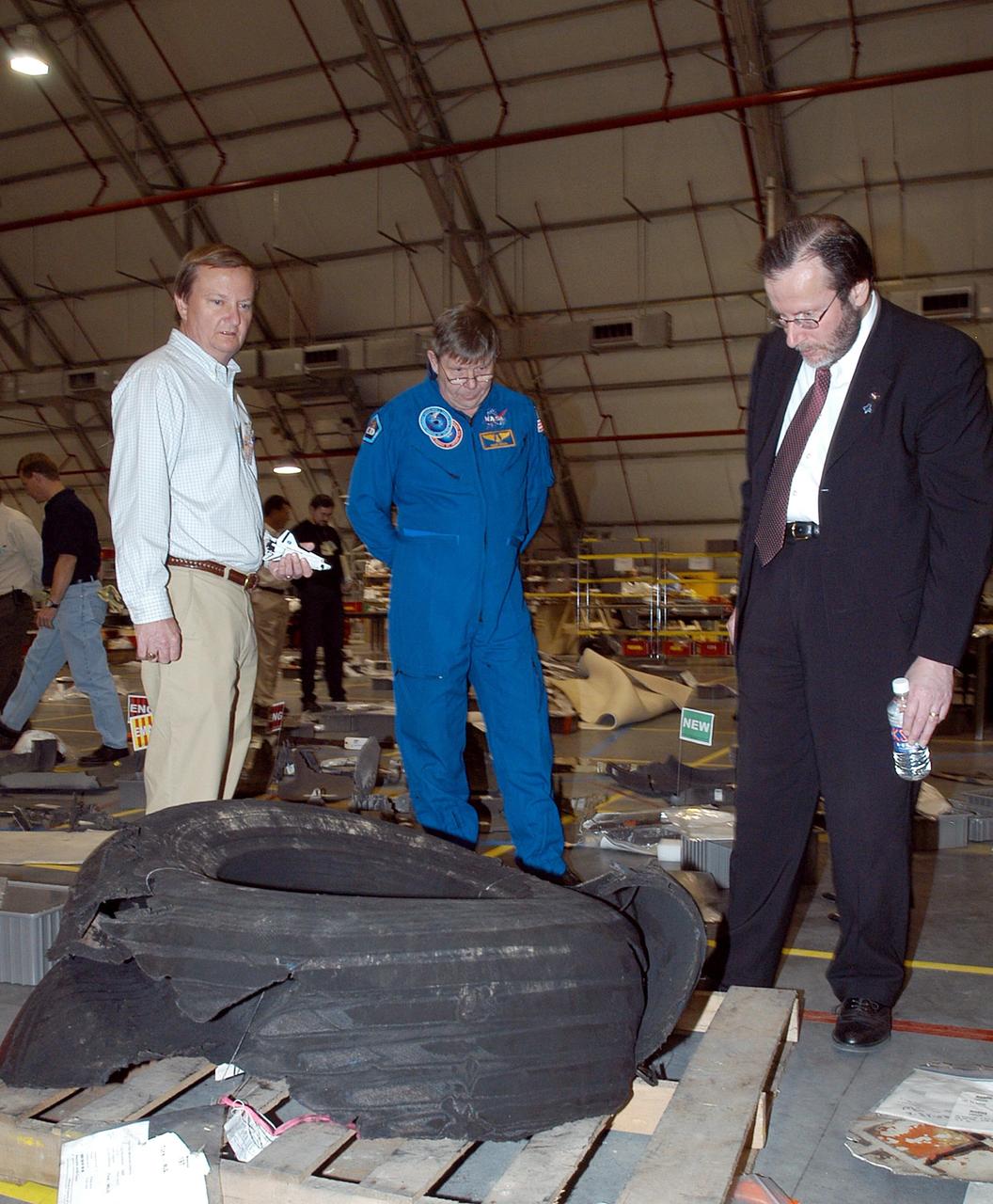
KENNEDY SPACE CENTER, FLA. - In the RLV Hangar at KSC, Shuttle Launch Director Mike Leinbach (left), former payload specialist Dr. Roger Crouch (center) and NASA Chief of Staff and White House liaison Courtney Stadd look at one of Space Shuttle Columbia's tires. The debris is one of more than 35,000 pieces collected so far. More than 1,218 pieces have been identified. The search of more than 500,000 acres of primary recovery area for Columbia material has passed the halfway mark. To date about 28 percent of Columbia, by weight, has been delivered to the hangar.
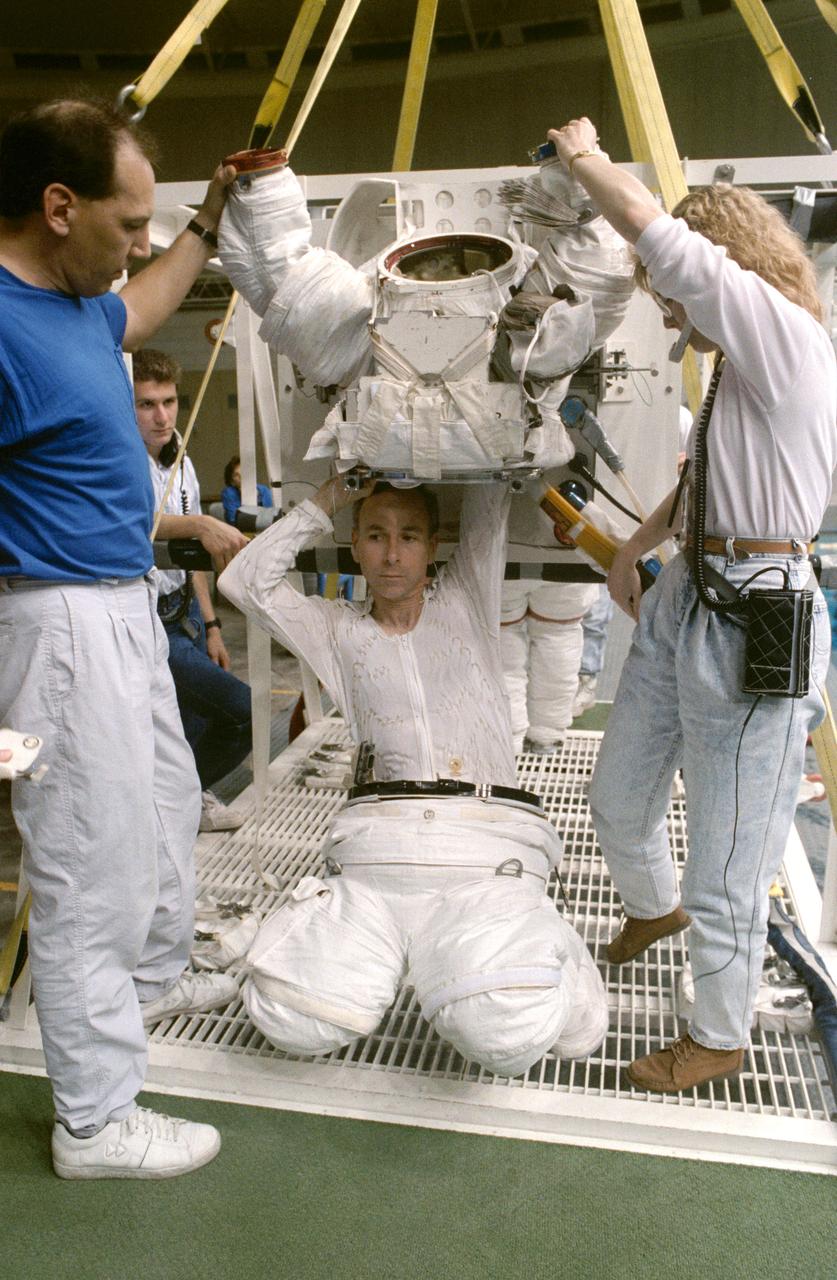
STS-38 Mission Specialist (MS) Carl J. Meade, wearing liquid cooling and ventilation garment (LCVG) and extravehicular mobility unit (EMU) lower torso, crouches under EMU upper torso. Technicians extend the EMU sleeves as Meade reaches into upper torso during suit donning in JSC's Weightless Environment Training Facility (WETF) Bldg 29. Positioned on the WETF platform at pool side, Meade is preparing for an underwater extravehicular activity (EVA) simulation. During the training exercise, Meade will rehearse contingency EVA procedures for the STS-38 mission aboard Atlantis, Orbiter Vehicle (OV) 104.
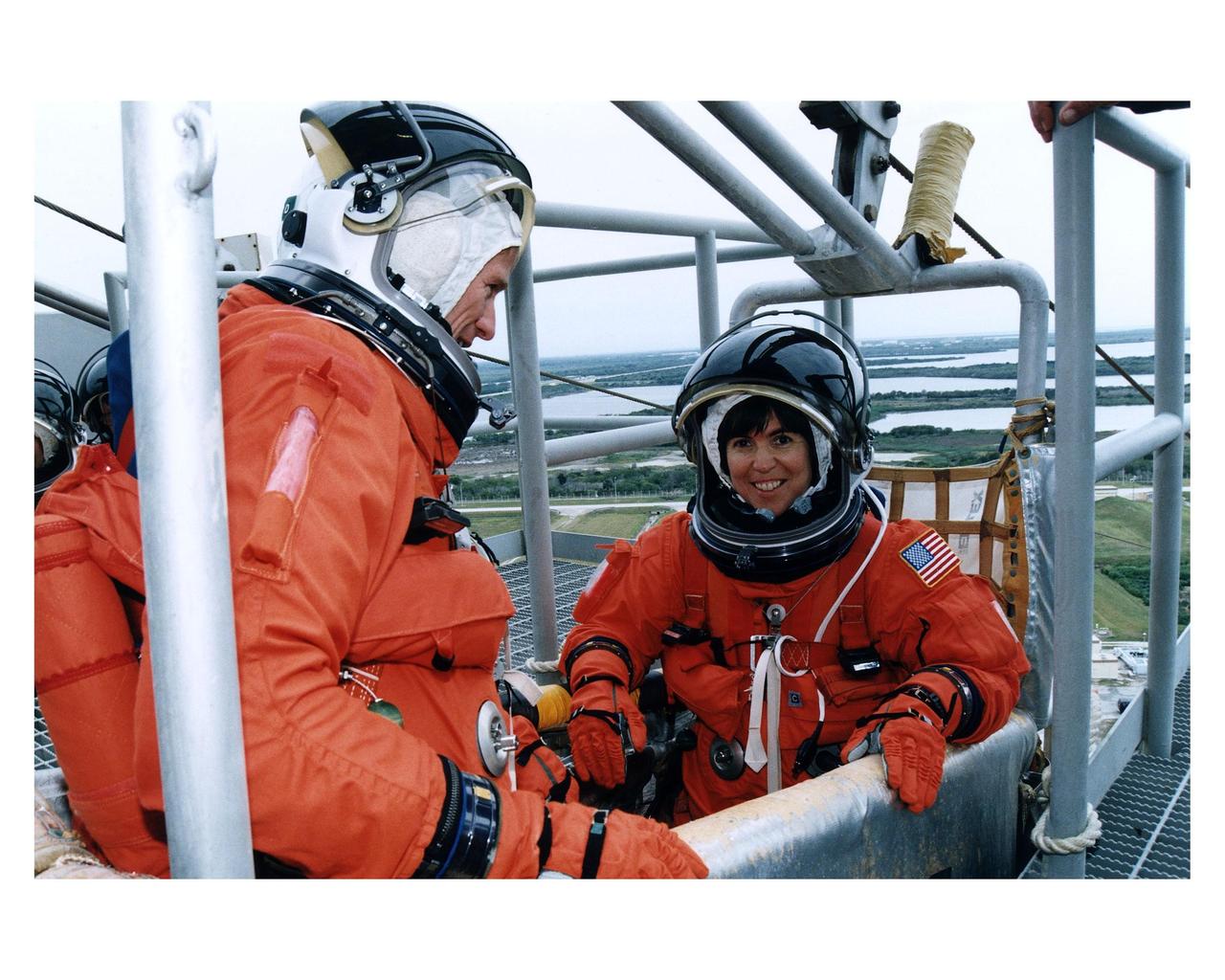
STS-83 Mission Specialist Michael L. Gernhardt and Payload Commander Janice Voss check out one of the baskets for the emergency egress slidewire system at Launch Pad 39A during Terminal Countdown Demonstration Test (TCDT) exercises for that mission. Mission Specialist Donald A. Thomas can be seen to the far left. Other crew members on the 16-day Microgravity Science Laboratory1 (MSL-1) mission are: Mission Commander James D. Halsell, Jr.; Pilot Susan L. Still; and Payload Specialists Gregory T. Linteris and Roger K. Crouch
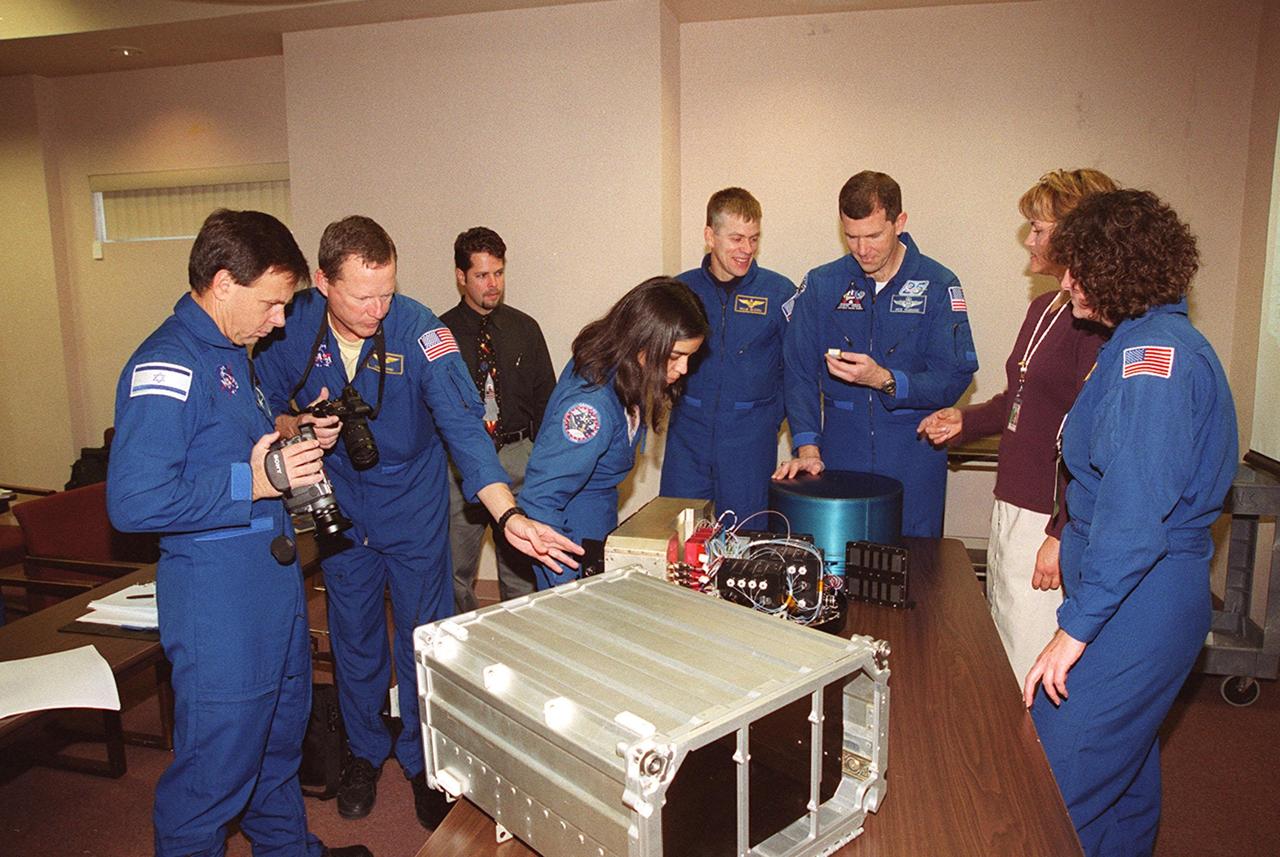
KENNEDY SPACE CENTER, FLA. -- As part of In-Flight Maintenance training, members of the STS-107 crew check out one of the Biotube experiments that will be part of their research mission. From left (in uniform) are Payload Specialist Ilan Ramon of Israel, Mission Specialists David M. Brown and Kalpana Chawla, Pilot William C. “Willie” McCool (crouching behind the table), Commander Rick D. Husband, and Mission Specialist Laurel Clark. STS-107 will carry the SPACEHAB Double Module in its first research flight into space and a broad collection of experiments ranging from material science to life science. It is scheduled to launch July 19, 2001
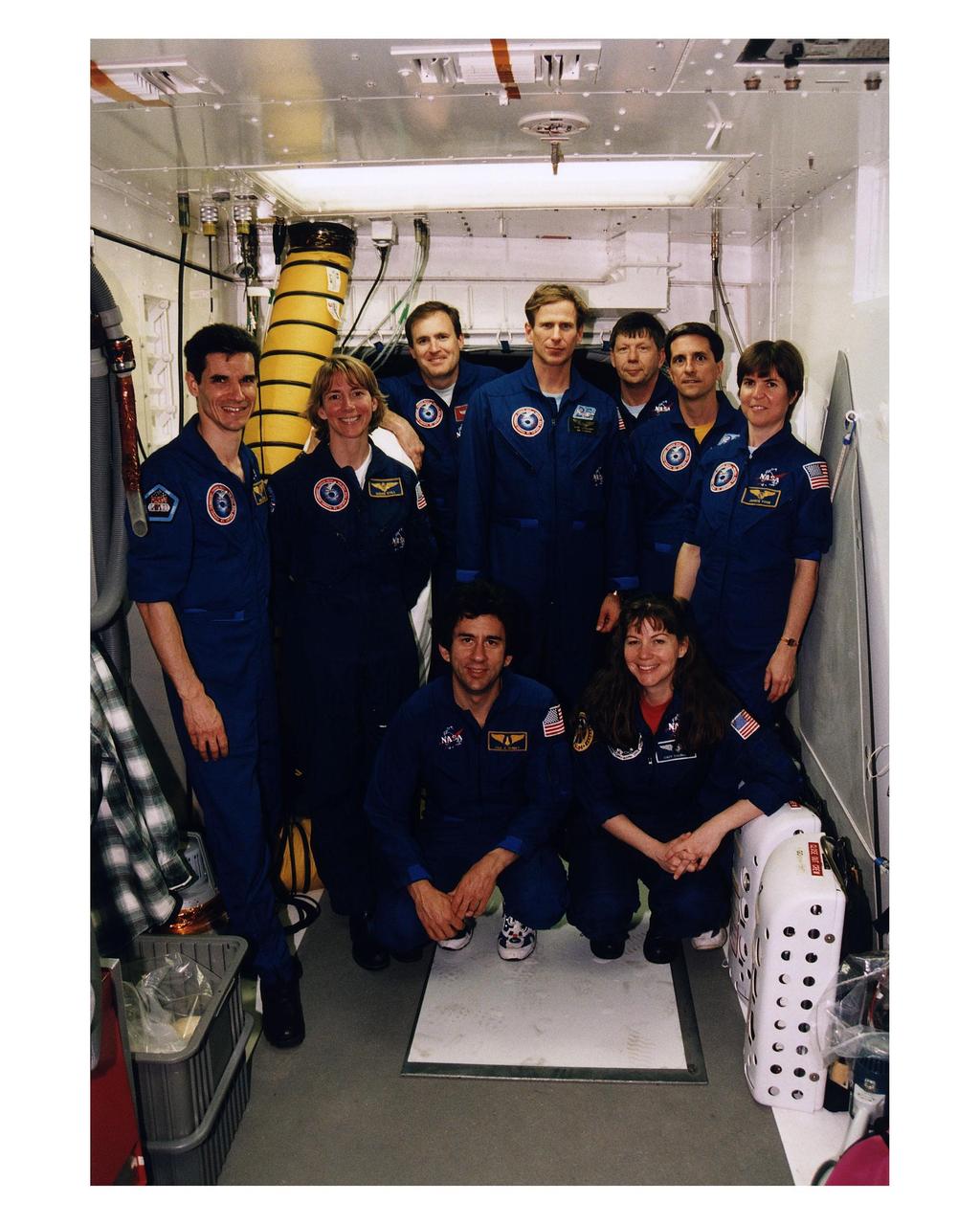
The STS-83 crew poses in the White Room at Launch Complex 39A during the crew's <a href="http://www-pao.ksc.nasa.gov/kscpao/release/1997/40-97.htm">Terminal Countdown Demonstration Test (TCDT).</a> From left to right, standing, they are Payload Specialist Gregory T. Linteris, Pilot Susan L. Still, Mission Commander James D. Halsell, Mission Specialist Michael L. Gernhardt, Payload Specialist Roger K. Crouch, and Mission Specialists Donald Thomas and Janice E. Voss. Cady Coleman, the backup Mission Specialist for Donald Thomas, is kneeling on the right
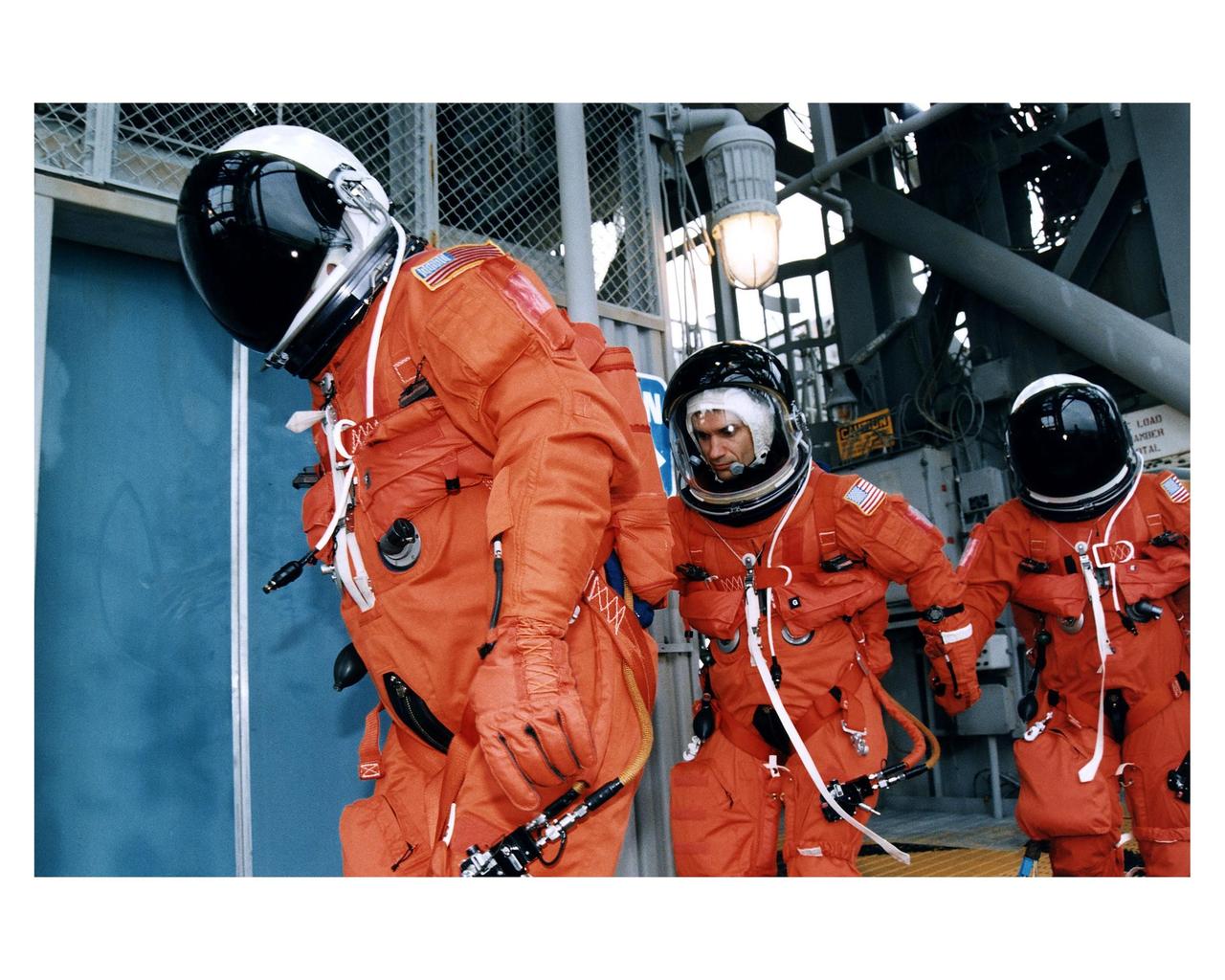
Three members of the STS-83 flight crew head toward the orbiter access arm on the 195-foot level Launch of Pad 39A that will take them to the crew hatch of the Space Shuttle Columbia during Terminal Countdown Demonstration Test (TCDT) exercises for that mission. Mission Specialist Donald A. Thomas is in the center of the group. Other crew members on the 16-day Microgravity Science Laboratory-1 (MSL-1) mission are: Mission Commander James D. Halsell, Jr.; Pilot Susan L. Still; Payload Commander Janice Voss; Mission Specialist Michael L.Gernhardt; and Payload Specialists Gregory T. Linteris and Roger K. Crouch
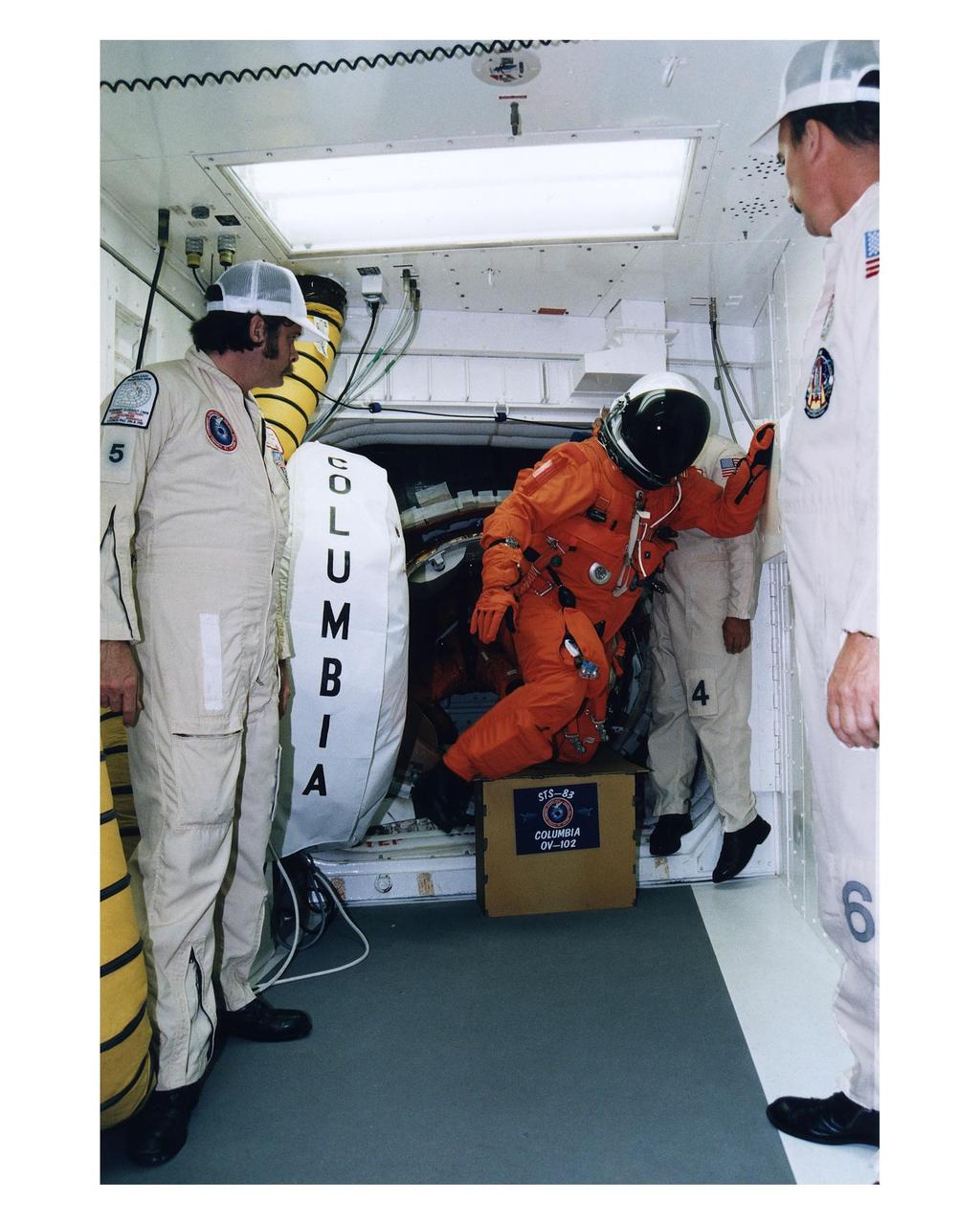
A member of the STS-83 flight crew enters the crew hatch of the Space Shuttle Columbia with the help of the white room crew during Terminal Countdown Demonstration Test (TCDT) exercises for that mission. Members of the white room crew are (from left): Steve Crosbie, Rene Arriens and Bob Saulnier. The STS-83 crew members for the 16-day Microgravity Science Laboratory-1 (MSL-1) mission are: Mission Commander James D. Halsell, Jr.; Pilot Susan L. Still; Payload Commander Janice Voss; Mission Specialists Michael L. Gernhardt and Donald A. Thomas; and Payload Specialists Gregory T. Linteris and Roger K. Crouch
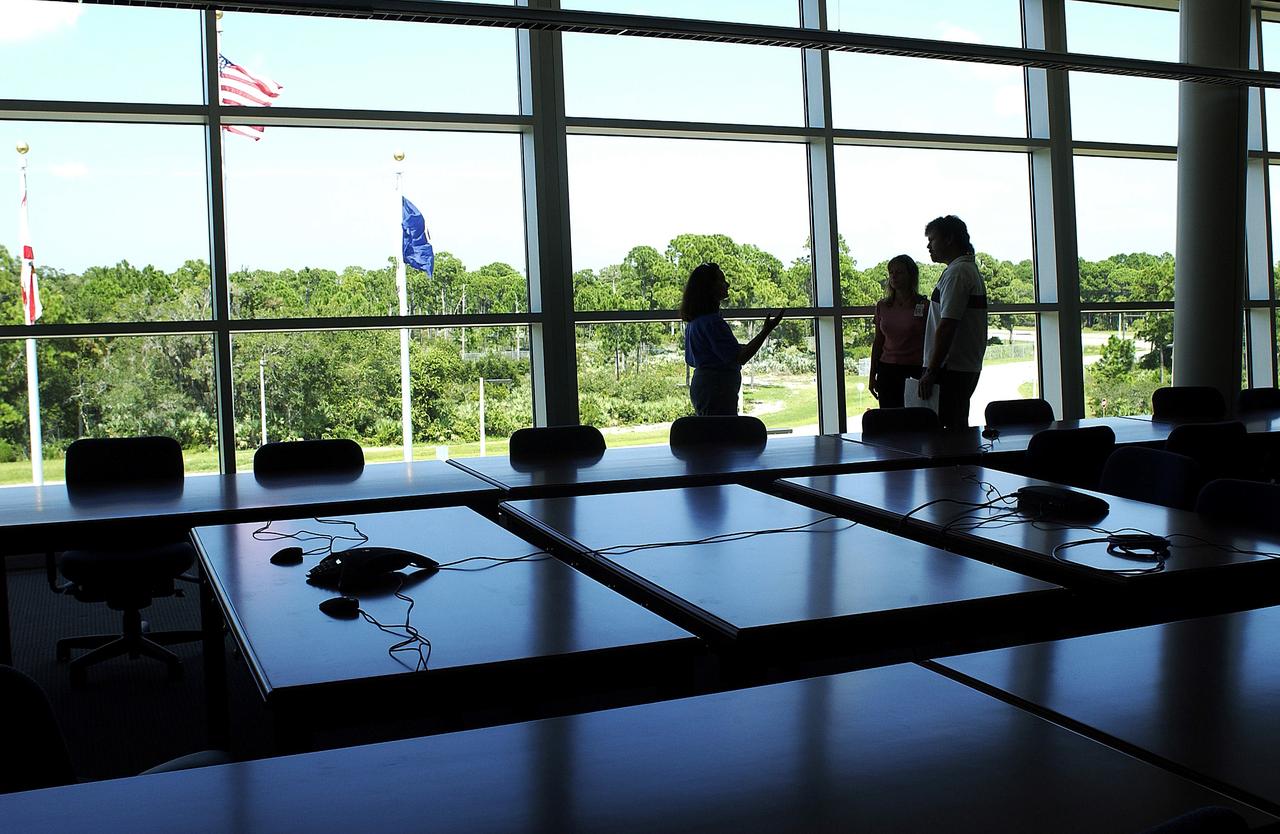
KENNEDY SPACE CENTER, FLA. - Dynamac employees Debbie Wells, Michelle Crouch and Larry Burns are silhouetted as they talk inside a conference room of the Space Life Sciences Lab (SLSL), formerly known as the Space Experiment Research and Processing Laboratory (SERPL). They have been transferring equipment from Hangar L. The new lab is a state-of-the-art facility being built for ISS biotechnology research. Developed as a partnership between NASA-KSC and the State of Florida, NASA’s life sciences contractor will be the primary tenant of the facility, leasing space to conduct flight experiment processing and NASA-sponsored research. About 20 percent of the facility will be available for use by Florida’s university researchers through the Florida Space Research Institute.
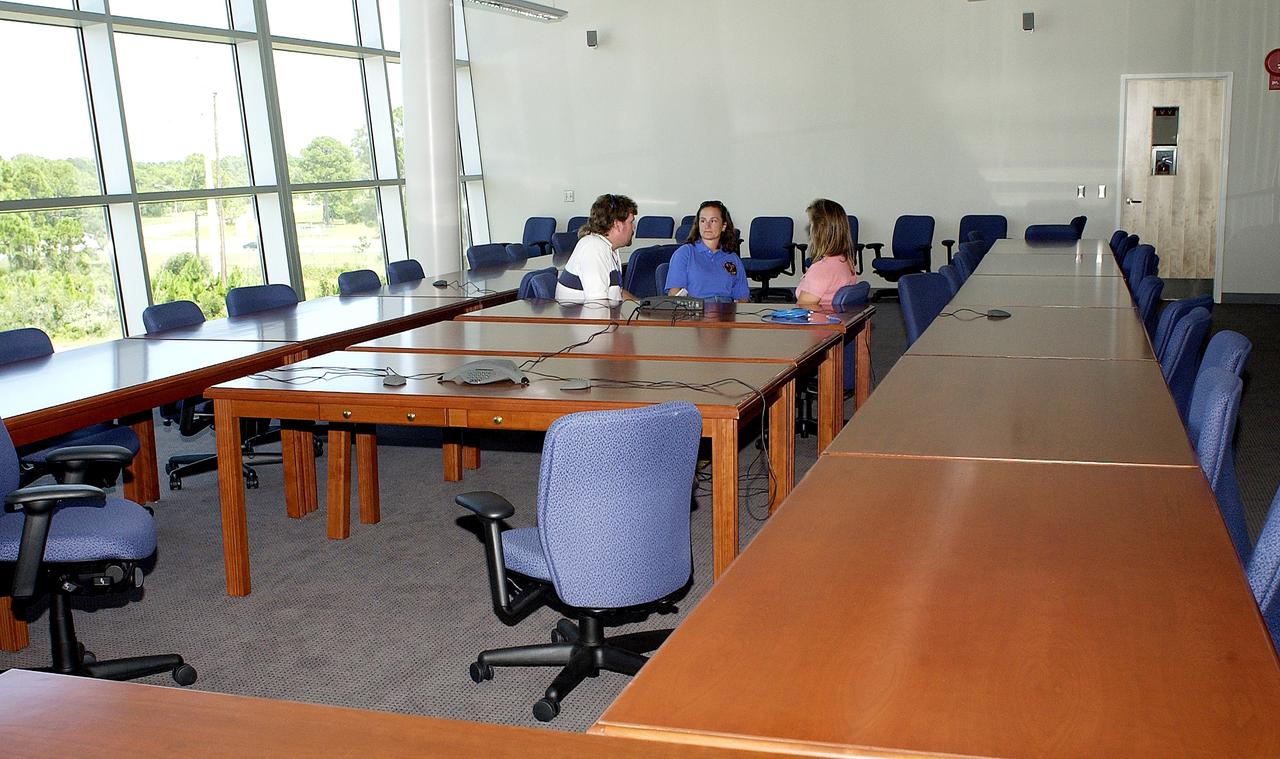
KENNEDY SPACE CENTER, FLA. - Dynamac employees (from left) Larry Burns, Debbie Wells and Michelle Crouch talk in a conference room of the Space Life Sciences Lab (SLSL), formerly known as the Space Experiment Research and Processing Laboratory (SERPL). They have been transferring equipment from Hangar L. The new lab is a state-of-the-art facility being built for ISS biotechnology research. Developed as a partnership between NASA-KSC and the State of Florida, NASA’s life sciences contractor will be the primary tenant of the facility, leasing space to conduct flight experiment processing and NASA-sponsored research. About 20 percent of the facility will be available for use by Florida’s university researchers through the Florida Space Research Institute.
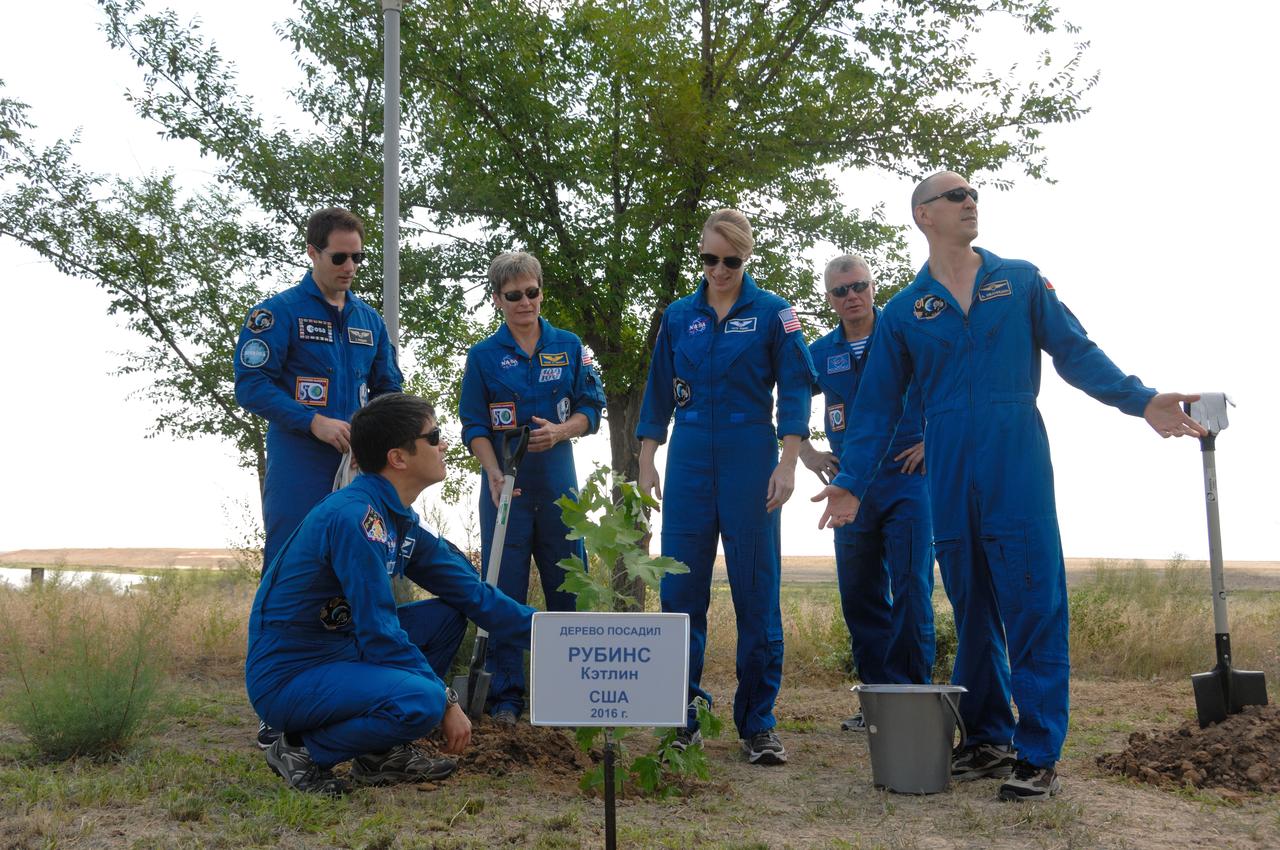
At the Cosmonaut Hotel in Baikonur, Kazakhstan, Expedition 48-49 crewmember Kate Rubins of NASA (third from left, standing) admires a tree she planted in her name in traditional pre-launch activities June 30 as her crewmates surround her. They include Takuya Onishi of the Japan Aerospace Exploration Agency (crouching), and backup crewmembers Thomas Pesquet of the European Space Agency (standing, left), Peggy Whitson of NASA (standing, second from the left), and Oleg Novitskiy (standing, second from the right) and prime crewmember Anatoly Ivanishin (right). Rubins, Ivanishin and Onishi will launch July 7, Baikonur time, on the Soyuz MS-01 spacecraft for a planned four-month mission on the International Space Station. NASA/Alexander Vysotsky
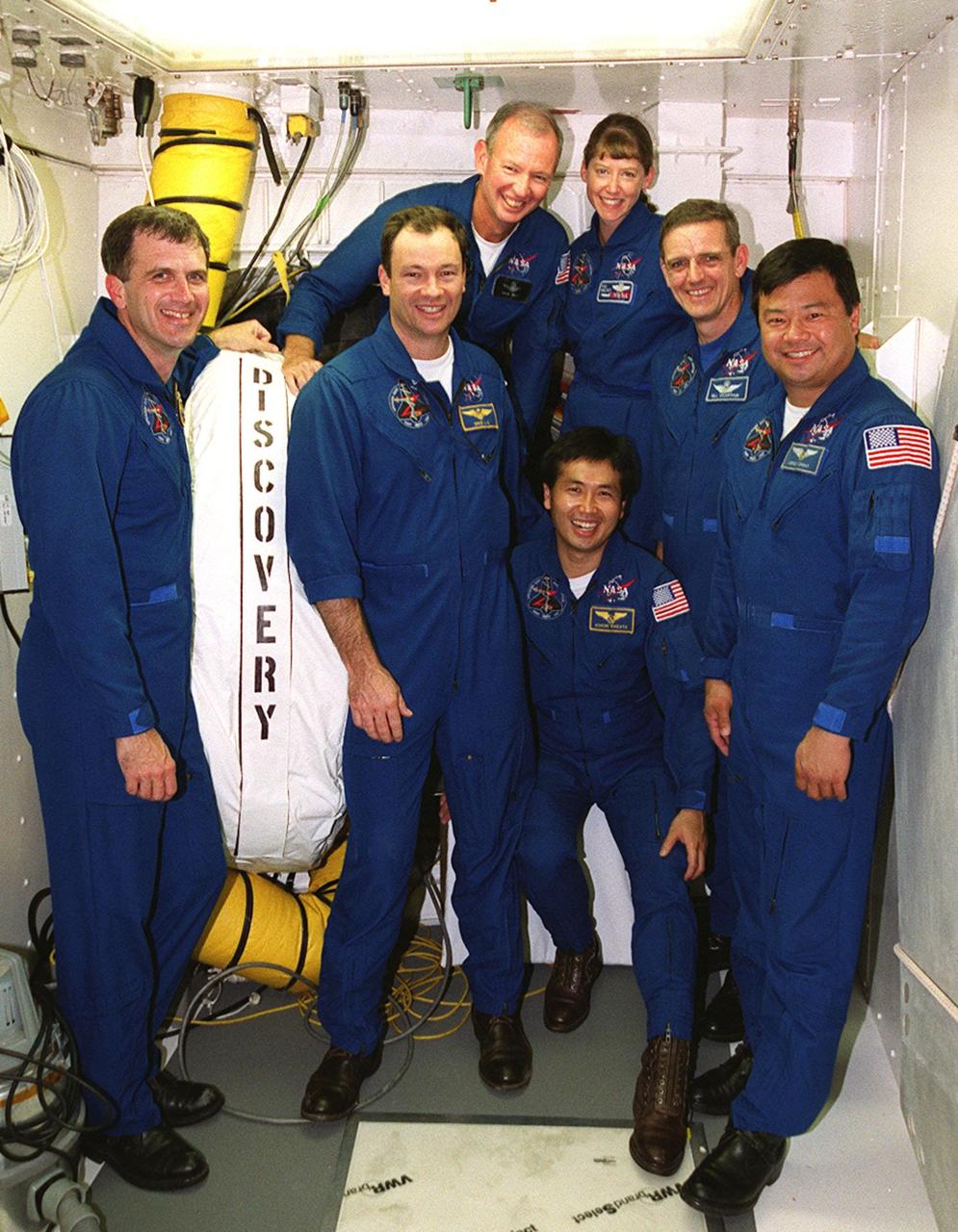
The STS-92 crew poses for a photograph in the White Room, the environmentally controlled chamber on the orbiter access arm that provides entry for the crew into the orbiter. Standing, left to right, are Mission Specialists Peter J.K. “Jeff” Wisoff and Michael E. Lopez-Alegria; Commander Brian Duffy; Pilot Pamela Ann Melroy; and Mission Specialists William S. McArthur Jr. and Leroy Chiao. Crouching in front is Mission Specialist Koichi Wakata of Japan. The crew is at KSC for Terminal Countdown Demonstration Test activities that provide emergency egress training, opportunities to inspect the mission payload, and take part in a simulated countdown. STS-92 is scheduled to launch Oct. 5 at 9:38 p.m. EDT on the fifth flight to the International Space Station. It will carry two elements of the Space Station, the Integrated Truss Structure Z1 and the third Pressurized Mating Adapter. The mission is also the 100th flight in the Shuttle program
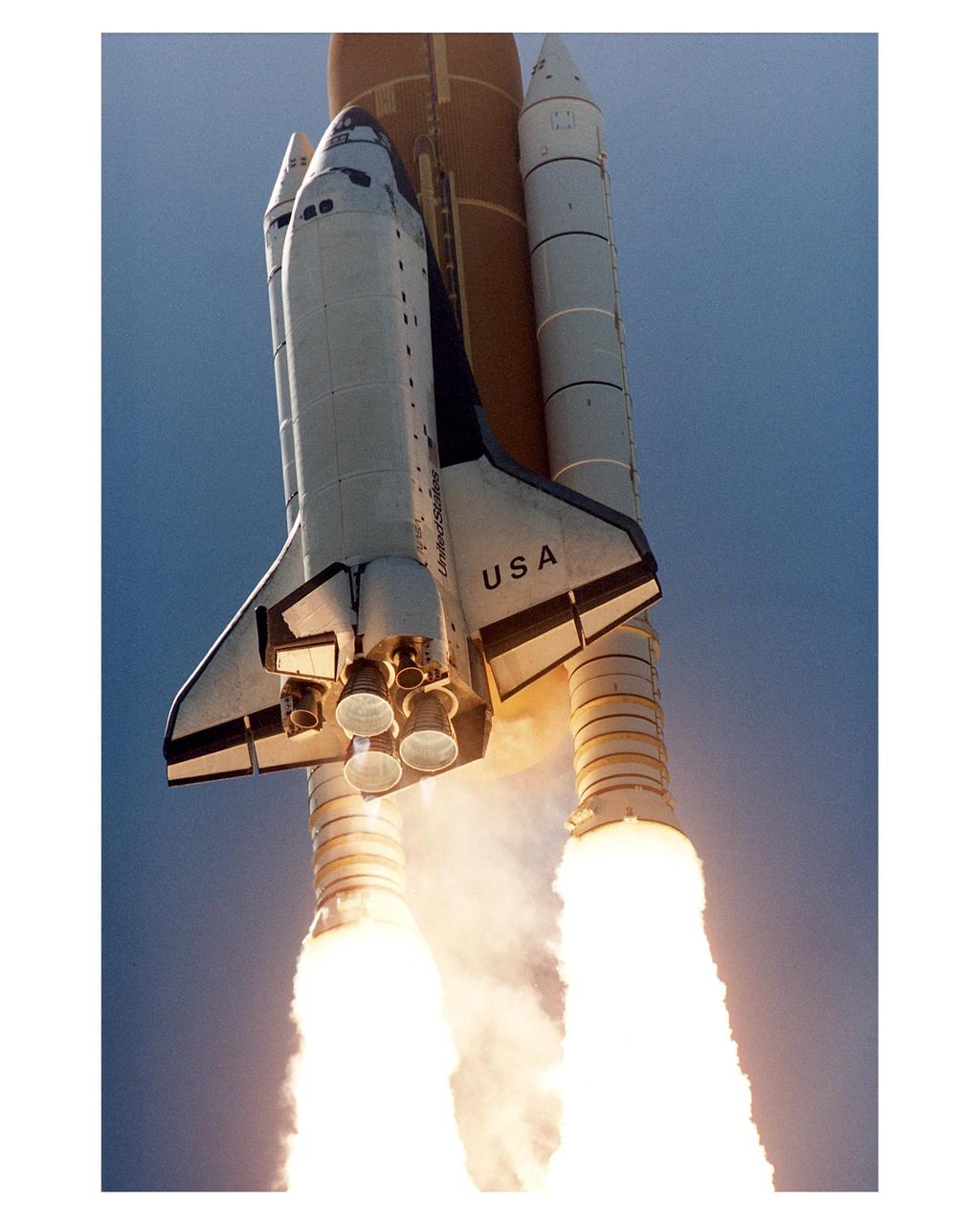
Like a rising sun lighting up the afternoon sky, the Space Shuttle Columbia soars from Launch Pad 39A at 2:20:32 p.m. EST, April 4, on the 16-day Microgravity Science Laboratory-1 (MSL-1) mission. The crew members are Mission Commander James D. Halsell, Jr.; Pilot Susan L. Still; Payload Commander Janice Voss; Mission Specialists Michael L. Gernhardt and Donald A. Thomas; and Payload Specialists Roger K. Crouch and Gregory T. Linteris. During the scheduled 16-day STS-83 mission, the MSL-1 will be used to test some of the hardware, facilities and procedures that are planned for use on the International Space Station as well as research in combustion, protein crystal growth and materials processing experiments
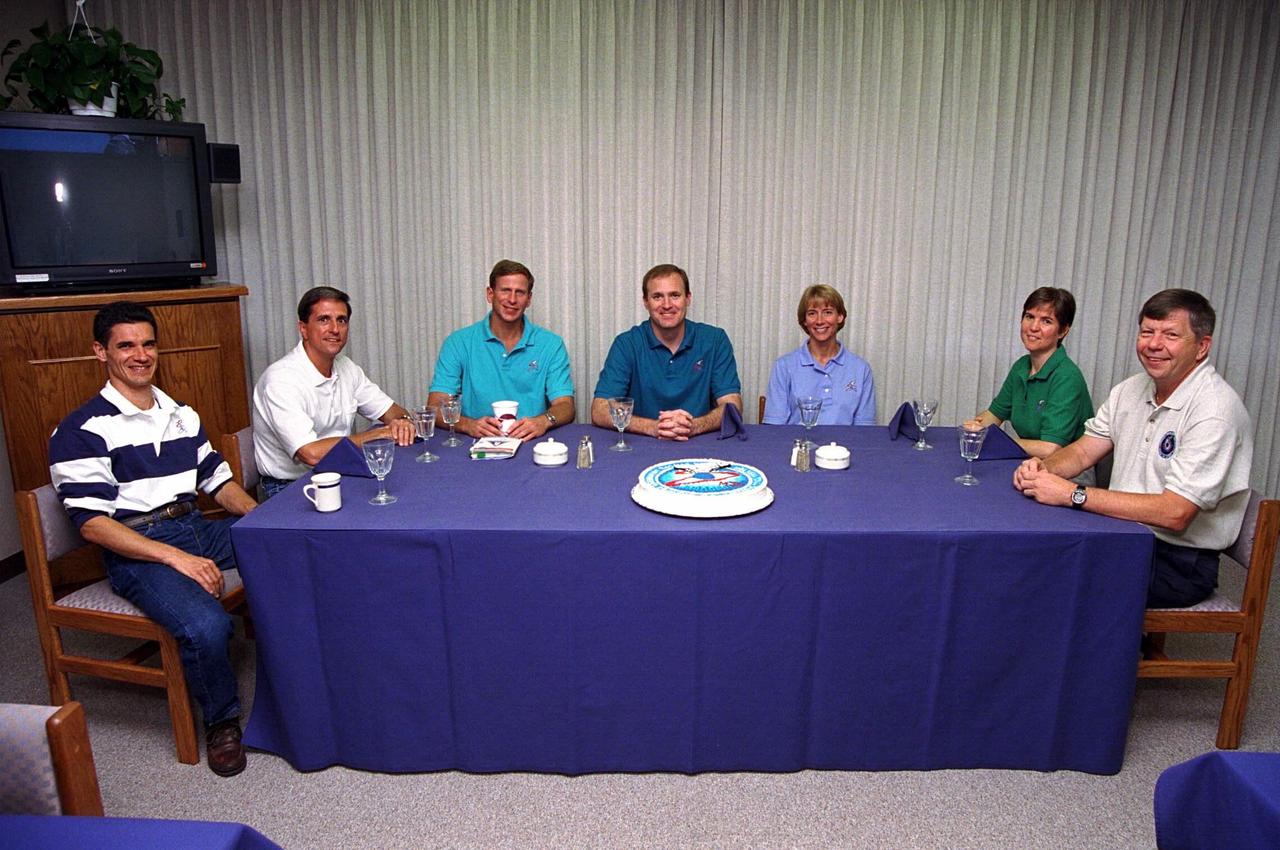
The STS-94 flight crew enjoys the traditional preliftoff breakfast in the crew quarters of the Operations and Checkout Building. They are (from left): Payload Specialist Gregory T. Linteris; Mission Specialist Donald A. Thomas; Mission Specialist Michael L. Gernhardt; Mission Commander James D. Halsell, Jr.; Pilot Susan L. Still; Payload Commander Janice Voss; and Payload Specialist Roger K. Crouch. After a weather briefing, the flight crew will be fitted with their launch/entry suits and depart for Launch Pad 39A. Once there, they will take their positions in the crew cabin of the Space Shuttle Columbia to await a liftoff during a window that will open at 1:50 p.m. EDT, July 1. The launch window was opened 47 minutes early to improve the opportunity to lift off before Florida summer rain showers reached the space center
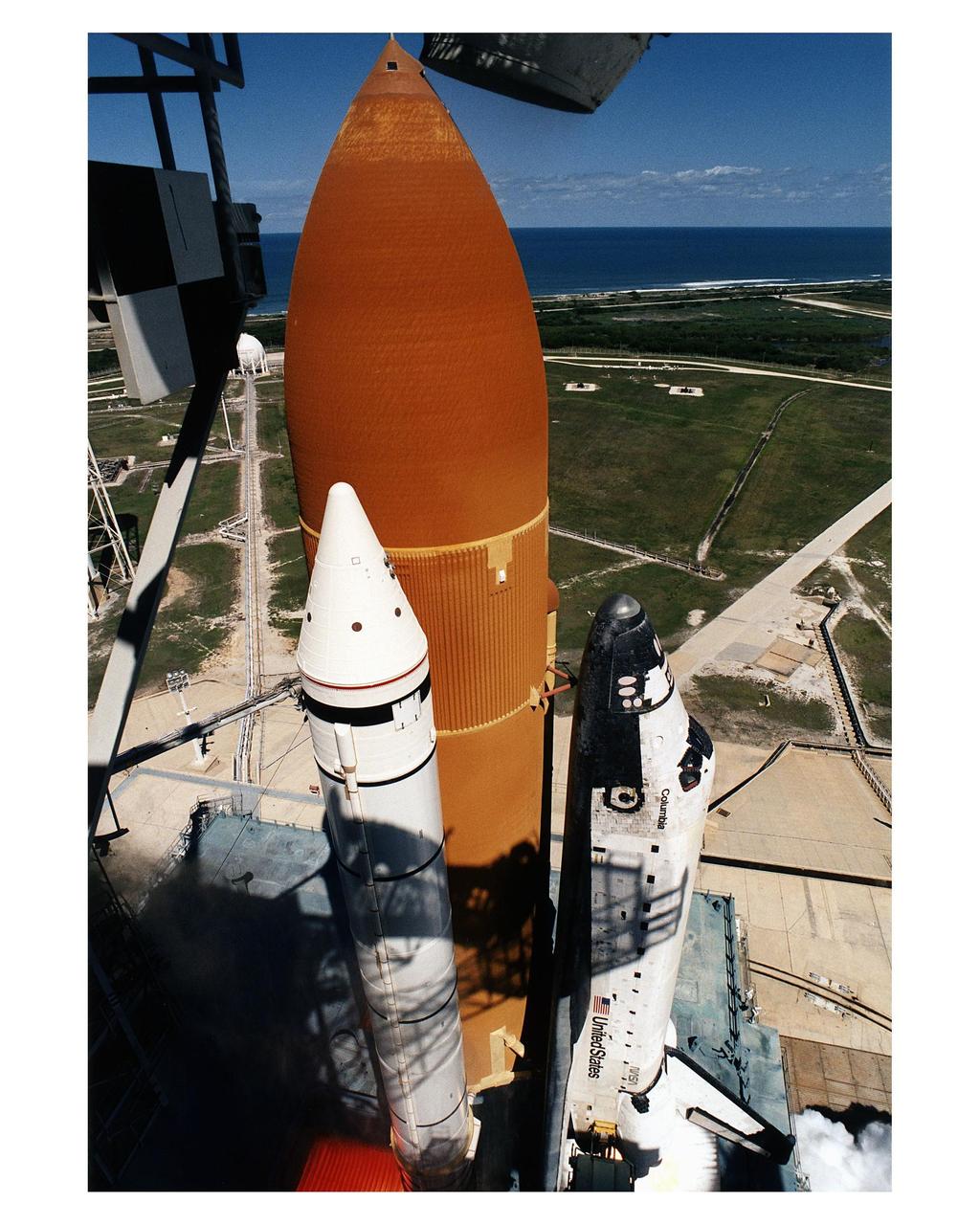
Like a rising sun lighting up the afternoon sky, the Space Shuttle Columbia soars from Launch Pad 39A at 2:20:32 p.m. EST, April 4, on the 16-day Microgravity Science Laboratory-1 (MSL-1) mission. The crew members are Mission Commander James D. Halsell, Jr.; Pilot Susan L. Still; Payload Commander Janice Voss; Mission Specialists Michael L. Gernhardt and Donald A. Thomas; and Payload Specialists Roger K. Crouch and Gregory T. Linteris. During the scheduled 16-day STS-83 mission, the MSL-1 will be used to test some of the hardware, facilities and procedures that are planned for use on the International Space Station as well as research in combustion, protein crystal growth and materials processing experiments
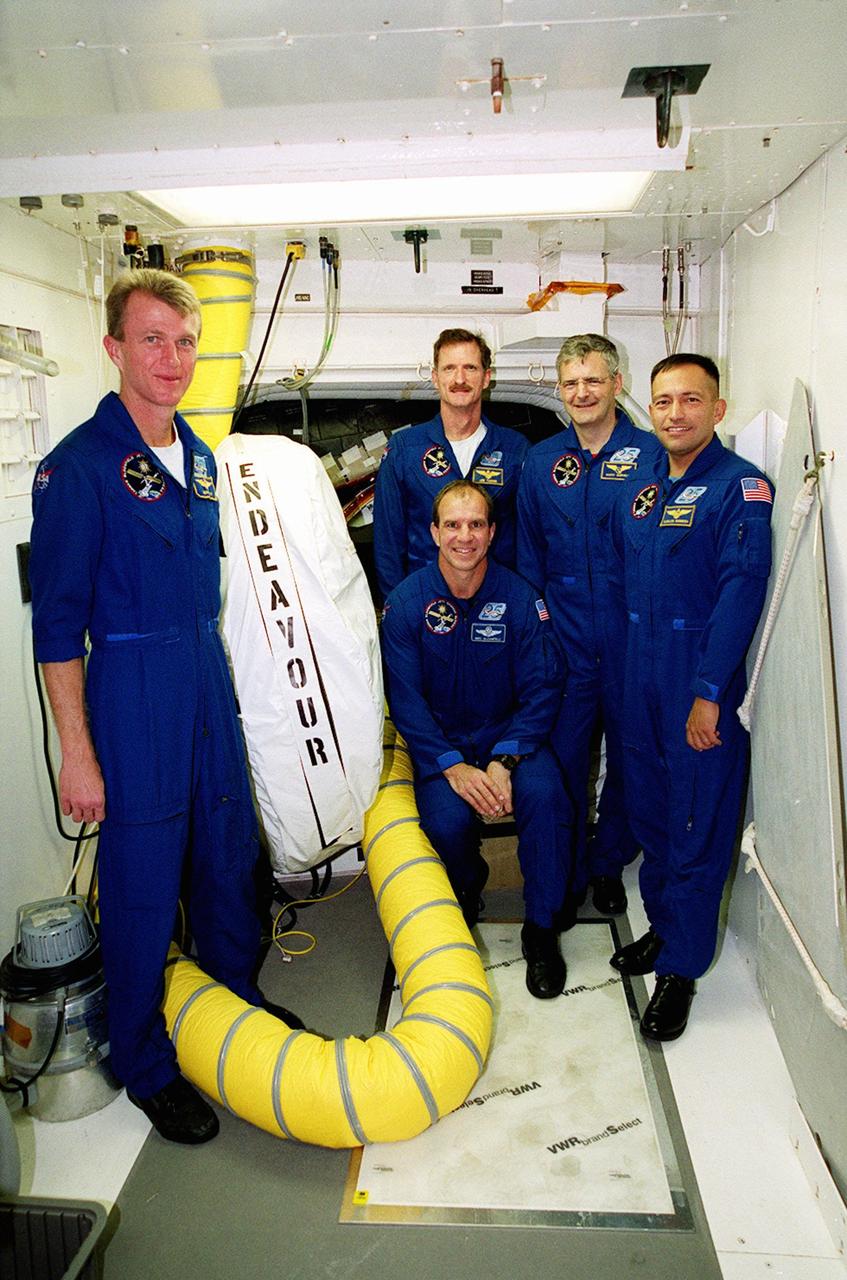
During Terminal Countdown Demonstration Test (TCDT) activities, the STS-97 crew pause in the White Room at Launch Pad 39B for a photo. At left is Commander Brent Jett and crouching in front is Pilot Mike Bloomfield. Standing behind him are Mission Specialists Joe Tanner, Marc Garneau and Carlos Noriega. . Garneau is with the Canadian Space Agency. The TCDT includes emergency egress training, familiarization with the payload, and a simulated launch countdown. Mission STS-97is the sixth construction flight to the International Space Station. Its payload includes the P6 Integrated Truss Structure and a photovoltaic (PV) module, with giant solar arrays that will provide power to the Station. The mission includes two spacewalks to complete the solar array connections. STS-97 is scheduled to launch Nov. 30 at 10:05 p.m. EST
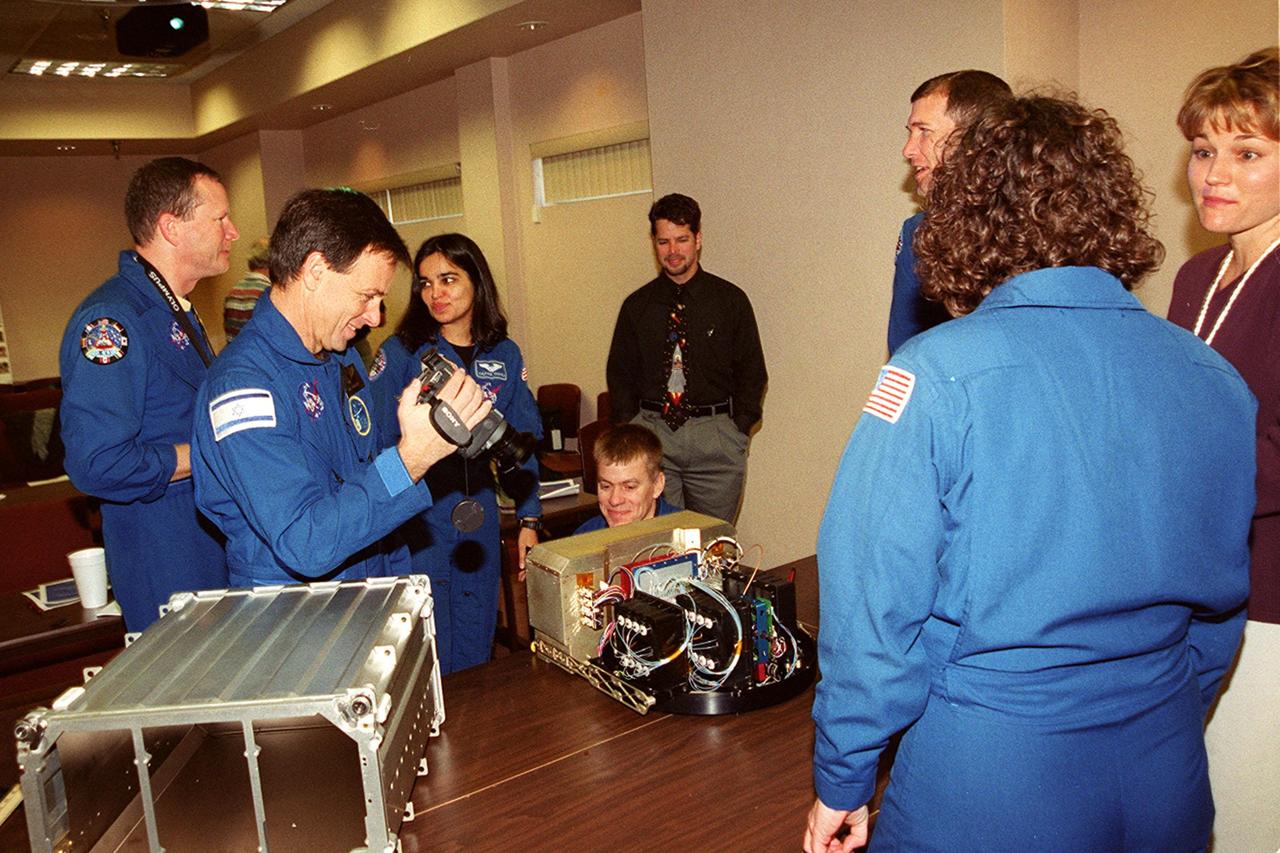
KENNEDY SPACE CENTER, FLA. -- As part of In-Flight Maintenance training, members of the STS-107 crew check out one of the Biotube experiments that will be part of their research mission . From left (in uniform) are Mission Specialist David M. Brown, Payload Specialist Ilan Ramon of Israel, and Mission Specialist Kalpana Chawla; Pilot William C. “Willie” McCool (crouching behind the table); Commander Rick D. Husband; and Mission Specialist Laurel Clark. At right is project engineer April Boody. As a research mission, STS-107 will carry the SPACEHAB Double Module in its first research flight into space and a broad collection of experiments ranging from material science to life science. It is scheduled to launch July 19, 2001
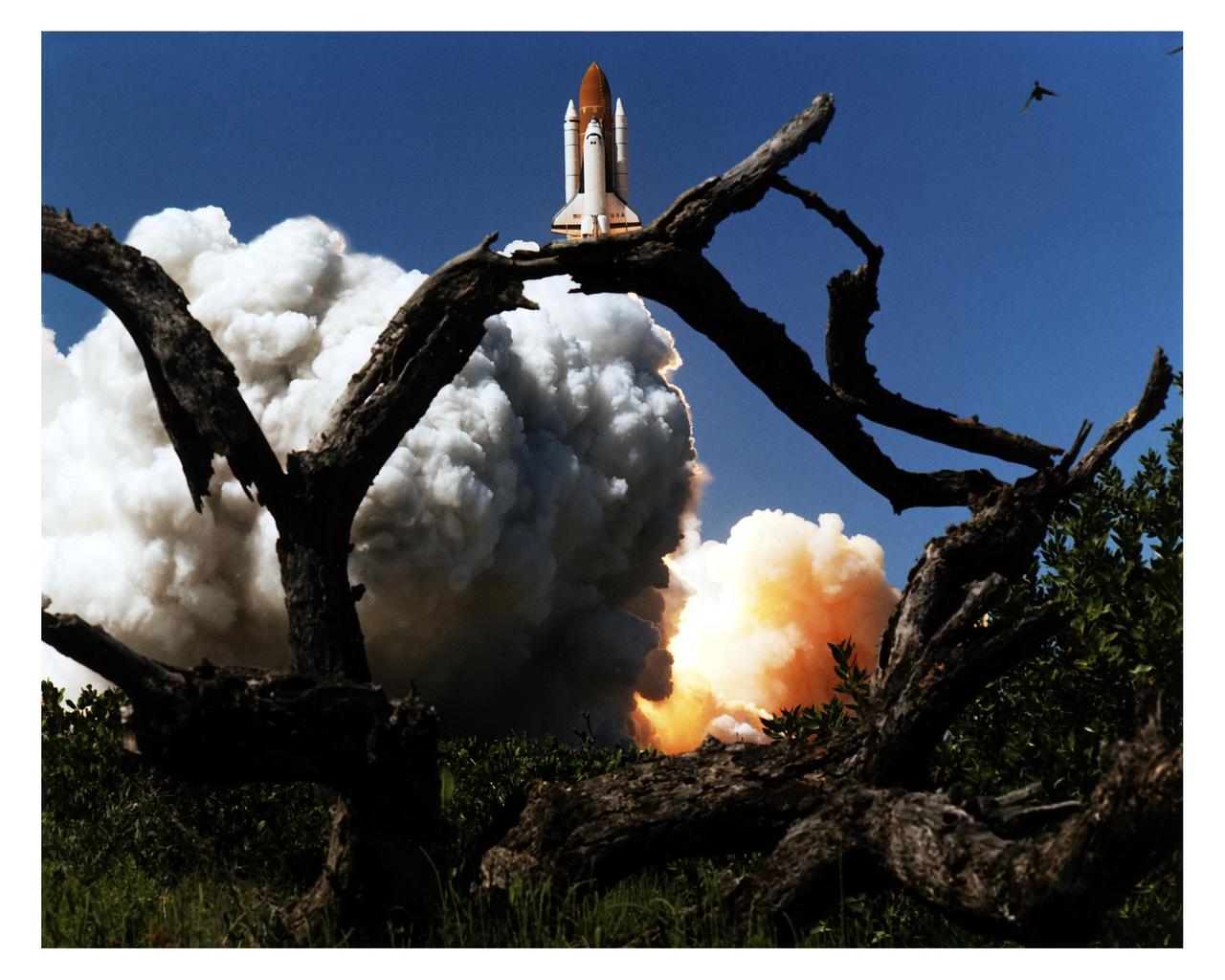
Like a rising sun lighting up the afternoon sky, the Space Shuttle Columbia soars from Launch Pad 39A at 2:20:32 p.m. EST, April 4, on the 16-day Microgravity Science Laboratory-1 (MSL-1) mission. The crew members are Mission Commander James D. Halsell, Jr.; Pilot Susan L. Still; Payload Commander Janice Voss; Mission Specialists Michael L. Gernhardt and Donald A. Thomas; and Payload Specialists Roger K. Crouch and Gregory T. Linteris. During the scheduled 16-day STS-83 mission, the MSL-1 will be used to test some of the hardware, facilities and procedures that are planned for use on the International Space Station as well as research in combustion, protein crystal growth and materials processing experiments
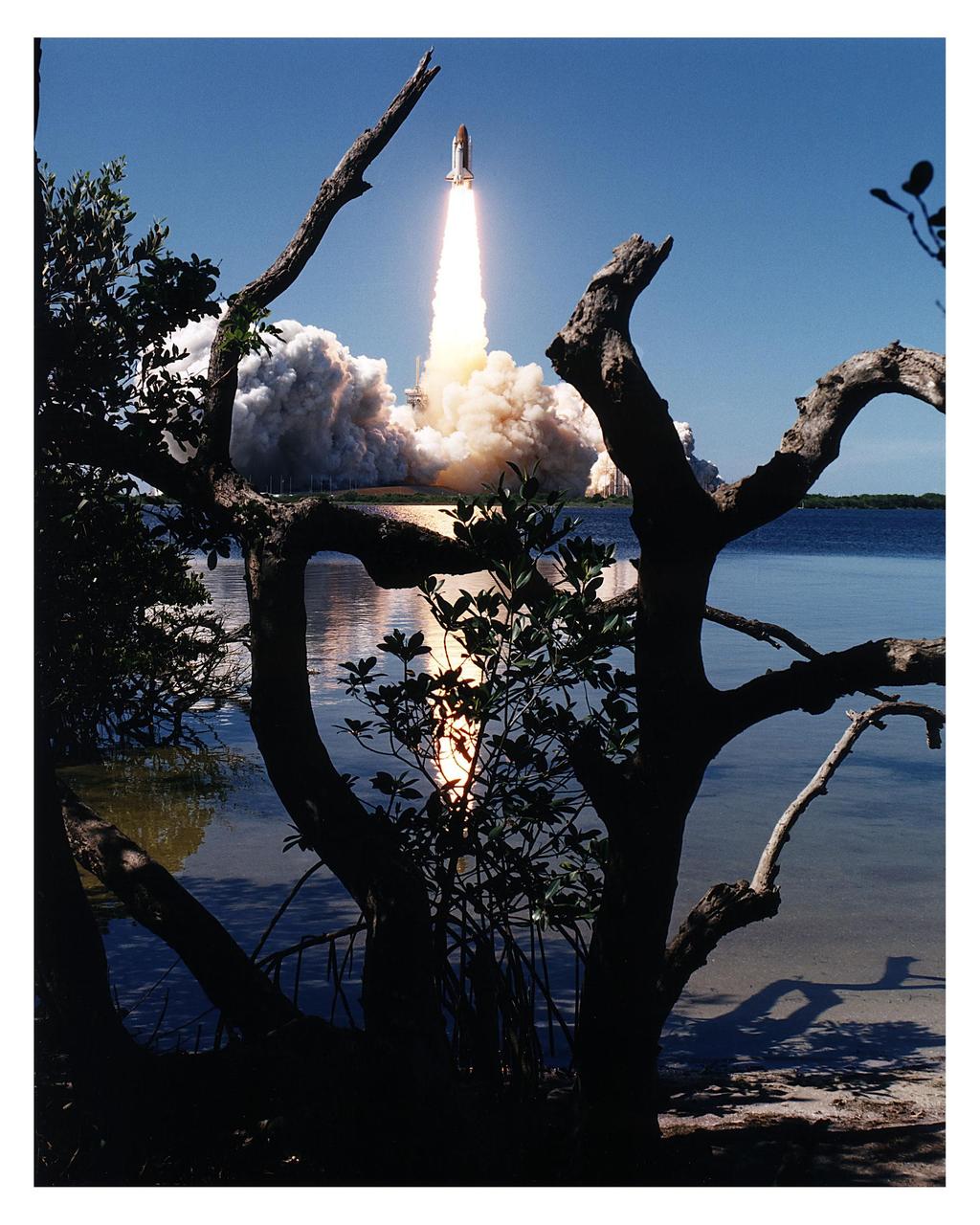
Like a rising sun lighting up the afternoon sky, the Space Shuttle Columbia soars from Launch Pad 39A at 2:20:32 p.m. EST, April 4, on the 16-day Microgravity Science Laboratory-1 (MSL-1) mission. The crew members are Mission Commander James D. Halsell, Jr.; Pilot Susan L. Still; Payload Commander Janice Voss; Mission Specialists Michael L. Gernhardt and Donald A. Thomas; and Payload Specialists Roger K. Crouch and Gregory T. Linteris. During the scheduled 16-day STS-83 mission, the MSL-1 will be used to test some of the hardware, facilities and procedures that are planned for use on the International Space Station as well as research in combustion, protein crystal growth and materials processing experiments
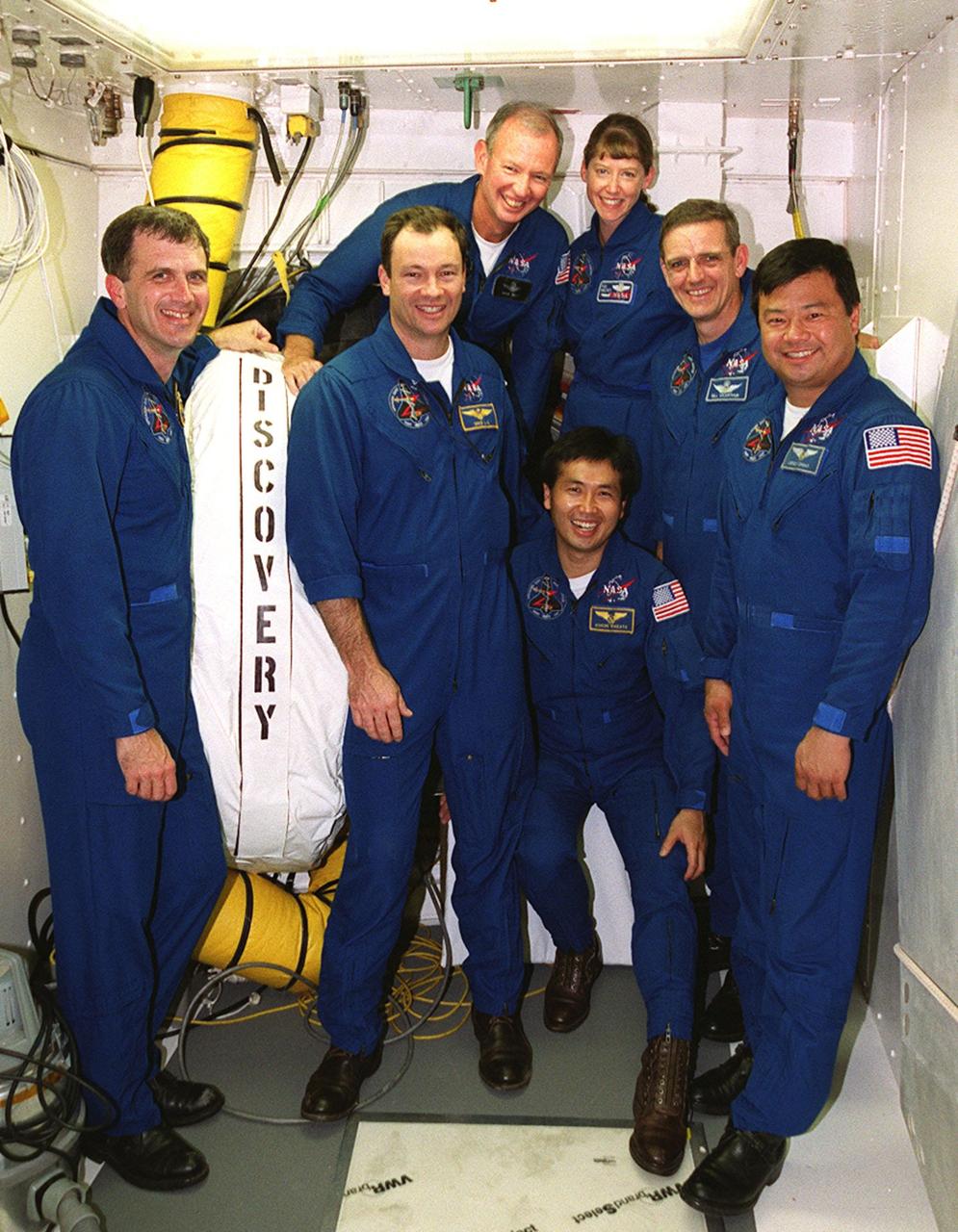
The STS-92 crew poses for a photograph in the White Room, the environmentally controlled chamber on the orbiter access arm that provides entry for the crew into the orbiter. Standing, left to right, are Mission Specialists Peter J.K. “Jeff” Wisoff and Michael E. Lopez-Alegria; Commander Brian Duffy; Pilot Pamela Ann Melroy; and Mission Specialists William S. McArthur Jr. and Leroy Chiao. Crouching in front is Mission Specialist Koichi Wakata of Japan. The crew is at KSC for Terminal Countdown Demonstration Test activities that provide emergency egress training, opportunities to inspect the mission payload, and take part in a simulated countdown. STS-92 is scheduled to launch Oct. 5 at 9:38 p.m. EDT on the fifth flight to the International Space Station. It will carry two elements of the Space Station, the Integrated Truss Structure Z1 and the third Pressurized Mating Adapter. The mission is also the 100th flight in the Shuttle program
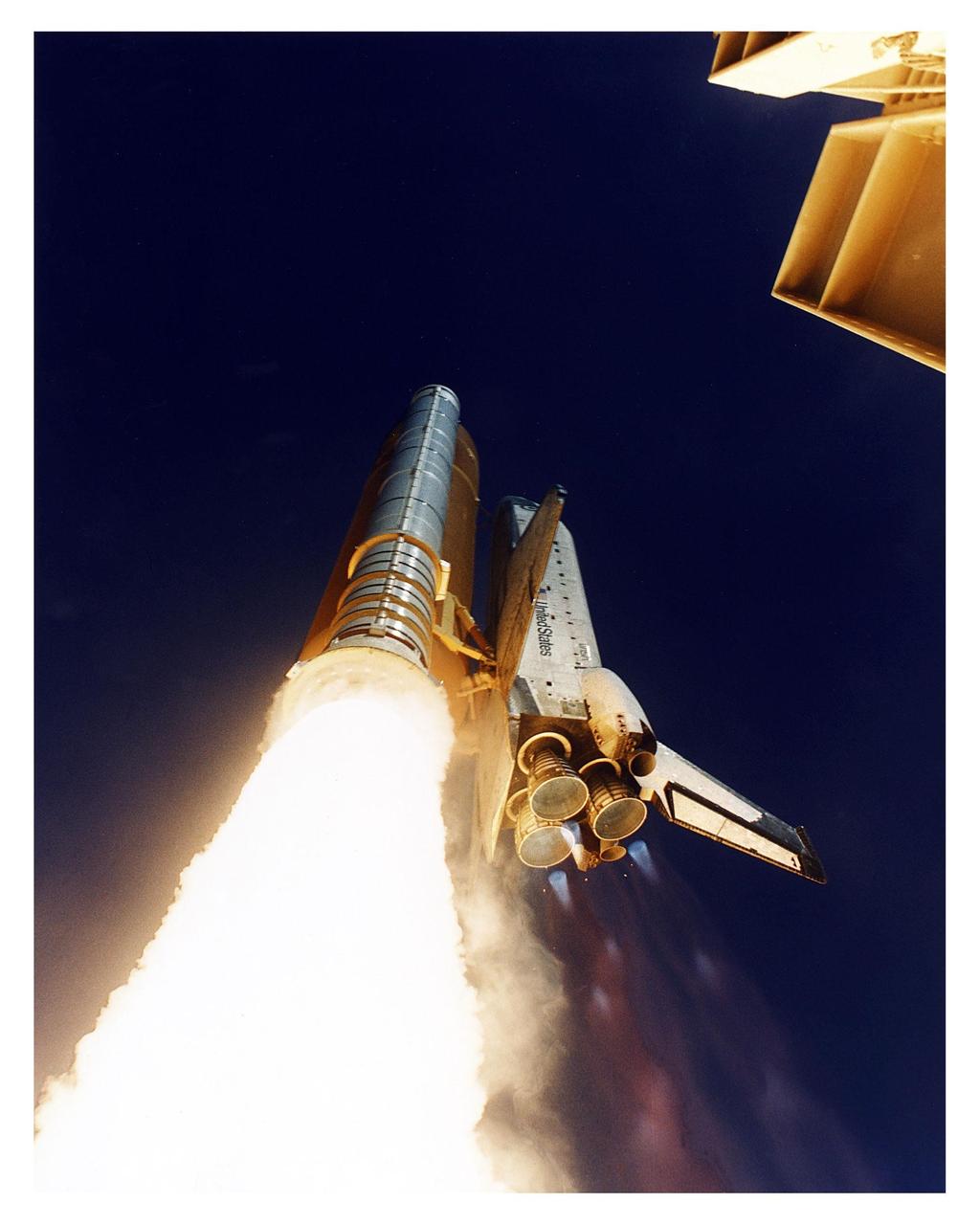
Like a rising sun lighting up the afternoon sky, the Space Shuttle Columbia soars from Launch Pad 39A at 2:20:32 p.m. EST, April 4, on the 16-day Microgravity Science Laboratory-1 (MSL-1) mission. The crew members are Mission Commander James D. Halsell, Jr.; Pilot Susan L. Still; Payload Commander Janice Voss; Mission Specialists Michael L. Gernhardt and Donald A. Thomas; and Payload Specialists Roger K. Crouch and Gregory T. Linteris. During the scheduled 16-day STS-83 mission, the MSL-1 will be used to test some of the hardware, facilities and procedures that are planned for use on the International Space Station as well as research in combustion, protein crystal growth and materials processing experiments
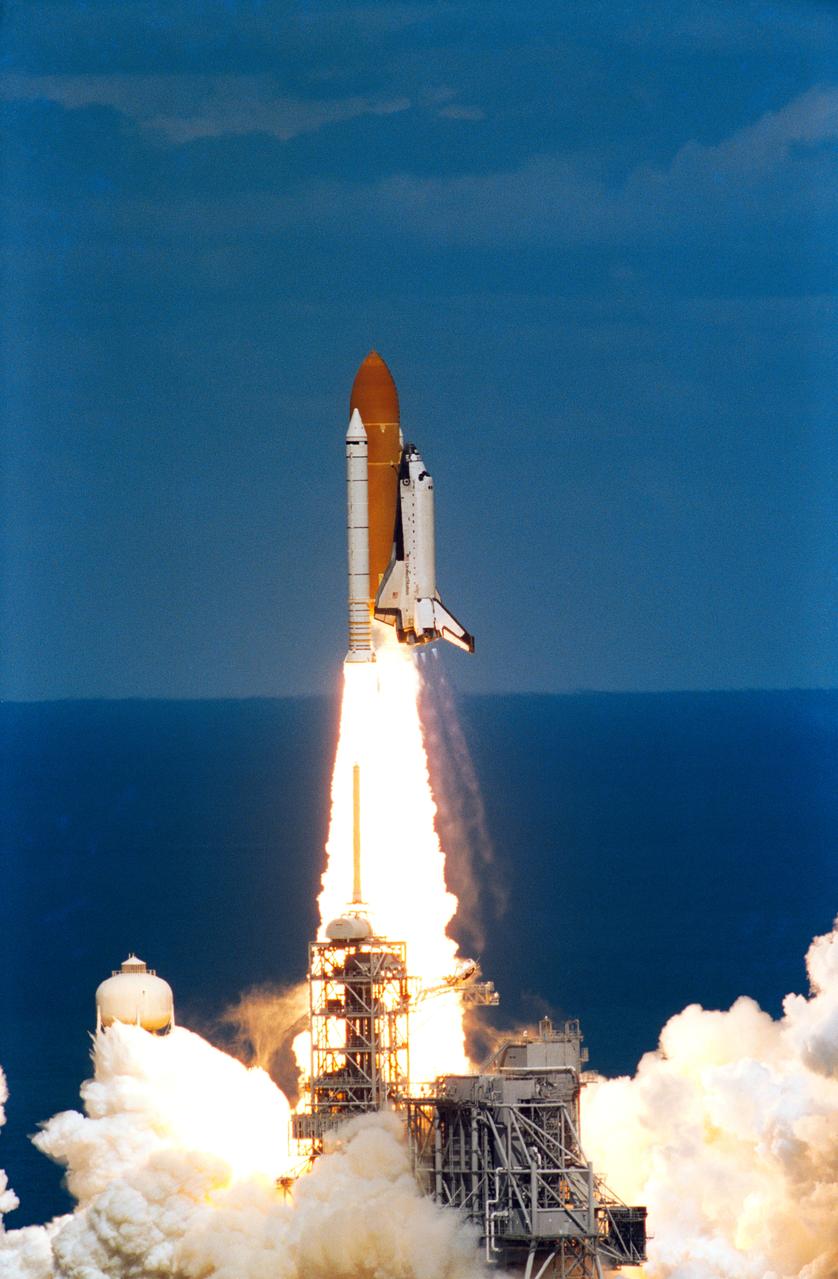
STS083-S-003 (4 April 1997)--- With the Atlantic Ocean in the background, the Space Shuttle Columbia heads toward Earth-orbit from Launch Pad 39A at 2:20:32 p.m. (EST), April 4, 1997, from the Kennedy Space Center (KSC). Onboard the spacecraft to support the Microgravity Science Laboratory 1 (MSL-1) mission were astronauts James D. Halsell, commander; Susan L. Still, pilot; Janice E. Voss, payload commander; Michael L. Gernhardt and Donald A. Thomas, both mission specialists; along with payload specialists Roger K. Crouch and Gregory T. Linteris. A problem with a fuel cell caused the crew to cut the mission short and return to Earth on April 8, 1997.

Like a rising sun lighting up the afternoon sky, the Space Shuttle Columbia soars from Launch Pad 39A at 2:20:32 p.m. EST, April 4, on the 16-day Microgravity Science Laboratory-1 (MSL-1) mission. The crew members are Mission Commander James D. Halsell, Jr.; Pilot Susan L. Still; Payload Commander Janice Voss; Mission Specialists Michael L. Gernhardt and Donald A. Thomas; and Payload Specialists Roger K. Crouch and Gregory T. Linteris. During the scheduled 16-day STS-83 mission, the MSL-1 will be used to test some of the hardware, facilities and procedures that are planned for use on the International Space Station as well as research in combustion, protein crystal growth and materials processing experiments
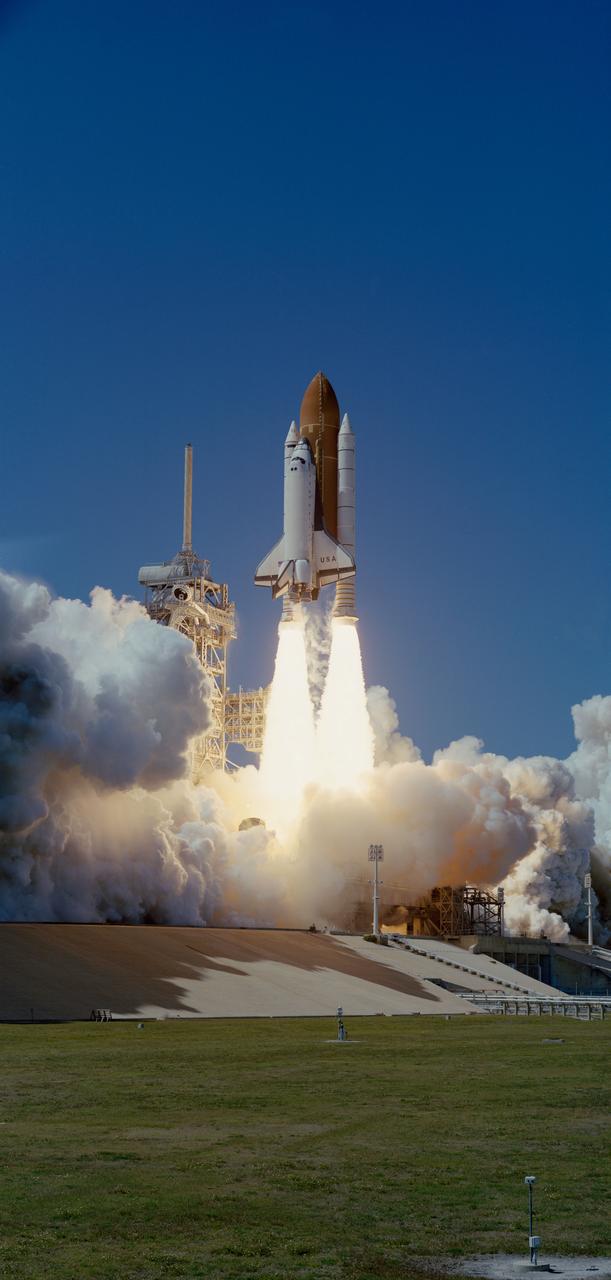
STS083-S-007 (4 April 1997)--- The Space Shuttle Columbia heads toward Earth-orbit from Launch Pad 39A at 2:20:32 p.m. (EST), April 4, 1997, at the Kennedy Space Center (KSC). Onboard the spacecraft to support the Microgravity Science Laboratory 1 (MSL-1) mission were astronauts James D. Halsell, commander; Susan L. Still, pilot; Janice E. Voss, payload commander; Michael L. Gernhardt and Donald A. Thomas, both mission specialists; along with payload specialists Roger K. Crouch and Gregory T. Linteris. A problem with a fuel cell caused the crew to cut the mission short and return to Earth on April 8, 1997.
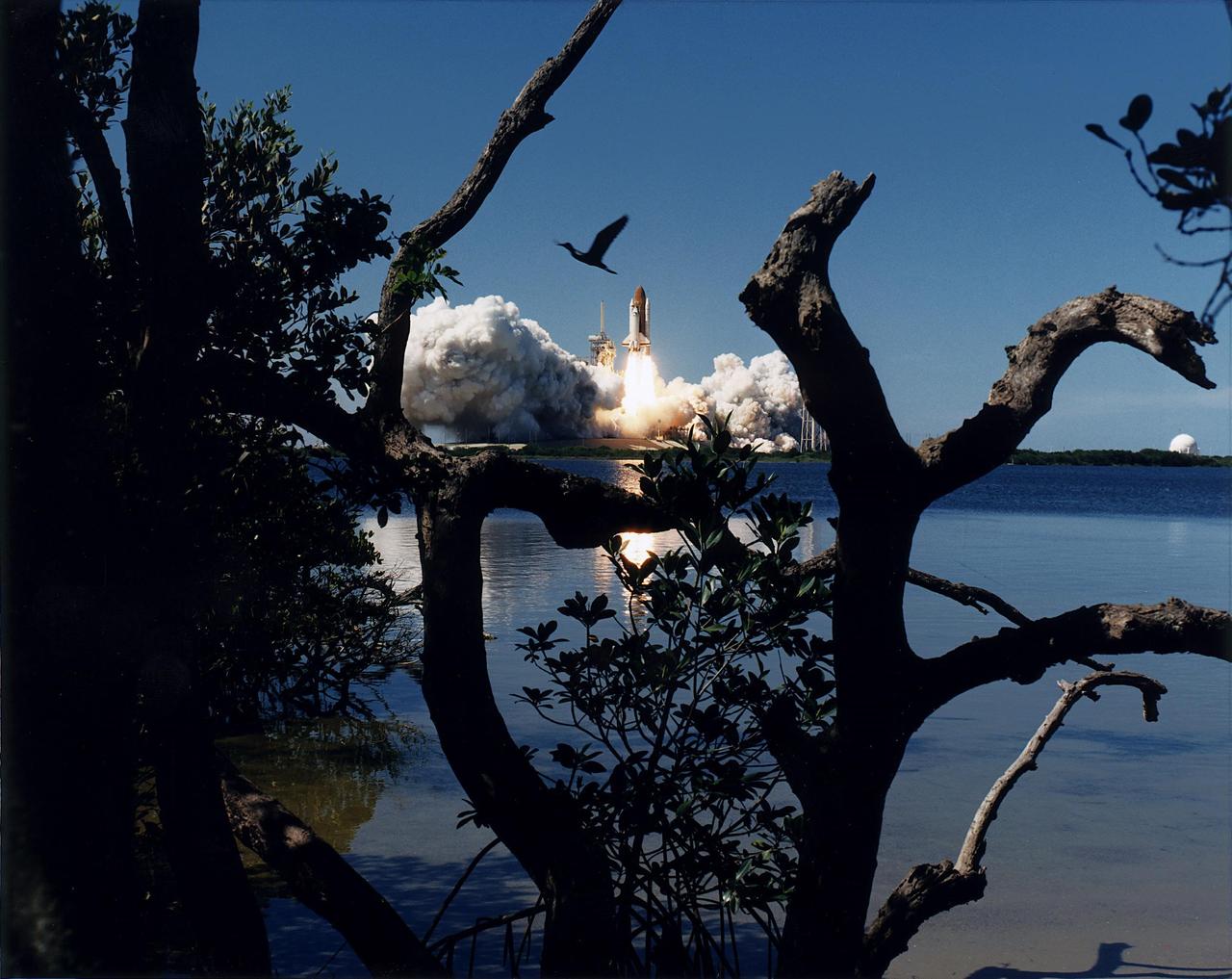
KENNEDY SPACE CENTER, FLA. -- Like a rising sun lighting up the afternoon sky, the Space Shuttle Columbia soars from Launch Pad 39A at 2:20:32 p.m. EST, April 4, on the 16-day Microgravity Science Laboratory-1 (MSL-1) mission. The crew members are Mission Commander James D. Halsell Jr., Pilot Susan L. Still, Payload Commander Janice Voss, Mission Specialists Michael L. Gernhardt and Donald A. Thomas, and Payload Specialists Roger K. Crouch and Gregory T. Linteris. During the scheduled 16-day STS-83 mission, the MSL-1 will be used to test some of the hardware, facilities and procedures that are planned for use on the International Space Station as well as research in combustion, protein crystal growth and materials processing experiments
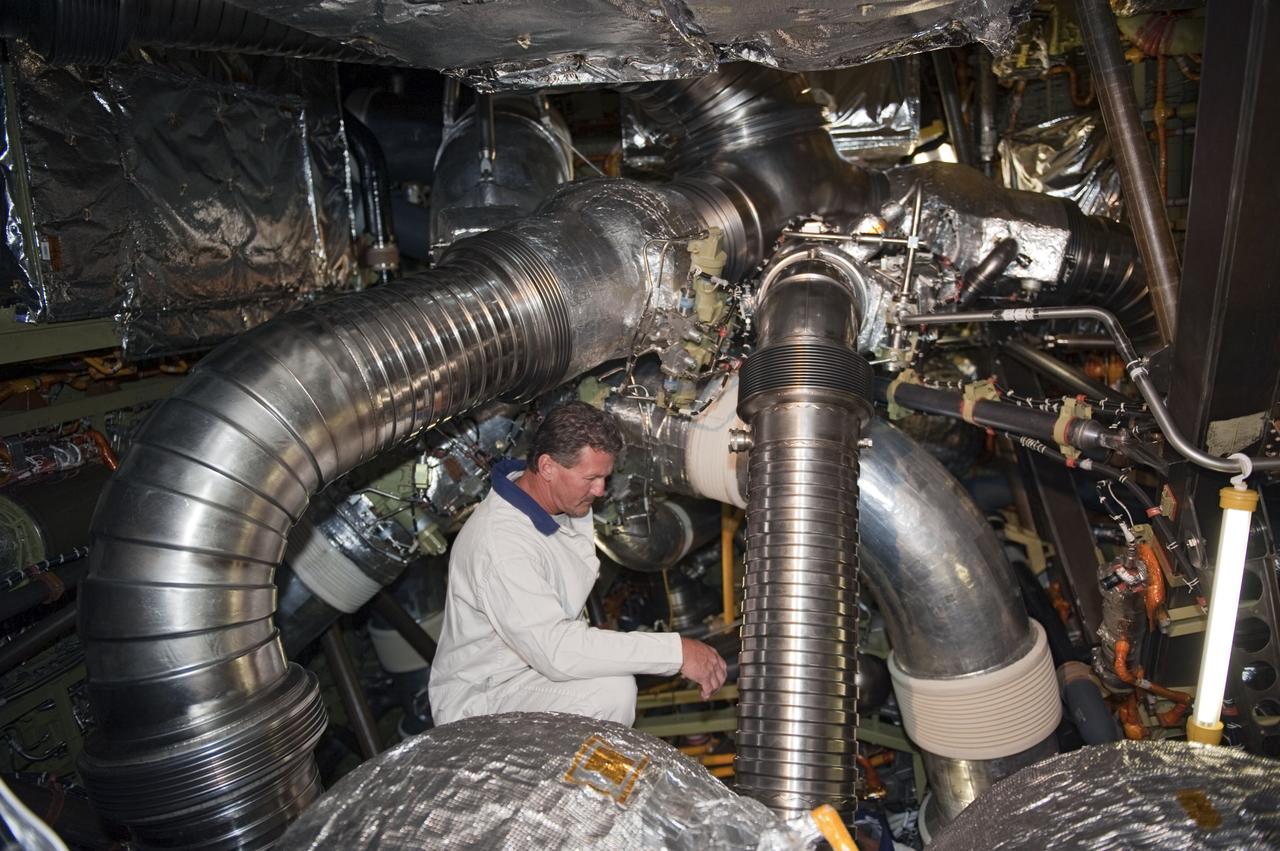
CAPE CANAVERAL, Fla. -- A technician at NASA Kennedy Space Center's Launch Pad 39A crouches in space shuttle Endeavour's aft section, where teams are preparing to remove and replace the aft load control assembly-2 (ALCA-2). Located in the orbiter's aft avionics bay 5, the assembly is believed to have caused heaters on a fuel line for Endeavour's auxiliary power unit-1 (APU-1) to fail April 29 during the first launch attempt for the STS-134 mission. STS-134 will deliver the Express Logistics Carrier-3, Alpha Magnetic Spectrometer-2 (AMS), a high-pressure gas tank and additional spare parts for the Dextre robotic helper to the International Space Station. The mission also will be the final spaceflight for Endeavour. For more information, visit www.nasa.gov/mission_pages/shuttle/shuttlemissions/sts134/index.html. Photo credit: NASA/Kim Shiflett
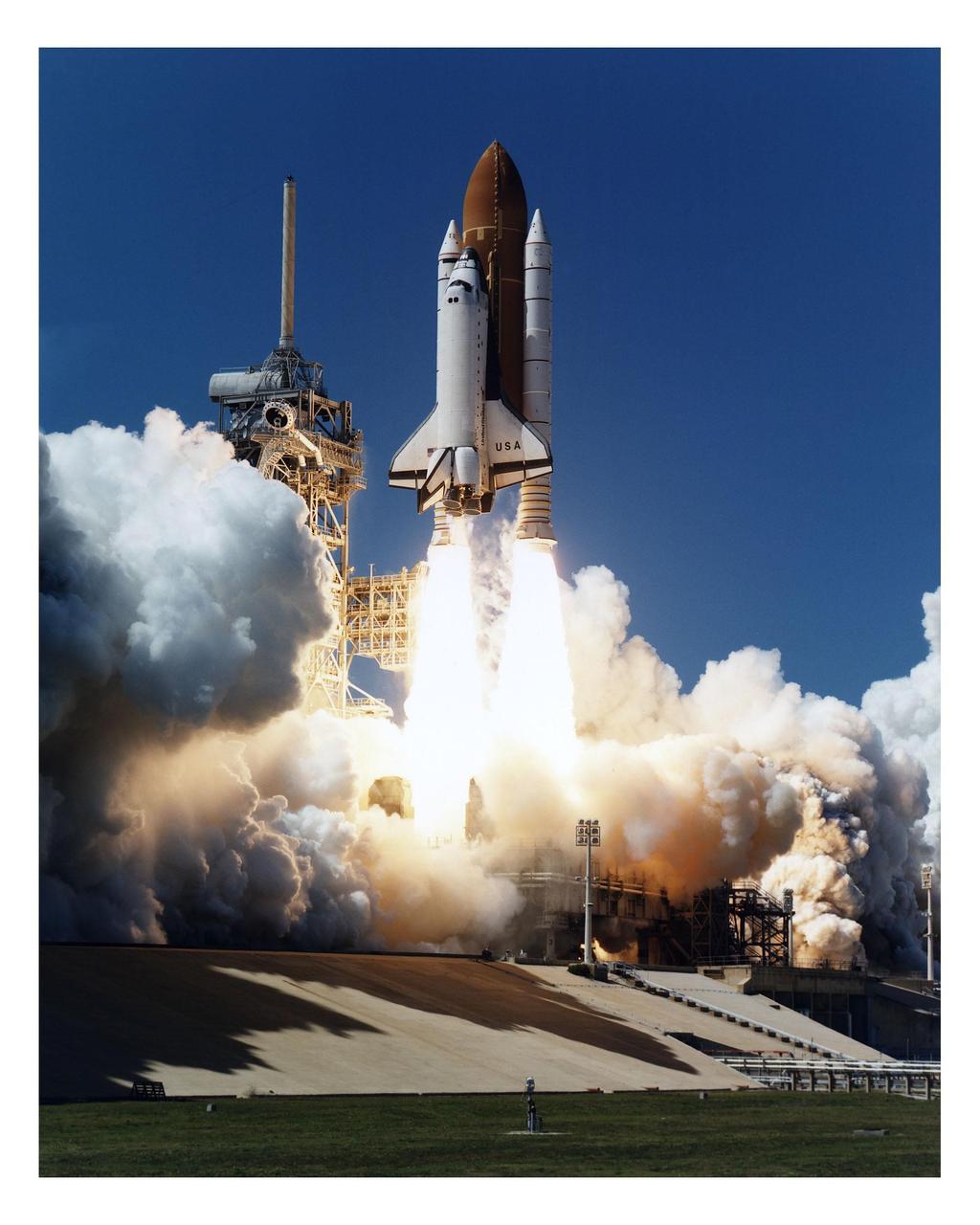
Like a rising sun lighting up the afternoon sky, the Space Shuttle Columbia soars from Launch Pad 39A at 2:20:32 p.m. EST, April 4, on the 16-day Microgravity Science Laboratory-1 (MSL-1) mission. The crew members are Mission Commander James D. Halsell, Jr.; Pilot Susan L. Still; Payload Commander Janice Voss; Mission Specialists Michael L. Gernhardt and Donald A. Thomas; and Payload Specialists Roger K. Crouch and Gregory T. Linteris. During the scheduled 16-day STS-83 mission, the MSL-1 will be used to test some of the hardware, facilities and procedures that are planned for use on the International Space Station as well as research in combustion, protein crystal growth and materials processing experiments
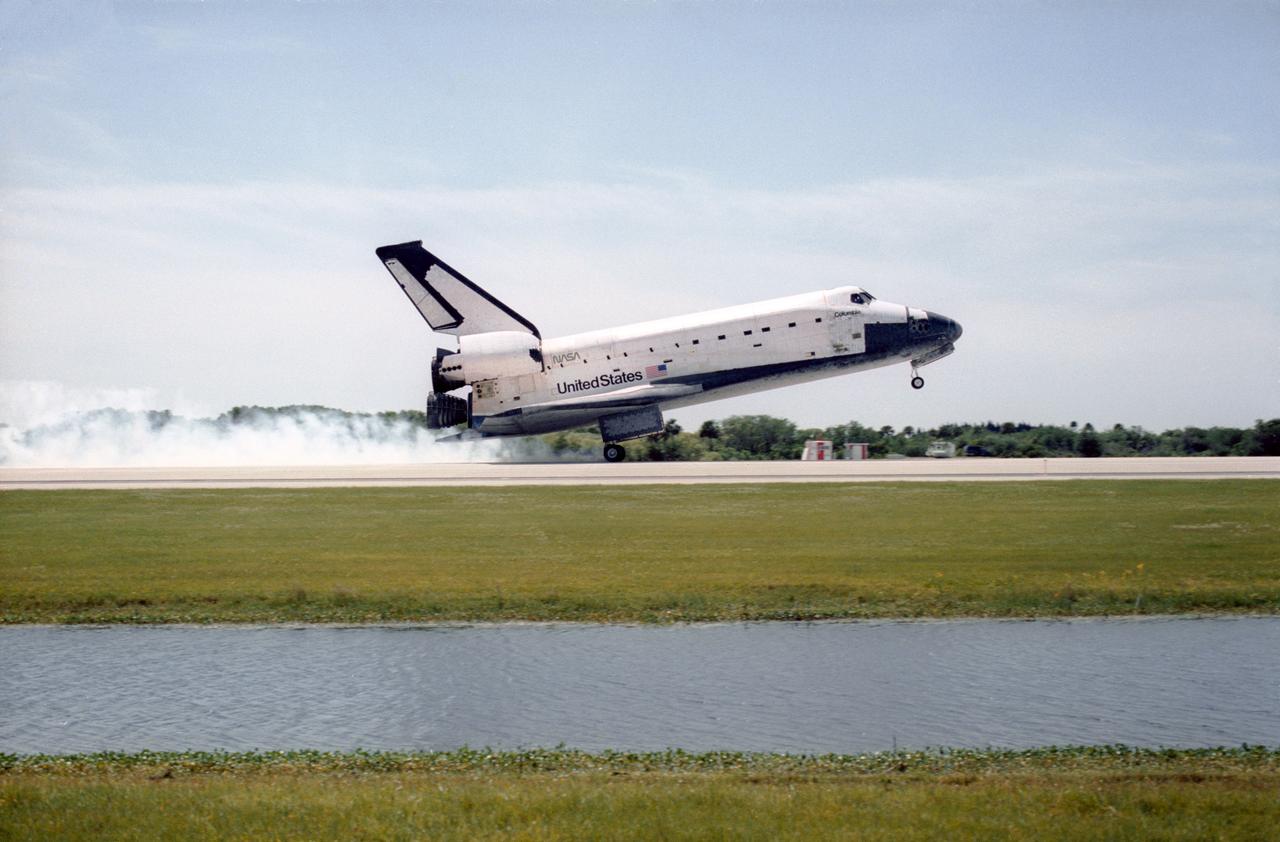
STS083-S-010 (8 April 1997) --- The main landing gear of the Space Shuttle Columbia touches down on the Shuttle Landing Facility (SLF) runway at the Kennedy Space Center (KSC), after completing almost four days of a scheduled 16-day mission in Earth-orbit. A problem with one of three fuel cells led to an early landing for the seven-member Microgravity Science Laboratory 1 (MSL-1) crew. Touchdown occurred at 1:33:11 p.m. (EDT), April 8, 1997. Onboard Columbia were James D. Halsell, Jr., Susan L. Still, Janice E. Voss, Donald A. Thomas, Michael L. Gernhardt, Roger K. Crouch and Gregory T. Linteris.
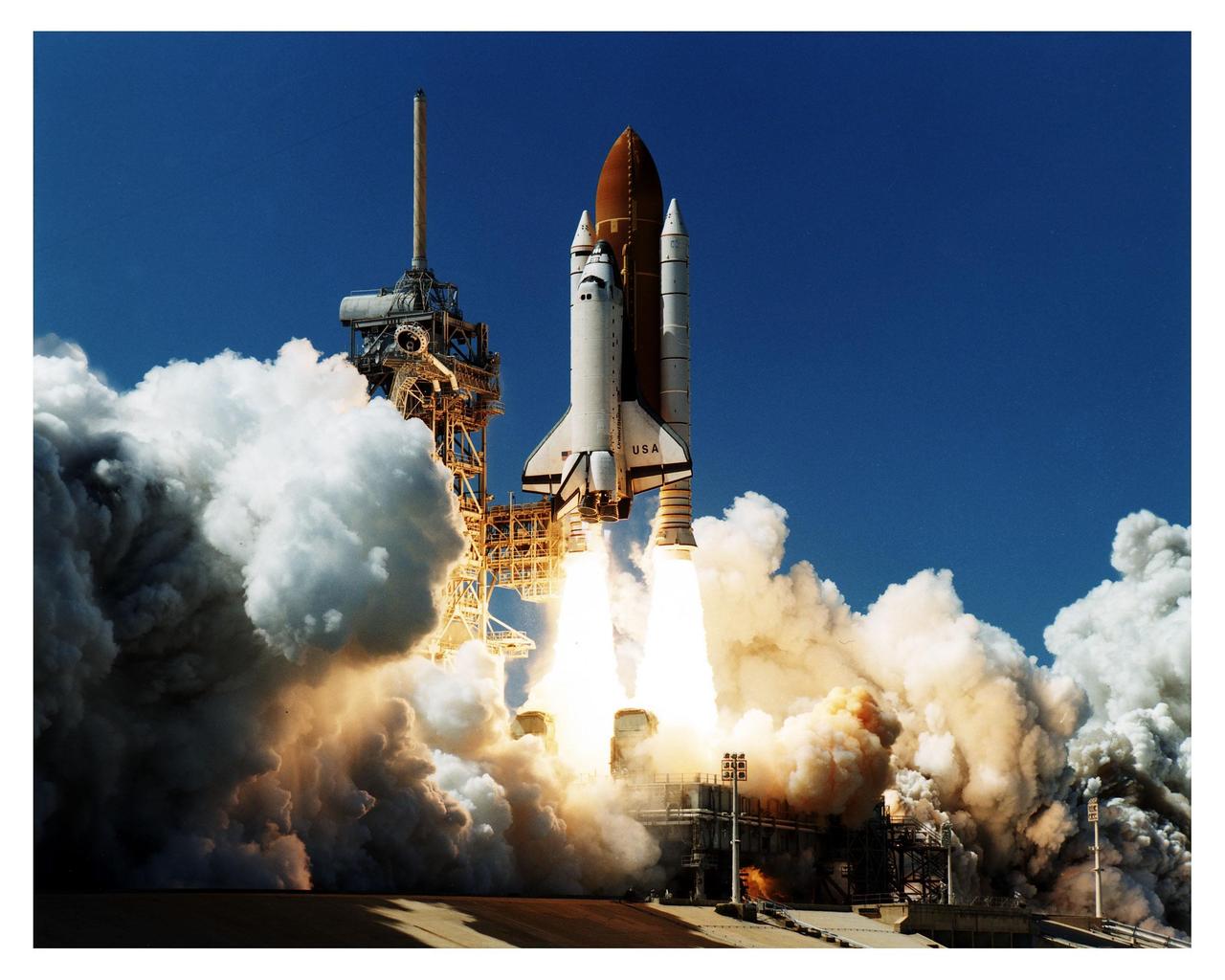
Like a rising sun lighting up the afternoon sky, the Space Shuttle Columbia soars from Launch Pad 39A at 2:20:32 p.m. EST, April 4, on the 16-day Microgravity Science Laboratory-1 (MSL-1) mission. The crew members are Mission Commander James D. Halsell, Jr.; Pilot Susan L. Still; Payload Commander Janice Voss; Mission Specialists Michael L. Gernhardt and Donald A. Thomas; and Payload Specialists Roger K. Crouch and Gregory T. Linteris. During the scheduled 16-day STS-83 mission, the MSL-1 will be used to test some of the hardware, facilities and procedures that are planned for use on the International Space Station as well as research in combustion, protein crystal growth and materials processing experiments
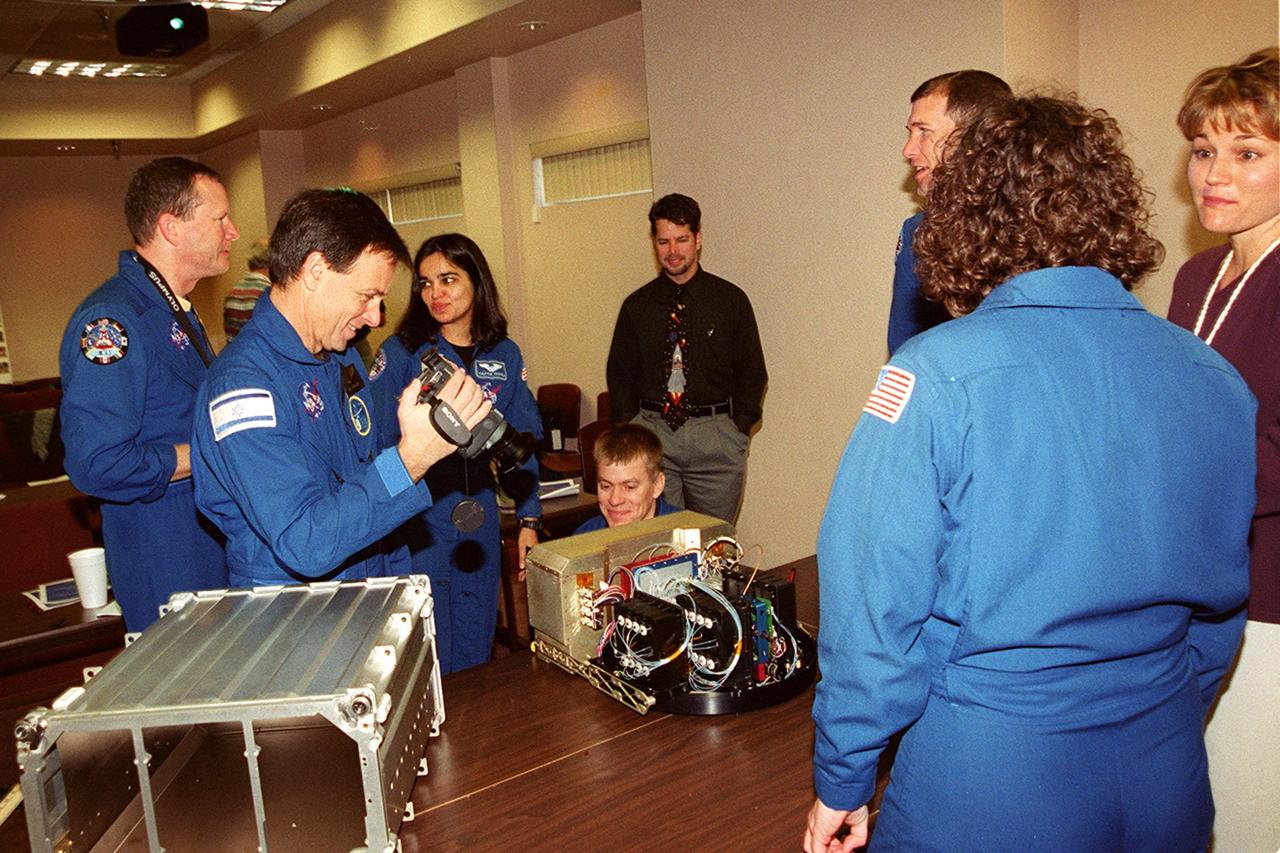
KENNEDY SPACE CENTER, FLA. -- As part of In-Flight Maintenance training, members of the STS-107 crew check out one of the Biotube experiments that will be part of their research mission . From left (in uniform) are Mission Specialist David M. Brown, Payload Specialist Ilan Ramon of Israel, and Mission Specialist Kalpana Chawla; Pilot William C. “Willie” McCool (crouching behind the table); Commander Rick D. Husband; and Mission Specialist Laurel Clark. At right is project engineer April Boody. As a research mission, STS-107 will carry the SPACEHAB Double Module in its first research flight into space and a broad collection of experiments ranging from material science to life science. It is scheduled to launch July 19, 2001
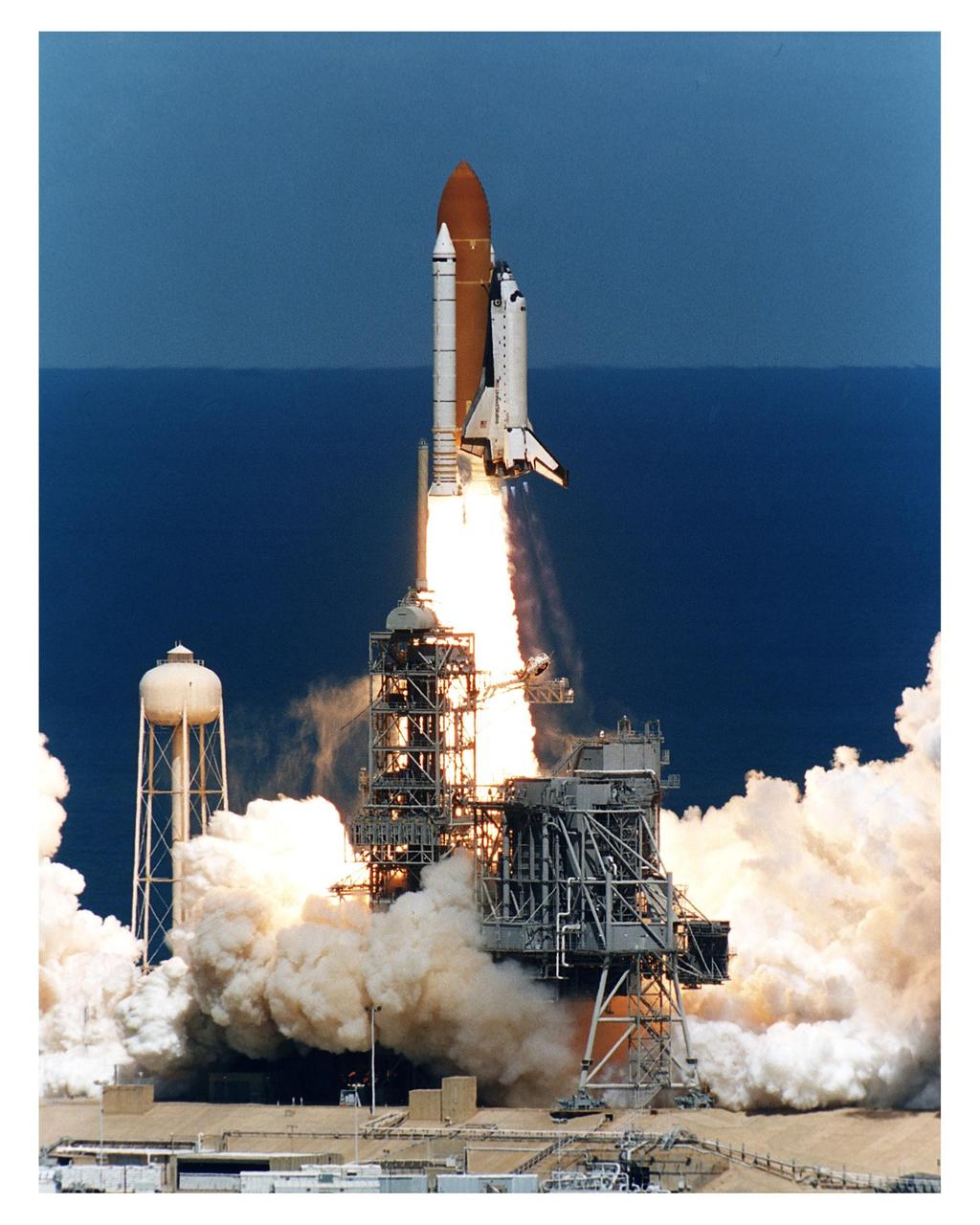
Like a rising sun lighting up the afternoon sky, the Space Shuttle Columbia soars from Launch Pad 39A at 2:20:32 p.m. EST, April 4, on the 16-day Microgravity Science Laboratory-1 (MSL-1) mission. The crew members are Mission Commander James D. Halsell, Jr.; Pilot Susan L. Still; Payload Commander Janice Voss; Mission Specialists Michael L. Gernhardt and Donald A. Thomas; and Payload Specialists Roger K. Crouch and Gregory T. Linteris. During the scheduled 16-day STS-83 mission, the MSL-1 will be used to test some of the hardware, facilities and procedures that are planned for use on the International Space Station as well as research in combustion, protein crystal growth and materials processing experiments

KENNEDY SPACE CENTER, FLA. - Greeted by cheers from wellwishers at KSC and eager for their ventur into space on the Microgrvity Science Laboratory-1 (MSL-1) mission, the STS-83 astronauts depart the Operations and Checkout Building on their way to Launch Pad 39A. Leading the seven-member crew is Mission Commander James D. Halsell Jr. Behind Halsell and to his right is Pilot Susan L. Still. Behind Still is Payload Commander Janice Voss, with Mission Specialist Donald A. Thomas to her left. Behind Thomas, in order, are Mission Specialist Michael L. Gernhardt and Payload Specialists Roger K. Crouch and Gregory T. Linteris. During the scheduled 16-day STS-83 mission, the MSL-1 will be used to test some of the hardware, facilities and procedures that are planned for use on the International Space Station while the flight crew conducts combustion, protein crystal growth and materials processing experiments. Also onboard is the Hitchhiker Cryogenic Flexible Diode (CRYOFD) experiment payload, which is attched to the right side of Columbia's payload bay.
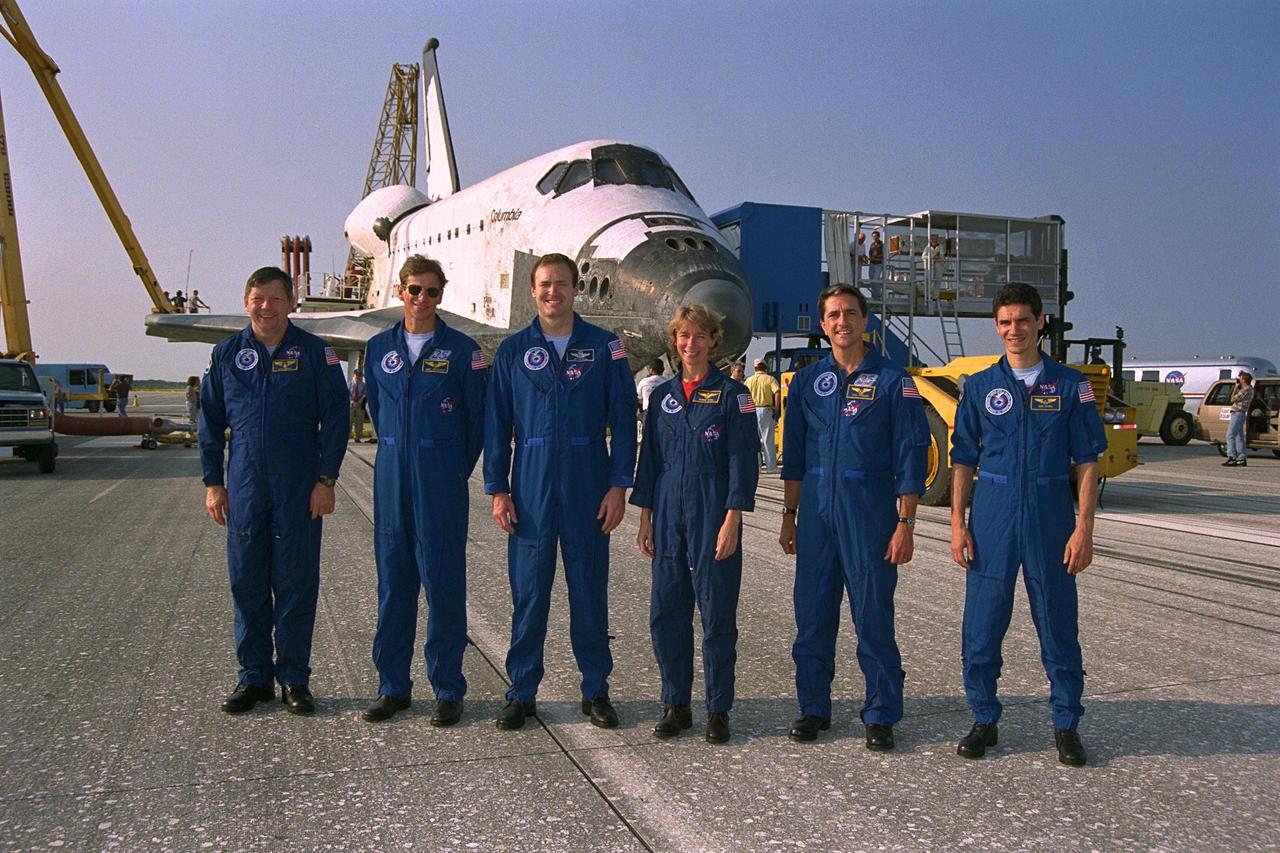
KENNEDY SPACE CENTER, FLA. -- The STS-94 flight crew poses in front of the Space Shuttle orbiter Columbia after an end-of-mission landing on Runway 33 at KSC’s Shuttle Landing Facility July 17 to complete the Microgravity Science Laboratory-1 (MSL-1) mission. They are (from left): Payload Specialist Roger K. Crouch; Mission Specialist Michael L. Gernhardt; Mission Commander James D. Halsell Jr.; Pilot Susan L. Still; Mission Specialist Donald A. Thomas; and Payload Specialist Gregory T. Linteris. Not shown is Payload Commander Janice Voss. During the 15-day, 16-hour spaceflight, the MSL-1 Spacelab module was used to test some of the hardware, facilities and procedures that are planned for use on the International Space Station; the flight crew also conducted combustion, protein crystal growth and materials processing experiments. This mission was a reflight of the STS-83 mission earlier this year that was cut short due to indications of a faulty fuel cell
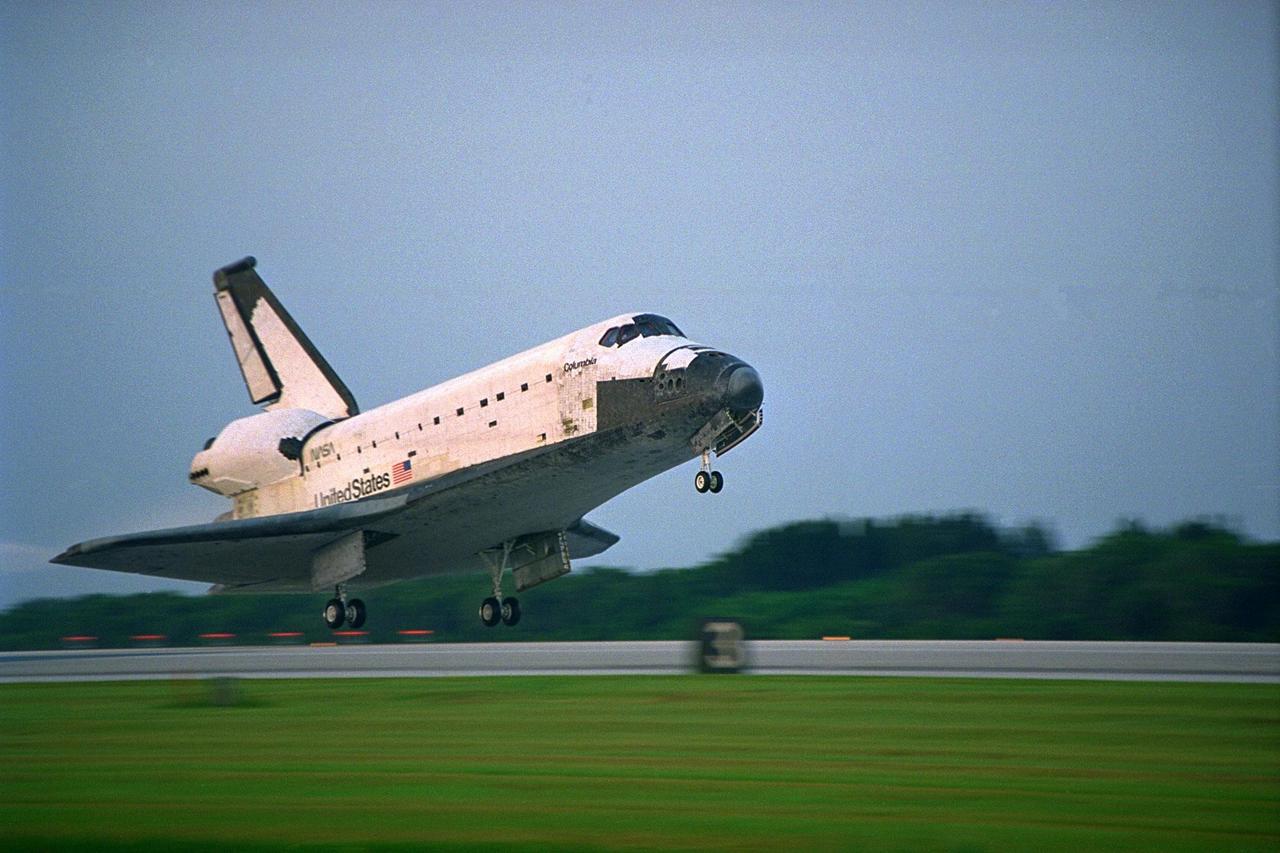
KENNEDY SPACE CENTER, FLA. -- The Space Shuttle orbiter Columbia touches down on Runway 33 at KSC’s Shuttle Landing Facility at 6:46:34 a.m. EDT with Mission Commander James D. Halsell Jr. and Pilot Susan L. Still at the controls to complete the STS-94 mission. Also on board are Mission Specialist Donald A. Thomas, Mission Specialist Michael L. Gernhardt, Payload Commander Janice Voss, and Payload Specialists Roger K. Crouch and Gregory T. Linteris. During the Microgravity Science Laboratory-1 (MSL-1) mission, the Spacelab module was used to test some of the hardware, facilities and procedures that are planned for use on the International Space Station while the flight crew conducted combustion, protein crystal growth and materials processing experiments. This mission was a reflight of the STS-83 mission that lifted off from KSC in April of this year. That space flight was cut short due to indications of a faulty fuel cell. This was Columbia’s 11th landing at KSC and the 38th landing at the space center in the history of the Shuttle program
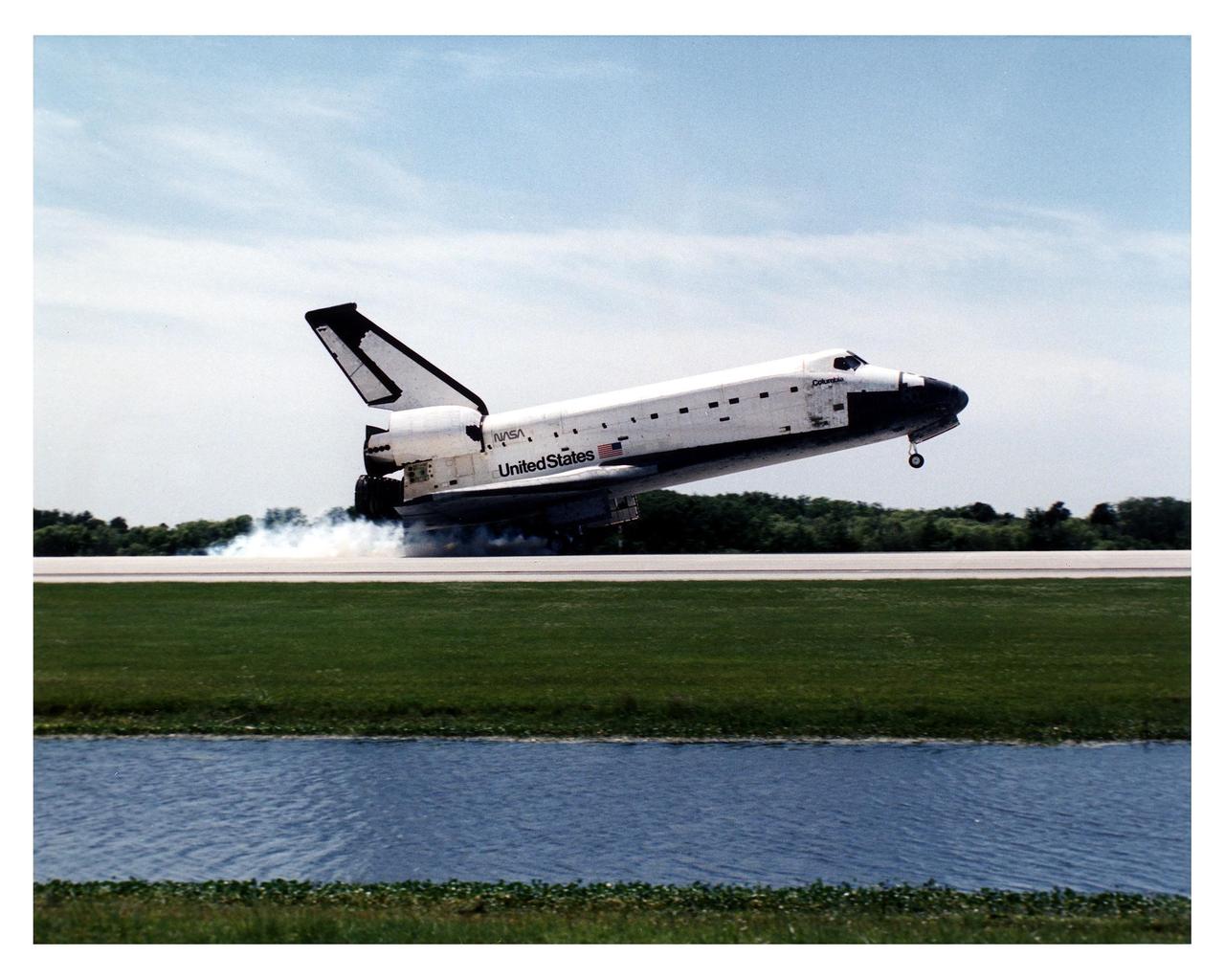
KENNEDY SPACE CENTER, FLA. -- The Space Shuttle Columbia touches down on Runway 33 at KSC's Shuttle Landing Facility at 2:33:11 p.m. EDT, April 8, to conclude the Microgravity Science Laboratory-1 (MSL-1) mission. At main gear touchdown, the STS-83 mission duration was 3 days, 23 hours, 12 minutes. The planned 16-day mission was cut short by a faulty fuel cell. This is only the third time in Shuttle program history that an orbiter was brought home early due to mechanical problems. This was also the 36th KSC landing since the program began in 1981. Mission Commander James D. Halsell, Jr. flew Columbia to a perfect landing with help from Pilot Susan L. Still. Other crew members are Payload Commander Janice E. Voss; Mission Specialists Michael L. Gernhardt and Donald A. Thomas; and Payload Specialists Roger K. Crouch and Gregory T. Linteris. In spite of the abbreviated flight, the crew was able to perform MSL-1 experiments. The Spacelab-module-based experiments were used to test some of the hardware, facilities and procedures that are planned for use on the International Space Station and to conduct combustion, protein crystal growth and materials processing investigations

KENNEDY SPACE CENTER, FLA. -- With its drag chute deployed, the Space Shuttle Orbiter Columbia touches down on Runway 33 at KSC’s Shuttle Landing Facility at 6:46:34 a.m. EDT with Mission Commander James D. Halsell Jr. and Pilot Susan L. Still at the controls to complete the STS-94 mission. Also on board are Mission Specialist Donald A. Thomas, Mission Specialist Michael L. Gernhardt , Payload Commander Janice Voss, and Payload Specialists Roger K. Crouch and Gregory T. Linteris. Mission elapsed time for STS-94 was 15 days,16 hours, 44 seconds. During the Microgravity Science Laboratory-1 (MSL-1) mission, the Spacelab module was used to test some of the hardware, facilities and procedures that are planned for use on the International Space Station while the flight crew conducted combustion, protein crystal growth and materials processing experiments. This mission was a reflight of the STS-83 mission that lifted off from KSC in April of this year. That space flight was cut short due to indications of a faulty fuel cell. This was Columbia’s 11th landing at KSC and the 38th landing at the space center in the history of the Shuttle program
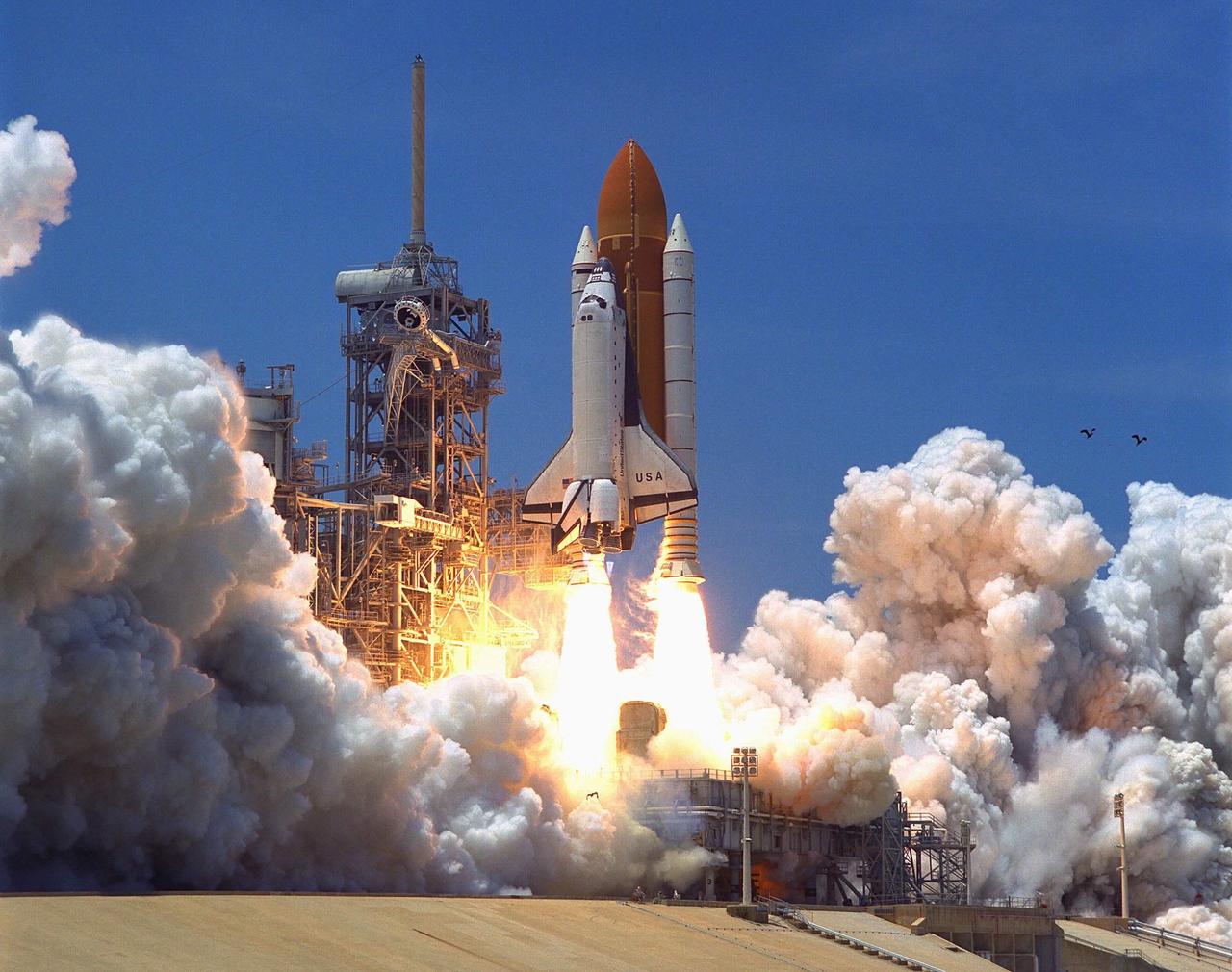
KENNEDY SPACE CENTER, Fla. -- The Space Shuttle Columbia soars from Launch Pad 39A at 2:02 p.m. EDT July 1 to begin the 16-day STS-94 Microgravity Science Laboratory-1 (MSL-1) mission. The launch window was opened 47 minutes earlier than the originally scheduled time of 2:37 p.m. to improve the opportunity to lift off before Florida summer rain showers reached the space center. The crew members are Mission Commander James D. Halsell Jr.; Pilot Susan L. Still; Payload Commander Janice Voss; Mission Specialists Michael L.Gernhardt and Donald A. Thomas; and Payload Specialists Roger K. Crouch and Gregory T. Linteris. During the space flight, the MSL-1 will be used to test some of the hardware, facilities and procedures that are planned for use on the International Space Station while the flight crew conducts combustion, protein crystal growth and materials processing experiments. Also onboard is the Hitchhiker Cryogenic Flexible Diode (CRYOFD) experiment payload, which is attached to the right side of Columbia’s payload bay. These payloads had previously flown on the STS-83 mission in April, which was cut short after nearly four days because of indications of a faulty fuel cell. STS-94 is a reflight of that mission

KENNEDY SPACE CENTER, FLA. -- Framed by the Vehicle Assembly Building at right and the Mate-Demate Device at left, the Space Shuttle orbiter Columbia glides onto Runway 33 at KSC’s Shuttle Landing Facility at 6:46:34 a.m. EDT with Mission Commander James D. Halsell Jr. and Pilot Susan L. Still at the controls to complete the STS-94 mission. Also on board are Mission Specialist Donald A. Thomas, Mission Specialist Michael L. Gernhardt, Payload Commander Janice Voss, and Payload Specialists Roger K. Crouch and Gregory T. Linteris. During the Microgravity Science Laboratory-1 (MSL-1) mission, the Spacelab module was used to test some of the hardware, facilities and procedures that are planned for use on the International Space Station while the flight crew conducted combustion, protein crystal growth and materials processing experiments. This mission was a reflight of the STS-83 mission that lifted off from KSC in April of this year. That space flight was cut short due to indications of a faulty fuel cell. This was Columbia’s 11th landing at KSC and the 38th landing at the space center in the history of the Shuttle program
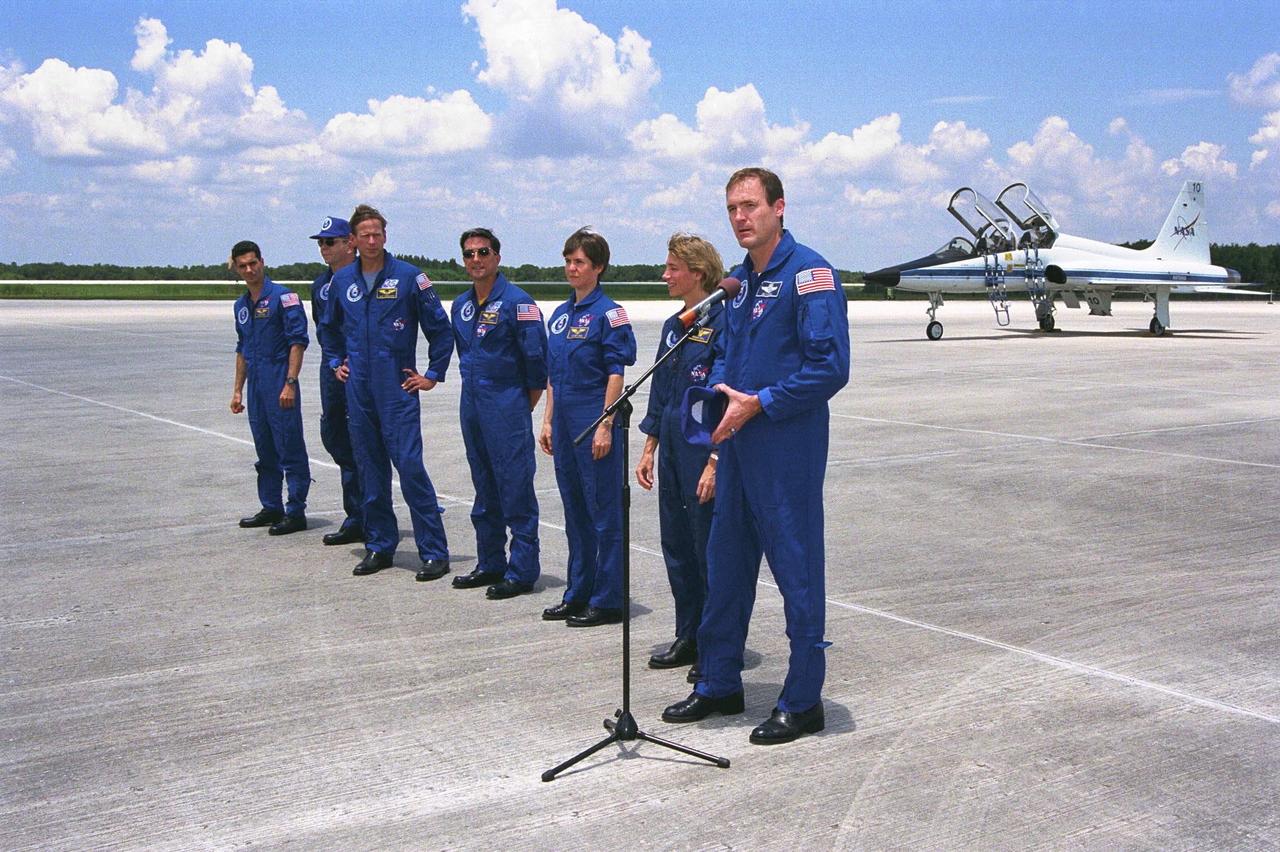
STS-94 Commander James D. Halsell, Jr., speaks to the media at the Shuttle Landing Facility after the crew arrived at Kennedy Space Center in preparation for the reflight of the Microgravity Science Laboratory-1 mission. Launch is scheduled for July 1, 1997, at 2:37 p.m. EDT. From left to right, the crew members are Payload Specialists Gregory T. Linteris and Roger K. Crouch; Mission Specialists Michael L. Gernhardt and Donald A. Thomas; Payload Commander Janice E. Voss; Pilot Susan Leigh Still and Commander James D. Halsell, Jr. One of the T-38 jets aboard which the crew arrived can be seen in the background. The laboratory was scheduled to fly again with the full complement of STS-83 experiments after that mission was cut short due to a faulty fuel cell. During the scheduled 16-day STS-94 mission, the experiments will be used to test some of the hardware, facilities and procedures that are planned for use on the International Space Station while the flight crew conducts combustion, protein crystal growth and materials processing experiments
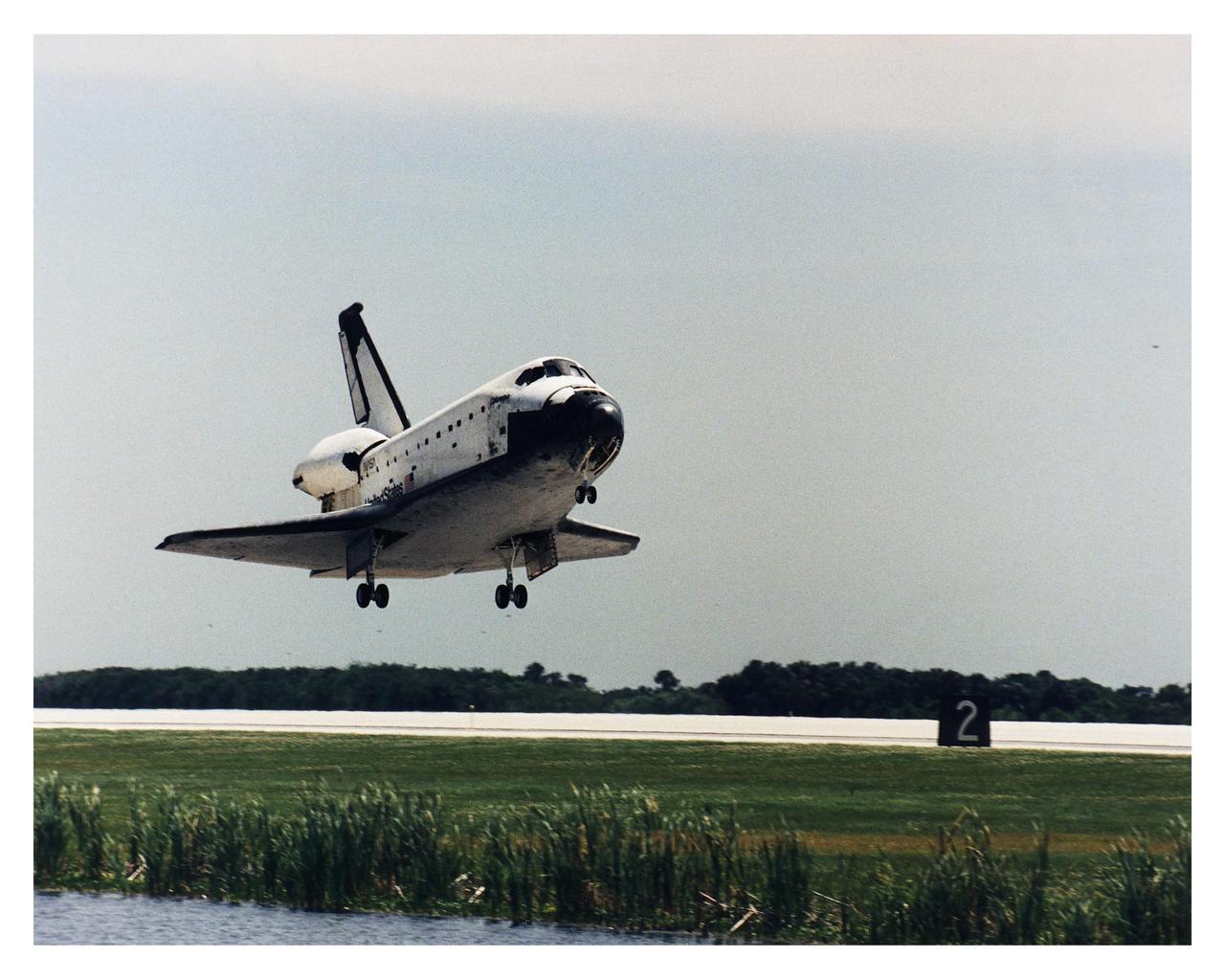
KENNEDY SPACE CENTER, FLA. -- The Space Shuttle Columbia prepares to touch down on Runway 33 at KSC's Shuttle Landing Facility at approximately 2:33 p.m. EDT, April 8, to conclude the Microgravity Science Laboratory-1 (MSL-1) mission. At main gear touchdown, the STS-83 mission duration will be just under four days. The planned 16-day mission was cut short by a faulty fuel cell. This is only the third time in Shuttle program history that an orbiter was brought home early due to mechanical problems. This was also the 36th KSC landing since the program began in 1981. Mission Commander James D. Halsell, Jr. flew Columbia to a perfect landing with help from Pilot Susan L. Still. Other crew members are Payload Commander Janice E. Voss; Mission Specialists Michael L.Gernhardt and Donald A. Thomas; and Payload Specialists Roger K. Crouch and Gregory T. Linteris. In spite of the abbreviated flight, the crew was able to perform MSL-1 experiments. The Spacelab-module-based experiments were used to test some of the hardware, facilities and procedures that are planned for use on the International Space Station and to conduct combustion, protein crystal growth and materials processing investigations
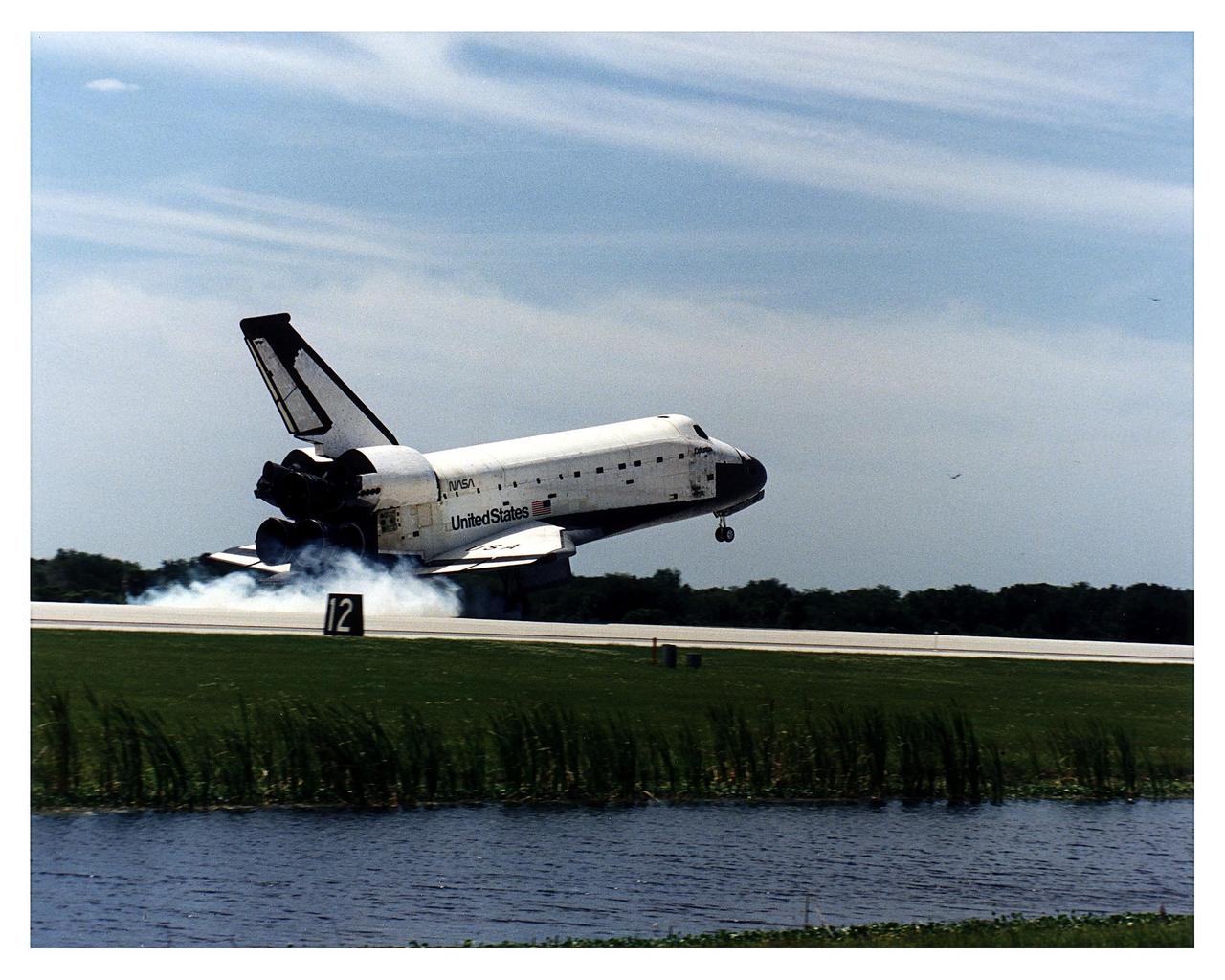
KENNEDY SPACE CENTER, FLA. -- The Space Shuttle Columbia touches down on Runway 33 at KSC's Shuttle Landing Facility at 2:33:11 p.m. EDT, April 8, to conclude the Microgravity Science Laboratory-1 (MSL-1) mission. At main gear touchdown, the STS-83 mission duration was 3 days, 23 hours, 12 minutes. The planned 16-day mission was cut short by a faulty fuel cell. This is only the third time in Shuttle program history that an orbiter was brought home early due to mechanical problems. This was also the 36th KSC landing since the program began in 1981. Mission Commander James D. Halsell, Jr. flew Columbia to a perfect landing with help from Pilot Susan L. Still. Other crew members are Payload Commander Janice E. Voss; Mission Specialists Michael L. Gernhardt and Donald A. Thomas; and Payload Specialists Roger K. Crouch and Gregory T. Linteris. In spite of the abbreviated flight, the crew was able to perform MSL-1 experiments. The Spacelab-module-based experiments were used to test some of the hardware, facilities and procedures that are planned for use on the International Space Station and to conduct combustion, protein crystal growth and materials processing investigations
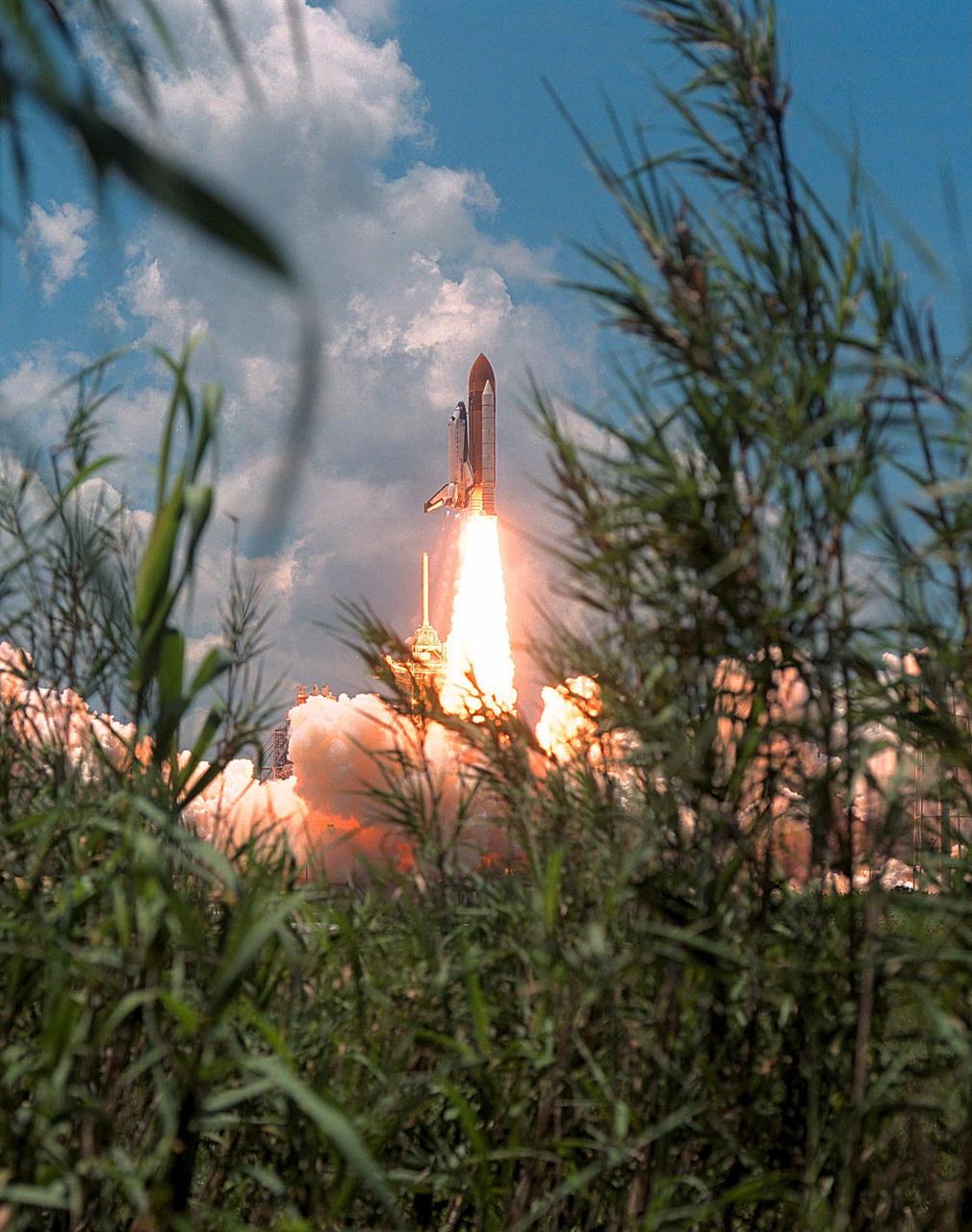
KENNEDY SPACE CENTER, Fla. -- The Space Shuttle Columbia soars from Launch Pad 39A at 2:02 p.m. EDT July 1 to begin the 16-day STS-94 Microgravity Science Laboratory-1 (MSL-1) mission. The launch window was opened 47 minutes earlier than the originally scheduled time of 2:37 p.m. to improve the opportunity to lift off before Florida summer rain showers reached the space center. The crew members are Mission Commander James D. Halsell Jr.; Pilot Susan L. Still; Payload Commander Janice Voss; Mission Specialists Michael L.Gernhardt and Donald A. Thomas; and Payload Specialists Roger K. Crouch and Gregory T. Linteris. During the space flight, the MSL-1 will be used to test some of the hardware, facilities and procedures that are planned for use on the International Space Station while the flight crew conducts combustion, protein crystal growth and materials processing experiments. Also onboard is the Hitchhiker Cryogenic Flexible Diode (CRYOFD) experiment payload, which is attached to the right side of Columbia’s payload bay. These payloads had previously flown on the STS-83 mission in April, which was cut short after nearly four days because of indications of a faulty fuel cell. STS-94 is a reflight of that mission
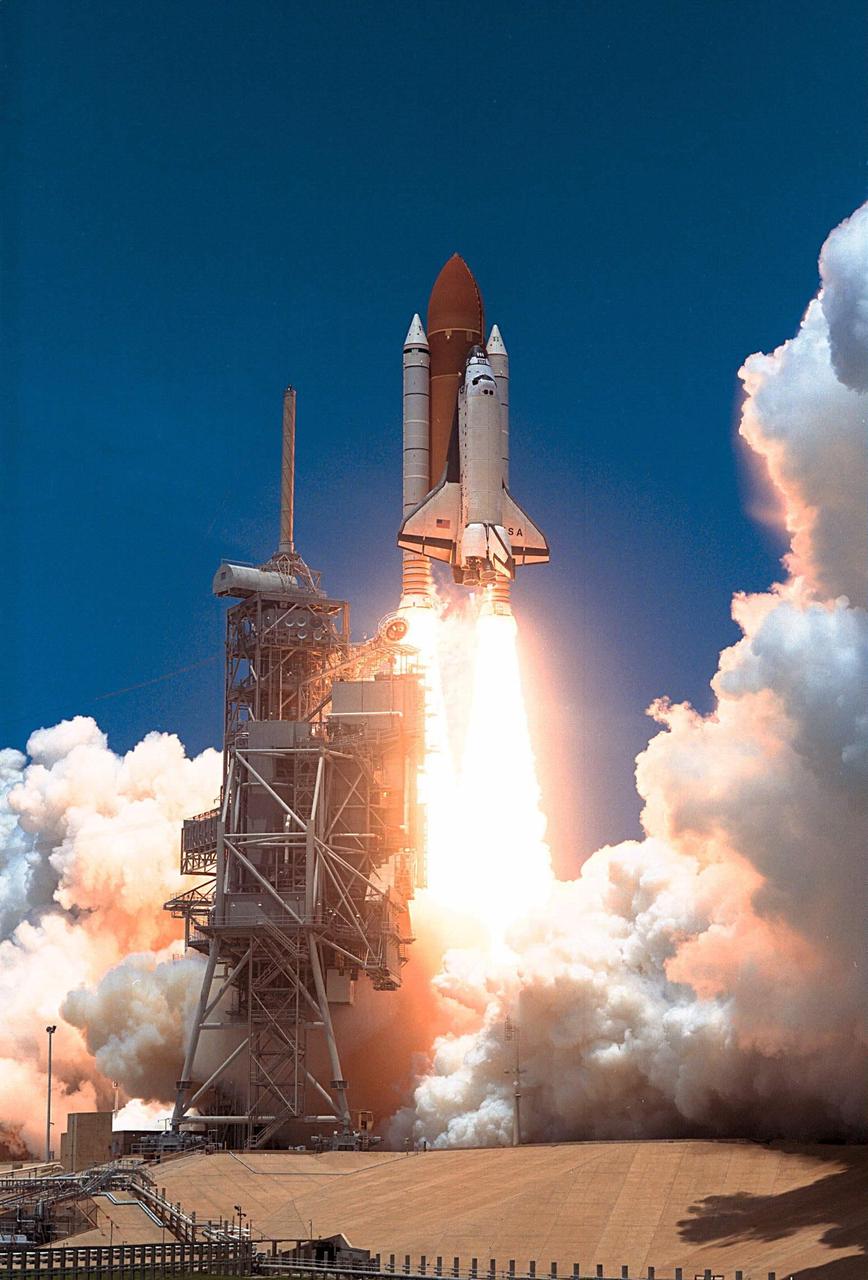
KENNEDY SPACE CENTER, Fla. -- The Space Shuttle Columbia soars from Launch Pad 39A at 2:02 p.m. EDT July 1 to begin the 16-day STS-94 Microgravity Science Laboratory-1 (MSL-1) mission. The launch window was opened 47 minutes earlier than the originally scheduled time of 2:37 p.m. to improve the opportunity to lift off before Florida summer rain showers reached the space center. The crew members are Mission Commander James D. Halsell Jr.; Pilot Susan L. Still; Payload Commander Janice Voss; Mission Specialists Michael L.Gernhardt and Donald A. Thomas; and Payload Specialists Roger K. Crouch and Gregory T. Linteris. During the space flight, the MSL-1 will be used to test some of the hardware, facilities and procedures that are planned for use on the International Space Station while the flight crew conducts combustion, protein crystal growth and materials processing experiments. Also onboard is the Hitchhiker Cryogenic Flexible Diode (CRYOFD) experiment payload, which is attached to the right side of Columbia’s payload bay. These payloads had previously flown on the STS-83 mission in April, which was cut short after nearly four days because of indications of a faulty fuel cell. STS-94 is a reflight of that mission
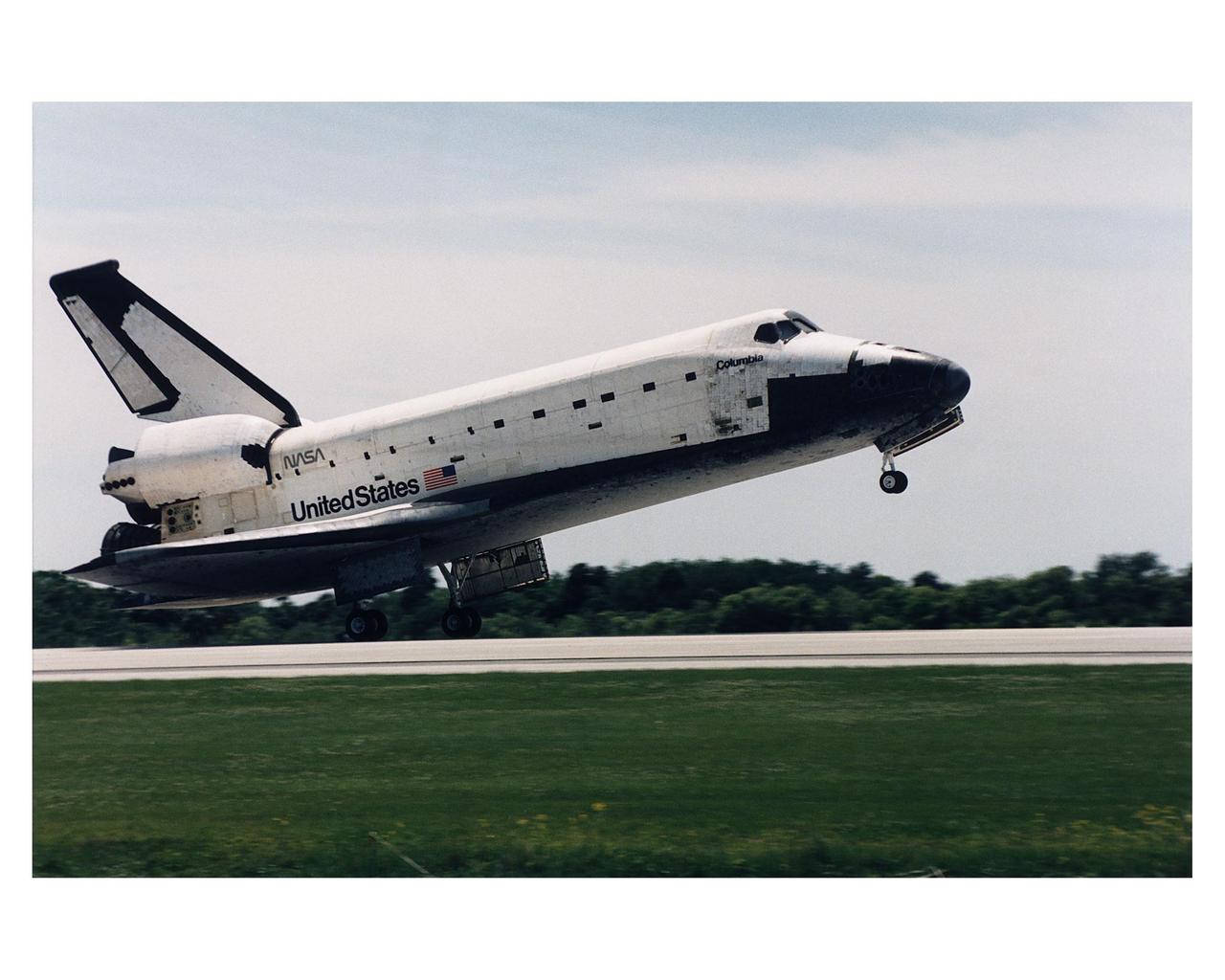
KENNEDY SPACE CENTER, FLA. -- The Space Shuttle Columbia touches down on Runway 33 at KSC's Shuttle Landing Facility at 2:33:11 p.m. EDT, April 8, to conclude the Microgravity Science Laboratory-1 (MSL-1) mission. At main gear touchdown, the STS-83 mission duration was 3 days, 23 hours, 12 minutes. The planned 16-day mission was cut short by a faulty fuel cell. This is only the third time in Shuttle program history that an orbiter was brought home early due to mechanical problems. This was also the 36th KSC landing since the program began in 1981. Mission Commander James D. Halsell, Jr. flew Columbia to a perfect landing with help from Pilot Susan L. Still. Other crew members are Payload Commander Janice E. Voss; Mission Specialists Michael L. Gernhardt and Donald A. Thomas; and Payload Specialists Roger K. Crouch and Gregory T. Linteris. In spite of the abbreviated flight, the crew was able to perform MSL-1 experiments. The Spacelab-module-based experiments were used to test some of the hardware, facilities and procedures that are planned for use on the International Space Station and to conduct combustion, protein crystal growth and materials processing investigations
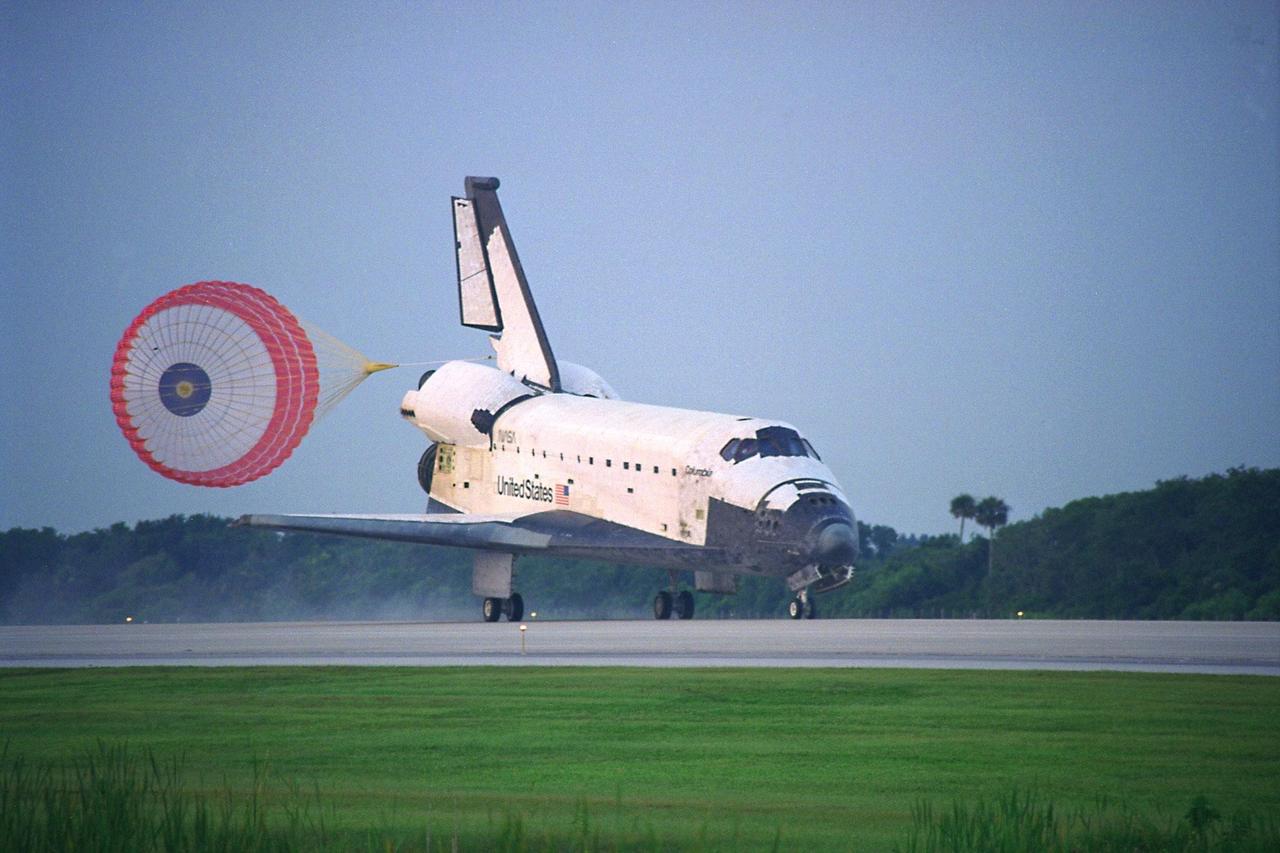
KENNEDY SPACE CENTER, FLA. -- With its drag chute deployed, the Space Shuttle Orbiter Columbia touches down on Runway 33 at KSC’s Shuttle Landing Facility at 6:46:34 a.m. EDT with Mission Commander James D. Halsell Jr. and Pilot Susan L. Still at the controls to complete the STS-94 mission. Also on board are Mission Specialist Donald A. Thomas, Mission Specialist Michael L. Gernhardt , Payload Commander Janice Voss, and Payload Specialists Roger K. Crouch and Gregory T. Linteris. Mission elapsed time for STS-94 was 15 days,16 hours, 44 seconds. During the Microgravity Science Laboratory-1 (MSL-1) mission, the Spacelab module was used to test some of the hardware, facilities and procedures that are planned for use on the International Space Station while the flight crew conducted combustion, protein crystal growth and materials processing experiments. This mission was a reflight of the STS-83 mission that lifted off from KSC in April of this year. That space flight was cut short due to indications of a faulty fuel cell. This was Columbia’s 11th landing at KSC and the 38th landing at the space center in the history of the Shuttle program
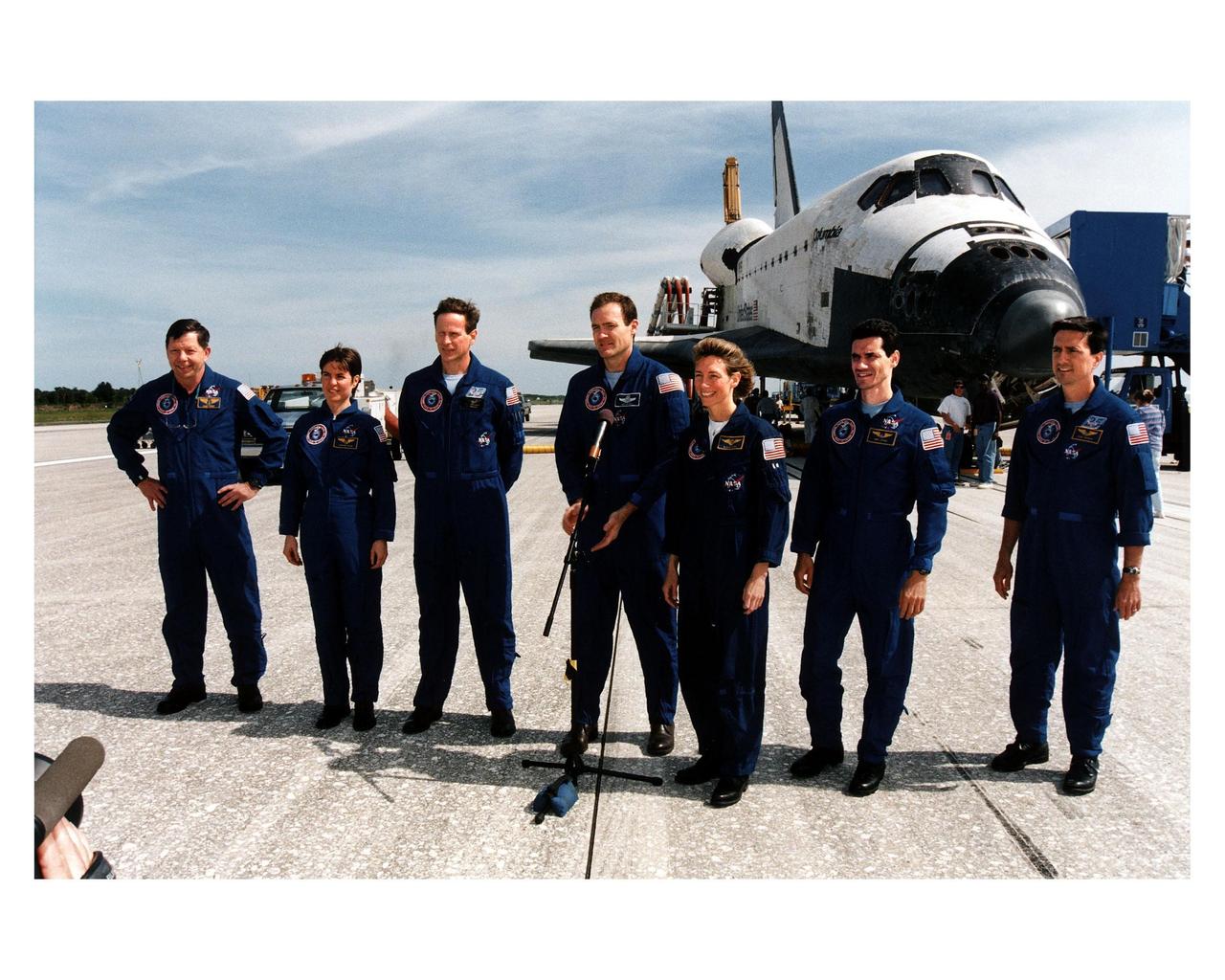
KENNEDY SPACE CENTER, FLA. -- With the Space Shuttle Orbiter Columbia in the background, STS-83 Mission Commander James D. Halsell (center) gives a post-landing briefing on Runway 33 at KSC’s Shuttle Landing Facility. Columbia landed at 2:33:11 p. m. EDT, April 8, to conclude the Microgravity Science Laboratory-1 (MSL-1) mission. The other flight crew members (from left) are: Payload Specialist Roger K. Crouch; Payload Commander Janice Voss; Mission Specialist Michael L. Gernhardt; Pilot Susan L. Still; Payload Specialist Gregory T. Linteris; and Mission Specialist Donald A. Thomas. At main gear touchdown, the STS-83 mission duration was 3 days, 23 hours, 12 minutes. The planned 16-day mission was cut short by a faulty fuel cell. This is only the third time in Shuttle program history that an orbiter was brought home early due to mechanical problems. This was also the 36th KSC landing since the program began in 1981
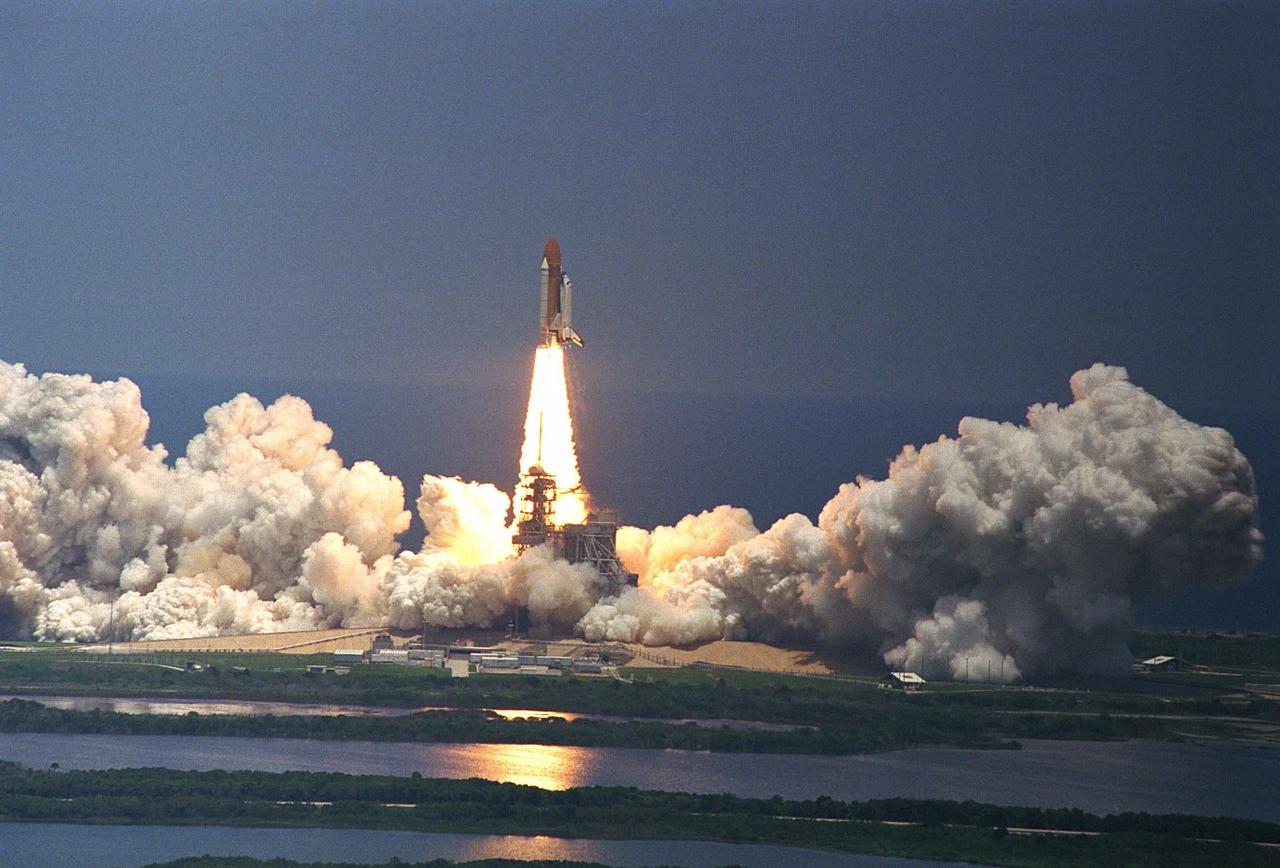
KENNEDY SPACE CENTER, Fla. -- The Space Shuttle Columbia soars from Launch Pad 39A at 2:02 p.m. EDT July 1 to begin the 16-day STS-94 Microgravity Science Laboratory-1 (MSL-1) mission. The launch window was opened 47 minutes earlier than the originally scheduled time of 2:37 p.m. to improve the opportunity to lift off before Florida summer rain showers reached the space center. The crew members are Mission Commander James D. Halsell Jr.; Pilot Susan L. Still; Payload Commander Janice Voss; Mission Specialists Michael L.Gernhardt and Donald A. Thomas; and Payload Specialists Roger K. Crouch and Gregory T. Linteris. During the space flight, the MSL-1 will be used to test some of the hardware, facilities and procedures that are planned for use on the International Space Station while the flight crew conducts combustion, protein crystal growth and materials processing experiments. Also onboard is the Hitchhiker Cryogenic Flexible Diode (CRYOFD) experiment payload, which is attached to the right side of Columbia’s payload bay. These payloads had previously flown on the STS-83 mission in April, which was cut short after nearly four days because of indications of a faulty fuel cell. STS-94 is a reflight of that mission
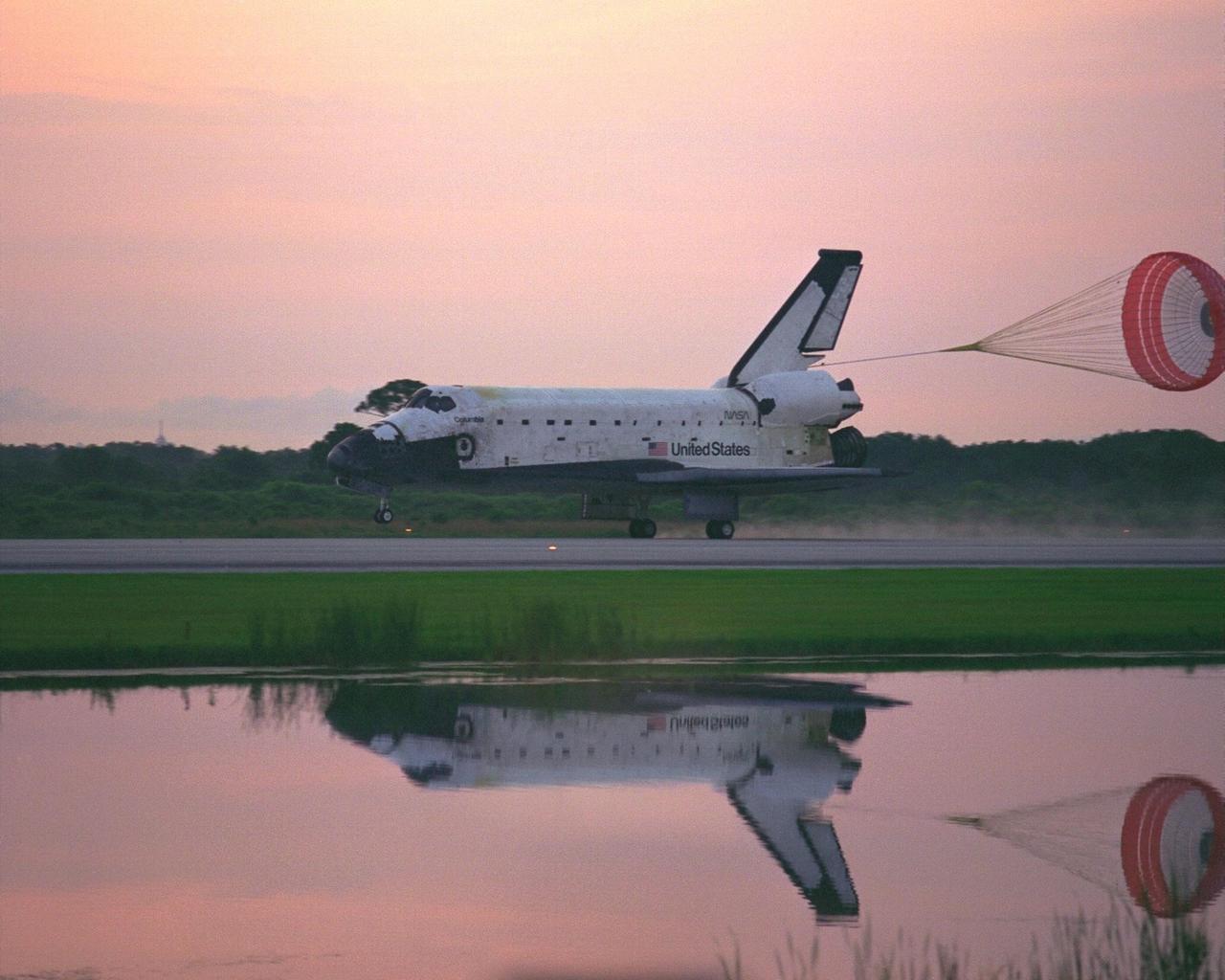
KENNEDY SPACE CENTER, FLA. -- With its drag chute deployed, the Space Shuttle Orbiter Columbia touches down on Runway 33 at KSC’s Shuttle Landing Facility at 6:46:34 a.m. EDT with Mission Commander James D. Halsell Jr. and Pilot Susan L. Still at the controls to complete the STS-94 mission. Also on board are Mission Specialist Donald A. Thomas, Mission Specialist Michael L. Gernhardt , Payload Commander Janice Voss, and Payload Specialists Roger K. Crouch and Gregory T. Linteris. Mission elapsed time for STS-94 was 15 days,16 hours, 44 seconds. During the Microgravity Science Laboratory-1 (MSL-1) mission, the Spacelab module was used to test some of the hardware, facilities and procedures that are planned for use on the International Space Station while the flight crew conducted combustion, protein crystal growth and materials processing experiments. This mission was a reflight of the STS-83 mission that lifted off from KSC in April of this year. That space flight was cut short due to indications of a faulty fuel cell. This was Columbia’s 11th landing at KSC and the 38th landing at the space center in the history of the Shuttle program
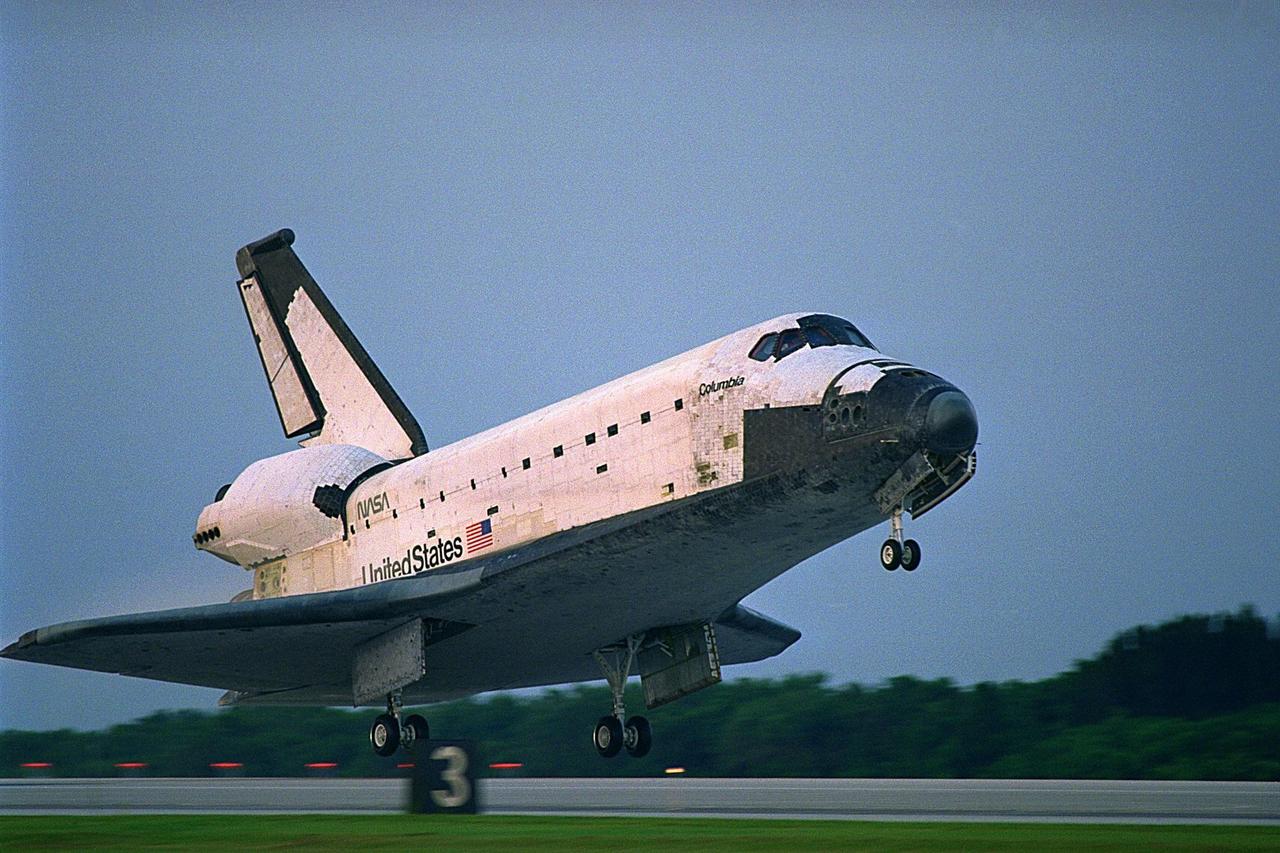
KENNEDY SPACE CENTER, FLA. -- The Space Shuttle orbiter Columbia touches down on Runway 33 at KSC’s Shuttle Landing Facility at 6:46:34 a.m. EDT with Mission Commander James D. Halsell Jr. and Pilot Susan L. Still at the controls to complete the STS-94 mission. Also on board are Mission Specialist Donald A. Thomas, Mission Specialist Michael L. Gernhardt, Payload Commander Janice Voss, and Payload Specialists Roger K. Crouch and Gregory T. Linteris. During the Microgravity Science Laboratory-1 (MSL-1) mission, the Spacelab module was used to test some of the hardware, facilities and procedures that are planned for use on the International Space Station while the flight crew conducted combustion, protein crystal growth and materials processing experiments. This mission was a reflight of the STS-83 mission that lifted off from KSC in April of this year. That space flight was cut short due to indications of a faulty fuel cell. This was Columbia’s 11th landing at KSC and the 38th landing at the space center in the history of the Shuttle program
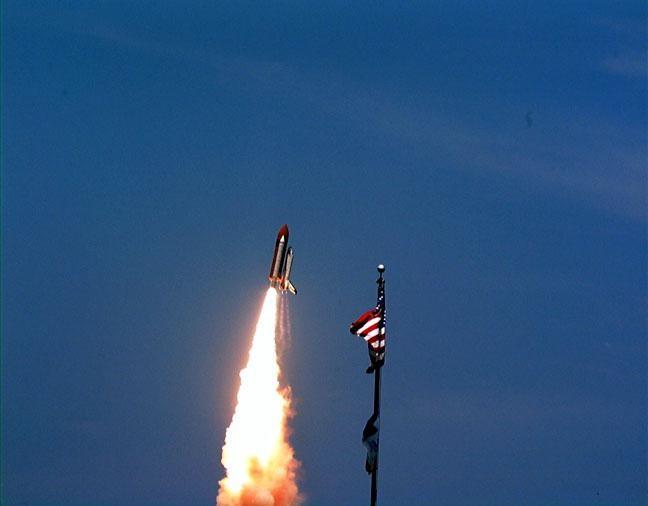
The Space Shuttle Columbia soars from Launch Pad 39A at 2:02 p.m. EDT July 1 to begin the 16-day STS-94 Microgravity Science Laboratory-1 (MSL-1) mission. The launch window was opened 47 minutes earlier than the originally scheduled time of 2:37 p.m. to improve the opportunity to lift off before Florida summer rain showers reached the space center. The crew members are Mission Commander James D. Halsell Jr.; Pilot Susan L. Still; Payload Commander Janice Voss; Mission Specialists Michael L.Gernhardt and Donald A. Thomas; and Payload Specialists Roger K. Crouch and Gregory T. Linteris. During the space flight, the MSL-1 will be used to test some of the hardware, facilities and procedures that are planned for use on the International Space Station while the flight crew conducts combustion, protein crystal growth and materials processing experiments. Also onboard is the Hitchhiker Cryogenic Flexible Diode (CRYOFD) experiment payload, which is attached to the right side of Columbia’s payload bay. These payloads had previously flown on the STS-83 mission in April, which was cut short after nearly four days because of indications of a faulty fuel cell. STS-94 is a reflight of that mission
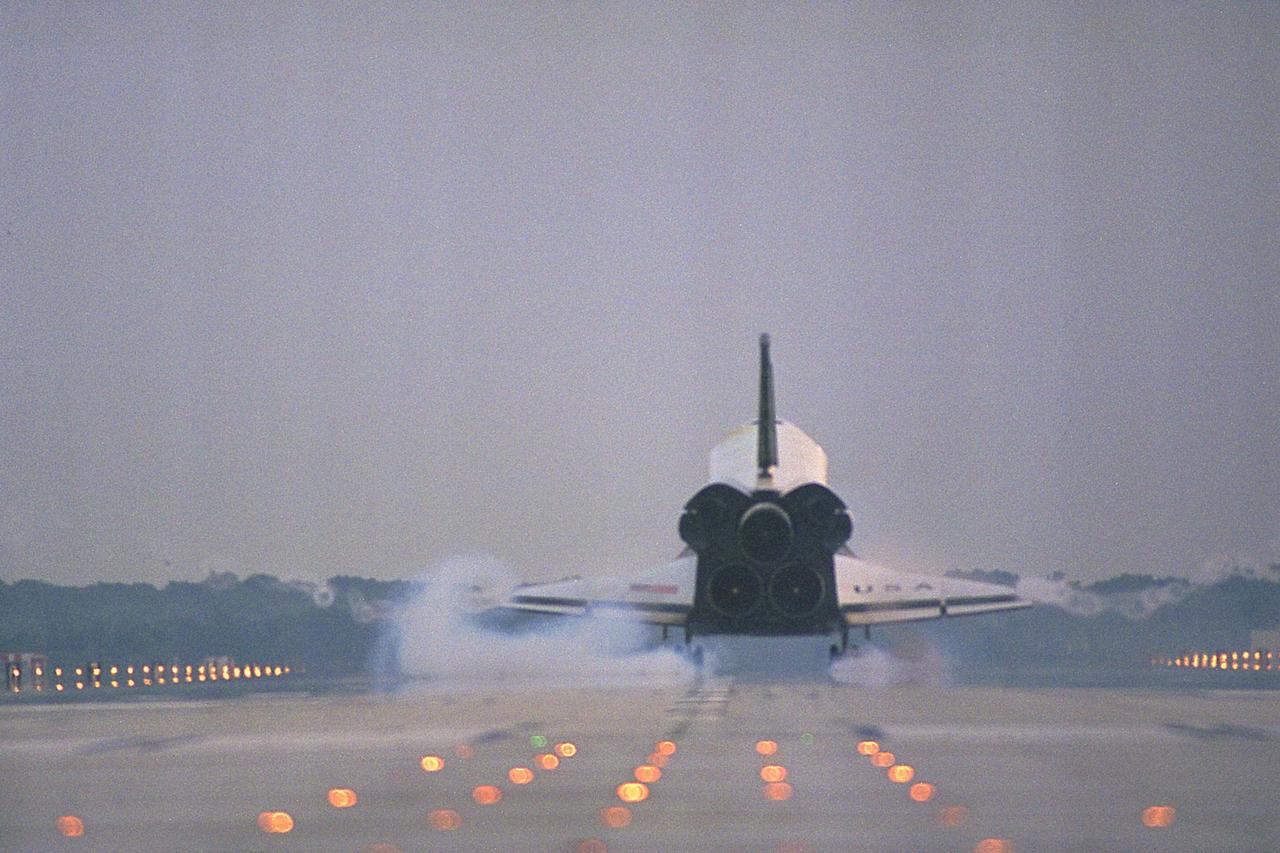
KENNEDY SPACE CENTER, FLA. -- The Space Shuttle orbiter Columbia touches down on Runway 33 at KSC’s Shuttle Landing Facility at 6:46:34 a.m. EDT with Mission Commander James D. Halsell Jr. and Pilot Susan L. Still at the controls to complete the STS-94 mission. Also on board are Mission Specialist Donald A. Thomas, Mission Specialist Michael L. Gernhardt, Payload Commander Janice Voss, and Payload Specialists Roger K. Crouch and Gregory T. Linteris. During the Microgravity Science Laboratory-1 (MSL-1) mission, the Spacelab module was used to test some of the hardware, facilities and procedures that are planned for use on the International Space Station while the flight crew conducted combustion, protein crystal growth and materials processing experiments. This mission was a reflight of the STS-83 mission that lifted off from KSC in April of this year. That space flight was cut short due to indications of a faulty fuel cell. This was Columbia’s 11th landing at KSC and the 38th landing at the space center in the history of the Shuttle program
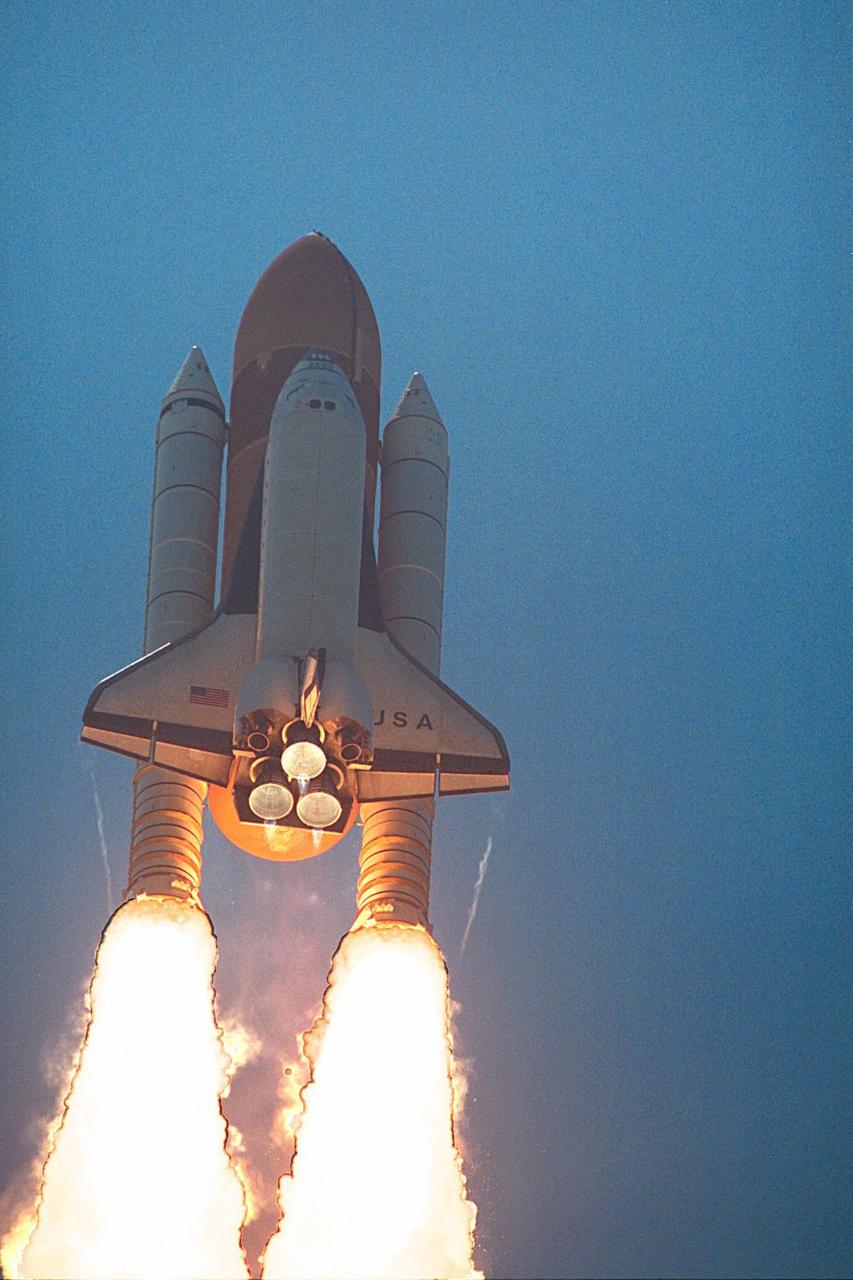
KENNEDY SPACE CENTER, Fla. -- The Space Shuttle Columbia soars from Launch Pad 39A at 2:02 p.m. EDT July 1 to begin the 16-day STS-94 Microgravity Science Laboratory-1 (MSL-1) mission. The launch window was opened 47 minutes earlier than the originally scheduled time of 2:37 p.m. to improve the opportunity to lift off before Florida summer rain showers reached the space center. The crew members are Mission Commander James D. Halsell Jr.; Pilot Susan L. Still; Payload Commander Janice Voss; Mission Specialists Michael L.Gernhardt and Donald A. Thomas; and Payload Specialists Roger K. Crouch and Gregory T. Linteris. During the space flight, the MSL-1 will be used to test some of the hardware, facilities and procedures that are planned for use on the International Space Station while the flight crew conducts combustion, protein crystal growth and materials processing experiments. Also onboard is the Hitchhiker Cryogenic Flexible Diode (CRYOFD) experiment payload, which is attached to the right side of Columbia’s payload bay. These payloads had previously flown on the STS-83 mission in April, which was cut short after nearly four days because of indications of a faulty fuel cell. STS-94 is a reflight of that mission
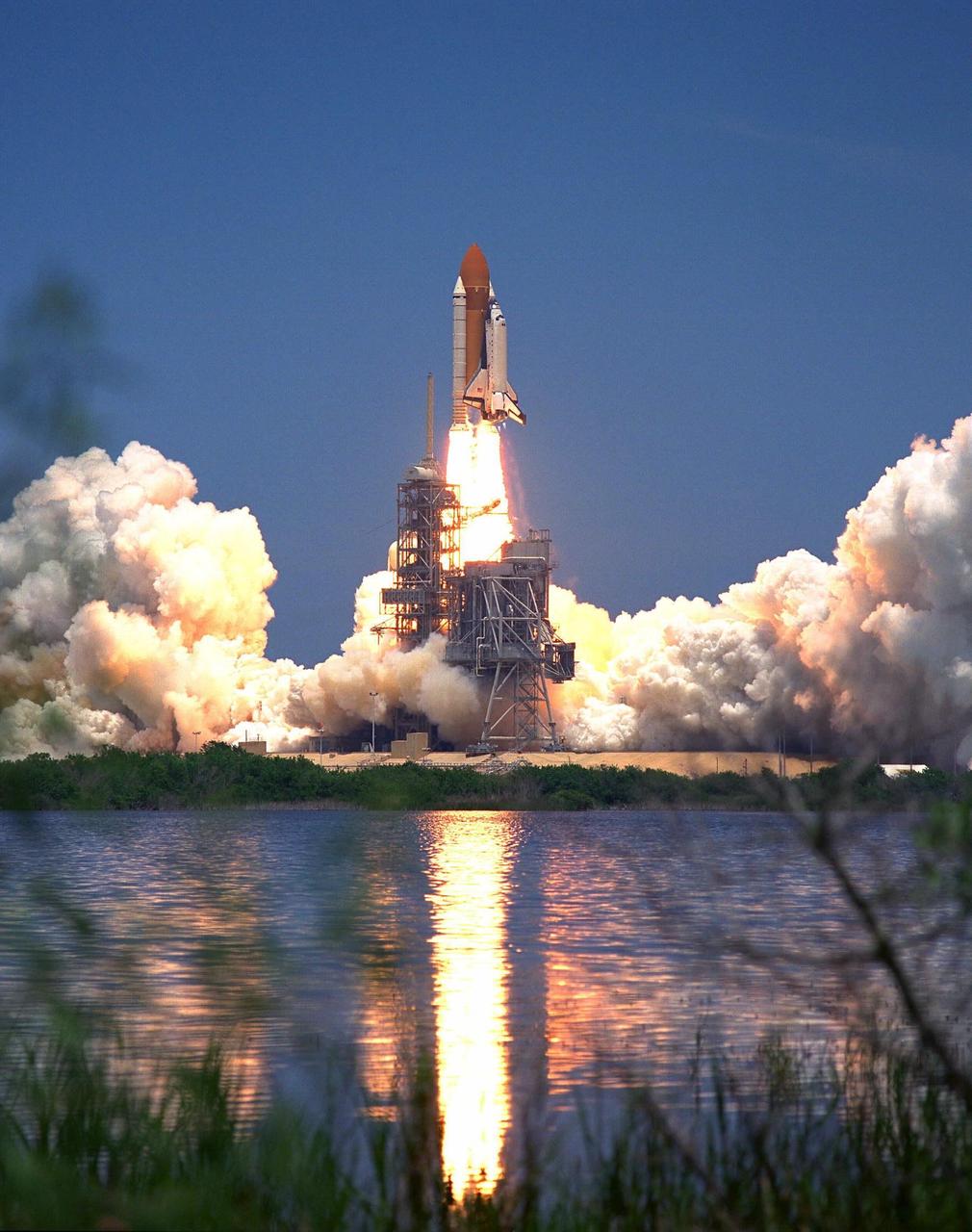
KENNEDY SPACE CENTER, Fla. -- The Space Shuttle Columbia soars from Launch Pad 39A at 2:02 p.m. EDT July 1 to begin the 16-day STS-94 Microgravity Science Laboratory-1 (MSL-1) mission. The launch window was opened 47 minutes earlier than the originally scheduled time of 2:37 p.m. to improve the opportunity to lift off before Florida summer rain showers reached the space center. The crew members are Mission Commander James D. Halsell Jr.; Pilot Susan L. Still; Payload Commander Janice Voss; Mission Specialists Michael L.Gernhardt and Donald A. Thomas; and Payload Specialists Roger K. Crouch and Gregory T. Linteris. During the space flight, the MSL-1 will be used to test some of the hardware, facilities and procedures that are planned for use on the International Space Station while the flight crew conducts combustion, protein crystal growth and materials processing experiments. Also onboard is the Hitchhiker Cryogenic Flexible Diode (CRYOFD) experiment payload, which is attached to the right side of Columbia’s payload bay. These payloads had previously flown on the STS-83 mission in April, which was cut short after nearly four days because of indications of a faulty fuel cell. STS-94 is a reflight of that mission
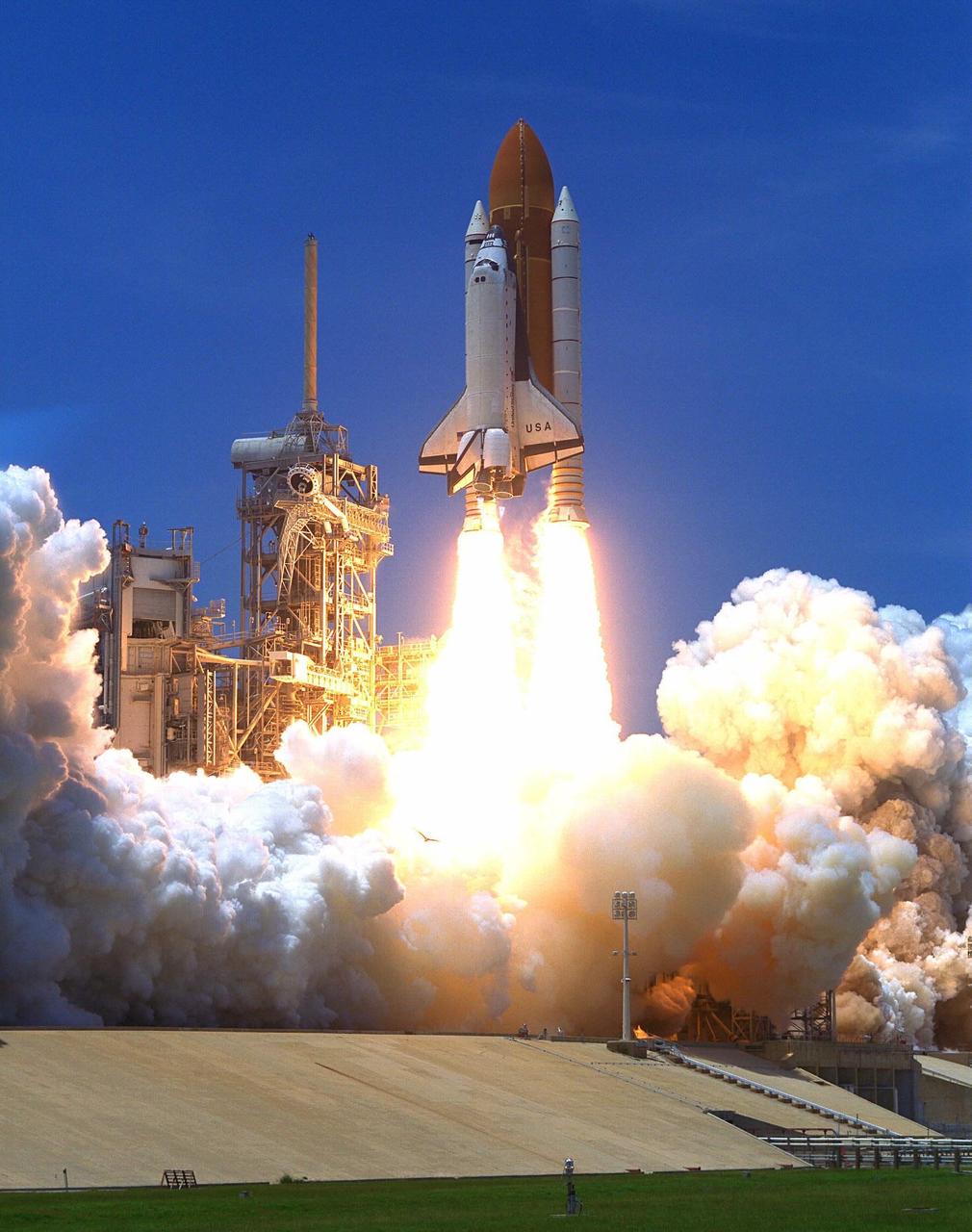
KENNEDY SPACE CENTER, Fla. -- The Space Shuttle Columbia soars from Launch Pad 39A at 2:02 p.m. EDT July 1 to begin the 16-day STS-94 Microgravity Science Laboratory-1 (MSL-1) mission. The launch window was opened 47 minutes earlier than the originally scheduled time of 2:37 p.m. to improve the opportunity to lift off before Florida summer rain showers reached the space center. The crew members are Mission Commander James D. Halsell Jr.; Pilot Susan L. Still; Payload Commander Janice Voss; Mission Specialists Michael L.Gernhardt and Donald A. Thomas; and Payload Specialists Roger K. Crouch and Gregory T. Linteris. During the space flight, the MSL-1 will be used to test some of the hardware, facilities and procedures that are planned for use on the International Space Station while the flight crew conducts combustion, protein crystal growth and materials processing experiments. Also onboard is the Hitchhiker Cryogenic Flexible Diode (CRYOFD) experiment payload, which is attached to the right side of Columbia’s payload bay. These payloads had previously flown on the STS-83 mission in April, which was cut short after nearly four days because of indications of a faulty fuel cell. STS-94 is a reflight of that mission
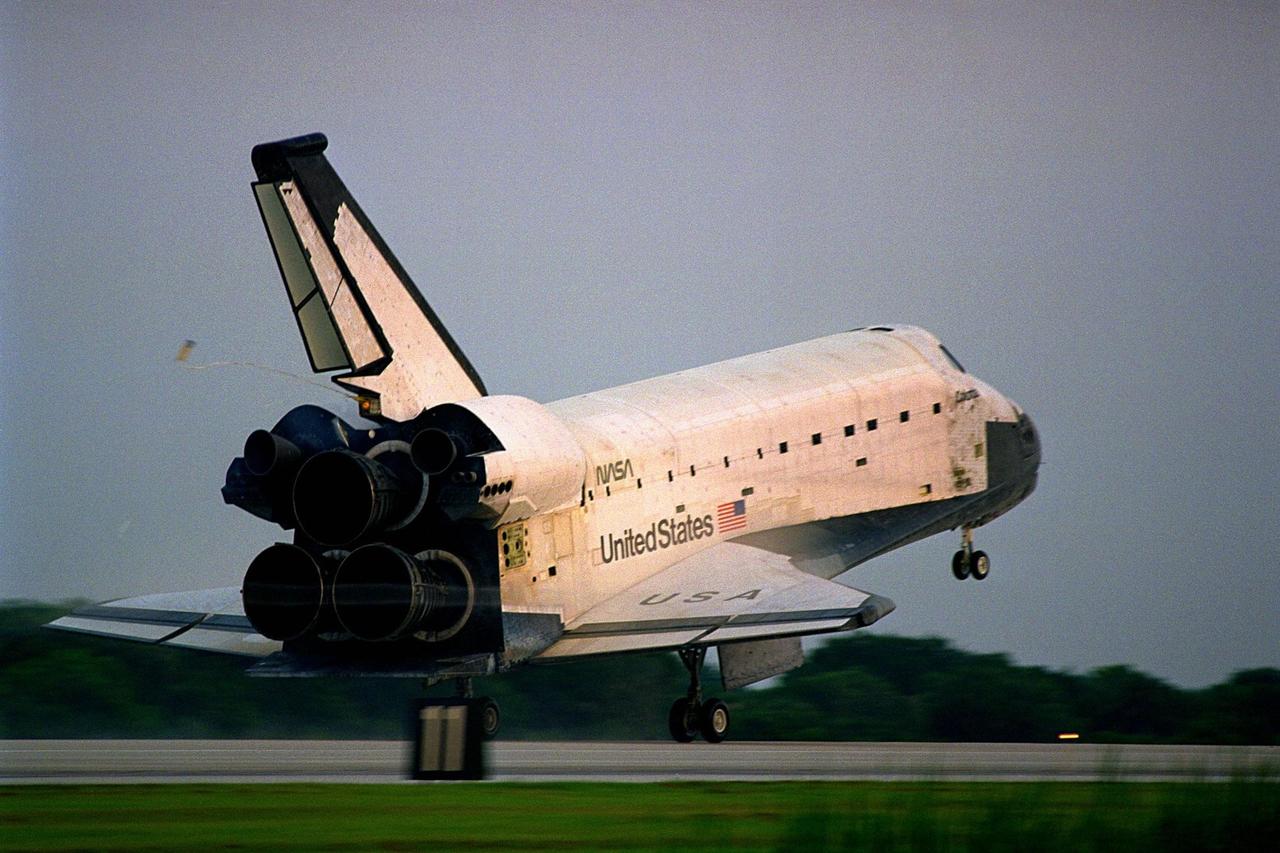
KENNEDY SPACE CENTER, FLA. -- The Space Shuttle orbiter Columbia touches down on Runway 33 at KSC’s Shuttle Landing Facility at 6:46:34 a.m. EDT with Mission Commander James D. Halsell Jr. and Pilot Susan L. Still at the controls to complete the STS-94 mission. Also on board are Mission Specialist Donald A. Thomas, Mission Specialist Michael L. Gernhardt, Payload Commander Janice Voss, and Payload Specialists Roger K. Crouch and Gregory T. Linteris. During the Microgravity Science Laboratory-1 (MSL-1) mission, the Spacelab module was used to test some of the hardware, facilities and procedures that are planned for use on the International Space Station while the flight crew conducted combustion, protein crystal growth and materials processing experiments. This mission was a reflight of the STS-83 mission that lifted off from KSC in April of this year. That space flight was cut short due to indications of a faulty fuel cell. This was Columbia’s 11th landing at KSC and the 38th landing at the space center in the history of the Shuttle program