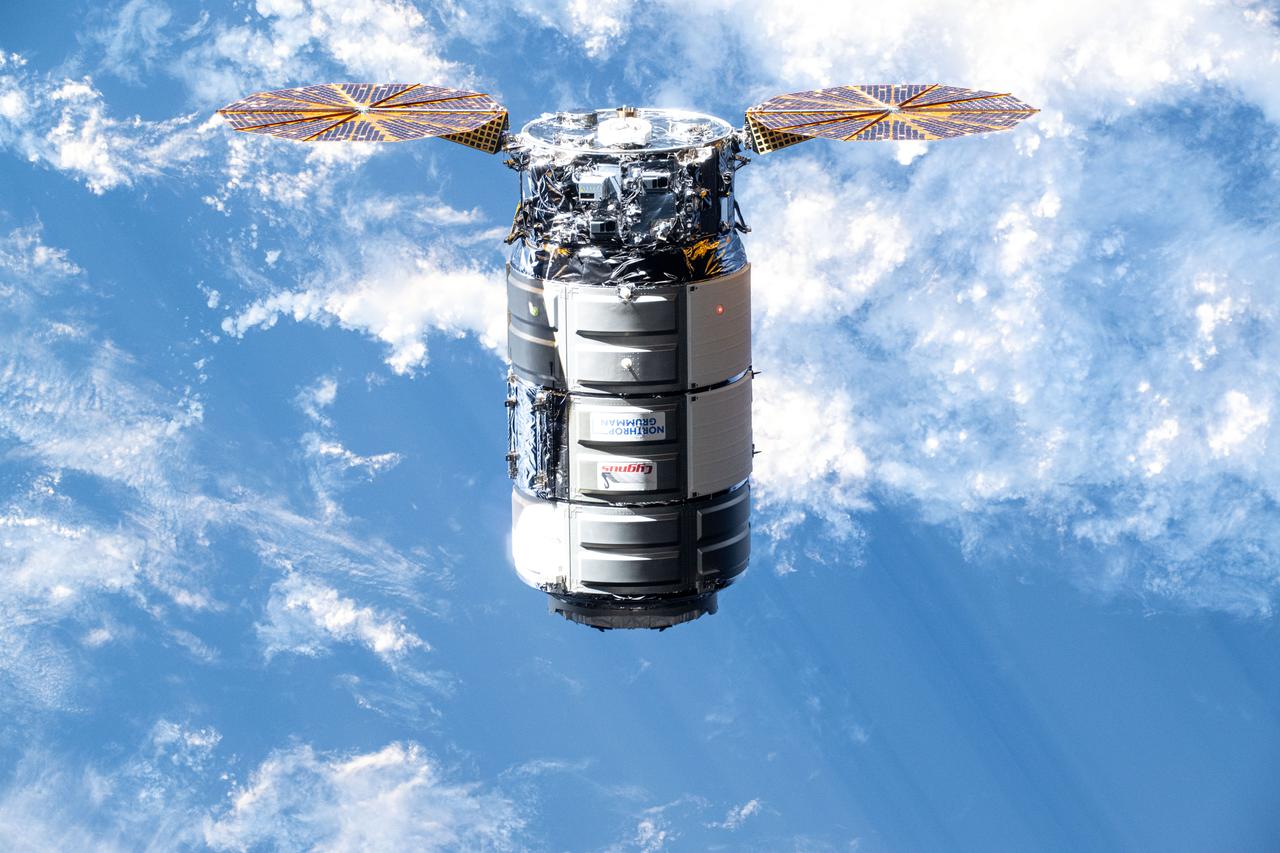
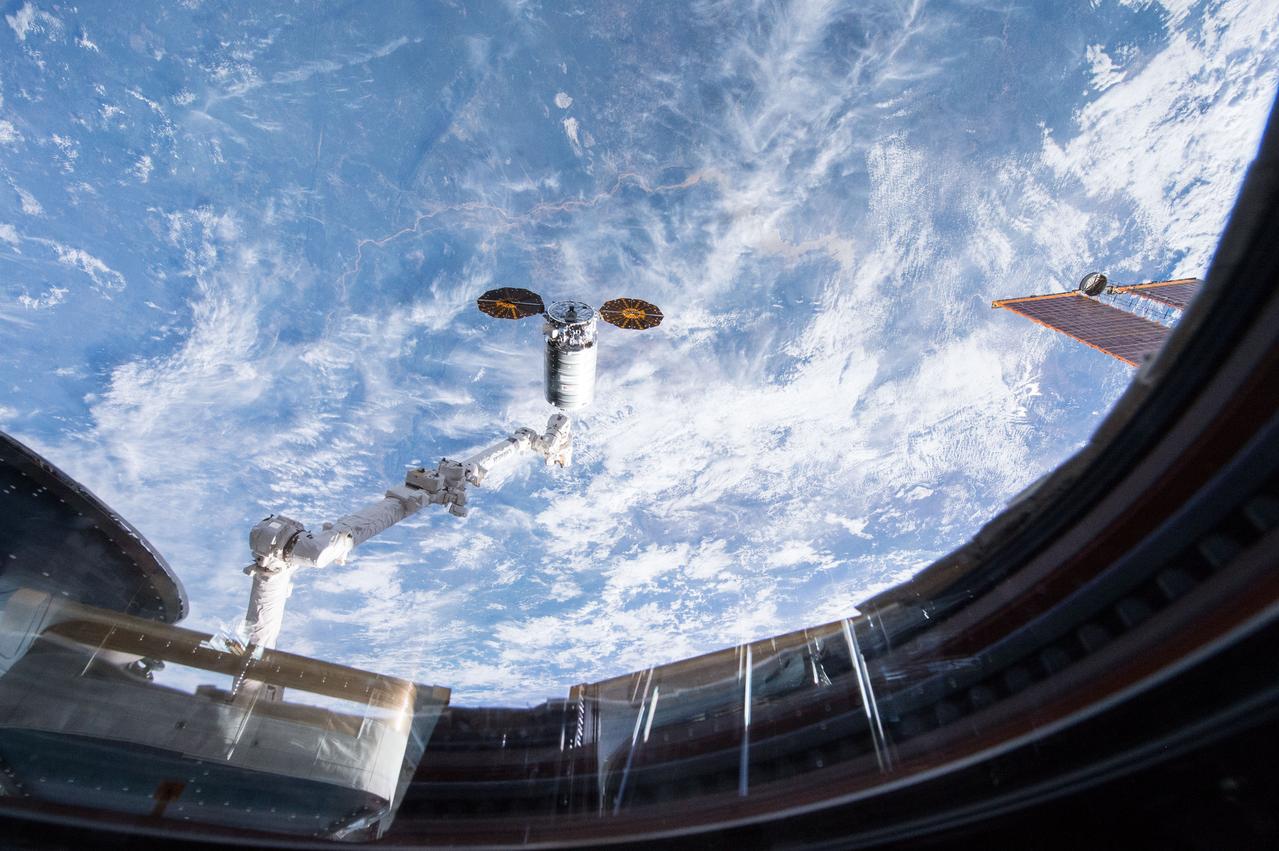
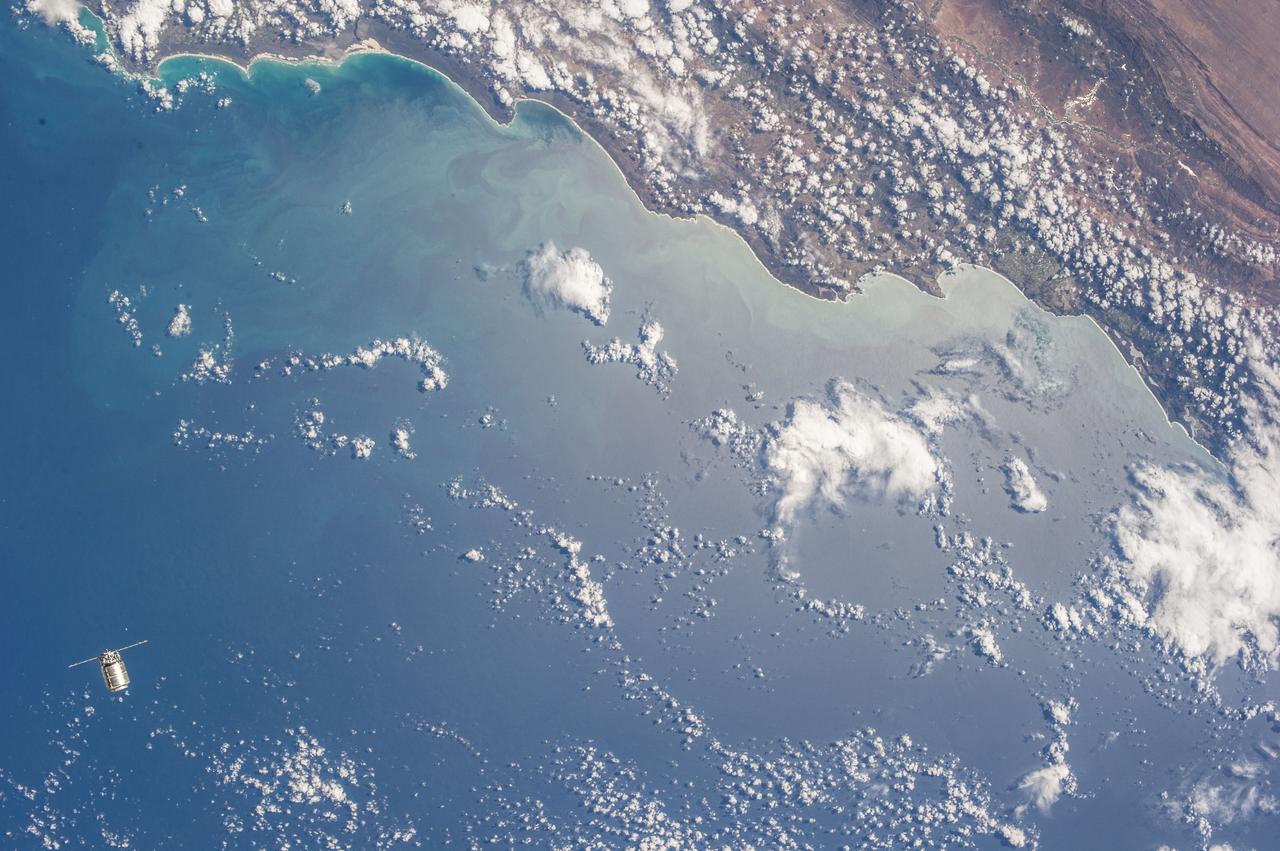
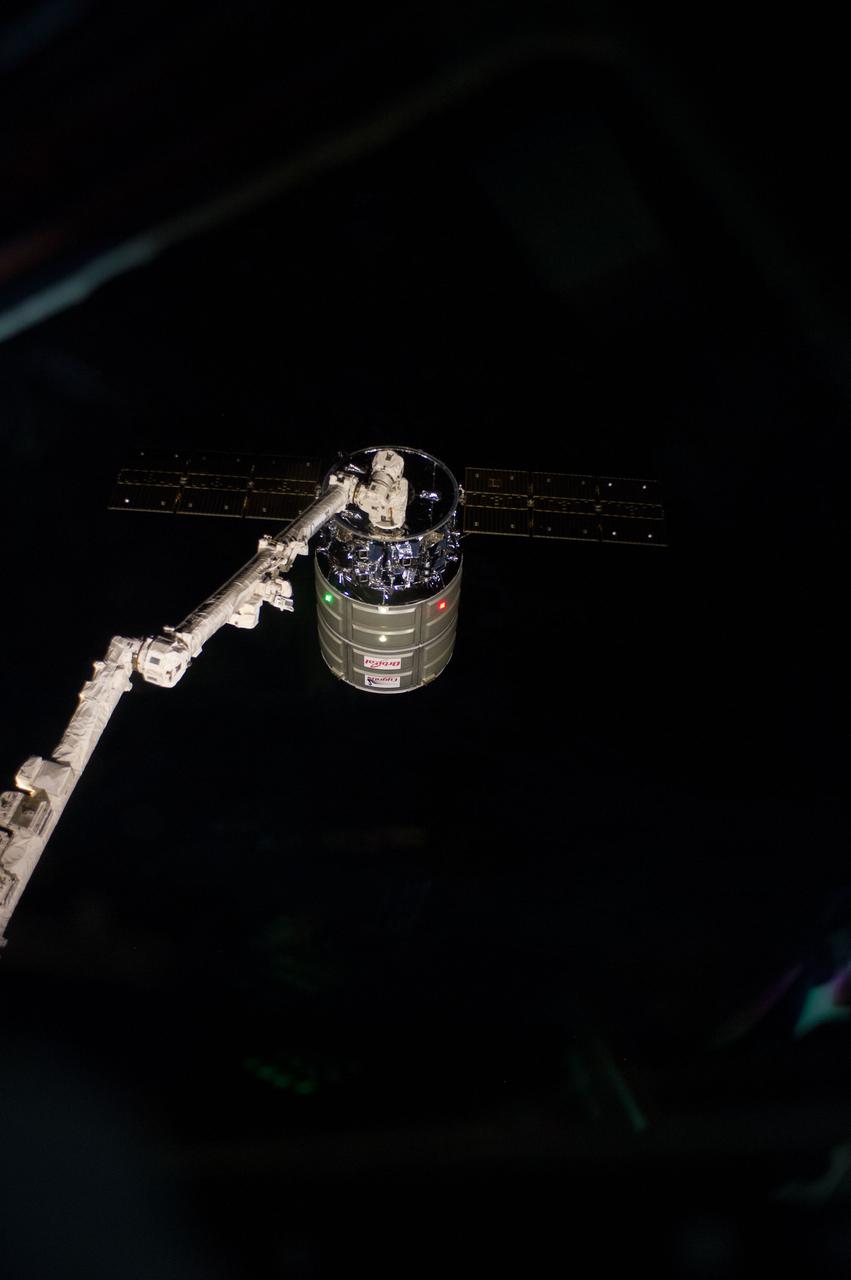
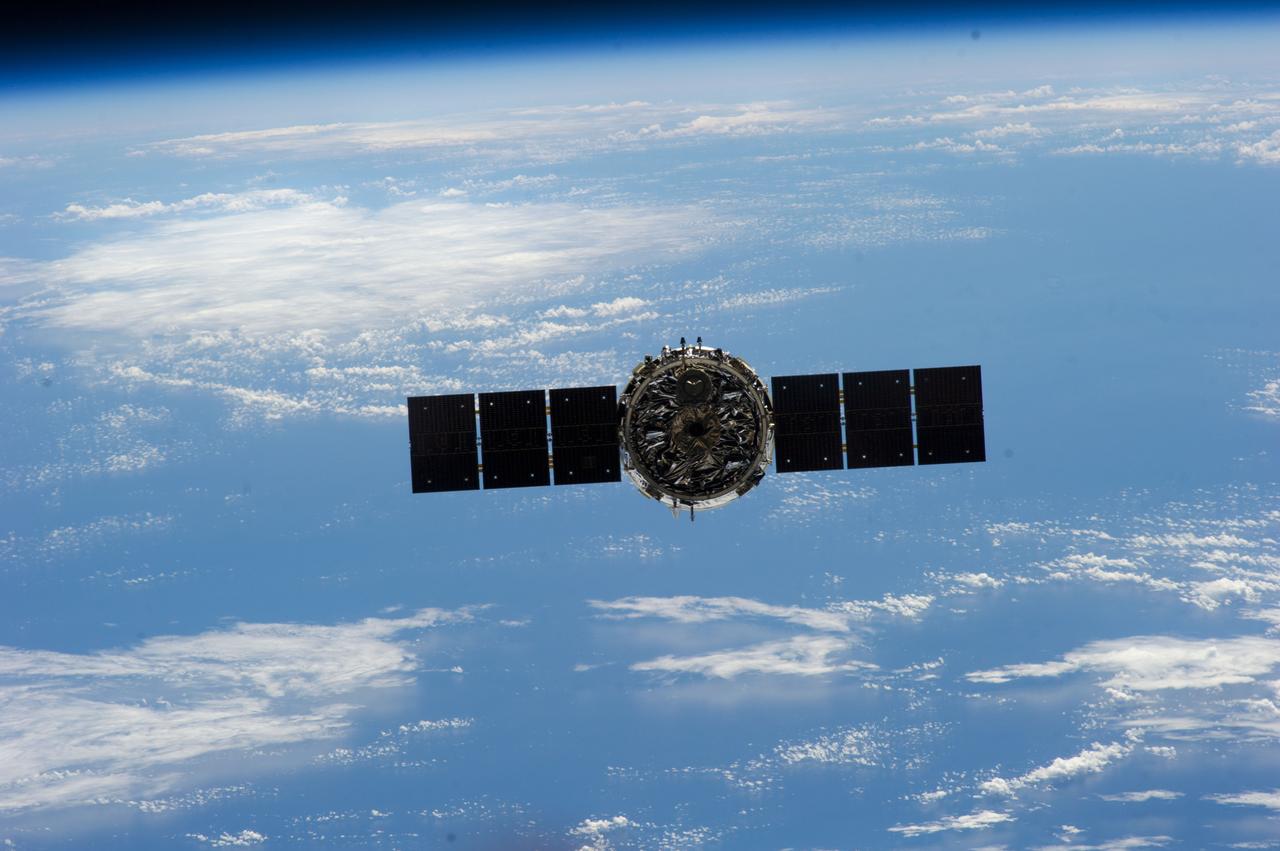
iss071e416851 (Aug. 6, 2024) --- Northrop Grumman's Cygnus cargo craft, carrying 8,200 pounds of science and supplies, approaches the International Space Station for a capture with the Canadarm2 robotic arm commanded by Expedition 71 Flight Engineer Matthew Dominick of NASA. The maneuver marked the 50th free-flying capture for the Canadarm2 robotic arm.
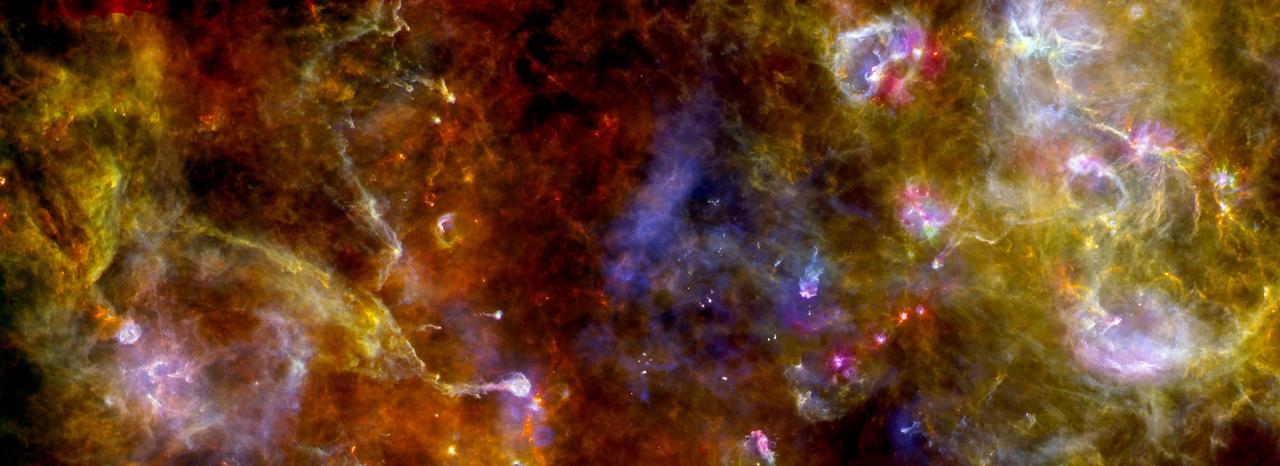
This new view of the Cygnus-X star-formation region by ESA Herschel Space Observatory highlights chaotic networks of dust and gas that point to sites of massive star formation.
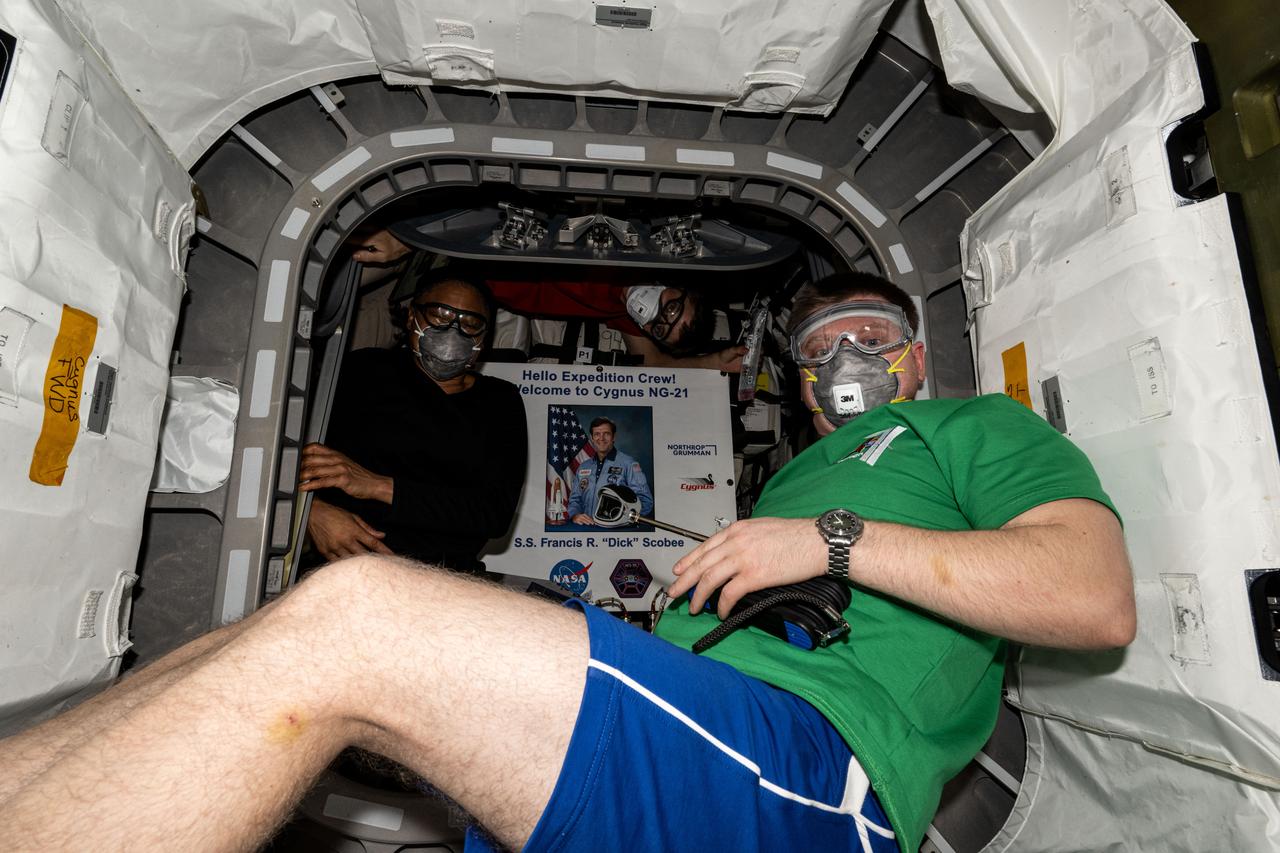
iss071e462164 (Aug. 6, 2024) --- NASA astronauts (from left) Jeanette Epps and Matthew Dominick, both Expedition 71 Flight Engineers, are pictured wearing personal protective equipment (PPE) shortly after entering the Northrop Grumman Cygnus space freighter. Inside Cygnus is a poster of former NASA astronaut Francis R. "Dick" Scobee for whom the spacecraft is named after. The duo was wearing PPE after opening the hatch and entering the vehicle to protect against potential dust or debris that may have dislodged during Cygnus' launch and ascent to space.
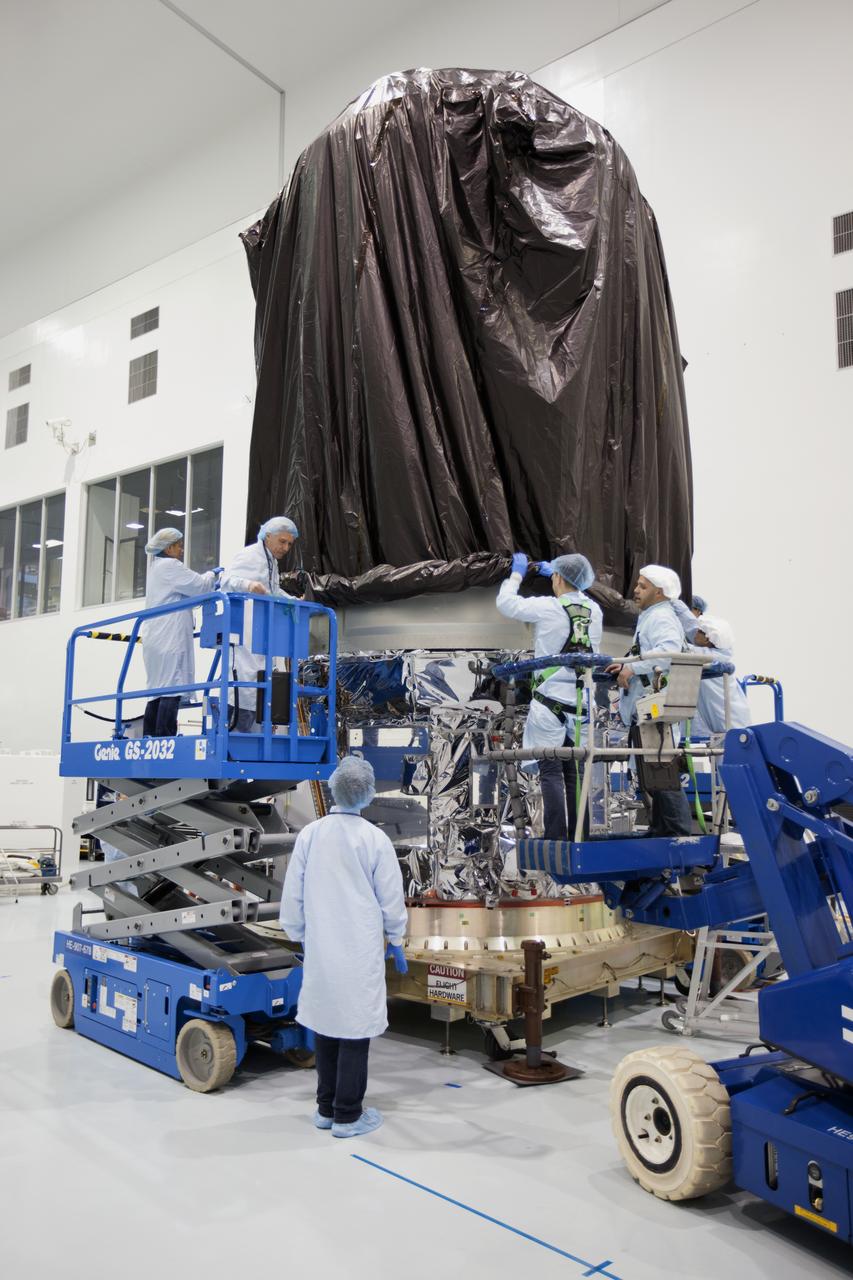
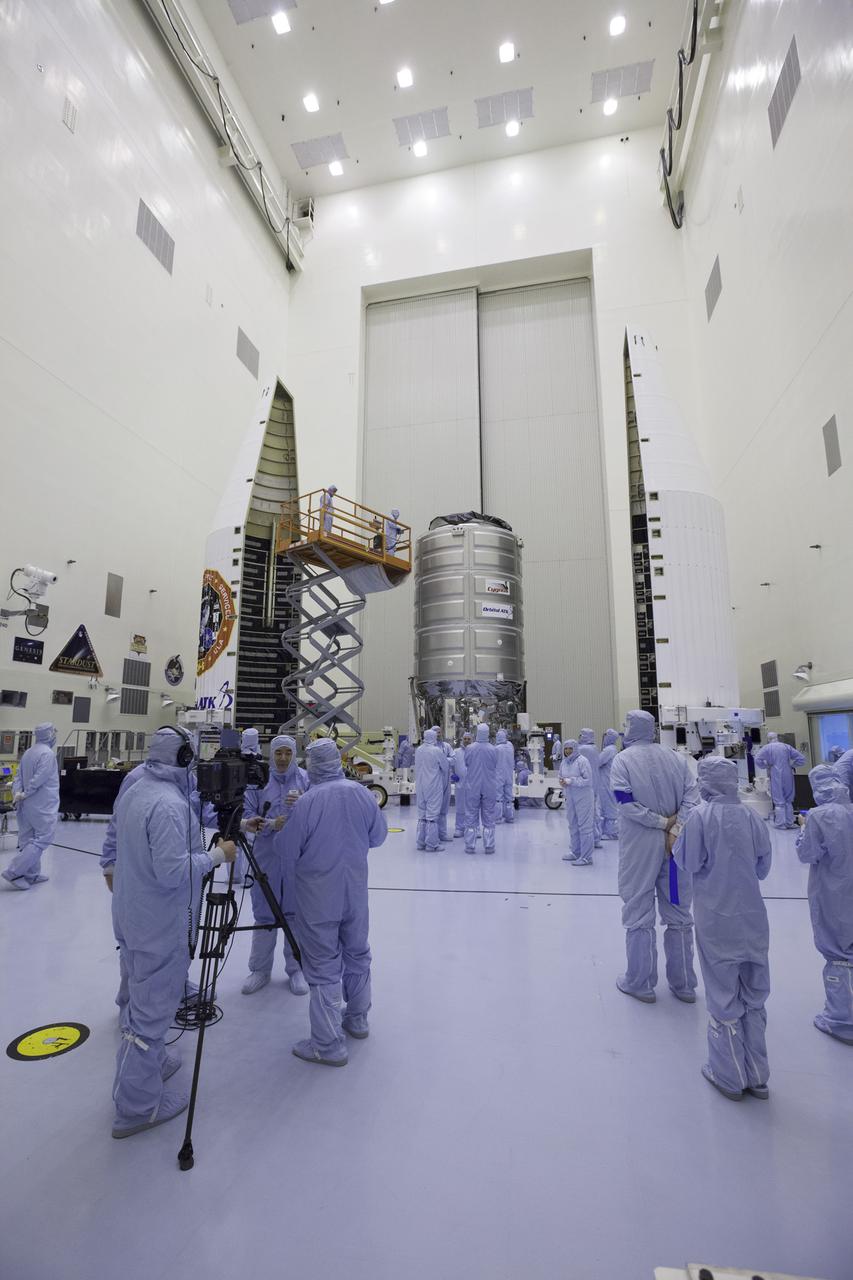
In the Space Station Processing Facility high bay at NASA's Kennedy Space Center in Florida, technicians secure a protective covering around Orbital ATK's CYGNUS pressurized cargo module. The Orbital ATK CRS-7 commercial resupply services mission to the International Space Station is scheduled to launch atop a United Launch Alliance Atlas V rocket from Space Launch Complex 41 at Cape Canaveral Air Force Station on March 19, 2017. CYGNUS will deliver thousands of pounds of supplies, equipment and scientific research materials to the space station.
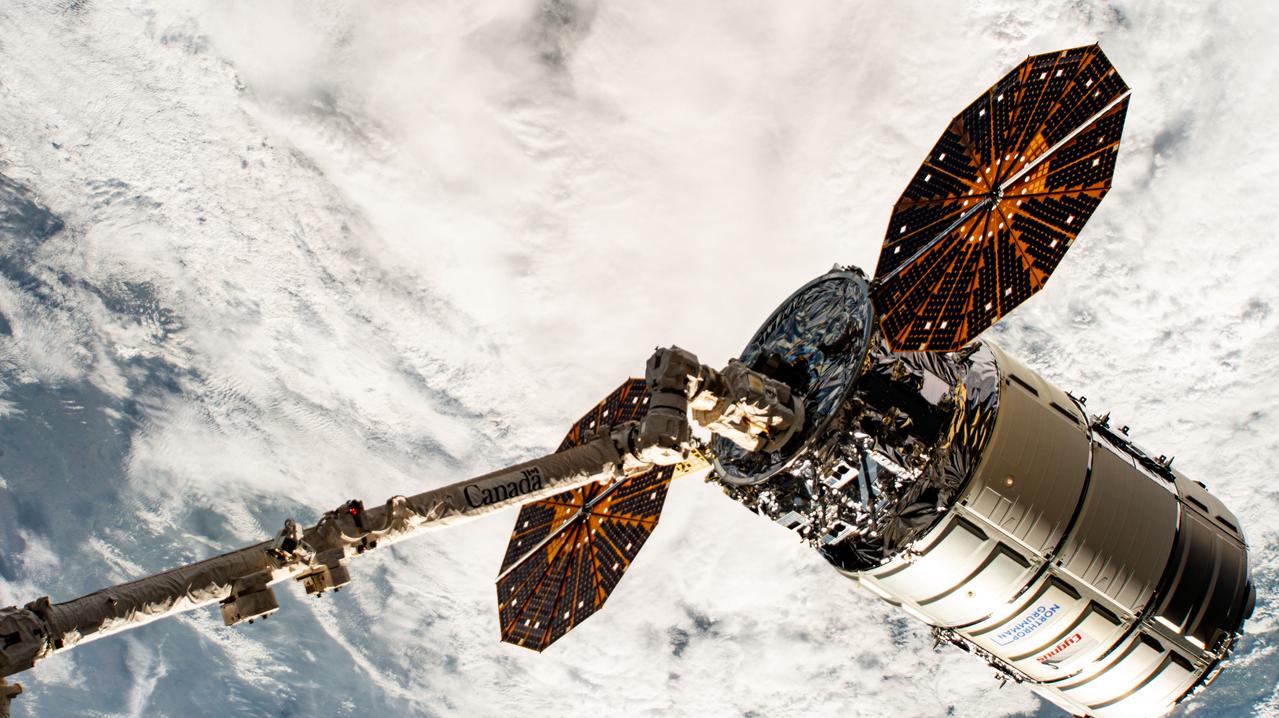
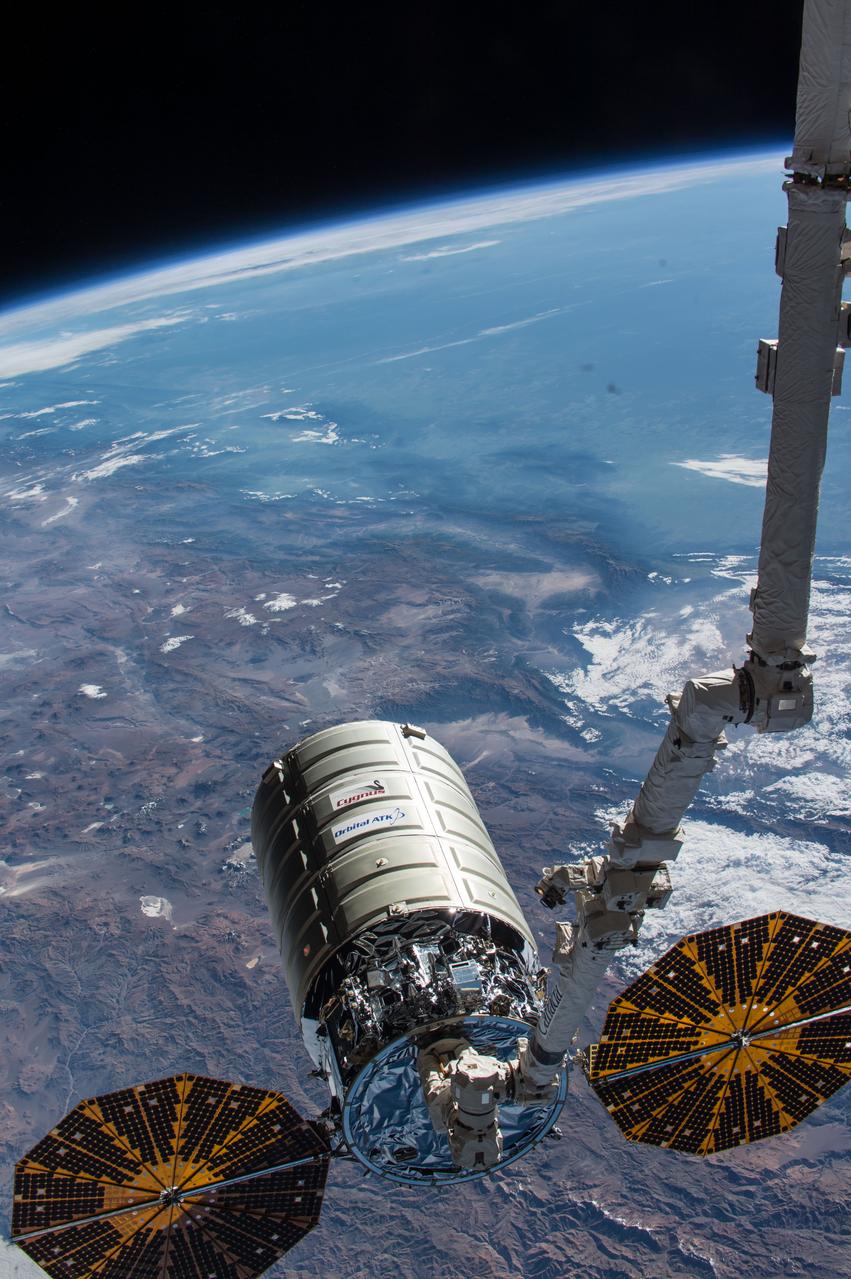
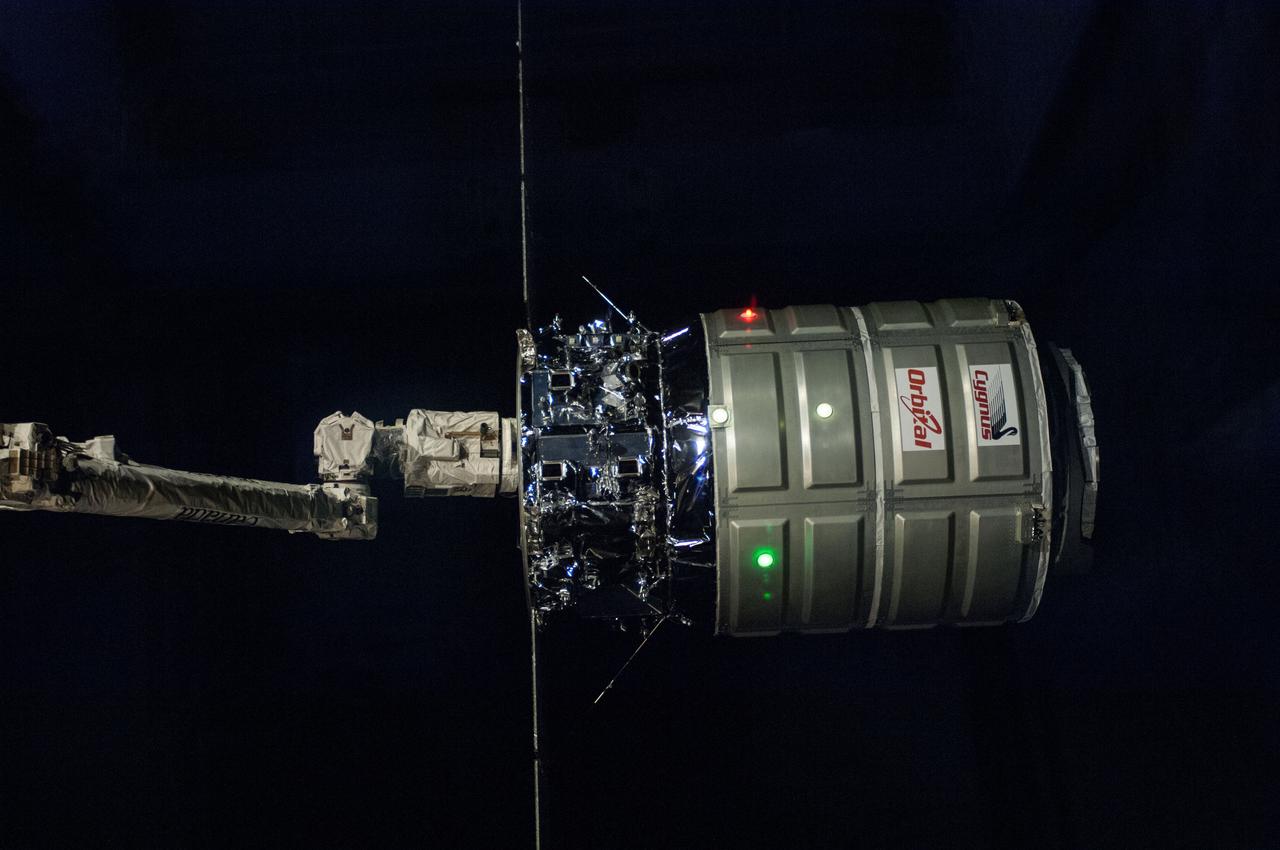
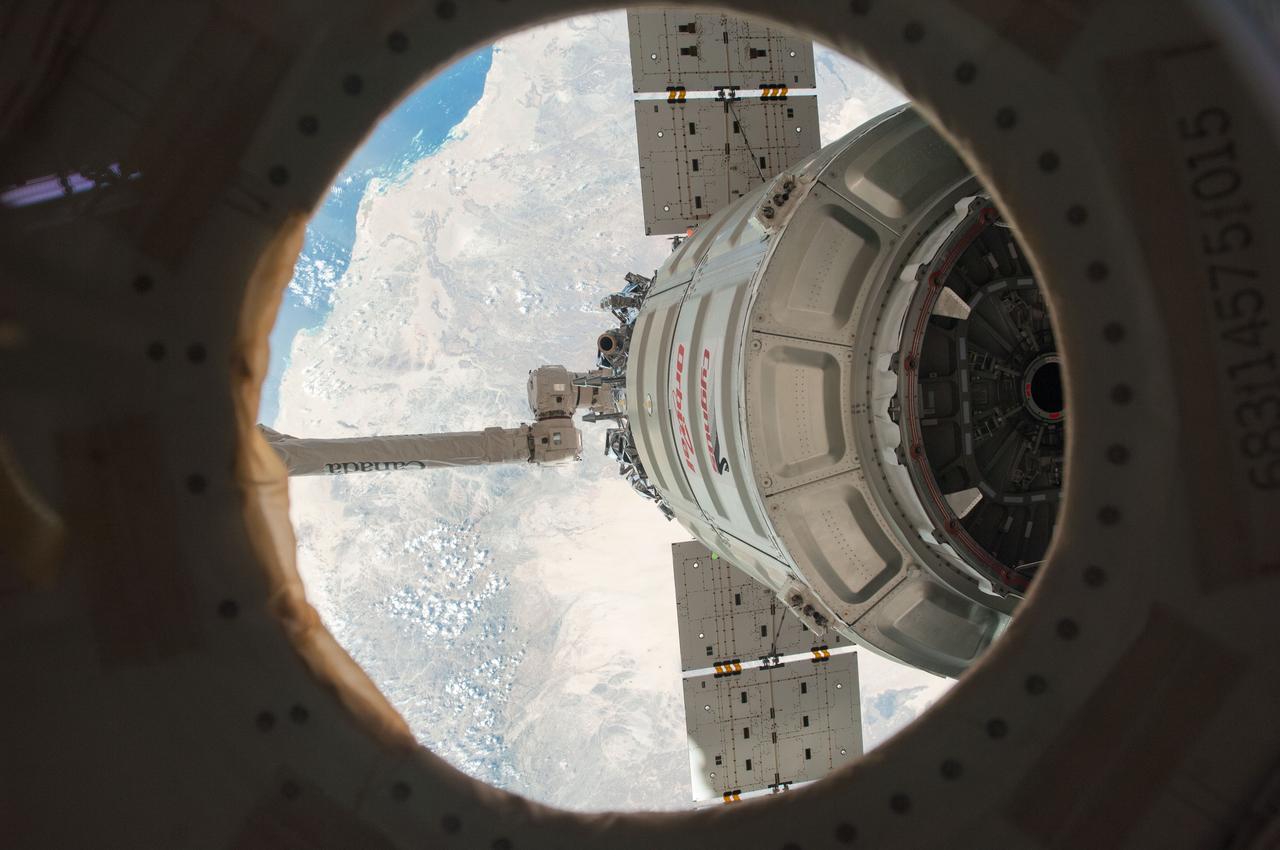
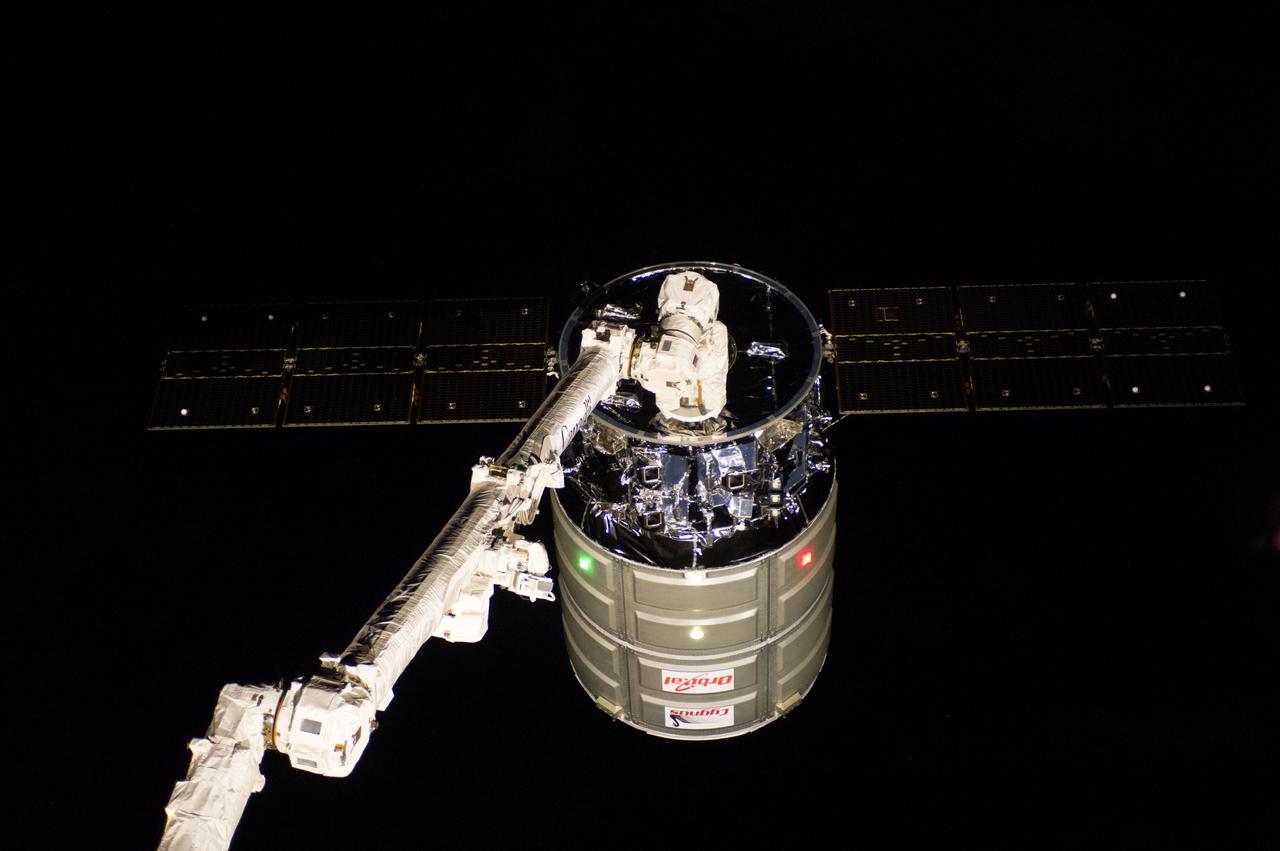
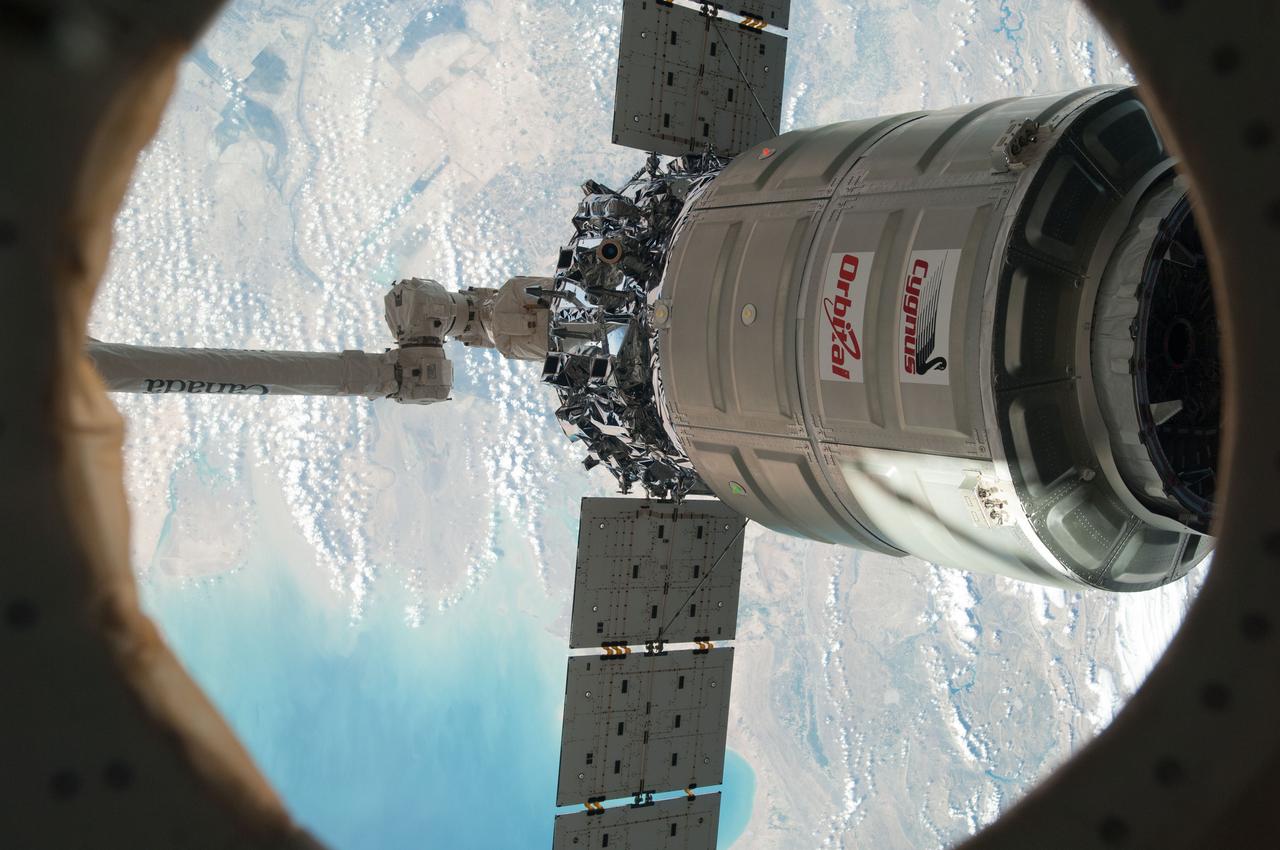
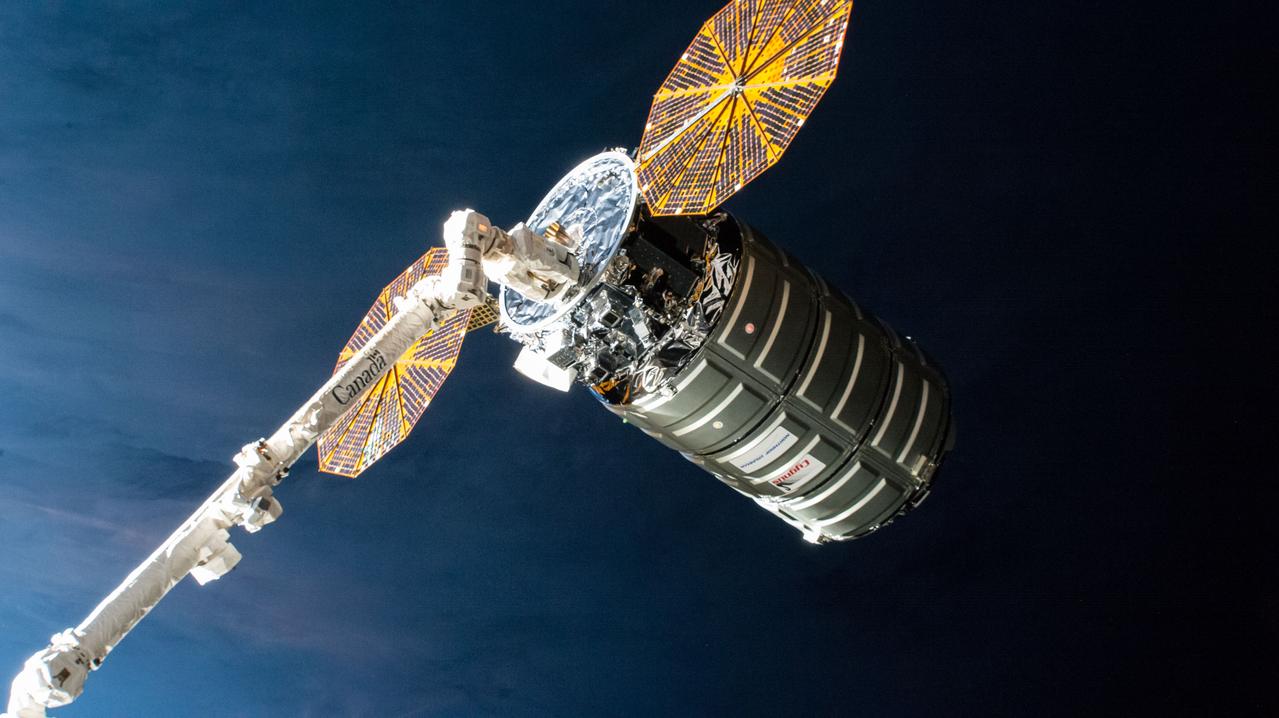
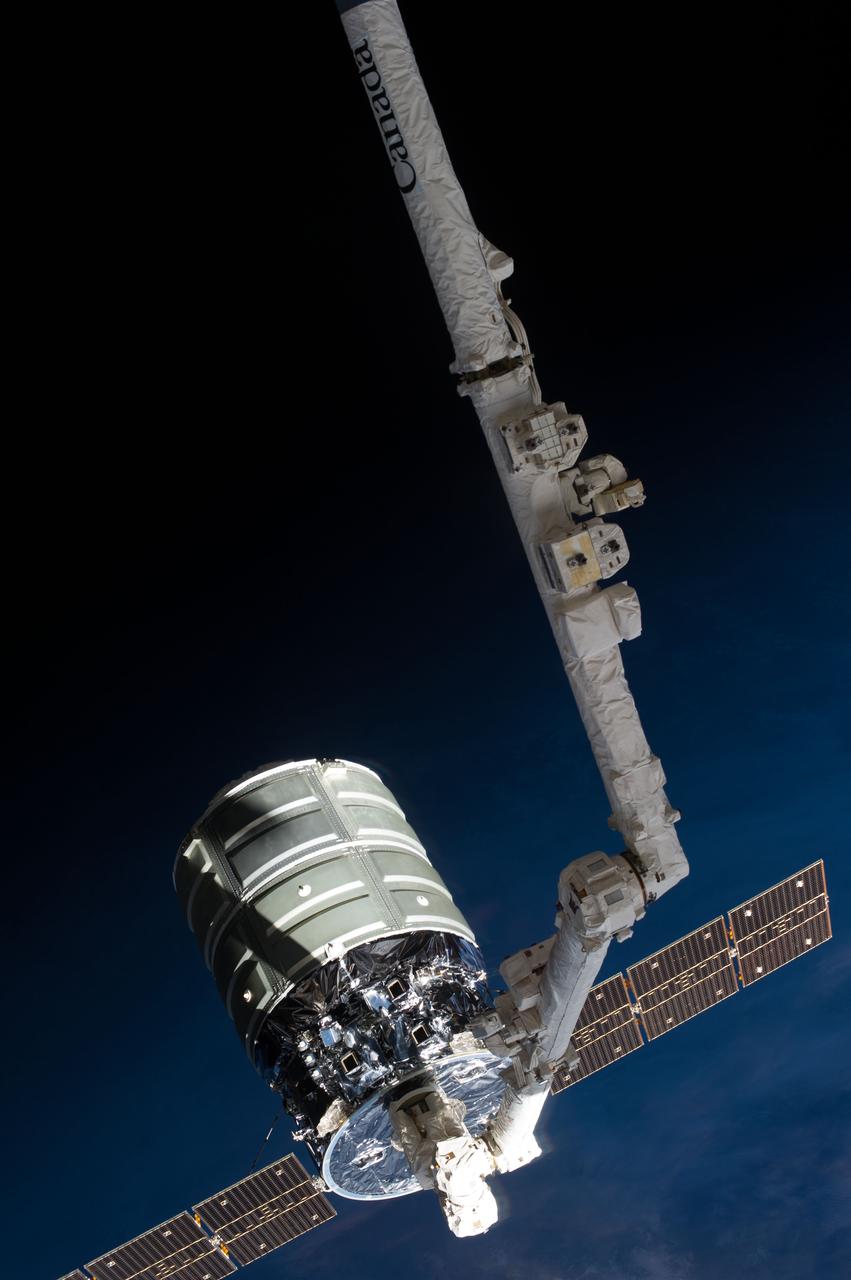
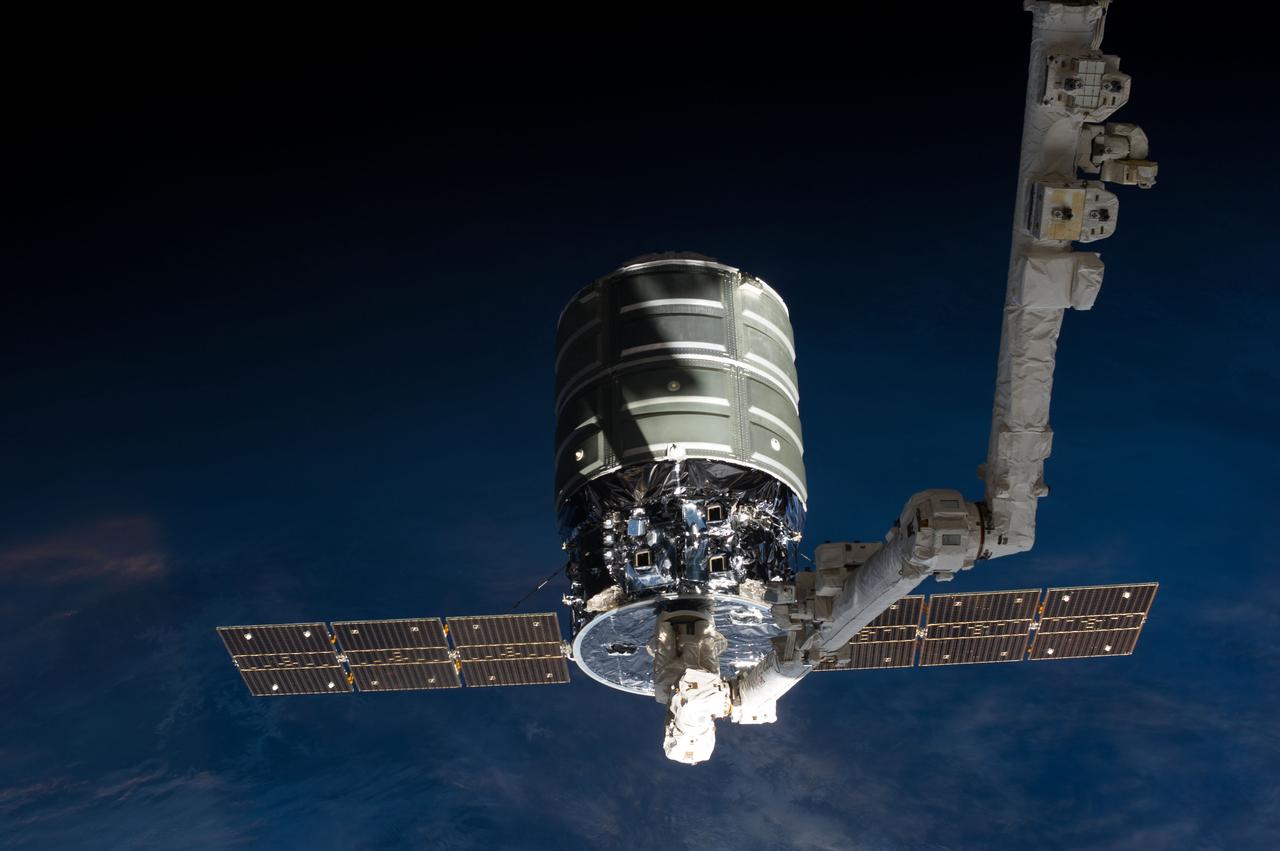
iss071e418235 (Aug. 6, 2024) --- Northrop Grumman's Cygnus cargo craft, with its prominent cymbal-shaped UltraFlex solar arrays, is pictured in the grips of the Canadarm2 robotic arm shortly after its capture was commanded by Expedition 71 Flight Engineer Matthew Dominick of NASA. The maneuver marked the 50th free-flying capture for the Canadarm2 robotic arm.
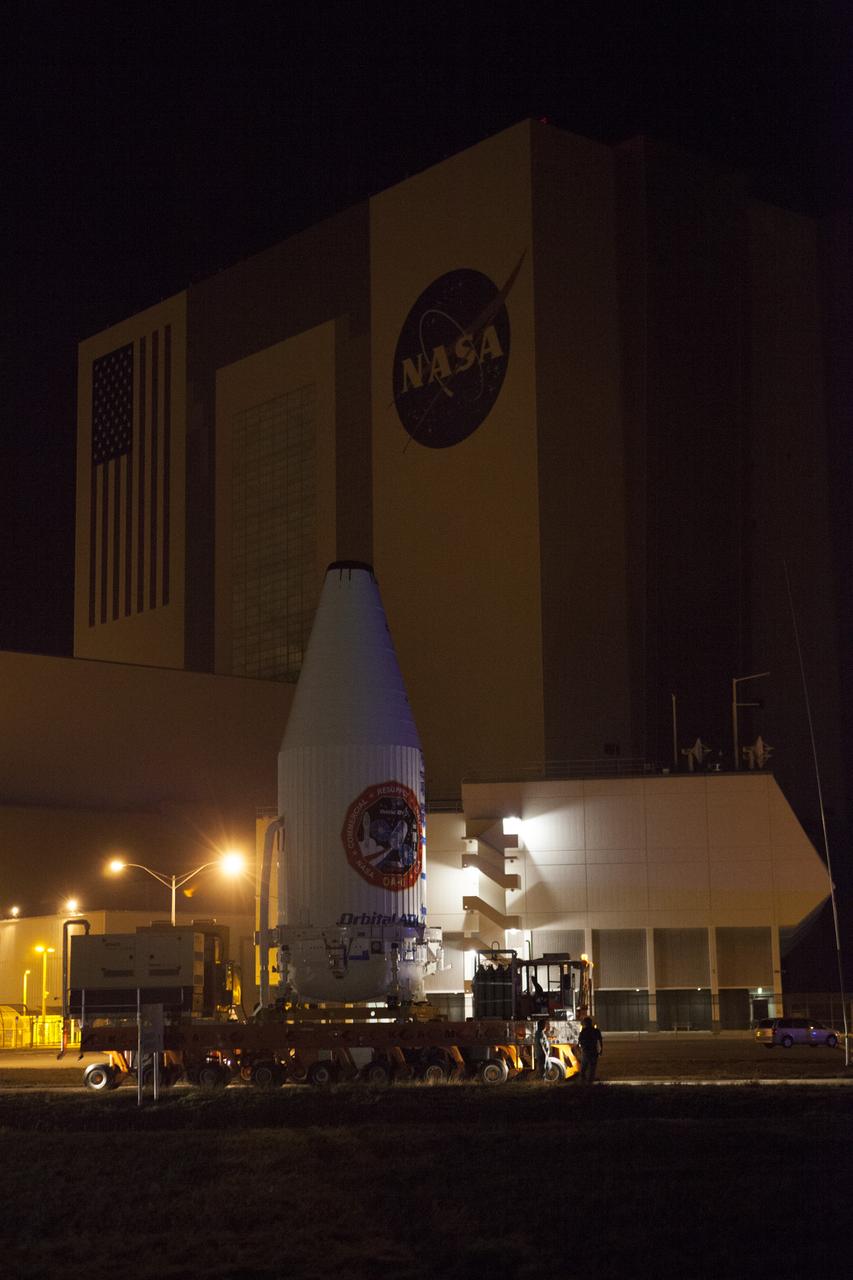
Encapsulated inside its payload fairing, the Cygnus spacecraft for the upcoming Orbital ATK Commercial Resupply Services-6 mission moves past the Vehicle Assembly Building at NASA's Kennedy Space Center in Florida. Mounted atop a KAMAG transporter, Cygnus is being moved to Space Launch Complex-41 at Cape Canaveral Air Force Station where it will be mounted atop a United Launch Alliance Atlas V rocket. The Cygnus is scheduled to lift off atop a United Launch Alliance Atlas V rocket on March 22 to deliver hardware and supplies to the International Space Station.
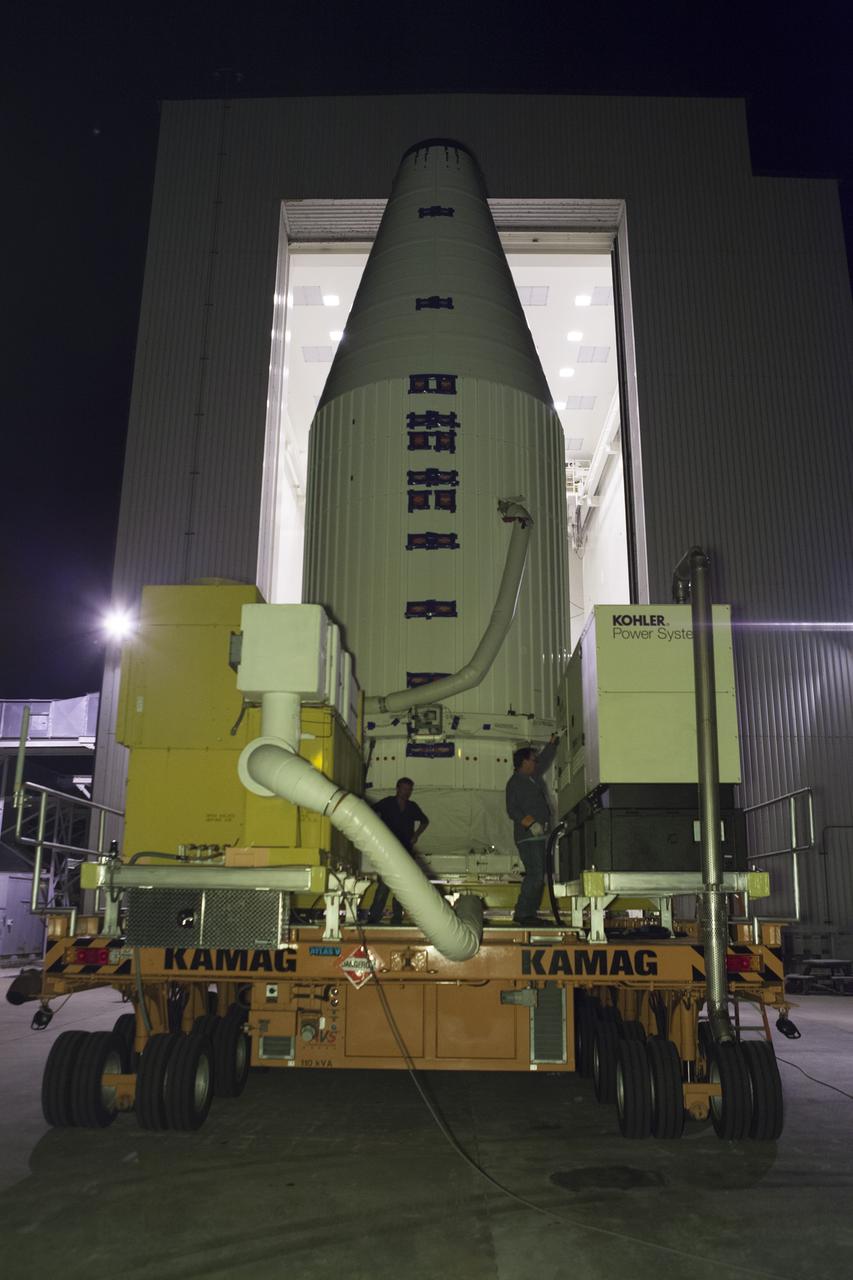
Encapsulated inside its payload fairing, the Cygnus spacecraft for the upcoming Orbital ATK Commercial Resupply Services-6 mission departs the Payload Hazardous Servicing Facility at NASA's Kennedy Space Center in Florida. Mounted atop a KAMAG transporter, Cygnus is being moved to Space Launch Complex-41 at Cape Canaveral Air Force Station where it will be mounted atop a United Launch Alliance Atlas V rocket. The Cygnus is scheduled to lift off atop a United Launch Alliance Atlas V rocket on March 22 to deliver hardware and supplies to the International Space Station.
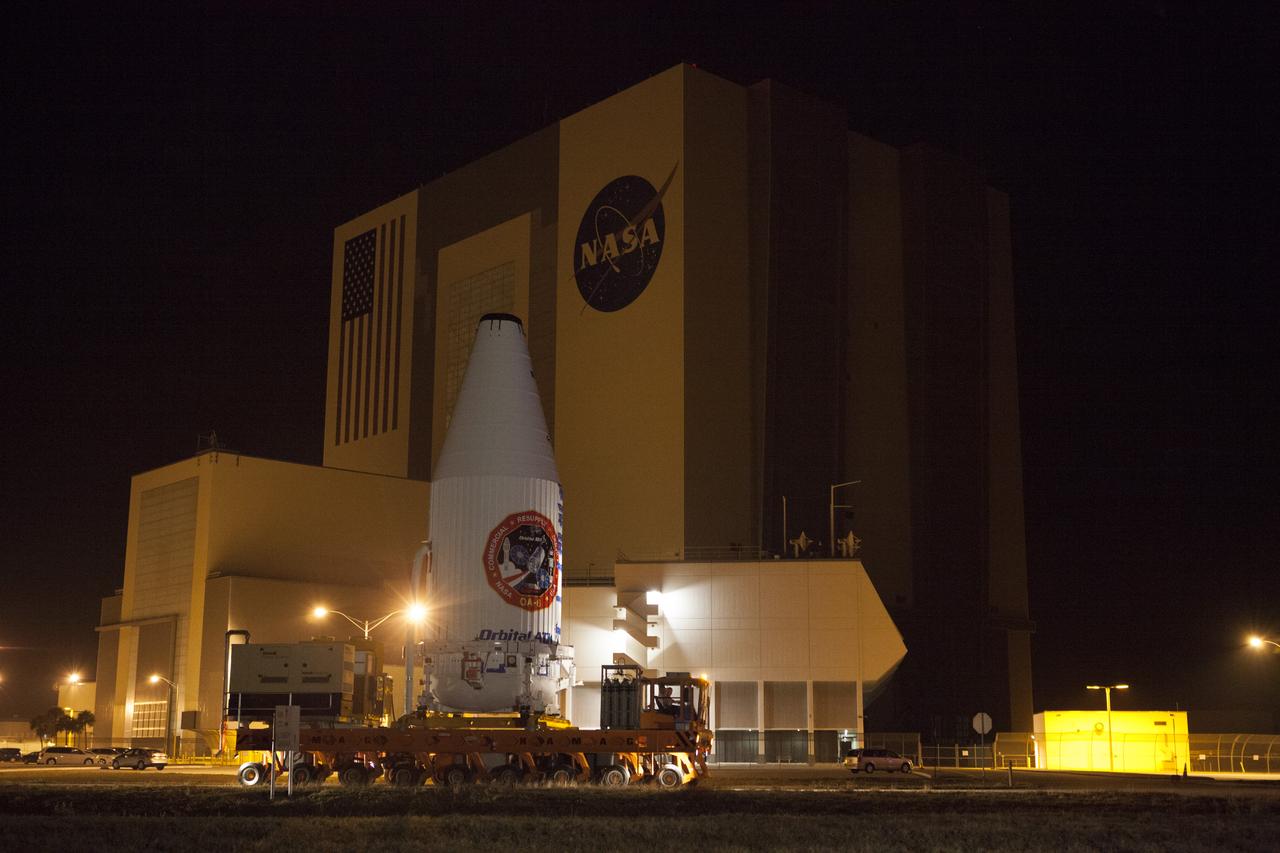
Encapsulated inside its payload fairing, the Cygnus spacecraft for the upcoming Orbital ATK Commercial Resupply Services-6 mission moves past the Vehicle Assembly Building at NASA's Kennedy Space Center in Florida. Mounted atop a KAMAG transporter, Cygnus is being moved to Space Launch Complex-41 at Cape Canaveral Air Force Station where it will be mounted atop a United Launch Alliance Atlas V rocket. The Cygnus is scheduled to lift off atop a United Launch Alliance Atlas V rocket on March 22 to deliver hardware and supplies to the International Space Station.
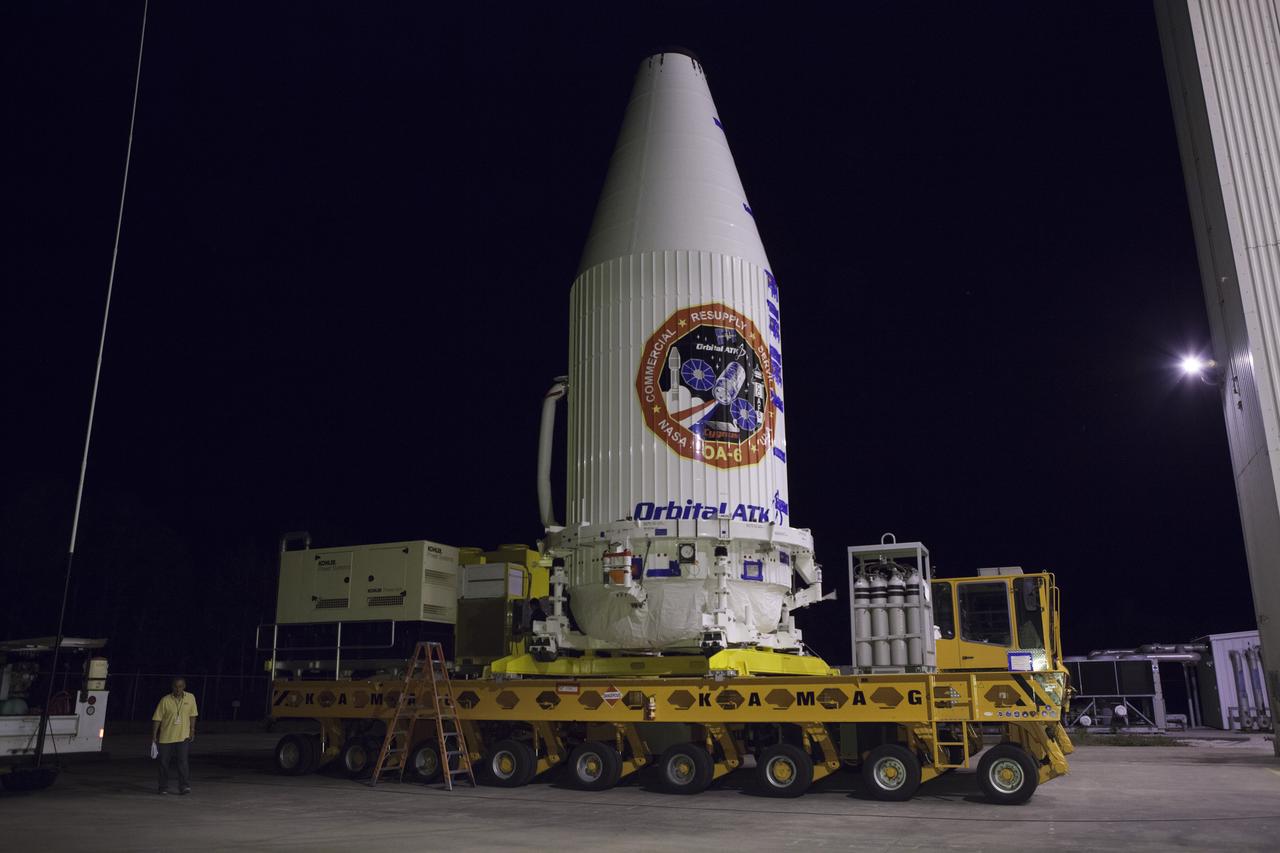
Encapsulated inside its payload fairing, the Cygnus spacecraft for the upcoming Orbital ATK Commercial Resupply Services-6 mission departs the Payload Hazardous Servicing Facility at NASA's Kennedy Space Center in Florida. Mounted atop a KAMAG transporter, Cygnus is being moved to Space Launch Complex-41 at Cape Canaveral Air Force Station where it will be mounted atop a United Launch Alliance Atlas V rocket. The Cygnus is scheduled to lift off atop a United Launch Alliance Atlas V rocket on March 22 to deliver hardware and supplies to the International Space Station.
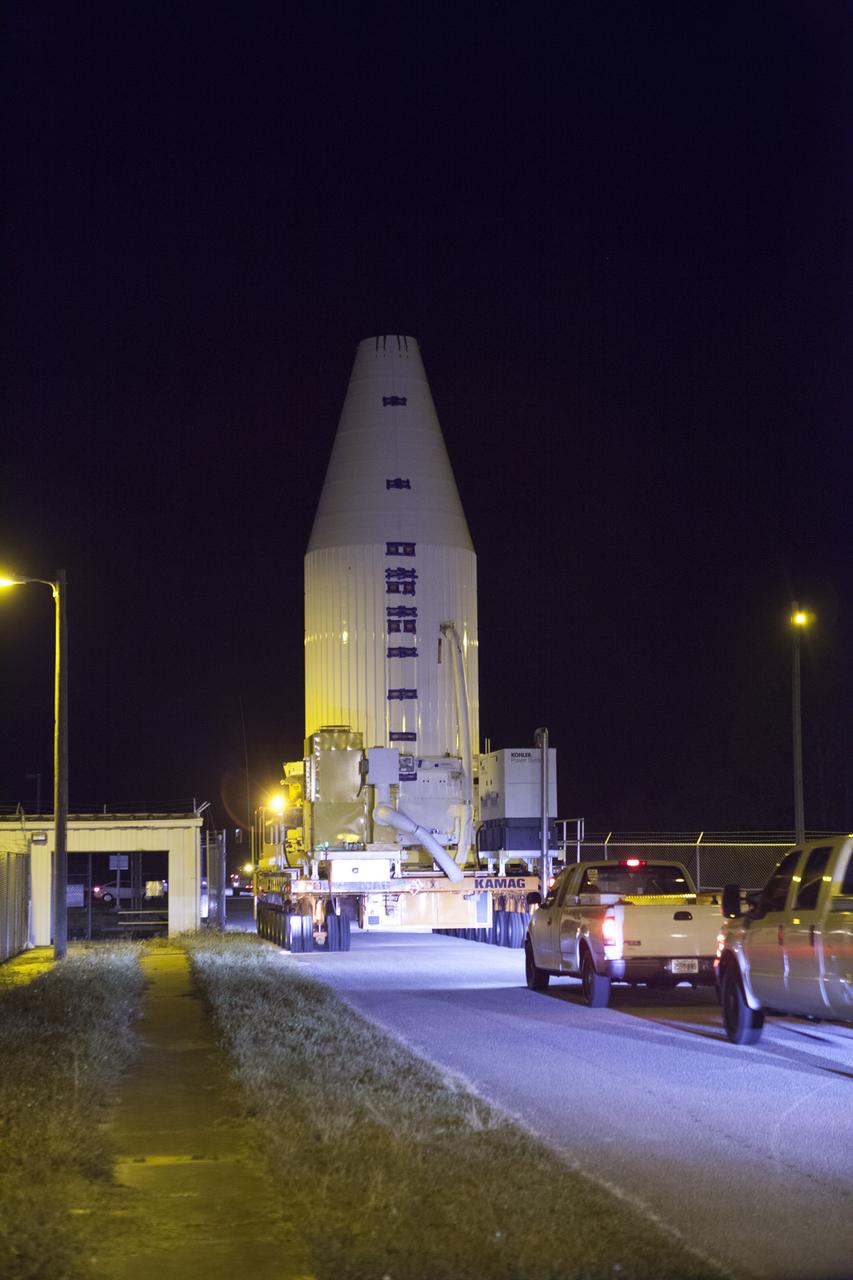
Encapsulated inside its payload fairing, the Cygnus spacecraft for the upcoming Orbital ATK Commercial Resupply Services-6 mission departs the Payload Hazardous Servicing Facility at NASA's Kennedy Space Center in Florida. Mounted atop a KAMAG transporter, Cygnus is being moved to Space Launch Complex-41 at Cape Canaveral Air Force Station where it will be mounted atop a United Launch Alliance Atlas V rocket. The Cygnus is scheduled to lift off atop a United Launch Alliance Atlas V rocket on March 22 to deliver hardware and supplies to the International Space Station.
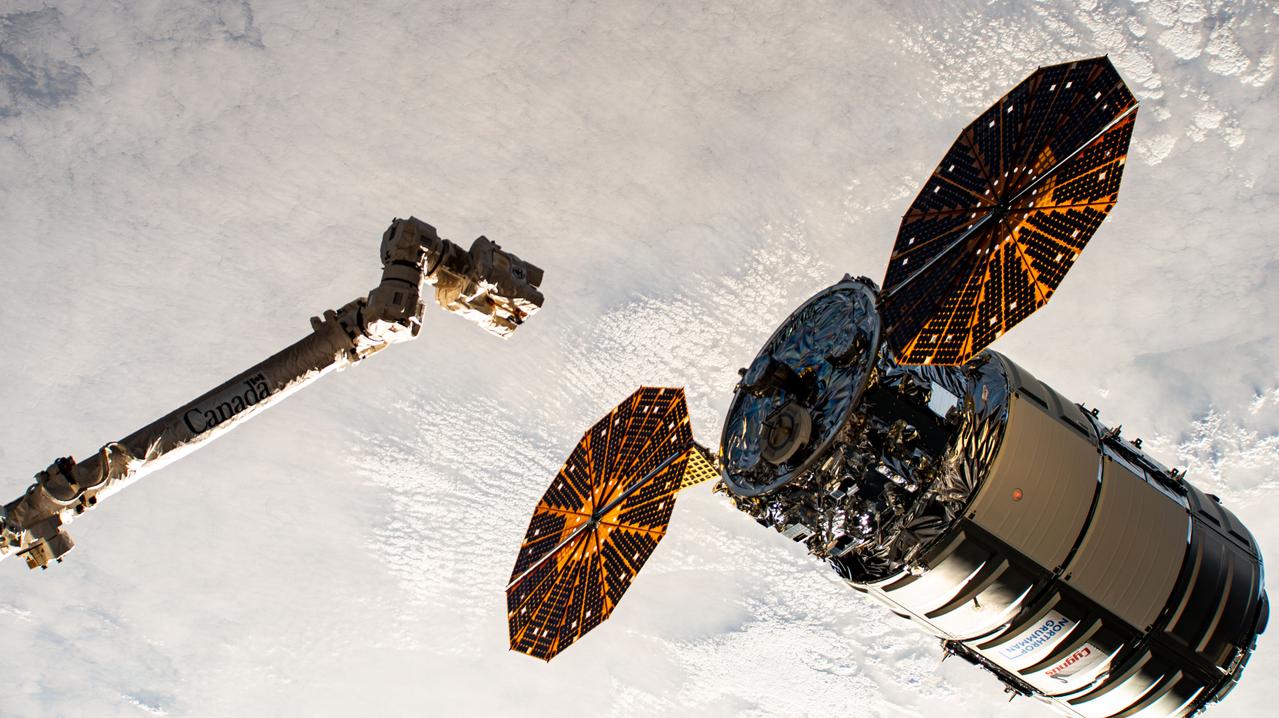
iss071e418233 (Aug. 6, 2024) --- Northrop Grumman's Cygnus cargo craft, with its prominent cymbal-shaped UltraFlex solar arrays, is pictured awaiting its capture by the Canadarm2 robotic arm commanded by Expedition 71 Flight Engineer Matthew Dominick of NASA. The maneuver marked the 50th free-flying capture for the Canadarm2 robotic arm.
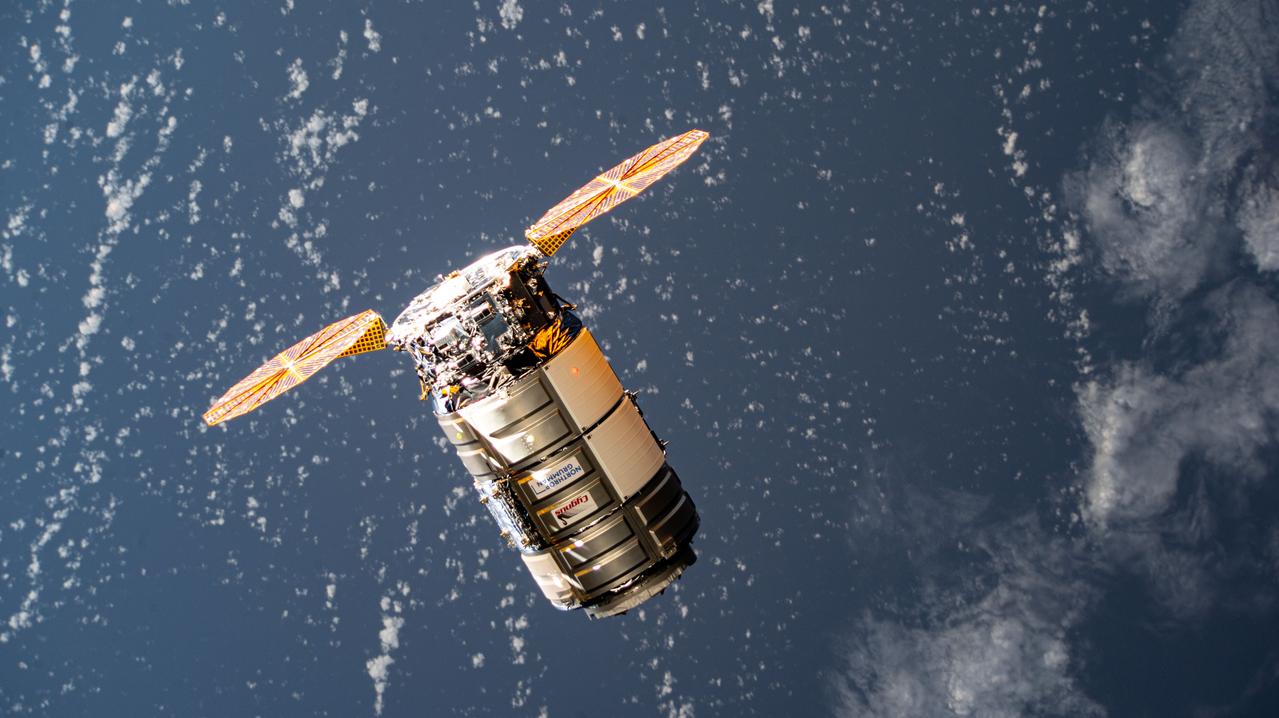
iss071e418230 (Aug. 6, 2024) --- Northrop Grumman's Cygnus cargo craft, carrying 8,200 pounds of science and supplies, approaches the International Space Station for a capture with the Canadarm2 robotic arm commanded by Expedition 71 Flight Engineer Matthew Dominick of NASA. The maneuver marked the 50th free-flying capture for the Canadarm2 robotic arm.
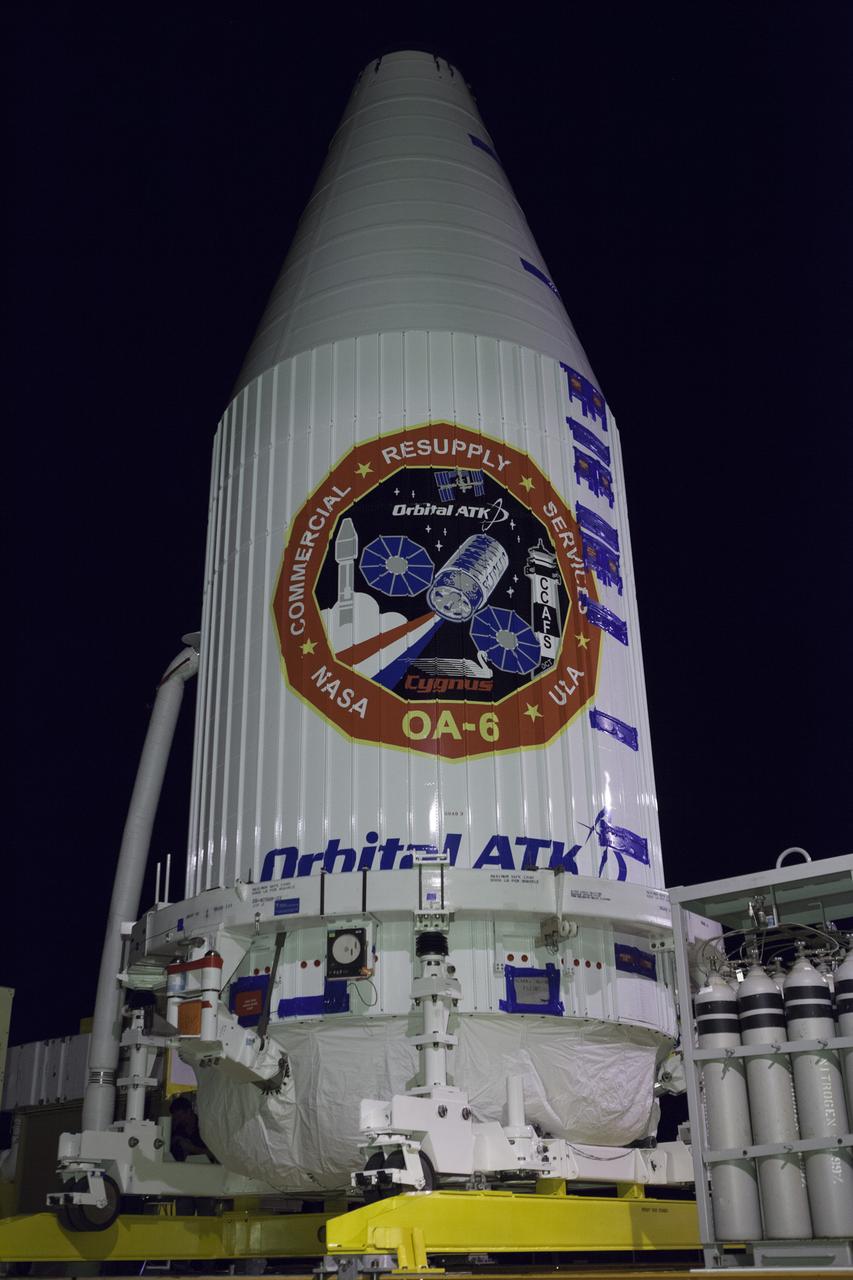
Encapsulated inside its payload fairing, the Cygnus spacecraft for the upcoming Orbital ATK Commercial Resupply Services-6 mission departs the Payload Hazardous Servicing Facility at NASA's Kennedy Space Center in Florida. Mounted atop a KAMAG transporter, Cygnus is being moved to Space Launch Complex-41 at Cape Canaveral Air Force Station where it will be mounted atop a United Launch Alliance Atlas V rocket. The Cygnus is scheduled to lift off atop a United Launch Alliance Atlas V rocket on March 22 to deliver hardware and supplies to the International Space Station.
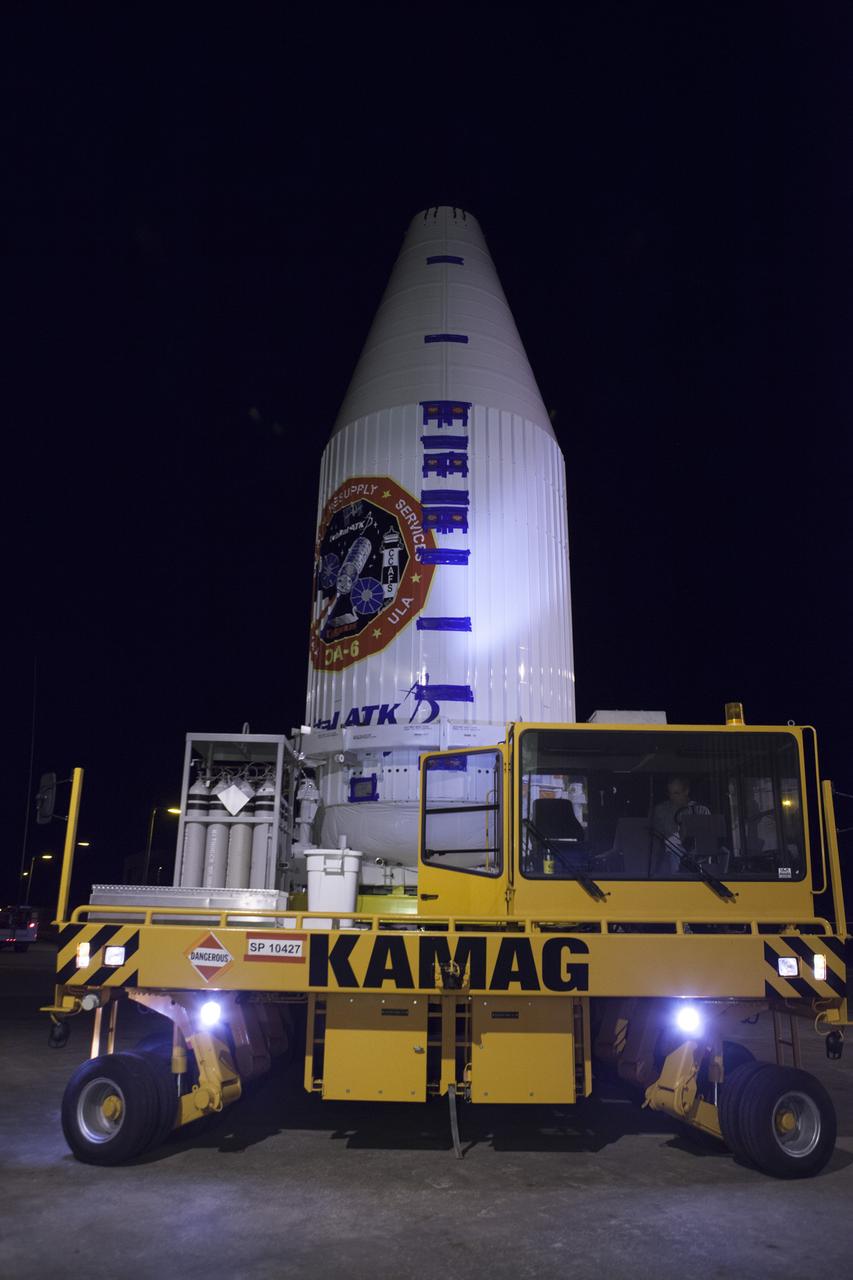
Encapsulated inside its payload fairing, the Cygnus spacecraft for the upcoming Orbital ATK Commercial Resupply Services-6 mission departs the Payload Hazardous Servicing Facility at NASA's Kennedy Space Center in Florida. Mounted atop a KAMAG transporter, Cygnus is being moved to Space Launch Complex-41 at Cape Canaveral Air Force Station where it will be mounted atop a United Launch Alliance Atlas V rocket. The Cygnus is scheduled to lift off atop a United Launch Alliance Atlas V rocket on March 22 to deliver hardware and supplies to the International Space Station.
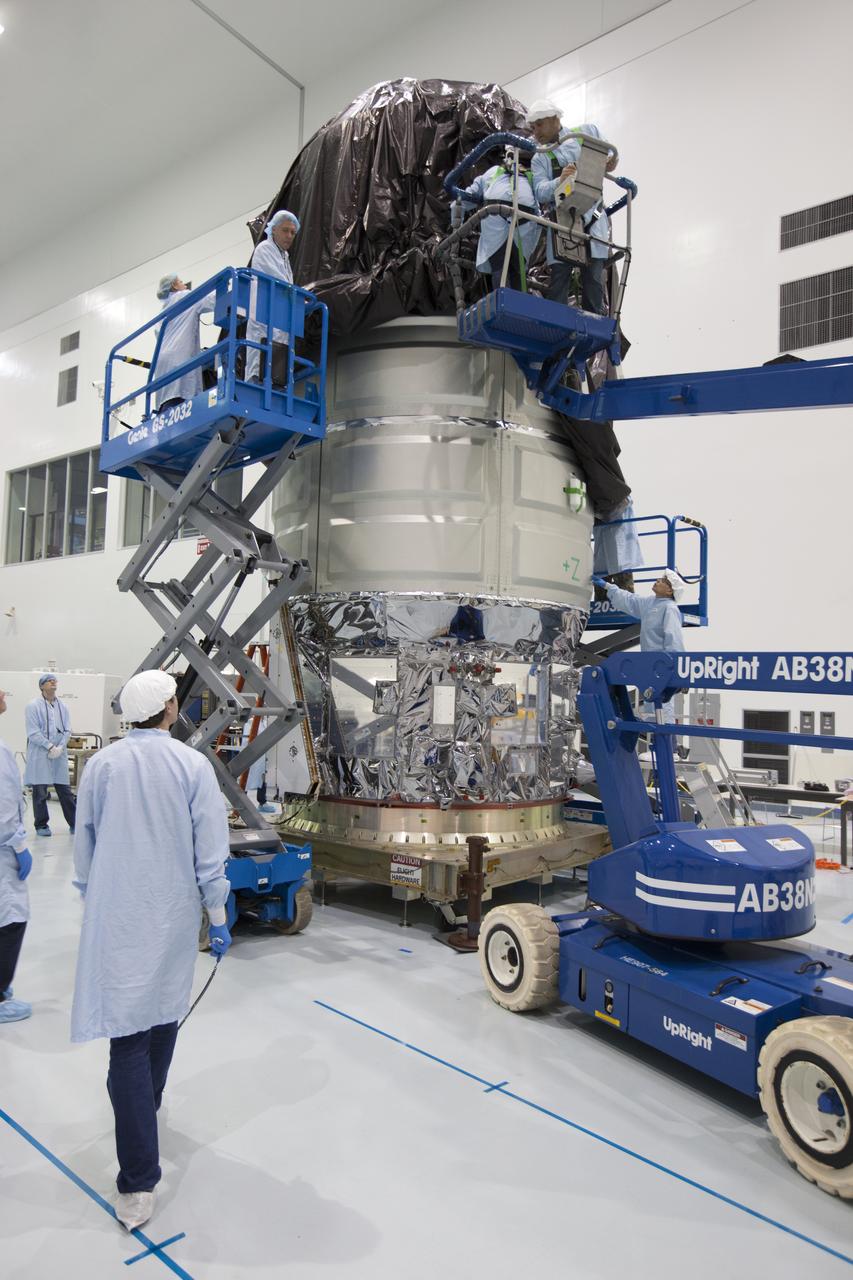
In the Space Station Processing Facility high bay at NASA's Kennedy Space Center in Florida, technicians position a protective covering around Orbital ATK's CYGNUS pressurized cargo module. The Orbital ATK CRS-7 commercial resupply services mission to the International Space Station is scheduled to launch atop a United Launch Alliance Atlas V rocket from Space Launch Complex 41 at Cape Canaveral Air Force Station on March 19, 2017. CYGNUS will deliver thousands of pounds of supplies, equipment and scientific research materials to the space station.
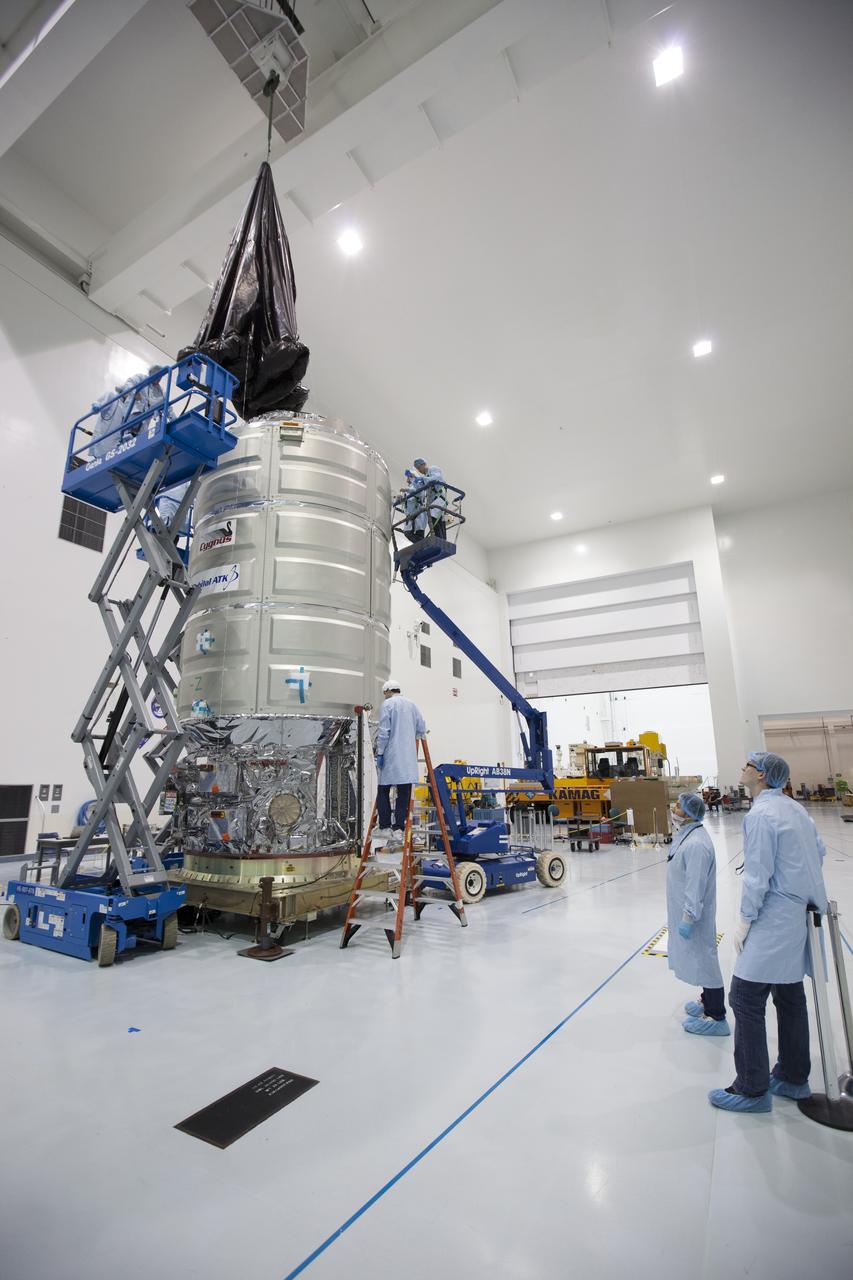
In the Space Station Processing Facility high bay at NASA's Kennedy Space Center in Florida, technicians assist as a crane is used to lower a protective covering around Orbital ATK's CYGNUS pressurized cargo module. The Orbital ATK CRS-7 commercial resupply services mission to the International Space Station is scheduled to launch atop a United Launch Alliance Atlas V rocket from Space Launch Complex 41 at Cape Canaveral Air Force Station on March 19, 2017. CYGNUS will deliver thousands of pounds of supplies, equipment and scientific research materials to the space station.
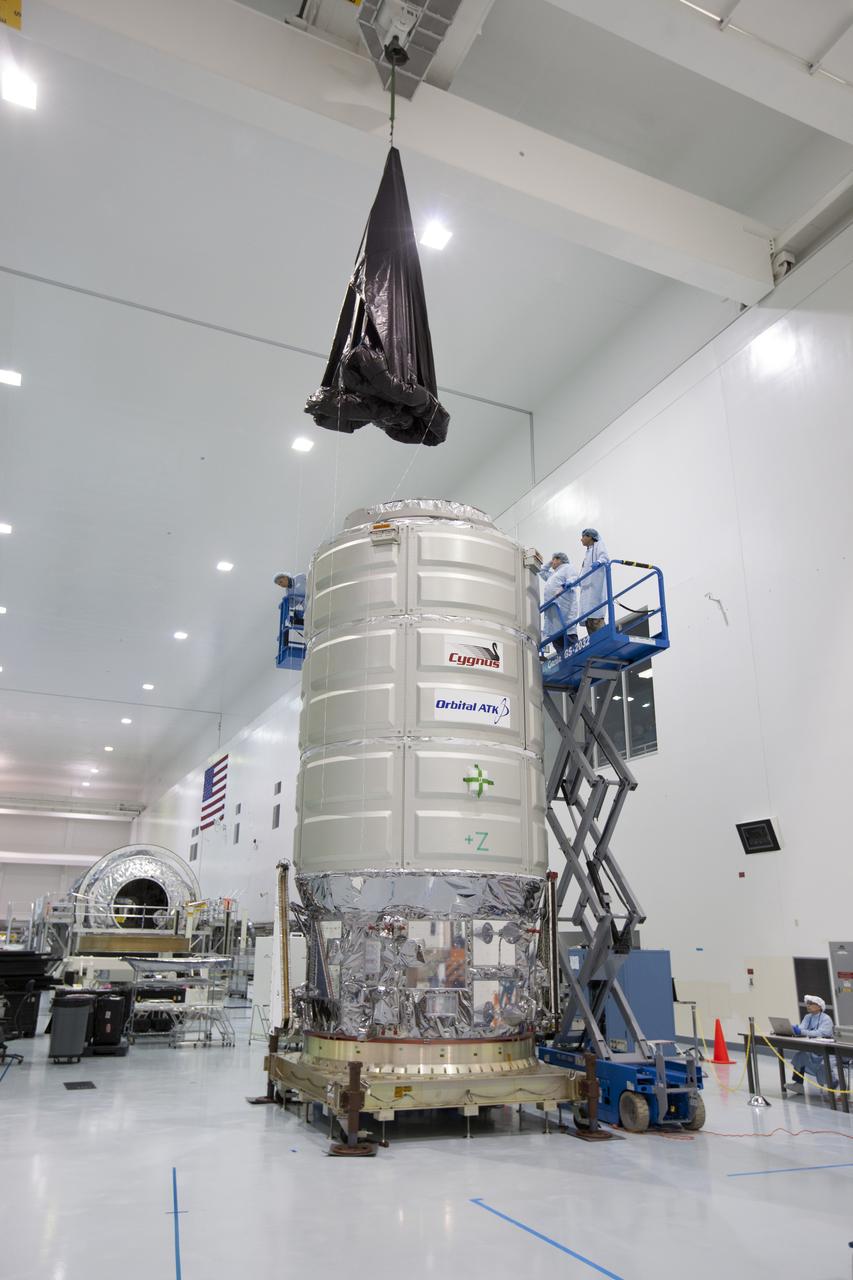
In the Space Station Processing Facility high bay at NASA's Kennedy Space Center in Florida, technicians are preparing to assist as a crane is used to lower a protective covering around Orbital ATK's CYGNUS pressurized cargo module. The Orbital ATK CRS-7 commercial resupply services mission to the International Space Station is scheduled to launch atop a United Launch Alliance Atlas V rocket from Space Launch Complex 41 at Cape Canaveral Air Force Station on March 19, 2017. CYGNUS will deliver thousands of pounds of supplies, equipment and scientific research materials to the space station.

In the Space Station Processing Facility high bay at NASA's Kennedy Space Center in Florida, technicians assist as a crane is used to lower a protective covering around Orbital ATK's CYGNUS pressurized cargo module. The Orbital ATK CRS-7 commercial resupply services mission to the International Space Station is scheduled to launch atop a United Launch Alliance Atlas V rocket from Space Launch Complex 41 at Cape Canaveral Air Force Station on March 19, 2017. CYGNUS will deliver thousands of pounds of supplies, equipment and scientific research materials to the space station.
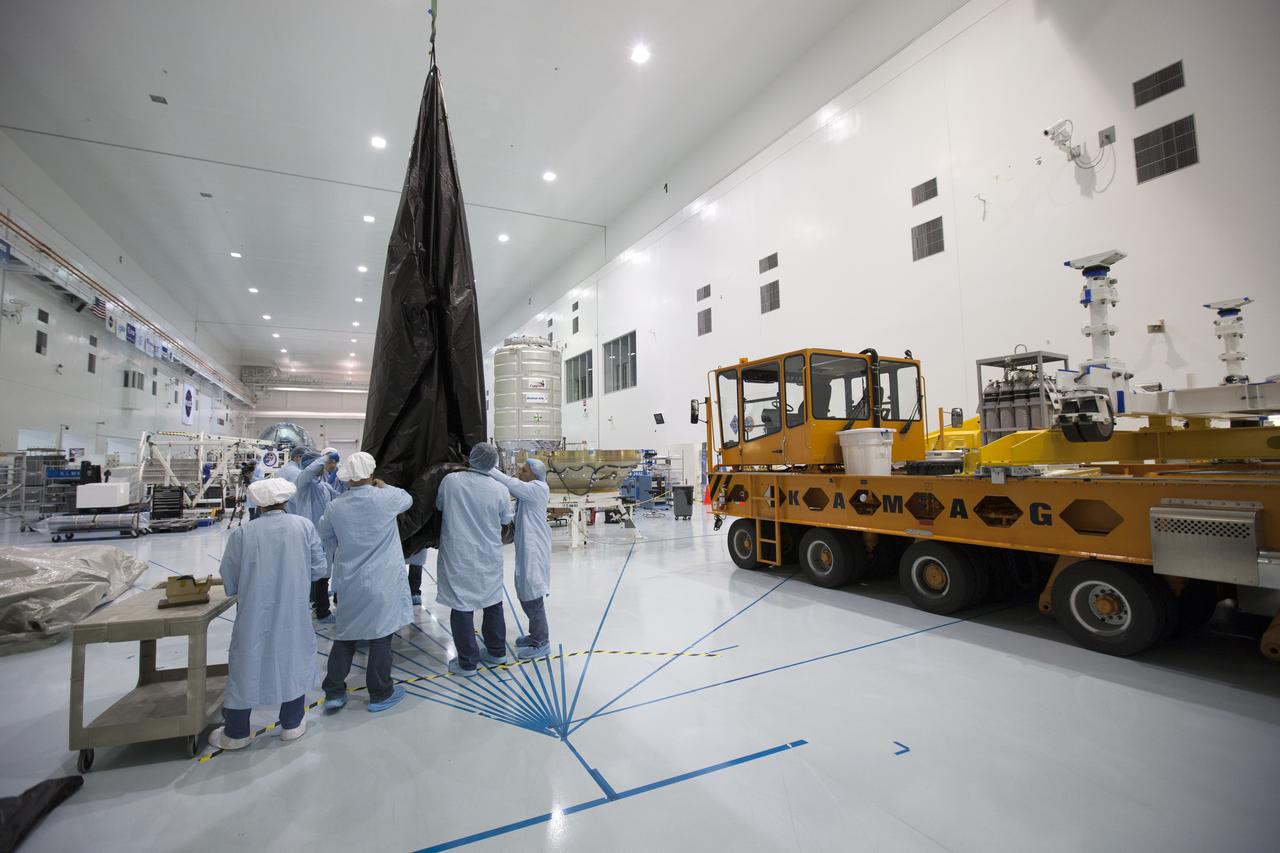
In the Space Station Processing Facility at NASA's Kennedy Space Center in Florida, a KAMAG transporter has arrived in the high bay. Technicians are preparing the protective covering for Orbital ATK's CYGNUS pressurized cargo module. The Orbital ATK CRS-7 commercial resupply services mission to the International Space Station is scheduled to launch atop a United Launch Alliance Atlas V rocket from Space Launch Complex 41 at Cape Canaveral Air Force Station on March 19, 2017. CYGNUS will deliver thousands of pounds of supplies, equipment and scientific research materials to the space station.
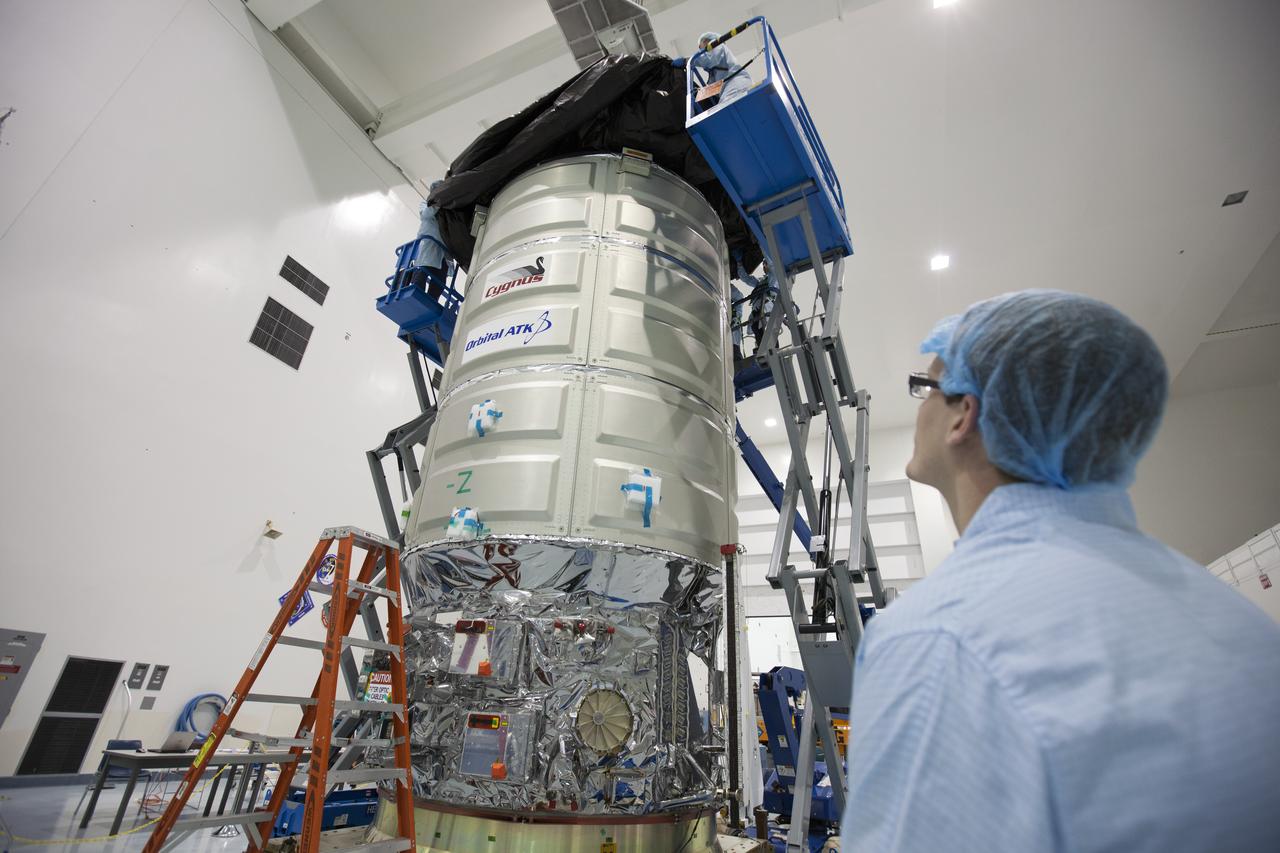
In the Space Station Processing Facility high bay at NASA's Kennedy Space Center in Florida, technicians assist as a crane is used to lower a protective covering around Orbital ATK's CYGNUS pressurized cargo module. The Orbital ATK CRS-7 commercial resupply services mission to the International Space Station is scheduled to launch atop a United Launch Alliance Atlas V rocket from Space Launch Complex 41 at Cape Canaveral Air Force Station on March 19, 2017. CYGNUS will deliver thousands of pounds of supplies, equipment and scientific research materials to the space station.
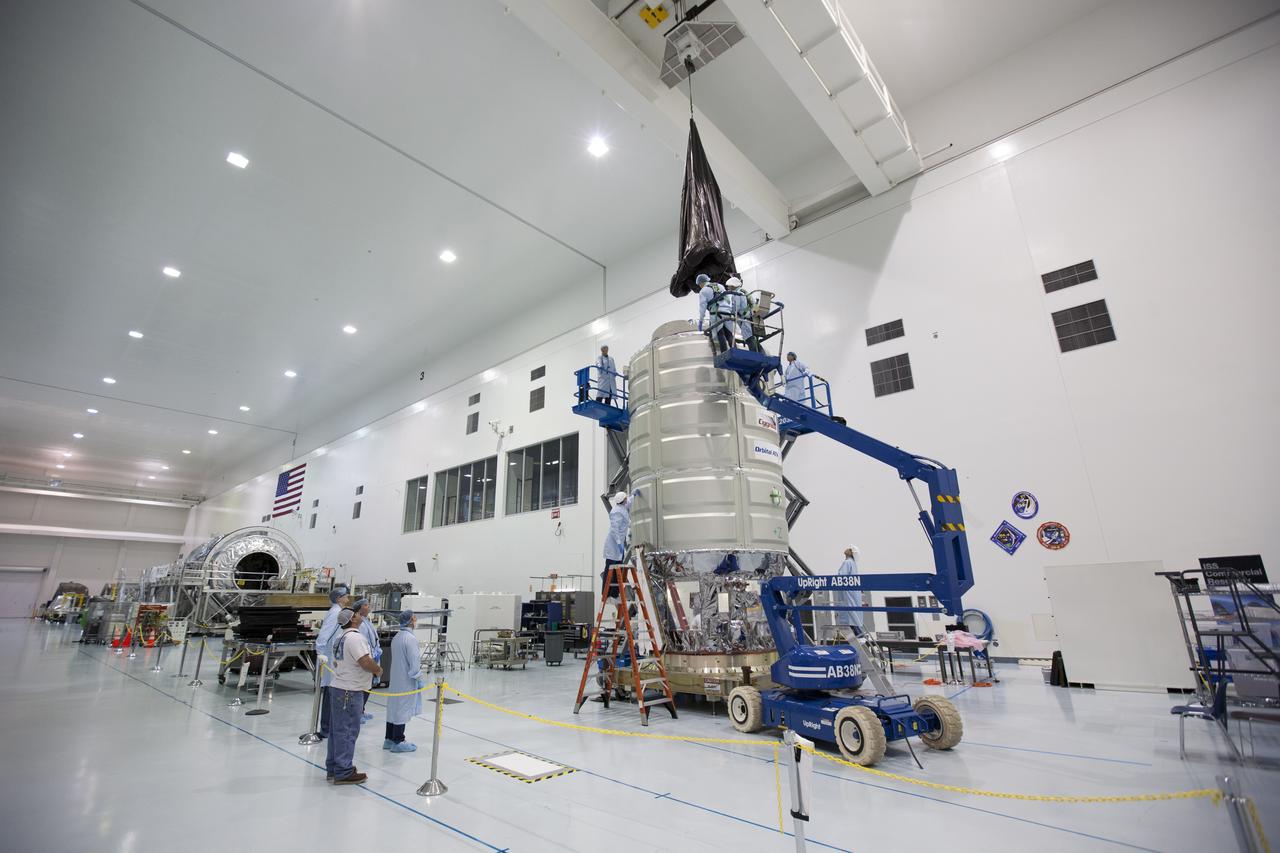
In the Space Station Processing Facility high bay at NASA's Kennedy Space Center in Florida, technicians assist as a crane is used to lower a protective covering around Orbital ATK's CYGNUS pressurized cargo module. The Orbital ATK CRS-7 commercial resupply services mission to the International Space Station is scheduled to launch atop a United Launch Alliance Atlas V rocket from Space Launch Complex 41 at Cape Canaveral Air Force Station on March 19, 2017. CYGNUS will deliver thousands of pounds of supplies, equipment and scientific research materials to the space station.
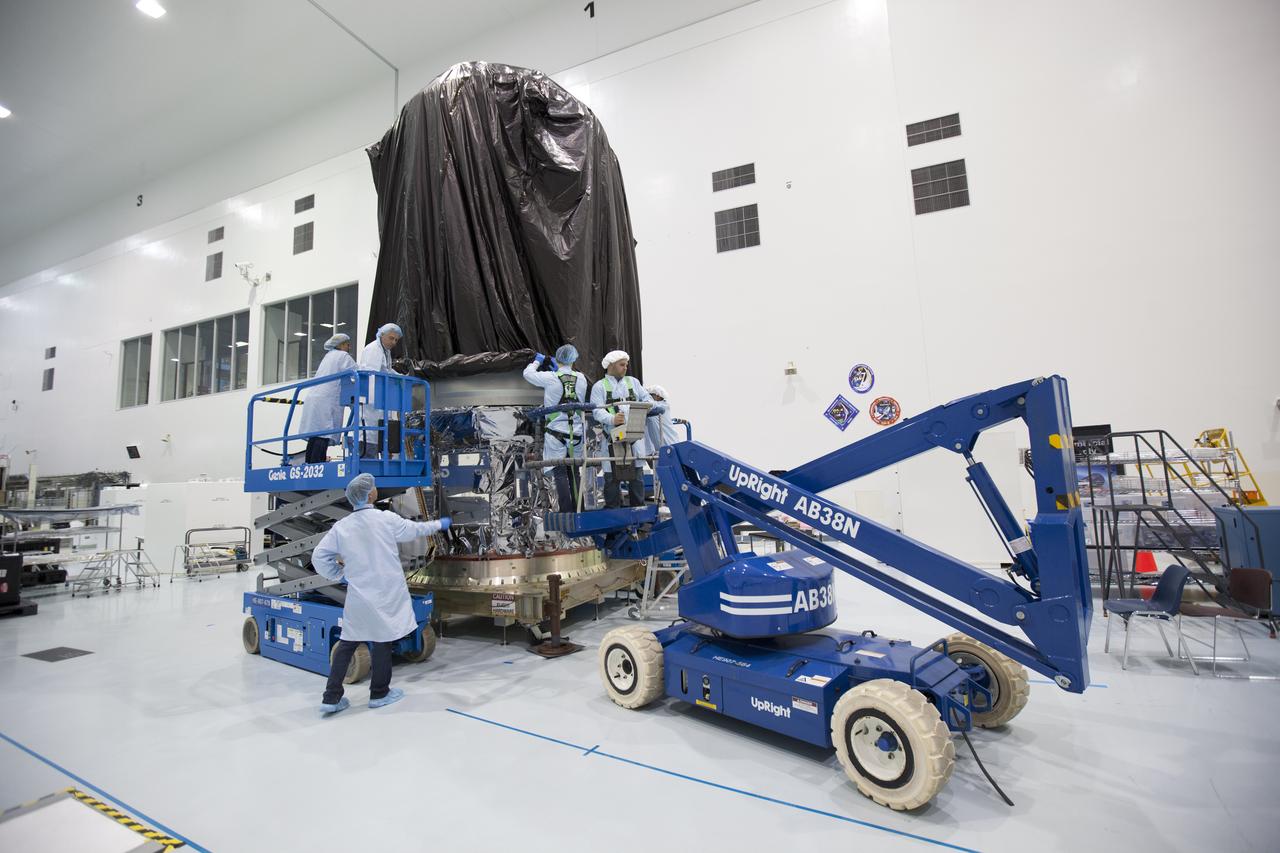
In the Space Station Processing Facility high bay at NASA's Kennedy Space Center in Florida, technicians secure a protective covering around Orbital ATK's CYGNUS pressurized cargo module. The Orbital ATK CRS-7 commercial resupply services mission to the International Space Station is scheduled to launch atop a United Launch Alliance Atlas V rocket from Space Launch Complex 41 at Cape Canaveral Air Force Station on March 19, 2017. CYGNUS will deliver thousands of pounds of supplies, equipment and scientific research materials to the space station.
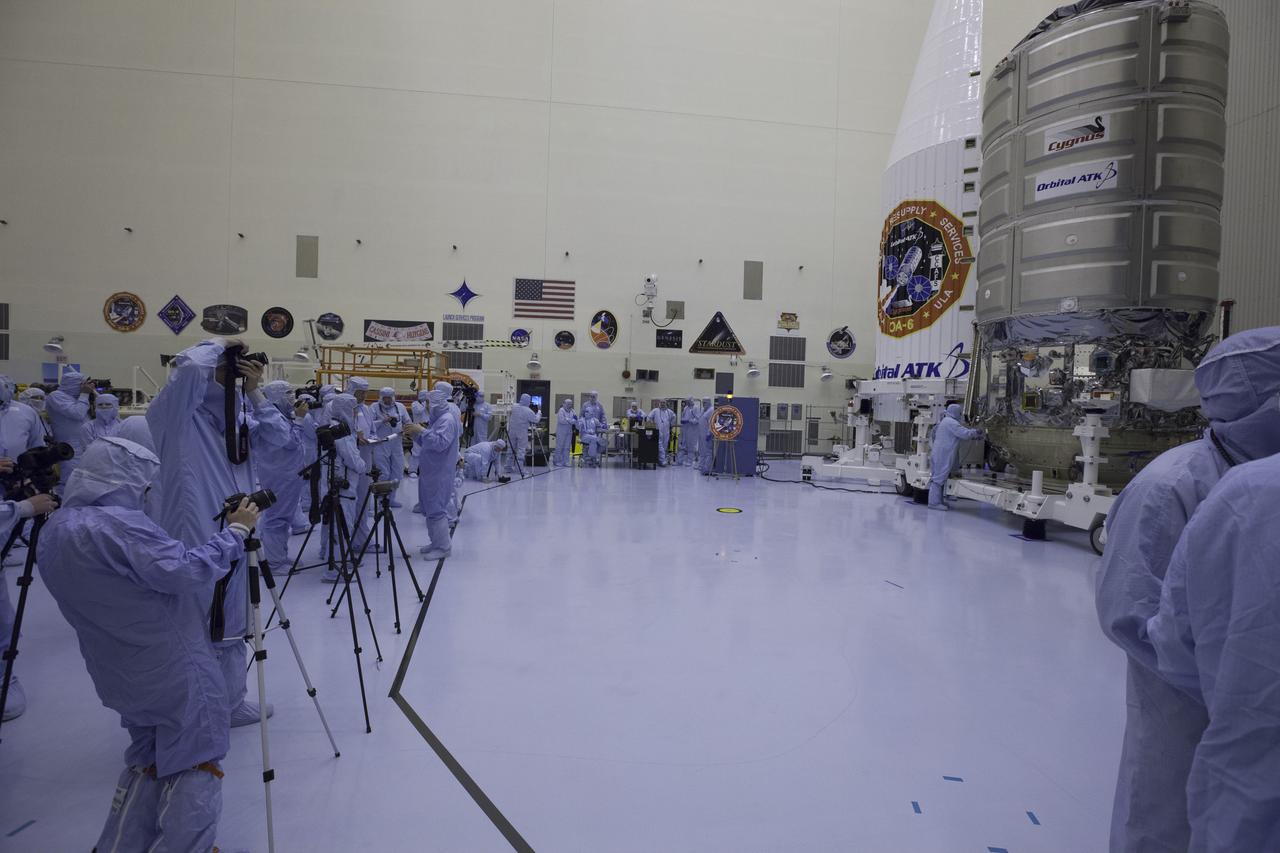
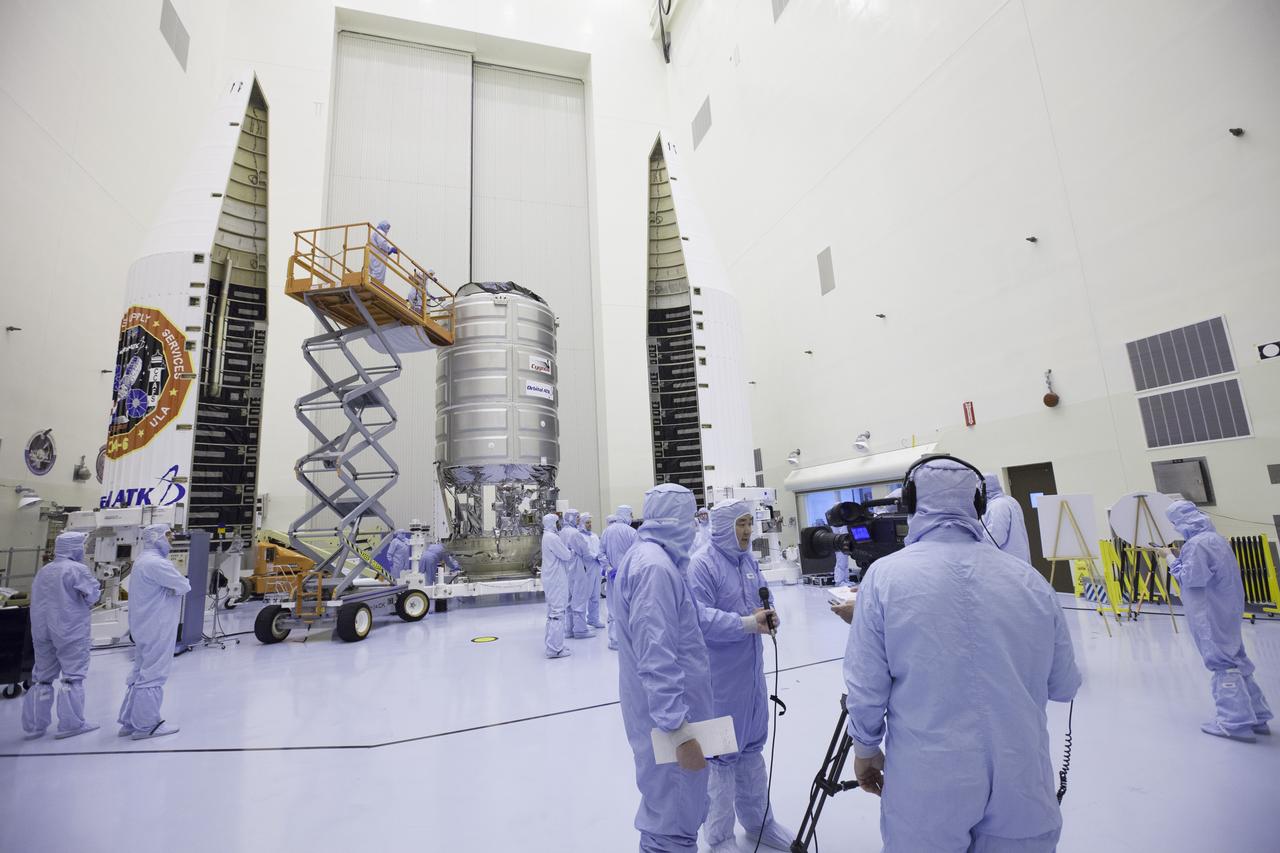
Inside the Payload Hazardous Servicing Facility at NASA's Kennedy Space Center in Florida, members of the news media get a close-up view of a Cygnus cargo vessel. The spacecraft is scheduled for the upcoming Orbital ATK Commercial Resupply Services-6 mission to deliver hardware and supplies to the International Space Station. Reporters, technicians and engineers are clad in "bunny suits." The cleanroom garments are worn to prevent contamination in the controlled environment. The Cygnus is scheduled to lift off atop a United Launch Alliance Atlas V rocket on March 22.
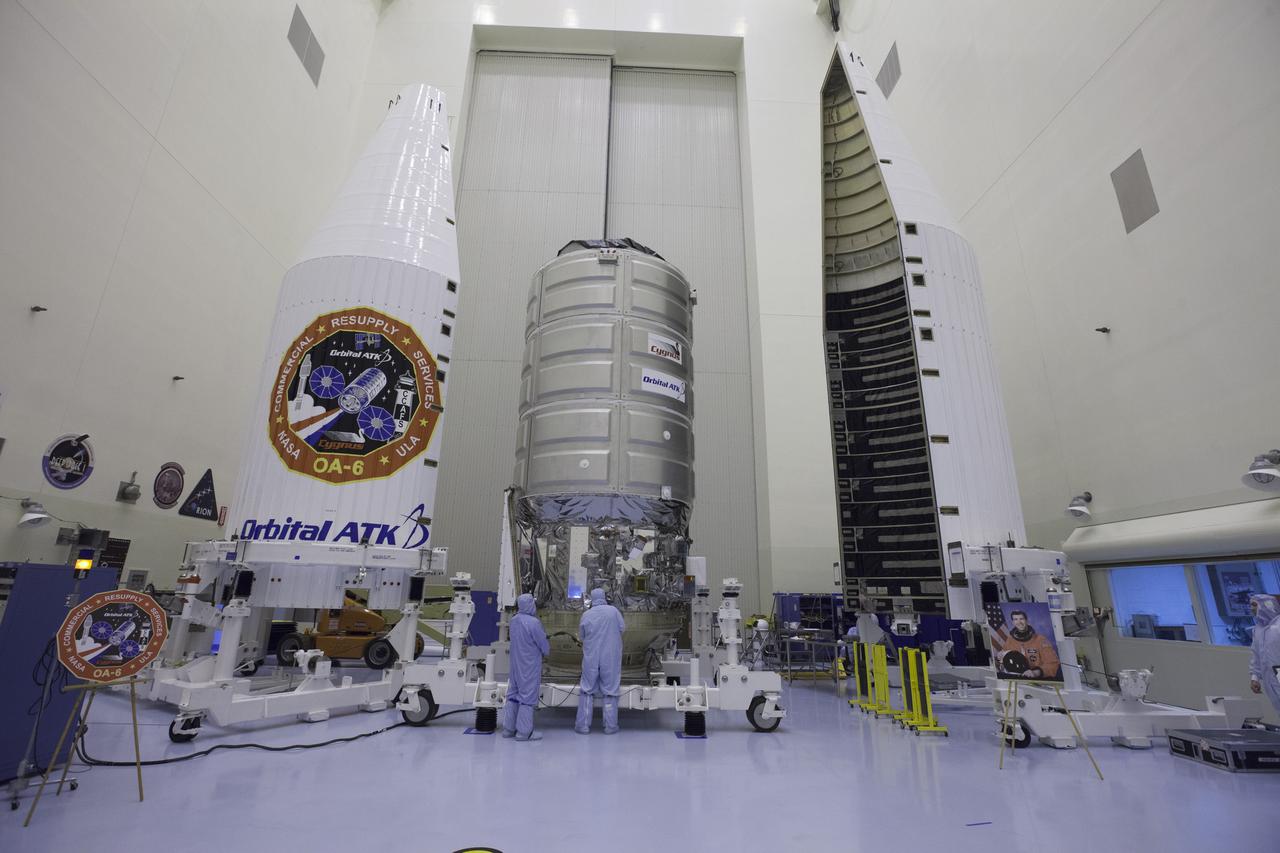
Inside the Payload Hazardous Servicing Facility at NASA's Kennedy Space Center in Florida, a Cygnus cargo spacecraft is being prepared for the upcoming Orbital ATK Commercial Resupply Services-6 mission to deliver hardware and supplies to the International Space Station. Technicians and engineers are clad in "bunny suits." The cleanroom garments are worn to prevent contamination in the controlled environment. The Cygnus is scheduled to lift off atop a United Launch Alliance Atlas V rocket on March 22.
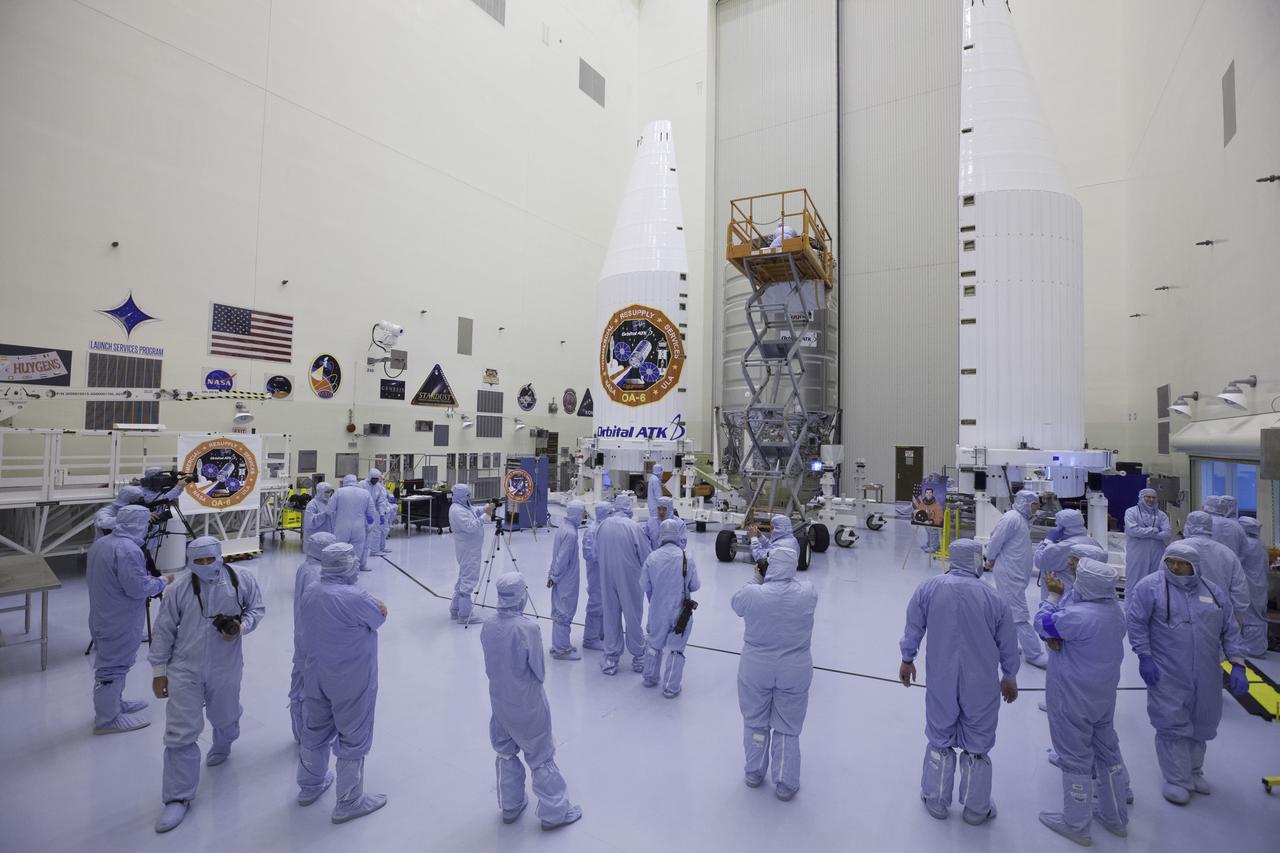
Inside the Payload Hazardous Servicing Facility at NASA's Kennedy Space Center in Florida, members of the news media get a close-up view of a Cygnus cargo vessel. The spacecraft is scheduled for the upcoming Orbital ATK Commercial Resupply Services-6 mission to deliver hardware and supplies to the International Space Station. Reporters, technicians and engineers are clad in "bunny suits." The cleanroom garments are worn to prevent contamination in the controlled environment. The Cygnus is scheduled to lift off atop a United Launch Alliance Atlas V rocket on March 22.
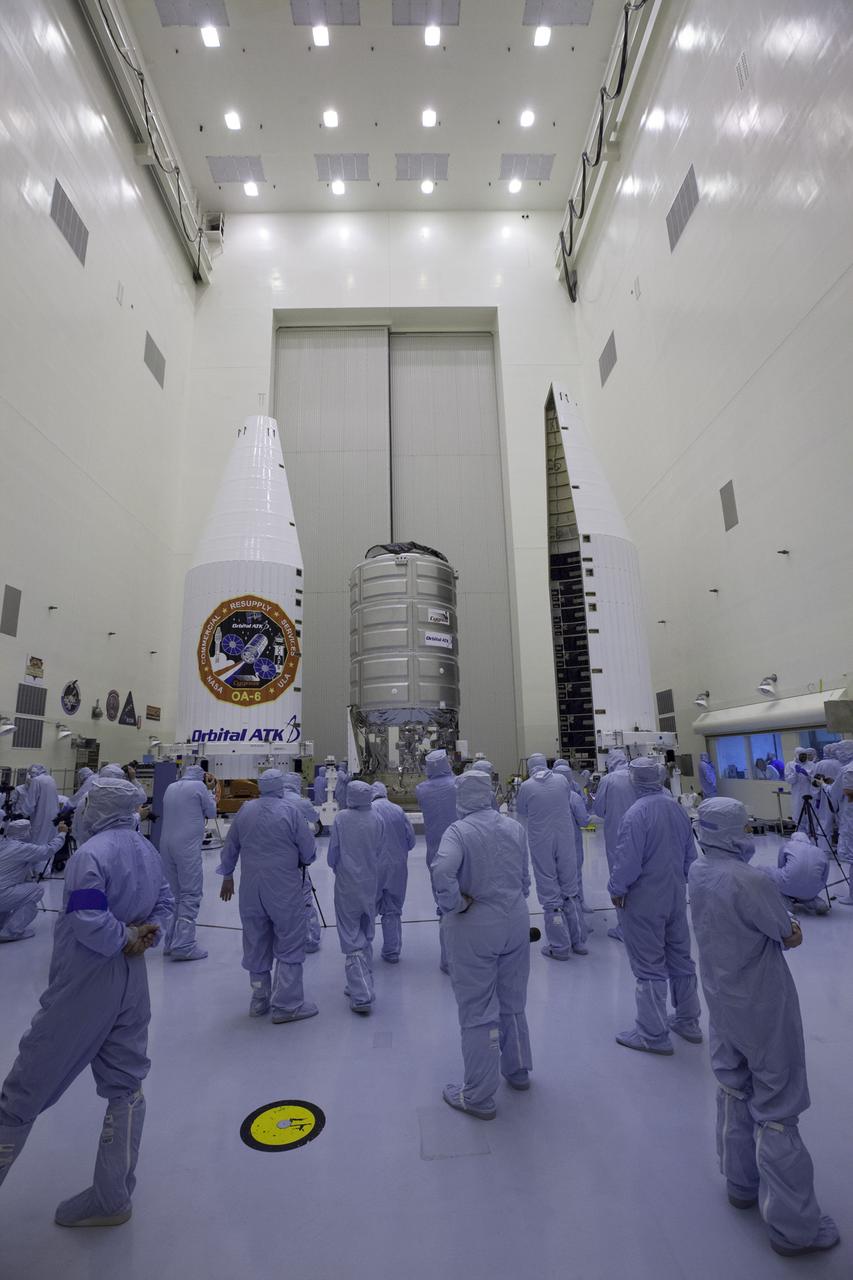
Inside the Payload Hazardous Servicing Facility at NASA's Kennedy Space Center in Florida, members of the news media get a close-up view of a Cygnus cargo vessel. The spacecraft is scheduled for the upcoming Orbital ATK Commercial Resupply Services-6 mission to deliver hardware and supplies to the International Space Station. Reporters, technicians and engineers are clad in "bunny suits." The cleanroom garments are worn to prevent contamination in the controlled environment. The Cygnus is scheduled to lift off atop a United Launch Alliance Atlas V rocket on March 22.
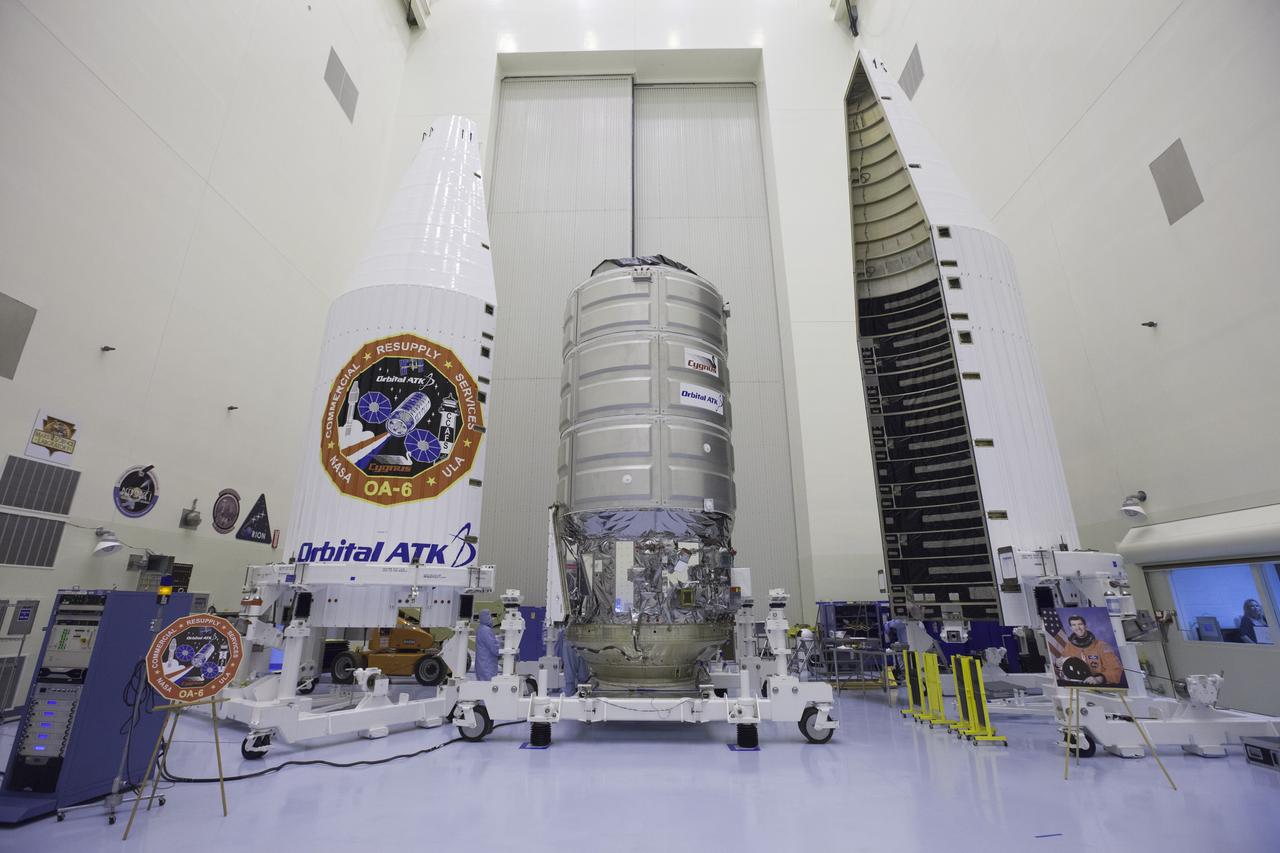
Inside the Payload Hazardous Servicing Facility at NASA's Kennedy Space Center in Florida, a Cygnus cargo spacecraft is being prepared for the upcoming Orbital ATK Commercial Resupply Services-6 mission to deliver hardware and supplies to the International Space Station. The Cygnus is scheduled to lift off atop a United Launch Alliance Atlas V rocket on March 22.
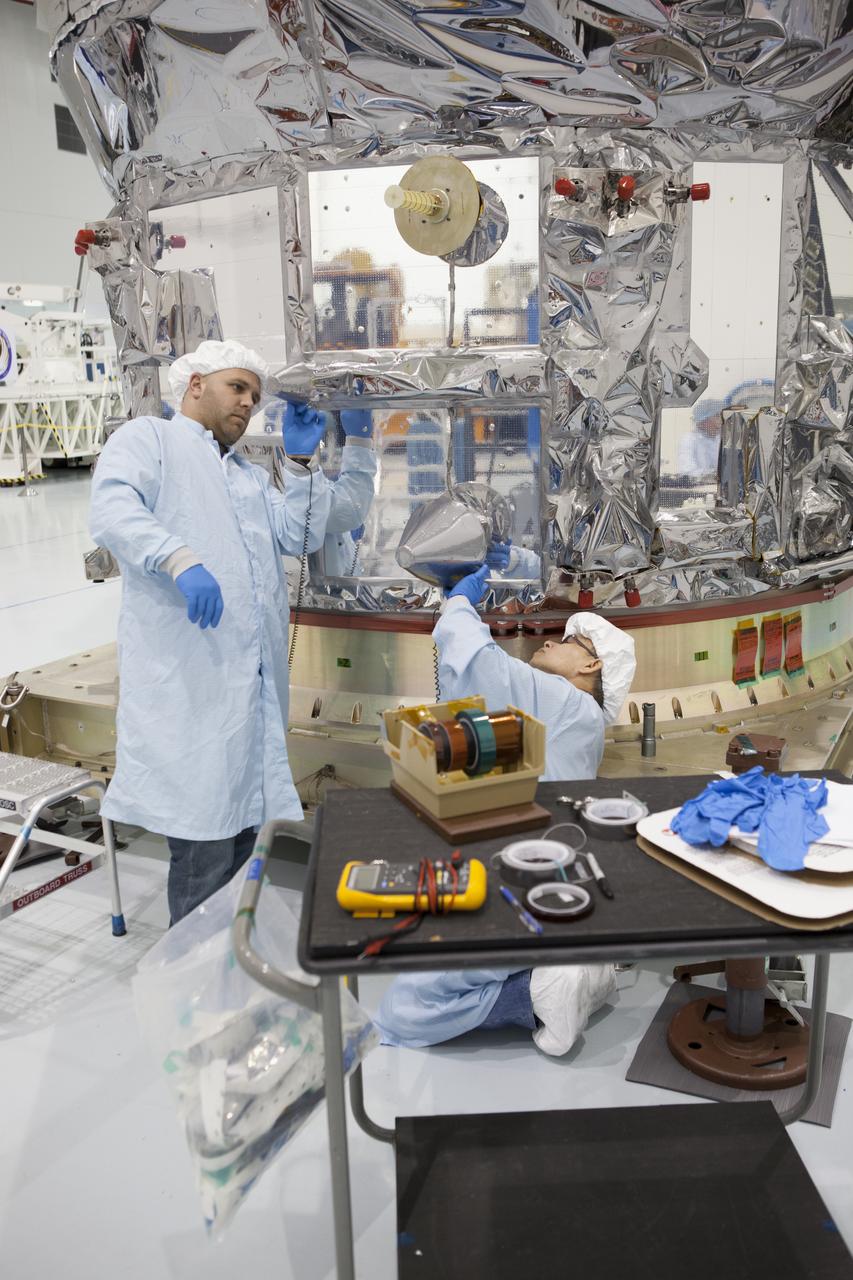
In the Space Station Processing Facility high bay at NASA's Kennedy Space Center in Florida, technicians are preparing Orbital ATK's CYGNUS pressurized cargo module for bagging. The Orbital ATK CRS-7 commercial resupply services mission to the International Space Station is scheduled to launch atop a United Launch Alliance Atlas V rocket from Space Launch Complex 41 at Cape Canaveral Air Force Station on March 19, 2017. CYGNUS will deliver thousands of pounds of supplies, equipment and scientific research materials to the space station.
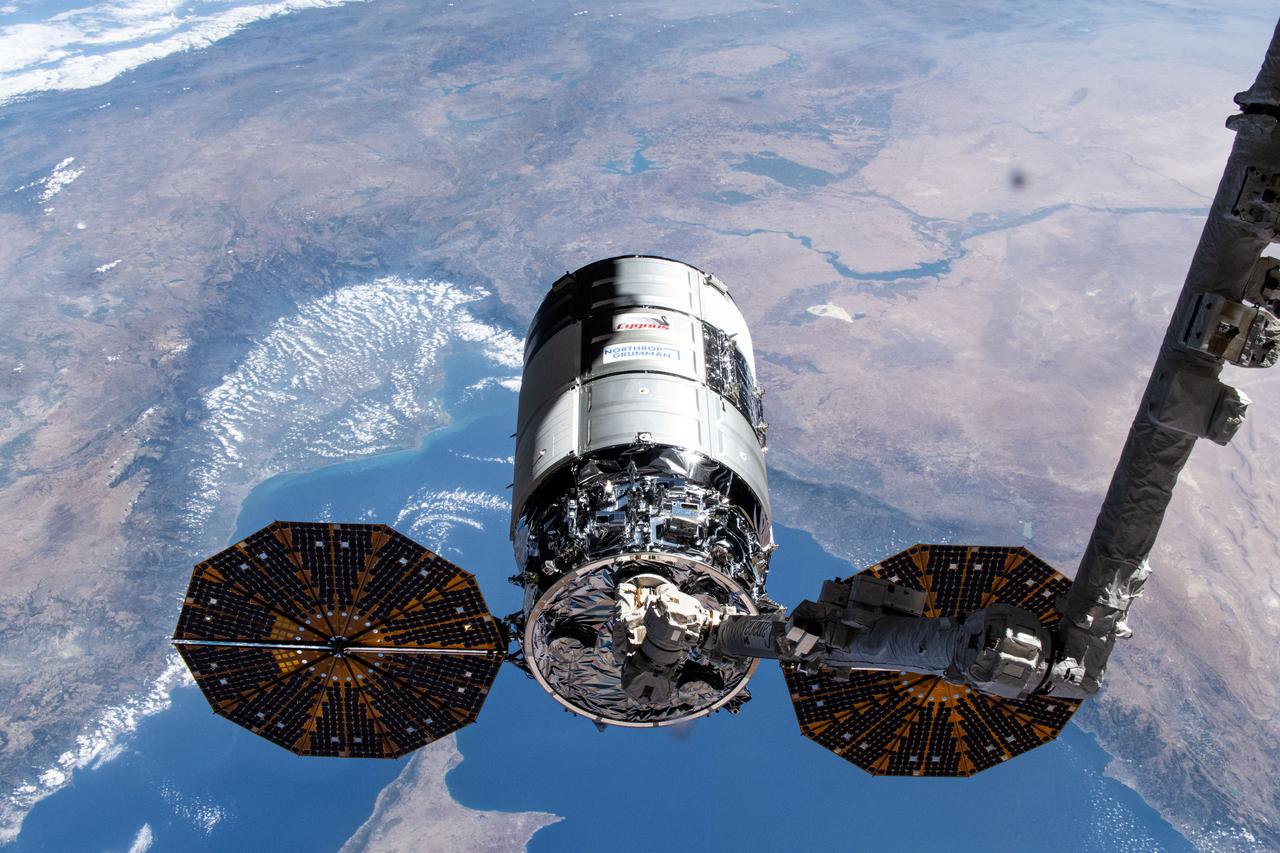
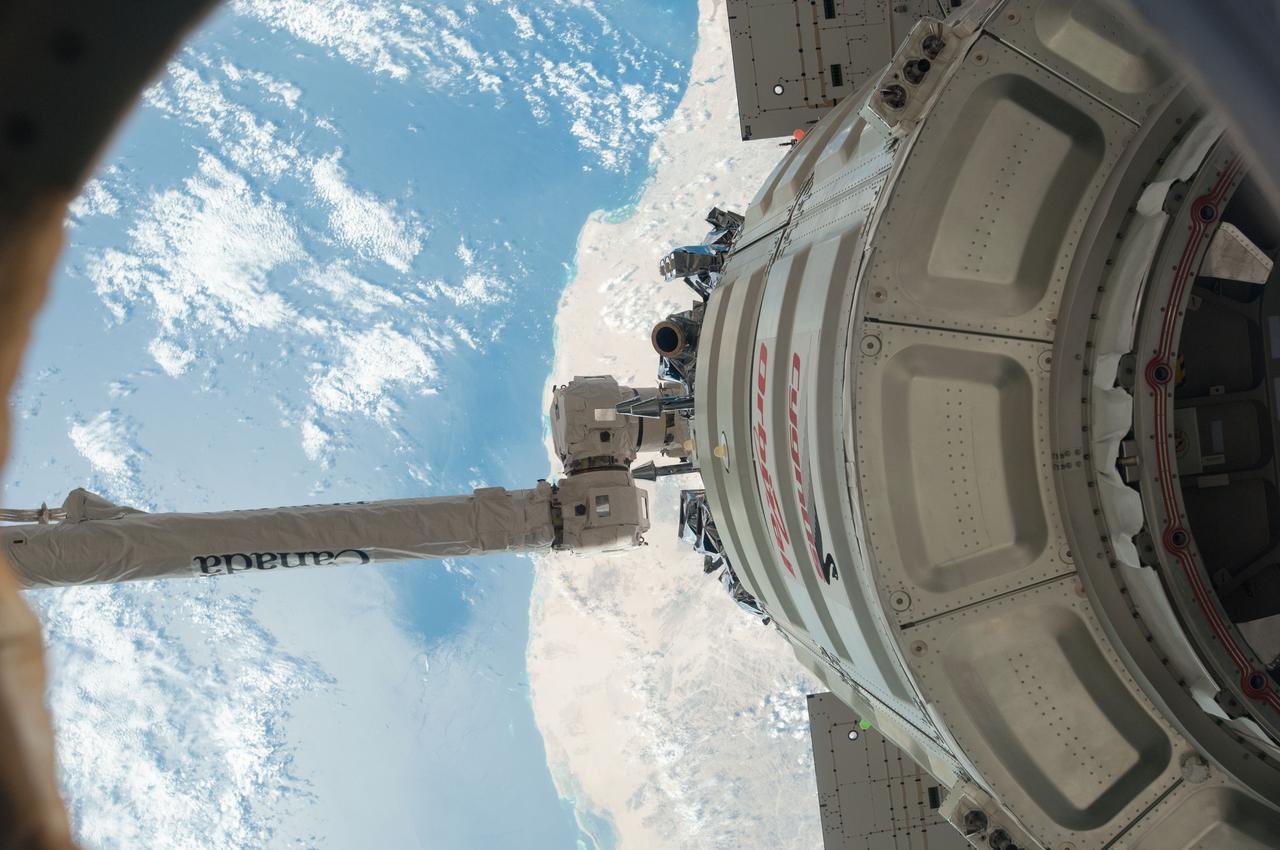
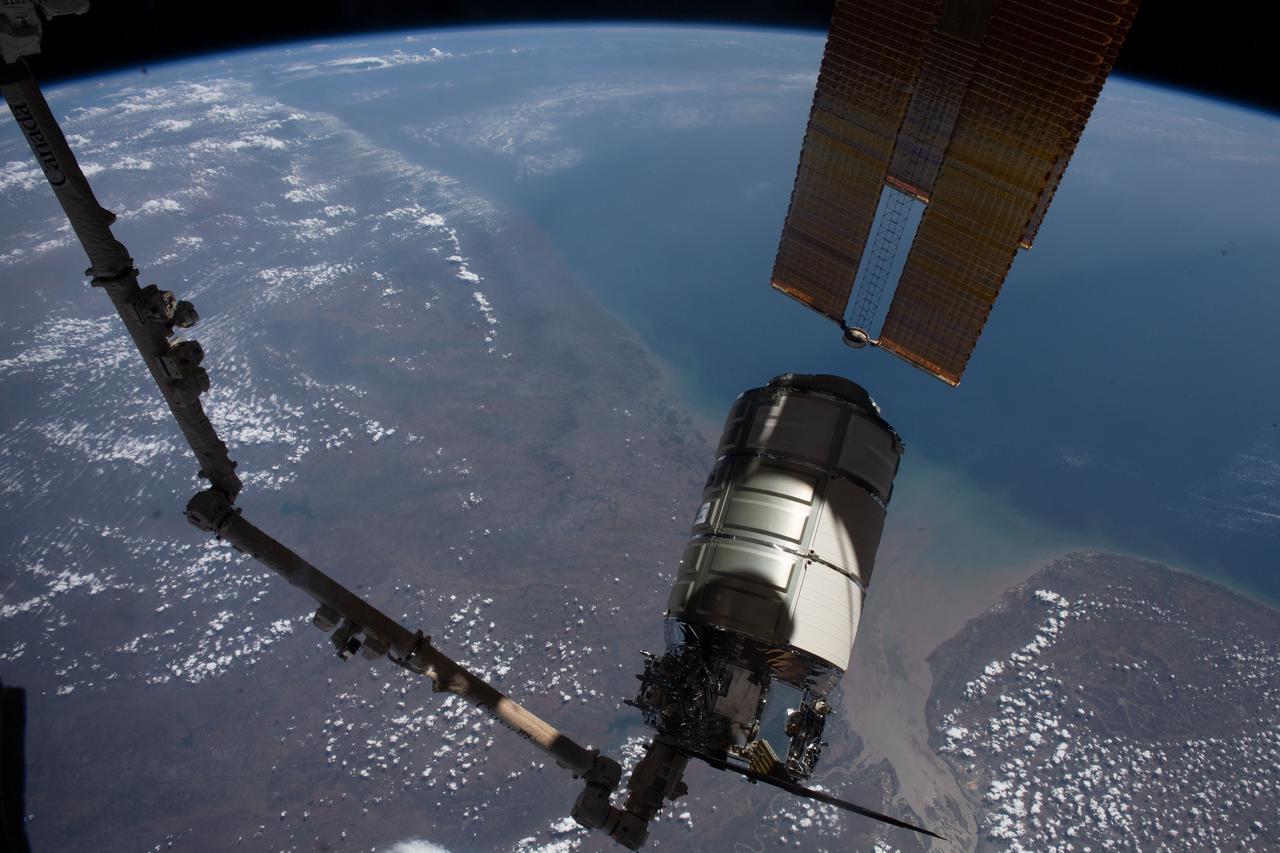
iss071e417237 (Aug. 6, 2024) --- Northrop Grumman's Cygnus cargo craft, with its prominent cymbal-shaped UltraFlex solar arrays, is pictured in the grips of the Canadarm2 robotic arm shortly after its capture was commanded by Expedition 71 Flight Engineer Matthew Dominick of NASA. The maneuver marked the 50th free-flying capture for the Canadarm2 robotic arm. The International Space Station was orbiting 262 miles above the Mediterranean Sea at the time of this photograph.
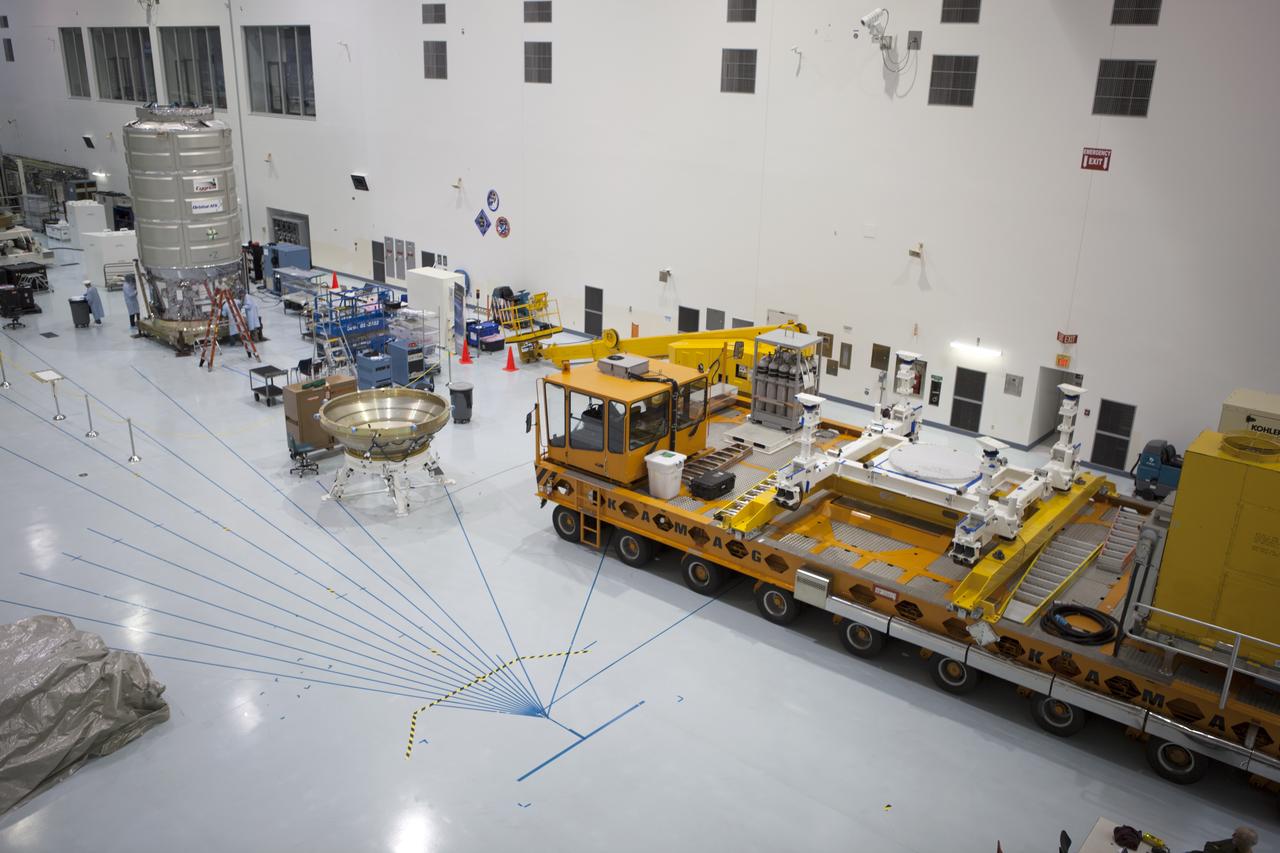
In the Space Station Processing Facility at NASA's Kennedy Space Center in Florida, a KAMAG transporter has arrived in the high bay. Technicians are preparing Orbital ATK's CYGNUS pressurized cargo module for bagging. The Orbital ATK CRS-7 commercial resupply services mission to the International Space Station is scheduled to launch atop a United Launch Alliance Atlas V rocket from Space Launch Complex 41 at Cape Canaveral Air Force Station on March 19, 2017. CYGNUS will deliver thousands of pounds of supplies, equipment and scientific research materials to the space station.
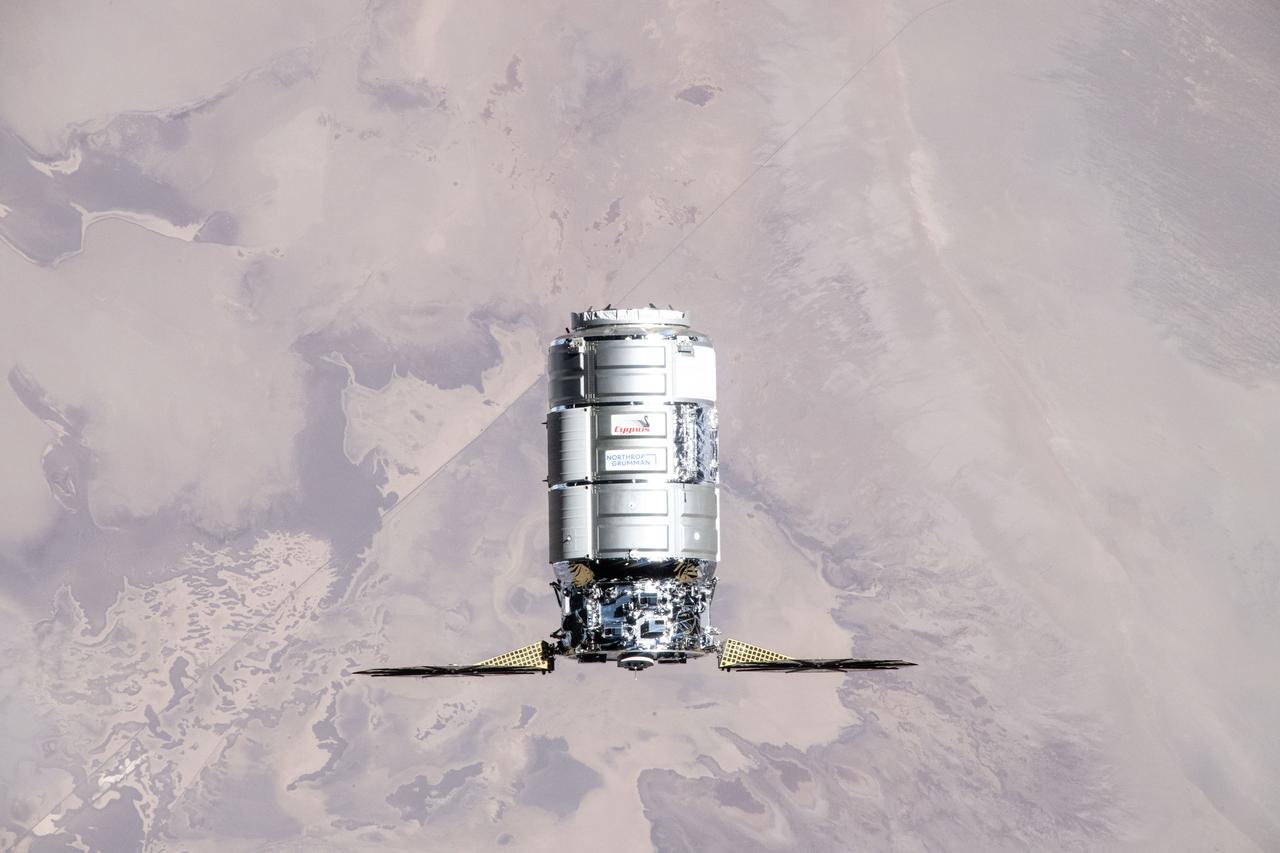
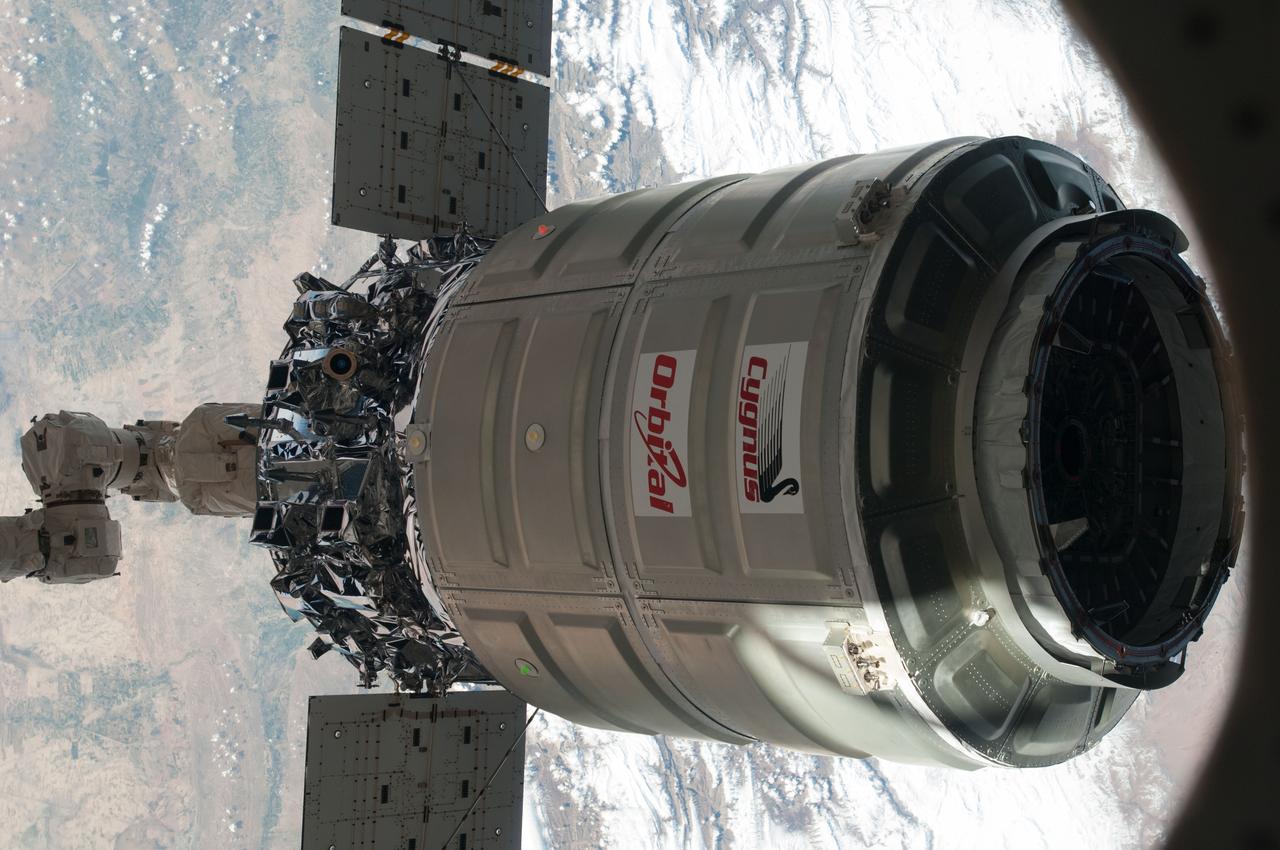
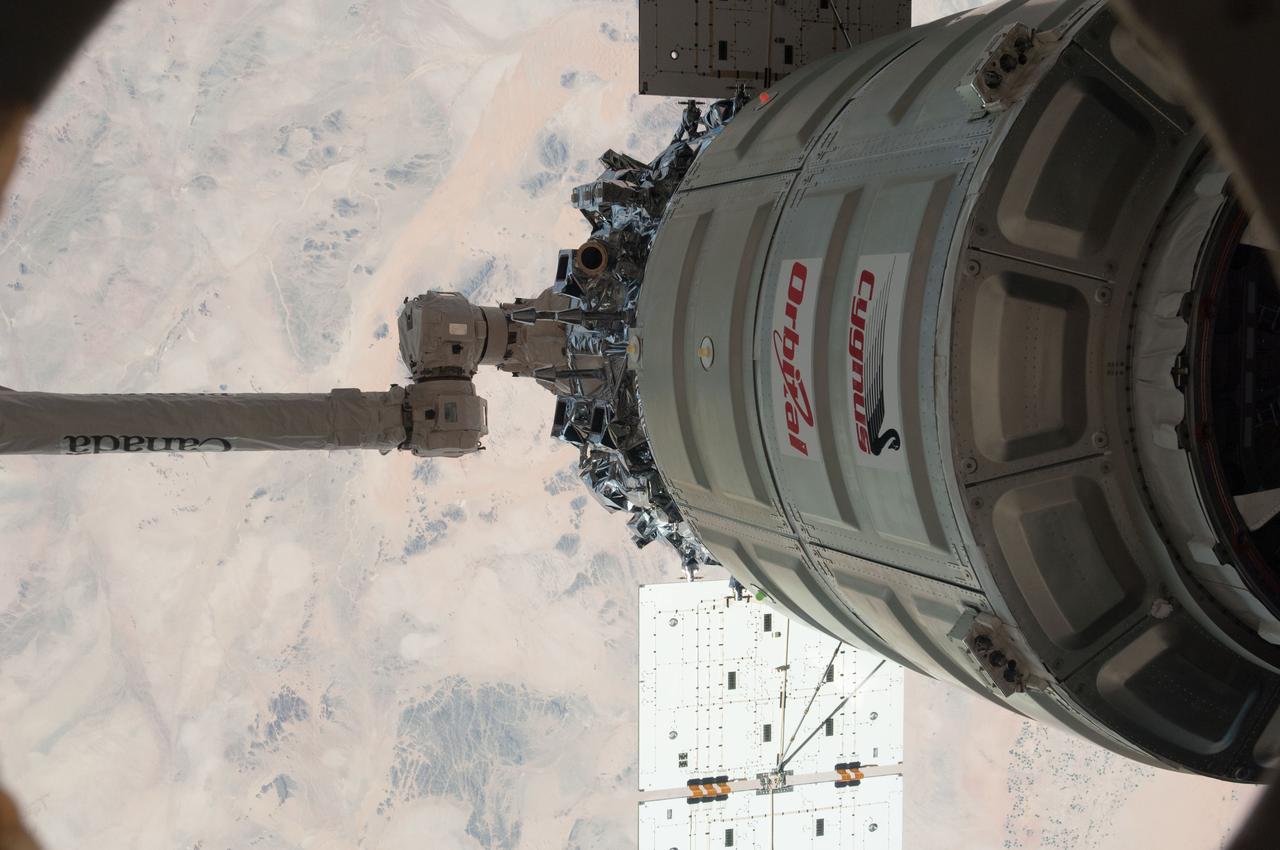
iss071e416716 (Aug. 6, 2024) --- Northrop Grumman's Cygnus cargo craft, carrying 8,200 pounds of science and supplies, approaches the International Space Station for a capture with the Canadarm2 robotic arm commanded by Expedition 71 Flight Engineer Matthew Dominick of NASA. The maneuver marked the 50th free-flying capture for the Canadarm2 robotic arm. The orbital outpost was soaring 262 miles above central Iran at the time of this photograph.
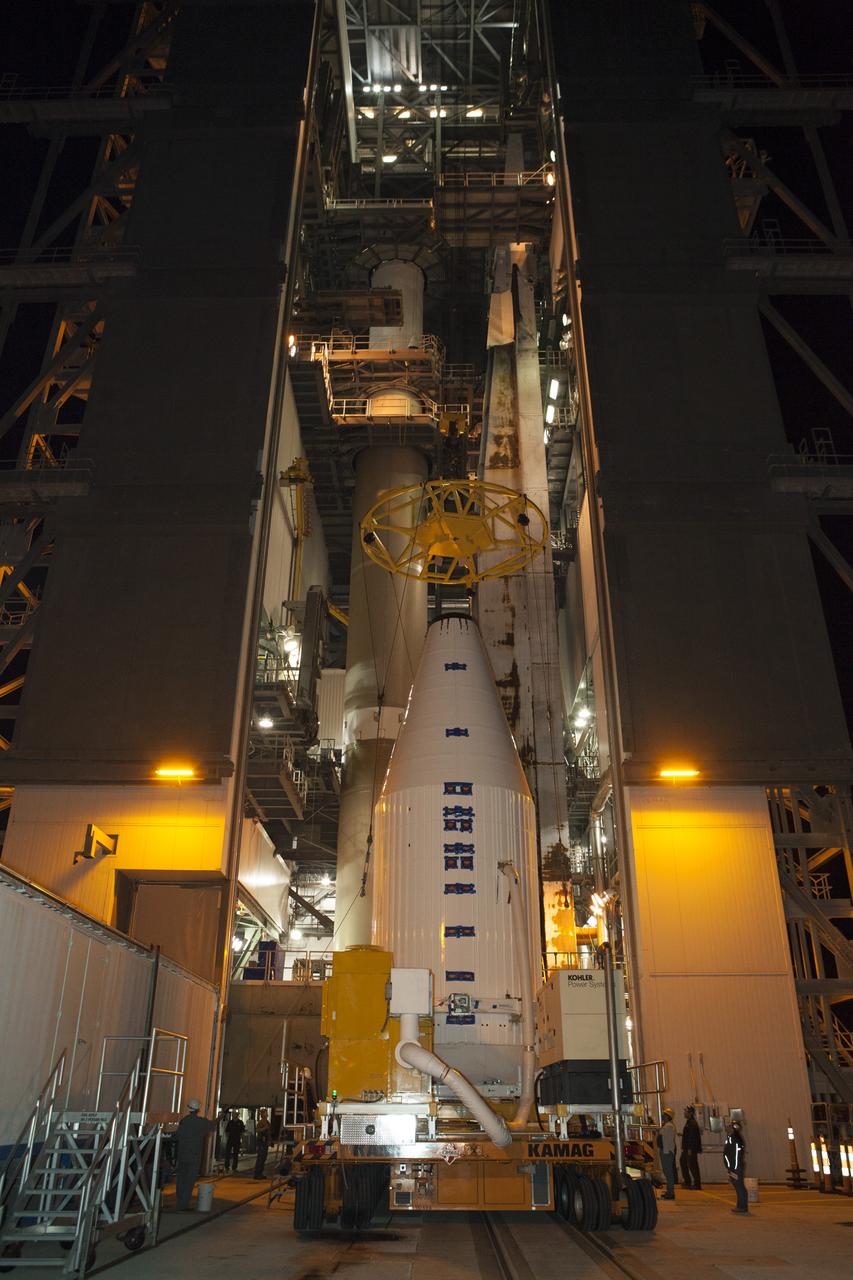
Encapsulated inside its payload fairing, the Cygnus spacecraft for the upcoming Orbital ATK Commercial Resupply Services-6 mission arrives at the Vertical Integration Facility at Launch Complex-41 at Cape Canaveral Air Force Station where it will be mounted atop a United Launch Alliance Atlas V rocket. The Cygnus is scheduled to lift off atop a United Launch Alliance Atlas V rocket on March 22 to deliver hardware and supplies to the International Space Station.
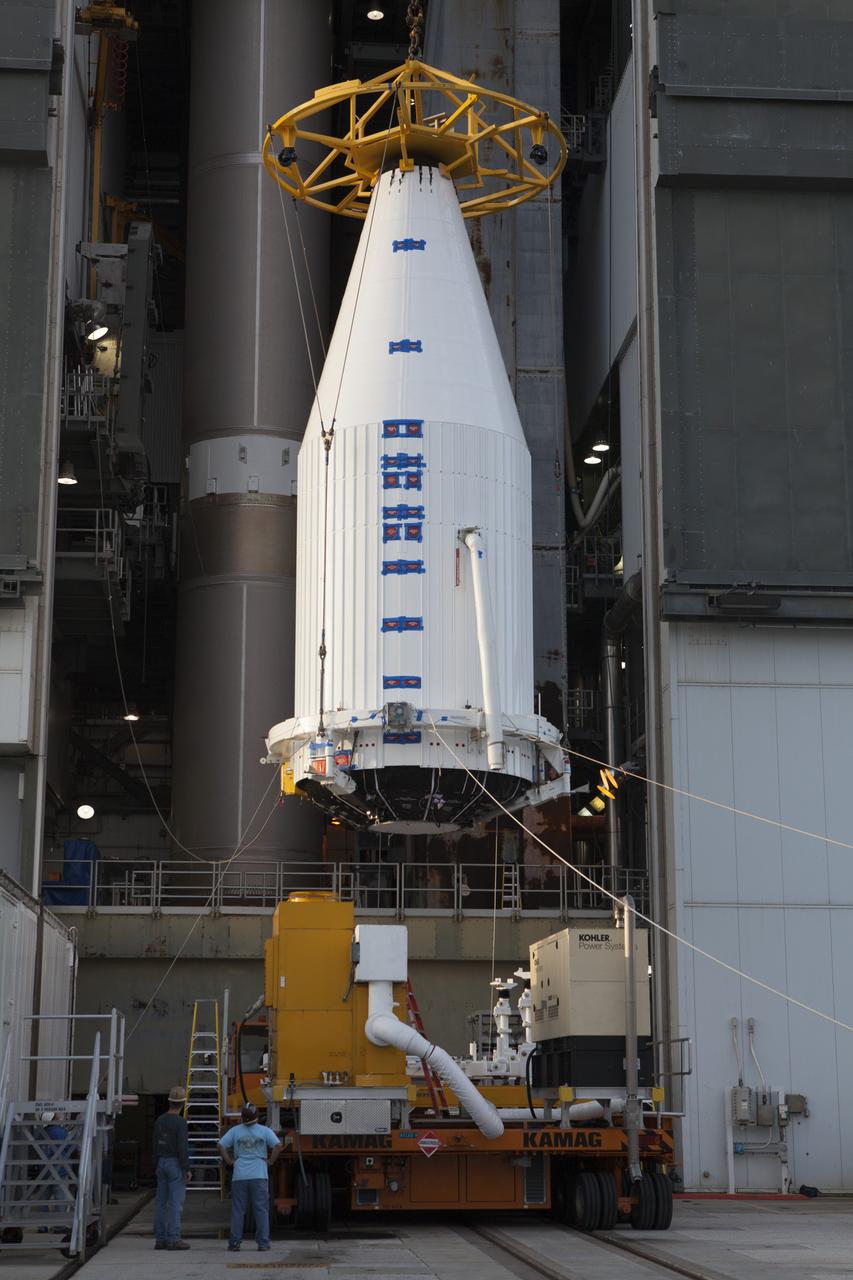
Encapsulated inside its payload fairing, the Cygnus spacecraft for the upcoming Orbital ATK Commercial Resupply Services-6 is lifted to be mated atop a United Launch Alliance Atlas V rocket in the Vertical Integration Facility at Launch Complex-41 at Cape Canaveral Air Force Station. The Cygnus is scheduled to lift off atop a United Launch Alliance Atlas V rocket on March 22 to deliver hardware and supplies to the International Space Station.
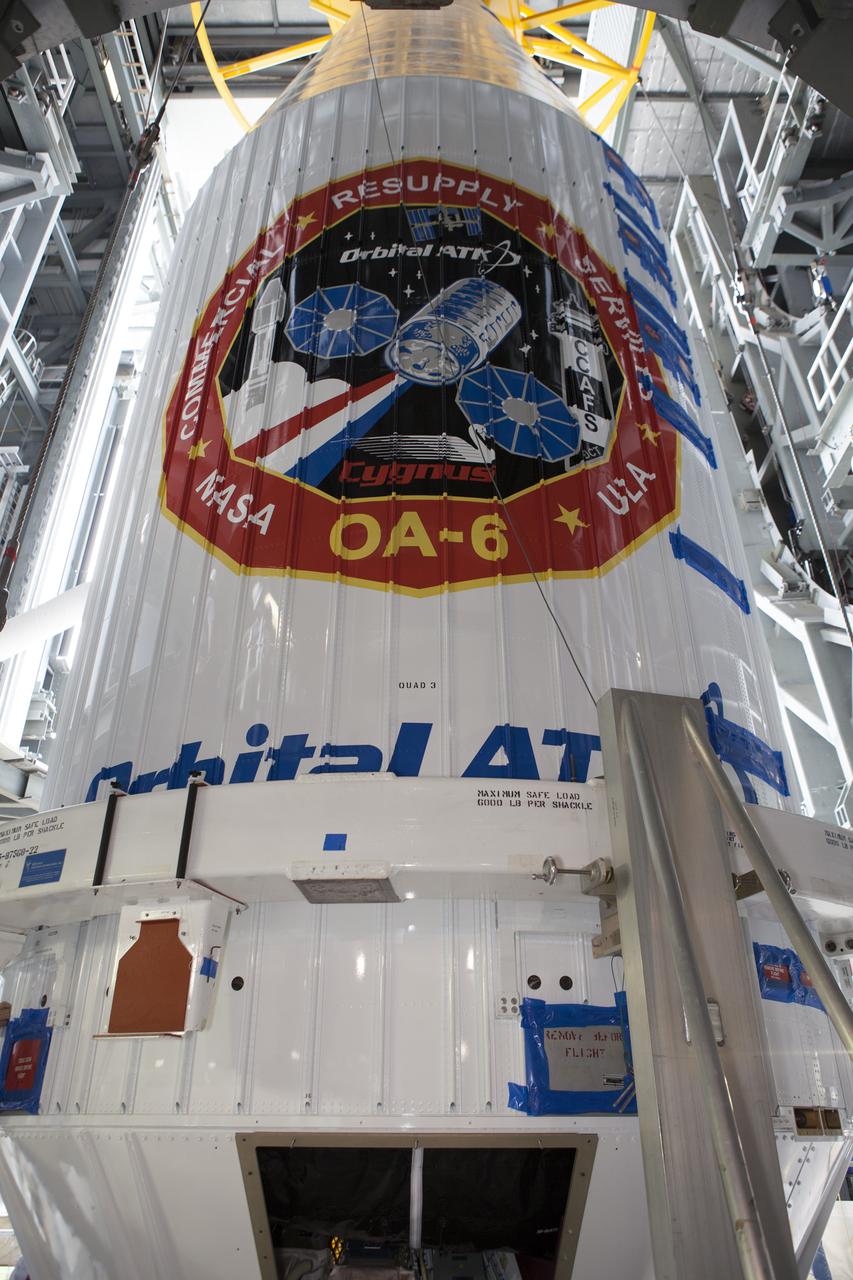
Encapsulated inside its payload fairing, the Cygnus spacecraft for the upcoming Orbital ATK Commercial Resupply Services-6 is mated atop a United Launch Alliance Atlas V rocket in the Vertical Integration Facility at Launch Complex-41 at Cape Canaveral Air Force Station. The Cygnus is scheduled to lift off atop a United Launch Alliance Atlas V rocket on March 22 to deliver hardware and supplies to the International Space Station.
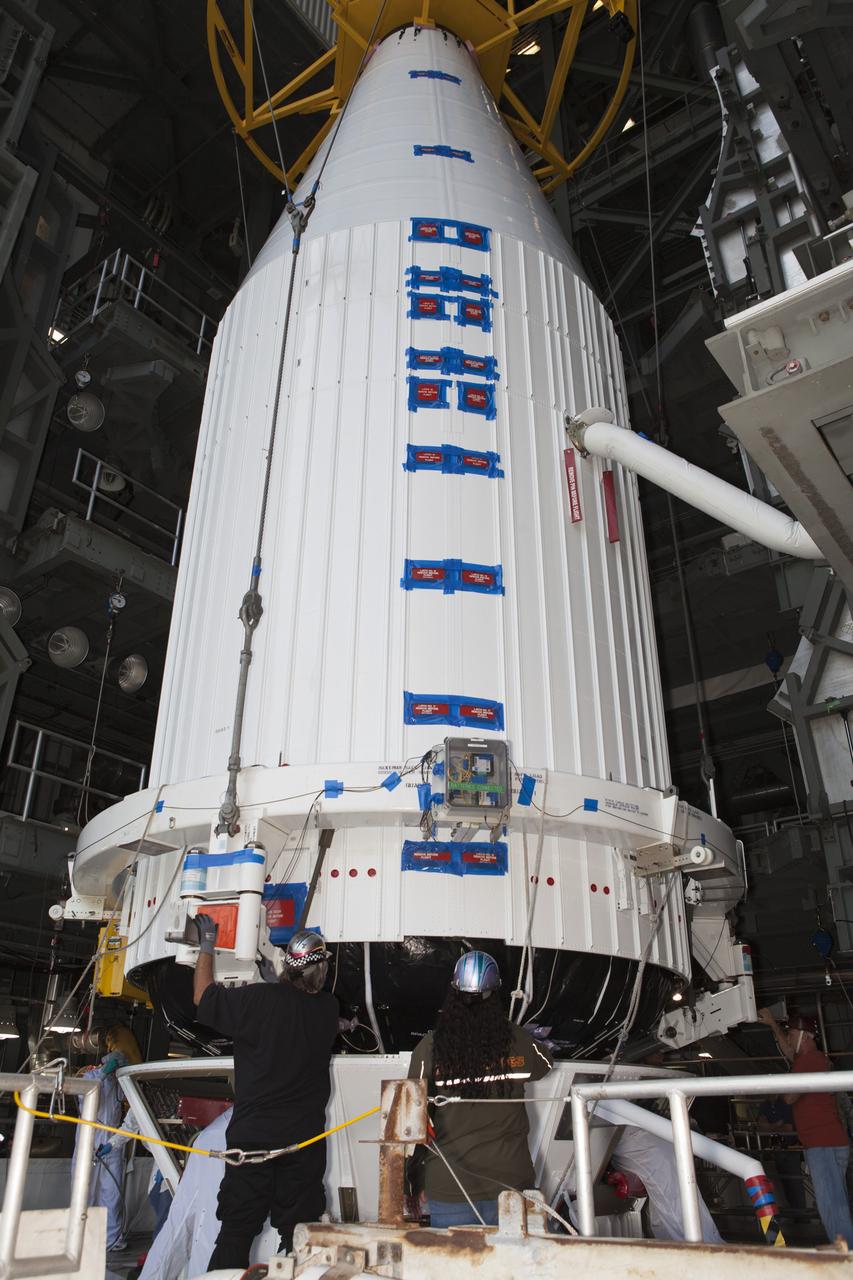
Encapsulated inside its payload fairing, the Cygnus spacecraft for the upcoming Orbital ATK Commercial Resupply Services-6 is positioned for mating atop a United Launch Alliance Atlas V rocket in the Vertical Integration Facility at Launch Complex-41 at Cape Canaveral Air Force Station. The Cygnus is scheduled to lift off atop a United Launch Alliance Atlas V rocket on March 22 to deliver hardware and supplies to the International Space Station.

Encapsulated inside its payload fairing, the Cygnus spacecraft for the upcoming Orbital ATK Commercial Resupply Services-6 is prepared for lifting to be mated atop a United Launch Alliance Atlas V rocket in the Vertical Integration Facility at Launch Complex-41 at Cape Canaveral Air Force Station. The Cygnus is scheduled to lift off atop a United Launch Alliance Atlas V rocket on March 22 to deliver hardware and supplies to the International Space Station.
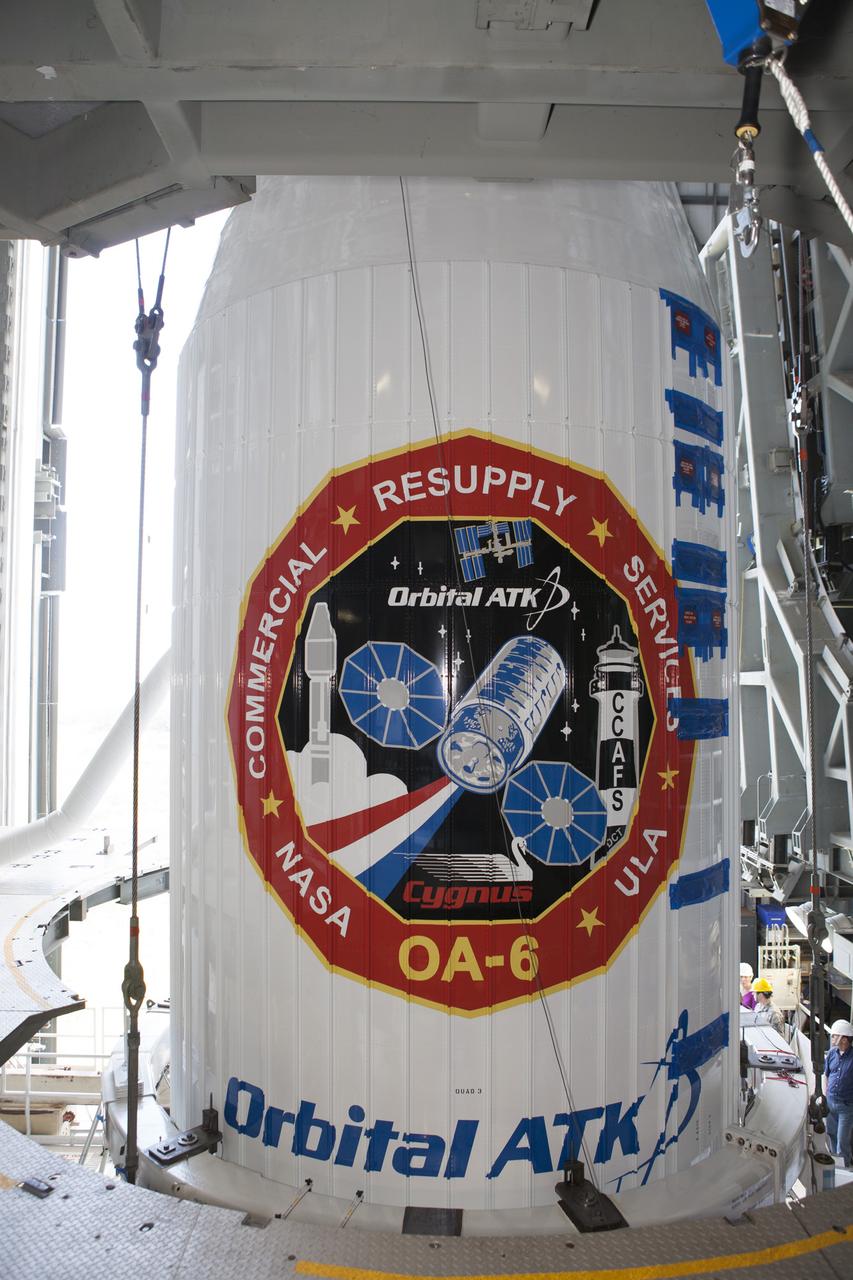
Encapsulated inside its payload fairing, the Cygnus spacecraft for the upcoming Orbital ATK Commercial Resupply Services-6 is mated atop a United Launch Alliance Atlas V rocket in the Vertical Integration Facility at Launch Complex-41 at Cape Canaveral Air Force Station. The Cygnus is scheduled to lift off atop a United Launch Alliance Atlas V rocket on March 22 to deliver hardware and supplies to the International Space Station.
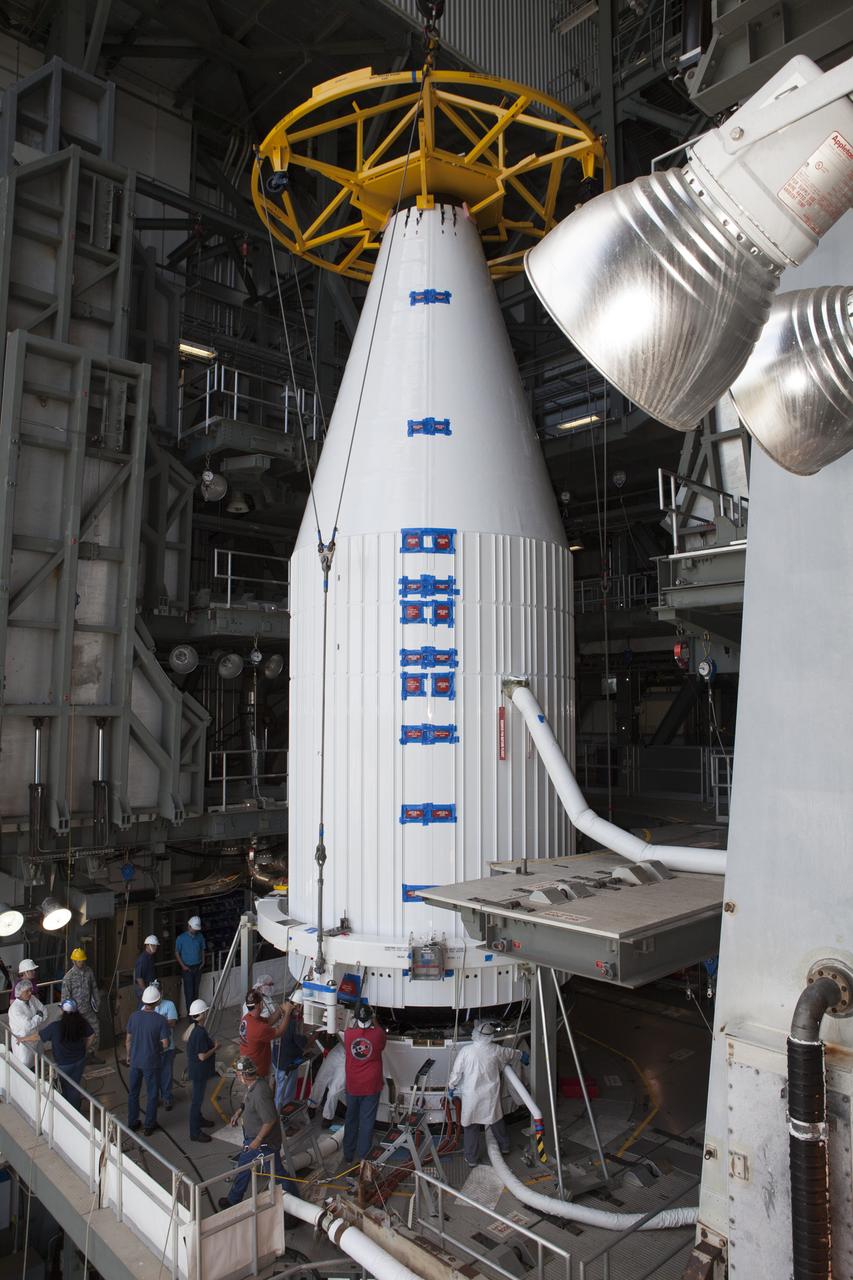
Encapsulated inside its payload fairing, the Cygnus spacecraft for the upcoming Orbital ATK Commercial Resupply Services-6 is mated atop a United Launch Alliance Atlas V rocket in the Vertical Integration Facility at Launch Complex-41 at Cape Canaveral Air Force Station. The Cygnus is scheduled to lift off atop a United Launch Alliance Atlas V rocket on March 22 to deliver hardware and supplies to the International Space Station.
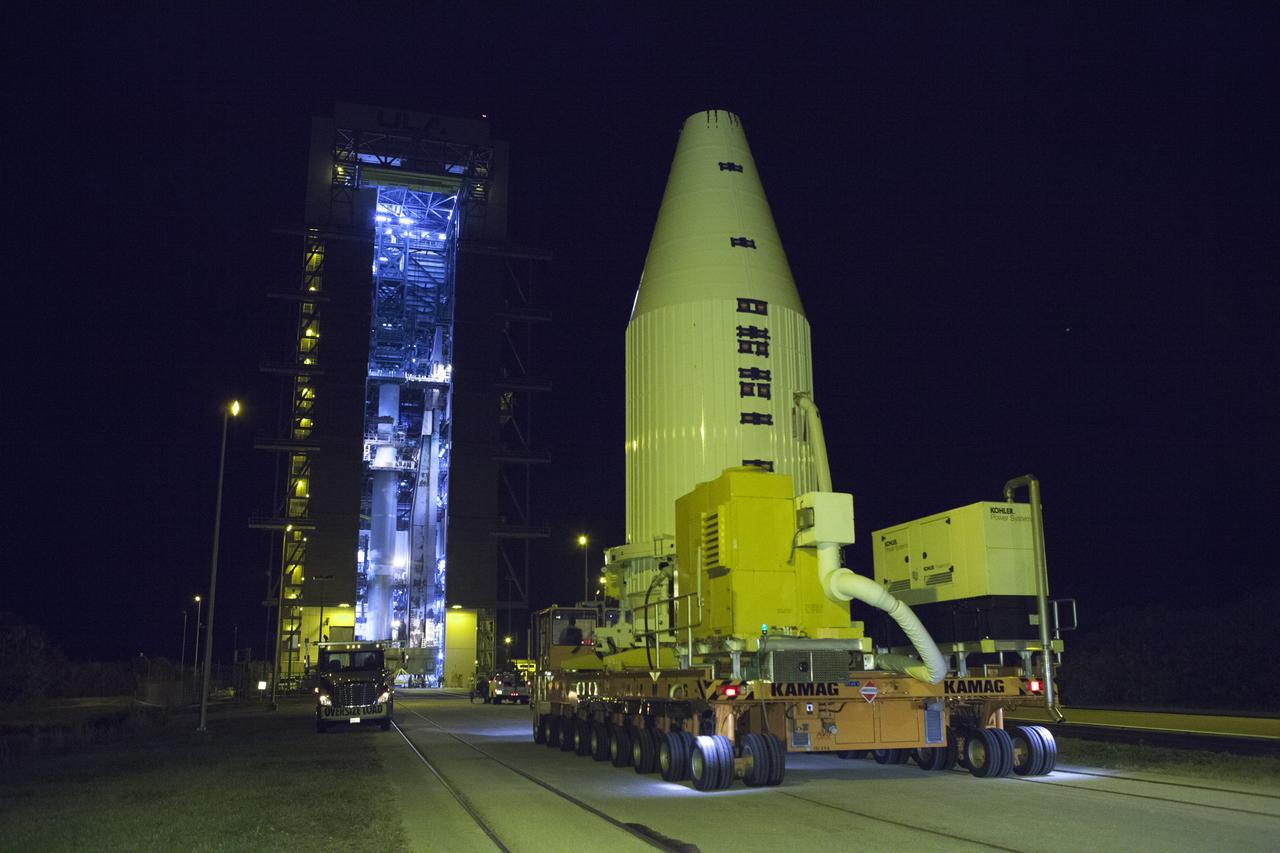
Encapsulated inside its payload fairing, the Cygnus spacecraft for the upcoming Orbital ATK Commercial Resupply Services-6 mission arrives at the Vertical Integration Facility at Launch Complex-41 at Cape Canaveral Air Force Station where it will be mounted atop a United Launch Alliance Atlas V rocket. The Cygnus is scheduled to lift off atop a United Launch Alliance Atlas V rocket on March 22 to deliver hardware and supplies to the International Space Station.
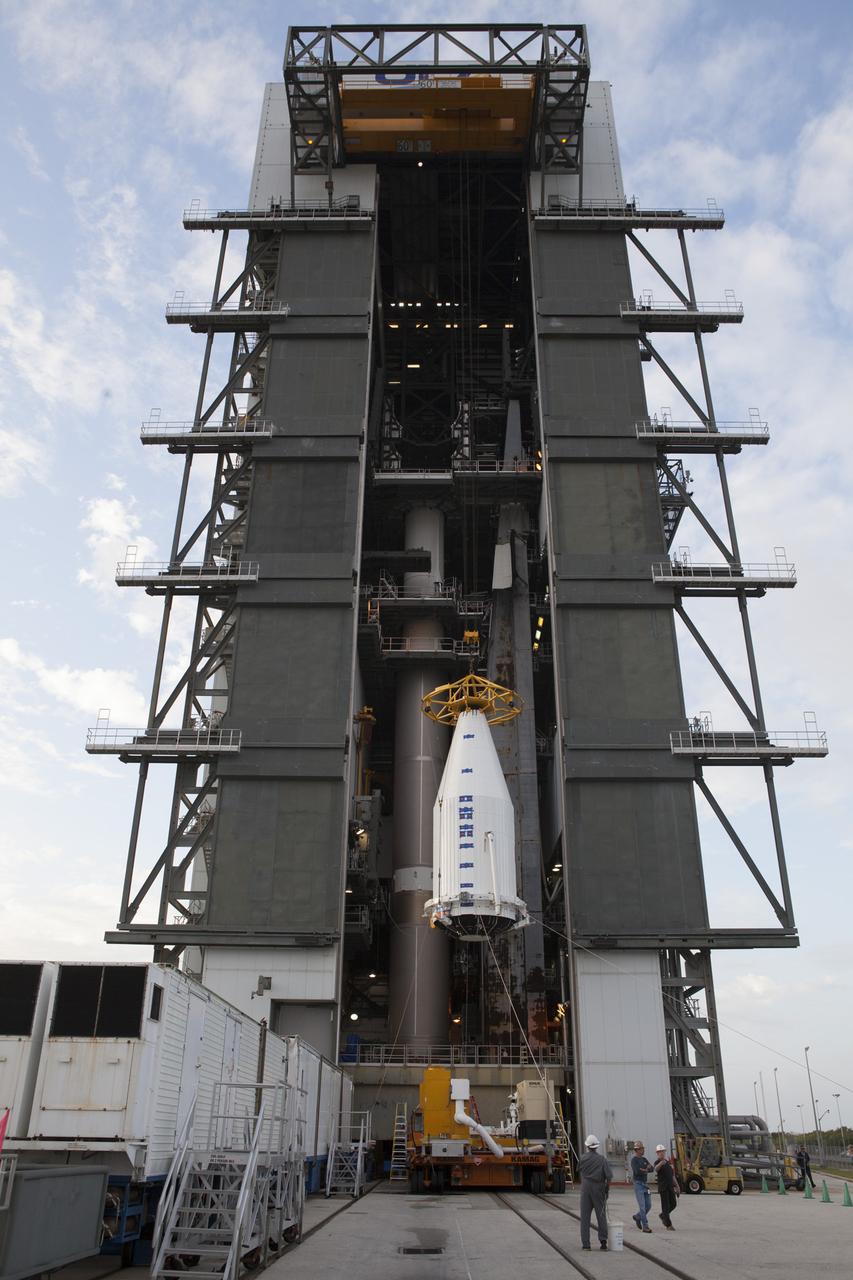
Encapsulated inside its payload fairing, the Cygnus spacecraft for the upcoming Orbital ATK Commercial Resupply Services-6 is lifted to be mated atop a United Launch Alliance Atlas V rocket in the Vertical Integration Facility at Launch Complex-41 at Cape Canaveral Air Force Station. The Cygnus is scheduled to lift off atop a United Launch Alliance Atlas V rocket on March 22 to deliver hardware and supplies to the International Space Station.
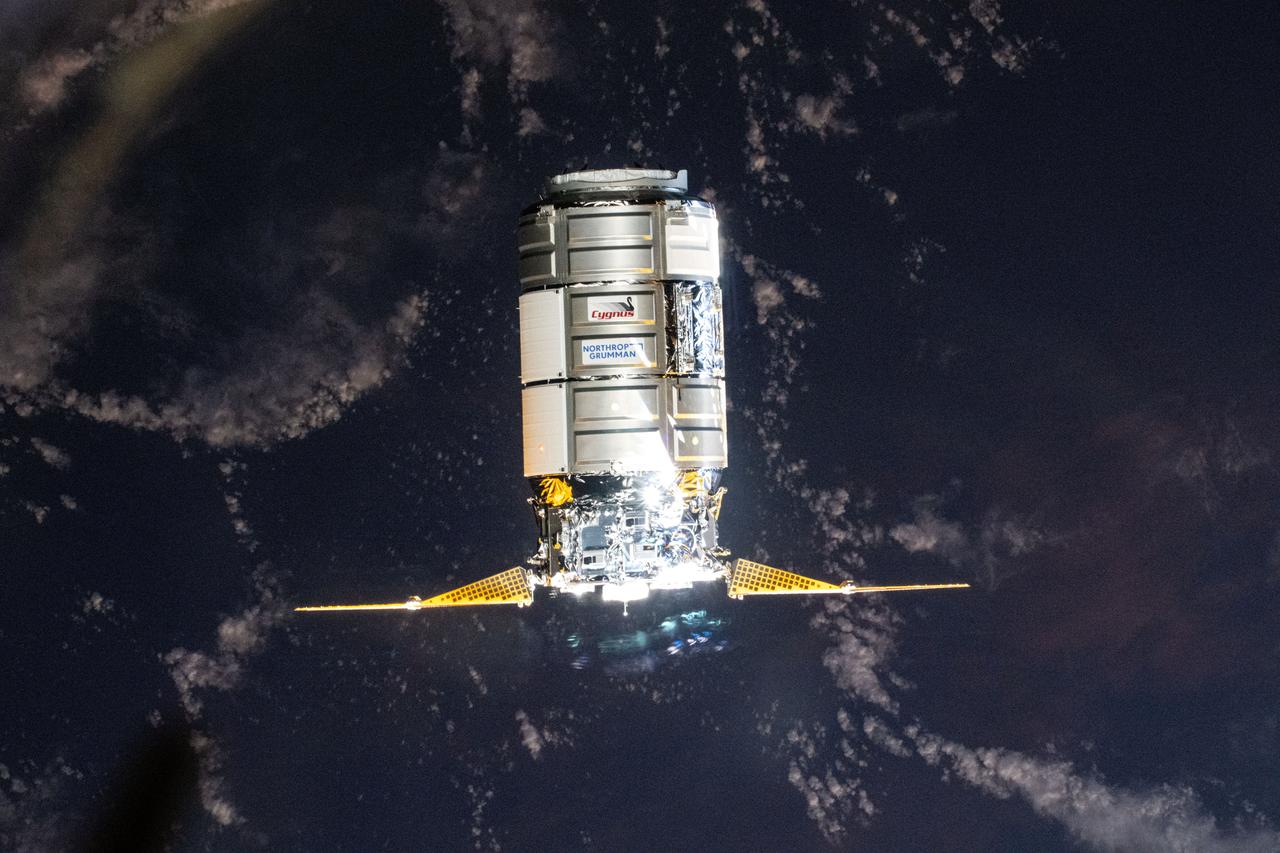
iss071e418212 (Aug. 6, 2024) --- Northrop Grumman's Cygnus cargo craft, carrying 8,200 pounds of science and supplies, approaches the International Space Station for a capture with the Canadarm2 robotic arm commanded by Expedition 71 Flight Engineer Matthew Dominick of NASA. The maneuver marked the 50th free-flying capture for the Canadarm2 robotic arm.
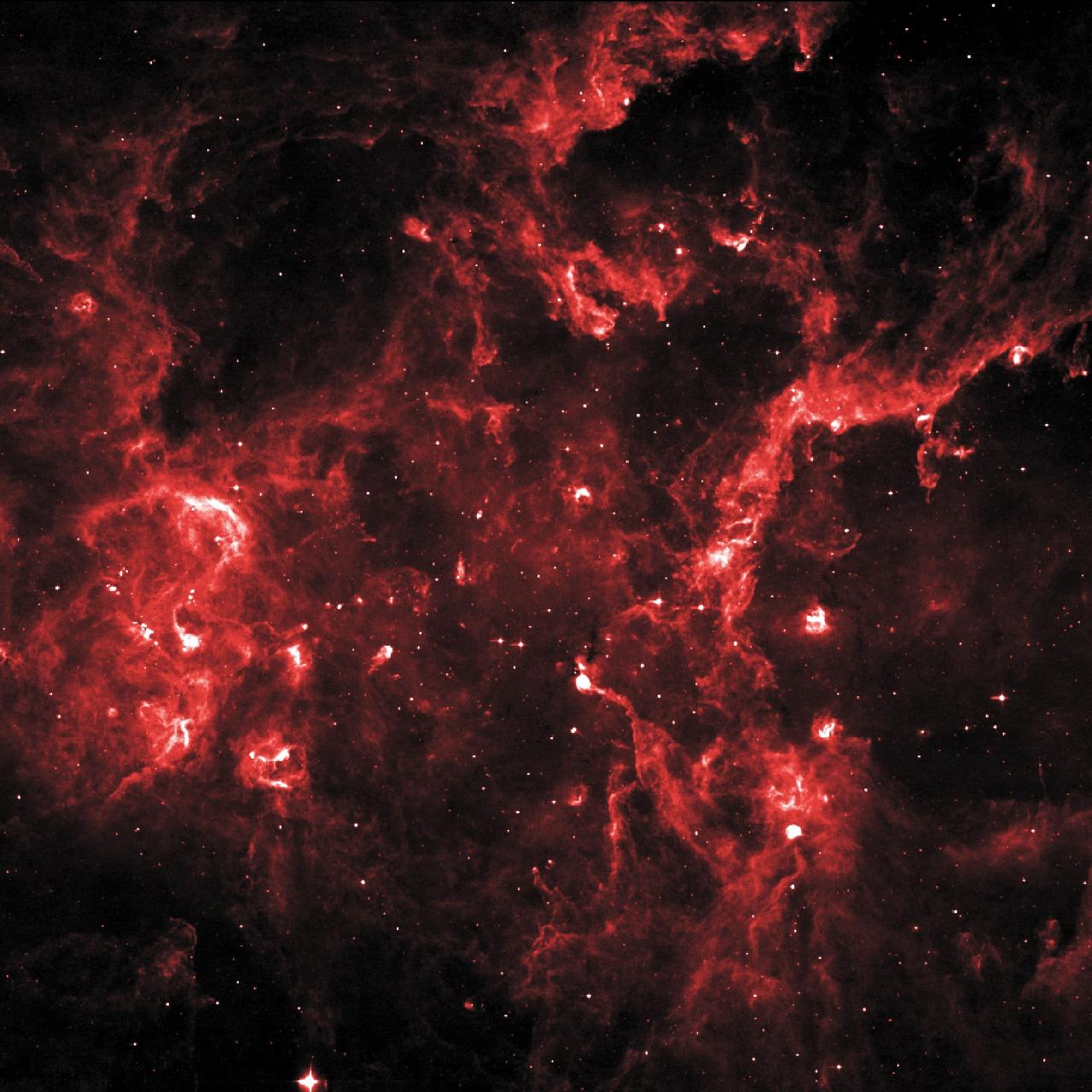
Cygnus X hosts many young stellar groupings. The combined outflows and ultraviolet radiation from the region's numerous massive stars have heated and pushed gas away from the clusters, producing cavities of hot, lower-density gas. In this 8-micron infrared image, ridges of denser gas mark the boundaries of the cavities. Bright spots within these ridges show where stars are forming today. Credit: NASA/IPAC/MSX To read more go to: <a href="http://www.nasa.gov/mission_pages/GLAST/news/cygnus-cocoon.html" rel="nofollow">www.nasa.gov/mission_pages/GLAST/news/cygnus-cocoon.html</a> <b><a href="http://www.nasa.gov/audience/formedia/features/MP_Photo_Guidelines.html" rel="nofollow">NASA image use policy.</a></b> <b><a href="http://www.nasa.gov/centers/goddard/home/index.html" rel="nofollow">NASA Goddard Space Flight Center</a></b> enables NASA’s mission through four scientific endeavors: Earth Science, Heliophysics, Solar System Exploration, and Astrophysics. Goddard plays a leading role in NASA’s accomplishments by contributing compelling scientific knowledge to advance the Agency’s mission. <b>Follow us on <a href="http://twitter.com/NASAGoddardPix" rel="nofollow">Twitter</a></b> <b>Like us on <a href="http://www.facebook.com/pages/Greenbelt-MD/NASA-Goddard/395013845897?ref=tsd" rel="nofollow">Facebook</a></b> <b>Find us on <a href="http://instagrid.me/nasagoddard/?vm=grid" rel="nofollow">Instagram</a></b>
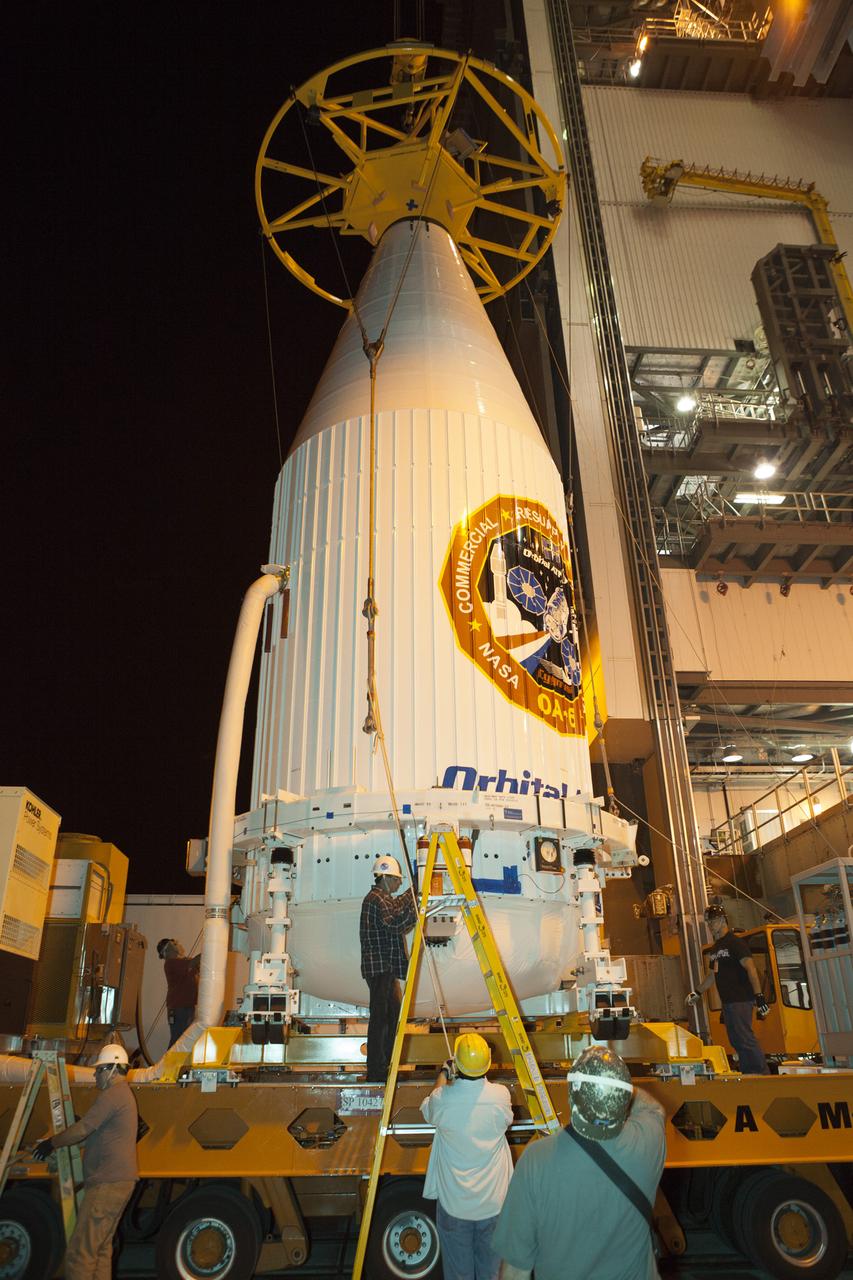
Encapsulated inside its payload fairing, the Cygnus spacecraft for the upcoming Orbital ATK Commercial Resupply Services-6 is prepared for lifting to be mated atop a United Launch Alliance Atlas V rocket.
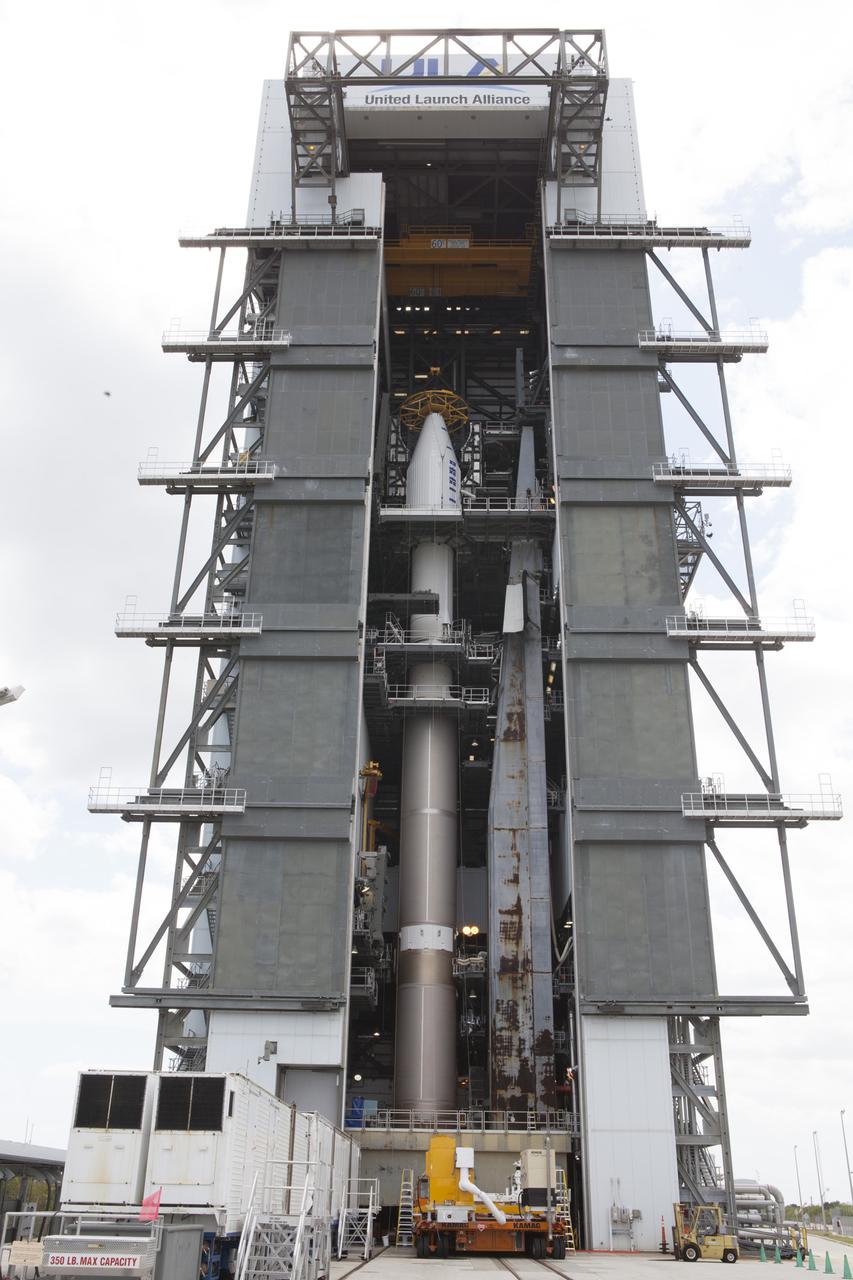
Encapsulated inside its payload fairing, the Cygnus spacecraft for the upcoming Orbital ATK Commercial Resupply Services-6 has been mated atop a United Launch Alliance Atlas V rocket in the Vertical Integration Facility at Launch Complex-41 at Cape Canaveral Air Force Station. The Cygnus is scheduled to lift off atop a United Launch Alliance Atlas V rocket on March 22 to deliver hardware and supplies to the International Space Station.
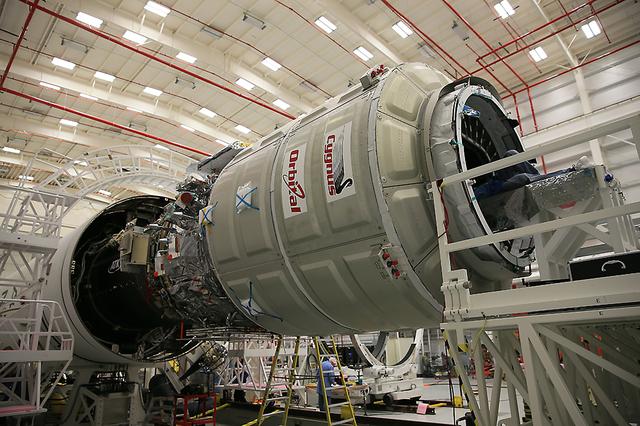
Orbital Sciences Corp. completed final cargo load of the Cygnus cargo spacecraft Oct. 23, 2014, in preparation for launch to the International Space Station, scheduled for 6:45 p.m. EDT, Monday, Oct. 27, from Mid-Atlantic Regional Spaceport Pad 0A at NASA's Wallops Flight Facility. The spacecraft is mated to the company's Antares rocket with roll-out to the launch pad scheduled for Friday, Oct. 24. This mission is the third of eight Orbital flights NASA contracted with the company to resupply the space station, and the fourth trip by a Cygnus spacecraft to the ISS. Cygnus will transport some 5,000 pounds of supplies and experiments to the orbiting laboratory. More at <a href="http://www.nasa.gov/orbital" rel="nofollow">www.nasa.gov/orbital</a> Credit: NASA's Wallops Flight Facility/Patrick Black <b><a href="http://www.nasa.gov/audience/formedia/features/MP_Photo_Guidelines.html" rel="nofollow">NASA image use policy.</a></b> <b><a href="http://www.nasa.gov/centers/goddard/home/index.html" rel="nofollow">NASA Goddard Space Flight Center</a></b> enables NASA’s mission through four scientific endeavors: Earth Science, Heliophysics, Solar System Exploration, and Astrophysics. Goddard plays a leading role in NASA’s accomplishments by contributing compelling scientific knowledge to advance the Agency’s mission. <b>Follow us on <a href="http://twitter.com/NASAGoddardPix" rel="nofollow">Twitter</a></b> <b>Like us on <a href="http://www.facebook.com/pages/Greenbelt-MD/NASA-Goddard/395013845897?ref=tsd" rel="nofollow">Facebook</a></b> <b>Find us on <a href="http://instagram.com/nasagoddard?vm=grid" rel="nofollow">Instagram</a></b>
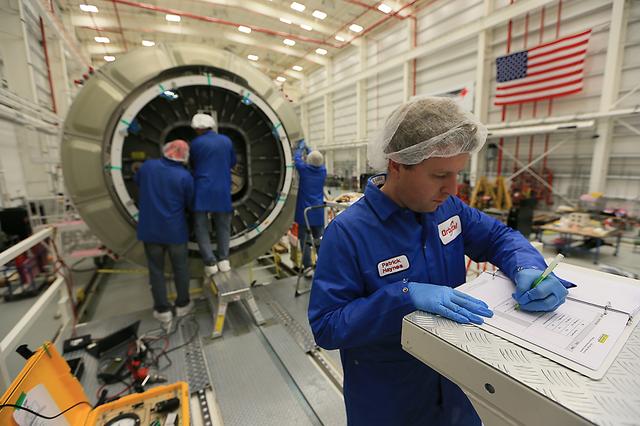
Orbital Sciences Corp. completed final cargo load of the Cygnus cargo spacecraft Oct. 23, 2014, in preparation for launch to the International Space Station, scheduled for 6:45 p.m. EDT, Monday, Oct. 27, from Mid-Atlantic Regional Spaceport Pad 0A at NASA's Wallops Flight Facility. The spacecraft is mated to the company's Antares rocket with roll-out to the launch pad scheduled for Friday, Oct. 24. This mission is the third of eight Orbital flights NASA contracted with the company to resupply the space station, and the fourth trip by a Cygnus spacecraft to the ISS. Cygnus will transport some 5,000 pounds of supplies and experiments to the orbiting laboratory. More at <a href="http://www.nasa.gov/orbital" rel="nofollow">www.nasa.gov/orbital</a> Credit: NASA's Wallops Flight Facility/Patrick Black <b><a href="http://www.nasa.gov/audience/formedia/features/MP_Photo_Guidelines.html" rel="nofollow">NASA image use policy.</a></b> <b><a href="http://www.nasa.gov/centers/goddard/home/index.html" rel="nofollow">NASA Goddard Space Flight Center</a></b> enables NASA’s mission through four scientific endeavors: Earth Science, Heliophysics, Solar System Exploration, and Astrophysics. Goddard plays a leading role in NASA’s accomplishments by contributing compelling scientific knowledge to advance the Agency’s mission. <b>Follow us on <a href="http://twitter.com/NASAGoddardPix" rel="nofollow">Twitter</a></b> <b>Like us on <a href="http://www.facebook.com/pages/Greenbelt-MD/NASA-Goddard/395013845897?ref=tsd" rel="nofollow">Facebook</a></b> <b>Find us on <a href="http://instagram.com/nasagoddard?vm=grid" rel="nofollow">Instagram</a></b>
ISS047e021586 03/26/2016) --- Cygnus capture March 26, 2016. Expedition 47 robotic arm operator NASA astronaut Tim Kopra commanded the International Space Station’s Canadarm2 robotic arm to capture the Cygnus spacecraft .
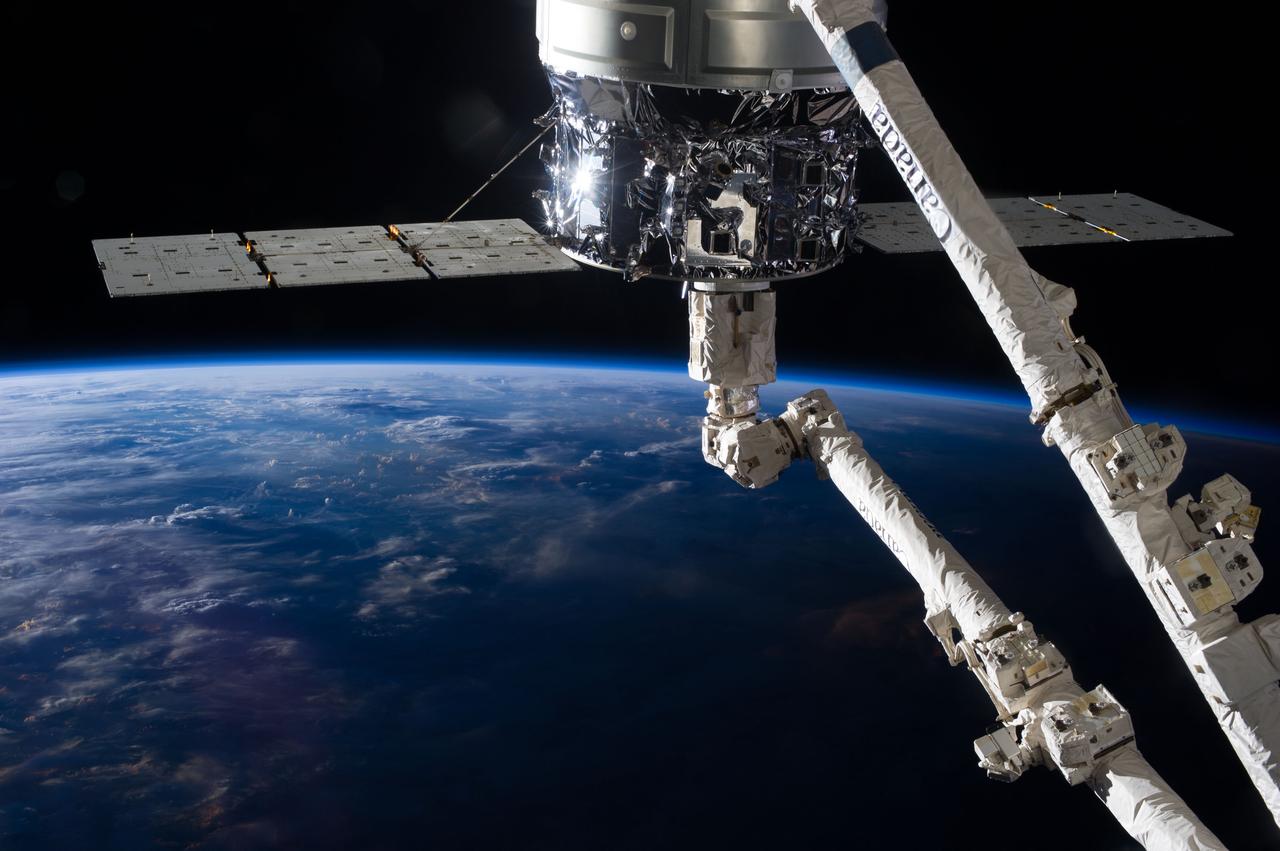
View of the first Cygnus commercial cargo spacecraft built by Orbital Sciences Corp attached to the end of the robotic arm (AKA Canadarm2) and docked the Node 2 module of the ISS. Per Twitter message: Sunrise on #Cygnus and #Canadarm2.
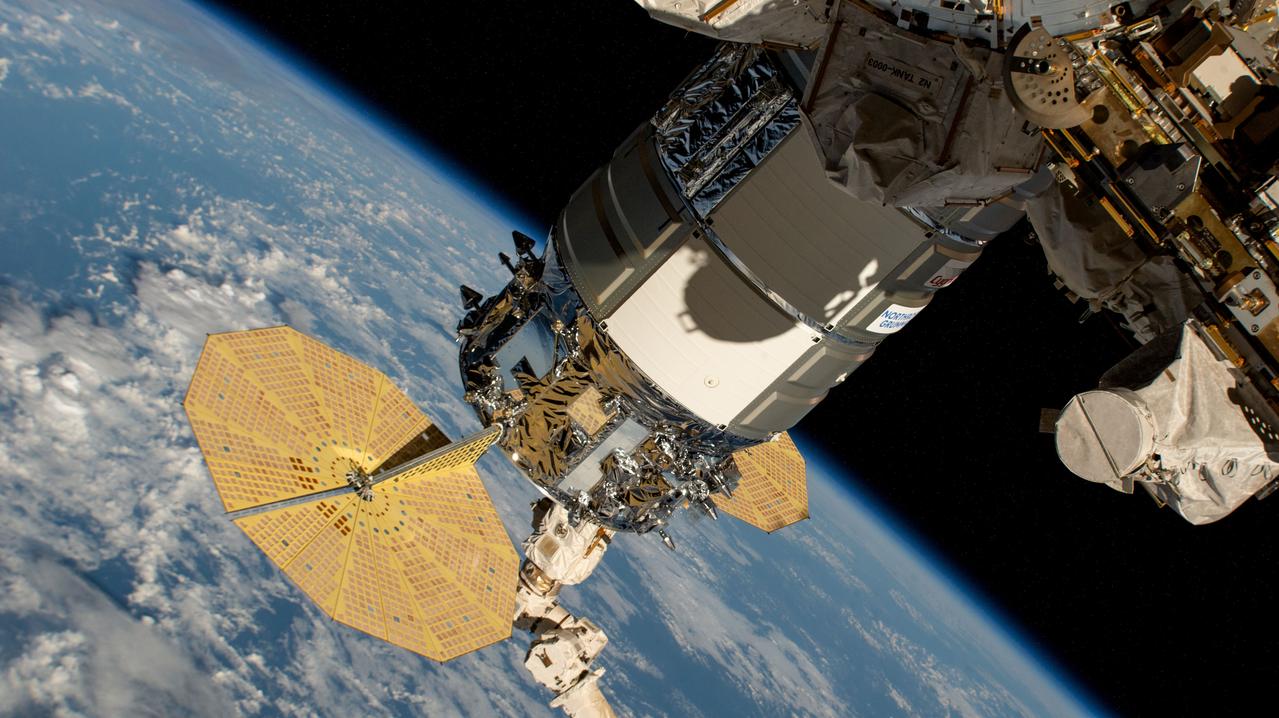
iss071e439629 (Aug. 6, 2024) --- Still in the grips of the Canadarm2 robotic arm, the Northrop Grumman Cygnus space freighter is pictured attached to the Unity module's Earth-facing port. The International Space Station was orbiting 262 miles above a cloudy Pacific Ocean halfway between the U.S. island of Hawaii and the island nation of the Republic of Kiribati at the time of this photograph.
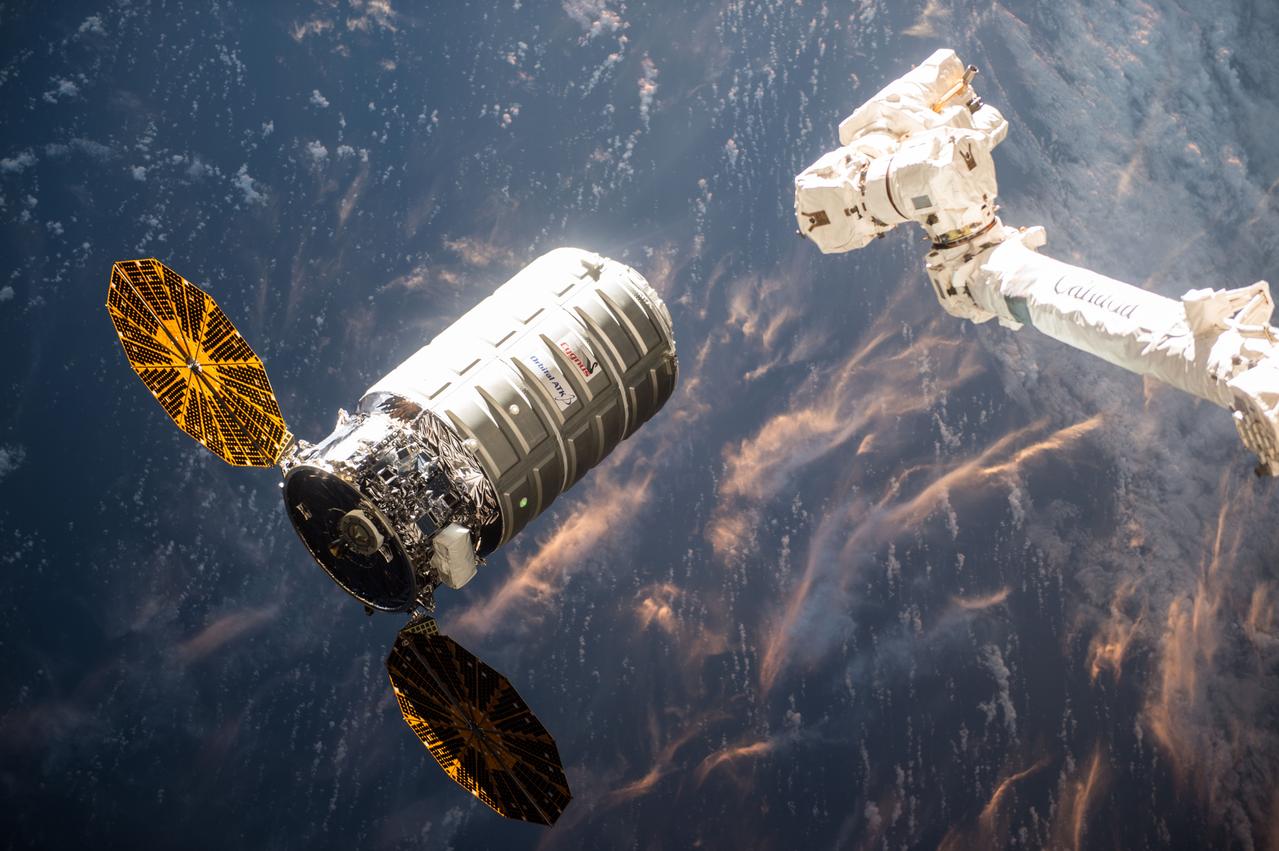
Expedition 47 robotic arm operator Tim Kopra of NASA commanded the International Space Station’s Canadarm2 robotic arm to release the Cygnus spacecraft at 9:30 a.m. EDT while the space station was flying above Paraguay. Earlier, ground controllers detached Cygnus from the station and maneuvered it into place for its departure. After Cygnus is a safe distance away, ground controllers at Glenn Research Center in Cleveland, Ohio will initiate the sequence for Saffire-1, and controllers at Orbital ATK in Dulles, Virginia, will activate the experiment. Cygnus will continue to orbit Earth for up to eight days as it transmits hi-resolution imagery and data from the Saffire experiment.
ISS046e043433 (02/19/2016) --- The Expedition 46 crew took out the trash recently when it released the Orbital ATK Cygnus spacecraft from the grips of the International Space Station’s Canadarm2 robotic arm. Cygnus was filled with roughly 1.5 tons of trash and discarded gear before the hatches were closed. Ground controllers then remotely guided the Canadarm2 to grapple Cygnus and detach it from the Unity module. NASA astronauts Scott Kelly and Tim Kopra commanded the Canadarm2 to release Cygnus Feb 19, at 7:26 a.m. EST when it began gracefully departing the vicinity of the station. Cygnus ultimately burned up during reentry through the Earth’s atmosphere on Saturday, Feb 20. This was Orbital ATK’s fourth commercial resupply mission.
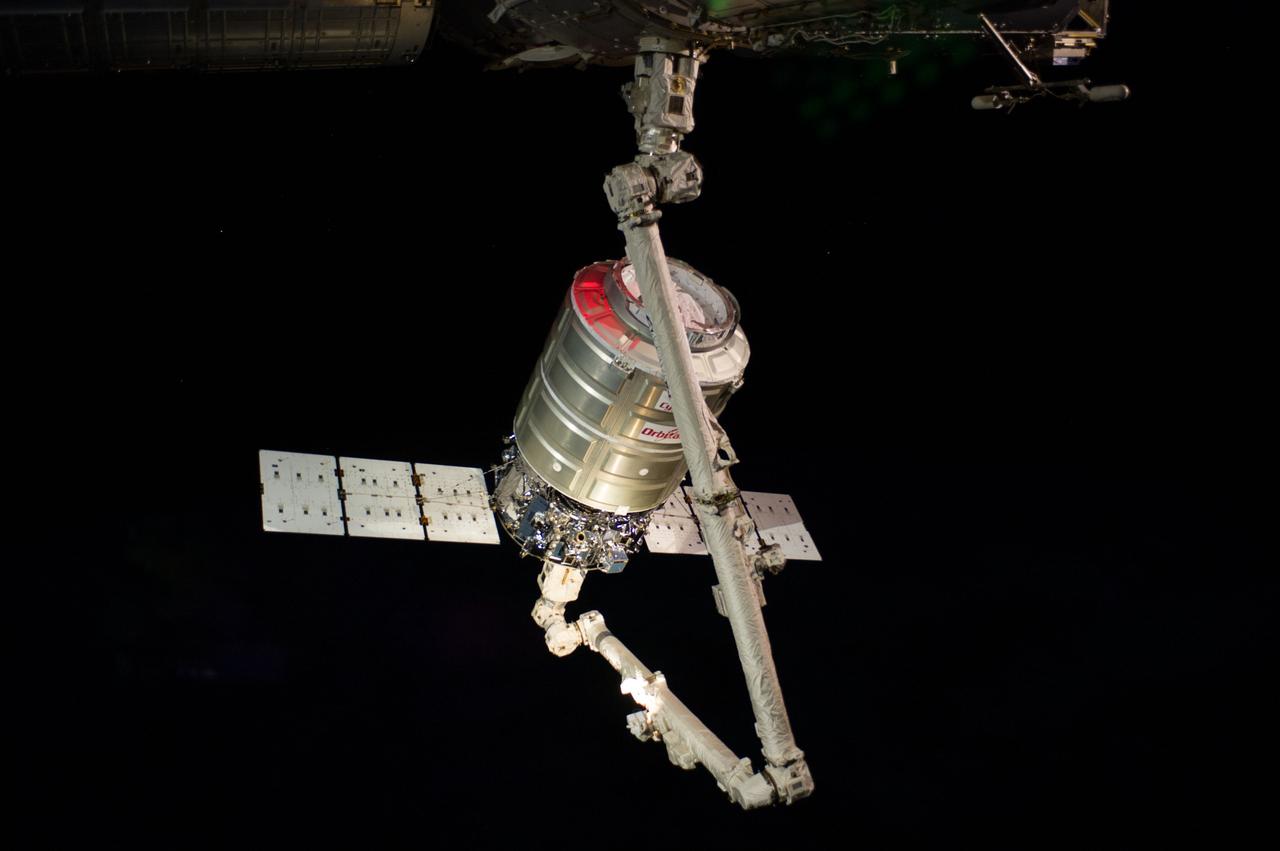
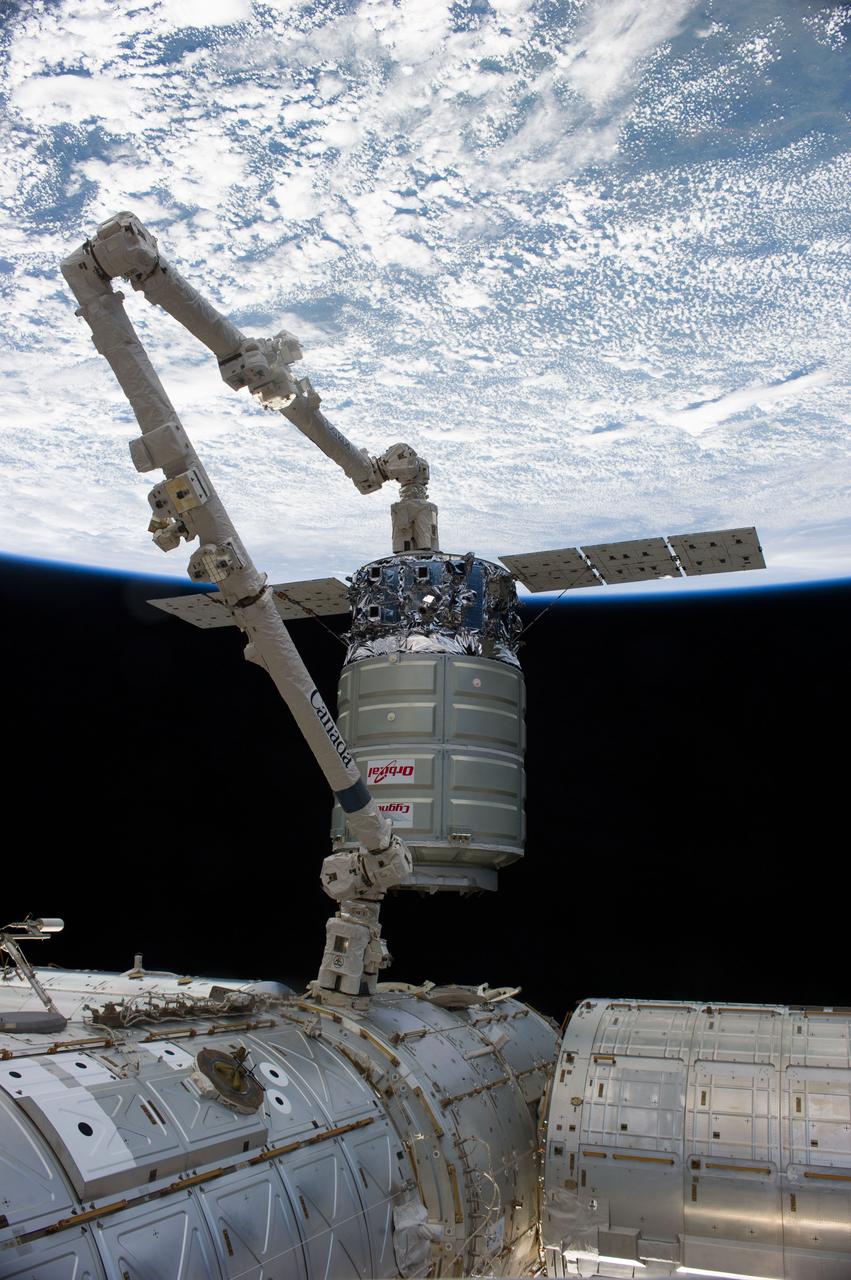
ISS040-E-067885 (16 July 2014) --- The Orbital Sciences’ Cygnus cargo craft attached to the end of the Canadarm2 robotic arm of the International Space Station is photographed by an Expedition 40 crew member after the two spacecraft converged at 6:36 a.m. (EDT) on July 16, 2014. The red color on Cygnus is a spectral effect from one of Cygnus’ strobe lights against the fading light heading into an orbital sunset following grapple.
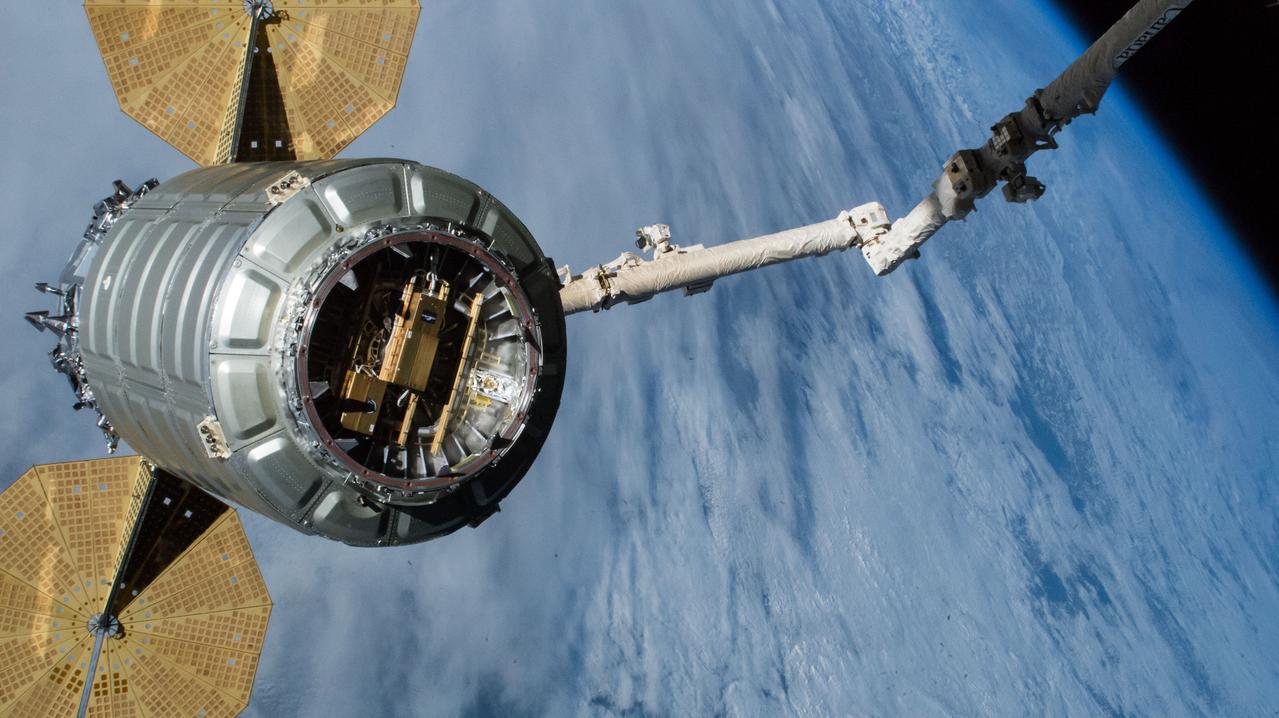
iss058e011401 (Feb. 8, 2019) --- The Cygnus cargo craft from Northrop Grumman with its prominent cymbal-shaped UltraFlex solar arrays is pictured in the grips of the Canadarm2 robotic arm. Cygnus would be released moments later as the International Space Station was orbiting over the Pacific Ocean. Visible in Cygnus' Common Berthing Mechanism is the Slingshot small satellite deployer designed to deploy CubeSats from the cargo ship once it reaches a safe distance from the station after its release.
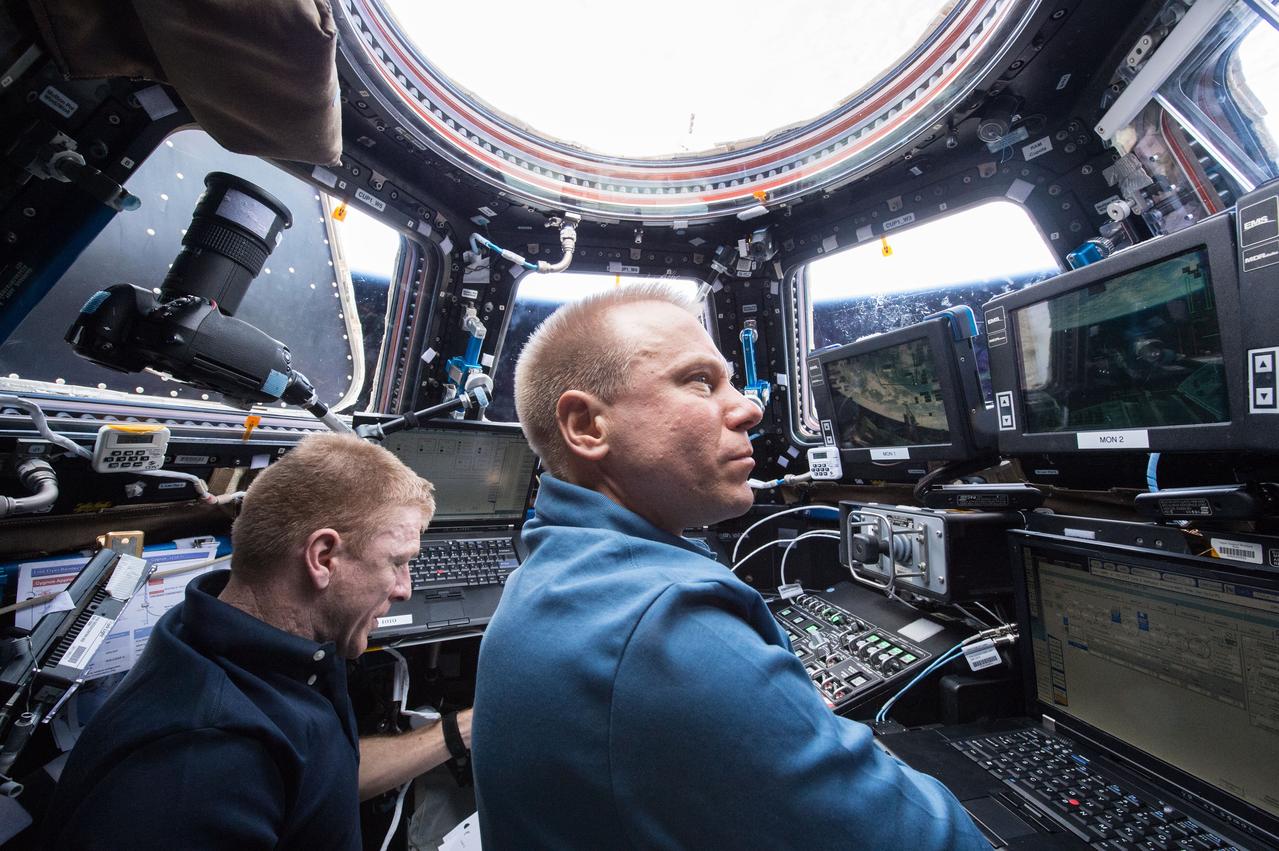
ISS047e021582 (03/26/2016) --- Cygnus capture on 26 March 2016. Expedition 47 robotic arm operator NASA astronaut Tim Kopra of NASA commanded the International Space Station’s Canadarm2 robotic arm to capture and dock the Cygnus spacecraft. He was assisted by ESA (European Space Agency) astronaut Tim Peake.
Very distant view of the approach of the first Cygnus commercial cargo spacecraft built by Orbital Sciences Corp to the International Space Station(ISS) with the Earth in the background. Per Twitter message: #Cygnus, approaching us from below as we pass the coast of South Africa.
Inside the Payload Hazardous Servicing Facility at NASA's Kennedy Space Center, former NASA astronaut Dan Tani, who now is senior director of Missions and Cargo Operations for Orbital ATK in Dulles, Virginia, participates in a press interview. In the background is the Cygnus spacecraft scheduled to deliver hardware and supplies to the International Space Station on the upcoming Orbital ATK Commercial Resupply Services-6 mission.
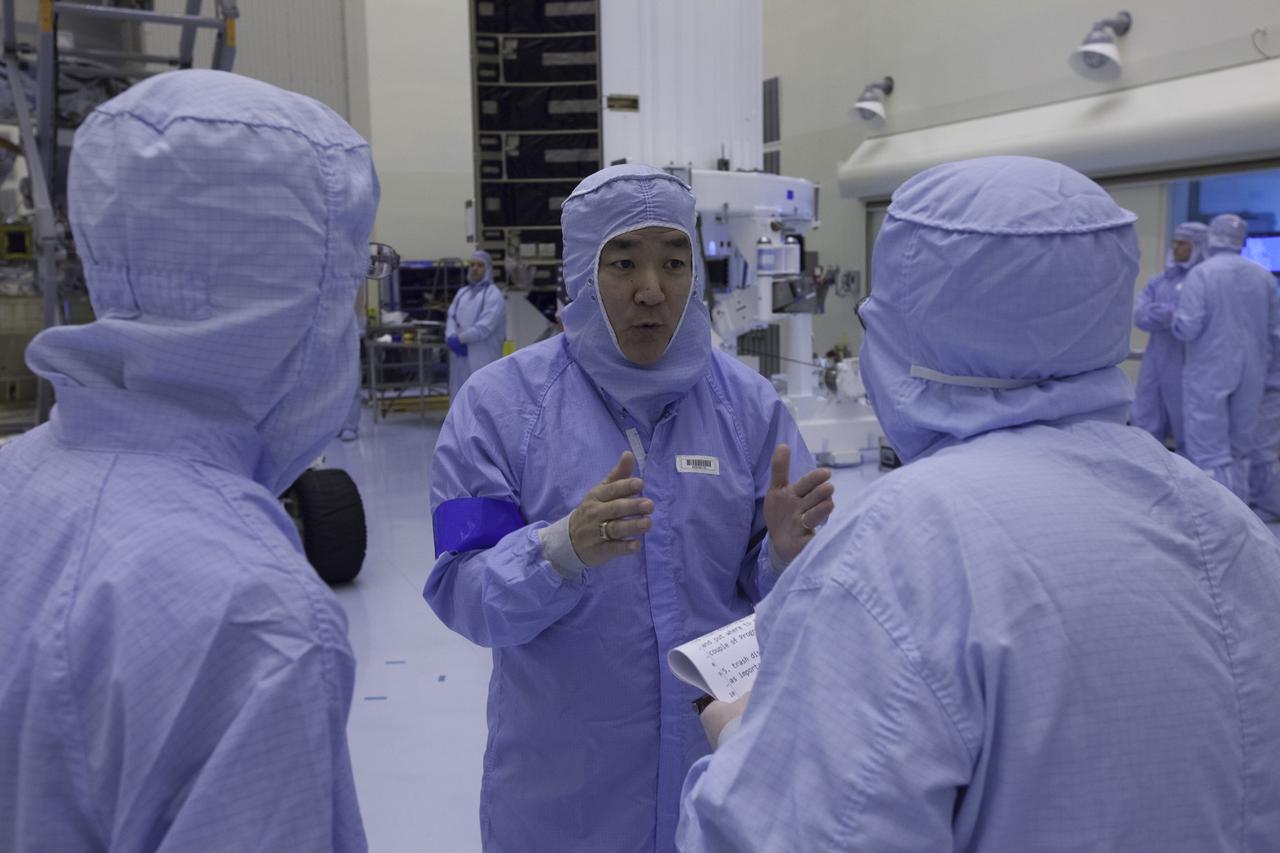
Inside the Payload Hazardous Servicing Facility at NASA's Kennedy Space Center, former NASA astronaut Dan Tani, who now is senior director of Missions and Cargo Operations for Orbital ATK in Dulles, Virginia, participates in a press interview. In the background is the Cygnus spacecraft scheduled to deliver hardware and supplies to the International Space Station on the upcoming Orbital ATK Commercial Resupply Services-6 mission.
Inside the Payload Hazardous Servicing Facility at NASA's Kennedy Space Center, former NASA astronaut Dan Tani, who now is senior director of Missions and Cargo Operations for Orbital ATK in Dulles, Virginia, participates in a press interview. In the background is the Cygnus spacecraft scheduled to deliver hardware and supplies to the International Space Station on the upcoming Orbital ATK Commercial Resupply Services-6 mission.

Wispy tendrils of hot dust and gas glow brightly in this ultraviolet image of the Cygnus Loop nebula, taken by NASA Galaxy Evolution Explorer. The nebula lies about 1,500 light-years away.
ISS038-E-049421 (18 Feb. 2014) --- The International Space Station's Canadarm2 unberths the Orbital Sciences Corporation's Cygnus spacecraft after several weeks at the space station. NASA astronaut Mike Hopkins, with assistance from Japan Aerospace Exploration Agency astronaut Koichi Wakata, both Expedition 38 flight engineers, used the station's 57-foot Canadarm2 robotic arm to detach Cygnus from the Earth-facing port of the Harmony node at 5:15 a.m. (EST) on Feb. 18, 2014. While Wakata monitored data and kept in contact with the team at Houston's Mission Control Center, Hopkins released Cygnus from the robotic arm at 6:41 a.m.
ISS038-E-049447 (18 Feb. 2014) --- The International Space Station's Canadarm2 unberths the Orbital Sciences Corporation's Cygnus spacecraft after several weeks at the space station. NASA astronaut Mike Hopkins, with assistance from Japan Aerospace Exploration Agency astronaut Koichi Wakata, both Expedition 38 flight engineers, used the station's 57-foot Canadarm2 robotic arm to detach Cygnus from the Earth-facing port of the Harmony node at 5:15 a.m. (EST) on Feb. 18, 2014. While Wakata monitored data and kept in contact with the team at Houston's Mission Control Center, Hopkins released Cygnus from the robotic arm at 6:41 a.m.
ISS038-E-049430 (18 Feb. 2014) --- The International Space Station's Canadarm2 unberths the Orbital Sciences Corporation's Cygnus spacecraft after several weeks at the space station. NASA astronaut Mike Hopkins, with assistance from Japan Aerospace Exploration Agency astronaut Koichi Wakata, both Expedition 38 flight engineers, used the station's 57-foot Canadarm2 robotic arm to detach Cygnus from the Earth-facing port of the Harmony node at 5:15 a.m. (EST) on Feb. 18, 2014. While Wakata monitored data and kept in contact with the team at Houston's Mission Control Center, Hopkins released Cygnus from the robotic arm at 6:41 a.m.
ISS038-E-049453 (18 Feb. 2014) --- The International Space Station's Canadarm2 prepares to release the Orbital Sciences Corporation's Cygnus spacecraft after several weeks at the space station. NASA astronaut Mike Hopkins, with assistance from Japan Aerospace Exploration Agency astronaut Koichi Wakata, both Expedition 38 flight engineers, used the station's 57-foot Canadarm2 robotic arm to detach Cygnus from the Earth-facing port of the Harmony node at 5:15 a.m. (EST) on Feb. 18, 2014. While Wakata monitored data and kept in contact with the team at Houston's Mission Control Center, Hopkins released Cygnus from the robotic arm at 6:41 a.m.
ISS038-E-050049 (18 Feb. 2014) --- The International Space Station's Canadarm2 prepares to release the Orbital Sciences Corporation's Cygnus spacecraft after several weeks at the space station. NASA astronaut Mike Hopkins, with assistance from Japan Aerospace Exploration Agency astronaut Koichi Wakata, both Expedition 38 flight engineers, used the station's 57-foot Canadarm2 robotic arm to detach Cygnus from the Earth-facing port of the Harmony node at 5:15 a.m. (EST) on Feb. 18, 2014. While Wakata monitored data and kept in contact with the team at Houston's Mission Control Center, Hopkins released Cygnus from the robotic arm at 6:41 a.m.
ISS038-E-049423 (18 Feb. 2014) --- The International Space Station's Canadarm2 unberths the Orbital Sciences Corporation's Cygnus spacecraft after several weeks at the space station. NASA astronaut Mike Hopkins, with assistance from Japan Aerospace Exploration Agency astronaut Koichi Wakata, both Expedition 38 flight engineers, used the station's 57-foot Canadarm2 robotic arm to detach Cygnus from the Earth-facing port of the Harmony node at 5:15 a.m. (EST) on Feb. 18, 2014. While Wakata monitored data and kept in contact with the team at Houston's Mission Control Center, Hopkins released Cygnus from the robotic arm at 6:41 a.m.
ISS038-E-050062 (18 Feb. 2014) --- The International Space Station's Canadarm2 prepares to release the Orbital Sciences Corporation's Cygnus spacecraft after several weeks at the space station. NASA astronaut Mike Hopkins, with assistance from Japan Aerospace Exploration Agency astronaut Koichi Wakata, both Expedition 38 flight engineers, used the station's 57-foot Canadarm2 robotic arm to detach Cygnus from the Earth-facing port of the Harmony node at 5:15 a.m. (EST) on Feb. 18, 2014. While Wakata monitored data and kept in contact with the team at Houston's Mission Control Center, Hopkins released Cygnus from the robotic arm at 6:41 a.m.
ISS038-E-049445 (18 Feb. 2014) --- The International Space Station's Canadarm2 unberths the Orbital Sciences Corporation's Cygnus spacecraft after several weeks at the space station. NASA astronaut Mike Hopkins, with assistance from Japan Aerospace Exploration Agency astronaut Koichi Wakata, both Expedition 38 flight engineers, used the station's 57-foot Canadarm2 robotic arm to detach Cygnus from the Earth-facing port of the Harmony node at 5:15 a.m. (EST) on Feb. 18, 2014. While Wakata monitored data and kept in contact with the team at Houston's Mission Control Center, Hopkins released Cygnus from the robotic arm at 6:41 a.m.
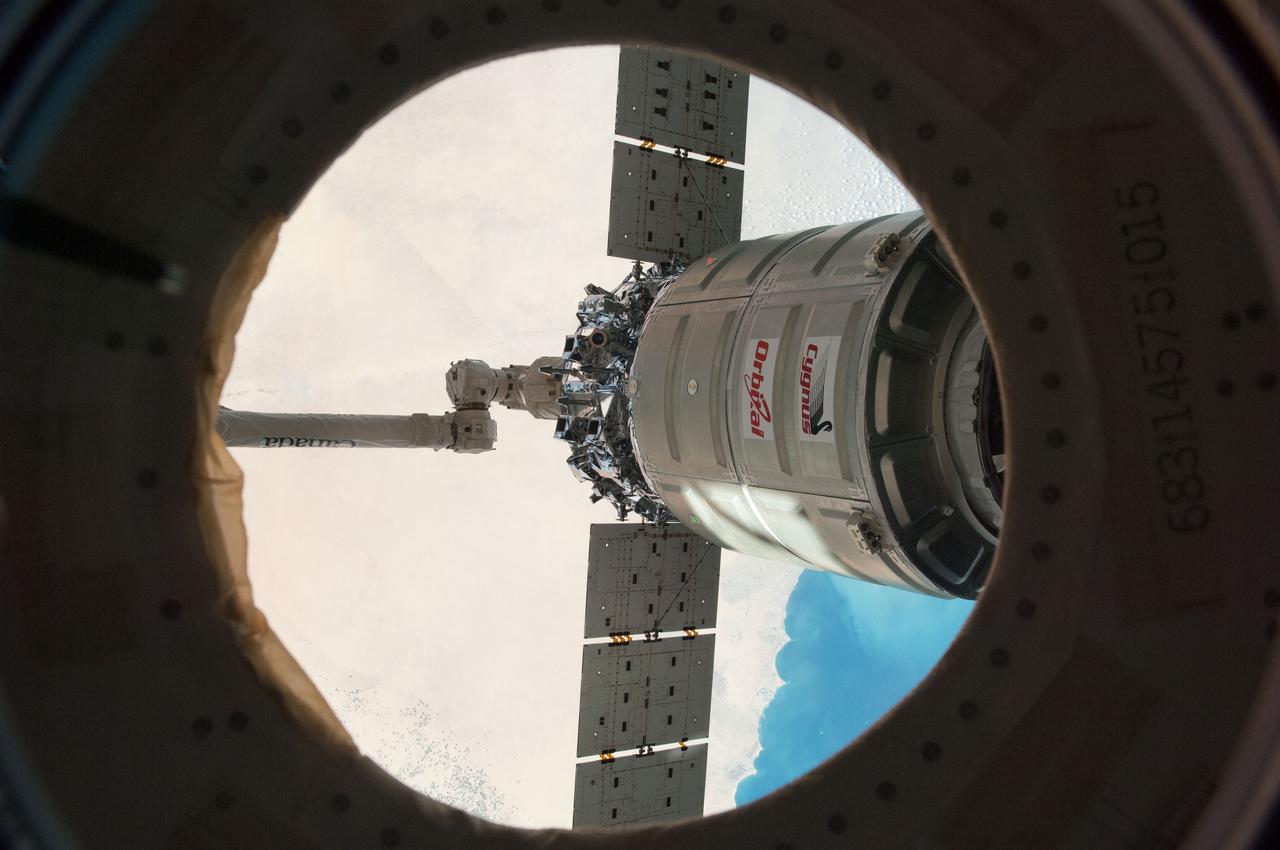
ISS038-E-049438 (18 Feb. 2014) --- The International Space Station's Canadarm2 unberths the Orbital Sciences Corporation's Cygnus spacecraft after several weeks at the space station. NASA astronaut Mike Hopkins, with assistance from Japan Aerospace Exploration Agency astronaut Koichi Wakata, both Expedition 38 flight engineers, used the station's 57-foot Canadarm2 robotic arm to detach Cygnus from the Earth-facing port of the Harmony node at 5:15 a.m. (EST) on Feb. 18, 2014. While Wakata monitored data and kept in contact with the team at Houston's Mission Control Center, Hopkins released Cygnus from the robotic arm at 6:41 a.m.
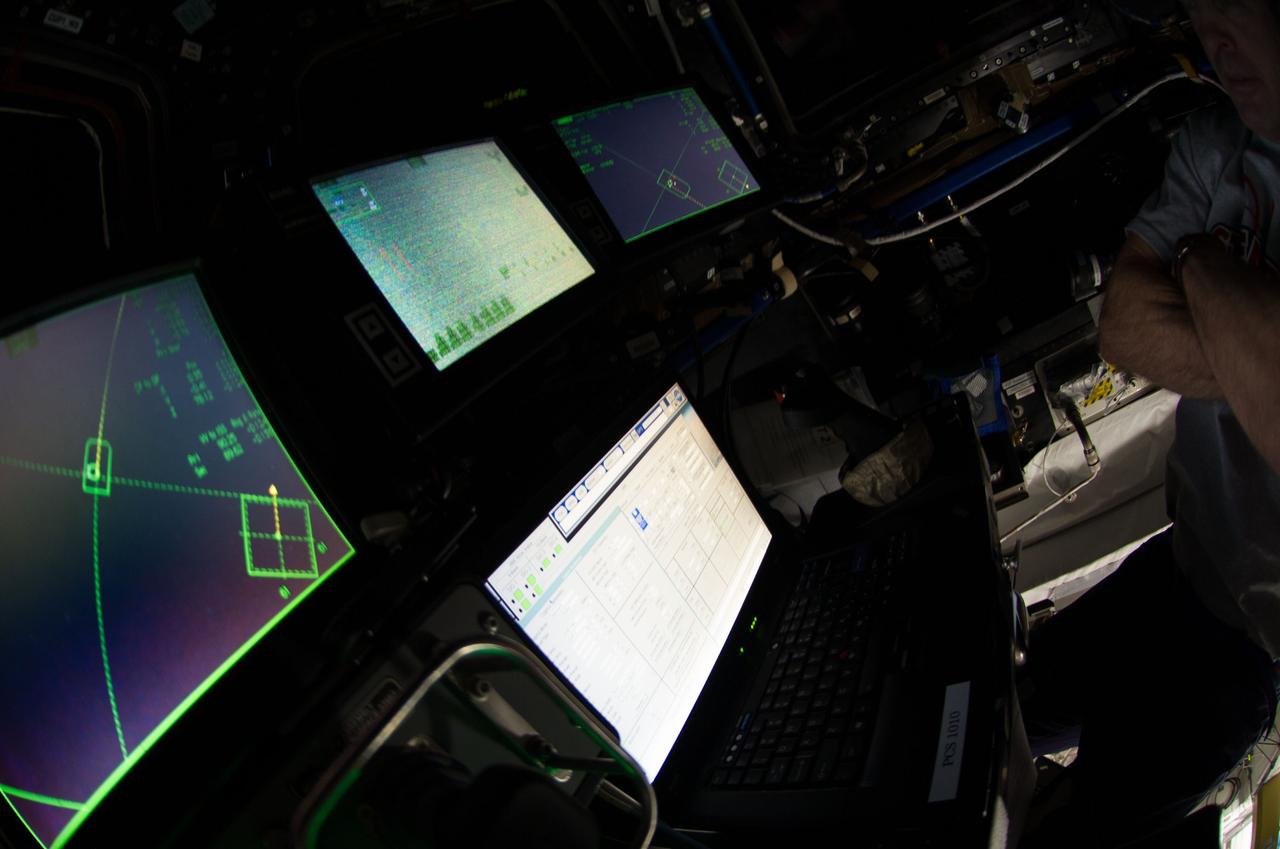
Control boards pictured in the International Space Stations Cupola during rendezvous and capture operations of the Orbital Sciences Cygnus cargo craft.
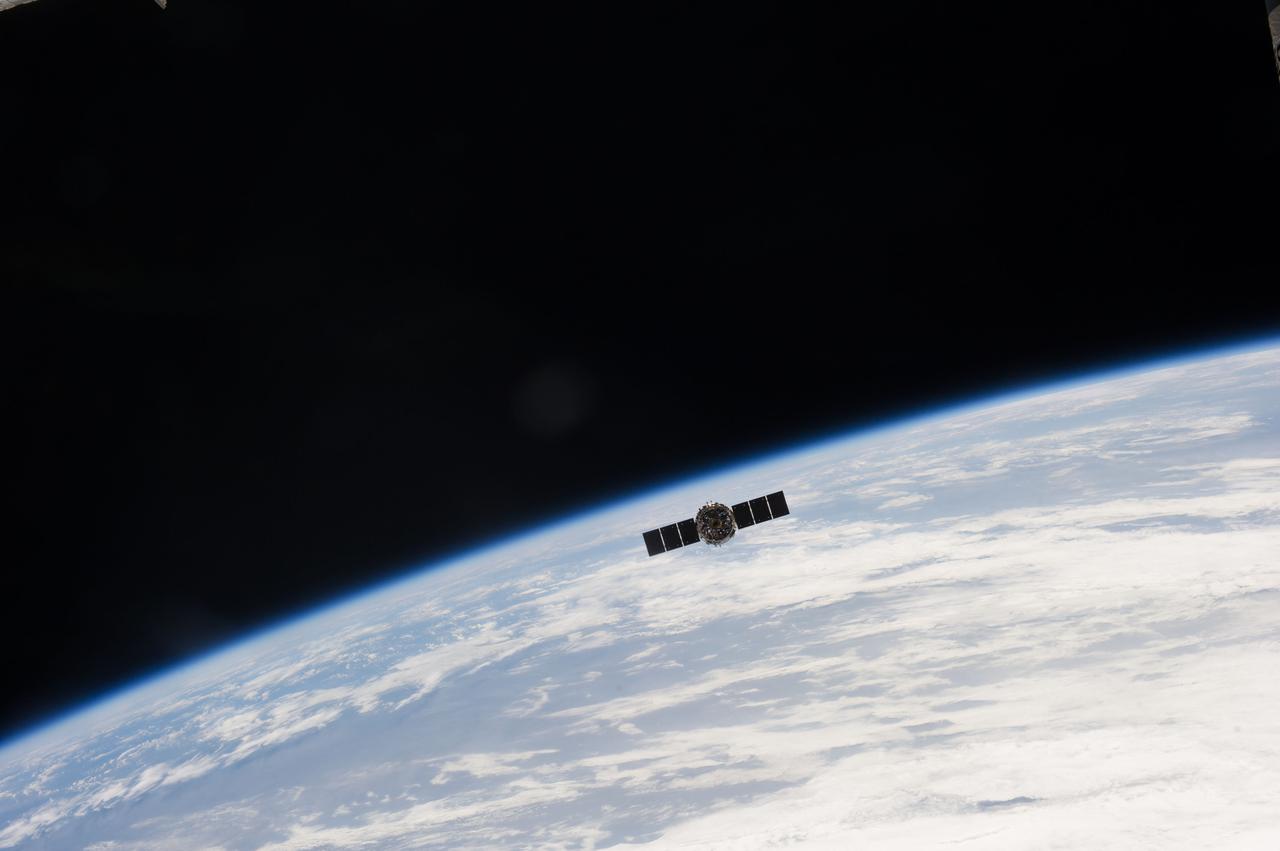
The Orbital Sciences Cygnus commercial craft begins its relative separation from the International Space Station after three weeks at the station.
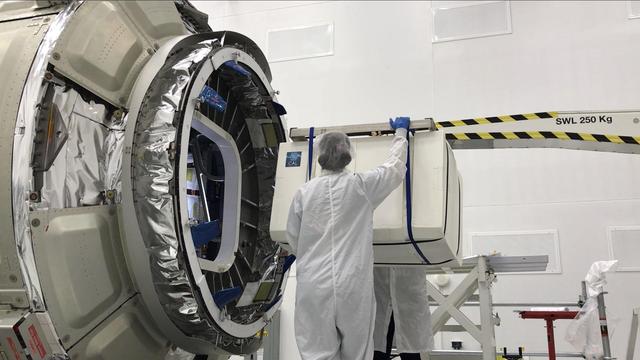
The Cold Atom Laboratory (CAL), packaged in a protective layer, is loaded onto a Northrop Grumman (formerly Orbital ATK) Cygnus spacecraft for its trip to the International Space Station. The facility launched in May 2018 from NASA's Wallops Flight Facility in Virginia. https://photojournal.jpl.nasa.gov/catalog/PIA22919
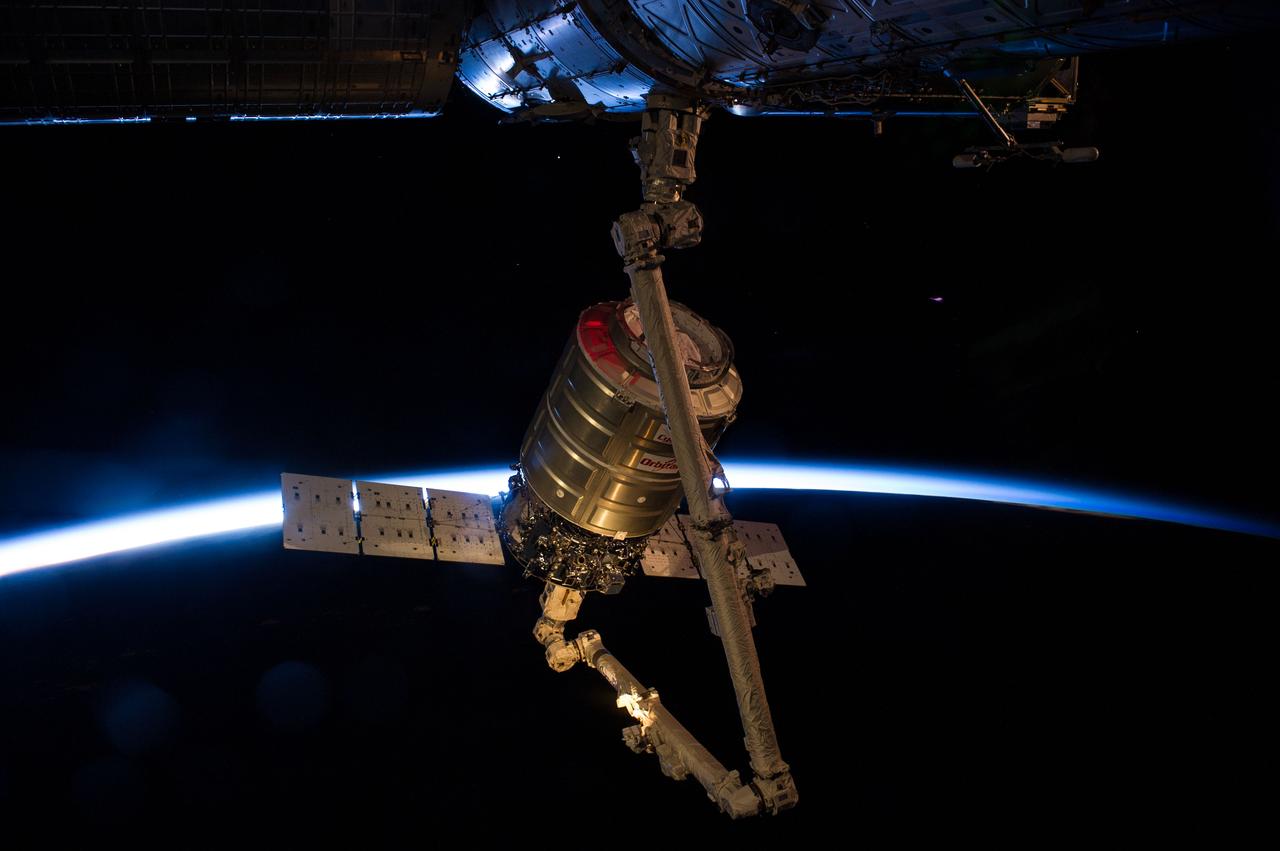
ISS040-E-063769 (16 July 2014) --- Intersecting the thin line of Earth?s atmosphere, the Orbital Sciences? Cygnus cargo craft attached to the end of the Canadarm2 robotic arm of the International Space Station is photographed by an Expedition 40 crew member after the two spacecraft converged at 6:36 a.m. (EDT) on July 16, 2014. The red color on Cygnus is a spectral effect from one of Cygnus? strobe lights against the fading light heading into an orbital sunset following grapple.
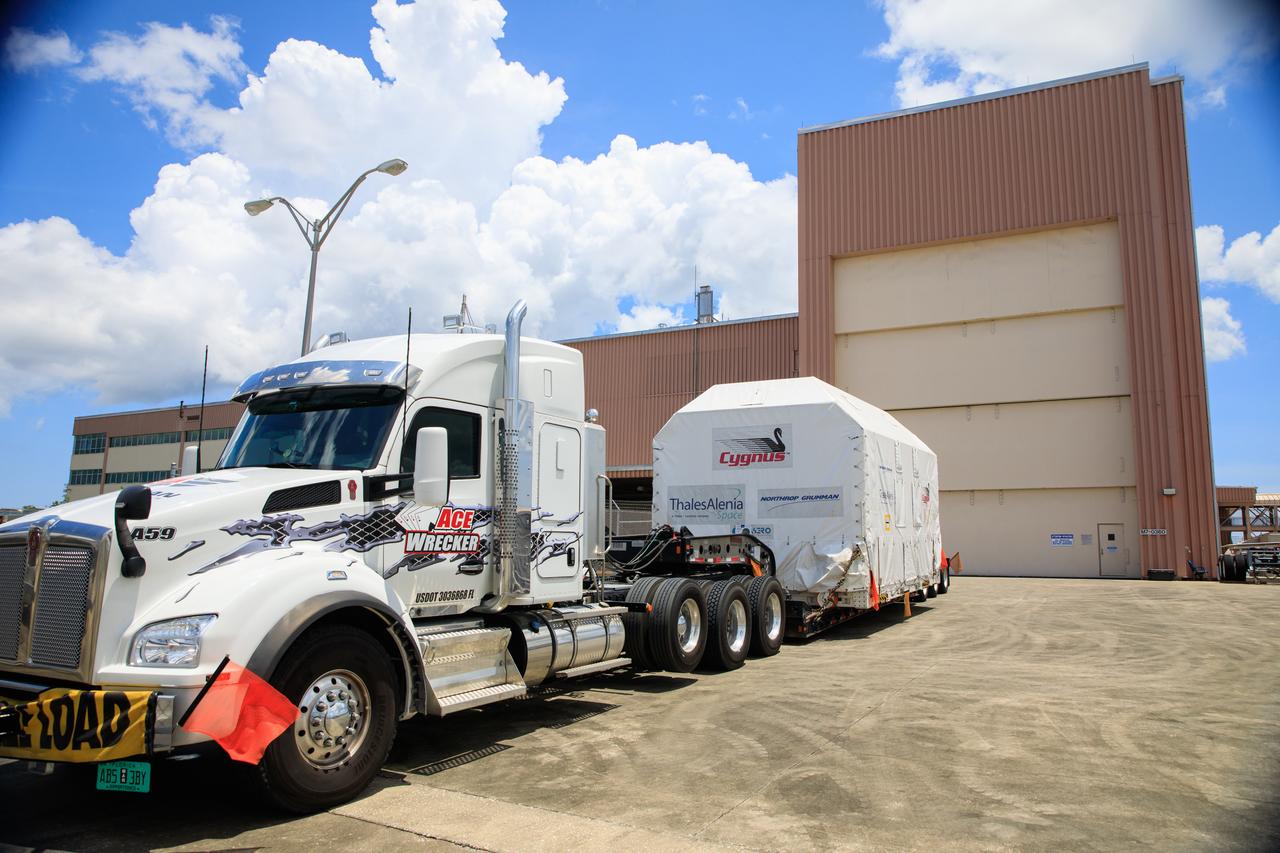
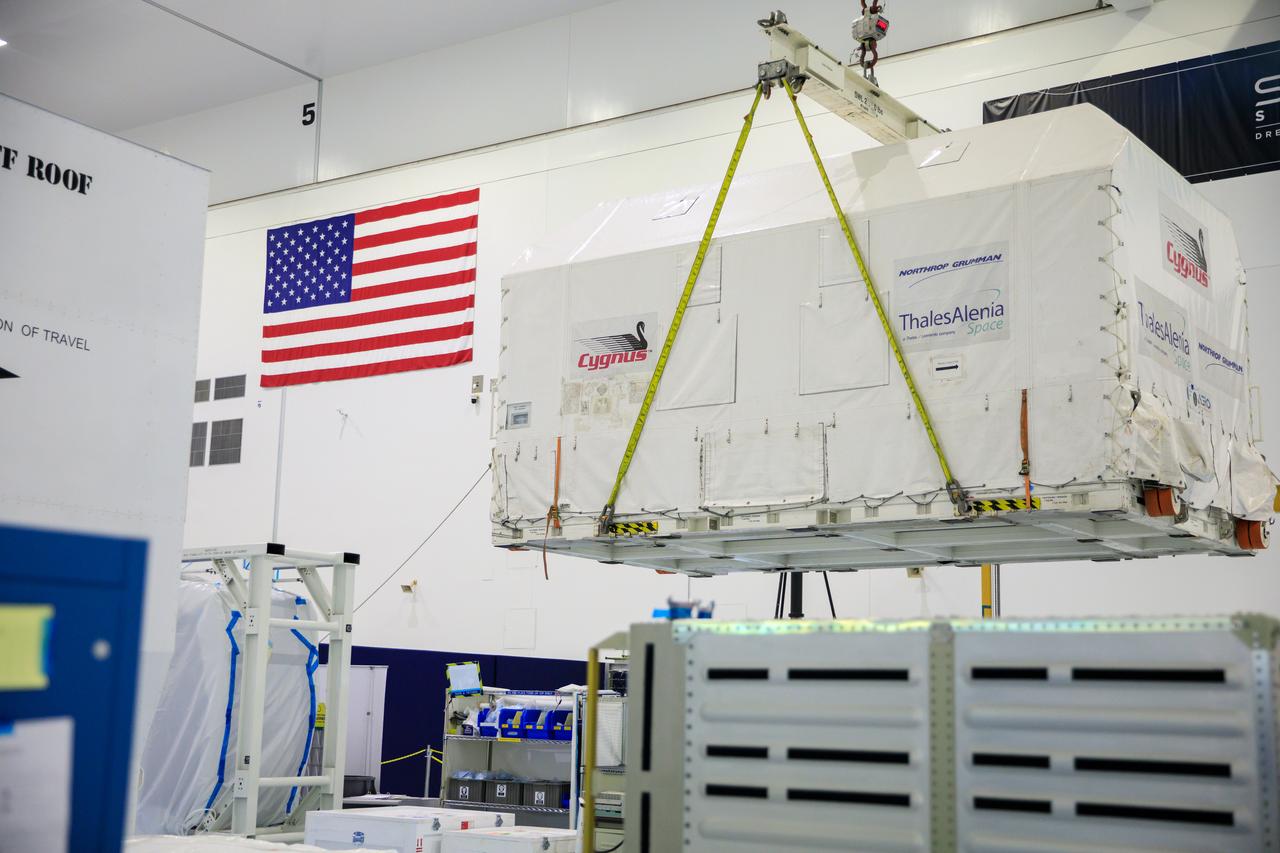
The Northrop Grumman Cygnus spacecraft's pressurized cargo module (PCM) arrives at the Space Station Processing Facility of NASA's Kennedy Space Center in Florida on Aug. 2, 2023. The PCM is sealed in an environmentally controlled shipping container, pulled in by truck on a flatbed trailer. Cygnus will launch later this year atop a SpaceX Falcon 9 rocket from Cape Canaveral Space Force Station’s Space Launch Complex 40 to the International Space Station. Cygnus will undergo prelaunch processing at Kennedy before it is transported to SpaceX’s integration facility.
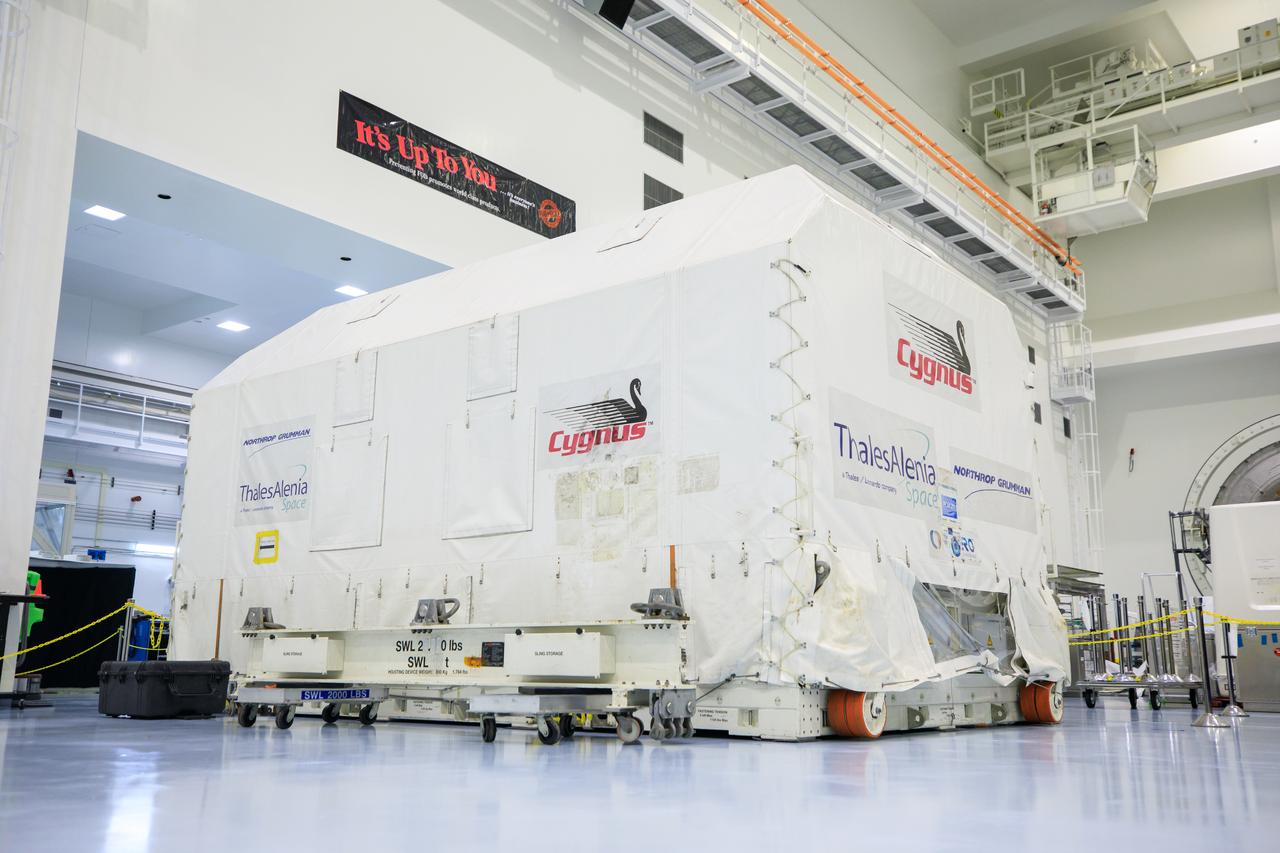
Northrop Grumman’s Cygnus pressurized cargo module for the company’s 20th commercial resupply mission arrives in its environmentally controlled shipping container inside the high bay in the Space Station Processing Facility at NASA's Kennedy Space Center in Florida on Aug. 2, 2023. Cygnus will launch later this year atop a SpaceX Falcon 9 rocket from Cape Canaveral Space Force Station’s Space Launch Complex 40 to the International Space Station. Cygnus will undergo prelaunch processing at Kennedy before it is transported to SpaceX’s integration facility.
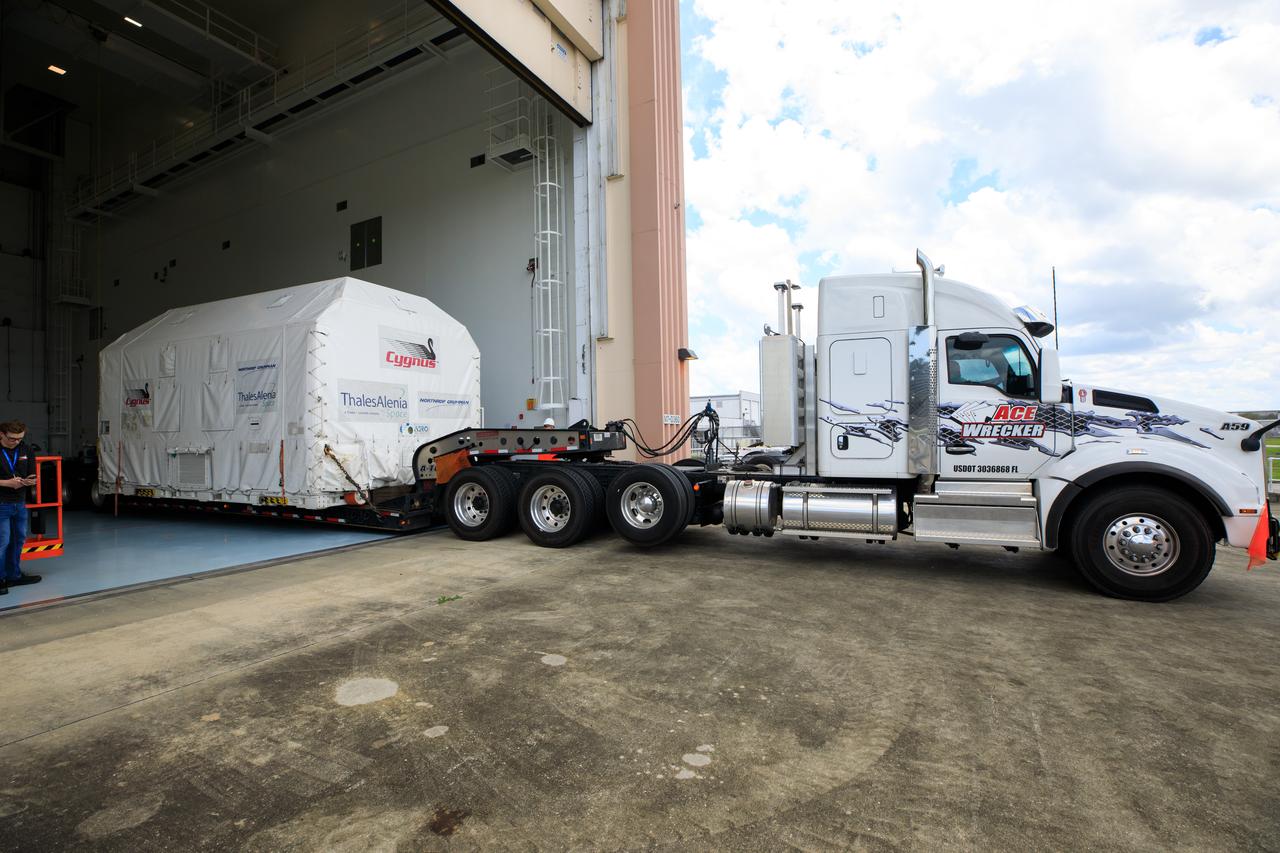
The Northrop Grumman Cygnus spacecraft's pressurized cargo module (PCM) arrives at the Space Station Processing Facility of NASA's Kennedy Space Center in Florida on Aug. 2, 2023. The PCM is sealed in an environmentally controlled shipping container, pulled in by truck on a flatbed trailer. Cygnus will launch later this year atop a SpaceX Falcon 9 rocket from Cape Canaveral Space Force Station’s Space Launch Complex 40 to the International Space Station. Cygnus will undergo prelaunch processing at Kennedy before it is transported to SpaceX’s integration facility.
ISS038-E-050755 (18 Feb. 2014) --- The Orbital Sciences Corporation's Cygnus spacecraft begins its relative separation from the International Space Station after several weeks at the station. NASA astronaut Mike Hopkins, with assistance from Japan Aerospace Exploration Agency astronaut Koichi Wakata, both Expedition 38 flight engineers, used the station's 57-foot Canadarm2 robotic arm to detach Cygnus from the Earth-facing port of the Harmony node at 5:15 a.m. (EST) on Feb. 18, 2014. While Wakata monitored data and kept in contact with the team at Houston's Mission Control Center, Hopkins released Cygnus from the robotic arm at 6:41 a.m. A blue and white part of Earth provides the backdrop for the scene.
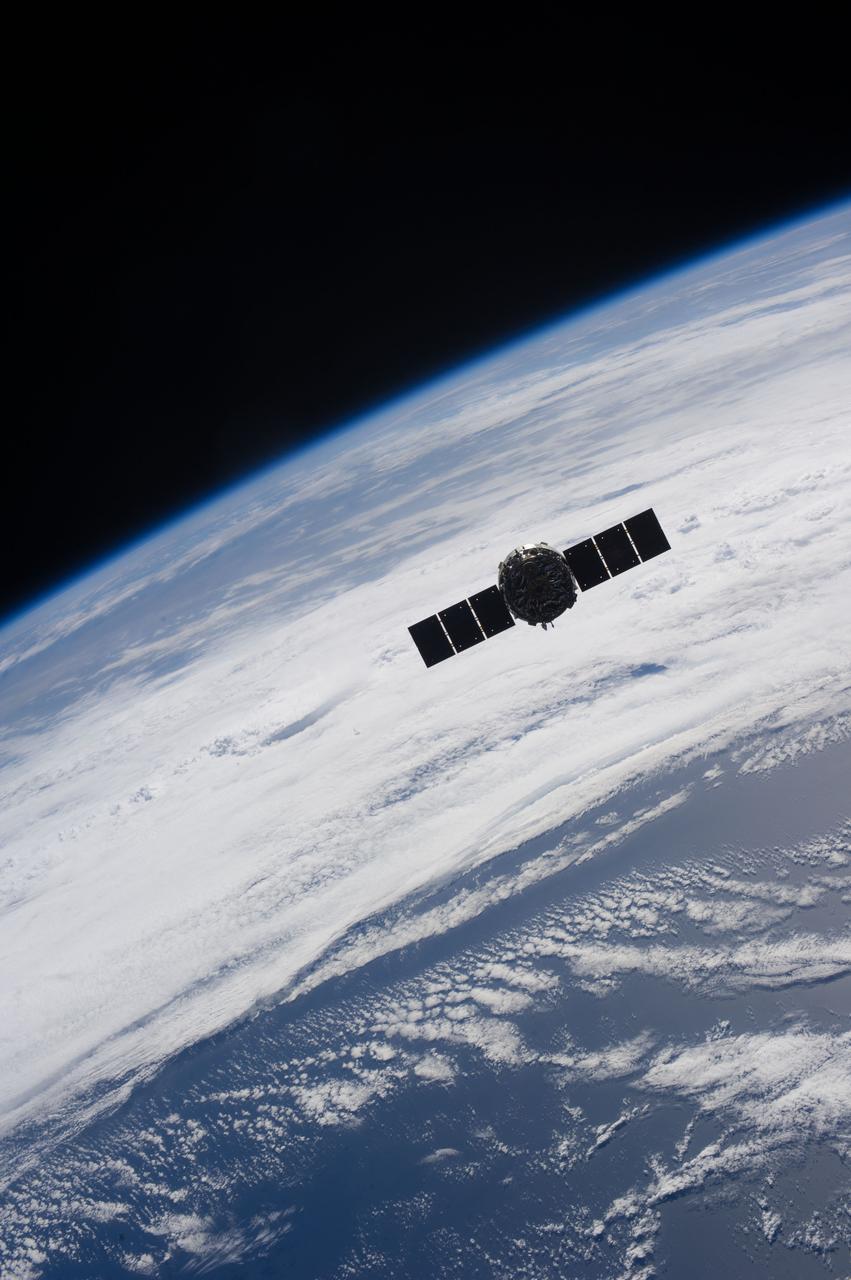
ISS038-E-050734 (18 Feb. 2014) --- The International Space Station's Canadarm2 unberths the Orbital Sciences Corporation's Cygnus spacecraft after several weeks at the space station. NASA astronaut Mike Hopkins, with assistance from Japan Aerospace Exploration Agency astronaut Koichi Wakata, both Expedition 38 flight engineers, used the station's 57-foot Canadarm2 robotic arm to detach Cygnus from the Earth-facing port of the Harmony node at 5:15 a.m. (EST) on Feb. 18, 2014. While Wakata monitored data and kept in contact with the team at Houston's Mission Control Center, Hopkins released Cygnus from the robotic arm at 6:41 a.m. Earth's horizon and the blackness of space provide the backdrop for the scene.
ISS037-E-018572 (22 Oct. 2013) --- The Orbital Sciences’ Cygnus commercial craft begins its relative separation from the International Space Station after three weeks at the station. European Space Agency astronaut Luca Parmitano and NASA astronaut Karen Nyberg, both Expedition 37 flight engineers, were at the controls of the robotics workstation removing Cygnus from the Harmony node then safely releasing it at 7:31 a.m. (EDT) Oct. 22, 2013. On Oct. 23, the Cygnus will fire its engines for the last time at 1:41 p.m. and re-enter Earth’s atmosphere for destruction over the Pacific Ocean. A blue and white part of Earth and the blackness of space provide the backdrop for the scene.
iss058e011396 (Feb. 8, 2019) --- The Cygnus cargo craft from Northrop Grumman is pictured firmly in the grips of the Canadarm2 robotic arm just before its release from the International Space Station.
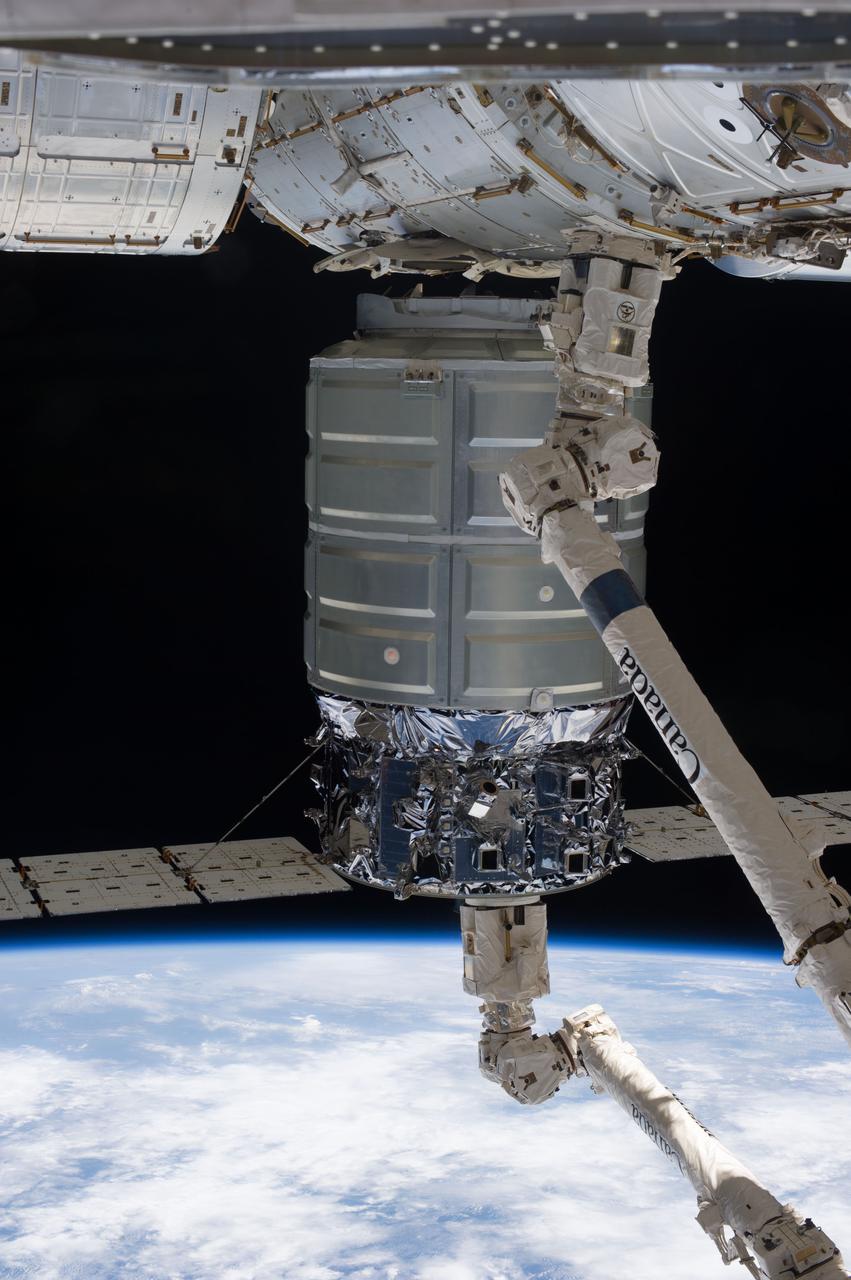
ISS037-E-018502 (22 Oct. 2013) --- The International Space Station’s Canadarm2 unberths the Orbital Sciences’ Cygnus commercial craft after three weeks at the space station. European Space Agency astronaut Luca Parmitano and NASA astronaut Karen Nyberg, both Expedition 37 flight engineers, were at the controls of the robotics workstation removing Cygnus from the Harmony node then safely releasing it at 7:31 a.m. (EDT) Oct. 22, 2013. On Oct. 23, the Cygnus will fire its engines for the last time at 1:41 p.m. and re-enter Earth’s atmosphere for destruction over the Pacific Ocean. Earth’s horizon and the blackness of space provide the backdrop for the scene.
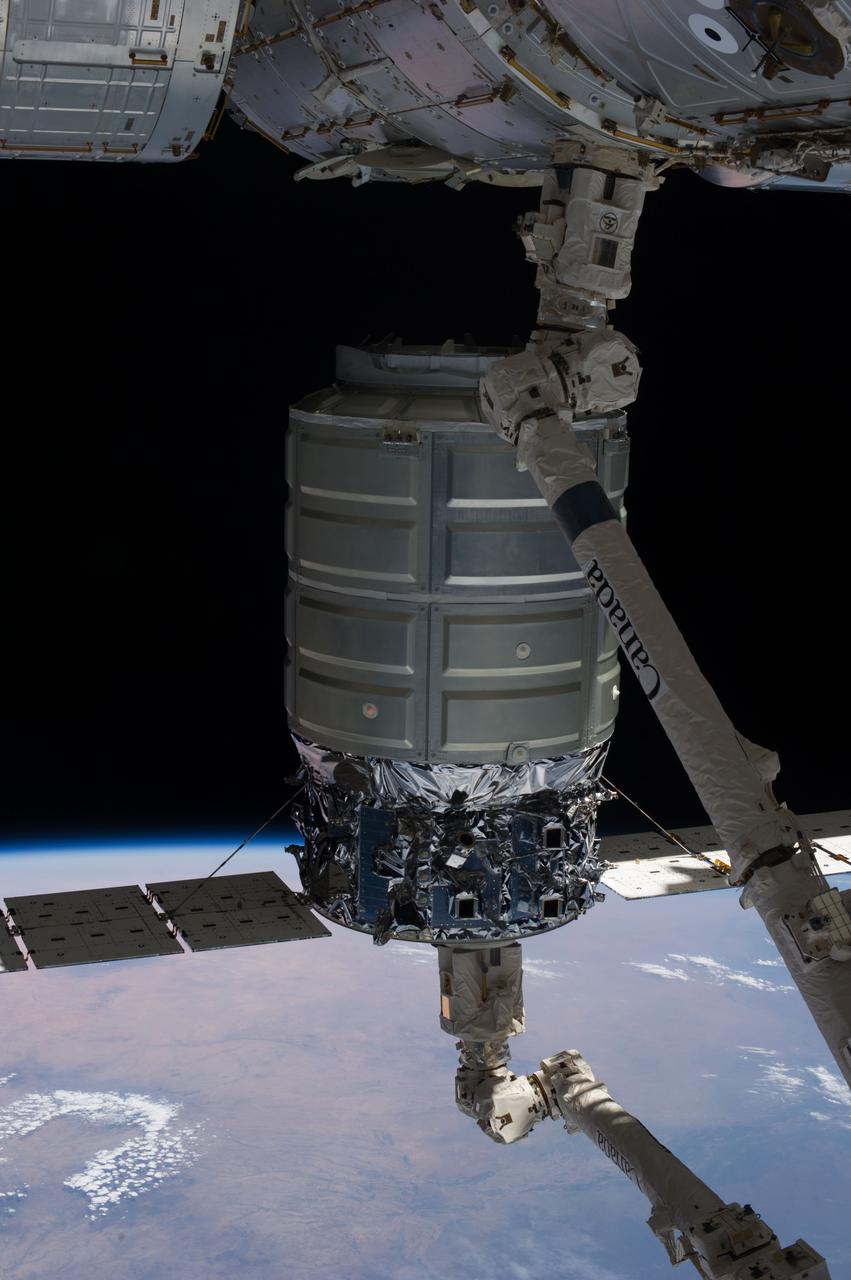
ISS037-E-018505 (22 Oct. 2013) --- The International Space Station’s Canadarm2 unberths the Orbital Sciences’ Cygnus commercial craft after three weeks at the space station. European Space Agency astronaut Luca Parmitano and NASA astronaut Karen Nyberg, both Expedition 37 flight engineers, were at the controls of the robotics workstation removing Cygnus from the Harmony node then safely releasing it at 7:31 a.m. (EDT) Oct. 22, 2013. On Oct. 23, the Cygnus will fire its engines for the last time at 1:41 p.m. and re-enter Earth’s atmosphere for destruction over the Pacific Ocean. Earth’s horizon and the blackness of space provide the backdrop for the scene.
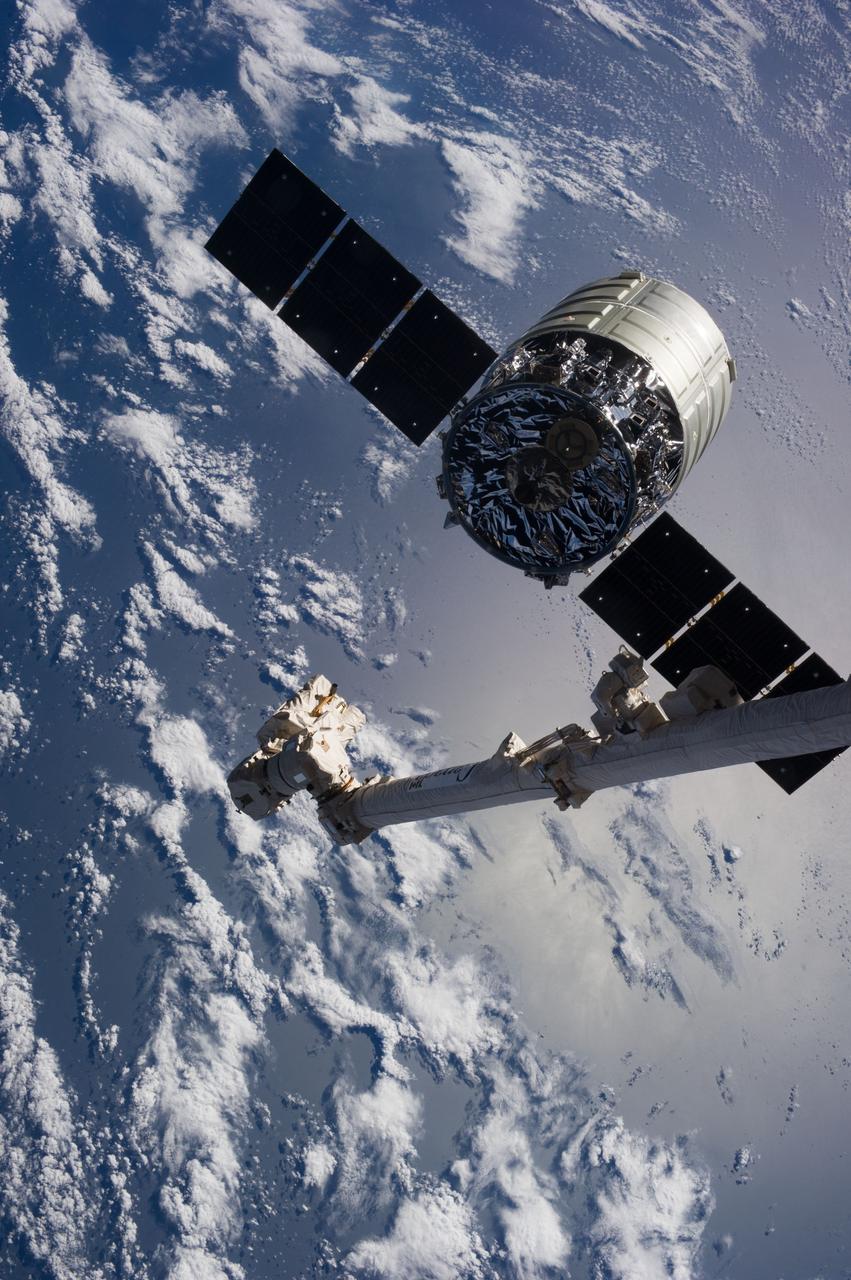
ISS037-E-018564 (22 Oct. 2013) --- The International Space Station?s Canadarm2 releases the Orbital Sciences? Cygnus commercial craft after three weeks at the space station. European Space Agency astronaut Luca Parmitano and NASA astronaut Karen Nyberg, both Expedition 37 flight engineers, were at the controls of the robotics workstation removing Cygnus from the Harmony node then safely releasing it at 7:31 a.m. (EDT) Oct. 22, 2013. On Oct. 23, the Cygnus will fire its engines for the last time at 1:41 p.m. and re-enter Earth?s atmosphere for destruction over the Pacific Ocean. A blue and white part of Earth provides the backdrop for the scene.
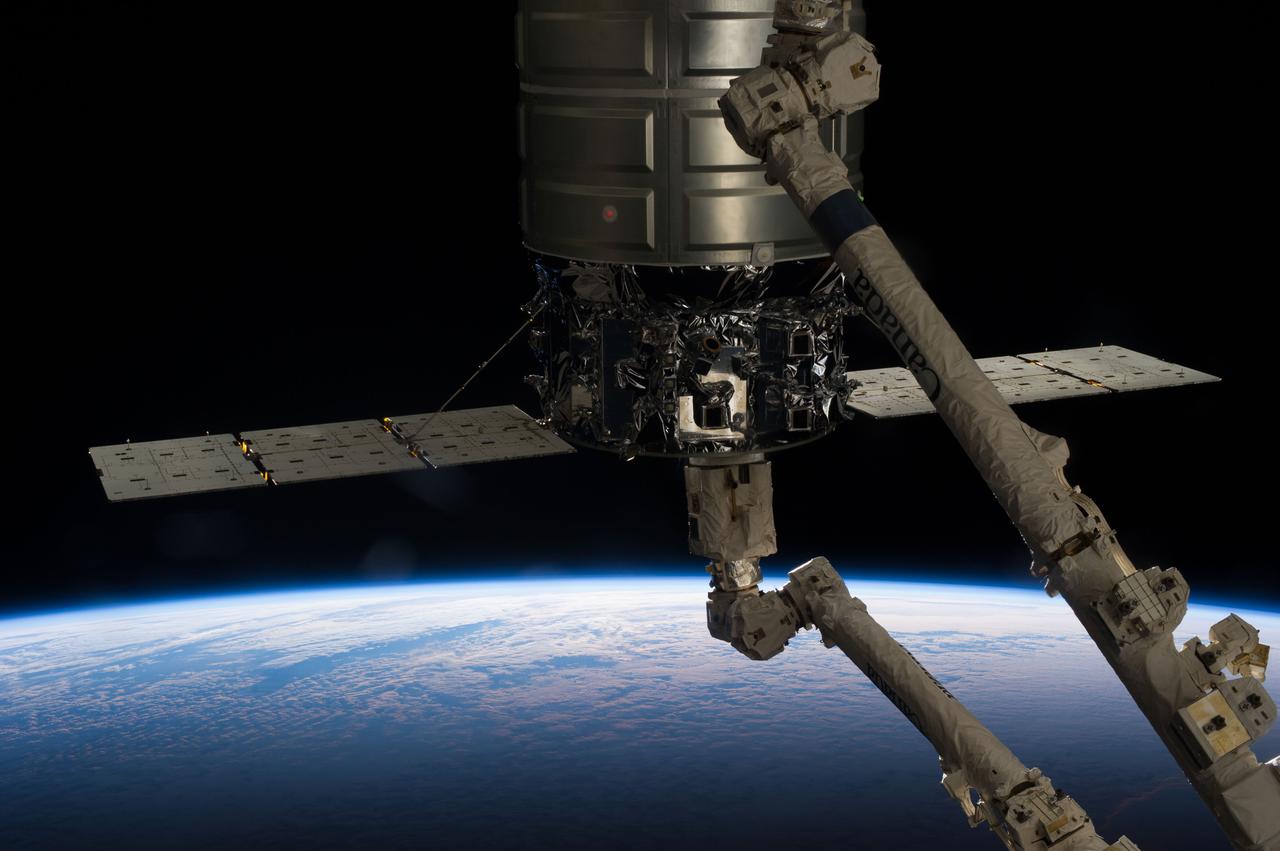
ISS037-E-018501 (22 Oct. 2013) --- The International Space Station’s Canadarm2 prepares to release the Orbital Sciences’ Cygnus commercial craft after three weeks at the space station. European Space Agency astronaut Luca Parmitano and NASA astronaut Karen Nyberg, both Expedition 37 flight engineers, were at the controls of the robotics workstation removing Cygnus from the Harmony node then safely releasing it at 7:31 a.m. (EDT) Oct. 22, 2013. On Oct. 23, the Cygnus will fire its engines for the last time at 1:41 p.m. and re-enter Earth’s atmosphere for destruction over the Pacific Ocean. Earth’s horizon and the blackness of space provide the backdrop for the scene.
ISS037-E-018544 (22 Oct. 2013) --- The International Space Station’s Canadarm2 prepares to release the Orbital Sciences’ Cygnus commercial craft after three weeks at the space station. European Space Agency astronaut Luca Parmitano and NASA astronaut Karen Nyberg, both Expedition 37 flight engineers, were at the controls of the robotics workstation removing Cygnus from the Harmony node then safely releasing it at 7:31 a.m. (EDT) Oct. 22, 2013. On Oct. 23, the Cygnus will fire its engines for the last time at 1:41 p.m. and re-enter Earth’s atmosphere for destruction over the Pacific Ocean.
ISS037-E-018543 (22 Oct. 2013) --- The International Space Station’s Canadarm2 prepares to release the Orbital Sciences’ Cygnus commercial craft after three weeks at the space station. European Space Agency astronaut Luca Parmitano and NASA astronaut Karen Nyberg, both Expedition 37 flight engineers, were at the controls of the robotics workstation removing Cygnus from the Harmony node then safely releasing it at 7:31 a.m. (EDT) Oct. 22, 2013. On Oct. 23, the Cygnus will fire its engines for the last time at 1:41 p.m. and re-enter Earth’s atmosphere for destruction over the Pacific Ocean.
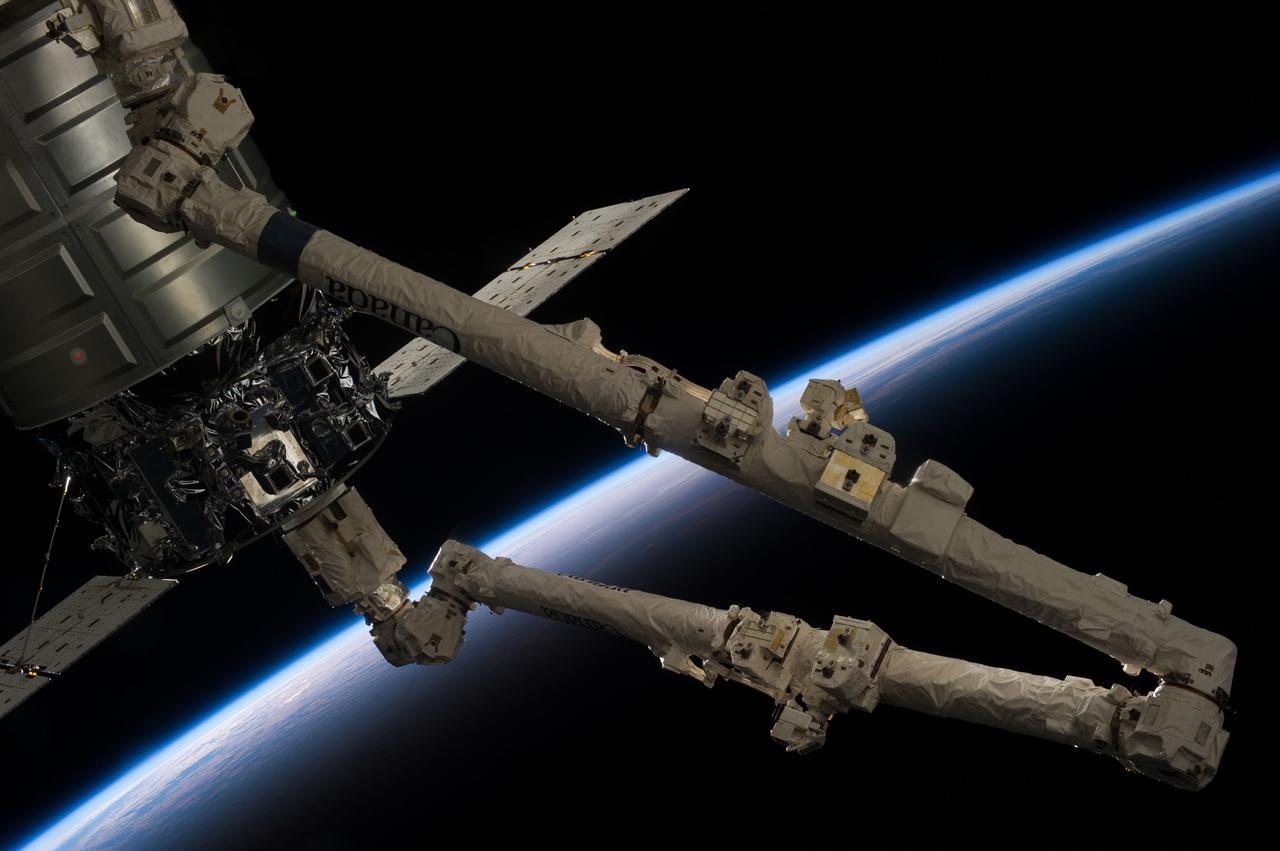
ISS037-E-018500 (22 Oct. 2013) --- The International Space Station’s Canadarm2 prepares to release the Orbital Sciences’ Cygnus commercial craft after three weeks at the space station. European Space Agency astronaut Luca Parmitano and NASA astronaut Karen Nyberg, both Expedition 37 flight engineers, were at the controls of the robotics workstation removing Cygnus from the Harmony node then safely releasing it at 7:31 a.m. (EDT) Oct. 22, 2013. On Oct. 23, the Cygnus will fire its engines for the last time at 1:41 p.m. and re-enter Earth’s atmosphere for destruction over the Pacific Ocean. Earth’s horizon and the blackness of space provide the backdrop for the scene.
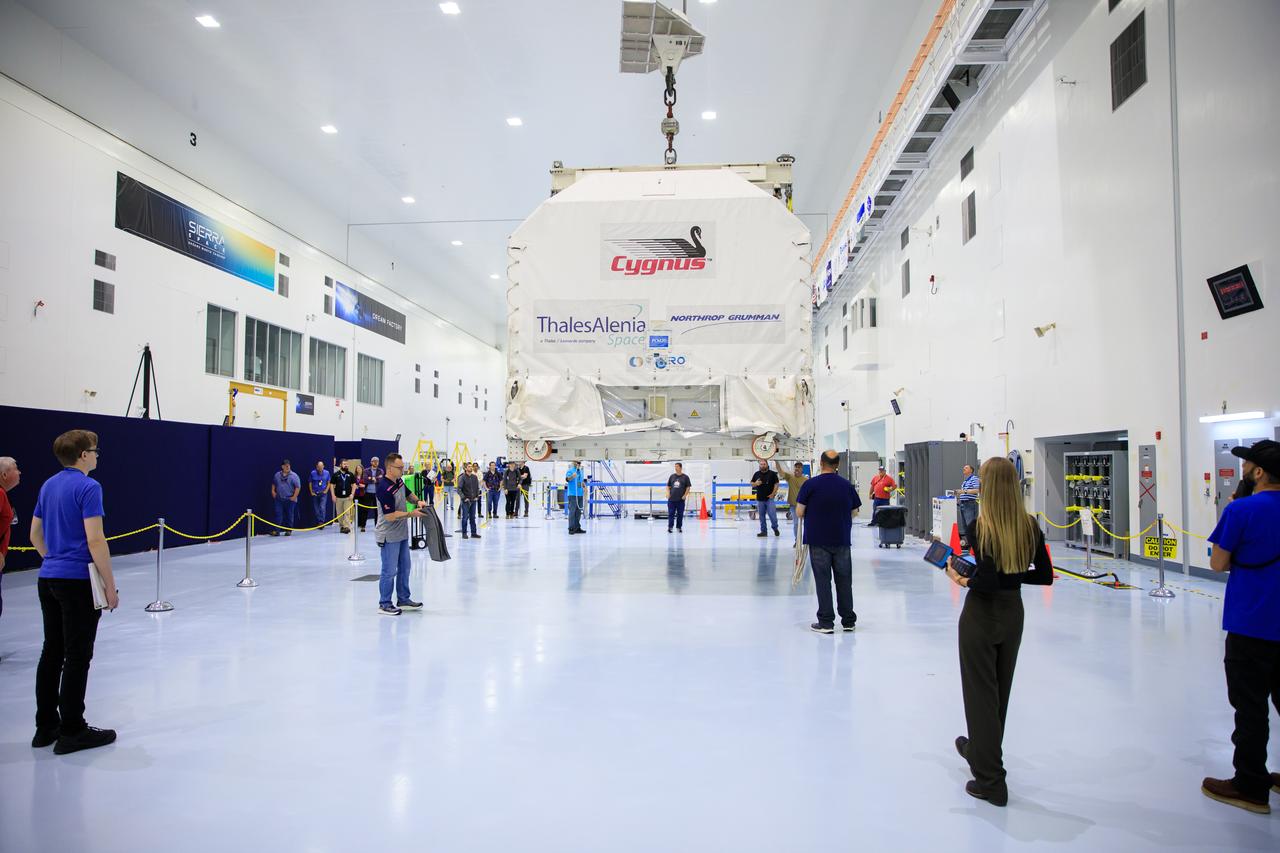
The Northrop Grumman Cygnus spacecraft’s pressurized cargo module (PCM) for the company’s 20th commercial resupply mission is lifted and moved by crane in its environmentally controlled shipping container inside the high bay in the Space Station Processing Facility at NASA's Kennedy Space Center in Florida on Aug. 2, 2023. Cygnus will launch later this year atop a SpaceX Falcon 9 rocket from Cape Canaveral Space Force Station’s Space Launch Complex 40 to the International Space Station. Cygnus will undergo prelaunch processing at Kennedy before it is transported to SpaceX’s integration facility.
The Northrop Grumman Cygnus spacecraft’s pressurized cargo module (PCM) for the company’s 20th commercial resupply mission is moved by crane in its environmentally controlled shipping container in to the Space Station Processing Facility’s high bay at NASA's Kennedy Space Center in Florida on Aug. 2, 2023. Cygnus will launch later this year atop a SpaceX Falcon 9 rocket from Cape Canaveral Space Force Station’s Space Launch Complex 40 to the International Space Station. Cygnus will undergo prelaunch processing at Kennedy before it is transported to SpaceX’s integration facility.
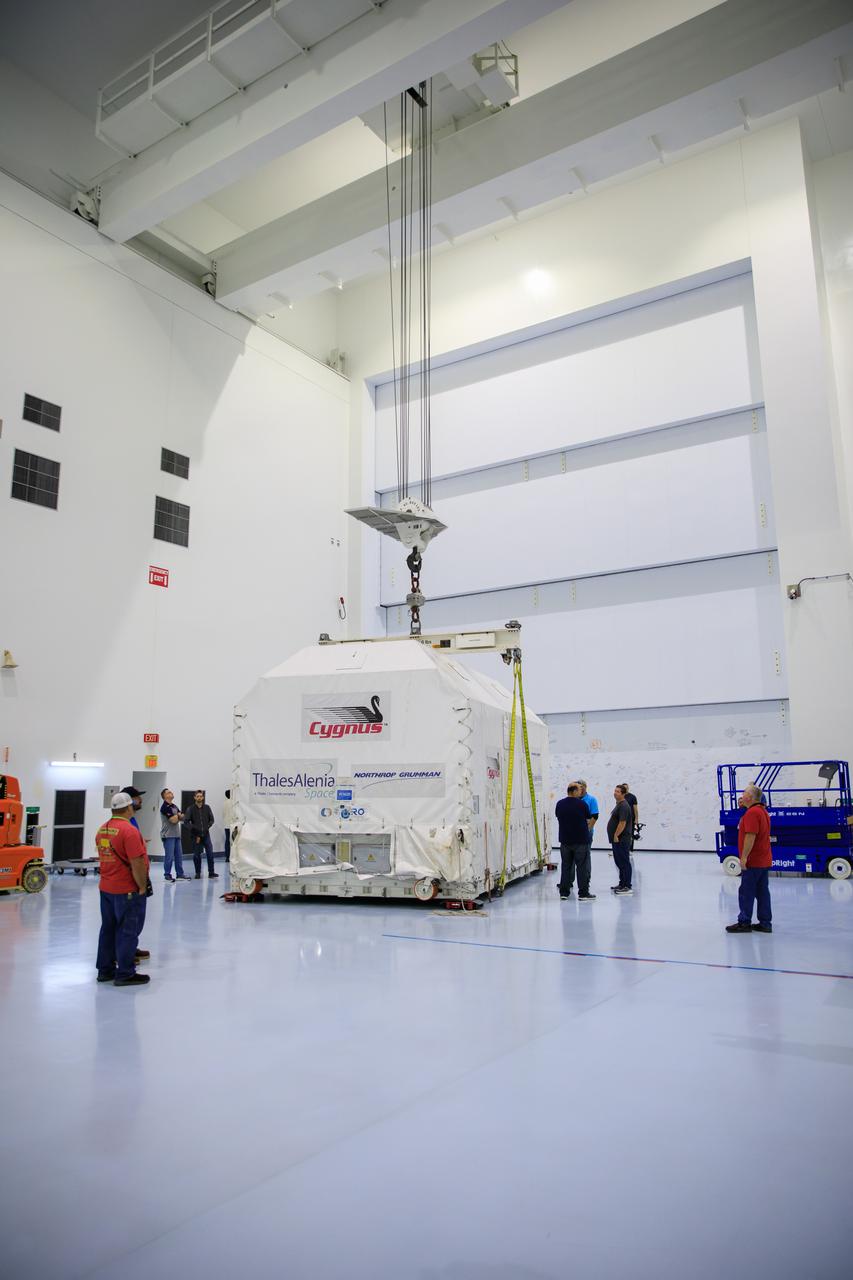
The Cygnus pressurized cargo module for Northrop Grumman’s 20th commercial resupply mission is lowered by crane in its carrier and secured onto a transport base inside the low bay in the Space Station Processing Facility at NASA's Kennedy Space Center in Florida on Aug. 2, 2023. Cygnus will launch later this year atop a SpaceX Falcon 9 rocket from Cape Canaveral Space Force Station’s Space Launch Complex 40 to the International Space Station. Cygnus will undergo prelaunch processing at Kennedy before it is transported to SpaceX’s integration facility.
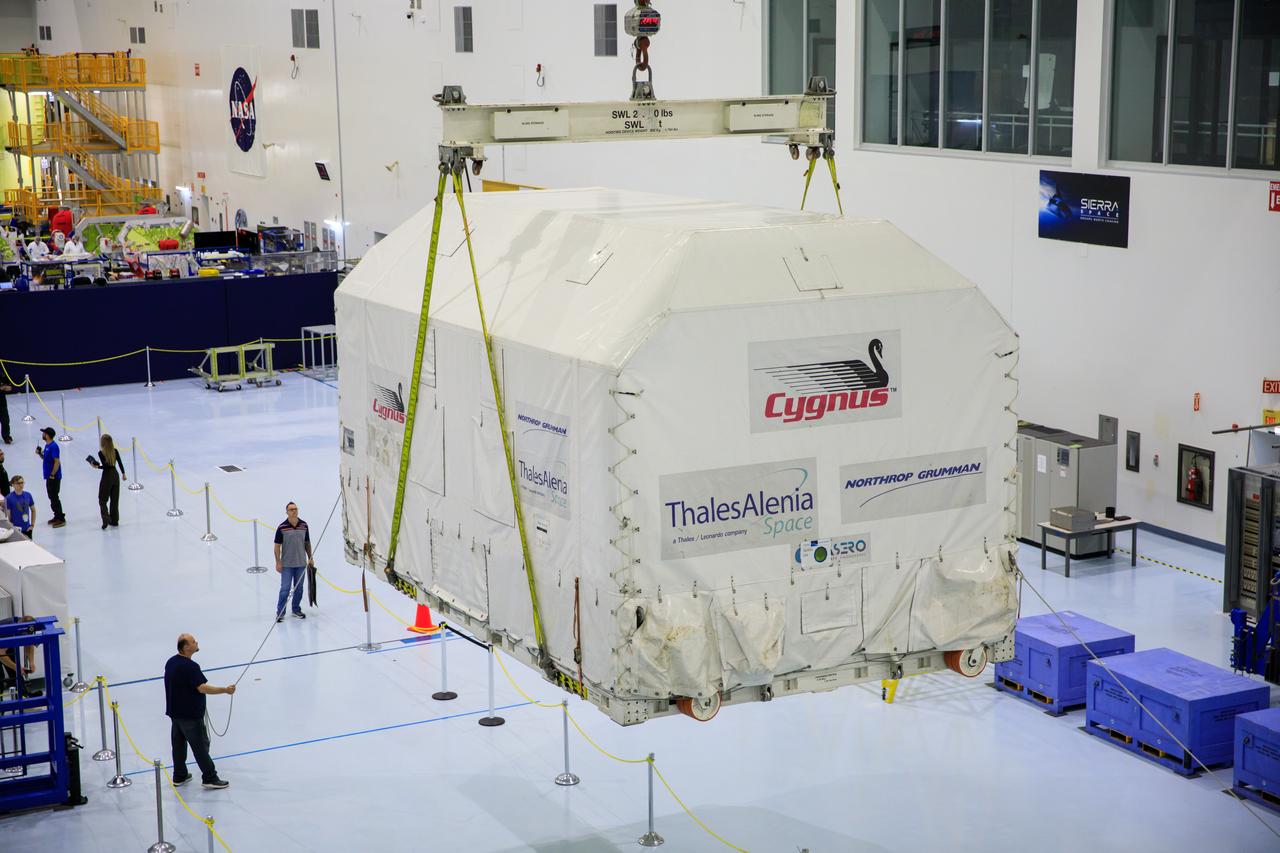
A crane is used to lift the Northrop Grumman Cygnus spacecraft's pressurized cargo module (PCM) off a flatbed truck after arrival at the Space Station Processing Facility of NASA's Kennedy Space Center in Florida on Aug. 2, 2023. The PCM is sealed in an environmentally controlled shipping container. Cygnus will launch later this year atop a SpaceX Falcon 9 rocket from Cape Canaveral Space Force Station’s Space Launch Complex 40 to the International Space Station. Cygnus will undergo prelaunch processing at Kennedy before it is transported to SpaceX’s integration facility.
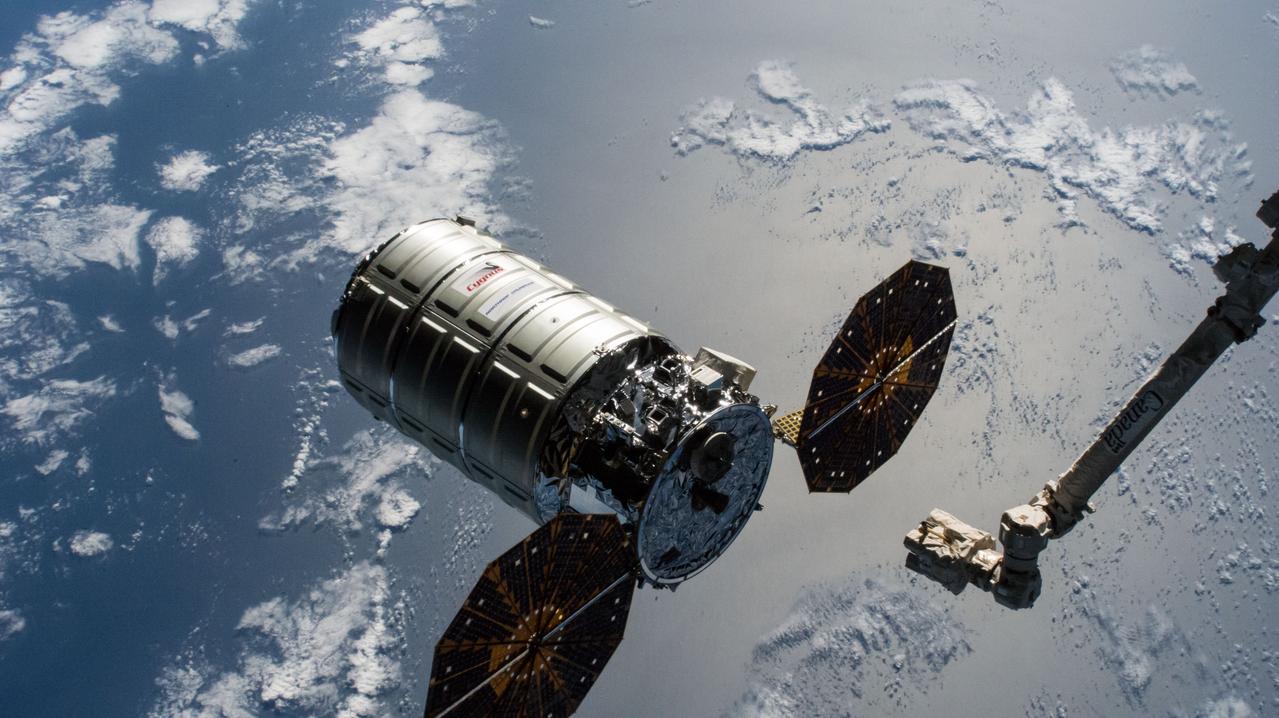
iss058e011814 (Feb. 8, 2019) --- The Cygnus cargo craft from Northrop Grumman is released from the grips of the Canadarm2 robotic arm as the International Space Station was orbiting over the Pacific Ocean off the coast of Peru.
iss069e004909 (April 21, 2023) --- The Cygnus space freighter from Northrop Grumman is pictured in the grips of the Canadarm2 robotic arm as the International Space Station orbited 258 miles above the Arabian Sea coast of India.

iss069e004825 (April 21, 2023) --- The Cygnus space freighter from Northrop Grumman is poised for release from the Canadarm2 robotic arm as the International Space Station orbited 263 miles above the Atlantic Ocean off the coast of Ireland.
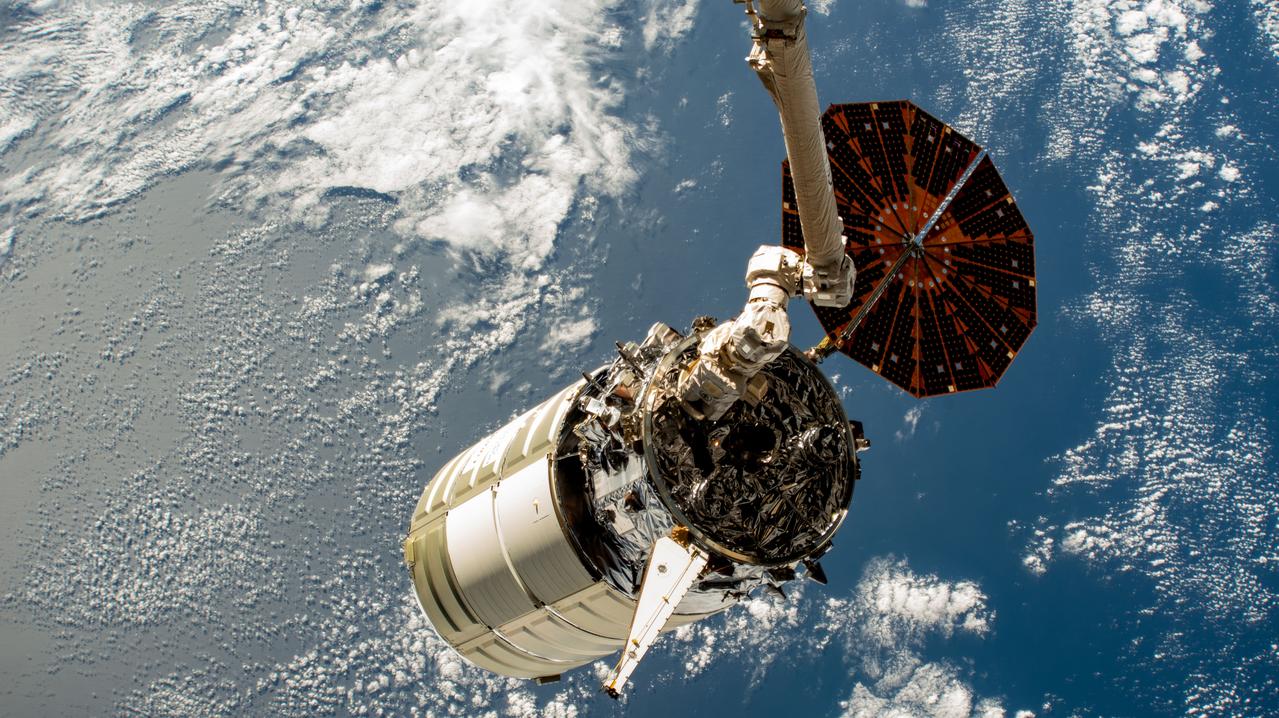
iss069e004821 (April 21, 2023) --- The Cygnus space freighter from Northrop Grumman is poised for release from the Canadarm2 robotic arm as the International Space Station orbited 262 miles above the north Atlantic Ocean.

iss058e011813 (Feb. 8, 2019) --- The Cygnus cargo craft from Northrop Grumman is pictured in the grips of the Canadarm2 robotic arm moments before its release as the International Space Station was orbiting over the Pacific Ocean.
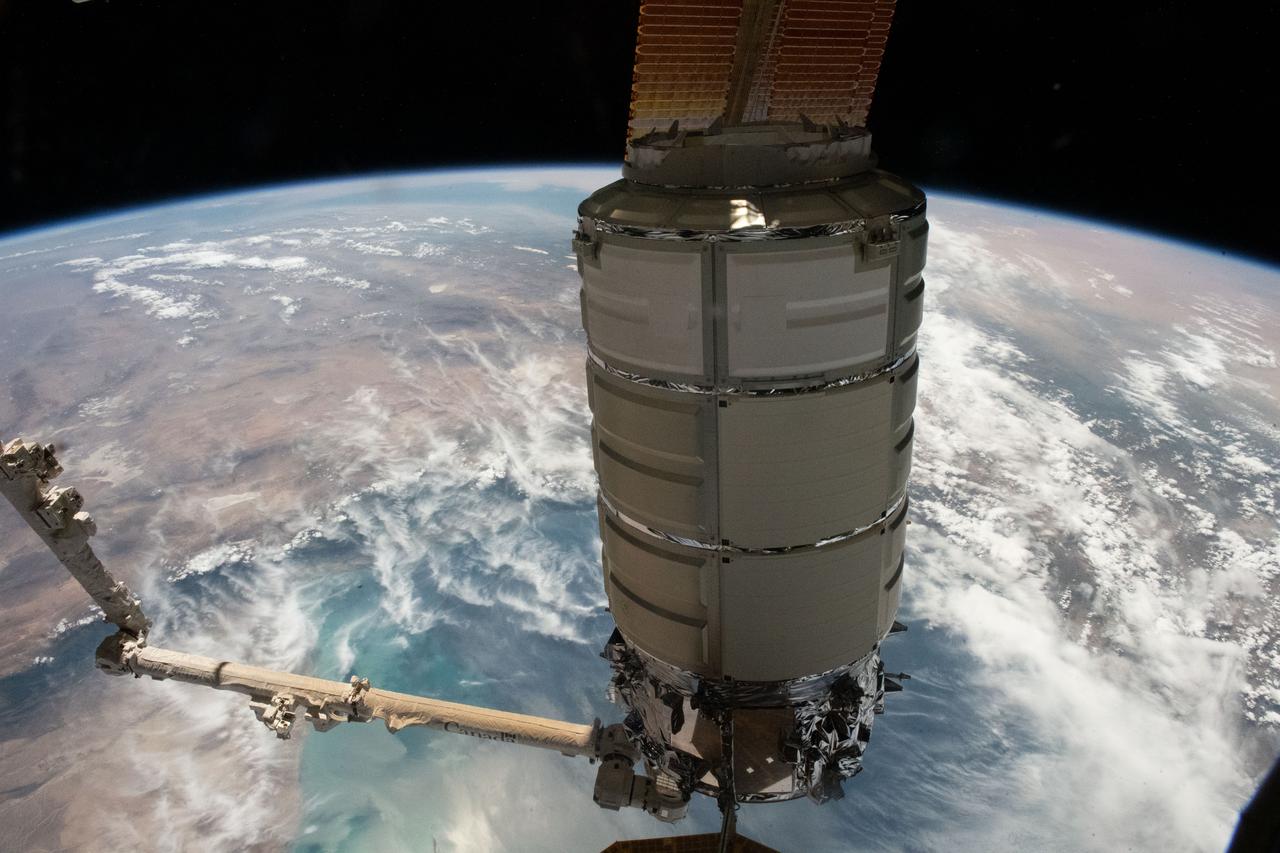
iss069e004895 (April 21, 2023) --- The Cygnus space freighter from Northrop Grumman is pictured in the grips of the Canadarm2 robotic arm as the International Space Station orbited 261 miles above the Caspian Sea off the coast of Turkmenistan.
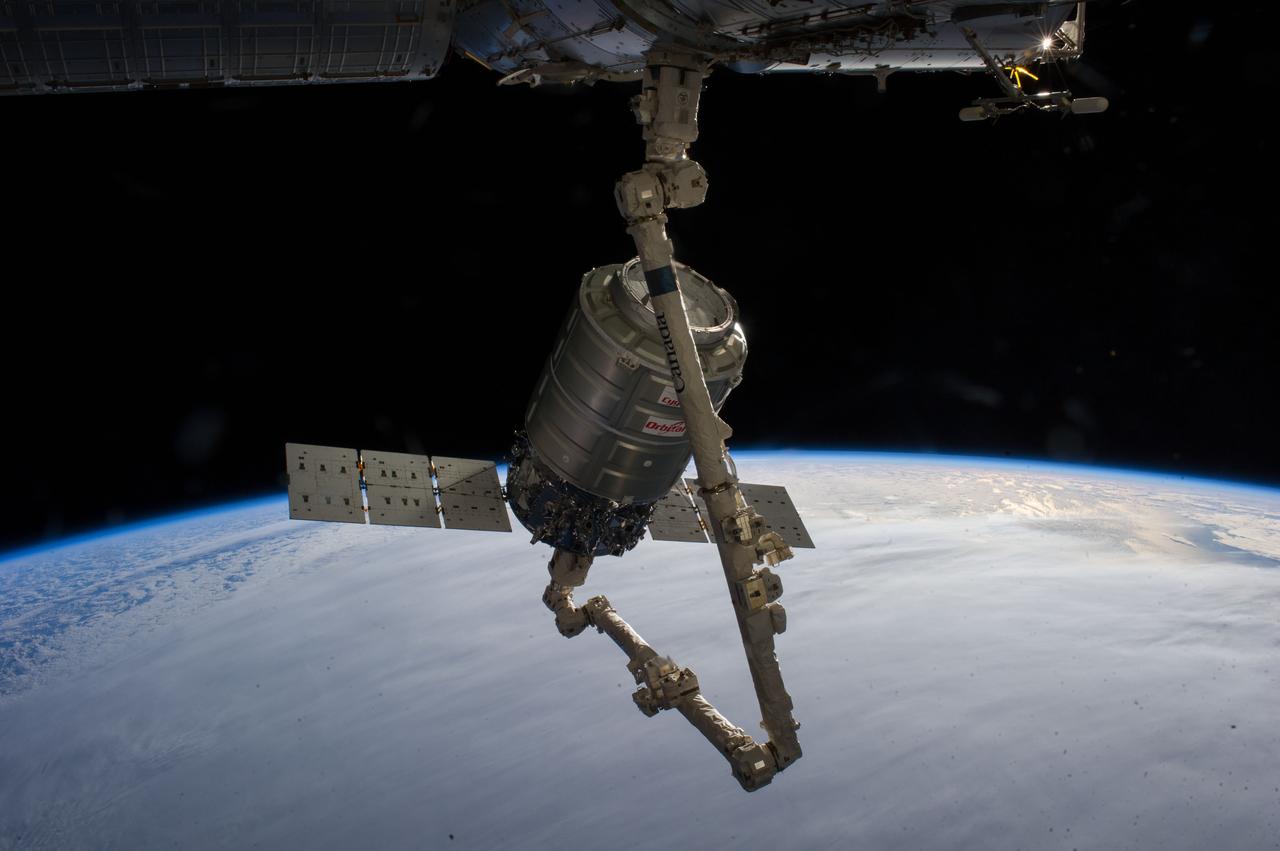
ISS038-E-028071 (12 Jan. 2014) --- The Orbital Sciences Corp. Cygnus commercial cargo craft attached to the end of the Canadarm2 robotic arm of the International Space Station is photographed by an Expedition 38 crew member during rendezvous and berthing operations on Jan. 12, 2014.
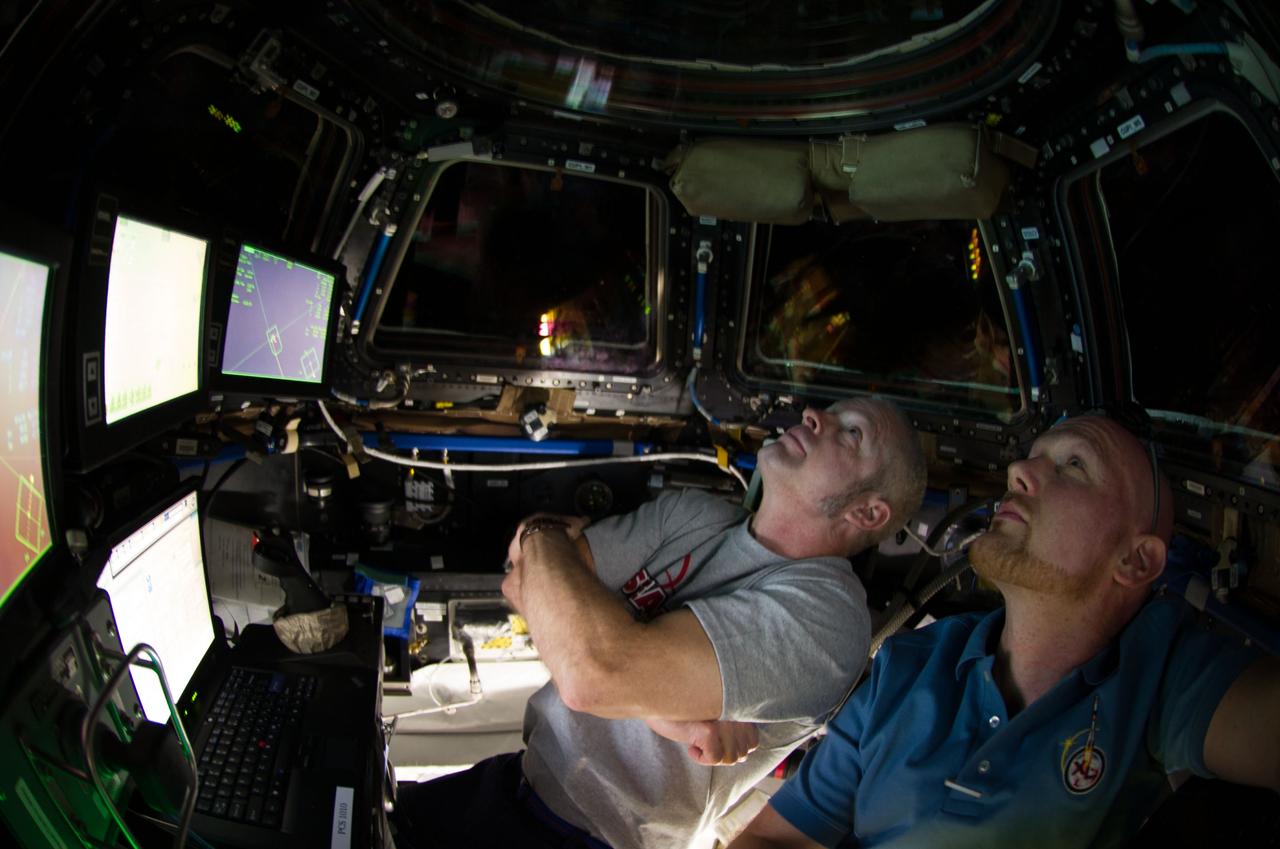
ISS040-E-067869 (16 July 2014) --- NASA astronaut Steve Swanson (left), Expedition 40 commander; and European Space Agency astronaut Alexander Gerst, flight engineer, are pictured in the International Space Station?s Cupola during rendezvous and capture operations of the Orbital Sciences? Cygnus cargo craft.
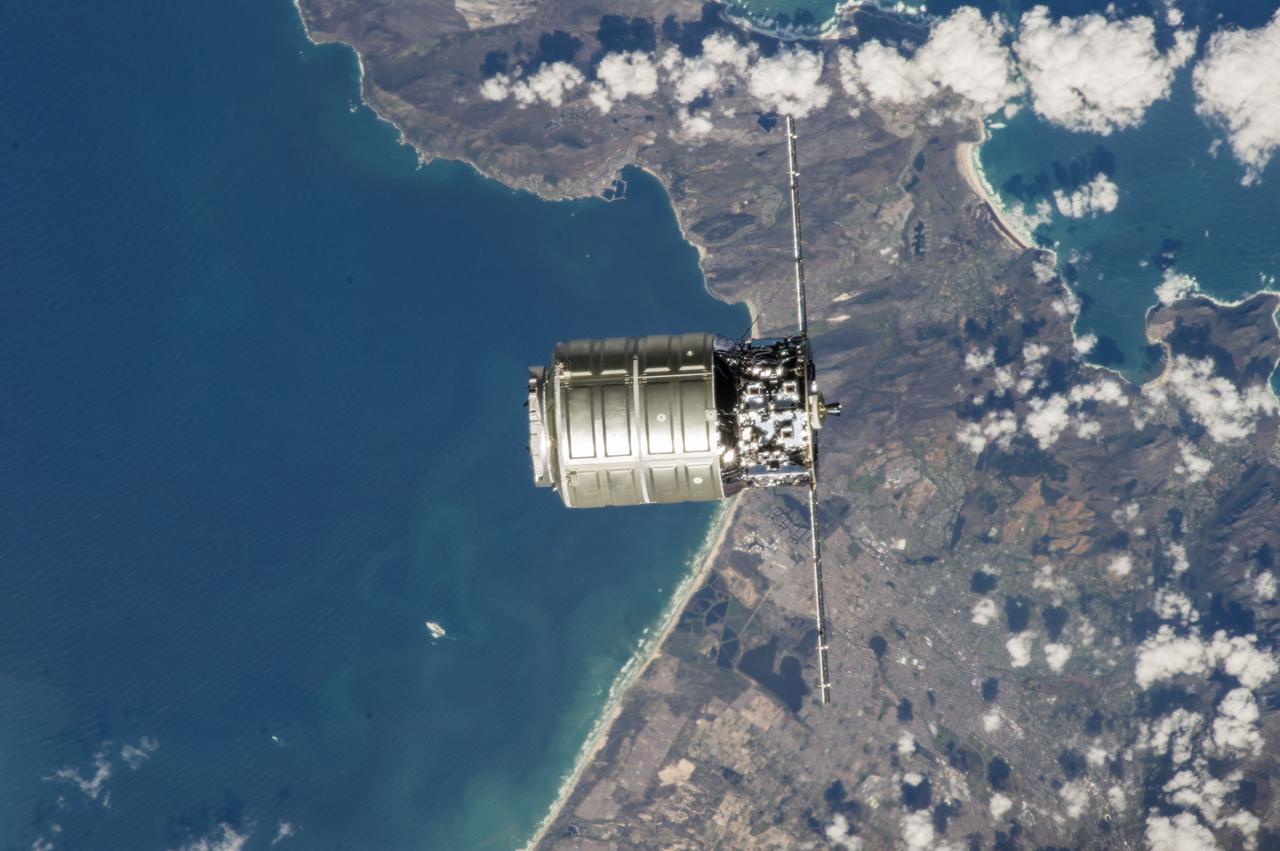
ISS037-E-003534 (29 Sept. 2013) --- The first Cygnus commercial cargo spacecraft built by Orbital Sciences Corp. is photographed by an Expedition 37 crew member on the International Space Station during rendezvous and docking operations. The two spacecraft converged at 7:01 a.m. EDT on Sept. 29, 2013.
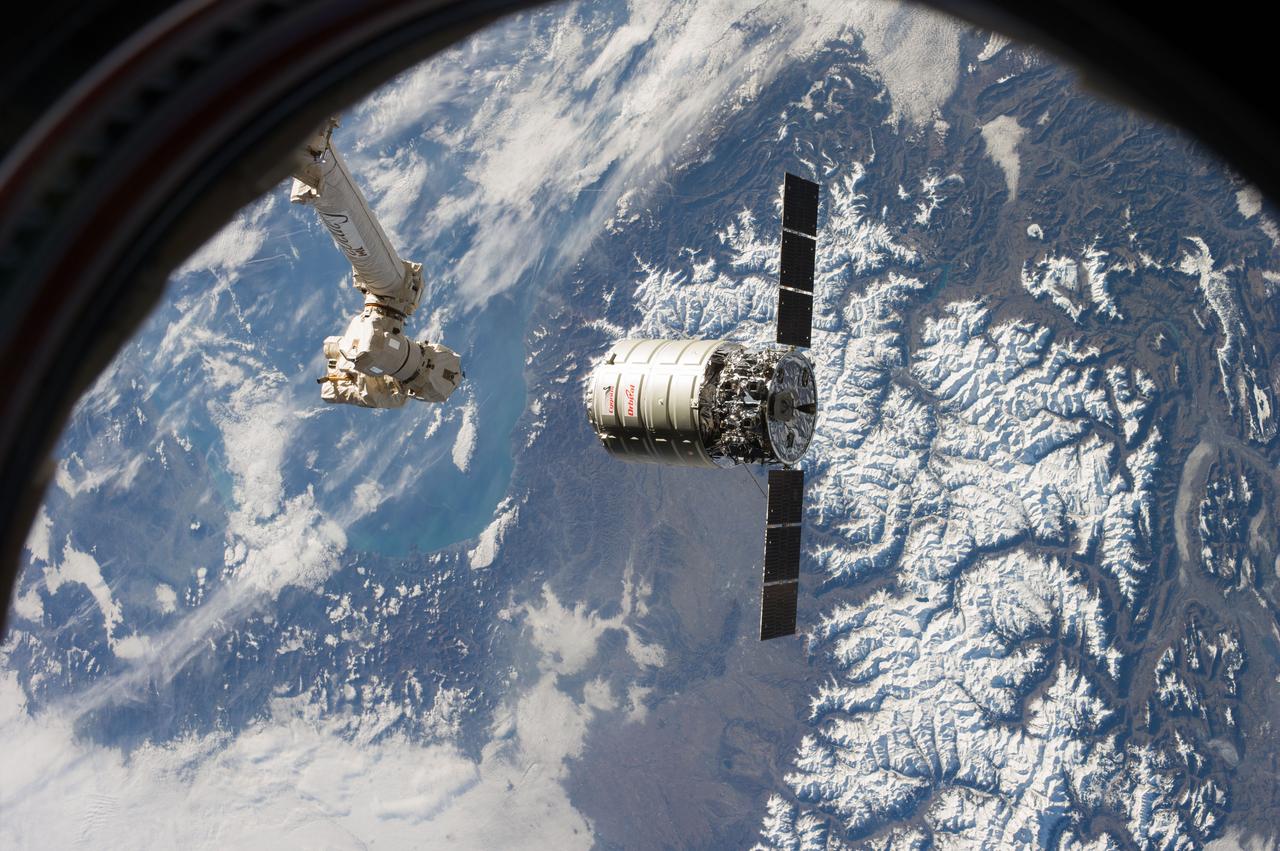
ISS038-E-028044 (12 Jan. 2014) --- The Canadarm2 moves toward the Orbital Sciences Corp. Cygnus commercial cargo craft as it approaches the International Space Station on Jan. 12, 2014. A colorful part of Earth provides the backdrop for the scene.