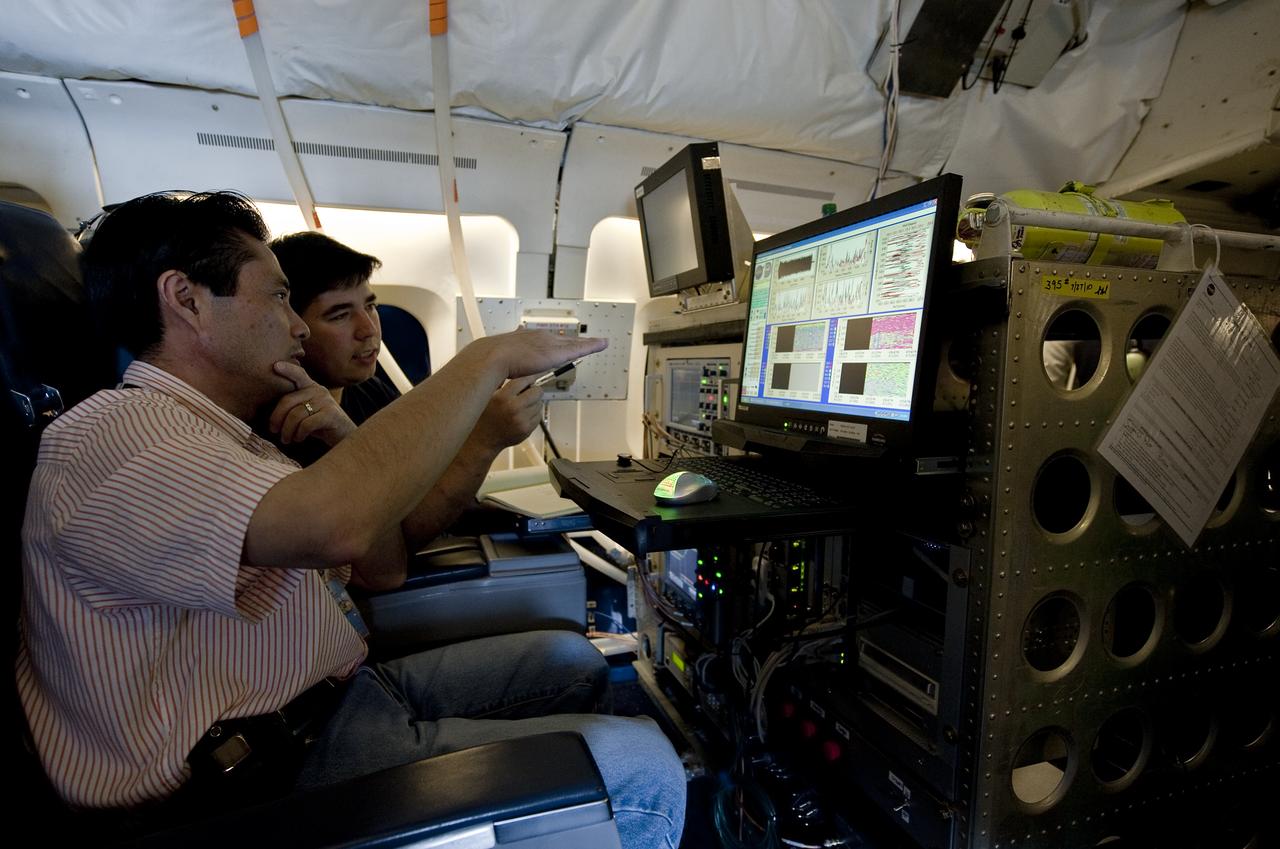
Jeffrey Beyon, left, and Paul Joseph Petzar, right, from NASA's Langley Research Center, work with DAWN Air Data Acquisition and Processing software aboard NASA's DC-8 research aircraft, Sunday, Aug. 15, 2010, in support of the GRIP experiment at Fort Lauderdale International Airport in Fort Lauderdale, Fla. The Genesis and Rapid Intensification Processes (GRIP) experiment is a NASA Earth science field experiment in 2010 that is being conducted to better understand how tropical storms form and develop into major hurricanes. Photo Credit: (NASA/Paul E. Alers)

KENNEDY SPACE CENTER, FLA. -- In the mobile service tower on Launch Pad 17-B at Cape Canaveral Air Force Station, workers remove the transportation canister from around the Dawn spacecraft. After removal of the canister, Dawn will be mated with the waiting Delta II rocket. Dawn is scheduled for launch in a window from 7:25 to 7:54 a.m. EDT Sept. 26 from CCAFS. During its nearly decade-long mission, the Dawn mission will study the asteroid Vesta and dwarf planet Ceres, celestial bodies believed to have accreted early in the history of the solar system. To carry out its scientific mission, the Dawn spacecraft will carry a visible camera, a visible and infrared mapping spectrometer, and a gamma ray and neutron spectrometer, whose data will be used in combination to characterize these bodies. In addition to the three instruments, radiometric and optical navigation data will provide data relating to the gravity field and thus bulk properties and internal structure of the two bodies. Data returned from the Dawn spacecraft could provide opportunities for significant breakthroughs in our knowledge of how the solar system formed. Photo credit: NASA/Jim Grossmann
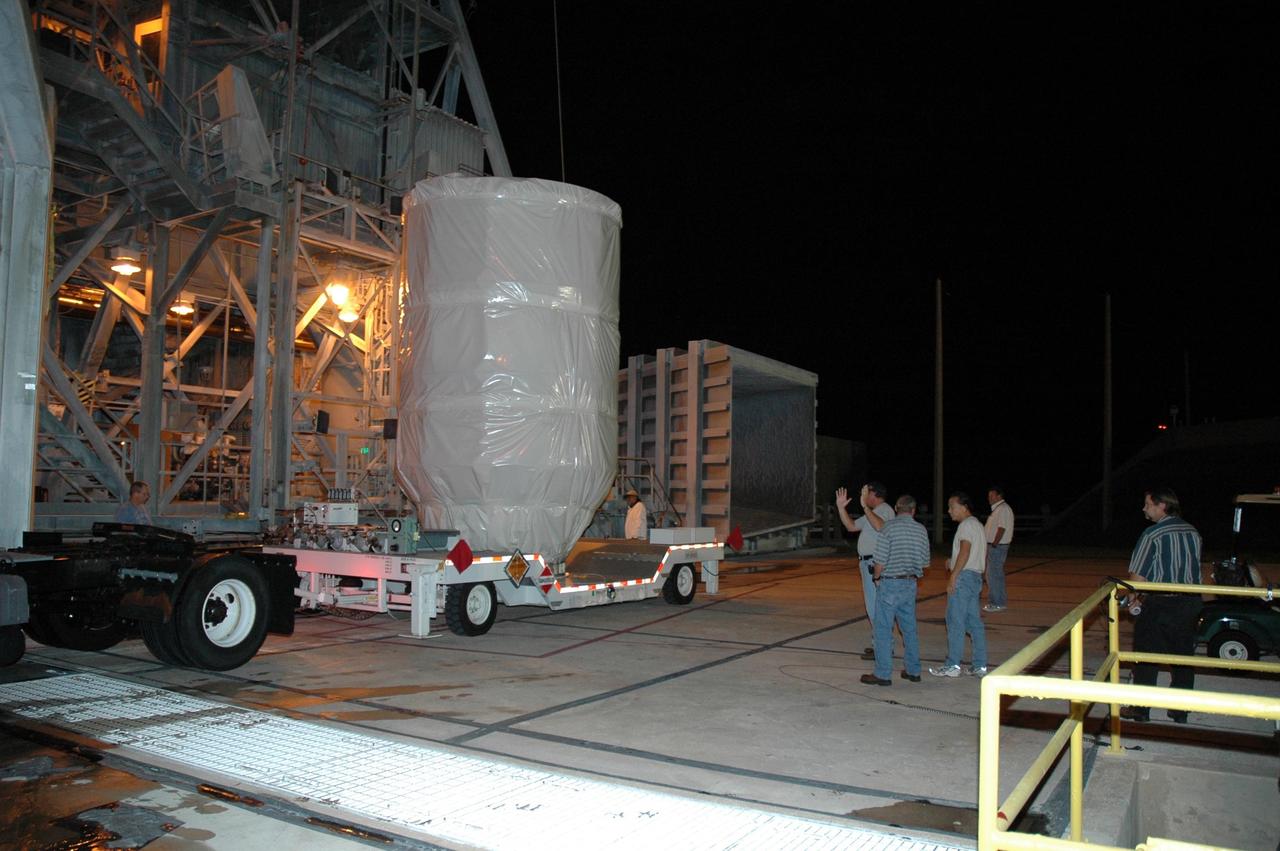
KENNEDY SPACE CENTER, FLA. -- The Dawn spacecraft arrives on Launch Pad 17-B at Cape Canaveral Air Force Station. At the pad, Dawn will be lifted into the mobile service tower and prepared for mating with the awaiting Delta II rocket. Dawn is scheduled for launch in a window from 7:25 to 7:54 a.m. Sept. 26 from CCAFS. During its nearly decade-long mission, the Dawn mission will study the asteroid Vesta and dwarf planet Ceres, celestial bodies believed to have accreted early in the history of the solar system. To carry out its scientific mission, the Dawn spacecraft will carry a visible camera, a visible and infrared mapping spectrometer, and a gamma ray and neutron spectrometer, whose data will be used in combination to characterize these bodies. In addition to the three instruments, radiometric and optical navigation data will provide data relating to the gravity field and thus bulk properties and internal structure of the two bodies. Data returned from the Dawn spacecraft could provide opportunities for significant breakthroughs in our knowledge of how the solar system formed. Photo credit: NASA/Jack Pfaller

KENNEDY SPACE CENTER, FLA. -- On Launch Pad 17-B at Cape Canaveral Air Force Station, the Dawn spacecraft is lowered toward the awaiting Delta II rocket in the mobile service tower. Dawn will be mated with the Delta in preparation for launch. Dawn is scheduled for launch in a window from 7:25 to 7:54 a.m. Sept. 26 from CCAFS. During its nearly decade-long mission, the Dawn mission will study the asteroid Vesta and dwarf planet Ceres, celestial bodies believed to have accreted early in the history of the solar system. To carry out its scientific mission, the Dawn spacecraft will carry a visible camera, a visible and infrared mapping spectrometer, and a gamma ray and neutron spectrometer, whose data will be used in combination to characterize these bodies. In addition to the three instruments, radiometric and optical navigation data will provide data relating to the gravity field and thus bulk properties and internal structure of the two bodies. Data returned from the Dawn spacecraft could provide opportunities for significant breakthroughs in our knowledge of how the solar system formed. Photo credit: NASA/Jack Pfaller
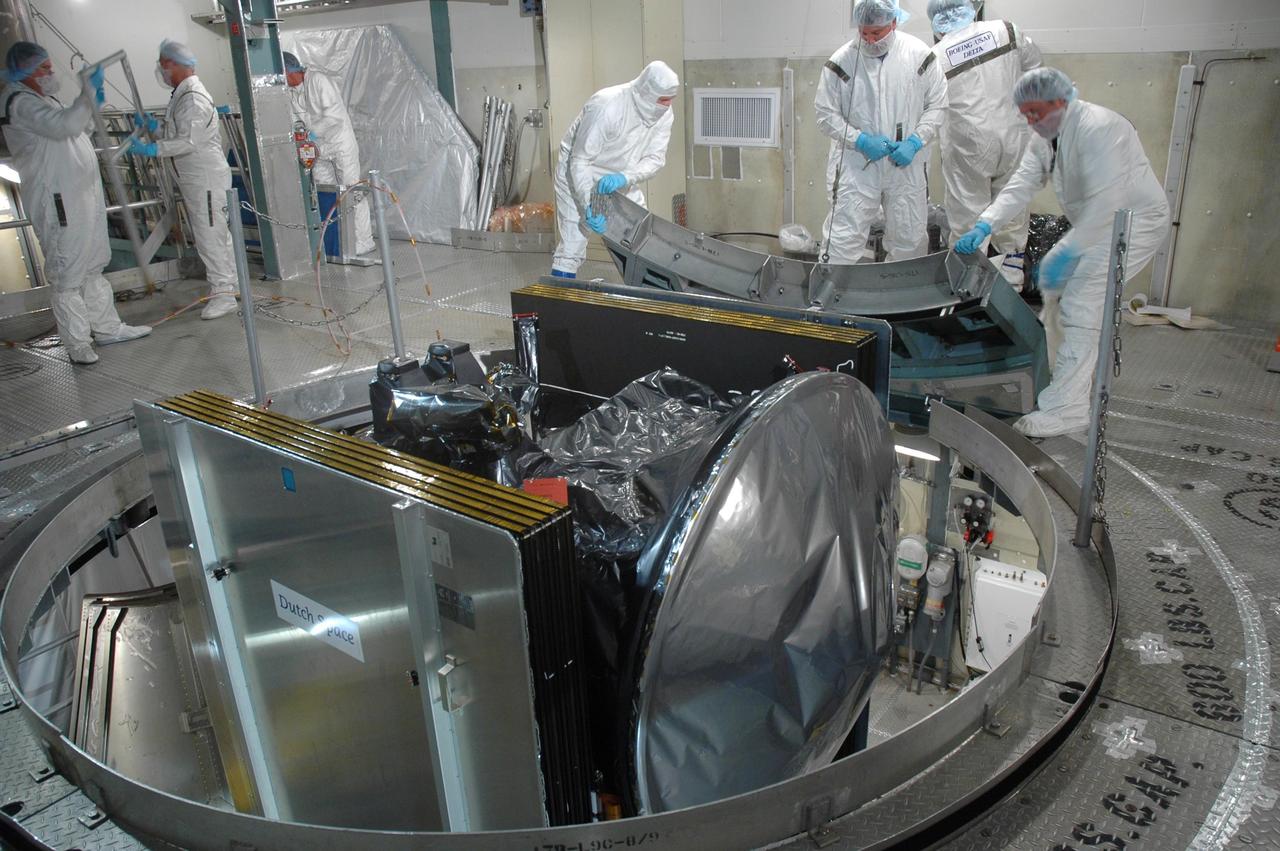
KENNEDY SPACE CENTER, FLA. -- In the mobile service tower on Launch Pad 17-B at Cape Canaveral Air Force Station, workers remove the lower segments of the transportation canister away from the Dawn spacecraft. After removal of the canister, Dawn will be mated with the waiting Delta II rocket. Dawn is scheduled for launch in a window from 7:25 to 7:54 a.m. EDT Sept. 26 from CCAFS. During its nearly decade-long mission, the Dawn mission will study the asteroid Vesta and dwarf planet Ceres, celestial bodies believed to have accreted early in the history of the solar system. To carry out its scientific mission, the Dawn spacecraft will carry a visible camera, a visible and infrared mapping spectrometer, and a gamma ray and neutron spectrometer, whose data will be used in combination to characterize these bodies. In addition to the three instruments, radiometric and optical navigation data will provide data relating to the gravity field and thus bulk properties and internal structure of the two bodies. Data returned from the Dawn spacecraft could provide opportunities for significant breakthroughs in our knowledge of how the solar system formed. Photo credit: NASA/Jim Grossmann
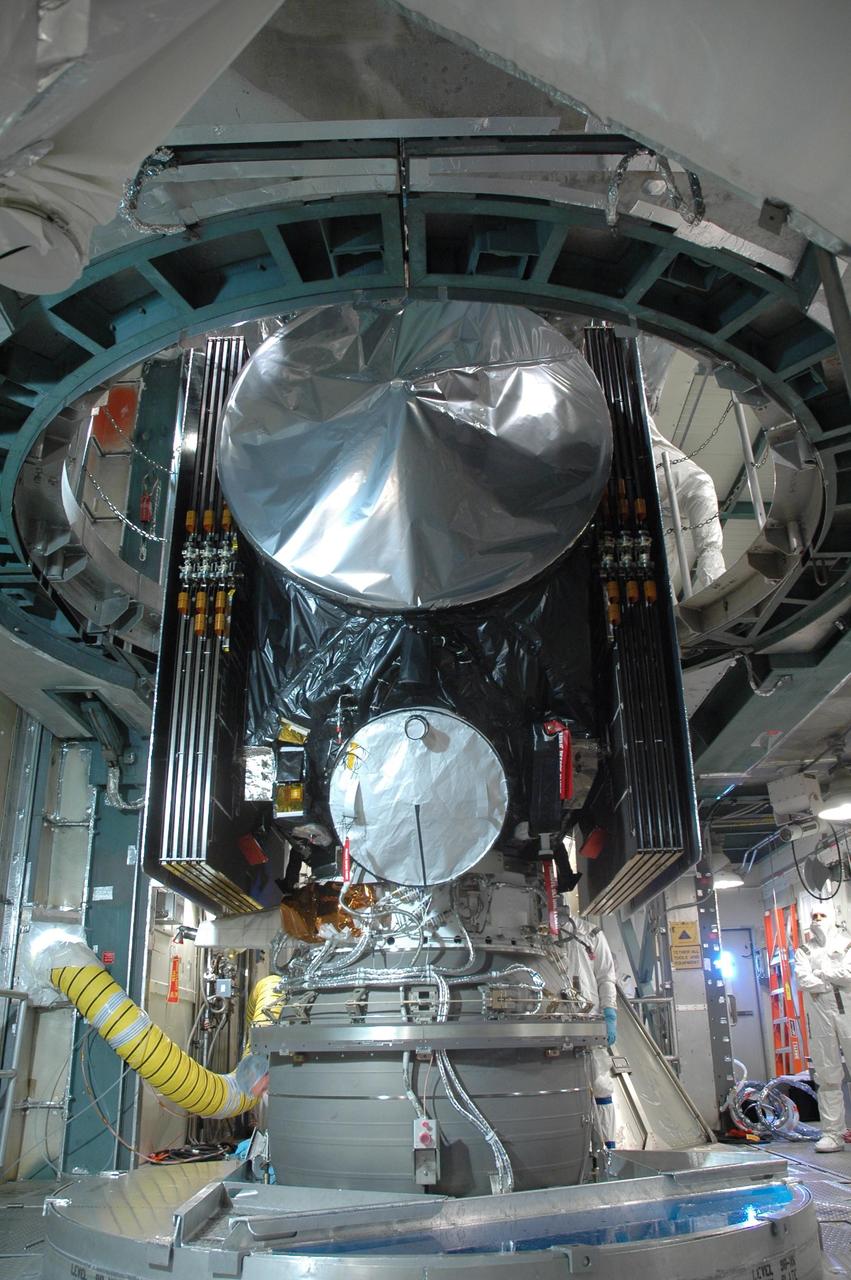
KENNEDY SPACE CENTER, FLA. -- In the mobile service tower on Launch Pad 17-B at Cape Canaveral Air Force Station, the upper transportation canister is lifted away from the Dawn spacecraft. After removal of the canister, Dawn will be mated with the waiting Delta II rocket. Dawn is scheduled for launch in a window from 7:25 to 7:54 a.m. EDT Sept. 26 from CCAFS. During its nearly decade-long mission, the Dawn mission will study the asteroid Vesta and dwarf planet Ceres, celestial bodies believed to have accreted early in the history of the solar system. To carry out its scientific mission, the Dawn spacecraft will carry a visible camera, a visible and infrared mapping spectrometer, and a gamma ray and neutron spectrometer, whose data will be used in combination to characterize these bodies. In addition to the three instruments, radiometric and optical navigation data will provide data relating to the gravity field and thus bulk properties and internal structure of the two bodies. Data returned from the Dawn spacecraft could provide opportunities for significant breakthroughs in our knowledge of how the solar system formed. Photo credit: NASA/Jim Grossmann

KENNEDY SPACE CENTER, FLA. -- On Launch Pad 17-B at Cape Canaveral Air Force Station, workers in the mobile service tower keep watch as the Dawn spacecraft is lowered toward the awaiting Delta II rocket. Dawn will be mated with the Delta in preparation for launch. Dawn is scheduled for launch in a window from 7:25 to 7:54 a.m. Sept. 26 from CCAFS. During its nearly decade-long mission, the Dawn mission will study the asteroid Vesta and dwarf planet Ceres, celestial bodies believed to have accreted early in the history of the solar system. To carry out its scientific mission, the Dawn spacecraft will carry a visible camera, a visible and infrared mapping spectrometer, and a gamma ray and neutron spectrometer, whose data will be used in combination to characterize these bodies. In addition to the three instruments, radiometric and optical navigation data will provide data relating to the gravity field and thus bulk properties and internal structure of the two bodies. Data returned from the Dawn spacecraft could provide opportunities for significant breakthroughs in our knowledge of how the solar system formed. Photo credit: NASA/Jack Pfaller
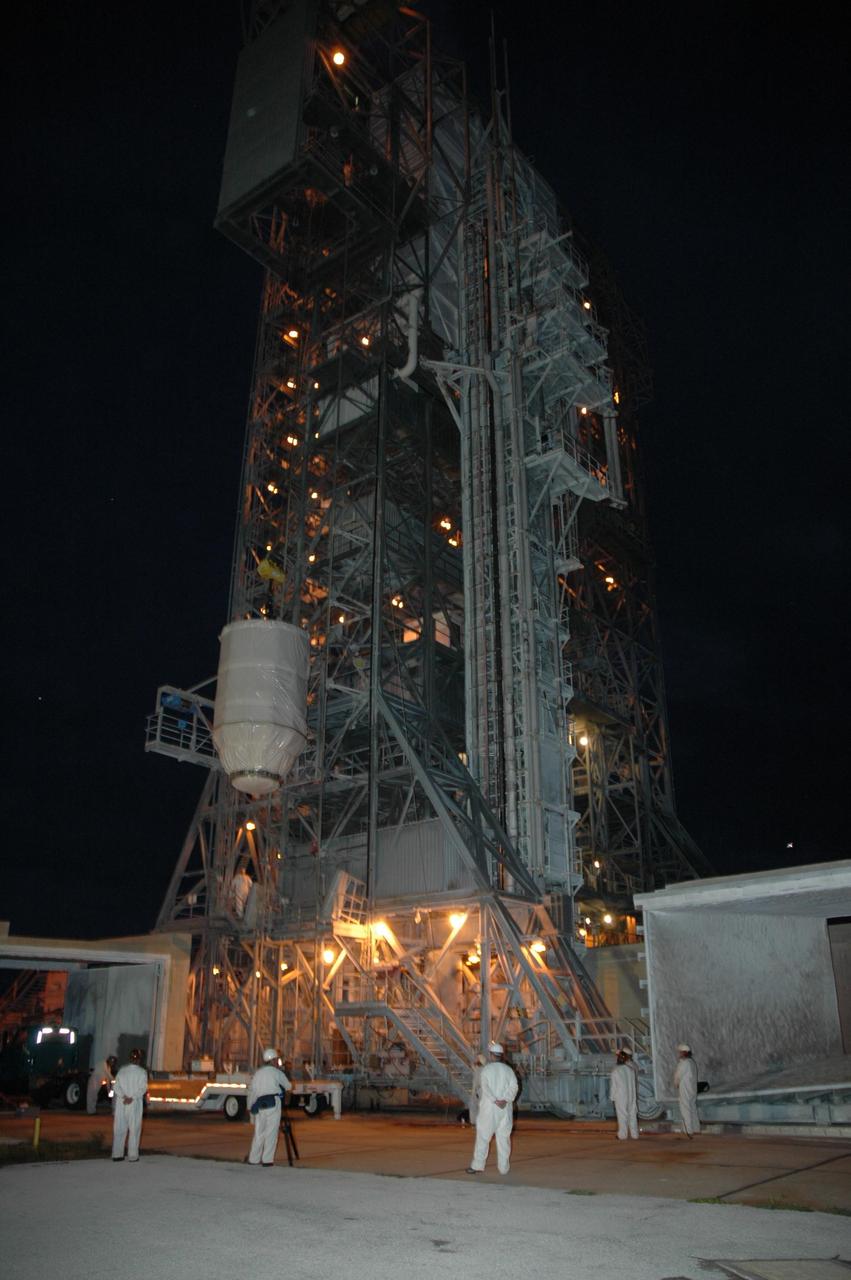
KENNEDY SPACE CENTER, FLA. -- On Launch Pad 17-B at Cape Canaveral Air Force Station, the Dawn spacecraft is lifted alongside the mobile service tower. At the top, Dawn will be prepared for mating with the awaiting Delta II rocket. Dawn is scheduled for launch in a window from 7:25 to 7:54 a.m. Sept. 26 from CCAFS. During its nearly decade-long mission, the Dawn mission will study the asteroid Vesta and dwarf planet Ceres, celestial bodies believed to have accreted early in the history of the solar system. To carry out its scientific mission, the Dawn spacecraft will carry a visible camera, a visible and infrared mapping spectrometer, and a gamma ray and neutron spectrometer, whose data will be used in combination to characterize these bodies. In addition to the three instruments, radiometric and optical navigation data will provide data relating to the gravity field and thus bulk properties and internal structure of the two bodies. Data returned from the Dawn spacecraft could provide opportunities for significant breakthroughs in our knowledge of how the solar system formed. Photo credit: NASA/Jack Pfaller
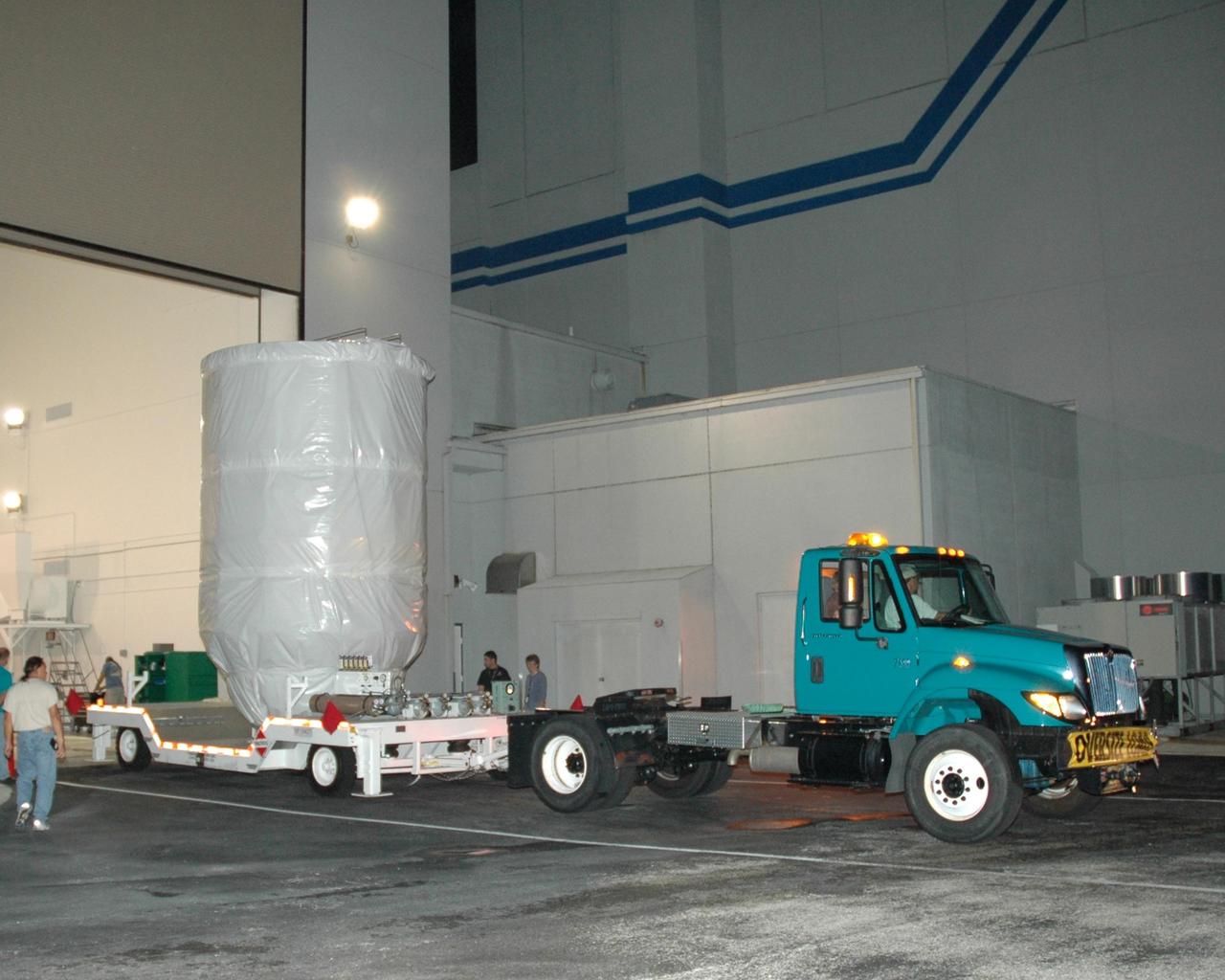
KENNEDY SPACE CENTER, FLA. -- The Dawn spacecraft is moved out of the Astrotech Space Operations facility, on its way to Launch Pad 17-B at Cape Canaveral Air Force Station. At the pad, Dawn will be lifted into the mobile service tower and prepared for mating with the awaiting Delta II rocket. Dawn is scheduled for launch in a window from 7:25 to 7:54 a.m. Sept. 26 from CCAFS. During its nearly decade-long mission, the Dawn mission will study the asteroid Vesta and dwarf planet Ceres, celestial bodies believed to have accreted early in the history of the solar system. To carry out its scientific mission, the Dawn spacecraft will carry a visible camera, a visible and infrared mapping spectrometer, and a gamma ray and neutron spectrometer, whose data will be used in combination to characterize these bodies. In addition to the three instruments, radiometric and optical navigation data will provide data relating to the gravity field and thus bulk properties and internal structure of the two bodies. Data returned from the Dawn spacecraft could provide opportunities for significant breakthroughs in our knowledge of how the solar system formed. Photo credit: NASA/Jack Pfaller
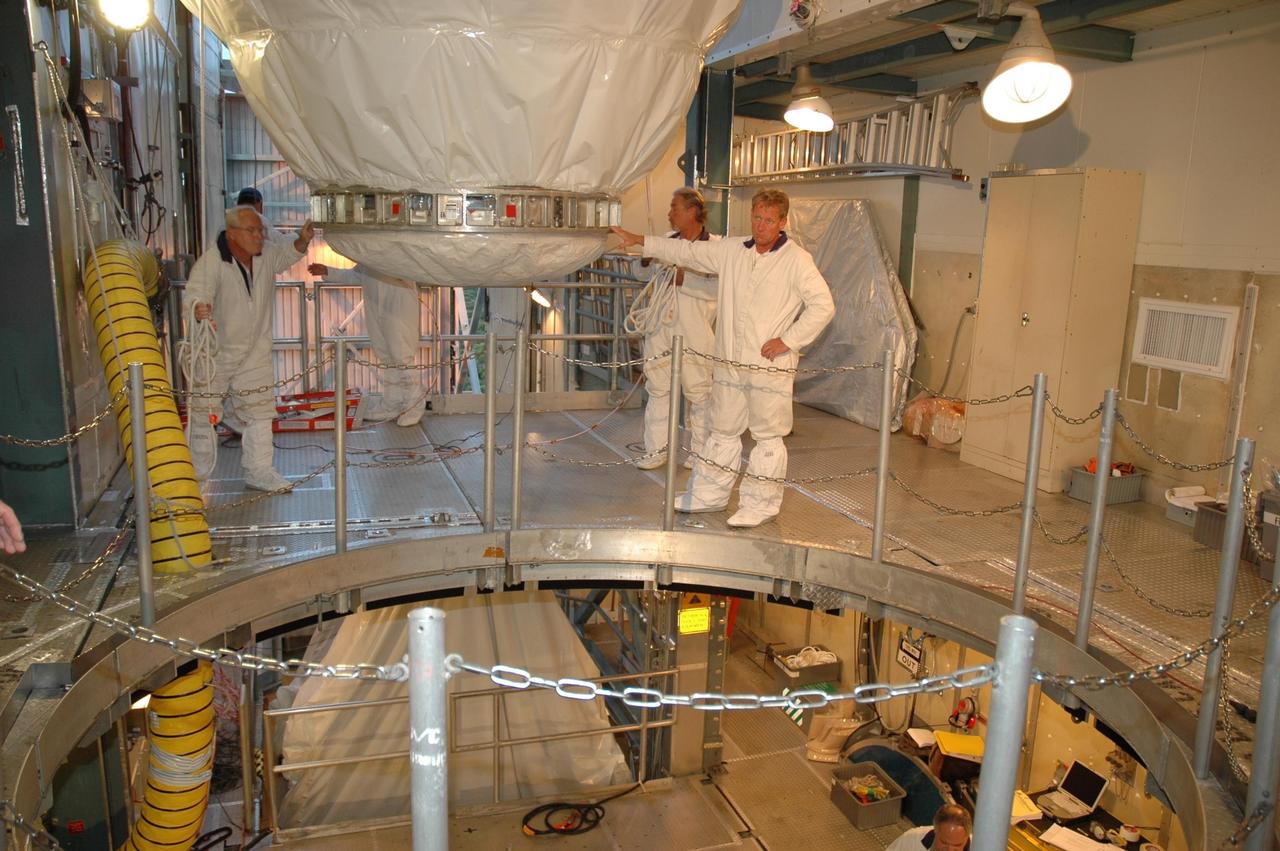
KENNEDY SPACE CENTER, FLA. -- On Launch Pad 17-B at Cape Canaveral Air Force Station, the Dawn spacecraft is moved toward the opening above the Delta II rocket in the mobile service tower. Dawn will be mated with the Delta in preparation for launch. Dawn is scheduled for launch in a window from 7:25 to 7:54 a.m. Sept. 26 from CCAFS. During its nearly decade-long mission, the Dawn mission will study the asteroid Vesta and dwarf planet Ceres, celestial bodies believed to have accreted early in the history of the solar system. To carry out its scientific mission, the Dawn spacecraft will carry a visible camera, a visible and infrared mapping spectrometer, and a gamma ray and neutron spectrometer, whose data will be used in combination to characterize these bodies. In addition to the three instruments, radiometric and optical navigation data will provide data relating to the gravity field and thus bulk properties and internal structure of the two bodies. Data returned from the Dawn spacecraft could provide opportunities for significant breakthroughs in our knowledge of how the solar system formed. Photo credit: NASA/Jack Pfaller

KENNEDY SPACE CENTER, FLA. -- On Launch Pad 17-B at Cape Canaveral Air Force Station, the Dawn spacecraft is lifted alongside the mobile service tower. At the top, Dawn will be prepared for mating with the awaiting Delta II rocket. Dawn is scheduled for launch in a window from 7:25 to 7:54 a.m. Sept. 26 from CCAFS. During its nearly decade-long mission, the Dawn mission will study the asteroid Vesta and dwarf planet Ceres, celestial bodies believed to have accreted early in the history of the solar system. To carry out its scientific mission, the Dawn spacecraft will carry a visible camera, a visible and infrared mapping spectrometer, and a gamma ray and neutron spectrometer, whose data will be used in combination to characterize these bodies. In addition to the three instruments, radiometric and optical navigation data will provide data relating to the gravity field and thus bulk properties and internal structure of the two bodies. Data returned from the Dawn spacecraft could provide opportunities for significant breakthroughs in our knowledge of how the solar system formed. Photo credit: NASA/Jack Pfaller
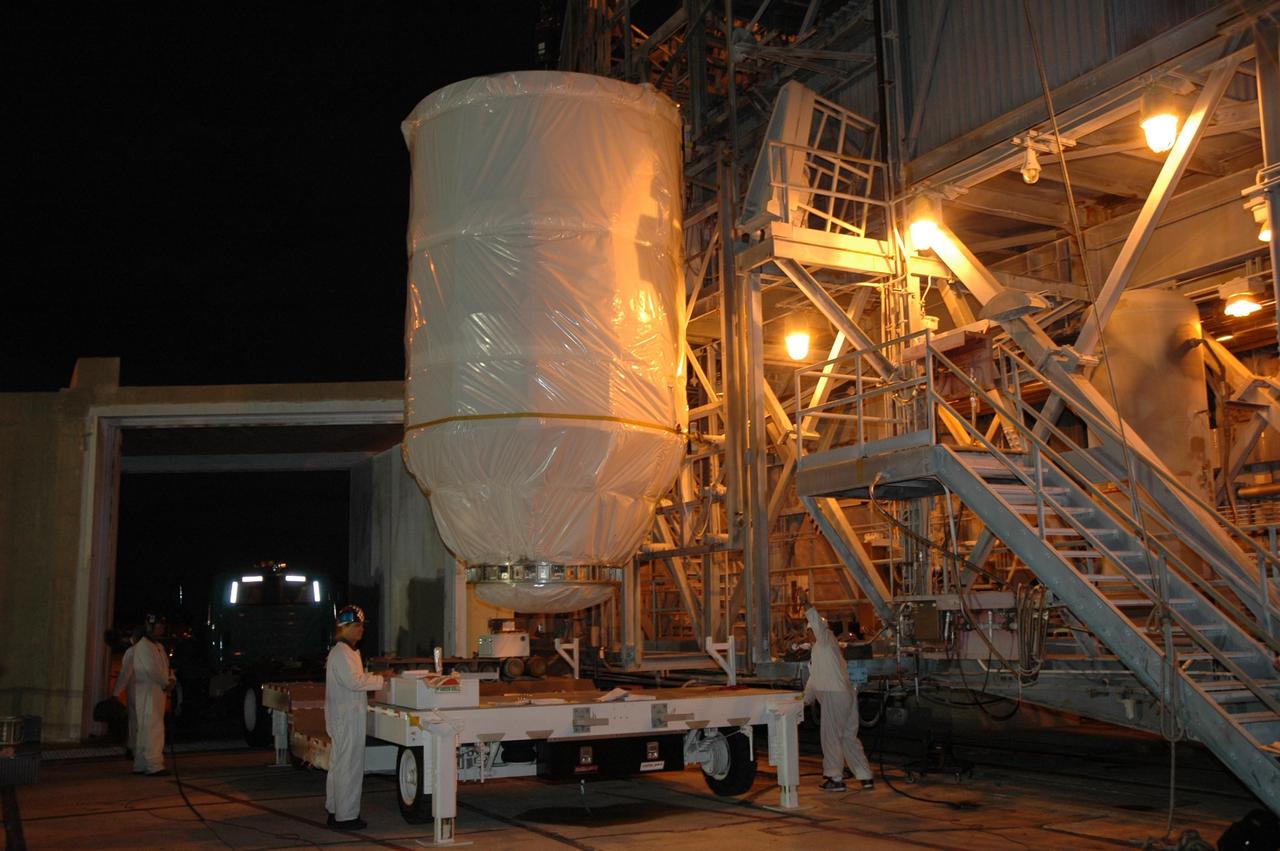
KENNEDY SPACE CENTER, FLA. -- On Launch Pad 17-B at Cape Canaveral Air Force Station, the Dawn spacecraft is lifted off its transporter. Dawn will be lifted into the mobile service tower and prepared for mating with the awaiting Delta II rocket.Dawn is scheduled for launch in a window from 7:25 to 7:54 a.m. Sept. 26 from CCAFS. During its nearly decade-long mission, the Dawn mission will study the asteroid Vesta and dwarf planet Ceres, celestial bodies believed to have accreted early in the history of the solar system. To carry out its scientific mission, the Dawn spacecraft will carry a visible camera, a visible and infrared mapping spectrometer, and a gamma ray and neutron spectrometer, whose data will be used in combination to characterize these bodies. In addition to the three instruments, radiometric and optical navigation data will provide data relating to the gravity field and thus bulk properties and internal structure of the two bodies. Data returned from the Dawn spacecraft could provide opportunities for significant breakthroughs in our knowledge of how the solar system formed. Photo credit: NASA/Jack Pfaller
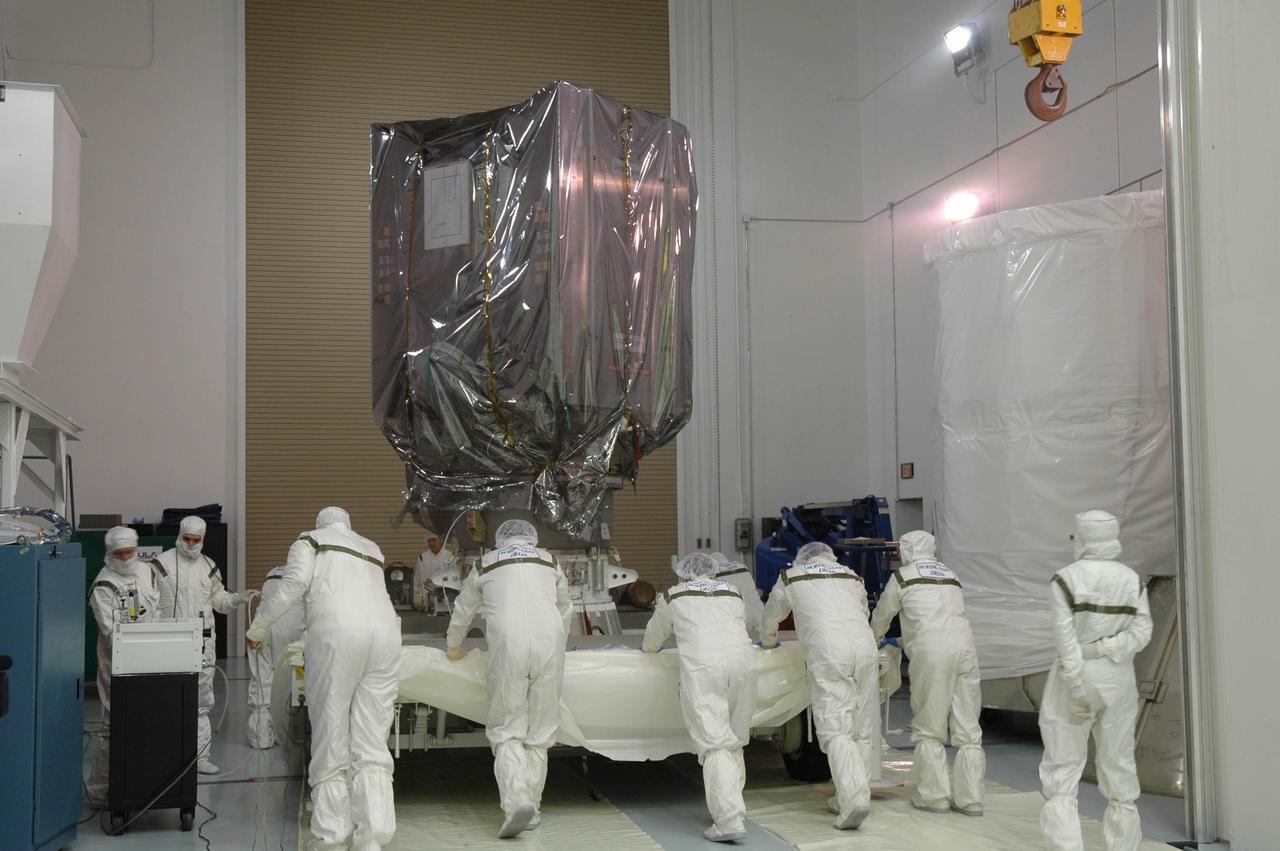
KENNEDY SPACE CENTER, FLA. -- At Astrotech Space Operations in Titusville, Fla., workers move the platform with the Dawn spacecraft. They are preparing to install the transportation canister around Dawn for transfer to Launch Pad 17-B at Cape Canaveral Air Force Station (CCAFS). During its nearly decade-long mission, the Dawn mission will study the asteroid Vesta and dwarf planet Ceres, celestial bodies believed to have accreted early in the history of the solar system. To carry out its scientific mission, the Dawn spacecraft will carry a visible camera, a visible and infrared mapping spectrometer, and a gamma ray and neutron spectrometer, whose data will be used in combination to characterize these bodies. In addition to the three instruments, radiometric and optical navigation data will provide data relating to the gravity field and thus bulk properties and internal structure of the two bodies. Data returned from the Dawn spacecraft could provide opportunities for significant breakthroughs in our knowledge of how the solar system formed. Launch via a Delta II rocket is scheduled in a window from 7:25 to 7:54 a.m. Sept. 26 from CCAFS. Photo credit: NASA/Jim Grossmann

KENNEDY SPACE CENTER, FLA. -- On Launch Pad 17-B at Cape Canaveral Air Force Station, the Dawn spacecraft arrives at the upper level of the mobile service tower. It will be moved inside and prepared for mating with the awaiting Delta II rocket. Dawn is scheduled for launch in a window from 7:25 to 7:54 a.m. Sept. 26 from CCAFS. During its nearly decade-long mission, the Dawn mission will study the asteroid Vesta and dwarf planet Ceres, celestial bodies believed to have accreted early in the history of the solar system. To carry out its scientific mission, the Dawn spacecraft will carry a visible camera, a visible and infrared mapping spectrometer, and a gamma ray and neutron spectrometer, whose data will be used in combination to characterize these bodies. In addition to the three instruments, radiometric and optical navigation data will provide data relating to the gravity field and thus bulk properties and internal structure of the two bodies. Data returned from the Dawn spacecraft could provide opportunities for significant breakthroughs in our knowledge of how the solar system formed. Photo credit: NASA/Jack Pfaller
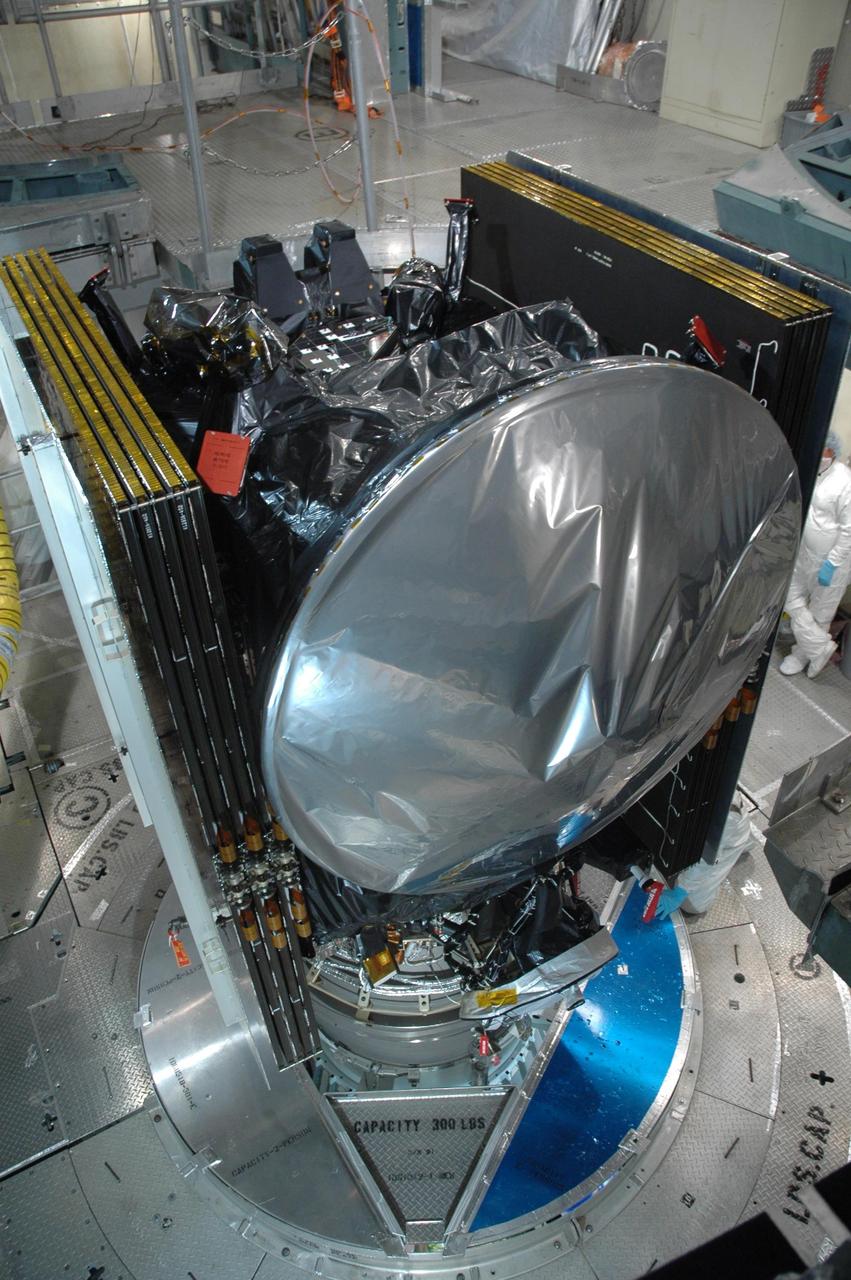
KENNEDY SPACE CENTER, FLA. -- In the mobile service tower on Launch Pad 17-B at Cape Canaveral Air Force Station, the Dawn spacecraft is ready for mating with the waiting Delta II rocket. Dawn is scheduled for launch in a window from 7:25 to 7:54 a.m. EDT Sept. 26 from CCAFS. During its nearly decade-long mission, the Dawn mission will study the asteroid Vesta and dwarf planet Ceres, celestial bodies believed to have accreted early in the history of the solar system. To carry out its scientific mission, the Dawn spacecraft will carry a visible camera, a visible and infrared mapping spectrometer, and a gamma ray and neutron spectrometer, whose data will be used in combination to characterize these bodies. In addition to the three instruments, radiometric and optical navigation data will provide data relating to the gravity field and thus bulk properties and internal structure of the two bodies. Data returned from the Dawn spacecraft could provide opportunities for significant breakthroughs in our knowledge of how the solar system formed. Photo credit: NASA/Jim Grossmann
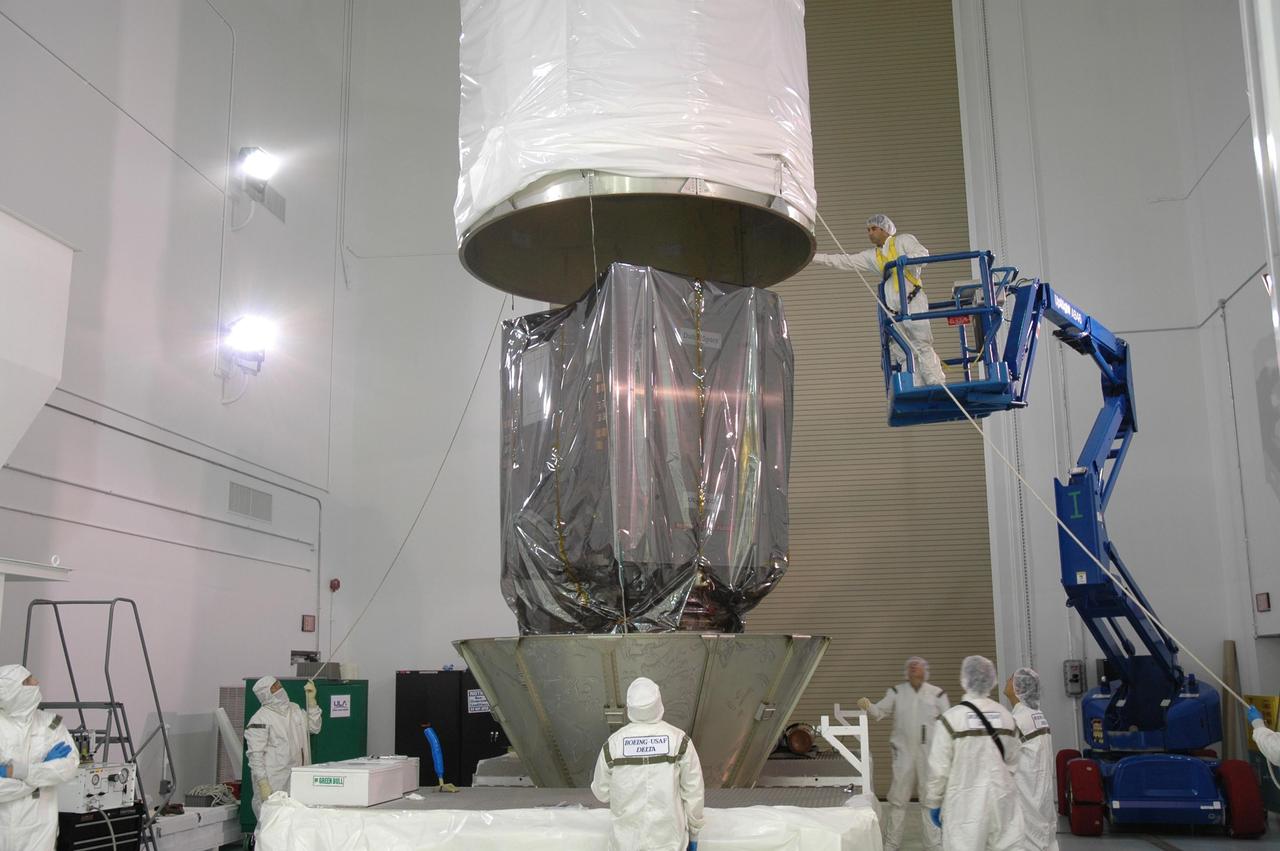
KENNEDY SPACE CENTER, FLA. -- At Astrotech Space Operations in Titusville, Fla., workers guide the upper transportation canister as it is lowered onto the Dawn spacecraft. The canister will be attached to the bottom segments already in place. The canister will protect the spacecraft and booster during transfer to Launch Pad 17-B at Cape Canaveral Air Force Station (CCAFS). During its nearly decade-long mission, the Dawn mission will study the asteroid Vesta and dwarf planet Ceres, celestial bodies believed to have accreted early in the history of the solar system. To carry out its scientific mission, the Dawn spacecraft will carry a visible camera, a visible and infrared mapping spectrometer, and a gamma ray and neutron spectrometer, whose data will be used in combination to characterize these bodies. In addition to the three instruments, radiometric and optical navigation data will provide data relating to the gravity field and thus bulk properties and internal structure of the two bodies. Data returned from the Dawn spacecraft could provide opportunities for significant breakthroughs in our knowledge of how the solar system formed. Launch via a Delta II rocket is scheduled in a window from 7:25 to 7:54 a.m. Sept. 26 from CCAFS. Photo credit: NASA/Jim Grossmann
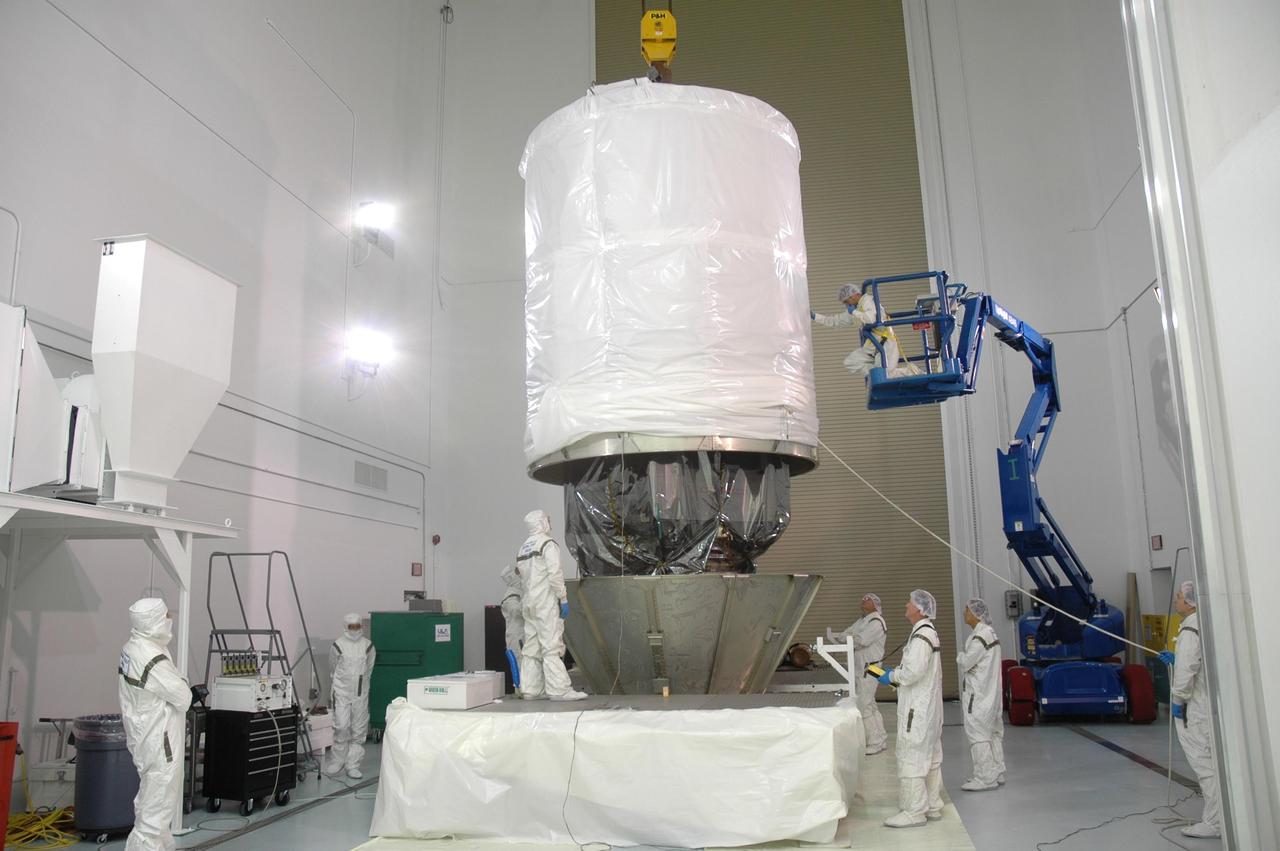
KENNEDY SPACE CENTER, FLA. -- At Astrotech Space Operations in Titusville, Fla., workers watch as the upper transportation canister is lowered over the Dawn spacecraft. The canister will be attached to the bottom segments already in place. The canister will protect the spacecraft and booster during transfer to Launch Pad 17-B at Cape Canaveral Air Force Station (CCAFS). During its nearly decade-long mission, the Dawn mission will study the asteroid Vesta and dwarf planet Ceres, celestial bodies believed to have accreted early in the history of the solar system. To carry out its scientific mission, the Dawn spacecraft will carry a visible camera, a visible and infrared mapping spectrometer, and a gamma ray and neutron spectrometer, whose data will be used in combination to characterize these bodies. In addition to the three instruments, radiometric and optical navigation data will provide data relating to the gravity field and thus bulk properties and internal structure of the two bodies. Data returned from the Dawn spacecraft could provide opportunities for significant breakthroughs in our knowledge of how the solar system formed. Launch via a Delta II rocket is scheduled in a window from 7:25 to 7:54 a.m. Sept. 26 from CCAFS. Photo credit: NASA/Jim Grossmann
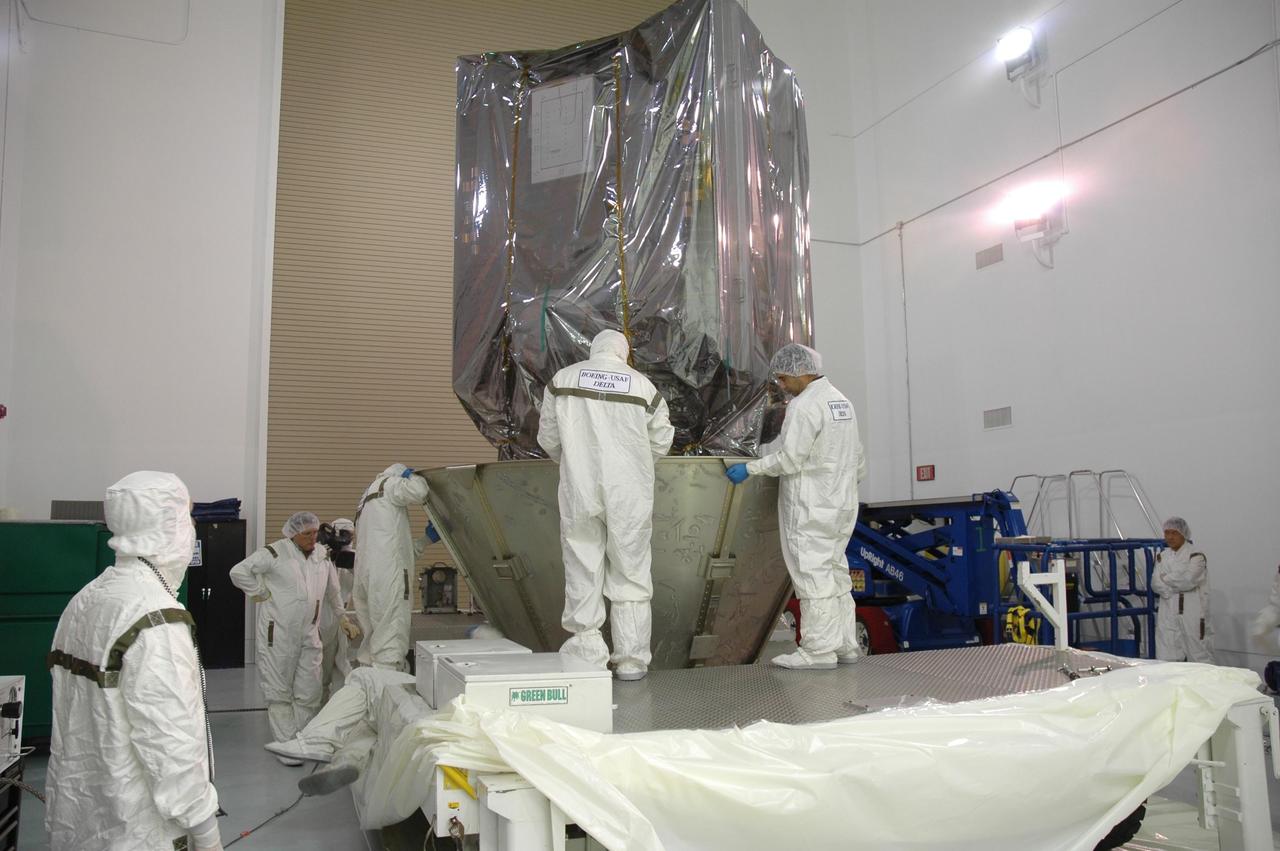
KENNEDY SPACE CENTER, FLA. -- At Astrotech Space Operations in Titusville, Fla., workers place the lower segments of the transportation canister around the upper stage booster beneath the Dawn spacecraft. The canister will protect the spacecraft and booster during transfer to Launch Pad 17-B at Cape Canaveral Air Force Station (CCAFS). During its nearly decade-long mission, the Dawn mission will study the asteroid Vesta and dwarf planet Ceres, celestial bodies believed to have accreted early in the history of the solar system. To carry out its scientific mission, the Dawn spacecraft will carry a visible camera, a visible and infrared mapping spectrometer, and a gamma ray and neutron spectrometer, whose data will be used in combination to characterize these bodies. In addition to the three instruments, radiometric and optical navigation data will provide data relating to the gravity field and thus bulk properties and internal structure of the two bodies. Data returned from the Dawn spacecraft could provide opportunities for significant breakthroughs in our knowledge of how the solar system formed. Launch via a Delta II rocket is scheduled in a window from 7:25 to 7:54 a.m. Sept. 26 from CCAFS. Photo credit: NASA/Jim Grossmann
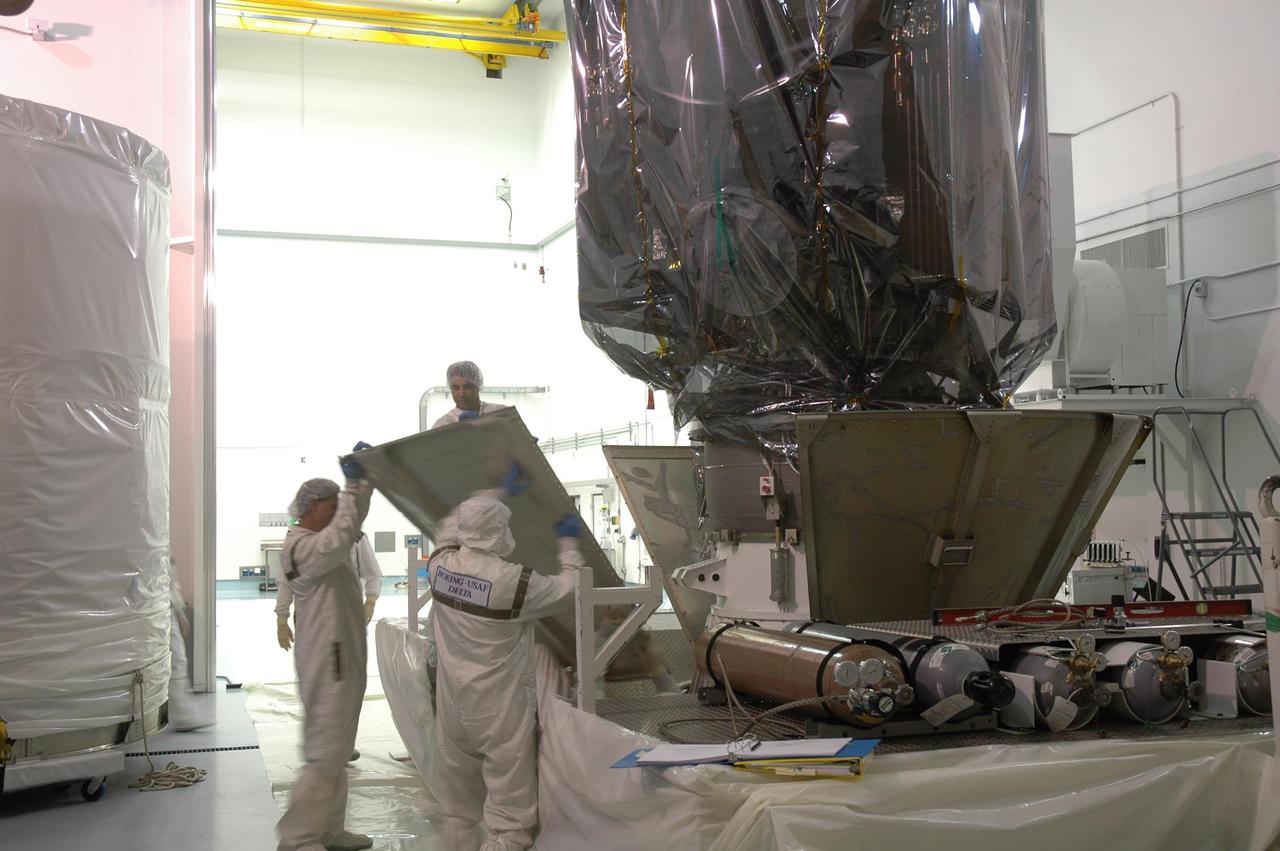
KENNEDY SPACE CENTER, FLA. -- At Astrotech Space Operations in Titusville, Fla., workers place another segment of the transportation canister around the upper stage booster beneath the Dawn spacecraft. The canister will protect the spacecraft and booster during transfer to Launch Pad 17-B at Cape Canaveral Air Force Station (CCAFS). During its nearly decade-long mission, the Dawn mission will study the asteroid Vesta and dwarf planet Ceres, celestial bodies believed to have accreted early in the history of the solar system. To carry out its scientific mission, the Dawn spacecraft will carry a visible camera, a visible and infrared mapping spectrometer, and a gamma ray and neutron spectrometer, whose data will be used in combination to characterize these bodies. In addition to the three instruments, radiometric and optical navigation data will provide data relating to the gravity field and thus bulk properties and internal structure of the two bodies. Data returned from the Dawn spacecraft could provide opportunities for significant breakthroughs in our knowledge of how the solar system formed. Launch via a Delta II rocket is scheduled in a window from 7:25 to 7:54 a.m. Sept. 26 from CCAFS. Photo credit: NASA/Jim Grossmann
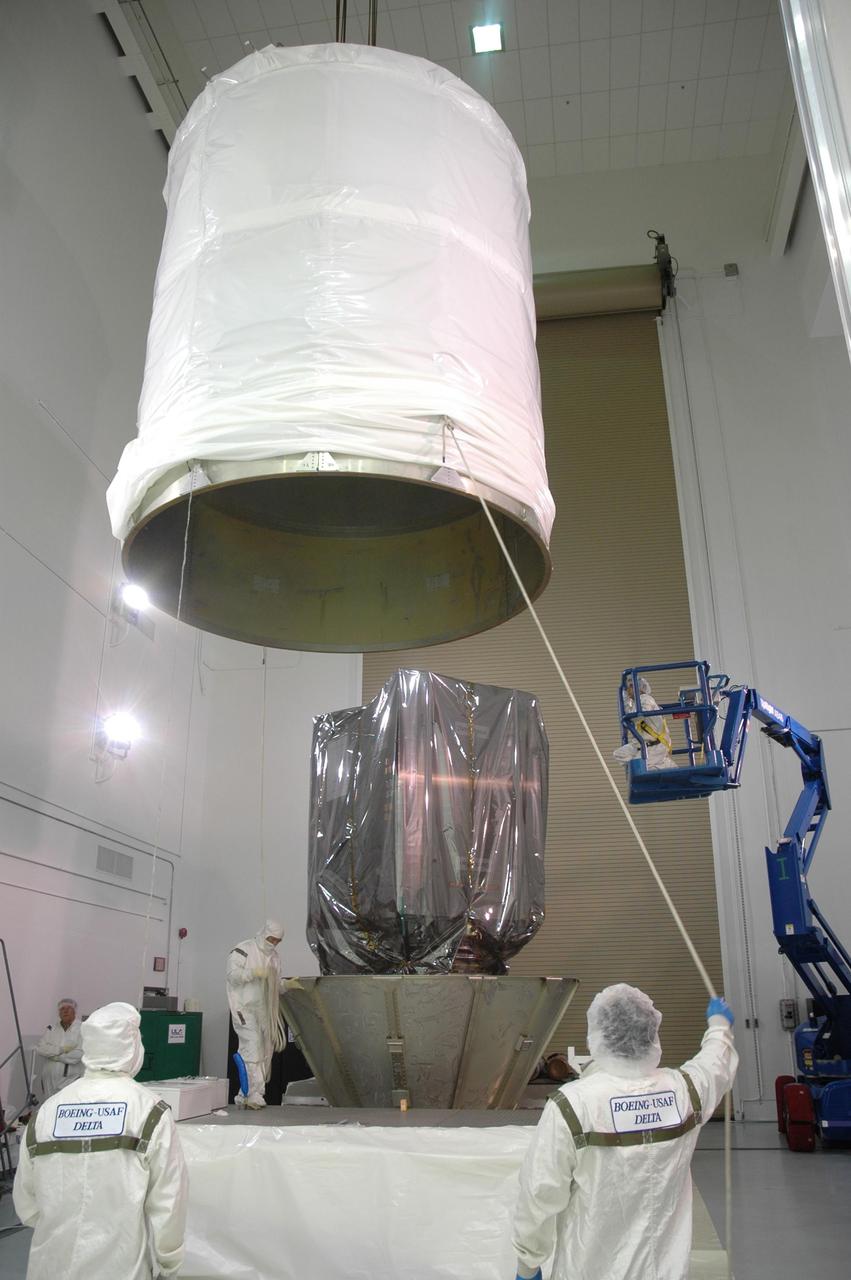
KENNEDY SPACE CENTER, FLA. -- At Astrotech Space Operations in Titusville, Fla., workers guide the upper transportation canister toward the Dawn spacecraft in the background. The canister will be lowered onto the lower segments and attached. The canister will protect the spacecraft and booster during transfer to Launch Pad 17-B at Cape Canaveral Air Force Station (CCAFS). During its nearly decade-long mission, the Dawn mission will study the asteroid Vesta and dwarf planet Ceres, celestial bodies believed to have accreted early in the history of the solar system. To carry out its scientific mission, the Dawn spacecraft will carry a visible camera, a visible and infrared mapping spectrometer, and a gamma ray and neutron spectrometer, whose data will be used in combination to characterize these bodies. In addition to the three instruments, radiometric and optical navigation data will provide data relating to the gravity field and thus bulk properties and internal structure of the two bodies. Data returned from the Dawn spacecraft could provide opportunities for significant breakthroughs in our knowledge of how the solar system formed. Launch via a Delta II rocket is scheduled in a window from 7:25 to 7:54 a.m. Sept. 26 from CCAFS. Photo credit: NASA/Jim Grossmann
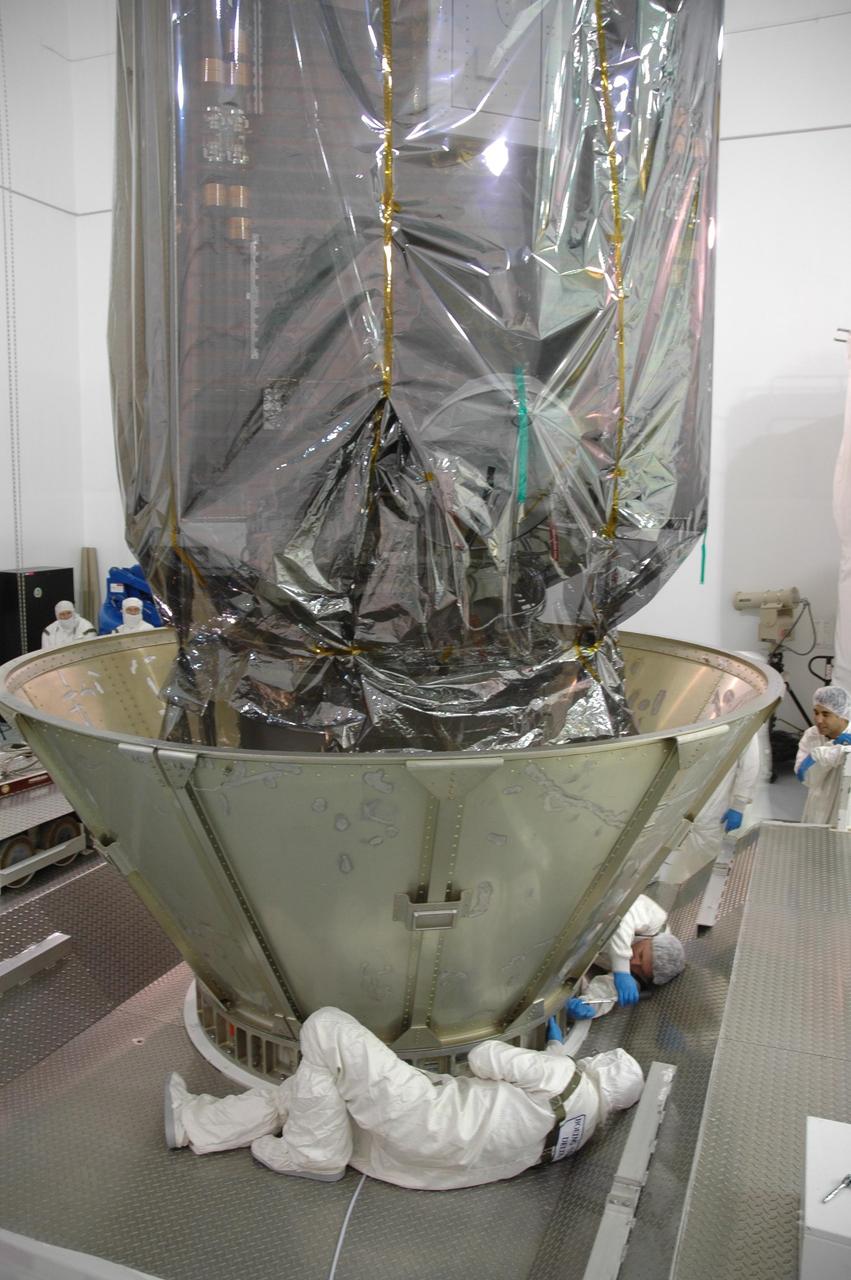
KENNEDY SPACE CENTER, FLA. -- At Astrotech Space Operations in Titusville, Fla., workers check the fitting on the lower transportation canister segments in place around the upper stage booster beneath the Dawn spacecraft. The canister will protect the spacecraft and booster during transfer to Launch Pad 17-B at Cape Canaveral Air Force Station (CCAFS). During its nearly decade-long mission, the Dawn mission will study the asteroid Vesta and dwarf planet Ceres, celestial bodies believed to have accreted early in the history of the solar system. To carry out its scientific mission, the Dawn spacecraft will carry a visible camera, a visible and infrared mapping spectrometer, and a gamma ray and neutron spectrometer, whose data will be used in combination to characterize these bodies. In addition to the three instruments, radiometric and optical navigation data will provide data relating to the gravity field and thus bulk properties and internal structure of the two bodies. Data returned from the Dawn spacecraft could provide opportunities for significant breakthroughs in our knowledge of how the solar system formed. Launch via a Delta II rocket is scheduled in a window from 7:25 to 7:54 a.m. Sept. 26 from CCAFS. Photo credit: NASA/Jim Grossmann
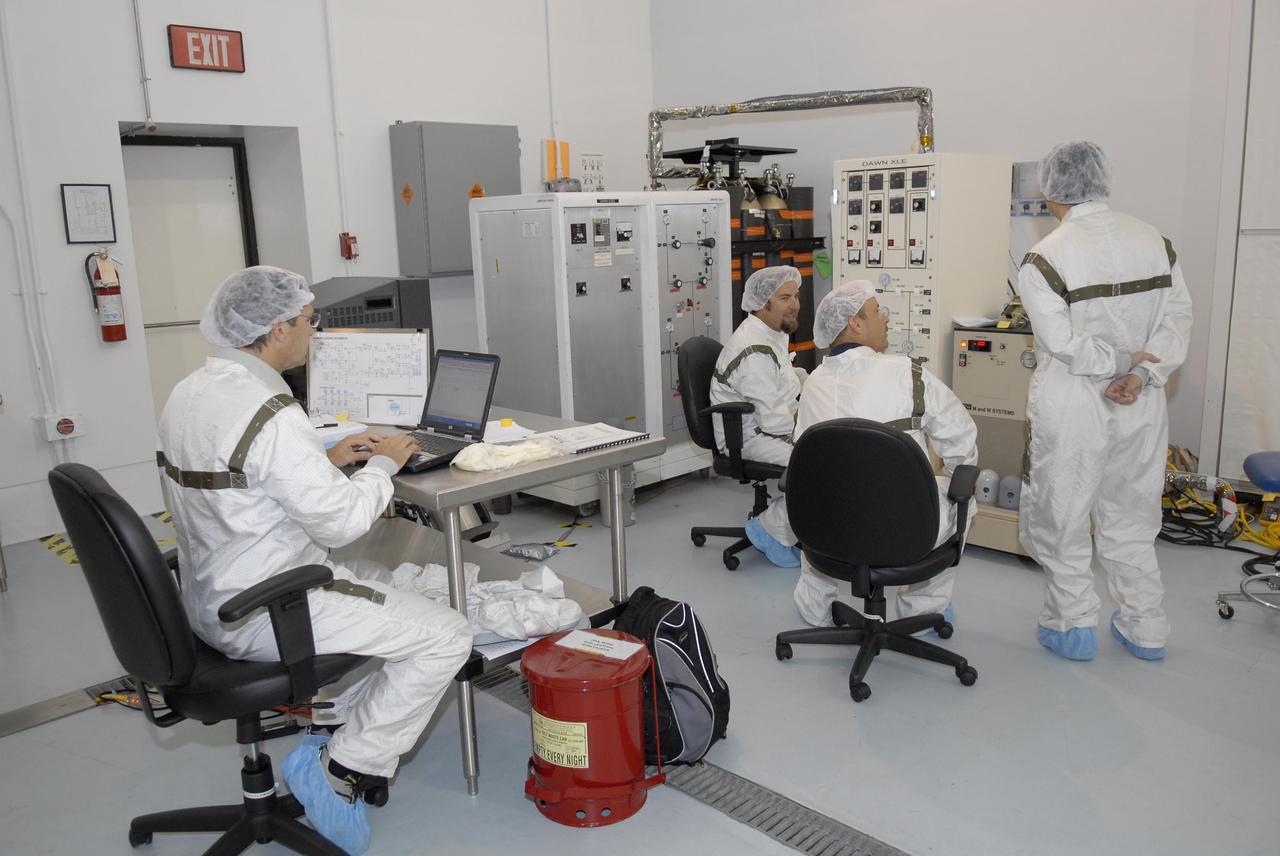
KENNEDY SPACE CENTER, FLA. -- In Astrotech's Hazardous Processing Facility, technicians check data during the loading of xenon for the ion propulsion system in the Dawn spacecraft. Dawn's mission is to explore two of the asteroid belt's most intriguing and dissimilar occupants: asteroid Vesta and the dwarf planet Ceres. The Dawn spacecraft uses ion propulsion to get the additional velocity needed to reach Vesta once it leaves the Delta rocket. It also uses ion propulsion to spiral to lower altitudes on Vesta, to leave Vesta and cruise to Ceres and to spiral to a low-altitude orbit at Ceres. Ion propulsion makes efficient use of the onboard fuel by accelerating it to a velocity 10 times that of chemical rockets. Dawn is scheduled to launch July 7aboard a Delta II rocket from Launch Complex 17-B at Cape Canaveral Air Force Station. Photo credit: NASA/Kim Shiflett
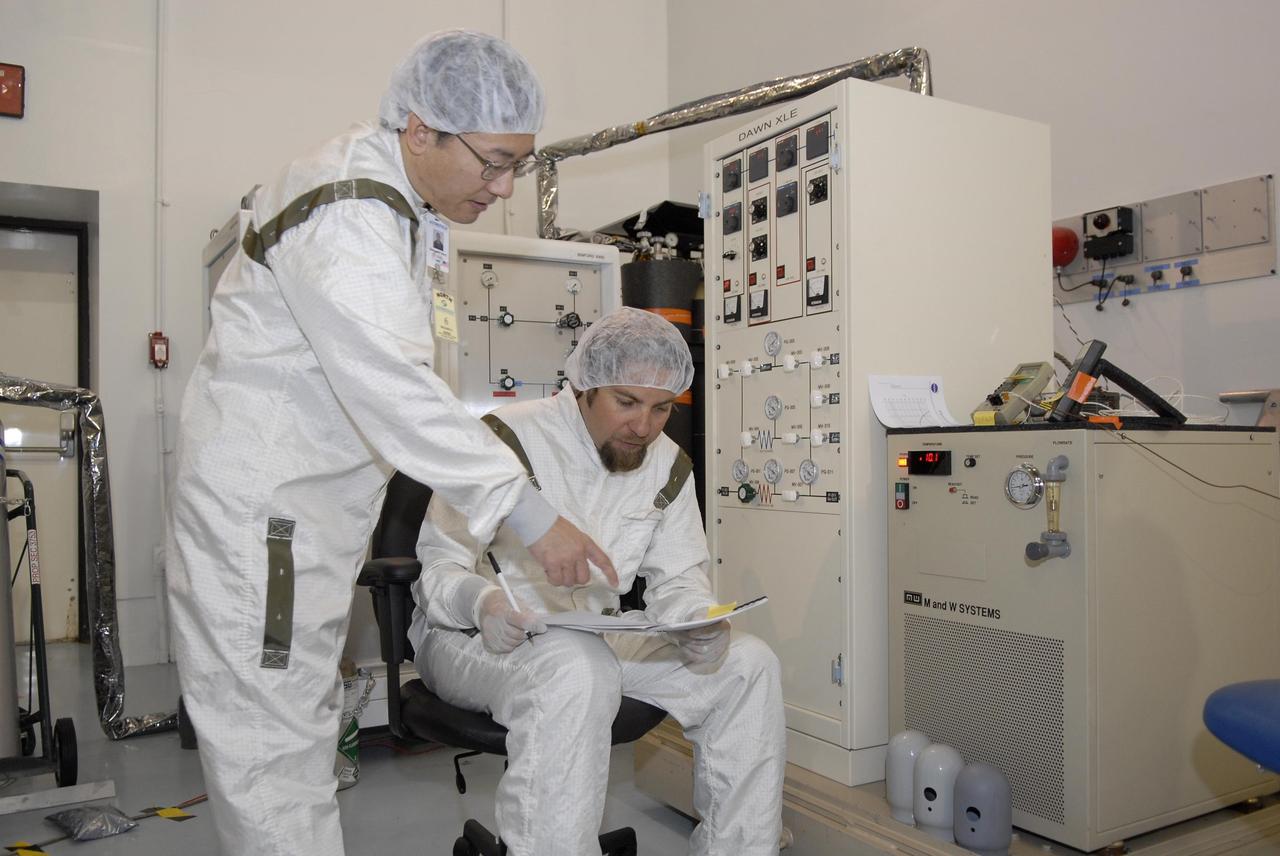
KENNEDY SPACE CENTER, FLA. -- In Astrotech's Hazardous Processing Facility, technicians check data during the loading of xenon for the ion propulsion system in the Dawn spacecraft. Dawn's mission is to explore two of the asteroid belt's most intriguing and dissimilar occupants: asteroid Vesta and the dwarf planet Ceres. The Dawn spacecraft uses ion propulsion to get the additional velocity needed to reach Vesta once it leaves the Delta rocket. It also uses ion propulsion to spiral to lower altitudes on Vesta, to leave Vesta and cruise to Ceres and to spiral to a low-altitude orbit at Ceres. Ion propulsion makes efficient use of the onboard fuel by accelerating it to a velocity 10 times that of chemical rockets. Dawn is scheduled to launch July 7aboard a Delta II rocket from Launch Complex 17-B at Cape Canaveral Air Force Station. Photo credit: NASA/Kim Shiflett
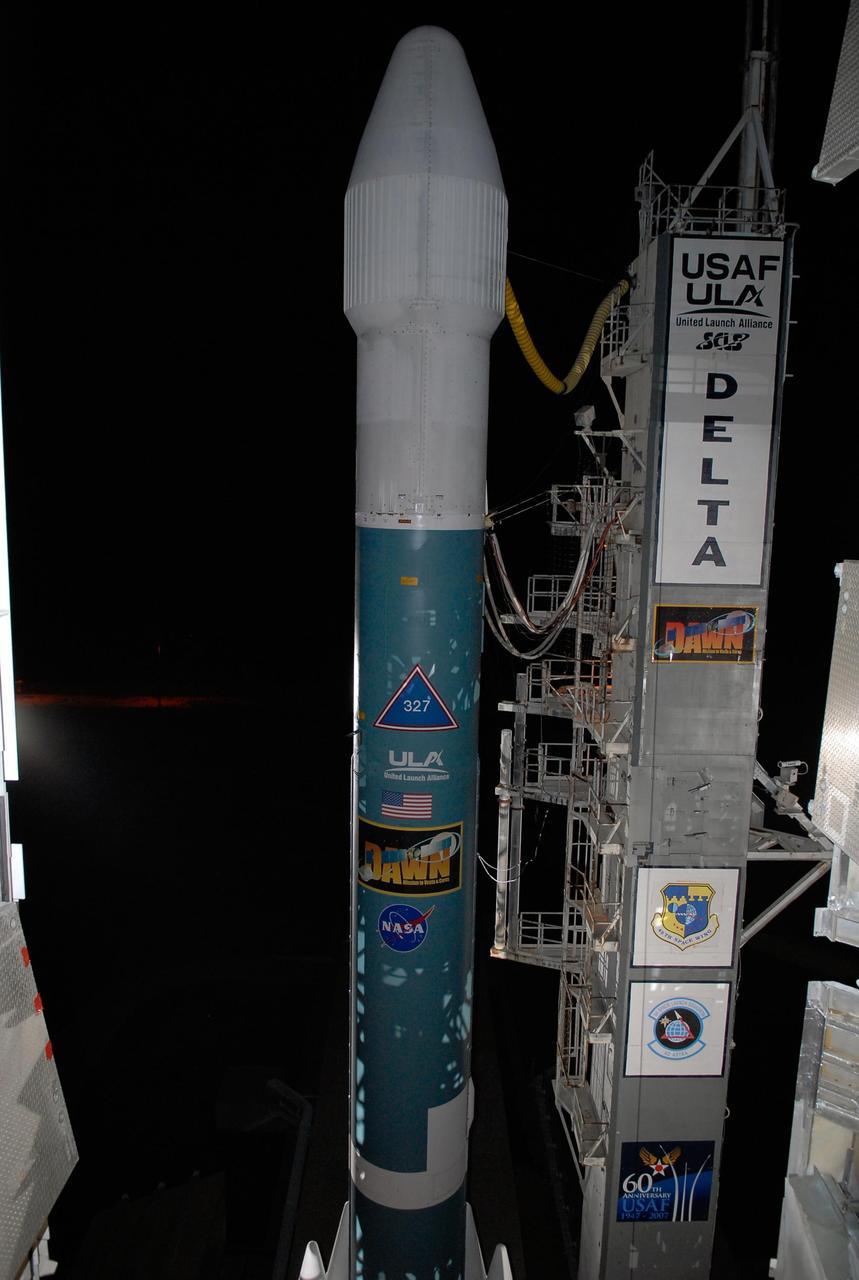
KENNEDY SPACE CENTER, FLA. -- The Delta II rocket stands ready for launch following rollback of the mobile service tower, or gantry, on Launch Pad 17B at Cape Canaveral Air Force Station. Starting with a boost from this higher thrust version of the Delta II rocket, the Dawn spacecraft will study the asteroid Vesta and dwarf planet Ceres, celestial bodies believed to have accreted early in the history of the solar system. To carry out its scientific mission during its nearly decade-long mission, Dawn will carry a visible camera, a visible and infrared mapping spectrometer, and a gamma ray and neutron spectrometer, whose data will be used in combination to characterize these bodies. In addition to the three instruments, radiometric and optical navigation data will provide data relating to the gravity field, and thus, bulk properties and internal structure of the two bodies. Data returned from the Dawn spacecraft could provide opportunities for significant breakthroughs in our knowledge of how the solar system formed. Launch is targeted for Sept. 27 during a window that extends from 7:20 to 7:49 a.m. EDT. Photo credit: NASA/Kim Shiflett

KENNEDY SPACE CENTER, FLA. -- The Delta II rocket stands ready for launch following rollback of the mobile service tower, or gantry, on Launch Pad 17B at Cape Canaveral Air Force Station. Starting with a boost from this higher thrust version of the Delta II rocket, the Dawn spacecraft will study the asteroid Vesta and dwarf planet Ceres, celestial bodies believed to have accreted early in the history of the solar system. To carry out its scientific mission during its nearly decade-long mission, Dawn will carry a visible camera, a visible and infrared mapping spectrometer, and a gamma ray and neutron spectrometer, whose data will be used in combination to characterize these bodies. In addition to the three instruments, radiometric and optical navigation data will provide data relating to the gravity field, and thus, bulk properties and internal structure of the two bodies. Data returned from the Dawn spacecraft could provide opportunities for significant breakthroughs in our knowledge of how the solar system formed. Launch is targeted for Sept. 27 during a window that extends from 7:20 to 7:49 a.m. EDT. Photo credit: NASA/Kim Shiflett
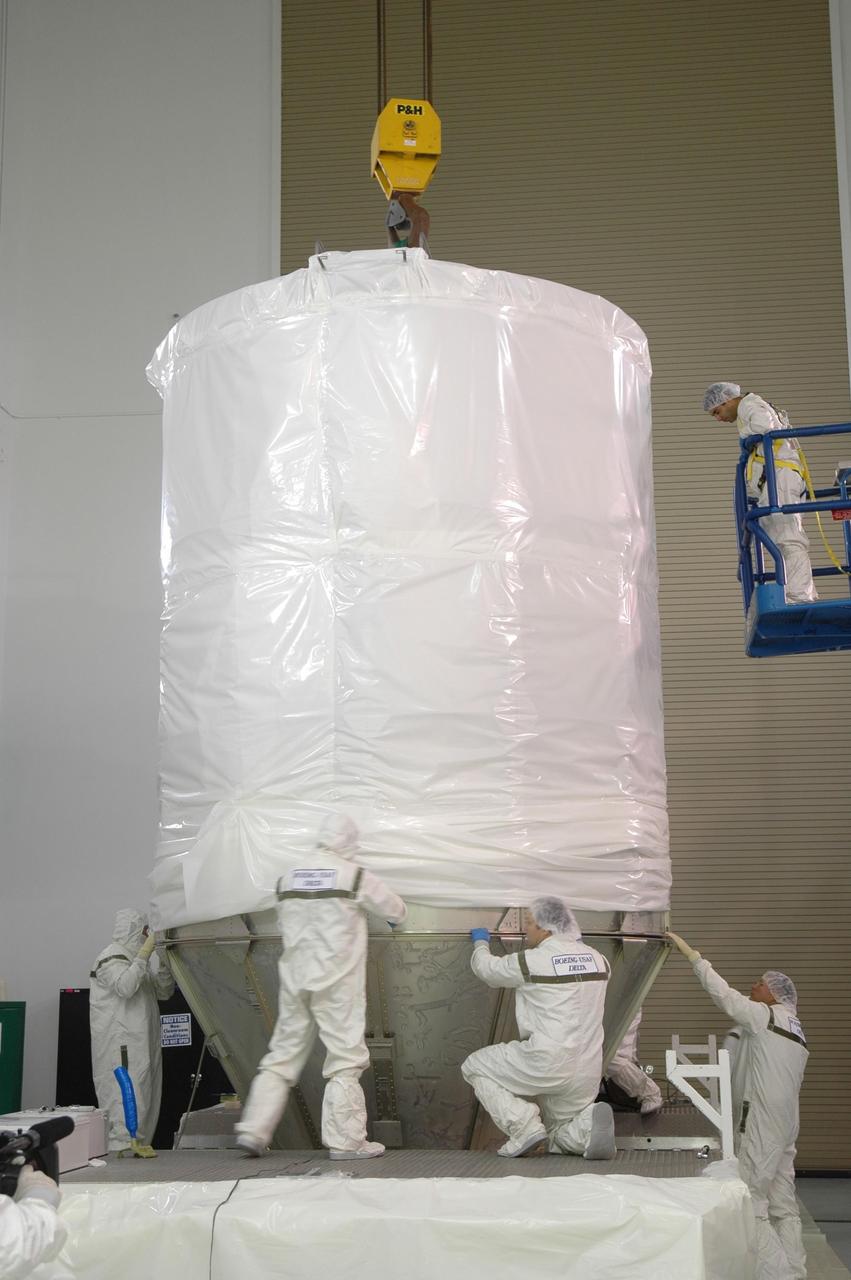
KENNEDY SPACE CENTER, FLA. -- At Astrotech Space Operations in Titusville, Fla., workers ensure the upper transportation canister is securely attached to the lower segments. The canister will protect the spacecraft and booster during transfer to Launch Pad 17-B at Cape Canaveral Air Force Station (CCAFS). During its nearly decade-long mission, the Dawn mission will study the asteroid Vesta and dwarf planet Ceres, celestial bodies believed to have accreted early in the history of the solar system. To carry out its scientific mission, the Dawn spacecraft will carry a visible camera, a visible and infrared mapping spectrometer, and a gamma ray and neutron spectrometer, whose data will be used in combination to characterize these bodies. In addition to the three instruments, radiometric and optical navigation data will provide data relating to the gravity field and thus bulk properties and internal structure of the two bodies. Data returned from the Dawn spacecraft could provide opportunities for significant breakthroughs in our knowledge of how the solar system formed. Launch via a Delta II rocket is scheduled in a window from 7:25 to 7:54 a.m. Sept. 26 from CCAFS. Photo credit: NASA/Jim Grossmann
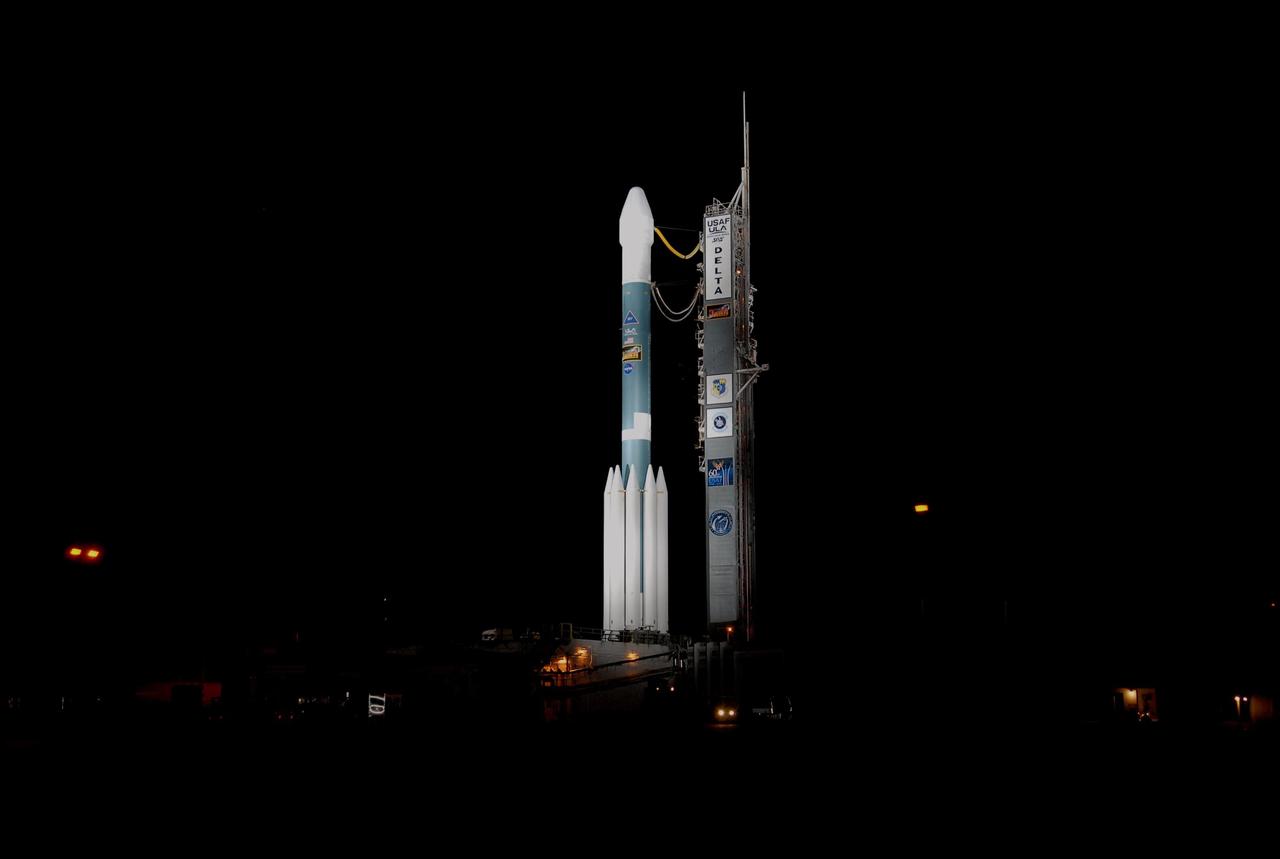
KENNEDY SPACE CENTER, FLA. -- Rollback of the mobile service tower, or gantry, from the Delta II rocket is complete on Launch Pad 17B at Cape Canaveral Air Force Station. Starting with a boost from this higher thrust version of the Delta II rocket, the Dawn spacecraft will study the asteroid Vesta and dwarf planet Ceres, celestial bodies believed to have accreted early in the history of the solar system. To carry out its scientific mission during its nearly decade-long mission, Dawn will carry a visible camera, a visible and infrared mapping spectrometer, and a gamma ray and neutron spectrometer, whose data will be used in combination to characterize these bodies. In addition to the three instruments, radiometric and optical navigation data will provide data relating to the gravity field, and thus, bulk properties and internal structure of the two bodies. Data returned from the Dawn spacecraft could provide opportunities for significant breakthroughs in our knowledge of how the solar system formed. Launch is targeted for Sept. 27 during a window that extends from 7:20 to 7:49 a.m. EDT. Photo credit: NASA/Kim Shiflett

KENNEDY SPACE CENTER, FLA. -- The Delta II rocket is revealed as the mobile service tower, or gantry (at right), is retracted on Launch Pad 17B at Cape Canaveral Air Force Station. Starting with a boost from this higher thrust version of the Delta II rocket, the Dawn spacecraft will study the asteroid Vesta and dwarf planet Ceres, celestial bodies believed to have accreted early in the history of the solar system. To carry out its scientific mission during its nearly decade-long mission, Dawn will carry a visible camera, a visible and infrared mapping spectrometer, and a gamma ray and neutron spectrometer, whose data will be used in combination to characterize these bodies. In addition to the three instruments, radiometric and optical navigation data will provide data relating to the gravity field, and thus, bulk properties and internal structure of the two bodies. Data returned from the Dawn spacecraft could provide opportunities for significant breakthroughs in our knowledge of how the solar system formed. Launch is targeted for Sept. 27 during a window that extends from 7:20 to 7:49 a.m. EDT. Photo credit: NASA/Kim Shiflett
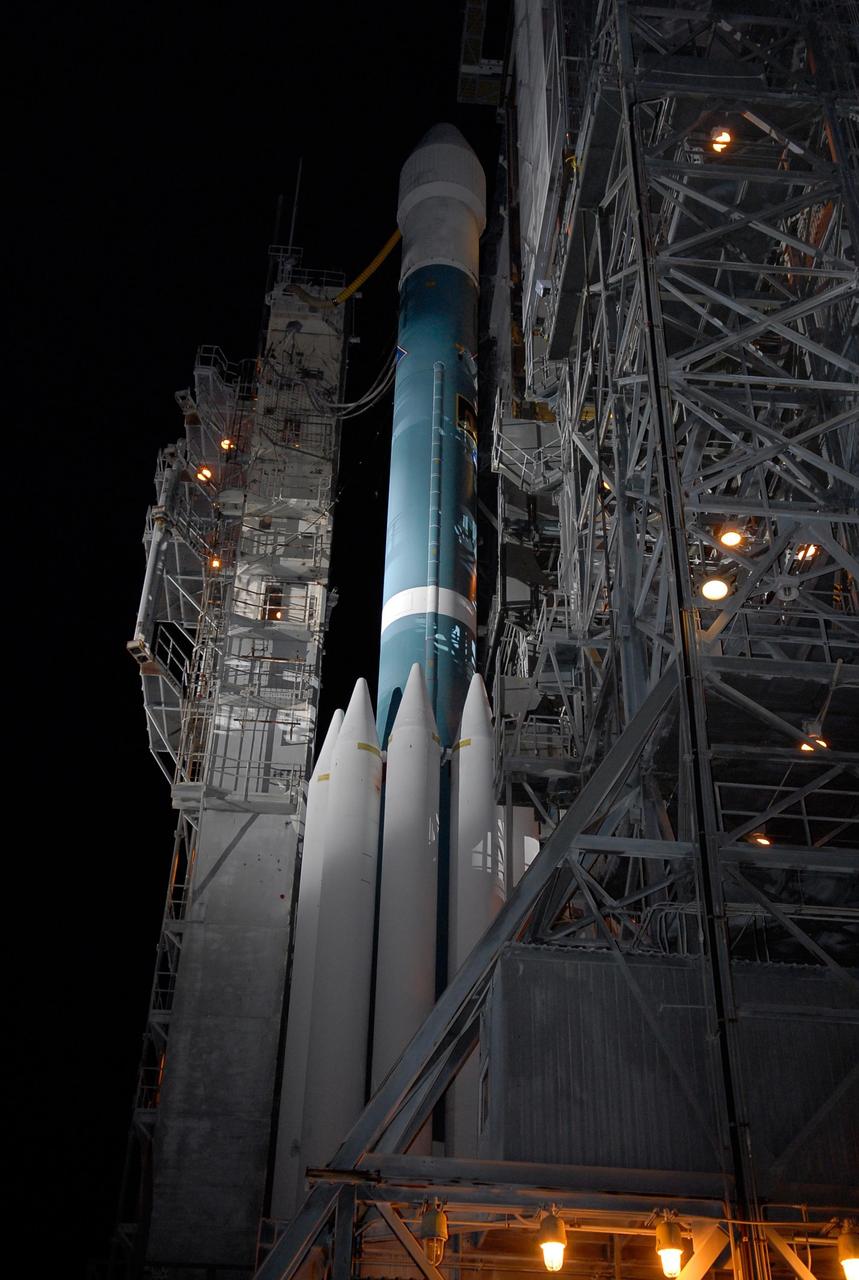
KENNEDY SPACE CENTER, FLA. -- The Delta II rocket is revealed as the mobile service tower, or gantry (at left), is retracted on Launch Pad 17B at Cape Canaveral Air Force Station. Starting with a boost from this higher thrust version of the Delta II rocket, the Dawn spacecraft will study the asteroid Vesta and dwarf planet Ceres, celestial bodies believed to have accreted early in the history of the solar system. To carry out its scientific mission during its nearly decade-long mission, Dawn will carry a visible camera, a visible and infrared mapping spectrometer, and a gamma ray and neutron spectrometer, whose data will be used in combination to characterize these bodies. In addition to the three instruments, radiometric and optical navigation data will provide data relating to the gravity field, and thus, bulk properties and internal structure of the two bodies. Data returned from the Dawn spacecraft could provide opportunities for significant breakthroughs in our knowledge of how the solar system formed. Launch is targeted for Sept. 27 during a window that extends from 7:20 to 7:49 a.m. EDT. Photo credit: NASA/Kim Shiflett
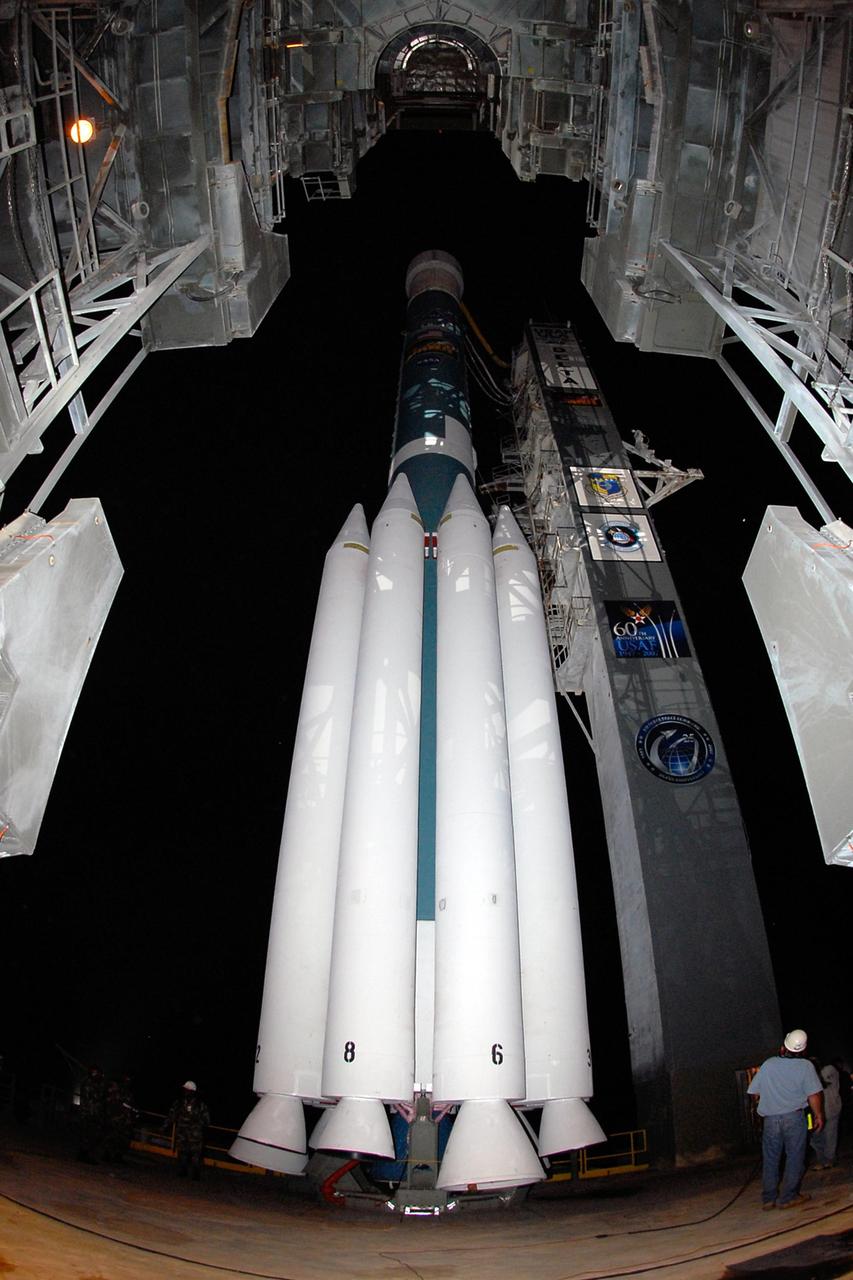
KENNEDY SPACE CENTER, FLA. -- A worker monitors the progress of the retraction of the mobile service tower, or gantry, from the Delta II rocket on Launch Pad 17B at Cape Canaveral Air Force Station. Starting with a boost from this higher thrust version of the Delta II rocket, the Dawn spacecraft will study the asteroid Vesta and dwarf planet Ceres, celestial bodies believed to have accreted early in the history of the solar system. To carry out its scientific mission during its nearly decade-long mission, Dawn will carry a visible camera, a visible and infrared mapping spectrometer, and a gamma ray and neutron spectrometer, whose data will be used in combination to characterize these bodies. In addition to the three instruments, radiometric and optical navigation data will provide data relating to the gravity field, and thus, bulk properties and internal structure of the two bodies. Data returned from the Dawn spacecraft could provide opportunities for significant breakthroughs in our knowledge of how the solar system formed. Launch is targeted for Sept. 27 during a window that extends from 7:20 to 7:49 a.m. EDT. Photo credit: NASA/Kim Shiflett
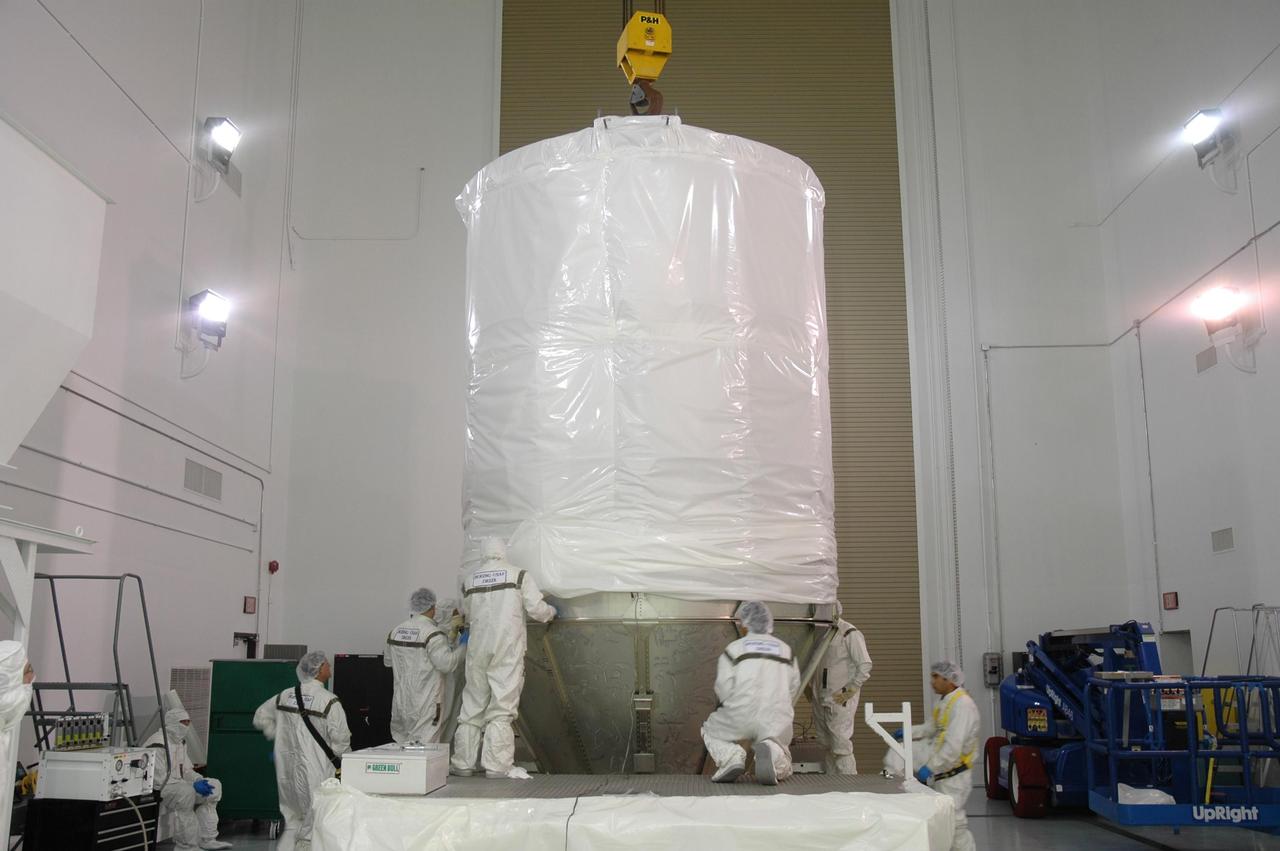
KENNEDY SPACE CENTER, FLA. -- At Astrotech Space Operations in Titusville, Fla., workers ensure the upper transportation canister is securely attached to the lower segments. The transportation canister will protect the spacecraft and booster during transfer to Launch Pad 17-B at Cape Canaveral Air Force Station (CCAFS). During its nearly decade-long mission, the Dawn mission will study the asteroid Vesta and dwarf planet Ceres, celestial bodies believed to have accreted early in the history of the solar system. To carry out its scientific mission, the Dawn spacecraft will carry a visible camera, a visible and infrared mapping spectrometer, and a gamma ray and neutron spectrometer, whose data will be used in combination to characterize these bodies. In addition to the three instruments, radiometric and optical navigation data will provide data relating to the gravity field and thus bulk properties and internal structure of the two bodies. Data returned from the Dawn spacecraft could provide opportunities for significant breakthroughs in our knowledge of how the solar system formed. Launch via a Delta II rocket is scheduled in a window from 7:25 to 7:54 a.m. Sept. 26 from CCAFS. Photo credit: NASA/Jim Grossmann
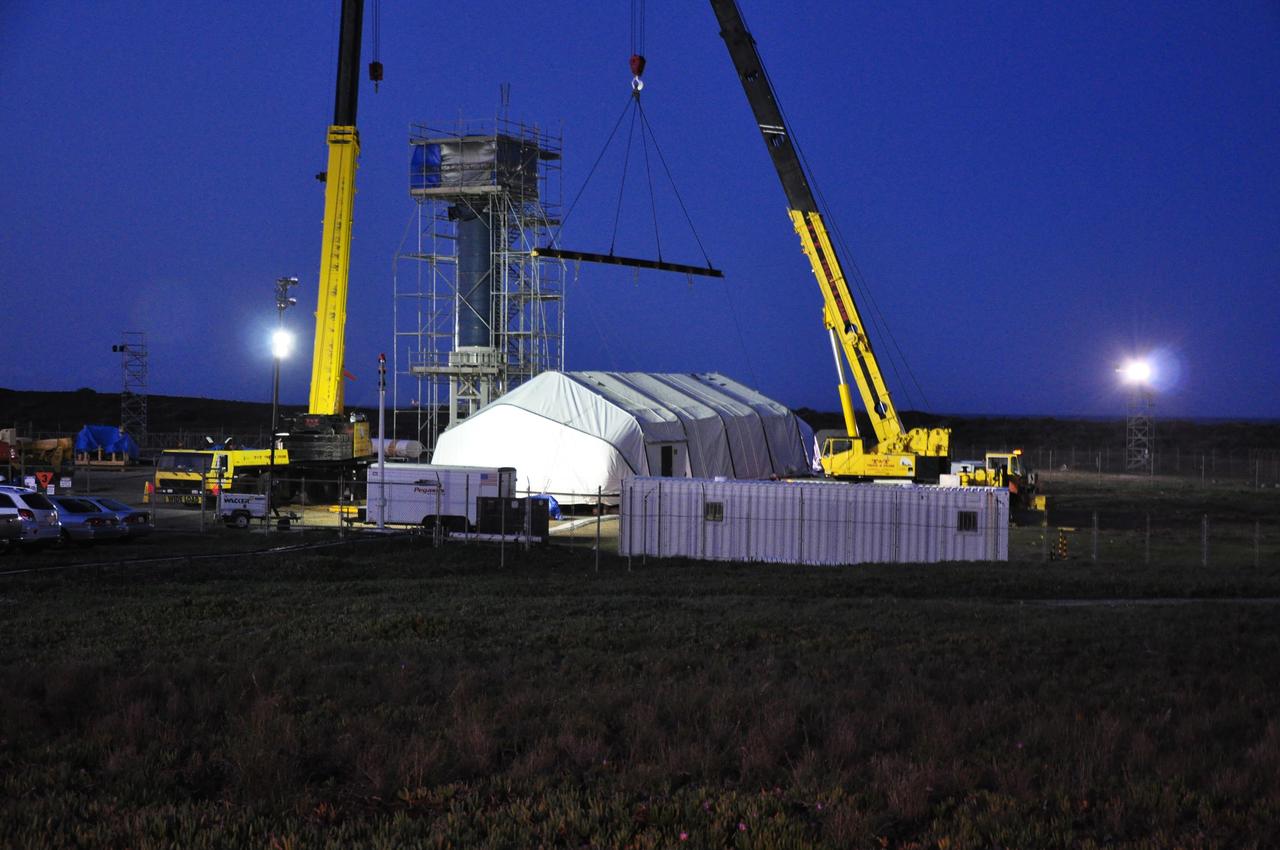
VANDENBERG AIR FORCE BASE, Calif. -- Just before dawn on Launch Complex 576-E at Vandenberg Air Force Base in California, a crane is attached to the tent covering NASA's Orbiting Carbon Observatory, or OCO, the Taurus XL upper stack and the umbilical tower. The tent will be removed to allow OCO to be raised. The spacecraft is scheduled for launch aboard Orbital Sciences' Taurus XL rocket Feb. 24 from Vandenberg. The spacecraft will collect precise global measurements of carbon dioxide (CO2) in the Earth's atmosphere. Scientists will analyze OCO data to improve our understanding of the natural processes and human activities that regulate the abundance and distribution of this important greenhouse gas. Photo credit: NASA/Randy Beaudoin, VAFB
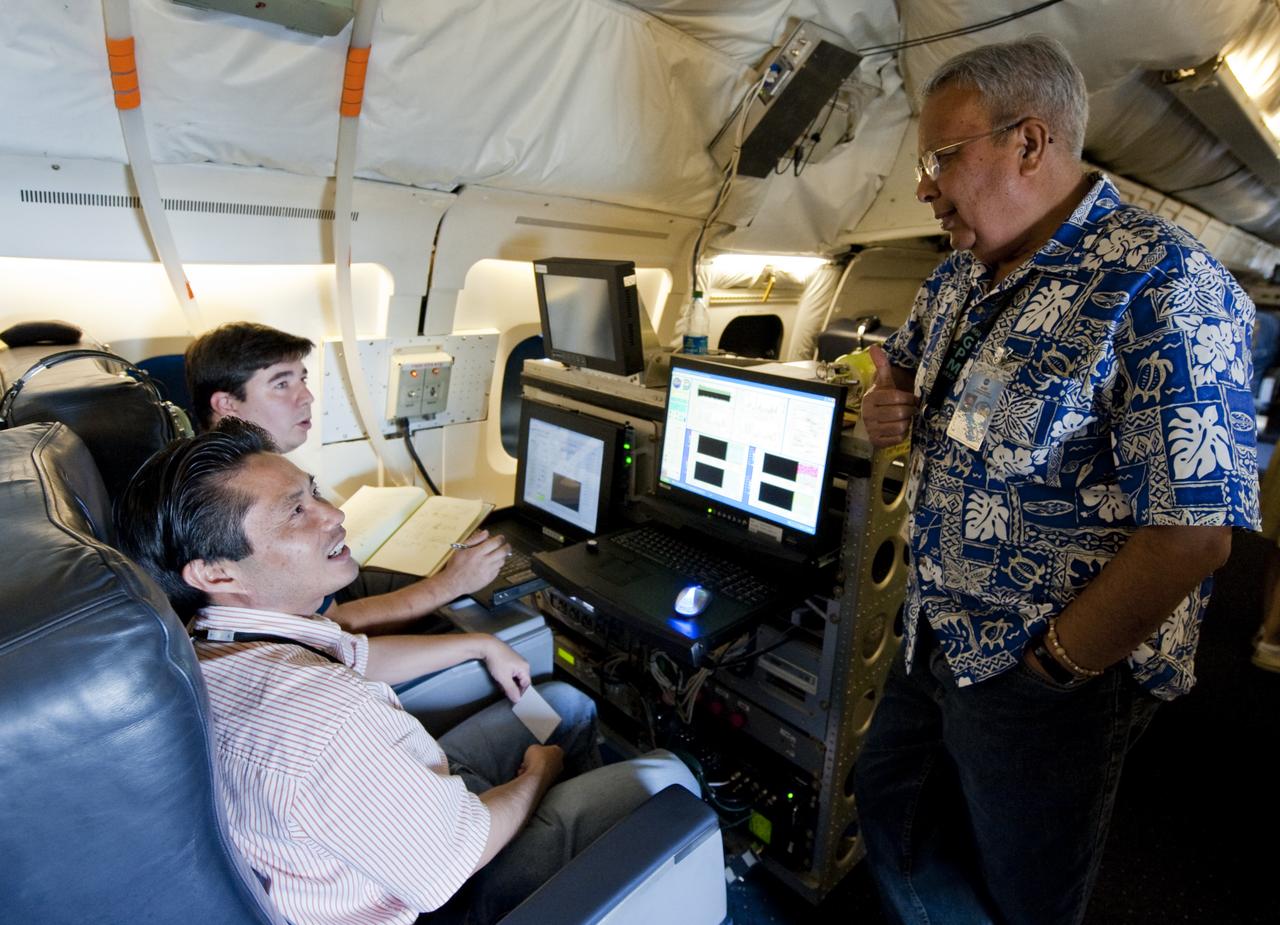
Jeffrey Beyon, lower right, and Paul Joseph Petzar, right, researchers from NASA's Langley Research Center, speak with Ramesh Kakar right, of the NASA Earth Science Division as they work with DAWN Air Data Acquisition and Processing software aboard NASA's DC-8 research aircraft, Sunday, Aug. 15, 2010, in support of the GRIP experiment at Fort Lauderdale International Airport in Fort Lauderdale, Fla. The Genesis and Rapid Intensification Processes (GRIP) experiment is a NASA Earth science field experiment in 2010 that is being conducted to better understand how tropical storms form and develop into major hurricanes. Photo Credit: (NASA/Paul E. Alers)
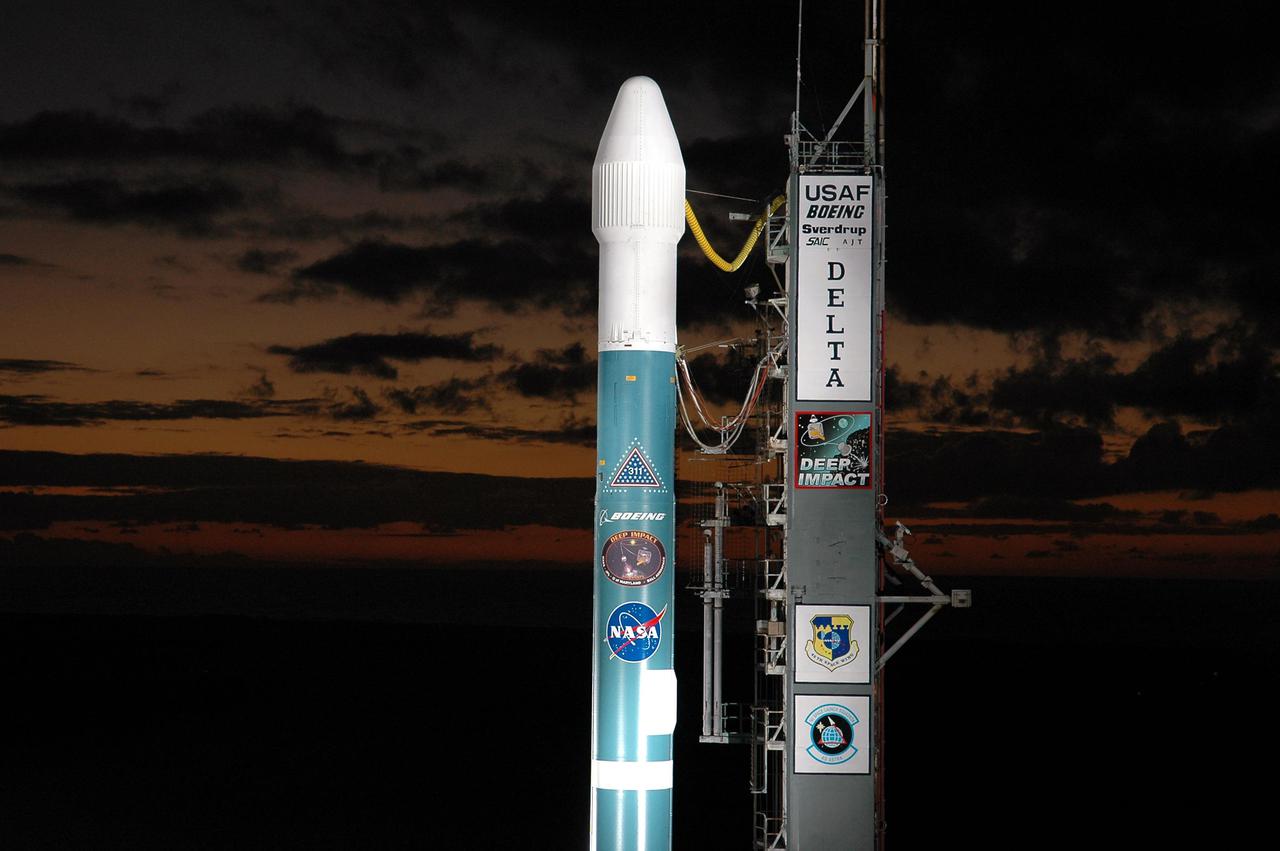
KENNEDY SPACE CENTER, FLA. - On Launch Pad 17-B, Cape Canaveral Air Force Station, Fla., the Boeing Delta II rocket carrying the Deep Impact spacecraft stands out against an early dawn sky. Scheduled for liftoff at 1:47 p.m. EST today, Deep Impact will head for space and a rendezvous with Comet Tempel 1 when the comet is 83 million miles from Earth. After releasing a 3- by 3-foot projectile (impactor) to crash onto the surface July 4, 2005, Deep Impact’s flyby spacecraft will reveal the secrets of the comet’s interior by collecting pictures and data of how the crater forms, measuring the crater’s depth and diameter as well as the composition of the interior of the crater and any material thrown out, and determining the changes in natural outgassing produced by the impact. It will send the data back to Earth through the antennas of the Deep Space Network. Deep Impact is a NASA Discovery mission.

At dawn on Launch Pad 36A, Cape Canaveral Air Force Station, an Atlas IIA/Centaur rocket is fueled for launch of NASA’s Tracking and Data Relay Satellite (TDRS-H). One of three satellites (labeled H, I and J) being built by the Hughes Space and Communications Company, the latest TDRS uses an innovative springback antenna design. A pair of 15-foot-diameter, flexible mesh antenna reflectors fold up for launch, then spring back into their original cupped circular shape on orbit. The new satellites will augment the TDRS system’s existing Sand Ku-band frequencies by adding Ka-band capability. TDRS will serve as the sole means of continuous, high-data-rate communication with the Space Shuttle, with the International Space Station upon its completion, and with dozens of unmanned scientific satellites in low earth orbit
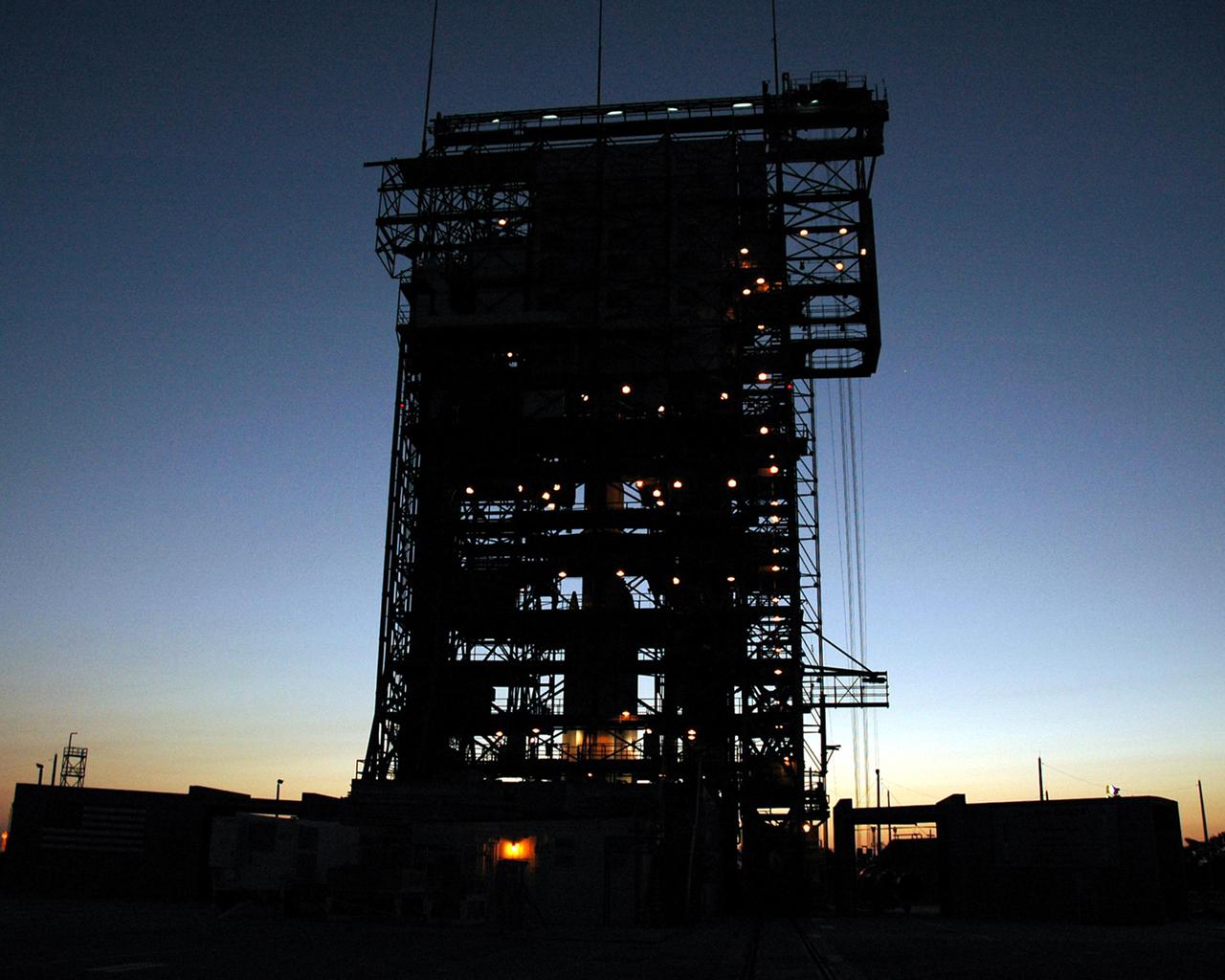
KENNEDY SPACE CENTER, FLA. - In the pre-dawn hours on Launch Pad 17-B at Cape Canaveral Air Force Station, the mobile service tower is silhouetted with the Boeing Delta II rocket that will launch NASA’s Deep Impact spacecraft. The Delta II waits for the arrival and mating of the second stage. A NASA Discovery mission, Deep Impact will probe beneath the surface of Comet Tempel 1 on July 4, 2005, when the comet is 83 million miles from Earth, and reveal the secrets of its interior. After releasing an impactor on a course to hit the comet’s sunlit side, Deep Impact’s flyby spacecraft will collect pictures and data of how the crater forms, measure the crater’s depth and diameter, as well as the composition of the interior of the crater and any material thrown out, and determine the changes in natural outgassing produced by the impact. It will send the data back to Earth through the antennas of the Deep Space Network.

After tower rollback just before dawn on Launch Pad 36A, Cape Canaveral Air Force Station, NASA’s Tracking and Data Relay Satellite (TDRS-H) sits bathed in spotlights before liftoff atop an Atlas IIA/Centaur rocket. One of three satellites (labeled H, I and J) being built by the Hughes Space and Communications Company, the latest TDRS uses an innovative springback antenna design. A pair of 15-foot-diameter, flexible mesh antenna reflectors fold up for launch, then spring back into their original cupped circular shape on orbit. The new satellites will augment the TDRS system’s existing Sand Ku-band frequencies by adding Ka-band capability. TDRS will serve as the sole means of continuous, high-data-rate communication with the Space Shuttle, with the International Space Station upon its completion, and with dozens of unmanned scientific satellites in low earth orbit
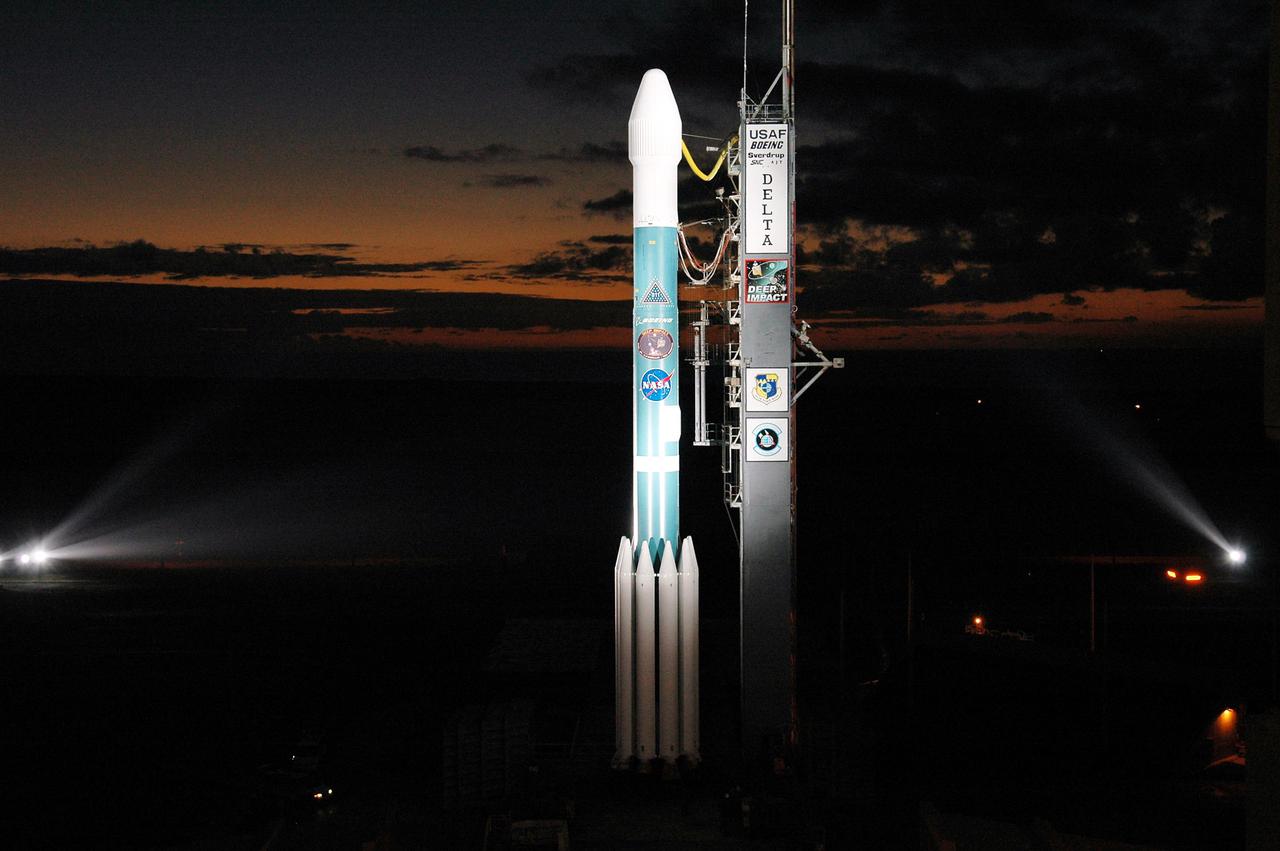
KENNEDY SPACE CENTER, FLA. - On Launch Pad 17-B, Cape Canaveral Air Force Station, Fla., the Boeing Delta II carrying the Deep Impact spacecraft rocket shines under spotlights in the early dawn hours as it waits for launch. Scheduled for liftoff at 1:47 p.m. EST today, Deep Impact will head for space and a rendezvous with Comet Tempel 1 when the comet is 83 million miles from Earth. After releasing a 3- by 3-foot projectile (impactor) to crash onto the surface July 4, 2005, Deep Impact’s flyby spacecraft will reveal the secrets of the comet’s interior by collecting pictures and data of how the crater forms, measuring the crater’s depth and diameter as well as the composition of the interior of the crater and any material thrown out, and determining the changes in natural outgassing produced by the impact. It will send the data back to Earth through the antennas of the Deep Space Network. Deep Impact is a NASA Discovery mission.
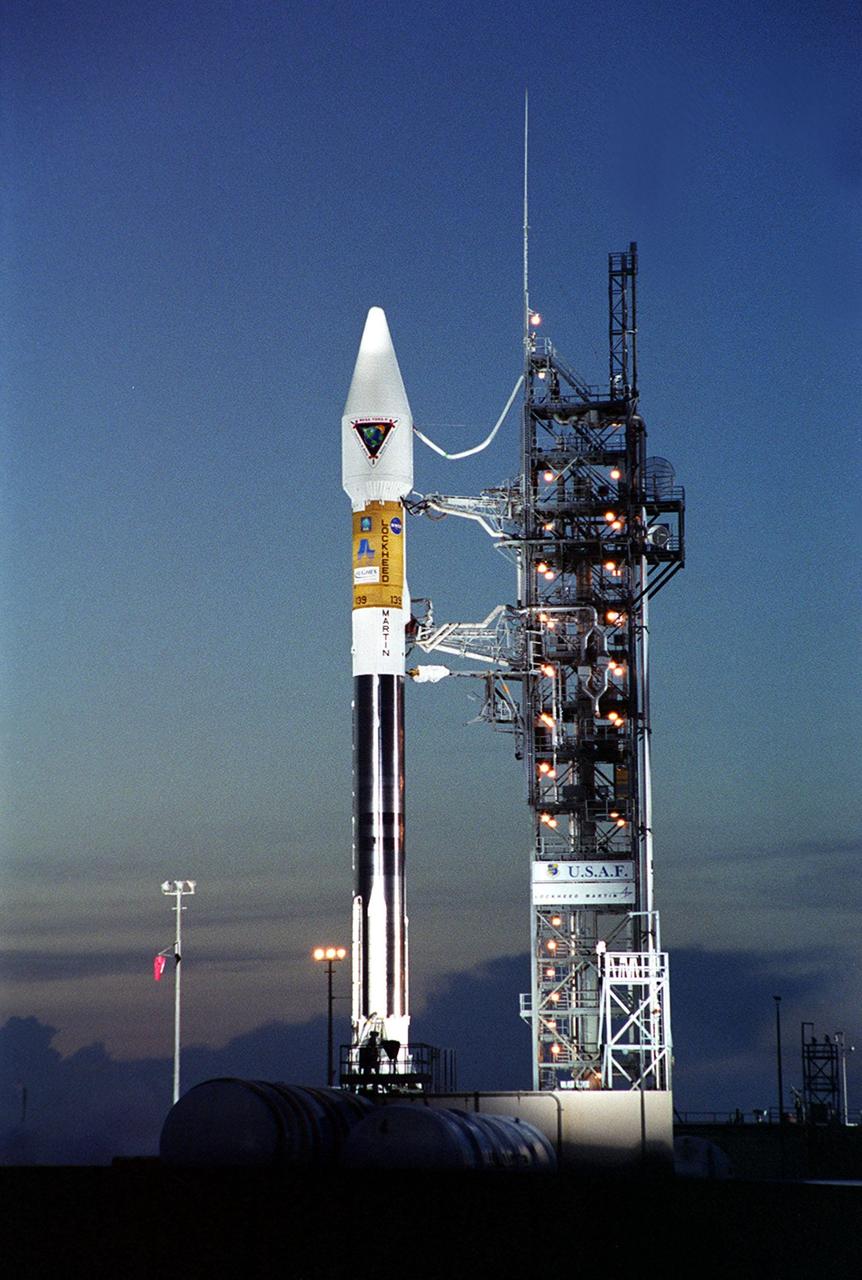
After tower rollback just before dawn on Launch Pad 36A, Cape Canaveral Air Force Station, NASA’s Tracking and Data Relay Satellite (TDRS-H) sits bathed in spotlights before liftoff atop an Atlas IIA/Centaur rocket. One of three satellites (labeled H, I and J) being built by the Hughes Space and Communications Company, the latest TDRS uses an innovative springback antenna design. A pair of 15-foot-diameter, flexible mesh antenna reflectors fold up for launch, then spring back into their original cupped circular shape on orbit. The new satellites will augment the TDRS system’s existing Sand Ku-band frequencies by adding Ka-band capability. TDRS will serve as the sole means of continuous, high-data-rate communication with the Space Shuttle, with the International Space Station upon its completion, and with dozens of unmanned scientific satellites in low earth orbit
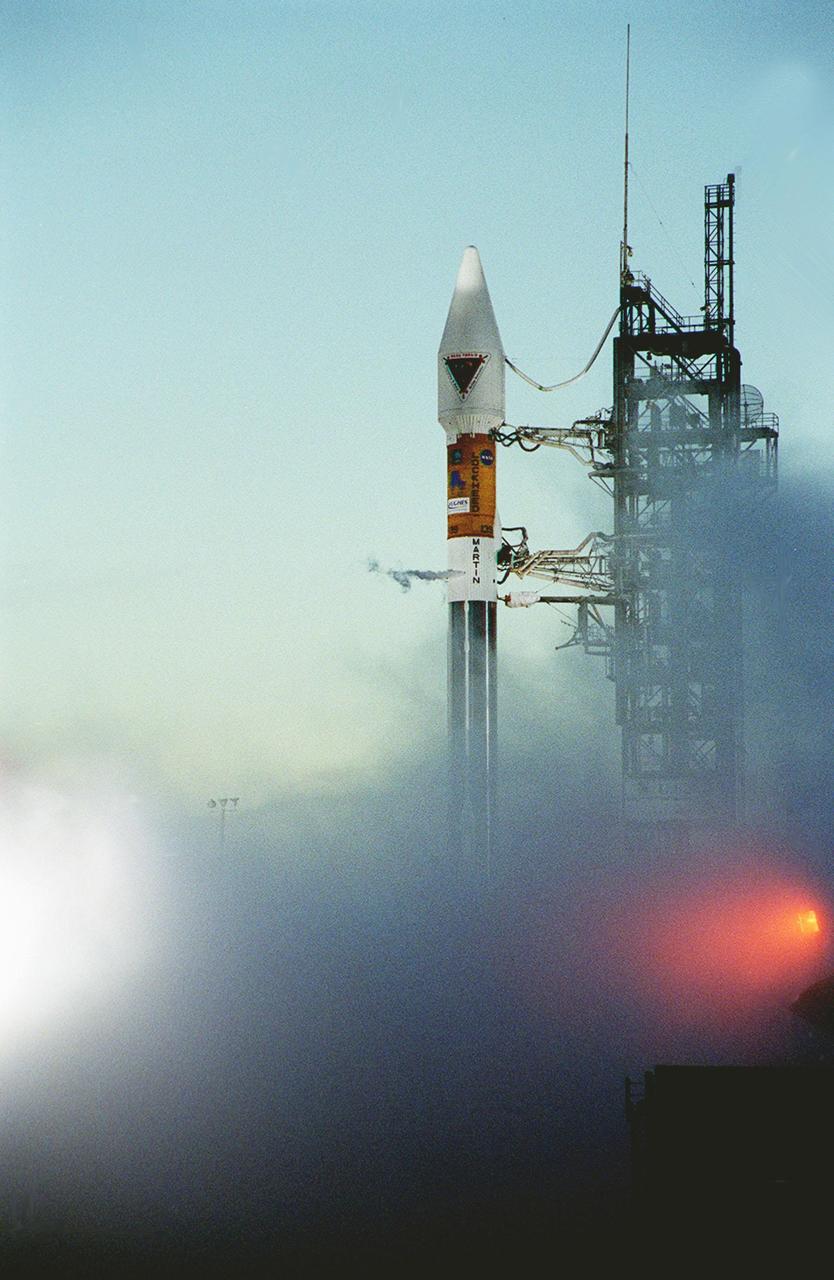
At dawn on Launch Pad 36A, Cape Canaveral Air Force Station, an Atlas IIA/Centaur rocket is fueled for launch of NASA’s Tracking and Data Relay Satellite (TDRS-H). One of three satellites (labeled H, I and J) being built by the Hughes Space and Communications Company, the latest TDRS uses an innovative springback antenna design. A pair of 15-foot-diameter, flexible mesh antenna reflectors fold up for launch, then spring back into their original cupped circular shape on orbit. The new satellites will augment the TDRS system’s existing Sand Ku-band frequencies by adding Ka-band capability. TDRS will serve as the sole means of continuous, high-data-rate communication with the Space Shuttle, with the International Space Station upon its completion, and with dozens of unmanned scientific satellites in low earth orbit
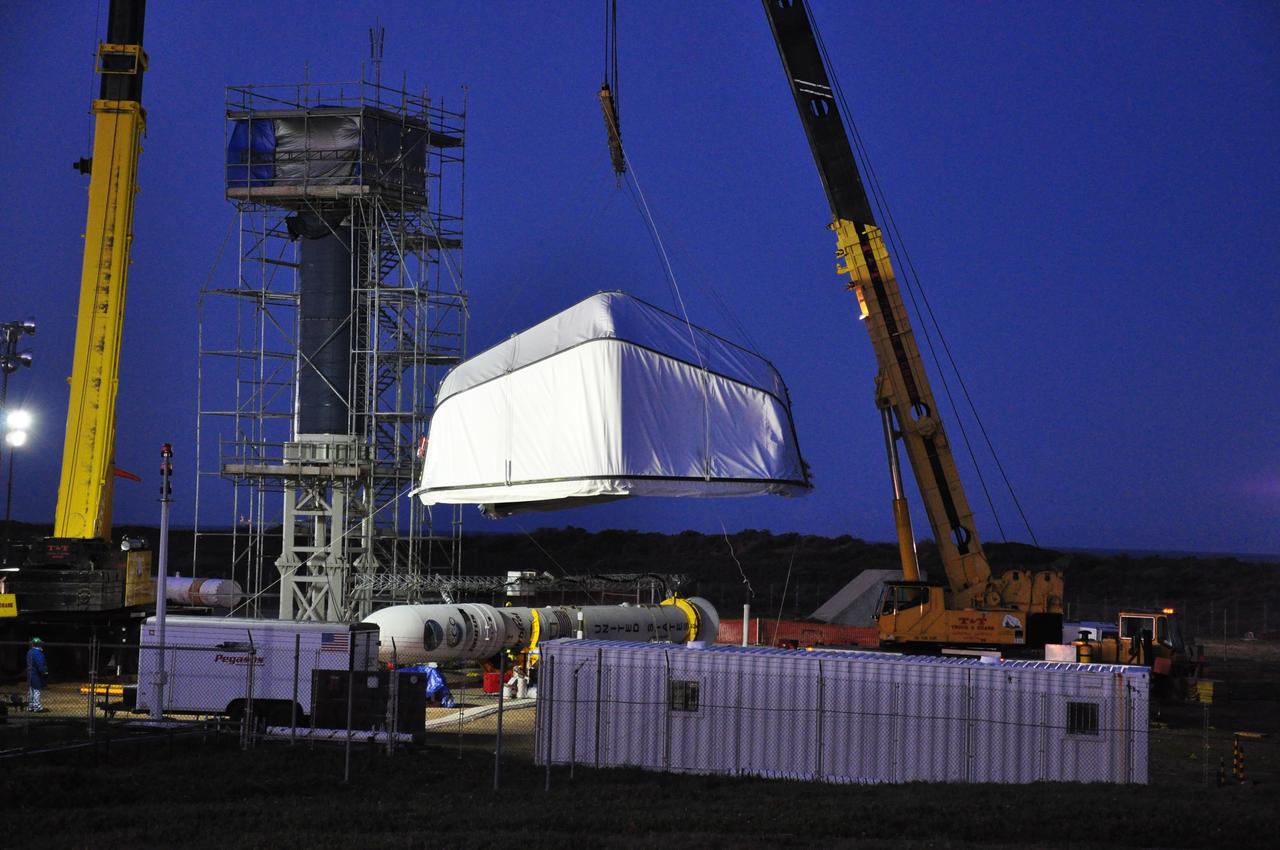
VANDENBERG AIR FORCE BASE, Calif. -- Just before dawn on Launch Complex 576-E at Vandenberg Air Force Base in California, a crane lifts the tent covering (at left) NASA's Orbiting Carbon Observatory, or OCO, the Taurus XL upper stack and the umbilical tower. The tent removal will allow OCO to be raised. The spacecraft is scheduled for launch aboard Orbital Sciences' Taurus XL rocket Feb. 24 from Vandenberg. The spacecraft will collect precise global measurements of carbon dioxide (CO2) in the Earth's atmosphere. Scientists will analyze OCO data to improve our understanding of the natural processes and human activities that regulate the abundance and distribution of this important greenhouse gas. Photo credit: NASA/Randy Beaudoin, VAFB
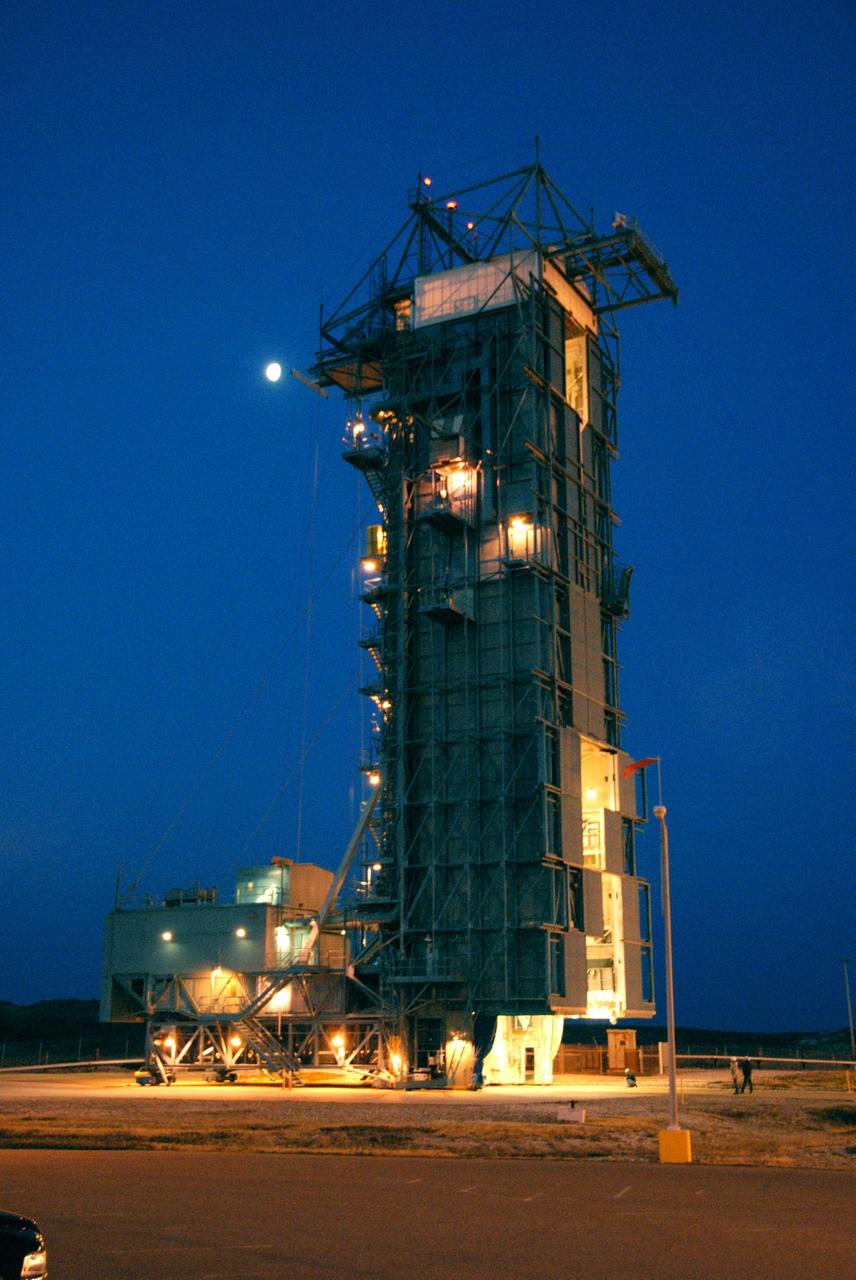
VANDENBERG AIR FORCE BASE, Calif. -- In pre-dawn hours at Vandenberg Air Force Base in California, the mobile service tower/umbilical tower and launcher on Space Launch Complex 2 are being prepared for the arrival of the Delta II first stage for the OSTM/Jason-2 spacecraft. The OSTM, or Ocean Topography Mission, on the Jason-2 satellite is a follow-on to Jason-1. It will take oceanographic studies of sea surface height into an operational mode for continued climate forecasting research and science and industrial applications. This satellite altimetry data will help determine ocean circulation, climate change and sea-level rise. OSTM is a joint effort by the National Oceanic and Atmospheric Administration, NASA, France’s Centre National d’Etudes Spatiales and the European Meteorological Satellite Organisation. OSTM/Jason-2 will be launched aboard a United Launch Alliance Delta II 7320 from Vandenberg on June 15. Photo credit: NASA/Dan Liberotti
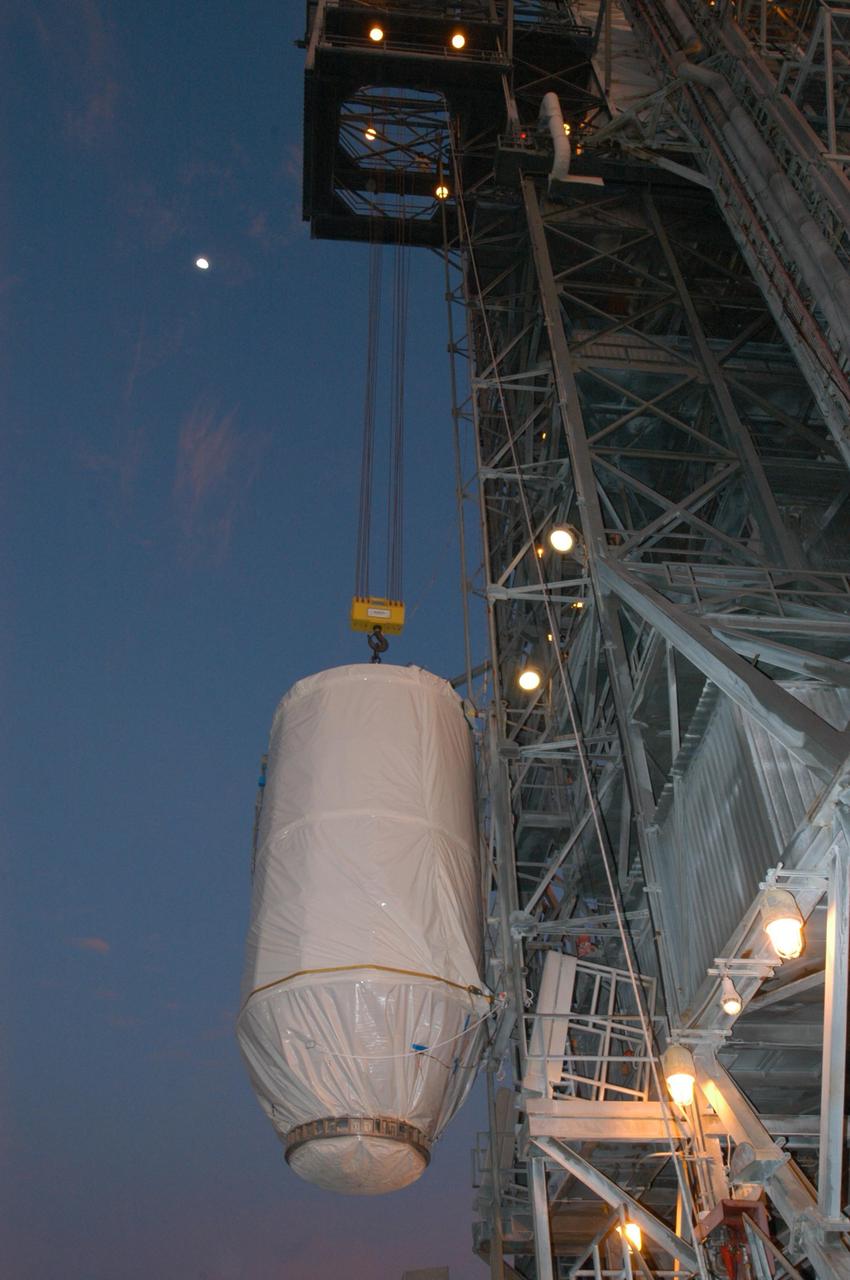
KENNEDY SPACE CENTER, FLA. - Against a pre-dawn sky on Launch Pad 17-B at Cape Canaveral Air Force Station, the STEREO spacecraft is lifted alongside the mobile service tower. In the tower, STEREO will be mated with its launch vehicle, a Boeing Delta II rocket. STEREO stands for Solar Terrestrial Relations Observatory and comprises two spacecraft. The STEREO mission is the first to take measurements of the sun and solar wind in 3-dimension. This new view will improve our understanding of space weather and its impact on the Earth. The STEREO mission is managed by Goddard Space Flight Center. The Applied Physics Laboratory designed and built the spacecraft. The laboratory will maintain command and control of the observatories throughout the mission, while NASA tracks and receives the data, determines the orbit of the satellites, and coordinates the science results. STEREO is expected to lift off Oct. 25. Photo credit: NASA/George Shelton
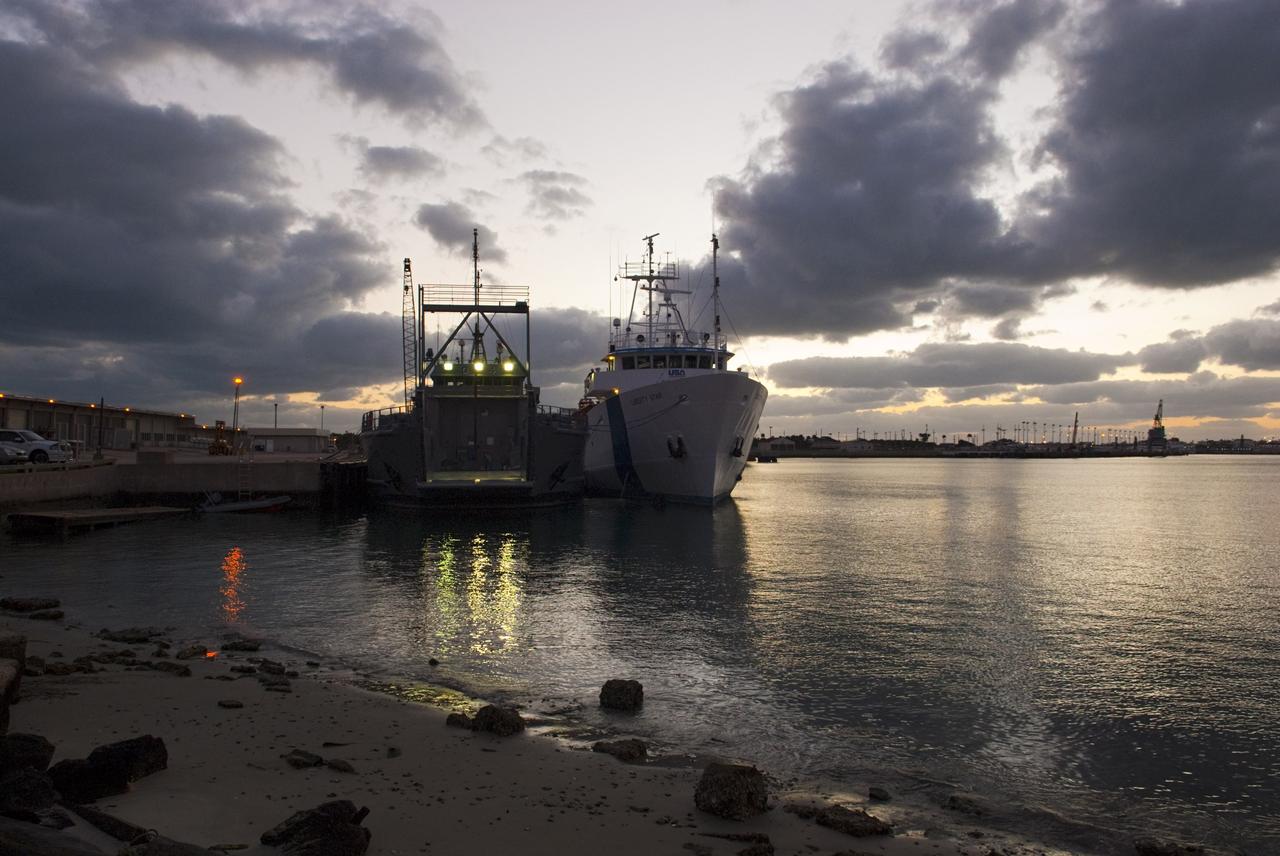
CAPE CANAVERAL, Fla. – Dawn at Port Canaveral in Florida finds preparations under way for the departure of NASA's Liberty Star ship. Liberty Star has been enlisted to support the Crew Module Recovery Attach Fitting Test (CRAFT) which began at-sea operations Nov. 29. Multiple attach clips are being evaluated against the current recovery cleat configuration by U.S. Air Force pararescue jumpers (PJs) and a U.S. Navy diver. The 21st Century Ground Systems Program will use data collected from the tests to help develop ground operations support equipment that could be used to recover an uncrewed Orion flight test capsule after splashdown. The Orion Multi-Purpose Crew Vehicle is NASA's next-generation spacecraft being developed for deep space missions to asteroids, moons and other interplanetary destinations throughout the solar system. For more information, visit http://www.nasa.gov/orion. Photo credit: NASA/Tim Jacobs
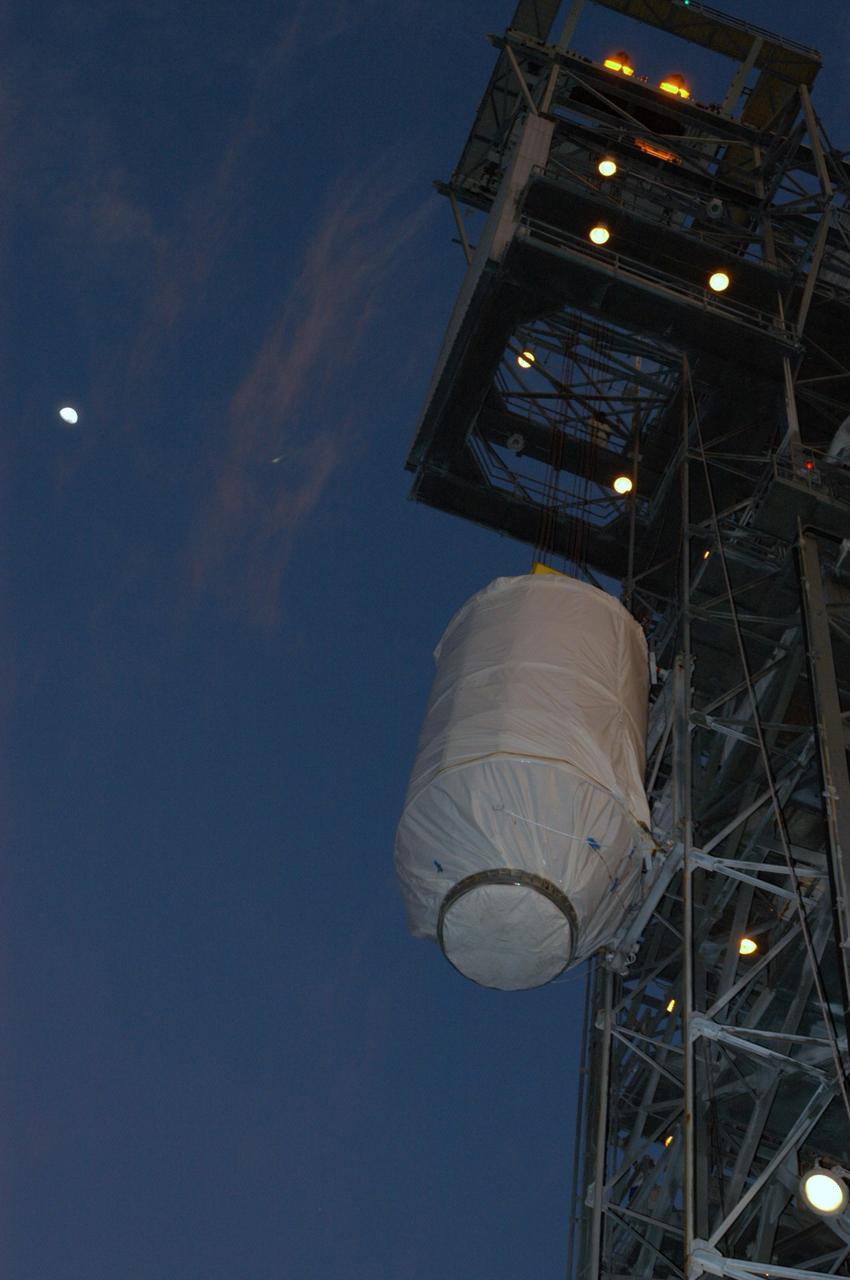
KENNEDY SPACE CENTER, FLA. - Against a pre-dawn sky on Launch Pad 17-B at Cape Canaveral Air Force Station, the STEREO spacecraft is lifted up toward the platform on the mobile service tower. In the tower, STEREO will be mated with its launch vehicle, a Boeing Delta II rocket. STEREO stands for Solar Terrestrial Relations Observatory and comprises two spacecraft. The STEREO mission is the first to take measurements of the sun and solar wind in 3-dimension. This new view will improve our understanding of space weather and its impact on the Earth. The STEREO mission is managed by Goddard Space Flight Center. The Applied Physics Laboratory designed and built the spacecraft. The laboratory will maintain command and control of the observatories throughout the mission, while NASA tracks and receives the data, determines the orbit of the satellites, and coordinates the science results. STEREO is expected to lift off Oct. 25. Photo credit: NASA/George Shelton
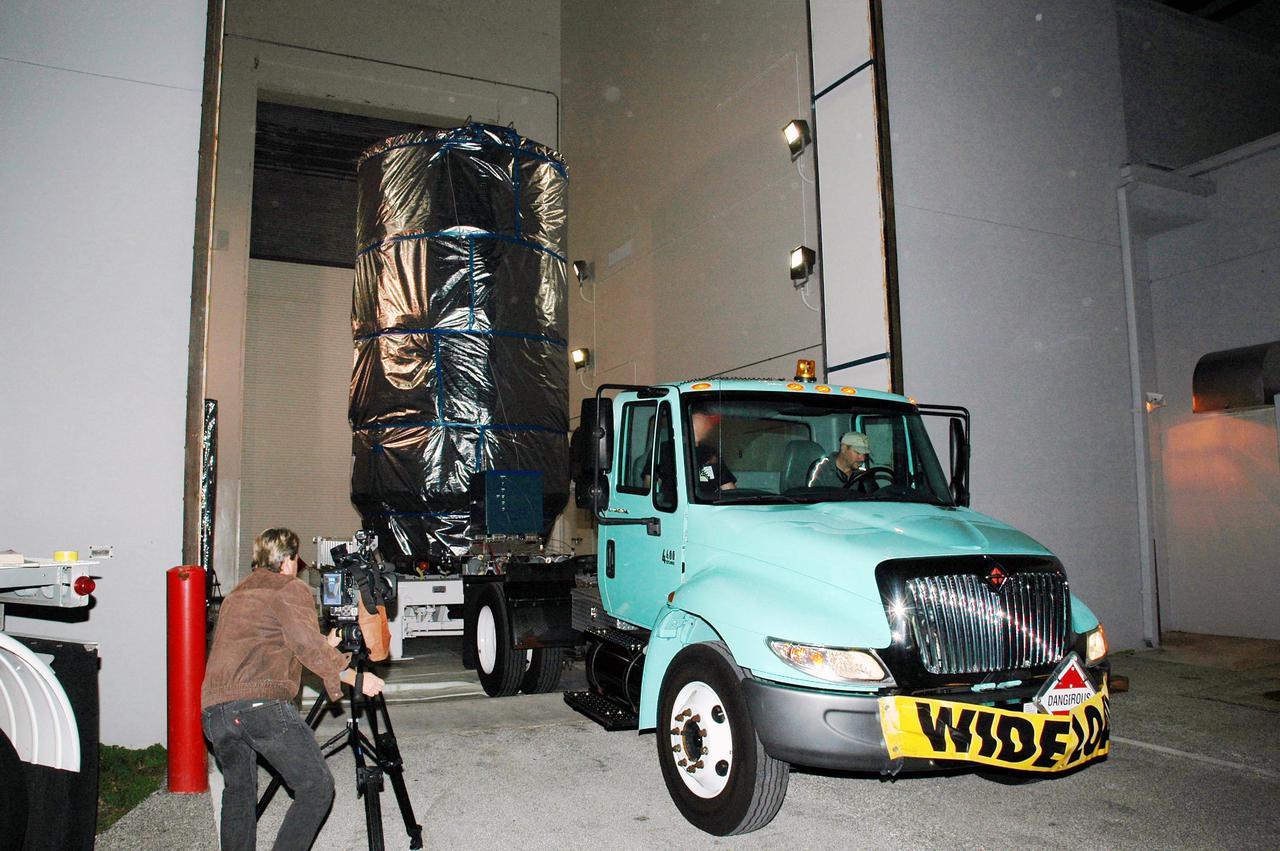
KENNEDY SPACE CENTER, FLA. - The Deep Impact spacecraft leaves Astrotech Space Operations in Titusville, Fla., in the pre-dawn hours on a journey to Launch Pad 17-B at Cape Canaveral Air Force Station, Fla. There the spacecraft will be attached to the second stage of the Boeing Delta II rocket. Next the fairing will be installed around the spacecraft. The fairing is a molded structure that fits flush with the outside surface of the Delta II upper stage booster and forms an aerodynamically smooth joint, protecting the spacecraft during launch and ascent. Scheduled for liftoff Jan. 12, Deep Impact will probe beneath the surface of Comet Tempel 1 on July 4, 2005, when the comet is 83 million miles from Earth. After releasing a 3- by 3-foot projectile to crash onto the surface, Deep Impact’s flyby spacecraft will reveal the secrets of its interior by collecting pictures and data of how the crater forms, measuring the crater’s depth and diameter as well as the composition of the interior of the crater and any material thrown out, and determining the changes in natural outgassing produced by the impact. It will send the data back to Earth through the antennas of the Deep Space Network. Deep Impact is a NASA Discovery mission.
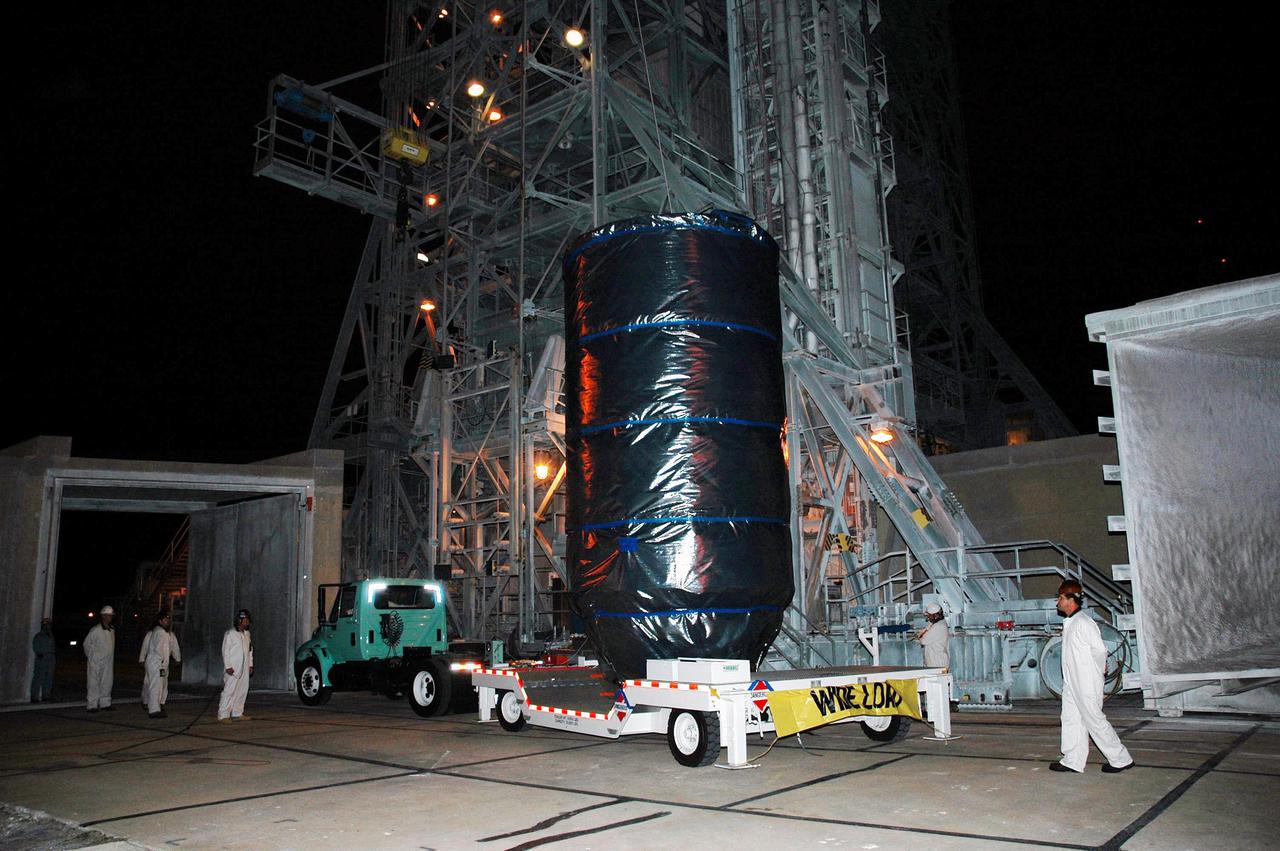
KENNEDY SPACE CENTER, FLA. - The Deep Impact spacecraft arrives before dawn at the mobile service tower on Launch Pad 17-B at Cape Canaveral Air Force Station, Fla. The spacecraft will be attached to the second stage of the Boeing Delta II rocket. Next the fairing will be installed around the spacecraft. The fairing is a molded structure that fits flush with the outside surface of the Delta II upper stage booster and forms an aerodynamically smooth joint, protecting the spacecraft during launch and ascent. Scheduled for liftoff Jan. 12, Deep Impact will probe beneath the surface of Comet Tempel 1 on July 4, 2005, when the comet is 83 million miles from Earth. After releasing a 3- by 3-foot projectile to crash onto the surface, Deep Impact’s flyby spacecraft will reveal the secrets of its interior by collecting pictures and data of how the crater forms, measuring the crater’s depth and diameter as well as the composition of the interior of the crater and any material thrown out, and determining the changes in natural outgassing produced by the impact. It will send the data back to Earth through the antennas of the Deep Space Network. Deep Impact is a NASA Discovery mission.

VANDENBERG AIR FORCE BASE, Calif. -- In pre-dawn hours at Vandenberg Air Force Base in California, preparing for the arrival of the Delta II first stage for the OSTM/Jason-2 spacecraft, the mobile service tower (left) on Space Launch Complex 2 has been moved away from the umbilical tower and launcher (right). The OSTM, or Ocean Topography Mission, on the Jason-2 satellite is a follow-on to Jason-1. It will take oceanographic studies of sea surface height into an operational mode for continued climate forecasting research and science and industrial applications. This satellite altimetry data will help determine ocean circulation, climate change and sea-level rise. OSTM is a joint effort by the National Oceanic and Atmospheric Administration, NASA, France’s Centre National d’Etudes Spatiales and the European Meteorological Satellite Organisation. OSTM/Jason-2 will be launched aboard a United Launch Alliance Delta II 7320 from Vandenberg on June 15. Photo credit: NASA/Dan Liberotti