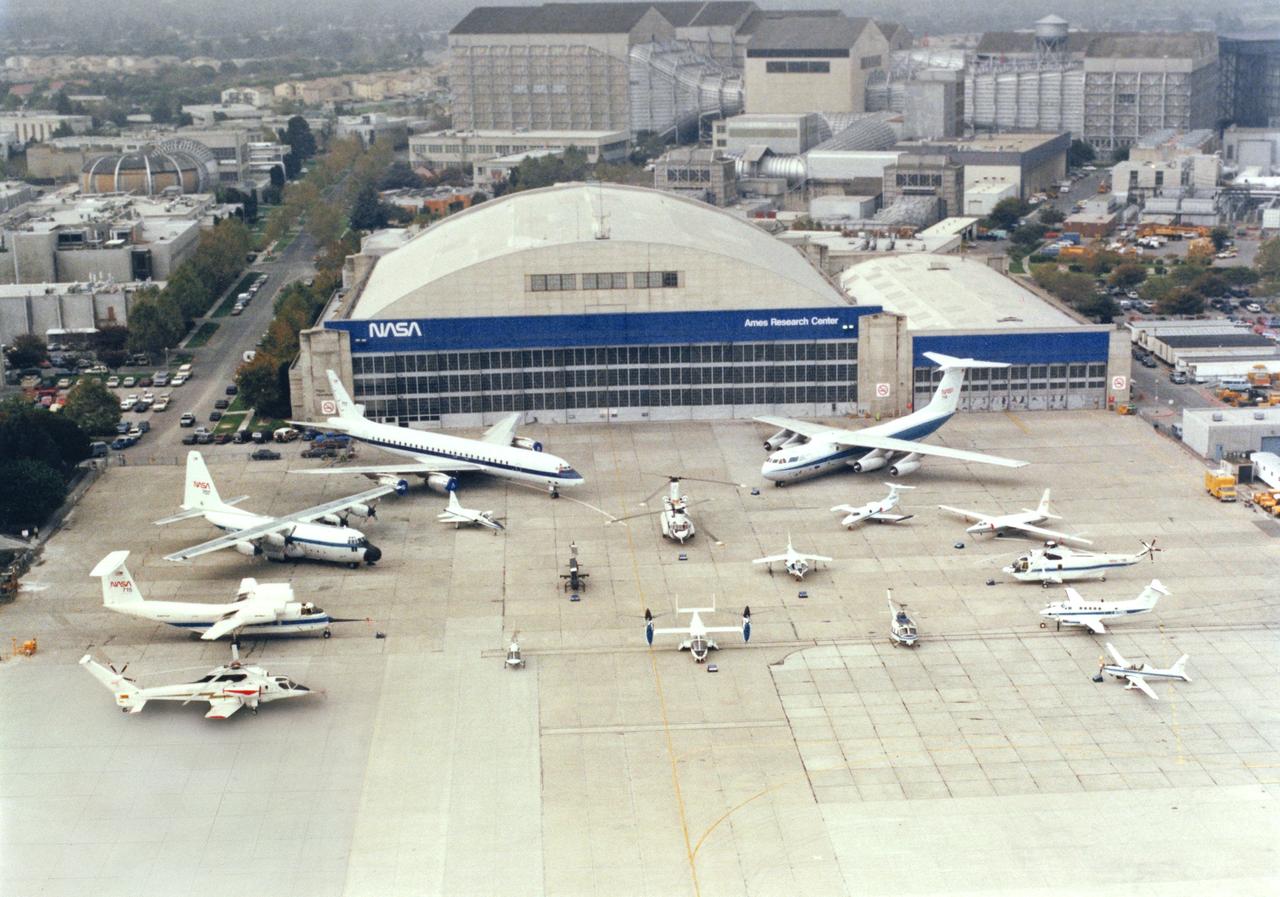
Ames Aircraft complement on ramp DC-8, C-130, QSRA, RSRA, C-141, U-2, SH-3G, King Air, YO-3A, T-38, CH-47, Lear Jet, AH-1G, AV-8B Harrier, OH-58A, XV-15, UH-1H
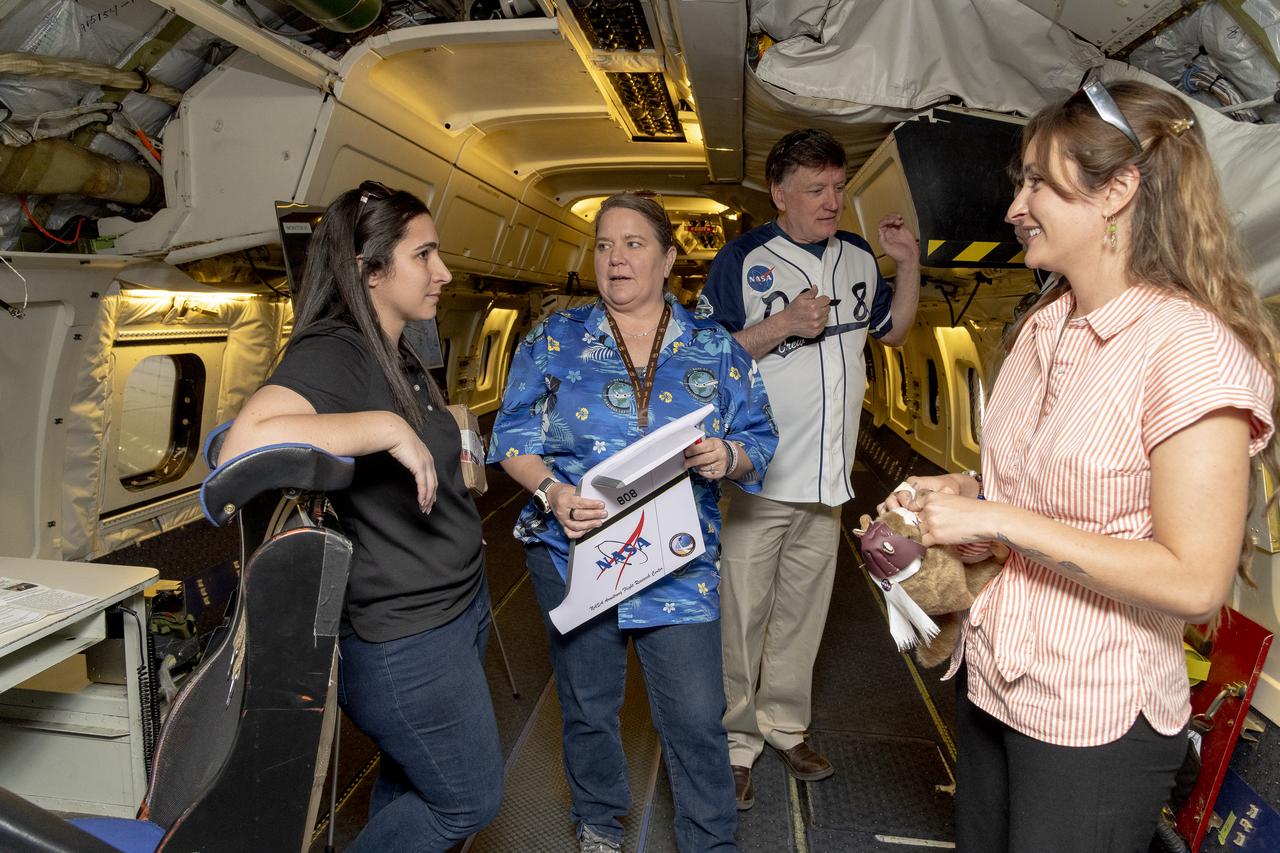
Members of the DC-8 program team tour an empty aircraft and recall past missions. Usually the DC-8 has between 15 and 30 instrument racks installed for a given science mission. The aircraft was spacious by comparison on May 2, 2024, when NASA personnel, friends, and family gathered at NASA’s Armstrong Flight Research Center Building 703 in Palmdale, California to celebrate the DC-8 staff, aircraft, and science campaigns. Conversing here are DC-8 aircraft deputy manager Kirsten Boogaard, left, with NASA Armstrong pilot Carrie Worth, Mike Zimmerman, and NASA Armstrong public affairs specialist for airborne science, Erica Heim.
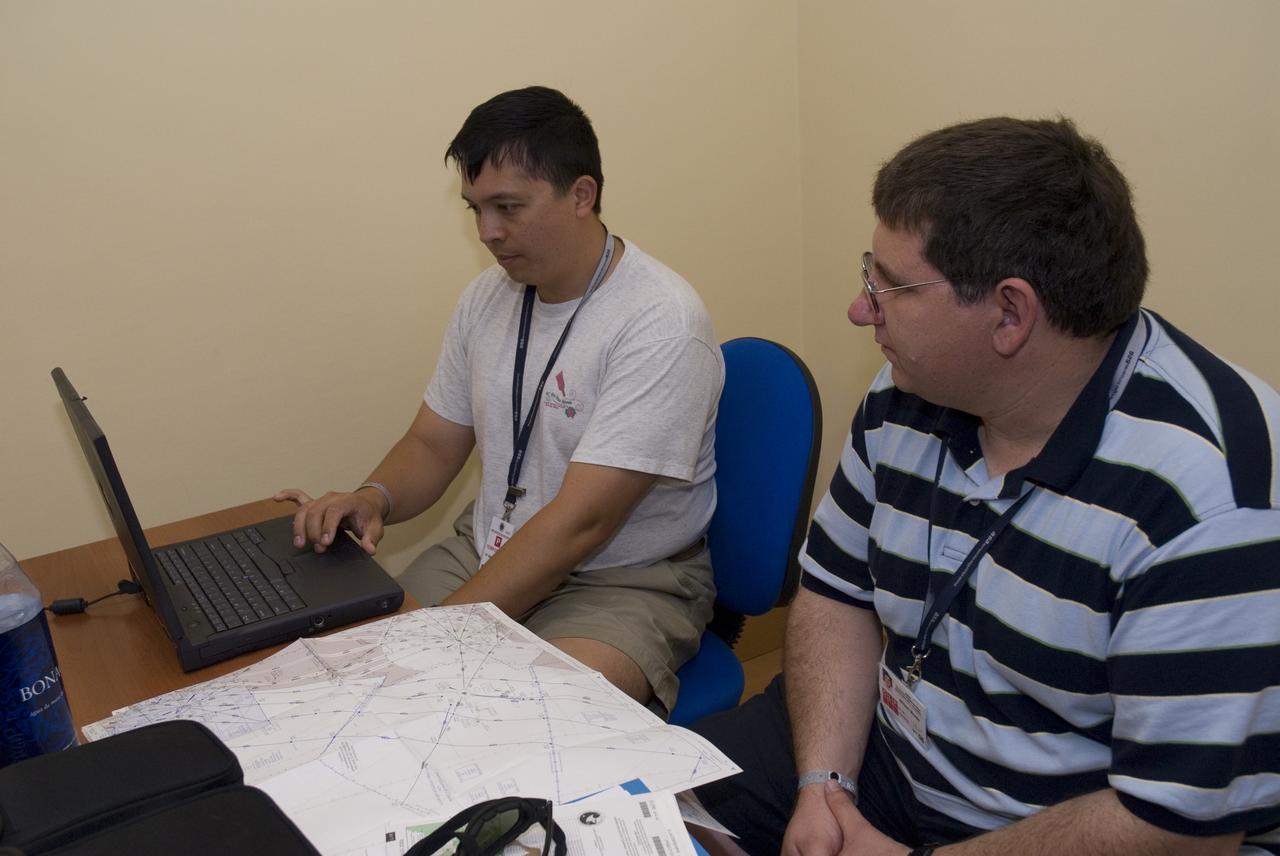
NASA African Monsoon Multidisciplinary Analyses (NAMMA) DC-8 deployment to Cape Verde, Sal island, Africa
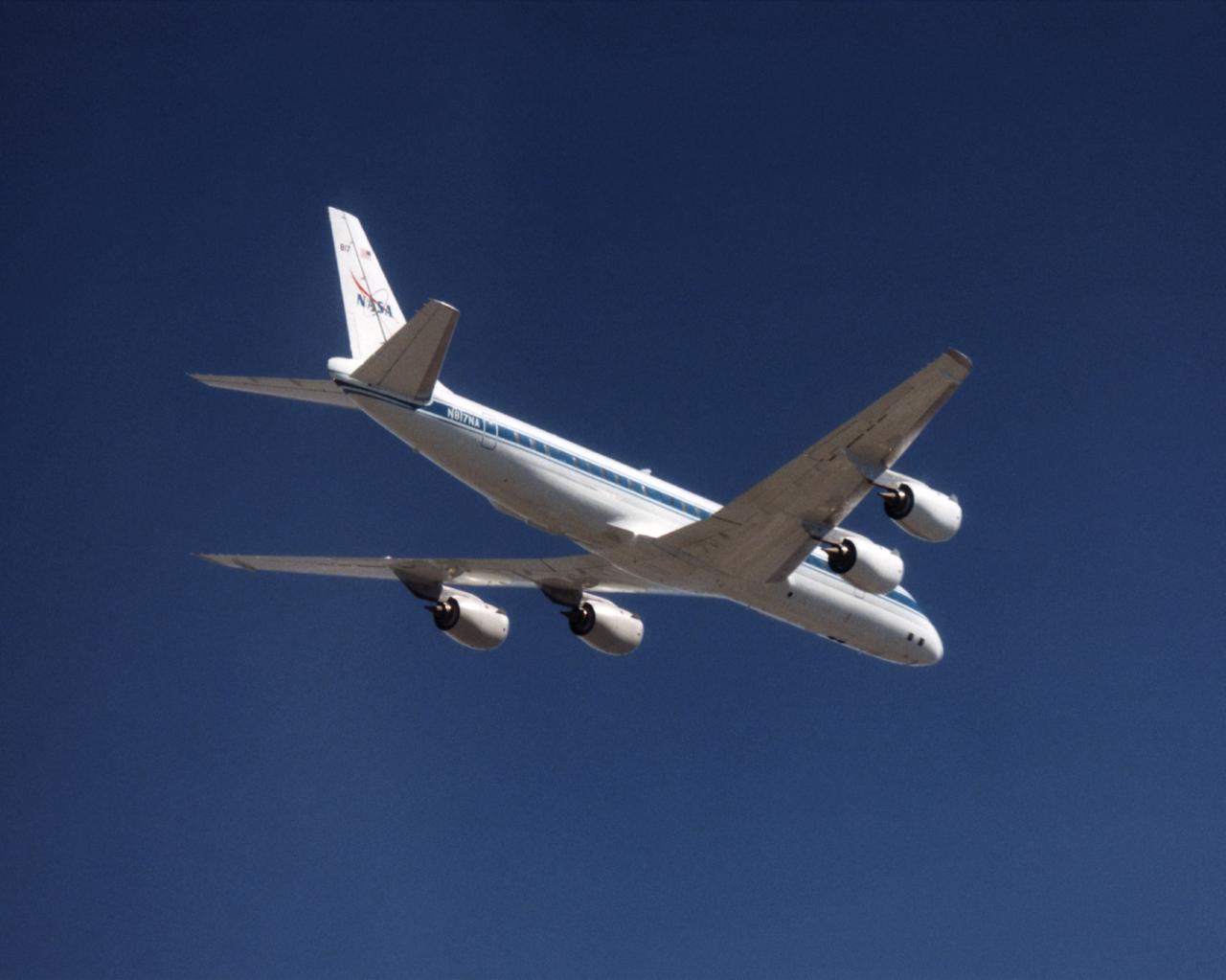
The NASA DC-8 in a right bank over the rugged Sierra Nevada Mountains. The former airliner is a "dash-72" model and has a range of 5,500 miles. The craft can stay airborne for 12 hours and has an operational speed range between 300 and 500 knots. The research flights are made at between 500 and 41,000 feet. The aircraft can carry up to 30,000 lbs of research/science payload equipment installed in 15 mission-definable spaces. In this photo, the aircraft is shown in flight from below, with the DC-8 silhouetted against a blue sky.
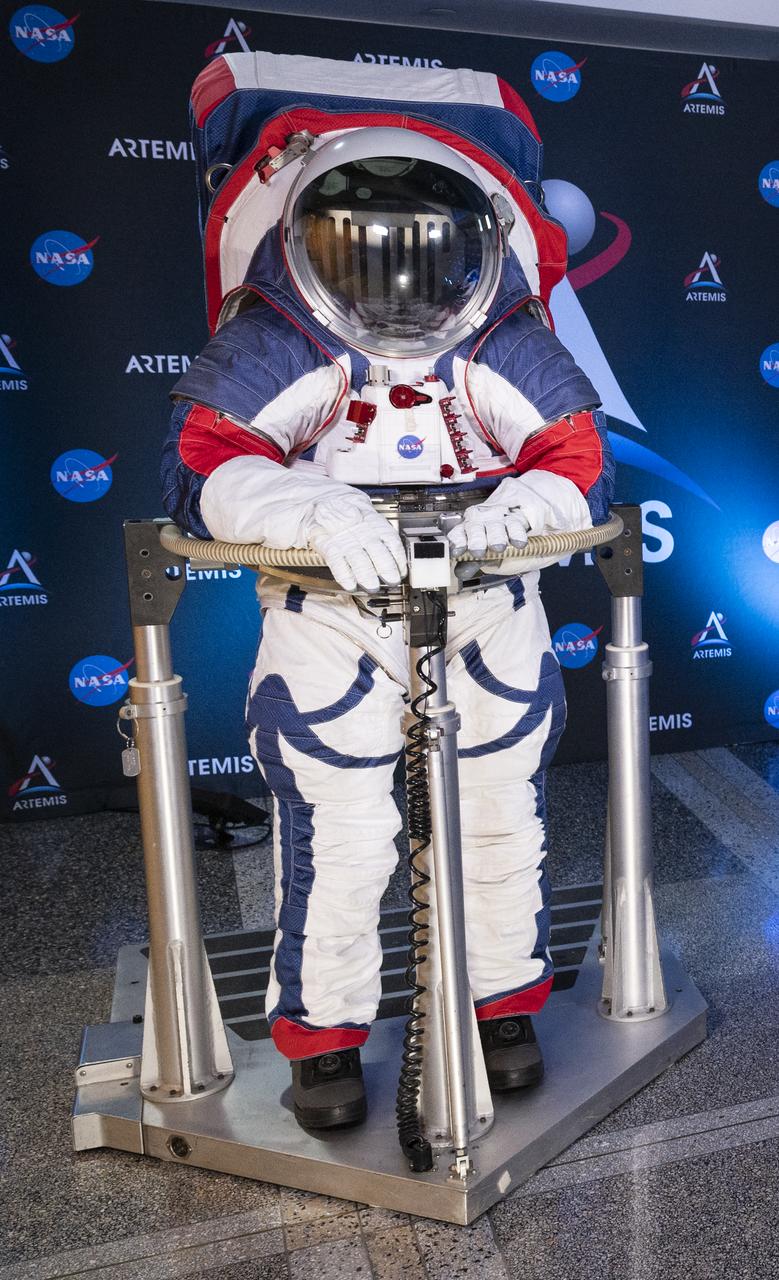
A ground prototype of NASA’s new Exploration Extravehicular Mobility Unit (xEMU) is seen Tuesday, Oct. 15, 2019 at NASA Headquarters in Washington, DC. The xEMU suit improves on the suits previous worn on the Moon during the Apollo era and those currently in use for spacewalks outside the International Space Station. Photo Credit: (NASA/Joel Kowsky)
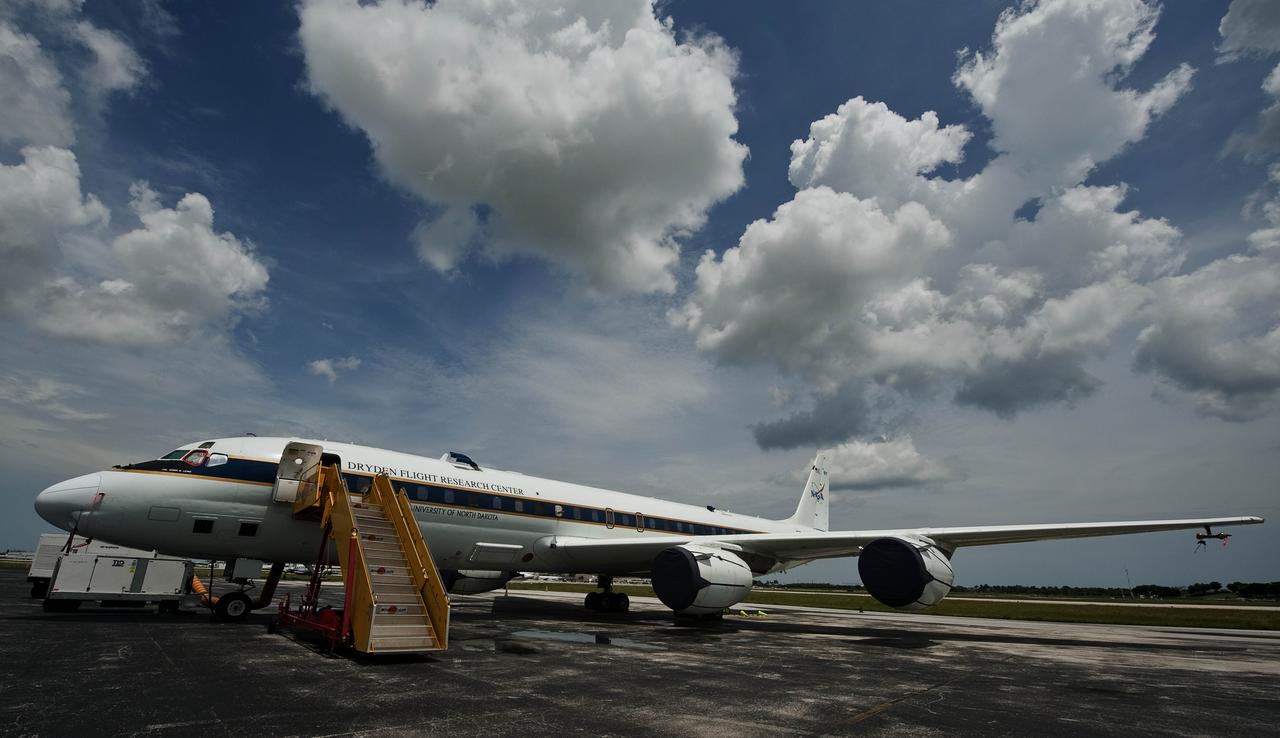
The NASA DC-8 airplane sits on the tarmac, Sunday, Aug. 15, 2010, at Fort Lauderdale International Airport in Fort Lauderdale, Fla. , as preparations continue for its part in the GRIP experiment. The Genesis and Rapid Intensification Processes (GRIP) experiment is a NASA Earth science field experiment in 2010 that is being conducted to better understand how tropical storms form and develop into major hurricanes. Photo Credit: (NASA/Paul E. Alers)
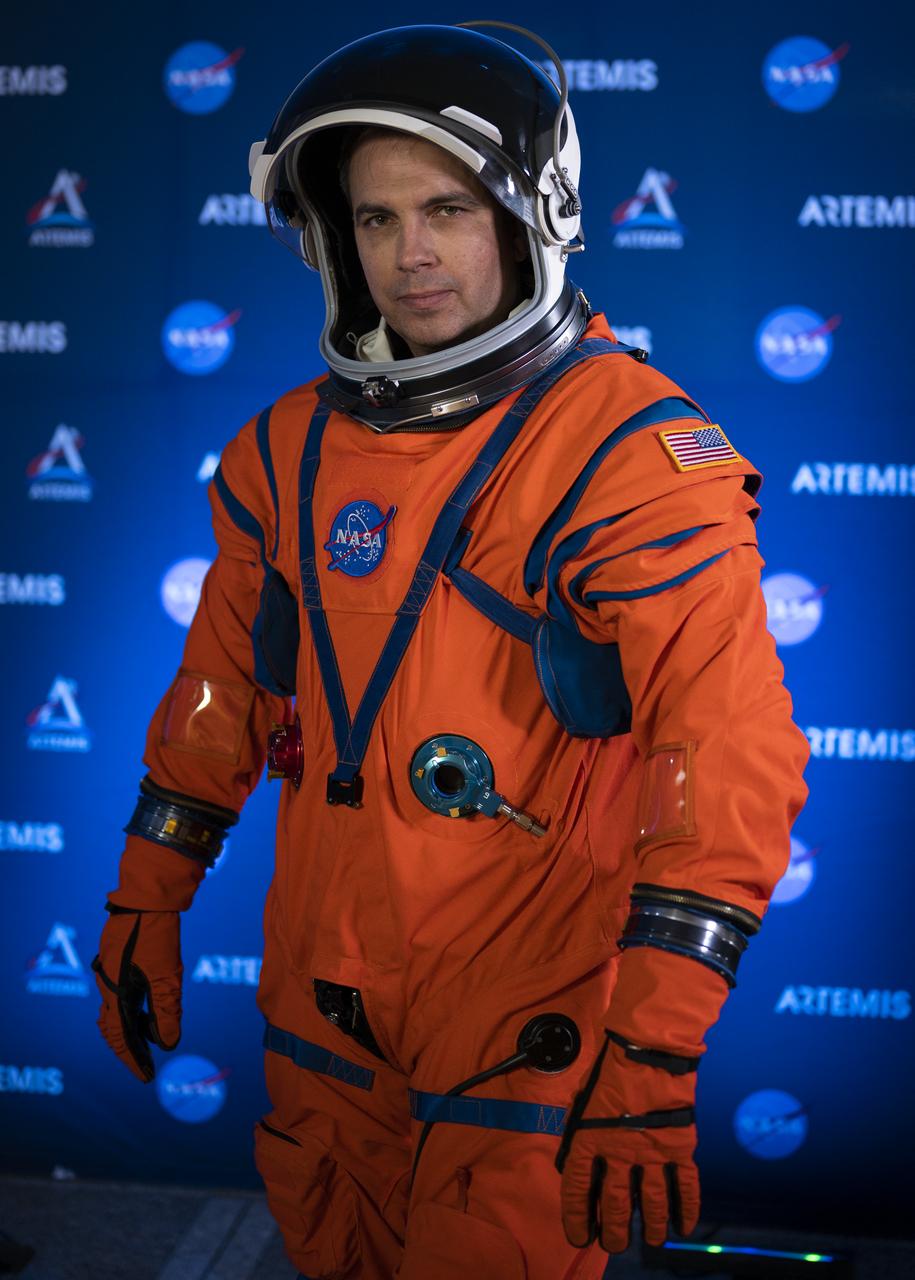
Dustin Gohmert, Orion Crew Survival Systems Project Manager at NASA’s Johnson Space Center, poses for a portrait while wearing the Orion Crew Survival System (OCSS) suit, Tuesday, Oct. 15, 2019 at NASA Headquarters in Washington, DC. The Orion suit is designed for a custom fit and incorporates safety technology and mobility features that will help protect astronauts on launch day, in emergency situations, high-risk parts of missions near the Moon, and during the high-speed return to Earth. Photo Credit: (NASA/Joel Kowsky)
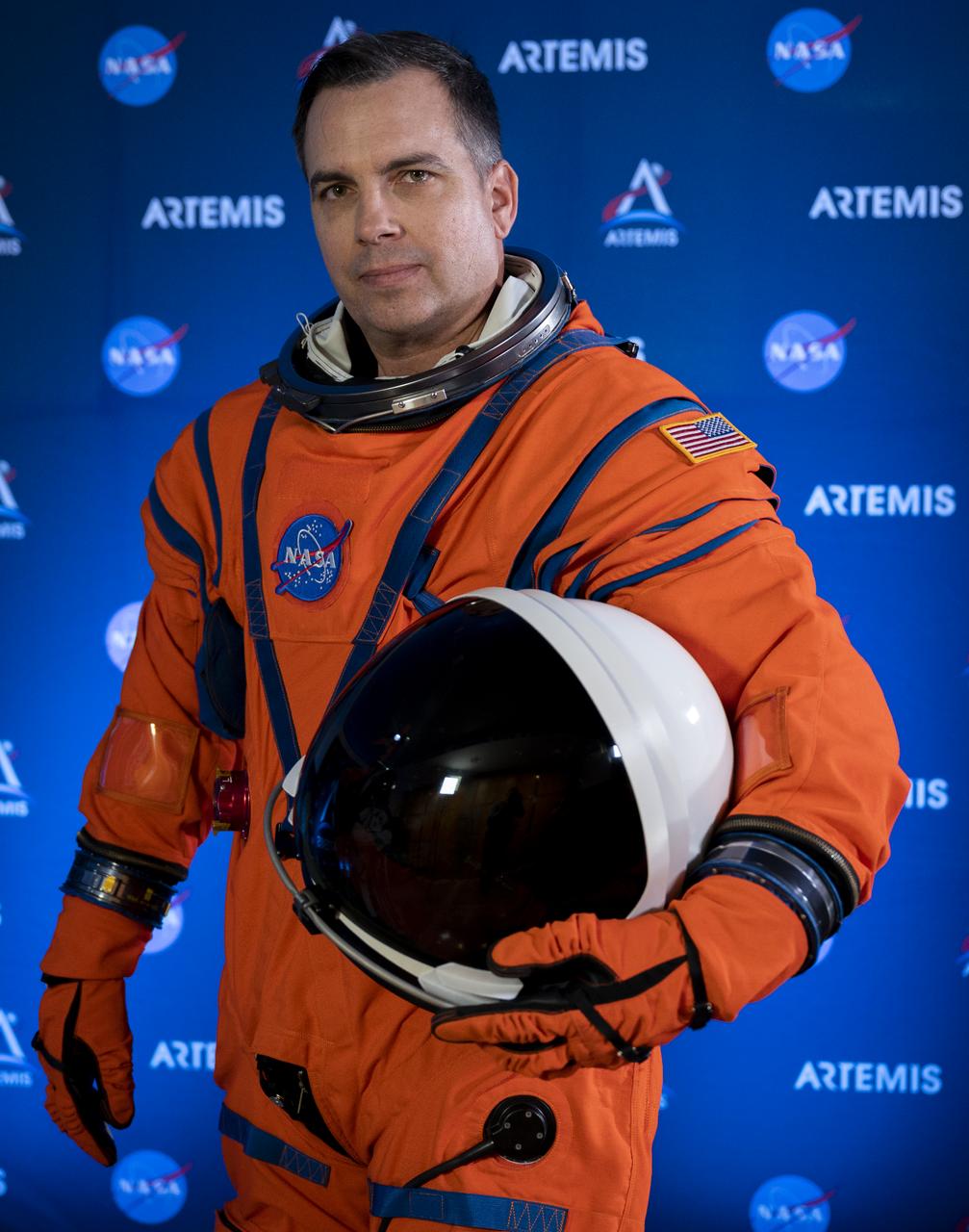
Dustin Gohmert, Orion Crew Survival Systems Project Manager at NASA’s Johnson Space Center, poses for a portrait while wearing the Orion Crew Survival System (OCSS) suit, Tuesday, Oct. 15, 2019 at NASA Headquarters in Washington, DC. The Orion suit is designed for a custom fit and incorporates safety technology and mobility features that will help protect astronauts on launch day, in emergency situations, high-risk parts of missions near the Moon, and during the high-speed return to Earth. Photo Credit: (NASA/Joel Kowsky)
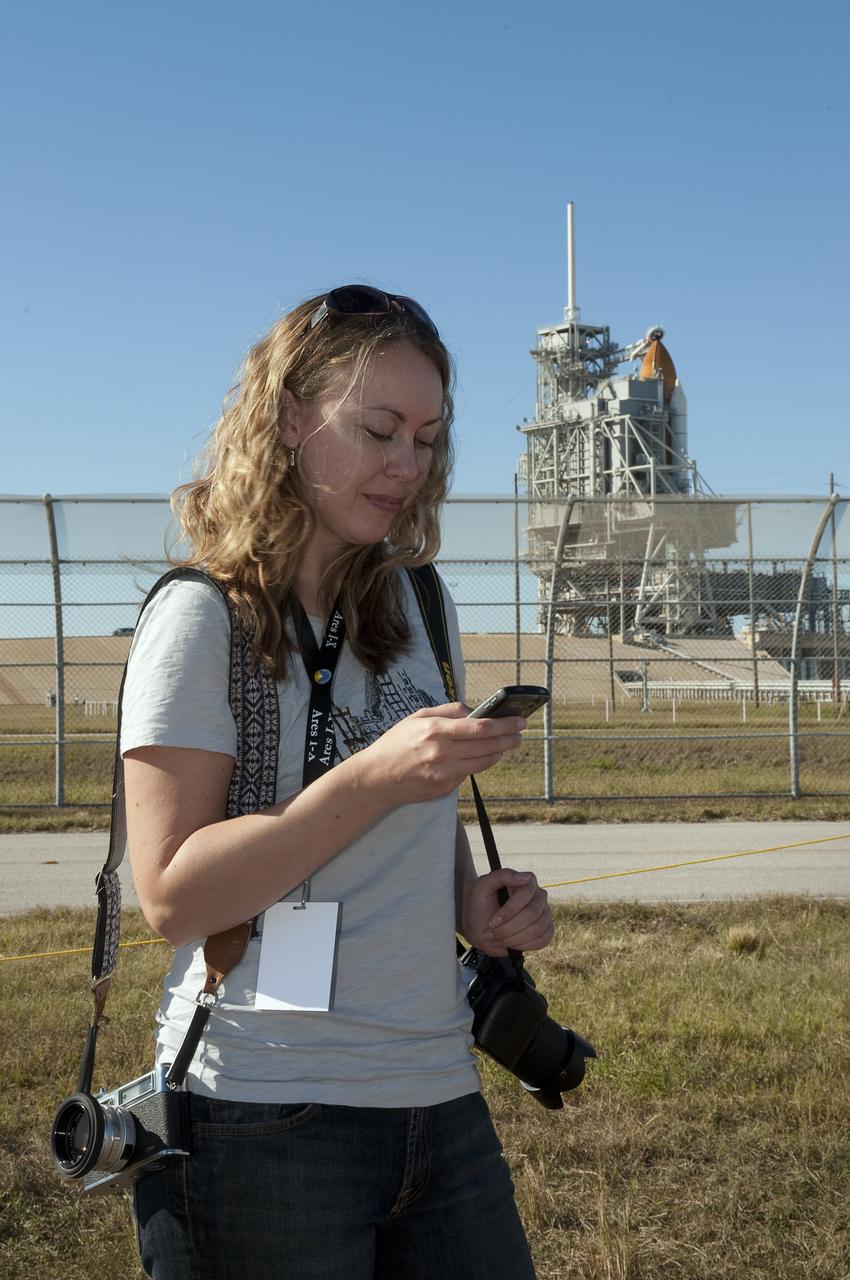
NASA Twitter follower Heather Goss from Washington, DC, who goes by the twitter name @heathermg, twitters as she stands in front of space shuttle Atlantis at launch pad 39A as part of during a tour of Kennedy Space Center in Cape Canaveral, Fla, Sunday, Nov. 15, 2009. Space shuttle Atlantis is set to launch on Monday, Nov. 16, 2009 and dock with the International Space Station (ISS) two days later. Photo Credit: (NASA/Carla Cioffi)
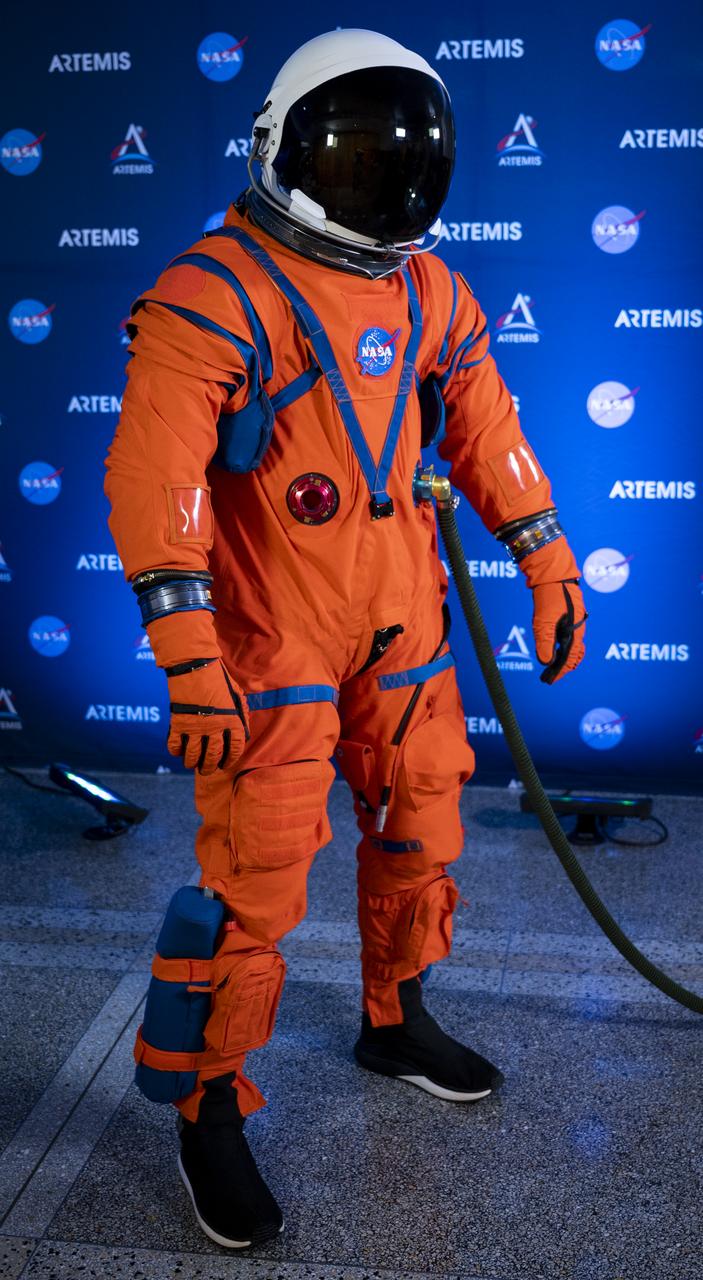
Dustin Gohmert, Orion Crew Survival Systems Project Manager at NASA’s Johnson Space Center, poses for a portrait while wearing the Orion Crew Survival System (OCSS) suit, Tuesday, Oct. 15, 2019 at NASA Headquarters in Washington, DC. The Orion suit is designed for a custom fit and incorporates safety technology and mobility features that will help protect astronauts on launch day, in emergency situations, high-risk parts of missions near the Moon, and during the high-speed return to Earth. Photo Credit: (NASA/Joel Kowsky)

Dustin Gohmert, Orion Crew Survival Systems Project Manager at NASA’s Johnson Space Center, poses for a portrait while wearing the Orion Crew Survival System (OCSS) suit, Tuesday, Oct. 15, 2019 at NASA Headquarters in Washington, DC. The Orion suit is designed for a custom fit and incorporates safety technology and mobility features that will help protect astronauts on launch day, in emergency situations, high-risk parts of missions near the Moon, and during the high-speed return to Earth. Photo Credit: (NASA/Joel Kowsky)
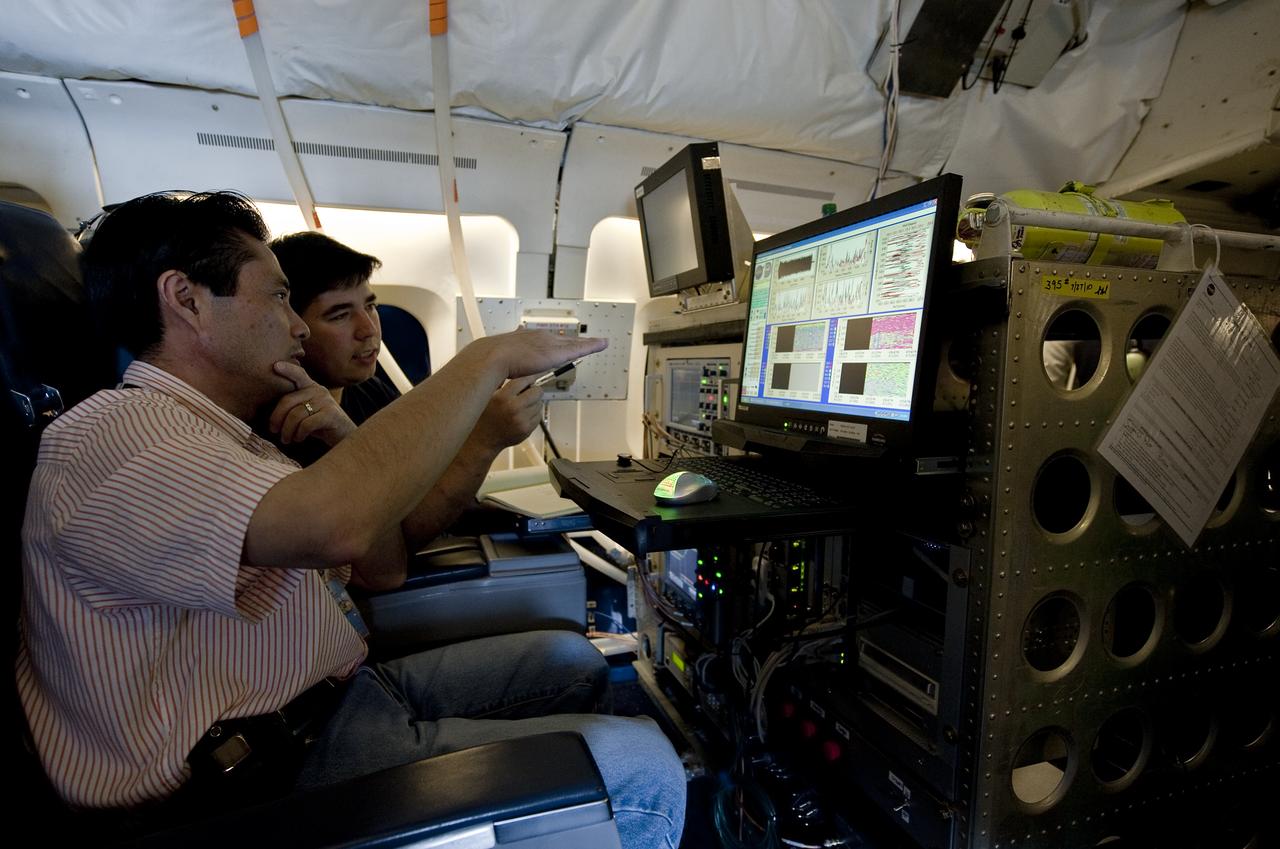
Jeffrey Beyon, left, and Paul Joseph Petzar, right, from NASA's Langley Research Center, work with DAWN Air Data Acquisition and Processing software aboard NASA's DC-8 research aircraft, Sunday, Aug. 15, 2010, in support of the GRIP experiment at Fort Lauderdale International Airport in Fort Lauderdale, Fla. The Genesis and Rapid Intensification Processes (GRIP) experiment is a NASA Earth science field experiment in 2010 that is being conducted to better understand how tropical storms form and develop into major hurricanes. Photo Credit: (NASA/Paul E. Alers)

ISS013-E-13549 (2 May 2006) --- Washington, DC is featured in this image photographed by an Expedition 13 crewmember on the International Space Station. When the image was exposed, the orbital outpost was located over the western border of Maryland and West Virginia. The resolution and extent of the true-color, handheld image is similar to the 15-meter/pixel data obtained by sensors onboard the unmanned Landsat-7 and Terra satellites. This resolution is sufficient to capture the sunglint off the Capitol Building's dome. Other major landmarks that are visible include the Washington Monument, the Pentagon (bottom left, southwest of the Potomac River), and the Lincoln Memorial, along the northwest bank of the Potomac.
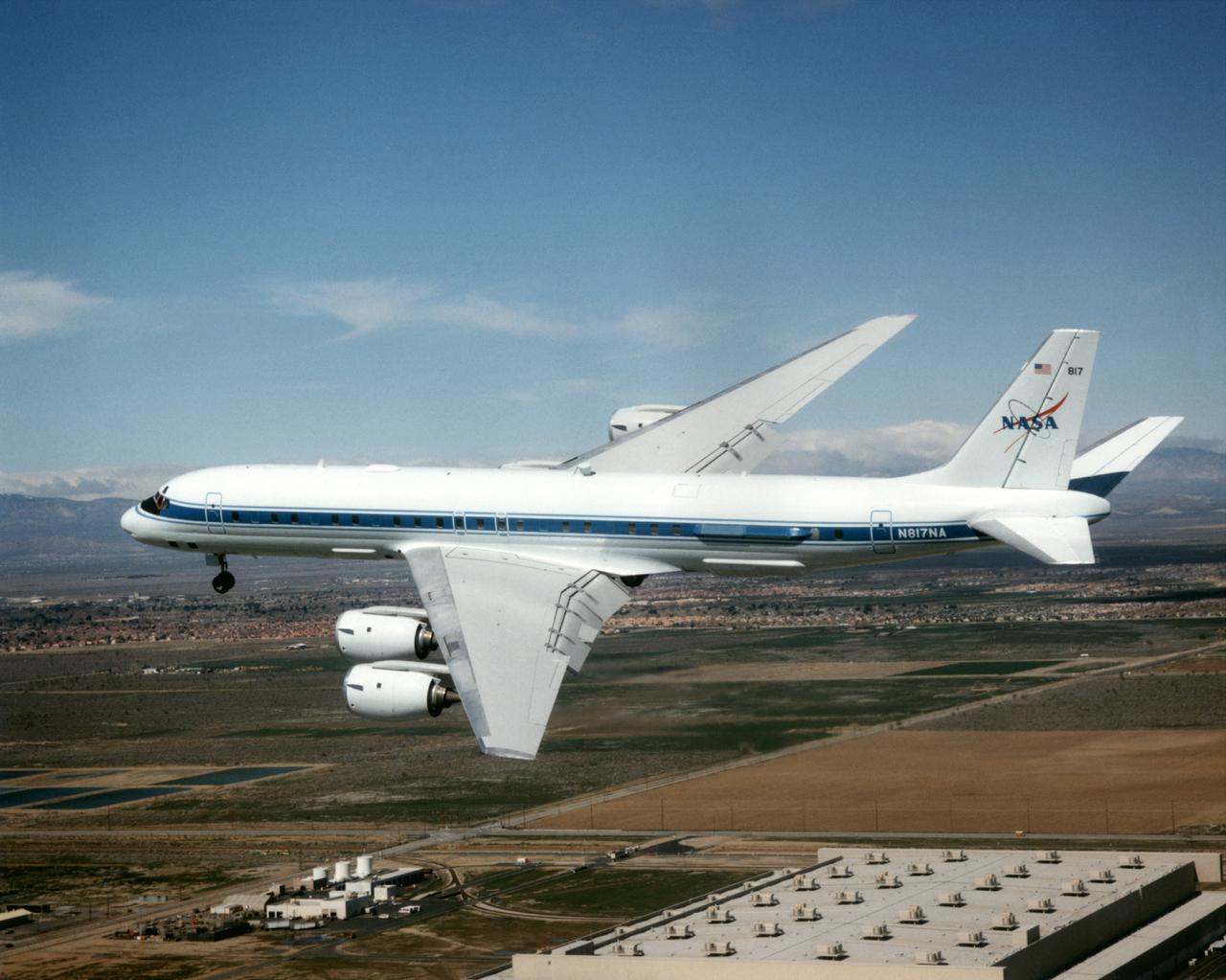
The DC-8 Airborne Laboratory in a left banking turn above the airport at Palmdale, California. The right wing is silhouetted against the blue sky, while the left wing contrasts with the desert terrain. The former airliner is a "dash-72" model and has a range of 5,400 miles. The craft can stay airborne for 12 hours and has an operational speed range between 300 and 500 knots. The research flights are made at between 500 and 41,000 feet. The aircraft can carry up to 30,000 lbs of research/science payload equipment installed in 15 mission-definable spaces.
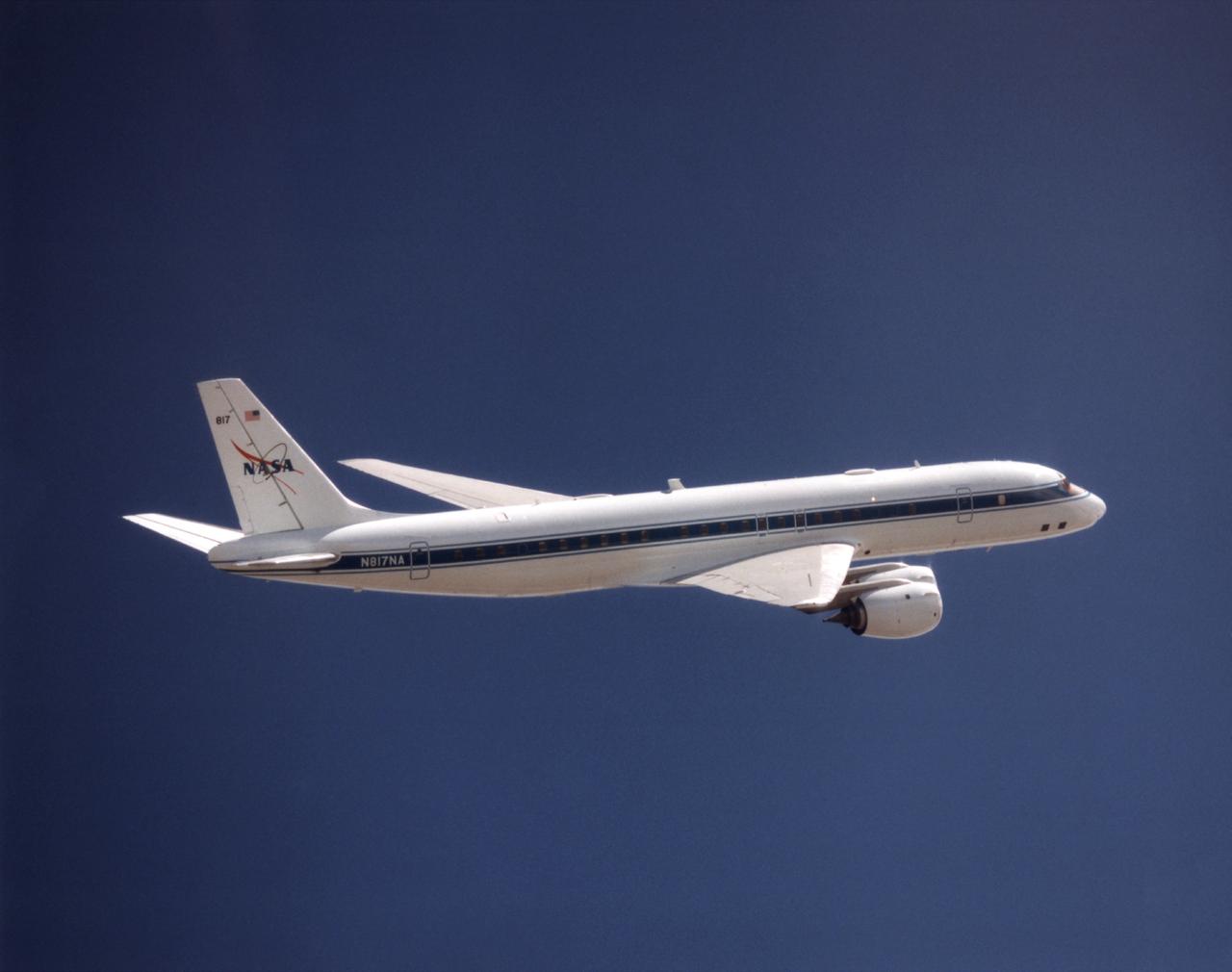
NASA's DC-8 Airborne Science platform shown against a background of a dark blue sky on February 20, 1998. The aircraft is shown from the right rear, slightly above its plane, with the right wing in the foreground and the left wing and horizontal tail in the background. The former airliner is a "dash-72" model and has a range of 5,400 miles. The craft can stay airborne for 12 hours and has an operational speed range between 300 and 500 knots. The research flights are made at between 500 and 41,000 feet. The aircraft can carry up to 30,000 lbs of research/science payload equipment installed in 15 mission-definable spaces.
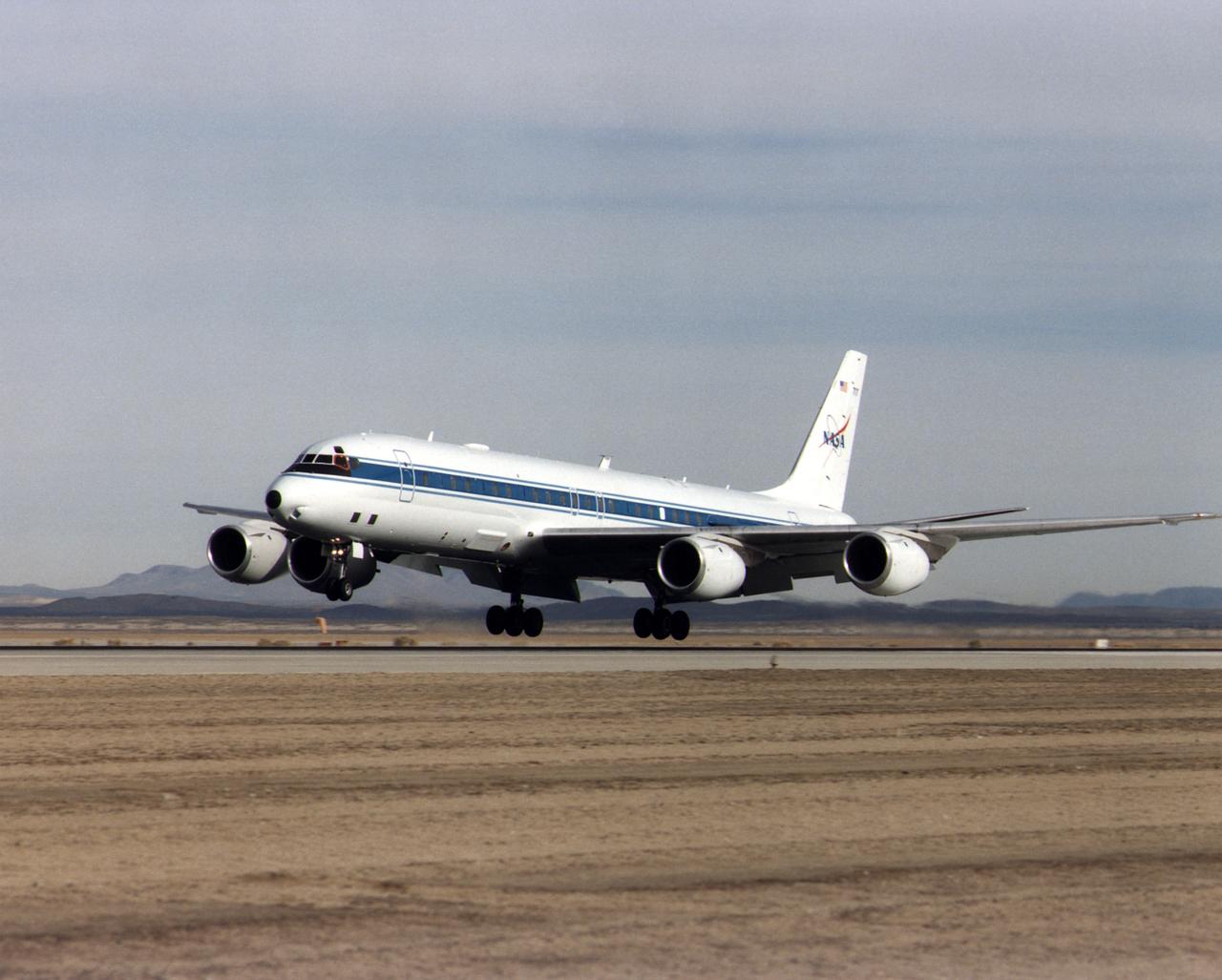
NASA's DC-8 Airborne Science platform landed at Edwards Air Force Base, California, to join the fleet of aircraft at NASA's Dryden Flight Research Center. The white aircraft with a blue stripe running horizontally from the nose to the tail is shown with its main landing gear just above the runway. The former airliner is a "dash-72" model and has a range of 5,400 miles. The craft can stay airborne for 12 hours and has an operational speed range between 300 and 500 knots. The research flights are made at between 500 and 41,000 feet. The aircraft can carry up to 30,000 lbs of research/science payload equipment installed in 15 mission-definable spaces.
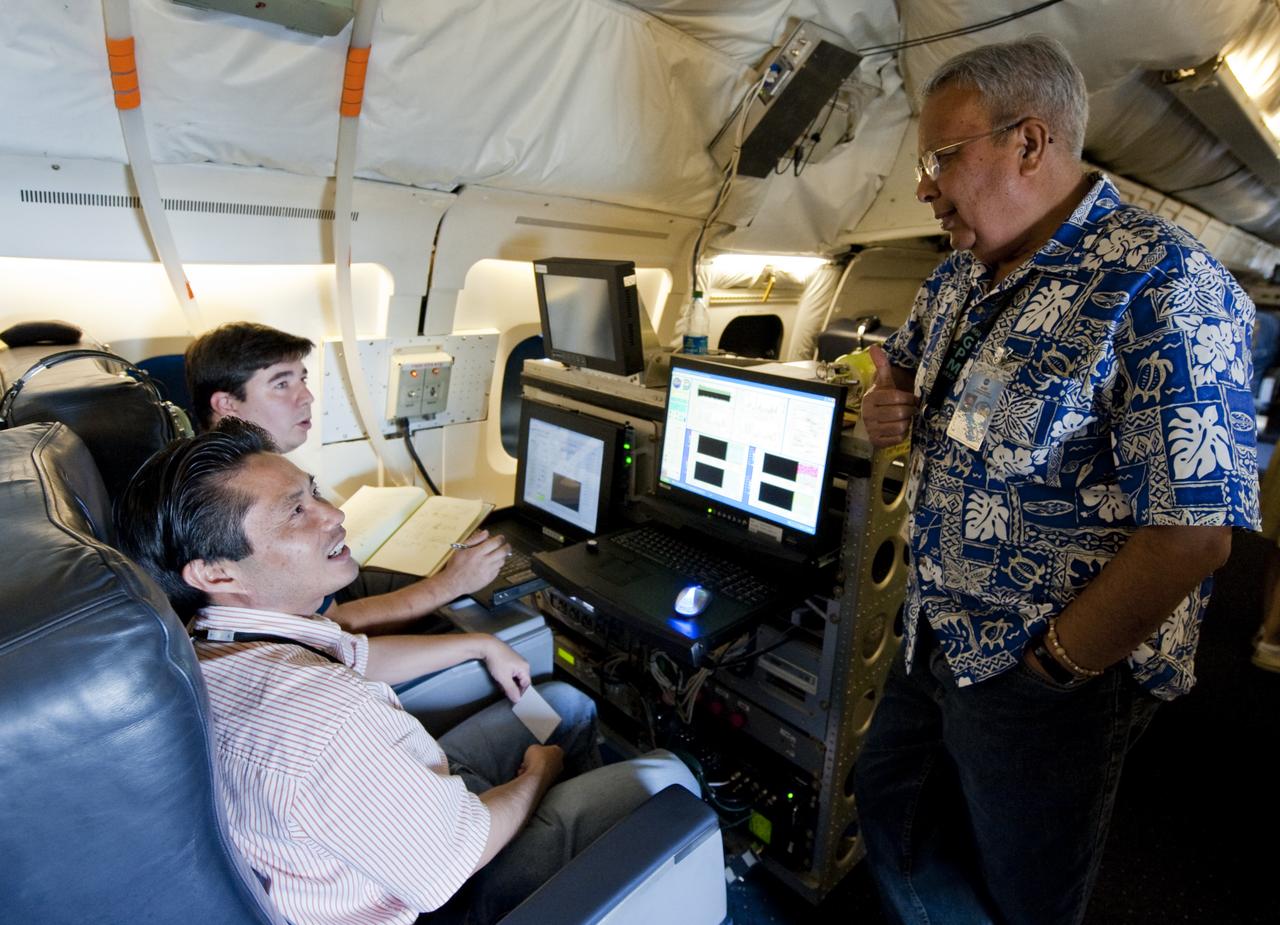
Jeffrey Beyon, lower right, and Paul Joseph Petzar, right, researchers from NASA's Langley Research Center, speak with Ramesh Kakar right, of the NASA Earth Science Division as they work with DAWN Air Data Acquisition and Processing software aboard NASA's DC-8 research aircraft, Sunday, Aug. 15, 2010, in support of the GRIP experiment at Fort Lauderdale International Airport in Fort Lauderdale, Fla. The Genesis and Rapid Intensification Processes (GRIP) experiment is a NASA Earth science field experiment in 2010 that is being conducted to better understand how tropical storms form and develop into major hurricanes. Photo Credit: (NASA/Paul E. Alers)
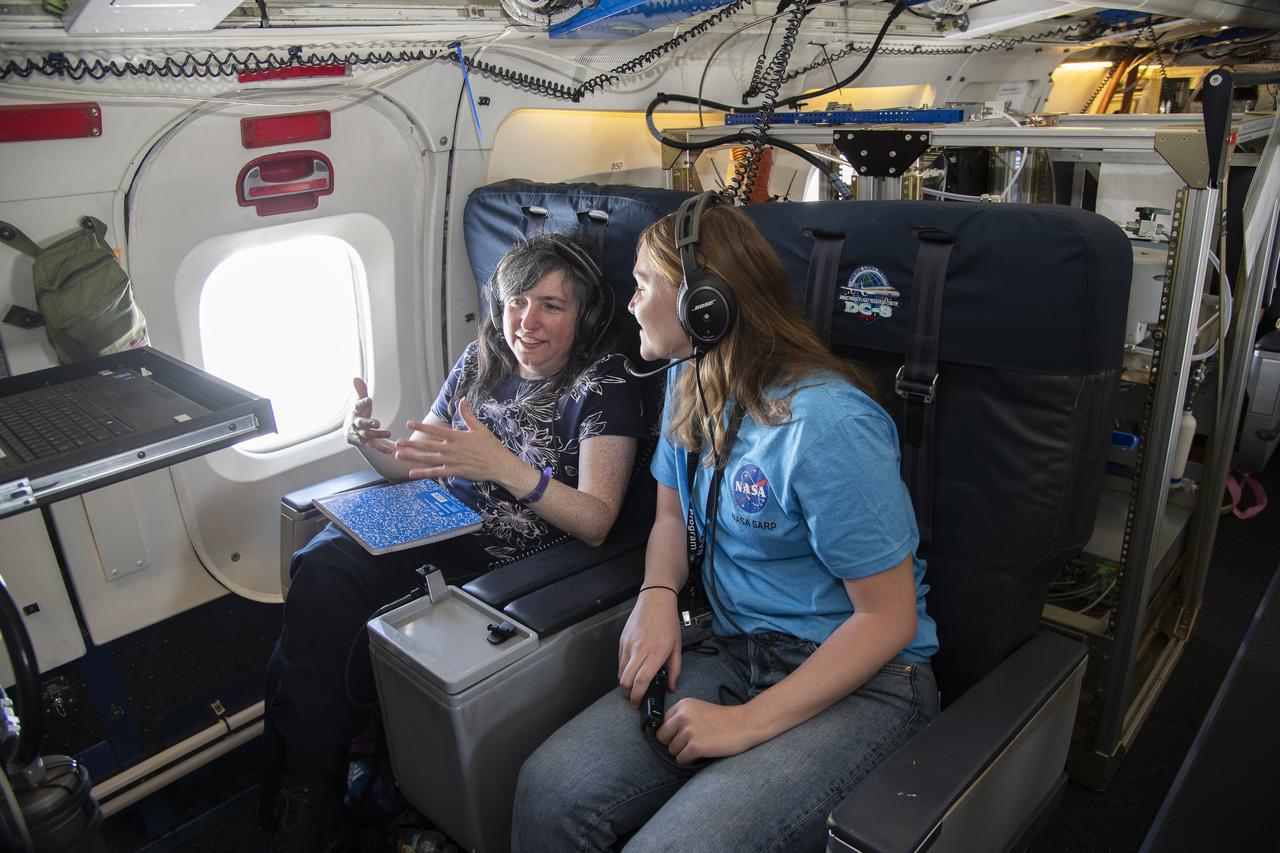
NASA Armstrong’s Student Airborne Research Program celebrates 15 years of success in 2023. An eight-week summer internship program, SARP offers upper-level undergraduate students the opportunity to acquire hands-on research experience as part of a scientific campaign using NASA Airborne Science Program flying science laboratories—aircraft outfitted specifically for research projects. Students onboard NASA’s DC-8 aircraft, the largest flying science laboratory in the world, help scientists from NOAA, the National Oceanic and Atmospheric Administration with a science project investigating air quality and non-vehicular pollution sources called AEROMMA, which measures Atmospheric Emissions and Reactions Observed from Megacities to Marine Areas. In 2023, NASA also introduced a sister program, SARP East to complement the West Coast program.
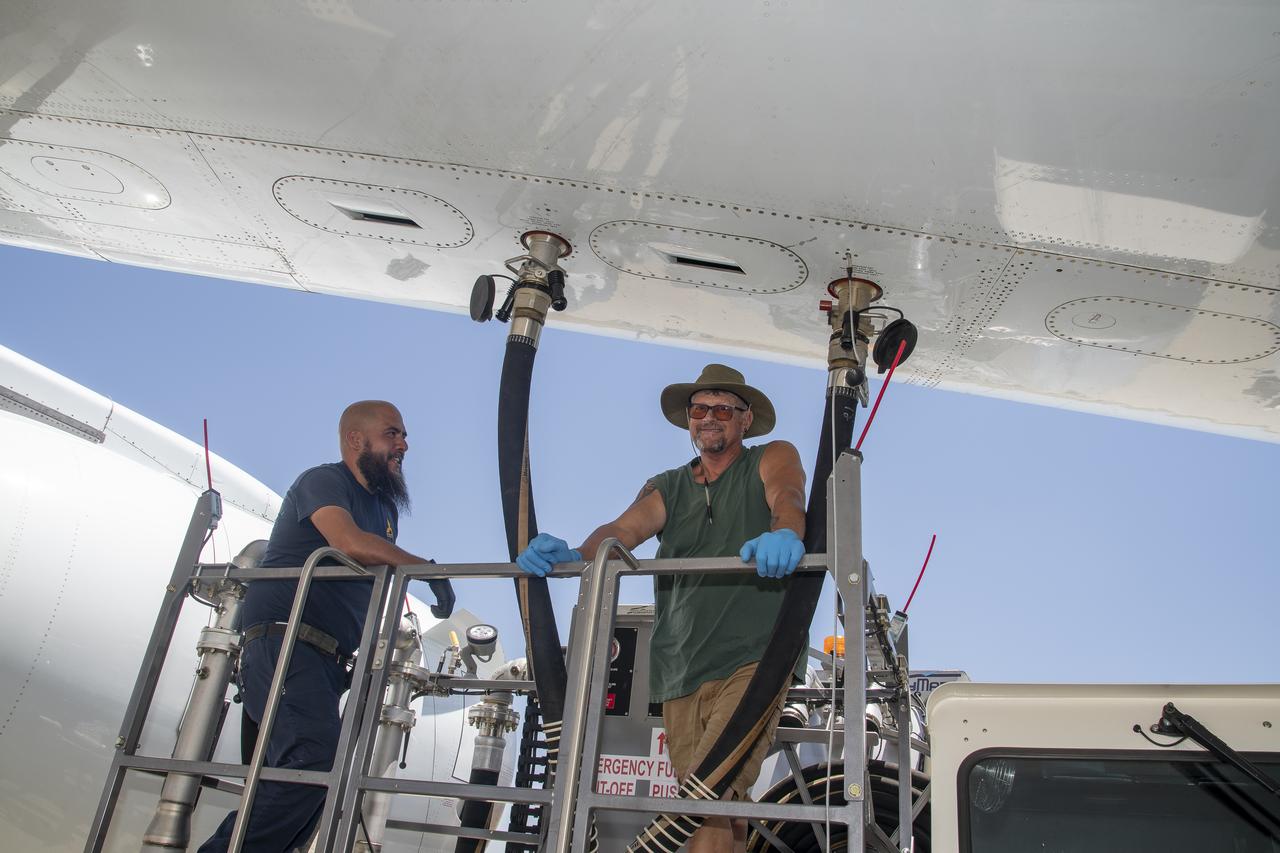
NASA Armstrong’s Student Airborne Research Program celebrates 15 years of success in 2023. An eight-week summer internship program, SARP offers upper-level undergraduate students the opportunity to acquire hands-on research experience as part of a scientific campaign using NASA Airborne Science Program flying science laboratories—aircraft outfitted specifically for research projects. Students onboard NASA’s DC-8 aircraft, the largest flying science laboratory in the world, help scientists from NOAA, the National Oceanic and Atmospheric Administration with a science project investigating air quality and non-vehicular pollution sources called AEROMMA, which measures Atmospheric Emissions and Reactions Observed from Megacities to Marine Areas. In 2023, NASA also introduced a sister program, SARP East to complement the West Coast program.
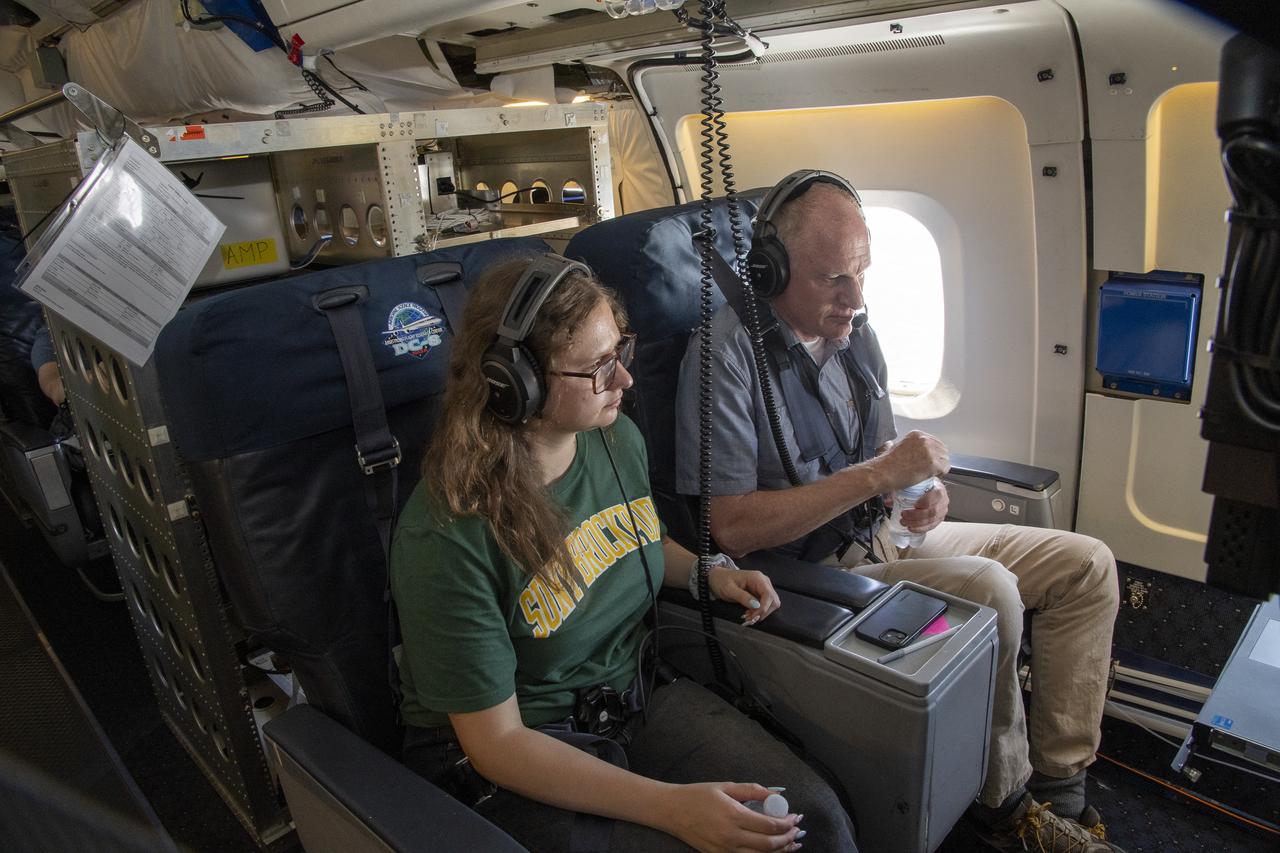
NASA Armstrong’s Student Airborne Research Program celebrates 15 years of success in 2023. An eight-week summer internship program, SARP offers upper-level undergraduate students the opportunity to acquire hands-on research experience as part of a scientific campaign using NASA Airborne Science Program flying science laboratories—aircraft outfitted specifically for research projects. Students onboard NASA’s DC-8 aircraft, the largest flying science laboratory in the world, help scientists from NOAA, the National Oceanic and Atmospheric Administration with a science project investigating air quality and non-vehicular pollution sources called AEROMMA, which measures Atmospheric Emissions and Reactions Observed from Megacities to Marine Areas. In 2023, NASA also introduced a sister program, SARP East to complement the West Coast program.
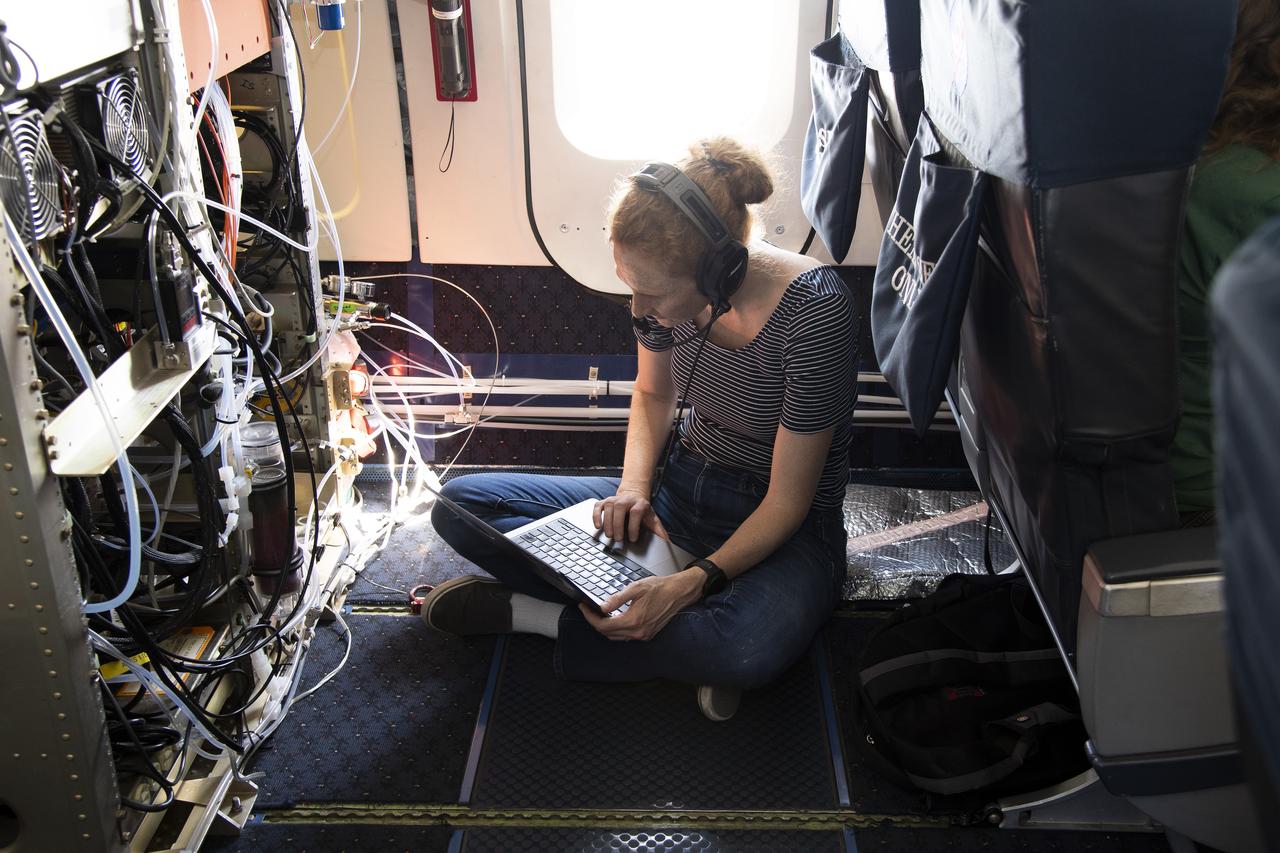
NASA Armstrong’s Student Airborne Research Program celebrates 15 years of success in 2023. An eight-week summer internship program, SARP offers upper-level undergraduate students the opportunity to acquire hands-on research experience as part of a scientific campaign using NASA Airborne Science Program flying science laboratories—aircraft outfitted specifically for research projects. Students onboard NASA’s DC-8 aircraft, the largest flying science laboratory in the world, help scientists from NOAA, the National Oceanic and Atmospheric Administration with a science project investigating air quality and non-vehicular pollution sources called AEROMMA, which measures Atmospheric Emissions and Reactions Observed from Megacities to Marine Areas. In 2023, NASA also introduced a sister program, SARP East to complement the West Coast program.

NASA Armstrong’s Student Airborne Research Program celebrates 15 years of success in 2023. An eight-week summer internship program, SARP offers upper-level undergraduate students the opportunity to acquire hands-on research experience as part of a scientific campaign using NASA Airborne Science Program flying science laboratories—aircraft outfitted specifically for research projects. Students onboard NASA’s DC-8 aircraft, the largest flying science laboratory in the world, help scientists from NOAA, the National Oceanic and Atmospheric Administration with a science project investigating air quality and non-vehicular pollution sources called AEROMMA, which measures Atmospheric Emissions and Reactions Observed from Megacities to Marine Areas. In 2023, NASA also introduced a sister program, SARP East to complement the West Coast program.
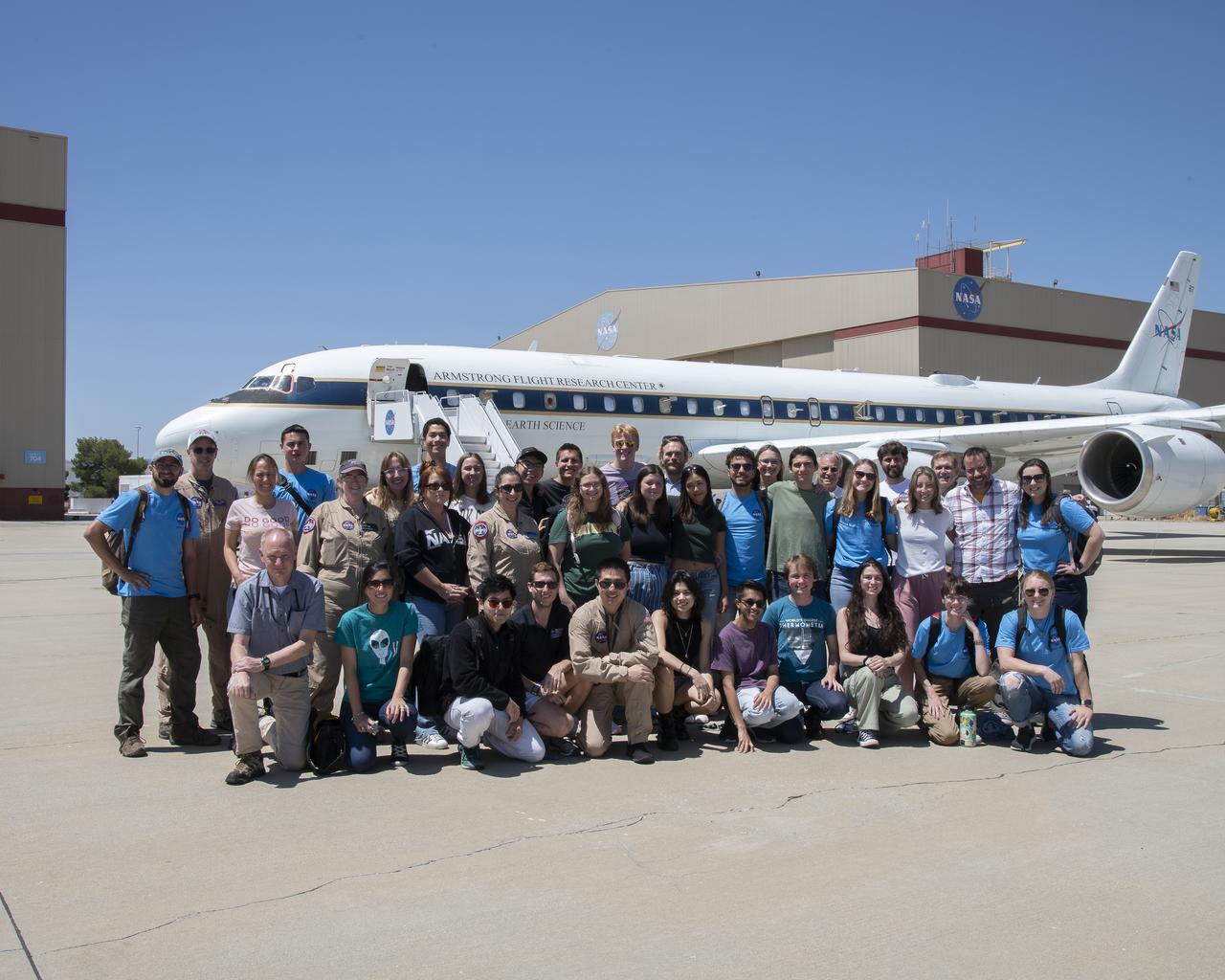
NASA Armstrong’s Student Airborne Research Program celebrates 15 years of success in 2023. An eight-week summer internship program, SARP offers upper-level undergraduate students the opportunity to acquire hands-on research experience as part of a scientific campaign using NASA Airborne Science Program flying science laboratories—aircraft outfitted specifically for research projects. Students onboard NASA’s DC-8 aircraft, the largest flying science laboratory in the world, help scientists from NOAA, the National Oceanic and Atmospheric Administration with a science project investigating air quality and non-vehicular pollution sources called AEROMMA, which measures Atmospheric Emissions and Reactions Observed from Megacities to Marine Areas. In 2023, NASA also introduced a sister program, SARP East to complement the West Coast program.
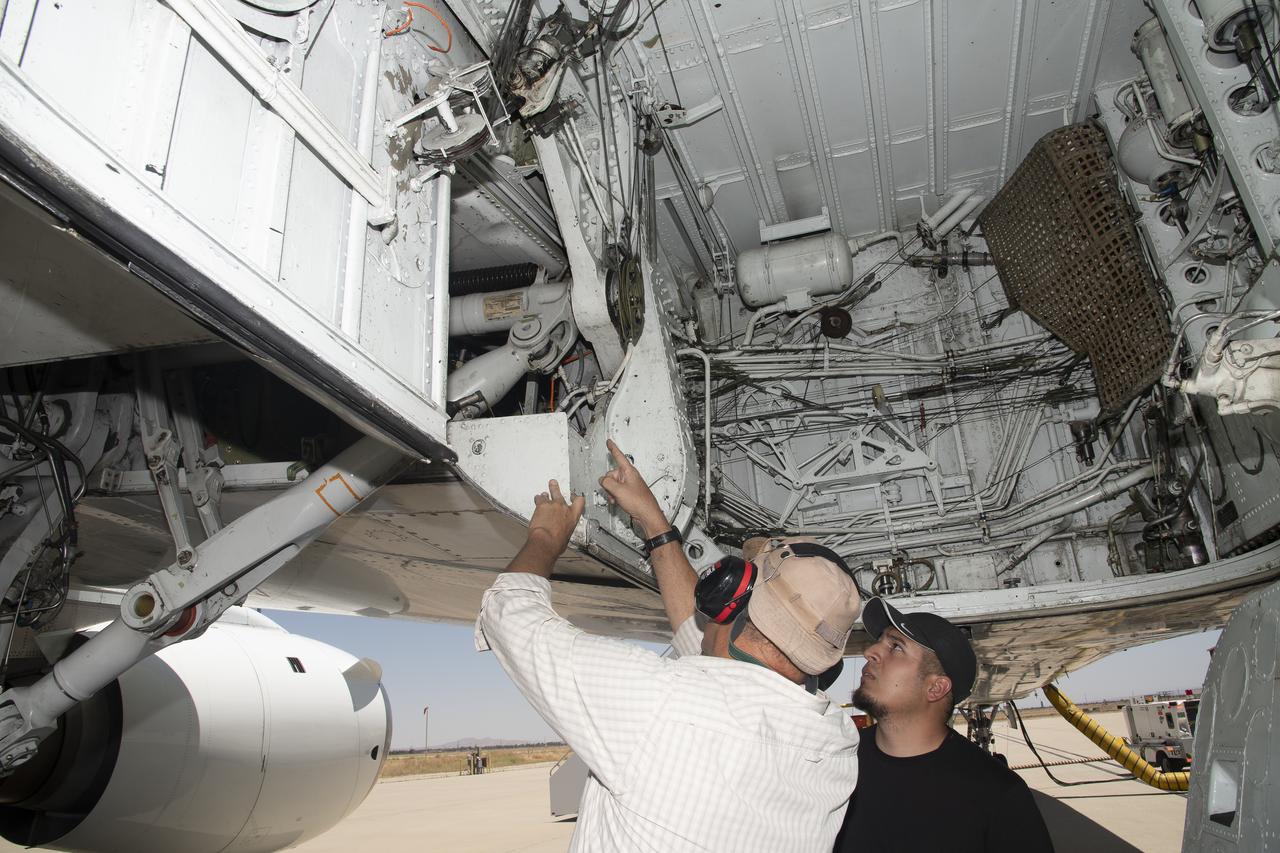
NASA Armstrong’s Student Airborne Research Program celebrates 15 years of success in 2023. An eight-week summer internship program, SARP offers upper-level undergraduate students the opportunity to acquire hands-on research experience as part of a scientific campaign using NASA Airborne Science Program flying science laboratories—aircraft outfitted specifically for research projects. Students onboard NASA’s DC-8 aircraft, the largest flying science laboratory in the world, help scientists from NOAA, the National Oceanic and Atmospheric Administration with a science project investigating air quality and non-vehicular pollution sources called AEROMMA, which measures Atmospheric Emissions and Reactions Observed from Megacities to Marine Areas. In 2023, NASA also introduced a sister program, SARP East to complement the West Coast program.
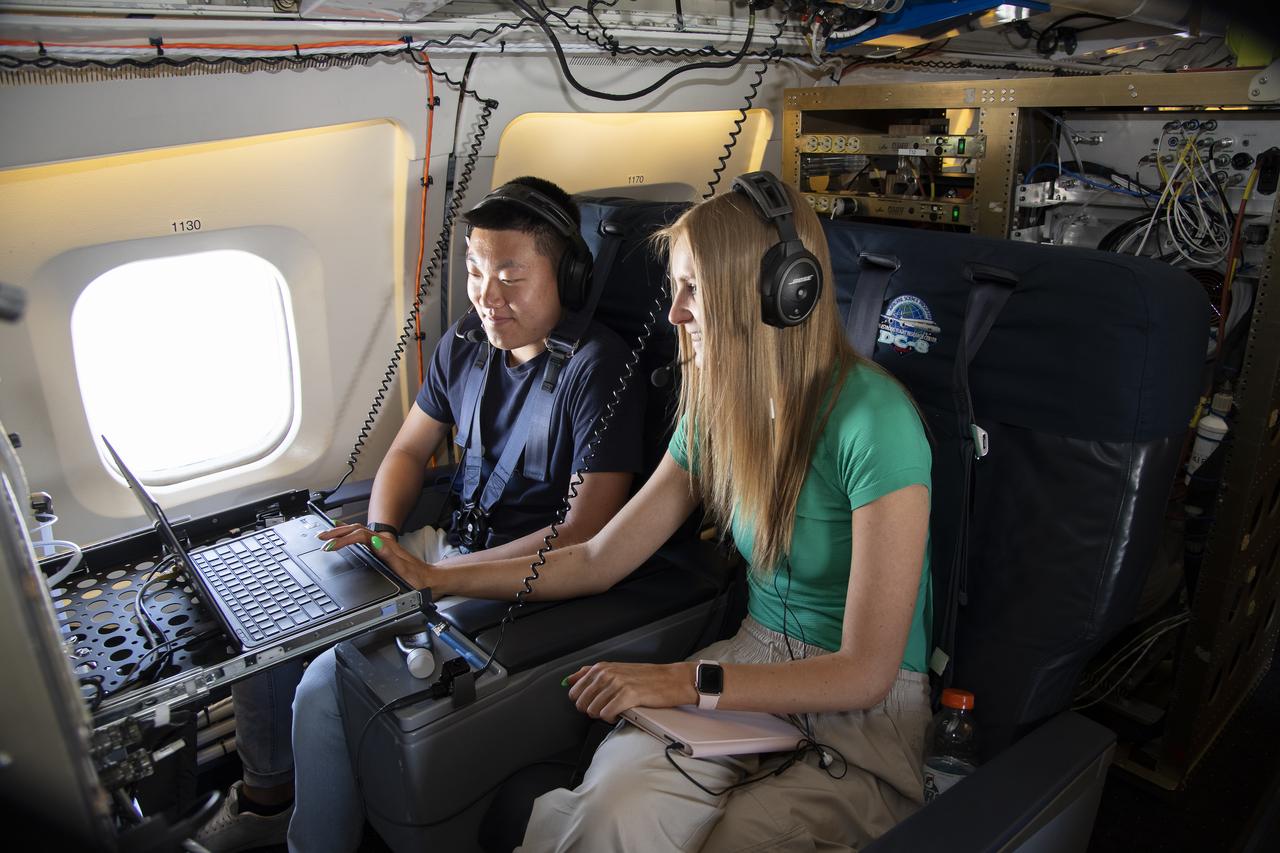
NASA Armstrong’s Student Airborne Research Program celebrates 15 years of success in 2023. An eight-week summer internship program, SARP offers upper-level undergraduate students the opportunity to acquire hands-on research experience as part of a scientific campaign using NASA Airborne Science Program flying science laboratories—aircraft outfitted specifically for research projects. Students onboard NASA’s DC-8 aircraft, the largest flying science laboratory in the world, help scientists from NOAA, the National Oceanic and Atmospheric Administration with a science project investigating air quality and non-vehicular pollution sources called AEROMMA, which measures Atmospheric Emissions and Reactions Observed from Megacities to Marine Areas. In 2023, NASA also introduced a sister program, SARP East to complement the West Coast program.
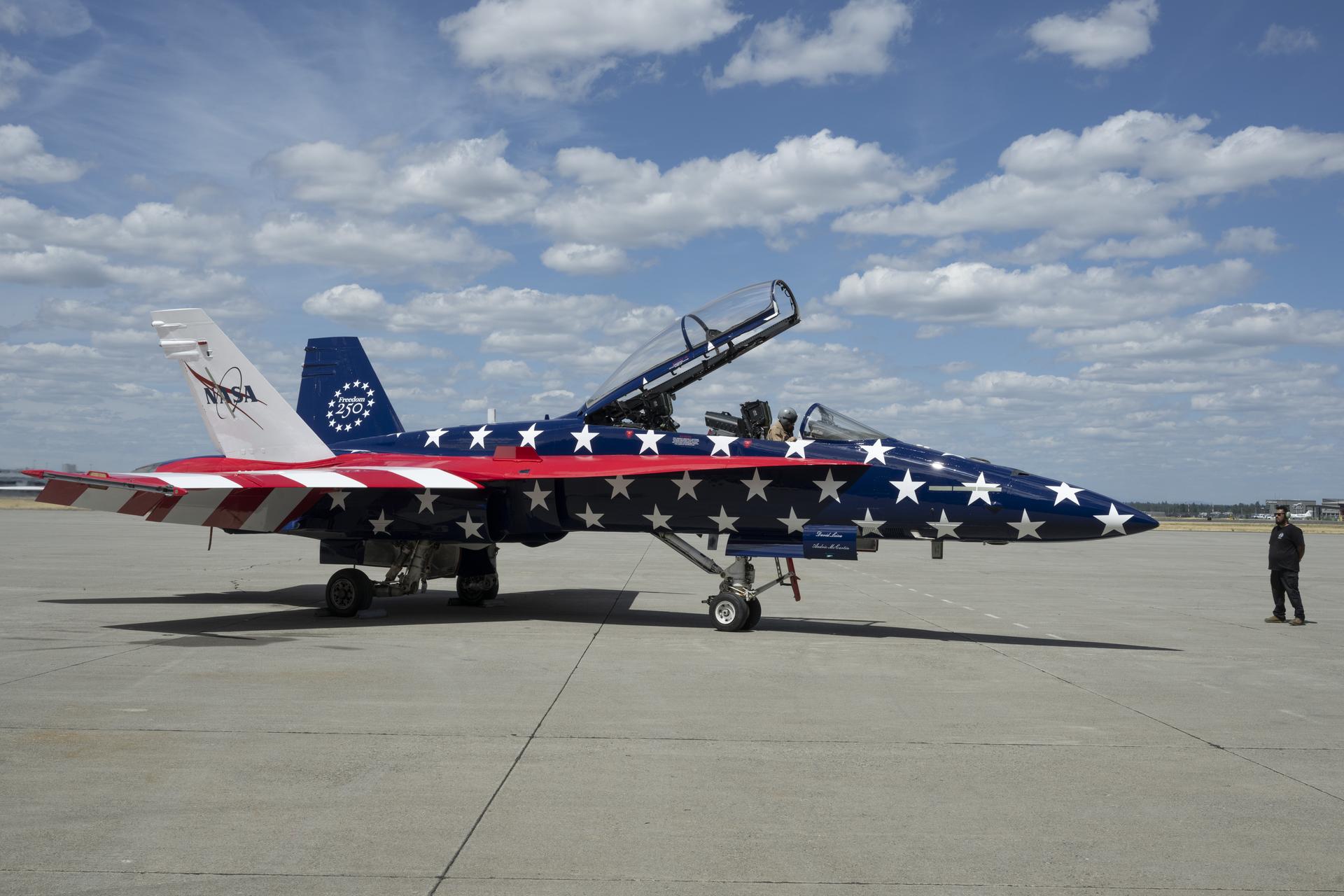
A NASA F/A‑18 aircraft is shown in Spokane, Washington, on Thursday, July 2, 2026, with new red, white, and blue paint to celebrate America’s 250th birthday. The aircraft, from NASA’s Armstrong Flight Research Center in Edwards, California, was preparing to fly cross‑country to Washington, D.C., where it participated in the Freedom 250 flyover with other NASA and military aircraft on Saturday, July 4, 2026. NASA/Jim Ross
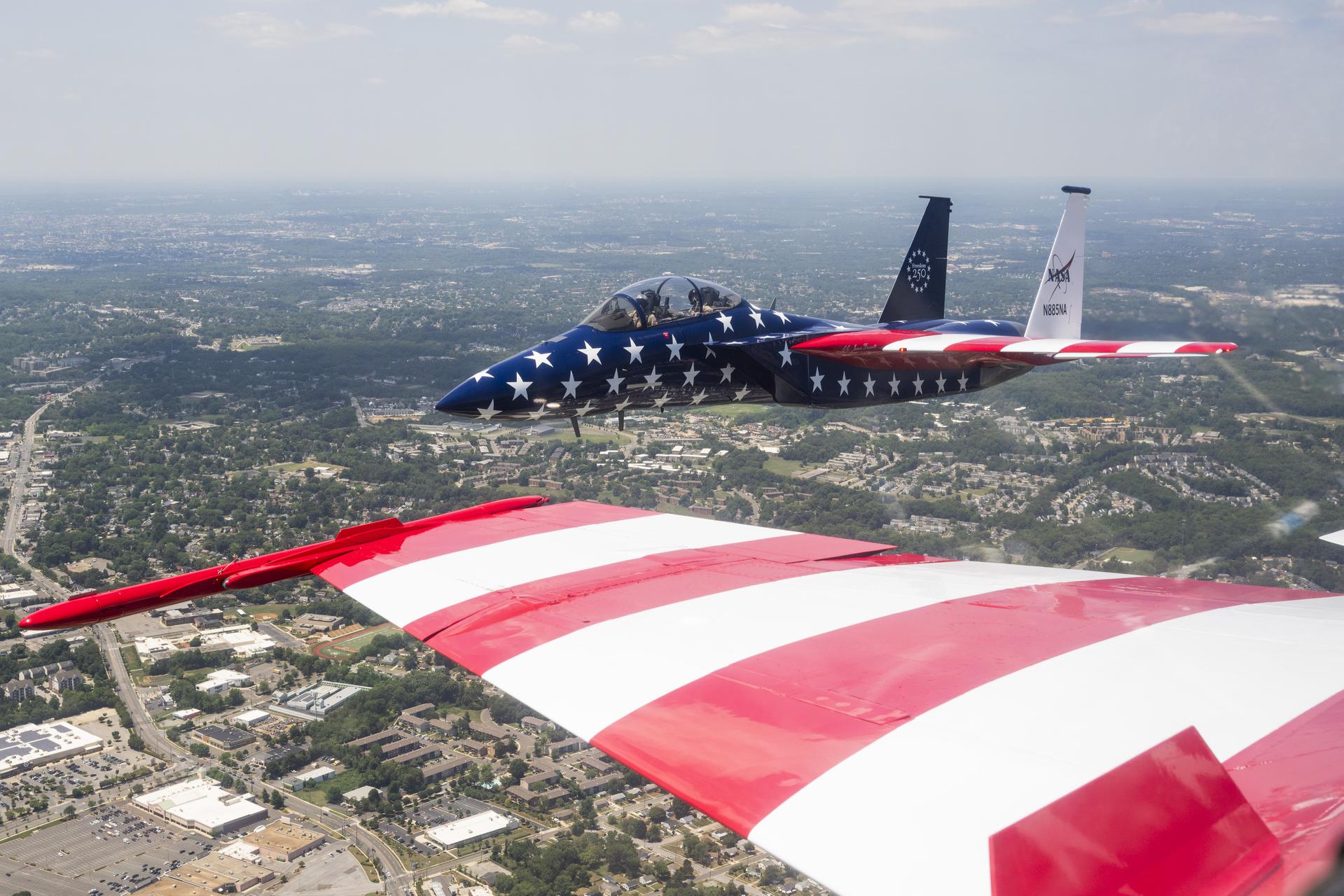
A NASA F-15 aircraft flies above Washington on Saturday, July 4, 2026, as part of a flyover to celebrate America’s 250th birthday. The wing of a NASA F-18 is seen in the foreground, as a NASA photographer captured this image from inside the cockpit. This aircraft is from NASA’s Armstrong Flight Research Center in Edwards, California, and it joined other NASA aircraft for the flyover.
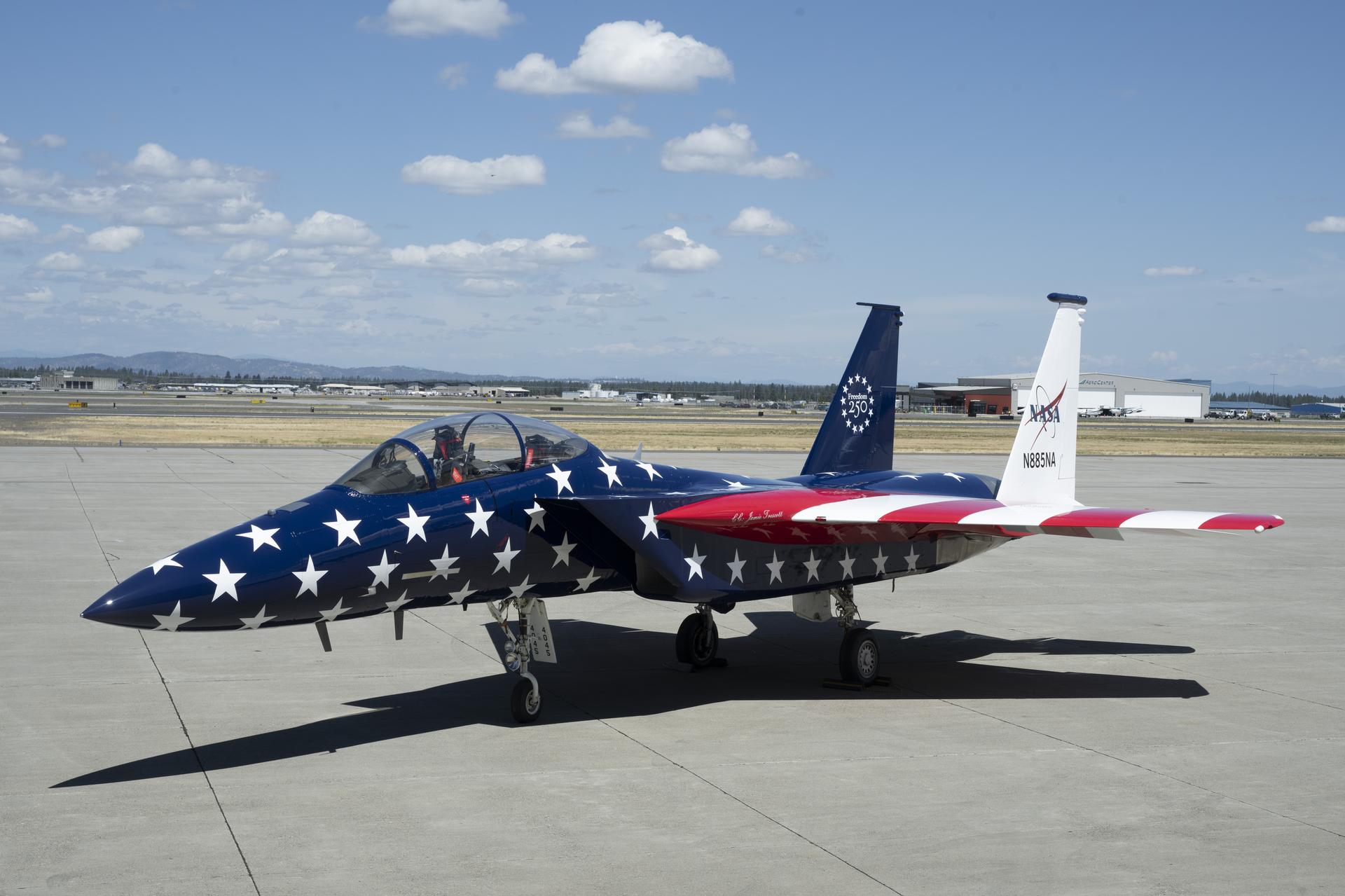
NASA’s F-15 aircraft is shown at International Aerospace Coatings Inc.’s facility in Spokane, Washington, on Thursday, July 2, 2026, with new red, white, and blue paint to celebrate America’s 250th birthday. The aircraft, from NASA’s Armstrong Flight Research Center in Edwards, California, participated in the Freedom 250 flyover in Washington on Saturday, July 4, 2026, with other NASA and military aircraft. NASA/Jim Ross
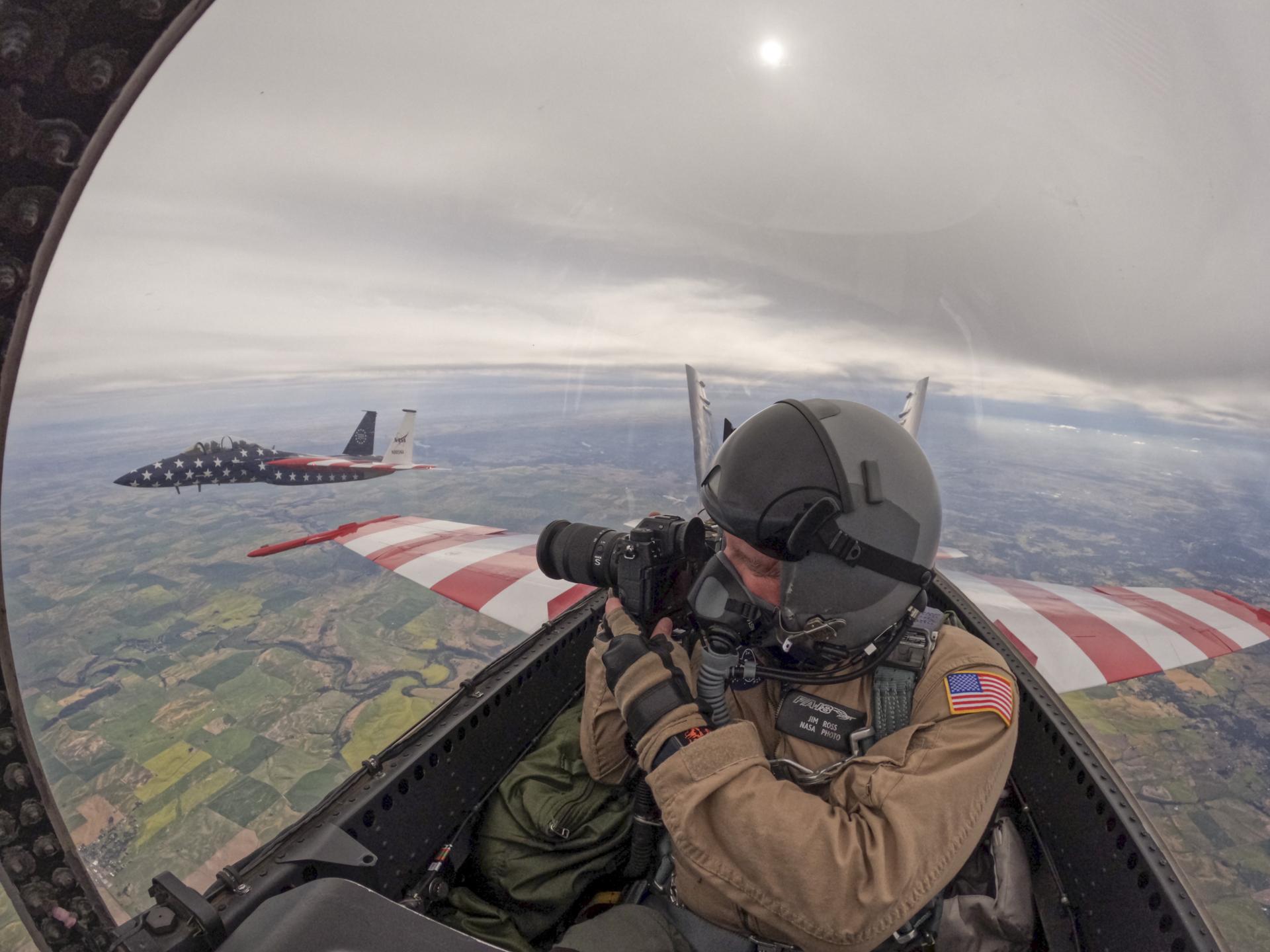
NASA photographer Jim Ross flies above Washington on Saturday, July 4, 2026, in an F-18 aircraft, as part of a flyover to celebrate America’s 250th birthday. This aircraft is from NASA’s Armstrong Flight Research Center in Edwards, California, and it joined other NASA aircraft for the flyover. A NASA F-15 is seen flying to the side of the NASA F-18.
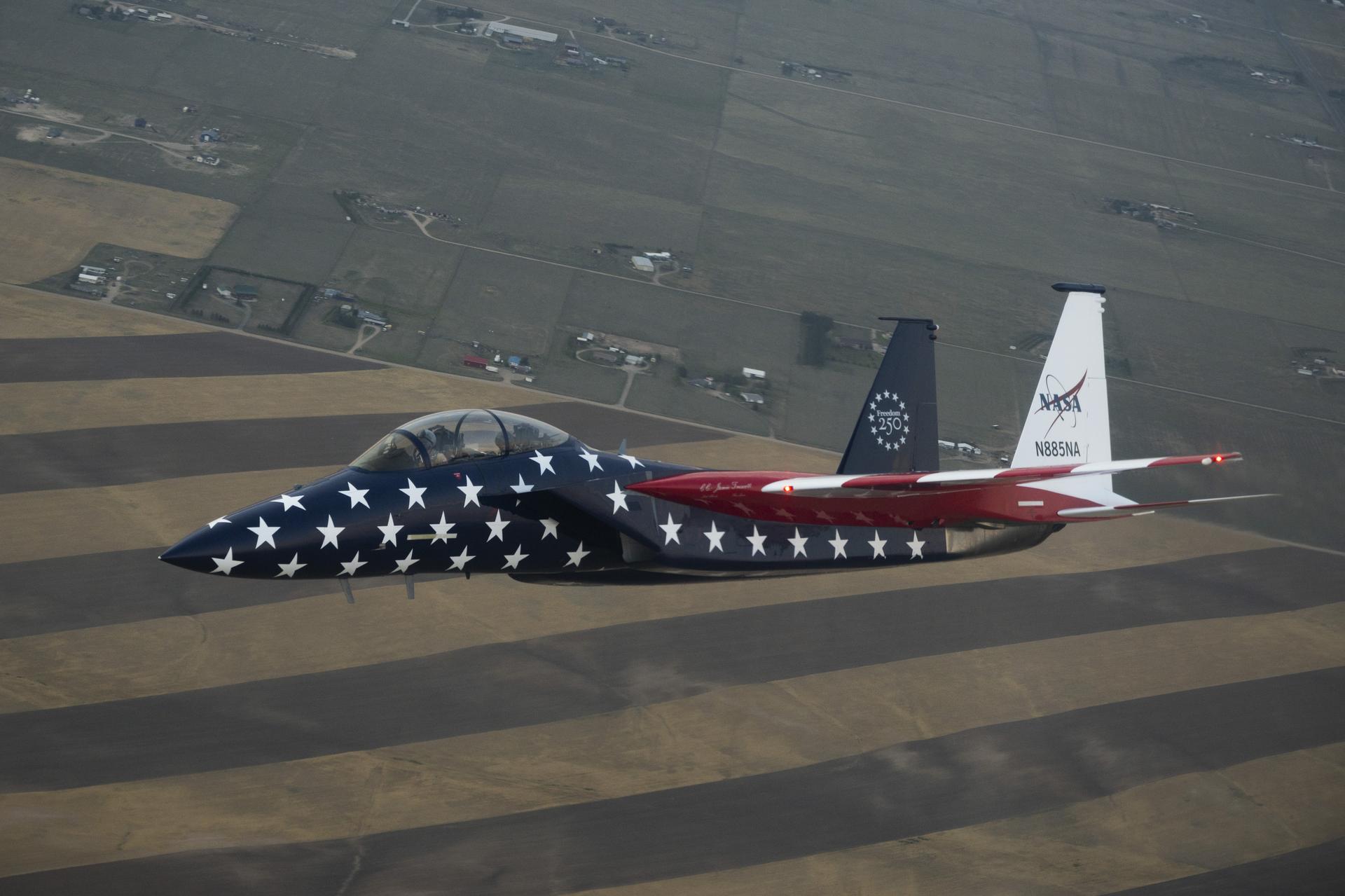
A NASA F‑15 aircraft is shown during a cross‑country flight from Spokane, Washington, to Washington, D.C., on Thursday, July 2, 2026. The aircraft displays new red, white, and blue paint to celebrate America’s 250th birthday. The F‑15, from NASA’s Armstrong Flight Research Center in Edwards, California, participated in the Freedom 250 flyover with other NASA and military aircraft on Saturday, July 4, 2026. NASA/Jim Ross
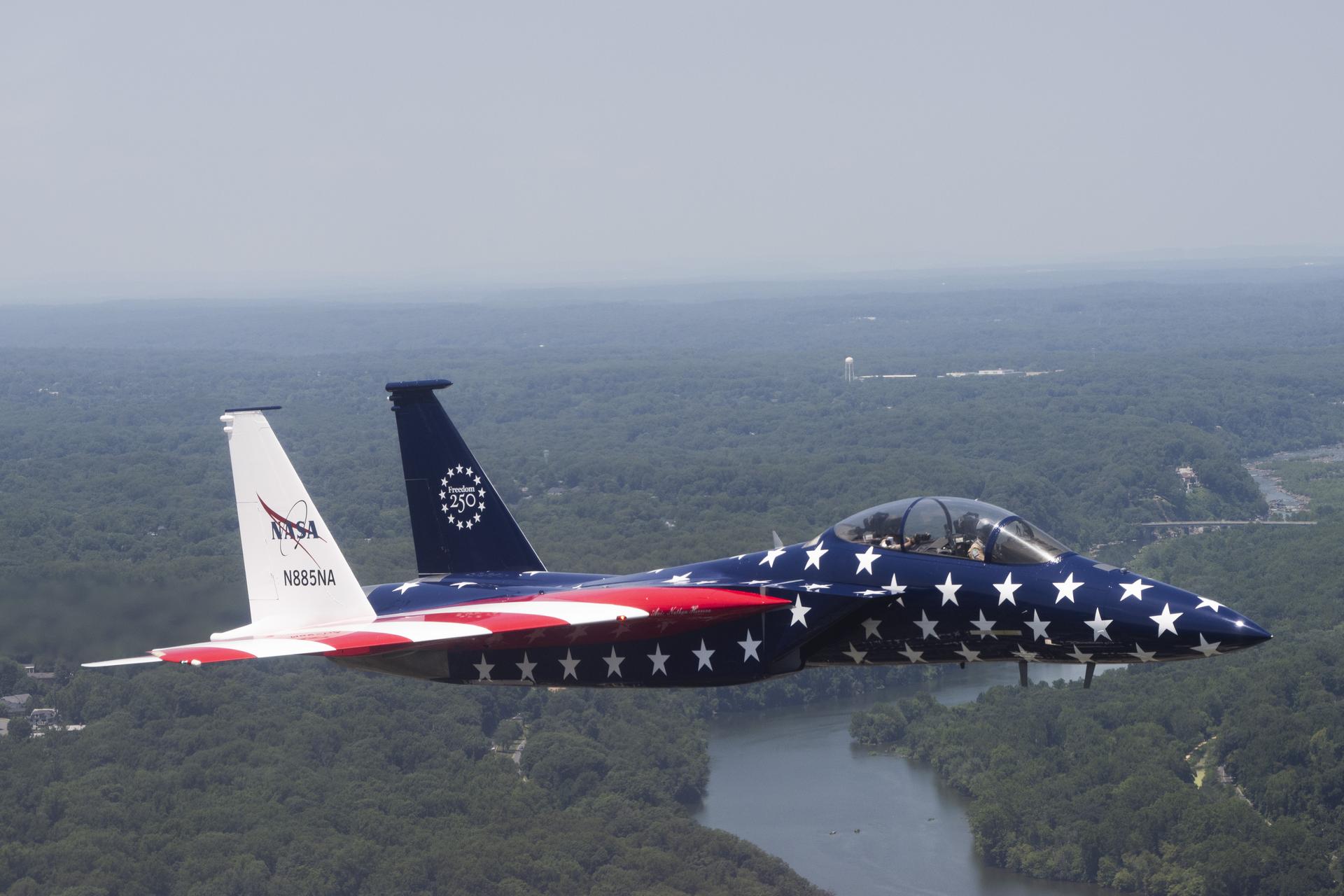
A NASA F-15 aircraft flies above Washington on Saturday, July 4, 2026, as part of a flyover to celebrate America’s 250th birthday. This aircraft is from NASA’s Armstrong Flight Research Center in Edwards, California, and it joined other NASA aircraft for the flyover.
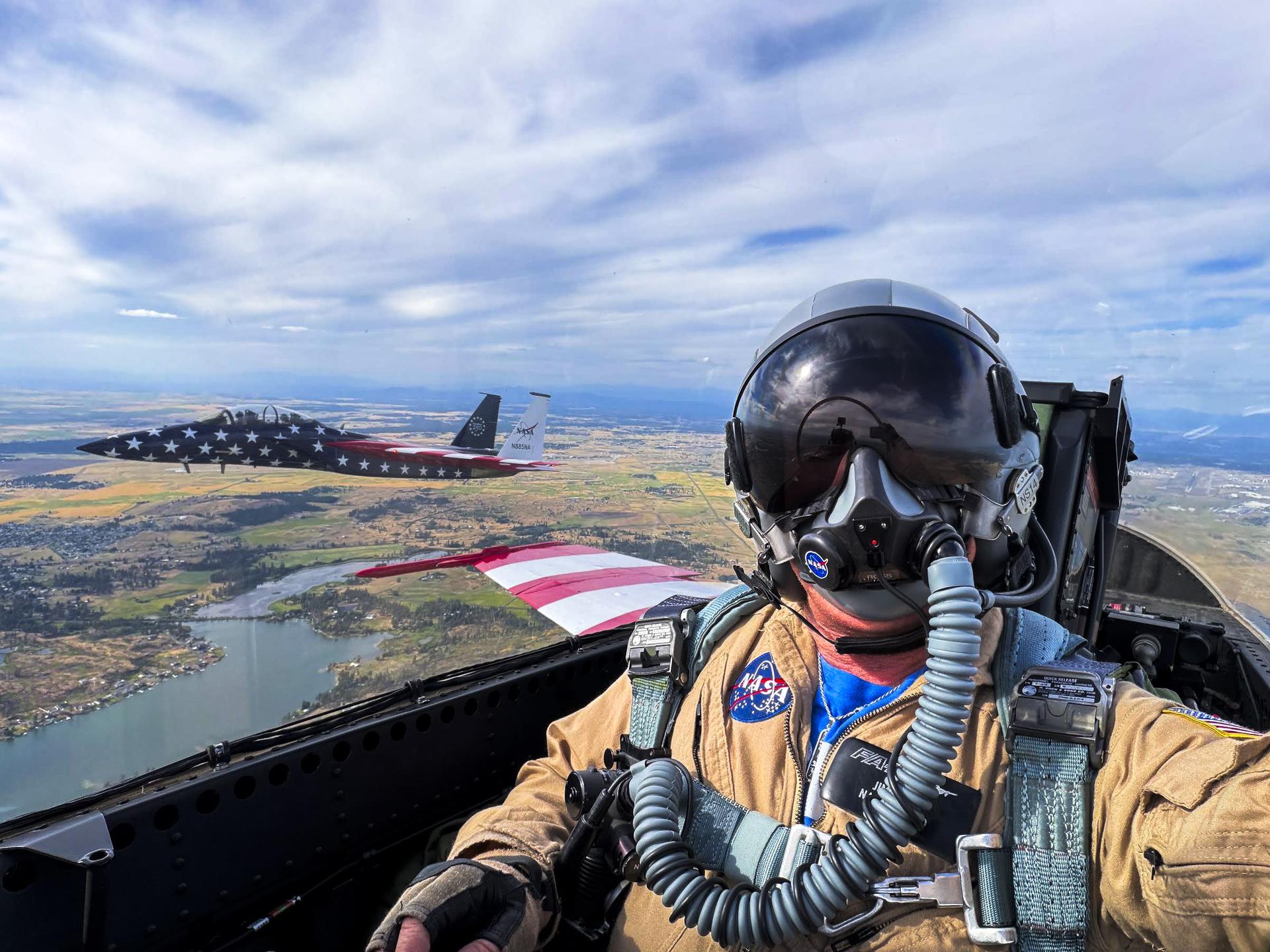
NASA photographer Jim Ross takes a selfie from the rear seat of a NASA F/A‑18 during a cross‑country flight from Spokane, Washington, to Washington, D.C., on Thursday, July 2, 2026. The agency’s F‑15, flying alongside the aircraft, is visible through the window. Both aircraft, from NASA’s Armstrong Flight Research Center in Edwards, California, participated in the Freedom 250 flyover with other NASA and military aircraft on Saturday, July 4, 2026.
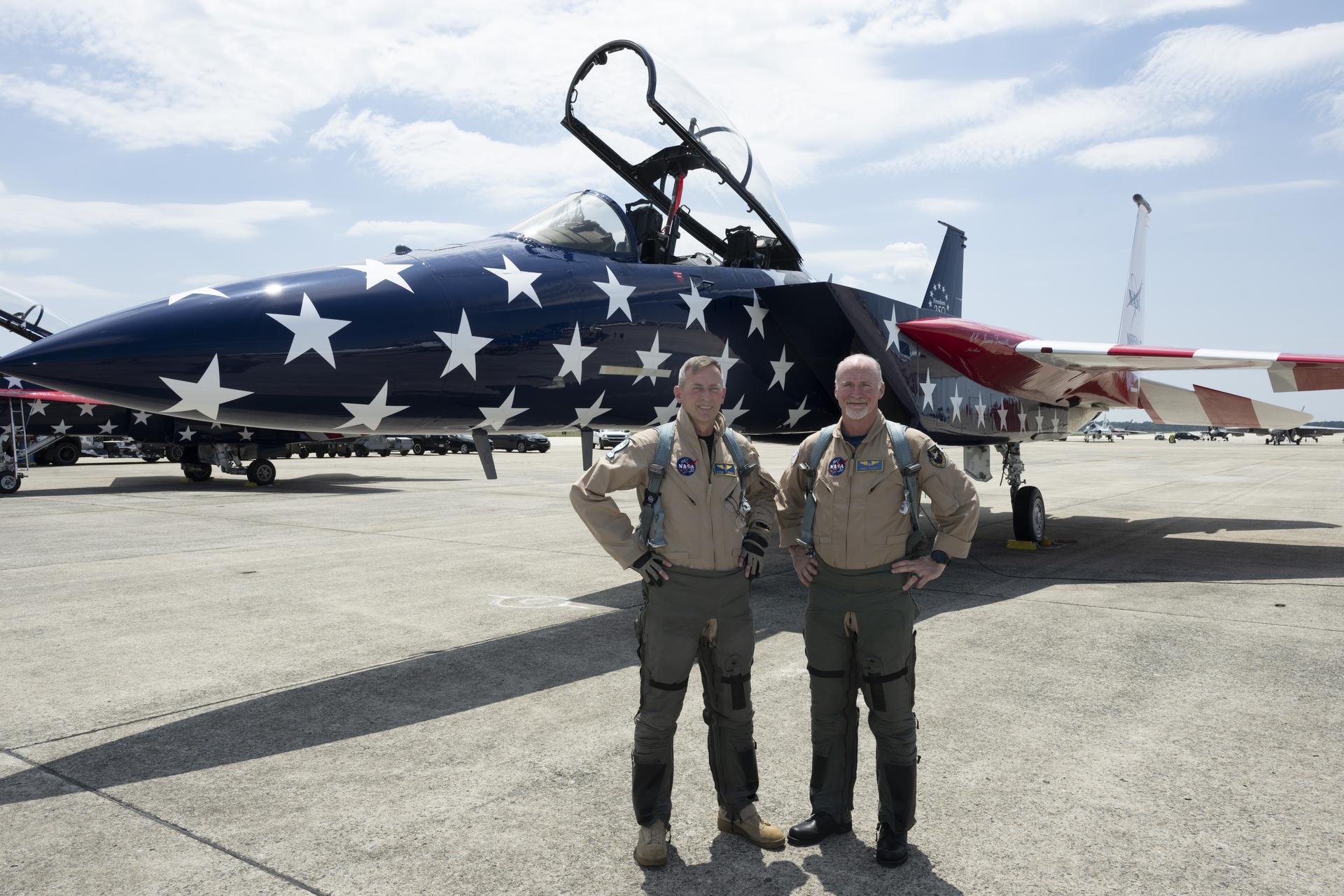
NASA Armstrong pilot Jim Less, left, and center director, Troy Asher, right, stand in front of a NASA F-15 aircraft on Saturday, July 4, 2026. Both pilots took part in a flyover to celebrate America’s 250th birthday. This aircraft is from NASA’s Armstrong Flight Research Center in Edwards, California, and it joined other NASA aircraft for the flyover.
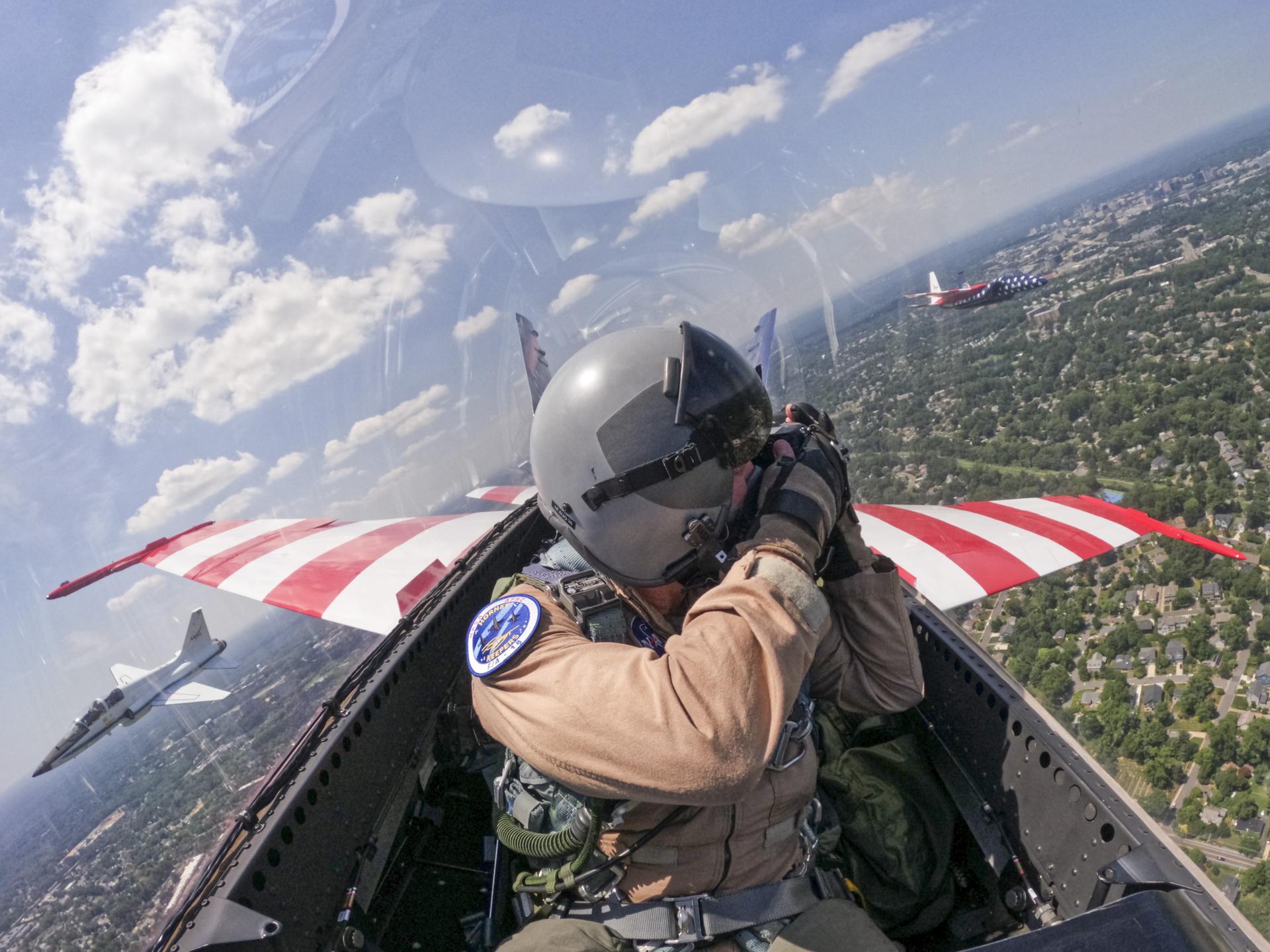
NASA photographer Jim Ross captures photos as he flies above Washington on Saturday, July 4, 2026, in an F-18 aircraft, as part of a flyover to celebrate America’s 250th birthday. This aircraft is from NASA’s Armstrong Flight Research Center in Edwards, California, and it joined other NASA aircraft for the flyover. A NASA F-15 and T-38 are seen flying to the sides of the NASA F-18.
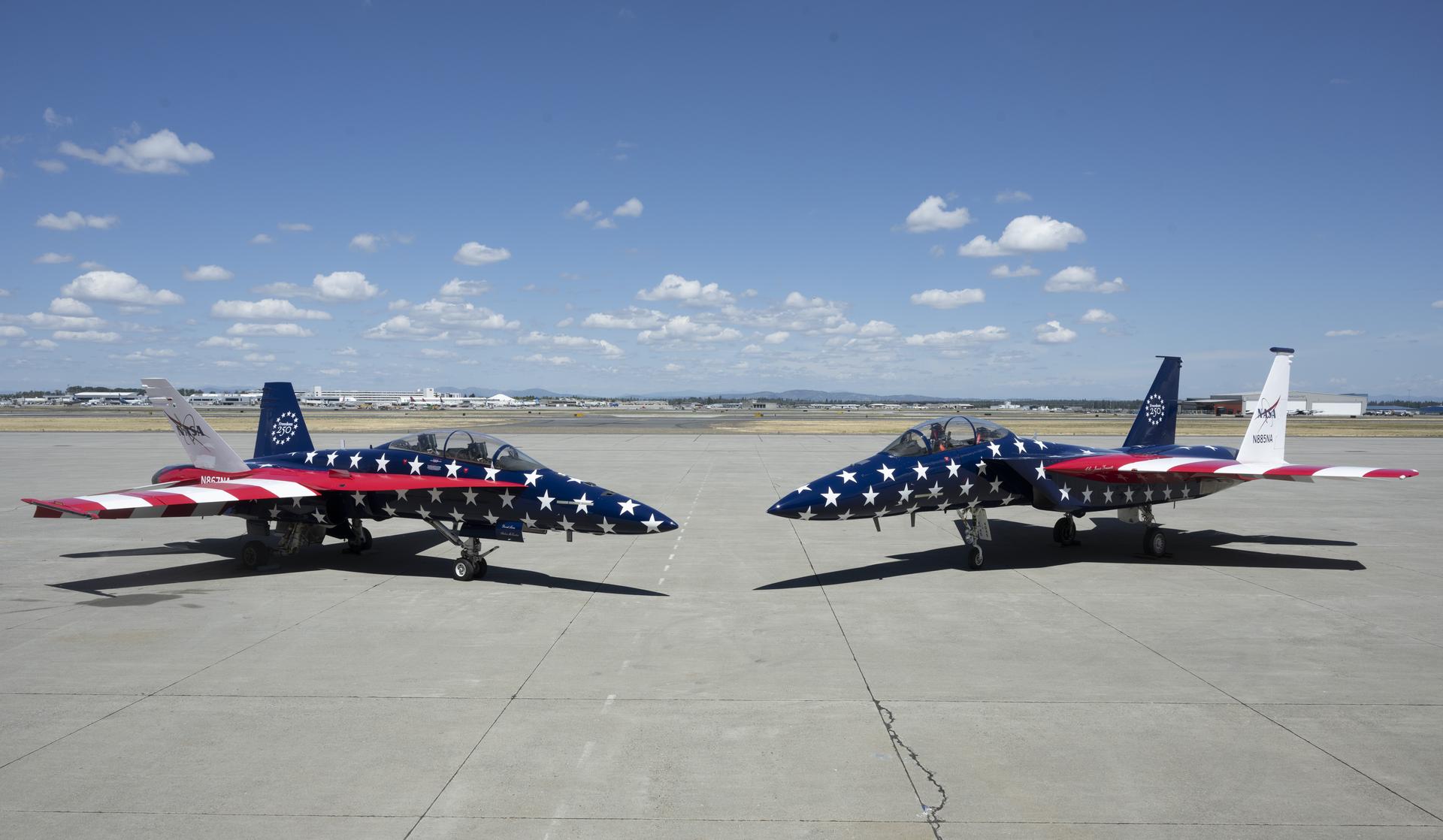
NASA’s F-15, right, and F/A-18 aircraft are shown at International Aerospace Coatings Inc.’s facility in Spokane, Washington, on Thursday, July 2, 2026, with new red, white, and blue paint to celebrate America’s 250th birthday. The aircraft, from NASA’s Armstrong Flight Research Center in Edwards, California, participated in the Freedom 250 flyover in Washington on Saturday, July 4, 2026, with other NASA and military aircraft. NASA/Jim Ross
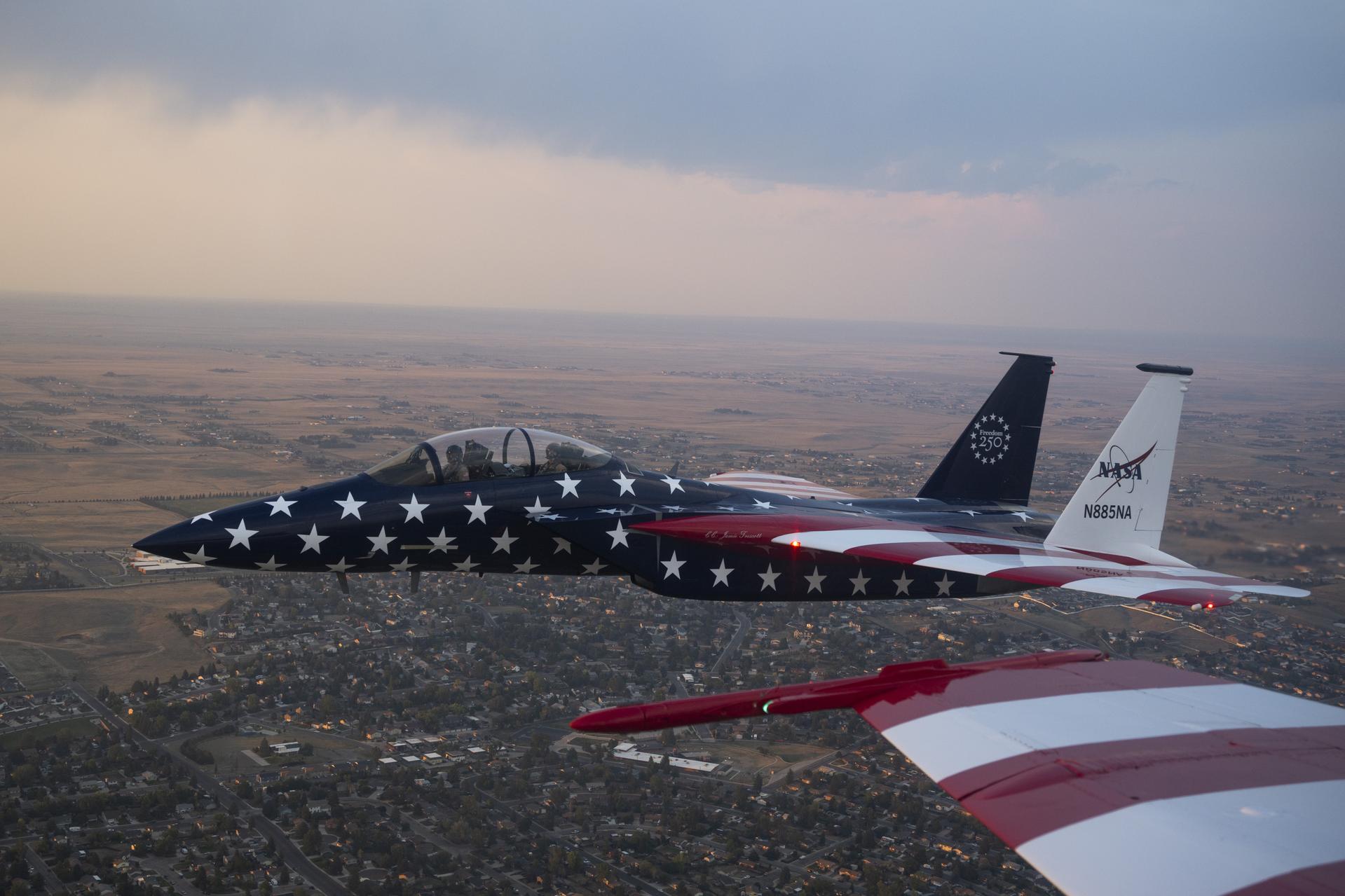
A NASA F‑15 aircraft is shown flying next to a NASA F/A‑18 during a cross‑country flight from Spokane, Washington, to Washington, D.C., on Thursday, July 2, 2026. The full F‑15 is visible, along with a partial view of the F/A‑18’s wing, as both aircraft display new red, white, and blue paint to celebrate America’s 250th birthday. The aircraft, from NASA’s Armstrong Flight Research Center in Edwards, California, participated in the Freedom 250 flyover with other NASA and military aircraft on Saturday, July 4, 2026. NASA/Jim Ross
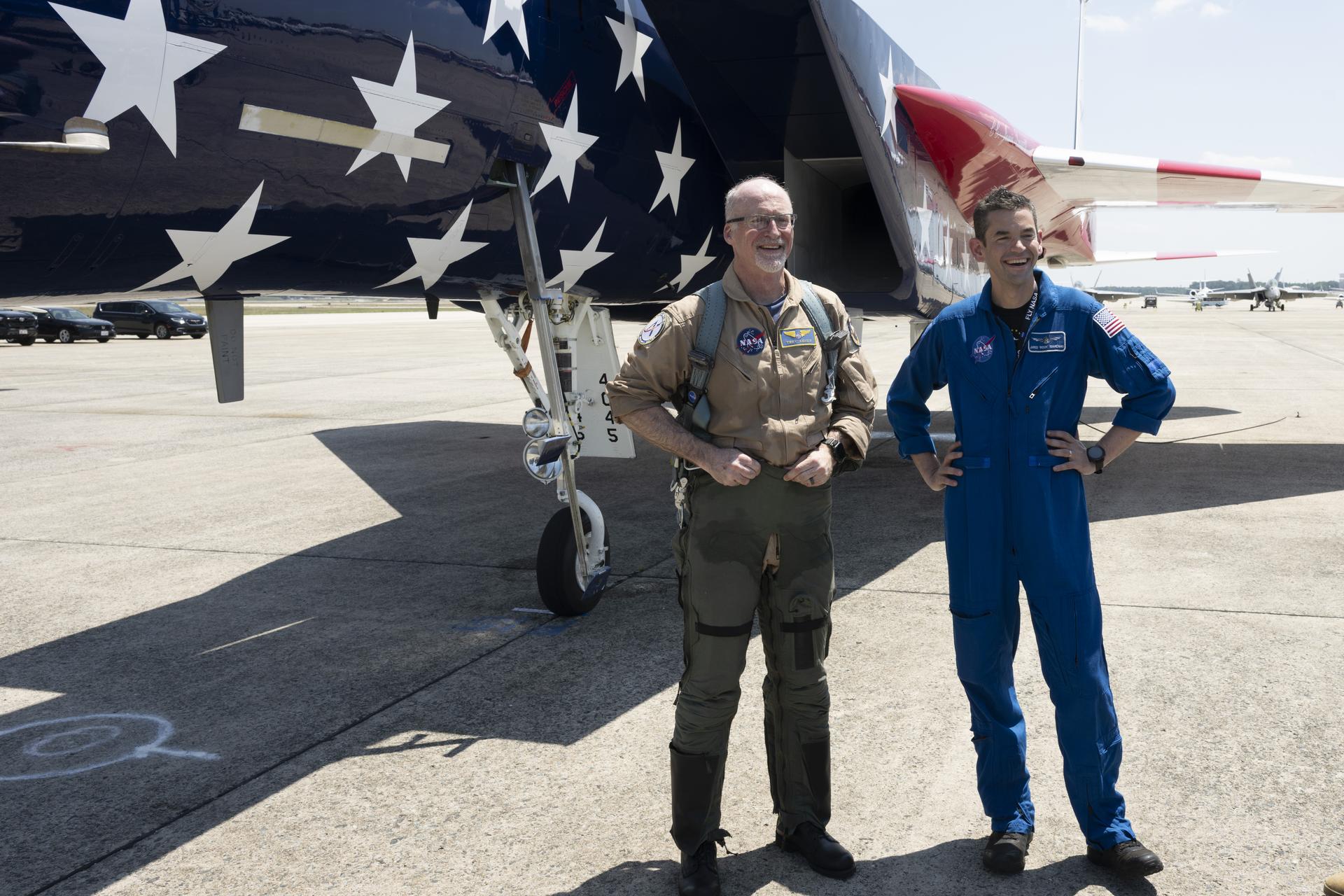
NASA Administrator Jared Isaacman stands to the right of NASA Armstrong Center Director Troy Asher, left, in front of an F-15 aircraft. Both pilots flew above Washington on Saturday, July 4, 2026, as part of a flyover to celebrate America’s 250th birthday.
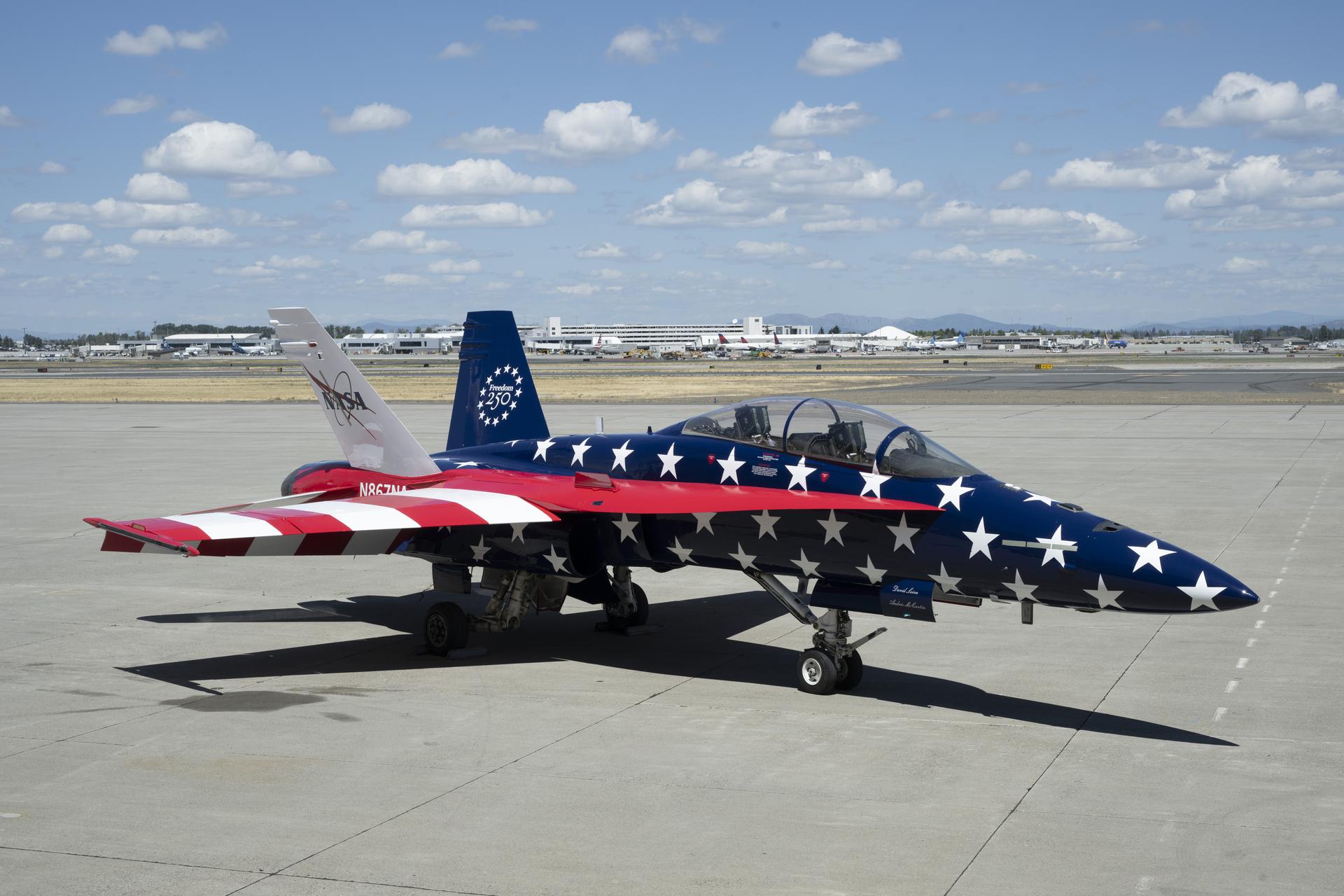
NASA’s F-18 aircraft is shown at International Aerospace Coatings Inc.’s facility in Spokane, Washington, on Thursday, July 2, 2026, with new red, white, and blue paint to celebrate America’s 250th birthday. The aircraft, from NASA’s Armstrong Flight Research Center in Edwards, California, participated in the Freedom 250 flyover in Washington on Saturday, July 4, 2026, with other NASA and military aircraft. NASA/Jim Ross
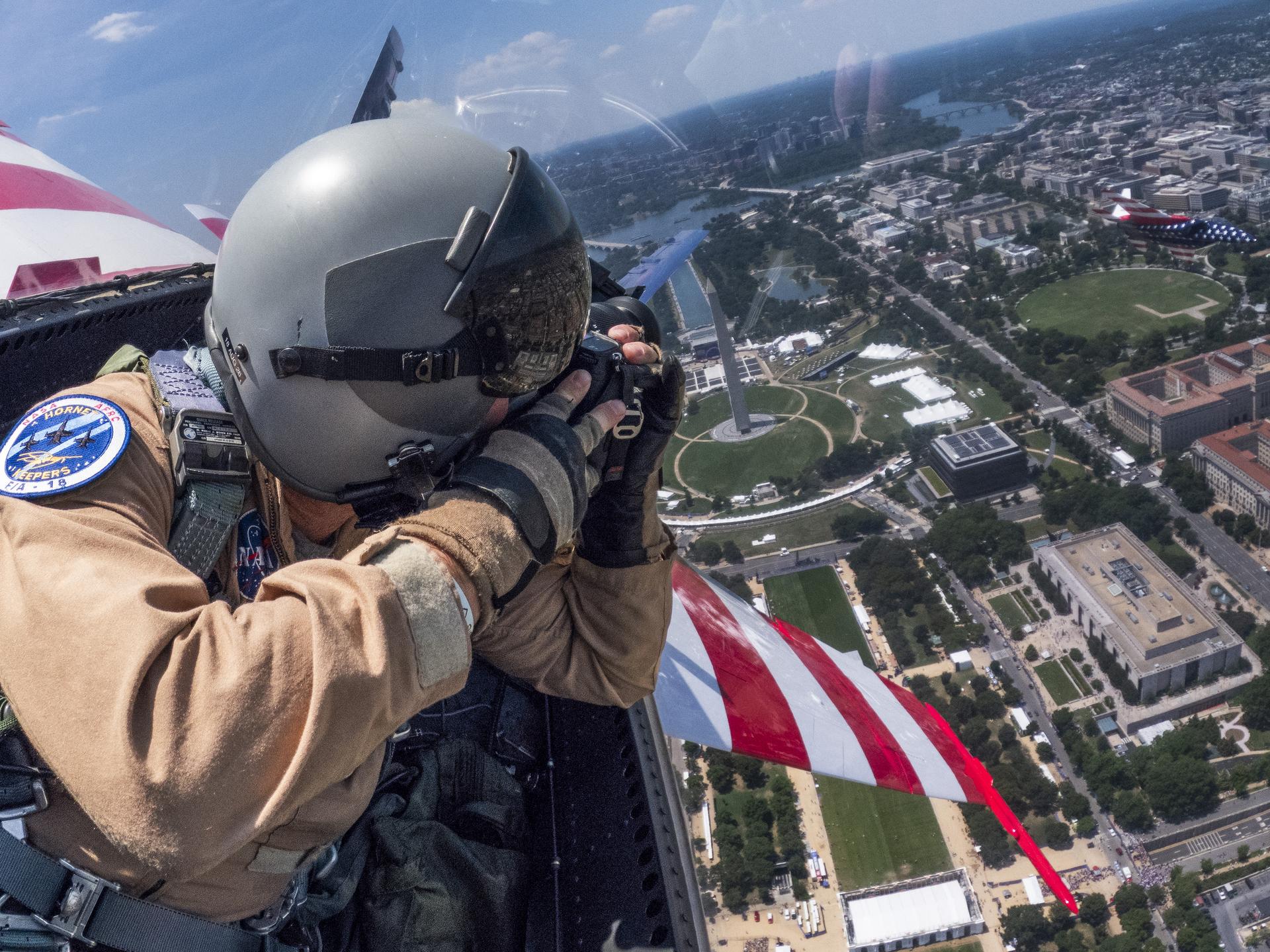
NASA photographer Jim Ross flies above the Washington Monument in Washington on Saturday, July 4, 2026, in an F-18 aircraft, as part of a flyover to celebrate America’s 250th birthday. This aircraft is from NASA’s Armstrong Flight Research Center in Edwards, California, and it joined other NASA aircraft for the flyover.
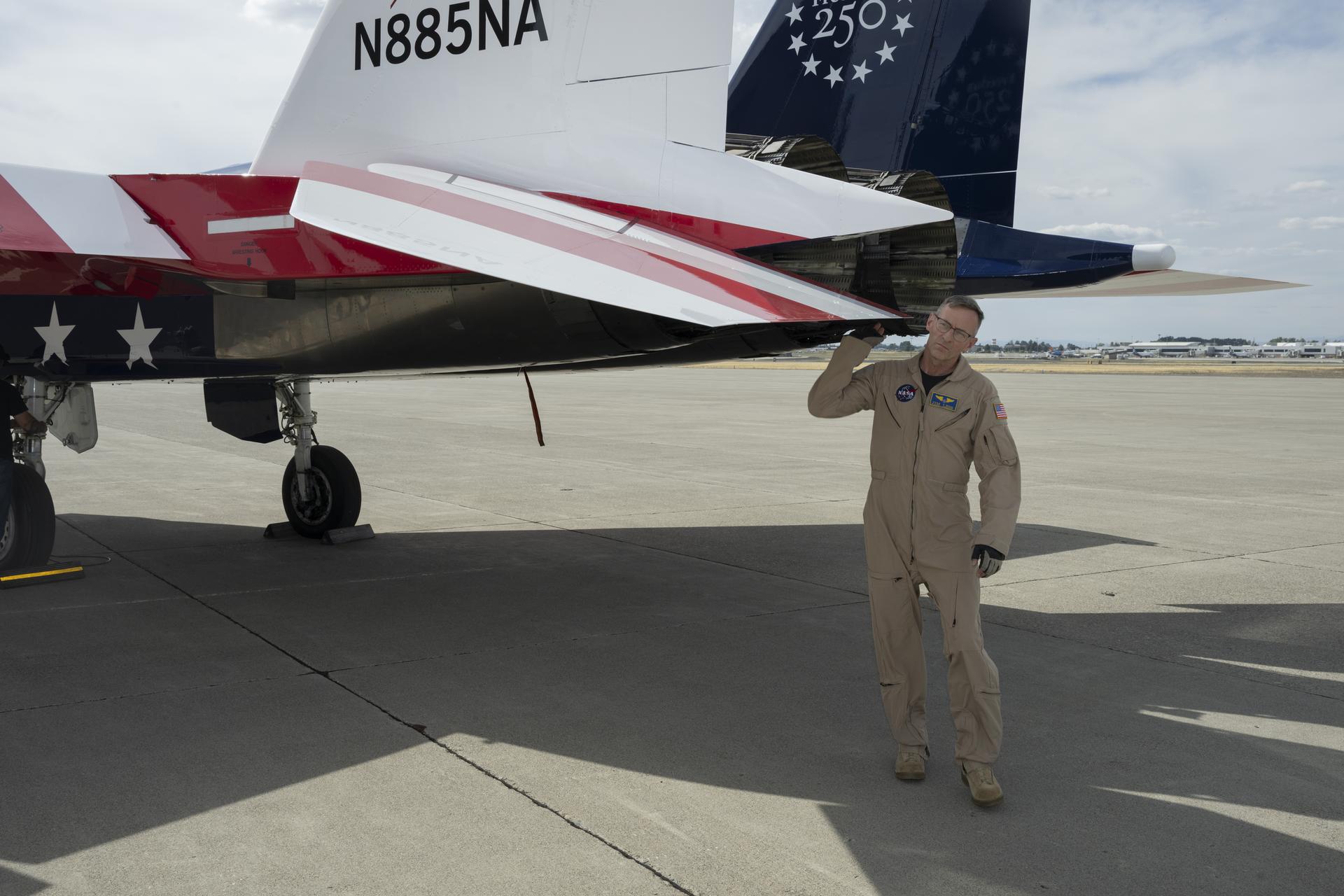
NASA test pilot Jim “Clue” Less completes pre‑flight checks on a NASA F‑15 in Spokane, Washington, on Thursday, July 2, 2026. The aircraft, from NASA’s Armstrong Flight Research Center in Edwards, California, displays new red, white, and blue paint to celebrate America’s 250th birthday and was preparing to fly cross‑country to Washington, D.C., where it participated in the Freedom 250 flyover with other NASA and military aircraft on Saturday, July 4, 2026. NASA/Jim Ross
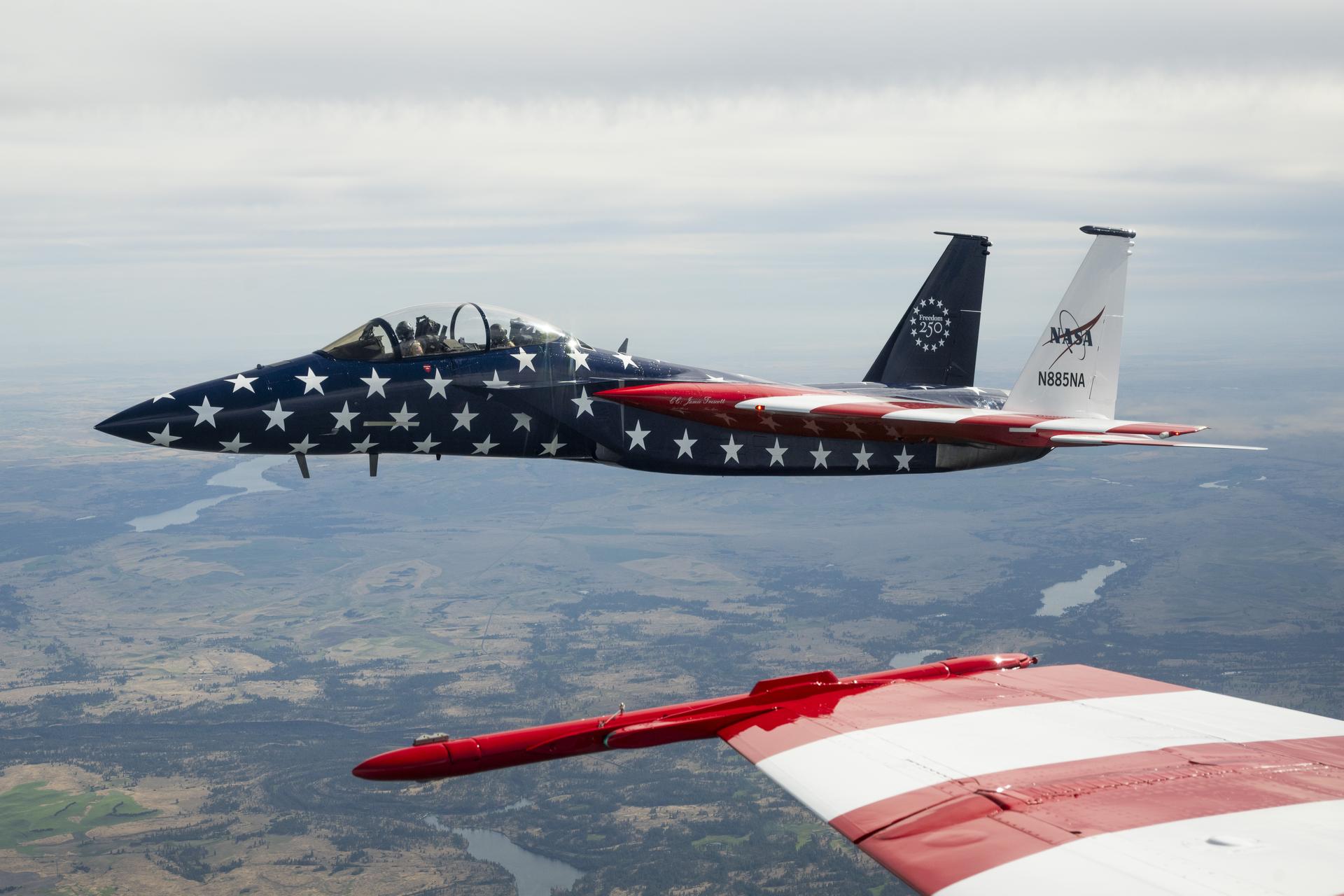
A NASA F‑15 aircraft is shown flying next to a NASA F/A‑18 during a cross‑country flight from Spokane, Washington, to Washington, D.C., on Thursday, July 2, 2026. The full F‑15 is visible, along with a partial view of the F/A‑18’s wing, as both aircraft display new red, white, and blue paint to celebrate America’s 250th birthday. The aircraft, from NASA’s Armstrong Flight Research Center in Edwards, California, participated in the Freedom 250 flyover with other NASA and military aircraft on Saturday, July 4, 2026. NASA/Jim Ross
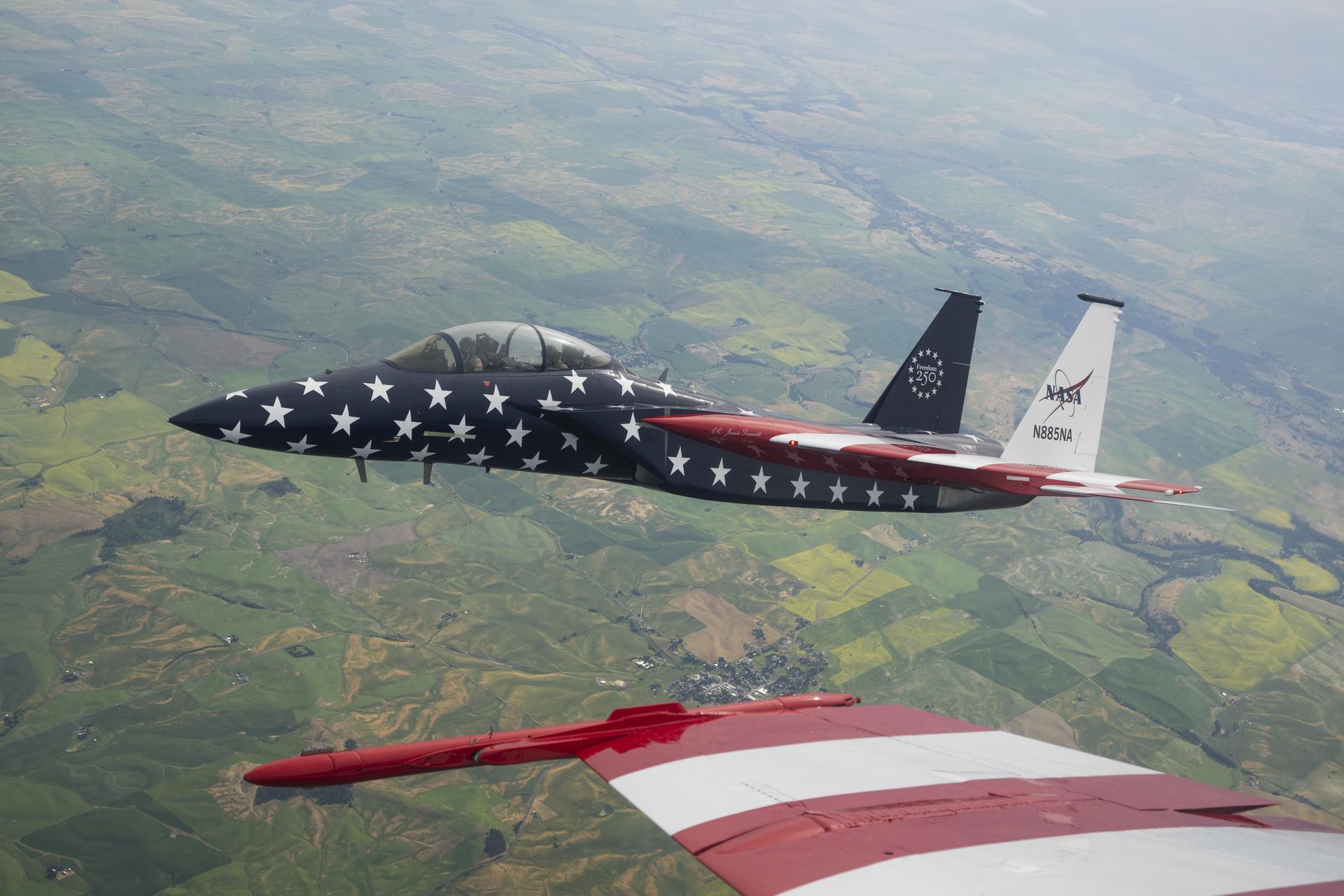
A NASA F‑15 aircraft is shown flying next to a NASA F/A‑18 during a cross‑country flight from Spokane, Washington, to Washington, D.C., on Thursday, July 2, 2026. The full F‑15 is visible, along with a partial view of the F/A‑18’s wing, as both aircraft display new red, white, and blue paint to celebrate America’s 250th birthday. The aircraft, from NASA’s Armstrong Flight Research Center in Edwards, California, participated in the Freedom 250 flyover with other NASA and military aircraft on Saturday, July 4, 2026. NASA/Jim Ross
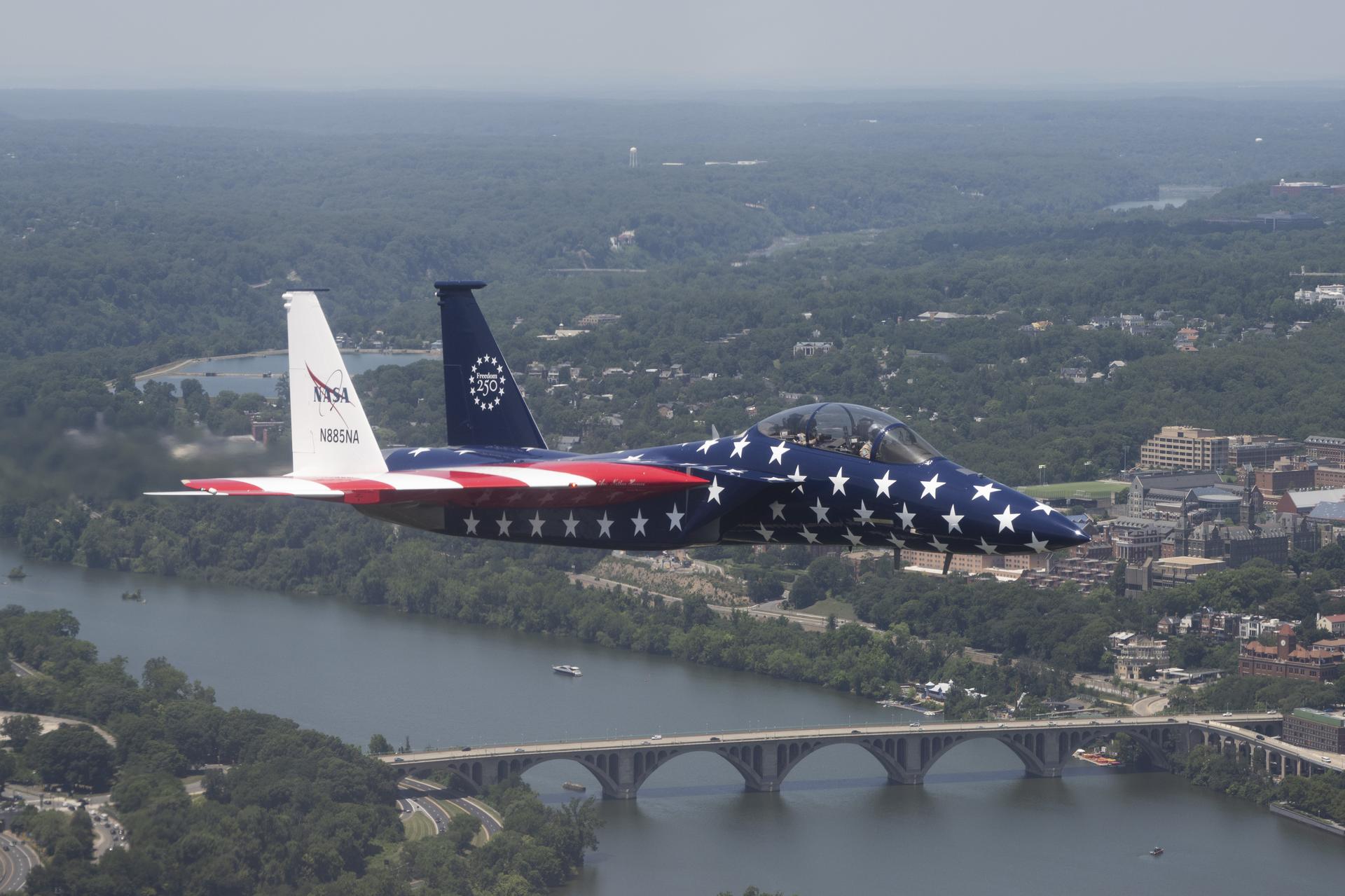
A NASA F-15 aircraft flies above Washington on Saturday, July 4, 2026, as part of a flyover to celebrate America’s 250th birthday. This aircraft is from NASA’s Armstrong Flight Research Center in Edwards, California, and it joined other NASA aircraft for the flyover.
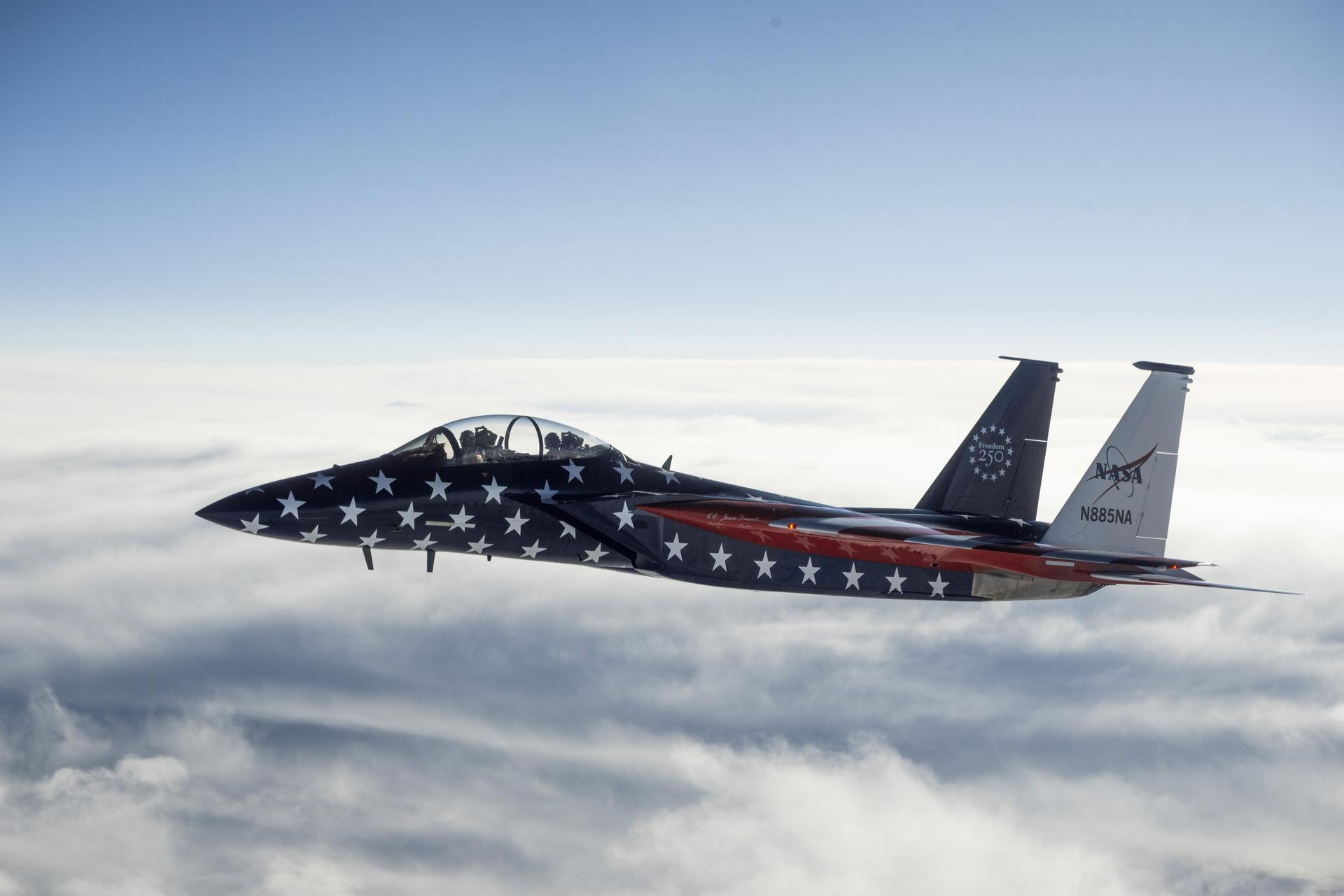
A NASA F‑15 aircraft is shown during a cross‑country flight from Spokane, Washington, to Washington, D.C., on Thursday, July 2, 2026. The aircraft displays new red, white, and blue paint to celebrate America’s 250th birthday. The F‑15, from NASA’s Armstrong Flight Research Center in Edwards, California, participated in the Freedom 250 flyover with other NASA and military aircraft on Saturday, July 4, 2026. NASA/Jim Ross
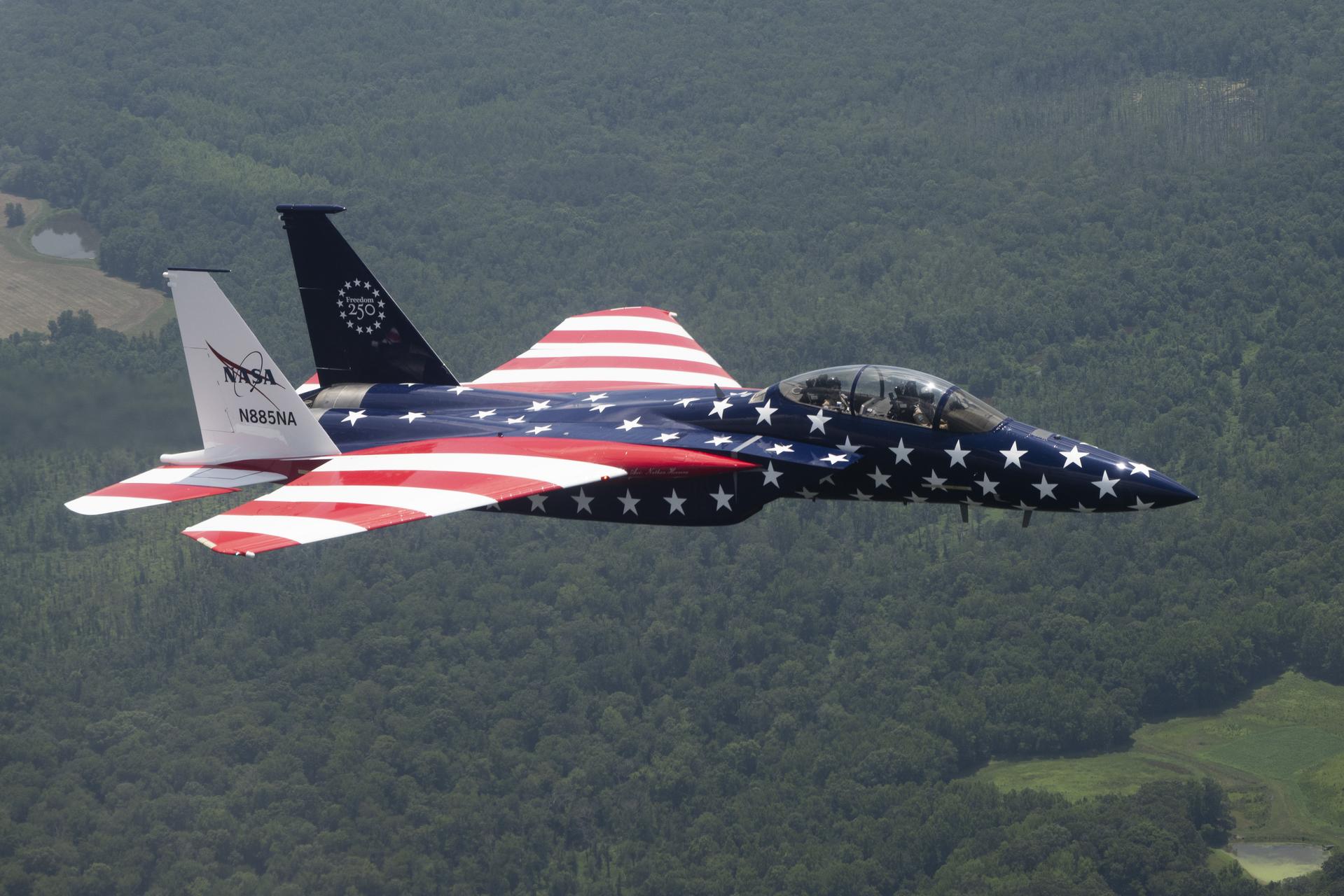
A NASA F-15 aircraft flies above Washington on Saturday, July 4, 2026, as part of a flyover to celebrate America’s 250th birthday. This aircraft is from NASA’s Armstrong Flight Research Center in Edwards, California, and it joined other NASA aircraft for the flyover.
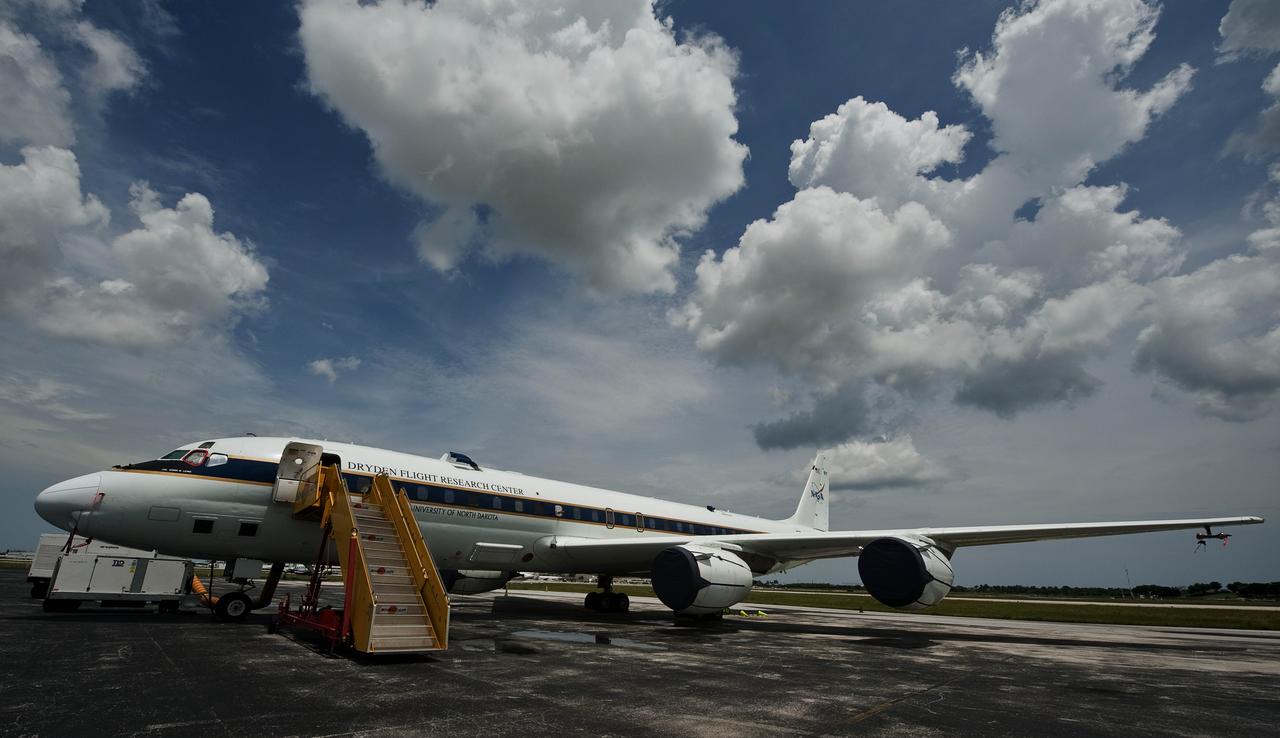
The NASA DC-8 airplane sits on the tarmac, Sunday, Aug. 15, 2010, at Fort Lauderdale International Airport in Fort Lauderdale, Fla. , as preparations continue for its part in the GRIP experiment. The Genesis and Rapid Intensification Processes (GRIP) experiment is a NASA Earth science field experiment in 2010 that is being conducted to better understand how tropical storms form and develop into major hurricanes. Credit: NASA/Paul E. Alers To read more about the GRIP Mission go <b><a href="http://www.nasa.gov/mission_pages/hurricanes/missions/grip/news/grip-quest.html" rel="nofollow"> here</a></b> or <b><a href="http://www.nasa.gov/externalflash/GRIP/" rel="nofollow"> here</a></b> for an interactive feature <b><a href="http://www.nasa.gov/centers/goddard/home/index.html" rel="nofollow">NASA Goddard Space Flight Center</a></b> is home to the nation's largest organization of combined scientists, engineers and technologists that build spacecraft, instruments and new technology to study the Earth, the sun, our solar system, and the universe. <b>Follow us on <a href="http://twitter.com/NASA_GoddardPix" rel="nofollow">Twitter</a></b> <b>Join us on <a href="http://www.facebook.com/pages/Greenbelt-MD/NASA-Goddard/395013845897?ref=tsd" rel="nofollow">Facebook</a><b></b></b>
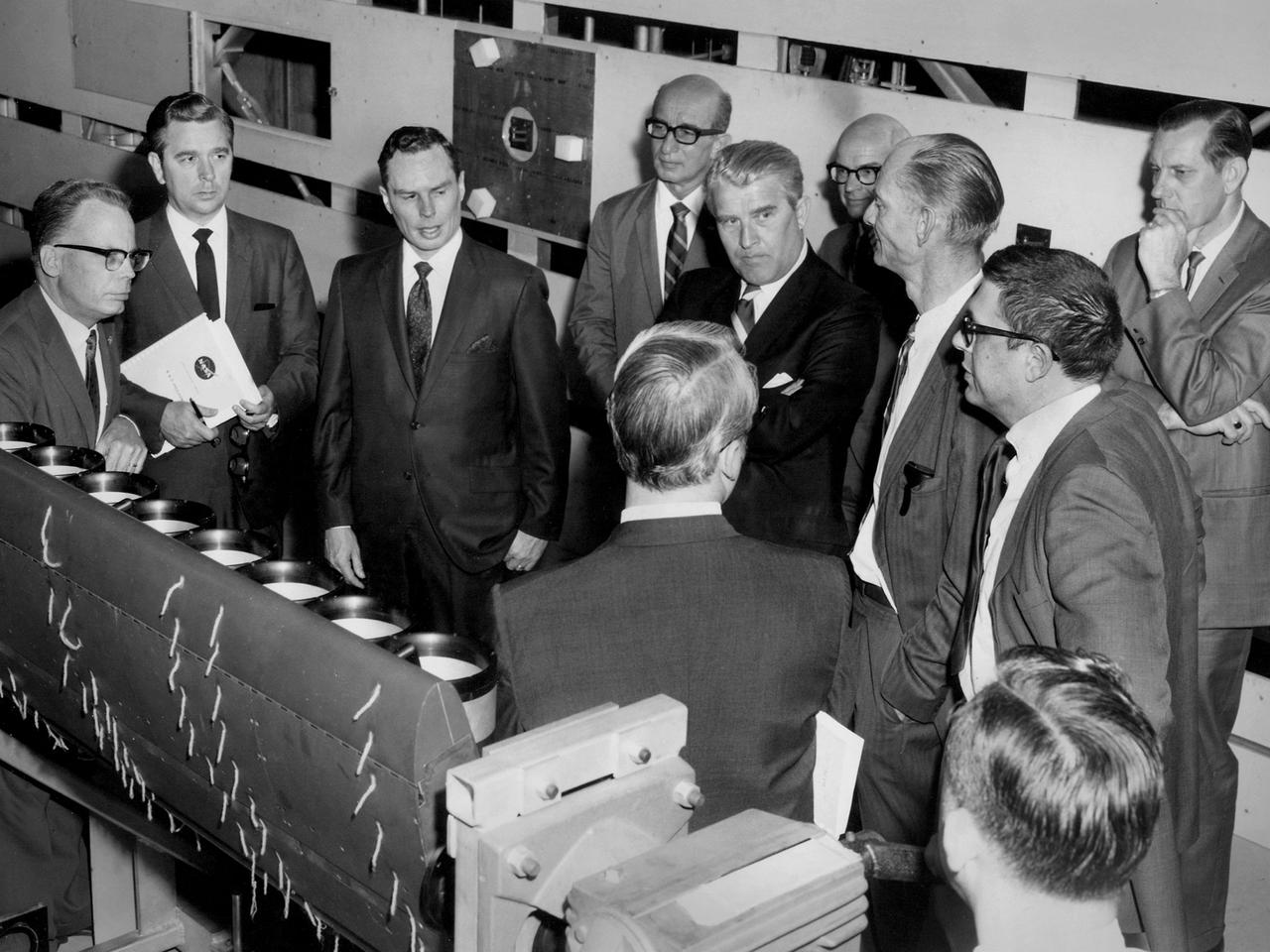
Werner von Braun, National Aeronautics and Space Administration (NASA) Deputy Associate Administrator for Planning, among a group from Headquarters touring the Lewis Research Center in Cleveland, Ohio. Lewis Special Projects Chief Newell Sanders, left, describes a Short Takeoff and Landing wing-propulsion model. Lewis had recently converted the return leg of its 8- by 6-Foot Supersonic Wind Tunnel into the 9- by 15-Foot Low Speed Wind Tunnel to investigate Vertical and Short Takeoff and Landing propulsion systems. Gathered from the left near Sanders are James Daniels, Headquarters Executive Secretary; Oran Hicks, Acting Associate Administrator for the Headquarters Office of Advanced Research and Technology; Eugene Manganiello, Lewis Deputy Director; von Braun; Dr. Walter Olson, Lewis Assistant Director; Bruce Lundin, Lewis Director and Dr. Bernard Lubarsky, Lewis Assistant Director. Just months before this photograph, NASA asked von Braun to give up his post as Director of the Marshall Space Flight Center after nearly ten years in order to head up the strategic planning effort for the agency from Washington DC. Von Braun retired from NASA two years later.
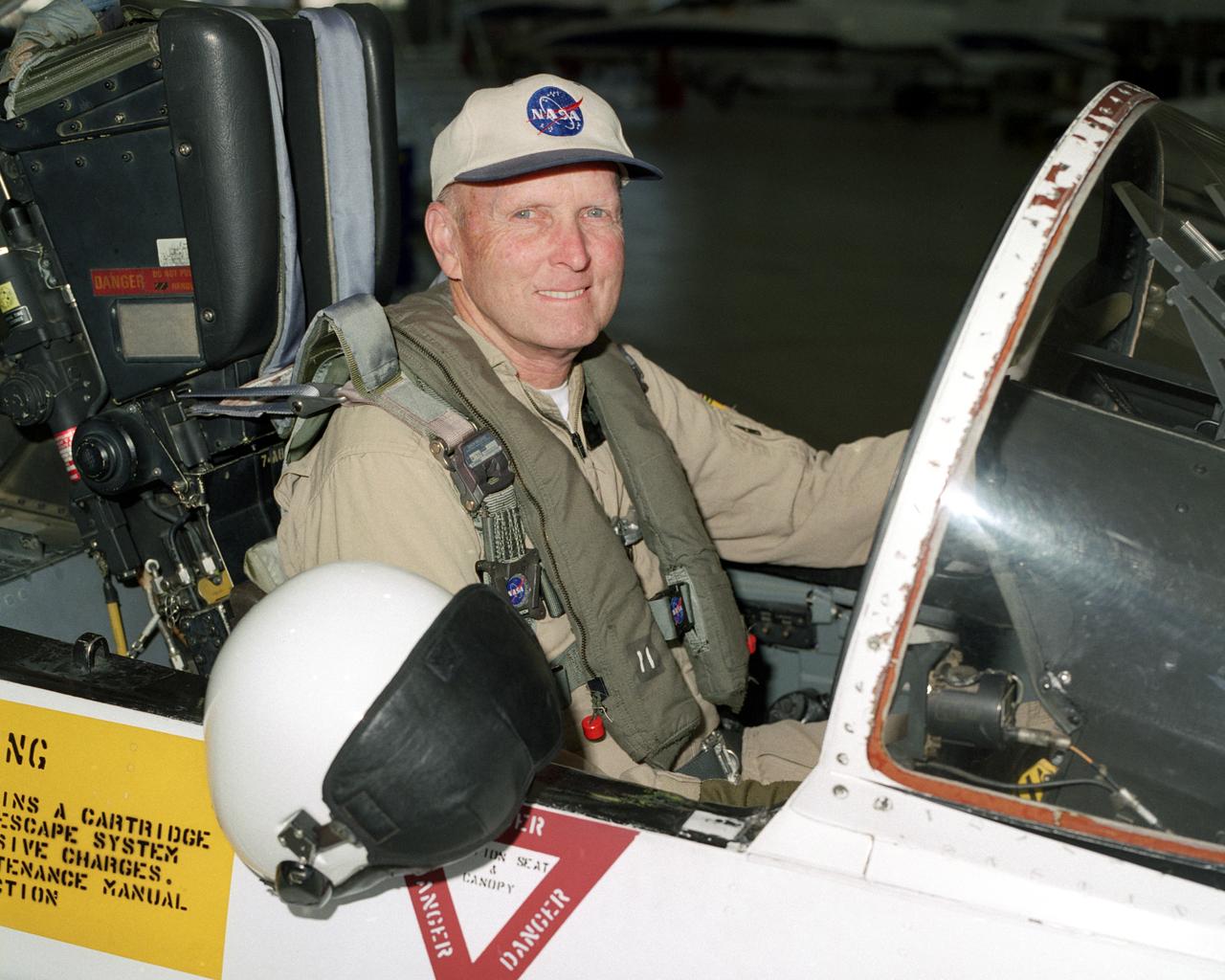
Former NASA astronaut C. Gordon Fullerton, seated in the cockpit of an F/A-18, is a research pilot at NASA's Dryden Flight Research Center, Edwards, Calif. Since transferring to Dryden in 1986, his assignments have included a variety of flight research and support activities piloting NASA's B-52 launch aircraft, the 747 Shuttle Carrier Aircraft (SCA), and other multi-engine and high performance aircraft. He flew a series of development air launches of the X-38 prototype Crew Return Vehicle and in the launches for the X-43A Hyper-X project. Fullerton also flies Dryden's DC-8 Airborne Science aircraft in support a variety of atmospheric physics, ground mapping and meteorology studies. Fullerton also was project pilot on the Propulsion Controlled Aircraft program, during which he successfully landed both a modified F-15 and an MD-11 transport with all control surfaces neutralized, using only engine thrust modulation for control. Fullerton also evaluated the flying qualities of the Russian Tu-144 supersonic transport during two flights in 1998, one of only two non-Russian pilots to fly that aircraft. With more than 15,000 hours of flying time, Fullerton has piloted 135 different types of aircraft in his career. As an astronaut, Fullerton served on the support crews for the Apollo 14, 15, 16, and 17 lunar missions. In 1977, Fullerton was on one of the two flight crews that piloted the Space Shuttle prototype Enterprise during the Approach and Landing Test Program at Dryden. Fullerton was the pilot on the STS-3 Space Shuttle orbital flight test mission in 1982, and commanded the STS-51F Spacelab 2 mission in 1985. He has logged 382 hours in space flight. In July 1988, he completed a 30-year career with the U.S. Air Force and retired as a colonel.
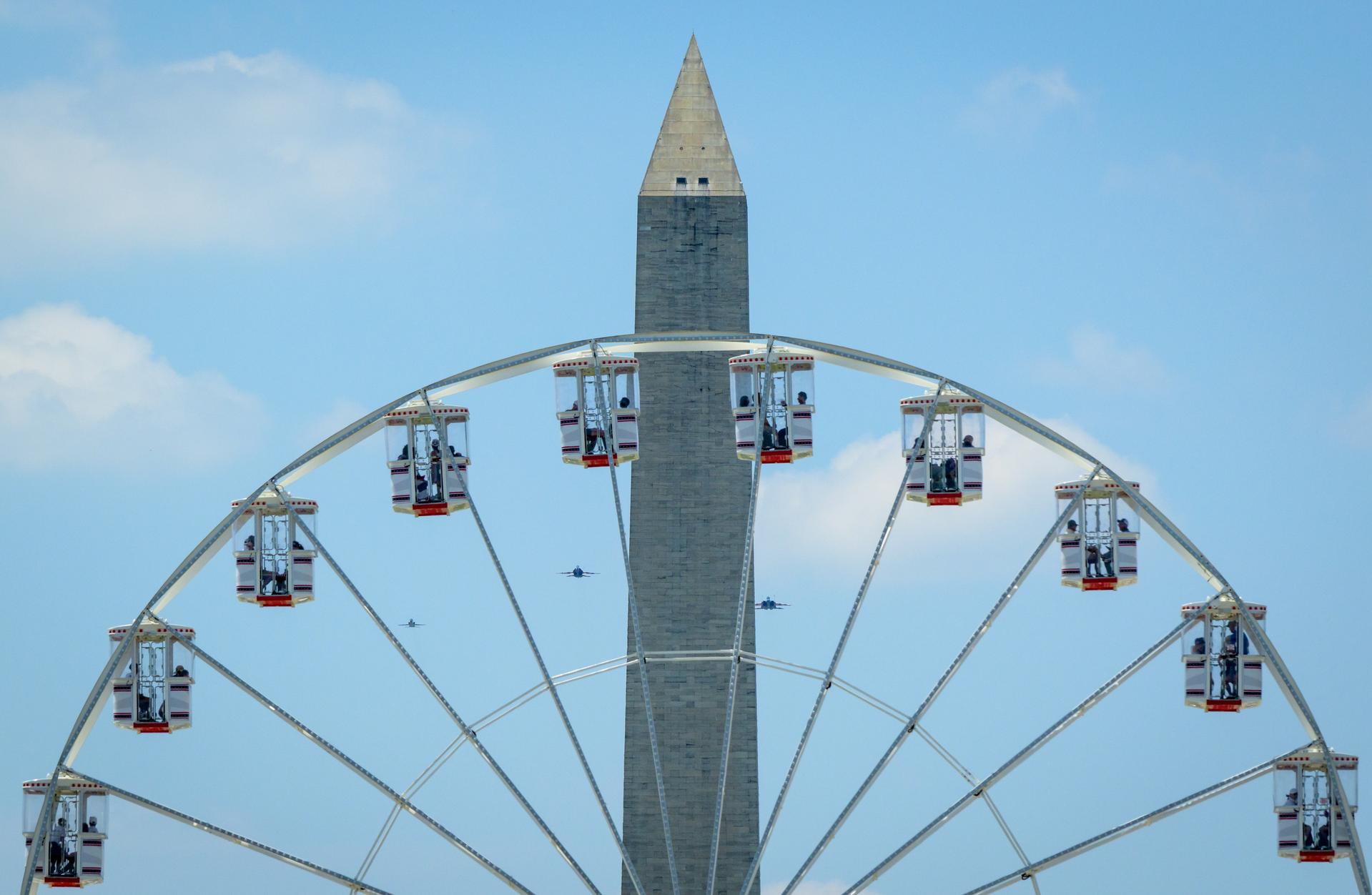
NASA’s T-38 Talon, left, F/A-18 Hornet and F-15 Eagle, right, aircraft are seen as they perform a flyover during the Great American State Fair, Saturday, July 4, 2026, on the National Mall in Washington. Photo Credit: (NASA/Bill Ingalls)
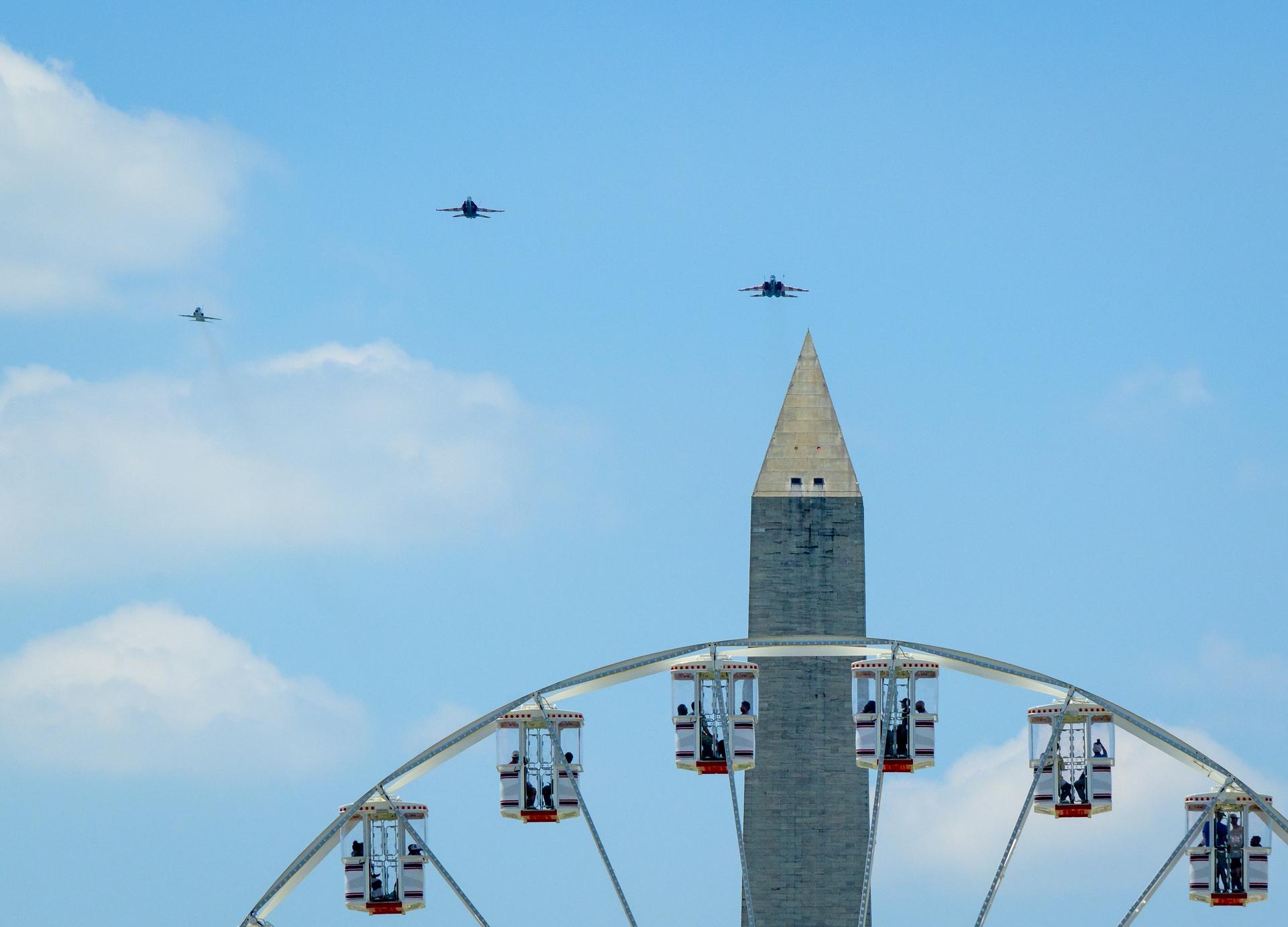
NASA’s T-38 Talon, left, F/A-18 Hornet and F-15 Eagle, right, aircraft are seen as they perform a flyover during the Great American State Fair, Saturday, July 4, 2026, on the National Mall in Washington. Photo Credit: (NASA/Bill Ingalls)
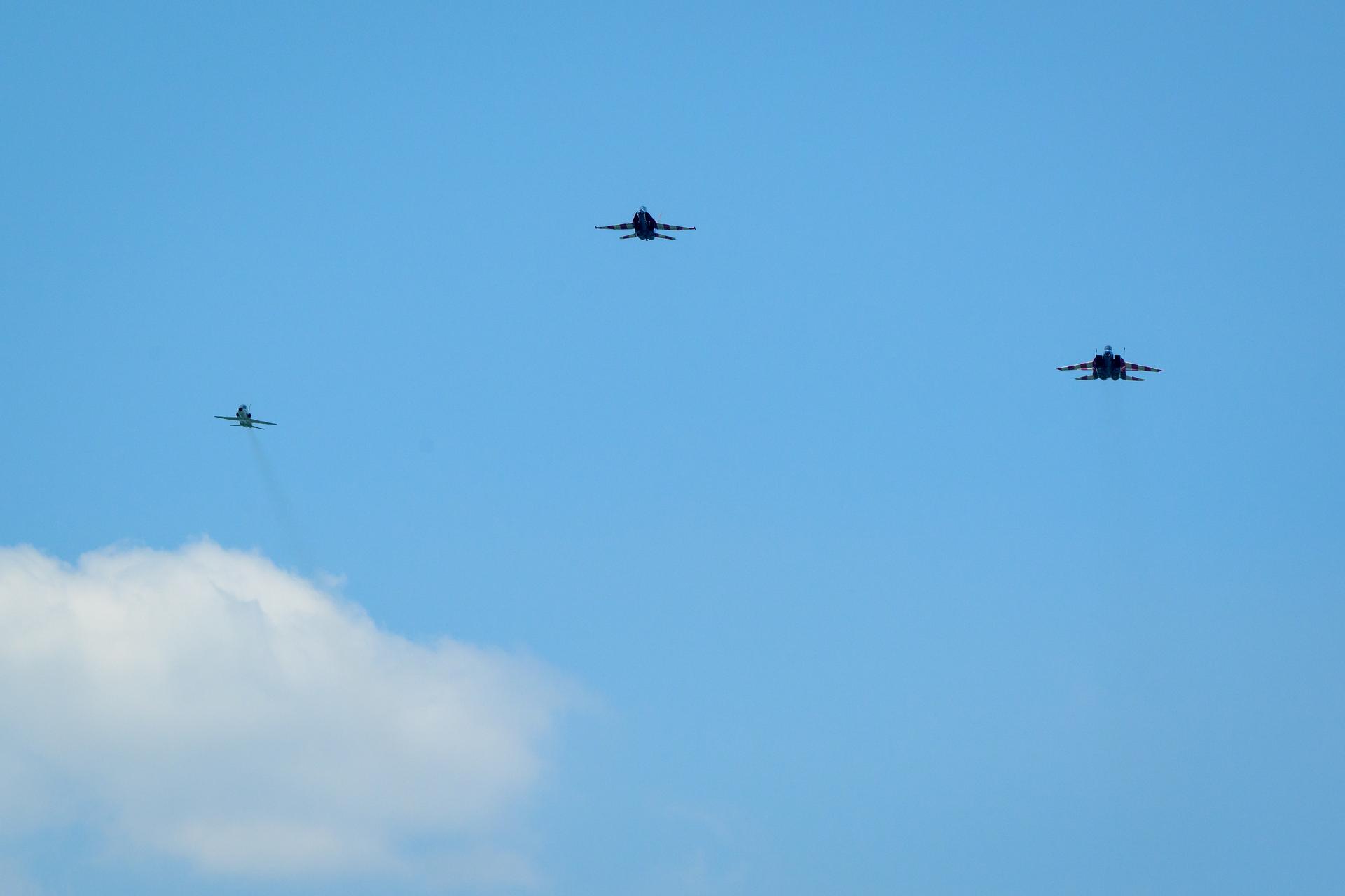
NASA’s T-38 Talon, left, F/A-18 Hornet and F-15 Eagle, right, aircraft are seen as they perform a flyover during the Great American State Fair, Saturday, July 4, 2026, on the National Mall in Washington. Photo Credit: (NASA/Bill Ingalls)
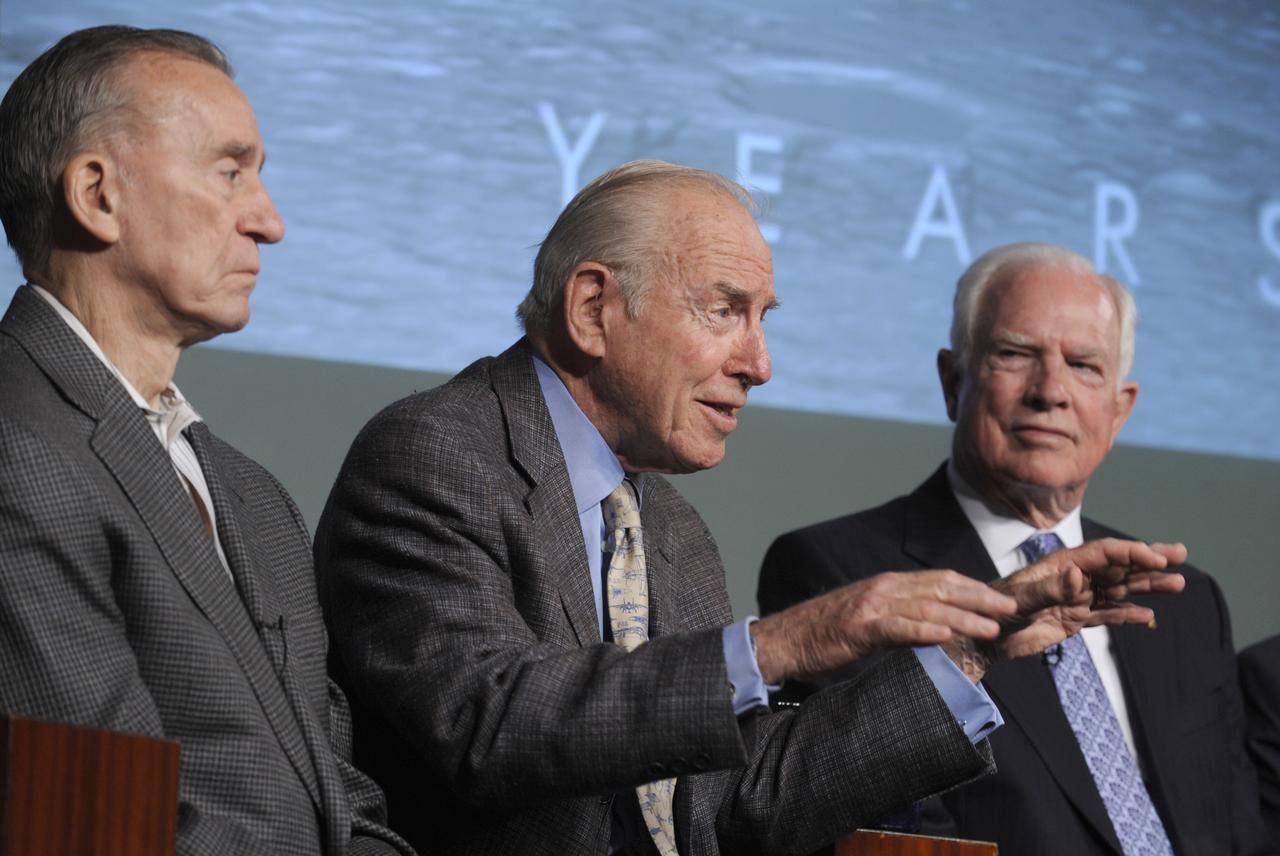
Astronaut James Lovell (Apollo 8 Apollo 13), center, flanked by Walt Cunningham (Apollo 7), left, and David Scott (Apollo 9 Apollo 15) responds during the 40th anniversary of the Apollo 11 mission and the walk on the moon press conference, Monday, July 20, 2009, at NASA Headquarters in Washington. Photo Credit: (NASA/Paul E. Alers)
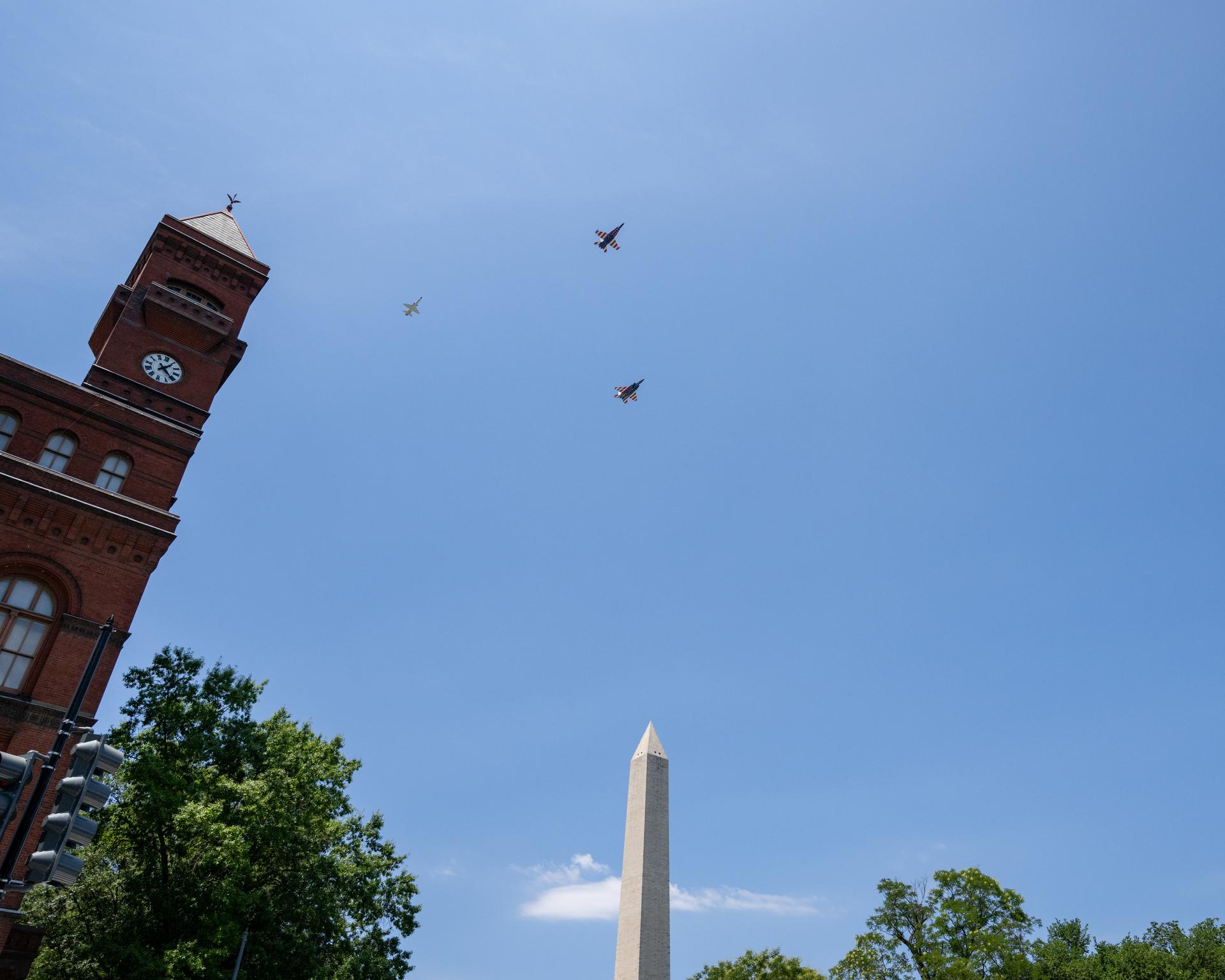
NASA’s T-38 Talon, F/A-18 Hornet and F-15 Eagle aircraft are seen as they perform a flyover during the Great American State Fair, Saturday, July 4, 2026, on the National Mall in Washington. Photo Credit: (NASA/Keegan Barber)
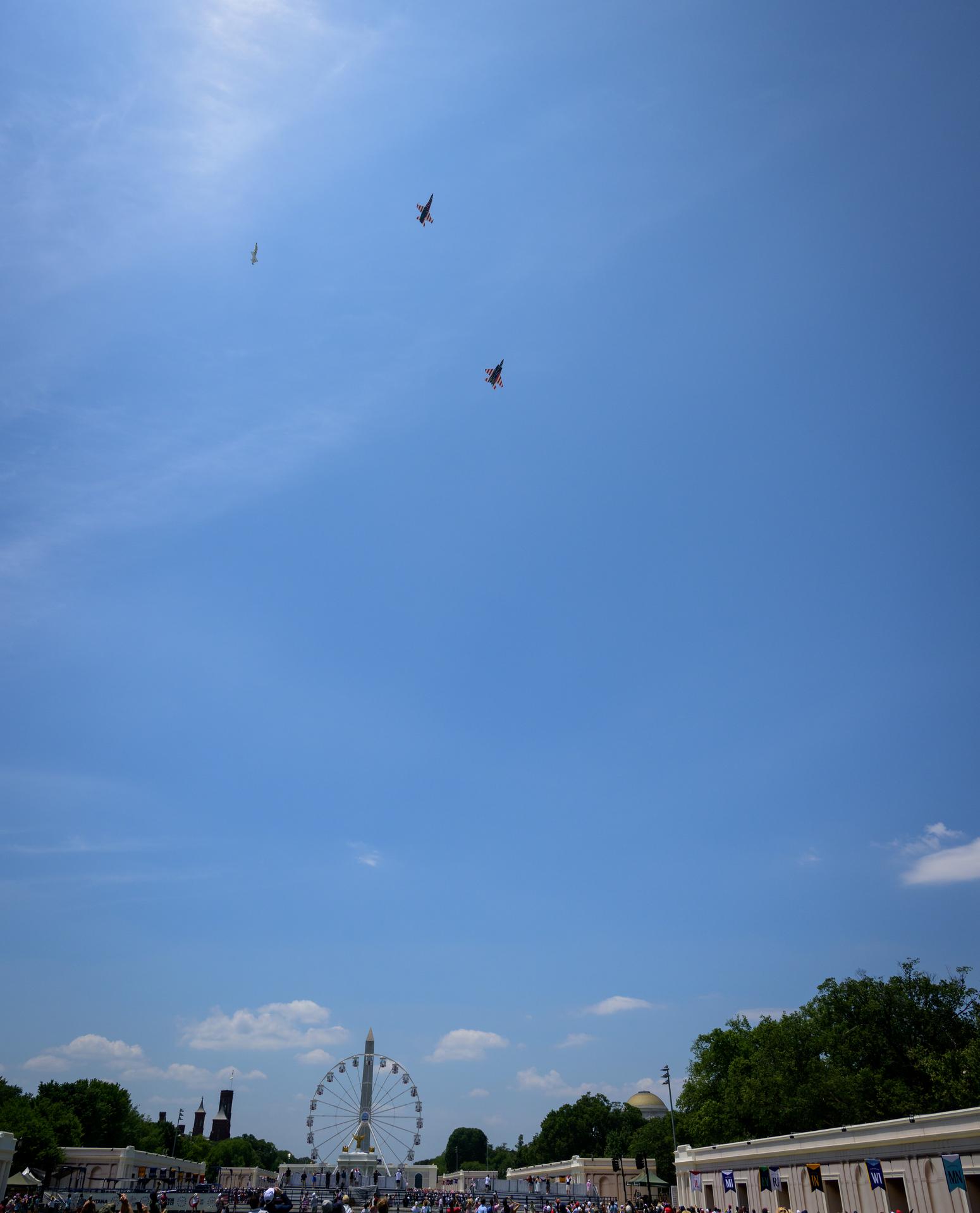
NASA’s T-38 Talon, left, F/A-18 Hornet and F-15 Eagle, right, aircraft are seen as they perform a flyover during the Great American State Fair, Saturday, July 4, 2026, on the National Mall in Washington. Photo Credit: (NASA/Bill Ingalls)
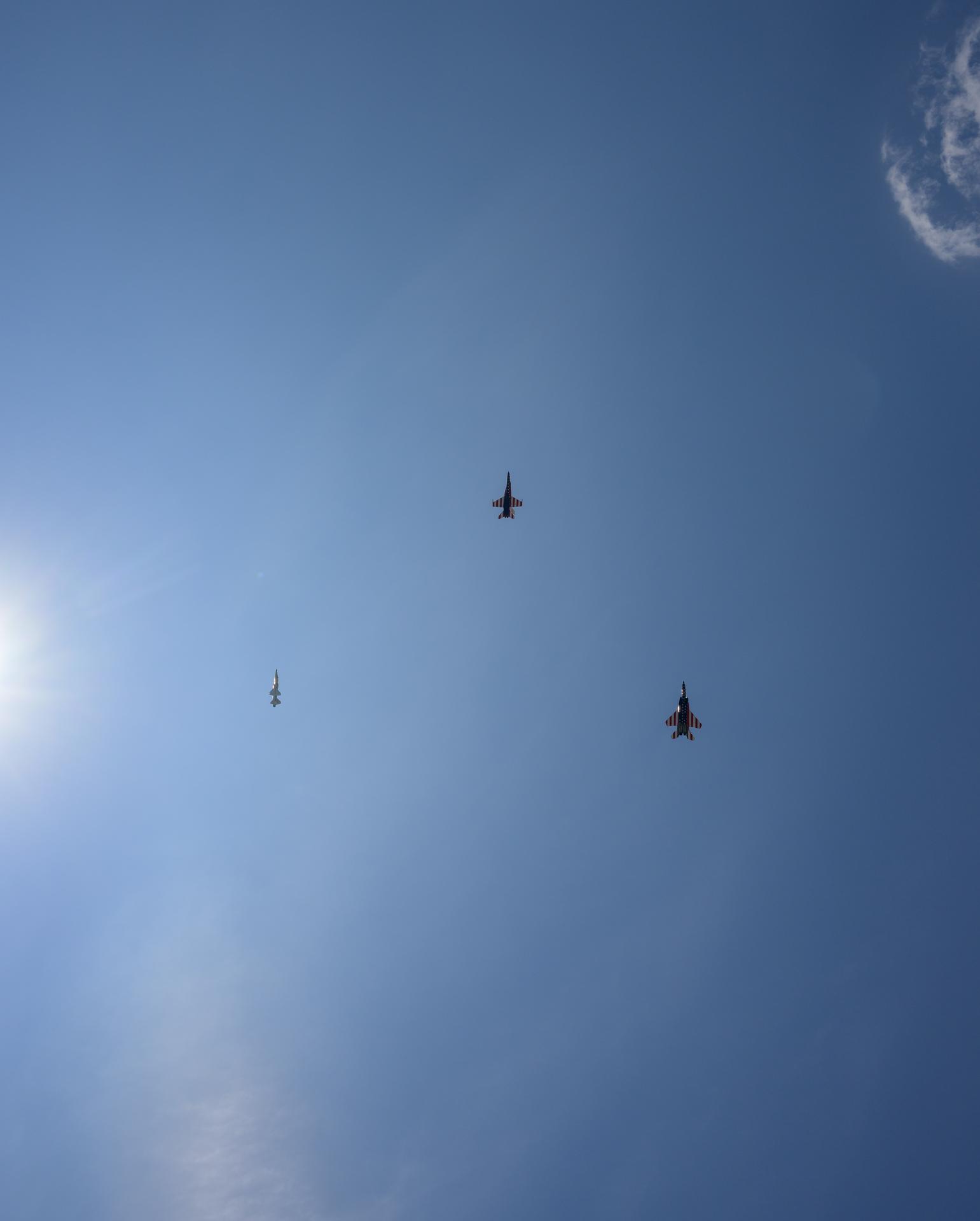
NASA’s T-38 Talon, left, F/A-18 Hornet and F-15 Eagle, right, aircraft are seen as they perform a flyover during the Great American State Fair, Saturday, July 4, 2026, on the National Mall in Washington. Photo Credit: (NASA/Bill Ingalls)
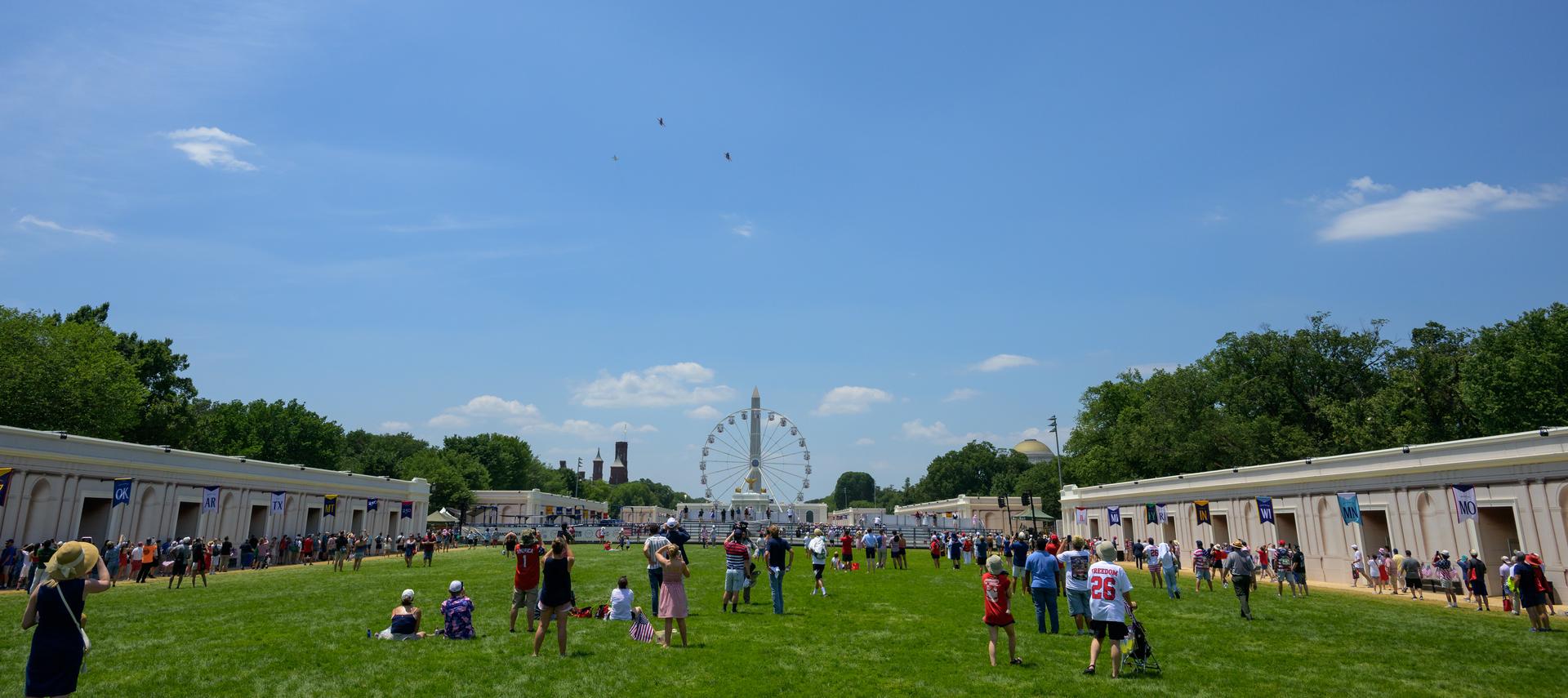
NASA’s T-38 Talon, left, F/A-18 Hornet and F-15 Eagle, right, aircraft are seen as they perform a flyover during the Great American State Fair, Saturday, July 4, 2026, on the National Mall in Washington. Photo Credit: (NASA/Bill Ingalls)

This illustration is an orbiter cutaway view with callouts. The orbiter is both the brains and heart of the Space Transportation System (STS). About the same size and weight as a DC-9 aircraft, the orbiter contains the pressurized crew compartment (which can normally carry up to seven crew members), the huge cargo bay, and the three main engines mounted on its aft end. There are three levels to the crew cabin. Uppermost is the flight deck where the commander and the pilot control the mission. The middeck is where the gallery, toilet, sleep stations, and storage and experiment lockers are found for the basic needs of weightless daily living. Also located in the middeck is the airlock hatch into the cargo bay and space beyond. It is through this hatch and airlock that astronauts go to don their spacesuits and marned maneuvering units in preparation for extravehicular activities, more popularly known as spacewalks. The Space Shuttle's cargo bay is adaptable to hundreds of tasks. Large enough to accommodate a tour bus (60 x 15 feet or 18.3 x 4.6 meters), the cargo bay carries satellites, spacecraft, and spacelab scientific laboratories to and from Earth orbit. It is also a work station for astronauts to repair satellites, a foundation from which to erect space structures, and a hold for retrieved satellites to be returned to Earth. Thermal tile insulation and blankets (also known as the thermal protection system or TPS) cover the underbelly, bottom of the wings, and other heat-bearing surfaces of the orbiter to protect it during its fiery reentry into the Earth's atmosphere. The Shuttle's 24,000 individual tiles are made primarily of pure-sand silicate fibers, mixed with a ceramic binder. The solid rocket boosters (SRB's) are designed as an in-house Marshall Space Flight Center project, with United Space Boosters as the assembly and refurbishment contractor. The solid rocket motor (SRM) is provided by the Morton Thiokol Corporation.
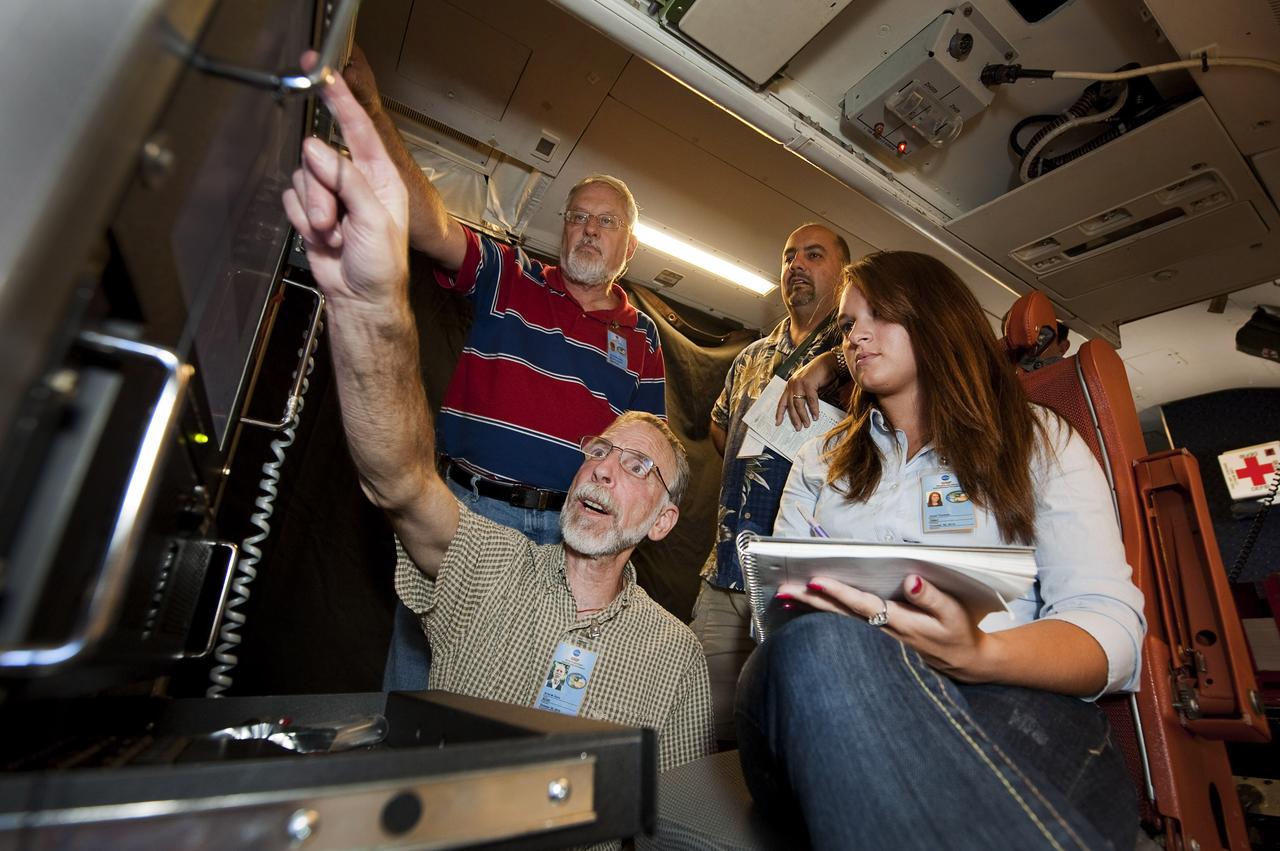
Errol Korn, lower left, explains the dropsonde experiment to Janel Thomas, a University of Maryland Baltimore County (UMBC) graduate student, seated, as Bob Pasken, standing left, and Jeff Halverson, a GRIP project scientist from UMBC, look on inside NASA's DC-8 airplane, at Fort Lauderdale International Airport in Fort Lauderdale, Fla., Sunday, Aug. 15, 2010. The Genesis and Rapid Intensification Processes (GRIP) experiment is a NASA Earth science field experiment in 2010 that is being conducted to better understand how tropical storms form and develop into major hurricanes. Credit: NASA/Paul E. Alers To read more about the GRIP Mission go <b><a href="http://www.nasa.gov/mission_pages/hurricanes/missions/grip/news/grip-quest.html" rel="nofollow"> here</a></b> or <b><a href="http://www.nasa.gov/externalflash/GRIP/" rel="nofollow"> here</a></b> for an interactive feature <b><a href="http://www.nasa.gov/centers/goddard/home/index.html" rel="nofollow">NASA Goddard Space Flight Center</a></b> is home to the nation's largest organization of combined scientists, engineers and technologists that build spacecraft, instruments and new technology to study the Earth, the sun, our solar system, and the universe. <b>Follow us on <a href="http://twitter.com/NASA_GoddardPix" rel="nofollow">Twitter</a></b> <b>Join us on <a href="http://www.facebook.com/pages/Greenbelt-MD/NASA-Goddard/395013845897?ref=tsd" rel="nofollow">Facebook</a><b></b></b>
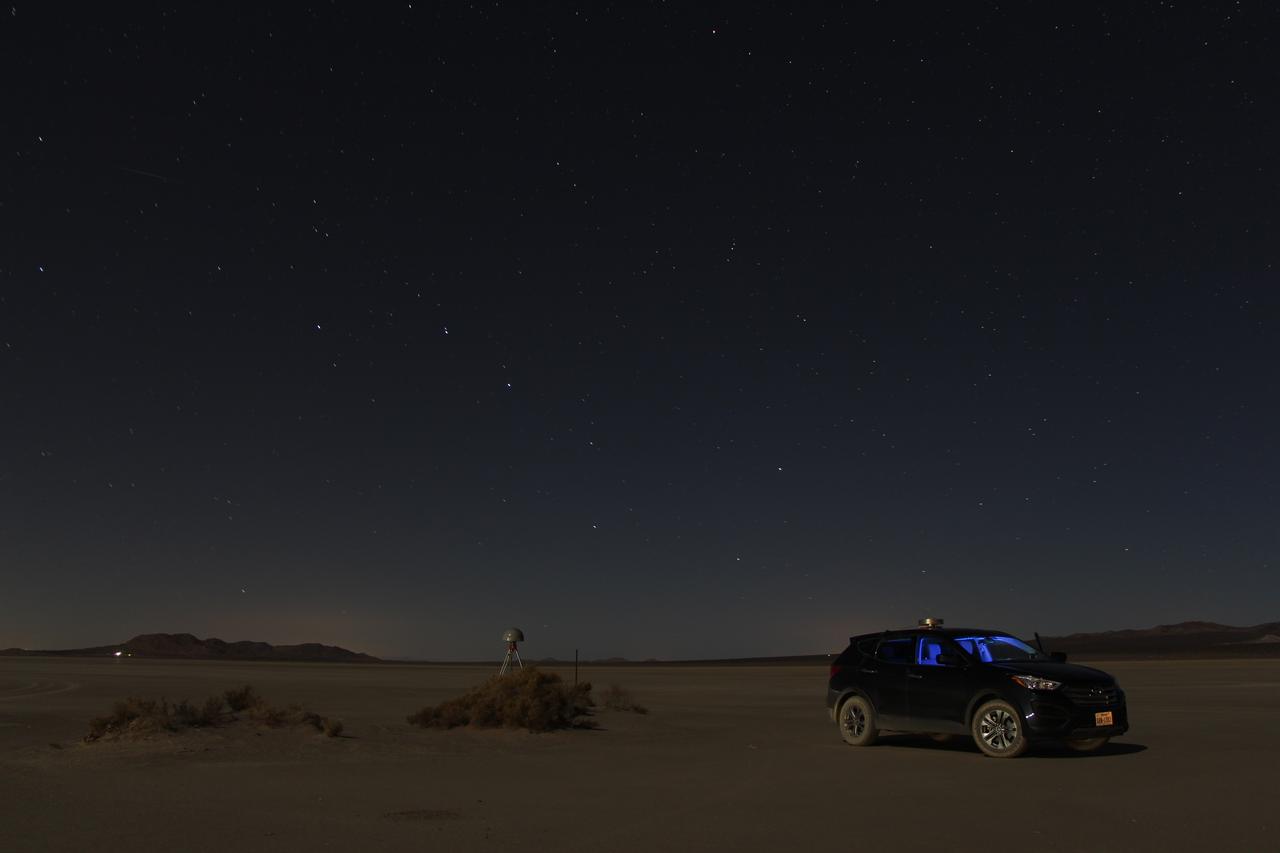
At first glance a dry lake bed in the southern California desert seems like the last place to prepare to study ice. But on Oct. 2, 2014, NASA’s Operation IceBridge carried out a ground-based GPS survey of the El Mirage lake bed in California’s Mojave Desert. Members of the IceBridge team are currently at NASA’s Armstrong Flight Research Center, preparing instruments aboard the DC-8 research aircraft for flights over Antarctica. Part of this preparation involves test flights over the desert, where researchers verify their instruments are working properly. El Mirage serves as a prime location for testing the mission’s laser altimeter, the Airborne Topographic Mapper, because the lake bed has a flat surface and reflects light similarly to snow and ice. This photo, taken shortly after the survey, shows the GPS-equipped survey vehicle and a stationary GPS station (left of the vehicle) on the lake bed with the constellation Ursa Major in the background. By driving the vehicle in parallel back and forth lines over a predefined area and comparing those GPS elevation readings with measurements from the stationary GPS, researchers are able to build an elevation map that will be used to precisely calibrate the laser altimeter for ice measurements. Credit: NASA/John Sonntag Operation IceBridge is scheduled to begin research flights over Antarctica on Oct. 15, 2014. The mission will be based out of Punta Arenas, Chile, until Nov. 23. For more information about IceBridge, visit: <a href="http://www.nasa.gov/icebridge" rel="nofollow">www.nasa.gov/icebridge</a> <b><a href="http://www.nasa.gov/audience/formedia/features/MP_Photo_Guidelines.html" rel="nofollow">NASA image use policy.</a></b> <b><a href="http://www.nasa.gov/centers/goddard/home/index.html" rel="nofollow">NASA Goddard Space Flight Center</a></b> enables NASA’s mission through four scientific endeavors: Earth Science, Heliophysics, Solar System Exploration, and Astrophysics. Goddard plays a leading role in NASA’s accomplishments by contributing compelling scientific knowledge to advance the Agency’s mission. <b>Follow us on <a href="http://twitter.com/NASAGoddardPix" rel="nofollow">Twitter</a></b> <b>Like us on <a href="http://www.facebook.com/pages/Greenbelt-MD/NASA-Goddard/395013845897?ref=tsd" rel="nofollow">Facebook</a></b> <b>Find us on <a href="http://instagram.com/nasagoddard?vm=grid" rel="nofollow">Instagram</a></b>
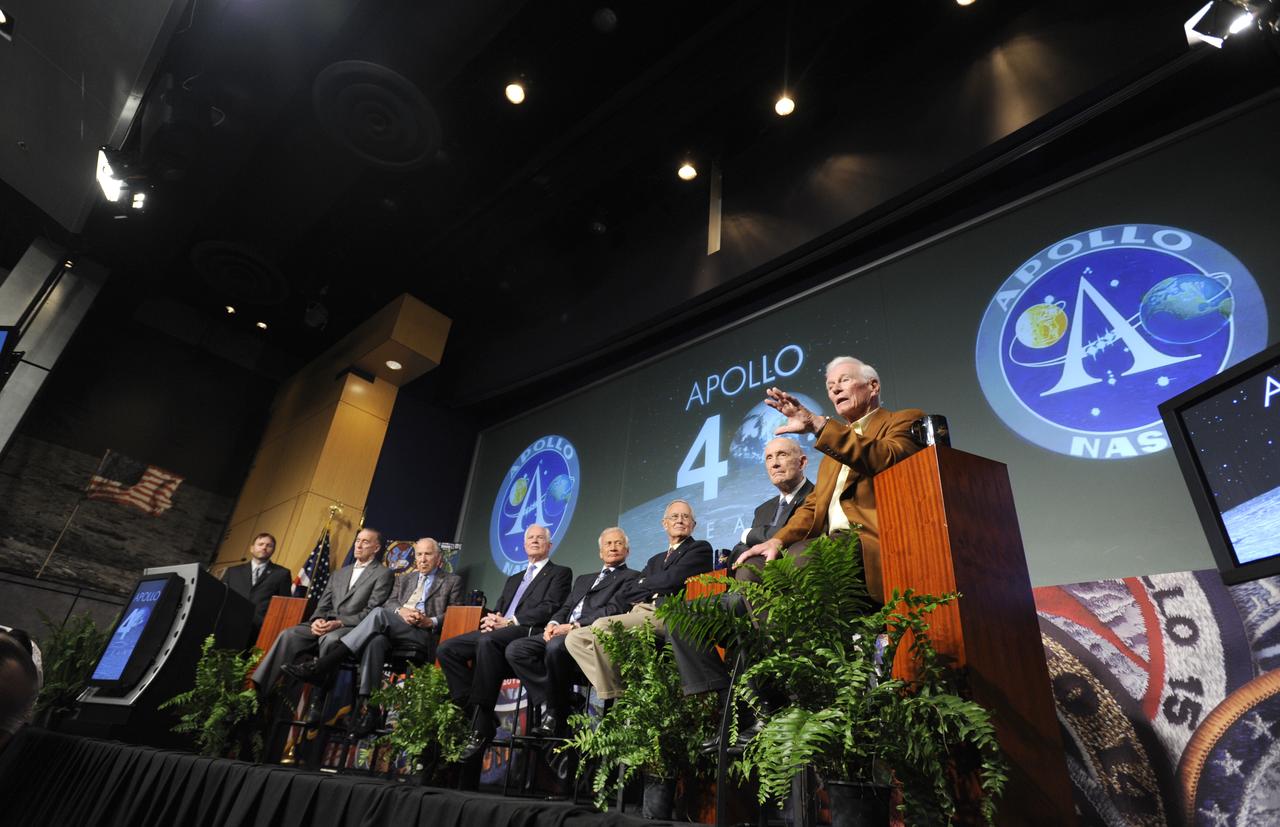
Apollo astronauts from left, Walt Cunningham (Apollo 17), James Lovell (Apollo 8 Apollo 13), David Scott (Apollo 9 Apollo 15), Buzz Aldrin (Apollo 11), Charles Duke (Apollo 16), Thomas Stafford (Apollo 10) and Eugene Cernan (Apollo 17) are seen during the 40th anniversary of the Apollo 11 mission and the walk on the moon press conference, Monday, July 20, 2009, at NASA Headquarters in Washington. Photo Credit: (NASA/Paul E. Alers)
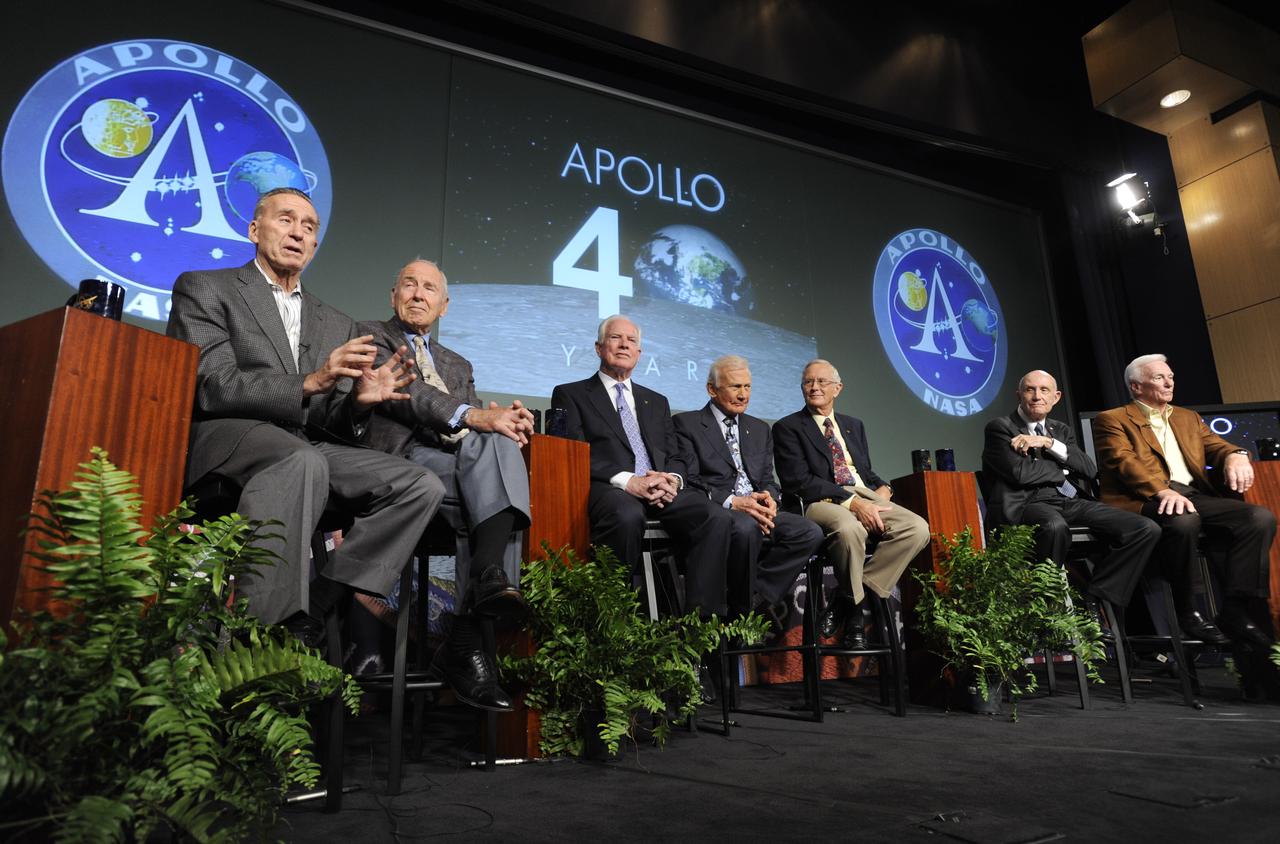
Apollo astronauts from left, Walt Cunningham (Apollo 17), James Lovell (Apollo 8 Apollo 13), David Scott (Apollo 9 Apollo 15), Buzz Aldrin (Apollo 11), Charles Duke (Apollo 16), Thomas Stafford (Apollo 10) and Eugene Cernan (Apollo 17) are seen during the 40th anniversary of the Apollo 11 mission and the walk on the moon press conference, Monday, July 20, 2009, at NASA Headquarters in Washington. Photo Credit: (NASA/Paul E. Alers)

Apollo astronauts from left, Walt Cunningham (Apollo 17), James Lovell (Apollo 8 Apollo 13), David Scott (Apollo 9 Apollo 15), Buzz Aldrin (Apollo 11), Charles Duke (Apollo 16), Thomas Stafford (Apollo 10) and Eugene Cernan (Apollo 17) are seen during the 40th anniversary of the Apollo 11 mission and the walk on the moon press conference, Monday, July 20, 2009, at NASA Headquarters in Washington. Photo Credit: (NASA/Paul E. Alers)