Debris Flow
Debris Flow
Debris Flow
Debris Flow
The Battering and Debris
Dunes and Debris
Dunes and Debris
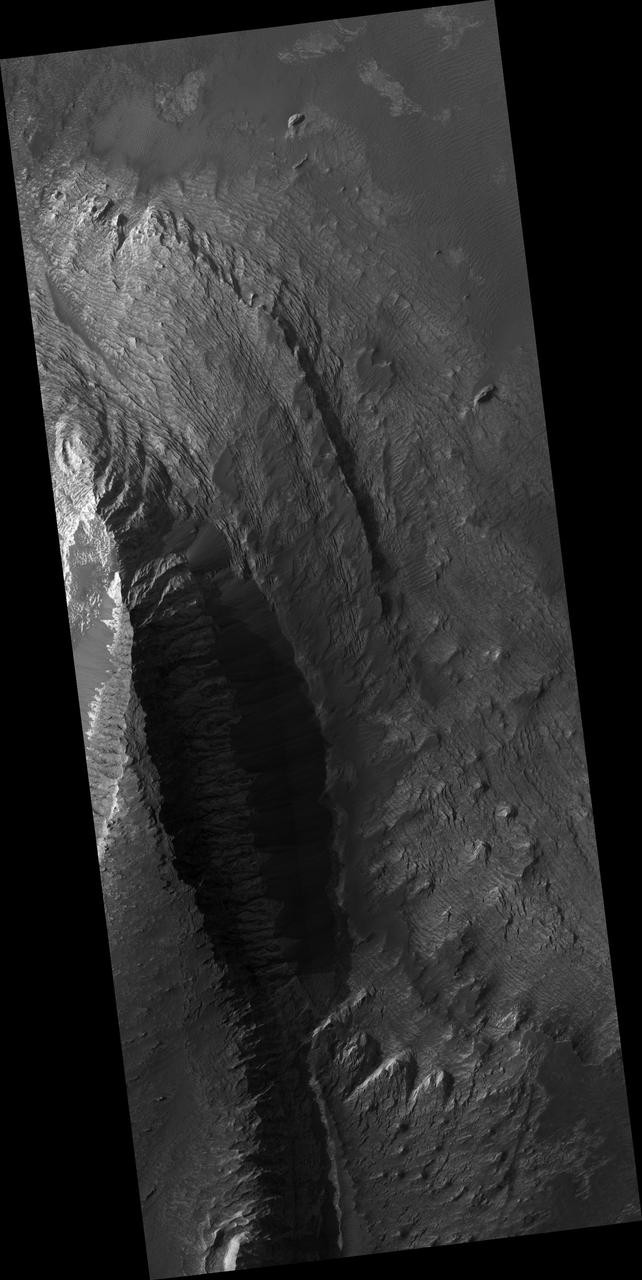
Ius Chasma Debris
Ius Chasma Debris
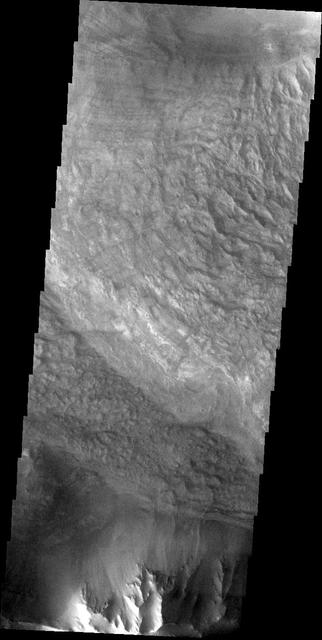
Layers and Dark Debris in Melas Chasma
Lobate Debris Apron in Tempe Terra/Mareotis Fossae
Churned-Up Rocky Debris and Dust True Color
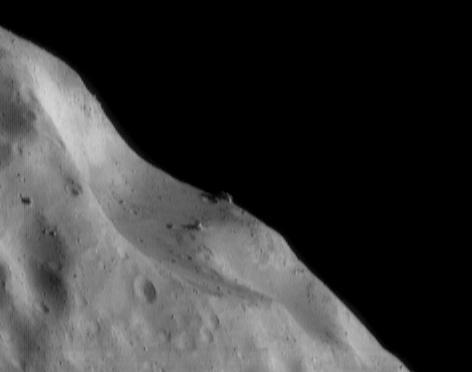
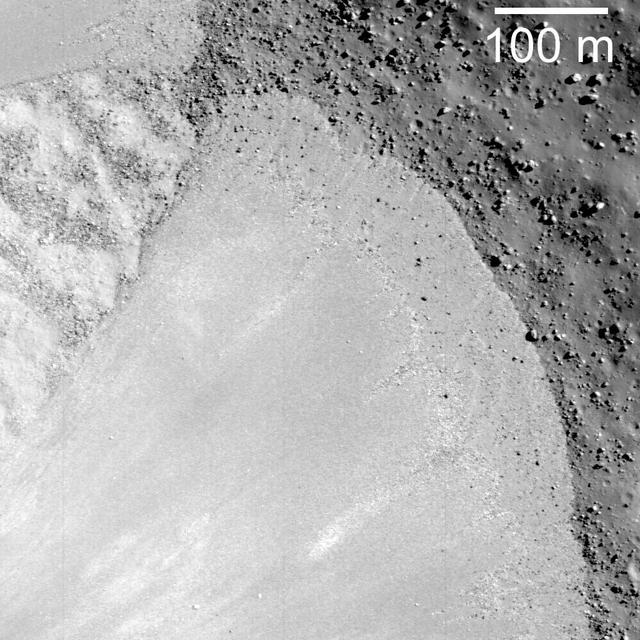
NASA Lunar Reconnaissance Orbiter captures a debris flow extending down the southwest wall of Janssen K crater.
Debris Flows I
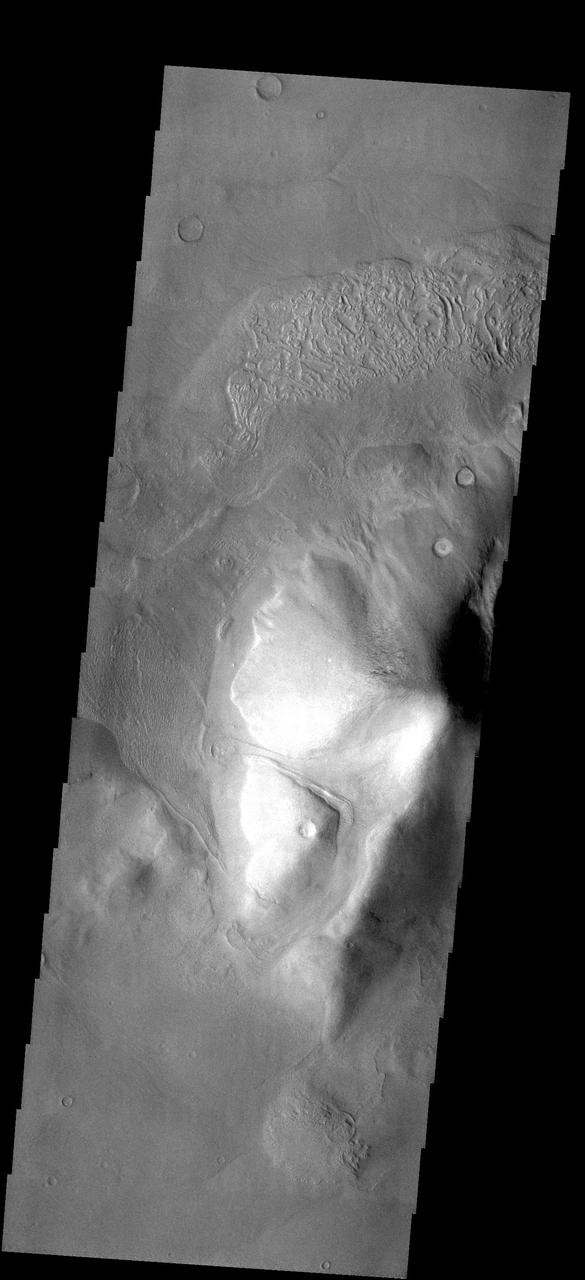
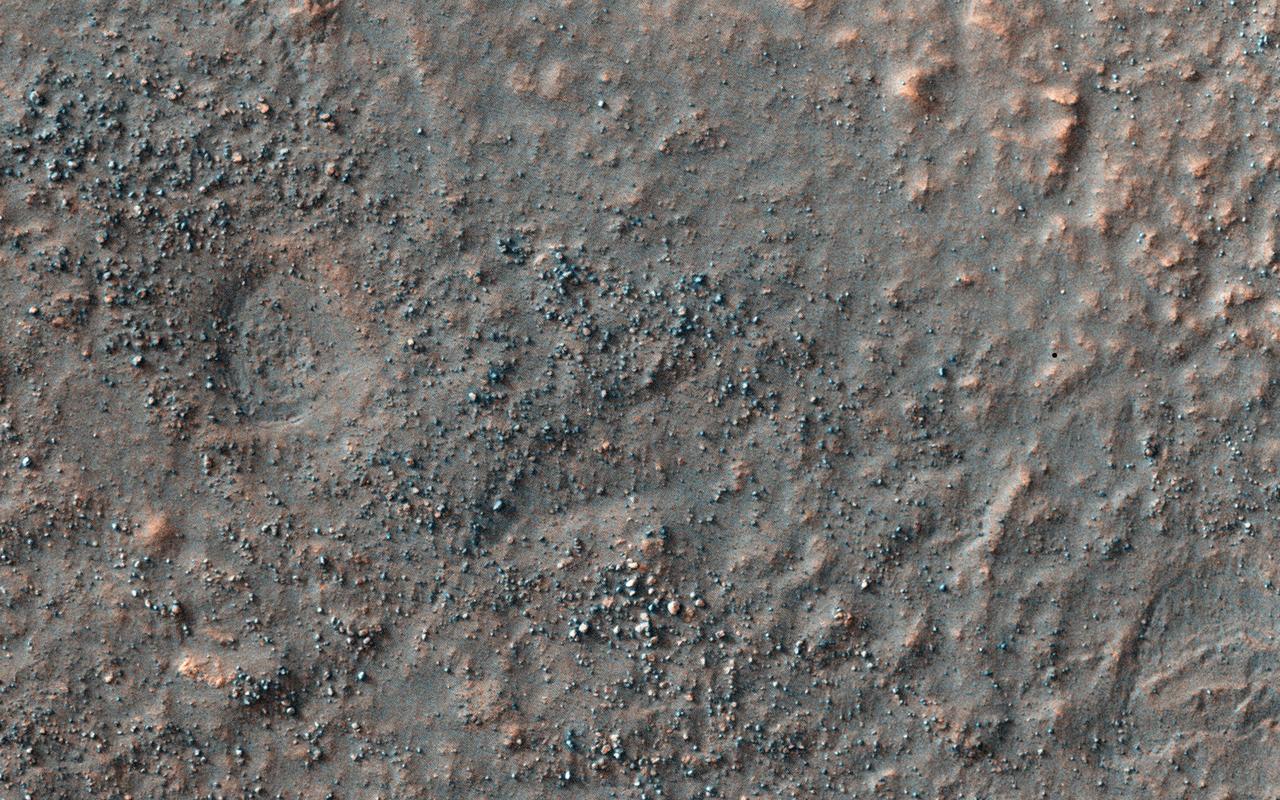
This image captured by NASA 2001 Mars Odyssey spacecraft shows downslope movement of material from the hill at the top of the image. Linear ridges and channels are visible on the surface to the debris flow deposit.
Debris Flow
This image taken by NASA Spitzer Space Telescope shows the comet Encke riding along its pebbly trail of debris long diagonal line between the orbits of Mars and Jupiter.
Riding a Trail of Debris
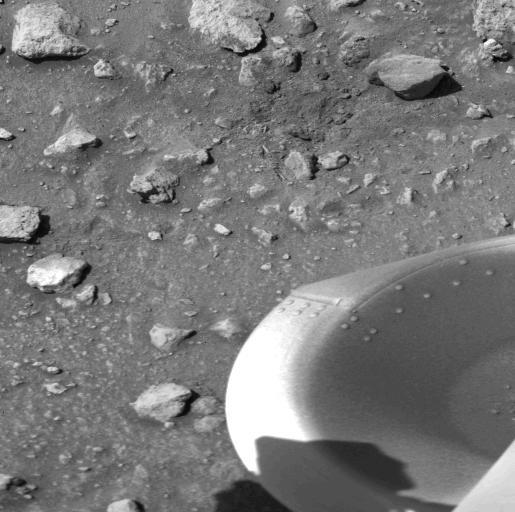
The patch of dark material toward the top of this picture (arrow) taken by NASA's Viking 1 Lander is the debris kicked up by the impact of a protective cover ejected from the spacecraft at 1 a.m. today. The cylindrical cover, which bounced out of view of the camera, protects the scoop at the end of the soil sampler arm. (The scoop will dig into the Martian surface for the first time on July 28). Dust and debris atop the footpad remains as it was seen in the Lander's first picture taken immediately after landing two days ago. No wind modification is apparent. On the surface, a variety of block sizes, shapes and tones are seen, and some rocks are Partially buried.  http://photojournal.jpl.nasa.gov/catalog/PIA00384
Debris Kicked Up By Impact of A Protective Cover from Viking Lander 1
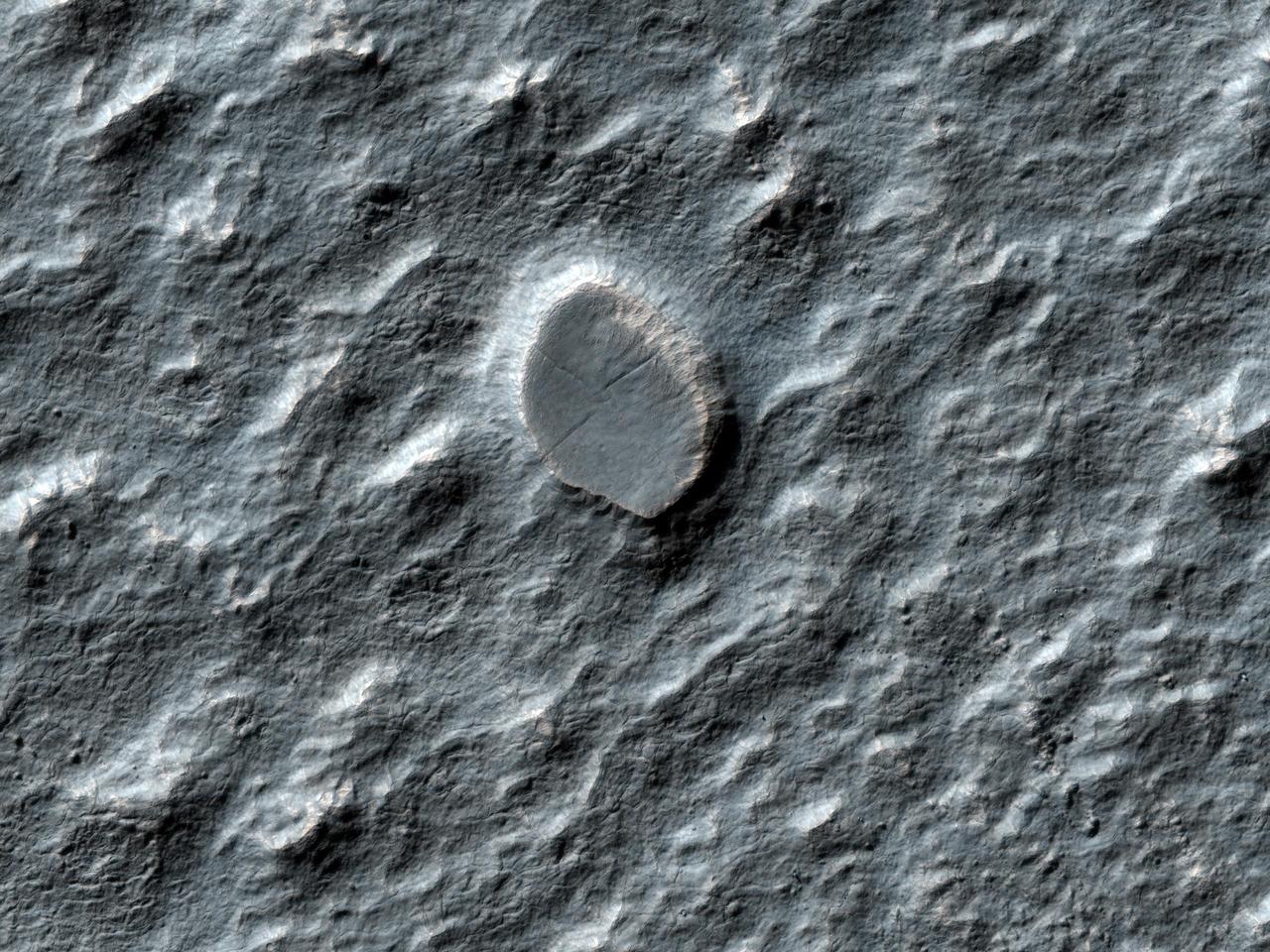
This image from NASA Mars Reconnaissance Orbiter shows a swath of a debris apron east of Hellas Basin. Features like this are often found surrounding isolated mountains in this area. Original release date March 3, 2010.
Craters on an Ice-Rich Débris Apron
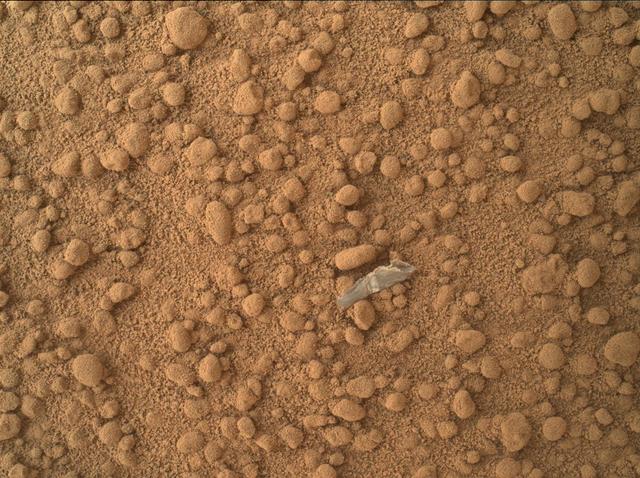
This image from NASA Mars rover Curiosity shows a small bright object on the ground beside the rover at the Rocknest site. The rover team has assessed this object as debris from the spacecraft, possibly from the events of landing on Mars.
Small Debris on the Ground Beside Curiosity
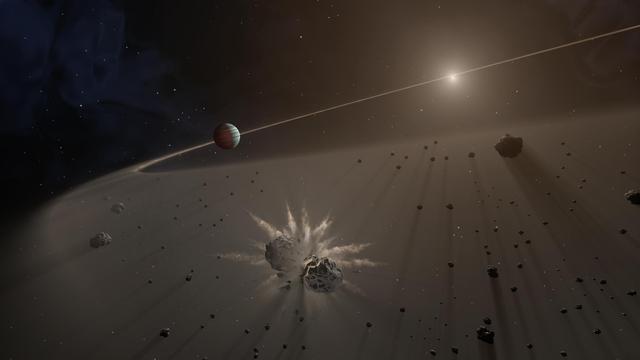
This is an artist’s impression of a white dwarf (burned-out) star accreting rocky debris left behind by the star’s surviving planetary system. It was observed by Hubble in the Hyades star cluster. At lower right, an asteroid can be seen falling toward a Saturn-like disk of dust that is encircling the dead star. Infalling asteroids pollute the white dwarf’s atmosphere with silicon.   Credit: NASA, ESA, and G. Bacon (STScI)  --- NASA's Hubble Space Telescope has found the building blocks for Earth-sized planets in an unlikely place-- the atmospheres of a pair of burned-out stars called white dwarfs.  These dead stars are located 150 light-years from Earth in a relatively young star cluster, Hyades, in the constellation Taurus. The star cluster is only 625 million years old. The white dwarfs are being polluted by asteroid-like debris falling onto them.   <b><a href="http://www.nasa.gov/audience/formedia/features/MP_Photo_Guidelines.html" rel="nofollow">NASA image use policy.</a></b>  <b><a href="http://www.nasa.gov/centers/goddard/home/index.html" rel="nofollow">NASA Goddard Space Flight Center</a></b> enables NASA’s mission through four scientific endeavors: Earth Science, Heliophysics, Solar System Exploration, and Astrophysics. Goddard plays a leading role in NASA’s accomplishments by contributing compelling scientific knowledge to advance the Agency’s mission.  <b>Follow us on <a href="http://twitter.com/NASA_GoddardPix" rel="nofollow">Twitter</a></b>  <b>Like us on <a href="http://www.facebook.com/pages/Greenbelt-MD/NASA-Goddard/395013845897?ref=tsd" rel="nofollow">Facebook</a></b>  <b>Find us on <a href="http://instagram.com/nasagoddard?vm=grid" rel="nofollow">Instagram</a></b>
NASA's Hubble Space Telescope Finds Dead Stars 'Polluted with Planet Debris'
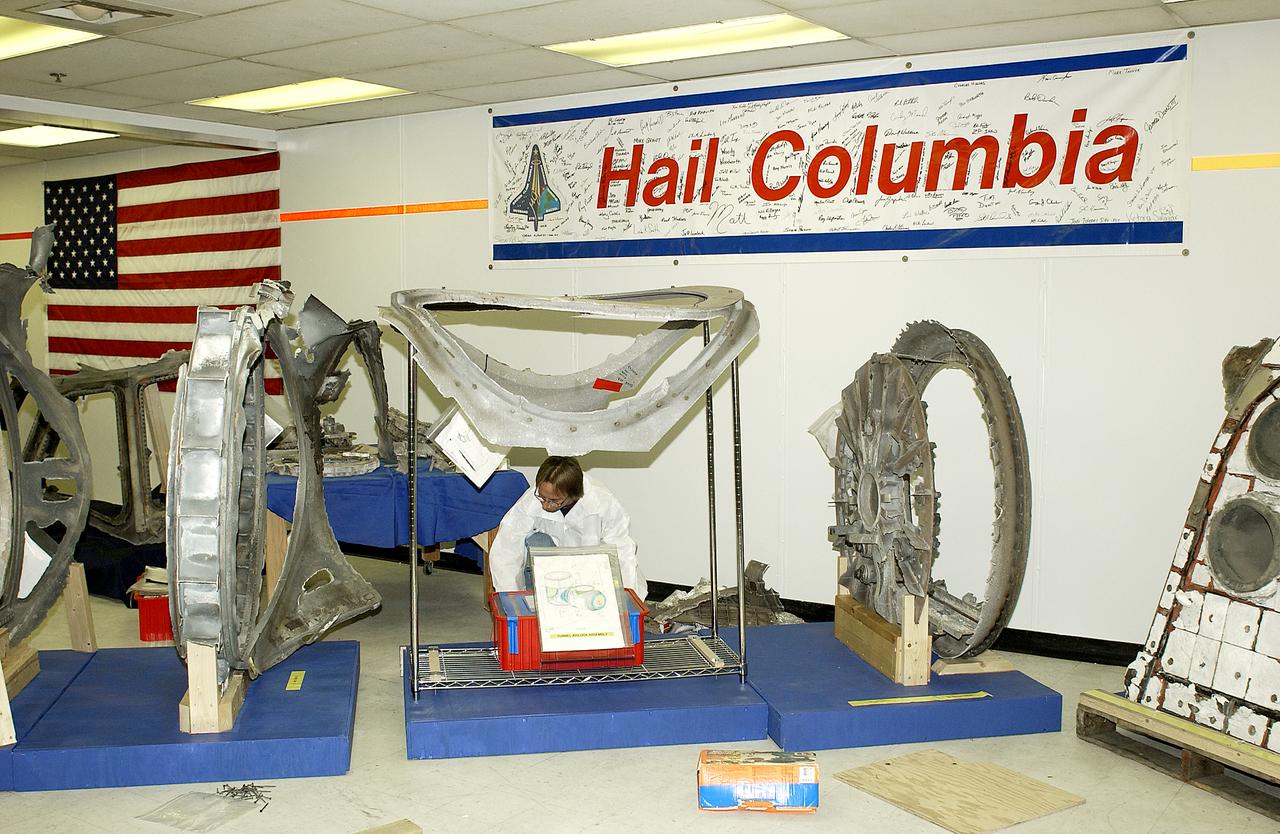
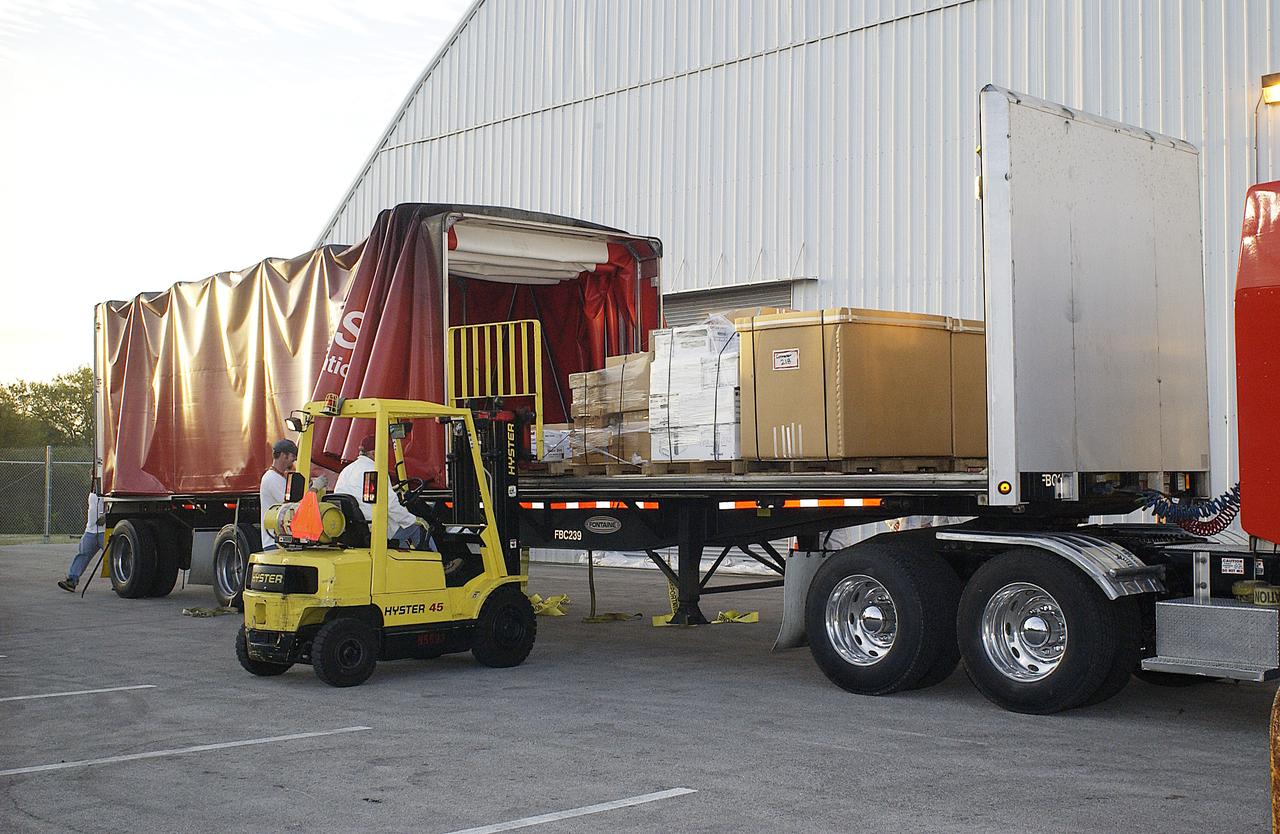
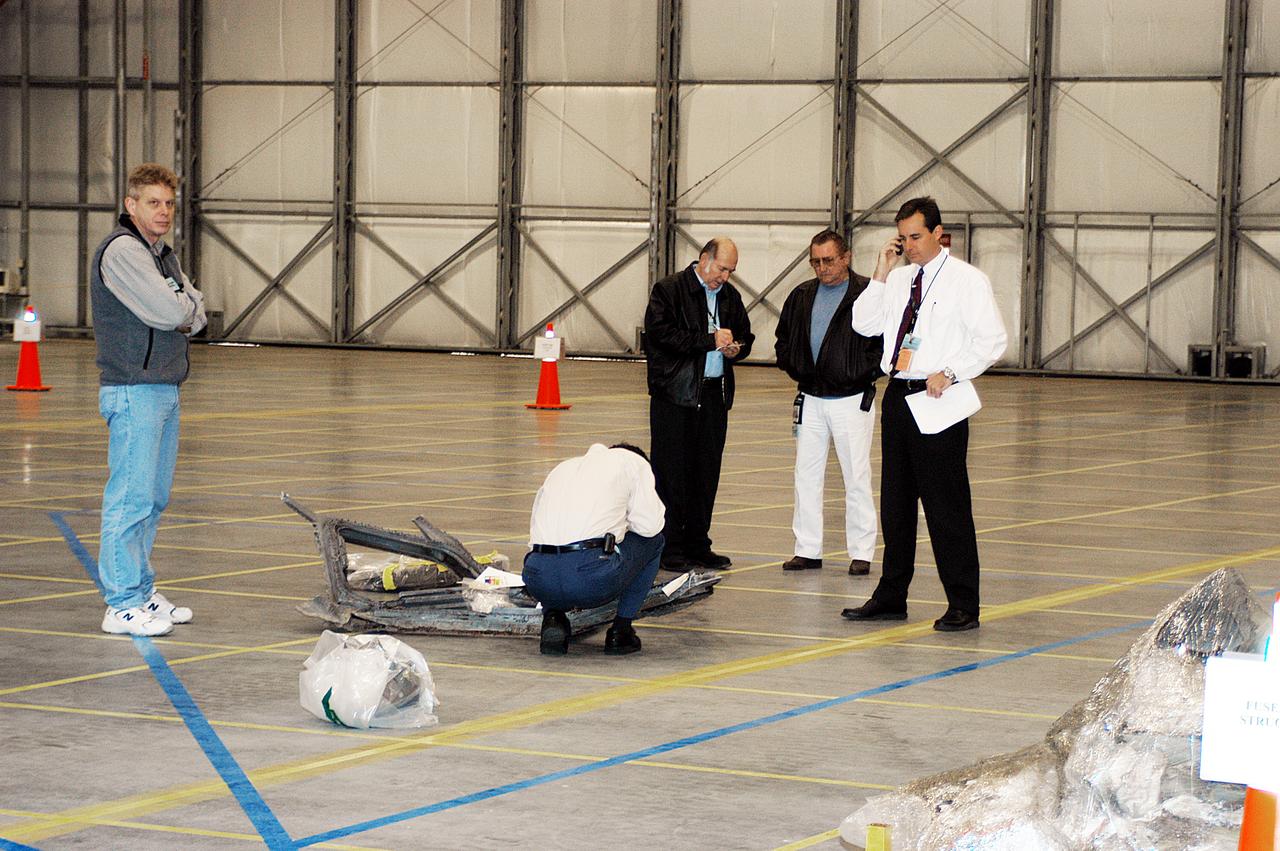
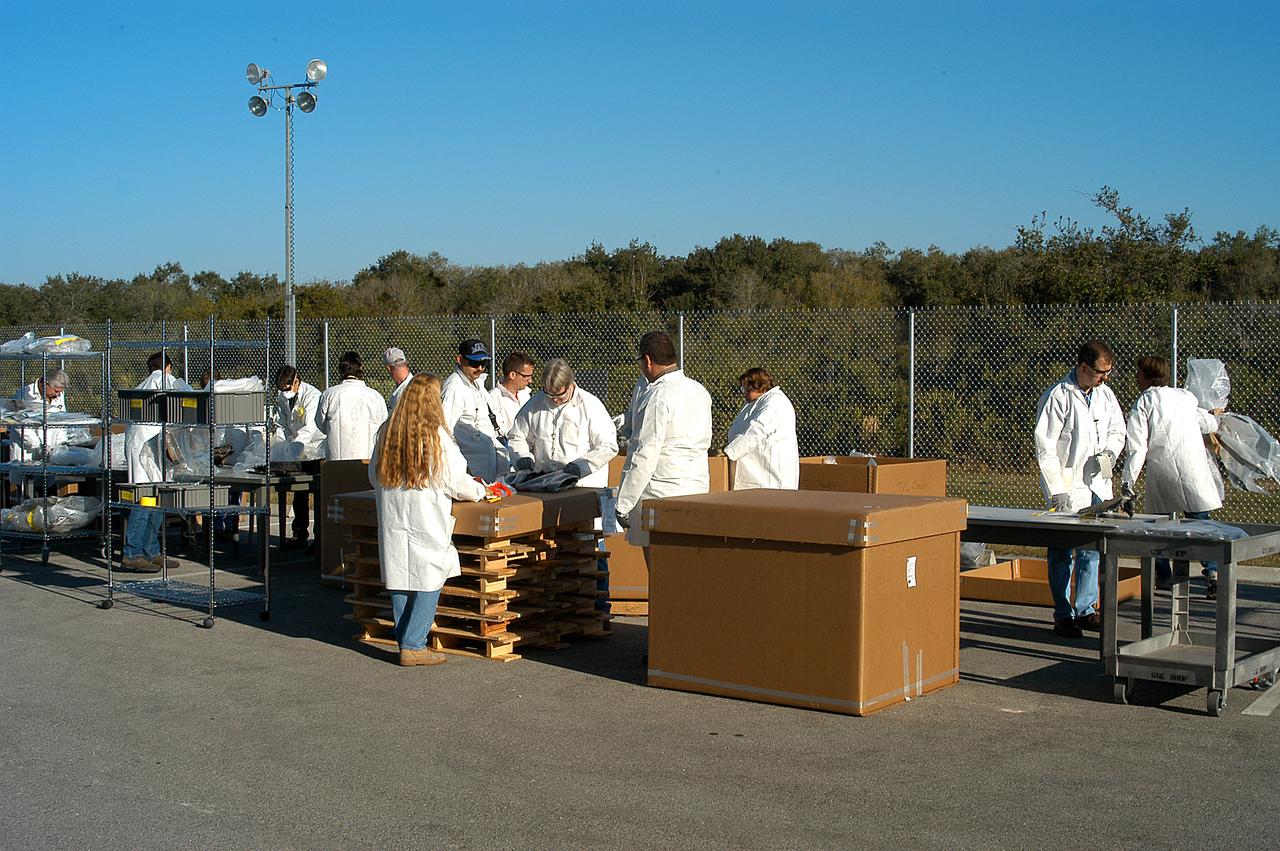
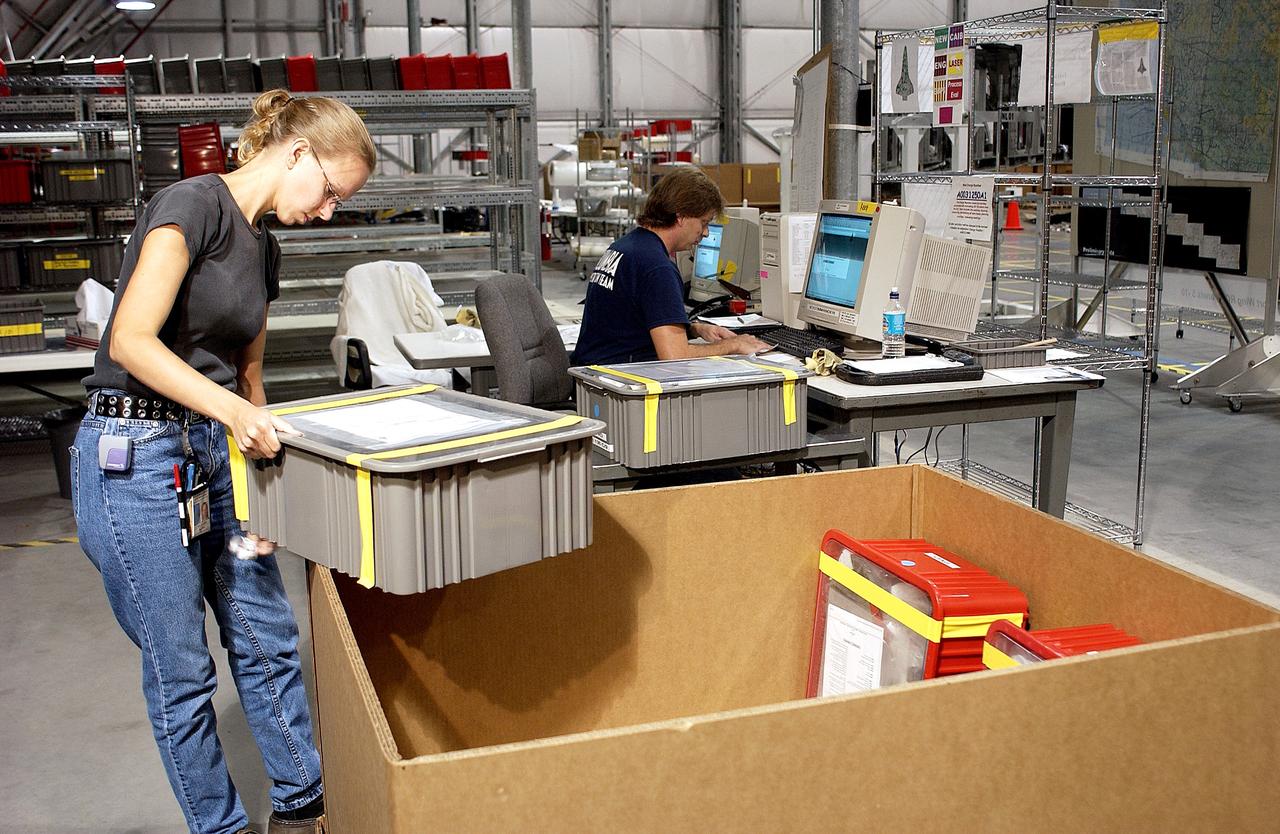
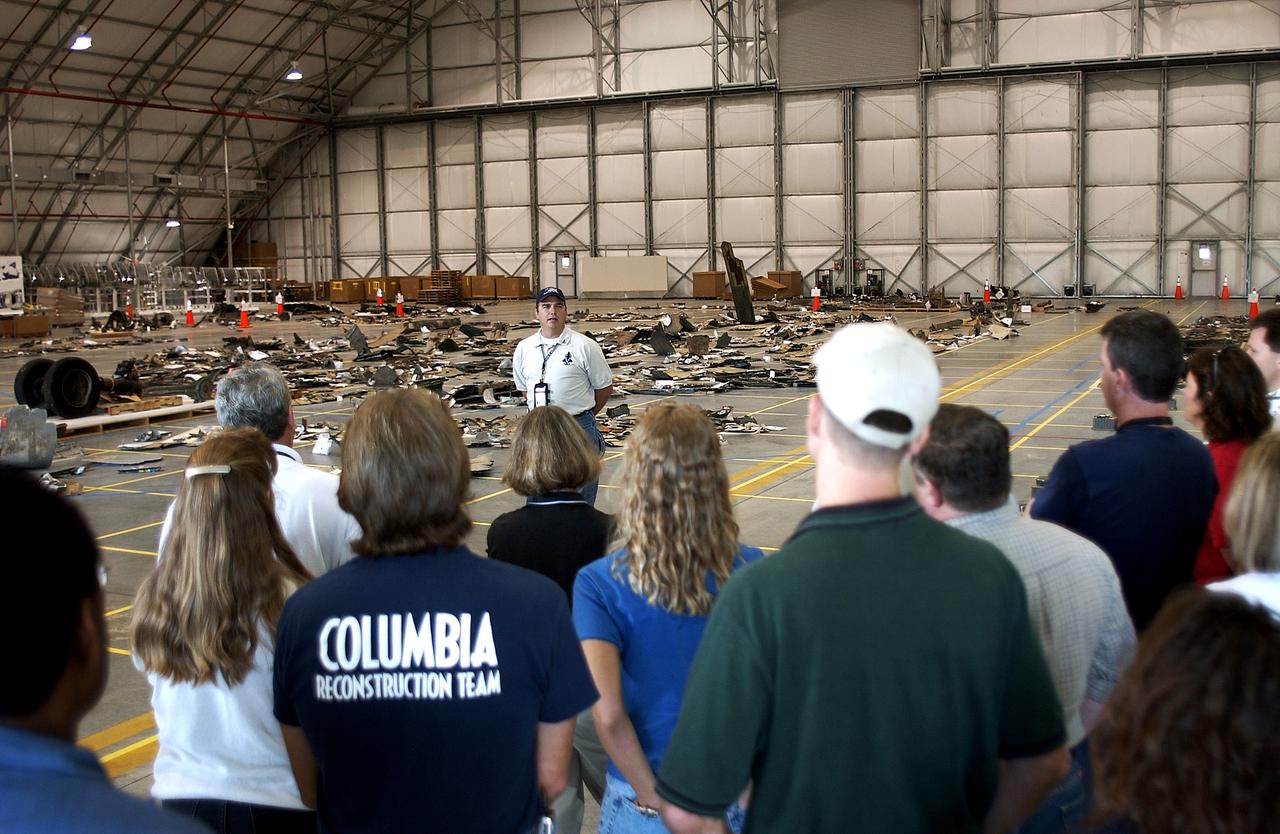
Another shipment of Columbia debris arrives at the KSC RLV Hangar. Inside, the Columbia Reconstruction Project Team is identifying pieces and placing them on a floor grid in a configuration of the orbiter. The team will attempt to reconstruct the orbiter as part of the investigation into the accident that caused the destruction of Columbia and loss of its crew as it returned to Earth on mission STS-107.
Columbia debris
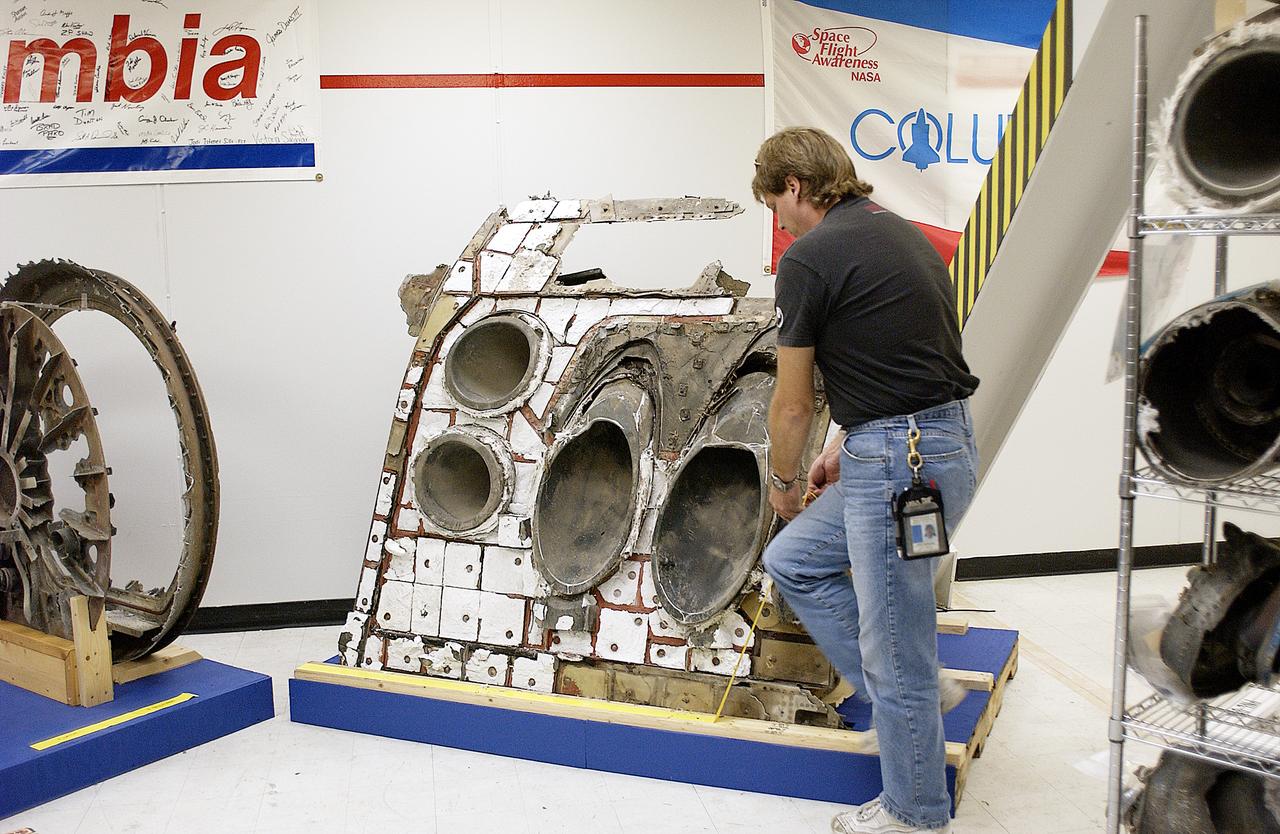
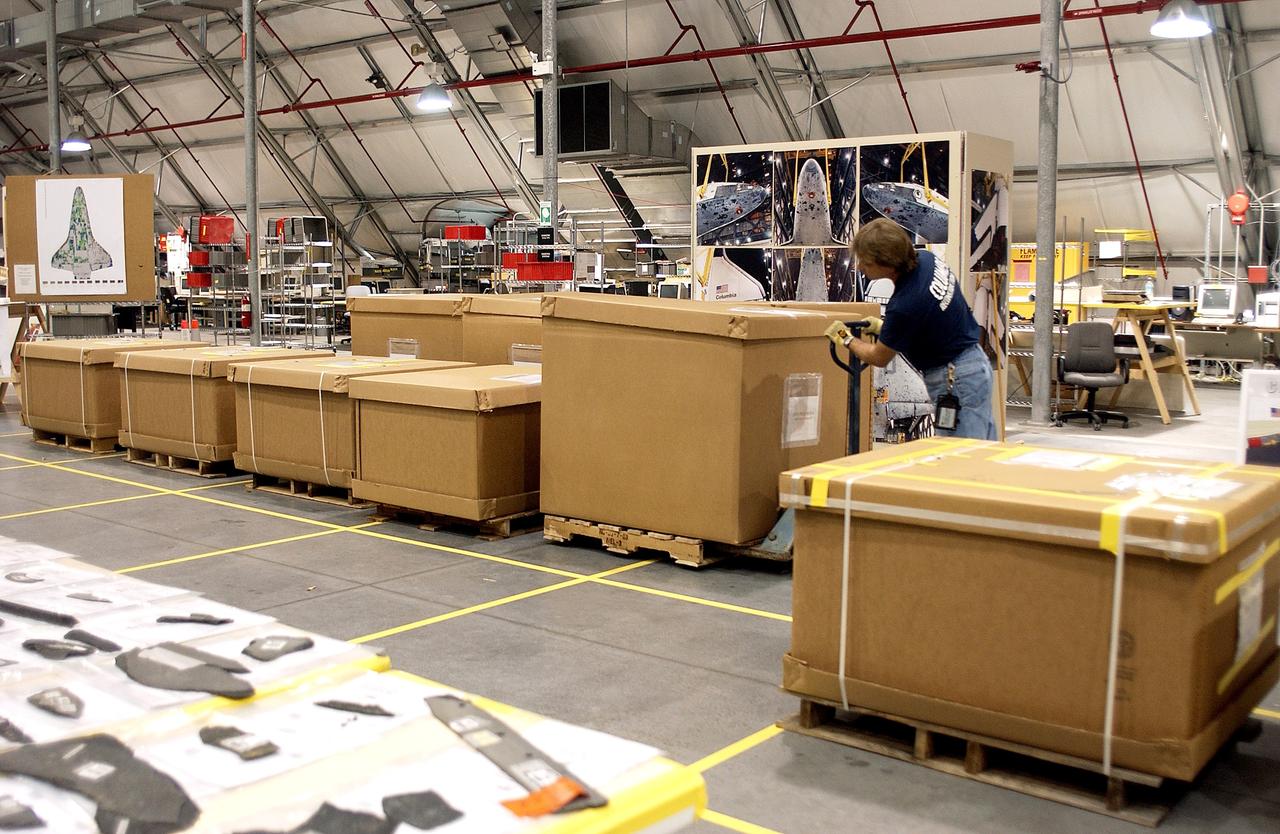
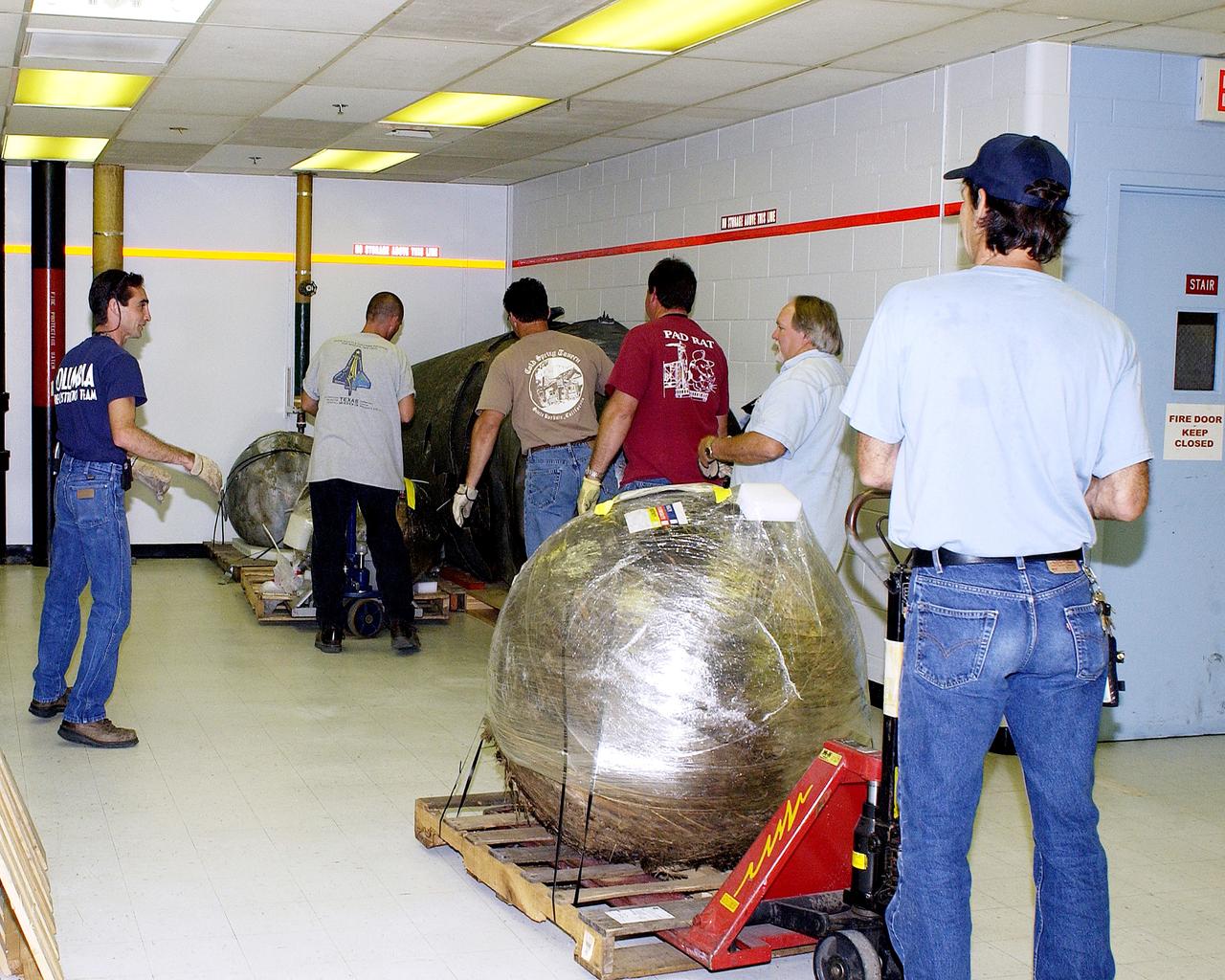
Richard Risley, with United Space Alliance, places a box of Columbia debris in its final resting place in the Vehicle Assembly Building (VAB). All of the pieces received and collected in the Columbia Reconstruction Hangar have been catalogued and moved to a permanent site in the VAB.
Columbia Debris
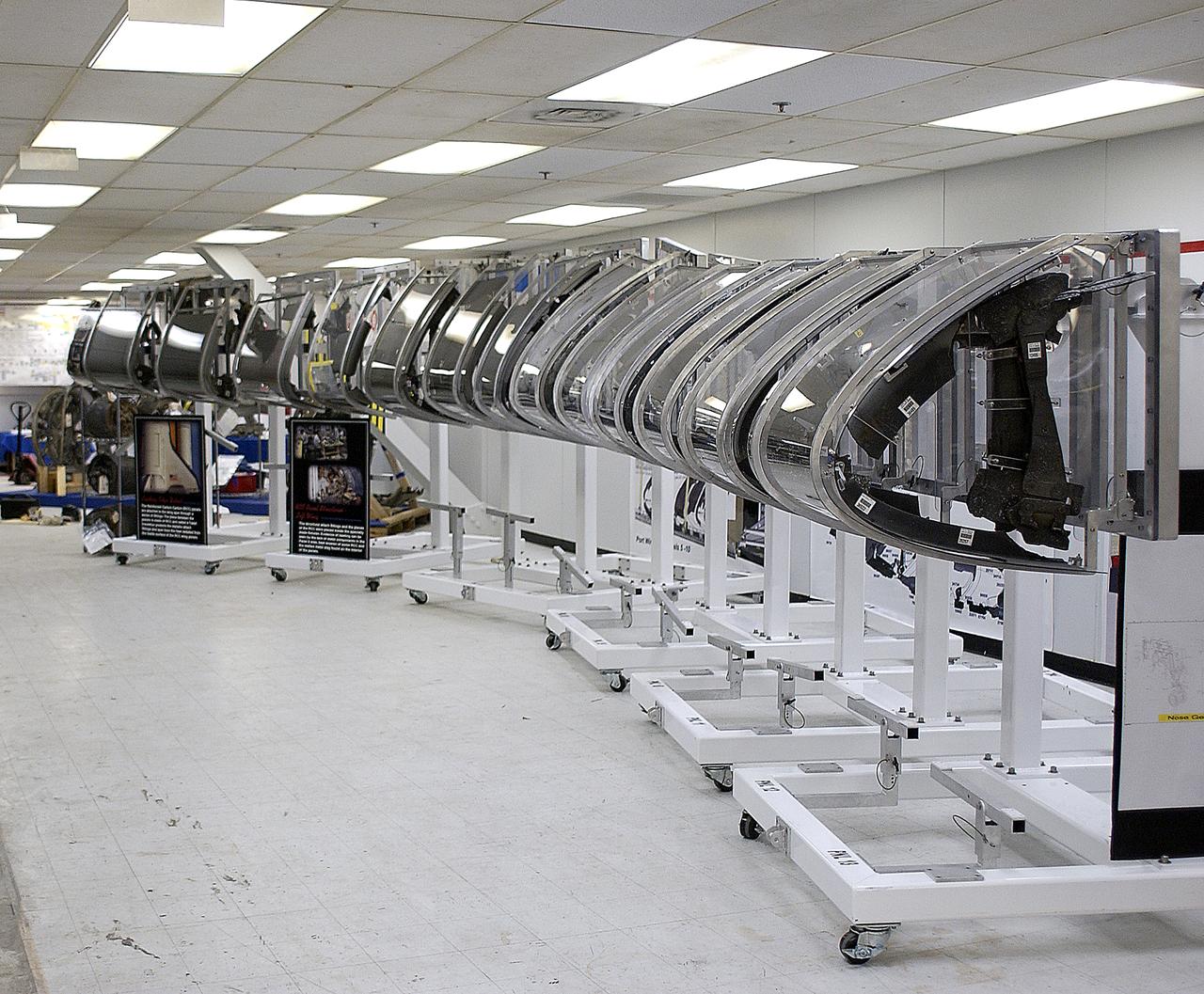
In the Vehicle Assembly Building, the mockup of the leading edge of Columbia’s left wing takes its place among the rest of the debris. All of the pieces received and collected in the Columbia Reconstruction Hangar have been catalogued and moved to a permanent site in the VAB.
Columbia Debris
In the Vehicle Assembly Building, Jack Nowling, with United Space Alliance, moves a final piece of Columbia debris into place in the Vehicle Assembly Building (VAB). All of the pieces received and collected in the Columbia Reconstruction Hangar have been catalogued and moved to a permanent site in the VAB.
Columbia Debris
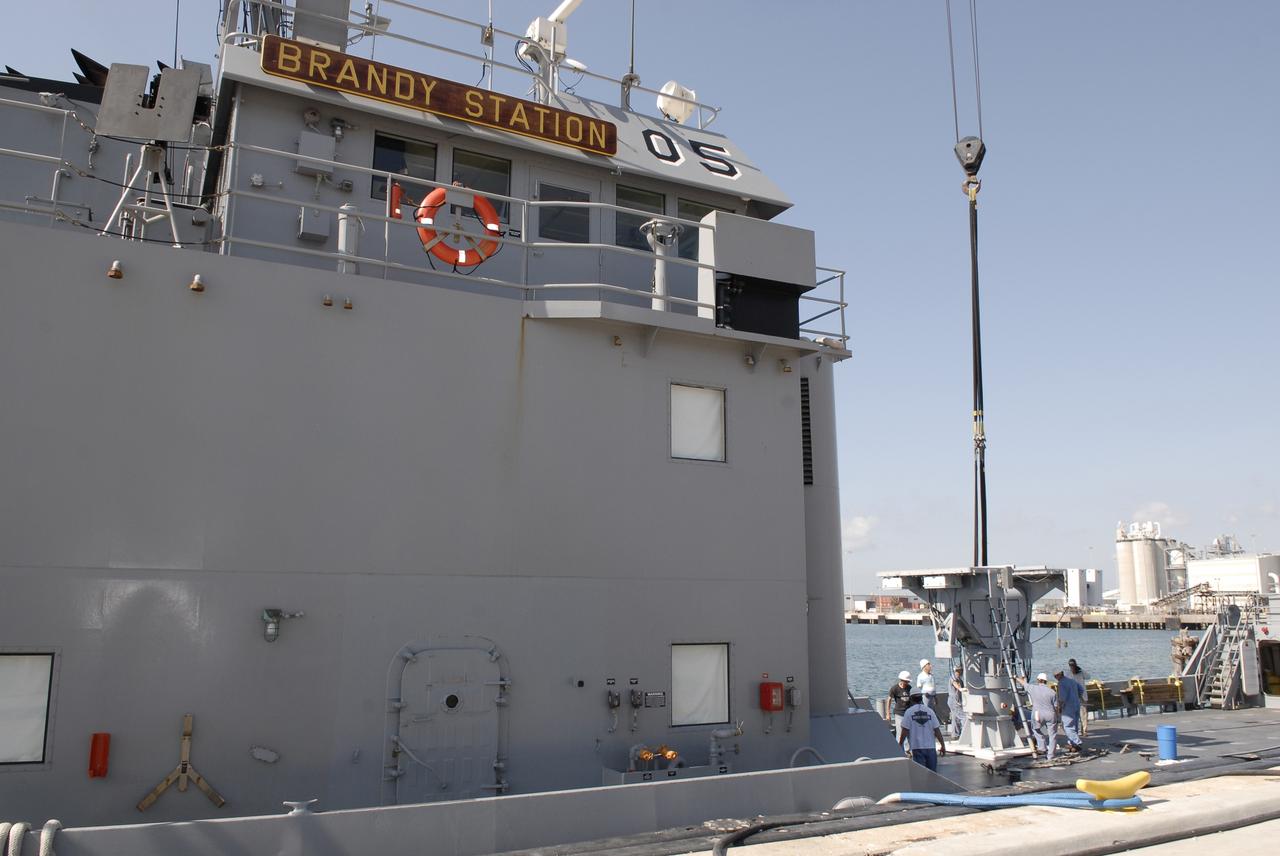
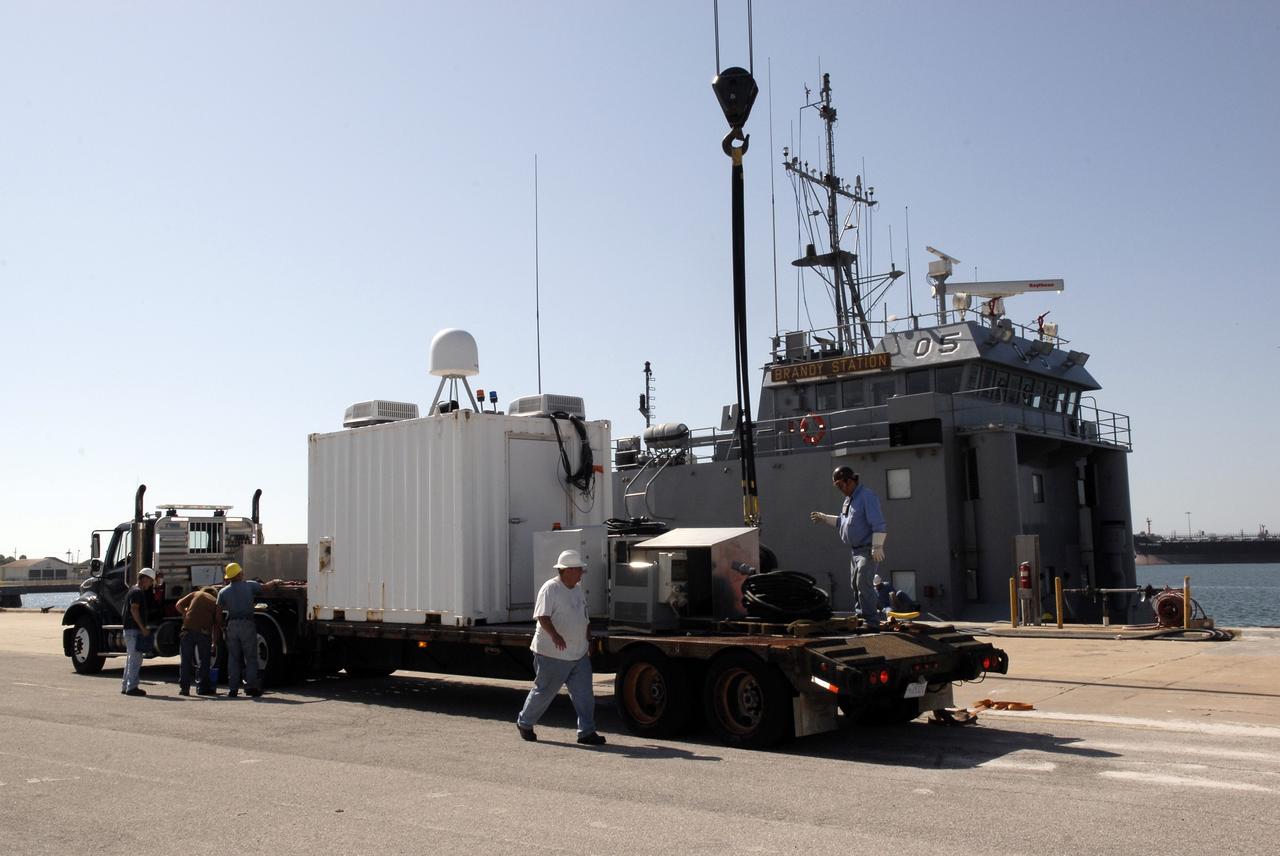
CAPE CANAVERAL, Fla. – In Port Canaveral, Fla.,  a crane lowers the X-band radar onto the U.S. Army landing craft utility ship Brandy Station. The radar will provide critical support during launch of space shuttle Atlantis on the STS-125 mission.  The radar will work with smaller X-band radars placed on the solid rocket booster retrieval ship Liberty Star to provide extremely high-resolution images of any debris that might be created during Atlantis' launch.  Photo credit: NASA/Kim Shiflett
KSC-2009-2950
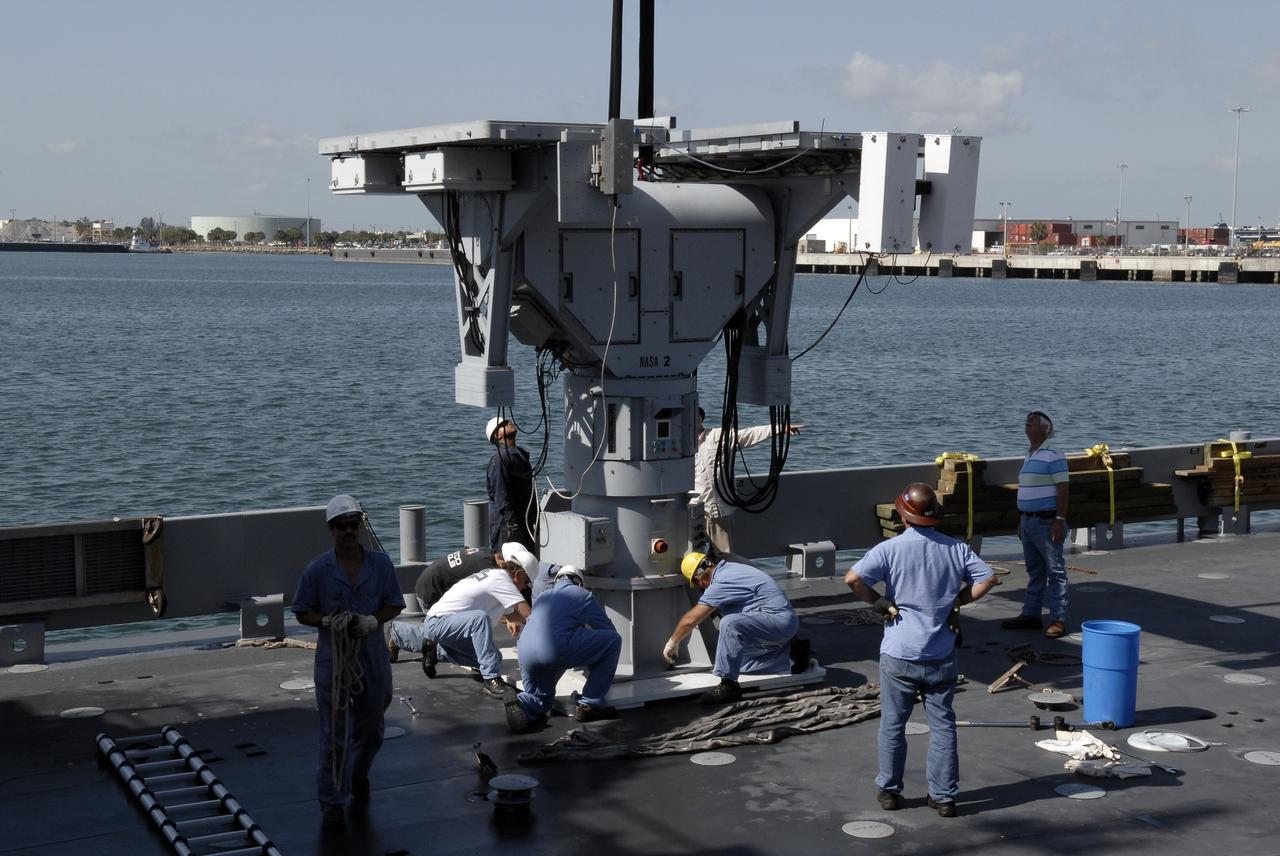
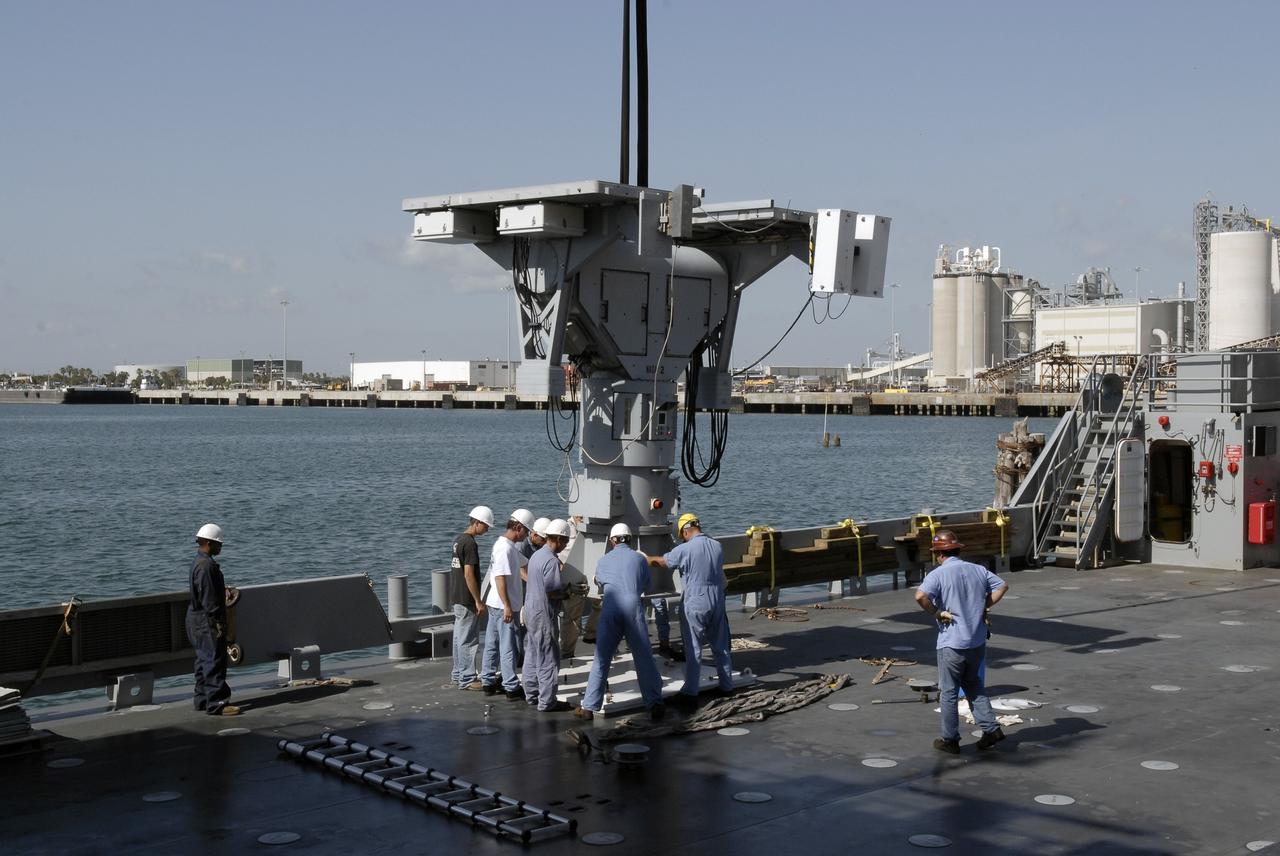
CAPE CANAVERAL, Fla. – In Port Canaveral, Fla.,  technicians help install the X-band radar on the deck of the U.S. Army landing craft utility ship Brandy Station.  The radar will provide critical support during launch of space shuttle Atlantis on the STS-125 mission.  The radar will work with smaller X-band radars placed on the solid rocket booster retrieval ship Liberty Star to provide extremely high-resolution images of any debris that might be created during Atlantis' launch.  Photo credit: NASA/Kim Shiflett
KSC-2009-2952
CAPE CANAVERAL, Fla. – In Port Canaveral, Fla.,  technicians help place the X-band radar on the deck of the U.S. Army landing craft utility ship Brandy Station. The radar will provide critical support during launch of space shuttle Atlantis on the STS-125 mission.  The radar will work with smaller X-band radars placed on the solid rocket booster retrieval ship Liberty Star to provide extremely high-resolution images of any debris that might be created during Atlantis' launch.  Photo credit: NASA/Kim Shiflett
KSC-2009-2951
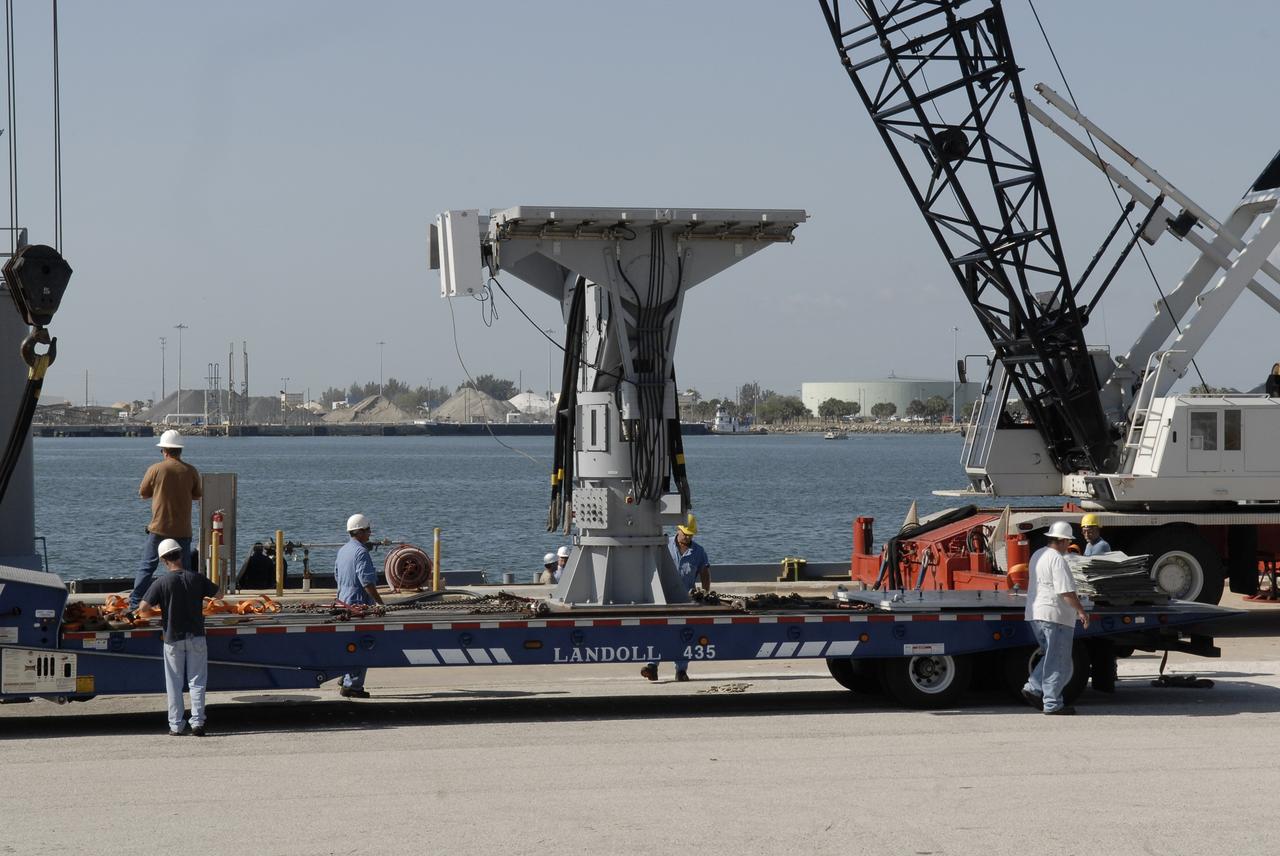
CAPE CANAVERAL, Fla. – An X-band radar waits to be installed on the U.S. Army landing craft utility ship Brandy Station in Port Canaveral, Fla.  The radar will provide critical support during launch of space shuttle Atlantis on the STS-125 mission.  The radar will work with smaller X-band radars placed on the solid rocket booster retrieval ship Liberty Star to provide extremely high-resolution images of any debris that might be created during Atlantis' launch.  Photo credit: NASA/Kim Shiflett
KSC-2009-2947
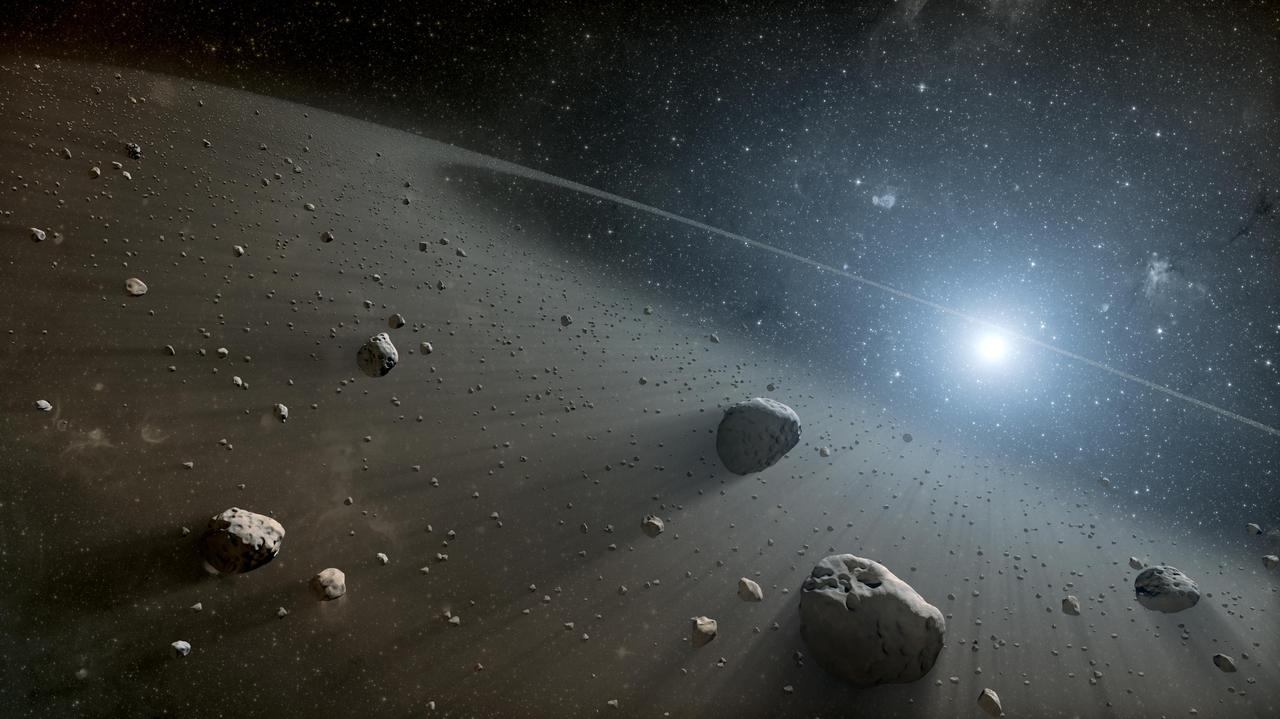
This artist concept illustrates an asteroid belt around the bright star Vega. Evidence for this warm ring of debris was found using NASA Spitzer Space Telescope, and the European Space Agency Herschel Space Observatory.
Rocky Ring of Debris Around Vega Artist Concept
A worker examines a piece of the Columbia debris on the floor of the RLV Hangar. The debris was shipped from Barksdale Air Force Base, Shreveport, La. As part of the ongoing investigation into the tragic accident, workers will attempt to reconstruct the orbiter inside the RLV.
STS-107 Columbia debris reconstruction team
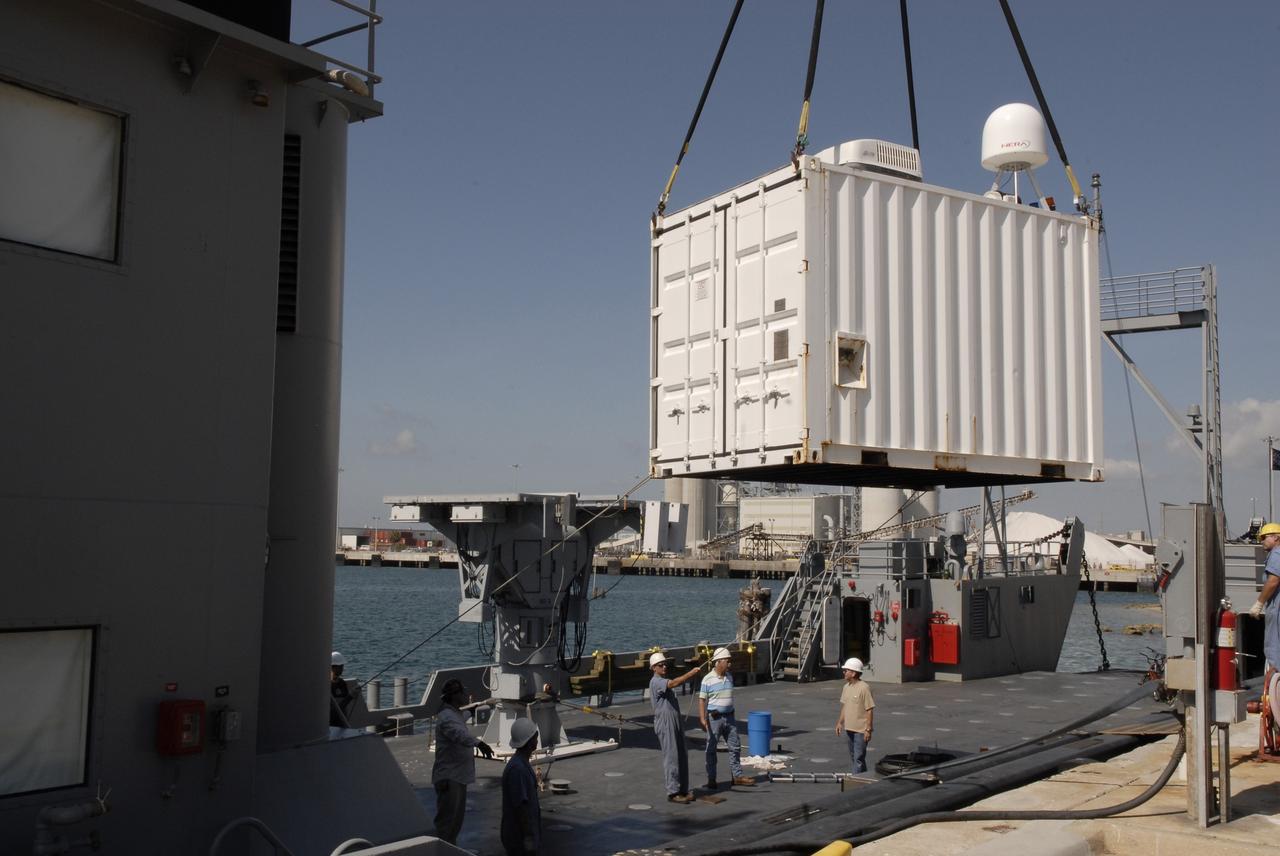
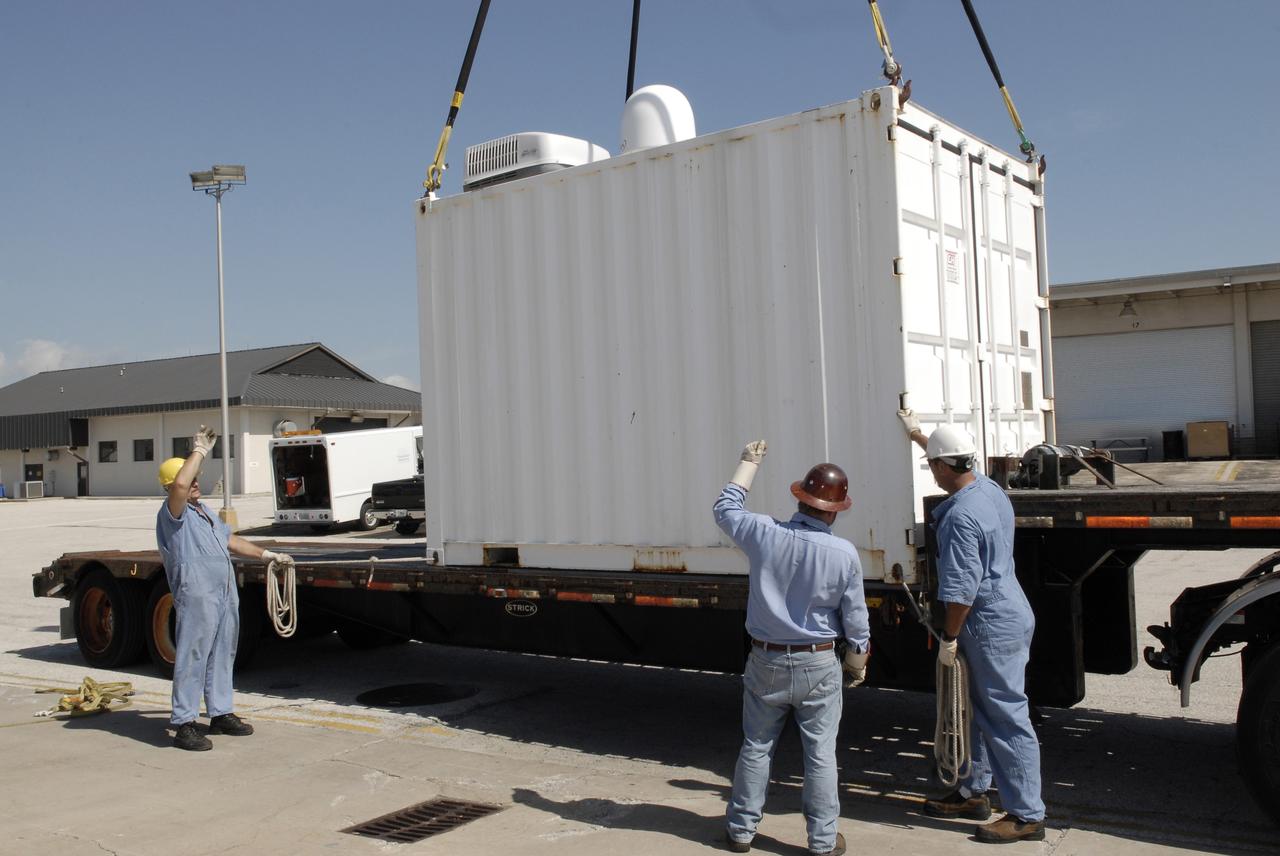
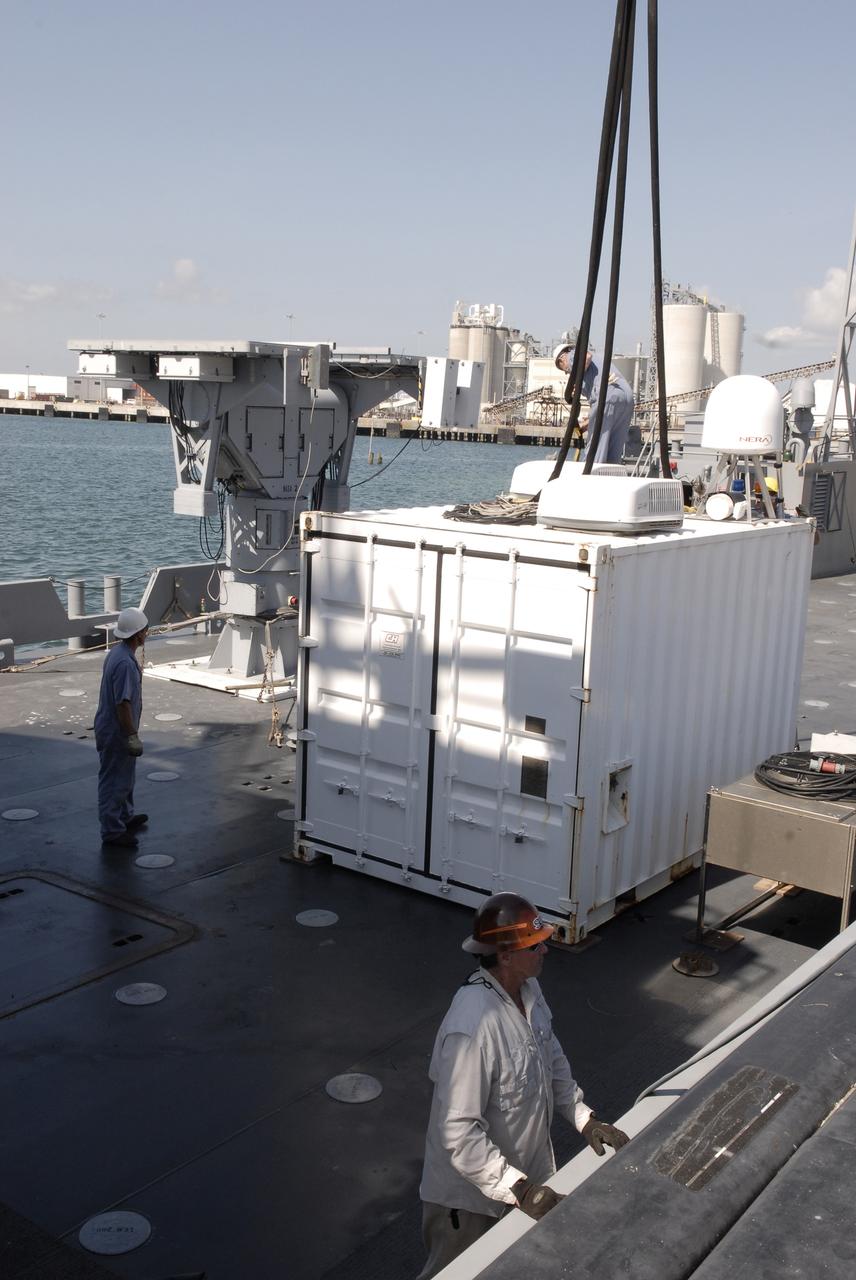
CAPE CANAVERAL, Fla. – In Port Canaveral, Fla.,  a container is lifted from the transporter for transfer to the U.S. Army landing craft utility ship Brandy Station. Inside is the control center for the X-band radar installed on the deck of the ship.  The radar will provide critical support during launch of space shuttle Atlantis on the STS-125 mission.  The radar will work with smaller X-band radars placed on the solid rocket booster retrieval ship Liberty Star to provide extremely high-resolution images of any debris that might be created during Atlantis' launch.  Photo credit: NASA/Kim Shiflett
KSC-2009-2956
CAPE CANAVERAL, Fla. – In Port Canaveral, Fla.,  a crane moves a container toward the deck of the U.S. Army landing craft utility ship Brandy Station. Inside is the control center for the X-band radar installed on the deck of the ship.  The radar will provide critical support during launch of space shuttle Atlantis on the STS-125 mission.  The radar will work with smaller X-band radars placed on the solid rocket booster retrieval ship Liberty Star to provide extremely high-resolution images of any debris that might be created during Atlantis' launch.  Photo credit: NASA/Kim Shiflett
KSC-2009-2957
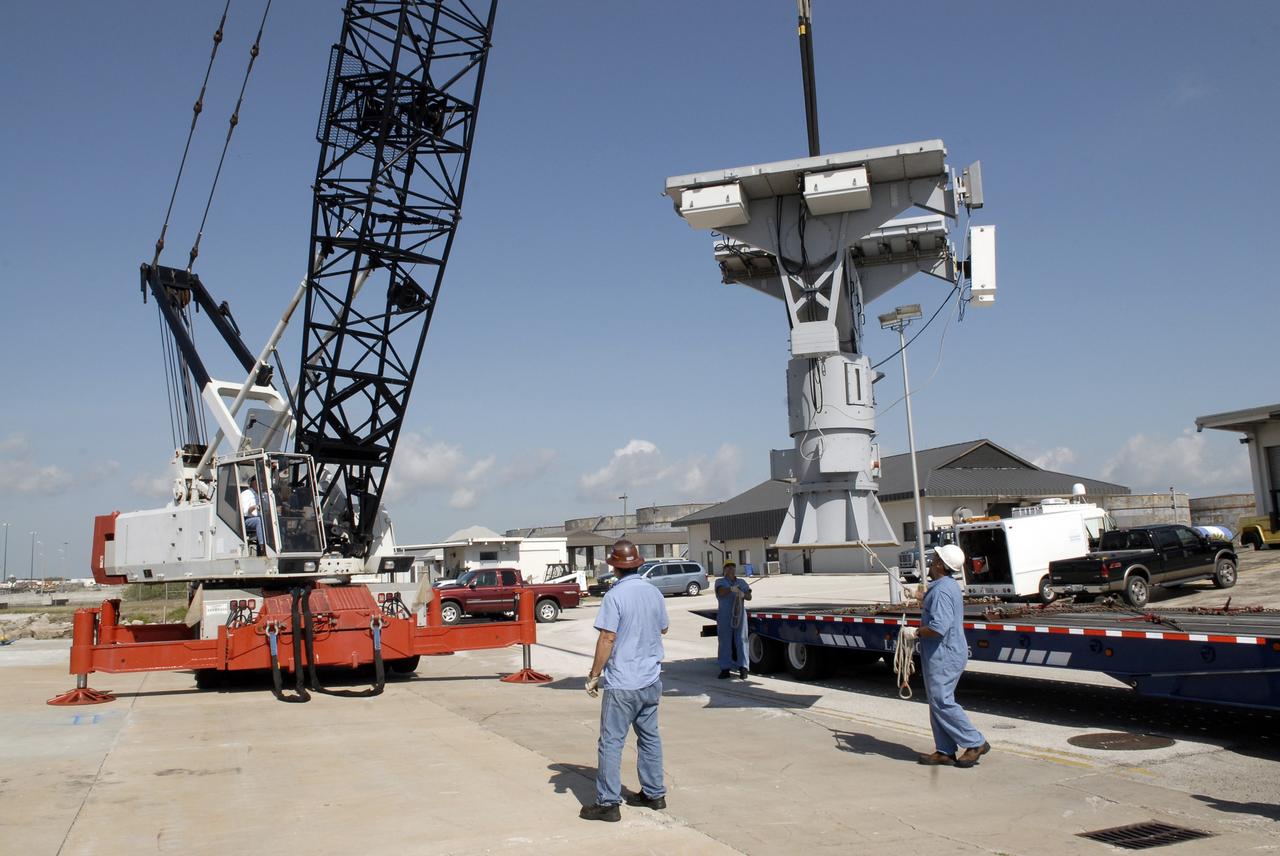
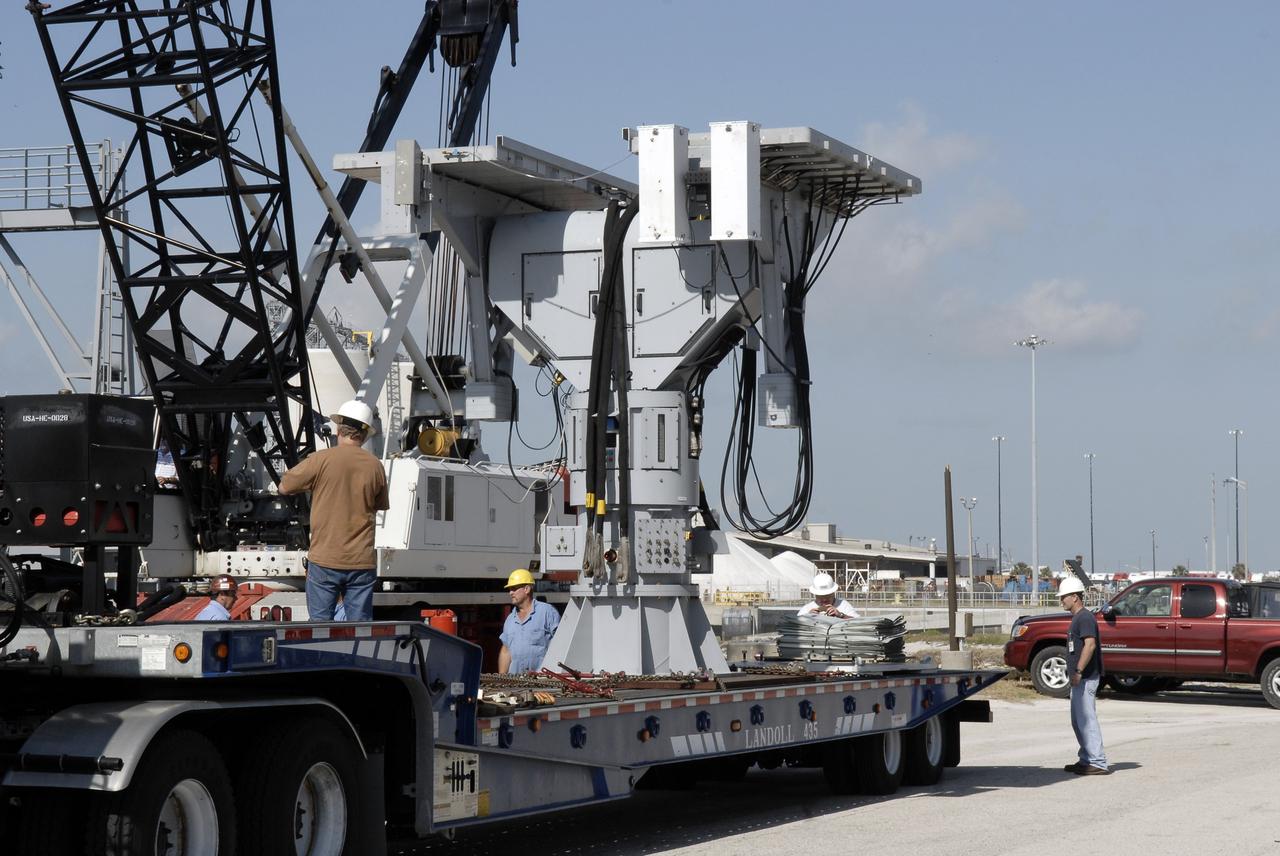
CAPE CANAVERAL, Fla. – In Port Canaveral, Fla., a crane lifts the X-band radar from its transporter to move it onto the U.S. Army landing craft utility ship Brandy Station. The radar will provide critical support during launch of space shuttle Atlantis on the STS-125 mission.  The radar will work with smaller X-band radars placed on the solid rocket booster retrieval ship Liberty Star to provide extremely high-resolution images of any debris that might be created during Atlantis' launch.  Photo credit: NASA/Kim Shiflett
KSC-2009-2949
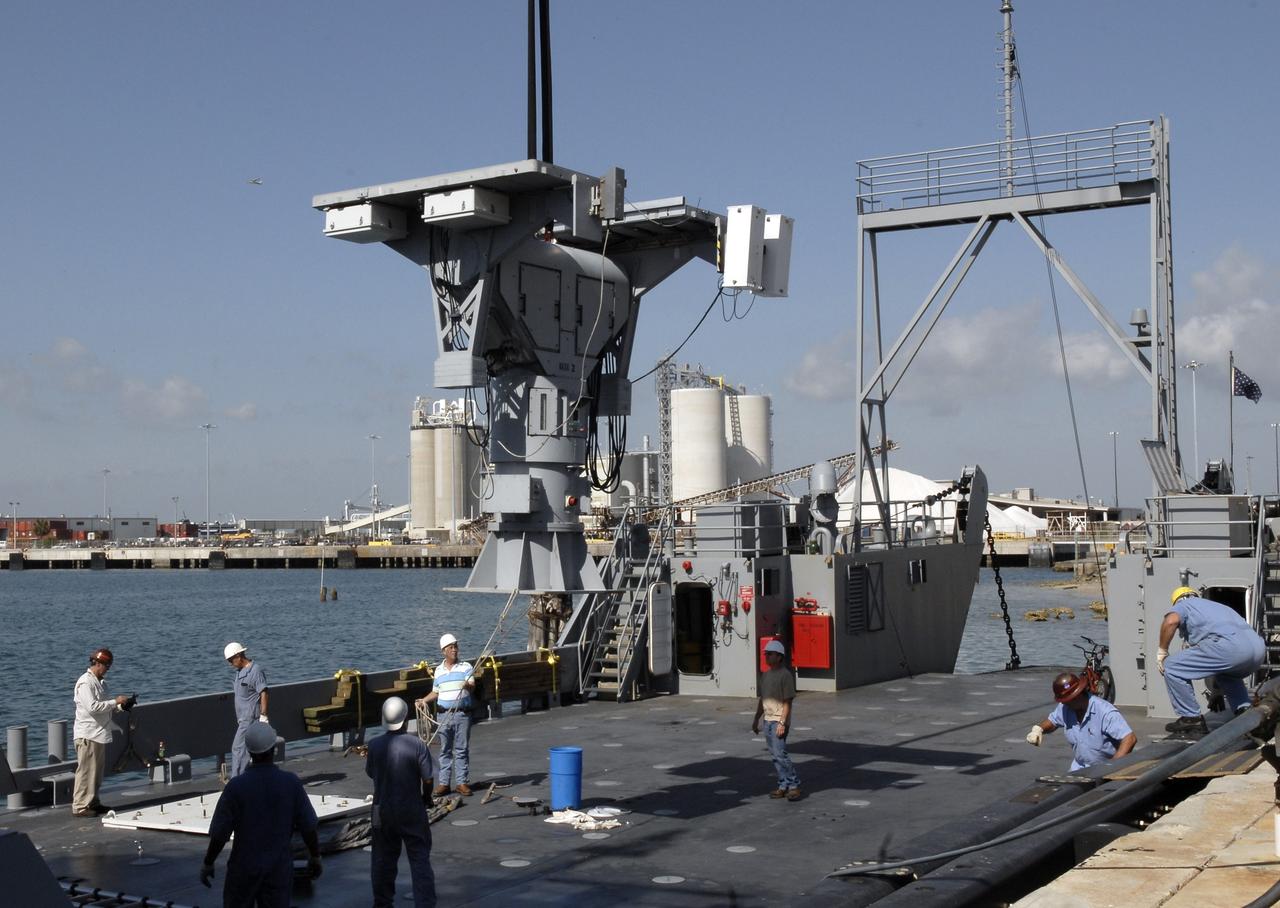
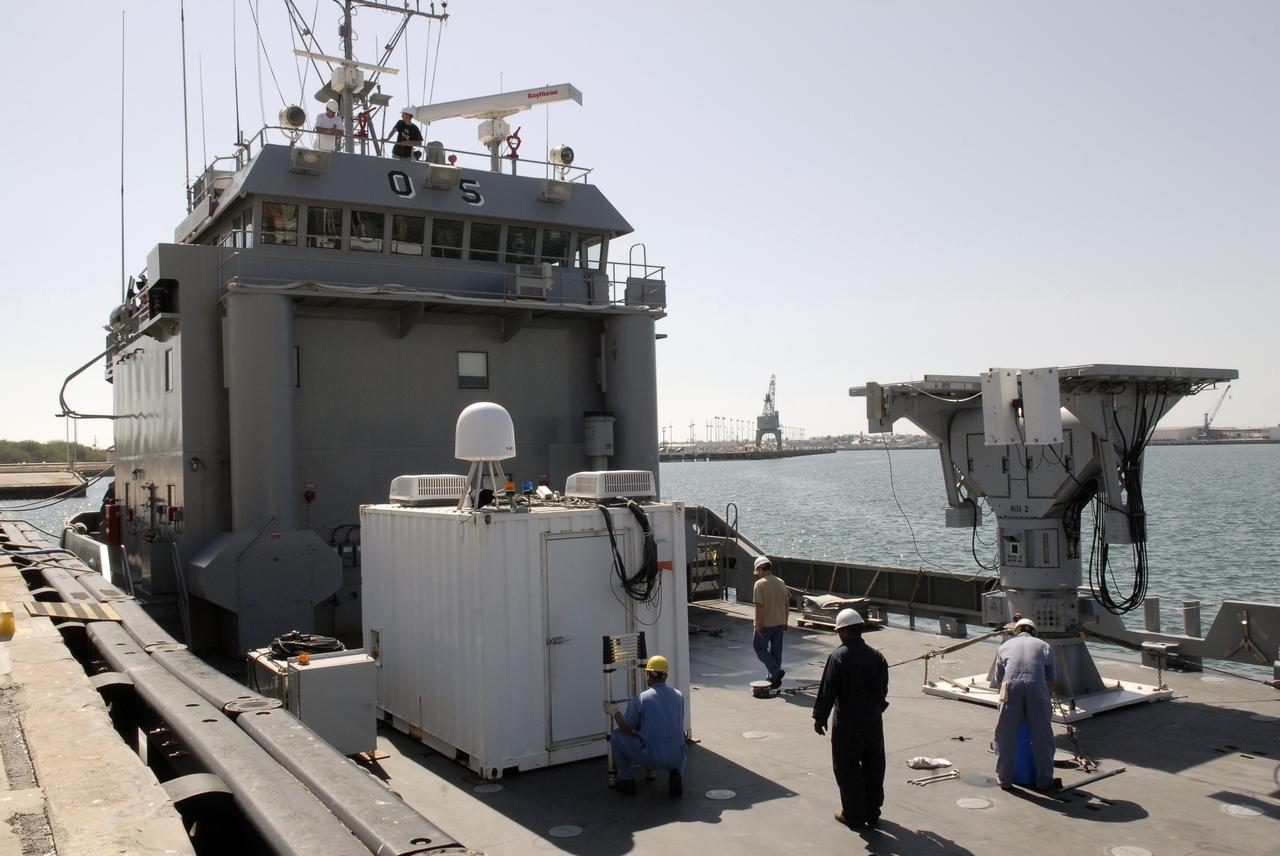
CAPE CANAVERAL, Fla. – In Port Canaveral, Fla.,  technicians complete installation of the X-band radar (right) on the deck of the U.S. Army landing craft utility ship Brandy Station. The radar will provide critical support during launch of space shuttle Atlantis on the STS-125 mission.  The radar will work with smaller X-band radars placed on the solid rocket booster retrieval ship Liberty Star to provide extremely high-resolution images of any debris that might be created during Atlantis' launch.  Photo credit: NASA/Kim Shiflett
KSC-2009-2953
CAPE CANAVERAL, Fla. – In Port Canaveral, Fla.,  the crane is removed from the X-band radar after installation on the deck of the U.S. Army landing craft utility ship Brandy Station. The radar will provide critical support during launch of space shuttle Atlantis on the STS-125 mission.  The radar will work with smaller X-band radars placed on the solid rocket booster retrieval ship Liberty Star to provide extremely high-resolution images of any debris that might be created during Atlantis' launch.  Photo credit: NASA/Kim Shiflett
KSC-2009-2954
CAPE CANAVERAL, Fla. – In Port Canaveral, Fla.,  workers prepare the container that holds the control center for the X-band radar, at right, installed on the U.S. Army landing craft utility ship Brandy Station. The radar will provide critical support during launch of space shuttle Atlantis on the STS-125 mission.  The radar will work with smaller X-band radars placed on the solid rocket booster retrieval ship Liberty Star to provide extremely high-resolution images of any debris that might be created during Atlantis' launch.  Photo credit: NASA/Kim Shiflett
KSC-2009-2959
CAPE CANAVERAL, Fla. – In Port Canaveral, Fla.,  a container is prepared for transfer to the U.S. Army landing craft utility ship Brandy Station. Inside is the control center for the X-band radar installed on the deck of the ship.  The radar will provide critical support during launch of space shuttle Atlantis on the STS-125 mission.  The radar will work with smaller X-band radars placed on the solid rocket booster retrieval ship Liberty Star to provide extremely high-resolution images of any debris that might be created during Atlantis' launch.  Photo credit: NASA/Kim Shiflett
KSC-2009-2955
CAPE CANAVERAL, Fla. – In Port Canaveral, Fla.,  a crane lowers a container toward the deck of the U.S. Army landing craft utility ship Brandy Station. Inside is the control center for the X-band radar installed on the deck of the ship.  The radar will provide critical support during launch of space shuttle Atlantis on the STS-125 mission.  The radar will work with smaller X-band radars placed on the solid rocket booster retrieval ship Liberty Star to provide extremely high-resolution images of any debris that might be created during Atlantis' launch.  Photo credit: NASA/Kim Shiflett
KSC-2009-2958
CAPE CANAVERAL, Fla. – In Port Canaveral, Fla., a crane is moved into position to lift the X-band radar onto the U.S. Army landing craft utility ship Brandy Station.  The radar will provide critical support during launch of space shuttle Atlantis on the STS-125 mission.  The radar will work with smaller X-band radars placed on the solid rocket booster retrieval ship Liberty Star to provide extremely high-resolution images of any debris that might be created during Atlantis' launch.  Photo credit: NASA/Kim Shiflett
KSC-2009-2948
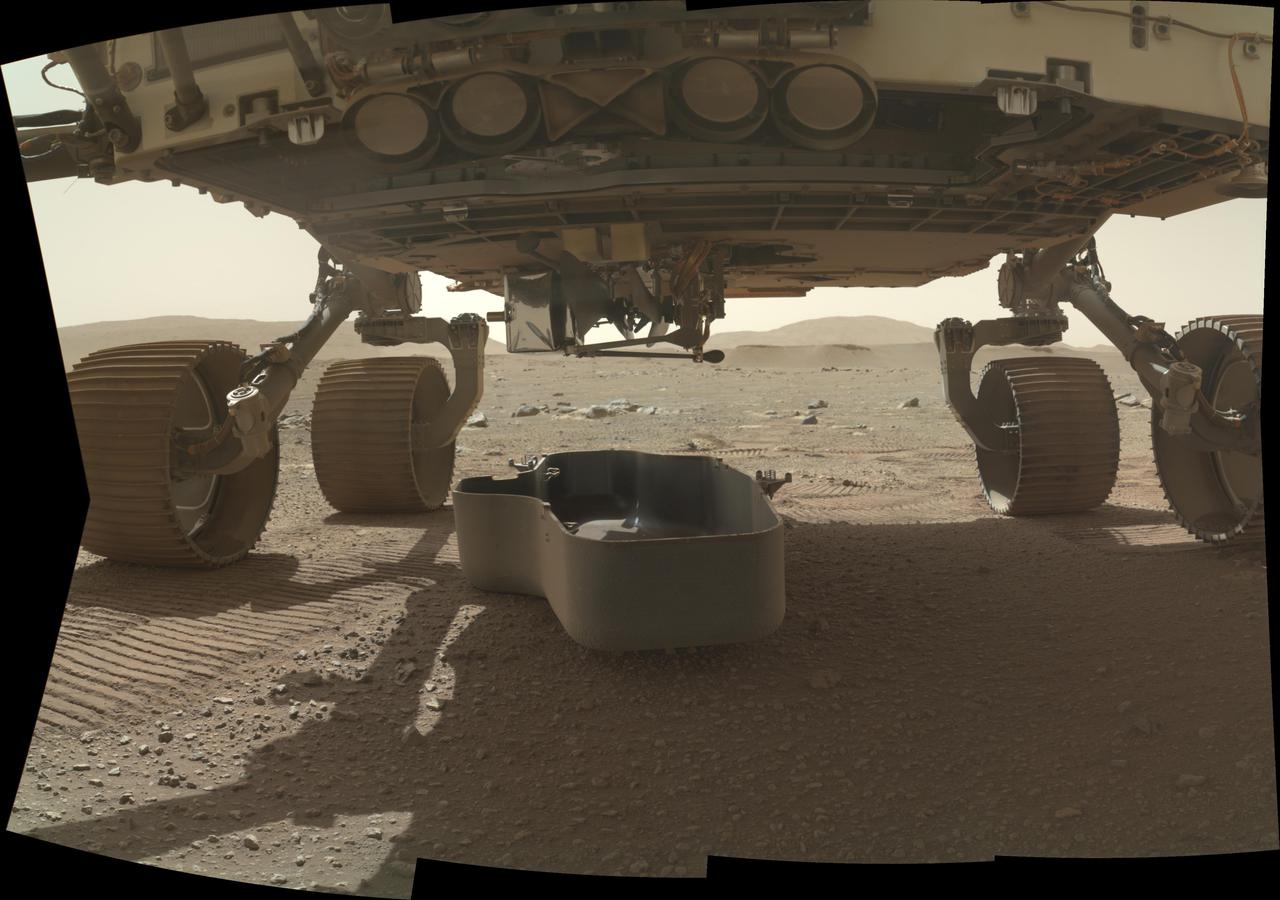
The debris shield, a protective covering on the bottom of NASA's Perseverance rover, was released on March 21, 2021, the 30th Martian day, or sol, of the mission. The debris shield protects the agency's Ingenuity helicopter during landing; releasing it allows the helicopter to rotate down out of the rover's belly. This image was taken by the WATSON (Wide Angle Topographic Sensor for Operations and eNgineering) camera on the SHERLOC (Scanning Habitable Environments with Raman and Luminescence for Organics and Chemicals) instrument, located at the end of the rover's long robotic arm.  NASA's Jet Propulsion Laboratory built and manages operations of Perseverance and Ingenuity for the agency. Caltech in Pasadena, California, manages JPL for NASA. WATSON was built by Malin Space Science Systems in San Diego, and is operated jointly by MSSS and JPL.  The Mars helicopter technology demonstration activity is supported by NASA's Science Mission Directorate, the NASA Aeronautics Research Mission Directorate, and the NASA Space Technology Mission Directorate.  A key objective for Perseverance's mission on Mars is astrobiology, including the search for signs of ancient microbial life. The rover will characterize the planet's geology and past climate, pave the way for human exploration of the Red Planet, and be the first mission to collect and cache Martian rock and regolith (broken rock and dust).  Subsequent NASA missions, in cooperation with ESA (European Space Agency), would send spacecraft to Mars to collect these sealed samples from the surface and return them to Earth for in-depth analysis.  The Mars 2020 Perseverance mission is part of NASA's Moon to Mars exploration approach, which includes Artemis missions to the Moon that will help prepare for human exploration of the Red Planet.  Animation available at https://photojournal.jpl.nasa.gov/catalog/PIA24448

Perseverance Rover Drops its Debris Shield
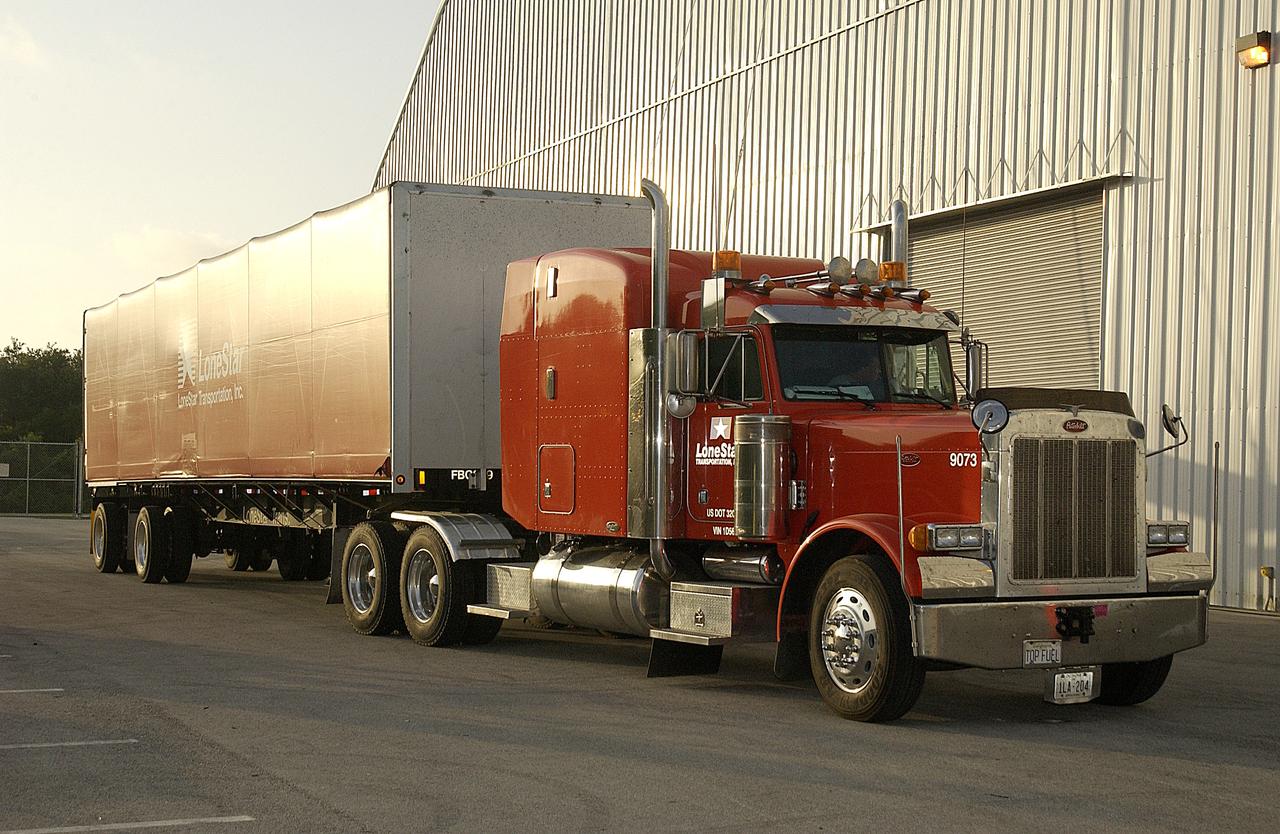
The truck holding the final shipment of Columbia debris arrives at KSC. The recovery efforts have been concluded in East Texas. Prior to this final shipment, the total number of items at KSC is 82,567, weighing 84,800 pounds or 38 percent of the total dry weight of Columbia. Of those items, 78,760 have been identified, with 753 placed on the left wing grid in the RLV Hangar.
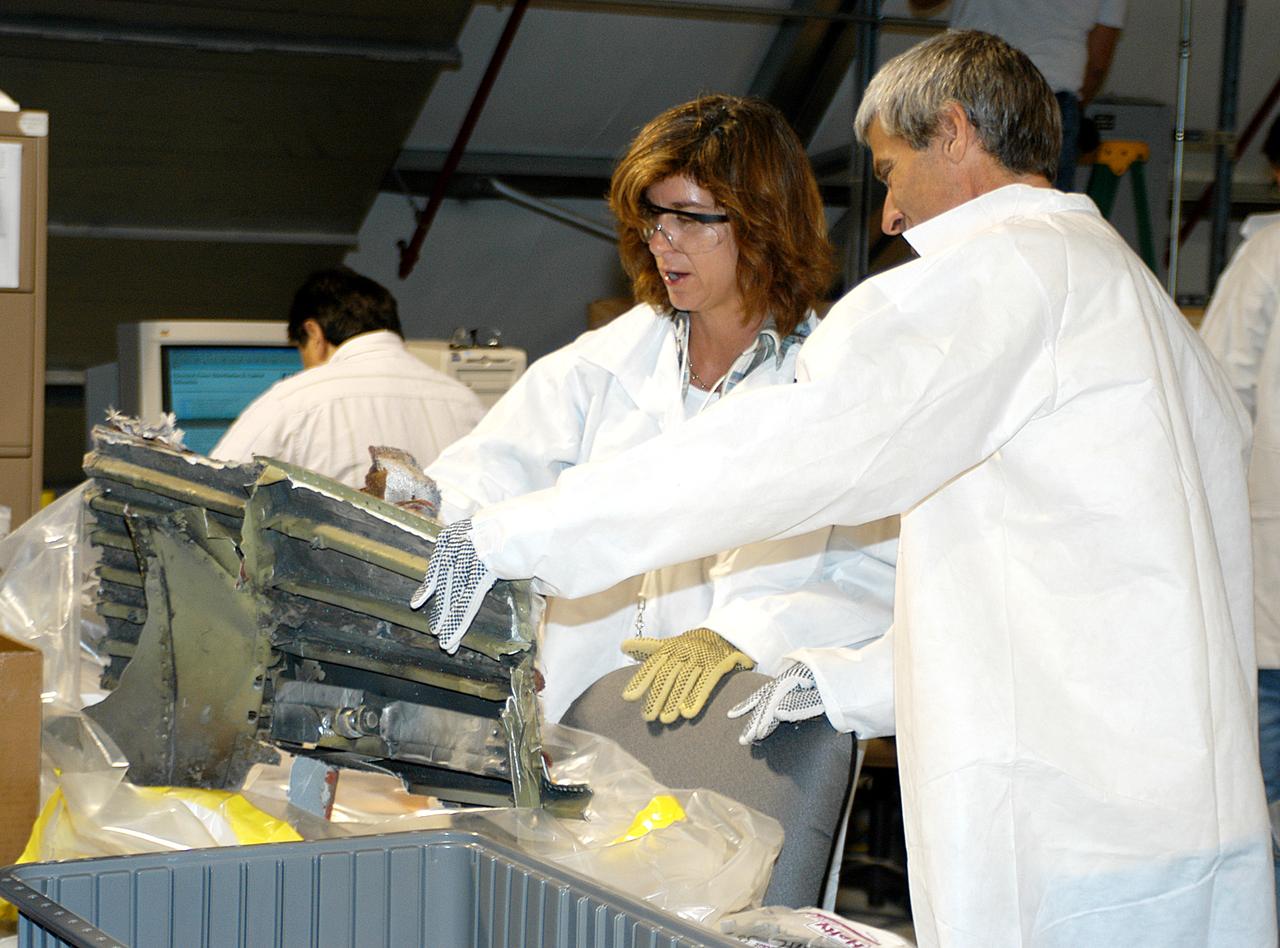
Columbia Debris
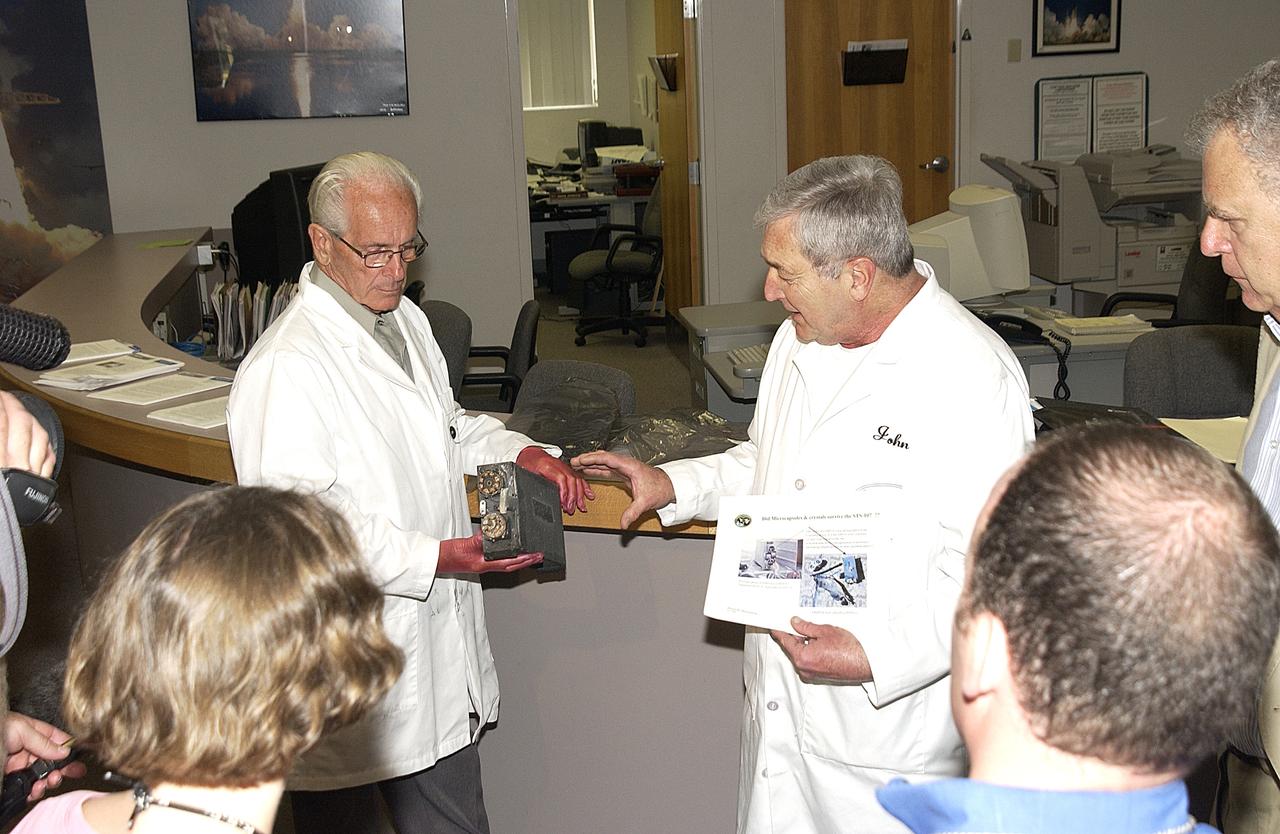
George D'Heilly and John Cassanto, scientists with Instrumentation Technology Associates, Inc., display for the media part of the apparatus recovered during the search for Columbia debris. It was part of the Commercial ITA Biomedical Experiments payload on mission STS-107 that included the Growth of Bacterial Biofilm on Surfaces during Spaceflight (GOBBSS) experiment and crystals grown for cancer research. The GOBBSS experiment was sponsored by the Planetary Society, with joint participation of an Israeli and a Palestinian student, and developed by the Israeli Aerospace Medical Institute and JSC Astrobiology Center.
Columbia Debris
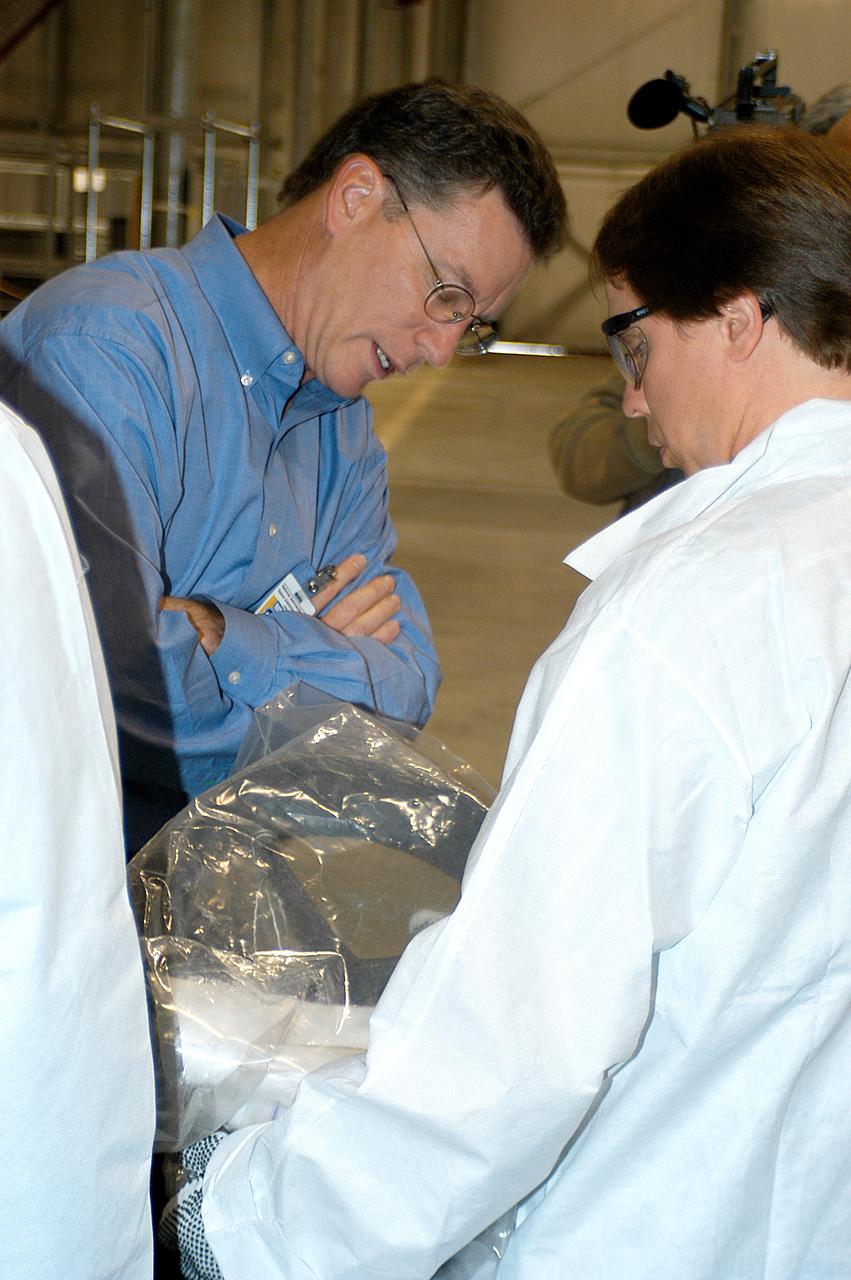
Members of the reconstruction team check out the Columbia debris inside the RLV Hangar. The debris was shipped from Barksdale Air Force Base, Shreveport, La. As part of the ongoing investigation into the tragic accident, workers will attempt to reconstruct the orbiter inside the RLV.
STS-107 Columbia debris reconstruction team
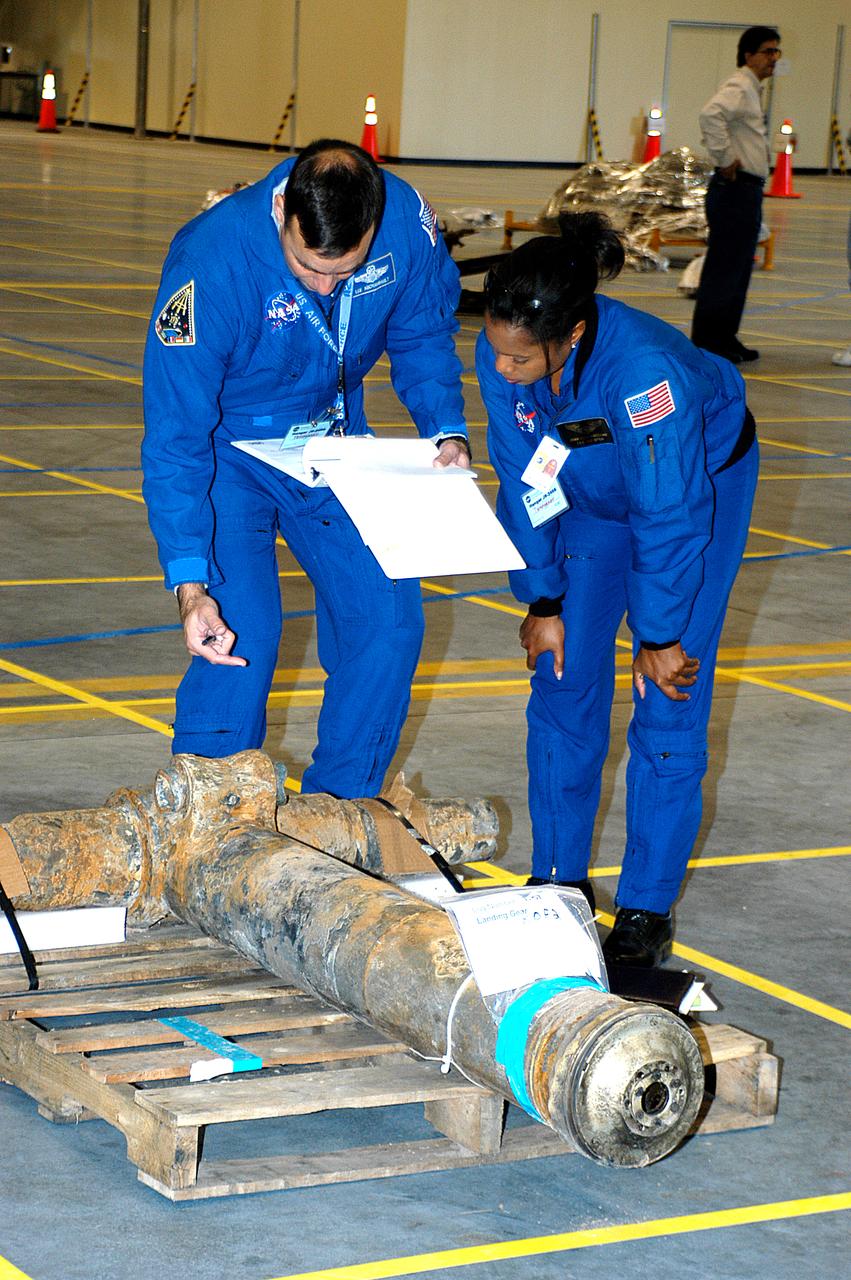
Astronauts Lee Archambault and Joan Higginbotham look at a piece of Columbia debris placed on the grid in the RLV Hangar. The debris was shipped from Barksdale Air Force Base, Shreveport, La. As part of the ongoing investigation into the tragic accident, workers will attempt to reconstruct the orbiter inside the RLV.
STS-107 Columbia debris reconstruction team
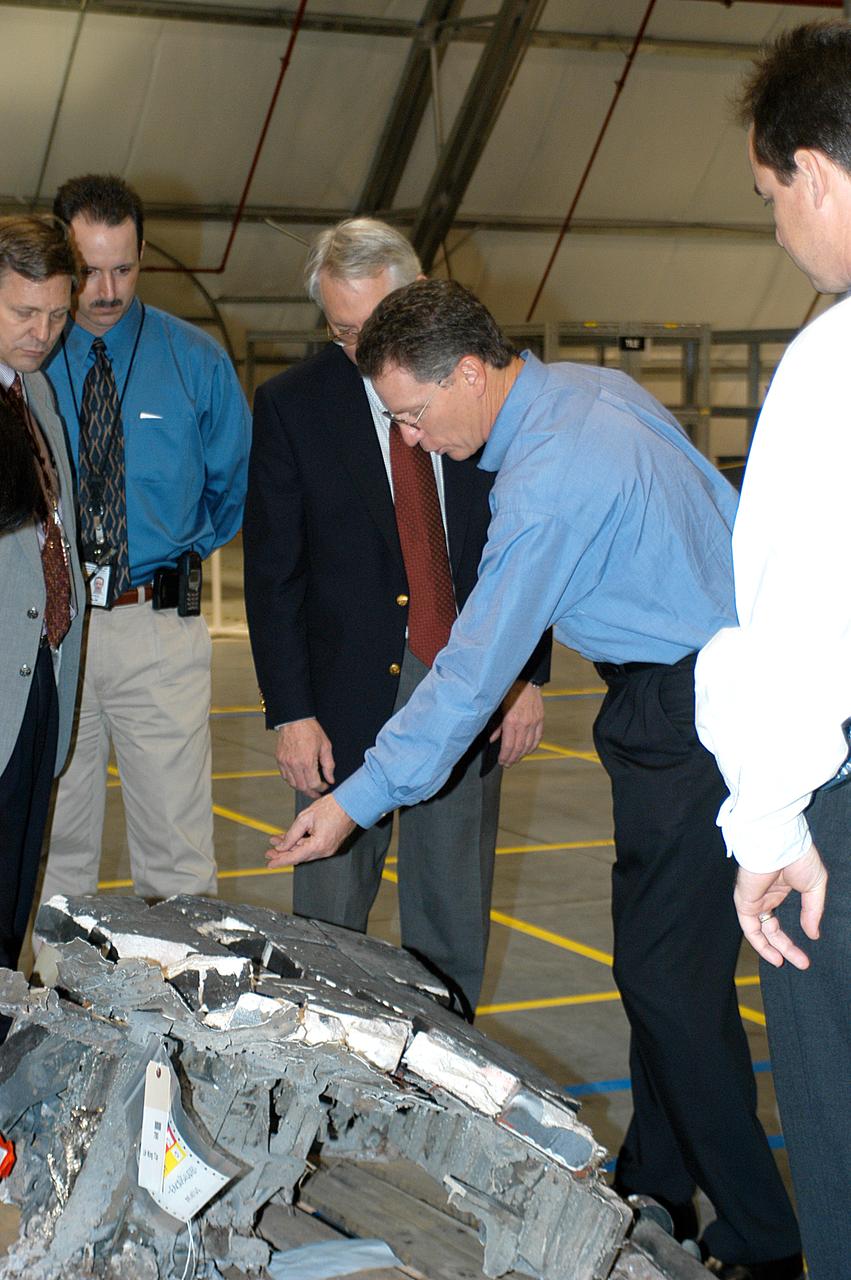
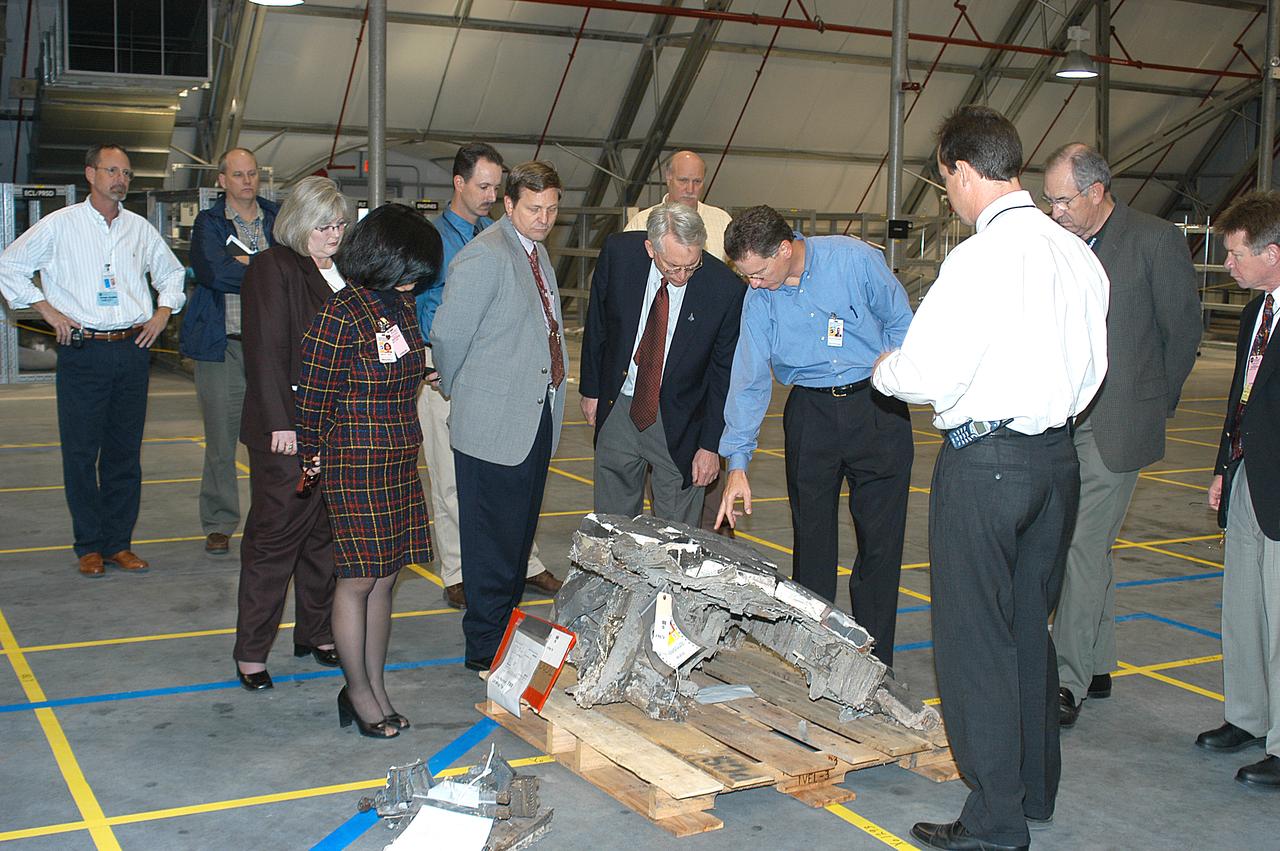
Shuttle Program Manager Ron Dittemore (leaning over) examines a piece of Columbia debris in the RLV Hangar. The debris was shipped from the collection point at Barksdale Air Force Base, Shreveport, La. As part of the ongoing investigation into the tragic accident that claimed Columbia and her crew of seven, workers will attempt to reconstruct the orbiter inside the RLV.
STS-107 Columbia debris reconstruction team
Shuttle Program Manager Ron Dittemore (leaning over) examines a piece of Columbia debris in the RLV Hangar. The debris was shipped from the collection point at Barksdale Air Force Base, Shreveport, La. As part of the ongoing investigation into the tragic accident that claimed Columbia and her crew of seven, workers will attempt to reconstruct the orbiter inside the RLV.
STS-107 Columbia debris reconstruction team
Astronauts Lee Archambault and Joan Higginbotham look at a piece of Columbia debris placed on the grid in the RLV Hangar. The debris was shipped from Barksdale Air Force Base, Shreveport, La. As part of the ongoing investigation into the tragic accident, workers will attempt to reconstruct the orbiter inside the RLV.
STS-107 Columbia debris reconstruction team
The reconstruction team checks out the Columbia debris after it was offloaded at the RLV Hangar. The debris was shipped from Barksdale Air Force Base, Shreveport, La. As part of the ongoing investigation into the tragic accident, workers will attempt to reconstruct the orbiter inside the RLV.
STS-107 Columbia debris reconstruction team
Views of the overhead flight deck window showing debris impact damage due to high velocity impact strike by space debris.
Views of the overhead flight deck window showing debris impact damage
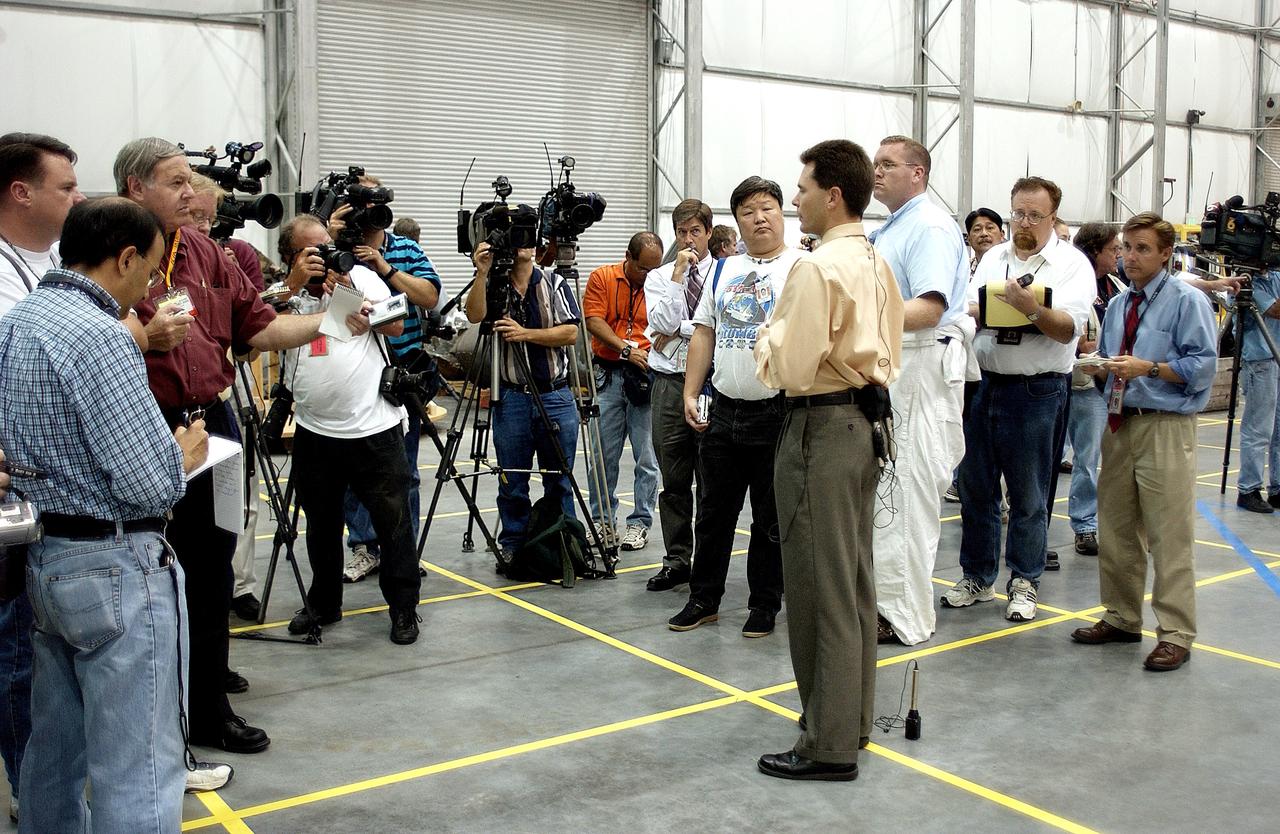
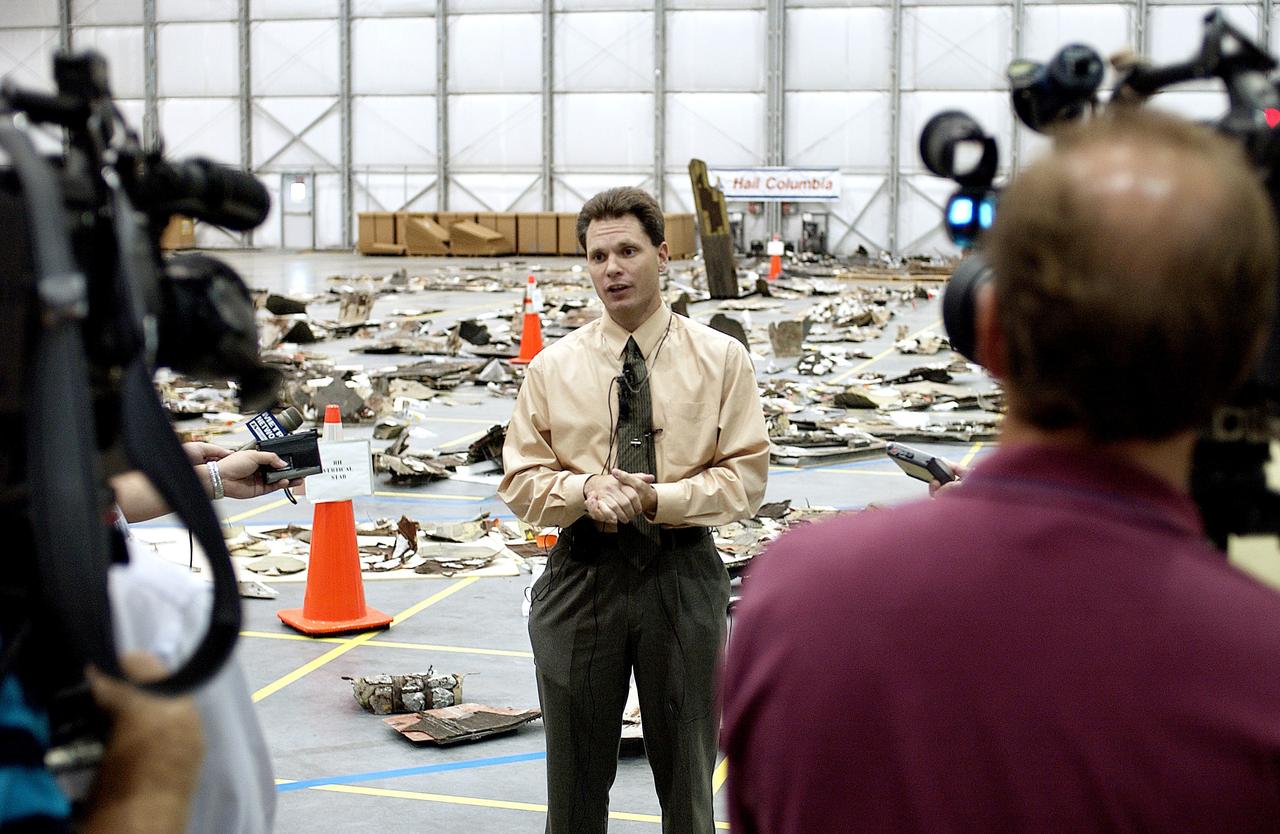
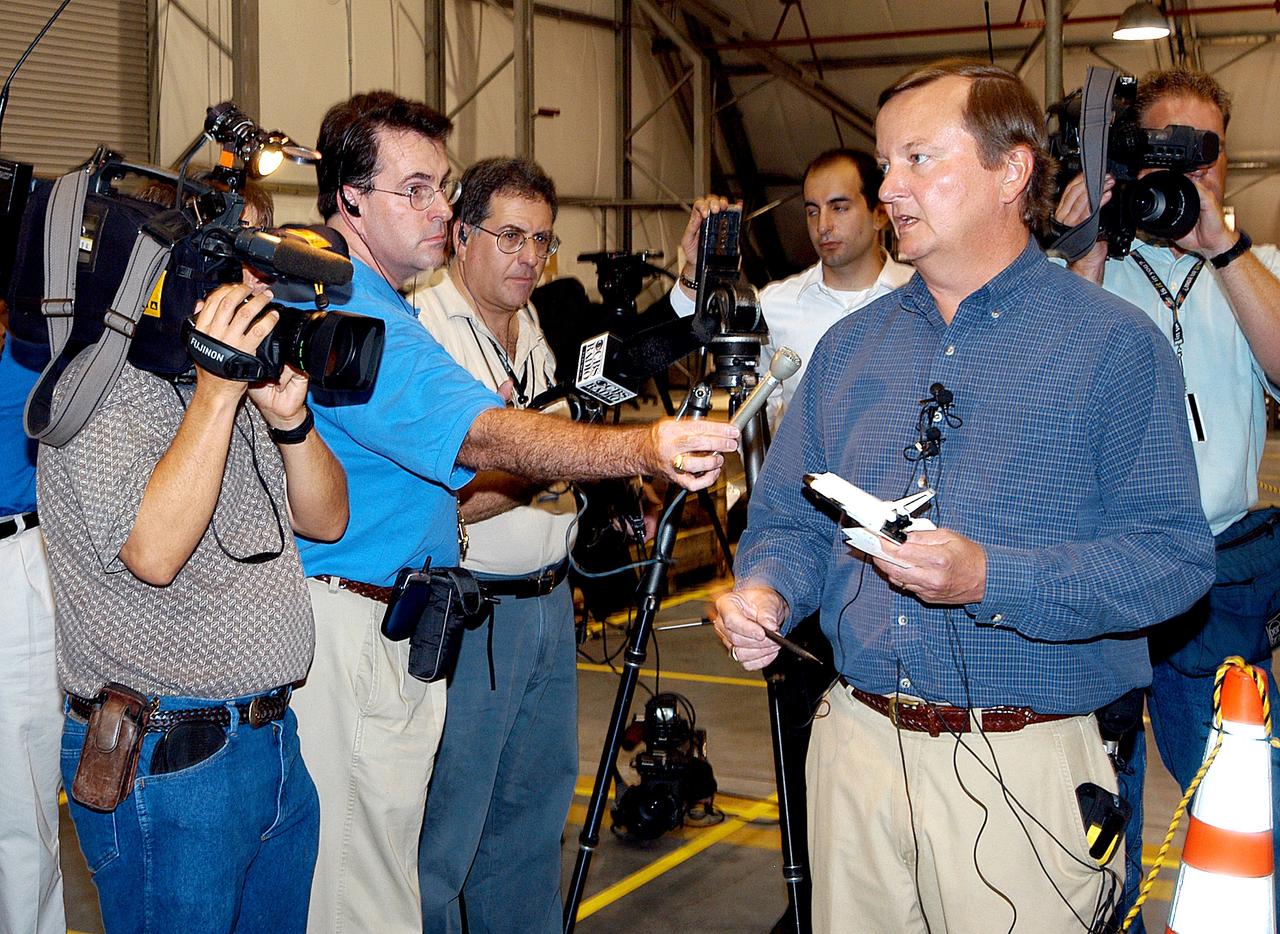
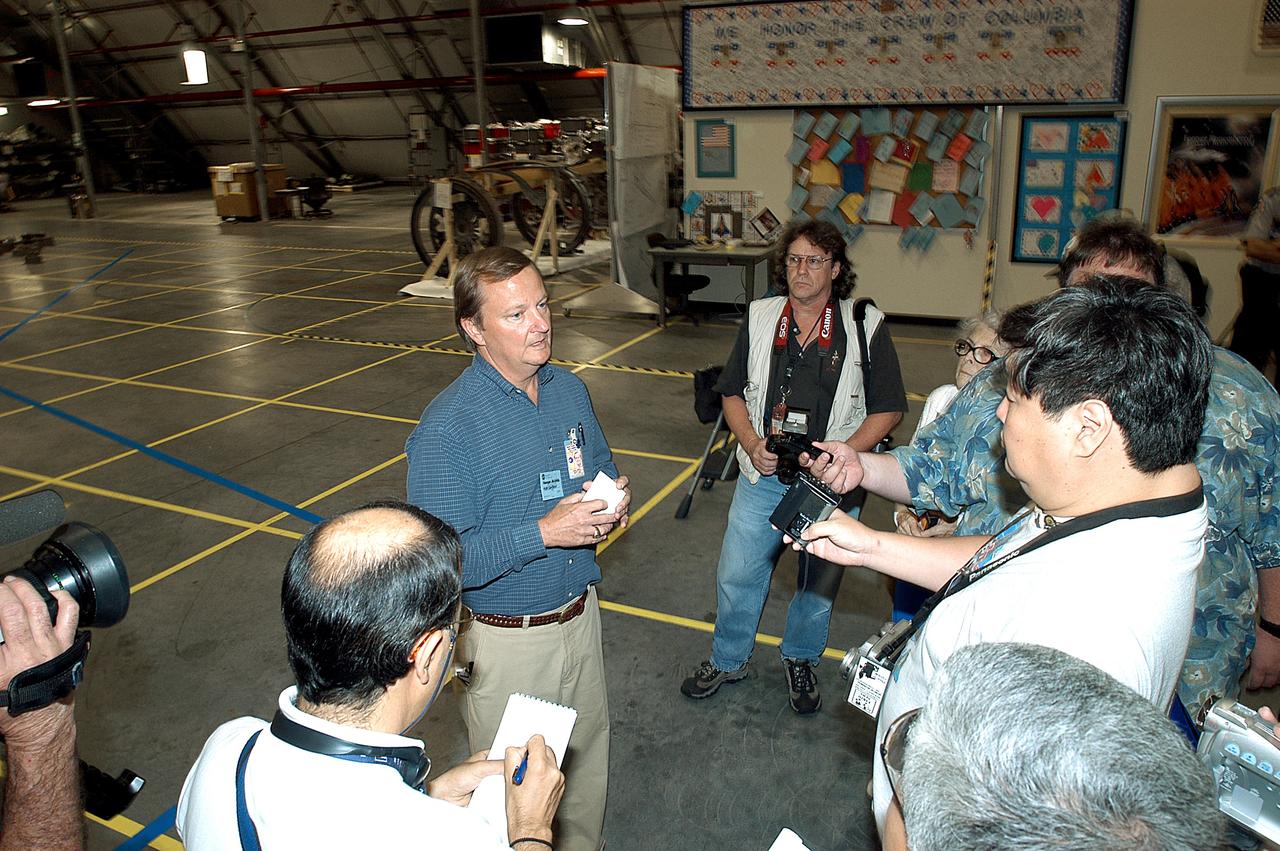
KENNEDY SPACE CENTER, FLA. - In the Columbia Debris Hangar, Scott Thurston, NASA vehicle flow manager, addresses the media about efforts to pack the debris stored in the Columbia Debris Hangar.  More than 83,000  pieces of debris were shipped to KSC during search and recovery efforts in East Texas. That represents about 38 percent of the dry weight of Columbia, equaling almost 85,000 pounds. An area of the Vehicle Assembly Building is being prepared to store the debris permanently.
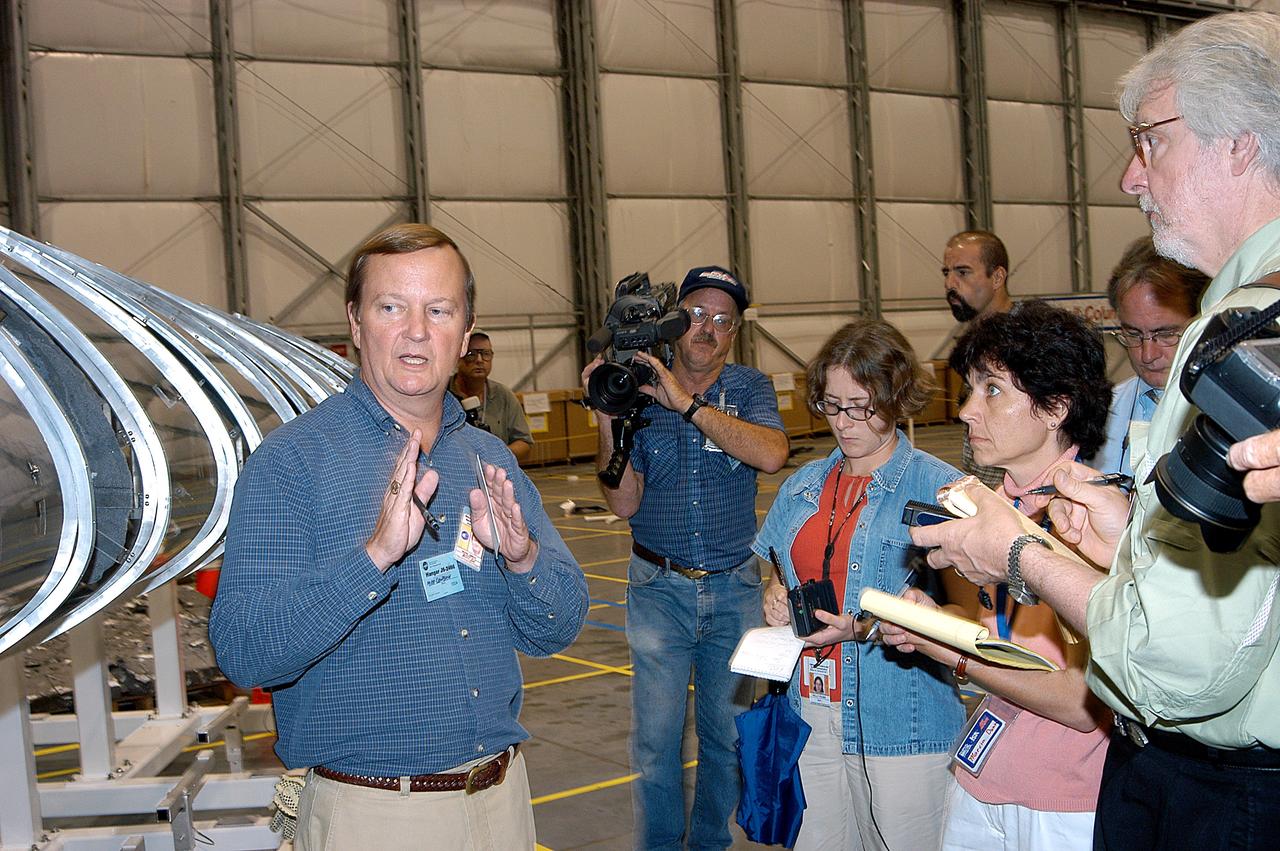
KENNEDY SPACE CENTER, FLA. - In the Columbia Debris Hangar, Scott Thurston, NASA vehicle flow manager, addresses the media about efforts to pack the debris stored in the Columbia Debris Hangar. More than 83,000 pieces of debris were shipped to KSC during search and recovery efforts in East Texas. That represents about 38 percent of the dry weight of Columbia, equaling almost 85,000 pounds. An area of the Vehicle Assembly Building is being prepared to store the debris permanently.
KENNEDY SPACE CENTER, FLA. - In the Columbia Debris Hangar, Scott Thurston, NASA vehicle flow manager, addresses the media about efforts to pack the debris stored in the Columbia Debris Hangar.  More than 83,000  pieces of debris were shipped to KSC during search and recovery efforts in East Texas. That represents about 38 percent of the dry weight of Columbia, equaling almost 85,000 pounds. An area of the Vehicle Assembly Building is being prepared to store the debris permanently.
KENNEDY SPACE CENTER, FLA. - In the Columbia Debris Hangar, Scott Thurston, NASA vehicle flow manager, addresses the media about efforts to pack the debris stored in the Columbia Debris Hangar. More than 83,000 pieces of debris were shipped to KSC during search and recovery efforts in East Texas. That represents about 38 percent of the dry weight of Columbia, equaling almost 85,000 pounds. An area of the Vehicle Assembly Building is being prepared to store the debris permanently.
KENNEDY SPACE CENTER, FLA. - In the Columbia Debris Hangar, Scott Thurston, NASA vehicle flow manager, addresses the media about efforts to pack the debris stored in the Columbia Debris Hangar.  More than 83,000  pieces of debris were shipped to KSC during search and recovery efforts in East Texas. That represents about 38 percent of the dry weight of Columbia, equaling almost 85,000 pounds. An area of the Vehicle Assembly Building is being prepared to store the debris permanently.
KENNEDY SPACE CENTER, FLA. - In the Columbia Debris Hangar, Scott Thurston, NASA vehicle flow manager, addresses the media about efforts to pack the debris stored in the Columbia Debris Hangar. More than 83,000 pieces of debris were shipped to KSC during search and recovery efforts in East Texas. That represents about 38 percent of the dry weight of Columbia, equaling almost 85,000 pounds. An area of the Vehicle Assembly Building is being prepared to store the debris permanently.
KENNEDY SPACE CENTER, FLA. - In the Columbia Debris Hangar, Scott Thurston, NASA vehicle flow manager, addresses the media about efforts to pack the debris stored in the Columbia Debris Hangar.  More than 83,000  pieces of debris were shipped to KSC during search and recovery efforts in East Texas. That represents about 38 percent of the dry weight of Columbia, equaling almost 85,000 pounds. An area of the Vehicle Assembly Building is being prepared to store the debris permanently.
KENNEDY SPACE CENTER, FLA. - In the Columbia Debris Hangar, Scott Thurston, NASA vehicle flow manager, addresses the media about efforts to pack the debris stored in the Columbia Debris Hangar. More than 83,000 pieces of debris were shipped to KSC during search and recovery efforts in East Texas. That represents about 38 percent of the dry weight of Columbia, equaling almost 85,000 pounds. An area of the Vehicle Assembly Building is being prepared to store the debris permanently.
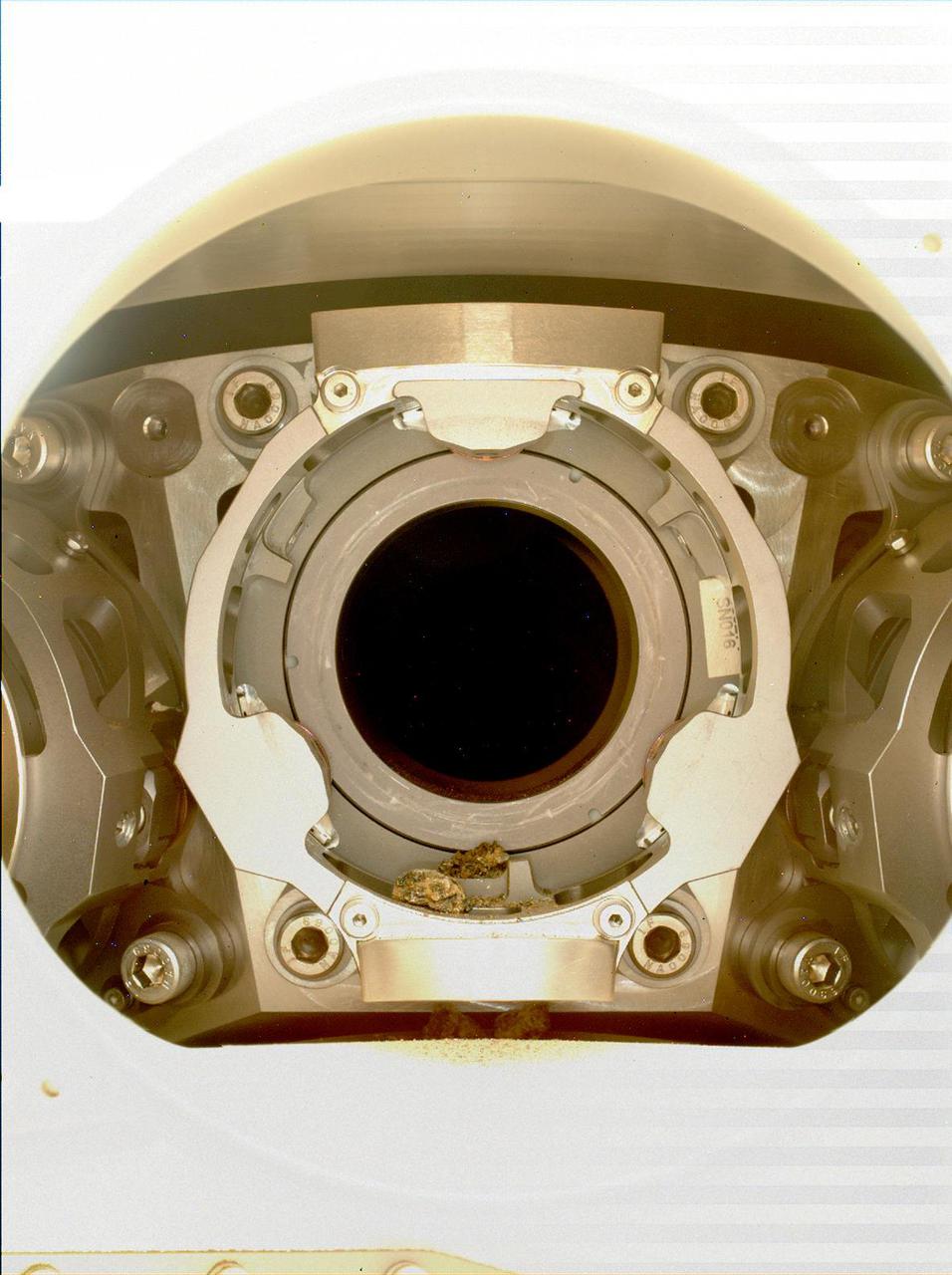
This image of pebble-sized debris in the bit carousel on NASA's Perseverance Mars rover was acquired on Jan. 7, 2022, by the WATSON camera. The image was taken to assist the Perseverance team in diagnosing an anomaly that occurred during a rock sampling on Dec. 29, 2021.  A subsystem of the SHERLOC (Scanning Habitable Environments with Raman & Luminescence for Organics & Chemicals) instrument, WATSON can document the structure and texture within a drilled or abraded target, and its data can be used to derive depth measurements.  NASA's Jet Propulsion Laboratory built and manages operations of Perseverance and Ingenuity for the agency. Caltech in Pasadena, California, manages JPL for NASA. WATSON was built by Malin Space Science Systems (MSSS) in San Diego and is operated jointly by MSSS and JPL.  A key objective for Perseverance's mission on Mars is astrobiology, including the search for signs of ancient microbial life. The rover will characterize the planet's geology and past climate, pave the way for human exploration of the Red Planet, and be the first mission to collect and cache Martian rock and regolith (broken rock and dust).  Subsequent NASA missions, in cooperation with ESA (European Space Agency), would send spacecraft to Mars to collect these sealed samples from the surface and return them to Earth for in-depth analysis.  The Mars 2020 Perseverance mission is part of NASA's Moon to Mars exploration approach, which includes Artemis missions to the Moon that will help prepare for human exploration of the Red Planet.  https://photojournal.jpl.nasa.gov/catalog/PIA25066
Debris in Perseverance's Bit Carousel
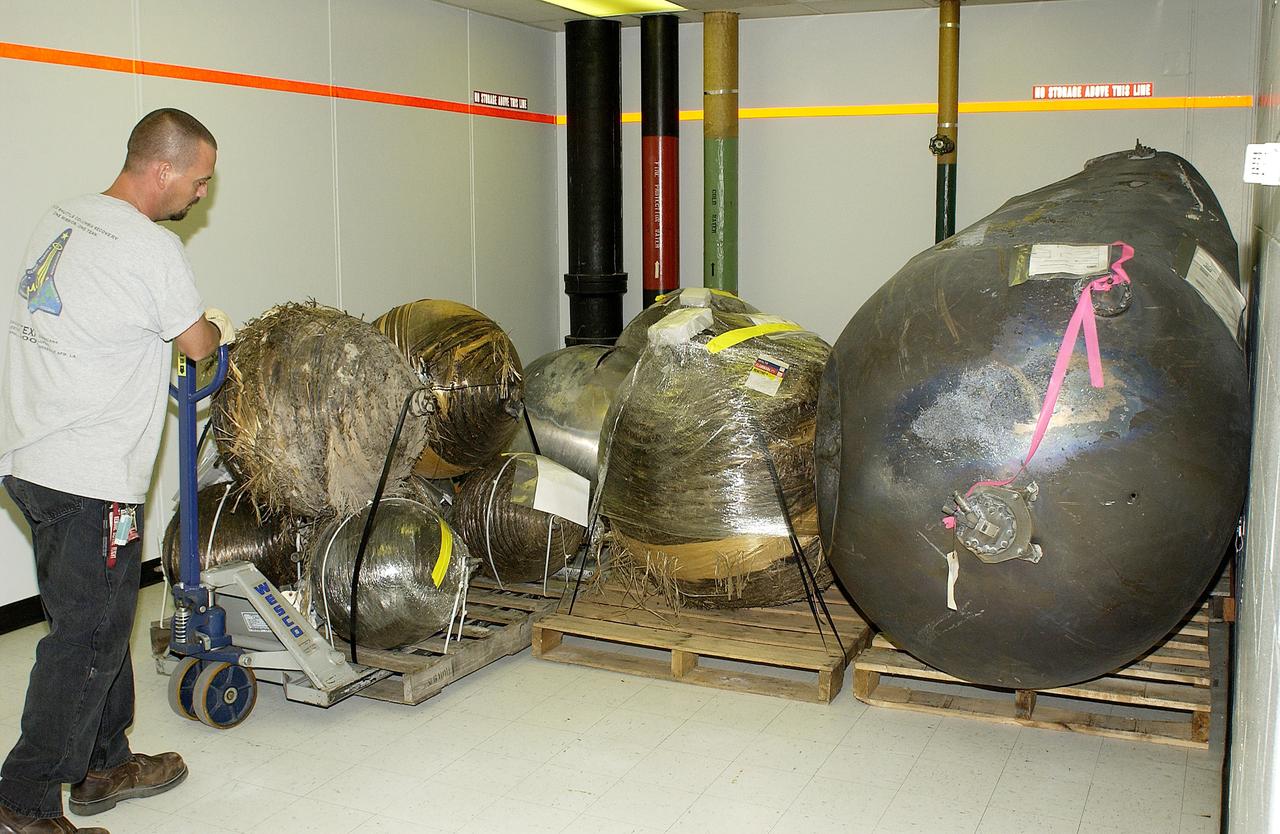
KENNEDY SPACE CENTER, FLA. -   In the Columbia Debris Hangar, Jack Nowling moves a box filled with part of the Columbia debris.  About 83,000 pieces were shipped to KSC during search and recovery efforts in East Texas. An area of the Vehicle Assembly Building is being prepared to store the debris.
KENNEDY SPACE CENTER, FLA. - In the Columbia Debris Hangar, Jack Nowling moves a box filled with part of the Columbia debris. About 83,000 pieces were shipped to KSC during search and recovery efforts in East Texas. An area of the Vehicle Assembly Building is being prepared to store the debris.
KENNEDY SPACE CENTER, FLA.  -  Containers in the Columbia Debris Hangar are lined up after being emptied of the Columbia debris.  The debris is being transferred to storage in the Vehicle Assembly Building.  About 83,000 pieces were shipped to KSC during search and recovery efforts in East Texas.
KENNEDY SPACE CENTER, FLA. - Containers in the Columbia Debris Hangar are lined up after being emptied of the Columbia debris. The debris is being transferred to storage in the Vehicle Assembly Building. About 83,000 pieces were shipped to KSC during search and recovery efforts in East Texas.
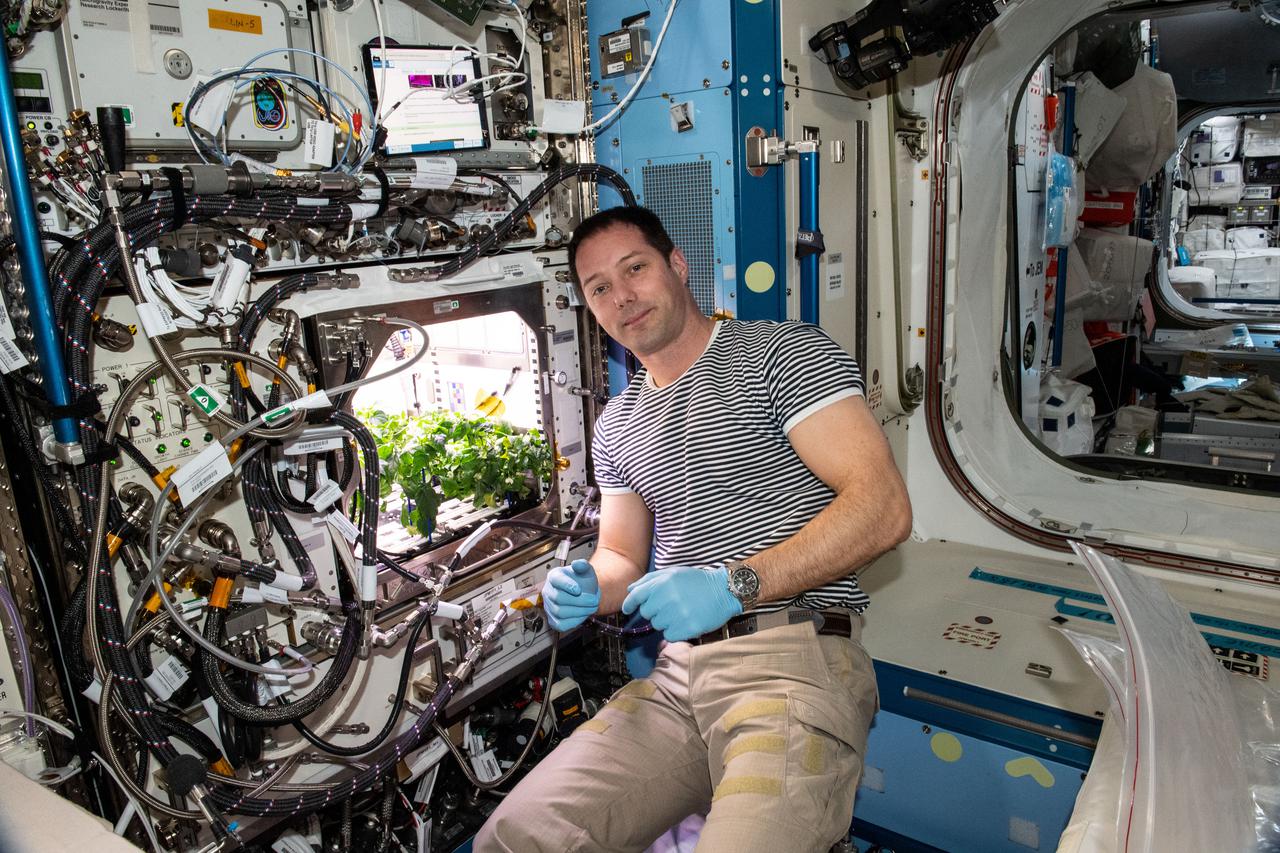
iss065e398621 (Sept. 20, 2021) --- ESA (European Space Agency) astronaut and Expedition 65 Flight Engineer Thomas Pesquet cleans up debris in the International Space Station’s Plant Habitat which is growing Hatch Green chiles for the Plant Habitat-04 space crop experiment.
Plant Habitat-04 Debris Removal
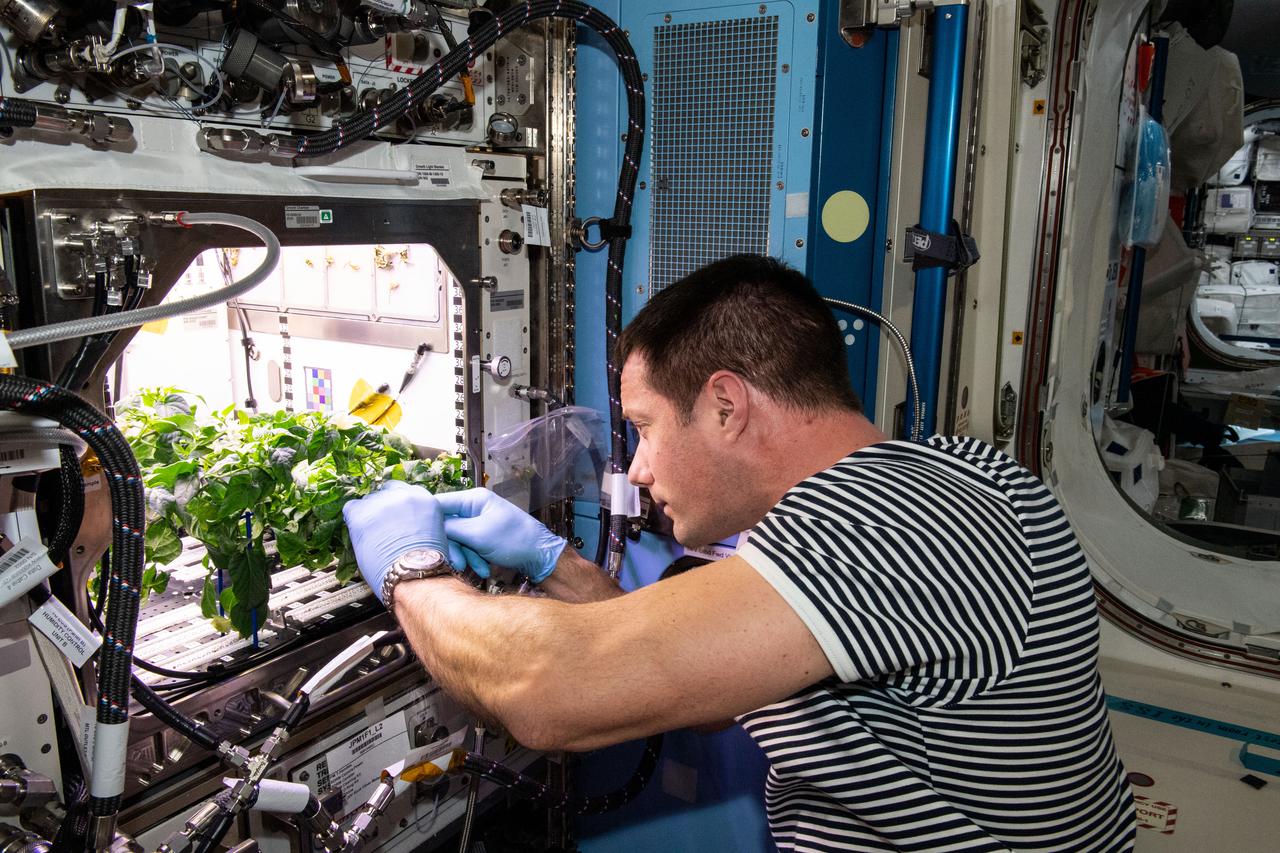
iss065e398600 (Sept. 20, 2021) --- ESA (European Space Agency) astronaut and Expedition 65 Flight Engineer Thomas Pesquet cleans up debris in the International Space Station’s Plant Habitat which is growing Hatch Green chiles for the Plant Habitat-04 space crop experiment.
Plant Habitat-04 Debris Removal
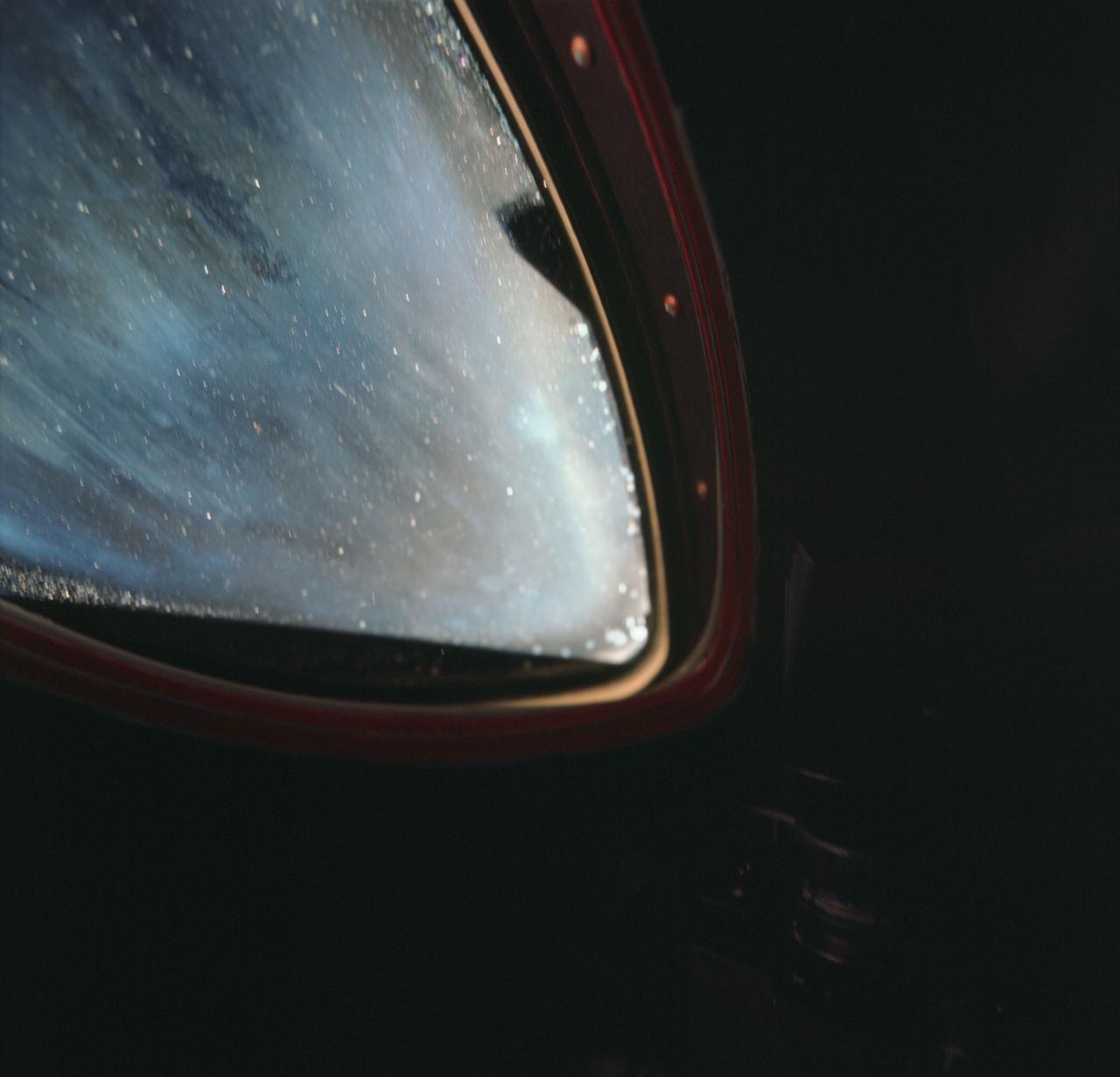
S66-46241 (18 July 1966) --- Debris on spacecraft window in picture taken from inside the Gemini-10 spacecraft. At this time Gemini-10 was docked with the Agena Target Docking Vehicle 5005. Taken with a modified 70mm Hasselblad camera, using Eastman Kodak, Ektachrome, MS (S.O. 217) color film. The Gemini-10 crew is astronaut John W. Young, command pilot, and Michael Collins, pilot. Photo credit: NASA
Debris - Onboard GT-10
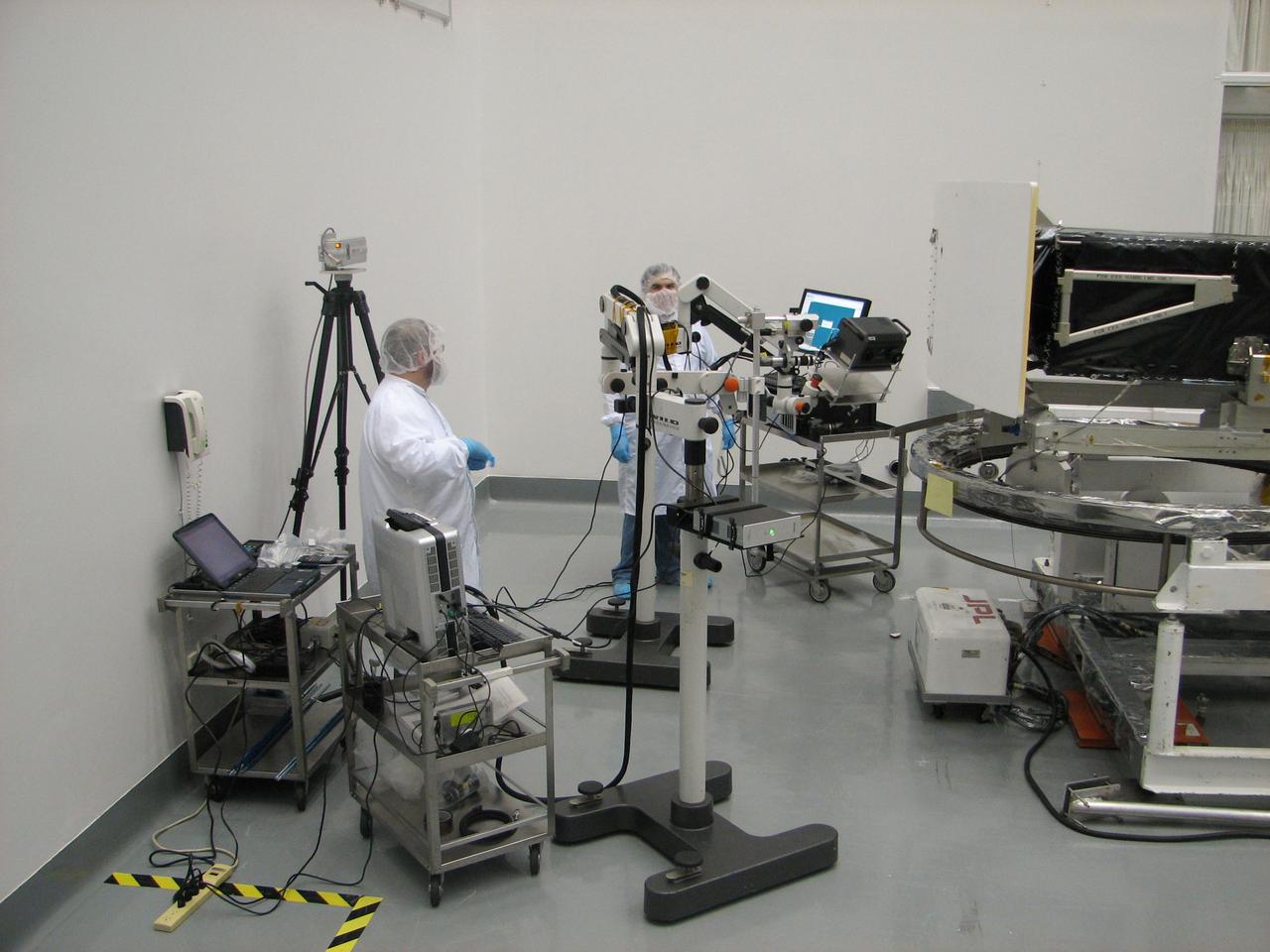
JSC2010-E-054445 (2 July 2009) --- Members of the Orbital Debris Program Office and the Hypervelocity Impact Technology Facility at JSC record images of impact craters and other surface data on the returned Wide Field and Planetary Camera (WFPC-2) of the Hubble Space Telescope.  Inspection took place at the Goddard Space Flight Center during the summer of 2009. Photo credit: NASA or National Aeronautics and Space Administration
STS-125 Orbital Debris
NASA Mars Reconnaissance Orbiter acquired this image to aid in the search for the missing lander, Mars 2. If the debris field is found, it could serve as a future landing location to study the effects of crash landing on the Martian surface.  Despite the recent successes of missions landing on Mars, like the Mars Science Laboratory (Curiosity) or the arrival of new satellites, such as India's MOM orbiter, the Red Planet is also a graveyard of failed missions.  The Soviet Mars 2 lander was the first man-made object to touch the surface of the Red Planet when it crashed landed on 27 November 1971. It is believed that the descent stage malfunctioned after the lander entered the atmosphere at too steep an angle. Attempts to contact the probe after the crash were unsuccessful.  http://photojournal.jpl.nasa.gov/catalog/PIA18888
Search for the Mars 2 Debris Field
This artist's rendering shows a giant exoplanet causing small bodies to collide in a disk of dust.  A study in The Astronomical Journal finds that giant exoplanets with long-period orbits are more likely to be found around young stars that have a disk of dust and debris than those without disks. The study focused on planets more than five times the mass of Jupiter. The astronomers are conducting the largest survey to date of stars with dusty debris disks, and finding the best evidence yet that giant planets are responsible for keeping that material in check.   https://photojournal.jpl.nasa.gov/catalog/PIA22082
Giant Exoplanet and Debris Disk (Artist's Concept)
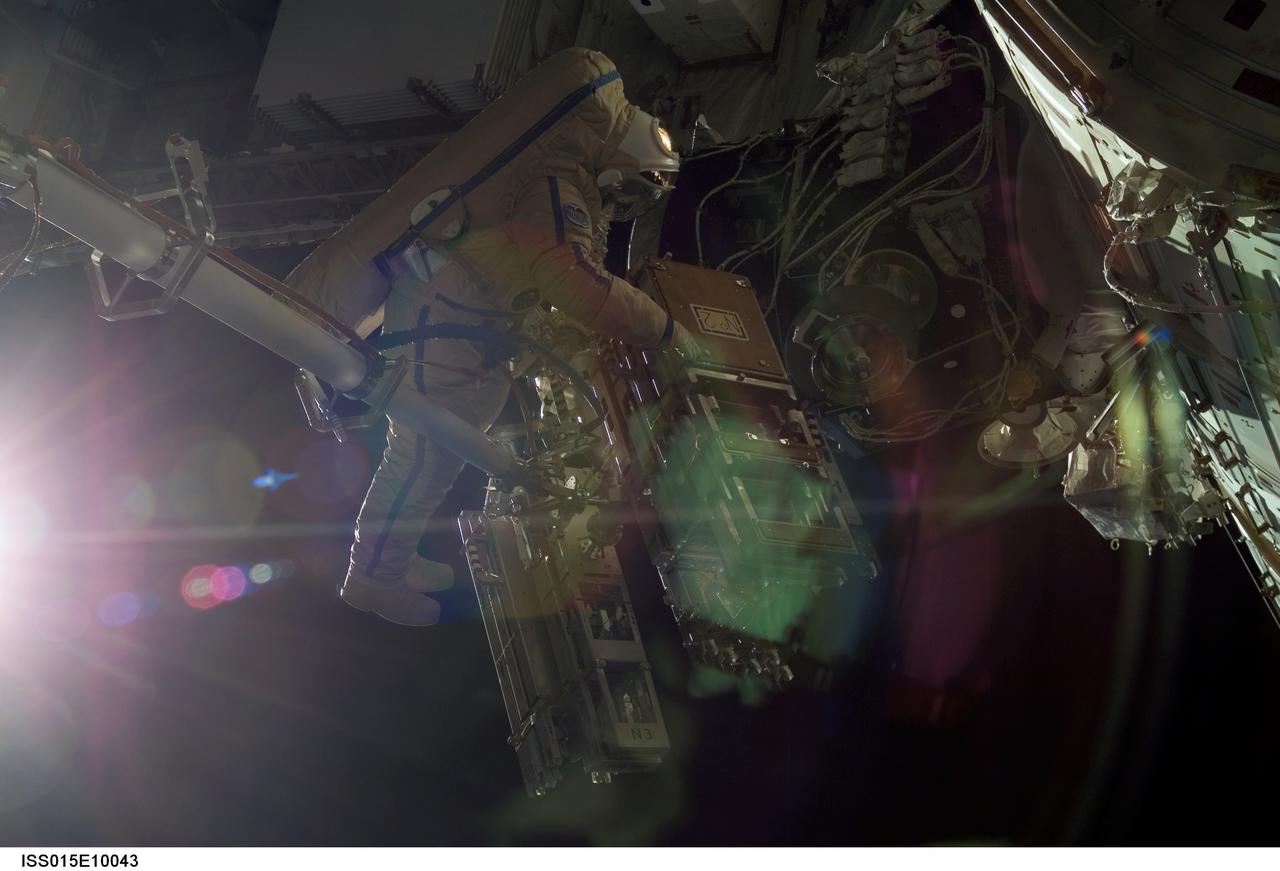
ISS015-E-10043 (30 May 2007) --- Cosmonaut Oleg V. Kotov, Expedition 15 flight engineer representing Russia's Federal Space Agency, wearing a Russian Orlan spacesuit, participates in a session of extravehicular activity (EVA). Among other tasks, Kotov and cosmonaut Fyodor N. Yurchikhin (out of frame), commander representing Russia's Federal Space Agency, retrieved the "Christmas tree" bundle of three packages of 17 protective debris panels for installation around the forward cone of the Zvezda Service Module of the International Space Station and to install the first set of those panels. The aluminum debris protection panels are designed to shield the module from micro-meteoroids.
View of Kotov working with Debris Panels during EVA18
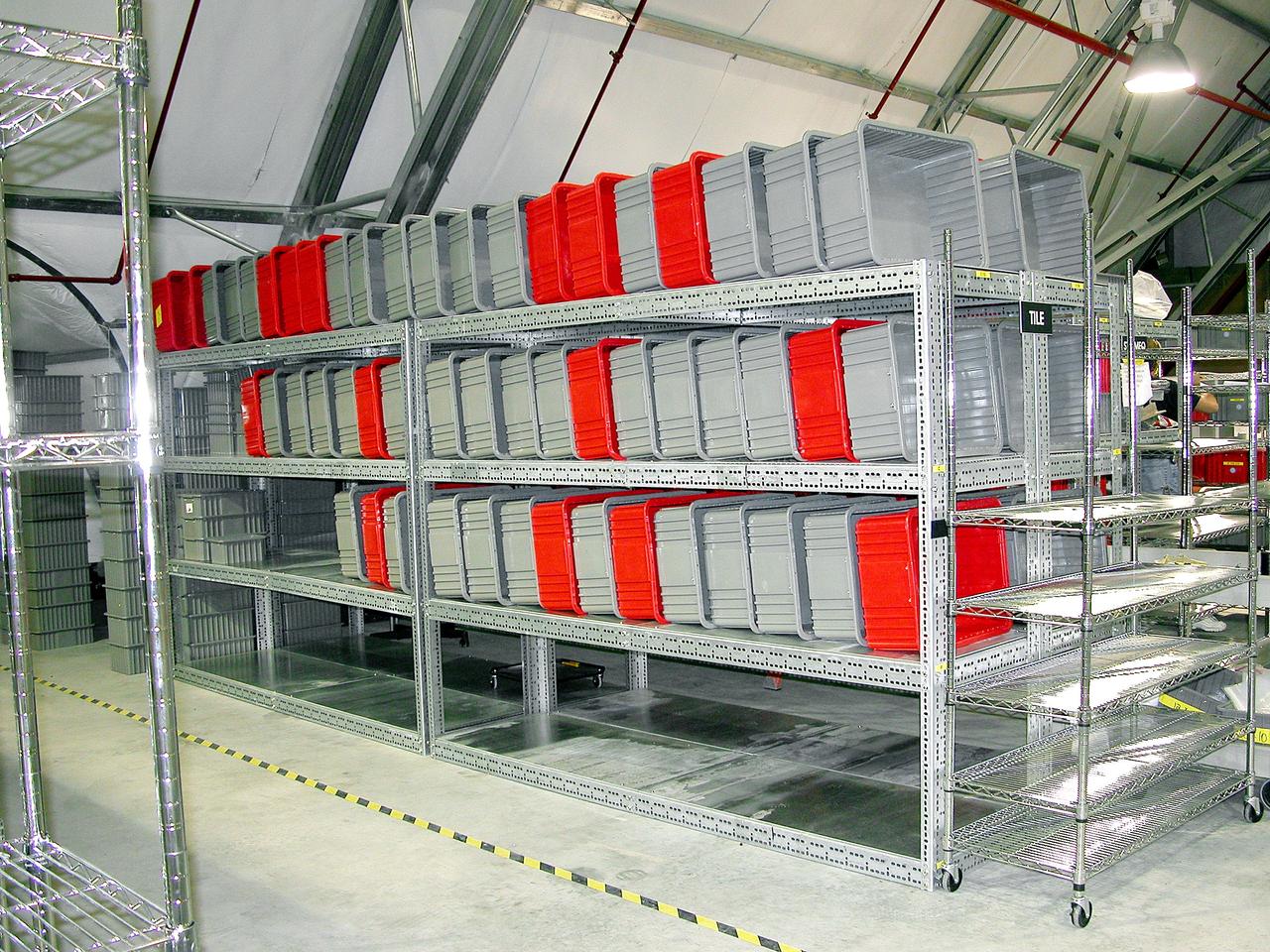
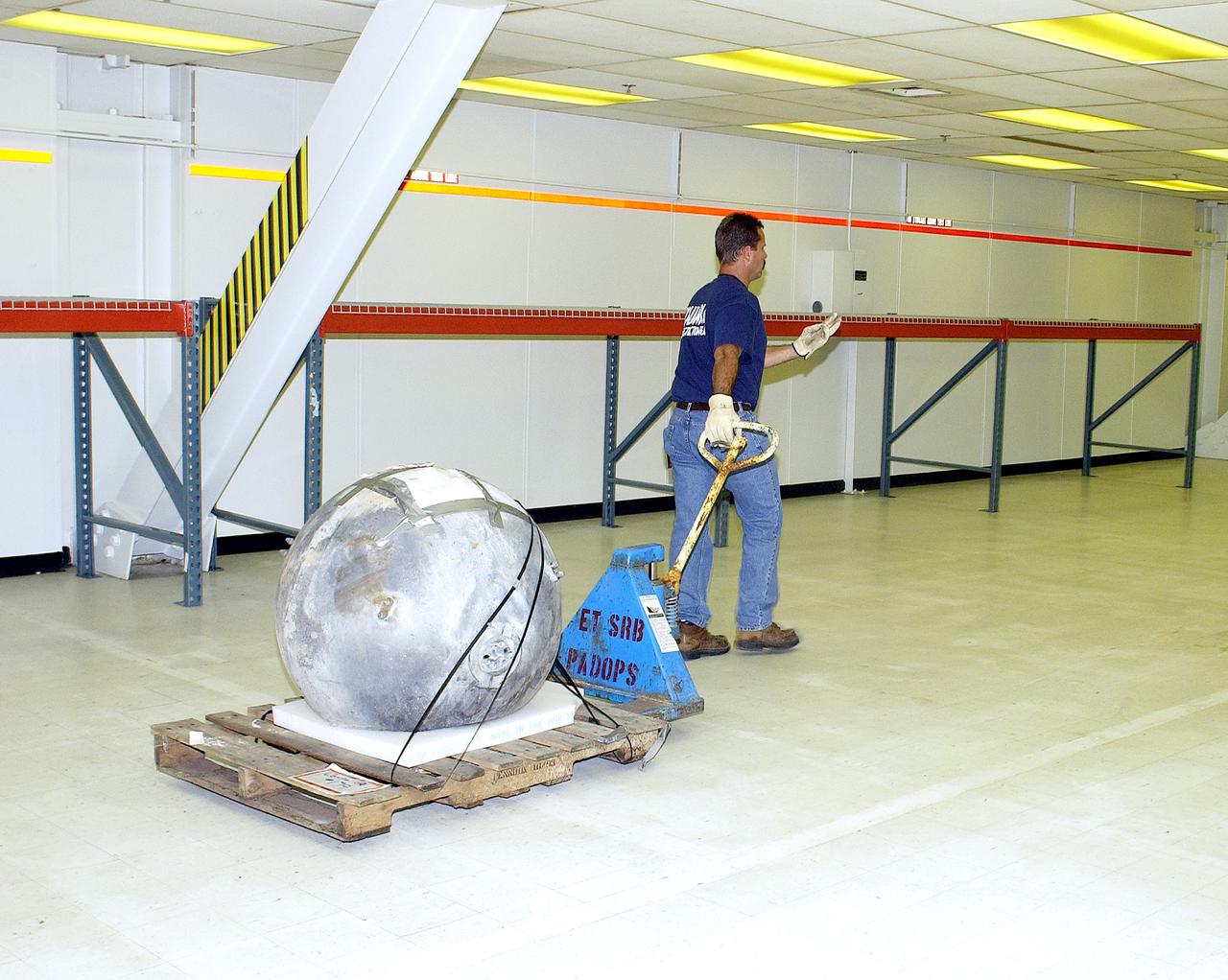
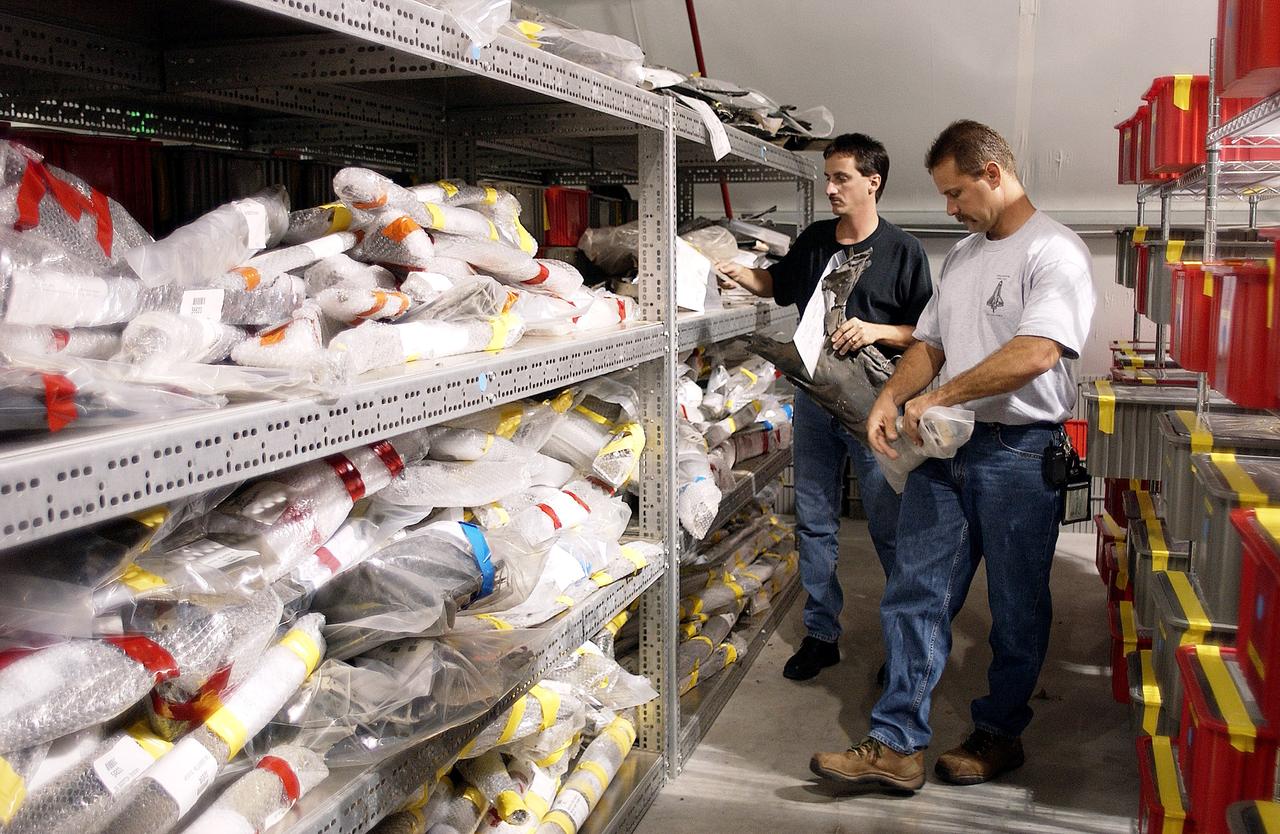
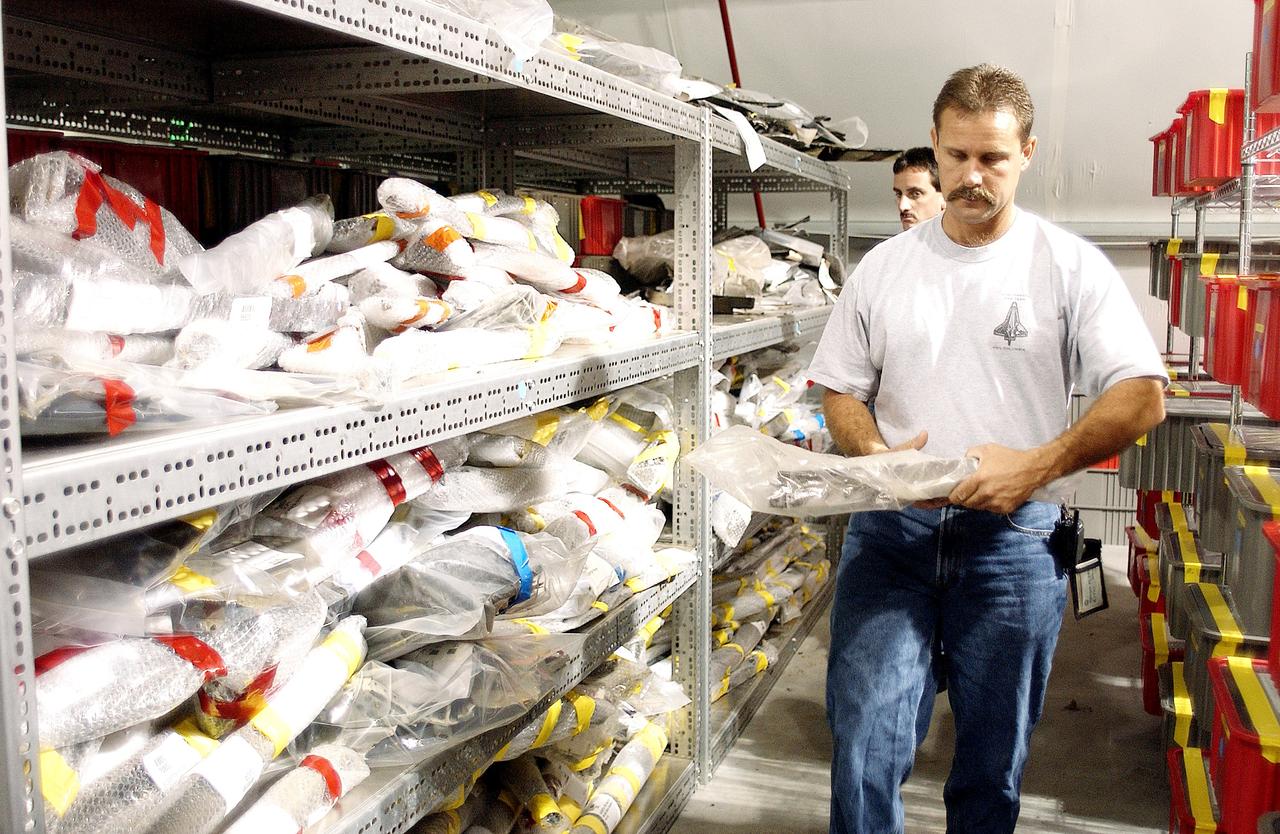
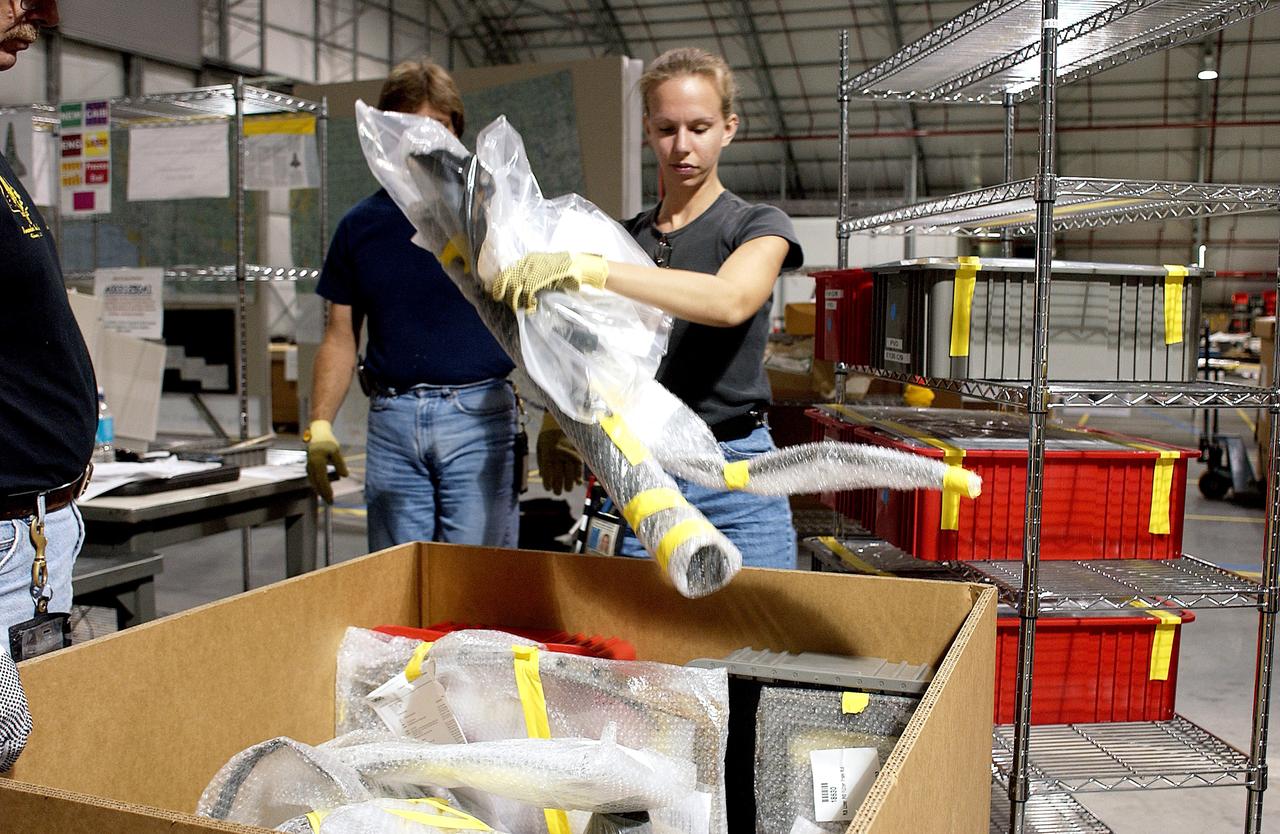
KENNEDY SPACE CENTER, FLA. - In the Columbia Debris Hangar,  Jim Delie (left) and Don Eitel select from the shelves wrapped pieces of debris to be packed into storage boxes.  About 83,000 pieces of debris were shipped to KSC during search and recovery efforts in East Texas. That represents about 38 percent of the dry weight of Columbia, equaling almost 85,000 pounds.  An area of the Vehicle Assembly Building is being prepared to store the debris.
KENNEDY SPACE CENTER, FLA. - In the Columbia Debris Hangar, Jim Delie (left) and Don Eitel select from the shelves wrapped pieces of debris to be packed into storage boxes. About 83,000 pieces of debris were shipped to KSC during search and recovery efforts in East Texas. That represents about 38 percent of the dry weight of Columbia, equaling almost 85,000 pounds. An area of the Vehicle Assembly Building is being prepared to store the debris.
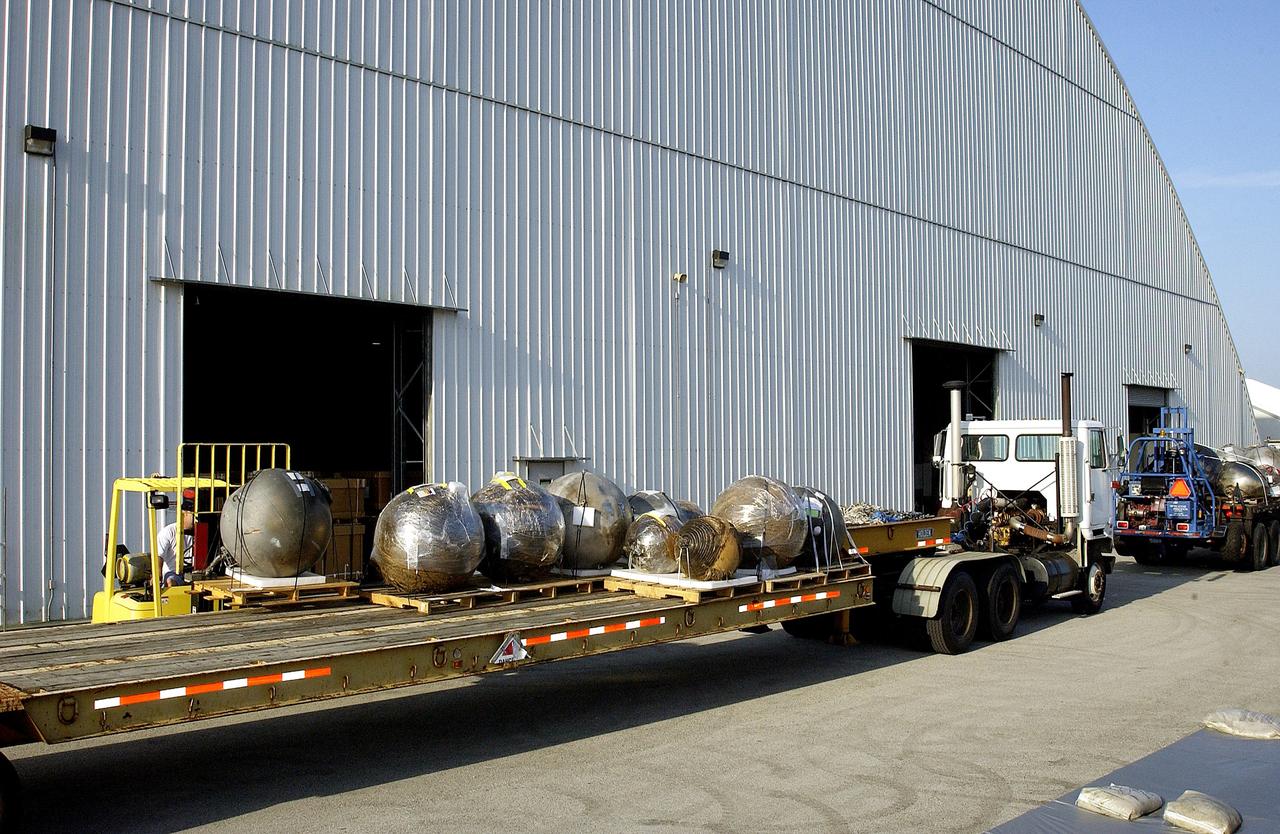
KENNEDY SPACE CENTER, FLA. -   Some of the Columbia debris is loaded onto a flatbed truck outside the Columbia Debris Hangar.  The debris is being transferred to the Vehicle Assembly Building for permanent storage.  More than 83,000  pieces of debris were shipped to KSC during search and recovery efforts in East Texas. That represents about 38 percent of the dry weight of Columbia, equaling almost 85,000 pounds.
KENNEDY SPACE CENTER, FLA. - Some of the Columbia debris is loaded onto a flatbed truck outside the Columbia Debris Hangar. The debris is being transferred to the Vehicle Assembly Building for permanent storage. More than 83,000 pieces of debris were shipped to KSC during search and recovery efforts in East Texas. That represents about 38 percent of the dry weight of Columbia, equaling almost 85,000 pounds.
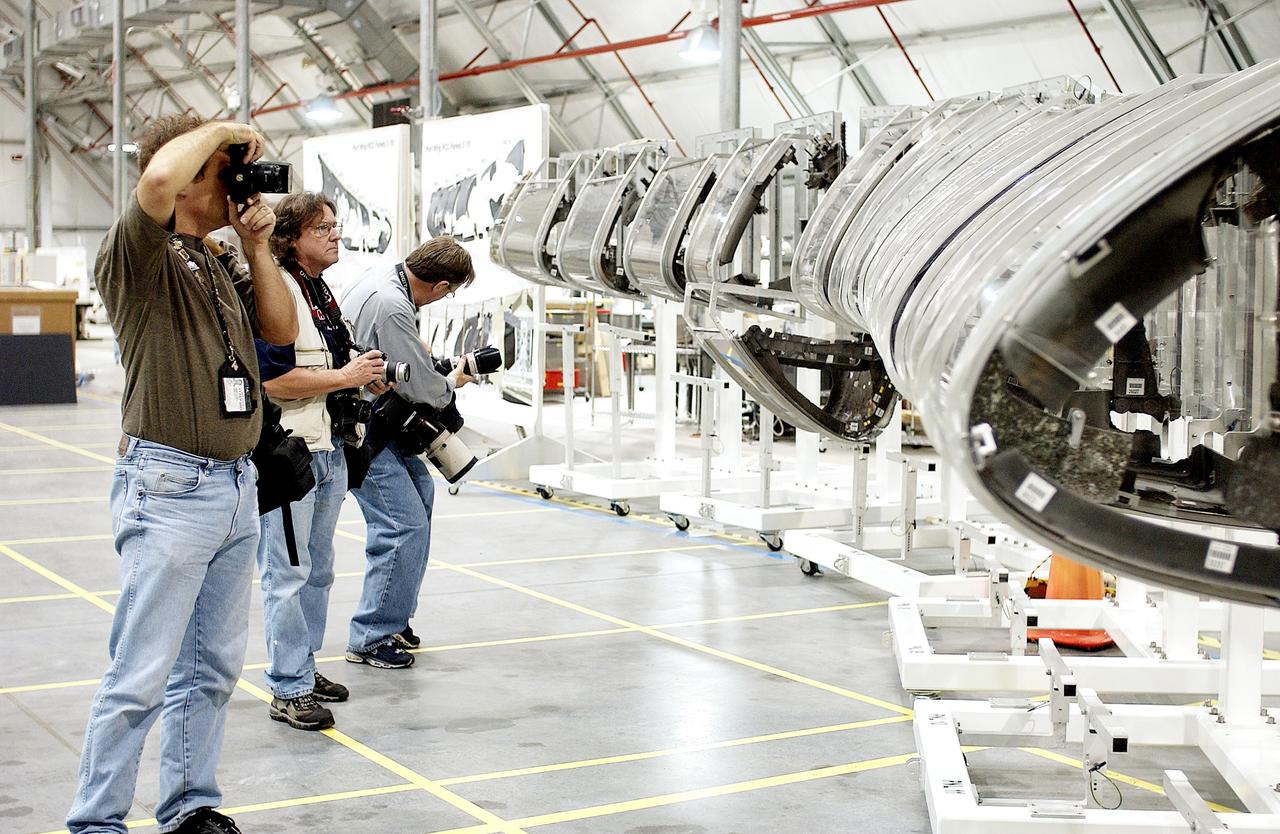
KENNEDY SPACE CENTER, FLA. - During a media tour of the Columbia Debris Hangar, photographers pause at the mockup of the leading edge of Columbia’s left wing.  About 83,000 pieces of debris from Columbia were shipped to KSC from search and recovery efforts in East Texas.  About 83,000 pieces of debris were shipped to KSC, which represents about 38 percent of the dry weight of Columbia, equaling almost 85,000 pounds.  The debris is being packaged for storage in an area of the Vehicle Assembly Building.
KENNEDY SPACE CENTER, FLA. - During a media tour of the Columbia Debris Hangar, photographers pause at the mockup of the leading edge of Columbia’s left wing. About 83,000 pieces of debris from Columbia were shipped to KSC from search and recovery efforts in East Texas. About 83,000 pieces of debris were shipped to KSC, which represents about 38 percent of the dry weight of Columbia, equaling almost 85,000 pounds. The debris is being packaged for storage in an area of the Vehicle Assembly Building.
KENNEDY SPACE CENTER, FLA. -  Workers move some of the Columbia debris to its storage site in the Vehicle Assembly Building (VAB). The debris is being transferred from the Columbia Debris Hangar to the VAB for permanent storage.  More than 83,000 pieces of debris were shipped to KSC during search and recovery efforts in East Texas. That represents about 38 percent of the dry weight of Columbia, equaling almost 85,000 pounds.
KENNEDY SPACE CENTER, FLA. - Workers move some of the Columbia debris to its storage site in the Vehicle Assembly Building (VAB). The debris is being transferred from the Columbia Debris Hangar to the VAB for permanent storage. More than 83,000 pieces of debris were shipped to KSC during search and recovery efforts in East Texas. That represents about 38 percent of the dry weight of Columbia, equaling almost 85,000 pounds.
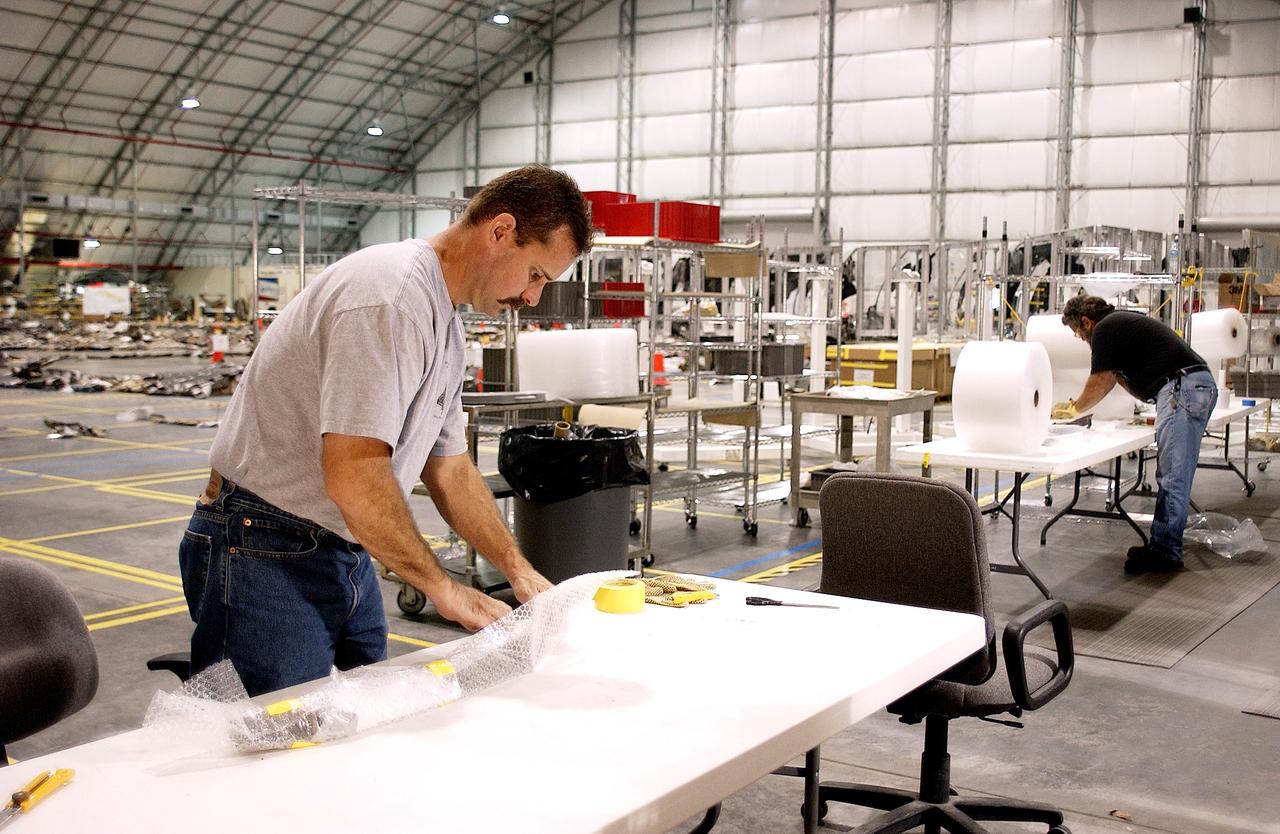
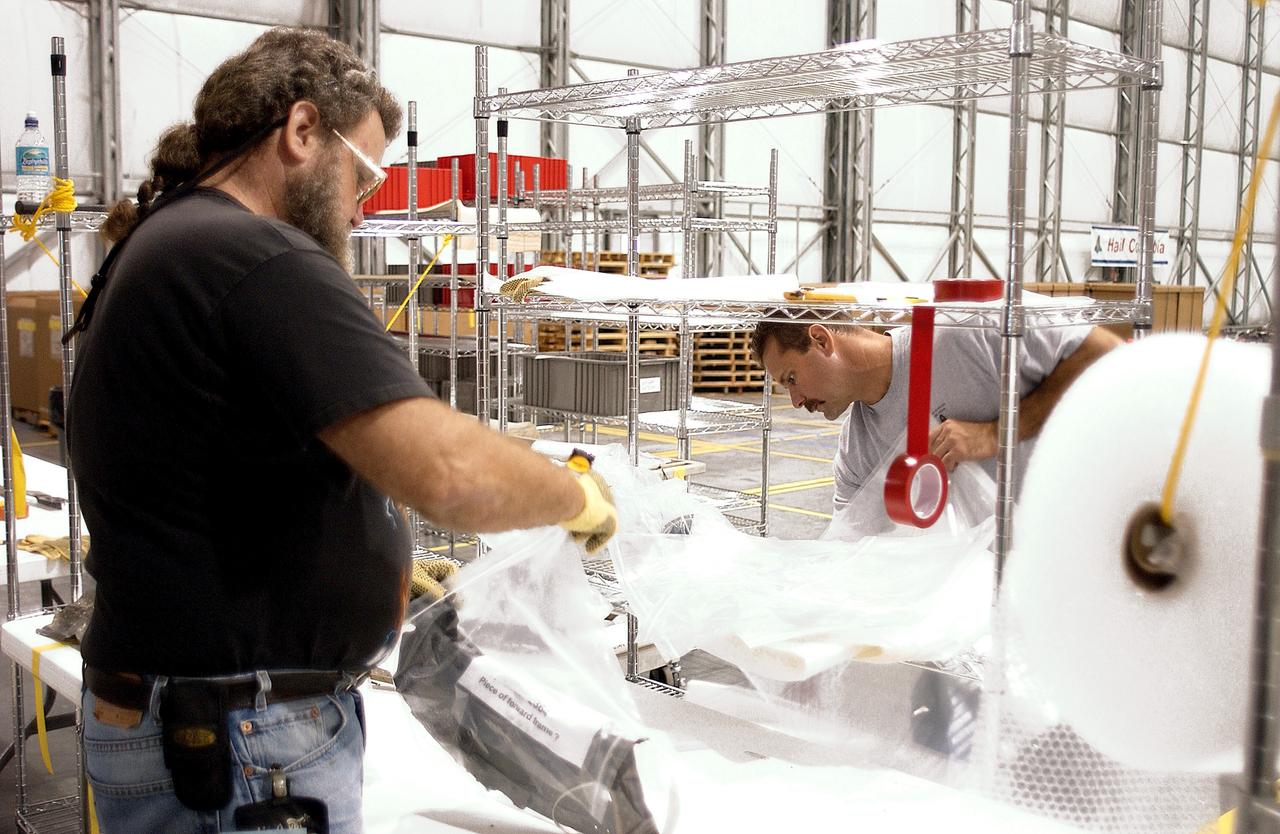
KENNEDY SPACE CENTER, FLA. -In the Columbia Debris Hangar, Don Eitel (left) wraps pieces of Columbia debris for storage.  About 83,000 pieces of debris were shipped to KSC during search and recovery efforts in East Texas. That represents about 38 percent of the dry weight of Columbia, equaling almost 85,000 pounds.  An area of the Vehicle Assembly Building is being prepared to store the debris.
KENNEDY SPACE CENTER, FLA. -In the Columbia Debris Hangar, Don Eitel (left) wraps pieces of Columbia debris for storage. About 83,000 pieces of debris were shipped to KSC during search and recovery efforts in East Texas. That represents about 38 percent of the dry weight of Columbia, equaling almost 85,000 pounds. An area of the Vehicle Assembly Building is being prepared to store the debris.
KENNEDY SPACE CENTER, FLA. -  Amy Norris (left) packs some of the debris stored in the Columbia Debris Hangar.  Jack Nowling works on the computer.  About 83,000 pieces of debris were shipped to KSC during search and recovery efforts in East Texas. That represents about 38 percent of the dry weight of Columbia, equaling almost 85,000 pounds.  An area of the Vehicle Assembly Building is being prepared to store the debris.
KENNEDY SPACE CENTER, FLA. - Amy Norris (left) packs some of the debris stored in the Columbia Debris Hangar. Jack Nowling works on the computer. About 83,000 pieces of debris were shipped to KSC during search and recovery efforts in East Texas. That represents about 38 percent of the dry weight of Columbia, equaling almost 85,000 pounds. An area of the Vehicle Assembly Building is being prepared to store the debris.
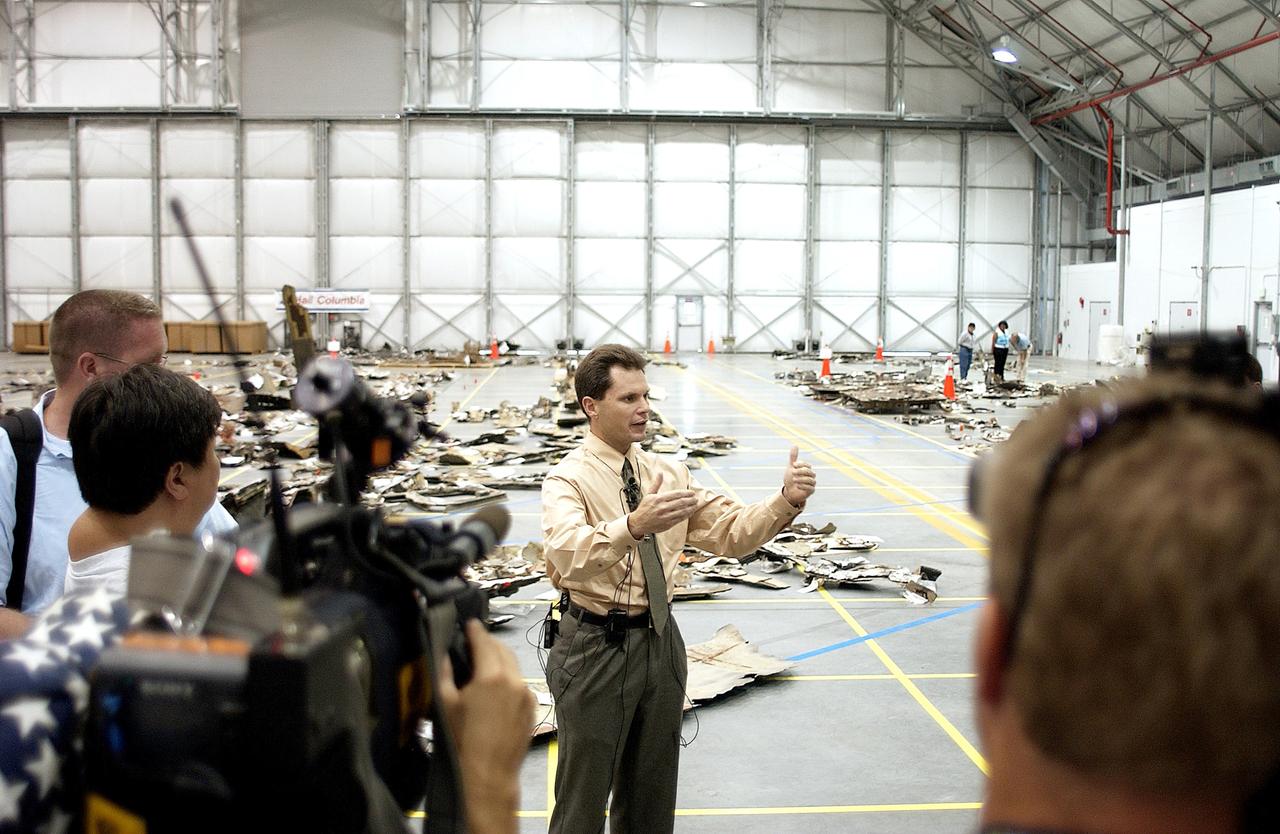
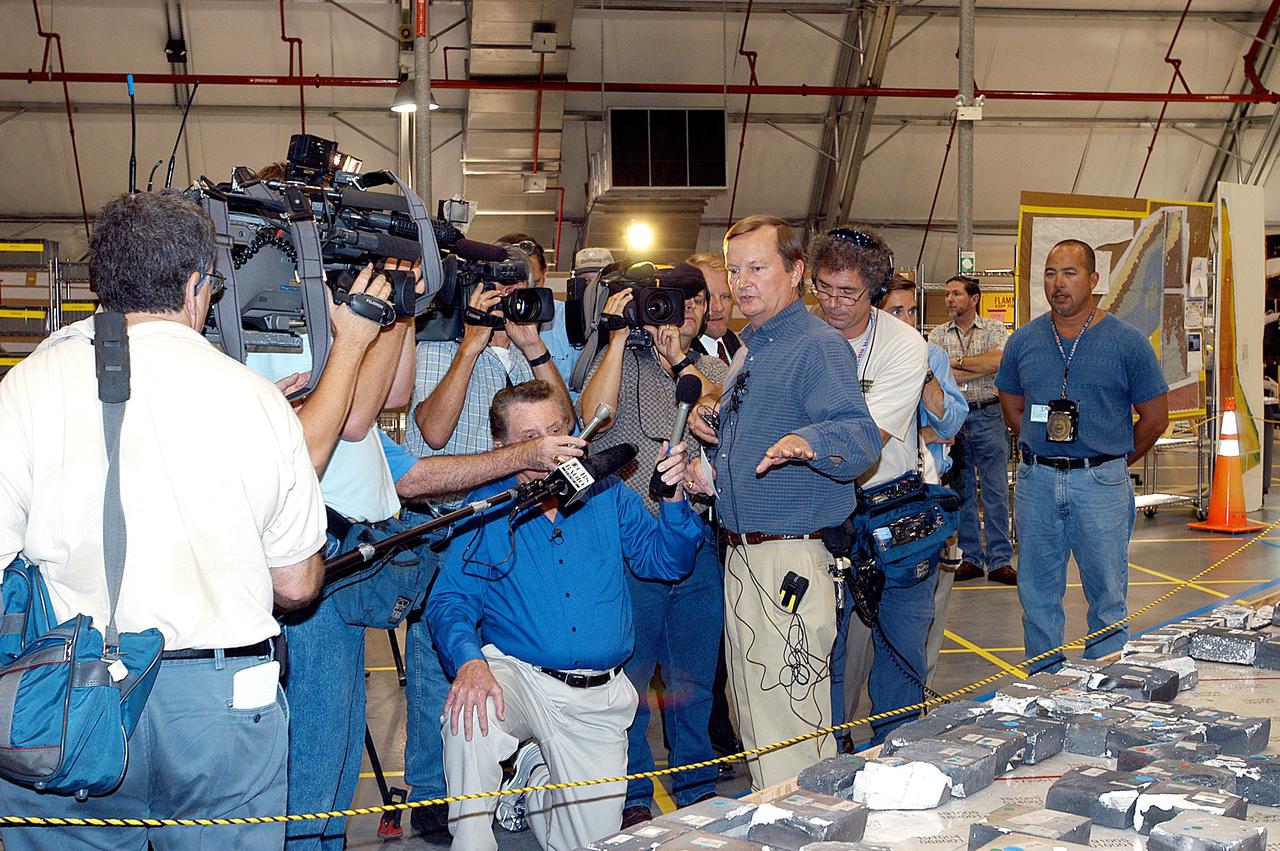
KENNEDY SPACE CENTER, FLA. - In the Columbia Debris Hangar,  Shuttle Launch Director Mike Leinbach  points to some of the debris as he explains to the media about activities that have taken place since the Columbia accident on Feb. 1, 2003.  STS-107 debris recovery and reconstruction operations are winding down.  To date, nearly 84,000 pieces of debris have been recovered and sent to KSC. That represents about 38 percent of the dry weight of Columbia, equaling almost 85,000 pounds.
KENNEDY SPACE CENTER, FLA. - In the Columbia Debris Hangar, Shuttle Launch Director Mike Leinbach points to some of the debris as he explains to the media about activities that have taken place since the Columbia accident on Feb. 1, 2003. STS-107 debris recovery and reconstruction operations are winding down. To date, nearly 84,000 pieces of debris have been recovered and sent to KSC. That represents about 38 percent of the dry weight of Columbia, equaling almost 85,000 pounds.
KENNEDY SPACE CENTER, FLA. -  A worker moves some of the Columbia debris to its storage site in the Vehicle Assembly Building (VAB). The debris is being transferred from the Columbia Debris Hangar to the VAB for permanent storage.  More than 83,000 pieces of debris were shipped to KSC during search and recovery efforts in East Texas. That represents about 38 percent of the dry weight of Columbia, equaling almost 85,000 pounds.
KENNEDY SPACE CENTER, FLA. - A worker moves some of the Columbia debris to its storage site in the Vehicle Assembly Building (VAB). The debris is being transferred from the Columbia Debris Hangar to the VAB for permanent storage. More than 83,000 pieces of debris were shipped to KSC during search and recovery efforts in East Texas. That represents about 38 percent of the dry weight of Columbia, equaling almost 85,000 pounds.
KENNEDY SPACE CENTER, FLA. -  A worker moves some of the Columbia debris to its storage site in the Vehicle Assembly Building (VAB). The debris is being transferred from the Columbia Debris Hangar to the VAB for permanent storage.  More than 83,000 pieces of debris were shipped to KSC during search and recovery efforts in East Texas. That represents about 38 percent of the dry weight of Columbia, equaling almost 85,000 pounds.
KENNEDY SPACE CENTER, FLA. - A worker moves some of the Columbia debris to its storage site in the Vehicle Assembly Building (VAB). The debris is being transferred from the Columbia Debris Hangar to the VAB for permanent storage. More than 83,000 pieces of debris were shipped to KSC during search and recovery efforts in East Texas. That represents about 38 percent of the dry weight of Columbia, equaling almost 85,000 pounds.
KENNEDY SPACE CENTER, FLA. - In the Columbia Debris Hangar,  Shuttle Launch Director Mike Leinbach  points to some of the debris as he explains to the media about activities that have taken place since the Columbia accident on Feb. 1, 2003.  STS-107 debris recovery and reconstruction operations are winding down.  To date, nearly 84,000 pieces of debris have been recovered and sent to KSC. That represents about 38 percent of the dry weight of Columbia, equaling almost 85,000 pounds.
KENNEDY SPACE CENTER, FLA. - In the Columbia Debris Hangar, Shuttle Launch Director Mike Leinbach points to some of the debris as he explains to the media about activities that have taken place since the Columbia accident on Feb. 1, 2003. STS-107 debris recovery and reconstruction operations are winding down. To date, nearly 84,000 pieces of debris have been recovered and sent to KSC. That represents about 38 percent of the dry weight of Columbia, equaling almost 85,000 pounds.
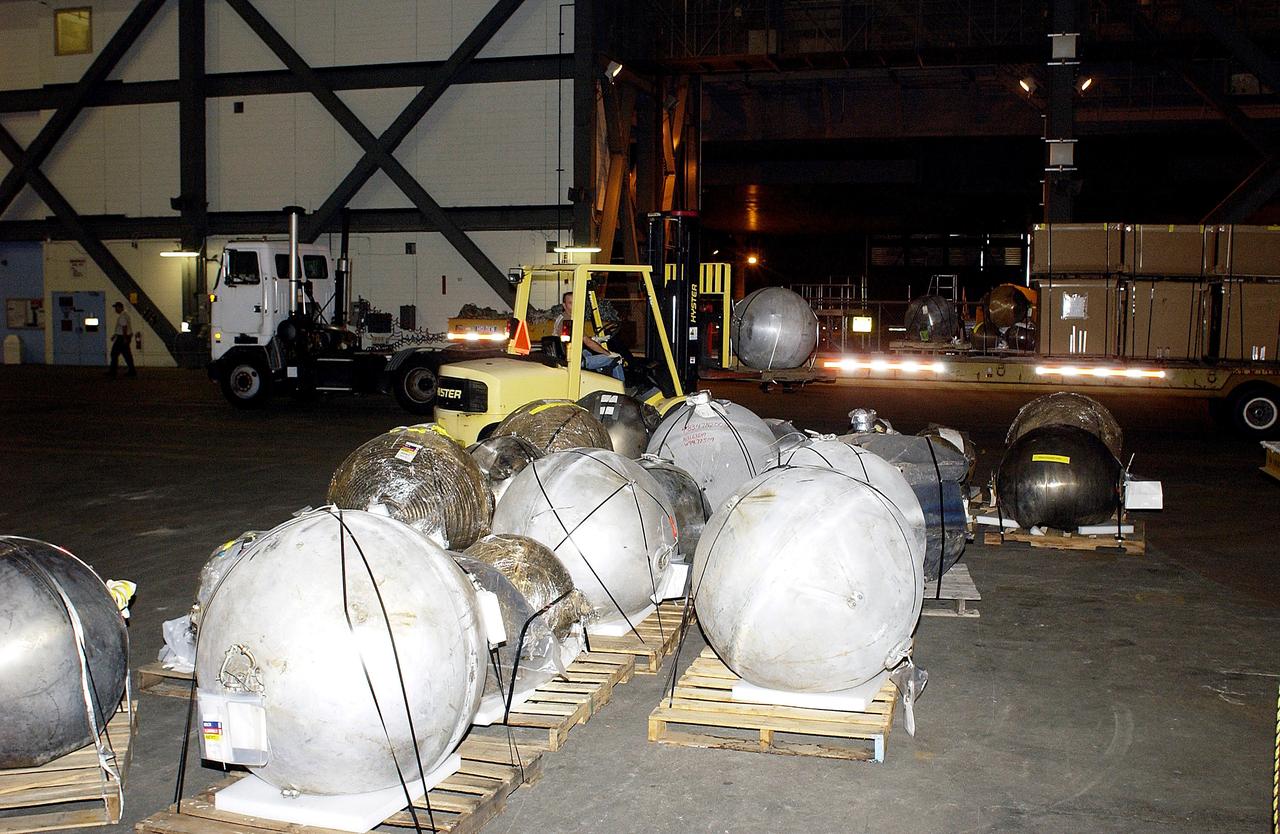
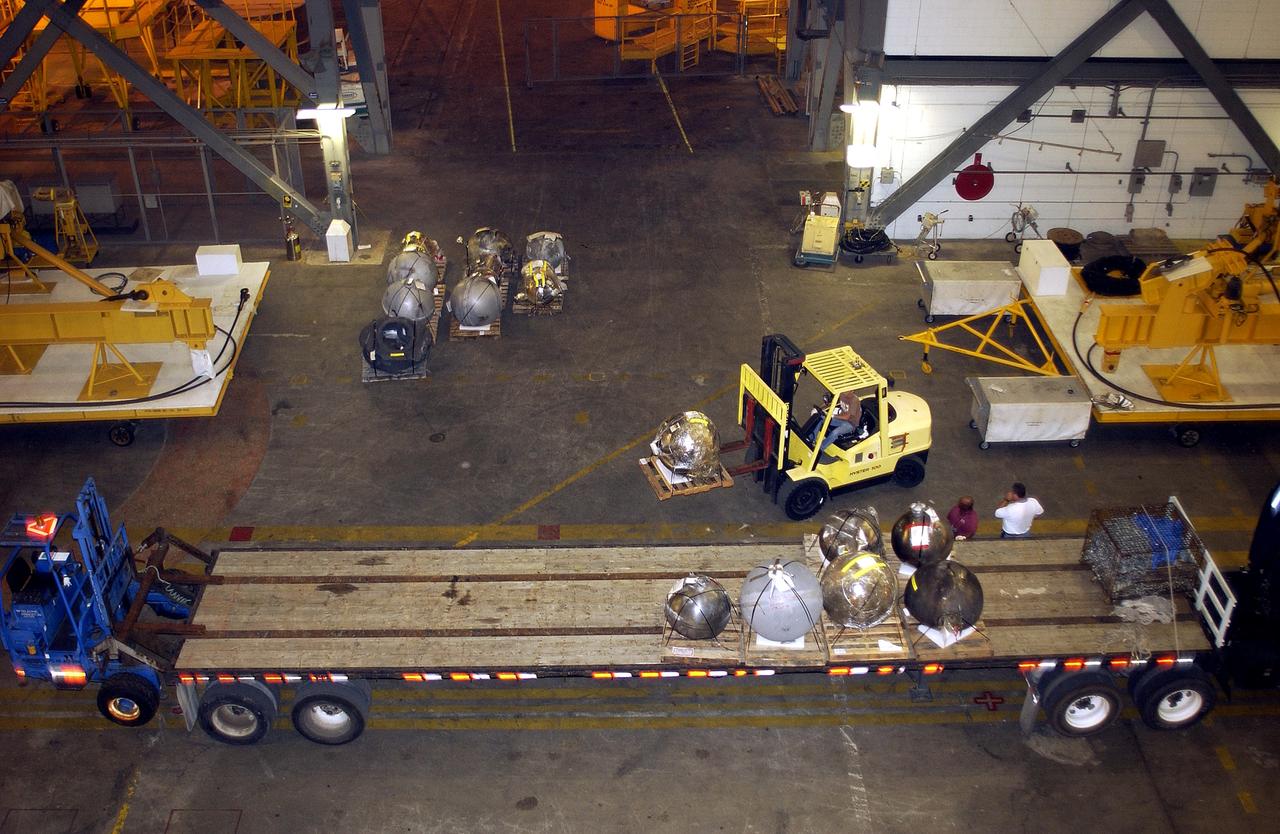
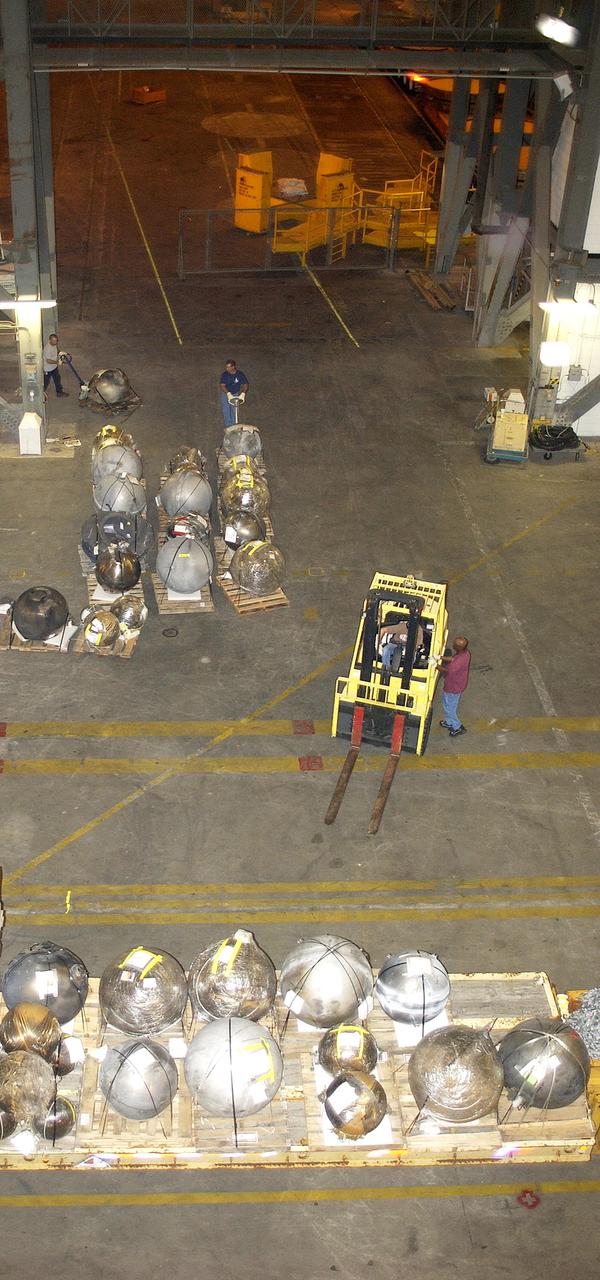
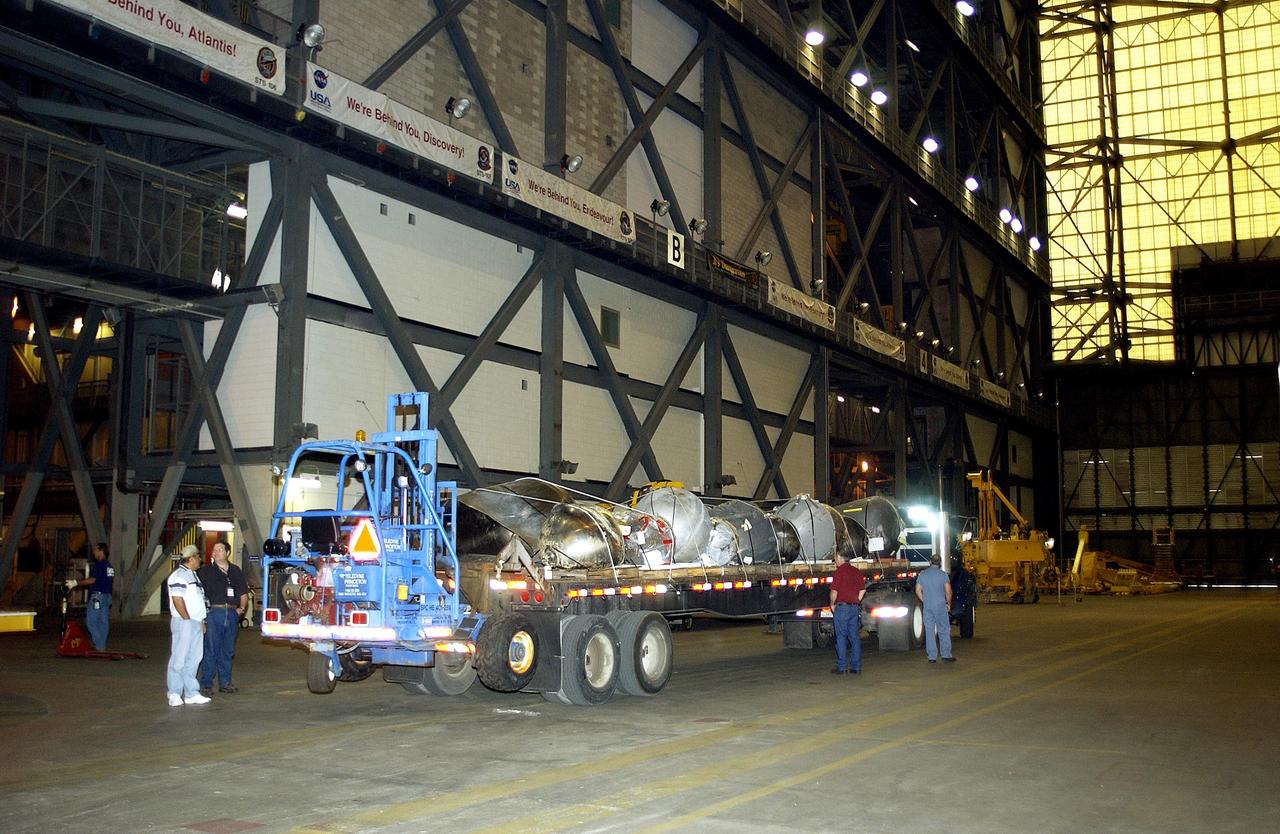
KENNEDY SPACE CENTER, FLA. -  Pieces of debris of Space Shuttle Columbia are offloaded from a flatbed truck in the transfer aisle of the Vehicle Assembly Building (VAB).  The debris is being moved from the Columbia Debris Hangar to the VAB for permanent storage.  More than 83,000 pieces of debris were shipped to KSC during search and recovery efforts in East Texas. That represents about 38 percent of the dry weight of Columbia, equaling almost 85,000 pounds.
KENNEDY SPACE CENTER, FLA. - Pieces of debris of Space Shuttle Columbia are offloaded from a flatbed truck in the transfer aisle of the Vehicle Assembly Building (VAB). The debris is being moved from the Columbia Debris Hangar to the VAB for permanent storage. More than 83,000 pieces of debris were shipped to KSC during search and recovery efforts in East Texas. That represents about 38 percent of the dry weight of Columbia, equaling almost 85,000 pounds.
KENNEDY SPACE CENTER, FLA. -  Pieces of debris of Space Shuttle Columbia are offloaded from a flatbed truck in the transfer aisle of the Vehicle Assembly Building (VAB).  The debris is being moved from the Columbia Debris Hangar to the VAB for permanent storage.  More than 83,000 pieces of debris were shipped to KSC during search and recovery efforts in East Texas. That represents about 38 percent of the dry weight of Columbia, equaling almost 85,000 pounds.
KENNEDY SPACE CENTER, FLA. - Pieces of debris of Space Shuttle Columbia are offloaded from a flatbed truck in the transfer aisle of the Vehicle Assembly Building (VAB). The debris is being moved from the Columbia Debris Hangar to the VAB for permanent storage. More than 83,000 pieces of debris were shipped to KSC during search and recovery efforts in East Texas. That represents about 38 percent of the dry weight of Columbia, equaling almost 85,000 pounds.
KENNEDY SPACE CENTER, FLA. -  Pieces of Columbia debris are offloaded from a flatbed truck in the transfer aisle of the Vehicle Assembly Building (VAB).  The debris is being moved from the Columbia Debris Hangar to the VAB for permanent storage.  More than 83,000 pieces of debris were shipped to KSC during search and recovery efforts in East Texas. That represents about 38 percent of the dry weight of Columbia, equaling almost 85,000 pounds.
KENNEDY SPACE CENTER, FLA. - Pieces of Columbia debris are offloaded from a flatbed truck in the transfer aisle of the Vehicle Assembly Building (VAB). The debris is being moved from the Columbia Debris Hangar to the VAB for permanent storage. More than 83,000 pieces of debris were shipped to KSC during search and recovery efforts in East Texas. That represents about 38 percent of the dry weight of Columbia, equaling almost 85,000 pounds.
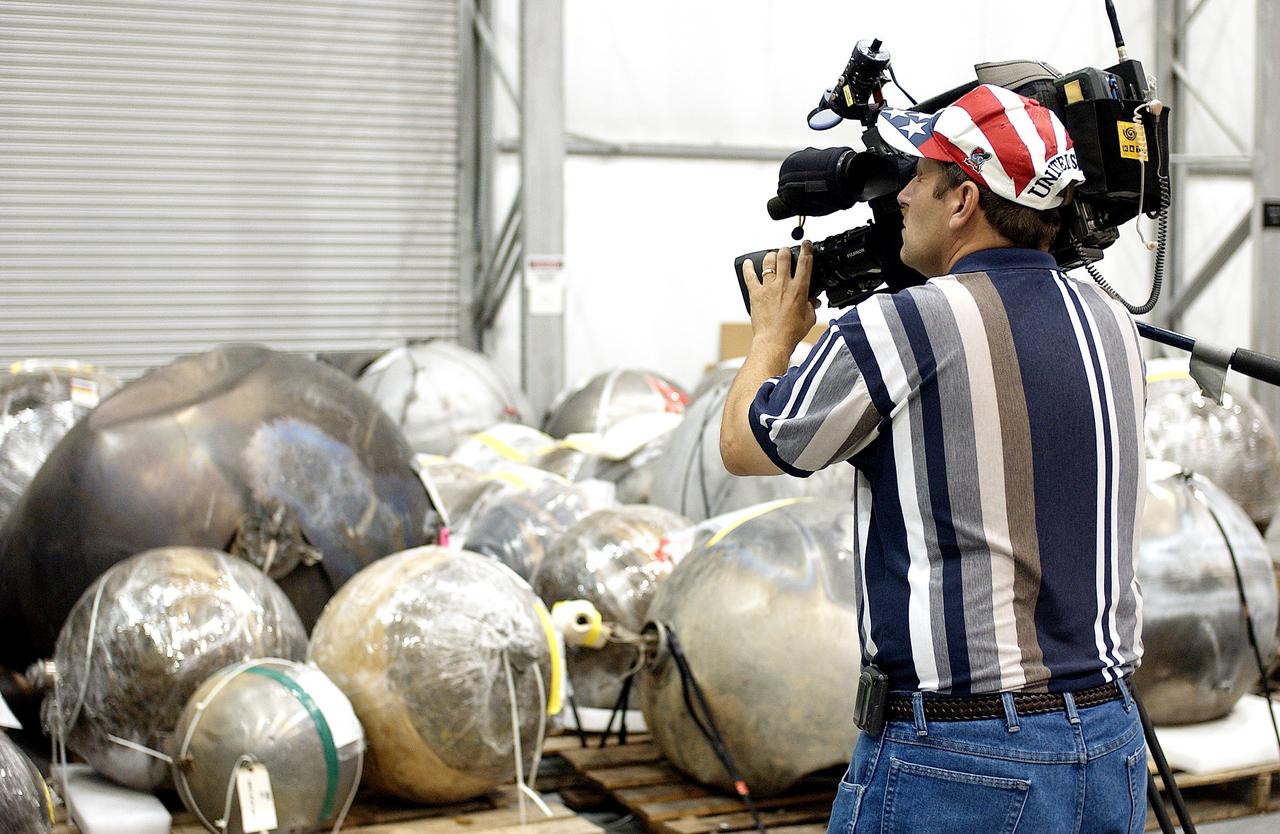
KENNEDY SPACE CENTER, FLA. - During a media tour of the Columbia Debris Hangar, a video cameraman records some of the debris collected from search and recovery efforts in East Texas. About 83,000 pieces of debris from Columbia were shipped to KSC, which represents about 38 percent of the dry weight of Columbia, equaling almost 85,000 pounds.  The debris is being packaged for storage in an area of the Vehicle Assembly Building.
KENNEDY SPACE CENTER, FLA. - During a media tour of the Columbia Debris Hangar, a video cameraman records some of the debris collected from search and recovery efforts in East Texas. About 83,000 pieces of debris from Columbia were shipped to KSC, which represents about 38 percent of the dry weight of Columbia, equaling almost 85,000 pounds. The debris is being packaged for storage in an area of the Vehicle Assembly Building.
KENNEDY SPACE CENTER, FLA. -  In the Columbia Debris Hangar,  Don Eitel (in front) and Jim Delie carry pieces of debris to be packed into storage boxes.  About 83,000 pieces of debris were shipped to KSC during search and recovery efforts in East Texas. That represents about 38 percent of the dry weight of Columbia, equaling almost 85,000 pounds.  An area of the Vehicle Assembly Building is being prepared to store the debris.
KENNEDY SPACE CENTER, FLA. - In the Columbia Debris Hangar, Don Eitel (in front) and Jim Delie carry pieces of debris to be packed into storage boxes. About 83,000 pieces of debris were shipped to KSC during search and recovery efforts in East Texas. That represents about 38 percent of the dry weight of Columbia, equaling almost 85,000 pounds. An area of the Vehicle Assembly Building is being prepared to store the debris.
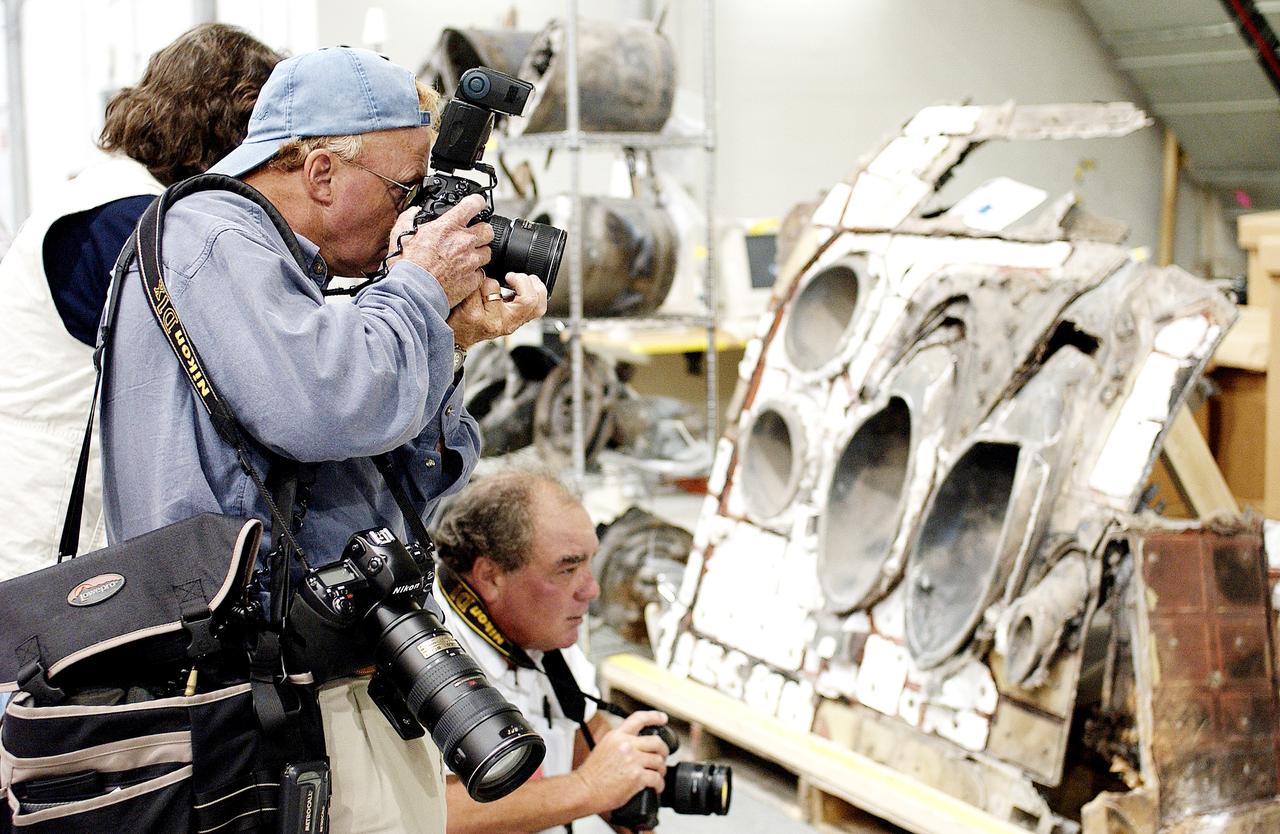
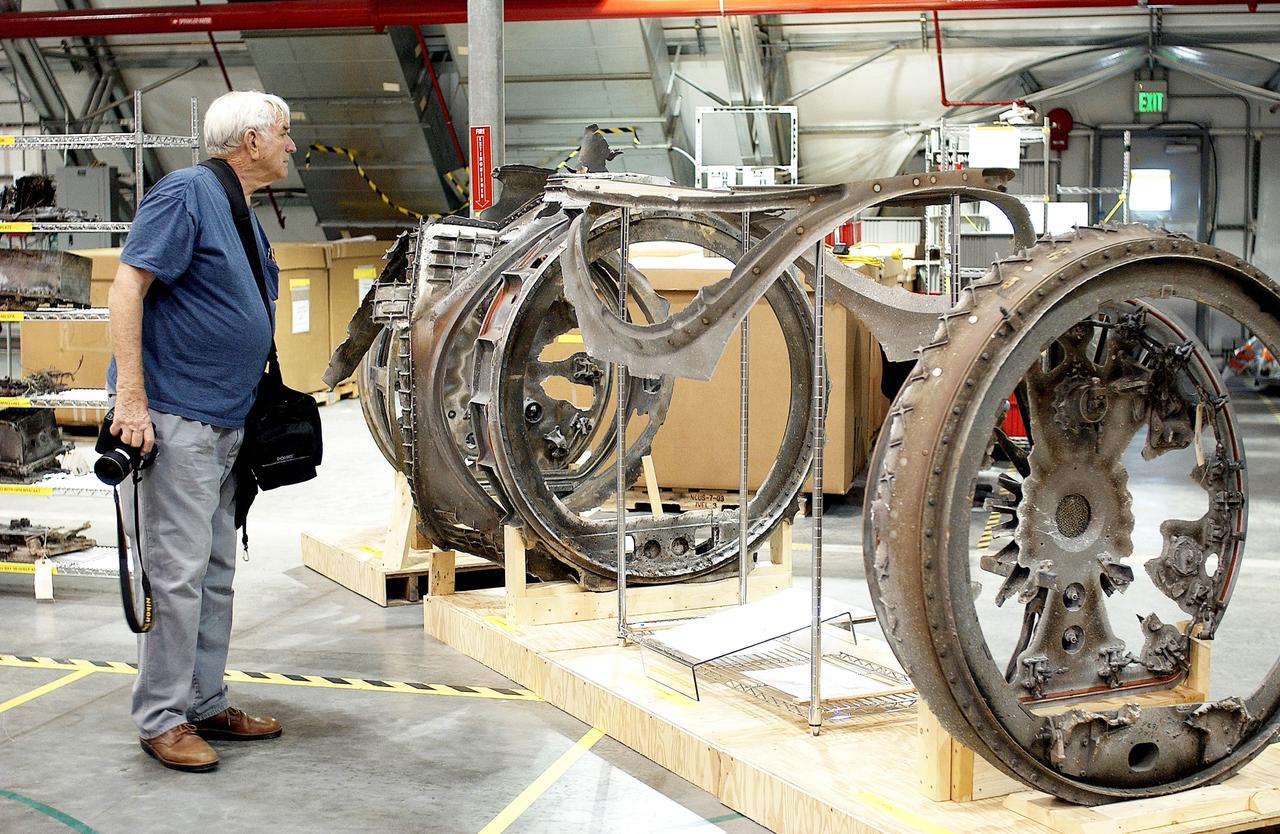
KENNEDY SPACE CENTER, FLA. - During a media tour of the Columbia Debris Hangar, a photographer examines some of the debris collected from search and recovery efforts in East Texas. About 83,000 pieces of debris from Columbia were shipped to KSC, which represents about 38 percent of the dry weight of Columbia, equaling almost 85,000 pounds.  The debris is being packaged for storage in an area of the Vehicle Assembly Building.
KENNEDY SPACE CENTER, FLA. - During a media tour of the Columbia Debris Hangar, a photographer examines some of the debris collected from search and recovery efforts in East Texas. About 83,000 pieces of debris from Columbia were shipped to KSC, which represents about 38 percent of the dry weight of Columbia, equaling almost 85,000 pounds. The debris is being packaged for storage in an area of the Vehicle Assembly Building.
KENNEDY SPACE CENTER, FLA. - In the Columbia Debris Hangar, Jack Nowling transfers bags with debris pieces into a storage box.  About 83,000 pieces of debris were shipped to KSC during search and recovery efforts in East Texas. That represents about 38 percent of the dry weight of Columbia, equaling almost 85,000 pounds.  An area of the Vehicle Assembly Building is being prepared to store the debris.
KENNEDY SPACE CENTER, FLA. - In the Columbia Debris Hangar, Jack Nowling transfers bags with debris pieces into a storage box. About 83,000 pieces of debris were shipped to KSC during search and recovery efforts in East Texas. That represents about 38 percent of the dry weight of Columbia, equaling almost 85,000 pounds. An area of the Vehicle Assembly Building is being prepared to store the debris.
KENNEDY SPACE CENTER, FLA. -  In the Columbia Debris Hangar, Larry Tarver (left) and Don Eitel bag and wrap pieces of debris to be packed into storage boxes.  About 83,000 pieces of debris were shipped to KSC during search and recovery efforts in East Texas. That represents about 38 percent of the dry weight of Columbia, equaling almost 85,000 pounds.  An area of the Vehicle Assembly Building is being prepared to store the debris.
KENNEDY SPACE CENTER, FLA. - In the Columbia Debris Hangar, Larry Tarver (left) and Don Eitel bag and wrap pieces of debris to be packed into storage boxes. About 83,000 pieces of debris were shipped to KSC during search and recovery efforts in East Texas. That represents about 38 percent of the dry weight of Columbia, equaling almost 85,000 pounds. An area of the Vehicle Assembly Building is being prepared to store the debris.
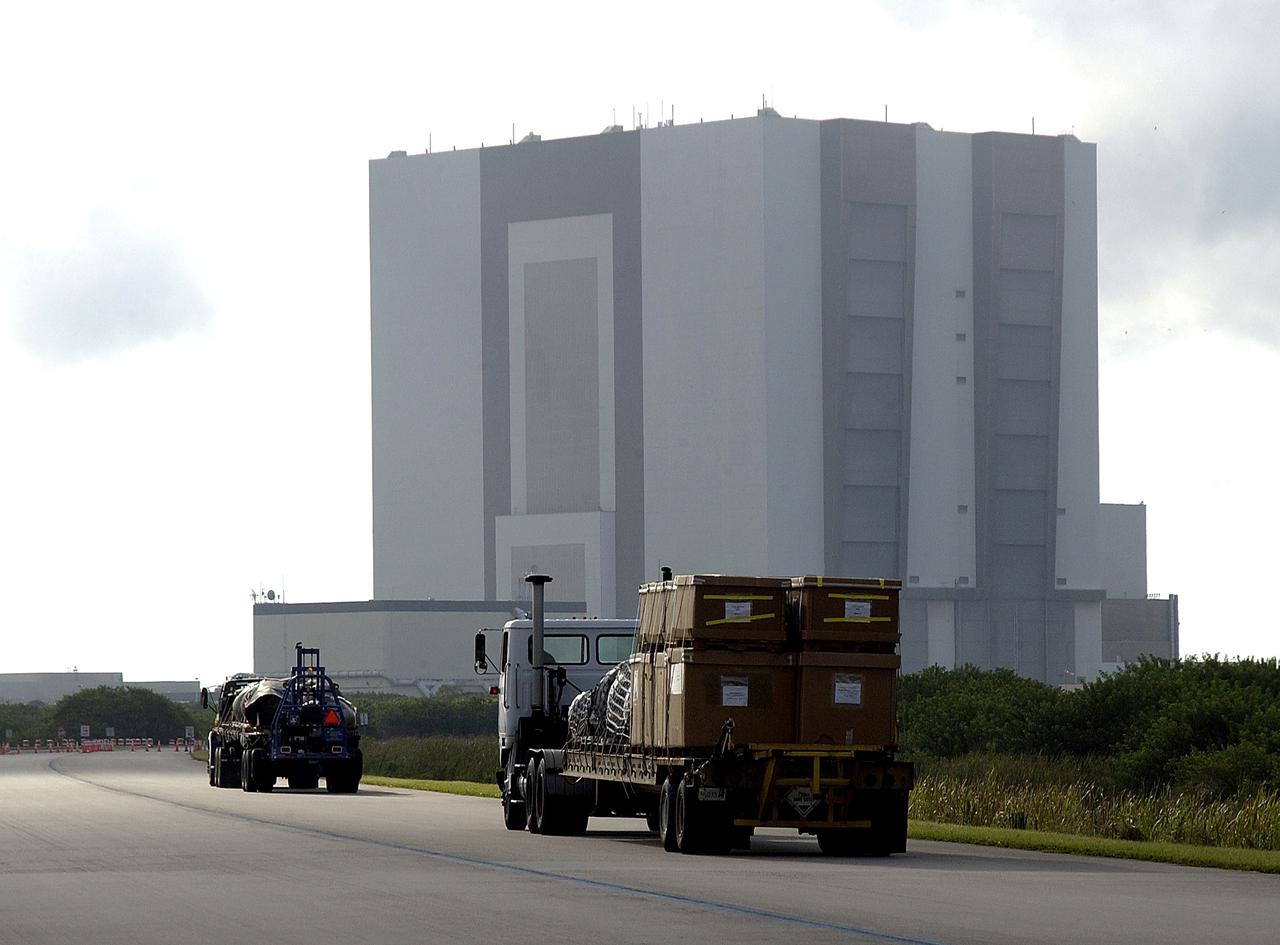
KENNEDY SPACE CENTER, FLA. -  Flatbed trucks carrying some of the debris of Space Shuttle Columbia approach the Vehicle Assembly Building (VAB).  The debris is being transferred from the Columbia Debris Hangar to the VAB for permanent storage.  More than 83,000 pieces of debris were shipped to KSC during search and recovery efforts in East Texas. That represents about 38 percent of the dry weight of Columbia, equaling almost 85,000 pounds.
KENNEDY SPACE CENTER, FLA. - Flatbed trucks carrying some of the debris of Space Shuttle Columbia approach the Vehicle Assembly Building (VAB). The debris is being transferred from the Columbia Debris Hangar to the VAB for permanent storage. More than 83,000 pieces of debris were shipped to KSC during search and recovery efforts in East Texas. That represents about 38 percent of the dry weight of Columbia, equaling almost 85,000 pounds.
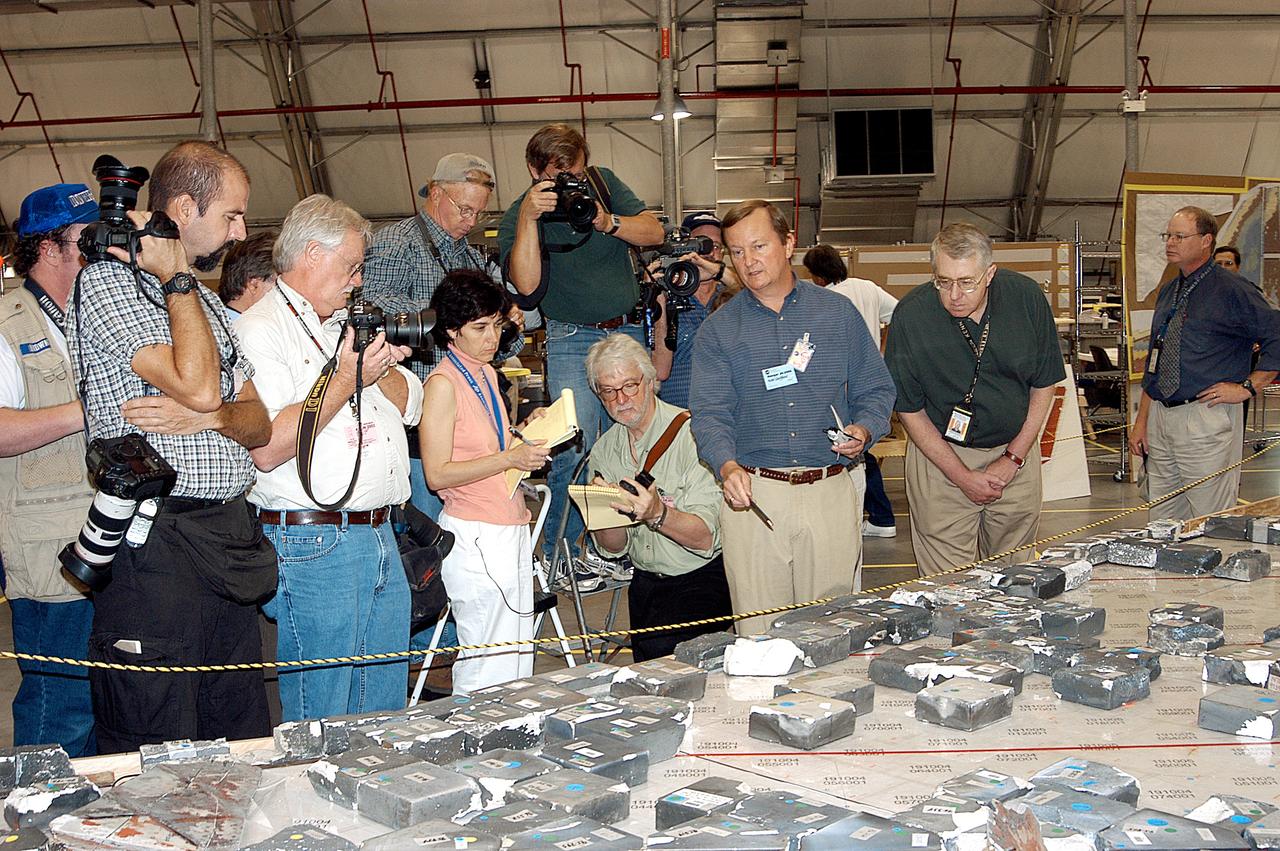
KENNEDY SPACE CENTER, FLA. - During a media tour of the Columbia Debris Hangar, photographers focus on a piece of the debris collected from search and recovery efforts in East Texas. About 83,000 pieces of debris from Columbia were shipped to KSC, which represents about 38 percent of the dry weight of Columbia, equaling almost 85,000 pounds.  The debris is being packaged for storage in an area of the Vehicle Assembly Building.
KENNEDY SPACE CENTER, FLA. - During a media tour of the Columbia Debris Hangar, photographers focus on a piece of the debris collected from search and recovery efforts in East Texas. About 83,000 pieces of debris from Columbia were shipped to KSC, which represents about 38 percent of the dry weight of Columbia, equaling almost 85,000 pounds. The debris is being packaged for storage in an area of the Vehicle Assembly Building.
KENNEDY SPACE CENTER, FLA. - The media listen to Scott Thurston, NASA vehicle flow manager, talk about efforts to pack the debris stored in the Columbia Debris Hangar.  More than 83,000  pieces of debris were shipped to KSC during search and recovery efforts in East Texas. That represents about 38 percent of the dry weight of Columbia, equaling almost 85,000 pounds. An area of the Vehicle Assembly Building is being prepared to store the debris permanently.
KENNEDY SPACE CENTER, FLA. - The media listen to Scott Thurston, NASA vehicle flow manager, talk about efforts to pack the debris stored in the Columbia Debris Hangar. More than 83,000 pieces of debris were shipped to KSC during search and recovery efforts in East Texas. That represents about 38 percent of the dry weight of Columbia, equaling almost 85,000 pounds. An area of the Vehicle Assembly Building is being prepared to store the debris permanently.
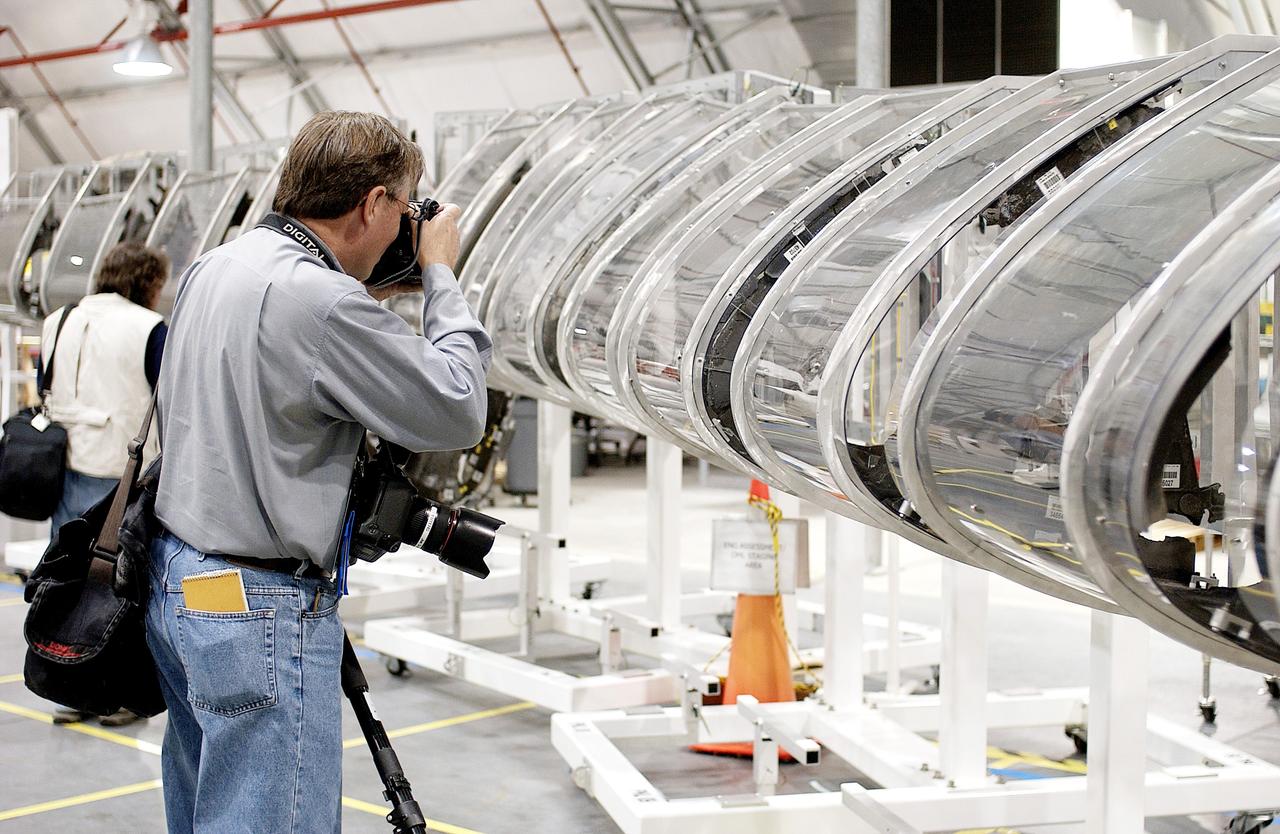
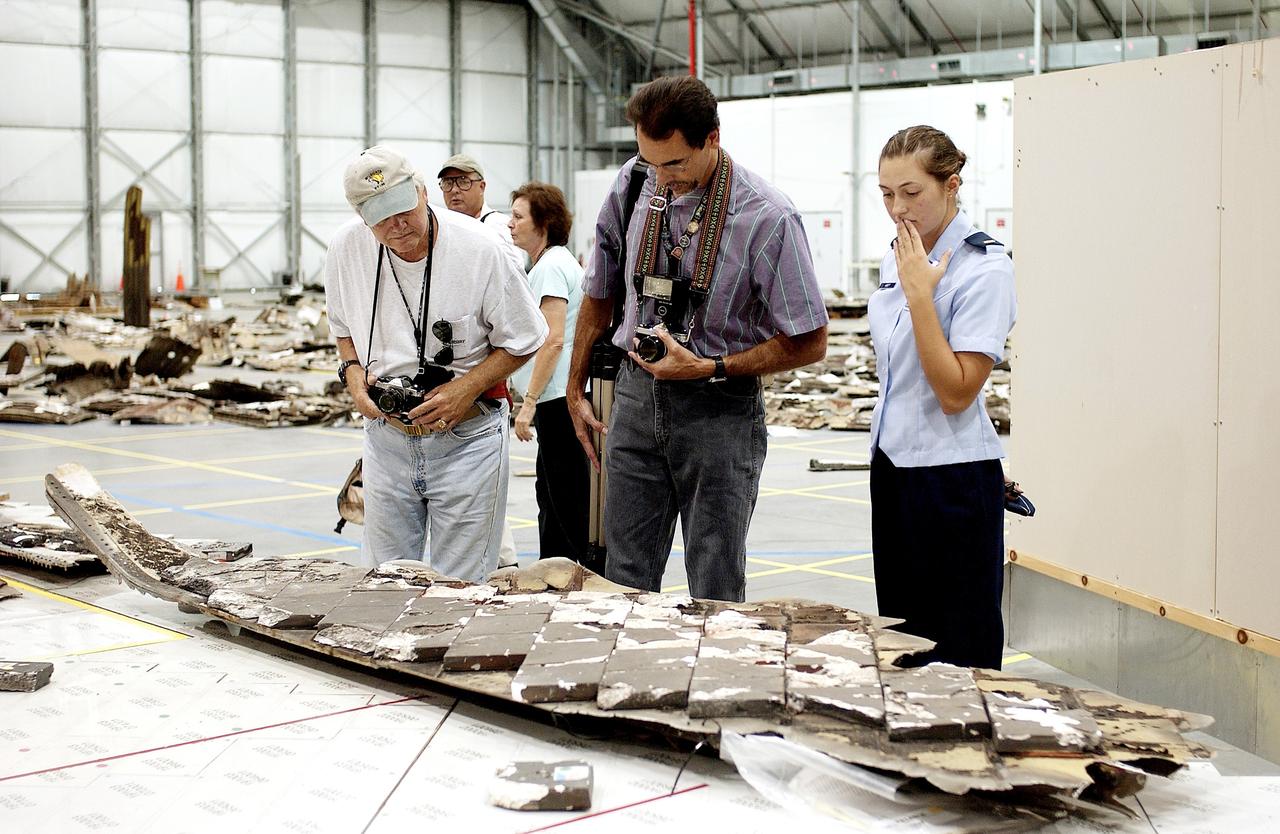
KENNEDY SPACE CENTER, FLA. - During a media tour of the Columbia Debris Hangar, a photographer gets a close-up of the mockup of the leading edge of Columbia’s left wing.  About 83,000 pieces of debris were shipped to KSC from search and recovery efforts in East Texas.  About 83,000 pieces of debris from Columbia were shipped to KSC, which represents about 38 percent of the dry weight of Columbia, equaling almost 85,000 pounds.  The debris is being packaged for storage in an area of the Vehicle Assembly Building.
KENNEDY SPACE CENTER, FLA. - During a media tour of the Columbia Debris Hangar, a photographer gets a close-up of the mockup of the leading edge of Columbia’s left wing. About 83,000 pieces of debris were shipped to KSC from search and recovery efforts in East Texas. About 83,000 pieces of debris from Columbia were shipped to KSC, which represents about 38 percent of the dry weight of Columbia, equaling almost 85,000 pounds. The debris is being packaged for storage in an area of the Vehicle Assembly Building.
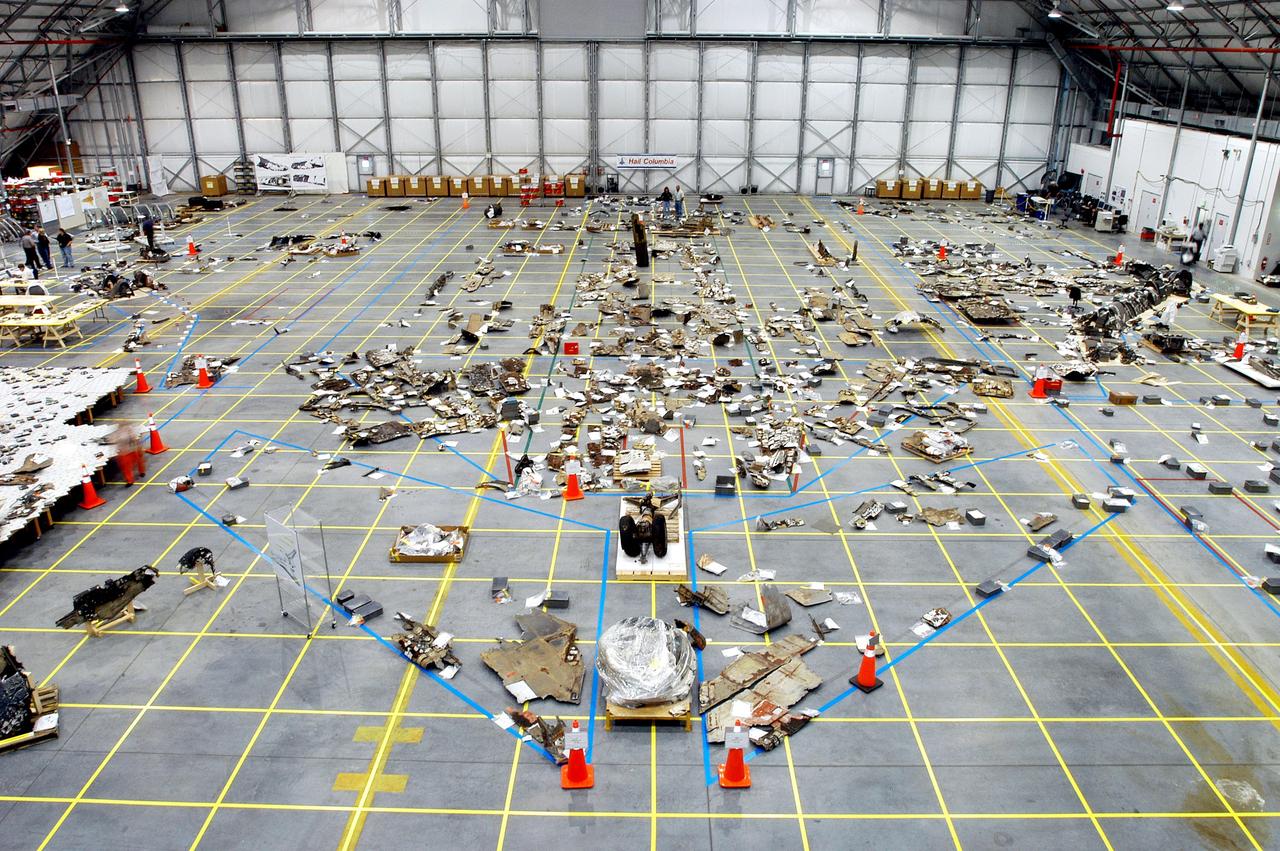
KENNEDY SPACE CENTER, FLA. - An overview of the Columbia debris hangar shows the orbiter outline on the floor with some of the 78,760 pieces identified to date.  More than 82,500 pieces of shuttle debris have been rcovered.
KENNEDY SPACE CENTER, FLA. - An overview of the Columbia debris hangar shows the orbiter outline on the floor with some of the 78,760 pieces identified to date. More than 82,500 pieces of shuttle debris have been rcovered.
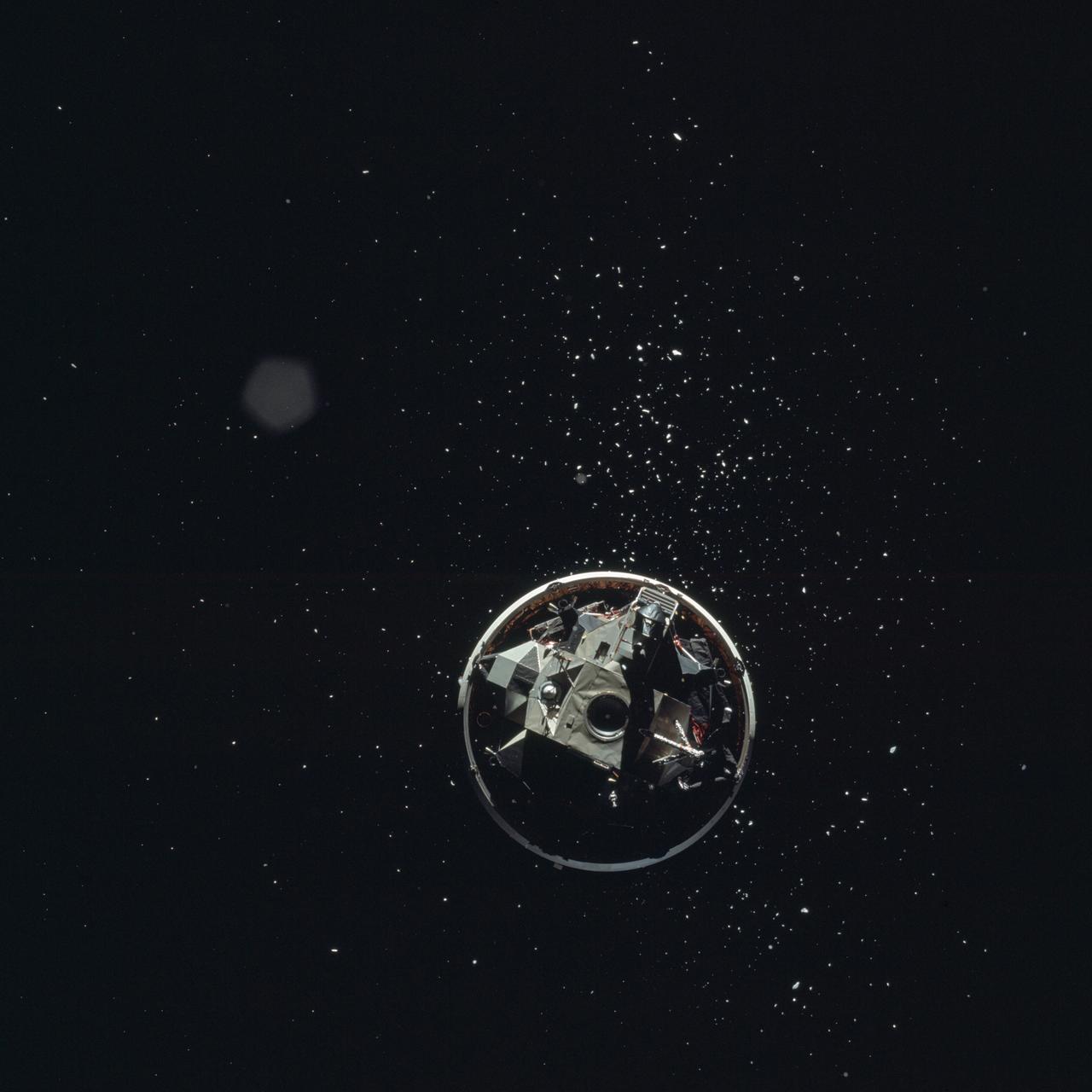
AS17-148-22688 (7-19 Dec. 1972) --- View of the Lunar Module from the Apollo 17 spacecraft after transposition/docking maneuvers. The white dots surrounding the Lunar Module are debris from the Saturn S-IVB stage separation.
View Lunar Module from the Apollo 17 spacecraft during transposition/docking
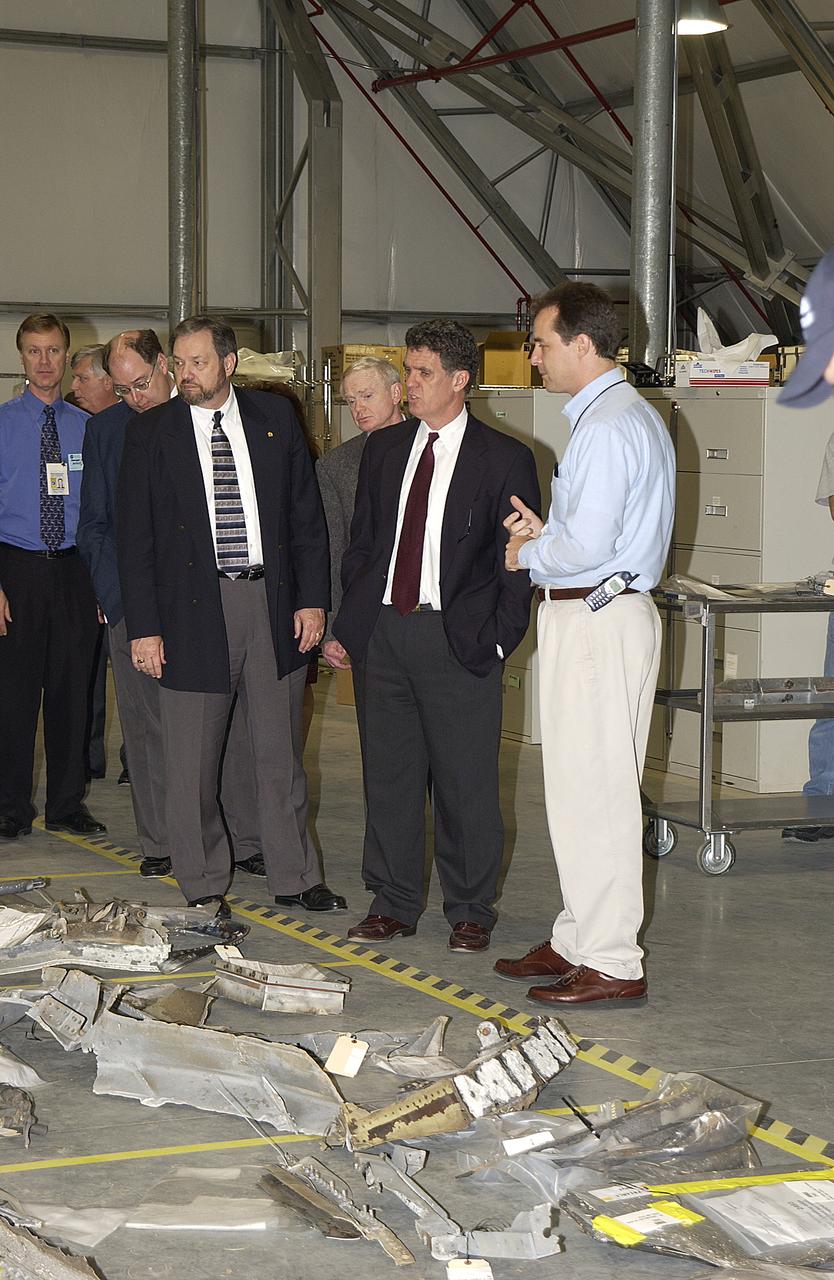
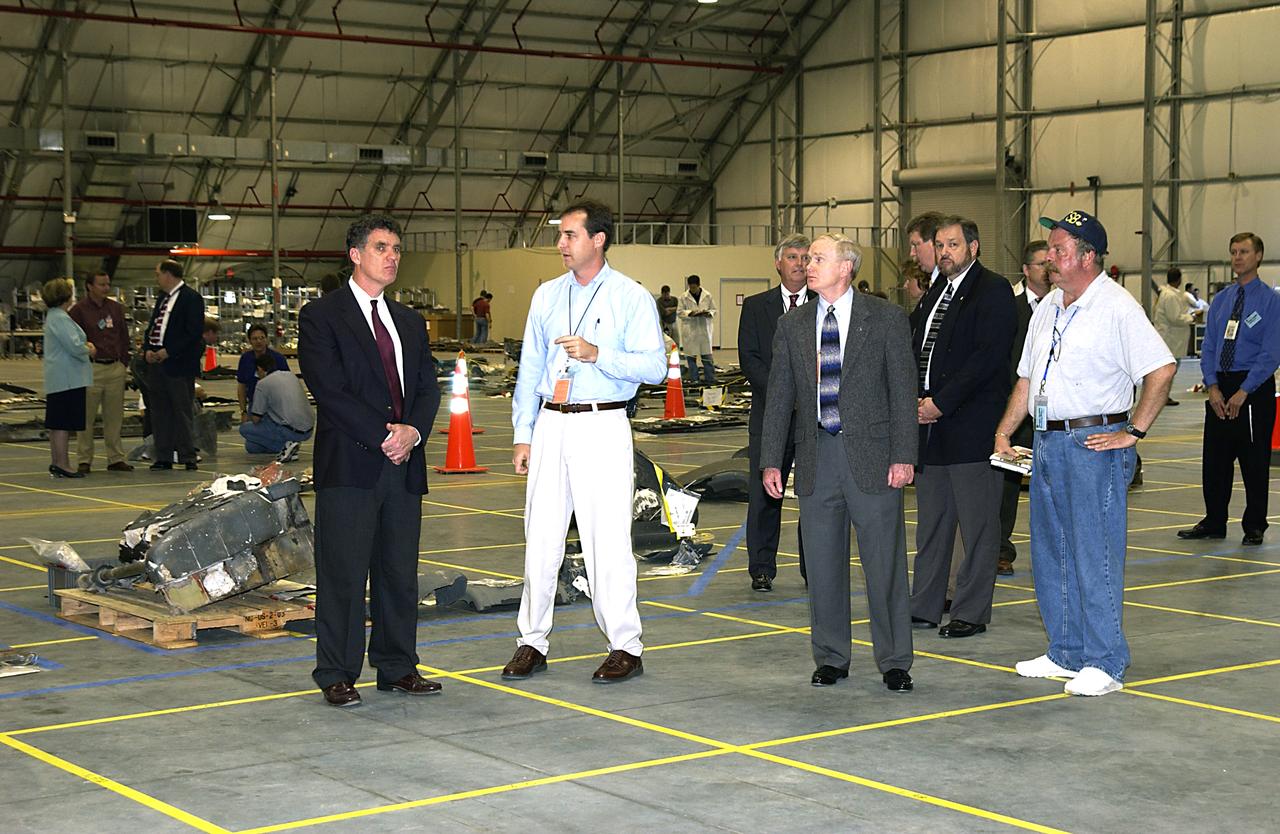
Congressman Dave Weldon (second from right) looks over the pieces of Columbia debris stored in the RLV Hangar. At right is Steve Altemus, Space Shuttle test director . Accompanying Weldon are (left toright) Greg Katnick, Grant Case, J.B. Kump and Center Director Roy Bridges. Workers will attempt to reconstruct the orbiter as part of the ongoing investigation of the accident that destroyed the Columbia and claimed the lives of seven astronauts as they returned to Earth after a 16-day research mission, STS-107.
Columbia Debris - Congressman Dave Weldon
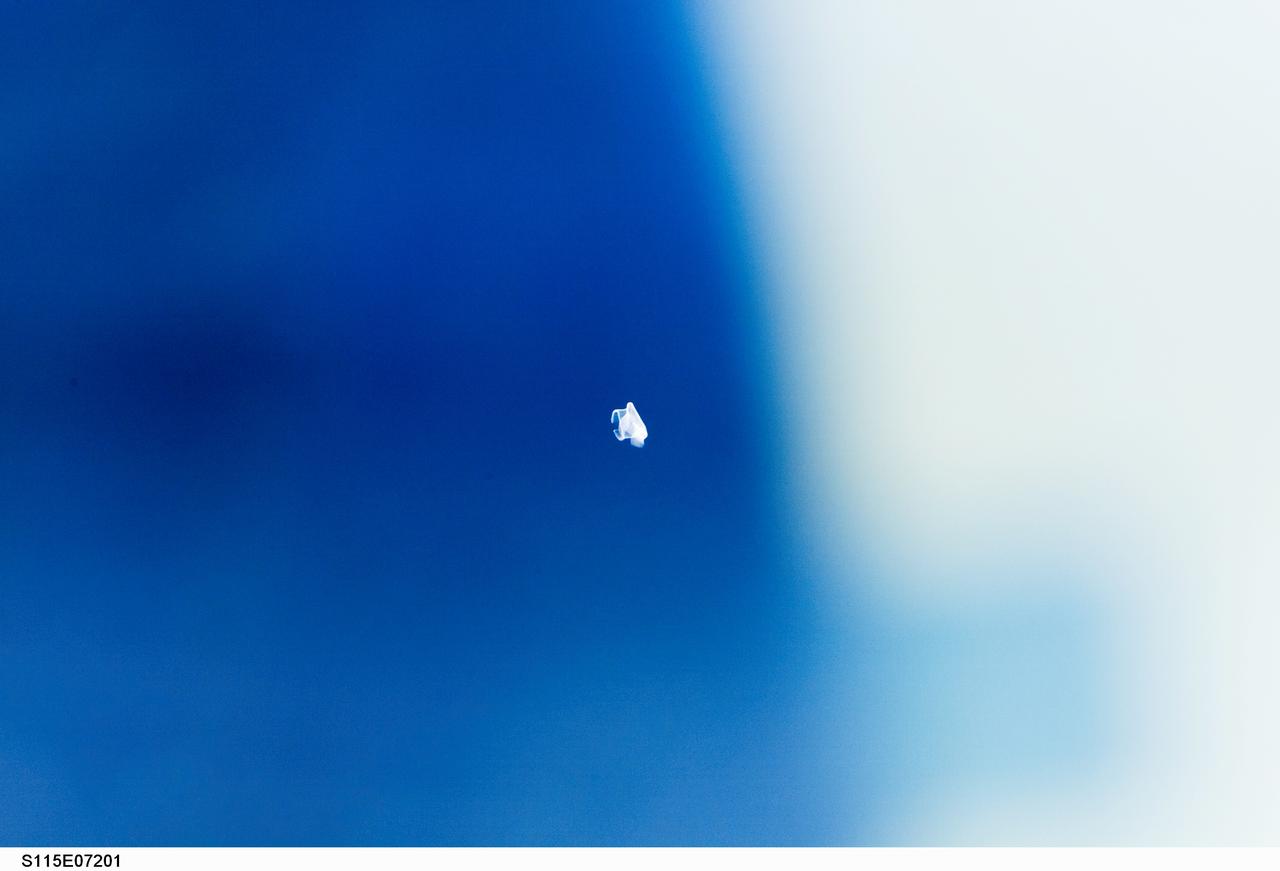
S115-E-07201 (19 Sept. 2006) --- This picture of unidentified possible small debris was recorded with a digital still camera by astronaut Daniel Burbank onboard the Space Shuttle Atlantis around 11 a.m. (CDT) today.  Engineers do not believe this to be the same object seen in video taken by shuttle TV cameras earlier in the day.
Unidentified small debris taken by STS-115 crewmember
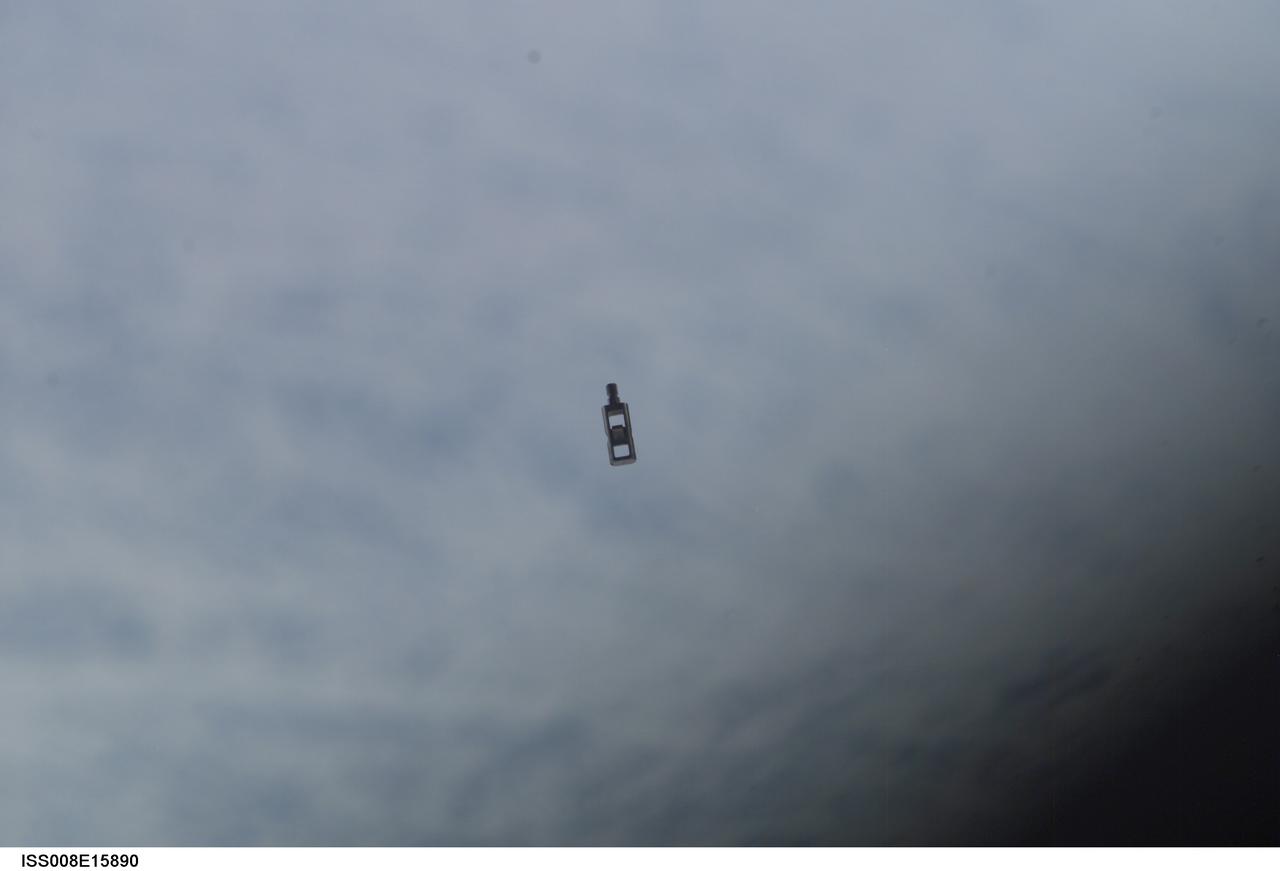
ISS008-E-15890 (15 February 2004) --- This image was taken from the International Space Station (ISS) Feb 15 and shows a small piece of debris reported by the Expedition 8 crew. The debris, which has been identified as a two-inch "eyebolt" from a solar array on the Progress cargo craft that recently docked with the Station, drifted slowly away and posed no problems for the complex. The eyebolt is from a system that is used with the arrays during the Progress' launch and serves no function after the arrays are deployed in orbit.
View of an eyebolt seen as foreign object debris (FOD) during Expedition 8
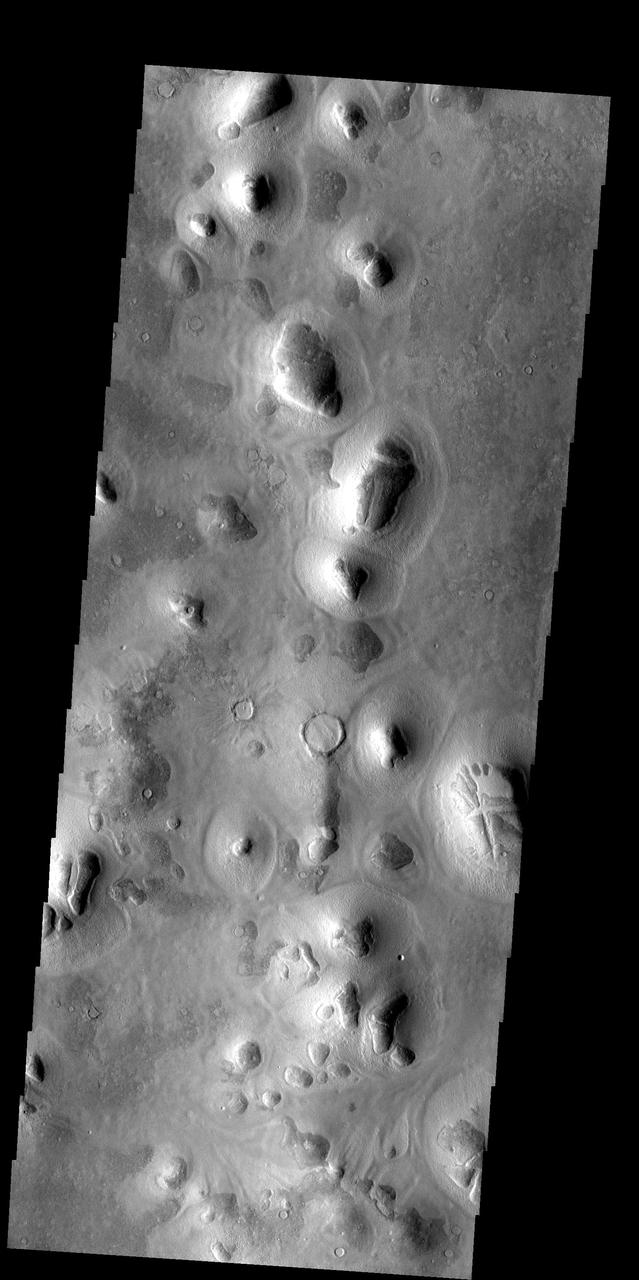
These small hills and surrounding debris aprons are called Phlegra Montes
Phlegra Montes
This not-to-scale artist's concept depicts a cutaway view of Mars' interior, revealing the crust, mantle, and core. Debris from ancient impacts lies scattered in the mantle in the form of lumps that are as large as 2.5 miles (4 kilometers) across, data from NASA's InSight Mars lander shows. On the Martian surface at left, a meteoroid impact sends seismic signals (shown as curving concentric lines) through the planet; InSight is depicted at right.  InSight placed the first seismometer on Mars' surface in 2018. The extremely sensitive instrument recorded 1,319 marsquakes before the lander ran out of power in 2022, the result of dust caked on its solar panels. Quakes produce seismic waves that change as they pass through different kinds of material, providing scientists with a way to study the interior of a planetary body. To date, the InSight team has measured the size, depth, and composition of Mars' crust, mantle, and core.  The impact debris in the Martian mantle offers a geologic record that could be preserved only on worlds like Mars, whose lack of tectonic plates has kept its interior from being churned up the way Earth's is through a process known as convection.  https://photojournal.jpl.nasa.gov/catalog/PIA26636
Impactor Debris Scattered Within Mars' Mantle (Artist's Concept)
In the RLV Hangar, Congressman Dave Weldon (left) listens to Steve Altemus, Space Shuttle test director. Weldon is visiting the site where pieces of Columbia debris are being examined and stored. Third from left is Center Director Roy Bridges. Workers will attempt to reconstruct the orbiter as part of the ongoing investigation of the accident that destroyed the Columbia and claimed the lives of seven astronauts as they returned to Earth after a 16-day research mission, STS-107.
STS-107 - Congressman Dave Weldon examines debris
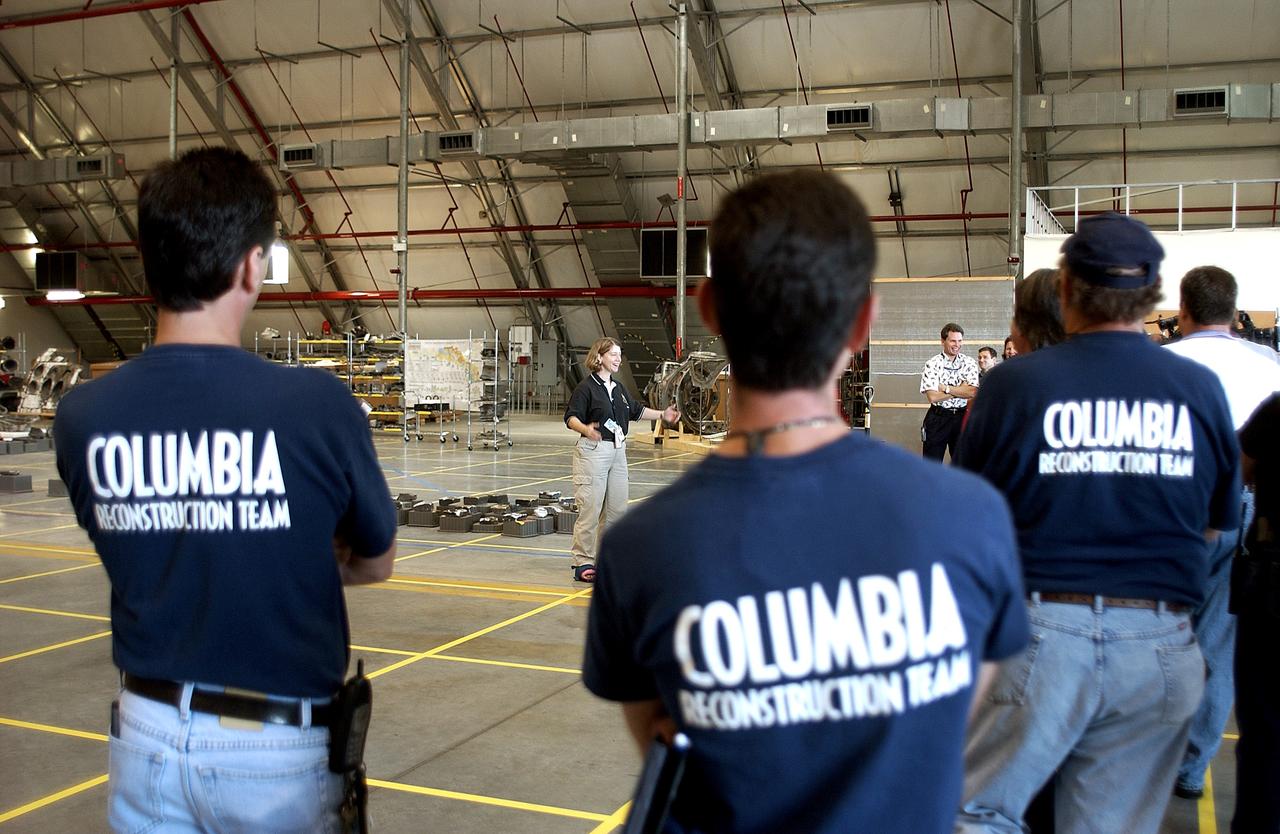
KENNEDY SPACE CENTER, FLA. -  Jim Comer, United Space Alliance project leader for Columbia reconstruction, speaks to members of the Columbia Reconstruction Team during transfer of debris from the Columbia Debris Hangar to its permanent storage site in the Vehicle Assembly Building.  More than 83,000 pieces of debris were shipped to KSC during search and recovery efforts in East Texas. That represents about 38 percent of the dry weight of Columbia, equaling almost 85,000 pounds.
KENNEDY SPACE CENTER, FLA. - Jim Comer, United Space Alliance project leader for Columbia reconstruction, speaks to members of the Columbia Reconstruction Team during transfer of debris from the Columbia Debris Hangar to its permanent storage site in the Vehicle Assembly Building. More than 83,000 pieces of debris were shipped to KSC during search and recovery efforts in East Texas. That represents about 38 percent of the dry weight of Columbia, equaling almost 85,000 pounds.
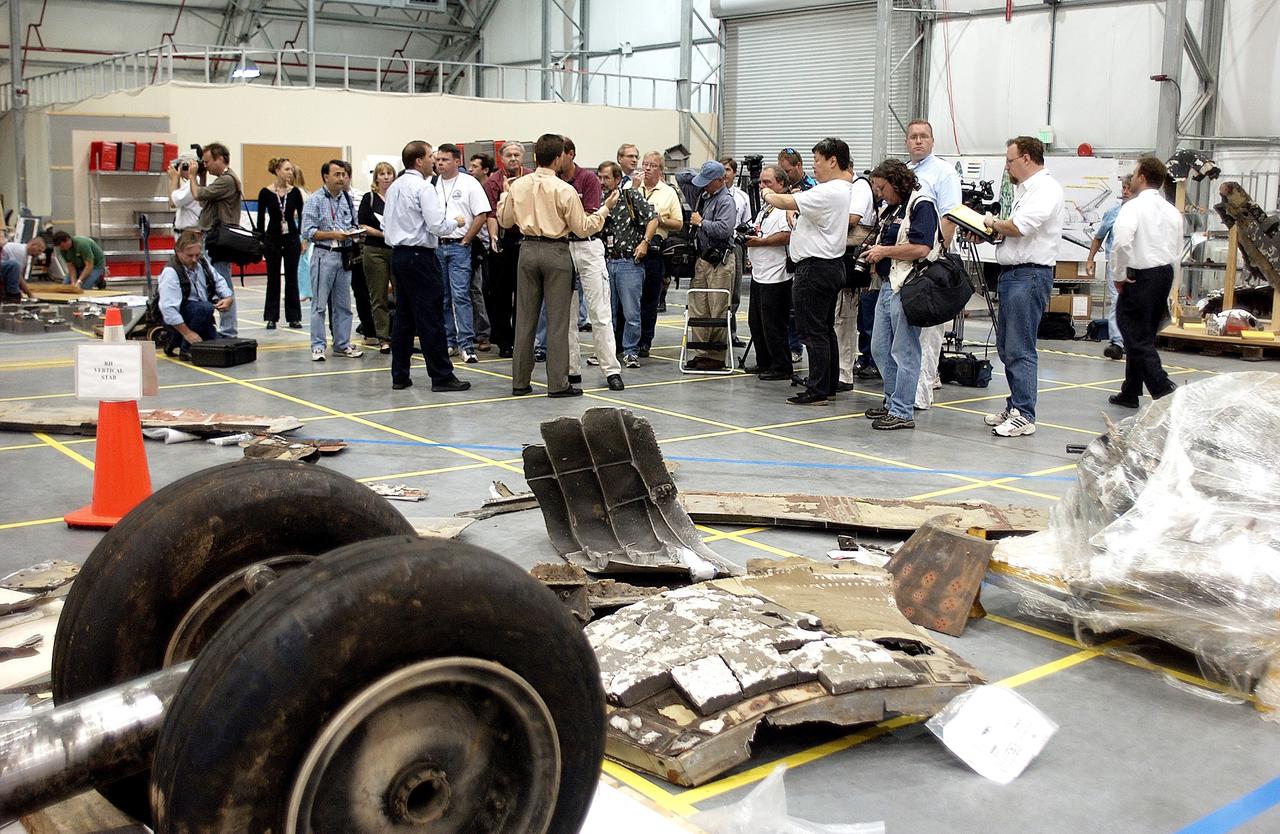
KENNEDY SPACE CENTER, FLA. - In the Columbia Debris Hangar,  Shuttle Launch Director Mike Leinbach  points to some of the tiles recovered from the orbiter as he explains to the media about activities that have taken place since the Columbia accident on Feb. 1, 2003.  STS-107 debris recovery and reconstruction operations are winding down.  To date, nearly 84,000 pieces of debris have been recovered and sent to KSC. That represents about 38 percent of the dry weight of Columbia, equaling almost 85,000 pounds.
KENNEDY SPACE CENTER, FLA. - In the Columbia Debris Hangar, Shuttle Launch Director Mike Leinbach points to some of the tiles recovered from the orbiter as he explains to the media about activities that have taken place since the Columbia accident on Feb. 1, 2003. STS-107 debris recovery and reconstruction operations are winding down. To date, nearly 84,000 pieces of debris have been recovered and sent to KSC. That represents about 38 percent of the dry weight of Columbia, equaling almost 85,000 pounds.
KENNEDY SPACE CENTER, FLA. - During a media tour of the Columbia Debris Hangar, photographers look at pieces of tile collected during search and recovery efforts in East Texas.  About 83,000 pieces of debris from Columbia were shipped to KSC, which represents about 38 percent of the dry weight of Columbia, equaling almost 85,000 pounds.  The debris is being packaged for storage in an area of the Vehicle Assembly Building.
KENNEDY SPACE CENTER, FLA. - During a media tour of the Columbia Debris Hangar, photographers look at pieces of tile collected during search and recovery efforts in East Texas. About 83,000 pieces of debris from Columbia were shipped to KSC, which represents about 38 percent of the dry weight of Columbia, equaling almost 85,000 pounds. The debris is being packaged for storage in an area of the Vehicle Assembly Building.
KENNEDY SPACE CENTER, FLA. - James Harrison (left), Jack Nowling (center) and Amy Norris (right) pack up some of the debris stored in the Columbia Debris Hangar.  About 83,000 pieces were shipped to KSC during search and recovery efforts in East Texas. An area of the Vehicle Assembly Building is being prepared to store the debris.
KENNEDY SPACE CENTER, FLA. - James Harrison (left), Jack Nowling (center) and Amy Norris (right) pack up some of the debris stored in the Columbia Debris Hangar. About 83,000 pieces were shipped to KSC during search and recovery efforts in East Texas. An area of the Vehicle Assembly Building is being prepared to store the debris.
KENNEDY SPACE CENTER, FLA. - In the Columbia Debris Hangar,  Shuttle Launch Director Mike Leinbach  (right) talks to the media about activities that have taken place since the Columbia accident on Feb. 1, 2003.  STS-107 debris recovery and reconstruction operations are winding down.  To date, nearly 84,000 pieces of debris have been recovered and sent to KSC. That represents about 38 percent of the dry weight of Columbia, equaling almost 85,000 pounds.
KENNEDY SPACE CENTER, FLA. - In the Columbia Debris Hangar, Shuttle Launch Director Mike Leinbach (right) talks to the media about activities that have taken place since the Columbia accident on Feb. 1, 2003. STS-107 debris recovery and reconstruction operations are winding down. To date, nearly 84,000 pieces of debris have been recovered and sent to KSC. That represents about 38 percent of the dry weight of Columbia, equaling almost 85,000 pounds.
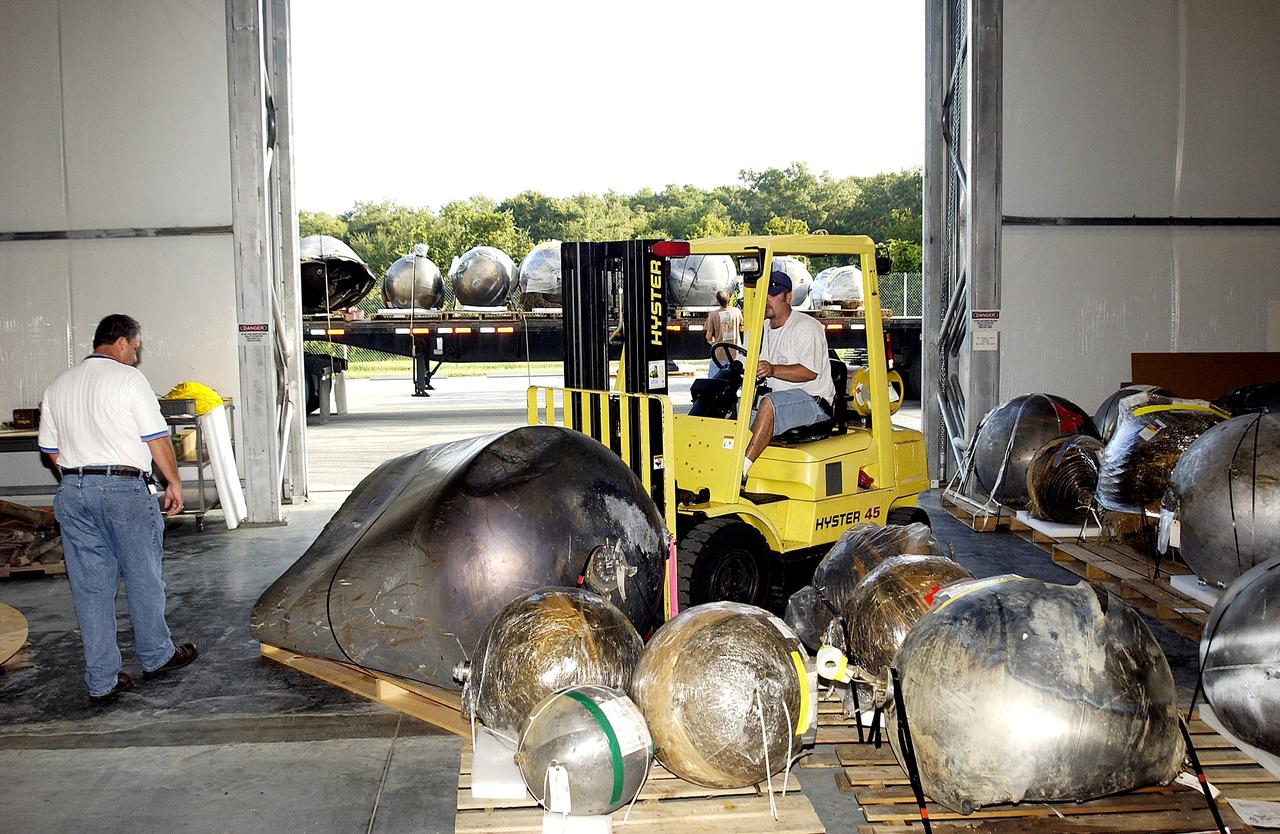
KENNEDY SPACE CENTER, FLA. -  At the Columbia Debris Hangar, some of the debris of Space Shuttle Columbia is moved onto a flatbed truck for transfer to the Vehicle Assembly Building for permanent storage.  More than 83,000 pieces of debris were shipped to KSC during search and recovery efforts in East Texas. That represents about 38 percent of the dry weight of Columbia, equaling almost 85,000 pounds.
KENNEDY SPACE CENTER, FLA. - At the Columbia Debris Hangar, some of the debris of Space Shuttle Columbia is moved onto a flatbed truck for transfer to the Vehicle Assembly Building for permanent storage. More than 83,000 pieces of debris were shipped to KSC during search and recovery efforts in East Texas. That represents about 38 percent of the dry weight of Columbia, equaling almost 85,000 pounds.
KENNEDY SPACE CENTER, FLA. -    Some of the Columbia debris inside the Columbia Debris Hangar is being moved out and placed on a flatbed truck (seen in the background) for transfer to the Vehicle Assembly Building for permanent storage.  More than 83,000  pieces of debris were shipped to KSC during search and recovery efforts in East Texas. That represents about 38 percent of the dry weight of Columbia, equaling almost 85,000 pounds.
KENNEDY SPACE CENTER, FLA. - Some of the Columbia debris inside the Columbia Debris Hangar is being moved out and placed on a flatbed truck (seen in the background) for transfer to the Vehicle Assembly Building for permanent storage. More than 83,000 pieces of debris were shipped to KSC during search and recovery efforts in East Texas. That represents about 38 percent of the dry weight of Columbia, equaling almost 85,000 pounds.
KENNEDY SPACE CENTER, FLA. -  Astronaut Pam Melroy speaks to members of the Columbia Reconstruction Team during transfer of debris from the Columbia Debris Hangar to its permanent storage site in the Vehicle Assembly Building.  More than 83,000 pieces of debris were shipped to KSC during search and recovery efforts in East Texas. That represents about 38 percent of the dry weight of Columbia, equaling almost 85,000 pounds.
KENNEDY SPACE CENTER, FLA. - Astronaut Pam Melroy speaks to members of the Columbia Reconstruction Team during transfer of debris from the Columbia Debris Hangar to its permanent storage site in the Vehicle Assembly Building. More than 83,000 pieces of debris were shipped to KSC during search and recovery efforts in East Texas. That represents about 38 percent of the dry weight of Columbia, equaling almost 85,000 pounds.
KENNEDY SPACE CENTER, FLA. -  In the Columbia Debris Hangar,  Shuttle Launch Director Mike Leinbach  talks to the media about activities that have taken place since the Columbia accident on Feb. 1, 2003.  Behind him is a model of the left wing of the orbiter.  STS-107 debris recovery and reconstruction operations are winding down.  To date, nearly 84,000 pieces of debris have been recovered and sent to KSC. That represents about 38 percent of the dry weight of Columbia, equaling almost 85,000 pounds.
KENNEDY SPACE CENTER, FLA. - In the Columbia Debris Hangar, Shuttle Launch Director Mike Leinbach talks to the media about activities that have taken place since the Columbia accident on Feb. 1, 2003. Behind him is a model of the left wing of the orbiter. STS-107 debris recovery and reconstruction operations are winding down. To date, nearly 84,000 pieces of debris have been recovered and sent to KSC. That represents about 38 percent of the dry weight of Columbia, equaling almost 85,000 pounds.
KENNEDY SPACE CENTER, FLA. -  In the Columbia Debris Hangar,  Shuttle Launch Director Mike Leinbach  (center) points to some of the tiles recovered from the orbiter as he explains to the media about activities that have taken place since the Columbia accident on Feb. 1, 2003.  STS-107 debris recovery and reconstruction operations are winding down.  To date, nearly 84,000 pieces of debris have been recovered and sent to KSC. That represents about 38 percent of the dry weight of Columbia, equaling almost 85,000 pounds.
KENNEDY SPACE CENTER, FLA. - In the Columbia Debris Hangar, Shuttle Launch Director Mike Leinbach (center) points to some of the tiles recovered from the orbiter as he explains to the media about activities that have taken place since the Columbia accident on Feb. 1, 2003. STS-107 debris recovery and reconstruction operations are winding down. To date, nearly 84,000 pieces of debris have been recovered and sent to KSC. That represents about 38 percent of the dry weight of Columbia, equaling almost 85,000 pounds.
KENNEDY SPACE CENTER, FLA. - During a media tour of the Columbia Debris Hangar, photographers focus on part of the cockpit collected from search and recovery efforts in East Texas. About 83,000 pieces of debris from Columbia were shipped to KSC, which represents about 38 percent of the dry weight of Columbia, equaling almost 85,000 pounds.  The debris is being packaged for storage in an area of the Vehicle Assembly Building.
KENNEDY SPACE CENTER, FLA. - During a media tour of the Columbia Debris Hangar, photographers focus on part of the cockpit collected from search and recovery efforts in East Texas. About 83,000 pieces of debris from Columbia were shipped to KSC, which represents about 38 percent of the dry weight of Columbia, equaling almost 85,000 pounds. The debris is being packaged for storage in an area of the Vehicle Assembly Building.
KENNEDY SPACE CENTER, FLA.  -  Astronaut Pam Melroy speaks to members of the Columbia Reconstruction Team during transfer of debris from the Columbia Debris Hangar to  its permanent storage site in the Vehicle Assembly Building.  More than 83,000  pieces of debris were shipped to KSC during search and recovery efforts in East Texas. That represents about 38 percent of the dry weight of Columbia, equaling almost 85,000 pounds.
KENNEDY SPACE CENTER, FLA. - Astronaut Pam Melroy speaks to members of the Columbia Reconstruction Team during transfer of debris from the Columbia Debris Hangar to its permanent storage site in the Vehicle Assembly Building. More than 83,000 pieces of debris were shipped to KSC during search and recovery efforts in East Texas. That represents about 38 percent of the dry weight of Columbia, equaling almost 85,000 pounds.