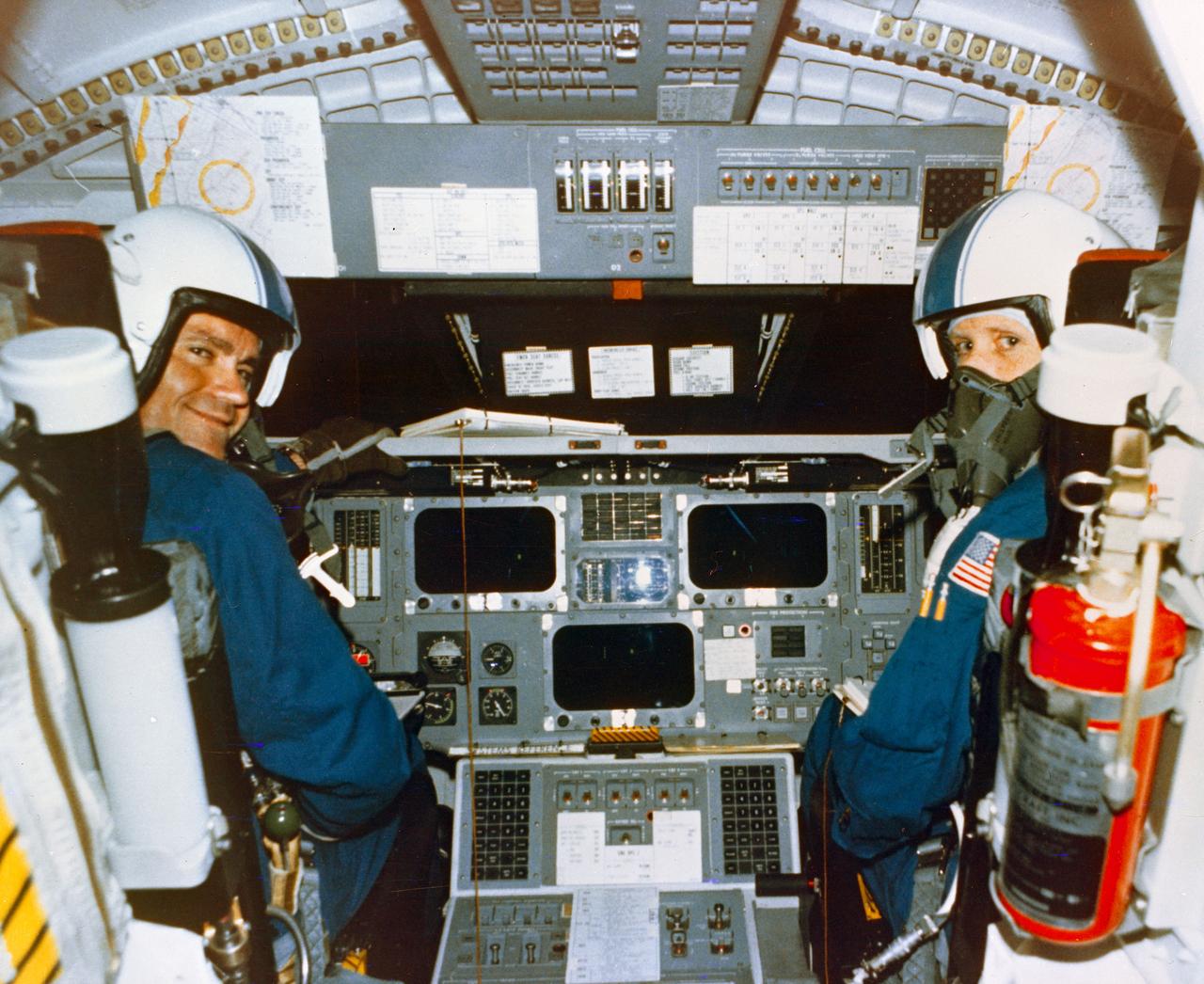
Astronauts Fred W. Haise, Jr., Commander, left, and C. Gordon Fullerton in the cockpit of the Space Shuttle Orbiter 101 "Enterprise" prior to the fifth and final FF in the Approach and Landing Test (ALT) series, from DFRC. Original photo number was 77-HC-446. DFRC, CA
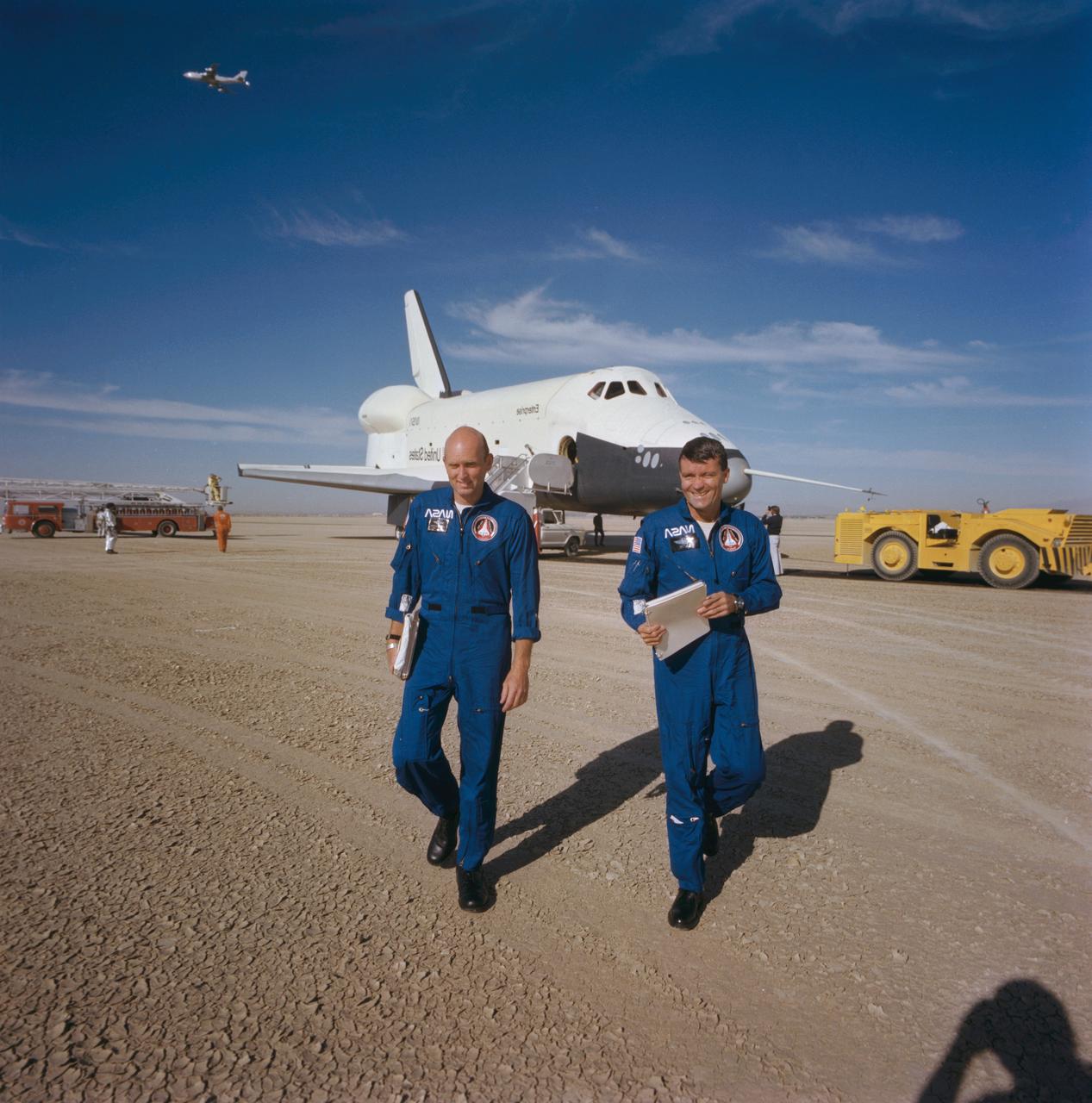
Public Affairs Office (PAO) release print of activity documenting third (3rd) "free flight" of Shuttle Orbiter 101 Spacecraft at DFRC, EAFB, CA. Astronauts Haise (left) and Fullerton in front of parking "Enterprise" just after egress. DFRC, EAFB, CA
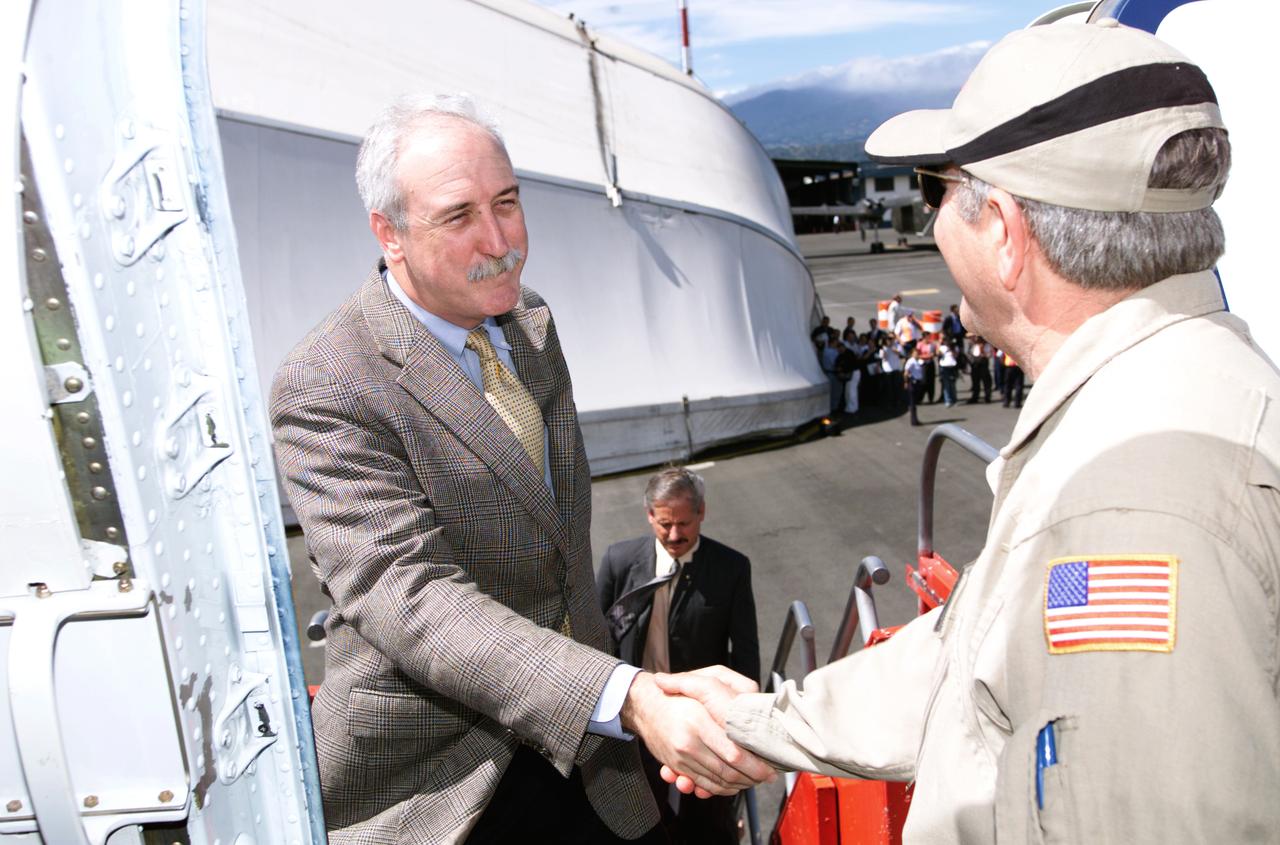
Dr. Tom Mace, NASA DFRC Director of Airborne Sciences, greets NASA Administrator Sean O'Keefe as he enters the DC-8 aircraft during a stop-off on the AirSAR 2004 Mesoamerica campaign. AirSAR 2004 Mesoamerica is a three-week expedition by an international team of scientists that will use an all-weather imaging tool, called the Airborne Synthetic Aperture Radar (AirSAR), in a mission ranging from the tropical rain forests of Central America to frigid Antarctica.
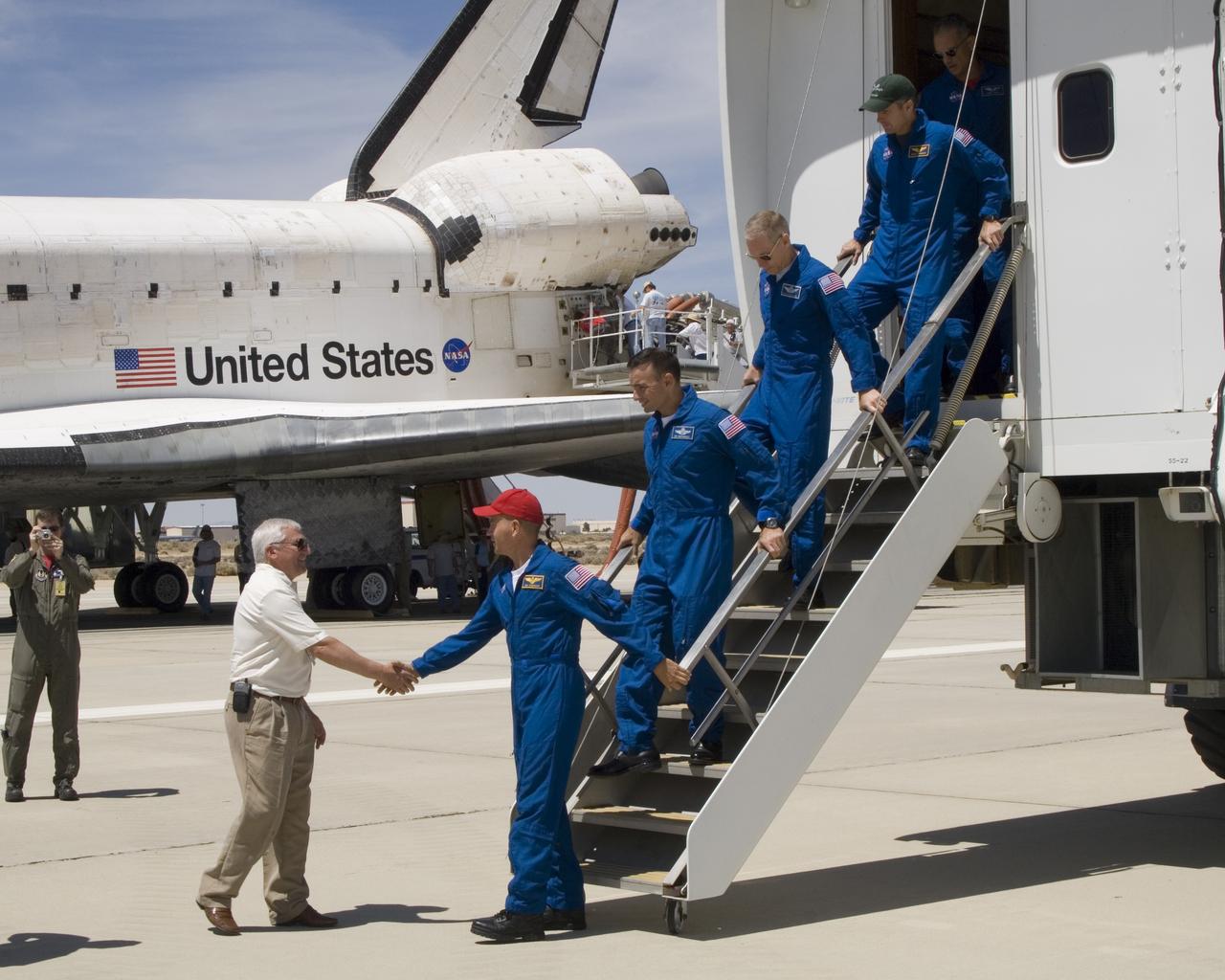
DFRC Center Director Kevin Petersen greets STS-117 Commander Frederick Sturckow and the crew of the Space Shuttle Atlantis at Edwards, AFB, Calif., on June 22, 2007. Left to right: DFRC Center Director Kevin Petersen, Commander Frederick Sturckow, Pilot Lee Archambault, and mission specialists Patrick Forrester, Steven Swanson and John D. Olivas.

Frame of color news-released stills. This was a Tail Cone Off Mission. Crew was made up of Astronauts Engle and Truly. Astronauts Engle, Truly egress Orbiter following flt. DFRC, CA
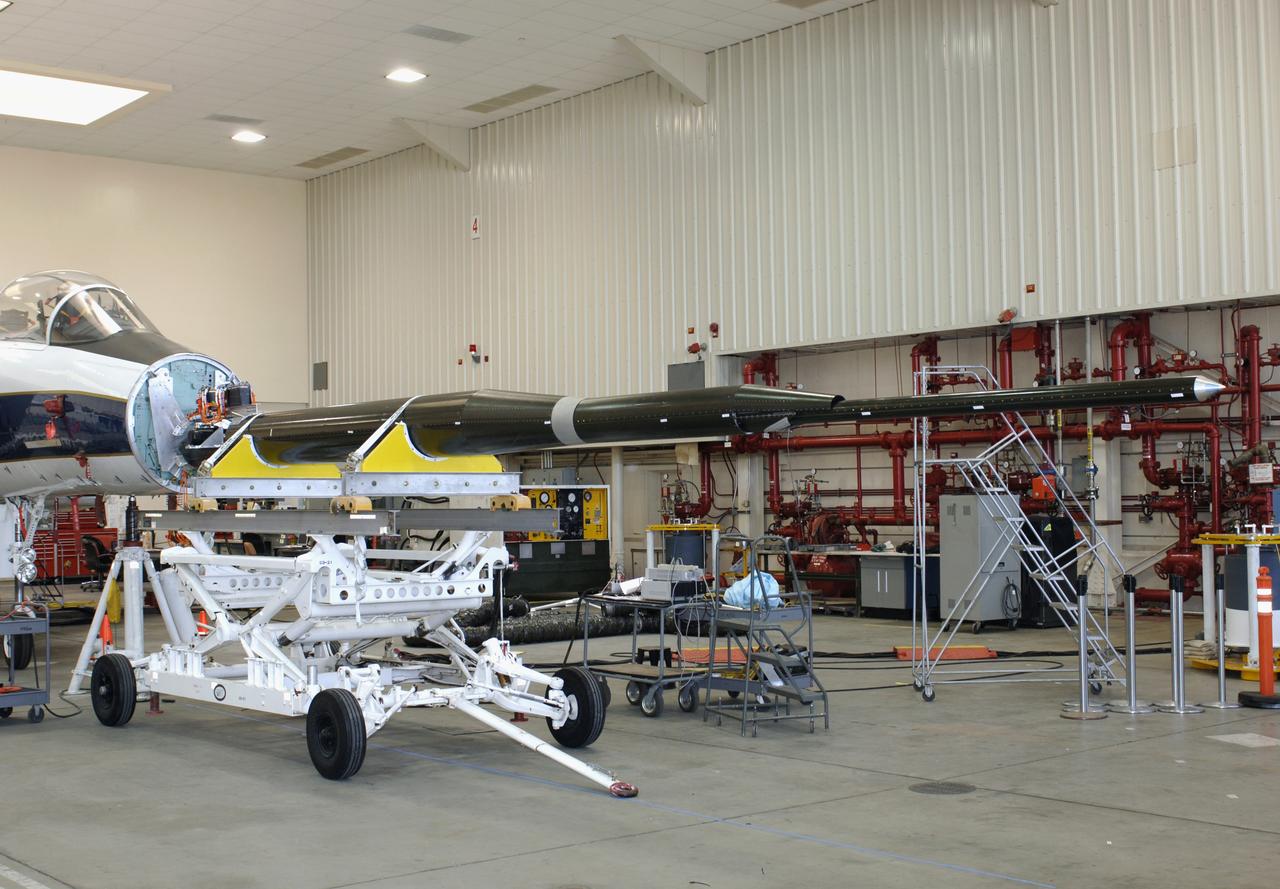
Gulfstream's Quiet Spike sonic boom mitigator being installed on NASA DFRC's F-15B testbed aircraft. The project seeks to verify the structural integrity of the multi-segmented, articulating spike attachment designed to reduce and control a sonic boom.
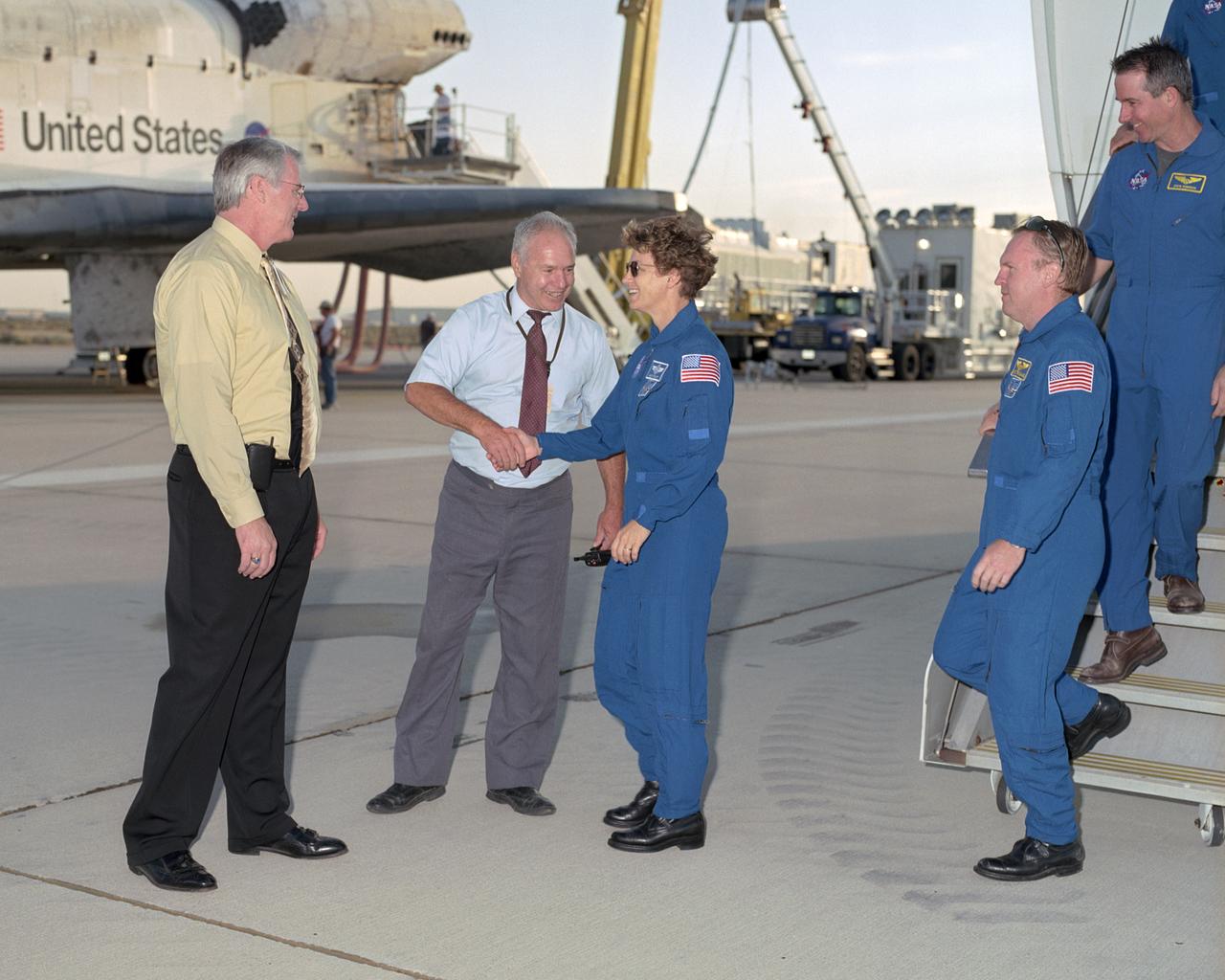
NASA DFRC Deputy Director Steven Schmidt and DFRC Shuttle Program Manager Joe D'Agostino greet Commander Eileen Collins and the crew of STS-114. Left to right: Steven G. Schmidt, deputy director of the NASA Dryden Flight Research Center; Joe D'Agostino, DFRC Space Shuttle Flight Management Support Specialist; STS-114 Commander Eileen Collins and Mission Specialists Andrew Thomas and Stephen Robinson. Space Shuttle Discovery landed safely at NASA's Dryden Flight Research Center at Edwards Air Force Base in California at 5:11:22 a.m. PDT this morning, following the very successful 14-day STS-114 return to flight mission. During their two weeks in space, Commander Eileen Collins and her six crewmates tested out new safety procedures and delivered supplies and equipment the International Space Station. Discovery spent two weeks in space, where the crew demonstrated new methods to inspect and repair the Shuttle in orbit. The crew also delivered supplies, outfitted and performed maintenance on the International Space Station. A number of these tasks were conducted during three spacewalks. In an unprecedented event, spacewalkers were called upon to remove protruding gap fillers from the heat shield on Discovery's underbelly. In other spacewalk activities, astronauts installed an external platform onto the Station's Quest Airlock and replaced one of the orbital outpost's Control Moment Gyroscopes. Inside the Station, the STS-114 crew conducted joint operations with the Expedition 11 crew. They unloaded fresh supplies from the Shuttle and the Raffaello Multi-Purpose Logistics Module. Before Discovery undocked, the crews filled Raffeallo with unneeded items and returned to Shuttle payload bay. Discovery launched on July 26 and spent almost 14 days on orbit.
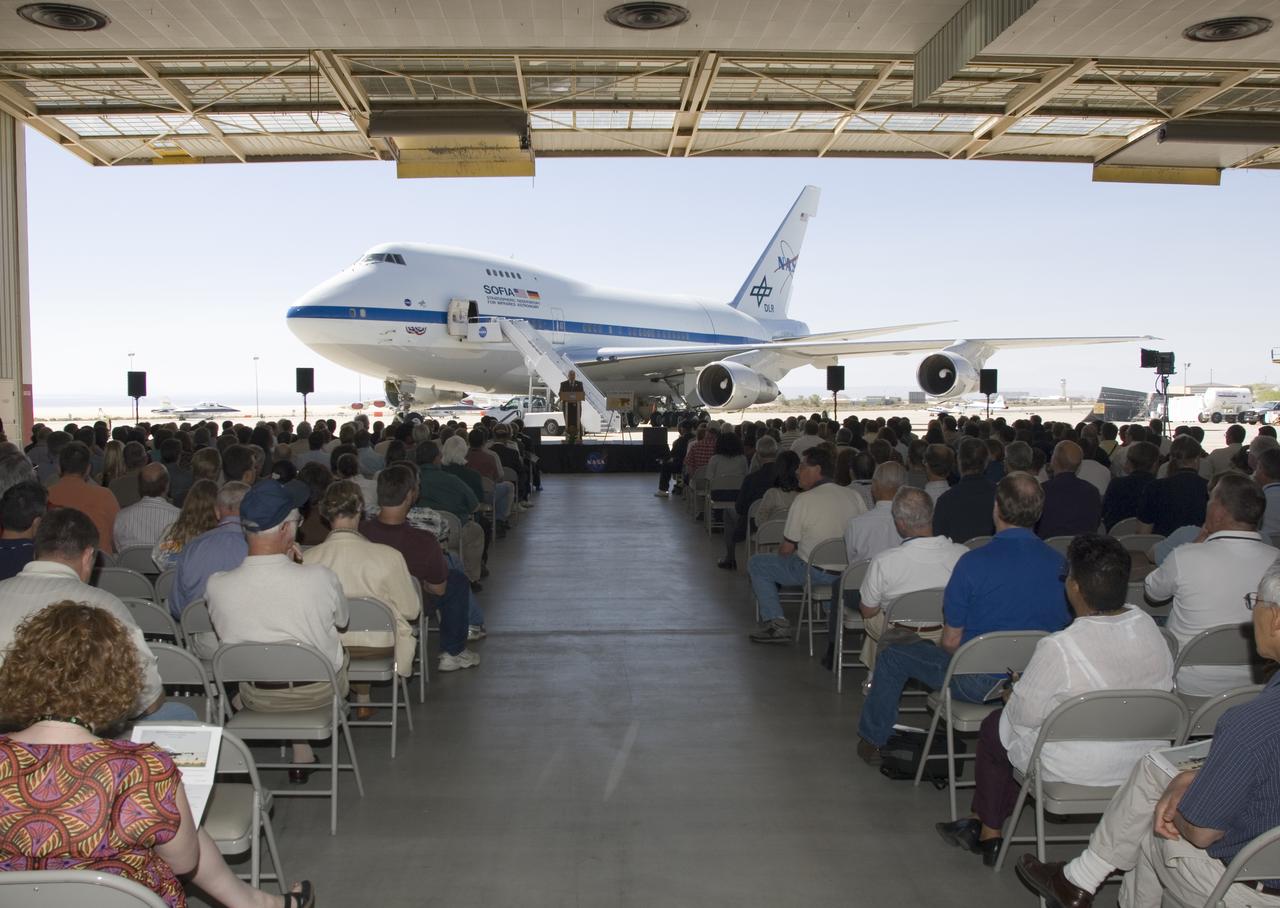
More than 250 VIPs, news media and guests joined NASA, DLR, USRA and other SOFIA staff for the debut of the airborne observatory at NASA DFRC on June 27, 2007.
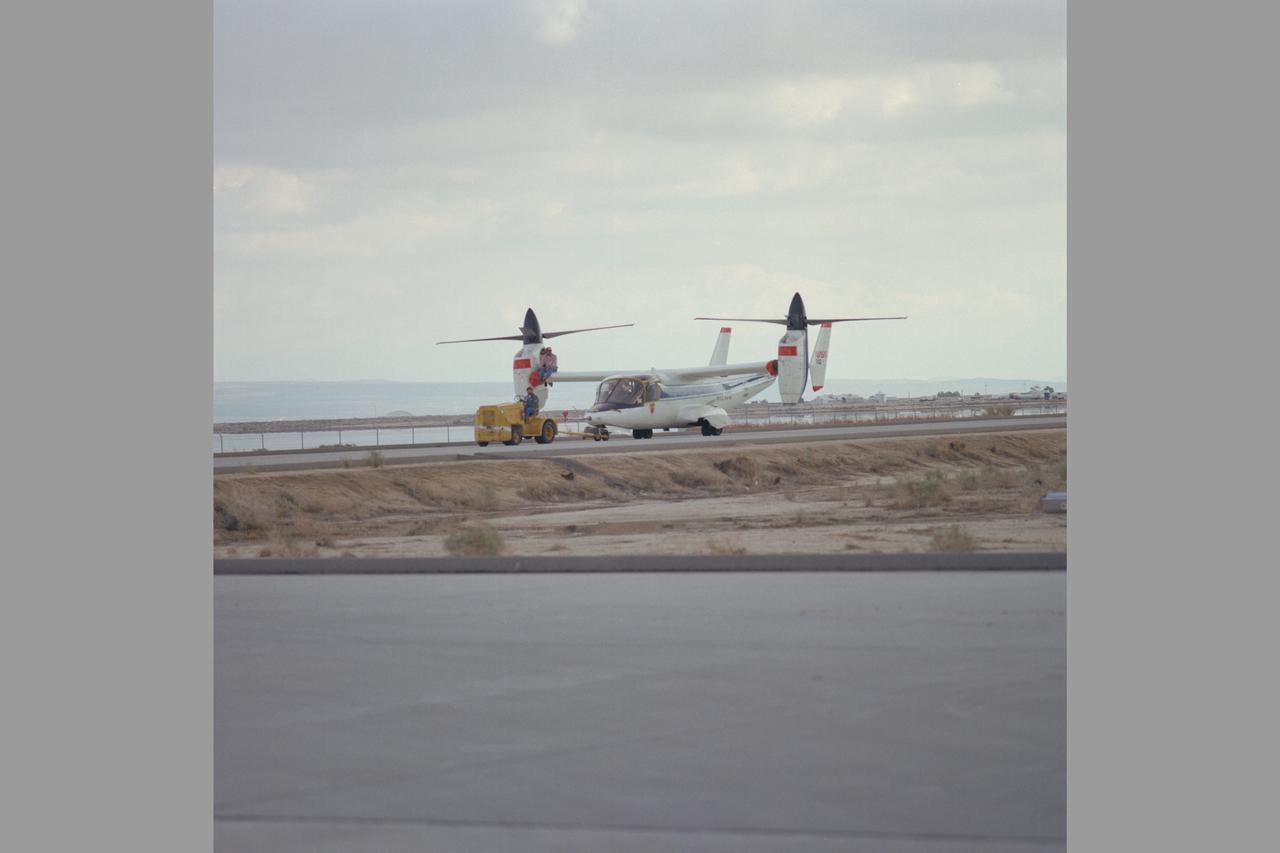
XV-15 (NASA 702) Tilt Rotor flight to DFRC- (at Dryden)
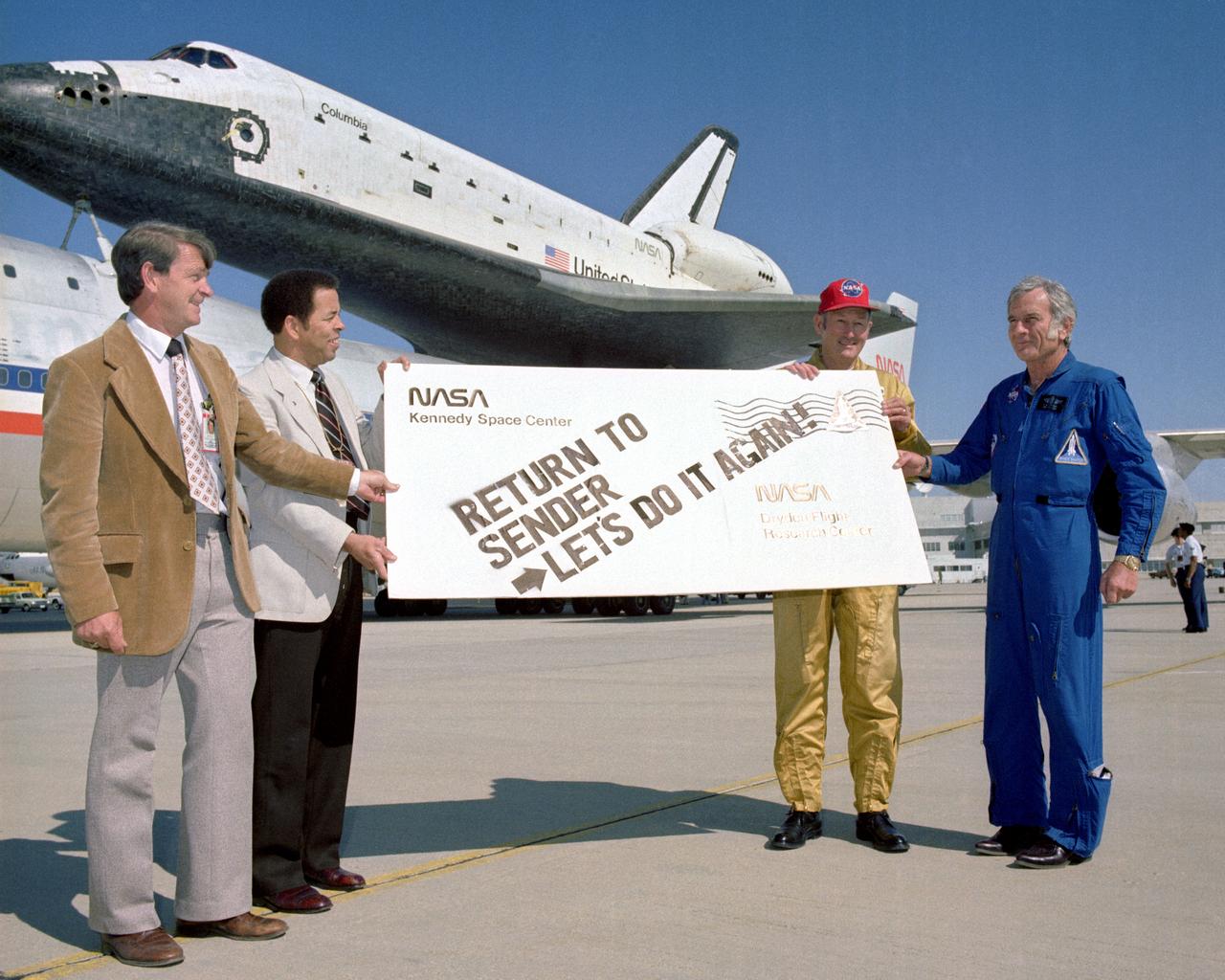
After completing it's first orbital mission with a landing at Edwards Air Force Base on April 14, 1981, Space Shuttle Columbia received a humorous sendoff before it's ferry flight atop a modified 747 back to the Kennedy Space Center in Florida. Holding the sign are, left to right: Melvin Burke, DFRC Orbital Flight Test (OFT) Program Manager; Isaac 'Ike' Gillam, DFRC Center Director; Fitzhugh 'Fitz' L. Fulton Jr., NASA DFRC 747 SCA Pilot; and Donald K. 'Deke' Slayton, JSC OFT Project Manager.
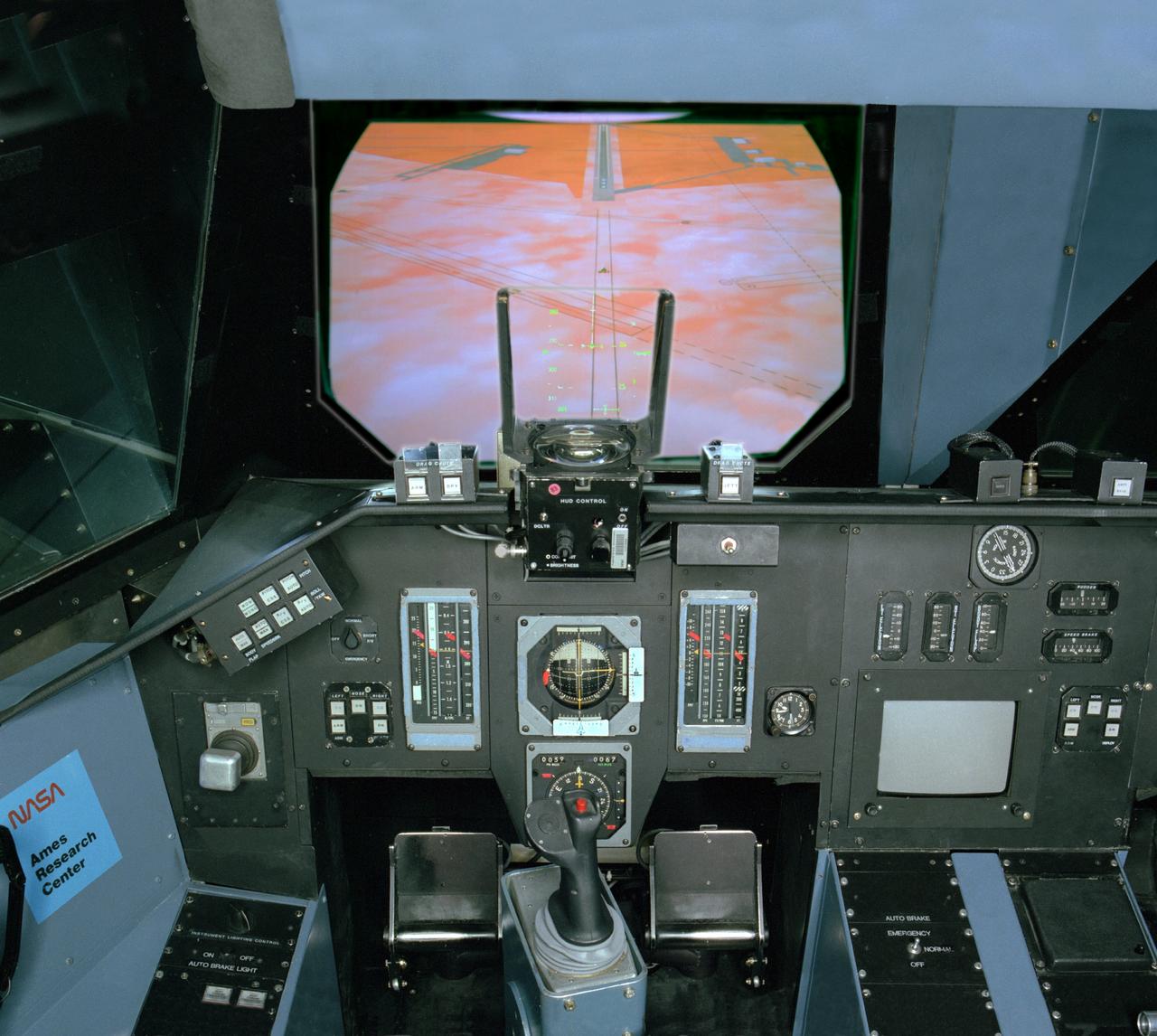
NASA Ames VMS (Vertical Motion simulator) S-cab Space Shuttle sim with out the window views 'DFRC landing'
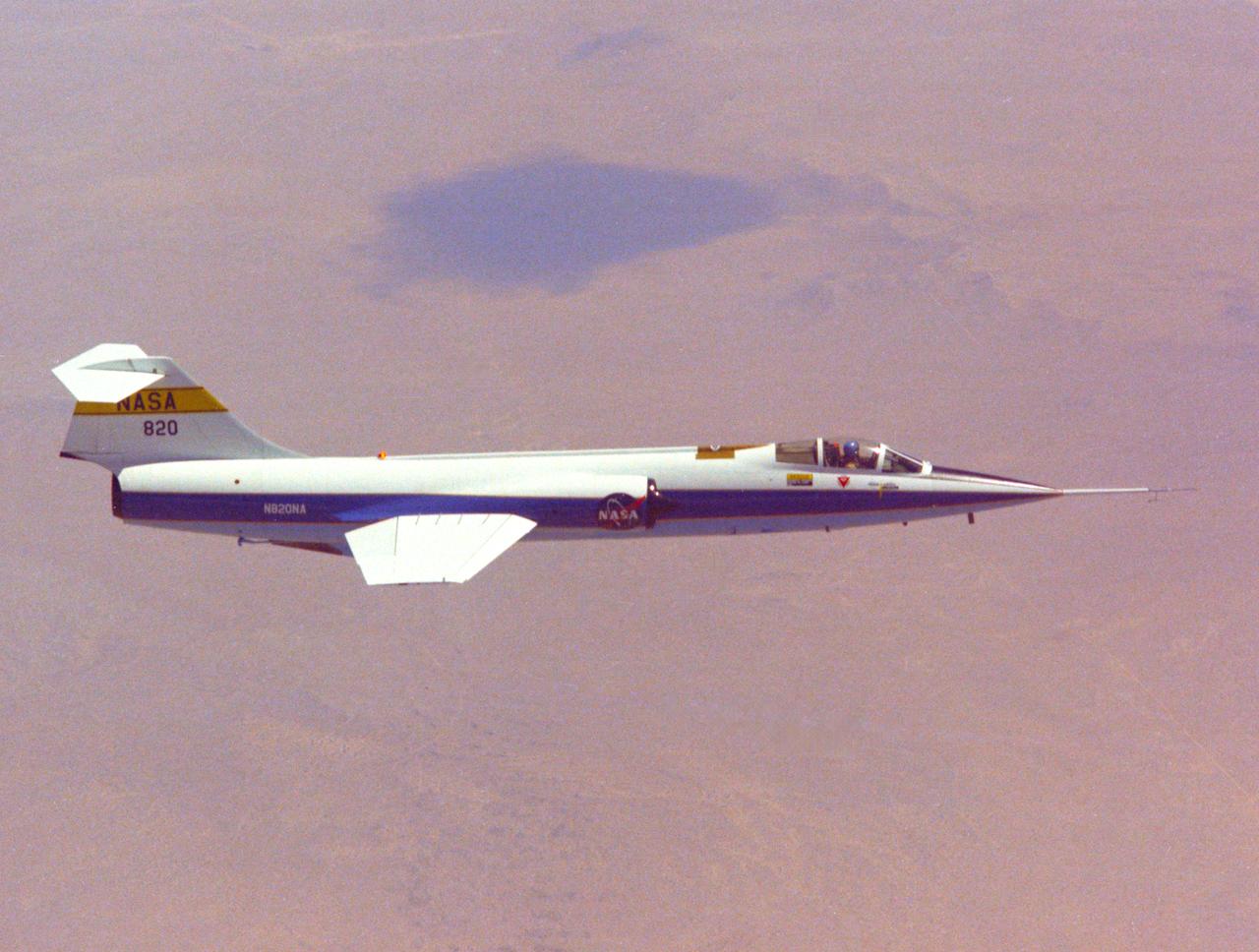
F-104A #820 in flight 8/23/71 NASA DFRC EC71-2811
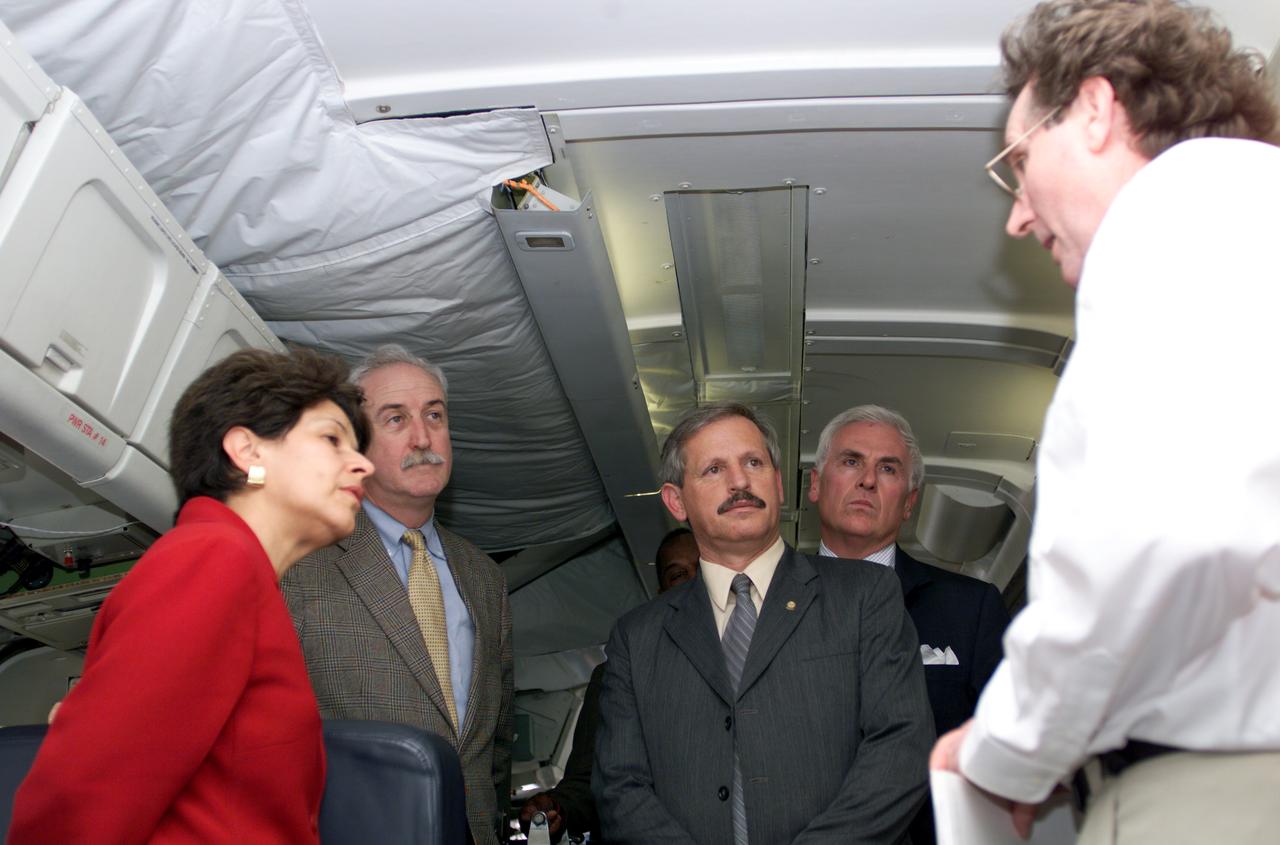
VIP tour of NASA DFRC's DC-8 airborne laboratory during the AirSAR 2004 Mesoamerica campaign given by Craig Dobson, NASA Program Manager for AirSAR, L-R: Dr. Sonia Marta Mora, President of the Costa Rican National Rector’s Council; NASA Administrator Sean O'Keefe; Fernando Gutierrez, Costa Rican Minister of Science and Technology(MICIT); Mr. John Danilovich, US Ambassador to Costa Rica; and Dobson. AirSAR 2004 Mesoamerica is a three-week expedition by an international team of scientists that will use an all-weather imaging tool, called the Airborne Synthetic Aperture Radar (AirSAR), in a mission ranging from the tropical rain forests of Central America to frigid Antarctica.
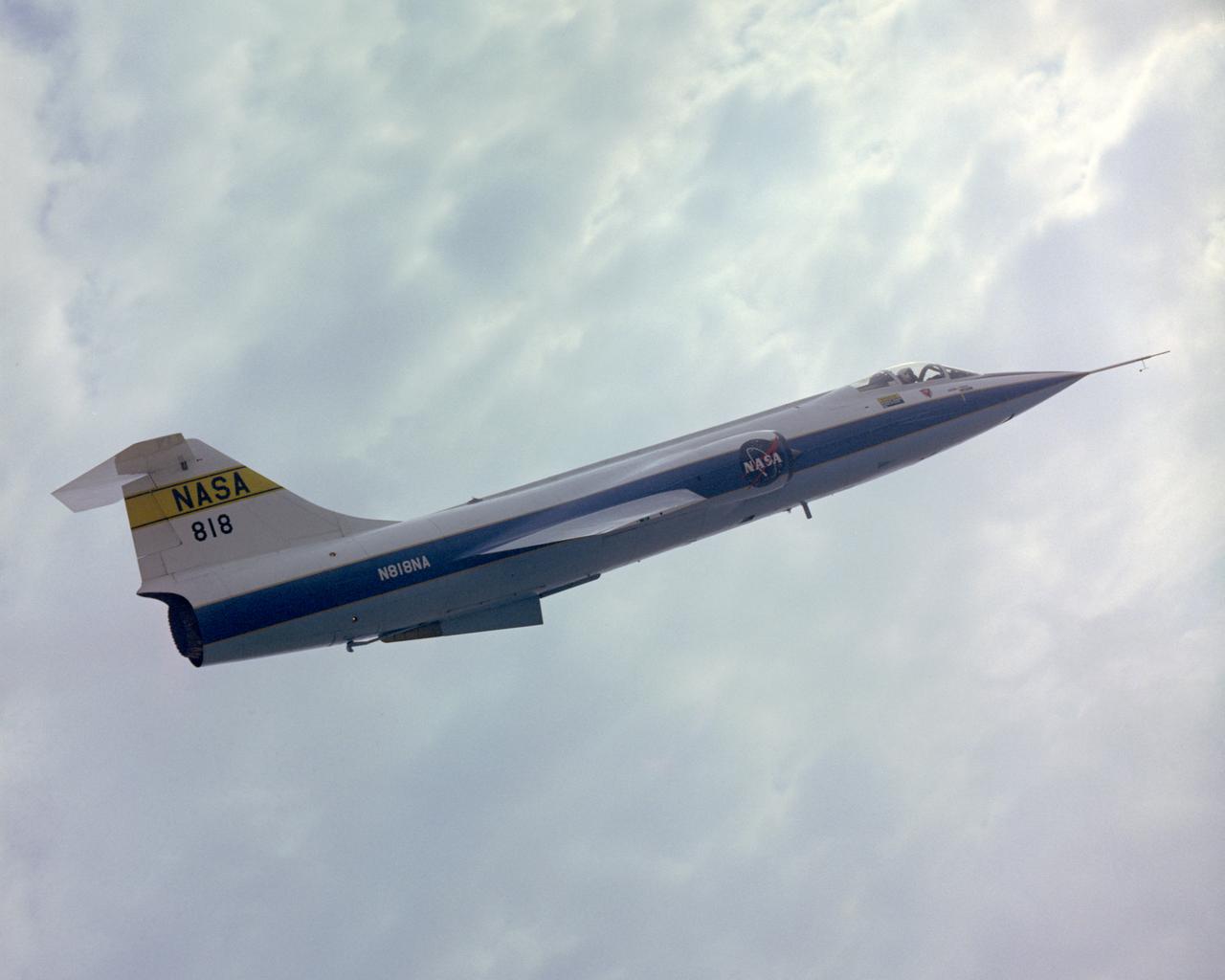
F-104A #818 flown by Einar Enevoldson. 4/11/75 NASA DFRC EC76-5079 NASA Photo by Bob Rhine
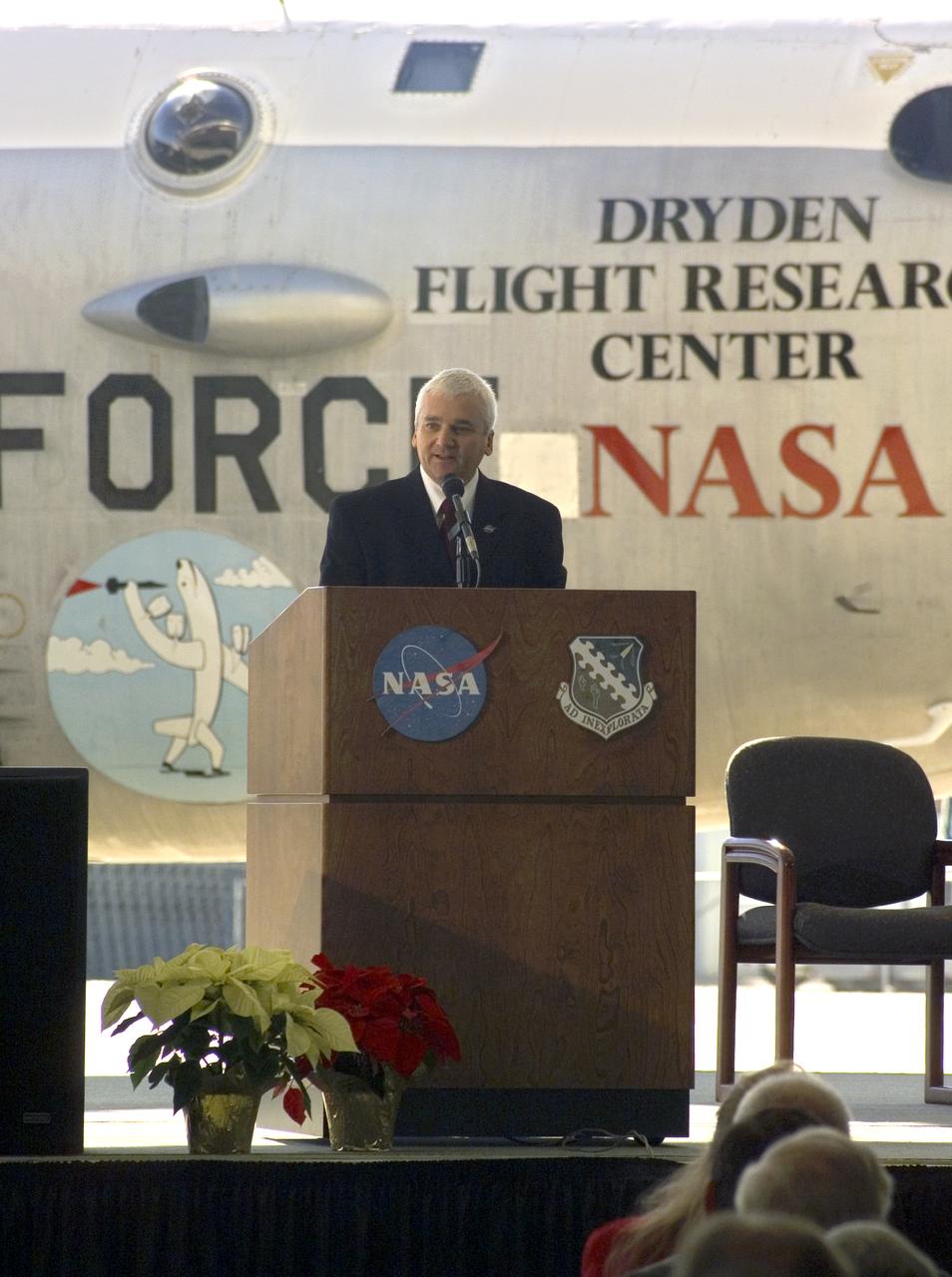
DFRC director Kevin Petersen speaks to an audience of NASA and Air Force visitors, employees and special guests at the retirement ceremony for NASA's B-52B.
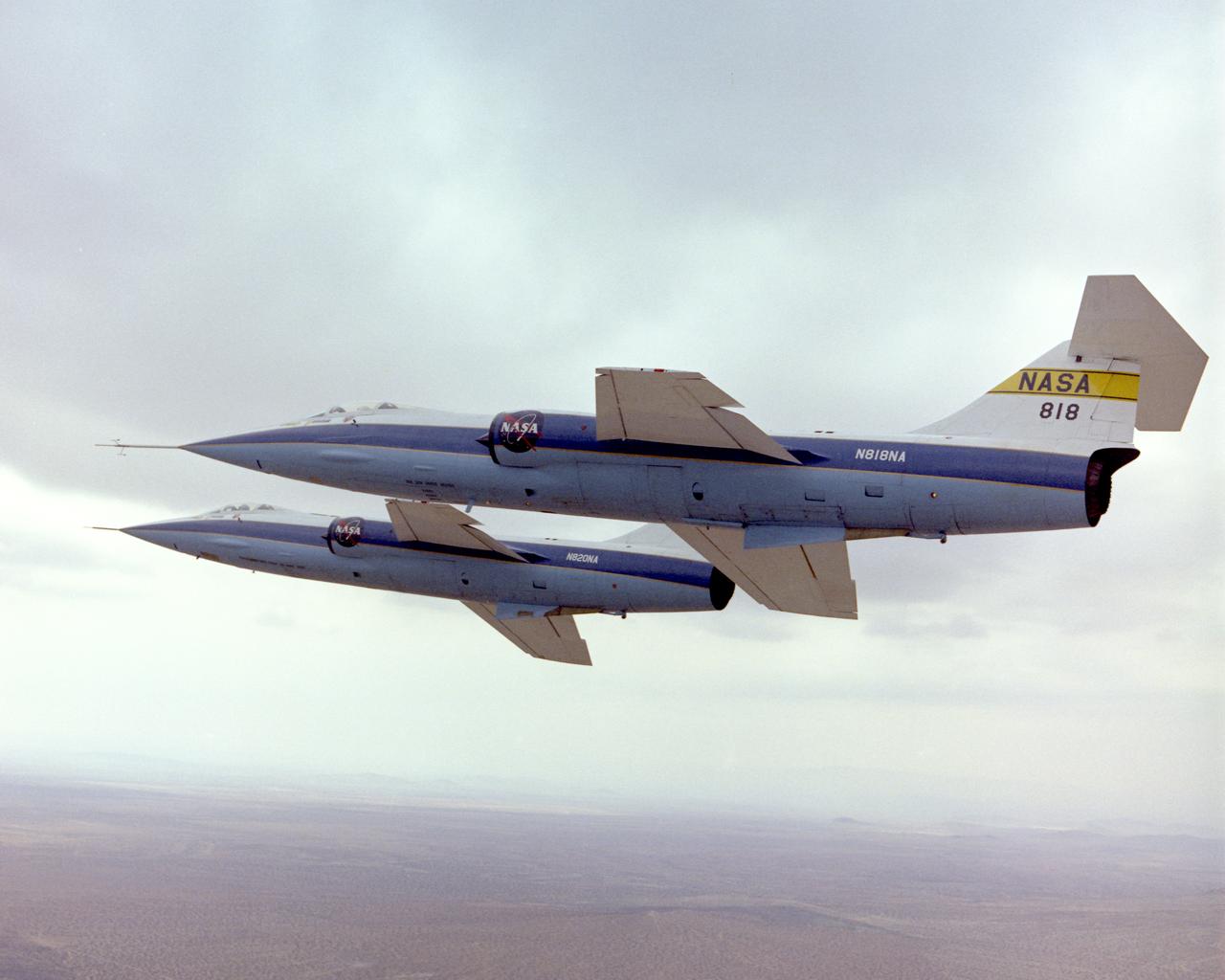
F-104A #818 flown by Einar Enevoldson and F-104A #820 flown by Gary Krier in formation over the Mojave Desert. 4/11/75 NASA DFRC EC76-5140
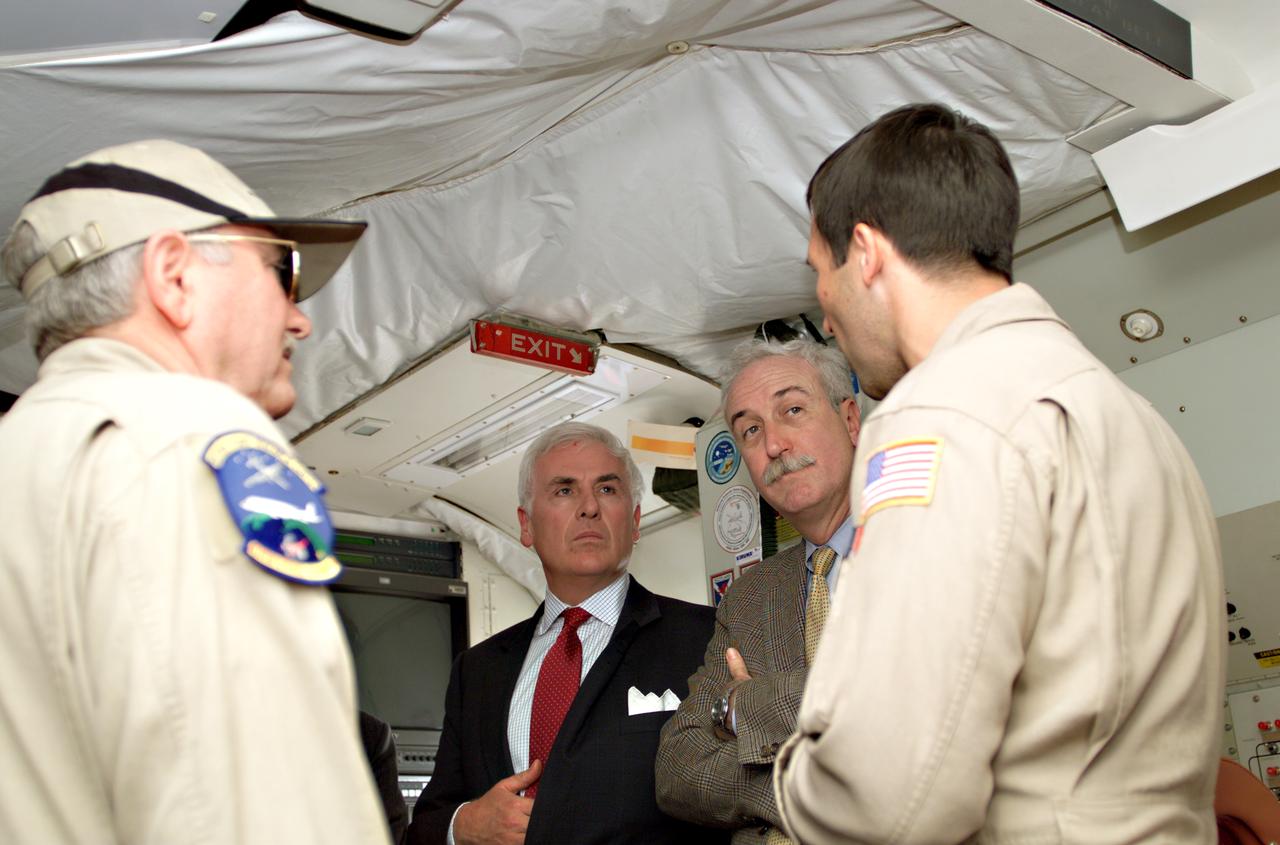
Dr. Tom Mace, NASA DFRC Director of Airborne Sciences, and Walter Klein(far right), NASA DFRC Airborne Science Mission Manager, brief John Danilovich, US Ambassador to Costa Rica, and NASA Administrator Sean O'Keefe onboard NASA's DC-8 during a stop-off on the AirSAR 2004 Mesoamerica campaign. AirSAR 2004 Mesoamerica is a three-week expedition by an international team of scientists that will use an all-weather imaging tool, called the Airborne Synthetic Aperture Radar (AirSAR), in a mission ranging from the tropical rain forests of Central America to frigid Antarctica.
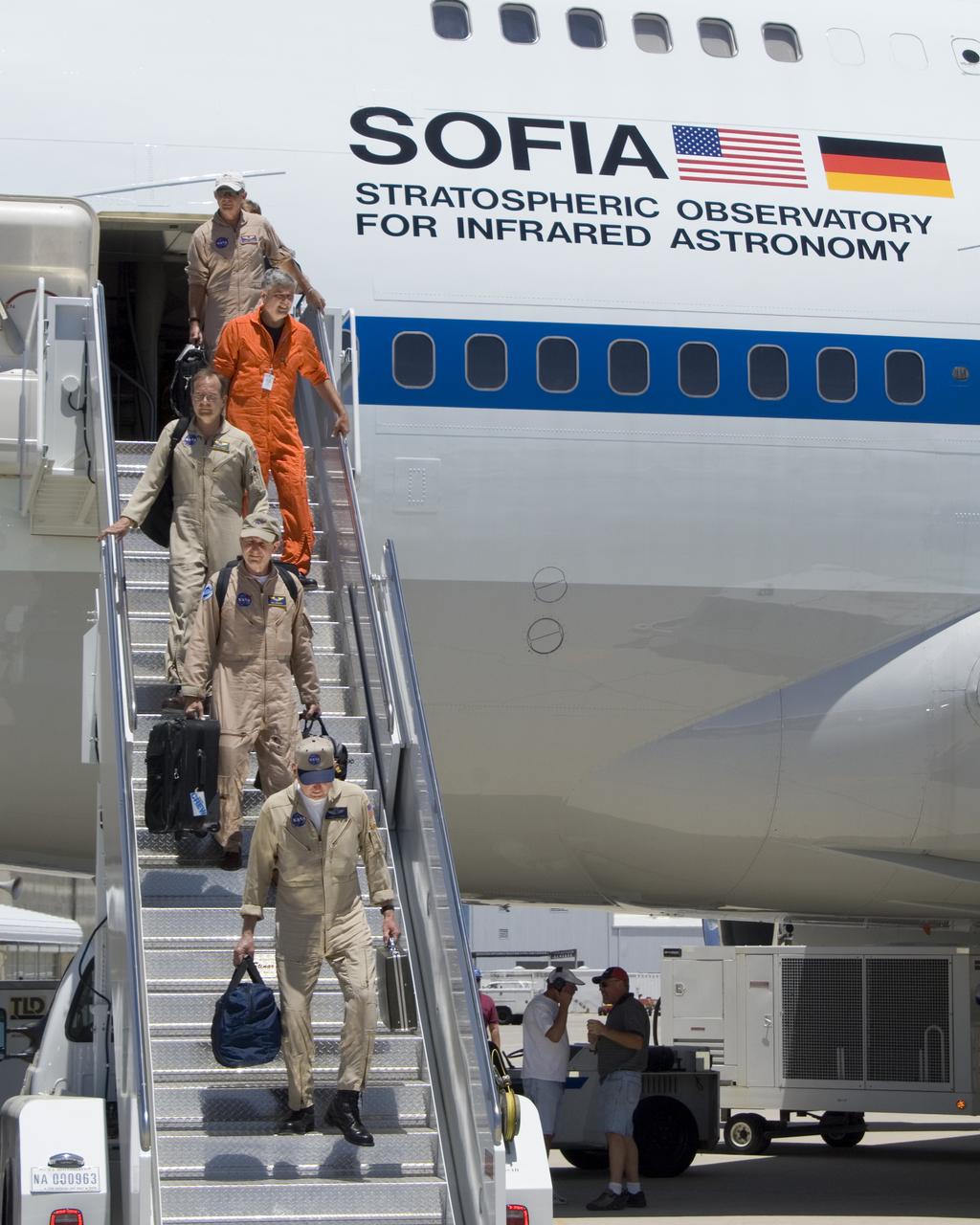
The SOFIA flight crew, consisting of Co-pilot Gordon Fullerton; DFRC, Pilot Bill Brocket; DFRC, Test Conductor Marty Trout; DFRC, Test Engineer Don Stonebrook; L-3, and Flight Engineer Larry Larose; JSC, descend the stairs after ferrying the 747SP airborne observatory from Waco, Texas, to its new home at NASA's Dryden Flight Research Center in California. NASA's Stratospheric Observatory for Infrared Astronomy, or SOFIA, arrived at NASA's Dryden Flight Research Center at Edwards Air Force Base, Calif. on May 31, 2007. The heavily modified Boeing 747SP was ferried to Dryden from Waco, Texas, where L-3 Communications Integrated Systems installed a German-built 2.5-meter infrared telescope and made other major modifications over the past several years. SOFIA is scheduled to undergo installation and integration of mission systems and a multi-phase flight test program at Dryden over the next three years that is expected to lead to a full operational capability to conduct astronomy missions in about 2010. During its expected 20-year lifetime, SOFIA will be capable of "Great Observatory" class astronomical science, providing astronomers with access to the visible, infrared and sub-millimeter spectrum with optimized performance in the mid-infrared to sub-millimeter range.
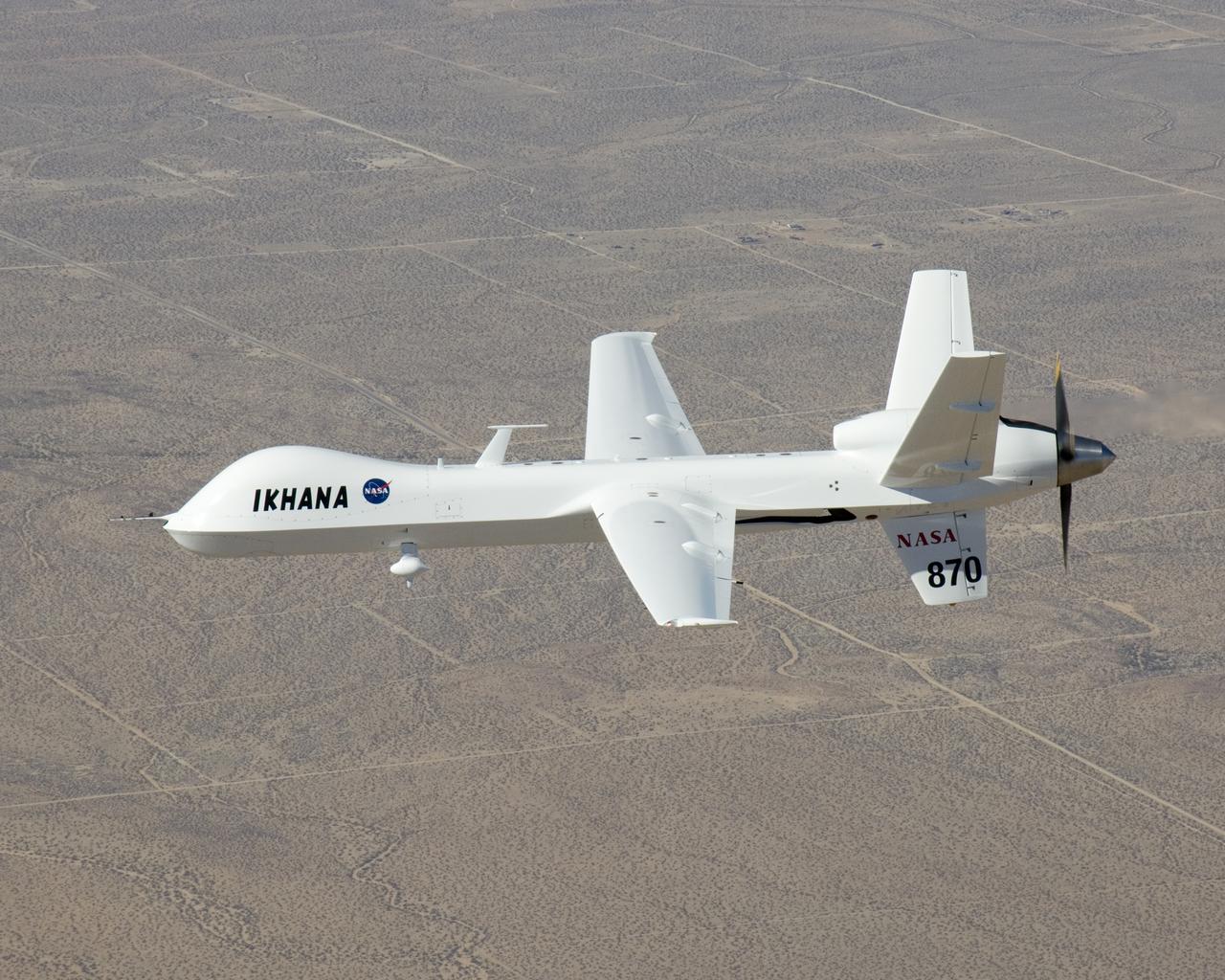
NASA's Ikhana unmanned science demonstration aircraft over Southern California's high desert during the ferry flight to its new home at the Dryden Flight Research Center. NASA took possession of the new aircraft in November, 2006, and it arrived at DFRC at Edwards Air Force Base, Calif., on June 23, 2007.
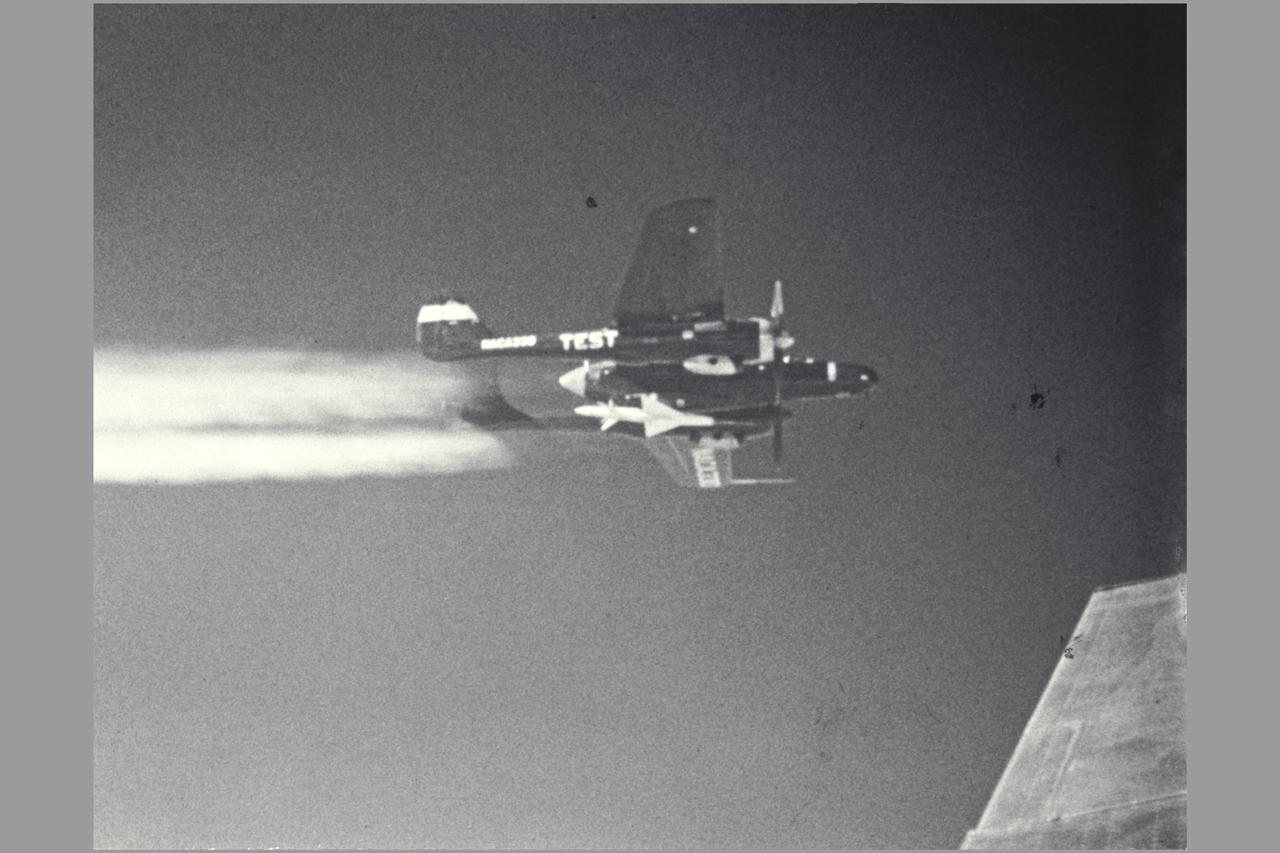
NACA Photographer (DFRC) ERF-61C-1-NO (AAF43-8330 NACA 330, NACA 111) mother ship for RECOVERABLE-BODY TECHNIQUE. Transonic Model Testing. Fig. 13 NASA SP-1998-3300 Flight Research at Ames: 57 Years of Development and Validation of Aeronautical Technology
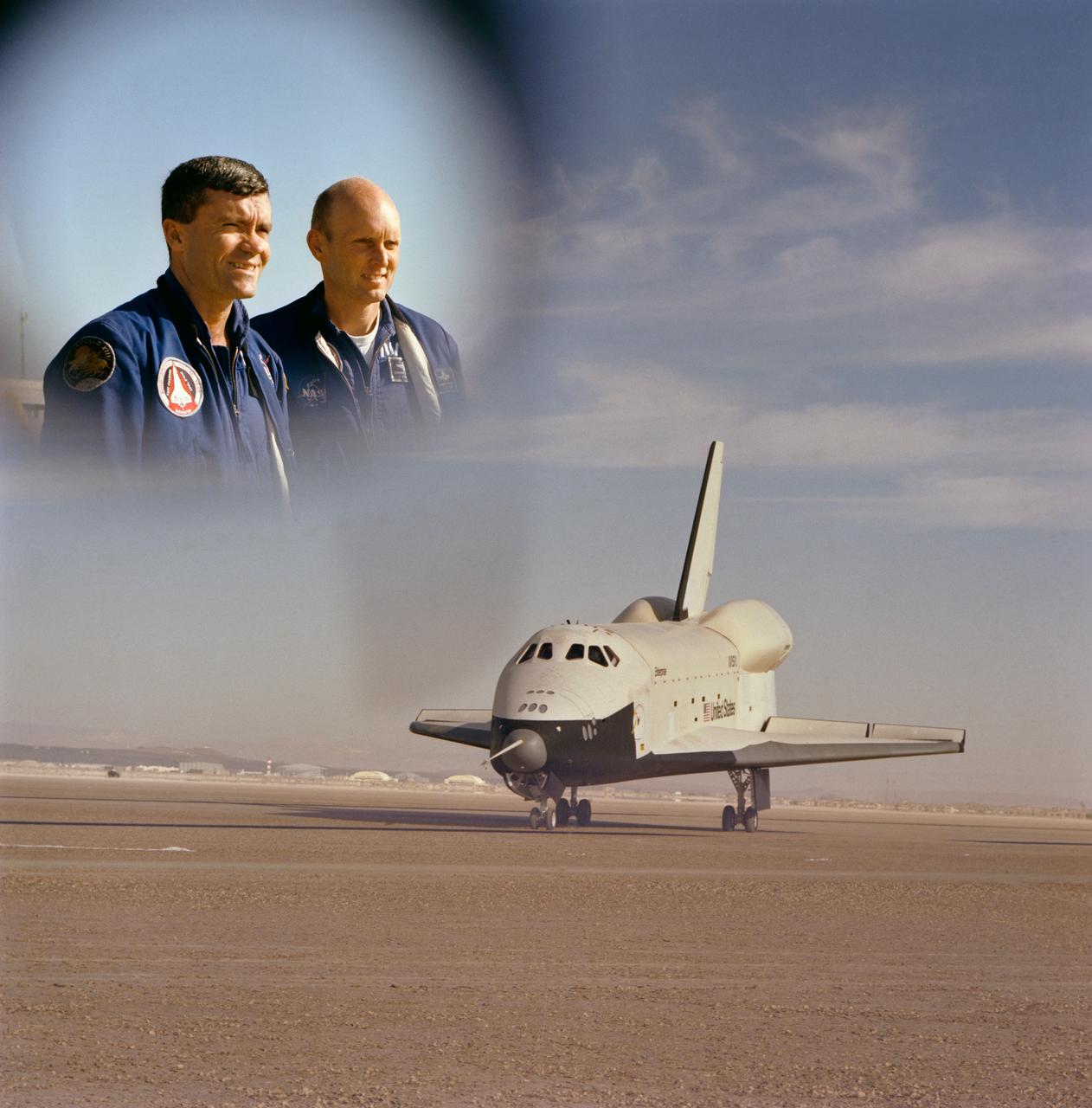
Public Affairs Office (PAO) release print of activity documenting third "free flight" of Shuttle Orbiter 101 Spacecraft at DFRC, Edwards Air Force Base (EAFB), CA. Enterprise is parked on the runway - Haise (left), Commander, and Fullerton, Pilot, are in the inset.
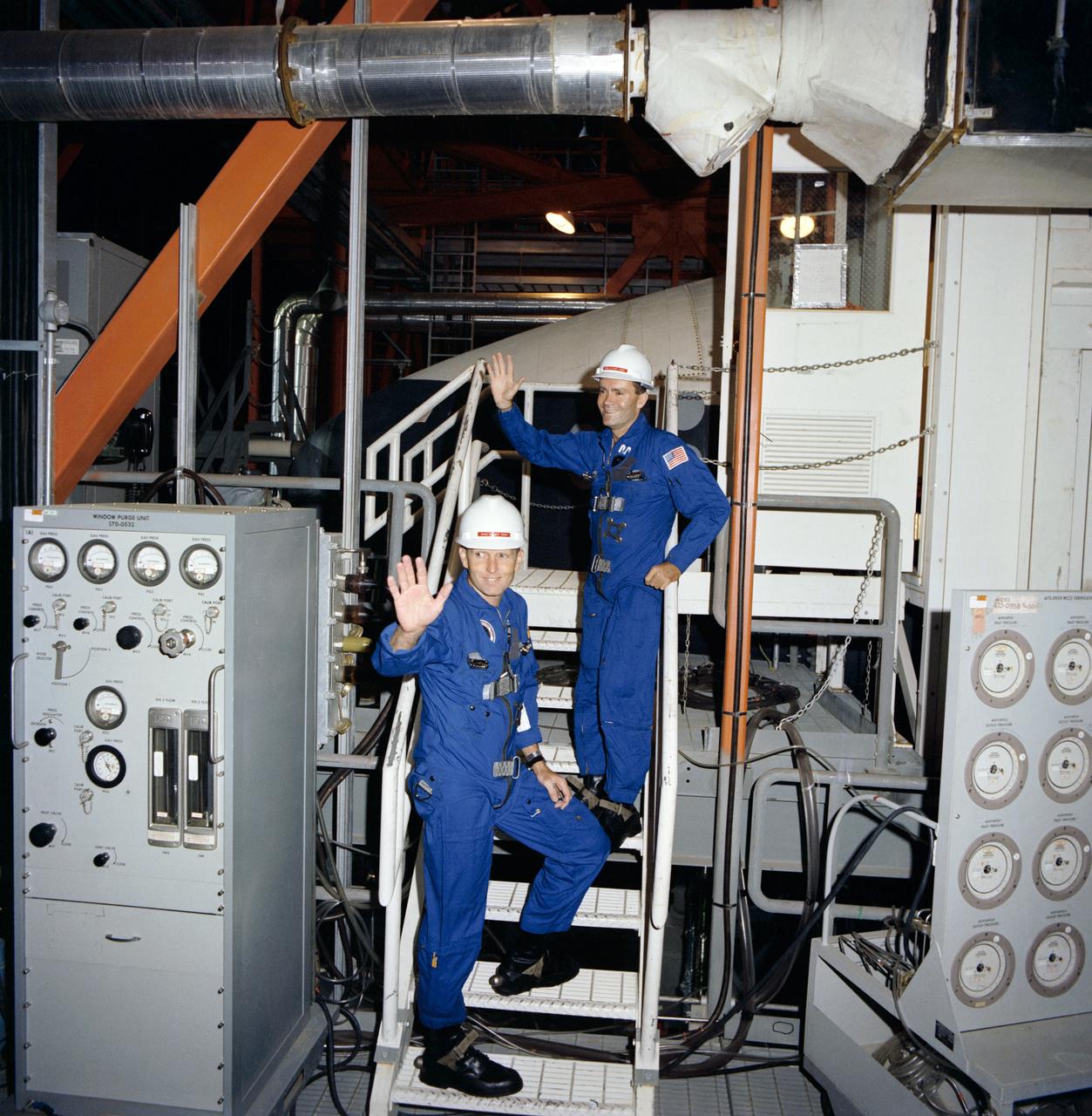
Public Affairs Office (PAO) release print of activity documenting third "free flight" of Shuttle Orbiter 101 Spacecraft at DFRC, Edwards Air Force Base (EAFB), CA. Astronauts Haise and Fullerton arrive at the Mate-Demate Device (MDD) and greet technicians prior to ingress.
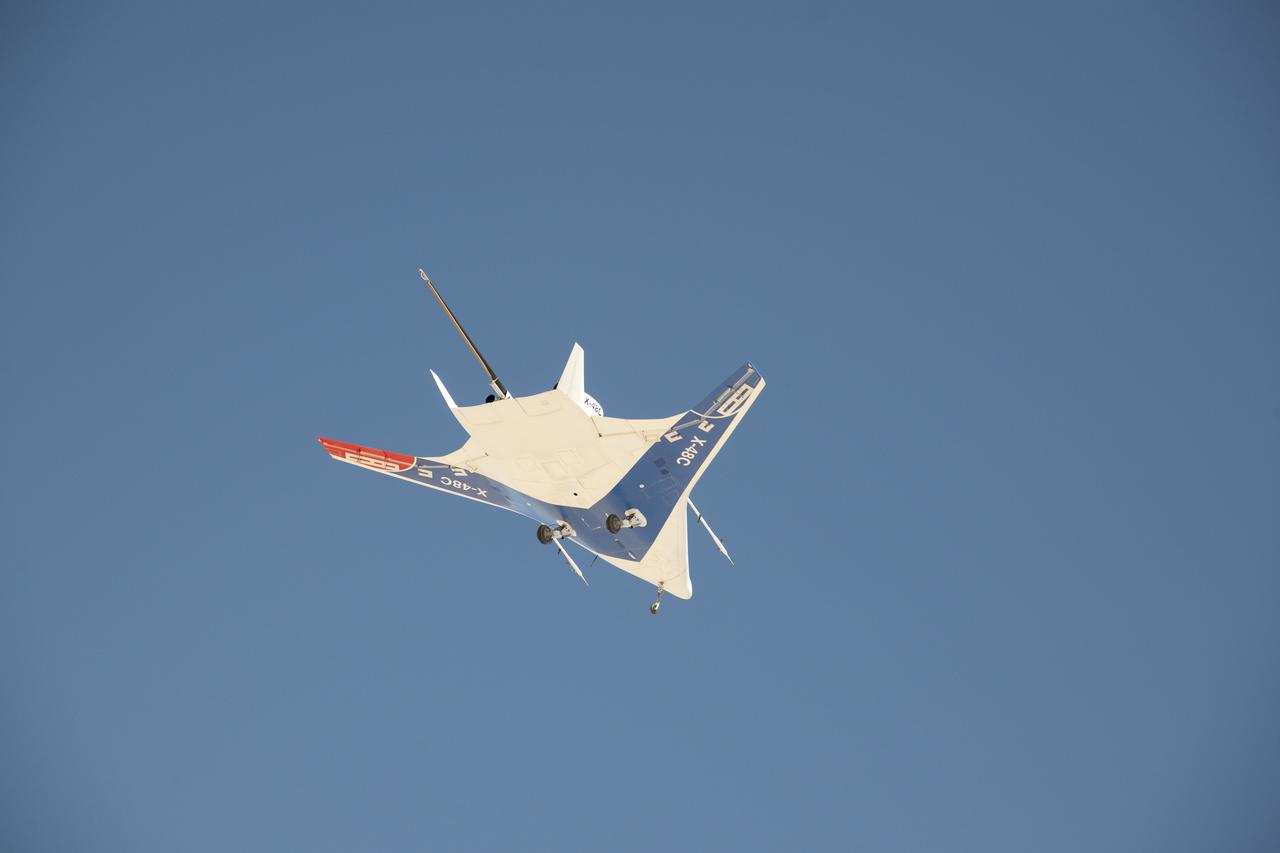
The manta ray-like shape of the X-48C Hybrid Wing Body aircraft was obvious in this underside view as it flew over Edwards Air Force Base on a test flight on Feb. 28, 2013.
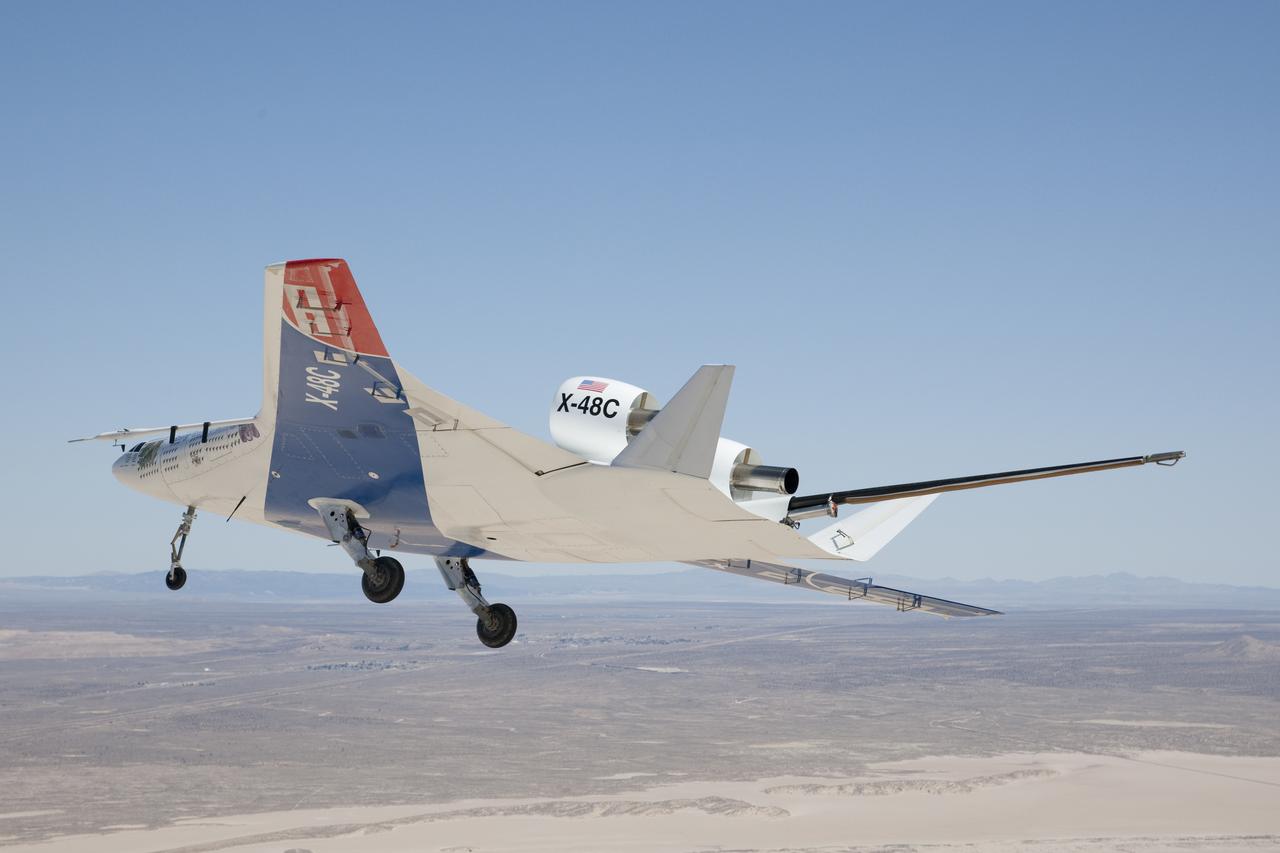
Earth and sky met as the X-48C Hybrid Wing Body aircraft flew over Edwards Air Force Base on Feb. 28, 2013, from NASA's Dryden Flight Research Center, Edwards, CA. The long boom protruding from between the tails is part of the aircraft's parachute-deployment flight termination system.
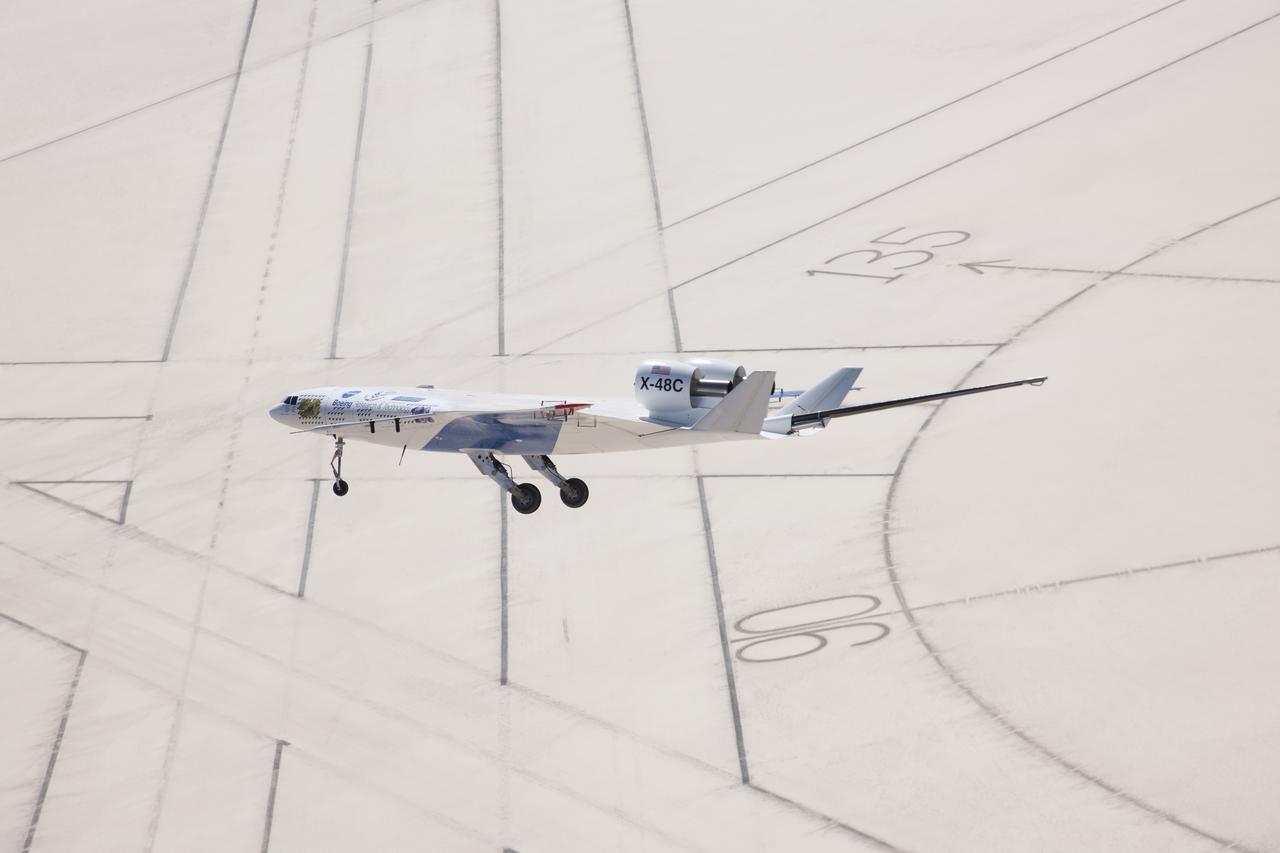
The X-48C Hybrid Wing Body research aircraft flew over the intersection of several runways adjacent to the compass rose on Rogers Dry Lake at Edwards Air Force Base during one of the sub-scale aircraft's final test flights on Feb. 28, 2013.
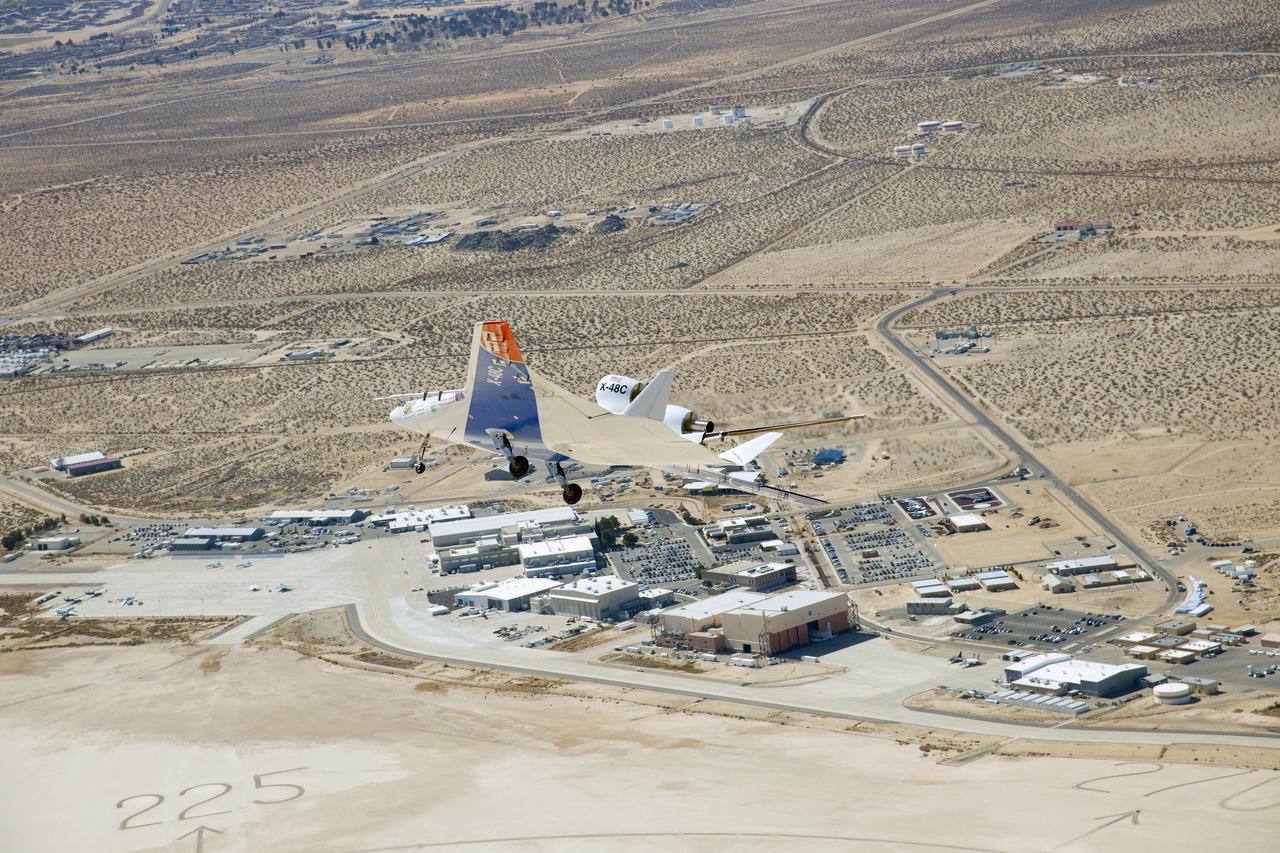
The X-48C Hybrid Wing Body research aircraft banked right over NASA's Dryden Flight Research Center at Edwards, CA during one of the sub-scale aircraft's final test flights on Feb. 28, 2013.
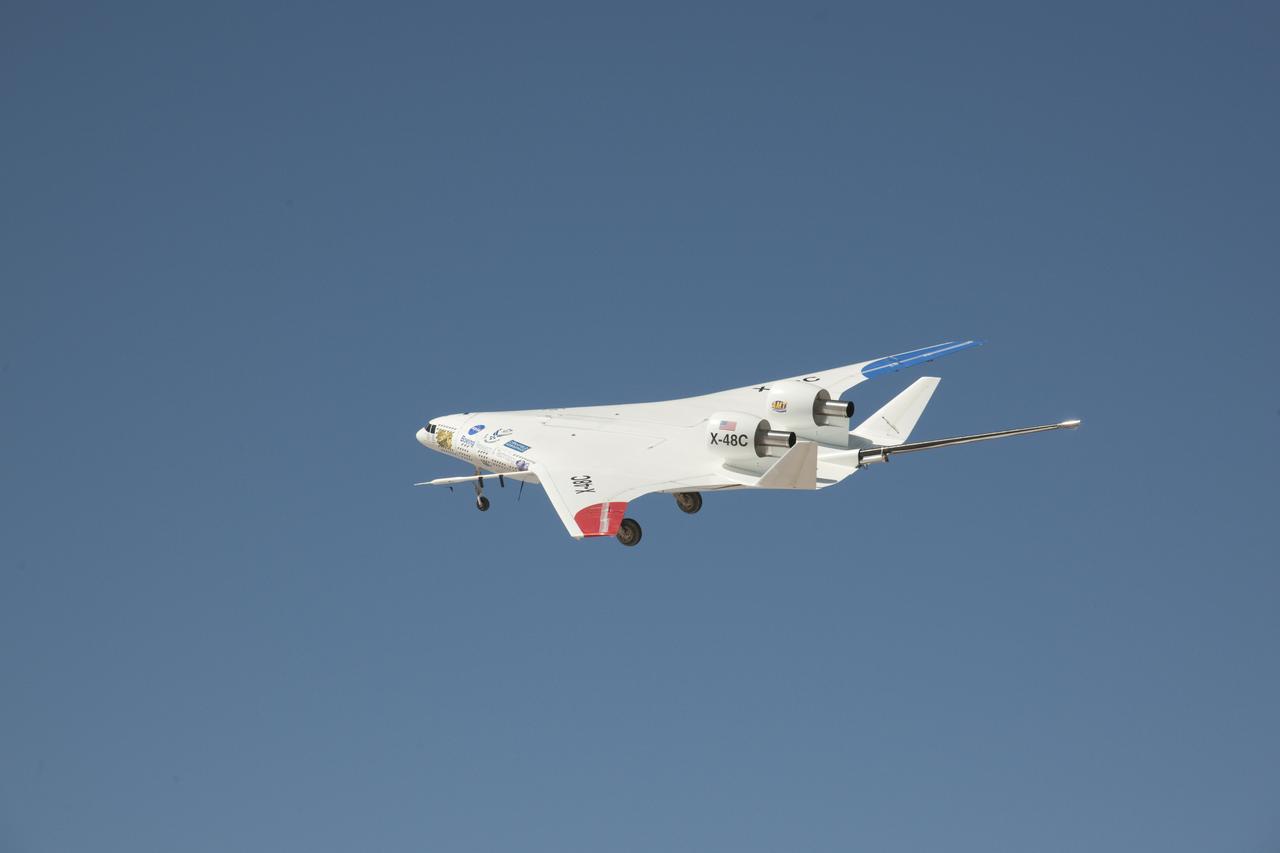
A deep blue sky was a backdrop for the NASA-Boeing X-48C Hybrid Wing Body aircraft as it flew over Edwards AFB on Feb. 28, 2013, during a test flight from NASA's Dryden Flight Research Center, Edwards, CA.
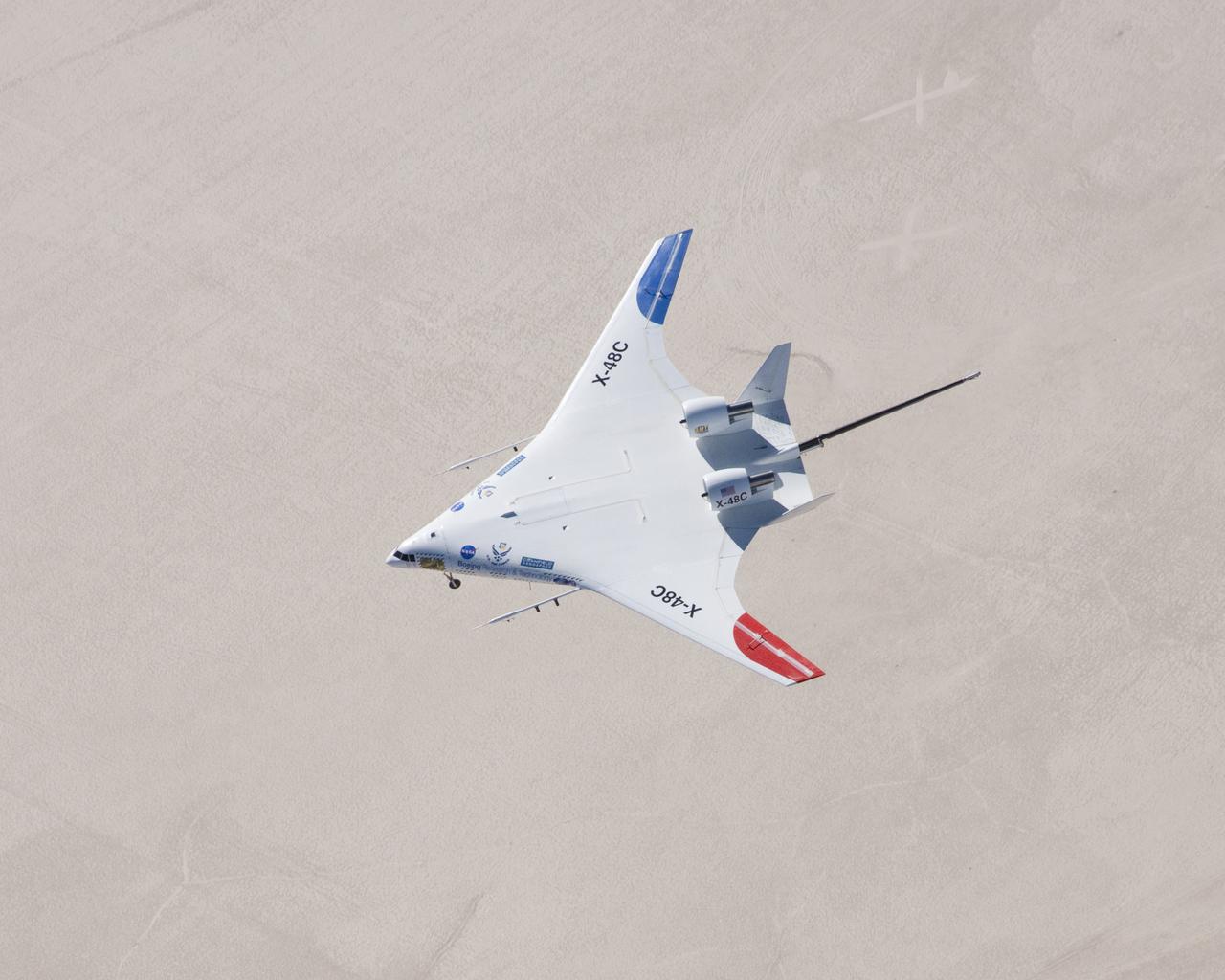
The X-48C Hybrid Wing Body aircraft flew over Rogers Dry Lake on Feb. 28, 2013, from NASA's Dryden Flight Research Center, Edwards, CA. The long boom protruding from between the tails was part of the aircraft's parachute-deployment flight termination system.
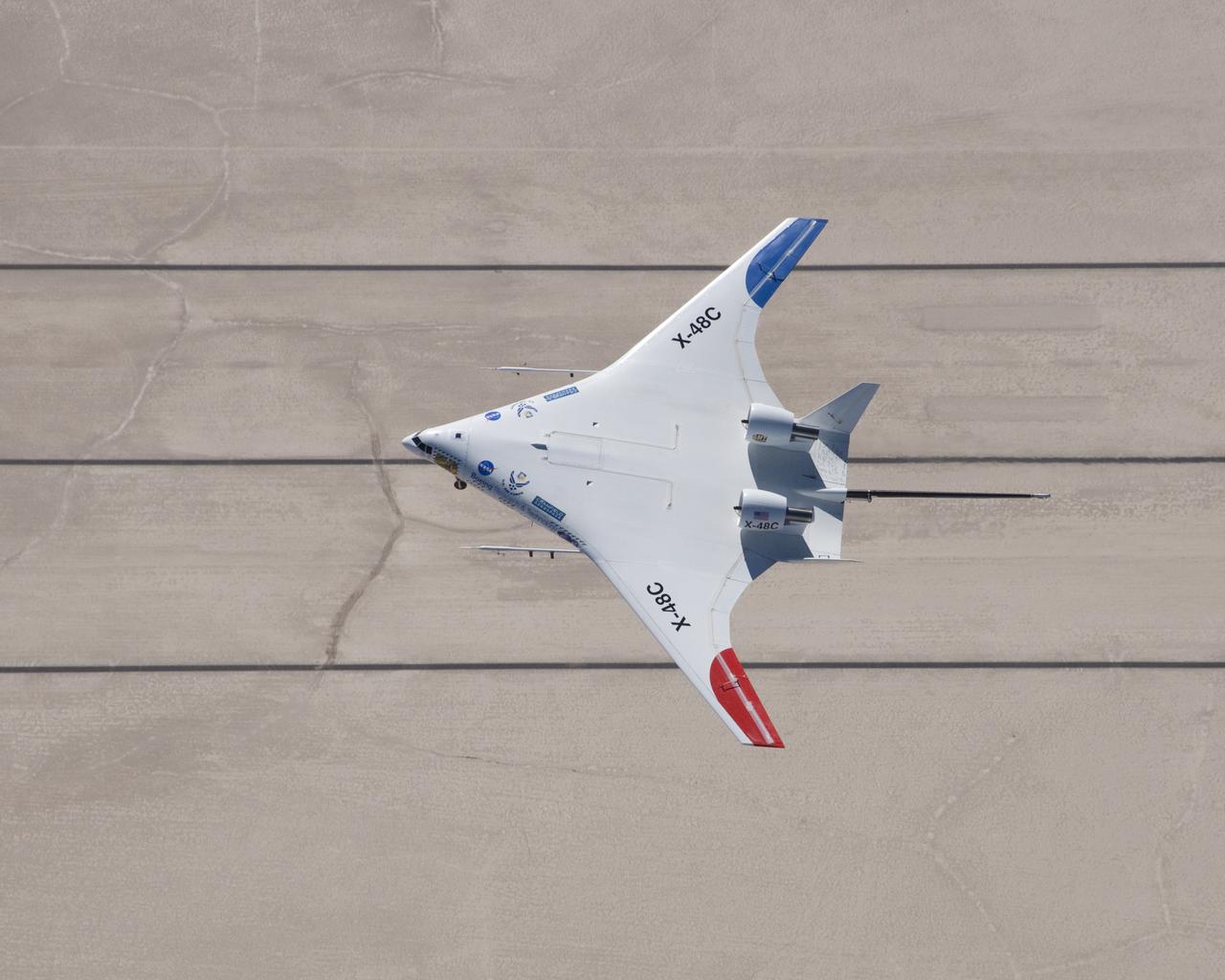
NASA X-48C Hybrid Wing Body aircraft flew over one of the runways laid out on Rogers Dry Lake at Edwards Air Force Base, CA, during a test flight from NASA's Dryden Flight Research Center on Feb. 28, 2013.
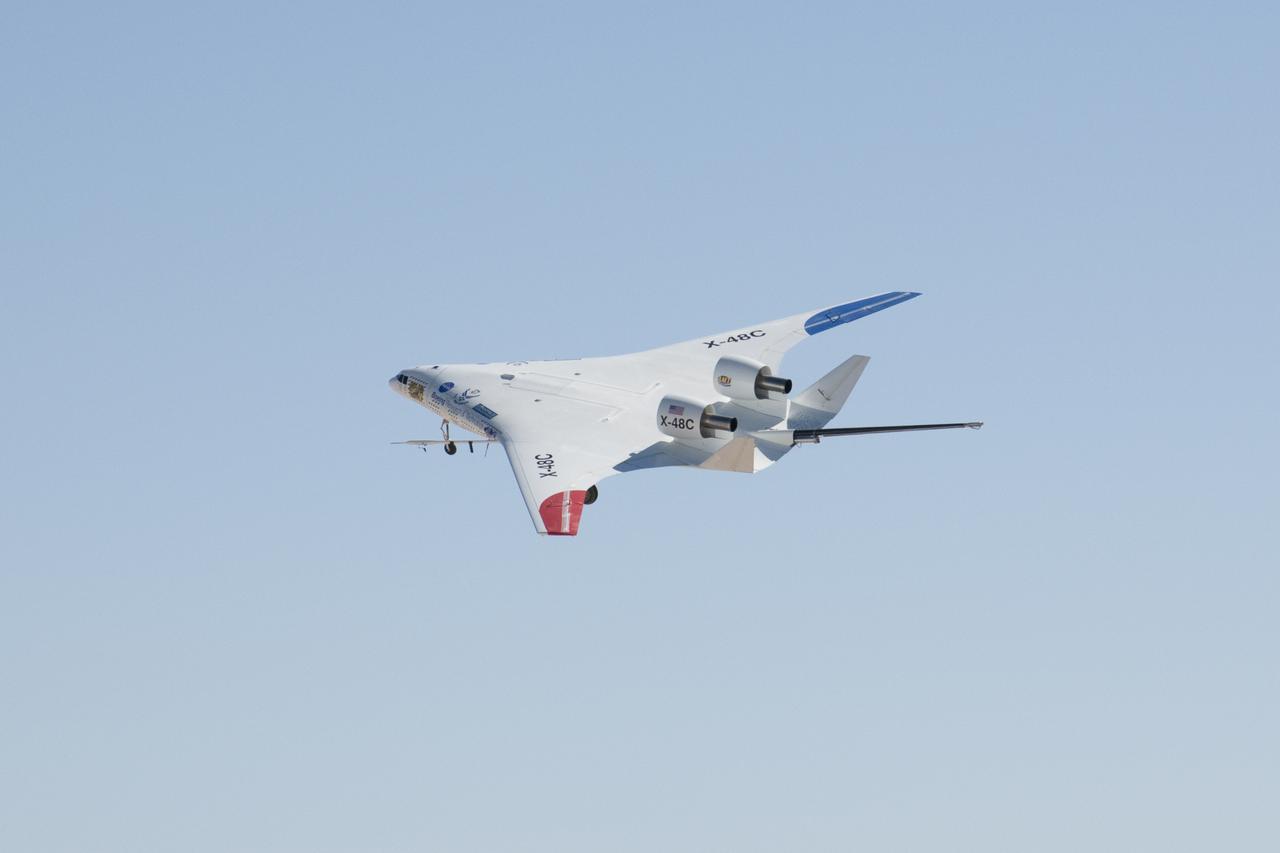
The NASA-Boeing X-48C Hybrid/Blended Wing Body research aircraft banked left during one of its final test flights over Edwards Air Force Base from NASA's Dryden Flight Research Center on Feb. 28, 2013.
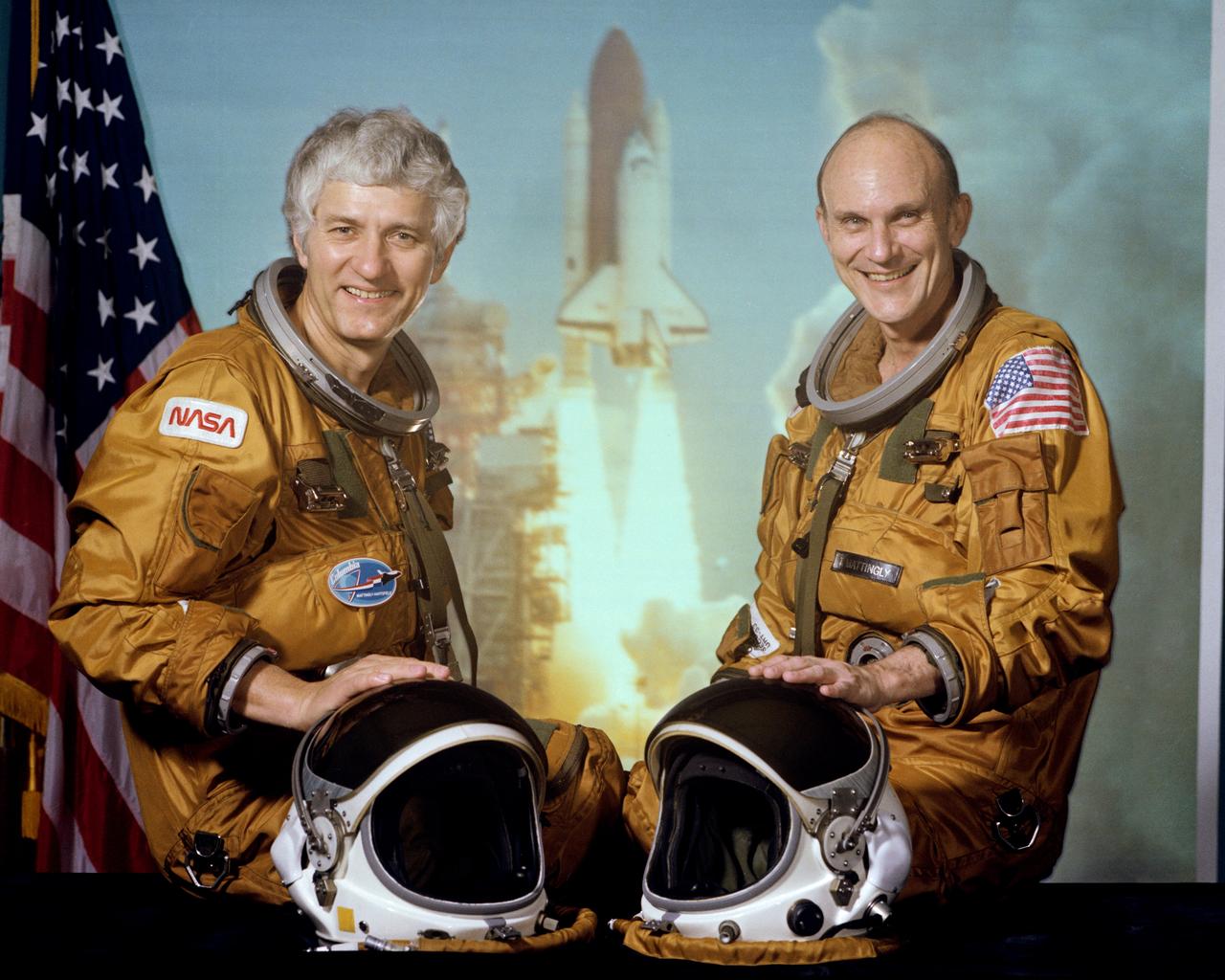
S82-31207 (1 May 1982) --- These two astronauts will man the space shuttle Columbia for NASA's fourth and final (STS-4) orbital flight test. Thomas K. (Ken) Mattingly II, right, is crew commander. Henry W. Hartsfield Jr., is pilot. Their flight is scheduled for launch in late June 1982, and is to last approximately one week, with launch to take place form KSC and landing to be on the dry lake beds of Edwards Air Force Base and Dryden Flight Research Facility (DFRC) in California. Photo credit: NASA
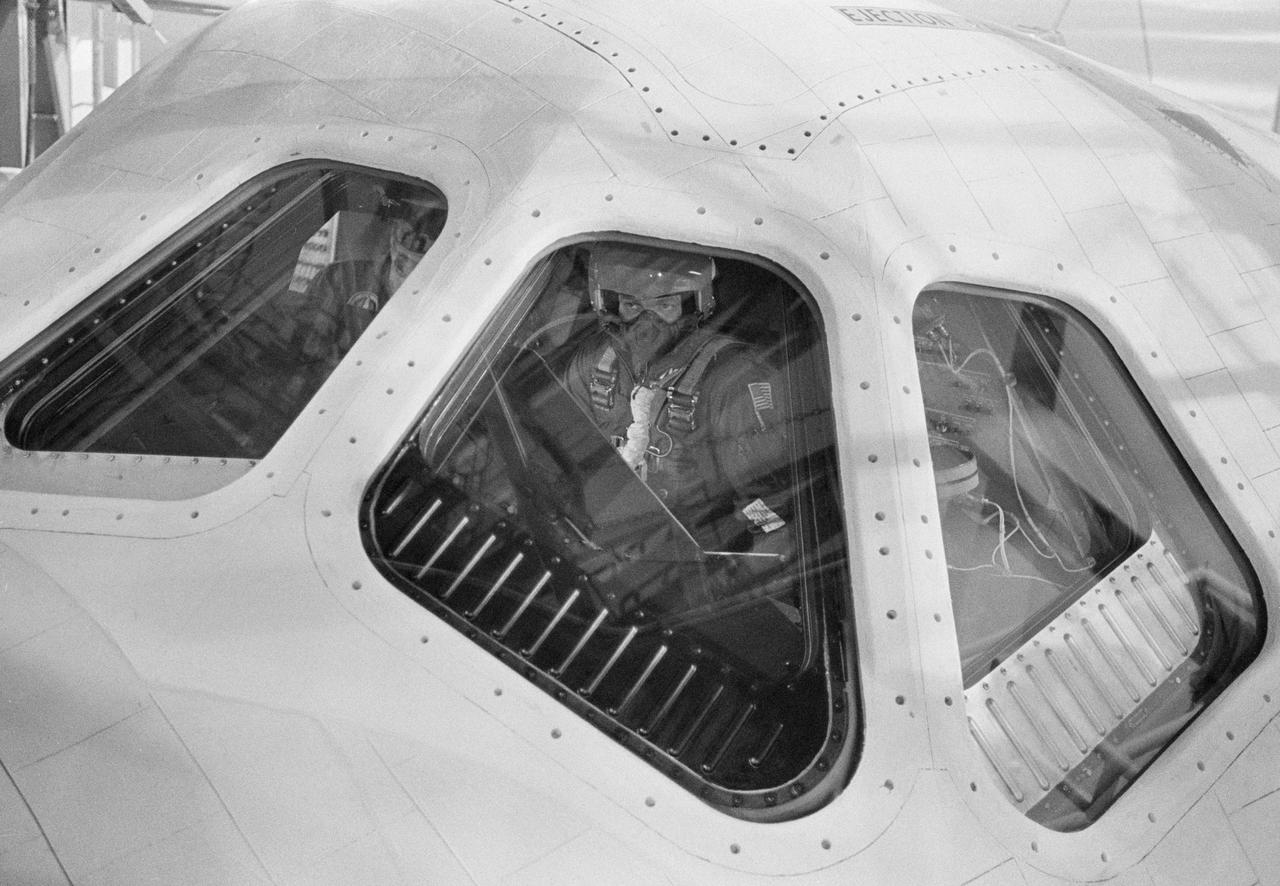
S77-28212 (13 Sept 1977) --- Astronauts Joe H. Engle (right), commander, and Richard H. Truly, pilot, sit in the cockpit of the shuttle Orbiter 101 "Enterprise" at the Dryden Flight Research Center (DFRC) prior to takeoff of the NASA 747 carrier aircraft to which the "Enterprise" was mated. The pair later made a five-minute, 31-second free-flight in the craft, the second in a series of such flights for the Shuttle Approach and Landing Tests (ALT) program. The photograph was made from the Mate-Demate Device (MDD).

S77-28210 (13 Sept 1977) --- Astronauts Joe H. Engle (face down), commander, and Richard H. Truly (face partially obscured by Engle), pilot, are greeted by Rockwell technicians following egress from the shuttle Orbiter 101 "Enterprise." They had just completed a five-minute, 31-second unpowered free flight in the "Enterprise," the second of a series of such flights, conducted on September 13, 1977, at the Dryden Flight Research Center (DFRC) and Edwards Air Force Base.
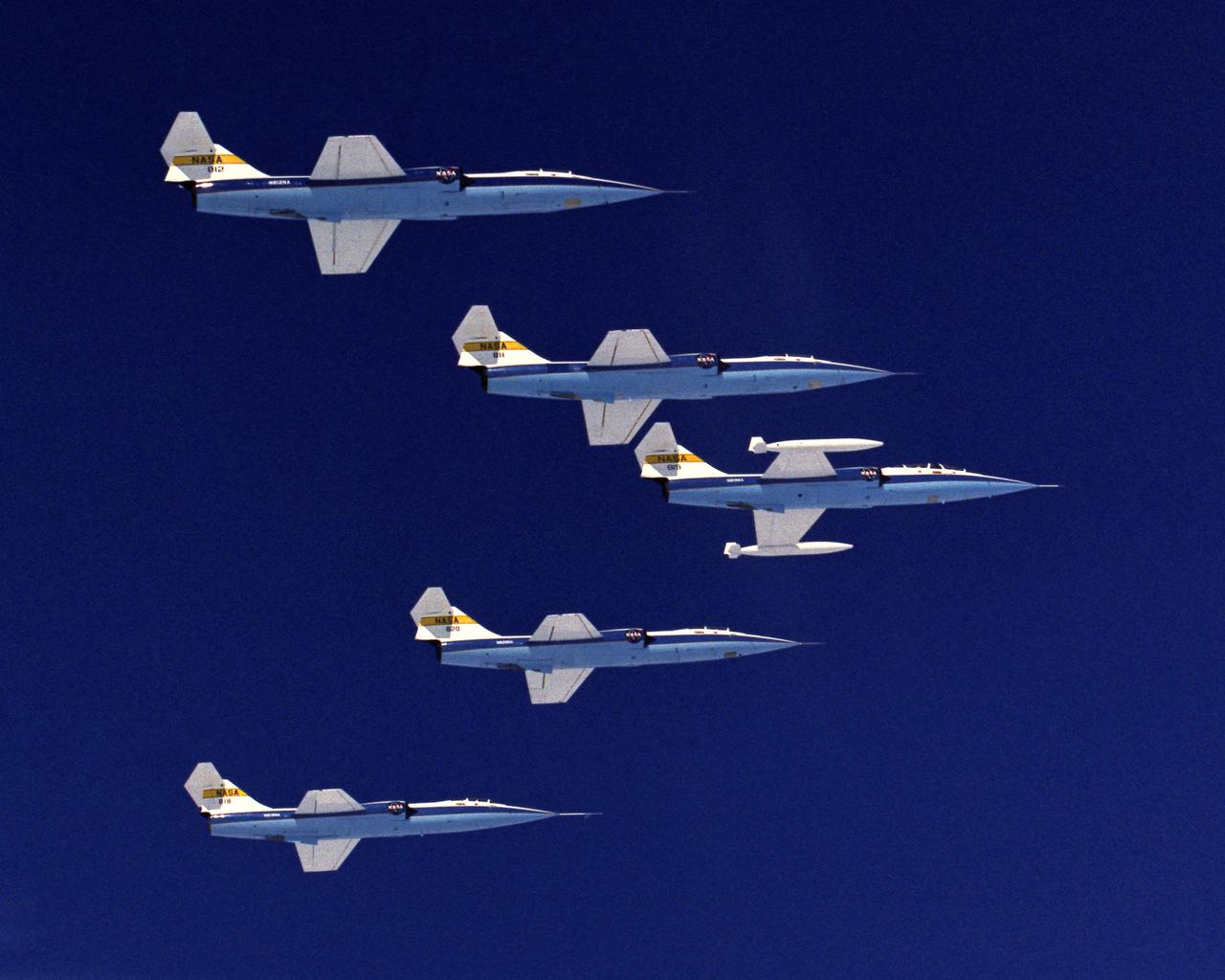
The only time the five ship fleet of F-104 Starfighters was ever airborne at the same time. Pilots were: F-104N #811-Bill Dana; F-104N #812-Tom McMurtry; F-104A #818-Einar Enevoldson; F-104A #820-Gary Krier; F-104B #819-Fitz Fulton and Ray Young. Photo taken from T-38 #821 flown by Don Mallick and photographer was Bob Rhine. 4/11/75 NASA DFRC EC76-5145
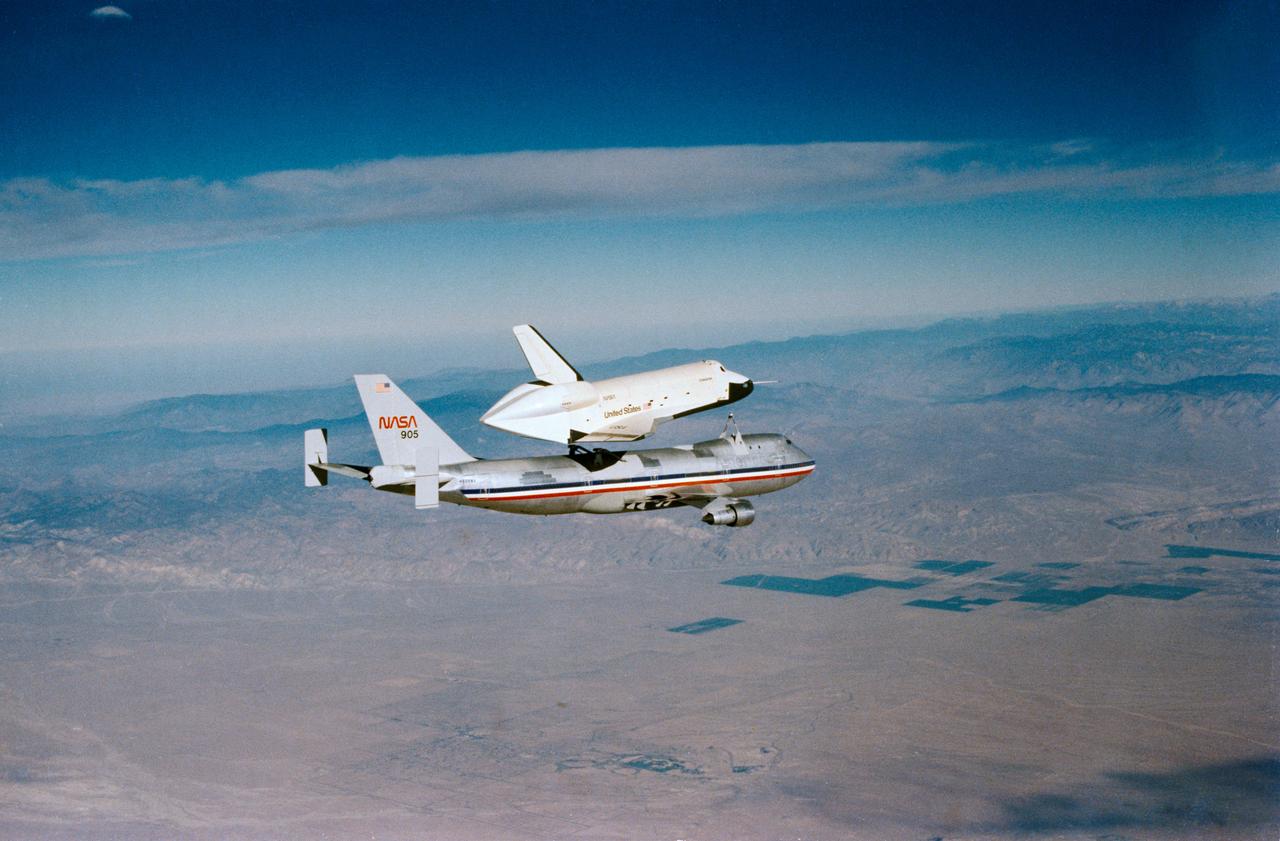
S77-28542 (23 Sept 1977) --- The shuttle Orbiter 101 "Enterprise" separates from the NASA 747 carrier aircraft during the third free flight of the Shuttle Approach and Landing Tests (ALT) conducted on September 23, 1977, at the Dryden Flight Research Center (DFRC) in Southern California. The vehicle, with astronauts Fred W. Haise Jr., commander, and C. Gordon Fullerton, pilot, remained in unpowered flight for five-minutes and 34-seconds before landing on the desert land of Edwards Air Force Base.
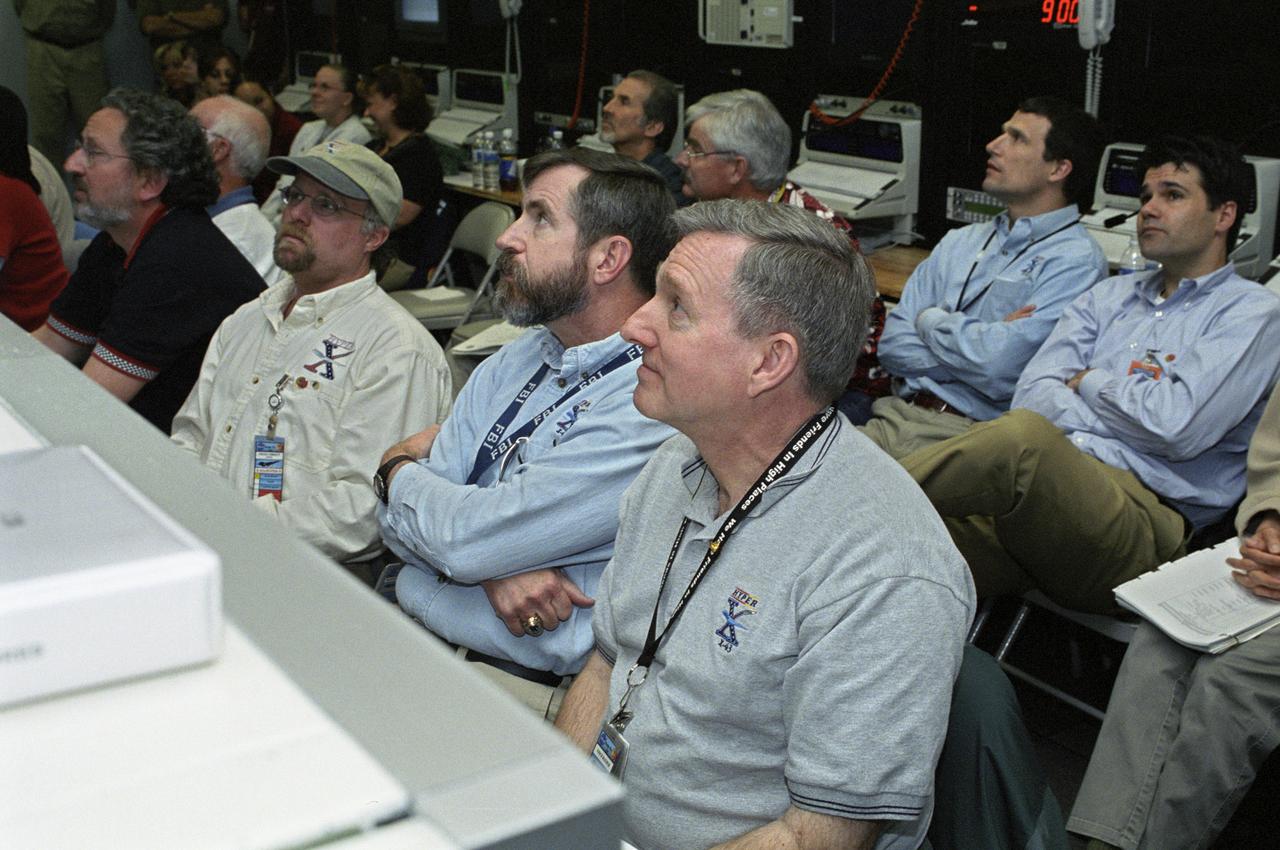
NASA personnel in a control room during the successful second flight of the X-43A aircraft. front row, left to right: Randy Voland, LaRC Propulsion; Craig Christy, Boeing Systems; Dave Reubush, NASA Hyper-X Deputy Program Manager; and Vince Rausch, NASA Hyper-X Program Manager. back row, left to right: Bill Talley, DCI/consultant; Pat Stoliker, DFRC Director (Acting) of Research Engineering; John Martin, LaRC G&C; and Dave Bose, AMA/Controls.
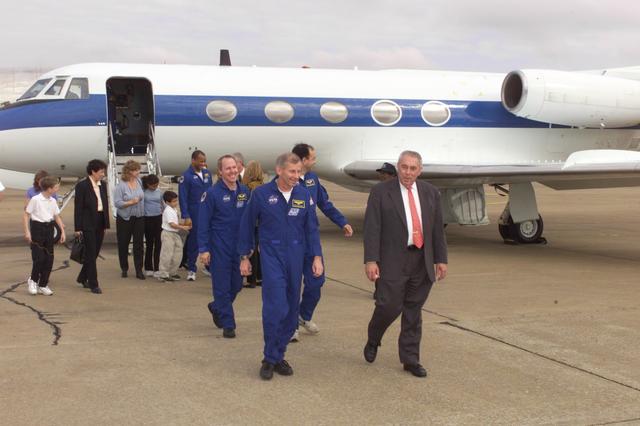
JSC2001-E-04805 (21 February 2001) --- JSC director George W.S. Abbey talks with the STS-98 crew members following the arrival of the Gulfstream Aircraft which transported the astronauts from their landing at Dryden Flight Research Center (DFRC) in Edwards, California. Pictured along side Mr. Abbey is astronaut Kenneth D. Cockrell, mission commander. Behind him (from the left distant background) are astronauts Robert L. Curbeam and Thomas D. Jones (both mission specialists) and Mark L. Polansky, pilot. Astronaut Marsha S. Ivins, mission specialist, is out of the frame.
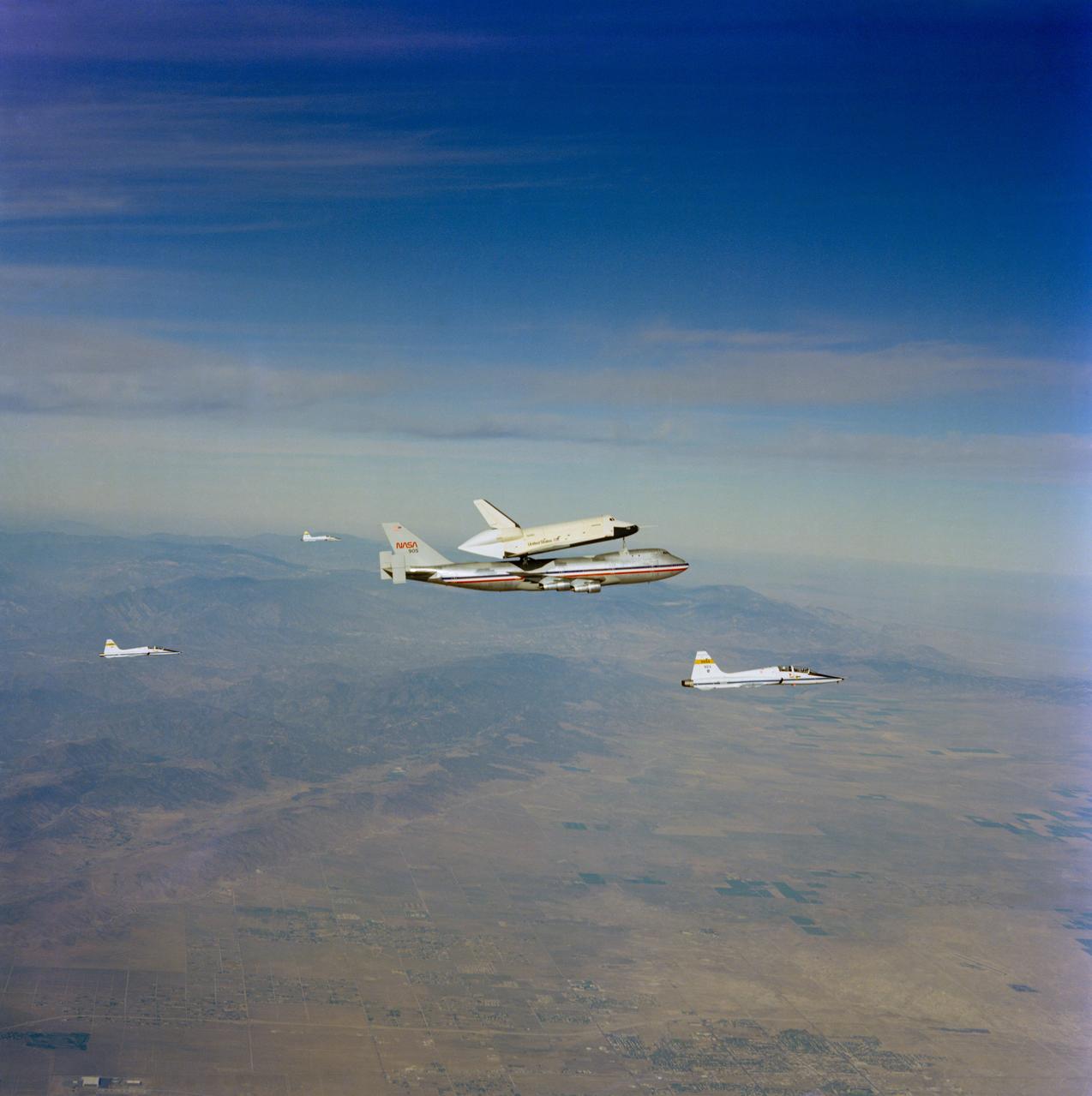
S77-28649 (23 Sept 1977) --- The shuttle Orbiter 101 "Enterprise" sits atop the NASA 747 carrier aircraft in a piggy-back configuration prior to separation for the third free flight of the Shuttle Approach and Landing Tests (ALT) conducted on September 23, 1977, at the Dryden Flight Research Center (DFRC) in Southern California. The crew of the "enterprise" consisted of astronauts Fred W. Haise Jr., commander, and C. Gordon Fullerton, pilot. This photo was shot from one of the T-38 chase planes accompanying the ALT craft. Three other T-38 chase planes are pictured.
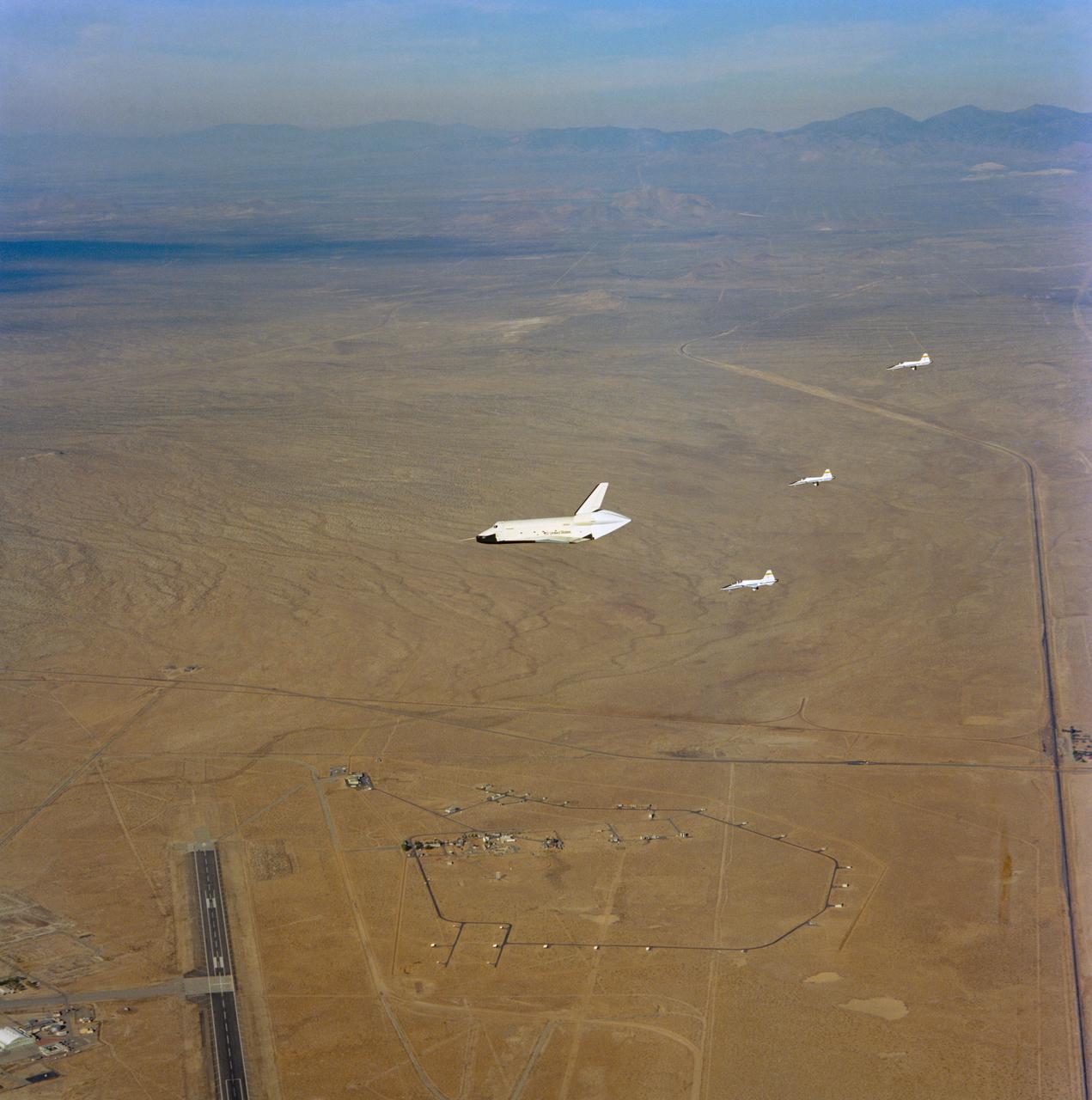
S77-28667 (23 Sept 1977) --- The shuttle Orbiter 101 "Enterprise" soars above the North Base area of Edwards Air Force Base during its five-minute, 34-second unpowered flight, the third of a series of manned Shuttle Approach and Landing Tests (ALT). Moments earlier the "Enterprise" had separated from its 747 carrier aircraft, atop which it sat upon takeoff from the Dryden Flight Research Center (DFRC), with its crew of astronauts Fred W. Haise Jr., commander, and C. Gordon Fullerton, pilot. Three T-38 chase planes follow. This photograph was taken from a fourth T-38 chase plane.
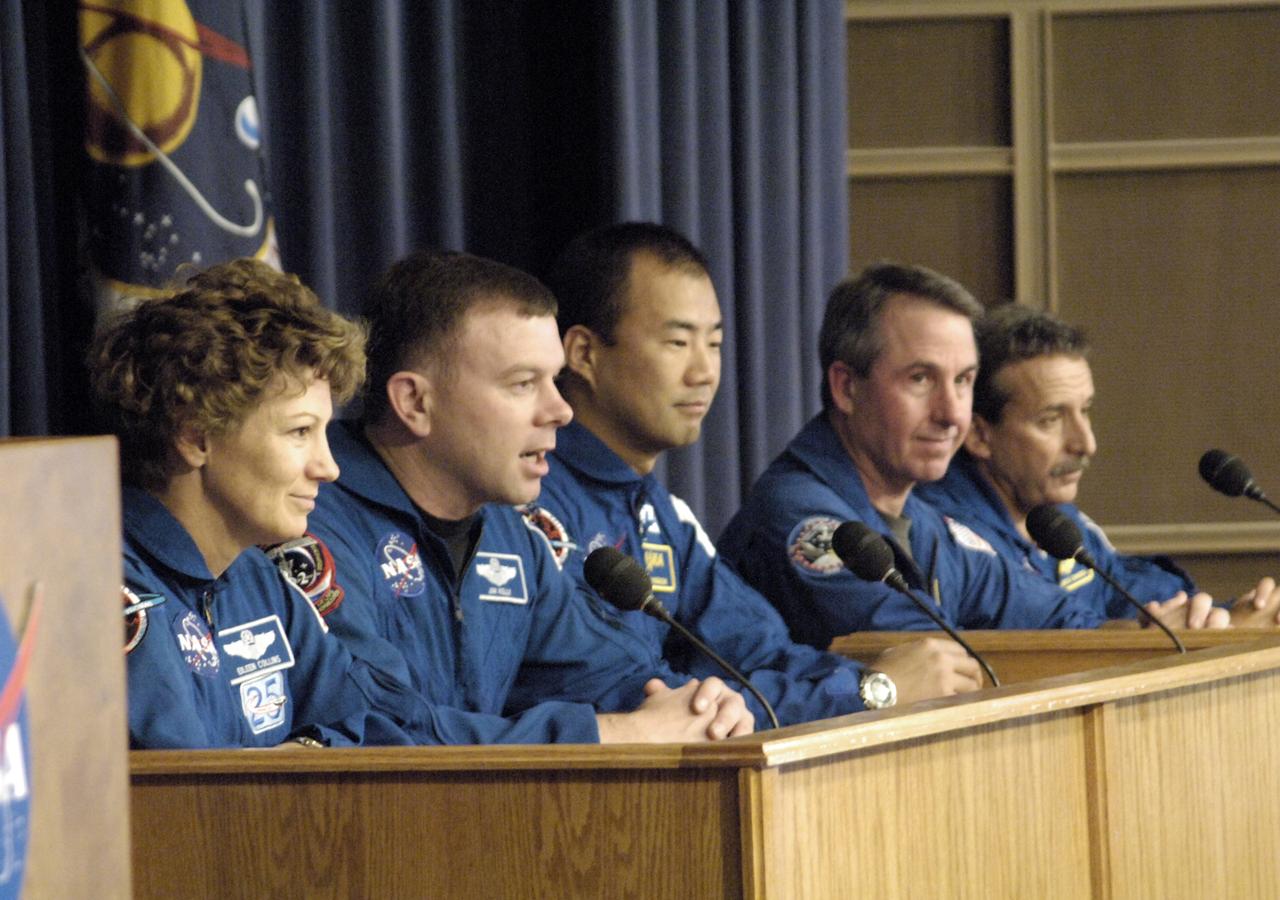
Pilot James Kelly answered a question at a briefing following the successful landing of the Space Shuttle Discovery at NASA DFRC on August 9, 2005. Commander Eileen Collins is on his right, mission specialists Soichi Noguchi, Andrew Thomas and Charles Camarda are to his left. Space Shuttle Discovery landed safely at NASA's Dryden Flight Research Center at Edwards Air Force Base in California at 5:11:22 a.m. PDT this morning, following the very successful 14-day STS-114 return to flight mission. During their two weeks in space, Commander Eileen Collins and her six crewmates tested out new safety procedures and delivered supplies and equipment the International Space Station. Discovery spent two weeks in space, where the crew demonstrated new methods to inspect and repair the Shuttle in orbit. The crew also delivered supplies, outfitted and performed maintenance on the International Space Station. A number of these tasks were conducted during three spacewalks. In an unprecedented event, spacewalkers were called upon to remove protruding gap fillers from the heat shield on Discovery's underbelly. In other spacewalk activities, astronauts installed an external platform onto the Station's Quest Airlock and replaced one of the orbital outpost's Control Moment Gyroscopes. Inside the Station, the STS-114 crew conducted joint operations with the Expedition 11 crew. They unloaded fresh supplies from the Shuttle and the Raffaello Multi-Purpose Logistics Module. Before Discovery undocked, the crews filled Raffeallo with unneeded items and returned to Shuttle payload bay. Discovery launched on July 26 and spent almost 14 days on orbit.
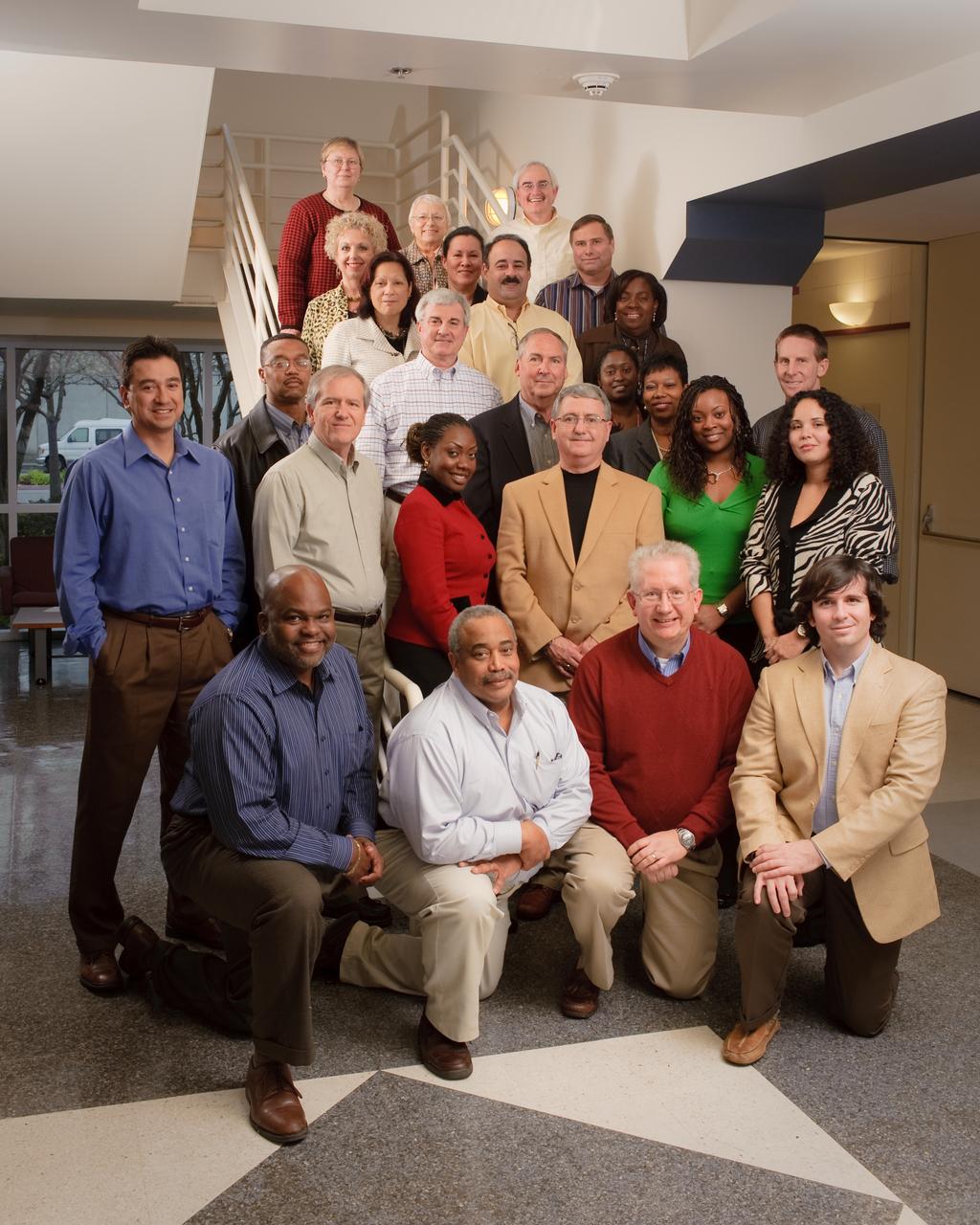
Small Business Council meeting hosed by NASA Ames Research Center: Naeemah Lee, H.Q., Cheryl Harrison, JSC, Gil DelVaile, GSRC, Mary Helen Ruiz, JPL, David Grove, HQ, John Cecconi, NSSC, Sandra Morris, HQ/OP, Michelle Stracener, SSC, Randy Manning, LaRC, Vernon Vann, LaRC, David Brock, MSFC, Ben Henson, MSFC, Larry Third, KSC, Robert Medina, DFRC, Christine Munroe, ARC, Lupe M. Velasquez, ARC, Monica F. Craft, JSC (?), Angel Castillo, NMO, Timothy C Pierce, GRC, Charles Williams, JSC, Jennifer Perez, GSFC, Rosa Acevedo, GSFC, Glenn A Delgado, HQ/Assoc Admin for Small Business, Tabisa Tepfer, HQ/OSBP/MORIAssoc, Richard Mann, HQ/OSBP
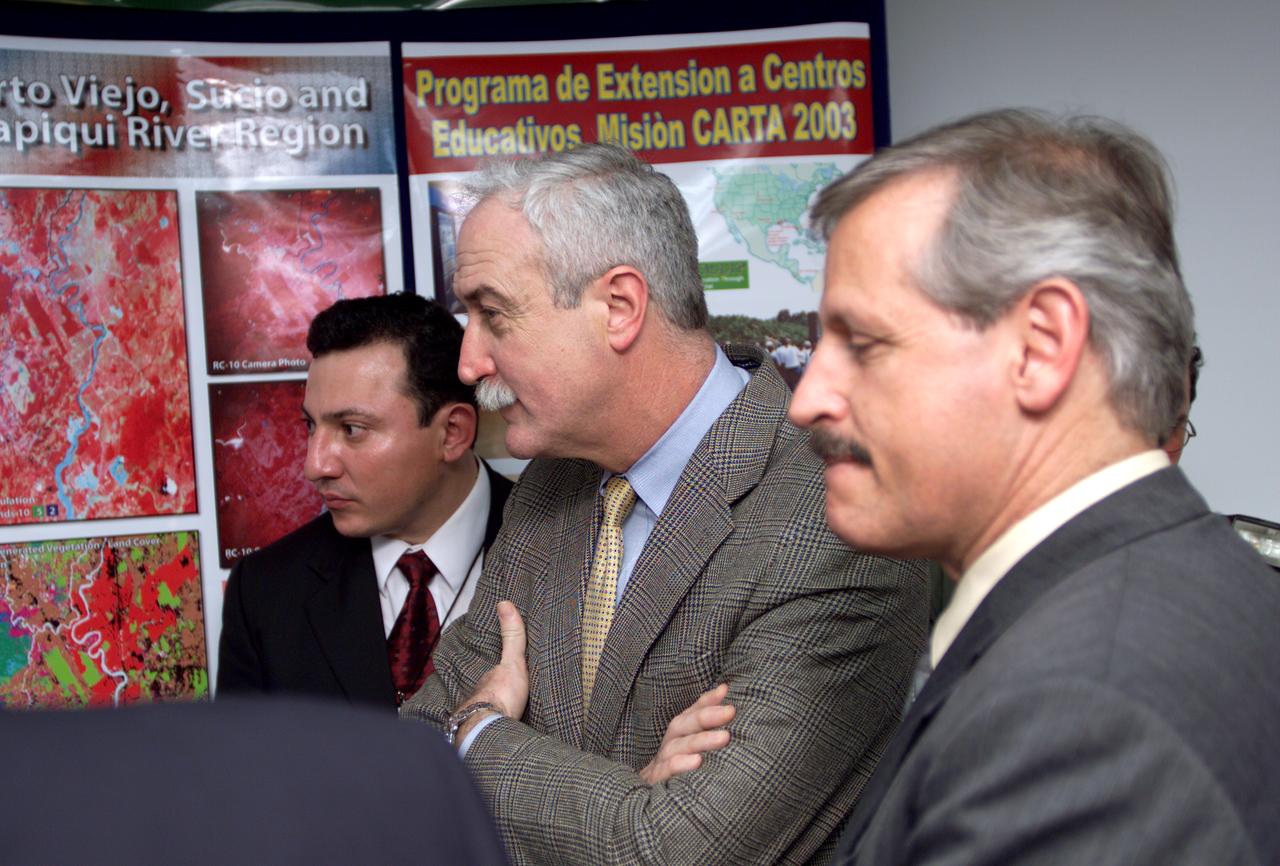
L-R; Jorge Andres Diaz, Director of the Costa Rican National Hangar for Airborne Research division of the National Center for High Technology(CENAT); NASA Administrator Sean O'Keefe; and Fernando Gutierrez, Costa Rican Minister of Science and Technology(MICIT), viewing posters showing how NASA activities have made an impact on Costa Rican people. Mr. O'Keefe was in Costa Rica to participate in the AirSAR 2004 Mesoamerica campaign, which used NASA DFRC's DC-8 airborne laboratory aircraft. AirSAR 2004 is a three-week expedition by an international team of scientists that will use an all-weather imaging tool, called the Airborne Synthetic Aperture Radar (AirSAR), in a mission ranging from the tropical rain forests of Central America to frigid Antarctica.
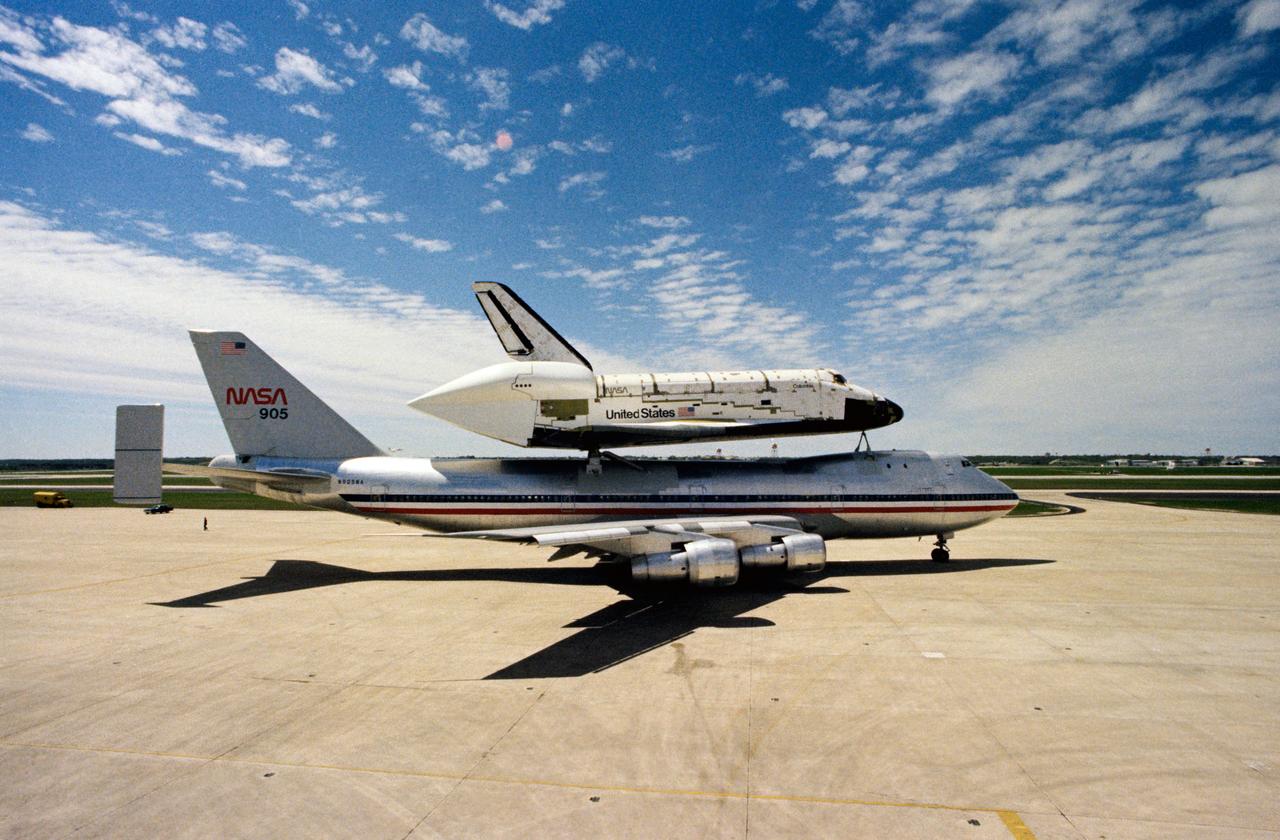
S79-30103 (23 March 1978) --- A side view of the huge space shuttle orbiter 102 Columbia mated atop its 747 carrier aircraft--NASA 905?in ?piggyback? mode, ready for takeoff from Kelly Air Force Base. Kelly AFB was one of the scheduled stops enroute to the Kennedy Space Center from the Dryden Flight Research Center in southern California. The ferry flight covered about 2,400 miles. Columbia reached Dryden Flight Research Center from its Palmdale manufacturing facility, some 35 miles away, via powerful transport vehicle. At DFRC, the Columbia and 747 were mated for the flight to Florida. Orbiter 102 will be the first shuttle vehicle in space when the orbital flight test (OFT) series begins next year. Photo credit: NASA
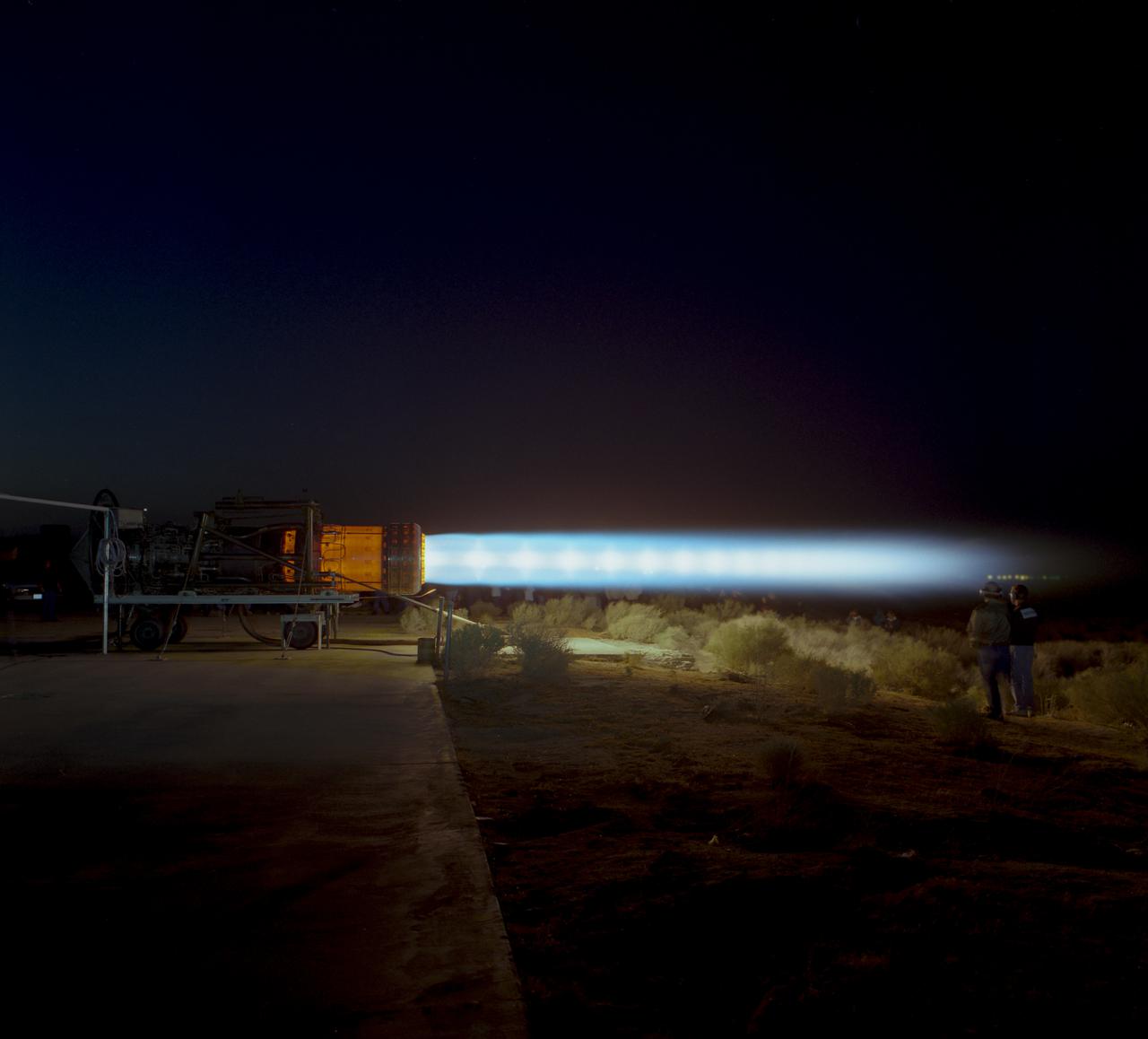
A J58 turbojet used in Lockheed SR-71s which NASA flew, during an engine run. The engine, anchored to the ground, is in full afterburner and parts of the engine are glowing.
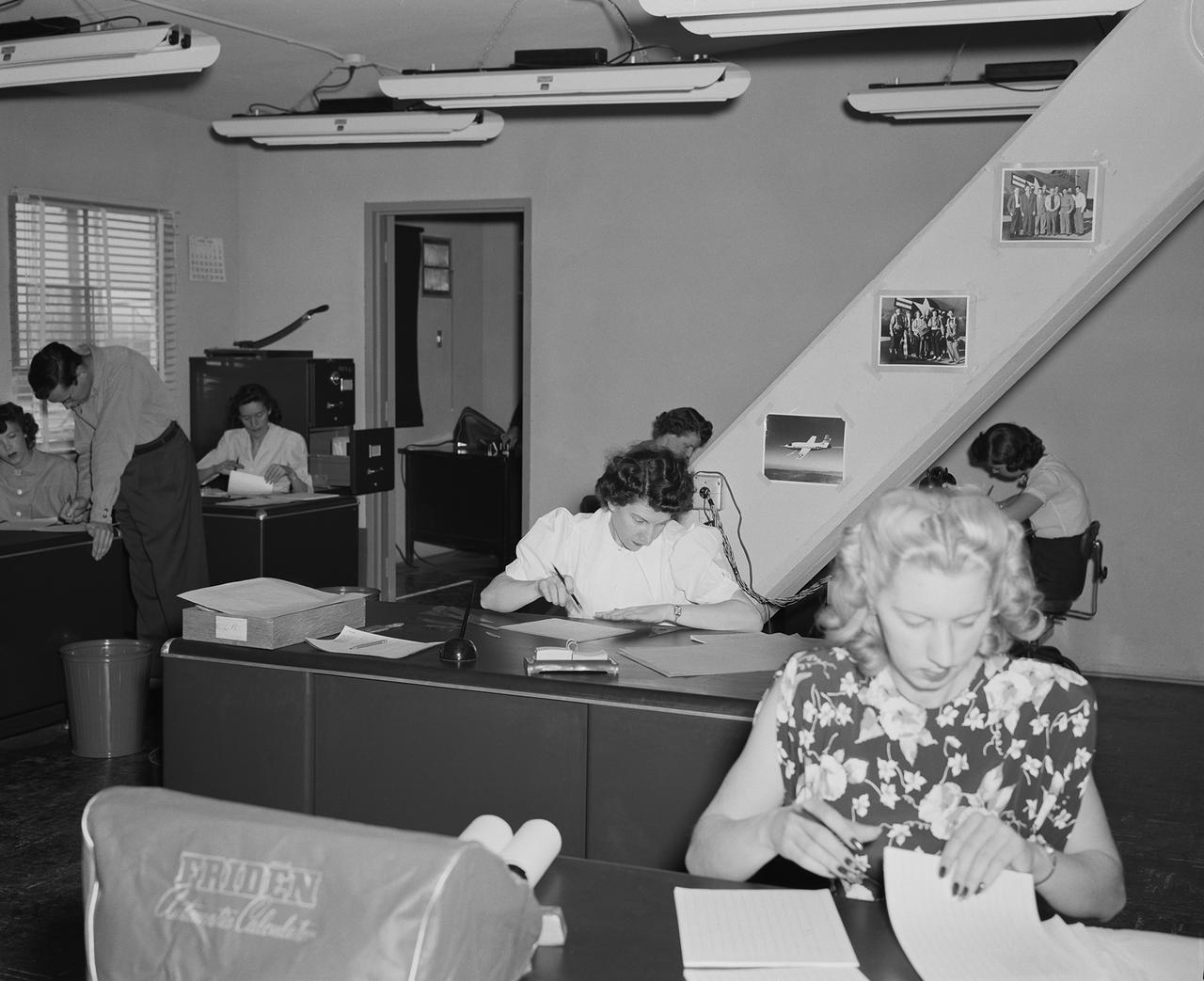
NACA women computers had degrees in mathematics or taught math before they were hired. They reduced film data and plotted it for the engineers.
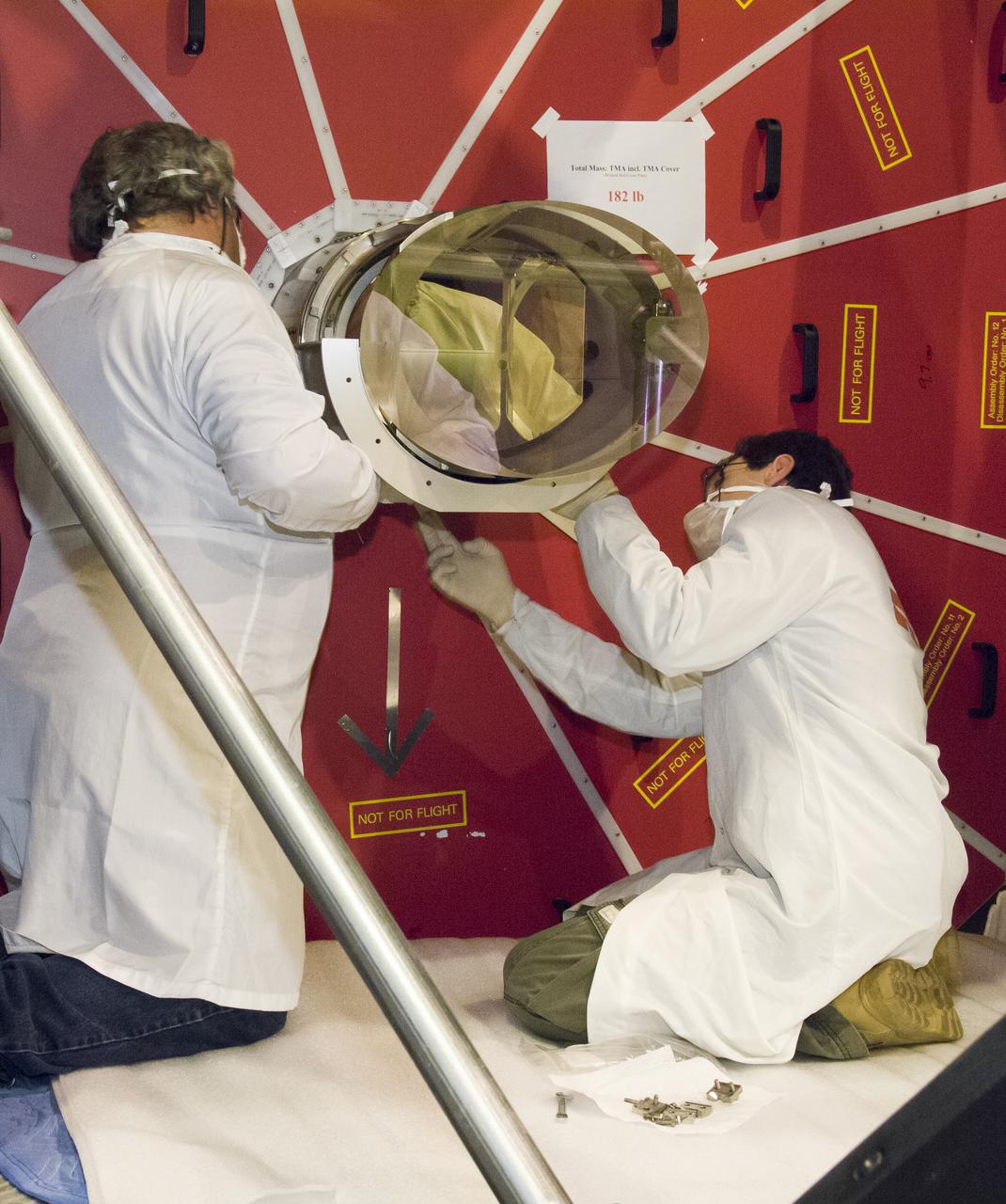
Technicians installing the tertiary mirror onto the SOFIA telescope.
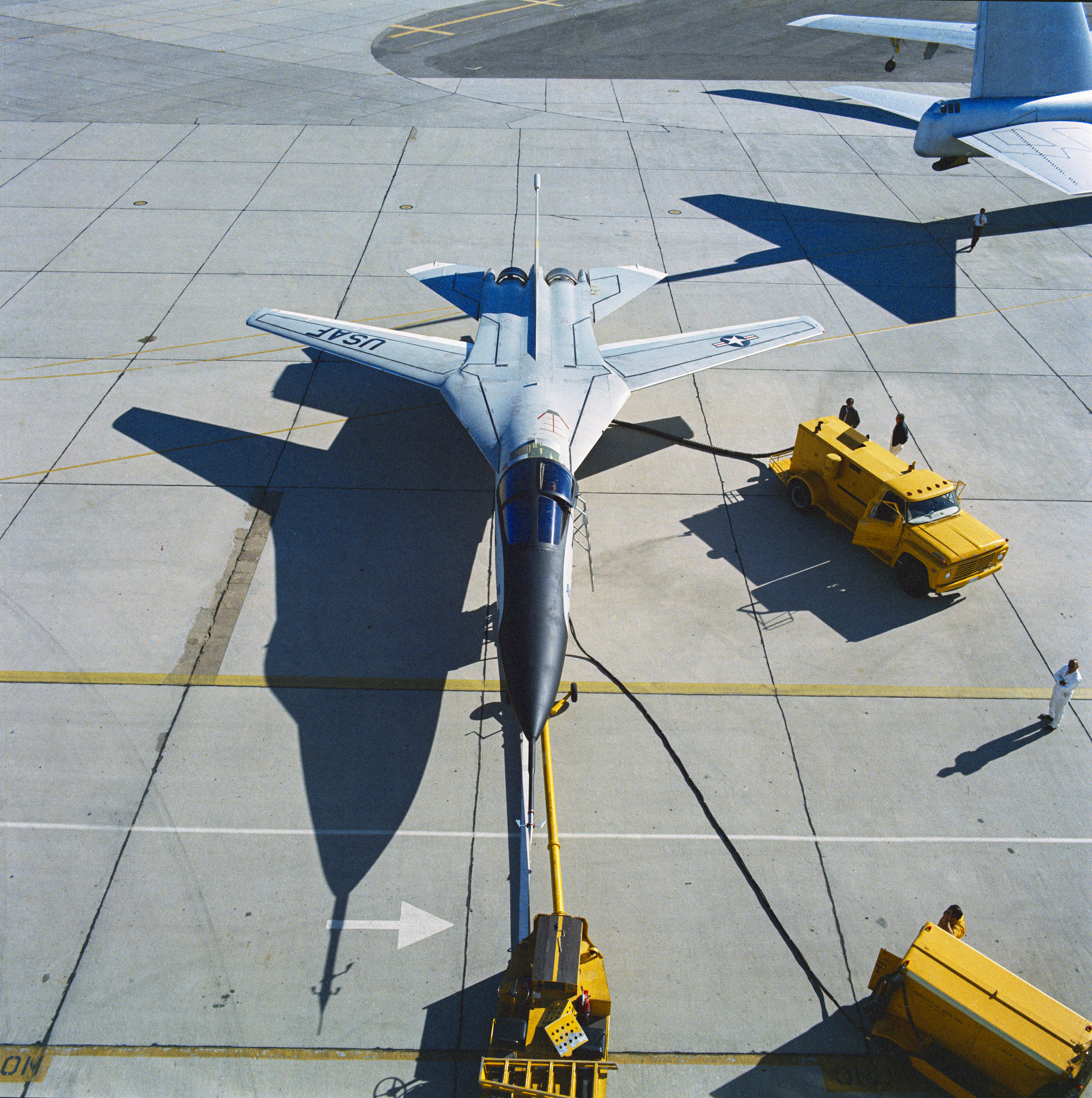
The F-111B with its wings swept to their maximum angle. It carried the Mission Adaptive Wing, a single-piece composite structure with leading and trailing edges that could be lowered or raised in flight.
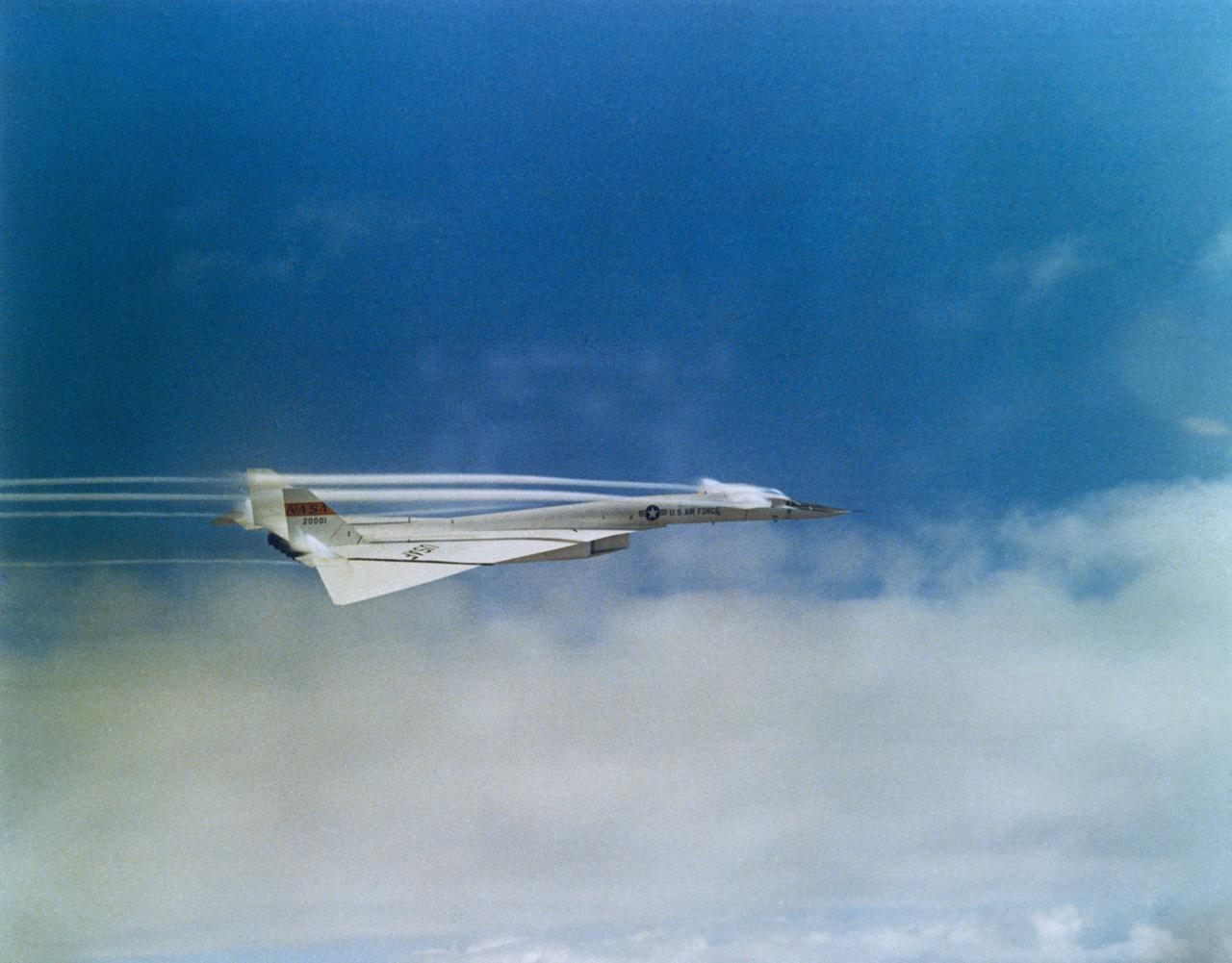
The North American Aviation XB-70 triple-sonic bomber prototype aircraft No. 1. NASA used the pre-production bomber for high-speed research in the mid-1960s.
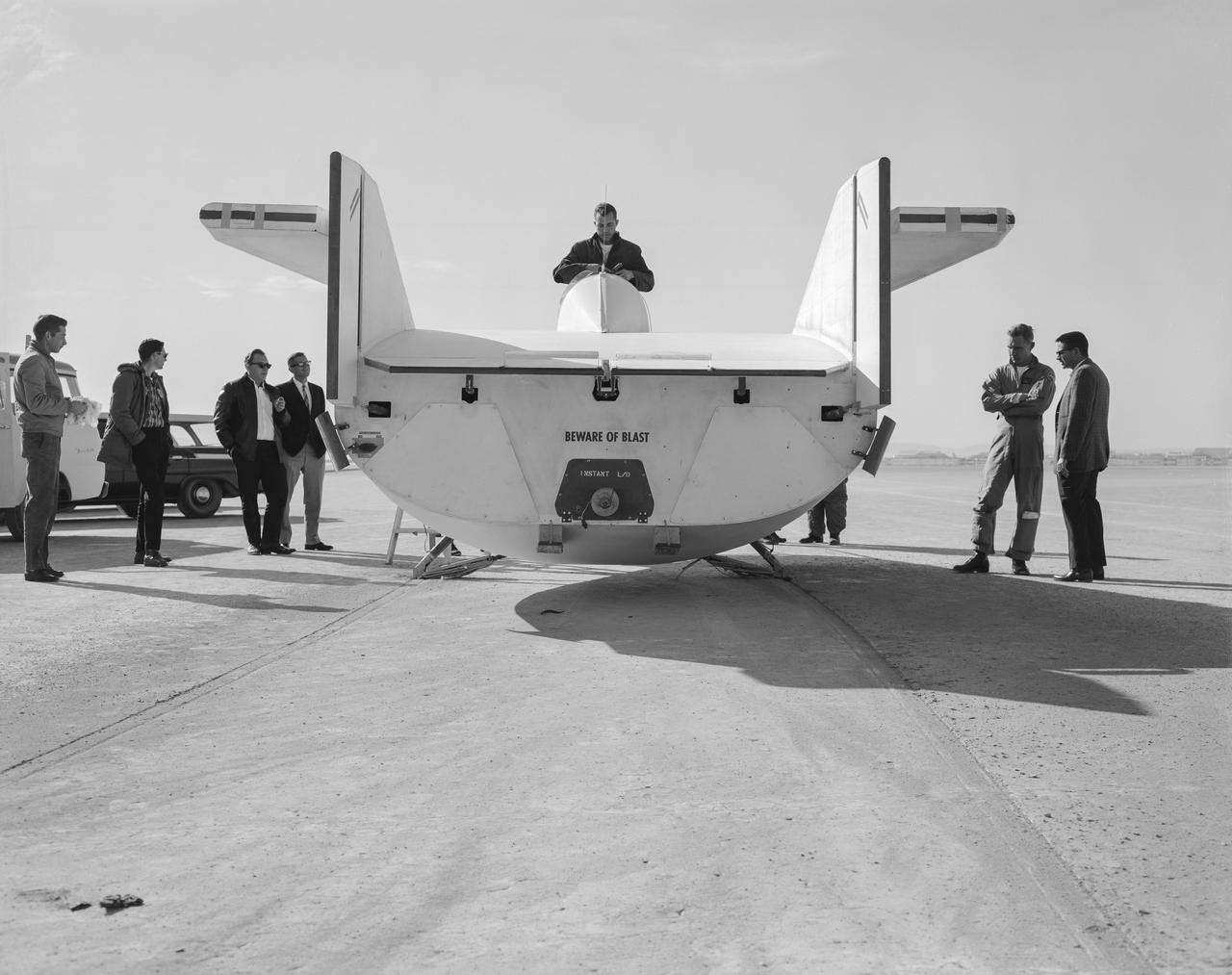
The M2-F1 following a hard landing on Rogers Dry Lake in 1963. It hit the lakebed so hard the rolling gear completely separated.

The F-8 Digital Fly-By-Wire aircraft had its hydro-mechanical control systems replaced by an Apollo Guidance Computer for the first such control system to fly.

NASA’s F/A-18 High Alpha Research Vehicle, also known as the “Silk Purse,” performs a thrust vectoring test in afterburner in 1991, while anchored to the ground.
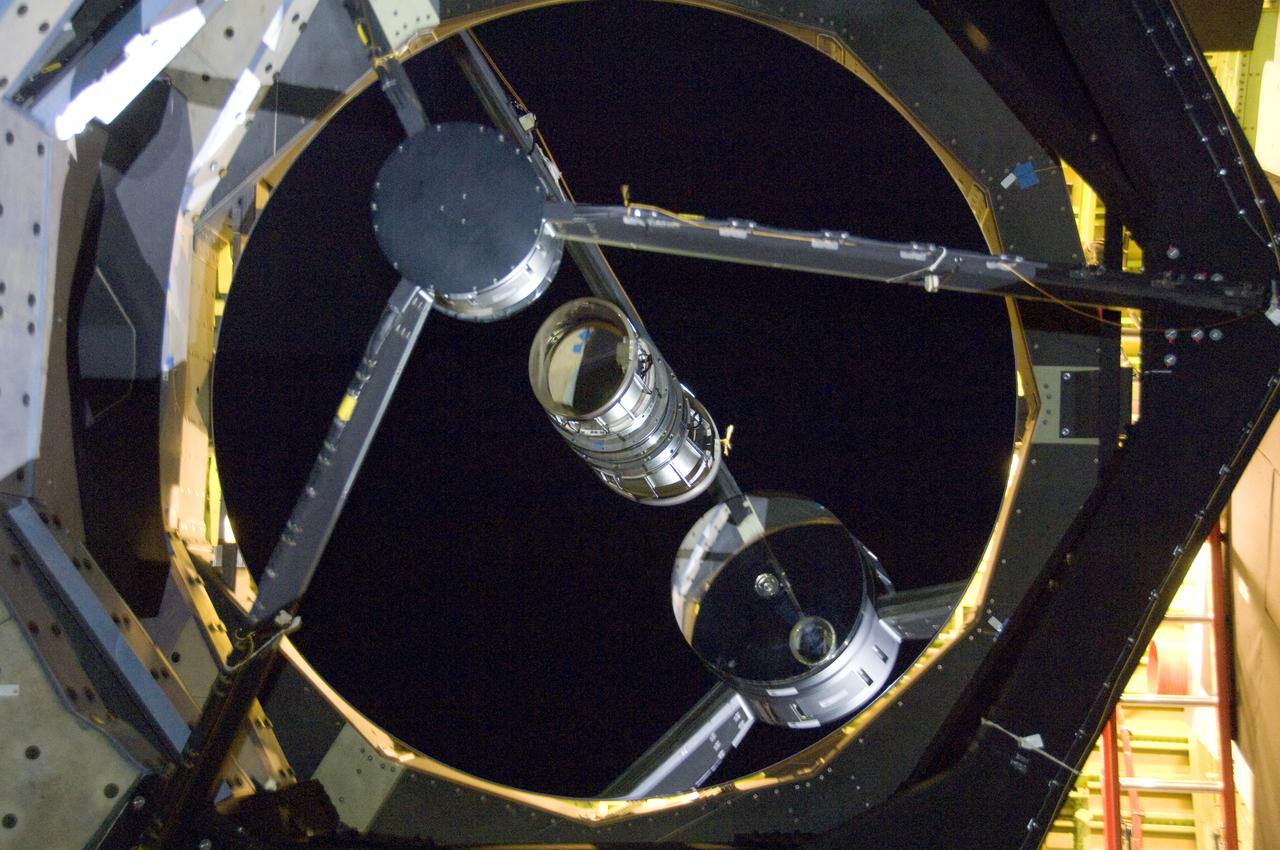
SOFIA’s telescope mirror is seen as it appears during a science mission.
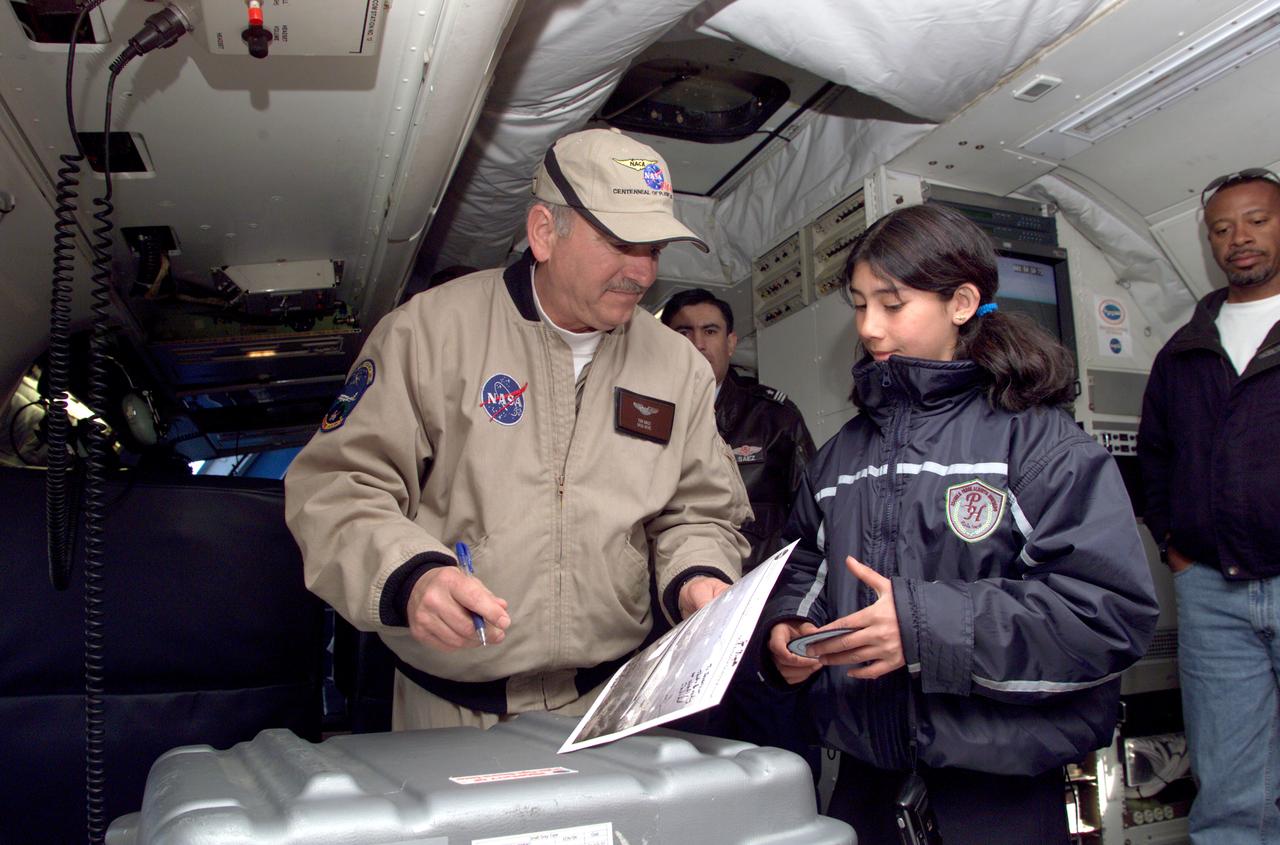
Dr. Tom Mace, NASA DFRC Director of Airborne Sciences, talks with a student from Punta Arenas, Chile, during a tour of the DC-8 aircraft while it was in the country supporting the AirSAR 2004 campaign. AirSAR 2004 is a three-week expedition by an international team of scientists that uses an all-weather imaging tool, called the Airborne Synthetic Aperture Radar (AirSAR) which is located onboard NASA's DC-8 airborne laboratory. Scientists from many parts of the world including NASA's Jet Propulsion Laboratory are combining ground research done in several areas in Central and South America with NASA's AirSAR technology to improve and expand on the quality of research they are able to conduct. In South America and Antarctica, AirSAR collected imagery and data to help determine the contribution of Southern Hemisphere glaciers to sea level rise due to climate change. In Patagonia, researchers found this contribution had more than doubled from 1995 to 2000, compared to the previous 25 years. AirSAR data will make it possible to determine whether that trend is continuing or accelerating. AirSAR will also provide reliable information on ice shelf thickness to measure the contribution of the glaciers to sea level.
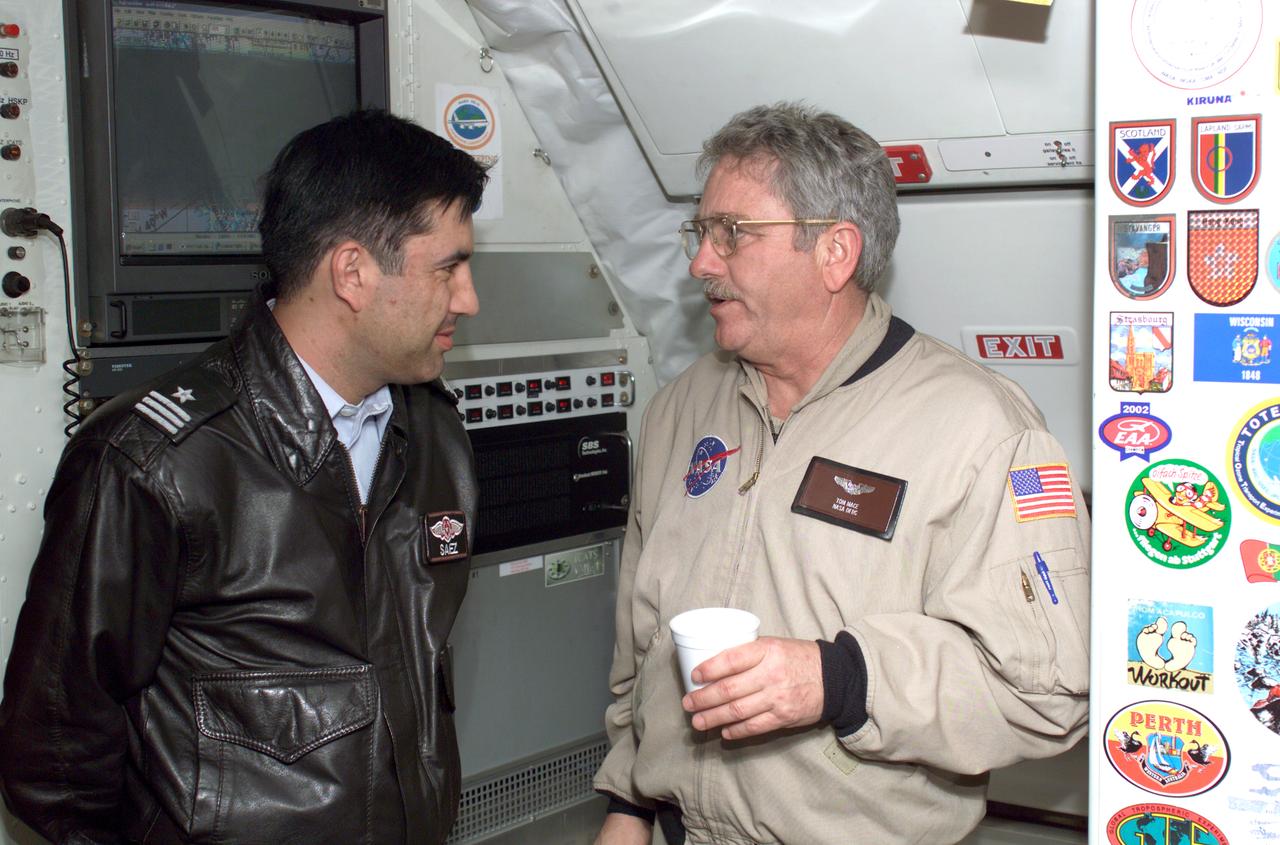
Chilean Air Force Captain Saez and Dr. Tom Mace, DFRC Director of Airborne Sciences, discuss airborne science during a DC-8 ferry flight from Santiago to Punta Arenas, Chile. AirSAR 2004 is a three-week expedition by an international team of scientists that uses an all-weather imaging tool, called the Airborne Synthetic Aperture Radar (AirSAR) which is located onboard NASA's DC-8 airborne laboratory. Scientists from many parts of the world including NASA's Jet Propulsion Laboratory are combining ground research done in several areas in Central and South America with NASA's AirSAR technology to improve and expand on the quality of research they are able to conduct. In South America and Antarctica, AirSAR collected imagery and data to help determine the contribution of Southern Hemisphere glaciers to sea level rise due to climate change. In Patagonia, researchers found this contribution had more than doubled from 1995 to 2000, compared to the previous 25 years. AirSAR data will make it possible to determine whether that trend is continuing or accelerating. AirSAR will also provide reliable information on ice shelf thickness to measure the contribution of the glaciers to sea level.
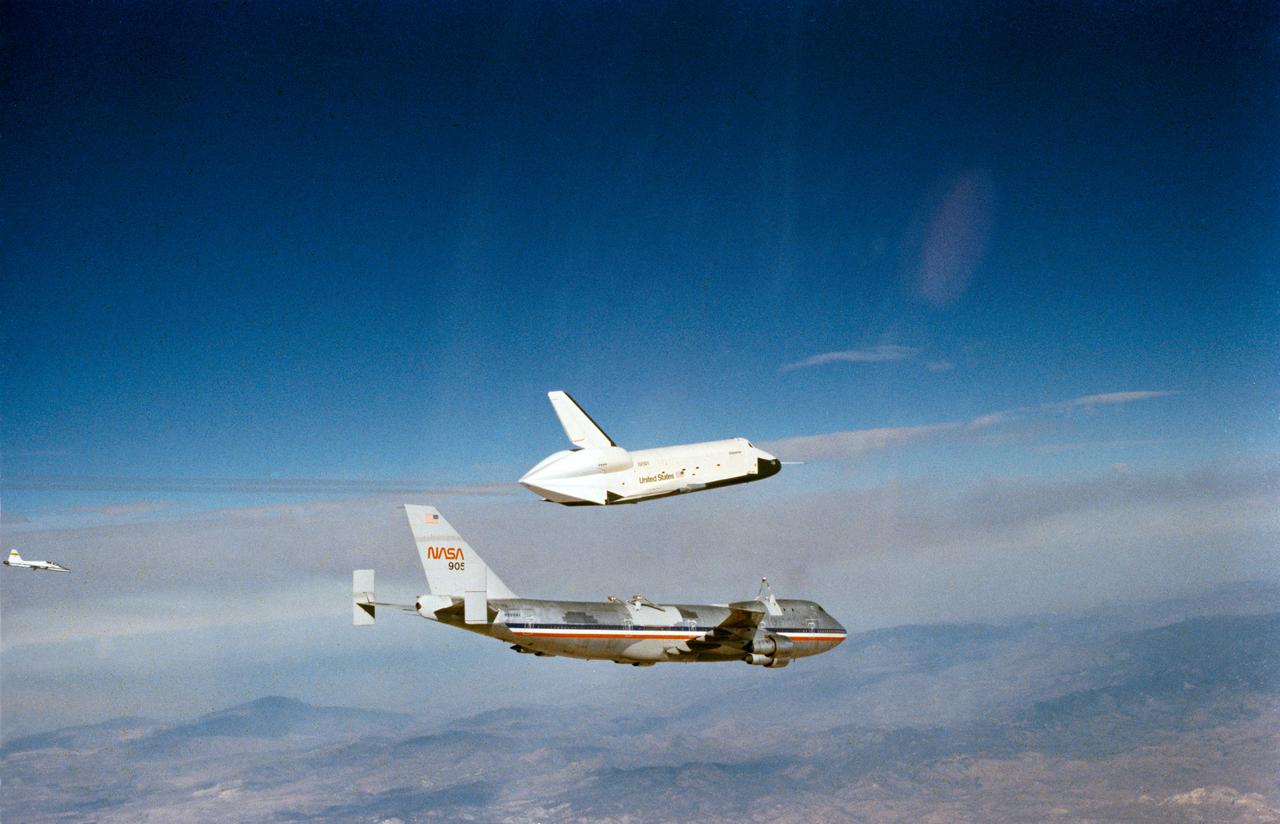
S77-28137 (13 Sept 1977) --- The Orbiter 101 "Enterprise" soars above the NASA 747 carrier aircraft during the second free flight of the Shuttle Approach and Landing Tests (ALTs) conducted on September 13, 1977 at Dryden Flight Research Center in Southern California. Astronauts Joe H. Engle, and Richard H. Truly were the crew of the "Enterprise." The ALT free flights are designed to verify Orbiter subsonic airworthiness, integrated systems operations and pilot-guided approach and landing capability and satisfying prerequisites to automatic flight control and navigation mode.
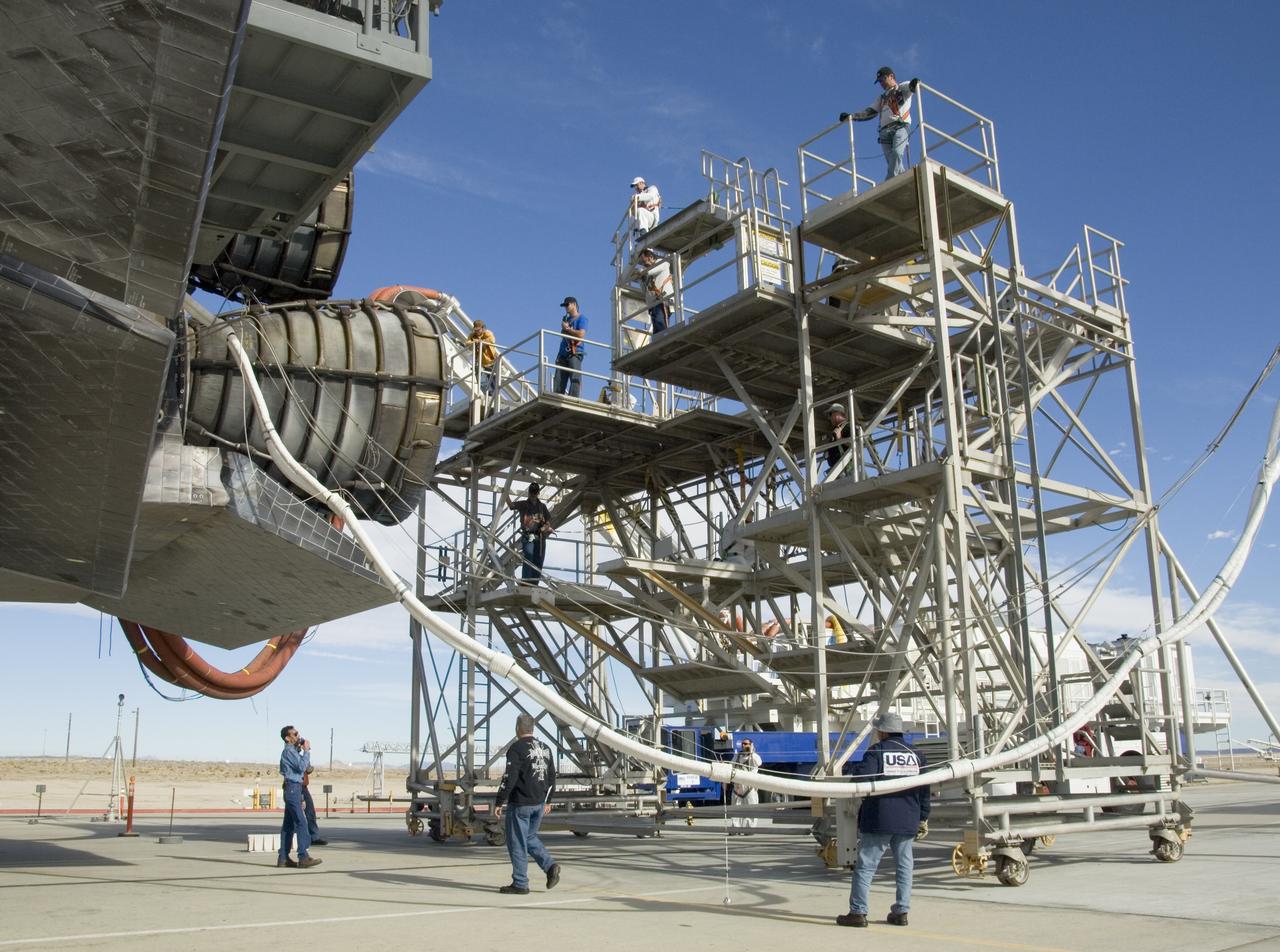
Technicians monitor the positioning of a large workstand as it is carefully moved into place around the main engines of the Space Shuttle Endeavour during deservicing and ferry flight preparations at NASA's Dryden Flight Research Center at Edwards Air Force Base.
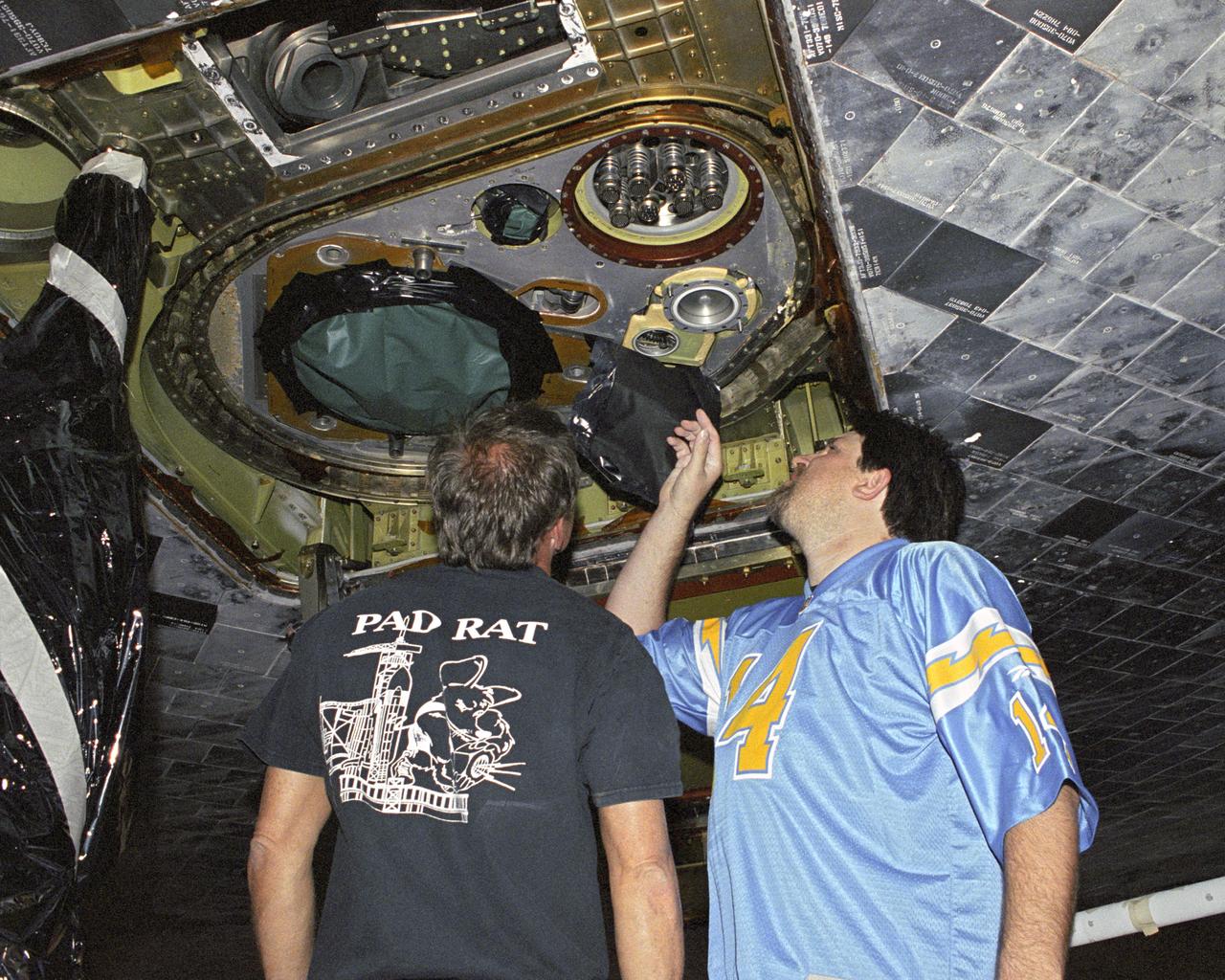
Robert 'Skip' Garrett; main propulsion advanced systems technician, and Chris Jacobs; main propulsion systems engineering technician, inspect external tank attachment fittings on the Space Shuttle Discovery as part of it's post-flight processing at NASA's Dryden Flight Research Center. The Space Shuttles receive post-flight servicing in the Mate-Demate Device (MDD) following landings at NASA's Dryden Flight Research Center, Edwards, California. The gantry-like MDD structure is used for servicing the shuttle orbiters in preparation for their ferry flight back to the Kennedy Space Center in Florida, including mounting the shuttle atop NASA's modified Boeing 747 Shuttle Carrier Aircraft. Space Shuttle Discovery landed safely at NASA's Dryden Flight Research Center at Edwards Air Force Base in California at 5:11:22 a.m. PDT, August 9, 2005, following the very successful 14-day STS-114 return to flight mission. During their two weeks in space, Commander Eileen Collins and her six crewmates tested out new safety procedures and delivered supplies and equipment the International Space Station. Discovery spent two weeks in space, where the crew demonstrated new methods to inspect and repair the Shuttle in orbit. The crew also delivered supplies, outfitted and performed maintenance on the International Space Station. A number of these tasks were conducted during three spacewalks. In an unprecedented event, spacewalkers were called upon to remove protruding gap fillers from the heat shield on Discovery's underbelly. In other spacewalk activities, astronauts installed an external platform onto the Station's Quest Airlock and replaced one of the orbital outpost's Control Moment Gyroscopes. Inside the Station, the STS-114 crew conducted joint operations with the Expedition 11 crew. They unloaded fresh supplies from the Shuttle and the Raffaello Multi-Purpose Logistics Module. Before Discovery undocked, the crews filled Raffeallo with unneeded items and returned to Shuttle pa
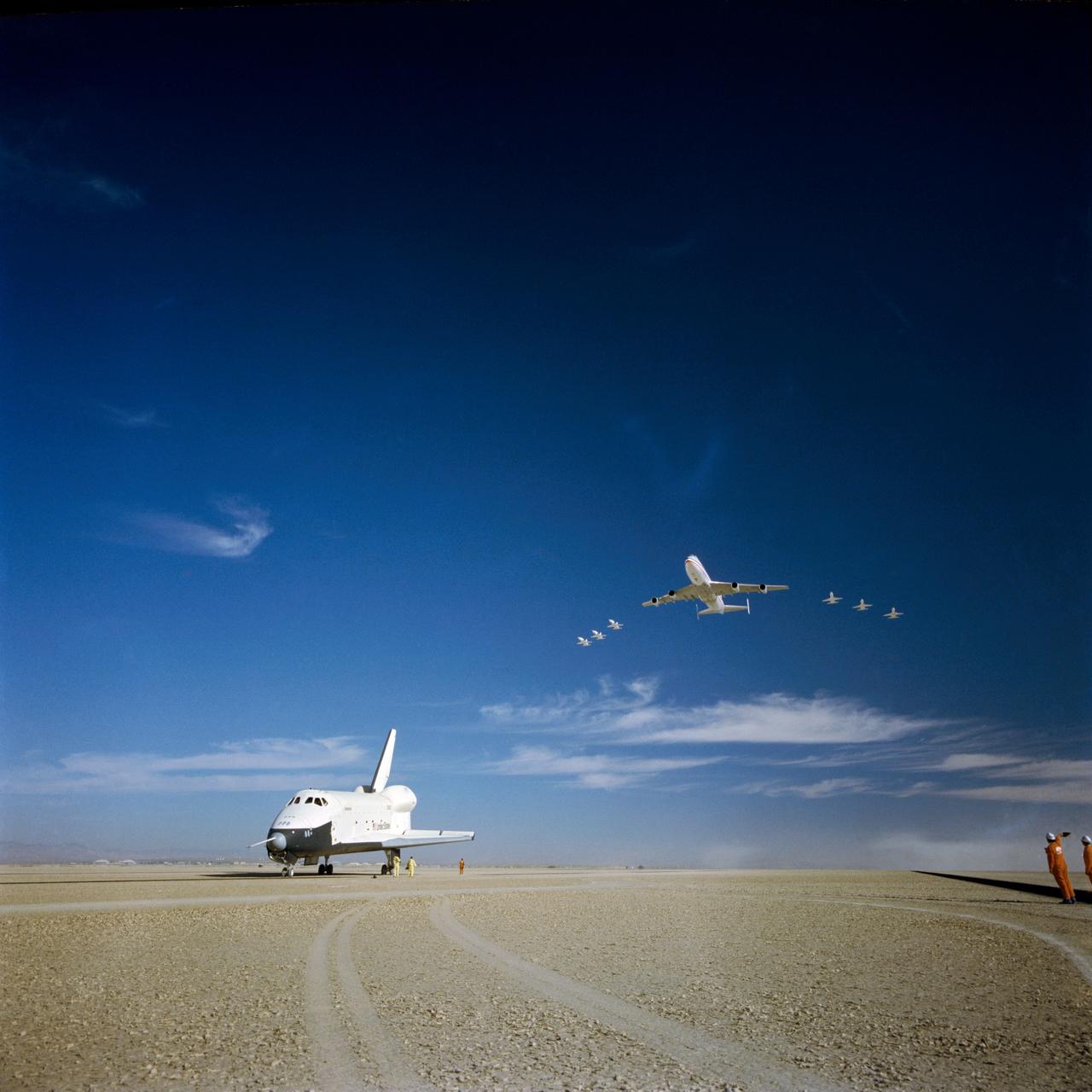
S77-28541 (23 Sept 1977) --- The NASA 747 carrier aircraft and six T-38 jets fly over the shuttle Orbiter 101 "Enterprise" soon after completion of a five-minute, 34-second unpowered mission during the third of a series of Shuttle Approach and Landing Tests (ALT) free-flights. Crew for the September 23, 1977, flight were astronauts Fred W. Haise Jr., commander, and C. Gordon Fullerton, pilot. Touchdown was 786 feet beyond aim point in the desert land of Edwards Air Force Base in Southern California.
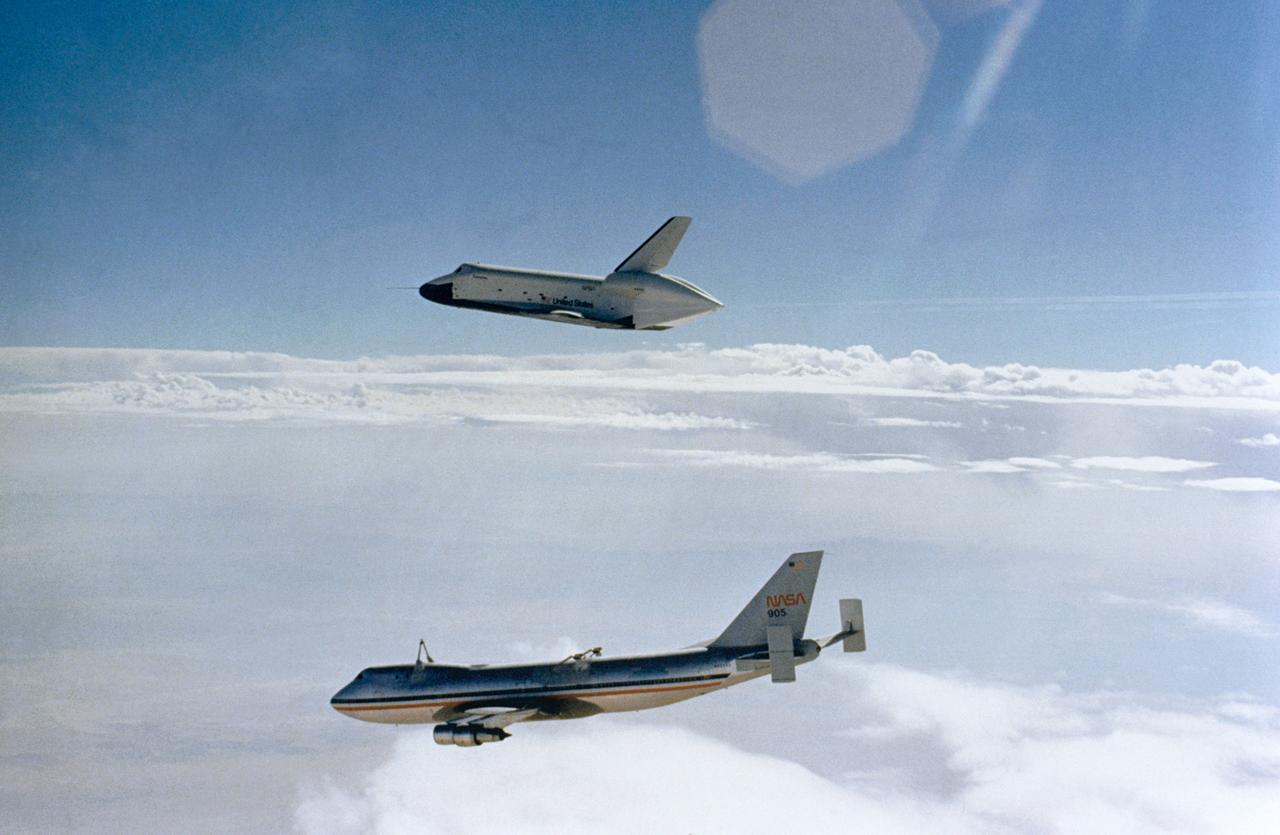
S77-27512 (12 Aug 1977) --- The Shuttle Orbiter 101 "Enterprise" soars above the NASA 747 carrier aircraft only seconds after separating during the first free flight of the Shuttle Approach and Landing Tests (ALTs) conducted on August 12, 1977 at Dryden Flight Research Center in Southern California. Astronauts Fred W. Haise Jr., and C. Gordon Fullerton were the crew of the "Enterprise." The ALT free flights are designed to verify Orbiter subsonic airworthiness, integrated systems operations and pilot-guided approach and landing capability and satisfying prerequisites to automatic flight control and navigation mode.
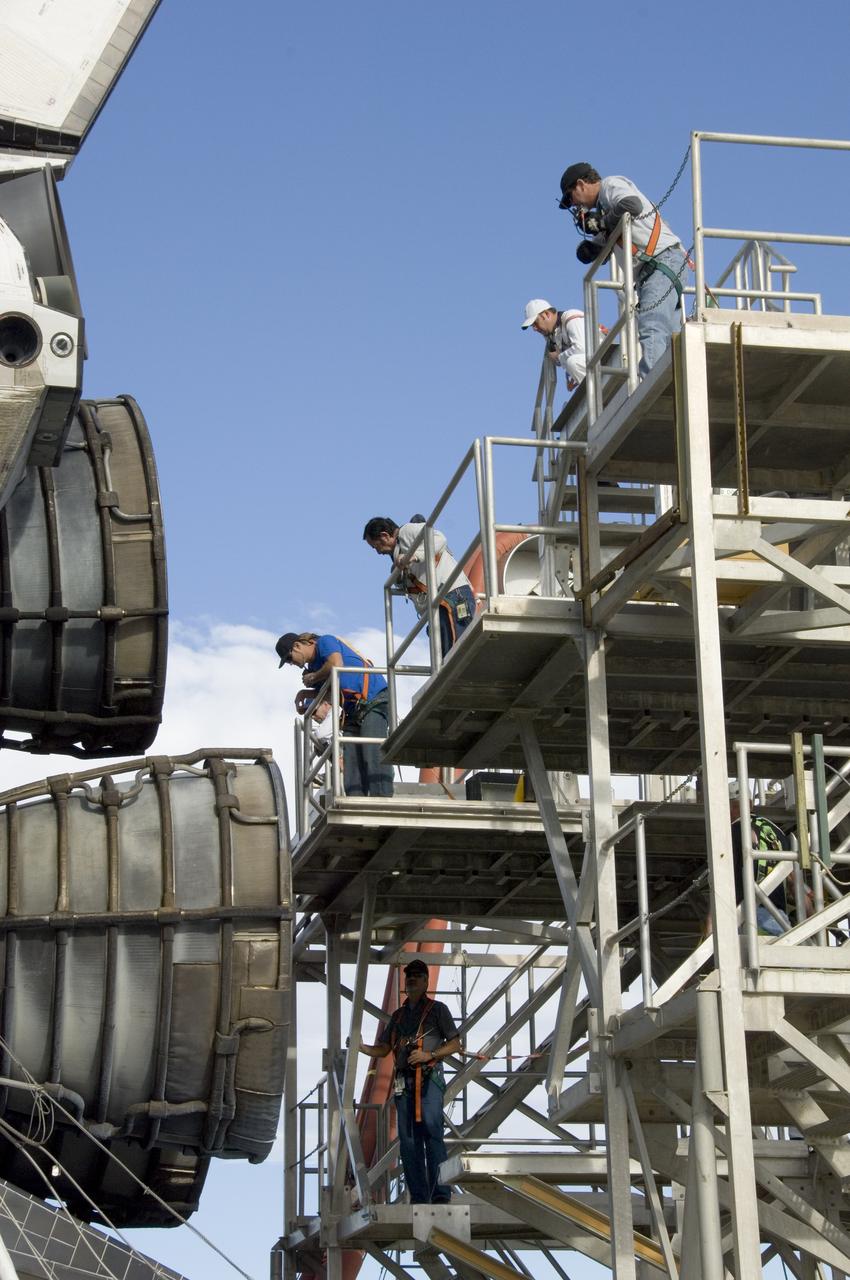
Technicians monitor the positioning of a large workstand as it is carefully moved into place around the main engine nozzles of Space Shuttle Endeavour during deservicing and ferry flight preparations at NASA's Dryden Flight Research Center at Edwards Air Force Base.
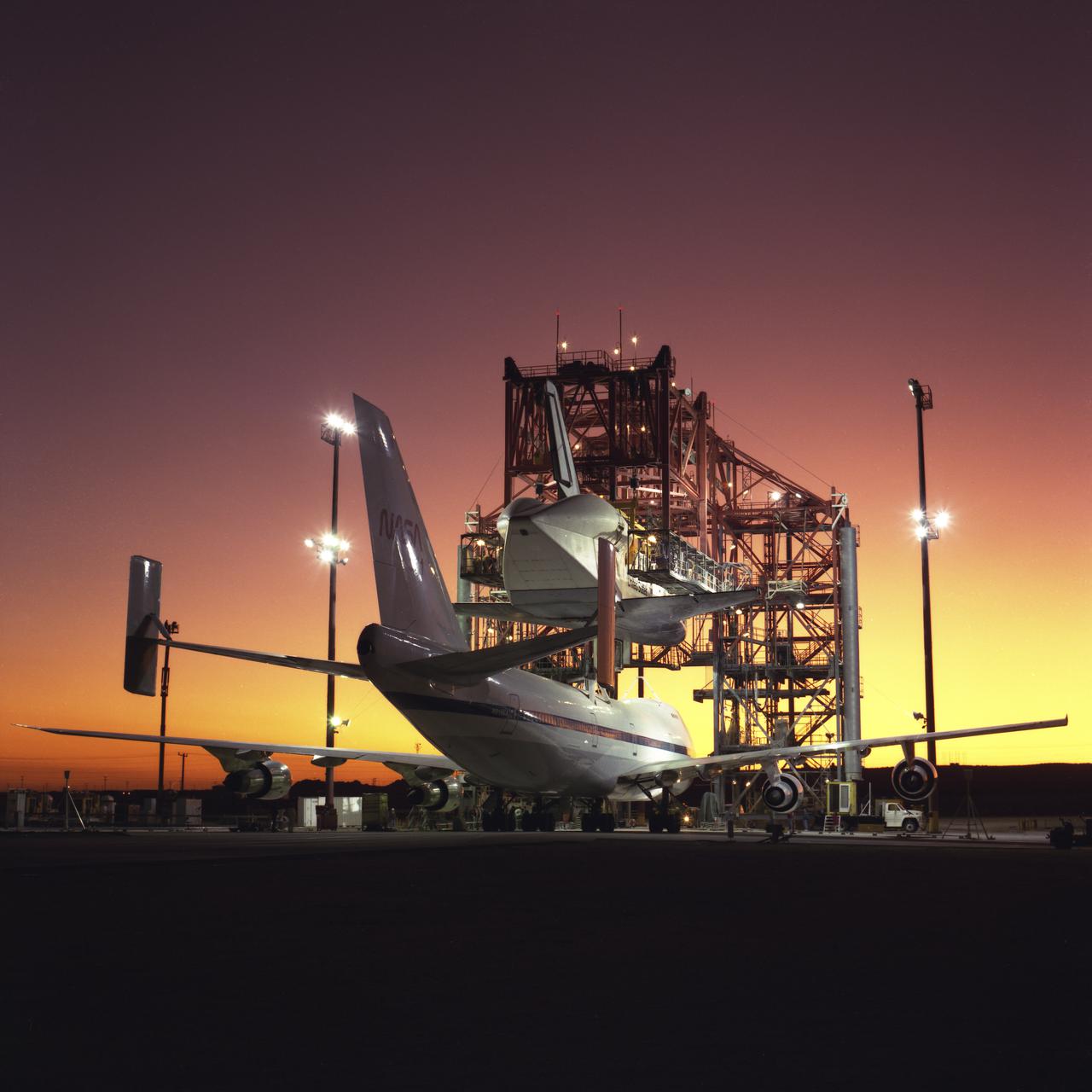
Shuttle Atlantis emerges from the Mate-Demate-Device mounted to Boeing 747 Shuttle Carrier Aircraft for the return flight to Kennedy Space Center in Florida.
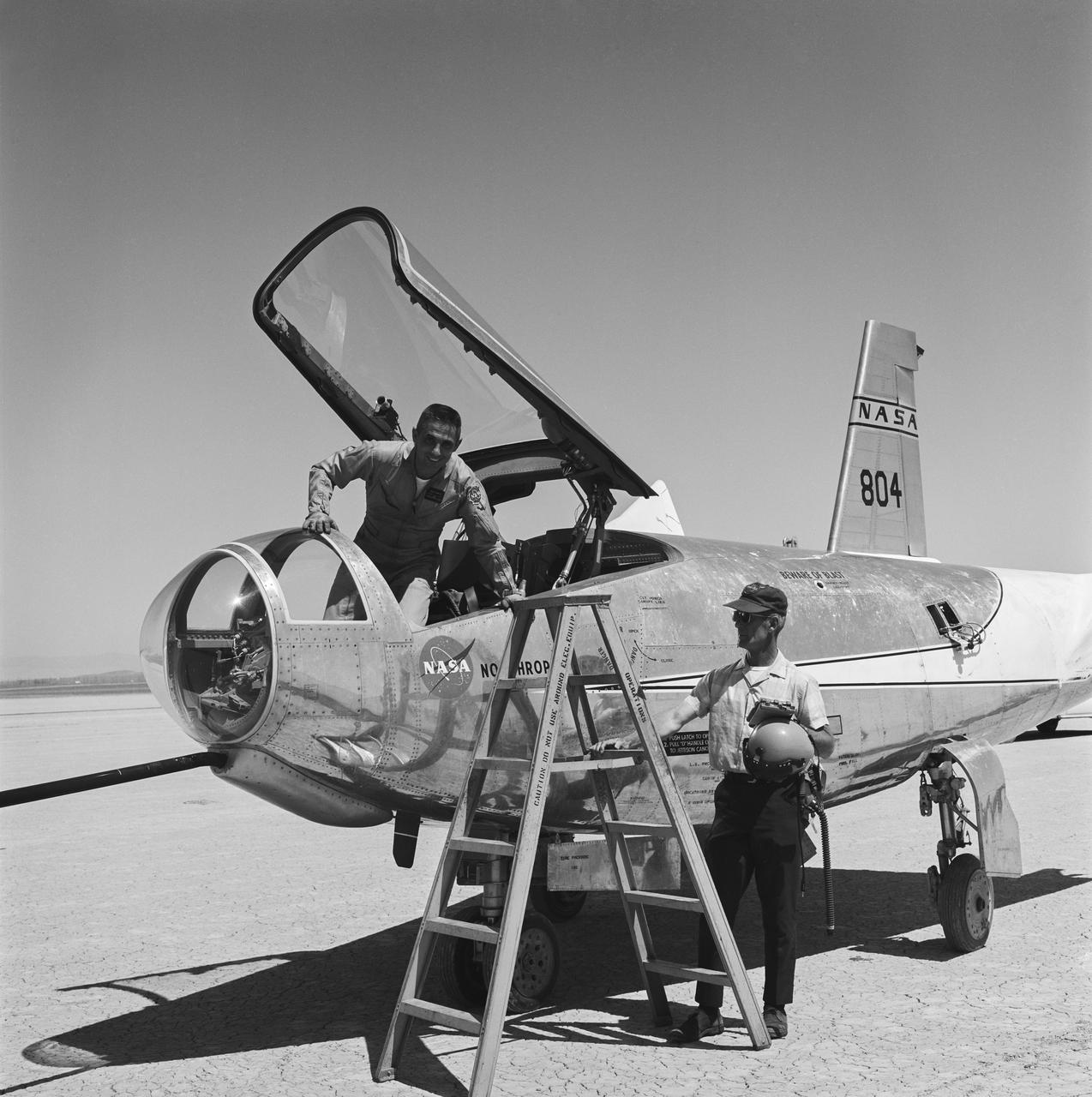
Armstrong research pilot (and future center director) John Manke emerges from the HL-10, NASA Langley’s 10th horizontal lander (lifting body).
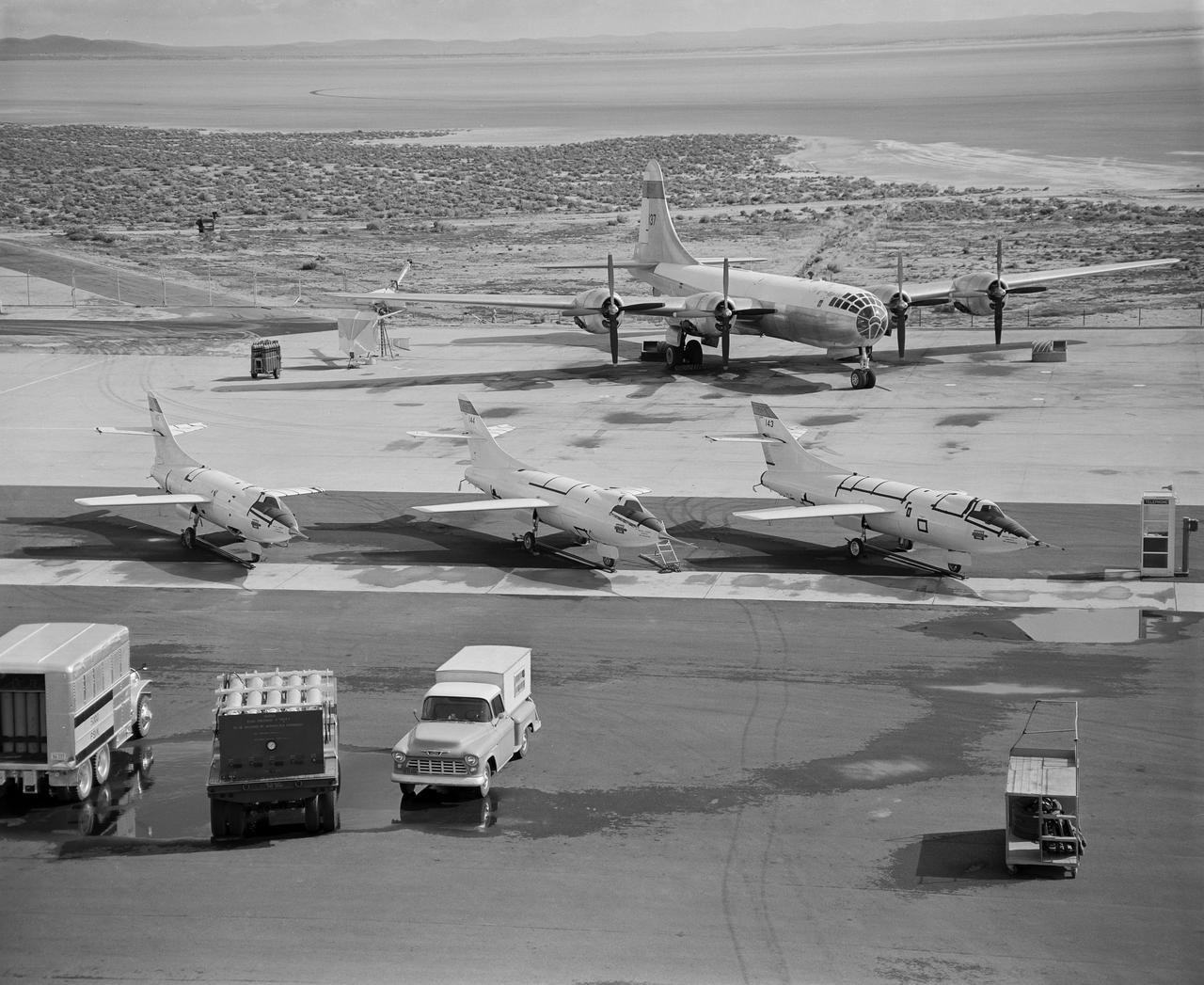
Behind three Douglas D-558-IIs is the B-29 launch aircraft. Under its right wing is the world’s first ground-based reaction control system motion simulator.
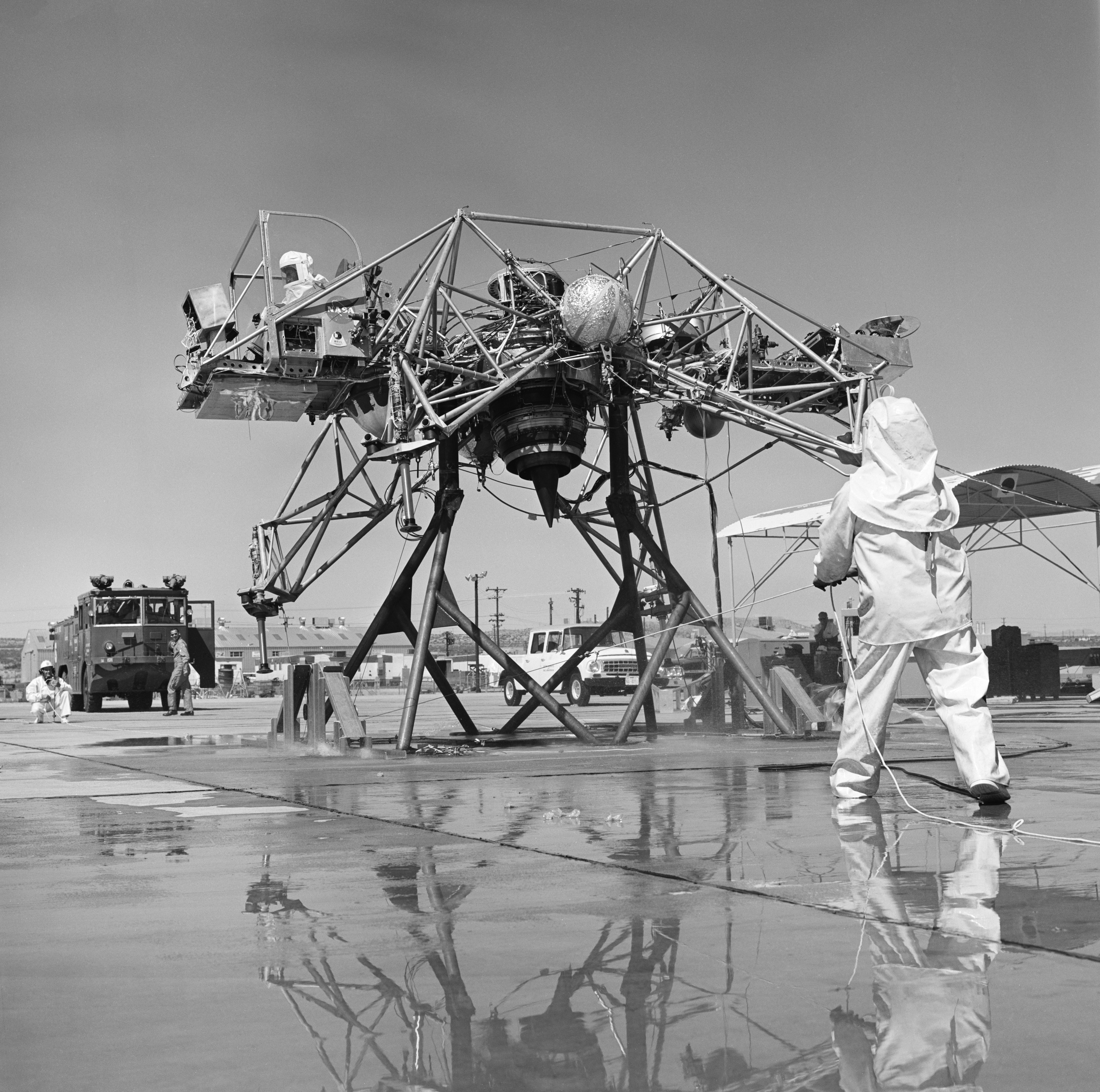
Mechanics are dressed in fire suits because the Lunar Landing Research Vehicle, a simulator to train astronauts for a moon landing, had 90% pure hydrogen peroxide thrusters.
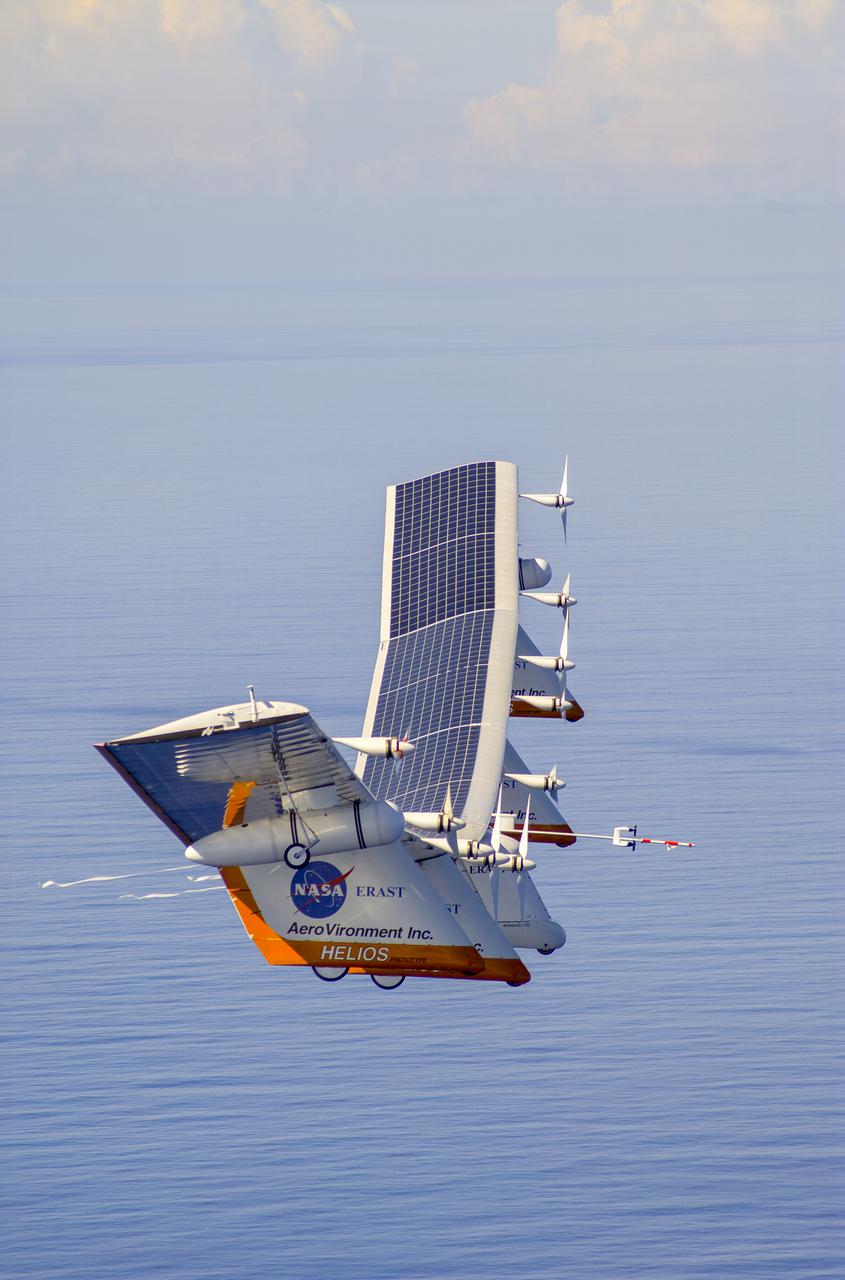
The first flight of a large aircraft to be powered by electric fuel cells began with a takeoff at 8:43 a.m. HST today from the Hawaiian island of Kauai. The Helios Prototype flying wing, built by AeroVironment, Inc., of Monrovia, Calif., as part of NASA's Environmental Research Aircraft and Sensor Technology (ERAST) program, used solar panels to power its 10 electric motors for takeoff and during daylight portions of its planned 20-hour shakedown flight. As sunlight diminishes, Helios will switch to a fuel cell system to continue flight into the night. The takeoff set the stage for a two-day Helios endurance flight in the stratosphere planned for mid-July. The Helios wing, spanning 247 feet and weighing about 2,400 pounds, is giving NASA and industry engineers confidence that remotely piloted aircraft will be able to stay aloft for weeks at a time, providing environmental monitoring capabilities and telecommunications relay services. Helios is an all-electric airplane. In addition to being non-polluting, Helios can fly above storms, and use the power of the sun to stay aloft during daylight. Key to the success of this type of aircraft is the ability to fly in darkness, using fuel cells when sunlight cannot furnish energy. Helios flew over the Navy's Pacific Missile Range Facility where favorable sun exposure and test ranges closed to other air traffic benefited the NASA research effort. In 2003 the aircraft was lost to a crash.
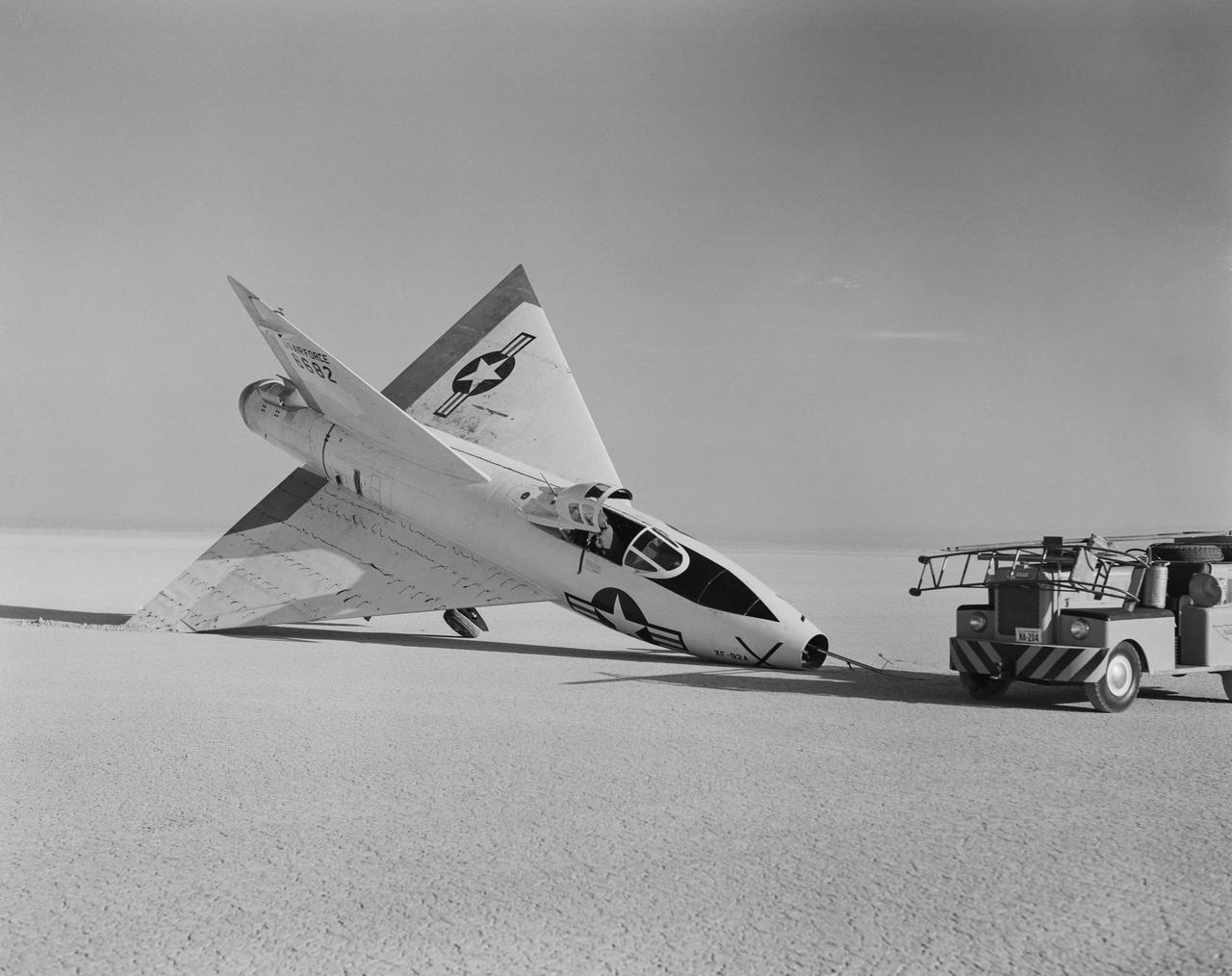
The XF-92A, which had a minor landing mishap in 1953, was the concept for the first delta wing fighter in the U.S. inventory, the F-102.
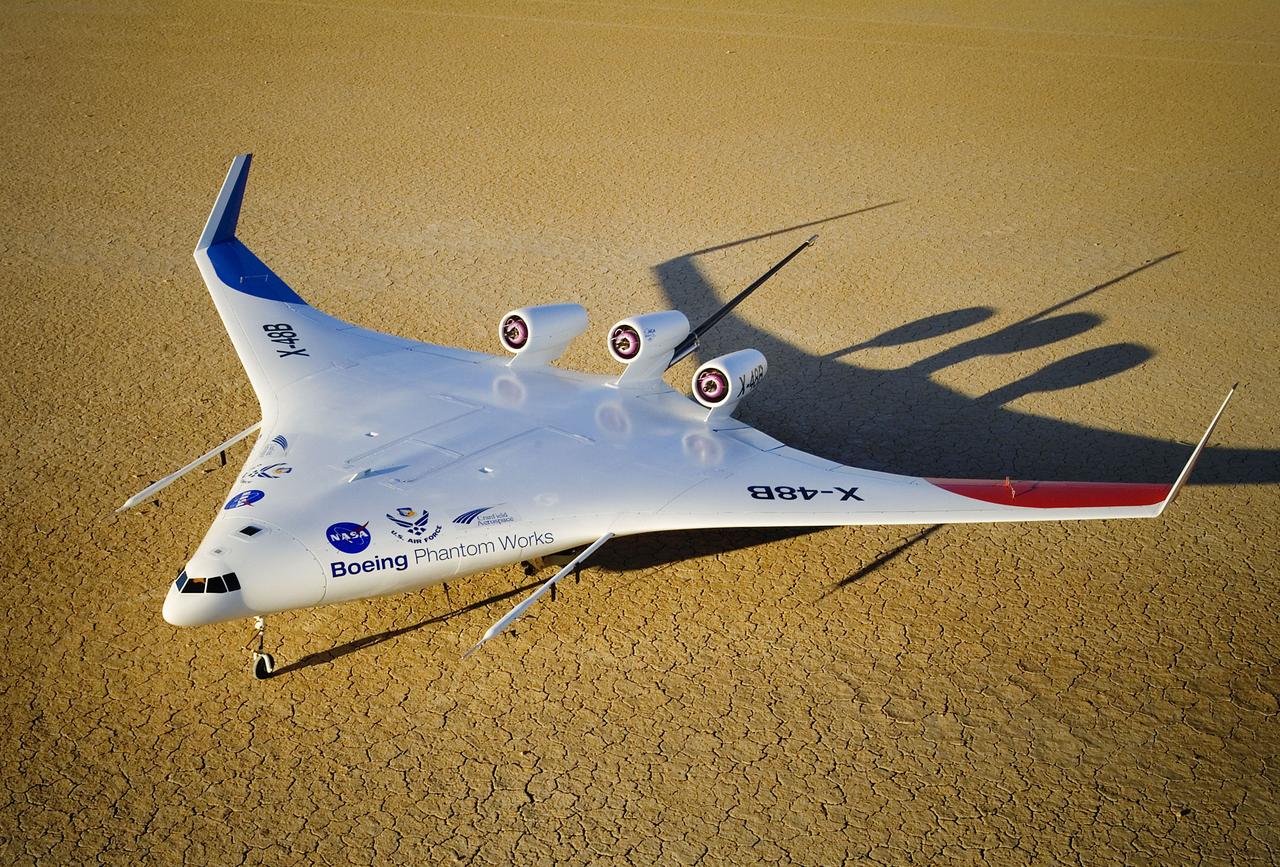
Boeing's X-48B Blended Wing Body technology demonstrator shows off its unique lines at sunset on Rogers Dry Lake adjacent to NASA's Dryden Flight Research Center. (Boeing photo # SMF06_F_KOEH_X48B-0900a)

NASA's Stratospheric Observatory for Infrared Astronomy (SOFIA) Boeing 747SP flies over NASA's Dryden Flight Research Center after a ferry flight from Waco, Texas. NASA's Stratospheric Observatory for Infrared Astronomy, or SOFIA, arrived at NASA's Dryden Flight Research Center at Edwards Air Force Base, Calif. on May 31, 2007. The heavily modified Boeing 747SP was ferried to Dryden from Waco, Texas, where L-3 Communications Integrated Systems installed a German-built 2.5-meter infrared telescope and made other major modifications over the past several years. SOFIA is scheduled to undergo installation and integration of mission systems and a multi-phase flight test program at Dryden over the next three years that is expected to lead to a full operational capability to conduct astronomy missions in about 2010. During its expected 20-year lifetime, SOFIA will be capable of "Great Observatory" class astronomical science, providing astronomers with access to the visible, infrared and sub-millimeter spectrum with optimized performance in the mid-infrared to sub-millimeter range.
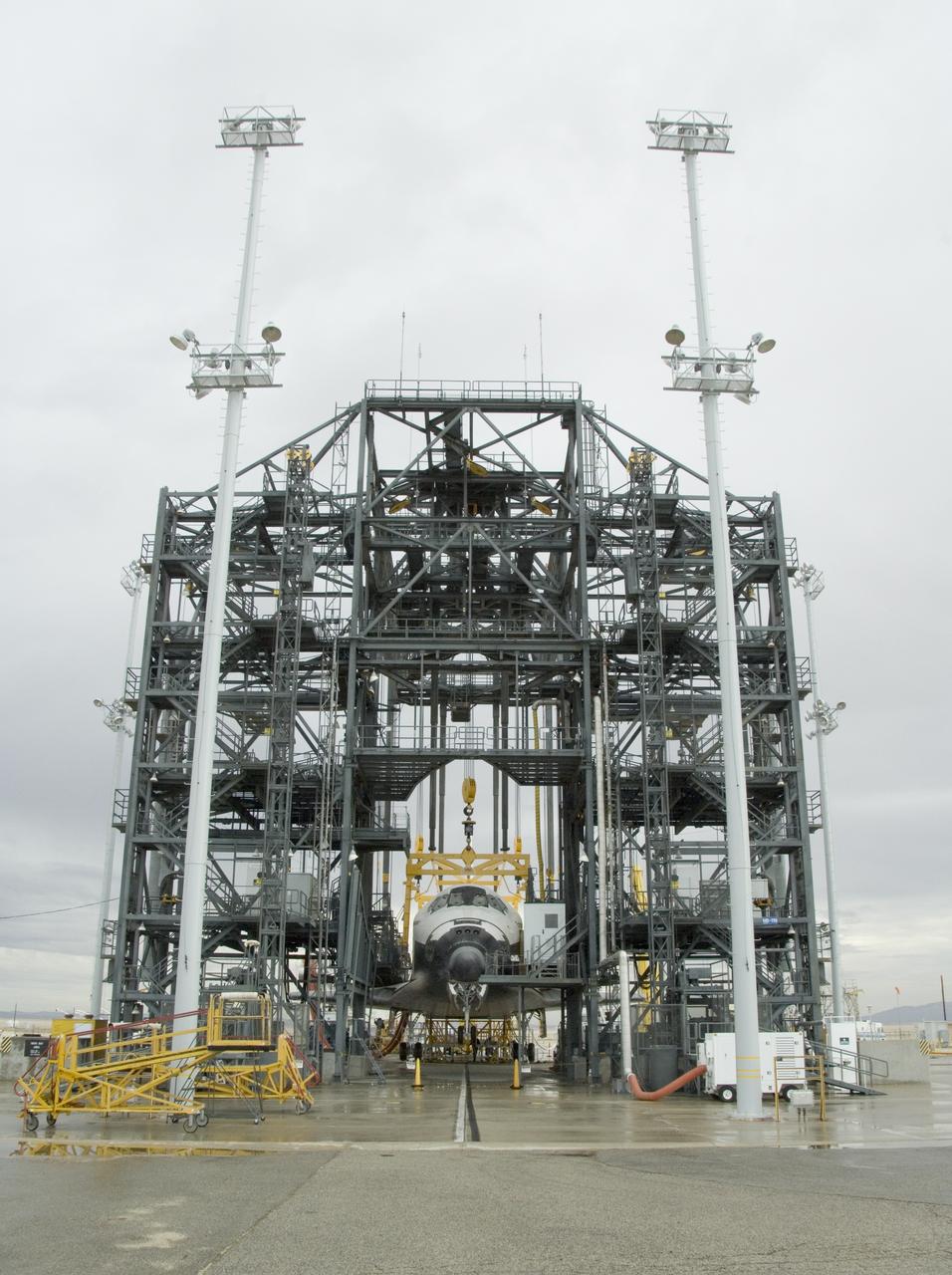
Under soggy skies on a Sunday morning, the Space Shuttle Endeavour is encased in the Mate-DeMate gantry during turnaround processing at NASA's Dryden Flight Research Center following its STS-126 landing at Edwards Air Force Base a week earlier.
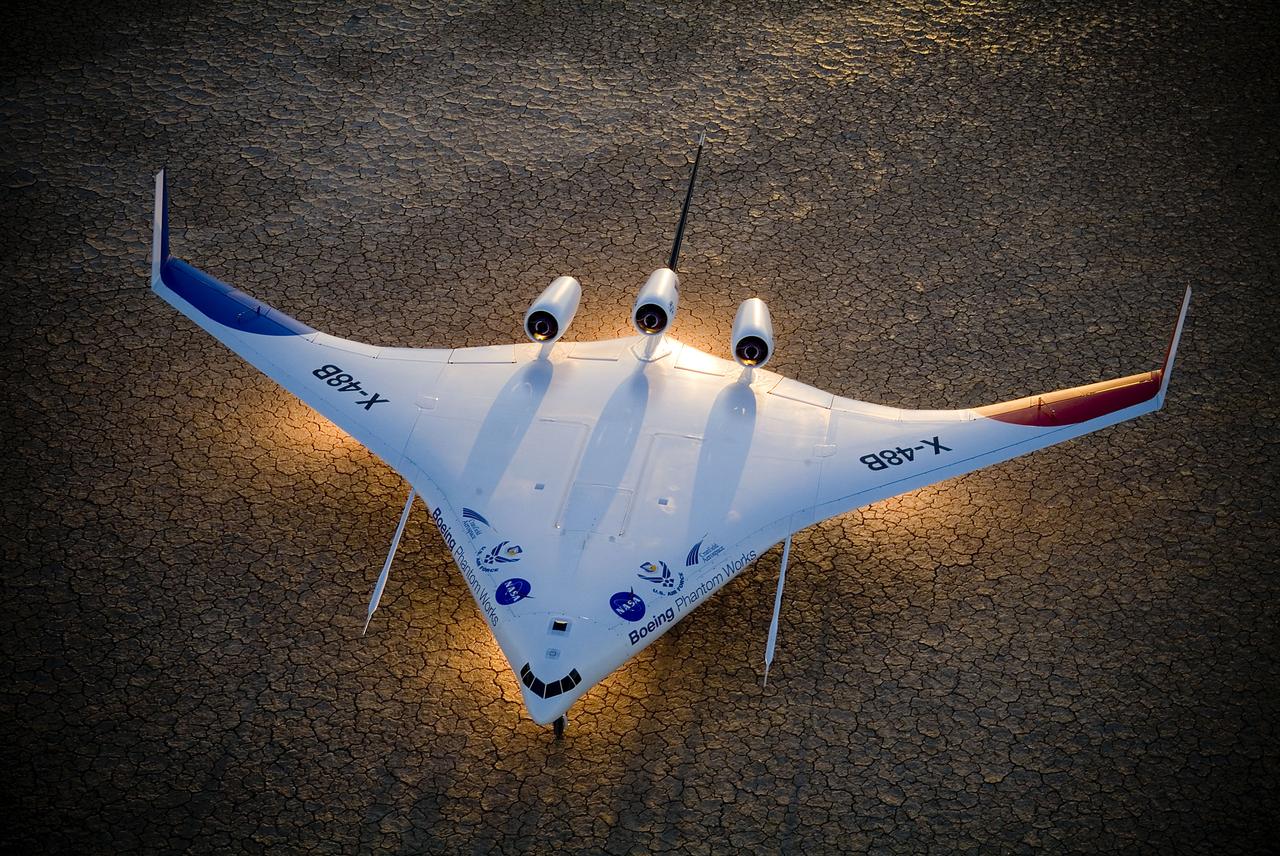
Boeing's X-48B Blended Wing Body technology demonstrator shows off its unique lines at sunset on Rogers Dry Lake adjacent to NASA's Dryden Flight Research Center. (Boeing photo # SMF06_F_KOEH_X48B-0955)
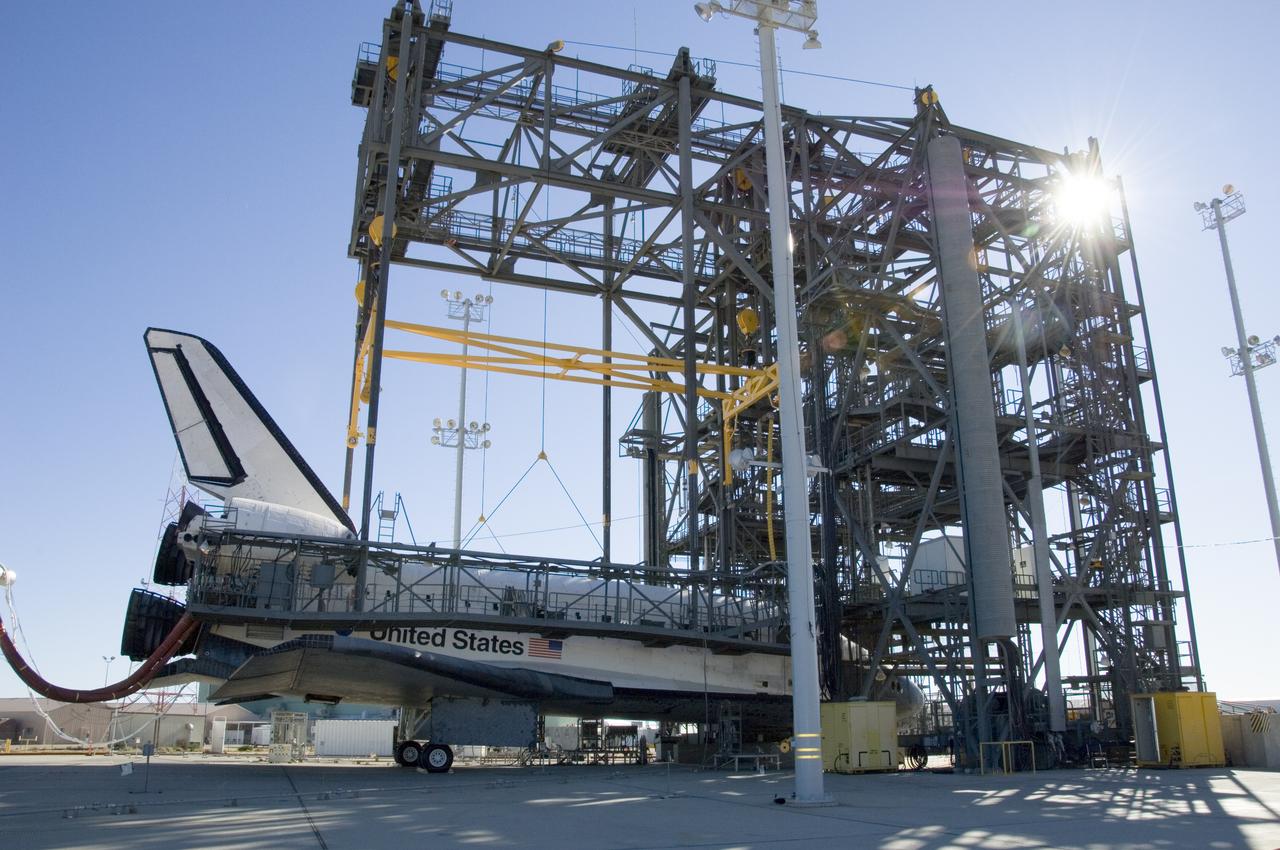
The Space Shuttle Endeavour is nestled in the Mate-DeMate Device at NASA's Dryden Flight Research Center as deservicing and turnaround operations get underway for its ferry flight back to the Kennedy Space Center in Florida.
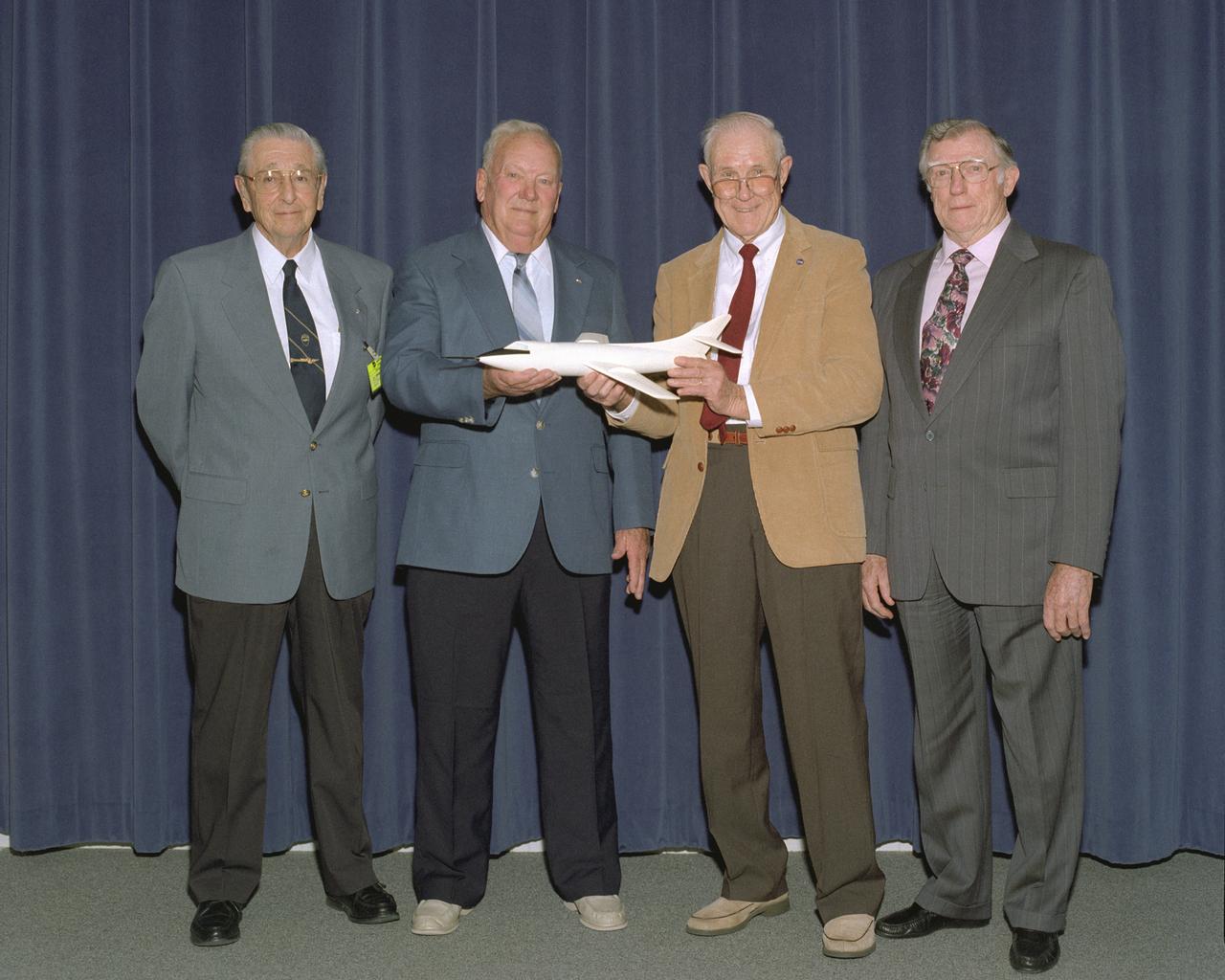
Former NACA test pilots Scott Crossfield, Stan Butchart, Robert Champine, and John Griffith gathered at the NASA Dryden Flight Research Center for the "Men of Mach 2" symposium, an event celebrating their work in the 1950's on the D-558-II Skyrocket aircraft.
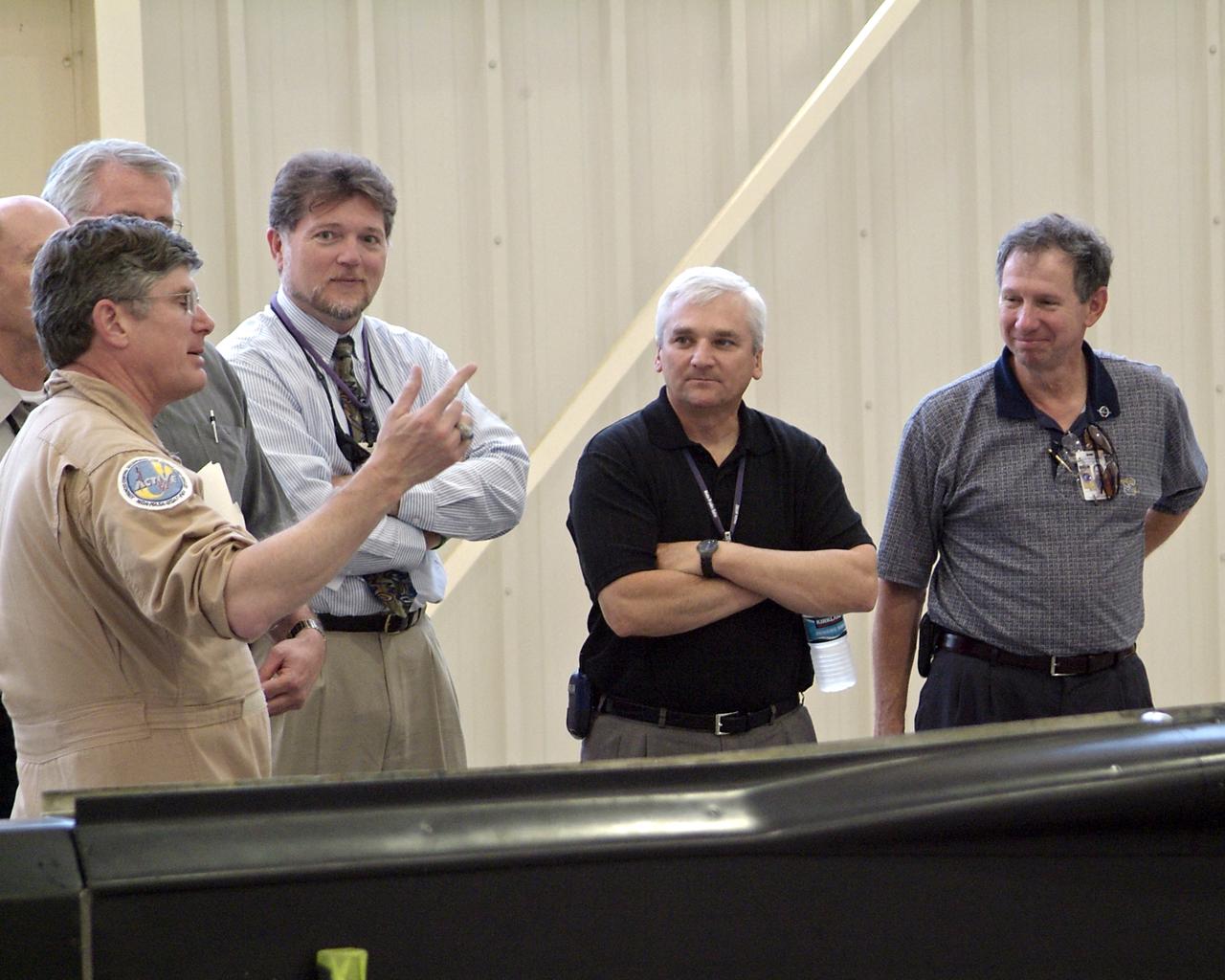
NASA Dryden research pilot Jim Smolka (left) details a recent flight experiment on a modified F-15B research aircraft to test range program manager Jerry McKee, center director Kevin Petersen and NASA Administrator Michael Griffin (right) during Griffin's initial visit to NASA's Dryden Flight Research Center on Tuesday, May 24.
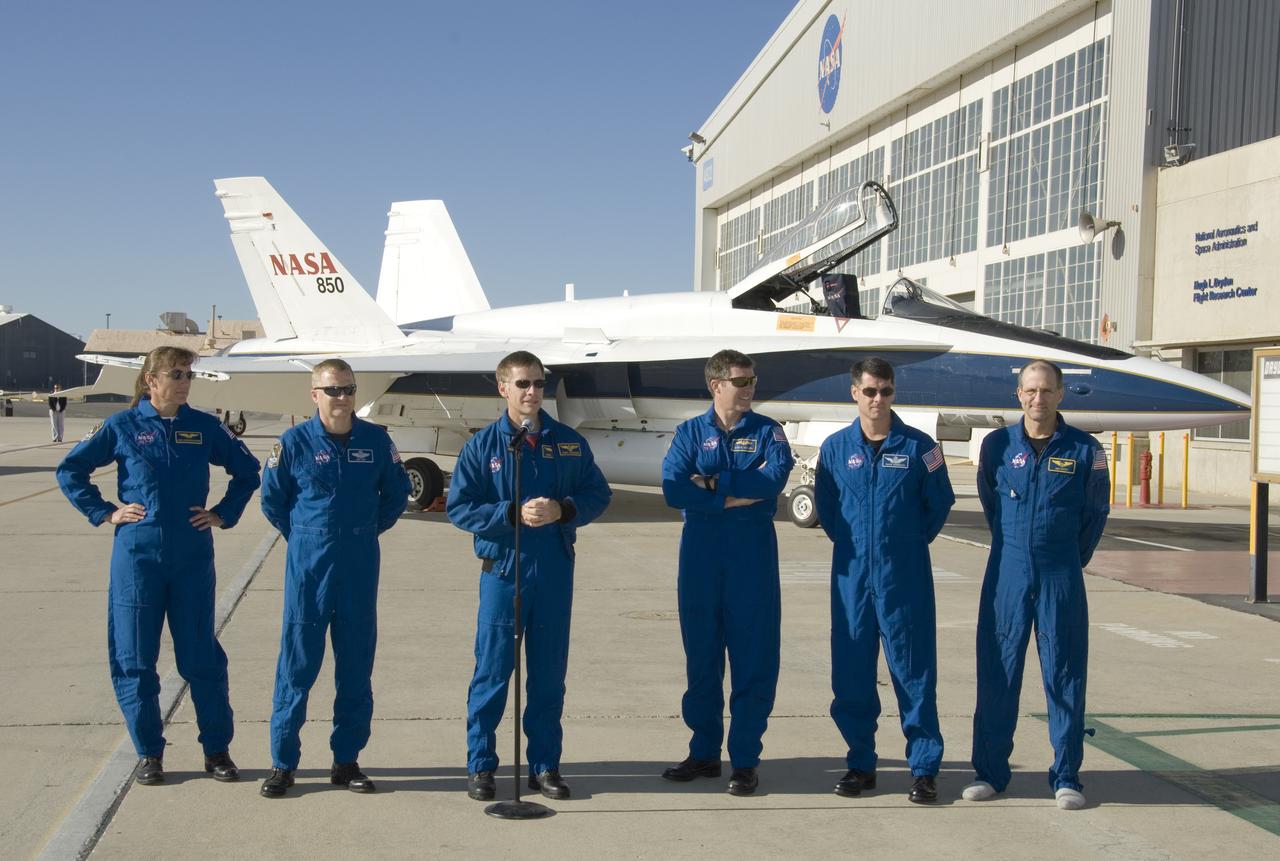
With a NASA F/A-18 providing a backdrop, STS-126 commander Chris Ferguson thanked NASA Dryden Flight Research Center employees for their support of Space Shuttle Endeavour's landing at Edwards Air Force Base Nov. 30, 2008. Flanking Ferguson were STS-126 crewmembers (from left) Heidimarie Stefanyshyn-Piper, Eric Boe, Stephen Bowen, Robert Kimbrough and Donald Pettit.
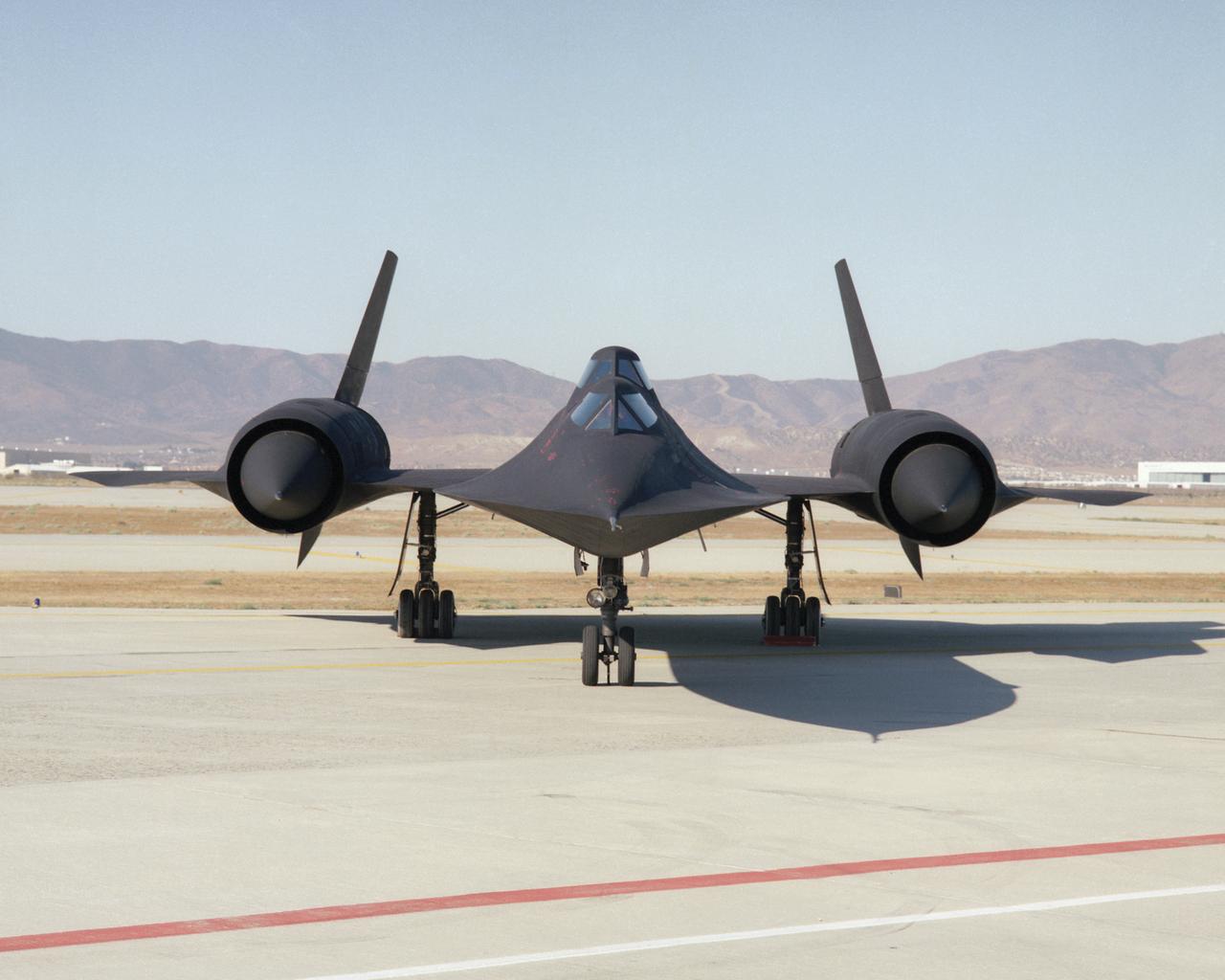
This photo shows a head-on view of NASA's SR-71B, used for pilot proficiency and training, on the ramp at the Air Force's Plant 42 in Palmdale, California, shortly before delivery to the Ames-Dryden Flight Research Facility (later, Dryden Flight Research Center) at Edwards, California. NASA operated two of these unique aircraft, an SR-71A, for high-speed, high altitude research, and this SR- 71B pilot trainer for most of the decade of the 1990s. The "B" model is special because of its raised rear cockpit, which provided a second pilot position so a trainer and an experienced pilot could both see what was going on during flights. The SR-71 was designed and built by the Lockheed Skunk Works, now the Lockheed Martin Skunk Works. Studies have shown that less than 20 percent of the total thrust used to fly at Mach 3 is produced by the basic engine itself. The balance of the total thrust is produced by the unique design of the engine inlet and "moveable spike" system at the front of the engine nacelles, and by the ejector nozzles at the exhaust which burn air compressed in the engine bypass system. Data from the SR-71 high speed research program will be used to aid designers of future supersonic/hypersonic aircraft and propulsion systems, including a high speed civil transport.
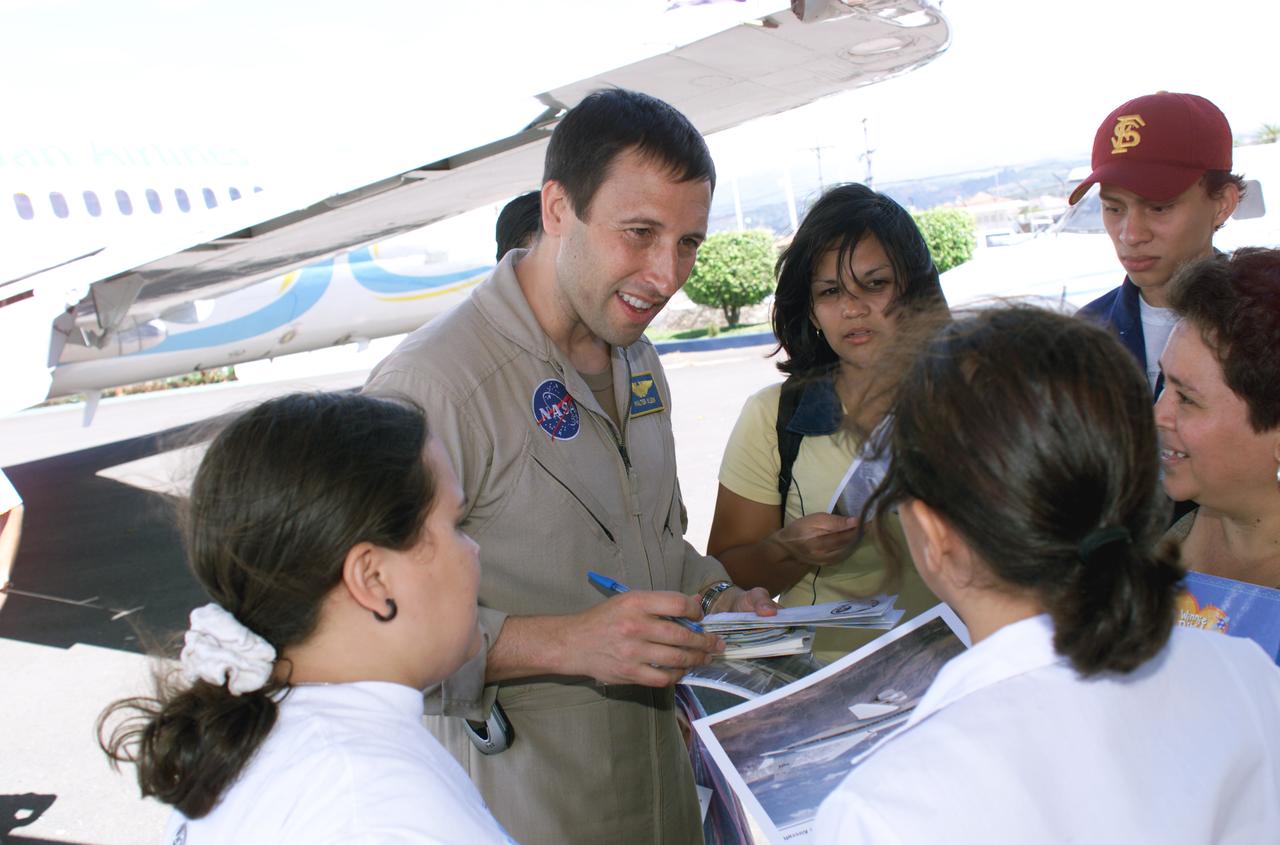
NASA Dryden Mission Manager Walter Klein passes out Airborne Science stickers and lithographs to underprivileged school children that visited the airport on Monday March 8, 2004. In spanish, he explained to them the mission of the DC-8 AirSAR 2004 Mesoamerican campaign in Costa Rica. AirSAR 2004 Mesoamerica is a three-week expedition by an international team of scientists that uses an all-weather imaging tool, called the Airborne Synthetic Aperture Radar (AirSAR) which is located onboard NASA's DC-8 airborne laboratory. Scientists from many parts of the world including NASA's Jet Propulsion Laboratory are combining ground research done in several areas in Central America with NASA's AirSAR technology to improve and expand on the quality of research they are able to conduct. The radar, developed by NASA's Jet Propulsion Laboratory, can penetrate clouds and also collect data at night. Its high-resolution sensors operate at multiple wavelengths and modes, allowing AirSAR to see beneath treetops, through thin sand, and dry snow pack. AirSAR's 2004 campaign is a collaboration of many U.S. and Central American institutions and scientists, including NASA; the National Science Foundation; the Smithsonian Institution; National Geographic; Conservation International; the Organization of Tropical Studies; the Central American Commission for Environment and Development; and the Inter-American Development Bank.
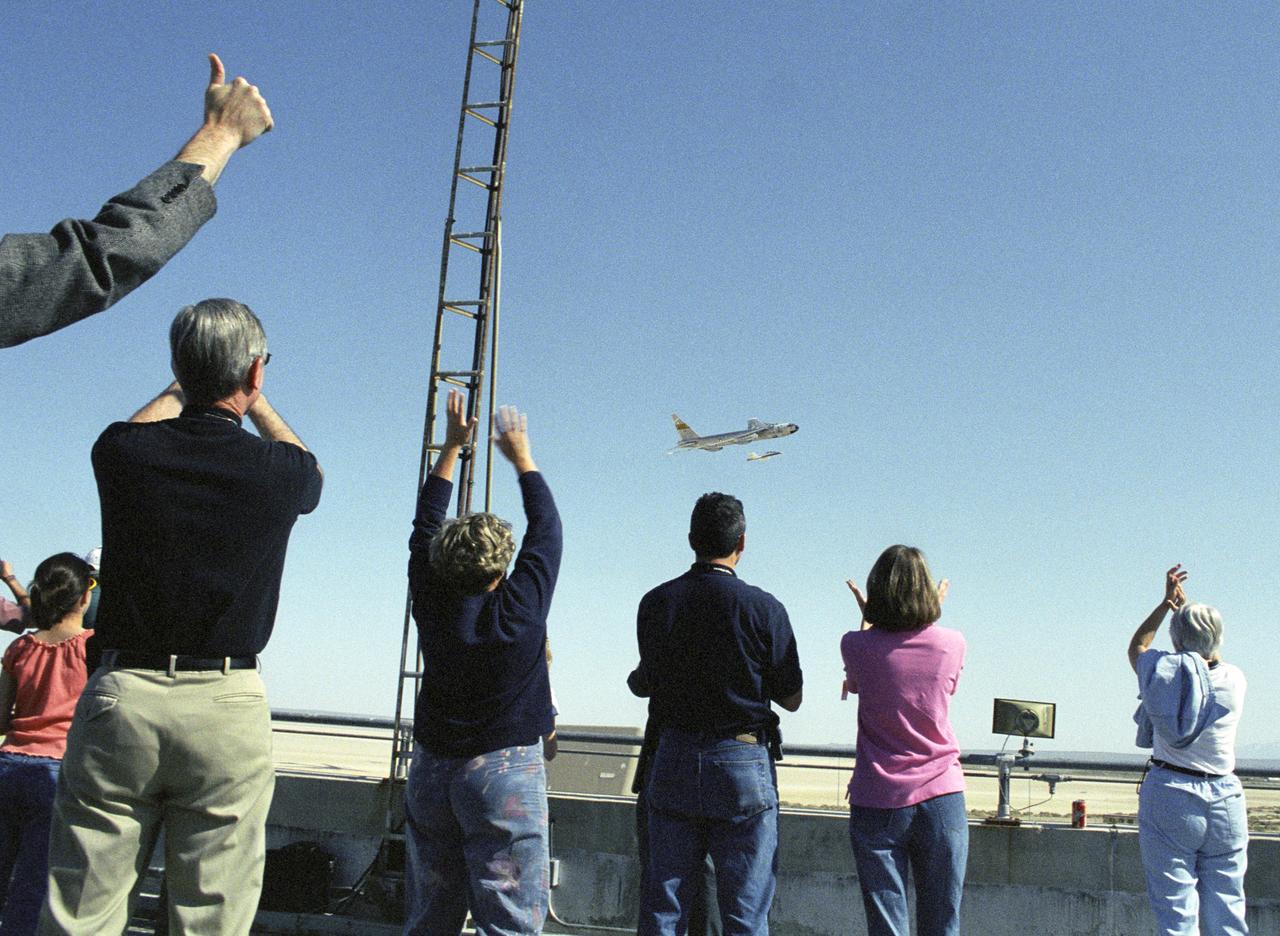
Employees atop NASA Dryden's main building celebrate the return flyby of the B-52B aircraft after it launched the second X-43A aircraft on its successful flight.
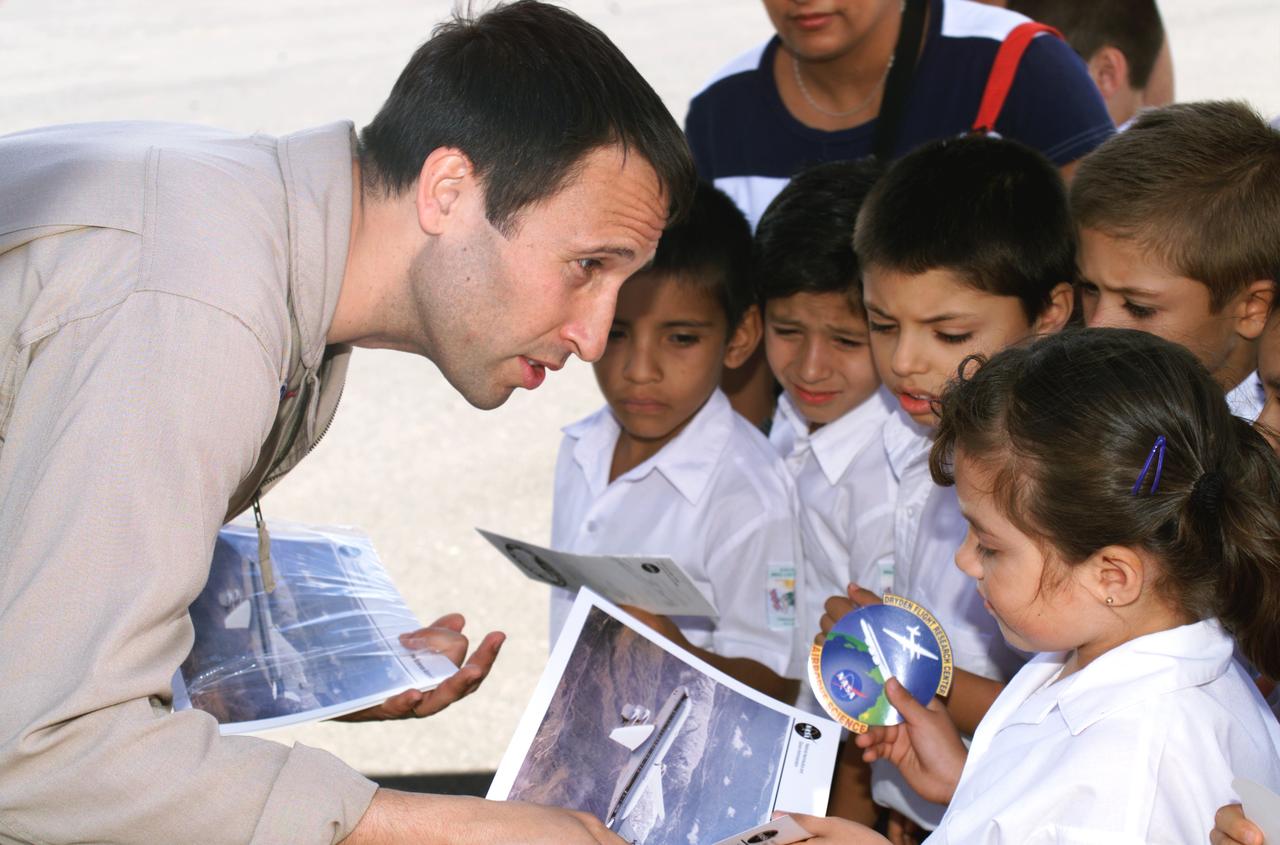
NASA Dryden Mission Manager Walter Klein passes out Airborne Science stickers and lithographs to underprivileged school children that visited the airport on Monday March 8, 2004. In spanish, he explained to them the mission of the DC-8 AirSAR 2004 Mesoamerican campaign in Costa Rica. AirSAR 2004 Mesoamerica is a three-week expedition by an international team of scientists that uses an all-weather imaging tool, called the Airborne Synthetic Aperture Radar (AirSAR) which is located onboard NASA's DC-8 airborne laboratory. Scientists from many parts of the world including NASA's Jet Propulsion Laboratory are combining ground research done in several areas in Central America with NASA's AirSAR technology to improve and expand on the quality of research they are able to conduct. The radar, developed by NASA's Jet Propulsion Laboratory, can penetrate clouds and also collect data at night. Its high-resolution sensors operate at multiple wavelengths and modes, allowing AirSAR to see beneath treetops, through thin sand, and dry snow pack. AirSAR's 2004 campaign is a collaboration of many U.S. and Central American institutions and scientists, including NASA; the National Science Foundation; the Smithsonian Institution; National Geographic; Conservation International; the Organization of Tropical Studies; the Central American Commission for Environment and Development; and the Inter-American Development Bank.
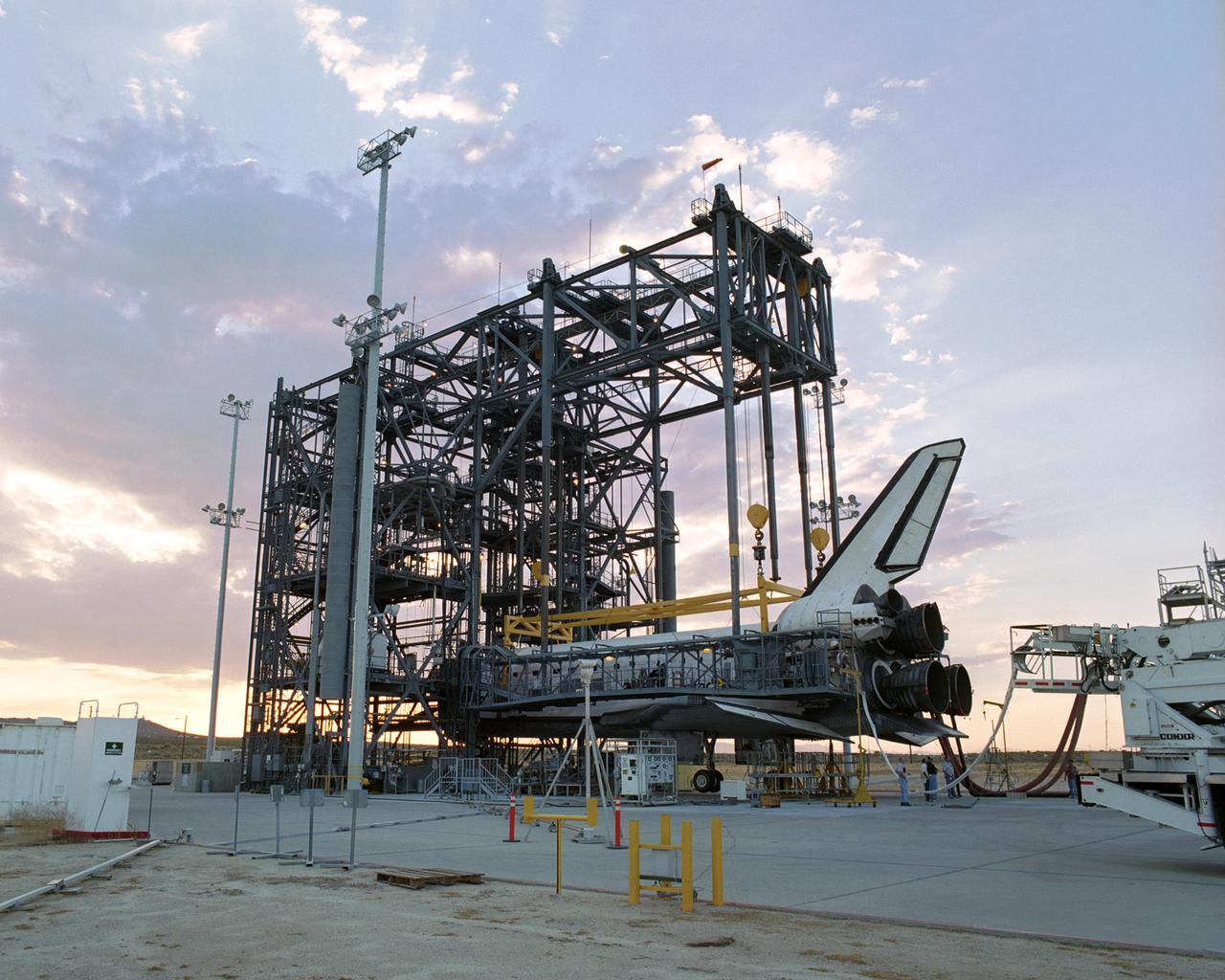
The sun sets on the Space Shuttle Discovery during post-flight processing in the Mate-Demate Device (MDD), following its landing at NASA's Dryden Flight Research Center in California. The gantry-like MDD structure is used for servicing the shuttle orbiters in preparation for their ferry flight back to the Kennedy Space Center in Florida, including mounting the shuttle atop NASA's modified Boeing 747 Shuttle Carrier Aircraft. Space Shuttle Discovery landed safely at NASA's Dryden Flight Research Center at Edwards Air Force Base in California at 5:11:22 a.m. PDT, August 9, 2005, following the very successful 14-day STS-114 return to flight mission. During their two weeks in space, Commander Eileen Collins and her six crewmates tested out new safety procedures and delivered supplies and equipment the International Space Station. Discovery spent two weeks in space, where the crew demonstrated new methods to inspect and repair the Shuttle in orbit. The crew also delivered supplies, outfitted and performed maintenance on the International Space Station. A number of these tasks were conducted during three spacewalks. In an unprecedented event, spacewalkers were called upon to remove protruding gap fillers from the heat shield on Discovery's underbelly. In other spacewalk activities, astronauts installed an external platform onto the Station's Quest Airlock and replaced one of the orbital outpost's Control Moment Gyroscopes. Inside the Station, the STS-114 crew conducted joint operations with the Expedition 11 crew. They unloaded fresh supplies from the Shuttle and the Raffaello Multi-Purpose Logistics Module. Before Discovery undocked, the crews filled Raffeallo with unneeded items and returned to Shuttle payload bay. Discovery launched on July 26 and spent almost 14 days on orbit.
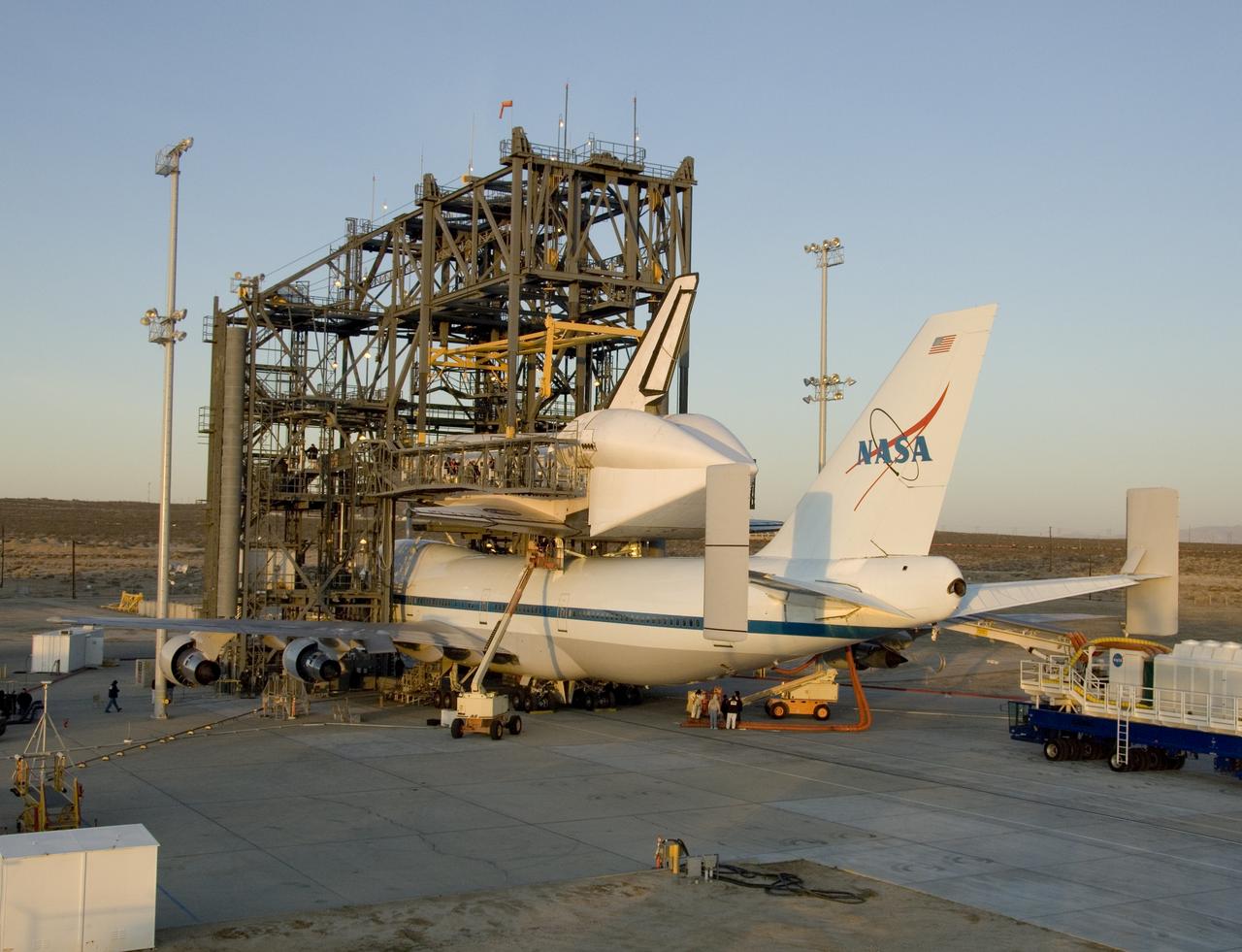
The Space Shuttle Endeavour and its modified Boeing 747 carrier aircraft are illuminated by the morning sun Tuesday after mating of the pair was completed overnight in the Mate-DeMate gantry at NASA Dryden Flight Research Center. The pair are scheduled to depart Edwards Air Force Base on their ferry flight back to the Kennedy Space Center early Wednesday morning, Dec. 10.
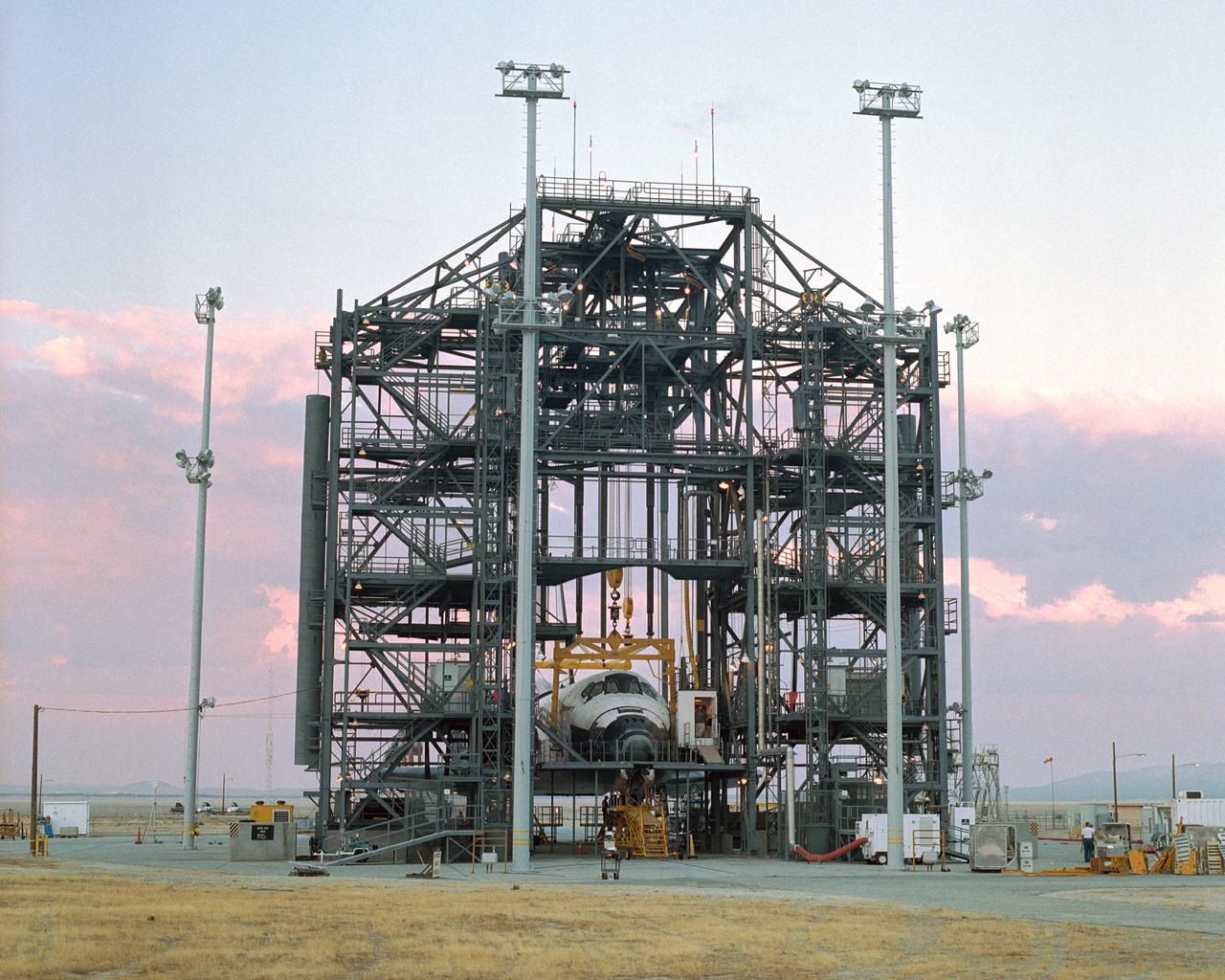
The sun sets on the Space Shuttle Discovery during post-flight processing in the Mate-Demate Device (MDD), following its landing at NASA's Dryden Flight Research Center in California. The gantry-like MDD structure is used for servicing the shuttle orbiters in preparation for their ferry flight back to the Kennedy Space Center in Florida, including mounting the shuttle atop NASA's modified Boeing 747 Shuttle Carrier Aircraft. Space Shuttle Discovery landed safely at NASA's Dryden Flight Research Center at Edwards Air Force Base in California at 5:11:22 a.m. PDT, August 9, 2005, following the very successful 14-day STS-114 return to flight mission. During their two weeks in space, Commander Eileen Collins and her six crewmates tested out new safety procedures and delivered supplies and equipment the International Space Station. Discovery spent two weeks in space, where the crew demonstrated new methods to inspect and repair the Shuttle in orbit. The crew also delivered supplies, outfitted and performed maintenance on the International Space Station. A number of these tasks were conducted during three spacewalks. In an unprecedented event, spacewalkers were called upon to remove protruding gap fillers from the heat shield on Discovery's underbelly. In other spacewalk activities, astronauts installed an external platform onto the Station's Quest Airlock and replaced one of the orbital outpost's Control Moment Gyroscopes. Inside the Station, the STS-114 crew conducted joint operations with the Expedition 11 crew. They unloaded fresh supplies from the Shuttle and the Raffaello Multi-Purpose Logistics Module. Before Discovery undocked, the crews filled Raffeallo with unneeded items and returned to Shuttle payload bay. Discovery launched on July 26 and spent almost 14 days on orbit.
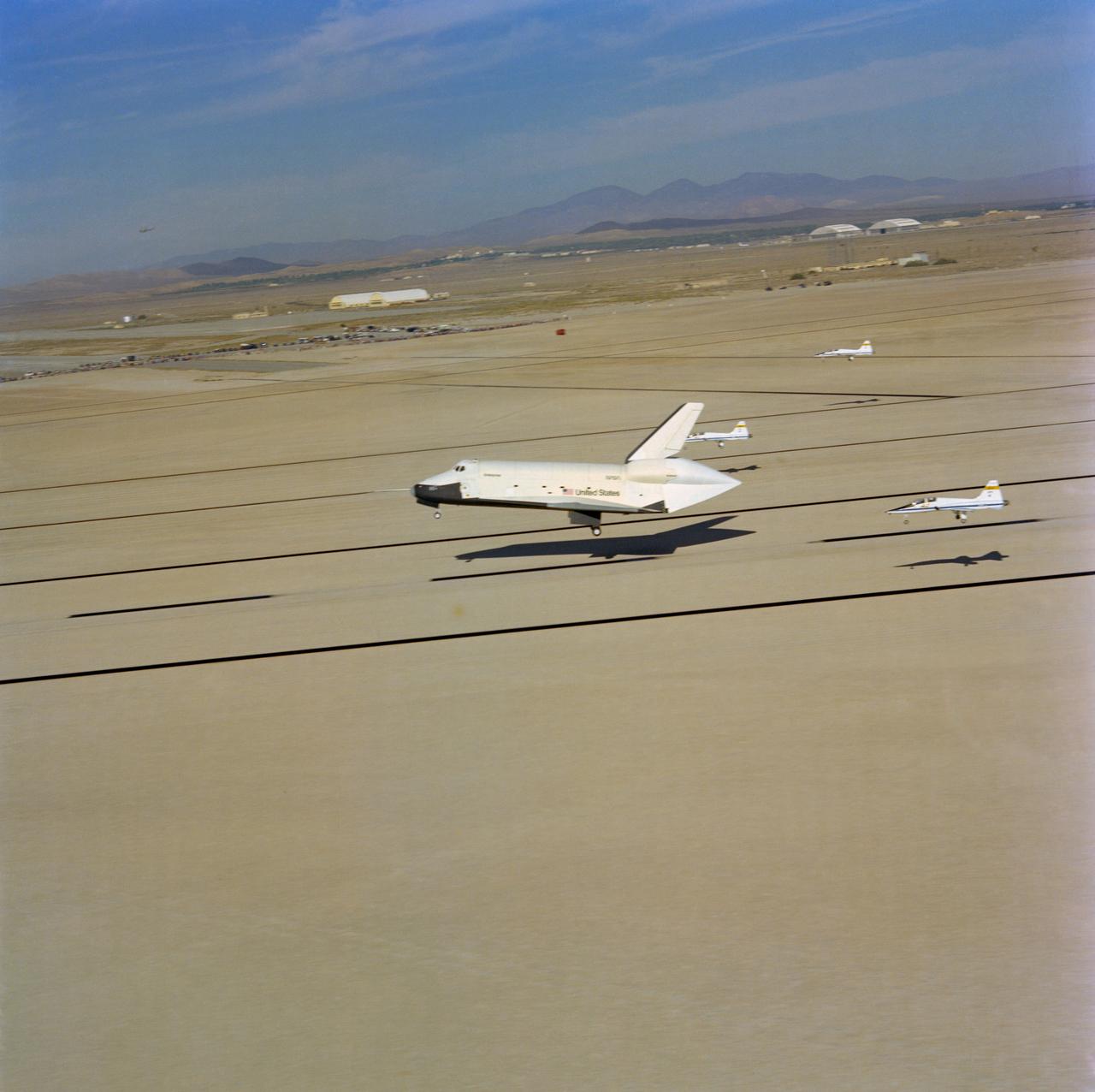
S77-28540 (23 Sept 1977) --- The shuttle Orbiter 101 "Enterprise" approaches touchdown on the runway at Edwards Air Force Base to conclude a five-minute, 34-second unpowered flight, the third of Shuttle Approach and Landing Tests (ALT) series, on September 23, 1977. Thress T-38 chase planes follow close by. Astronauts Fred W. Haise Jr., commander, and C. Gordon Fullerton, pilot, were the crew aboard the "Enterprise" for this flight.
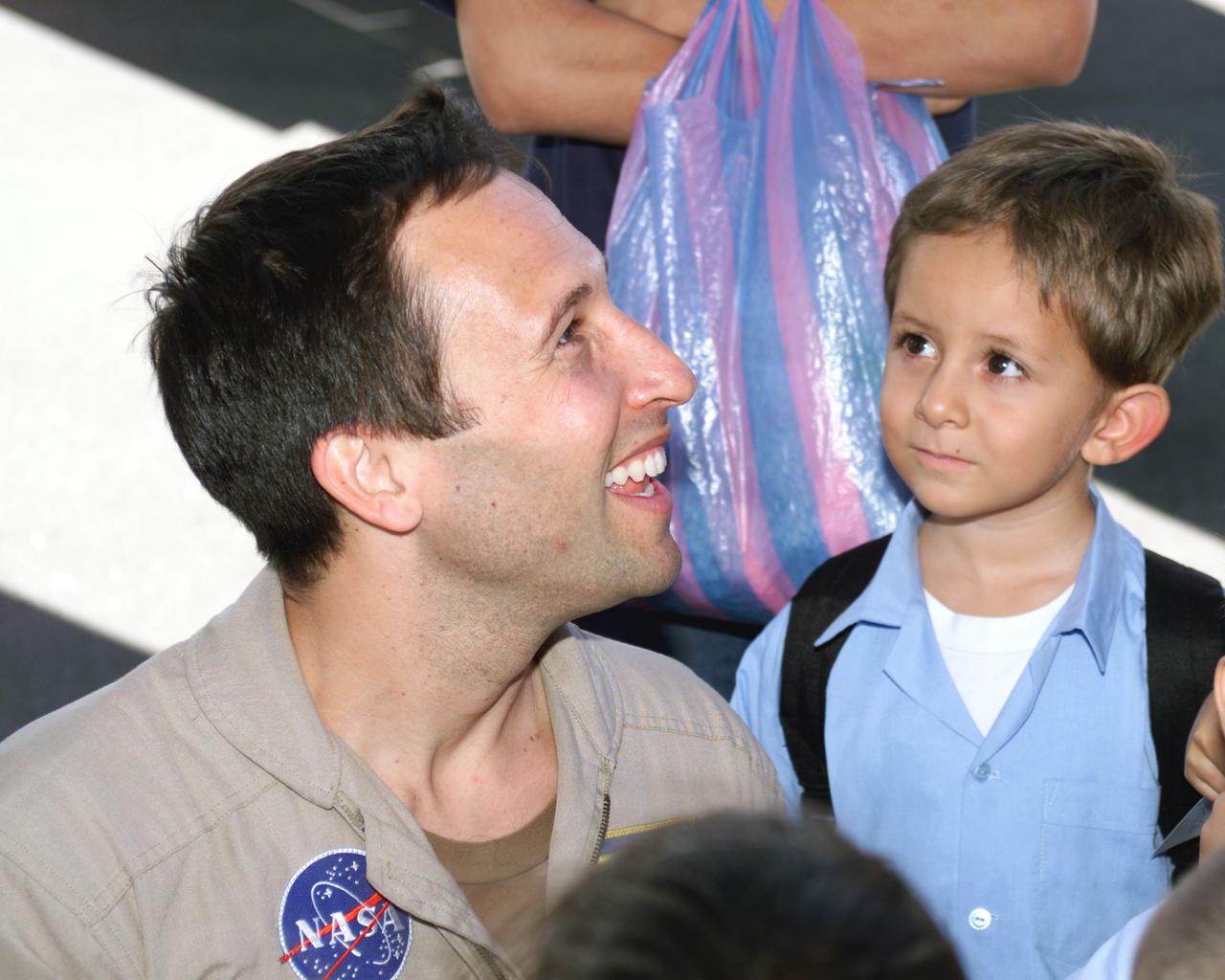
NASA Dryden Mission Manager Walter Klein passes out Airborne Science stickers and lithographs to underprivileged school children that visited the airport on Monday March 8, 2004. In spanish, he explained to them the mission of the DC-8 AirSAR 2004 Mesoamerican campaign in Costa Rica. AirSAR 2004 Mesoamerica is a three-week expedition by an international team of scientists that uses an all-weather imaging tool, called the Airborne Synthetic Aperture Radar (AirSAR) which is located onboard NASA's DC-8 airborne laboratory. Scientists from many parts of the world including NASA's Jet Propulsion Laboratory are combining ground research done in several areas in Central America with NASA's AirSAR technology to improve and expand on the quality of research they are able to conduct. The radar, developed by NASA's Jet Propulsion Laboratory, can penetrate clouds and also collect data at night. Its high-resolution sensors operate at multiple wavelengths and modes, allowing AirSAR to see beneath treetops, through thin sand, and dry snow pack. AirSAR's 2004 campaign is a collaboration of many U.S. and Central American institutions and scientists, including NASA; the National Science Foundation; the Smithsonian Institution; National Geographic; Conservation International; the Organization of Tropical Studies; the Central American Commission for Environment and Development; and the Inter-American Development Bank.
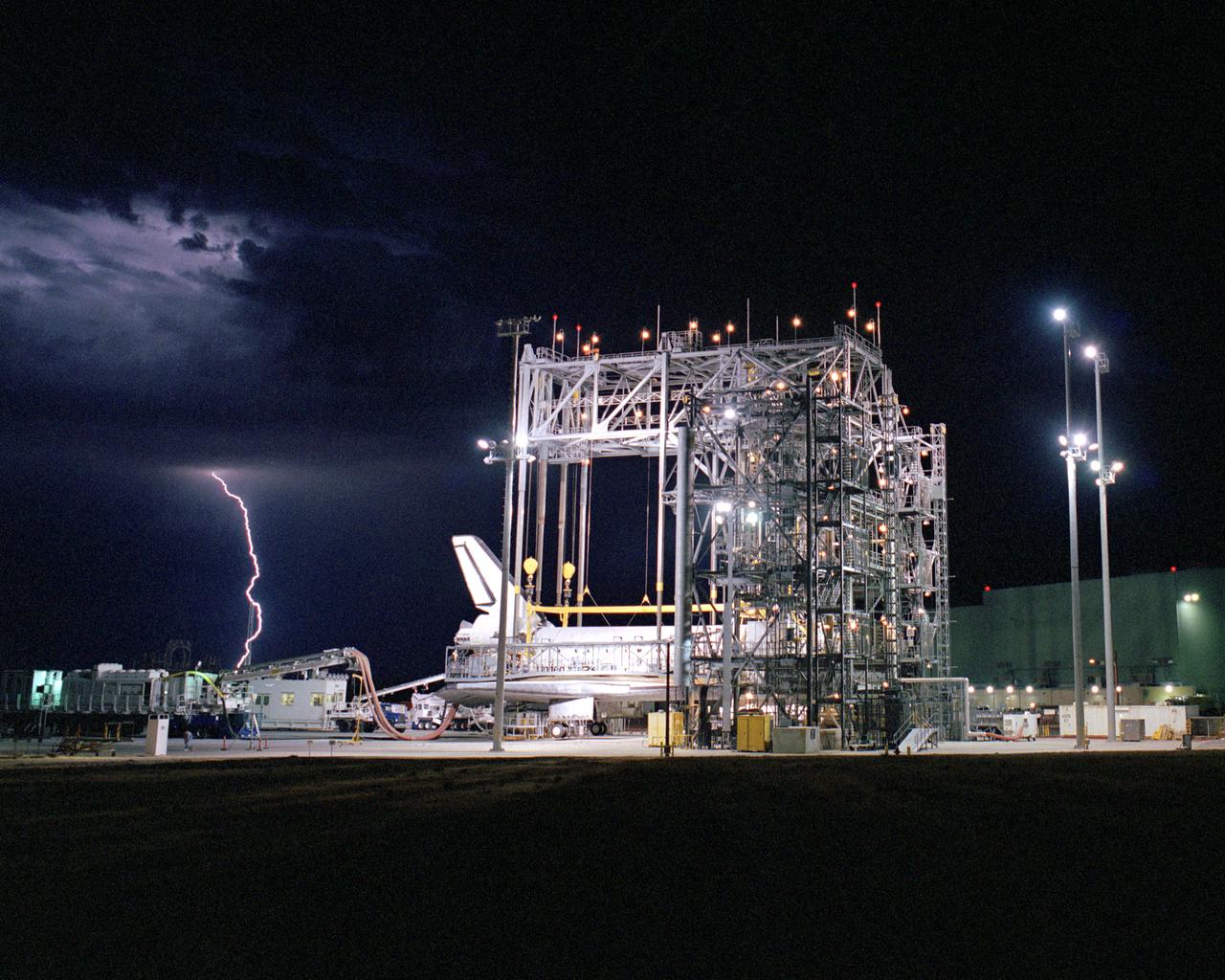
Lightning strikes in the distance as the Space Shuttle Discovery receives post-flight processing in the Mate-Demate Device (MDD), following its landing at NASA's Dryden Flight Research Center in California. The gantry-like MDD structure is used for servicing the shuttle orbiters in preparation for their ferry flight back to the Kennedy Space Center in Florida, including mounting the shuttle atop NASA's modified Boeing 747 Shuttle Carrier Aircraft. Space Shuttle Discovery landed safely at NASA's Dryden Flight Research Center at Edwards Air Force Base in California at 5:11:22 a.m. PDT, August 9, 2005, following the very successful 14-day STS-114 return to flight mission. During their two weeks in space, Commander Eileen Collins and her six crewmates tested out new safety procedures and delivered supplies and equipment the International Space Station. Discovery spent two weeks in space, where the crew demonstrated new methods to inspect and repair the Shuttle in orbit. The crew also delivered supplies, outfitted and performed maintenance on the International Space Station. A number of these tasks were conducted during three spacewalks. In an unprecedented event, spacewalkers were called upon to remove protruding gap fillers from the heat shield on Discovery's underbelly. In other spacewalk activities, astronauts installed an external platform onto the Station's Quest Airlock and replaced one of the orbital outpost's Control Moment Gyroscopes. Inside the Station, the STS-114 crew conducted joint operations with the Expedition 11 crew. They unloaded fresh supplies from the Shuttle and the Raffaello Multi-Purpose Logistics Module. Before Discovery undocked, the crews filled Raffeallo with unneeded items and returned to Shuttle payload bay. Discovery launched on July 26 and spent almost 14 days on orbit.
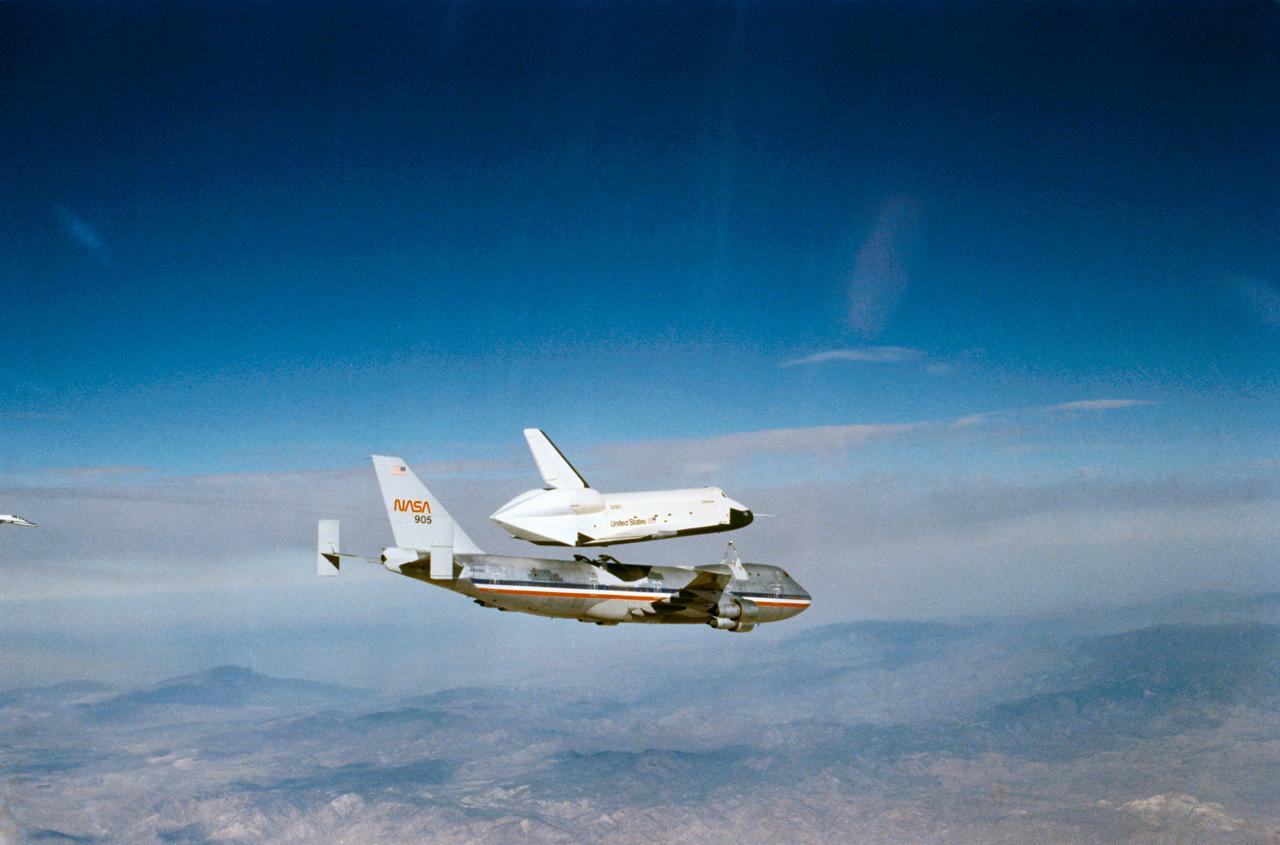
S77-28136 (13 Sept 1977) --- The Orbiter 101 "Enterprise" is seen separating from the NASA 747 carrier aircraft during the second free flight of the Shuttle Approach and Landing Tests (ALTs) conducted on September 13, 1977 at Dryden Flight Research Center in Southern California. Astronauts Joe H. Engle, and Richard H. Truly were the crew of the "Enterprise." The ALT free flights are designed to verify Orbiter subsonic airworthiness, integrated systems operations and pilot-guided approach and landing capability and satisfying prerequisites to automatic flight control and navigation mode.
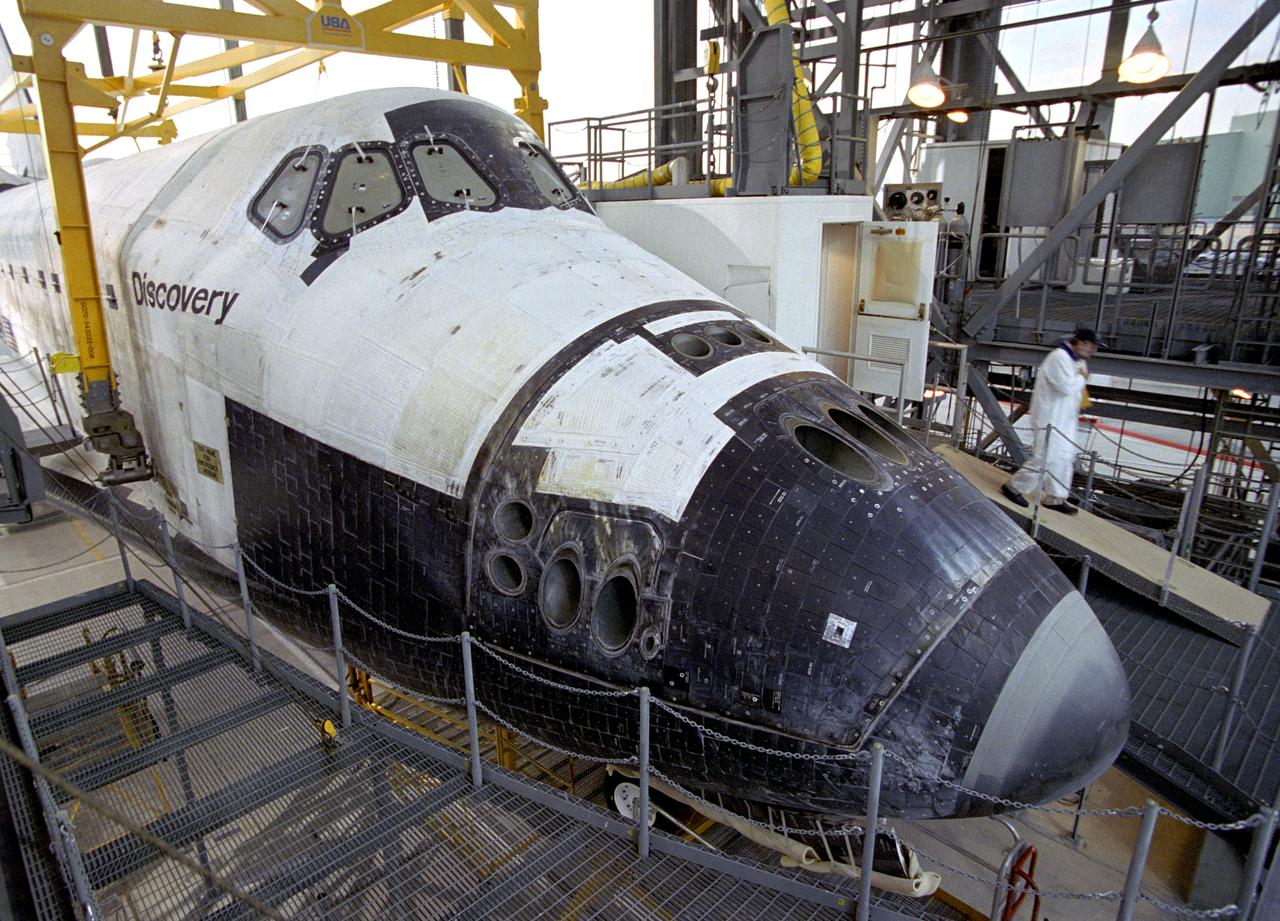
A technician leaves the 'white room', the access point for entering the Space Shuttle Discovery during post-flight processing in the Mate-Demate Device (MDD) at NASA's Dryden Flight Research Center in California. The gantry-like MDD structure is used for servicing the shuttle orbiters in preparation for their ferry flight back to the Kennedy Space Center in Florida, including mounting the shuttle atop NASA's modified Boeing 747 Shuttle Carrier Aircraft. Space Shuttle Discovery landed safely at NASA's Dryden Flight Research Center at Edwards Air Force Base in California at 5:11:22 a.m. PDT, August 9, 2005, following the very successful 14-day STS-114 return to flight mission. During their two weeks in space, Commander Eileen Collins and her six crewmates tested out new safety procedures and delivered supplies and equipment the International Space Station. Discovery spent two weeks in space, where the crew demonstrated new methods to inspect and repair the Shuttle in orbit. The crew also delivered supplies, outfitted and performed maintenance on the International Space Station. A number of these tasks were conducted during three spacewalks. In an unprecedented event, spacewalkers were called upon to remove protruding gap fillers from the heat shield on Discovery's underbelly. In other spacewalk activities, astronauts installed an external platform onto the Station's Quest Airlock and replaced one of the orbital outpost's Control Moment Gyroscopes. Inside the Station, the STS-114 crew conducted joint operations with the Expedition 11 crew. They unloaded fresh supplies from the Shuttle and the Raffaello Multi-Purpose Logistics Module. Before Discovery undocked, the crews filled Raffeallo with unneeded items and returned to Shuttle payload bay. Discovery launched on July 26 and spent almost 14 days on orbit.
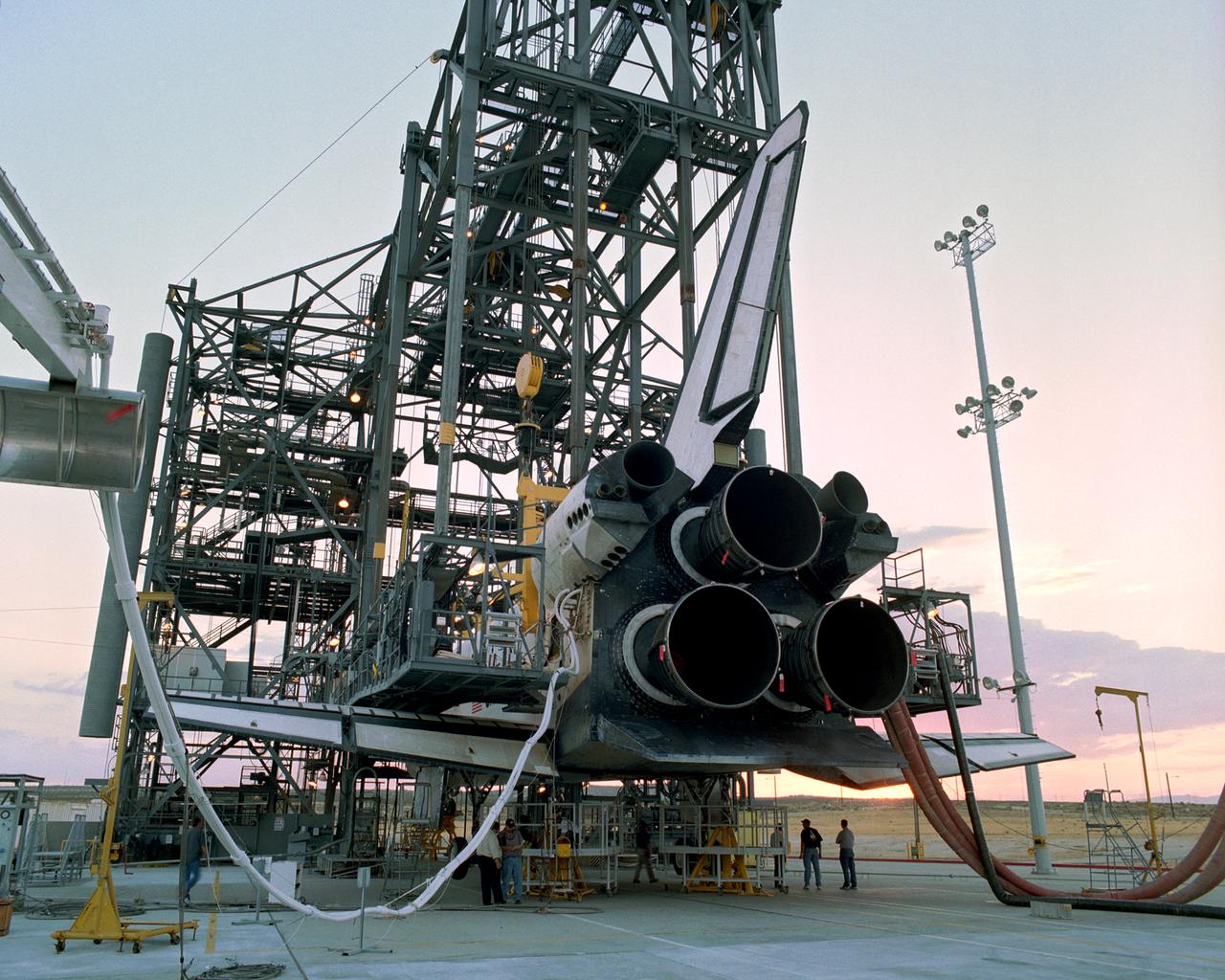
The sun sets on the Space Shuttle Discovery during post-flight processing in the Mate-Demate Device (MDD), following its landing at NASA's Dryden Flight Research Center in California. The gantry-like MDD structure is used for servicing the shuttle orbiters in preparation for their ferry flight back to the Kennedy Space Center in Florida, including mounting the shuttle atop NASA's modified Boeing 747 Shuttle Carrier Aircraft. Space Shuttle Discovery landed safely at NASA's Dryden Flight Research Center at Edwards Air Force Base in California at 5:11:22 a.m. PDT, August 9, 2005, following the very successful 14-day STS-114 return to flight mission. During their two weeks in space, Commander Eileen Collins and her six crewmates tested out new safety procedures and delivered supplies and equipment the International Space Station. Discovery spent two weeks in space, where the crew demonstrated new methods to inspect and repair the Shuttle in orbit. The crew also delivered supplies, outfitted and performed maintenance on the International Space Station. A number of these tasks were conducted during three spacewalks. In an unprecedented event, spacewalkers were called upon to remove protruding gap fillers from the heat shield on Discovery's underbelly. In other spacewalk activities, astronauts installed an external platform onto the Station's Quest Airlock and replaced one of the orbital outpost's Control Moment Gyroscopes. Inside the Station, the STS-114 crew conducted joint operations with the Expedition 11 crew. They unloaded fresh supplies from the Shuttle and the Raffaello Multi-Purpose Logistics Module. Before Discovery undocked, the crews filled Raffeallo with unneeded items and returned to Shuttle payload bay. Discovery launched on July 26 and spent almost 14 days on orbit.
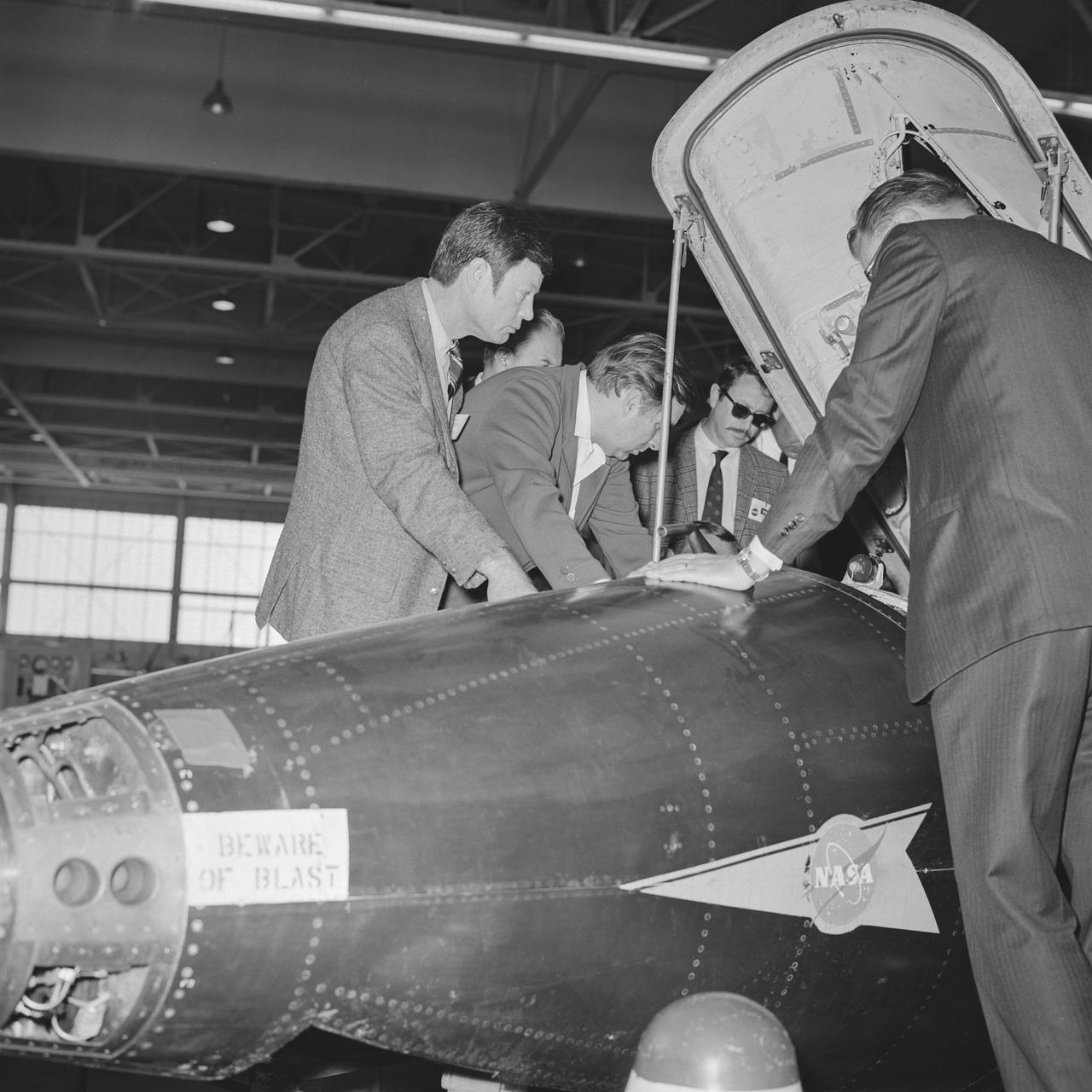
The 1960s Star Trek television series’ cast members visit NASA Dryden Flight Research Center, now Armstrong, in 1967. Chief Medical Officer Leonard ‘Bones’ McCoy played by DeForest Kelley and the show’s creator Gene Roddenberry receive briefing on X-15 cockpit as they view inside.
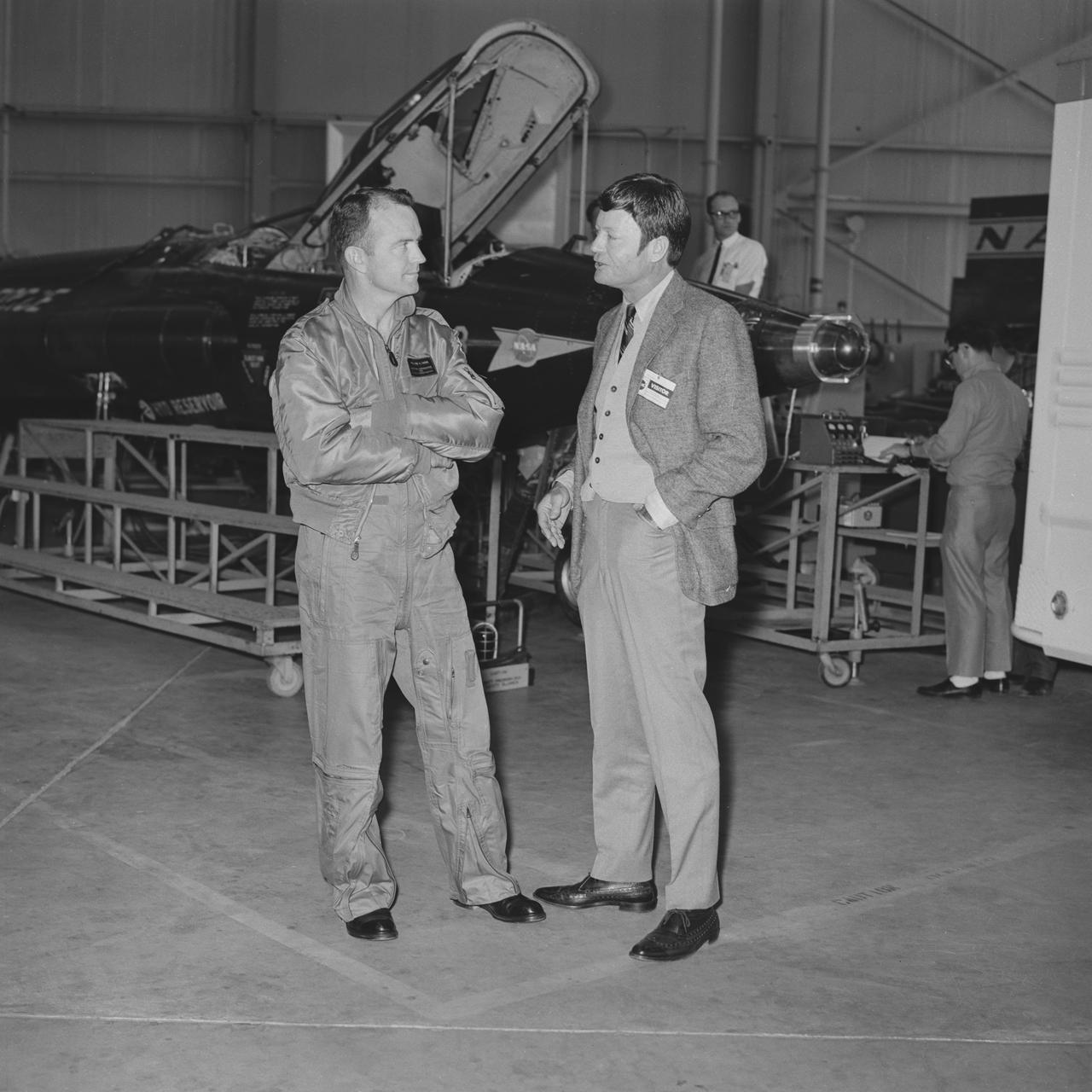
The 1960s Star Trek television series’ cast member Chief Medical Officer Leonard ‘Bones’ McCoy played by DeForest Kelley talks to Bill Dana, NASA X-15 pilot, in front of one of three X-15’s during visit to NASA Dryden Flight Research Center, now Armstrong, back in 1967.
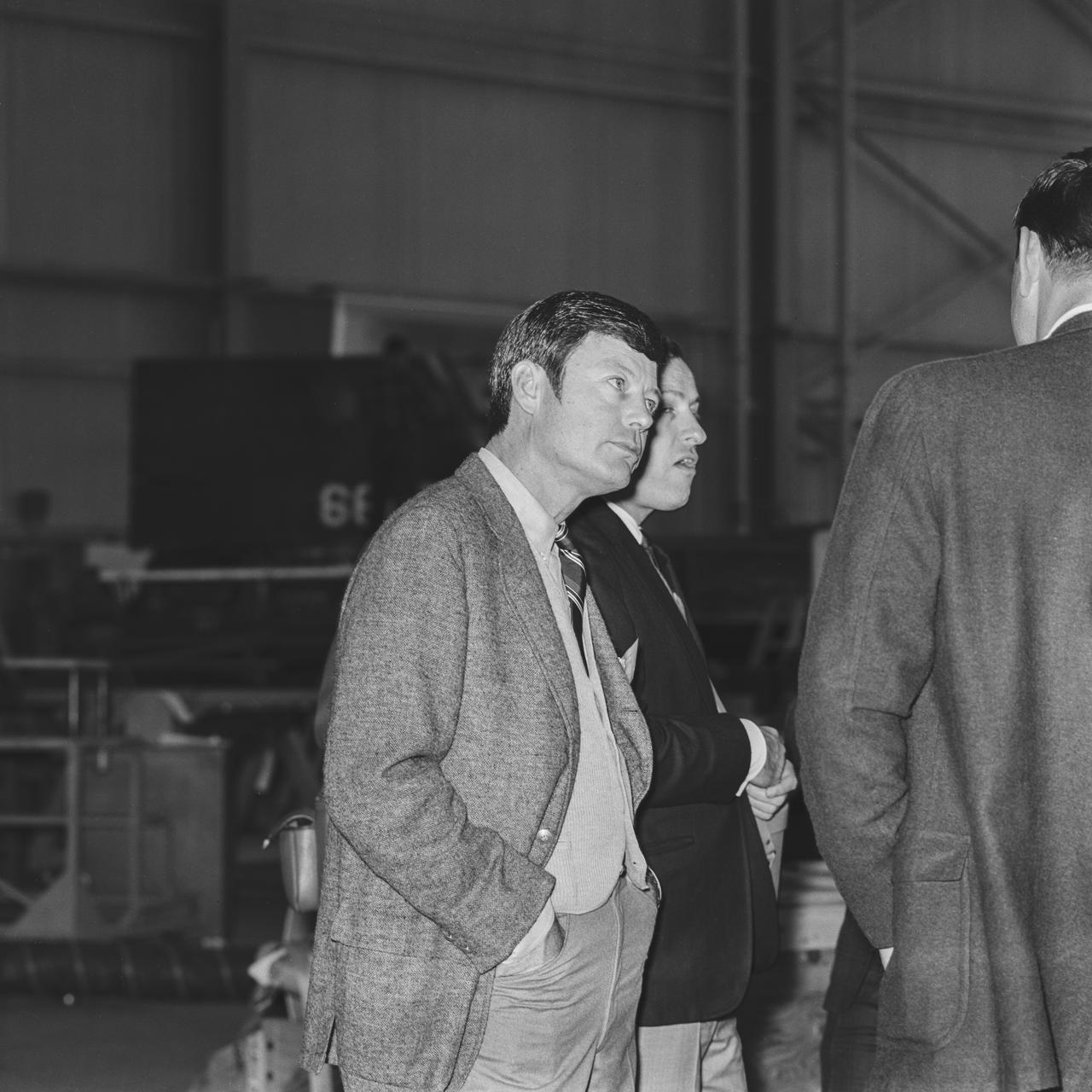
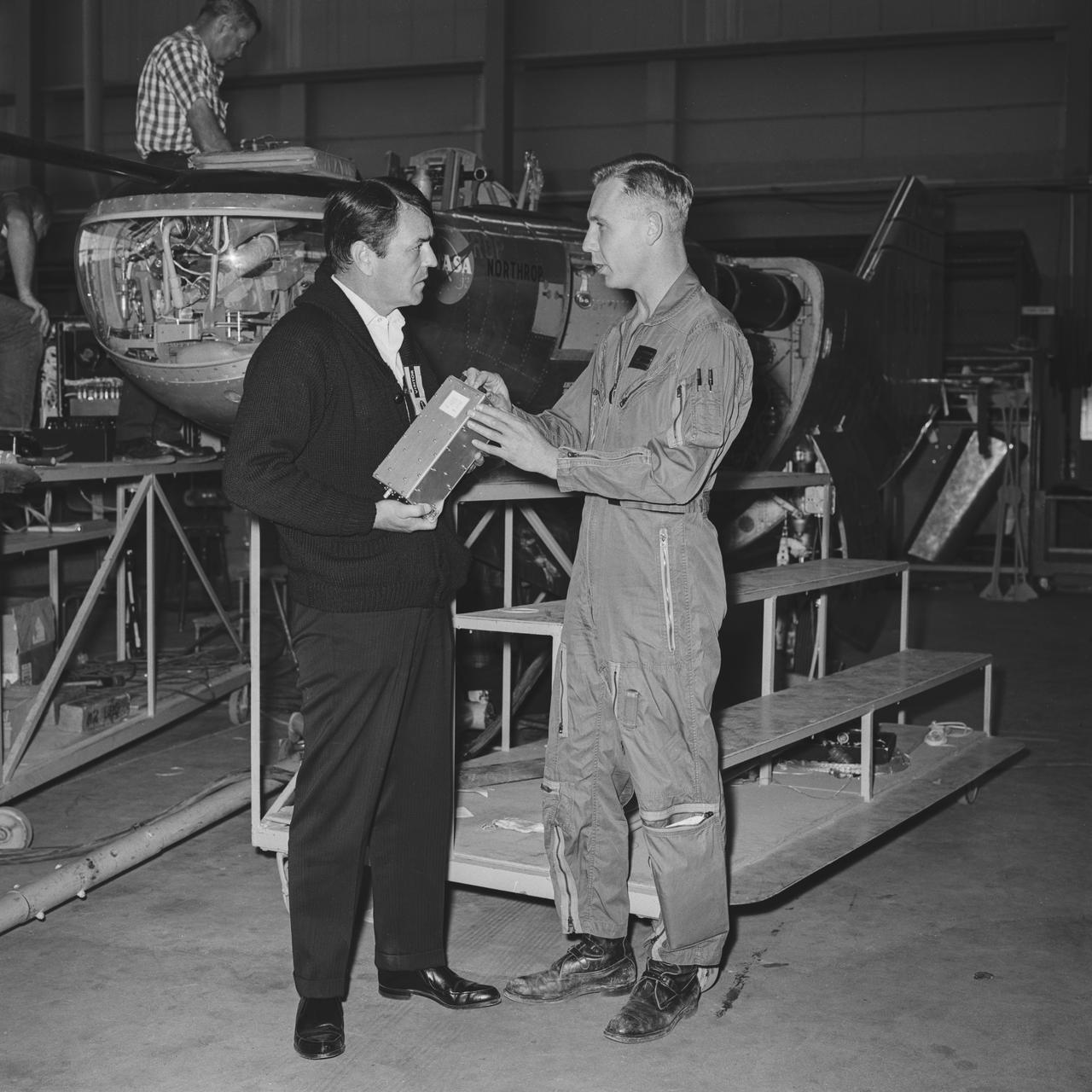
The 1960s Star Trek television series’ cast members visit NASA Dryden Flight Research Center, now Armstrong, in 1967. Chief Medical Officer Leonard ‘Bones’ McCoy played by DeForest Kelley talks with NASA officials in one of the center’s aircraft hangar.
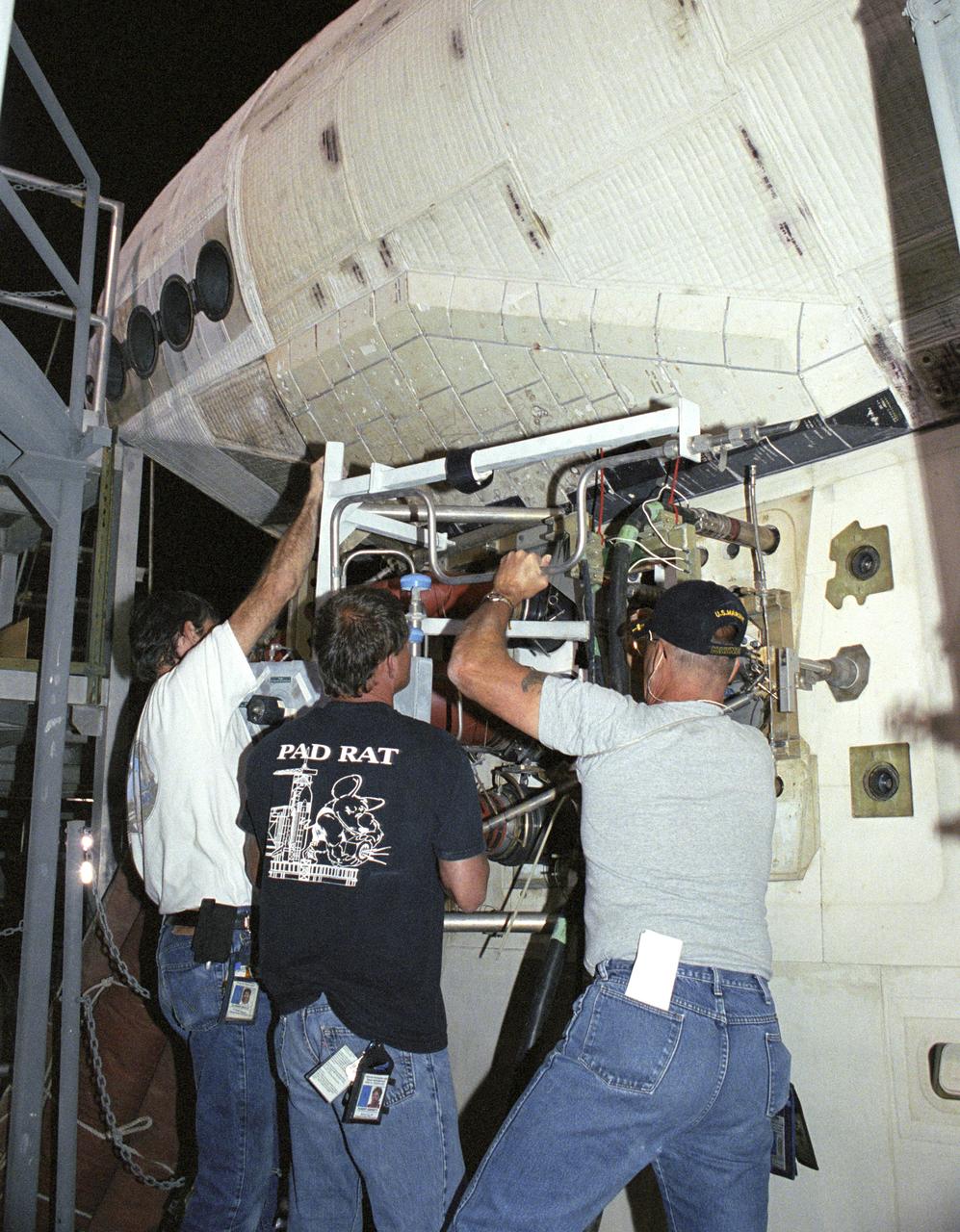
Todd Viddle; APU advanced systems technician, Robert 'Skip' Garrett; main propulsion advanced systems technician, and Dan McGrath; main propulsion systems engineer technician, remove a servicing unit from the Space Shuttle Discovery as part of it's post-flight processing at NASA's Dryden Flight Research Center. The Space Shuttles receive post-flight servicing in the Mate-Demate Device (MDD) following landings at NASA's Dryden Flight Research Center, Edwards, California. The gantry-like MDD structure is used for servicing the shuttle orbiters in preparation for their ferry flight back to the Kennedy Space Center in Florida, including mounting the shuttle atop NASA's modified Boeing 747 Shuttle Carrier Aircraft. Space Shuttle Discovery landed safely at NASA's Dryden Flight Research Center at Edwards Air Force Base in California at 5:11:22 a.m. PDT, August 9, 2005, following the very successful 14-day STS-114 return to flight mission. During their two weeks in space, Commander Eileen Collins and her six crewmates tested out new safety procedures and delivered supplies and equipment the International Space Station. Discovery spent two weeks in space, where the crew demonstrated new methods to inspect and repair the Shuttle in orbit. The crew also delivered supplies, outfitted and performed maintenance on the International Space Station. A number of these tasks were conducted during three spacewalks. In an unprecedented event, spacewalkers were called upon to remove protruding gap fillers from the heat shield on Discovery's underbelly. In other spacewalk activities, astronauts installed an external platform onto the Station's Quest Airlock and replaced one of the orbital outpost's Control Moment Gyroscopes. Inside the Station, the STS-114 crew conducted joint operations with the Expedition 11 crew. They unloaded fresh supplies from the Shuttle and the Raffaello Multi-Purpose Logistics Module. Before Discovery undocked, the crews filled Raffeallo with unneeded items
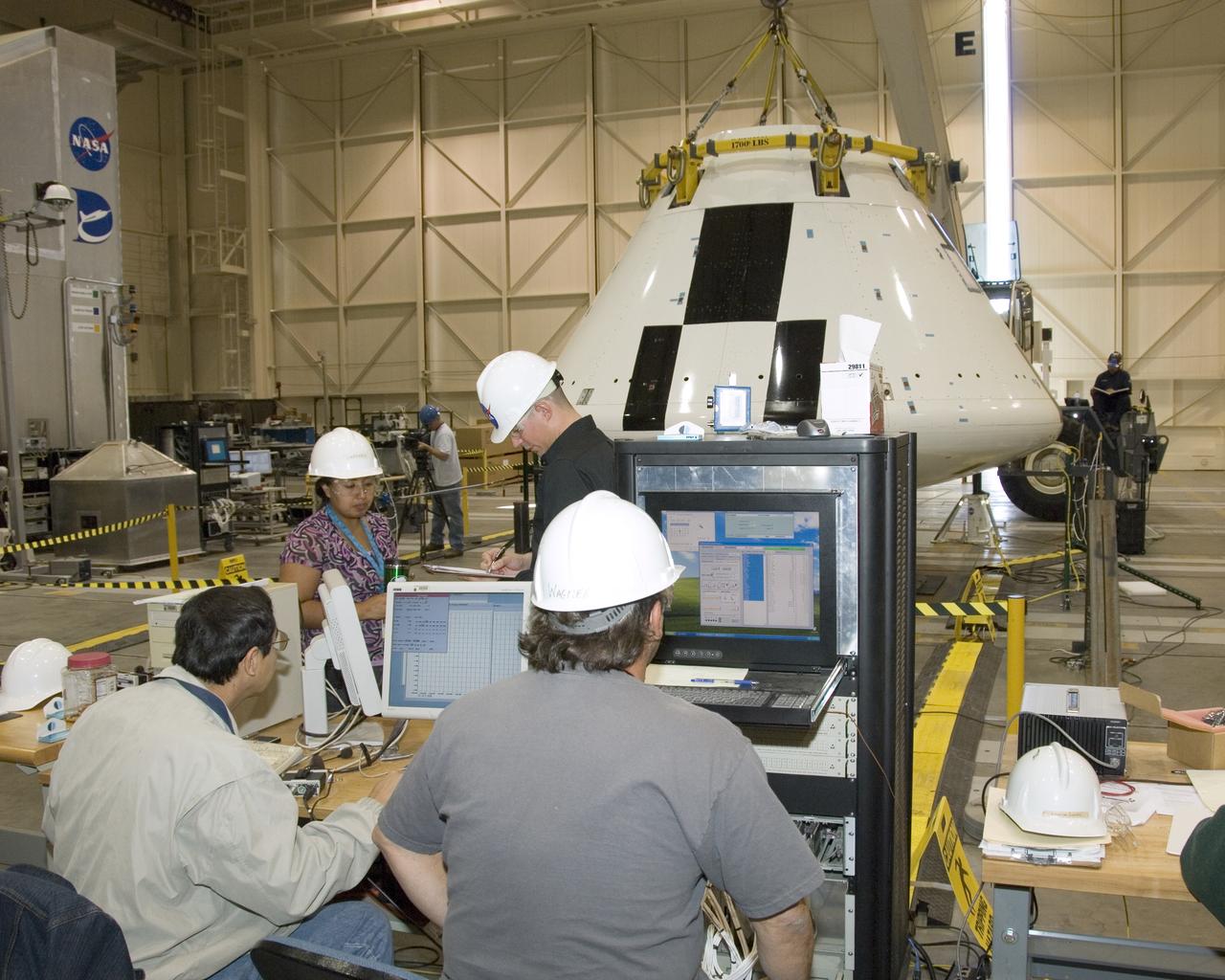
Engineers and technicians pore over data during moment-of-inertia testing on the Orion PA-1 Abort Flight Test module in the NASA Dryden Flight Loads Laboratory.
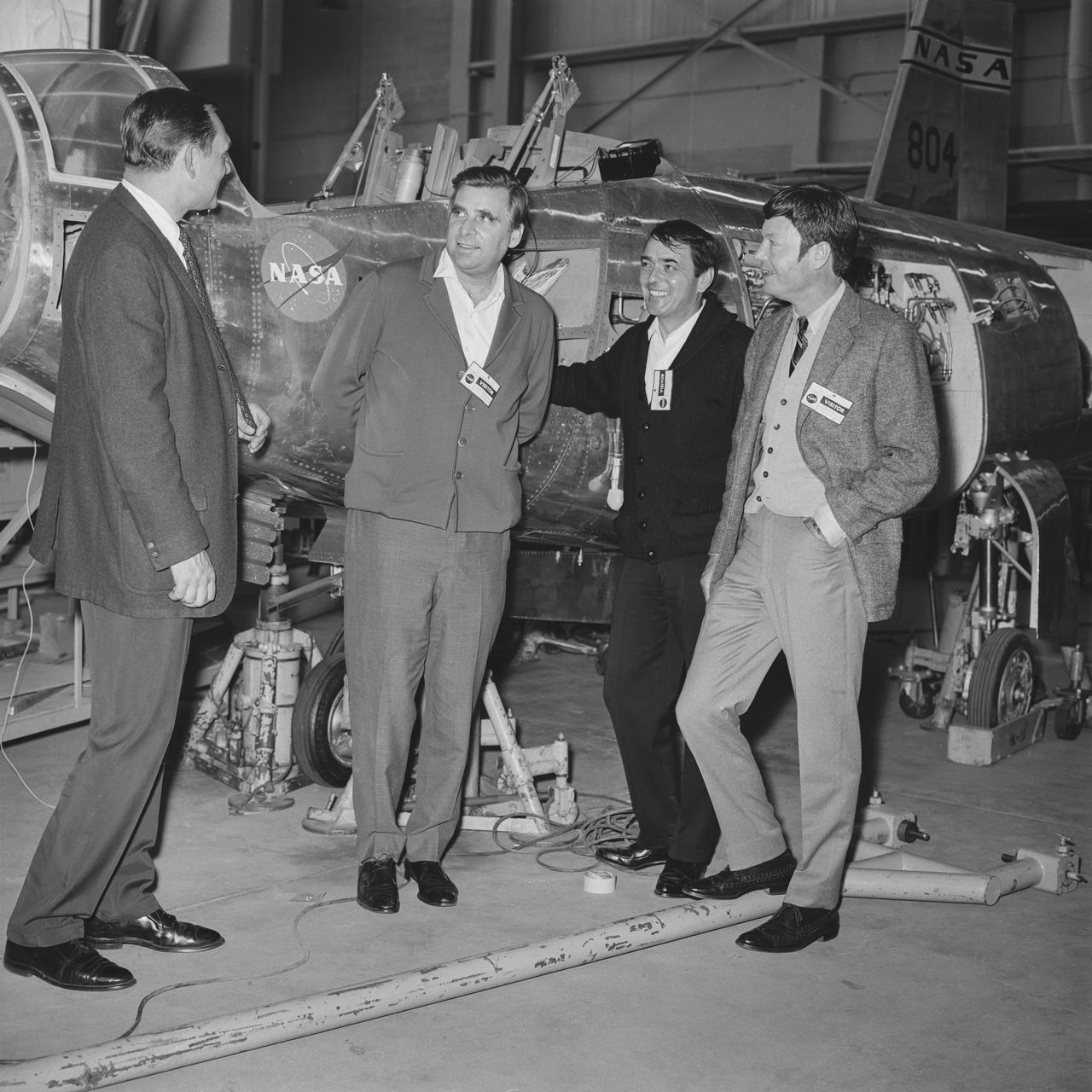
The 1960s Star Trek television series cast members Chief Engineer Montgomery ‘Scotty’ Scott played by James Doohan and Chief Medical Officer Leonard ‘Bones’ McCoy played by DeForest Kelley and the show’s creator Gene Roddenberry receive briefing on NASA Dryden Flight Research Center, now Armstrong, in front of HL-10
The 1960s Star Trek television series’ cast members visit NASA Dryden Flight Research Center, now called Armstrong, in 1967. The show’s Chief Engineer Montgomery ‘Scotty’ Scott played by James Doohan talks with NASA Pilot Bruce Peterson.