Hubble Discovery Image of New Moon Orbiting Saturn
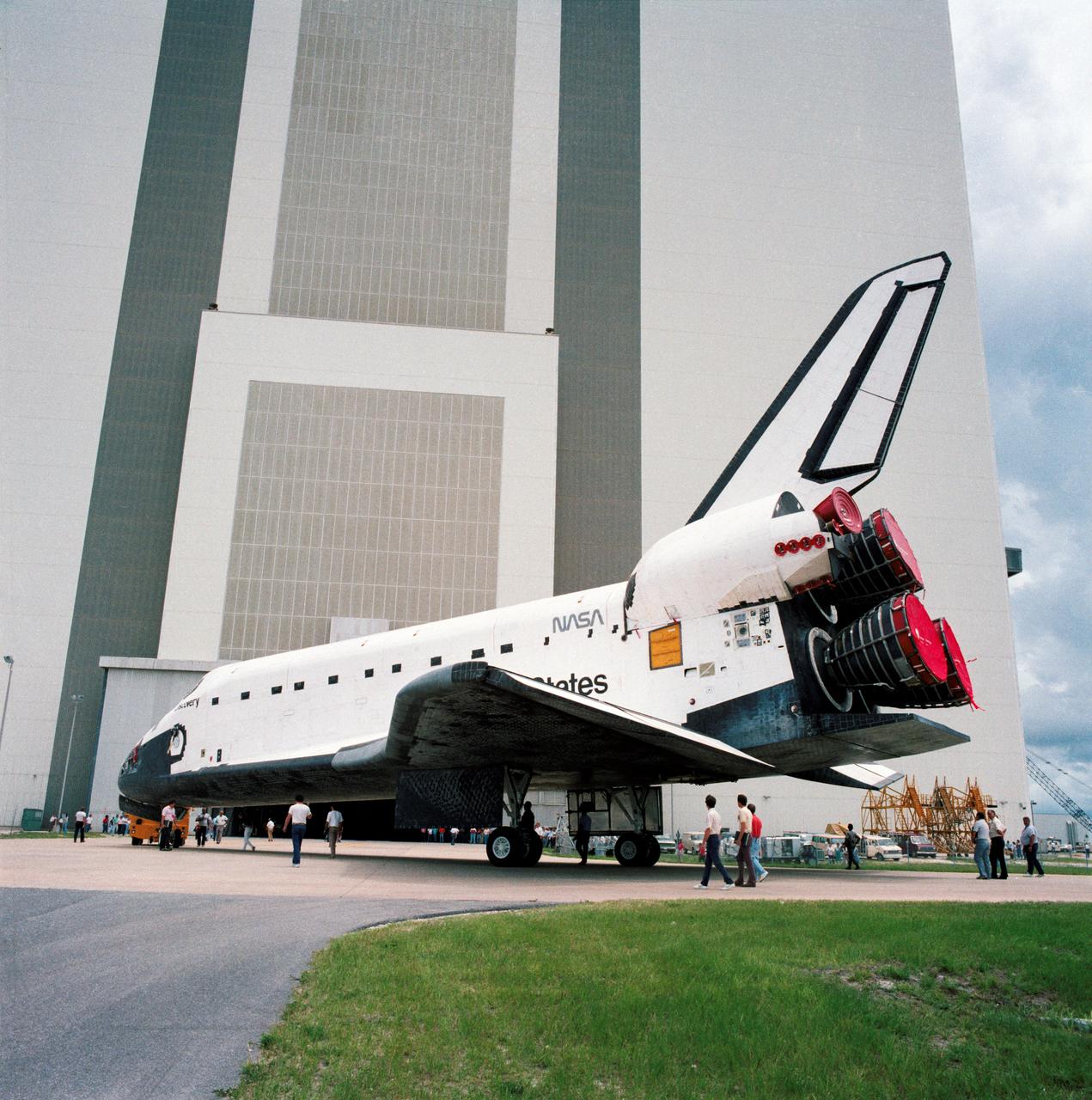
S88-42092 (15 July 1988) --- STS-26 Discovery, Orbiter Vehicle (OV) 103, rollover at Kennedy Space Center (KSC) is closely monitored by engineers and technicians in the late stages of the move from the orbiter processing facility (OPF) to the vehicle assembly building (VAB) as preflight preparations continue. A large crowd of KSC employees and other spectators watches in the background as OV-103, supported by its landing gear, is pulled toward VAB (background). While in the VAB, OV-103 will be mated to two solid rocket boosters (SRBs) and an external fuel tank.
STS-26 Discovery, Orbiter Vehicle (OV) 103, rollover at KSC
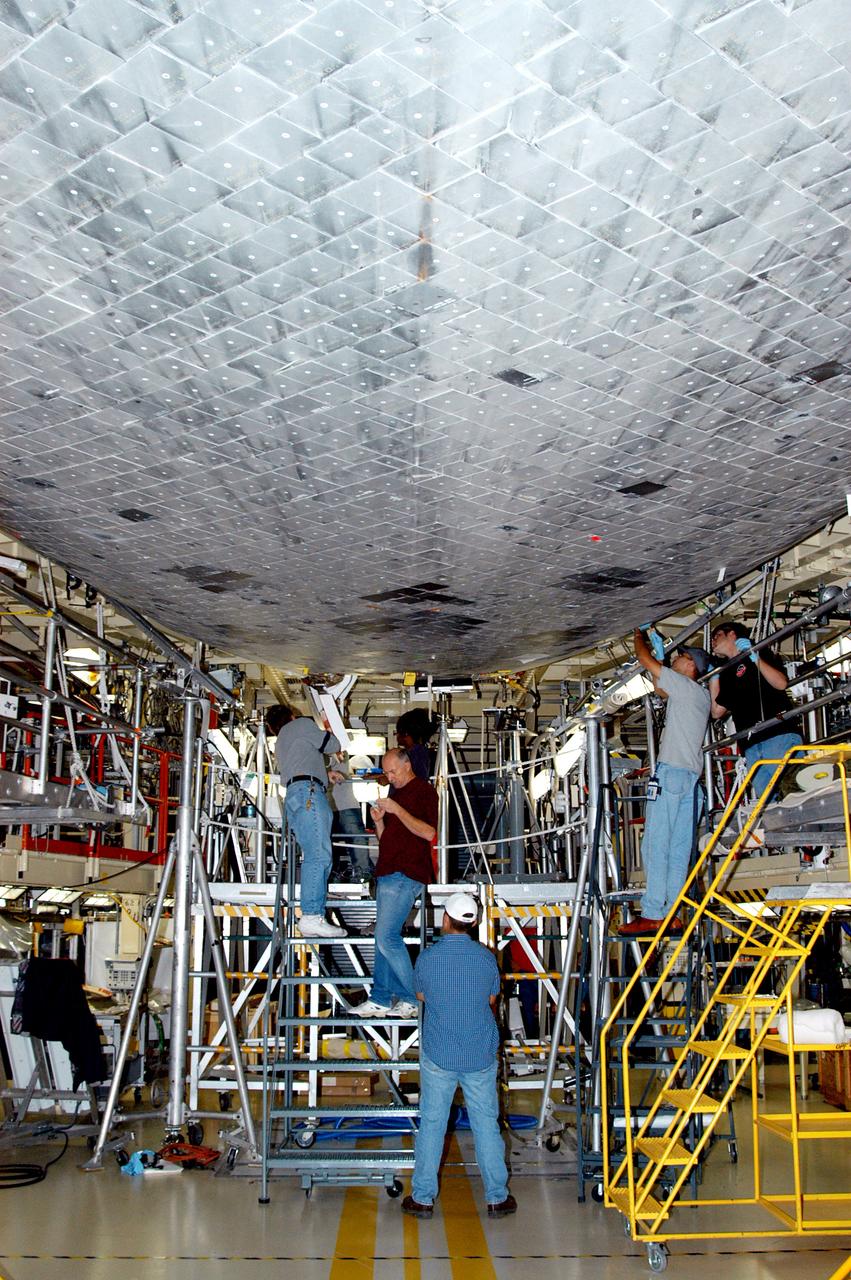
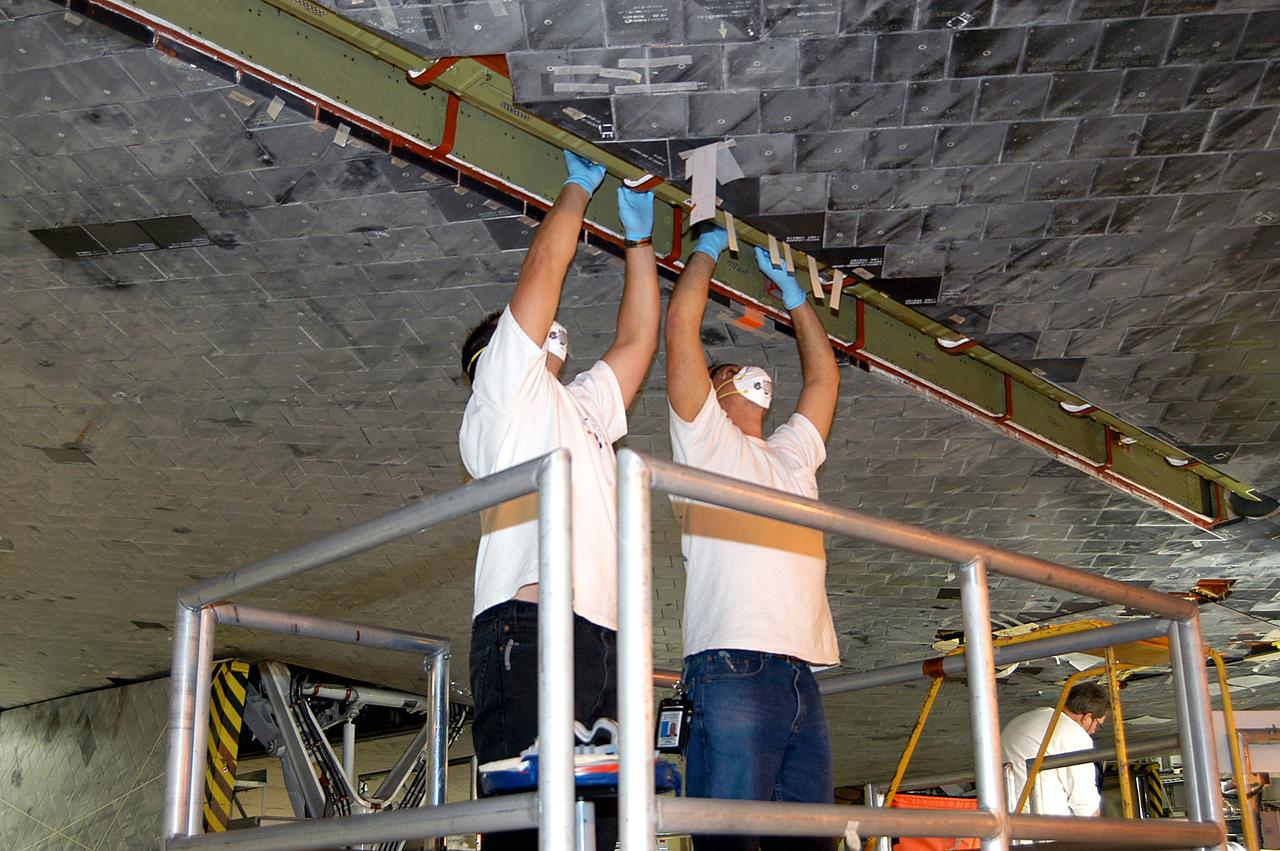
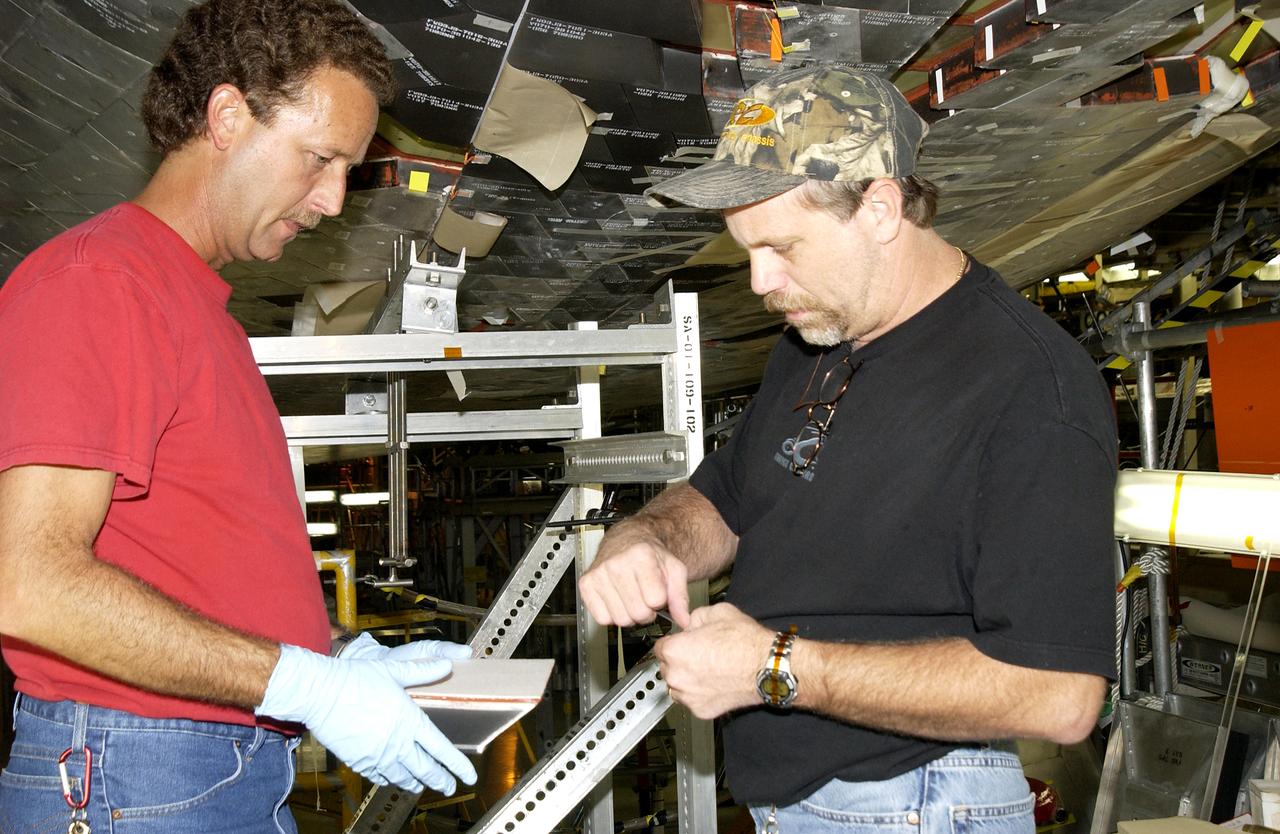
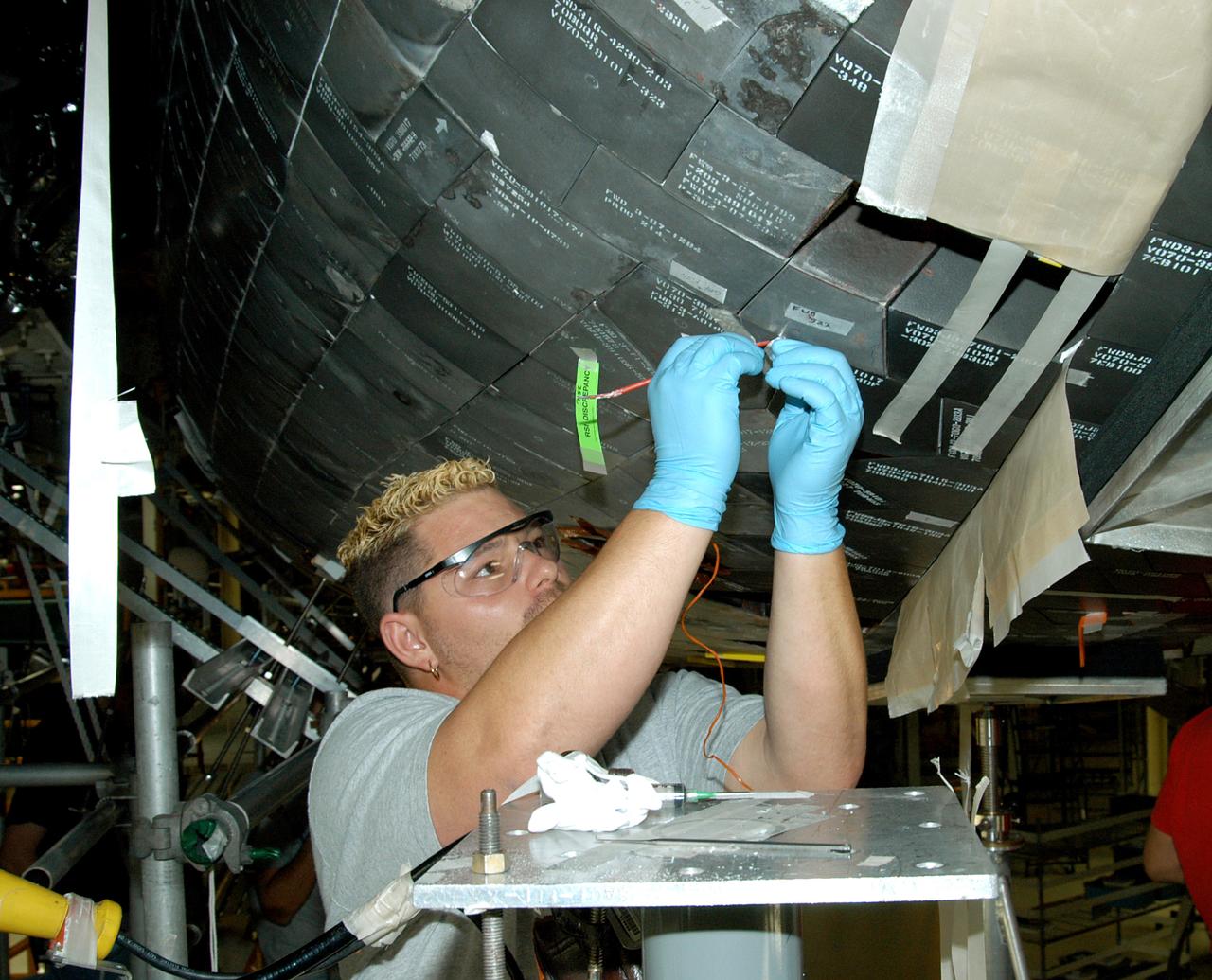
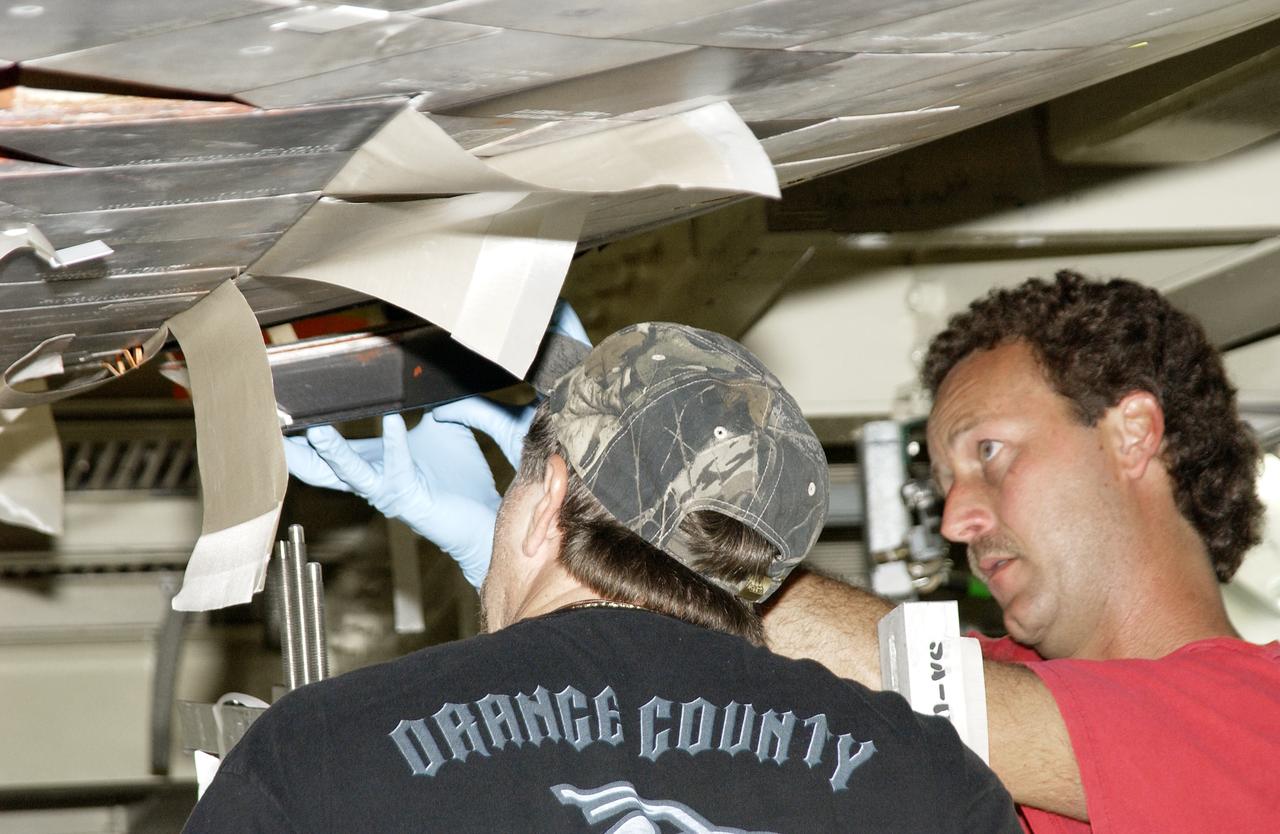
Workers make a tile-fit check on the underside of the orbiter Discovery in the Orbiter Processing Facility. The vehicle has undergone Orbiter Major Modifications in the past year, a process that includes the tile check.
Discovery Orbiter Major Modifications
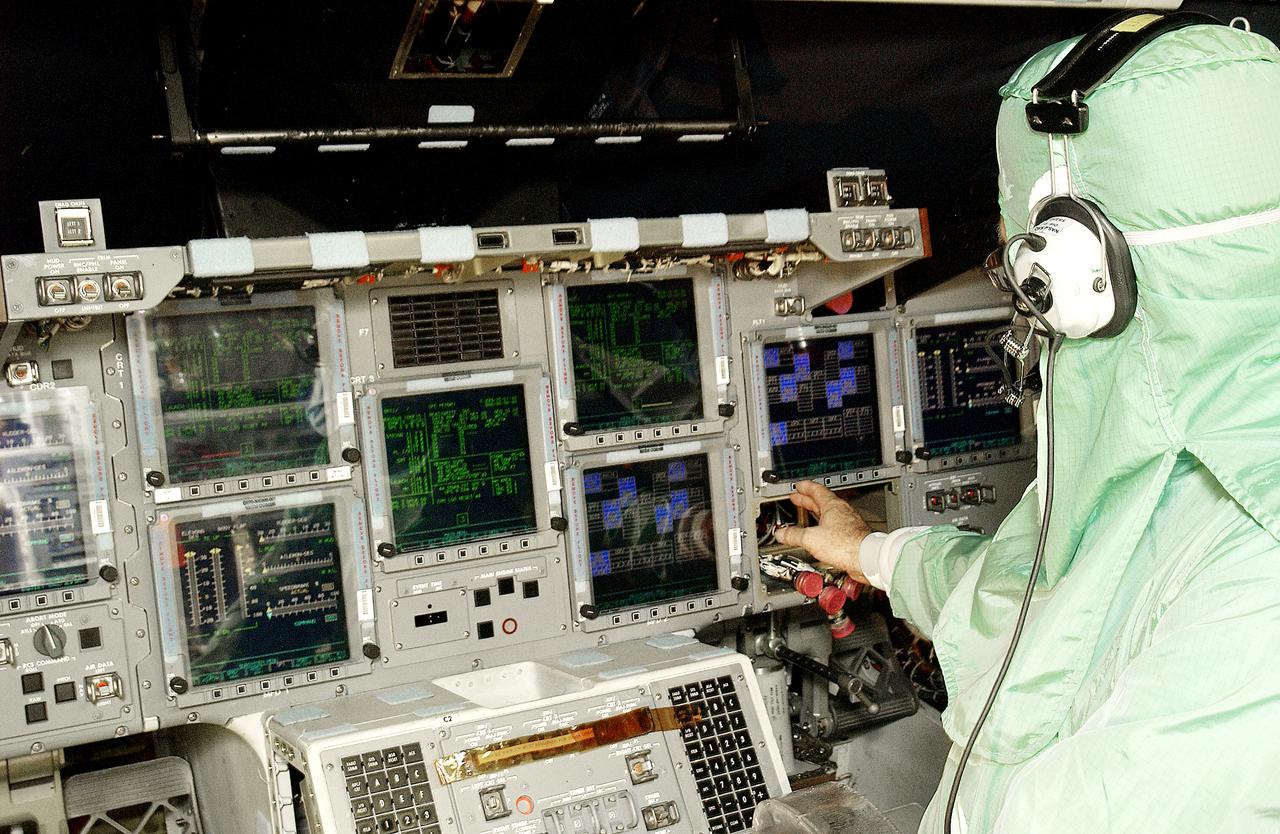
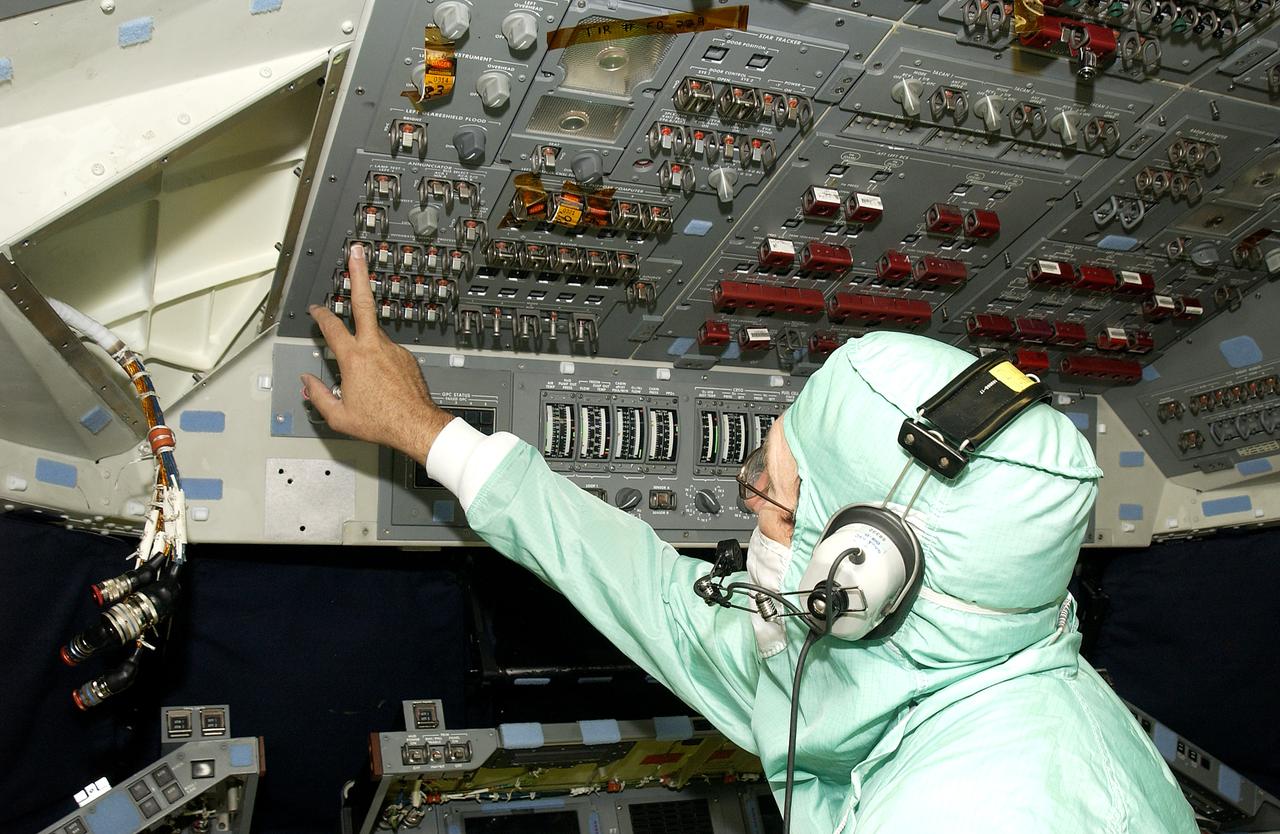
During power-up of the orbiter Discovery in the Orbiter Processing Facility, a technician moves a circuit reset on the cockpit console. Discovery has been undergoing Orbiter Major Modifications in the past year, ranging from wiring, control panels and black boxes to gaseous and fluid systems tubing and components. These systems were deserviced, disassembled, inspected, modified, reassembled, checked out and reserviced, as were most other systems onboard. The work includes the installation of the Multifunction Electronic Display Subsystem (MEDS) - a state-of-the-art “glass cockpit.”
Discovery Orbiter Major Modifications
During power-up of the orbiter Discovery in the Orbiter Processing Facility, a technician adjusts a monitor on the console. Discovery has been undergoing Orbiter Major Modifications in the past year, ranging from wiring, control panels and black boxes to gaseous and fluid systems tubing and components. These systems were deserviced, disassembled, inspected, modified, reassembled, checked out and reserviced, as were most other systems onboard. The work includes the installation of the Multifunction Electronic Display Subsystem (MEDS) - a state-of-the-art “glass cockpit.”
Discovery Orbiter Major Modifications
ISS011-E-11337 (29 July 2005) --- This scene, photographed from the  International Space Station while docked with Space Shuttle Discovery, shows the orbiter, the orbiter's Remote Manipulator System (RMS) arm, the Space Station RMS (Canadarm2), the Orbiter Boom and Sensor System  (OBSS) and a Soyuz vehicle docked with the orbital outpost.
Orbiter Discovery seen during rendezvous
STS029-S-028 (13 March 1989) --- From Launch Pad 39B, the Space Shuttle Discovery is launched on Mission STS-29. Discovery lifted off at 9:57 a.m. (EST), March 13, 1989, carrying the tracking and data relay satellite (TDRS-1) into orbit. Onboard the spacecraft were astronauts Michael L. Coats, commander; John E. Blaha, pilot; and James F. Buchli, James P. Bagian and Robert C. Springer, all mission specialists.
STS-29 Discovery, Orbiter Vehicle (OV) 103, lifts off from KSC LC Pad 39B
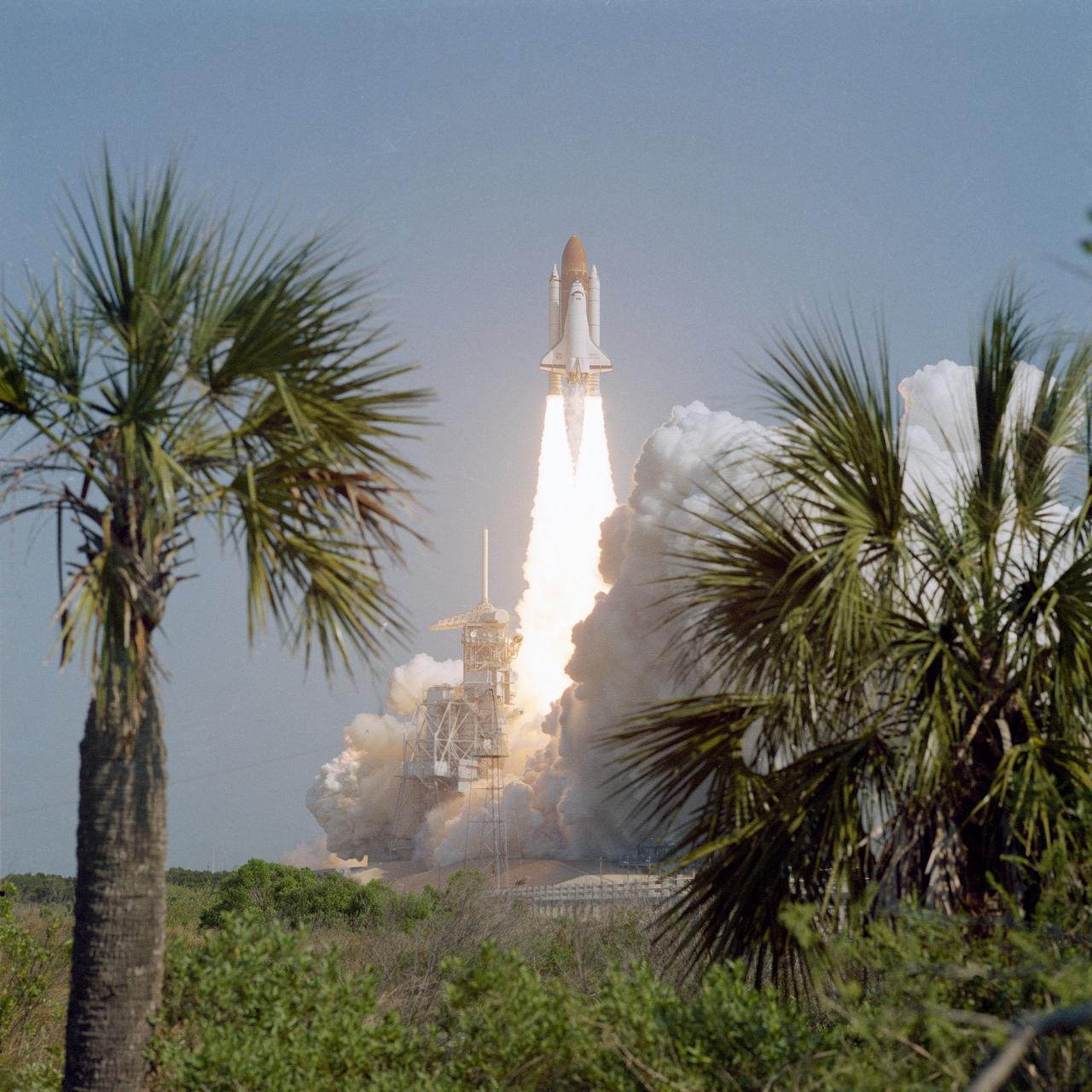
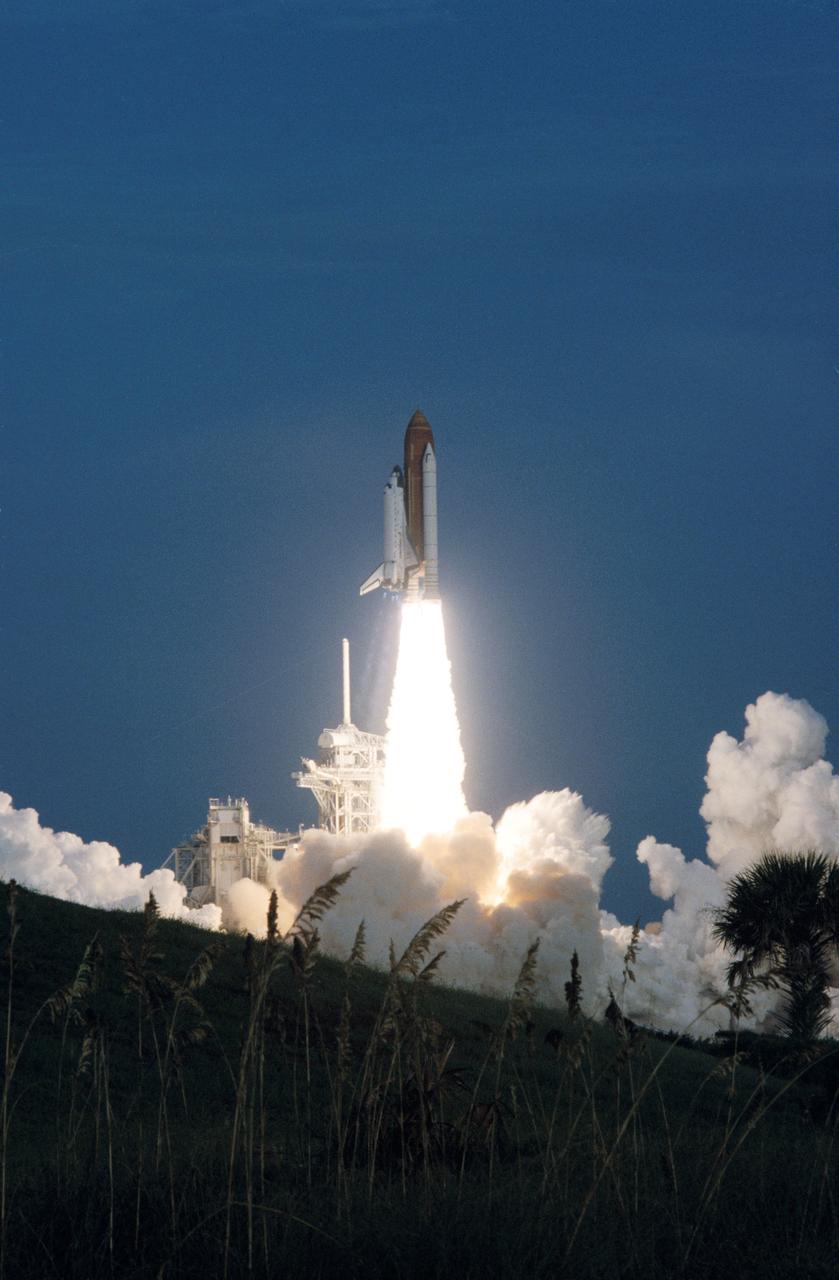
STS029-S-027 (13 March 1989) --- From Launch Pad 39D, the Space Shuttle Discovery is launched on mission STS-29.  Discovery lifted off at 9:57 a.m. (EST), March 13, 1989, carrying the tracking and data relay satellite (TDRS-1) into orbit.  Florida vegetation frames the launch scene.  Onboard the spacecraft were astronauts Michael L. Coats, commander; John E. Blaha, pilot; and James F. Buchli, James P. Bagian and Robert C. Springer, all mission specialists.
STS-29 Discovery, Orbiter Vehicle (OV) 103, lifts off from KSC LC Pad 39B
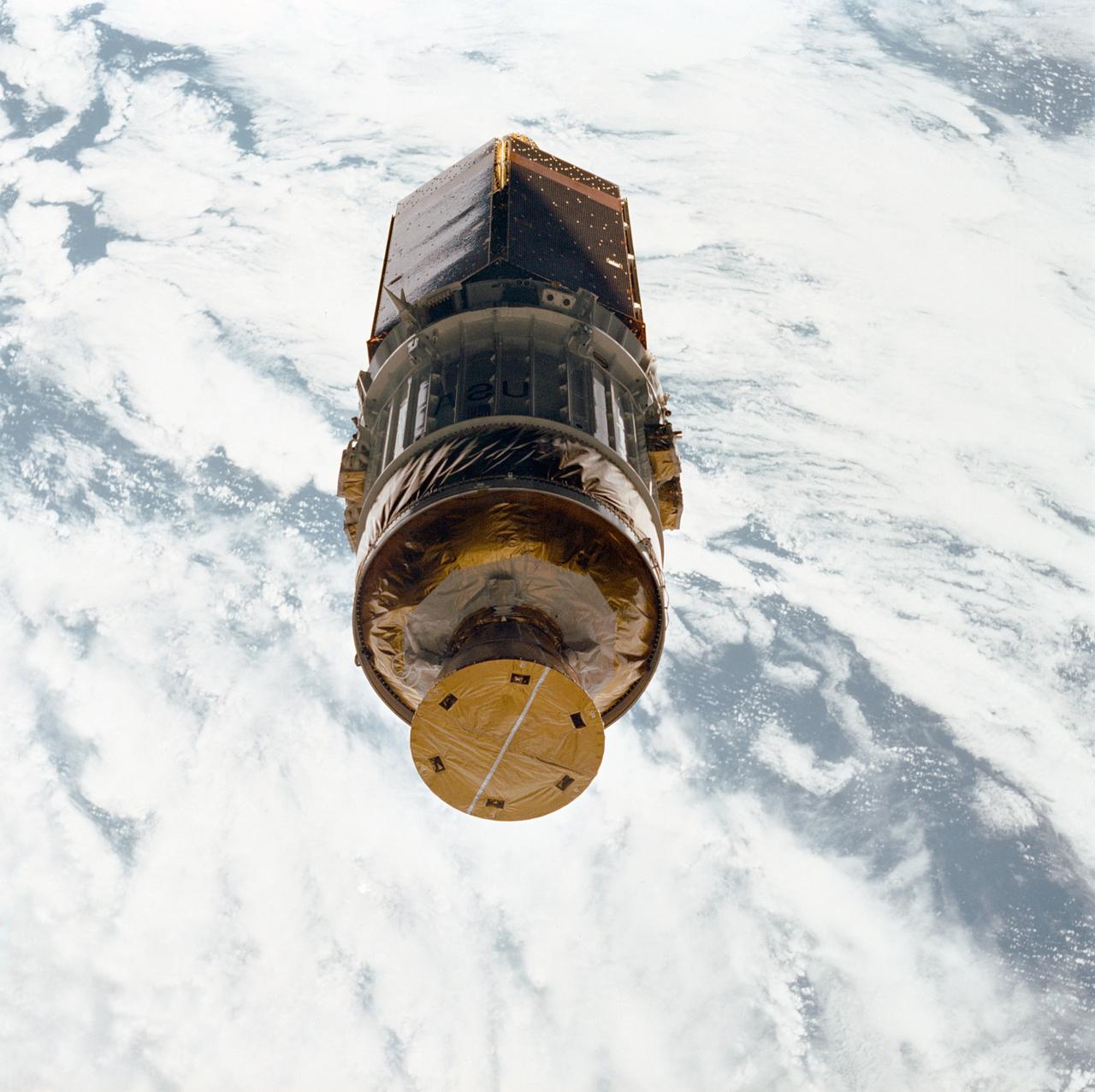
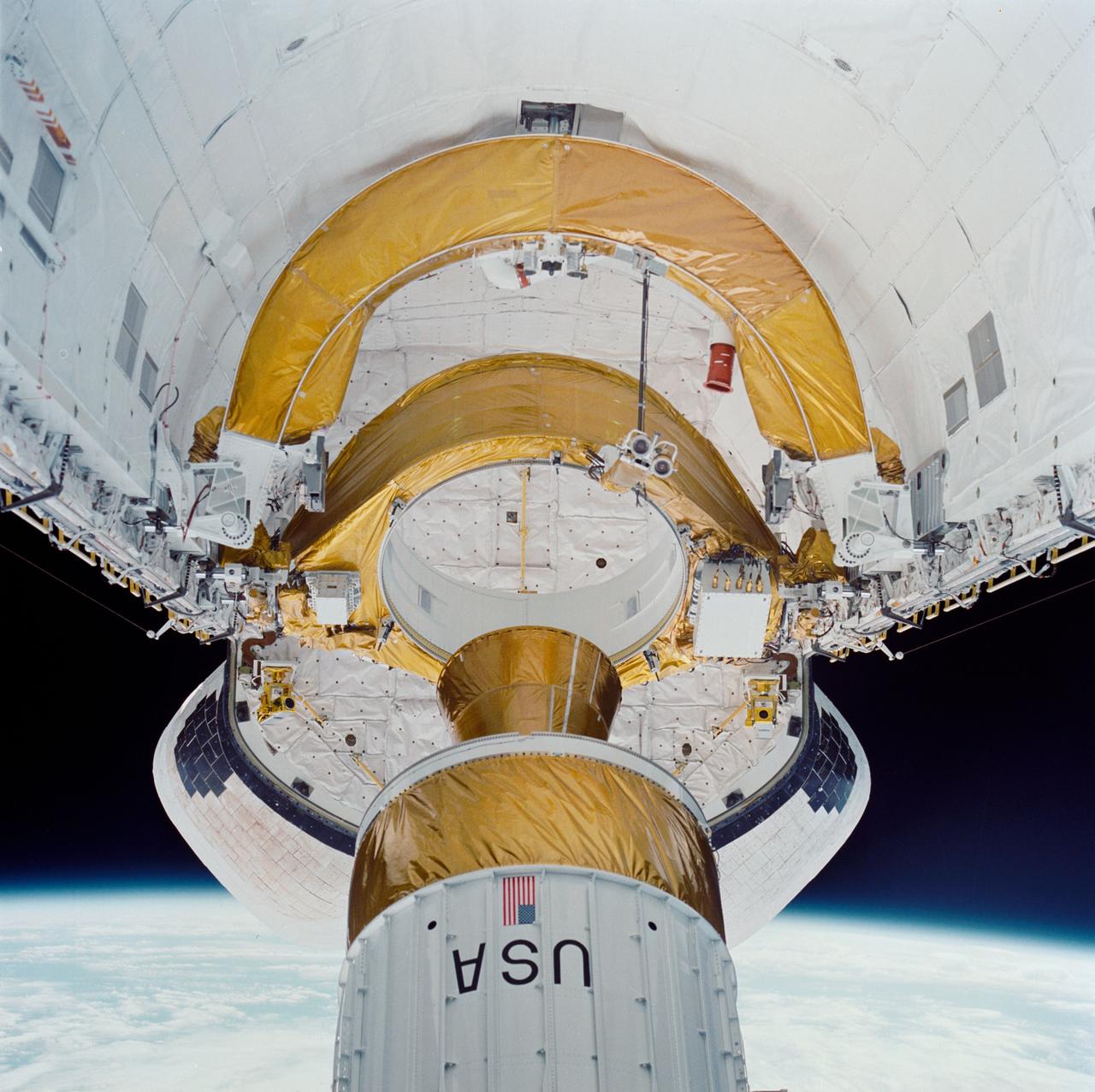
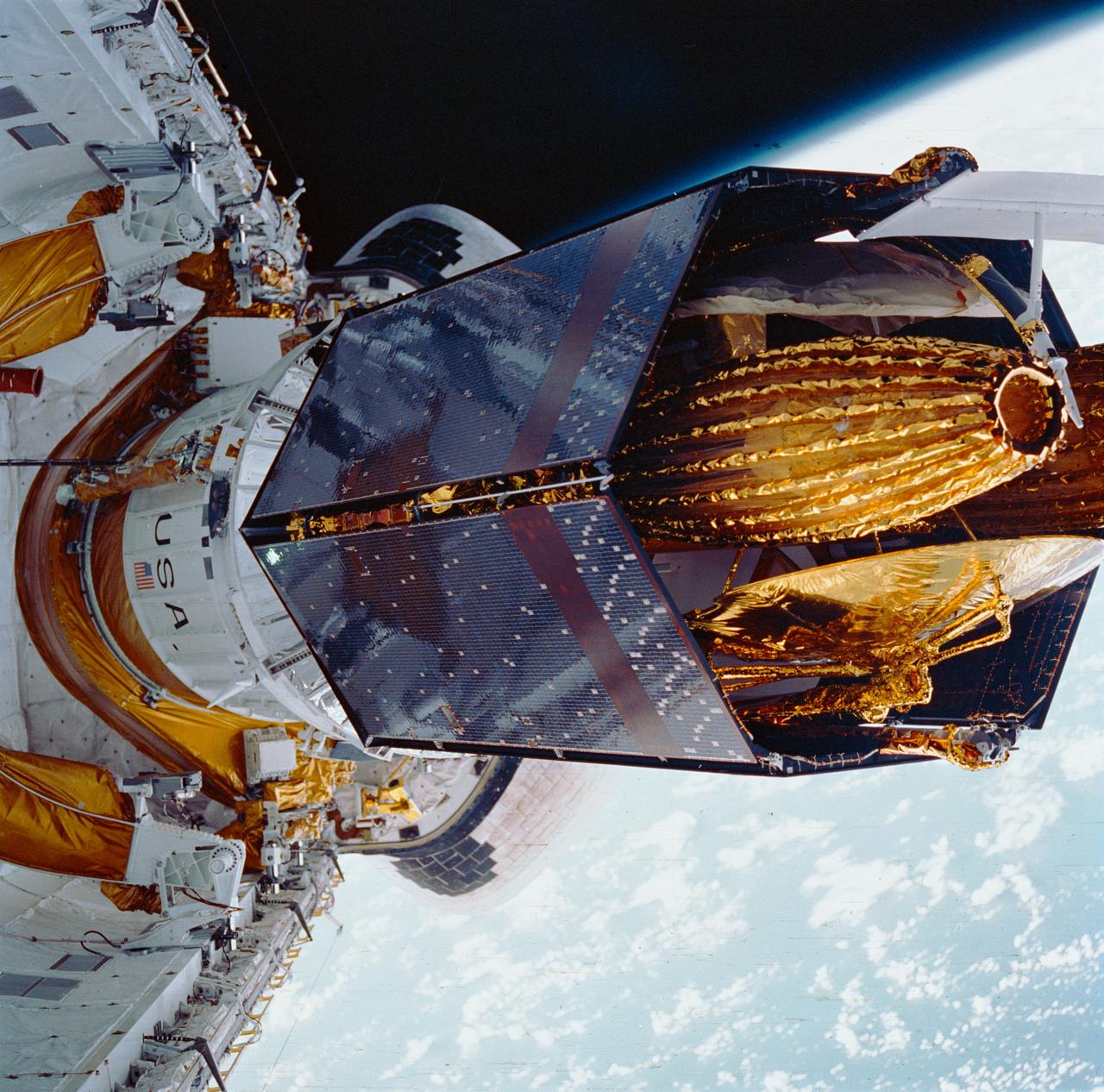
STS026-31-071 (3 Oct 1988) --- After deployment from Discovery, Orbiter Vehicle (OV) 103, the inertial upper stage (IUS) with the tracking and data relay satellite C (TDRS-C) drifts above the cloud-covered Earth surface. TDRS-C, in stowed configuration (solar array panels visible), is mounted atop the IUS with the interstage and solid rocket motor and nozzle seen in the foreground.
STS-26 Discovery, Orbiter Vehicle (OV) 103, IUS / TDRS-C deployment
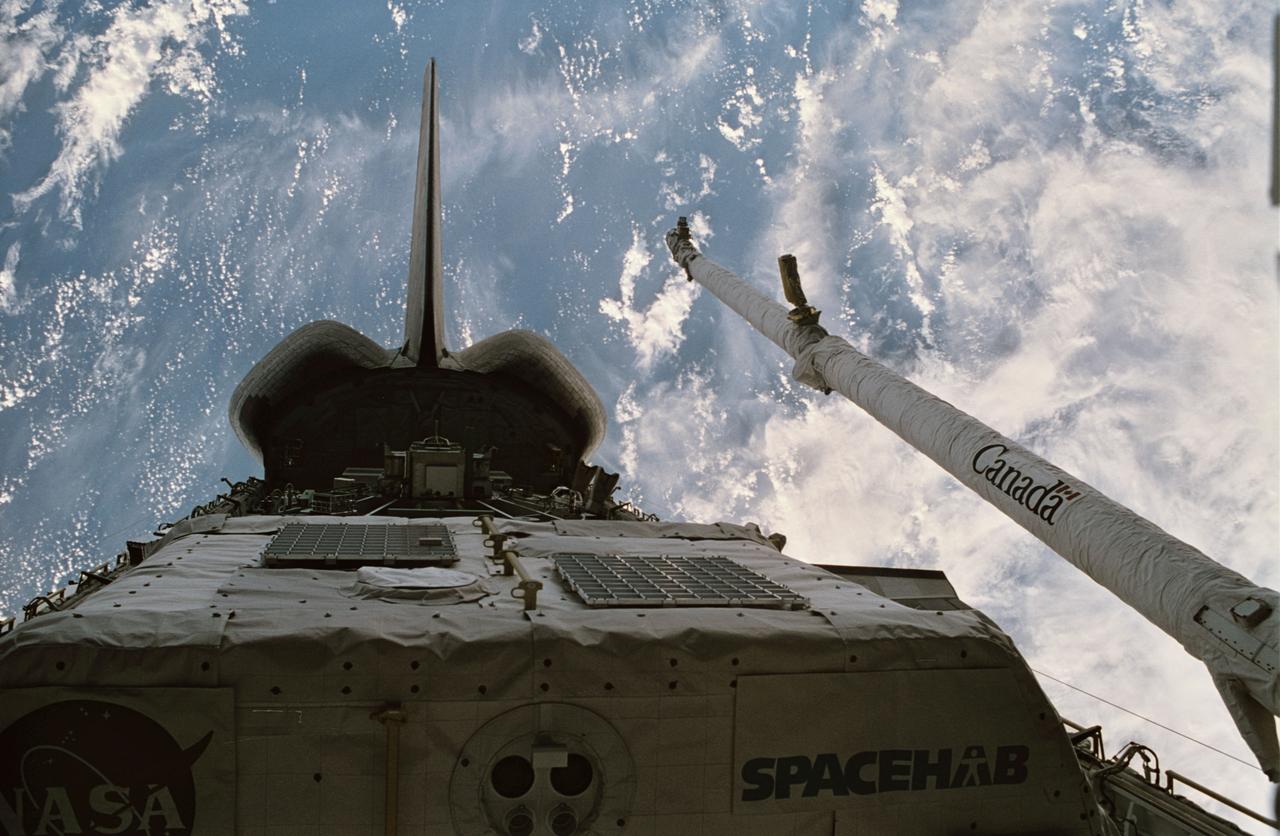
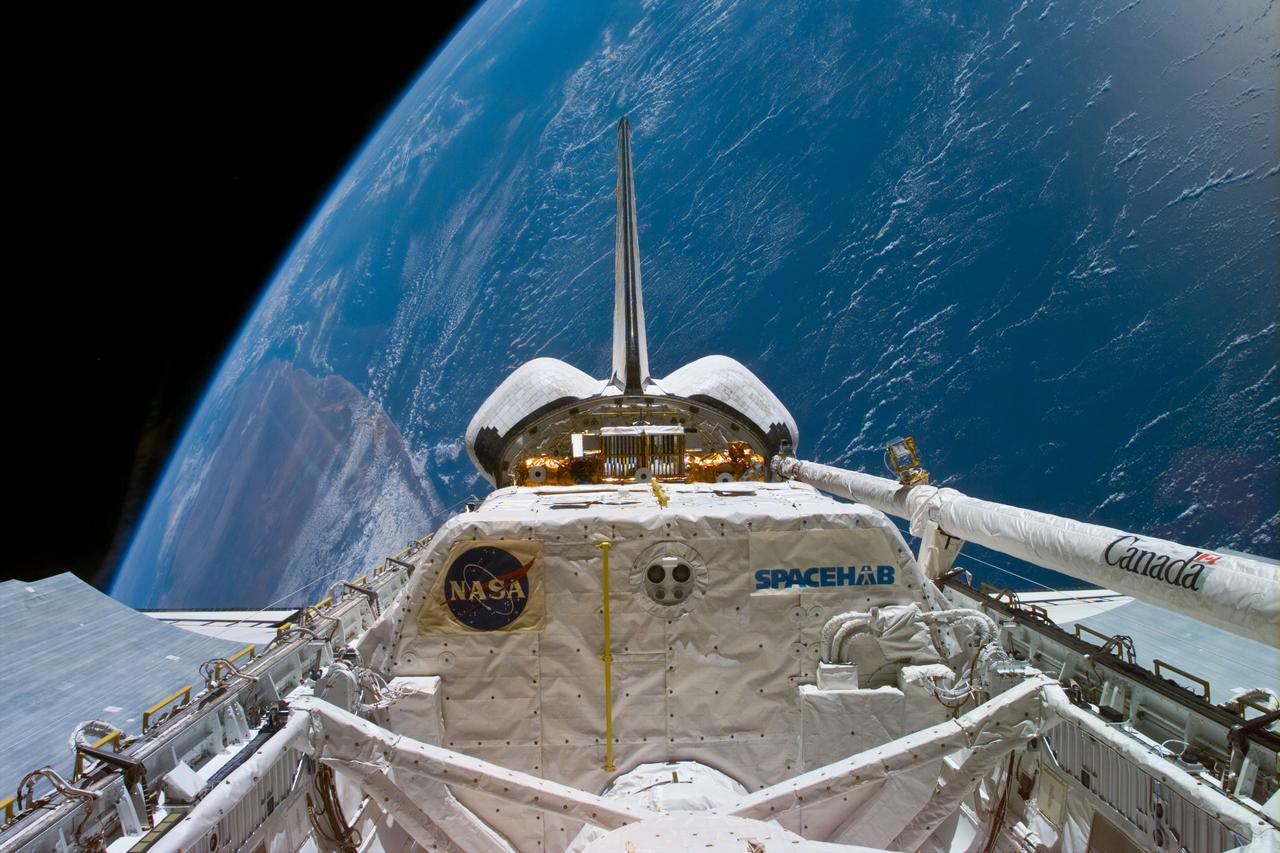
STS060-15-003 (3-11 Feb 1994) --- This 35mm frame shows the major payloads of the Space Shuttle Discovery's STS-60 mission, backdropped against clouds over the Atlantic Ocean.  In the foreground is the SPACEHAB module, with the Wake Shield Facility (WSF) partially visible in its berthed position near the Orbital Maneuvering System (OMS) pods and the vertical stabilizer.  Television cameras on the Remote Manipulator System (RMS) were being used for a survey of the cargo.  Five NASA astronauts and a Russian cosmonaut went on to spend eight days in Earth orbit in support of the mission.
View of payloads in the STS-60 Discovery's payload bay while in orbit
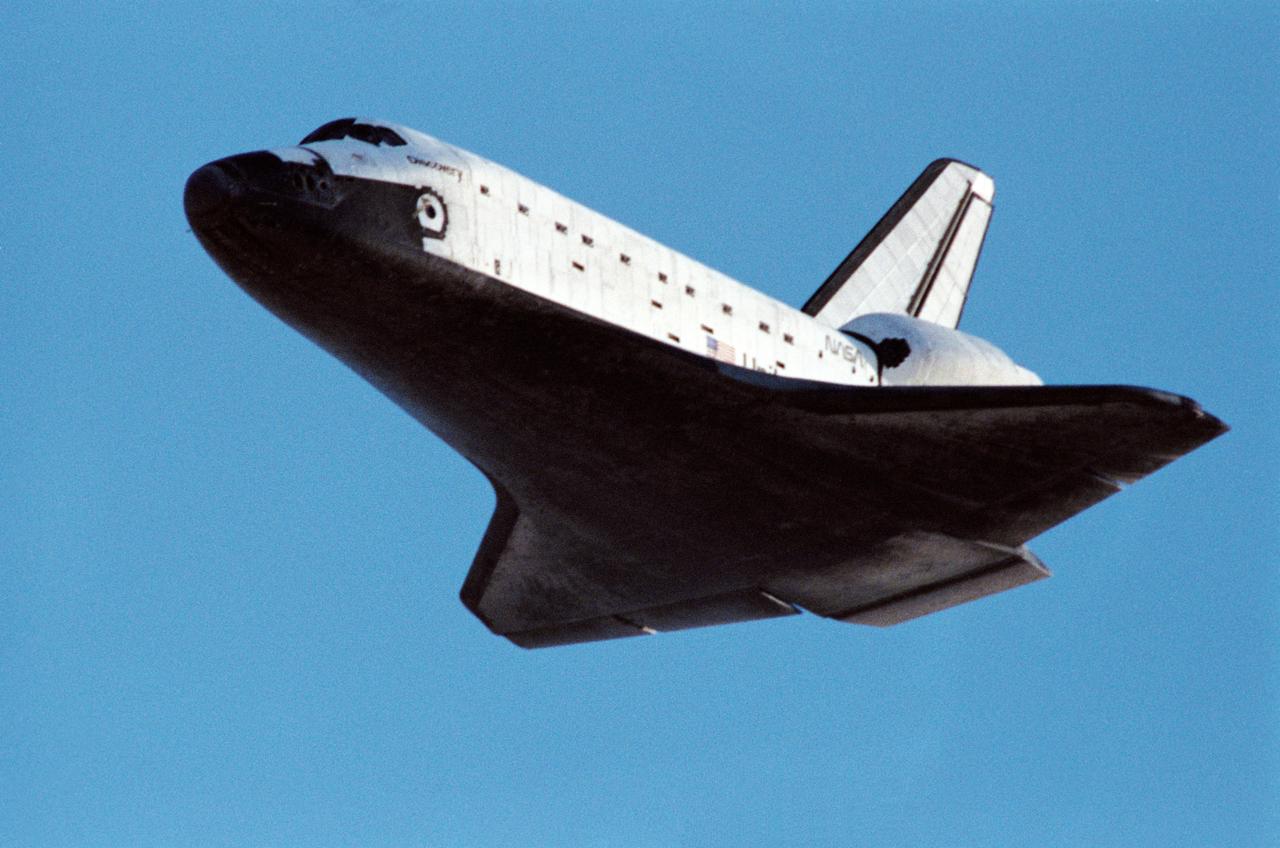
STS031-S-131 (29 April 1990) --- Low angle view of the Space Shuttle Discovery as it approaches for landing on a concrete runway at Edwards Air Force Base to complete a highly successful five-day mission.  It was a long awaited Earth orbital flight during which the Hubble Space Telescope (HST) was sent toward its 15-year mission. Discovery's wheels came to a complete stop at 6:51:00 a.m. (PDT), April 29, 1990. The landing gear was deployed just moments after this frame was exposed.  Inside the spacecraft for STS-31 were astronauts Loren J. Shriver, Charles F. Bolden, Bruce McCandless II, Kathryn D. Sullivan and Steven A. Hawley.
STS-31 Discovery, Orbiter Vehicle (OV) 103, glides toward EAFB landing
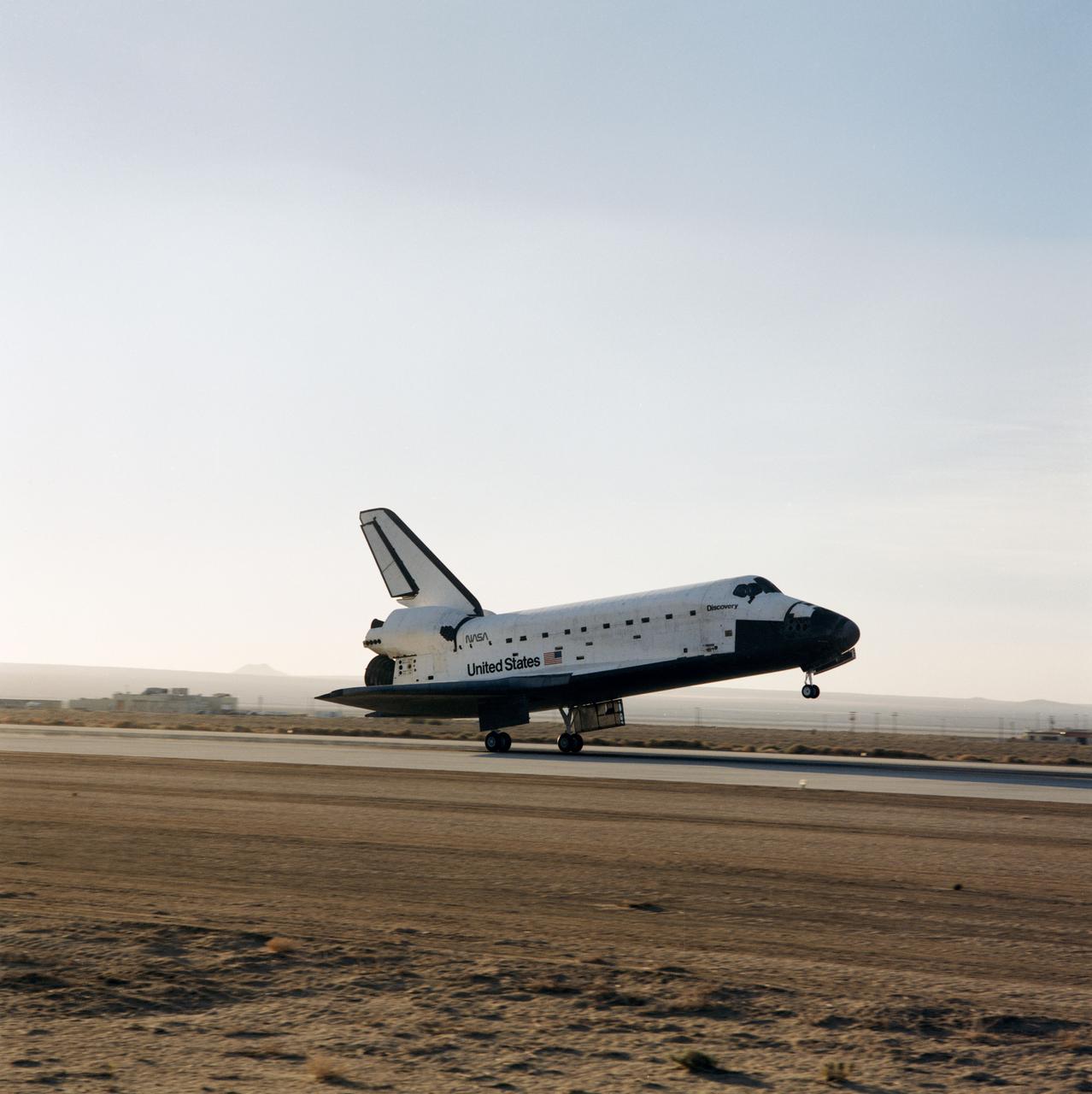
STS031-S-135 (29 April 1990) --- The Space Shuttle Discovery makes a smooth landing on the runway at Edwards Air Force Base to complete a highly successful five-day mission. It was an Earth orbital flight during which the Hubble Space Telescope (HST) was sent toward its 15-year mission.  Landing was completed at 6:51 a.m. (PDT), April 29, 1990.  Inside the spacecraft for STS-31 were Astronauts Loren J. Shriver, Charles F. Bolden, Bruce McCandless II, Kathryn D. Sullivan and Steven A. Hawley.
STS-31 Discovery, Orbiter Vehicle (OV) 103, lands on EAFB concrete runway 22
During STS-26, inertial upper stage (IUS) with the tracking and data relay satellite C (TDRS-C) drifts above Discovery, Orbiter Vehicle (OV) 103, payload bay (PLB) after being positioned in deployment attitude (an angle of 50 degrees) by the airborne support equipment (ASE). IUS vacates the ASE aft frame tilt actuator (AFTA) table in the PLB while the disconnected ASE umbilical boom floats above ASE forward cradle. IUS first stage rocket motor and nozzle and the interstage are visible as the IUS is deployed. In the background are the orbital maneuvering system (OMS) pods and the Earth's limb.
STS-26 Discovery, Orbiter Vehicle (OV) 103, IUS / TDRS-C deployment
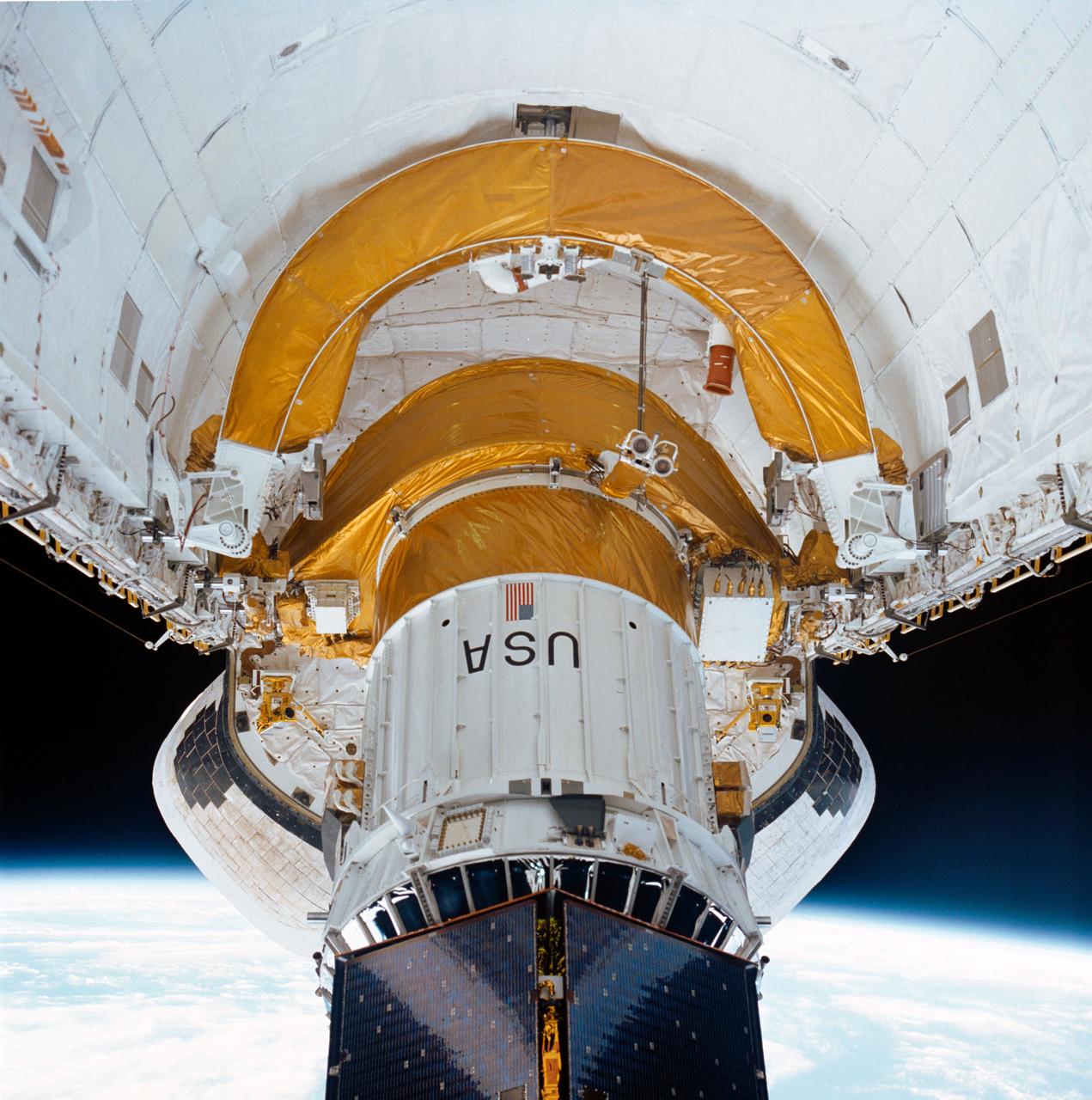
During STS-26, inertial upper stage (IUS) with tracking and data relay satellite C (TDRS-C) located in the payload bay (PLB) of Discovery, Orbiter Vehicle (OV) 103, is positioned into its proper deployment attitude (an angle of 50 degrees) by the airborne support equipment (ASE). In the foreground, the ASE forward cradle is visible. The IUS is mounted in the ASE aft frame tilt actuator (AFTA) table. TDRS-C components in stowed configuration include solar array panels, TDRS single access #1 and #2, TDRS SGL, and S-Band omni antenna. In the background are the orbital maneuvering system (OMS) pods, the Earth's cloud-covered surface, and the Earth's limb.
STS-26 Discovery, Orbiter Vehicle (OV) 103, IUS / TDRS-C deployment
During STS-26, inertial upper stage (IUS) with the tracking and data relay satellite C (TDRS-C) located in the payload bay (PLB) of Discovery, Orbiter Vehicle (OV) 103, is raised into deployment attitude (an angle of 50 degrees) by the airborne support equipment (ASE). ASE aft frame tilt actuator (AFTA) table supports the IUS as it is positioned in the PLB and the ASE umbilical boom drifts away from IUS toward ASE forward cradle. TDRS-C solar array panels (in stowed configuration) are visible on top of the IUS. In the background are the orbital maneuvering system (OMS) pods and the Earth's limb.
STS-26 Discovery, Orbiter Vehicle (OV) 103, IUS / TDRS-C deployment
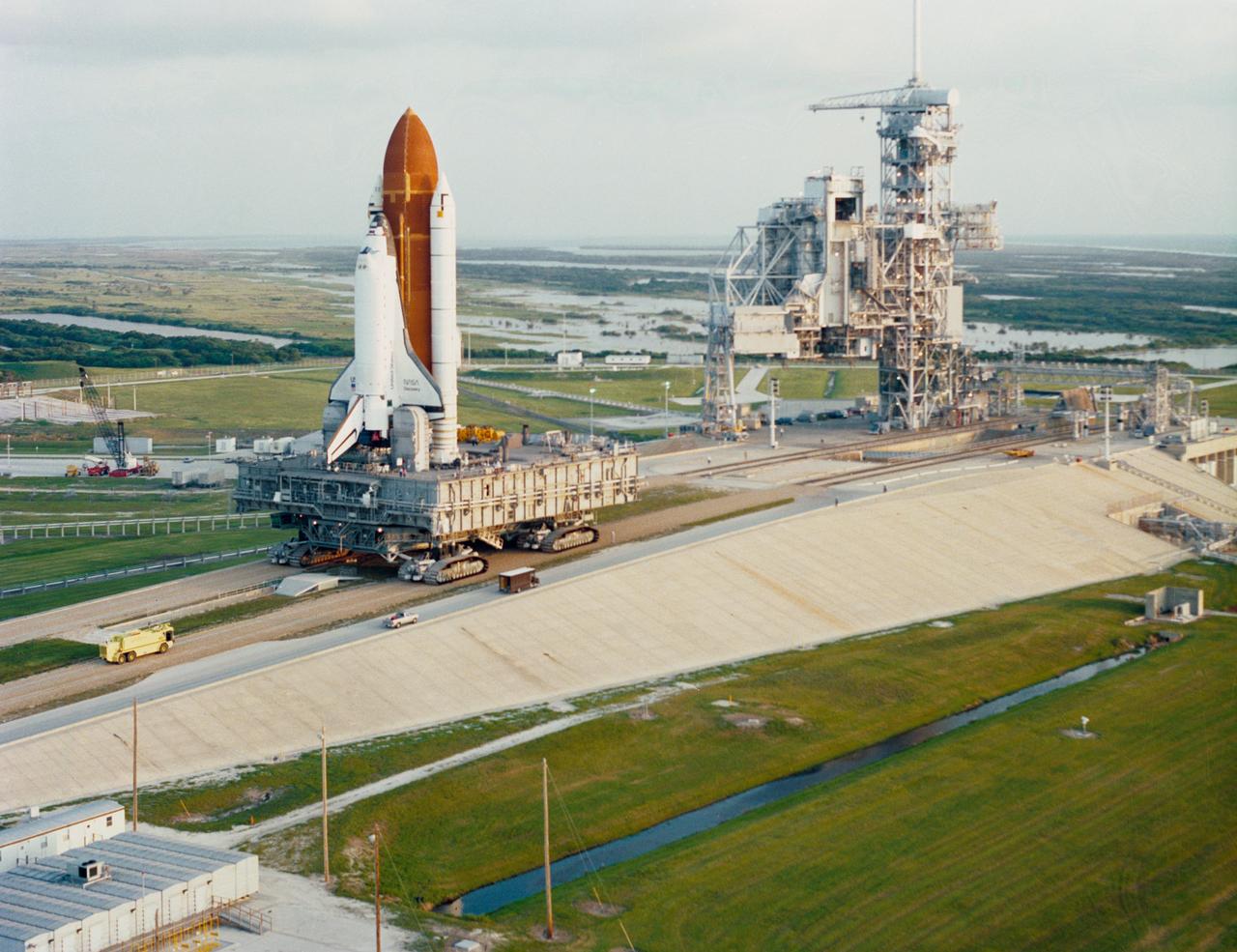
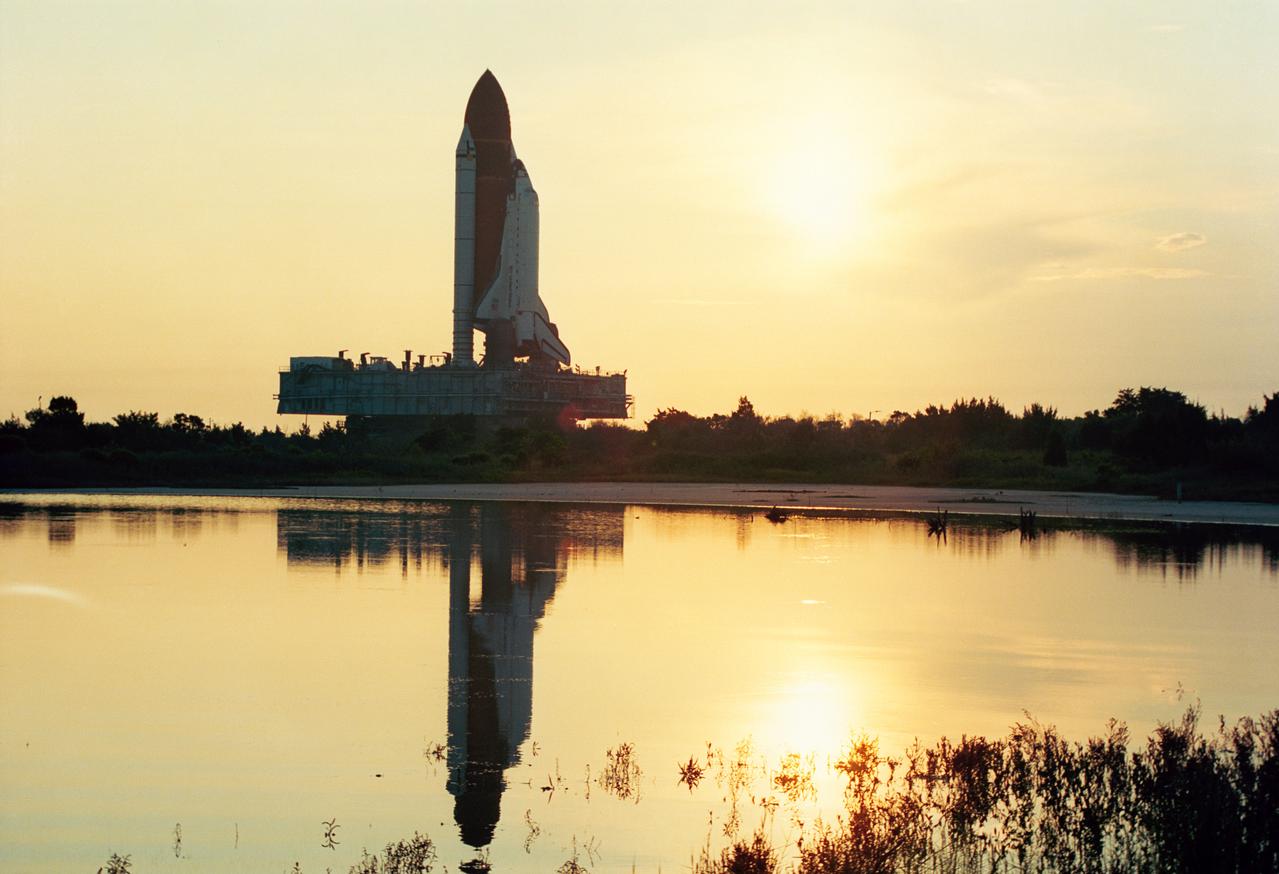
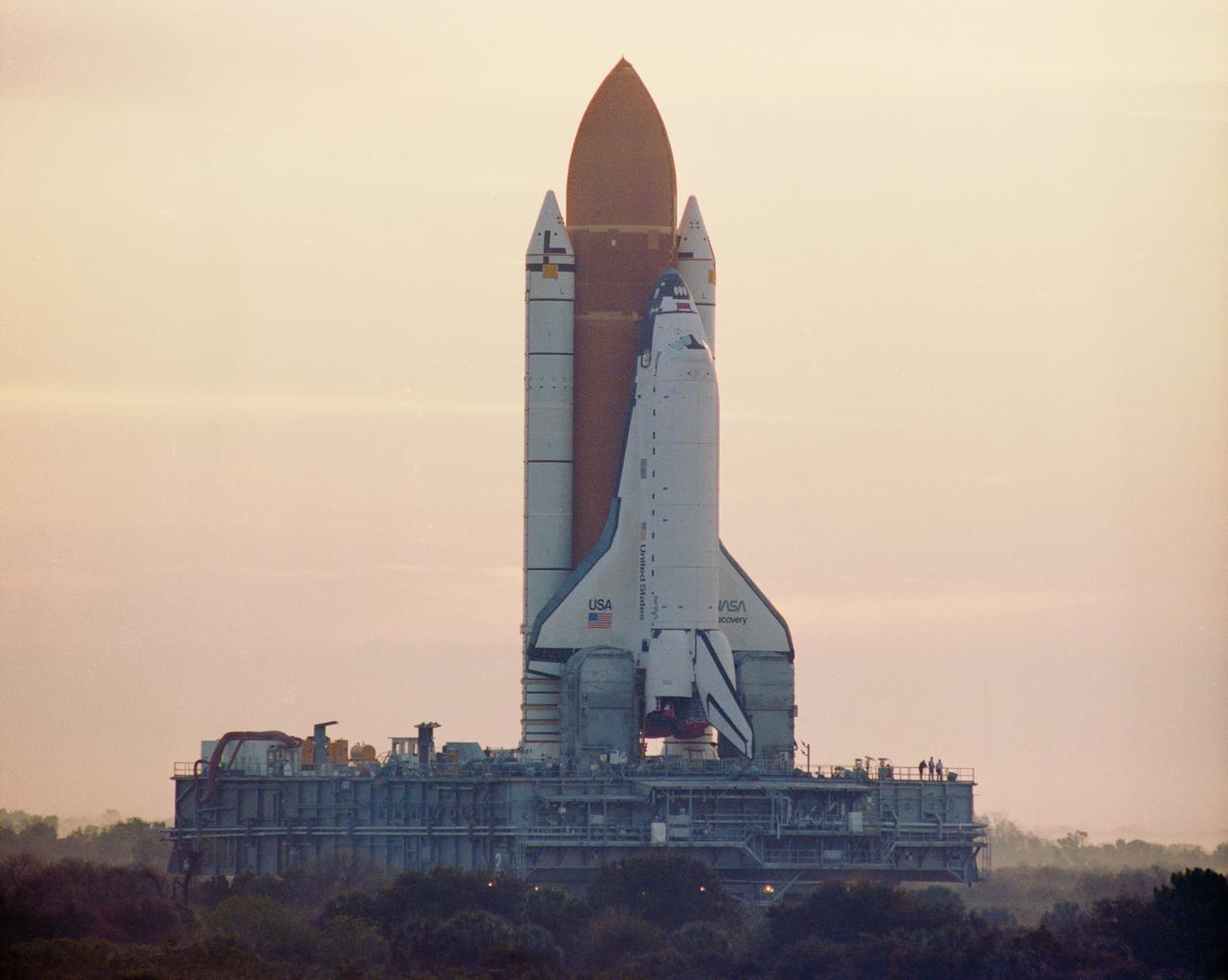
STS-26 Discovery, Orbiter Vehicle (OV) 103, rolls out to Kennedy Space Center (KSC) launch complex (LC) pad 39B on top of the crawler transporter. OV-103 nears LC pad 39B after a six-hour journey from the vehicle assembly building (VAB). When locked onto the nearby rotating service structure (RSS), work will continue to ready the vehicle for the STS-26 launch later in the summer.
STS-26 Discovery, Orbiter Vehicle (OV) 103, roll out to KSC LC pad 39B
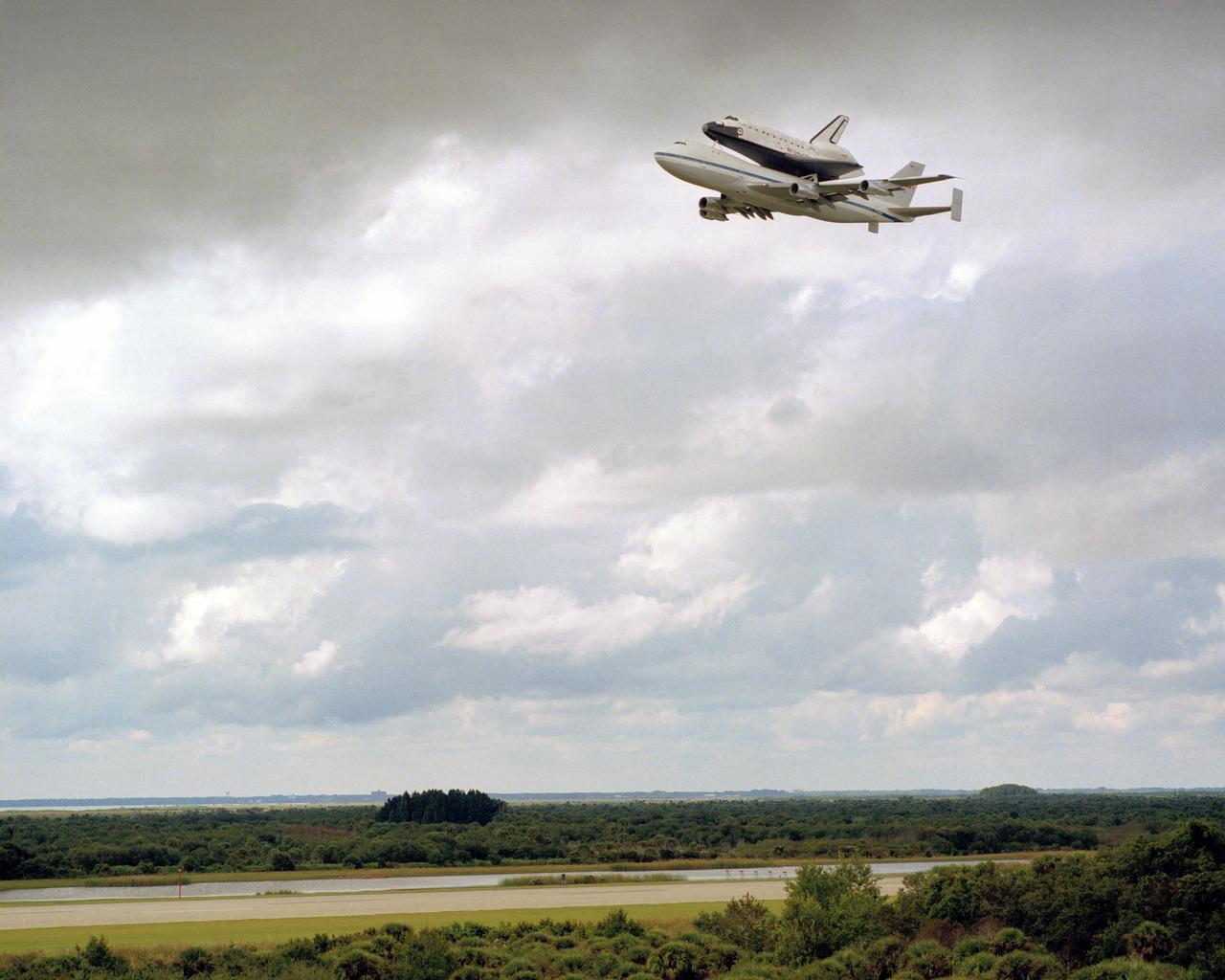
NASA's newest bird, the space shuttle orbiter Discovery, makes a triumphant fly-by of the Space Coast and the Kennedy Space Center runway before landing at 1:46 P.M.
Arrival of orbiter Discovery at KSC aboard shuttle ferry
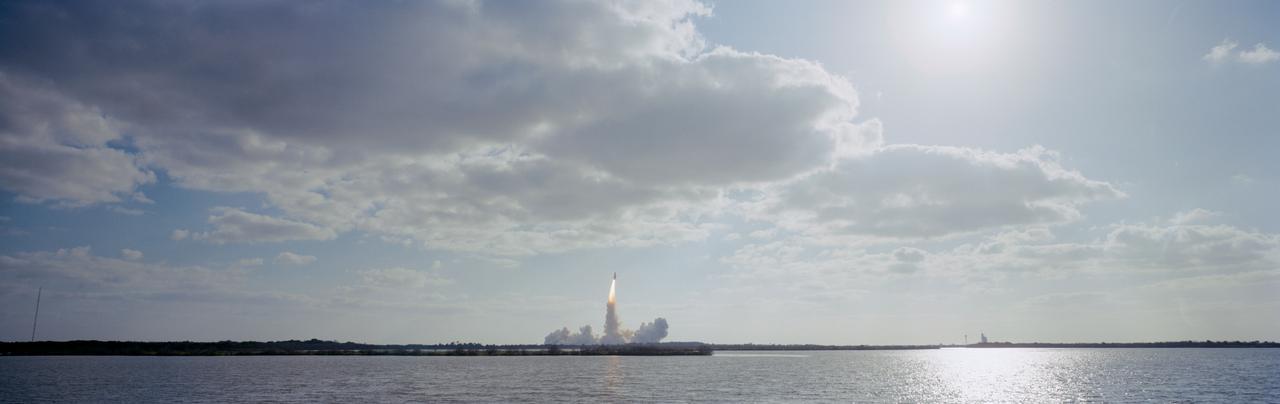
In this distant view, STS-31 Discovery, Orbiter Vehicle (OV) 103, is seen as it heads skyward after liftoff from Kennedy Space Center (KSC) Launch Complex (LC) Pad 39B at 8:33:51.0492 am (Eastern Daylight Time (EDT)). OV-103's silhouette atop the external tank (ET) appears above the glow of the solid rocket booster (SRB) and space shuttle main engine (SSME) firings. An exhaust plume trails behind and covers the launch pad area below the orbiter. A nearby waterway reflects the SRB/SSME glow in the foreground. At the far right and barely discernible is KSC LC Pad 39A and the Sound Supression Water System tower. Columbia, OV-102, is on LC Pad 39A which is separated by a distance of 1.6 miles. This was the first time since January 1986 that there was a shuttle on each pad.
STS-31 Discovery, Orbiter Vehicle (OV) 103, heads skyward after KSC liftoff
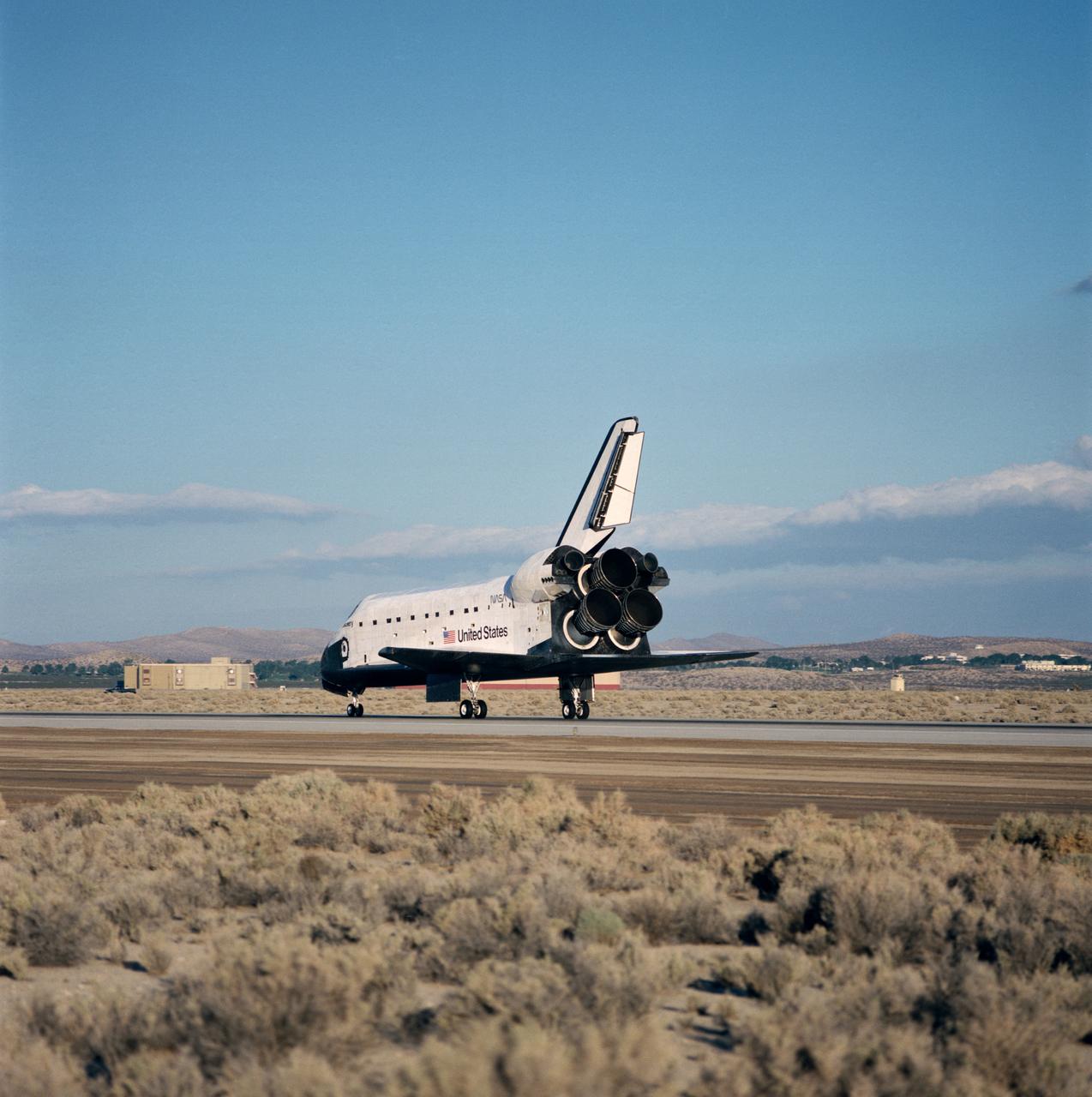
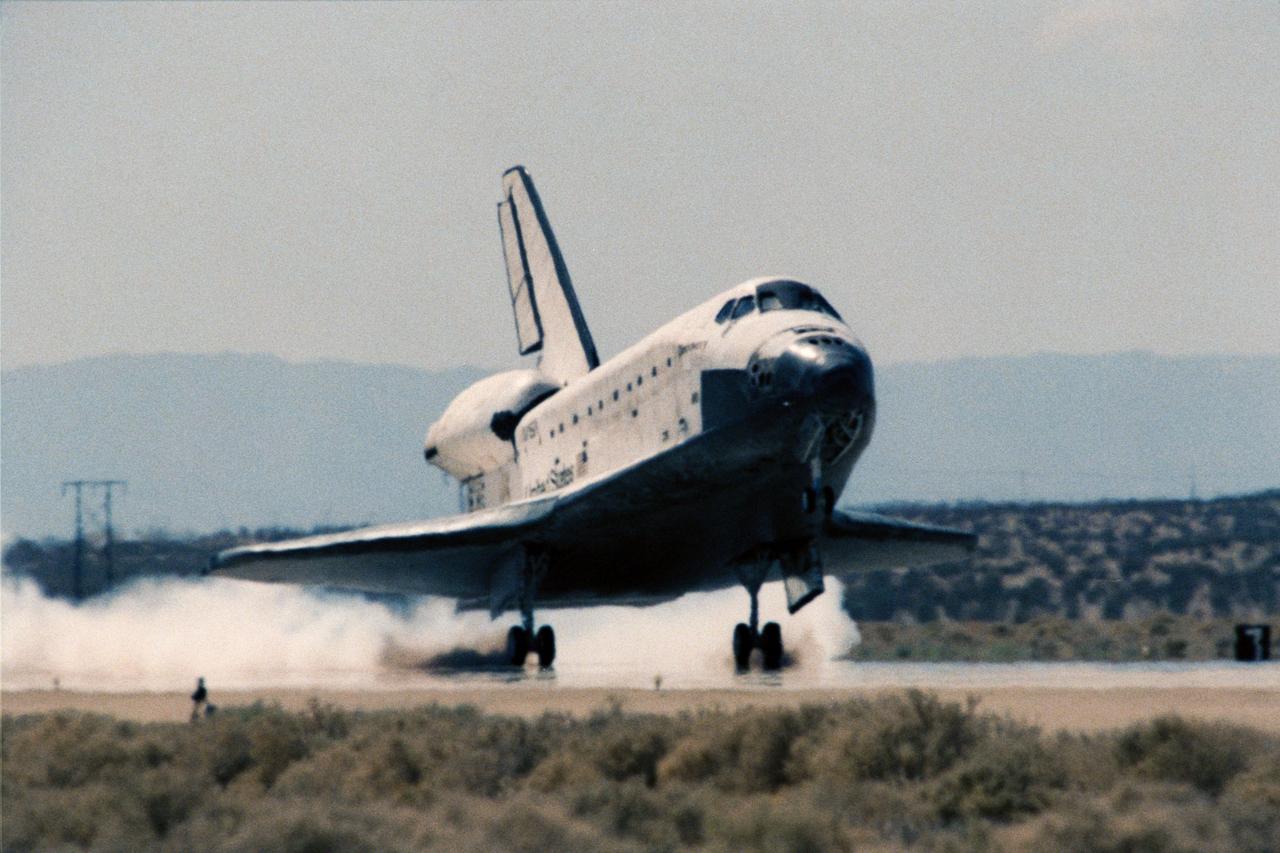
STS-31 Discovery, Orbiter Vehicle (OV) 103, rolls along concrete runway 22 at Edwards Air Force Base (EAFB), California, after nose landing gear (NLG) and main landing gear (MLG) touchdown. This view looks down OV-103's port side from the space shuttle main engines (SSMEs) to the nose section. The SSMEs are gimbaled to their descent position and the rudder/speedbrake is deployed on the vertical stabilizer. Wheel stop occurred at 6:51 am (Pacific Daylight Time (PDT)). In the distance EAFB facilities are visible.
STS-31 Discovery, Orbiter Vehicle (OV) 103, lands on EAFB concrete runway 22
S95-10529 (3 May 1995) --- Inside the cavernous Vehicle Assembly Building (VAB), workers carry out the meticulous process of lifting the Orbiter Discovery from a horizontal to a vertical position.  Once upright, Discovery will be transferred into a high bay for mating with the external tank and solid rocket booster assembly already mounted on the mobile launcher platform.  Completing the assembly process takes about five working days.  Discovery?s next destination is Launch Pad 39B, and final preparations for liftoff on mission STS-70 scheduled for June 1995.
Lifting the Orbiter Discovery into vertical position in the VAB
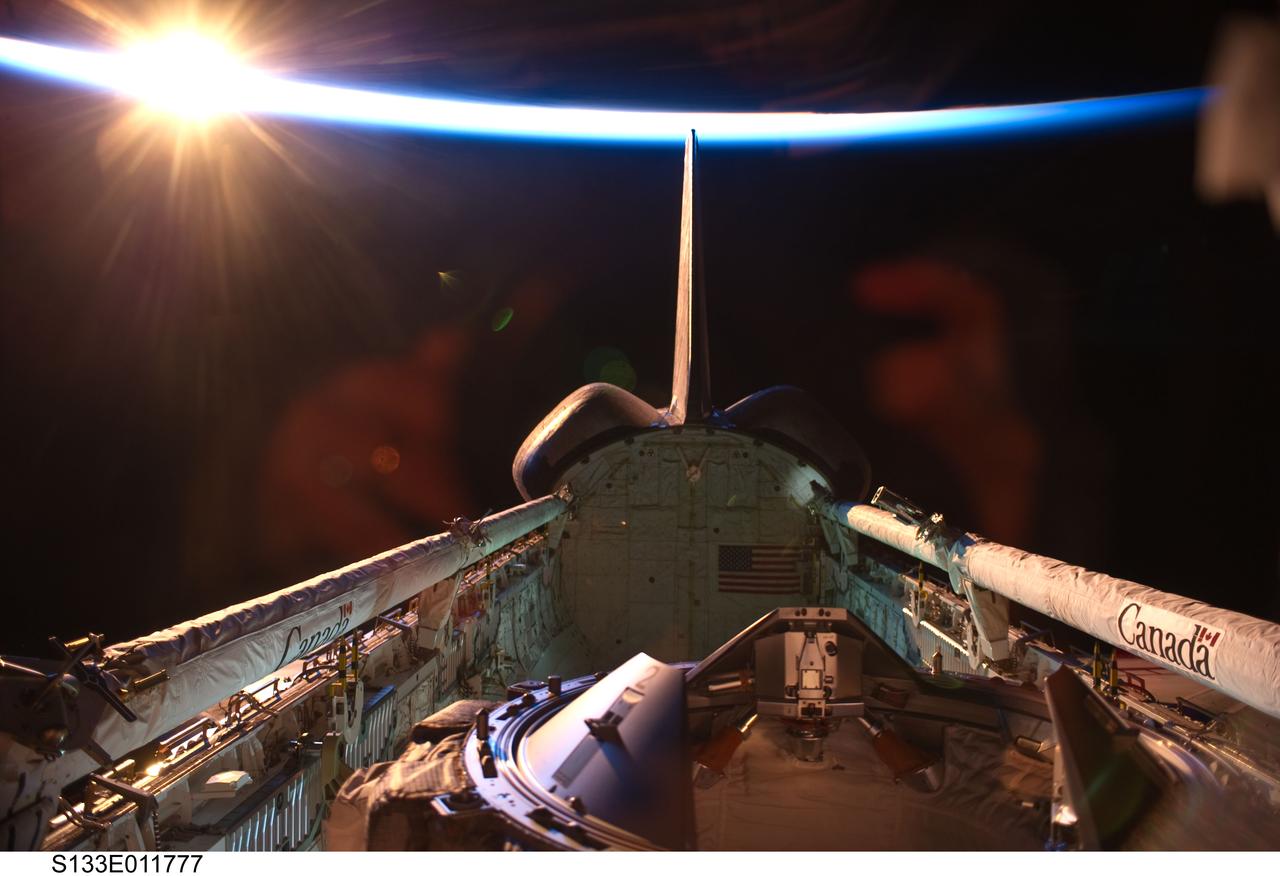
S133-E-011777 (7 March 2011) --- An orbital sunrise brightens this view of space shuttle Discovery’s vertical stabilizer, orbital maneuvering system (OMS) pods, docking mechanism, remote manipulator system/orbiter boom sensor system (RMS/OBSS) and payload bay photographed by an STS-133 crew member on the shuttle during flight day 12 activities. Photo credit: NASA or National Aeronautics and Space Administration
Orbital sunrise over Discovery payload bay
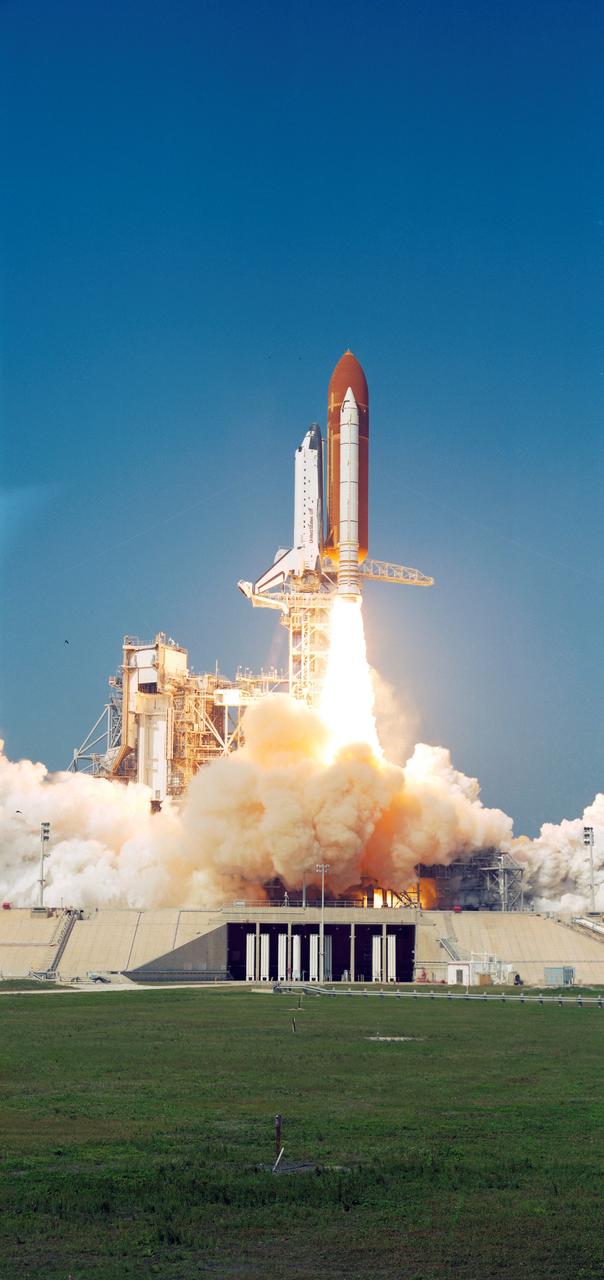
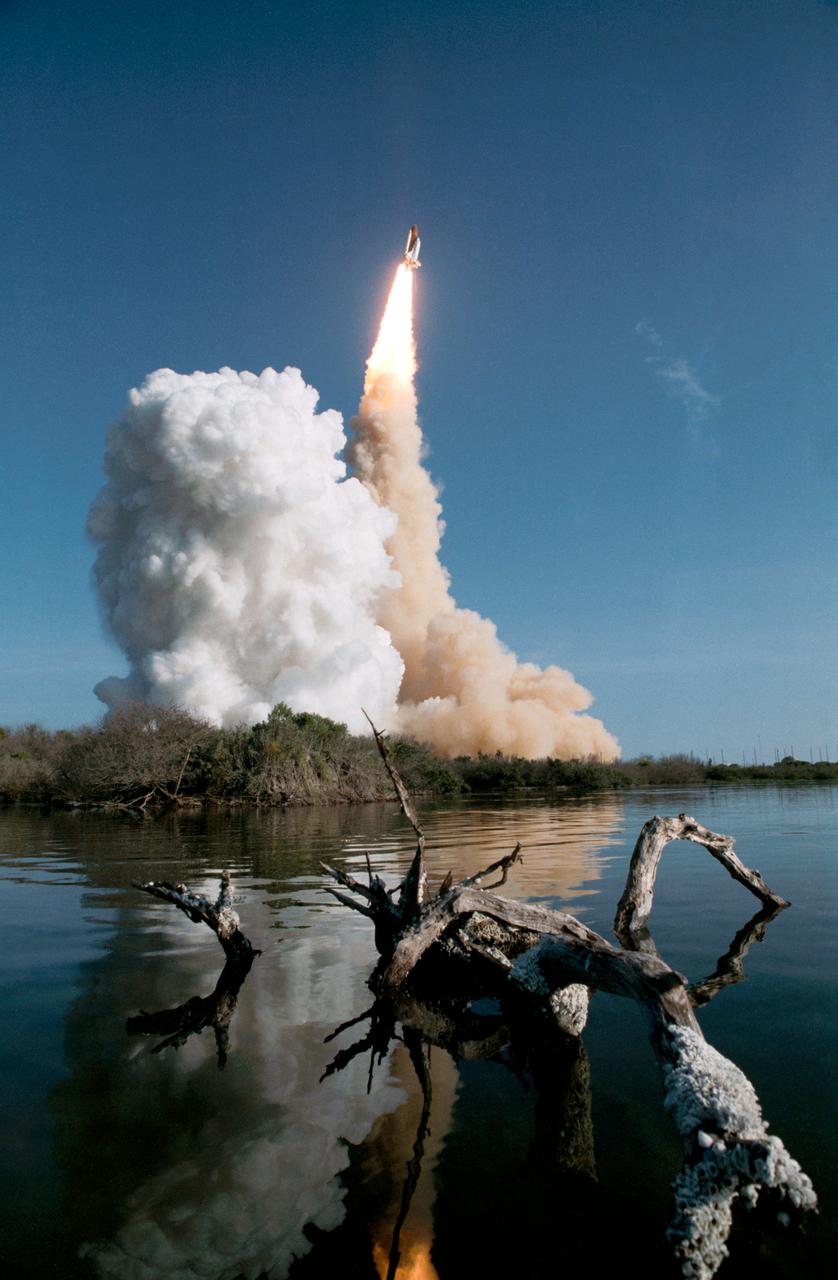
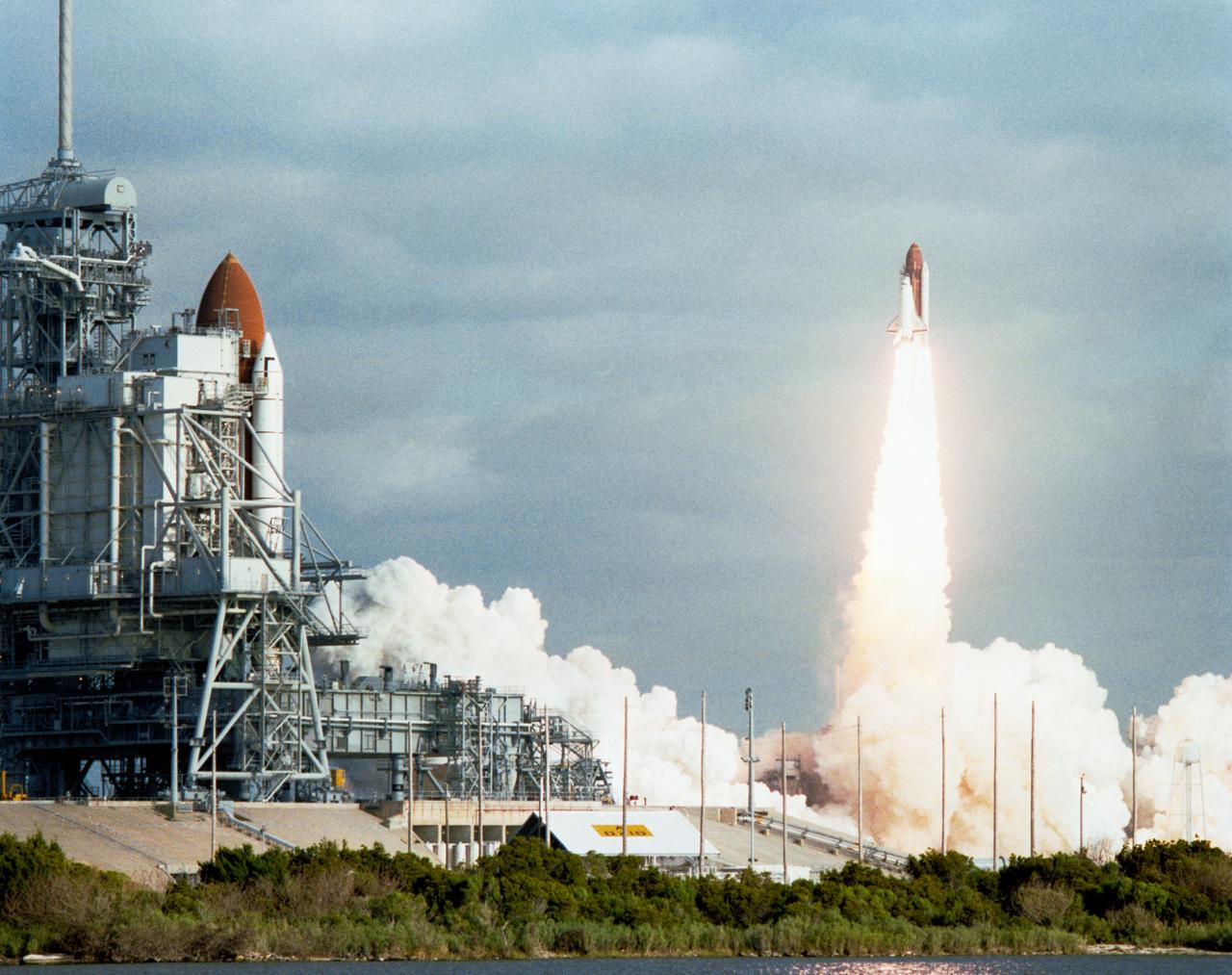
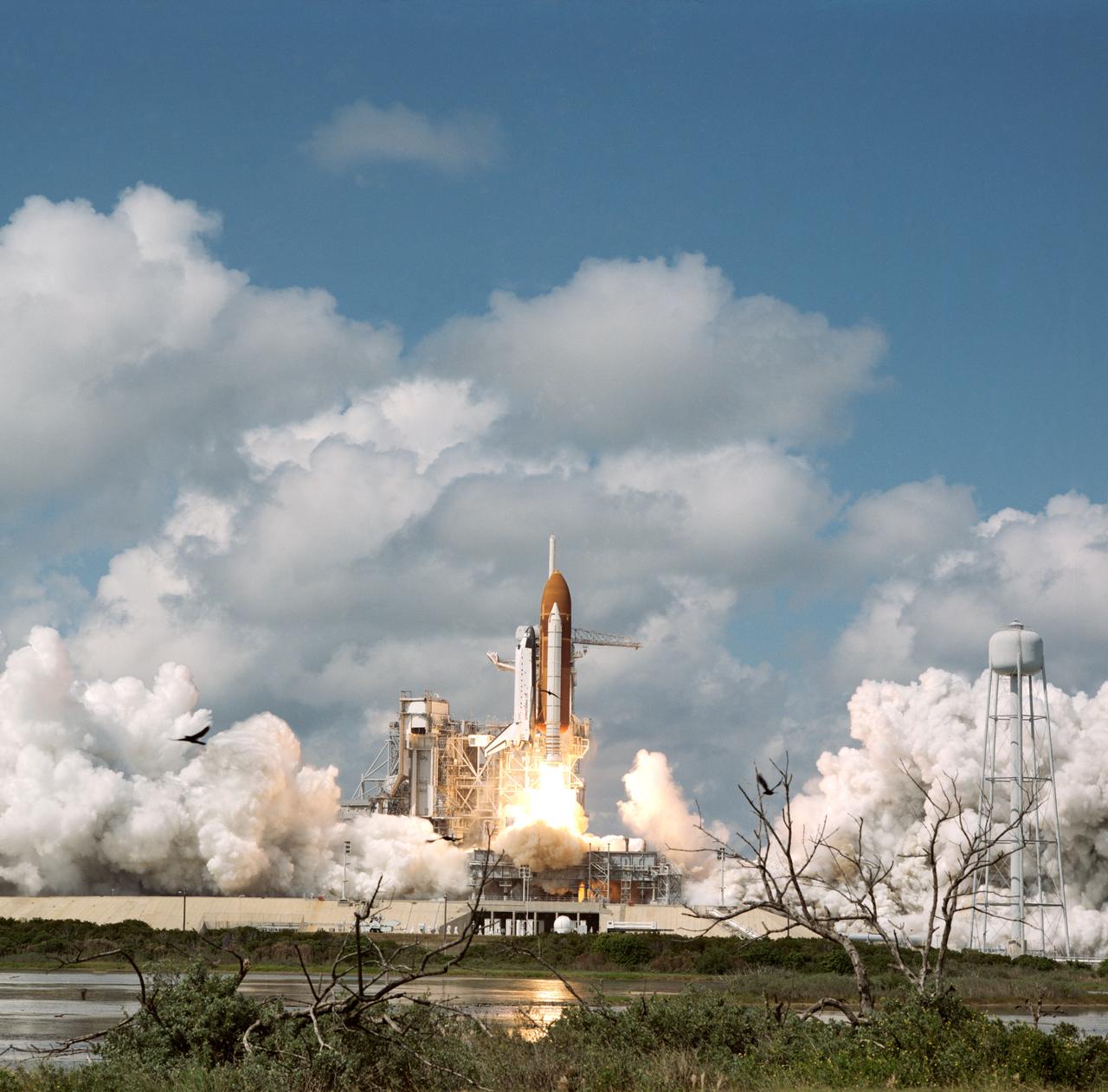
STS-26 Discovery, Orbiter Vehicle (OV) 103, lifts off from mobile launcher platform at Kennedy Space Center (KSC) Launch Complex (LC) pad 39B. Riding atop the orange external tank (ET), OV-103 heads for Earth orbit as the exhaust plumes from the two solid rocket boosters (SRBs) cover the mobile launcher platform and the area surrounding the launch pad. SRB firings are reflected in a nearby waterway. In the foreground are trees and several birds in flight. STS-26 marks OV-103's first flight since September 1985 and NASA's first manned mission since the 51L Challenger accident, 01-28-86.
STS-26 Discovery, Orbiter Vehicle (OV) 103, lifts off from KSC LC pad 39B
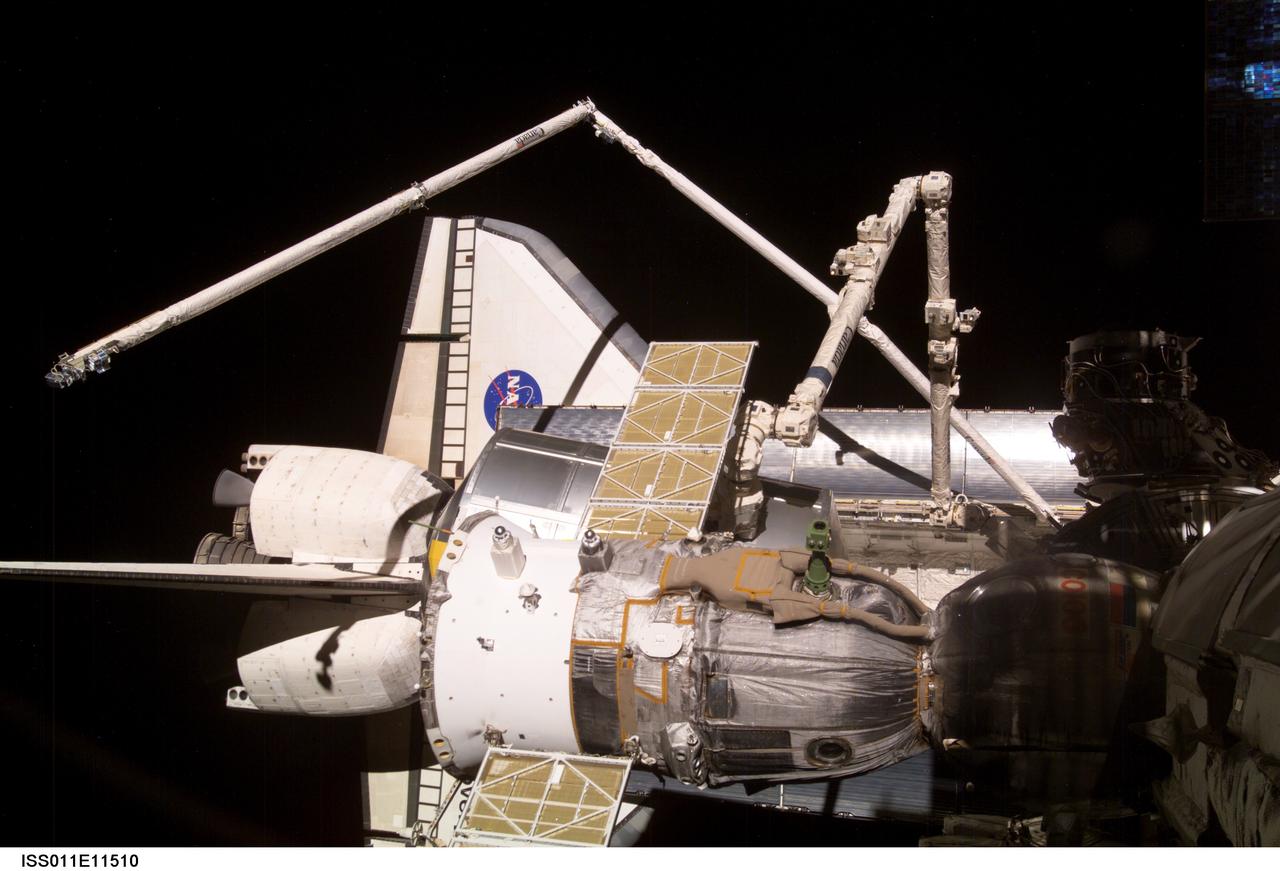
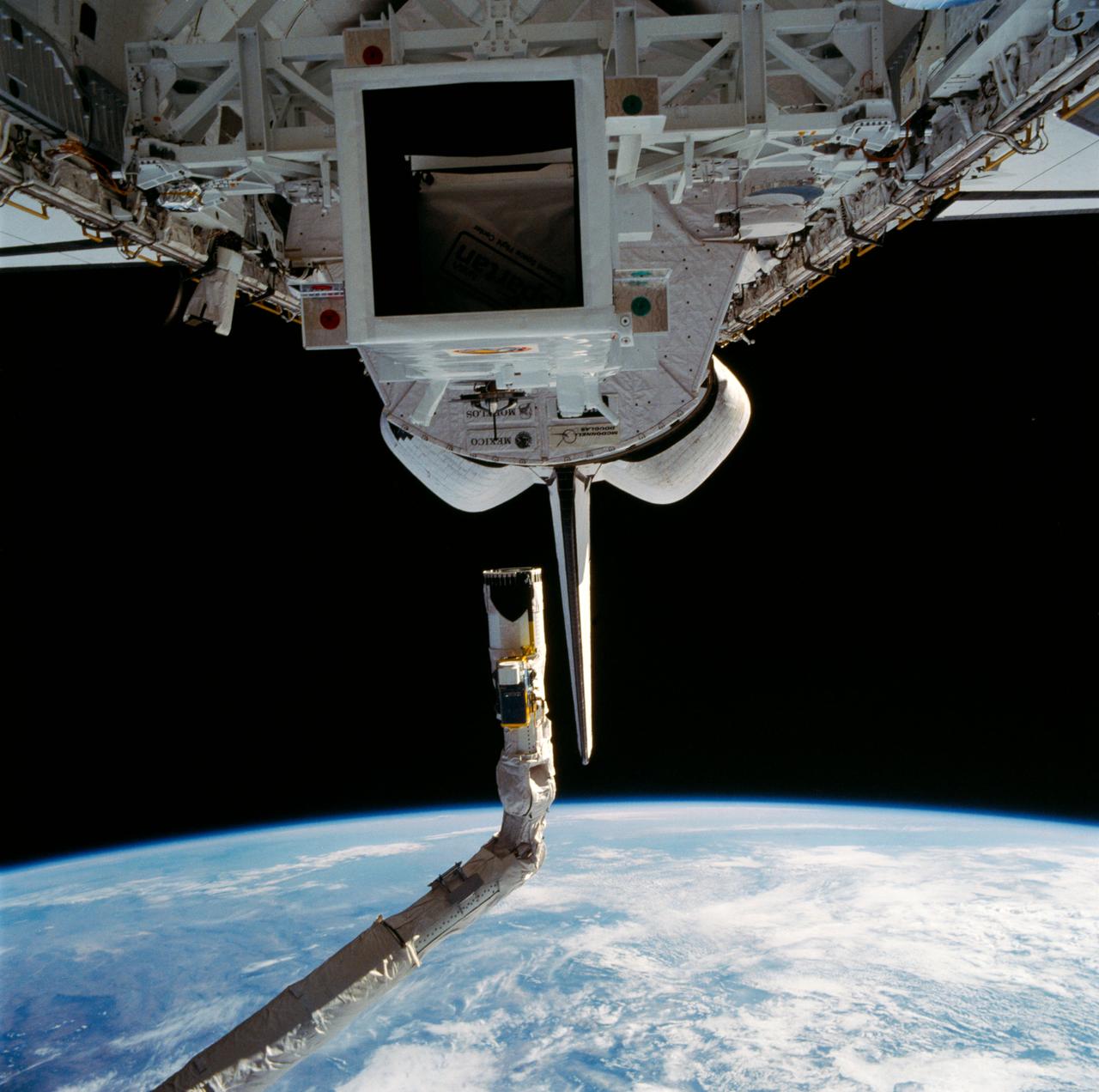
ISS011-E-11510 (5 August 2005) --- On the eve of the separation of  Discovery and the International Space Station, an Expedition 11 crew member took this digital still picture.  Crews onboard the orbital outpost and Discovery were wrapping up nine days of joint operations. The Space Shuttle is partially visible beneath other hardware.  The Canadian-built robot arms for both spacecraft are dominant in the frame. A Russian Soyuz is docked to the Station in the foreground.   After the Italian-built Multi-Purpose Logistics Module Raffaello was secured in Discovery's cargo bay, Astronauts Charles J. Camarda and Andrew S.W. Thomas, mission specialists operating from Discovery's aft flight deck, used the Shuttle arm to hand off the Orbiter Boom Sensor System to the Station arm. Then Astronauts Wendy B. Lawrence, mission specialist, and James M. Kelly, pilot, onboard Destiny, reberthed the OBSS in its position on the starboard sill of the cargo bay. Undocking is scheduled shortly before 2:30 a.m. (CDT) on August 6.
STS-114 orbiter Discovery during docking of Raffaello
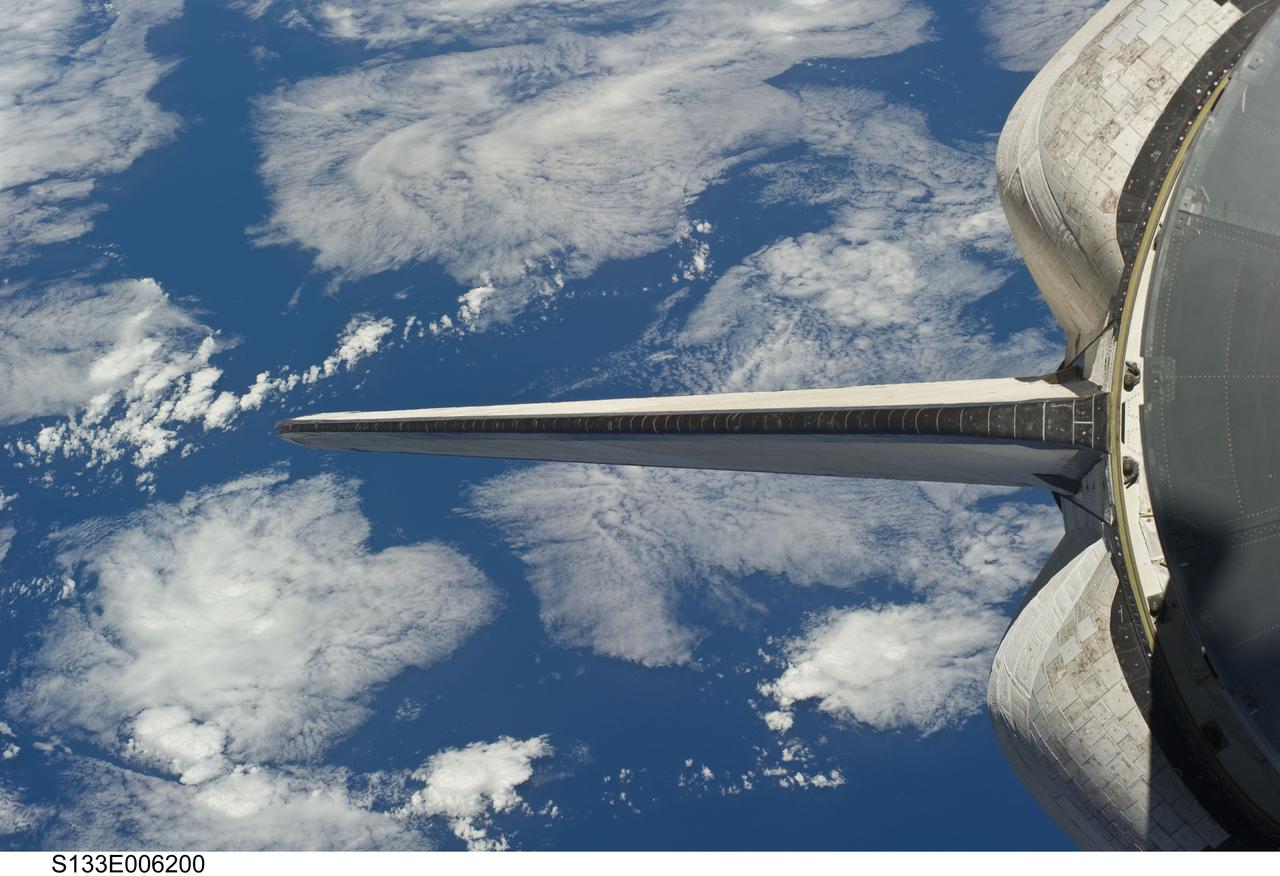
S133-E-006200 (25 Feb. 2011) --- Backdropped by a blue and white part of Earth, space shuttle Discovery’s vertical stabilizer and orbital maneuvering system (OMS) pods are featured in this image photographed by an STS-133 crew member during flight day two activities. Photo credit: NASA or National Aeronautics and Space Administration
OMS pods on STS-133 orbiter Discovery
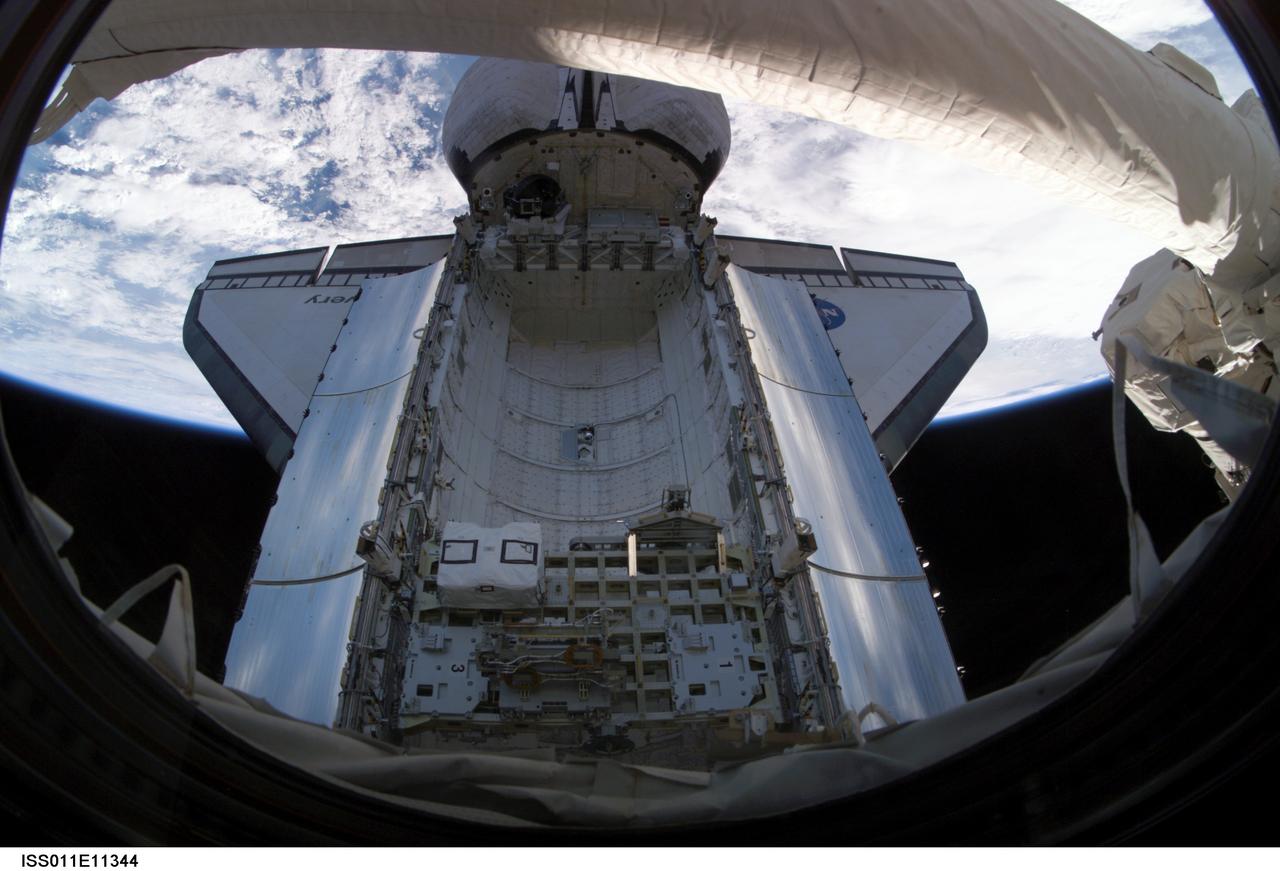
ISS011-E-11344 (30 July 2005) --- This image of the cargo bay of the Space Shuttle Discovery was taken with a digital still camera onboard the International Space Station, to which the orbiter will continue to be docked for several days.  There is a vacancy in the payload bay, as the Multi-Purpose Logistics Module Raffaello temporarily has been docked with the orbital outpost's Unity Node in order to accommodate the  transfer of a large amount of supplies.
Empty STS-114 orbiter Discovery Payload bay
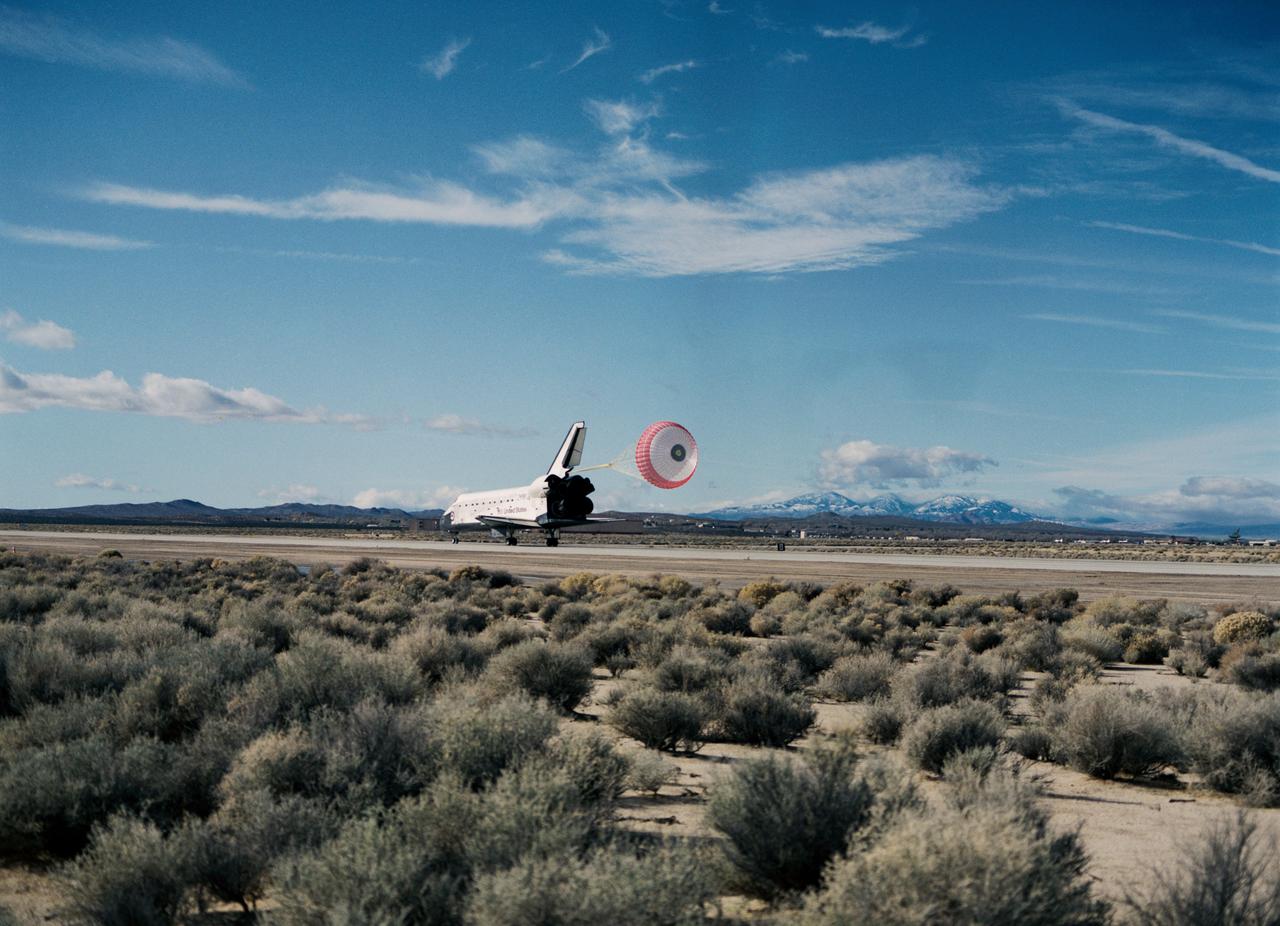
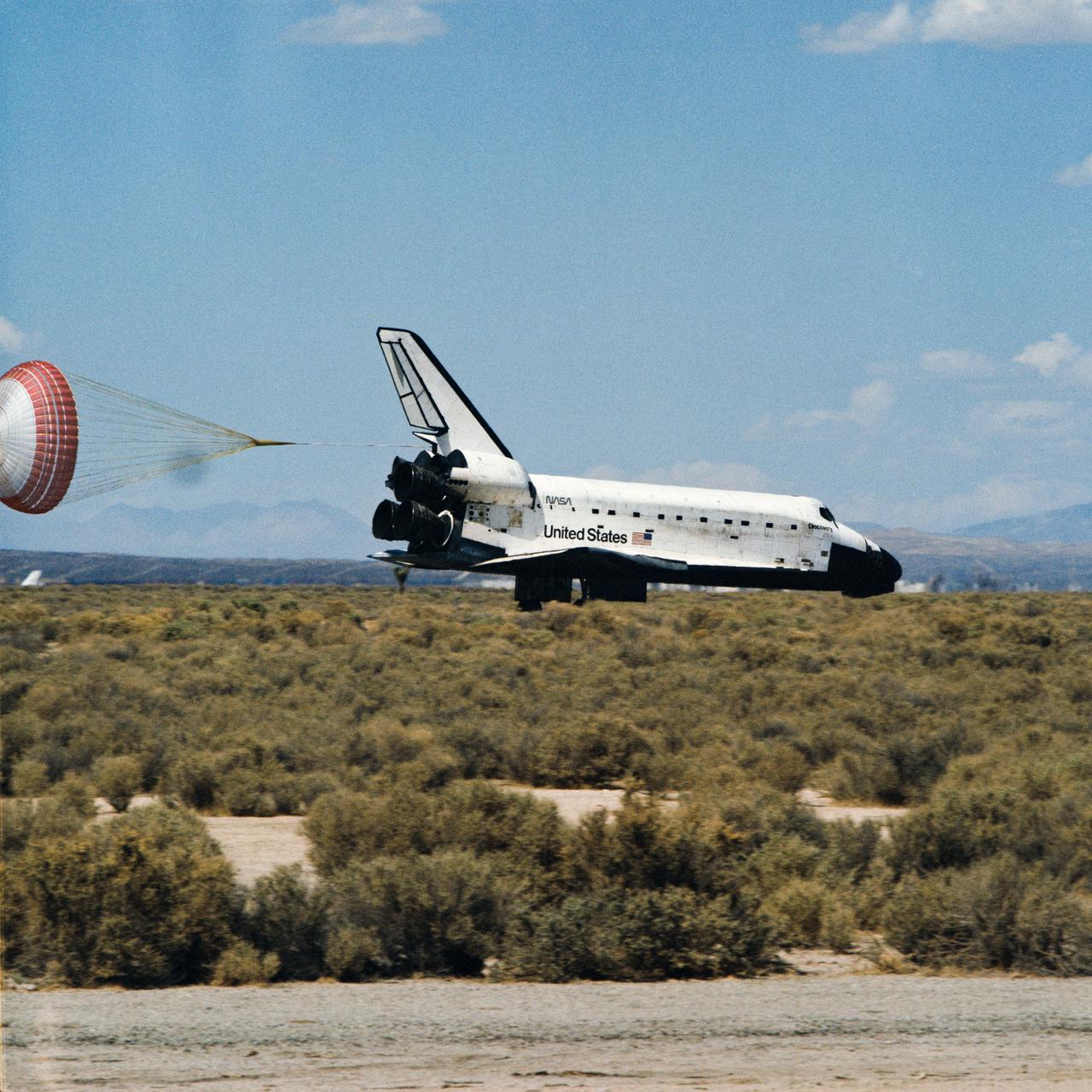
STS-53 Discovery, Orbiter Vehicle (OV) 103, is slowed by a red, white, and blue drag chute during its landing on concrete runway 22 at Edwards Air Force Base (EAFB), California. Main landing gear (MLG) touchdown occurred at 12:43:17 pm (Pacific Standard Time (PST)). This aft view of OV-103 shows the drag chute deployed from its compartment at the base of the vertical tail, the speedbrake/rudder flaps open, and the space shuttle main engines (SSMEs). Both MLG and nose landing gear (NLG) ride along the runway surface. Desert scrub brush appears in the foreground and mountains are seen in the background.
STS-53 Discovery, Orbiter Vehicle (OV) 103, lands on runway 22 at EAFB, Calif
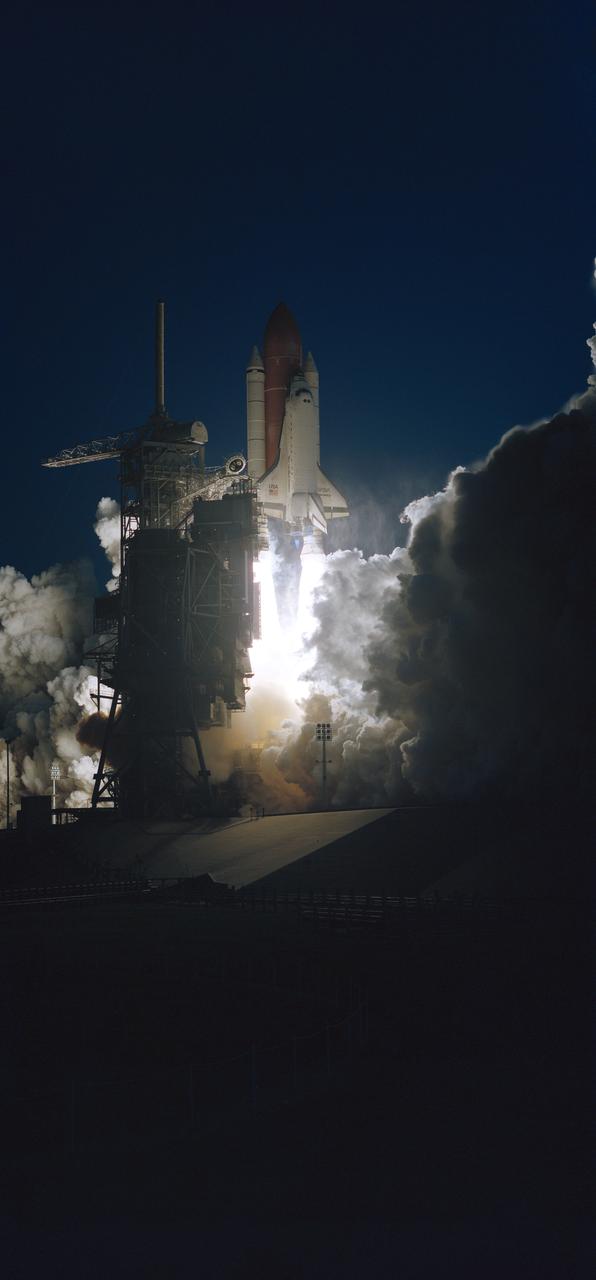
Launch Complex 39 is in partial darkness as the Space Shuttle Discovery heads toward an eight-day mission in Earth orbit. Liftoff occurred as scheduled at 7:10 a.m., February 3, 1994.
Launch of STS-60 Shuttle Discovery
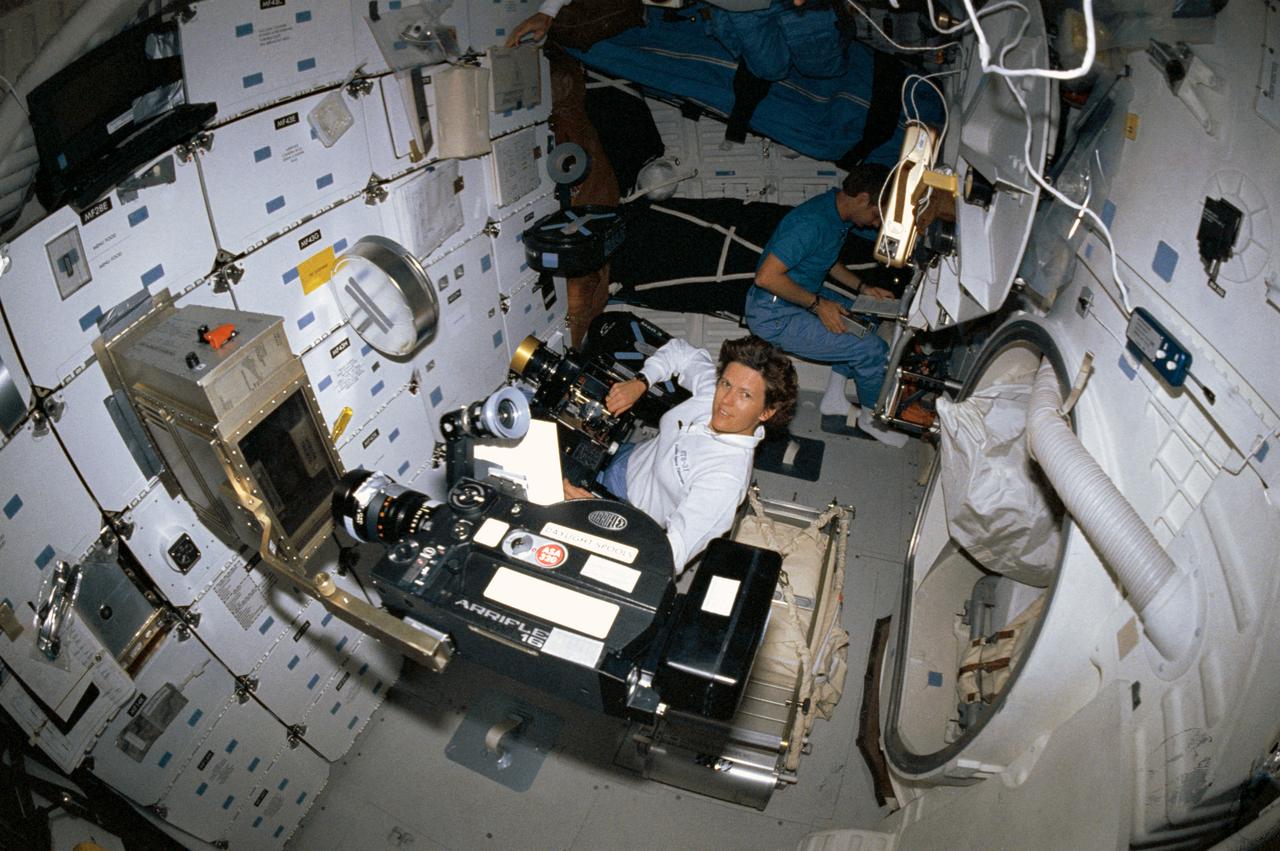
STS031-05-002 (24-29 April 1990) ---  A 35mm camera with a "fish eye" lens captured this high angle image on Discovery's middeck.   Astronaut Kathryn D. Sullivan works with the IMAX camera in foreground, while Astronaut Steven A. Hawley consults a checklist in corner.  An Arriflex motion picture camera records student ion arc experiment in apparatus mounted on stowage locker.  The experiment was the project of Gregory S. Peterson, currently a student at Utah State University.
STS-31 crew activity on the middeck of the Earth-orbiting Discovery, OV-103
STS095-E-5030 (10-29-98) --- Backdropped  over a shoreline and thousands of miles of ocean waters, the Space Shuttle Discovery orbits Earth at 17,500 miles per hour.  In the cargo bay are the Spacehab facility and the Spartan 201 (partially obscured behind the Spacehab).  Awaiting its duties with the Spartan is the Canadian-built remote manipulator system (RMS) robot arm in its berthed configuration at right. The   scene was taken with an electronic still camera (ESC) at 11:34:13 GMT, Oct. 29.
View of the STS-95 orbiter Discovery's payload bay
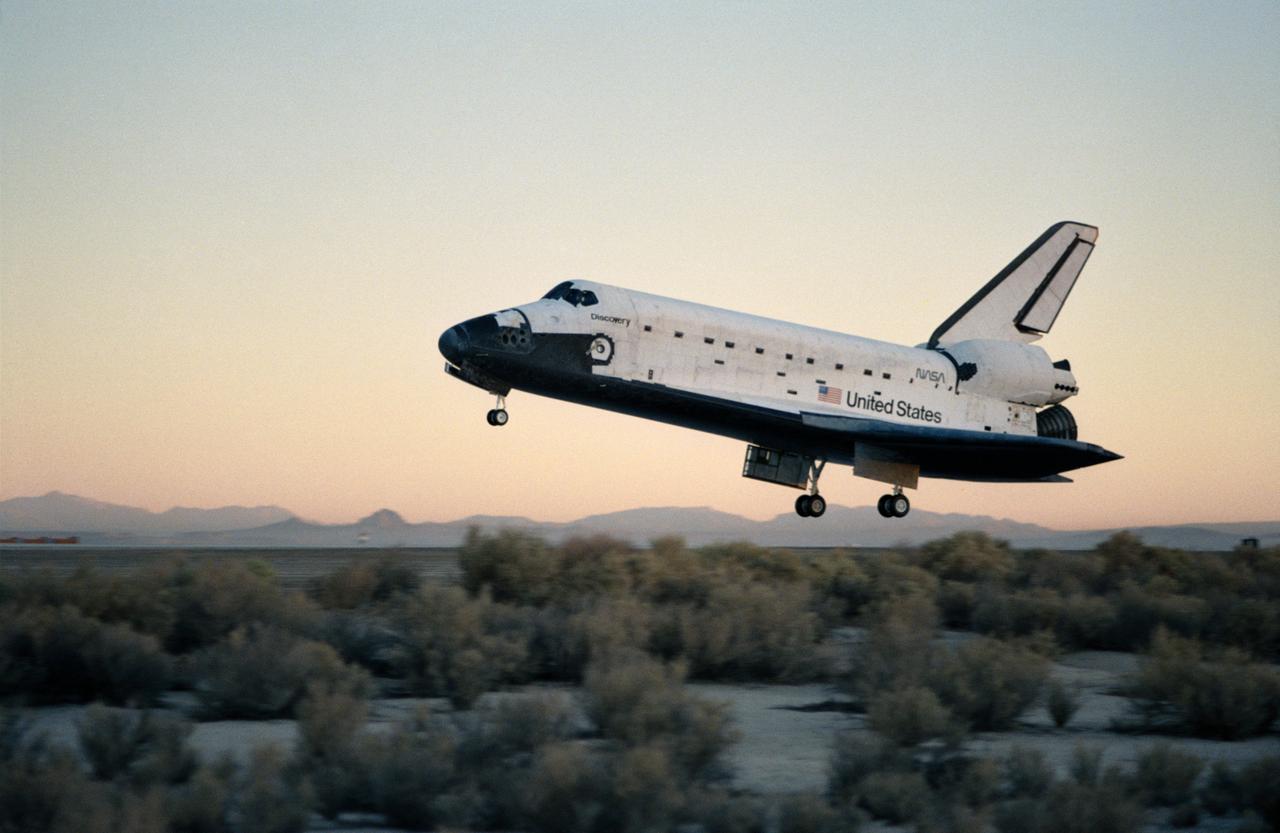
STS-41 Discovery, Orbiter Vehicle (OV) 103, with nose landing gear (NLG) and main landing gear (MLG) deployed, glides over concrete runway 22 at Edwards Air Force Base (EAFB), California, prior to touchdown.
STS-41 Discovery, OV-103, glides over concrete runway 22 at EAFB, California
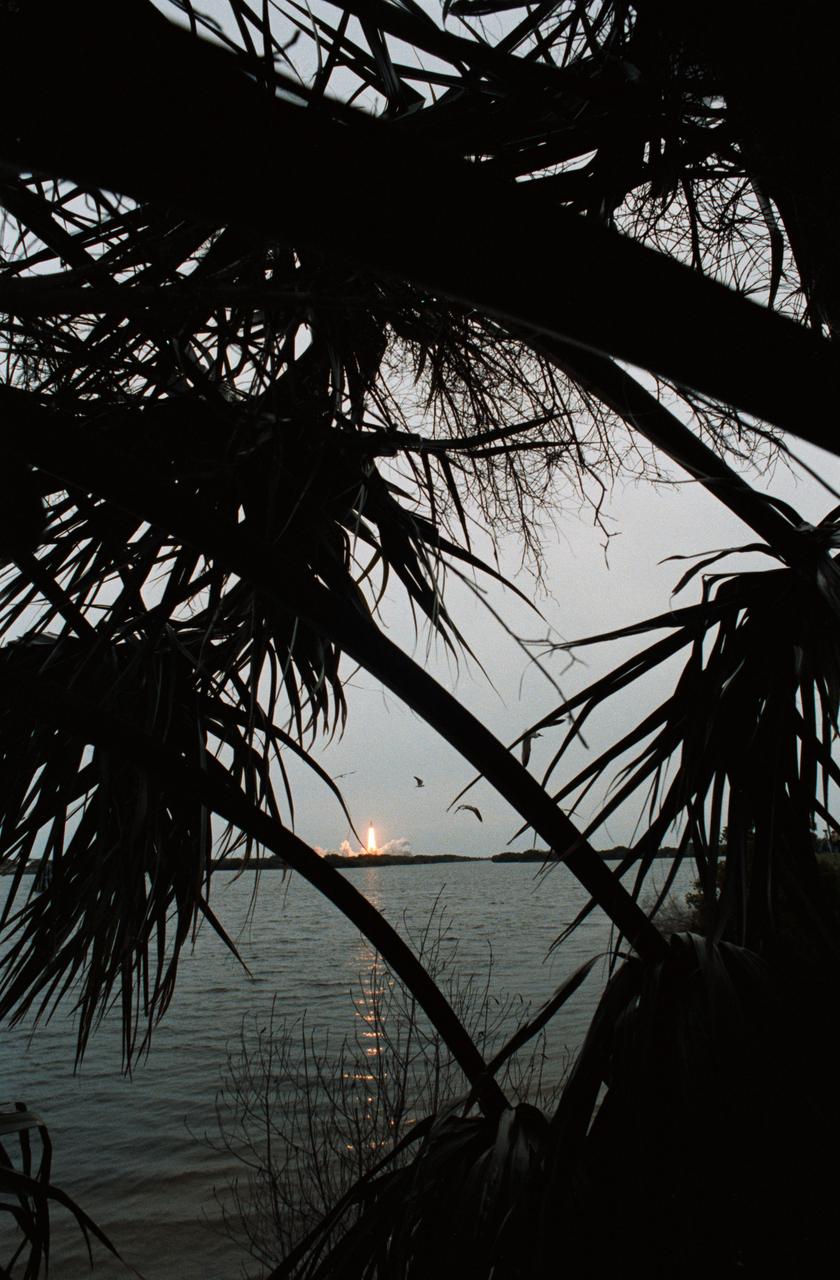
Just below center of this scene is a distant representation of a large ignition as the Shuttle Discovery lifts off from a Kennedy Space Center (KSC) launch pad. The ignition can be seen through the fronds of the trees. Birds in flight frame the light spot representing the orbiter as it launches.
View of the shuttle Discovery on the launch pad just prior to STS 51-D launch
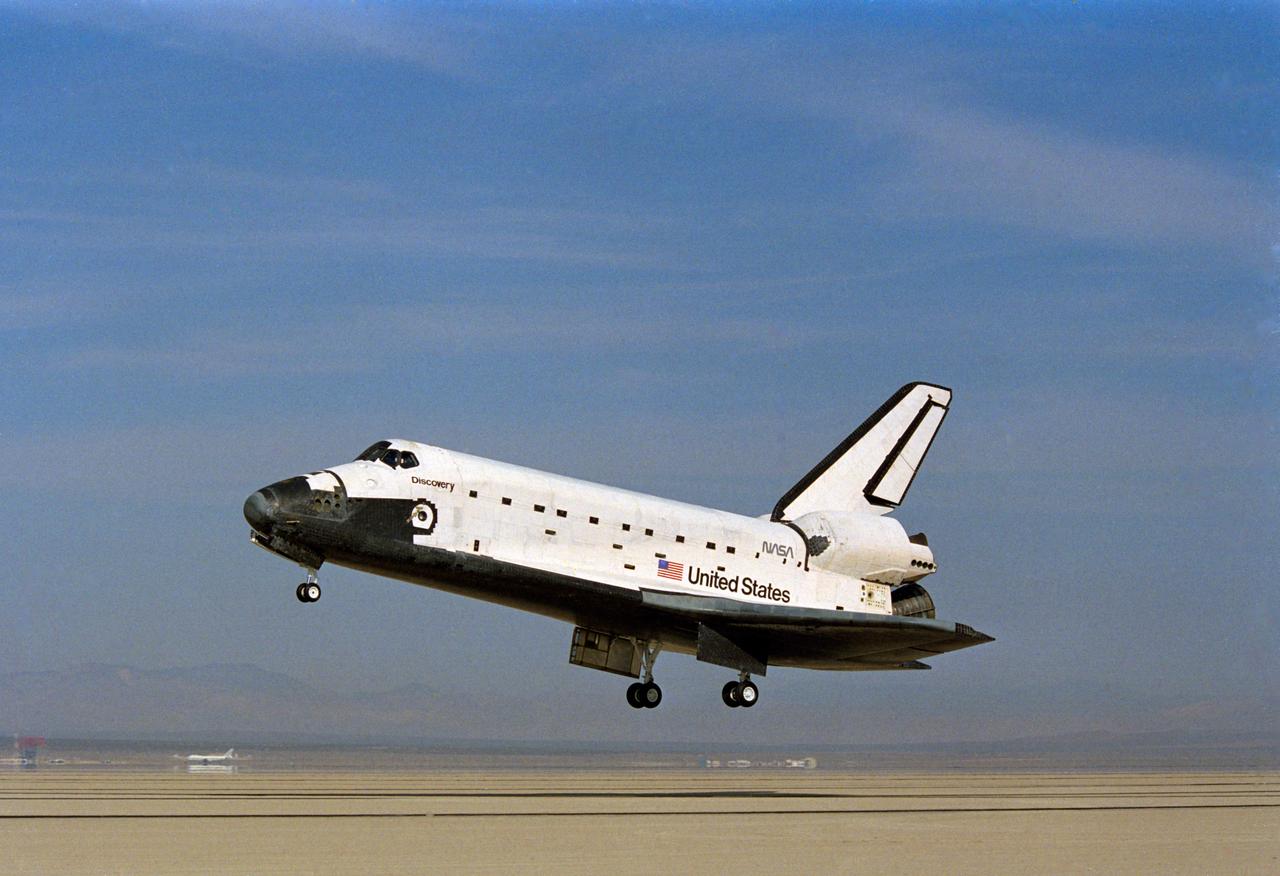
STS-26 Discovery, Orbiter Vehicle (OV) 103, with nose landing gear (NLG) and main landing gear (MLG) deployed glides above dry lakebed runway 17 at Edwards Air Force Base (EAFB), California. This profile view shows OV-103's port side just before MLG touchdown.
STS-26 Discovery, OV-103, with landing gear deployed glides above EAFB runway
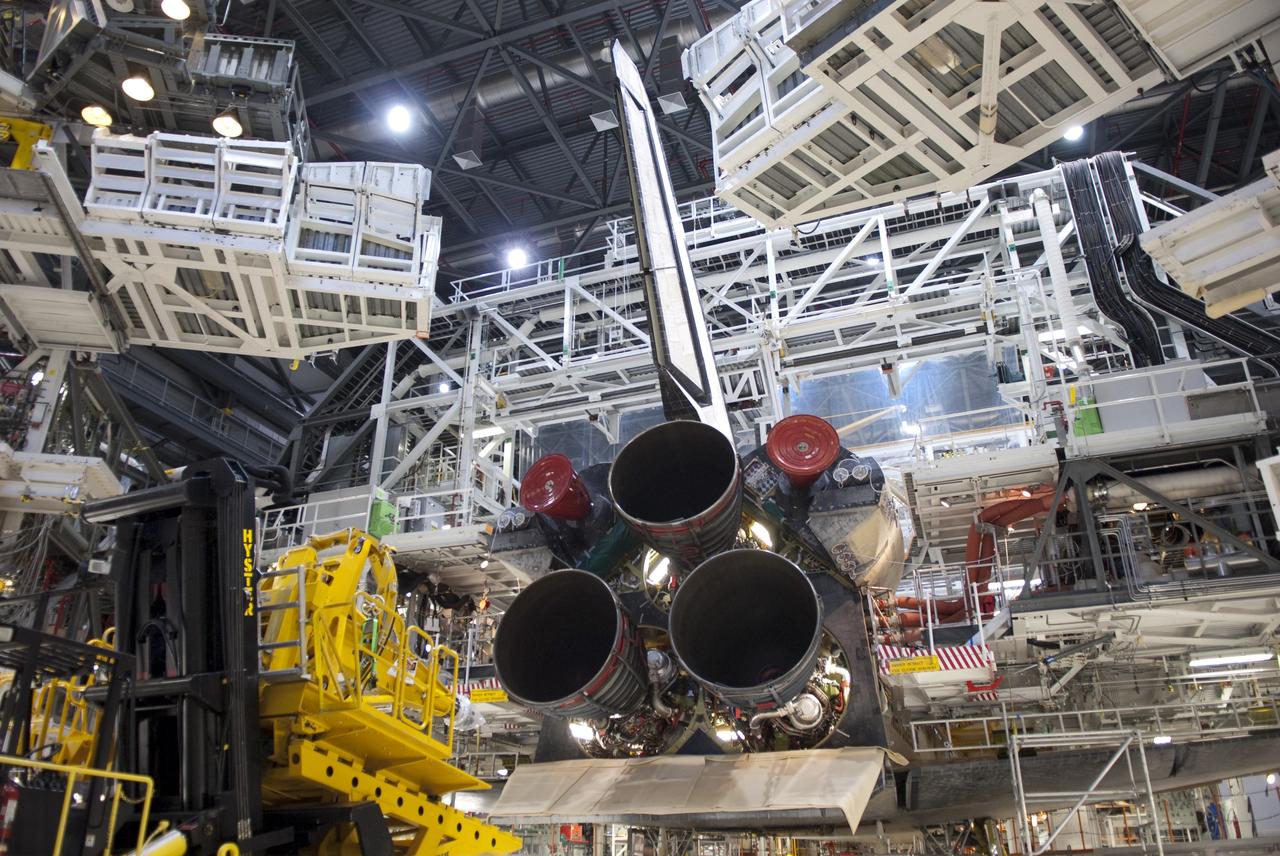
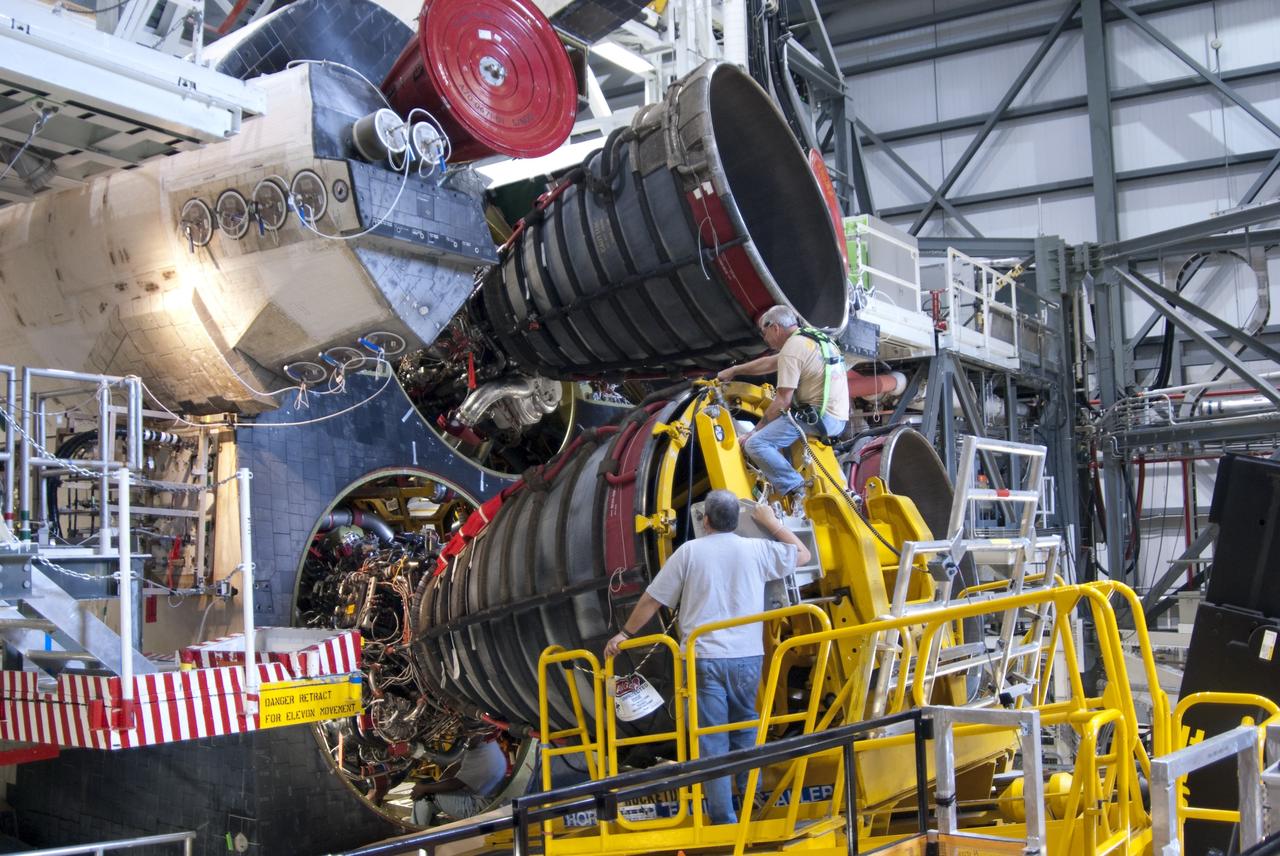
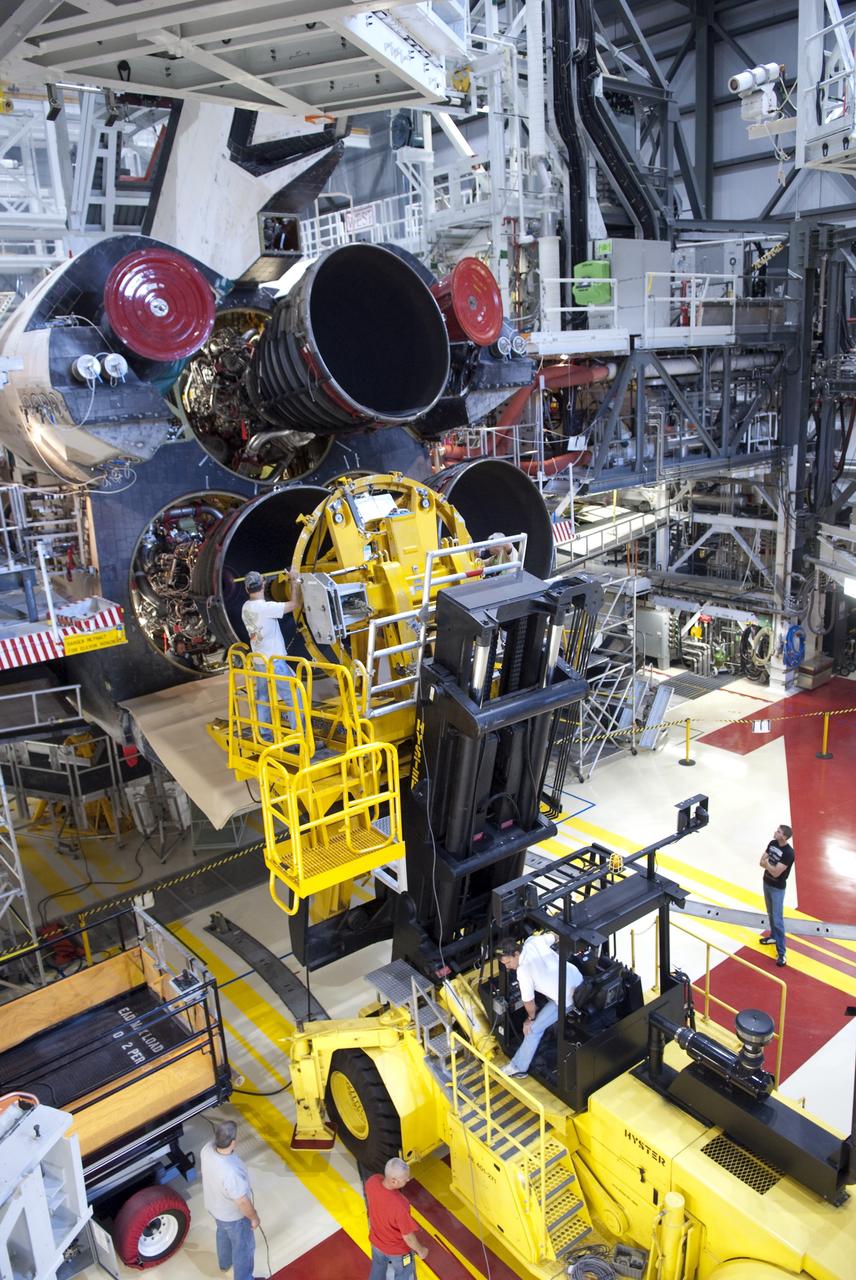
CAPE CANAVERAL, Fla. -- The specialized engine installer is moved near space shuttle Discovery as technicians prepare to remove the three main engines from the orbiter. The work is taking place in Orbiter Processing Facility-2 at NASA's Kennedy Space Center in Florida. The transition and retirement processing is expected to help rocket designers build next-generation spacecraft and prepare the shuttle for display. Photo credit: NASA/Jim Grossmann
KSC-2011-2538
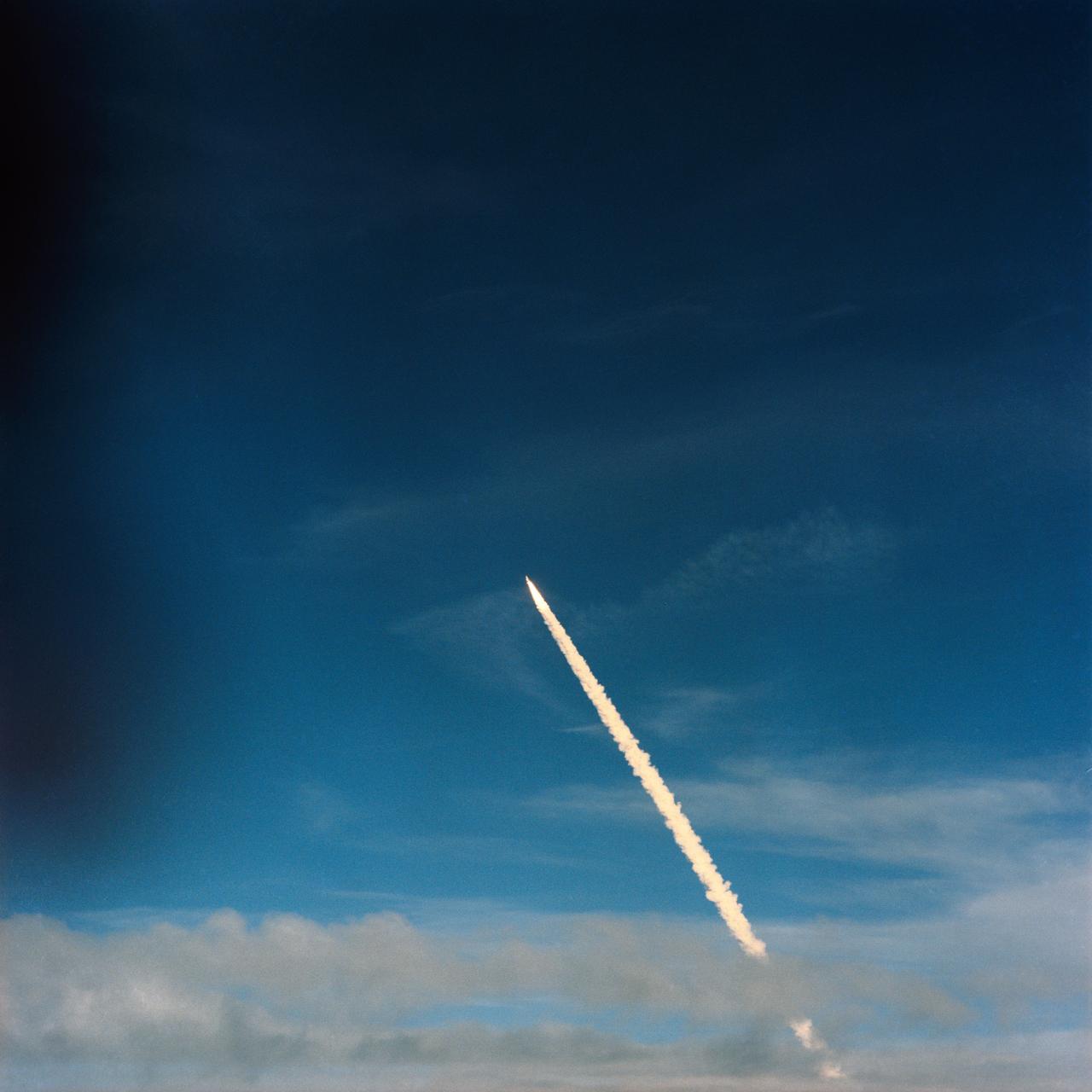
STS064-S-044 (9 Sept. 1994) --- Passing through some of the trailer clouds of an overcast sky which temporarily postponed its launch, the space shuttle Discovery heads for its 19th Earth-orbital flight. Several kilometers away, astronaut John H. Casper Jr., who took this picture, was piloting the Shuttle Training Aircraft (STA) from which the launch and landing area weather was being monitored.  Onboard Discovery were astronauts Richard N. Richards, L. Blaine Hammond Jr., Mark C. Lee, Carl J. Meade, Susan J. Helms and Jerry M. Linenger. Photo credit: NASA or National Aeronautics and Space Administration
STS-64 launch view
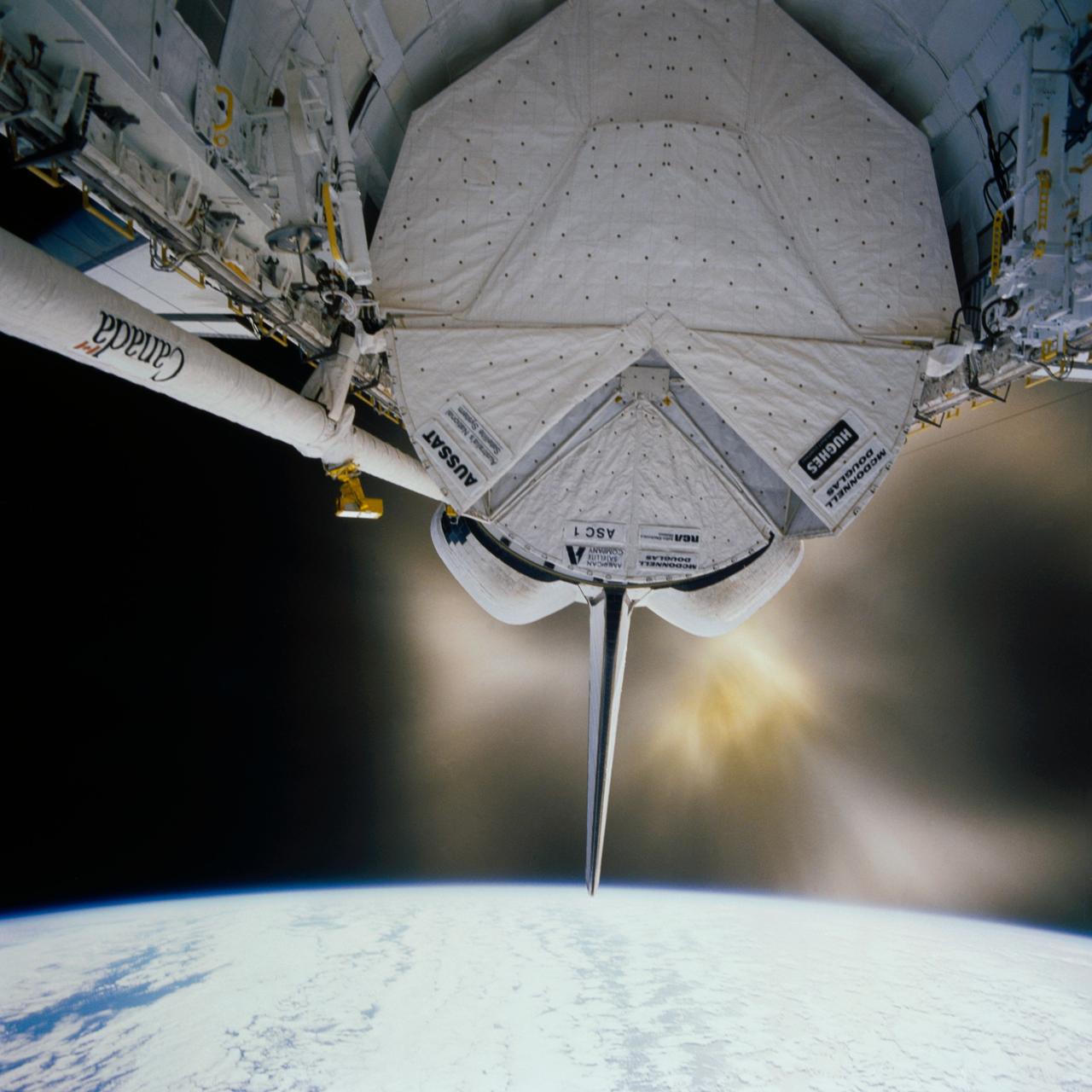
View of a single engine orbital maneuvering system (OMS) firing on the Discovery. The payload bay is open and the protective canisters for the AUSSAT communications satellite (open) and the ASC-1 are visible. A cloudy Earth's horizon can be seen above the orbiter.
View of the firing of a single engine OMS
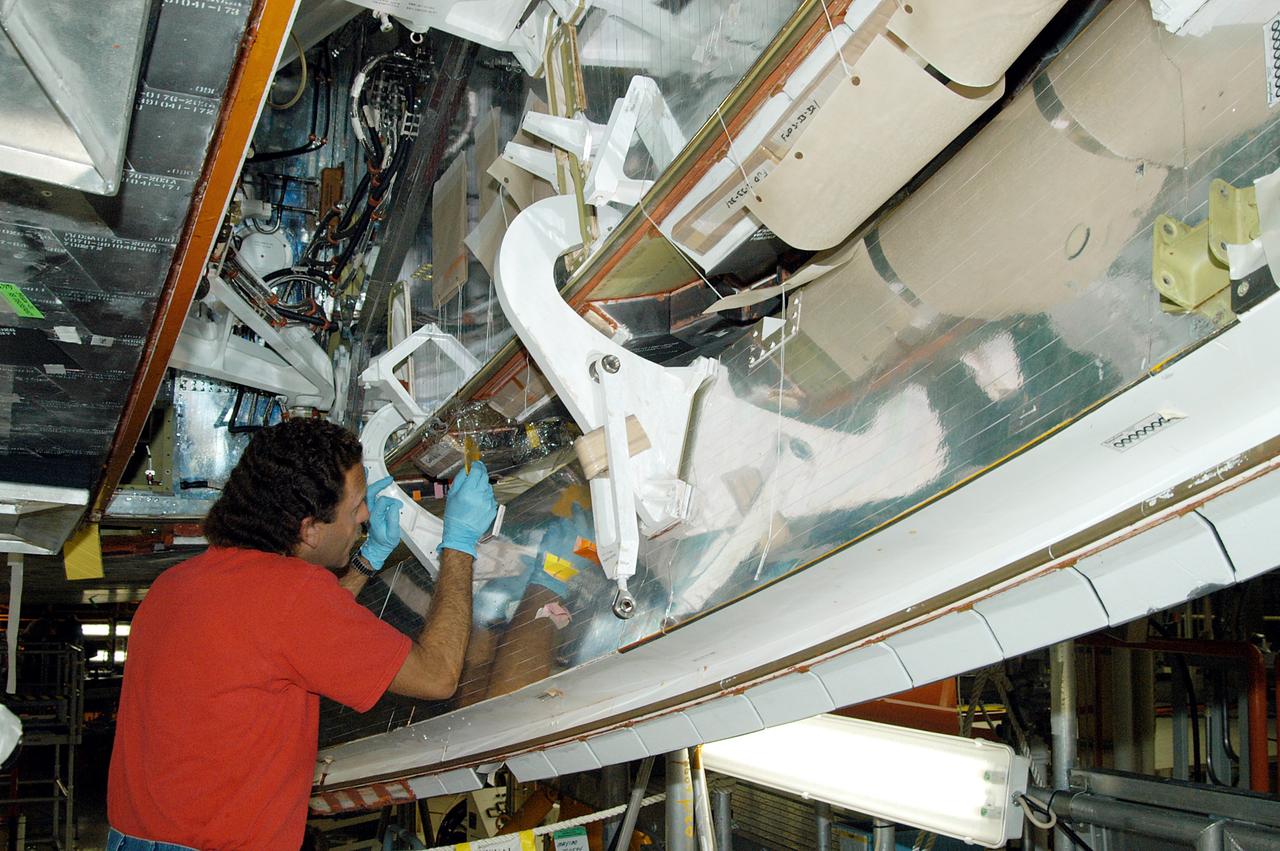
KENNEDY SPACE CENTER, FLA. -  In the Orbiter Processing Facility, KSC employee Gene Peavler works in the wheel area on the orbiter Discovery.  The vehicle has undergone Orbiter Major Modifications in the past year.  Discovery is scheduled to fly on mission STS-121 to the International Space Station.
KENNEDY SPACE CENTER, FLA. - In the Orbiter Processing Facility, KSC employee Gene Peavler works in the wheel area on the orbiter Discovery. The vehicle has undergone Orbiter Major Modifications in the past year. Discovery is scheduled to fly on mission STS-121 to the International Space Station.
KENNEDY SPACE CENTER, FLA. -  In the Orbiter Processing Facility, KSC technicians work on the underbody of the orbiter Discovery.  The vehicle has undergone Orbiter Major Modifications in the past year.  Discovery is scheduled to fly on mission STS-121 to the International Space Station.
KENNEDY SPACE CENTER, FLA. - In the Orbiter Processing Facility, KSC technicians work on the underbody of the orbiter Discovery. The vehicle has undergone Orbiter Major Modifications in the past year. Discovery is scheduled to fly on mission STS-121 to the International Space Station.
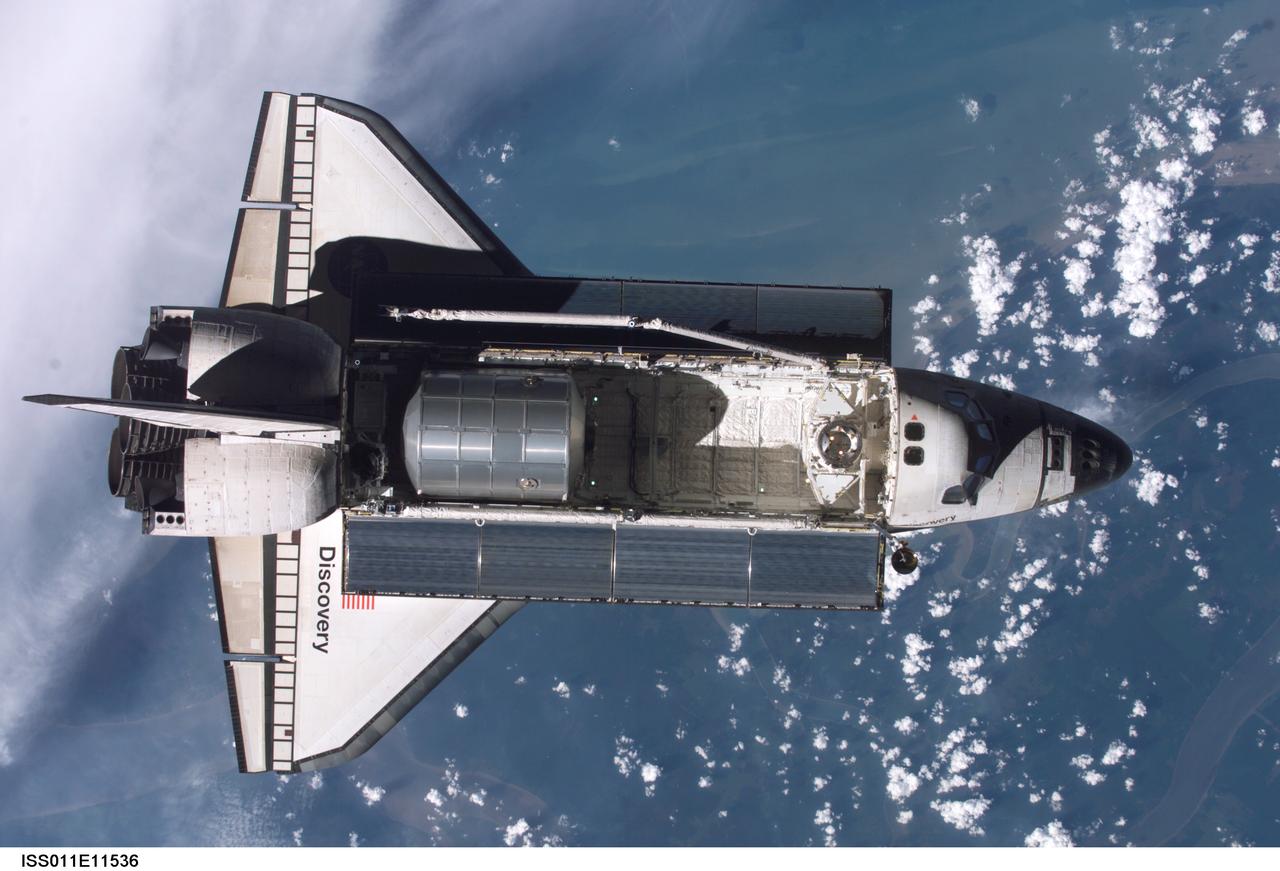
ISS011-E-11536 (6 August 2005) --- Not long after the separation of Discovery and the International Space Station, an Expedition 11 crew member took this digital still picture of the Space Shuttle Discovery, backdropped against clouds and land below. Nine days ago, the Shuttle looked very much like this, but no single photo can show the amount of variegated activity that occurred in the interim. The Multi-Purpose Logistics Module Raffaello stands out in the aft bay, now containing tons of returned material from the Space Station. At the beginning of the mission, the MPLM was full of fresh supplies for the Station. The Canadian-built robot arm for the Shuttle can be seen stowed on the port side of the payload bay and Orbiter Boom Sensor System has been reberthed in its position on the starboard sill, but in the last few days both components had been very instrumental in making the STS-114 flight a successful mission. Undocking took place at 2:24 a.m. (CDT) on August 6.
STS-114 orbiter Discovery after undocking
S121-E-05554 (6 July 2006) --- The International Space Station is backdropped against the darkness of space in this  digital image, recorded by the astronaut crewmembers onboard Space Shuttle Discovery.  A little later, the shuttle and the orbital outpost linked up for what will be more than a week of joint activities for their respective crews.
Nadir view of the ISS as the orbiter Discovery moves in for docking during STS-121
S121-E-05555 (6 July 2006) --- The International Space Station is backdropped against the darkness of space in this  digital image, recorded by the astronaut crewmembers onboard Space Shuttle Discovery.  A little later, the shuttle and the orbital outpost linked up for what will be more than a week of joint activities for their respective crews.
Nadir view of the ISS as the orbiter Discovery moves in for docking during STS-121
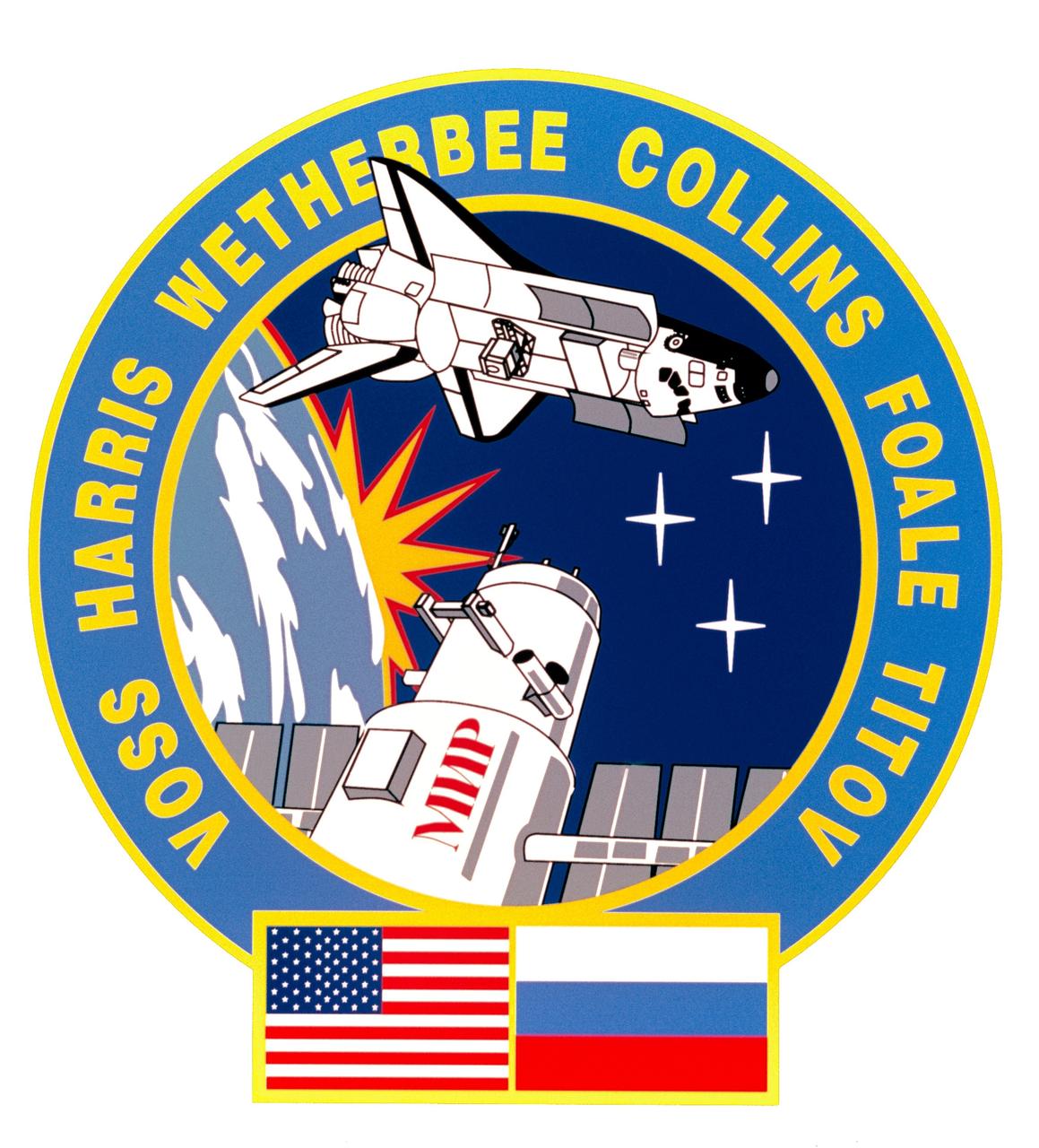
STS063-S-001 (September 1994) --- Designed by the crew members, the STS-63 crew patch depicts the orbiter maneuvering to rendezvous with Russia's Space Station Mir. The name is printed in Cyrillic on the side of the station. Visible in the orbiter's payload bay are the commercial space laboratory Spacehab and the Shuttle Pointed Autonomous Research Tool for Astronomy (SPARTAN) satellite which are major payloads on the flight. The six points on the rising sun and the three stars are symbolic of the mission's Space Transportation System (STS) numerical designation. Flags of the United States and Russia at the bottom of the patch symbolize the cooperative operations of this mission. The crew will be flying aboard the space shuttle Discovery.    The NASA insignia design for space shuttle flights is reserved for use by the astronauts and for other official use as the NASA Administrator may authorize. Public availability has been approved only in the forms of illustrations by the various news media. When and if there is any change in this policy, which is not anticipated, the change will be publicly announced. Photo credit: NASA
STS-63 crew insignia
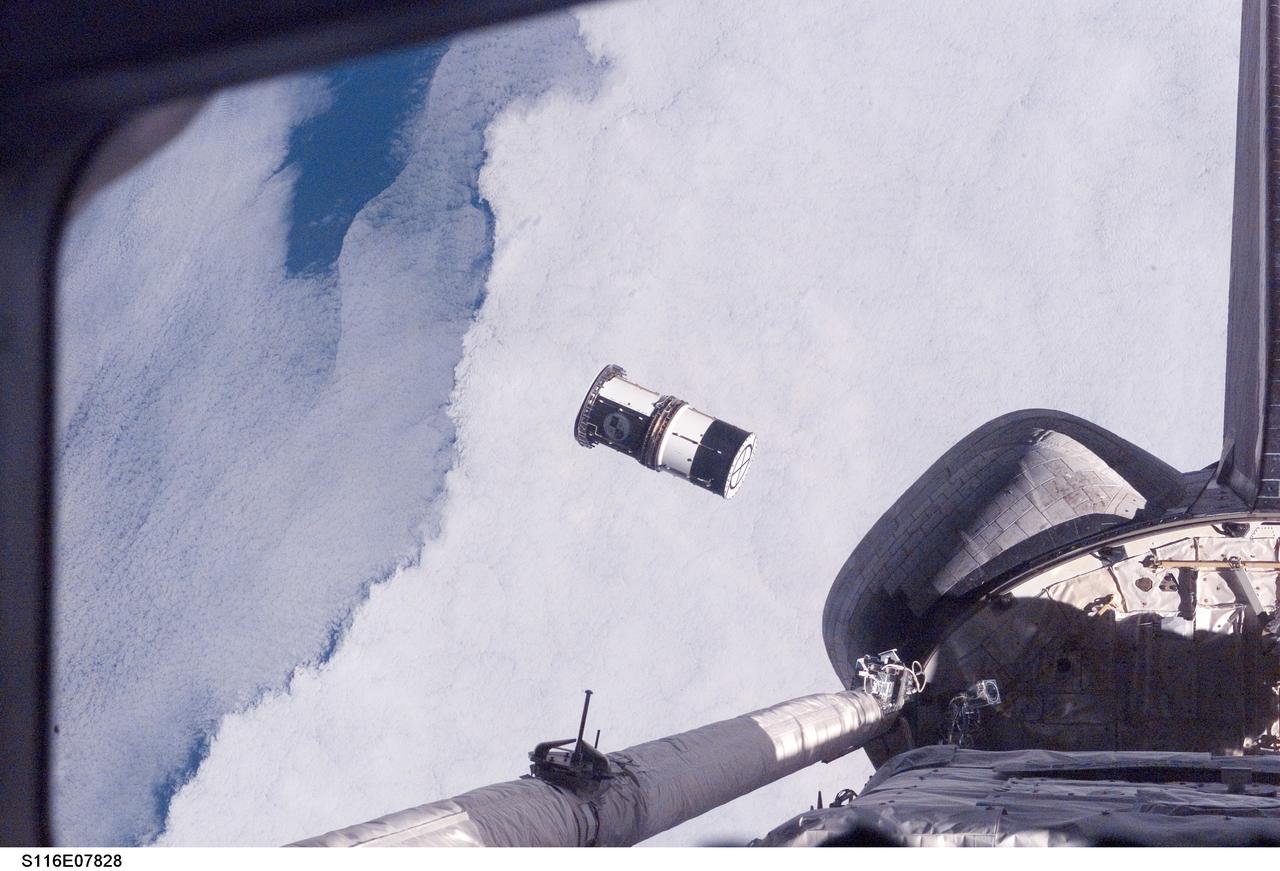
S116-E-07828 (21 Dec. 2006) --- As seen through windows on the aft flight deck of Space Shuttle Discovery,  a Department of Defense pico-satellite known as Atmospheric Neutral Density Experiment (ANDE) is released from the shuttle's payload bay by STS-116 crewmembers. ANDE consists of two micro-satellites which will measure the density and composition of the low Earth orbit (LEO) atmosphere while being tracked from the ground. The data will be used to better predict the movement of objects in orbit.
View of ANDE release from orbiter Discovery payload bay
CAPE CANAVERAL, Fla. -- Technicians complete the removal of one of space shuttle Discovery's three main engines. The work is taking place in Orbiter Processing Facility-2 at NASA's Kennedy Space Center in Florida. The transition and retirement processing is expected to help rocket designers build next-generation spacecraft and prepare the shuttle for display. Photo credit: NASA/Jim Grossmann
KSC-2011-2542
CAPE CANAVERAL, Fla. -- Technicians guide the specialized engine installer into place so it can be connected to a main engine on space shuttle Discovery and remove it safely. The work is taking place in Orbiter Processing Facility-2 at NASA's Kennedy Space Center in Florida. The transition and retirement processing is expected to help rocket designers build next-generation spacecraft and prepare the shuttle for display. Photo credit: NASA/Jim Grossmann
KSC-2011-2539
CAPE CANAVERAL, Fla. -- A main engine slowly emerges from space shuttle Discovery. The work is taking place in Orbiter Processing Facility-2 at NASA's Kennedy Space Center in Florida. The transition and retirement processing is expected to help rocket designers build next-generation spacecraft and prepare the shuttle for display. Photo credit: NASA/Jim Grossmann
KSC-2011-2541
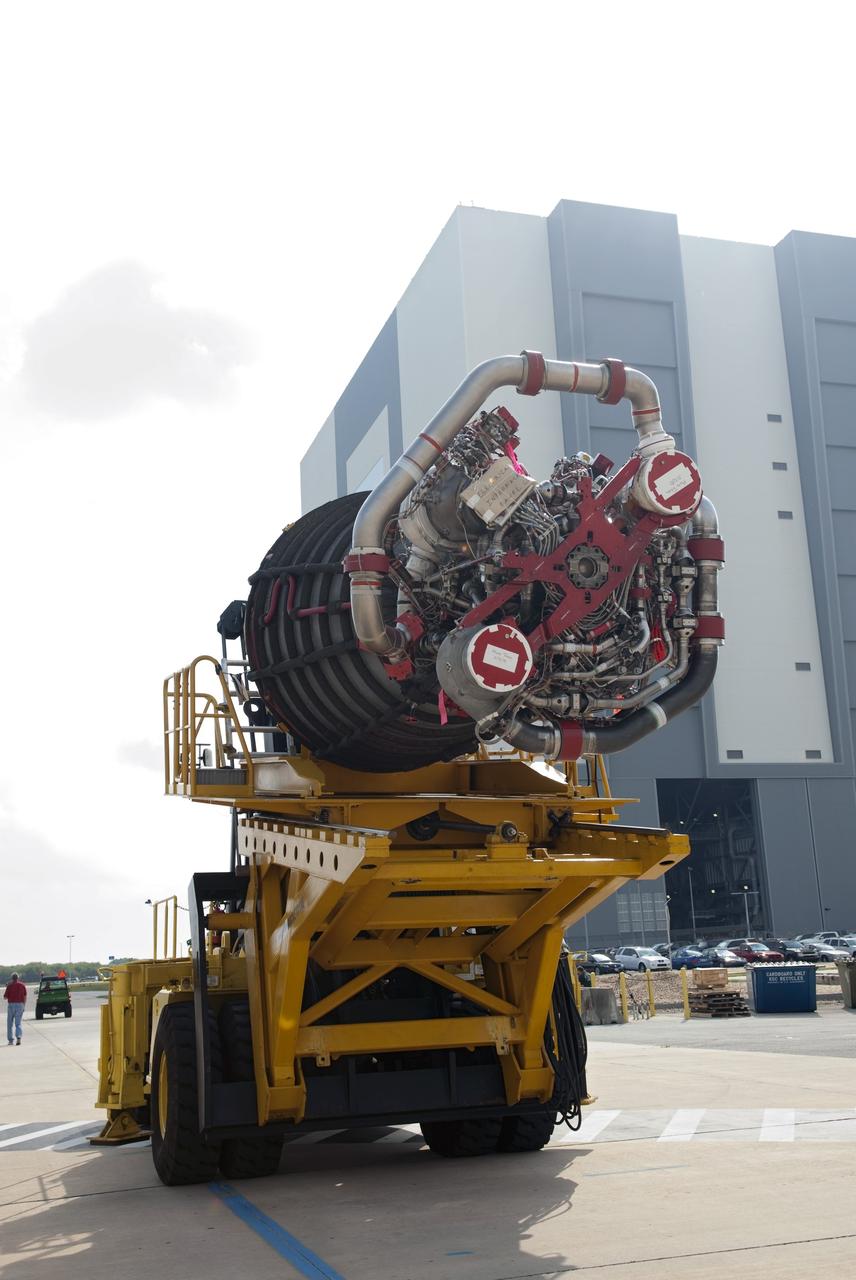
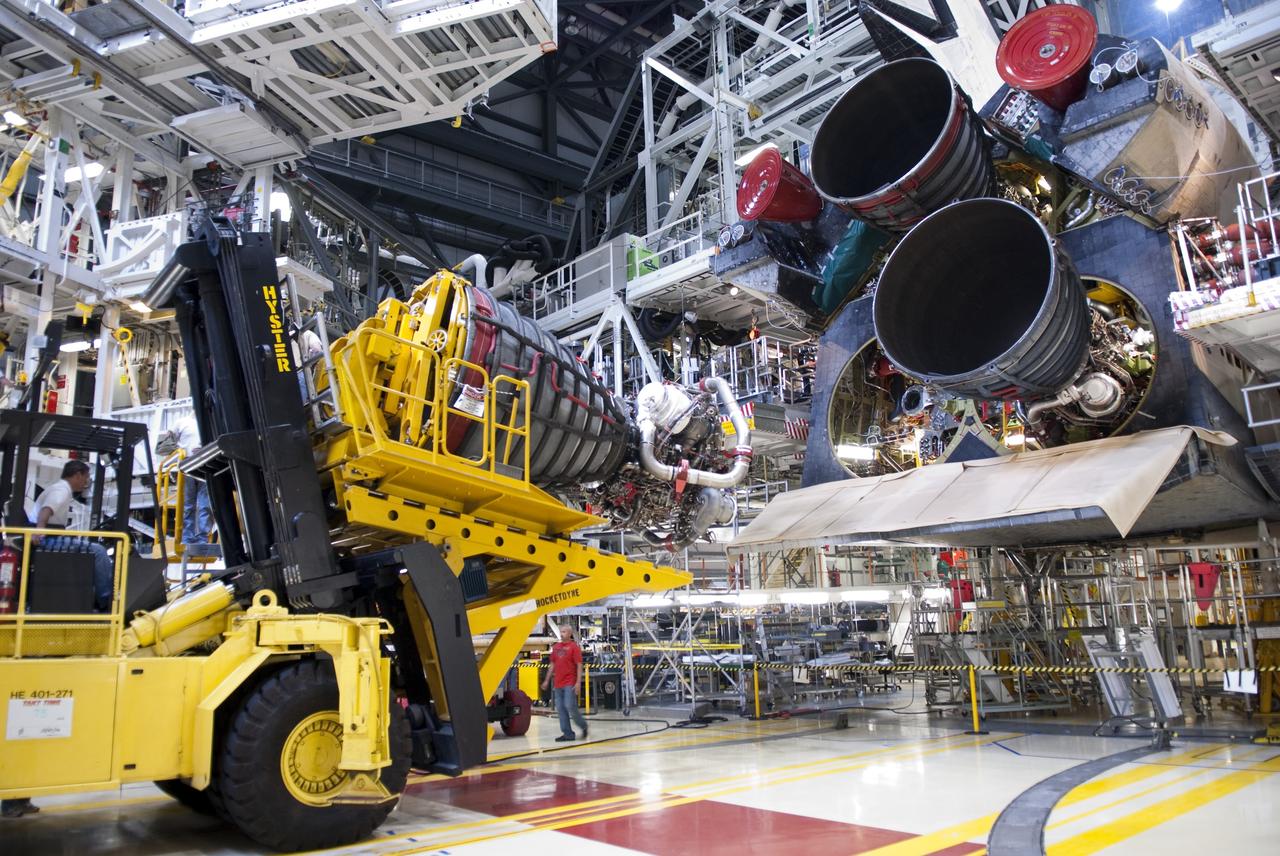
CAPE CANAVERAL, Fla. -- A heavy forklift with its specialized engine installer hold one of the main engines taken from space shuttle Discovery. The forklift is driving the engine from Orbiter Processing Facility-2 at NASA's Kennedy Space Center in Florida to the center's Space Shuttle Main Engine Processing Facility. The transition and retirement processing is expected to help rocket designers build next-generation spacecraft and prepare the shuttle for display. Photo credit: NASA/Jim Grossmann
KSC-2011-2543
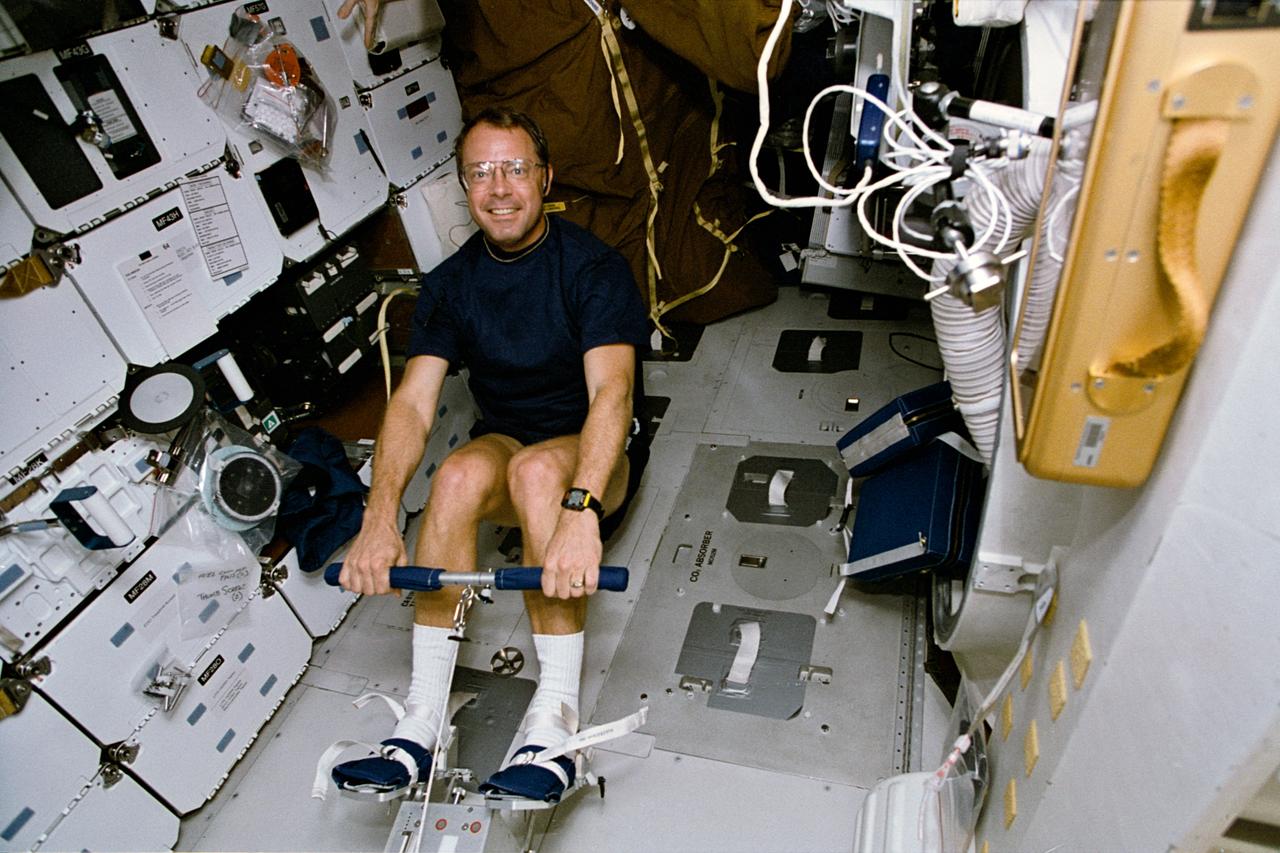
STS064-09-026 (9-20 Sept. 1994) --- Astronaut L. Blaine Hammond, STS-64 pilot, gets microgravity exercise on the rowing machine.  This area of the space shuttle Discovery's middeck was also used for the treadmill exercising device. Blaine and five other NASA astronauts spent almost 11 days in Earth orbit in support of the mission. Photo credit: NASA or National Aeronautics and Space Administration
Astronaut Hammond gets microgravity exercise on rowing machine
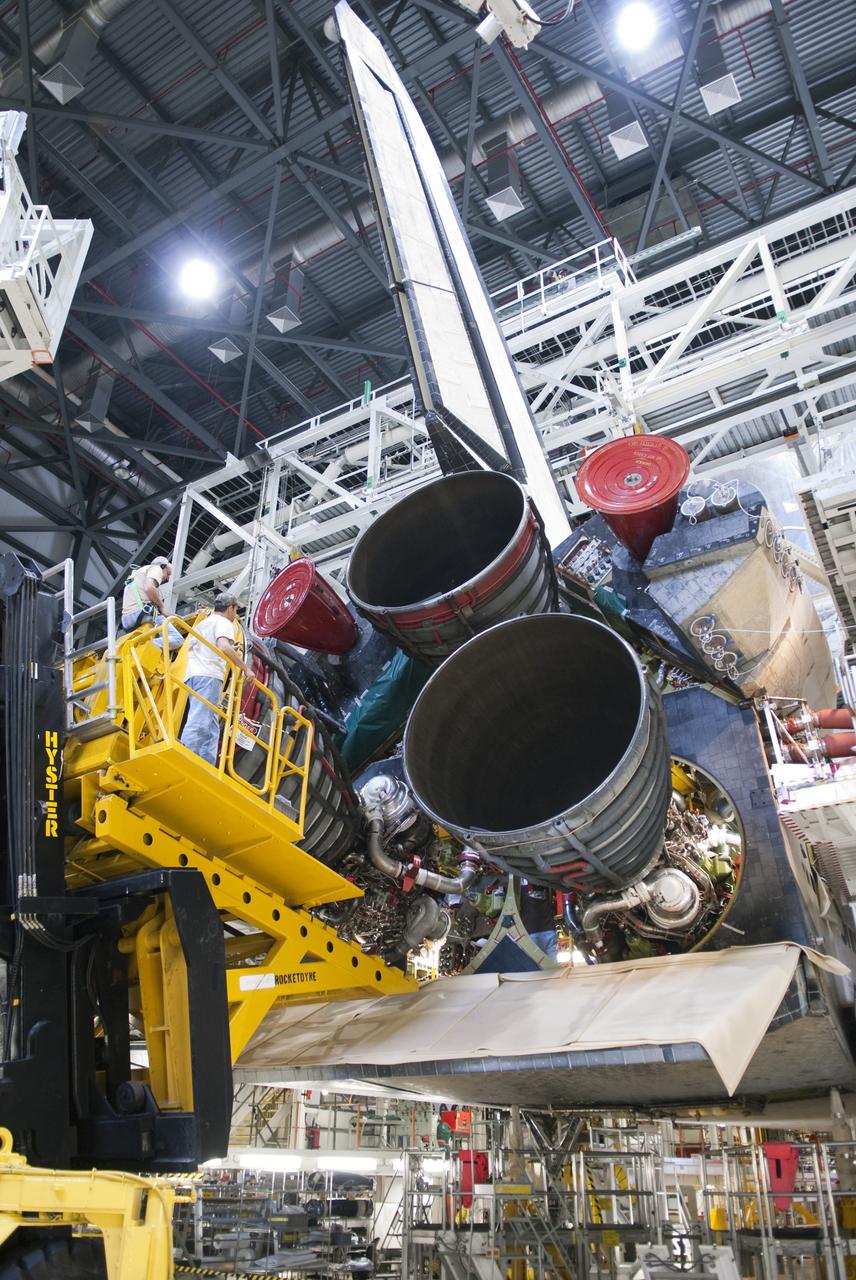
CAPE CANAVERAL, Fla. -- Technicians carefully begin removing a main engine from space shuttle Discovery using the specially designed engine installer. The work is taking place in Orbiter Processing Facility-2 at NASA's Kennedy Space Center in Florida. The transition and retirement processing is expected to help rocket designers build next-generation spacecraft and prepare the shuttle for display. Photo credit: NASA/Jim Grossmann
KSC-2011-2540
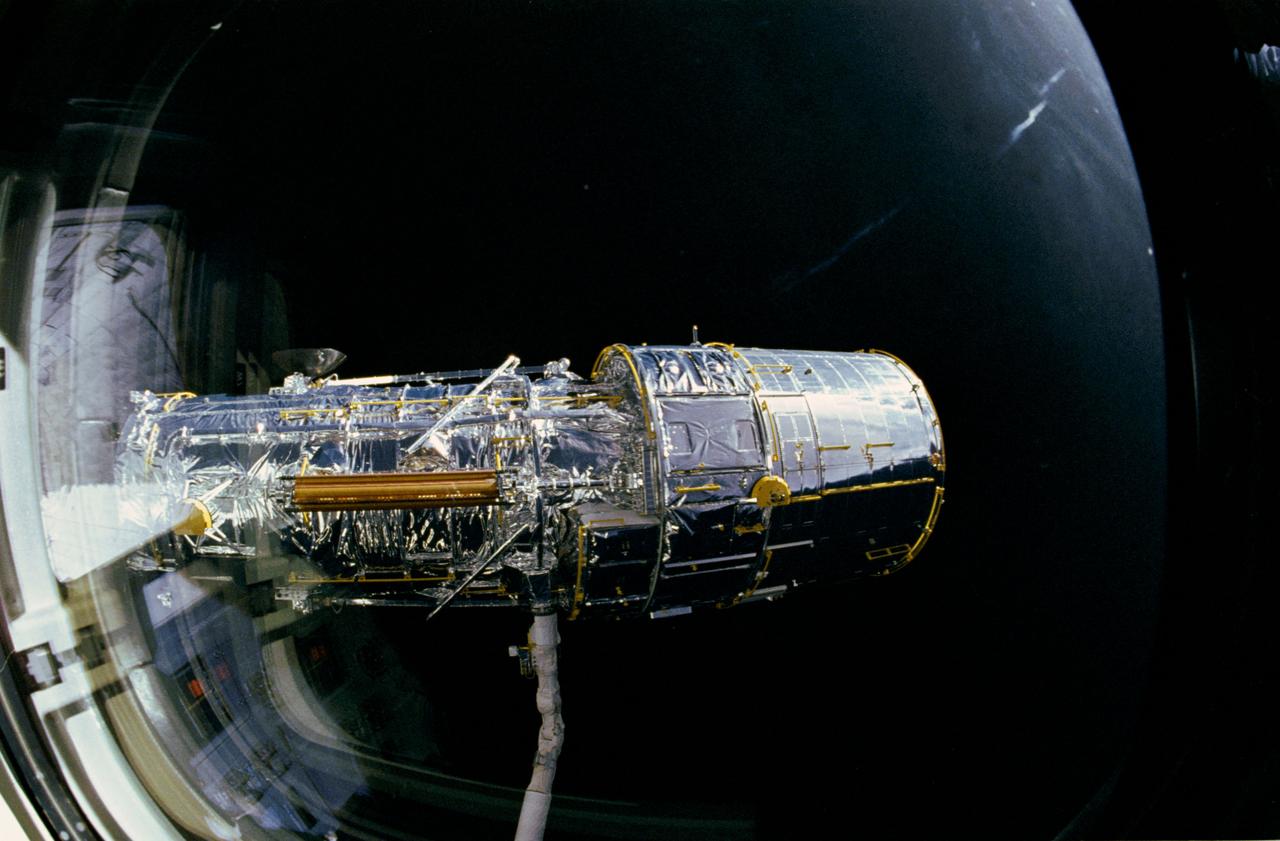
During STS-31 checkout, the Hubble Space Telescope (HST) is held in a pre-deployment position by Discovery's, Orbiter Vehicle (OV) 103's, remote manipulator system (RMS). The view, taken from the crew cabin overhead window W7, shows the starboard solar array (SA) panel (center) and two high gain antennae (HGA) (on either side) stowed along side the Support System Module (SSM) forward shell. The sun highlights HST against the blackness of space.
STS-31 pre-deployment checkout of the Hubble Space Telescope (HST) on OV-103
STS029-S-063 (18 March 1989) --- Discovery's main landing gear touches down on Runway 22 at Edwards Air Force Base in California following a successful five-day mission in Earth orbit.  Onboard the spacecraft were Astronauts Michael L. Coats, John E. Blaha, James F. Buchli, Robert C. Springer and James P. Bagian.  Wheels came to a stop at 6:36:40 a.m. (PST), March 18, 1989.
STS-29 Discovery, OV-103, lands on Edwards AFB concrete runway 22
STS64-S-073 (20 Sept. 1994) --- The drag chute for the space shuttle Discovery is deployed as NASA's most-heavily flown spacecraft completes a 10-day, 22-hour and 50-minute mission.  Discovery, with a crew of six NASA astronauts aboard, fired its de-orbit engine at 1:14 p.m. (PDT), Sept. 20, 1994. Touchdown was at 2:12:59 p.m. and the nose wheel touched down at 2:13:03 p.m., with wheel stop at 2:13:52 p.m. Bad weather in Florida called for an "eleventh hour" shift to the California landing site. Onboard for the flight, whose mission was to study Earth's atmosphere and to test tools and procedures for the International Space Station (ISS), were astronauts Richard N. Richards, L. Blaine Hammond, Mark C. Lee, Carl J. Meade, Susan J. Helms and Jerry M. Linenger. Photo credit: NASA or National Aeronautics and Space Administration
STS-64 landing view
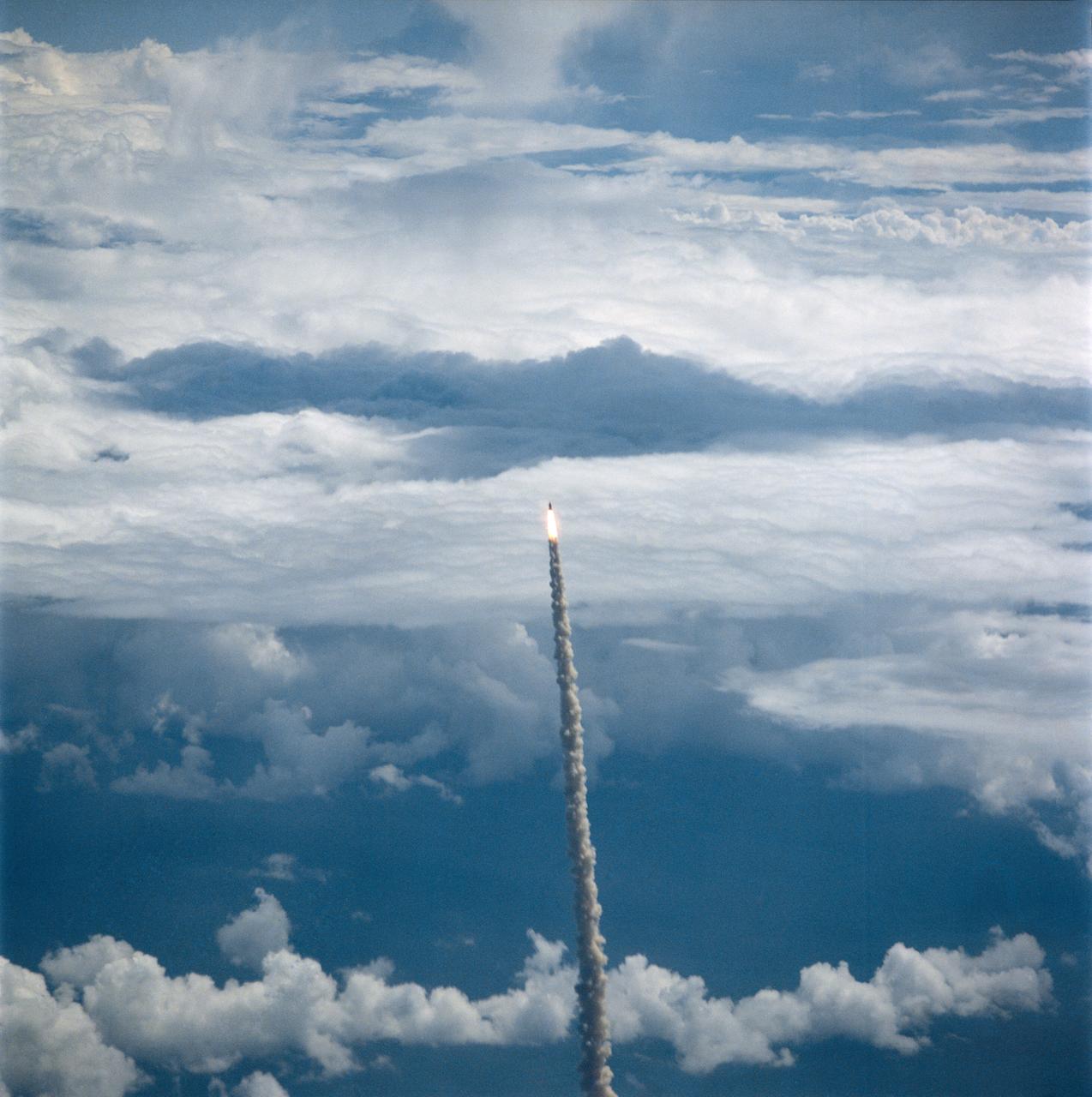
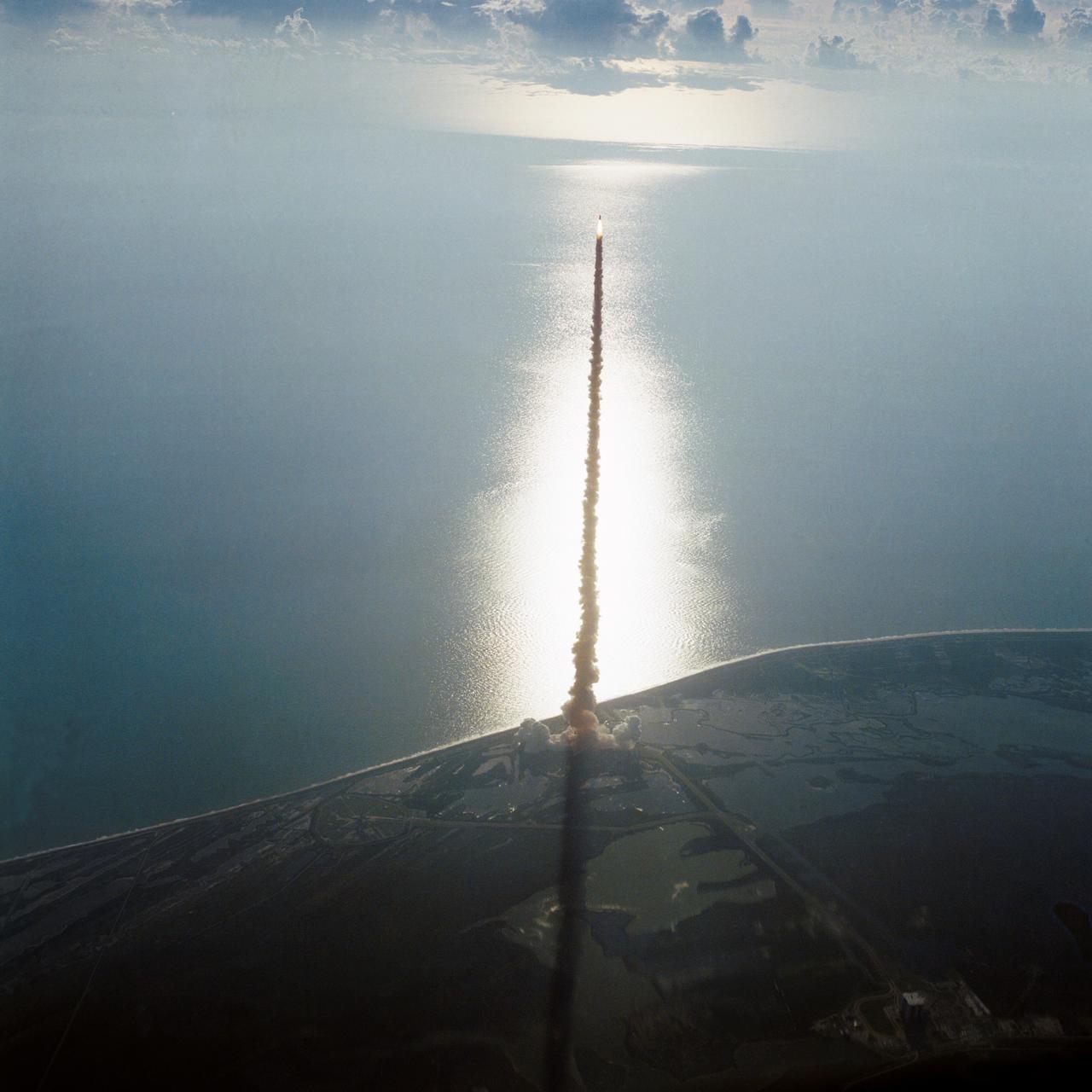
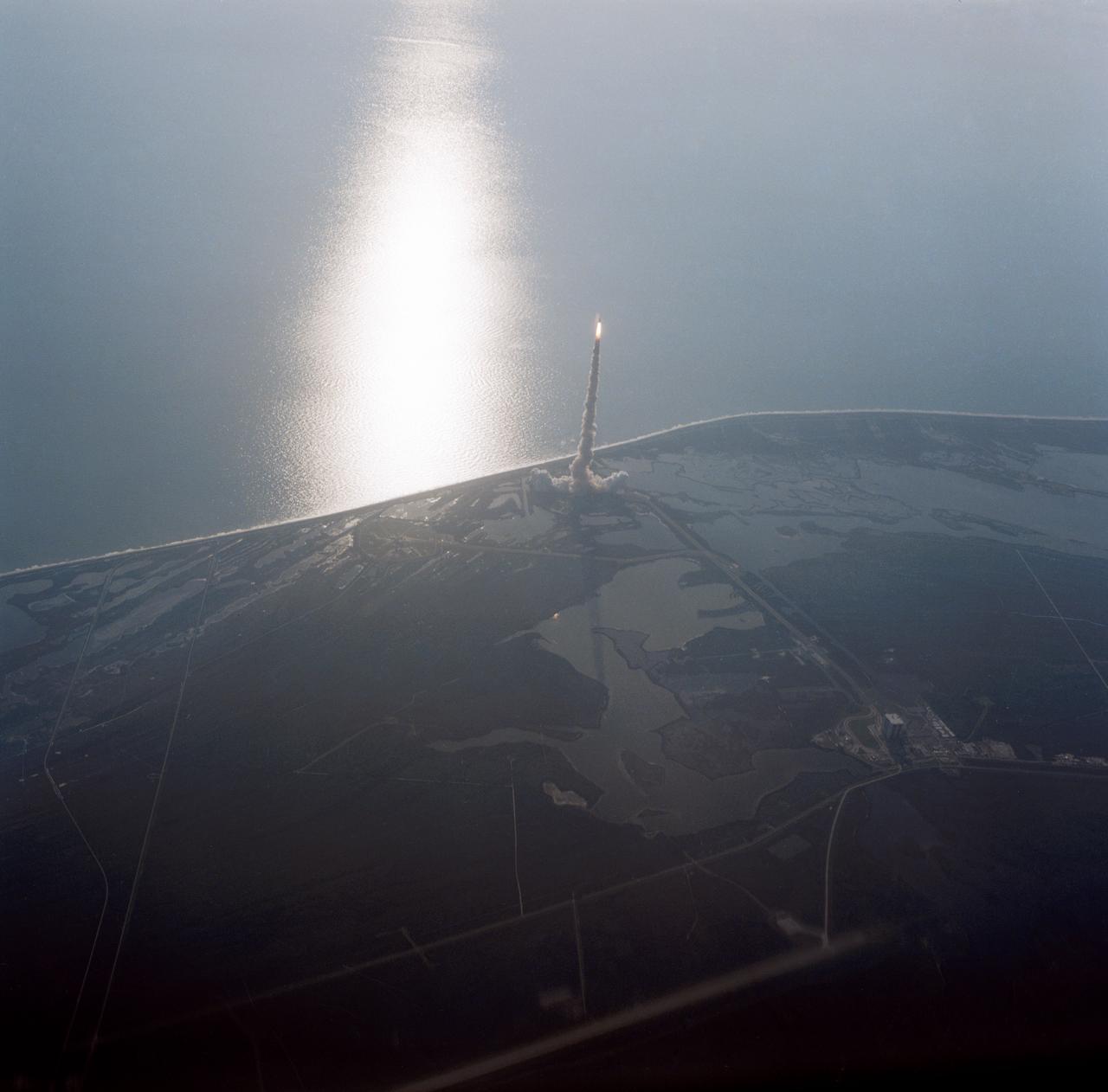
S26-S-026 (29 Sept. 1988) --- The STS-26 launch was captured on film from the NASA Shuttle Training Aircraft, piloted by astronaut Daniel C. Brandenstein, chief of JSC's Astronaut Office.  Discovery?s mission was the first flight to be flown after the Challenger accident.  The flight crew included astronauts Rick Hauck, commander;  Dick Covey, pilot; and three mission specialists, Dave Hilmers, Mike Lounge, and George (Pinky) Nelson. During the four-day mission, the crew deployed the Tracking and Data Relay Satellite (TDRS-C) and operated eleven mid-deck experiments. Discovery completed 64 orbits of the earth before landing at Edwards Air Force Base, California, on October 3, 1988.  Photo credit: NASA or National Aeronautics and Space Administration
STS-26 Discovery, OV-103, distant air-to-air launch views
KENNEDY SPACE CENTER, FLA. -  In the Orbiter Processing Facility, technicians work on insulation tiles near the landing gear door of orbiter Discovery.  The orbiter is now being prepared for eventual launch on a future mission.
KENNEDY SPACE CENTER, FLA. - In the Orbiter Processing Facility, technicians work on insulation tiles near the landing gear door of orbiter Discovery. The orbiter is now being prepared for eventual launch on a future mission.
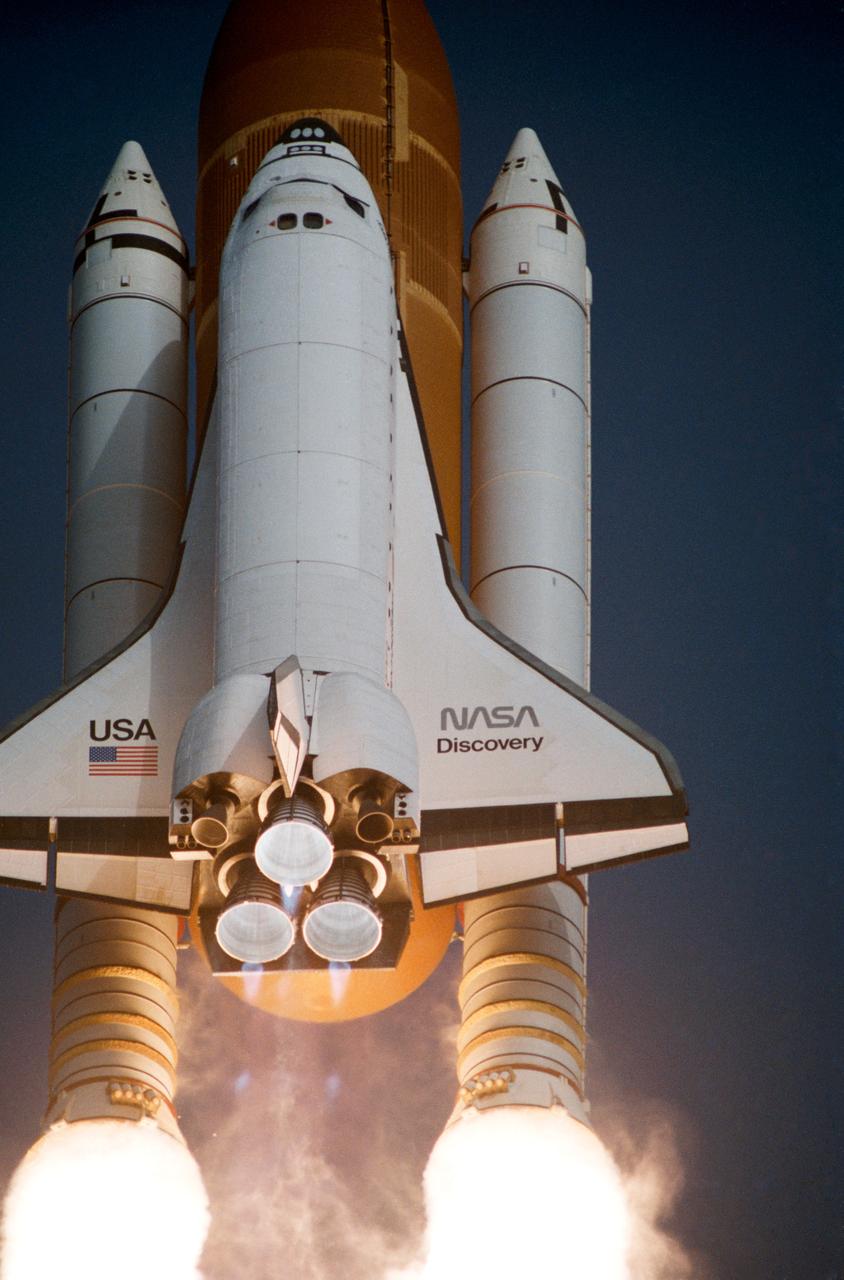
STS051-S-108 (12 Sept. 1993) --- The Space Shuttle Discovery soars toward a nine-day stay in Earth-orbit to support the mission.  Launch occurred at 7:45 a.m. (EDT) September 12, 1993. Note the diamond shock effect coming from the thrust of the three main engines. Onboard the shuttle were astronauts Frank L. Culbertson, Jr., William F. Readdy, Daniel W. Bursch, James H. Newman and Carl E. Walz, along with a number of payloads. The payloads included the Advanced Communications Technology Satellite (ACTS) with its Transfer Orbit Stage (TOS), the Orbiting Retrievable Far and Extreme Ultraviolet Spectrometer (ORFEUS) and its Shuttle Pallet Satellite (SPAS) carrier. This photograph was taken with a 35mm camera.
STS-51 Discovery launch
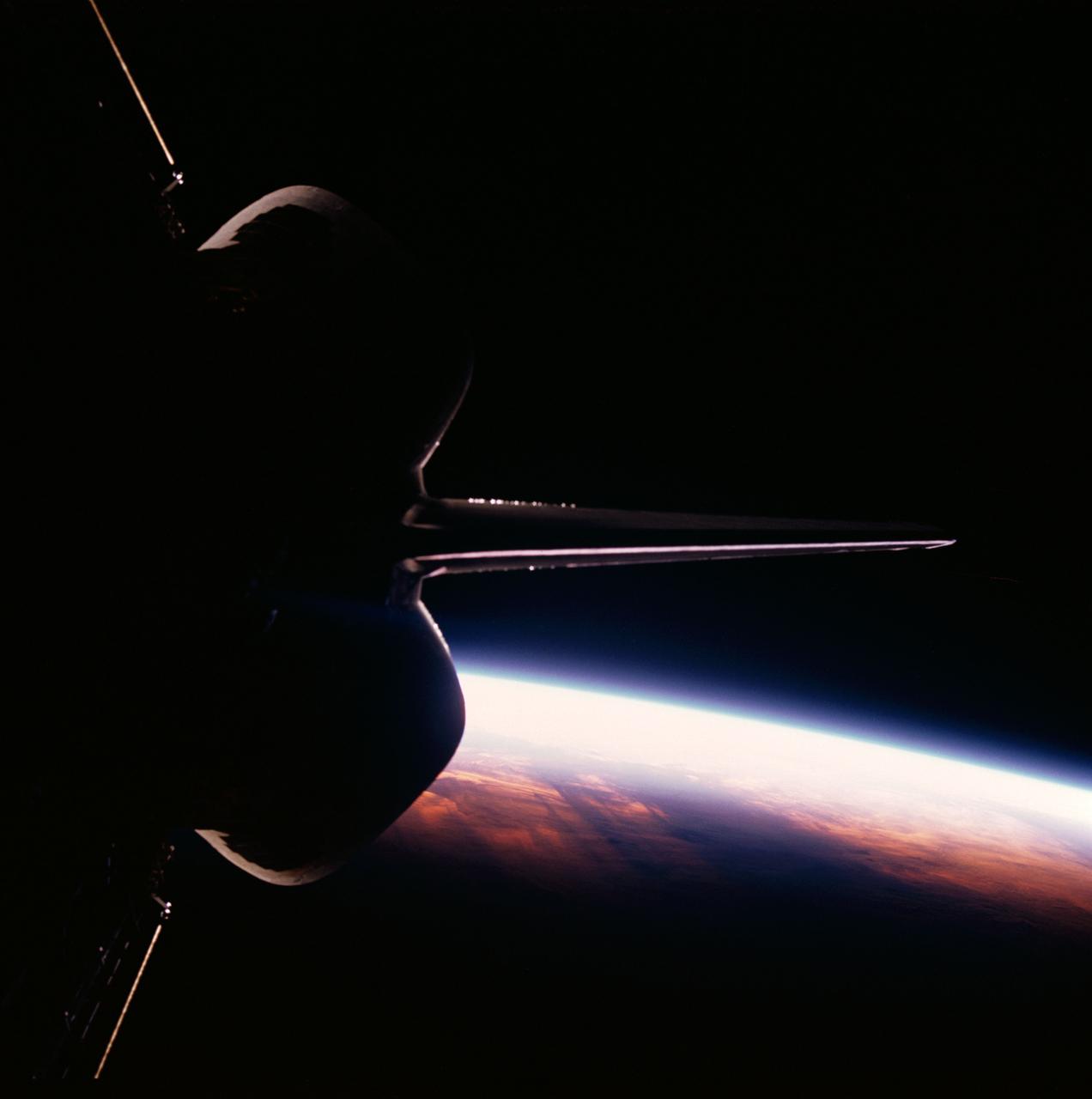
Discovery's, Orbiter Vehicle (OV) 103's, vertical stabilizer and orbital maneuvering system (OMS) pods are backdropped against the contrasted blackness of space illuminated by a colorful Earth / sunrise panorama. View was taken through the aft flight deck viewing windows during STS-26.
STS-26 Discovery, OV-103, onboard view of the Earth sunrise
View of the launch of the shuttle Discovery and the 41-D mission. The orbiter and its plume of smoke are photographed from across the river in the early stages of liftoff (3085,3087); The orbiter can be seen just clearing the pad, with a cloud of smoke billowing to the left of the frame. The orbiters two orbital maneuvering system (OMS) pods and external tank are visible along with the orbiter (3086).
View of the launch of Discovery 41-D mission
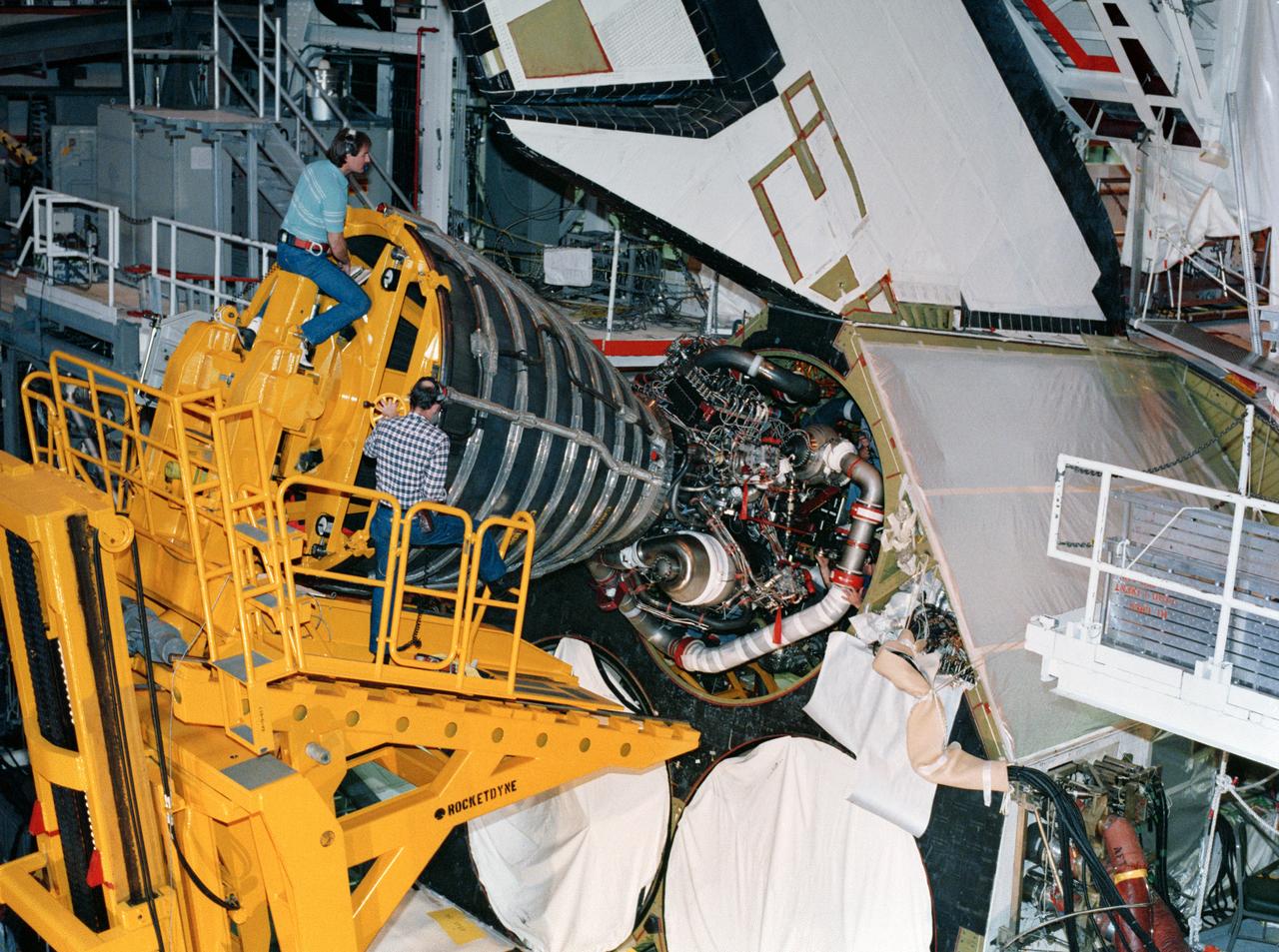
S88-29076 (10 Jan 1988) --- KSC employees work together to carefully guide a 7,000 pound main engine into the number one position in Discovery's aft compartment.  Because of the engine's weight and size, special handling equipment is needed to perform the installation.  Discovery is currently being prepared for the upcoming STS-26 mission in bay 1 of the Orbiter Processing Facility.  This engine, 2019, arrived at KSC on Jan. 6 and was installed Jan. 10.  The other two engines are scheduled to be installed later this month.  The shuttle's three main liquid fueled engines provide the main propulsion for the orbiter vehicle.  The cluster of three engines operate in parallel with the solid rocket boosters during the initial ascent.
STS-26 Discovery, OV-103, SSME (2019) installed in position number one at KSC
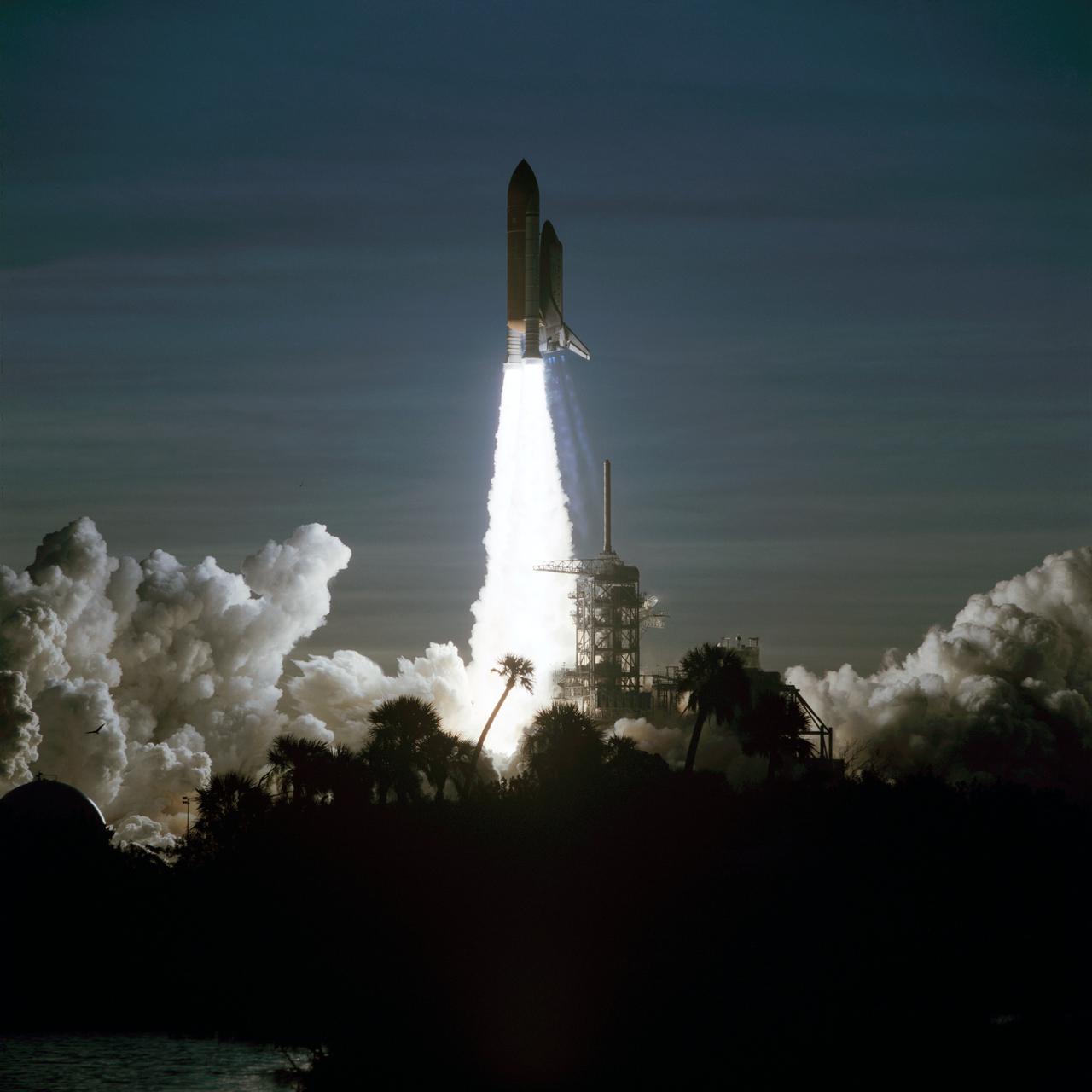
STS060-S-106 (3 Feb 1994) --- Palm trees are silhouetted in the foreground of this 70mm image as the Space Shuttle Discovery heads toward an eight-day mission in Earth orbit.  Liftoff occurred as scheduled at 7:10 a.m. (EST), February 3, 1994.  Aboard the spacecraft were astronauts Charles F. Bolden Jr., commander; Kenneth S. Reightler Jr., pilot; Franklin R. Chang-Diaz, payload commander; and N. Jan Davis and Ronald M. Sega, mission specialists, along with Russian cosmonaut Sergei K. Krikalev, also a mission specialist.
Launch of STS-60 Shuttle Discovery
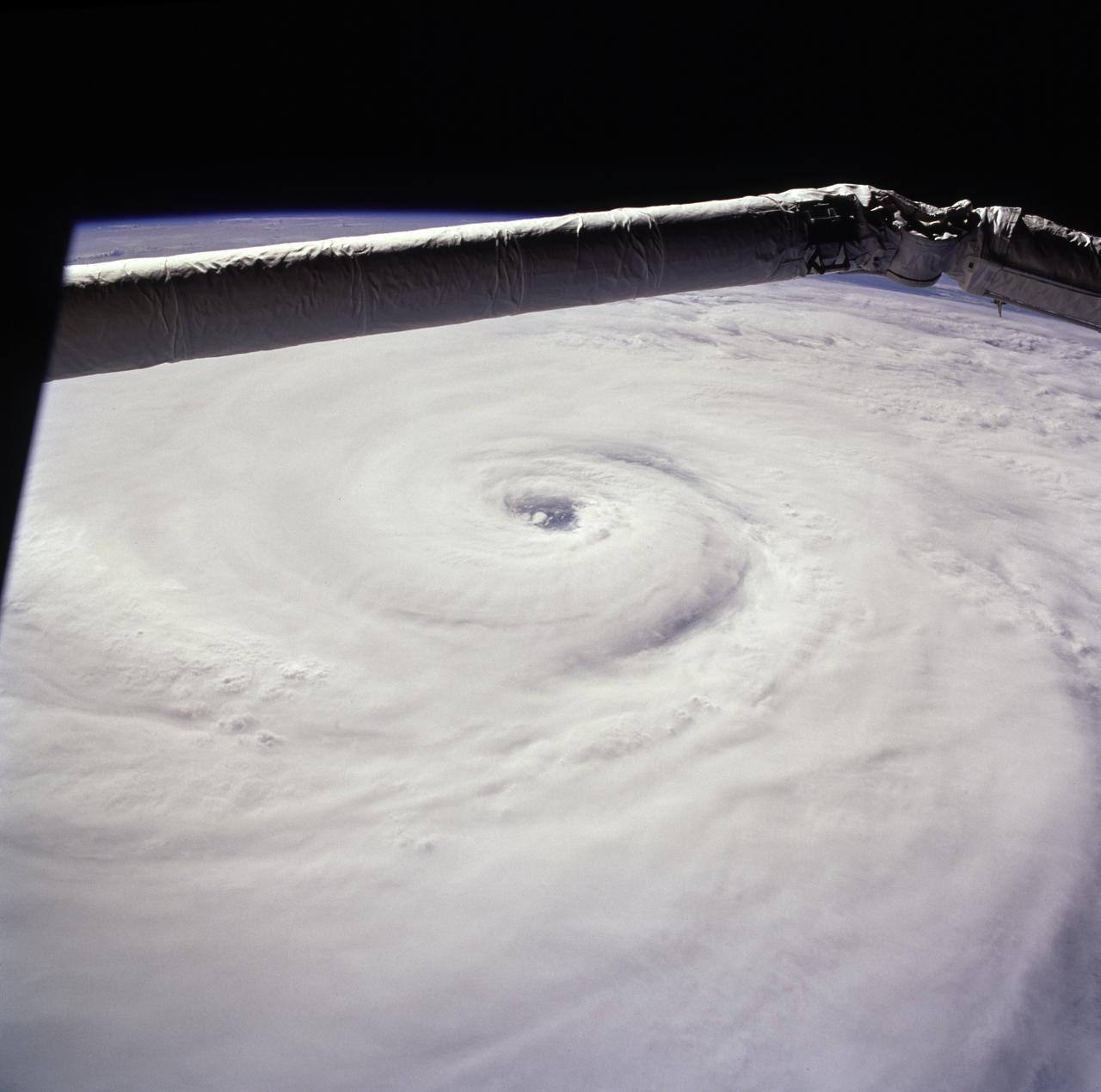
STS085-722-019 (15 August 1997) --- This view of supertyphoon Winnie was taken on August 15, 1997, as the storm swirled about 400 miles south of the southern tip of Japan.  Sustained winds were 105 knots, gusting to 130 knots.  This photo was shot on the Space Shuttle Discovery's twenty-third flight, as it glided by 170 miles above the sea surface on Orbit 123.  On one pass the Discovery flew right over the eye; the commander commented that the eye was so large that it completely filled the window.  The robotic arm crosses the top of the view.  The cloud mass associated with Winnie covered thousands of square miles as this storm grew to supertyphoon status in the previous days, and raked across the Marianas Islands.  A few days after this shot was taken, Winnie ploughed ashore on the coast of China, a bit south of the major metropolis of Shanghai, reportedly killing at least 100 people.
Earth observations taken from orbiter Discovery during STS-85 mission
51G-S-100 (17 June 1985) --- A low-angle 35mm tracking view of the Space Shuttle Discovery, its external tank and two solid rocket boosters speeding from the KSC launch facility to begin NASA STS 51-G.  The camera has captured the diamond shock effect associated with the launch phase or orbiter vehicles.  Inside the Discovery are seven crewmembers and a variety of payloads representing international interests.  Liftoff for 51-G occurred at 7:33:043 a.m. (EDT), June 17, 1985.
Launching of the Shuttle Discovery and the STS 51-G mission
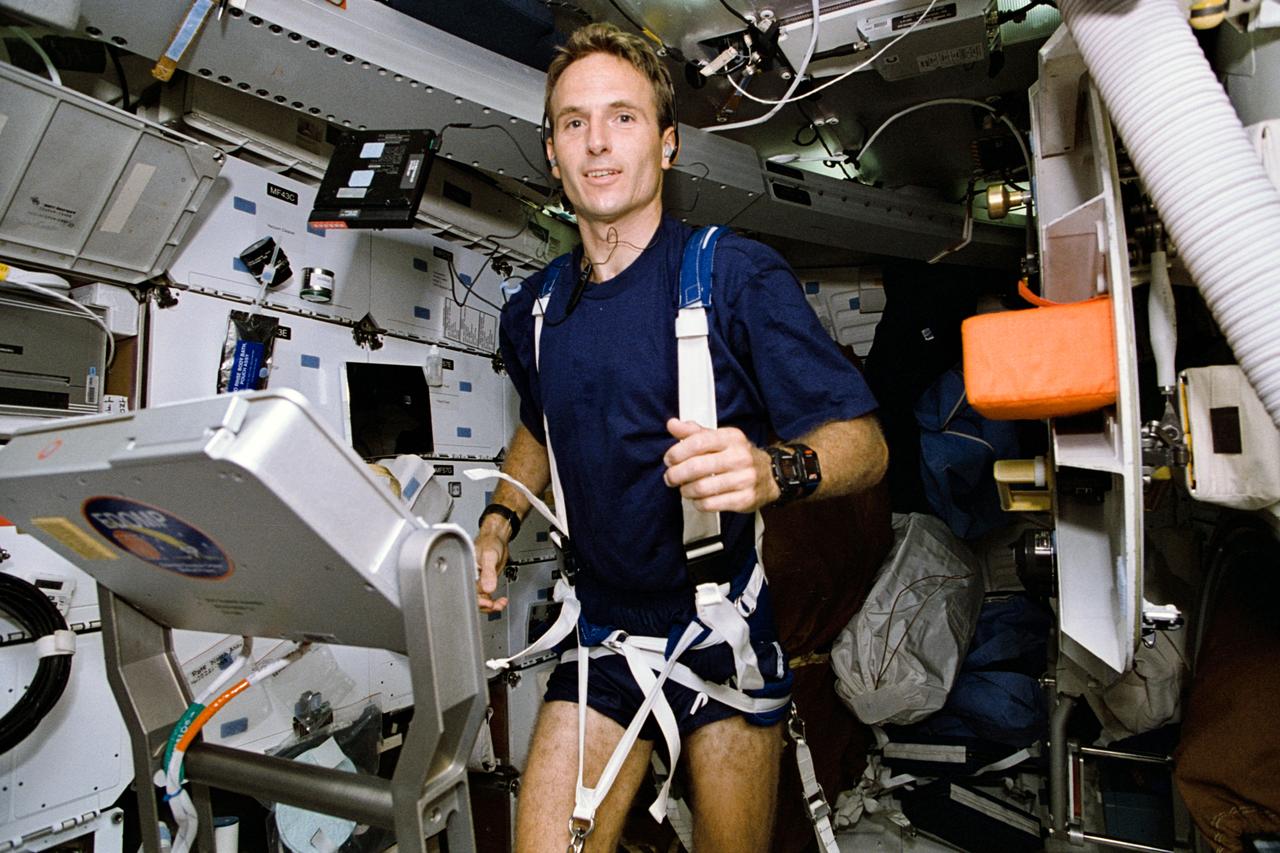
STS064-41-006 (9-20 Sept. 1994) --- Astronaut Jerry M. Linenger, STS-64 mission specialist, works out on the treadmill device on the space shuttle Discovery's middeck. "Running was a pleasure...just like being back on Earth," Linenger told a large audience of Johnson Space Center employees at the Crew Employee Presentation on Sept. 29, 1994. Linenger joined five other NASA astronauts for almost 11 days in Earth orbit aboard Discovery. Photo credit: NASA or National Aeronautics and Space Administration
Astronaut Jerry Linenger works out on treadmill device on middeck
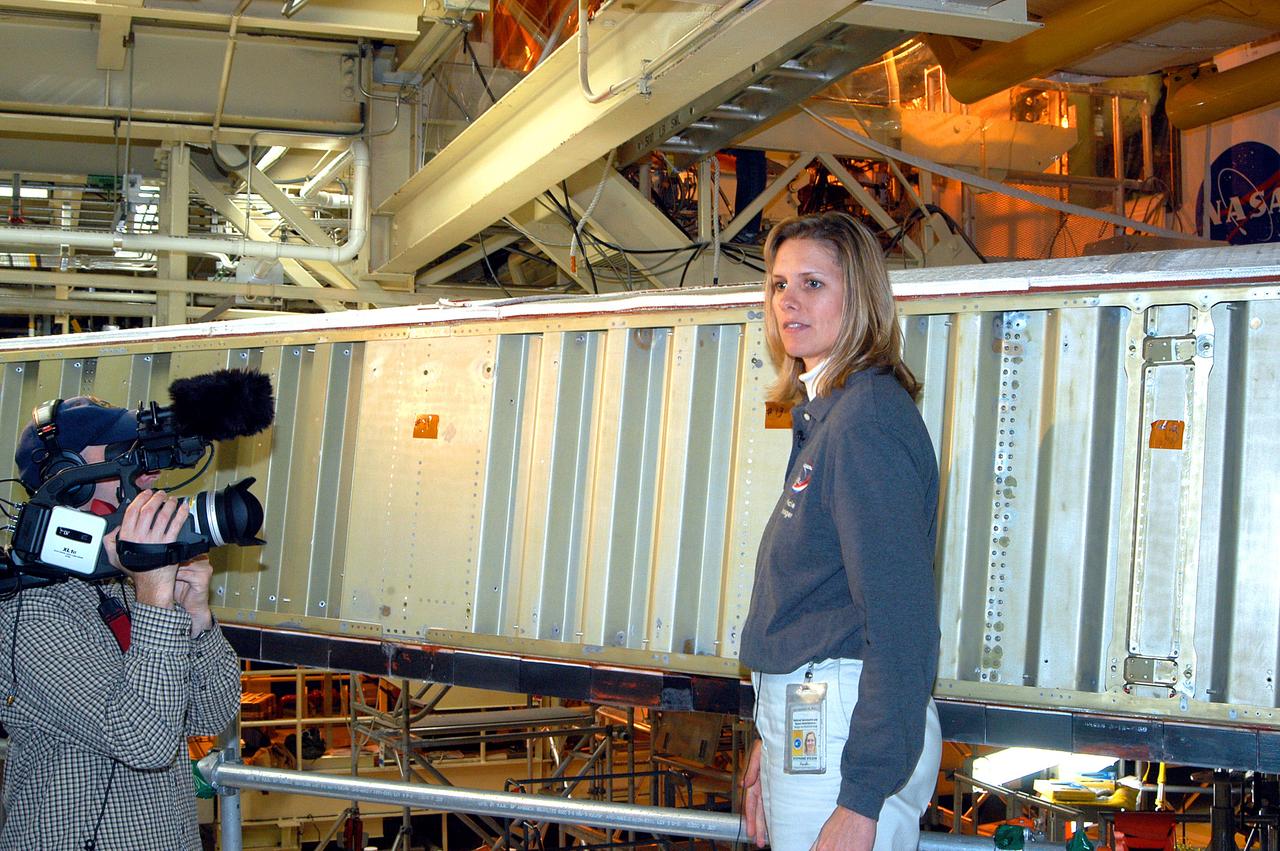
KENNEDY SPACE CENTER, FLA. -  In the Orbiter Processing Facility, Stephanie Stilson, NASA vehicle manager for Discovery, stands in front of a leading edge on the wing of Discovery.  She is being filmed for a special feature on the KSC Web about the recent Orbiter Major Modification period on Discovery, which included inspection, modifications and reservicing of most systems onboard, plus installation of a Multifunction Electronic Display Subsystem (MEDS) - a state-of-the-art “glass cockpit.”  The orbiter is now being prepared for eventual launch on a future mission.
KENNEDY SPACE CENTER, FLA. - In the Orbiter Processing Facility, Stephanie Stilson, NASA vehicle manager for Discovery, stands in front of a leading edge on the wing of Discovery. She is being filmed for a special feature on the KSC Web about the recent Orbiter Major Modification period on Discovery, which included inspection, modifications and reservicing of most systems onboard, plus installation of a Multifunction Electronic Display Subsystem (MEDS) - a state-of-the-art “glass cockpit.” The orbiter is now being prepared for eventual launch on a future mission.
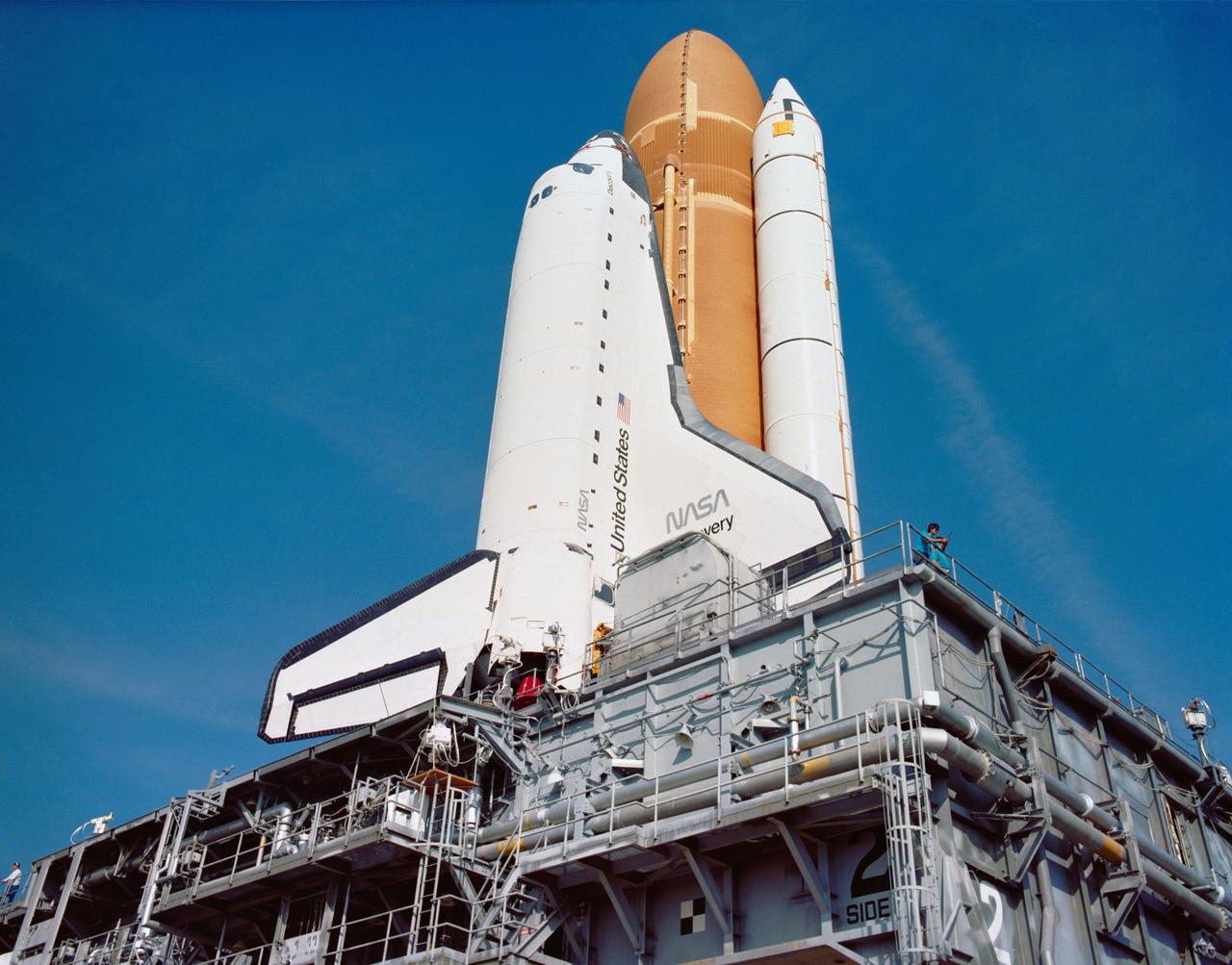
S89-28107 (3 Feb 1989) --- A low angle view of the Space Shuttle Discovery, atop a mobile launch platform, during its slow move to Kennedy Space Center's Launch Pad 39-B on Feb. 3, l989.  It rolled through the doors of the huge vehicle assembly building (VAB) at 6 a.m., hours ago as the blue sky testifies.  The trip to the pad takes approximately 5 and 1/2 hours. Onboard the spacecraft in  mid-March for a five-day mission, on which will be deployed a third tracking and data relay satellite (TDRS-D), will be Astronauts Michael L. Coats, John E. Blaha, James F. Buchli, James P. Bagian and Robert C. Springer.
STS-29 Discovery, Orbiter Vehicle (OV) 103, roll out to KSC LC Pad 39B
S91-44810 (12 Aug 1991) --- The Space Shuttle Discovery is rolled to launch pad 39A atop the mobile launcher platform and crawler/transporter.  Already at the pad and awaiting installation in the orbiter cargo bay is the Upper Atmosphere Research Satellite (UARS), the primary payload which Discovery will carry into space on NASA?s STS-48 mission.  A crew of five astronauts will be on board when Discovery lifts off in September. (KSC photo id: KSC-91PC-1474)
STS-48 Discovery, Orbiter Vehicle (OV) 103, rolls out to KSC LC Pad 39A
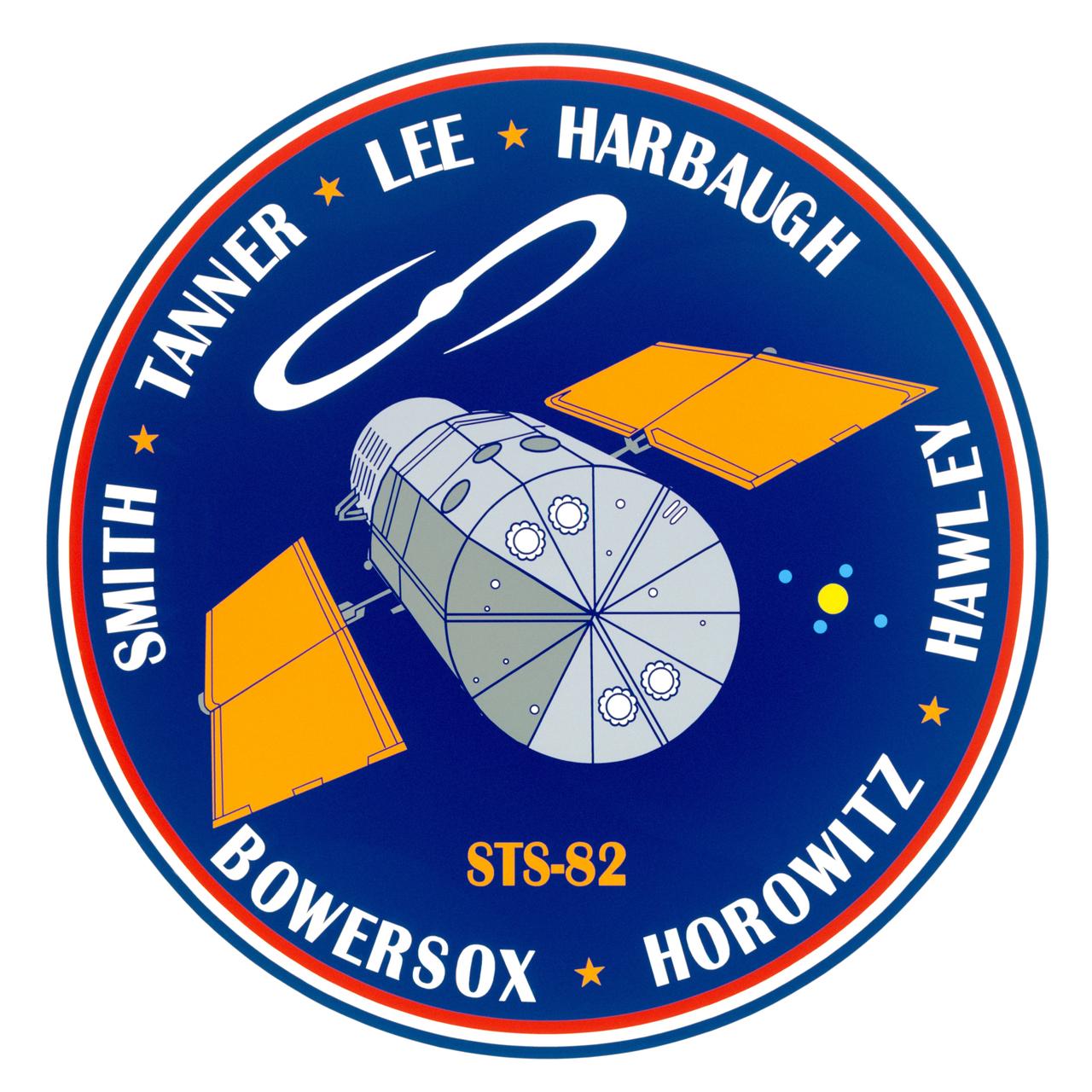
STS082-S-001 (August 1996) --- STS-82 is the second mission to service the Hubble Space Telescope (HST). The central feature of the patch is HST as the crew members will see it through the space shuttle Discovery?s overhead windows when the orbiter approaches for rendezvous, retrieval and a subsequent series of spacewalks to perform servicing tasks. The telescope is pointing toward deep space, observing the cosmos. The spiral galaxy symbolizes one of HST?s important scientific missions, to accurately determine the cosmic distance scale. To the right of the telescope is a cross-like structure known as a gravitational lens, one of the numerous fundamental discoveries made using HST imagery. The names of the crew members are arranged around the perimeter of the patch with the extravehicular activity?s (EVA) participating crew members placed in the upper semicircle and the orbiter crew in the lower one.    The NASA insignia design for space shuttle flights is reserved for use by the astronauts and for other official use as the NASA Administrator may authorize. Public availability has been approved only in the forms of illustrations by the various news media. When and if there is any change in this policy, which is not anticipated, the change will be publicly announced. Photo credit: NASA
STS-82 Discovery, Orbiter Vehicle (OV-103), crew insignia
STS-41 Discovery, Orbiter Vehicle (OV) 103, with nose landing gear (NLG) and main landing gear (MLG) deployed, glides over concrete runway 22 at Edwards Air Force Base (EAFB), California, prior to touchdown.
STS-41 Discovery, OV-103, glides over concrete runway 22 at EAFB, California
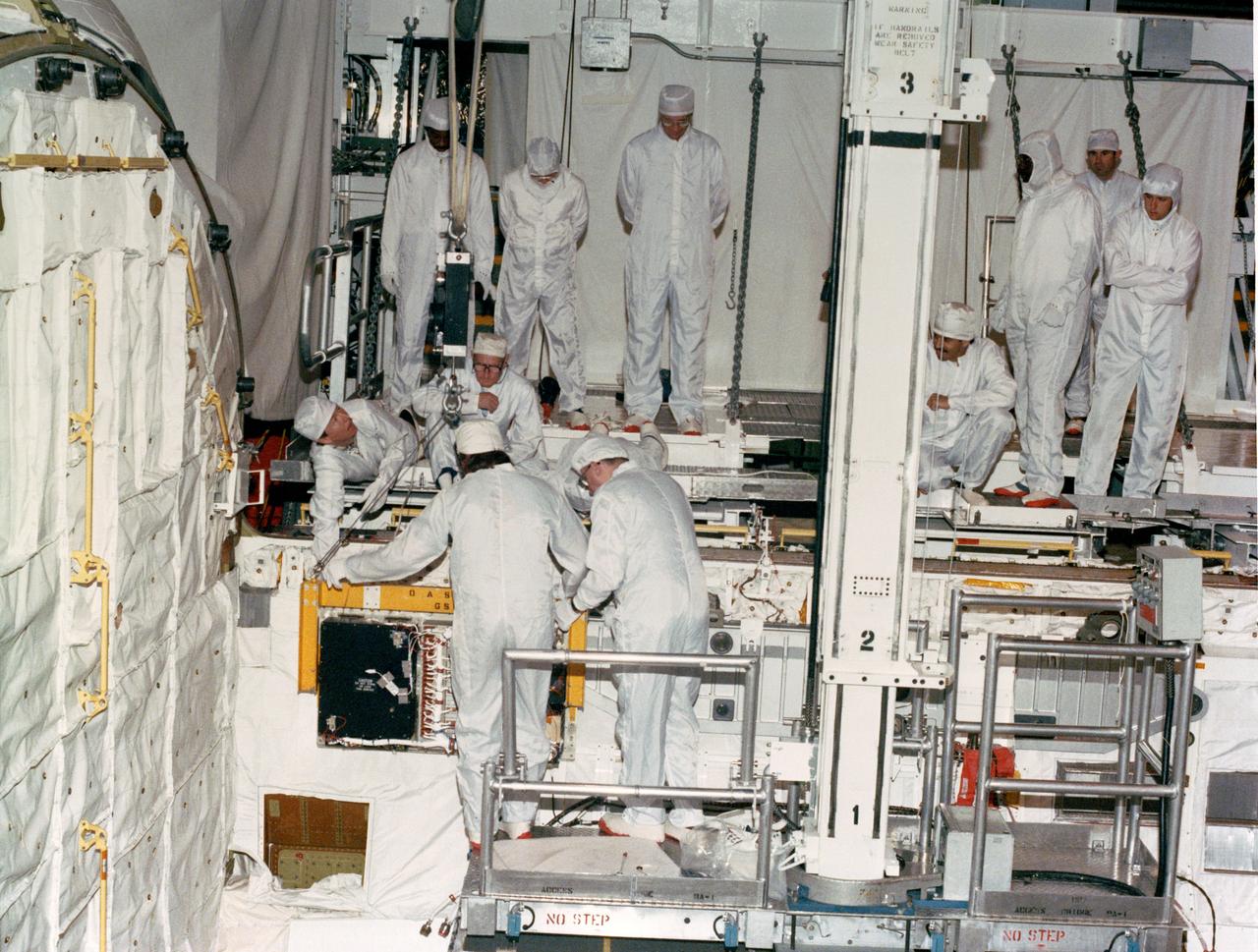
In the Vehicle Assembly Building, Jim Landy, NDE specialist, sets up a flight crew lockers for flash thermography. He is screening the lockers for hidden damage underneath dings and dents that might occur during handling.
Discovery Orbiter Major Modifications
STS-31 Discovery, Orbiter Vehicle (OV) 103, lifts off from Kennedy Space Center (KSC) Launch Complex (LC) 39 Pad B. In the foreground STS-35 Columbia, OV-102, is visible on launch pad 39A. This event marked the first time since January 1986 that there was an orbiter on each pad. LC 39 pads are separated by 1.6 miles. View provided by KSC with alternate number KSC-90PC-610.
STS-31 Discovery, OV-103, liftoff from KSC
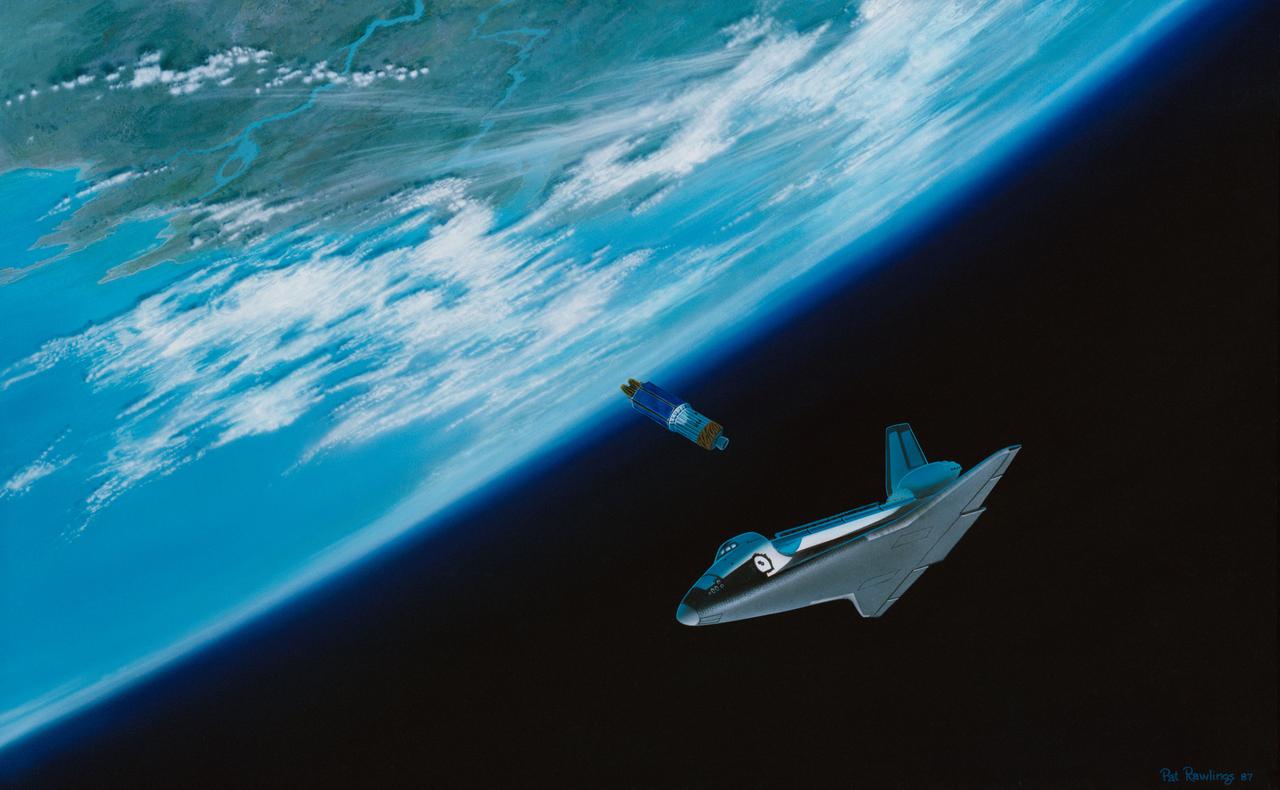
STS-26 Discovery, Orbiter Vehicle (OV) 103, artwork depicts tracking and data relay satellite C (TDRS-C) deployment. OV-103 orbits above Earth in bottom-to-sun attitude, moments after TDRS-C's release into space. TDRS-C is seen just below open payload bay (PLB). Artwork was done by Pat Rawlings of Eagle Engineering.
STS-26 Discovery, OV-103, artwork showing TDRS-C deployment
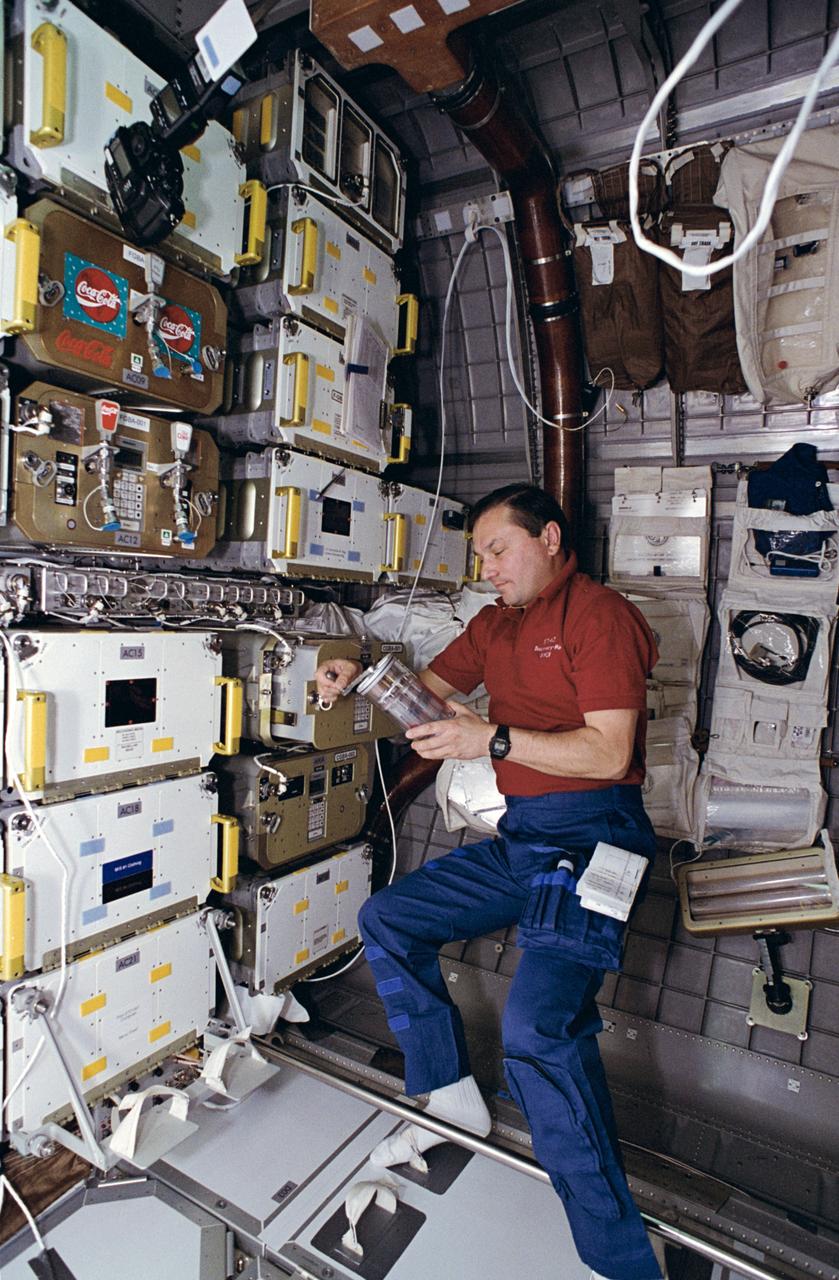
STS063-68-018 (3-11 Feb 1995) --- Russian cosmonaut Vladimir G. Titov, mission specialist, handles vials of samples for the Commercial Generic Bioprocessing Apparatus (CGBA) experiment in SpaceHab 3 Module onboard the Earth-orbiting Space Shuttle Discovery.  Titov joined five NASA astronauts for eight days of research in Earth-orbit.
Russian cosmonaut Vladimir Titov works with samples for the CGBA
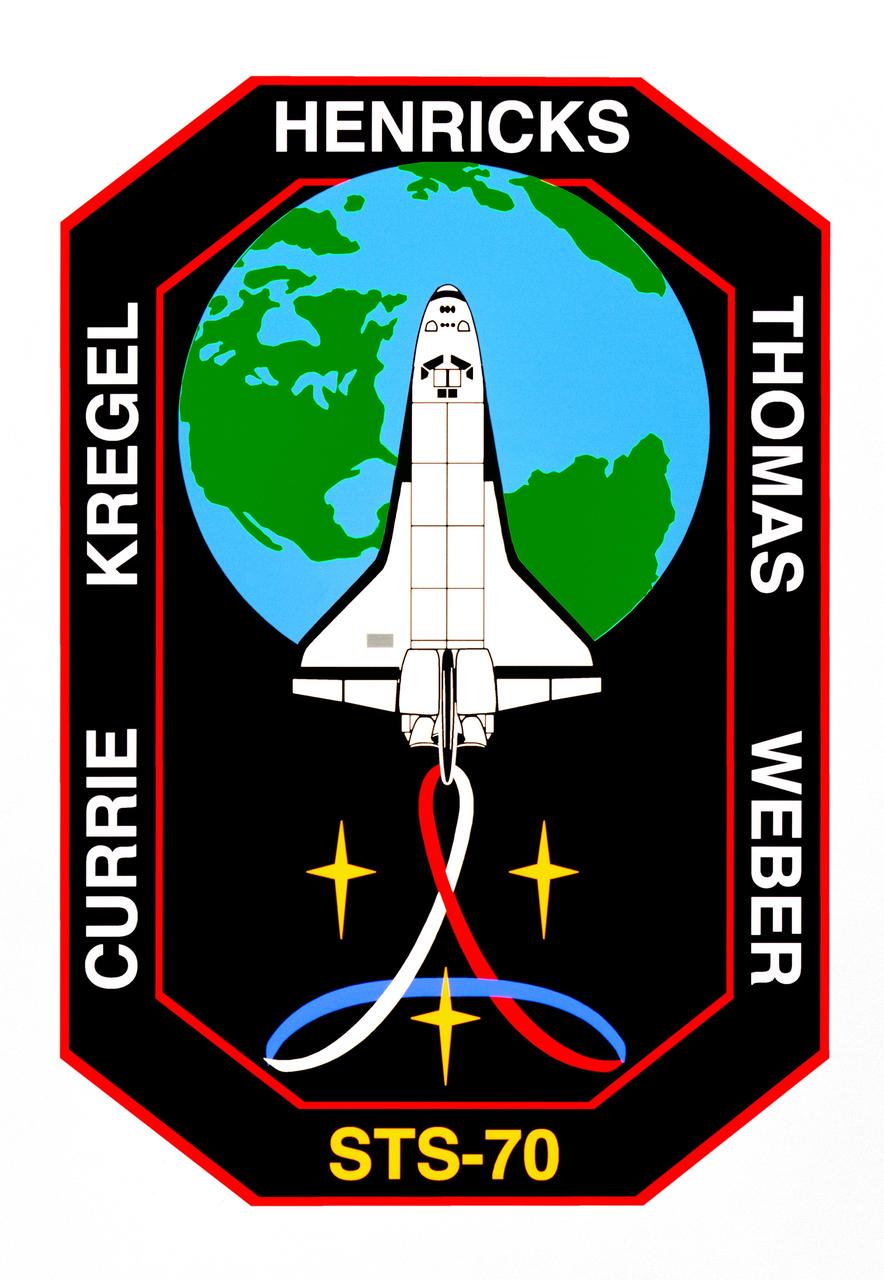
STS070-S-001 (March 1995) --- Designed by the crew members, the STS-70 crew patch depicts the space shuttle Discovery orbiting Earth in the vast blackness of space. The primary mission of deploying a NASA Tracking and Data Relay Satellite (TDRS) is depicted by three gold stars. They represent the triad composed of spacecraft transmitting data to Earth through the Tracking and Data Relay Satellite System (TDRSS). The stylized red, white and blue ribbon represents the American goal of linking space exploration to the advancement of all humankind. Surnames of the five astronaut crew members are spaced around the periphery of the patch.    The NASA insignia design for space shuttle flights is reserved for use by the astronauts and for other official use as the NASA Administrator may authorize. Public availability has been approved only in the forms of illustrations by the various news media. When and if there is any change in this policy, which is not anticipated, the change will be publicly announced. Photo credit: NASA
STS-70 Crew Insignia
STS64-S-094 (20 Sept. 1994) --- The space shuttle Discovery, with a crew of six NASA astronauts aboard, touches down on Runway 04 at Edwards Air Force Base (EAFB), completing a 10-day, 22-hour and 50-minute mission.  Following a de-orbit engine firing at 1:14 p.m. (PDT), Sept. 20, 1994. Touchdown was at 2:12:59 p.m., and the nose wheel touched down at 2:13:03 p.m., with wheel stop at 2:13:52 p.m. Bad weather in Florida called for an "eleventh hour" shift to the California landing site. Onboard for the flight, whose mission was to study Earth's atmosphere and to test tools and procedures for the International Space Station, were astronauts Richard N. Richards, L. Blaine Hammond Jr., Mark C. Lee, Carl J. Meade, Susan J. Helms and Jerry M. Linenger. Photo credit: NASA or National Aeronautics and Space Administration
STS-64 landing view
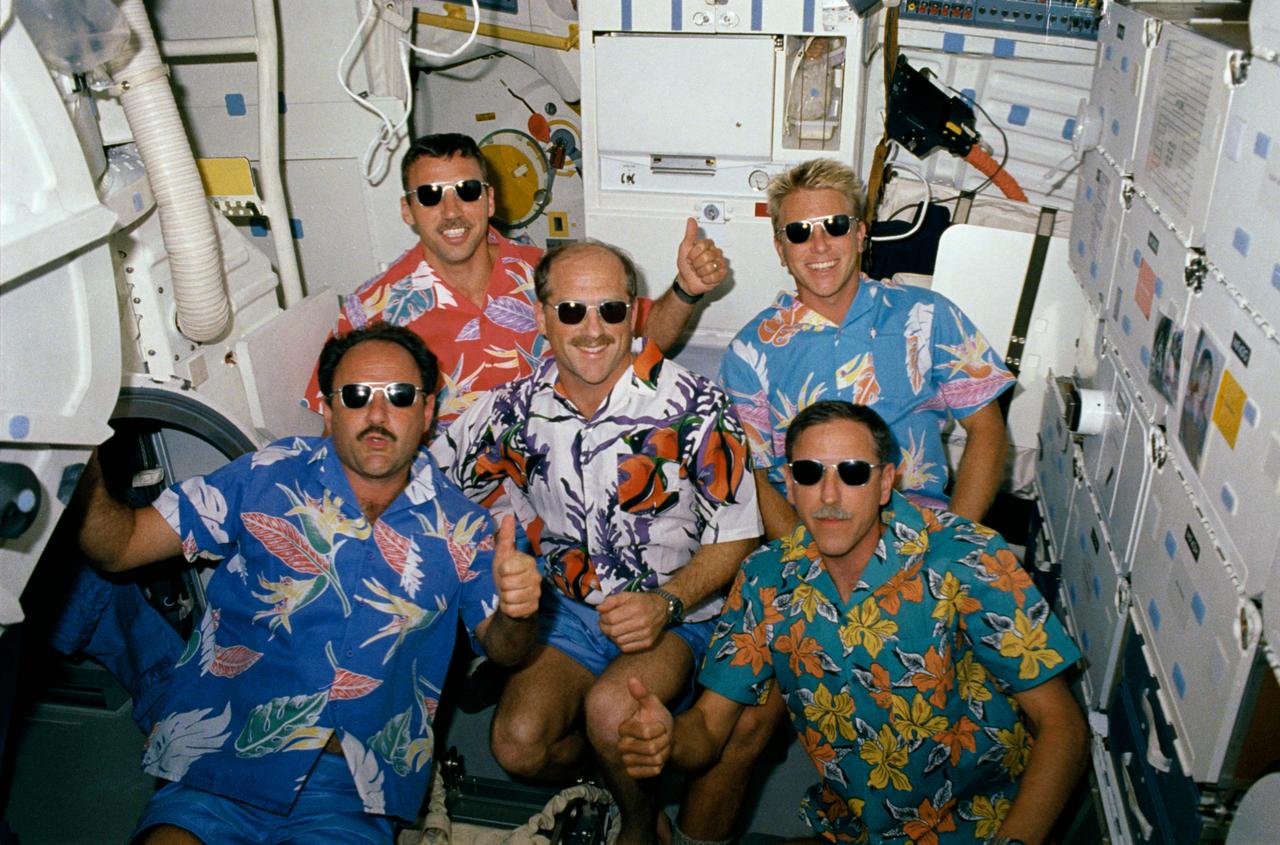
STS026-09-008 (3 Oct 1988) --- STS-26 crewmembers wear Hawaiian attire (brightly colored shirts with bold prints) and sunglasses while giving the "thumbs up" signal as they pay tribute to the Hawaii tracking station during an unscheduled television (TV) downlink. On Discovery's, Orbiter Vehicle (OV) 103's, middeck are (left to right) Mission Specialist (MS) John M. Lounge, holding onto open airlock hatch, MS David C. Hilmers, wearing red shirt, Commander Frederick H. Hauck, wearing white shirt and positioned in center of crew, MS George D. Nelson, and Pilot Richard O. Covey (lower right corner of the frame). The shirts were given to the crewmembers by the Kennedy Space Center (KSC) Loud and Proud Team.
STS-26 crewmembers in Hawaiian shirts and sunglasses pose for group portrait
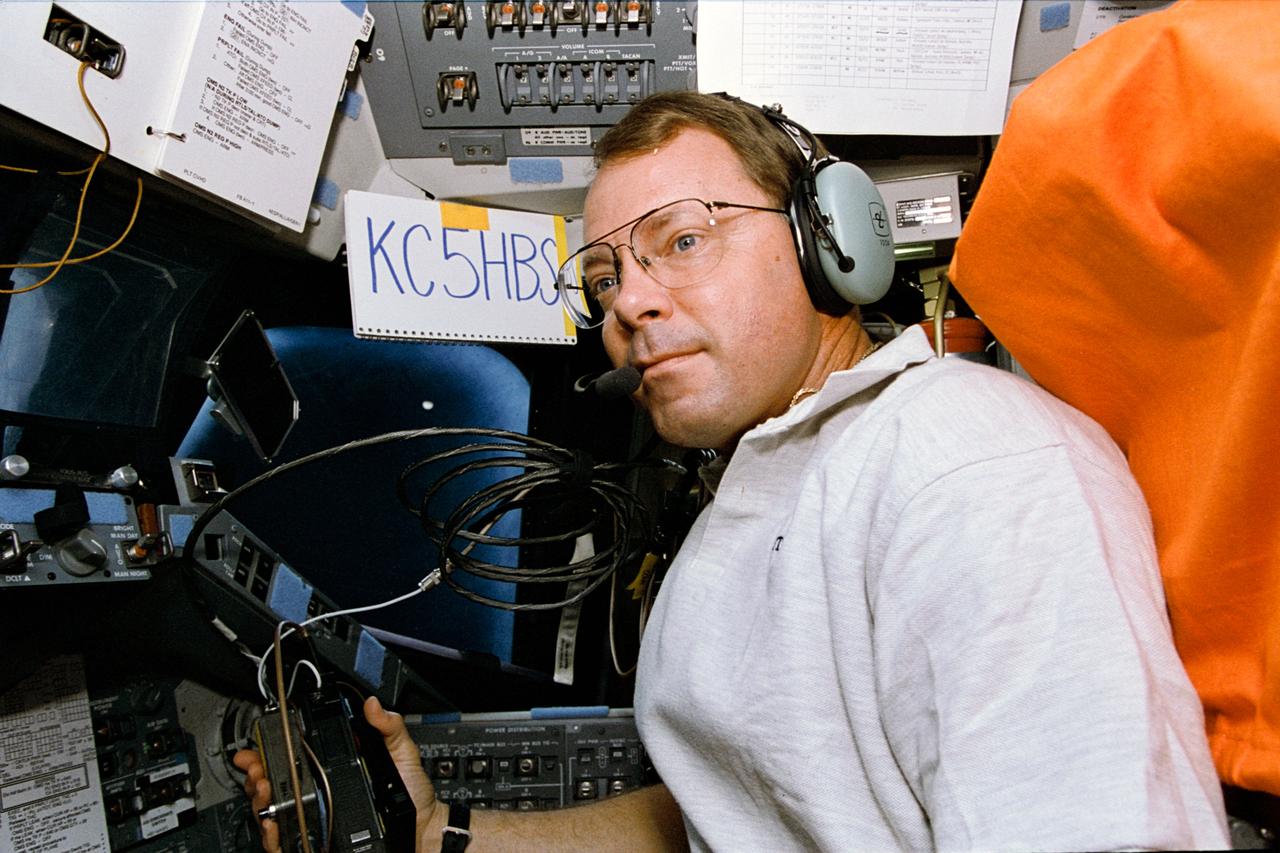
STS064-04-009 (9-20 Sept. 1994) --- Astronaut L. Blaine Hammond, STS-64 pilot, talks to students on Earth via the Shuttle Amateur Radio Experiment (SAREX) on the space shuttle Discovery's flight deck. The recently licensed "Ham" operator and several other crew members throughout the mission were connected with schools around the world with the aid of a number of amateur radio operators. Hammond joined five other NASA astronauts for almost 11 days in Earth orbit aboard Discovery. Photo credit: NASA or National Aeronautics and Space Administration
Astronaut Blaine Hammond talks to students on Earth via SAREX
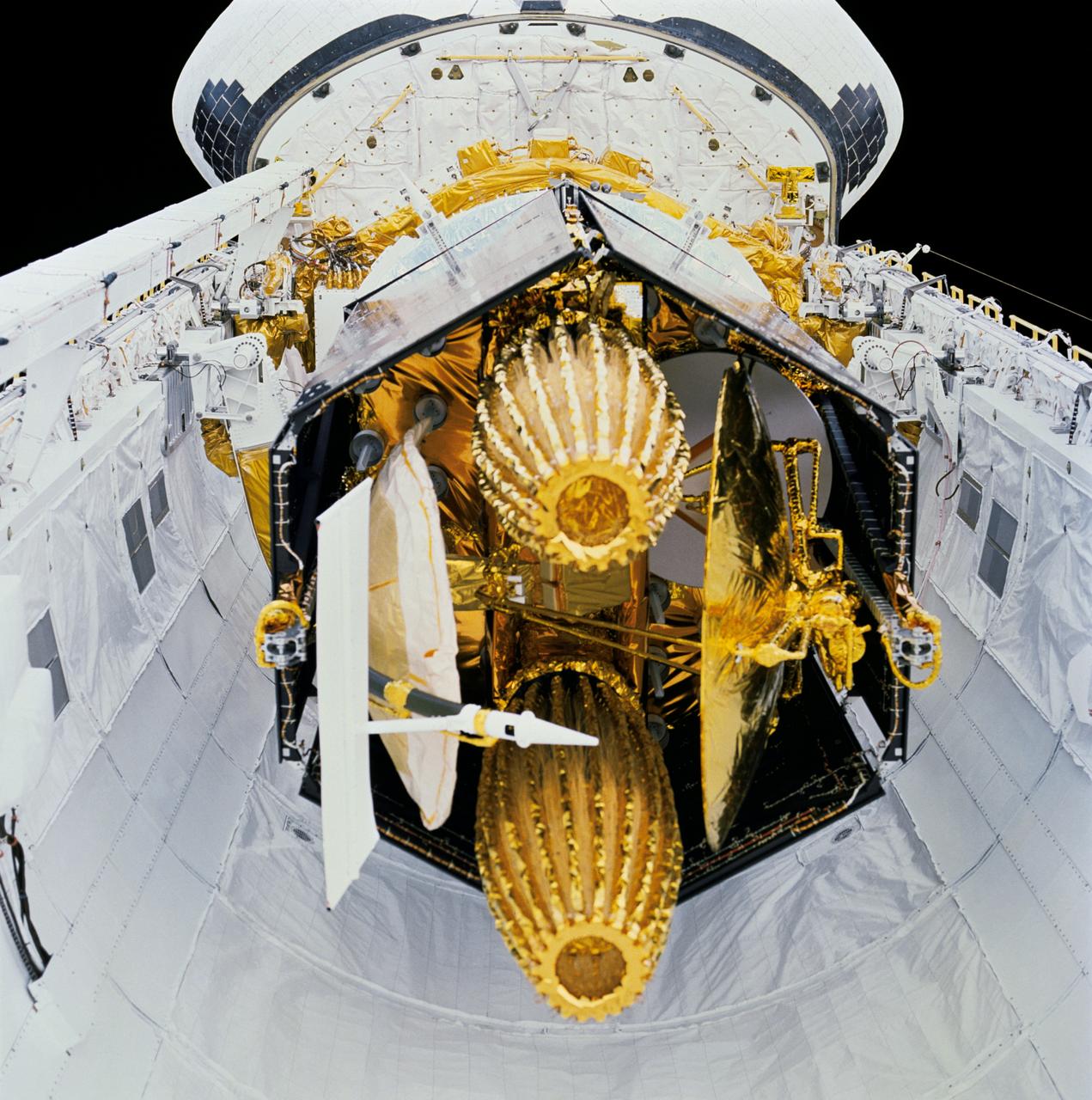
STS029-71-000AE (13-18 March 1989) --- STS-29 onboard view shows Space Shuttle Discovery's payload bay with tracking and data relay satellite D (TDRS-D) in stowed, pre-deployment position. In this head-on view, TDRS-D stowed components including single access #1 and #2, solar cell panels, SGL, S-Band omni antenna, and C-Band antenna are visible. TDRS-D rests in airborne support equipment (ASE) forward cradle and aft frame tilt actuator (AFTA). Discovery's aft bulkhead and orbital maneuvering system (OMS) pods are visible in the background.
STS-29 tracking and data relay satellite (TDRS) in OV-103's payload bay (PLB)
51A-104-049 (14 Nov. 1984) --- Astronaut Dale A. Gardner, having just completed the major portion of his second extravehicular activity (EVA) period in three days aboard the Earth-orbiting Discovery, holds up a for sale sign. Astronaut Joseph P. Allen IV, who also participated in the two EVA, is reflected in Gardner's helmet visor. A portion of each of two recovered satellites is in lower right corner, with Westar nearer Discovery's aft. Dr. Allen, standing on the mobile foot restraint, connected to the remote manipulator system. Photo credit: NASA
Astronaut Dale Gardner holds up for sale sign after EVA
S88-37764 (18 April 1988) --- OASIS, instrumentation which will record the environment experienced by Discovery during the STS-26 Space Shuttle mission, is lowered into position for attachment to the orbiter's aft port sill.  Instrumentation sensors in the payload bay which are connected to the tape recorder module will document a variety of environmental measurements during various phases of the flight including temperature, pressure, vibration, sounds, acceleration, stress, and strain.  OASIS will also record data during the Flight Readiness Firing.  NASA is flying OASIS aboard Discovery in support of the Inertial Upper Stage (IUS) program office of the Air Force Space Division.  The system was developed by Lockheed under a NASA contract, funded by the Air Force.
STS-26 Discovery, OV-103, OASIS equipment is mounted in payload bay (PLB)
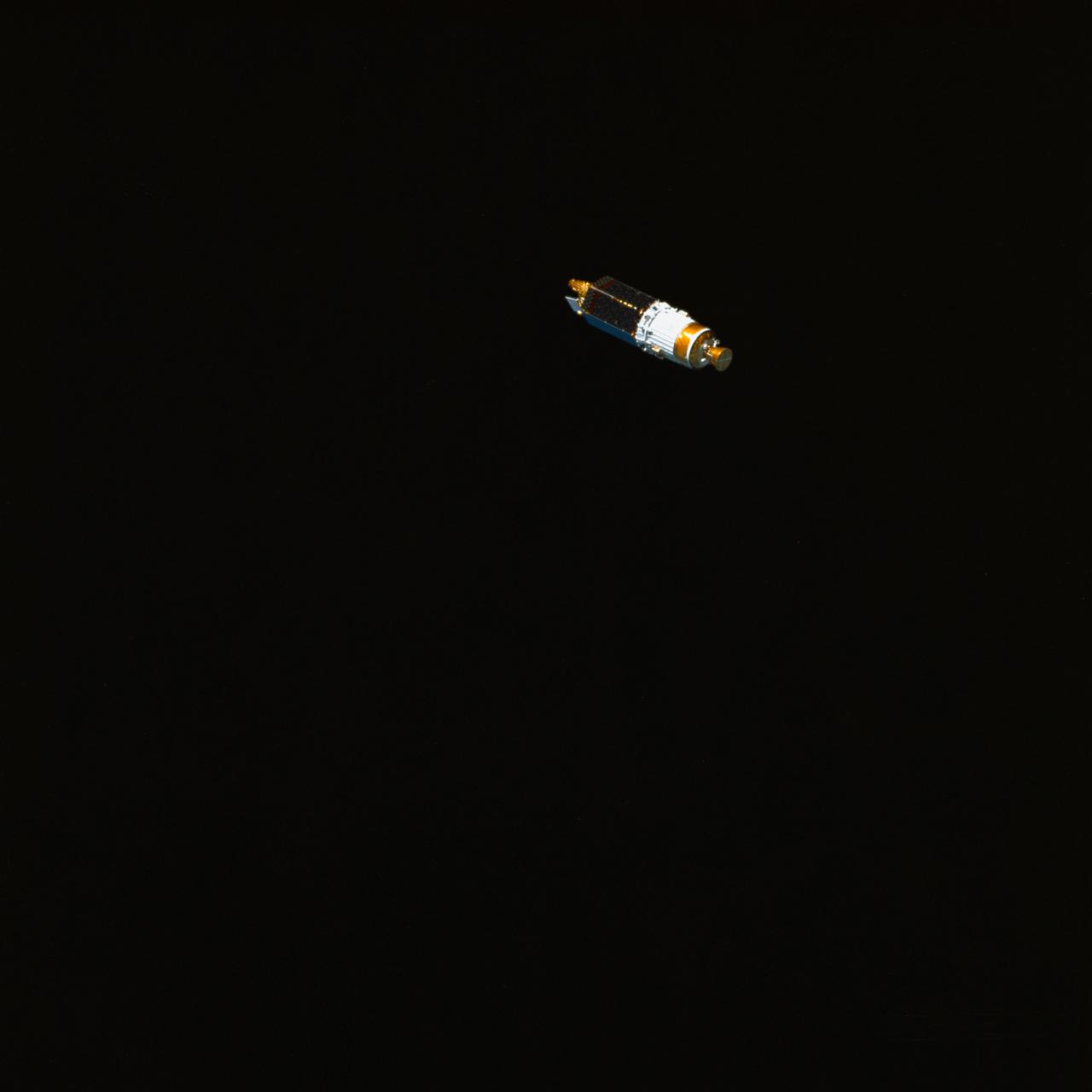
STS029-78-019 (13 March 1989) --- Headed on its way to a much higher orbit is another Tracking and Data Relay Satellite (TDRS-D), as photographed with a 70mm camera from inside Discovery's cabin.  Moments earlier, the STS-29 crewmembers released the cylindrical form into space from Discovery's cargo bay.  When at its final destination high above Earth, TDRS-D will no longer maintain its cylindrical form, having transformed into an operational satellite with antenna spanned out in various directions and its Interim Upper Stage (IUS), covered with gold foil and forward-most in this frame, discarded.
STS-29 IUS with TDRS-D after deployment from Discovery, OV-103
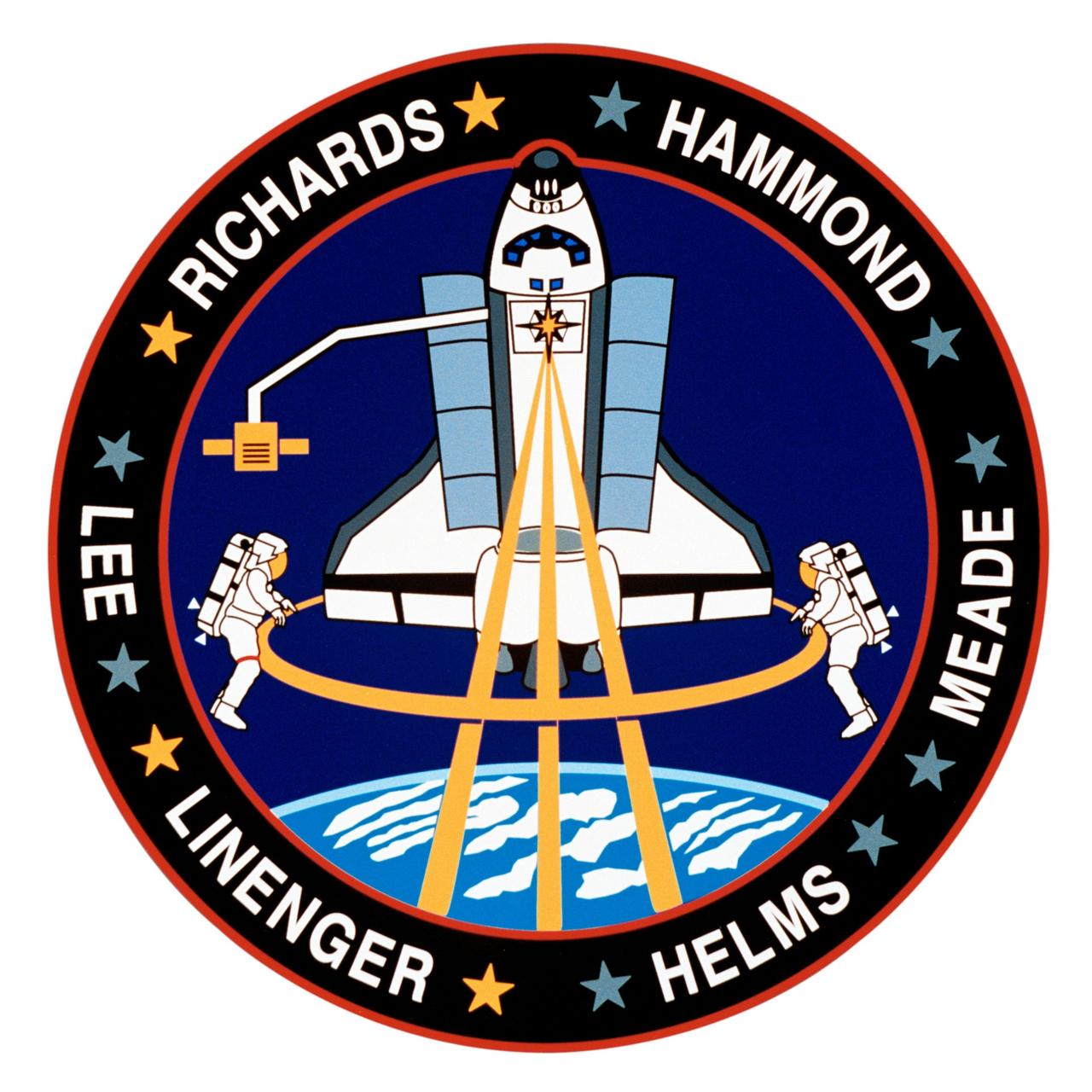
STS064-S-001 (July 1994) --- The patch depicts the space shuttle Discovery in a payload-bay-to-Earth attitude with its primary payload, Lidar In-Space Technology Experiment (LITE-1) operating in support of Mission to Planet Earth. LITE-1 is a lidar (light detection and ranging) system that uses a three-wavelength laser, symbolized by the three gold rays emanating from the star in the payload bay that form part of the astronaut symbol. The major objective of this first flight of LITE-1 is to validate its design and operating characteristics by gathering data about the Earth's troposphere and stratosphere, represented by the clouds and dual-colored Earth limb. A secondary payload on STS-64 is the free-flier SPARTAN-201 satellite shown on the Remote Manipulator System (RMS) arm post-retrieval. The objective of SPARTAN-201 is to investigate the physics of the solar wind and complement data being obtained from the ULYSSES satellite launched on STS-41. The RMS will also operate another secondary payload, Shuttle Plume Impingement Flight Experiment (SPIFEX), which will assess the plume effects from the Orbiter's Reaction Control System thrusters. Additionally, STS-64 will test a new extravehicular activity (EVA) maneuvering device, Simplified Aid for EVA Rescue (SAFER), represented symbolically by the two small nozzles on the backpacks of the two untethered EVA crew men. The names of the crew members encircle the patch: astronauts Richard N. Richards, commander; L. Blaine Hammond Jr., pilot; Jerry M. Linenger; Susan J. Helms, Carl J. Meade and Mark C. Lee, all mission specialists. The gold or silver stars by each name represent that person's parent service.    The NASA insignia design for space shuttle flights is reserved for use by the astronauts and for other official use as the NASA Administrator may authorize. Public availability has been approved only in the forms of illustrations by the various news media. When and if there is any change in this policy, which is not anticipated, the change will be publicly announced. Photo credit: NASA
STS-64 Crew insignia
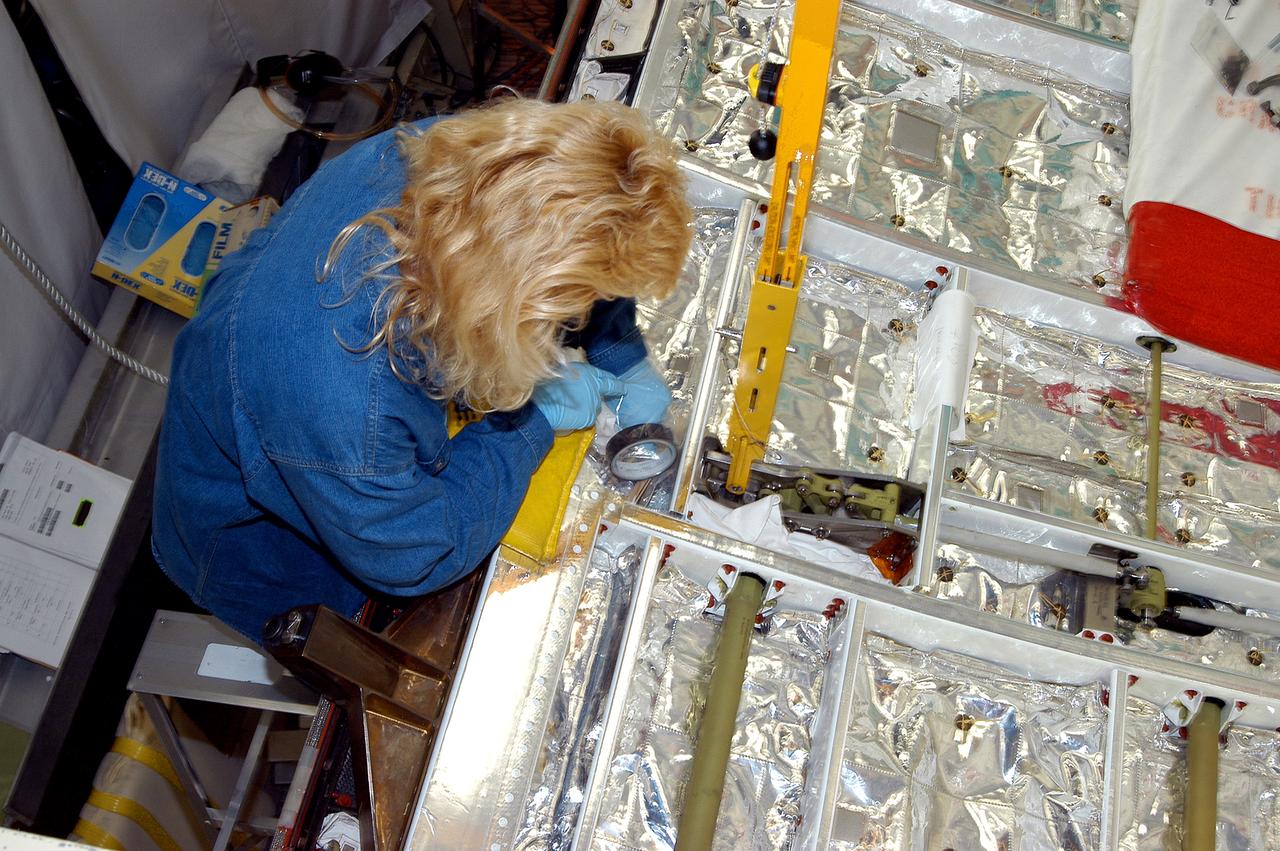
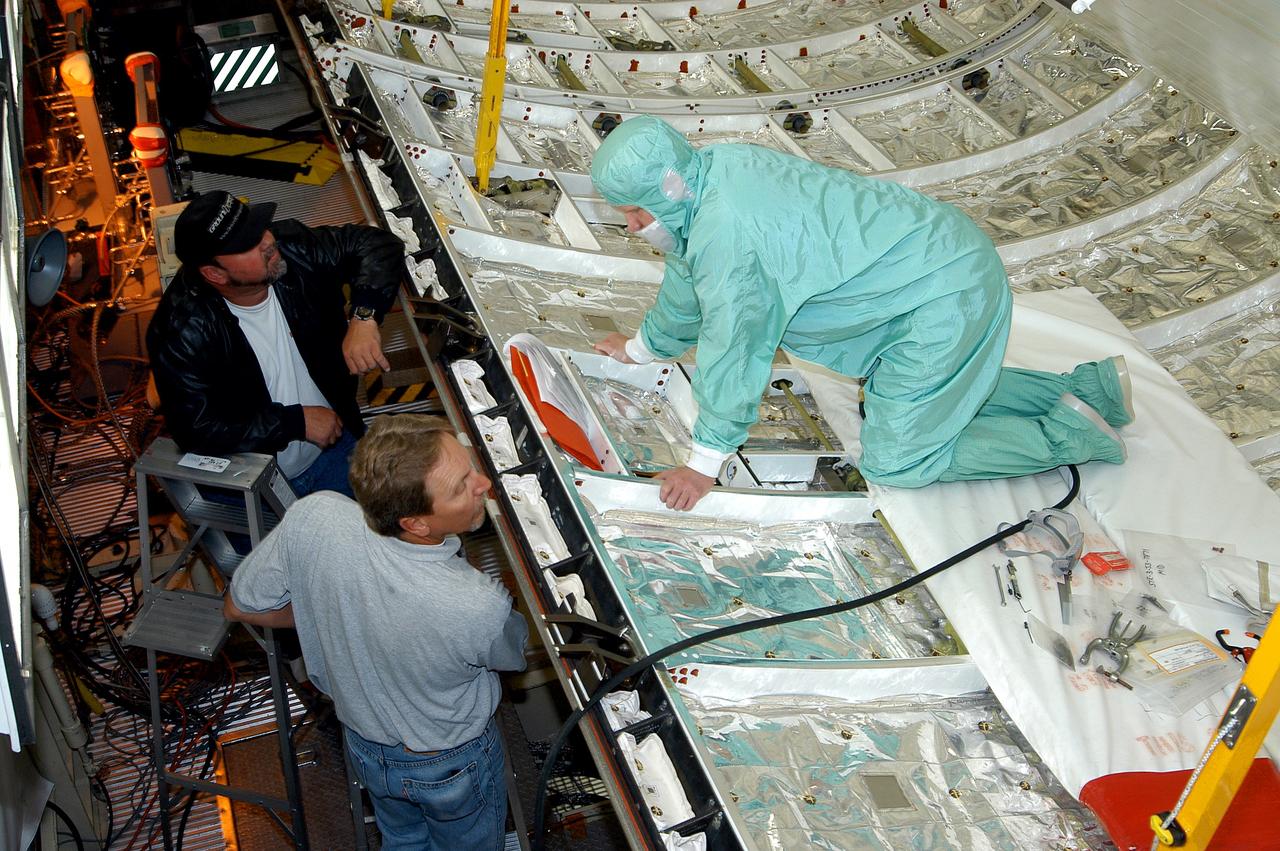
KENNEDY SPACE CENTER, FLA. -  A worker in the Orbiter Processing Facility checks part of the payload bay on Discovery.  The orbiter recently underwent an Orbiter Major Modification period, which included inspection, modifications and reservicing of most systems onboard. The work on Discovery also included the installation of a Multifunction Electronic Display Subsystem (MEDS) - a state-of-the-art “glass cockpit.”  The orbiter is now being prepared for eventual launch on a future mission.
KENNEDY SPACE CENTER, FLA. - A worker in the Orbiter Processing Facility checks part of the payload bay on Discovery. The orbiter recently underwent an Orbiter Major Modification period, which included inspection, modifications and reservicing of most systems onboard. The work on Discovery also included the installation of a Multifunction Electronic Display Subsystem (MEDS) - a state-of-the-art “glass cockpit.” The orbiter is now being prepared for eventual launch on a future mission.
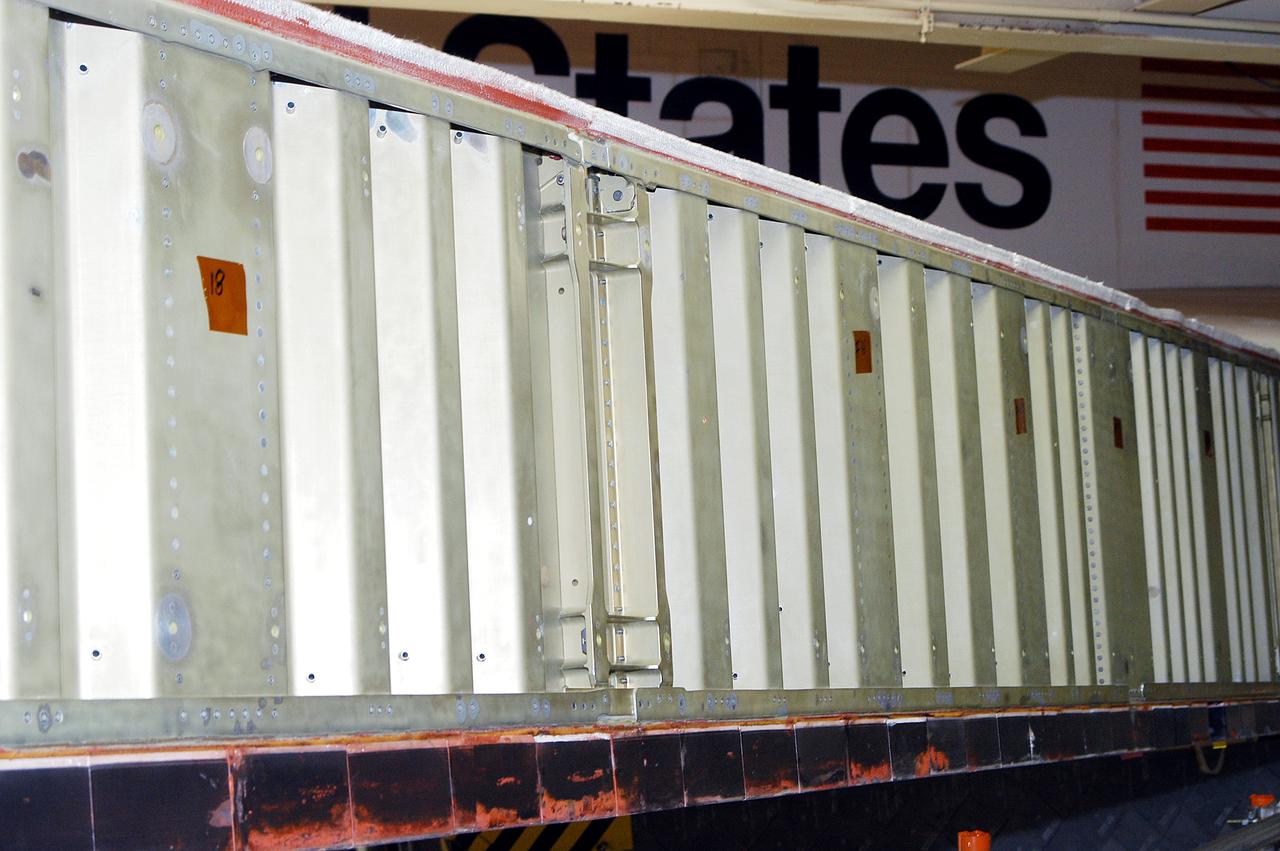
KENNEDY SPACE CENTER, FLA. -  This is the leading edge of the wing of Discovery, which is in the Orbiter Processing Facility.   The orbiter recently underwent an Orbiter Major Modification period, which included inspection, modifications and reservicing of most systems onboard. The work on Discovery also included the installation of a Multifunction Electronic Display Subsystem (MEDS) - a state-of-the-art “glass cockpit.”  The orbiter is now being prepared for eventual launch on a future mission.
KENNEDY SPACE CENTER, FLA. - This is the leading edge of the wing of Discovery, which is in the Orbiter Processing Facility. The orbiter recently underwent an Orbiter Major Modification period, which included inspection, modifications and reservicing of most systems onboard. The work on Discovery also included the installation of a Multifunction Electronic Display Subsystem (MEDS) - a state-of-the-art “glass cockpit.” The orbiter is now being prepared for eventual launch on a future mission.
KENNEDY SPACE CENTER, FLA. -  In the Orbiter Processing Facility, KSC employee Chris Moore repairs tile on the forward area of the orbiter Discovery. The vehicle has undergone Orbiter Major Modifications in the past year, which includes tile check and repair. The tiles are part of the Orbiter Thermal Protection System, thermal shields to protect against temperatures as high as 3,000° Fahrenheit, which are produced during descent for landing. Discovery is scheduled to fly on mission STS-121 to the International Space Station.
KENNEDY SPACE CENTER, FLA. - In the Orbiter Processing Facility, KSC employee Chris Moore repairs tile on the forward area of the orbiter Discovery. The vehicle has undergone Orbiter Major Modifications in the past year, which includes tile check and repair. The tiles are part of the Orbiter Thermal Protection System, thermal shields to protect against temperatures as high as 3,000° Fahrenheit, which are produced during descent for landing. Discovery is scheduled to fly on mission STS-121 to the International Space Station.
KENNEDY SPACE CENTER, FLA. -  A worker in the Orbiter Processing Facility checks part of the payload bay on Discovery.  The orbiter recently underwent an Orbiter Major Modification period, which included inspection, modifications and reservicing of most systems onboard. The work on Discovery also included the installation of a Multifunction Electronic Display Subsystem (MEDS) - a state-of-the-art “glass cockpit.”  The orbiter is now being prepared for eventual launch on a future mission.
KENNEDY SPACE CENTER, FLA. - A worker in the Orbiter Processing Facility checks part of the payload bay on Discovery. The orbiter recently underwent an Orbiter Major Modification period, which included inspection, modifications and reservicing of most systems onboard. The work on Discovery also included the installation of a Multifunction Electronic Display Subsystem (MEDS) - a state-of-the-art “glass cockpit.” The orbiter is now being prepared for eventual launch on a future mission.
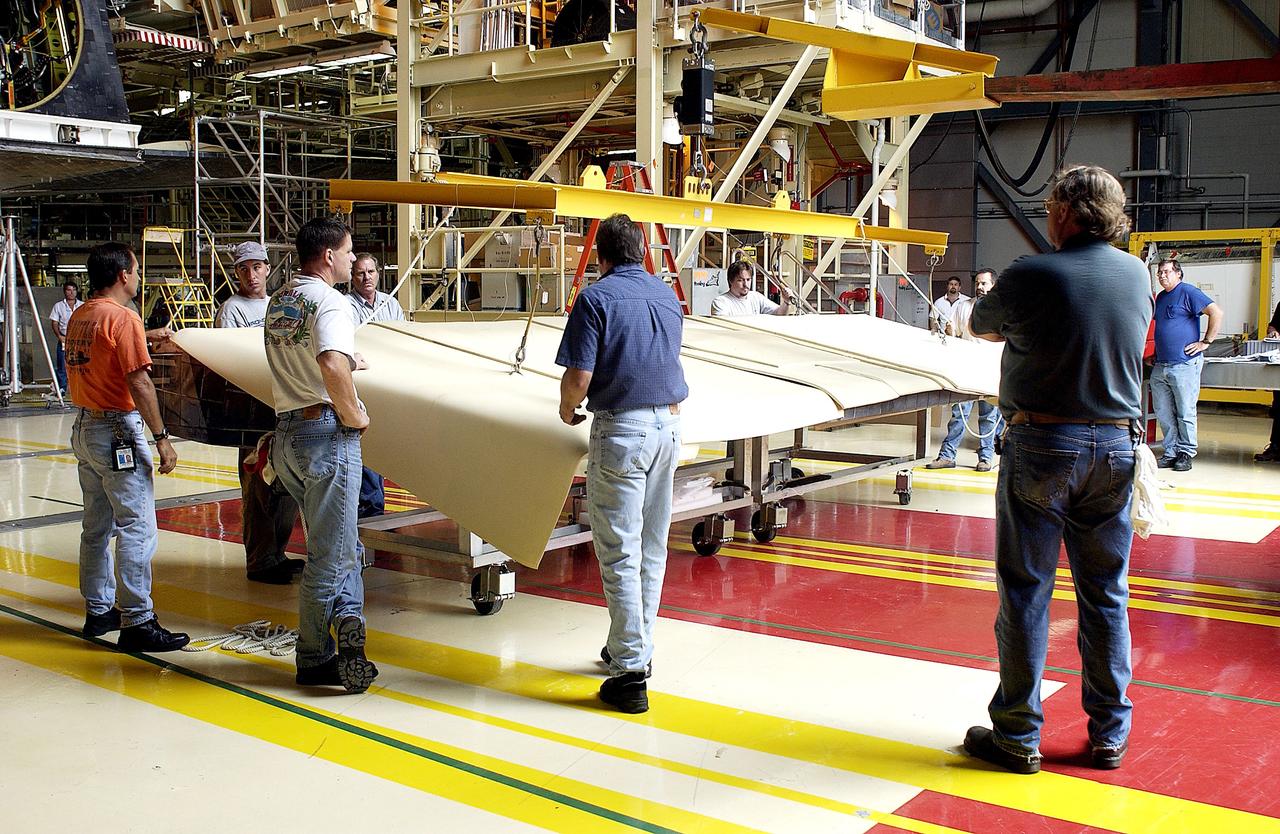
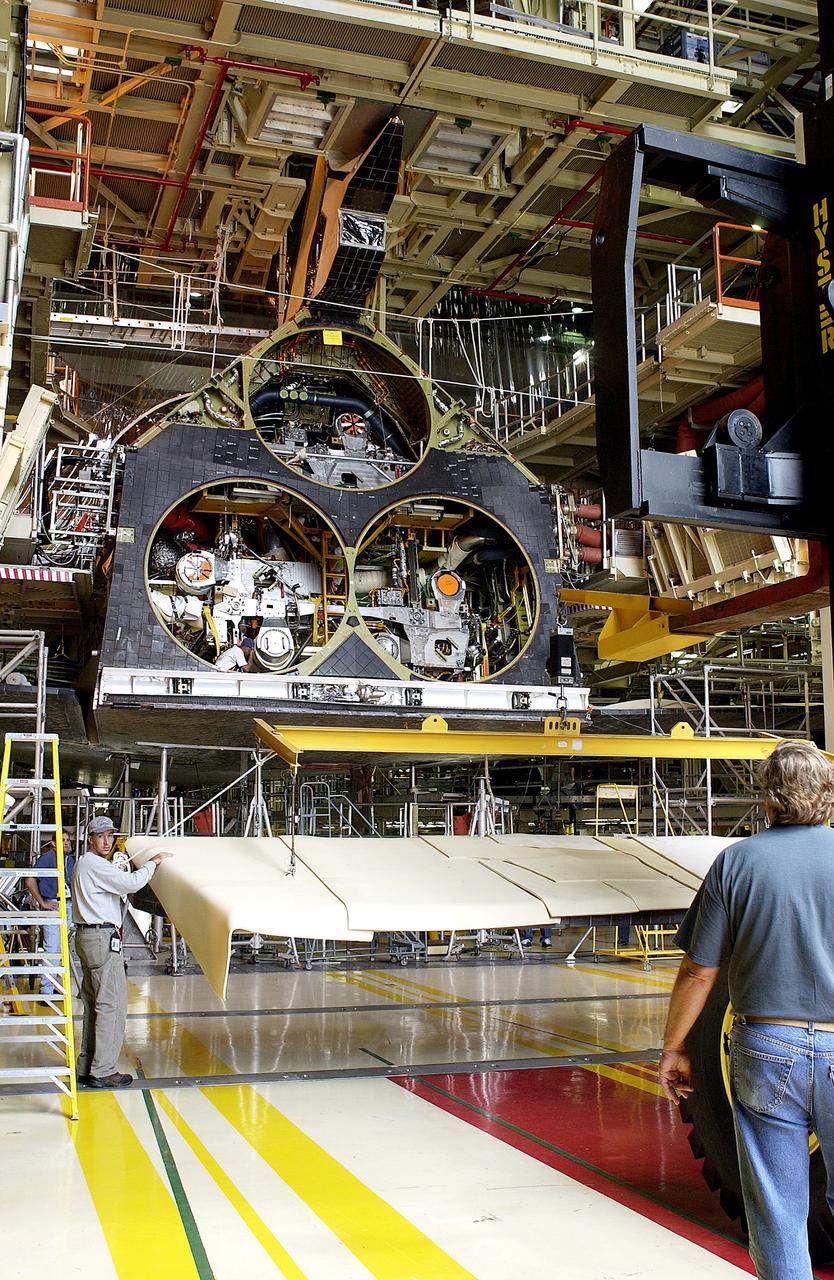
KENNEDY SPACE CENTER, FLA. -   Workers in the Orbiter Processing Facility get ready to lift and install the rear body flap on orbiter Discovery.  The body flap, which is temporarily under protective covering, attaches below the main engines.
KENNEDY SPACE CENTER, FLA. - Workers in the Orbiter Processing Facility get ready to lift and install the rear body flap on orbiter Discovery. The body flap, which is temporarily under protective covering, attaches below the main engines.
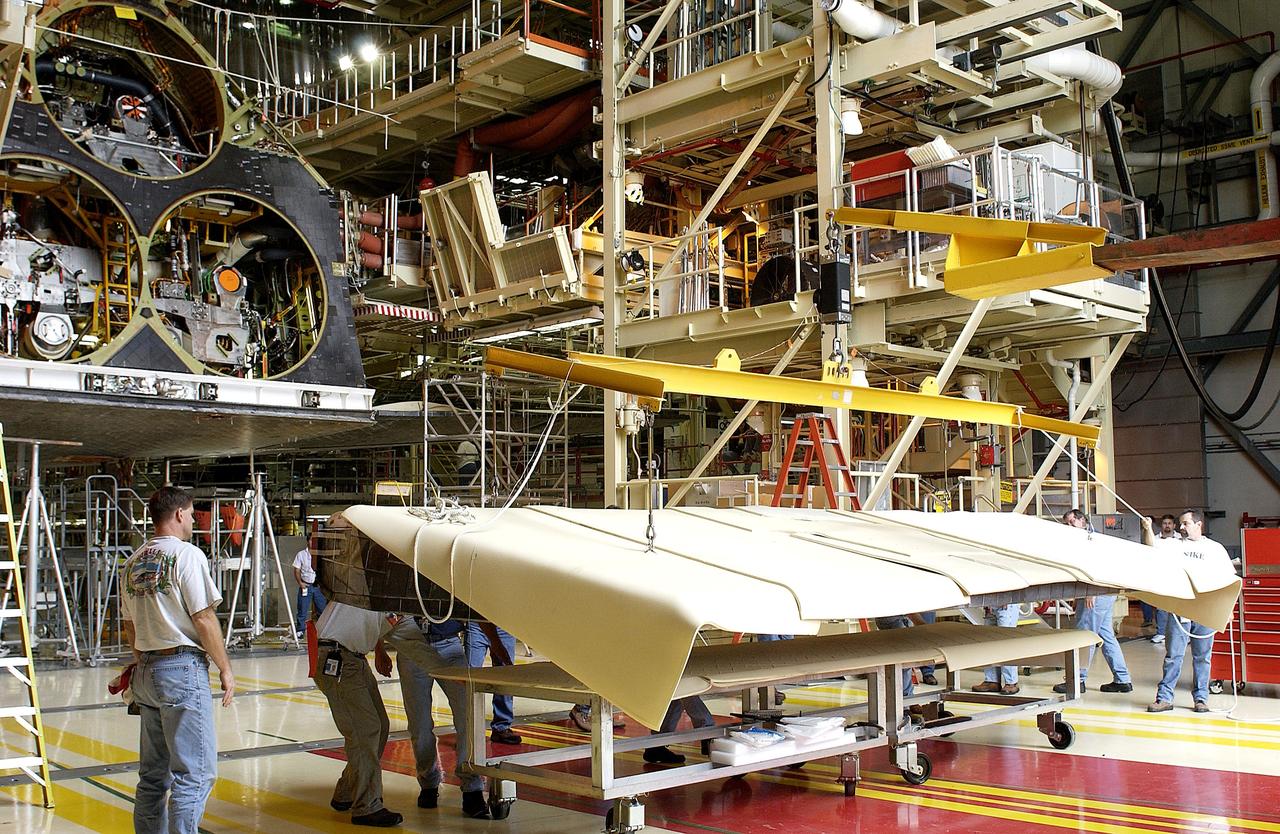
KENNEDY SPACE CENTER, FLA. -   Workers in the Orbiter Processing Facility get ready to lift and install the rear body flap on orbiter Discovery.  The body flap, which is temporarily under protective covering, attaches below the main engines.
KENNEDY SPACE CENTER, FLA. - Workers in the Orbiter Processing Facility get ready to lift and install the rear body flap on orbiter Discovery. The body flap, which is temporarily under protective covering, attaches below the main engines.
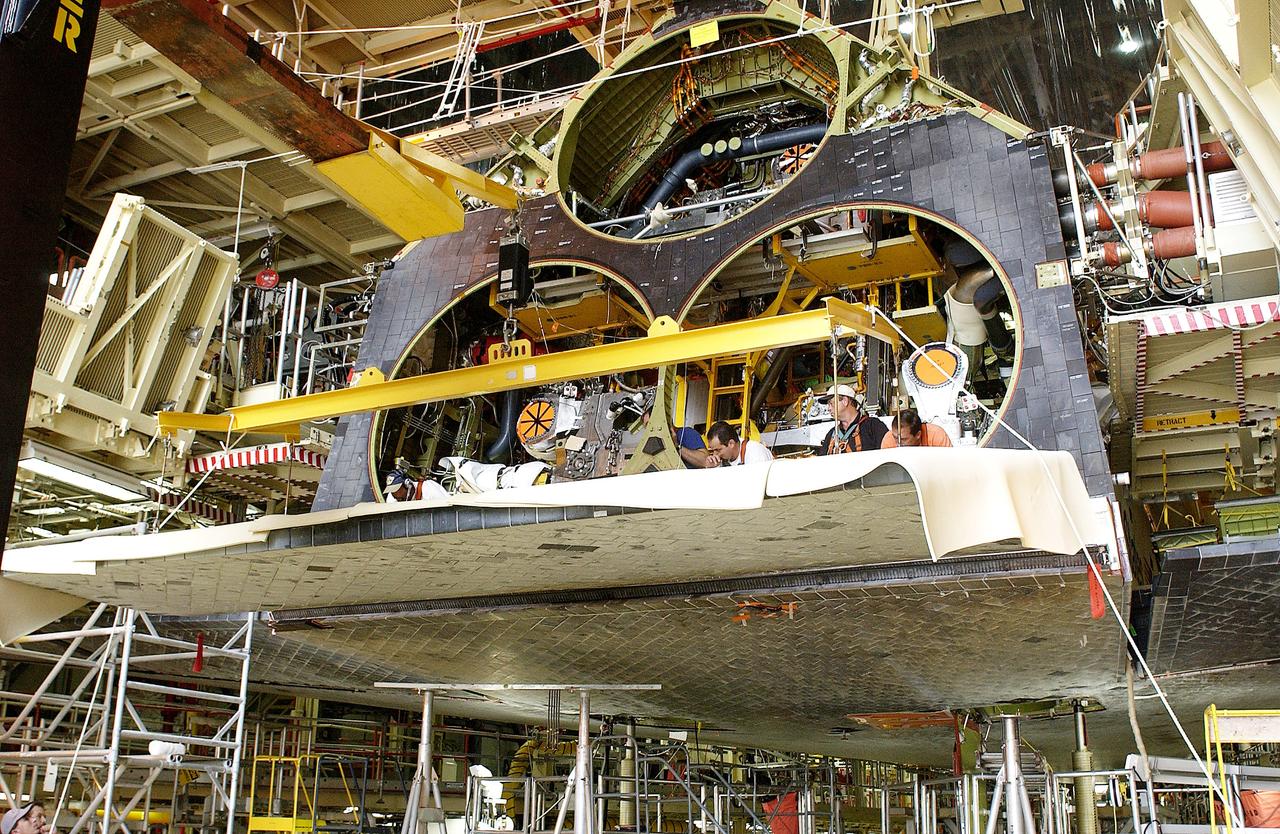
KENNEDY SPACE CENTER, FLA. - In the Orbiter Processing Facility, the rear body flap is lifted into place on the orbiter Discovery.  The body flap, which is temporarily under protective covering,  attaches below the main engines.
KENNEDY SPACE CENTER, FLA. - In the Orbiter Processing Facility, the rear body flap is lifted into place on the orbiter Discovery. The body flap, which is temporarily under protective covering, attaches below the main engines.
KENNEDY SPACE CENTER, FLA. -  Workers in the Orbiter Processing Facility get ready to lift and install the rear body flap on orbiter Discovery.  The body flap, which is temporarily under protective covering, attaches below the main engines.
KENNEDY SPACE CENTER, FLA. - Workers in the Orbiter Processing Facility get ready to lift and install the rear body flap on orbiter Discovery. The body flap, which is temporarily under protective covering, attaches below the main engines.
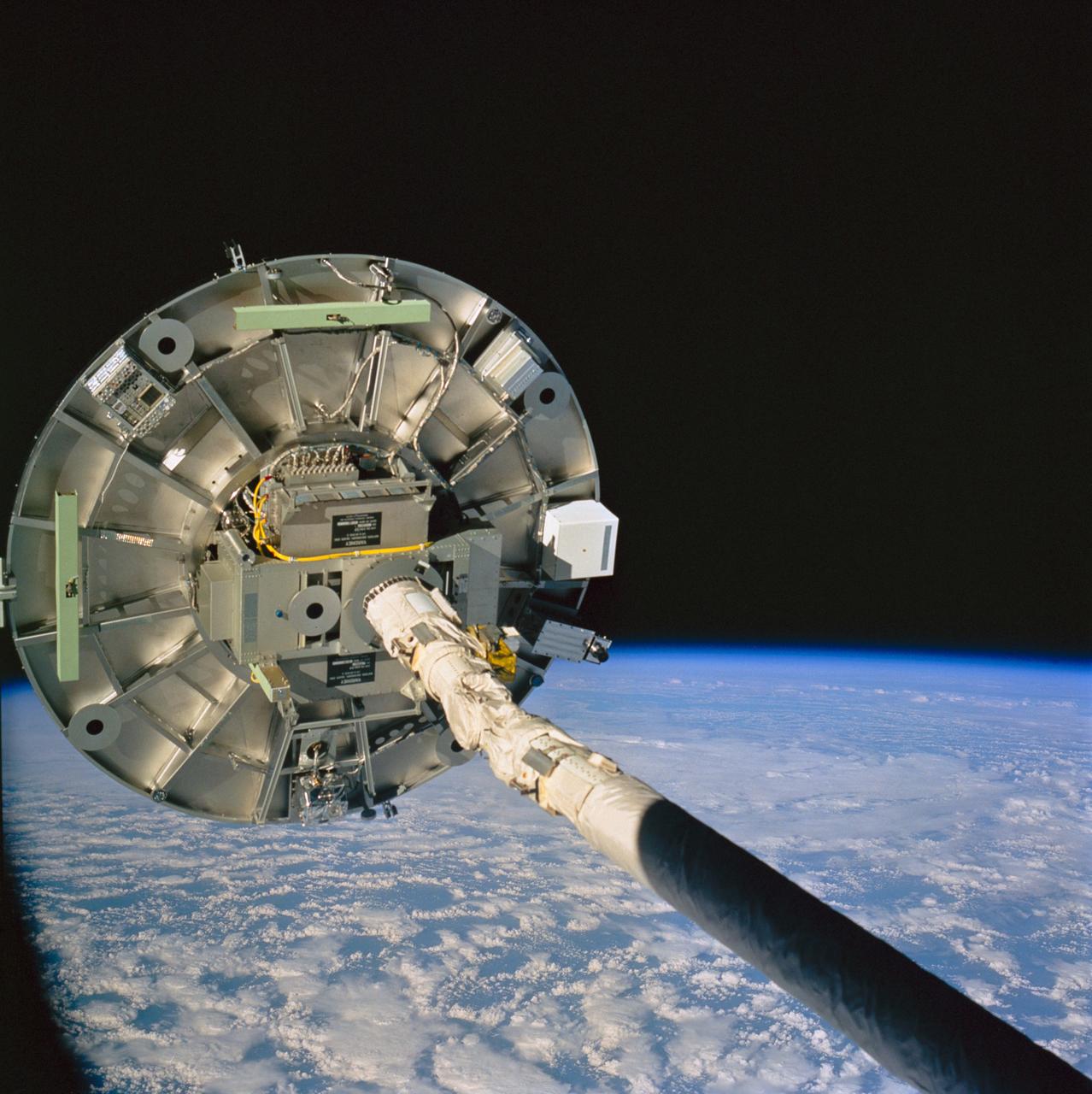
Spartan I satellte sits in the Discovery's payload bay prior to being deployed. Above it can be seen the remote manipulator system (RMS) arm and end effector. The Earth's horizon can also be seen above the orbiter.
Spartan 1 satellite sits in Discovery's payload bay
S89-28112 (3 Feb 1989) --- The Space Shuttle Discovery, atop a mobile launch platform, is rolled toward Kennedy Space Center's Launch Pad 39-B in the early morning hours of Feb. 3, l989.  It rolled through the doors of the huge vehicle assembly building (VAB) at 6 a.m.  The trip to the pad takes approximately 5 and 1/2 hours. Onboard the spacecraft in  mid-March for a five-day mission, on which will be deployed a third tracking and data relay satellite (TDRS-D), will be Astronauts Michael L. Coats, John E. Blaha, James F. Buchli, James P. Bagian and Robert C. Springer.
STS-29 Discovery, Orbiter Vehicle (OV) 103, roll out to KSC LC Pad 39B
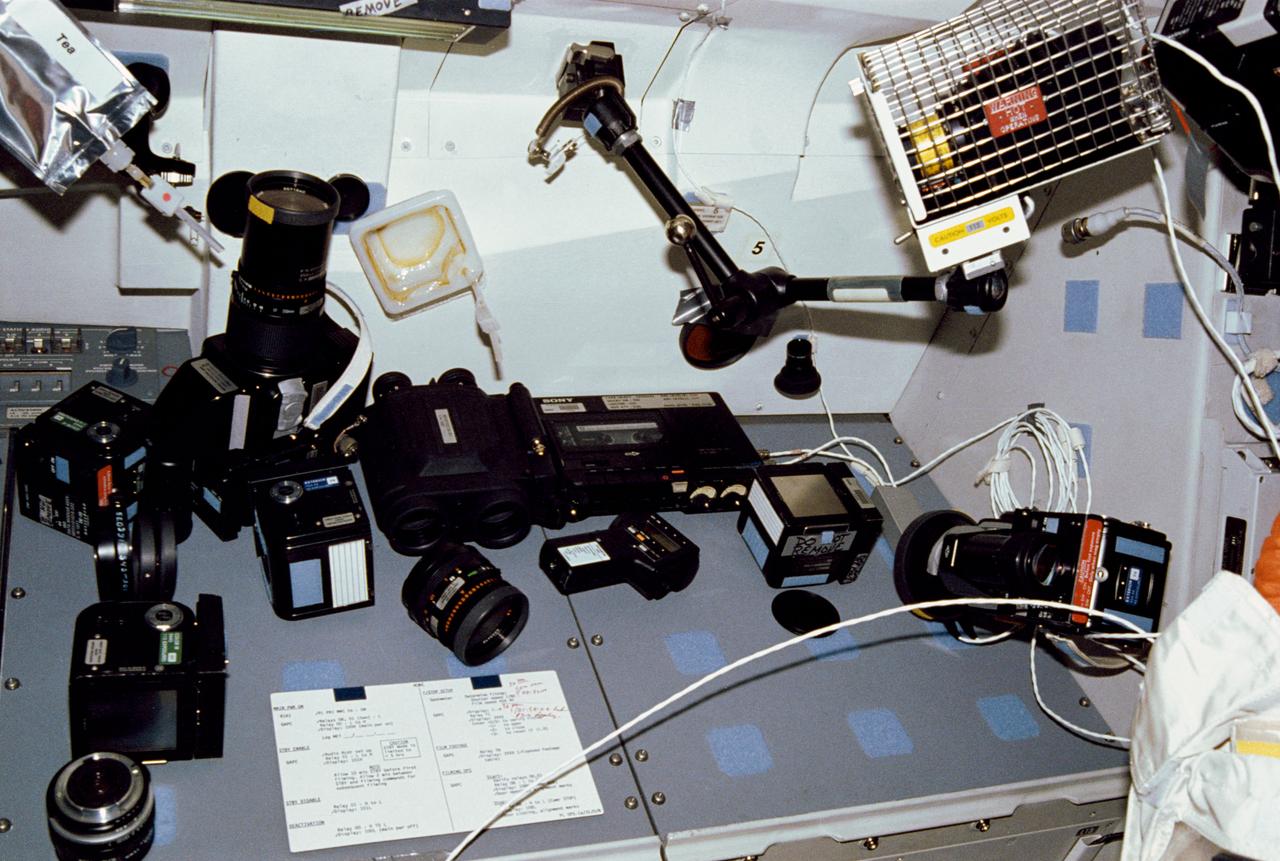
This array of photographic equipment, displayed on the aft flight deck payload station, represents just a part of the imaging and recording hardware which was carried aboard Discovery, Orbiter Vehicle (OV) 103, for STS-31's five day mission. Lenses, film magazines, cassettes, recorders, camera chassis, a pair of binoculars, spot meter, tape recorder, and a bracket-mounted light fixture are included among the array.
STS-31 camera & photographic equipment displayed on OV-103's aft flight deck
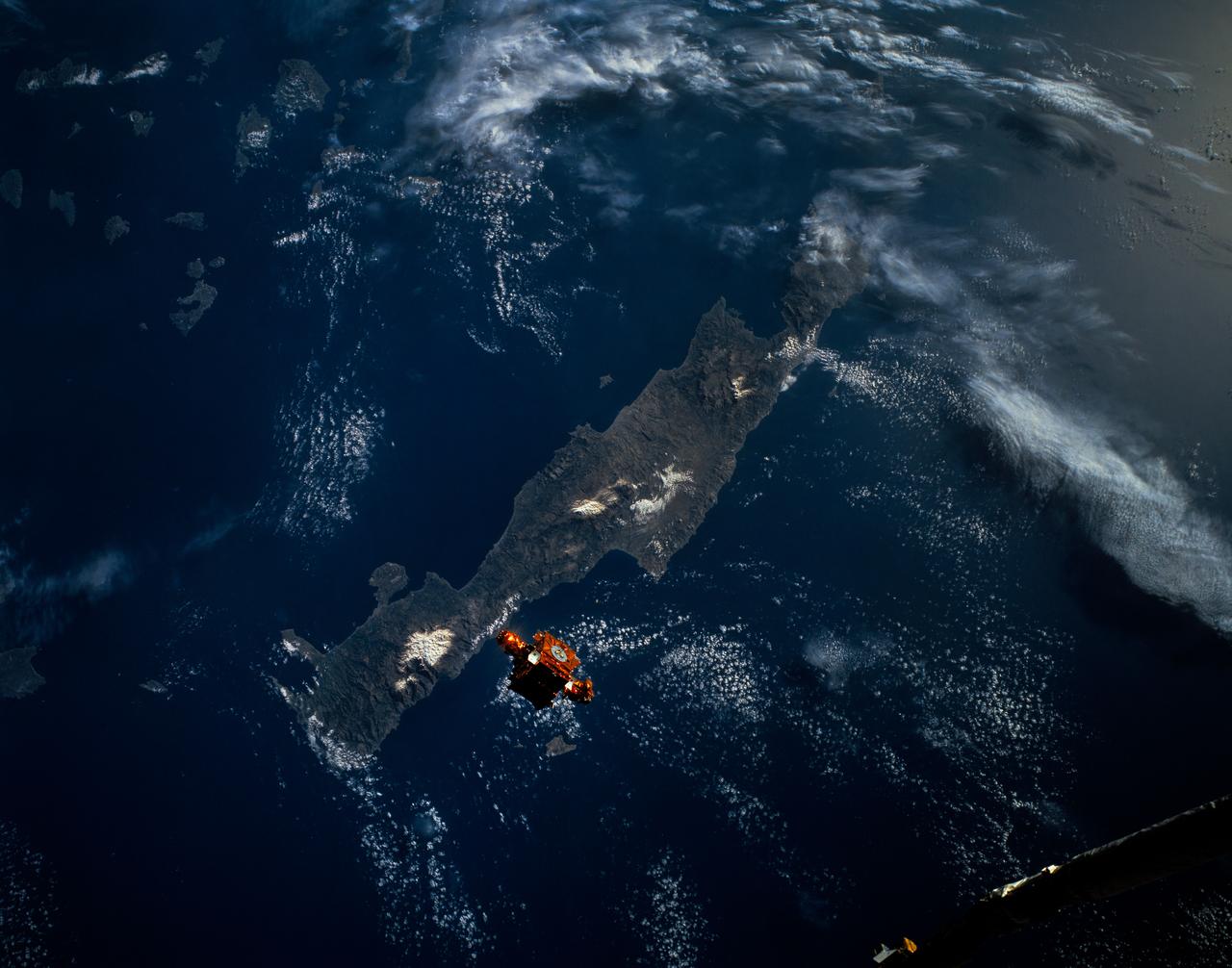
During STS-56, the Shuttle Pointed Autonomous Research Tool for Astronomy 201 (SPARTAN-201), a freeflying payload, was photographed by Discovery's, Orbiter Vehicle (OV) 103's, crewmembers as it drifted above the Mediterranean Sea near the island of Crete. On the mission's third day, the remote manipulator system (RMS) arm was used to lift SPARTAN-201 from its support structure in OV-103's payload bay and release it in space. SPARTAN-201 was later recaptured by OV-103's RMS and returned to Earth with the astronaut crew.
STS-56 view of freeflying SPARTAN-201 backdropped over the Mediterranean Sea
STS060-76-095 (3-11 Feb 1994) --- The ram side of the Wake Shield Facility (WSF) in the grasp of the Space Shuttle Discovery's Remote Manipulator System (RMS) arm is featured in this 70mm frame.  Clouds over the Atlantic Ocean and the blackness of space share the backdrop for the picture.  Five NASA astronauts and a Russian cosmonaut spent eight days in Earth orbit in support of the STS-60 mission.
Ram side of Wake Shield Facility
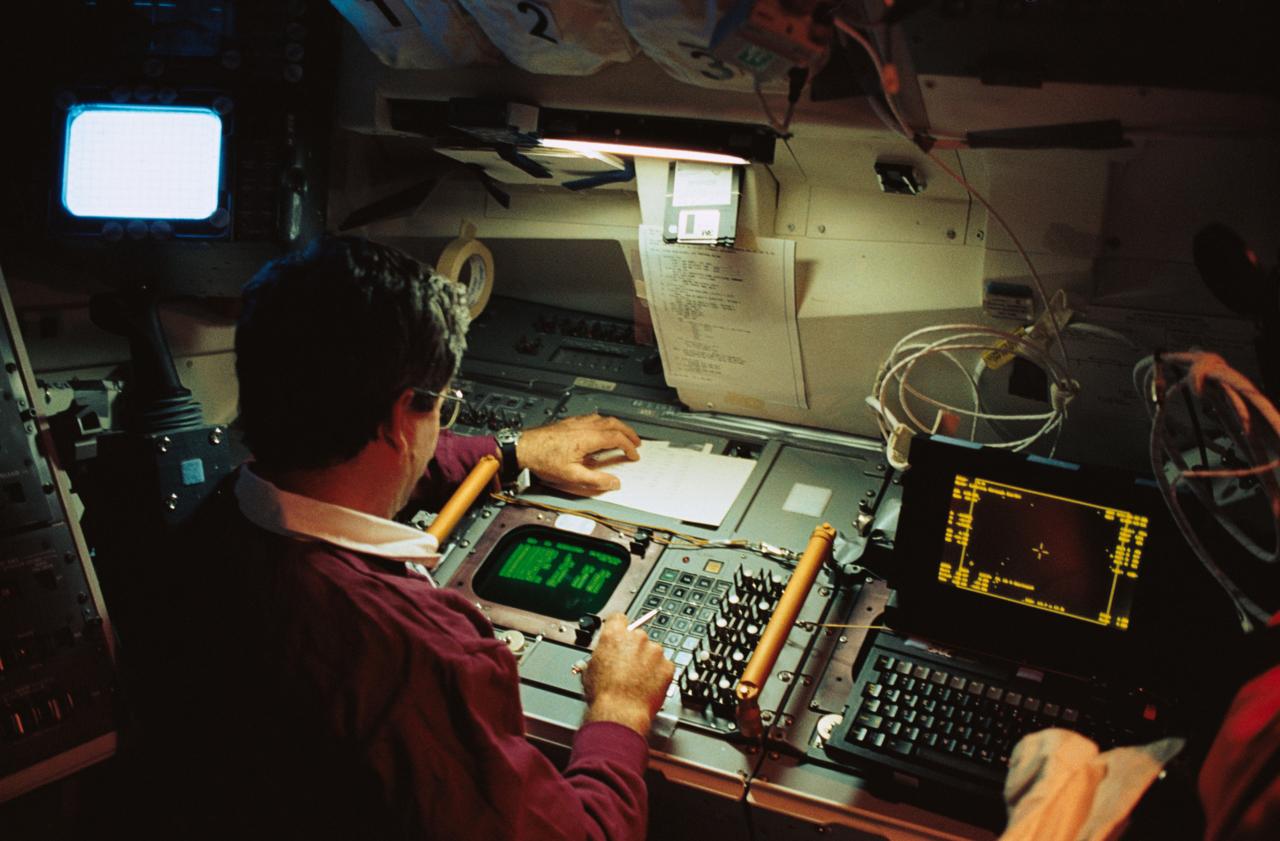
STS039-09-036 (28 April-6 May 1991) ---  Astronaut Charles L. (Lacy) Veach monitors experiment data on the aft flight deck of the Earth-orbiting Discovery.  The photograph was taken with a 35mm camera.  Veach and six other NASA astronauts spent over eight days in space busily collecting data for this mission, dedicated to the Department of Defense.
STS-39 MS Veach monitors AFP-675 panel on OV-103's aft flight deck
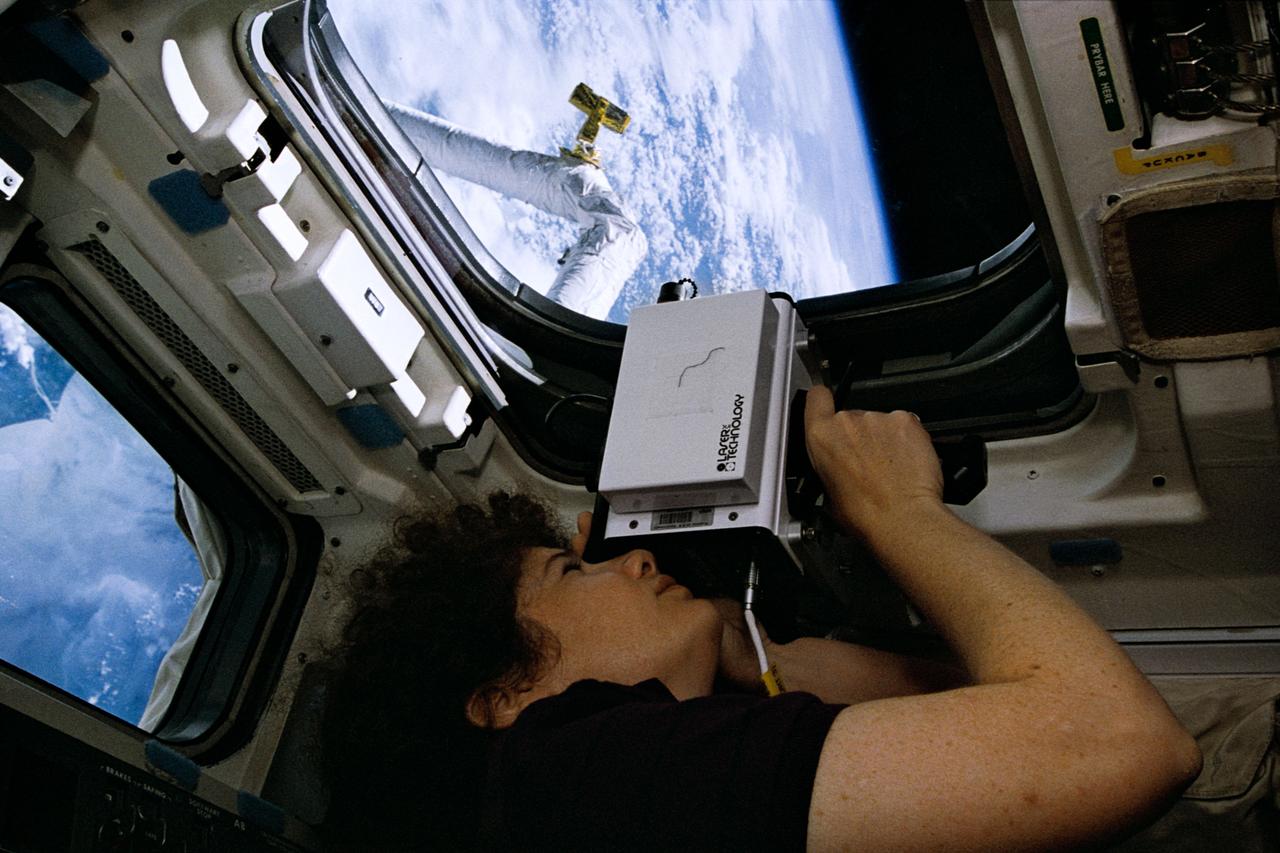
STS064-33-003 (9-20 Sept. 1994) --- Astronaut Susan J. Helms, STS-64 mission specialist, uses a laser instrument during operations with the Shuttle Pointed Autonomous Research Tool for Astronomy 201 (SPARTAN 201). Helms, who spent many mission hours at the controls of the Remote Manipulator System (RMS), joined five other NASA astronauts for almost 11 days in Earth orbit aboard the space shuttle Discovery. Photo credit: NASA or National Aeronautics and Space Administration
Astronaut Susan Helms uses laser instrument during SPARTAN 201 operations
41D-12-020 (6 Sept 1984) --- Astronaut Judith A. Resnik, mission specialist, anchors herself on the flight deck (out of frame) to take a peek at mid-deck activity aboard the Earth-orbiting Space Shuttle Discovery.  Among the many stationary and portable cameras onboard the flight are (left to right) TV camera, a data acquisition motion picture camera and the IMAX.
Mission specialist Judith Resnik at interdeck access hatch
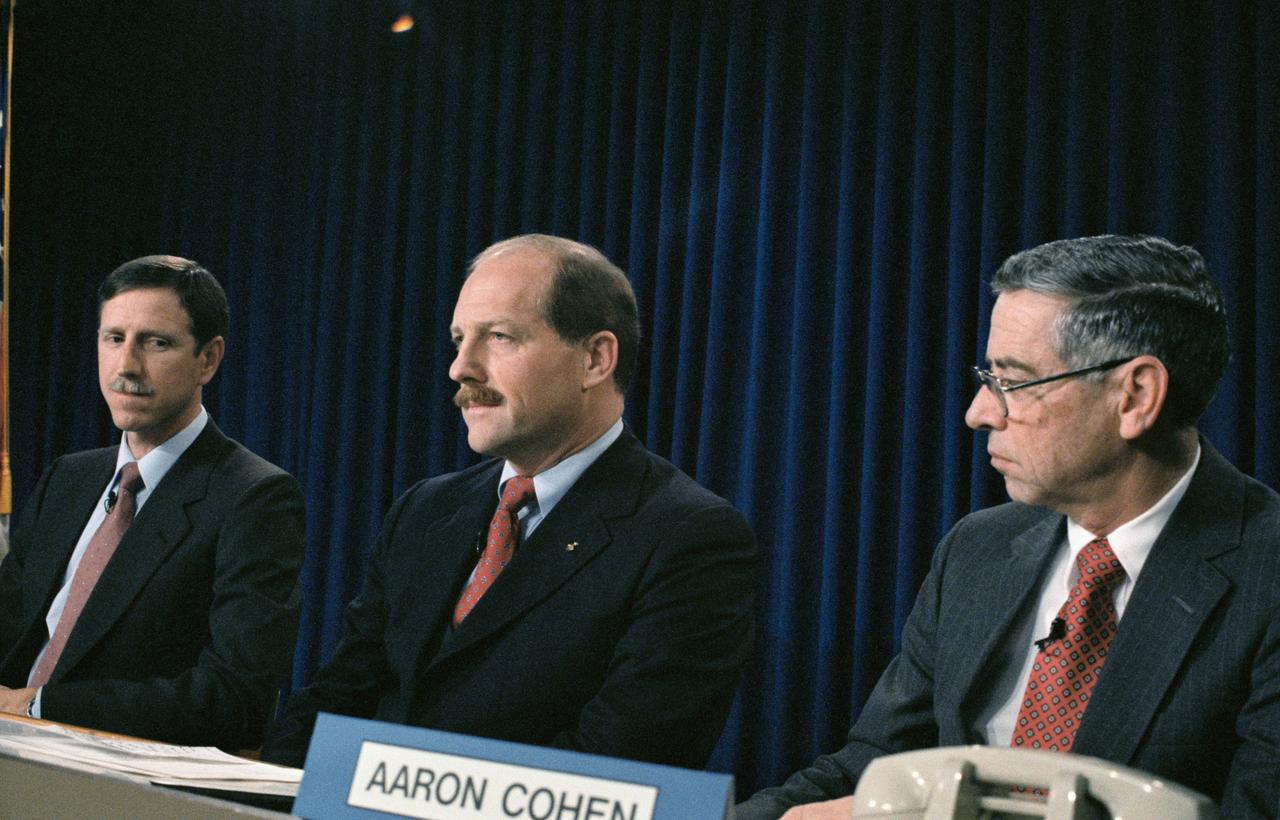
STS-26 Discovery, Orbiter Vehicle (OV) 103, crew including Commander Frederick H. Hauck and Pilot Richard O. Covey and JSC Director Aaron Cohen participate in press conference held at JSC Auditorium and Public Affairs Facility Bldg 2. Hauck and Covey are shown with Cohen as they ponder queries from news media representatives during the first press conference for the group since the mission's announcement last week. Left to right are Covey, Hauck, and Cohen.
STS-26 press conference with crewmembers and JSC Director Aaron Cohen
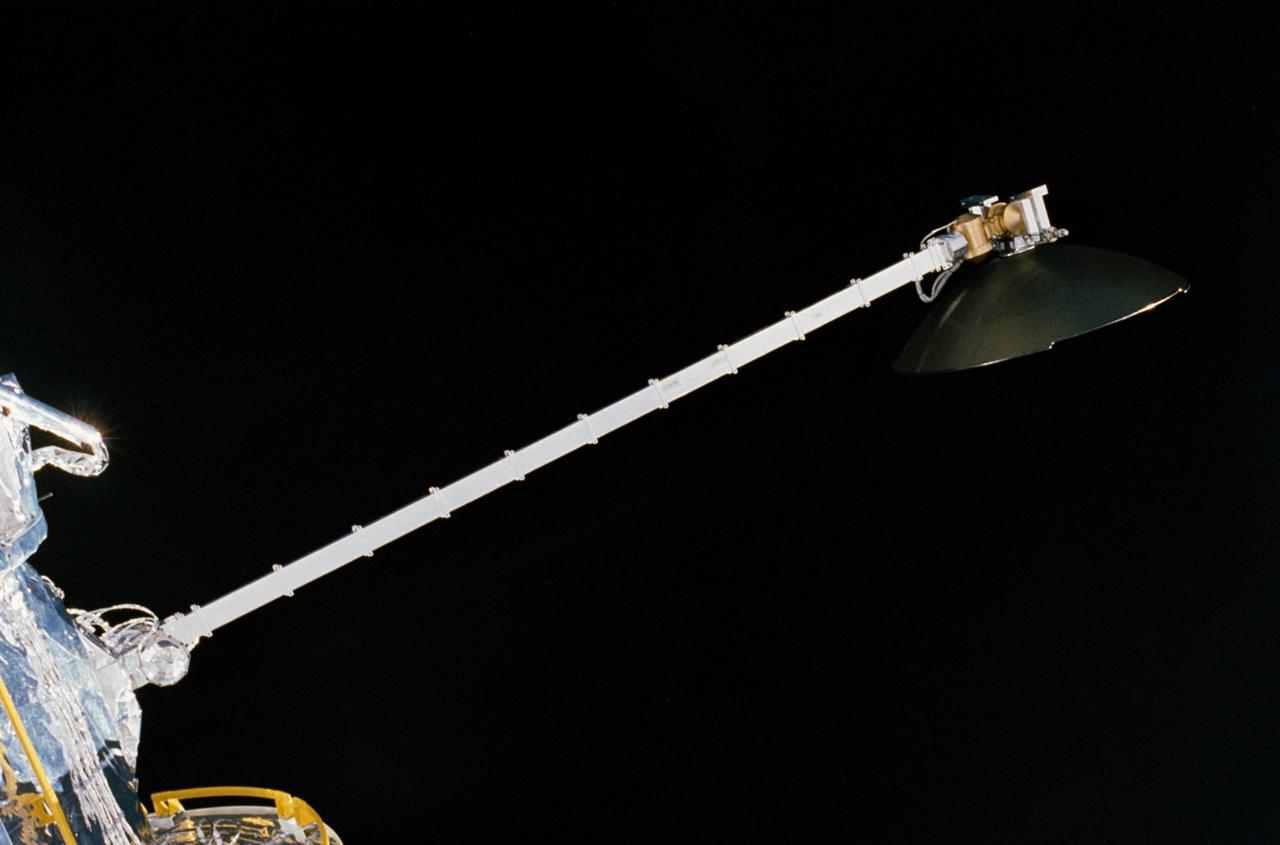
Held in appendage deploy position, the Hubble Space Telescope's (HST's) high gain antenna (HGA) has been released from its stowed position along the Support System Module (SSM) forward shell. The STS-31 crew aboard Discovery, Orbiter Vehicle (OV) oversees the automatic HGA deployment prior to releasing HST. HST HGA is backdropped against the blackness of space.
Hubble Space Telescope (HST) high gain antenna (HGA) deployment during STS-31
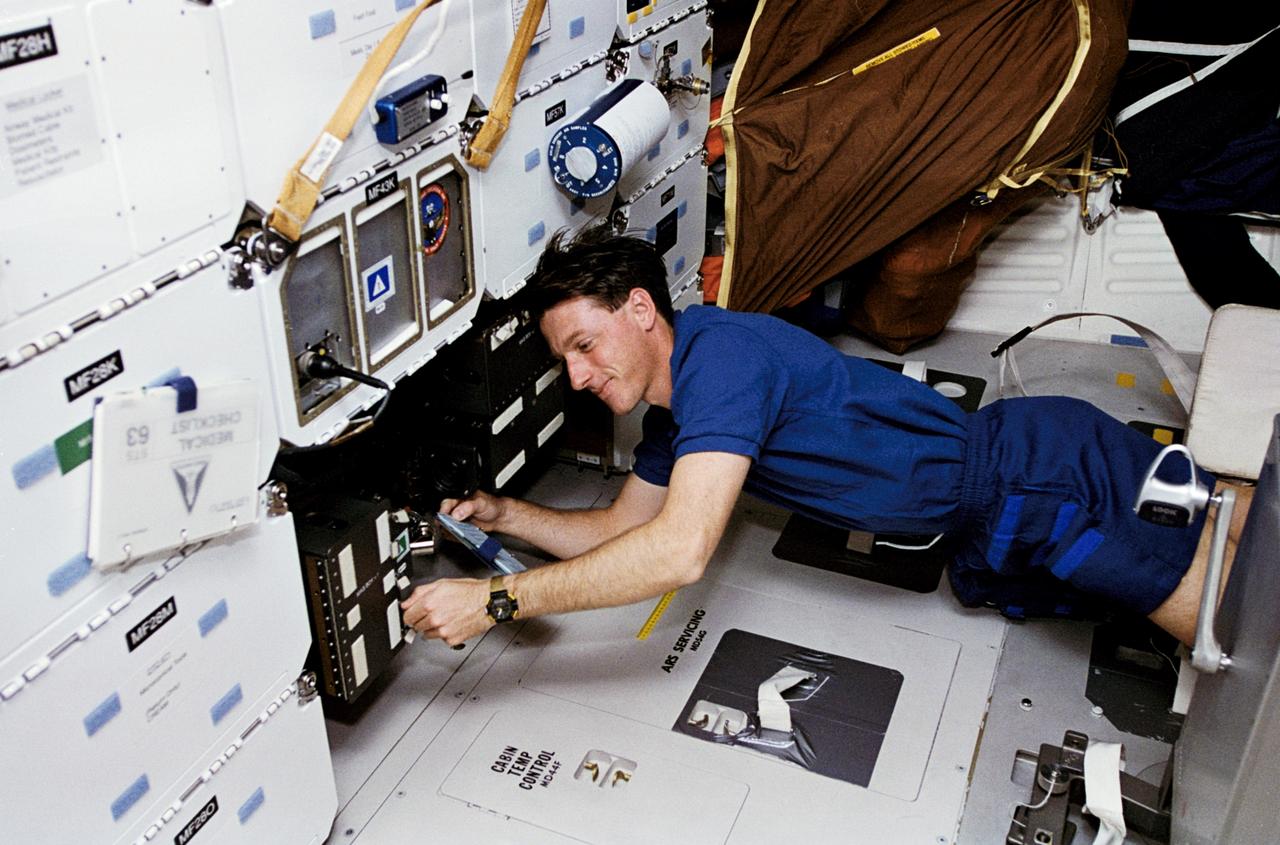
STS063-29-002 (3-11 Feb. 1995) --- On the Space Shuttle Discovery's middeck, astronaut C. Michael Foale, mission specialist, checks on the Solid Surface Combustion Experiment (SSCE). Foale was joined by four other NASA astronauts James D. Wetherbee, commander; Eileen M. Collins, pilot; Bernard A. Harris, Jr., payload commander; Janice E. Voss, mission specialist, and a Russian cosmonaut, Vladimir G. Titov; for eight days of research in Earth-orbit.
Astronaut Michael Foale checks on SSCE on middeck
41D-3063 (30 Aug. 1984) --- The space shuttle Discovery climbs toward Earth orbit following a successful liftoff from KSC's Pad 39A at 8:41:50 a.m. (EDT), Aug. 30, 1984. Inside the spacecraft are six crewmembers looking forward to a busy week in space. The scene was photographed by astronaut John W. Young in the Shuttle Training Aircraft (STA). Photo credit: NASA
View of the launch of Discovery 41-D mission
41D-3071 (30 Aug. 1984) --- The space shuttle Discovery climbs toward Earth orbit following a successful liftoff from KSC's Pad 39A at 8:41:50 a.m. (EDT), Aug. 30, 1984. Inside the spacecraft are six crewmembers looking forward to a busy week in space. The scene was photographed by astronaut John W. Young in the Shuttle Training Aircraft (STA). Photo credit: NASA
View of the launch of Discovery 41-D mission