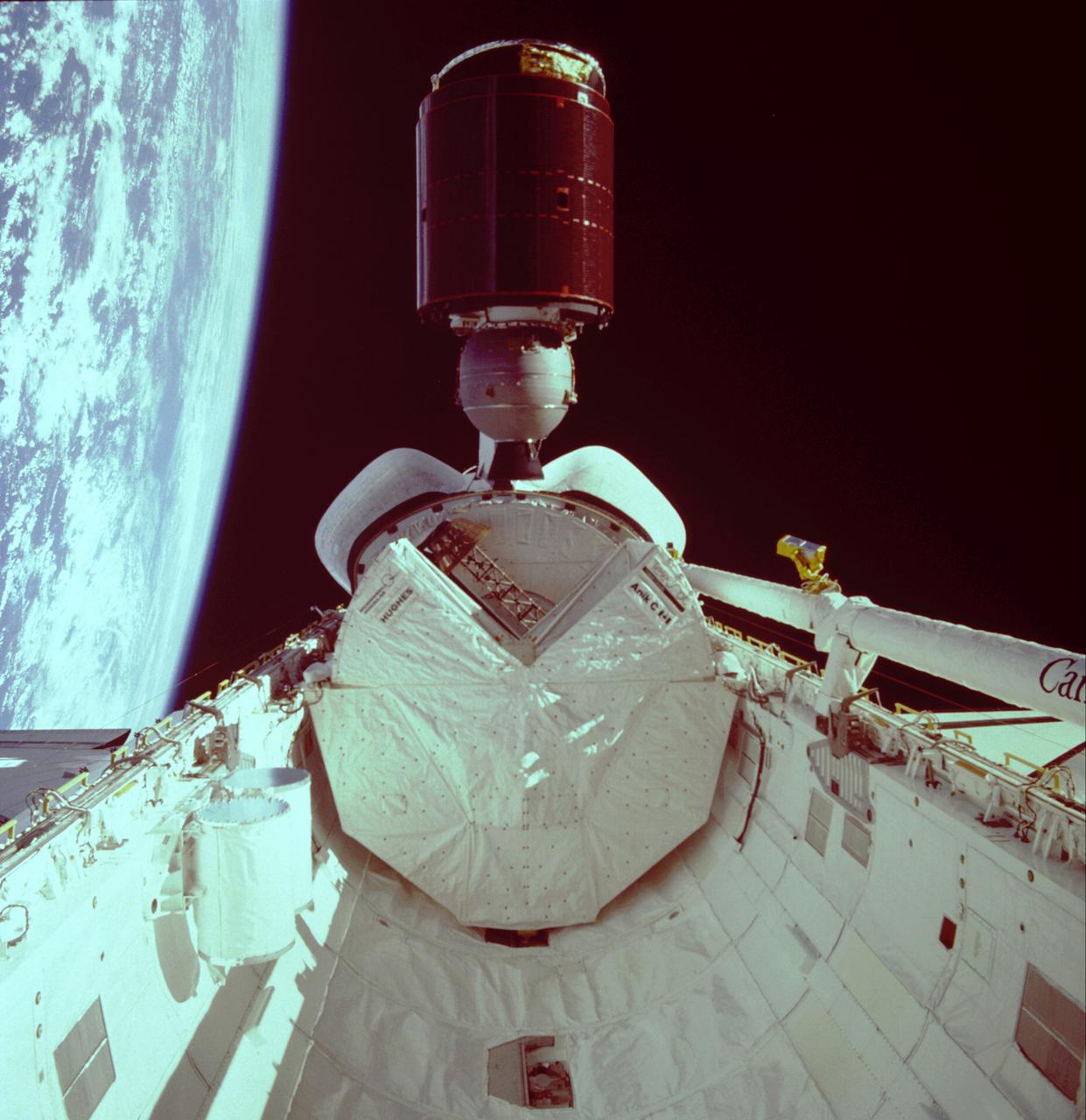
The TELESAT-1, also known as ANIK C-1, satellite is being released from the cargo bay of the Space Shuttle Orbiter Discovery during STS-51D, the 16th Shuttle mission. TELESAT-1 is a communication satellite built for Telesat Canada to provide voice and TV coverage of the Earth stations to trans-Canada network. Also shows in this photograph is an anterna for SYNCOM IV-3, also known as LEASAT-3, folded in a stowage. The SYNCOM is the Hughes Geosynchronous Communication Satellite and provides communication services from geosynchronous orbits principally to the U.S. Government. Both satellites were launched on April 12, 1985, aboard the Space Shuttle Orbiter Discovery.

S91-51633 (November 1991) --- Astronaut Roberta L. Bondar, Canadian payload specialist.

STS060-06-037 (3-11 Feb 1994) --- The city lights of Buffalo and Toronto outline the shores of the east end of Lake Erie and the west end of Lake Ontario in this night scene of western New York and southern Ontario. Between the two major cities are the cities of Niagara Falls, New York and Niagara Falls, Canada, which straddle the Niagara River just north of the actual falls. This photograph was taken with a special ASA-1600 film that is normally used for night-time photography of aurora, noctilucent clouds, biomass burning, and city lights.

KENNEDY SPACE CENTER, FLA. - In NASA Kennedy Space Center’s Orbiter Processing Facility, bay 3, workers at left are preparing to remove the orbiter boom sensor system from Discovery’s payload bay. The boom will undergo inspection. The orbiter will be processed for the second Return to Flight mission, STS-121. The orbiter boom sensor system, built in Canada, was used during Return to Flight mission STS-114 to provide more extensive inspection and photography of Discovery.

KENNEDY SPACE CENTER, FLA. -In NASA Kennedy Space Center’s Orbiter Processing Facility, bay 3, workers prepare to remove the orbiter boom sensor system from Discovery’s payload bay. The boom will undergo inspection. The orbiter will be processed for the second Return to Flight mission, STS-121. The orbiter boom sensor system, built in Canada, was used during Return to Flight mission STS-114 to provide more extensive inspection and photography of Discovery.

KENNEDY SPACE CENTER, FLA. - In NASA Kennedy Space Center’s Orbiter Processing Facility, bay 3, workers prepare to remove the orbiter boom sensor system from Discovery’s payload bay. The boom will undergo inspection. The orbiter will be processed for the second Return to Flight mission, STS-121. The orbiter boom sensor system, built in Canada, was used during Return to Flight mission STS-114 to provide more extensive inspection and photography of Discovery.
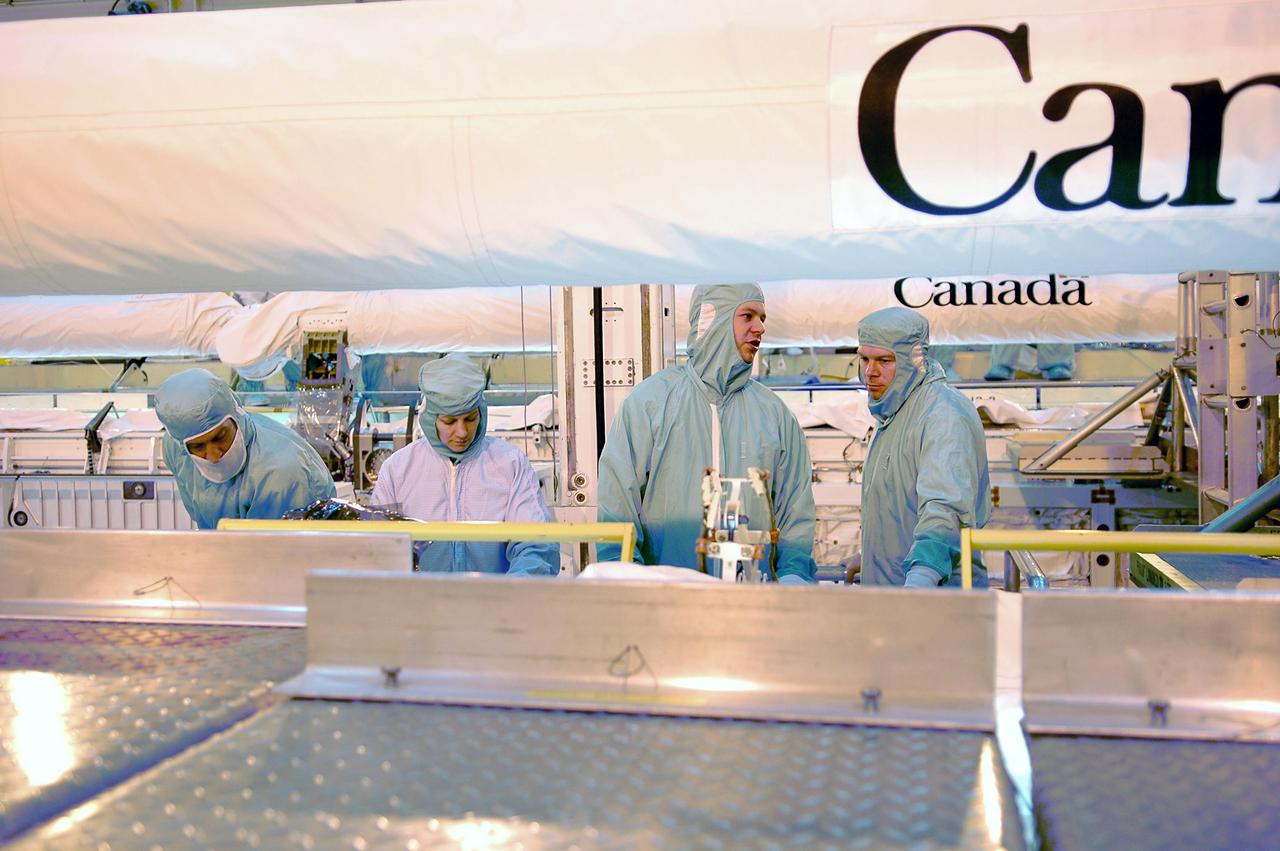
KENNEDY SPACE CENTER, FLA. - In the Orbiter Processing Facility, STS-114 crew members look at the new Orbiter Boom Sensor System recently installed in Discovery’s payload bay. At left are Mission Specialist Charles Camarda and Commander Eileen Collins; at right is Matt Myer, an EVA systems engineer from Johnson Space Center, and Pilot James Kelly. Behind them can be seen the Canada robotic arm. Crew members are at KSC for Crew Equipment Interface Test activities. During CEIT, the crew has an opportunity to get a hands-on look at the orbiter and equipment they will be working with on the mission. Return to Flight Mission STS-114 will carry the Multi-Purpose Logistics Module Raffaello, filled with supplies for the International Space Station, and a replacement Control Moment Gyroscope. Launch of STS-114 has a launch window of May 12 to June 3.
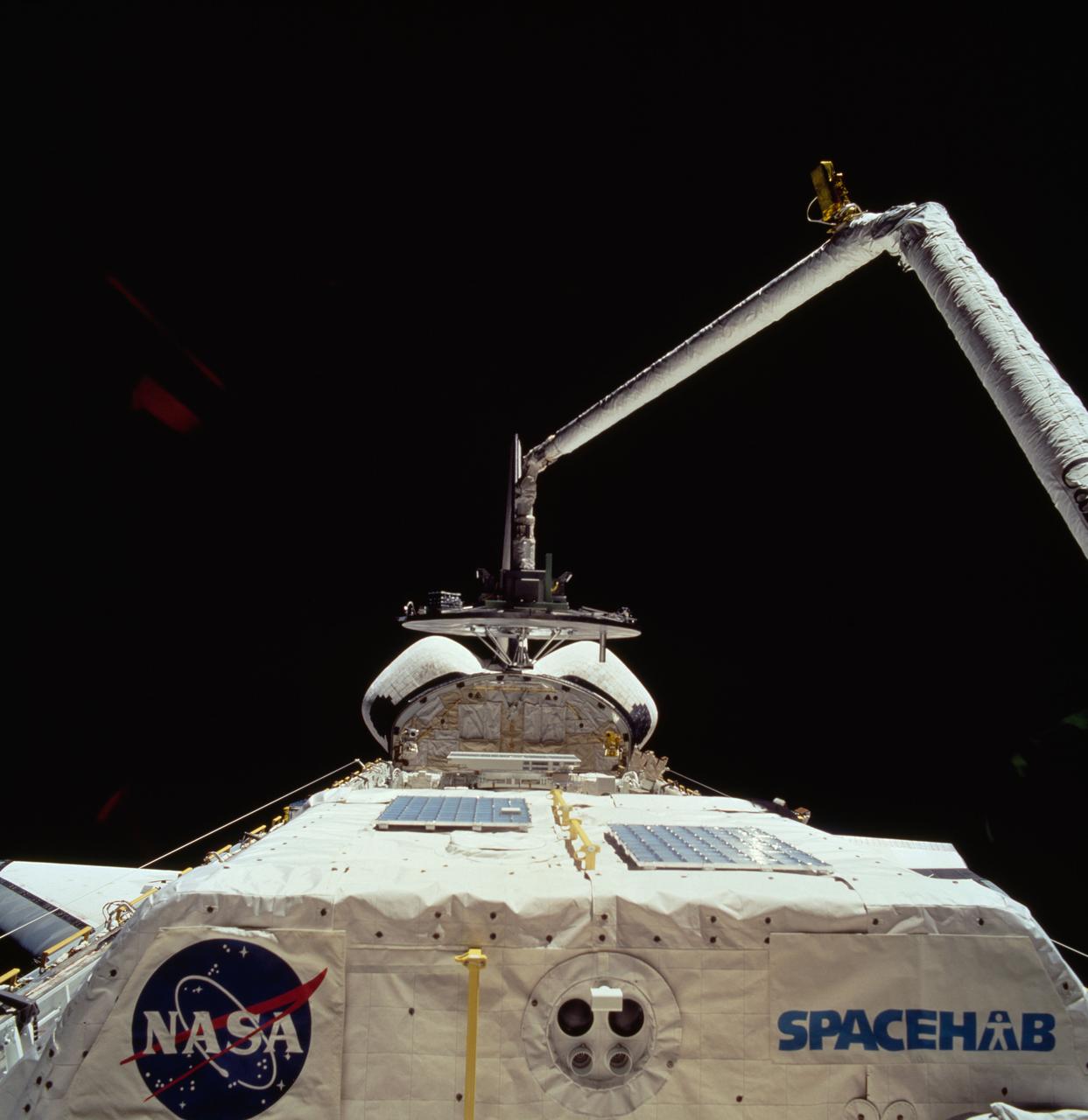
STS060-74-054 (3-11 Feb 1994) --- The Wake Shield Facility (WSF) is held in the grasp of Discovery's Remote Manipulator System (RMS). The 70mm image, backdropped against the blackness of space, also shows the SPACEHAB module in the forward cargo area.
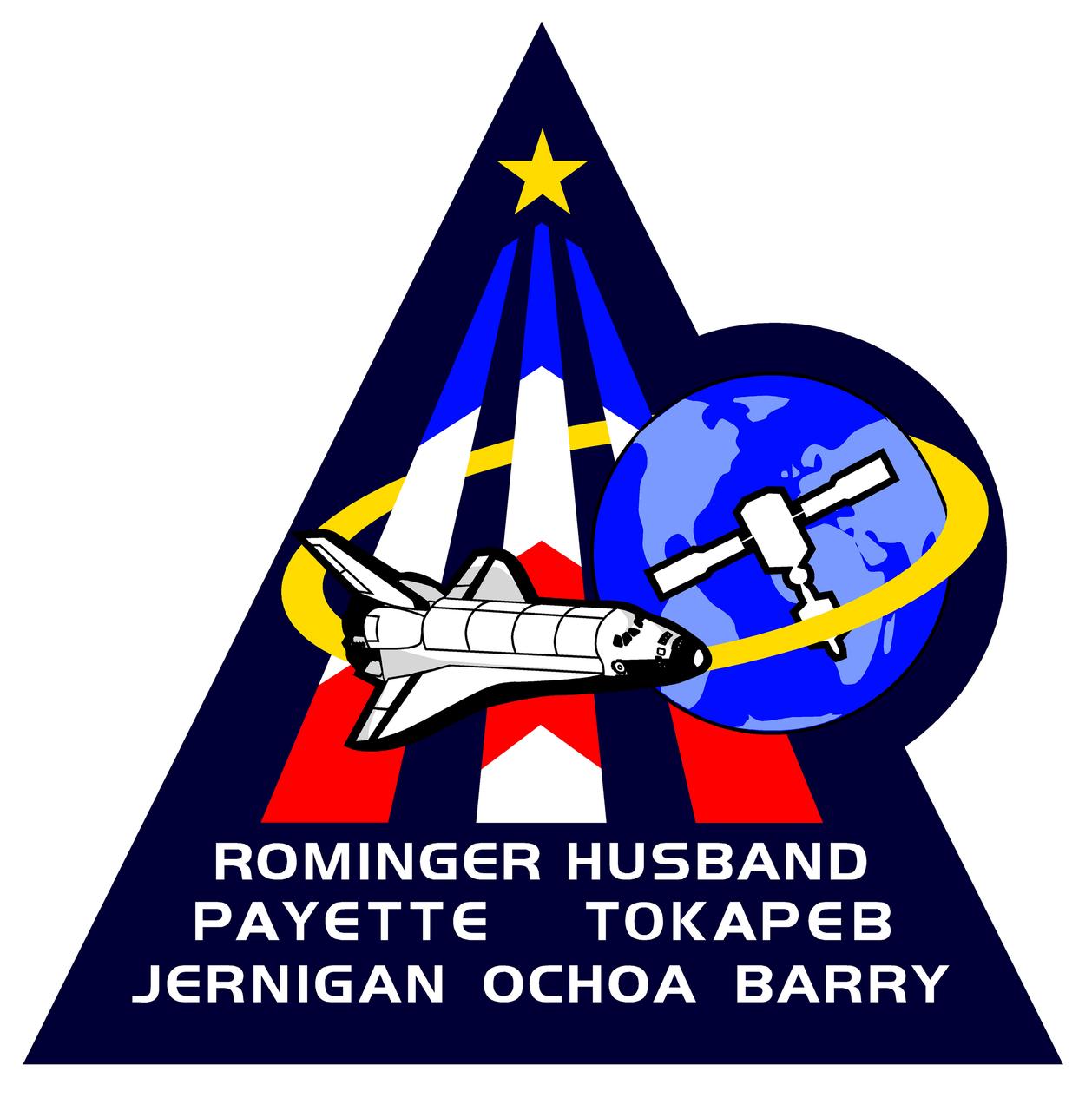
This is the astronaut designed mission insignia for the STS-96 space flight, the second Space Shuttle Mission dedicated to the assembly of the International Space Station (ISS). The crew member designed patch highlights the major themes of the Station program: Earth-directed research, the advancement of human space exploration, and international cooperation. The Space Shuttle Discovery is depicted shortly after reaching orbit as the crew prepares for the first docking with the new station. At this early stage in its construction, the ISS consisted of two modules; The Russian Zarya and the U.S. Unity, shown orbiting the Earth. The triangular shape represents building on the knowledge and experience of earlier missions, while the three vertical bars point toward future human endeavors in space. The five pointed star is symbolic of the five space agencies participating in the development of the ISS: NASA, the Russian Space Agency, the European Space Agency, the National Space Development Agency of Japan, and the Canadian Space Agency. The blend of red, white, and blue is a tribute to the nationalities of the STS-96 crew members who are from the United States, Russia, and Canada.
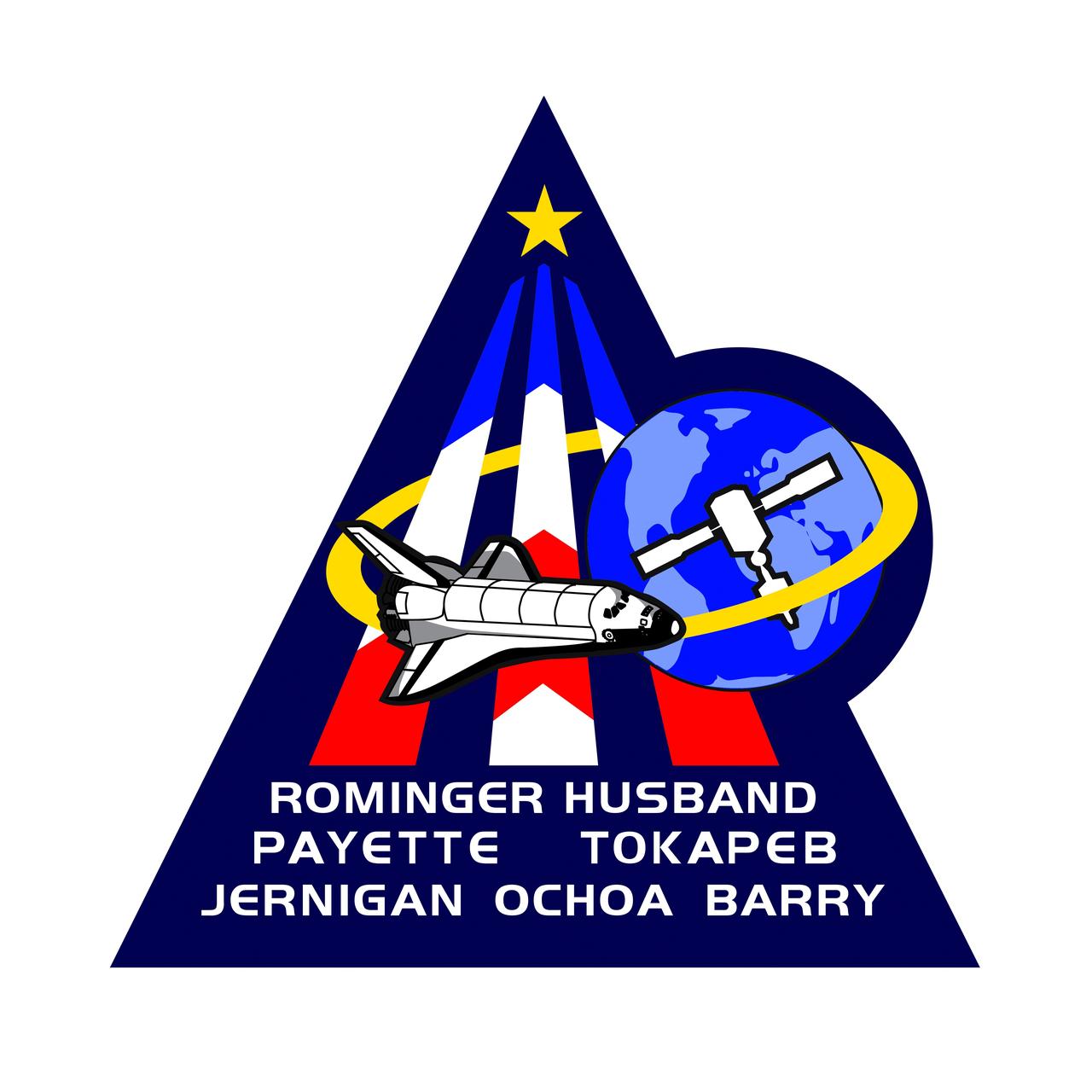
STS96-S-001 (February 1999) --- Designed by the crew members, this is the mission insignia for the STS-96 spaceflight, the second space shuttle mission dedicated to the assembly of the International Space Station (ISS). The crew patch highlights the major themes of the Station Program: Earth-directed research, the advancement of human space exploration, and international cooperation. The space shuttle Discovery is depicted shortly after reaching orbit as the crew prepares to carry out the first docking with the new space station. At this early stage in its construction, ISS consists of two modules: Zarya and Unity, shown orbiting Earth. The triangular shape of the patch represents building on the knowledge and experience of earlier missions, while the three vertical bars of the astronaut emblem point toward future human endeavors in space. The five-pointed star that tops the astronaut emblem in this depiction is symbolic of the five space agencies participating in the development of ISS: National Aeronautics and Space Administration (NASA), the Russian Space Agency (RSA), the European Space Agency (ESA), the National Space Development Agency of Japan (NASDA), and the Canadian Space Agency (CSA). The blend of red, white, and blue is a tribute to the nationalities of the crew members who are from the United States, Canada, and Russia. The NASA insignia design for space shuttle flights is reserved for use by the astronauts and for other official use as the NASA Administrator may authorize. Public availability has been approved only in the forms of illustrations by the various news media. When and if there is any change in this policy, which is not anticipated, the change will be publicly announced. Photo credit: NASA

A transmission spectrum made from a single observation using Webb’s Near-Infrared Imager and Slitless Spectrograph (NIRISS) reveals atmospheric characteristics of the hot gas giant exoplanet WASP-96 b. A transmission spectrum is made by comparing starlight filtered through a planet’s atmosphere as it moves across the star, to the unfiltered starlight detected when the planet is beside the star. Each of the 141 data points (white circles) on this graph represents the amount of a specific wavelength of light that is blocked by the planet and absorbed by its atmosphere. In this observation, the wavelengths detected by NIRISS range from 0.6 microns (red) to 2.8 microns (in the near-infrared). The amount of starlight blocked ranges from about 13,600 parts per million (1.36 percent) to 14,700 parts per million (1.47 percent). Researchers are able to detect and measure the abundances of key gases in a planet’s atmosphere based on the absorption pattern – the locations and heights of peaks on the graph: each gas has a characteristic set of wavelengths that it absorbs. The temperature of the atmosphere can be calculated based in part on the height of the peaks: a hotter planet has taller peaks. Other characteristics, like the presence of haze and clouds, can be inferred based on the overall shape of different portions of the spectrum. The gray lines extending above and below each data point are error bars that show the uncertainty of each measurement, or the reasonable range of actual possible values. For a single observation, the error on these measurements is remarkably small. The blue line is a best-fit model that takes into account the data, the known properties of WASP-96 b and its star (e.g., size, mass, temperature), and assumed characteristics of the atmosphere. Researchers can vary the parameters in the model – changing unknown characteristics like cloud height in the atmosphere and abundances of various gases – to get a better fit and further understand what the atmosphere is really like. The difference between the best-fit model shown here and the data simply reflects the additional work to be done in analyzing and interpreting the data and the planet. Although full analysis of the spectrum will take additional time, it is possible to draw a number of preliminary conclusions. The labeled peaks in the spectrum indicate the presence of water vapor. The height of the water peaks, which is less than expected based on previous observations, is evidence for the presence of clouds that suppress the water vapor features. The gradual downward slope of the left side of the spectrum (shorter wavelengths) is indicative of possible haze. The height of the peaks along with other characteristics of the spectrum is used to calculate an atmospheric temperature of about 1350°F (725°C). This is the most detailed infrared exoplanet transmission spectrum ever collected, the first transmission spectrum that includes wavelengths longer than 1.6 microns with such high resolution and accuracy, and the first to cover the entire wavelength range from 0.6 microns (visible red light) to 2.8 microns (near-infrared) in a single shot. The speed with which researchers have been able to make confident interpretations of the spectrum is further testament to the quality of the data. The observation was made using NIRISS’s Single-Object Slitless Spectroscopy (SOSS) mode, which involves capturing the spectrum of a single bright object, like the star WASP-96, in a field of view. WASP-96 b is a hot gas giant exoplanet that orbits a Sun-like star roughly 1,150 light-years away, in the constellation Phoenix. The planet orbits extremely close to its star (less than 1/20th the distance between Earth and the Sun) and completes one orbit in less than 3½ Earth-days. The planet’s discovery, based on ground-based observations, was announced in 2014. The star, WASP-96, is somewhat older than the Sun, but is about the same size, mass, temperature, and color. The background illustration of WASP-96 b and its star is based on current understanding of the planet from both NIRISS spectroscopy and previous ground- and space-based observations. Webb has not captured a direct image of the planet or its atmosphere. NIRISS was contributed by the Canadian Space Agency. The instrument was designed and built by Honeywell in collaboration with the Université de Montréal and the National Research Council Canada.