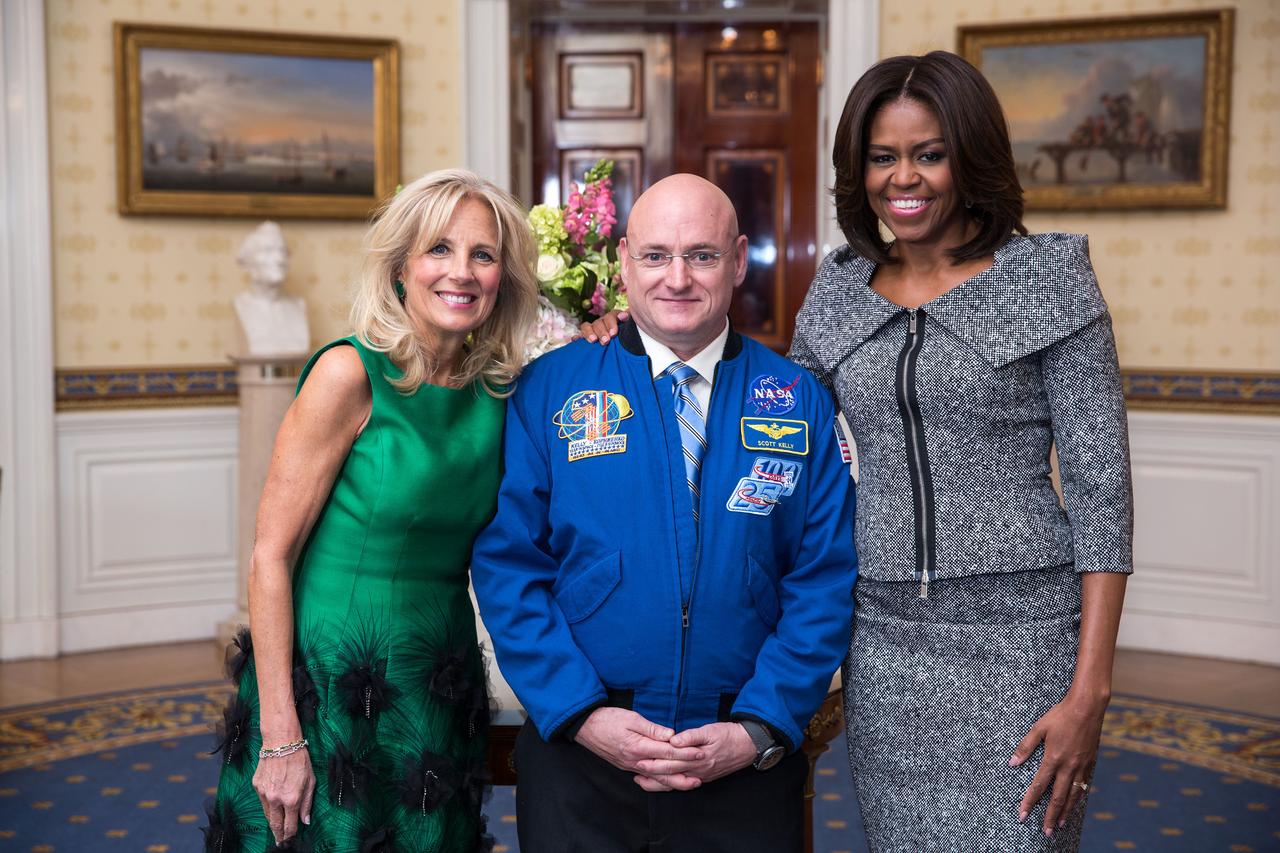
First Lady Michelle Obama and Dr. Jill Biden greet Scott Kelly, First Lady's State of the Union box guest, in the Blue Room of the White House, Jan. 20, 2015. (Official White House Photo by Lawrence Jackson) P012015LJ-0103 This official White House photograph is being made available only for publication by news organizations and/or for personal use printing by the subject(s) of the photograph. The photograph may not be manipulated in any way and may not be used in commercial or political materials, advertisements, emails, products, promotions that in any way suggests approval or endorsement of the President, the First Family, or the White House.
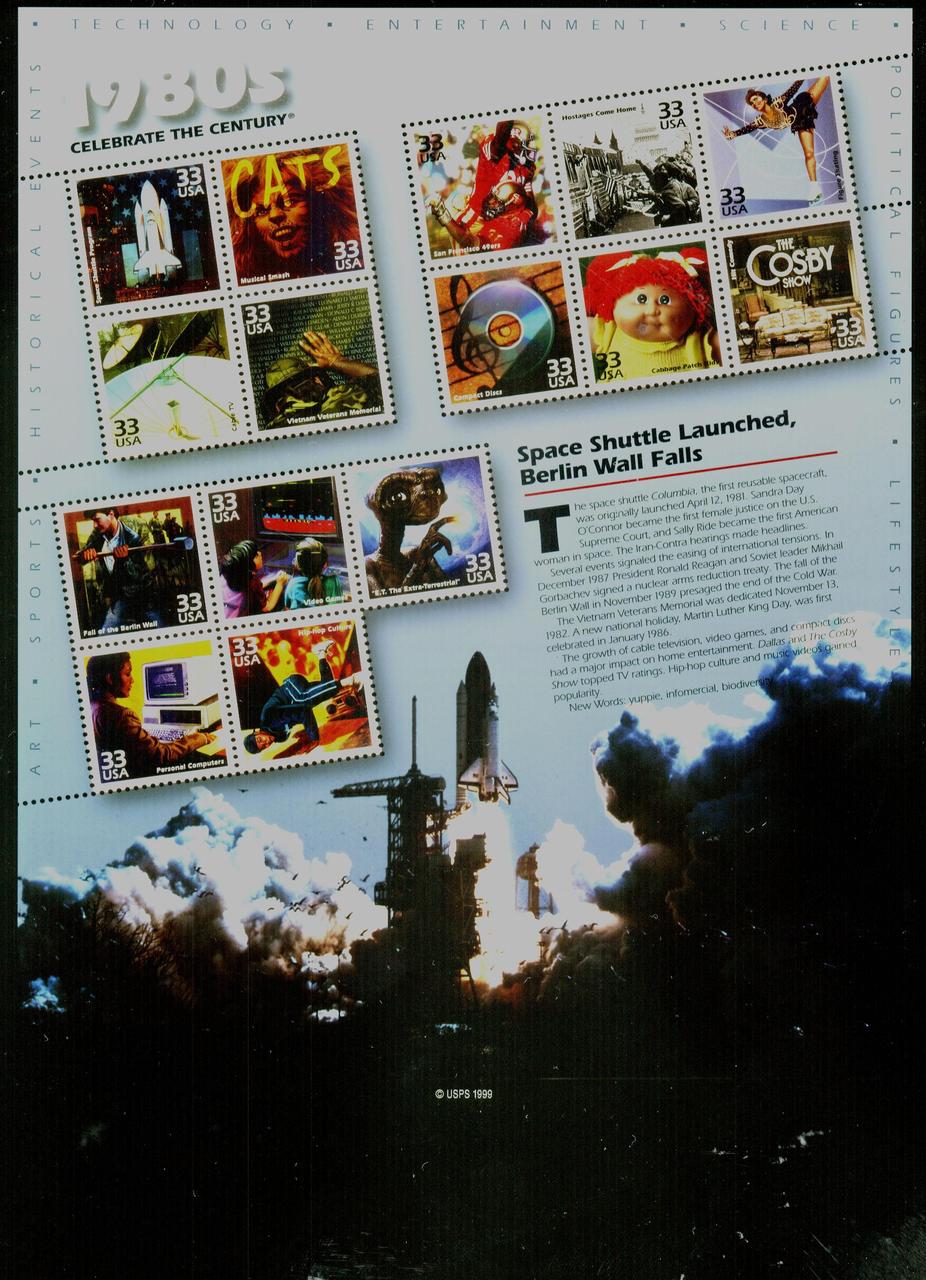
A new series of U.S. Postage stamps, The 1980s, is unveiled at the KSC Visitors Complex. Taking part in the "First Day of Issue Ceremony" were astronaut Richard Linnehan, U.S. Representative, 15th Congressional District, Dave Weldon, U.S. Postal Service District Manager Viki Brennan, Center Director Roy Bridges and President of the Visitor Complex Rick Abramson. Among the stamps issued is one of Space Shuttle Columbia (upper left corner), first launched in April 1981. This collection of stamps is the ninth in the Post Office's "Celebrate the Century" commemorative series honoring the last 100 years of American history
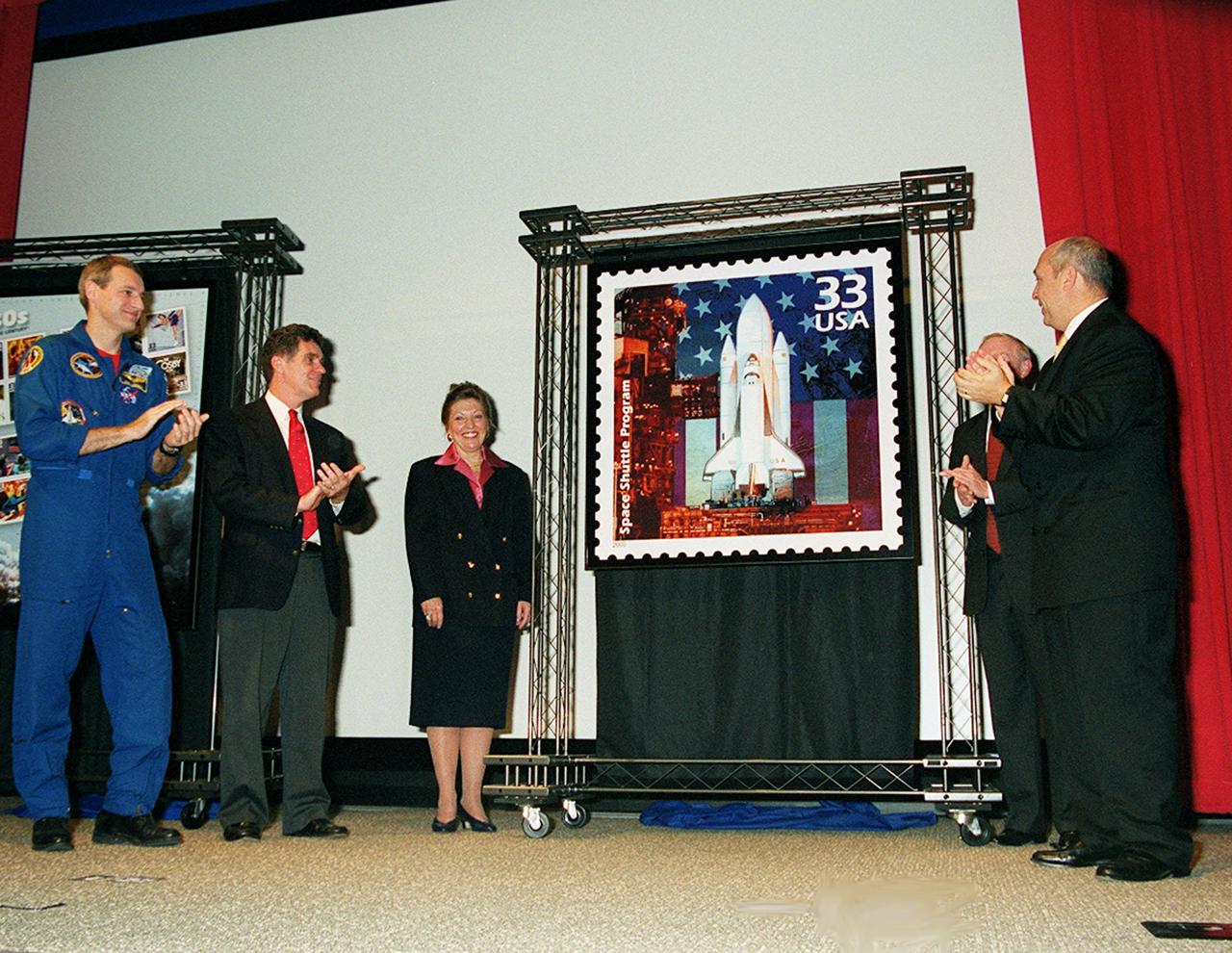
One of a new series of U.S. Postage stamps, The 1980s, is unveiled at the KSC Visitors Complex. The stamp, shown here, is the Space Shuttle Columbia, first launched in April 1981. This collection of stamps is the ninth in the Post Office's "Celebrate the Century" commemorative series honoring the last 100 years of American history. Taking part in the "First Day of Issue Ceremony" are (left to right) astronaut Richard Linnehan, U.S. Representative, 15th Congressional District, Dave Weldon, U.S. Postal Service District Manager Viki Brennan, Center Director Roy Bridges and President of the Visitor Complex Rick Abramson
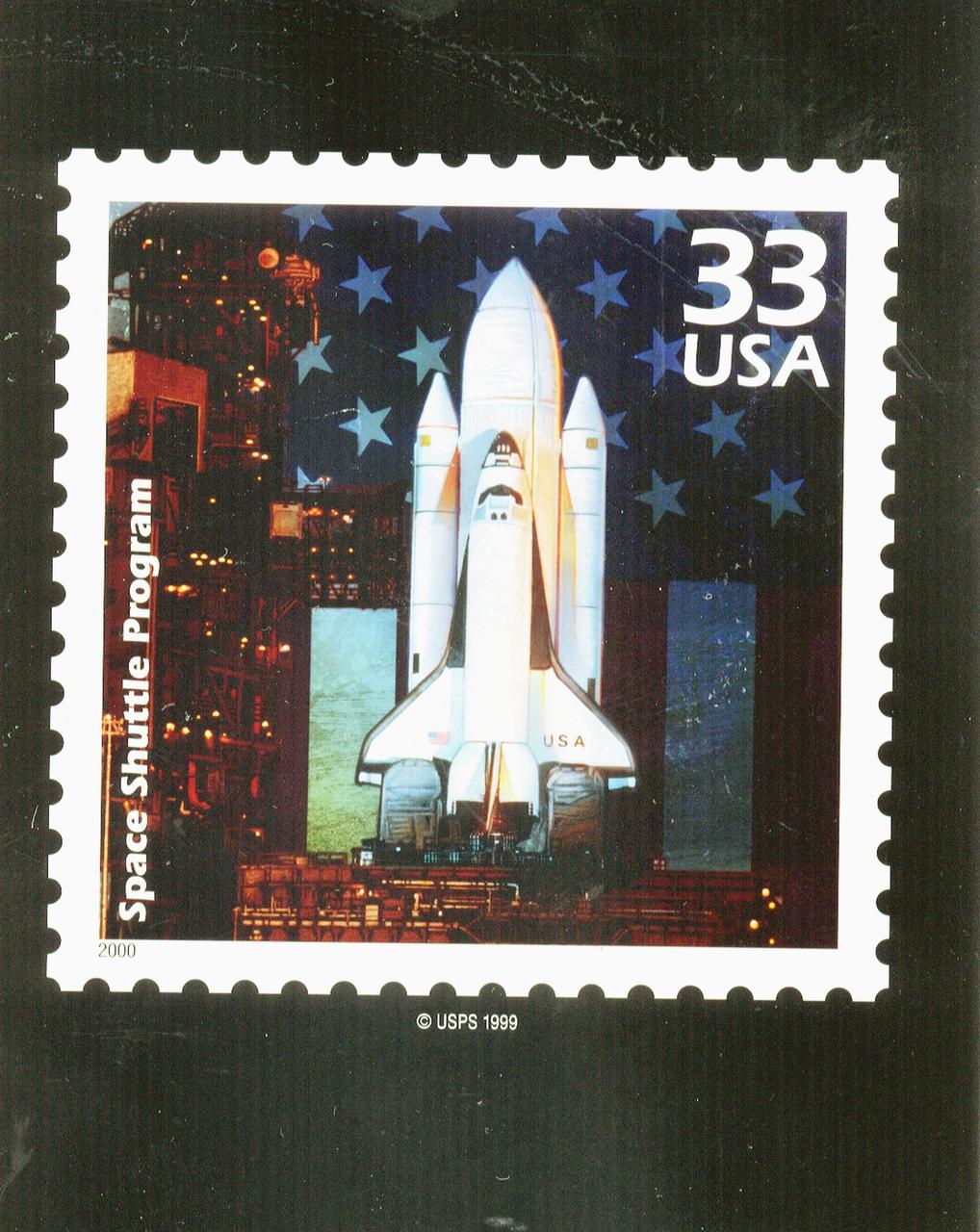
One of a new series of U.S. Postage stamps, The 1980s, is unveiled at the KSC Visitors Complex. The stamp, shown here, is the Space Shuttle Columbia, first launched in April 1981. This collection of stamps is the ninth in the Post Office's "Celebrate the Century" commemorative series honoring the last 100 years of American history. Taking part in the "First Day of Issue Ceremony" were astronaut Richard Linnehan, U.S. Representative, 15th Congressional District, Dave Weldon, U.S. Postal Service District Manager Viki Brennan, Center Director Roy Bridges and President of the Visitor Complex Rick Abramson
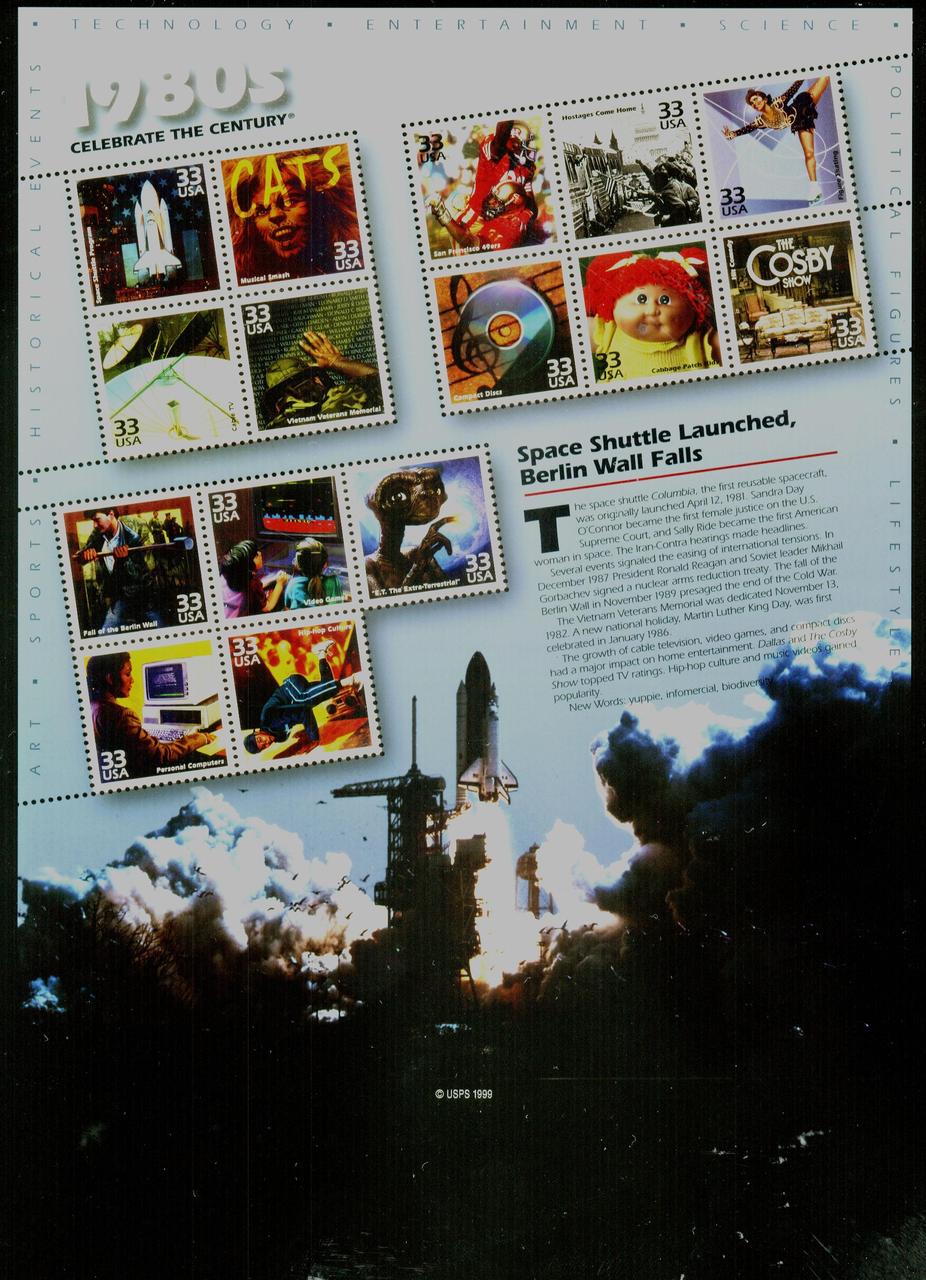
A new series of U.S. Postage stamps, The 1980s, is unveiled at the KSC Visitors Complex. Taking part in the "First Day of Issue Ceremony" were astronaut Richard Linnehan, U.S. Representative, 15th Congressional District, Dave Weldon, U.S. Postal Service District Manager Viki Brennan, Center Director Roy Bridges and President of the Visitor Complex Rick Abramson. Among the stamps issued is one of Space Shuttle Columbia (upper left corner), first launched in April 1981. This collection of stamps is the ninth in the Post Office's "Celebrate the Century" commemorative series honoring the last 100 years of American history
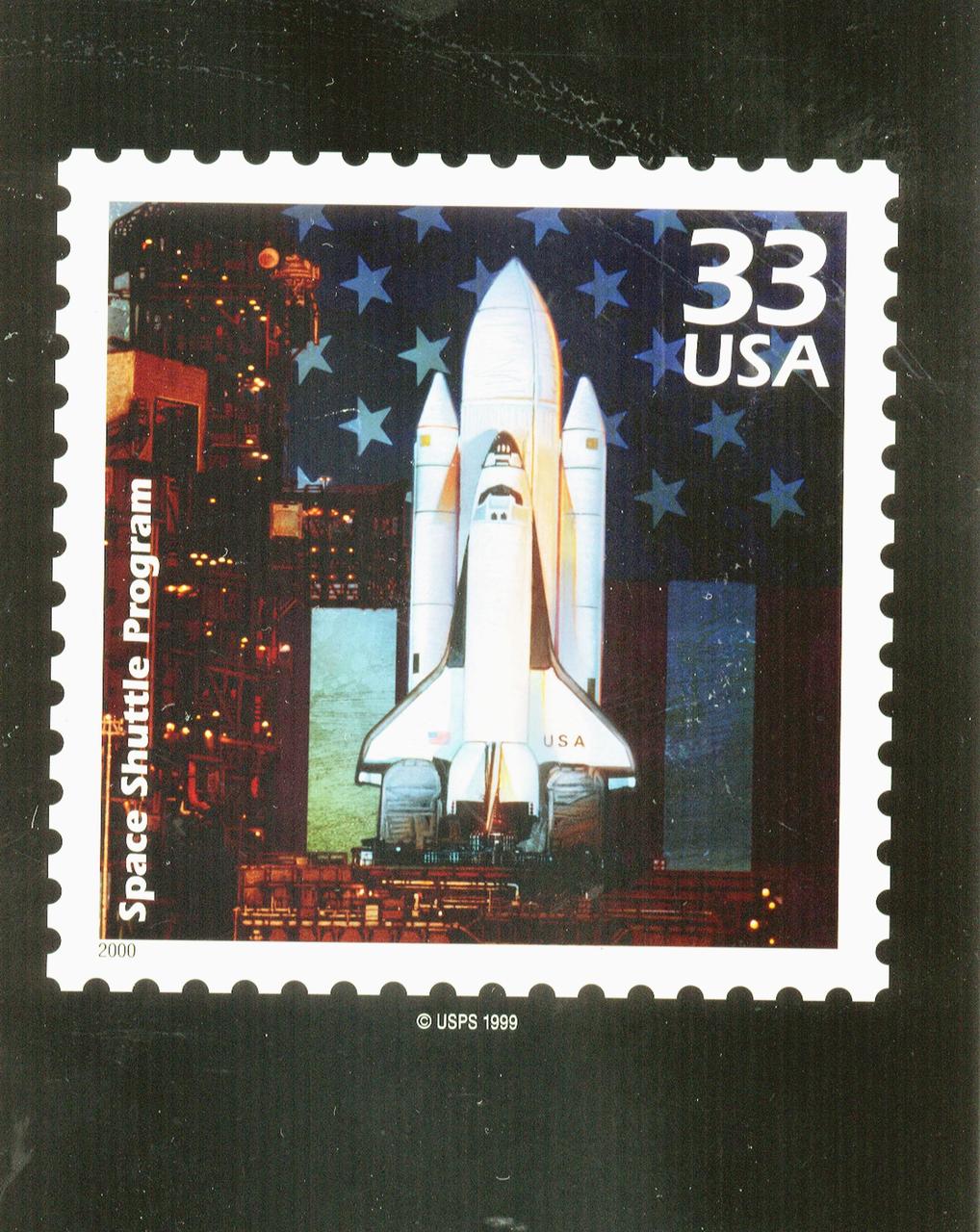
One of a new series of U.S. Postage stamps, The 1980s, is unveiled at the KSC Visitors Complex. The stamp, shown here, is the Space Shuttle Columbia, first launched in April 1981. This collection of stamps is the ninth in the Post Office's "Celebrate the Century" commemorative series honoring the last 100 years of American history. Taking part in the "First Day of Issue Ceremony" were astronaut Richard Linnehan, U.S. Representative, 15th Congressional District, Dave Weldon, U.S. Postal Service District Manager Viki Brennan, Center Director Roy Bridges and President of the Visitor Complex Rick Abramson
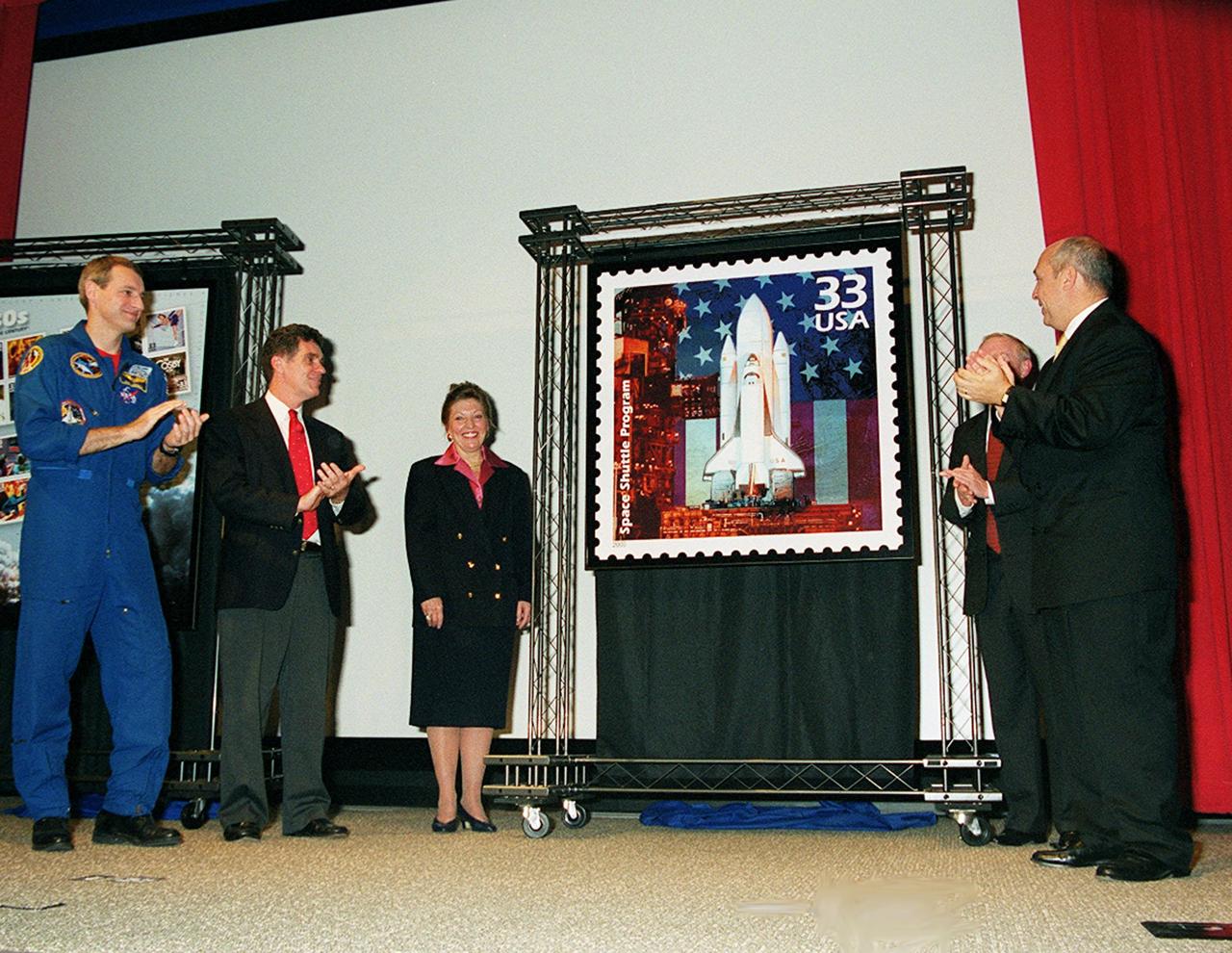
One of a new series of U.S. Postage stamps, The 1980s, is unveiled at the KSC Visitors Complex. The stamp, shown here, is the Space Shuttle Columbia, first launched in April 1981. This collection of stamps is the ninth in the Post Office's "Celebrate the Century" commemorative series honoring the last 100 years of American history. Taking part in the "First Day of Issue Ceremony" are (left to right) astronaut Richard Linnehan, U.S. Representative, 15th Congressional District, Dave Weldon, U.S. Postal Service District Manager Viki Brennan, Center Director Roy Bridges and President of the Visitor Complex Rick Abramson
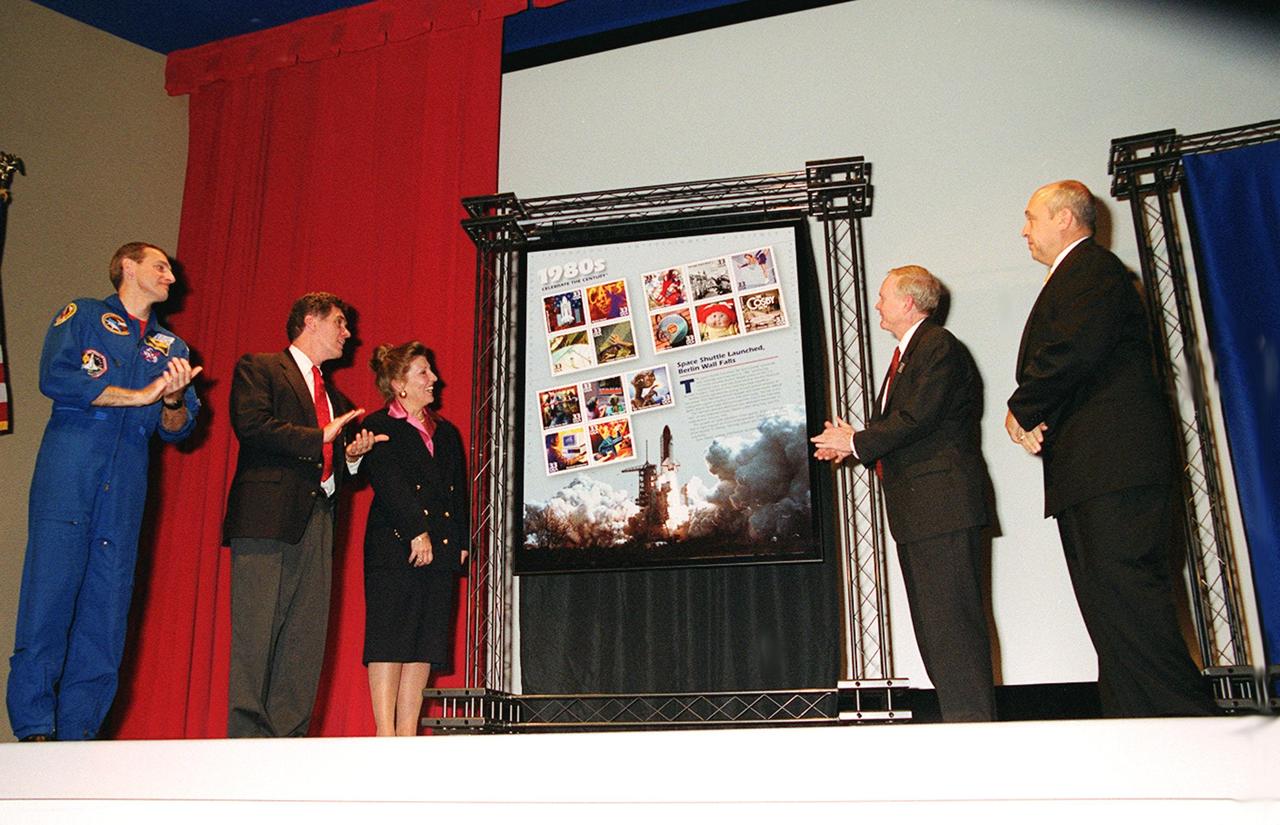
A new series of U.S. Postage stamps, The 1980s, is unveiled at the KSC Visitors Complex. Shown taking part in the "First Day of Issue Ceremony" are (left to right) astronaut Richard Linnehan, U.S. Representative, 15th Congressional District, Dave Weldon, U.S. Postal Service District Manager Viki Brennan, Center Director Roy Bridges and President of the Visitor Complex Rick Abramson. Among the stamps issued is one of Space Shuttle Columbia, first launched in April 1981. This collection of stamps is the ninth in the Post Office's "Celebrate the Century" commemorative series honoring the last 100 years of American history
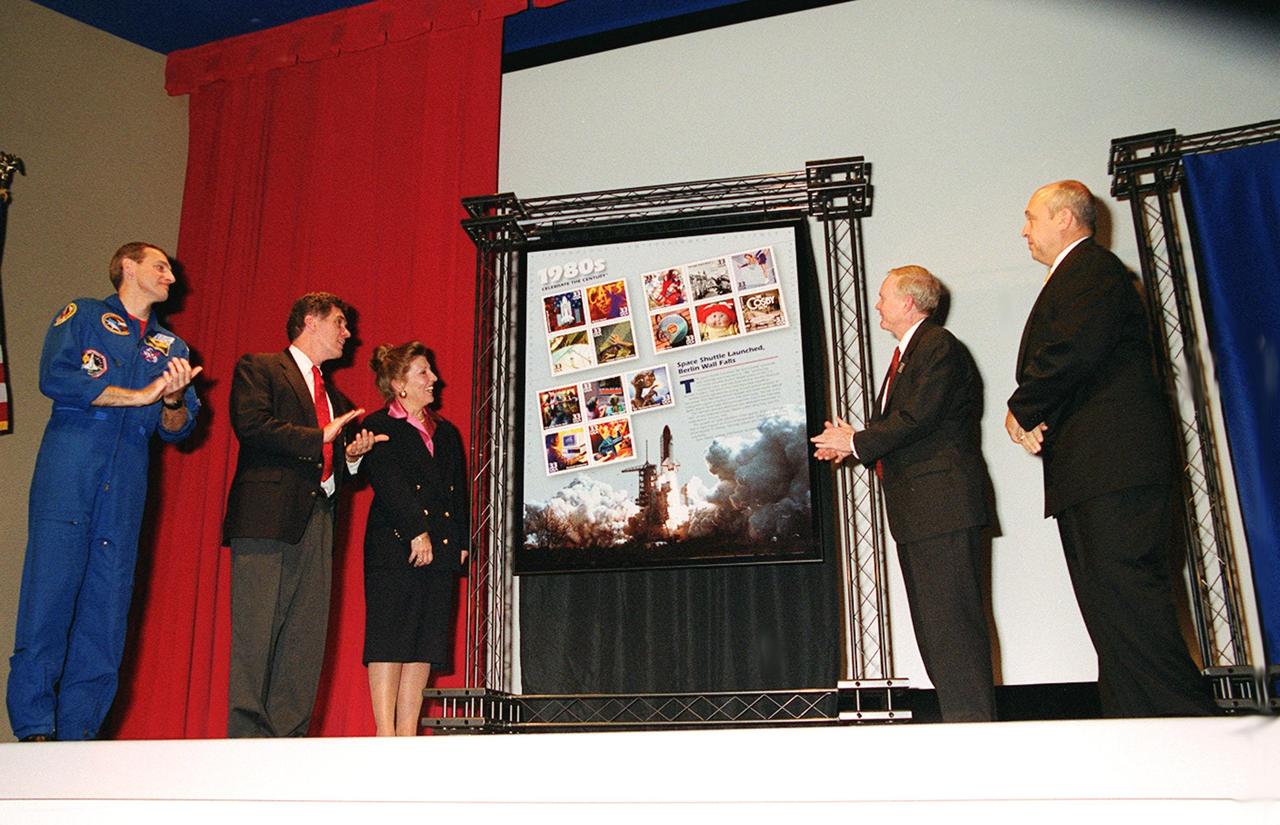
A new series of U.S. Postage stamps, The 1980s, is unveiled at the KSC Visitors Complex. Shown taking part in the "First Day of Issue Ceremony" are (left to right) astronaut Richard Linnehan, U.S. Representative, 15th Congressional District, Dave Weldon, U.S. Postal Service District Manager Viki Brennan, Center Director Roy Bridges and President of the Visitor Complex Rick Abramson. Among the stamps issued is one of Space Shuttle Columbia, first launched in April 1981. This collection of stamps is the ninth in the Post Office's "Celebrate the Century" commemorative series honoring the last 100 years of American history
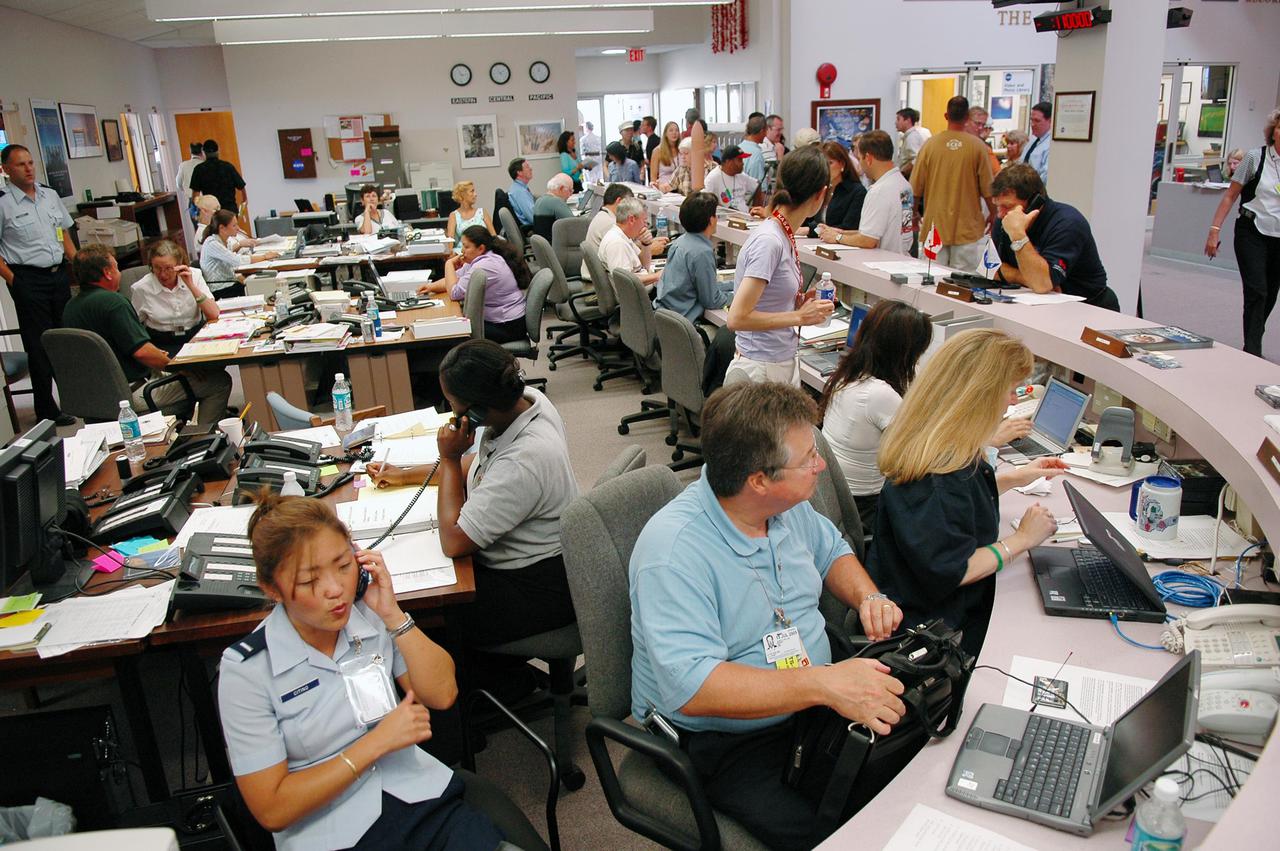
KENNEDY SPACE CENTER, FLA. - The NASA News Center at NASA Kennedy Space Center hums with activity as workers and volunteers behind the counter help the media during launch activities for Return to Flight mission STS-114. More than a thousand media representatives from 36 states, the District of Columbia and 32 countries converged on the News Center for the historic launch.
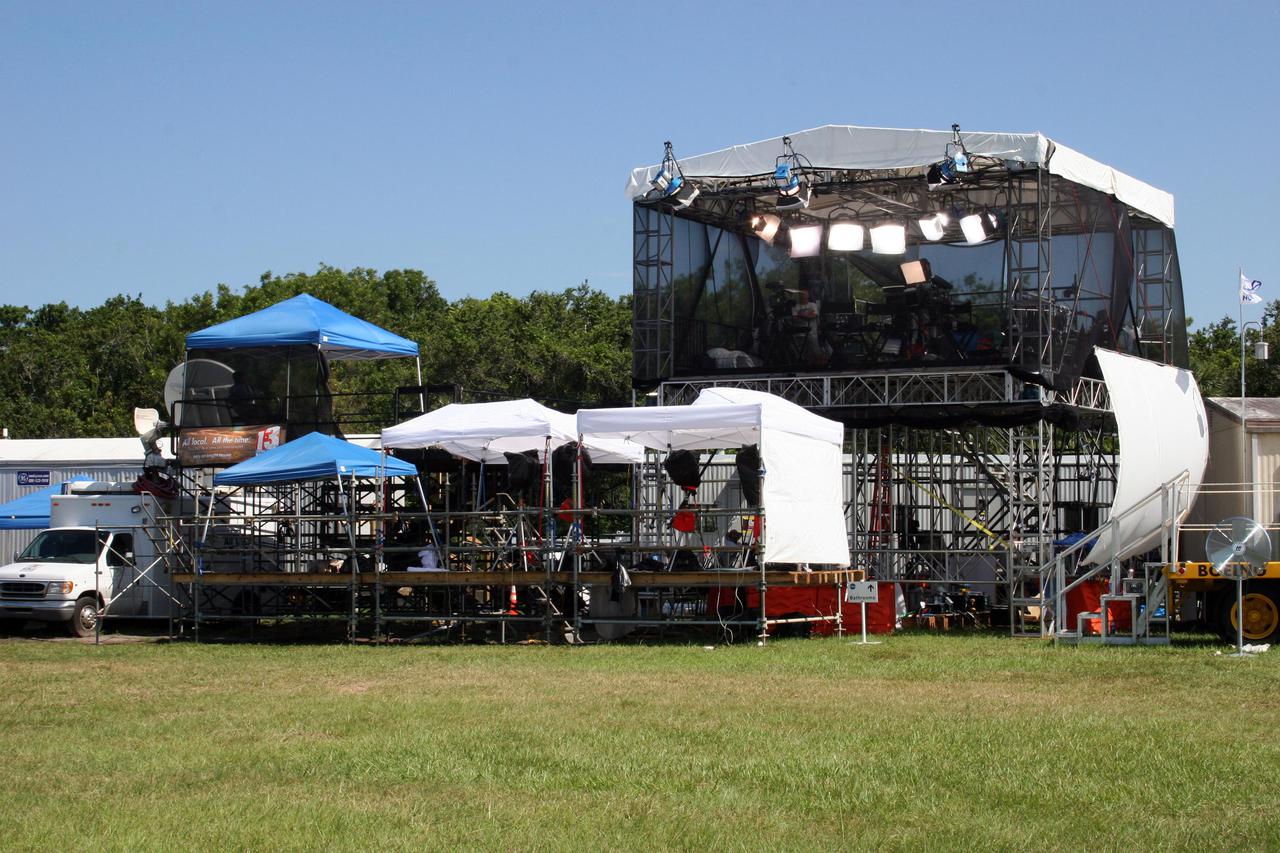
KENNEDY SPACE CENTER, FLA. - Tents cover precious equipment in the area east of the NASA Kennedy Space Center News Center where photographers and other media wait for the launch of Space Shuttle Discovery on Return to Flight mission STS-114. More than a thousand media representatives from 36 states, the District of Columbia and 32 countries converged on the News Center for the historic launch.
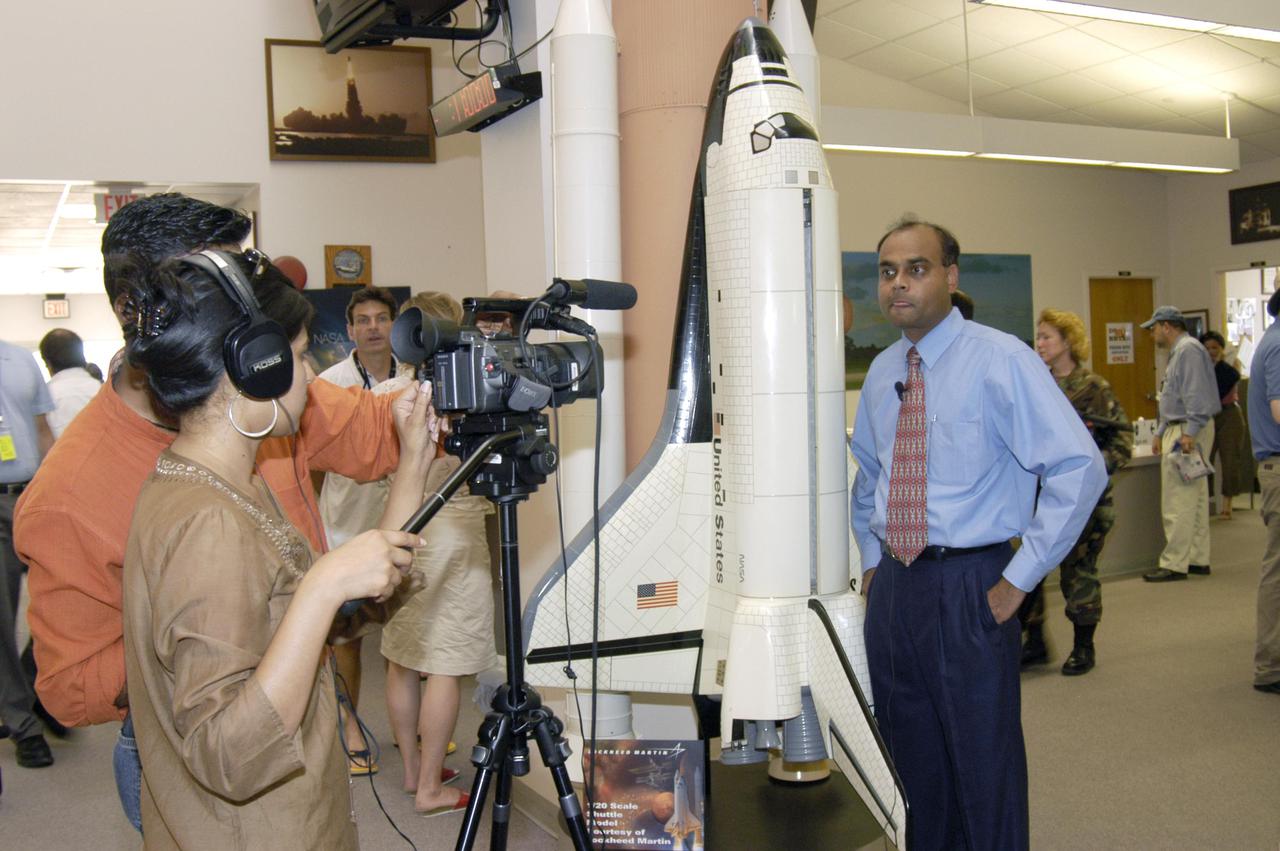
KENNEDY SPACE CENTER, FLA. - The model of the Space Shuttle is a popular backdrop for interviews in the NASA News Center at NASA Kennedy Space Center during launch activities for Return to Flight mission STS-114. More than a thousand media representatives from 36 states, the District of Columbia and 32 countries converged on the News Center for the historic launch.
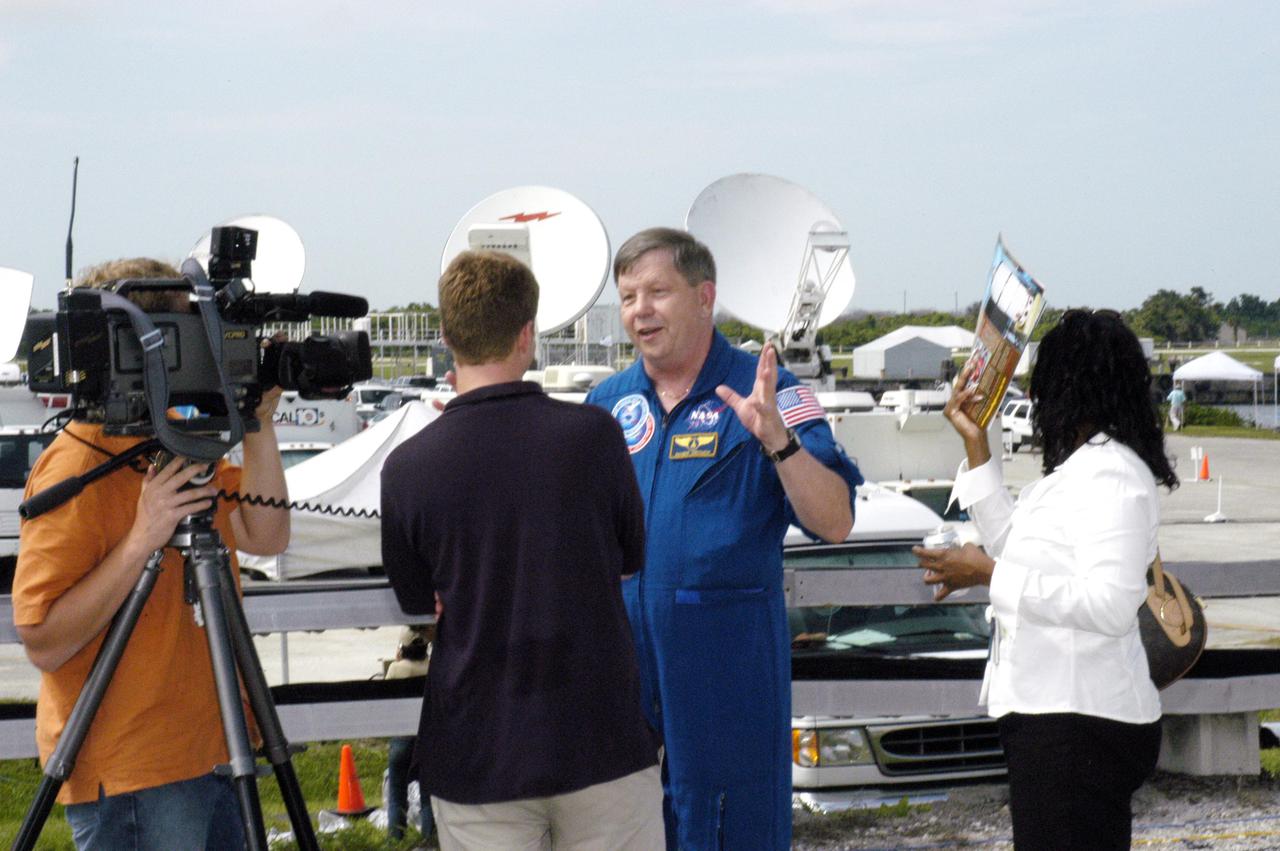
KENNEDY SPACE CENTER, FLA. - Roger Crouch (center), a payload specialist, talks to the media prior to the launch of Space Shuttle Discovery on the historic Return to Flight mission STS-114. He has flown on two Shuttle missions, STS-83 and STS-94. STS-114 is the 114th Space Shuttle flight and the 31st for Discovery. More than a thousand media representatives from 36 states, the District of Columbia and 32 countries converged on the News Center for the historic launch.
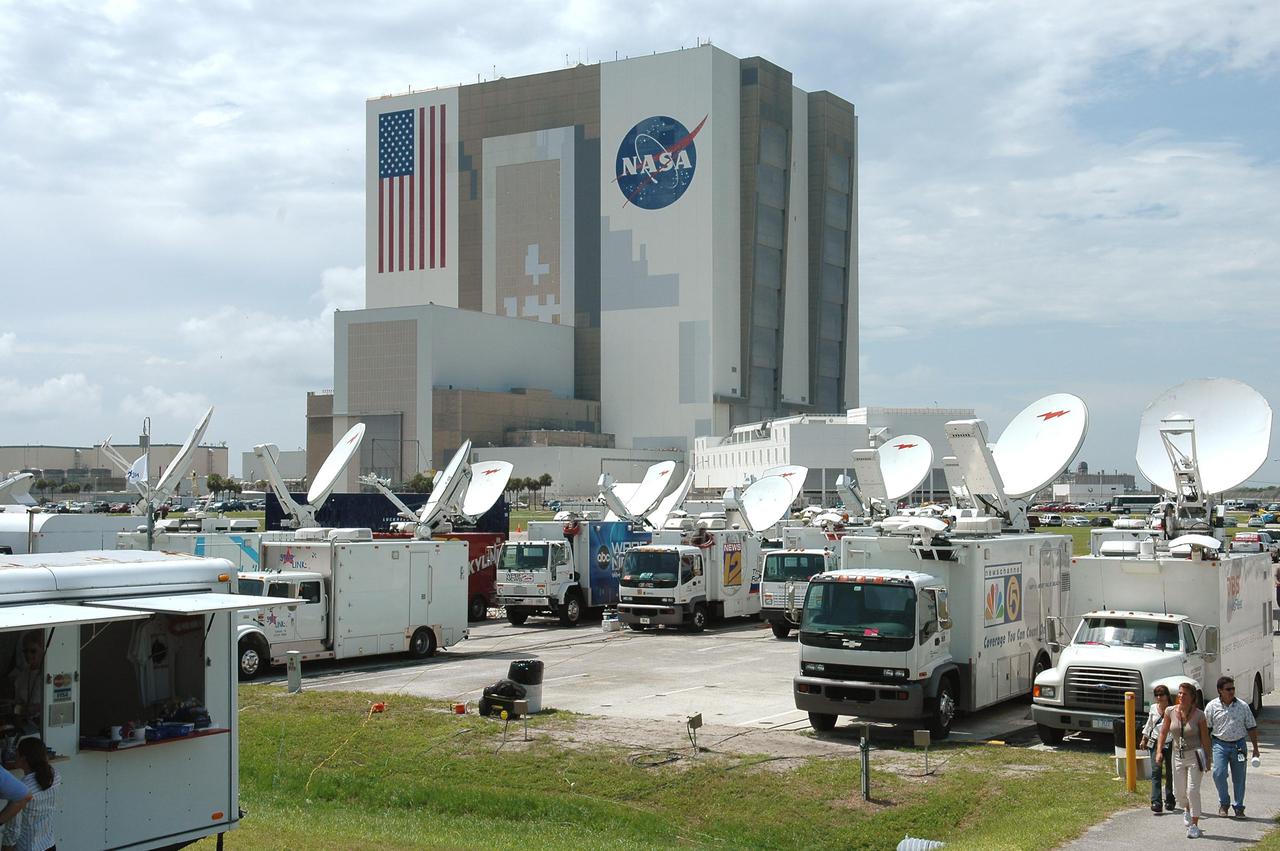
KENNEDY SPACE CENTER, FLA. - Satellite trucks are lined up in the parking lot at the NASA Kennedy Space Center News Center to cover the launch of Space Shuttle Discovery on Return to Flight mission STS-114. In the background is the Vehicle Assembly Building. More than a thousand media representatives from 36 states, the District of Columbia and 32 countries converged on the News Center for the historic launch.
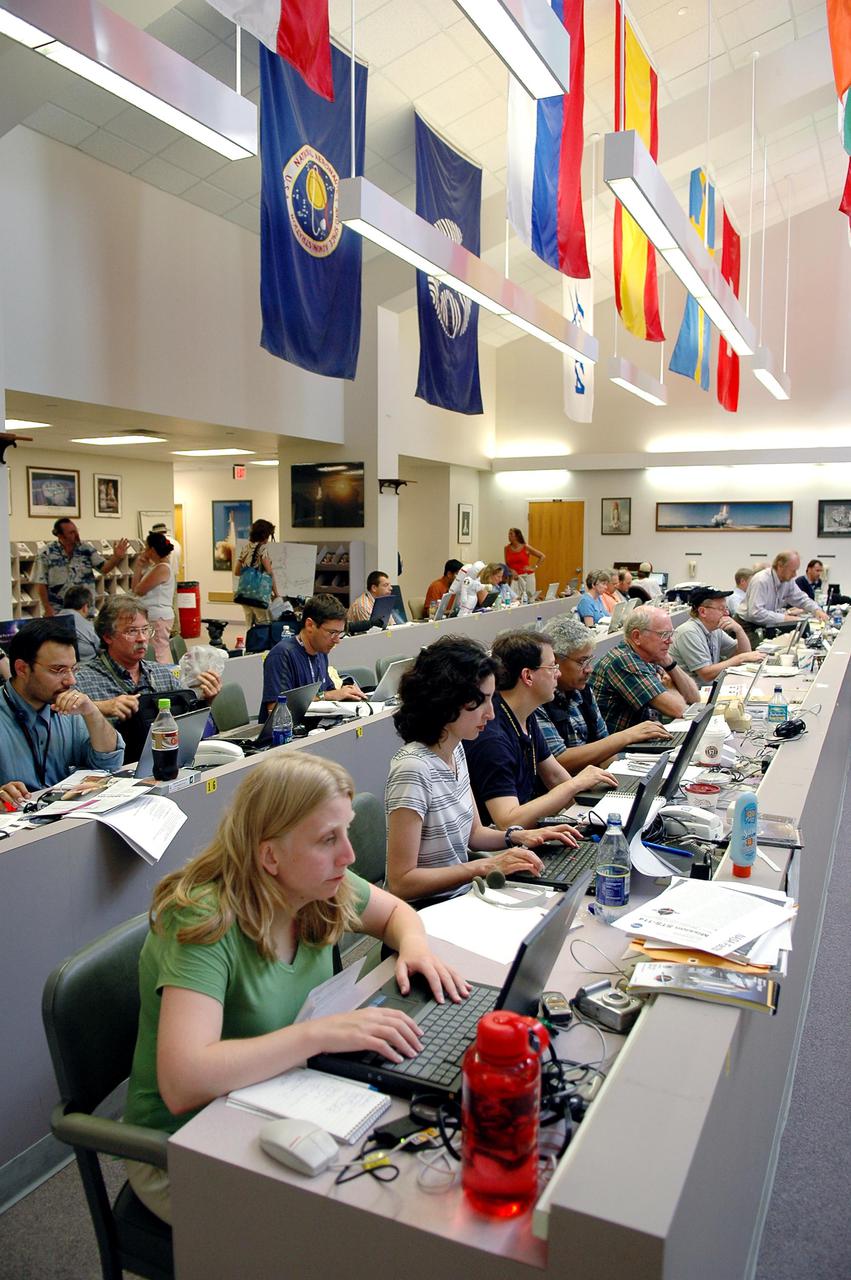
KENNEDY SPACE CENTER, FLA. - Journalists fill the work stations at the NASA News Center while others find standing room only during launch activities for Return to Flight mission STS-114. More than a thousand media representatives from 36 states, the District of Columbia and 32 countries converged on the News Center for the historic launch.
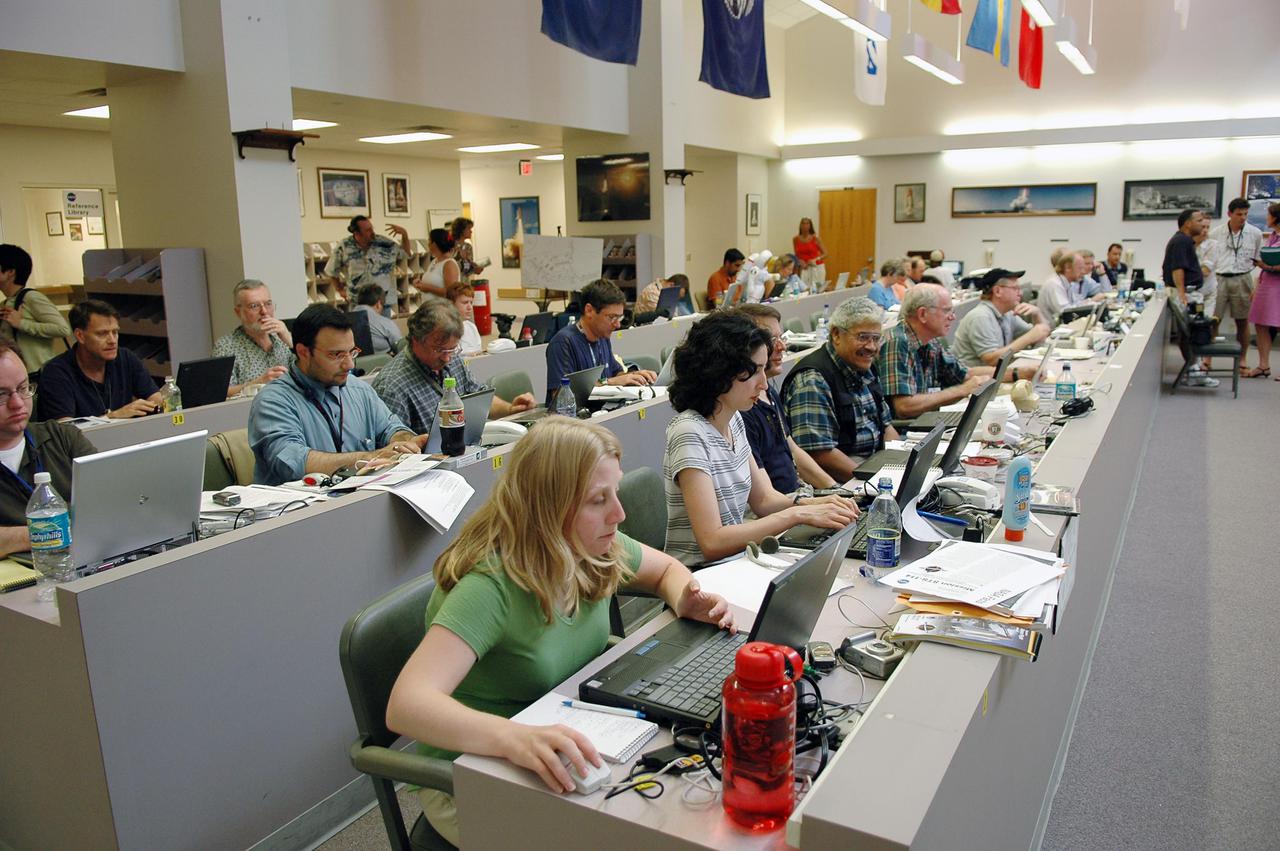
KENNEDY SPACE CENTER, FLA. - Journalists fill the work stations at the NASA News Center while others find standing room only during launch activities for Return to Flight mission STS-114. More than a thousand media representatives from 36 states, the District of Columbia and 32 countries converged on the News Center for the historic launch.
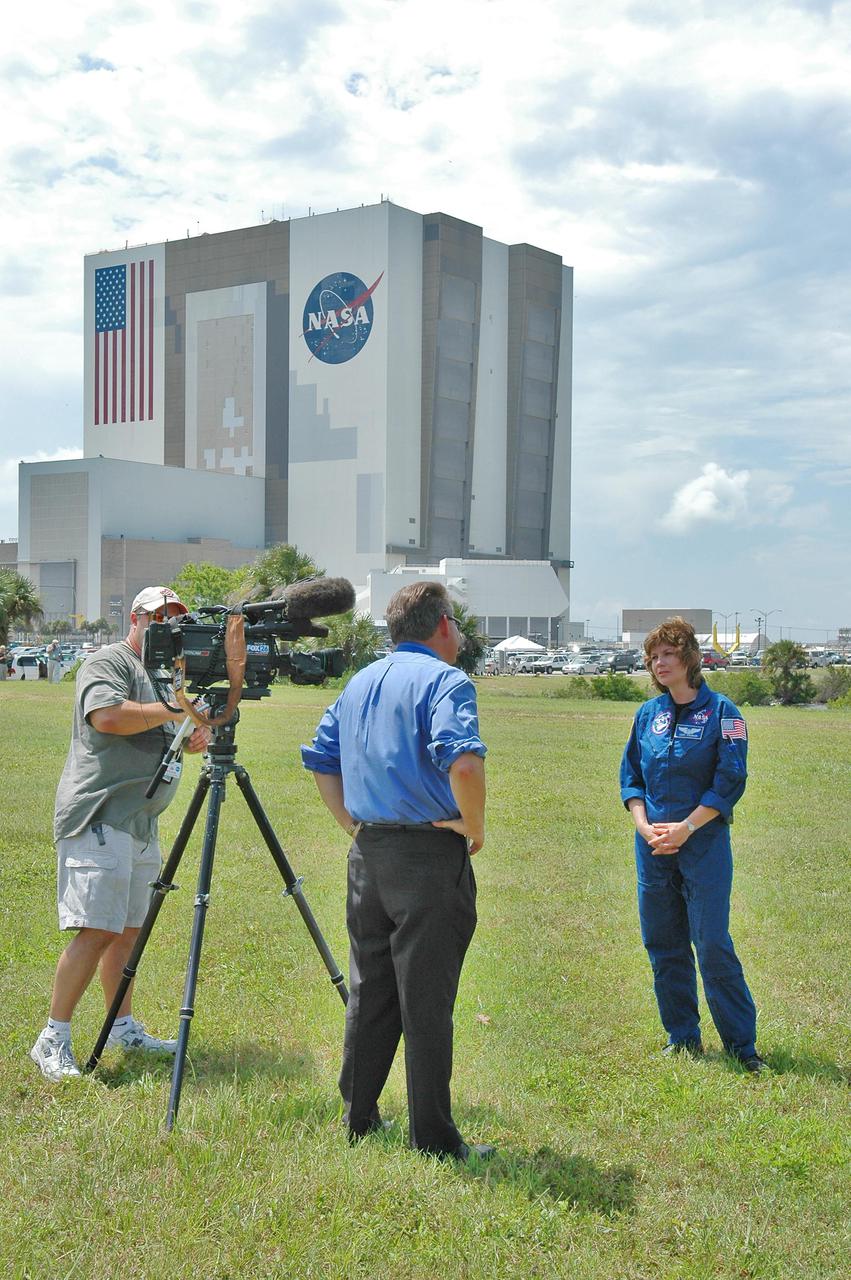
KENNEDY SPACE CENTER, FLA. - Astronaut Catherine “Cady” Coleman is interviewed in the NASA News Center at NASA Kennedy Space Center by a television reporter during launch activities for Return to Flight mission STS-114. Coleman has flown on two Shuttle missions, STS-73 and STS-93. More than a thousand media representatives from 36 states, the District of Columbia and 32 countries converged on the News Center for the historic launch.
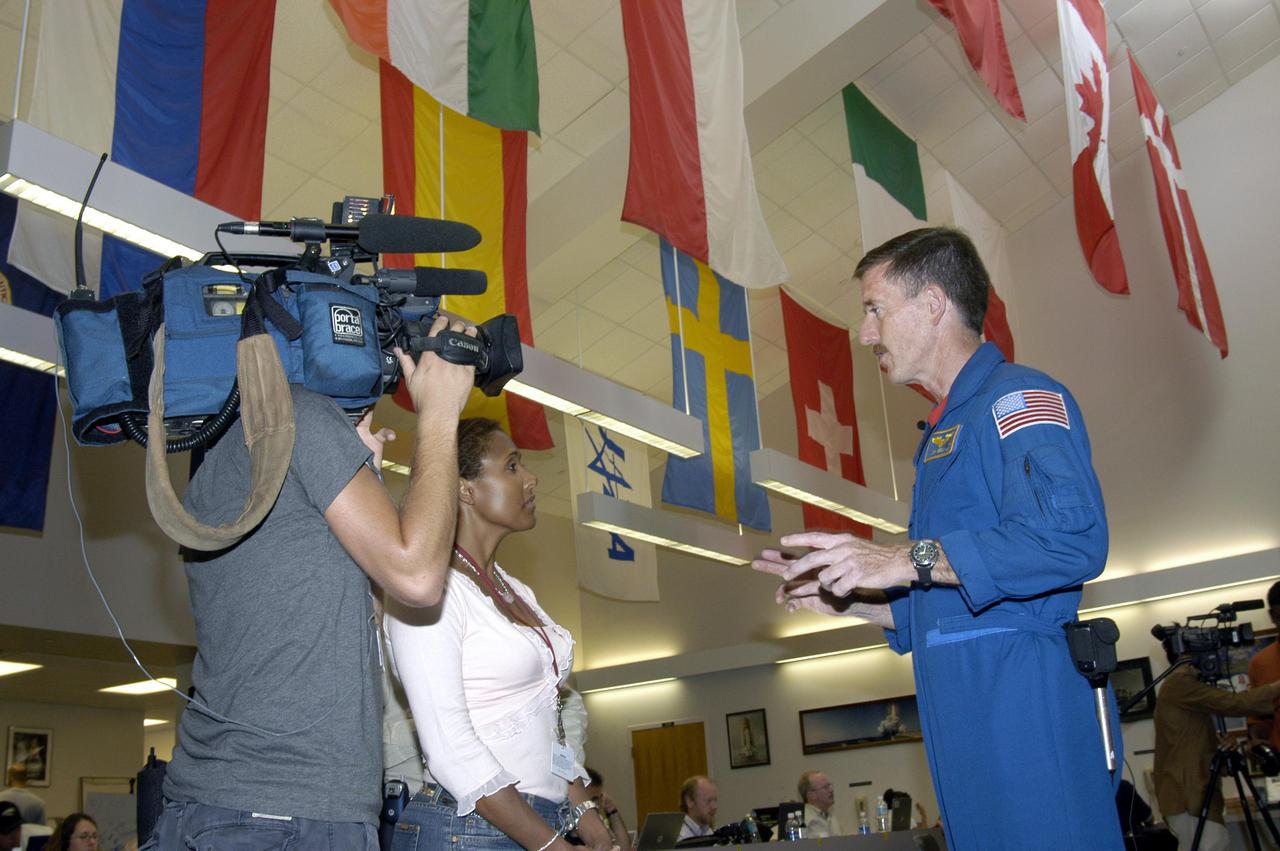
KENNEDY SPACE CENTER, FLA. - Astronaut James Reilly is interviewed in the NASA News Center at NASA Kennedy Space Center by a television reporter during launch activities for Return to Flight mission STS-114. Reilly has flown on two Shuttle missions, STS-89 and STS-104. More than a thousand media representatives from 36 states, the District of Columbia and 32 countries converged on the News Center for the historic launch.

STS078-726-014 (20 June - 7 July 1996) --- Washington D.C., located in the center of the photo, was photographed in both regular color (here) and infrared (STS078-760-010) by the Life and Microgravity Spacelab (LMS-1) crew members. The city of Washington is coextensive with the District of Columbia, whose site was agreed upon by Congress in 1790 as the permanent seat of government for the new nation. It is located at the head of the navigable portion of the Potomac River, which separates it from Virginia to the southwest. It covers an area of 68-square-mile (177-square-kilometers). Andrews Air Force Base is seen east southeast of Washington D.C. Baltimore, Maryland, surrounding the Patapsco River mouth into Chesapeake Bay is located northeast of Washington D. C. or in upper right.
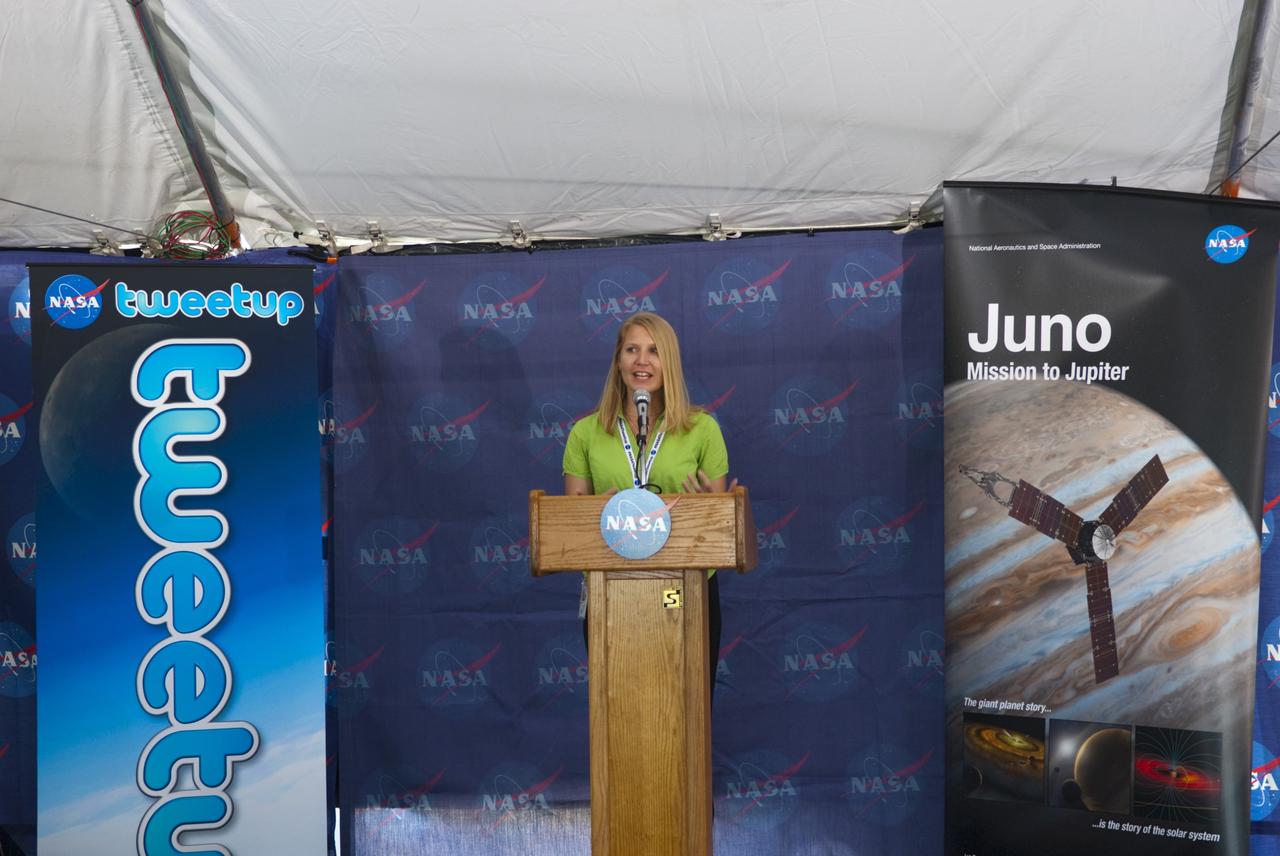
CAPE CANAVERAL, Fla. – At NASA’s Kennedy Space Center in Florida, NASA Tweetup coordinator Stephanie Schierholz welcomes about 150 tweeters to Juno Tweetup activities inside a tent at the Press Site. The tweeters are at the center for two days of prelaunch activities. Juno is NASA’s mission to Jupiter to study the giant planet and improve our understanding of the planet’s formation and evolution. The tweeters will share their experiences with followers through the social networking site Twitter. Attendees represent 28 states, the District of Columbia and five other countries: Canada, Finland, Norway, Spain and the United Kingdom. This is the first time NASA has invited Twitter followers to experience the launch of a planetary spacecraft. The Juno spacecraft is scheduled to launch on an Atlas V rocket from Space Launch Complex 41 at Cape Canaveral Air Force Station in Florida, Aug. 5, at 11:34 a.m. EDT. For more information, visit http://www.nasa.gov/juno. Photo credit: Jim Grossmann

CAPE CANAVERAL, Fla. – At NASA’s Kennedy Space Center in Florida, about 150 followers of the agency’s Twitter account arrived at the Tweetup tent at the Press Site for two days of Juno prelaunch activities. Juno is NASA’s mission to Jupiter to study the giant planet and improve our understanding of the planet’s formation and evolution. The tweeters will share their experiences with followers through the social networking site Twitter. Attendees represent 28 states, the District of Columbia and five other countries: Canada, Finland, Norway, Spain and the United Kingdom. This is the first time NASA has invited Twitter followers to experience the launch of a planetary spacecraft. The Juno spacecraft is scheduled to launch on an Atlas V rocket from Space Launch Complex 41 at Cape Canaveral Air Force Station in Florida, Aug. 5, at 11:34 a.m. EDT. For more information, visit http://www.nasa.gov/juno. Photo credit: Jim Grossmann

SL3-83-166 (July-September 1973) --- A vertical view of the Washington D.C. and the Baltimore, Maryland area is seen in the Skylab 3 Earth Resources Experiments Package S190-B (five-inch Earth terrain camera) photograph taken from the Skylab space station in Earth orbit. The Chesapeake Bay is on the right (east) side of the picture. The Potomac River flows through the Washington area in the lower left (southwest) corner of the photograph. Several transportation routes and major highways stand out very distinctly. Especially conspicuous are the beltways around the cities, Interstate 95 between Baltimore and the nation?s capitol and Interstate 70N leading west from Baltimore. The tunnel and harbor facilities in Baltimore show clearly, also. Identifiable features in the Washington area include the Capitol Building, the Mall area, Robert F. Kennedy Stadium (white circle), the five bridges across the Potomac, Andrews Air Force Base (on east loop), and the smaller Anacostia River. The extent of the urbanization in this area is dramatically illustrated in this picture. The photograph has sufficient resolution that the housing patterns for individual suburban areas are clearly defined with the houses shown as pink gray, wooded areas as dark green and cleared areas light green. Chesapeake Bay circulation patterns are indicated by contrast of dark and light blue. Sediment plumes (red) are seen entering the bay north and east of Baltimore. The bay bridge stands out white against the blue water. The detailed information contained in this one photograph will be of direct use to several EREP investigator teams in land use analysis, sedimentation and circulation patterns in the bay, and resource surveys of Maryland. All EREP photography is available to the public through the Department of Interior?s Earth Resources Observations Systems Data Center, Sioux Falls, South Dakota, 57198. Photo credit: NASA
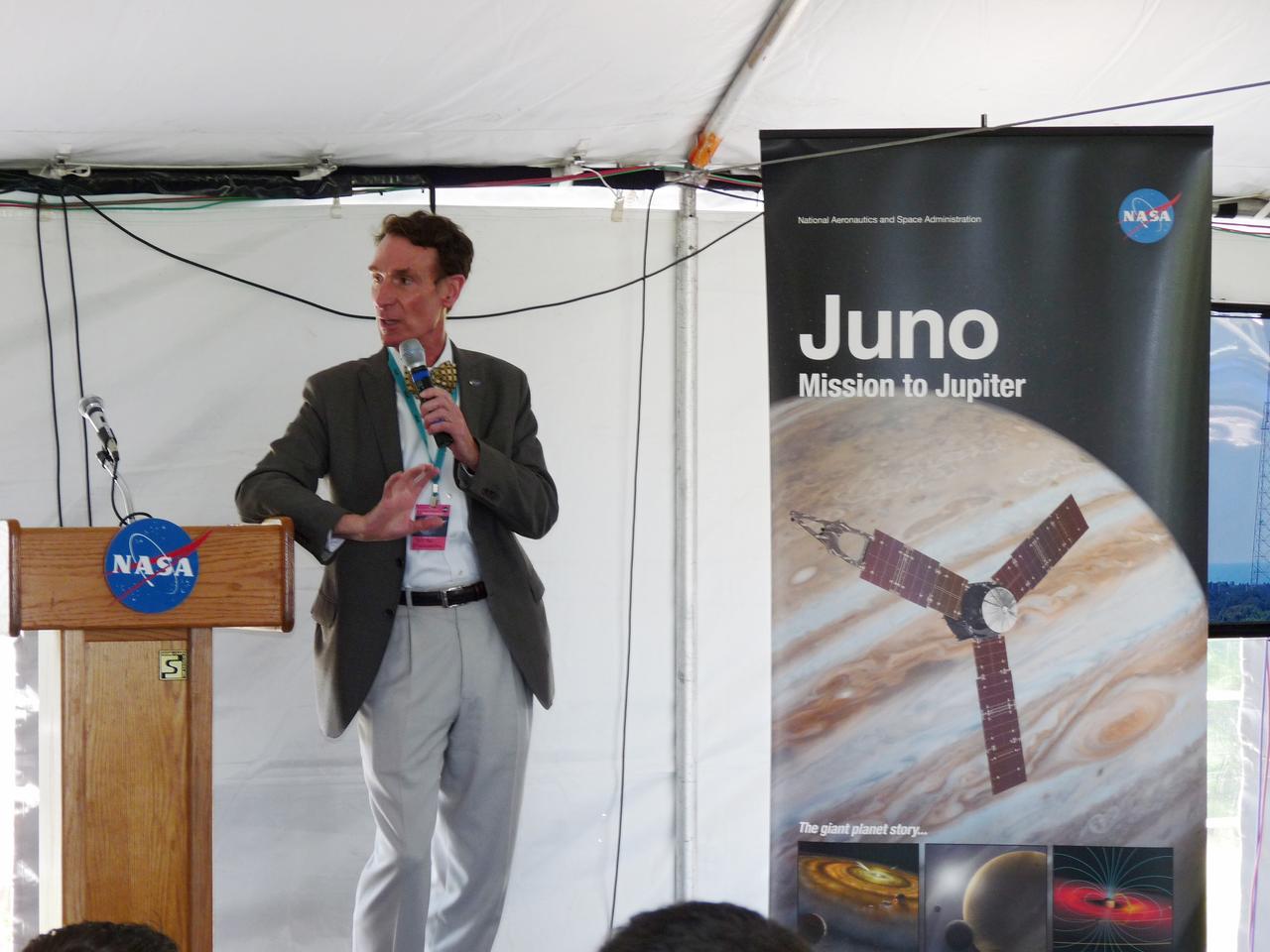
CAPE CANAVERAL, Fla. – At NASA’s Kennedy Space Center in Florida, television personality Bill Nye, the science guy, speaks to about 150 followers of the agency’s Twitter account during Juno Tweetup activities inside a tent at the Press Site. The tweeters are at the center for two days of prelaunch activities. Juno is NASA’s mission to Jupiter to study the giant planet and improve our understanding of the planet’s formation and evolution. The tweeters will share their experiences with followers through the social networking site Twitter. Attendees represent 28 states, the District of Columbia and five other countries: Canada, Finland, Norway, Spain and the United Kingdom. This is the first time NASA has invited Twitter followers to experience the launch of a planetary spacecraft. The Juno spacecraft is scheduled to launch on an Atlas V rocket from Space Launch Complex 41 at Cape Canaveral Air Force Station in Florida, Aug. 5, at 11:34 a.m. EDT. For more information, visit http://www.nasa.gov/juno. Photo credit: NASA/Fletcher Hildreth
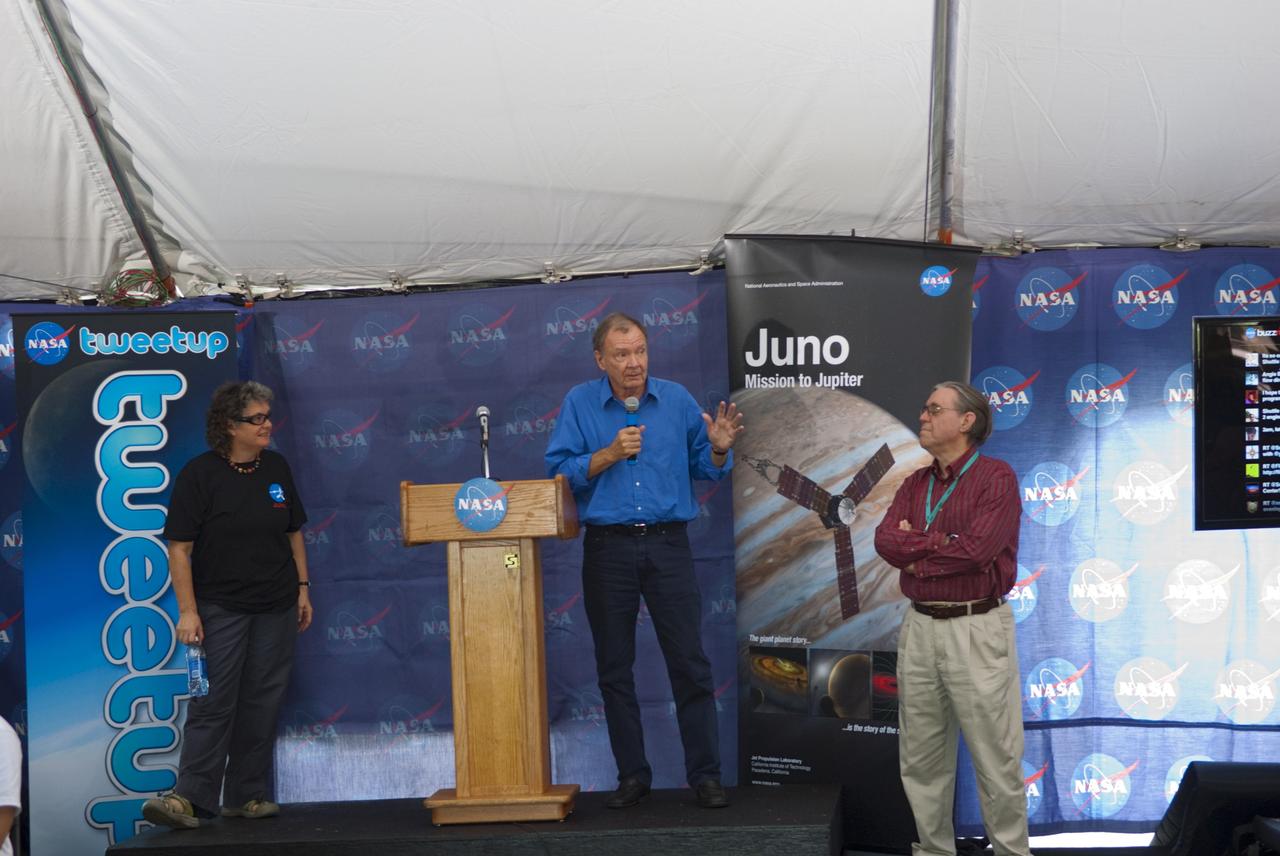
CAPE CANAVERAL, Fla. – At NASA’s Kennedy Space Center in Florida, Toby Owen, Juno co-investigator from the University of Hawaii, speaks to about 150 followers of the agency’s Twitter account during Juno Tweetup activities inside a tent at the Press Site. The tweeters are at the center for two days of prelaunch activities. Juno is NASA’s mission to Jupiter to study the giant planet and improve our understanding of the planet’s formation and evolution. The tweeters will share their experiences with followers through the social networking site Twitter. Attendees represent 28 states, the District of Columbia and five other countries: Canada, Finland, Norway, Spain and the United Kingdom. This is the first time NASA has invited Twitter followers to experience the launch of a planetary spacecraft. The Juno spacecraft is scheduled to launch on an Atlas V rocket from Space Launch Complex 41 at Cape Canaveral Air Force Station in Florida, Aug. 5, at 11:34 a.m. EDT. For more information, visit http://www.nasa.gov/juno. Photo credit: Jim Grossmann
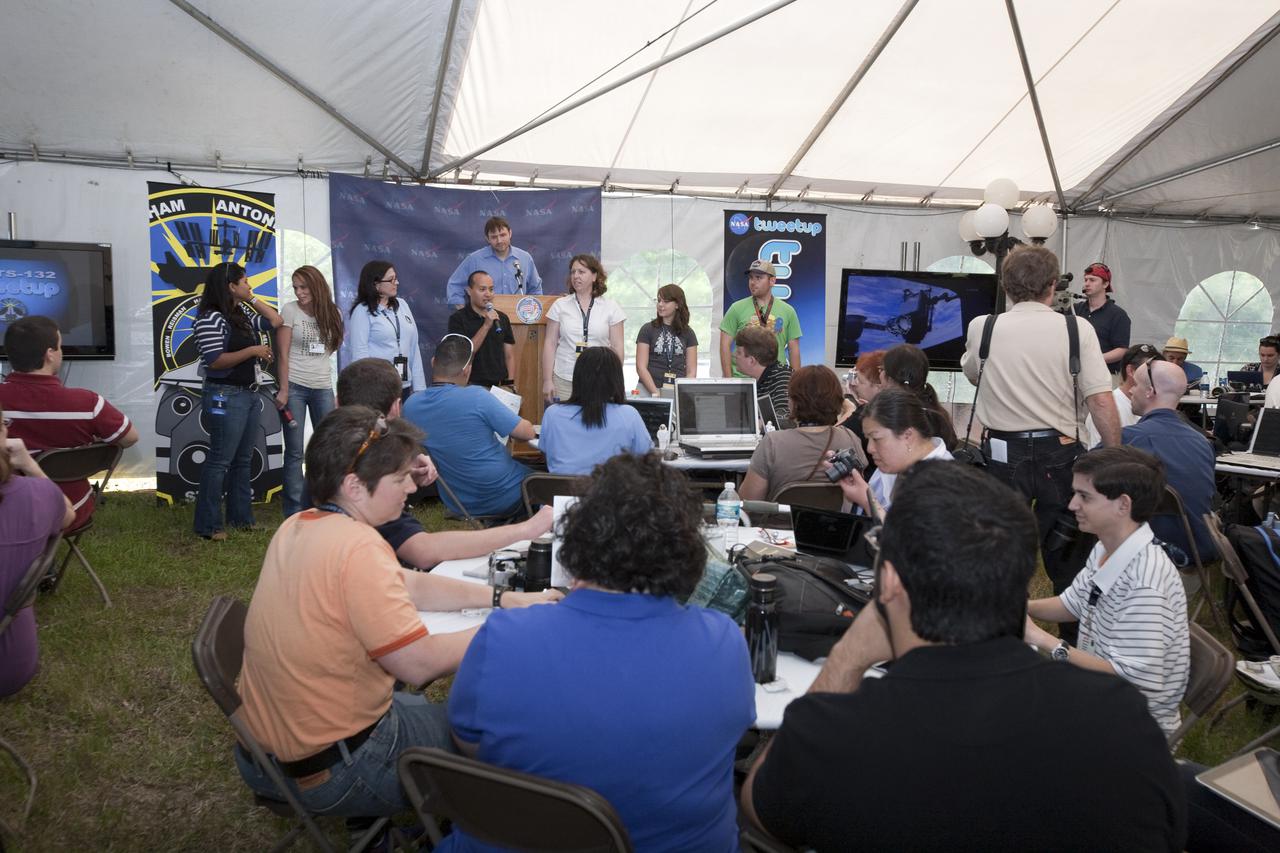
CAPE CANAVERAL, Fla. - At NASA's Kennedy Space Center in Florida, the support personnel for NASA's STS-132 Tweetup introduce themselves to the participants. NASA is hosting 150 people from around the world and providing them with a behind-the-scenes perspective to share with their followers via the social networking service Twitter. Attendees were randomly selected from more than 1,000 online registrations and include people from more than 30 states, the District of Columbia, Puerto Rico, the Netherlands, New Zealand and England. The Tweeters are being given the chance to meet with shuttle technicians, managers, engineers and astronauts, to take a tour of Kennedy, and to experience the exhilaration of the launch of space shuttle Atlantis' STS-132 mission. A tent was set up especially for the occasion near the countdown clock at Kennedy's Press Site. Atlantis' liftoff is set for 2:20 p.m. EDT on May 14. STS-132 is the 34th mission to the station and the last scheduled flight for Atlantis. For more information on the STS-132 mission objectives, payload and crew, visit http:__www.nasa.gov_mission_pages_shuttle_shuttlemissions_sts132_index.html. Photo Credit: NASA_Amanda Diller
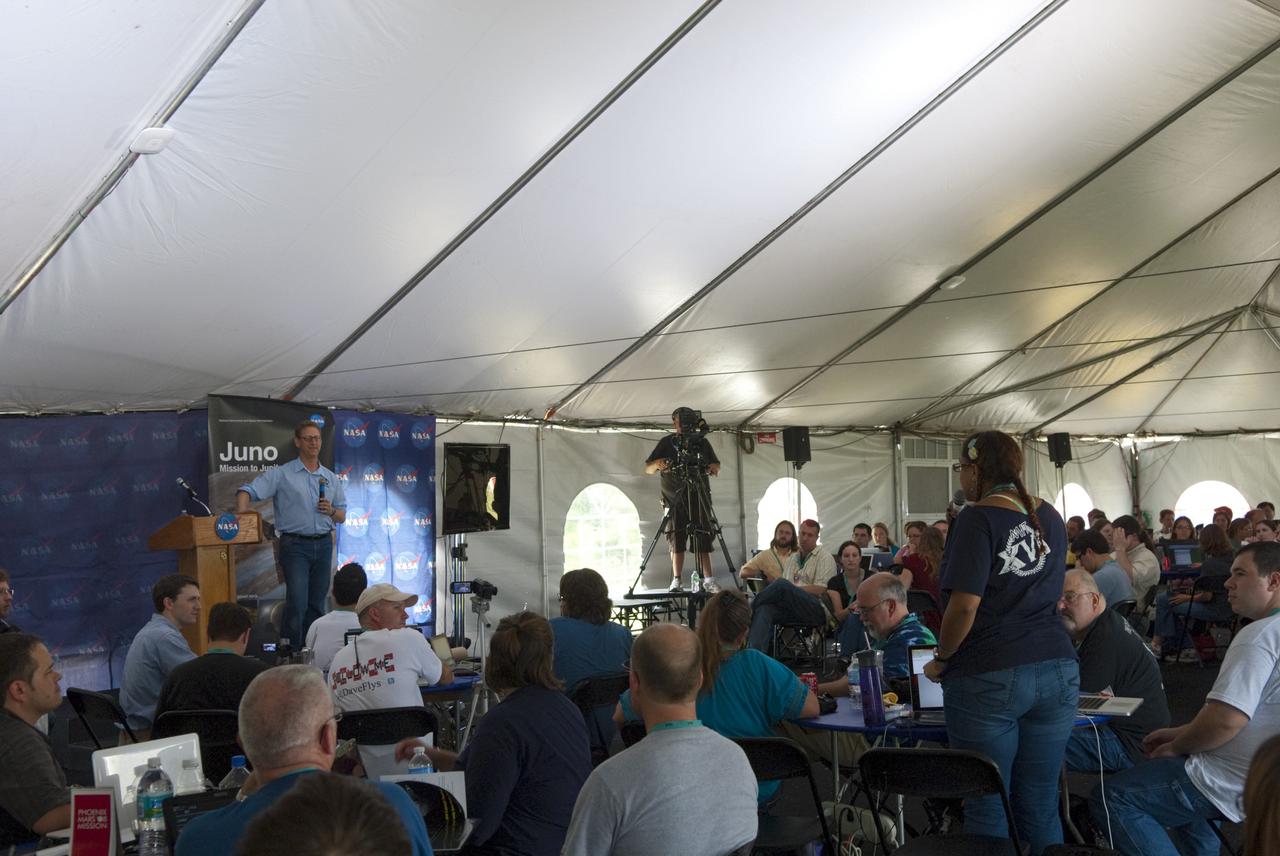
CAPE CANAVERAL, Fla. – At NASA’s Kennedy Space Center in Florida, Steve Levin, Juno project scientist from the Jet Propulsion Laboratory in Pasadena, Calif., speaks to about 150 followers of the agency’s Twitter account during Juno Tweetup activities inside a tent at the Press Site. The tweeters are at the center for two days of prelaunch activities. Juno is NASA’s mission to Jupiter to study the giant planet and improve our understanding of the planet’s formation and evolution. The tweeters will share their experiences with followers through the social networking site Twitter. Attendees represent 28 states, the District of Columbia and five other countries: Canada, Finland, Norway, Spain and the United Kingdom. This is the first time NASA has invited Twitter followers to experience the launch of a planetary spacecraft. The Juno spacecraft is scheduled to launch on an Atlas V rocket from Space Launch Complex 41 at Cape Canaveral Air Force Station in Florida, Aug. 5, at 11:34 a.m. EDT. For more information, visit http://www.nasa.gov/juno. Photo credit: Jim Grossmann
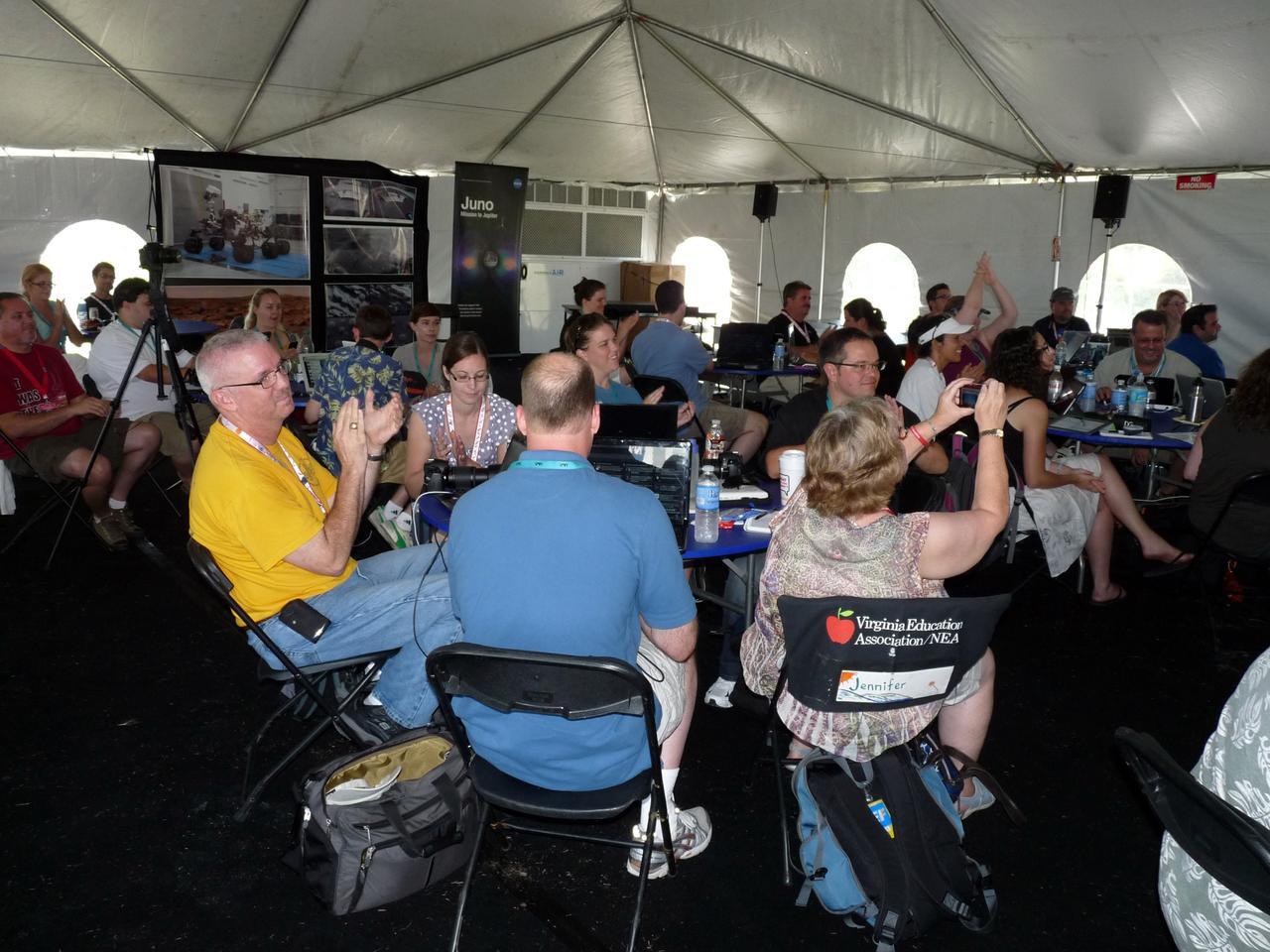
CAPE CANAVERAL, Fla. – At NASA’s Kennedy Space Center in Florida, about 150 followers of the agency’s Twitter account listen to presentations about NASA’s Juno mission to Jupiter during Tweetup activities inside a tent at the Press Site. The tweeters are at the center for two days of Juno prelaunch activities. Juno is NASA’s mission to Jupiter to study the giant planet and improve our understanding of the planet’s formation and evolution. The tweeters will share their experiences with followers through the social networking site Twitter. Attendees represent 28 states, the District of Columbia and five other countries: Canada, Finland, Norway, Spain and the United Kingdom. This is the first time NASA has invited Twitter followers to experience the launch of a planetary spacecraft. The Juno spacecraft is scheduled to launch on an Atlas V rocket from Space Launch Complex 41 at Cape Canaveral Air Force Station in Florida, Aug. 5, at 11:34 a.m. EDT. For more information, visit http://www.nasa.gov/juno. Photo credit: NASA/Fletcher Hildreth

CAPE CANAVERAL, Fla. – At NASA’s Kennedy Space Center in Florida, about 150 followers of the agency’s Twitter account listen to presentations about NASA’s Juno mission to Jupiter during Tweetup activities inside a tent at the Press Site. The tweeters are at the center for two days of Juno prelaunch activities. Juno is NASA’s mission to Jupiter to study the giant planet and improve our understanding of the planet’s formation and evolution. The tweeters will share their experiences with followers through the social networking site Twitter. Attendees represent 28 states, the District of Columbia and five other countries: Canada, Finland, Norway, Spain and the United Kingdom. This is the first time NASA has invited Twitter followers to experience the launch of a planetary spacecraft. The Juno spacecraft is scheduled to launch on an Atlas V rocket from Space Launch Complex 41 at Cape Canaveral Air Force Station in Florida, Aug. 5, at 11:34 a.m. EDT. For more information, visit http://www.nasa.gov/juno. Photo credit: NASA/Fletcher Hildreth
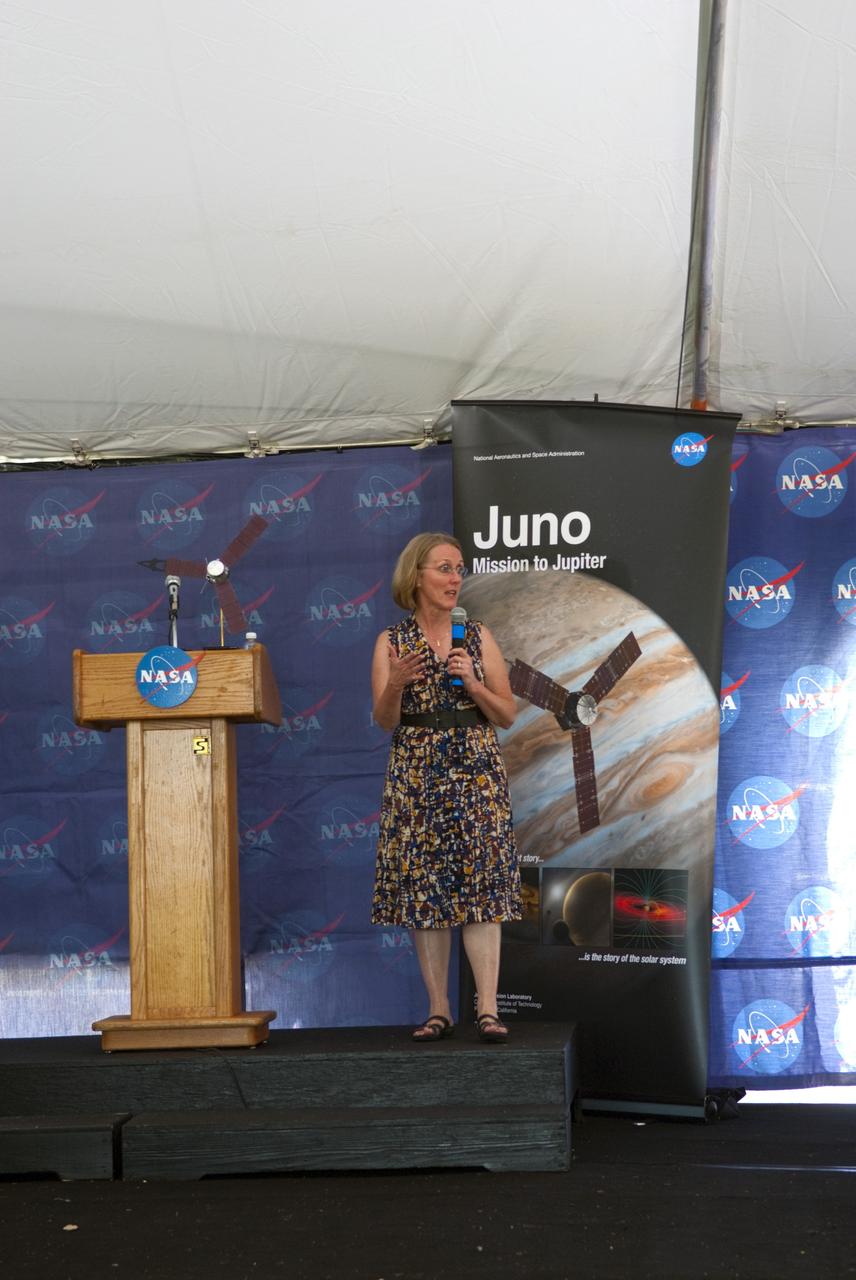
CAPE CANAVERAL, Fla. – At NASA’s Kennedy Space Center in Florida, Jan Chodas, Juno project manager from the Jet Propulsion Laboratory in Pasadena, Calif., speaks to about 150 followers of the agency’s Twitter account during Juno Tweetup activities inside a tent at the Press Site. The tweeters are at the center for two days of prelaunch activities. Juno is NASA’s mission to Jupiter to study the giant planet and improve our understanding of the planet’s formation and evolution. The tweeters will share their experiences with followers through the social networking site Twitter. Attendees represent 28 states, the District of Columbia and five other countries: Canada, Finland, Norway, Spain and the United Kingdom. This is the first time NASA has invited Twitter followers to experience the launch of a planetary spacecraft. The Juno spacecraft is scheduled to launch on an Atlas V rocket from Space Launch Complex 41 at Cape Canaveral Air Force Station in Florida, Aug. 5, at 11:34 a.m. EDT. For more information, visit http://www.nasa.gov/juno. Photo credit: Jim Grossmann
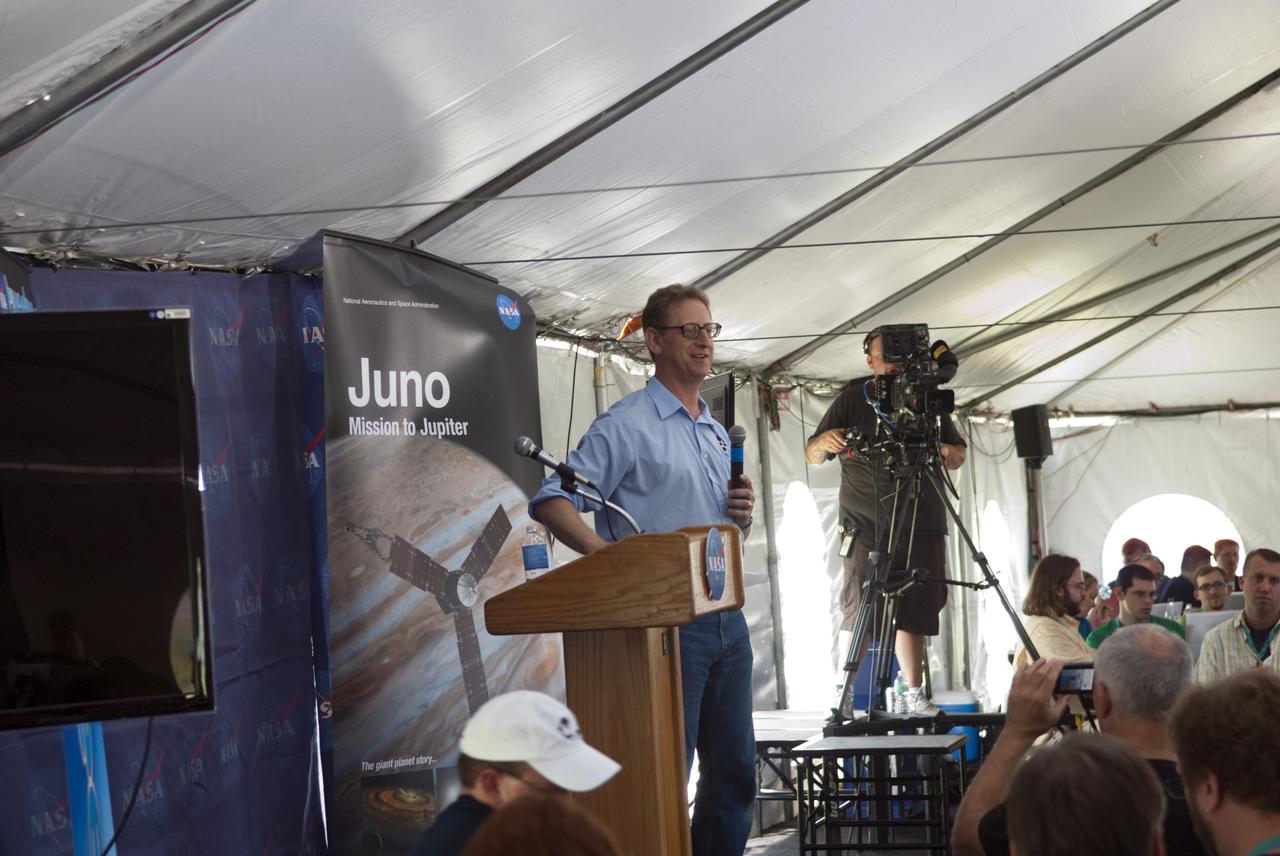
CAPE CANAVERAL, Fla. – At NASA’s Kennedy Space Center in Florida, Steve Levin, Juno project scientist from the Jet Propulsion Laboratory in Pasadena, Calif., speaks to about 150 followers of the agency’s Twitter account during Juno Tweetup activities inside a tent at the Press Site. The tweeters are at the center for two days of prelaunch activities. Juno is NASA’s mission to Jupiter to study the giant planet and improve our understanding of the planet’s formation and evolution. The tweeters will share their experiences with followers through the social networking site Twitter. Attendees represent 28 states, the District of Columbia and five other countries: Canada, Finland, Norway, Spain and the United Kingdom. This is the first time NASA has invited Twitter followers to experience the launch of a planetary spacecraft. The Juno spacecraft is scheduled to launch on an Atlas V rocket from Space Launch Complex 41 at Cape Canaveral Air Force Station in Florida, Aug. 5, at 11:34 a.m. EDT. For more information, visit http://www.nasa.gov/juno. Photo credit: Jim Grossmann
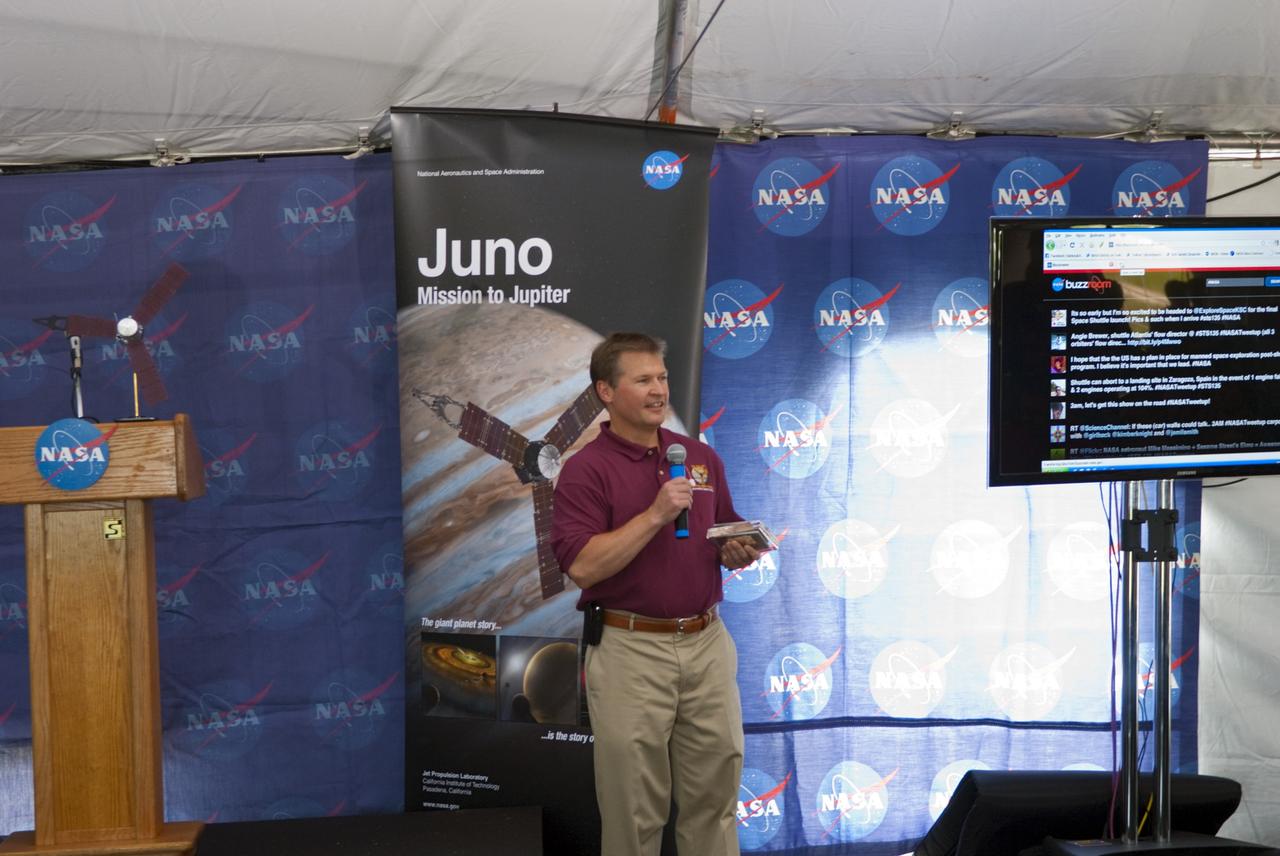
CAPE CANAVERAL, Fla. – At NASA’s Kennedy Space Center in Florida, Chris Brosious, Juno chief systems engineer for Lockheed Martin, speaks to about 150 followers of the agency’s Twitter account during Juno Tweetup activities inside a tent at the Press Site. The tweeters are at the center for two days of prelaunch activities. Juno is NASA’s mission to Jupiter to study the giant planet and improve our understanding of the planet’s formation and evolution. The tweeters will share their experiences with followers through the social networking site Twitter. Attendees represent 28 states, the District of Columbia and five other countries: Canada, Finland, Norway, Spain and the United Kingdom. This is the first time NASA has invited Twitter followers to experience the launch of a planetary spacecraft. The Juno spacecraft is scheduled to launch on an Atlas V rocket from Space Launch Complex 41 at Cape Canaveral Air Force Station in Florida, Aug. 5, at 11:34 a.m. EDT. For more information, visit http://www.nasa.gov/juno. Photo credit: Jim Grossmann

CAPE CANAVERAL, Fla. – At NASA’s Kennedy Space Center in Florida, Andrew Aldrin, director of Business Development and Advanced Programs for the United Launch Alliance, speaks to about 150 followers of the agency’s Twitter account during Juno Tweetup activities inside a tent at the Press Site. The tweeters are at the center for two days of prelaunch activities. Juno is NASA’s mission to Jupiter to study the giant planet and improve our understanding of the planet’s formation and evolution. The tweeters will share their experiences with followers through the social networking site Twitter. Attendees represent 28 states, the District of Columbia and five other countries: Canada, Finland, Norway, Spain and the United Kingdom. This is the first time NASA has invited Twitter followers to experience the launch of a planetary spacecraft. The Juno spacecraft is scheduled to launch on an Atlas V rocket from Space Launch Complex 41 at Cape Canaveral Air Force Station in Florida, Aug. 5, at 11:34 a.m. EDT. For more information, visit http://www.nasa.gov/juno. Photo credit: NASA/Gianni M. Woods
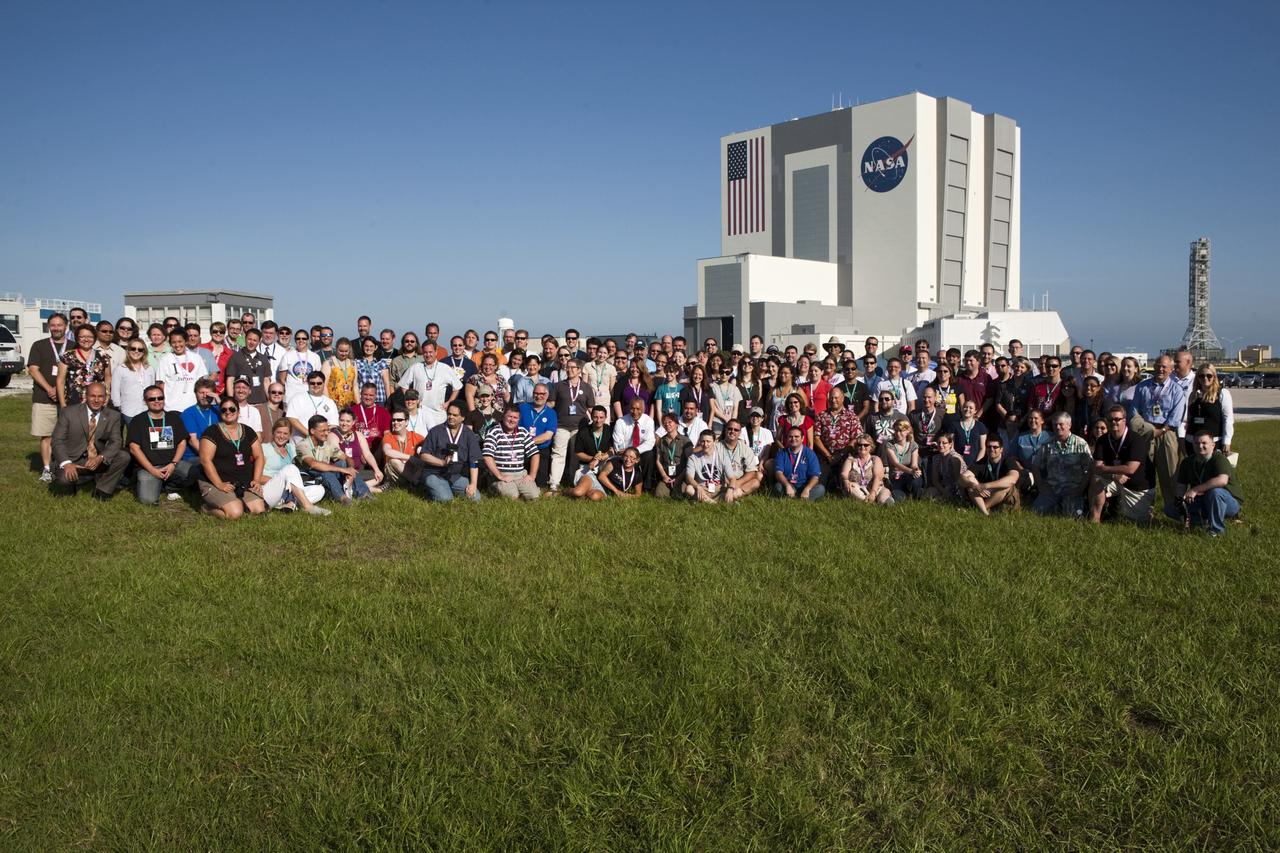
CAPE CANAVERAL, Fla. – At NASA’s Kennedy Space Center in Florida, NASA Administrator Charles Bolden (front row center, red tie) poses for a group portrait with about 150 followers of the agency’s Twitter account during Juno Tweetup activities at the Press Site. In the background is the 525-foot-tall Vehicle Assembly Building. The tweeters are at the center for two days of prelaunch activities. Juno is NASA’s mission to Jupiter to study the giant planet and improve our understanding of the planet’s formation and evolution. The tweeters will share their experiences with followers through the social networking site Twitter. Attendees represent 28 states, the District of Columbia and five other countries: Canada, Finland, Norway, Spain and the United Kingdom. This is the first time NASA has invited Twitter followers to experience the launch of a planetary spacecraft. The Juno spacecraft is scheduled to launch on an Atlas V rocket from Space Launch Complex 41 at Cape Canaveral Air Force Station in Florida, Aug. 5, at 11:34 a.m. EDT. For more information, visit http://www.nasa.gov/juno. Photo credit: NASA/Gianni M. Woods

CAPE CANAVERAL, Fla. – At NASA’s Kennedy Space Center in Florida, about 150 followers of the agency’s Twitter account listen to presentations about NASA’s Juno mission to Jupiter during Tweetup activities inside a tent at the Press Site. The tweeters are at the center for two days of Juno prelaunch activities. Juno is NASA’s mission to Jupiter to study the giant planet and improve our understanding of the planet’s formation and evolution. The tweeters will share their experiences with followers through the social networking site Twitter. Attendees represent 28 states, the District of Columbia and five other countries: Canada, Finland, Norway, Spain and the United Kingdom. This is the first time NASA has invited Twitter followers to experience the launch of a planetary spacecraft. The Juno spacecraft is scheduled to launch on an Atlas V rocket from Space Launch Complex 41 at Cape Canaveral Air Force Station in Florida, Aug. 5, at 11:34 a.m. EDT. For more information, visit http://www.nasa.gov/juno. Photo credit: Jim Grossmann
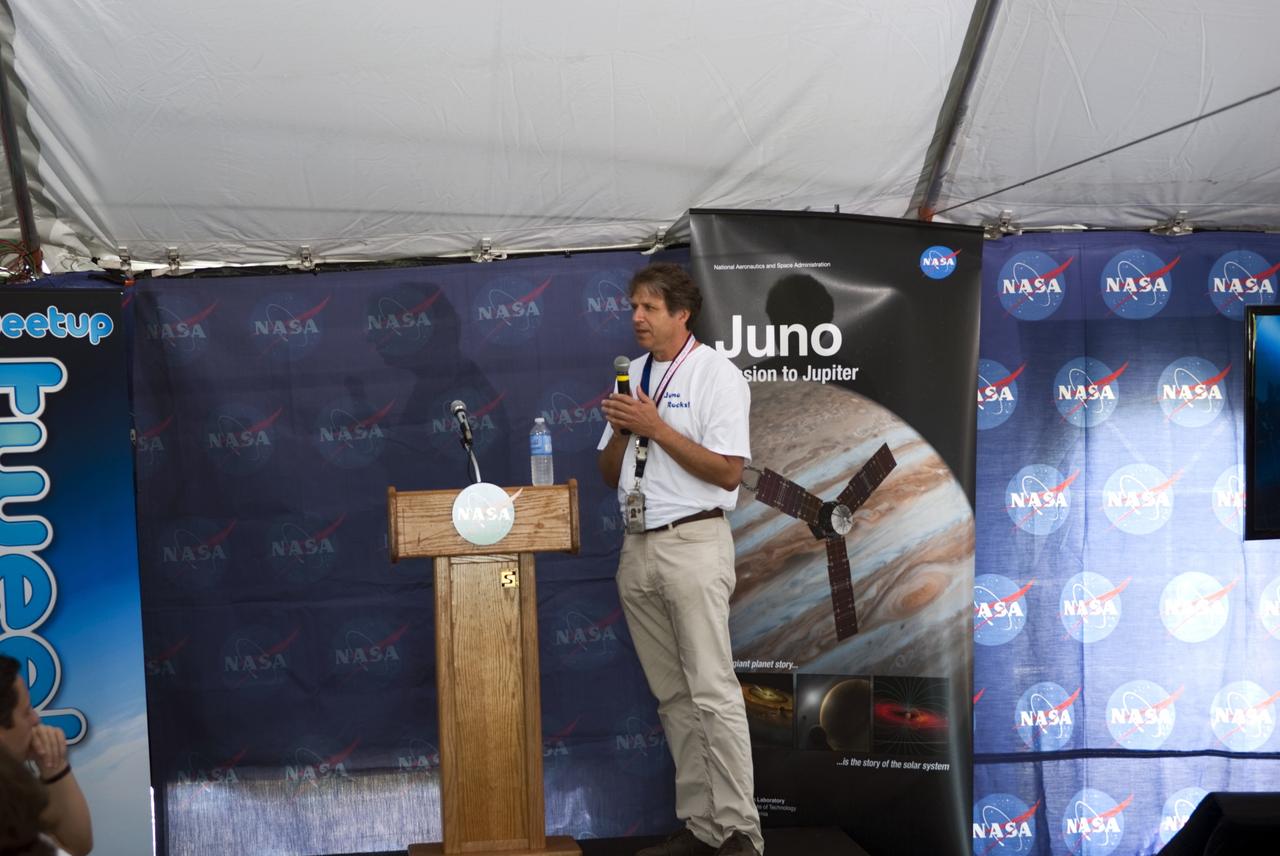
CAPE CANAVERAL, Fla. – At NASA’s Kennedy Space Center in Florida, Scott Bolton, Juno primary investigator from the Southwest Research Institute in San Antonio, speaks to about 150 followers of the agency’s Twitter account during Juno Tweetup activities inside a tent at the Press Site. The tweeters are at the center for two days of prelaunch activities. Juno is NASA’s mission to Jupiter to study the giant planet and improve our understanding of the planet’s formation and evolution. The tweeters will share their experiences with followers through the social networking site Twitter. Attendees represent 28 states, the District of Columbia and five other countries: Canada, Finland, Norway, Spain and the United Kingdom. This is the first time NASA has invited Twitter followers to experience the launch of a planetary spacecraft. The Juno spacecraft is scheduled to launch on an Atlas V rocket from Space Launch Complex 41 at Cape Canaveral Air Force Station in Florida, Aug. 5, at 11:34 a.m. EDT. For more information, visit http://www.nasa.gov/juno. Photo credit: Jim Grossmann
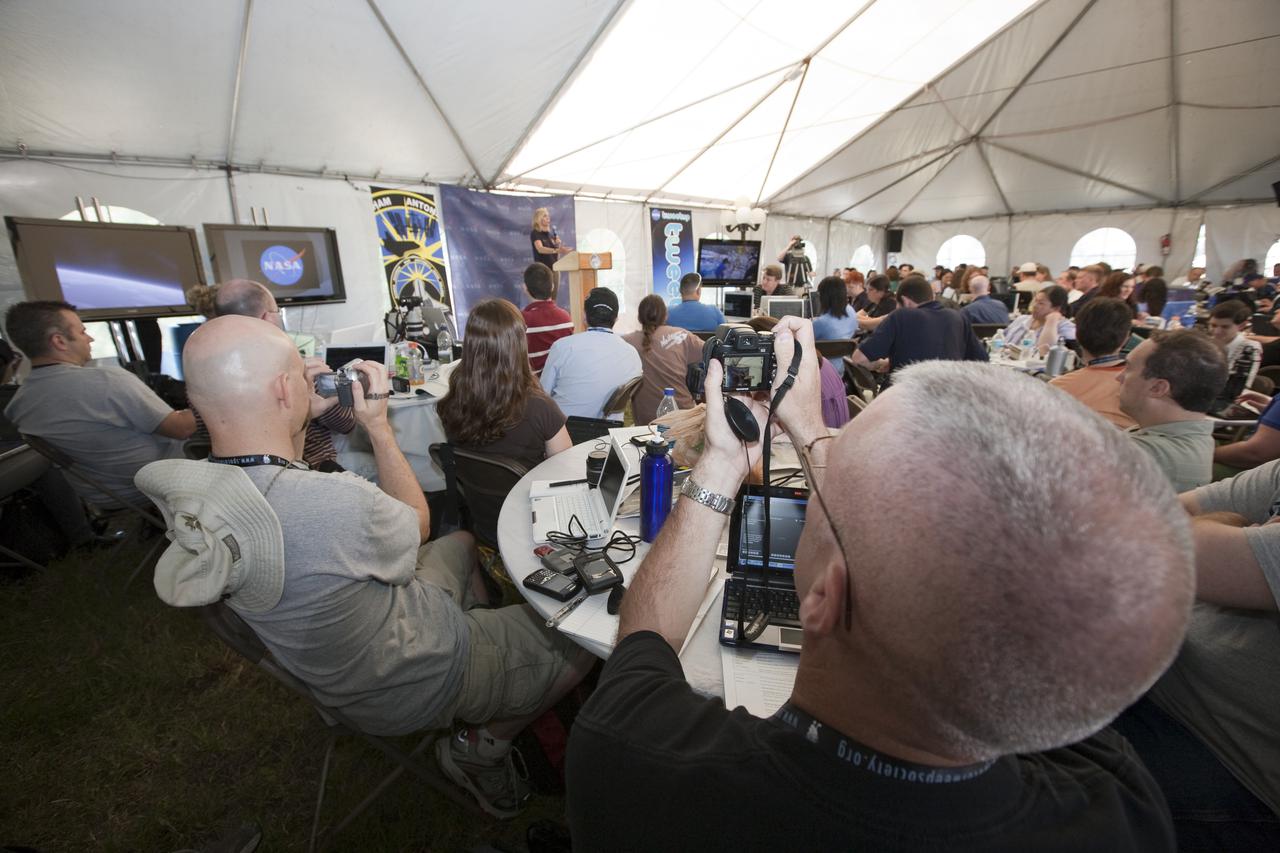
CAPE CANAVERAL, Fla. - At NASA's Kennedy Space Center in Florida, NASA's space shuttle Discovery Flow Director Stephanie Stilson has a rapt audience in the participants of NASA's STS-132 Tweetup. NASA is hosting 150 people from around the world and providing them with a behind-the-scenes perspective to share with their followers via the social networking service Twitter. Attendees were randomly selected from more than 1,000 online registrations and include people from more than 30 states, the District of Columbia, Puerto Rico, the Netherlands, New Zealand and England. The Tweeters are being given the chance to meet with shuttle technicians, managers, engineers and astronauts, to take a tour of Kennedy, and to experience the exhilaration of the launch of space shuttle Atlantis' STS-132 mission. A tent was set up especially for the occasion near the countdown clock at Kennedy's Press Site. Atlantis' liftoff is set for 2:20 p.m. EDT on May 14. STS-132 is the 34th mission to the station and the last scheduled flight for Atlantis. For more information on the STS-132 mission objectives, payload and crew, visit http:__www.nasa.gov_mission_pages_shuttle_shuttlemissions_sts132_index.html. Photo Credit: NASA_Amanda Diller

CAPE CANAVERAL, Fla. - At NASA's Kennedy Space Center in Florida, NASA's Ron Woods, a flight crew equipment specialist, presents one of his space-themed paintings to the participants in NASA's STS-132 Tweetup. NASA is hosting 150 people from around the world and providing them with a behind-the-scenes perspective to share with their followers via the social networking service Twitter. Attendees were randomly selected from more than 1,000 online registrations and include people from more than 30 states, the District of Columbia, Puerto Rico, the Netherlands, New Zealand and England. The Tweeters are being given the chance to meet with shuttle technicians, managers, engineers and astronauts, to take a tour of Kennedy, and to experience the exhilaration of the launch of space shuttle Atlantis' STS-132 mission. A tent was set up especially for the occasion near the countdown clock at Kennedy's Press Site. Atlantis' liftoff is set for 2:20 p.m. EDT on May 14. STS-132 is the 34th mission to the station and the last scheduled flight for Atlantis. For more information on the STS-132 mission objectives, payload and crew, visit http:__www.nasa.gov_mission_pages_shuttle_shuttlemissions_sts132_index.html. Photo Credit: NASA_Amanda Diller
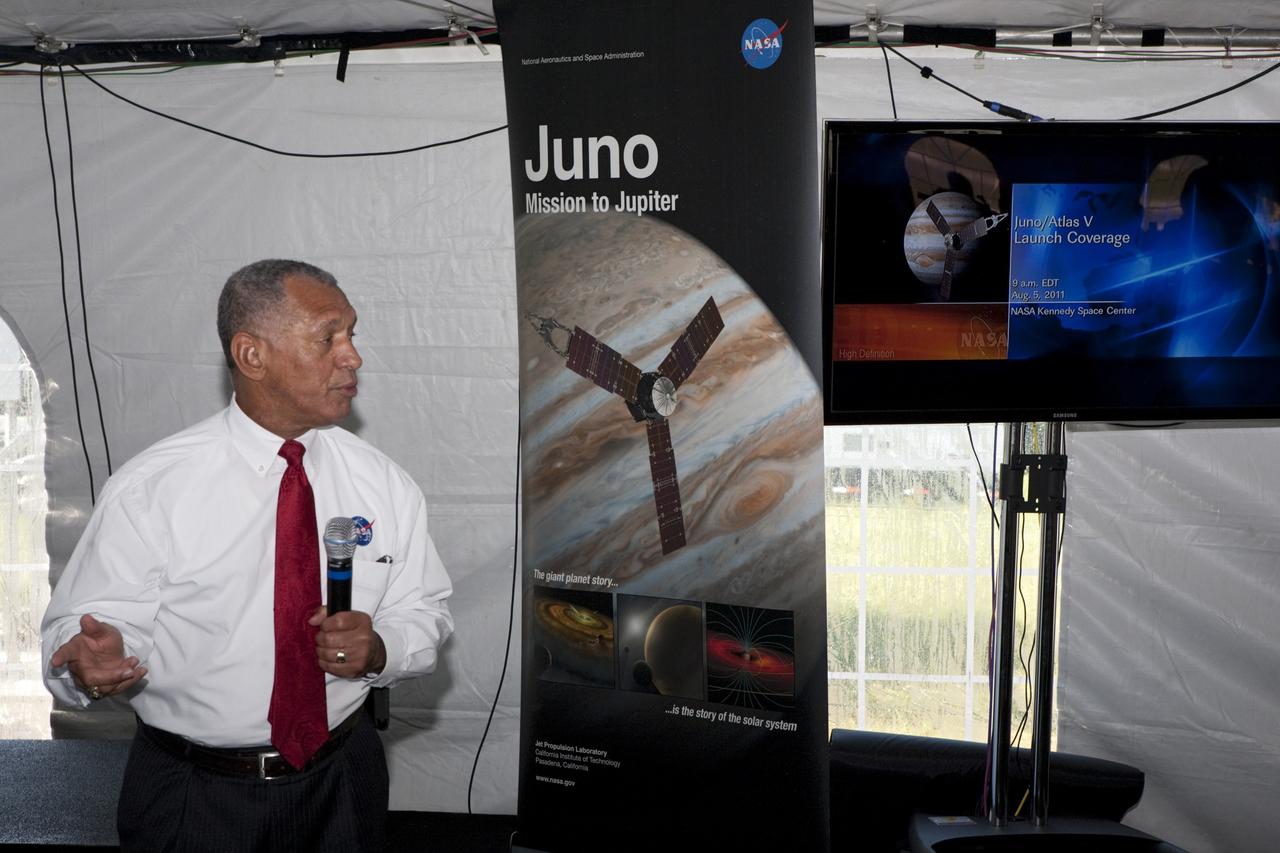
CAPE CANAVERAL, Fla. – At NASA’s Kennedy Space Center in Florida, NASA Administrator Charles Bolden speaks to about 150 followers of the agency’s Twitter account during Juno Tweetup activities inside a tent at the Press Site. The tweeters are at the center for two days of prelaunch activities. Juno is NASA’s mission to Jupiter to study the giant planet and improve our understanding of the planet’s formation and evolution. The tweeters will share their experiences with followers through the social networking site Twitter. Attendees represent 28 states, the District of Columbia and five other countries: Canada, Finland, Norway, Spain and the United Kingdom. This is the first time NASA has invited Twitter followers to experience the launch of a planetary spacecraft. The Juno spacecraft is scheduled to launch on an Atlas V rocket from Space Launch Complex 41 at Cape Canaveral Air Force Station in Florida, Aug. 5, at 11:34 a.m. EDT. For more information, visit http://www.nasa.gov/juno. Photo credit: NASA/Gianni M. Woods
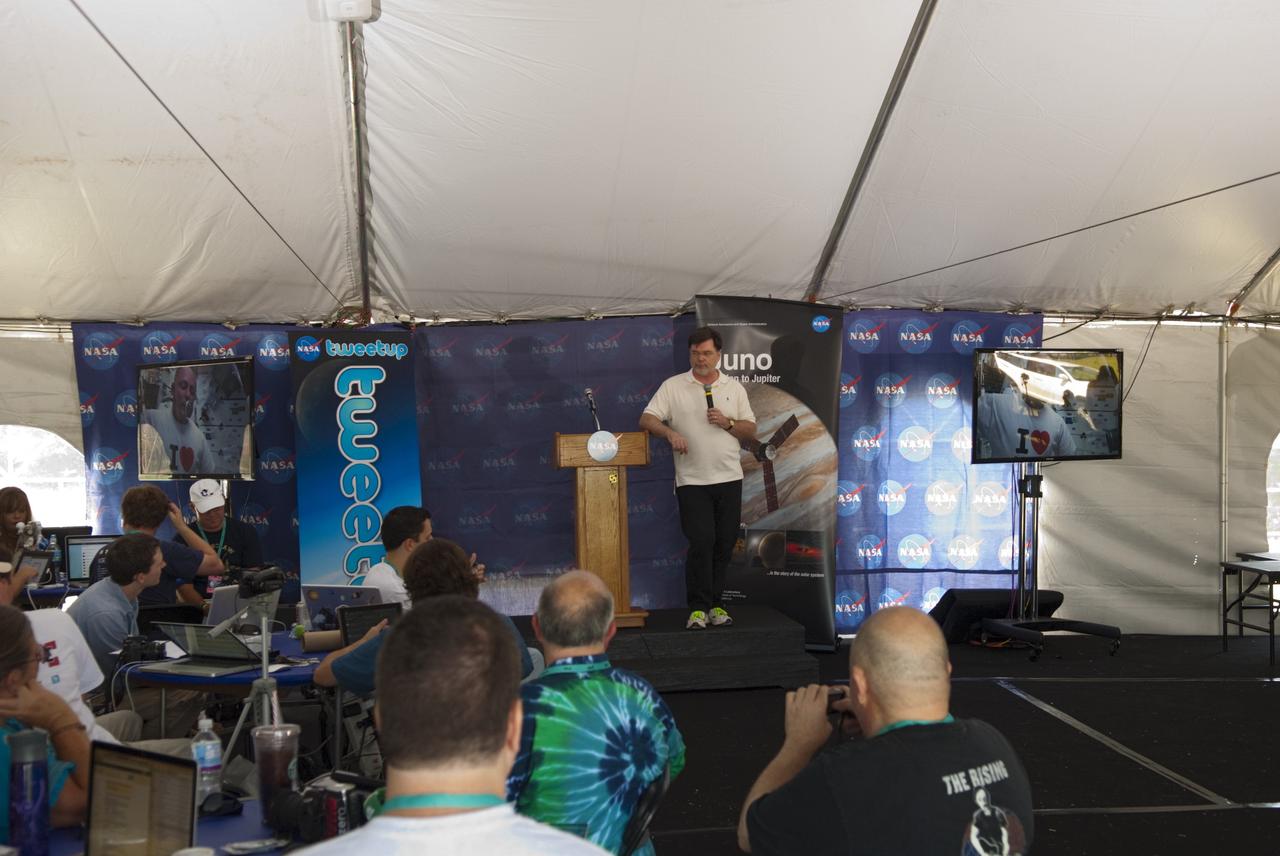
CAPE CANAVERAL, Fla. – At NASA’s Kennedy Space Center in Florida, Jim Adams, NASA deputy director of Planetary Science, speaks to about 150 followers of the agency’s Twitter account during Juno Tweetup activities inside a tent at the Press Site. The tweeters are at the center for two days of prelaunch activities. Juno is NASA’s mission to Jupiter to study the giant planet and improve our understanding of the planet’s formation and evolution. The tweeters will share their experiences with followers through the social networking site Twitter. Attendees represent 28 states, the District of Columbia and five other countries: Canada, Finland, Norway, Spain and the United Kingdom. This is the first time NASA has invited Twitter followers to experience the launch of a planetary spacecraft. The Juno spacecraft is scheduled to launch on an Atlas V rocket from Space Launch Complex 41 at Cape Canaveral Air Force Station in Florida, Aug. 5, at 11:34 a.m. EDT. For more information, visit http://www.nasa.gov/juno. Photo credit: Jim Grossmann

CAPE CANAVERAL, Fla. – At NASA’s Kennedy Space Center in Florida, NASA Chief Scientist Waleed Abdalati speaks to about 150 followers of the agency’s Twitter account during Juno Tweetup activities inside a tent at the Press Site. The tweeters are at the center for two days of prelaunch activities. Juno is NASA’s mission to Jupiter to study the giant planet and improve our understanding of the planet’s formation and evolution. The tweeters will share their experiences with followers through the social networking site Twitter. Attendees represent 28 states, the District of Columbia and five other countries: Canada, Finland, Norway, Spain and the United Kingdom. This is the first time NASA has invited Twitter followers to experience the launch of a planetary spacecraft. The Juno spacecraft is scheduled to launch on an Atlas V rocket from Space Launch Complex 41 at Cape Canaveral Air Force Station in Florida, Aug. 5, at 11:34 a.m. EDT. For more information, visit http://www.nasa.gov/juno. Photo credit: NASA/Gianni M. Woods
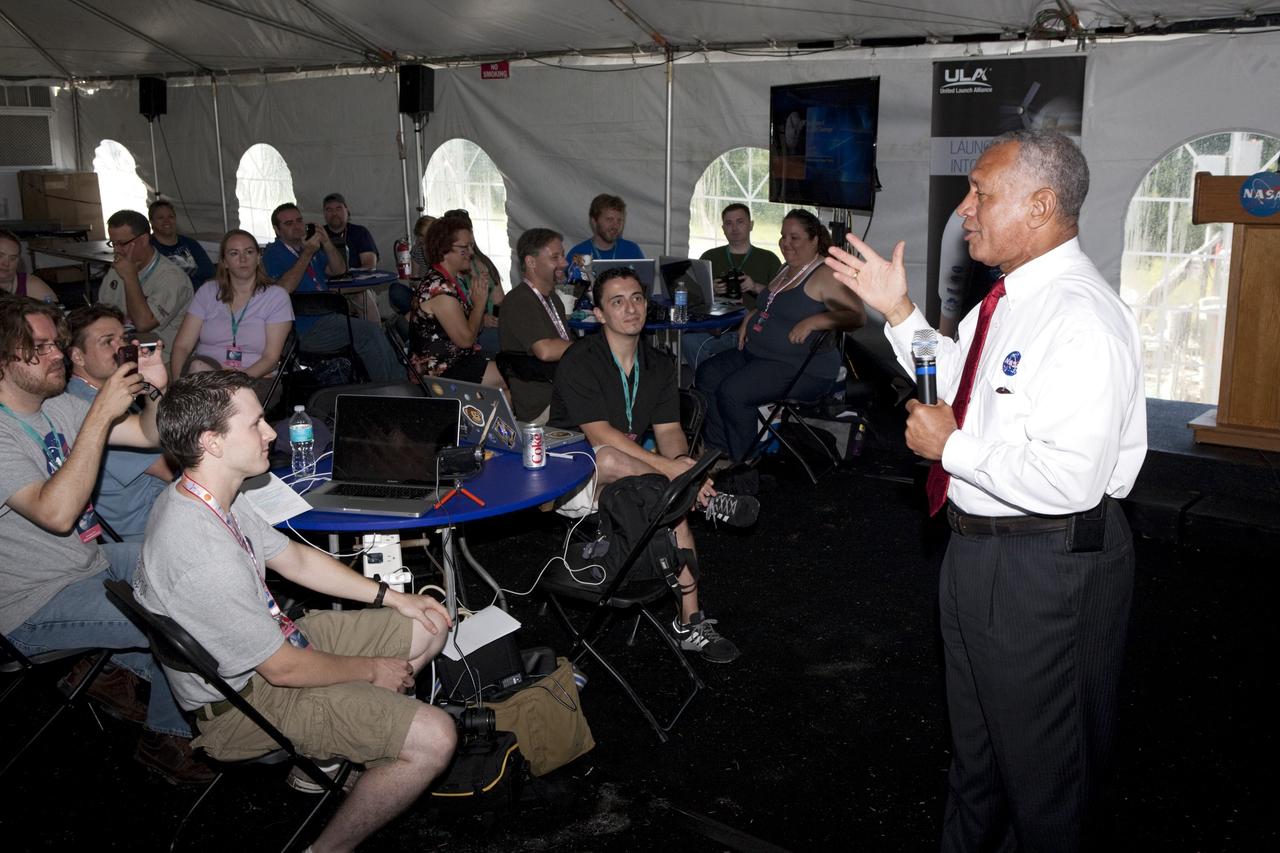
CAPE CANAVERAL, Fla. – At NASA’s Kennedy Space Center in Florida, NASA Administrator Charles Bolden speaks to about 150 followers of the agency’s Twitter account during Juno Tweetup activities inside a tent at the Press Site. The tweeters are at the center for two days of prelaunch activities. Juno is NASA’s mission to Jupiter to study the giant planet and improve our understanding of the planet’s formation and evolution. The tweeters will share their experiences with followers through the social networking site Twitter. Attendees represent 28 states, the District of Columbia and five other countries: Canada, Finland, Norway, Spain and the United Kingdom. This is the first time NASA has invited Twitter followers to experience the launch of a planetary spacecraft. The Juno spacecraft is scheduled to launch on an Atlas V rocket from Space Launch Complex 41 at Cape Canaveral Air Force Station in Florida, Aug. 5, at 11:34 a.m. EDT. For more information, visit http://www.nasa.gov/juno. Photo credit: NASA/Gianni M. Woods
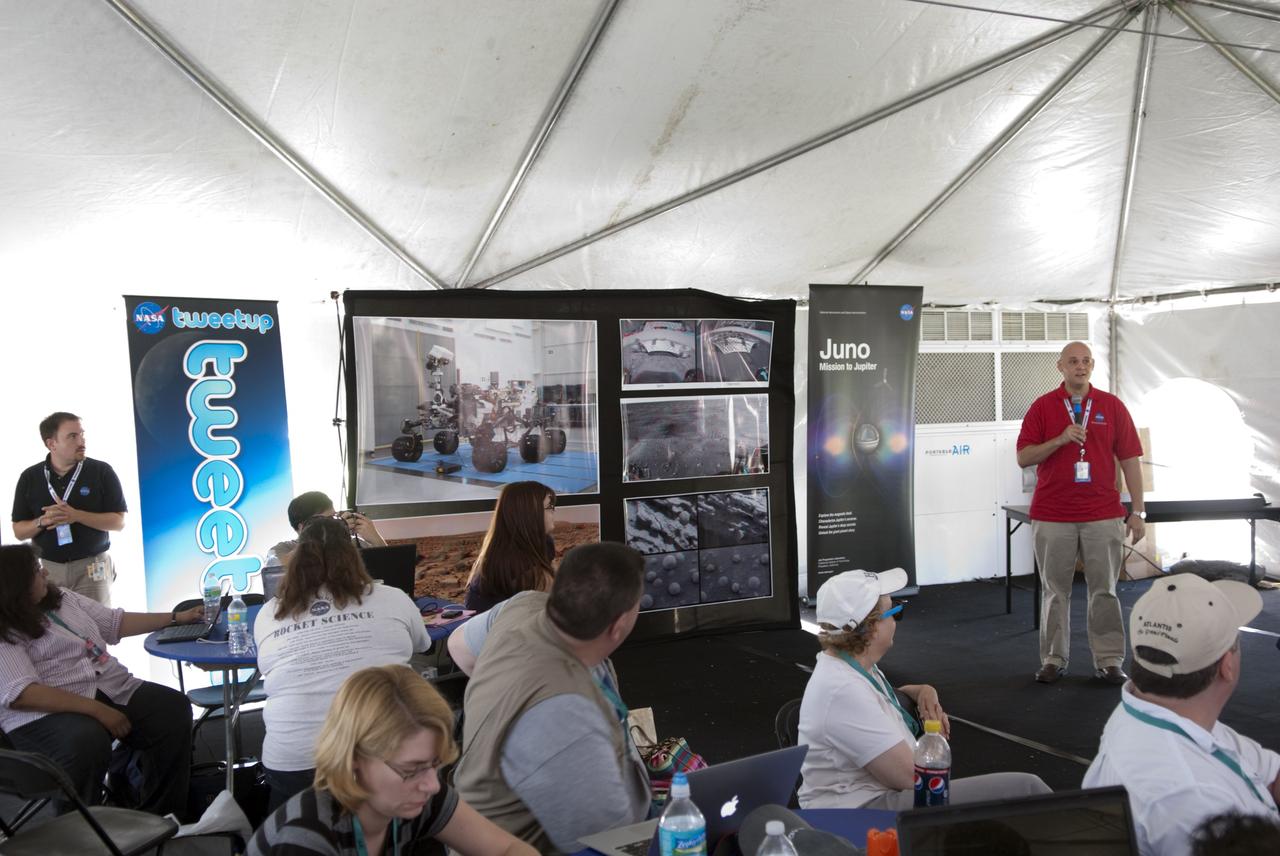
CAPE CANAVERAL, Fla. – At NASA’s Kennedy Space Center in Florida, about 150 followers of the agency’s Twitter account listen to presentations about NASA’s Juno mission to Jupiter during Tweetup activities inside a tent at the Press Site. The tweeters are at the center for two days of Juno prelaunch activities. Juno is NASA’s mission to Jupiter to study the giant planet and improve our understanding of the planet’s formation and evolution. The tweeters will share their experiences with followers through the social networking site Twitter. Attendees represent 28 states, the District of Columbia and five other countries: Canada, Finland, Norway, Spain and the United Kingdom. This is the first time NASA has invited Twitter followers to experience the launch of a planetary spacecraft. The Juno spacecraft is scheduled to launch on an Atlas V rocket from Space Launch Complex 41 at Cape Canaveral Air Force Station in Florida, Aug. 5, at 11:34 a.m. EDT. For more information, visit http://www.nasa.gov/juno. Photo credit: Jim Grossmann
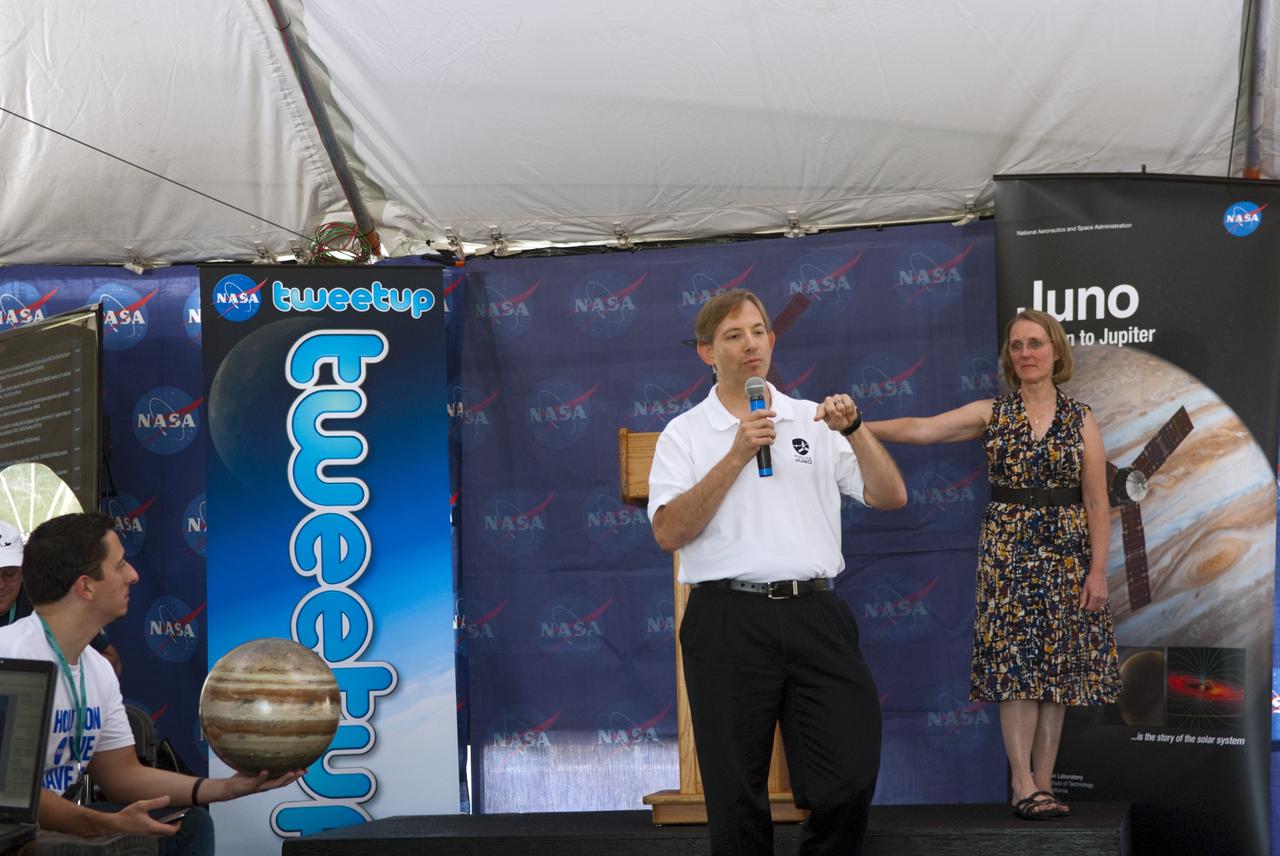
CAPE CANAVERAL, Fla. – At NASA’s Kennedy Space Center in Florida, Steve Matousek (left), former Juno mission manager, and Jan Chodas, Juno project manager, both from the Jet Propulsion Laboratory in Pasadena, Calif., speak to about 150 followers of the agency’s Twitter account during Juno Tweetup activities inside a tent at the Press Site. The tweeters are at the center for two days of prelaunch activities. Juno is NASA’s mission to Jupiter to study the giant planet and improve our understanding of the planet’s formation and evolution. The tweeters will share their experiences with followers through the social networking site Twitter. Attendees represent 28 states, the District of Columbia and five other countries: Canada, Finland, Norway, Spain and the United Kingdom. This is the first time NASA has invited Twitter followers to experience the launch of a planetary spacecraft. The Juno spacecraft is scheduled to launch on an Atlas V rocket from Space Launch Complex 41 at Cape Canaveral Air Force Station in Florida, Aug. 5, at 11:34 a.m. EDT. For more information, visit http://www.nasa.gov/juno. Photo credit: Jim Grossmann
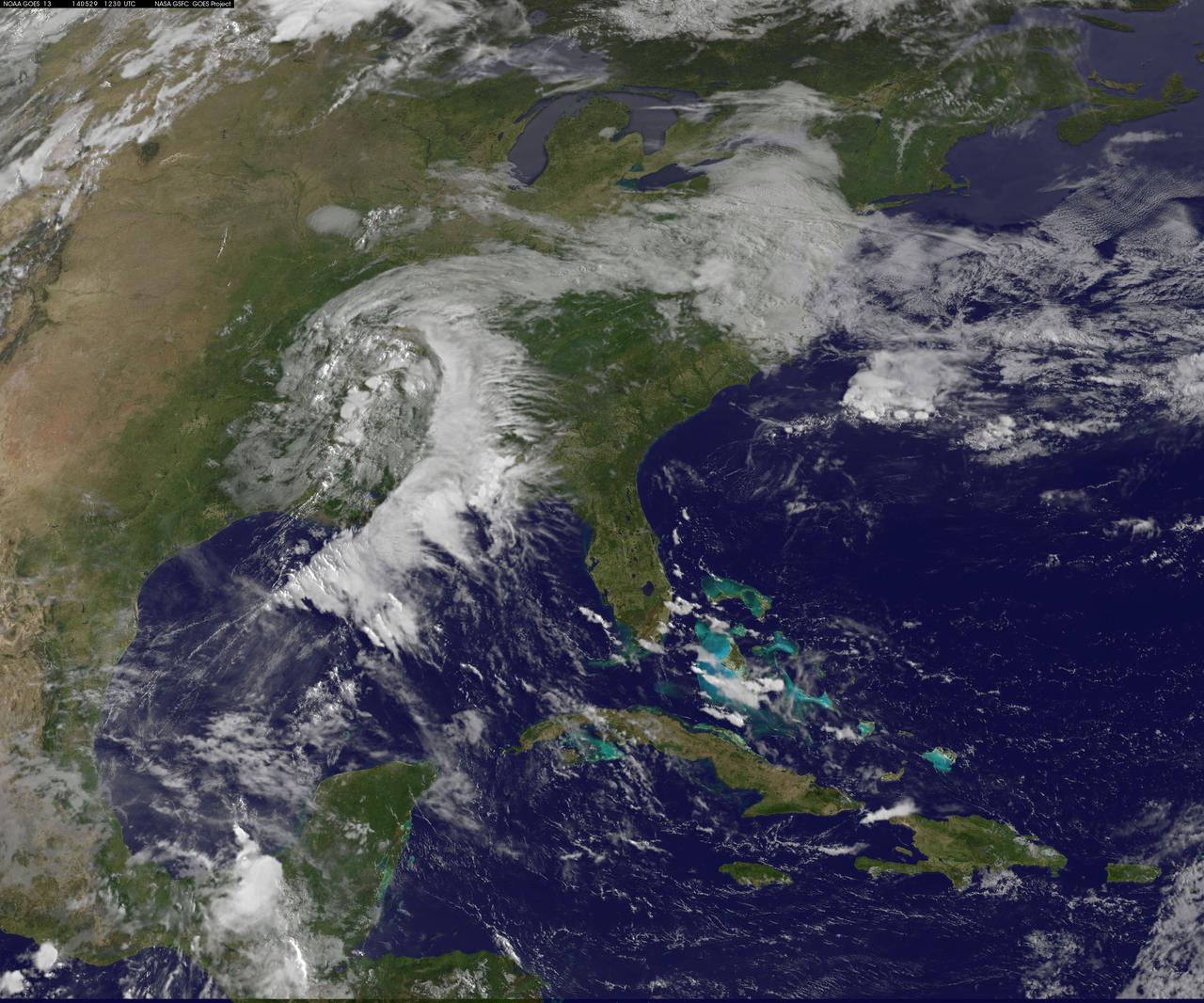
A "backdoor cold front" is bringing April temperatures to the U.S. northeast and Mid-Atlantic today, May 29. The backdoor cold front brings relief to the Mid-Atlantic after temperatures in Washington, D.C. hit 92F on Tuesday, May 27 and 88F on Wednesday, May 28 at Reagan National Airport, according to the National Weather Service (NWS). NWS forecasters expect the high temperature for May 29 to only reach 60F in the District of Columbia. NOAA's GOES-East satellite captured a view of the clouds associated with the backdoor cold front that stretch from southern Illinois to North Carolina. The National Weather Service forecast expects the backdoor cold front to bring showers to the Midwest, Northeast, and Mid-Atlantic today, May 29. According to the National Oceanic and Atmospheric Administration, a backdoor cold front is a cold front moving south or southwest along the Atlantic seaboard and Great Lakes; these are especially common during the spring months. This visible image was taken by NOAA's GOES-East satellite on May 29 at 12:30 UTC (8:30 a.m. EDT). The image was created at NASA/NOAA's GOES Project at NASA's Goddard Space Flight Center in Greenbelt, Maryland. In addition to the backdoor cold front clouds, the GOES-East image shows clouds circling around a low pressure area located in eastern Texas. That low pressure area is expected to bring rain from Texas eastward over the southeastern U.S. According to NOAA's National Weather Service, the slow-moving low pressure area in the Deep South "will bring heavy showers and thunderstorms from Louisiana to Alabama through Thursday. This area is already saturated from previous rainfall, so flash flooding will be possible." Image: NASA/NOAA GOES Project Caption: NASA Goddard/Rob Gutro

George Edward Alcorn, a pioneering African American physicist and engineer, is credited with dozens of inventions over the course of a distinguished career in private industry and at NASA, for which he earned eight patents. Alcorn joined Goddard Space Flight Center in 1978 and held numerous leadership roles in both research and administration until his retirement in 2012. One of Alcorn’s signature accomplishments at NASA was developing a smaller, more sensitive X-ray spectrometer, changing the way scientists were able to use the powerful tool in deep space exploration missions. His tool, which uses thermomigration of aluminum, can gather information about remote solar systems; for the invention, Alcorn was honored as the NASA Goddard Inventor of the Year in 1984. In addition to his groundbreaking contributions as an inventor and innovator, Alcorn also championed efforts to hire more women and minorities at Goddard, for which he was honored with the NASA Equal Opportunity Medal, and taught students at Howard University and the University of the District of Columbia. He also founded the Saturday Academy, an honors program in math and science for underserved middle school students. He earned many accolades over the years from NASA and beyond. These include, in 2010, the Robert H. Goddard Award for Merit, for his outstanding innovation and significant contributions to space science, technology, and NASA programs, as well as recognition in 1994 at Howard University’s Heritage of Greatness awards ceremony. He was also inducted into the National Inventor’s Hall of Fame in 2015. Alcorn passed away in 2024 at the age of 84.