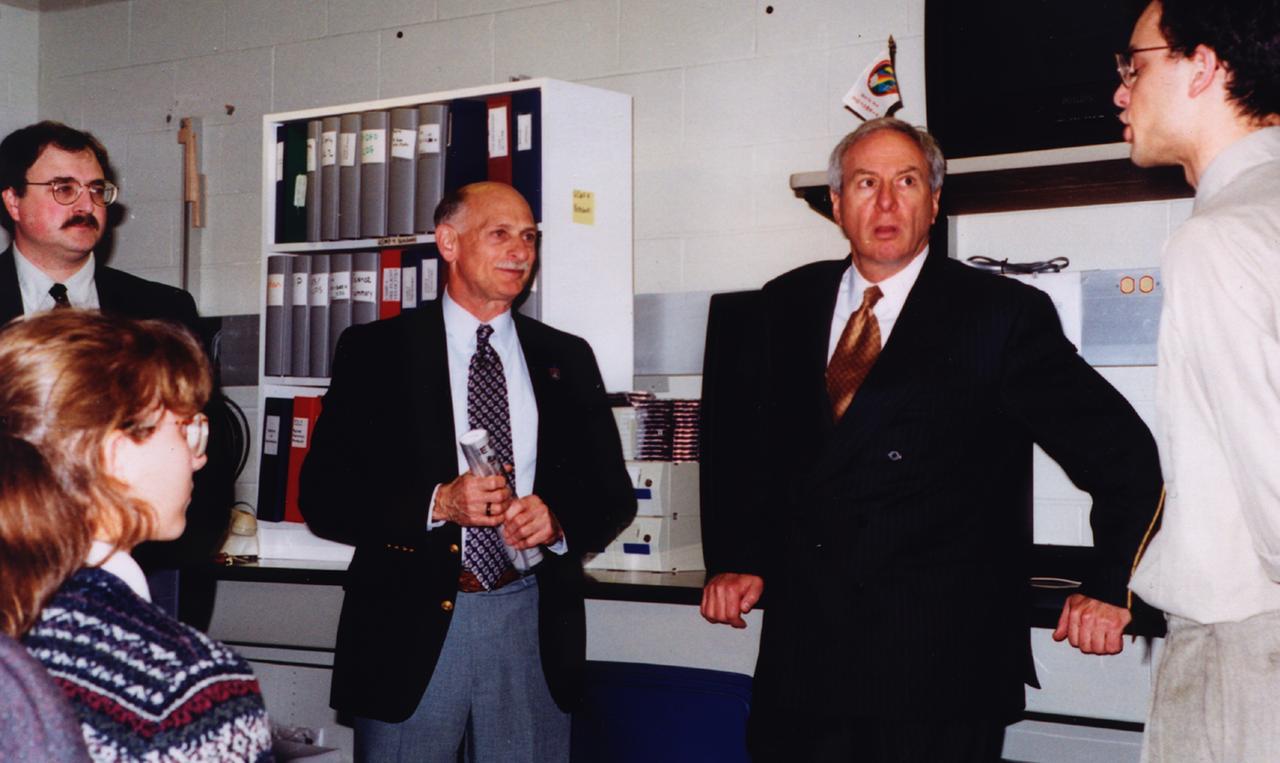
NASA Administrator Daniel Goldin (second from right) visits the control room of the Isothermal Dendritic Growth Experiment (IDGE) in Remote Operations Control Center (ROCC) at Rensselaer Polytechnic Institute (RPI)in Troy, NY, during RPI's 175th arniversary. IDGE, flown on three Space Shuttle missions, is yielding new insights into virtually all industrially relevant metal and alloy forming operations. Photo credit: RPI
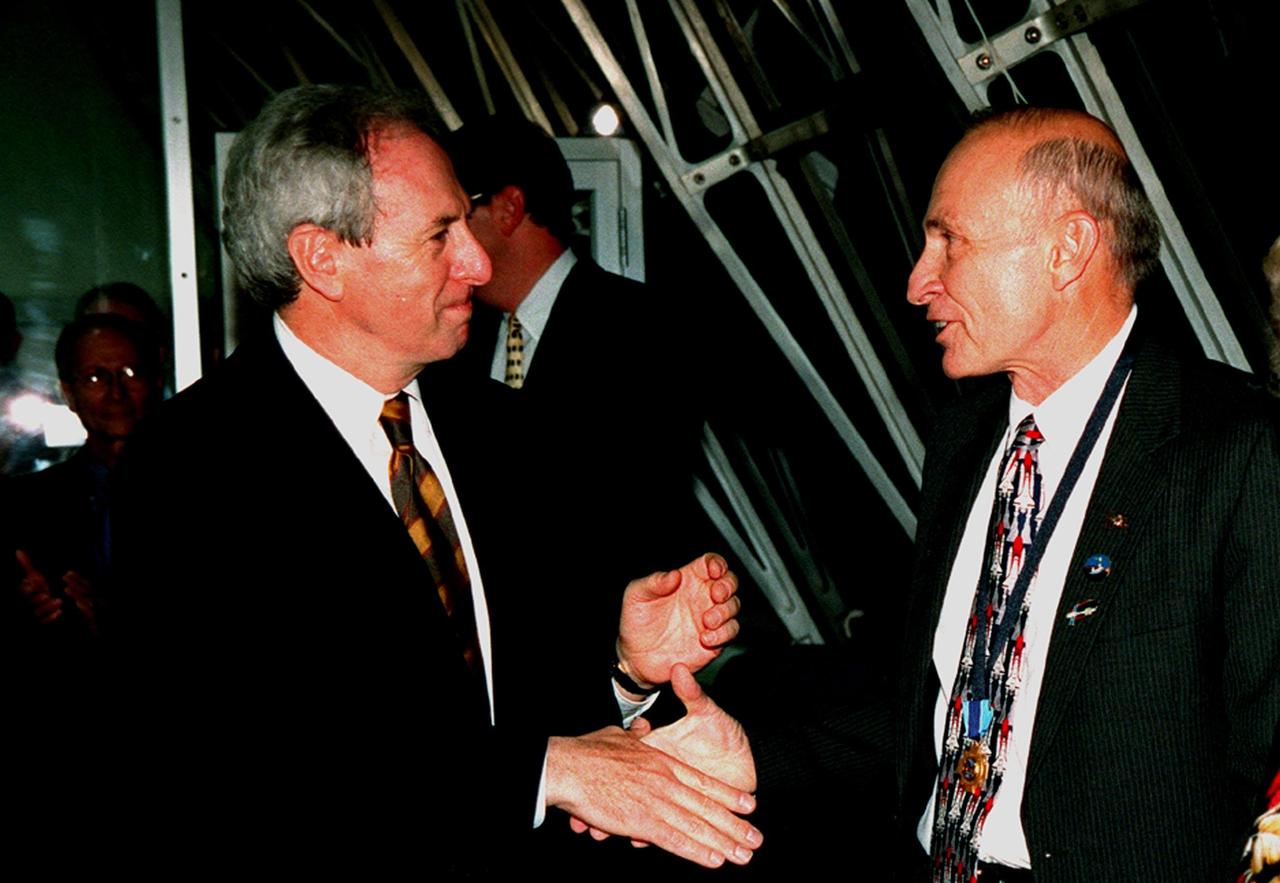
In the firing room of the Launch Control Center after the successful launch of Space Shuttle Endeavour at 3:35:34 a.m. EST, NASA Administrator Daniel Goldin congratulates KSC Director of Shuttle Operations Robert B. Sieck, who is wearing around his neck the Distinguished Service Medal just presented him. Goldin conferred the medal, the highest honor NASA gives a government employee, which recognizes someone who has personally made a contribution representing substantial and extraordinary progress to the mission of NASA
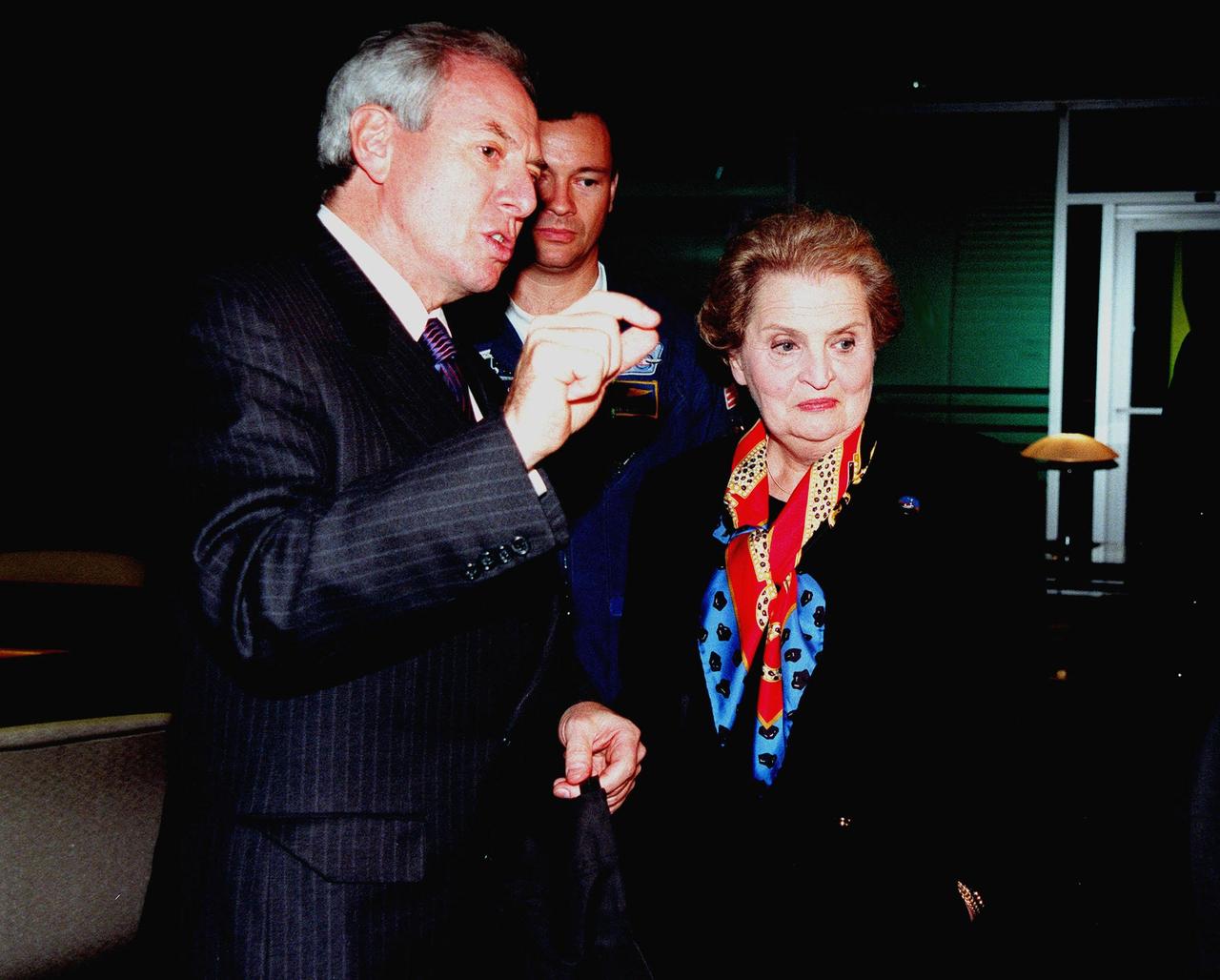
KENNEDY SPACE CENTER, FLA. -- U.S. Secretary of State Madeleine Albright talks with NASA Administrator Daniel Goldin (at left) in the VIP lounge at the Apollo/Saturn V Center while awaiting launch of Mission STS-88, the first U.S. launch for the International Space Station. Astronaut Michael Lopez-Alegria is looking on in background
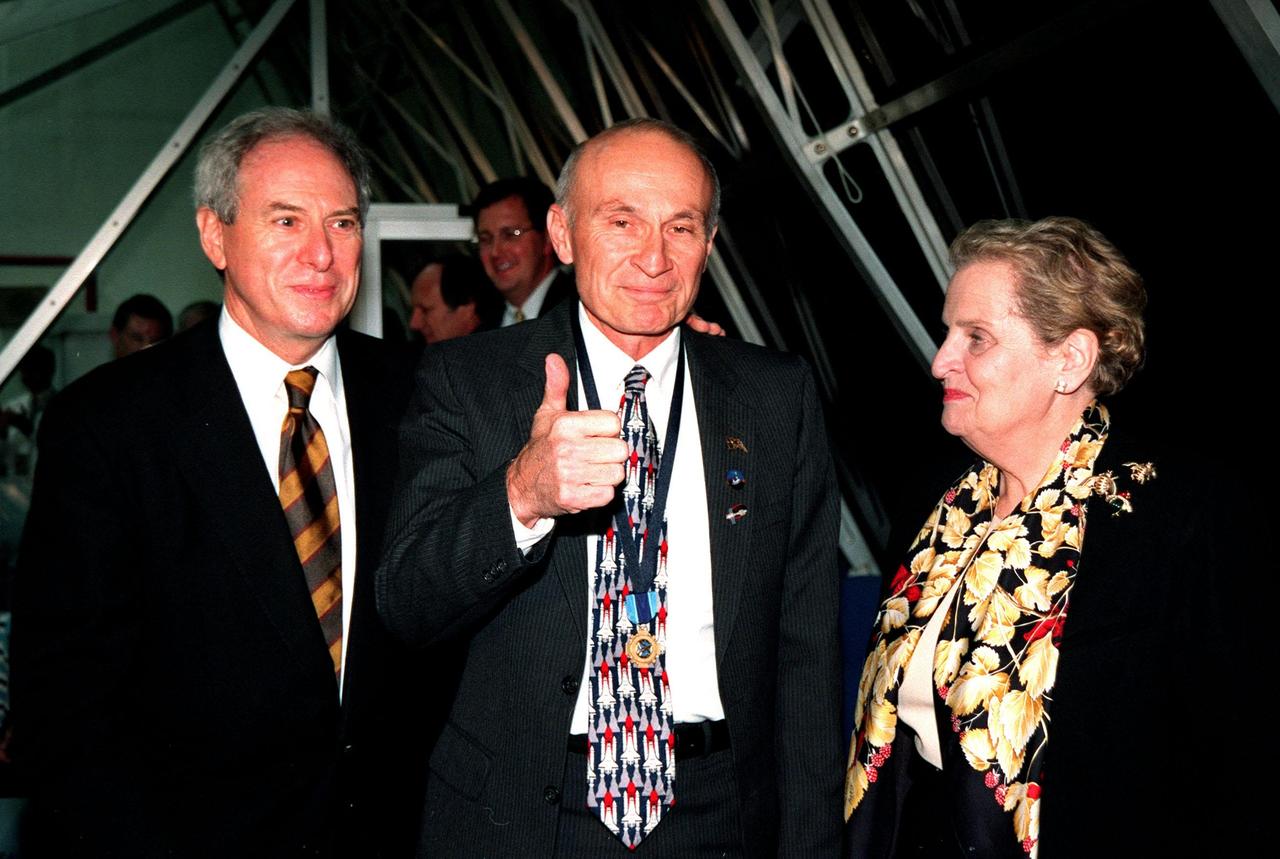
In a firing room of the Launch Control Center, KSC Director of Shuttle Operations Robert B. Sieck (center) gives a thumbs up after the successful launch of Space Shuttle Endeavour on mission STs-88 at 3:35:34 a.m. EST. With him are NASA Administrator Daniel Goldin (left) and U.S. Secretary of State Madeleine Albright (right). Sieck is wearing around his neck the Distinguished Service Medal presented to him by Goldin following the launch. The medal, the highest honor NASA confers on a government employee, recognizes someone who has personally made a contribution representing substantial and extraordinary progress to the mission of NASA
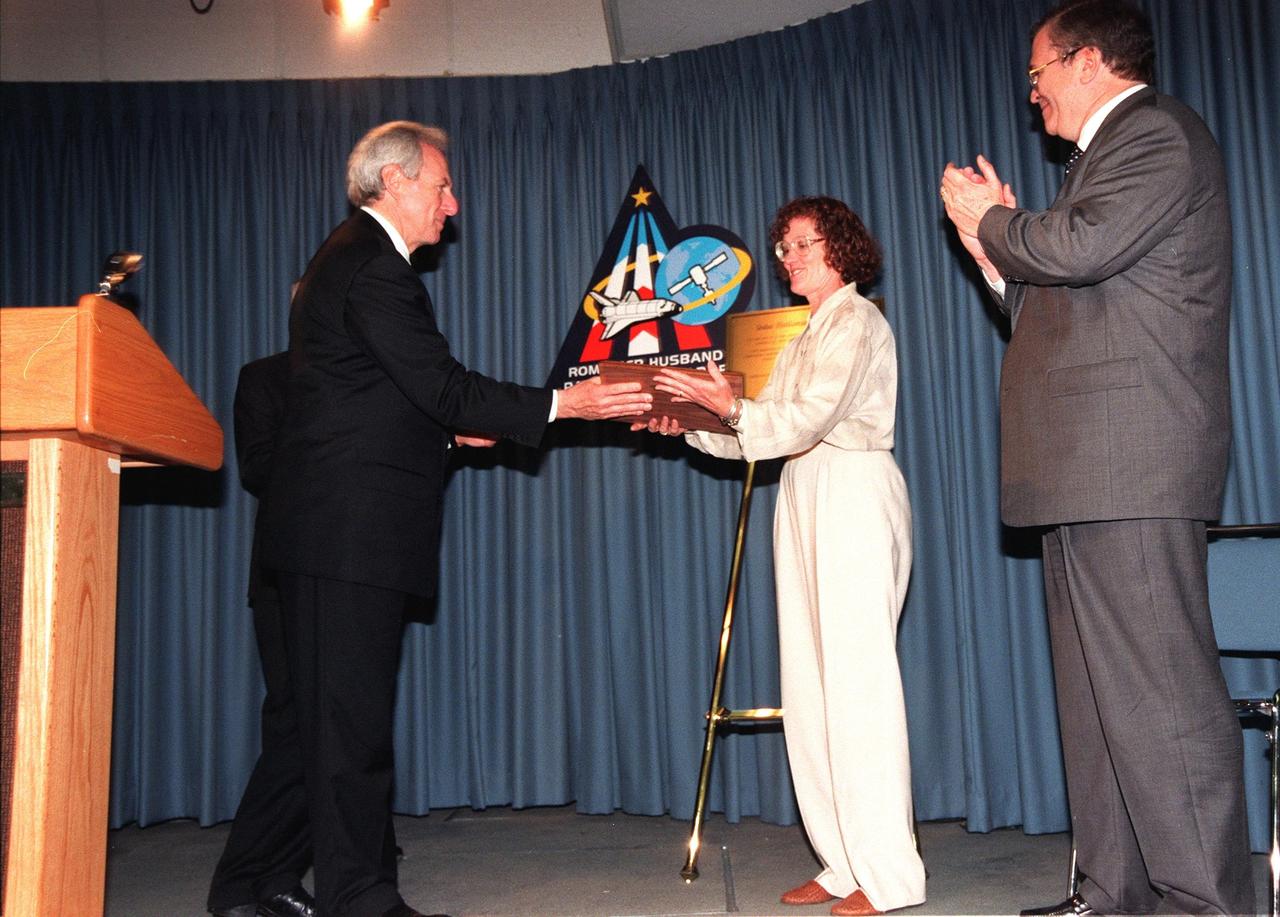
NASA Administrator Daniel S. Goldin hands Mrs. Dianne Holliman a plaque honoring her late husband, John Holliman, a CNN national correspondent. Standing behind Goldin is Center Director Roy Bridges. At right is Tom Johnson, news group chairman of CNN. A ceremony dedicated the KSC Press Site auditorium as the John Holliman Auditorium to honor the correspondent for his enthusiastic, dedicated coverage of America's space program. The auditorium was built in 1980 and has been the focal point for new coverage of Space Shuttle launches. The ceremony followed the 94th launch of a Space Shuttle, on mission STS-96, earlier this morning
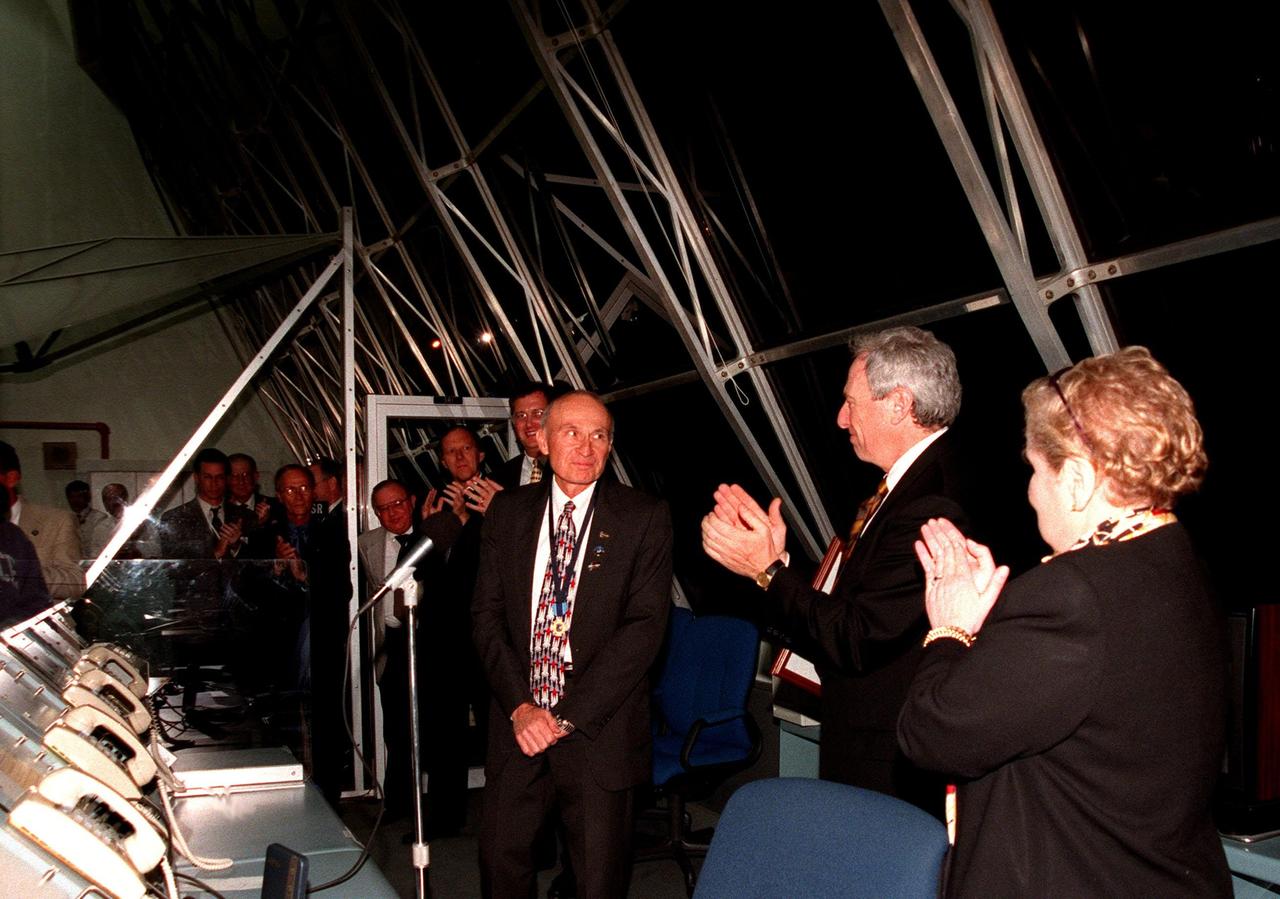
In a firing room in the Launch Control Center, KSC Director of Shuttle Operations Robert B. Sieck (left) is applauded by NASA Administrator Daniel Goldin (center) and U.S. Secretary of State Madeleine Albright for receiving the Distinguished Service Medal (seen around Sieck's neck). Goldin conferred the medal after the successful launch of STS-88, citing Sieck's distinguished service as the Kennedy Space Center launch director and director of Shuttle Processing, outstanding leadership and total dedication to the success of the Space Shuttle Program. The medal is the highest honor NASA gives a government employee
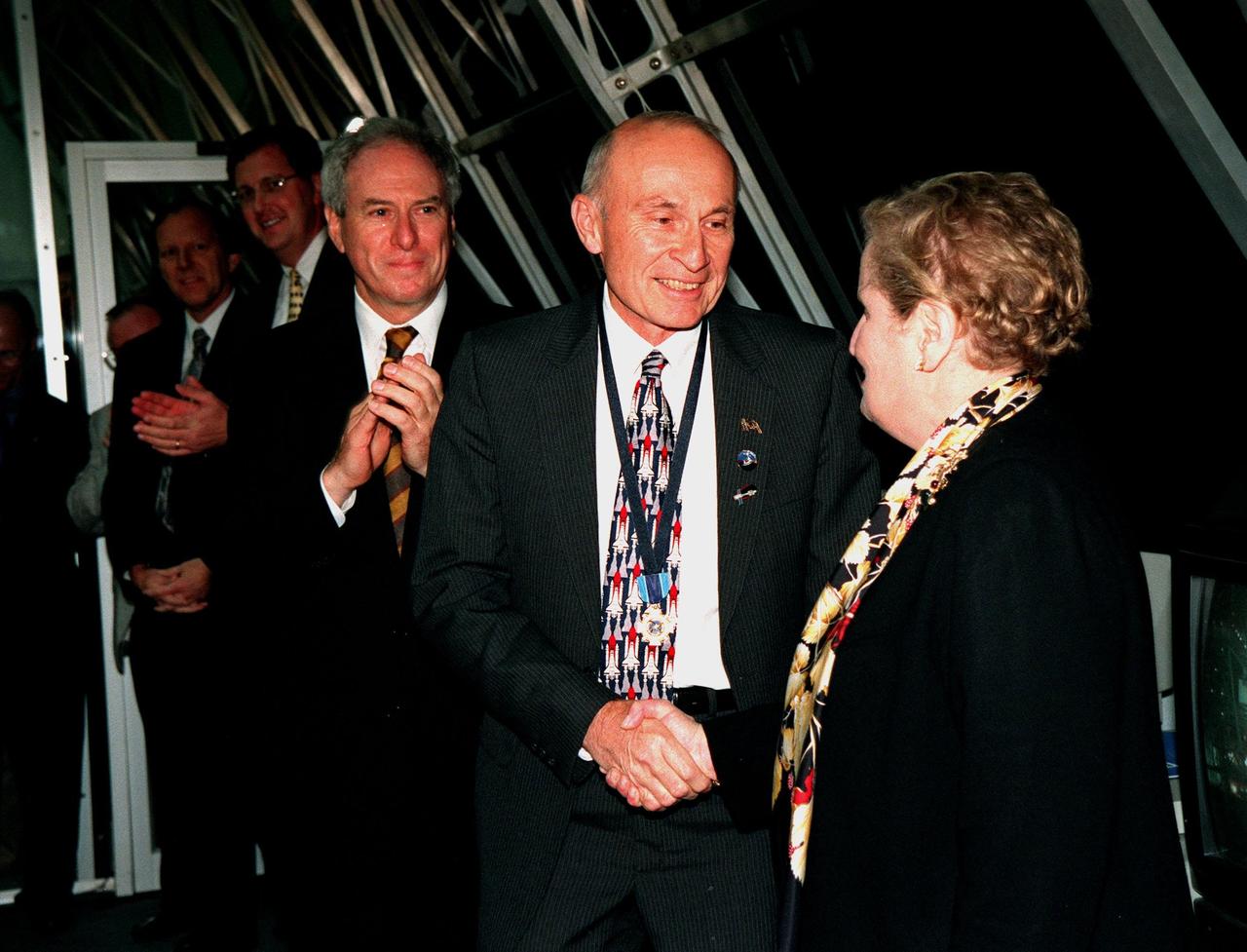
In a firing room of the Launch Control Center , KSC Director of Shuttle Operations Robert B. Sieck (center) shakes hands with Secretary of State Madeleine Albright (right) after the successful launch of Space Shuttle Endeavour on mission STS-88 at 3:35:34 a.m. EST. At left is NASA Administrator Daniel Goldin. Sieck is wearing around his neck the Distinguished Service Medal presented him by Goldin following the launch. The medal, the highest honor NASA confers on a government employee, recognizes someone who has personally made a contribution representing substantial and extraordinary progress to the mission of NASA
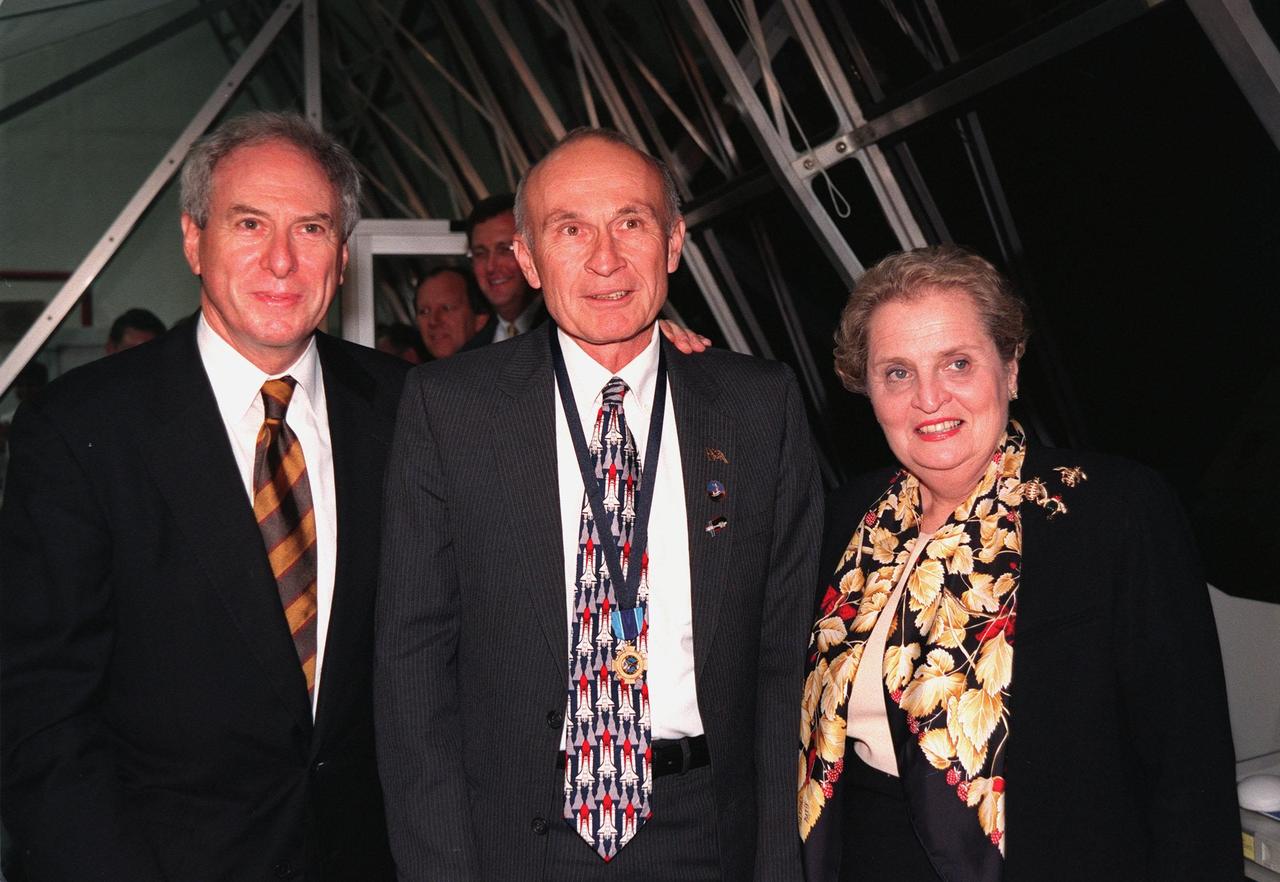
NASA Administrator Daniel Goldin (left), KSC Director of Shuttle Operations Robert B. Sieck (center) and Secretary of State Madeleine Albright (right) pose in the firing room of the Launch Control Center following the successful launch of Space Shuttle Endeavour on mission STS-88 at 3:35:34 a.m. EST. Sieck is wearing around his neck the Distinguished Service Medal presented him by Goldin just after launch. The medal, the highest honor NASA confers on a government employee, recognizes someone who has personally made a contribution representing substantial and extraordinary progress to the mission of NASA
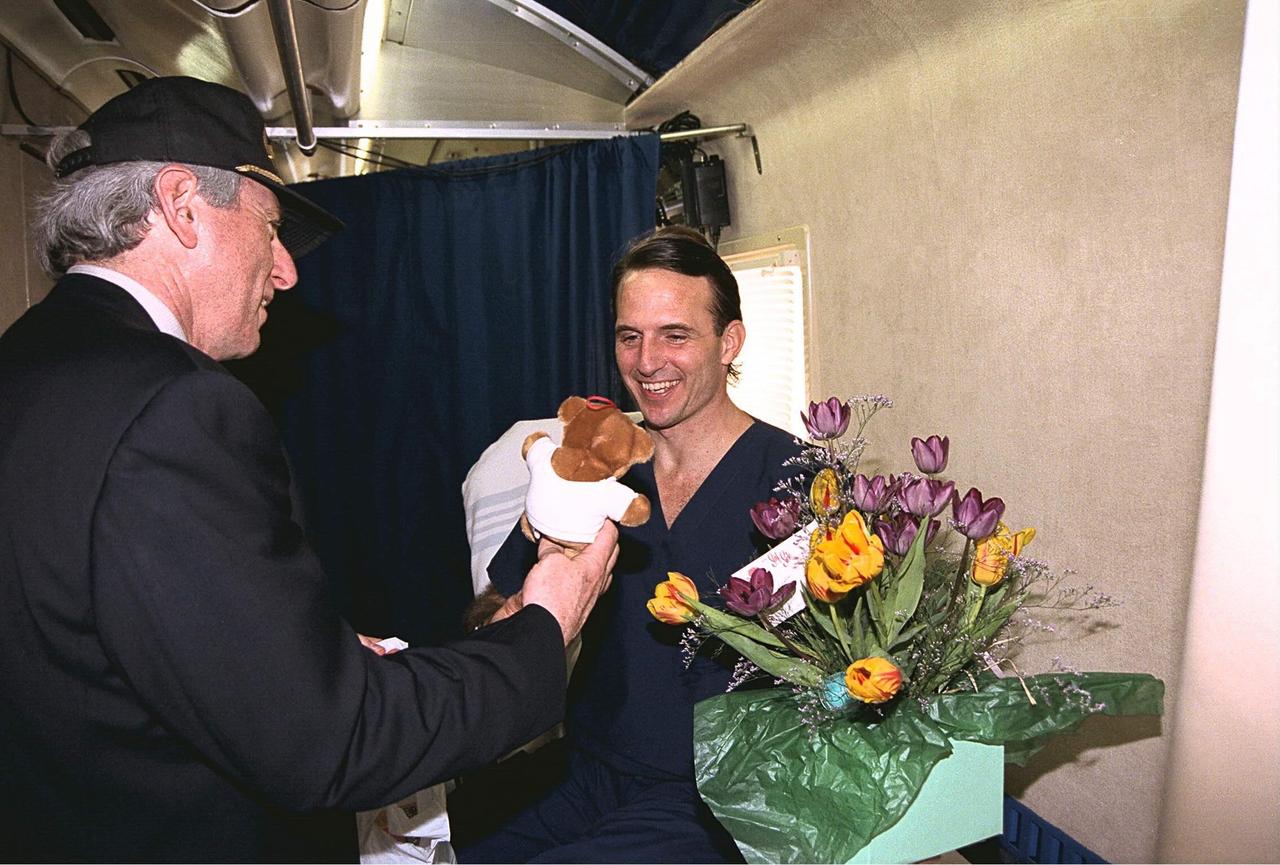
NASA Administrator Daniel Goldin presents some gifts to returning astronaut Jerry M. Linenger, who spent the last four months on the Russian Space Station Mir. Goldin met with Linenger in the Crew Transport Vehicle shortly after the Space Shuttle orbiter Atlantis landed on Runway 33 of KSC’s Shuttle Landing Facility at the conclusion of the nine-day STS-84 mission. Goldin gave the astronaut flowers for Linenger’s wife, Kathryn; a stuffed bear for their 18-month-old son, John; and a rattle for their unborn child who is due next month. STS-84 was the sixth of nine planned dockings of the Space Shuttle with the Mir. Mir 23 crew member Linenger was replaced on the Russian space station by STS-84 Mission Specialist C. Michael Foale
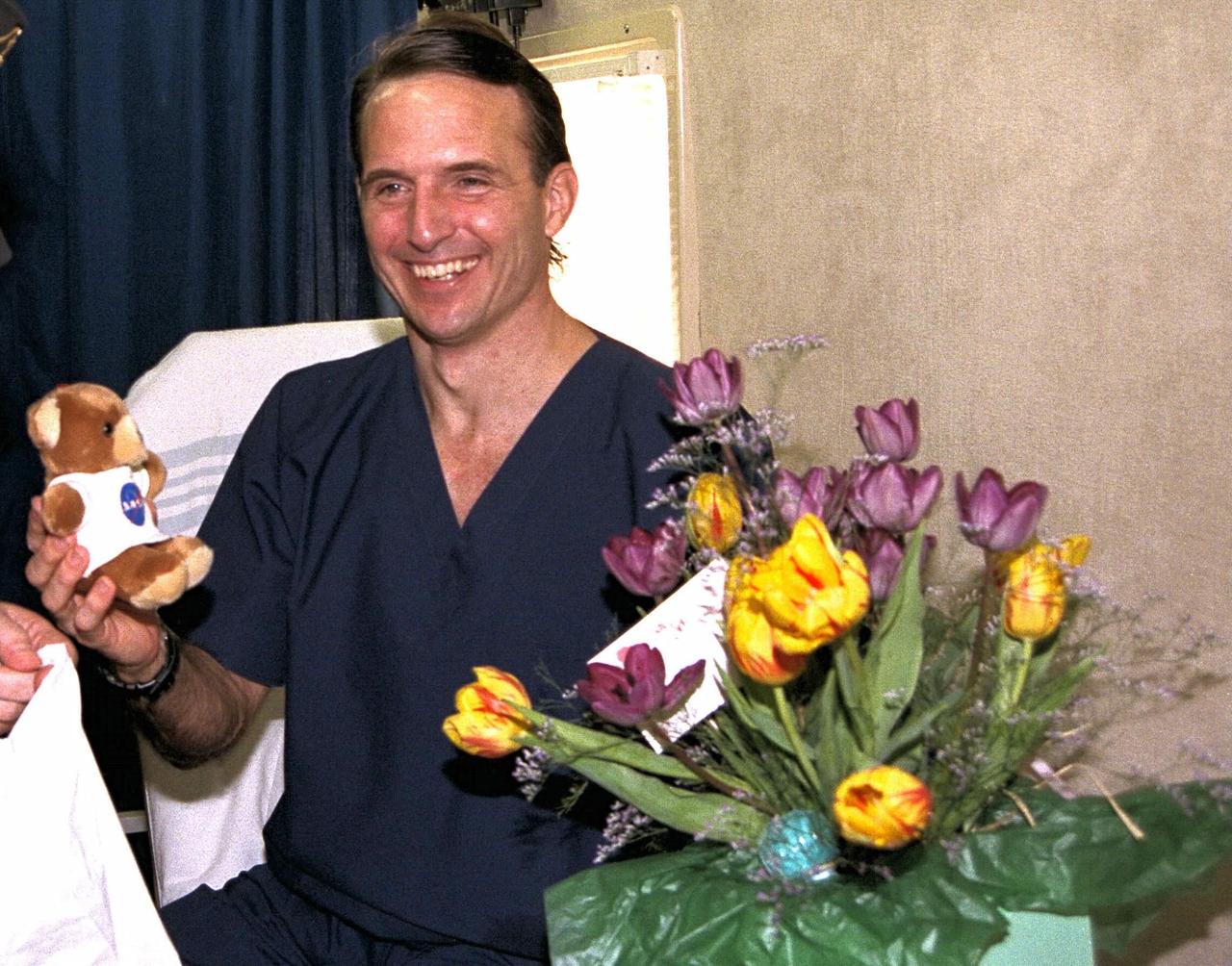
Astronaut and recent Mir 23 crew member Jerry M. Linenger holds a stuffed bear he was given by NASA Administrator Daniel Goldin at the conclusion of the STS-84 Space Shuttle mission. STS-84 was the sixth docking of the Shuttle with the Russian Space Station Mir, where Linenger has lived and worked the past four months. Goldin presented several gifts to Linenger in the Crew Transport Vehicle shortly after landing of the Space Shuttle orbiter Atlantis on KSC’s Runway 33. Besides the bear for Linenger’s 18-month-old son, John, Goldin gave the astronaut flowers for Linenger’s wife, Kathryn; and a rattle for the Linengers’ unborn child who is due next month. Linenger was replaced on the Russian space station by STS-84 Mission Specialist C. Michael Foale
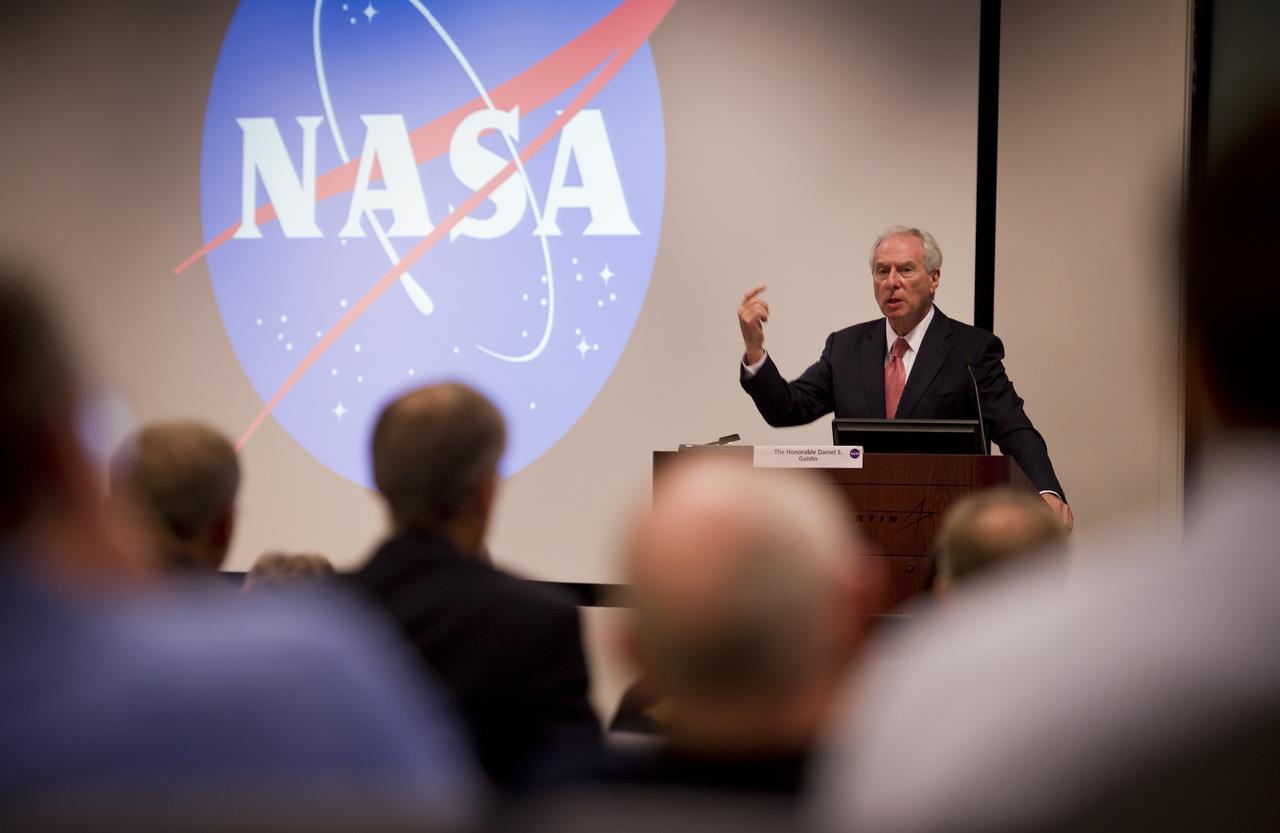
Dan Goldin, NASA's longest serving Administrator from 1992-2001 speaks during the "Seeking Signs of Life" Symposium, celebrating 50 Years of Exobiology and Astrobiology at NASA, Thursday, Oct. 14, 2010, at the Lockheed Martin Global Vision Center in Arlington, Va. NASA has been researching life in the universe since 1959, asking three fundamental questions: ‚"How does life begin and evolve?"‚ "Is there life beyond Earth and, if so, how can we detect it?‚" and "What is the future of life on Earth and in the universe?" Photo Credit: (NASA/Bill Ingalls)
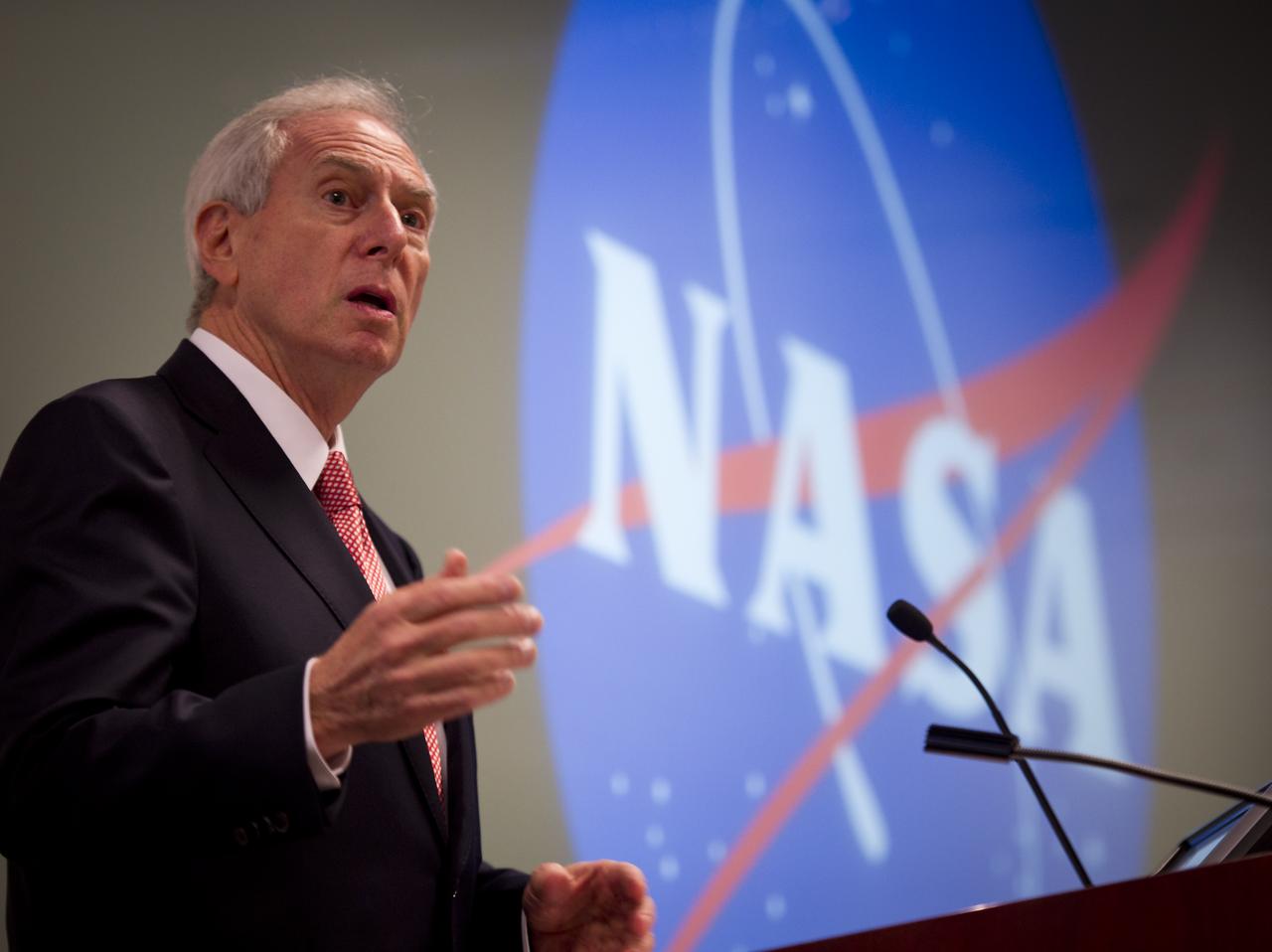
Dan Goldin, NASA's longest serving Administrator from 1992-2001 speaks during the "Seeking Signs of Life" Symposium, celebrating 50 Years of Exobiology and Astrobiology at NASA, Thursday, Oct. 14, 2010, at the Lockheed Martin Global Vision Center in Arlington, Va. NASA has been researching life in the universe since 1959, asking three fundamental questions: ‚"How does life begin and evolve?"‚ "Is there life beyond Earth and, if so, how can we detect it?‚" and "What is the future of life on Earth and in the universe?" Photo Credit: (NASA/Bill Ingalls)
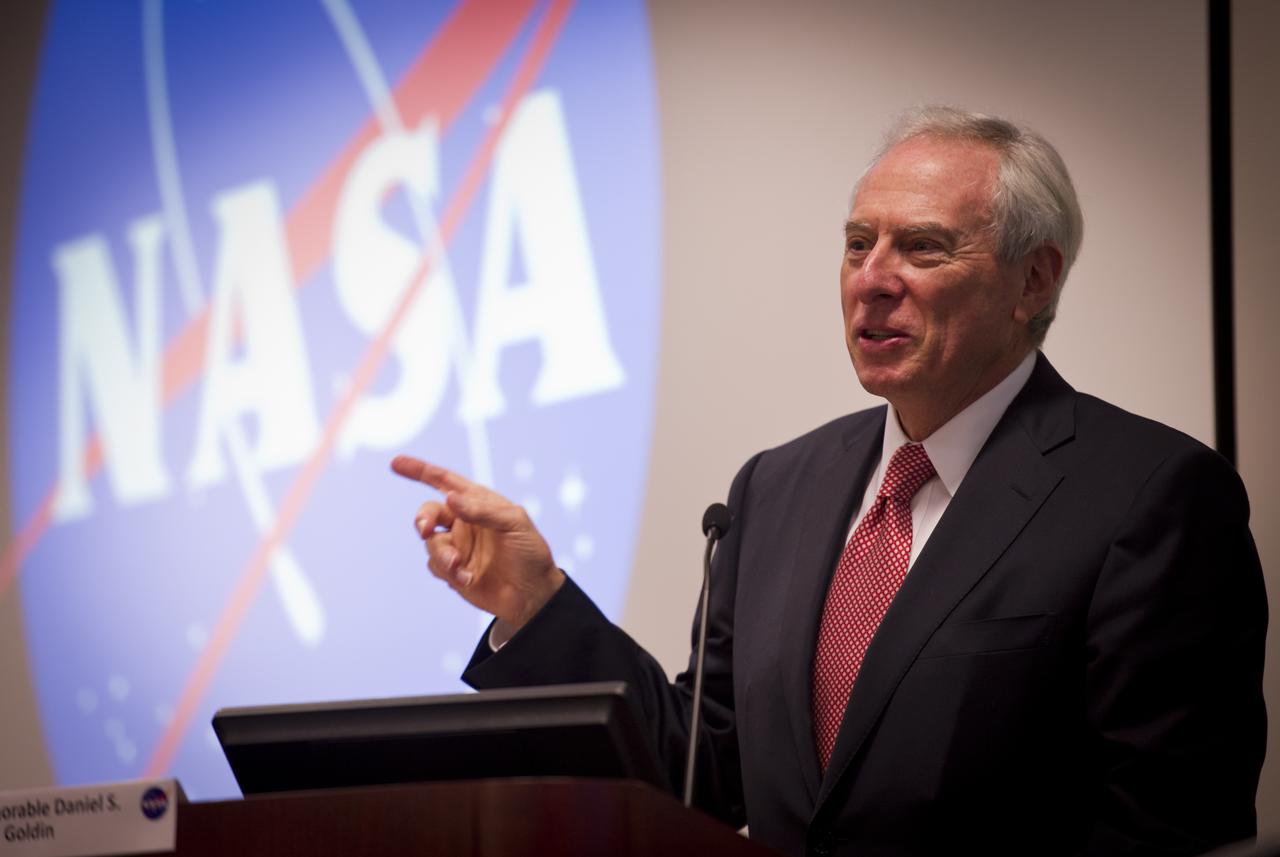
Dan Goldin, NASA's longest serving Administrator from 1992-2001 speaks during the "Seeking Signs of Life" Symposium, celebrating 50 Years of Exobiology and Astrobiology at NASA, Thursday, Oct. 14, 2010, at the Lockheed Martin Global Vision Center in Arlington, Va. NASA has been researching life in the universe since 1959, asking three fundamental questions: ‚"How does life begin and evolve?"‚ "Is there life beyond Earth and, if so, how can we detect it?‚" and "What is the future of life on Earth and in the universe?" Photo Credit: (NASA/Bill Ingalls)
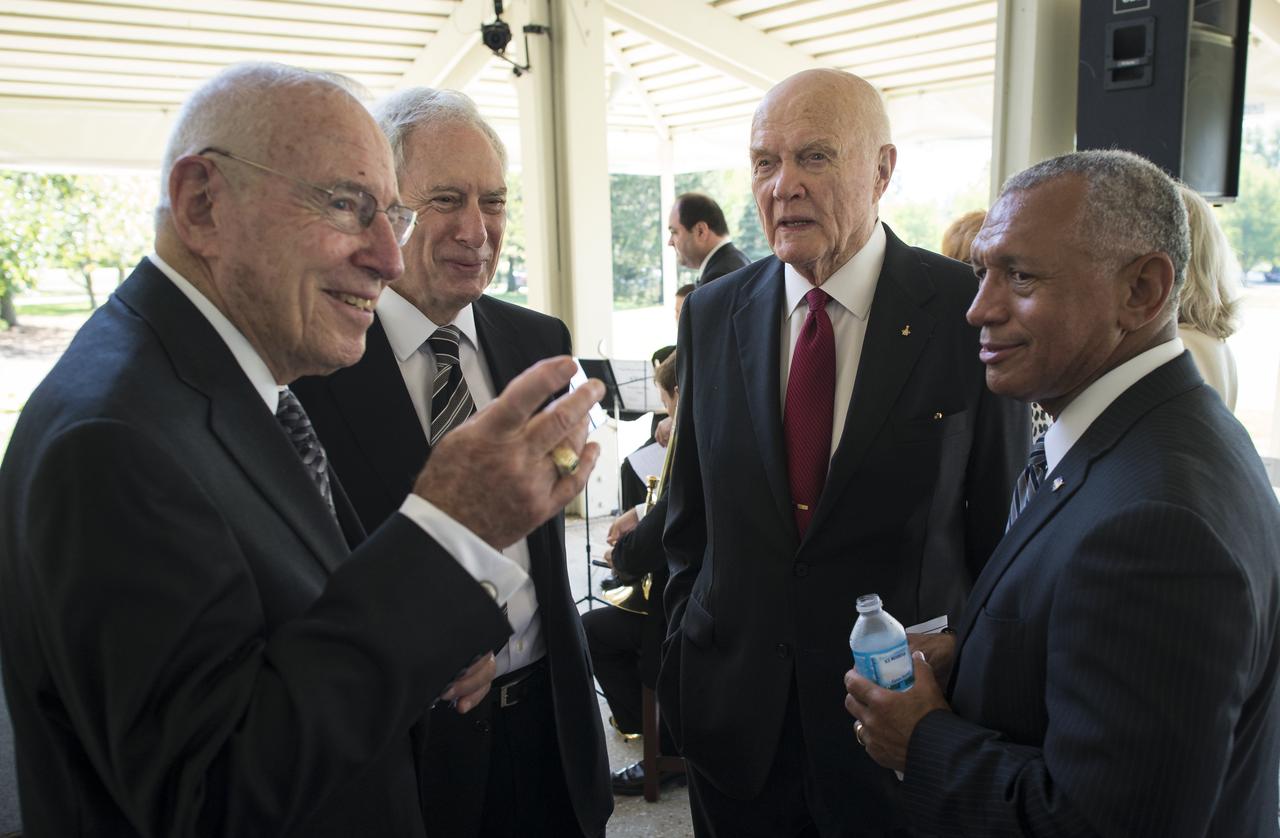
Apollo 13 Astronaut Jim Lovell, left, former NASA Administrator Dan Goldin, Sen. John Glenn, third from left, and NASA Administrator Charles Bolden, right, talk at a private memorial service celebrating the life of Neil Armstrong, Aug. 31, 2012, at the Camargo Club in Cincinnati. Armstrong, the first man to walk on the moon during the 1969 Apollo 11 mission, died Saturday, Aug. 25. He was 82. Photo Credit: (NASA/Bill Ingalls)
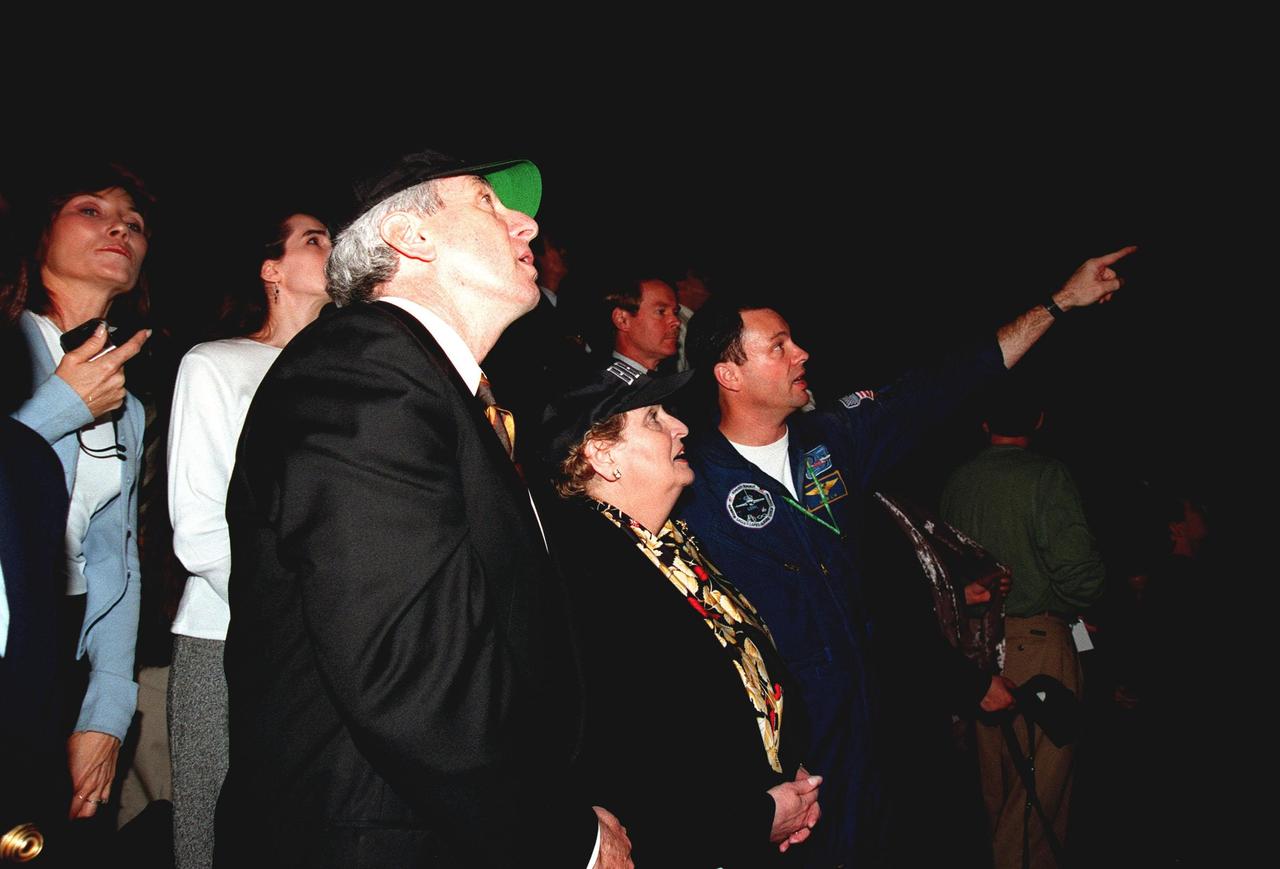
At the Banana Creek Viewing Site, NASA Administrator Daniel Goldin (left), U.S. Secretary of State Madeleine Albright (center) and astronaut Michael Lopez-Alegria watch the launch of STS-88 from Launch Pad 39A at 3:35:34 a.m. EST. STS-88 is the first U.S. mission dedicated to the assembly of the International Space Station (ISS). Lopez-Alegria is part of the STS-92 crew that is assigned to the fourth ISS assembly flight scheduled for launch on Oct. 28, 1999, aboard Discovery
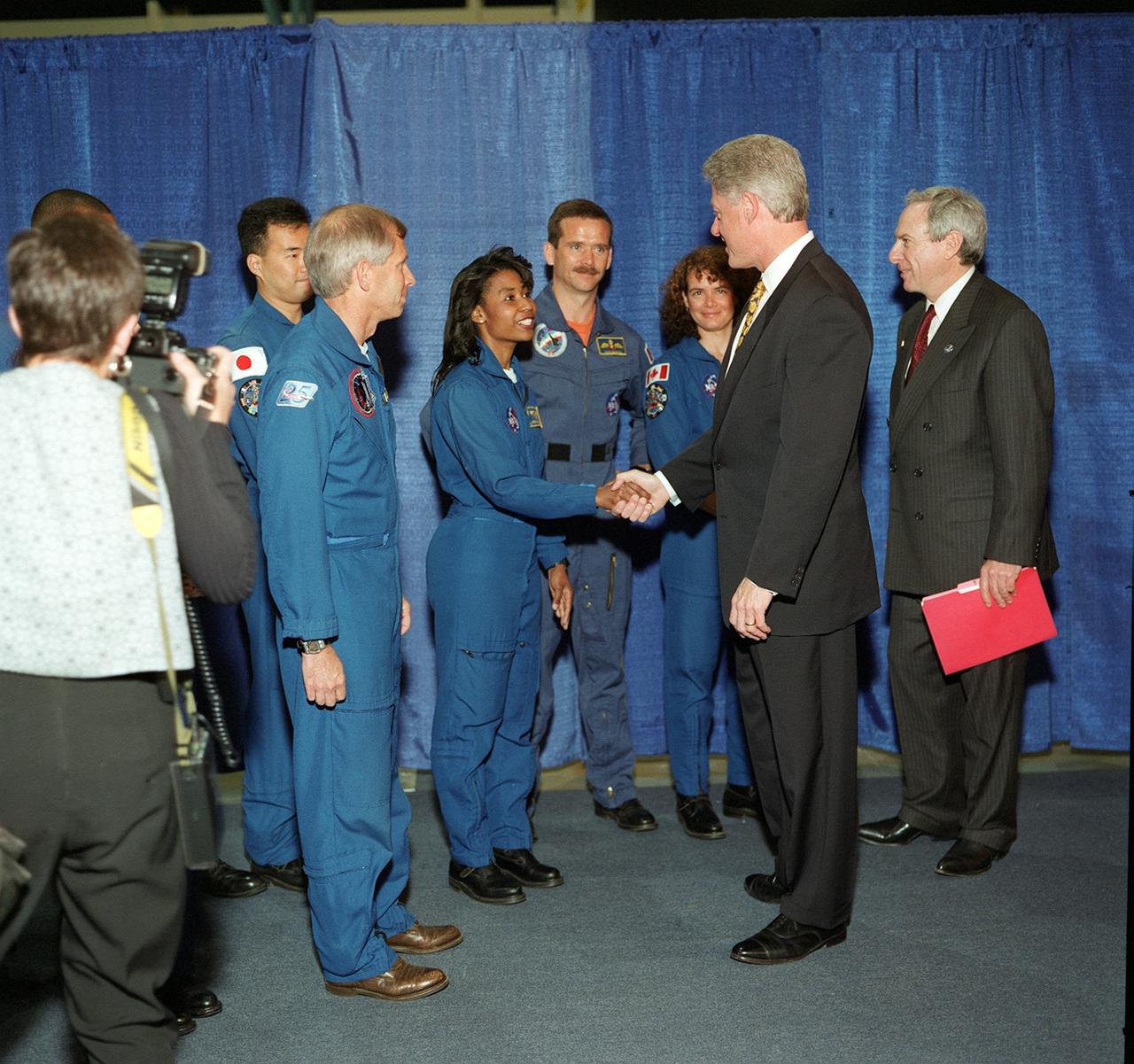
S98-05014 (14 April 1998) --- President Bill Clinton greets several NASA astronauts upon his arrival at the systems integration facility at the Johnson Space Center (JSC). The astronauts, from the left, are Soichi Noguchi, Kenneth D. Cockrell, Stephanie Wilson, Chris Hadfield and Julie Payette. Payette and Hadfield are with the Canadian Space Agency (CSA)and Noguchi is with the National Space Development Agency (NSADA) of Japan. Looking on is NASA Administrator Daniel Goldin. Photo Credit: NASA or the National Aeronautics and Space Administration.
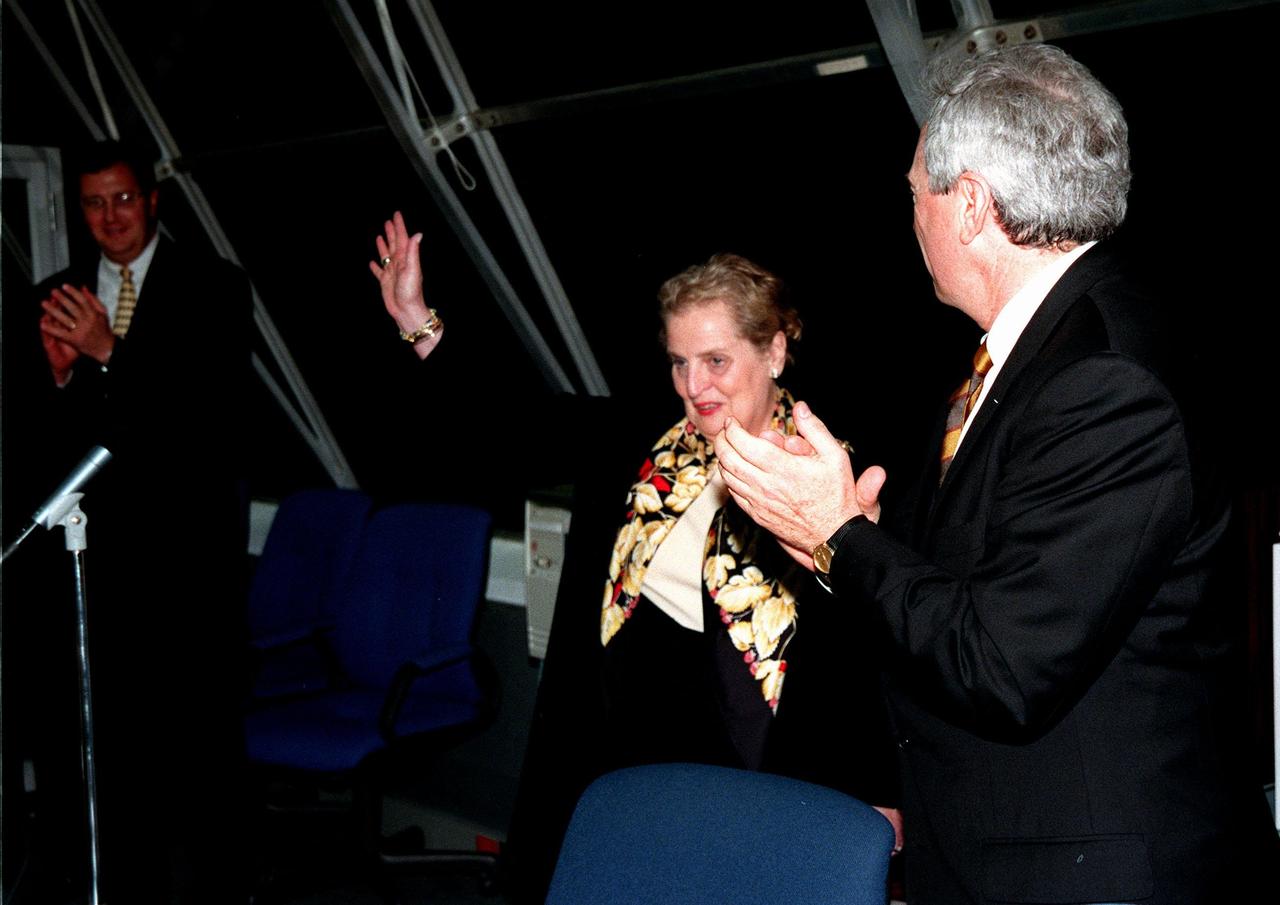
In a firing room of the Launch Control Center,U.S. Secretary of State Madeleine Albright waves to the personnel after her speech about the successful launch of Space Shuttle Endeavour. At her right is NASA Administrator Daniel Goldin. During the nearly 12-day mission of STS-88, the six-member crew will mate in space the first two elements of the International Space Station the already-orbiting Zarya control module and the Unity connecting module carried by Endeavour
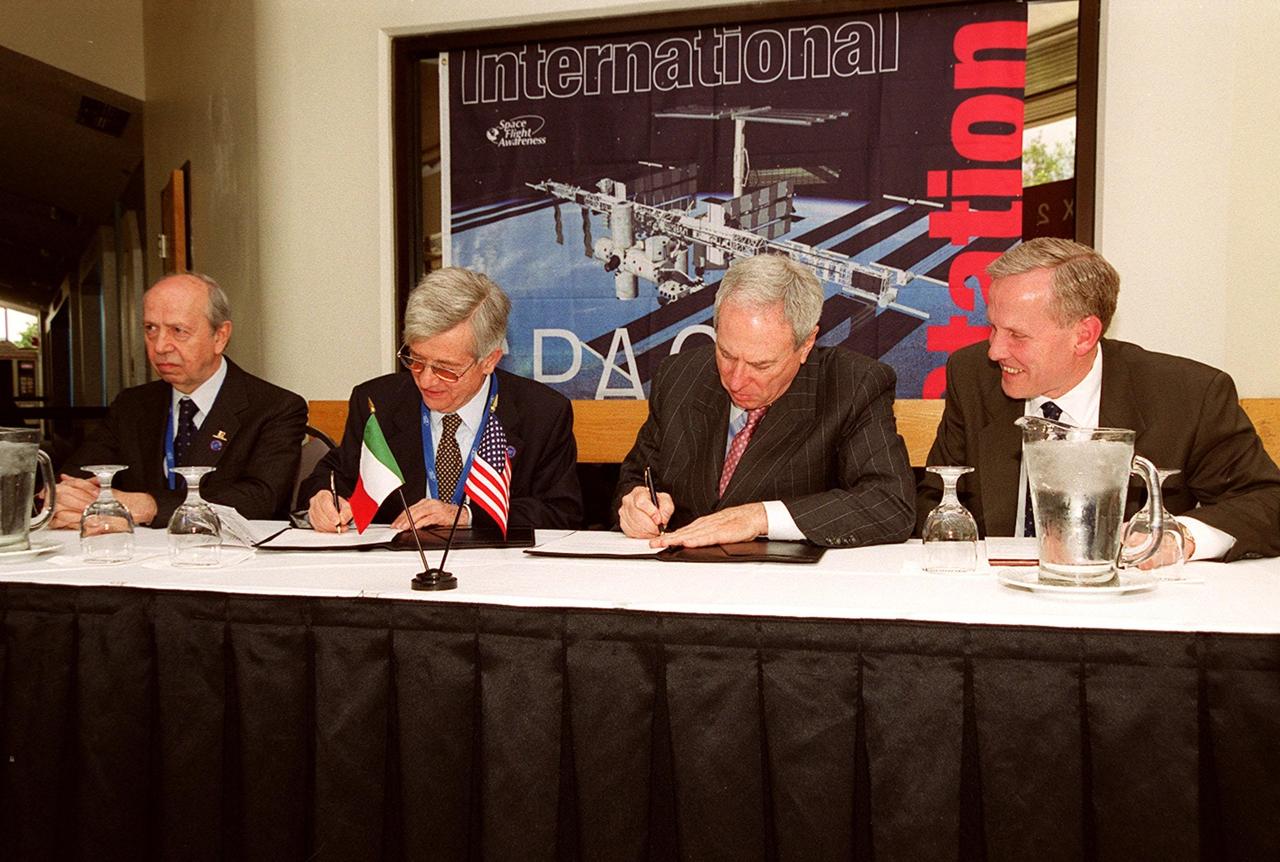
NASA Administrator Daniel S. Goldin and Italian Space Agency (ASI) President Sergio DeJulio sign a Framework for Cooperation to build the Habitation Module for the International Space Station. Seated at the table (left to right) are The Honorable Lamberto Dini, Minister of Foreign Affairs, Republic of Italy; DeJulio; Goldin; and John Schumacher, assistant administrator, External Relations, NASA. The Framework is a potential bilateral cooperative agreement that could result in ASI development of a U.S. Habitation Module for the International Space Station. This agreement allows the U.S. to explore an alternative approach to achieve full crew habitation for the ISS. A Memorandum of Understanding (MOU) between NASA and ASI will be required to formally document NASA and ASI’s respective responsibilities in a legally binding document. The Framework signed today would form the basis for a potential MOU which NASA and ASI would sign after completion of the program assessment and subsequent negotiations. The ceremony took place at the IMAX Theater, Kennedy Space Center Visitor Complex
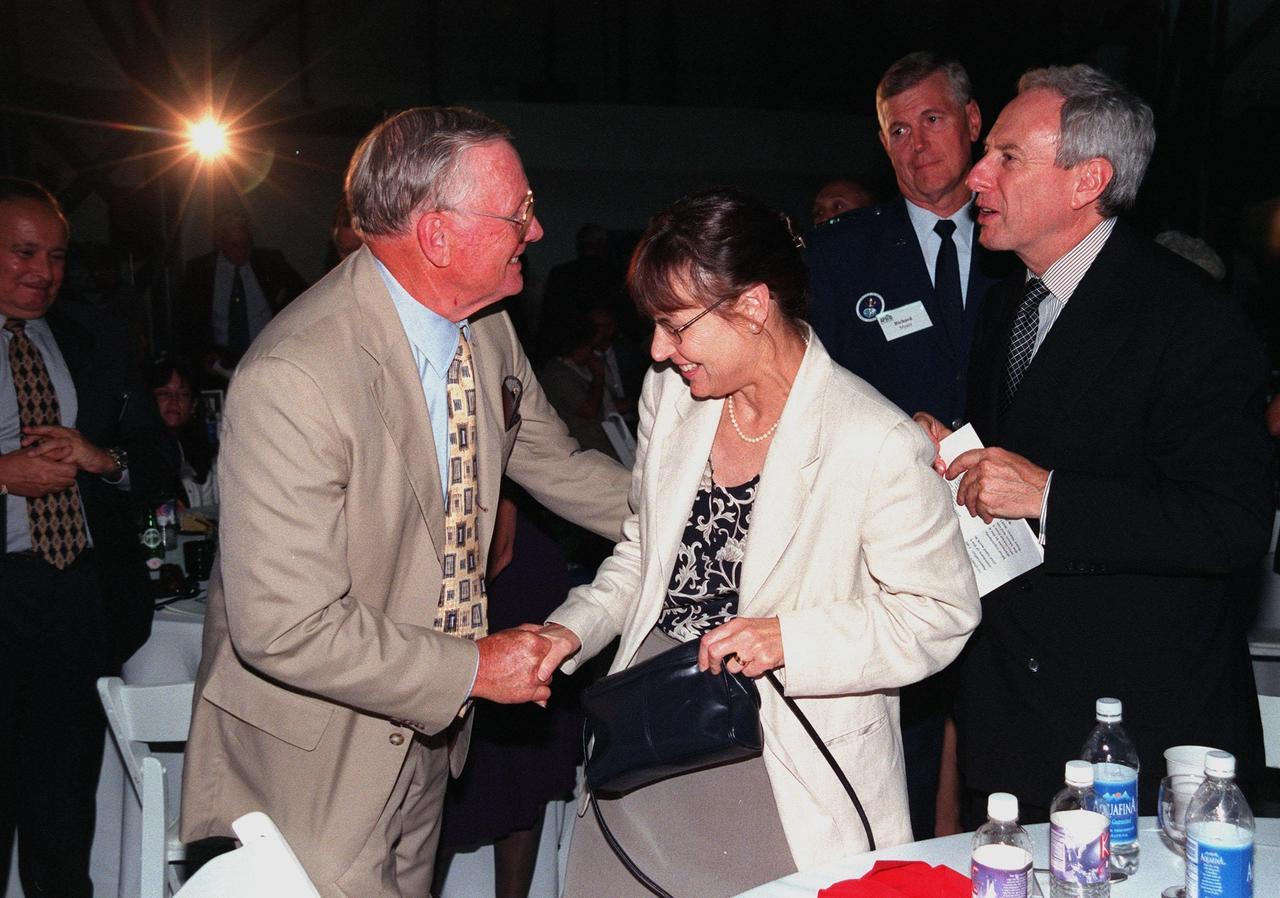
KENNEDY SPACE CENTER, FLA. -- During an anniversary banquet honoring the Apollo team, the people who made the entire lunar landing program possible, former Apollo astronaut Neil A. Armstrong (left) shakes the hand of Judy Goldin (center), wife of NASA Administrator Daniel S. Goldin (right). The banquet was held in the Apollo/Saturn V Center, part of the KSC Visitor Complex. This is the 30th anniversary of the Apollo 11 launch and moon landing, July 16 and July 20, 1969. Among the guests at the banquet were former Apollo astronauts are Neil A. Armstrong and Edwin "Buzz" Aldrin who flew on Apollo 11, the launch of the first moon landing; Gene Cernan, who flew on Apollo 10 and 17 and was the last man to walk on the moon; and Walt Cunningham, who flew on Apollo 7
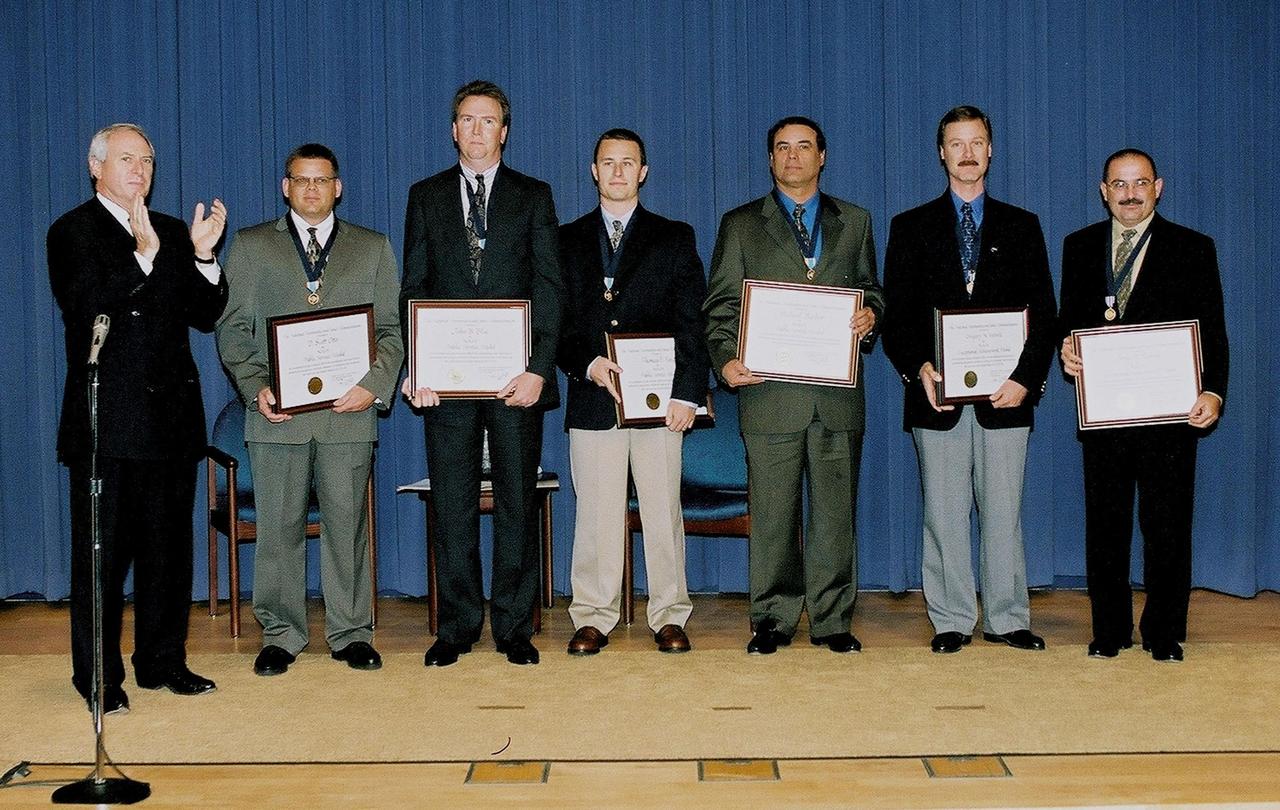
NASA Administrator Daniel Goldin (left) applauds the Space Shuttle ice and debris inspection team who were recognized for their keen safety observations prior to the launch of Space Shuttle Discovery. Standing next to Goldin are (left to right) D. Scott Otto, with Lockheed Martin Space Services Company; John B. Blue, Thomas F. Ford and Michael Barber, with United Space Alliance; Gregory N. Katnik and Jorge E. Rivera, with NASA. Katnick and Rivera received the agency’s Exceptional Achievement Medal; Barber, Blue, Ford and Otto received the NASA Public Service Medal. While scanning the launch pad before launch, the team found a stray 4-inch pin near the Shuttle’s external fuel tank that could have caused damage during launch. Discovery was safely launched the next day, on Oct. 11
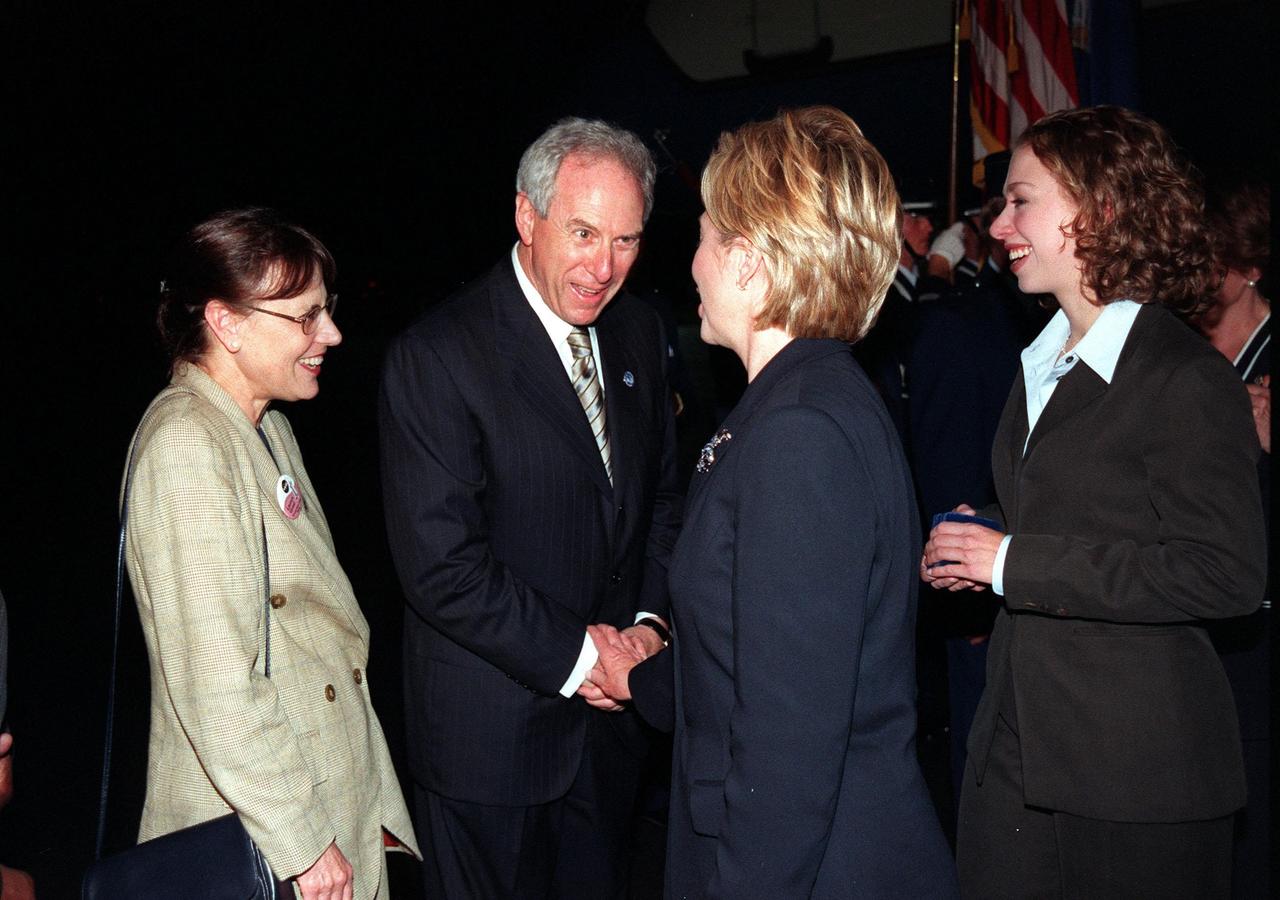
Upon their arrival at the Skid Strip at Cape Canaveral Air Station, First Lady Hillary Rodham Clinton and her daughter, Chelsea, are greeted by NASA Administrator Daniel S. Goldin and Mrs. Goldin. Mrs. Clinton and Chelsea are here to view the launch of Space Shuttle mission STS-93, scheduled for 12:36 a.m. EDT July 20. Much attention has been generated over the launch due to Commander Eileen M. Collins, the first woman to serve as commander of a Shuttle mission. The primary payload of the five-day mission is the Chandra X-ray Observatory, which will allow scientists from around the world to study some of the most distant, powerful and dynamic objects in the universe. The new telescope is 20 to 50 times more sensitive than any previous X-ray telescope and is expected to unlock the secrets of supernovae, quasars and black holes
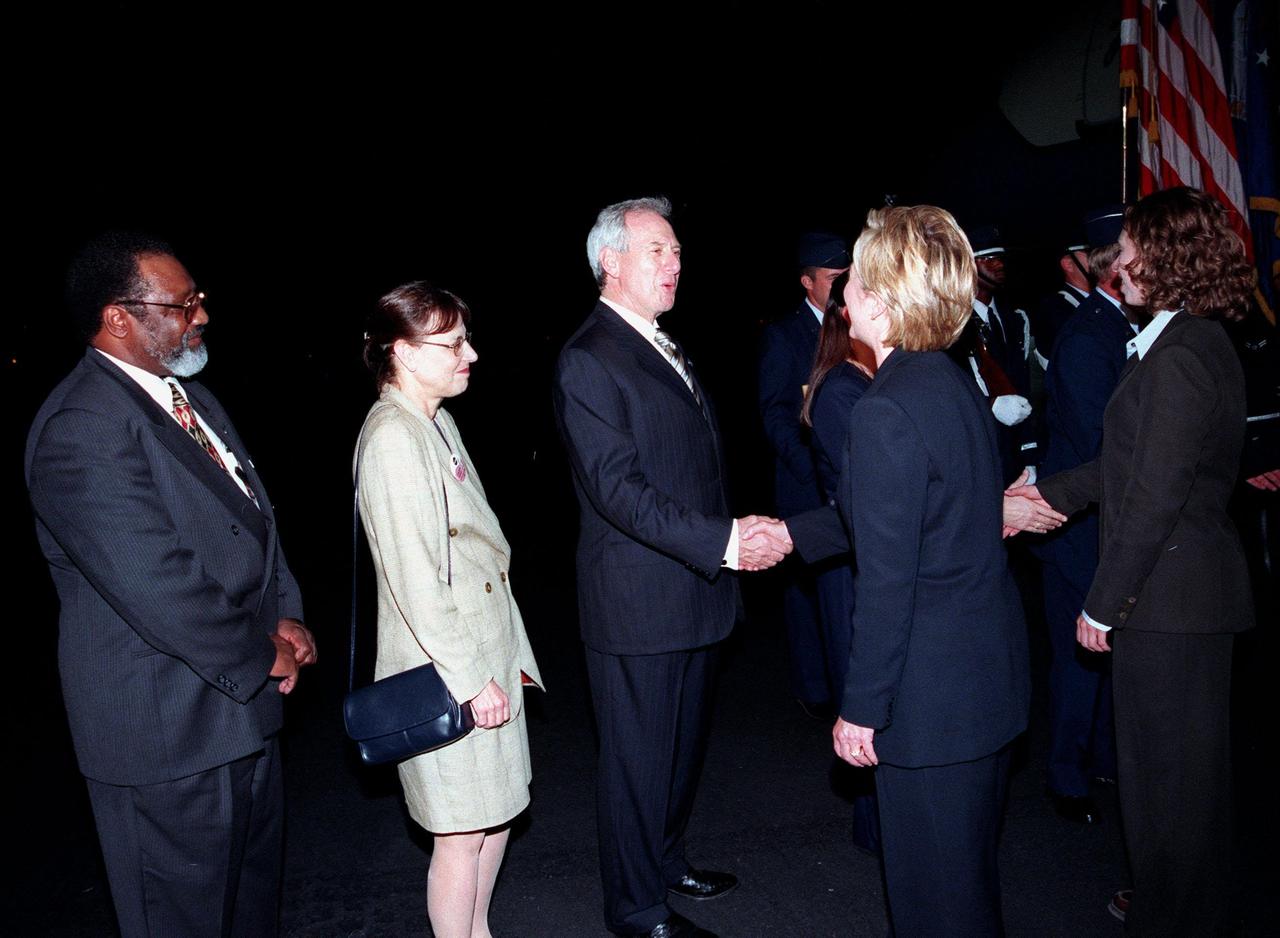
First Lady Hillary Rodham Clinton and her daughter, Chelsea, are greeted by NASA Administrator Daniel S. Goldin upon their arrival at the Skid Strip at Cape Canaveral Air Station. Next to Gold are (from left) Deputy Director for Business Operations Jim Jennings and Mrs. Goldin. Mrs. Clinton and Chelsea are here to view the launch of Space Shuttle mission STS-93, scheduled for 12:36 a.m. EDT July 20. Much attention has been generated over the launch due to Commander Eileen M. Collins, the first woman to serve as commander of a Shuttle mission. The primary payload of the five-day mission is the Chandra X-ray Observatory, which will allow scientists from around the world to study some of the most distant, powerful and dynamic objects in the universe. The new telescope is 20 to 50 times more sensitive than any previous X-ray telescope and is expected to unlock the secrets of supernovae, quasars and black holes
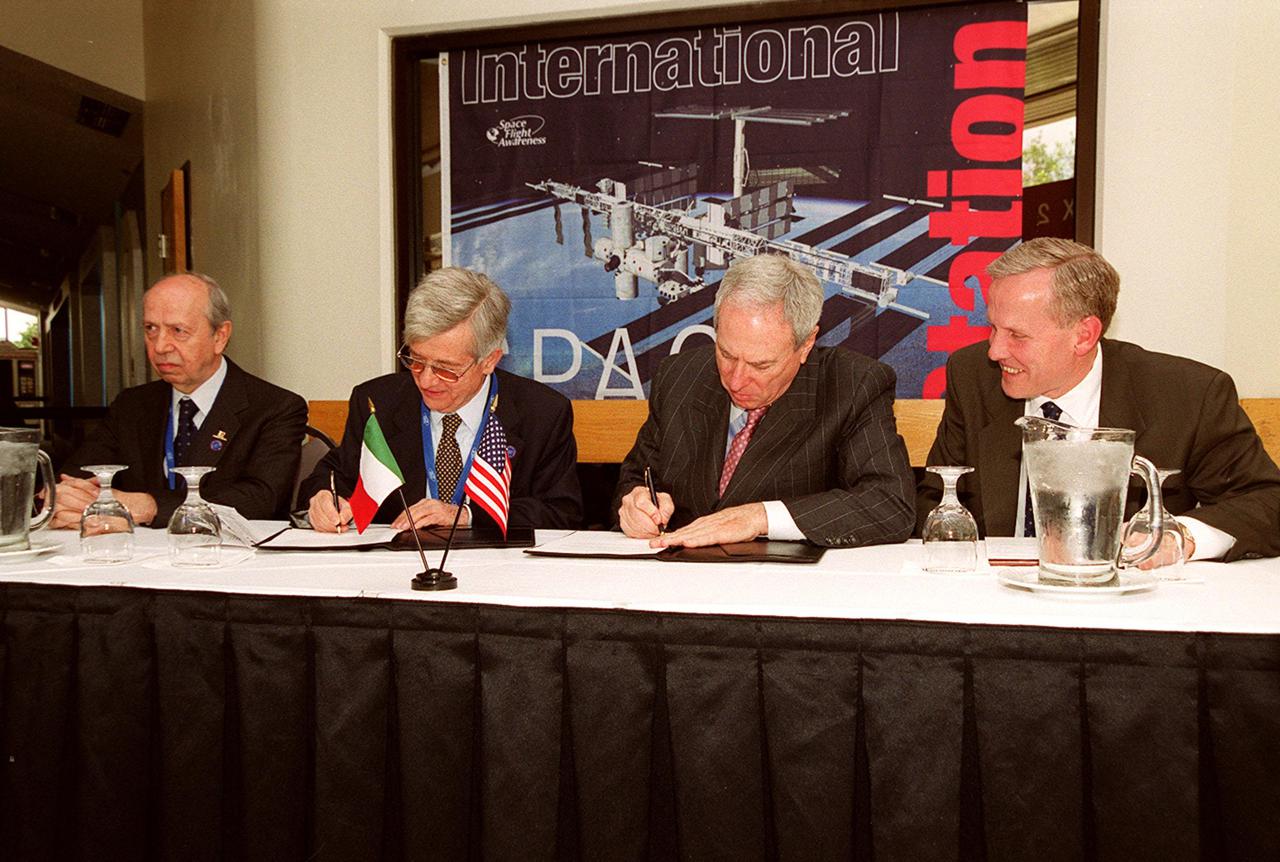
NASA Administrator Daniel S. Goldin and Italian Space Agency (ASI) President Sergio DeJulio sign a Framework for Cooperation to build the Habitation Module for the International Space Station. Seated at the table (left to right) are The Honorable Lamberto Dini, Minister of Foreign Affairs, Republic of Italy; DeJulio; Goldin; and John Schumacher, assistant administrator, External Relations, NASA. The Framework is a potential bilateral cooperative agreement that could result in ASI development of a U.S. Habitation Module for the International Space Station. This agreement allows the U.S. to explore an alternative approach to achieve full crew habitation for the ISS. A Memorandum of Understanding (MOU) between NASA and ASI will be required to formally document NASA and ASI’s respective responsibilities in a legally binding document. The Framework signed today would form the basis for a potential MOU which NASA and ASI would sign after completion of the program assessment and subsequent negotiations. The ceremony took place at the IMAX Theater, Kennedy Space Center Visitor Complex
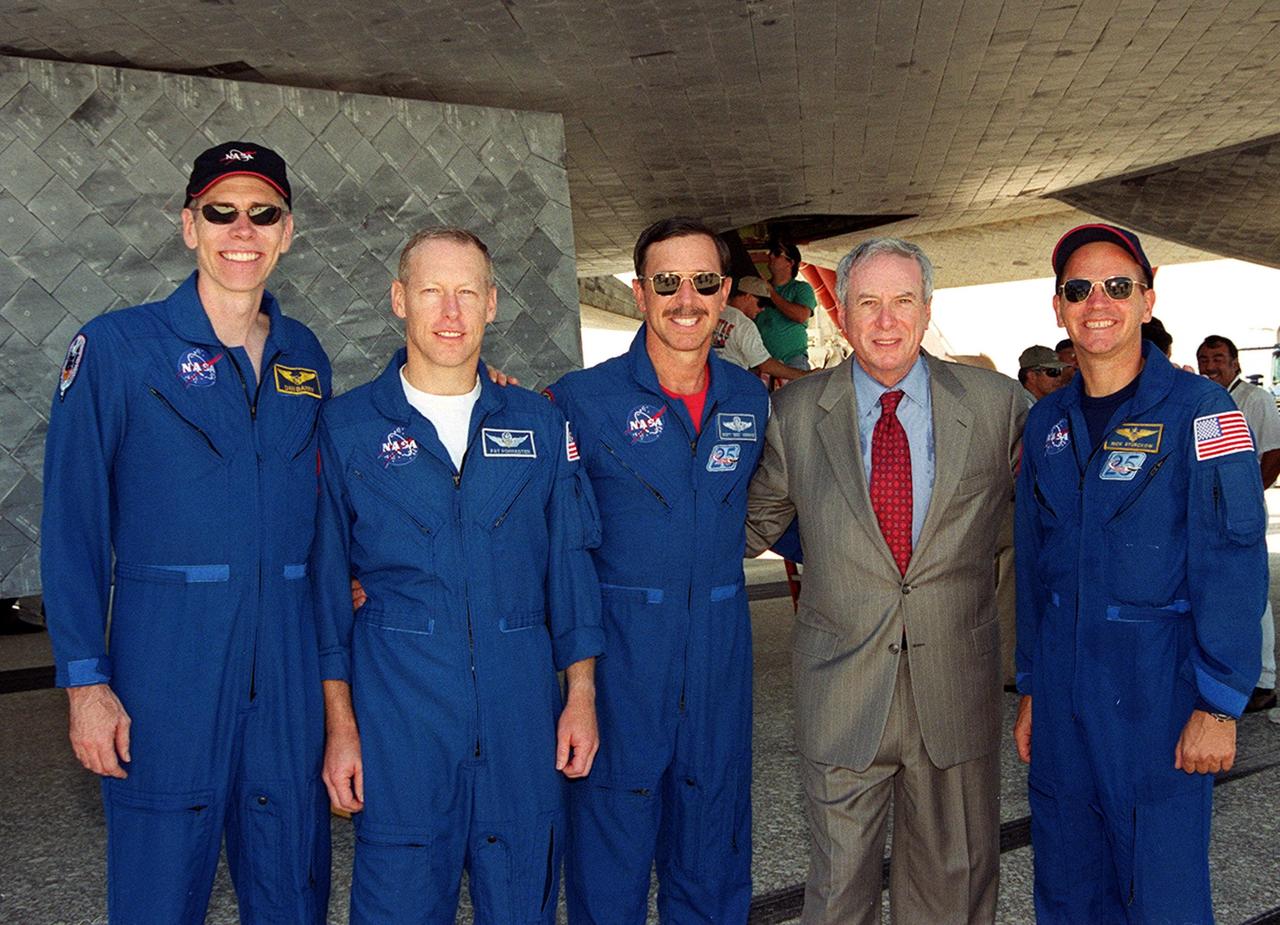
KENNEDY SPACE CENTER, Fla. - Following the landing of mission STS-105, the crew poses with NASA Administrator Daniel Goldin under Space Shuttle Discovery on KSC's Shuttle Landing Facility runway 15. From left are Mission Specialists Daniel Barry and Patrick Forrester, Commander Scott "Doc" Horowitz, Administrator Goldin, and Pilot Frederick "Rick" Sturckow. Main gear touchdown was at 2:22:58 p.m. EDT; wheel stop, at 2:24:06 p.m. EDT. The 11-day, 21-hour, 12-minute STS-105 mission accomplished the goals set for the 11th flight to the International Space Station: swapout of the resident Station crew; delivery of equipment, supplies and scientific experiments; and installation of the Early Ammonia Servicer and heater cables for the S0 truss on the Station. Discovery traveled 4.3 million miles on its 30th flight into space, the 106th mission of the Space Shuttle program. Out of five missions in 2001, the landing was the first to occur in daylight at KSC.
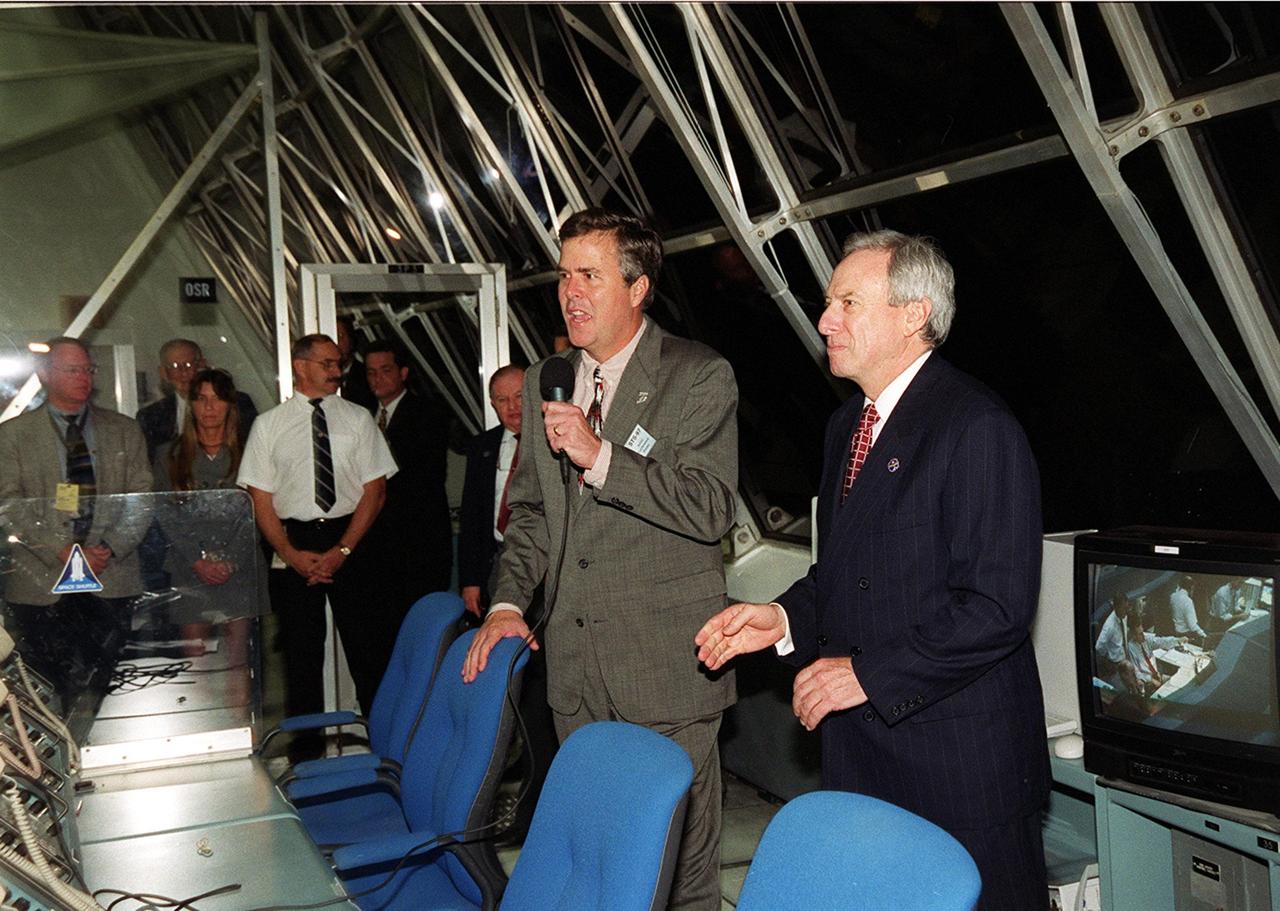
KENNEDY SPACE CENTER, FLA. -- Florida Governor Jeb Bush (with microphone) addresses the launch team in the Firing Room, Launch Control Center, after a successful launch of STS-97. At right is NASA Administrator Daniel Goldin. Liftoff of Space Shuttle Endeavour occurred at 10:06:01 p.m. Endeavour and its five-member crew will deliver U.S. solar arrays to the International Space Station and be the first Shuttle crew to visit the Station’s first resident crew. The 11-day mission includes three spacewalks. This marks the 101st mission in Space Shuttle history and the 25th night launch. Endeavour is expected to land at KSC Dec. 11 at 6:19 p.m. EST

From left, Center Director Roy Bridges and NASA Administrator Daniel S. Goldin applaud as Jay Holliman, with the help of his mother, Mrs. Dianne Holliman, unveils a plaque honoring his father, the late John Holliman. At right is Tom Johnson, news group chairman of CNN. The occasion was the dedication of the KSC Press Site auditorium as the John Holliman Auditorium to honor the CNN national correspondent for his enthusiastic, dedicated coverage of America's space program. The auditorium was built in 1980 and has been the focal point for new coverage of Space Shuttle launches. The ceremony followed the 94th launch of a Space Shuttle, on mission STS-96, earlier this morning
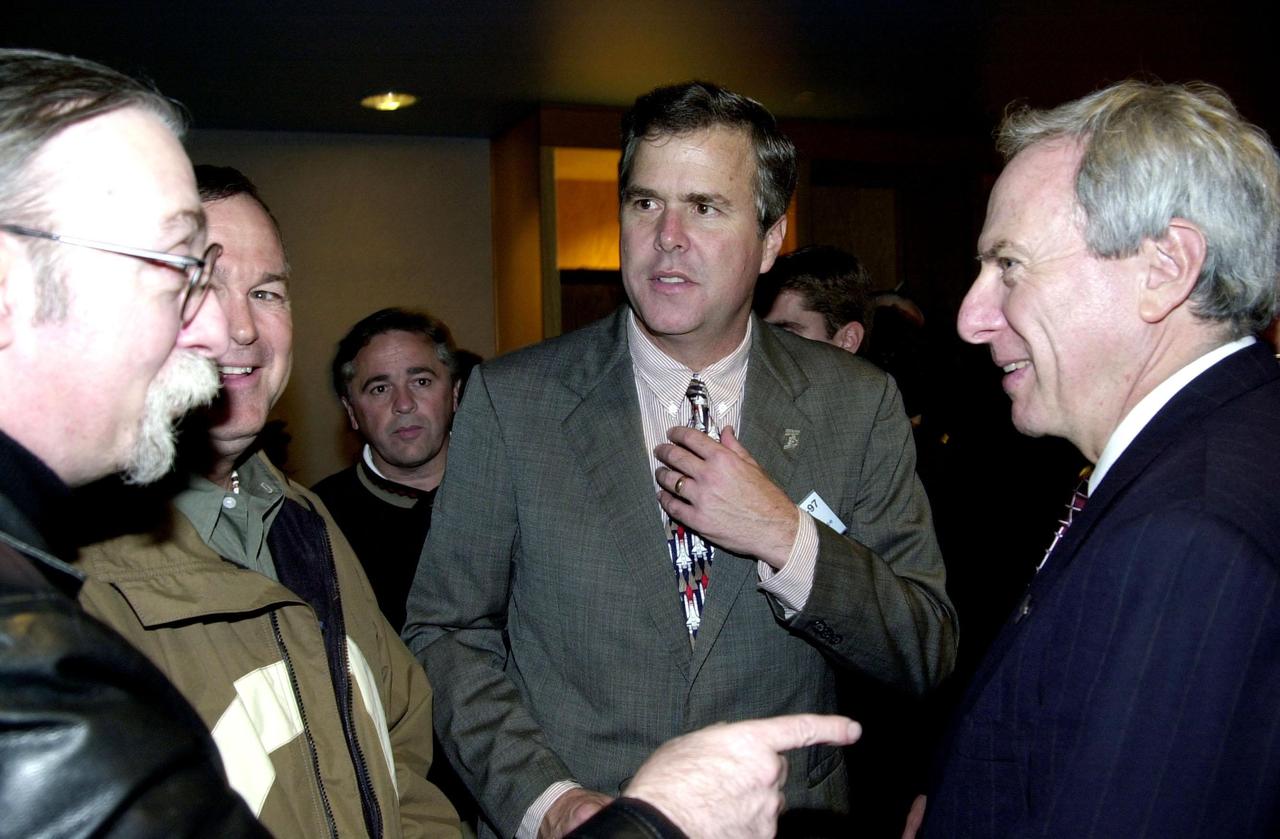
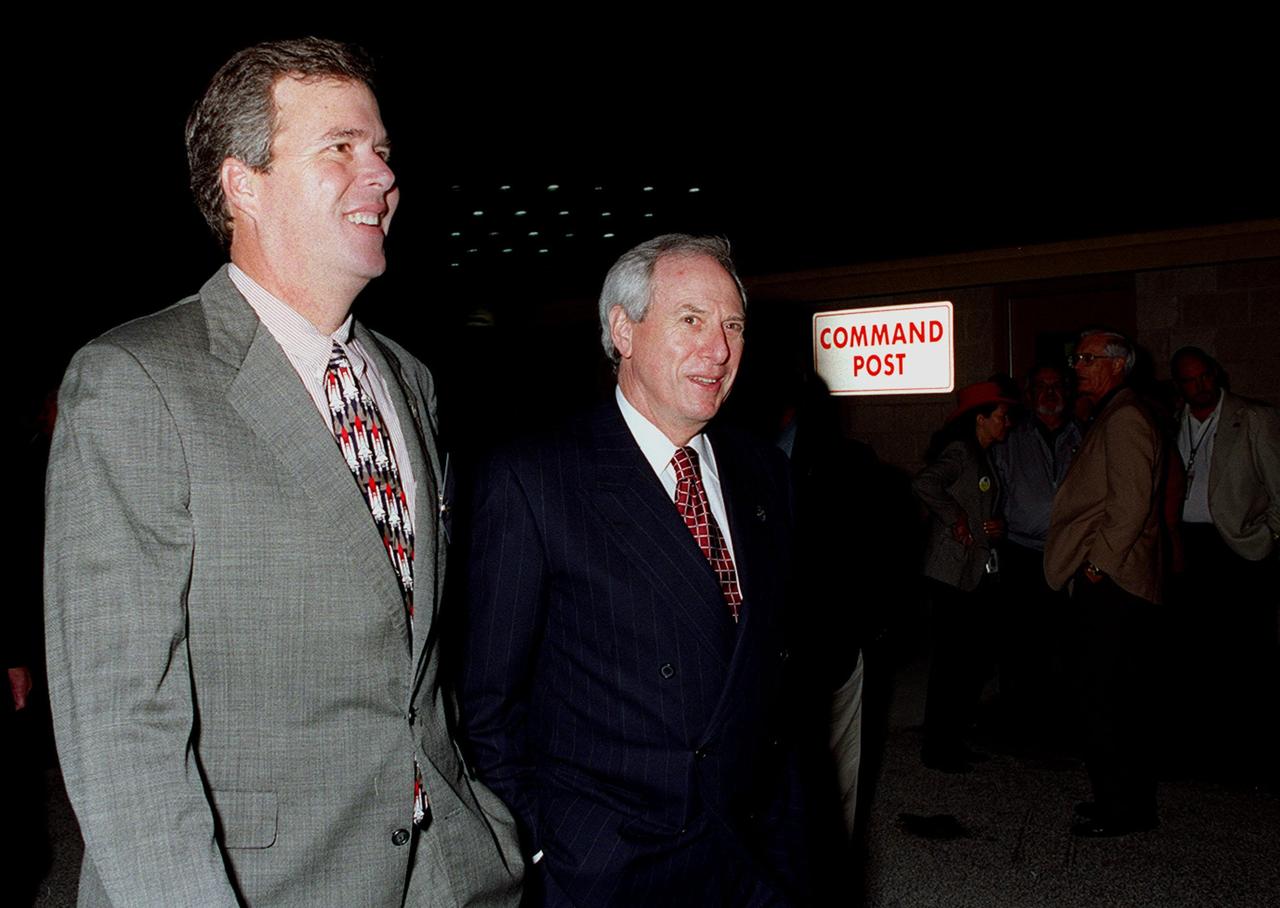
KENNEDY SPACE CENTER, FLA. -- Florida’s Governor Jeb Bush (center) joins NASA Administrator Daniel Goldin (right) for the launch of Space Shuttle Endeavour on mission STS-97. They viewed the launch from the Banana Creek VIP Site. Liftoff of Endeavour occurred on time at 10:06:01 p.m. EST with a crew of five. The sixth construction flight to the International Space Station, Endeavour is transporting the P6 Integrated Truss Structure that comprises Solar Array Wing-3 and the Integrated Electronic Assembly, to provide power to the Space Station. The 11-day mission includes two spacewalks to complete the solar array connections. Endeavour is expected to land Dec. 11 at 6:19 p.m. EST
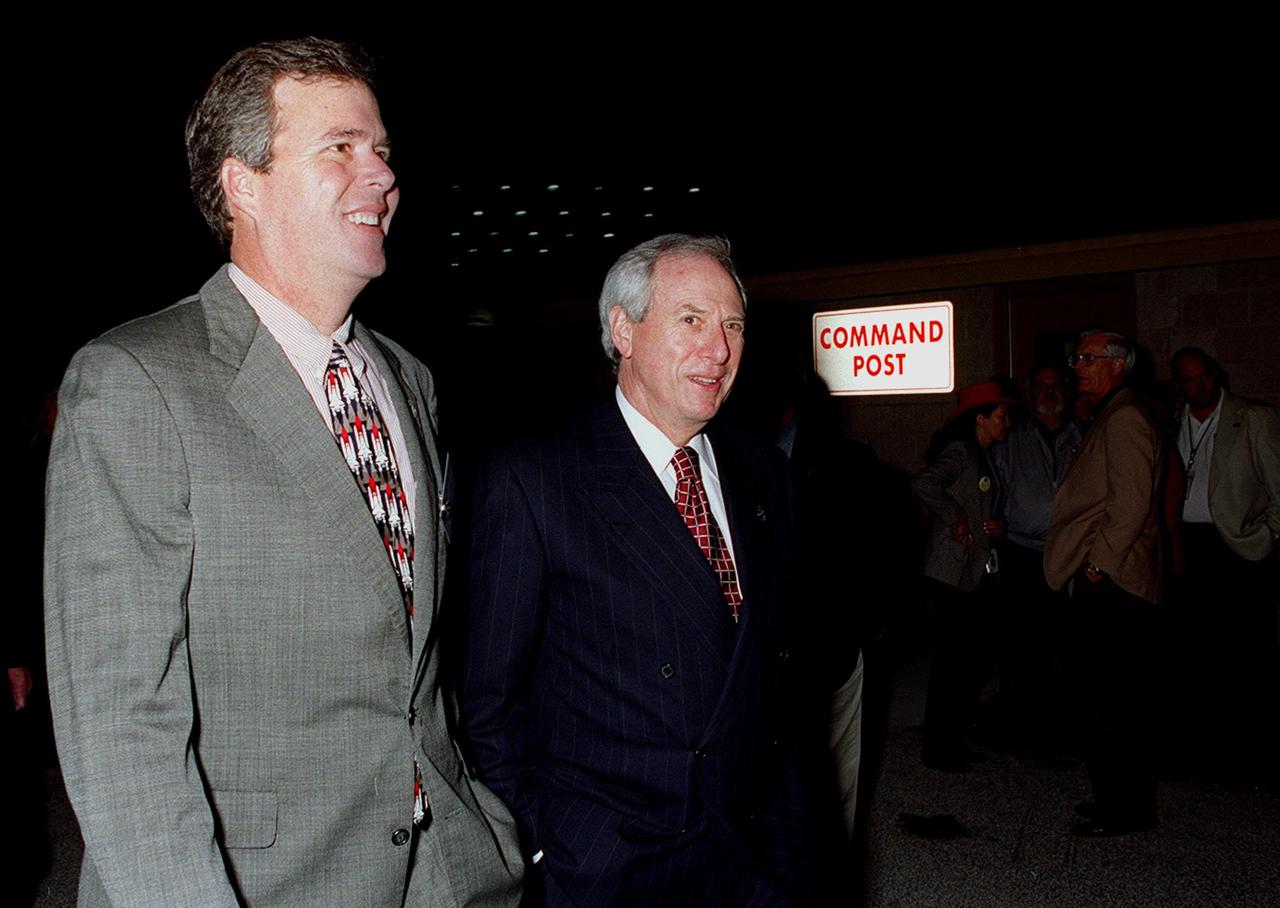
KENNEDY SPACE CENTER, FLA. -- Florida’s Gov. Jeb Bush (left) joins NASA Administrator Daniel Goldin (right) for the launch of Space Shuttle Endeavour on mission STS-97. They viewed the launch from the Banana Creek VIP Site. Liftoff of Endeavour occurred on time at 10:06:01 p.m. EST with a crew of five. The sixth construction flight to the International Space Station, Endeavour is transporting the P6 Integrated Truss Structure that comprises Solar Array Wing-3 and the Integrated Electronic Assembly, to provide power to the Space Station. The 11-day mission includes two spacewalks to complete the solar array connections. Endeavour is expected to land Dec. 11 at 6:19 p.m. EST
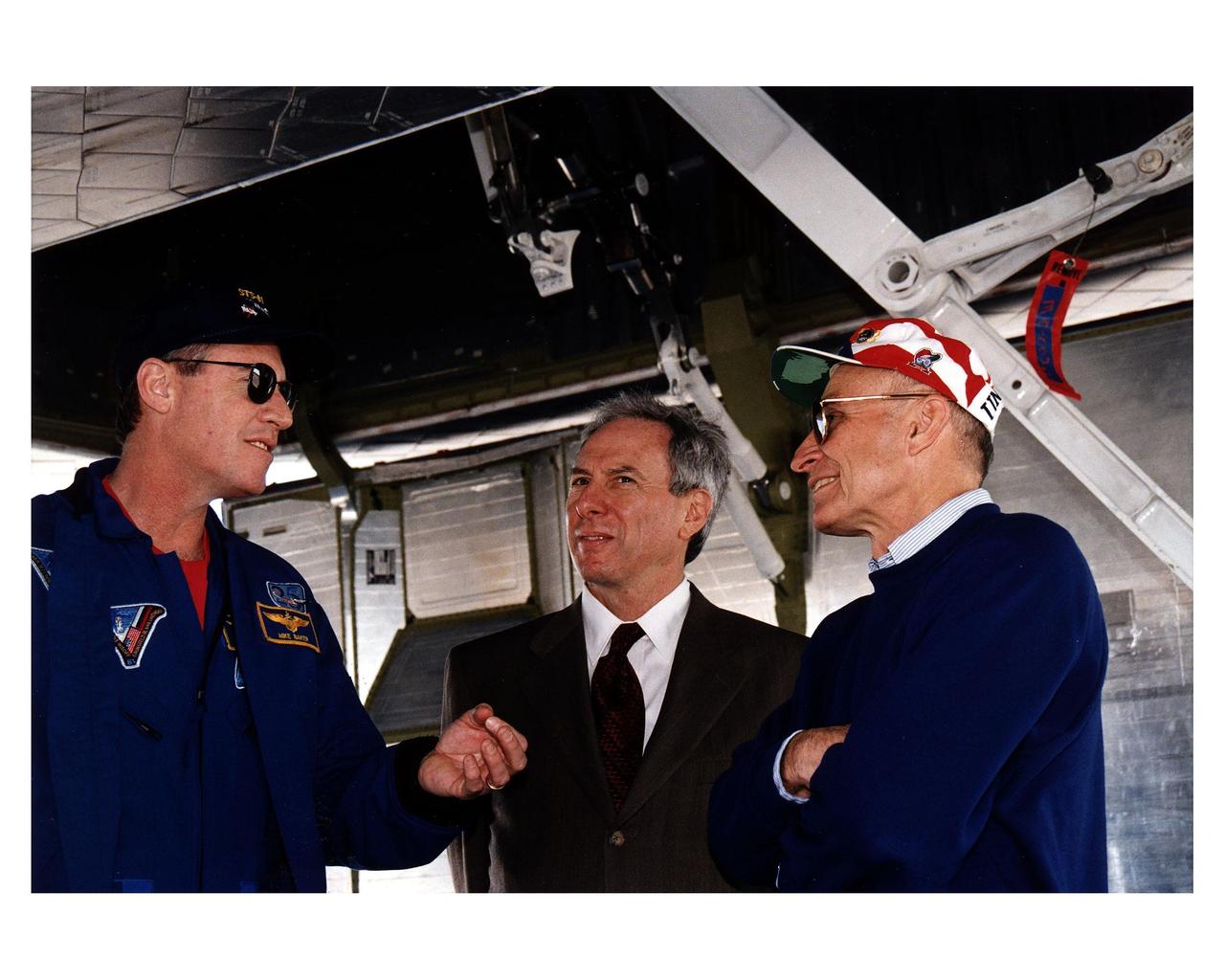
KENNEDY SPACE CENTER, FLA. -- NASA Administrator Daniel S. Goldin (center) and KSC Director of Shuttle Operations Robert B. Sieck (right) discuss the successful conclusion of the STS-81 mission with Mission Commander Michael A. Baker (left). They are underneath the Space Shuttle orbiter Atlantis after the space plane landed on Runway 33 at the KSC Shuttle Landing Facility at 9:22:44 a.m. EST Jan. 22 to conclude the fifth Shuttle-Mir docking mission. At main gear touchdown, the STS-81 mission duration was 10 days, 4 hours, 55 minutes. This was the 34th KSC landing in Shuttle history

CAPE CANAVERAL, Fla. -- Applauding the launch team inside the Launch Control Center are United States President Bill Clinton and First Lady Hillary Rodham Clinton, right. They joined NASA Administrator Daniel Goldin left in the firing room following the successful launch of STS-95, which included as part of the flight crew John H. Glenn Jr., senator from Oho and former NASA Mercury astronaut. The shuttle launch marked Glenn's second flight to space, coming 36 years after his Mercury flight in February 1962. Image credit: NASA
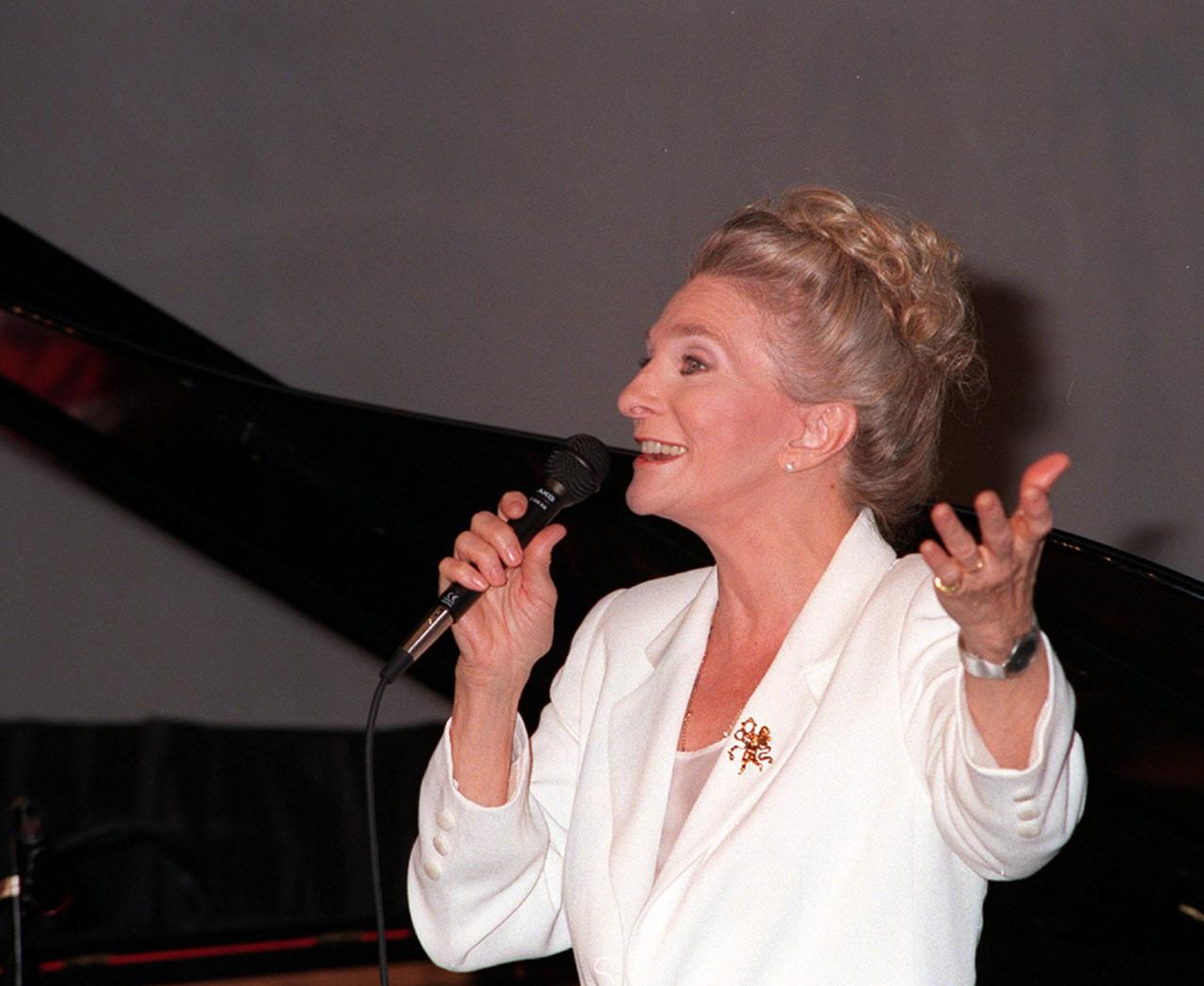
Singer-songwriter Judy Collins performs her original song, "Beyond the Sky," at the KSC Visitor Complex's Imax Theater for an audience of women attending a forum. The song, commissioned by NASA through the nASA Art Program, honored Eileen Collins, the first woman to command a Space Shuttle. The forum included a welcome by Center Director Roy Bridges, remarks by NASA Administrator Daniel Goldin, and a panel discussion, "Past, Present and Future of Space." The attendees are planning to view the launch of STS-93 at the Banana Creek viewing sight. Liftoff is scheduled for July 20 at 12:36 a.m. EDT
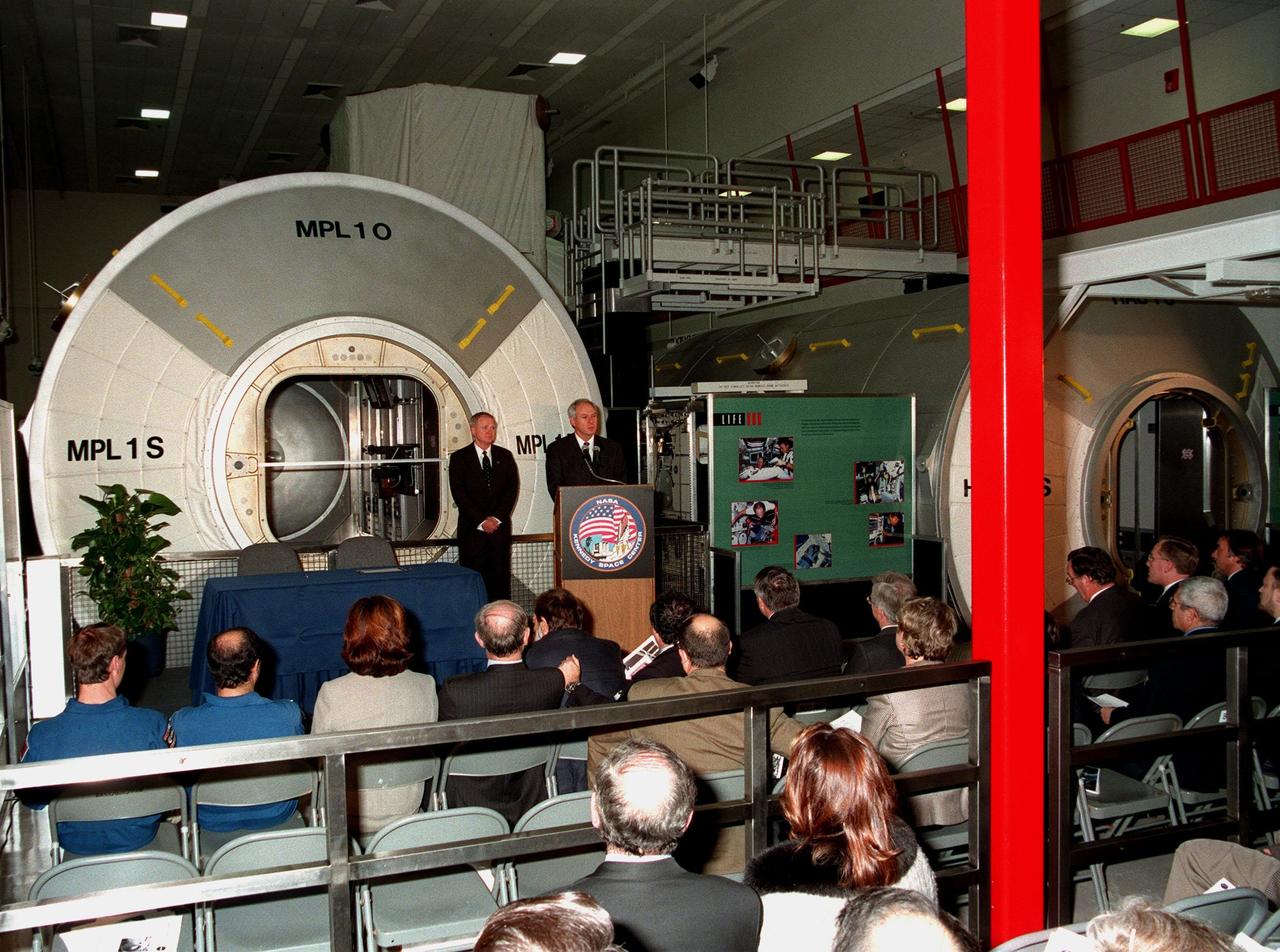
NASA Administrator Daniel S. Goldin speaks at the Space Station Processing Facility ceremony transferring the "Leonardo" Multipurpose Logistics Module (MPLM) from the Agenzia Spaziale Italiana (ASI) to NASA. Standing behind him in front of Leonardo is KSC Director Roy D. Bridges Jr. The MPLM, a reusable logistics carrier, will be the primary delivery system used to resupply and return International Space Station cargo requiring a pressurized environment. Leonardo is the first of three MPLM carriers for the International Space Station. It is scheduled to be launched on Space Shuttle Mission STS-100, targeted for April 2000
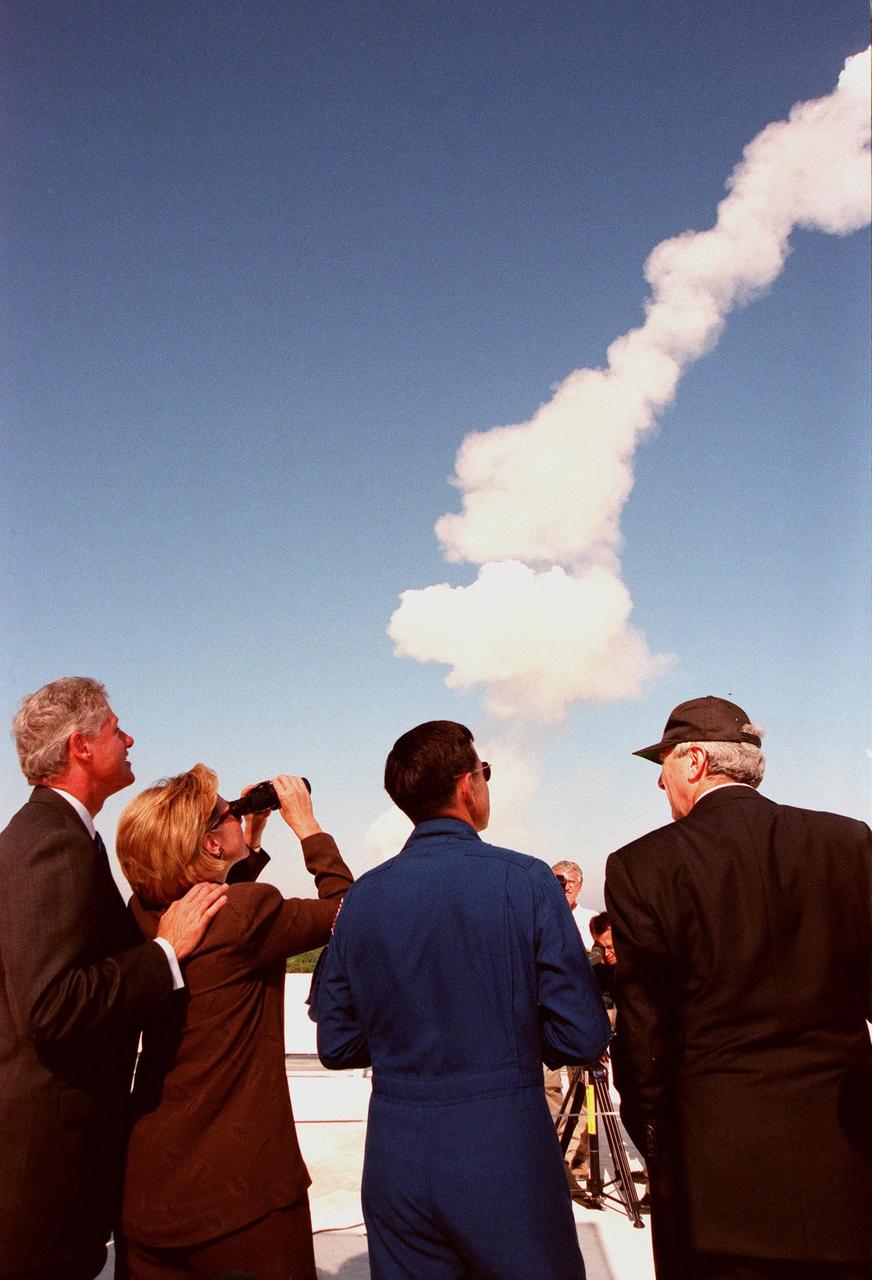
Watching a successful launch of Space Shuttle Discovery from the roof of the Launch Control Center are (left to right) U.S. President Bill Clinton, First Lady Hillary Rodham Clinton, Astronaut Robert Cabana and NASA Administrator Daniel Goldin. This was the first launch of a Space Shuttle to be viewed by President Clinton, or any President to date. They attended the launch to witness the return to space of American legend John H. Glenn Jr., payload specialist on mission STS-95. Cabana will command the crew of STS-88, the first Space Shuttle mission to carry hardware to space for the assembly of the International Space Station, targeted for liftoff on Dec. 3
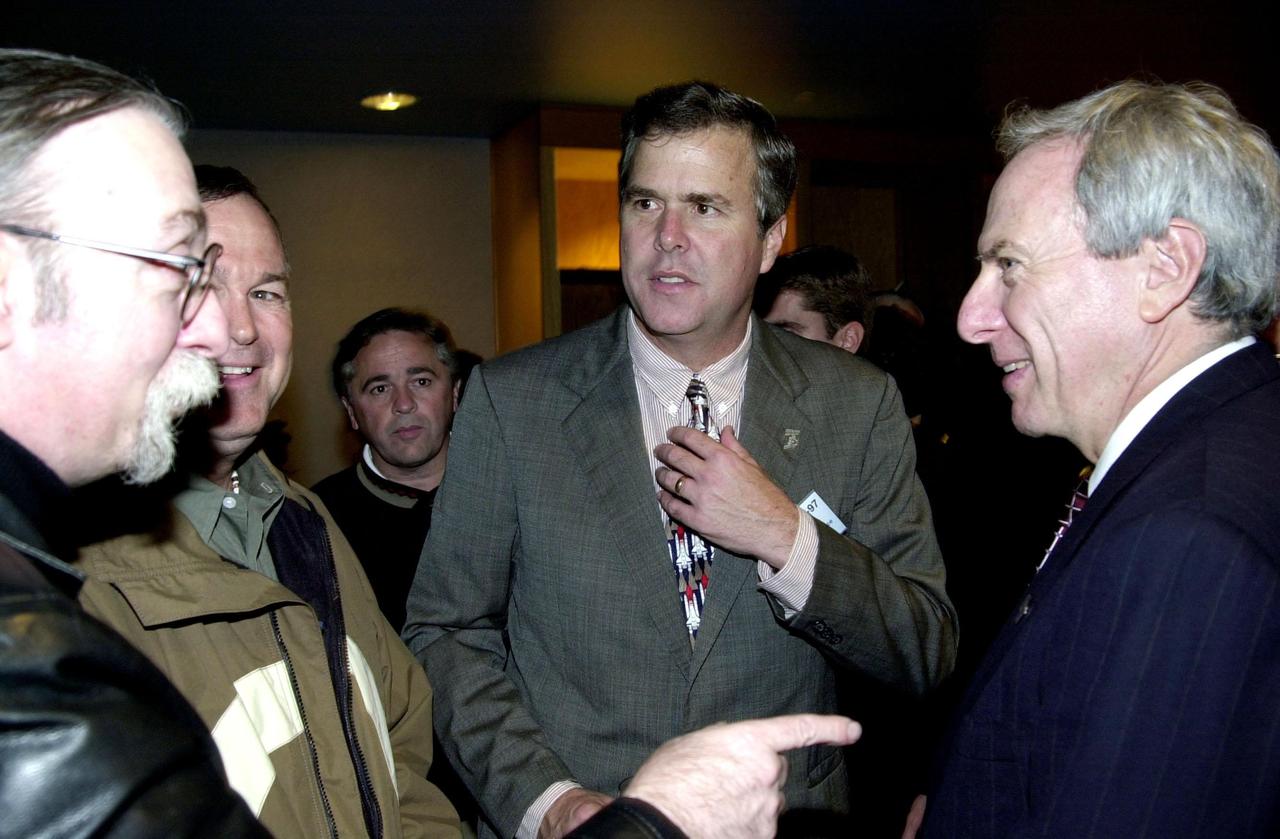
KENNEDY SPACE CENTER, FLA. -- Florida’s Governor Jeb Bush (center) joins NASA Administrator Daniel Goldin (right) for the launch of Space Shuttle Endeavour on mission STS-97. They viewed the launch from the Banana Creek VIP Site. Liftoff of Endeavour occurred on time at 10:06:01 p.m. EST with a crew of five. The sixth construction flight to the International Space Station, Endeavour is transporting the P6 Integrated Truss Structure that comprises Solar Array Wing-3 and the Integrated Electronic Assembly, to provide power to the Space Station. The 11-day mission includes two spacewalks to complete the solar array connections. Endeavour is expected to land Dec. 11 at 6:19 p.m. EST
KENNEDY SPACE CENTER, FLA. -- Florida’s Gov. Jeb Bush (left) joins NASA Administrator Daniel Goldin (right) for the launch of Space Shuttle Endeavour on mission STS-97. They viewed the launch from the Banana Creek VIP Site. Liftoff of Endeavour occurred on time at 10:06:01 p.m. EST with a crew of five. The sixth construction flight to the International Space Station, Endeavour is transporting the P6 Integrated Truss Structure that comprises Solar Array Wing-3 and the Integrated Electronic Assembly, to provide power to the Space Station. The 11-day mission includes two spacewalks to complete the solar array connections. Endeavour is expected to land Dec. 11 at 6:19 p.m. EST
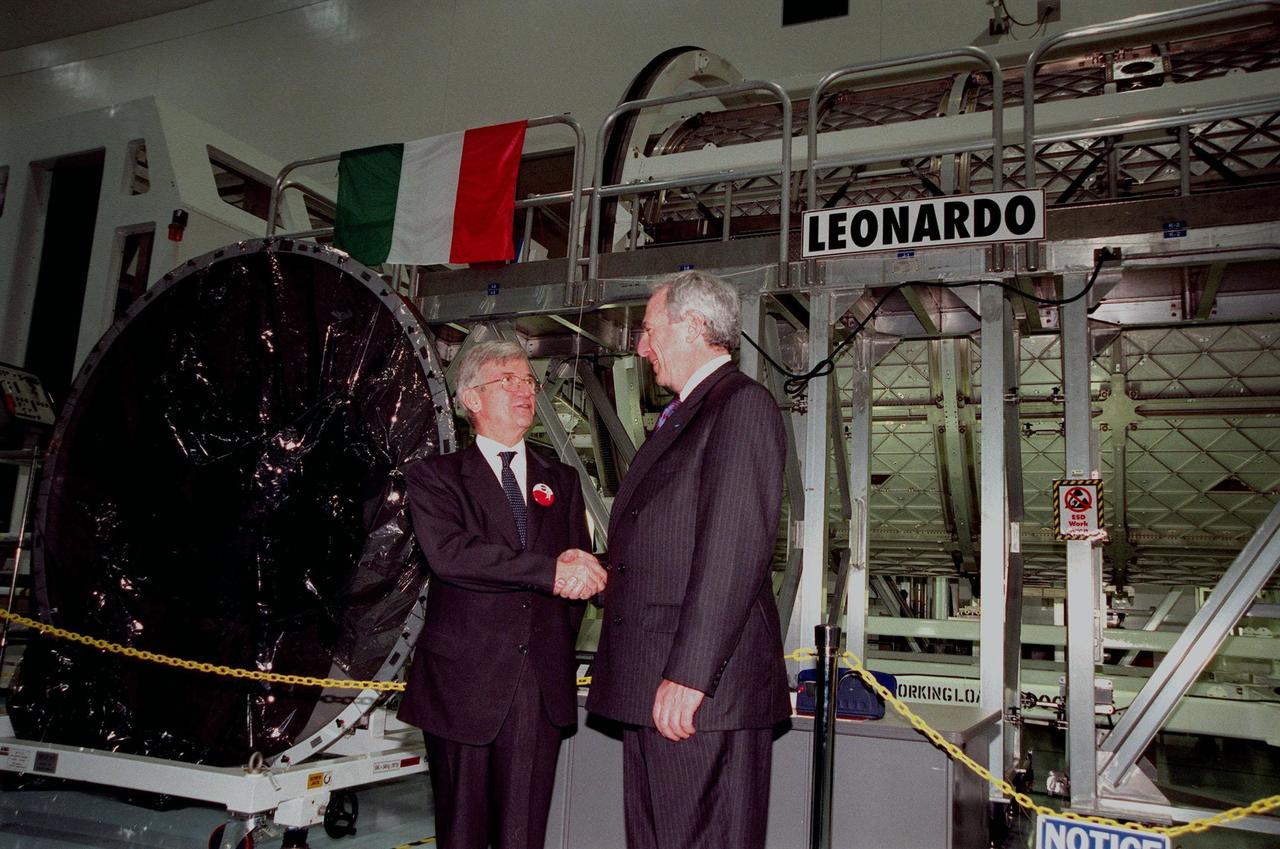
KENNEDY SPACE CENTER, FLA. -- NASA Administrator Daniel S. Goldin (at right) shakes the hand of Sergio De Julio, president of the Italian Space Agency, Agenzia Spaziale Italiana (ASI), during the ceremony transferring the "Leonardo" Multipurpose Logistics Module (MPLM) from ASI to NASA. The event was held in the Space Station Processing Facility beside Leonardo. The MPLM, a reusable logistics carrier, will be the primary delivery system used to resupply and return International Space Station cargo requiring a pressurized environment. Leonardo is the first of three MPLM carriers for the International Space Station. It is scheduled to be launched on Space Shuttle Mission STS-100, targeted for April 2000
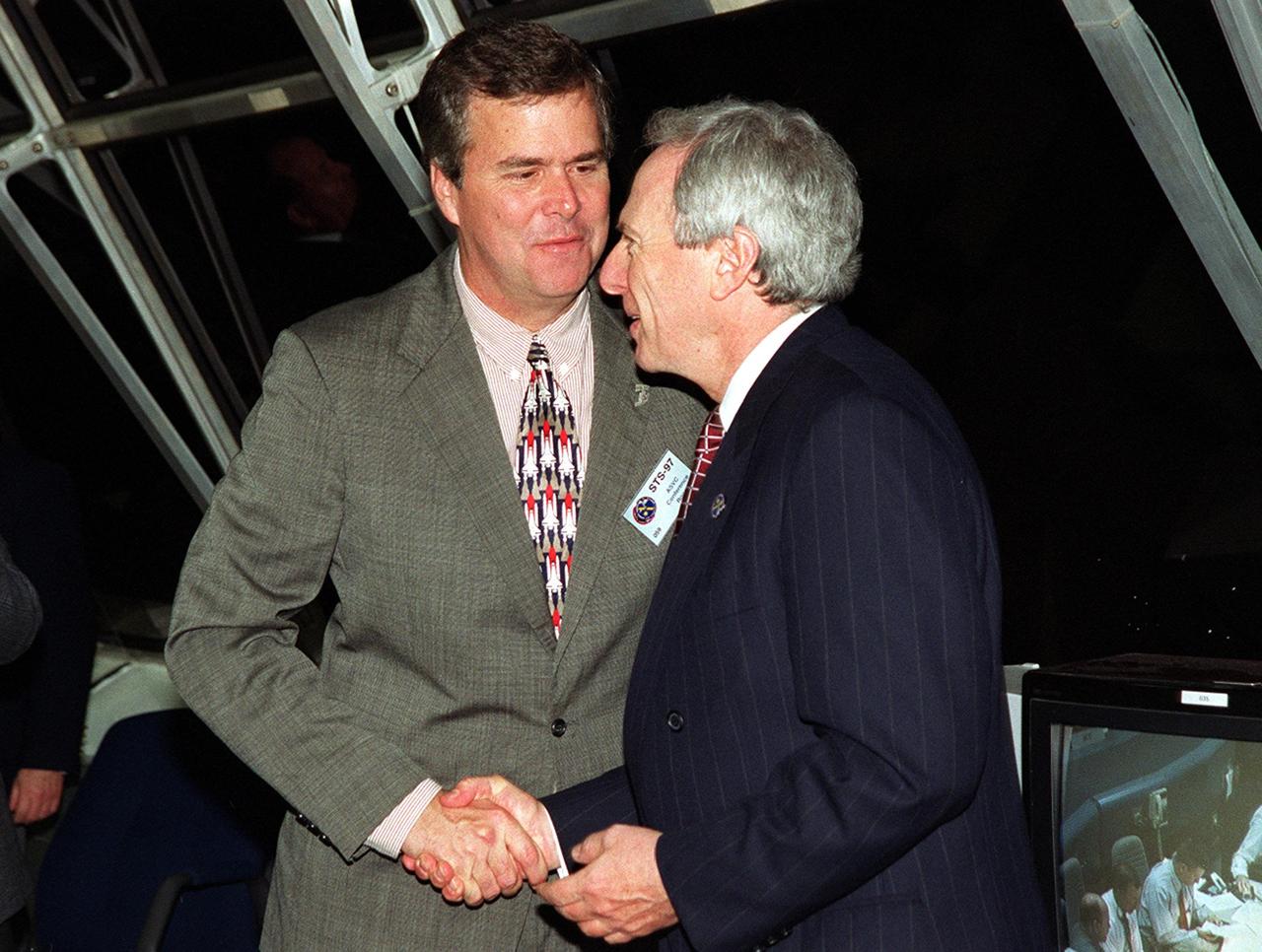
KENNEDY SPACE CENTER, FLA. -- In the Firing Room, Launch Control Center, after a successful launch of Space Shuttle Endeavour on mission STS-97, Florida Governor Jeb Bush shakes the hand of NASA Administrator Daniel Goldin. Liftoff of Endeavour occurred at 10:06:01 p.m. Endeavour and its five-member crew will deliver U.S. solar arrays to the International Space Station and be the first Shuttle crew to visit the Station’s first resident crew. The 11-day mission includes three spacewalks. This marks the 101st mission in Space Shuttle history and the 25th night launch. Endeavour is expected to land at KSC Dec. 11 at 6:19 p.m. EST
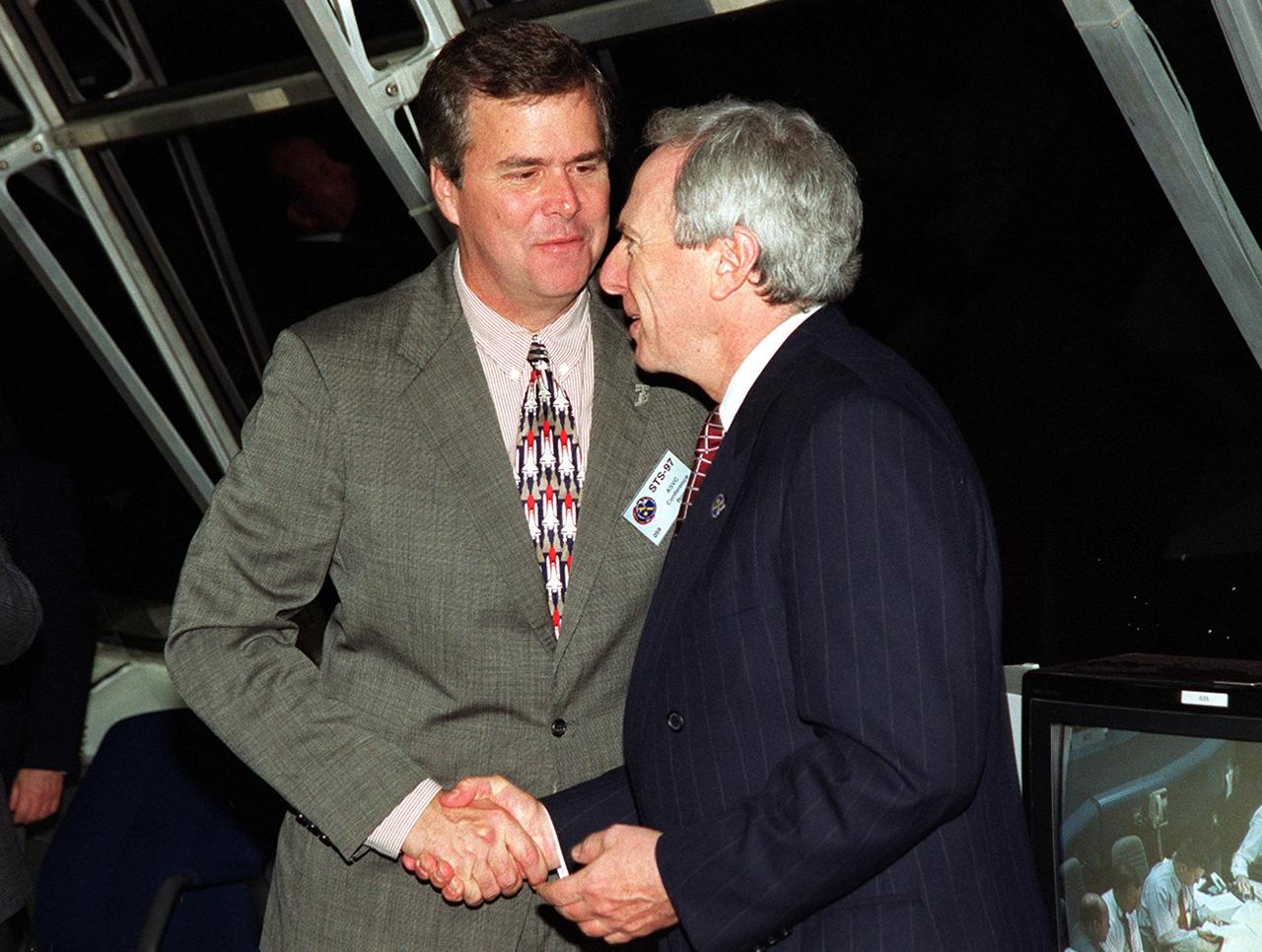
KENNEDY SPACE CENTER, FLA. -- In the Firing Room, Launch Control Center, after a successful launch of Space Shuttle Endeavour on mission STS-97, Florida Governor Jeb Bush shakes the hand of NASA Administrator Daniel Goldin. Liftoff of Endeavour occurred at 10:06:01 p.m. Endeavour and its five-member crew will deliver U.S. solar arrays to the International Space Station and be the first Shuttle crew to visit the Station’s first resident crew. The 11-day mission includes three spacewalks. This marks the 101st mission in Space Shuttle history and the 25th night launch. Endeavour is expected to land at KSC Dec. 11 at 6:19 p.m. EST
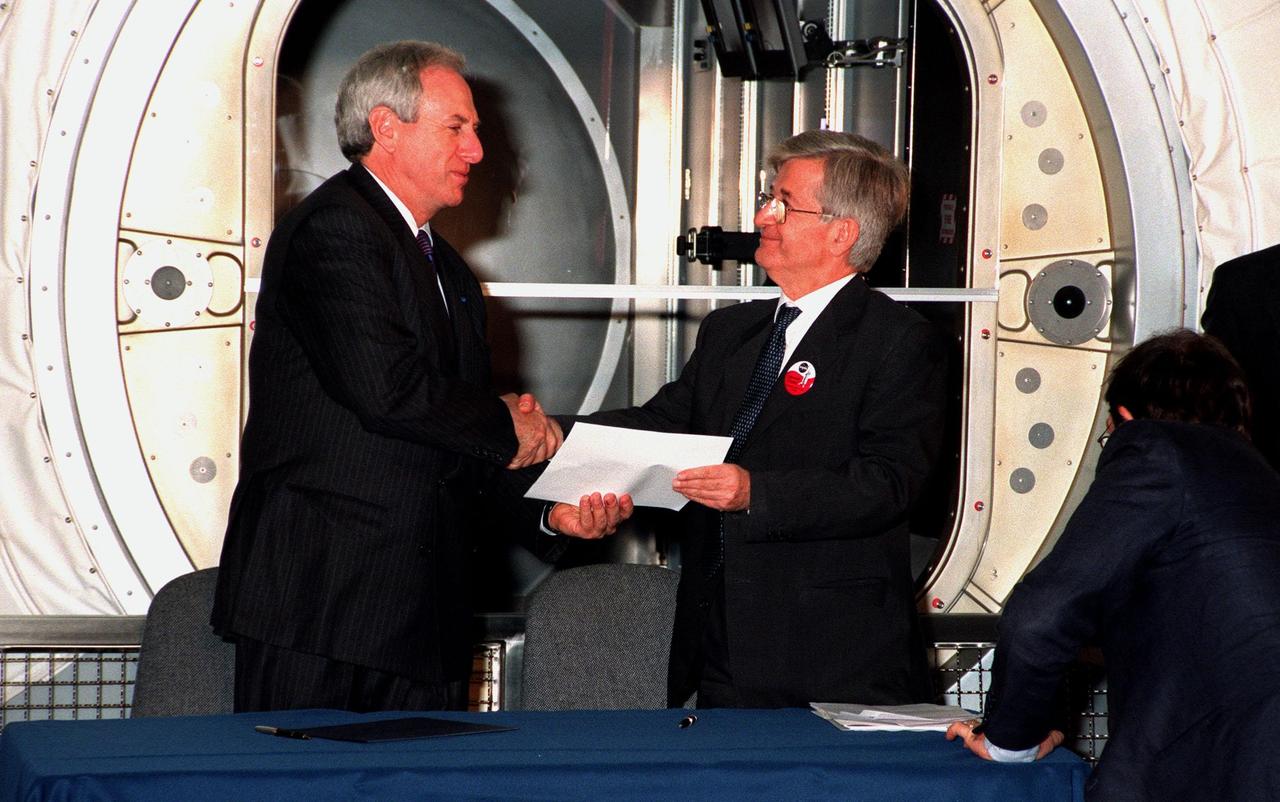
KENNEDY SPACE CENTER, FLA. -- Sergio De Julio (at right), president of the Italian Space Agency, Agenzia Spaziale Italiana (ASI), shakes the hand of NASA Adminstrator Daniel S. Goldin while holding the document which signifies the transfer of the "Leonardo" Multipurpose Logistics Module (MPLM) from ASI to NASA. The ceremonial event was held in the Space Station Processing Facility beside Leonardo. The MPLM, a reusable logistics carrier, will be the primary delivery system used to resupply and return International Space Station cargo requiring a pressurized environment. Leonardo is the first of three MPLM carriers for the International Space Station. It is scheduled to be launched on Space Shuttle Mission STS-100, targeted for April 2000
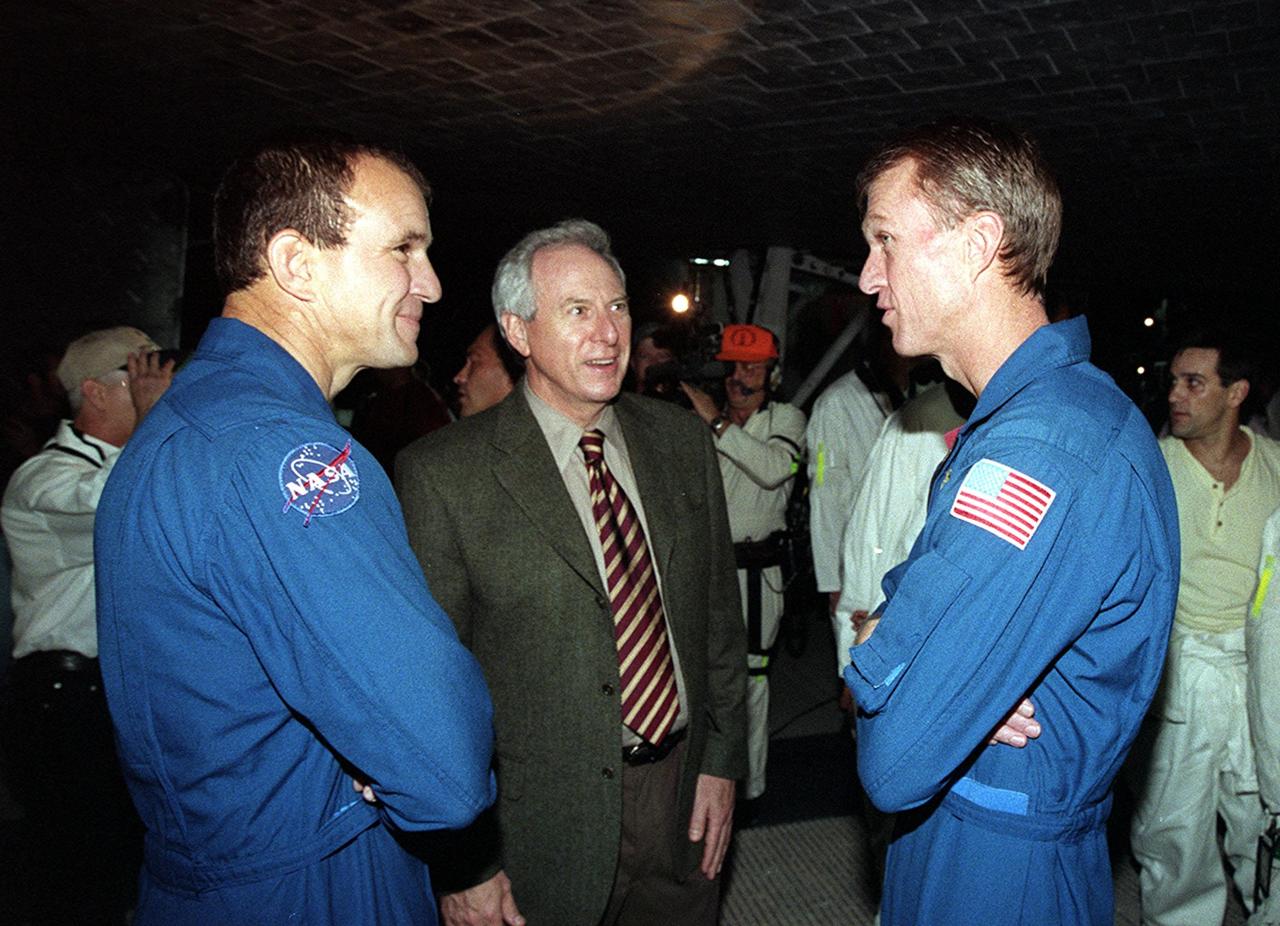
KENNEDY SPACE CENTER, FLA. -- Shortly after the landing of Endeavour, NASA Administrator Daniel Goldin (center) talks with STS-97 Pilot Michael Bloomfield (left) and Commander Brent Jett (right) underneath the orbiter. Landing occurred at 6:04 p.m. EST. On the 4.4-million-mile mission, Endeavour carried the P6 Integrated Truss Structure with solar arrays to power the International Space Station. The arrays and other equipment were installed during three EVAs that totaled 19 hours, 20 minutes. Endeavour was docked with the Space Station for 6 days, 23 hours, 13 minutes. This is the 16th nighttime landing for a Space Shuttle and the 53rd at Kennedy Space Center
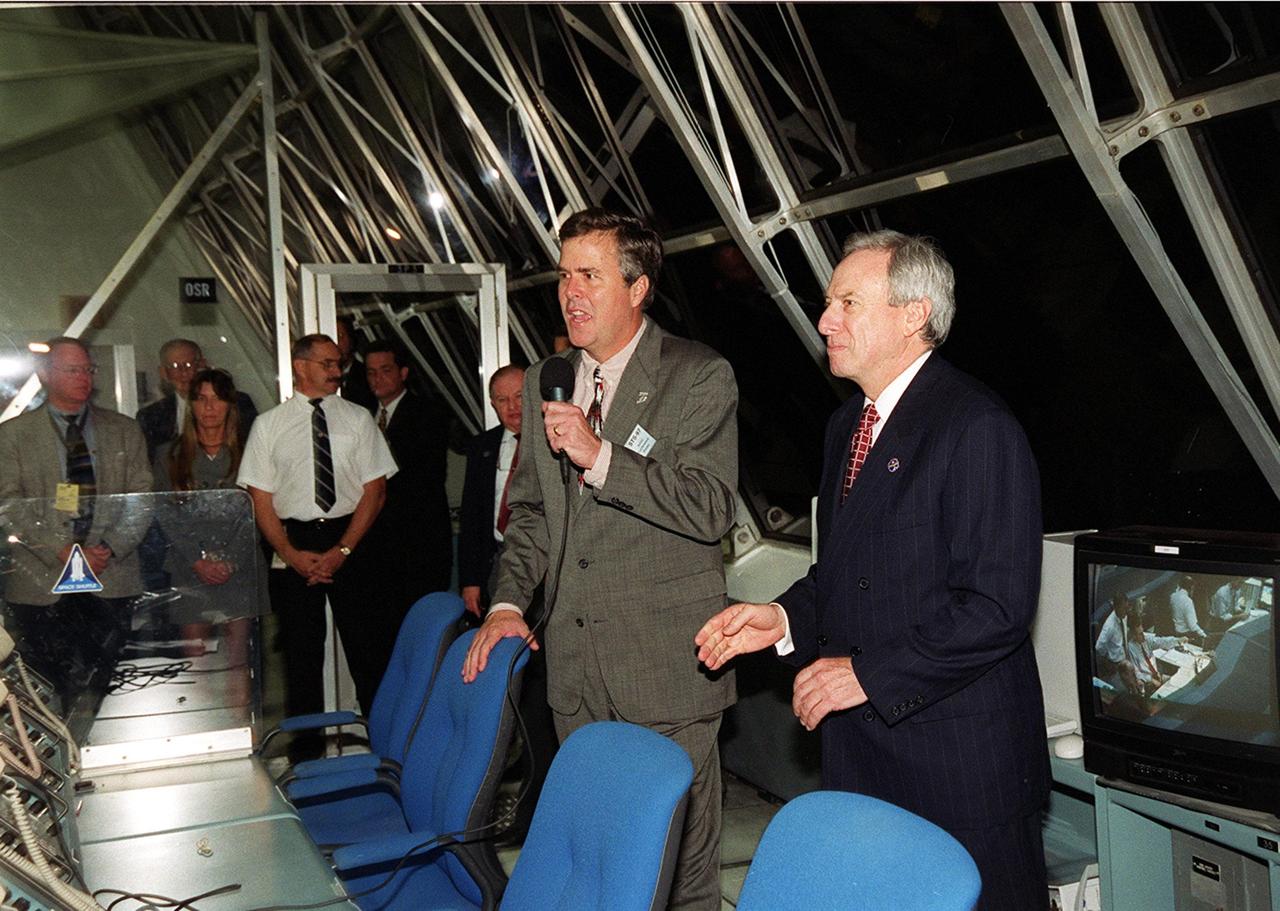
KENNEDY SPACE CENTER, FLA. -- Florida Governor Jeb Bush (with microphone) addresses the launch team in the Firing Room, Launch Control Center, after a successful launch of STS-97. At right is NASA Administrator Daniel Goldin. Liftoff of Space Shuttle Endeavour occurred at 10:06:01 p.m. Endeavour and its five-member crew will deliver U.S. solar arrays to the International Space Station and be the first Shuttle crew to visit the Station’s first resident crew. The 11-day mission includes three spacewalks. This marks the 101st mission in Space Shuttle history and the 25th night launch. Endeavour is expected to land at KSC Dec. 11 at 6:19 p.m. EST
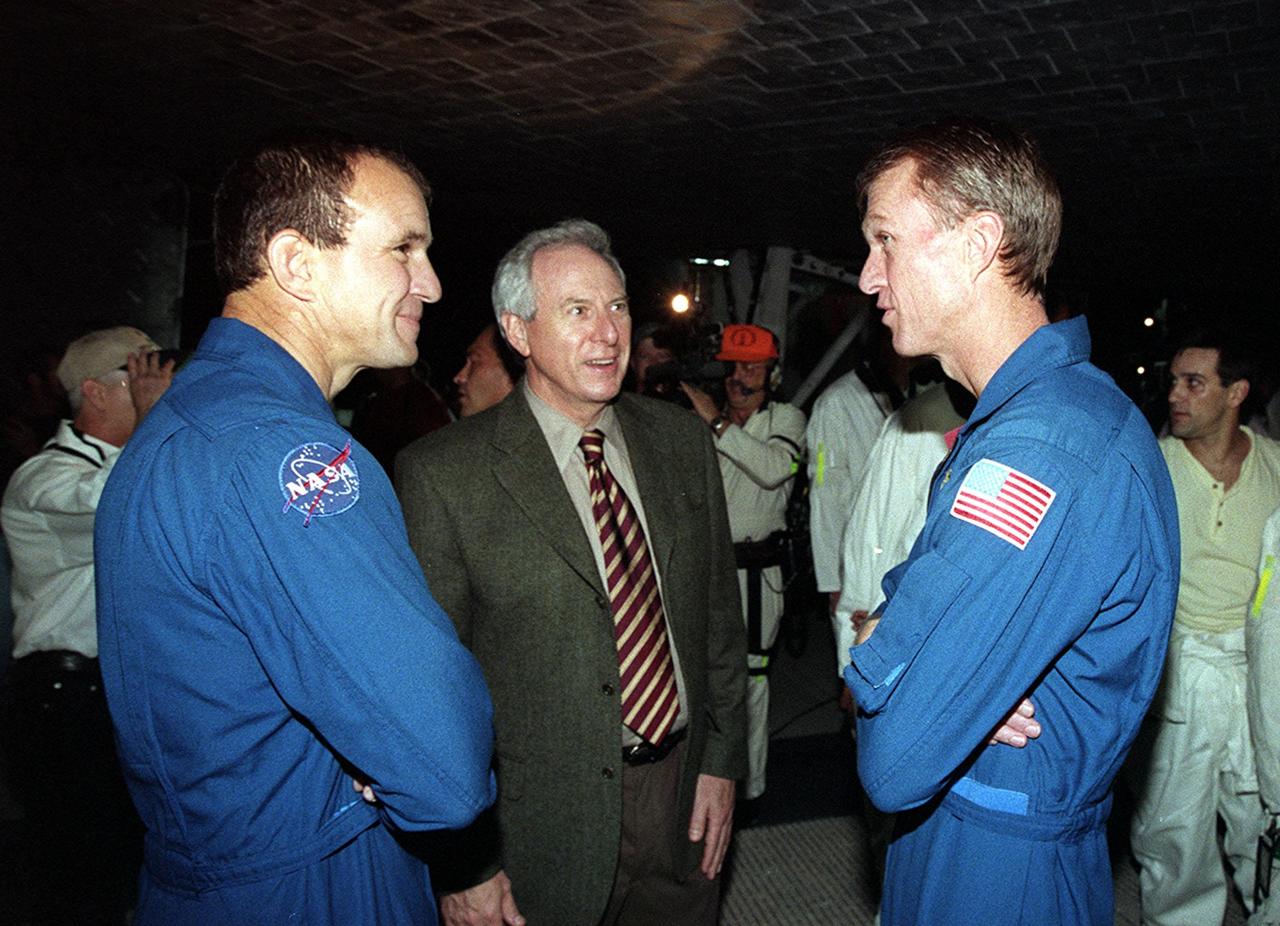
KENNEDY SPACE CENTER, FLA. -- Shortly after the landing of Endeavour, NASA Administrator Daniel Goldin (center) talks with STS-97 Pilot Michael Bloomfield (left) and Commander Brent Jett (right) underneath the orbiter. Landing occurred at 6:04 p.m. EST. On the 4.4-million-mile mission, Endeavour carried the P6 Integrated Truss Structure with solar arrays to power the International Space Station. The arrays and other equipment were installed during three EVAs that totaled 19 hours, 20 minutes. Endeavour was docked with the Space Station for 6 days, 23 hours, 13 minutes. This is the 16th nighttime landing for a Space Shuttle and the 53rd at Kennedy Space Center
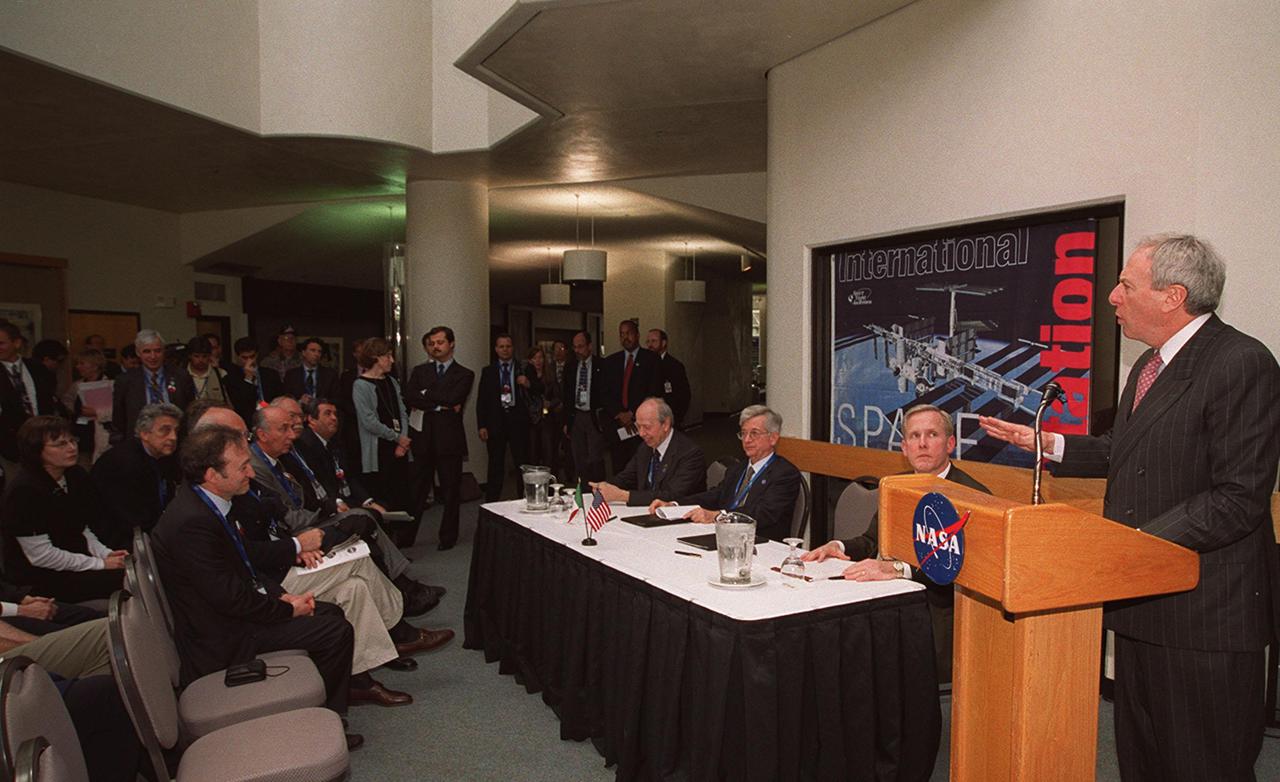
At a signing ceremony between the Italian Space Agency (ASI) and NASA for a Framework for Cooperation to build the Habitation Module for the International Space Station, NASA Administrator Daniel S. Goldin speaks to attendees. Seated at the table next to Goldin are The Honorable Lamberto Dini, Minister of Foreign Affairs, Republic of Italy (far left), Italian Space Agency President Sergio DeJulio, and John Schumacher, assistant administrator, NASA External Relations. The Framework is a potential bilateral cooperative agreement that could result in ASI development of a U.S. Habitation Module for the International Space Station. This agreement allows the U.S. to explore an alternative approach to achieve full crew habitation for the ISS. A Memorandum of Understanding (MOU) between NASA and ASI will be required to formally document NASA and ASI’s respective responsibilities in a legally binding document. The Framework signed today would form the basis for a potential MOU which NASA and ASI would sign after completion of the program assessment and subsequent negotiations.The ceremony took place at the IMAX Theater, Kennedy Space Center Visitor Complex
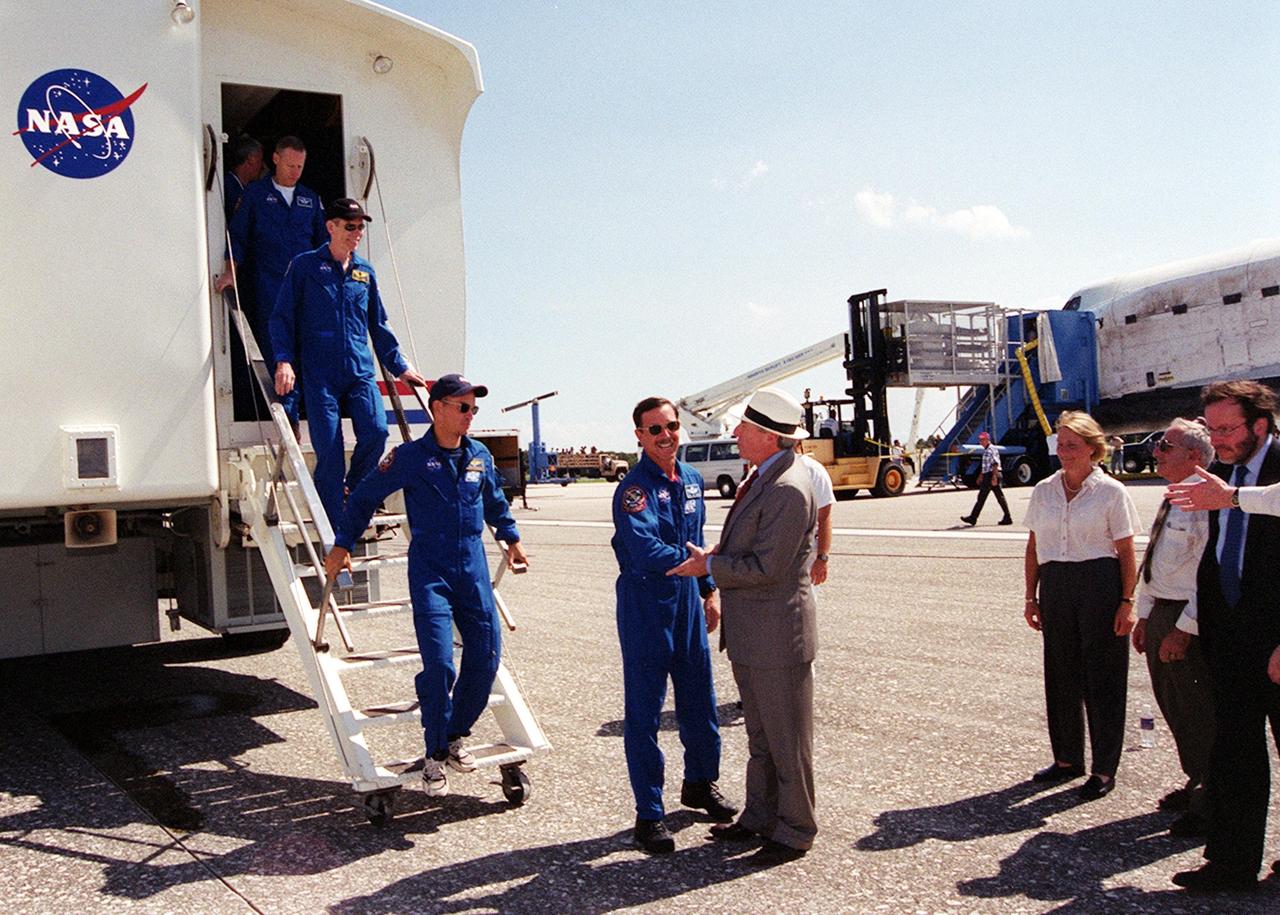
KENNEDY SPACE CENTER, Fla. - As members of the STS-105 crew exit the Crew Transfer Vehicle (CTV) following Discovery's landing on KSC's Shuttle Landing Facility runway 15, they are greeted by NASA Administrator Dan Goldin. From left are Mission Specialists Patrick Forrester and Daniel Barry, Pilot Frederick "Rick" Sturckow, and Commander Scott "Doc" Horowitz (shaking hands with Goldin). Looking on are, from left, Kathie Olsen, NASA chief scientist; Joe Rothenberg, associate administrator, Office of Space Flight; and Courtney Stadd, NASA Headquarters chief of staff. Main gear touchdown was at 2:22:58 p.m. EDT; wheel stop, at 2:24:06 p.m. EDT. The 11-day, 21-hour, 12-minute STS-105 mission accomplished the goals set for the 11th flight to the International Space Station: swapout of the resident Station crew; delivery of equipment, supplies and scientific experiments; and installation of the Early Ammonia Servicer and heater cables for the S0 truss on the Station. Discovery traveled 4.3 million miles on its 30th flight into space, the 106th mission of the Space Shuttle program. Out of five missions in 2001, the landing was the first to occur in daylight at KSC.
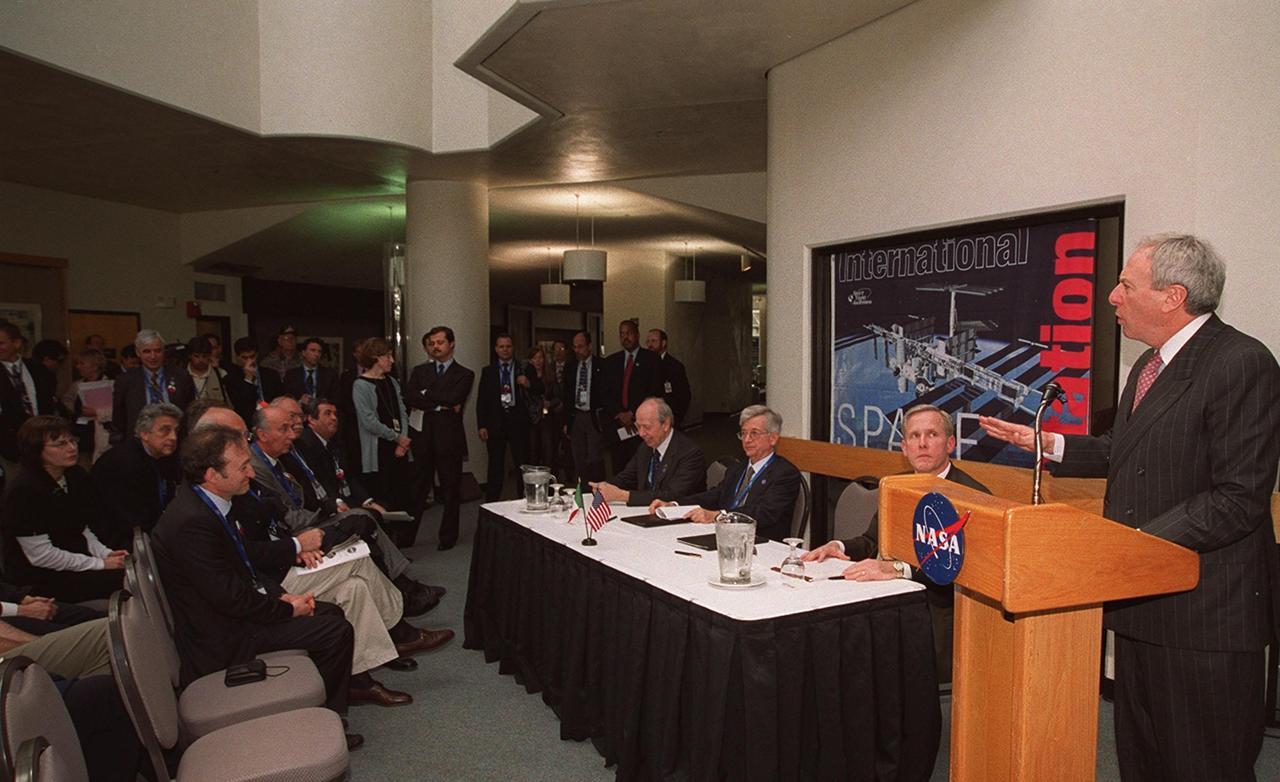
At a signing ceremony between the Italian Space Agency (ASI) and NASA for a Framework for Cooperation to build the Habitation Module for the International Space Station, NASA Administrator Daniel S. Goldin speaks to attendees. Seated at the table next to Goldin are The Honorable Lamberto Dini, Minister of Foreign Affairs, Republic of Italy (far left), Italian Space Agency President Sergio DeJulio, and John Schumacher, assistant administrator, NASA External Relations. The Framework is a potential bilateral cooperative agreement that could result in ASI development of a U.S. Habitation Module for the International Space Station. This agreement allows the U.S. to explore an alternative approach to achieve full crew habitation for the ISS. A Memorandum of Understanding (MOU) between NASA and ASI will be required to formally document NASA and ASI’s respective responsibilities in a legally binding document. The Framework signed today would form the basis for a potential MOU which NASA and ASI would sign after completion of the program assessment and subsequent negotiations.The ceremony took place at the IMAX Theater, Kennedy Space Center Visitor Complex
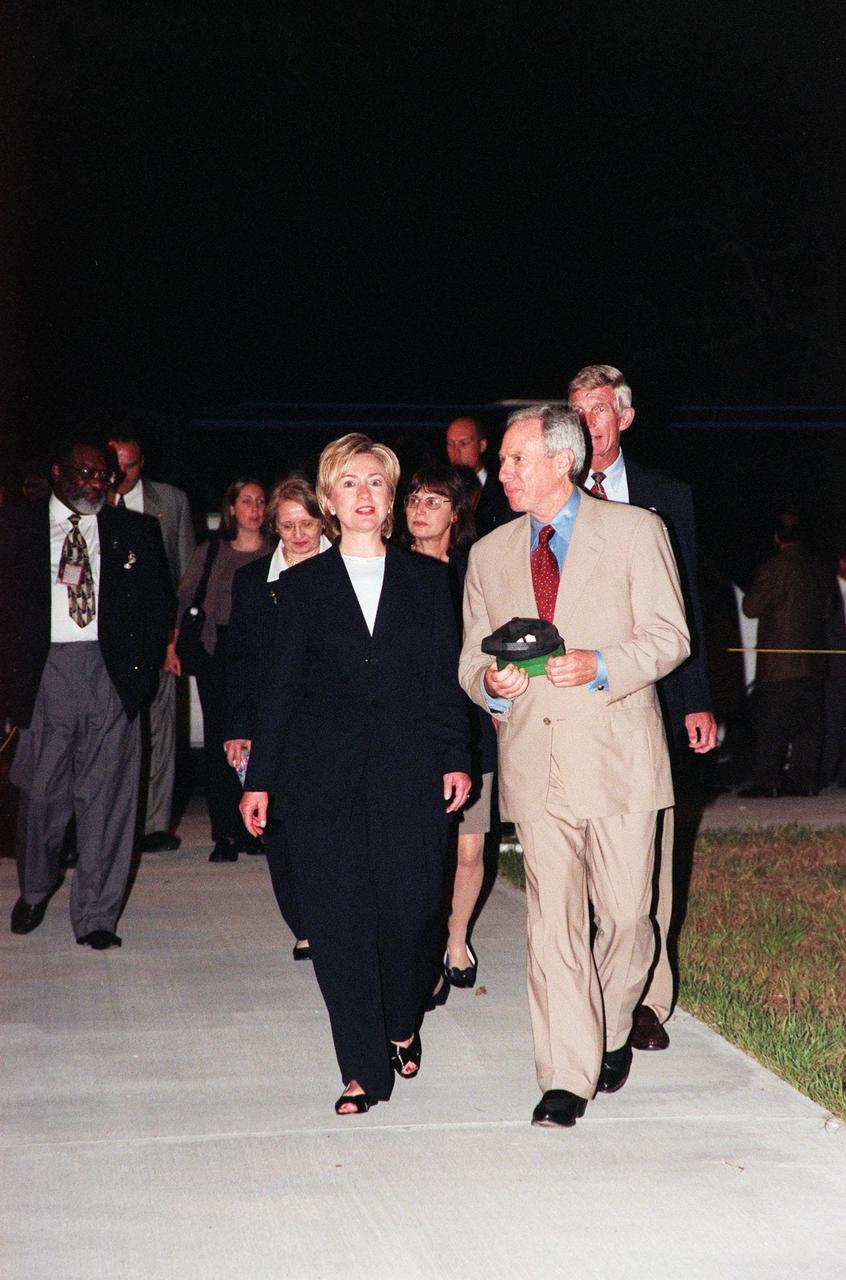
Entering the Banana Creek viewing site, First Lady Hillary Rodham Clinton is joined by NASA Administrator Daniel Goldin (right), and in the background, Deputy Director of Business Operations Jim Jennings (far left) and Director of Installation Operations Marv Jones (right, behind Goldin). Mrs. Clinton and others are at the site to watch the second launch attempt of STS-93. Moments before the first scheduled launch, July 20, STS-93 was scrubbed at the T-7 second mark in the countdown due to an indication of a high concentration of hydrogen in an aft engine compartment. The reading proved to be a false alarm. The launch was rescheduled for July 22 at 12:28 a.m. Much attention has been generated over STS-93 due to Commander Eileen M. Collins, the first woman to serve as commander of a Shuttle mission. The primary payload of the five-day mission is the Chandra X-ray Observatory, which will allow scientists from around the world to study some of the most distant, powerful and dynamic objects in the universe
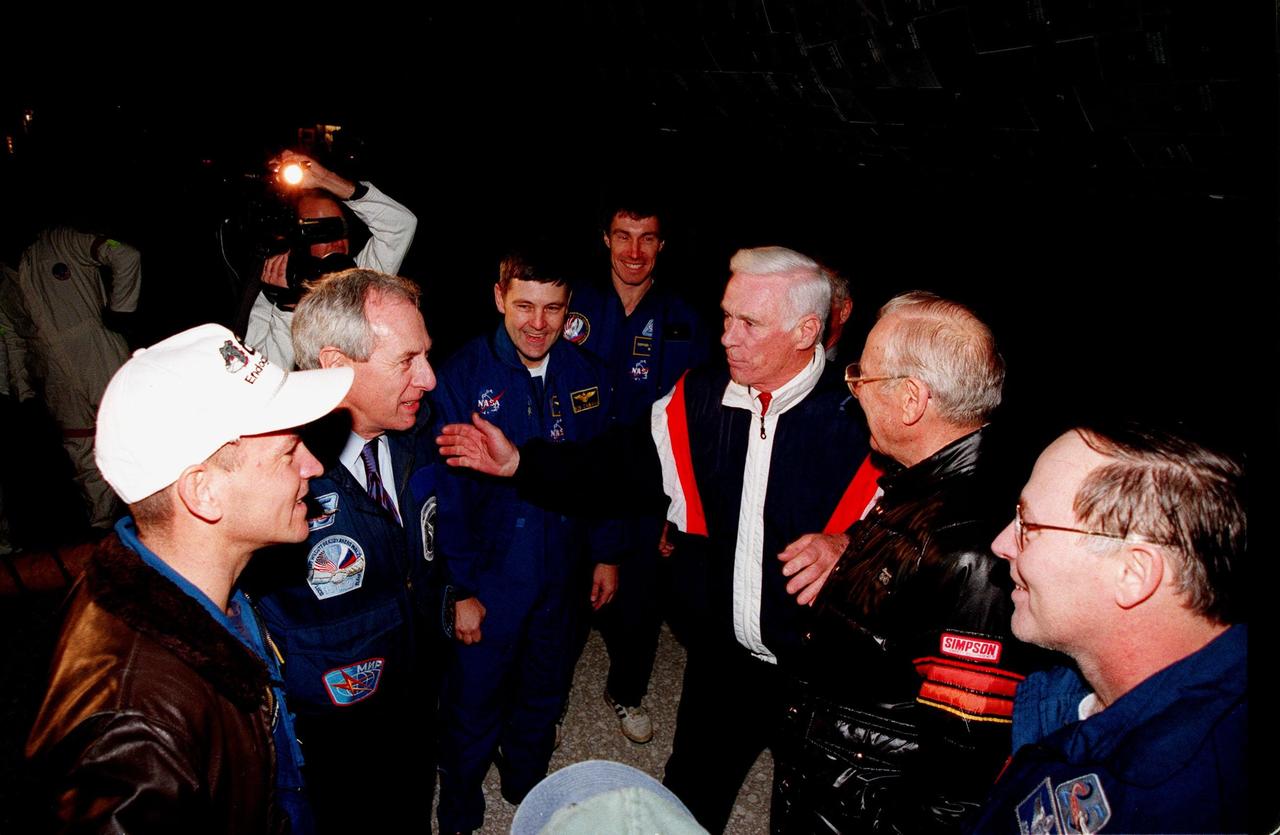
Following their touchdown on Runway 15 at 10:53:29 p.m. EST, STS-88 crew members are greeted by NASA Administrator Daniel Goldin and former astronauts Eugene A. Cernan and James A. Lovell Jr. From left are Pilot Frederick W. "Rick" Sturckow, Goldin , Commander Robert D. Cabana, Mission Specialist Sergei Konstantinovich Krikalev, Cernan, Lovell and Mission Specialist Jerry L. Ross. Cernan flew on Gemini 9, Apollo 10 and 17 and has more than 566 cumulative hours of space flight. Lovell flew on Gemini 7 and 12, Apollo 8 and 13. His cumulative hours of space flight are more than 715. On the 4.6-million-mile, nearly 12-day STS-88 mission, Endeavour carried the U.S.-built Unity connecting module to begin construction of the International Space Station. The crew successfully mated Unity with the Russian-built Zarya control module during three space walks. With this mission, Ross completed seven space walks totaling 44 hours and 9 minutes, more than any other American space walker. Newman moved into third place for U.S. space walks with a total of 28 hours and 27 minutes on four excursions
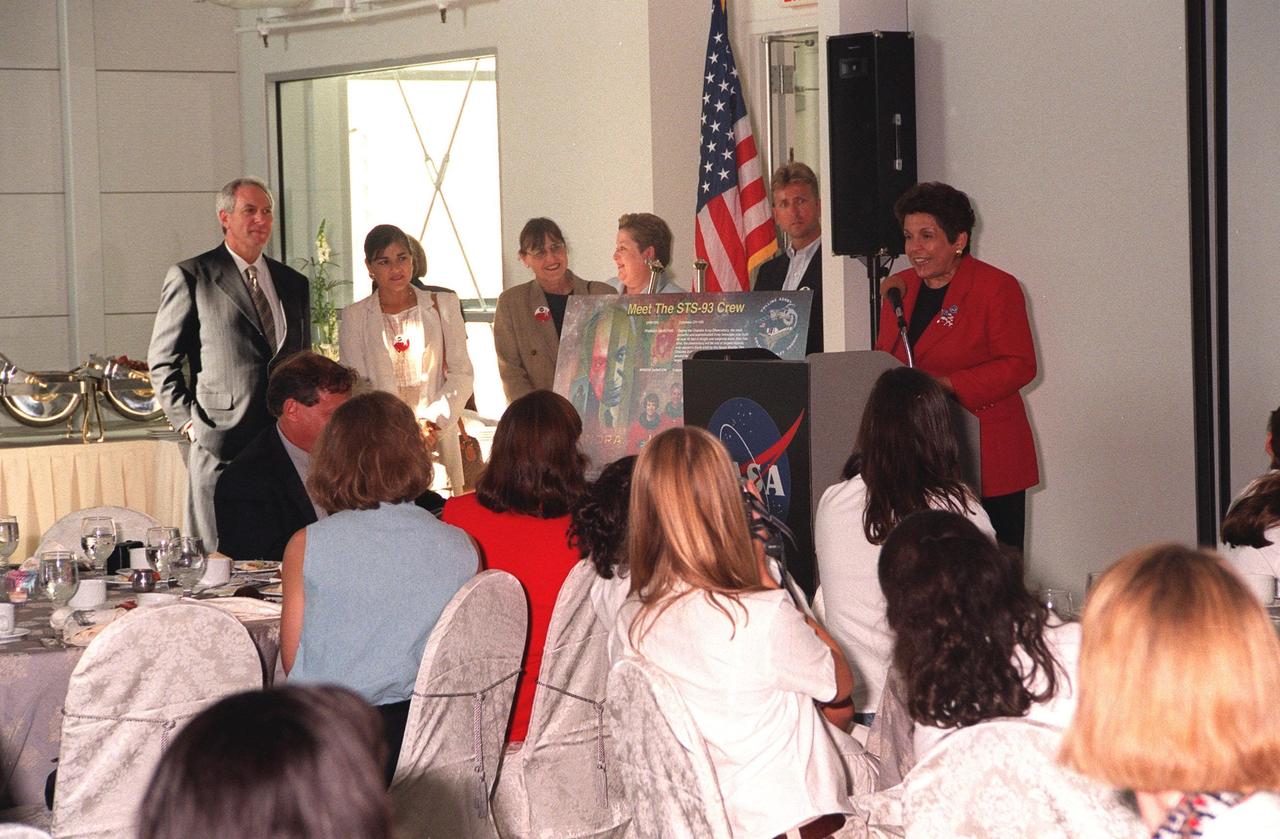
KENNEDY SPACE CENTER, FLA. -- At a women's forum held in the Apollo/Saturn V Center, Donna Shalala, secretary of Department of Health and Human Services, addresses the attendees. At the far left is NASA Administrator Daniel Goldin. Participants in a panel discussion, "Past, Present and Future of Space," include former astronaut Sally Ride; Marta Bohn-Meyer, the first SR-71 female pilot; Kathryn Sullivan, Ph.D., the first American woman to walk in space; Donna Shirley, Ph.D., the first woman leading the Mars Exploration Program; astronaut Yvonne Cagle; Jennifer Harris, flight director, Mars Pathfinder; astronaut Ellen Ochoa, the first Hispanic female in space and member of the President's commission on the Celebration of Women in American History. The forum included a welcome by Center Director Roy Bridges and remarks by Goldin. The attendees are planning to view the launch of STS-93 at the Banana Creek viewing sight. Much attention has been generated over the launch due to Commander Eileen M. Collins, the first woman to serve as commander of a Shuttle mission. The primary payload of the five-day mission is the Chandra X-ray Observatory, which will allow scientists from around the world to study some of the most distant, powerful and dynamic objects in the universe. Liftoff is scheduled for July 20 at 12:36 a.m. EDT
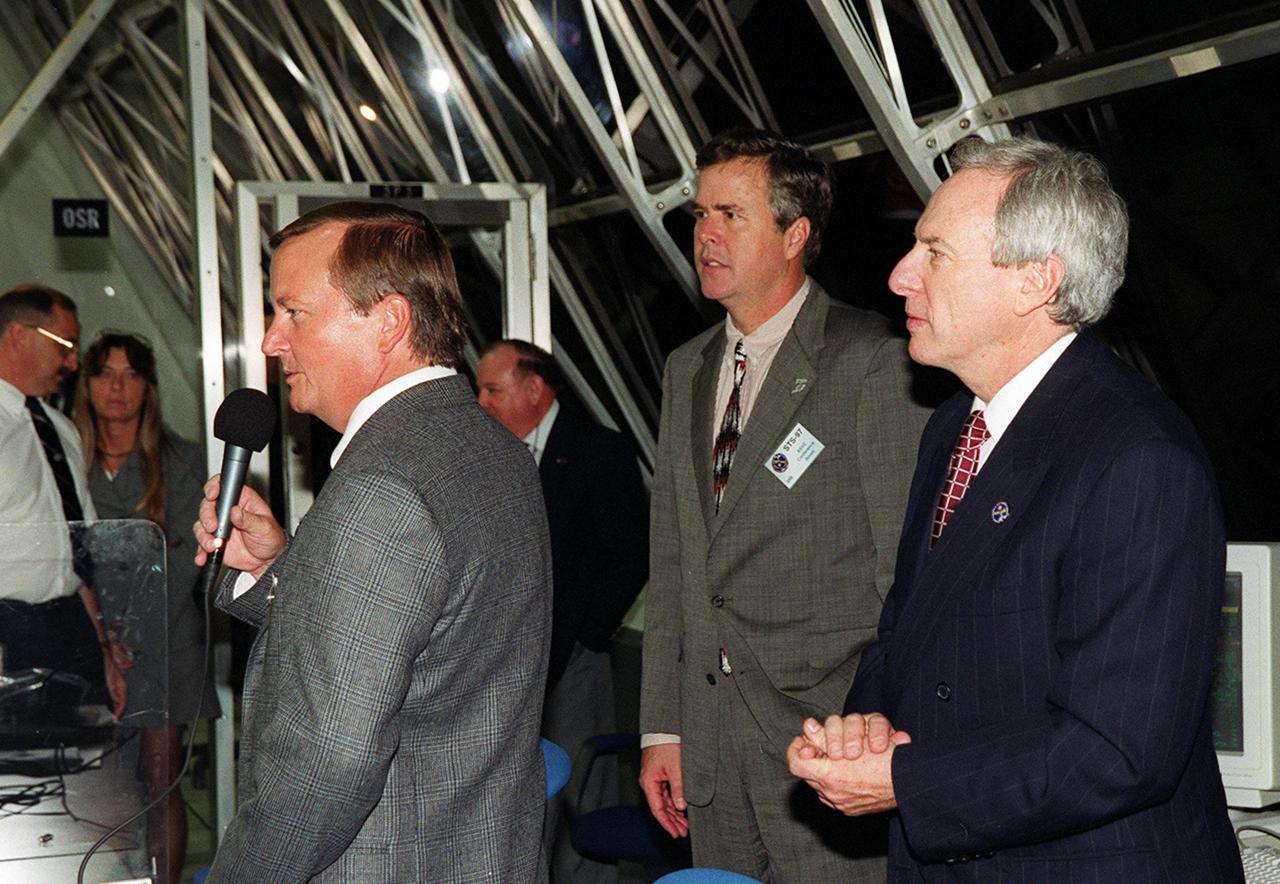
KENNEDY SPACE CENTER, FLA. -- In the Firing Room, Launch Control Center, after a successful launch of Space Shuttle Endeavour on mission STS-97, Launch Director Michael Leinbach (with microphone) addresses the launch team. Behind him at right are Florida Governor Jeb Bush and NASA Administrator Daniel Goldin. Liftoff of Endeavour occurred at 10:06:01 p.m. EST. Endeavour and its five-member crew will deliver U.S. solar arrays to the International Space Station and be the first Shuttle crew to visit the Station’s first resident crew. The 11-day mission includes three spacewalks. This marks the 101st mission in Space Shuttle history and the 25th night launch. Endeavour is expected to land at KSC Dec. 11 at 6:19 p.m. EST
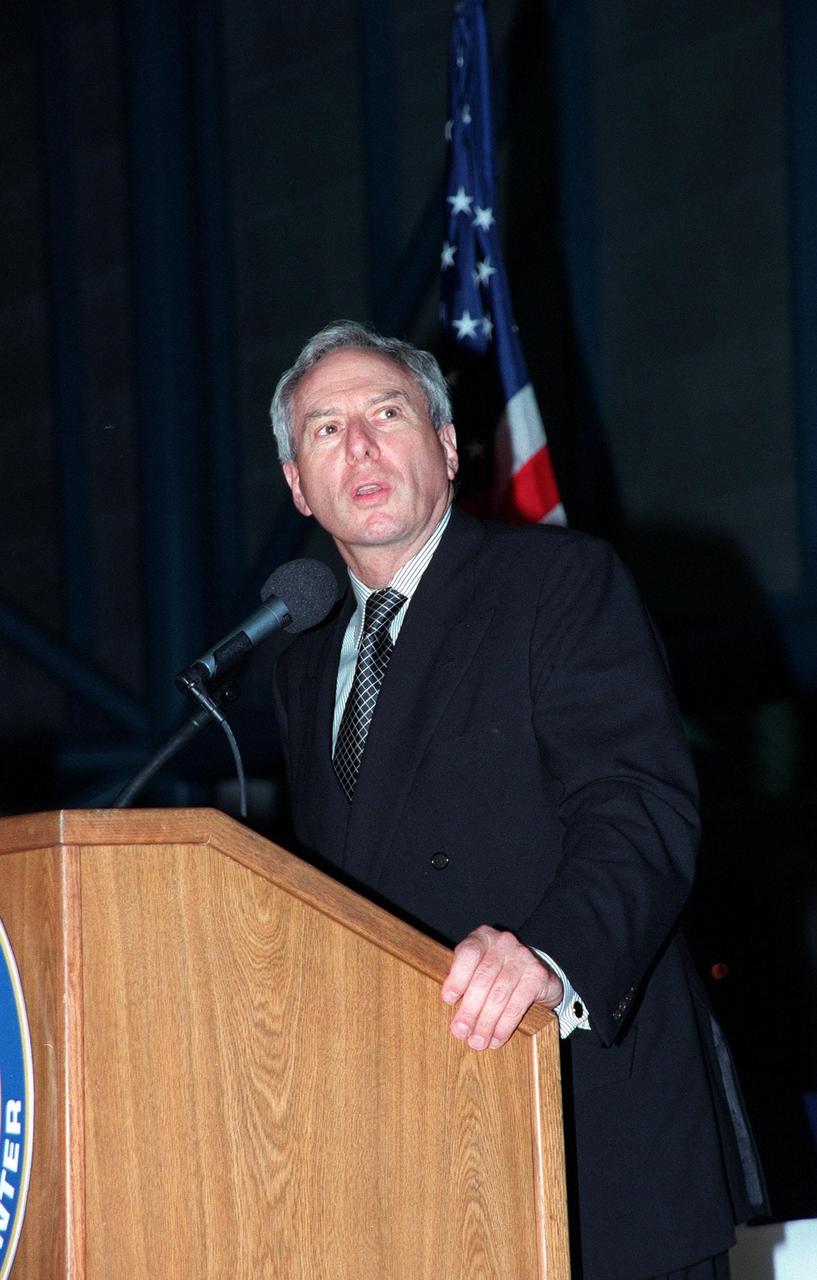
KENNEDY SPACE CENTER, FLA. -- NASA Administrator Daniel S. Goldin addresses the audience at the Apollo 11 anniversary banquet honoring the Apollo team, the people who made the entire lunar landing program possible. The banquet was held in the Apollo/Saturn V Center, part of the KSC Visitor Complex. This is the 30th anniversary of the Apollo 11 launch and moon landing, July 16 and July 20, 1969. Among the guests at the banquet were former Apollo astronauts are Neil A. Armstrong and Edwin "Buzz" Aldrin who flew on Apollo 11, the launch of the first moon landing; Gene Cernan, who flew on Apollo 10 and 17 and was the last man to walk on the moon; and Walt Cunningham, who flew on Apollo 7
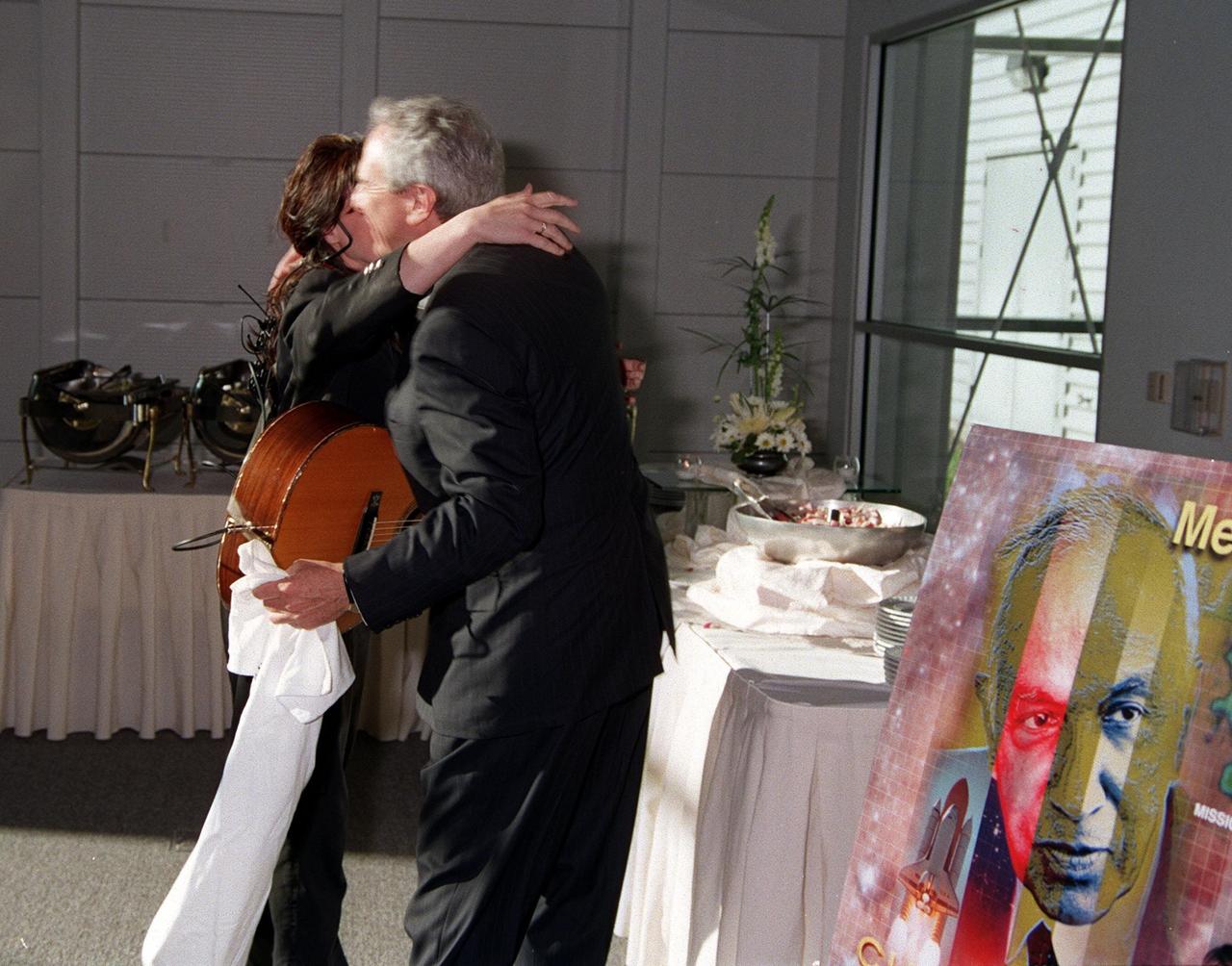
KENNEDY SPACE CENTER, FLA. -- After her performance at the Apollo/Saturn V Center, country western recording artist Teresa gets a congratulatory hug from NASA Administrator Daniel Goldin. Teresa performed a song, "Brave New Girls," written for astronaut Catherine "Cady" Coleman, mission specialist on STS-93. She entertained participants and attendees of a women's forum held in the center earlier in the day. The attendees are planning to view the launch of STS-93 at the Banana Creek viewing sight. Much attention has been generated over the launch due to Commander Eileen M. Collins, the first woman to serve as commander of a Shuttle mission. Liftoff is scheduled for July 20 at 12:36 a.m. EDT
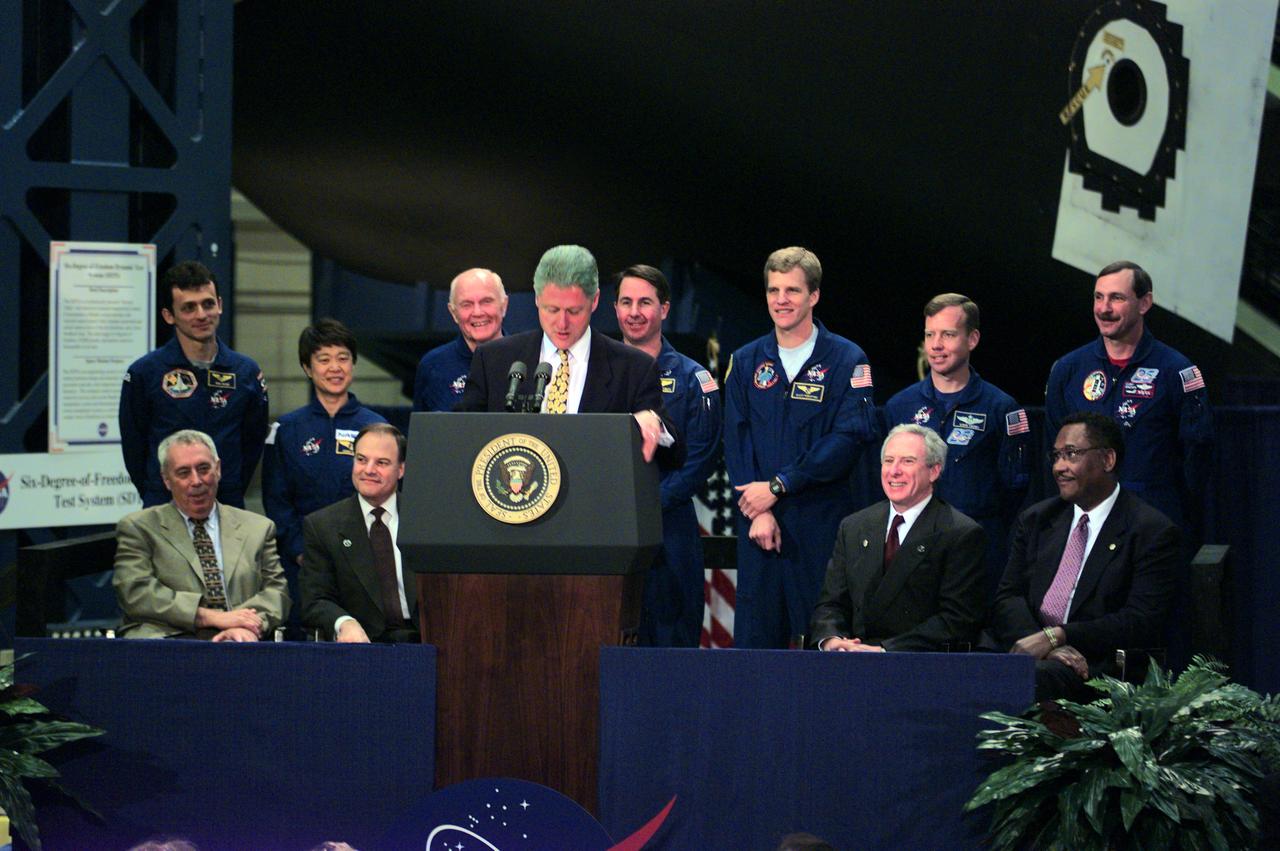
98-E-03312 (14 April 1998) --- President Bill Clinton (at lectern) addresses employees at NASA's Johnson Space Center (JSC) during an April 14 visit to the Houston facility. Seated behind him (from the left) are JSC Director George W.S. Abbey, U.S. Rep. Nick Lampson (D.-TX), NASA Administrator Daniel Goldin and Houston Mayor Lee Brown. Standing are members of the STS-95 crew: (from the left) Pedro Duque, Chiaki Mukai, U.S. Sen. John H. Glenn Jr. (D.-Ohio), Stephen K. Robinson, Scott E. Parazynski, Steven W. Lindsey and Curtis L. Brown Jr. Brown is commander of the scheduled flight aboard Discovery. Mukai represents Japan's National Space Development Agency (NASDA) and Duque is with the European Space Agency (ESA). Photo Credit: NASA or the National Aeronautics and Space Administration.
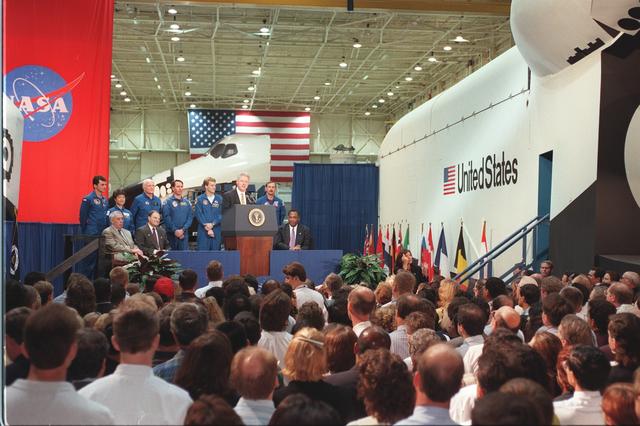
S98-05024 (14 April 1998) --- A large crowd of JSC employees listen to President Bill Clinton during an April 14 visit to the Johnson Space Center. On the dais with the President (seated, from the left) are JSC Director George W.S. Abbey, U.S. Rep. Nick Lampson (D.-TX), and Houston Mayor Lee Brown. Standing behind them are members of the STS-95 crew: (from the left) Pedro Duque of ESA, Chiaki Mukai of NASDA, U.S. Sen. John H. Glenn Jr. (D.-Ohio), Stephen K. Robinson, Scott E. Parazynski, Steven W. Lindsey (behind Clinton) and Curtis L. Brown Jr. Out of the frame is NASA Administrator Daniel Goldin who also addressed the crowd. The Chief Executive earlier had gone inside several of the shuttle and ISS crew training facilities and mockups. Photo Credit: Joe McNally, National Geographic, for NASA
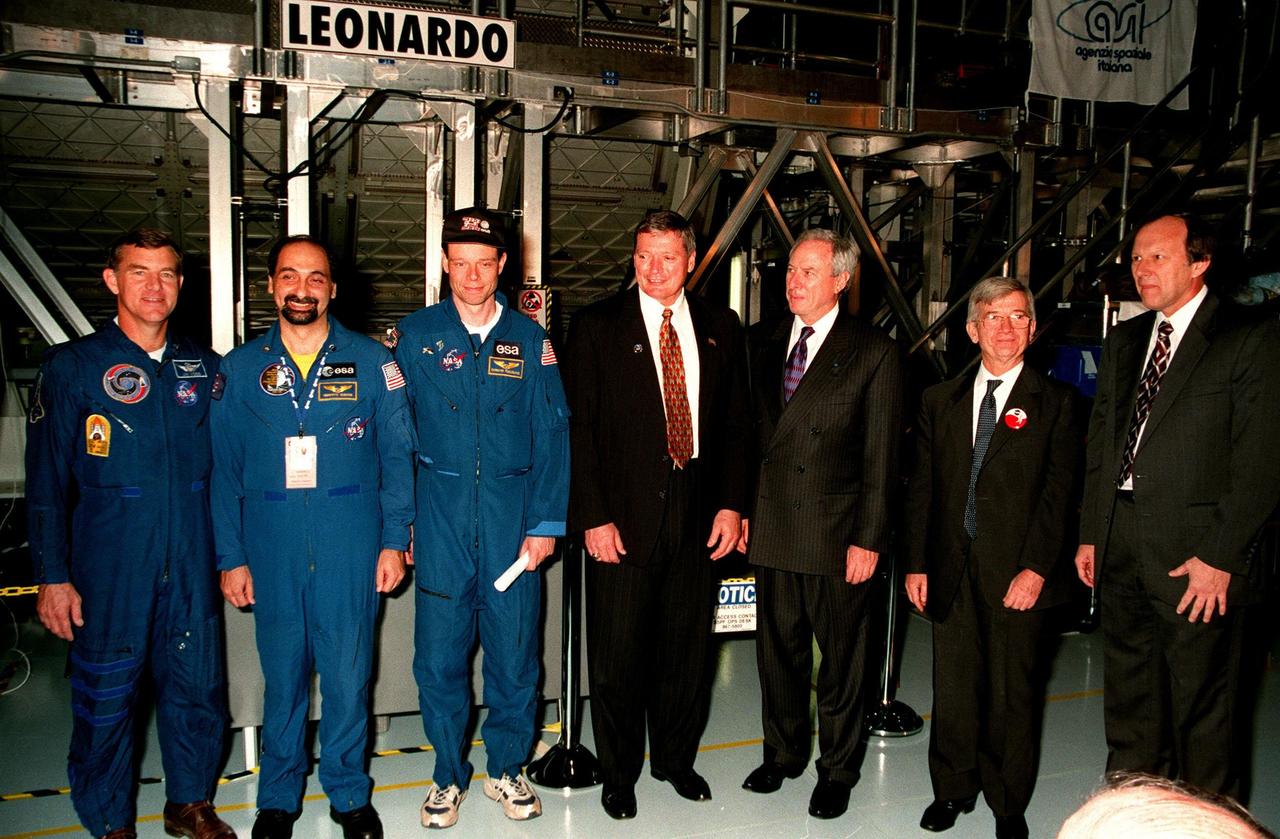
KENNEDY SPACE CENTER, FLA. -- Participants pose for a photo at the Space Station Processing Facility ceremony transferring the "Leonardo" Multipurpose Logistics Module (MPLM) from the Italian Space Agency, Agenzia Spaziale Italiana (ASI), to NASA. From left, they are astronaut Jim Voss, European Space Agency astronauts Umberto Guidoni of Italy and Christer Fuglesang of Sweden, NASA International Space Station Program Manager Randy Brinkley, NASA Administrator Daniel S. Goldin, ASI President Sergio De Julio and Stephen Francois, director, International Space Station Launch Site Support at KSC. The MPLM, a reusable logistics carrier, will be the primary delivery system used to resupply and return International Space Station cargo requiring a pressurized environment. Leonardo is the first of three MPLM carriers for the International Space Station. It is scheduled to be launched on Space Shuttle Mission STS-100, targeted for April 2000
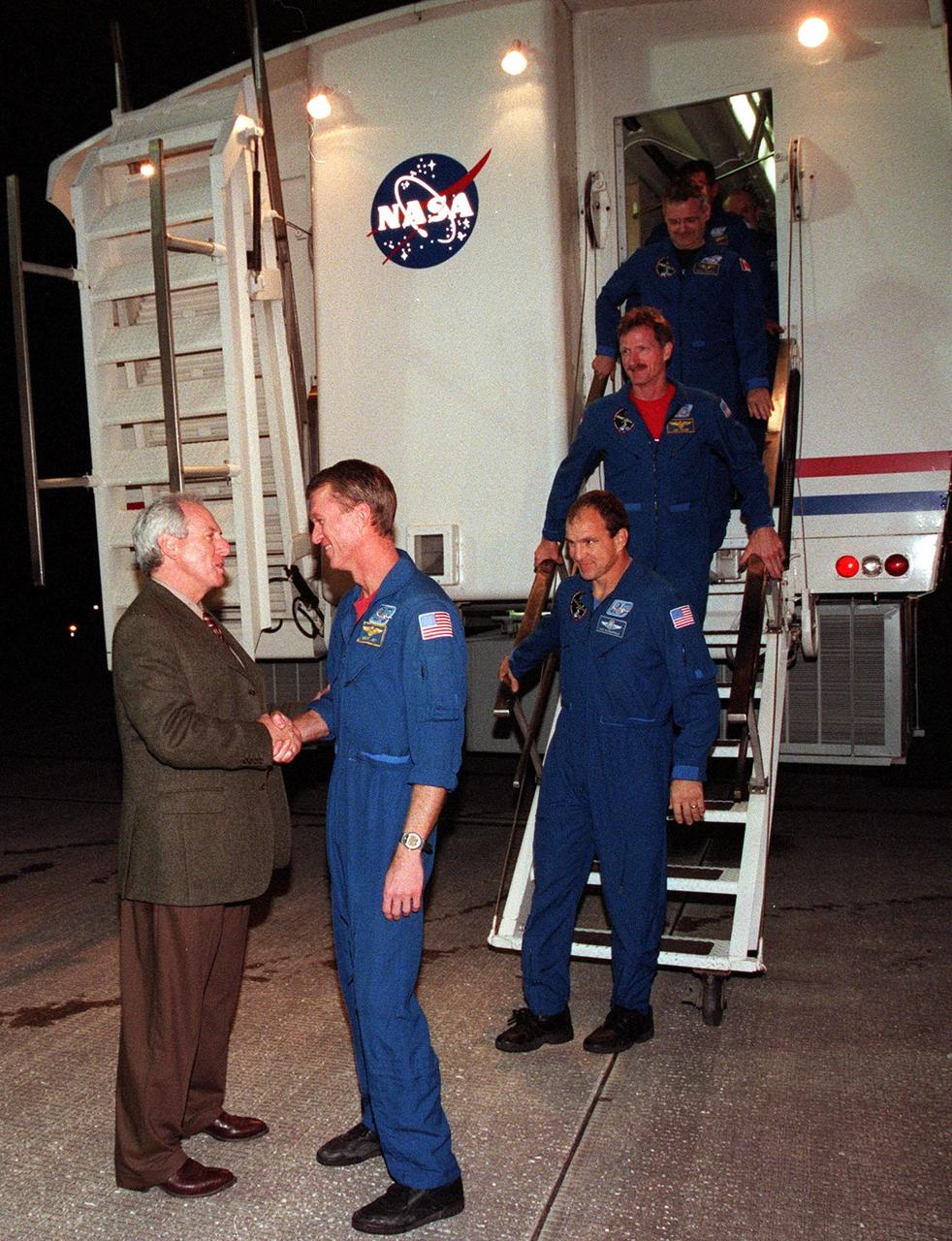
KENNEDY SPACE CENTER, FLA. -- Following a successful landing, the crew of Endeavour exit the Crew Transport Vehicle and are greeted by NASA Administrator Daniel Goldin. First down the stairs is Commander Brent Jett. Behind him are Pilot Michael Bloomfield and Mission Specialists Joseph Tanner, Marc Garneau and Carlos Noriega. Garneau is with the Canadian Space Agency. On the 4.4-million-mile mission, Endeavour carried the P6 Integrated Truss Structure with solar arrays to power the International Space Station. The arrays and other equipment were installed during three EVAs that totaled 19 hours, 20 minutes. Endeavour was docked with the Space Station for 6 days, 23 hours, 13 minutes. This is the 16th nighttime landing for a Space Shuttle and the 53rd at Kennedy Space Center
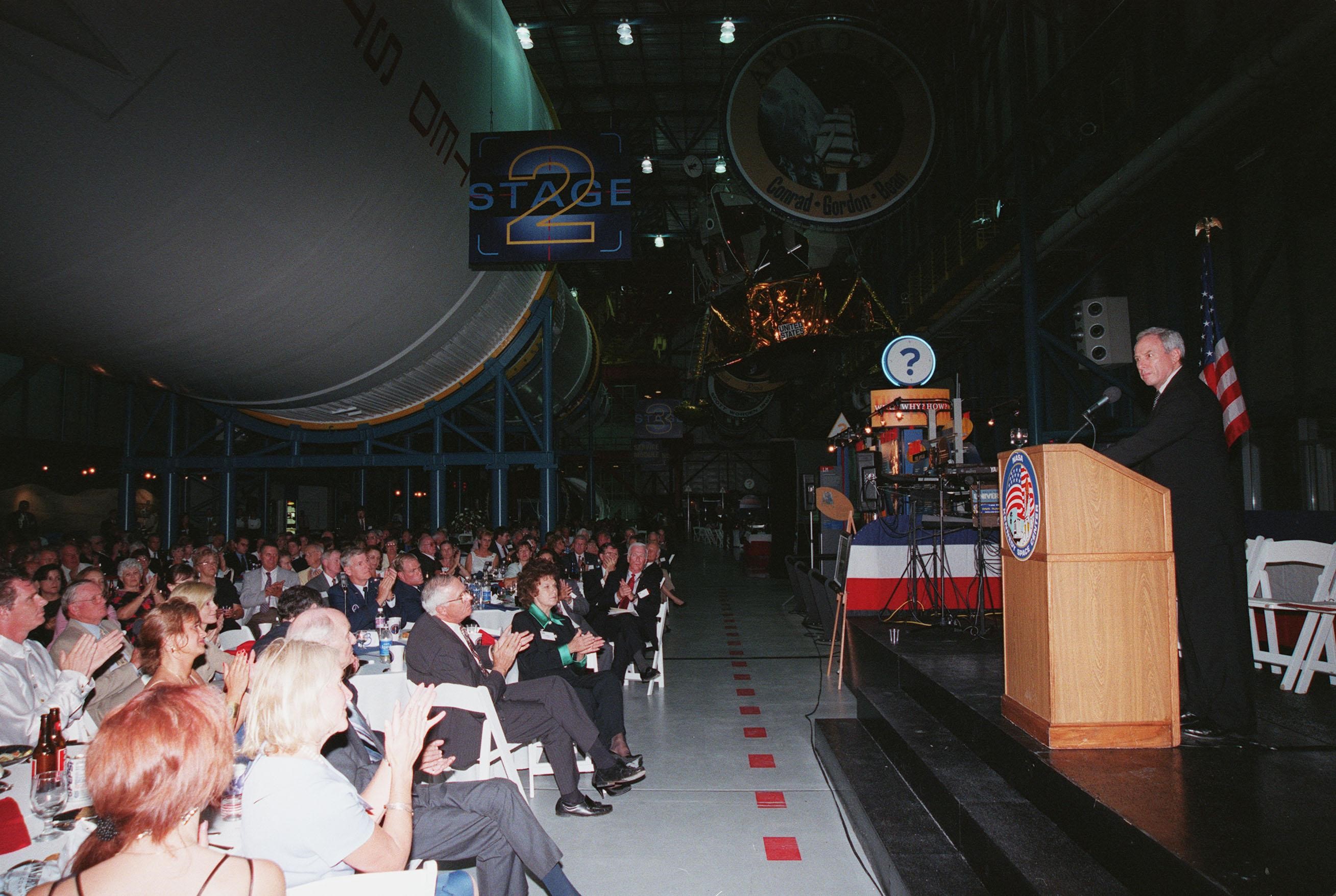
KENNEDY SPACE CENTER, FLA. -- NASA Administrator Daniel S. Goldin (right) addresses the audience at the Apollo 11 anniversary banquet honoring the Apollo team, the people who made the entire lunar landing program possible. The banquet was held in the Apollo/Saturn V Center, part of the KSC Visitor Complex, with seating under an unused Saturn V rocket like those that powered the Apollo launches . This is the 30th anniversary of the Apollo 11 launch and moon landing, July 16 and July 20, 1969. Among the guests at the banquet were former Apollo astronauts are Neil A. Armstrong and Edwin "Buzz" Aldrin who flew on Apollo 11, the launch of the first moon landing; Gene Cernan, who flew on Apollo 10 and 17 and was the last man to walk on the moon; and Walt Cunningham, who flew on Apollo 7
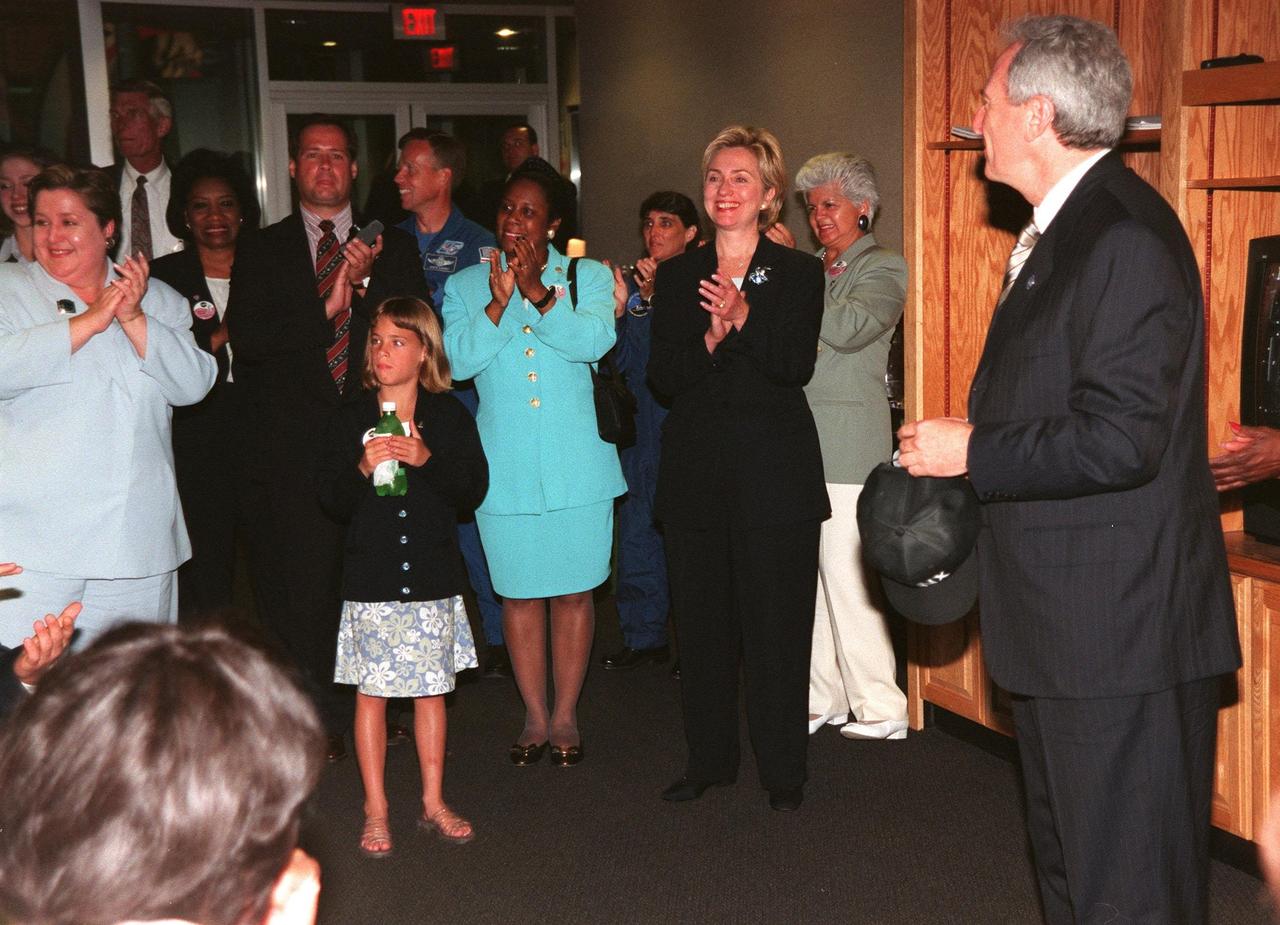
KENNEDY SPACE CENTER, FLA. -- In the VIP Lounge, Apollo/Saturn V Center, First Lady Hillary Rodham Clinton gets ready to speak to the group gathered there before the launch of STS-93. At right is NASA Administrator Daniel Goldin. Liftoff of Space Shuttle Columbia is scheduled for 12:36 a.m. EDT July 20. Much attention has been generated over the launch due to Commander Eileen M. Collins, the first woman to serve as commander of a Shuttle mission. The primary payload of the five-day mission is the Chandra X-ray Observatory, which will allow scientists from around the world to study some of the most distant, powerful and dynamic objects in the universe. The new telescope is 20 to 50 times more sensitive than any previous X-ray telescope and is expected to unlock the secrets of supernovae, quasars and black holes
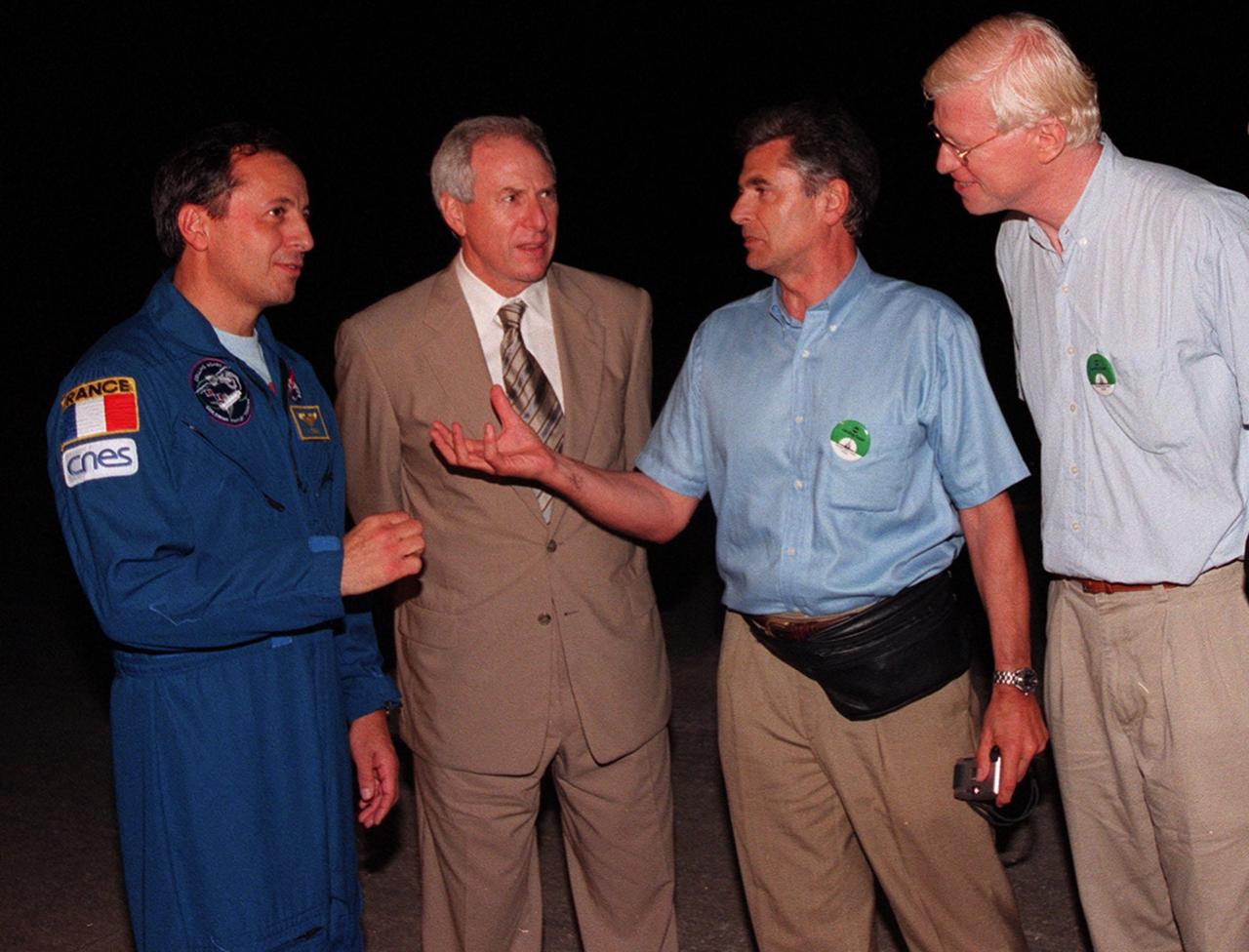
At the Shuttle Landing Facility (from left to right), STS-93 Mission Specialist Michel Tognini of France, representing the Centre National d'Etudes Spatiales (CNES), and NASA Administrator Daniel Goldin talk with Jacques Ratie, Astronaut Director, CNES, and Serge Plattard, International Relations, CNES. Landing occurred on runway 33 with main gear touchdown at 11:20:35 p.m. EDT on July 27. The mission's primary objective was to deploy the Chandra X-ray Observatory, which will allow scientists from around the world to study some of the most distant, powerful and dynamic objects in the universe. This was the 95th flight in the Space Shuttle program and the 26th for Columbia. The landing was the 19th consecutive Shuttle landing in Florida and the 12th night landing in Shuttle program history. On this mission, Eileen Collins became the first woman to serve as a Shuttle commander
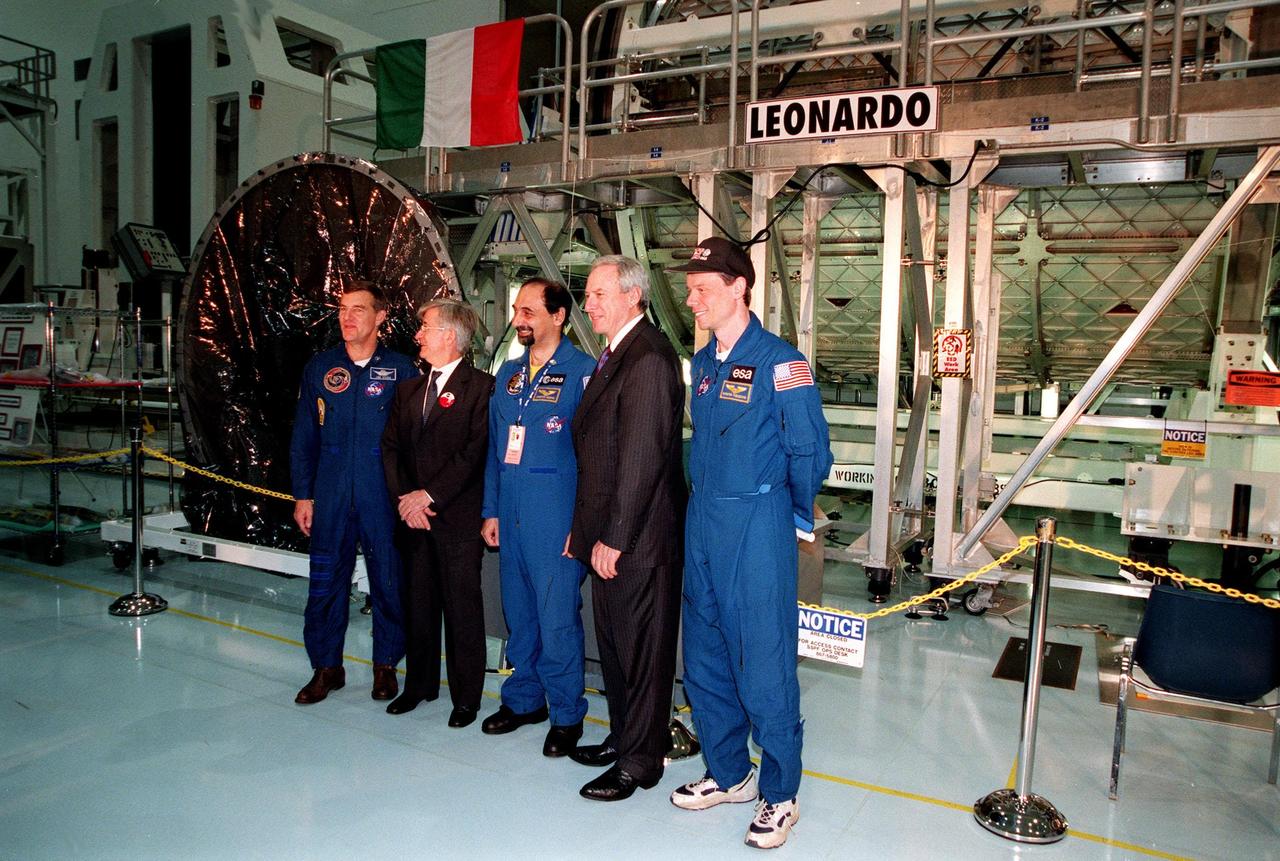
KENNEDY SPACE CENTER, FLA. -- Participants pose for a photo at the Space Station Processing Facility ceremony transferring the "Leonardo" Multipurpose Logistics Module (MPLM) from the Italian Space Agency, Agenzia Spaziale Italiana (ASI), to NASA. From left, they are astronaut Jim Voss, ASI President Sergio De Julio, European Space Agency astronaut Umberto Guidoni of Italy, NASA Administrator Daniel S. Goldin and European Space Agency astronaut Christer Fuglesang of Sweden. The MPLM, a reusable logistics carrier, will be the primary delivery system used to resupply and return International Space Station cargo requiring a pressurized environment. Leonardo is the first of three MPLM carriers for the International Space Station. It is scheduled to be launched on Space Shuttle Mission STS-100, targeted for April 2000
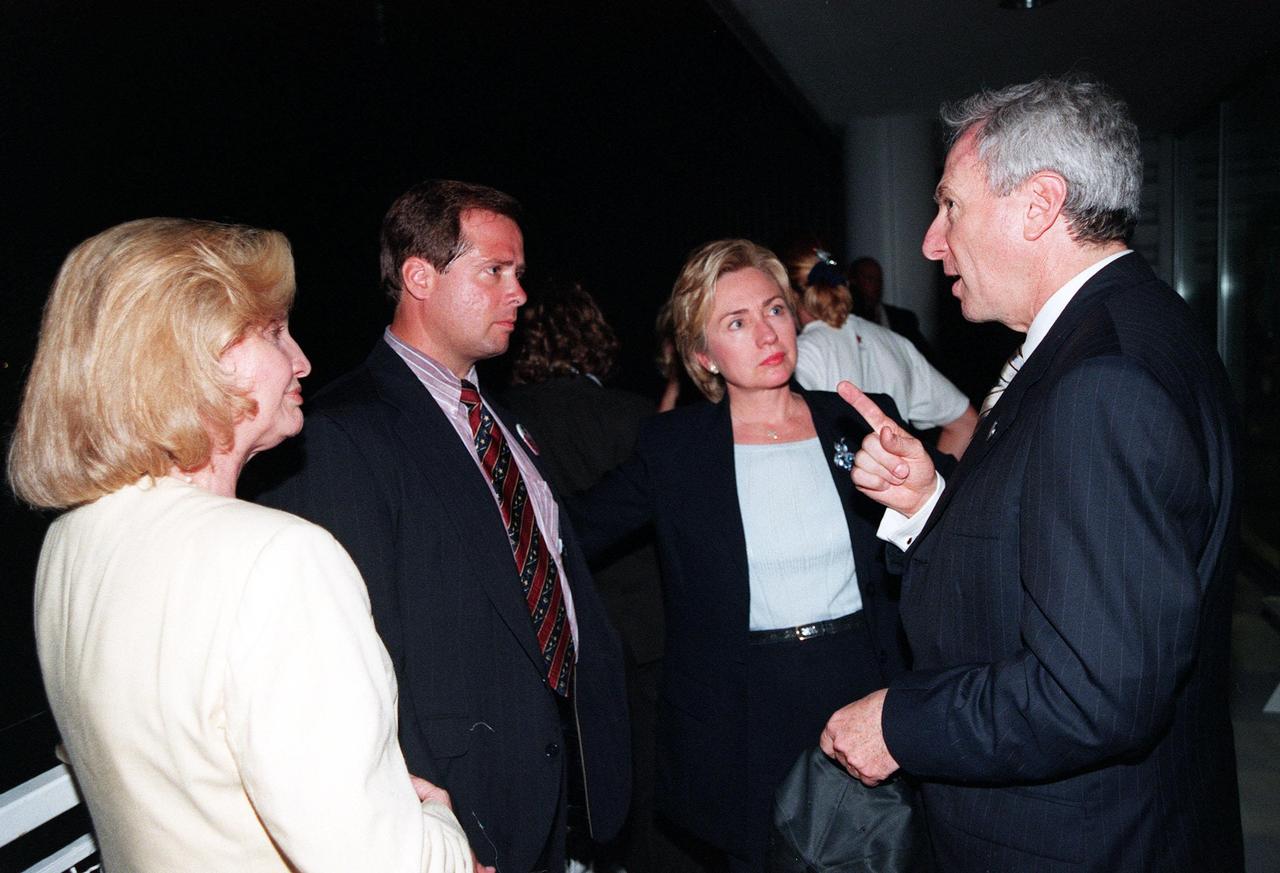
KENNEDY SPACE CENTER, FLA. -- At the Apollo/Saturn V Center, NASA Administrator Daniel Goldin (right) chats with First Lady Hillary Rodham Clinton and others while waiting for the launch of STS-93. Much attention has been generated over STS-93 due to Commander Eileen M. Collins, the first woman to serve as commander of a Shuttle mission. The primary payload of the five-day mission is the Chandra X-ray Observatory, which will allow scientists from around the world to study some of the most distant, powerful and dynamic objects in the universe. The new telescope is 20 to 50 times more sensitive than any previous X-ray telescope and is expected to unlock the secrets of supernovae, quasars and black holes. Liftoff of Space Shuttle Columbia is scheduled for 12:36 a.m. EDT July 20
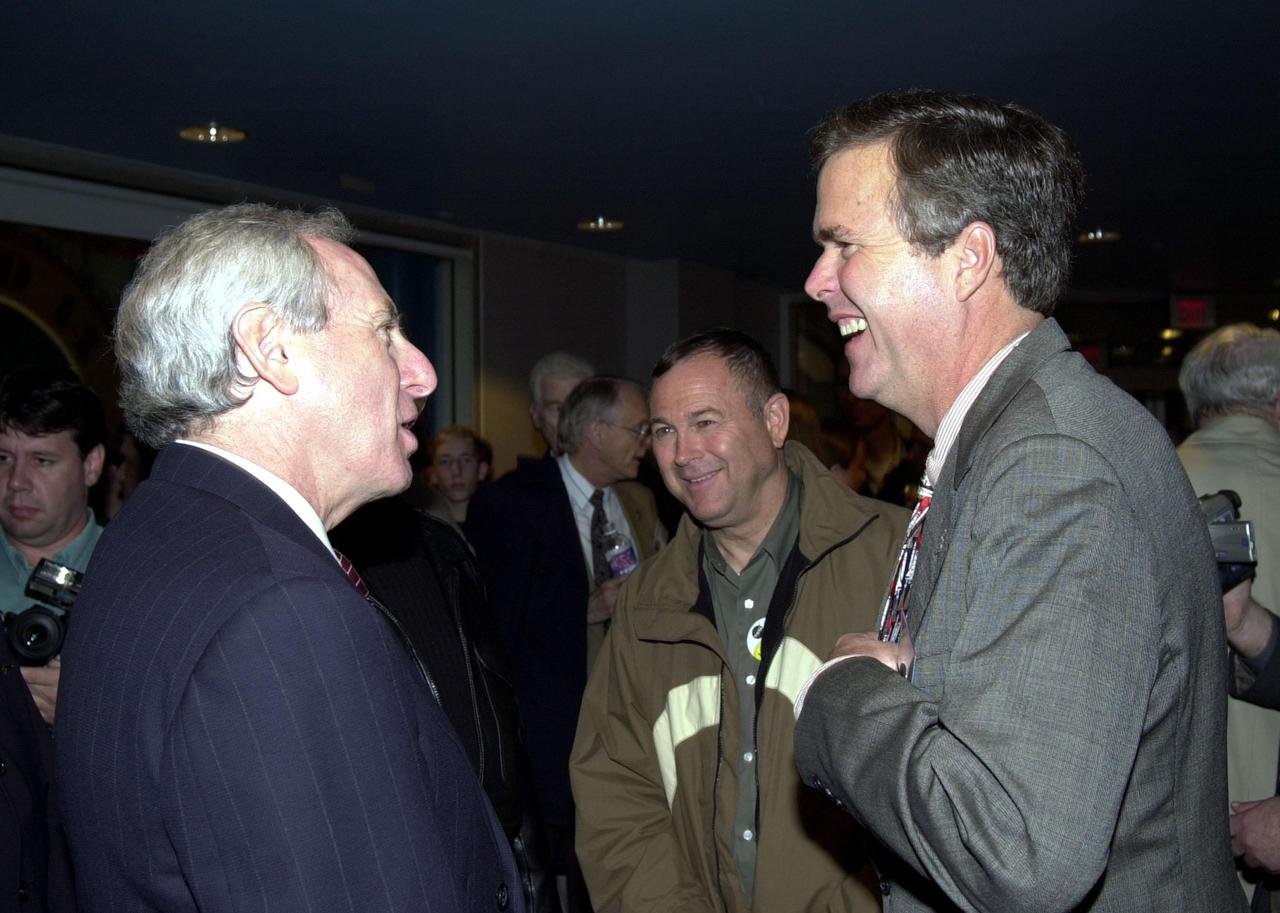
KENNEDY SPACE CENTER, FLA. -- Enjoying a light moment before the launch of Space Shuttle Endeavour on mission STS-97 are NASA Administrator Daniel Goldin (left) and Florida Governor Jeb Bush (right). Between them is California Congressman Dana Rohrabacher.; Guests of NASA, they viewed the launch from the Banana Creek VIP Site. Liftoff of Endeavour occurred on time at 10:06:01 p.m. EST with a crew of five. The sixth construction flight to the International Space Station, Endeavour is transporting the P6 Integrated Truss Structure that comprises Solar Array Wing-3 and the Integrated Electronic Assembly, to provide power to the Space Station. The 11-day mission includes two spacewalks to complete the solar array connections. Endeavour is expected to land Dec. 11 at 6:19 p.m. EST
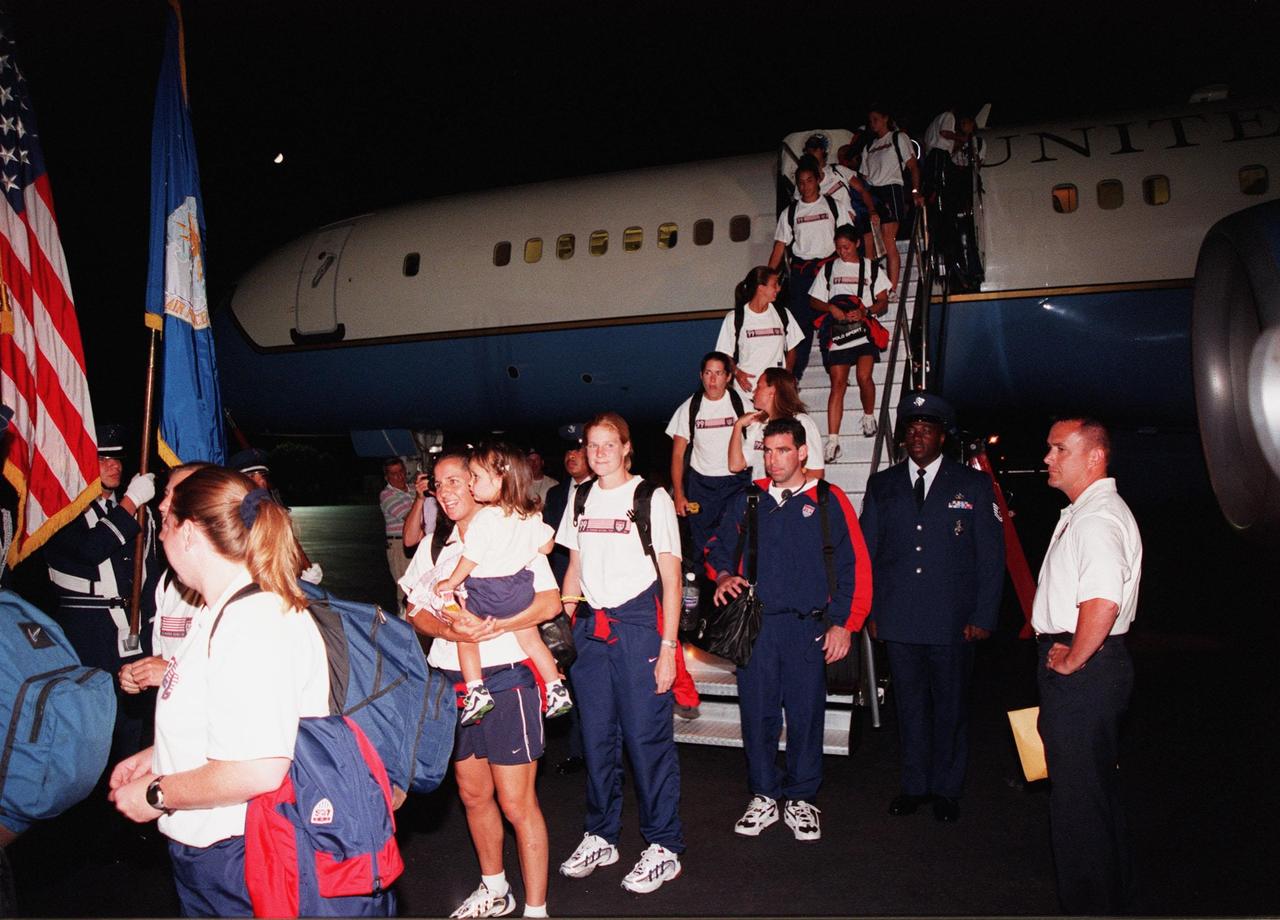
KENNEDY SPACE CENTER, FLA. -- Members of the U.S. Women's World Cup Soccer Team are greeted by NASA Administrator Daniel S. Goldin as they disembark from a plane at the Skid Strip at Cape Canaveral Air Station. They arrived with First Lady Hillary Rodham Clinton to view the launch of Space Shuttle mission STS-93 scheduled for 12:36 a.m. EDT July 20. Much attention has been generated over the launch due to Commander Eileen M. Collins, the first woman to serve as commander of a Shuttle mission. The primary payload of the five-day mission is the release of the Chandra X-ray Observatory, which will allow scientists from around the world to study some of the most distant, powerful and dynamic objects in the universe
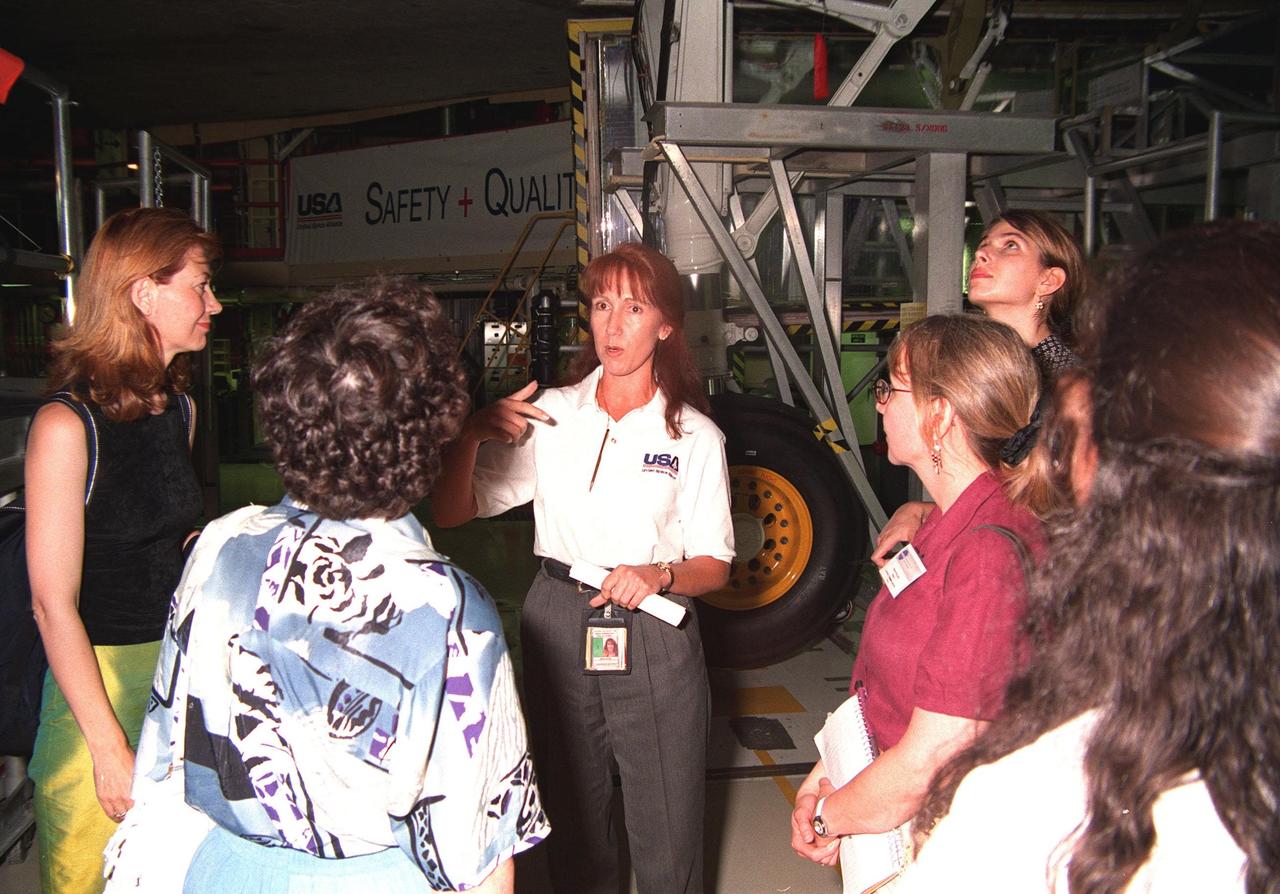
Attendees of a women's forum held at the Apollo/Saturn V Center, get a guided tour of the Orbiter Processing Facility and a closeup look at an orbiter overhead. The forum included a welcome by Center Director Roy Bridges, remarks by NASA Administrator Daniel Goldin, and a panel discussion, "Past, Present and Future of Space." The attendees are planning to view the launch of STS-93 at the Banana Creek viewing sight. Much attention has been generated over the launch due to Commander Eileen M. Collins, the first woman to serve as commander of a Shuttle mission. The primary payload of the five-day mission is the Chandra X-ray Observatory, which will allow scientists from around the world to study some of the most distant, powerful and dynamic objects in the universe. Liftoff is scheduled for July 20 at 12:36 a.m. EDT
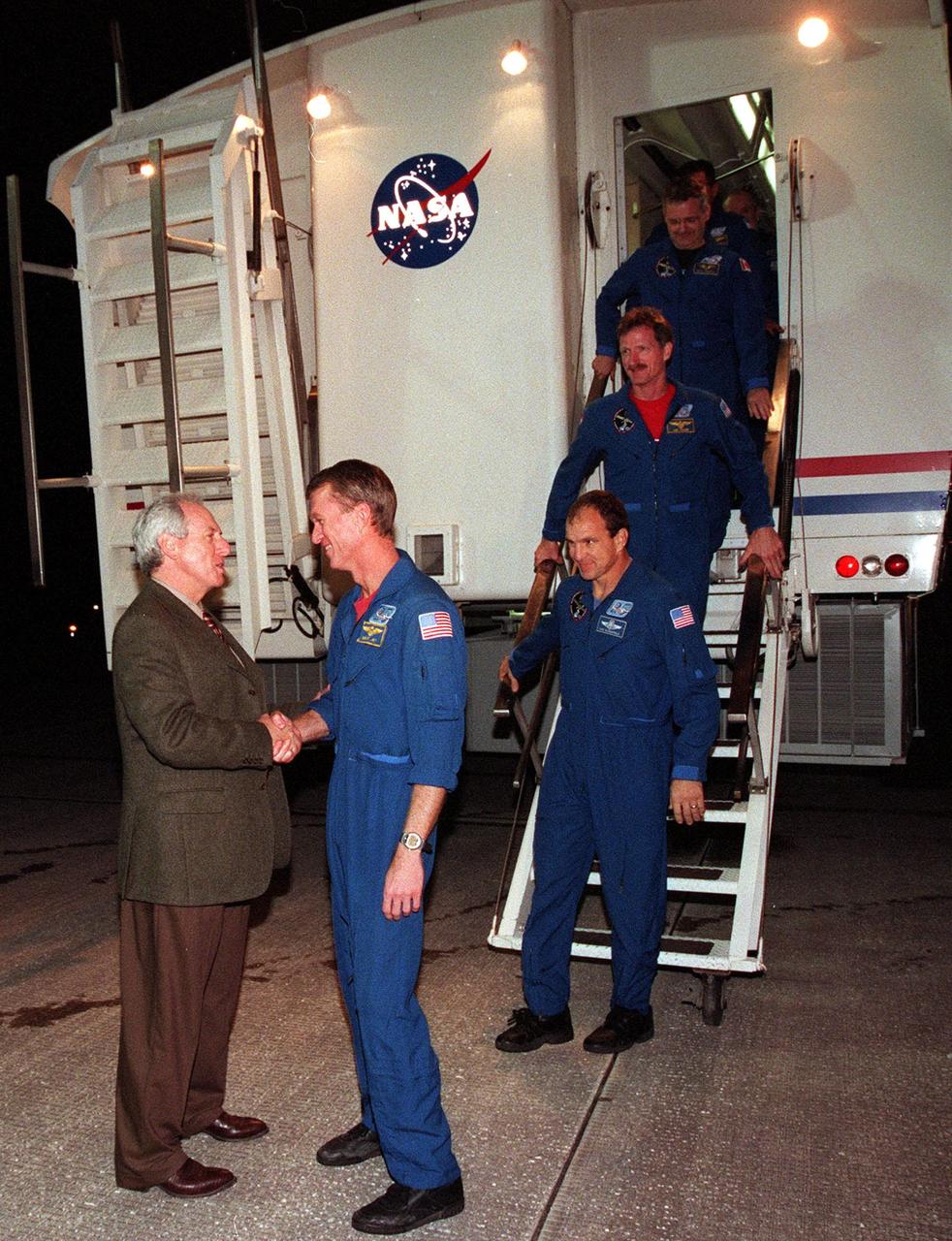
KENNEDY SPACE CENTER, FLA. -- Following a successful landing, the crew of Endeavour exit the Crew Transport Vehicle and are greeted by NASA Administrator Daniel Goldin. First down the stairs is Commander Brent Jett. Behind him are Pilot Michael Bloomfield and Mission Specialists Joseph Tanner, Marc Garneau and Carlos Noriega. Garneau is with the Canadian Space Agency. On the 4.4-million-mile mission, Endeavour carried the P6 Integrated Truss Structure with solar arrays to power the International Space Station. The arrays and other equipment were installed during three EVAs that totaled 19 hours, 20 minutes. Endeavour was docked with the Space Station for 6 days, 23 hours, 13 minutes. This is the 16th nighttime landing for a Space Shuttle and the 53rd at Kennedy Space Center
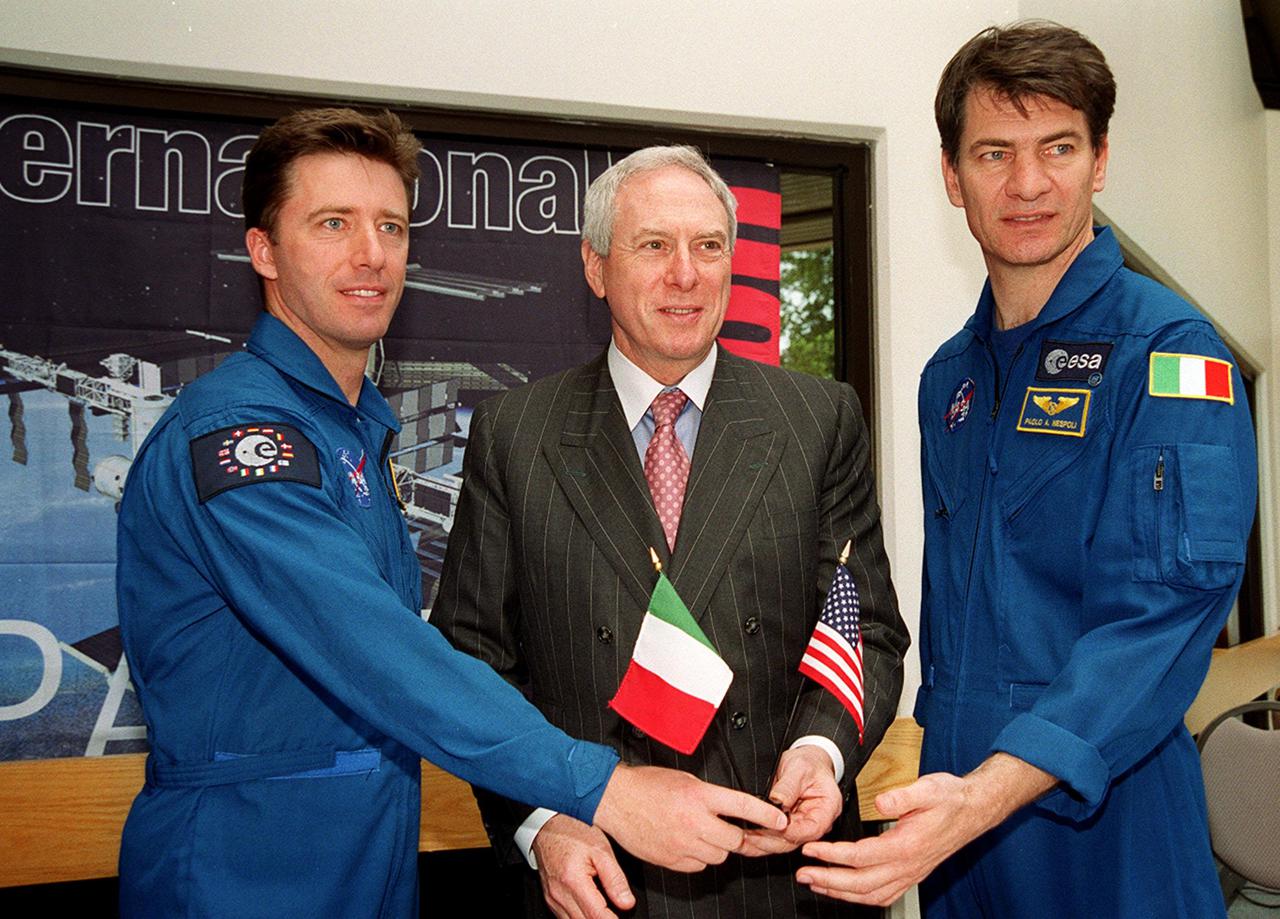
At a signing ceremony between the Italian Space Agency (ASI) and NASA for a Framework for Cooperation to build the Habitation Module for the International Space Station, Italian astronauts with the European Space Agency pose with NASA Administrator Daniel S. Goldin. On the left is Roberto Vittori and on the right is Paolo A. Nespoli. The Framework is a potential bilateral cooperative agreement that could result in ASI development of a U.S. Habitation Module for the International Space Station. This agreement allows the U.S. to explore an alternative approach to achieve full crew habitation for the ISS. A Memorandum of Understanding (MOU) between NASA and ASI will be required to formally document NASA and ASI’s respective responsibilities in a legally binding document. The Framework signed today would form the basis for a potential MOU which NASA and ASI would sign after completion of the program assessment and subsequent negotiations. The ceremony took place at the IMAX Theater, Kennedy Space Center Visitor Complex
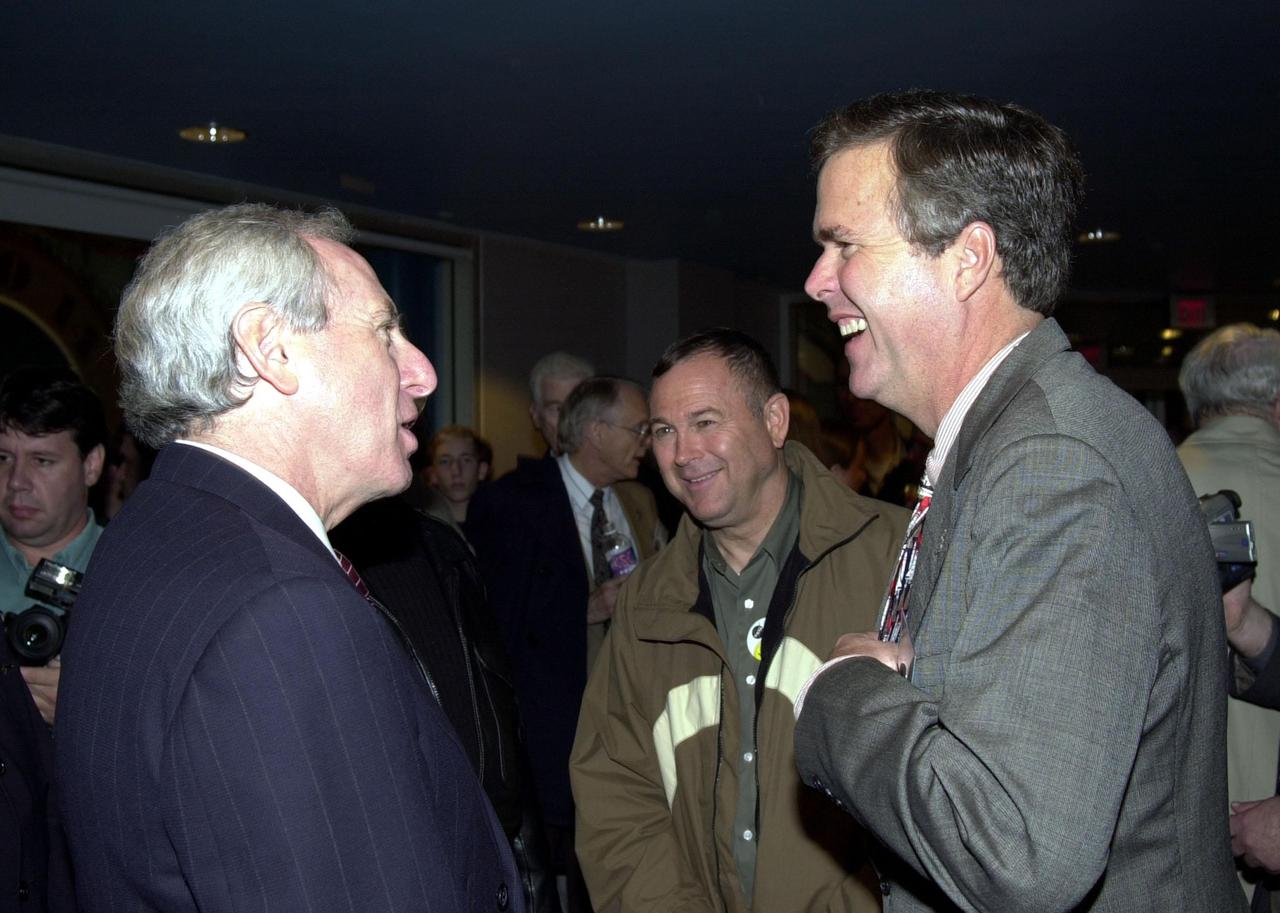
KENNEDY SPACE CENTER, FLA. -- Enjoying a light moment before the launch of Space Shuttle Endeavour on mission STS-97 are NASA Administrator Daniel Goldin (left) and Florida Governor Jeb Bush (right). Between them is California Congressman Dana Rohrabacher.; Guests of NASA, they viewed the launch from the Banana Creek VIP Site. Liftoff of Endeavour occurred on time at 10:06:01 p.m. EST with a crew of five. The sixth construction flight to the International Space Station, Endeavour is transporting the P6 Integrated Truss Structure that comprises Solar Array Wing-3 and the Integrated Electronic Assembly, to provide power to the Space Station. The 11-day mission includes two spacewalks to complete the solar array connections. Endeavour is expected to land Dec. 11 at 6:19 p.m. EST
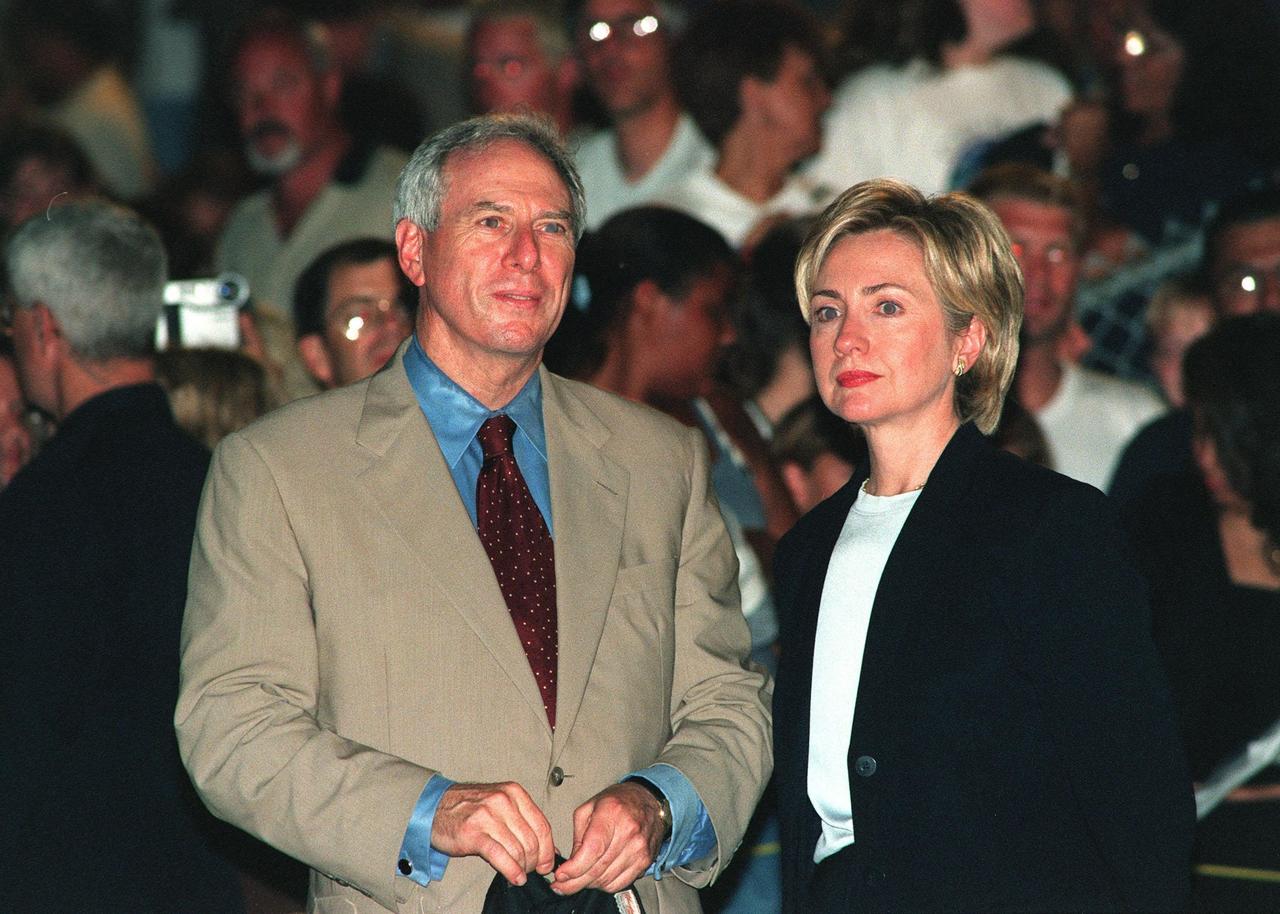
NASA Administrator Daniel Goldin and First Lady Hillary Rodham Clinton are among the spectators at the Banana Creek viewing site to watch the launch of STS-93, the second attempt. Moments before the first scheduled launch, July 20, STS-93 was scrubbed at the T-7 second mark in the countdown due to an indication of a high concentration of hydrogen in an aft engine compartment. The reading proved to be a false alarm. The launch was rescheduled for July 22 at 12:28 a.m. Much attention has been generated over STS-93 due to Commander Eileen M. Collins, the first woman to serve as commander of a Shuttle mission. The primary payload of the five-day mission is the Chandra X-ray Observatory, which will allow scientists from around the world to study some of the most distant, powerful and dynamic objects in the universe
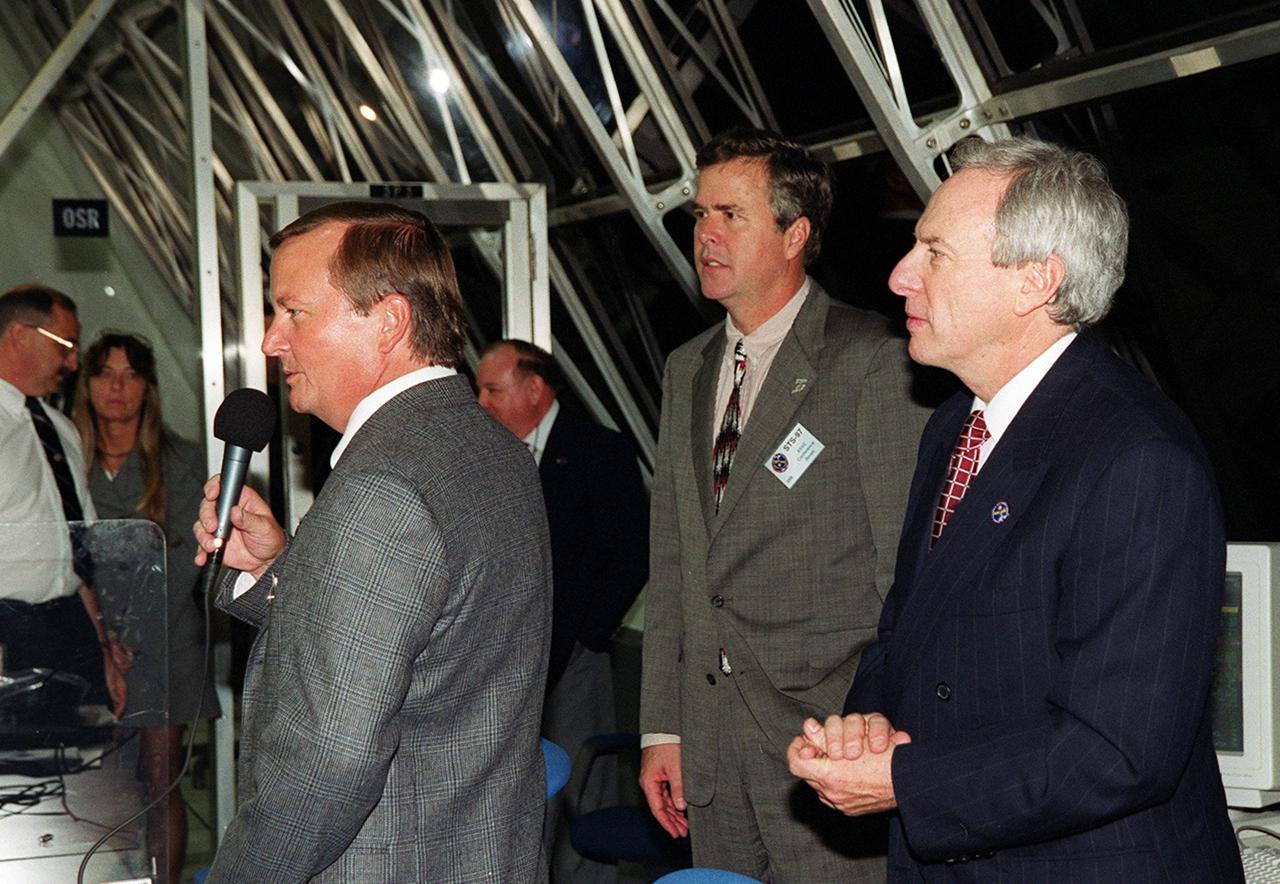
KENNEDY SPACE CENTER, FLA. -- In the Firing Room, Launch Control Center, after a successful launch of Space Shuttle Endeavour on mission STS-97, Launch Director Michael Leinbach (with microphone) addresses the launch team. Behind him at right are Florida Governor Jeb Bush and NASA Administrator Daniel Goldin. Liftoff of Endeavour occurred at 10:06:01 p.m. EST. Endeavour and its five-member crew will deliver U.S. solar arrays to the International Space Station and be the first Shuttle crew to visit the Station’s first resident crew. The 11-day mission includes three spacewalks. This marks the 101st mission in Space Shuttle history and the 25th night launch. Endeavour is expected to land at KSC Dec. 11 at 6:19 p.m. EST
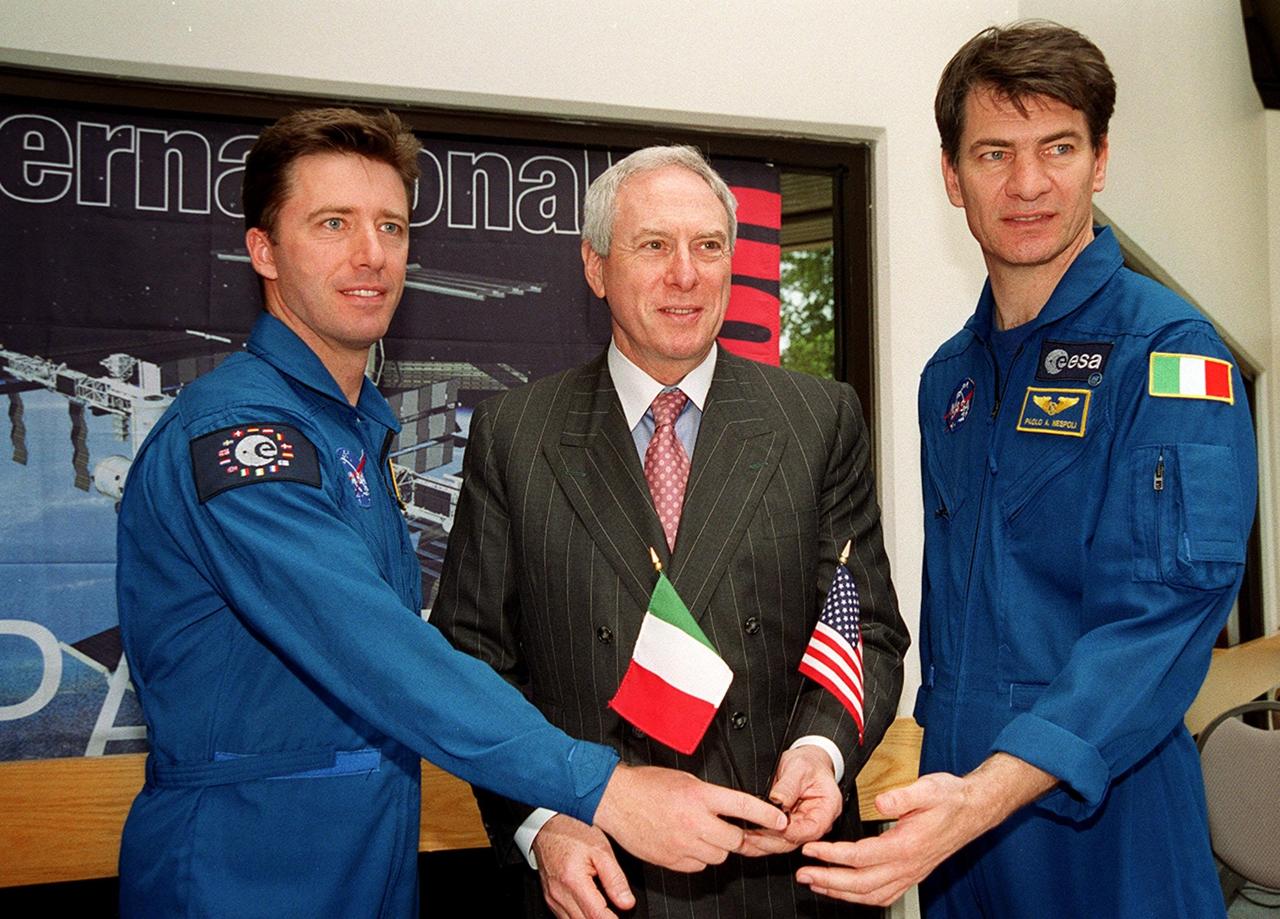
At a signing ceremony between the Italian Space Agency (ASI) and NASA for a Framework for Cooperation to build the Habitation Module for the International Space Station, Italian astronauts with the European Space Agency pose with NASA Administrator Daniel S. Goldin. On the left is Roberto Vittori and on the right is Paolo A. Nespoli. The Framework is a potential bilateral cooperative agreement that could result in ASI development of a U.S. Habitation Module for the International Space Station. This agreement allows the U.S. to explore an alternative approach to achieve full crew habitation for the ISS. A Memorandum of Understanding (MOU) between NASA and ASI will be required to formally document NASA and ASI’s respective responsibilities in a legally binding document. The Framework signed today would form the basis for a potential MOU which NASA and ASI would sign after completion of the program assessment and subsequent negotiations. The ceremony took place at the IMAX Theater, Kennedy Space Center Visitor Complex

Attendees of a women's forum held at the Apollo/Saturn V Center, get a guided tour of the Orbiter Processing Facility. The forum included a welcome by Center Director Roy Bridges, remarks by NASA Administrator Daniel Goldin, and a panel discussion, "Past, Present and Future of Space." The attendees are planning to view the launch of STS-93 at the Banana Creek viewing sight. Much attention has been generated over the launch due to Commander Eileen M. Collins, the first woman to serve as commander of a Shuttle mission. The primary payload of the five-day mission is the Chandra X-ray Observatory, which will allow scientists from around the world to study some of the most distant, powerful and dynamic objects in the universe. Liftoff is scheduled for July 20 at 12:36 a.m. EDT
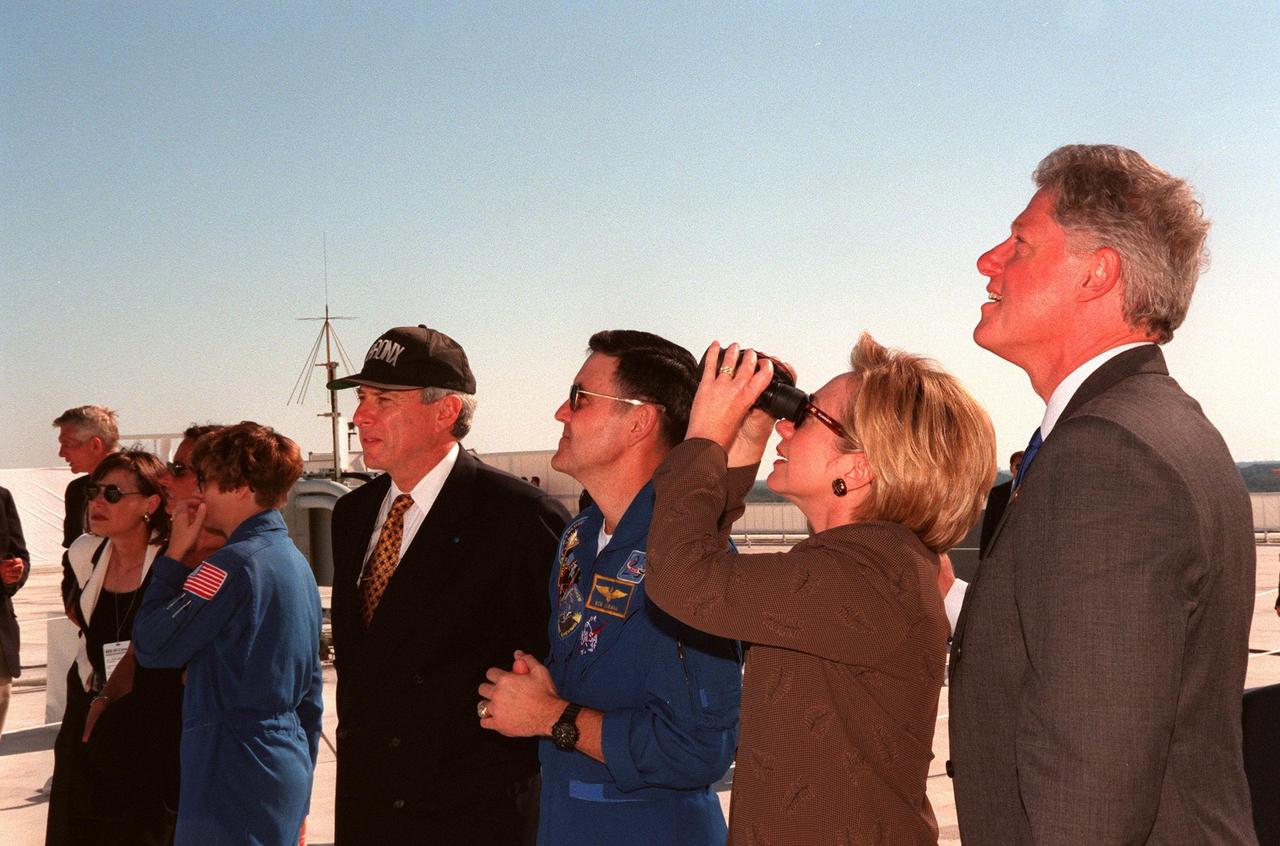
Watching a successful launch of Space Shuttle Discovery from the roof of the Launch Control Center are (left to right) Astronaut Eileen Collins (in flight suit) with unidentified companions, NASA Administrator Daniel Goldin, Astronaut Robert Cabana, First Lady Hillary Rodham Clinton, and U.S. President Bill Clinton. This was the first launch of a Space Shuttle to be viewed by President Clinton, or any President to date. They attended the launch to witness the return to space of American legend John H. Glenn Jr., payload specialist on mission STS-95. Collins will command the crew of STS-93, the first woman to hold that position. Cabana will command the crew of STS-88, the first Space Shuttle mission to carry hardware to space for the assembly of the International Space Station, targeted for liftoff on Dec. 3
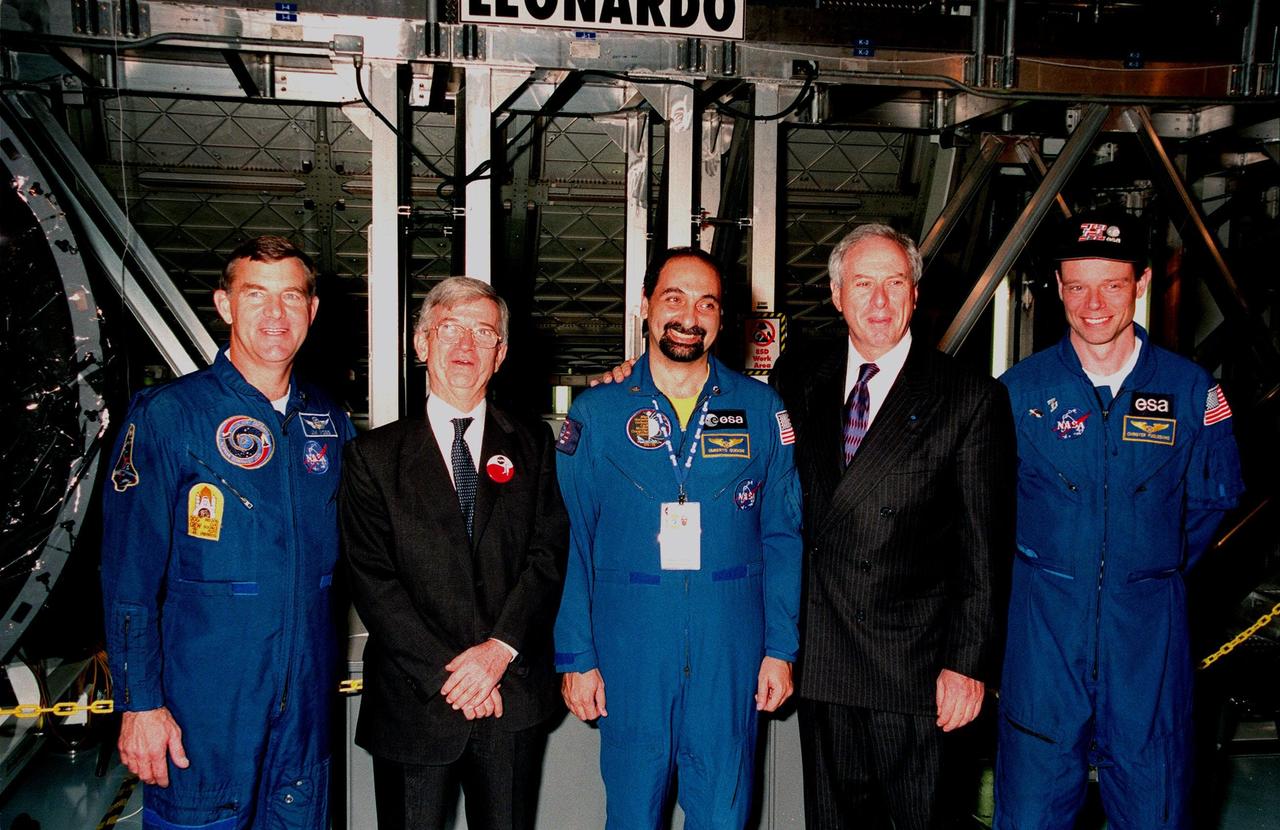
KENNEDY SPACE CENTER, FLA. -- Participants pose for a photo at the Space Station Processing Facility ceremony transferring the "Leonardo" Multipurpose Logistics Module (MPLM) from the Italian Space Agency, Agenzia Spaziale Italiana (ASI), to NASA. From left, they are astronaut Jim Voss, ASI President Sergio De Julio, European Space Agency astronaut Umberto Guidoni of Italy, NASA Administrator Daniel S. Goldin and European Space Agency astronaut Christer Fuglesang of Sweden. The MPLM, a reusable logistics carrier, will be the primary delivery system used to resupply and return International Space Station cargo requiring a pressurized environment. Leonardo is the first of three MPLM carriers for the International Space Station. It is scheduled to be launched on Space Shuttle Mission STS-100, targeted for April 2000
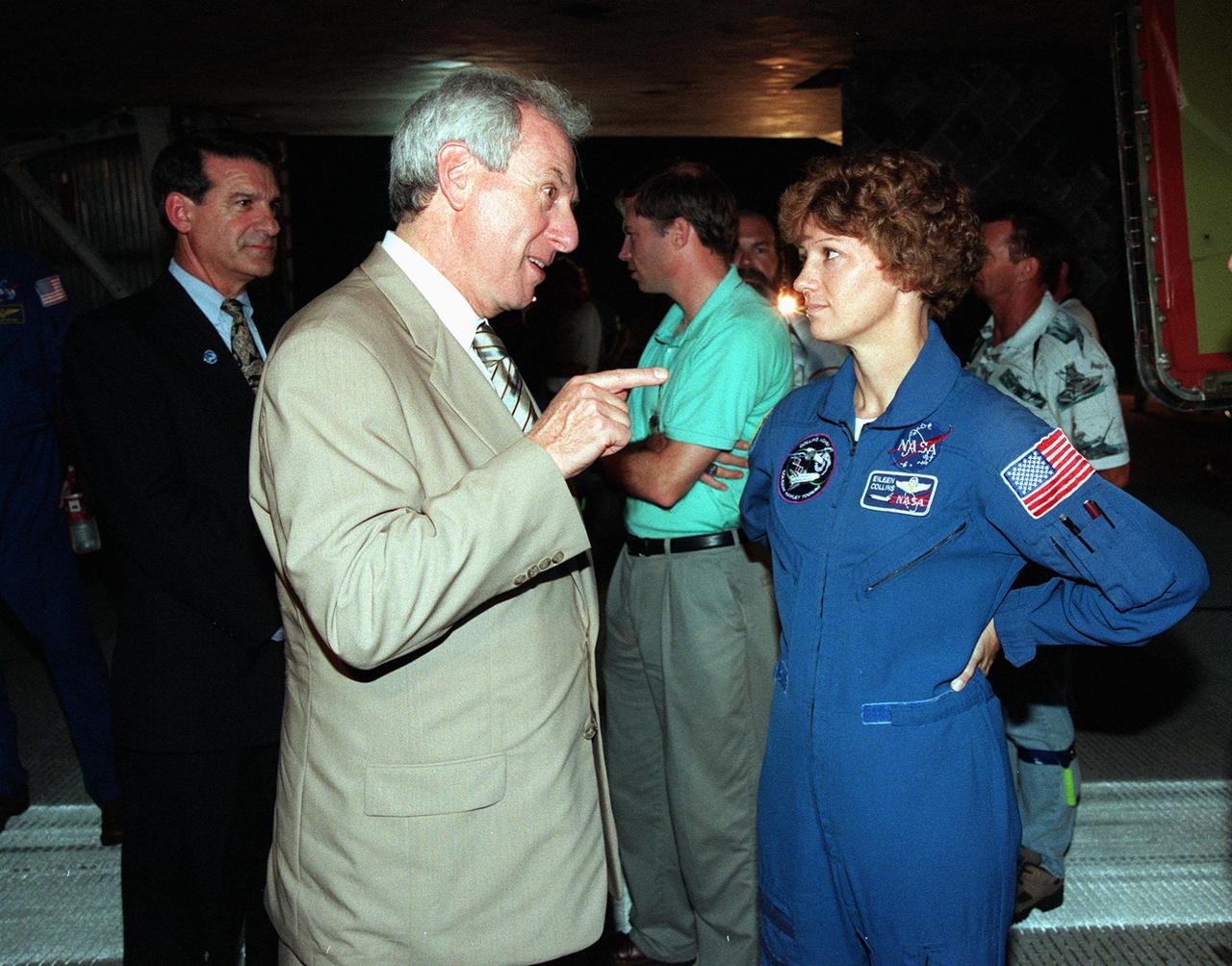
KENNEDY SPACE CENTER, FLA. -- At the Shuttle Landing Facility, NASA Administrator Daniel Goldin (foreground) talks with STS-93 Commander Eileen Collins beside the Space Shuttle orbiter Columbia following the successful completion of her mission. Marshall Space Flight Center Director Arthur G. Stephenson (far left) looks on. Landing occurred on runway 33 with main gear touchdown at 11:20:35 p.m. EDT on July 27. The mission's primary objective was to deploy the Chandra X-ray Observatory, which will allow scientists from around the world to study some of the most distant, powerful and dynamic objects in the universe. This was the 95th flight in the Space Shuttle program and the 26th for Columbia. The landing was the 19th consecutive Shuttle landing in Florida and the 12th night landing in Shuttle program history. On this mission, Collins became the first woman to serve as a Shuttle commander
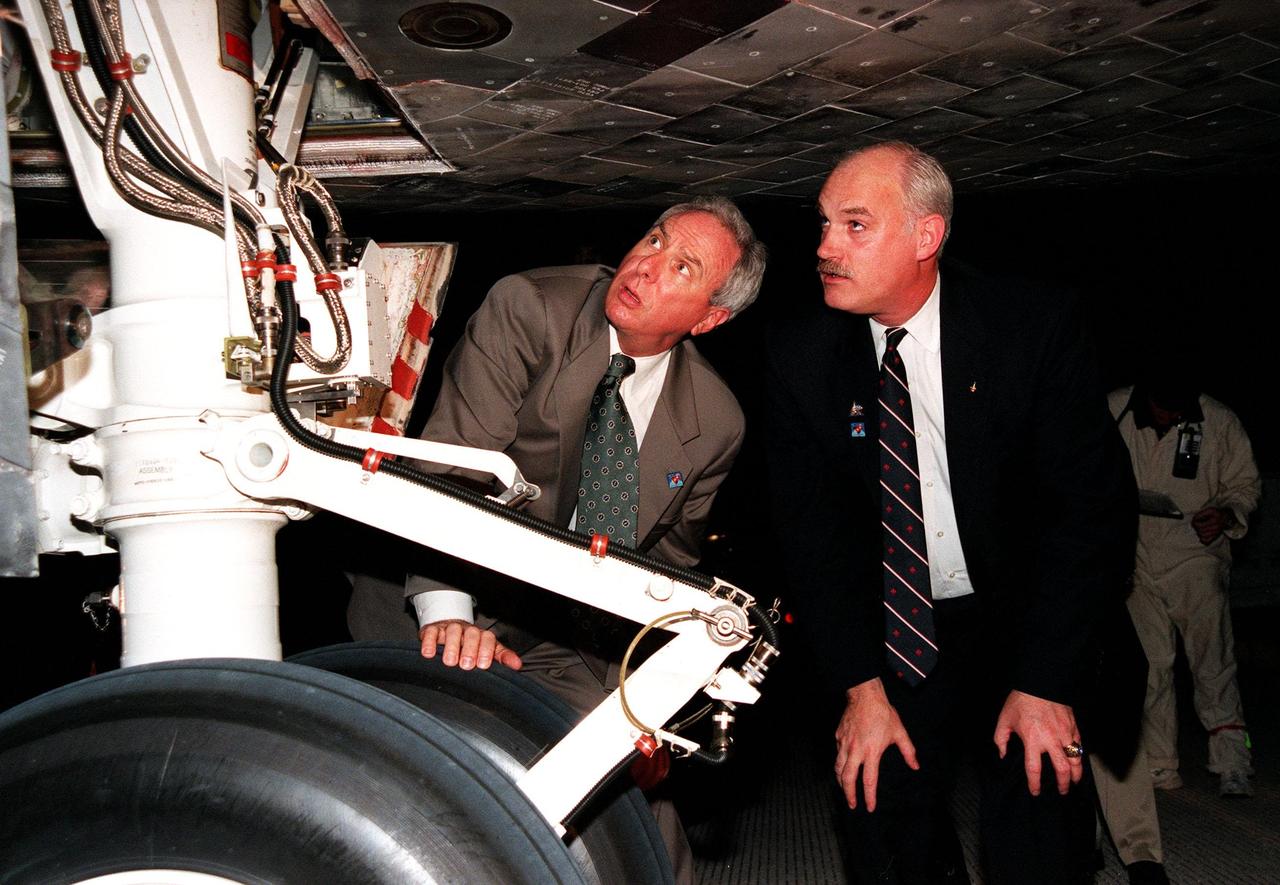
NASA Administrator Daniel Goldin (left) and Director of Space Shuttle Operations Bill Readdy look at the underside of the orbiter Discovery after the end of mission STS-96. Discovery touched down on KSC's Shuttle Landing Facility Runway 15 to complete the 9-day, 19-hour, 13-minute and 1-second long mission. Main gear touchdown was at 2:02:43 a.m. EDT June 6 , landing on orbit 154 of the mission. Nose gear touchdown was at 2:02:59 a.m., and the wheels stopped at 2:03:39 a.m. At the controls were Commander Kent V. Rominger and Pilot Rick D. Husband. Also onboard the orbiter were Mission Specialists Ellen Ochoa (Ph.D.), Tamara E. Jernigan (Ph.D.), Daniel T. Barry (M.D., Ph.D.), Julie Payette and Valery Ivanovich Tokarev. Payette represents the Canadian Space Agency and Tokarev the Russian Space Agency. The crew returned from the second flight to the International Space Station on a logistics and resupply mission. This was the 94th flight in the Space Shuttle program and the 26th for Discovery, also marking the 47th at KSC, the 24th in the last 25 missions, 11th at night, and the 18th consecutive landing in Florida
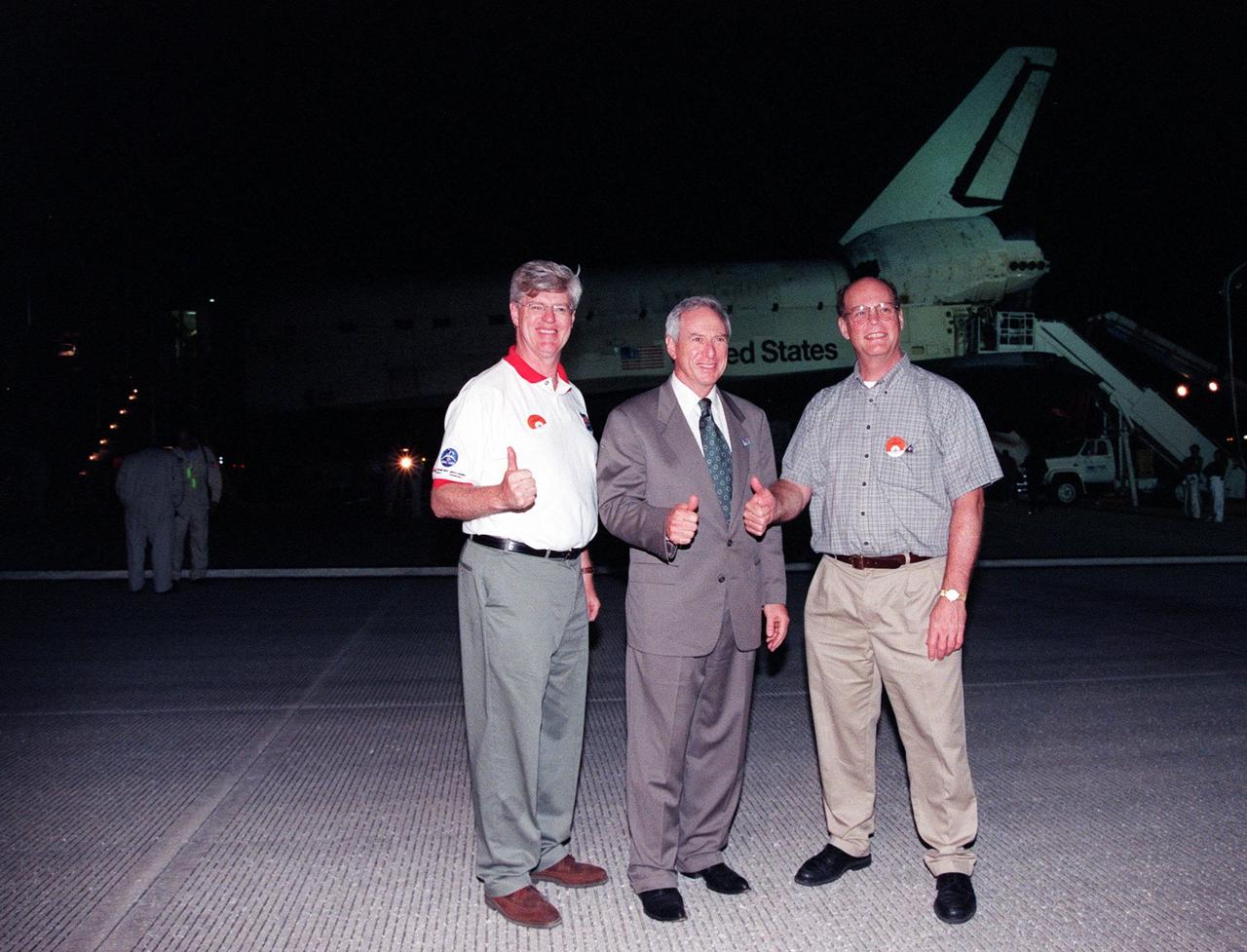
(Left to right) Canadian Minister of Industry John Manley, NASA administrator Daniel Goldin, and President of the Canadian Space Agency Mac Evans give a thumbs up to the end of a successful mission after Space Shuttle orbiter Discovery (behind them) touched down on KSC's Shuttle Landing Facility Runway 15. Main gear touchdown occurred at 2:02:43 a.m. EDT to complete the 9-day, 19-hour, 13-minute and 1-second long STS-96 mission. Onboard the Shuttle was Mission Specialist Julie Payette, who represents the Canadian Space Agency. At the controls for the landing were Commander Kent V. Rominger and Pilot Rick D. Husband. Others onboard were Mission Specialists Ellen Ochoa (Ph.D.), Tamara E. Jernigan (Ph.D.), Daniel T. Barry (M.D., Ph.D.), and Valery Ivanovich Tokarev, represents the Russian Space Agency. The crew returned from the second flight to the International Space Station on a logistics and resupply mission
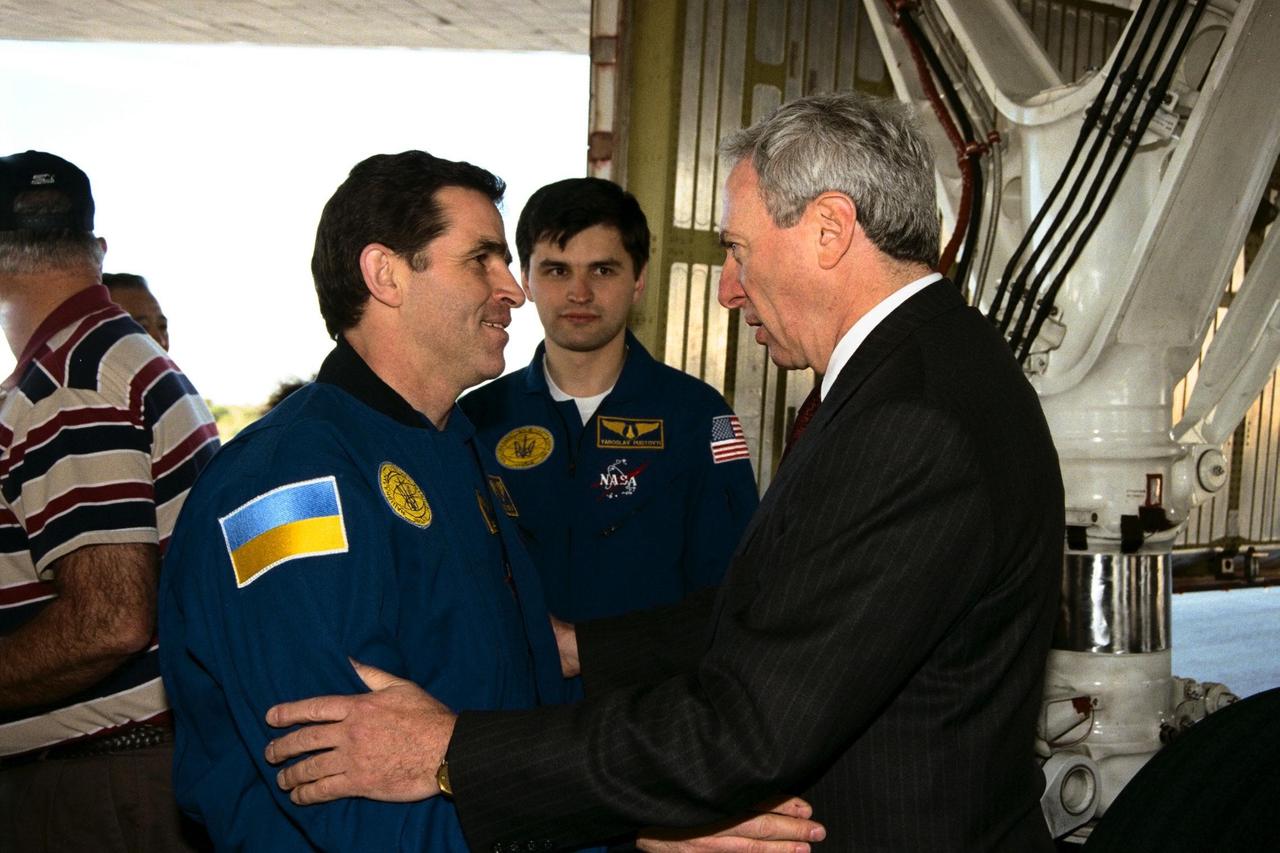
STS-87 Payload Specialist Leonid Kadenyuk of the National Space Agency of Ukraine (NSAU), at left, chats with NASA Administrator Daniel Goldin shortly after the landing of Columbia at Kennedy Space Center. Looking on is back-up Payload Specialist Yaroslav Pustovyi, also of NSAU. STS-87 concluded its mission with a main gear touchdown at 7:20:04 a.m. EST Dec. 5, at KSC's Shuttle Landing Facility Runway 33, drawing the 15-day, 16-hour and 34-minute-long mission of 6.5 million miles to a close. Also onboard the orbiter were Commander Kevin Kregel; Pilot Steven Lindsey; and Mission Specialists Winston Scott, Kalpana Chawla, Ph.D., and Takao Doi, Ph.D., of the National Space Development Agency of Japan. During the 88th Space Shuttle mission, the crew performed experiments on the United States Microgravity Payload-4 and pollinated plants as part of the Collaborative Ukrainian Experiment. This was the 12th landing for Columbia at KSC and the 41st KSC landing in the history of the Space Shuttle program
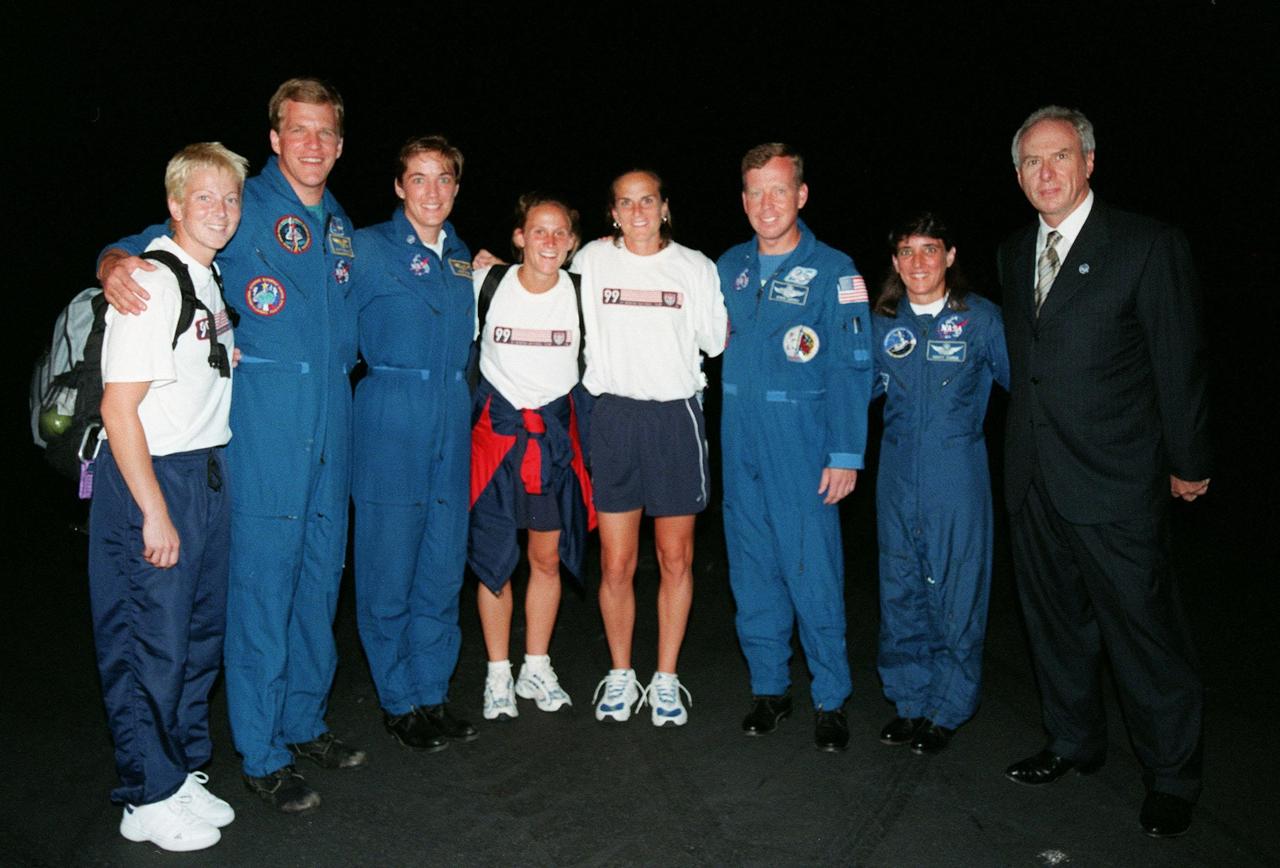
Members of the U.S. World Cup Soccer Team pose with Astronauts Scott Parazynski, Heidemarie M. Stefanyshyn-Piper, Steven W. Lindsey, and Nancy Jane Currie and NASA Administrator Daniel Goldin after the team's arrival at the Skid Strip at Cape Canaveral Air Station. The team arrived with First Lady Hillary Rodham Clinton to view the launch of Space Shuttle mission STS-93. Liftoff is scheduled for 12:36 a.m. EDT July 20. Much attention has been generated over the launch due to Commander Eileen M. Collins, the first woman to serve as commander of a Shuttle mission. The primary payload of the five-day mission is the Chandra X-ray Observatory, which will allow scientists from around the world to study some of the most distant, powerful and dynamic objects in the universe. The new telescope is 20 to 50 times more sensitive than any previous X-ray telescope and is expected to unlock the secrets of supernovae, quasars and black holes
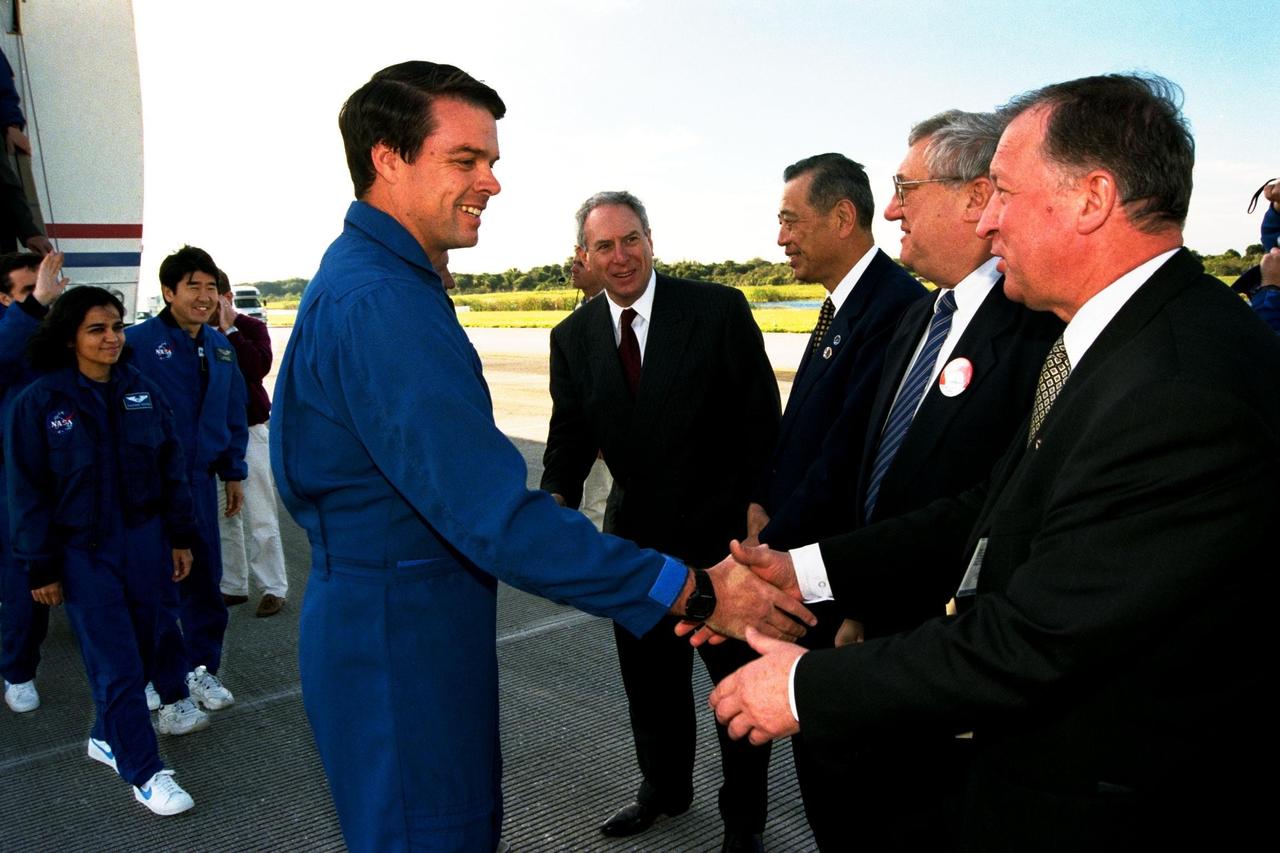
STS-87 Commander Kevin Kregel, center, shakes hands with the deputy director general of the National Space Agency of Ukraine (NSAU), Eduard Kuznetsov, at far right. Next to Kuznetsov is the Honorable Yuri Shcherbak, Ukraine's ambassador to the United States, standing with the president of the National Space Development Agency (NASDA) of Japan, Isao Uchida, and NASA Administrator Daniel Goldin (center). Approaching the VIPs from the left of the photo are Mission Specialists Kalpana Chawla, Ph.D., and Takao Doi, Ph.D., of NASDA. STS-87 concluded its mission with a main gear touchdown at 7:20:04 a.m. EST Dec. 5, at KSC's Shuttle Landing Facility Runway 33, drawing the 15-day, 16-hour and 34-minute-long mission of 6.5 million miles to a close. Also onboard the orbiter were Pilot Steven Lindsey; Mission Specialist Winston Scott; and Payload Specialist Leonid Kadenyuk of NSAU. During the 88th Space Shuttle mission, the crew performed experiments on the United States Microgravity Payload-4 and pollinated plants as part of the Collaborative Ukrainian Experiment. This was the 12th landing for Columbia at KSC and the 41st KSC landing in the history of the Space Shuttle program
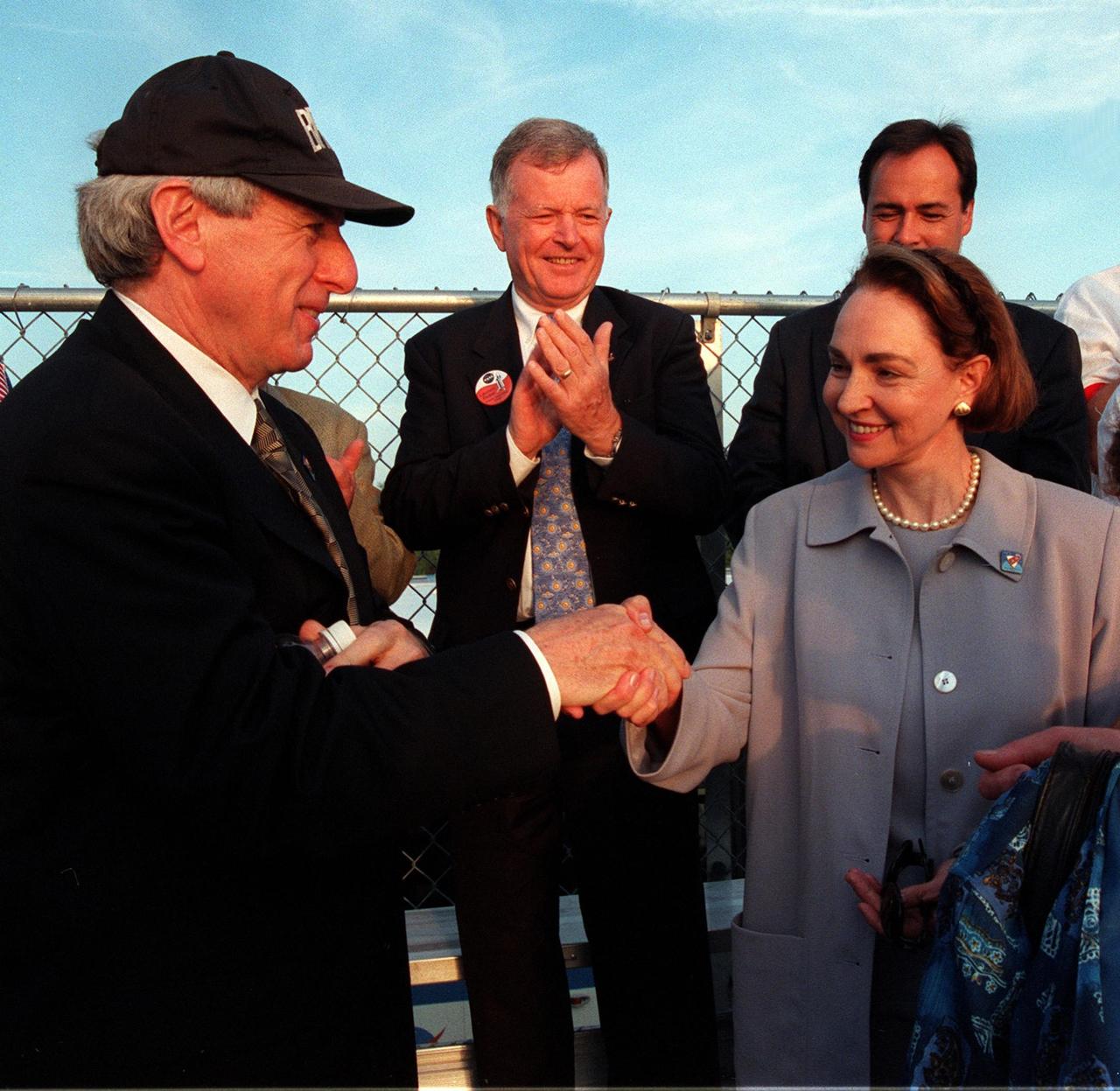
NASA Administrator Daniel Goldin (left) greets Mme. Aline Chretien, wife of the Canadian Prime Minister, at the launch of STS-96. Looking on in the background (between them) is former astronaut Jean-Loup Chretien (no relation), who flew on STS-86. Mme. Chretien attended the launch because one of the STs-96 crew is Mission Specialist Julie Payette, who represents the Canadian Space Agency. Space Shuttle Discovery launched on time at 6:49:42 a.m. EDT to begin a 10-day logistics and resupply mission for the International Space Station. Along with such payloads as a Russian crane, the Strela; a U.S.-built crane; the Spacehab Oceaneering Space System Box (SHOSS), a logistics items carrier; and STARSHINE, a student-involved experiment, Discovery carries about 4,000 pounds of supplies, to be stored aboard the station for use by future crews, including laptop computers, cameras, tools, spare parts, and clothing. The mission includes a space walk to attach the cranes to the outside of the ISS for use in future construction. Landing is expected at the SLF on June 6 about 1:58 a.m. EDT
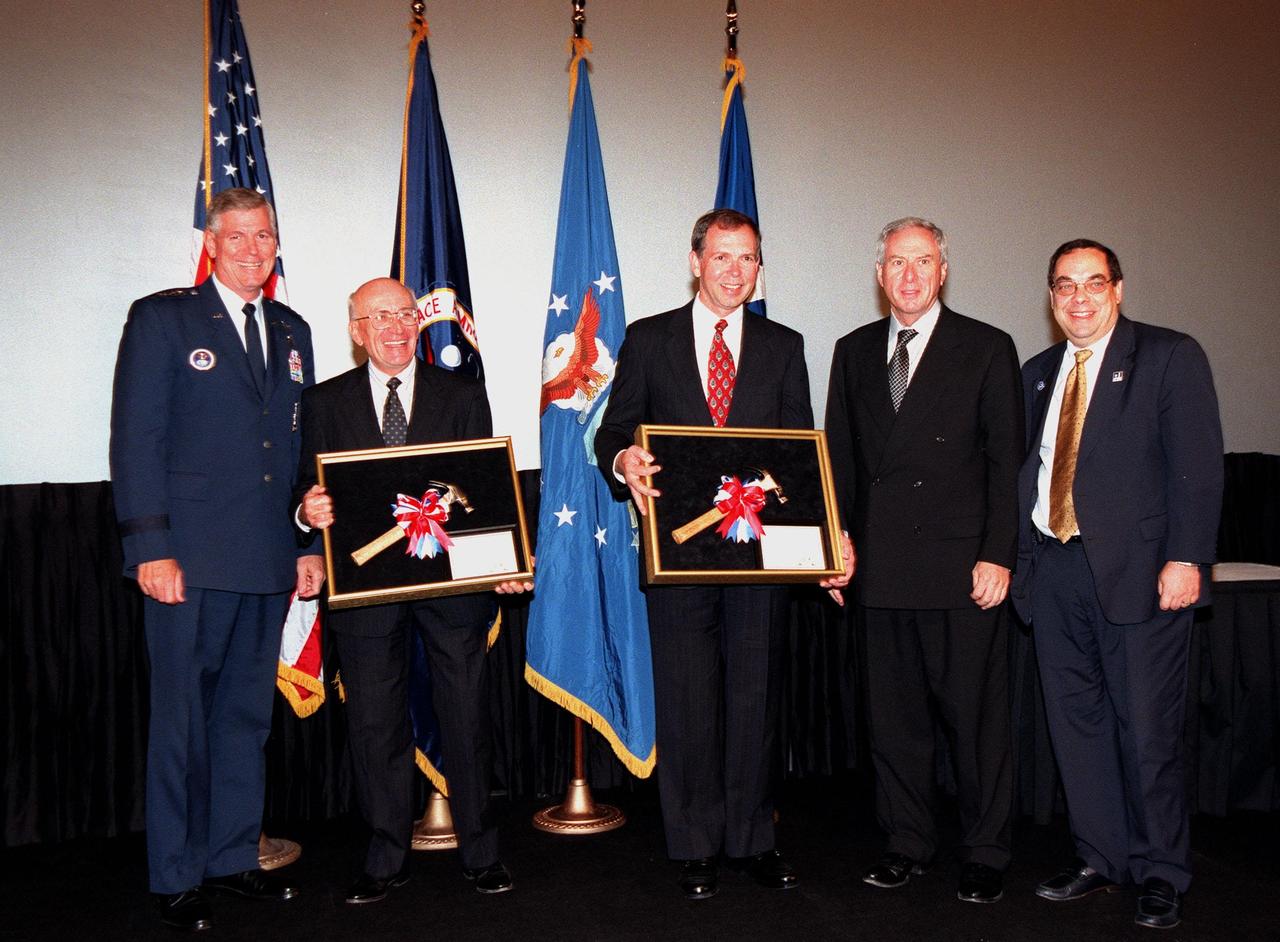
At a special presentation in the IMAX 2 Theater in the Kennedy Space Center Visitor Complex, the Hammer Award is presented to Kennedy Space Center and the 45th Space Wing. Present for the awards are (left to right) Commander of the Air Force Space Command General Richard B. Myers, Ed Gormel, Chris Fairey, NASA Administrator Daniel Goldin, and Director of the National Partnership for Reinventing Government, Morley Winograd, who presented the award. The Hammer Award is Vice President Al Gore's special recognition of teams of federal employees who have made significant contributions in support of the principles of the National Partnership for Reinventing Government. This Hammer Award acknowledges the accomplishments of a joint NASA and Air Force team that established the Joint Base Operations and Support Contract (J-BOSC) Source Evaluation Board (SEB). Gormel and Fairey are co-chairs of the SEB. The team developed and implemented the acquisition strategy for establishing a single set of base operations and support service requirements for KSC, Cape Canaveral Air Station and Patrick Air Force Base
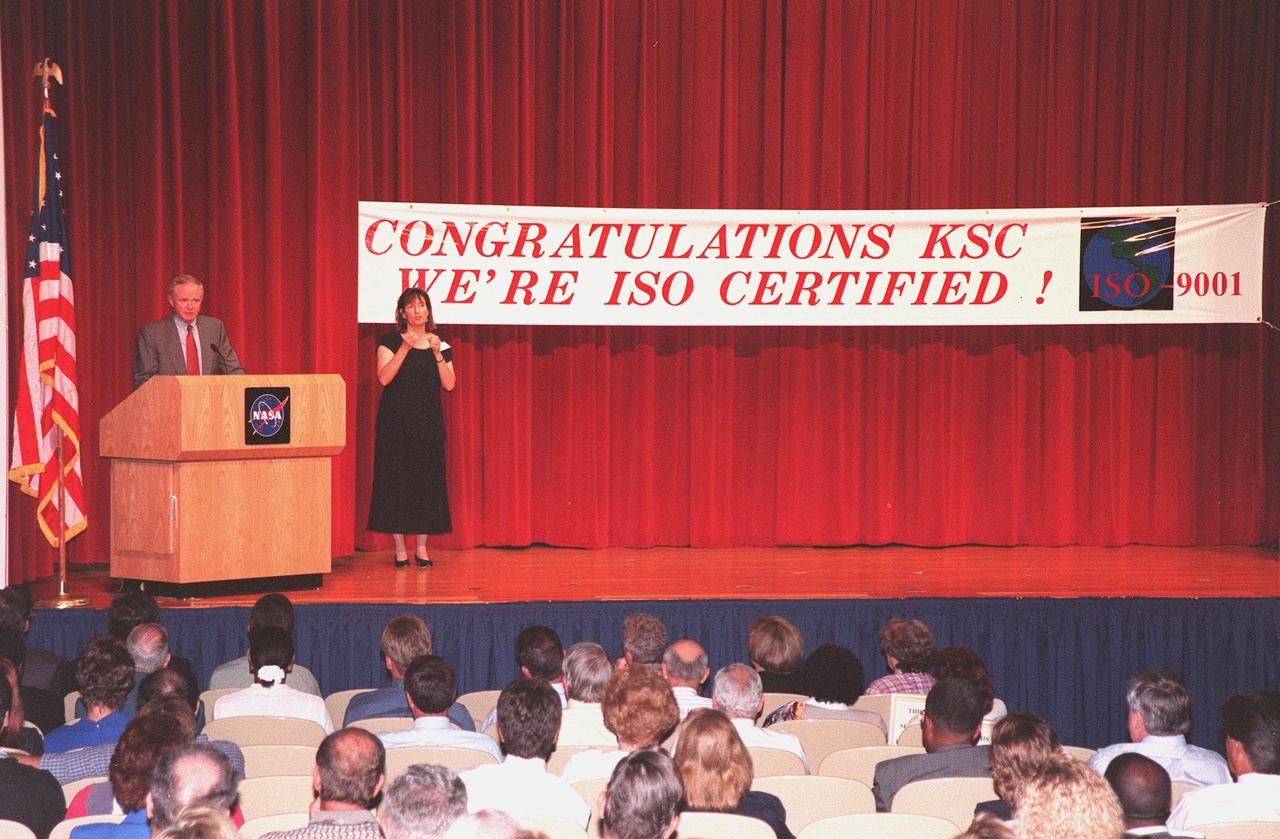
Center Director Roy Bridges speaks to KSC employees at the ISO certification ceremony held at the Training Auditorium. Bridges was presented an ISO 9001 certificate and plaque awarded to KSC by Det Norske Veritas (DNV), Inc., an international ISO certification organization. ISO 9001 comprises the most detailed, comprehensive set of standard requirements for quality programs established by the International Standards Organization. The presentation followed a successful independent audit by DNV of the KSC Management System in May of this year. The third-party auditors examined about 20 elements of KSC's system, including management responsibility, design control, documentation, test and inspection, and corrective action procedures. DNV found that KSC met or exceeded the stringent quality standards in all areas. KSC will use this certification as a tool to improve an already worldclass team. All NASA centers are required by NASA Administrator Daniel S. Goldin to be ISO 9001 registered by September 1999. NASA is the first federal agency to seek the quality certification. Next to Bridges is Heidi Hollingsworth, with the Center for Independent Living, who uses American Sign Language for any hearing-impaired employees in the audience
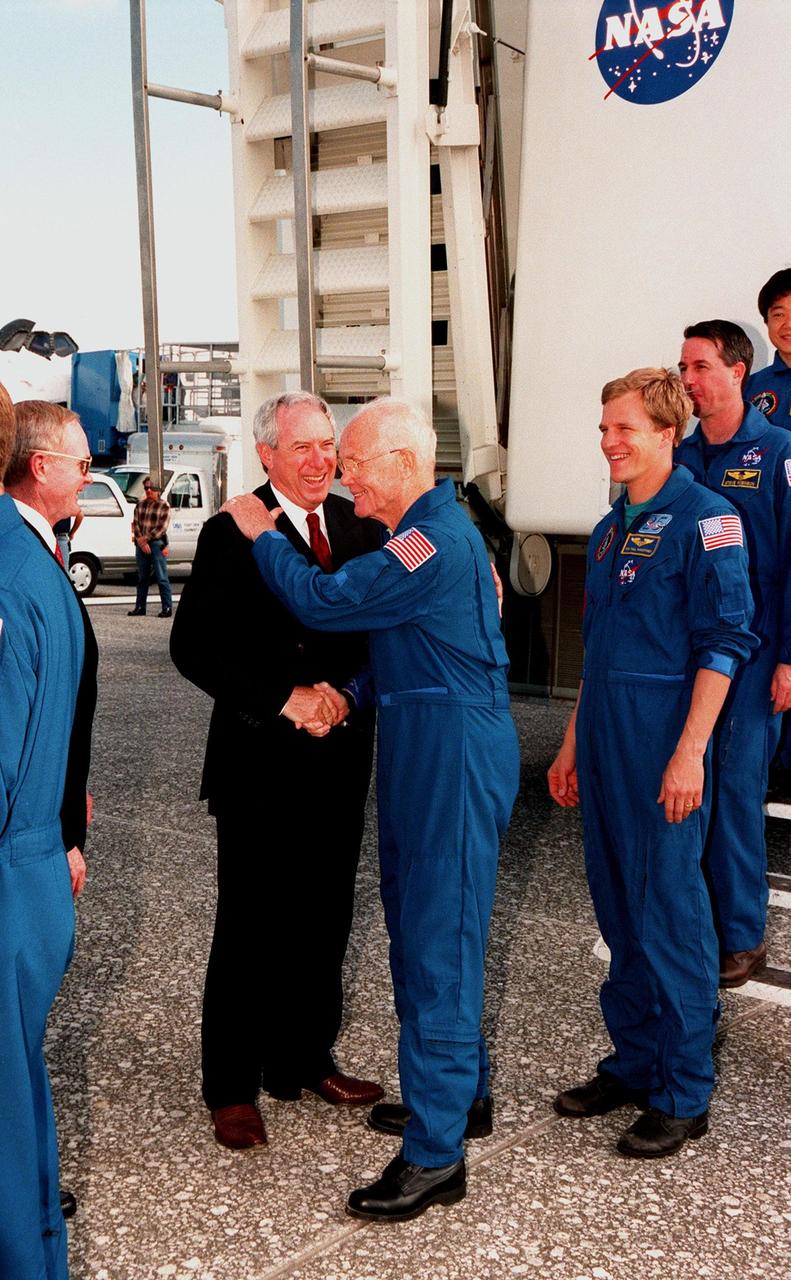
Following touchdown at 12:04 p.m. EST at the Shuttle Landing Facility, the mission STS-95 crew leave the Crew Transport Vehicle. Payload Specialist John H. Glenn Jr. (center), a senator from Ohio, shakes hands with NASA Administrator Daniel S. Goldin. At left is Center Director Roy Bridges. Other crew members shown are Pilot Steven W. Lindsey (far left) and, behind Glenn, Mission Specialists Scott E. Parazynski and Stephen K. Robinson, and Payload Specialist Chiaki Mukai, Ph.D., M.D., with the National Space Development Agency of Japan. Not seen are Mission Commander Curtis L. Brown Jr. and Mission Specialist Pedro Duque of Spain, with the European Space Agency (ESA). The STS-95 crew completed a successful mission, landing at the Shuttle Landing Facility at 12:04 p.m. EST, after 9 days in space, traveling 3.6 million miles. The mission included research payloads such as the Spartan solar-observing deployable spacecraft, the Hubble Space Telescope Orbital Systems Test Platform, the International Extreme Ultraviolet Hitchhiker, as well as the SPACEHAB single module with experiments on space flight and the aging process
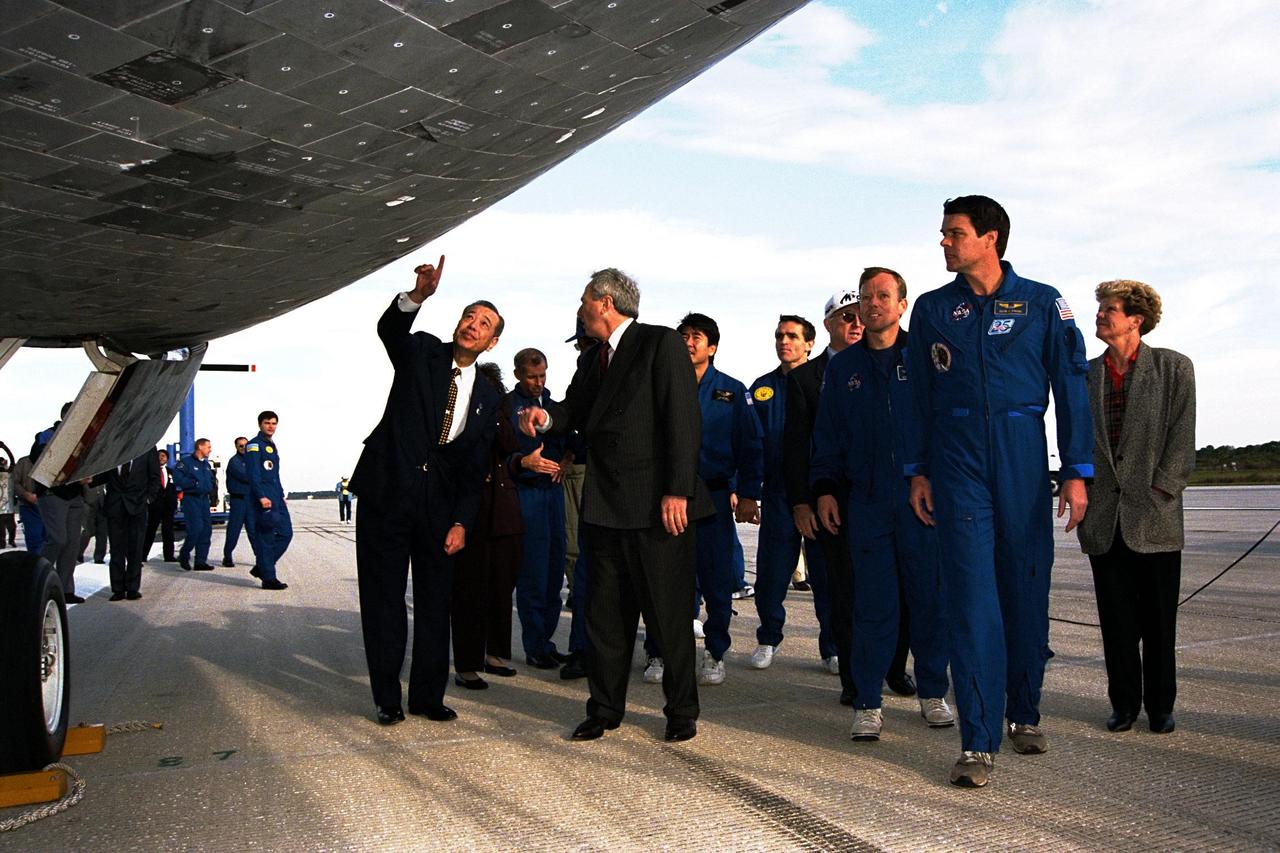
STS-87 crew members regard the tiles underneath the orbiter Columbia shortly after its return to Runway 33 at Kennedy Space Center's Shuttle Landing Facility. Pointing to the tiles is the president of the National Space Development Agency (NASDA) of Japan, Isao Uchida, who is standing next to NASA Administrator Daniel Goldin. STS-87 Commander Kevin Kregel, at right, looks on as Pilot Steve Lindsey follows behind him to continue inspecting the orbiter. STS-87 concluded its mission with a main gear touchdown at 7:20:04 a.m. EST Dec. 5, drawing the 15-day, 16-hour and 34-minute-long mission of 6.5 million miles to a close. Also onboard the orbiter were Mission Specialists Winston Scott; Kalpana Chawla, Ph.D.; and Takao Doi, Ph.D., of NASDA; along with Payload Specialist Leonid Kadenyuk of the National Space Agency of Ukraine. During the 88th Space Shuttle mission, the crew performed experiments on the United States Microgravity Payload-4 and pollinated plants as part of the Collaborative Ukrainian Experiment. This was the 12th landing for Columbia at KSC and the 41st KSC landing in the history of the Space Shuttle program
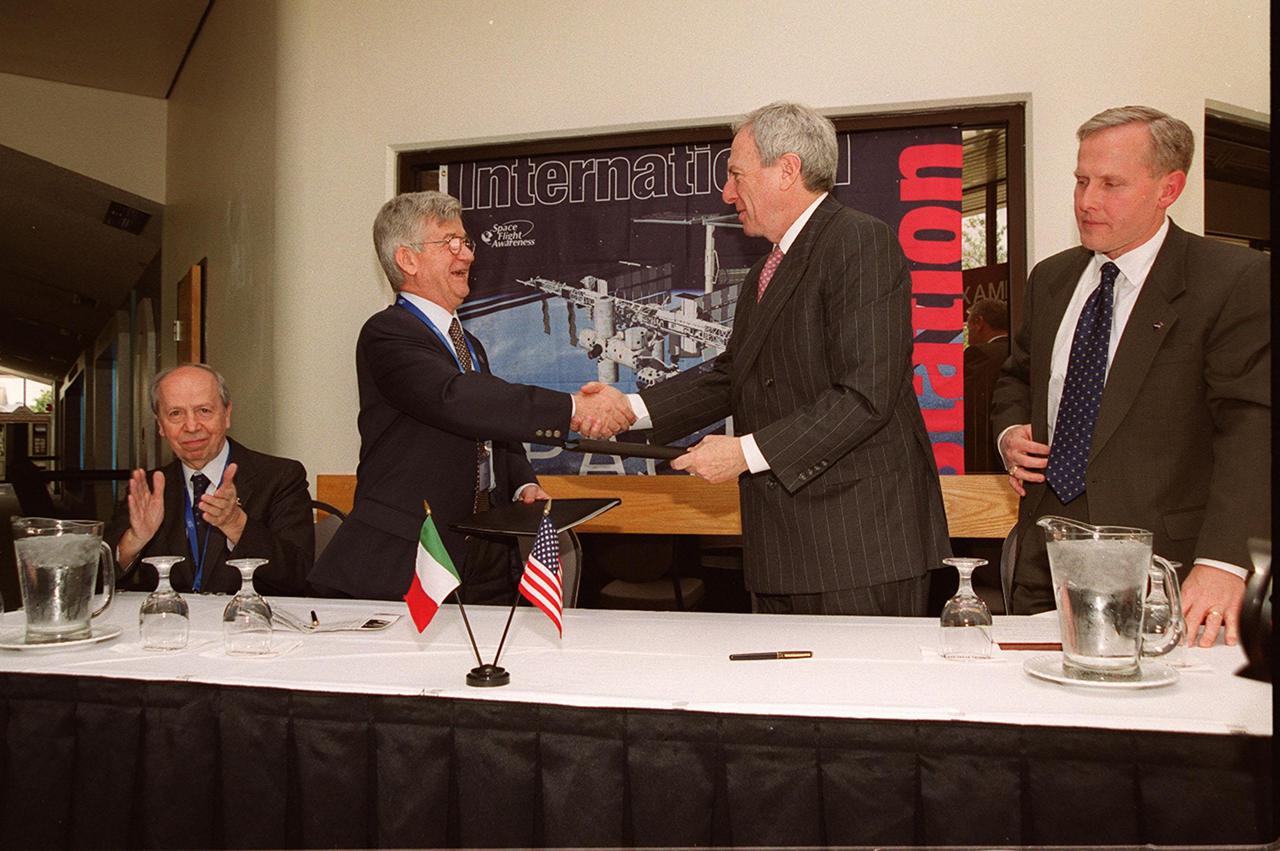
After signing a Framework for Cooperation to build the Habitation Module for the International Space Station, Italian Space Agency President Sergio DeJulio (standing, left) shakes hands with NASA Administrator Daniel S. Goldin (right). Also at the signing are The Honorable Lamberto Dini, Minister of Foreign Affairs, Republic of Italy (far left) and John Schumacher, assistant administrator, NASA External Relations. The Framework is a potential bilateral cooperative agreement that could result in ASI development of a U.S. Habitation Module for the International Space Station. This agreement allows the U.S. to explore an alternative approach to achieve full crew habitation for the ISS. A Memorandum of Understanding (MOU) between NASA and ASI will be required to formally document NASA and ASI’s respective responsibilities in a legally binding document. The Framework signed today would form the basis for a potential MOU which NASA and ASI would sign after completion of the program assessment and subsequent negotiations.The ceremony took place at the IMAX Theater, Kennedy Space Center Visitor Complex
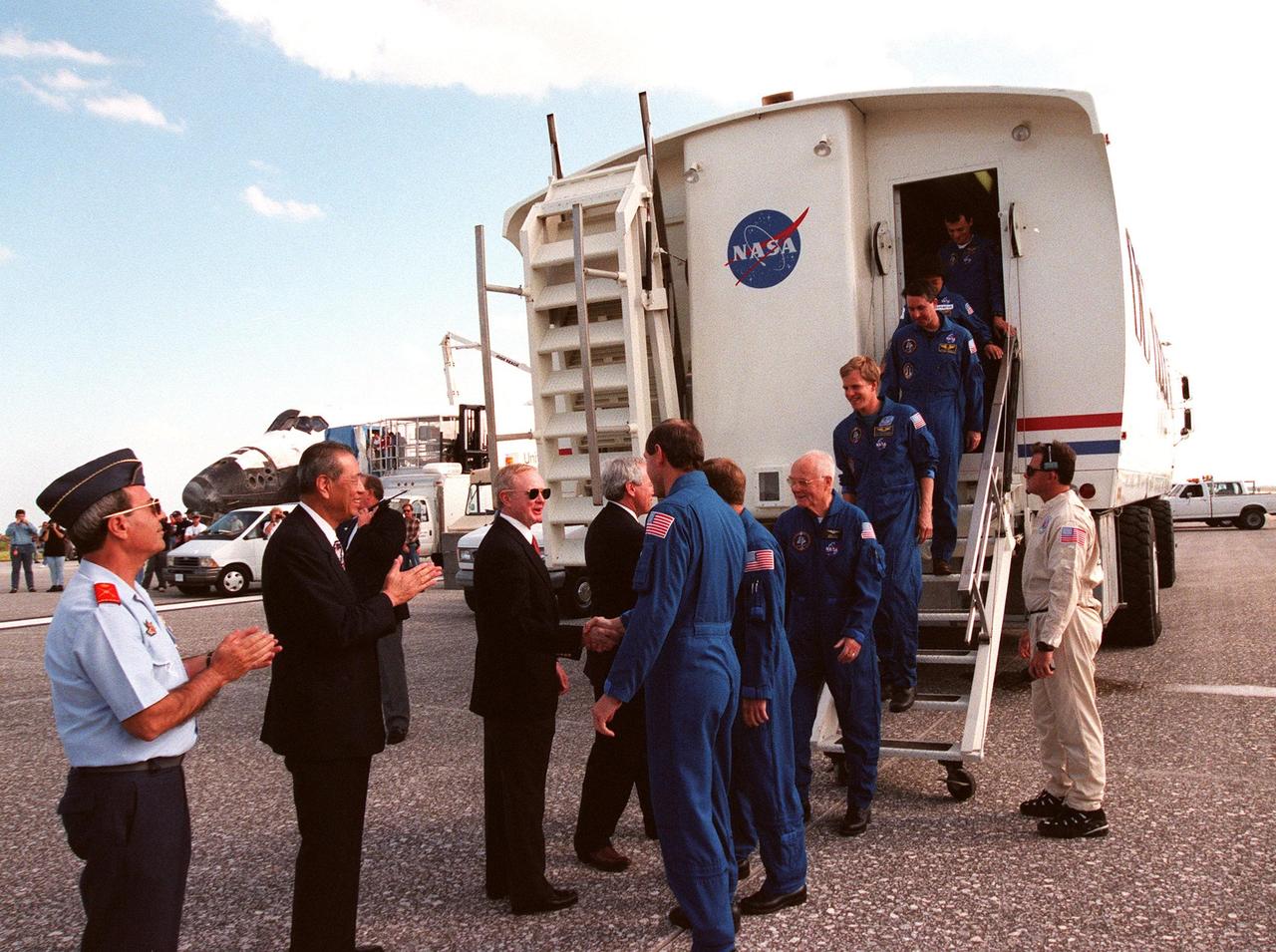
Following touchdown at 12:04 p.m. EST at the Shuttle Landing Facility, the STS-95 crew leave the Crew Transport Vehicle where they are met by (left to right) a Spanish dignitary; Isao Uchida, president of the National Space Development Agency of Japan (NASDA); Center Director Roy Bridges; and NASA Administrator Daniel Goldin. The crew, from left to right, are Mission Commander Curtis L. Brown Jr. (shaking hands with Bridges); Pilot Steven W. Lindsey; Payload Specialist John H. Glenn Jr., a senator from Ohio and one of the original Mercury 7 astronauts; Mission Specialist Scott E. Parazynski; Mission Specialist Stephen K. Robinson; Payload Specialist Chiaki Mukai, with the National Space Development Agency of Japan (NASDA); and Mission Specialist Pedro Duque of Spain, with the European Space Agency (ESA). The successful mission lasted nine days and included research payloads such as the Spartan solar-observing deployable spacecraft, the Hubble Space Telescope Orbital Systems Test Platform, the International Extreme Ultraviolet Hitchhiker, as well as the SPACEHAB single module with experiments on space flight and the aging process
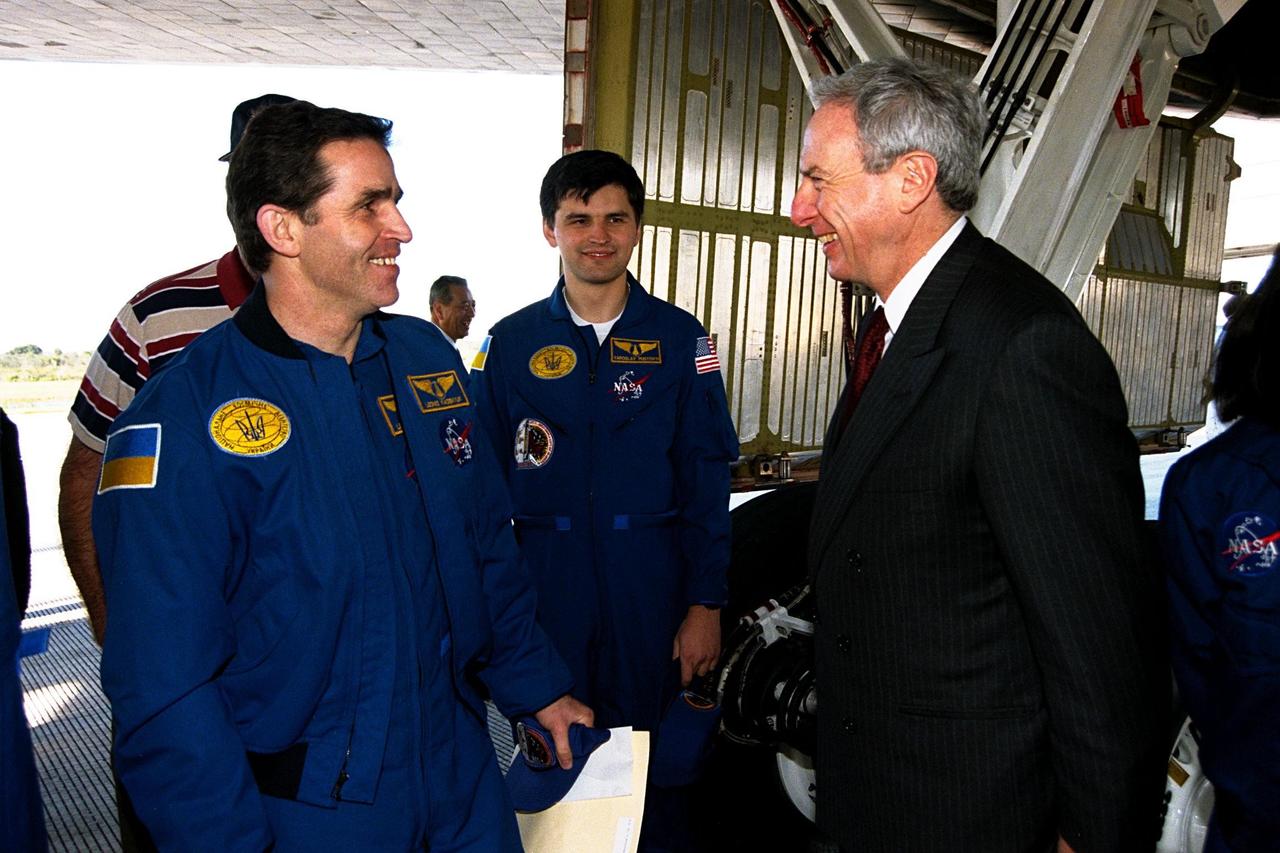
STS-87 Payload Specialist Leonid Kadenyuk of the National Space Agency of Ukraine (NSAU), at left, greets NASA Administrator Daniel Goldin, at right, as back-up Payload Specialist Yaroslav Pustovyi, also of NSAU, looks on. STS-87 concluded its mission with a main gear touchdown at 7:20:04 a.m. EST Dec. 5, at KSC's Shuttle Landing Facility Runway 33, drawing the 15-day, 16-hour and 34-minute-long mission of 6.5 million miles to a close. Also onboard the orbiter were Commander Kevin Kregel; Pilot Steven Lindsey; and Mission Specialists Winston Scott; Kalpana Chawla, Ph.D.; and Takao Doi, Ph.D. of the National Space Development Agency of Japan. During the 88th Space Shuttle mission, the crew performed experiments on the United States Microgravity Payload-4 and pollinated plants as part of the Collaborative Ukrainian Experiment. This was the 12th landing for Columbia at KSC and the 41st KSC landing in the history of the Space Shuttle program
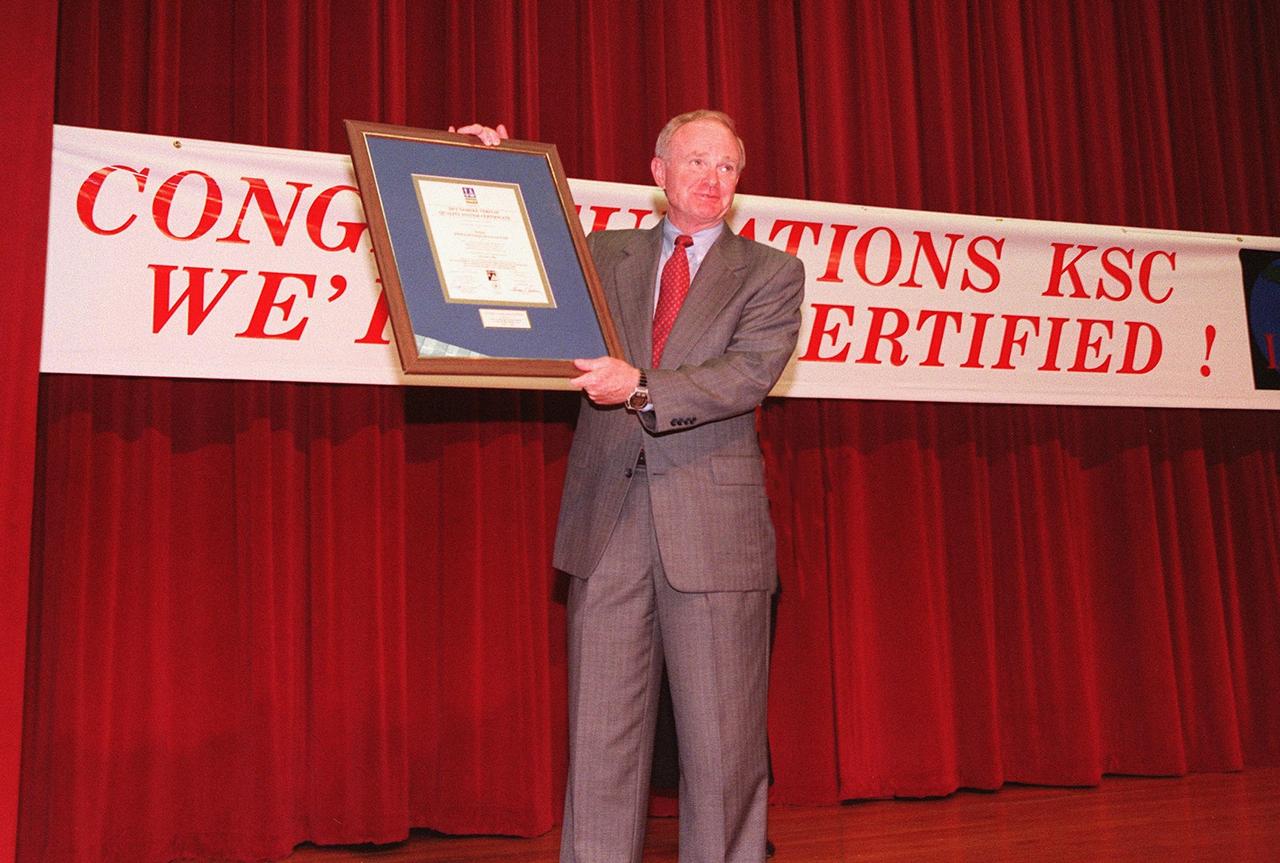
Center Director Roy Bridges displays the ISO 9001 certificate he was awarded by Det Norske Veritas (DNV), Inc., an international ISO certification organization, at a ceremony at KSC. Dalton Lyon of DNV made the presentation, which included a 2000th ISO Certificate Plaque. ISO 9001 comprises the most detailed, comprehensive set of standard requirements for quality programs established by the International Standards Organization. The presentation followed a successful independent audit by DNV of the KSC Management System in May of this year. The third-party auditors examined about 20 elements of KSC's system, including management responsibility, design control, documentation, test and inspection, and corrective action procedures. DNV found that KSC met or exceeded the stringent quality standards in all areas. KSC will use this certification as a tool to improve an already world-class team. All NASA centers are required by NASA Administrator Daniel S. Goldin to be ISO 9001 registered by September 1999. NASA is the first federal agency to seek the quality certification
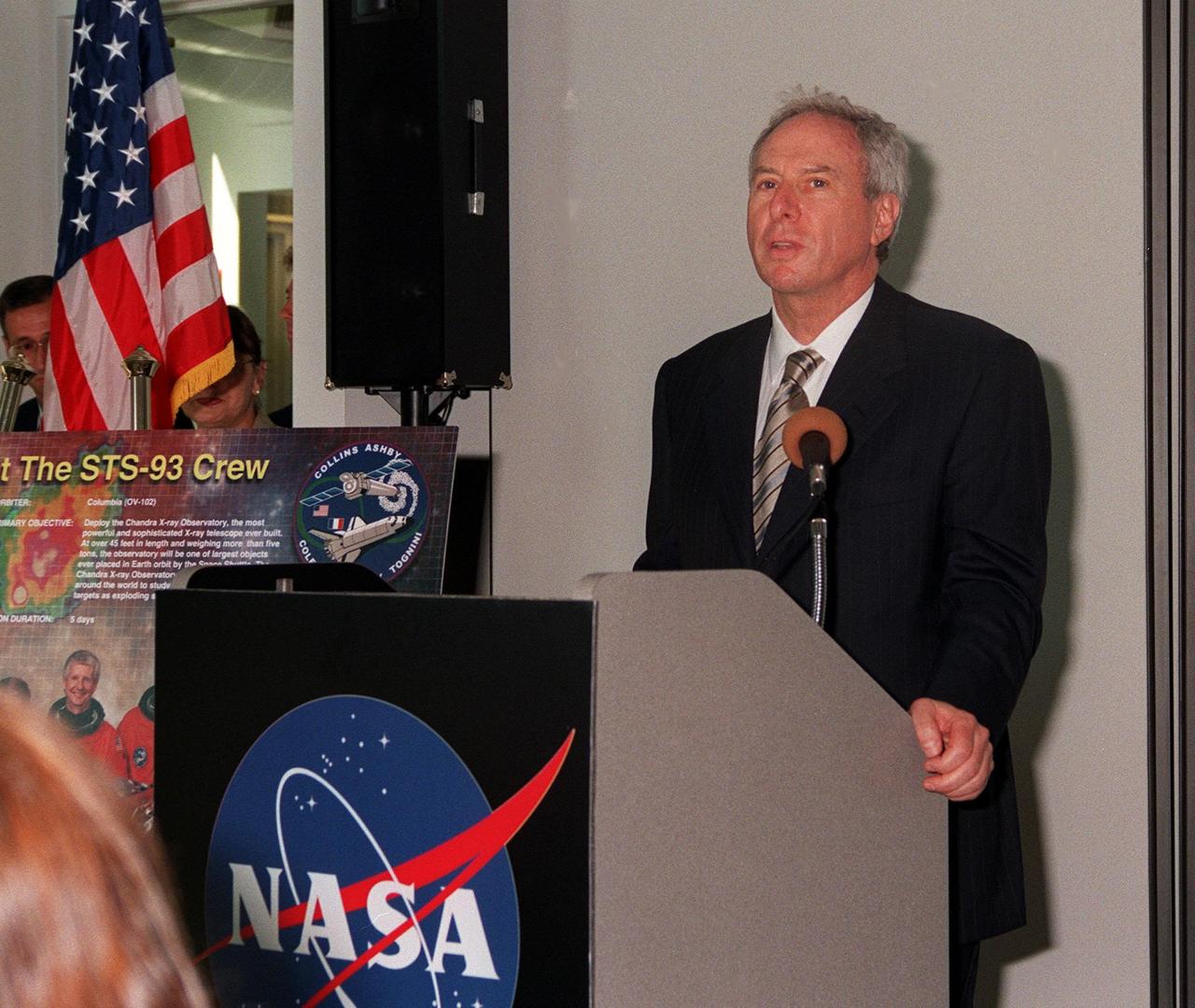
KENNEDY SPACE CENTER, FLA. -- NASA Administrator Daniel Goldin addresses the attendees of a women's forum held in the Apollo/Saturn V Center. Participants in a panel discussion, "Past, Present and Future of Space," include former astronaut Sally Ride; Marta Bohn-Meyer, the first SR-71 female pilot; Kathryn Sullivan, Ph.D., the first American woman to walk in space; Donna Shirley, Ph.D., the first woman leading the Mars Exploration Program; astronaut Yvonne Cagle; Jennifer Harris, flight director, Mars Pathfinder; astronaut Ellen Ochoa, the first Hispanic female in space and member of the President's commission on the Celebration of Women in American History. The forum included a welcome by Center Director Roy Bridges and remarks by Donna Shalala, secretary of Department of Health and Human Services. The attendees are planning to view the launch of STS-93 at the Banana Creek viewing sight. Much attention has been generated over the launch due to Commander Eileen M. Collins, the first woman to serve as commander of a Shuttle mission. The primary payload of the five-day mission is the Chandra X-ray Observatory, which will allow scientists from around the world to study some of the most distant, powerful and dynamic objects in the universe. Liftoff is scheduled for July 20 at 12:36 a.m. EDT
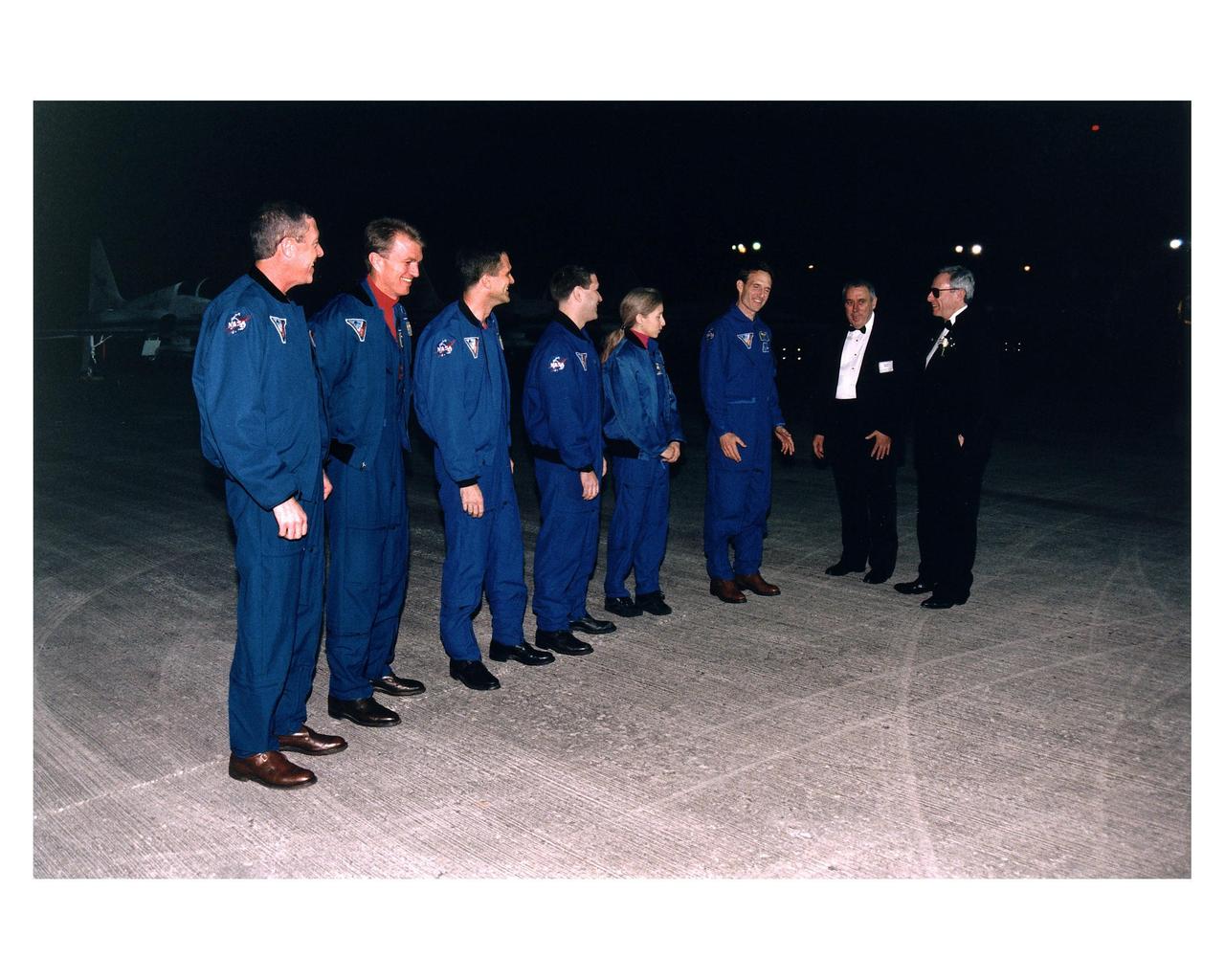
The STS-81 flight crew is welcomed to KSC by NASA Administrator Daniel Goldin (far right) and Johnson Space Center Director George Abbey (second from right) as they arrive at the space center for the final countdown preparations for the fifth Shuttle-Mir docking mission. They are (from left): Mission Commander Michael A. Baker; Pilot Brent W. Jett, Jr.; and Mission Specialists Peter J. K. "Jeff" Wisoff; John M. Grunsfeld, Marsha S. Ivins, and J.M. "Jerry" Linenger. The 10-day mission will feature the transfer of Linenger to Mir to replace astronaut John Blaha, who has been on the orbital laboratory since Sept. 19, 1996 after arrival there during the STS-79 mission. During STS-81, Shuttle and Mir crews will conduct risk mitigation, human life science, microgravity and materials processing experiments that will provide data for the design, development and operation of the International Space Station. The primary payload is the SPACEHAB-DM double module which will provide space for more than 2,000 pounds of hardware, food and water that will be transferred into the Russian space station during five days of docking operations. The SPACEHAB will also be used to return experiment samples from the Mir to Earth for analysis and for microgravity experiments during the mission
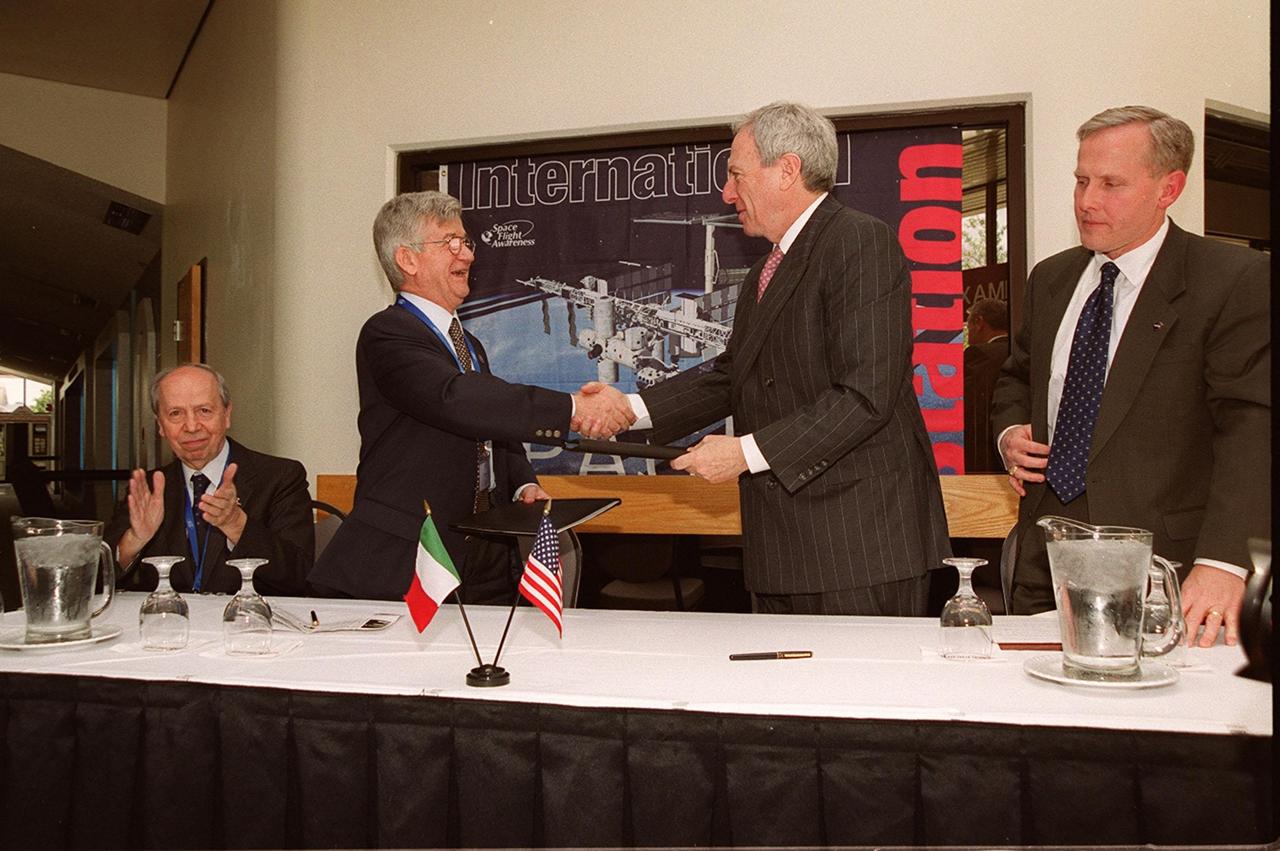
After signing a Framework for Cooperation to build the Habitation Module for the International Space Station, Italian Space Agency President Sergio DeJulio (standing, left) shakes hands with NASA Administrator Daniel S. Goldin (right). Also at the signing are The Honorable Lamberto Dini, Minister of Foreign Affairs, Republic of Italy (far left) and John Schumacher, assistant administrator, NASA External Relations. The Framework is a potential bilateral cooperative agreement that could result in ASI development of a U.S. Habitation Module for the International Space Station. This agreement allows the U.S. to explore an alternative approach to achieve full crew habitation for the ISS. A Memorandum of Understanding (MOU) between NASA and ASI will be required to formally document NASA and ASI’s respective responsibilities in a legally binding document. The Framework signed today would form the basis for a potential MOU which NASA and ASI would sign after completion of the program assessment and subsequent negotiations.The ceremony took place at the IMAX Theater, Kennedy Space Center Visitor Complex
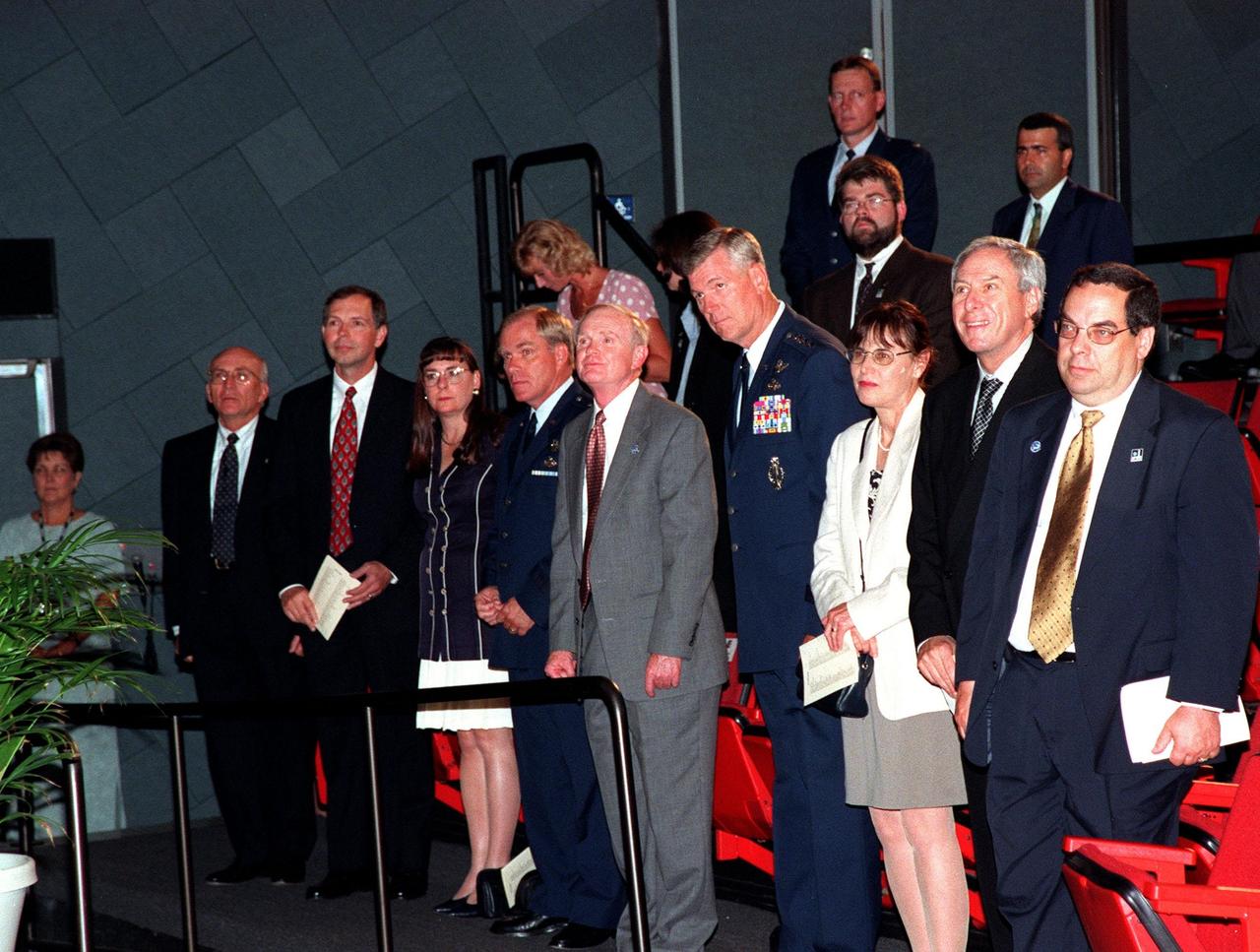
At a special presentation in the IMAX 2 Theater in the Kennedy Space Center Visitor Complex, the Hammer Award is presented to Kennedy Space Center and the 45th Space Wing. Among the attendees in the audience are (center) Center Director Roy D. Bridges Jr., flanked by (at left) Commander of the 45th Space Wing Brig. Gen. F. Randall Starbuck and (at right) Commander of the Air Force Space Command General Richard B. Myers. Standing second from right is NASA Administrator Daniel S. Goldin. At the far right is Morley Winograd, director of the National Partnership for Reinventing Government, who presented the award. The Hammer Award is Vice President Al Gore's special recognition of teams of federal employees who have made significant contributions in support of the principles of the National Partnership for Reinventing Government. This Hammer Award acknowledges the accomplishments of a joint NASA and Air Force team that established the Joint Base Operations and Support Contract (J-BOSC) Source Evaluation Board (SEB). Ed Gormel and Chris Fairey, co-chairs of the SEB, accepted the awards for the SEB. The team developed and implemented the acquisition strategy for establishing a single set of base operations and support service requirements for KSC, Cape Canaveral Air Station and Patrick Air Force Base
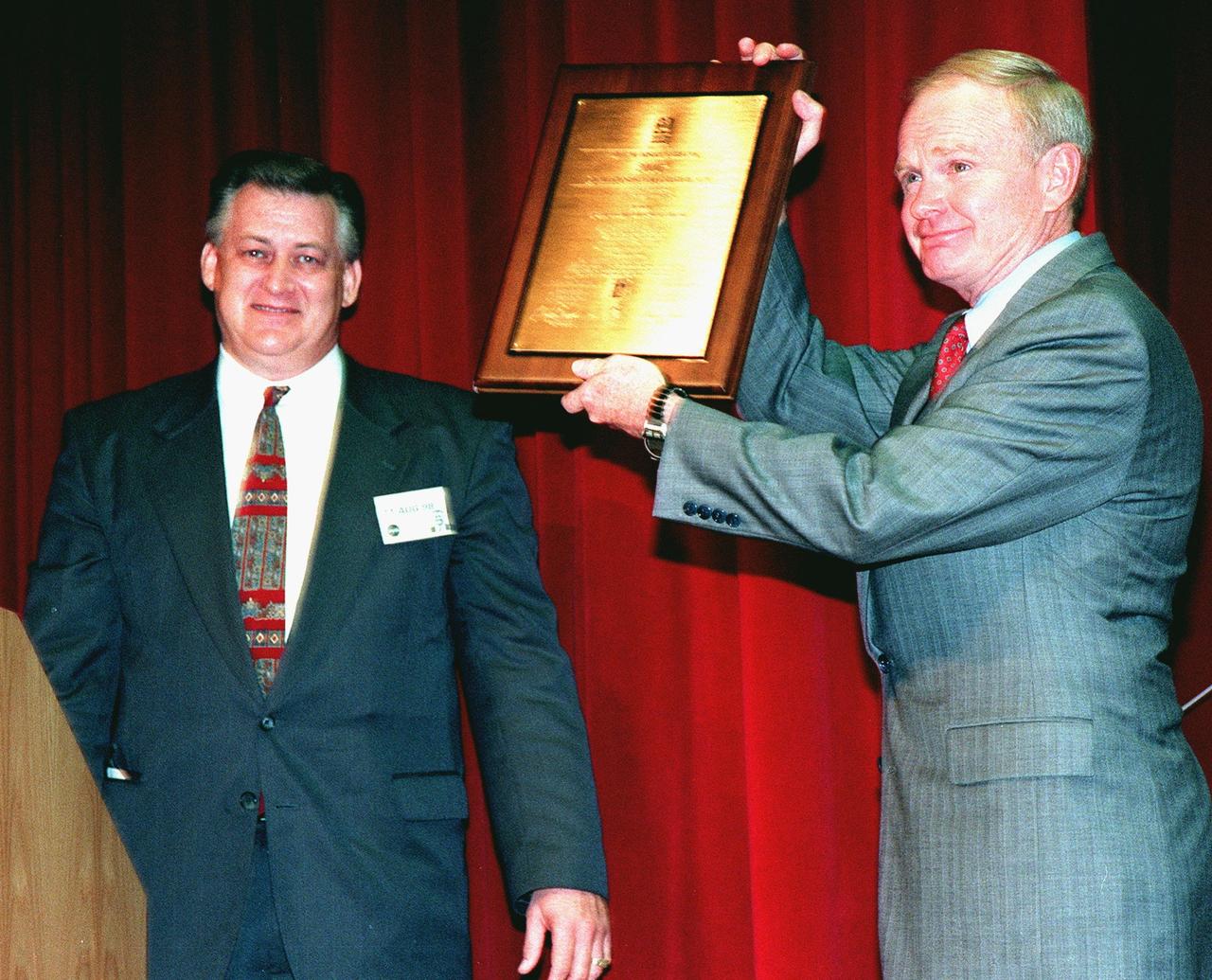
Center Director Roy Bridges (right) displays the 2000th ISO Certificate Plaque he was given by Dalton Lyon (left) of Det Norske Veritas (DNV), Inc., an international ISO certification organization, at a ceremony at KSC. The plaque is a representation of the ISO 9001 certification awarded to KSC by DNV. ISO 9001 comprises the most detailed, comprehensive set of standard requirements for quality programs established by the International Standards Organization. The presentation followed a successful independent audit by DNV of the KSC Management System in May of this year. The third-party auditors examined about 20 elements of KSC's system, including management responsibility, design control, documentation, test and inspection, and corrective action procedures. DNV found that KSC met or exceeded the stringent quality standards in all areas. KSC will use this certification as a tool to improve an already worldclass team. All NASA centers are required by NASA Administrator Daniel S. Goldin to be ISO 9001 registered by September 1999. NASA is the first federal agency to seek the quality certification
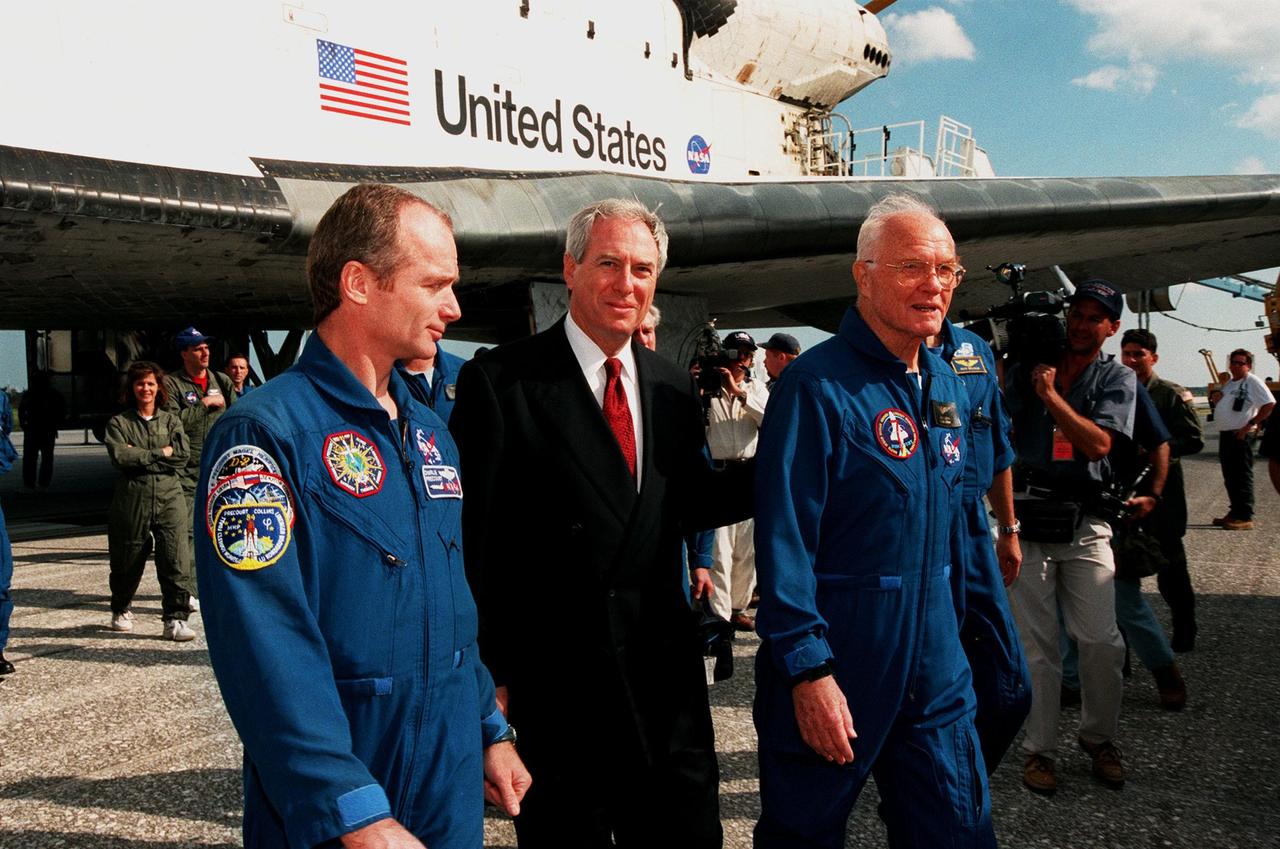
Charles Precourt, chief of the Astronaut office in Houston, and Daniel Goldin, NASA administrator, welcome back to Earth Senator John H. Glenn Jr., from a successful mission STS-95 aboard orbiter Discovery. Glenn served as payload specialist, one of a crew of seven that included Mission Commander Curtis L. Brown Jr.; Pilot Steven W. Lindsey; Mission Specialists Stephen K. Robinson, Scott E. Parazynski and Pedro Duque of Spain, with the European Space Agency; and Payload Specialist Chiaki Mukai, M.D., with the National Space Development Agency of Japan (NASDA). They landed at the Shuttle Landing Facility at 12:04 p.m. EST, after 9 days in space, traveling 3.6 million miles. The mission included research payloads such as the Spartan solar-observing deployable spacecraft, the Hubble Space Telescope Orbital Systems Test Platform, the International Extreme Ultraviolet Hitchhiker, as well as the SPACEHAB single module with experiments on space flight and the aging process
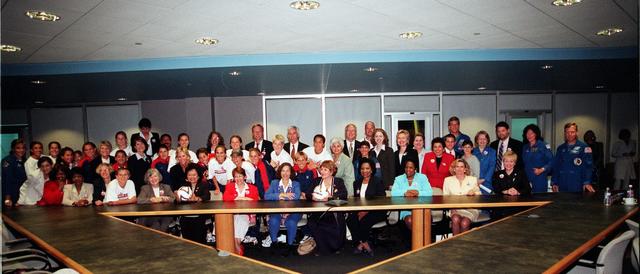
KENNEDY SPACE CENTER, FLA. -- The group waiting in the Apollo/Saturn V Center for the launch of STS-93 pose for a photo. Among the spectators gathered are First Lady Hillary Rodham Clinton and her daughter, Chelsea, NASA Administrator Daniel Goldin, astronauts, and attendees of a Women in Space forum, including Donna Shalala, secretary , Department of Health and Human Services. Much attention has been generated over the launch due to Commander Eileen M. Collins, the first woman to serve as commander of a Shuttle mission. The primary payload of the five-day mission is the Chandra X-ray Observatory, which will allow scientists from around the world to study some of the most distant, powerful and dynamic objects in the universe. The new telescope is 20 to 50 times more sensitive than any previous X-ray telescope and is expected to unlock the secrets of supernovae, quasars and black holes. Liftoff of Space Shuttle Columbia is scheduled for 12:36 a.m. EDT July 20
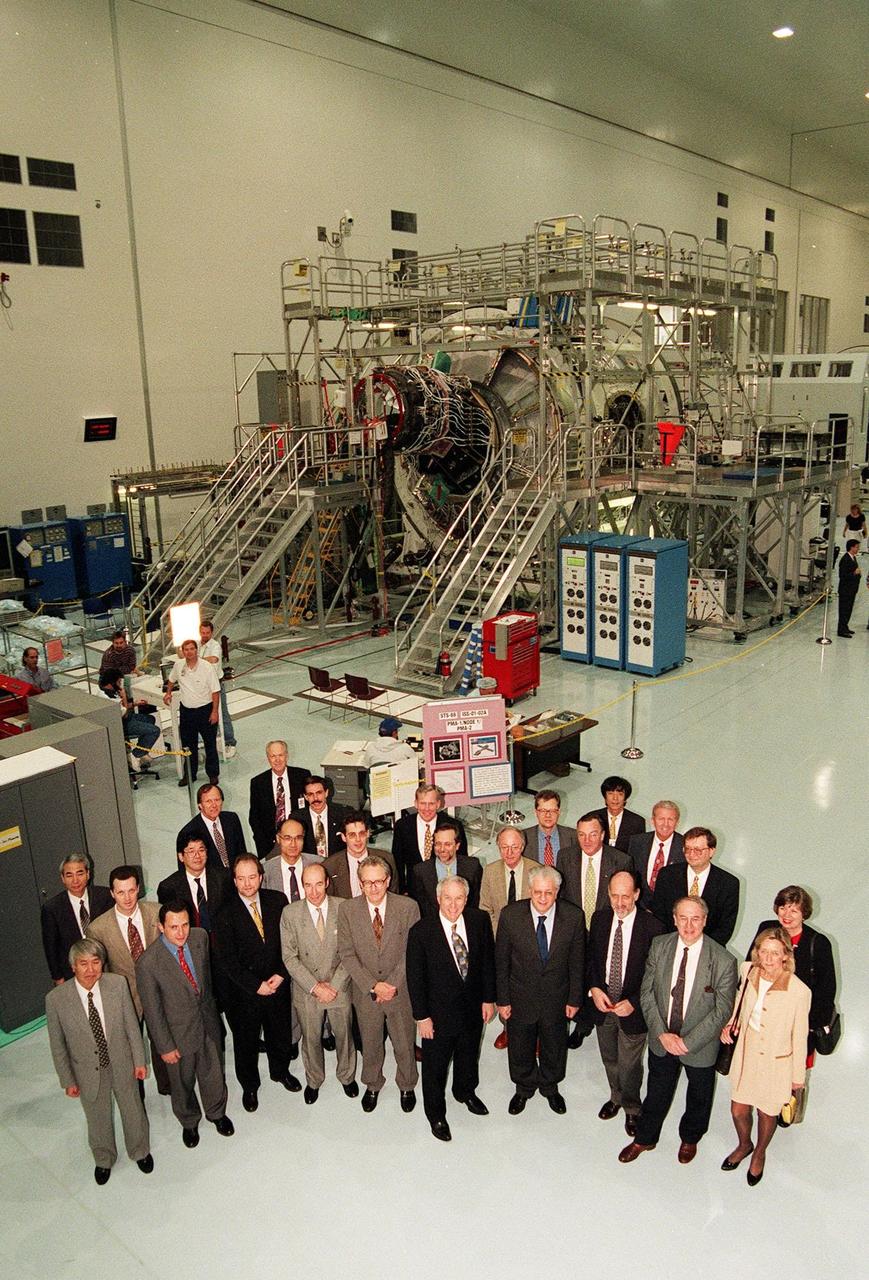
CAPE CANAVERAL, Fla. -- In the International Space Station Processing Facility at NASA's Kennedy Space Center in Florida, senior government officials from 15 countries participating in the space station program signed agreements in Washington D.C. on Jan. 29 to establish the framework of cooperation among the partners on the design, development, operation and utilization of the space station. Acting Secretary of State Strobe Talbott signed the 1998 Intergovernmental Agreement on Space Station Cooperation with representatives of Russia, Japan, Canada, and participating countries of the European Space Agency ESA -- Belgium, Denmark, France, Germany, Italy, the Netherlands, Norway, Spain, Sweden, Switzerland, and the United Kingdom. Some of these officials then toured Kennedy's Space Station Processing Facility SSPF with NASA Administrator Daniel Goldin, at front, sixth from the left. They are, left to right, front to back: Hidetoshi Murayama, National Space Development Agency of Japan NASDA Louis Laurent, Embassy of France Haakon Blankenborg, Norwegian Parliament Standing Committee on Foreign Affairs His Excellency Joris Vos, ambassador of the Netherlands His Excellency Tom Vraalsen, ambassador of Norway Goldin Luigi Berlinguer, Italian minister for education, scientific, and technological research Antonio Rodota, director general, ESA Yvan Ylieff, Belgian minister of science and chairman of the ESA Ministerial Council Jacqueline Ylieff Masaaki Komatsu, Kennedy local NASDA representative and interpreter Serge Ivanets, space attache, Embassy of Russia Hiroshi Fujita, Science and Technology Agency of Japan Akira Mizutani, Japanese Ministry of Foreign Affairs Peter Grognard, science attache', Royal Embassy of Belgium Michelangelo Pipan, Italian diplomatic counselor to the minister His Excellency Gerhard Fulda, German Federal Foreign Office Jorg Feustel-Buechl, ESA director of manned space flight and microgravity A. Yakovenko, Russian Ministry of Foreign Affairs JoAnn Morgan, Kennedy associate director for Advanced Development and Shuttle Upgrades Steve Francois, director, International Space Station and Shuttle Processing Roy Tharpe, Boeing launch site manager Jon Cowart, ISS elements manager John Schumacher, NASA associate administrator for external relations Didier Kechemair, space advistor to the French minister for education, research, and technology Yoshinori Yoshimura, NASDA and Loren Shriver, Kennedy deputy director for launch and payload processing. Node 1 of the ISS is in the background. Photo Credit: NASA