
Daphnis Waves
Waves from Daphnis
NASA Cassini spacecraft captures here one of its closest views of Saturn ring-embedded moon Daphnis. Seen at the upper left of this image, Daphnis appears in the Keeler Gap near the edge waves it has created in the A ring.
Daphnis cruises through the Keeler Gap, raising edge waves in the ring material as it passes
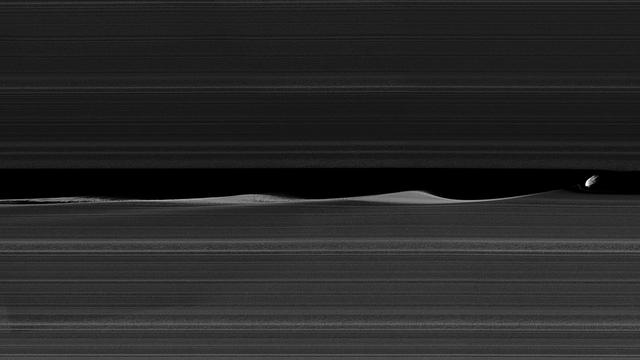
Daphnis, one of Saturn's ring-embedded moons, is featured in this view, kicking up waves as it orbits within the Keeler gap. The mosaic combines several images to show more waves in the gap edges. Daphnis is a small moon at 5 miles (8 kilometers) across, but its gravity is powerful enough to disrupt the tiny particles of the A ring that form the Keeler gap's edge. As the moon moves through the Keeler gap, wave-like features are created in both the horizontal and vertical plane. Images like this provide scientists with a close-up view of the complicated interactions between a moon and the rings, as well as the interactions between the ring particles themselves, in the wake of the moon's passage. Three wave crests of diminishing sizes trail Daphnis here. In each subsequent crest, the shape of the wave evolves, as the ring particles within the crests collide with one another. Close examination of Daphnis' immediate vicinity also reveals a faint, thin strand of ring material that almost appears to have been directly ripped out of the A ring by Daphnis. The images in this mosaic were taken in visible light, using the Cassini spacecraft narrow-angle camera at a distance of approximately 17,000 miles (28,000 kilometers) from Daphnis and at a Sun-Daphnis-spacecraft, or phase, angle of 71 degrees. Image scale is 551 feet (168 meters) per pixel. http://photojournal.jpl.nasa.gov/catalog/PIA17212
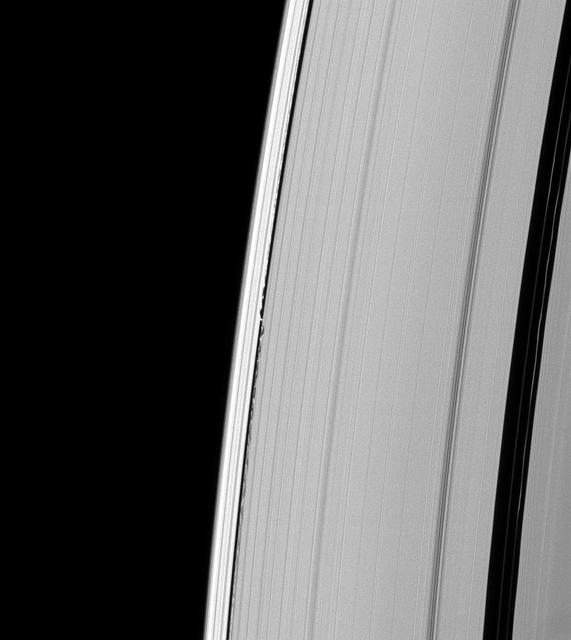
This image, which at first appears to show a serene scene, in fact reveals dramatic disturbances created in Saturn A ring by its moon Daphnis as seen by NASA Cassini spacecraft.
Daphnis At Work
Daphnis and Pan
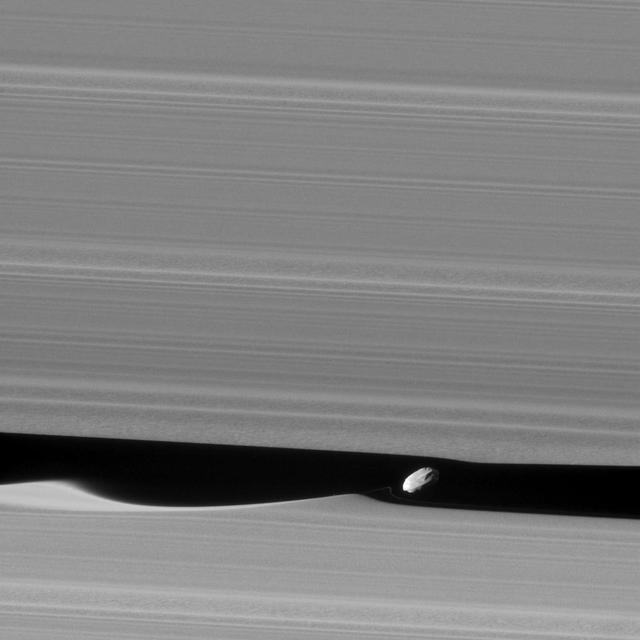
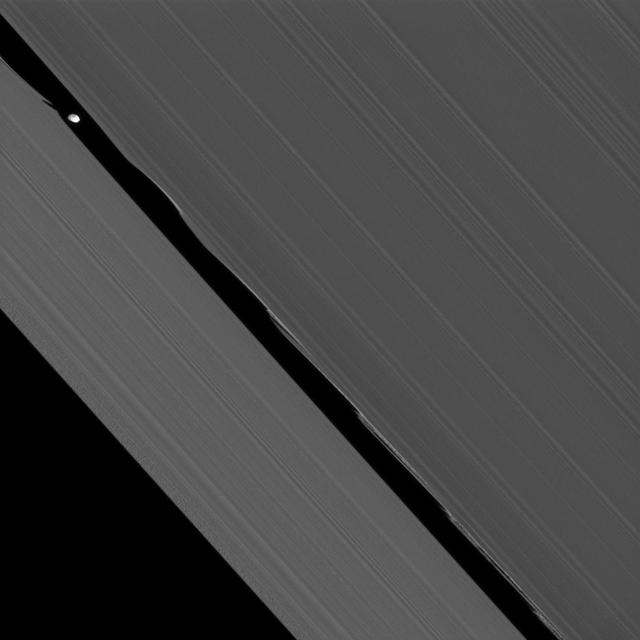
The wavemaker moon, Daphnis, is featured in this view, taken as NASA's Cassini spacecraft made one of its ring-grazing passes over the outer edges of Saturn's rings on Jan. 16, 2017. This is the closest view of the small moon obtained yet. Daphnis (5 miles or 8 kilometers across) orbits within the 42-kilometer (26-mile) wide Keeler Gap. Cassini's viewing angle causes the gap to appear narrower than it actually is, due to foreshortening. The little moon's gravity raises waves in the edges of the gap in both the horizontal and vertical directions. Cassini was able to observe the vertical structures in 2009, around the time of Saturn's equinox (see PIA11654). Like a couple of Saturn's other small ring moons, Atlas and Pan, Daphnis appears to have a narrow ridge around its equator and a fairly smooth mantle of material on its surface -- likely an accumulation of fine particles from the rings. A few craters are obvious at this resolution. An additional ridge can be seen further north that runs parallel to the equatorial band. Fine details in the rings are also on display in this image. In particular, a grainy texture is seen in several wide lanes which hints at structures where particles are clumping together. In comparison to the otherwise sharp edges of the Keeler Gap, the wave peak in the gap edge at left has a softened appearance. This is possibly due to the movement of fine ring particles being spread out into the gap following Daphnis' last close approach to that edge on a previous orbit. A faint, narrow tendril of ring material follows just behind Daphnis (to its left). This may have resulted from a moment when Daphnis drew a packet of material out of the ring, and now that packet is spreading itself out. The image was taken in visible (green) light with the Cassini spacecraft narrow-angle camera. The view was acquired at a distance of approximately 17,000 miles (28,000 kilometers) from Daphnis and at a Sun-Daphnis-spacecraft, or phase, angle of 71 degrees. Image scale is 551 feet (168 meters) per pixel. http://photojournal.jpl.nasa.gov/catalog/PIA21056
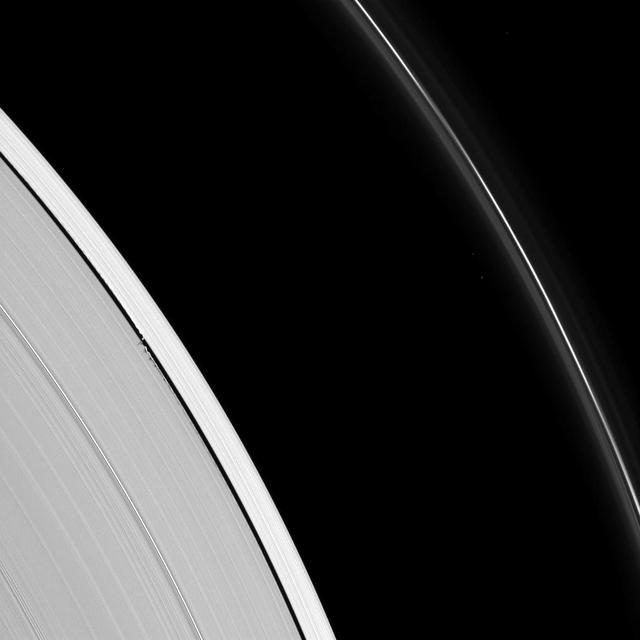
Tiny Daphnis appears as a bright dot in the Keeler Gap next to shadows cast by the moon and the edge waves it has created in the A ring in this image taken by NASA Cassini spacecraft before Saturn August 2009 equinox.
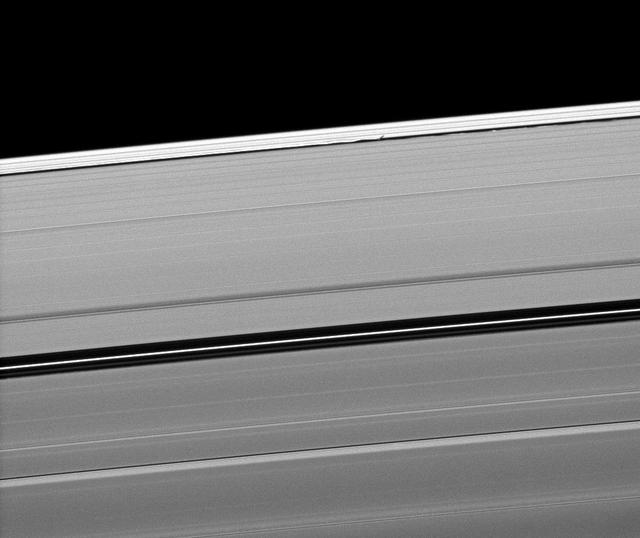
Saturn moon Daphnis casts a short shadow on the A ring in this image taken by NASA Cassini spacecraftabout six months after the planet August 2009 equinox. Daphnis appears as a tiny bright dot in the Keeler Gap of the A ring near the center top.
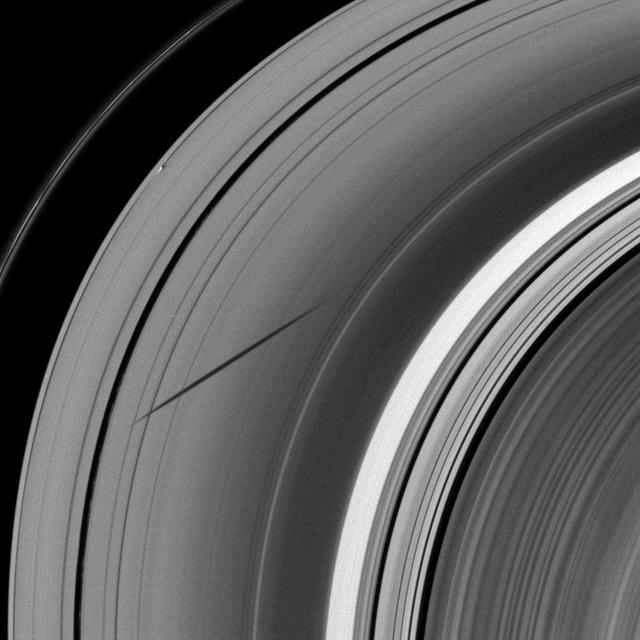
The shadow of the moon Janus dwarfs the shadow of Daphnis on Saturn A ring in this image taken as the planet approached its August 2009 equinox.
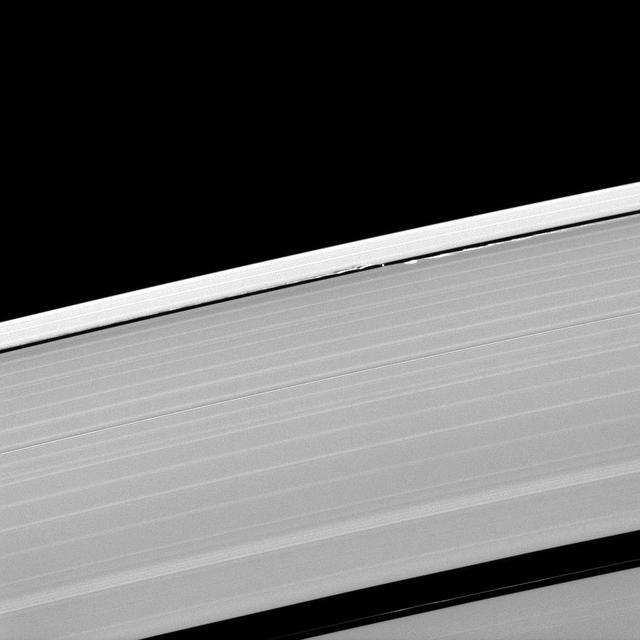
A scalloped look is created in the edges of the Keeler Gap in Saturn outer A ring as the moon Daphnis orbits in the gap.
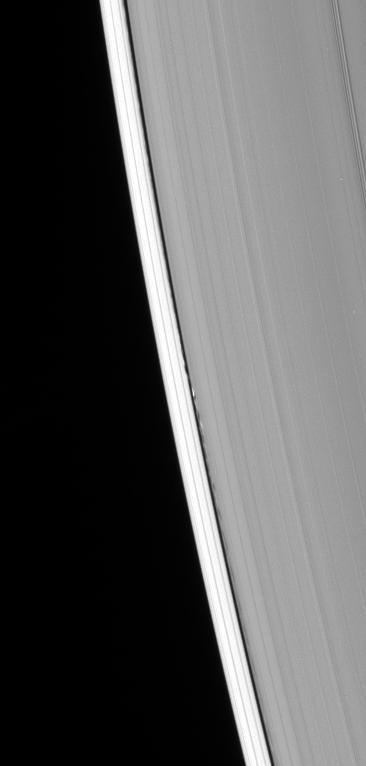
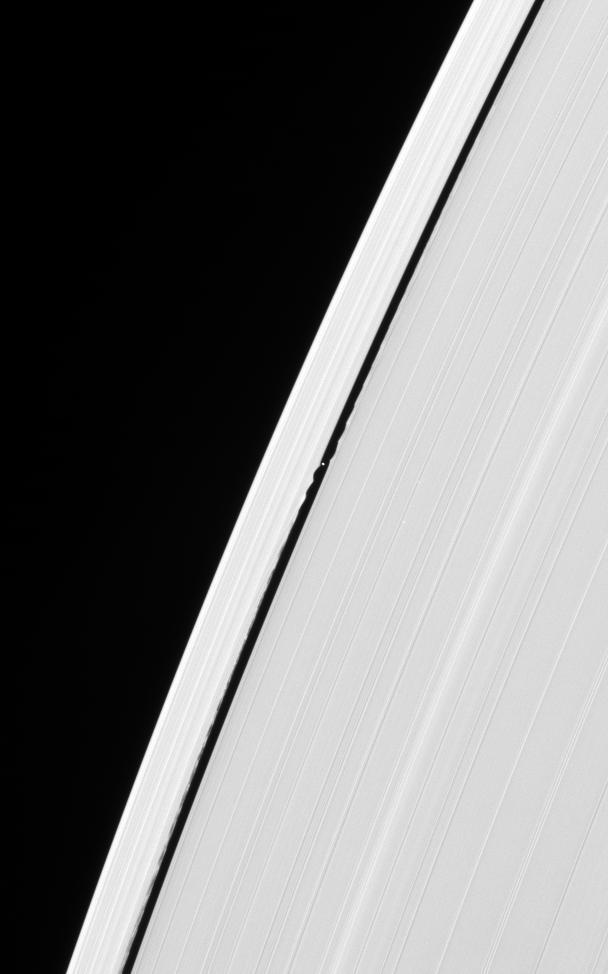
The presence of the tiny ring moon Daphnis is betrayed by the edge waves it creates in the Keeler gap
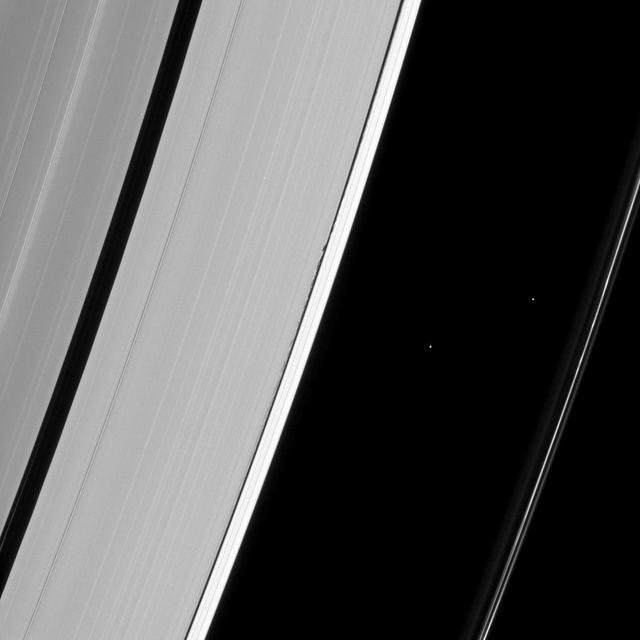
The tiny wavemaker moon Daphnis is dwarfed by the very waves it creates on the edge of the Keeler gap as seen by NASA Cassini spacecraft.
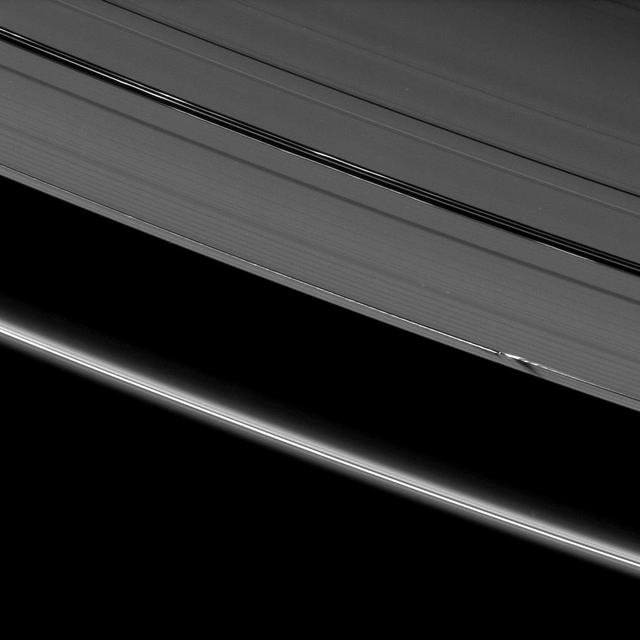
Vertical ring structures created by the moon Daphnis cast dark shadows on Saturn A ring in this image taken as the planet approached its August 2009 equinox.
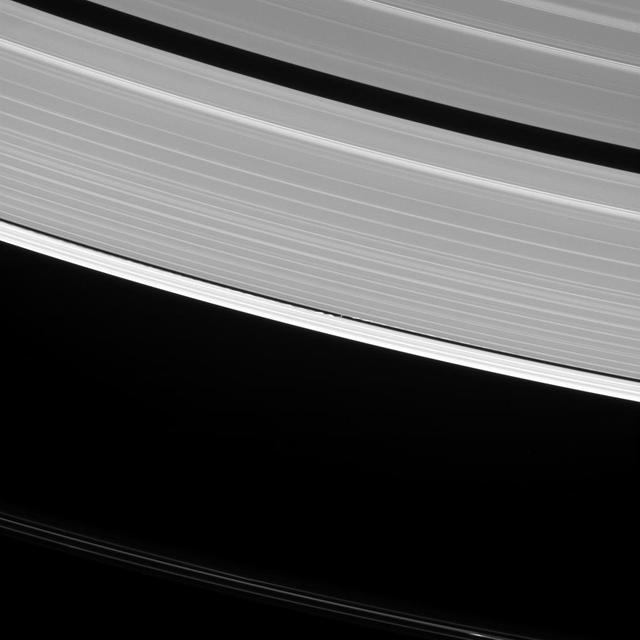
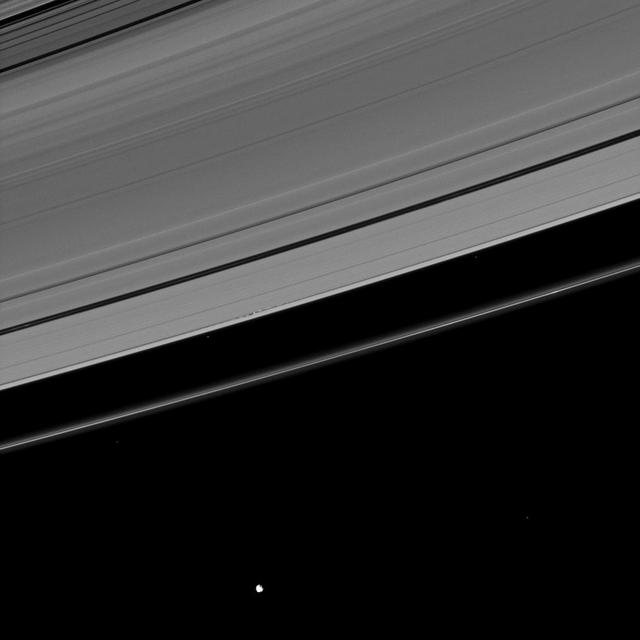
Saturn's moon Daphnis raises waves wherever it goes. In fact, such waves are one way that scientists search for undiscovered moons in the ring gaps. But they can tell researchers a lot of other things, as well. The waves that Daphnis (5 miles or 8 kilometers across) raises on the edges of the Keeler Gap can also be used to deduce the moon's mass and even some of its orbital behavior. Since the moon moves in and out of the ring-plane, and closer to and farther from the rings' edges as it orbits, the waves it makes change over time. Cassini has been observing these changes during its extended study of the Saturn system to help understand this interaction. This view looks toward the sunlit side of the rings from about 35 degrees above the ring plane. The image was taken in visible light with the Cassini spacecraft narrow-angle camera on Oct. 10, 2016. Daphnis has been brightened by a factor of two in this image to increase its visibility. The view was obtained at a distance of approximately 810,000 miles (1.3 million kilometers) from Daphnis and at a Sun-Daphnis-spacecraft, or phase, angle of 96 degrees. Image scale is 5 miles (8 kilometers) per pixel. http://photojournal.jpl.nasa.gov/catalog/PIA20511
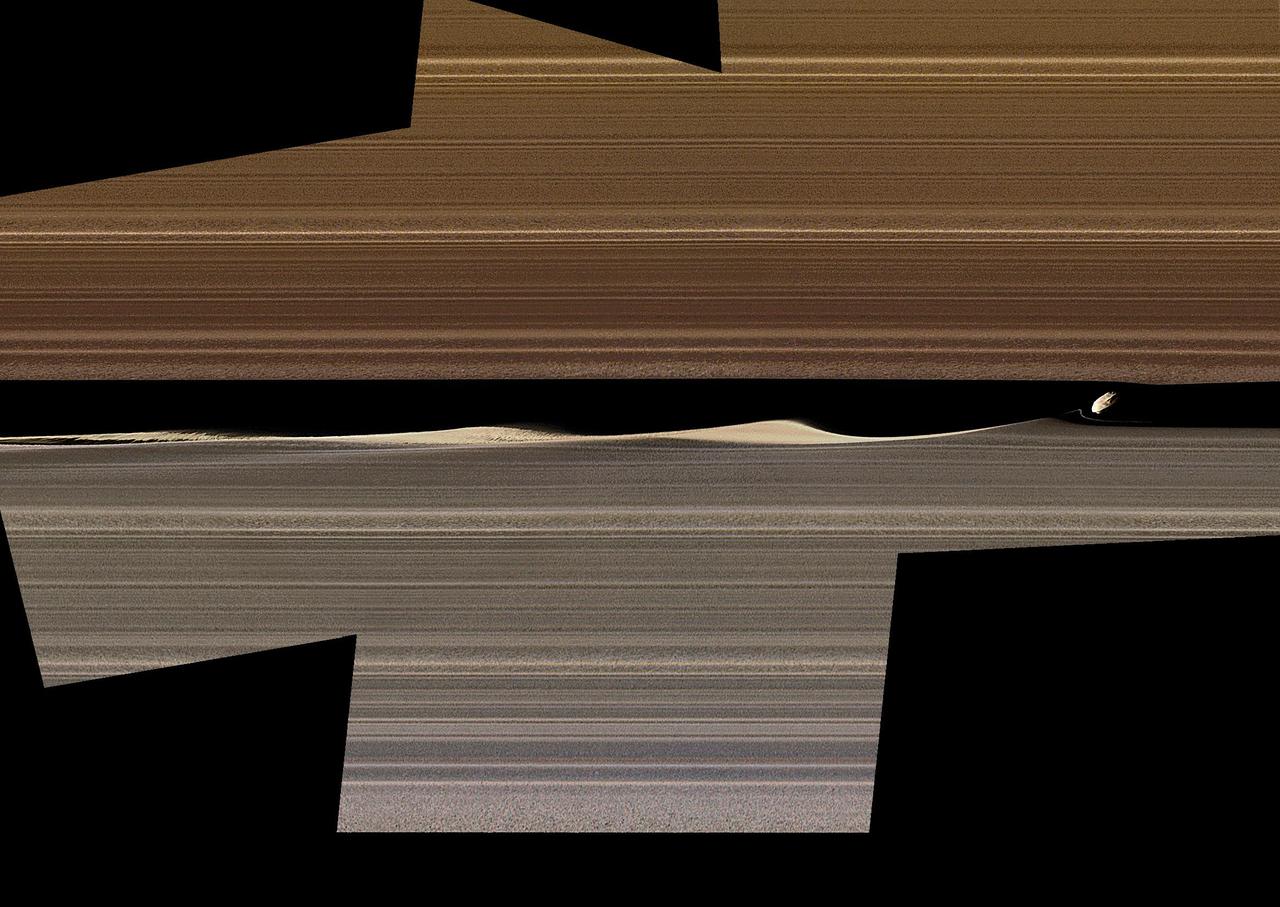
This enhanced-color image mosaic shows Daphnis, one of the moons embedded in Saturn's rings, in the Keeler gap on the sunlit side of the rings. Daphnis is seen kicking up three waves in the gap's outer edge. Three wave crests of diminishing sizes trail the moon. In each successive crest, the shape of the wave changes as the ring particles within the crest interact and collide with each other. A thin strand of ring material to the lower left of Daphnis is newly visible in this image, and there are intricate features that also hadn't been previously observed in the third wave crest downstream (see Figure 1). Cassini was at a very shallow angle above the rings (only about 15 degrees) when this image was taken. The resulting foreshortening makes it difficult to tell the difference in this image between features representing vertical structure and those representing radial, or outward from Saturn, structure within the ring plane. Nonetheless, Cassini imaging scientists have determined that the waves in the gap are largely vertical; compare this to the shadows that they were seen to cast during equinox (see PIA11547, PIA11653, PIA11655 and PIA11656). The thin strand of material is also probably vertical. Daphnis itself is actually five times smaller than the width of the gap, but it looks bigger here because of the foreshortening. The color in this image comes from using Imaging Science Subsystem images obtained by applying different filters to "paint" color onto the black-and-white version of this view previously released as PIA17212. The color of the ring region outward of the Keeler Gap (the "trans-Keeler region," in the lower portion of this image) is noticeably different from the color inward from the gap (upper portion of this image). In visible light, this color difference sharply coincides with the gap, while near-infrared Visible and Infrared Mapping Spectrometer (VIMS) images show some bleeding of the trans-Keeler region into the region inward from the gap. The reasons for the sharp change in color are mysterious, but they probably have more to do with a change in particle sizes and other properties than with a change in composition. The images in this mosaic were taken in visible light, using the Cassini spacecraft narrow-angle camera at a distance of approximately 17,000 miles (28,000 kilometers) from Daphnis and at a Sun-Daphnis-spacecraft angle, or phase angle, of 71 degrees (for the color images, 58 degrees). Image scale is 550 feet (170 meters) per pixel. The image was produced by Tilmann Denk at Freie Universität in Berlin. https://photojournal.jpl.nasa.gov/catalog/PIA23167
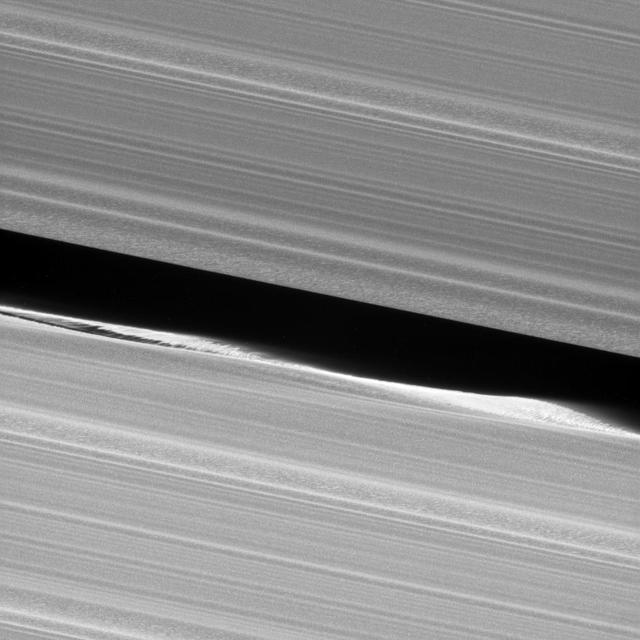
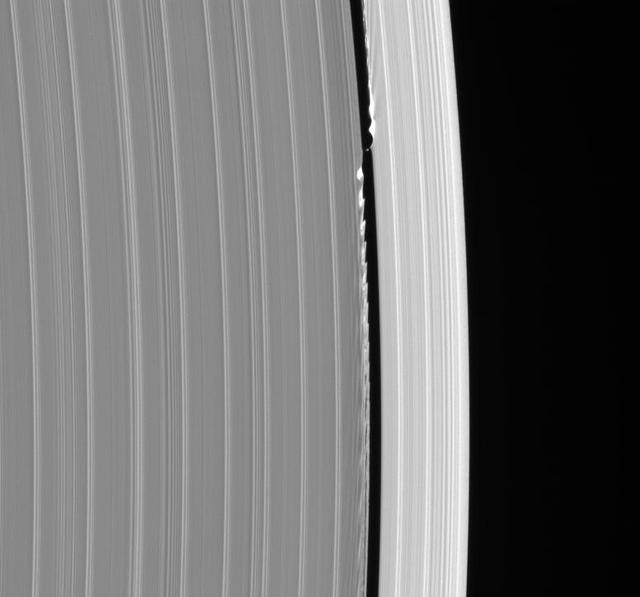
Before NASA's Cassini entered its Grand Finale orbits, it acquired unprecedented views of the outer edges of the main ring system. For example, this close-up view of the Keeler Gap, which is near the outer edge of Saturn's main rings, shows in great detail just how much the moon Daphnis affects the edges of the gap. Daphnis creates waves in the edges of the gap through its gravitational influence. Some clumping of ring particles can be seen in the perturbed edge, similar to what was seen on the edges of the Encke Gap back when Cassini arrived at Saturn in 2004. This view looks toward the sunlit side of the rings from about 3 degrees above the ring plane. The view was acquired at a distance of approximately 18,000 miles (30,000 kilometers) from Daphnis and at a Sun-Daphnis-spacecraft, or phase, angle of 69 degrees. Image scale is 581 feet (177 meters) per pixel. The image was taken in visible light with the Cassini spacecraft narrow-angle camera on Jan. 16, 2017. https://photojournal.jpl.nasa.gov/catalog/PIA21329
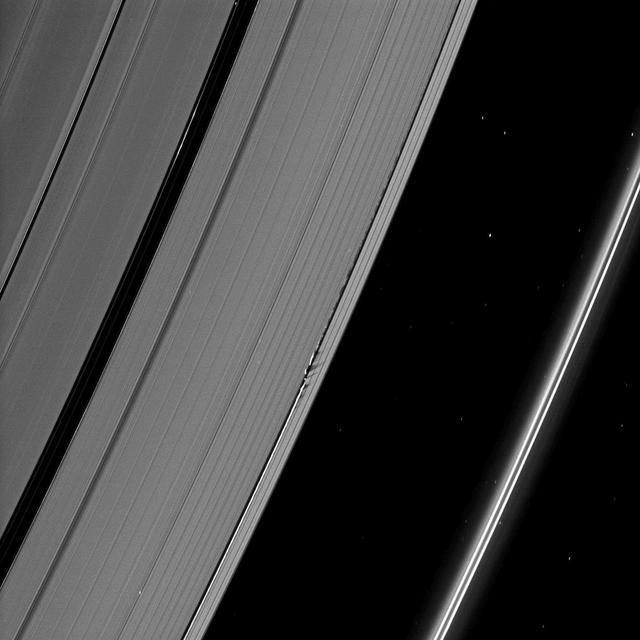
Shadows are cast by Daphnis and the moon attendant edge waves in this image from NASA Cassini spacecraft taken about a month and a half before the Saturn August 2009 equinox.
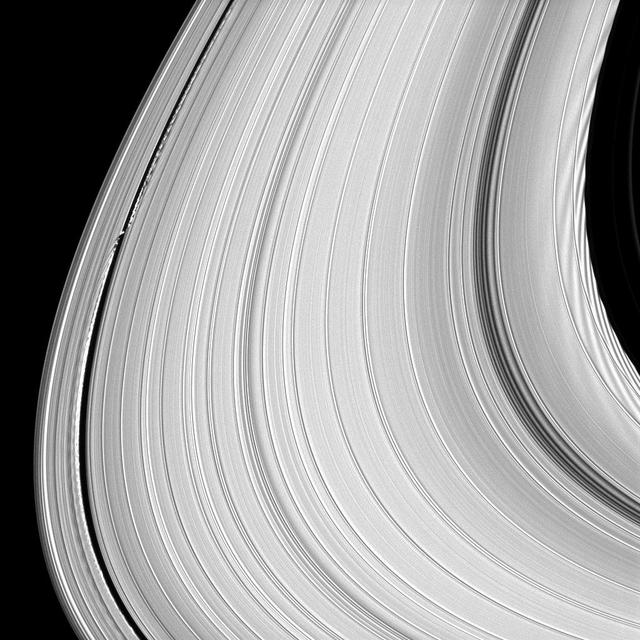
This image taken by NASA Cassini spacecraft shows that rather than being an unchanging disk of peaceful particles, the material that makes up Saturn rings is constantly pushed and pulled into spectacular shapes. At left is the moon Daphnis.
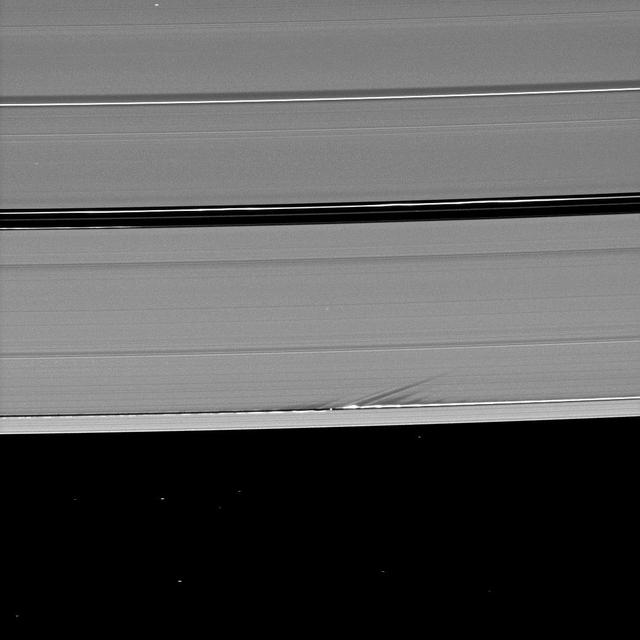
Long shadows stretch away from the towering edge waves created by the gravity of the moon Daphnis in this image taken by NASA Cassini spacecraft a little more than a week before Saturn August 2009 equinox.
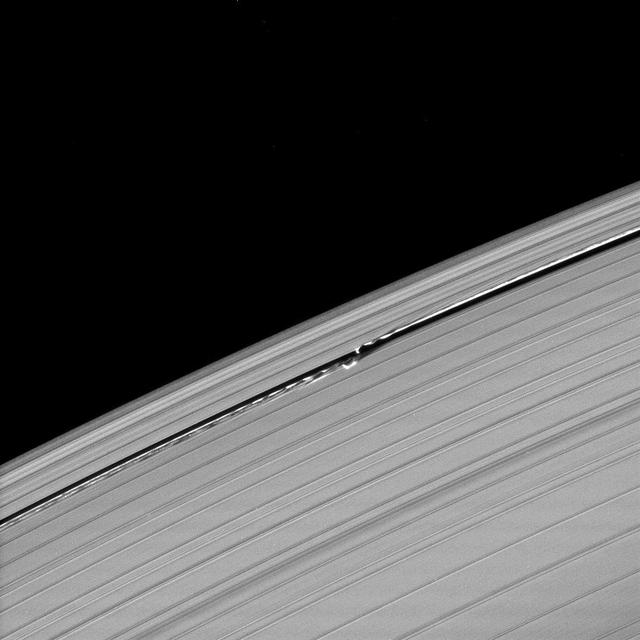
Waves in the edges of the Keeler gap in Saturn A ring, created by the embedded moon Daphnis, show considerable complexity in this image taken as Saturn approached its August 2009 equinox.
NASA Cassini spacecraft catches Saturn moon Daphnis making waves and casting shadows from the narrow Keeler Gap of the planet A ring in this view taken around the time of Saturn August 2009 equinox.
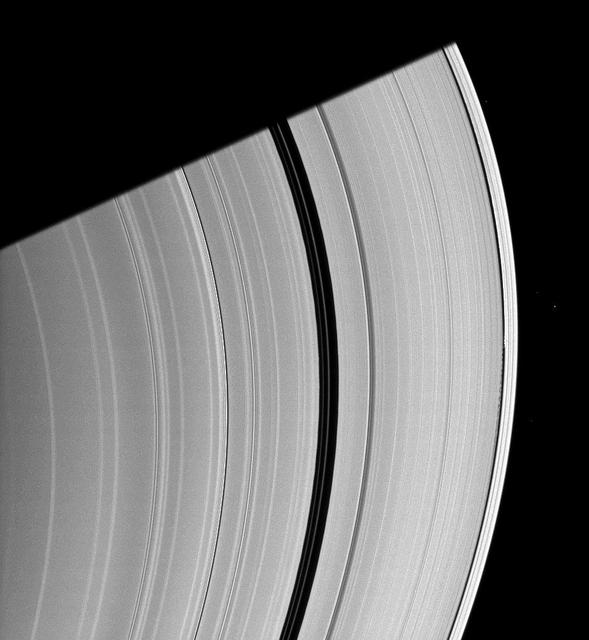
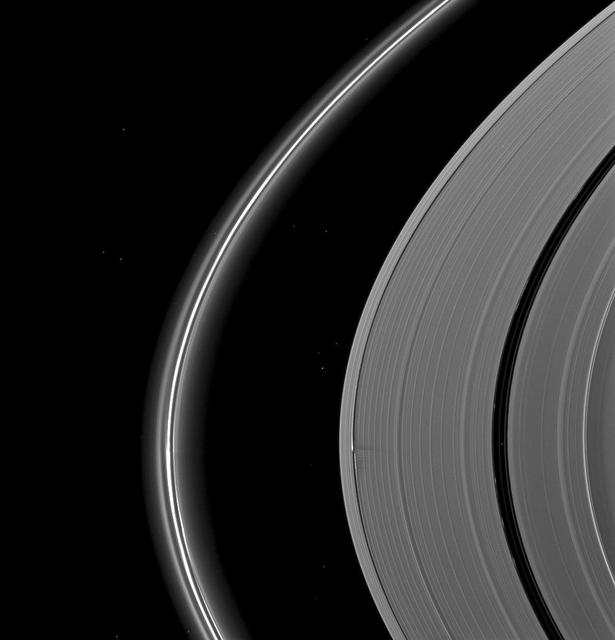
Saturn moon Daphnis, appearing as a tiny speck in the Keeler Gap of the A ring on the far right of this NASA Cassini spacecraft image, is almost lost among the moon attendant edge waves.
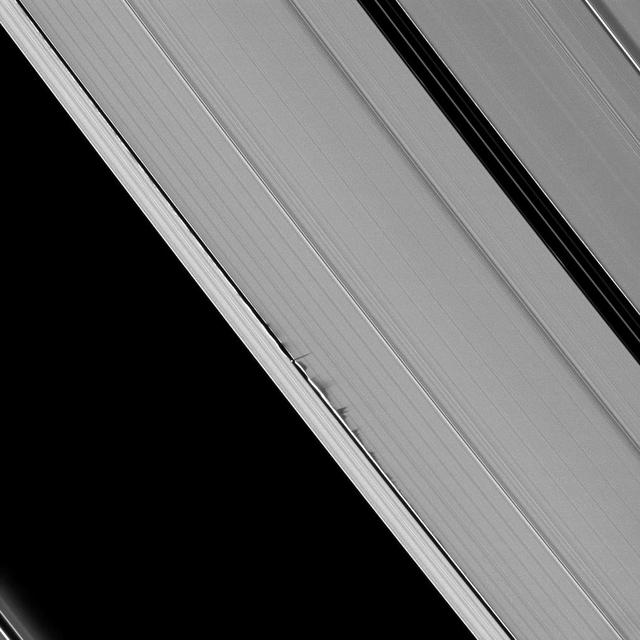
Jagged looking shadows stretch away from vertical structures of ring material created by the moon Daphnis in this image taken as Saturn approaches its August 2009 equinox.
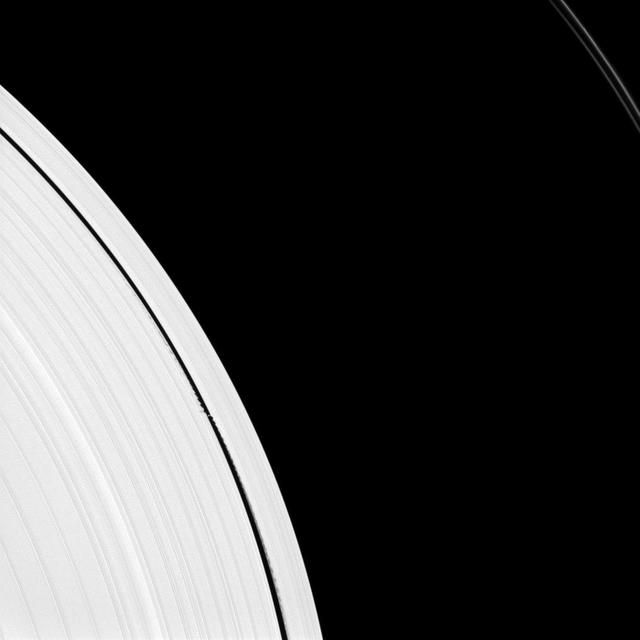
Saturn small moon Daphnis is caught in the act of raising waves on the edges of the Keeler gap, which is the thin dark band in the left half of the image. Waves like these allow scientists to locate small moons in gaps and measure their masses.
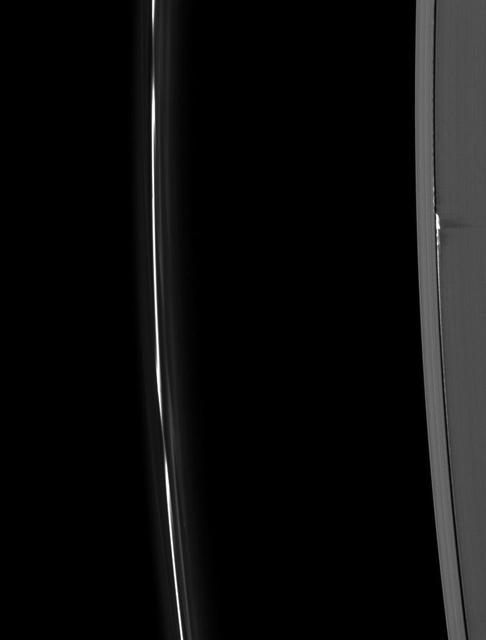
Ring material, pulled to spectacular heights above the ring plane by the gravity of the moon Daphnis, casts long shadows on Saturn’s A ring in this Cassini image taken about a month before the planet’s August 2009 equinox.
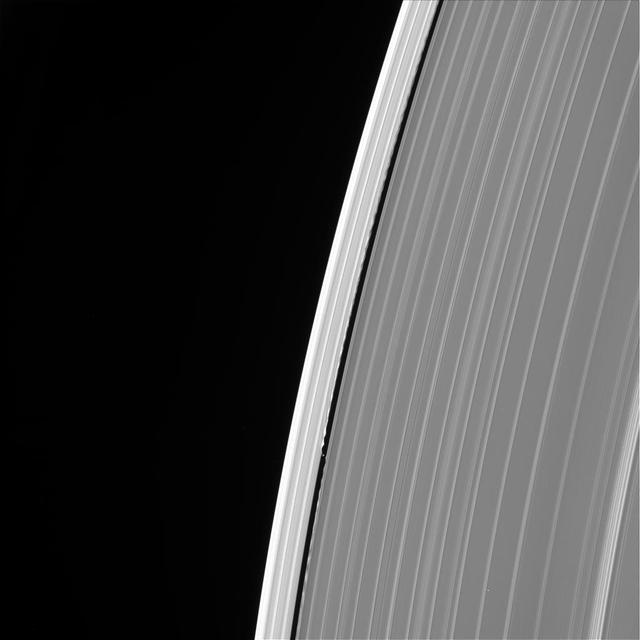
This image of Saturn's outer A ring features the small moon Daphnis and the waves it raises in the edges of the Keeler Gap. The image was taken by NASA's Cassini spacecraft on Sept. 13, 2017. It is among the last images Cassini sent back to Earth. The view was taken in visible light using the Cassini spacecraft wide-angle camera at a distance of 486,000 miles (782,000 kilometers) from Saturn. Image scale is 2.7 miles (4.3 kilometers). https://photojournal.jpl.nasa.gov/catalog/PIA21893
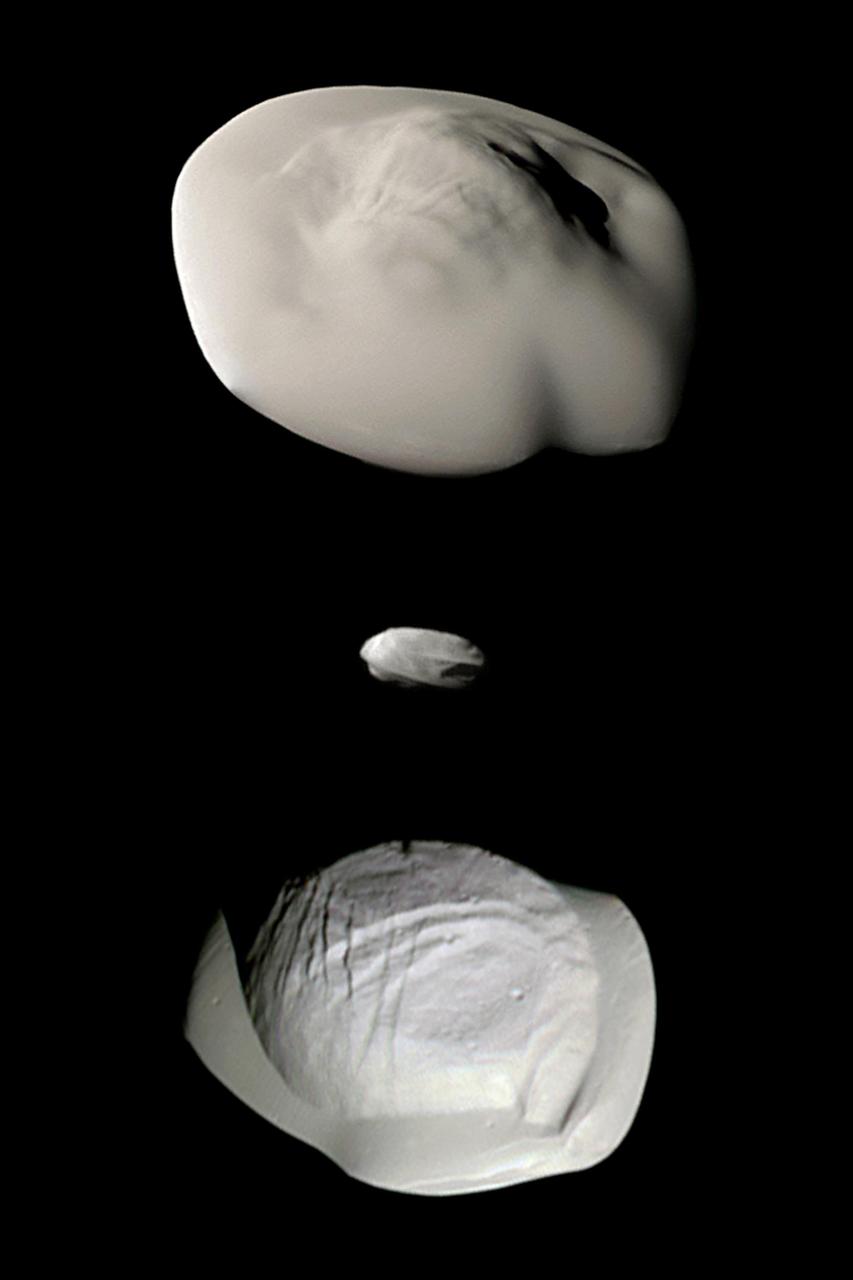
This montage of views from NASA's Cassini spacecraft shows three of Saturn's small ring moons: Atlas, Daphnis and Pan at the same scale for ease of comparison. Two differences between Atlas and Pan are obvious in this montage. Pan's equatorial band is much thinner and more sharply defined, and the central mass of Atlas (the part underneath the smooth equatorial band) appears to be smaller than that of Pan. Images of Atlas and Pan taken using infrared, green and ultraviolet spectral filters were combined to create enhanced-color views, which highlight subtle color differences across the moons' surfaces at wavelengths not visible to human eyes. (The Daphnis image was colored using the same green filter image for all three color channels, adjusted to have a realistic appearance next to the other two moons.) All of these images were taken using the Cassini spacecraft narrow-angle camera. The images of Atlas were acquired on April 12, 2017, at a distance of 10,000 miles (16,000 kilometers) and at a sun-moon-spacecraft angle (or phase angle) of 37 degrees. The images of Pan were taken on March 7, 2017, at a distance of 16,000 miles (26,000 kilometers) and a phase angle of 21 degrees. The Daphnis image was obtained on Jan. 16, 2017, at a distance of 17,000 miles (28,000 kilometers) and at a phase angle of 71 degrees. All images are oriented so that north is up. A monochrome version is available at https://photojournal.jpl.nasa.gov/catalog/PIA21449
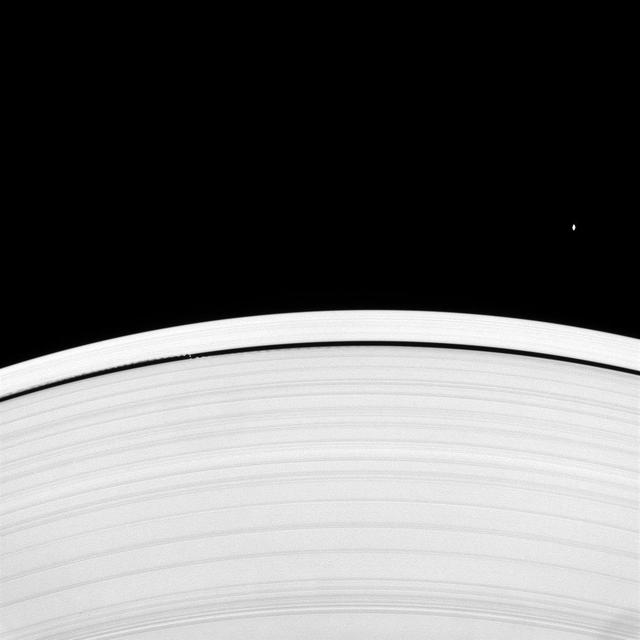
Looking upward from beneath the ringplane, the Cassini spacecraft spies Saturn's "wave maker" and "flying saucer" moons. Daphnis (8 kilometers, or 5 miles across at its widest point) and its gravitationally induced edge waves are seen at left within the Keeler Gap. The equatorial bulge on Atlas (30 kilometers, or 19 miles across at its widest point) is clearly visible here. See PIA06237 and PIA08405 for additional images and information about these two moons. This view looks toward the sunlit side of the rings from about 16 degrees below the ringplane. The image was taken in visible light with the Cassini spacecraft narrow-angle camera on April 22, 2008. The view was acquired at a distance of approximately 898,000 kilometers (558,000 miles) from Saturn. Image scale is about 5 kilometers (3 miles) per pixel. http://photojournal.jpl.nasa.gov/catalog/PIA09907
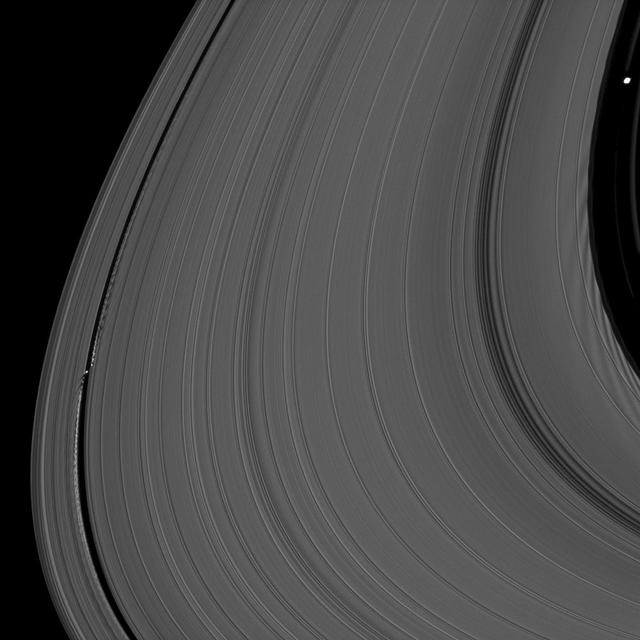
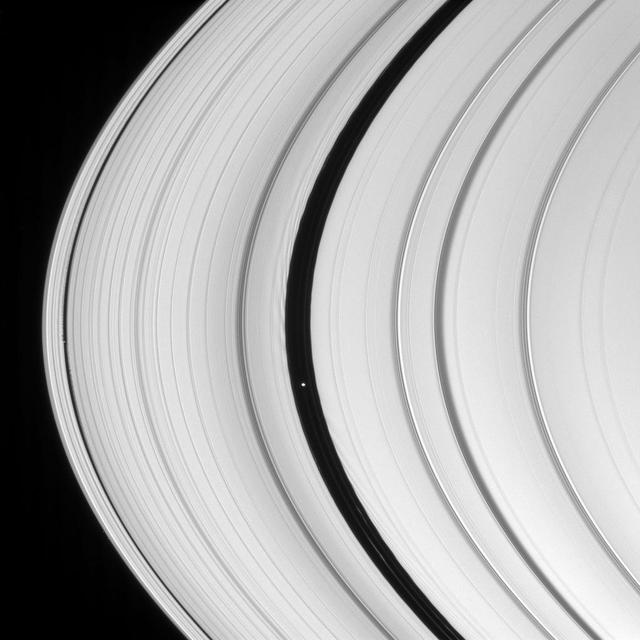
Saturn moons Daphnis and Pan demonstrate their effects on the planet rings in this view from NASA Cassini spacecraft. Daphnis, at left, orbits in the Keeler Gap of the A ring; Pan at right, orbits in the Encke Gap of the A ring.
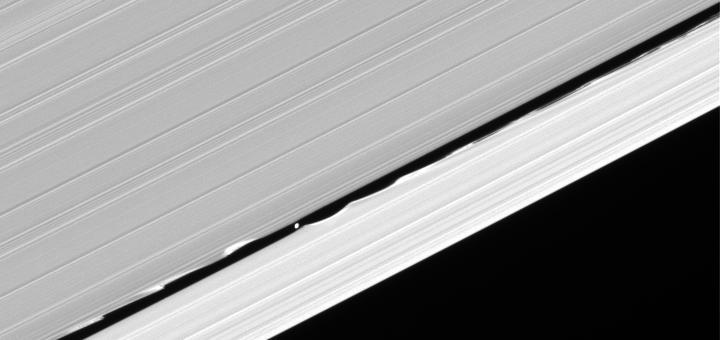
Daphnis drifts through the Keeler gap, at the center of its entourage of waves
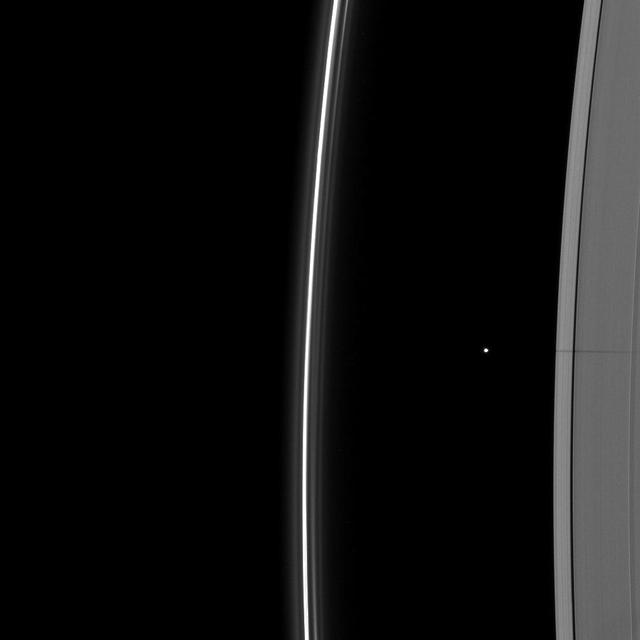
The shadow of the moon Janus dwarfs the shadow of Daphnis on Saturn A ring in this image taken as the planet approached its August 2009 equinox.
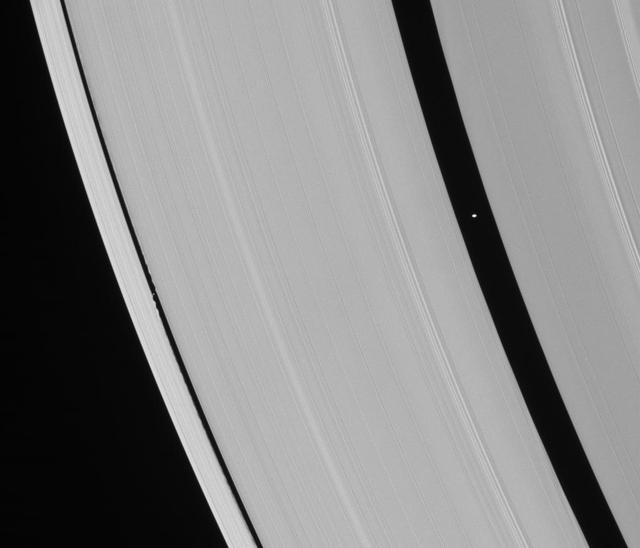
Saturn ring-embedded moons, Pan and Daphnis, are captured in an alignment they repeat with the regularity of a precise cosmic clock
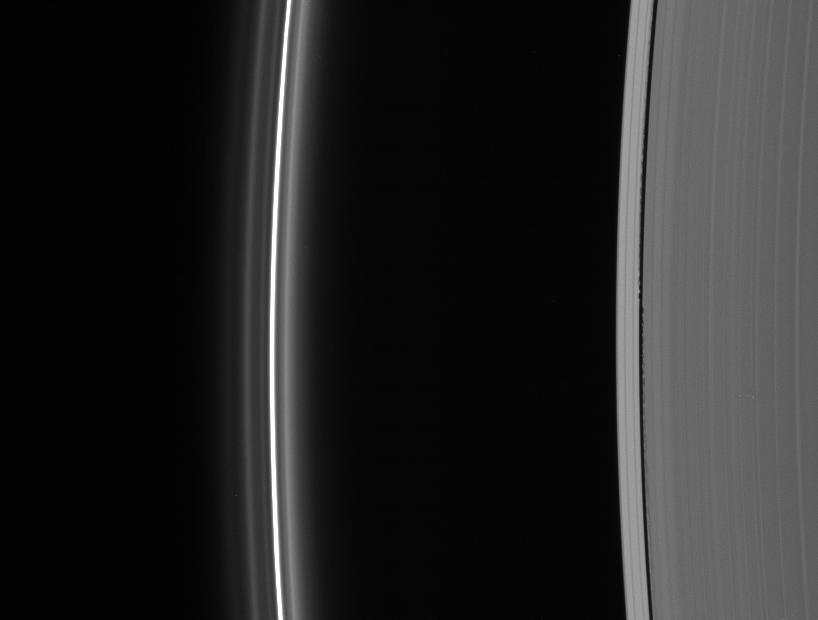
Edge waves in the Keeler Gap betray the presence of the embedded moon Daphnis. At left lies the brilliant F ring with its flanking strands
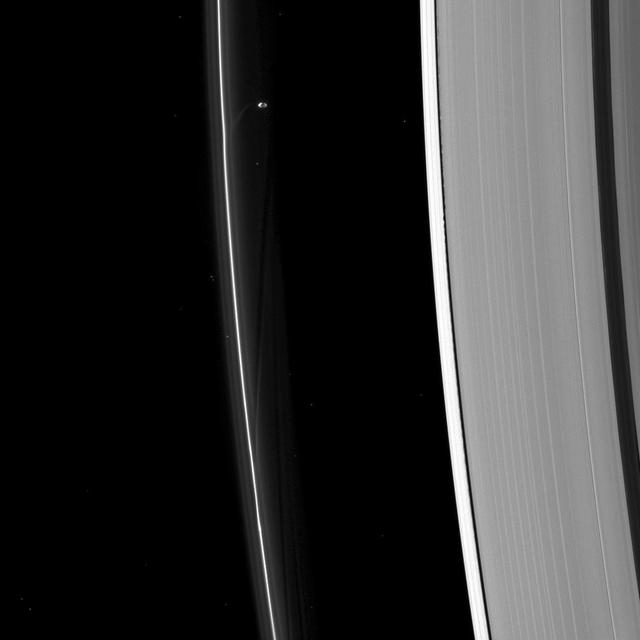
Prometheus, seen here by NASA Cassini spacecraft, sculpting the F ring while Daphnis too small to discern in this image raises waves on the edges of the Encke gap.
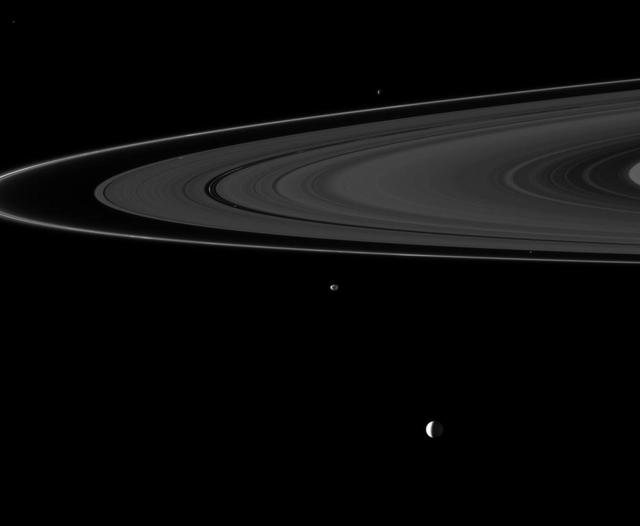
Six of Saturn moons orbiting within and beyond the planet rings are collected in this Cassini spacecraft image; they include Enceladus, Epimetheus, Atlas, Daphnis, Pan, and Janus.
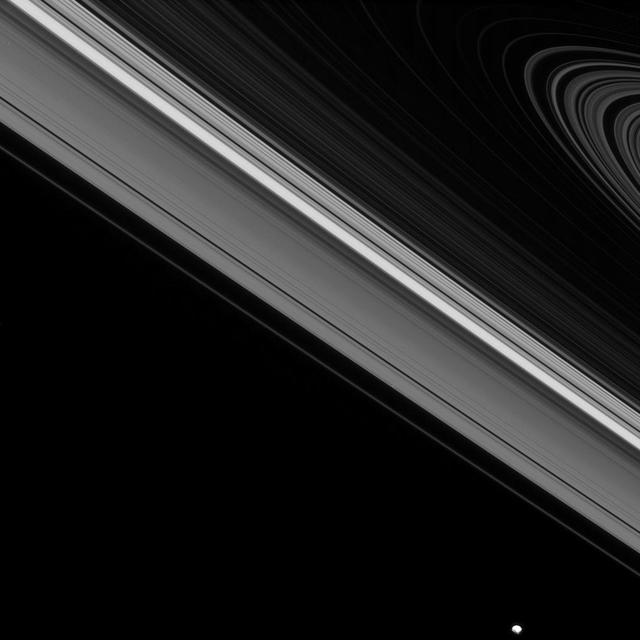
While the moon Epimetheus passes by, beyond the edge of Saturn main rings, the tiny moon Daphnis carries on its orbit within the Keeler gap of the A ring in this image from NASA Cassini spacecraft.
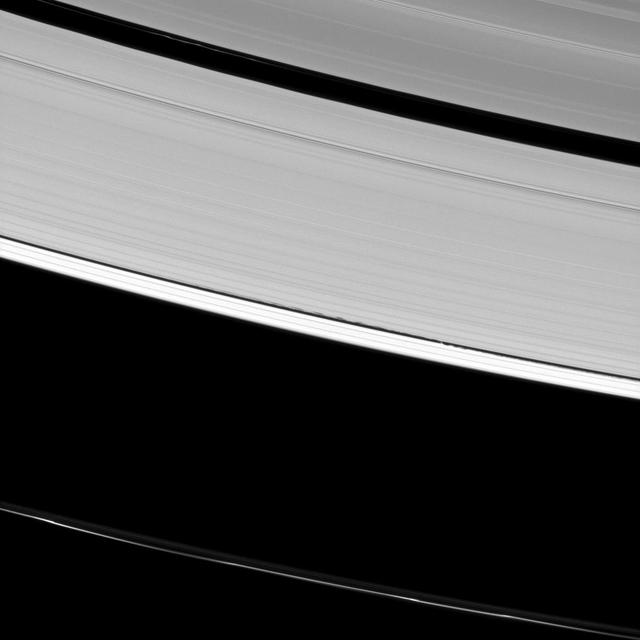
Saturn A ring is decorated with several kinds of waves. NASA Cassini spacecraft has captured a host of density waves, a bending wave, and the edge waves on the edge of the Keeler gap caused by the small moon Daphnis.
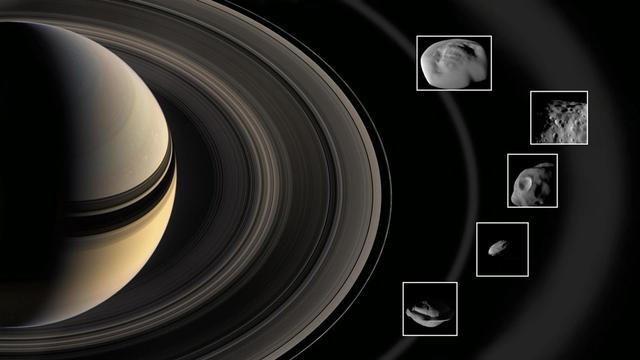
During super-close flybys of Saturn's rings, NASA's Cassini spacecraft inspected the mini-moons Pan and Daphnis in the A ring; Atlas at the edge of the A ring; Pandora at the edge of the F ring; and Epimetheus, which is bathed in material that fans out from the moon Enceladus. The mini-moons' diameter ranges from 5 miles (8 kilometers) for Daphnis to 72 miles (116 kilometers) for Epimetheus. The rings and the moons depicted in this illustration are not to scale. https://photojournal.jpl.nasa.gov/catalog/PIA22772
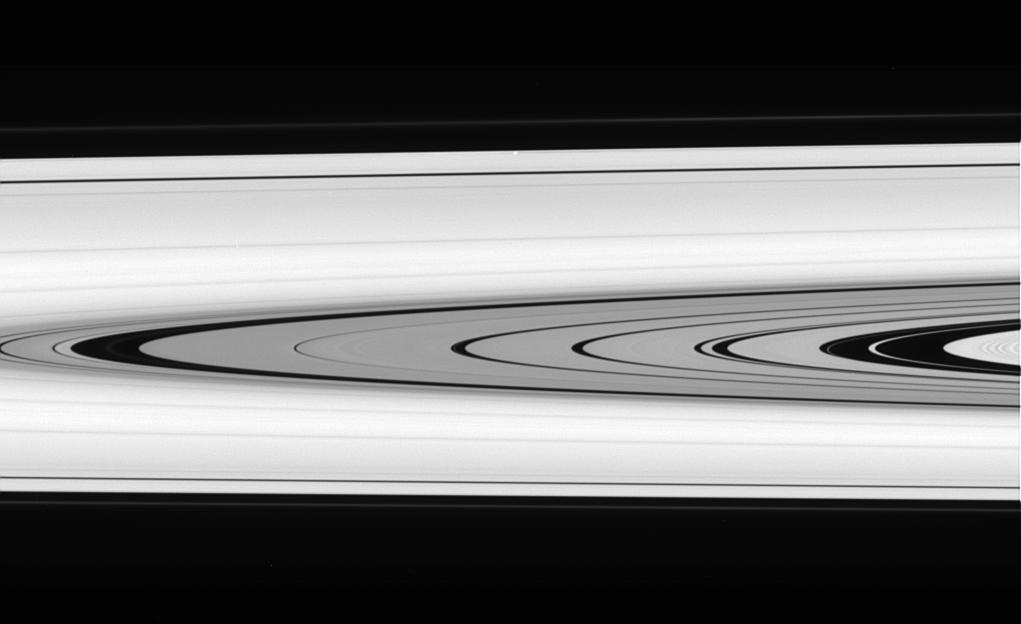
This splendid view offers a detailed look at the faint rings within the Cassini Division as well as a rare glimpse of the Keeler gap moon, Daphnis. The small, ring embedded moon is a bright unresolved speck above center, near outer edge of A ring
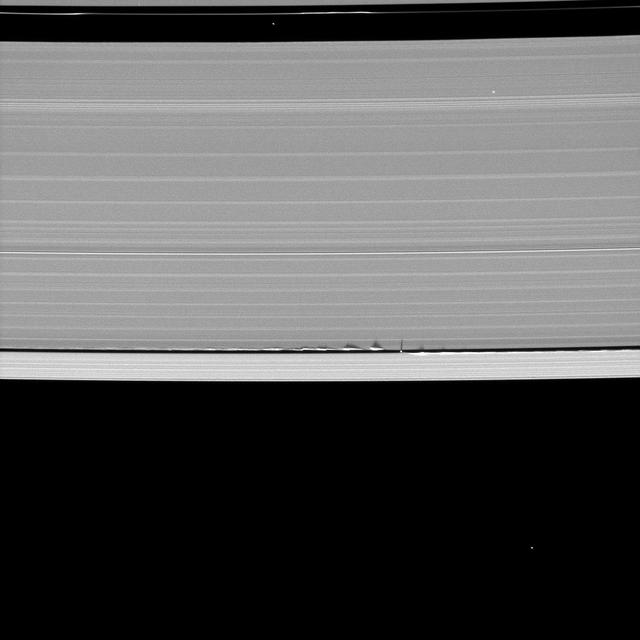
Tiny Moon, Looming Shadows
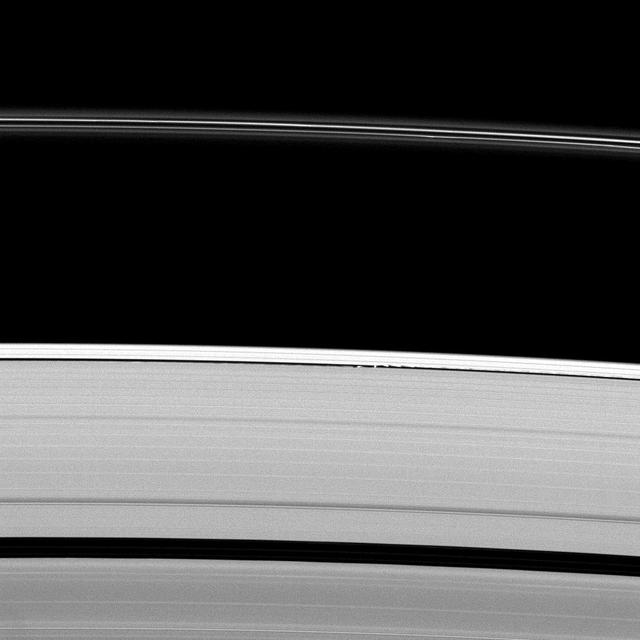
Gravity-Induced Undulations
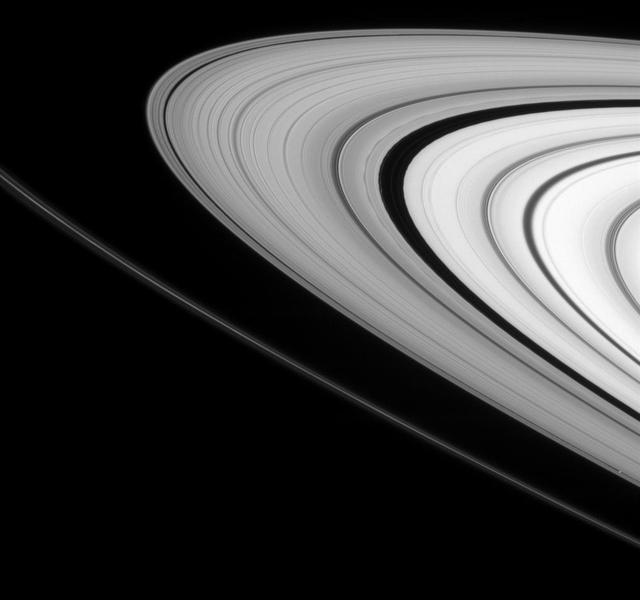
Ring-Moon Connections
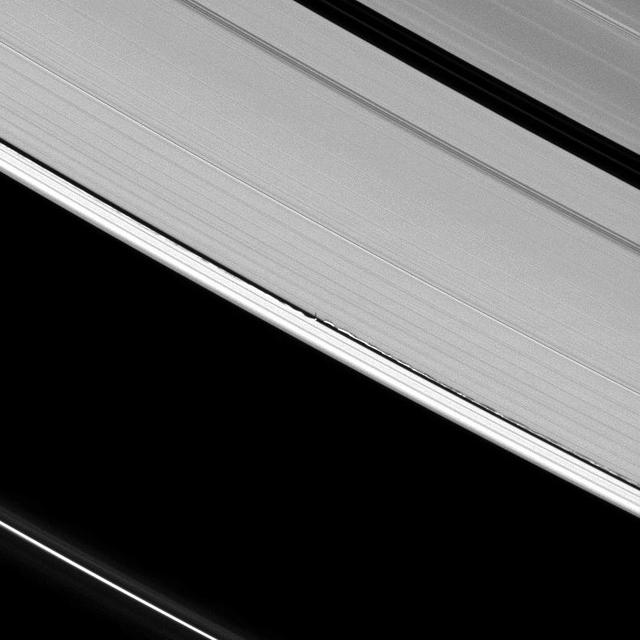
Wavy Shadows
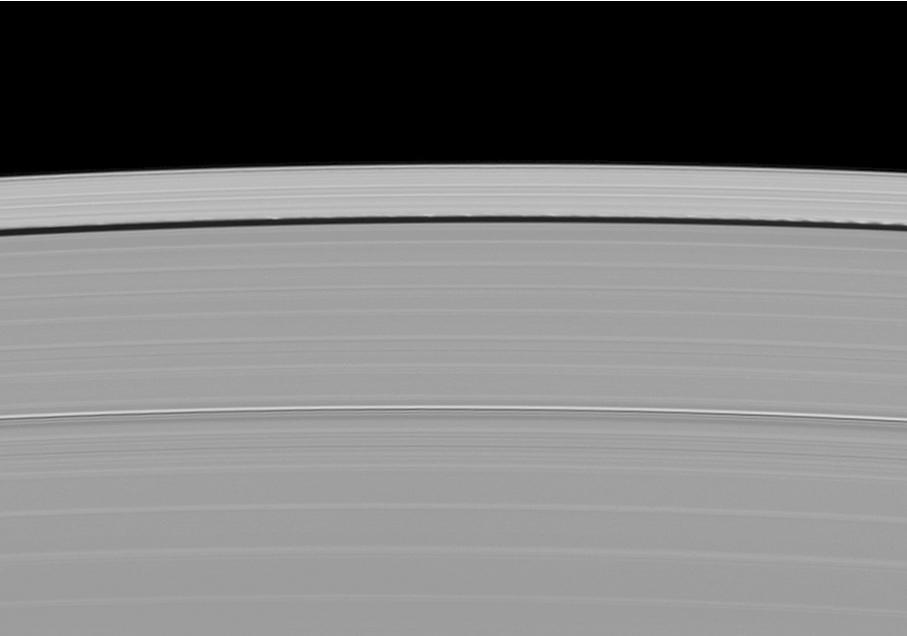
Wave Shadows in Motion
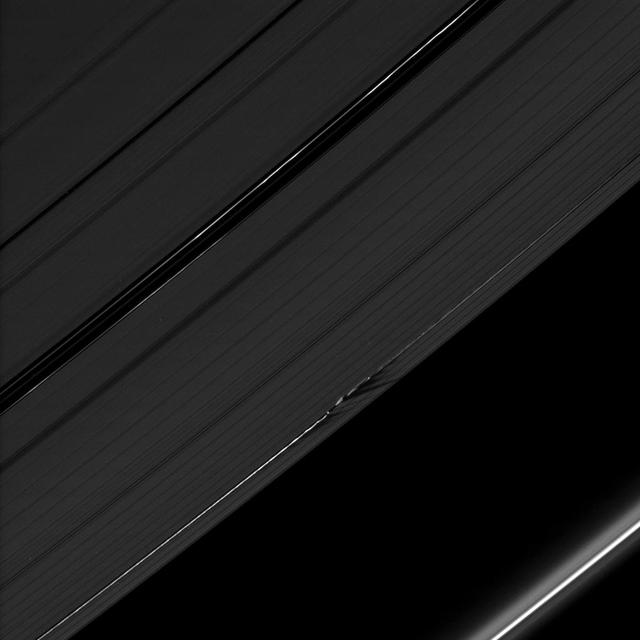
Jagged Shadows
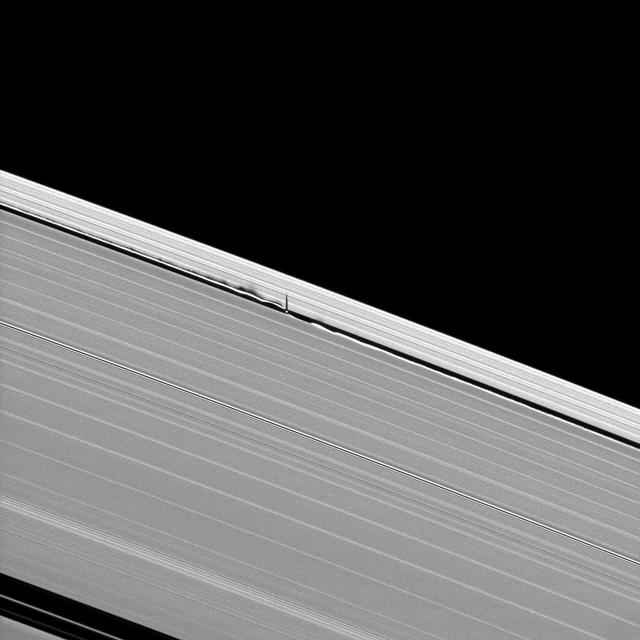
Rippling Shadows
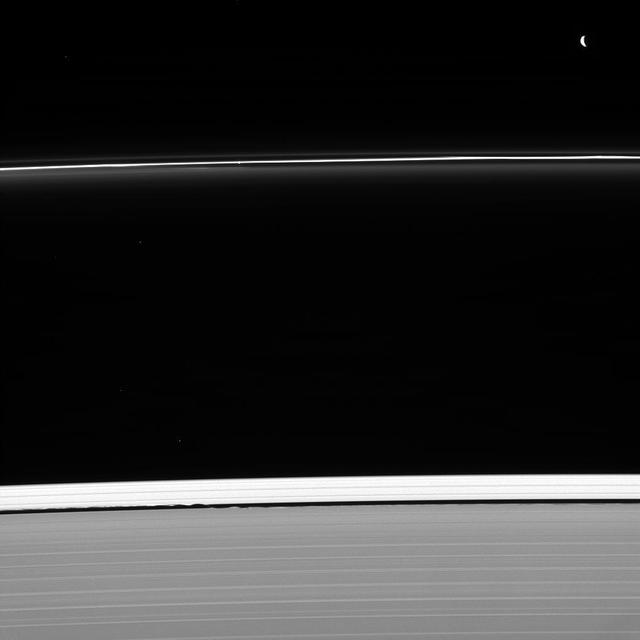
Two masters of their craft are caught at work shaping Saturn's rings. Pandora (upper right) sculpts the F ring, as does nearby Prometheus (not seen in this image). Meanwhile, Daphnis is busy holding open the Keeler gap (bottom center), its presence revealed here by the waves it raises on the gap's edge. The faint moon is located where the inner and outer waves appear to meet. Also captured in this image, shining through the F ring above the image center, is a single star. Although gravity is by its very nature an attractive force, moons can interact with ring particles in such a way that they effectively push ring particles away from themselves. Ring particles experience tiny gravitational "kicks" from these moons and subsequently collide with other ring particles, losing orbital momentum. The net effect is for moons like Pandora (50 miles or 81 kilometers across) and Daphnis (5 miles or 8 kilometers across) to push ring edges away from themselves. The Keeler gap is the result of just such an interaction. This view looks toward the unilluminated side of the rings from about 50 degrees below the ringplane. The image was taken in visible light with the Cassini spacecraft narrow-angle camera on Jan. 30, 2013. http://photojournal.jpl.nasa.gov/catalog/PIA18298
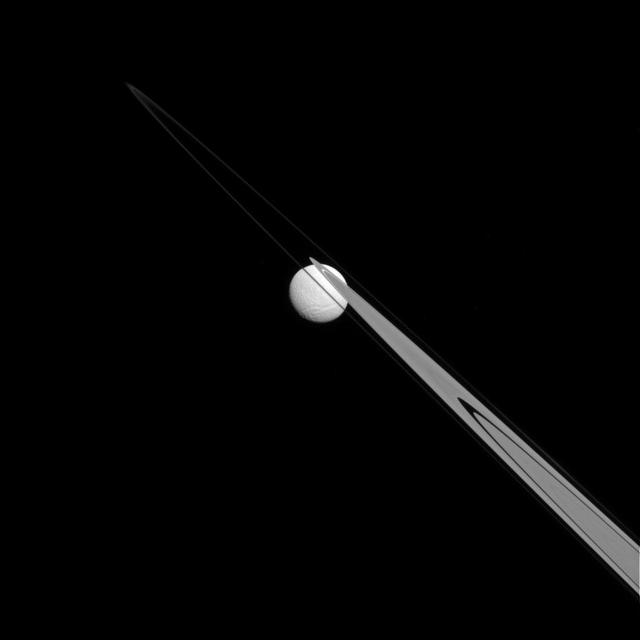
Like a drop of dew hanging on a leaf, Tethys appears to be stuck to the A and F rings from this perspective. Tethys (660 miles, or 1,062 kilometers across), like the ring particles, is composed primarily of ice. The gap in the A ring through which Tethys is visible is the Keeler gap, which is kept clear by the small moon Daphnis (not visible here). This view looks toward the Saturn-facing hemisphere of Tethys. North on Tethys is up and rotated 43 degrees to the right. The image was taken in visible light with the Cassini spacecraft narrow-angle camera on July 14, 2014. The view was acquired at a distance of approximately 1.1 million miles (1.8 million kilometers) from Tethys and at a Sun-Tethys-spacecraft, or phase, angle of 22 degrees. Image scale is 7 miles (11 kilometers) per pixel. http://photojournal.jpl.nasa.gov/catalog/PIA18284
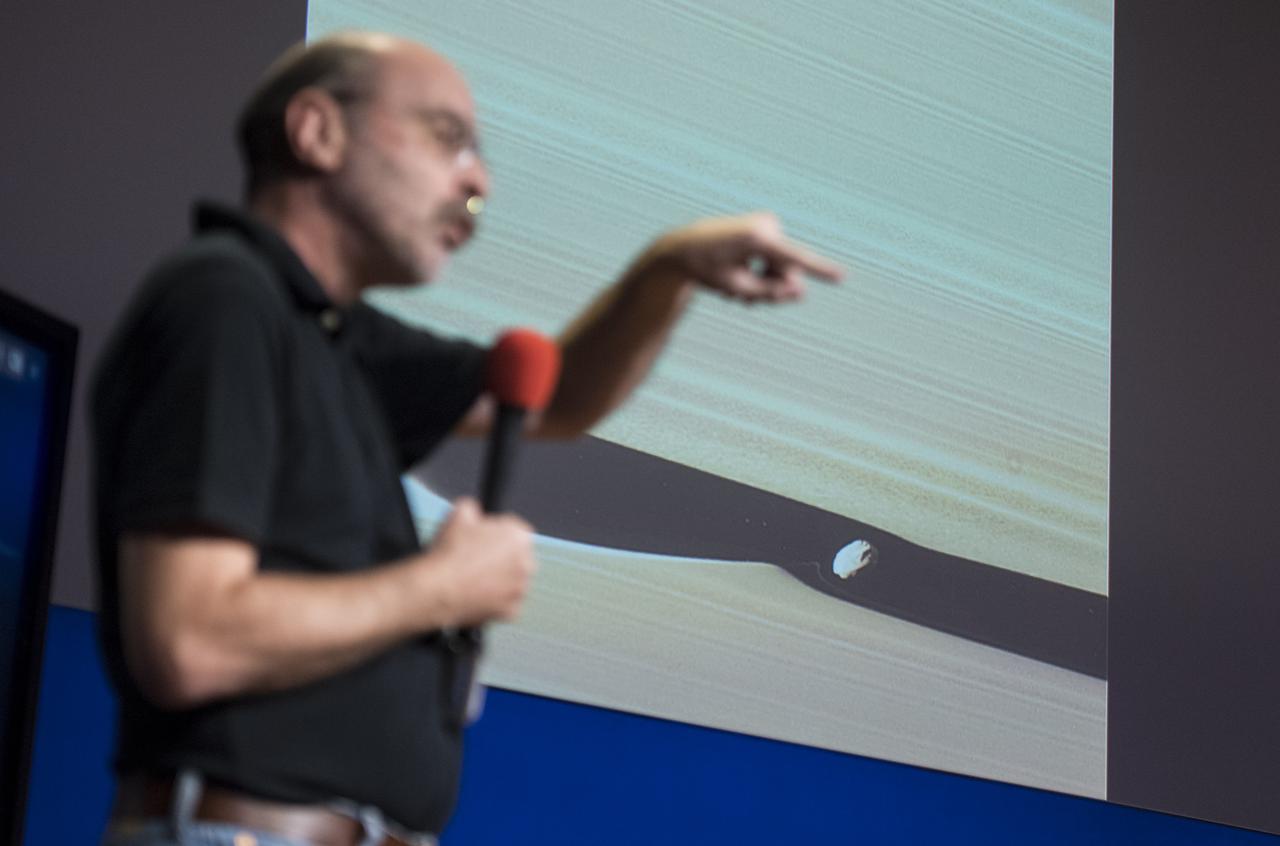
Cassini imaging science subsystem (ISS) team associate Mike Evans discusses an image of Saturn's moon Daphnis with Cassini NASA Social attendees, Thursday, Sept. 14, 2017 at NASA's Jet Propulsion Laboratory in Pasadena, California. Since its arrival in 2004, the Cassini-Huygens mission has been a discovery machine, revolutionizing our knowledge of the Saturn system and captivating us with data and images never before obtained with such detail and clarity. On Sept. 15, 2017, operators will deliberately plunge the spacecraft into Saturn, as Cassini gathered science until the end. The “plunge” ensures Saturn’s moons will remain pristine for future exploration. During Cassini’s final days, mission team members from all around the world gathered at NASA’s Jet Propulsion Laboratory, Pasadena, California, to celebrate the achievements of this historic mission. Photo Credit: (NASA/Joel Kowsky)
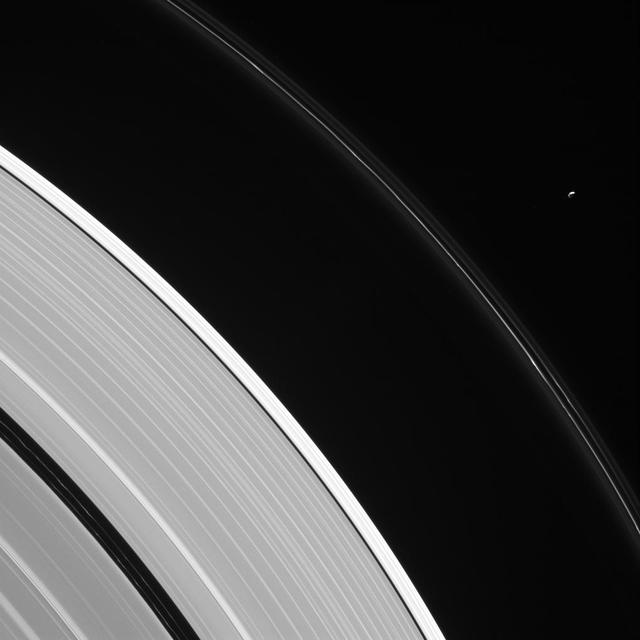
Pandora is seen here, in isolation beside Saturn's kinked and constantly changing F ring. Pandora (near upper right) is 50 miles (81 kilometers) wide. The moon has an elongated, potato-like shape (see PIA07632). Two faint ringlets are visible within the Encke Gap, near lower left. The gap is about 202 miles (325 kilometers) wide. The much narrower Keeler Gap, which lies outside the Encke Gap, is maintained by the diminutive moon Daphnis (not seen here). This view looks toward the sunlit side of the rings from about 23 degrees above the ring plane. The image was taken in visible light with the Cassini spacecraft narrow-angle camera on Aug. 12, 2016. The view was acquired at a distance of approximately 907,000 miles (1.46 million kilometers) from Saturn and at a Sun-Saturn-spacecraft, or phase, angle of 113 degrees. Image scale is 6 miles (9 kilometers) per pixel. http://photojournal.jpl.nasa.gov/catalog/PIA20504
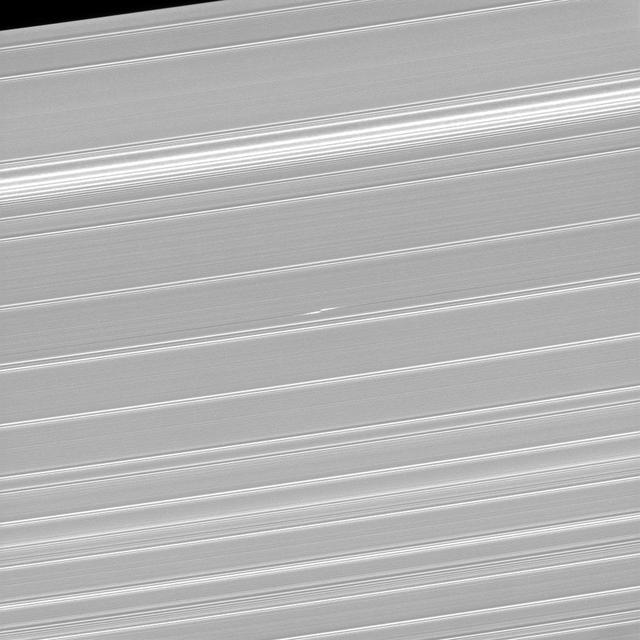
What appears as a pair of bright dashes at the center of this image is one of the features rings scientists have dubbed "propellers." This particular propeller, named Bleriot, marks the presence of a body that is much larger than the particles that surround it, yet too small to clear out a complete gap in the rings (like Pan and Daphnis) and become a moon in its own right. Although the moonlet at the core of the propeller is itself too small to see, the disturbances in the rings caused by its gravity betray its presence. Cassini scientists have been tracking propeller features like this one for years in order to learn how their orbits change over time. From this, they hope to gain insight into how forming planets migrate in the disks in which they form. This view looks toward the sunlit side of the rings from about 59 degrees above the ring plane. The image was taken in visible light with the Cassini spacecraft narrow-angle camera on Jan. 9, 2017. The view was acquired at a distance of approximately 223,000 miles (359,000 kilometers) from Saturn and at a Sun-Saturn-spacecraft, or phase, angle of 73 degrees. Image scale is 1.2 miles (2 kilometers) per pixel. http://photojournal.jpl.nasa.gov/catalog/PIA20525
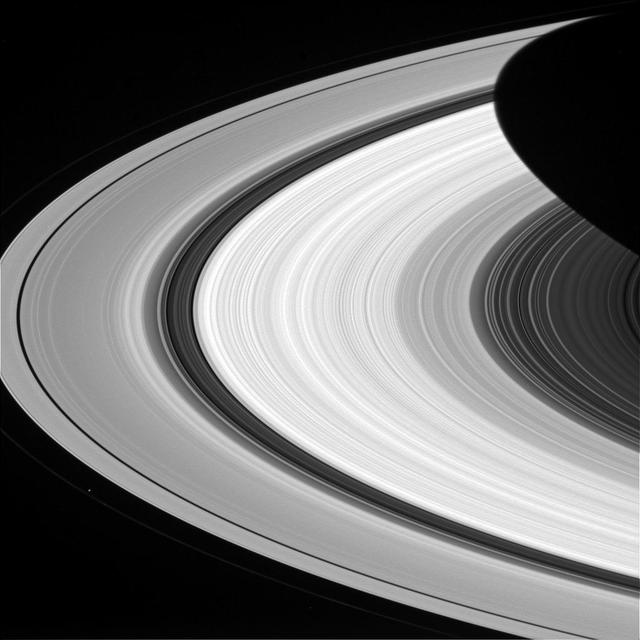
From afar, Saturn's rings look like a solid, homogenous disk of material. But upon closer examination from Cassini, we see that there are varied structures in the rings at almost every scale imaginable. Structures in the rings can be caused by many things, but often times Saturn's many moons are the culprits. The dark gaps near the left edge of the A ring (the broad, outermost ring here) are caused by the moons (Pan and Daphnis) embedded in the gaps, while the wider Cassini division (dark area between the B ring and A ring here) is created by a resonance with the medium-sized moon Mimas (which orbits well outside the rings). Prometheus is seen orbiting just outside the A ring in the lower left quadrant of this image; the F ring can be faintly seen to the left of Prometheus. This view looks toward the sunlit side of the rings from about 15 degrees above the ringplane. The image was taken in red light with the Cassini spacecraft wide-angle camera on Jan. 8, 2015. The view was obtained at a distance of approximately 566,000 miles (911,000 kilometers) from Saturn and at a Sun-Saturn-spacecraft, or phase, angle of 37 degrees. Image scale is 34 miles (54 kilometers) per pixel. http://photojournal.jpl.nasa.gov/catalog/pia18308