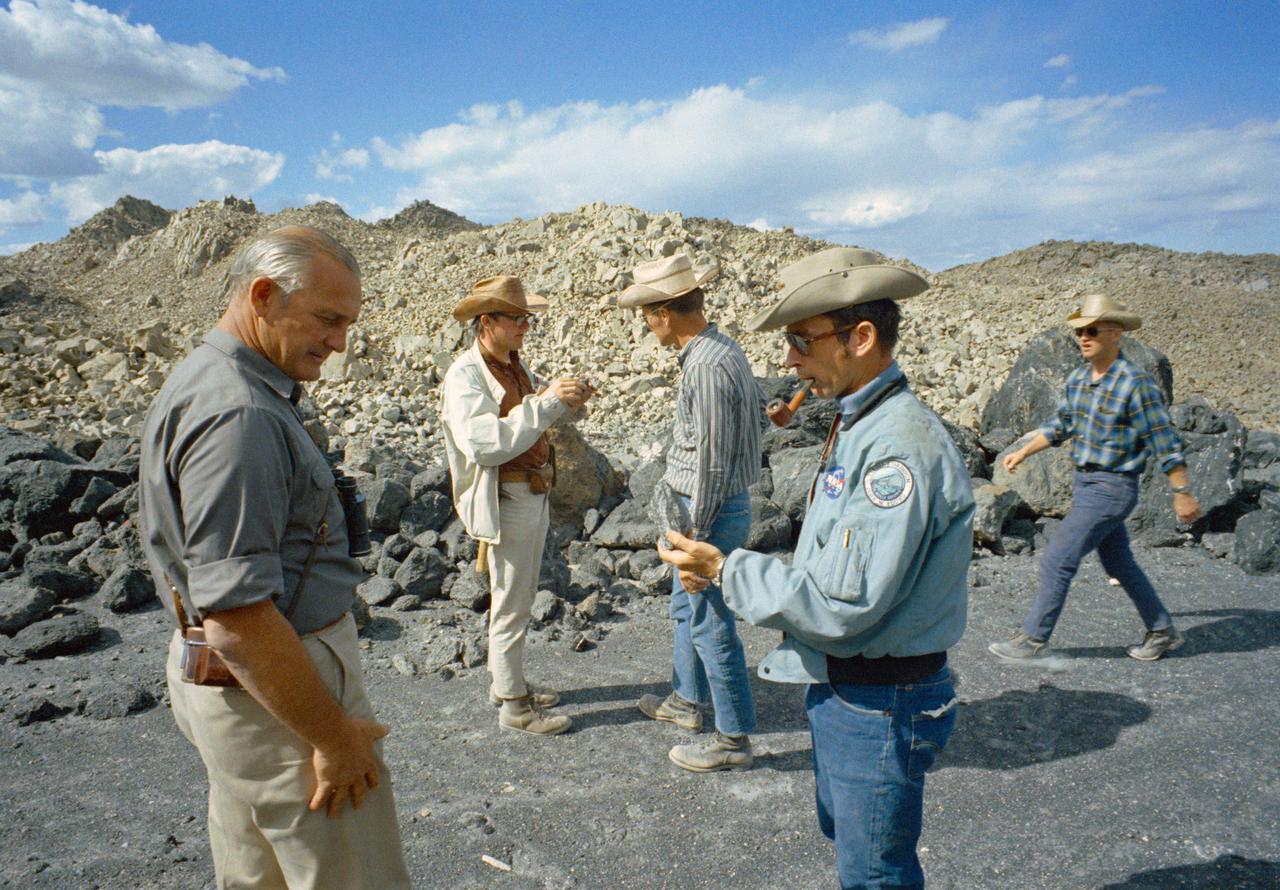
S71-36874 (10 June 1971) --- University of Texas geologist/professor William R. Muelhberger (left) talks with astronaut John W. Young, Apollo 16 commander, during an Apollo 16 geology field trip to Mono Crater, Calif. Astronaut Charles Duke, lunar module pilot, is seen at frame center, talking to geologist David Wones (second left). Astronaut Anthony England, Apollo 16 spacecraft communicator (CAPCOM), is at right. Photo credit: NASA
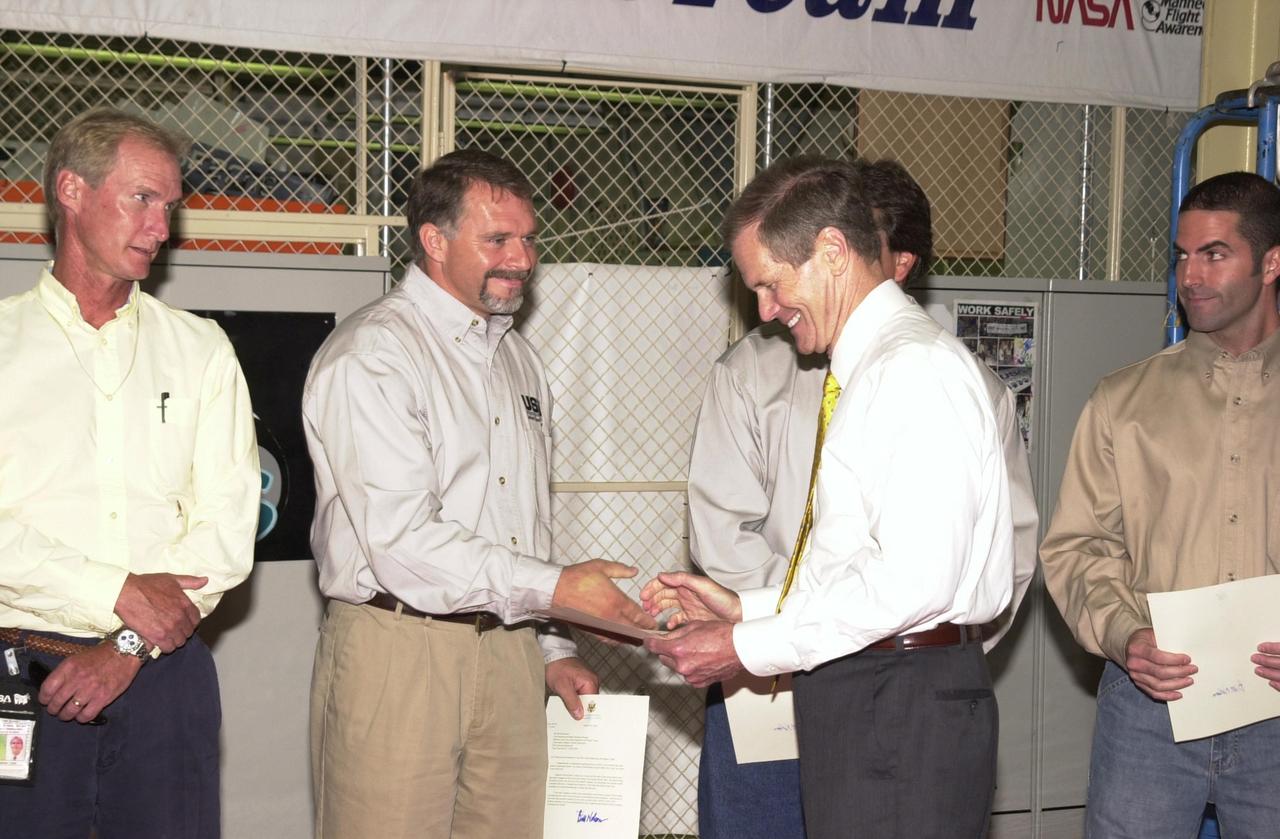
KENNEDY SPACE CENTER, FLA. -- U.S. Sen. Bill Nelson congratulates Jerry Goudy with the Flow Liner Inspection & Repair team. Nelson presented gold seal Senate certificates to the team for their work on finding the cracks in orbiter flow liners and repairing them. At left is Mike Young, behind Nelson is Tony Nesotas, at right is David Strait, who found the first fuel-line crack. Not pictured is Rick Beckwith.
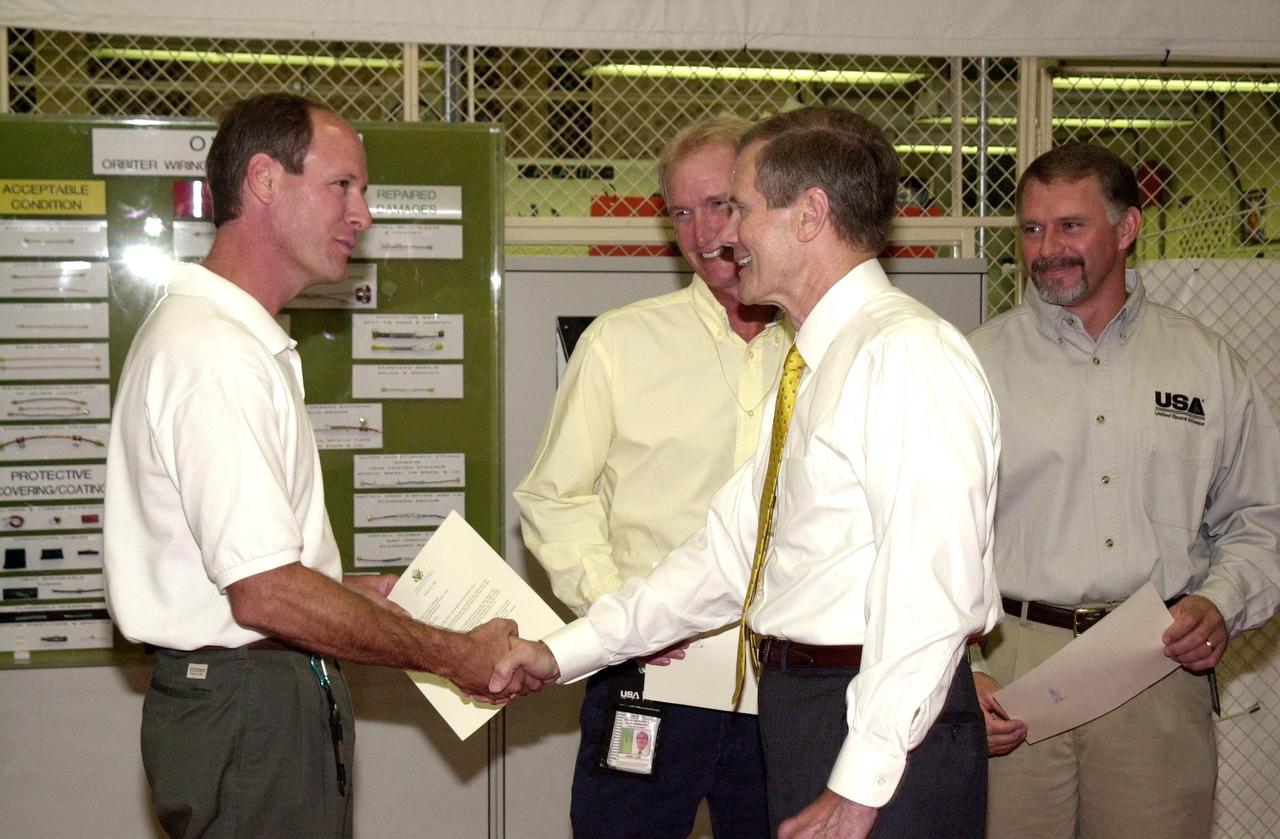
KENNEDY SPACE CENTER, FLA. -- U.S. Sen. Bill Nelson congratulates Rick Beckwith, with the Flow Liner Inspection & Repair team. Nelson presented gold seal Senate certificates to the team for their work on finding the cracks in orbiter flow liners and repairing them. Other team members behind Nelson are Mike Young (center) and Jerry Gouding (right). Not pictured are Tony Nesotas and David Strait. Strait first spotted the fuel-line crack; Goudy performed arc welding on one of Atlantis' flow liners.
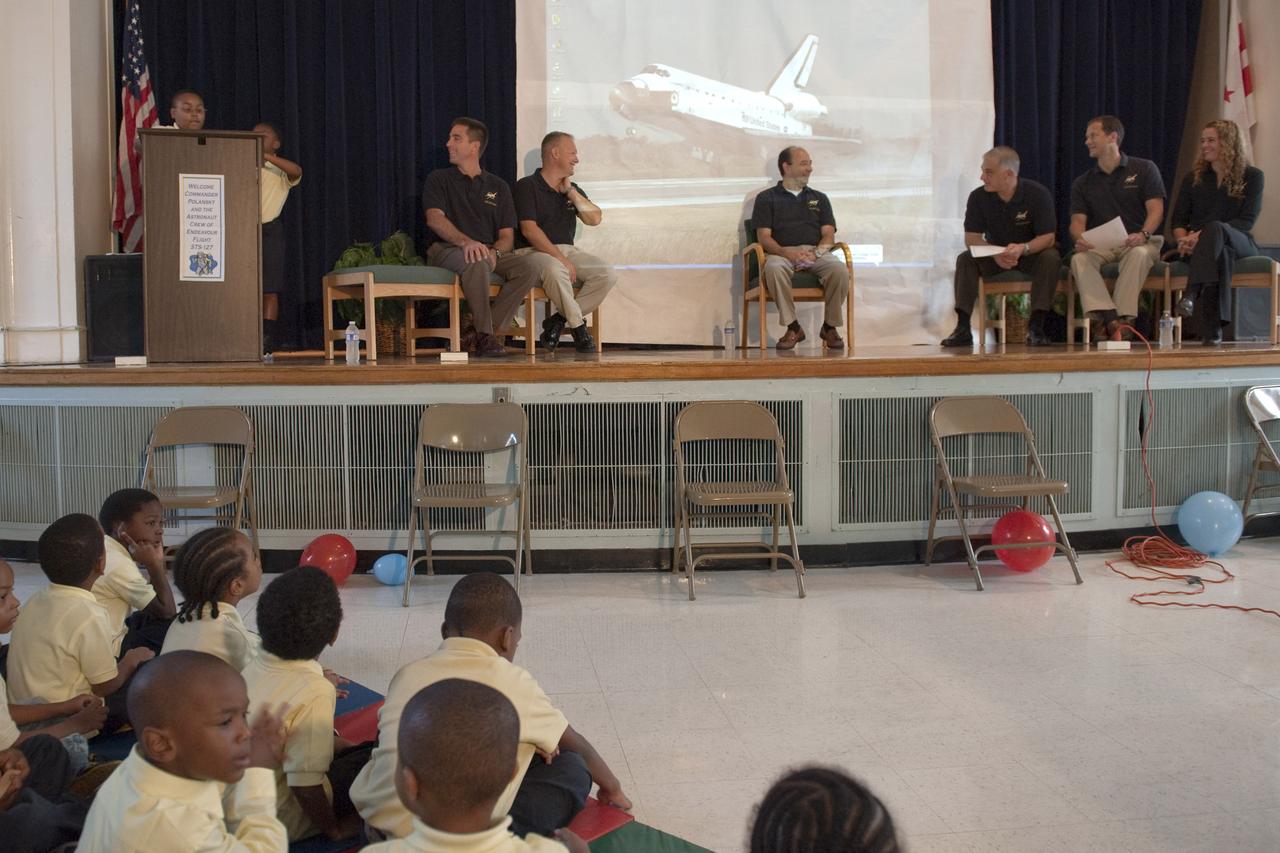
Ajani Young, a fourth grade student at Anne Beers Elementary school, at podium, introduces the crew of STS-127 during their visit, Thursday, Sept. 24, 2009, in Washington. Seated from left are crew members, Chris Cassidy, Doug Hurley, Commander Mark Polansky, David Wolf, Tom Marshburn and Canadian Space Agency astronaut Julie Payette. Photo Credit: (NASA/Paul E. Alers)
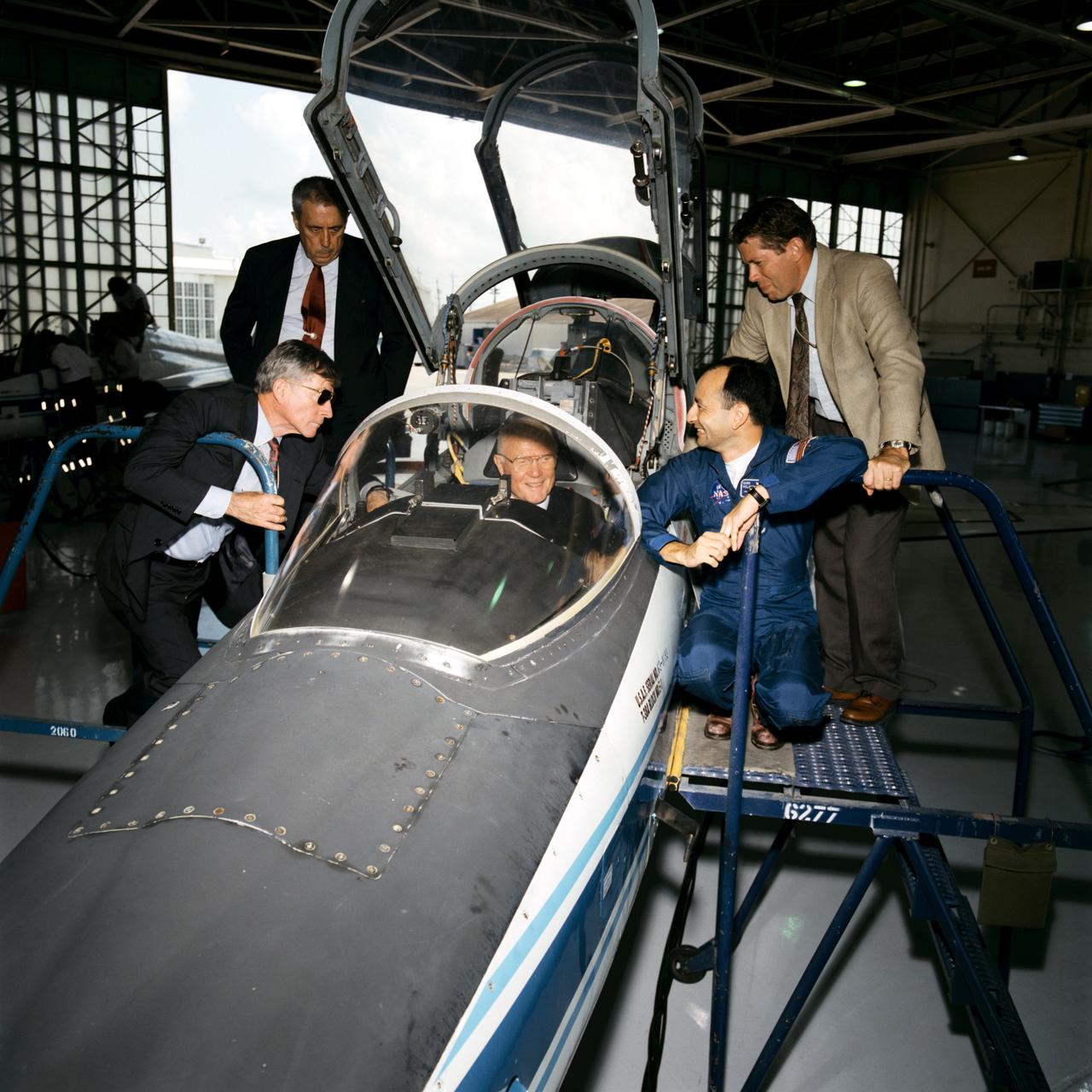
Senator John Glenn visit to Johnson Space Center (JSC). Views of Glenn sitting in cockpit of T-38 in Hangar 276 with John Young, George Abbey, David Leestma and Mark Polansky observing (11150). An engineer explains SPIFEX experiment hardware to Abby, Young and Glenn in Bldg 13 (11151, 11153). Glenn talks with astronaut Terrence T. Henricks and employees in Bldg 9C, Virtual reality lab (11152). Lunch in Bldg 17 Flight Crew support division with Dr. Ellen Baker, Robert "Hoot" Gibson and John Glenn (11154). Linda Godwin, Robert Cabana, Abbey, Young, Baker, Gibson and Glenn at lunch (11155). Astronaut Mark Lee shows Glenn and his aide how to use the virtural reality helmets (11156-7). Glenn shakes the hand of Franklin Chang-Diaz with his plasma rocket in the background in the Sonny Carter Training Facility (SCTF) (11158). Glenn in the Manipulator Development Facility (MDF) Remote Manipulator System (RMS) station mock-up in Bldg 9A with Abbey, Young and aide (11159, 11186). Glenn signs a book for Thomas D. Jones as Frederick Sturckow and Linda Godwin look on (11160). Glenn inside visual-vestibular trainer in Bldg 9B (11161). In conference room meeting with astronaut corps in Bldg 4S, Glenn shakes Robert Cabana's hand (11162). John Glenn and John Young pose for a group shot with Bldg 17 Food lab personnel (11163). Glenn thanks the food lab personnel (11164). Glenn visits Bldg 5 Fixed Base (FB) middeck simulator with astronauts Terrence Henricks and Mary Ellen Weber (11165). Glenn with Charles T. Bourland (11166). STS-70 crew Donald Thomas, Terrence Henricks, Mary Ellen Weber, Nancy Currie and Kevin Kregel with Glenn's advisor (11167). STS-70 crew Thomas, Henricks, Weber, Currie and Kregel with John Glenn (11175). Glenn with Thomas, Kregel, Weber, Henricks and trainer (11176-7). David J. Homan assists Glenn's aide with virtual reality goggles (11168) and Glenn (11174). John Young in Bldg 9C equilibrium trainer (11169). Glenn with Carl Walz in flight deck mock-up of MDF in Bldg 9NE (11170, 11187). Young, Abbey, aides, Glenn and Walz examine helium balloon in MDF (11171-2). Chang-Diaz shows Glenn's tour group the plasma rocket (11173). Glenn's presentation to astronaut corps (11178-81, 11184-5). Glenn is presented with framed picture of Sonny Carter Training Facility (SCTF) (11182) and framed picture of space station (11183).
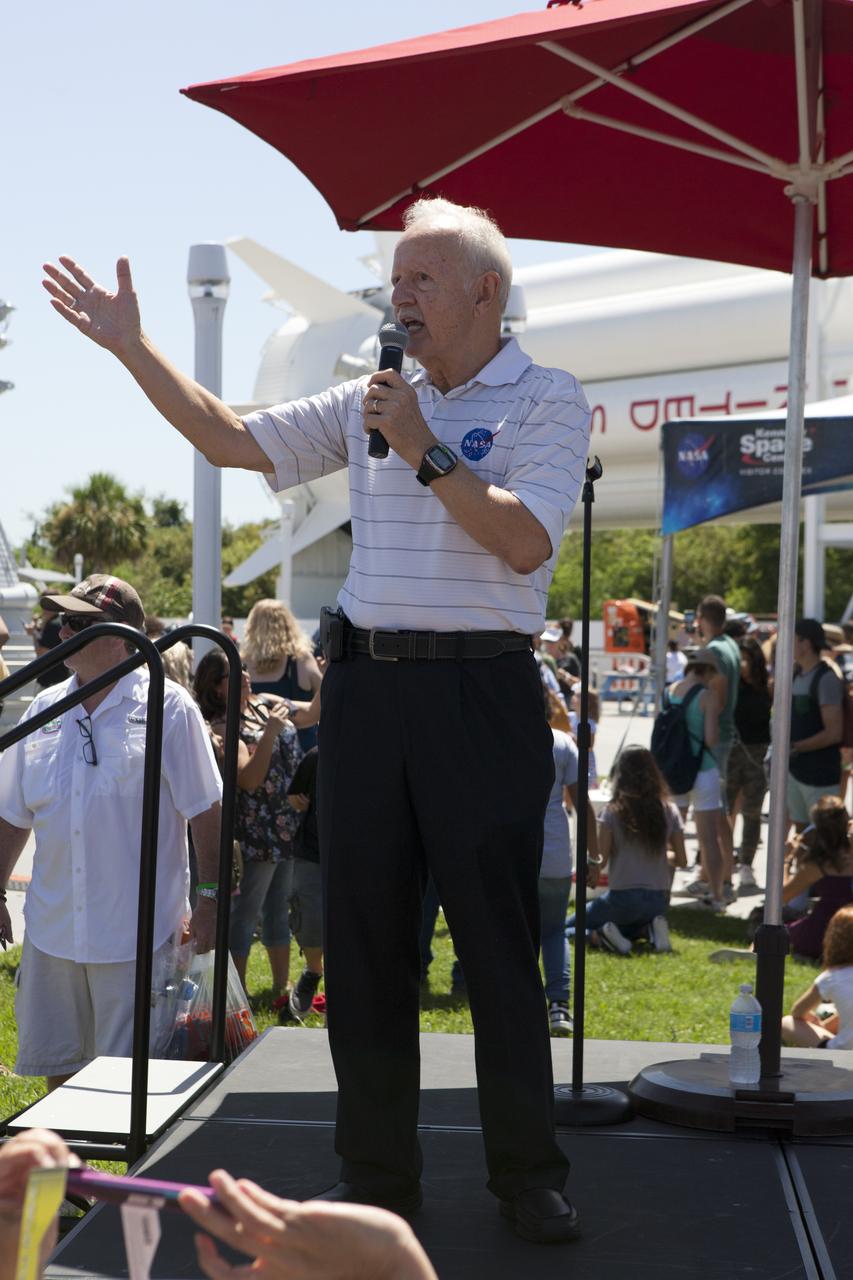
From the Kennedy Space Center Visitor Complex, guests joined Americans from coast to coast following the solar eclipse. Speaking at the event was astronaut John-David Bartoe. Although a partial eclipse on Florida's Space Coast, young and old alike found many ways to watch the rare astronomical event. As the Moon passed between Earth and the midafternoon Sun, a shadow moved across the landscape. The 70-mile-wide totality path, or "umbral cone" -- where the entire Sun will vanish behind the Moon -- stretched across 14 states, from Oregon to South Carolina.
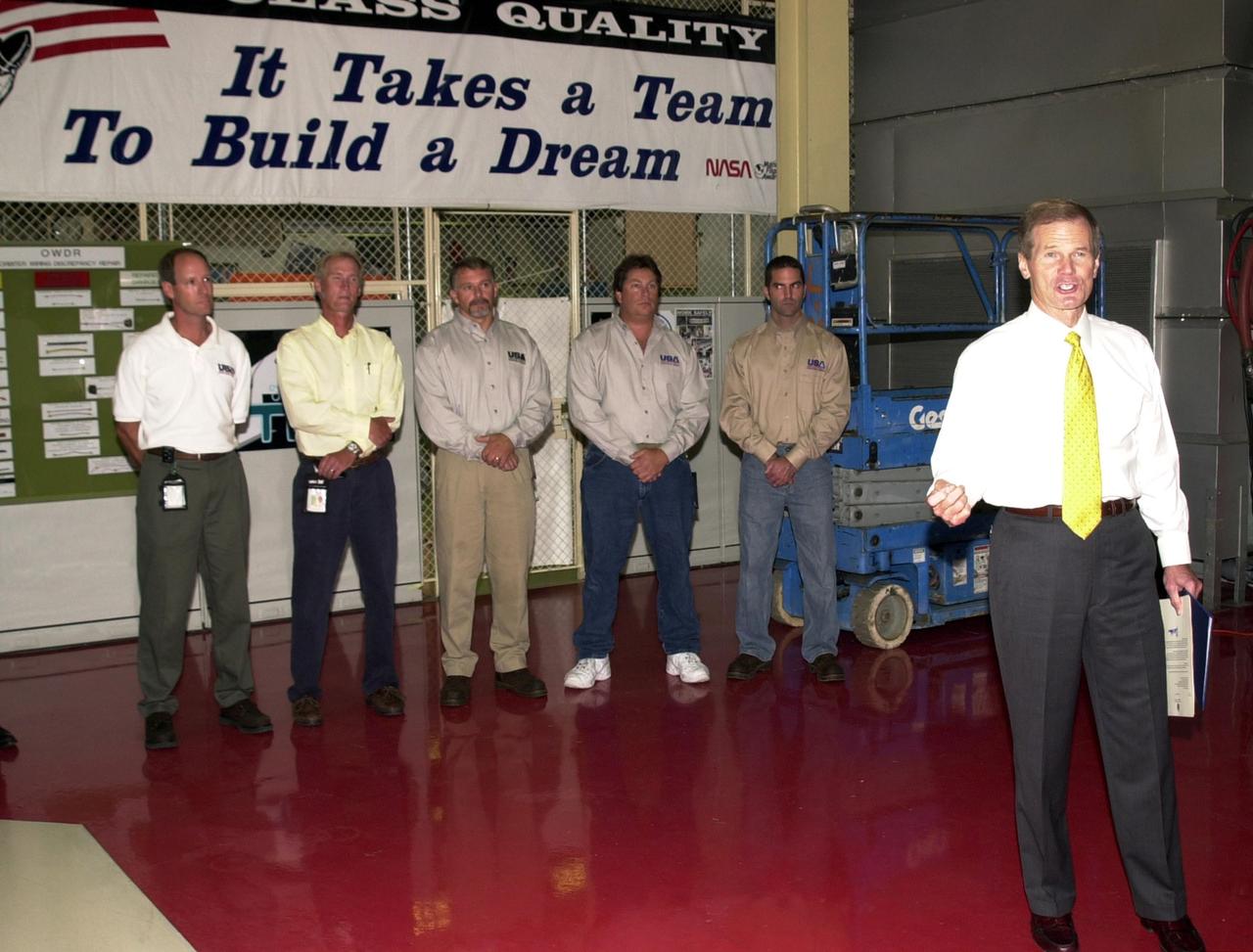
KENNEDY SPACE CENTER, FLA. - U.S. Sen. Bill Nelson (right) honors the Flow Liner Inspection & Repair team for their work on repairing the flow liners on the orbiters. The team (background) comprises (left to right) Rick Beckwith, STR engineer; Mike Young, MPS engineer; Jerry Goudy, welder; Tony Nesotas, OFP-2 aft technician; and David Strait, OPF-2 orbiter inspector. Strait first spotted the fuel-line crack; Goudy performed arc welding on one of Atlantis' flow liners. Nelson presented gold seal Senate certificates to the team.
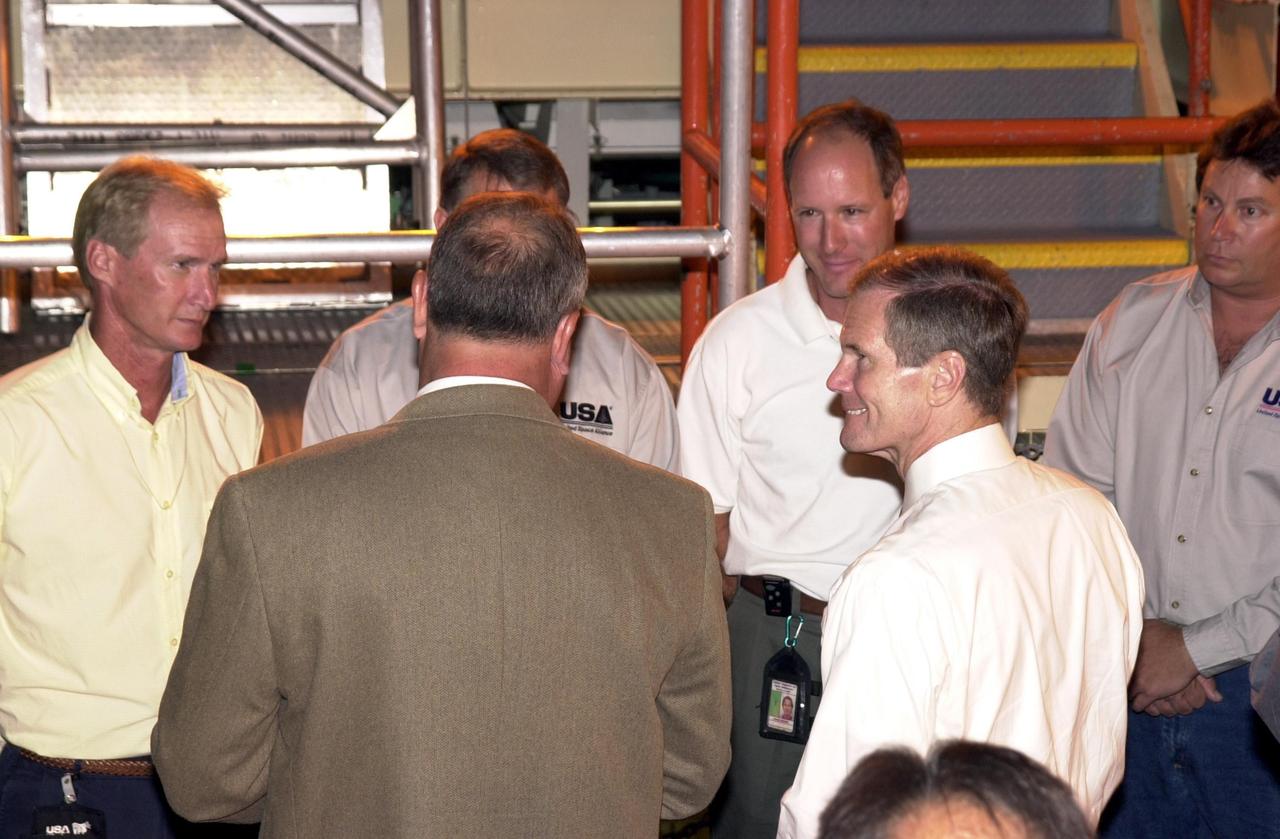
KENNEDY SPACE CENTER, FLA. - Bob Herman, with United Space Alliance (USA), and U.S. Sen. Bill Nelson talk to the Flow Liner Inspection & Repair team. . Sen. Nelson presented present gold seal Senate certificates to the Repair team for their part in finding the cracks in orbiter flow liners and repairing them. The team members shown are (behind Herman and Nelson, left to right) Mike Young, Jerry Goudy, Rick Beckwith, and Tony Nesotas; David Strait, who found the original crack, is not pictured. Goudy performed arc welding on one of Atlantis' flow liners.
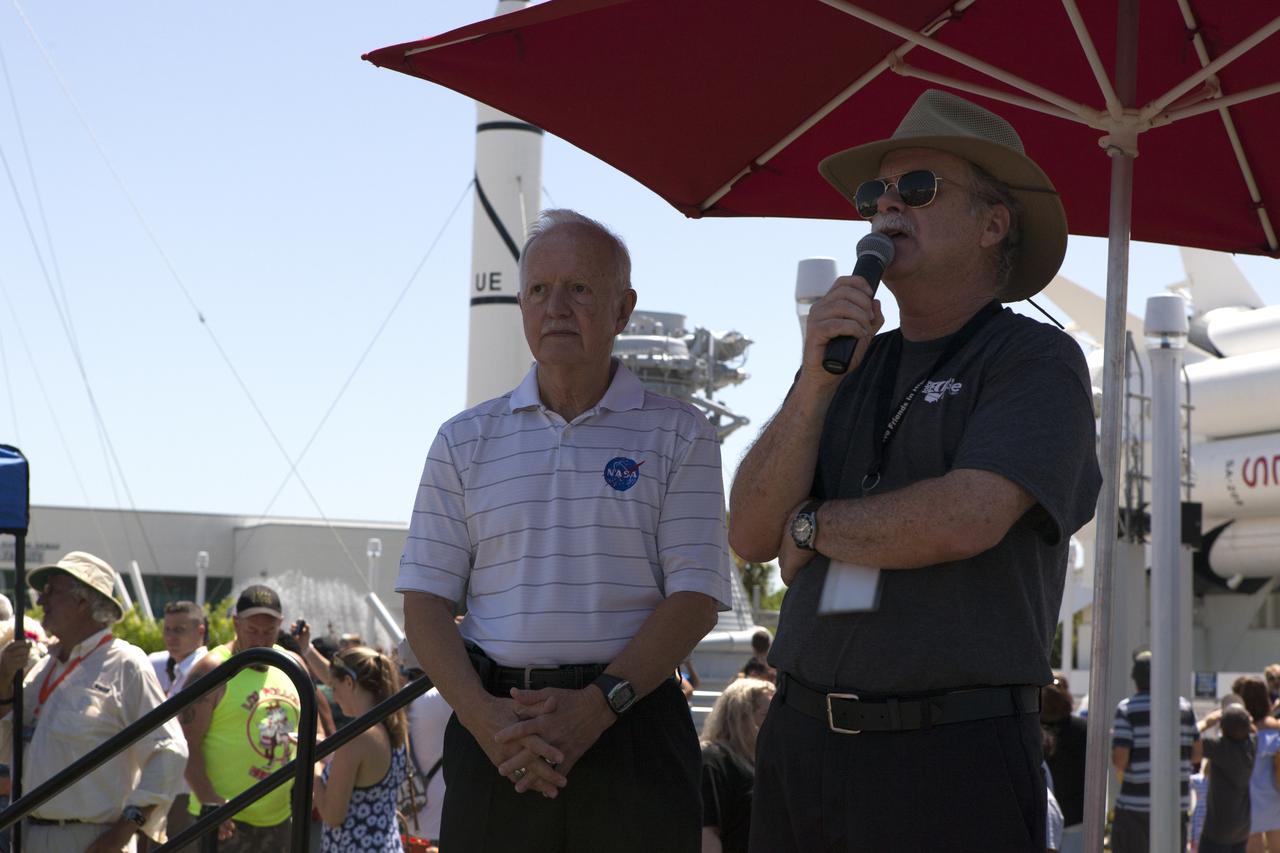
From the Kennedy Space Center Visitor Complex, guests joined Americans from coast to coast following the solar eclipse. Guest speakers were, astronaut John-David Bartoe, left, and communicator Jeff Lucas. Although a partial eclipse on Florida's Space Coast, young and old alike found many ways to watch the rare astronomical event. As the Moon passed between Earth and the midafternoon Sun, a shadow moved across the landscape. The 70-mile-wide totality path, or "umbral cone" -- where the entire Sun will vanish behind the Moon -- stretched across 14 states, from Oregon to South Carolina.
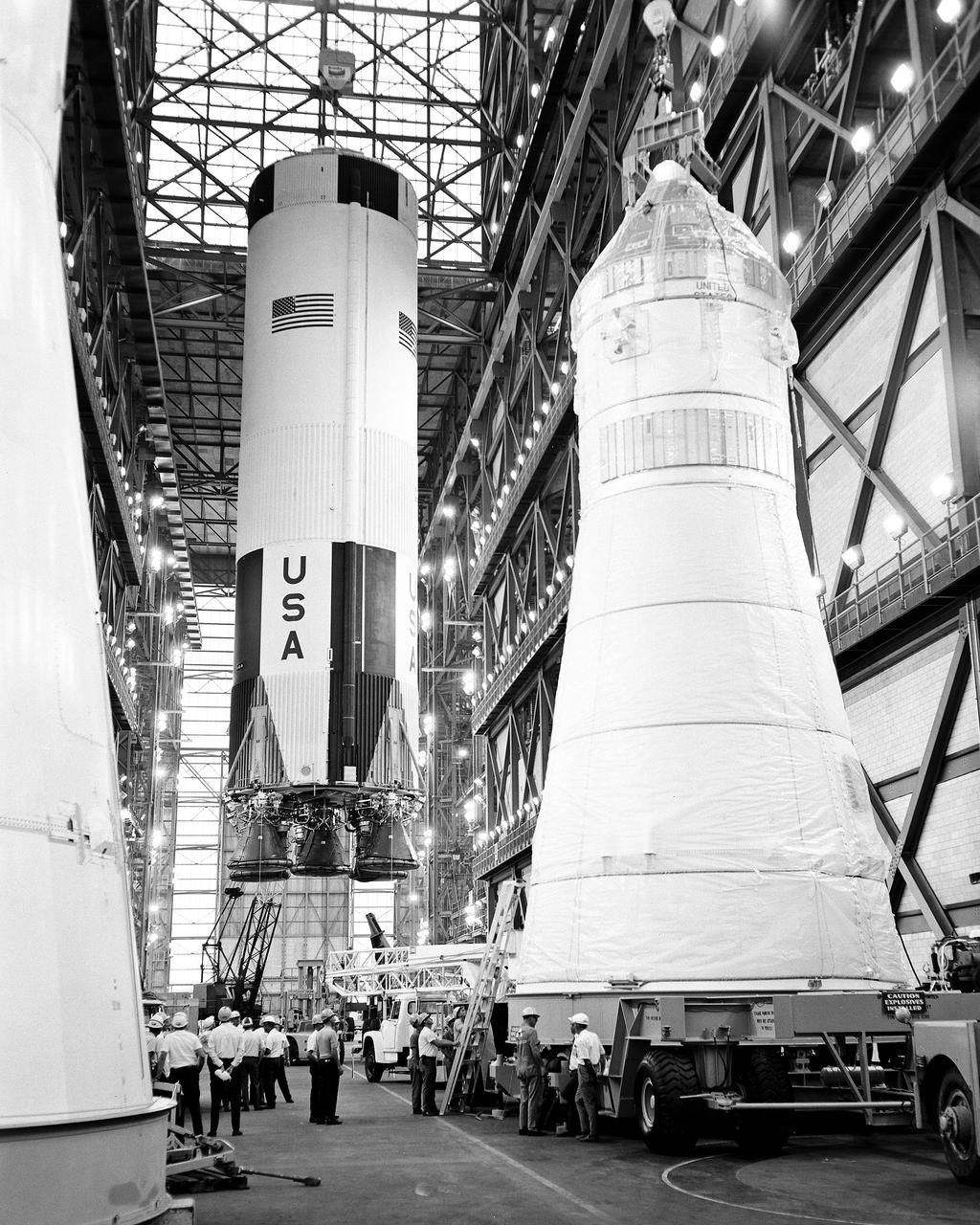
CAPE CANAVERAL, Fla. – The first stage of the Apollo 10 Saturn V space vehicle is hoisted above the transfer aisle in preparation for erection on a mobile launcher within High Bay 2 of the Vehicle Assembly Building. The erection of the 138-foot-long stage marked the first use of mobile launcher 3 and high bay 2. Apollo 10 will be piloted by astronauts Thomas Stafford, John Young and Eugene Cernan. In the foreground are the mated command, service and lunar modules the latter enclosed within the adapter for the Apollo 9 flight of James McDivitt, David Scott and Russel Schweickart. Photo credit: NASA

51D-9091 (S23-9091) (12 April 1985) --- The Space Shuttle mission 51-D crewmembers depart the Kennedy Space Center's operations and checkout building on their way to the launch pad for an early morning launch of Discovery. Leading the seven are Karol J. Bobko (center of frame), commander; and Donald E. Williams (right), pilot. Following are Rhea Seddon, Jeffrey A. Hoffman, S. David Griggs--all mission specialists--Charles D. Walker and U.S. Sen. E. J. (Jake) Garn (partly obscured behind Walker), both payload specialists. Partly visible in the doorway are Astronaut John W. Young and George W.S. Abbey, director of flight crew operations.
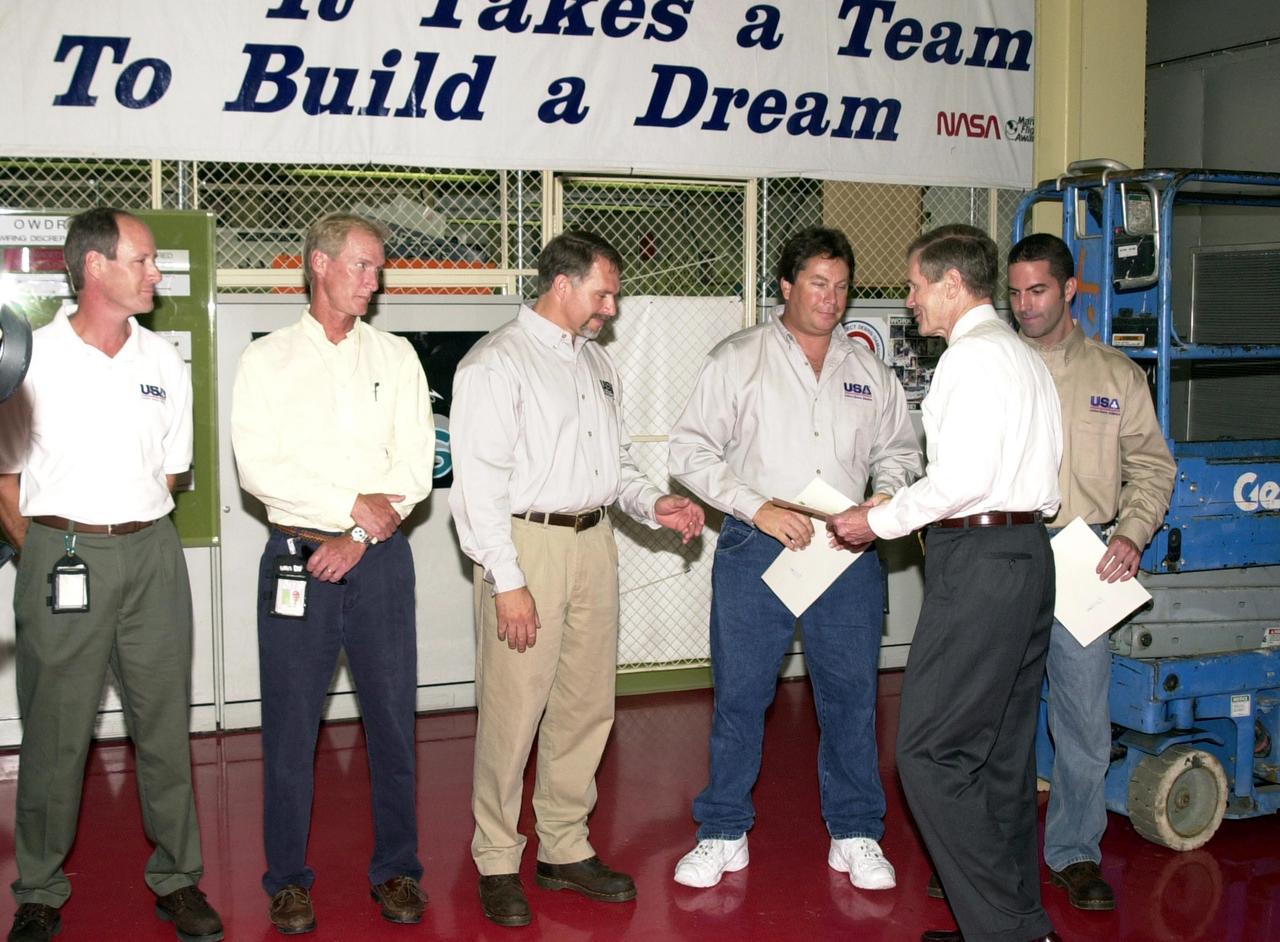
KENNEDY SPACE CENTER, FLA. -- U.S. Sen. Bill Nelson (front) presents gold seal Senate certificates to the Flow Liner Inspection & Repair team for their work on repairing the flow liners on the orbiters. The team (background) comprises (left to right) Rick Beckwith, STR engineer; Mike Young, MPS engineer; Jerry Goudy, welder; Tony Nesotas, OFP-2 aft technician; and David Strait, OPF-2 orbiter inspector. Strait first spotted the fuel-line crack; Goudy performed arc welding on one of Atlantis' flow liners.
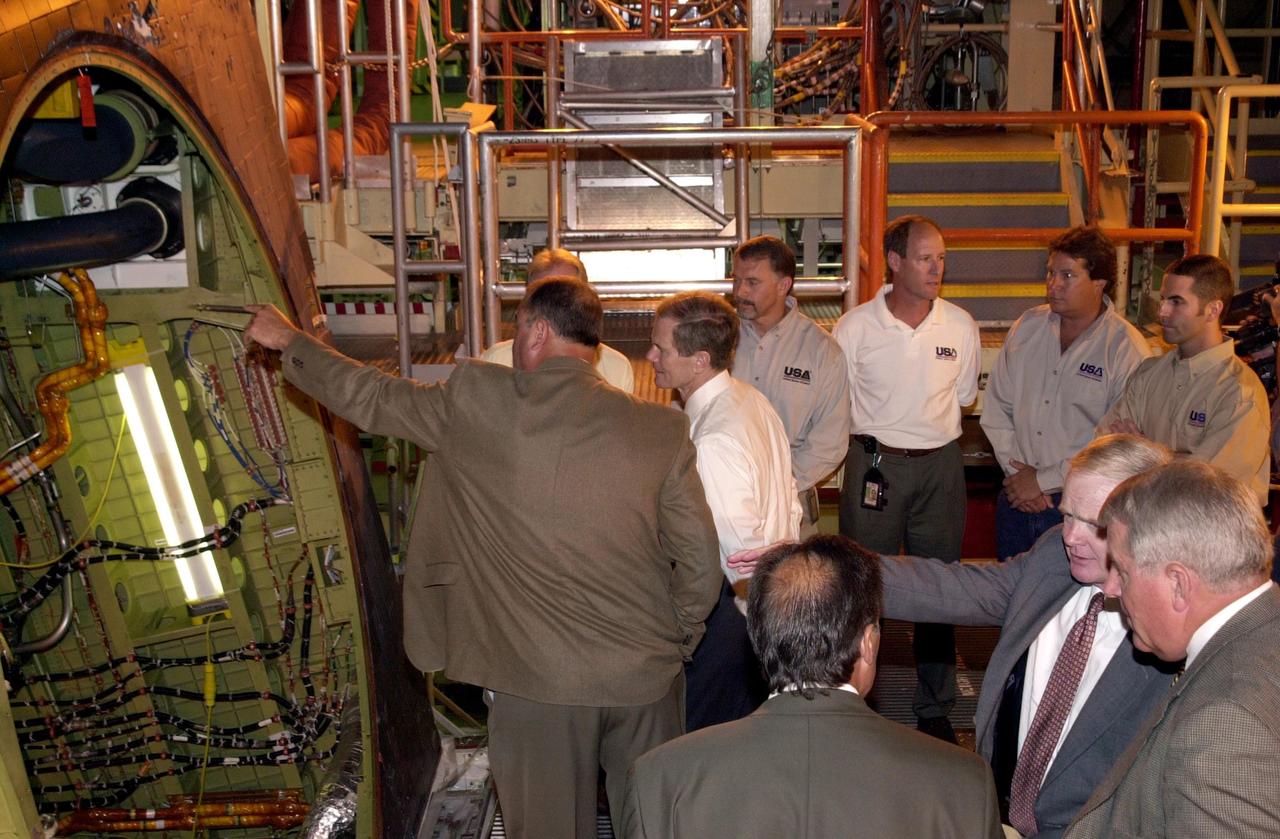
KENNEDY SPACE CENTER, FLA. - Bob Herman,chief engineer, Ground Operations for United Space Alliance (USA), shows U.S. Sen. Bill Nelson (center) part of orbiter Atlantis. Nelson was at KSC to present gold seal Senate certificates to the Flow Liner Inspection & Repair team for their part in finding the cracks in orbiter flow liners and repairing them. Team members are (behind Herman and Nelson, left to right) Mike Young, Jerry Goudy, Rick Beckwith, Tony Nesotas and David Strait. Goudy performed arc welding on one of Atlantis' flow liners; Strait found the original crack. In the foreground are Shuttle Engineering Director, USA, Mark Nappi; Center Director Roy Bridges; and vice president and deputy program manager, Florida Operations, USA, Bill Pickavance.
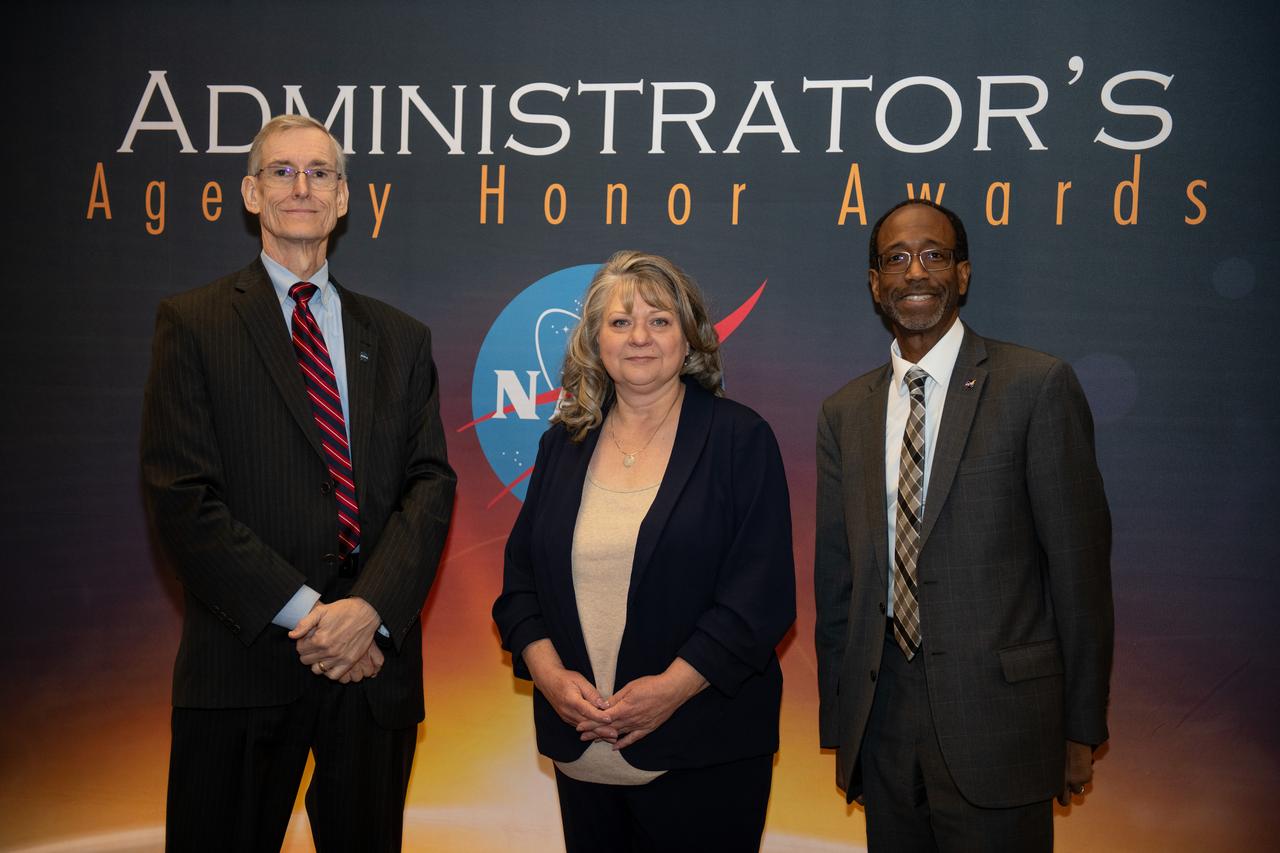
On March 28, 2024 NASA held its 2023 Administrator’s Agency Honor Awards at the Glenn Research Center in Cleveland, OH. This celebratory event recognized the invaluable contributions of civil servants and contractors alike, each one instrumental in propelling humanity further into the realms of space exploration, understanding, and discoverThis is NASA's highest form of recognition that is awarded to any Government employee who, by distinguished service, ability, or vision has personally contributed to NASA's advancement of United States' interests. Photo Credit: (NASA/Sara Lowthian-Hanna)
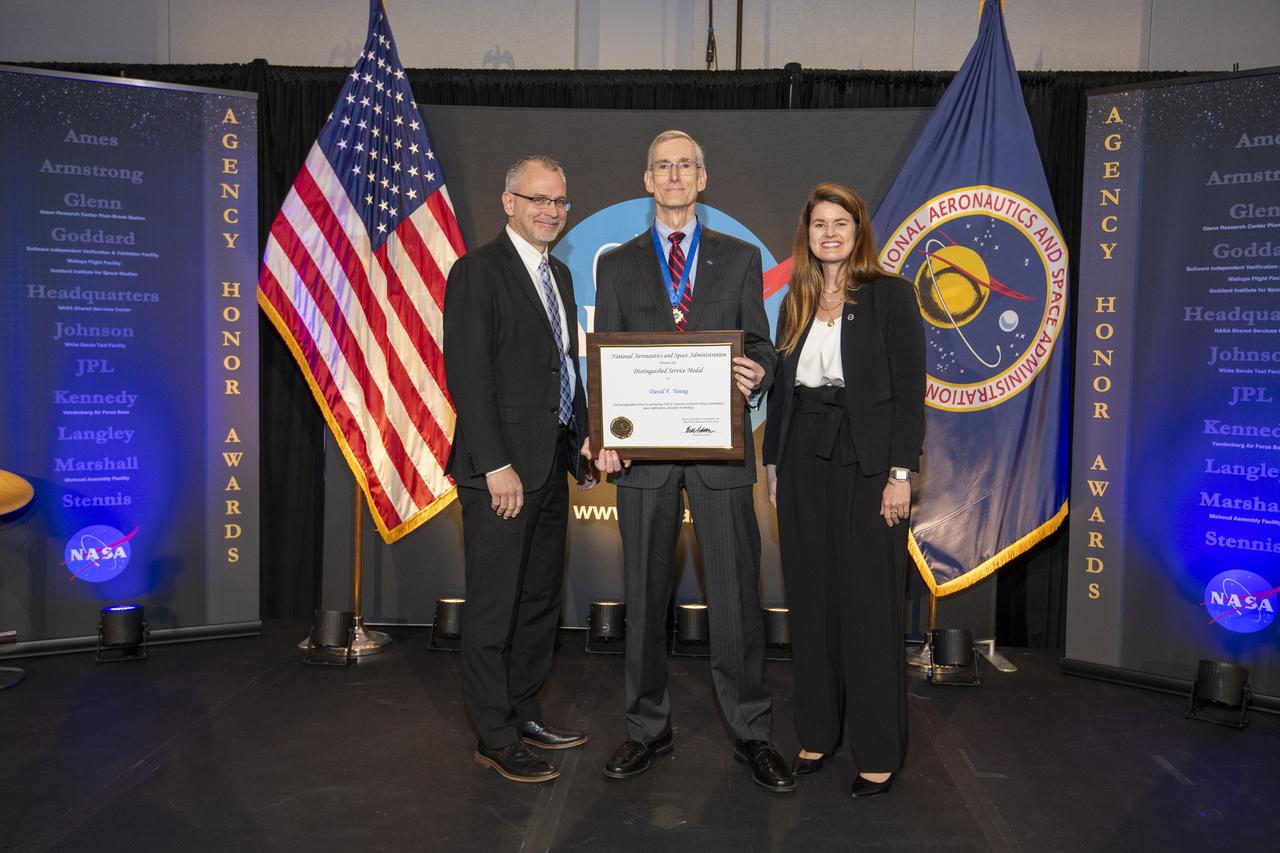
On March 28, 2024 NASA held its 2023 Administrator’s Agency Honor Awards at the Glenn Research Center in Cleveland, OH. This celebratory event recognized the invaluable contributions of civil servants and contractors alike, each one instrumental in propelling humanity further into the realms of space exploration, understanding, and discoverThis is NASA's highest form of recognition that is awarded to any Government employee who, by distinguished service, ability, or vision has personally contributed to NASA's advancement of United States' interests.

STS099-749-089 (11-22 February 2000) ---As evidenced by this 70mm frame from the Space Shuttle Endeavour, the Alaska Peninsula and Aleutian Islands form a long arc that intervenes between the Bering Sea and the northern Pacific Ocean. This view is of the snowy south coast of the peninsula, from Chignik Bay and Cape Kumliun (on the triangular peninsula) northeastward to Chiginagak Bay and David Island. Port Heiden is the darker area of little ice on the north coast. Within the rim of the Aniakchak volcanic crater (4,450 feet at highest point) the frozen waters of Surprise Lake are visible. The North American and Pacific tectonic plates are converging in this region at a rate of about 5 centimeters a year. The Pacific plate descends beneath North America, producing a deep trench along the south coast; the Aleutian Trench reaches depths greater than 25,000 ft. In such regions (subduction zones) volcanoes form on the overriding plate -- the North American plate in this instance; Aniakchak is one of the many young volcanoes in this arc.
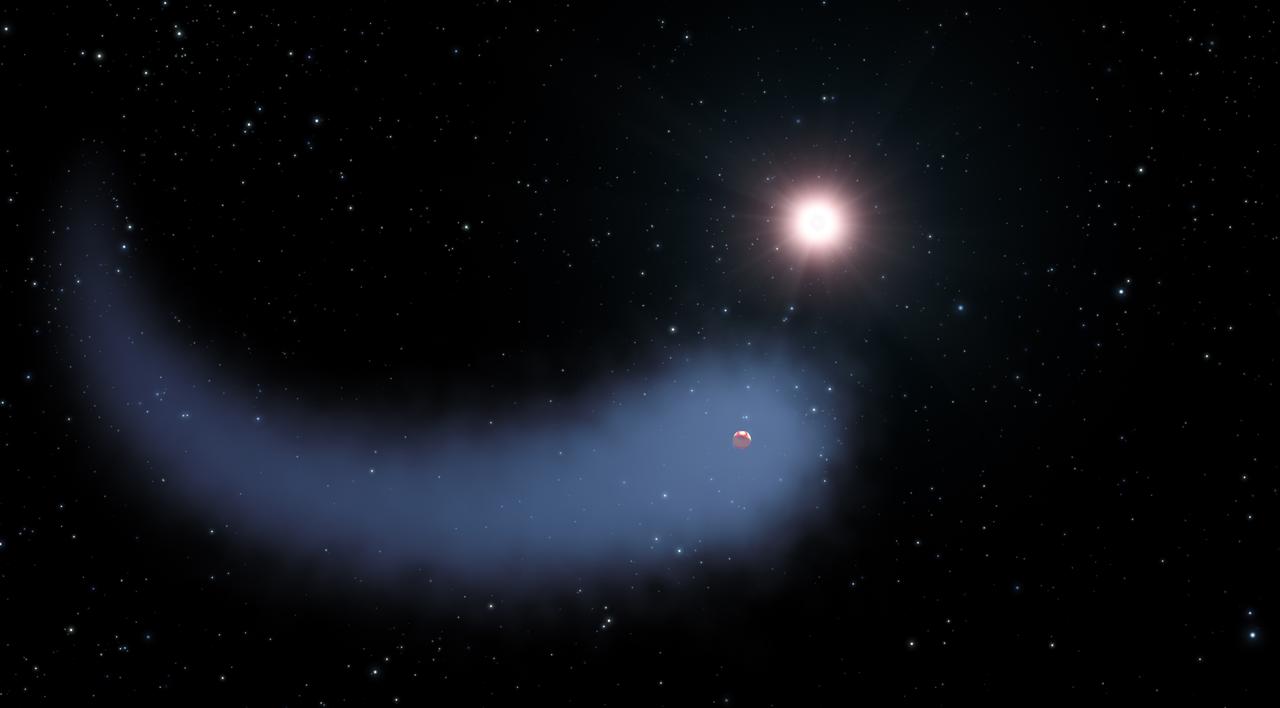
Astronomers using NASA’s Hubble Space Telescope have discovered an immense cloud of hydrogen dubbed “The Behemoth” bleeding from a planet orbiting a nearby star. The enormous, comet-like feature is about 50 times the size of the parent star. The hydrogen is evaporating from a warm, Neptune-sized planet, due to extreme radiation from the star. This phenomenon has never been seen around an exoplanet so small. It may offer clues to how other planets with hydrogen-enveloped atmospheres could have their outer layers evaporated by their parent star, leaving behind solid, rocky cores. Hot, rocky planets such as these that roughly the size of Earth are known as Hot-Super Earths. “This cloud is very spectacular, though the evaporation rate does not threaten the planet right now,” explains the study’s leader, David Ehrenreich of the Observatory of the University of Geneva in Switzerland. “But we know that in the past, the star, which is a faint red dwarf, was more active. This means that the planet evaporated faster during its first billion years of existence because of the strong radiation from the young star. Overall, we estimate that it may have lost up to 10 percent of its atmosphere over the past several billion years.” Caption: This artist's concept shows "The Behemoth," an enormous comet-like cloud of hydrogen bleeding off of a warm, Neptune-sized planet just 30 light-years from Earth. Also depicted is the parent star, which is a faint red dwarf named GJ 436. The hydrogen is evaporating from the planet due to extreme radiation from the star. A phenomenon this large has never before been seen around any exoplanet. Credits: NASA, ESA, and G. Bacon (STScI)
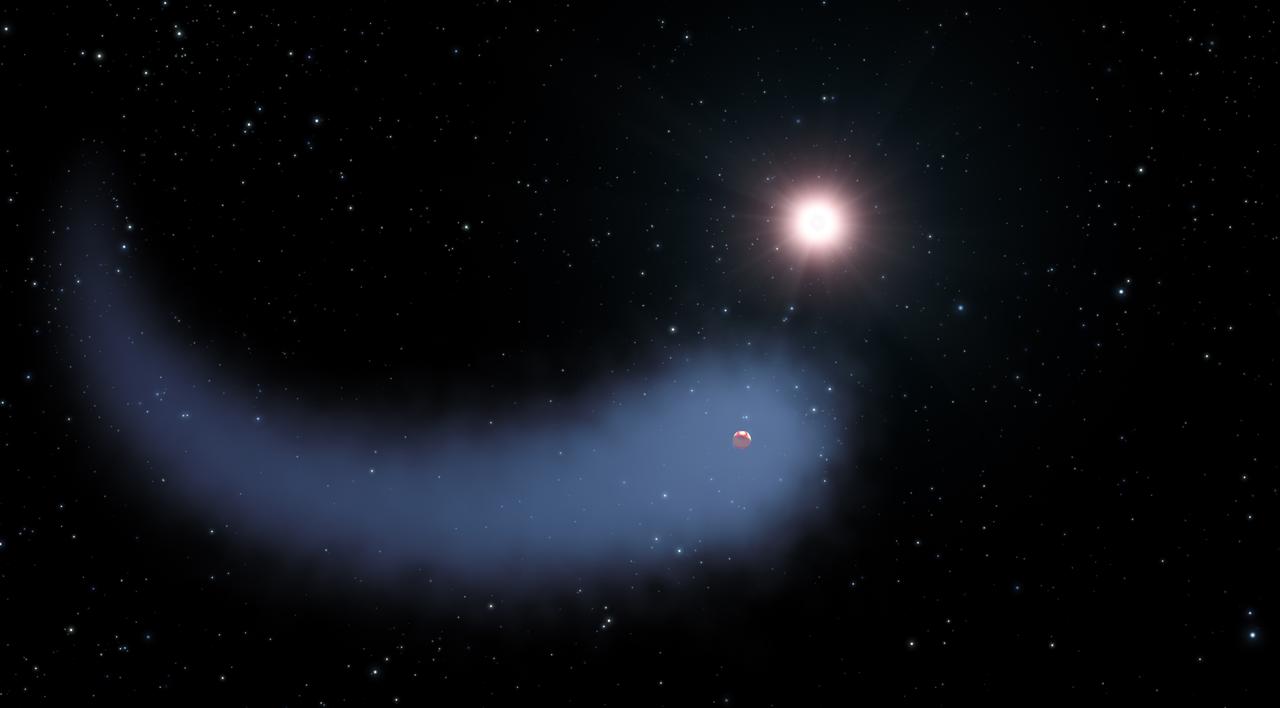
Astronomers using NASA’s Hubble Space Telescope have discovered an immense cloud of hydrogen dubbed “The Behemoth” bleeding from a planet orbiting a nearby star. The enormous, comet-like feature is about 50 times the size of the parent star. The hydrogen is evaporating from a warm, Neptune-sized planet, due to extreme radiation from the star. This phenomenon has never been seen around an exoplanet so small. It may offer clues to how other planets with hydrogen-enveloped atmospheres could have their outer layers evaporated by their parent star, leaving behind solid, rocky cores. Hot, rocky planets such as these that roughly the size of Earth are known as Hot-Super Earths. “This cloud is very spectacular, though the evaporation rate does not threaten the planet right now,” explains the study’s leader, David Ehrenreich of the Observatory of the University of Geneva in Switzerland. “But we know that in the past, the star, which is a faint red dwarf, was more active. This means that the planet evaporated faster during its first billion years of existence because of the strong radiation from the young star. Overall, we estimate that it may have lost up to 10 percent of its atmosphere over the past several billion years.” Read more: <a href="http://www.nasa.gov/feature/goddard/hubble-sees-a-behemoth-bleeding-atmosphere-around-a-warm-exoplanet" rel="nofollow">www.nasa.gov/feature/goddard/hubble-sees-a-behemoth-bleed...</a> Caption: This artist's concept shows "The Behemoth," an enormous comet-like cloud of hydrogen bleeding off of a warm, Neptune-sized planet just 30 light-years from Earth. Also depicted is the parent star, which is a faint red dwarf named GJ 436. The hydrogen is evaporating from the planet due to extreme radiation from the star. A phenomenon this large has never before been seen around any exoplanet. Credits: NASA, ESA, and G. Bacon (STScI) <b><a href="http://www.nasa.gov/audience/formedia/features/MP_Photo_Guidelines.html" rel="nofollow">NASA image use policy.</a></b> <b><a href="http://www.nasa.gov/centers/goddard/home/index.html" rel="nofollow">NASA Goddard Space Flight Center</a></b> enables NASA’s mission through four scientific endeavors: Earth Science, Heliophysics, Solar System Exploration, and Astrophysics. Goddard plays a leading role in NASA’s accomplishments by contributing compelling scientific knowledge to advance the Agency’s mission. <b>Follow us on <a href="http://twitter.com/NASAGoddardPix" rel="nofollow">Twitter</a></b> <b>Like us on <a href="http://www.facebook.com/pages/Greenbelt-MD/NASA-Goddard/395013845897?ref=tsd" rel="nofollow">Facebook</a></b> <b>Find us on <a href="http://instagrid.me/nasagoddard/?vm=grid" rel="nofollow">Instagram</a></b>