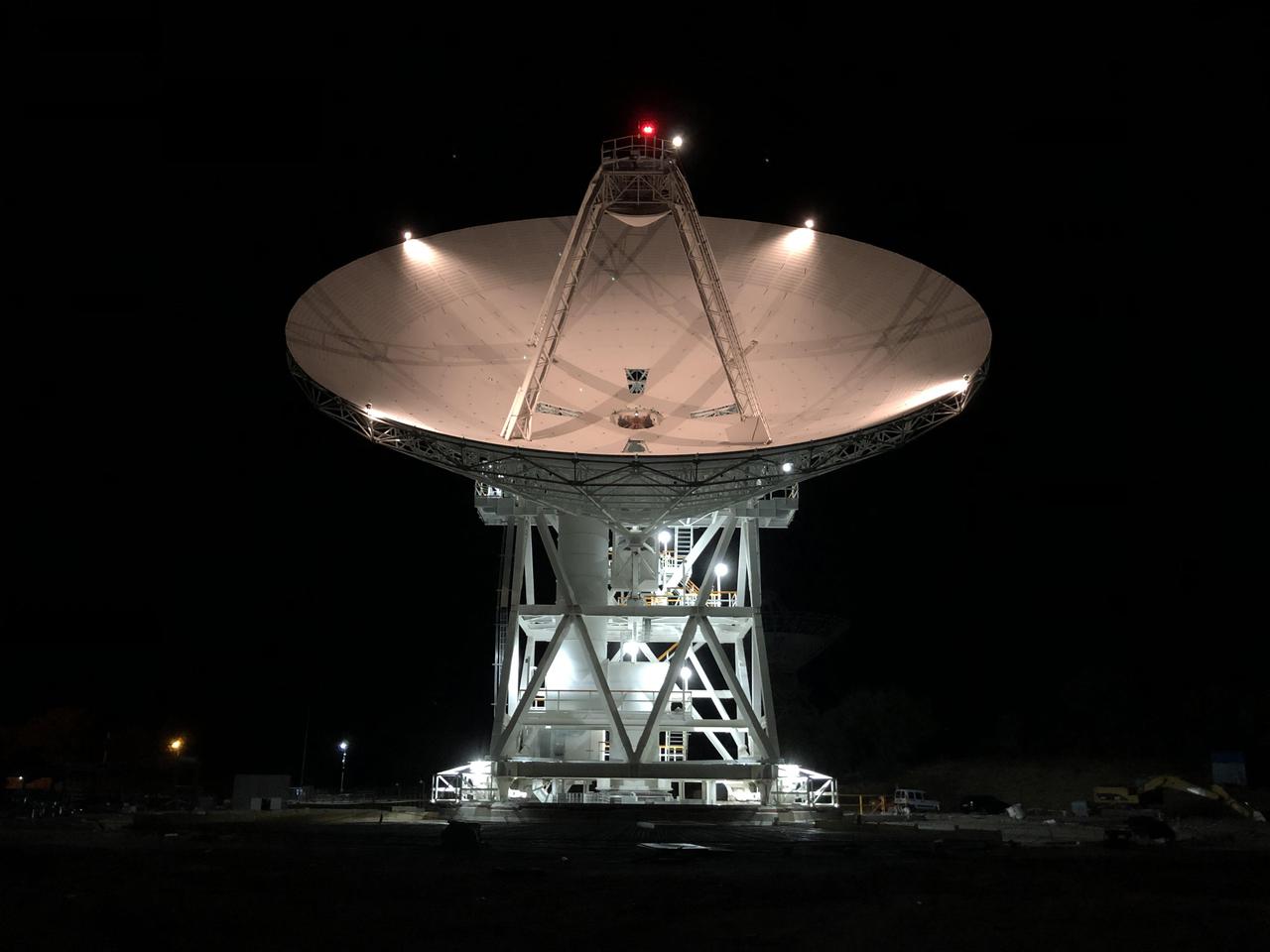
Deep Space Station 56, or DSS-56, is a powerful 34-meter-wide (112-foot-wide) antenna that was added to the Deep Space Network's Madrid Deep Space Communications Complex in Spain in early 2021 after beginning construction in 2017. Deep Space Network (DSN) radio antennas communicate with spacecraft throughout the solar system. Previous antennas have been limited in the frequency bands they can receive and transmit, often being restricted to communicating only with specific spacecraft. DSS-56 is the first to use the DSN's full range of communication frequencies. This means DSS-56 is an "all-in-one" antenna that can communicate with all the missions that the DSN supports and can be used as a backup for any of the Madrid complex's other antennas. With the addition of DSS-56 and other 34-meter antennas to all three DSN complexes, the network is preparing to play a critical role in ensuring communication and navigation support for upcoming Moon and Mars missions and the crewed Artemis missions. https://photojournal.jpl.nasa.gov/catalog/PIA24163

DSS43 is a 70-meter-wide (230-feet-wide) radio antenna at the Deep Space Network's Canberra facility in Australia. It is the only antenna that can send commands to the Voyager 2 spacecraft. https://photojournal.jpl.nasa.gov/catalog/PIA23682
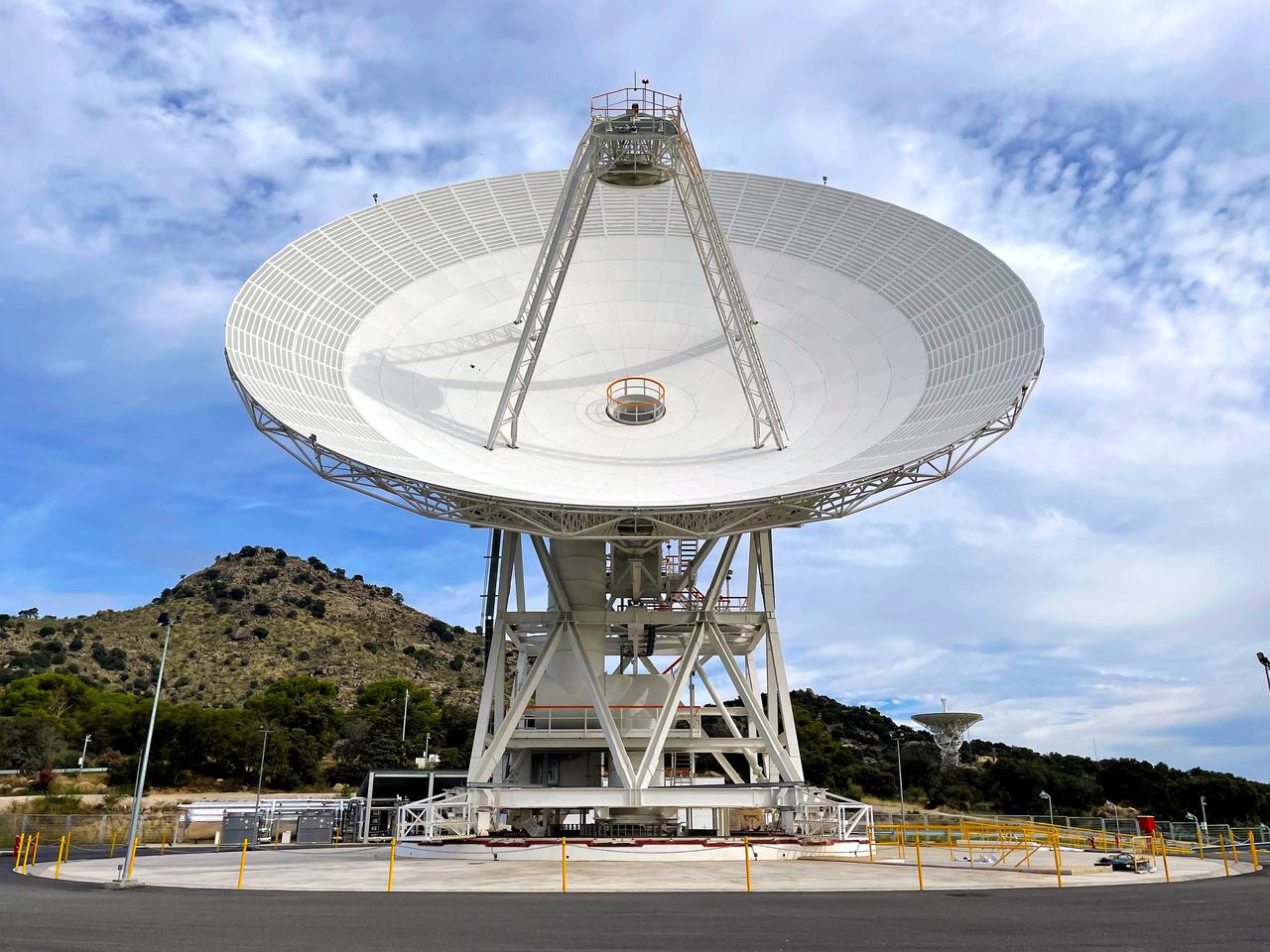
Deep Space Station 53, or DSS-53, is a new 34-meter (111-foot) beam waveguide antenna that went online in February 2022 at NASA's Deep Space Network's ground station in Madrid. DSS-53 is the fourth of six antennas being added to expand the DSN's capacity and meet the needs of a growing number of spacecraft. When the project is complete, each of the network's three ground stations around the globe will have four beam waveguide antennas. The Madrid Deep Space Communications Complex is the first to have completed its build-out as part of project. Construction on DSS-53 began in 2016. https://photojournal.jpl.nasa.gov/catalog/PIA25136
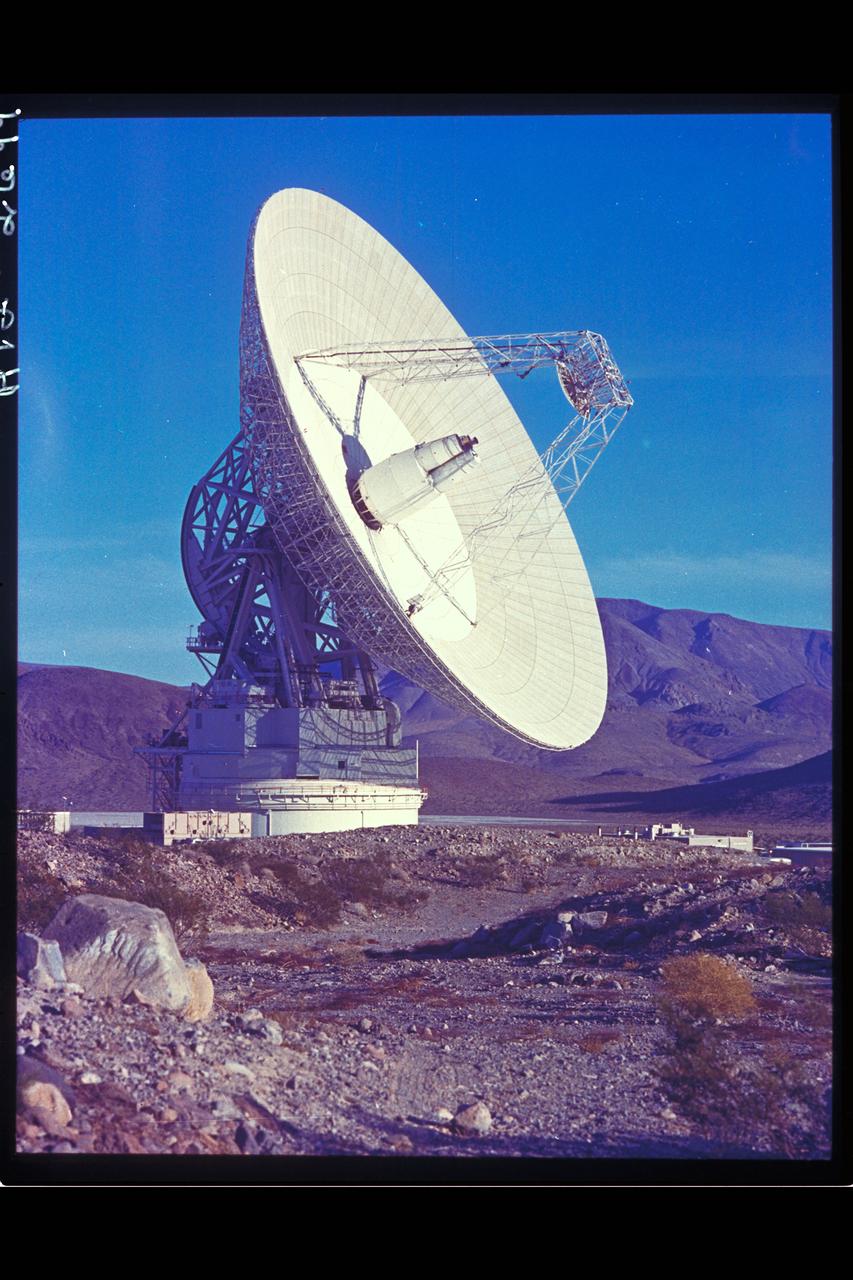
Deep Space Antenna 210' at Goldstone, CA (JPL ref: P-116594AC)
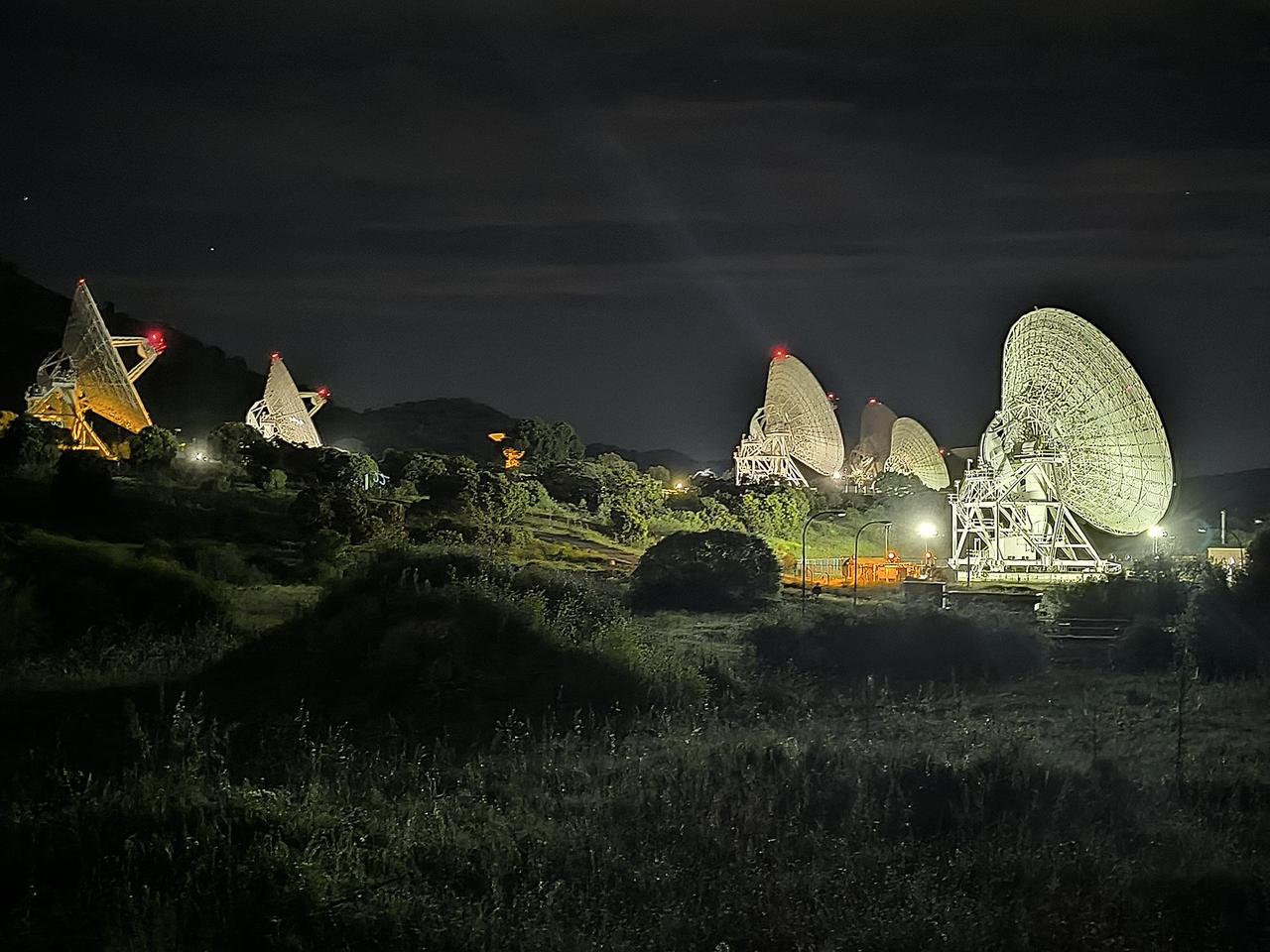
In a historic first, all six radio frequency antennas at the Madrid Deep Space Communication Complex – part of NASA's Deep Space Network (DSN) – carried out a test to receive data from the agency's Voyager 1 spacecraft at the same time on April 20, 2024. Known as "arraying," combining the receiving power of several antennas allows the DSN to collect the very faint signals from faraway spacecraft. A five-antenna array is currently needed to downlink science data from the spacecraft's Plasma Wave System (PWS) instrument. As Voyager gets further way, six antennas will be needed. The Voyager team is currently working to fix an issue on the spacecraft that has prevented it from sending back science data since November. Though the antennas located at the DSN's three complexes – Goldstone in California, Canberra in Australia, and Madrid – have been arrayed before, this is the first instance of six antennas being arrayed at once. Madrid is the only deep space communication complex currently with six operational antennas (the other two complexes have four apiece). Each complex consists of one 70-meter (230-foot) antenna and several 34-meter (112-foot) antennas. Voyager 1 is over 15 billion miles (24 billion kilometers) away, so its signal on Earth is far fainter than any other spacecraft with which the DSN communicates. It currently takes Voyager 1's signal over 22 ½ hours to travel from the spacecraft to Earth. To better receive Voyager 1's radio communications, a large antenna – or an array of multiple smaller antennas – can be used. Voyager 1 and its twin, Voyager 2, are the only spacecraft ever to fly in interstellar space (the space between stars). https://photojournal.jpl.nasa.gov/catalog/PIA26147
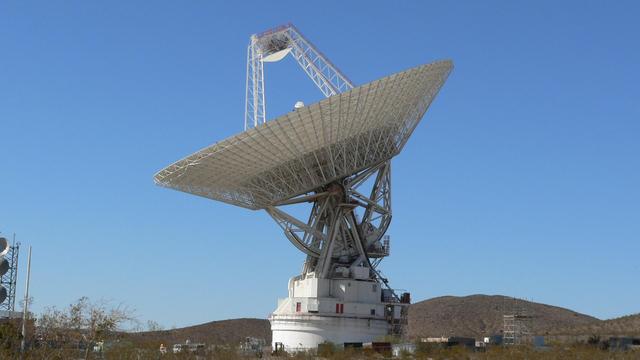
The giant, 70-meter-wide antenna at NASA Deep Space Network complex in Goldstone, Calif., tracks a spacecraft on Nov. 17, 2009. This antenna, officially known as Deep Space Station 14, is also nicknamed the Mars antenna.
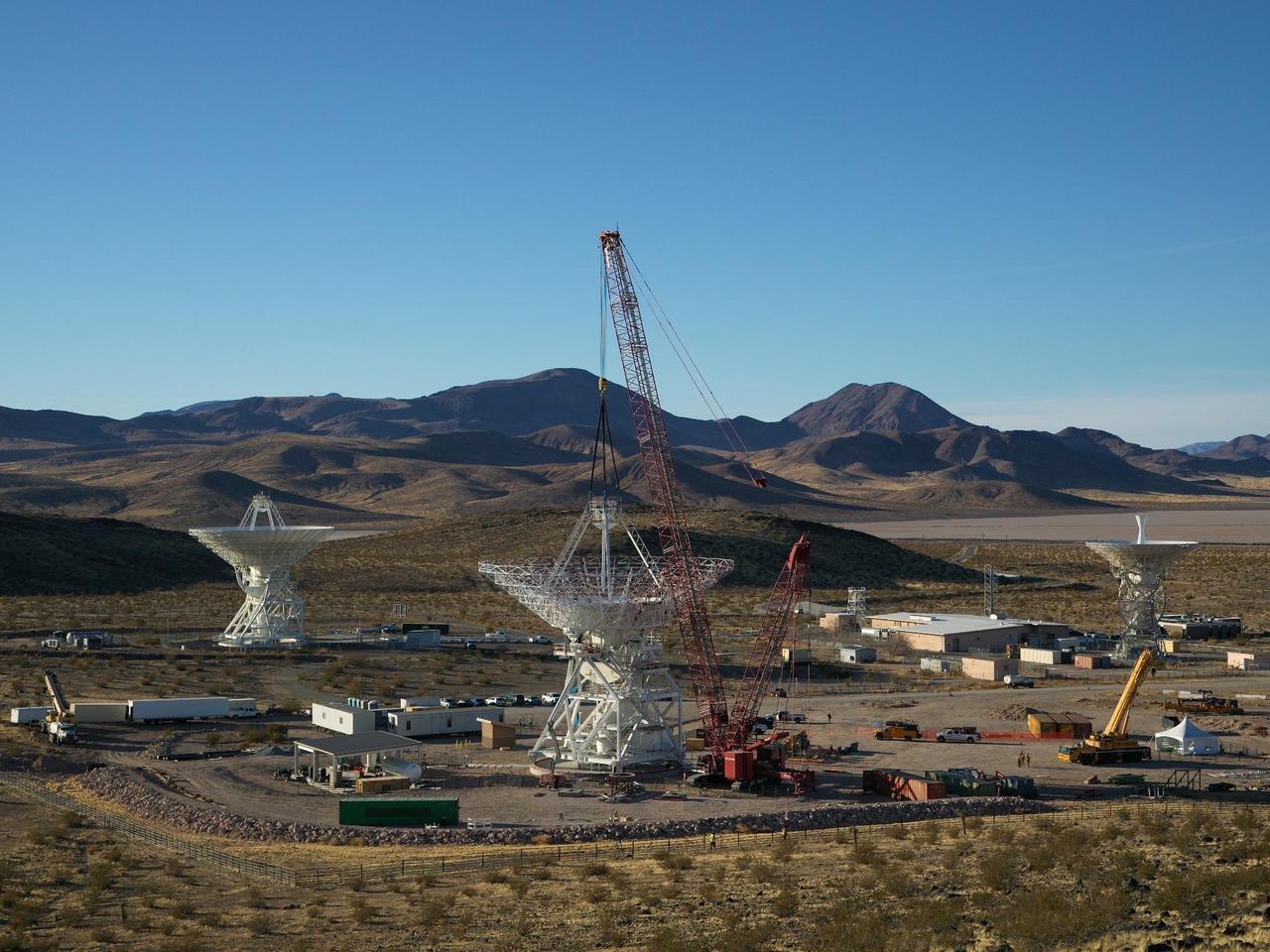
A crane lowers a four-legged support structure called a quadripod onto the steel framework of the Deep Space Station 23 (DSS-23) reflector dish on Dec. 18, 2024. The reflector framework was bolted into place earlier in the day, and the quadripod, which weighs 16 ½ tons, was the last major component to be installed that day. The reflector dish will be fitted with panels to create a curved surface to collect radio frequency signals. The quadripod features a curved subreflector that will direct radio frequency signals from deep space that bounce off the main reflector into the antenna's receiver in its pedestal, where the antenna's receivers are housed. The new 112-foot-wide (34-meter-wide) dish is located at the Deep Space Network's Goldstone Space Communications Complex near Barstow, California. A multi-frequency beam waveguide antenna, DSS-23 will come online in 2026, boosting the DSN's capacity and enhance NASA's deep space communications capabilities for decades to come. It is the fifth of six new beam waveguide antennas to be added to the network, following DSS-53, which was added at the DSN's Madrid complex in 2022. The DSN allows missions to track, send commands to, and receive scientific data from faraway spacecraft. It is managed by NASA's Jet Propulsion Laboratory in Southern California for the agency's Space Communications and Navigation (SCaN) program, which is located at NASA Headquarters within the Space Operations Mission Directorate. https://photojournal.jpl.nasa.gov/catalog/PIA26455
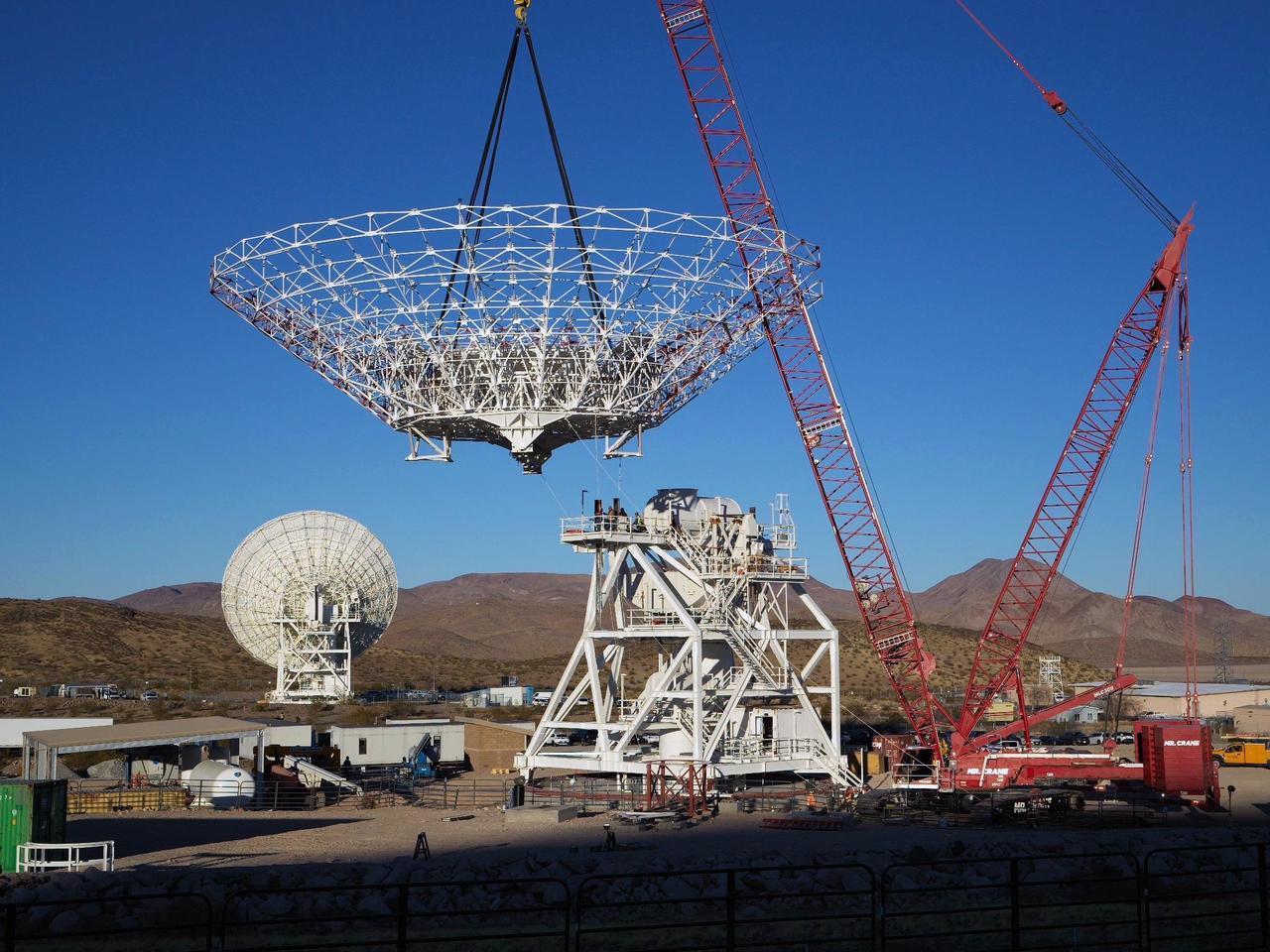
A crane lowers the 112-foot-wide (34-meter-wide) steel framework for the Deep Space Station 23 (DSS-23) reflector dish into position on Dec. 18, 2024, at the Deep Space Network's Goldstone Space Communications Complex near Barstow, California. A multi-frequency beam waveguide antenna, DSS-23 will boost the DSN's capacity and enhance NASA's deep space communications capabilities for decades to come. Once online in 2026, DSS-23 will be the fifth of six new beam waveguide antennas to be added to the network, following DSS-53, which was added at the DSN's Madrid complex in 2022. After the reflector skeleton was bolted into place, engineers placed what's called a quadripod into the center of the structure. A four-legged support structure weighing 16 ½ tons, the quadripod is fitted with a curved subreflector that will direct radio frequency signals from deep space that bounce off the main reflector into the antenna's pedestal where the antenna's receivers are housed. Next steps: to fit panels onto the steel skeleton of the parabolic reflector to create a curved surface to collect radio frequency signals. The DSN allows missions to track, send commands to, and receive scientific data from faraway spacecraft. It is managed by NASA's Jet Propulsion Laboratory in Southern California for the agency's Space Communications and Navigation (SCaN) program, which is located at NASA Headquarters within the Space Operations Mission Directorate. https://photojournal.jpl.nasa.gov/catalog/PIA26454
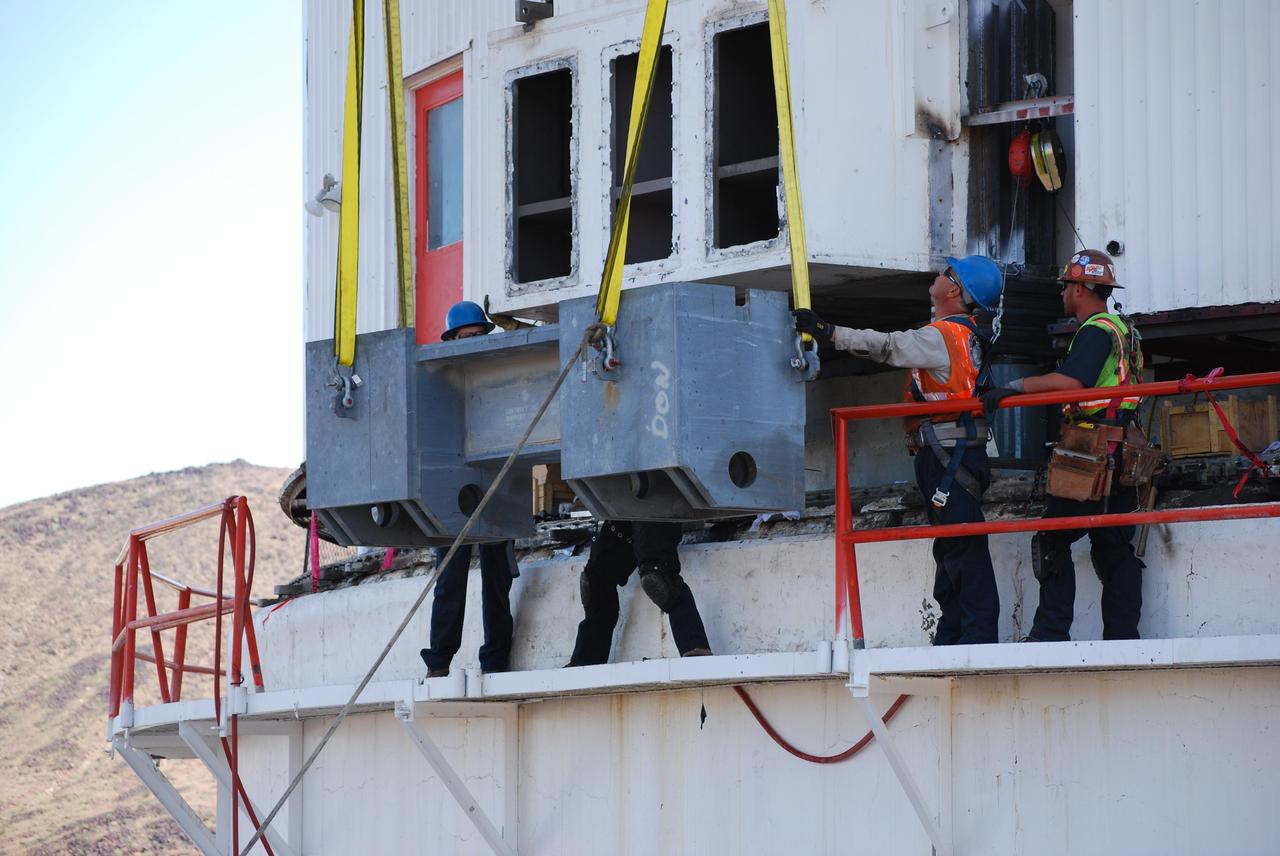
As part of a major refurbishment for the giant Mars antenna at NASA Deep Space Network Goldstone Deep Space Communications Complex, a stringer box is lowered into place.
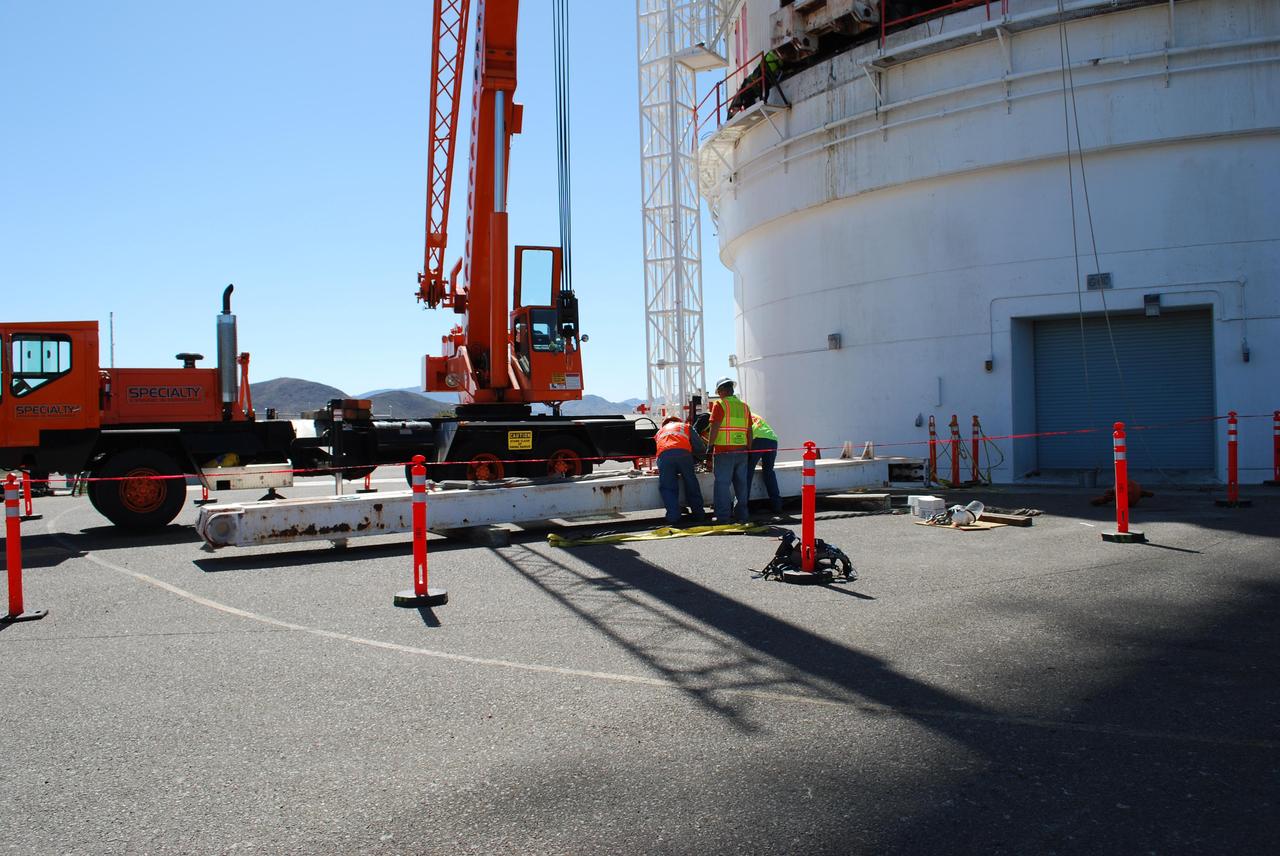
Workers at NASA Deep Space Network Goldstone Deep Space Communications Complex prepare a support leg that would help raise a portion of the giant Mars antenna.
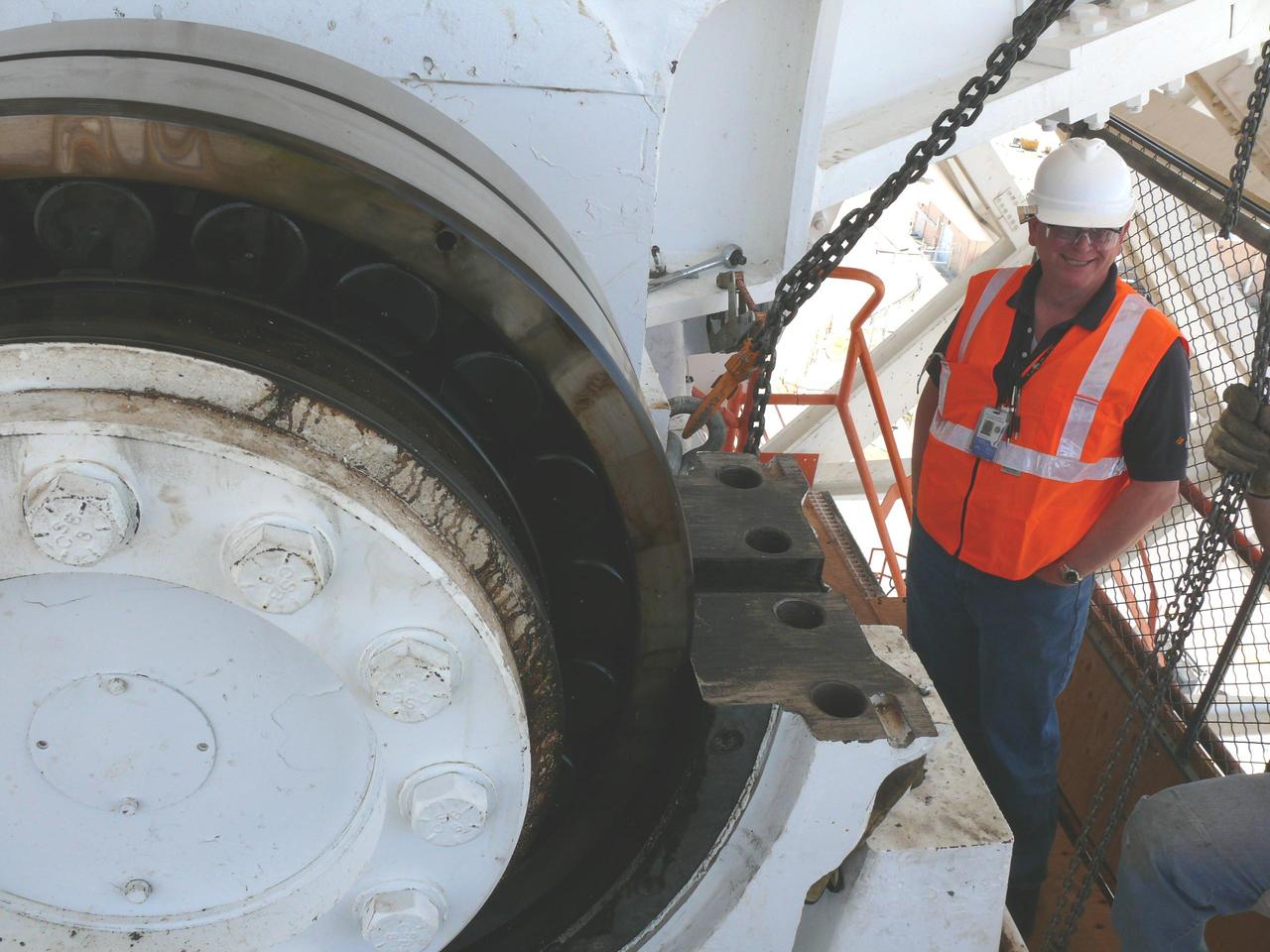
The giant Mars antenna at NASA Deep Space Network Goldstone Deep Space Communications Complex replaced four elevation bearings as part of a major refurbishment.
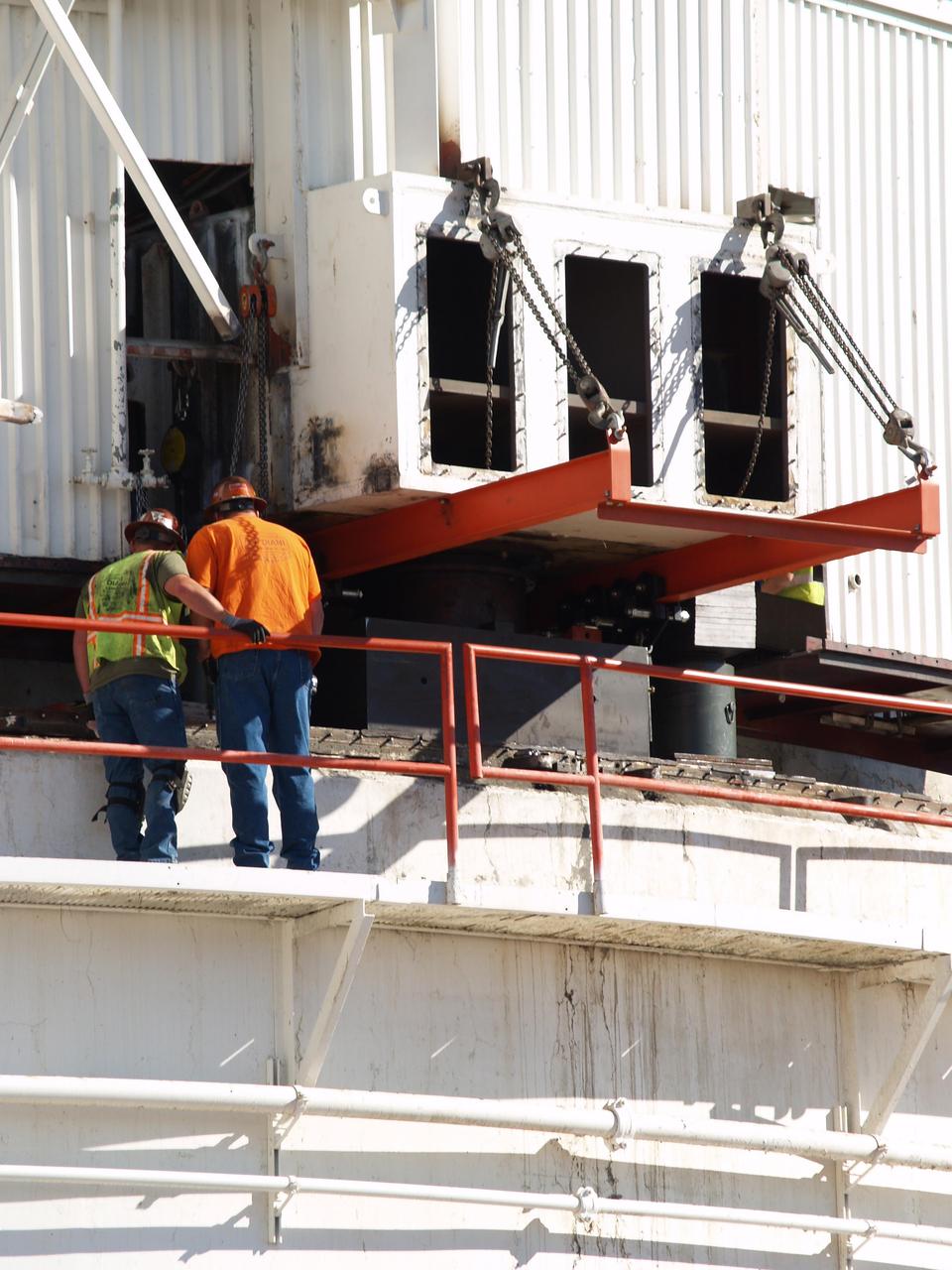
Workers at NASA Deep Space Network Goldstone Deep Space Communications Complex check on a set of jacks used to raise the upper part of the giant Mars antenna.
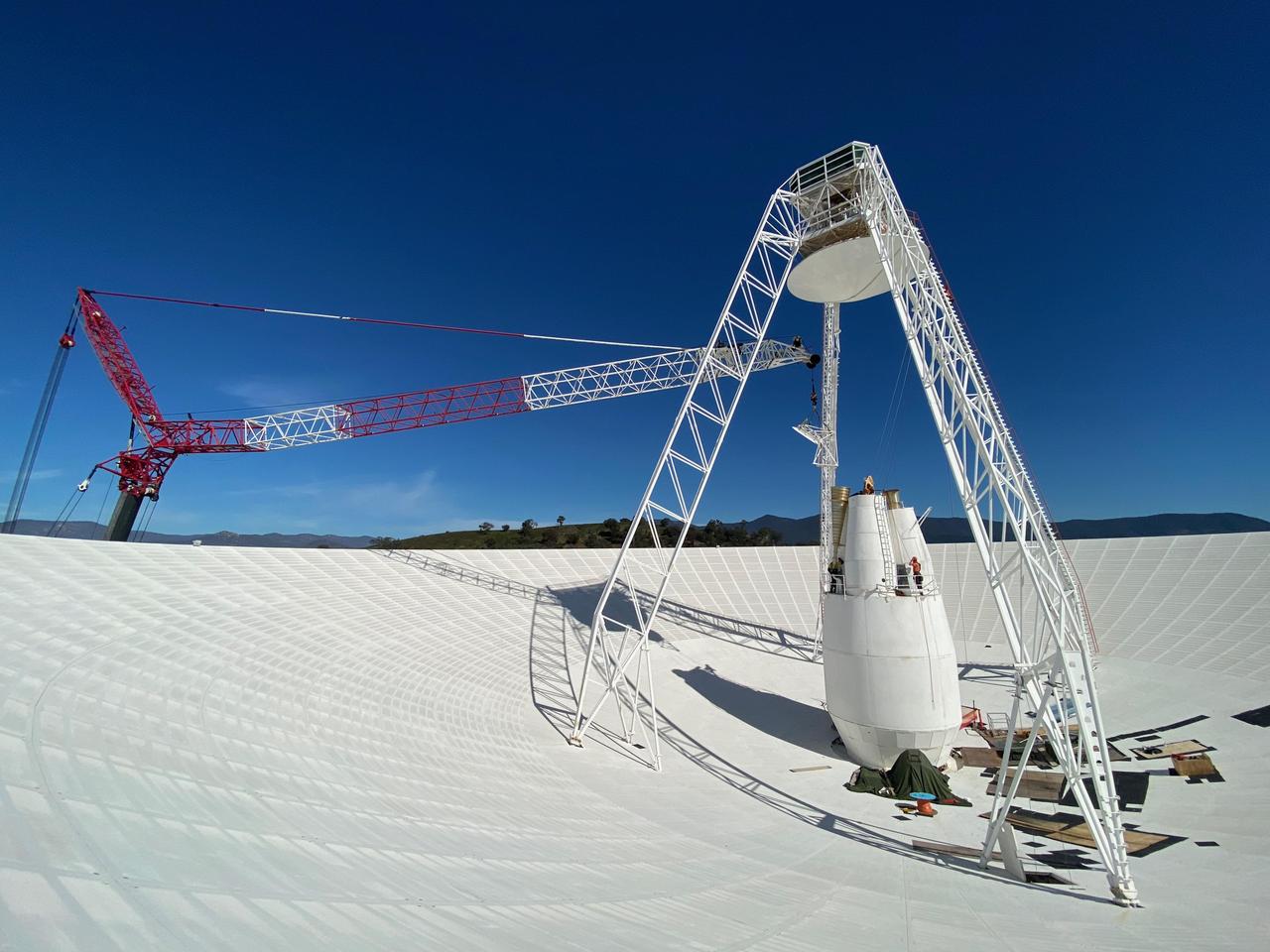
The antenna of the Deep Space Network's Deep Space Station 43 (DSS-43) in Canberra, Australia, spans 70 meters (230 foot) and stands 73 meters (239 foot), dwarfing workers as they perform upgrades on the central cone that contains sensitive transmitters and receivers. A giant crane assisted with the replacement of parts that had been operating on the antenna for over 40 years. One of several antennas located at the Canberra Deep Space Network station, DSS-43 is the largest and responsible for transmitting commands to NASA's Voyager 2 spacecraft. Since early March 2020, DSS-43 has been offline for the upgrades, which are expected to continue until January 2021. https://photojournal.jpl.nasa.gov/catalog/PIA23795
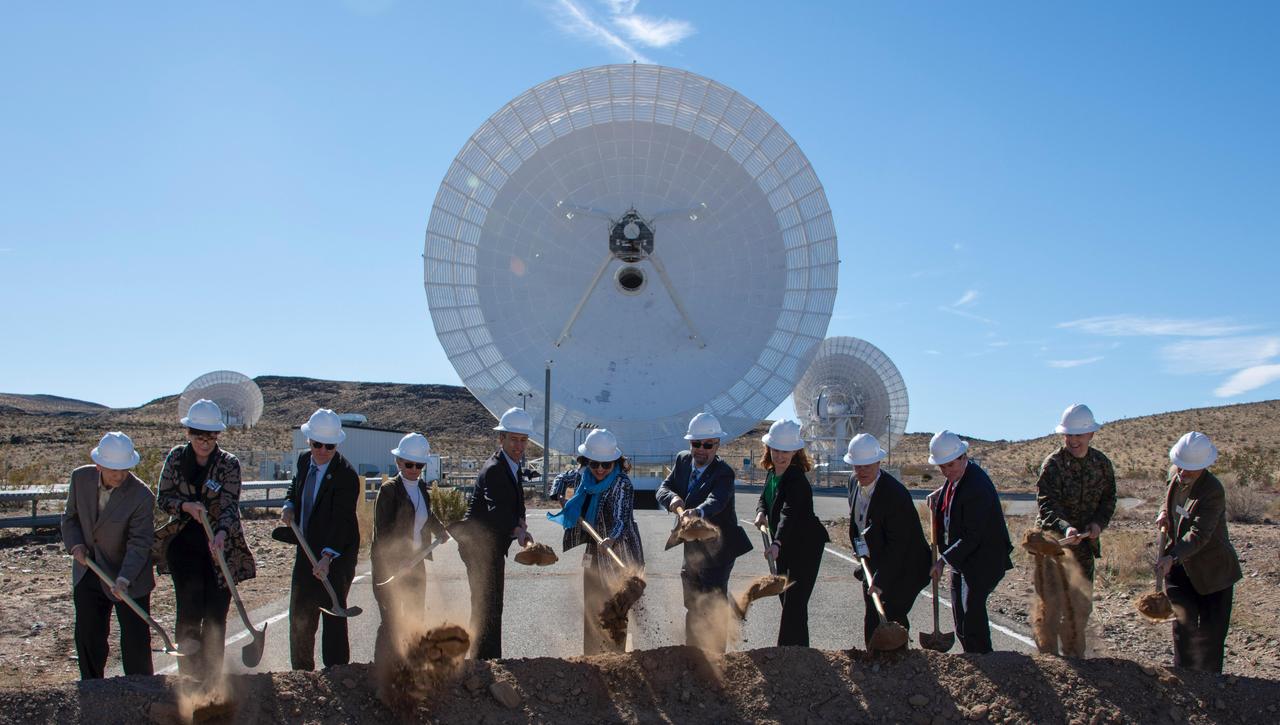
On Feb. 11, 2020, NASA, JPL, military and local officials broke ground in Goldstone, California, for a new antenna in the agency's Deep Space Network, which communicates with all its deep space missions. When completed in 2 ½ years, the new 112-foot-wide (34-meter-wide) antenna dish will include mirrors and a special receiver for optical, or laser, communications from deep space missions. https://photojournal.jpl.nasa.gov/catalog/PIA23618
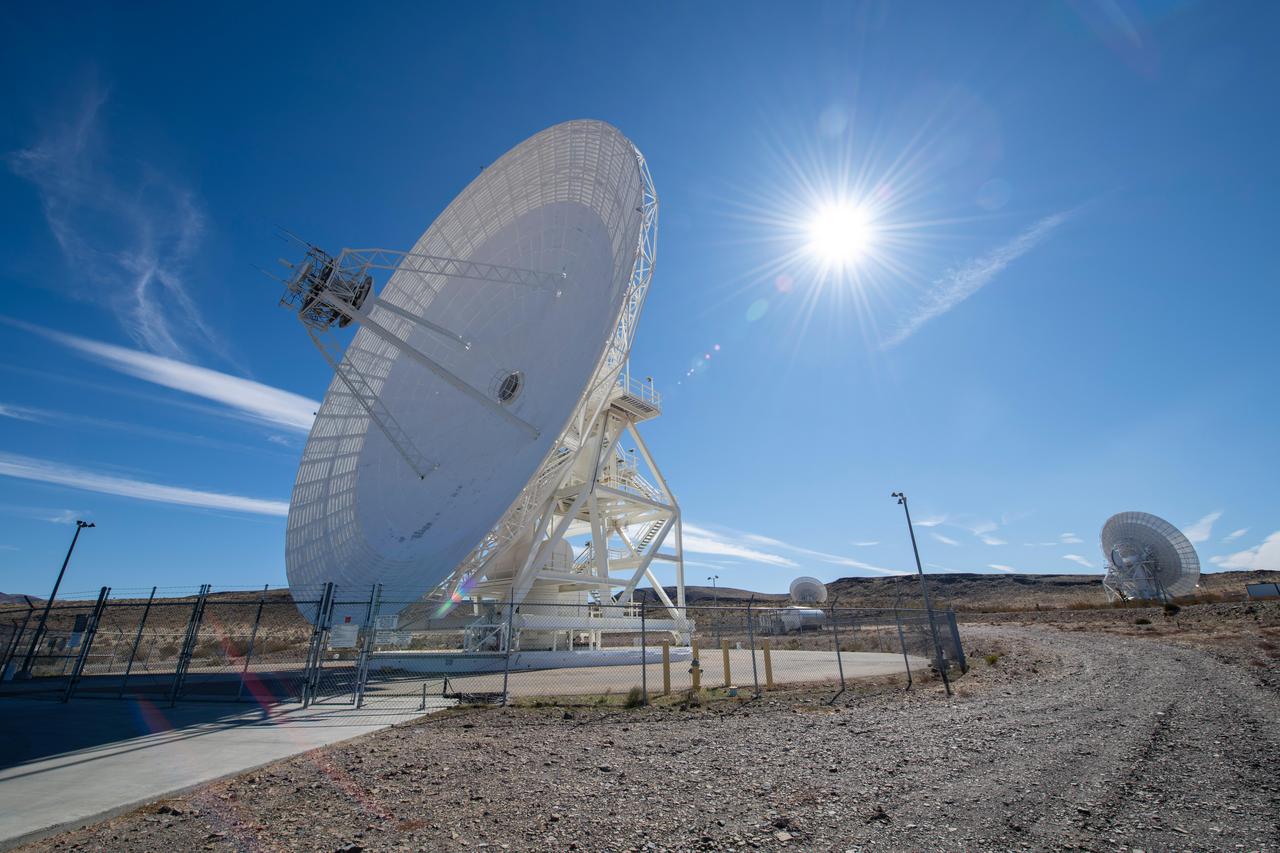
Antenna dishes at NASA's Deep Space Network complex in Goldstone, California, photographed on Feb. 11, 2020. https://photojournal.jpl.nasa.gov/catalog/PIA23214
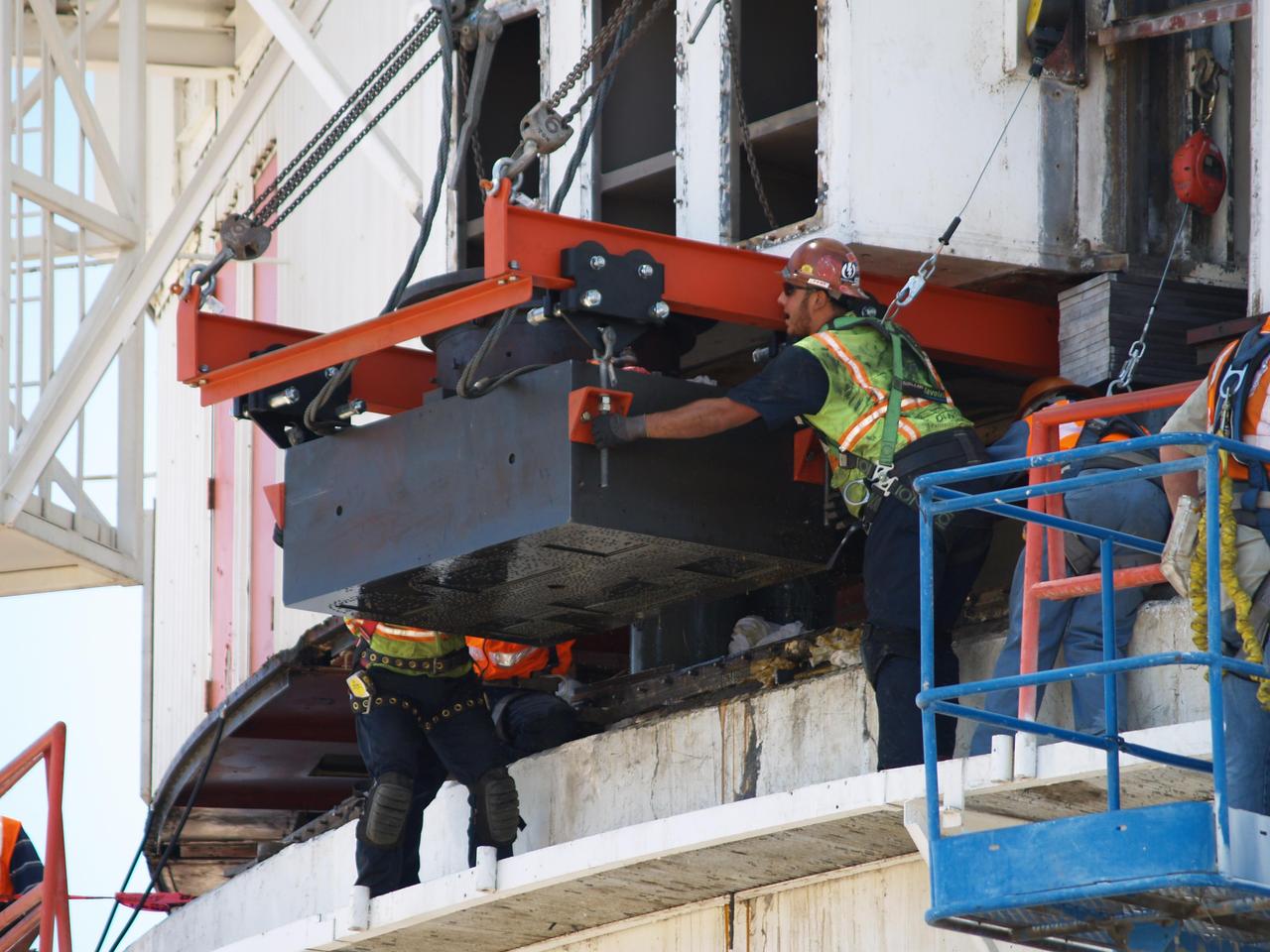
On May 3, 2010, workers at NASA Deep Space Network Goldstone Deep Space Communications Complex removed one of the large steel pads that help the giant Mars antenna rotate sideways.
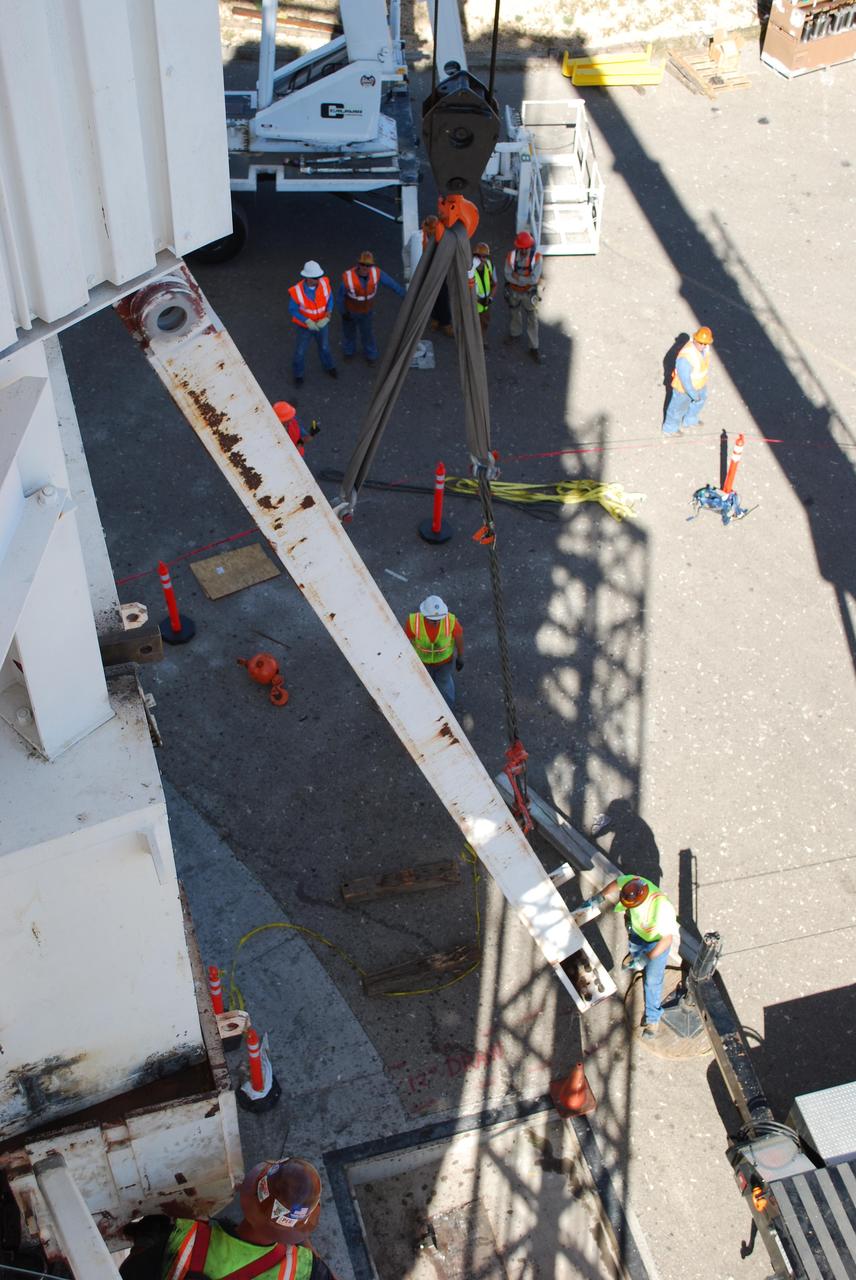
Workers at NASA Deep Space Network Goldstone Deep Space Communications Complex put into place a set of support legs to help hold up a portion of the giant Mars antenna on May 4, 2010.
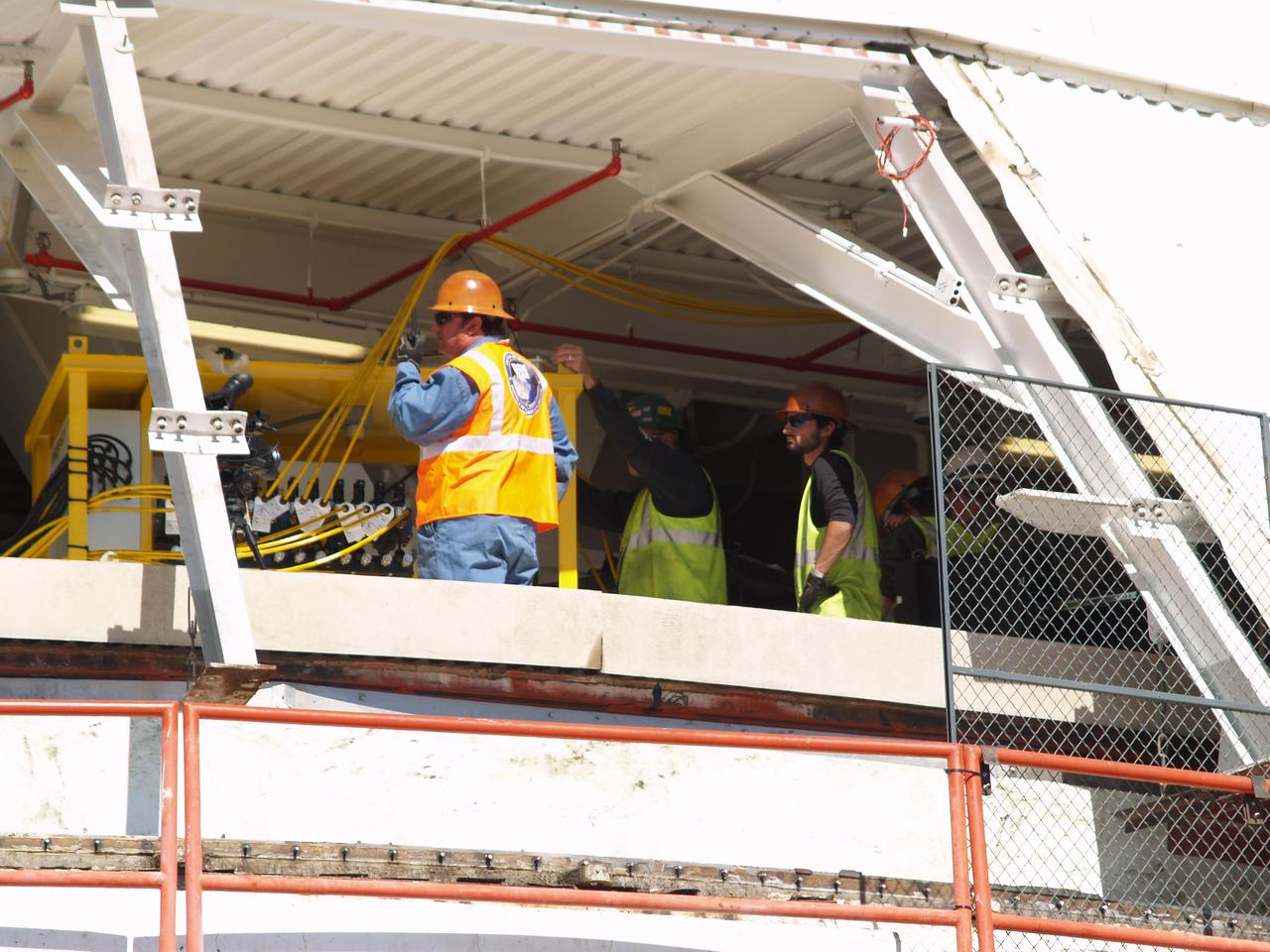
A worker at NASA Deep Space Network Goldstone Deep Space Communications Complex radios to his colleagues that 12 jacks are ready to lift the upper section of the giant Mars antenna.
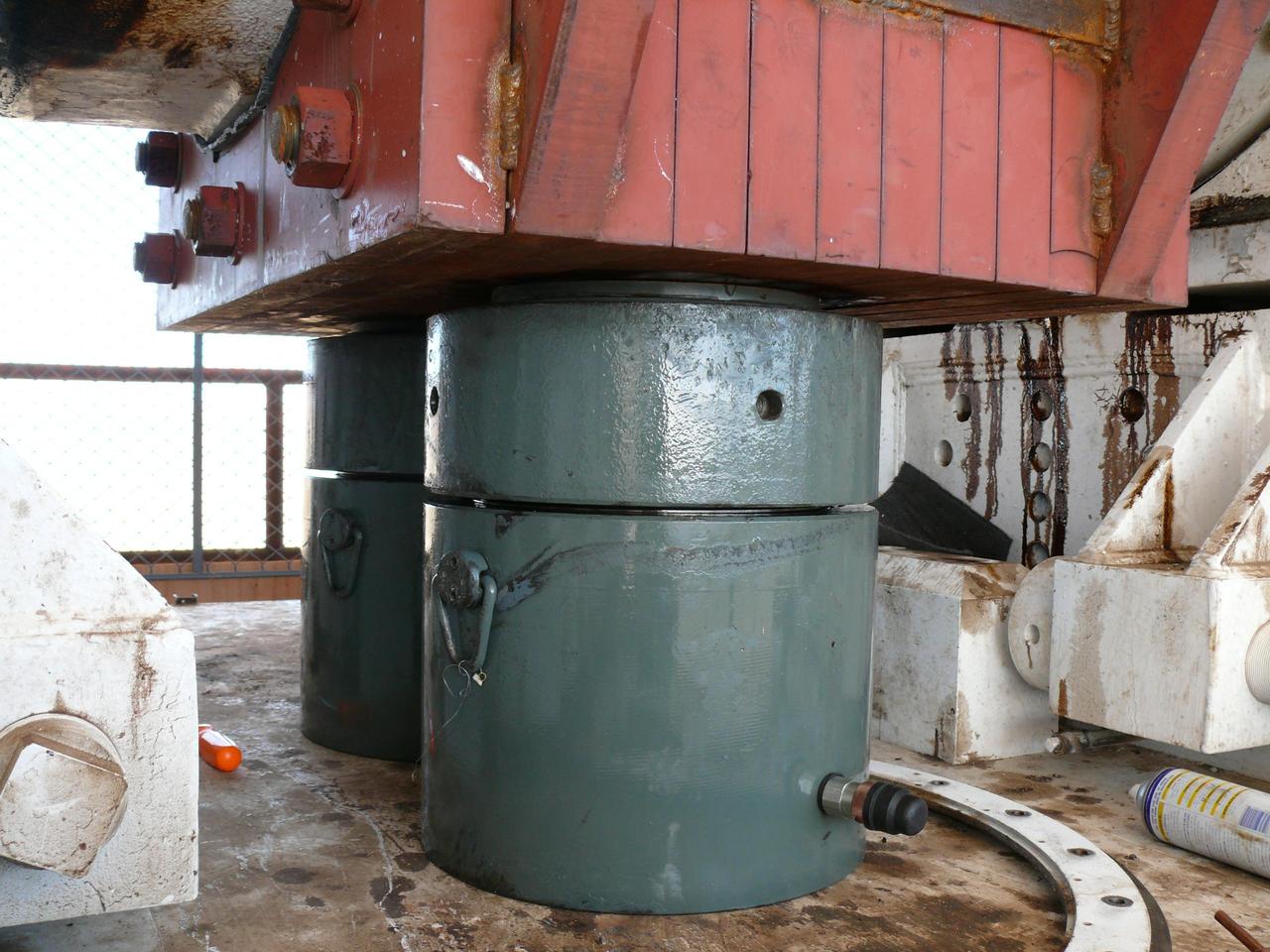
A major refurbishment of the giant Mars antenna at NASA Deep Space Network Goldstone Deep Space Communications Complex in California Mojave Desert required workers to jack up millions of pounds of delicate scientific equipment.

Deep Space Station 13 (DSS-13) at NASA's Goldstone Deep Space Communications Complex near Barstow, California – part of the agency's Deep Space Network – is a 34-meter (112-foot) experimental antenna that has been retrofitted with an optical terminal (the boxy instrument below the center of the antenna's dish). Since November 2023, DSS-13 has been tracking the downlink laser of the Deep Space Optical Communications (DSOC) experiment that is aboard NASA's Psyche mission, which launched on Oct. 13, 2023. In a first, the antenna also synchronously received radio-frequency signals from the spacecraft as it travels through deep space on its way to investigate the metal-rich asteroid Psyche. The laser signal collected by the camera is then transmitted through optical fiber that feeds into a cryogenically cooled semiconducting nanowire single photon detector. Designed and built by JPL's Microdevices Laboratory, the detector is identical to the one used at Caltech's Palomar Observatory, in San Diego County, California, that acts as DSOC's downlink ground station. Goldstone is one of three complexes that comprise NASA's Deep Space Network, which provides radio communications for all of the agency's interplanetary spacecraft and is also utilized for radio astronomy and radar observations of the solar system and the universe. NASA's Jet Propulsion Laboratory, a division of Caltech in Pasadena, California, manages the DSN for the agency. https://photojournal.jpl.nasa.gov/catalog/PIA26148
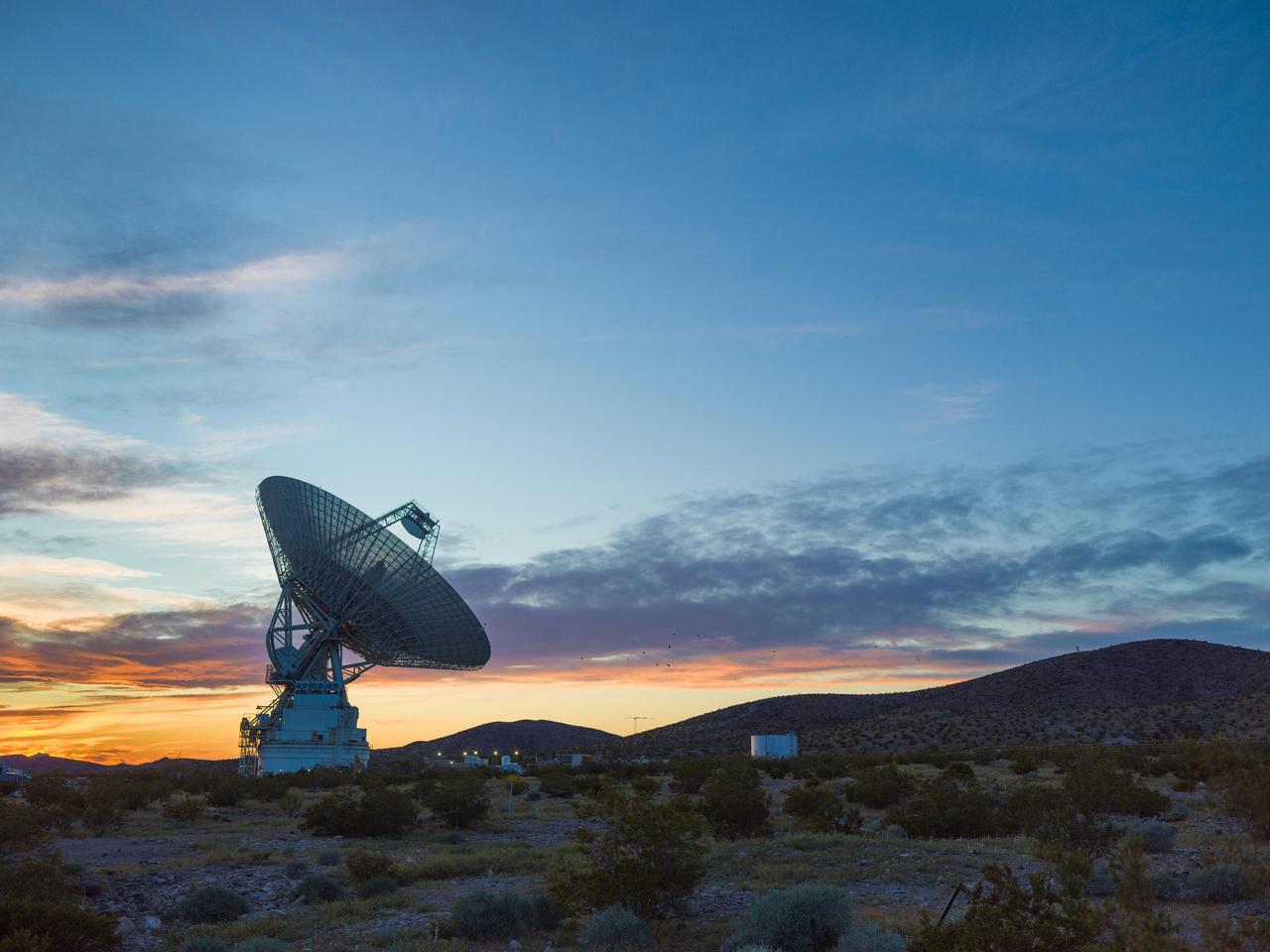
This sunset photo shows Deep Space Station 14 (DSS-14), the 230-foot-wide (70-meter) antenna at the Goldstone Deep Space Communications Complex near Barstow, California, part of NASA's Deep Space Network. The network's three complexes around the globe support communications with dozens of deep space missions. DSS-14 is also the agency's Goldstone Solar System Radar, which is used to observe asteroids that come close to Earth. https://photojournal.jpl.nasa.gov/catalog/PIA26150
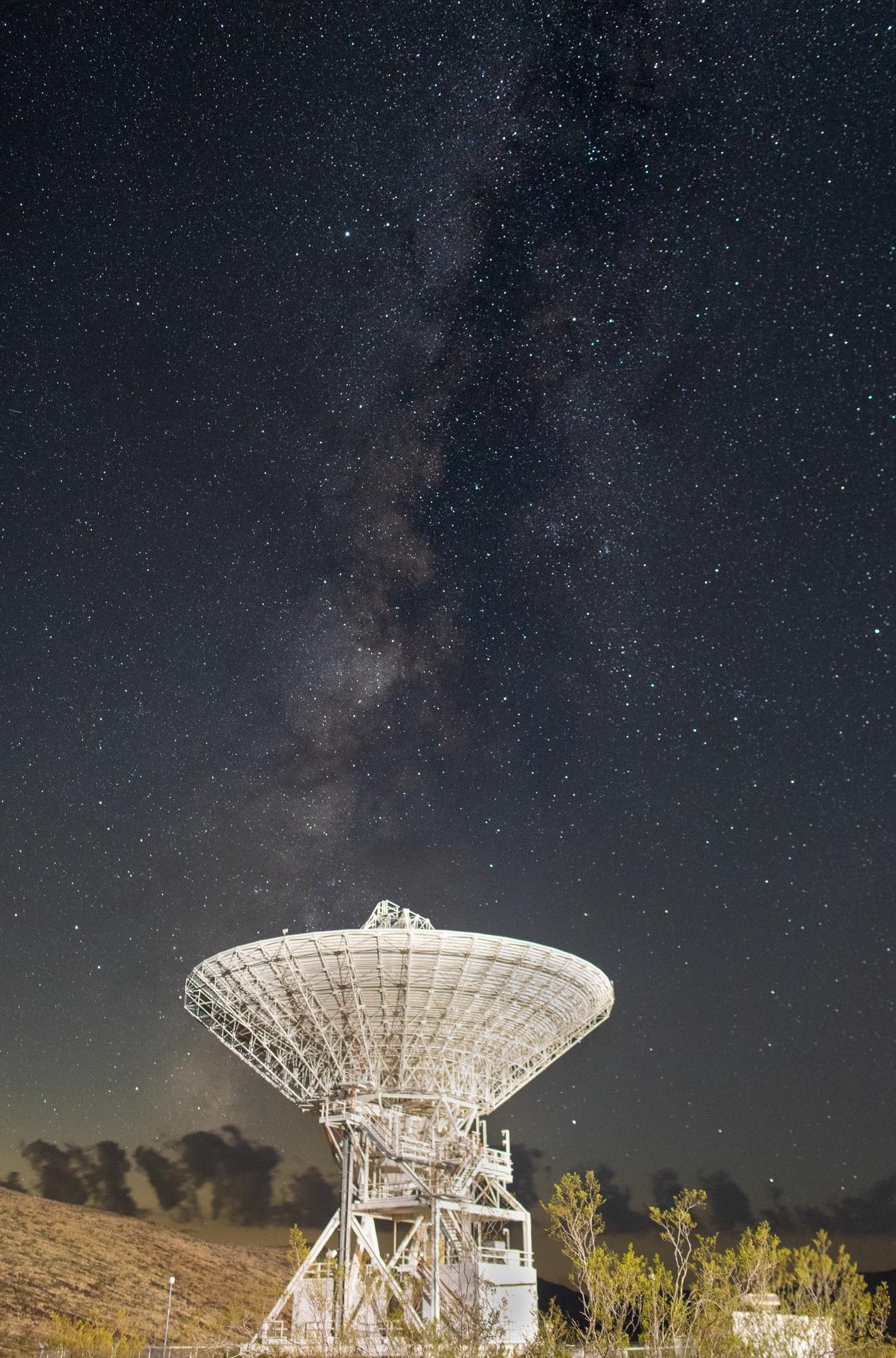
Deep Space Station 15 (DSS-15), one of the 112-foot (34-meter) antennas at the Goldstone Deep Space Communications Complex near Barstow, California, looks skyward, with the stars of the Milky Way overhead, in September 2025. Goldstone is part of NASA’s Deep Space Network (DSN), which operates three complexes around the globe that support communications with dozens of deep space missions. For more information about the DSN, visit: https://www.nasa.gov/communicating-with-missions/dsn/
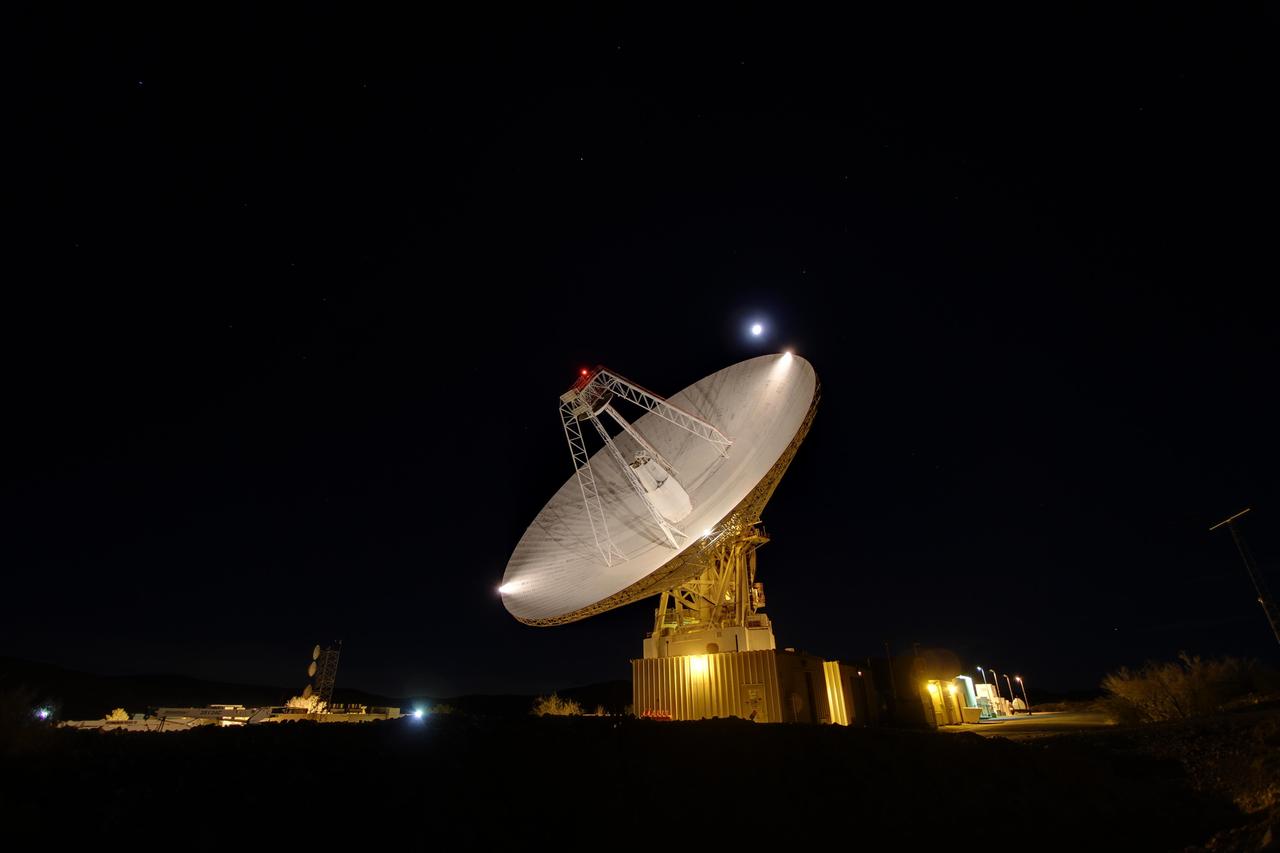
Goldstone 230-foot 70-m antenna tracks under a full moon. The Goldstone Deep Space Communications Complex is located in the Mojave Desert in California, USA.
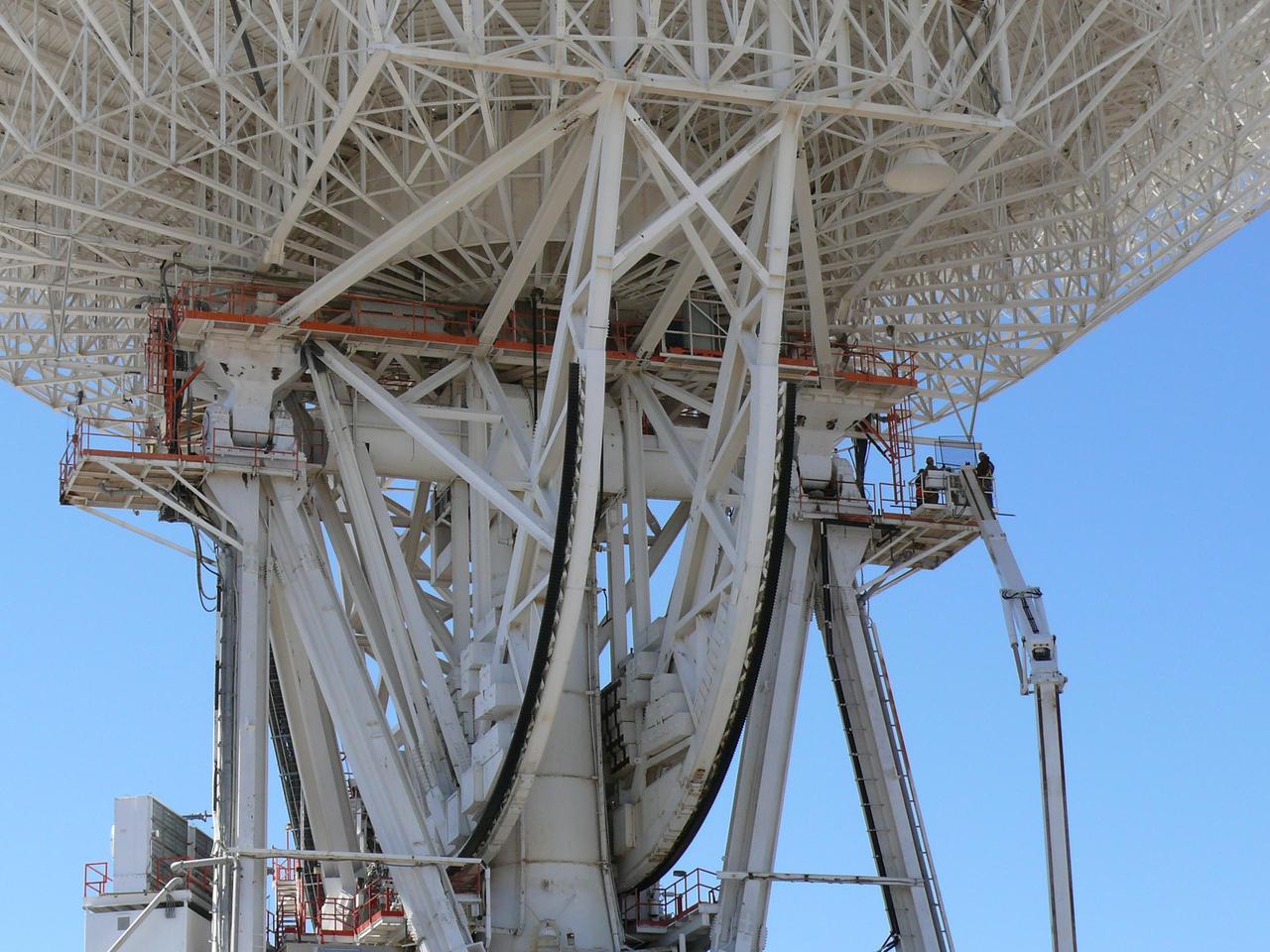
Work began on March 11, 2010 to replace a set of elevation bearings on the giant Mars antenna at NASA Deep Space Network complex in Goldstone, Calif.
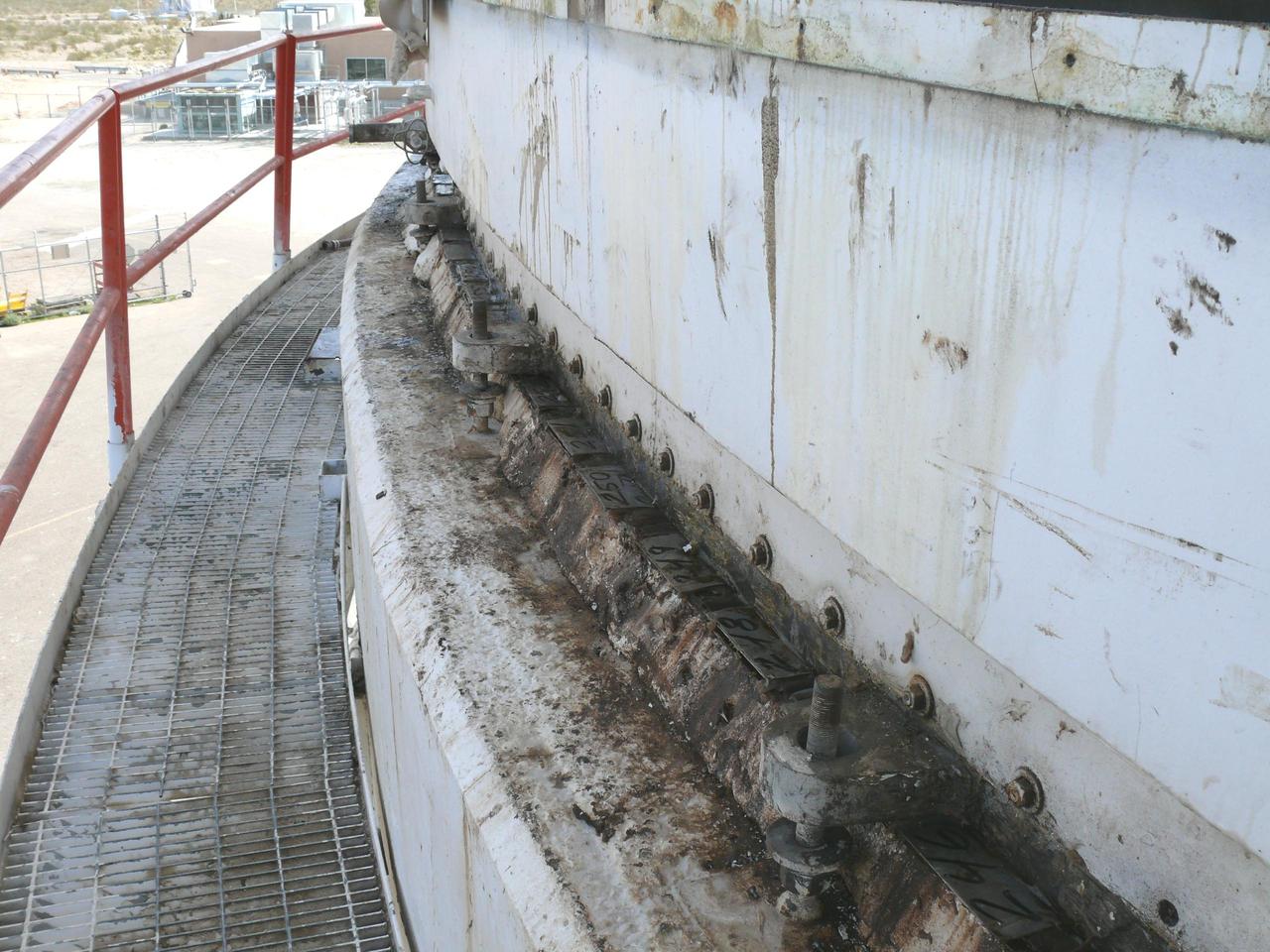
This image, taken on March 22, 2010, shows the condition of grout that was replaced in the giant Mars antenna at NASA Deep Space Network Goldstone, Calif. complex.
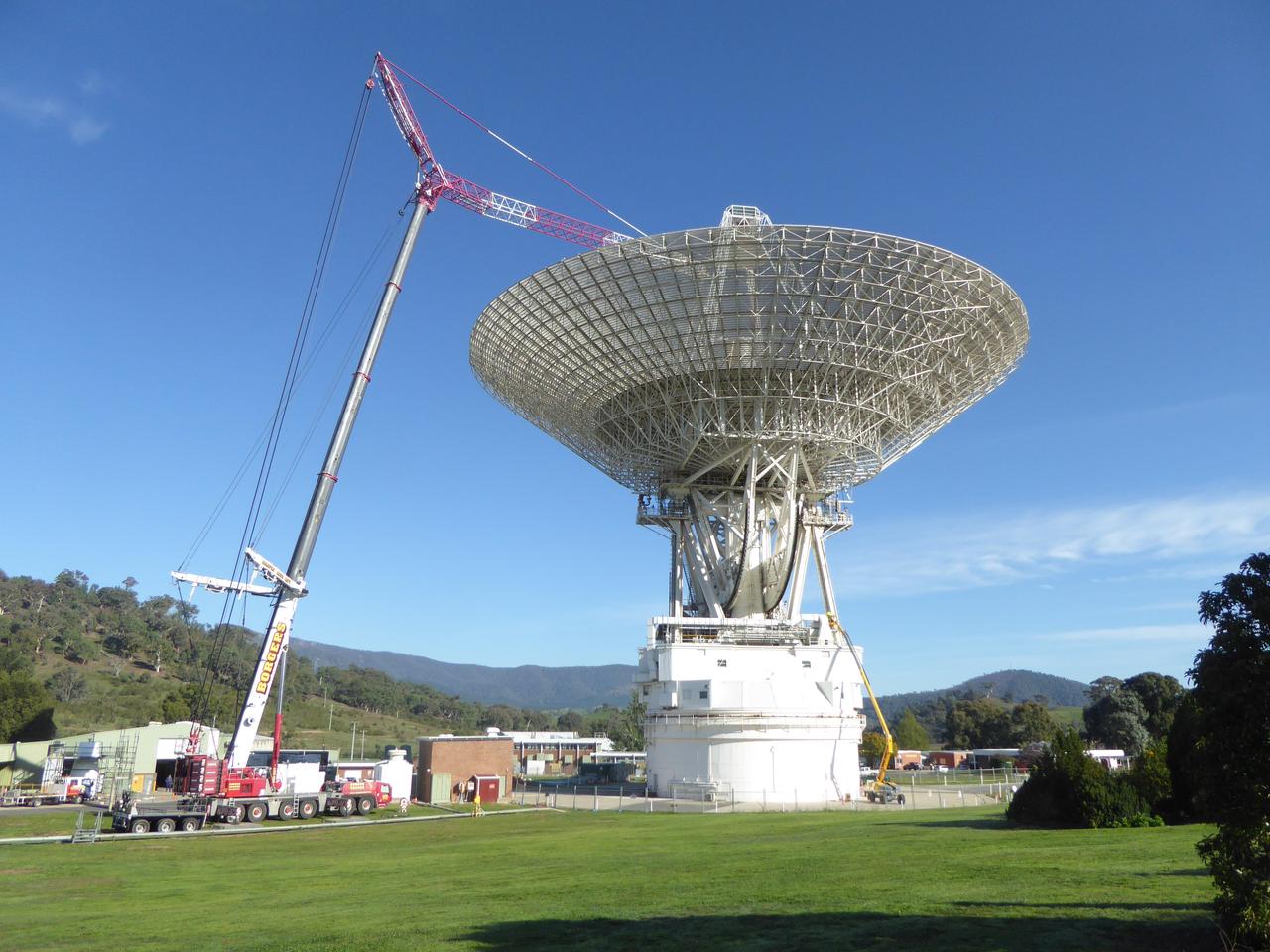
Located in Canberra, Australia, the Deep Space Network's Deep Space Station 43 spans 70 meters (230 feet), making it the largest steerable parabolic antenna in the Southern Hemisphere. Since March 2020, it has been undergoing upgrades — expected to be complete in January 2021 — to prepare the 48-year-old dish for future exploration of the Moon, Mars, and beyond. NASA operates three Deep Space Network stations, located in California, Spain, and Australia; each has a 70-meter (230-feet) antenna, plus several 34-meter (111-foot) dishes to support dozens of spacecraft exploring the solar system. https://photojournal.jpl.nasa.gov/catalog/PIA23797
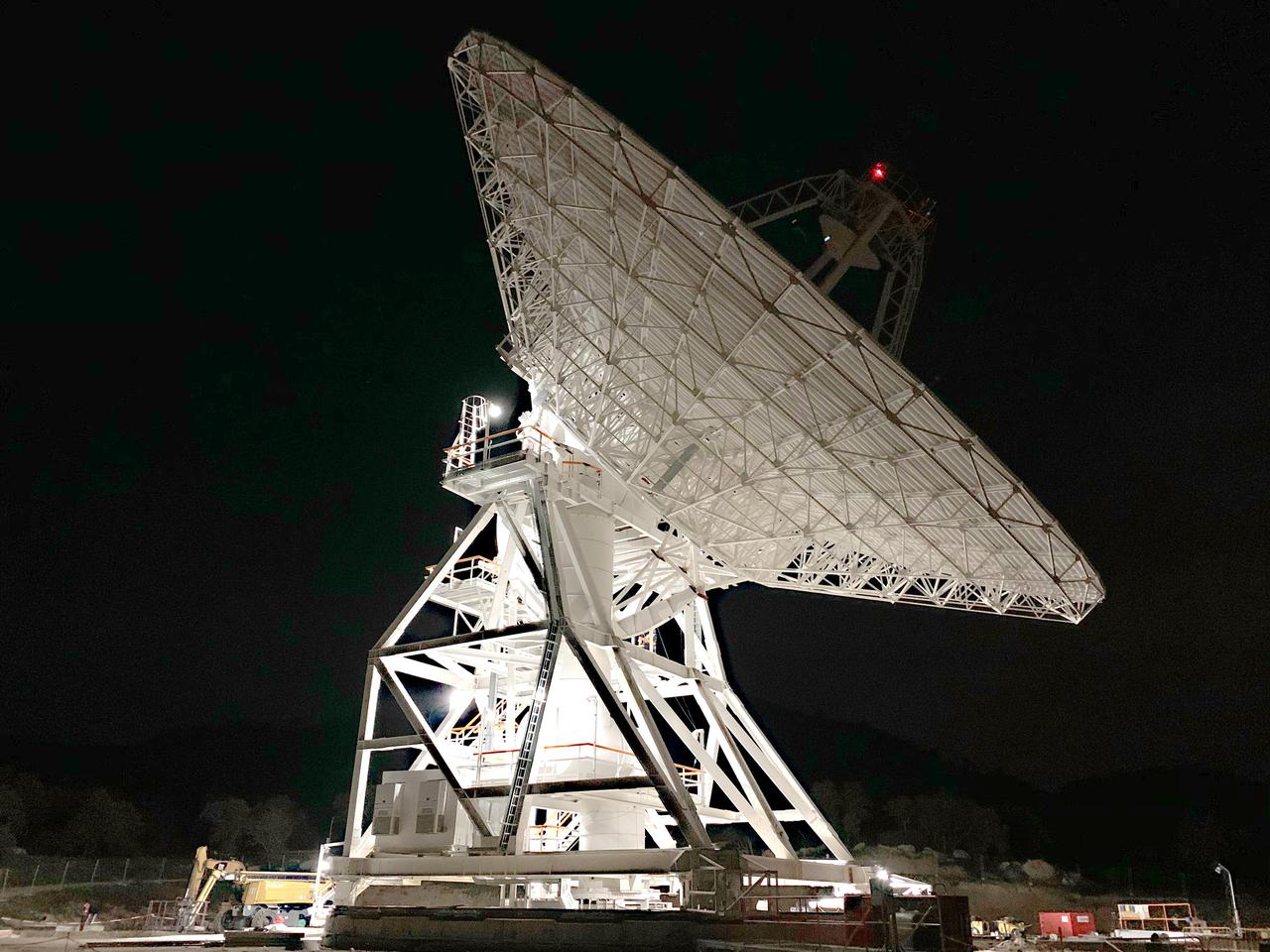
Deep Space Station 53, or DSS-53, is a new 34-meter (111-foot) beam waveguide antenna that went online in February 2022 at the Madrid ground station of NASA's Deep Space Network (DSN). DSS-53 is the fourth of six antennas being added to expand the DSN's capacity and meet the needs of a growing number of spacecraft. When the project is complete, each of the network's three ground stations around the globe will have four beam waveguide antennas. The Madrid Deep Space Communications Complex is the first to have completed its build-out as part of project. Construction on DSS-53 began in 2016. https://photojournal.jpl.nasa.gov/catalog/PIA25137
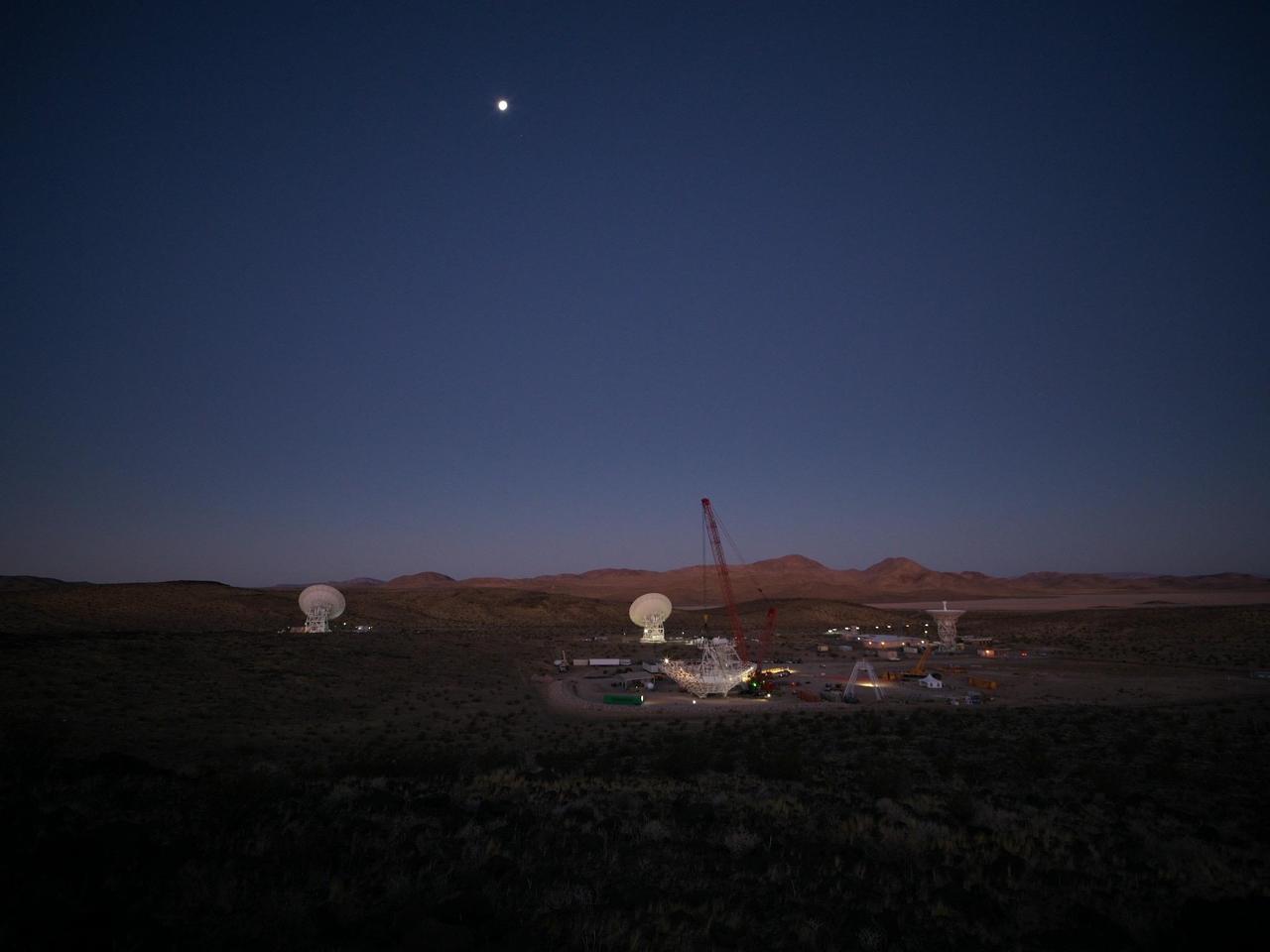
In the early morning of Dec. 18, 2024, a crane looms over the 112-foot-wide (34-meter-wide) steel framework for Deep Space Station 23 (DSS-23) reflector dish, which will soon be lowered into position on the antenna's base structure. Located at the Deep Space Network's Goldstone Space Communications Complex near Barstow, California, DSS-23 is a multi-frequency beam waveguide antenna that will boost the DSN's capacity and enhance NASA's deep space communications capabilities for decades to come. In the background are, from left to right, the beam waveguide antennas DSS-25 and DSS-26, and the decommissioned 85-foot (26-meter) Apollo antenna. https://photojournal.jpl.nasa.gov/catalog/PIA26456
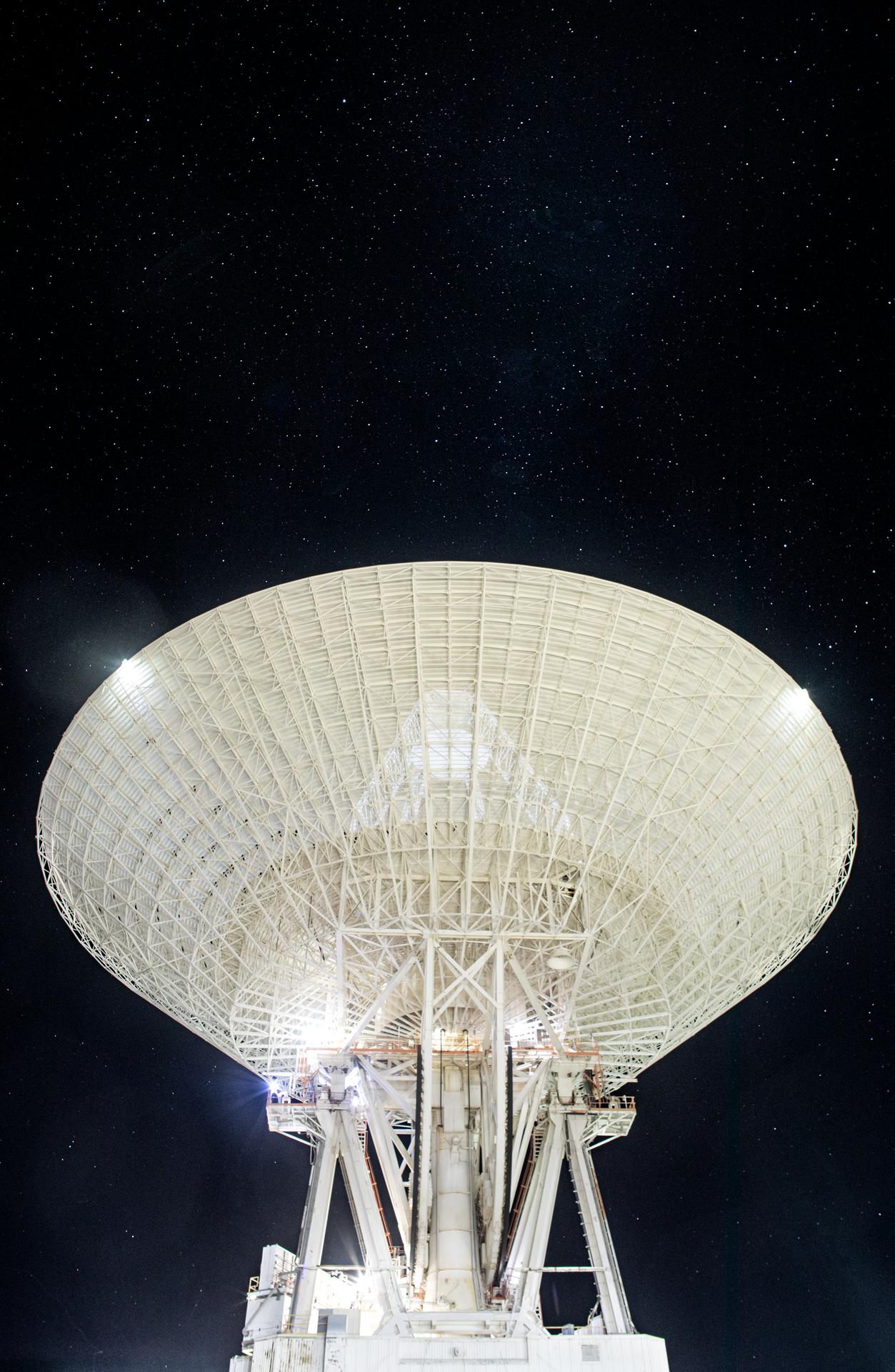
Deep Space Station 14 (DSS-14), the 230-foot-wide (70-meter) antenna at the Goldstone Deep Space Communications Complex near Barstow, California, points up toward a starry sky in September 2025. Goldstone is part of NASA’s Deep Space Network (DSN), which operates three complexes around the globe to support communications with dozens of deep space missions. DSS-14 is also the agency’s Goldstone Solar System Radar, which is used to observe asteroids that come close to Earth. For more information about the DSN, visit: https://www.nasa.gov/communicating-with-missions/dsn/
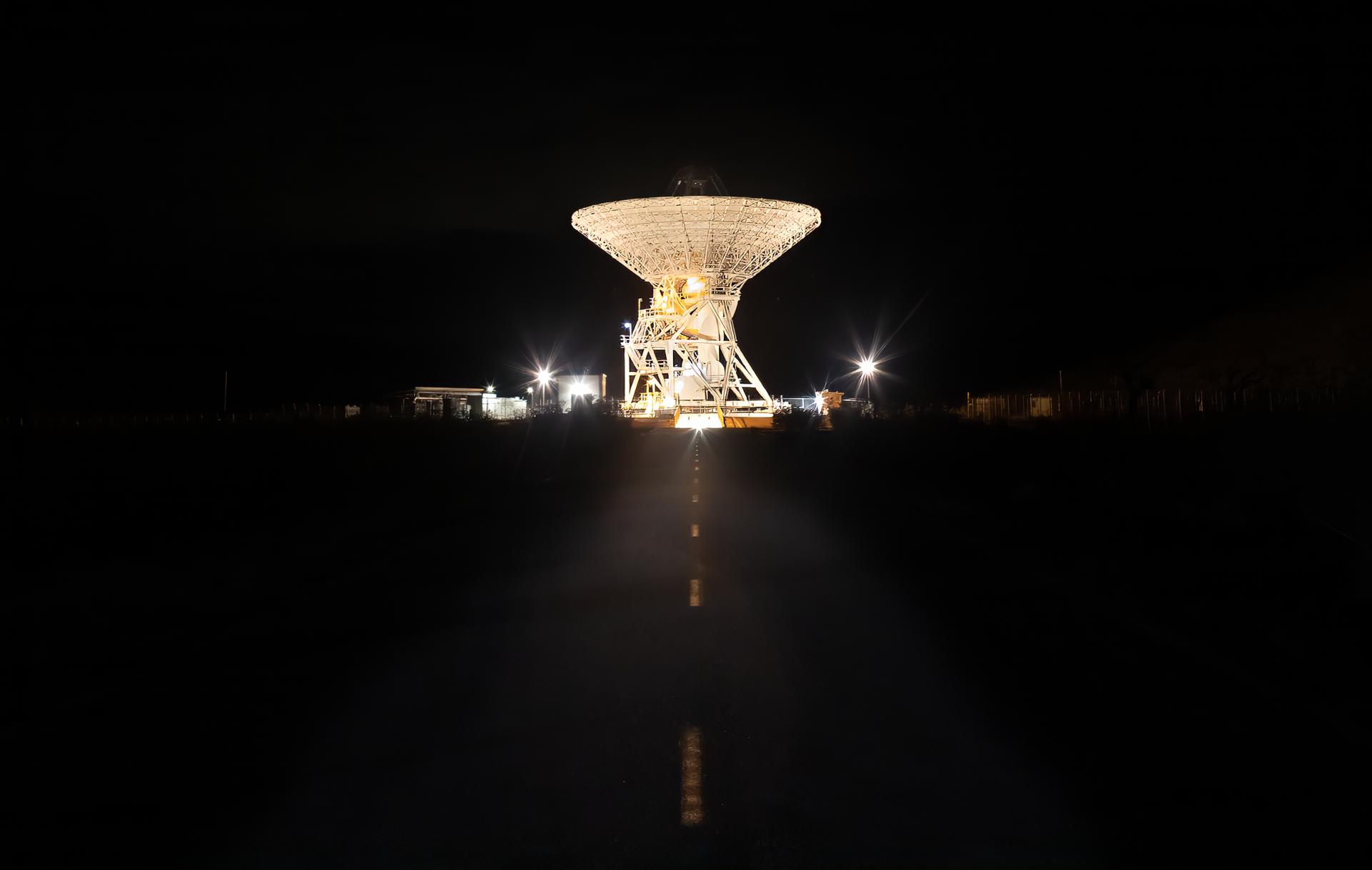
A 112-foot (34-meter) antenna glows from within a nighttime scene at the Goldstone Deep Space Communications Complex near Barstow, California, in September 2025. Goldstone is part of NASA’s Deep Space Network (DSN), which operates three complexes around the globe that support communications with dozens of deep space missions. For more information about the DSN, visit: https://www.nasa.gov/communicating-with-missions/dsn/
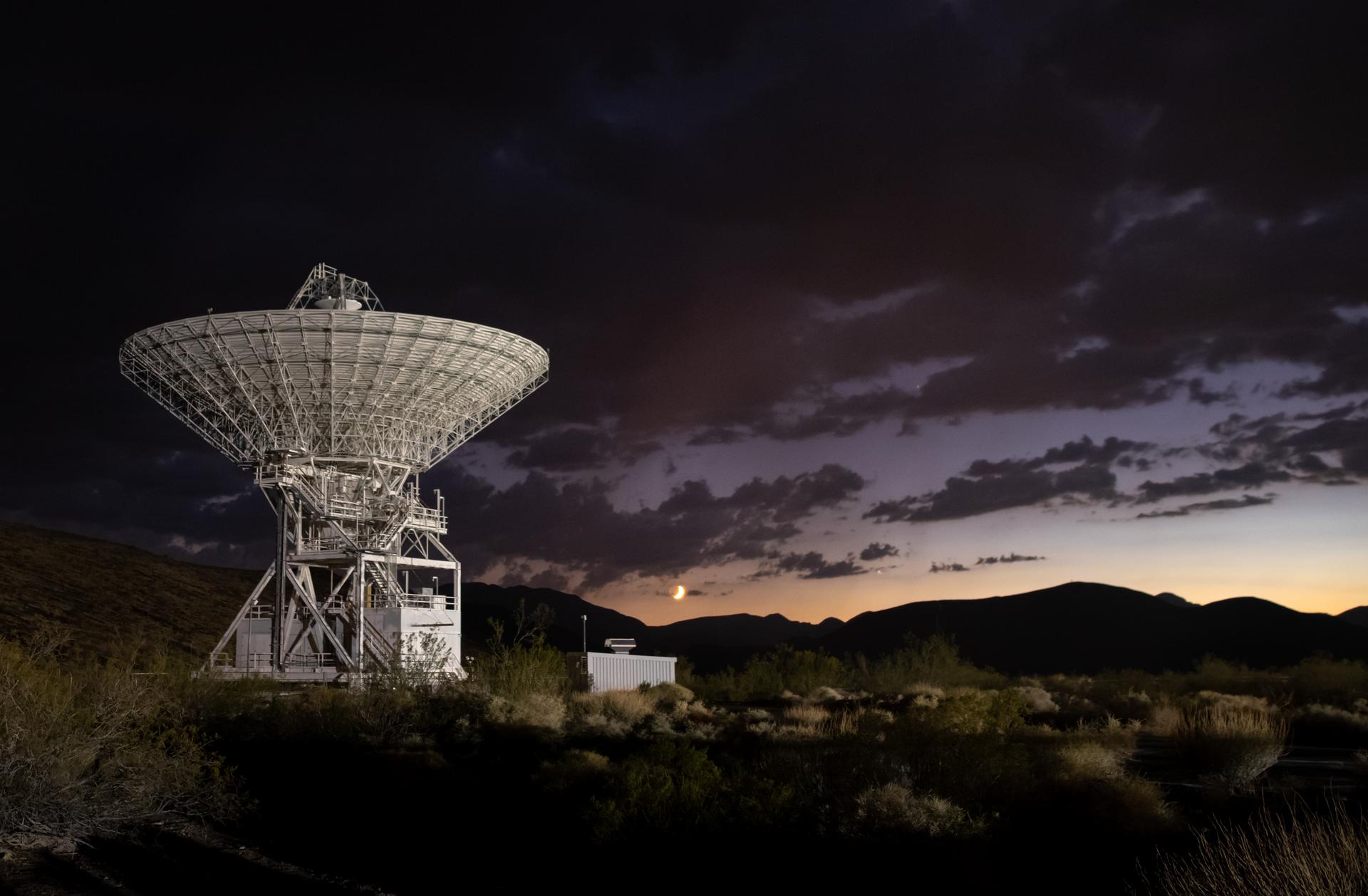
Deep Space Station 15 (DSS-15), one of the 112-foot (34-meter) antennas at the Goldstone Deep Space Communications Complex near Barstow, California, is seen at sunset in September 2025. The crescent Moon hangs just above the horizon. Goldstone is part of NASA’s Deep Space Network (DSN), which operates three complexes around the globe that support communications with dozens of deep space missions. For more information about the DSN, visit: https://www.nasa.gov/communicating-with-missions/dsn/
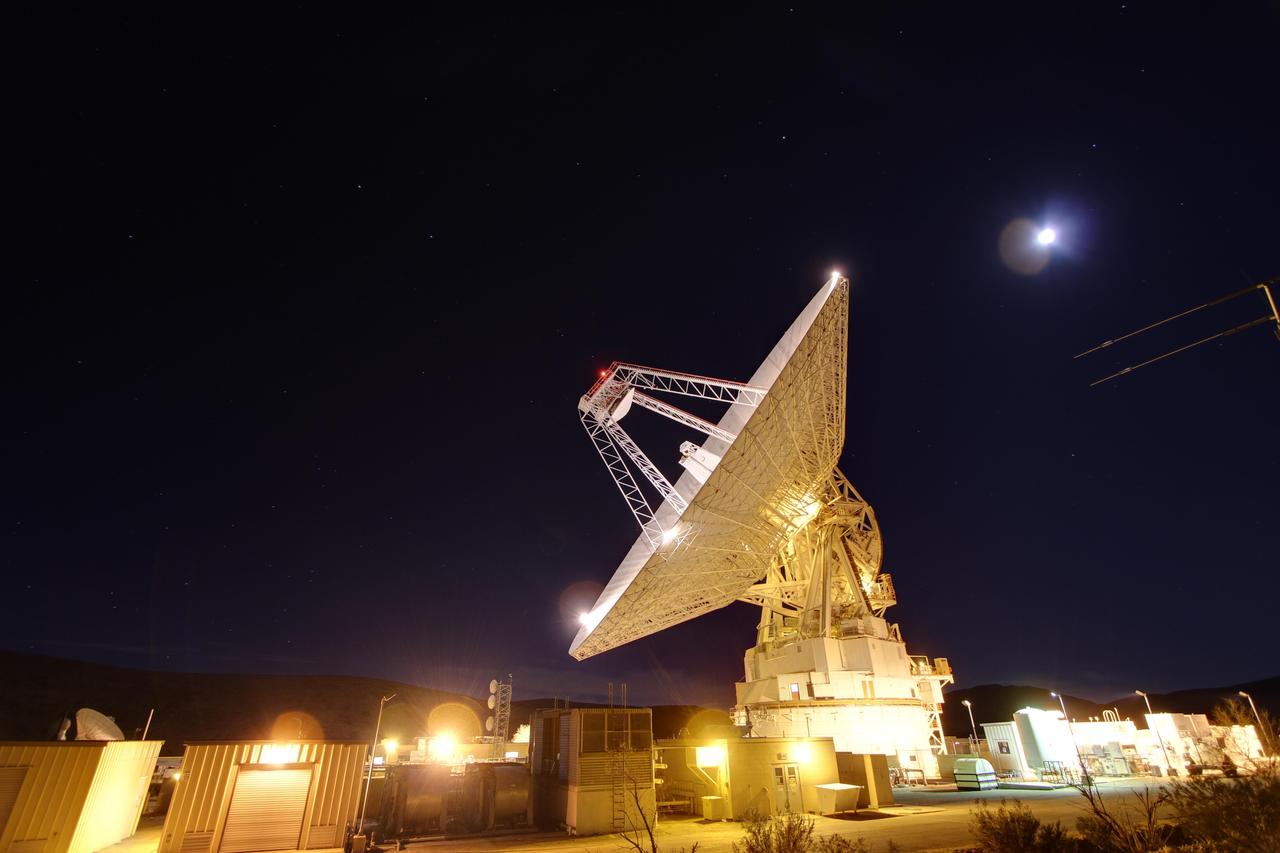
Late night in the desert: Goldstone 230-foot 70-meter antenna tracks spacecraft day and night. This photograph was taken on Jan. 11, 2012. The Goldstone Deep Space Communications Complex is located in the Mojave Desert in California, USA.
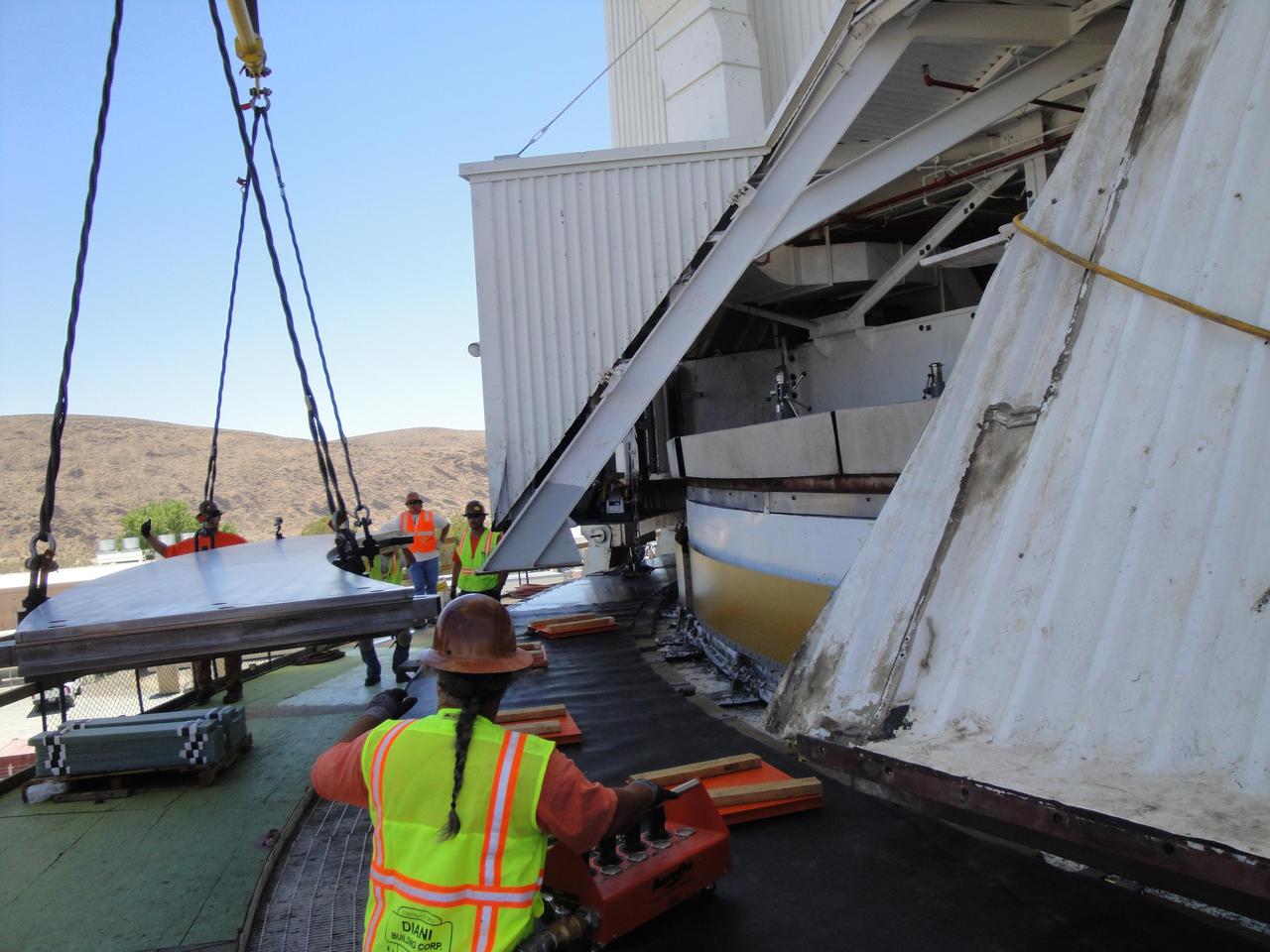
Workers in Goldstone, Calif., guide a new runner segment into the hydrostatic bearing assembly of a giant, 70-meter-wide 230-foot-wide antenna that is a critical part of NASA Deep Space Network.
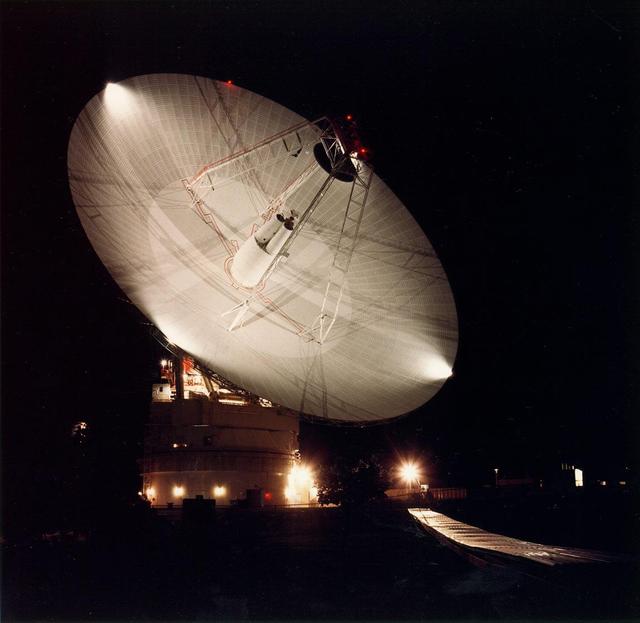
Night shot of the 70m antenna at Goldstone, California. The parabolic dish is 70m 230 ft. in diameter. The Goldstone Deep Space Communications Complex, located in the Mojave Desert in California, is one of three complexes which comprise NASA DSN.
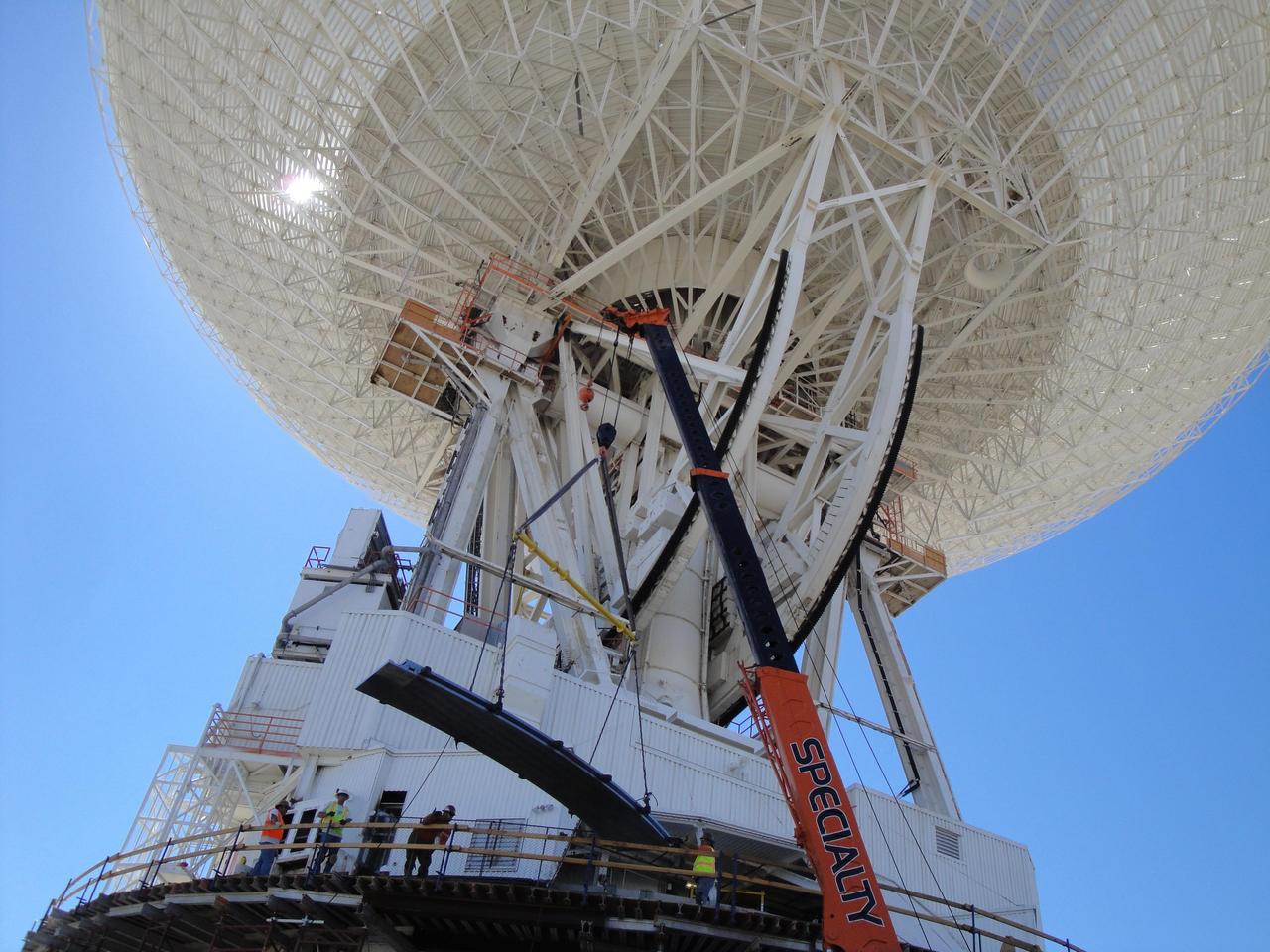
Under the unflinching summer sun, workers at NASA Deep Space Network complex in Goldstone, Calif., use a crane to lift a runner segment that is part of major surgery on a giant, 70-meter-wide antenna.
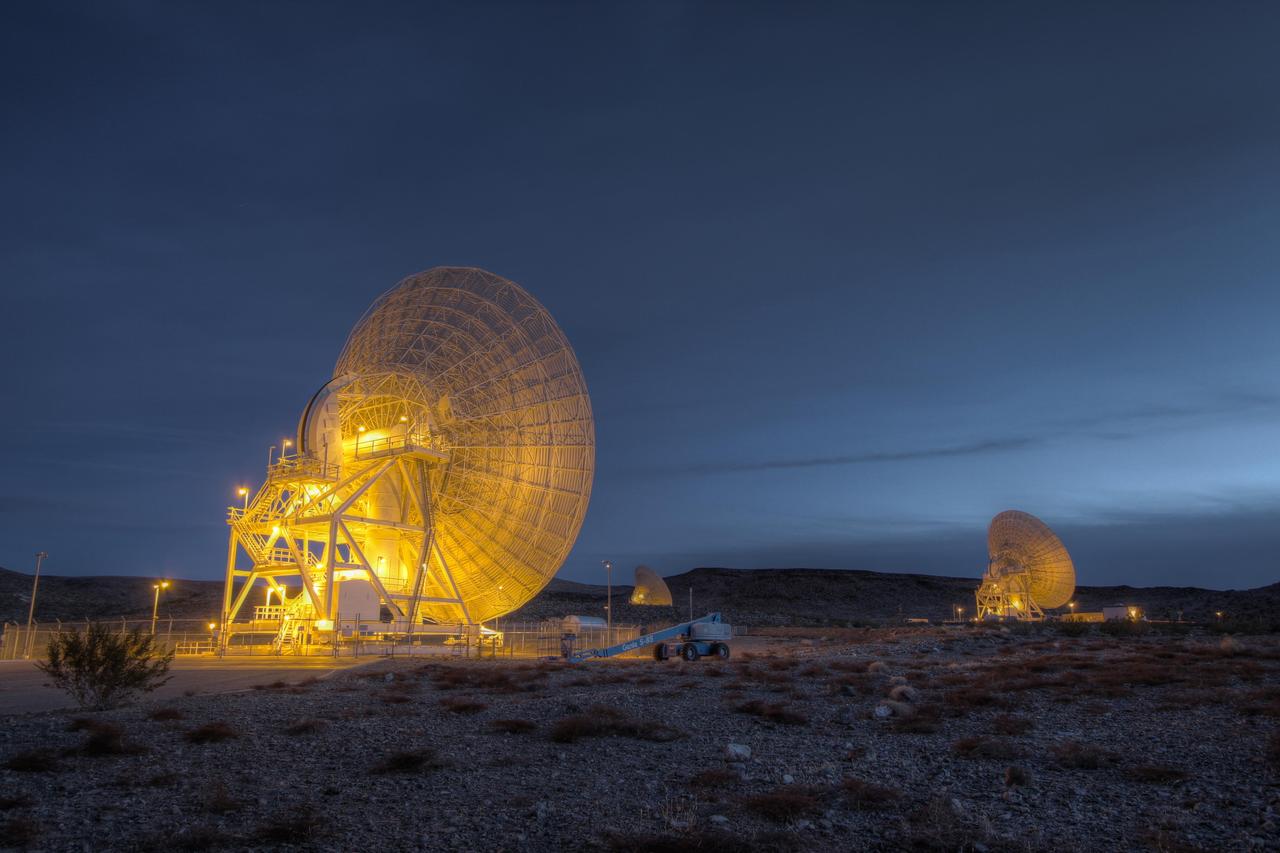
Beam Wave Guide antennas at Goldstone, known as the Beam Waveguide Cluster. They are located in an area at Goldstone called Apollo Valley. The Goldstone Deep Space Communications Complex is located in the Mojave Desert in California, USA.
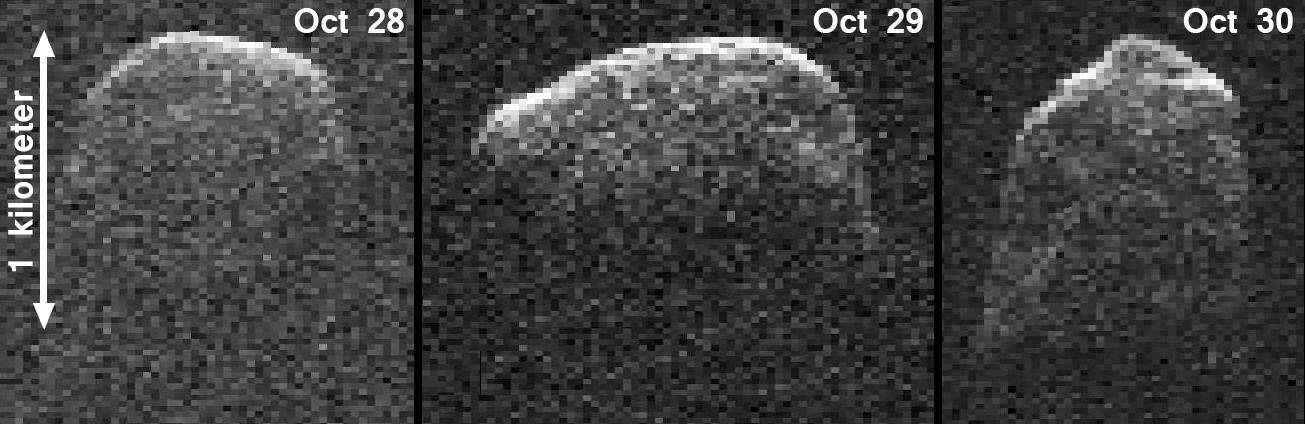
This composite image of asteroid 2007 PA8 was obtained using data taken by NASA 230-foot-wide 70-meter Deep Space Network antenna at Goldstone, Calif.
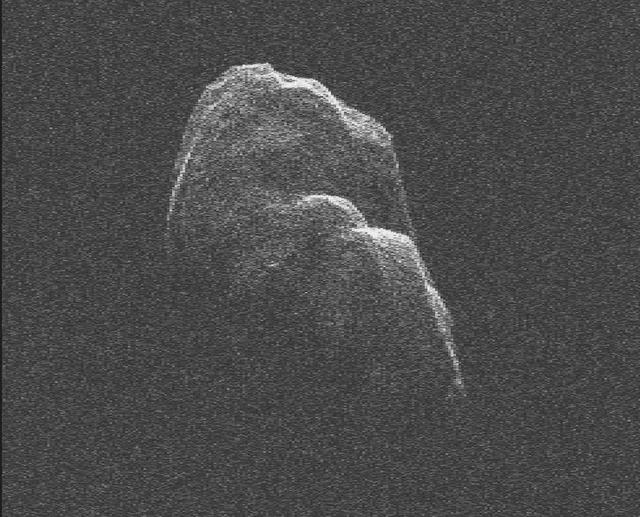
This image of asteroid Toutatis was generated with data collected using NASA Deep Space Network antenna at Goldstone, Calif., on Dec. 12 and 13, 2012 and indicates that it is an elongated, irregularly shaped object with ridges and perhaps craters.
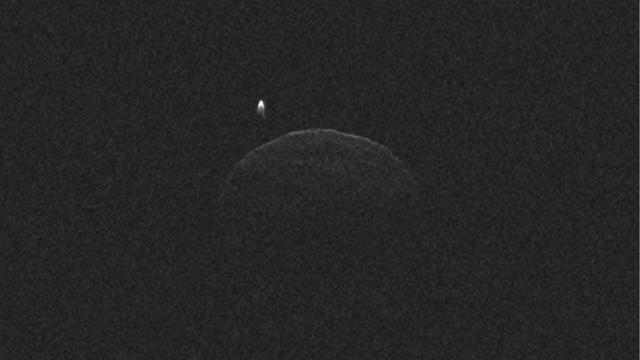
This radar imagery of asteroid 1998 QE2 and its moon was generated from data collected by NASA 230-foot-wide 70-meter Deep Space Network antenna at Goldstone, Calif., on June 1, 2013.
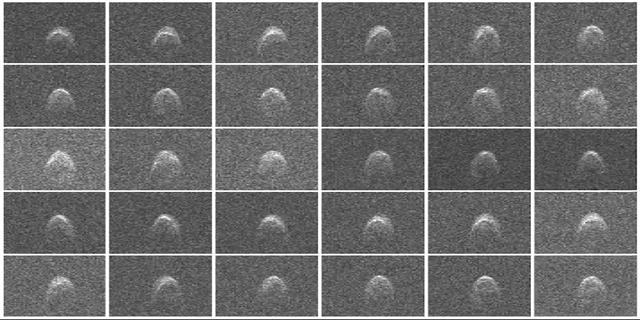
This collage of radar images of near-Earth asteroid 2005 WK4 was collected by NASA scientists using the 230-foot 70-meter Deep Space Network antenna at Goldstone, Calif., on Aug. 8, 2013.
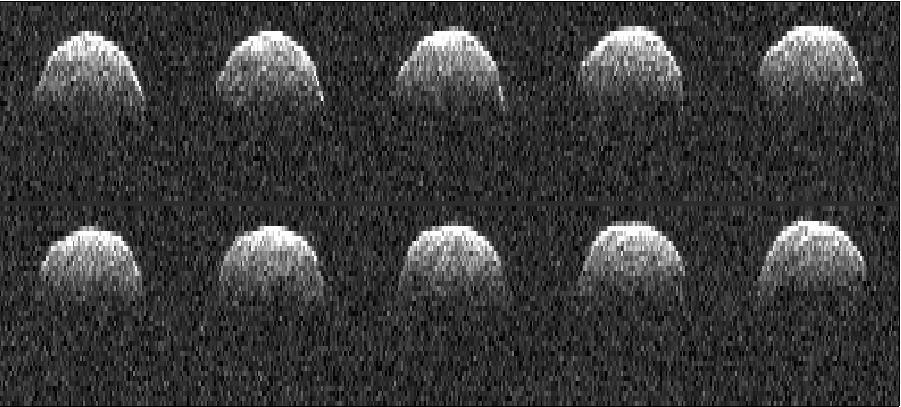
This radar image of asteroid 1999 RQ36 was obtained NASA Deep Space Network antenna in Goldstone, Calif. on Sept 23, 1999. NASA detects, tracks and characterizes asteroids and comets passing close to Earth using both ground- and space-based telescopes.

This radar image of asteroid 2005 YU55 was obtained NASA Deep Space Network antenna in Goldstone, Calif. on Nov. 7, 2011, when the space rock was at 3.6 lunar distances, which is about 860,000 miles, or 1.38 million kilometers, from Earth.
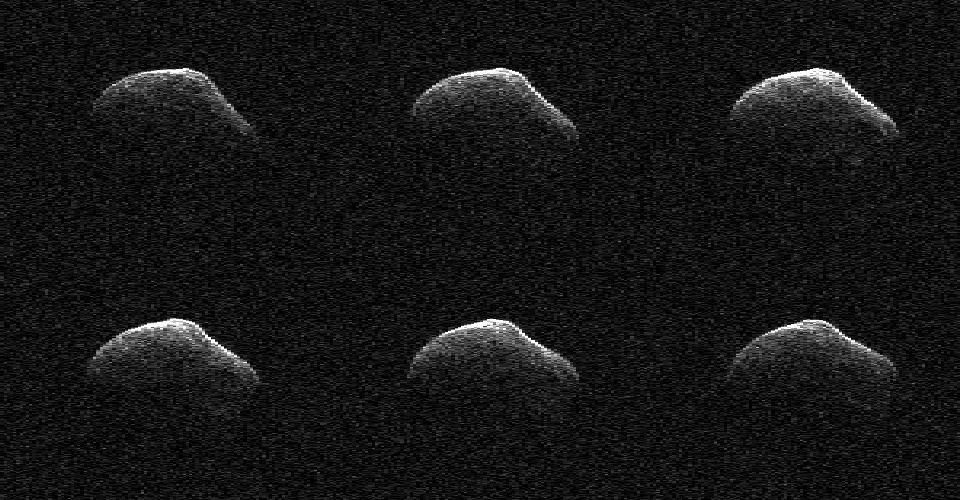
These radar images of comet P/2016 BA14 were taken on March 23, 2016, by scientists using an antenna of NASA Deep Space Network at Goldstone, California. At the time, the comet was about 2.2 million miles 3.6 million kilometers from Earth.
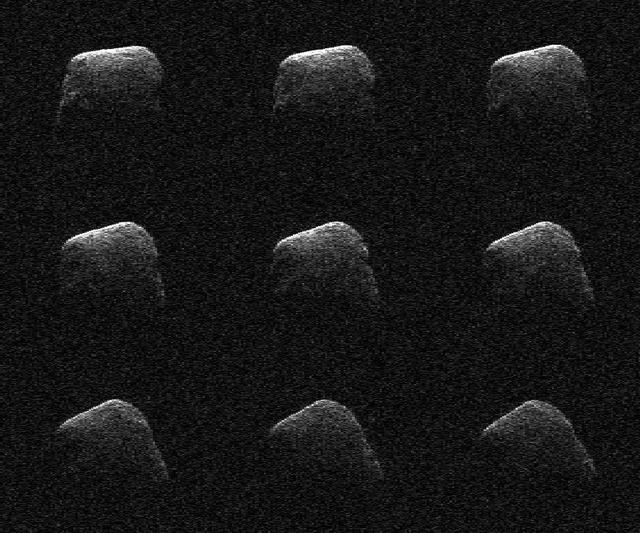
These radar images of comet P/2016 BA14 were taken on March 22, 2016, by scientists using an antenna of NASA Deep Space Network at Goldstone, CA. At the time, the comet was about 2.2 million miles 3.6 million kilometers from Earth.
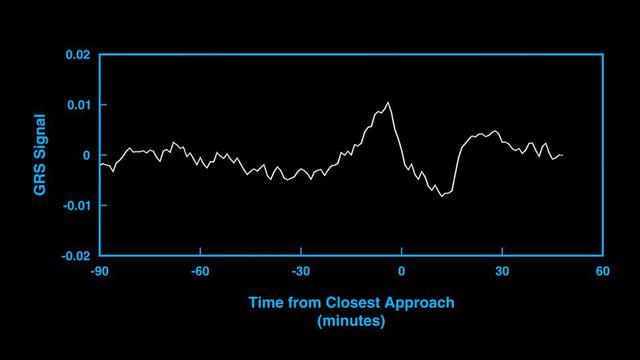
This animation and audio represent the subtle gravitational signal acquired by an antenna of NASA's Deep Space Network as the agency's Juno spacecraft performed a close flyby of Jupiter's Great Red Spot in July 2019. The changes in the signal frequency represent the changes in the local gravity as the spacecraft flew low overhead. Juno flew twice over the Great Red Spot in 2019, with the goal of picking up the subtle gravitational signal of the vortex. The concentration of mass caused by the powerful winds surrounding the Great Red Spot minutely change the spacecraft's velocity, inducing a Doppler shift on the radio signals relayed back to Earth. Movie available at https://photojournal.jpl.nasa.gov/catalog/PIA24963
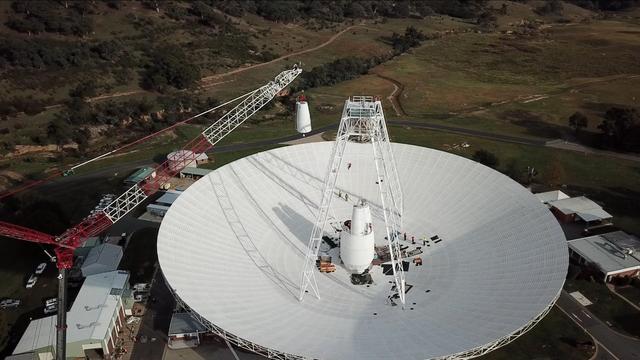
In a delicate operation, a 400-ton crane lifts the new X-band cone into the 70-meter (230-foot) Deep Space Network's Deep Space Station 43 (DSS-43) dish in Canberra, Australia. The new cone houses upgraded receiver and transmitter equipment for the 48-year-old antenna. One of several antennas located at the Canberra site, DSS-43 is the largest and responsible for transmitting commands to NASA's Voyager spacecraft. Since early March 2020, DSS43 has been offline for upgrades, which are expected to continue until January 2021. https://photojournal.jpl.nasa.gov/catalog/PIA23796
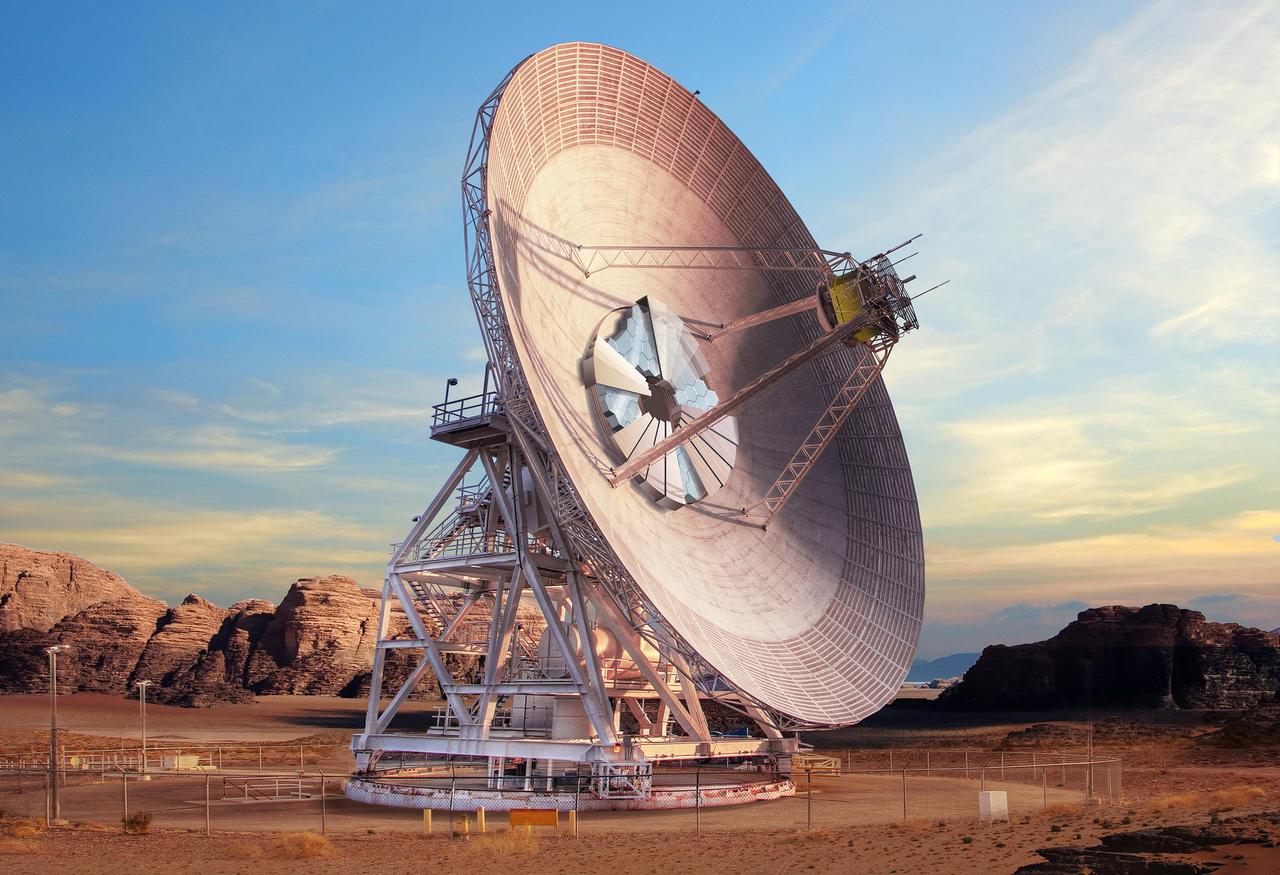
This artist's concept shows what Deep Space Station-23, a new antenna dish at the Deep Space Network's complex in Goldstone, California, will look like when complete in several years. DSS-23 will communicate with NASA's deep space missions using radio waves and lasers. Retractable covers will be able to fan out across the mirrors at the center of the dish to protect them from the elements. https://photojournal.jpl.nasa.gov/catalog/PIA23617
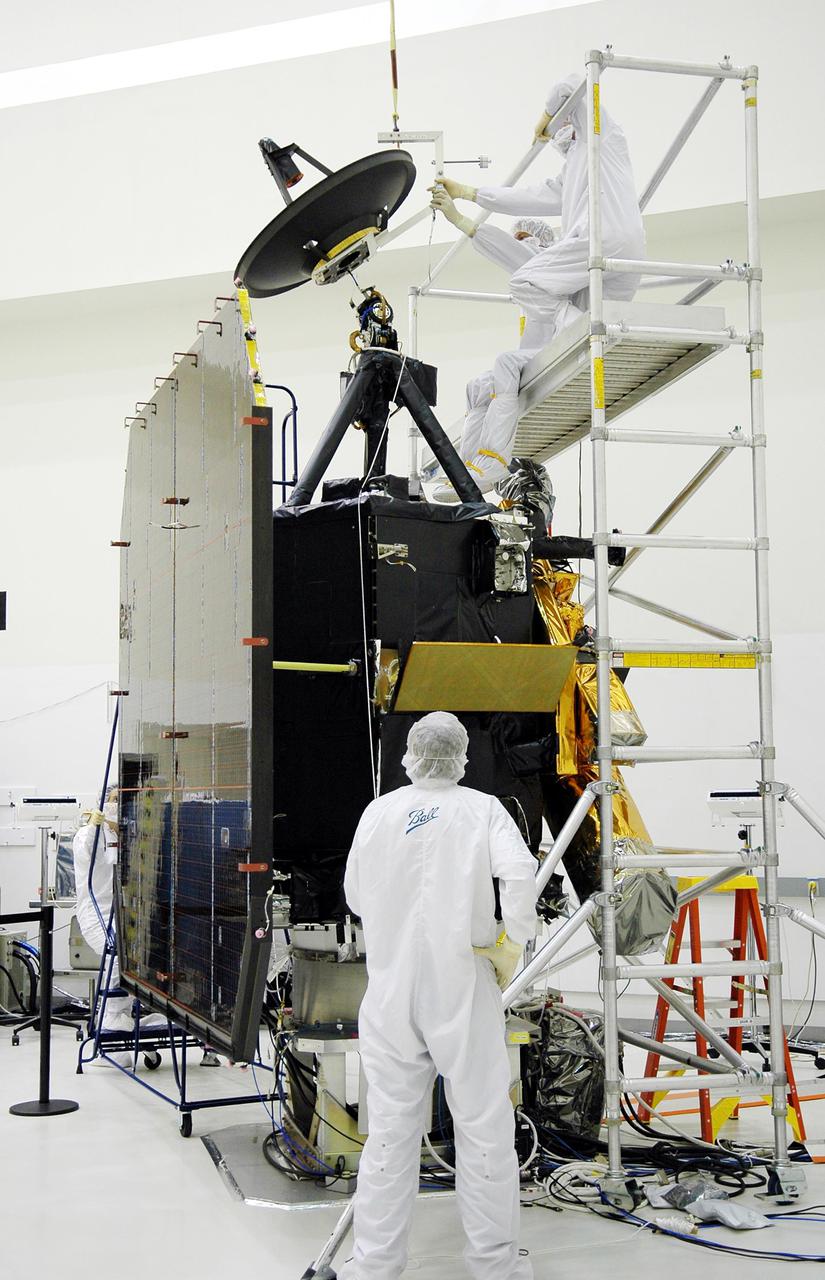
KENNEDY SPACE CENTER, FLA. - Ball Aerospace technicians at Astrotech in Titusville, Fla., guide the high-gain communications antenna toward the attach-point on the Deep Impact spacecraft. A NASA Discovery mission, Deep Impact will probe beneath the surface of Comet Tempel 1 on July 4, 2005, when the comet is 83 million miles from Earth, and reveal the secrets of its interior. During the encounter phase, the high-gain antenna transmits near-real-time images of the impact back to Earth. The spacecraft is scheduled to launch Jan. 8 aboard a Boeing Delta II rocket from Launch Complex 17-B at Cape Canaveral Air Force Station, Fla.
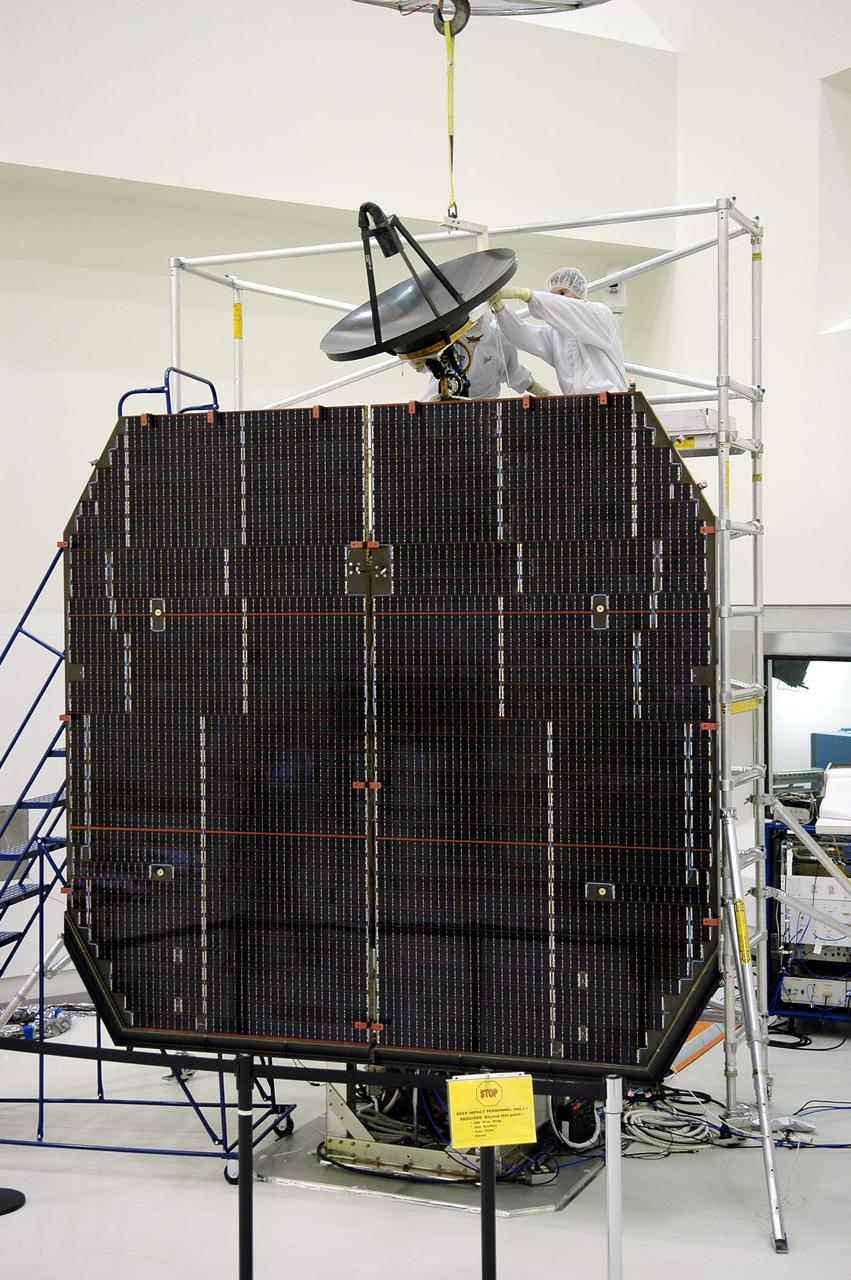
KENNEDY SPACE CENTER, FLA. - - Ball Aerospace technicians at Astrotech in Titusville, Fla., secure the high-gain communications antenna onto the Deep Impact spacecraft. A NASA Discovery mission, Deep Impact will probe beneath the surface of Comet Tempel 1 on July 4, 2005, when the comet is 83 million miles from Earth, and reveal the secrets of its interior. During the encounter phase, the high-gain antenna transmits near-real-time images of the impact back to Earth. The spacecraft is scheduled to launch Jan. 8 aboard a Boeing Delta II rocket from Launch Complex 17-B at Cape Canaveral Air Force Station, Fla.
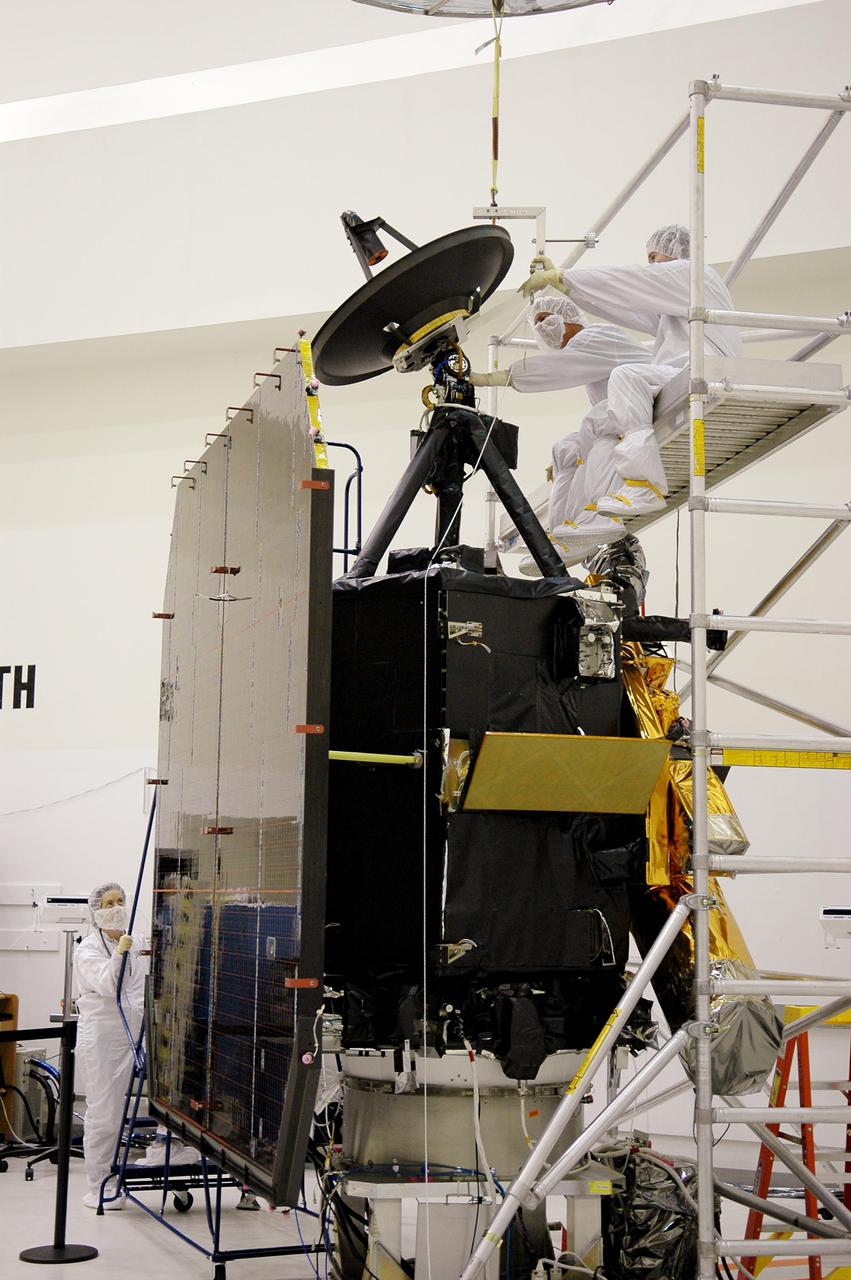
KENNEDY SPACE CENTER, FLA. - Ball Aerospace technicians at Astrotech in Titusville, Fla., attach the high-gain communications antenna onto the Deep Impact spacecraft. A NASA Discovery mission, Deep Impact will probe beneath the surface of Comet Tempel 1 on July 4, 2005, when the comet is 83 million miles from Earth, and reveal the secrets of its interior. During the encounter phase, the high-gain antenna transmits near-real-time images of the impact back to Earth. The spacecraft is scheduled to launch Jan. 8 aboard a Boeing Delta II rocket from Launch Complex 17-B at Cape Canaveral Air Force Station, Fla.
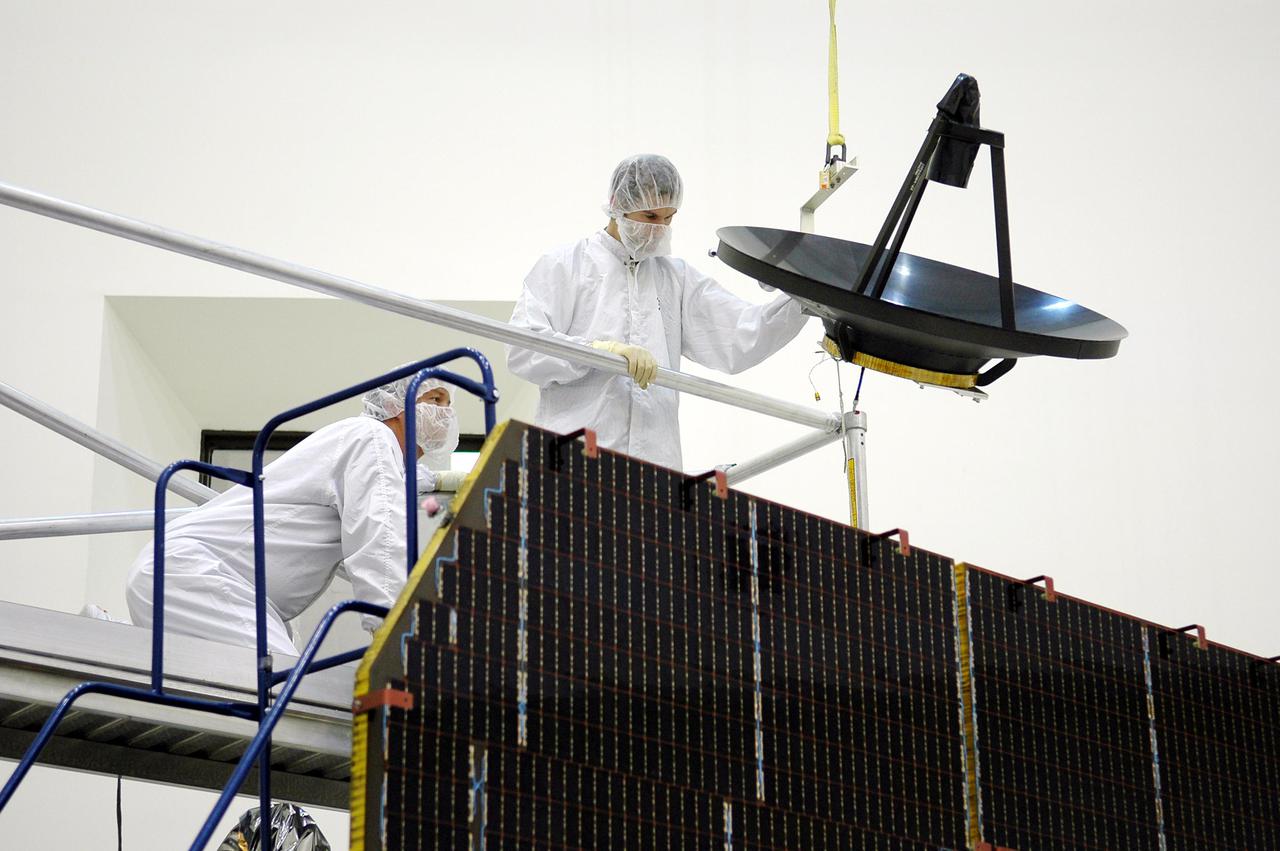
KENNEDY SPACE CENTER, FLA. - Ball Aerospace technicians at Astrotech in Titusville, Fla., watch as the high-gain communications antenna is lowered toward the Deep Impact spacecraft for installation. A NASA Discovery mission, Deep Impact will probe beneath the surface of Comet Tempel 1 on July 4, 2005, when the comet is 83 million miles from Earth, and reveal the secrets of its interior. During the encounter phase, the high-gain antenna transmits near-real-time images of the impact back to Earth. The spacecraft is scheduled to launch Jan. 8 aboard a Boeing Delta II rocket from Launch Complex 17-B at Cape Canaveral Air Force Station, Fla.
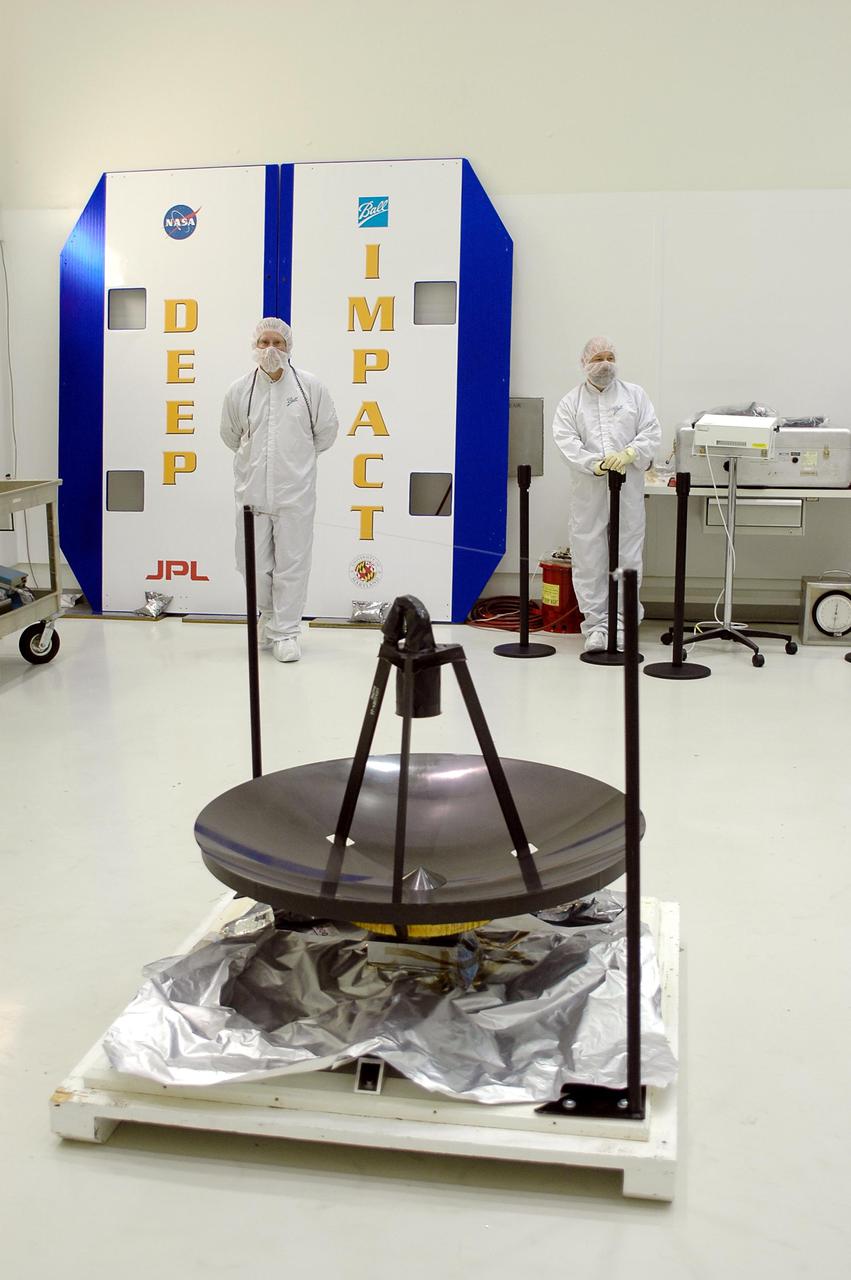
KENNEDY SPACE CENTER, FLA. - At Astrotech in Titusville, Fla., the high-gain communications antenna is ready for installation on the Deep Impact spacecraft (behind it). A NASA Discovery mission, Deep Impact will probe beneath the surface of Comet Tempel 1 on July 4, 2005, when the comet is 83 million miles from Earth, and reveal the secrets of its interior. During the encounter phase, the high-gain antenna transmits near-real-time images of the impact back to Earth. The spacecraft is scheduled to launch Jan. 8 aboard a Boeing Delta II rocket from Launch Complex 17-B at Cape Canaveral Air Force Station, Fla.
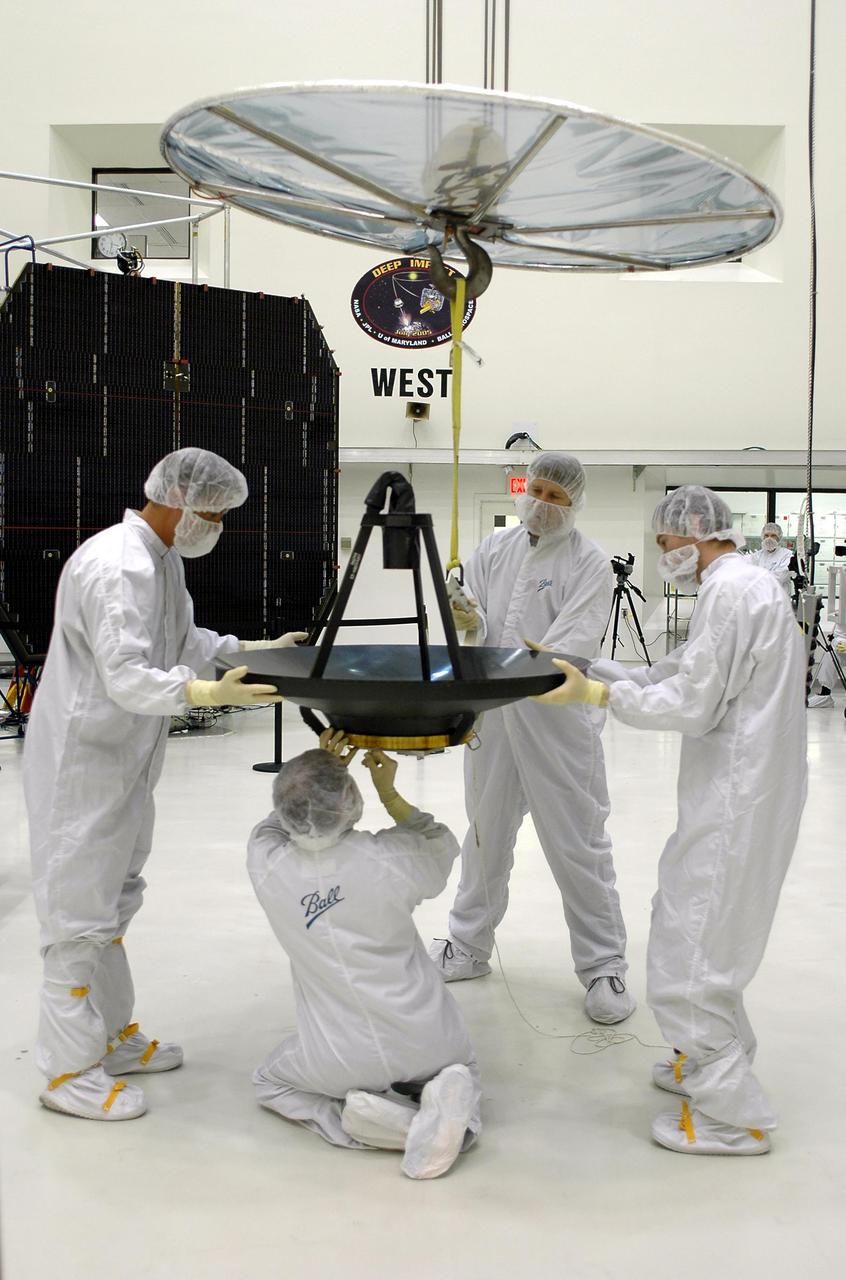
KENNEDY SPACE CENTER, FLA. - Ball Aerospace technicians at Astrotech in Titusville, Fla., attach on overhead crane to the high-gain communications antenna to be installed on the Deep Impact spacecraft. A NASA Discovery mission, Deep Impact will probe beneath the surface of Comet Tempel 1 on July 4, 2005, when the comet is 83 million miles from Earth, and reveal the secrets of its interior. During the encounter phase, the high-gain antenna transmits near-real-time images of the impact back to Earth. The spacecraft is scheduled to launch Jan. 8 aboard a Boeing Delta II rocket from Launch Complex 17-B at Cape Canaveral Air Force Station, Fla.
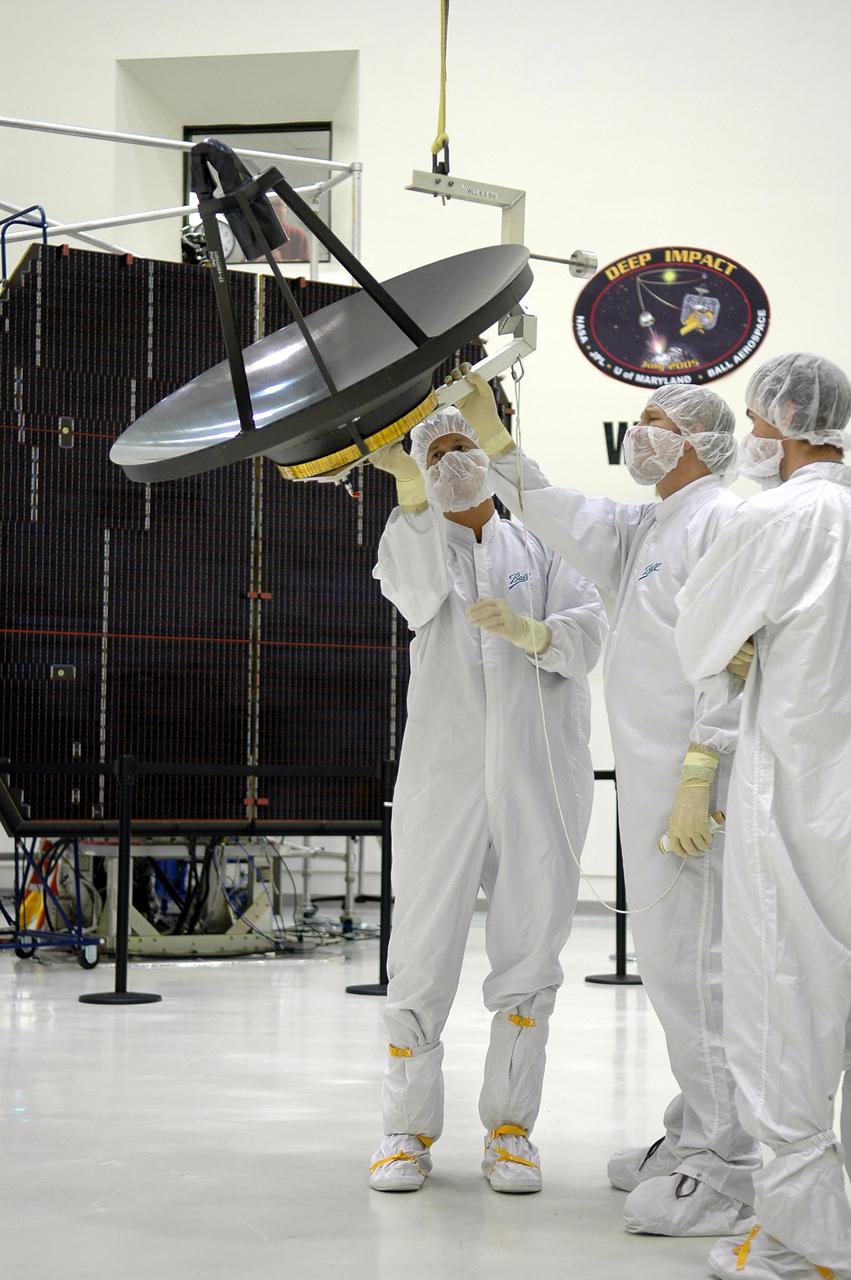
KENNEDY SPACE CENTER, FLA. - Ball Aerospace technicians at Astrotech in Titusville, Fla., make sure the crane is securely attached to the high-gain communications antenna to be installed on the Deep Impact spacecraft. A NASA Discovery mission, Deep Impact will probe beneath the surface of Comet Tempel 1 on July 4, 2005, when the comet is 83 million miles from Earth, and reveal the secrets of its interior. During the encounter phase, the high-gain antenna transmits near-real-time images of the impact back to Earth. The spacecraft is scheduled to launch Jan. 8 aboard a Boeing Delta II rocket from Launch Complex 17-B at Cape Canaveral Air Force Station, Fla.
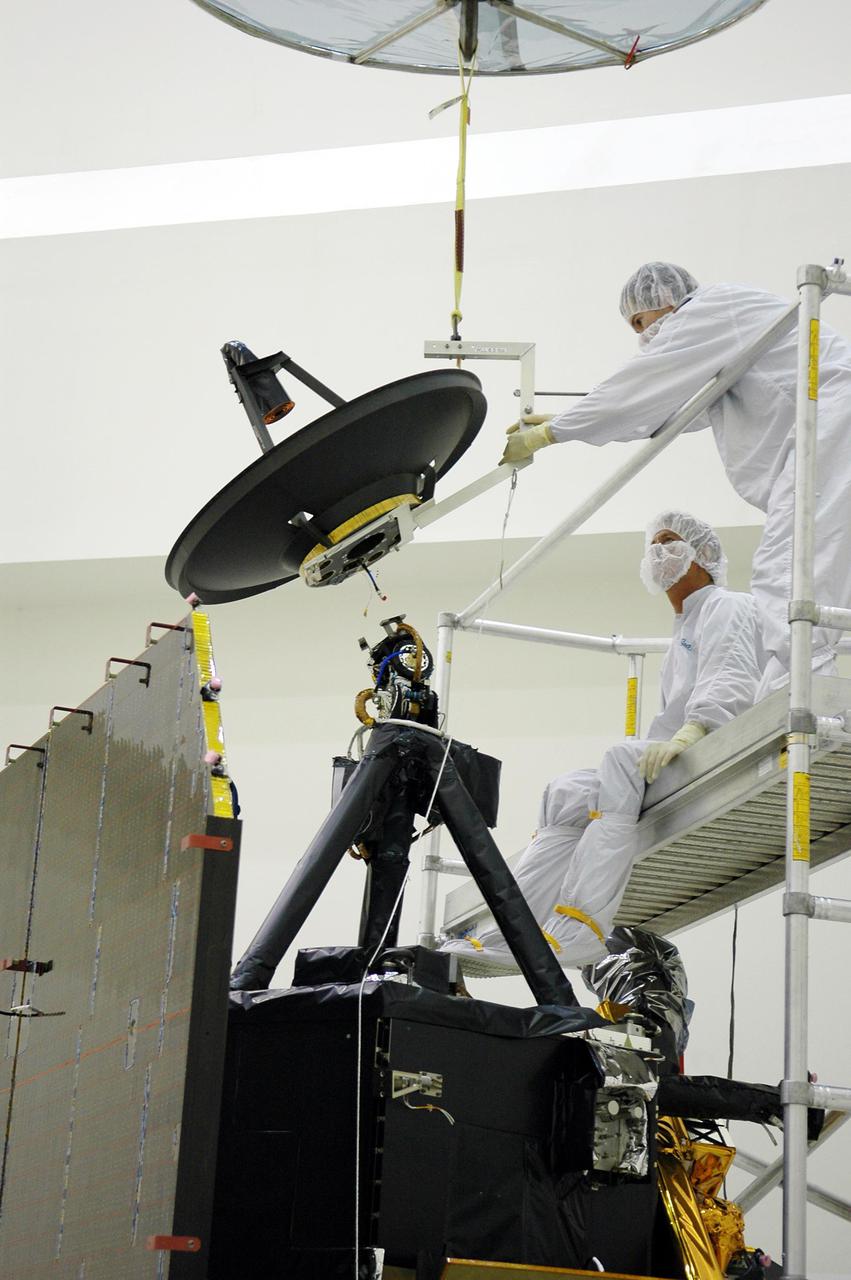
KENNEDY SPACE CENTER, FLA. - Ball Aerospace technicians at Astrotech in Titusville, Fla., guide the high-gain communications antenna toward the attach-point on the Deep Impact spacecraft. A NASA Discovery mission, Deep Impact will probe beneath the surface of Comet Tempel 1 on July 4, 2005, when the comet is 83 million miles from Earth, and reveal the secrets of its interior. During the encounter phase, the high-gain antenna transmits near-real-time images of the impact back to Earth. The spacecraft is scheduled to launch Jan. 8 aboard a Boeing Delta II rocket from Launch Complex 17-B at Cape Canaveral Air Force Station, Fla.
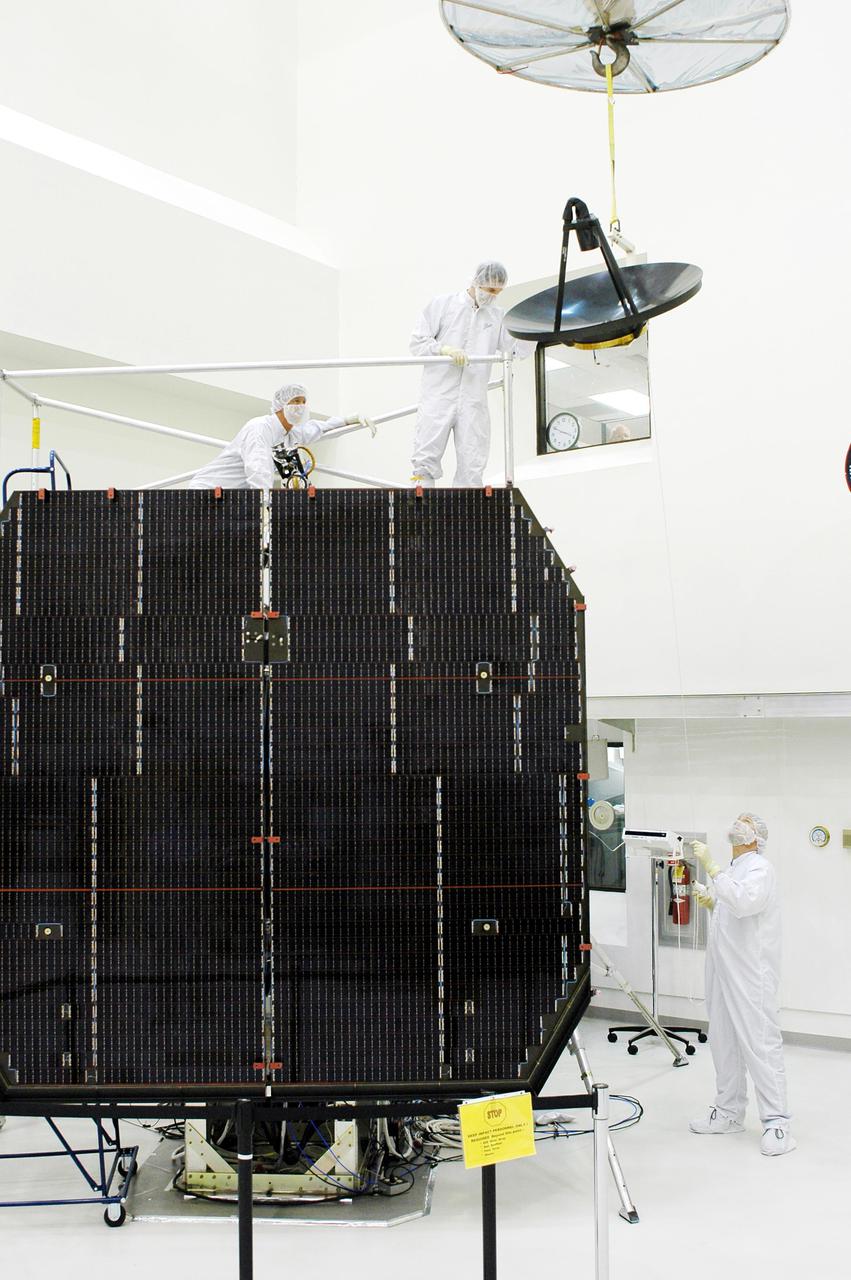
KENNEDY SPACE CENTER, FLA. - Ball Aerospace technicians at Astrotech in Titusville, Fla., watch as the high-gain communications antenna is moved toward the Deep Impact spacecraft for installation. A NASA Discovery mission, Deep Impact will probe beneath the surface of Comet Tempel 1 on July 4, 2005, when the comet is 83 million miles from Earth, and reveal the secrets of its interior. During the encounter phase, the high-gain antenna transmits near-real-time images of the impact back to Earth. The spacecraft is scheduled to launch Jan. 8 aboard a Boeing Delta II rocket from Launch Complex 17-B at Cape Canaveral Air Force Station, Fla.
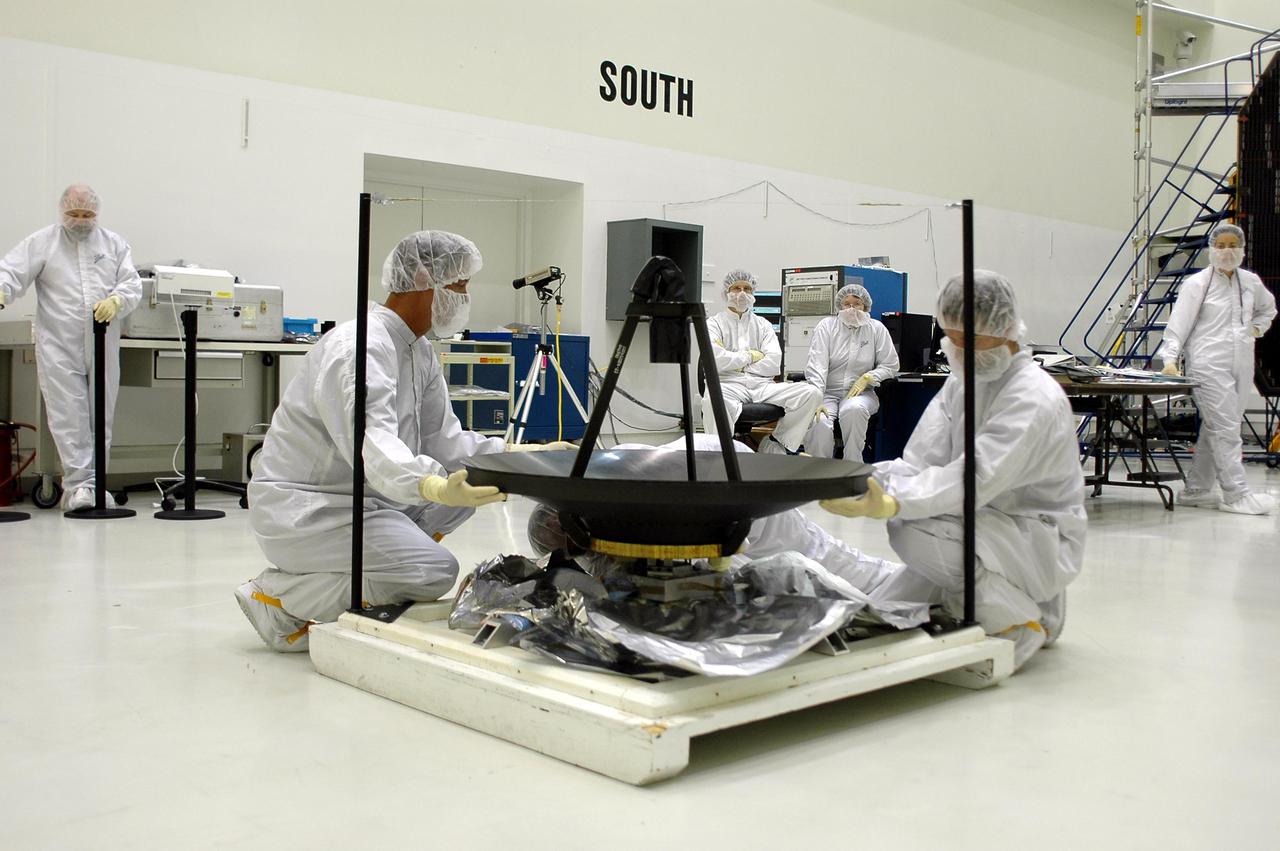
KENNEDY SPACE CENTER, FLA. - Ball Aerospace technicians at Astrotech in Titusville, Fla., begin lifting the high-gain communications antenna to attach it to an overhead crane. The antenna will be installed on the Deep Impact spacecraft. A NASA Discovery mission, Deep Impact will probe beneath the surface of Comet Tempel 1 on July 4, 2005, when the comet is 83 million miles from Earth, and reveal the secrets of its interior. During the encounter phase, the high-gain antenna transmits near-real-time images of the impact back to Earth. The spacecraft is scheduled to launch Jan. 8 aboard a Boeing Delta II rocket from Launch Complex 17-B at Cape Canaveral Air Force Station, Fla.
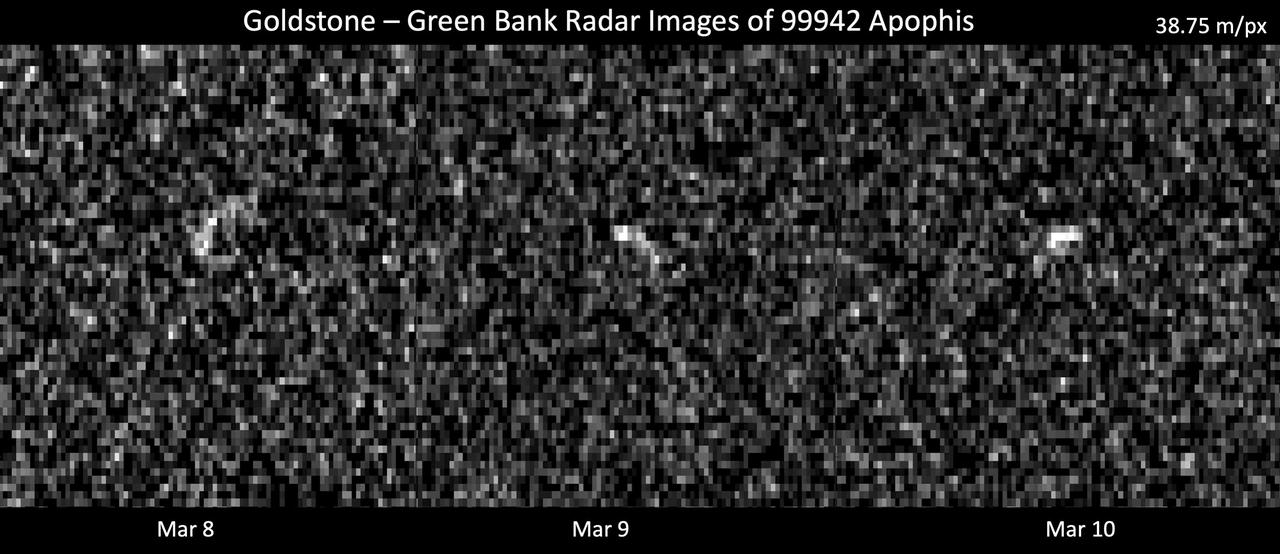
These images represent radar observations of asteroid 99942 Apophis on March 8, 9, and 10, 2021, as it made its last close approach before its 2029 Earth encounter that will see the object pass our planet by less than 20,000 miles (32,000 kilometers). The 70-meter radio antenna at the Deep Space Network's Goldstone Deep Space Communications Complex near Barstow, California, and the 100-meter Green Bank Telescope in West Virginia used radar to precisely track Apophis' motion. At the time of these observations, Apophis was about 10.6 million miles (17 million kilometers) from Earth, and each pixel has a resolution of 127 feet (38.75 meters). These observations helped scientists of the Center for Near Earth Object Studies (CNEOS), managed by NASA's Jet Propulsion Laboratory, precisely determine the 1,100-feet-wide (340-meter-wide) asteroid's orbit around the Sun, ruling out any Earth impact threat for the next hundred years or more. As a result of these observations, Apophis was removed from the Sentry Impact Risk Table. The radar team will continue to analyze these observations to determine more information about Apophis' size, shape, and rate of spin. Relying on optical telescopes and ground-based radar to help characterize every near-Earth object's orbit to improve long-term hazard assessments, CNEOS computes high-precision orbits in support of NASA's Planetary Defense Coordination Office. https://photojournal.jpl.nasa.gov/catalog/PIA24168
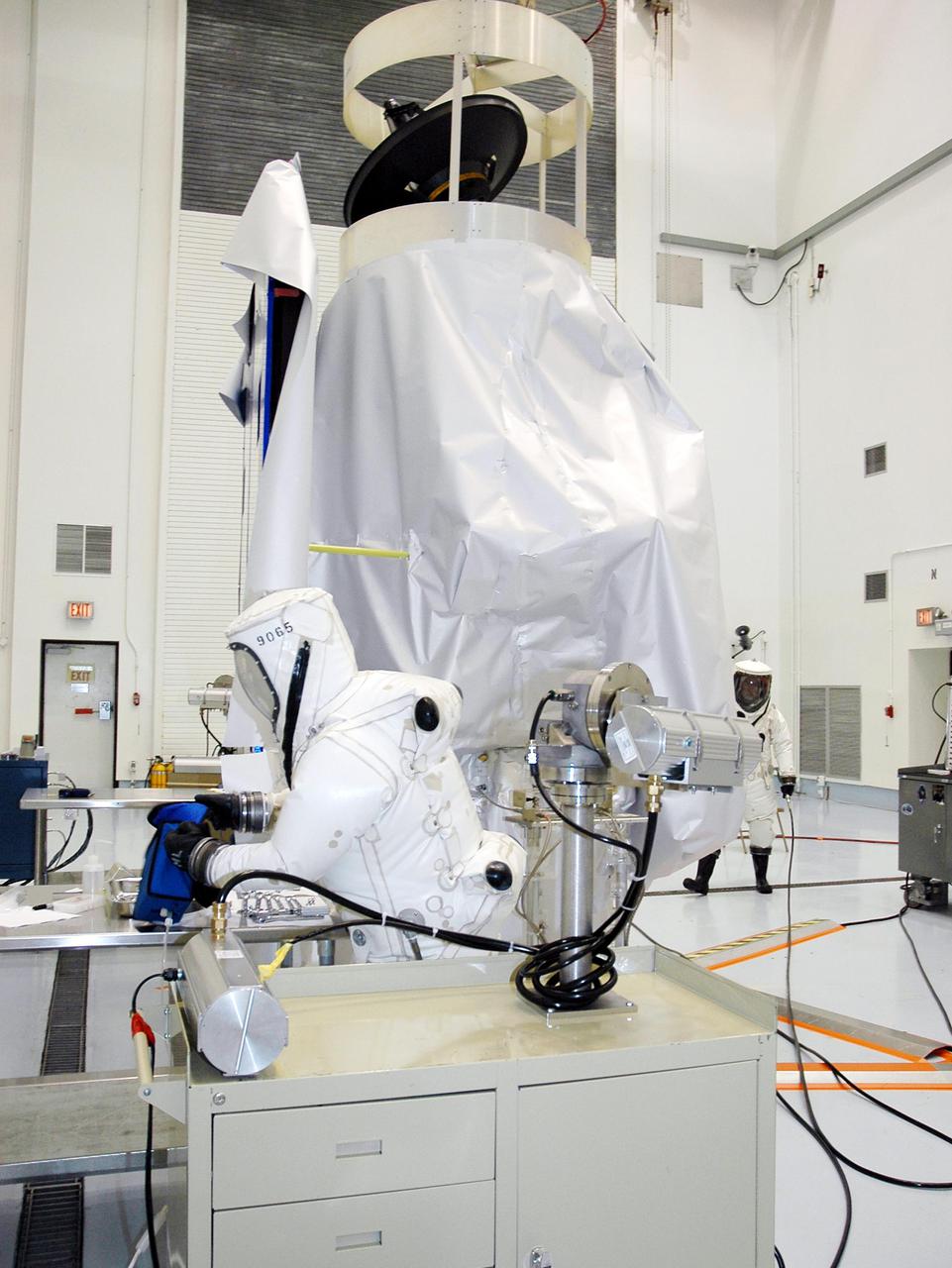
KENNEDY SPACE CENTER, FLA. - Workers at Astrotech Space Operations in Titusville, Fla., get ready to begin fueling the Deep Impact spacecraft, seen wrapped in a protective cover in the background. Scheduled for liftoff Jan. 12, Deep Impact will probe beneath the surface of Comet Tempel 1 on July 4, 2005, when the comet is 83 million miles from Earth, and reveal the secrets of its interior. After releasing a 3- by 3-foot projectile to crash onto the surface, Deep Impact’s flyby spacecraft will collect pictures and data of how the crater forms, measuring the crater’s depth and diameter, as well as the composition of the interior of the crater and any material thrown out, and determining the changes in natural outgassing produced by the impact. It will send the data back to Earth through the antennas of the Deep Space Network. Deep Impact is a NASA Discovery mission.
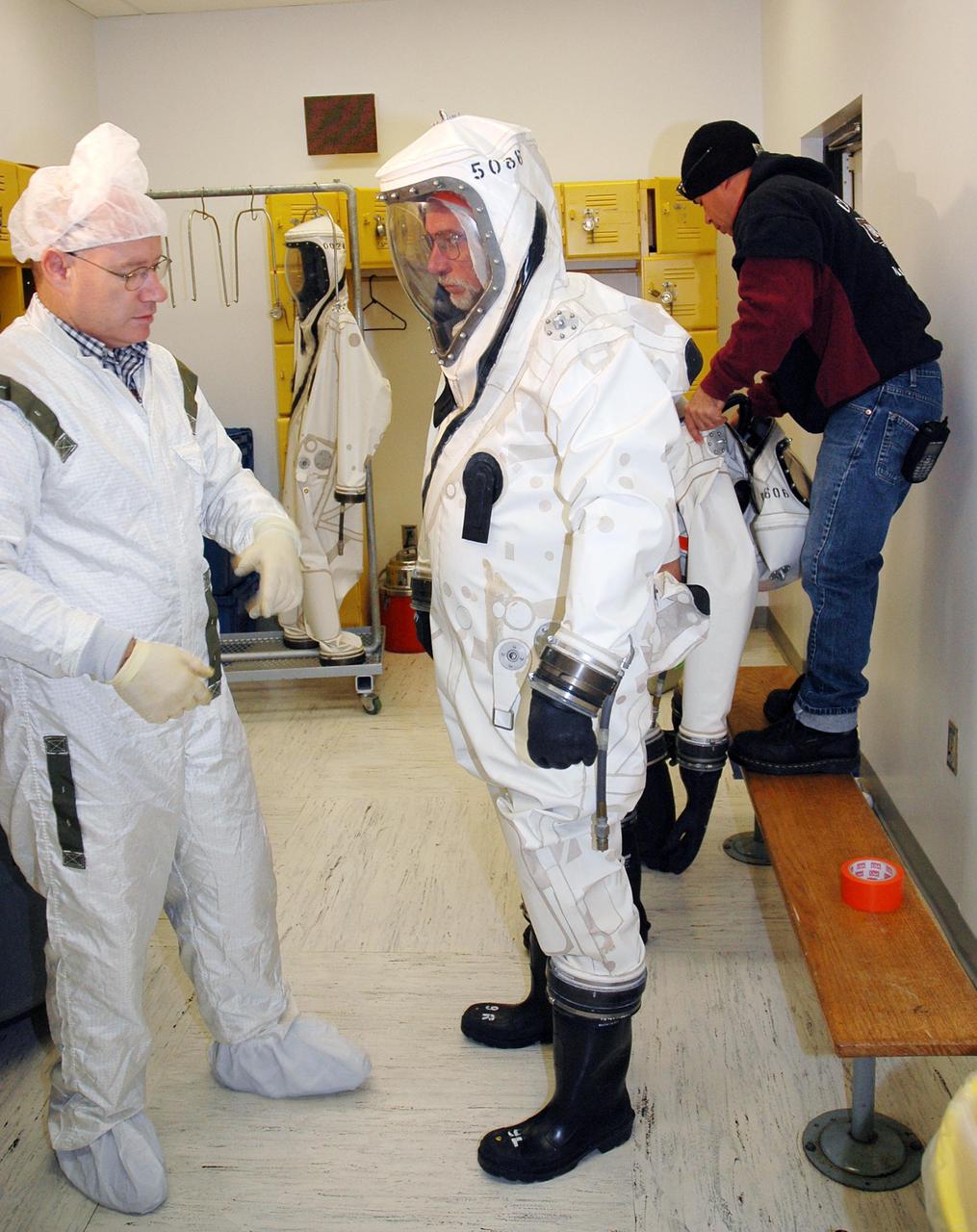
KENNEDY SPACE CENTER, FLA. - Workers at Astrotech Space Operations in Titusville, Fla., suit up before fueling the Deep Impact spacecraft. Scheduled for liftoff Jan. 12, Deep Impact will probe beneath the surface of Comet Tempel 1 on July 4, 2005, when the comet is 83 million miles from Earth, and reveal the secrets of its interior. After releasing a 3- by 3-foot projectile to crash onto the surface, Deep Impact’s flyby spacecraft will collect pictures and data of how the crater forms, measuring the crater’s depth and diameter, as well as the composition of the interior of the crater and any material thrown out, and determining the changes in natural outgassing produced by the impact. It will send the data back to Earth through the antennas of the Deep Space Network. Deep Impact is a NASA Discovery mission.
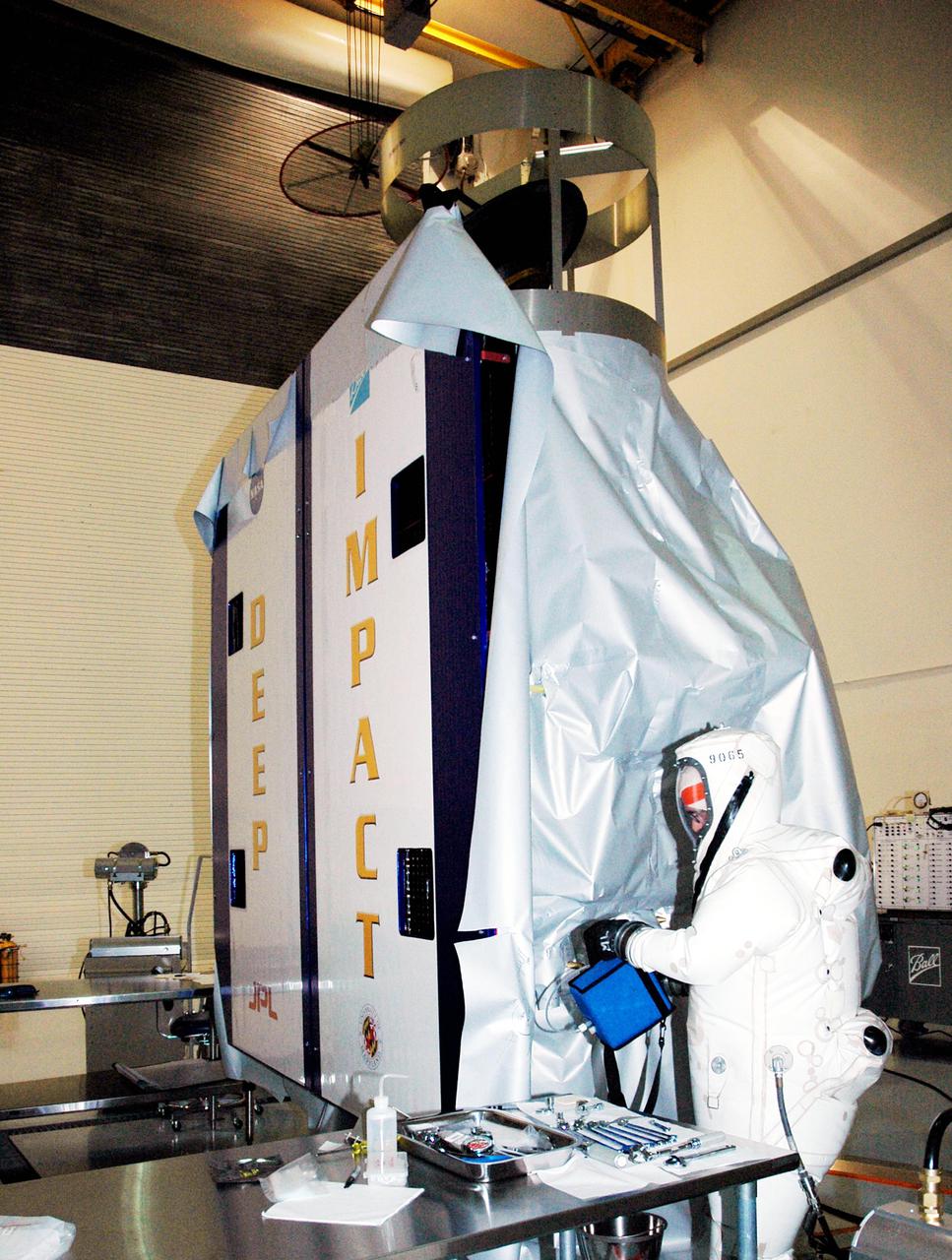
KENNEDY SPACE CENTER, FLA. - A worker at Astrotech Space Operations in Titusville, Fla., begins fueling the Deep Impact spacecraft. Scheduled for liftoff Jan. 12, Deep Impact will probe beneath the surface of Comet Tempel 1 on July 4, 2005, when the comet is 83 million miles from Earth, and reveal the secrets of its interior. After releasing a 3- by 3-foot projectile to crash onto the surface, Deep Impact’s flyby spacecraft will collect pictures and data of how the crater forms, measuring the crater’s depth and diameter, as well as the composition of the interior of the crater and any material thrown out, and determining the changes in natural outgassing produced by the impact. It will send the data back to Earth through the antennas of the Deep Space Network. Deep Impact is a NASA Discovery mission.
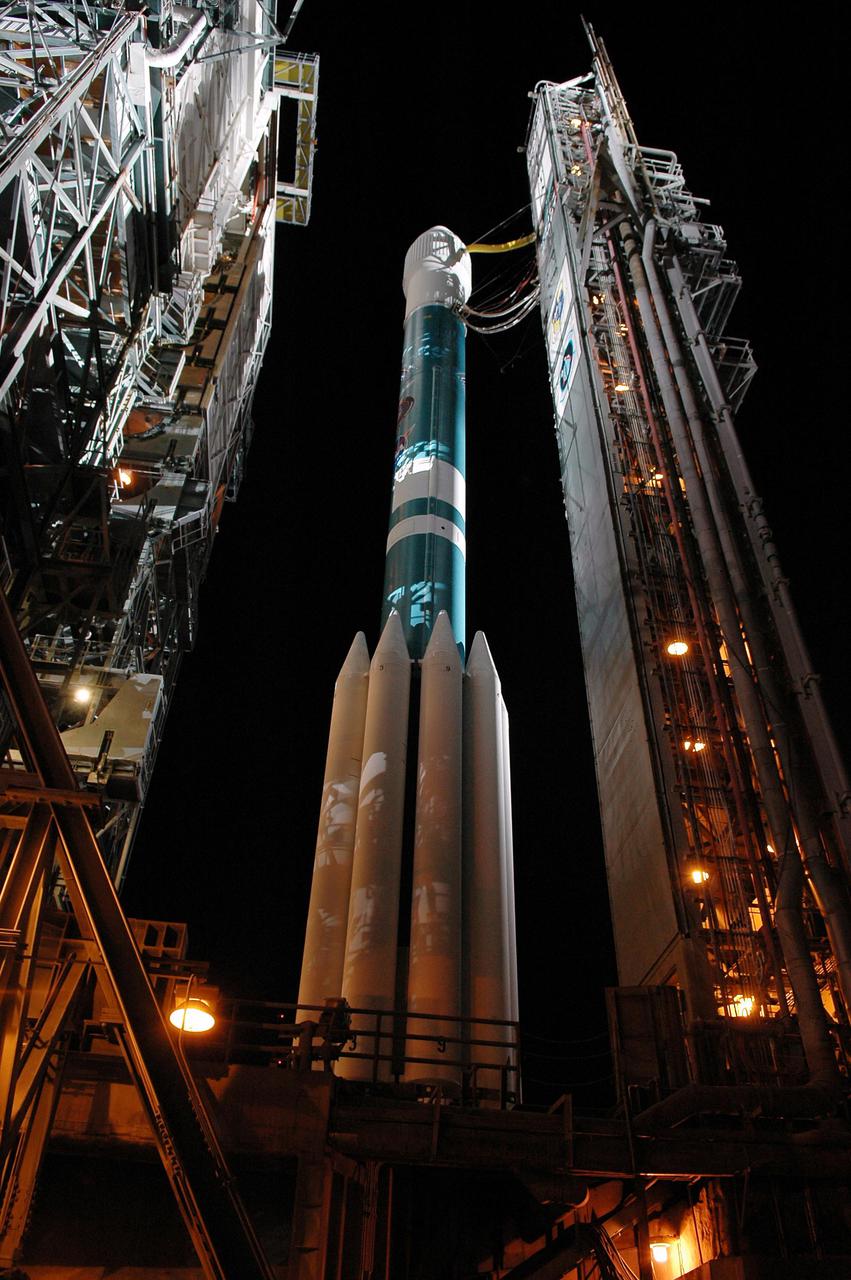
KENNEDY SPACE CENTER, FLA. - On Launch Pad 17-B, Cape Canaveral Air Force Station, Fla., shadows paint the Boeing Delta II rocket carrying the Deep Impact spacecraft as the mobile service tower at left is rolled back before launch.Scheduled for liftoff at 1:47 p.m. EST today, Deep Impact will head for space and a rendezvous with Comet Tempel 1 when the comet is 83 million miles from Earth. After releasing a 3- by 3-foot projectile (impactor) to crash onto the surface July 4, 2005, Deep Impact’s flyby spacecraft will reveal the secrets of the comet’s interior by collecting pictures and data of how the crater forms, measuring the crater’s depth and diameter as well as the composition of the interior of the crater and any material thrown out, and determining the changes in natural outgassing produced by the impact. It will send the data back to Earth through the antennas of the Deep Space Network. Deep Impact is a NASA Discovery mission.

KENNEDY SPACE CENTER, FLA. - On Launch Pad 17-B, Cape Canaveral Air Force Station, Fla., the Boeing Delta II rocket carrying the Deep Impact spacecraft is bathed in light waiting for tower rollback before launch. Scheduled for liftoff at 1:47 p.m. EST today, Deep Impact will head for space and a rendezvous with Comet Tempel 1 when the comet is 83 million miles from Earth. After releasing a 3- by 3-foot projectile (impactor) to crash onto the surface July 4, 2005, Deep Impact’s flyby spacecraft will reveal the secrets of the comet’s interior by collecting pictures and data of how the crater forms, measuring the crater’s depth and diameter as well as the composition of the interior of the crater and any material thrown out, and determining the changes in natural outgassing produced by the impact. It will send the data back to Earth through the antennas of the Deep Space Network. Deep Impact is a NASA Discovery mission.
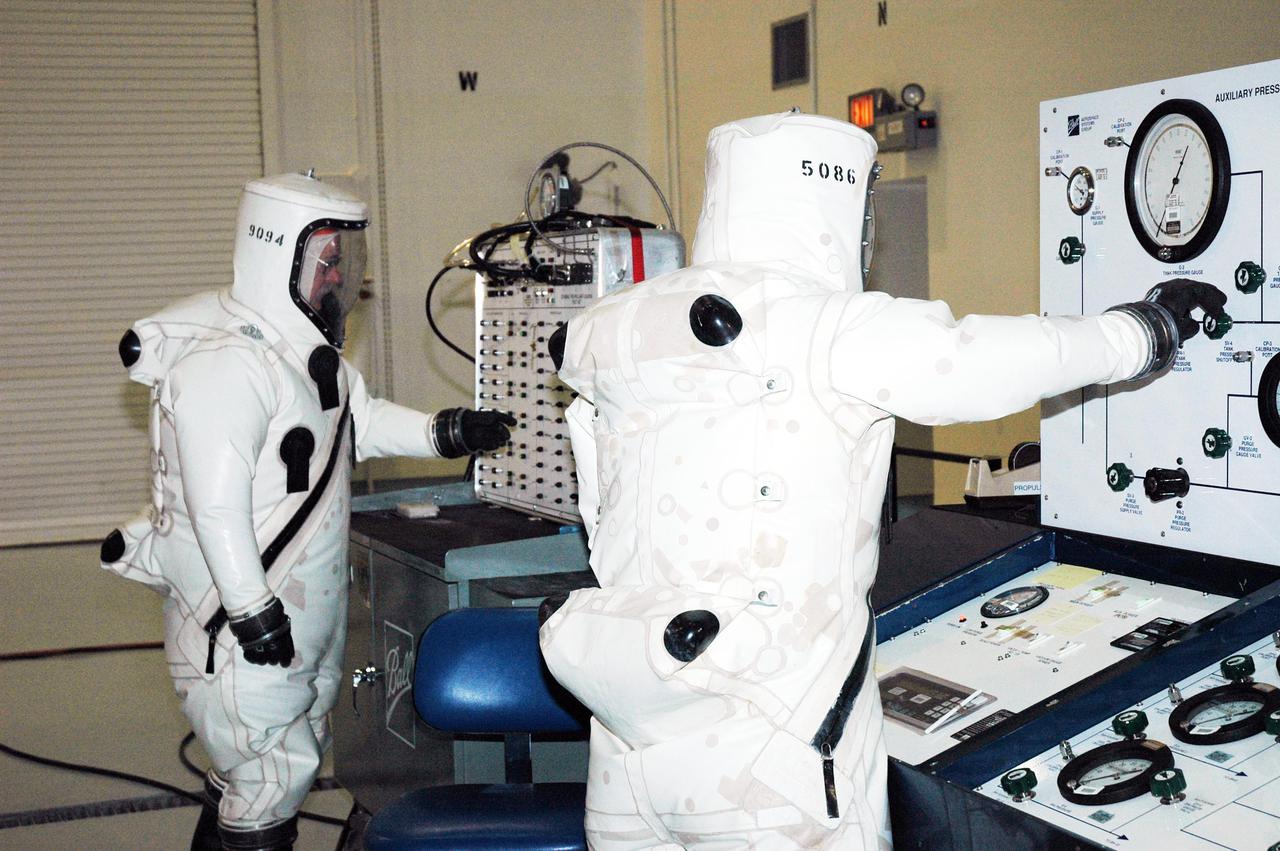
KENNEDY SPACE CENTER, FLA. - Workers at Astrotech Space Operations in Titusville, Fla., check control panels during fueling of the Deep Impact spacecraft. Scheduled for liftoff Jan. 12, Deep Impact will probe beneath the surface of Comet Tempel 1 on July 4, 2005, when the comet is 83 million miles from Earth, and reveal the secrets of its interior. After releasing a 3- by 3-foot projectile to crash onto the surface, Deep Impact’s flyby spacecraft will collect pictures and data of how the crater forms, measuring the crater’s depth and diameter, as well as the composition of the interior of the crater and any material thrown out, and determining the changes in natural outgassing produced by the impact. It will send the data back to Earth through the antennas of the Deep Space Network. Deep Impact is a NASA Discovery mission.
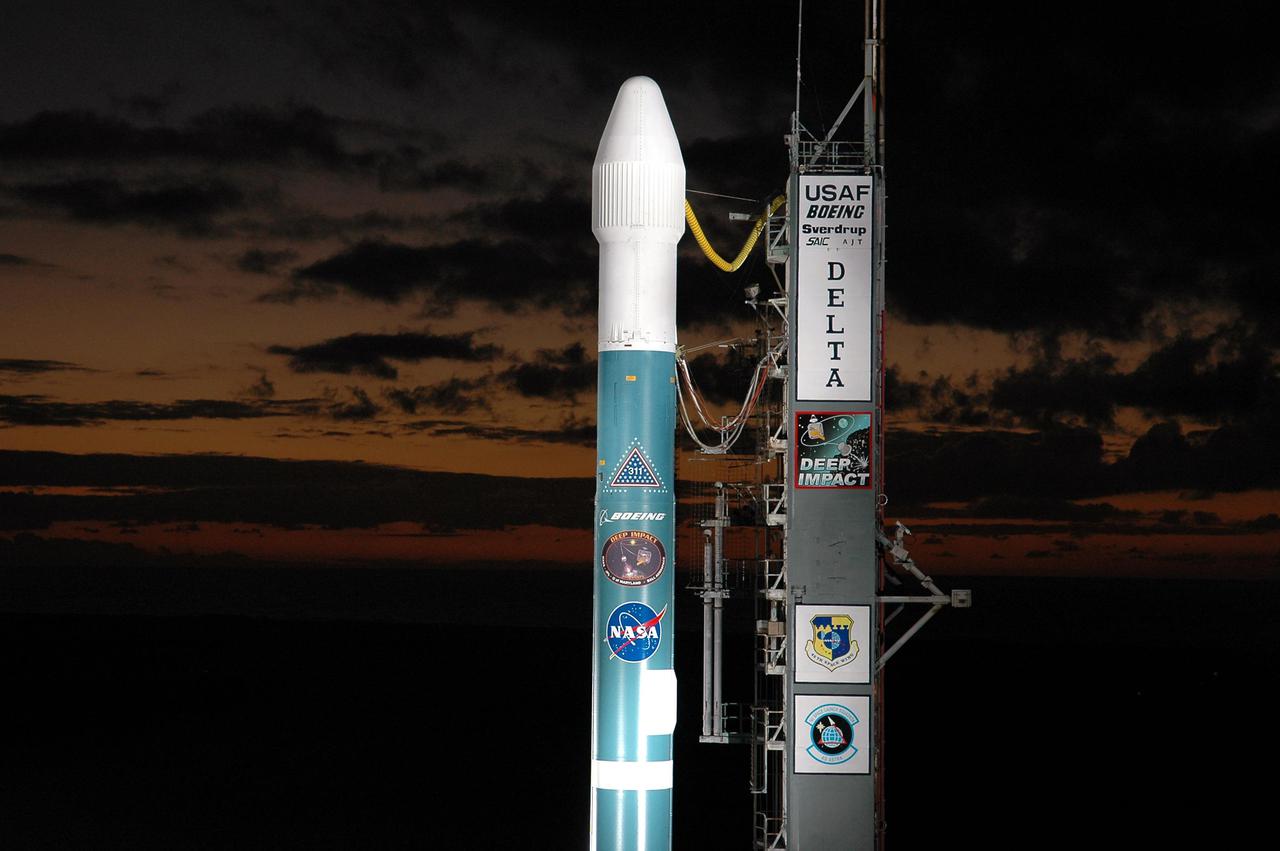
KENNEDY SPACE CENTER, FLA. - On Launch Pad 17-B, Cape Canaveral Air Force Station, Fla., the Boeing Delta II rocket carrying the Deep Impact spacecraft stands out against an early dawn sky. Scheduled for liftoff at 1:47 p.m. EST today, Deep Impact will head for space and a rendezvous with Comet Tempel 1 when the comet is 83 million miles from Earth. After releasing a 3- by 3-foot projectile (impactor) to crash onto the surface July 4, 2005, Deep Impact’s flyby spacecraft will reveal the secrets of the comet’s interior by collecting pictures and data of how the crater forms, measuring the crater’s depth and diameter as well as the composition of the interior of the crater and any material thrown out, and determining the changes in natural outgassing produced by the impact. It will send the data back to Earth through the antennas of the Deep Space Network. Deep Impact is a NASA Discovery mission.
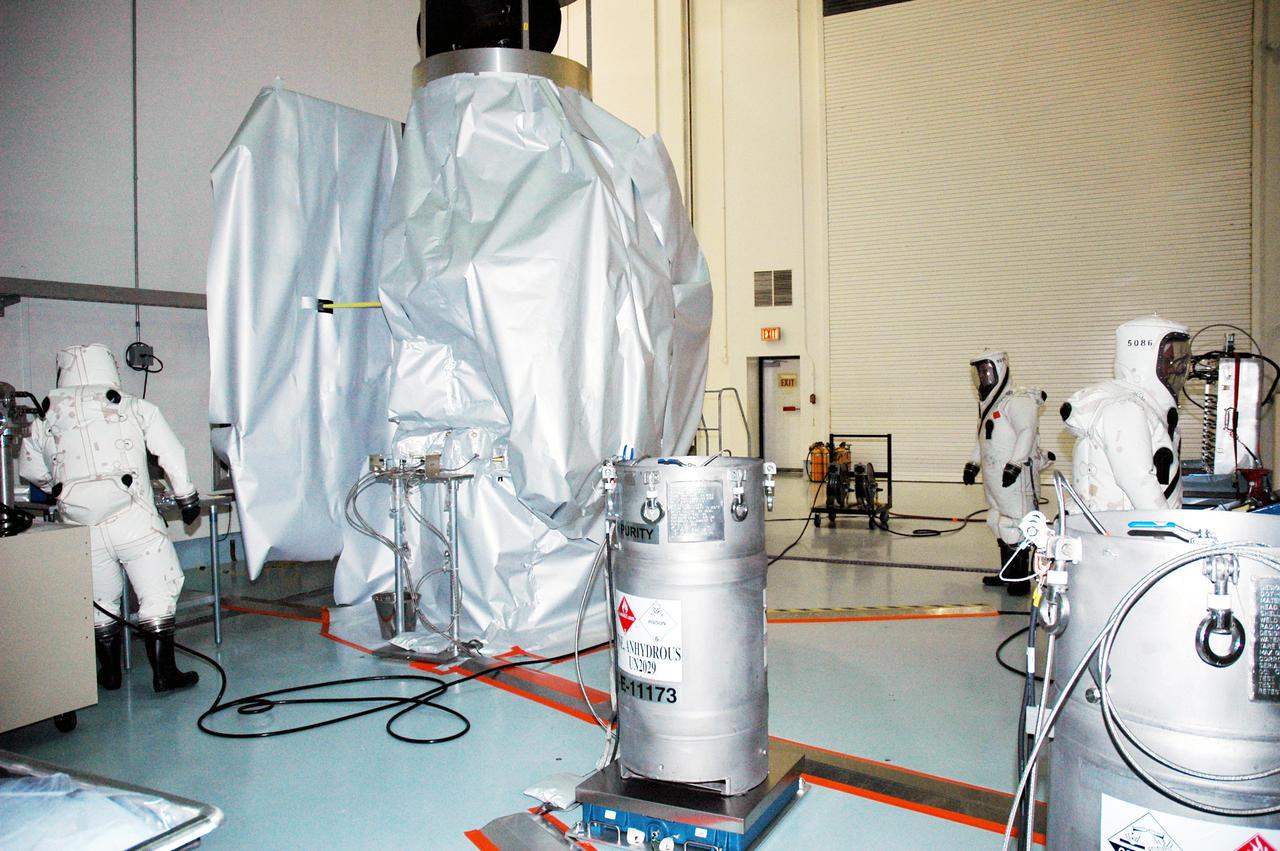
KENNEDY SPACE CENTER, FLA. - Workers at Astrotech Space Operations in Titusville, Fla., begin fueling operations of the Deep Impact spacecraft, seen wrapped in a protective cover in the background. Scheduled for liftoff Jan. 12, Deep Impact will probe beneath the surface of Comet Tempel 1 on July 4, 2005, when the comet is 83 million miles from Earth, and reveal the secrets of its interior. After releasing a 3- by 3-foot projectile to crash onto the surface, Deep Impact’s flyby spacecraft will collect pictures and data of how the crater forms, measuring the crater’s depth and diameter, as well as the composition of the interior of the crater and any material thrown out, and determining the changes in natural outgassing produced by the impact. It will send the data back to Earth through the antennas of the Deep Space Network. Deep Impact is a NASA Discovery mission.
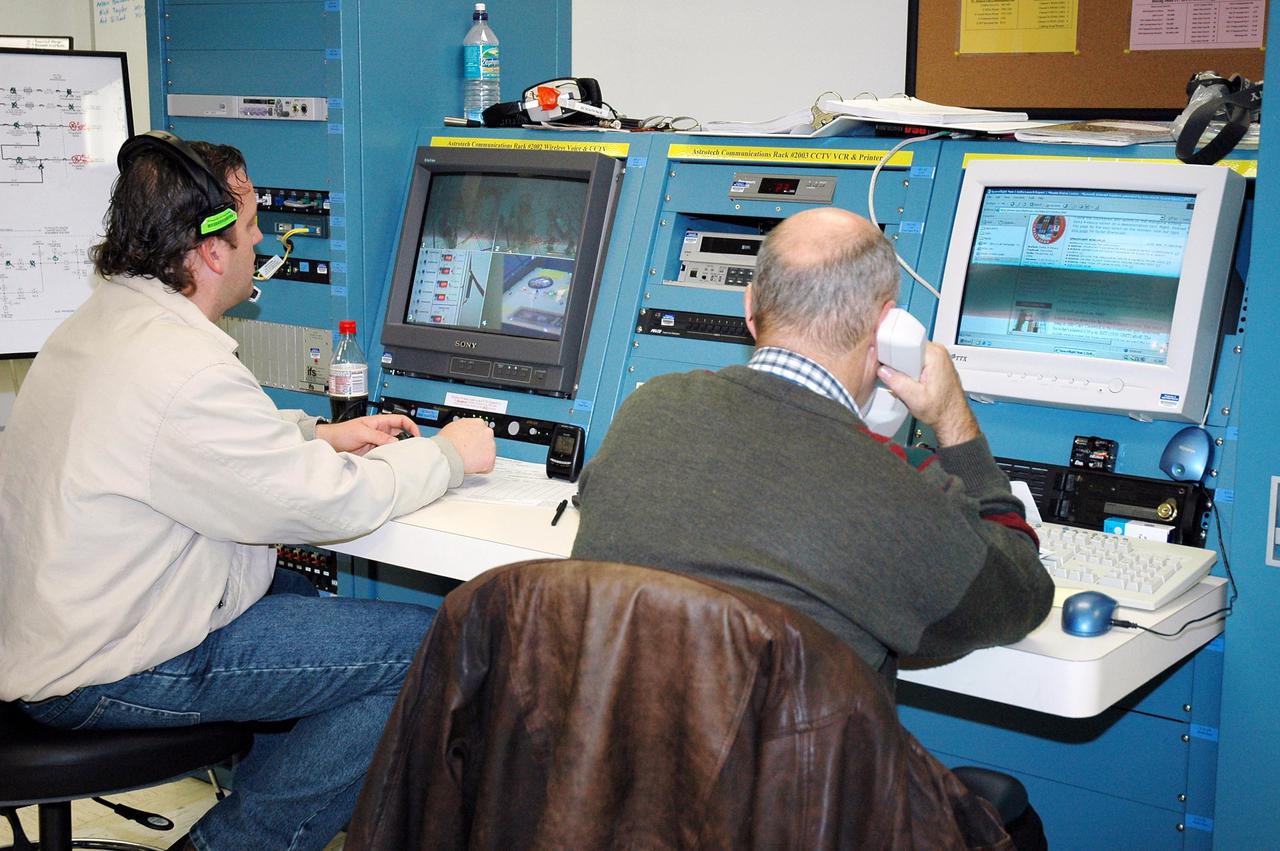
KENNEDY SPACE CENTER, FLA. - Workers at Astrotech Space Operations in Titusville, Fla., monitor the fueling operations of the Deep Impact spacecraft. Scheduled for liftoff Jan. 12, Deep Impact will probe beneath the surface of Comet Tempel 1 on July 4, 2005, when the comet is 83 million miles from Earth, and reveal the secrets of its interior. After releasing a 3- by 3-foot projectile to crash onto the surface, Deep Impact’s flyby spacecraft will collect pictures and data of how the crater forms, measuring the crater’s depth and diameter, as well as the composition of the interior of the crater and any material thrown out, and determining the changes in natural outgassing produced by the impact. It will send the data back to Earth through the antennas of the Deep Space Network. Deep Impact is a NASA Discovery mission.
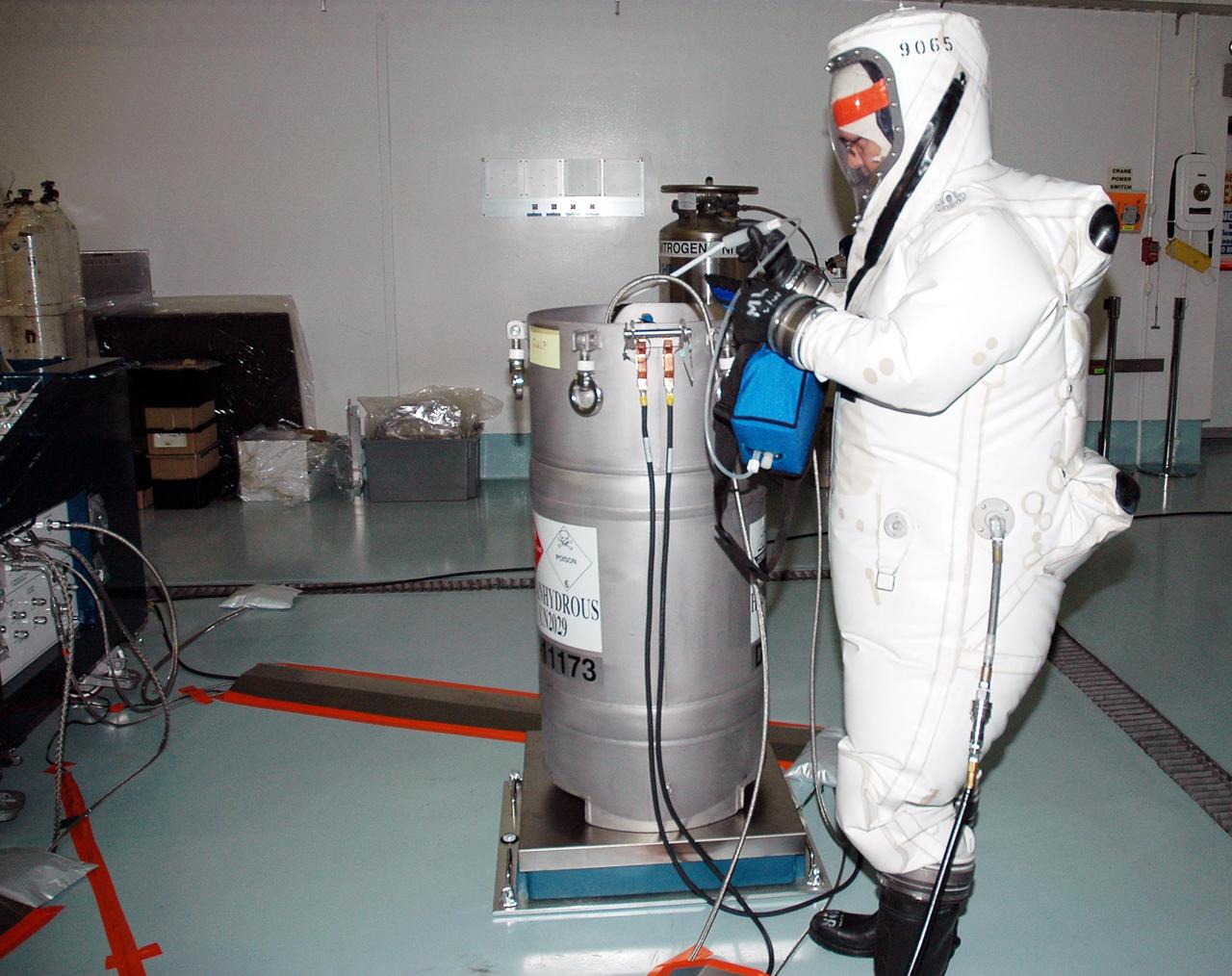
KENNEDY SPACE CENTER, FLA. - Workers at Astrotech Space Operations in Titusville, Fla., begin fueling operations of the Deep Impact spacecraft, seen wrapped in a protective cover in the background. Scheduled for liftoff Jan. 12, Deep Impact will probe beneath the surface of Comet Tempel 1 on July 4, 2005, when the comet is 83 million miles from Earth, and reveal the secrets of its interior. After releasing a 3- by 3-foot projectile to crash onto the surface, Deep Impact’s flyby spacecraft will collect pictures and data of how the crater forms, measuring the crater’s depth and diameter, as well as the composition of the interior of the crater and any material thrown out, and determining the changes in natural outgassing produced by the impact. It will send the data back to Earth through the antennas of the Deep Space Network. Deep Impact is a NASA Discovery mission.
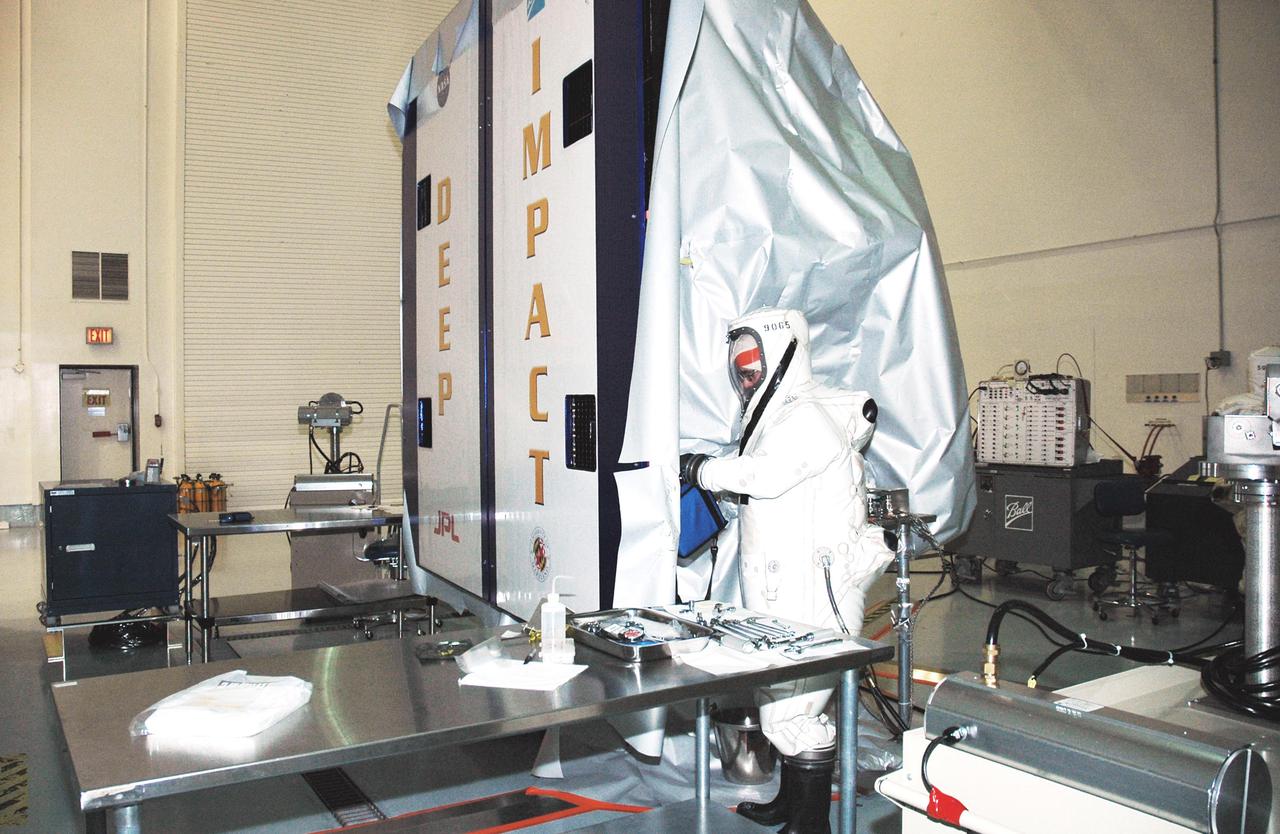
KENNEDY SPACE CENTER, FLA. - A worker at Astrotech Space Operations in Titusville, Fla., begins fueling the Deep Impact spacecraft. Scheduled for liftoff Jan. 12, Deep Impact will probe beneath the surface of Comet Tempel 1 on July 4, 2005, when the comet is 83 million miles from Earth, and reveal the secrets of its interior. After releasing a 3- by 3-foot projectile to crash onto the surface, Deep Impact’s flyby spacecraft will collect pictures and data of how the crater forms, measuring the crater’s depth and diameter, as well as the composition of the interior of the crater and any material thrown out, and determining the changes in natural outgassing produced by the impact. It will send the data back to Earth through the antennas of the Deep Space Network. Deep Impact is a NASA Discovery mission.
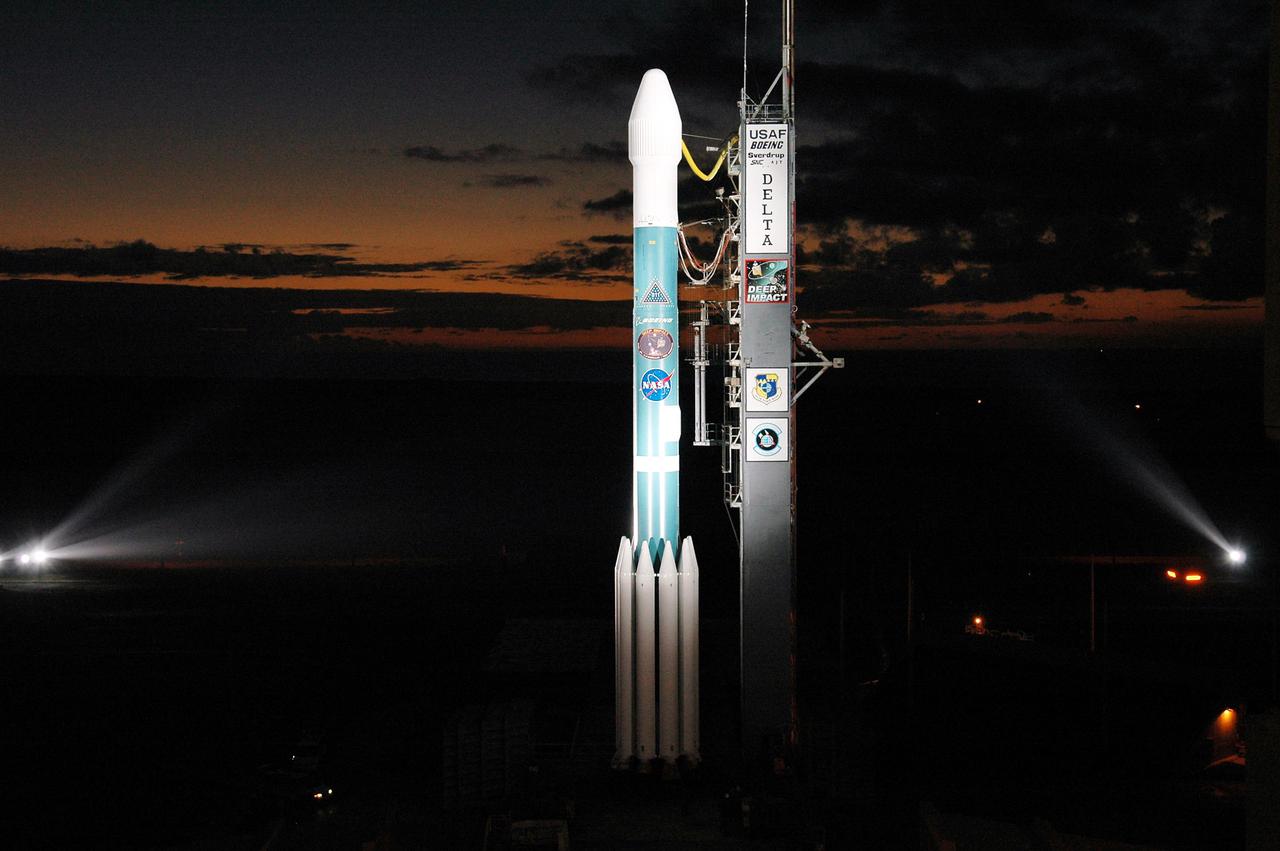
KENNEDY SPACE CENTER, FLA. - On Launch Pad 17-B, Cape Canaveral Air Force Station, Fla., the Boeing Delta II carrying the Deep Impact spacecraft rocket shines under spotlights in the early dawn hours as it waits for launch. Scheduled for liftoff at 1:47 p.m. EST today, Deep Impact will head for space and a rendezvous with Comet Tempel 1 when the comet is 83 million miles from Earth. After releasing a 3- by 3-foot projectile (impactor) to crash onto the surface July 4, 2005, Deep Impact’s flyby spacecraft will reveal the secrets of the comet’s interior by collecting pictures and data of how the crater forms, measuring the crater’s depth and diameter as well as the composition of the interior of the crater and any material thrown out, and determining the changes in natural outgassing produced by the impact. It will send the data back to Earth through the antennas of the Deep Space Network. Deep Impact is a NASA Discovery mission.
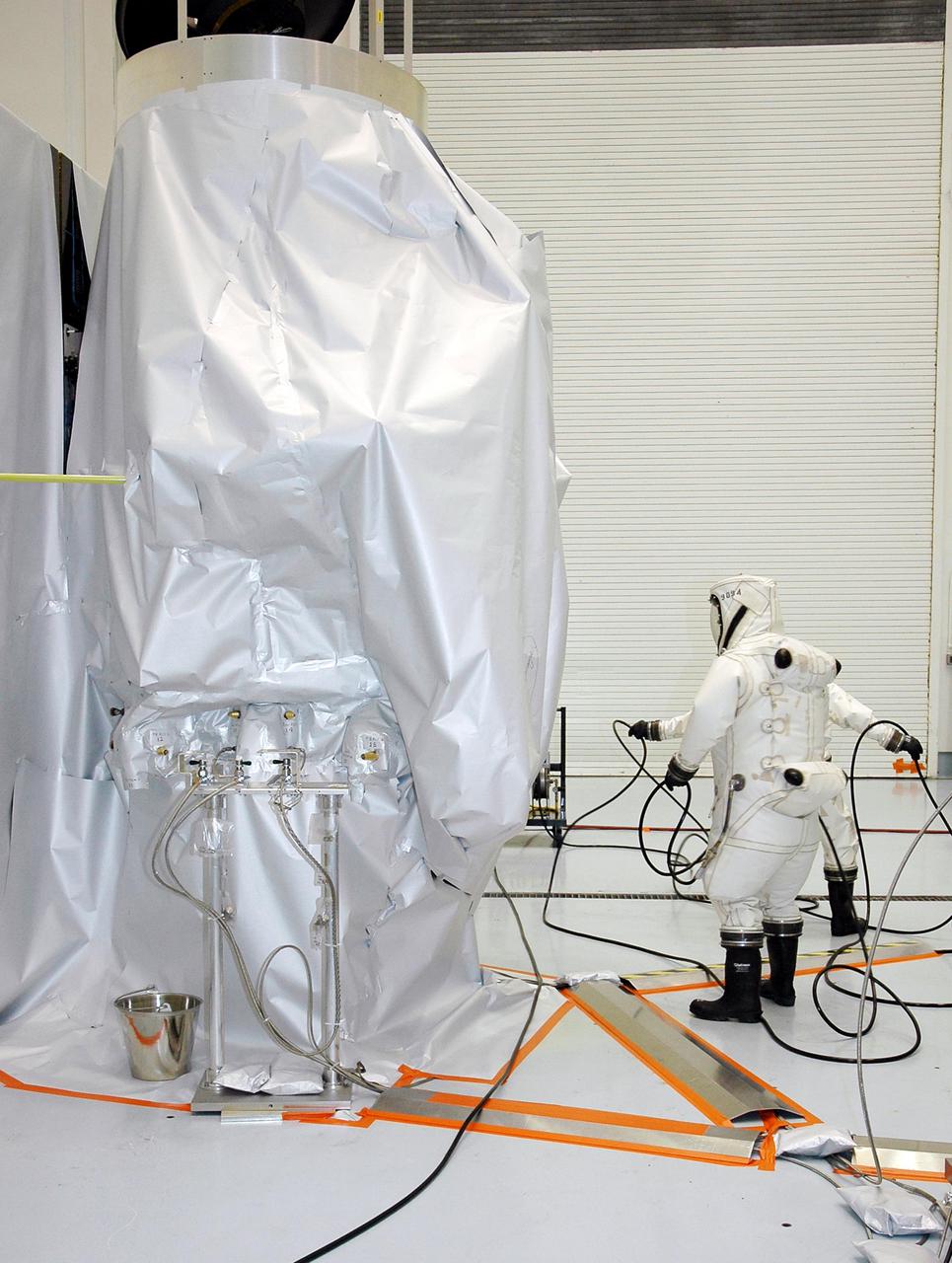
KENNEDY SPACE CENTER, FLA. - Workers at Astrotech Space Operations in Titusville, Fla., get ready to begin fueling the Deep Impact spacecraft, seen wrapped in a protective cover in the background. Scheduled for liftoff Jan. 12, Deep Impact will probe beneath the surface of Comet Tempel 1 on July 4, 2005, when the comet is 83 million miles from Earth, and reveal the secrets of its interior. After releasing a 3- by 3-foot projectile to crash onto the surface, Deep Impact’s flyby spacecraft will collect pictures and data of how the crater forms, measuring the crater’s depth and diameter, as well as the composition of the interior of the crater and any material thrown out, and determining the changes in natural outgassing produced by the impact. It will send the data back to Earth through the antennas of the Deep Space Network. Deep Impact is a NASA Discovery mission.
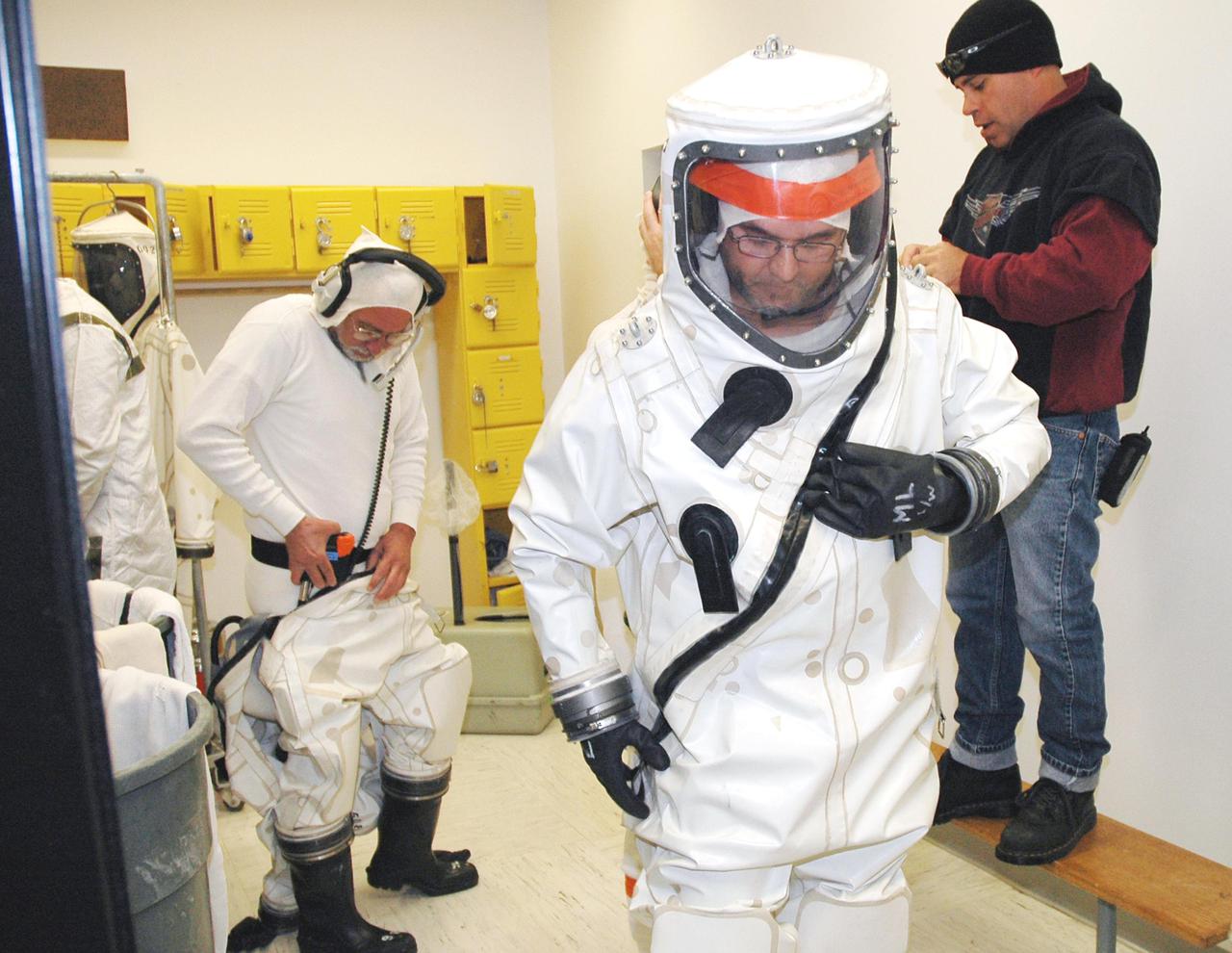
KENNEDY SPACE CENTER, FLA. - Workers at Astrotech Space Operations in Titusville, Fla., suit up before fueling the Deep Impact spacecraft. Scheduled for liftoff Jan. 12, Deep Impact will probe beneath the surface of Comet Tempel 1 on July 4, 2005, when the comet is 83 million miles from Earth, and reveal the secrets of its interior. After releasing a 3- by 3-foot projectile to crash onto the surface, Deep Impact’s flyby spacecraft will collect pictures and data of how the crater forms, measuring the crater’s depth and diameter, as well as the composition of the interior of the crater and any material thrown out, and determining the changes in natural outgassing produced by the impact. It will send the data back to Earth through the antennas of the Deep Space Network. Deep Impact is a NASA Discovery mission.
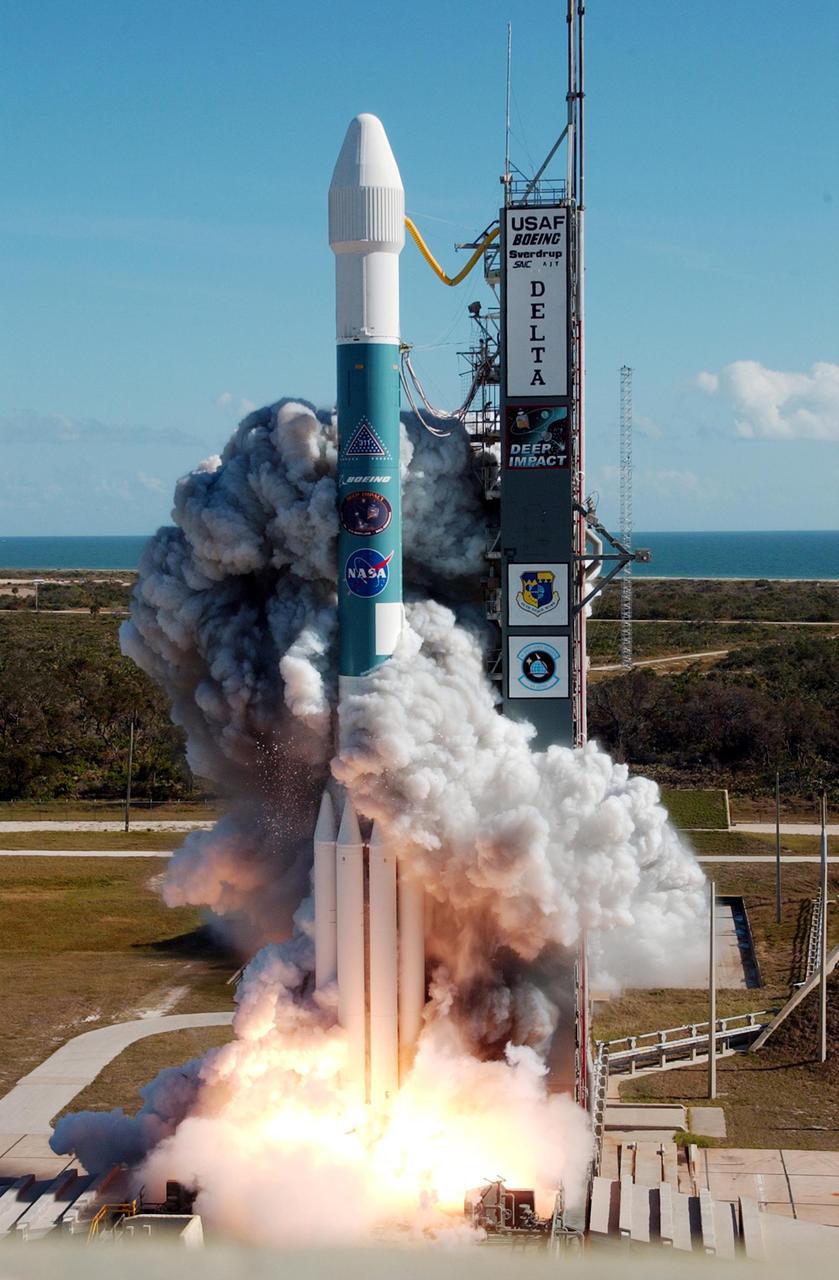
KENNEDY SPACE CENTER, FLA. - Erupting from the flames and smoke beneath it, NASA’s Deep Impact spacecraft lifts off at 1:47 p.m. EST today from Launch Pad 17-B, Cape Canaveral Air Force Station, Fla. A NASA Discovery mission, Deep Impact is heading for space and a rendezvous 83 million miles from Earth with Comet Tempel 1. After releasing a 3- by 3-foot projectile (impactor) to crash onto the surface July 4, 2005, Deep Impact’s flyby spacecraft will reveal the secrets of the comet’s interior by collecting pictures and data of how the crater forms, measuring the crater’s depth and diameter as well as the composition of the interior of the crater and any material thrown out, and determining the changes in natural outgassing produced by the impact. It will send the data back to Earth through the antennas of the Deep Space Network.
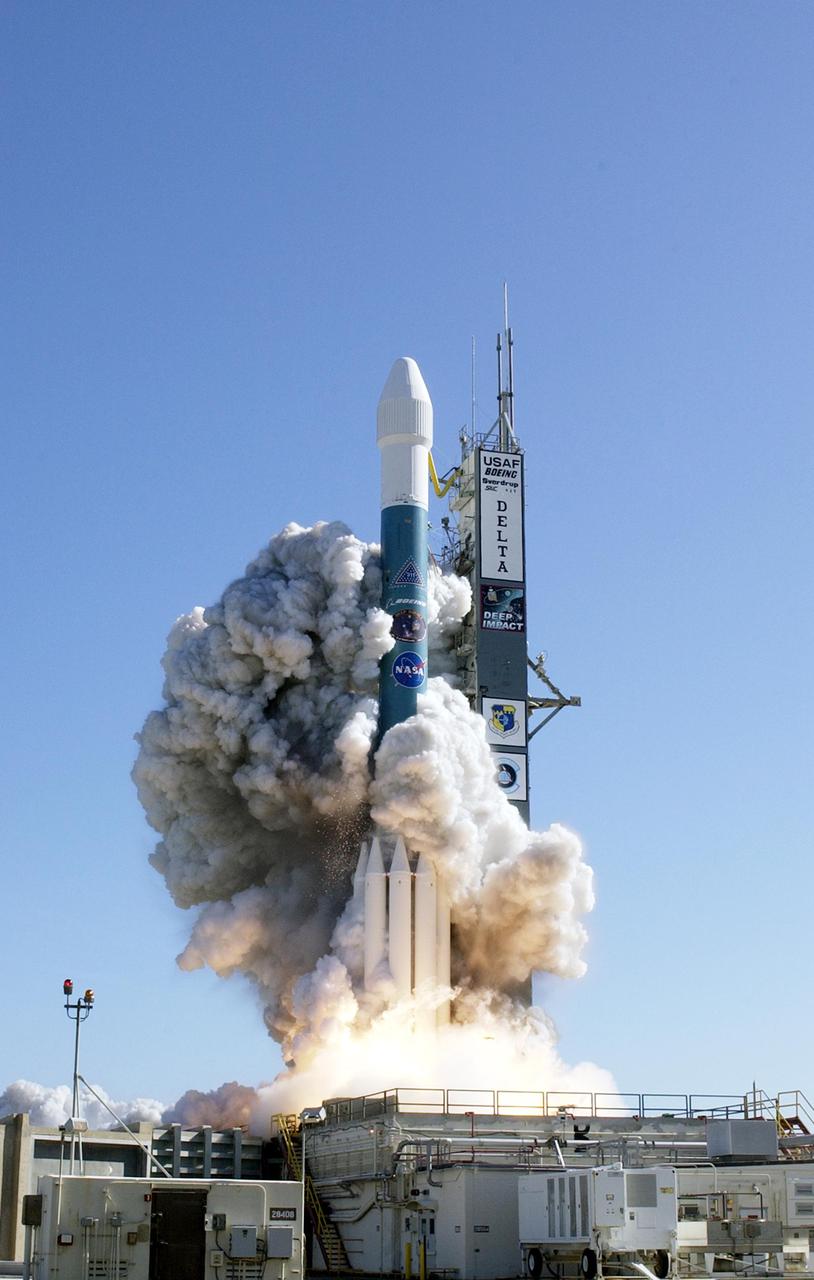
KENNEDY SPACE CENTER, FLA. - Engulfed by flames and smoke, NASA’s Deep Impact spacecraft lifts off at 1:47 p.m. EST today from Launch Pad 17-B, Cape Canaveral Air Force Station, Fla. A NASA Discovery mission, Deep Impact is heading for space and a rendezvous 83 million miles from Earth with Comet Tempel 1. After releasing a 3- by 3-foot projectile (impactor) to crash onto the surface July 4, 2005, Deep Impact’s flyby spacecraft will reveal the secrets of the comet’s interior by collecting pictures and data of how the crater forms, measuring the crater’s depth and diameter as well as the composition of the interior of the crater and any material thrown out, and determining the changes in natural outgassing produced by the impact. It will send the data back to Earth through the antennas of the Deep Space Network.
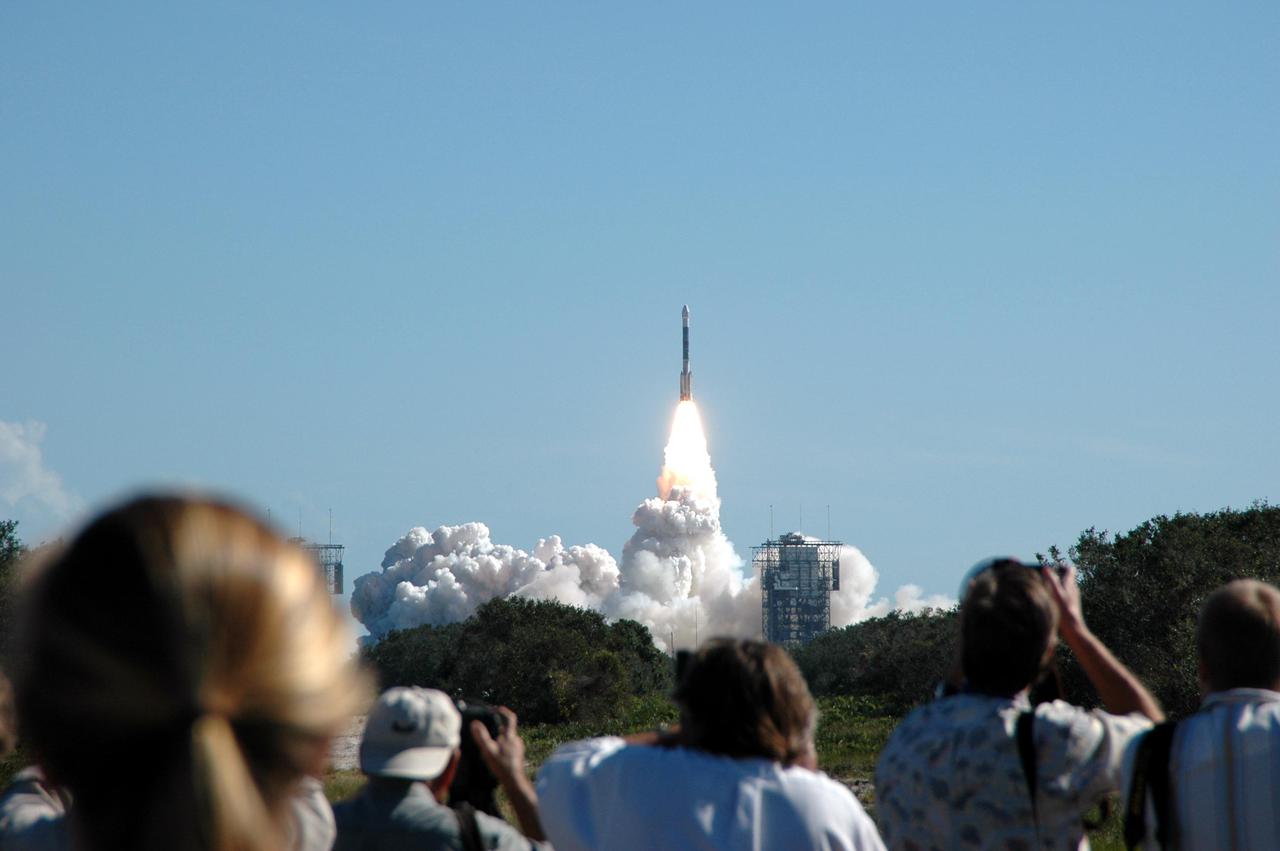
KENNEDY SPACE CENTER, FLA. - From the nearby Press Site at Cape Canaveral Air Force Station, Fla., photographers capture the exciting launch of the Deep Impact spacecraft at 1:47 p.m. EST. A NASA Discovery mission, Deep Impact is heading for space and a rendezvous 83 million miles from Earth with Comet Tempel 1. After releasing a 3- by 3-foot projectile (impactor) to crash onto the surface July 4, 2005, Deep Impact’s flyby spacecraft will reveal the secrets of the comet’s interior by collecting pictures and data of how the crater forms, measuring the crater’s depth and diameter as well as the composition of the interior of the crater and any material thrown out, and determining the changes in natural outgassing produced by the impact. It will send the data back to Earth through the antennas of the Deep Space Network.
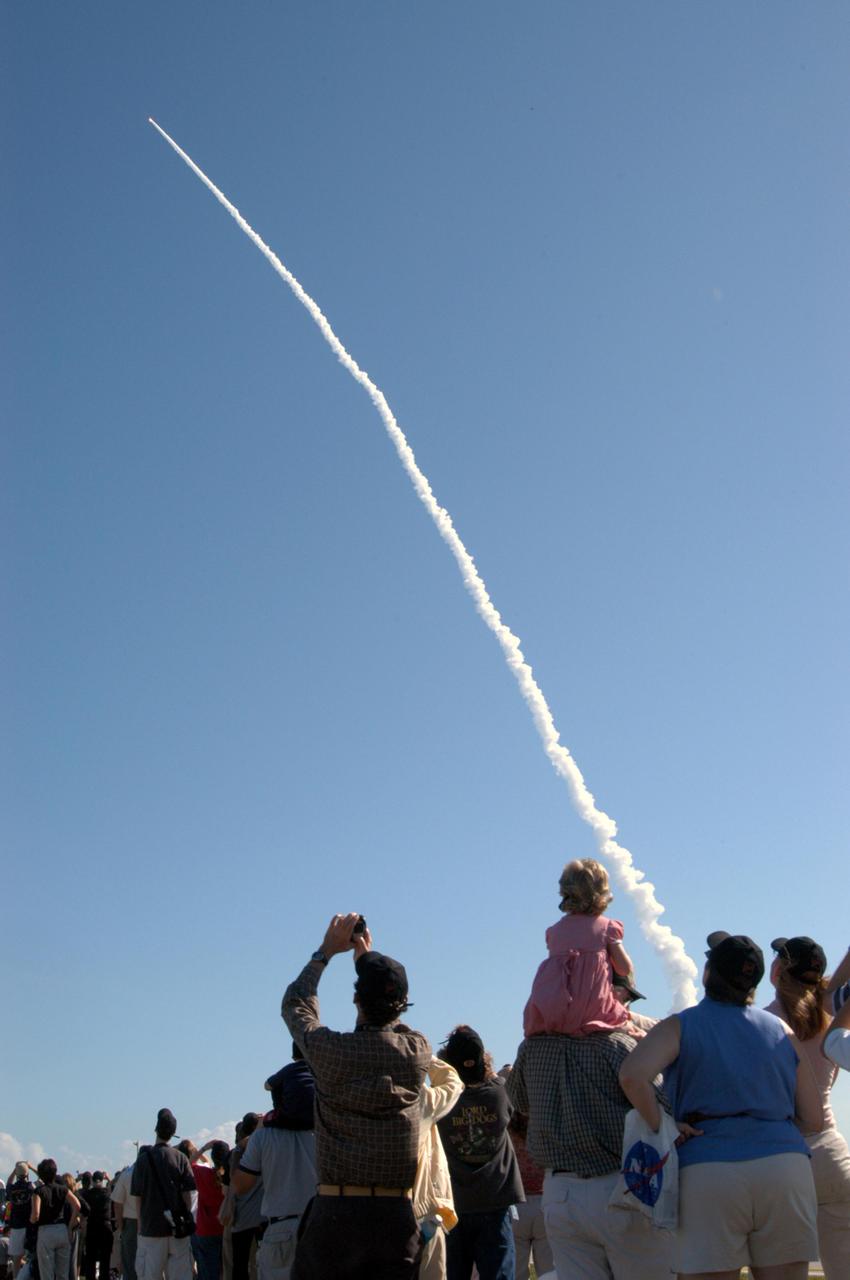
KENNEDY SPACE CENTER, FLA. - Guests of NASA gather near the launch site at Cape Canaveral Air Force Station, Fla., to watch the Deep Impact spacecraft as it speeds through the air after a perfect launch at 1:47 p.m. EST. A NASA Discovery mission, Deep Impact is heading for space and a rendezvous 83 million miles from Earth with Comet Tempel 1. After releasing a 3- by 3-foot projectile (impactor) to crash onto the surface July 4, 2005, Deep Impact’s flyby spacecraft will reveal the secrets of the comet’s interior by collecting pictures and data of how the crater forms, measuring the crater’s depth and diameter as well as the composition of the interior of the crater and any material thrown out, and determining the changes in natural outgassing produced by the impact. It will send the data back to Earth through the antennas of the Deep Space Network.
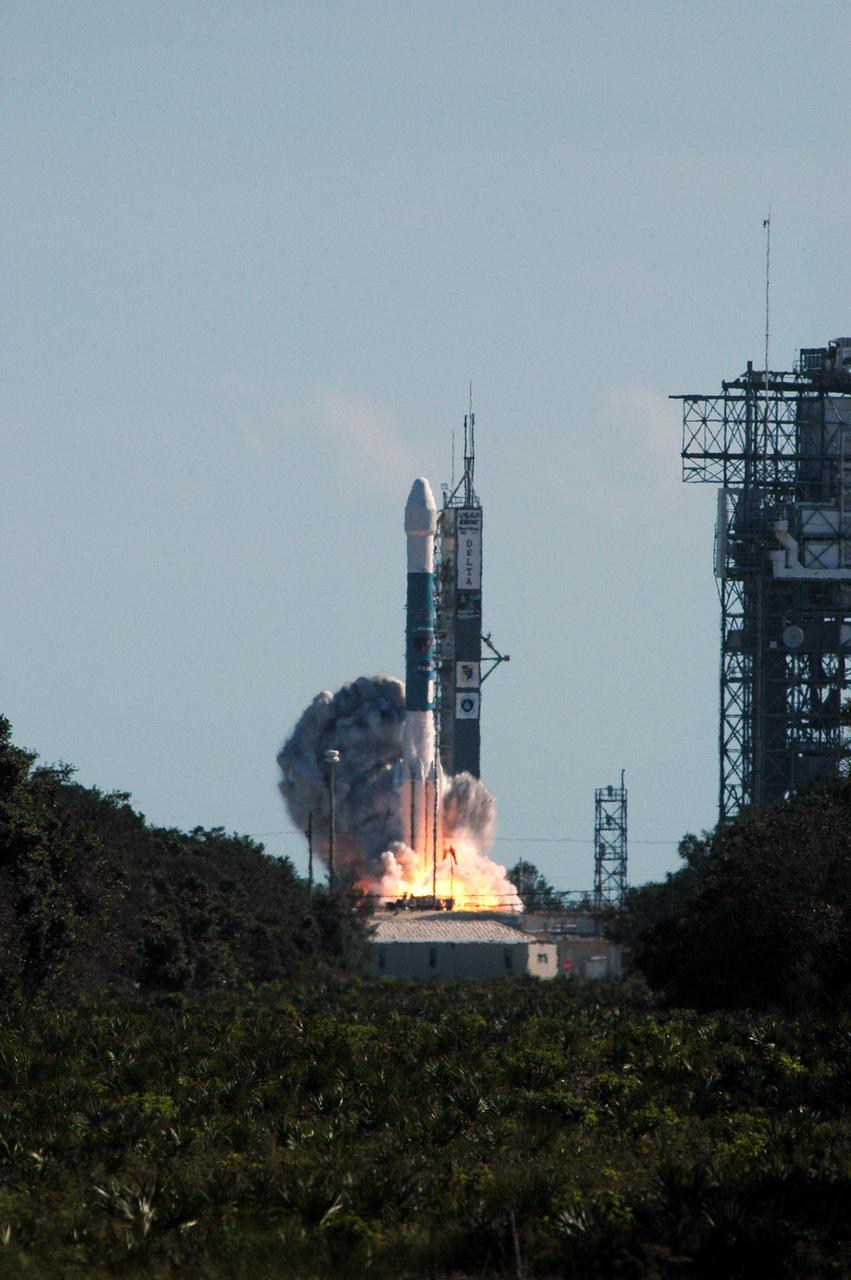
KENNEDY SPACE CENTER, FLA. - With a burst of flames, NASA’s Deep Impact spacecraft lifts off at 1:47 p.m. EST today from Launch Pad 17-B, Cape Canaveral Air Force Station, Fla. A NASA Discovery mission, Deep Impact is heading for space and a rendezvous 83 million miles from Earth with Comet Tempel 1. After releasing a 3- by 3-foot projectile (impactor) to crash onto the surface July 4, 2005, Deep Impact’s flyby spacecraft will reveal the secrets of the comet’s interior by collecting pictures and data of how the crater forms, measuring the crater’s depth and diameter as well as the composition of the interior of the crater and any material thrown out, and determining the changes in natural outgassing produced by the impact. It will send the data back to Earth through the antennas of the Deep Space Network.
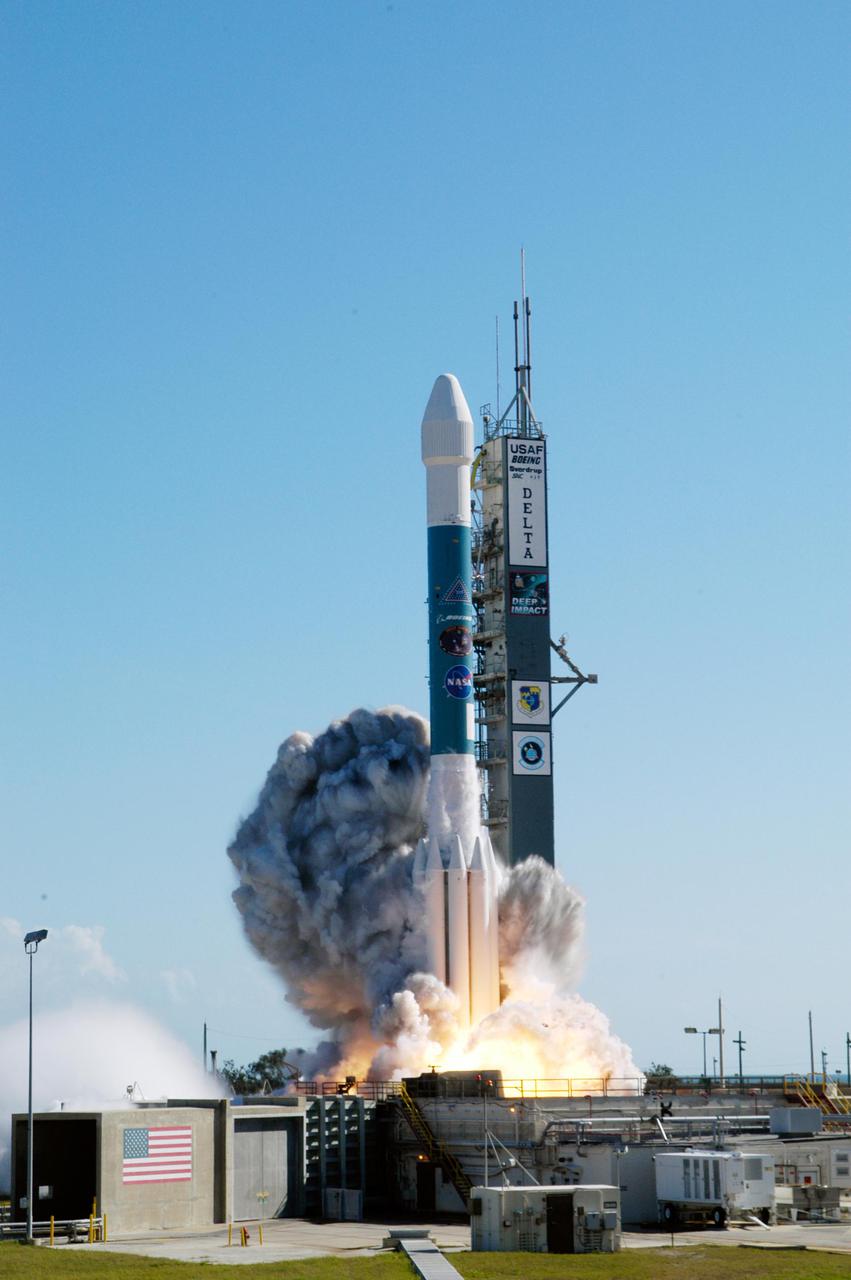
KENNEDY SPACE CENTER, FLA. - Erupting from the flames and smoke beneath it, NASA’s Deep Impact spacecraft lifts off at 1:47 p.m. EST today from Launch Pad 17-B, Cape Canaveral Air Force Station, Fla. A NASA Discovery mission, Deep Impact is heading for space and a rendezvous 83 million miles from Earth with Comet Tempel 1. After releasing a 3- by 3-foot projectile (impactor) to crash onto the surface July 4, 2005, Deep Impact’s flyby spacecraft will reveal the secrets of the comet’s interior by collecting pictures and data of how the crater forms, measuring the crater’s depth and diameter as well as the composition of the interior of the crater and any material thrown out, and determining the changes in natural outgassing produced by the impact. It will send the data back to Earth through the antennas of the Deep Space Network.
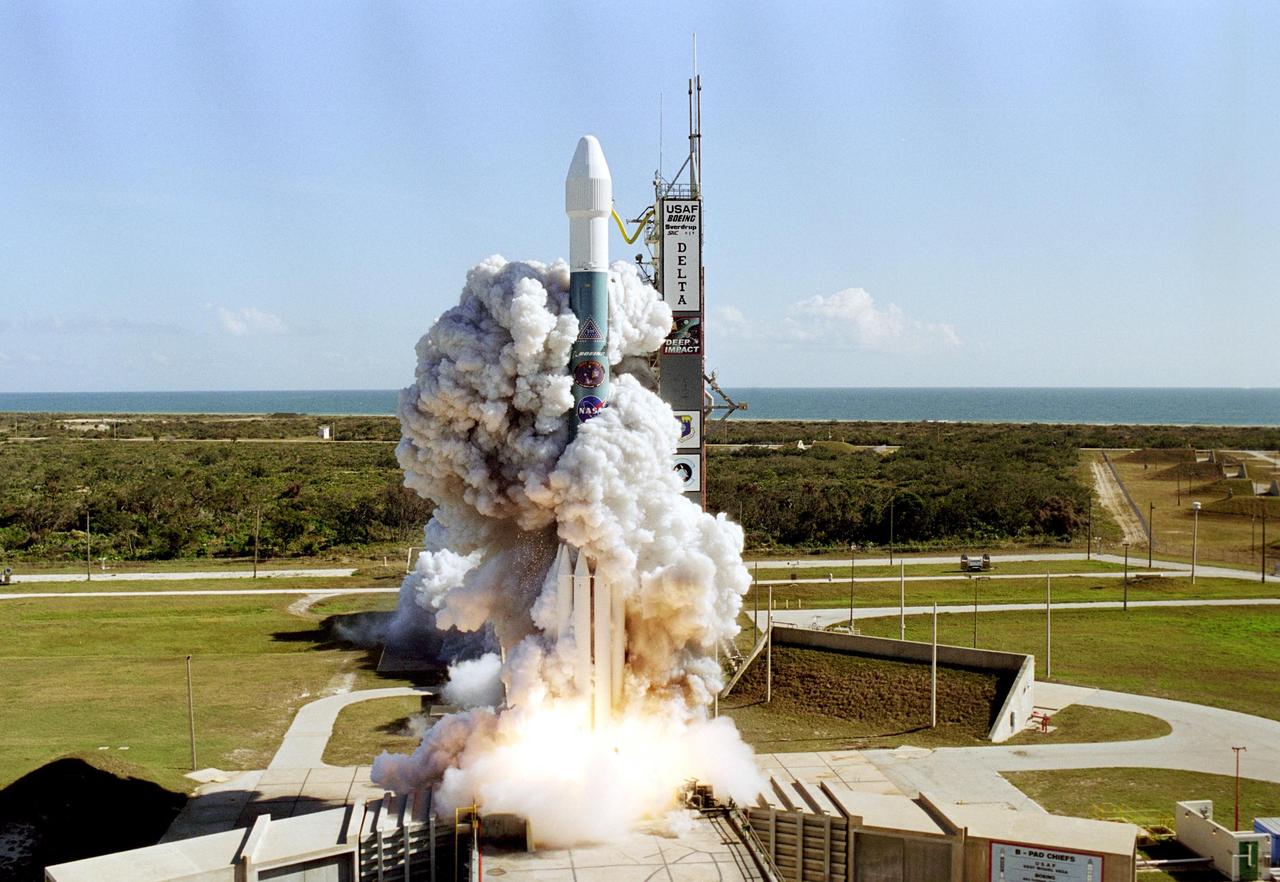
KENNEDY SPACE CENTER, FLA. - Emerging through the smoke and steam, the Boeing Delta II rocket carrying NASA’s Deep Impact spacecraft lifts off at 1:47 p.m. EST from Launch Pad 17-B, Cape Canaveral Air Force Station, Fla. A NASA Discovery mission, Deep Impact is heading for space and a rendezvous 83 million miles from Earth with Comet Tempel 1. After releasing a 3- by 3-foot projectile (impactor) to crash onto the surface July 4, 2005, Deep Impact’s flyby spacecraft will reveal the secrets of the comet’s interior by collecting pictures and data of how the crater forms, measuring the crater’s depth and diameter as well as the composition of the interior of the crater and any material thrown out, and determining the changes in natural outgassing produced by the impact. It will send the data back to Earth through the antennas of the Deep Space Network.
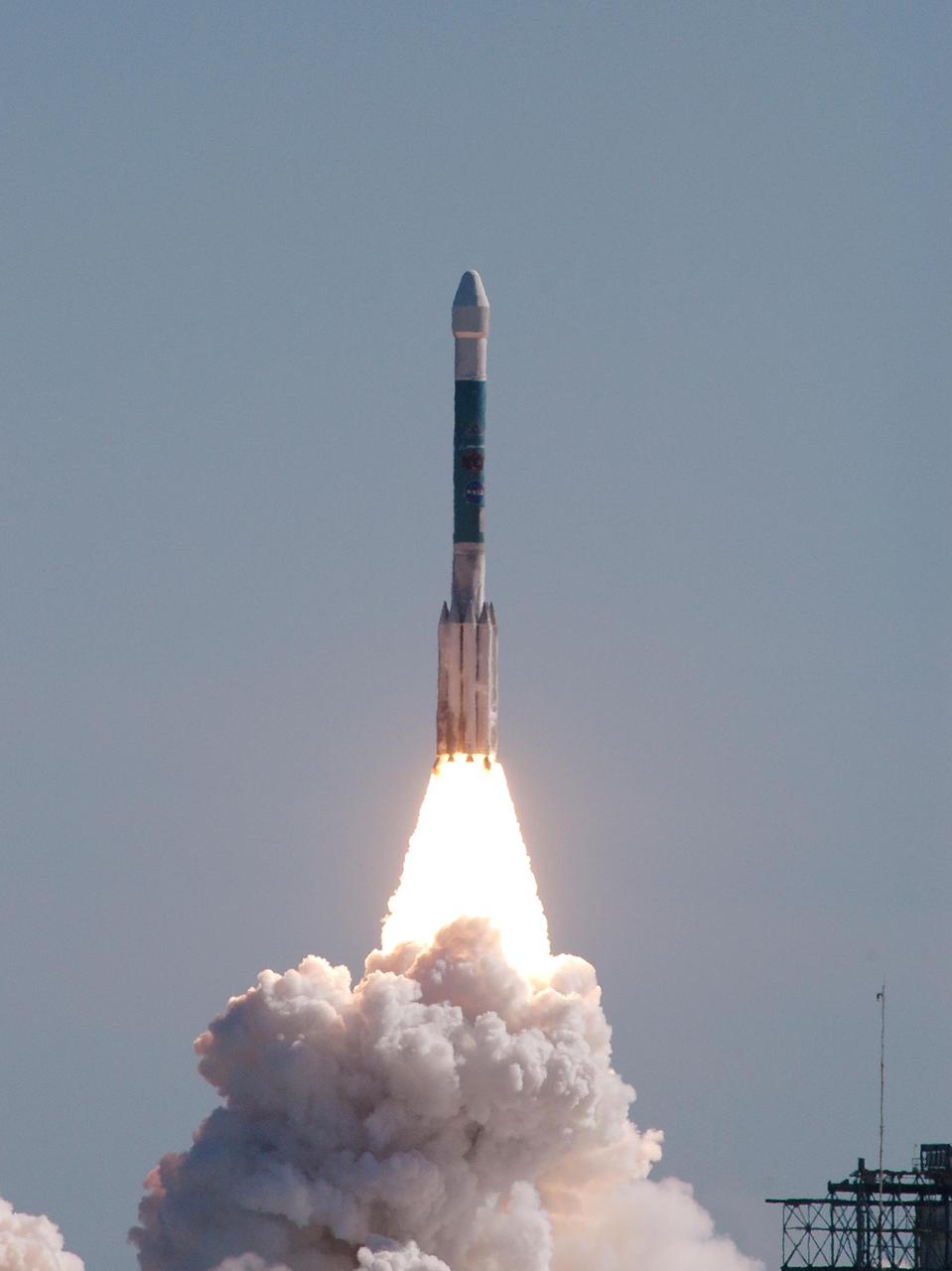
KENNEDY SPACE CENTER, FLA. - Erupting from the flames and smoke beneath it, NASA’s Deep Impact spacecraft lifts off at 1:47 p.m. EST today from Launch Pad 17-B, Cape Canaveral Air Force Station, Fla. A NASA Discovery mission, Deep Impact is heading for space and a rendezvous 83 million miles from Earth with Comet Tempel 1. After releasing a 3- by 3-foot projectile (impactor) to crash onto the surface July 4, 2005, Deep Impact’s flyby spacecraft will reveal the secrets of the comet’s interior by collecting pictures and data of how the crater forms, measuring the crater’s depth and diameter as well as the composition of the interior of the crater and any material thrown out, and determining the changes in natural outgassing produced by the impact. It will send the data back to Earth through the antennas of the Deep Space Network.
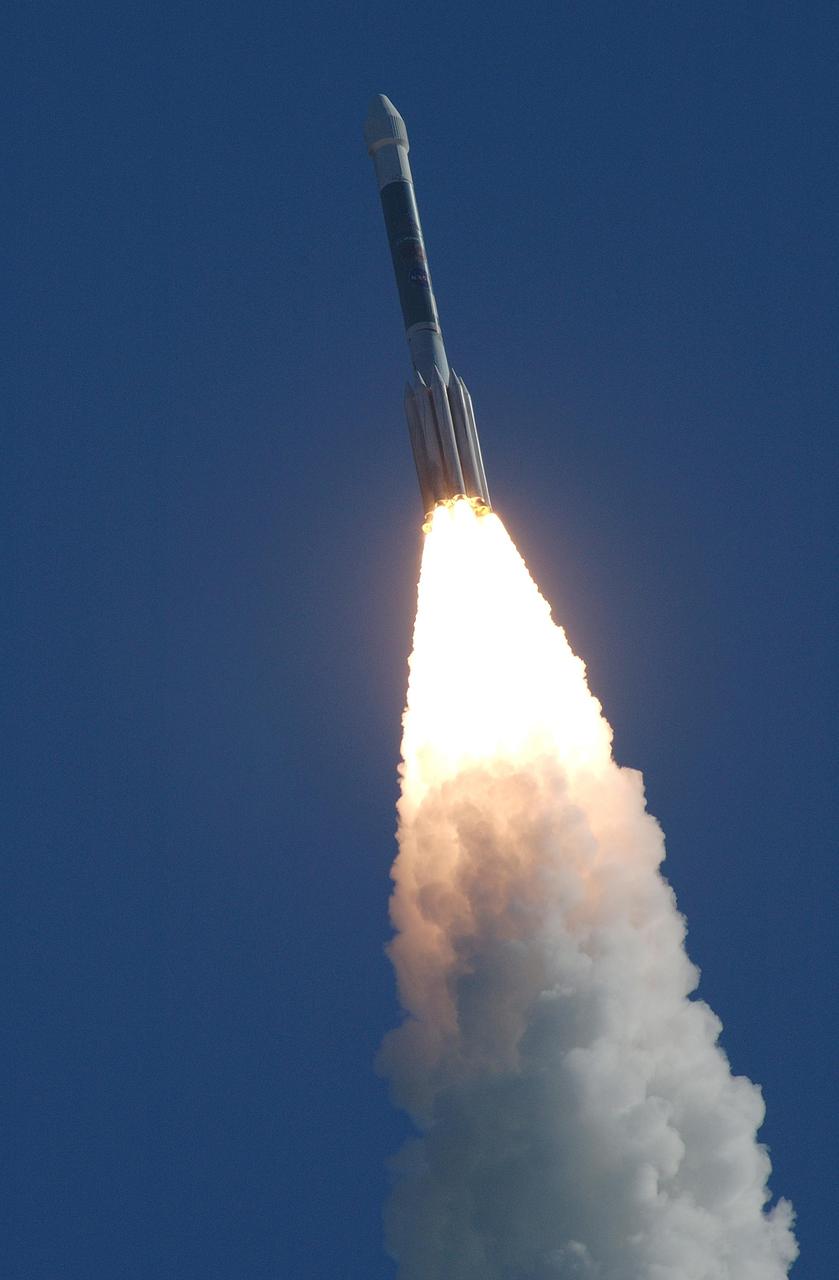
KENNEDY SPACE CENTER, FLA. - After a perfect liftoff at 1:47 p.m. EST today from Launch Pad 17-B, Cape Canaveral Air Force Station, Fla., the Boeing Delta II rocket with Deep Impact spacecraft aboard soars through the clear blue sky. A NASA Discovery mission, Deep Impact is heading for space and a rendezvous 83 million miles from Earth with Comet Tempel 1. After releasing a 3- by 3-foot projectile (impactor) to crash onto the surface July 4, 2005, Deep Impact’s flyby spacecraft will reveal the secrets of the comet’s interior by collecting pictures and data of how the crater forms, measuring the crater’s depth and diameter as well as the composition of the interior of the crater and any material thrown out, and determining the changes in natural outgassing produced by the impact. It will send the data back to Earth through the antennas of the Deep Space Network.
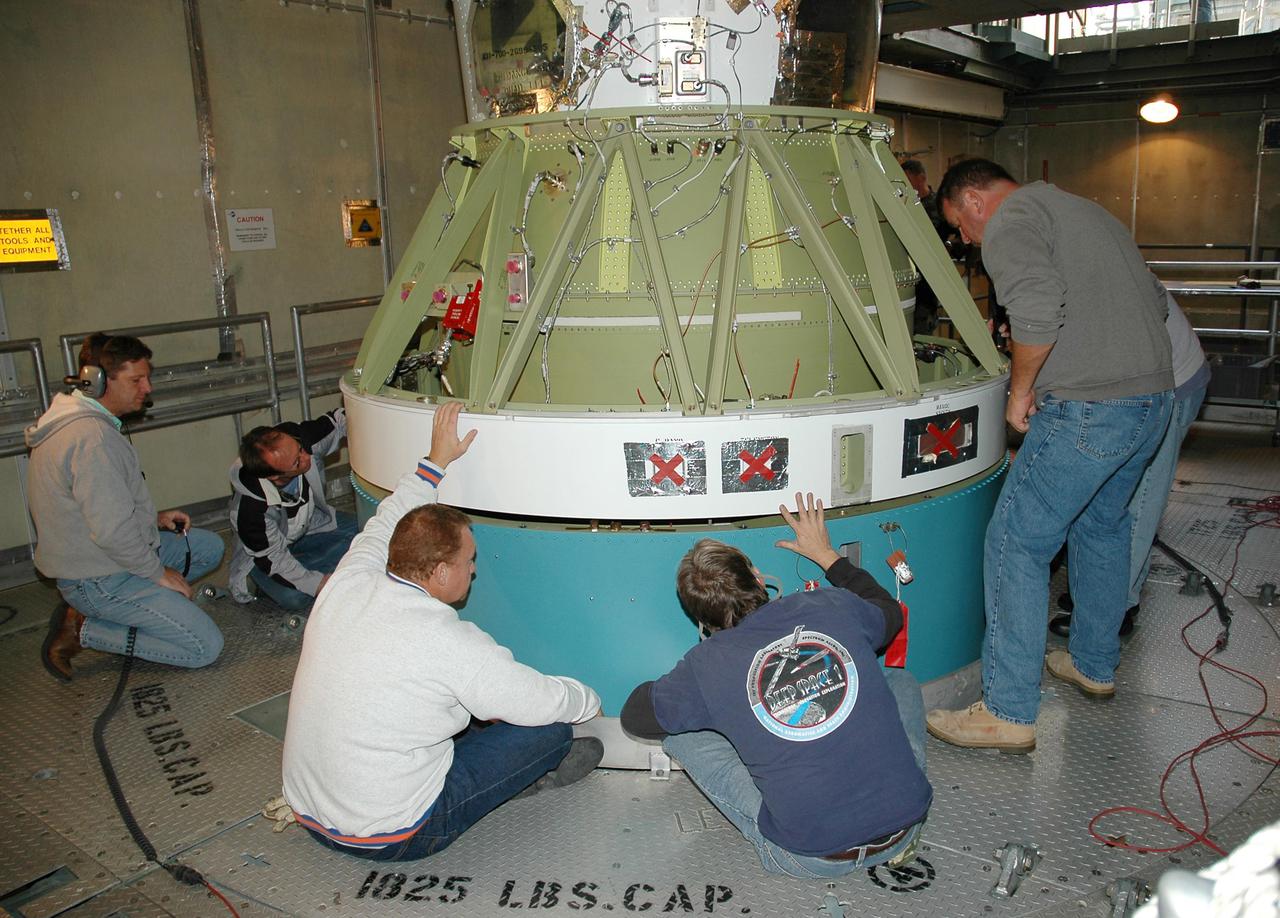
KENNEDY SPACE CENTER, FLA. - On Launch Pad 17-B at Cape Canaveral Air Force Station, workers check areas of the second stage as it is mated to the Boeing Delta II rocket. The Delta II will launch NASA’s Deep Impact spacecraft. A NASA Discovery mission, Deep Impact will probe beneath the surface of Comet Tempel 1 on July 4, 2005, when the comet is 83 million miles from Earth, and reveal the secrets of its interior. After releasing an impactor on a course to hit the comet’s sunlit side, Deep Impact’s flyby spacecraft will collect pictures and data of how the crater forms, measure the crater’s depth and diameter, as well as the composition of the interior of the crater and any material thrown out, and determine the changes in natural outgassing produced by the impact. It will send the data back to Earth through the antennas of the Deep Space Network.
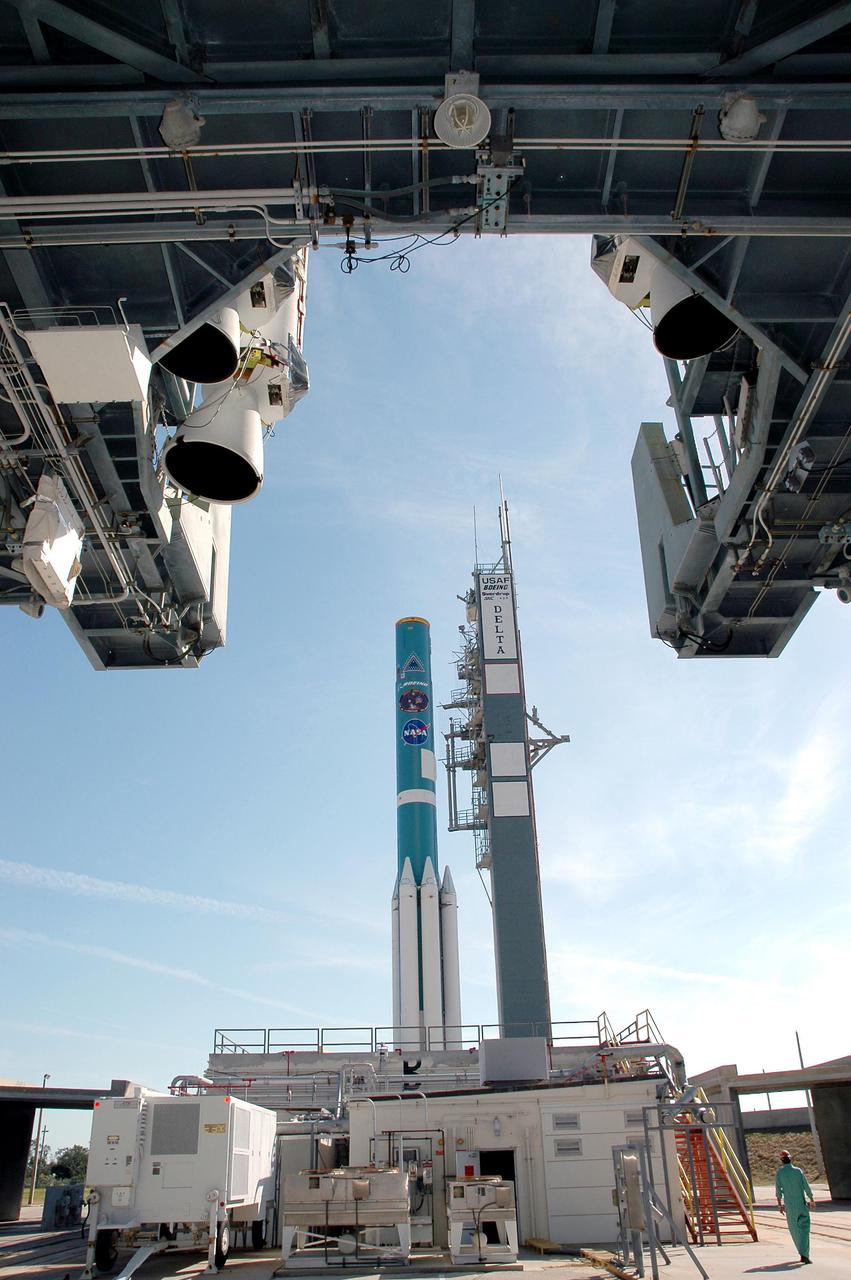
KENNEDY SPACE CENTER, FLA. - The mobile service tower with the final set of Solid Rocket Boosters (SRBs) rolls toward the Boeing Delta II rocket (in the background). The SRBs will be mated to the rocket, joining others for a complement of nine, to launch the Deep Impact spacecraft, scheduled for no earlier than Jan. 8, 2005. A NASA Discovery mission, Deep Impact will probe beneath the surface of Comet Tempel 1 on July 4, 2005, when the comet is 83 million miles from Earth, and reveal the secrets of its interior. After releasing an impactor on a course to hit the comet’s sunlit side, Deep Impact’s flyby spacecraft will collect pictures and data of how the crater forms, measure the crater’s depth and diameter, as well as the composition of the interior of the crater and any material thrown out, and determine the changes in natural outgassing produced by the impact. It will send the data back to Earth through the antennas of the Deep Space Network.
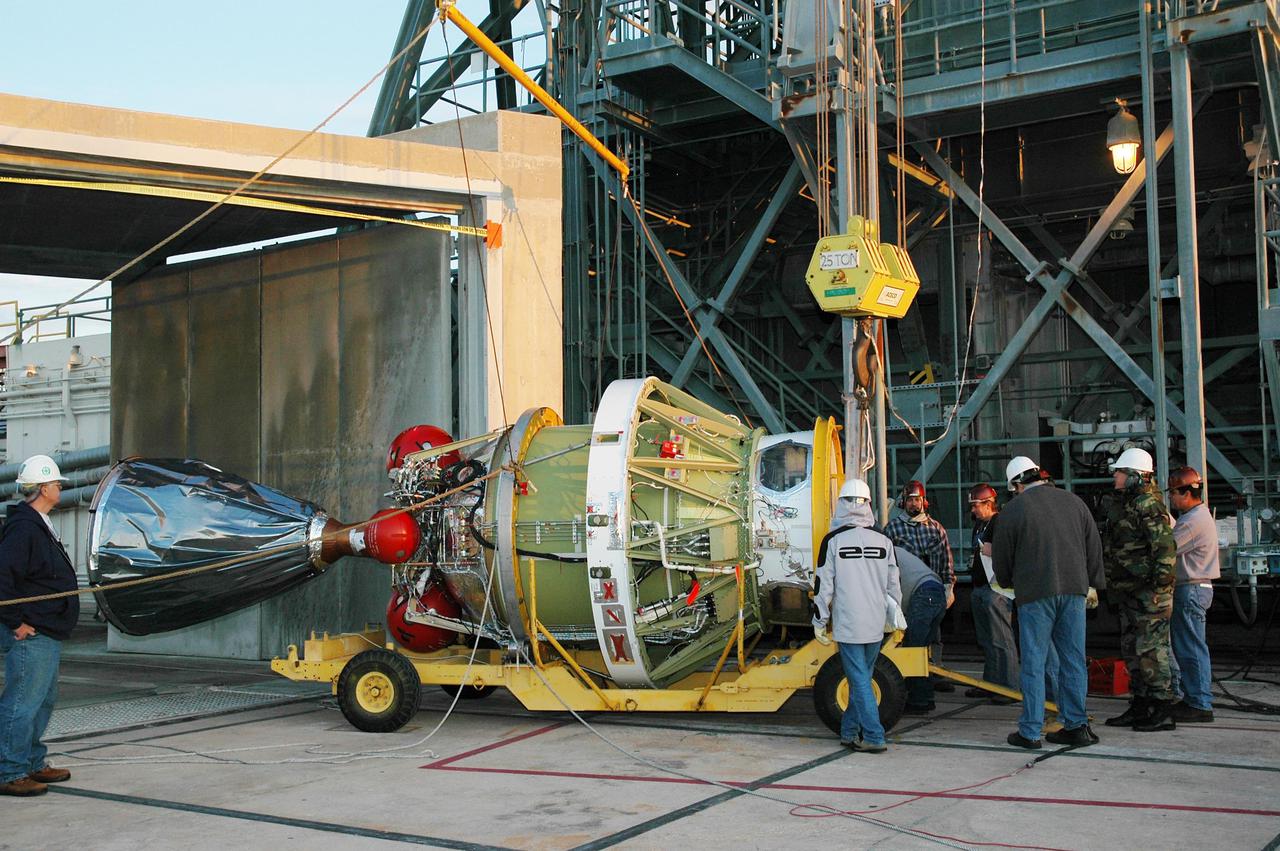
KENNEDY SPACE CENTER, FLA. - On Launch Pad 17-B at Cape Canaveral Air Force Station, the second stage of the Boeing Delta II rocket arrives at the mobile service tower for mating to the rocket. The Delta II will launch NASA’s Deep Impact spacecraft. A NASA Discovery mission, Deep Impact will probe beneath the surface of Comet Tempel 1 on July 4, 2005, when the comet is 83 million miles from Earth, and reveal the secrets of its interior. After releasing an impactor on a course to hit the comet’s sunlit side, Deep Impact’s flyby spacecraft will collect pictures and data of how the crater forms, measure the crater’s depth and diameter, as well as the composition of the interior of the crater and any material thrown out, and determine the changes in natural outgassing produced by the impact. It will send the data back to Earth through the antennas of the Deep Space Network.
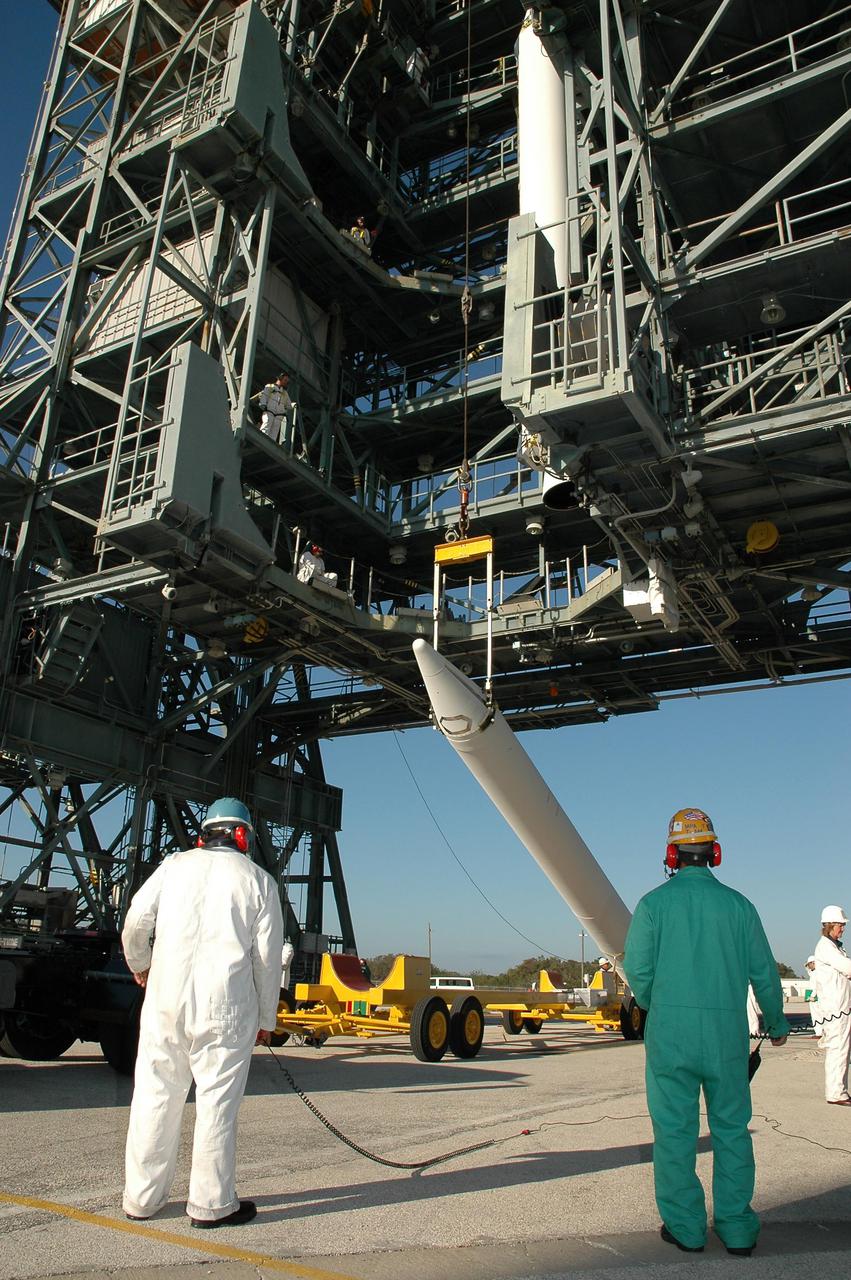
KENNEDY SPACE CENTER, FLA. - On Launch Pad 17-B, Cape Canaveral Air Force Station, Fla., the second in a set of three Solid Rocket Boosters (SRBs) is raised to a vertical position. The SRBs will be hoisted up the mobile service tower and join three others already mated to the Boeing Delta II rocket that will launch the Deep Impact spacecraft. A NASA Discovery mission, Deep Impact will probe beneath the surface of Comet Tempel 1 on July 4, 2005, when the comet is 83 million miles from Earth, and reveal the secrets of its interior. After releasing an impactor on a course to hit the comet’s sunlit side, Deep Impact’s flyby spacecraft will collect pictures and data of how the crater forms, measure the crater’s depth and diameter, as well as the composition of the interior of the crater and any material thrown out, and determine the changes in natural outgassing produced by the impact. It will send the data back to Earth through the antennas of the Deep Space Network.
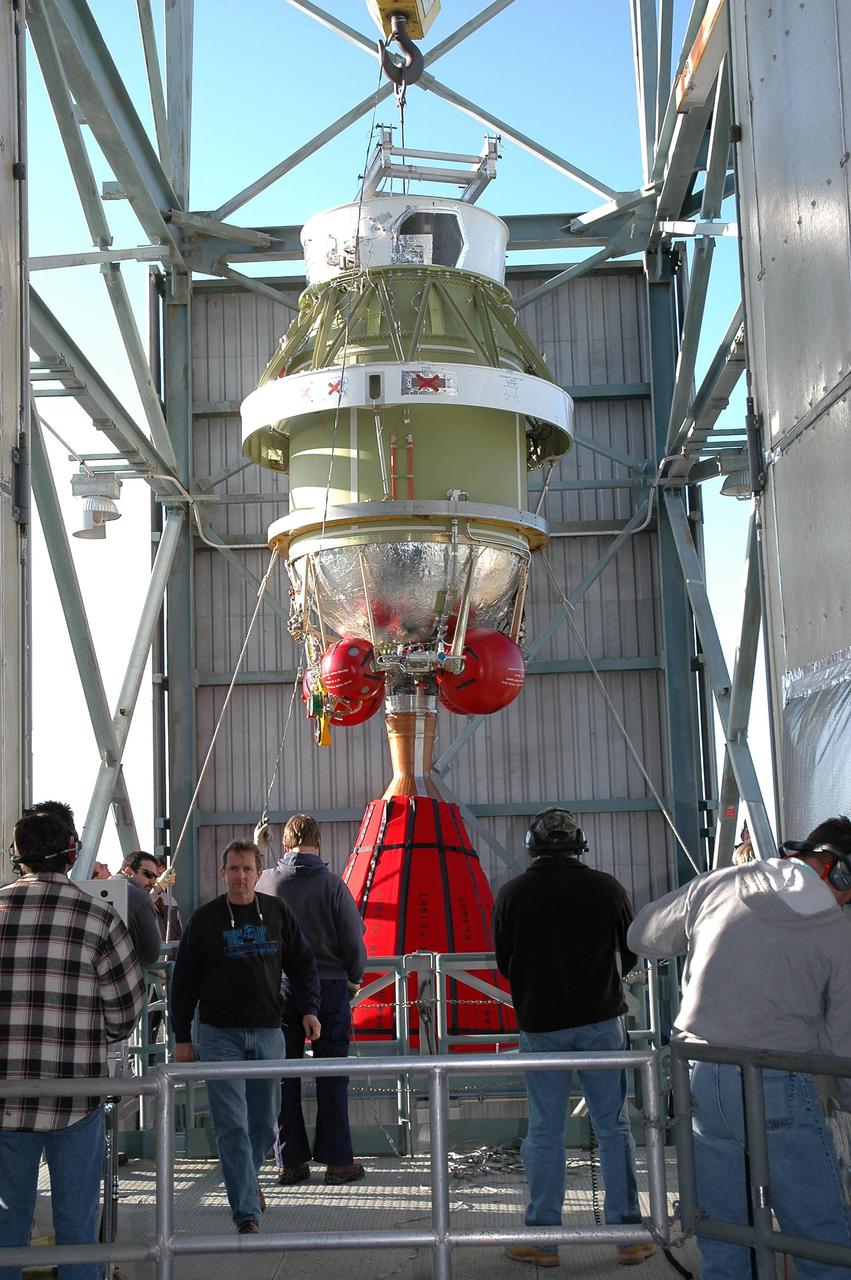
KENNEDY SPACE CENTER, FLA. - On Launch Pad 17-B at Cape Canaveral Air Force Station, the second stage of the Boeing Delta II rocket arrives at the top of the mobile service tower. The element will be mated to the Delta II, which will launch NASA’s Deep Impact spacecraft. A NASA Discovery mission, Deep Impact will probe beneath the surface of Comet Tempel 1 on July 4, 2005, when the comet is 83 million miles from Earth, and reveal the secrets of its interior. After releasing an impactor on a course to hit the comet’s sunlit side, Deep Impact’s flyby spacecraft will collect pictures and data of how the crater forms, measure the crater’s depth and diameter, as well as the composition of the interior of the crater and any material thrown out, and determine the changes in natural outgassing produced by the impact. It will send the data back to Earth through the antennas of the Deep Space Network.
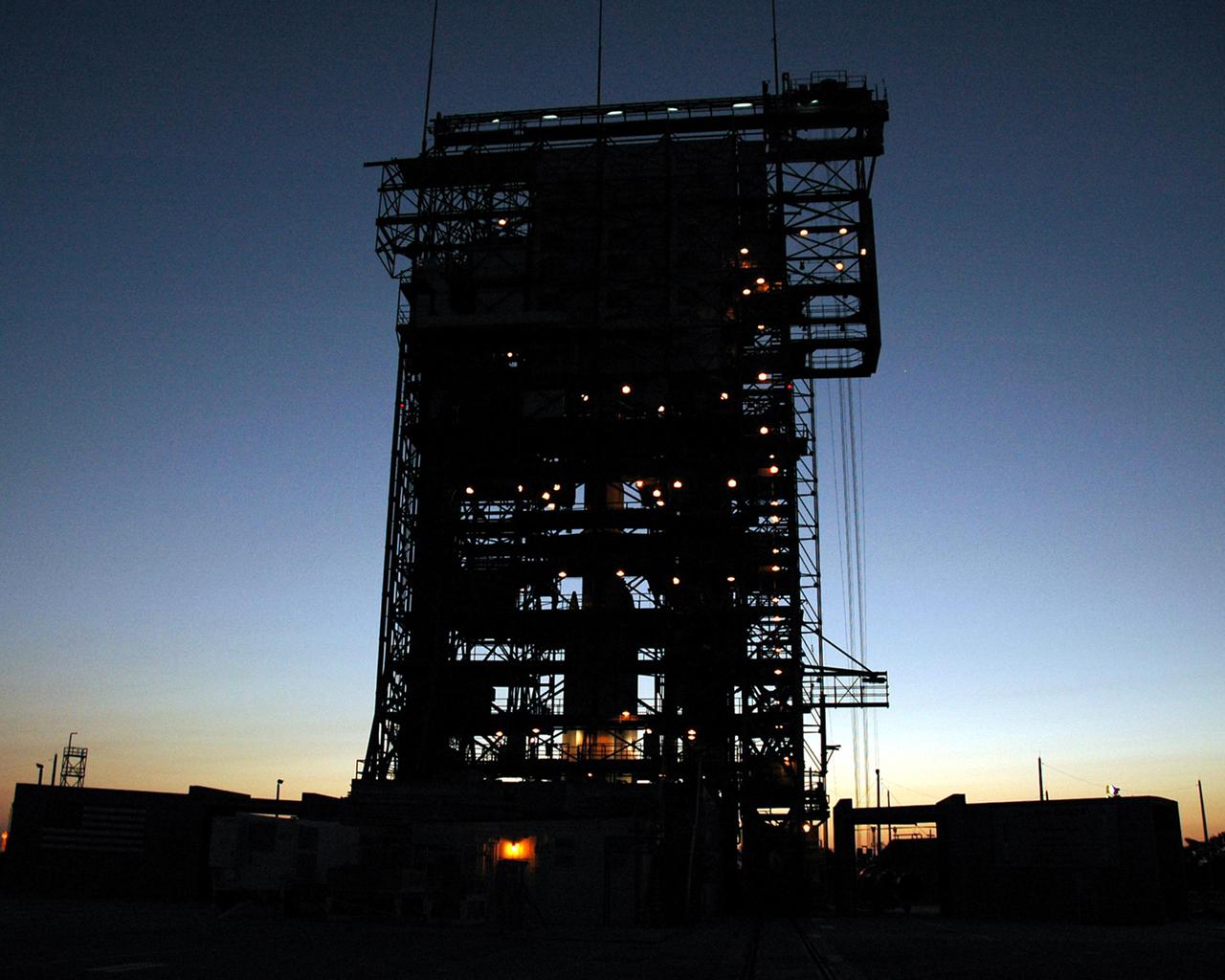
KENNEDY SPACE CENTER, FLA. - In the pre-dawn hours on Launch Pad 17-B at Cape Canaveral Air Force Station, the mobile service tower is silhouetted with the Boeing Delta II rocket that will launch NASA’s Deep Impact spacecraft. The Delta II waits for the arrival and mating of the second stage. A NASA Discovery mission, Deep Impact will probe beneath the surface of Comet Tempel 1 on July 4, 2005, when the comet is 83 million miles from Earth, and reveal the secrets of its interior. After releasing an impactor on a course to hit the comet’s sunlit side, Deep Impact’s flyby spacecraft will collect pictures and data of how the crater forms, measure the crater’s depth and diameter, as well as the composition of the interior of the crater and any material thrown out, and determine the changes in natural outgassing produced by the impact. It will send the data back to Earth through the antennas of the Deep Space Network.
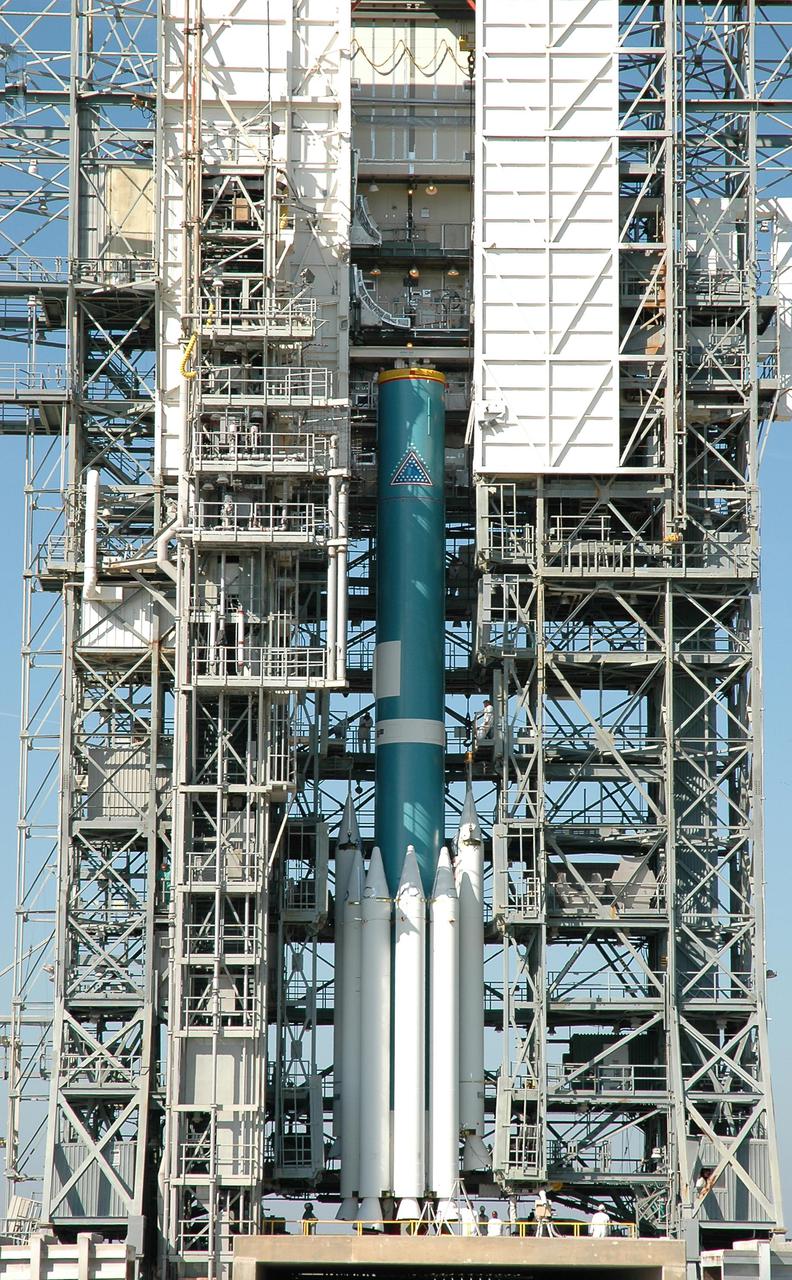
KENNEDY SPACE CENTER, FLA. - The Boeing Delta II rocket with its complement of nine Solid Rocket Boosters stands complete alongside the gantry. The Delta II will launch the Deep Impact spacecraft, scheduled for no earlier than Jan. 8, 2005. Below the rocket is the flame trench, and in the foreground is the overflow pool. A NASA Discovery mission, Deep Impact will probe beneath the surface of Comet Tempel 1 on July 4, 2005, when the comet is 83 million miles from Earth, and reveal the secrets of its interior. After releasing an impactor on a course to hit the comet’s sunlit side, Deep Impact’s flyby spacecraft will collect pictures and data of how the crater forms, measure the crater’s depth and diameter, as well as the composition of the interior of the crater and any material thrown out, and determine the changes in natural outgassing produced by the impact. It will send the data back to Earth through the antennas of the Deep Space Network.

KENNEDY SPACE CENTER, FLA. - Inside the mobile service tower on Launch Pad 17-B, Cape Canaveral Air Force Station, Boeing workers attach the Delta II second stage to the interstage adapter on the rocket below. The rocket is the launch vehicle for the Deep Impact spacecraft, scheduled for liftoff no earlier than Jan. 12. A NASA Discovery mission, Deep Impact will probe beneath the surface of Comet Tempel 1 on July 4, 2005, when the comet is 83 million miles from Earth, and reveal the secrets of its interior. After releasing a 3- by 3-foot projectile to crash onto the surface, Deep Impact’s flyby spacecraft will collect pictures and data of how the crater forms, measuring the crater’s depth and diameter, as well as the composition of the interior of the crater and any material thrown out, and determining the changes in natural outgassing produced by the impact. It will send the data back to Earth through the antennas of the Deep Space Network.
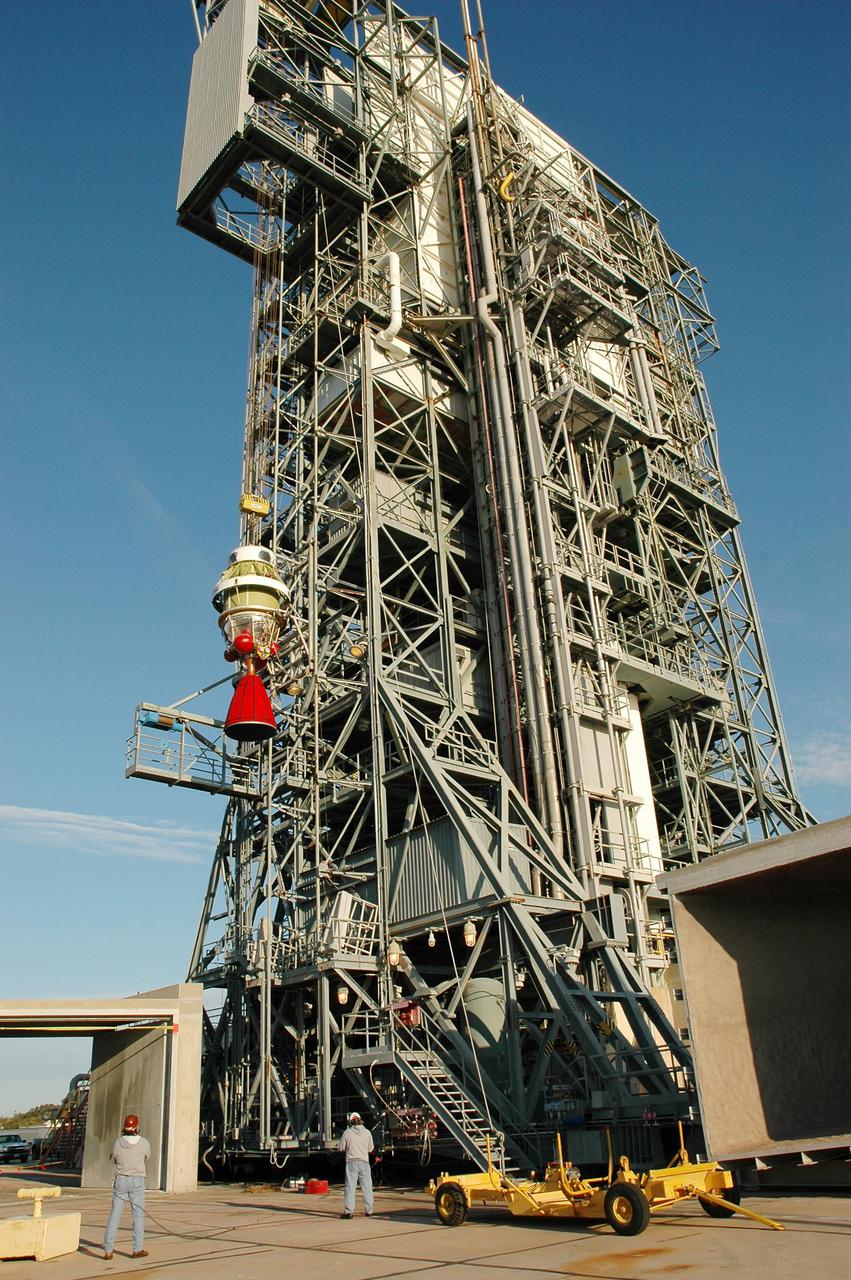
KENNEDY SPACE CENTER, FLA. - On Launch Pad 17-B at Cape Canaveral Air Force Station, the second stage of the Boeing Delta II rocket is lifted up the mobile service tower. The element will be mated to the Delta II, which will launch NASA’s Deep Impact spacecraft. A NASA Discovery mission, Deep Impact will probe beneath the surface of Comet Tempel 1 on July 4, 2005, when the comet is 83 million miles from Earth, and reveal the secrets of its interior. After releasing an impactor on a course to hit the comet’s sunlit side, Deep Impact’s flyby spacecraft will collect pictures and data of how the crater forms, measure the crater’s depth and diameter, as well as the composition of the interior of the crater and any material thrown out, and determine the changes in natural outgassing produced by the impact. It will send the data back to Earth through the antennas of the Deep Space Network.
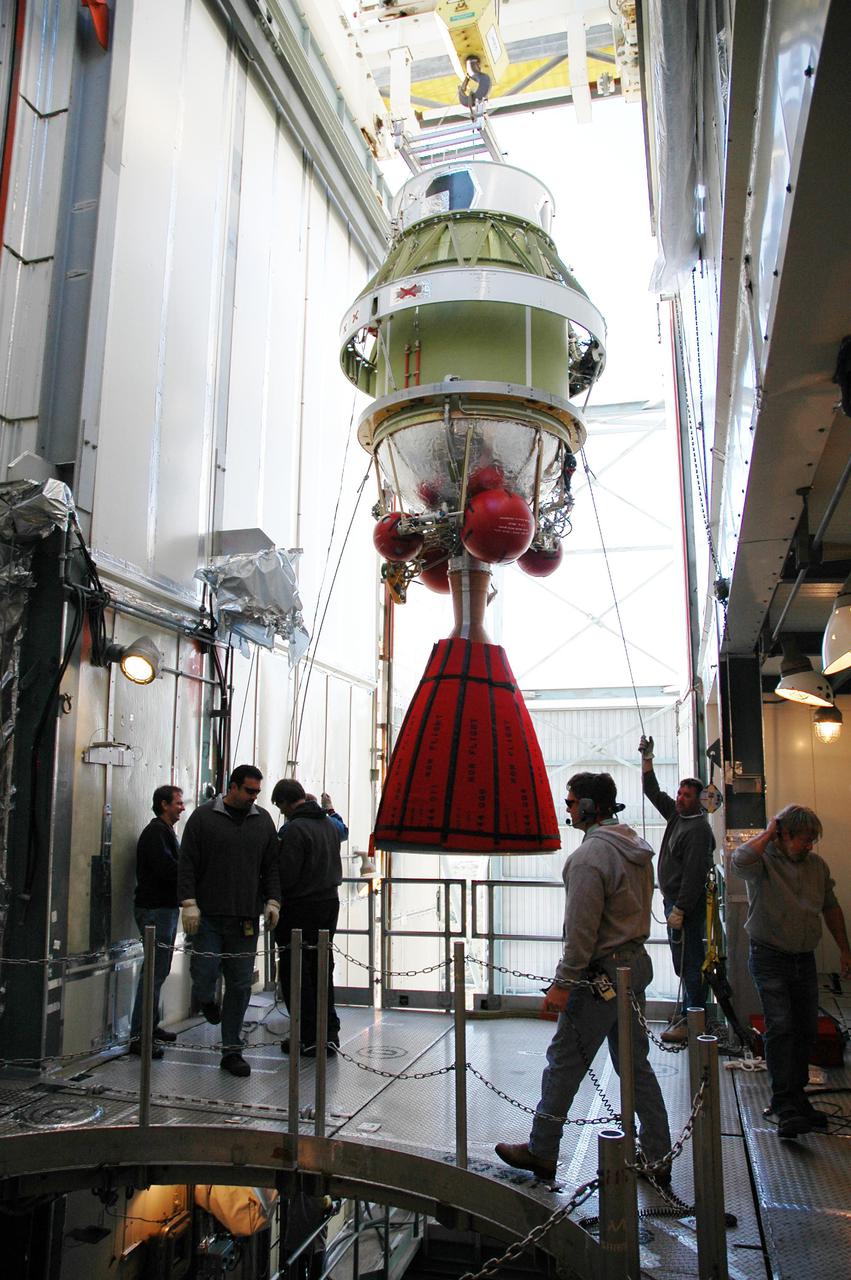
KENNEDY SPACE CENTER, FLA. - On Launch Pad 17-B at Cape Canaveral Air Force Station, the second stage of the Boeing Delta II rocket is moved toward the opening under which is the Boeing Delta II rocket. The second stage will be mated to the Delta II, which will launch NASA’s Deep Impact spacecraft. A NASA Discovery mission, Deep Impact will probe beneath the surface of Comet Tempel 1 on July 4, 2005, when the comet is 83 million miles from Earth, and reveal the secrets of its interior. After releasing an impactor on a course to hit the comet’s sunlit side, Deep Impact’s flyby spacecraft will collect pictures and data of how the crater forms, measure the crater’s depth and diameter, as well as the composition of the interior of the crater and any material thrown out, and determine the changes in natural outgassing produced by the impact. It will send the data back to Earth through the antennas of the Deep Space Network.
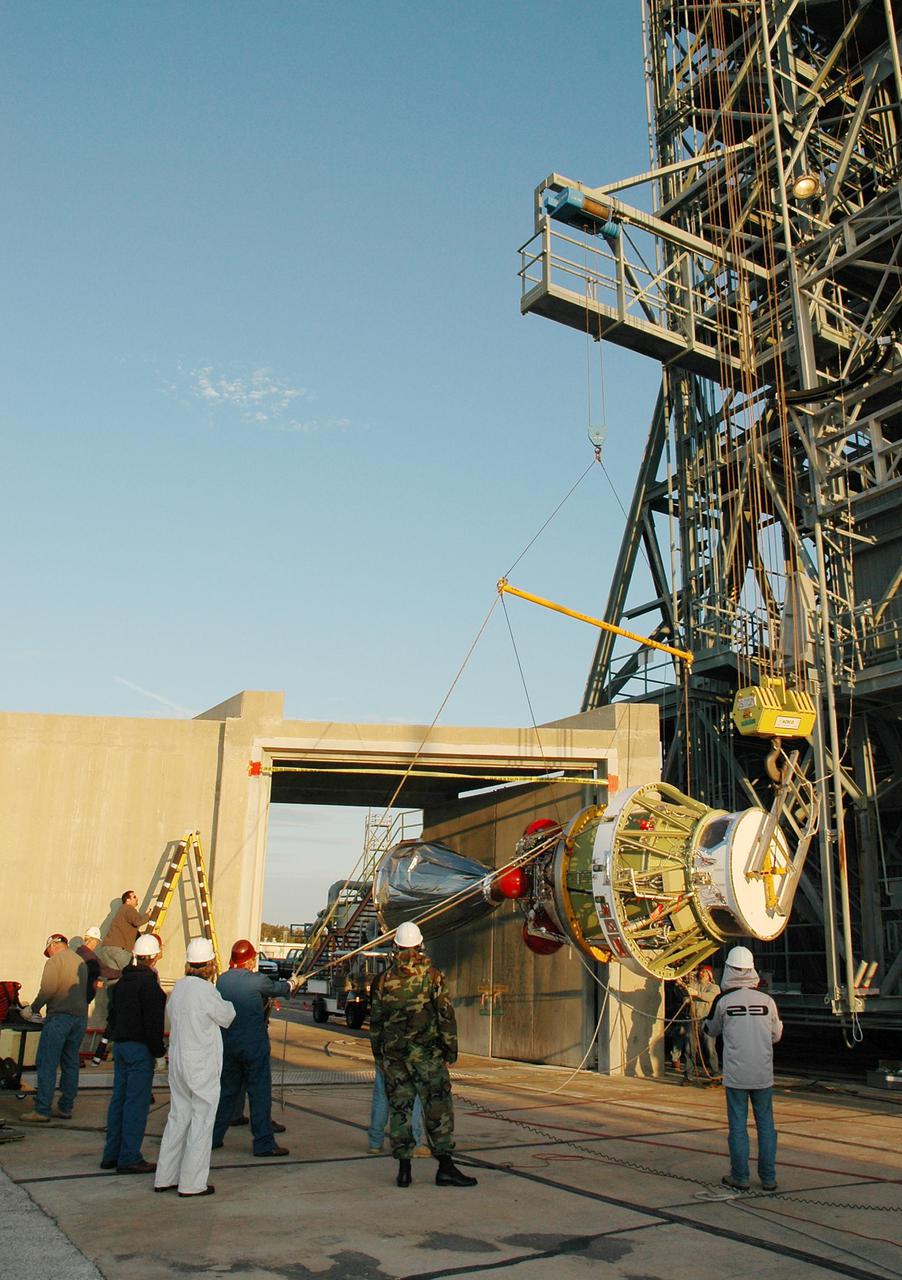
KENNEDY SPACE CENTER, FLA. - On Launch Pad 17-B at Cape Canaveral Air Force Station, workers help guide the second stage of the Boeing Delta II rocket as it is raised to vertical. The element will be lifted up the mobile service tower for mating to the Delta II, which will launch NASA’s Deep Impact spacecraft. A NASA Discovery mission, Deep Impact will probe beneath the surface of Comet Tempel 1 on July 4, 2005, when the comet is 83 million miles from Earth, and reveal the secrets of its interior. After releasing an impactor on a course to hit the comet’s sunlit side, Deep Impact’s flyby spacecraft will collect pictures and data of how the crater forms, measure the crater’s depth and diameter, as well as the composition of the interior of the crater and any material thrown out, and determine the changes in natural outgassing produced by the impact. It will send the data back to Earth through the antennas of the Deep Space Network.
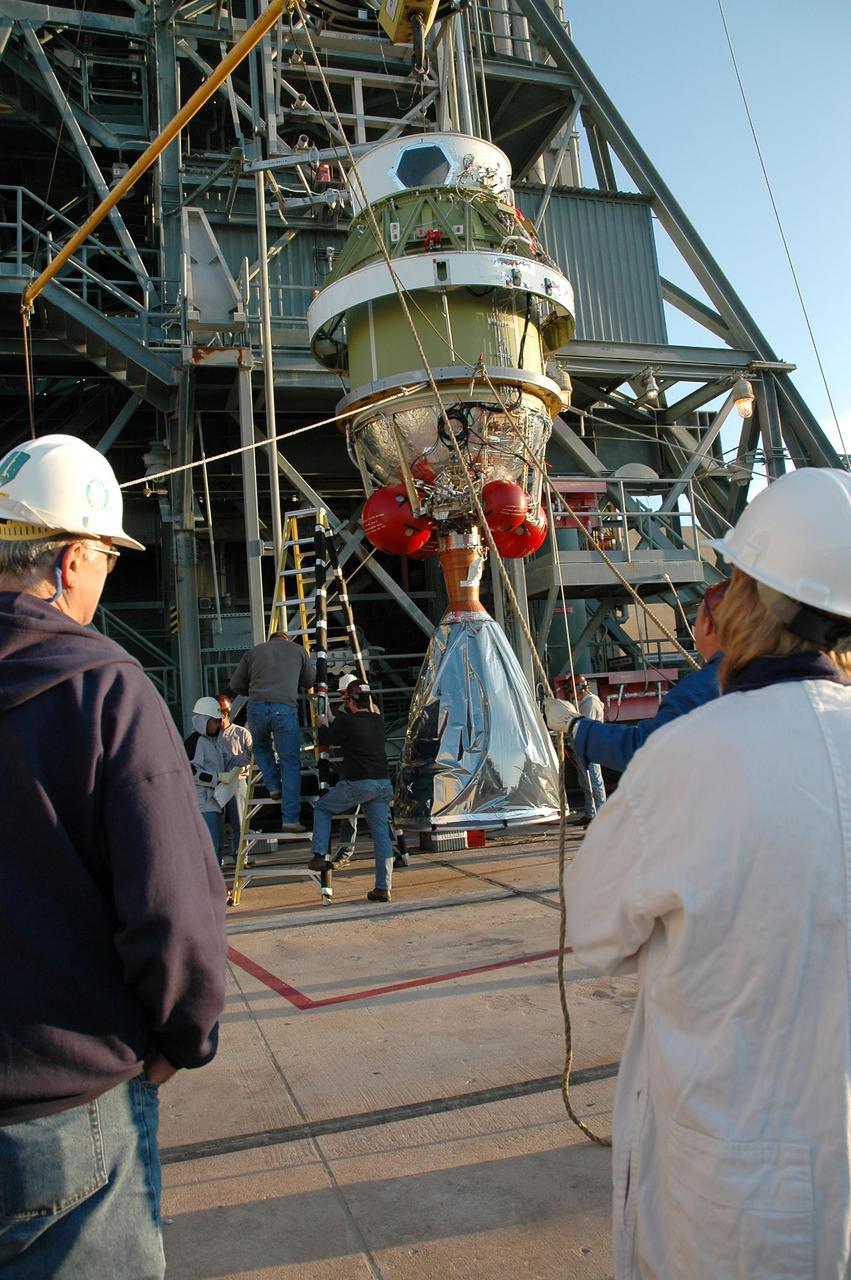
KENNEDY SPACE CENTER, FLA. - On Launch Pad 17-B at Cape Canaveral Air Force Station, workers help guide the second stage of the Boeing Delta II rocket as it begins the lift up the mobile service tower. The element will be mated to the Delta II, which will launch NASA’s Deep Impact spacecraft. A NASA Discovery mission, Deep Impact will probe beneath the surface of Comet Tempel 1 on July 4, 2005, when the comet is 83 million miles from Earth, and reveal the secrets of its interior. After releasing an impactor on a course to hit the comet’s sunlit side, Deep Impact’s flyby spacecraft will collect pictures and data of how the crater forms, measure the crater’s depth and diameter, as well as the composition of the interior of the crater and any material thrown out, and determine the changes in natural outgassing produced by the impact. It will send the data back to Earth through the antennas of the Deep Space Network.
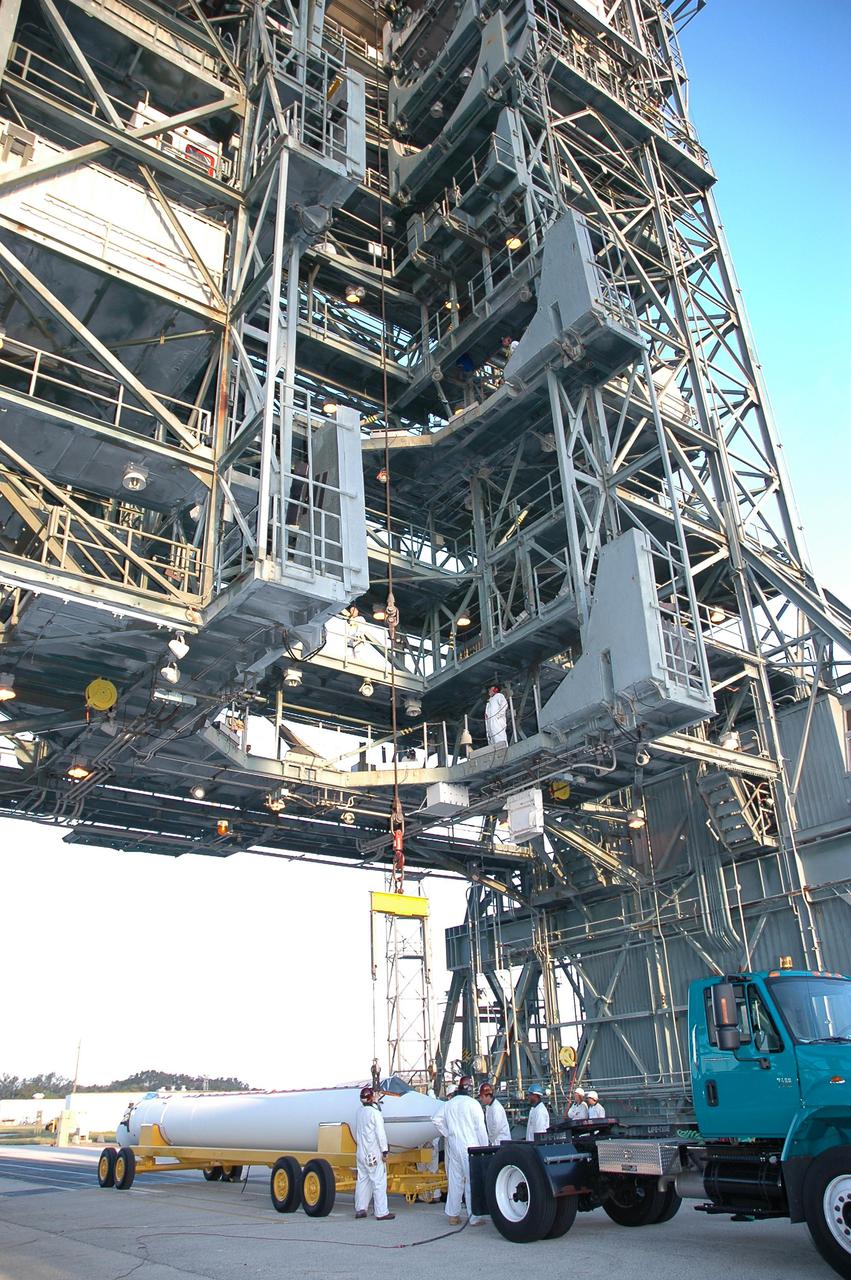
KENNEDY SPACE CENTER, FLA. - On Launch Pad 17-B, Cape Canaveral Air Force Station, Fla., the first of a second set of three Solid Rocket Boosters (SRBs) arrives. Three SRBs have already been hoisted up the mobile service tower and mated to the Boeing Delta II rocket that will launch the Deep Impact spacecraft. A NASA Discovery mission, Deep Impact will probe beneath the surface of Comet Tempel 1 on July 4, 2005, when the comet is 83 million miles from Earth, and reveal the secrets of its interior. After releasing an impactor on a course to hit the comet’s sunlit side, Deep Impact’s flyby spacecraft will collect pictures and data of how the crater forms, measure the crater’s depth and diameter, as well as the composition of the interior of the crater and any material thrown out, and determine the changes in natural outgassing produced by the impact. It will send the data back to Earth through the antennas of the Deep Space Network.
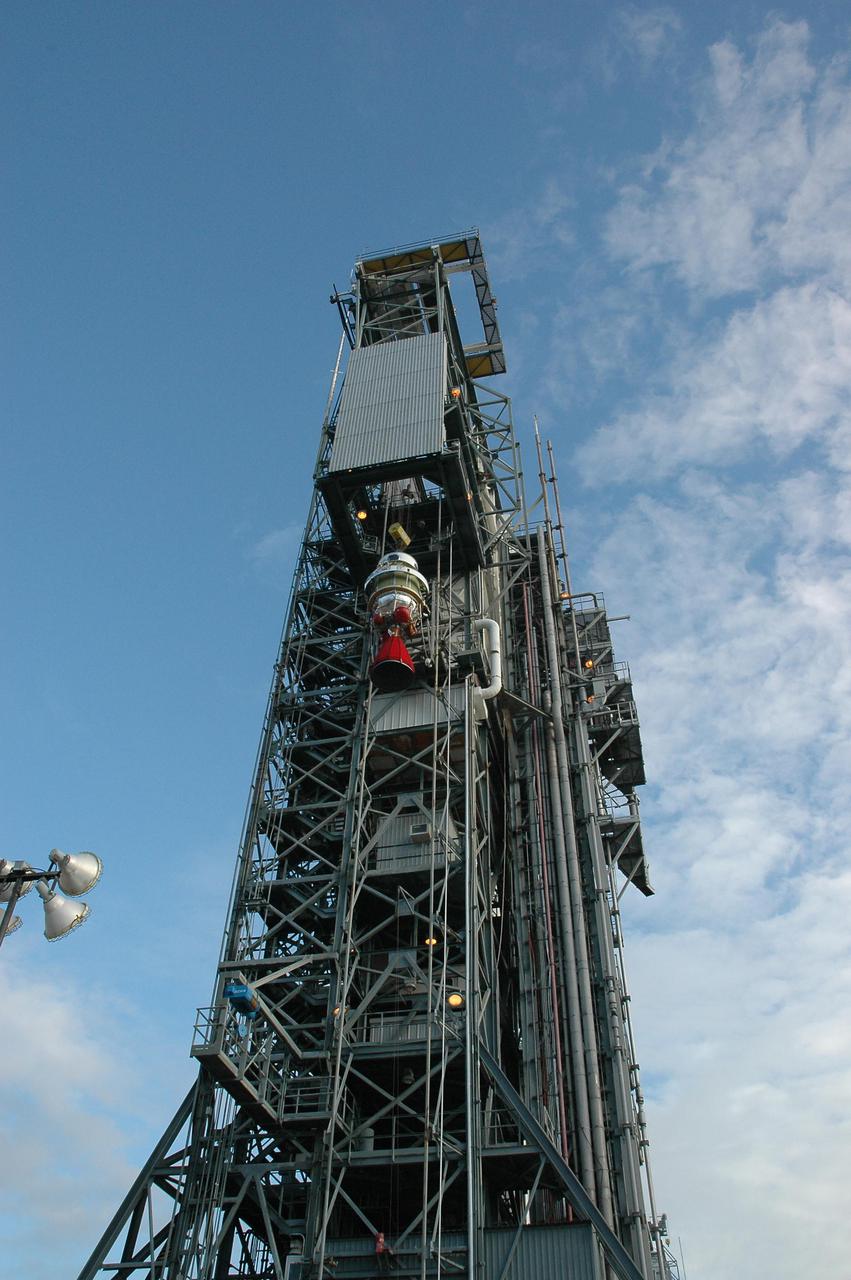
KENNEDY SPACE CENTER, FLA. - At Launch Pad 17-B, Cape Canaveral Air Force Station, the Boeing Delta II second stage reaches the top of the mobile service tower. The component will be reattached to the interstage adapter on the Delta II. The rocket is the launch vehicle for the Deep Impact spacecraft, scheduled for liftoff no earlier than Jan. 12. A NASA Discovery mission, Deep Impact will probe beneath the surface of Comet Tempel 1 on July 4, 2005, when the comet is 83 million miles from Earth, and reveal the secrets of its interior. After releasing a 3- by 3-foot projectile to crash onto the surface, Deep Impact’s flyby spacecraft will collect pictures and data of how the crater forms, measuring the crater’s depth and diameter, as well as the composition of the interior of the crater and any material thrown out, and determining the changes in natural outgassing produced by the impact. It will send the data back to Earth through the antennas of the Deep Space Network.
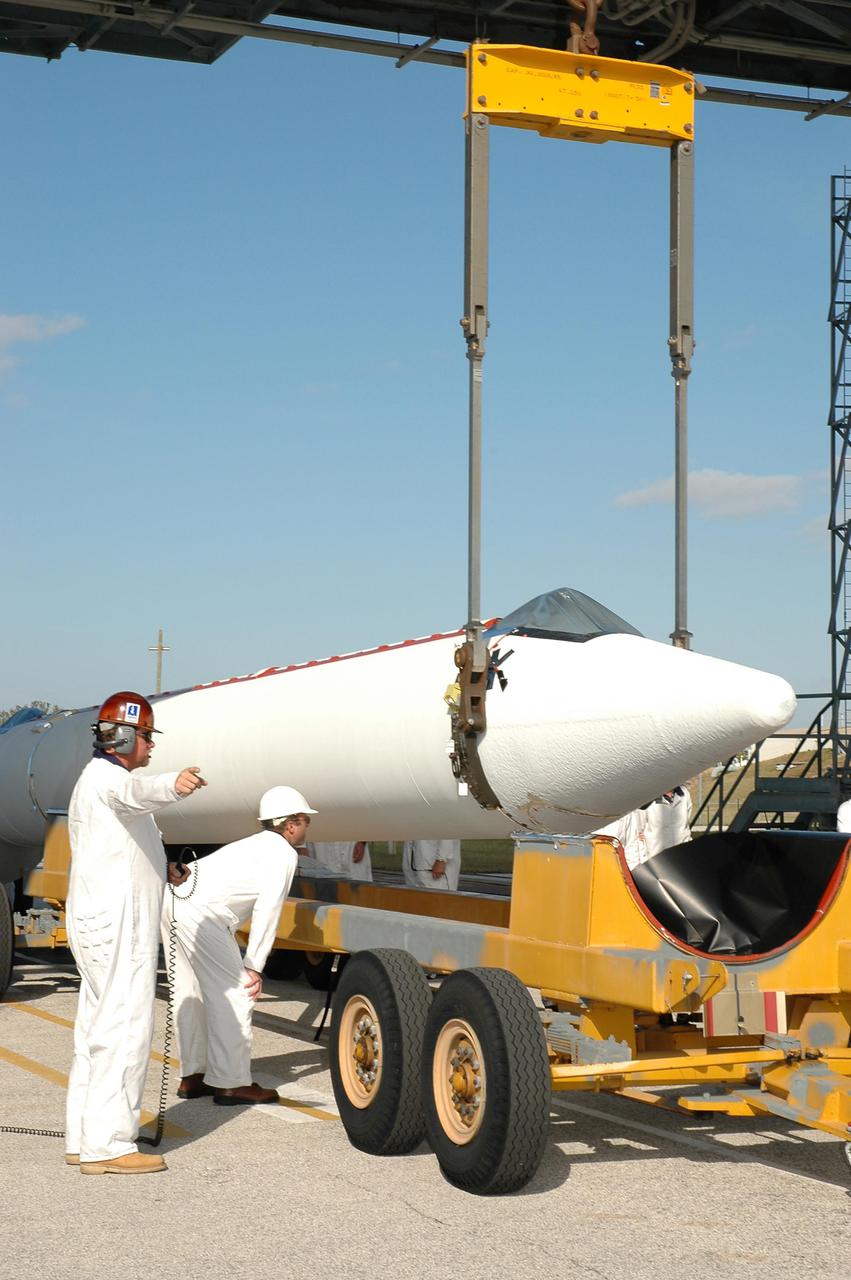
KENNEDY SPACE CENTER, FLA. - On Launch Pad 17-B, Cape Canaveral Air Force Station, Fla., a crane begins lifting the third in a set of three Solid Rocket Boosters (SRBs). The SRBs will be hoisted up the mobile service tower and join three others already mated to the Boeing Delta II rocket that will launch the Deep Impact spacecraft. A NASA Discovery mission, Deep Impact will probe beneath the surface of Comet Tempel 1 on July 4, 2005, when the comet is 83 million miles from Earth, and reveal the secrets of its interior. After releasing an impactor on a course to hit the comet’s sunlit side, Deep Impact’s flyby spacecraft will collect pictures and data of how the crater forms, measure the crater’s depth and diameter, as well as the composition of the interior of the crater and any material thrown out, and determine the changes in natural outgassing produced by the impact. It will send the data back to Earth through the antennas of the Deep Space Network.
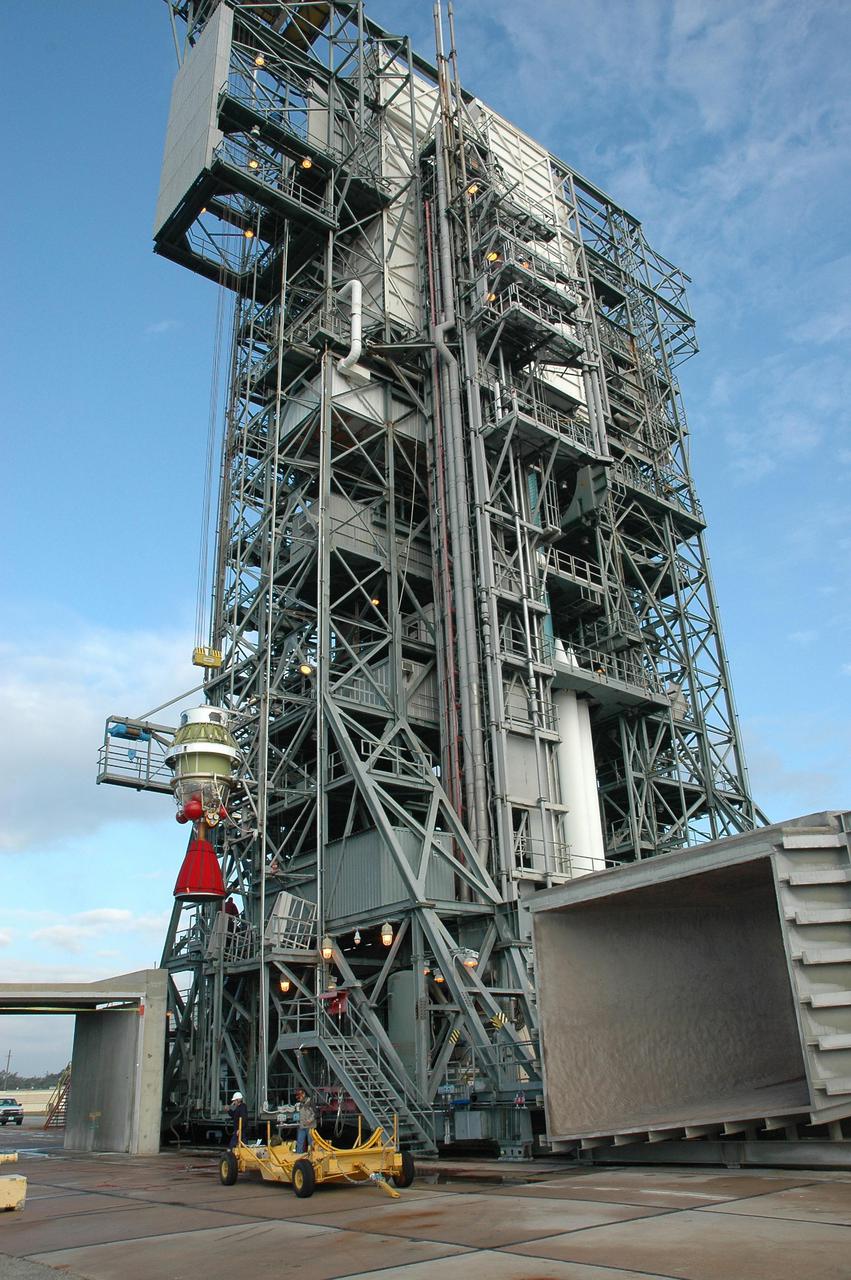
KENNEDY SPACE CENTER, FLA. - At Launch Pad 17-B, Cape Canaveral Air Force Station, the Boeing Delta II second stage is lifted up the mobile service tower. The component will be reattached to the interstage adapter on the Delta II. The rocket is the launch vehicle for the Deep Impact spacecraft, scheduled for liftoff no earlier than Jan. 12. A NASA Discovery mission, Deep Impact will probe beneath the surface of Comet Tempel 1 on July 4, 2005, when the comet is 83 million miles from Earth, and reveal the secrets of its interior. After releasing a 3- by 3-foot projectile to crash onto the surface, Deep Impact’s flyby spacecraft will collect pictures and data of how the crater forms, measuring the crater’s depth and diameter, as well as the composition of the interior of the crater and any material thrown out, and determining the changes in natural outgassing produced by the impact. It will send the data back to Earth through the antennas of the Deep Space Network.
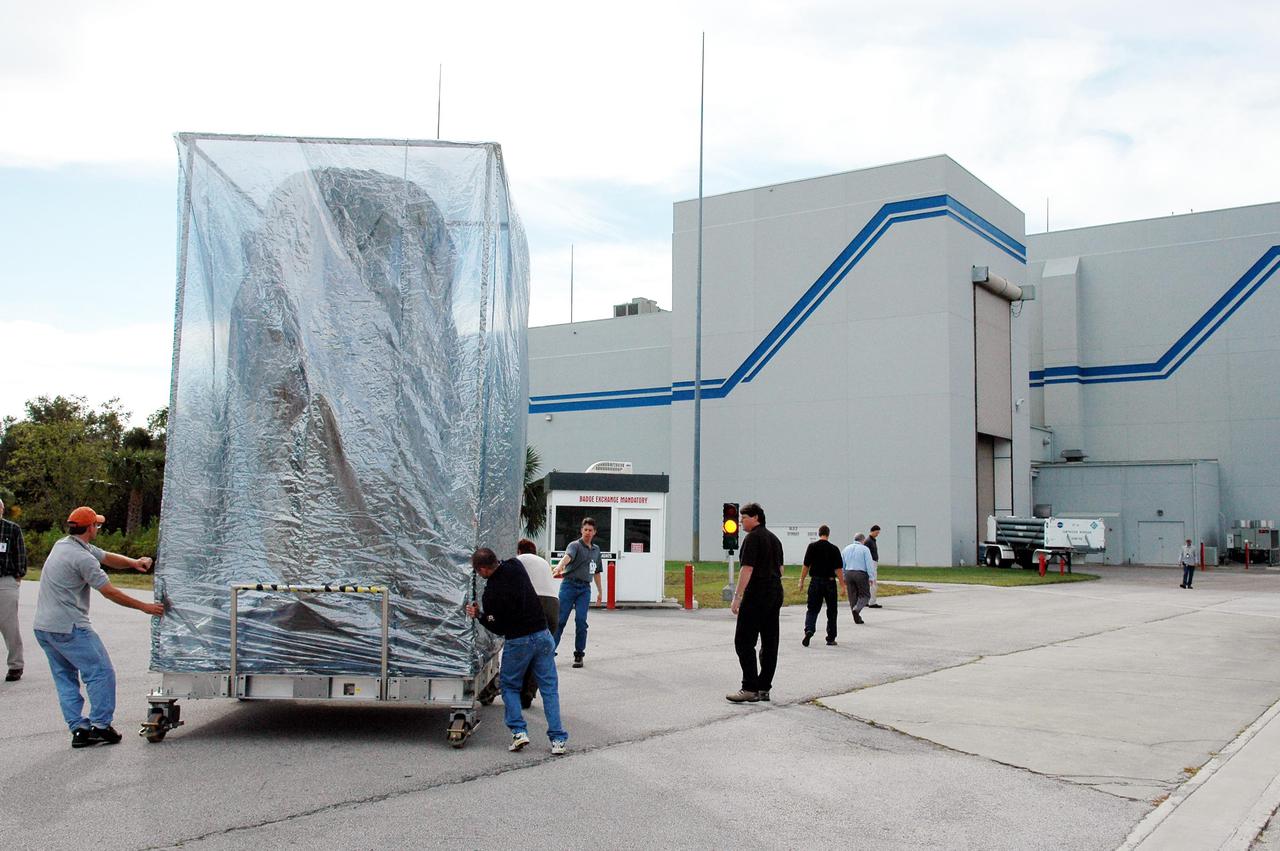
KENNEDY SPACE CENTER, FLA. - At Astrotech Space Operations in Titusville, Fla., workers push the Deep Impact spacecraft toward the Hazardous Fuel Building. Deep Impact is being prepared for shipment to Launch Pad 17-B, Cape Canaveral Air Force Station. At Astrotech Space Operations in Titusville, Fla., workers help guide an overhead crane holding a protective cover that will be placed over the Deep Impact spacecraft below. Deep Impact is being prepared for a move to the Hazardous Fuel Building and eventually shipment to Launch Pad 17-B, Cape Canaveral Air Force Station. Launch of Deep Impact is scheduled no earlier than Jan. 12. A NASA Discovery mission, Deep Impact will probe beneath the surface of Comet Tempel 1 on July 4, 2005, when the comet is 83 million miles from Earth, and reveal the secrets of its interior. After releasing a 3- by 3-foot projectile to crash onto the surface, Deep Impact’s flyby spacecraft will collect pictures and data of how the crater forms, measuring the crater’s depth and diameter, as well as the composition of the interior of the crater and any material thrown out, and determining the changes in natural outgassing produced by the impact. It will send the data back to Earth through the antennas of the Deep Space Network.
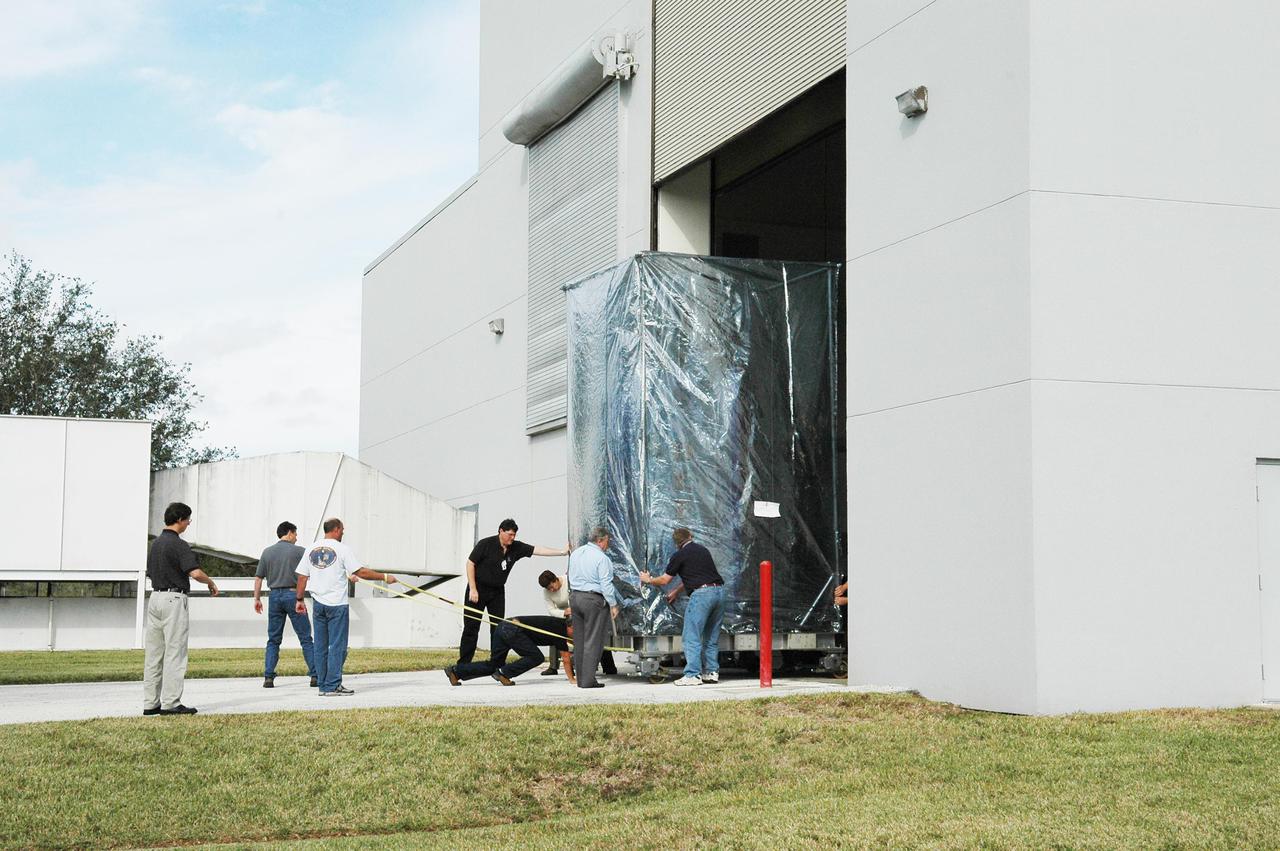
KENNEDY SPACE CENTER, FLA. - At Astrotech Space Operations in Titusville, Fla., workers push and pull the moveable stand holding the Deep Impact spacecraft to get it through the door. Deep Impact is being moved to the Hazardous Fuel Building and eventually shipment to Launch Pad 17-B, Cape Canaveral Air Force Station. At Astrotech Space Operations in Titusville, Fla., workers help guide an overhead crane holding a protective cover that will be placed over the Deep Impact spacecraft below. Deep Impact is being prepared for a move to the Hazardous Fuel Building and eventually shipment to Launch Pad 17-B, Cape Canaveral Air Force Station. Launch of Deep Impact is scheduled no earlier than Jan. 12. A NASA Discovery mission, Deep Impact will probe beneath the surface of Comet Tempel 1 on July 4, 2005, when the comet is 83 million miles from Earth, and reveal the secrets of its interior. After releasing a 3- by 3-foot projectile to crash onto the surface, Deep Impact’s flyby spacecraft will collect pictures and data of how the crater forms, measuring the crater’s depth and diameter, as well as the composition of the interior of the crater and any material thrown out, and determining the changes in natural outgassing produced by the impact. It will send the data back to Earth through the antennas of the Deep Space Network.
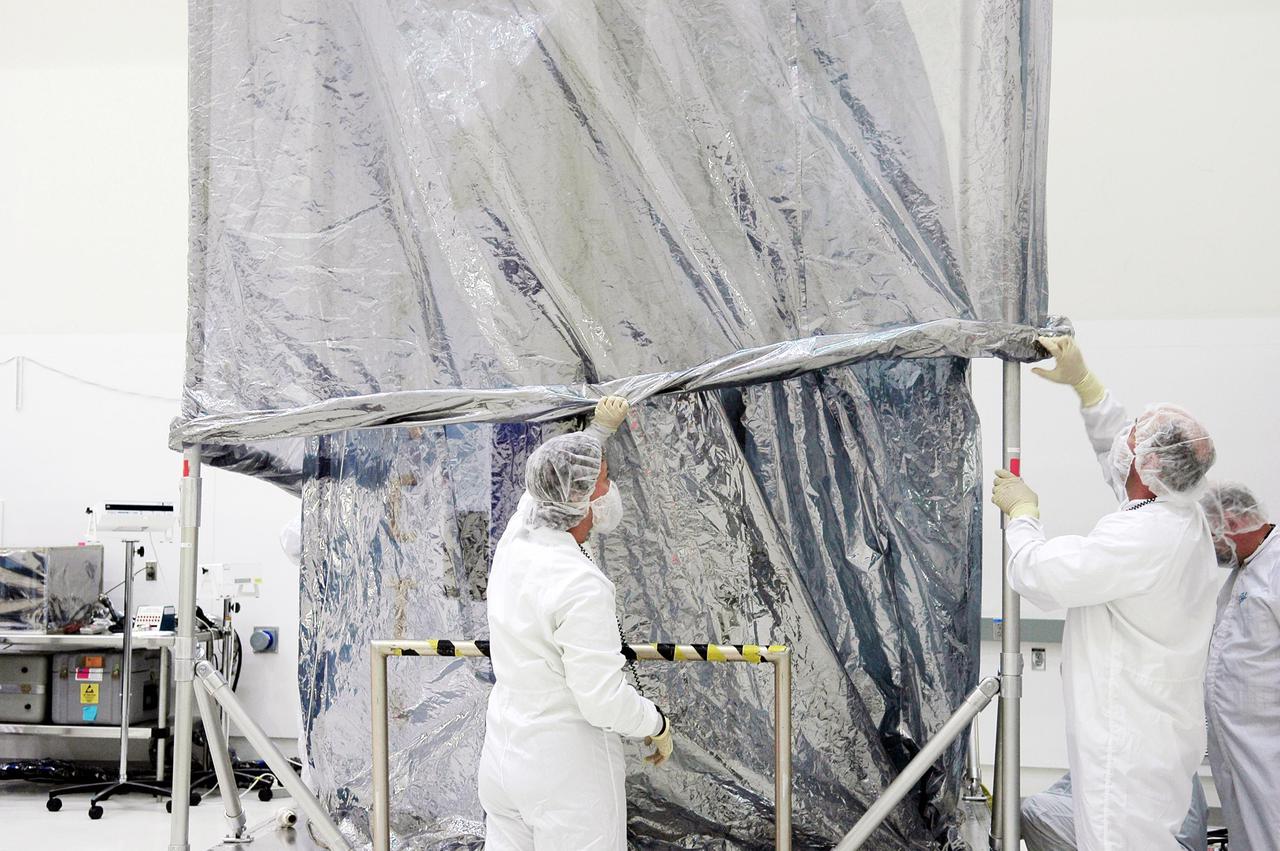
KENNEDY SPACE CENTER, FLA. - At Astrotech Space Operations in Titusville, Fla., workers lower a second protective cover around the Deep Impact spacecraft. Deep Impact is being prepared for a move to the Hazardous Fuel Building and eventually shipment to Launch Pad 17-B, Cape Canaveral Air Force Station. At Astrotech Space Operations in Titusville, Fla., workers help guide an overhead crane holding a protective cover that will be placed over the Deep Impact spacecraft below. Deep Impact is being prepared for a move to the Hazardous Fuel Building and eventually shipment to Launch Pad 17-B, Cape Canaveral Air Force Station. Launch of Deep Impact is scheduled no earlier than Jan. 12. A NASA Discovery mission, Deep Impact will probe beneath the surface of Comet Tempel 1 on July 4, 2005, when the comet is 83 million miles from Earth, and reveal the secrets of its interior. After releasing a 3- by 3-foot projectile to crash onto the surface, Deep Impact’s flyby spacecraft will collect pictures and data of how the crater forms, measuring the crater’s depth and diameter, as well as the composition of the interior of the crater and any material thrown out, and determining the changes in natural outgassing produced by the impact. It will send the data back to Earth through the antennas of the Deep Space Network.