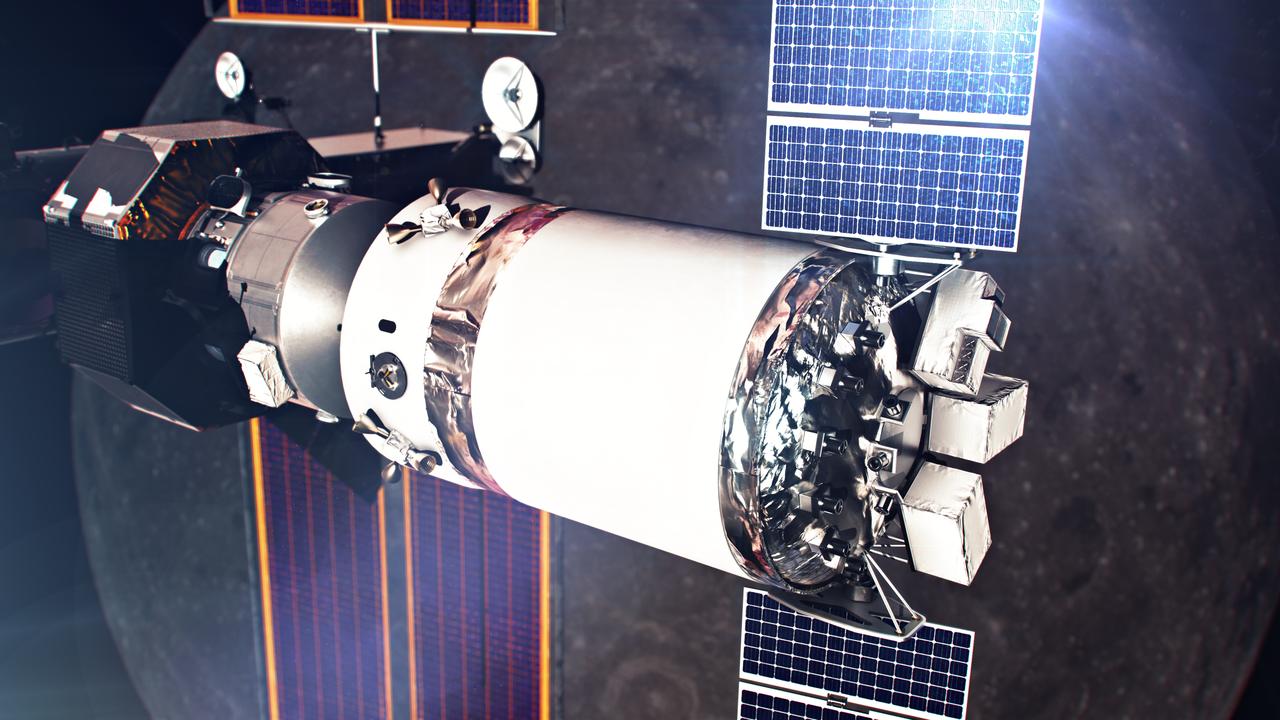
NASA has awarded the first Gateway Logistics Services contract to SpaceX to deliver cargo, experiments and other supplies to Gateway for the Artemis IV mission in September 2028, the first time that crew will travel to Gateway.
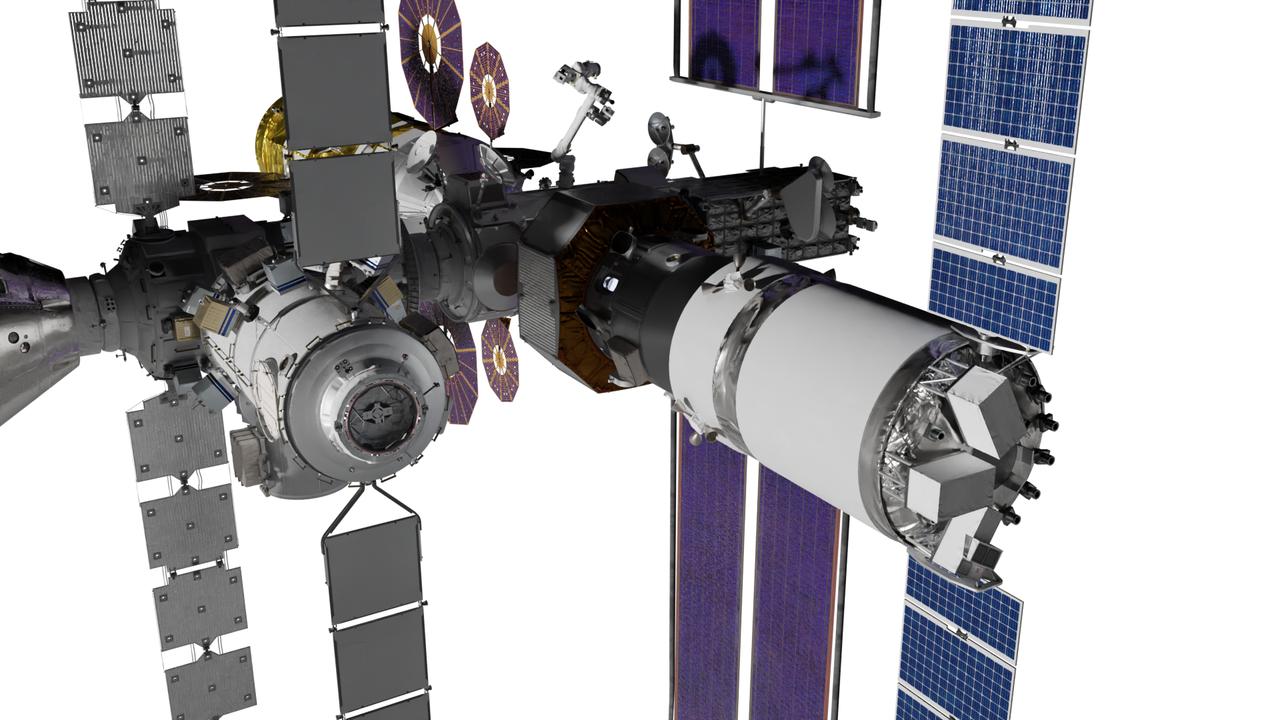
An artist’s rendering displays a configuration of the lunar-orbiting Gateway space station’s modules and visiting spacecraft. The core elements of Gateway consist of the Habitation and Logistics Outpost (HALO) element, the Power and Propulsion Element (PPE), and Lunar I-Hab. Visiting vehicles include the Orion spacecraft, the Logistics Module, and the Human Landing System. Gateway is built in collaboration with NASA’s commercial and international partners to serve as a multiuse space port for lunar science as humanity’s first place to live and work in lunar orbit.
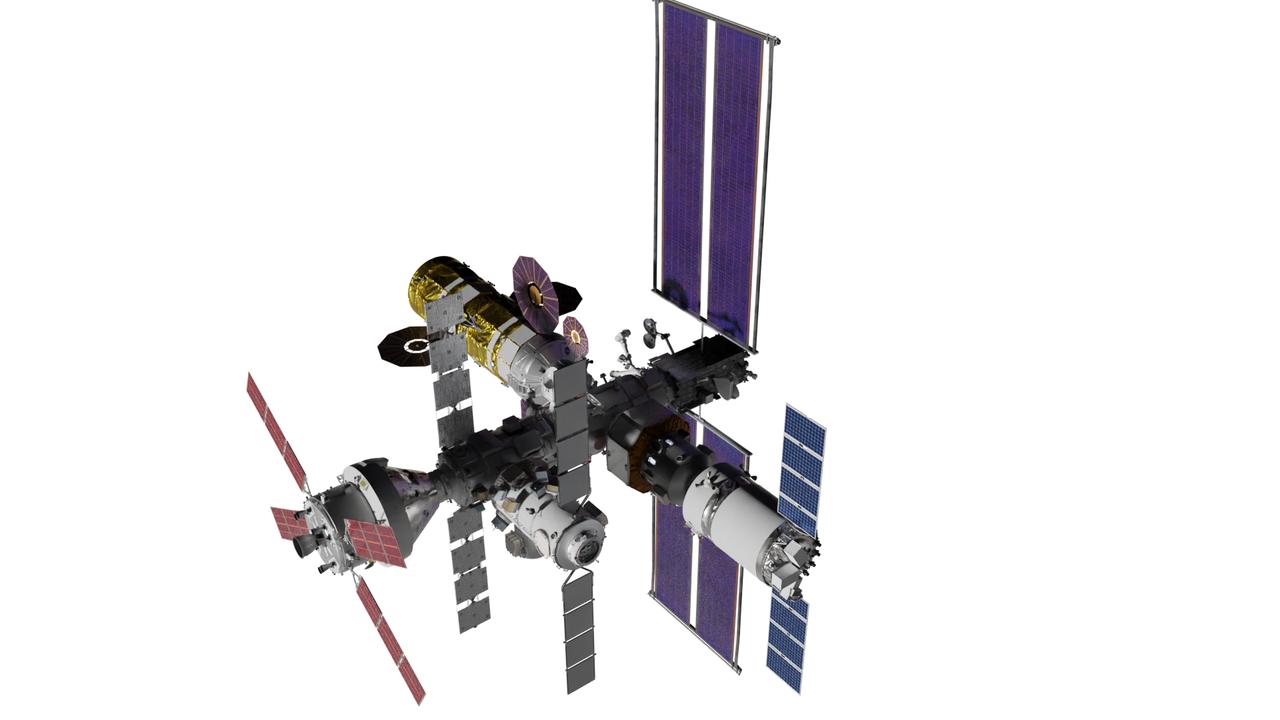
An artist’s rendering displays a configuration of the lunar-orbiting Gateway space station’s modules and visiting spacecraft. The core elements of Gateway consist of the Habitation and Logistics Outpost (HALO) element, the Power and Propulsion Element (PPE), and Lunar I-Hab. Visiting vehicles include the Orion spacecraft, the Logistics Module, and the Human Landing System. Gateway is built in collaboration with NASA’s commercial and international partners to serve as a multiuse space port for lunar science as humanity’s first place to live and work in lunar orbit.
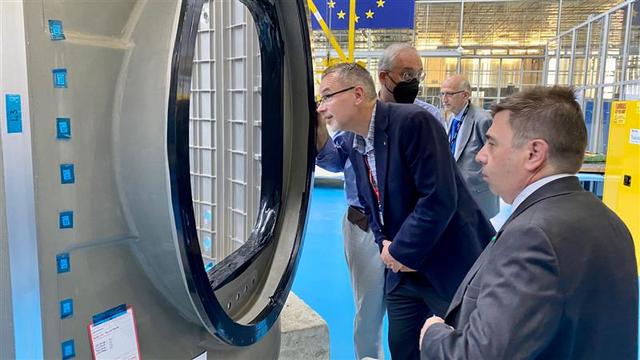
Northrop Grumman and subcontractor Thales Alenia Space complete fabrication work on the Habitation and Logistics Outpost (HALO) module, one of two of the Gateway Space Station's habitation elements where astronauts will live and work in lunar orbit during deep space Artemis missions.
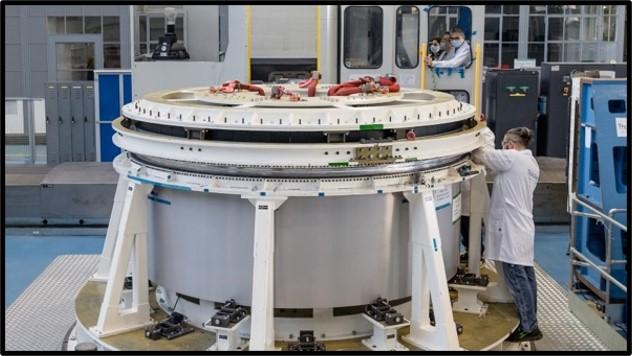
Northrop Grumman and subcontractor Thales Alenia Space complete fabrication work on the Habitation and Logistics Outpost (HALO) module, one of two of the Gateway Space Station's habitation elements where astronauts will live and work in lunar orbit during deep space Artemis missions.
1/TASI image from Dan (1)1~medium.jpg)
Northrop Grumman and subcontractor Thales Alenia Space complete fabrication work on the Habitation and Logistics Outpost (HALO) module, one of two of the Gateway Space Station's habitation elements where astronauts will live and work in lunar orbit during deep space Artemis missions.

Northrop Grumman and subcontractor Thales Alenia Space complete fabrication work on the Habitation and Logistics Outpost (HALO) module, one of two of the Gateway Space Station's habitation elements where astronauts will live and work in lunar orbit during deep space Artemis missions.
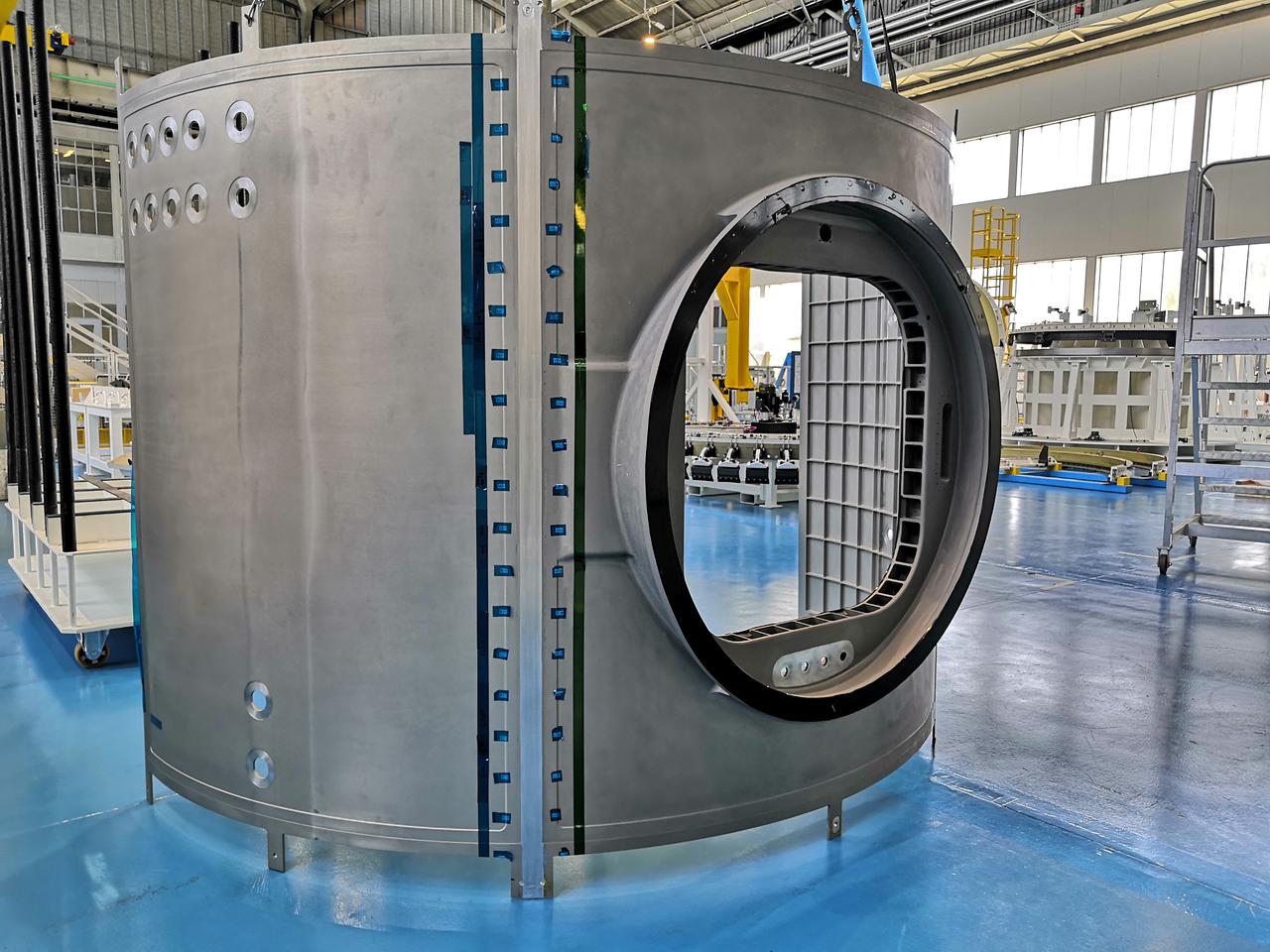
Northrop Grumman and subcontractor Thales Alenia Space complete fabrication work on the Habitation and Logistics Outpost (HALO) module, one of two of the Gateway Space Station's habitation elements where astronauts will live and work in lunar orbit during deep space Artemis missions.

Northrop Grumman and subcontractor Thales Alenia Space complete fabrication work on the Habitation and Logistics Outpost (HALO) module, one of two of the Gateway Space Station's habitation elements where astronauts will live and work in lunar orbit during deep space Artemis missions.
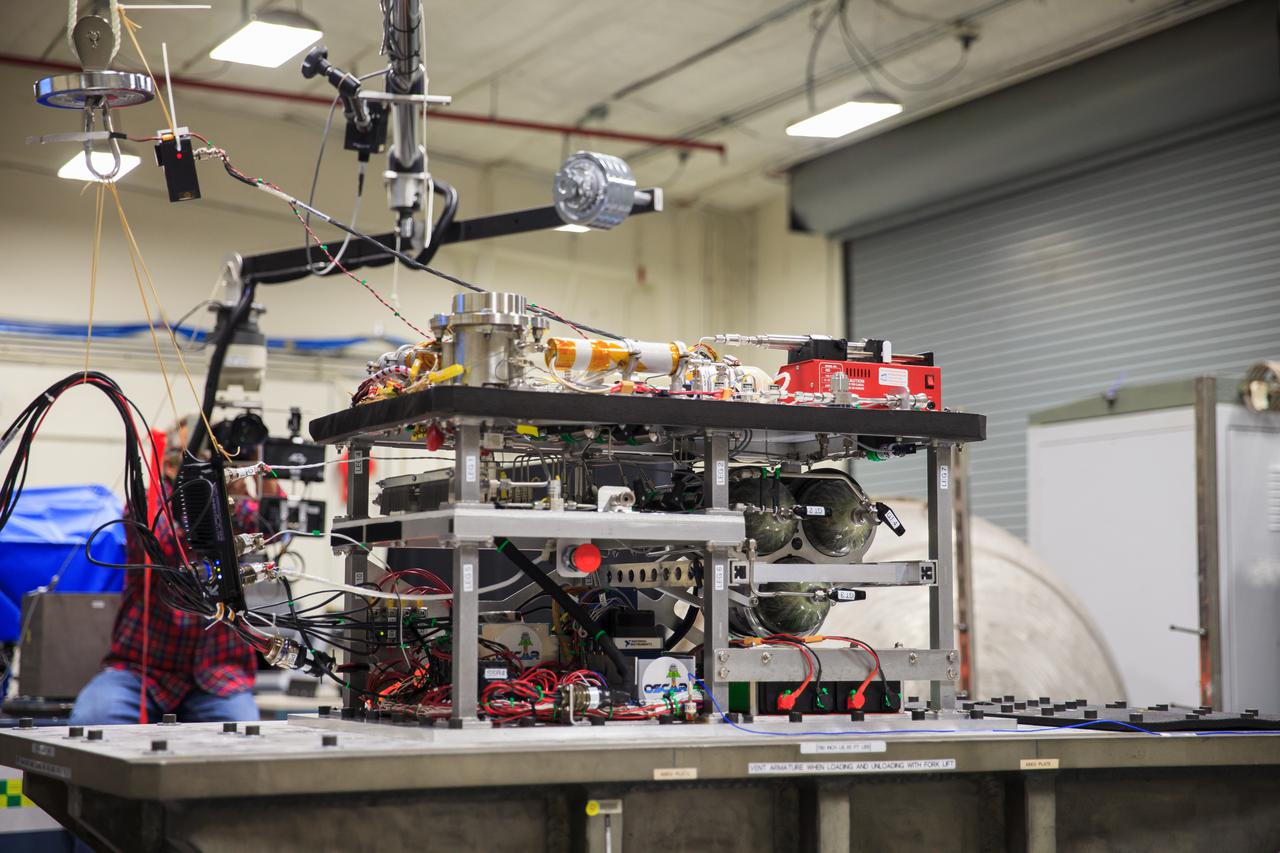
NASA’s Orbital Syngas Commodity Augmentation Reactor, or OSCAR, undergoes vibration testing inside the Vibration Test Lab at the agency’s Kennedy Space Center in Florida on Jan. 14, 2021, in preparation for a scheduled suborbital flight later this year. Beginning as an Early Career Initiative project, OSCAR studies technology to convert trash and human waste into useful gasses such as methane, hydrogen, and carbon dioxide. By processing small pieces of trash in a high-temperature reactor, OSCAR would reduce the amount of space needed for waste storage within a spacecraft, turn some waste into gasses that have energy storage and life support applications, and ensure waste is no longer biologically active.

Kennedy Space Center employees assemble the flight hardware of NASA’s Orbital Syngas Commodity Augmentation Reactor, or OSCAR – an Early Career Initiative project at the Florida spaceport that studies technology to convert trash and human waste into useful gasses such as methane, hydrogen and carbon dioxide. By processing small pieces of trash in a high-temperature reactor, OSCAR is advancing new and innovative technology for managing waste in space. OSCAR would reduce the amount of space needed for waste storage within a spacecraft, turn some waste into gasses that have energy storage and life support applications and ensure waste is no longer biologically active. A prototype has already been developed, and a team of Kennedy employees are in the process of constructing a new rig for suborbital flight testing.
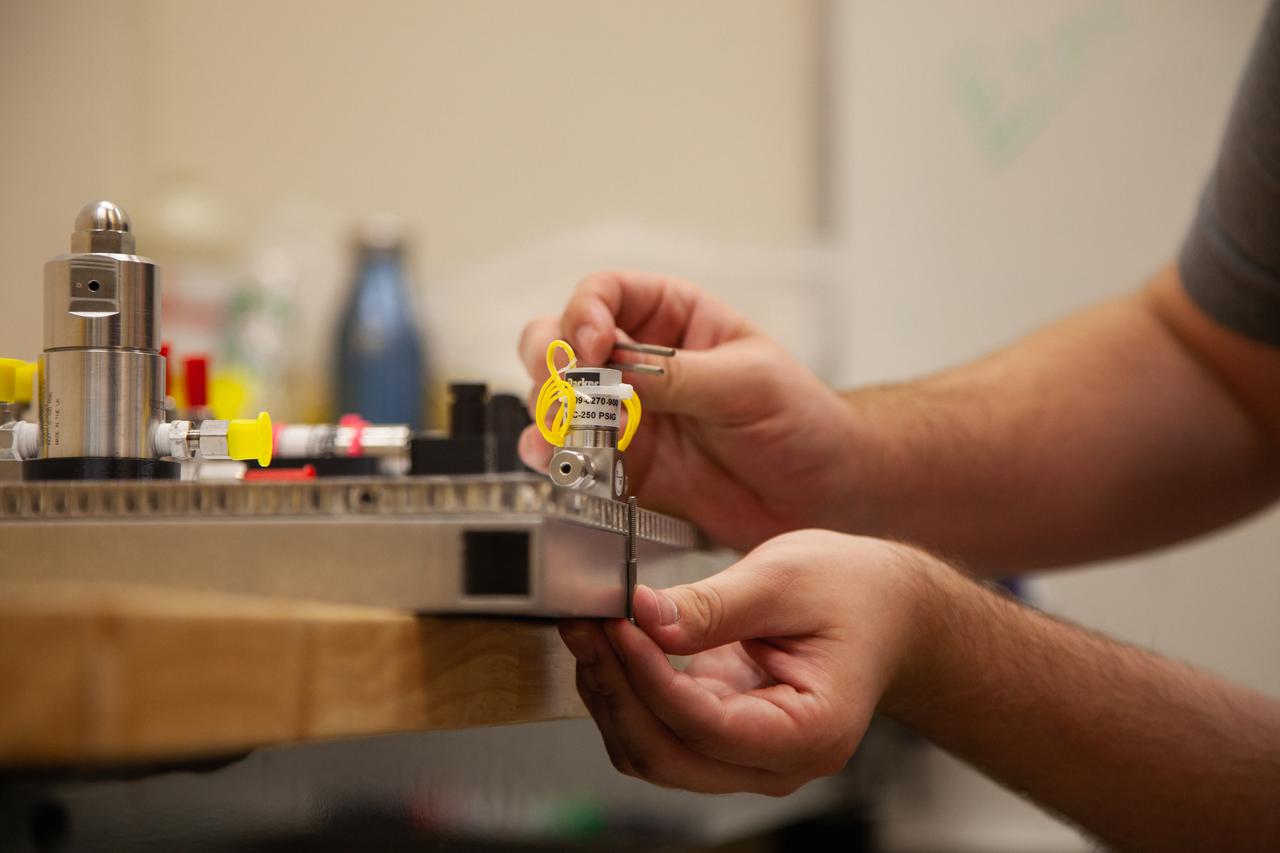
A Kennedy Space Center employee works on assembling the flight hardware of NASA’s Orbital Syngas Commodity Augmentation Reactor, or OSCAR – an Early Career Initiative project at the Florida spaceport that studies technology to convert trash and human waste into useful gasses such as methane, hydrogen and carbon dioxide. By processing small pieces of trash in a high-temperature reactor, OSCAR is advancing new and innovative technology for managing waste in space. OSCAR would reduce the amount of space needed for waste storage within a spacecraft, turn some waste into gasses that have energy storage and life support applications and ensure waste is no longer biologically active. A prototype has already been developed, and a team of Kennedy employees are in the process of constructing a new rig for suborbital flight testing.
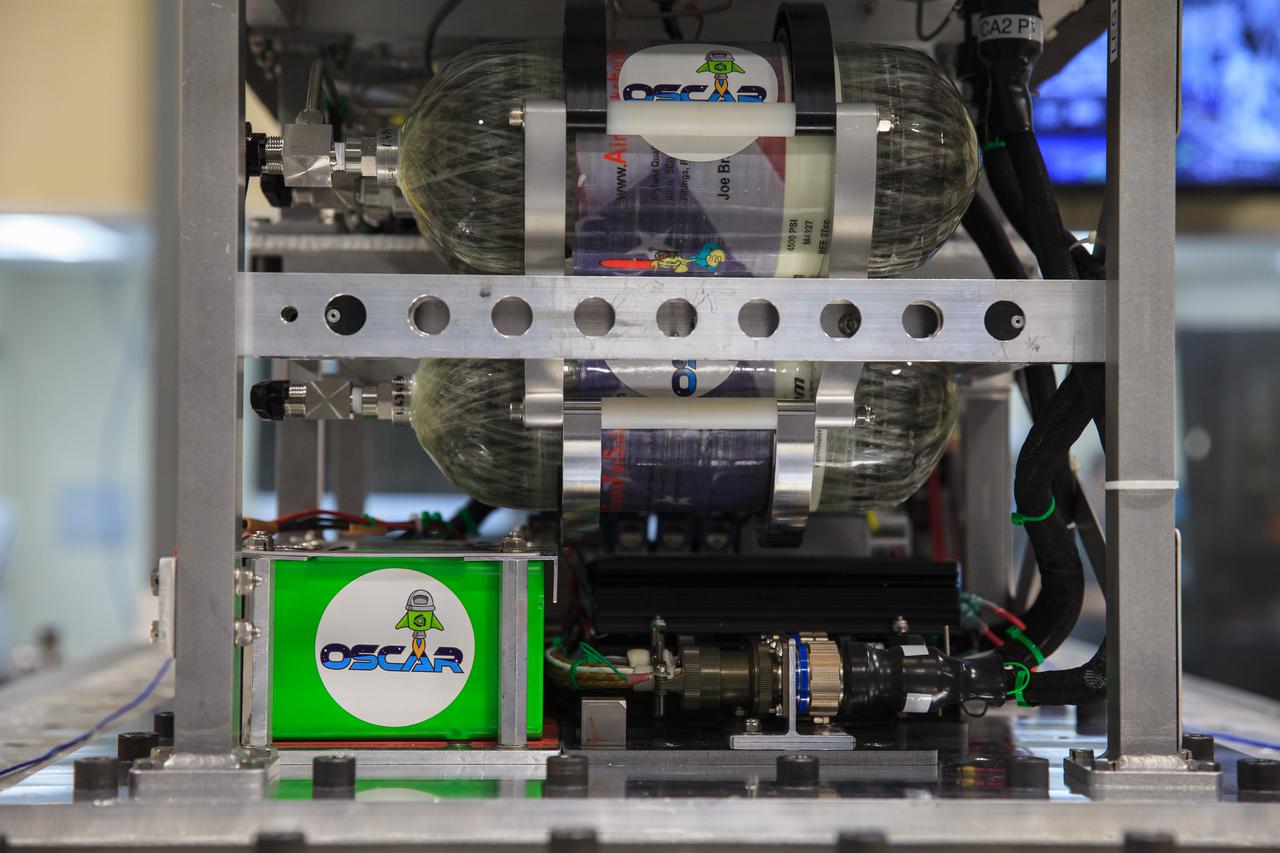
NASA’s Orbital Syngas Commodity Augmentation Reactor, or OSCAR, undergoes vibration testing inside the Vibration Test Lab at the agency’s Kennedy Space Center in Florida on Jan. 14, 2021. The tests are part of ongoing preparation for a scheduled suborbital flight test later this year. Beginning as an Early Career Initiative project, OSCAR studies technology to convert trash and human waste into useful gasses such as methane, hydrogen, and carbon dioxide. By processing small pieces of trash in a high-temperature reactor, OSCAR would reduce the amount of space needed for waste storage within a spacecraft, turn some waste into gasses that have energy storage and life support applications, and ensure waste is no longer biologically active.
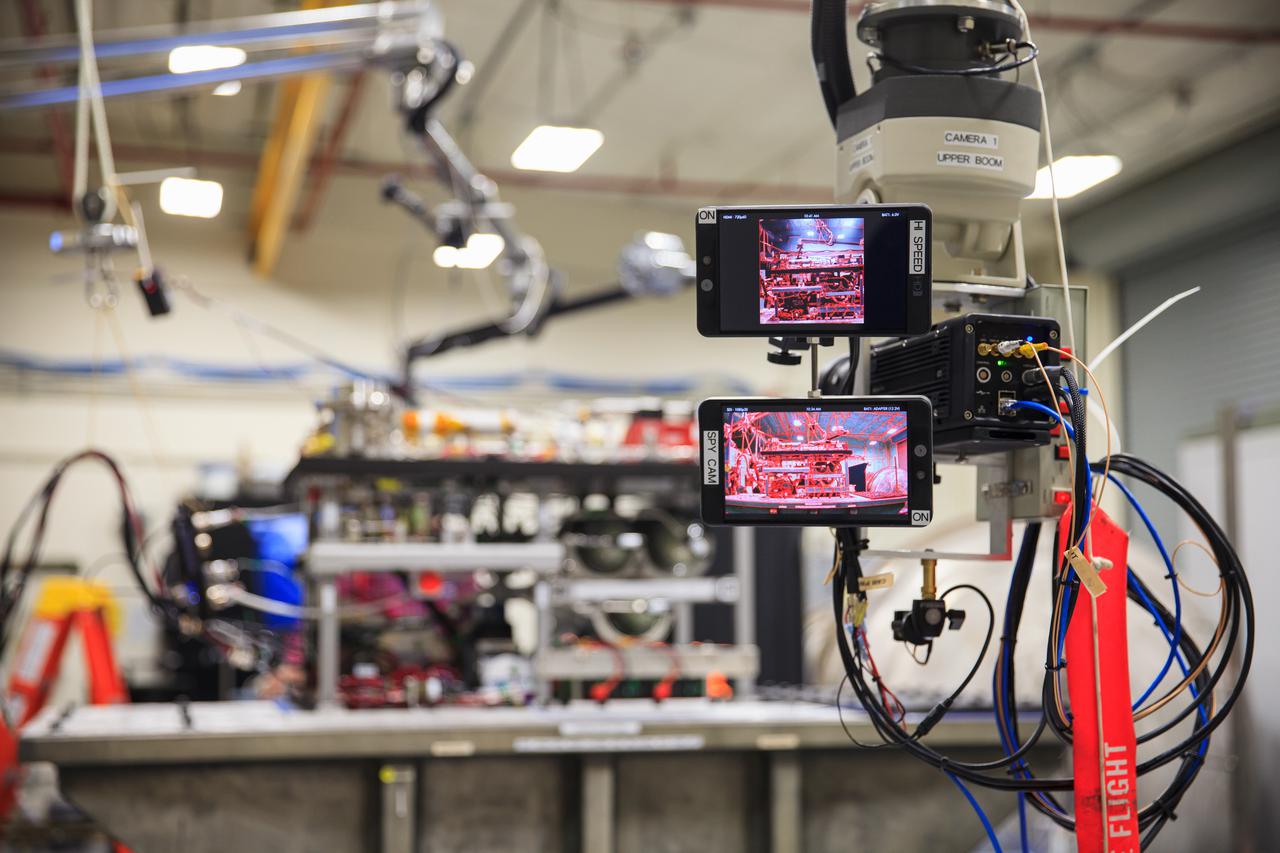
NASA’s Orbital Syngas Commodity Augmentation Reactor, or OSCAR, undergoes vibration testing inside the Vibration Test Lab at the agency’s Kennedy Space Center in Florida on Jan. 14, 2021, in preparation for a scheduled suborbital flight later this year. Beginning as an Early Career Initiative project, OSCAR studies technology to convert trash and human waste into useful gasses such as methane, hydrogen, and carbon dioxide. By processing small pieces of trash in a high-temperature reactor, OSCAR would reduce the amount of space needed for waste storage within a spacecraft, turn some waste into gasses that have energy storage and life support applications, and ensure waste is no longer biologically active.
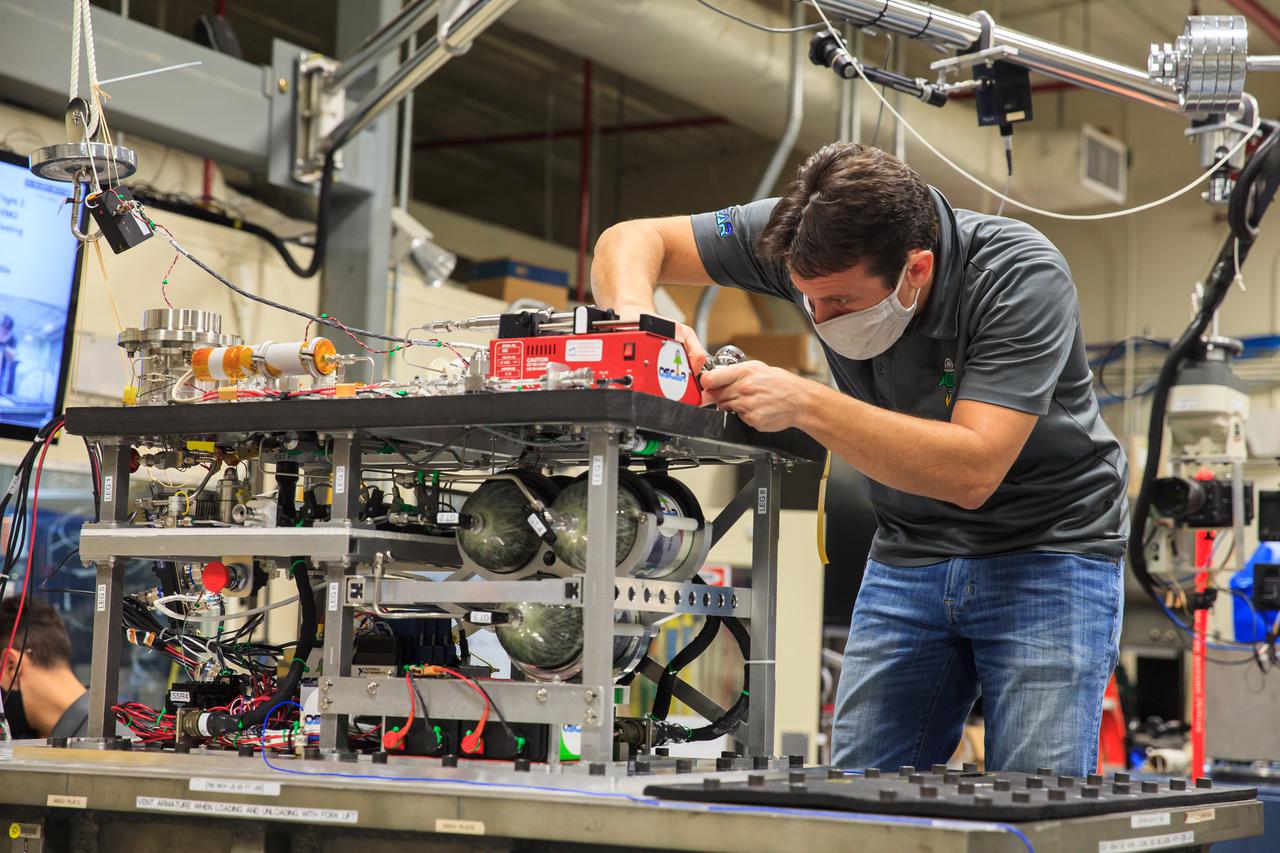
Gino Carro, a pressure vessels and systems engineer for Kennedy Space Center’s Laboratory Support Services and Operations contract, prepares NASA’s Orbital Syngas Commodity Augmentation Reactor (OSCAR) for vibration tests inside the Vibration Test Lab at the Florida spaceport on Jan. 14, 2021. The tests are part of ongoing preparation for a scheduled suborbital flight test later this year. Beginning as an Early Career Initiative project, OSCAR studies technology to convert trash and human waste into useful gasses such as methane, hydrogen, and carbon dioxide. By processing small pieces of trash in a high-temperature reactor, OSCAR would reduce the amount of space needed for waste storage within a spacecraft, turn some waste into gasses that have energy storage and life support applications, and ensure waste is no longer biologically active.
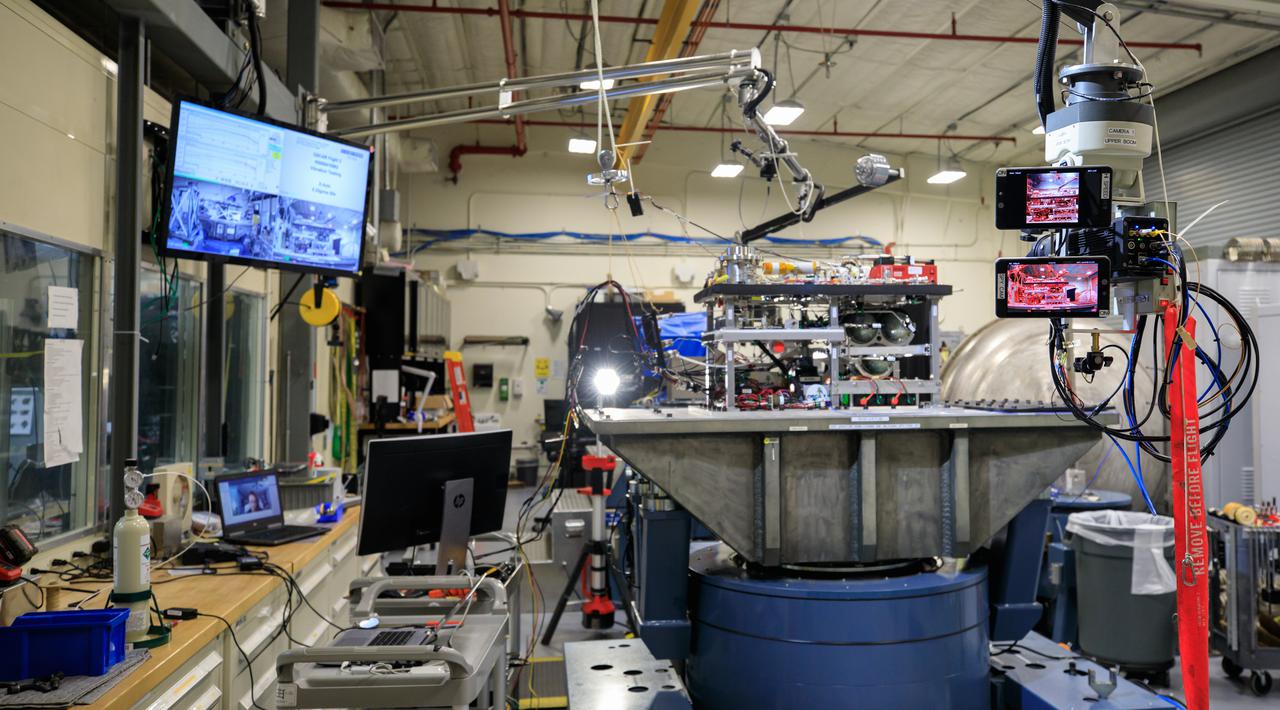
NASA’s Orbital Syngas Commodity Augmentation Reactor, or OSCAR, undergoes vibration testing inside the Vibration Test Lab at the agency’s Kennedy Space Center in Florida on Jan. 14, 2021. The tests are part of ongoing preparation for a scheduled suborbital flight test later this year. Beginning as an Early Career Initiative project, OSCAR studies technology to convert trash and human waste into useful gasses such as methane, hydrogen, and carbon dioxide. By processing small pieces of trash in a high-temperature reactor, OSCAR would reduce the amount of space needed for waste storage within a spacecraft, turn some waste into gasses that have energy storage and life support applications, and ensure waste is no longer biologically active.
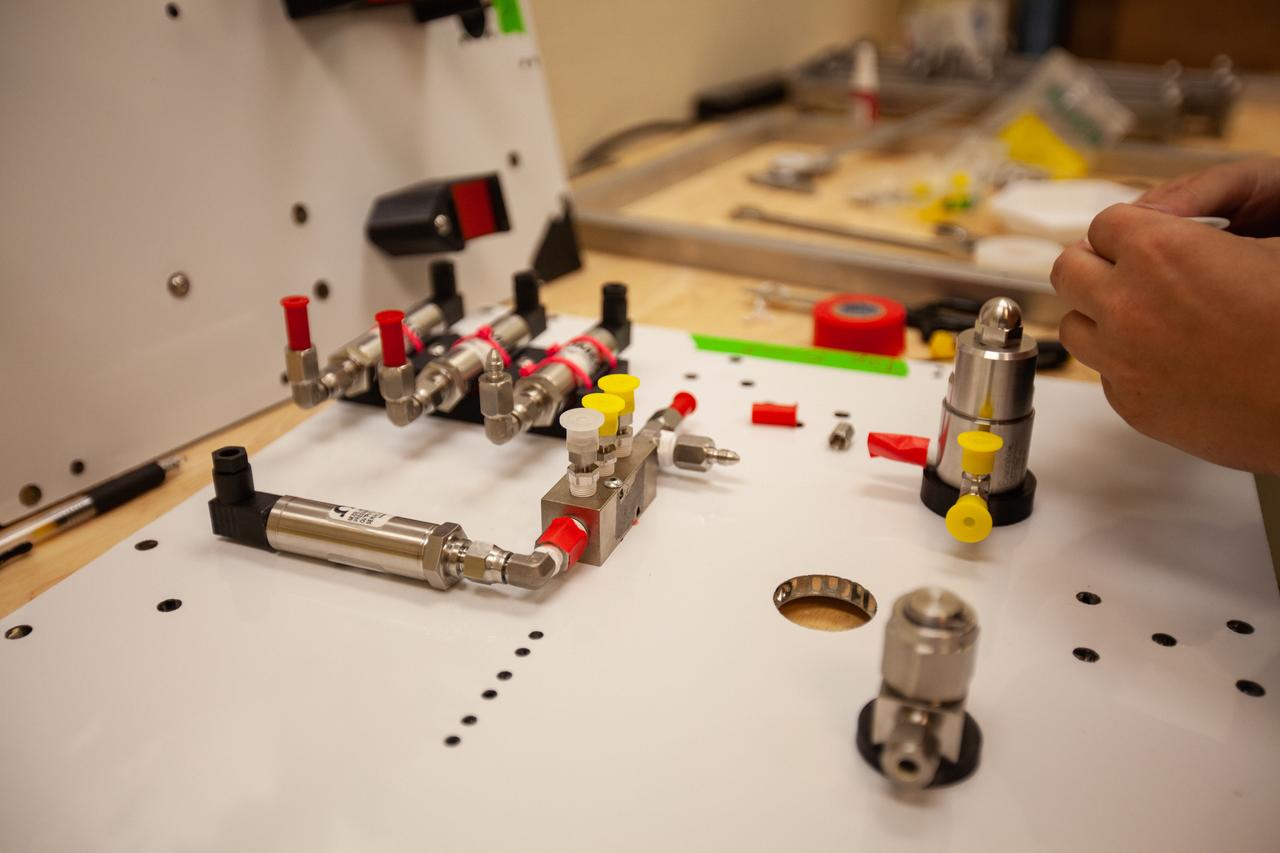
A Kennedy Space Center employee works on assembling the flight hardware of NASA’s Orbital Syngas Commodity Augmentation Reactor, or OSCAR – an Early Career Initiative project at the Florida spaceport that studies technology to convert trash and human waste into useful gasses such as methane, hydrogen and carbon dioxide. By processing small pieces of trash in a high-temperature reactor, OSCAR is advancing new and innovative technology for managing waste in space. OSCAR would reduce the amount of space needed for waste storage within a spacecraft, turn some waste into gasses that have energy storage and life support applications and ensure waste is no longer biologically active. A prototype has already been developed, and a team of Kennedy employees are in the process of constructing a new rig for suborbital flight testing.
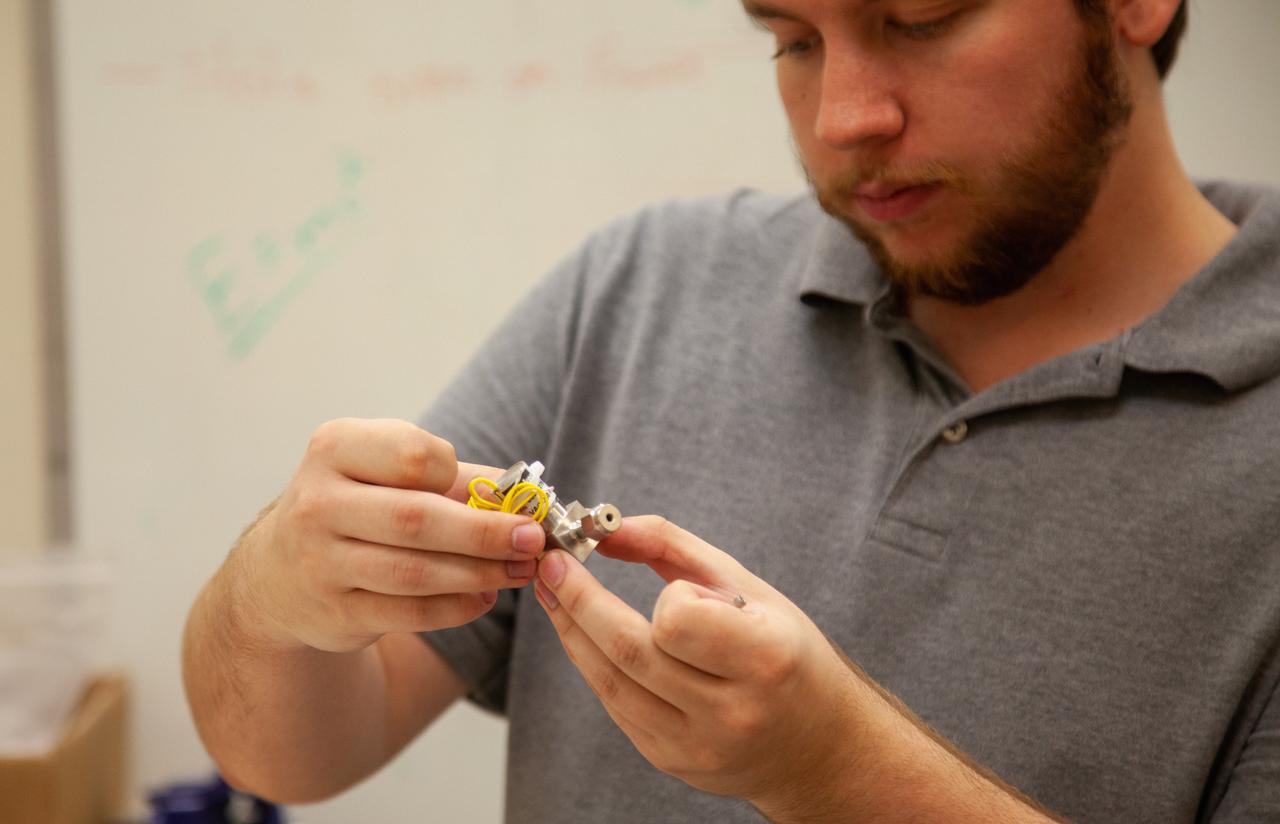
A Kennedy Space Center employee works on assembling the flight hardware of NASA’s Orbital Syngas Commodity Augmentation Reactor, or OSCAR – an Early Career Initiative project at the Florida spaceport that studies technology to convert trash and human waste into useful gasses such as methane, hydrogen and carbon dioxide. By processing small pieces of trash in a high-temperature reactor, OSCAR is advancing new and innovative technology for managing waste in space. OSCAR would reduce the amount of space needed for waste storage within a spacecraft, turn some waste into gasses that have energy storage and life support applications and ensure waste is no longer biologically active. A prototype has already been developed, and a team of Kennedy employees are in the process of constructing a new rig for suborbital flight testing.
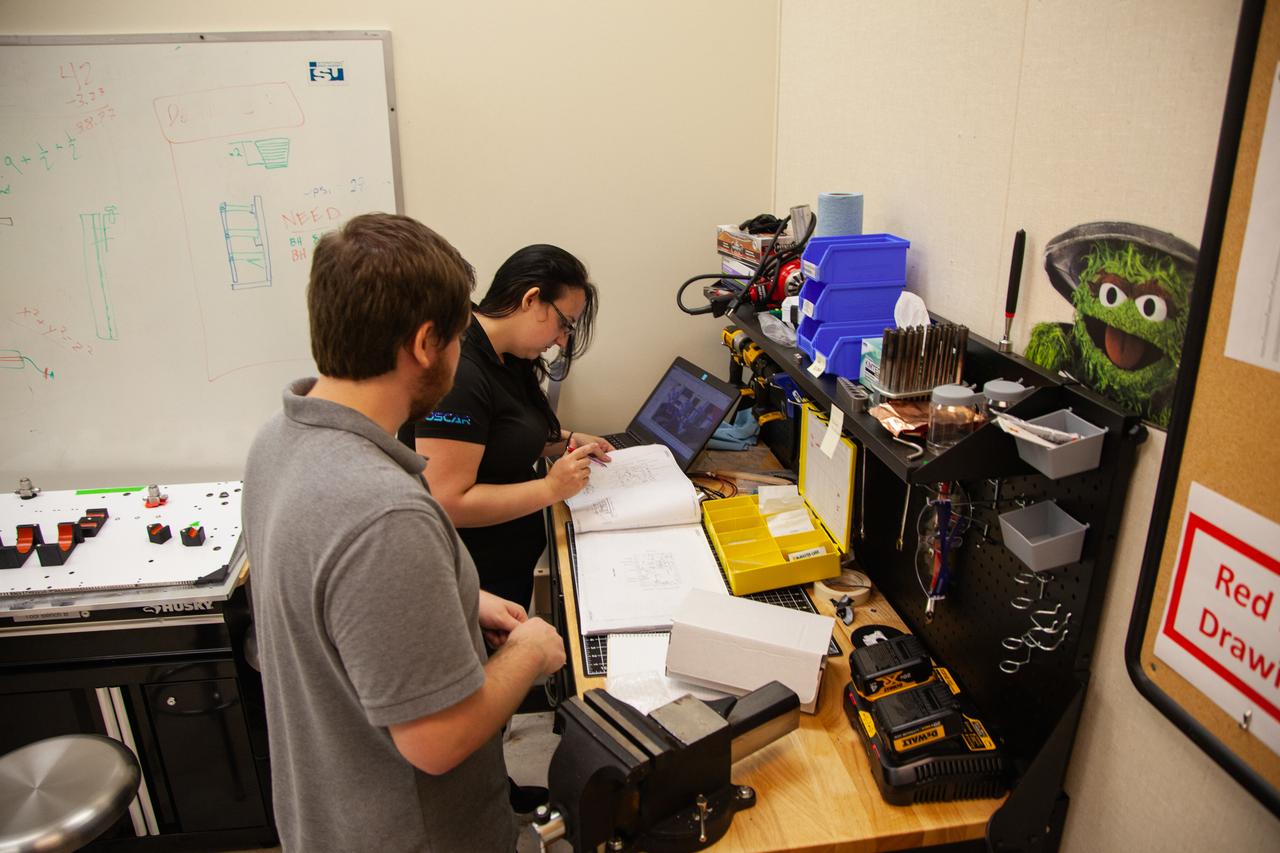
Kennedy Space Center employees are working on assembling the flight hardware of NASA’s Orbital Syngas Commodity Augmentation Reactor, or OSCAR – an Early Career Initiative project at the Florida spaceport that studies technology to convert trash and human waste into useful gasses such as methane, hydrogen and carbon dioxide. By processing small pieces of trash in a high-temperature reactor, OSCAR is advancing new and innovative technology for managing waste in space. OSCAR would reduce the amount of space needed for waste storage within a spacecraft, turn some waste into gasses that have energy storage and life support applications and ensure waste is no longer biologically active. A prototype has already been developed, and a team of Kennedy employees are in the process of constructing a new rig for suborbital flight testing.
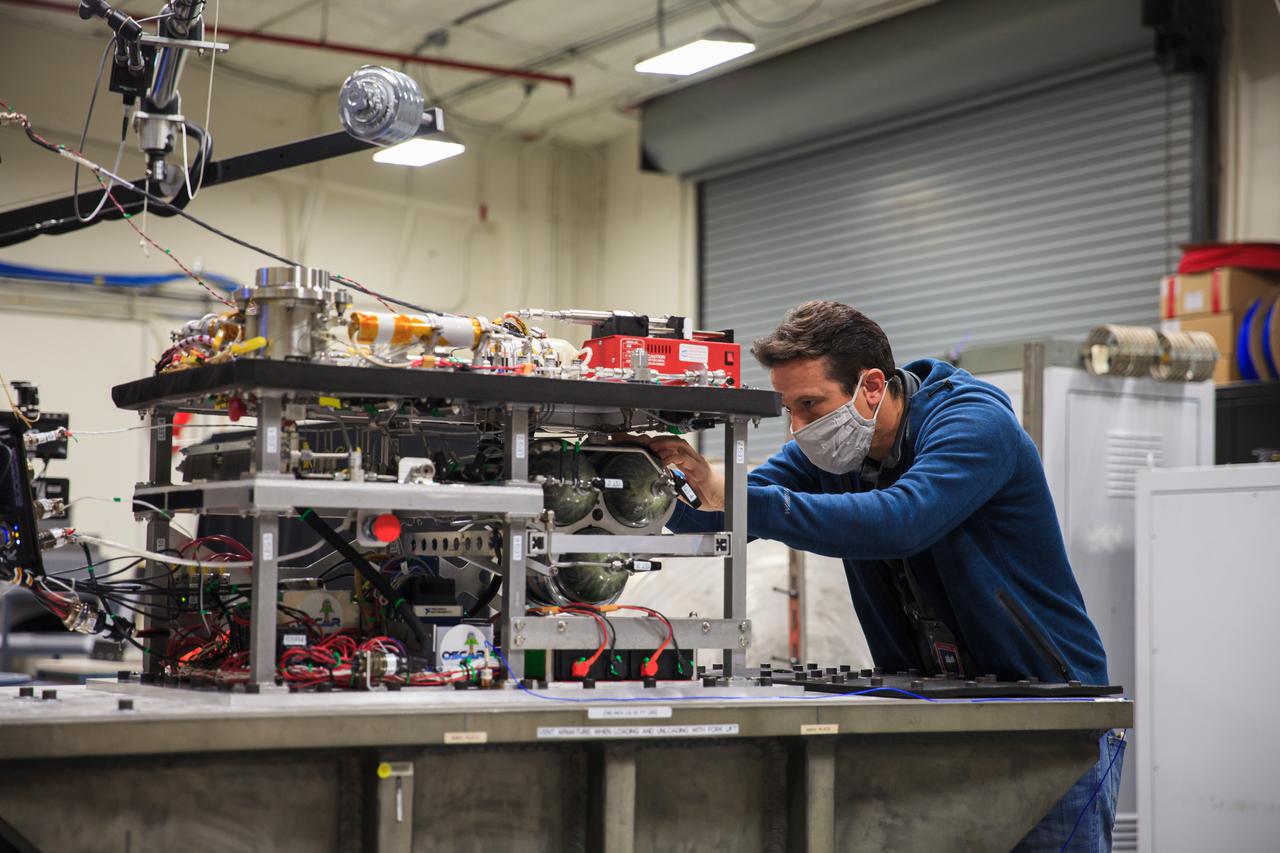
Gino Carro, a pressure vessels and systems engineer for Kennedy Space Center’s Laboratory Support Services and Operations contract, prepares NASA’s Orbital Syngas Commodity Augmentation Reactor (OSCAR) for vibration tests inside the Vibration Test Lab at the Florida spaceport on Jan. 14, 2021. The tests are part of ongoing preparation for a scheduled suborbital flight test later this year. Beginning as an Early Career Initiative project, OSCAR studies technology to convert trash and human waste into useful gasses such as methane, hydrogen, and carbon dioxide. By processing small pieces of trash in a high-temperature reactor, OSCAR would reduce the amount of space needed for waste storage within a spacecraft, turn some waste into gasses that have energy storage and life support applications, and ensure waste is no longer biologically active.
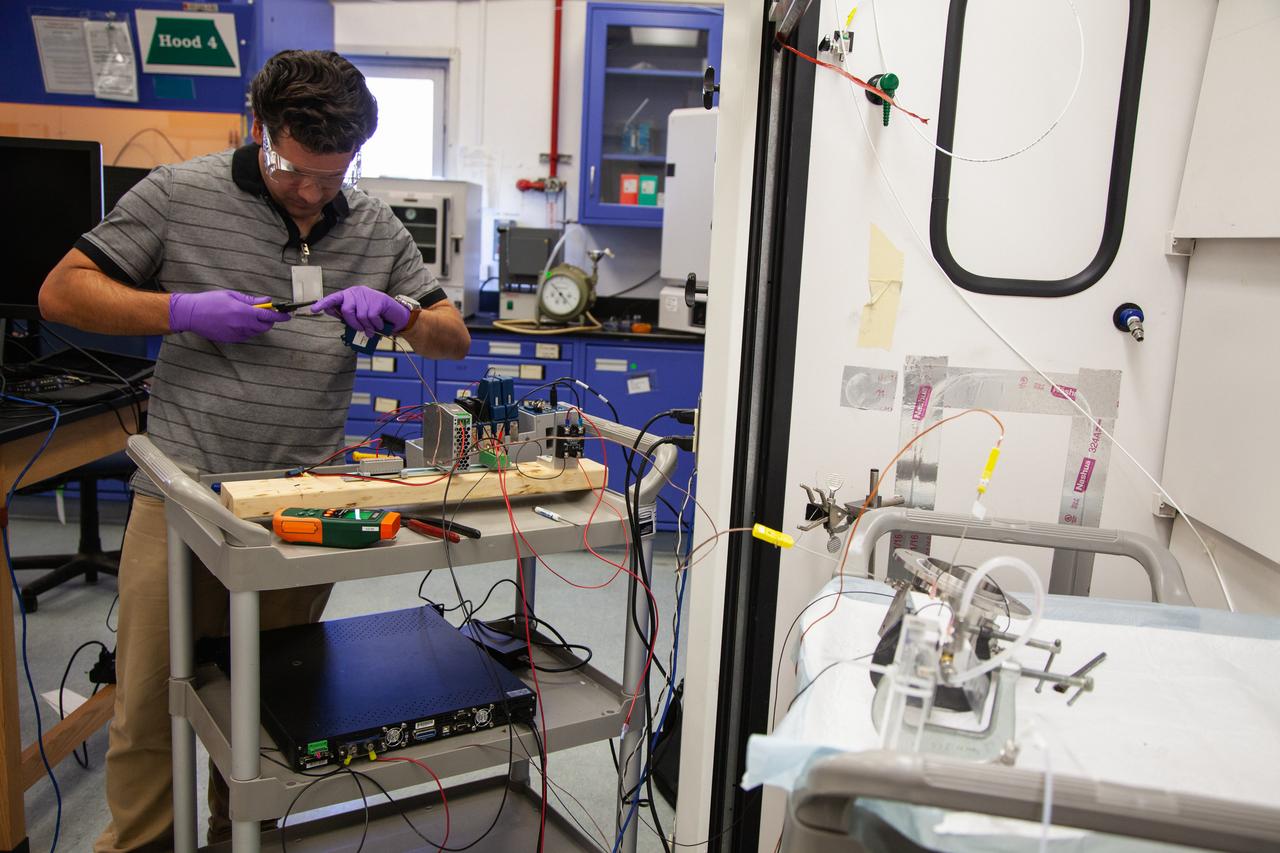
A Kennedy Space Center employee works on assembling the flight hardware of NASA’s Orbital Syngas Commodity Augmentation Reactor, or OSCAR – an Early Career Initiative project at the Florida spaceport that studies technology to convert trash and human waste into useful gasses such as methane, hydrogen and carbon dioxide. By processing small pieces of trash in a high-temperature reactor, OSCAR is advancing new and innovative technology for managing waste in space. OSCAR would reduce the amount of space needed for waste storage within a spacecraft, turn some waste into gasses that have energy storage and life support applications and ensure waste is no longer biologically active. A prototype has already been developed, and a team of Kennedy employees are in the process of constructing a new rig for suborbital flight testing.
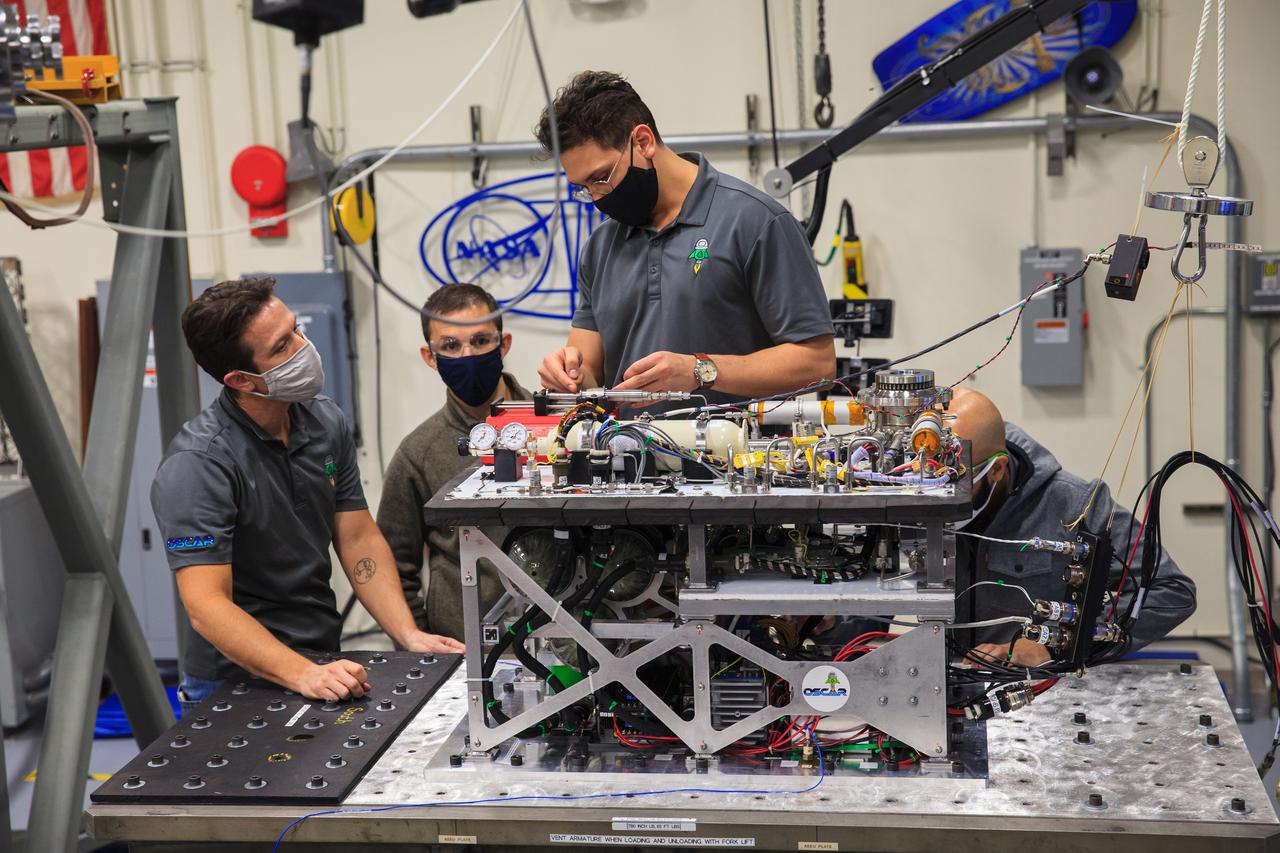
Kennedy Space Center engineers conduct vibration tests inside the Florida spaceport’s Vibration Test Lab on Jan. 14, 2021, in preparation for the suborbital flight of NASA’s Orbital Syngas Commodity Augmentation Reactor, or OSCAR, slated for later this year. From left are Gino Carro, a pressure vessels and systems engineer for the center’s Laboratory Support Services and Operations contract; David Rinderknecht, NASA chemical engineer; Ray Pitts, co-principal investigator for OSCAR; and Malay Shah, NASA thermal/fluid analysis engineer. Beginning as an Early Career Initiative project, OSCAR studies technology to convert trash and human waste into useful gasses such as methane, hydrogen, and carbon dioxide. By processing small pieces of trash in a high-temperature reactor, OSCAR is advancing new and innovative technology for managing waste in space.
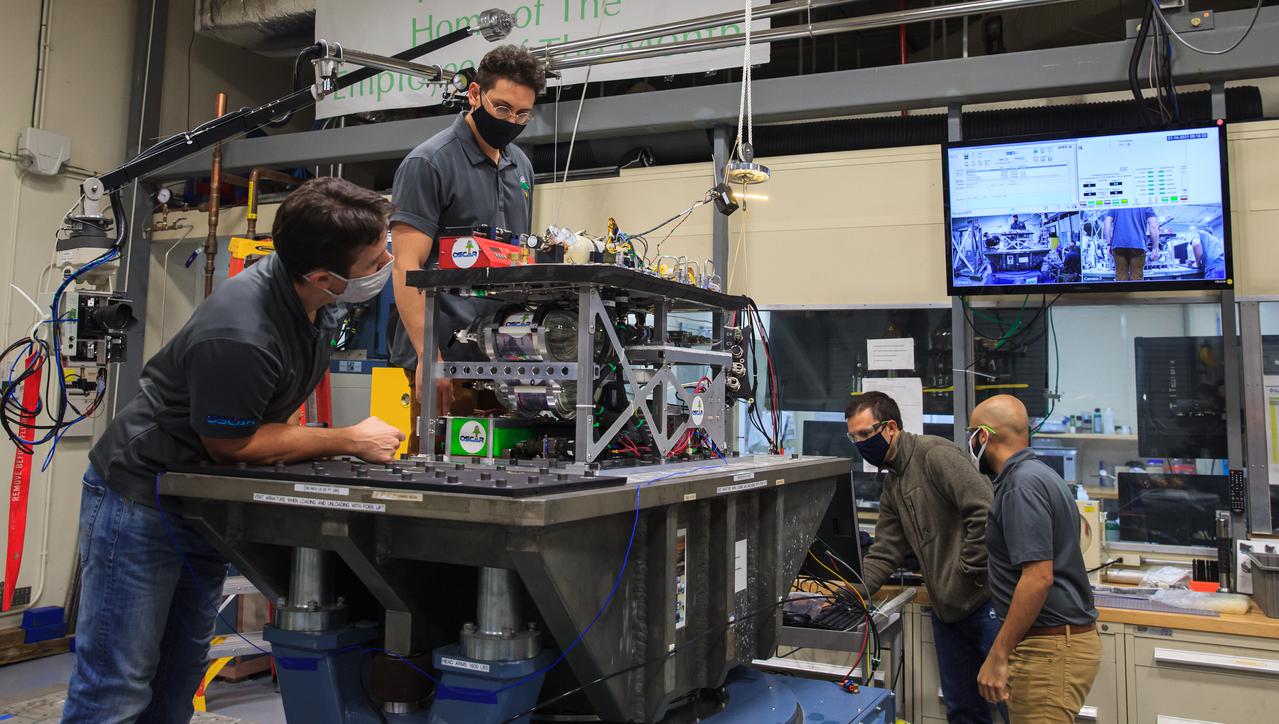
Kennedy Space Center engineers conduct vibration tests inside the Florida spaceport’s Vibration Test Lab on Jan. 14, 2021, in preparation for the suborbital flight of NASA’s Orbital Syngas Commodity Augmentation Reactor, or OSCAR, slated for later this year. From left are Gino Carro, a pressure vessels and systems engineer for the center’s Laboratory Support Services and Operations contract; Ray Pitts, co-principal investigator for OSCAR; David Rinderknecht, NASA chemical engineer; and Malay Shah, NASA thermal/fluid analysis engineer. Beginning as an Early Career Initiative project, OSCAR studies technology to convert trash and human waste into useful gasses such as methane, hydrogen, and carbon dioxide. By processing small pieces of trash in a high-temperature reactor, OSCAR is advancing new and innovative technology for managing waste in space.
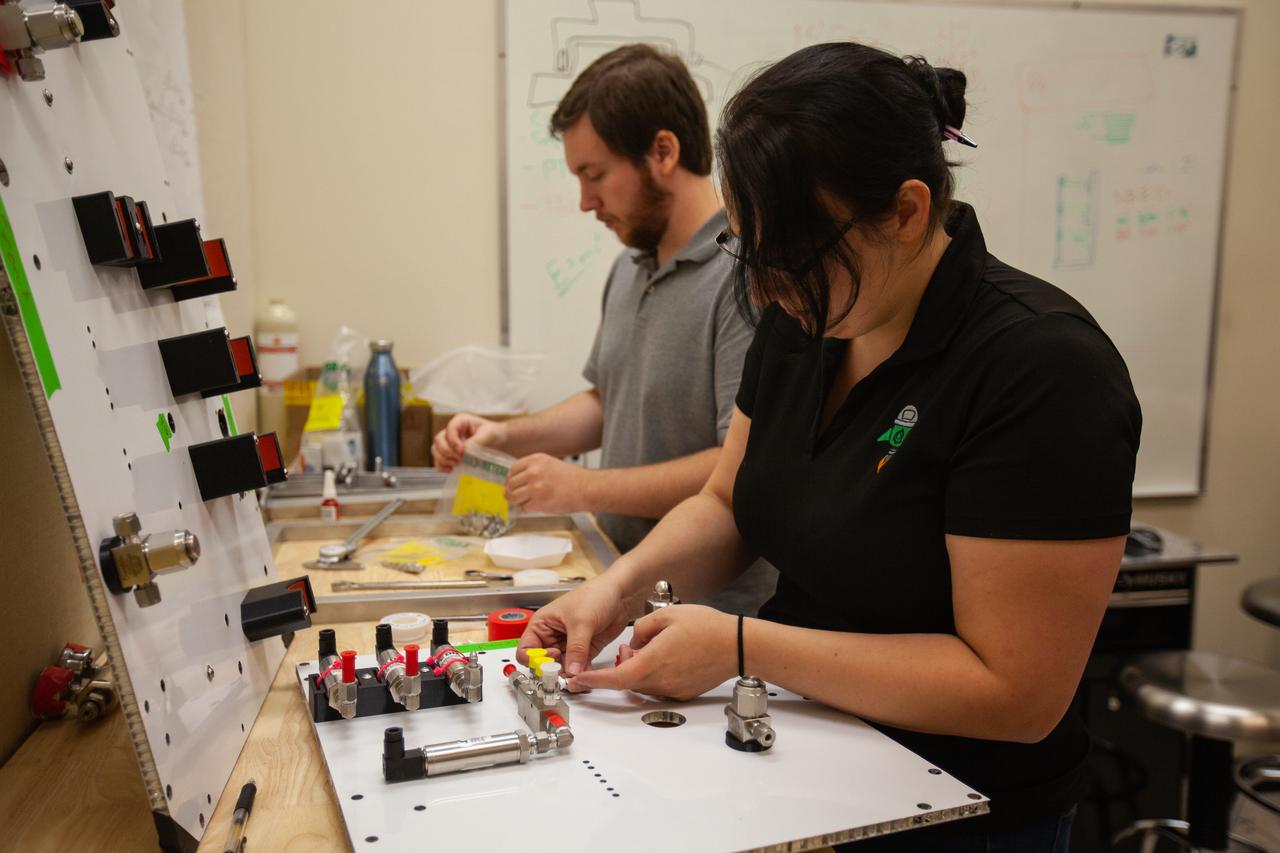
Kennedy Space Center employees assemble the flight hardware of NASA’s Orbital Syngas Commodity Augmentation Reactor, or OSCAR – an Early Career Initiative project at the Florida spaceport that studies technology to convert trash and human waste into useful gasses such as methane, hydrogen and carbon dioxide. By processing small pieces of trash in a high-temperature reactor, OSCAR is advancing new and innovative technology for managing waste in space. OSCAR would reduce the amount of space needed for waste storage within a spacecraft, turn some waste into gasses that have energy storage and life support applications and ensure waste is no longer biologically active. A prototype has already been developed, and a team of Kennedy employees are in the process of constructing a new rig for suborbital flight testing.
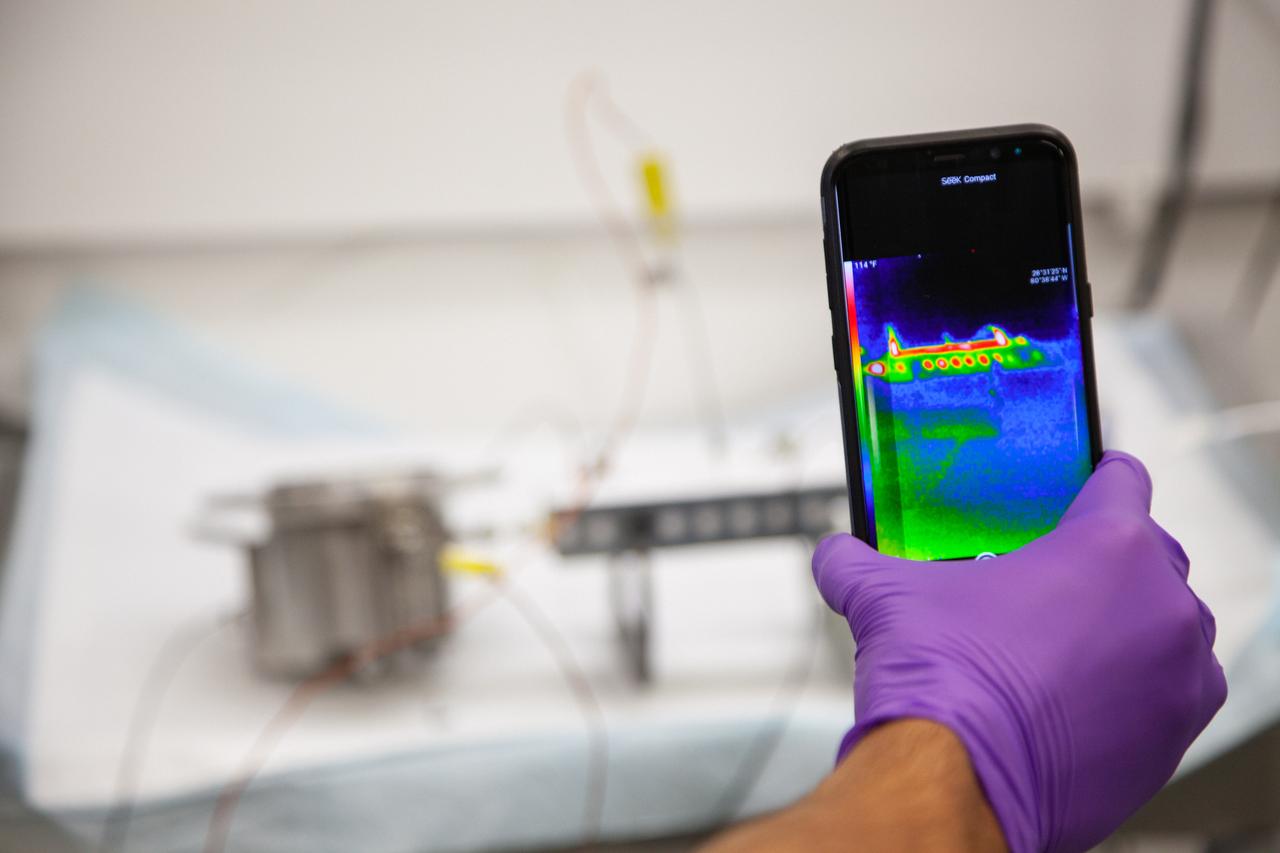
A Kennedy Space Center employee conducts thermal testing of NASA’s Orbital Syngas Commodity Augmentation Reactor, or OSCAR – an Early Career Initiative project at the Florida spaceport that studies technology to convert trash and human waste into useful gasses such as methane, hydrogen and carbon dioxide. By processing small pieces of trash in a high-temperature reactor, OSCAR is advancing new and innovative technology for managing waste in space. OSCAR would reduce the amount of space needed for waste storage within a spacecraft, turn some waste into gasses that have energy storage and life support applications and ensure waste is no longer biologically active. A prototype has already been developed, and a team of Kennedy employees are in the process of constructing a new rig for suborbital flight testing.
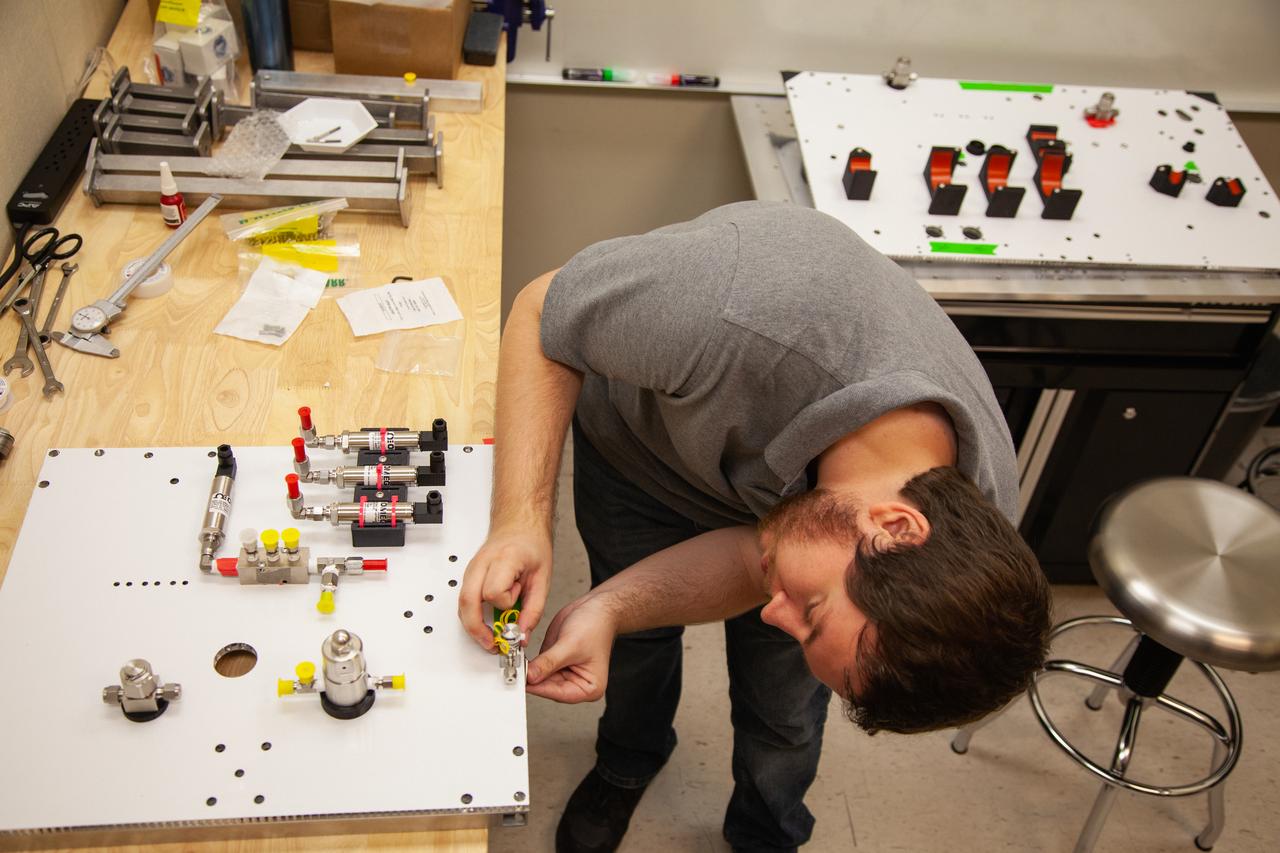
A Kennedy Space Center employee works on assembling the flight hardware of NASA’s Orbital Syngas Commodity Augmentation Reactor, or OSCAR – an Early Career Initiative project at the Florida spaceport that studies technology to convert trash and human waste into useful gasses such as methane, hydrogen and carbon dioxide. By processing small pieces of trash in a high-temperature reactor, OSCAR is advancing new and innovative technology for managing waste in space. OSCAR would reduce the amount of space needed for waste storage within a spacecraft, turn some waste into gasses that have energy storage and life support applications and ensure waste is no longer biologically active. A prototype has already been developed, and a team of Kennedy employees are in the process of constructing a new rig for suborbital flight testing.
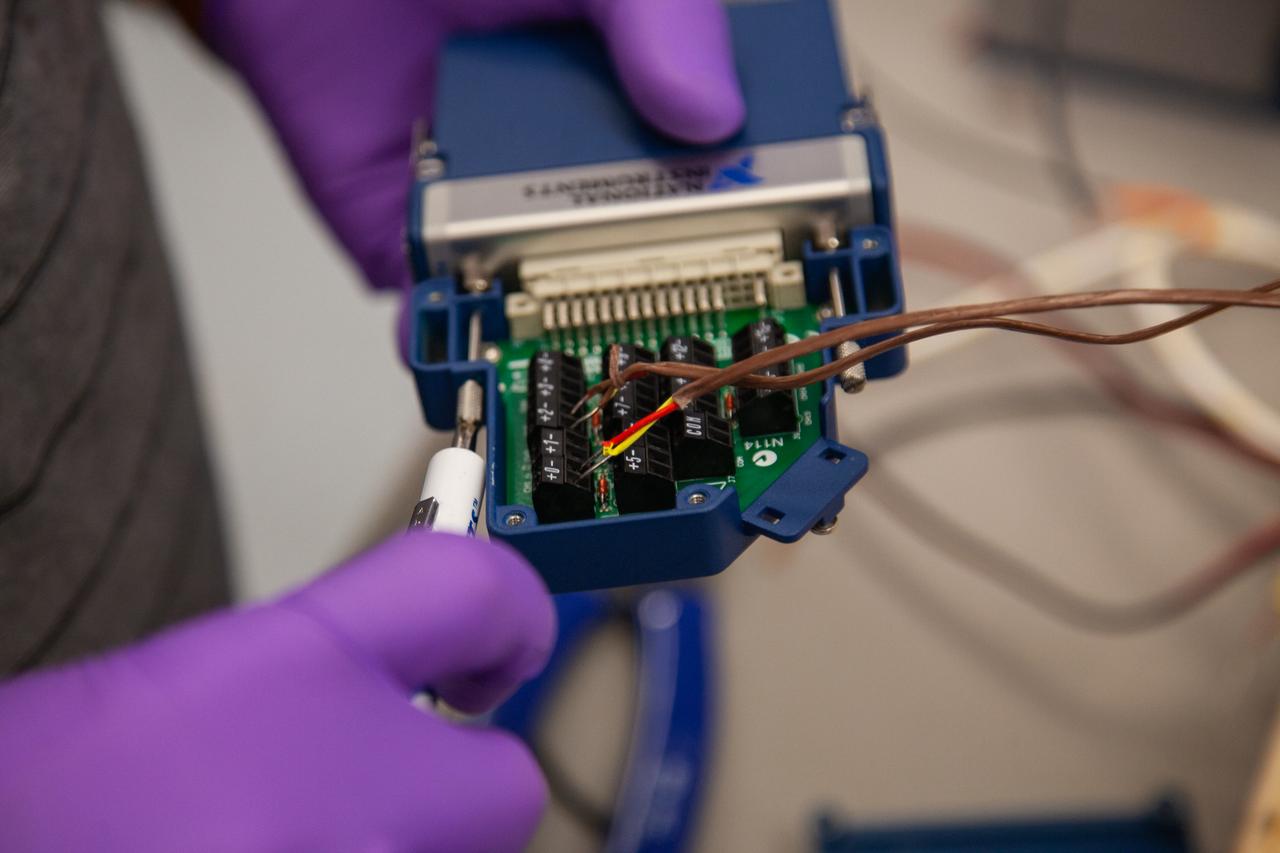
A Kennedy Space Center employee works on assembling the flight hardware of NASA’s Orbital Syngas Commodity Augmentation Reactor, or OSCAR – an Early Career Initiative project at the Florida spaceport that studies technology to convert trash and human waste into useful gasses such as methane, hydrogen and carbon dioxide. By processing small pieces of trash in a high-temperature reactor, OSCAR is advancing new and innovative technology for managing waste in space. OSCAR would reduce the amount of space needed for waste storage within a spacecraft, turn some waste into gasses that have energy storage and life support applications and ensure waste is no longer biologically active. A prototype has already been developed, and a team of Kennedy employees are in the process of constructing a new rig for suborbital flight testing.

Ray Pitts, co-principal investigator for NASA’s Orbital Syngas Commodity Augmentation Reactor (OSCAR), prepares OSCAR for vibration tests inside the Vibration Test Lab at the agency’s Kennedy Space Center in Florida on Jan. 14, 2021. The tests are part of ongoing preparation for a scheduled suborbital flight test later this year. Beginning as an Early Career Initiative project, OSCAR studies technology to convert trash and human waste into useful gasses such as methane, hydrogen, and carbon dioxide. By processing small pieces of trash in a high-temperature reactor, OSCAR would reduce the amount of space needed for waste storage within a spacecraft, turn some waste into gasses that have energy storage and life support applications, and ensure waste is no longer biologically active.
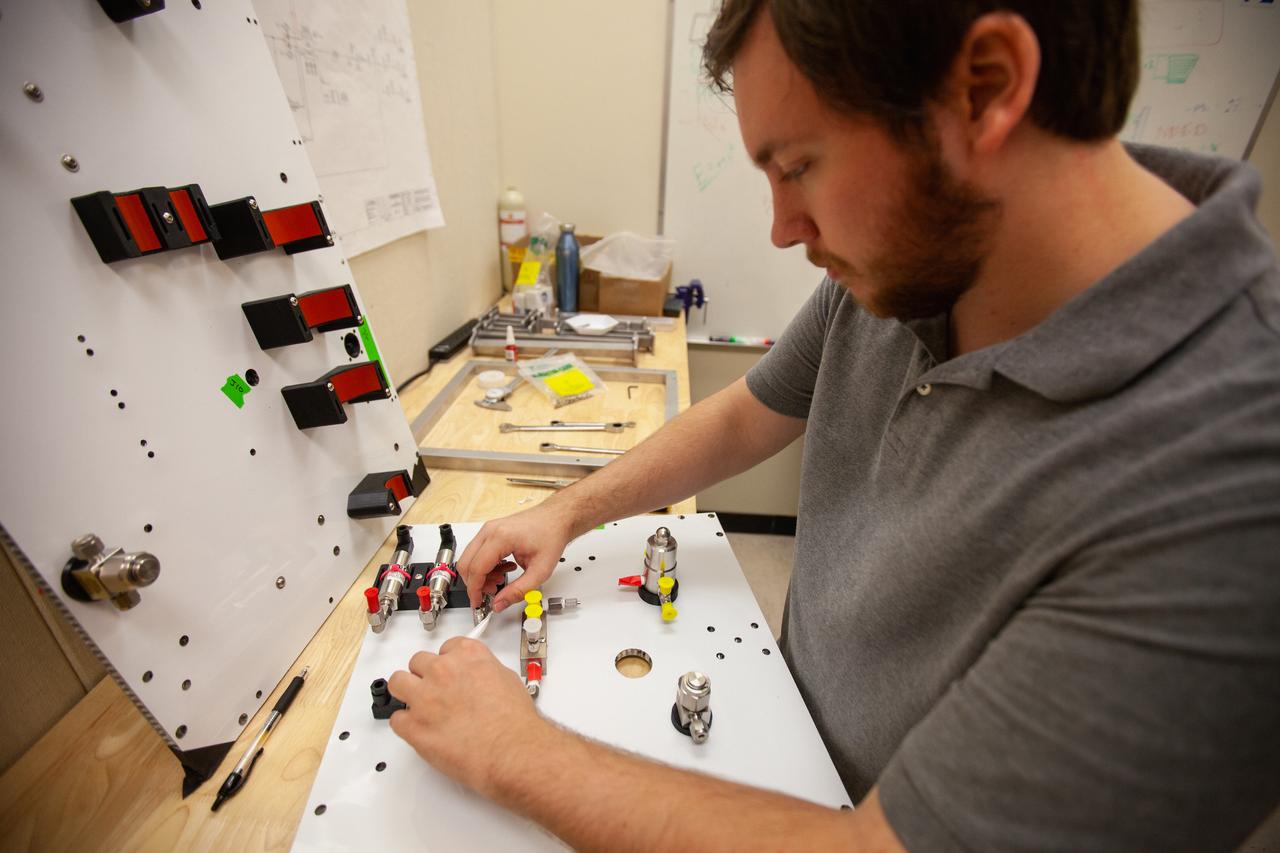
A Kennedy Space Center employee works on assembling the flight hardware of NASA’s Orbital Syngas Commodity Augmentation Reactor, or OSCAR – an Early Career Initiative project at the Florida spaceport that studies technology to convert trash and human waste into useful gasses such as methane, hydrogen and carbon dioxide. By processing small pieces of trash in a high-temperature reactor, OSCAR is advancing new and innovative technology for managing waste in space. OSCAR would reduce the amount of space needed for waste storage within a spacecraft, turn some waste into gasses that have energy storage and life support applications and ensure waste is no longer biologically active. A prototype has already been developed, and a team of Kennedy employees are in the process of constructing a new rig for suborbital flight testing.
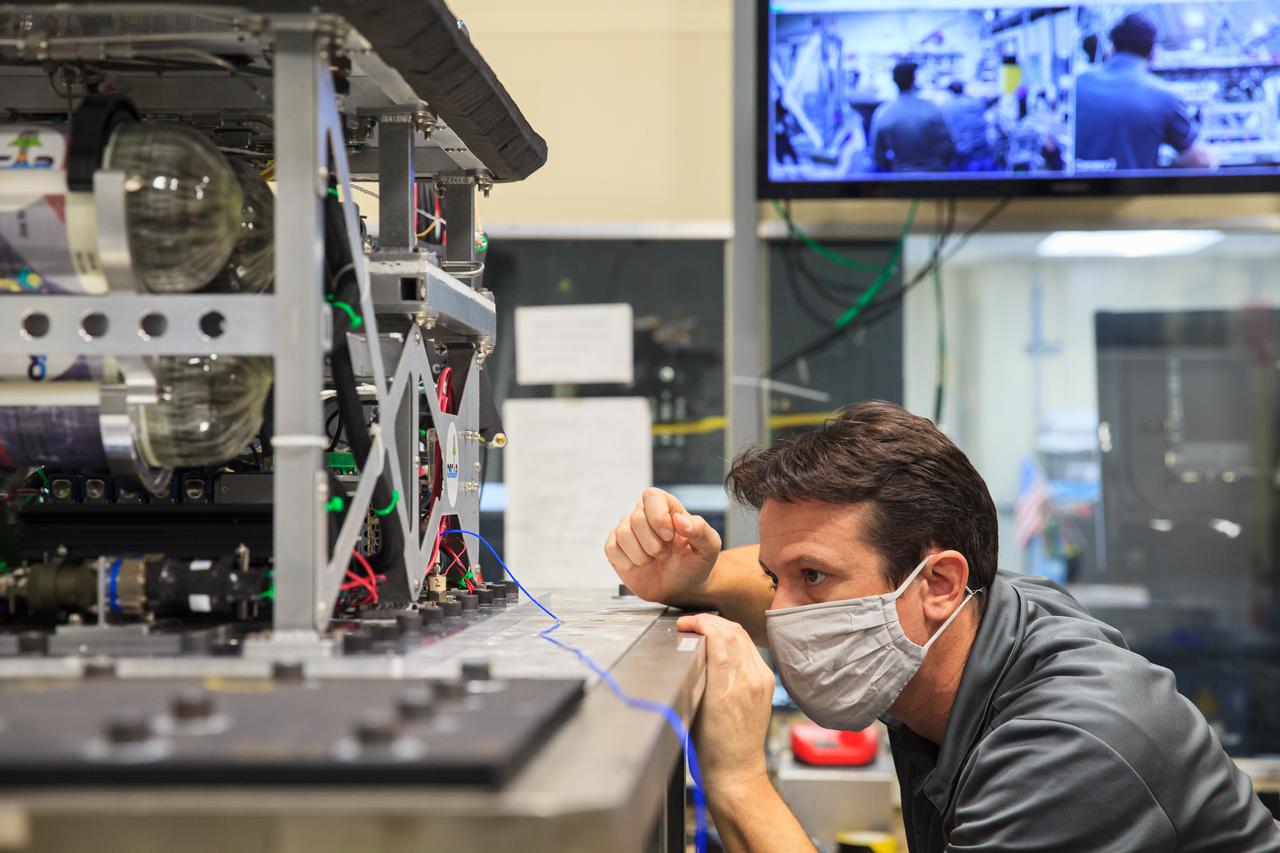
Gino Carro, a pressure vessels and systems engineer for Kennedy Space Center’s Laboratory Support Services and Operations contract, prepares NASA’s Orbital Syngas Commodity Augmentation Reactor (OSCAR) for vibration tests inside the Vibration Test Lab at the Florida spaceport on Jan. 14, 2021. The tests are part of ongoing preparation for a scheduled suborbital flight test later this year. Beginning as an Early Career Initiative project, OSCAR studies technology to convert trash and human waste into useful gasses such as methane, hydrogen, and carbon dioxide. By processing small pieces of trash in a high-temperature reactor, OSCAR would reduce the amount of space needed for waste storage within a spacecraft, turn some waste into gasses that have energy storage and life support applications, and ensure waste is no longer biologically active.
Inside the Vibration Test Lab at NASA’s Kennedy Space Center in Florida, the agency’s Orbital Syngas Commodity Augmentation Reactor (OSCAR) undergoes vibration testing on Jan. 14, 2021, in preparation for a scheduled suborbital flight test later this year. Beginning as an Early Career Initiative project, OSCAR studies technology to convert trash and human waste into useful gasses such as methane, hydrogen, and carbon dioxide. By processing small pieces of trash in a high-temperature reactor, OSCAR would reduce the amount of space needed for waste storage within a spacecraft, turn some waste into gasses that have energy storage and life support applications, and ensure waste is no longer biologically active.
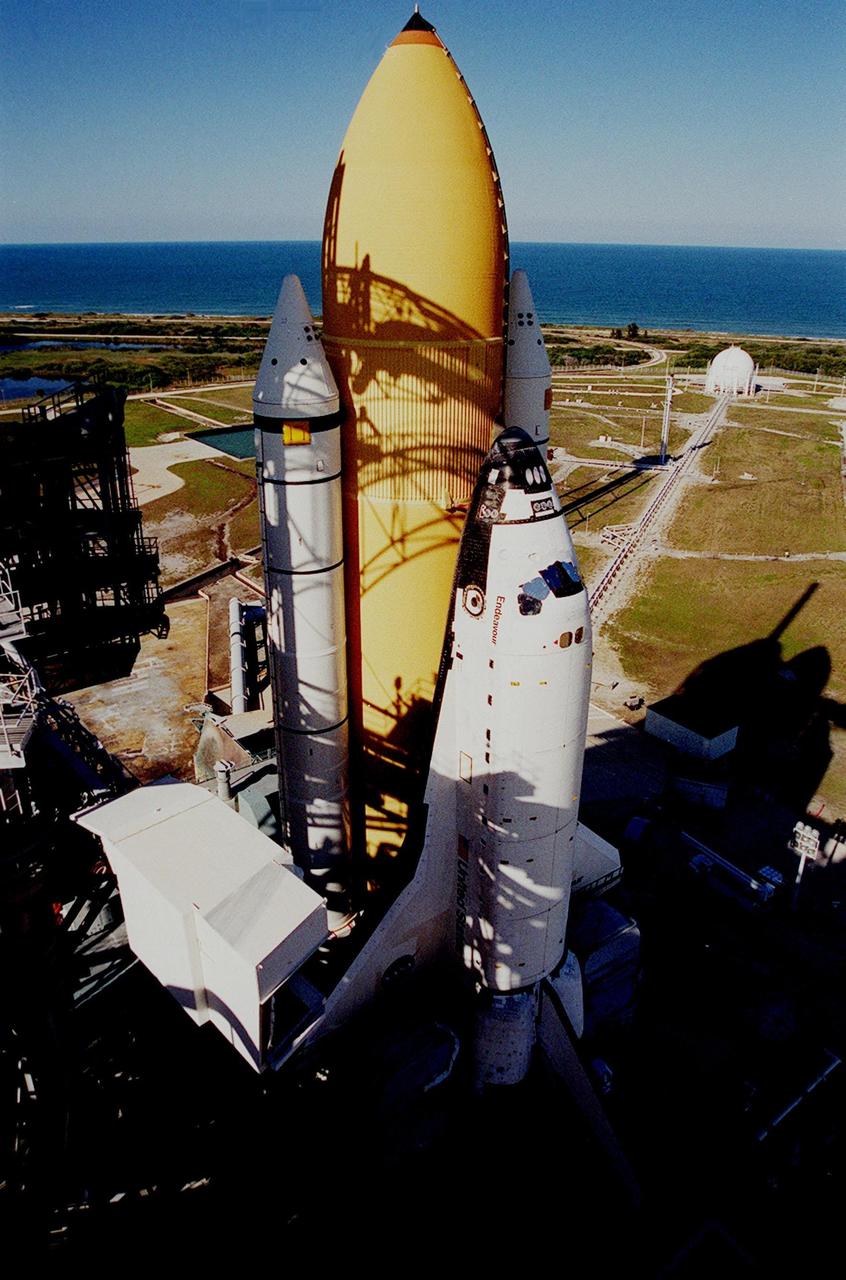
KENNEDY SPACE CENTER, FLA. -- Afternoon shadows cast a grid over the Space Shuttle Endeavour’s white solid rocket boosters and orange external tank after arriving on Launch Pad 39A. In the background is seen the deep blue of the Atlantic Ocean. Endeavour is expected to lift off on mission STS-100 on April 19, carrying the Multi-Purpose Logistics Module Raffaello and the Canadian robotic arm, SSRMS, to the International Space Station
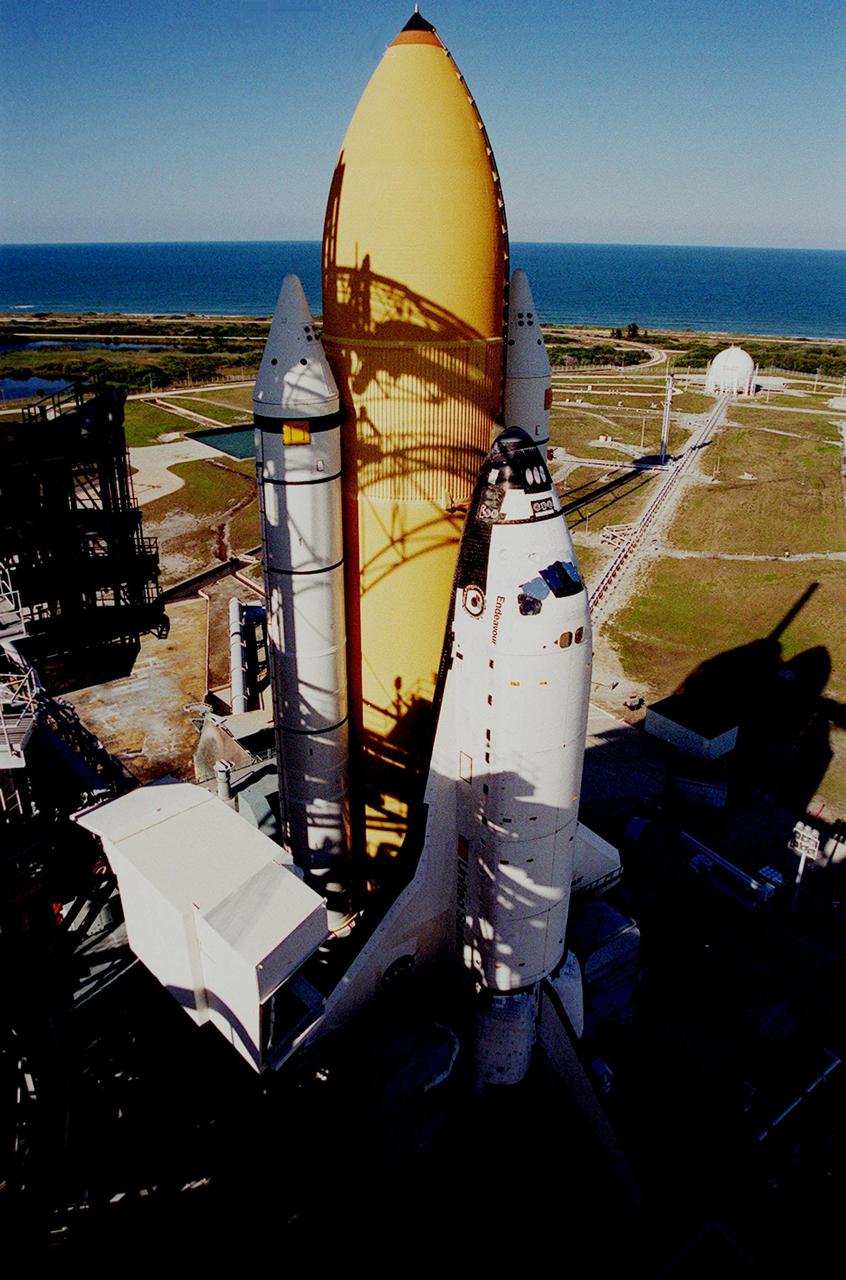
KENNEDY SPACE CENTER, FLA. -- Afternoon shadows cast a grid over the Space Shuttle Endeavour’s white solid rocket boosters and orange external tank after arriving on Launch Pad 39A. In the background is seen the deep blue of the Atlantic Ocean. Endeavour is expected to lift off on mission STS-100 on April 19, carrying the Multi-Purpose Logistics Module Raffaello and the Canadian robotic arm, SSRMS, to the International Space Station
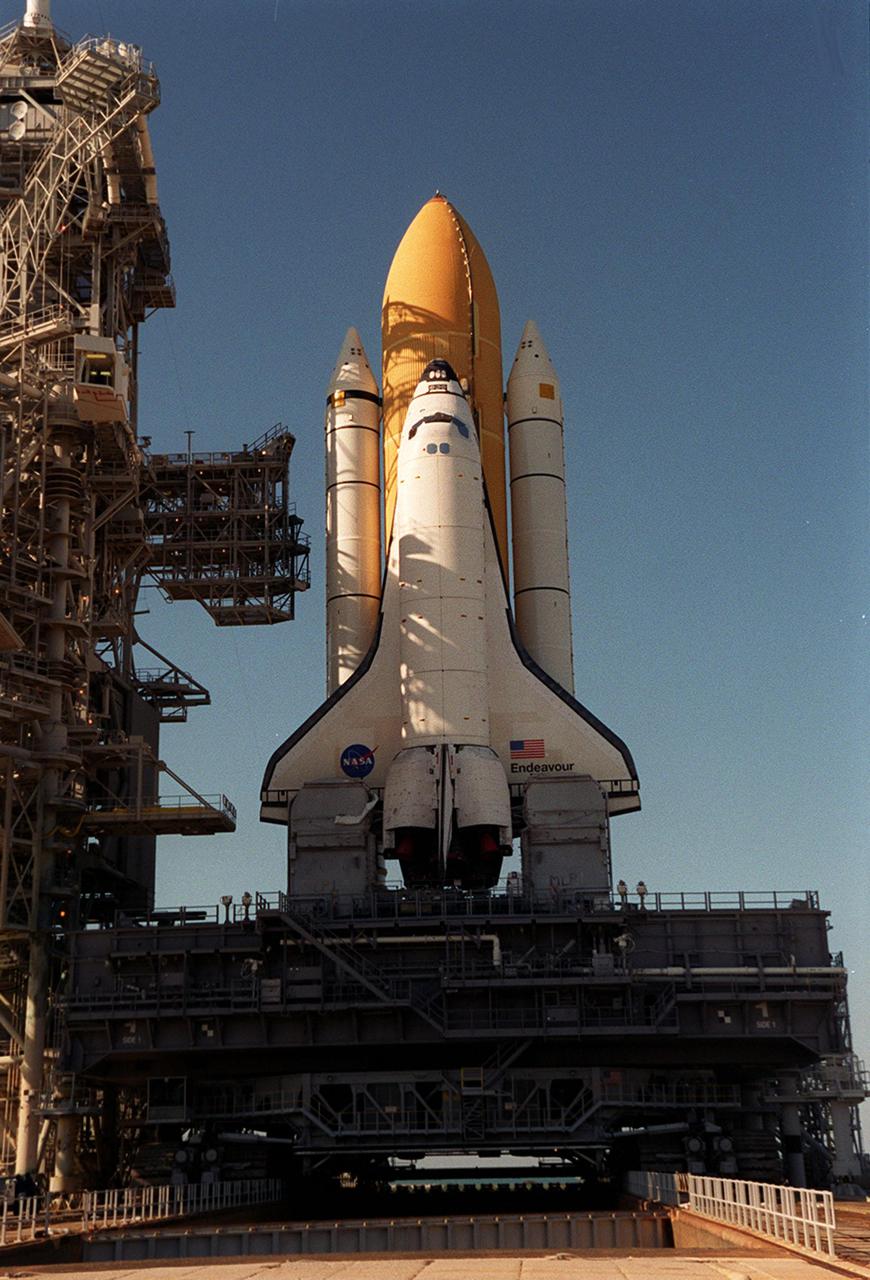
KENNEDY SPACE CENTER, FLA. -- The afternoon sun streaming through the Fixed Service Structure throws grid-like shadows over Space Shuttle Endeavour after arriving on Launch Pad 39A. In the background is seen the deep blue of the Atlantic Ocean. Endeavour is expected to lift off on mission STS-100 on April 19, carrying the Multi-Purpose Logistics Module Raffaello and the Canadian robotic arm, SSRMS, to the International Space Station
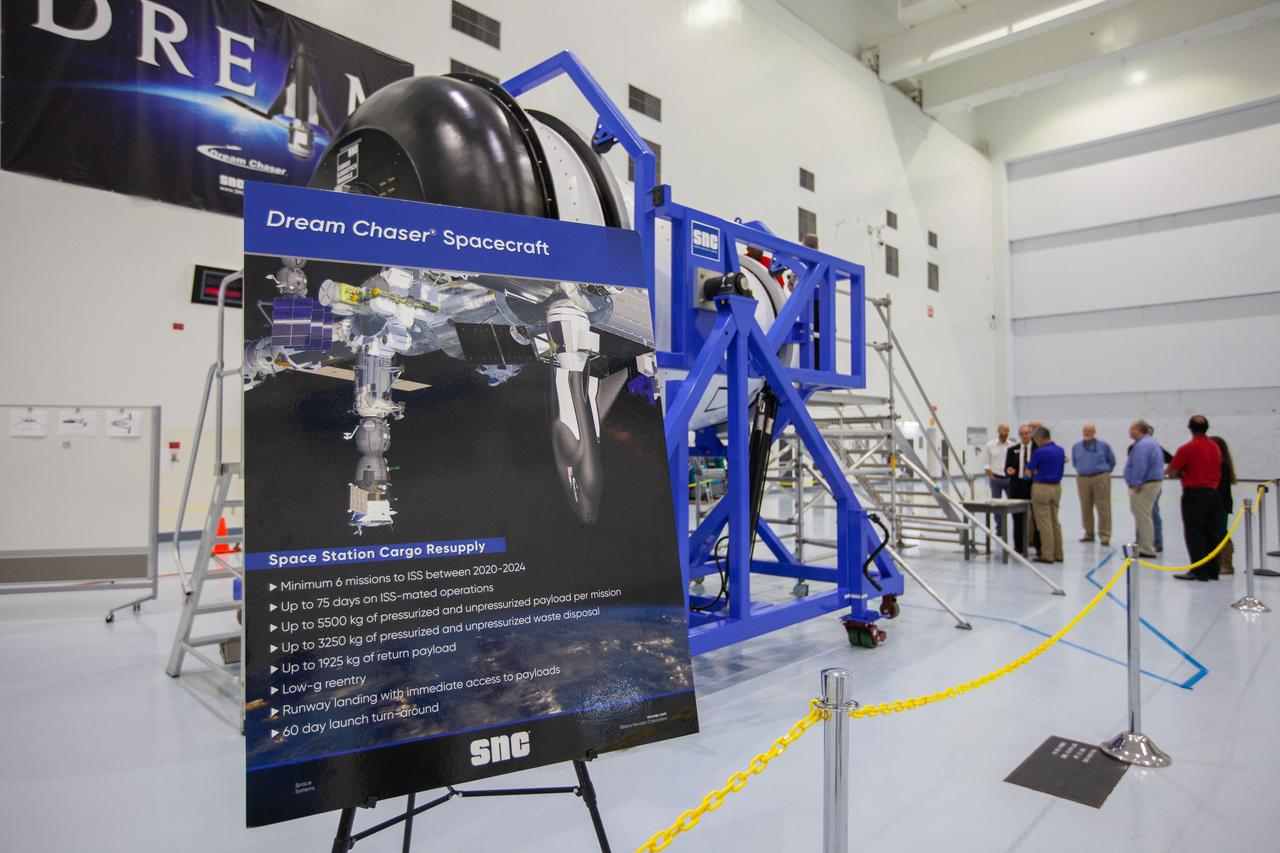
A mockup of the cargo logistics module for Sierra Nevada Corporation’s Dream Chaser, the company’s reusable spaceplane, arrived at the Space Station Processing Facility (SSPF) at NASA’s Kennedy Space Center in Florida in August. On Sept. 20, 2019, senior leadership had the opportunity to view the cargo module in the SSPF high bay. The SSPF is providing support for current and future NASA and commercial provider programs, including Commercial Resupply Services, Artemis 1, sending the first woman and next man to the Moon, and deep space destinations including Mars.
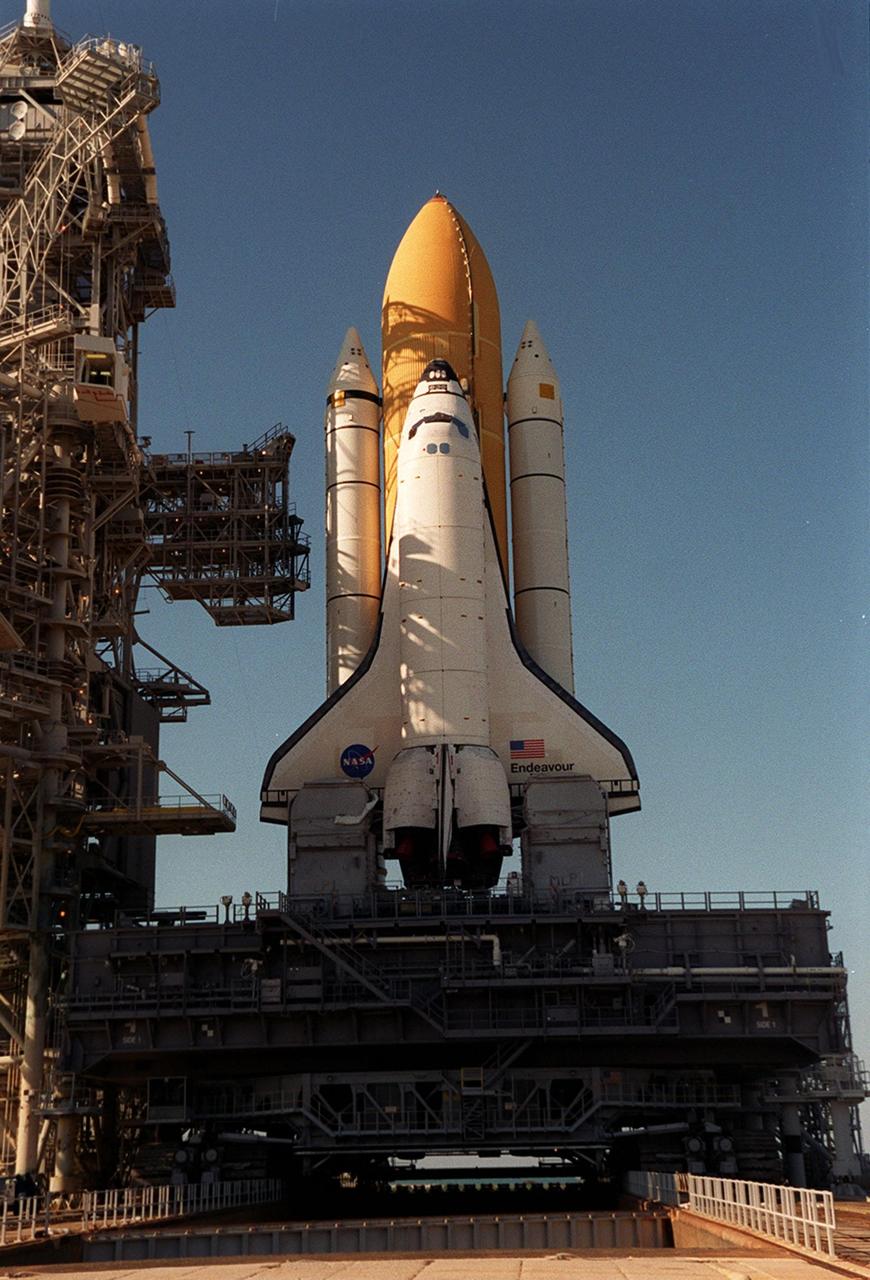
KENNEDY SPACE CENTER, FLA. -- The afternoon sun streaming through the Fixed Service Structure throws grid-like shadows over Space Shuttle Endeavour after arriving on Launch Pad 39A. In the background is seen the deep blue of the Atlantic Ocean. Endeavour is expected to lift off on mission STS-100 on April 19, carrying the Multi-Purpose Logistics Module Raffaello and the Canadian robotic arm, SSRMS, to the International Space Station

Mark Weise, manager, NASA’s Gateway Deep Space Logistics, speaks to a crowd gathered for the 2024 Kennedy Space Center Community Leaders Update on Thursday, May 23, 2024, at the center’s Visitor Complex. Weise and other senior leaders discussed how programs based at NASA Kennedy support the agency’s efforts to return humans to the Moon in preparation for Mars and answered questions from guests.
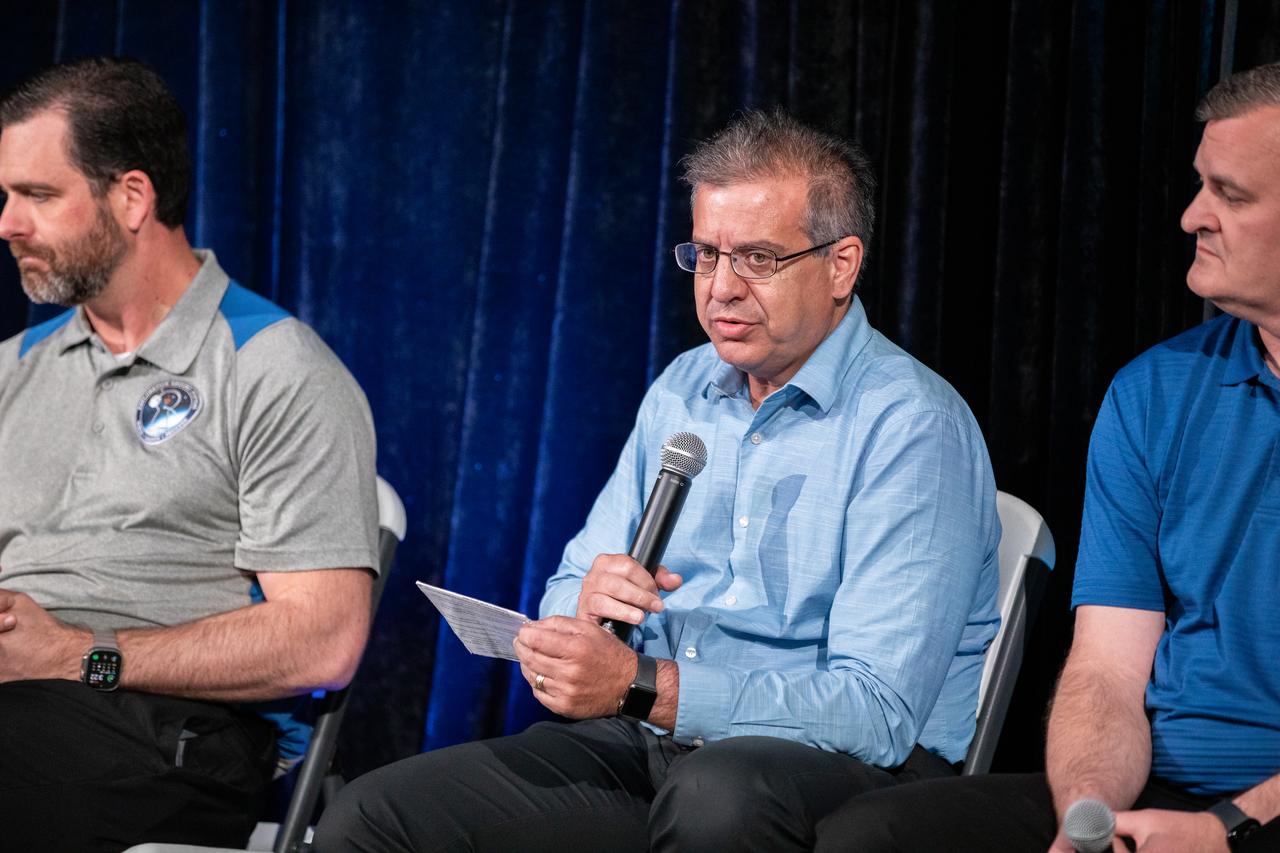
In the middle, Emilio Cruz, deputy director, NASA’s Exploration Research and Technology Programs, speaks to a crowd gathered for the 2024 Kennedy Space Center Community Leaders Update on Thursday, May 23, 2024, held at the center’s Visitor Complex. From left, Jeremy Parsons, deputy manager, NASA’s Exploration Ground Systems, and Mark Weise, manager, Gateway Deep Space Logistics, discussed how programs based at NASA Kennedy support the agency’s efforts to return humans to the Moon in preparation for Mars and answered questions from guests.
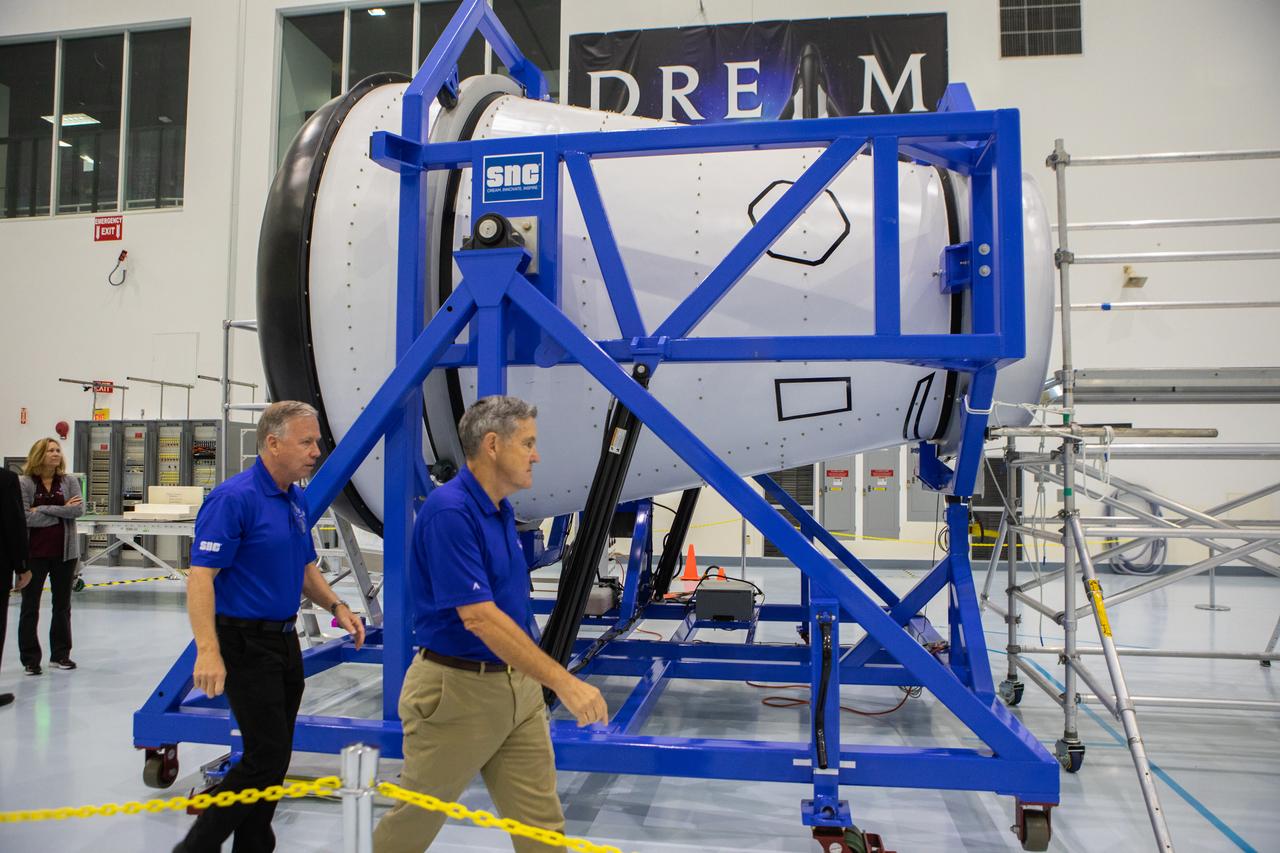
A mockup of the cargo logistics module for Sierra Nevada Corporation’s Dream Chaser, the company’s reusable spaceplane, arrived at the Space Station Processing Facility (SSPF) at NASA’s Kennedy Space Center in Florida in August. On Sept. 20, 2019, senior leadership had the opportunity to view the cargo module in the SSPF high bay. Kennedy Center Director Bob Cabana, at right, views the cargo module with Steve Lindsey, vice president, Space Exploration Systems, Sierra Nevada Corporation. The SSPF is providing support for current and future NASA and commercial provider programs, including Commercial Resupply Services, Artemis 1, sending the first woman and next man to the Moon, and deep space destinations including Mars.
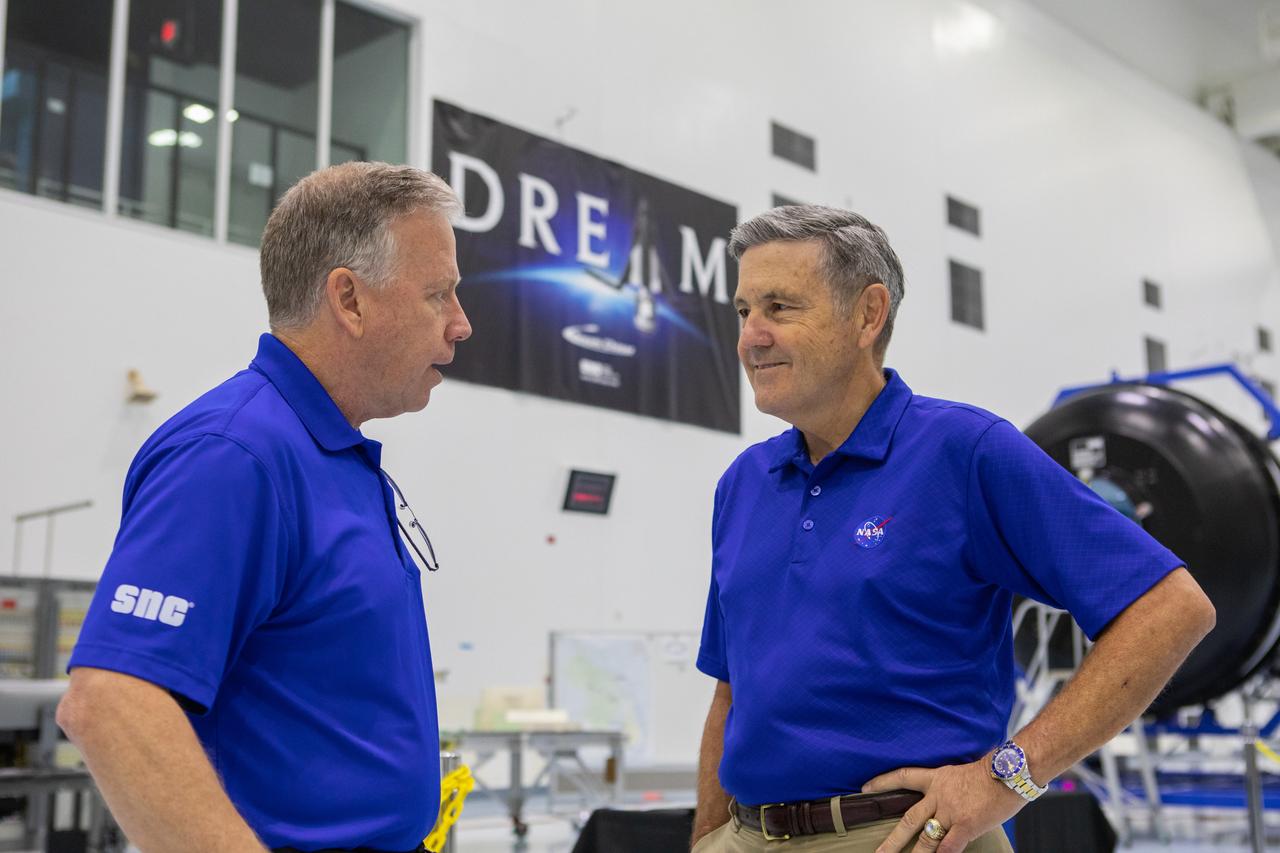
A mockup of the cargo logistics module for Sierra Nevada Corporation’s Dream Chaser, the company’s reusable spaceplane, arrived at the Space Station Processing Facility (SSPF) at NASA’s Kennedy Space Center in Florida in August. On Sept. 20, 2019, senior leadership had the opportunity to view the cargo module in the SSPF high bay. Kennedy Center Director Bob Cabana, at right, speaks with Steve Lindsey, vice president, Space Exploration Systems, Sierra Nevada Corporation. The SSPF is providing support for current and future NASA and commercial provider programs, including Commercial Resupply Services, Artemis 1, sending the first woman and next man to the Moon, and deep space destinations including Mars.
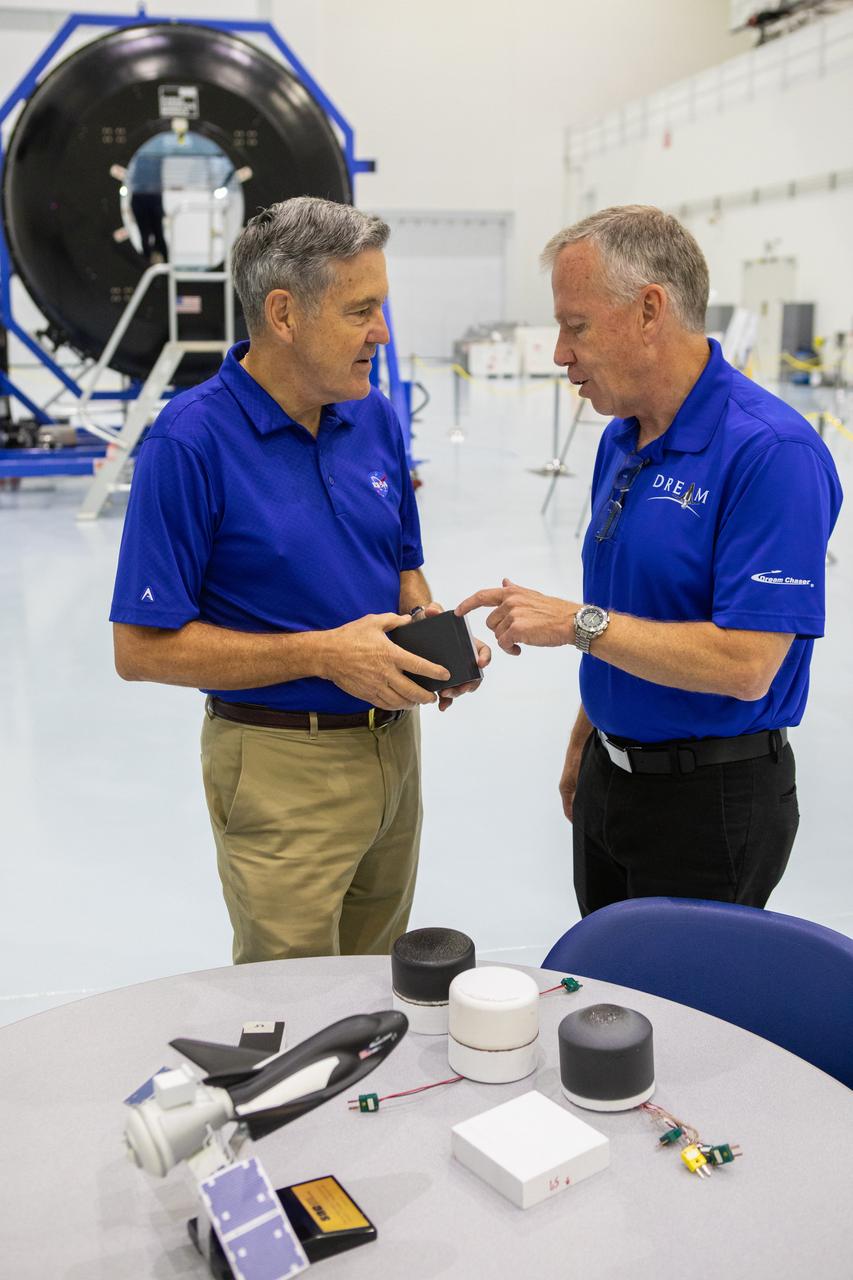
A mockup of the cargo logistics module for Sierra Nevada Corporation’s Dream Chaser, the company’s reusable spaceplane, arrived at the Space Station Processing Facility (SSPF) at NASA’s Kennedy Space Center in Florida in August. On Sept. 20, 2019, senior leadership had the opportunity to view the cargo module in the SSPF high bay. Kennedy Center Director Bob Cabana, left, speaks to Steve Lindsey, vice president, Space Exploration Systems, Sierra Nevada Corporation. The SSPF is providing support for current and future NASA and commercial provider programs, including Commercial Resupply Services, Artemis 1, sending the first woman and next man to the Moon, and deep space destinations including Mars.
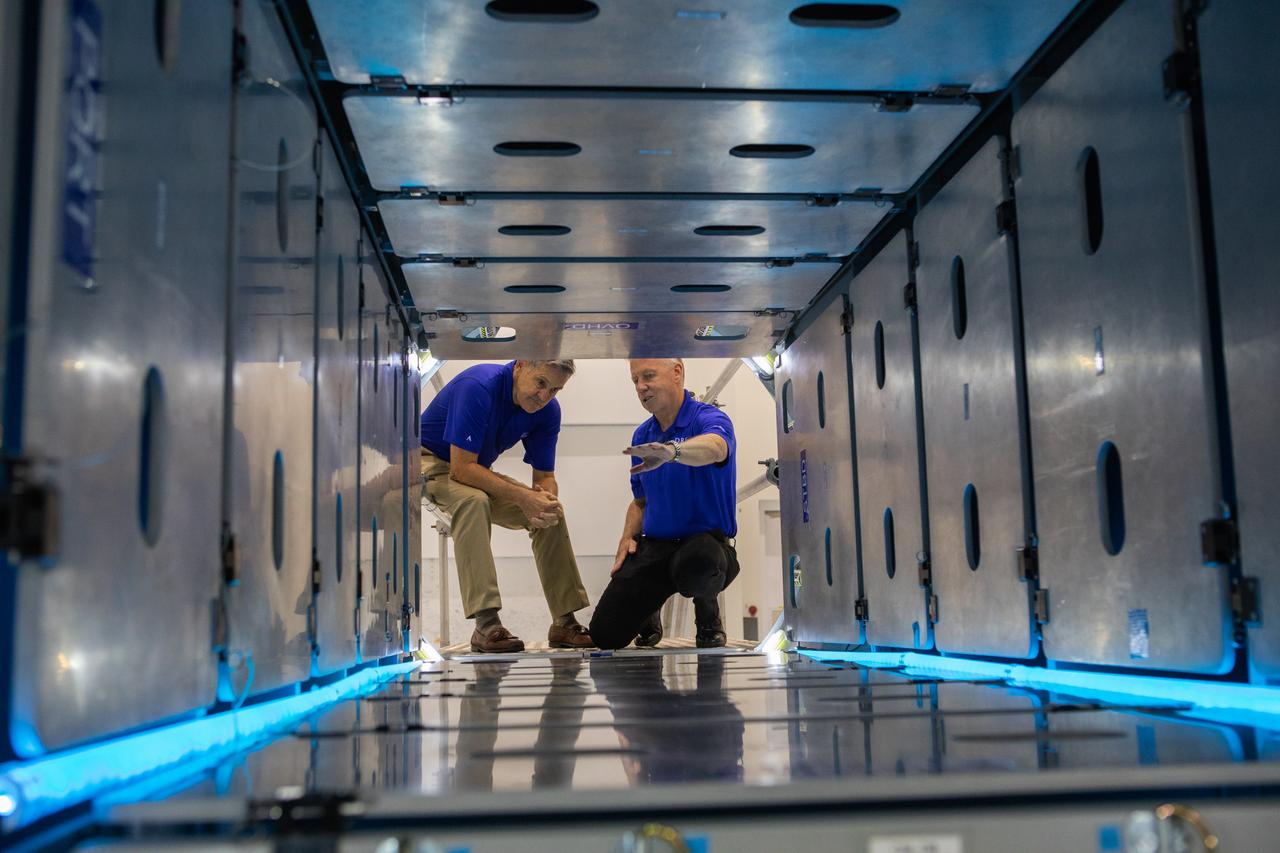
A mockup of the cargo logistics module for Sierra Nevada Corporation’s Dream Chaser, the company’s reusable spaceplane, arrived at the Space Station Processing Facility (SSPF) at NASA’s Kennedy Space Center in Florida in August. On Sept. 20, 2019, senior leadership had the opportunity to view the cargo module in the SSPF high bay. Kennedy Center Director Bob Cabana, views the interior of the cargo module with Steve Lindsey, vice president, Space Exploration Systems, Sierra Nevada Corporation. The SSPF is providing support for current and future NASA and commercial provider programs, including Commercial Resupply Services, Artemis 1, sending the first woman and next man to the Moon, and deep space destinations including Mars.
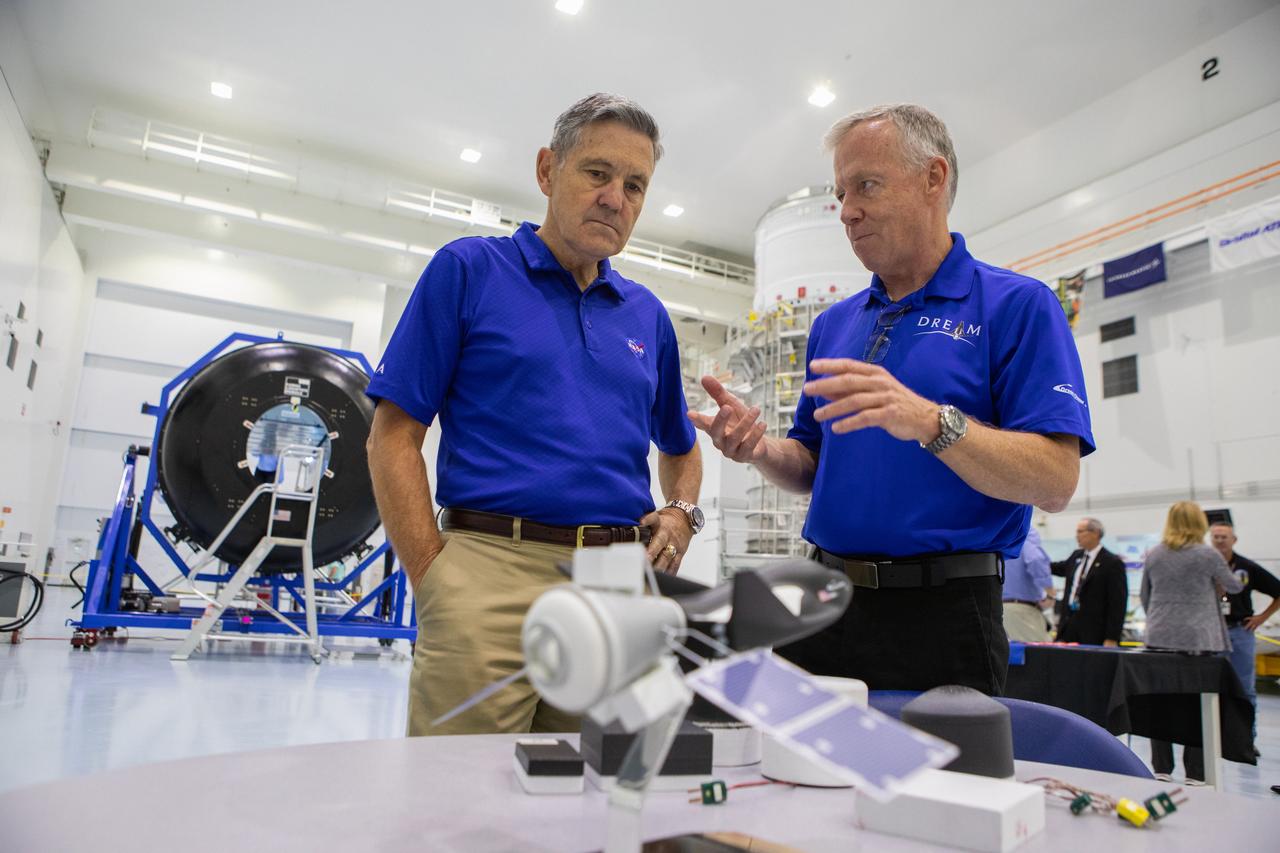
A mockup of the cargo logistics module for Sierra Nevada Corporation’s Dream Chaser, the company’s reusable spaceplane, arrived at the Space Station Processing Facility (SSPF) at NASA’s Kennedy Space Center in Florida in August. On Sept. 20, 2019, senior leadership had the opportunity to view the cargo module in the SSPF high bay. Kennedy Center Director Bob Cabana, left, speaks to Steve Lindsey, vice president, Space Exploration Systems, Sierra Nevada Corporation. The SSPF is providing support for current and future NASA and commercial provider programs, including Commercial Resupply Services, Artemis 1, sending the first woman and next man to the Moon, and deep space destinations including Mars.
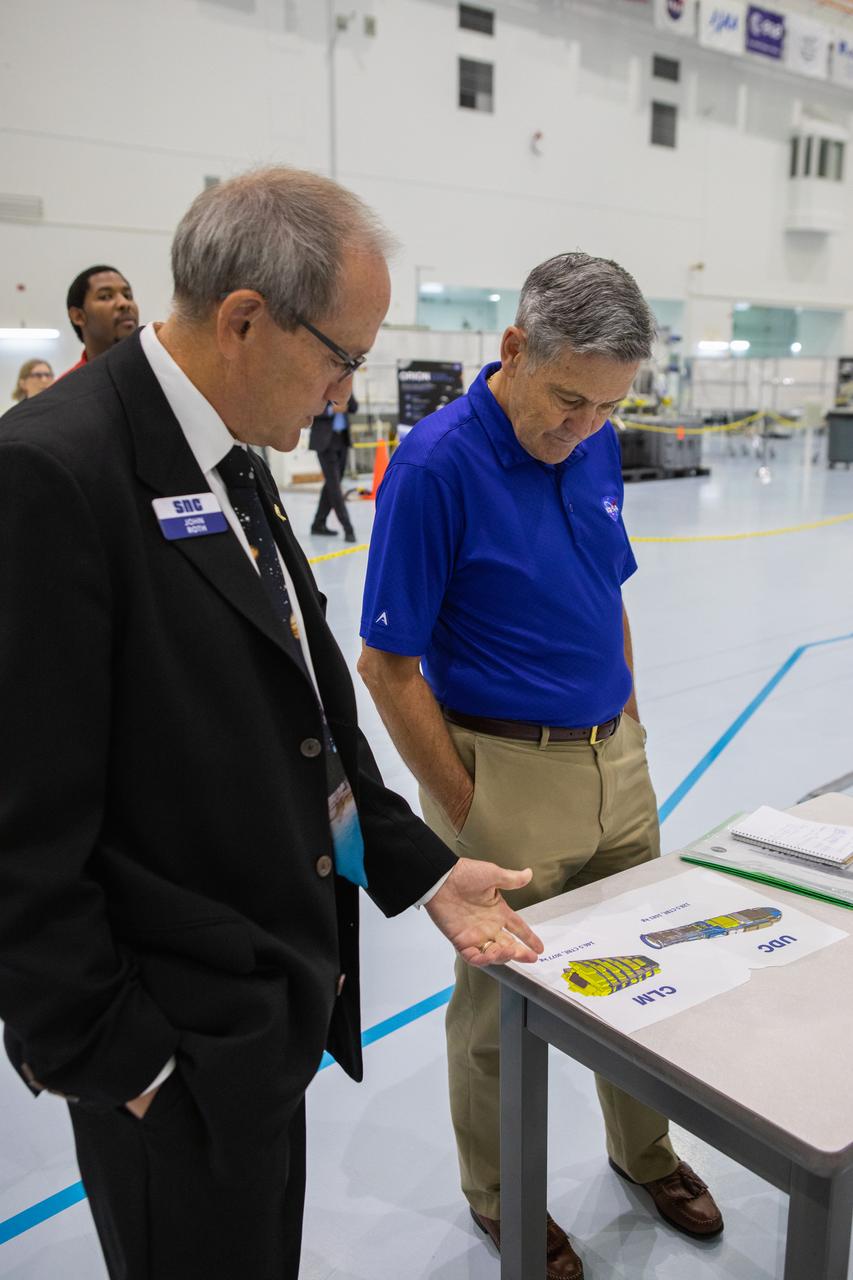
A mockup of the cargo logistics module for Sierra Nevada Corporation’s Dream Chaser, the company’s reusable spaceplane, arrived at the Space Station Processing Facility (SSPF) at NASA’s Kennedy Space Center in Florida in August. On Sept. 20, 2019, senior leadership had the opportunity to view the cargo module in the SSPF high bay. Kennedy Center Director Bob Cabana, at right, listens to John Roth, vice president, Business Development Space Systems, Sierra Nevada Corporation. The SSPF is providing support for current and future NASA and commercial provider programs, including Commercial Resupply Services, Artemis 1, sending the first woman and next man to the Moon, and deep space destinations including Mars.
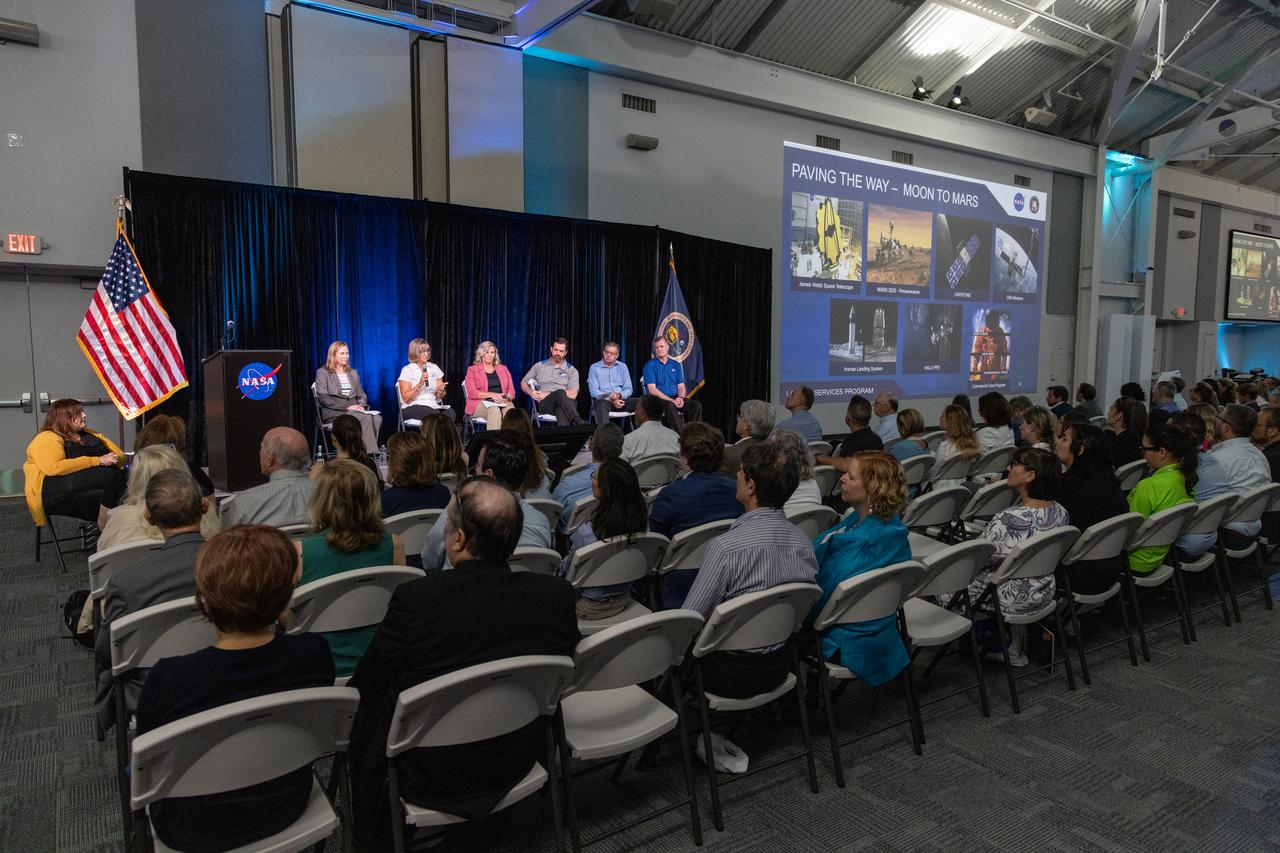
NASA Kennedy Space Center Director Janet Petro, with senior leaders of NASA and center programs, holds a Community Leaders Update on Thursday, May 23, 2024, at the Kennedy Space Center Visitor Complex. The panel discussed how programs based at NASA Kennedy support the agency’s efforts to return humans to the Moon and prepare for Mars, and they answered questions from guests. From second to left, Jenny Lyons, deputy manager, Launch Services Program; Dana Hutcherson, deputy manager, Commercial Crew Program; Jeremy Parsons, deputy manager, Exploration Ground Systems; Emilio Cruz, deputy director, Exploration Research and Technology Programs; and Mark Weise, manager, Gateway Deep Space Logistics.
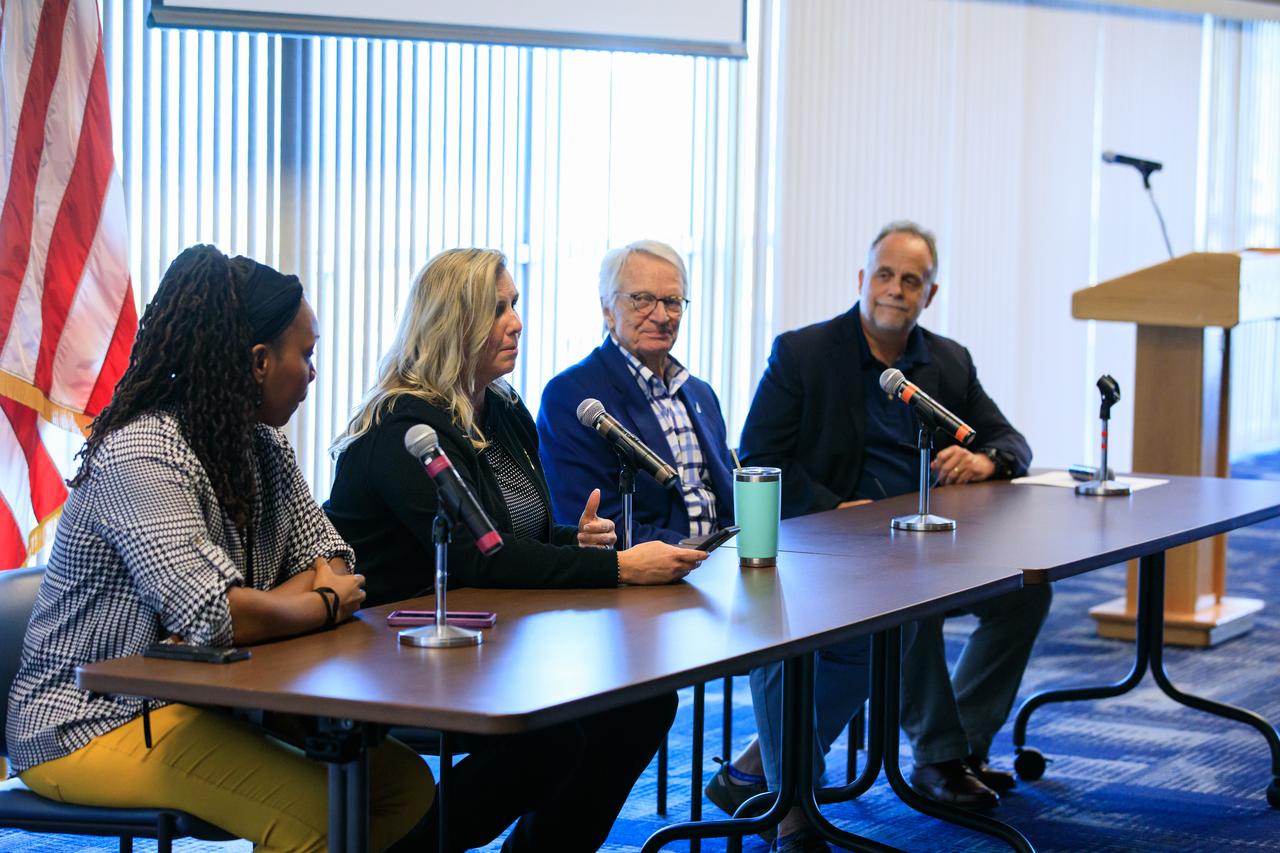
NASA’s Exploration Ground Systems Manager Shawn Quinn, right, moderates the inaugural Cross-Program Connection event at NASA Kennedy Space Center’s Space Station Processing Facility in Florida on March 8, 2023. Other participants, from left, are: Stacie Turner, Kennedy’s Deep Space Logistics; Dana Hutcherson, NASA’s Commercial Crew Program deputy program manager; and Arthur Muir, a retired Chicago attorney and America’s oldest Mt. Everest summiteer. Muir, 75, was the speaker at the event titled “Explorers Doing the Impossible.” He toured Kennedy before sharing his experiences in overcoming incredible challenges during his journey to the top of Earth’s highest mountain.
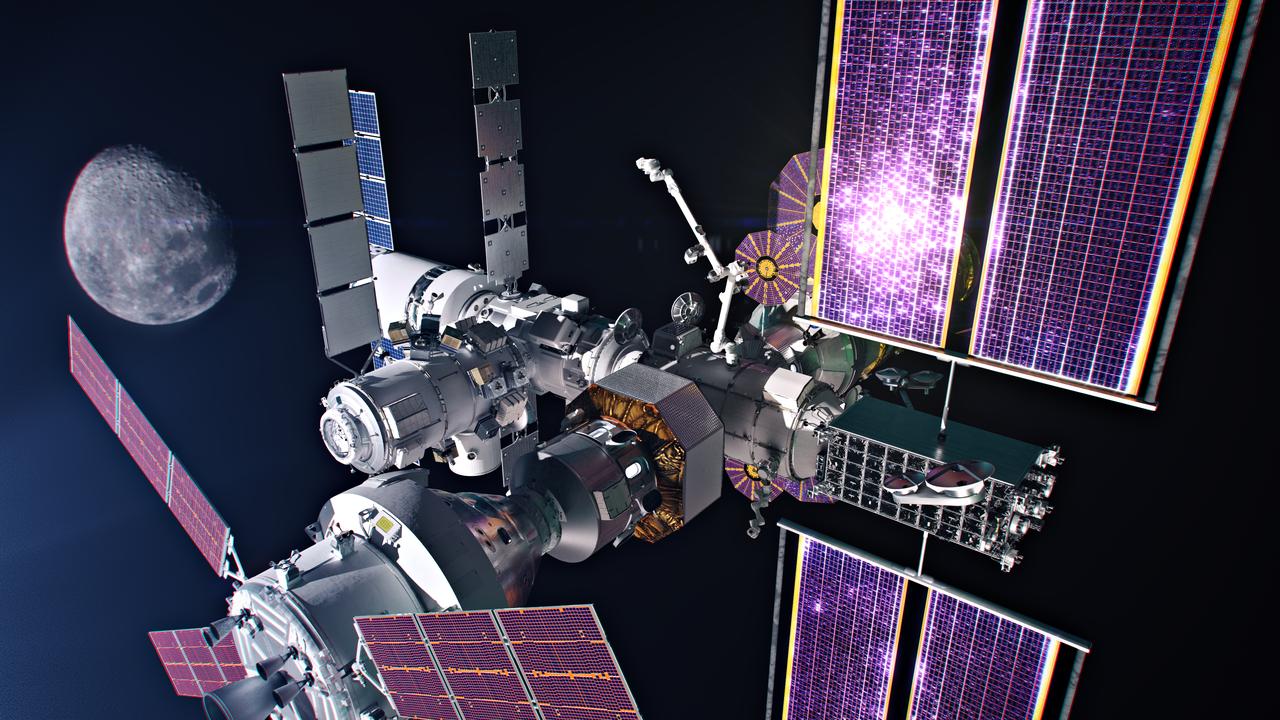
The Gateway space station will be humanity's first space station around the Moon as a vital component of the Artemis missions to return humans to the lunar surface for scientific discovery and chart the path for the first human missions to Mars. Astronauts on Gateway will be the first humans to call deep space home during missions where they will use Gateway to conduct science and prepare for lunar surface missions.

Patrick Follis, an intern at NASA’s Kennedy Space Center in Florida, assembles the flight hardware for the agency’s Orbital Syngas Commodity Augmentation Reactor, or OSCAR. OSCAR is an Early Career Initiative project at the spaceport that studies technology to convert trash and human waste into useful gasses such as methane, hydrogen and carbon dioxide. By processing small pieces of trash in a high-temperature reactor, OSCAR is advancing new and innovative technology for managing waste in space. OSCAR would reduce the amount of space needed for waste storage within a spacecraft, turn some waste into gasses that have energy storage and life support applications, and ensure waste is no longer biologically active. A prototype has been developed, and a team of Kennedy employees are in the process of constructing a new rig for suborbital flight testing.
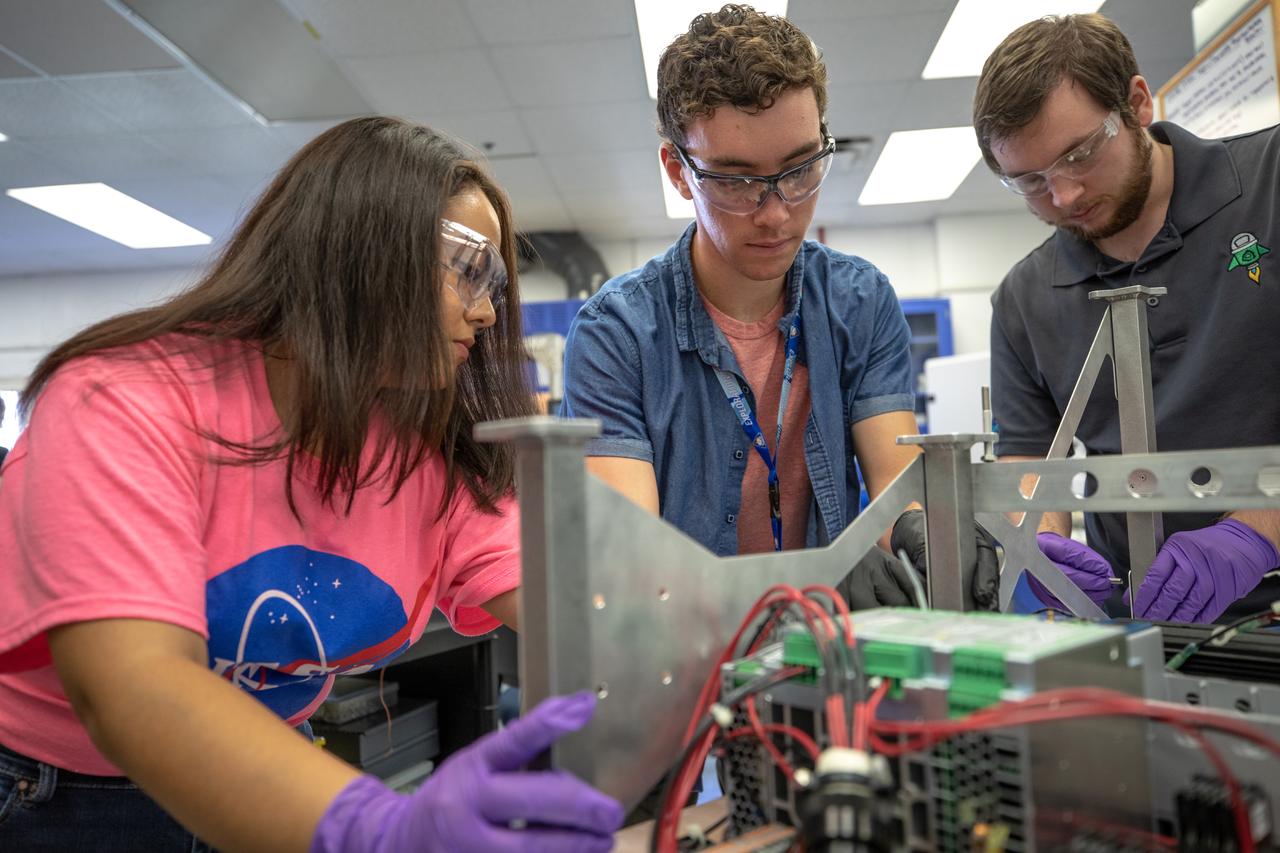
From left, Kennedy Space Center interns Brianna Sandoval and Patrick Follis, and Kennedy employee Jonathan Gleeson assemble the flight hardware of NASA’s Orbital Syngas Commodity Augmentation Reactor, or OSCAR. OSCAR is an Early Career Initiative project at the Florida spaceport that studies technology to convert trash and human waste into useful gasses such as methane, hydrogen and carbon dioxide. By processing small pieces of trash in a high-temperature reactor, OSCAR is advancing new and innovative technology for managing waste in space. OSCAR would reduce the amount of space needed for waste storage within a spacecraft, turn some waste into gasses that have energy storage and life support applications, and ensure waste is no longer biologically active. A prototype has been developed, and a team of Kennedy employees are in the process of constructing a new rig for suborbital flight testing.
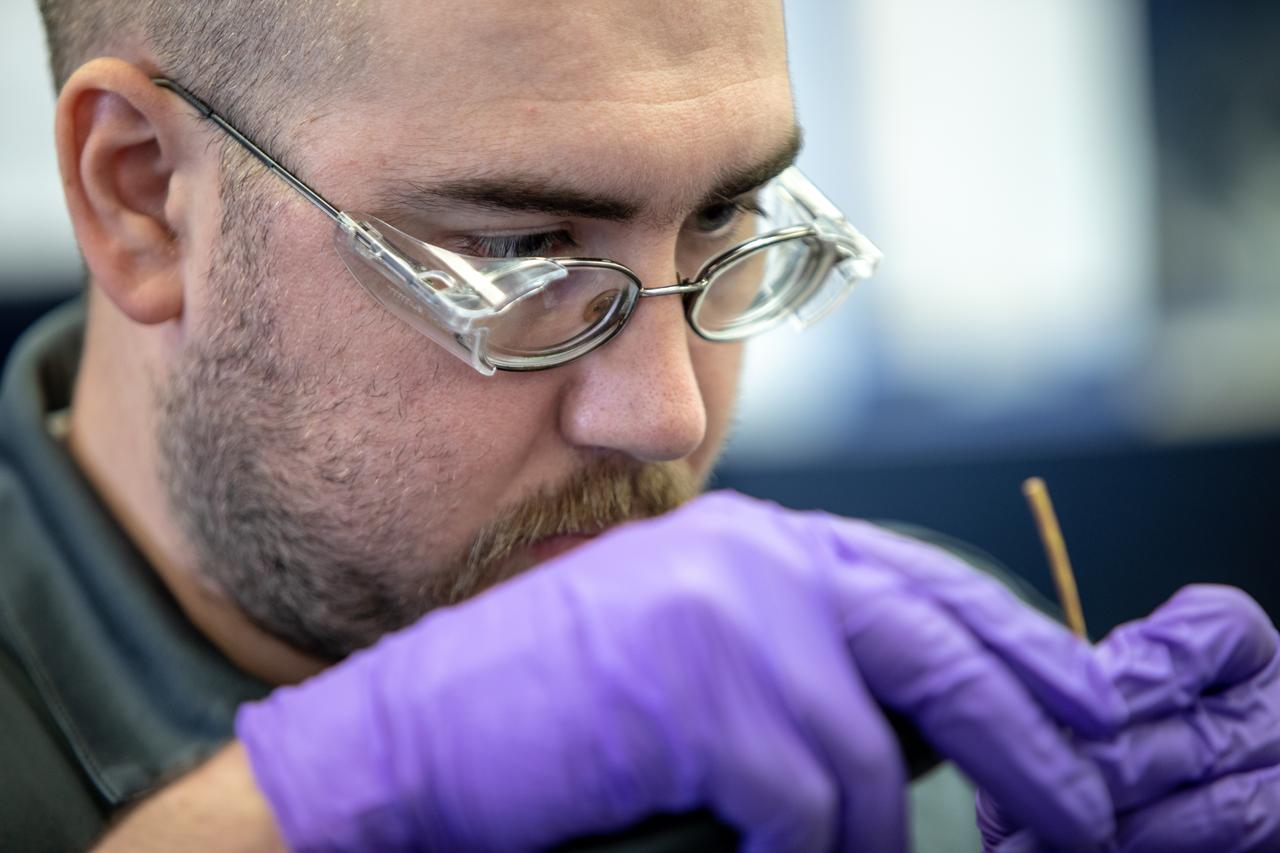
Thomas Cauvel, an intern assisting with software/electrical engineering on NASA’s Orbital Syngas Commodity Augmentation Reactor, or OSCAR, at Kennedy Space Center assembles the flight hardware. OSCAR is an Early Career Initiative project at the Florida spaceport that studies technology to convert trash and human waste into useful gasses such as methane, hydrogen and carbon dioxide. By processing small pieces of trash in a high-temperature reactor, OSCAR is advancing new and innovative technology for managing waste in space. OSCAR would reduce the amount of space needed for waste storage within a spacecraft, turn some waste into gasses that have energy storage and life support applications, and ensure waste is no longer biologically active. A prototype has been developed, and a team of Kennedy employees are in the process of constructing a new rig for suborbital flight testing.

NASA’s Orbital Syngas Commodity Augmentation Reactor, or OSCAR, is being prepared for suborbital flight testing at the agency’s Kennedy Space Center in Florida. OSCAR is an Early Career Initiative project at the spaceport that studies technology to convert trash and human waste into useful gasses such as methane, hydrogen and carbon dioxide. By processing small pieces of trash in a high-temperature reactor, OSCAR is advancing new and innovative technology for managing waste in space. OSCAR would reduce the amount of space needed for waste storage within a spacecraft, turn some waste into gasses that have energy storage and life support applications, and ensure waste is no longer biologically active. A prototype has been developed, and a team of Kennedy employees are in the process of constructing a new rig for the suborbital flight test.
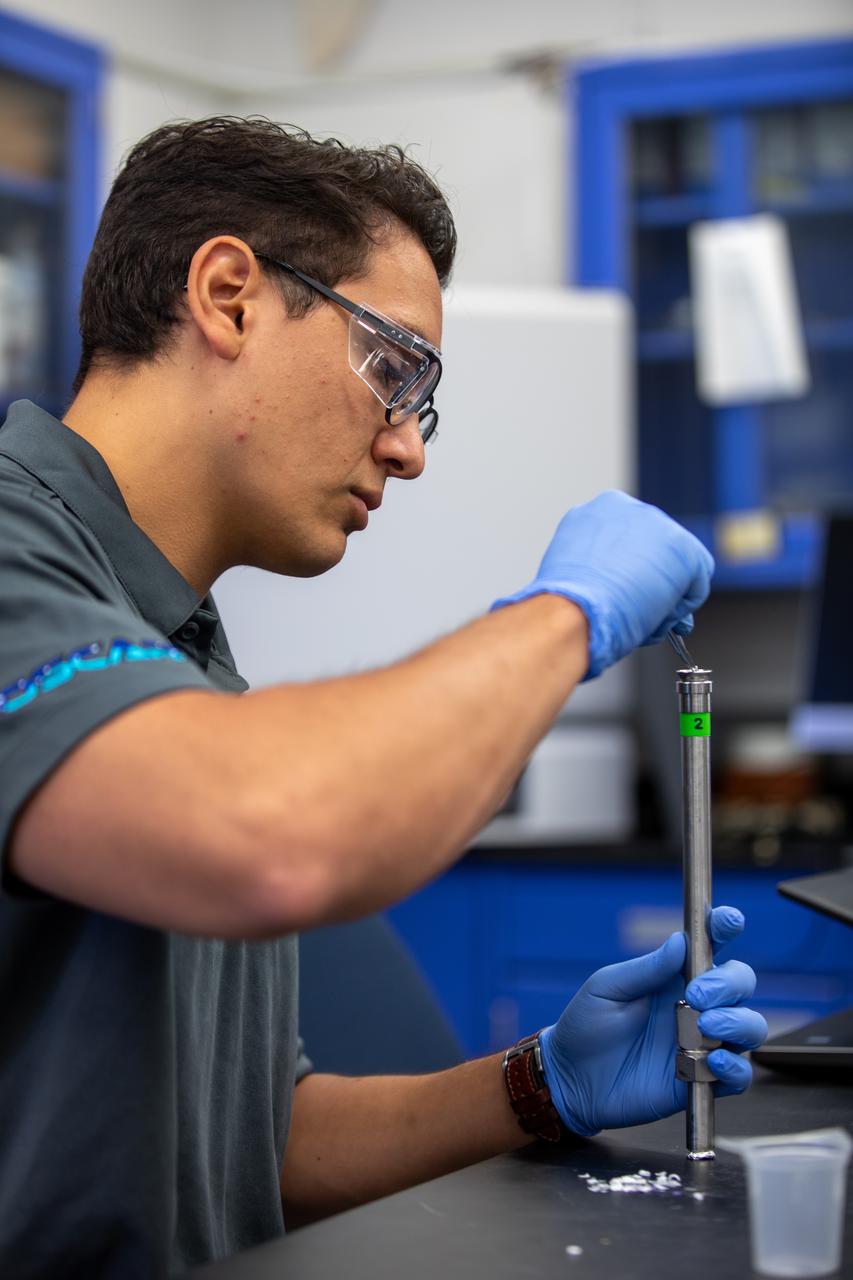
Ray Pitts, co-principal investigator for the Orbital Syngas Commodity Augmentation Reactor (OSCAR), performs ground testing at NASA’s Kennedy Space Center in Florida. The tests are in preparation for a scheduled suborbital flight test later this year, facilitated by NASA’s Flight Opportunities program. Begun as an Early Career Initiative project, OSCAR evaluates technology to make use of trash and human waste generated during long-duration spaceflight.
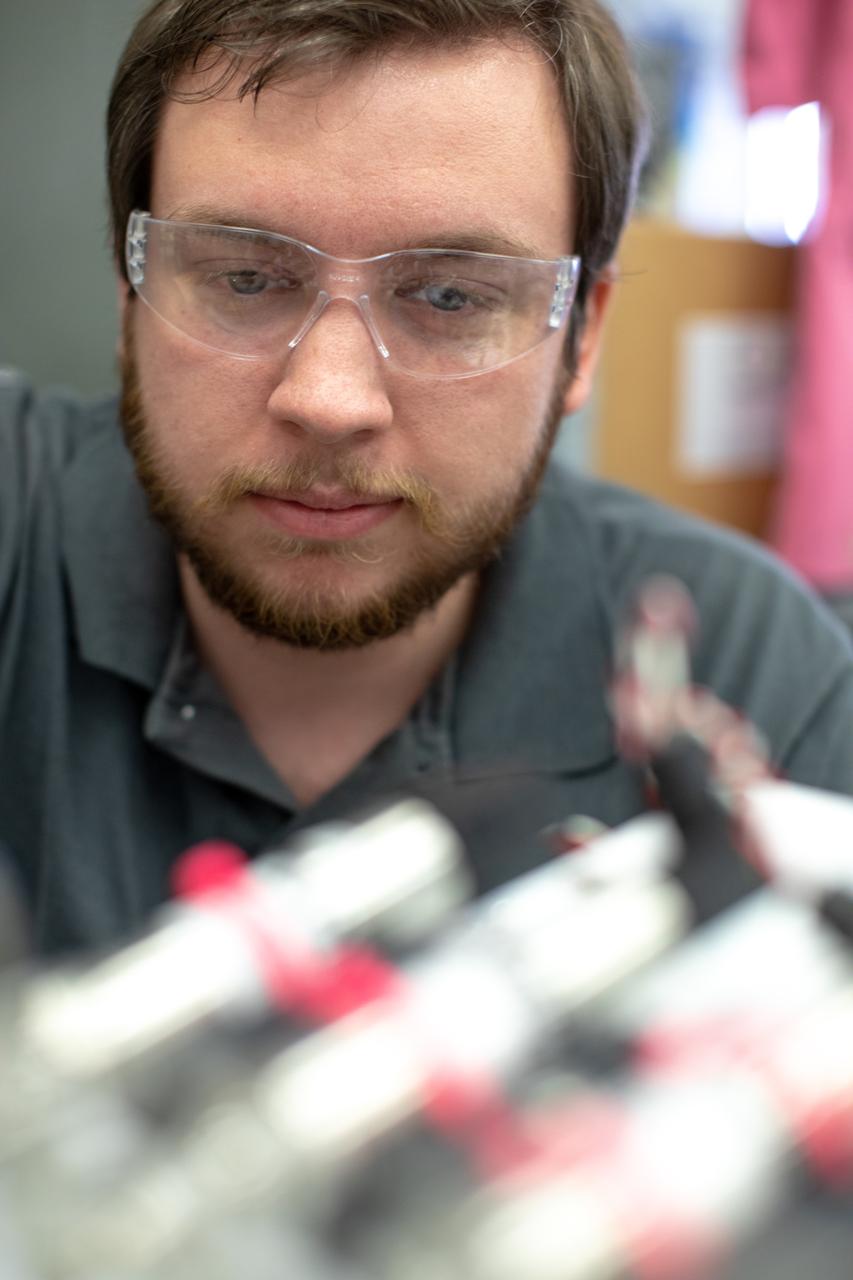
Jonathan Gleeson, Kennedy Space Center employee providing support for NASA’s Orbital Syngas Commodity Augmentation Reactor (OSCAR) under the center’s Laboratory Support Services and Operations contract, assembles the flight hardware of OSCAR. OSCAR is an Early Career Initiative project at the Florida spaceport that studies technology to convert trash and human waste into useful gasses such as methane, hydrogen and carbon dioxide. By processing small pieces of trash in a high-temperature reactor, OSCAR is advancing new and innovative technology for managing waste in space. OSCAR would reduce the amount of space needed for waste storage within a spacecraft, turn some waste into gasses that have energy storage and life support applications, and ensure waste is no longer biologically active. A prototype has been developed, and a team of Kennedy employees are in the process of constructing a new rig for suborbital flight testing.
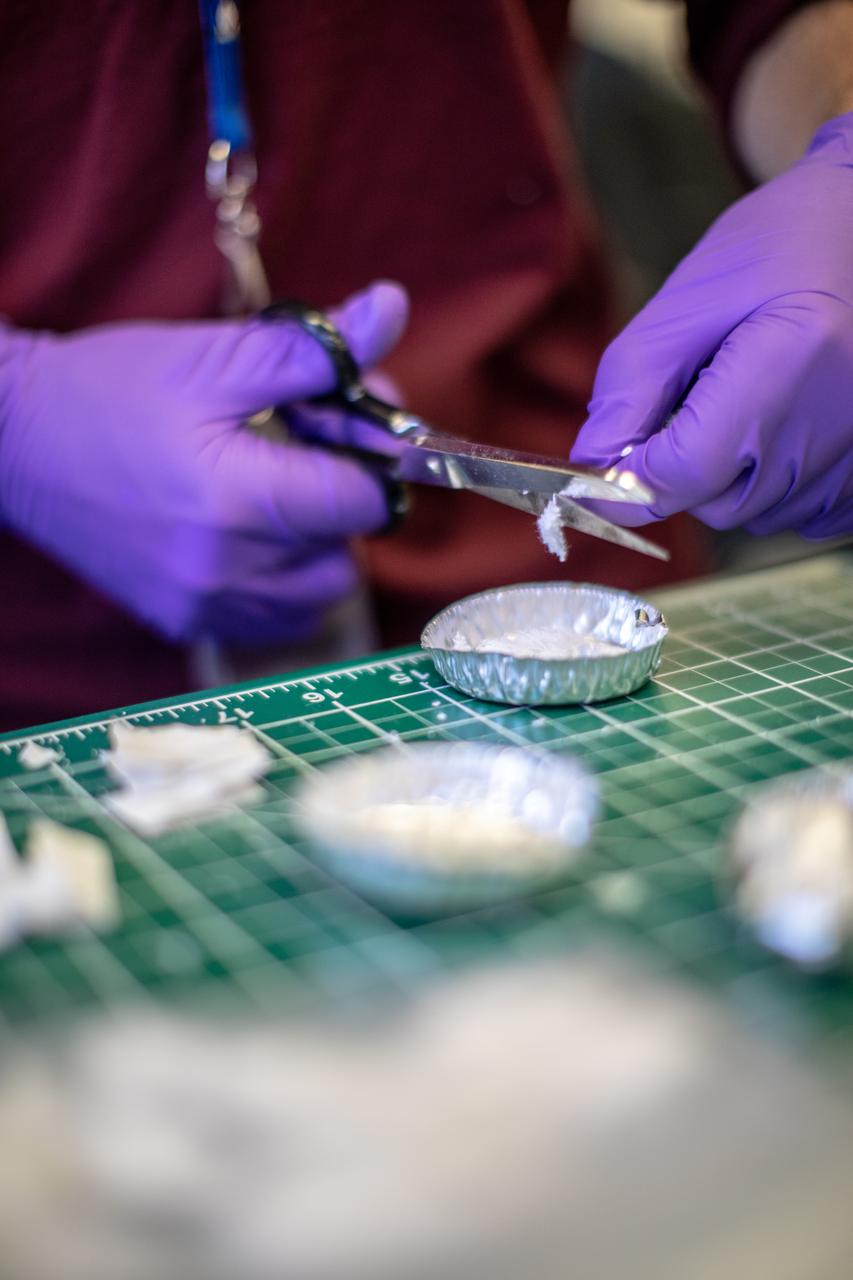
An intern at NASA’s Kennedy Space Center in Florida cuts up different types of material to be utilized as trash simulant for the agency’s Orbital Syngas Commodity Augmentation Reactor, or OSCAR. OSCAR is an Early Career Initiative project at the spaceport that studies technology to convert trash and human waste into useful gasses such as methane, hydrogen and carbon dioxide. By processing small pieces of trash in a high-temperature reactor, OSCAR is advancing new and innovative technology for managing waste in space. OSCAR would reduce the amount of space needed for waste storage within a spacecraft, turn some waste into gasses that have energy storage and life support applications, and ensure waste is no longer biologically active. A prototype has been developed, and a team of Kennedy employees are in the process of constructing a new rig for suborbital flight testing.
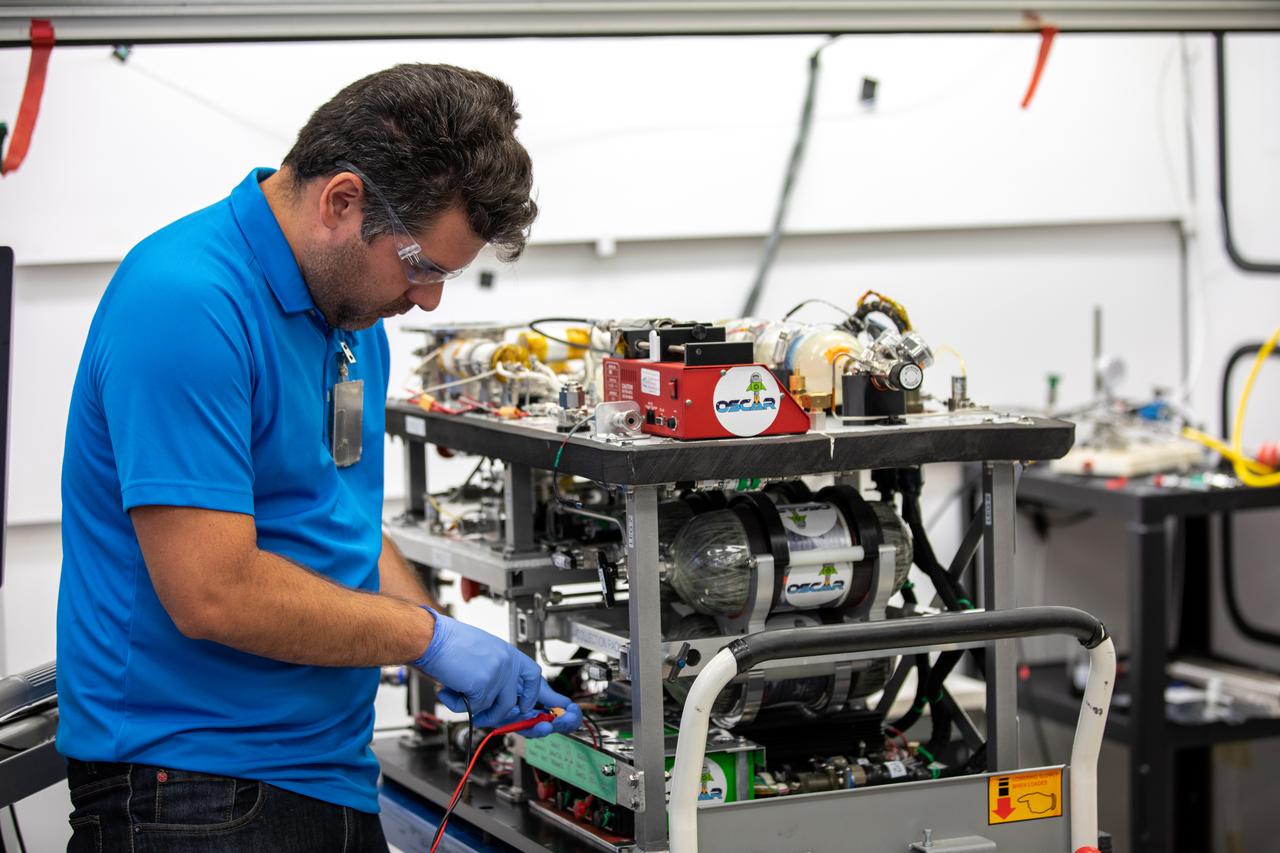
Jaime Toro, an aerospace/mechanical engineer and member of the Orbital Syngas Commodity Augmentation Reactor (OSCAR) team, performs ground testing at NASA’s Kennedy Space Center in Florida. The tests are in preparation for a scheduled suborbital flight test later this year, facilitated by NASA’s Flight Opportunities program. Begun as an Early Career Initiative project, OSCAR evaluates technology to make use of trash and human waste generated during long-duration spaceflight.
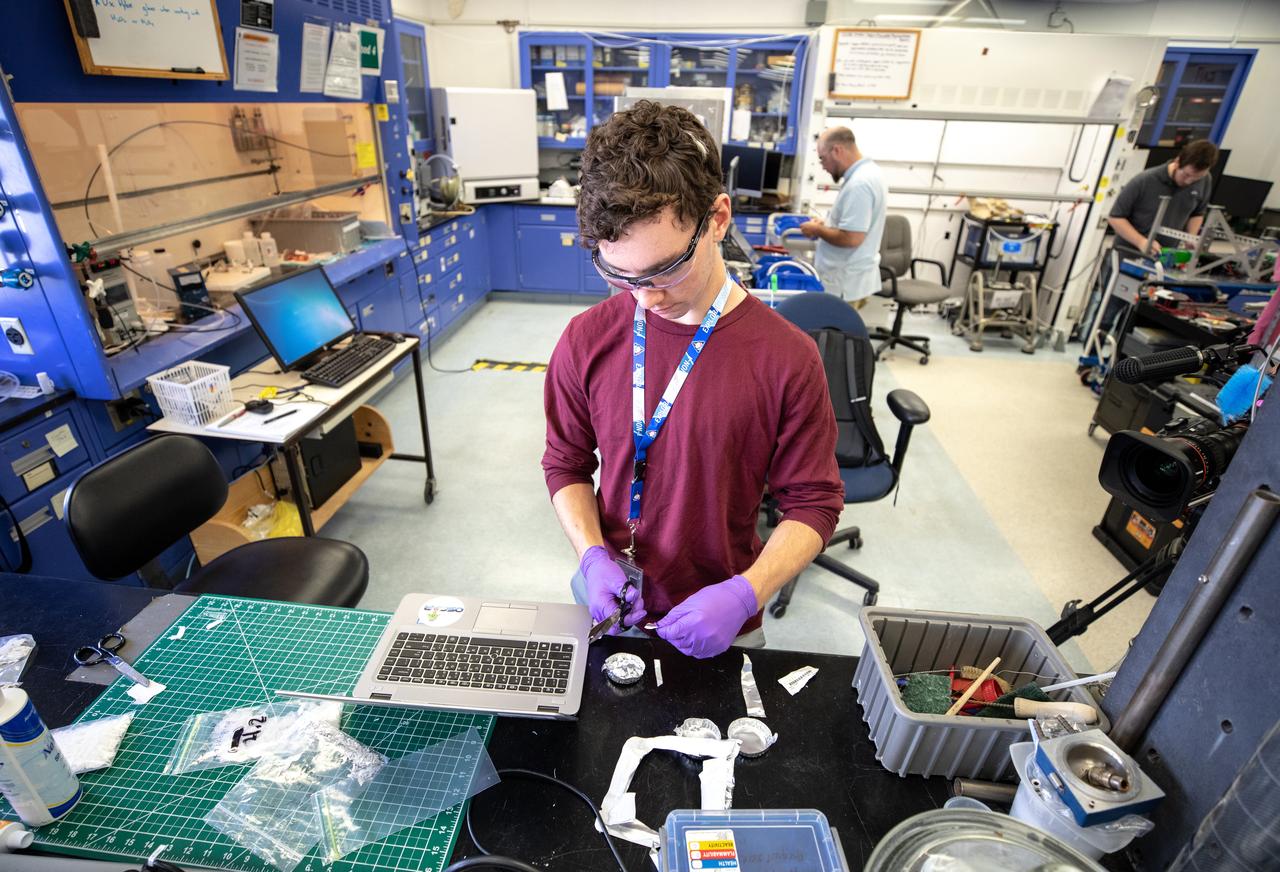
Patrick Follis, an intern at NASA’s Kennedy Space Center in Florida, cuts up different types of material for the agency’s Orbital Syngas Commodity Augmentation Reactor, or OSCAR, to use as a trash simulant during microgravity testing. OSCAR is an Early Career Initiative project at the spaceport that studies technology to convert trash and human waste into useful gasses such as methane, hydrogen and carbon dioxide. By processing small pieces of trash in a high-temperature reactor, OSCAR is advancing new and innovative technology for managing waste in space. OSCAR would reduce the amount of space needed for waste storage within a spacecraft, turn some waste into gasses that have energy storage and life support applications, and ensure waste is no longer biologically active. A prototype has been developed, and a team of Kennedy employees are in the process of constructing a new rig for suborbital flight testing.
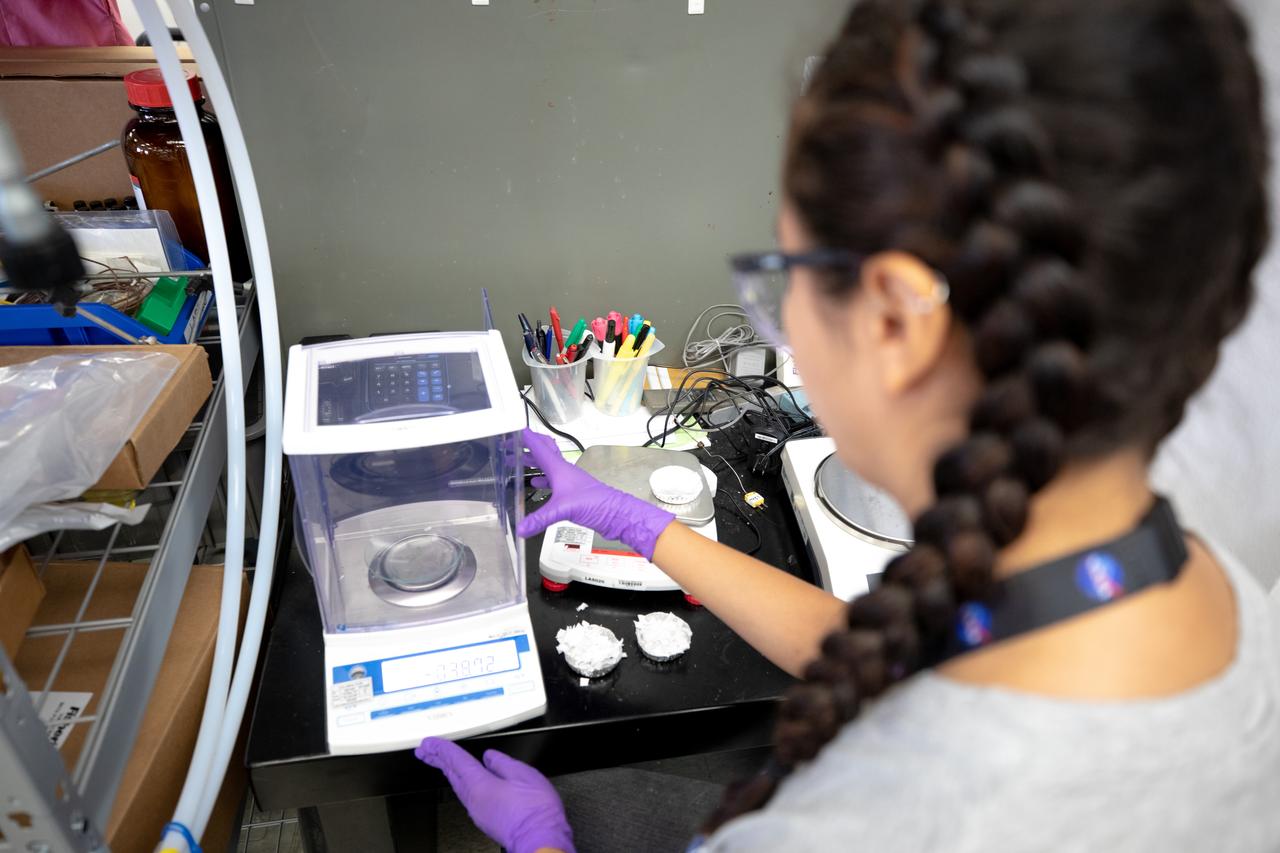
Isabella Aviles, an intern at NASA’s Kennedy Space Center in Florida, weighs trash simulant – comprised of different types of material that have been cut into tiny pieces – that will be utilized for the agency’s Orbital Syngas Commodity Augmentation Reactor, or OSCAR. OSCAR is an Early Career Initiative project at the Florida spaceport that studies technology to convert trash and human waste into useful gasses such as methane, hydrogen and carbon dioxide. By processing small pieces of trash in a high-temperature reactor, OSCAR is advancing new and innovative technology for managing waste in space. OSCAR would reduce the amount of space needed for waste storage within a spacecraft, turn some waste into gasses that have energy storage and life support applications, and ensure waste is no longer biologically active. A prototype has been developed, and a team of Kennedy employees are in the process of constructing a new rig for suborbital flight testing.
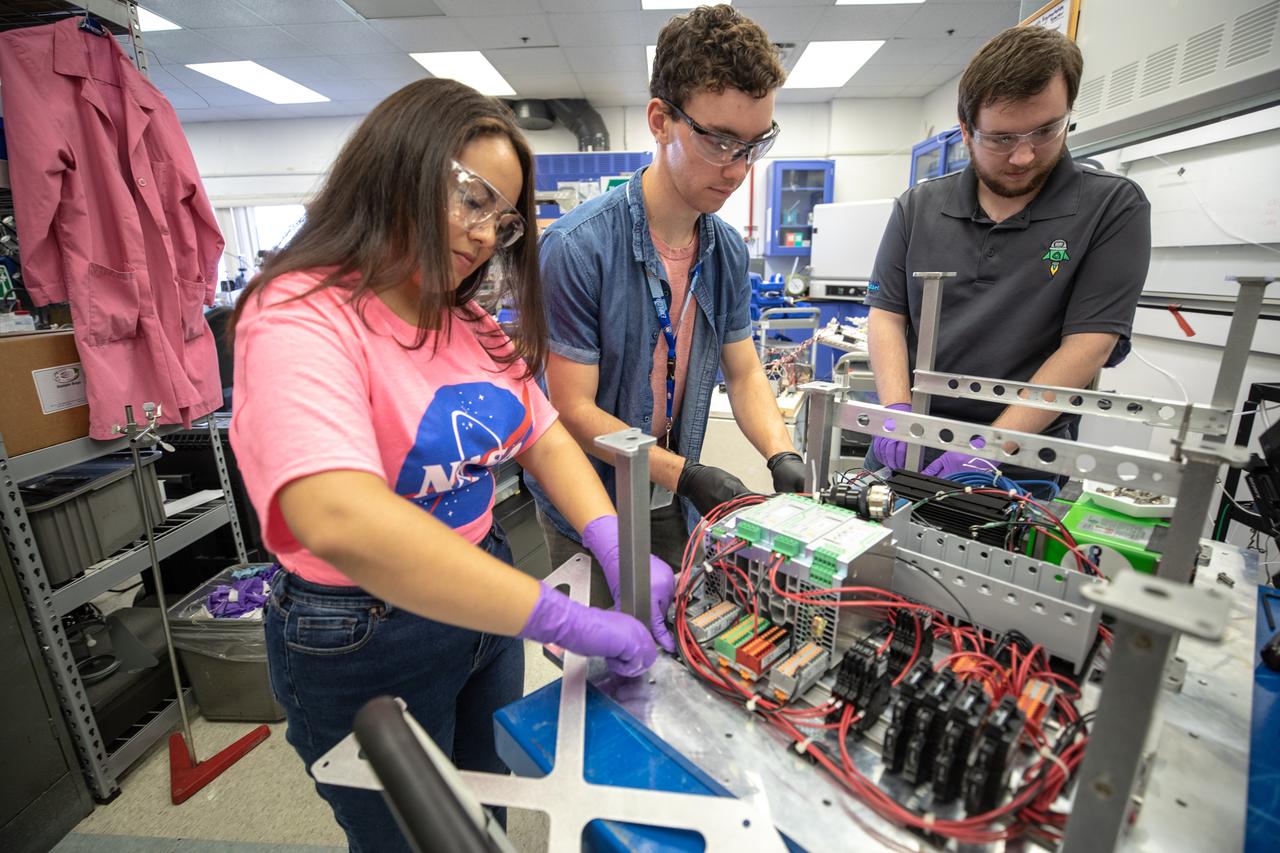
From left, Kennedy Space Center interns Brianna Sandoval and Patrick Follis, and Kennedy employee Jonathan Gleeson assemble the flight hardware of NASA’s Orbital Syngas Commodity Augmentation Reactor, or OSCAR. OSCAR is an Early Career Initiative project at the Florida spaceport that studies technology to convert trash and human waste into useful gasses such as methane, hydrogen and carbon dioxide. By processing small pieces of trash in a high-temperature reactor, OSCAR is advancing new and innovative technology for managing waste in space. OSCAR would reduce the amount of space needed for waste storage within a spacecraft, turn some waste into gasses that have energy storage and life support applications, and ensure waste is no longer biologically active. A prototype has been developed, and a team of Kennedy employees are in the process of constructing a new rig for suborbital flight testing.
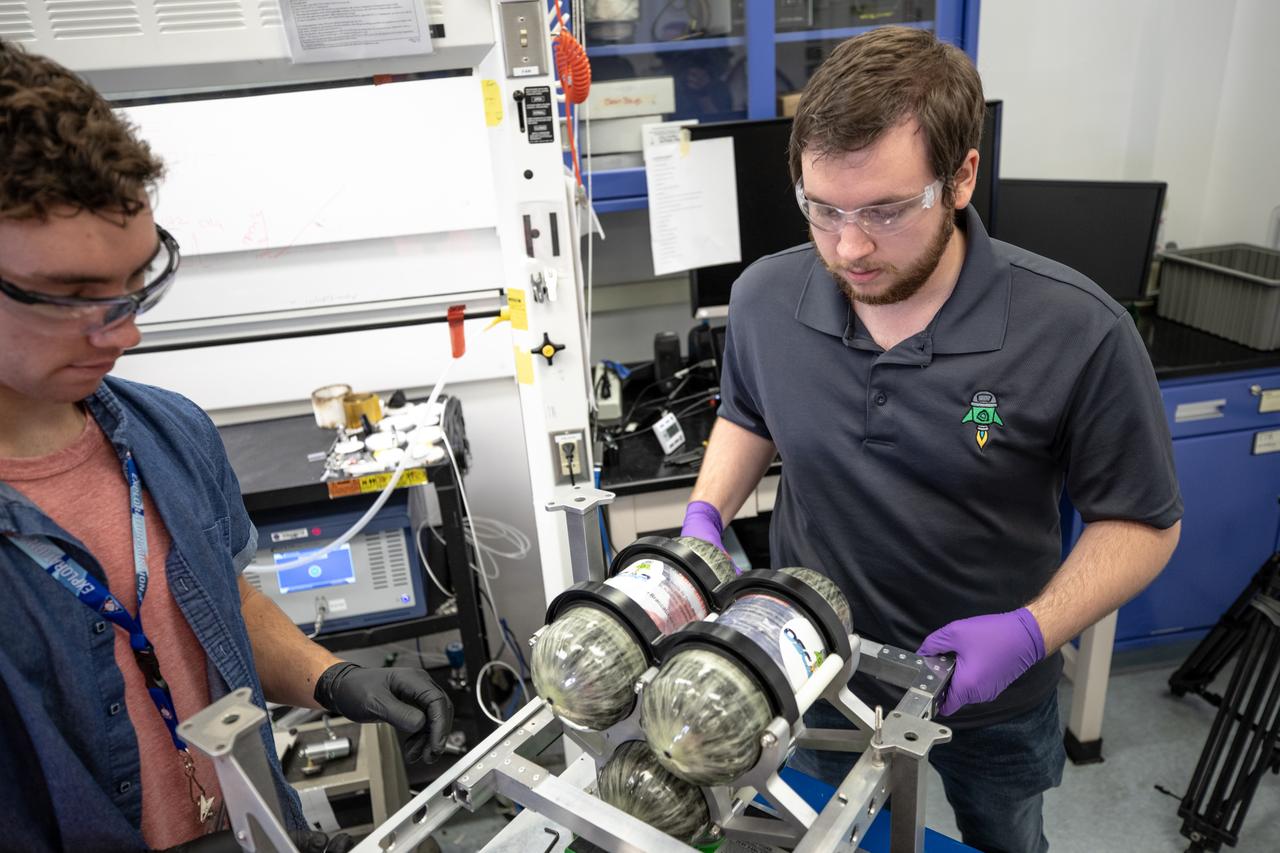
Kennedy Space Center employee Jonathan Gleeson (right) and Kennedy intern Patrick Follis assemble the flight hardware of NASA’s Orbital Syngas Commodity Augmentation Reactor, or OSCAR. OSCAR is an Early Career Initiative project at the Florida spaceport that studies technology to convert trash and human waste into useful gasses such as methane, hydrogen and carbon dioxide. By processing small pieces of trash in a high-temperature reactor, OSCAR is advancing new and innovative technology for managing waste in space. OSCAR would reduce the amount of space needed for waste storage within a spacecraft, turn some waste into gasses that have energy storage and life support applications, and ensure waste is no longer biologically active. A prototype has been developed, and a team of Kennedy employees are in the process of constructing a new rig for suborbital flight testing.
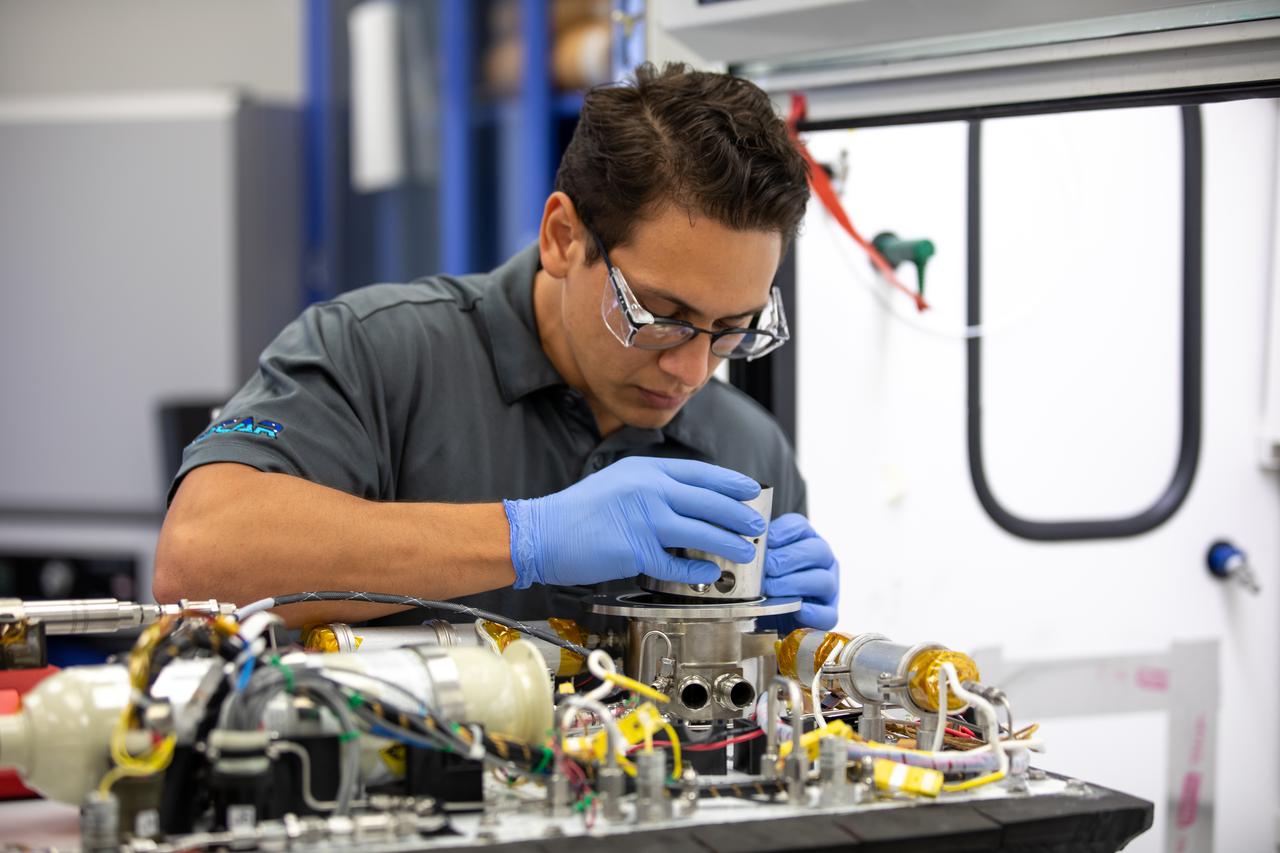
Ray Pitts, co-principal investigator for the Orbital Syngas Commodity Augmentation Reactor (OSCAR), performs ground testing at NASA’s Kennedy Space Center in Florida. The tests are in preparation for a scheduled suborbital flight test later this year, facilitated by NASA’s Flight Opportunities program. Begun as an Early Career Initiative project, OSCAR evaluates technology to make use of trash and human waste generated during long-duration spaceflight.
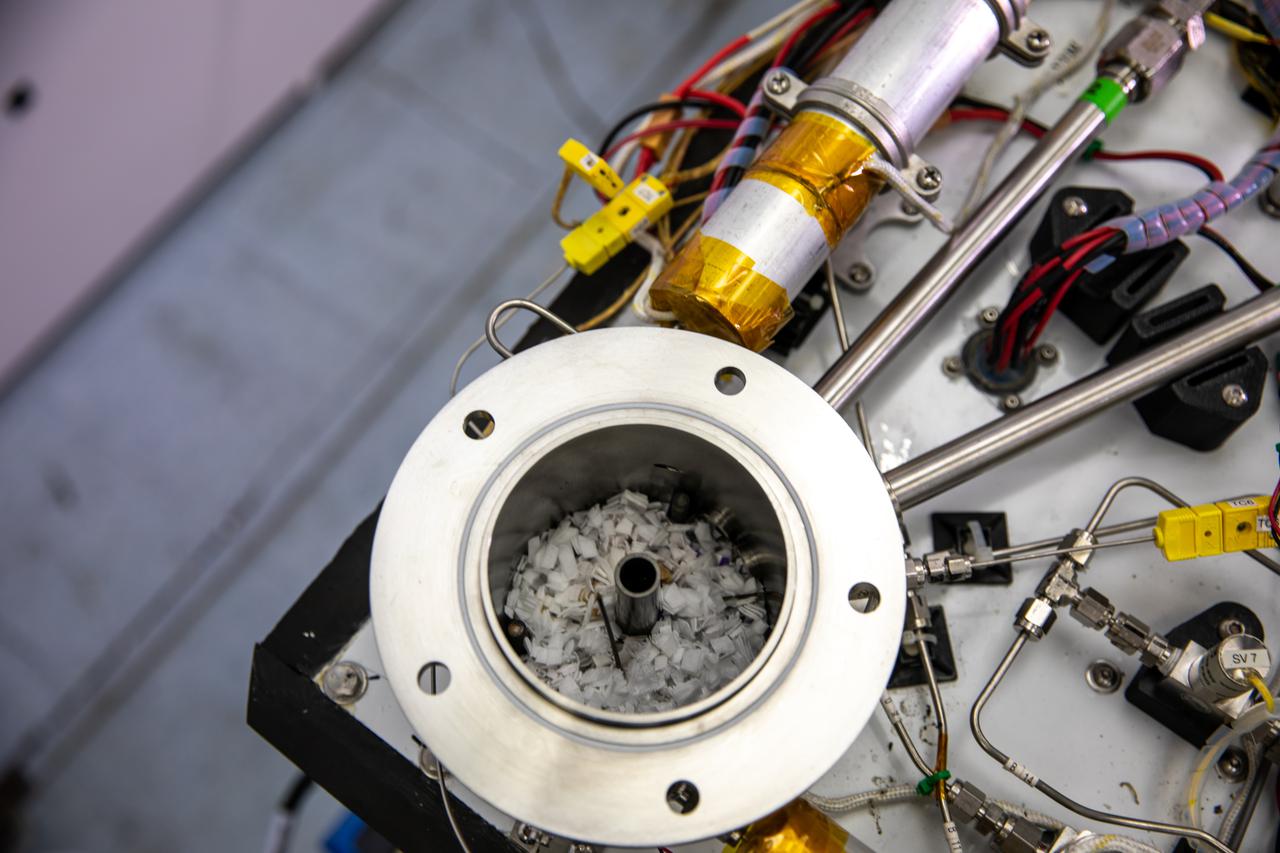
A member of the Orbital Syngas Commodity Augmentation Reactor (OSCAR) team performs ground testing at NASA’s Kennedy Space Center in Florida. The tests are in preparation for a scheduled suborbital flight test later this year, facilitated by NASA’s Flight Opportunities program. Begun as an Early Career Initiative project, OSCAR evaluates technology to make use of trash and human waste generated during long-duration spaceflight.
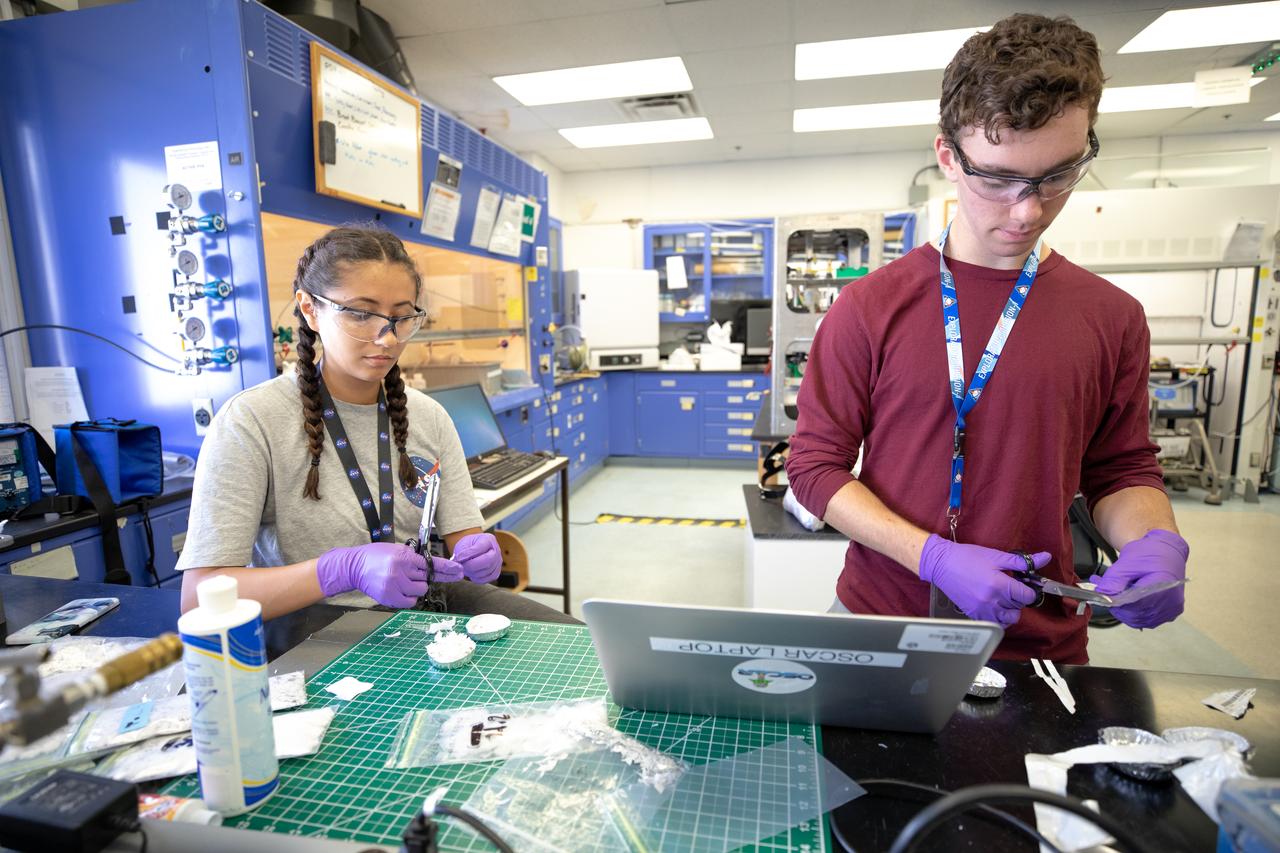
From left, interns Isabella Aviles and Patrick Follis at NASA’s Kennedy Space Center in Florida cut up different types of material for the agency’s Orbital Syngas Commodity Augmentation Reactor, or OSCAR, to use as a trash simulant during microgravity testing. OSCAR is an Early Career Initiative project at the spaceport that studies technology to convert trash and human waste into useful gasses such as methane, hydrogen and carbon dioxide. By processing small pieces of trash in a high-temperature reactor, OSCAR is advancing new and innovative technology for managing waste in space. OSCAR would reduce the amount of space needed for waste storage within a spacecraft, turn some waste into gasses that have energy storage and life support applications, recover water from trash and ensure waste is no longer biologically active. A prototype has been developed, and a team of Kennedy employees are in the process of constructing a new rig for suborbital flight testing.
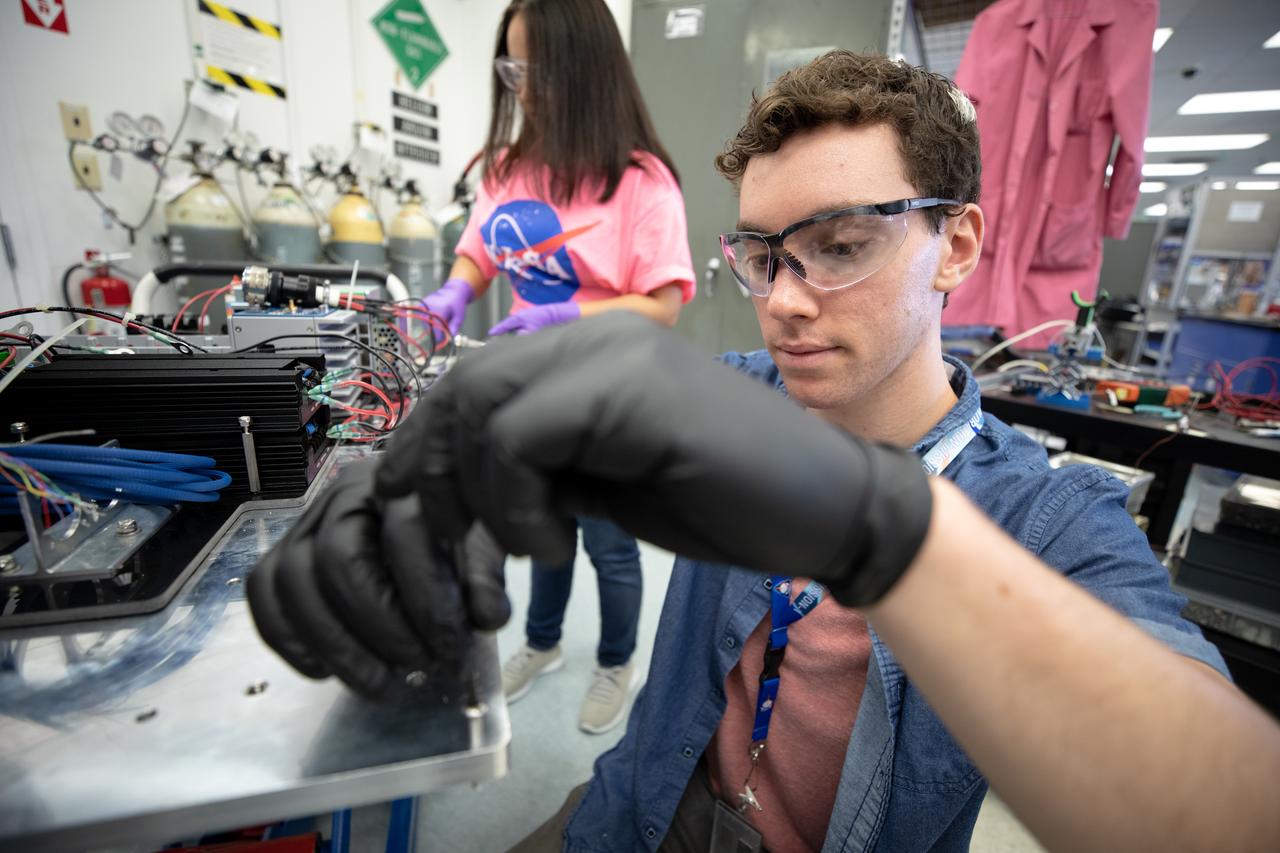
Interns Brianna Sandoval (left) and Patrick Follis at NASA’s Kennedy Space Center in Florida assemble the flight hardware for the agency’s Orbital Syngas Commodity Augmentation Reactor, or OSCAR. OSCAR is an Early Career Initiative project at the spaceport that studies technology to convert trash and human waste into useful gasses such as methane, hydrogen and carbon dioxide. By processing small pieces of trash in a high-temperature reactor, OSCAR is advancing new and innovative technology for managing waste in space. OSCAR would reduce the amount of space needed for waste storage within a spacecraft, turn some waste into gasses that have energy storage and life support applications, and ensure waste is no longer biologically active. A prototype has been developed, and a team of Kennedy employees are in the process of constructing a new rig for suborbital flight testing.
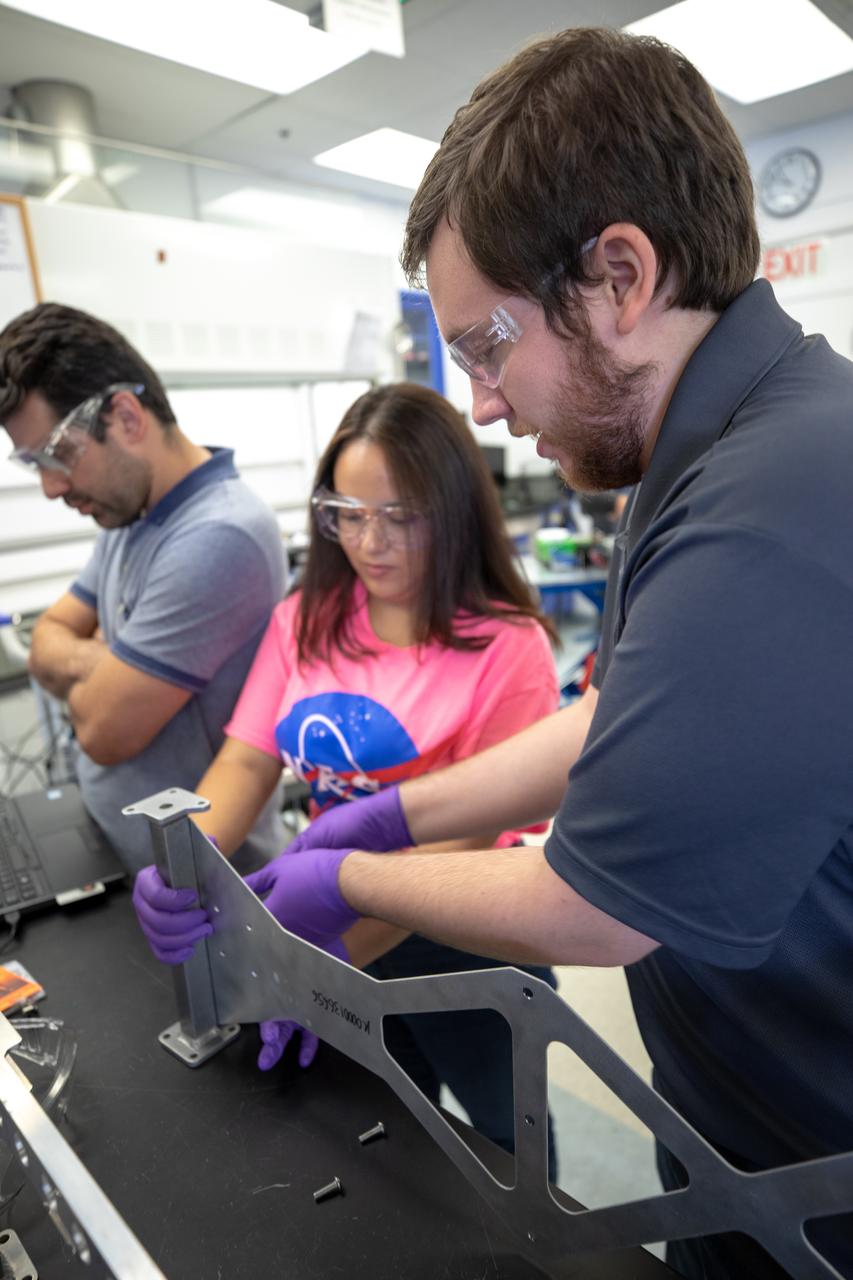
From left, Kennedy Space Center Mechanical Engineer Jaime Toro, NASA’s Orbital Syngas Commodity Augmentation Reactor (OSCAR) data acquisition and testing; Brianna Sandoval, OSCAR intern; and Jonathan Gleeson, Kennedy employee providing support for OSCAR under the center’s Laboratory Support Services and Operations contract, assemble the flight hardware of OSCAR. OSCAR is an Early Career Initiative project at the Florida spaceport that studies technology to convert trash and human waste into useful gasses such as methane, hydrogen and carbon dioxide. By processing small pieces of trash in a high-temperature reactor, OSCAR is advancing new and innovative technology for managing waste in space. OSCAR would reduce the amount of space needed for waste storage within a spacecraft, turn some waste into gasses that have energy storage and life support applications, and ensure waste is no longer biologically active. A prototype has been developed, and a team of Kennedy employees are in the process of constructing a new rig for suborbital flight testing.
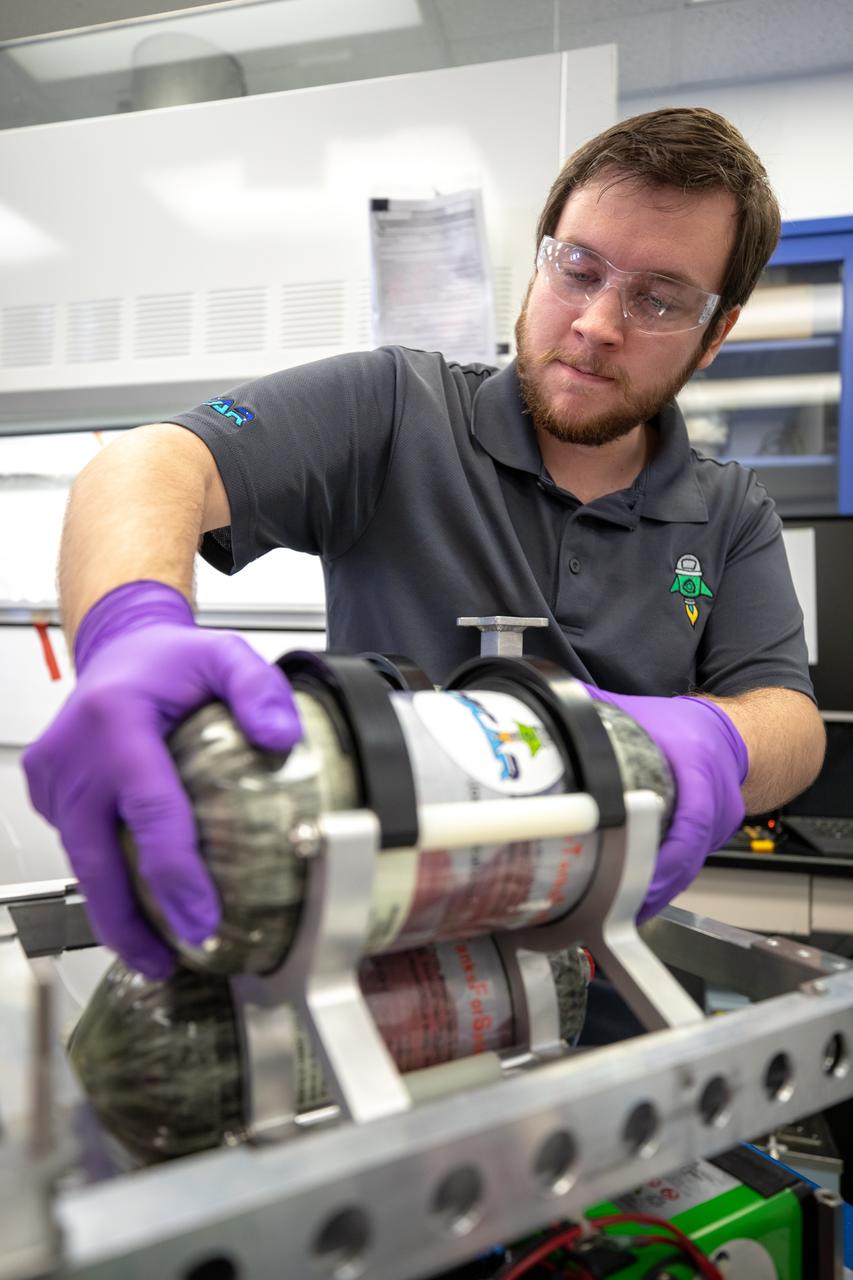
Jonathan Gleeson, Kennedy Space Center employee providing support for NASA’s Orbital Syngas Commodity Augmentation Reactor (OSCAR) under the center’s Laboratory Support Services and Operations contract, installs OSCAR to the flight hardware that will carry it on its suborbital flight test. OSCAR is an Early Career Initiative project at the Florida spaceport that studies technology to convert trash and human waste into useful gasses such as methane, hydrogen and carbon dioxide. By processing small pieces of trash in a high-temperature reactor, OSCAR is advancing new and innovative technology for managing waste in space. OSCAR would reduce the amount of space needed for waste storage within a spacecraft, turn some waste into gasses that have energy storage and life support applications, and ensure waste is no longer biologically active. A prototype has been developed, and a team of Kennedy employees have worked on constructing a new rig for suborbital flight testing.

Kennedy Space Center intern Patrick Follis (left) and Kennedy employee Jonathan Gleeson assemble the flight hardware of NASA’s Orbital Syngas Commodity Augmentation Reactor, or OSCAR – an Early Career Initiative project at the Florida spaceport that studies technology to convert trash and human waste into useful gasses such as methane, hydrogen and carbon dioxide. By processing small pieces of trash in a high-temperature reactor, OSCAR is advancing new and innovative technology for managing waste in space. OSCAR would reduce the amount of space needed for waste storage within a spacecraft, turn some waste into gasses that have energy storage and life support applications, and ensure waste is no longer biologically active. A prototype has been developed, and a team of Kennedy employees are in the process of constructing a new rig for suborbital flight testing.
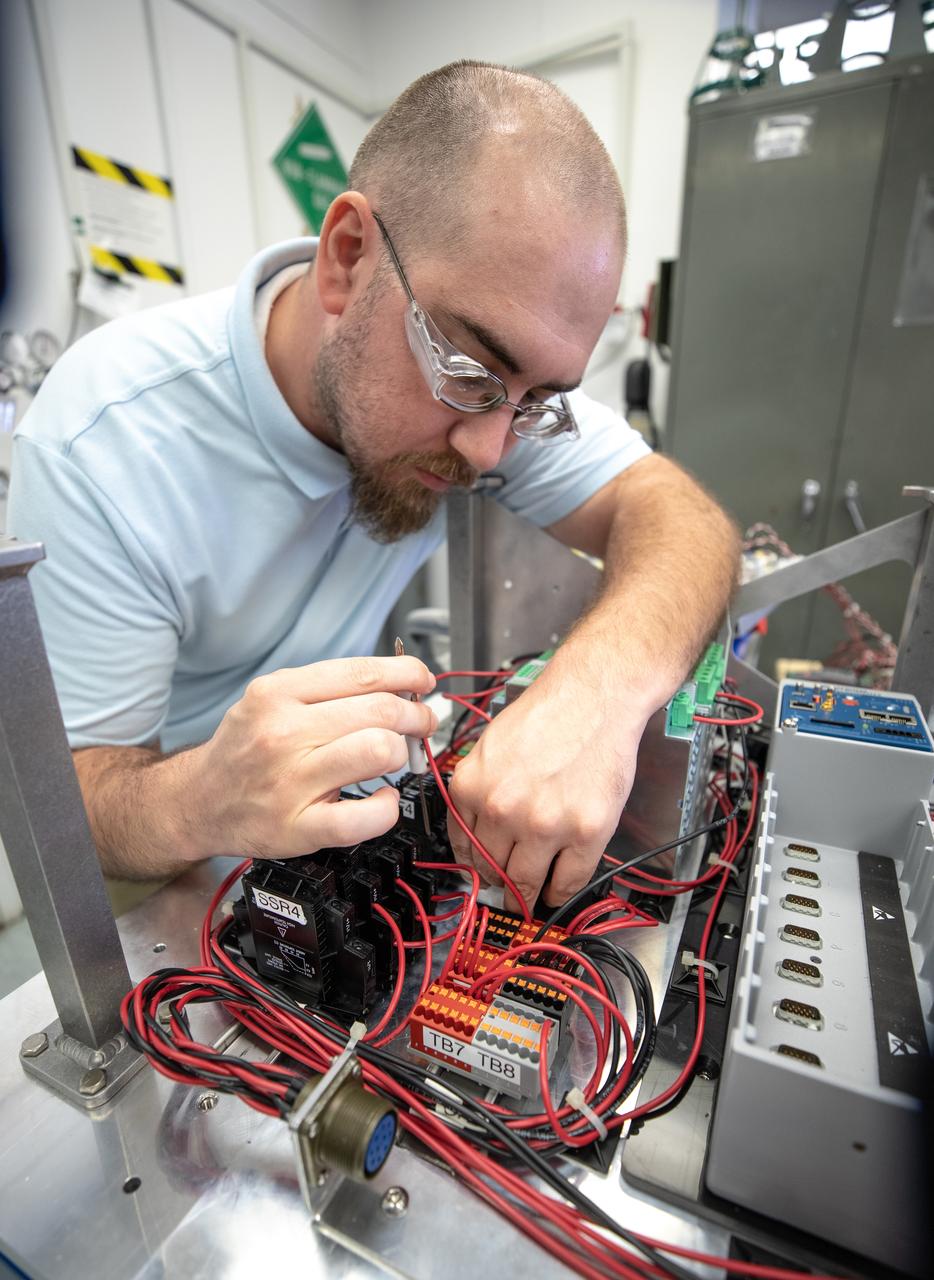
Thomas Cauvel, an intern assisting with software/electrical engineering on NASA’s Orbital Syngas Commodity Augmentation Reactor, or OSCAR, at Kennedy Space Center assembles the flight hardware. OSCAR is an Early Career Initiative project at the Florida spaceport that studies technology to convert trash and human waste into useful gasses such as methane, hydrogen and carbon dioxide. By processing small pieces of trash in a high-temperature reactor, OSCAR is advancing new and innovative technology for managing waste in space. OSCAR would reduce the amount of space needed for waste storage within a spacecraft, turn some waste into gasses that have energy storage and life support applications, and ensure waste is no longer biologically active. A prototype has been developed, and a team of Kennedy employees are in the process of constructing a new rig for suborbital flight testing.
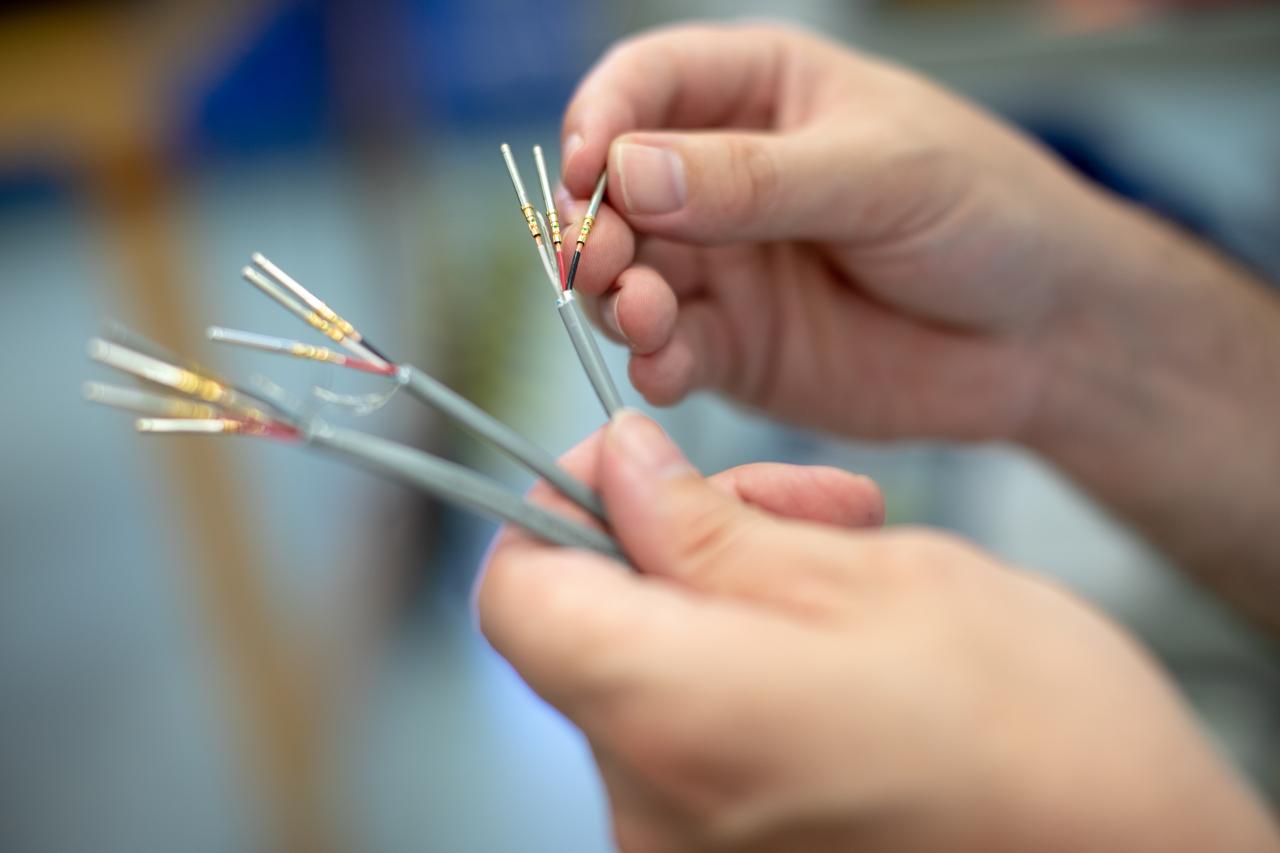
Flight hardware for NASA’s Orbital Syngas Commodity Augmentation Rector, or OSCAR, is photographed at the agency’s Kennedy Space Center in Florida. OSCAR is an Early Career Initiative project at the spaceport that studies technology to convert trash and human waste into useful gasses such as methane, hydrogen and carbon dioxide. By processing small pieces of trash in a high-temperature reactor, OSCAR is advancing new and innovative technology for managing waste in space. OSCAR would reduce the amount of space needed for waste storage within a spacecraft, turn some waste into gasses that have energy storage and life support applications, and ensure waste is no longer biologically active. A prototype has been developed, and a team of Kennedy employees are in the process of constructing a new rig for suborbital flight testing.
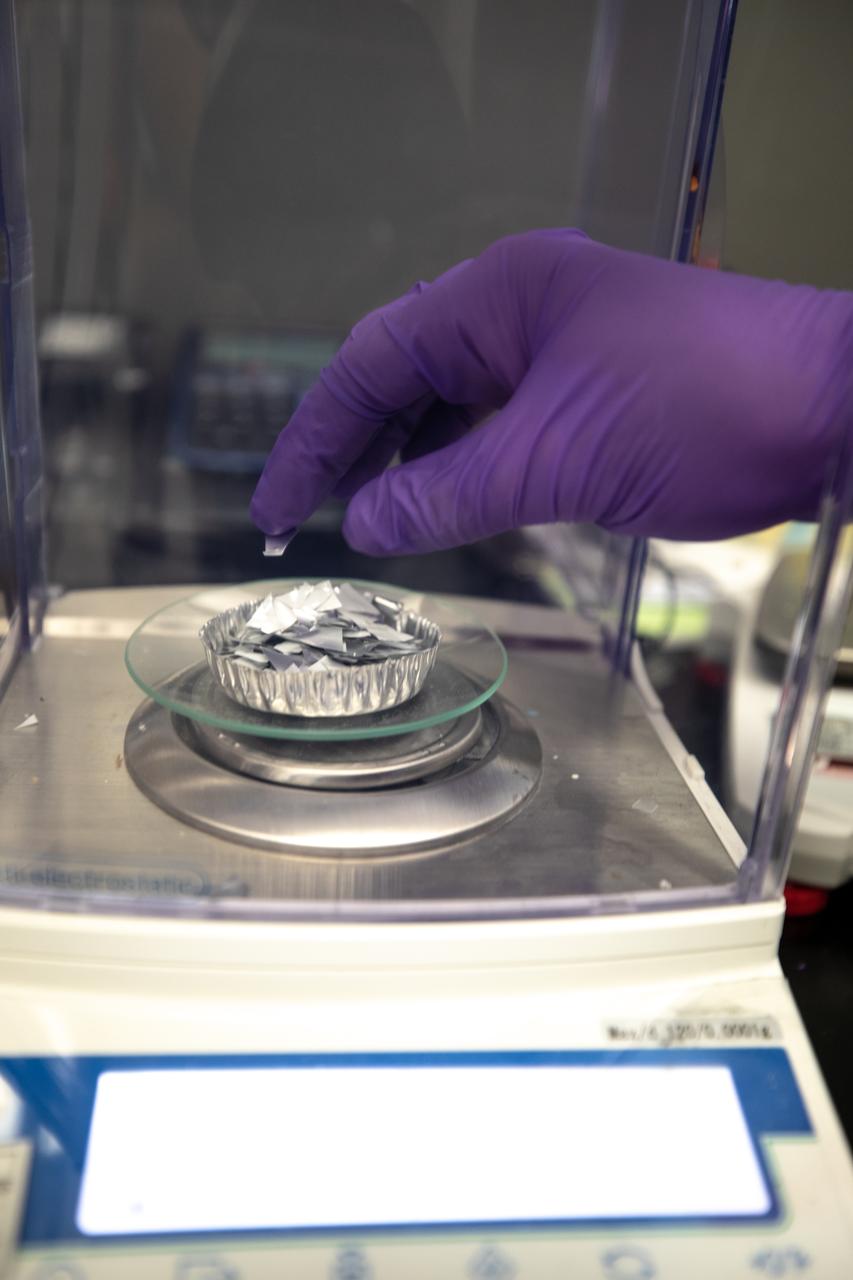
A Kennedy Space Center intern weighs trash simulant – comprised of different types of material that have been cut into tiny pieces – that will be utilized for the agency’s Orbital Syngas Commodity Augmentation Reactor, or OSCAR. OSCAR is an Early Career Initiative project at the Florida spaceport that studies technology to convert trash and human waste into useful gasses such as methane, hydrogen and carbon dioxide. By processing small pieces of trash in a high-temperature reactor, OSCAR is advancing new and innovative technology for managing waste in space. OSCAR would reduce the amount of space needed for waste storage within a spacecraft, turn some waste into gasses that have energy storage and life support applications, and ensure waste is no longer biologically active. A prototype has been developed, and a team of Kennedy employees are in the process of constructing a new rig for suborbital flight testing.
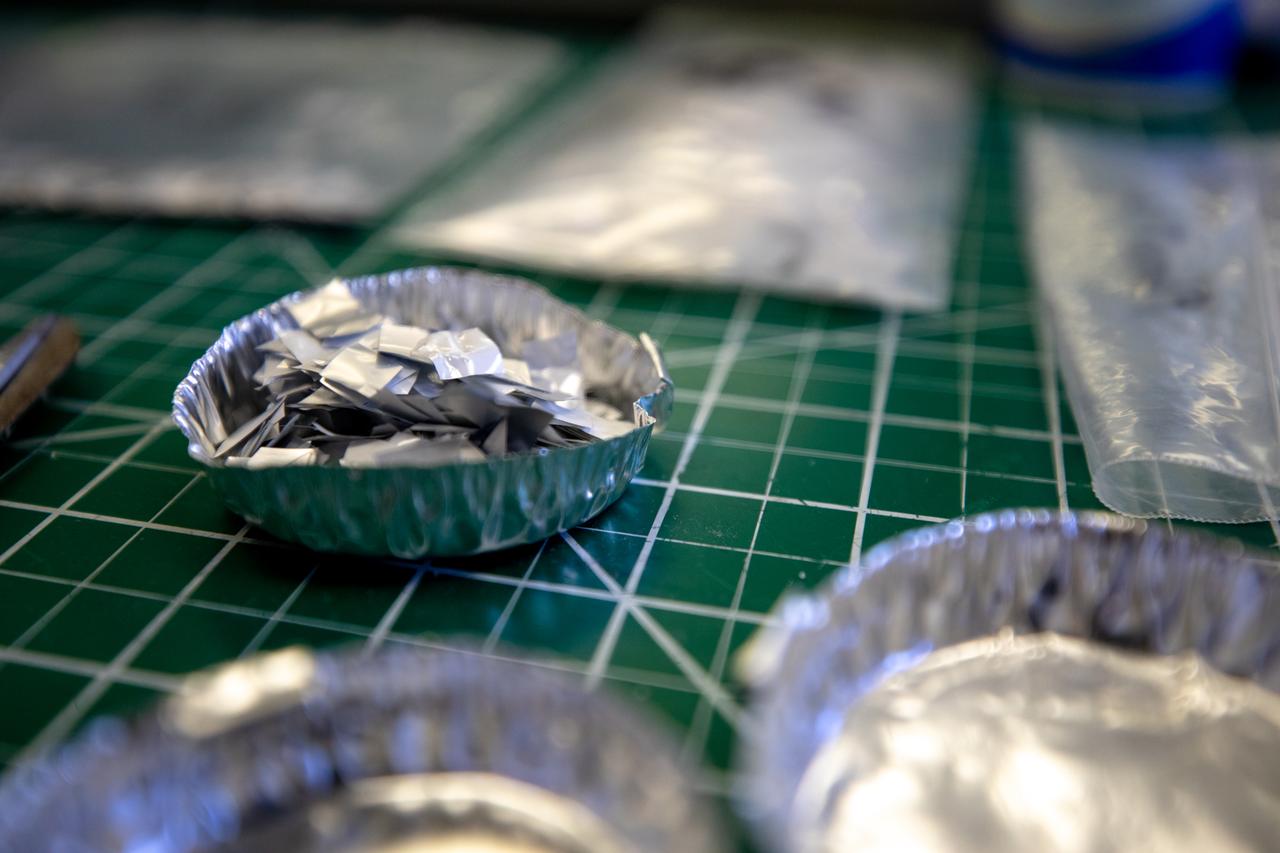
Pictured at Kennedy Space Center is trash simulant – comprised of different types of material that have been cut into tiny pieces – that will be utilized for NASA’s Orbital Syngas Commodity Augmentation Reactor, or OSCAR. OSCAR is an Early Career Initiative project at the Florida spaceport that studies technology to convert trash and human waste into useful gasses such as methane, hydrogen and carbon dioxide. By processing small pieces of trash in a high-temperature reactor, OSCAR is advancing new and innovative technology for managing waste in space. OSCAR would reduce the amount of space needed for waste storage within a spacecraft, turn some waste into gasses that have energy storage and life support applications, and ensure waste is no longer biologically active. A prototype has been developed, and a team of Kennedy employees are in the process of constructing a new rig for suborbital flight testing.
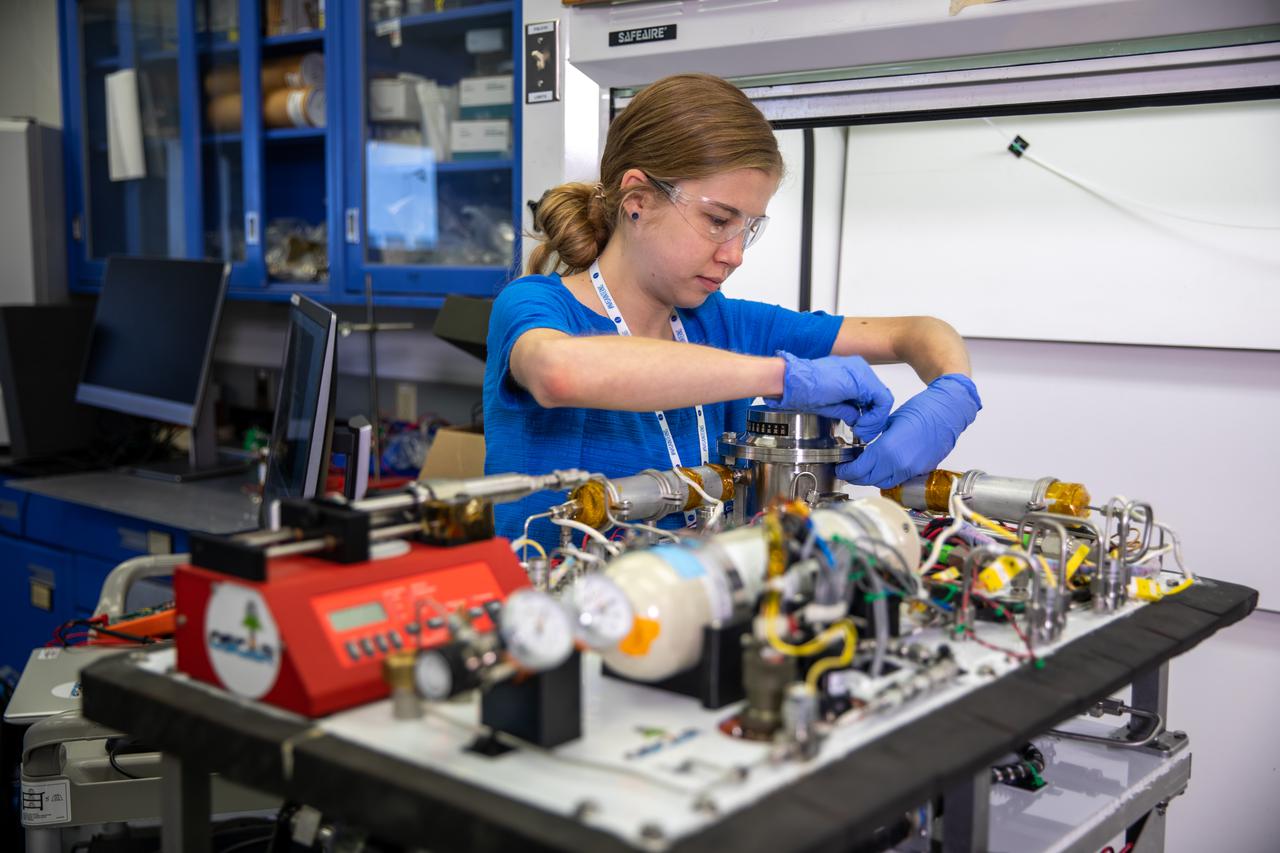
A member of the Orbital Syngas Commodity Augmentation Reactor (OSCAR) team performs ground testing at NASA’s Kennedy Space Center in Florida. The tests are in preparation for a scheduled suborbital flight test later this year, facilitated by NASA’s Flight Opportunities program. Begun as an Early Career Initiative project, OSCAR evaluates technology to make use of trash and human waste generated during long-duration spaceflight.
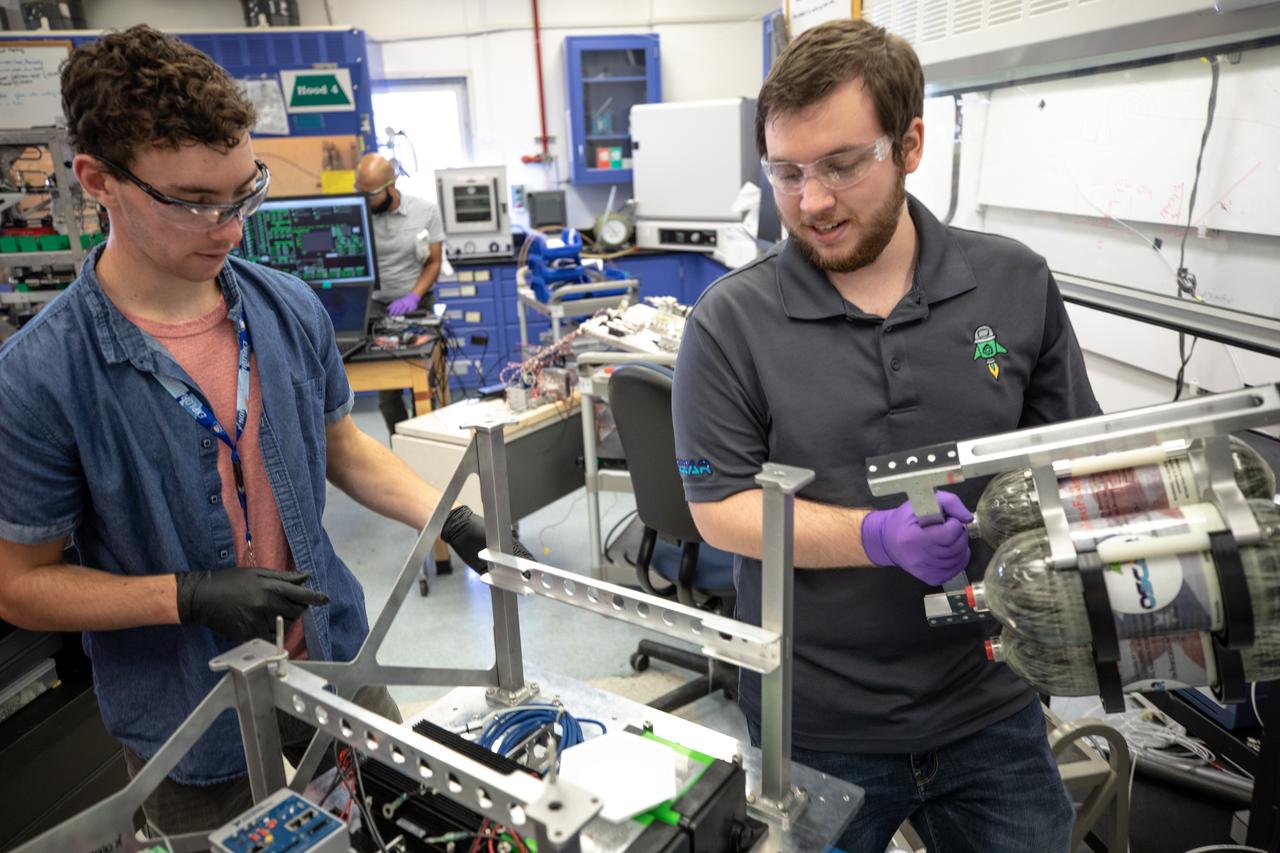
Kennedy Space Center employee Jonathan Gleeson (right) and Kennedy intern Patrick Follis assemble the flight hardware of NASA’s Orbital Syngas Commodity Augmentation Reactor, or OSCAR. OSCAR is an Early Career Initiative project at the Florida spaceport that studies technology to convert trash and human waste into useful gasses such as methane, hydrogen and carbon dioxide. By processing small pieces of trash in a high-temperature reactor, OSCAR is advancing new and innovative technology for managing waste in space. OSCAR would reduce the amount of space needed for waste storage within a spacecraft, turn some waste into gasses that have energy storage and life support applications, and ensure waste is no longer biologically active. A prototype has been developed, and a team of Kennedy employees are in the process of constructing a new rig for suborbital flight testing.
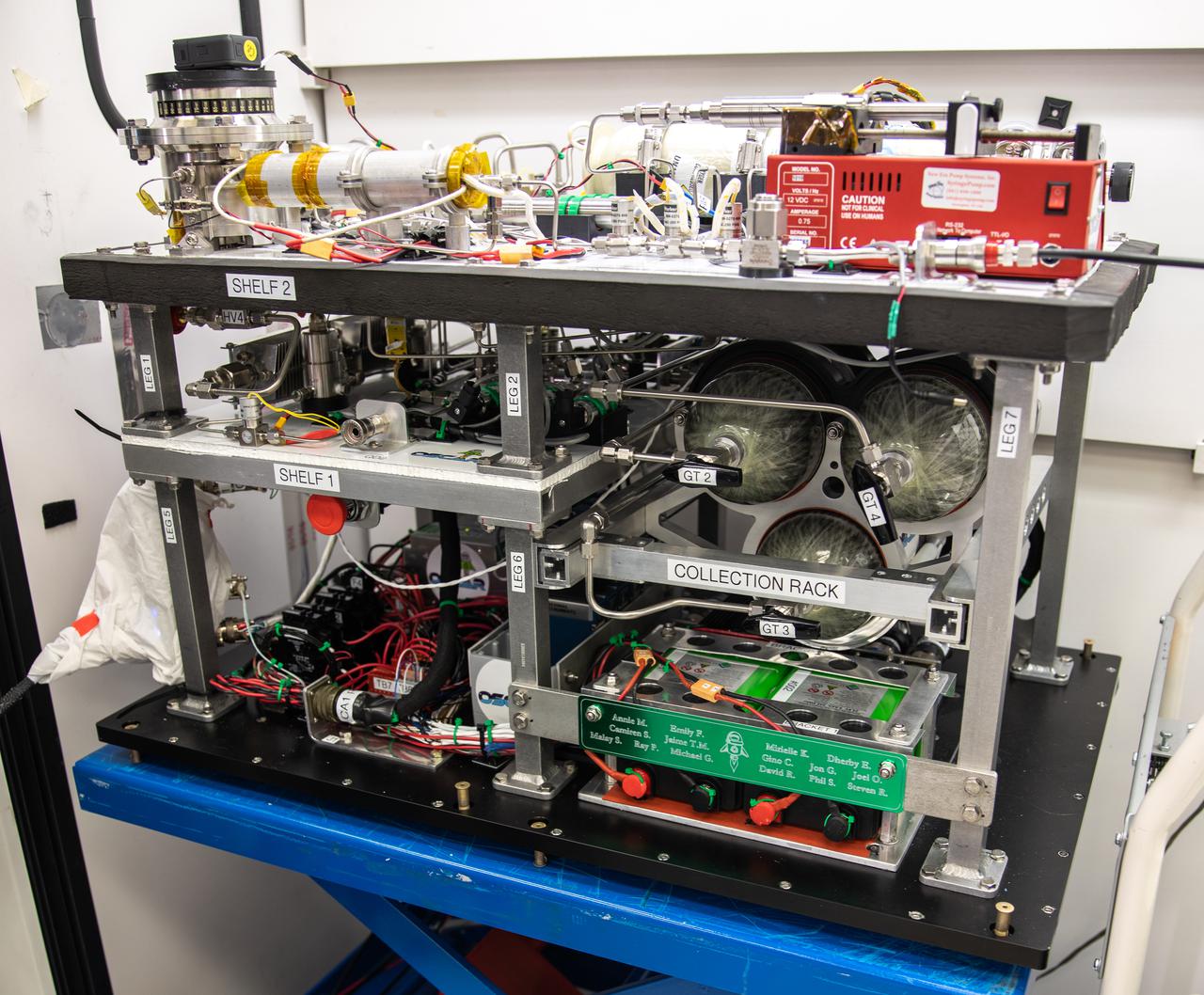
Members of the Orbital Syngas Commodity Augmentation Reactor (OSCAR) team perform ground testing at NASA’s Kennedy Space Center in Florida. The tests are in preparation for a scheduled suborbital flight test later this year, facilitated by NASA’s Flight Opportunities program. Begun as an Early Career Initiative project, OSCAR evaluates technology to make use of trash and human waste generated during long-duration spaceflight.
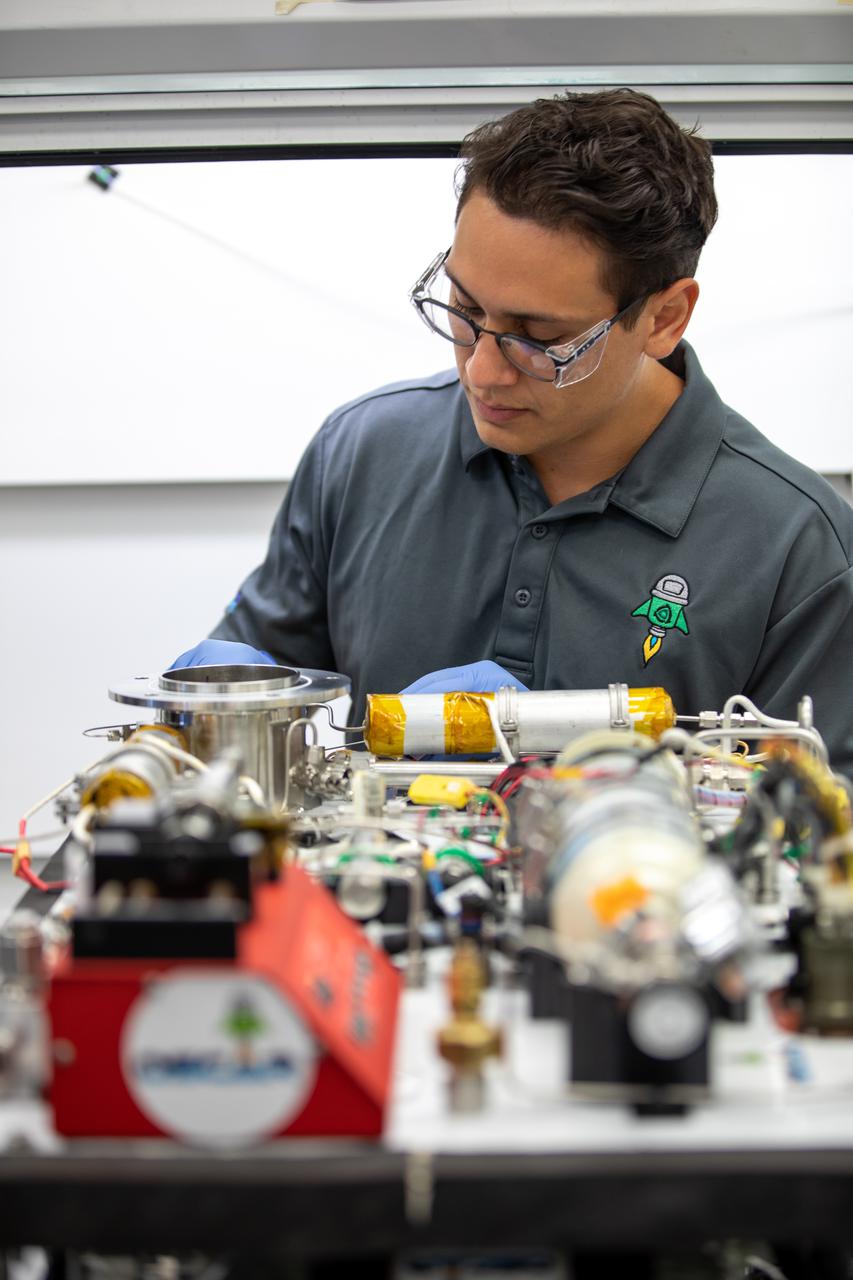
Ray Pitts, co-principal investigator for the Orbital Syngas Commodity Augmentation Reactor (OSCAR), performs ground testing at NASA’s Kennedy Space Center in Florida. The tests are in preparation for a scheduled suborbital flight test later this year, facilitated by NASA’s Flight Opportunities program. Begun as an Early Career Initiative project, OSCAR evaluates technology to make use of trash and human waste generated during long-duration spaceflight.
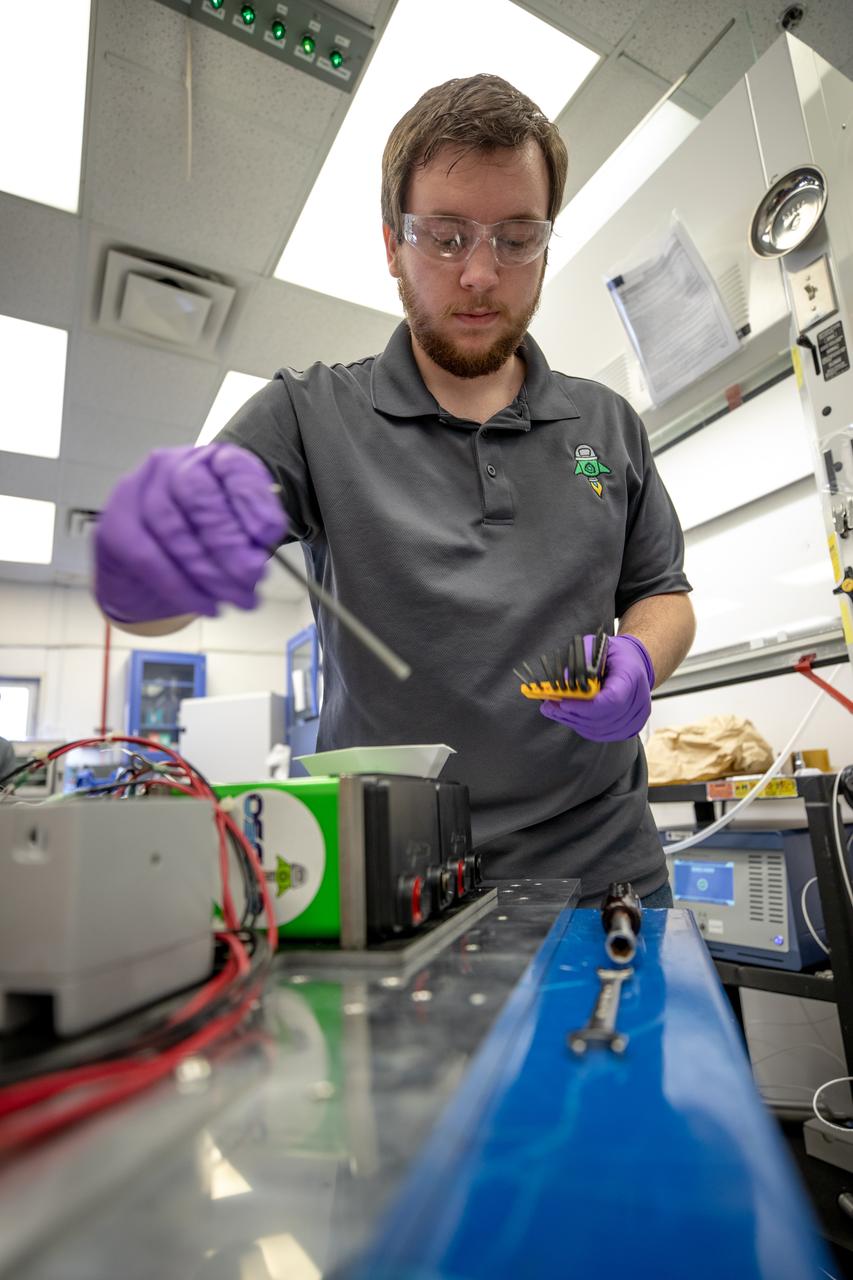
Jonathan Gleeson, Kennedy Space Center employee providing support for NASA’s Orbital Syngas Commodity Augmentation Reactor (OSCAR) under the center’s Laboratory Support Services and Operations contract, assembles the flight hardware of OSCAR. OSCAR is an Early Career Initiative project at the Florida spaceport that studies technology to convert trash and human waste into useful gasses such as methane, hydrogen and carbon dioxide. By processing small pieces of trash in a high-temperature reactor, OSCAR is advancing new and innovative technology for managing waste in space. OSCAR would reduce the amount of space needed for waste storage within a spacecraft, turn some waste into gasses that have energy storage and life support applications, and ensure waste is no longer biologically active. A prototype has been developed, and a team of Kennedy employees are in the process of constructing a new rig for suborbital flight testing.
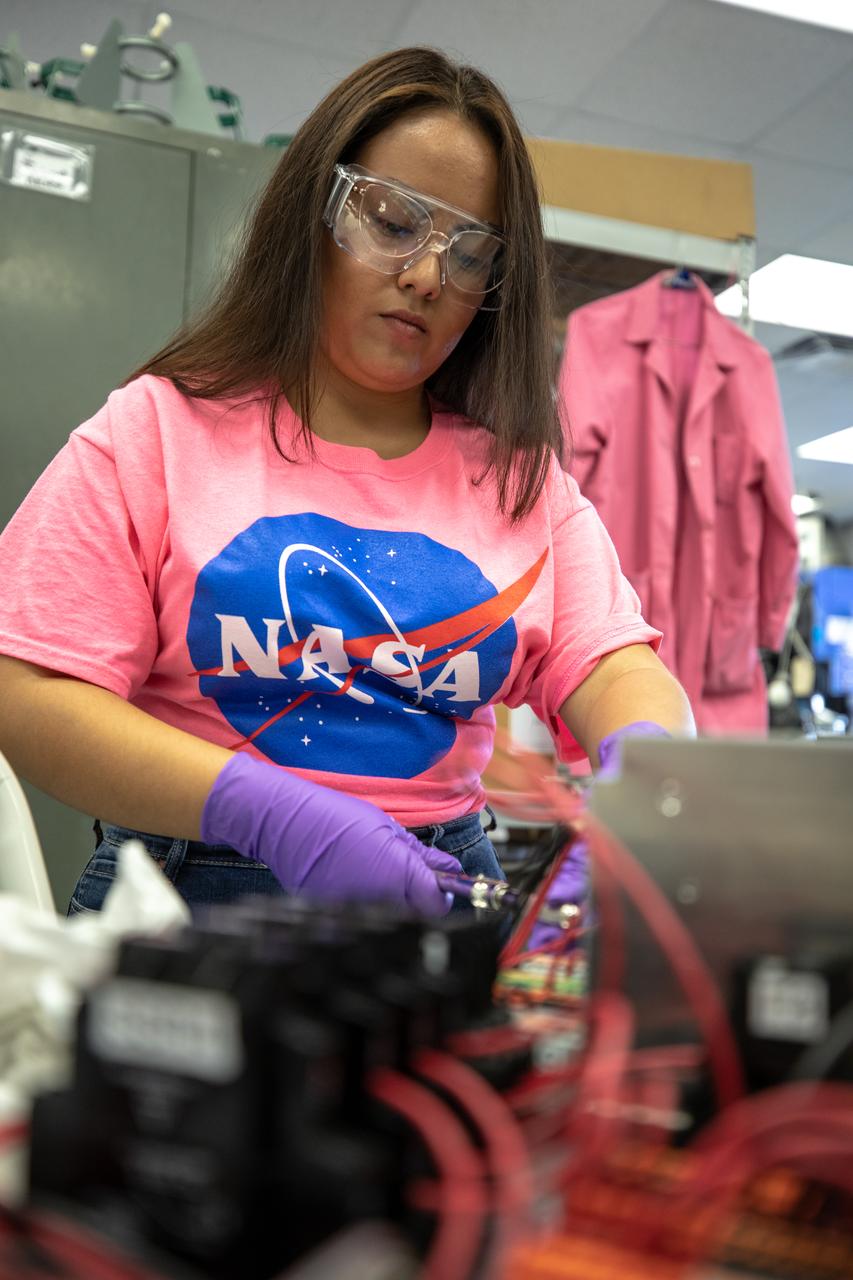
Brianna Sandoval, an intern at NASA’s Kennedy Space Center in Florida, assembles the flight hardware of the agency’s Orbital Syngas Commodity Augmentation Reactor, or OSCAR. OSCAR is an Early Career Initiative project at the spaceport that studies technology to convert trash and human waste into useful gasses such as methane, hydrogen and carbon dioxide. By processing small pieces of trash in a high-temperature reactor, OSCAR is advancing new and innovative technology for managing waste in space. OSCAR would reduce the amount of space needed for waste storage within a spacecraft, turn some waste into gasses that have energy storage and life support applications, and ensure waste is no longer biologically active. A prototype has been developed, and a team of Kennedy employees are in the process of constructing a new rig for suborbital flight testing.
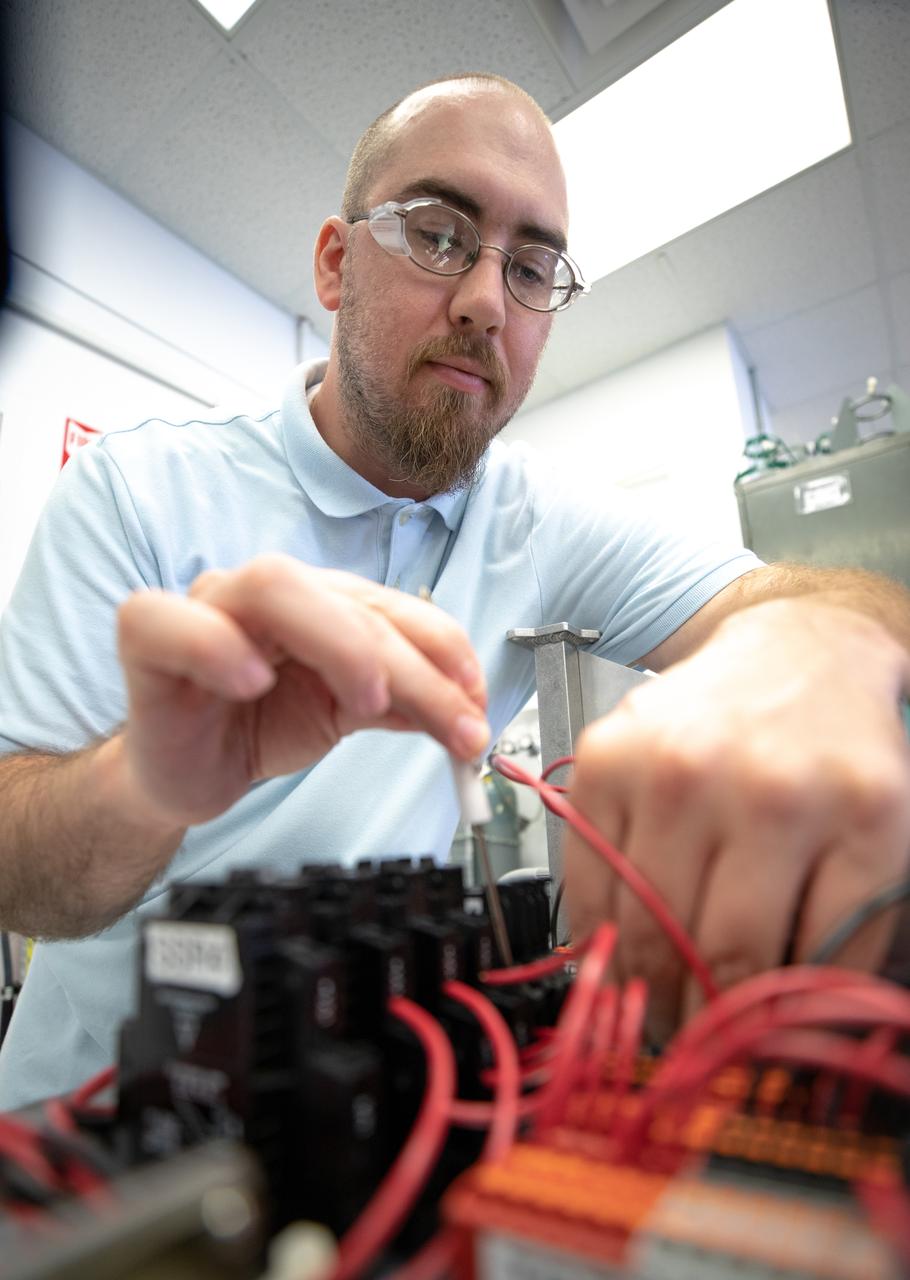
Thomas Cauvel, an intern assisting with software/electrical engineering on NASA’s Orbital Syngas Commodity Augmentation Reactor, or OSCAR, at Kennedy Space Center assembles the flight hardware. OSCAR is an Early Career Initiative project at the Florida spaceport that studies technology to convert trash and human waste into useful gasses such as methane, hydrogen and carbon dioxide. By processing small pieces of trash in a high-temperature reactor, OSCAR is advancing new and innovative technology for managing waste in space. OSCAR would reduce the amount of space needed for waste storage within a spacecraft, turn some waste into gasses that have energy storage and life support applications, and ensure waste is no longer biologically active. A prototype has been developed, and a team of Kennedy employees are in the process of constructing a new rig for suborbital flight testing.
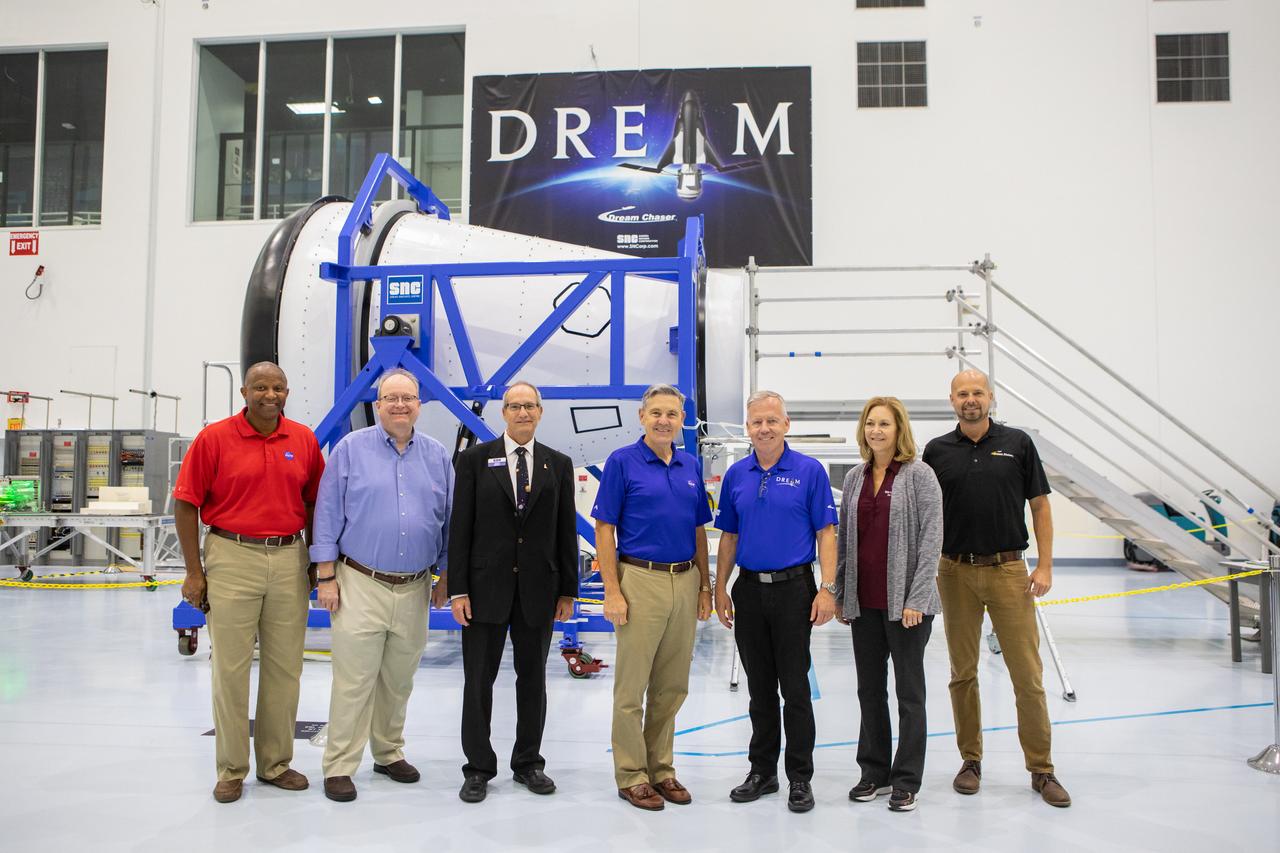
A mockup of the cargo logistics module for Sierra Nevada Corporation’s Dream Chaser, the company’s reusable spaceplane, arrived at the Space Station Processing Facility (SSPF) at NASA’s Kennedy Space Center in Florida in August. On Sept. 20, 2019, senior leadership had the opportunity to view the cargo module in the SSPF high bay. From left are Kelvin Manning, Kennedy associate director, technical; Burt Summerfield, associate director, management; John Roth, vice president, Business Development Space Systems, Sierra Nevada Corporation; Kennedy Center Director Bob Cabana; Steve Lindsey, vice president, Space Exploration Systems, Sierra Nevada Corporation; Kennedy Deputy Director Janet Petro; and Nate Wood, Sierra Nevada Corporation. The SSPF is providing support for current and future NASA and commercial provider programs, including Commercial Resupply Services, Artemis 1, sending the first woman and next man to the Moon, and deep space destinations including Mars.
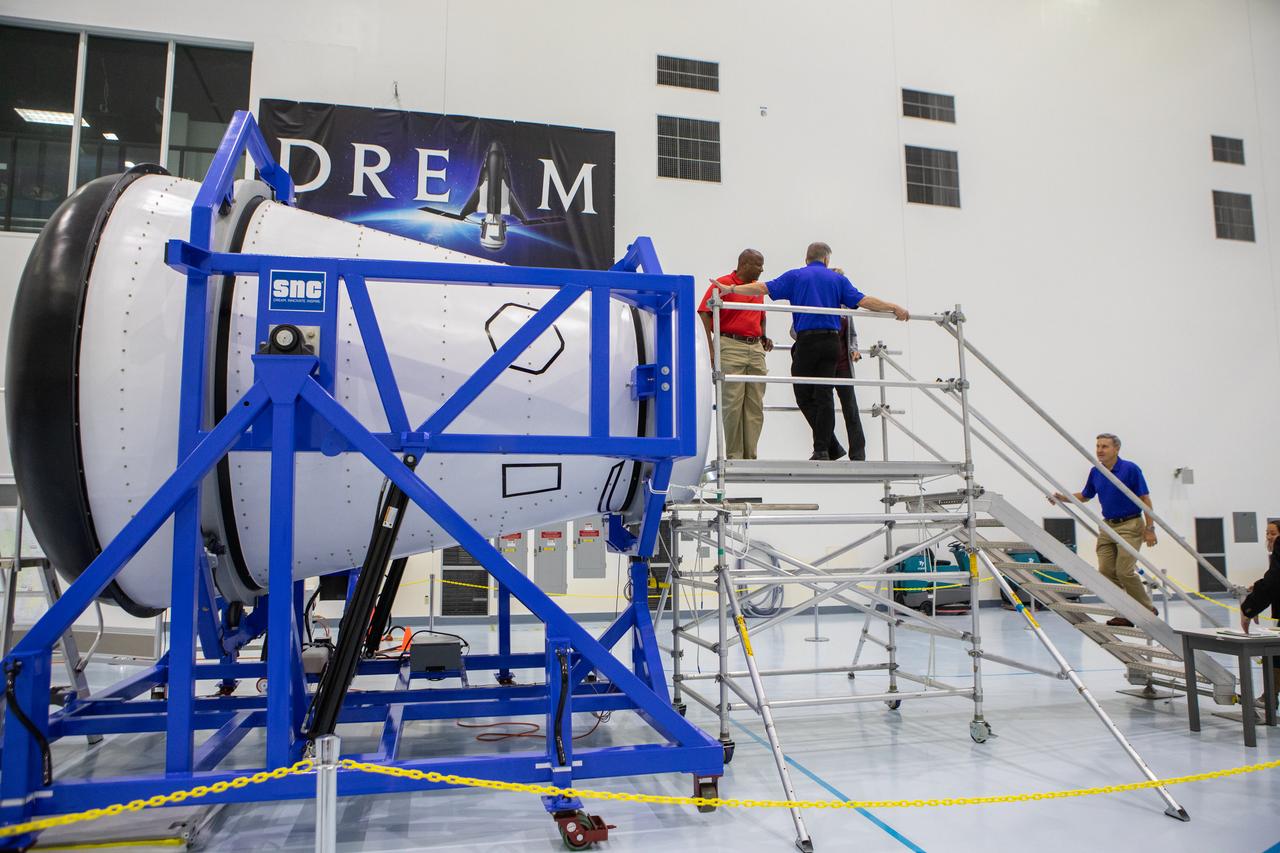
A mockup of the cargo logistics module for Sierra Nevada Corporation’s Dream Chaser, the company’s reusable spaceplane, arrived at the Space Station Processing Facility (SSPF) at NASA’s Kennedy Space Center in Florida in August. On Sept. 20, 2019, senior leadership had the opportunity to view the cargo module in the SSPF high bay. From left are Kelvin Manning, Kennedy associate director, technical; Steve Lindsey, vice president, Space Exploration Systems, Sierra Nevada Corporation; behind Lindsey is Kennedy Deputy Director Janet Petro; and ascending the stairs is Kennedy Center Director Bob Cabana. The SSPF is providing support for current and future NASA and commercial provider programs, including Commercial Resupply Services, Artemis 1, sending the first woman and next man to the Moon, and deep space destinations including Mars.
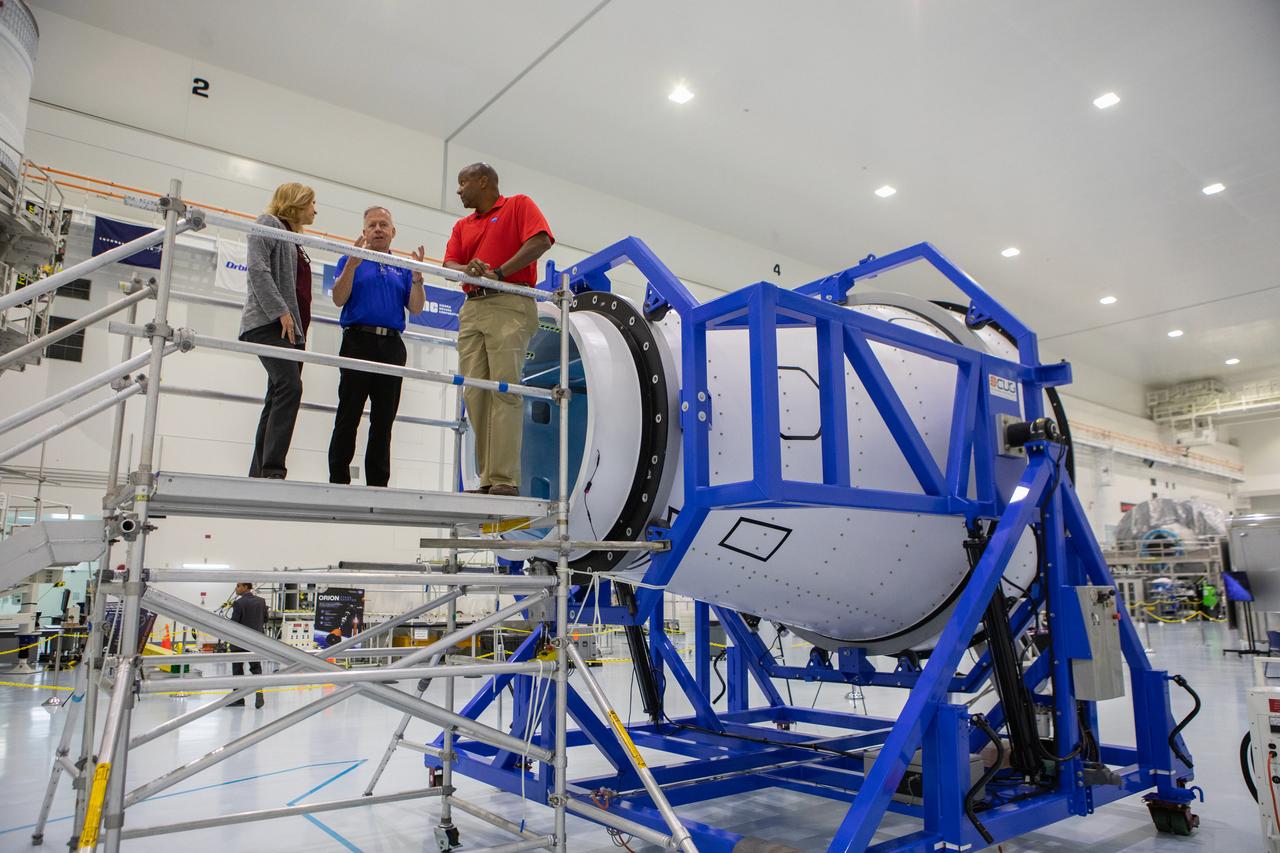
A mockup of the cargo logistics module for Sierra Nevada Corporation’s Dream Chaser, the company’s reusable spaceplane, arrived at the Space Station Processing Facility (SSPF) at NASA’s Kennedy Space Center in Florida in August. On Sept. 20, 2019, senior leadership had the opportunity to view the cargo module in the SSPF high bay. From left are Kennedy Deputy Director Janet Petro; Steve Lindsey, vice president, Space Exploration Systems, Sierra Nevada Corporation; and Kelvin Manning, Kennedy associate director, technical. The SSPF is providing support for current and future NASA and commercial provider programs, including Commercial Resupply Services, Artemis 1, sending the first woman and next man to the Moon, and deep space destinations including Mars.

A mockup of the cargo logistics module for Sierra Nevada Corporation’s Dream Chaser, the company’s reusable spaceplane, arrived at the Space Station Processing Facility (SSPF) at NASA’s Kennedy Space Center in Florida in August. On Sept. 20, 2019, senior leadership had the opportunity to view the cargo module in the SSPF high bay. From left are Kelvin Manning, Kennedy associate director, technical; Steve Lindsey, vice president, Space Exploration Systems, Sierra Nevada Corporation; Kennedy Deputy Director Janet Petro; and Kennedy Center Director Bob Cabana. The SSPF is providing support for current and future NASA and commercial provider programs, including Commercial Resupply Services, Artemis 1, sending the first woman and next man to the Moon, and deep space destinations including Mars.
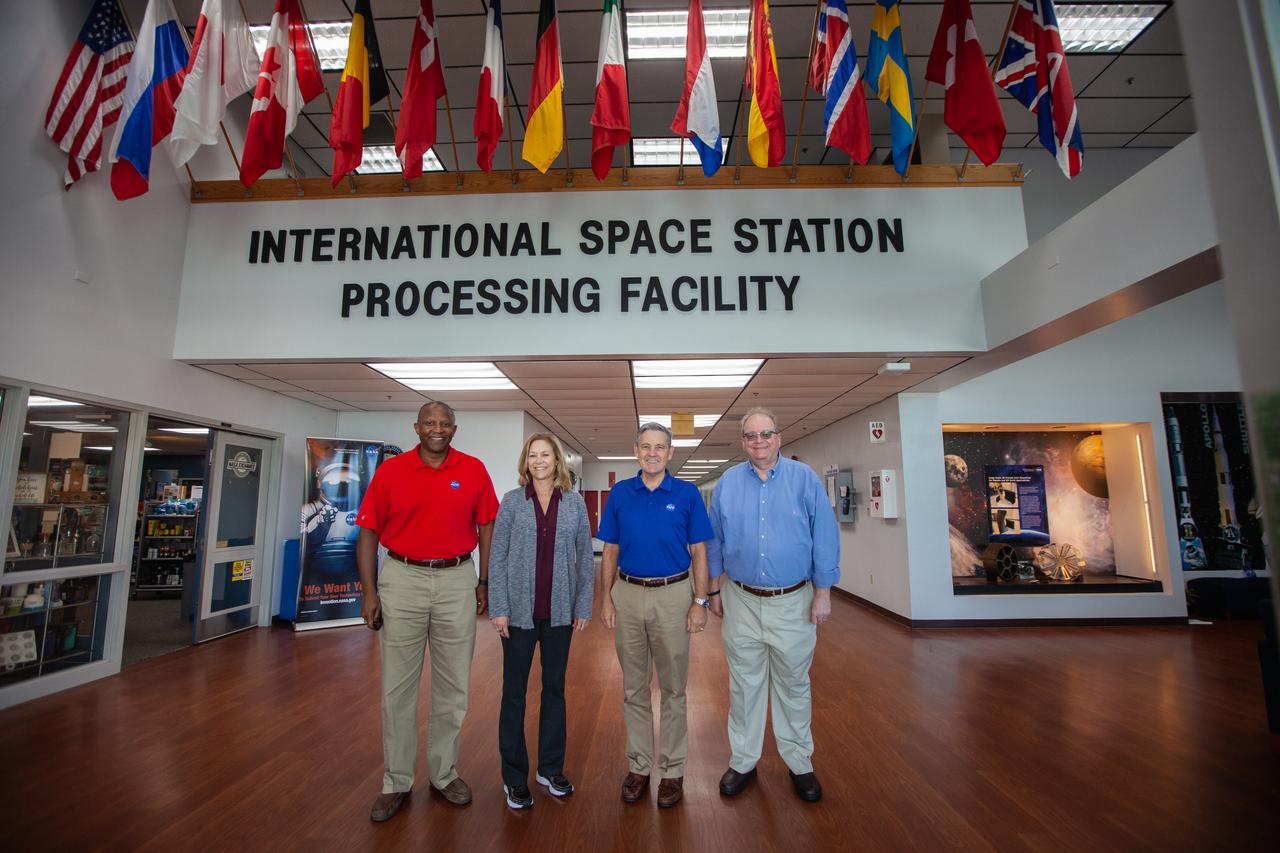
A mockup of the cargo logistics module for Sierra Nevada Corporation’s Dream Chaser, the company’s reusable spaceplane, arrived at the Space Station Processing Facility (SSPF) at NASA’s Kennedy Space Center in Florida in August. On Sept. 20, 2019, senior leadership had the opportunity to view the cargo module in the SSPF high bay. From left, are Kelvin Manning, Kennedy associate director, technical; Kennedy Deputy Director Janet Petro; Kennedy Center Director Bob Cabana; and Burt Summerfield, Kennedy associate director, management. The SSPF is providing support for current and future NASA and commercial provider programs, including Commercial Resupply Services, Artemis 1, sending the first woman and next man to the Moon, and deep space destinations including Mars.
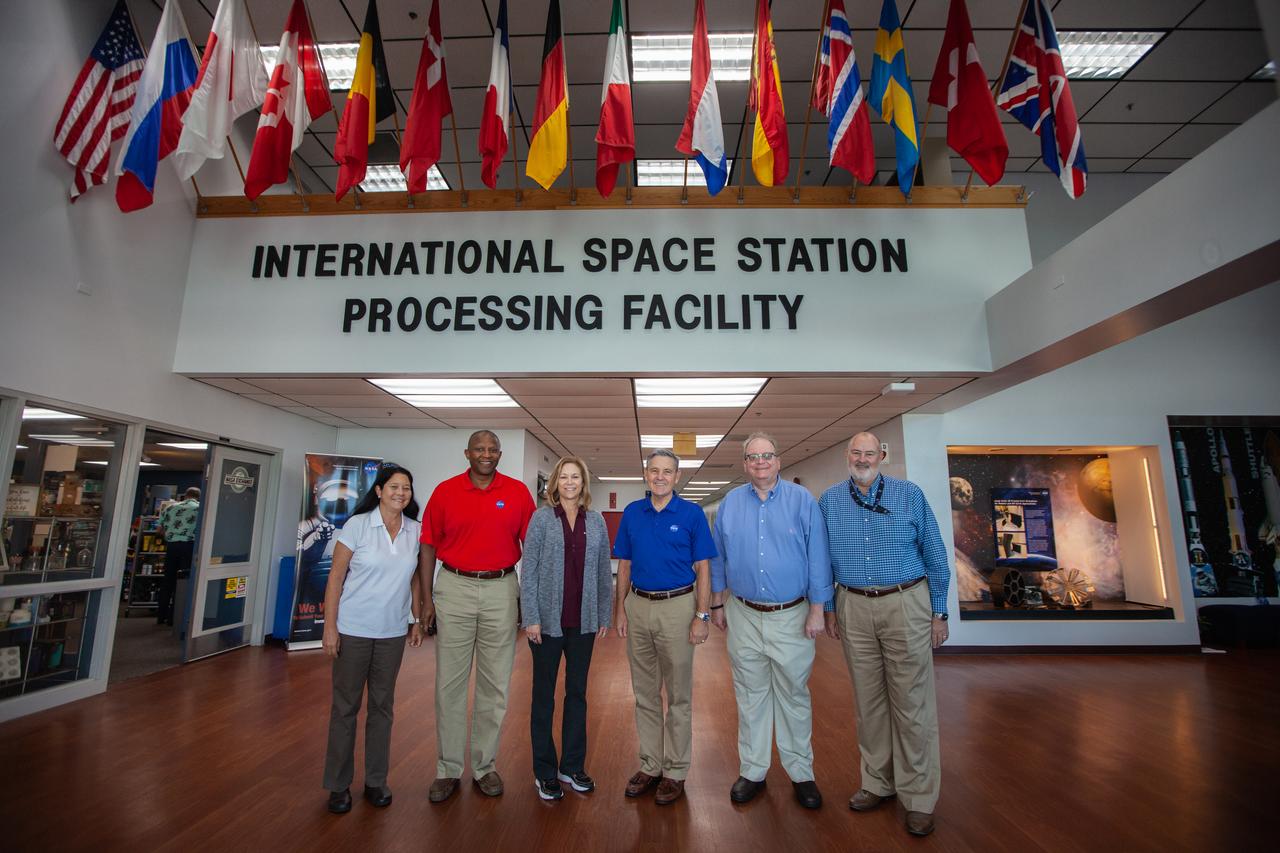
A mockup of the cargo logistics module for Sierra Nevada Corporation’s Dream Chaser, the company’s reusable spaceplane, arrived at the Space Station Processing Facility (SSPF) at NASA’s Kennedy Space Center in Florida in August. On Sept. 20, 2019, senior leadership had the opportunity to view the cargo module in the SSPF high bay. From left, are Josie Burnett, director of Exploration Research and Technology Programs; Kelvin Manning, Kennedy associate director, technical; Kennedy Deputy Director Janet Petro; Kennedy Center Director Bob Cabana; Burt Summerfield, Kennedy associate director, management; and Ronnie Lawson, deputy director of Exploration Research and Technology Programs. The SSPF is providing support for current and future NASA and commercial provider programs, including Commercial Resupply Services, Artemis 1, sending the first woman and next man to the Moon, and deep space destinations including Mars.
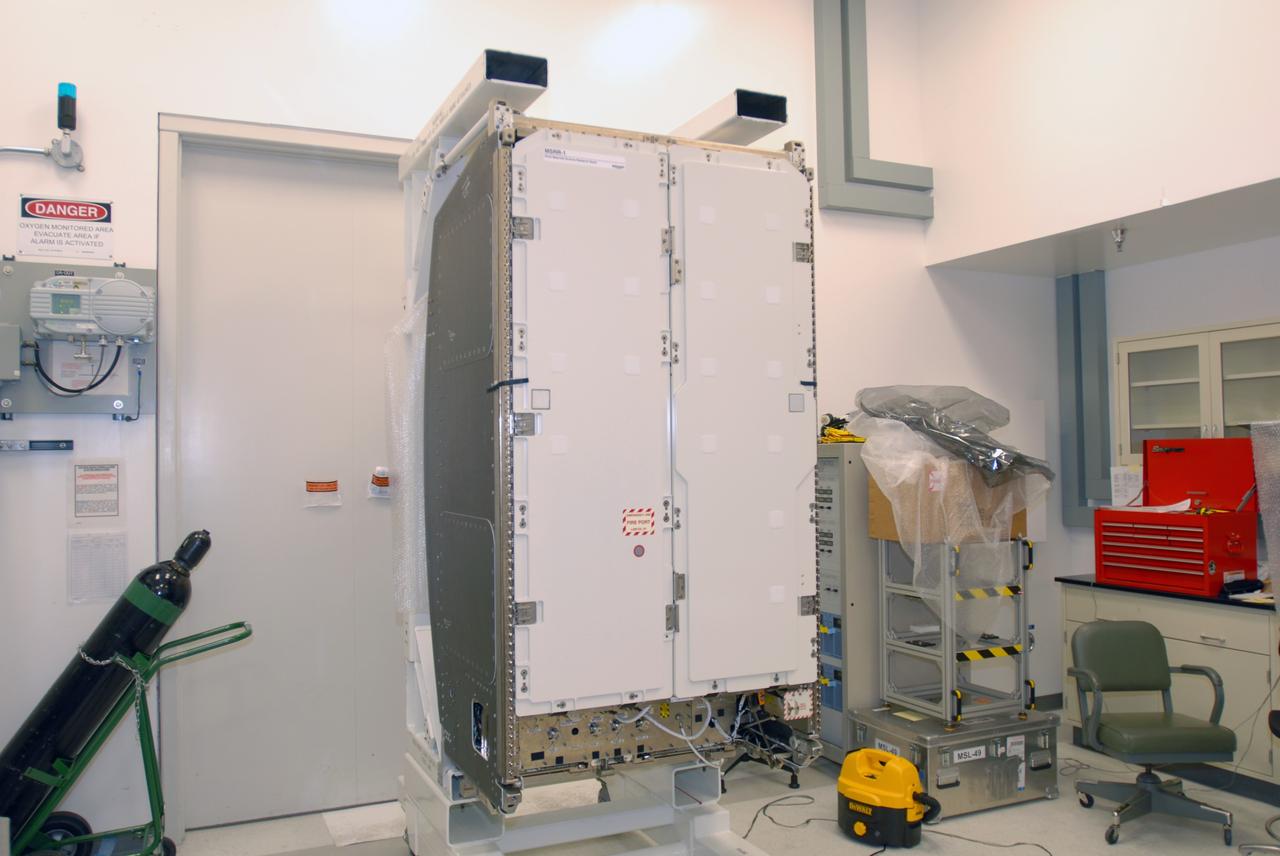
CAPE CANAVERAL, Fla. – The Materials Science Research Rack-1, or MSRR-1, arrived at NASA's Kennedy Space Center in Florida for final flight preparations. The size of a large refrigerator, MSRR-1 is 6 feet high, 3.5 feet wide and 40 inches deep and weighs about 1 ton. MSRR-1 is the payload for the STS-128 mission targeted to launch in August. The rack will be installed in the Leonardo Multi-Purpose Logistics Module for transport to the International Space Station . After arriving at the station, the rack will be housed in the U.S. Destiny laboratory. MSRR-1 will allow for study of a variety of materials including metals, ceramics, semiconductor crystals and glasses onboard the orbiting laboratory. Photo credit: NASA/Jim Grossmann
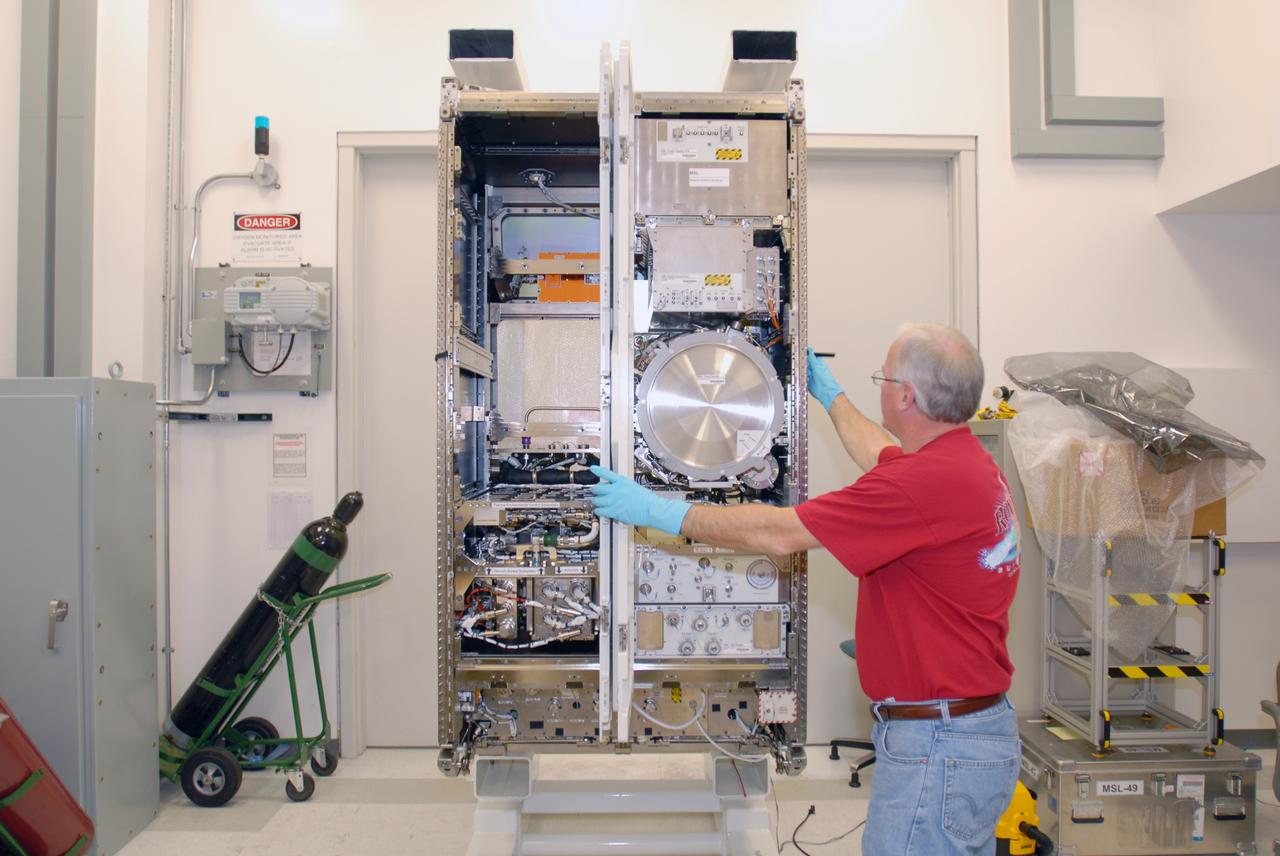
CAPE CANAVERAL, Fla. – At NASA's Kennedy Space Center in Florida, a technician checks out the Materials Science Research Rack-1, or MSRR-1, which will undergo final flight preparations. The size of a large refrigerator, MSRR-1 is 6 feet high, 3.5 feet wide and 40 inches deep and weighs about 1 ton. MSRR-1 is the payload for the STS-128 mission targeted to launch in August. The rack will be installed in the Leonardo Multi-Purpose Logistics Module for transport to the International Space Station . After arriving at the station, the rack will be housed in the U.S. Destiny laboratory. MSRR-1 will allow for study of a variety of materials including metals, ceramics, semiconductor crystals and glasses onboard the orbiting laboratory. Photo credit: NASA/Jim Grossmann
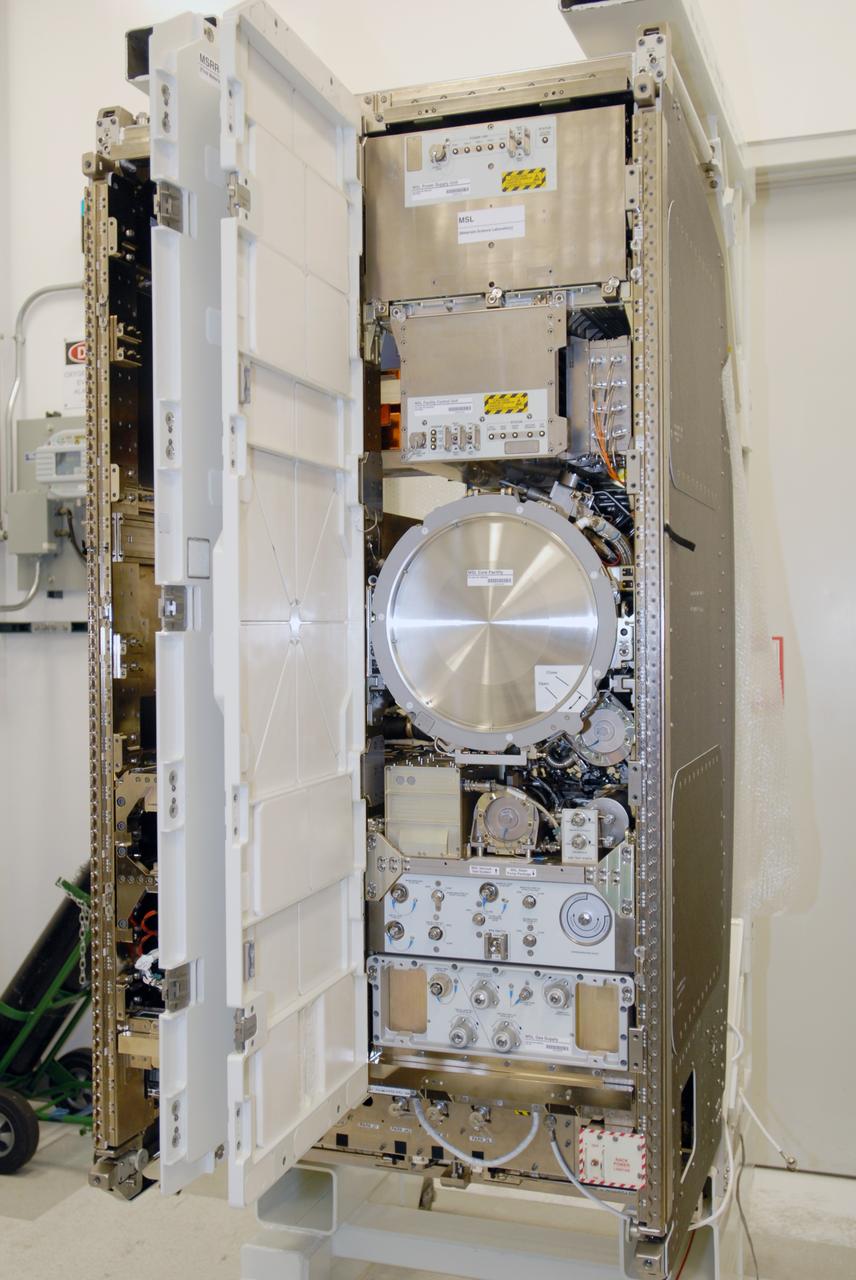
CAPE CANAVERAL, Fla. – This close-up shows some of the components of the Materials Science Research Rack-1, or MSRR-1, which arrived at NASA's Kennedy Space Center in Florida for final flight preparations. The size of a large refrigerator, MSRR-1 is 6 feet high, 3.5 feet wide and 40 inches deep and weighs about 1 ton. MSRR-1 is the payload for the STS-128 mission targeted to launch in August. The rack will be installed in the Leonardo Multi-Purpose Logistics Module for transport to the International Space Station . After arriving at the station, the rack will be housed in the U.S. Destiny laboratory. MSRR-1 will allow for study of a variety of materials including metals, ceramics, semiconductor crystals and glasses onboard the orbiting laboratory. Photo credit: NASA/Jim Grossmann
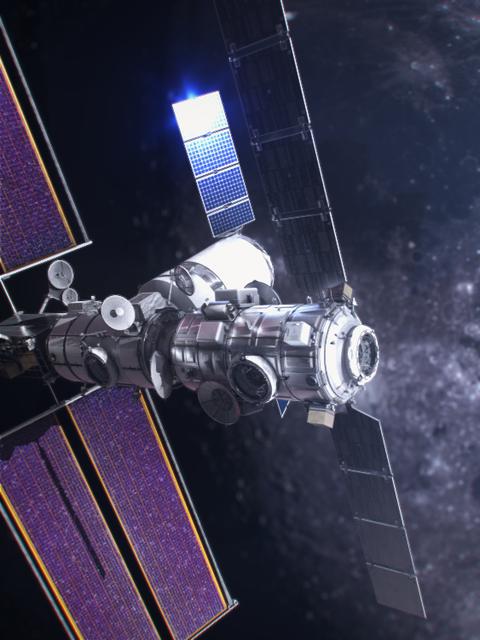
Astronauts will enter Gateway for the first time during the Artemis IV mission when the crewed Orion spacecraft will deliver the International Habitation (I-Hab) module to the space station.
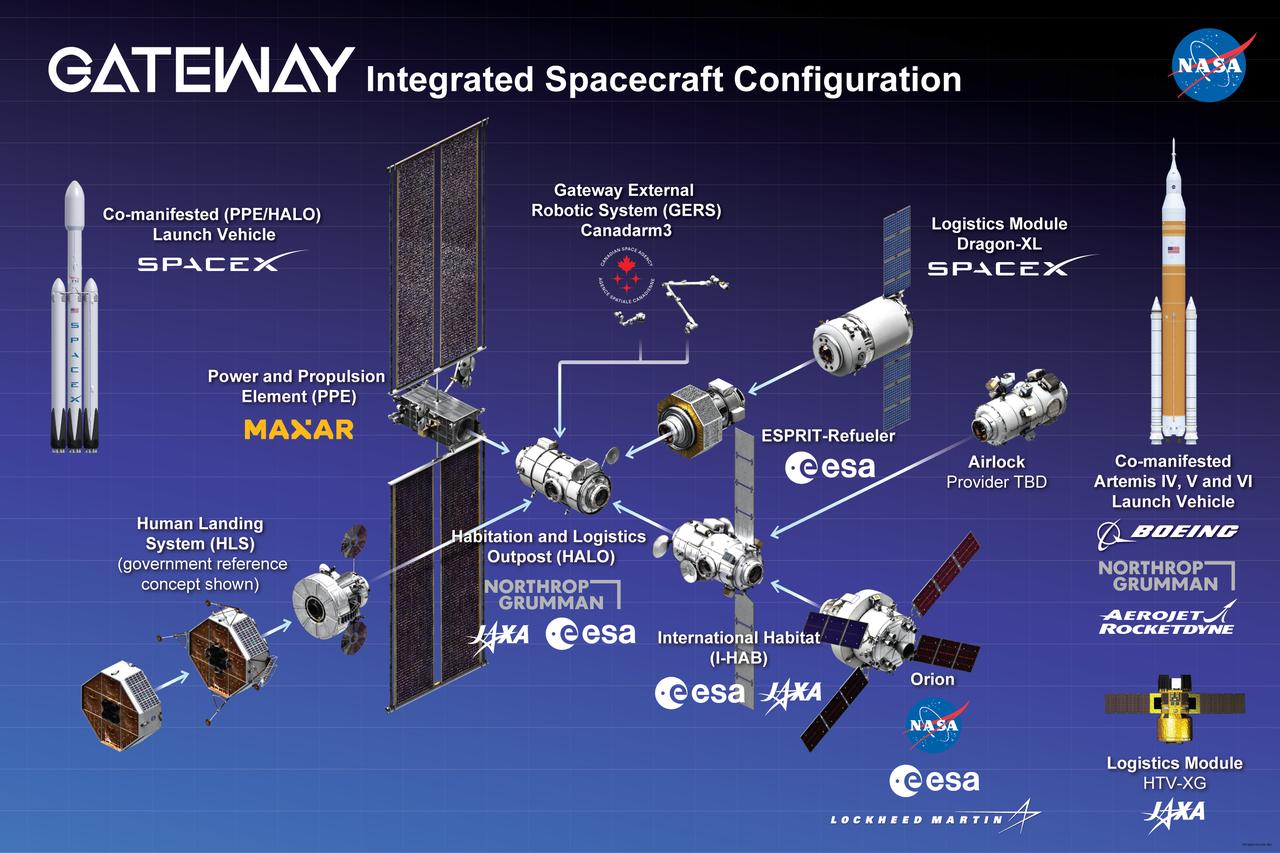
And expanded view of the Gateway space station showing each of its elements, international partner contributions, and visiting spacecraft including Orion and the Human Landing System, with prime contractors.
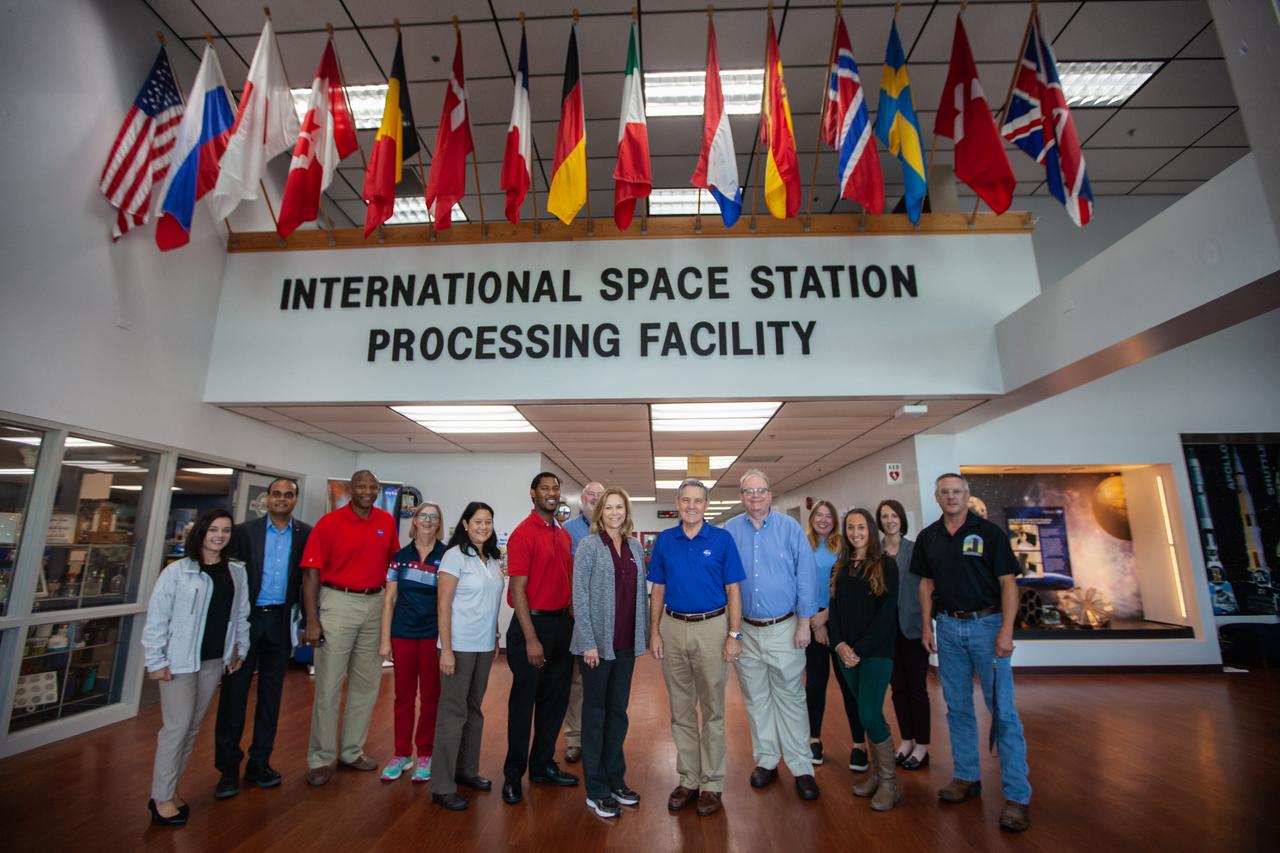
A mockup of the cargo logistics module for Sierra Nevada Corporation’s Dream Chaser, the company’s reusable spaceplane, arrived at the Space Station Processing Facility (SSPF) at NASA’s Kennedy Space Center in Florida in August. On Sept. 20, 2019, senior leadership had the opportunity to view the cargo module in the SSPF high bay. Third from left is Kelvin Manning, Kennedy associate director, technical; fifth from left is Josie Burnett, director of Exploration Research and Technology Programs. In the center are Kennedy Deputy Director Janet Petro and Kennedy Center Director Bob Cabana. Behind Petro is Ronnie Lawson, deputy director of Exploration Research and Technology Programs. To Cabana’s right is Burt Summerfield, associate director, management. At far right is James Wood, chief engineer for the Launch Services Program with the Engineering Directorate. The SSPF is providing support for current and future NASA and commercial provider programs, including Commercial Resupply Services, Artemis 1, sending the first woman and next man to the Moon, and deep space destinations including Mars.
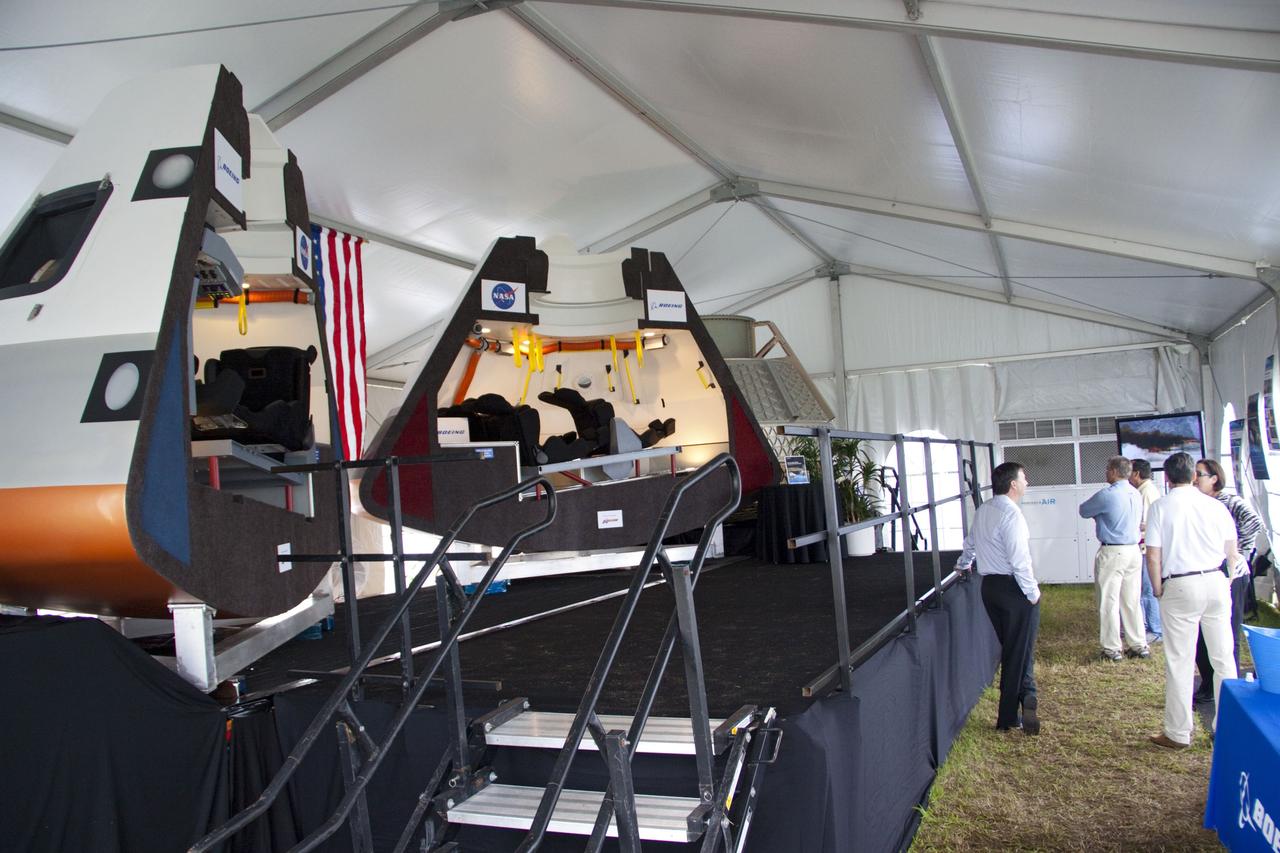
CAPE CANAVERAL, Fla. -- A media event was held for the Multi-Purpose Crew Vehicle (MPCV) that was on display in a tent on the grounds of the Press Site at NASA's Kennedy Space Center in Florida during launch activities for space shuttle Atlantis' STS-135 mission to the International Space Station. The MPCV is based on the Orion design requirements for traveling beyond low Earth orbit and will serve as the exploration vehicle that will carry the crew to space, provide emergency abort capability, sustain the crew during the space travel, and provide safe re-entry from deep space return velocities. Atlantis began its final flight, with Commander Chris Ferguson, Pilot Doug Hurley and Mission Specialists Sandy Magnus and Rex Walheim on board, at 11:29 a.m. EDT July 8 to deliver the Raffaello multi-purpose logistics module packed with supplies and spare parts to the station. Also in Atlantis' payload bay is the Robotic Refueling Mission experiment that will investigate the potential for robotically refueling existing satellites in orbit. In addition, Atlantis will return with a failed ammonia pump module to help NASA better understand the failure mechanism and improve pump designs for future systems. STS-135 is the 33rd flight of Atlantis, the 37th shuttle mission to the space station, and the 135th and final mission of NASA's Space Shuttle Program. For more information, visit www.nasa.gov/mission_pages/shuttle/shuttlemissions/sts135/index.html. Photo credit: NASA/Jim Grossmann