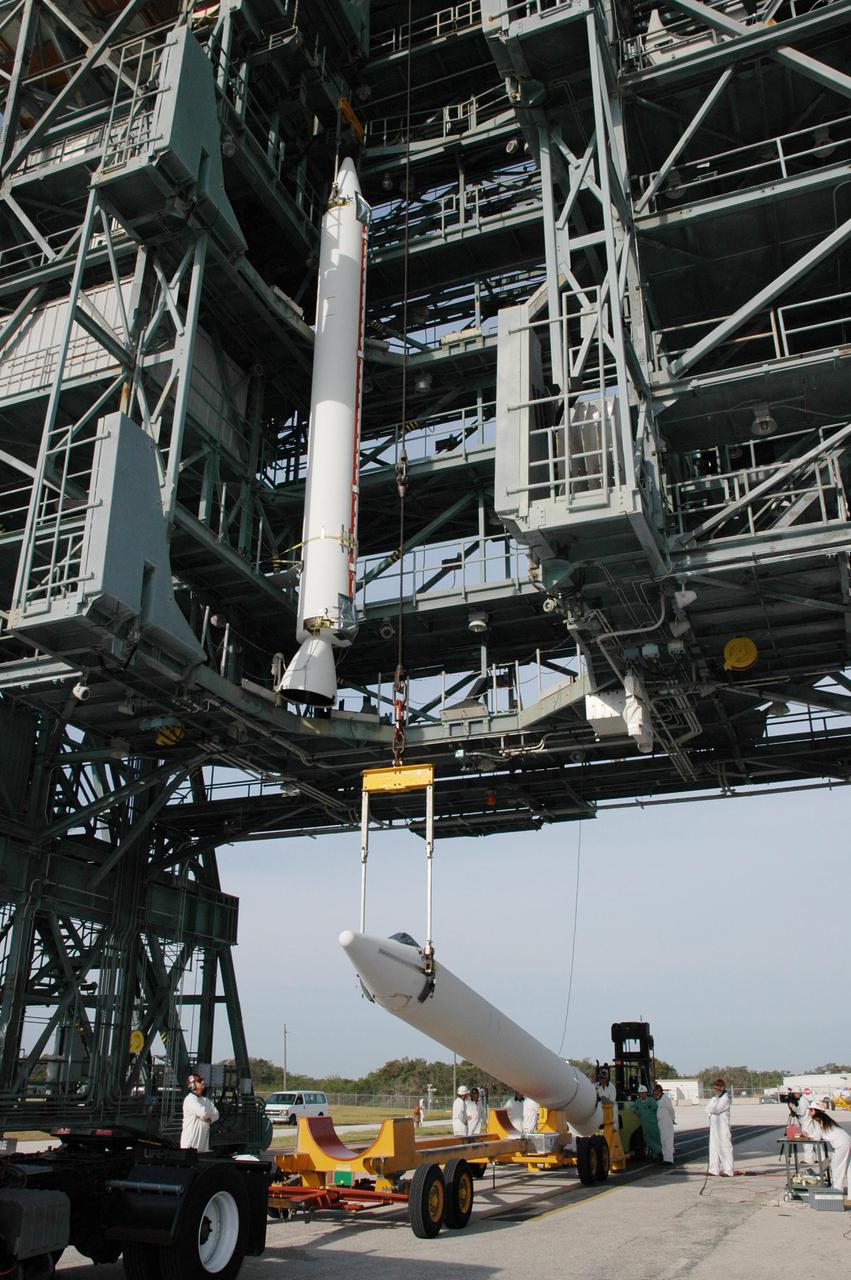
KENNEDY SPACE CENTER, FLA. - On Launch Pad 17-B, Cape Canaveral Air Force Station, Fla., a second Solid Rocket Booster (SRB) is raised off a transporter to be lifted up the mobile service tower. It will be attached to the Boeing Delta II launch vehicle for launch of the Deep Impact spacecraft. A NASA Discovery mission, Deep Impact will probe beneath the surface of Comet Tempel 1 on July 4, 2005, when the comet is 83 million miles from Earth, and reveal the secrets of its interior. After releasing a 3- by 3-foot projectile to crash onto the surface, Deep Impact’s flyby spacecraft will collect pictures and data of how the crater forms, measuring the crater’s depth and diameter, as well as the composition of the interior of the crater and any material thrown out, and determining the changes in natural outgassing produced by the impact. It will send the data back to Earth through the antennas of the Deep Space Network. Deep Impact project management is handled by the Jet Propulsion Laboratory in Pasadena, Calif. The spacecraft is scheduled to launch Dec. 30, 2004.
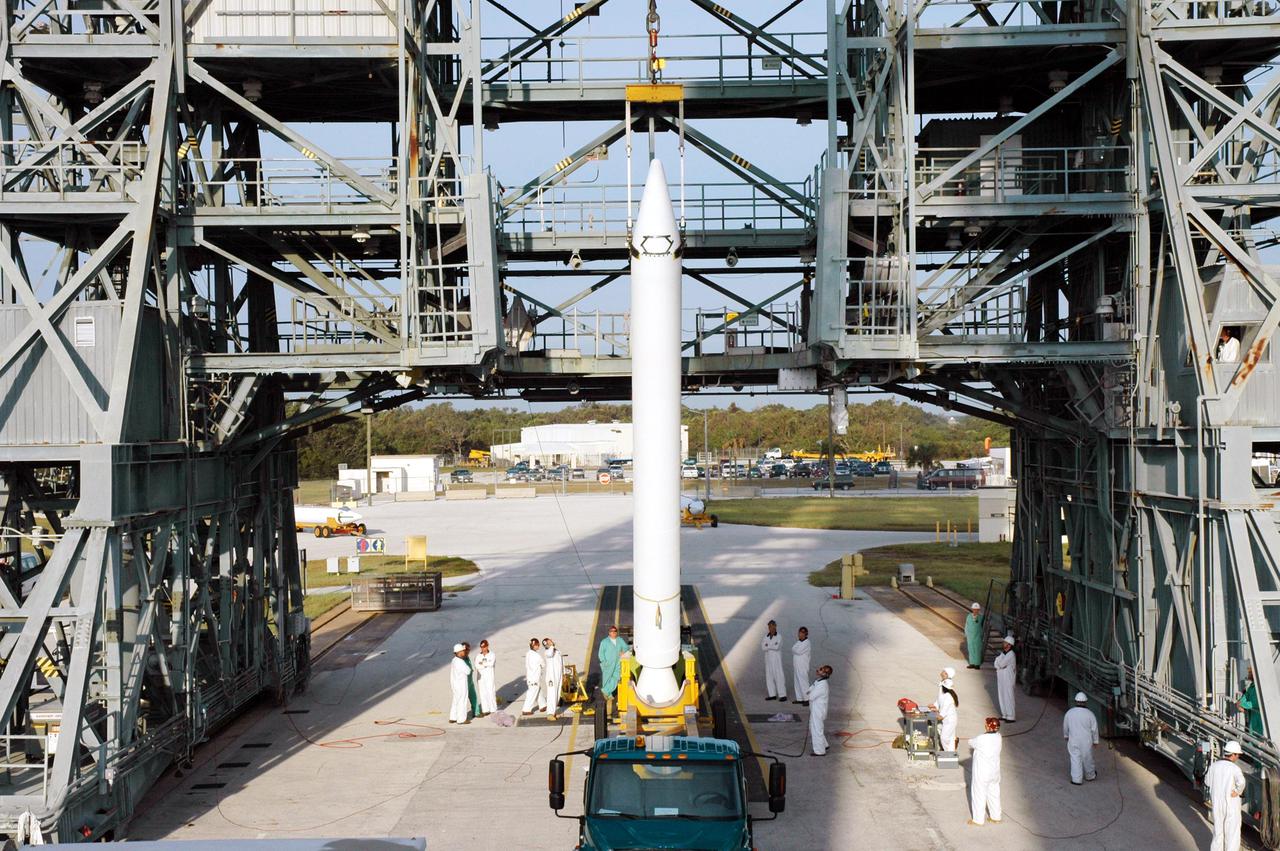
KENNEDY SPACE CENTER, FLA. - On Launch Pad 17-B, Cape Canaveral Air Force Station, Fla., a Solid Rocket Booster (SRB) is ready to be lifted up the mobile service tower and attached to the Boeing Delta II launch vehicle for launch of the Deep Impact spacecraft. A NASA Discovery mission, Deep Impact will probe beneath the surface of Comet Tempel 1 on July 4, 2005, when the comet is 83 million miles from Earth, and reveal the secrets of its interior. After releasing a 3- by 3-foot projectile to crash onto the surface, Deep Impact’s flyby spacecraft will collect pictures and data of how the crater forms, measuring the crater’s depth and diameter, as well as the composition of the interior of the crater and any material thrown out, and determining the changes in natural outgassing produced by the impact. It will send the data back to Earth through the antennas of the Deep Space Network. Deep Impact project management is handled by the Jet Propulsion Laboratory in Pasadena, Calif. The spacecraft is scheduled to launch Dec. 30, 2004.
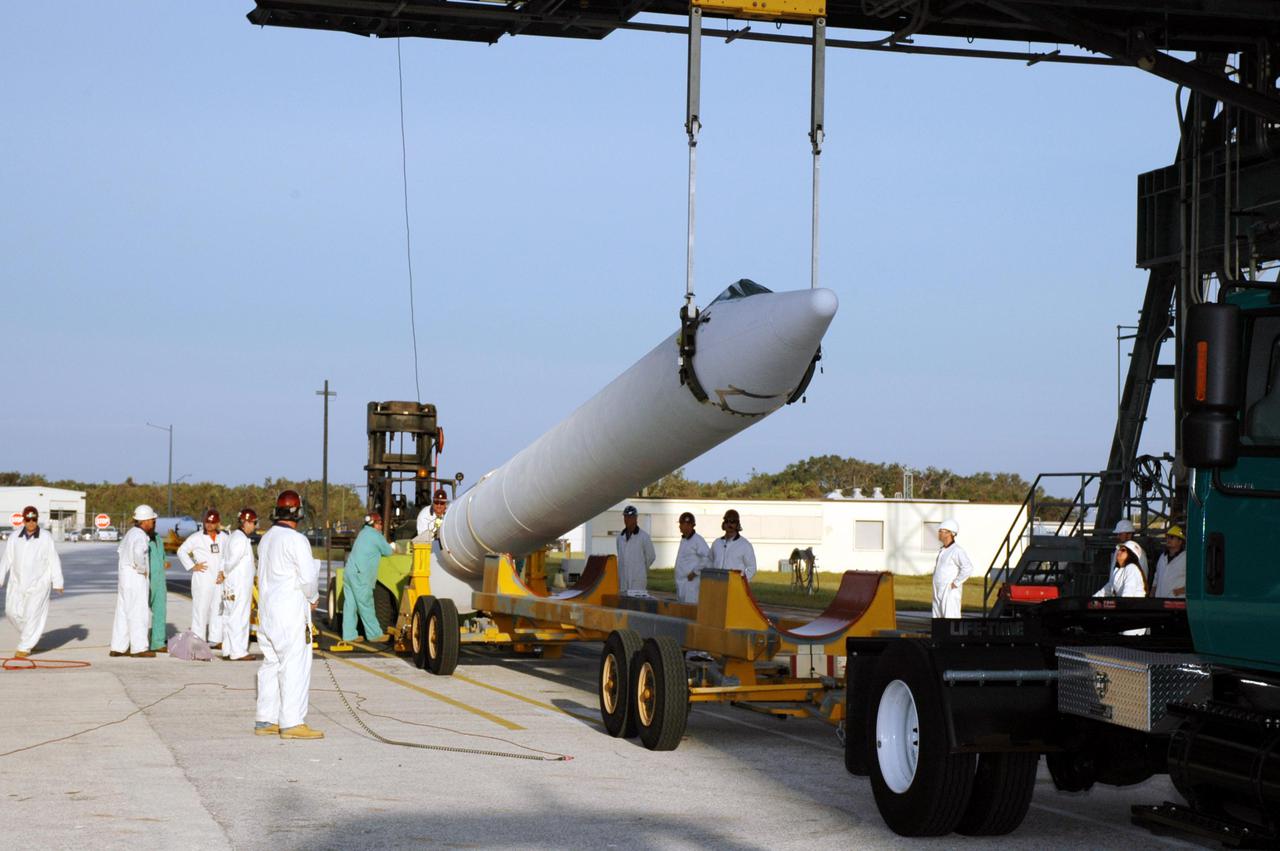
KENNEDY SPACE CENTER, FLA. - On Launch Pad 17-B, Cape Canaveral Air Force Station, Fla., a Solid Rocket Booster (SRB) is raised off a transporter. The SRB will be lifted up the mobile service tower and attached to the Boeing Delta II launch vehicle for launch of the Deep Impact spacecraft. A NASA Discovery mission, Deep Impact will probe beneath the surface of Comet Tempel 1 on July 4, 2005, when the comet is 83 million miles from Earth, and reveal the secrets of its interior. After releasing a 3- by 3-foot projectile to crash onto the surface, Deep Impact’s flyby spacecraft will collect pictures and data of how the crater forms, measuring the crater’s depth and diameter, as well as the composition of the interior of the crater and any material thrown out, and determining the changes in natural outgassing produced by the impact. It will send the data back to Earth through the antennas of the Deep Space Network. Deep Impact project management is handled by the Jet Propulsion Laboratory in Pasadena, Calif. The spacecraft is scheduled to launch Dec. 30, 2004.
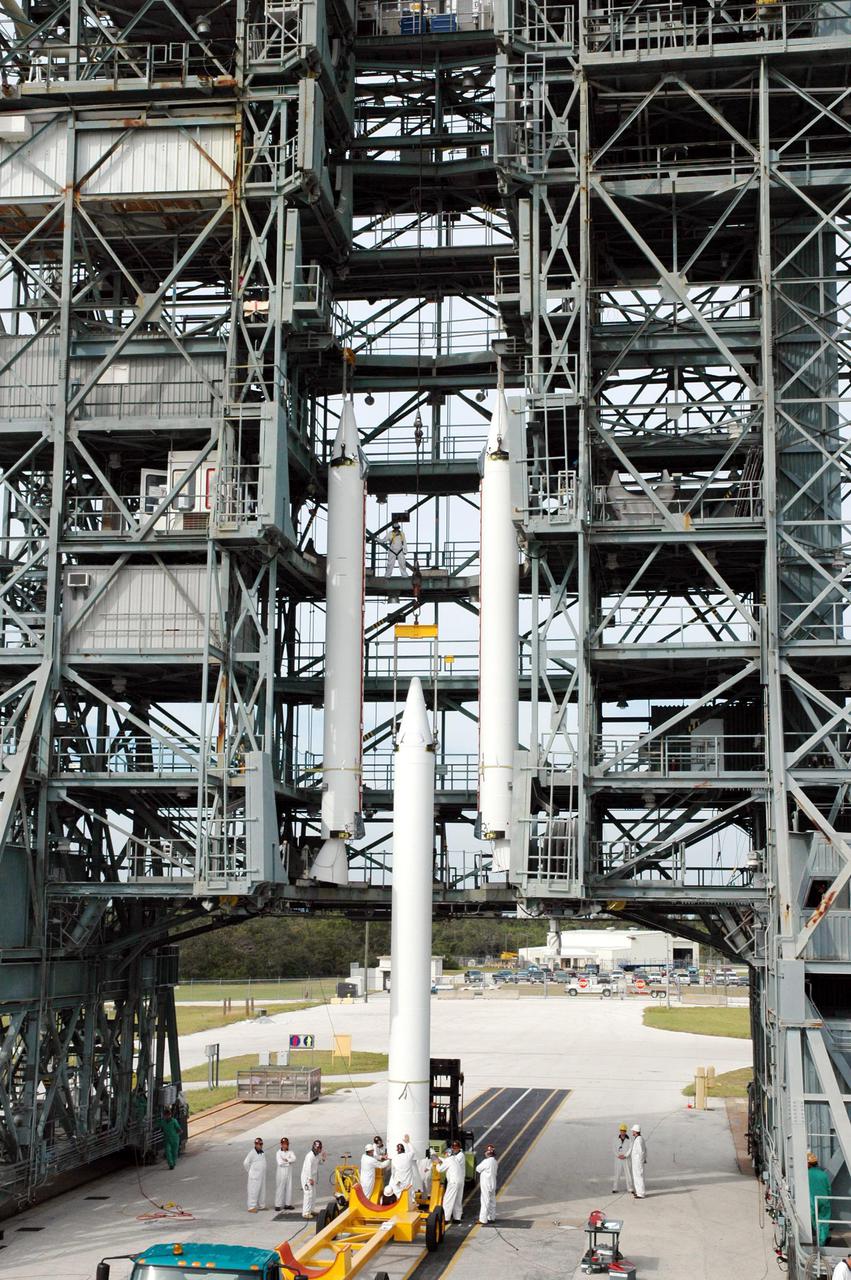
KENNEDY SPACE CENTER, FLA. - On Launch Pad 17-B, Cape Canaveral Air Force Station, Fla., a third Solid Rocket Booster (SRB) is prepared to join the two others in the mobile service tower. They will be attached to the Boeing Delta II launch vehicle for launch of the Deep Impact spacecraft. A NASA Discovery mission, Deep Impact will probe beneath the surface of Comet Tempel 1 on July 4, 2005, when the comet is 83 million miles from Earth, and reveal the secrets of its interior. After releasing a 3- by 3-foot projectile to crash onto the surface, Deep Impact’s flyby spacecraft will collect pictures and data of how the crater forms, measuring the crater’s depth and diameter, as well as the composition of the interior of the crater and any material thrown out, and determining the changes in natural outgassing produced by the impact. It will send the data back to Earth through the antennas of the Deep Space Network. Deep Impact project management is handled by the Jet Propulsion Laboratory in Pasadena, Calif. The spacecraft is scheduled to launch Dec. 30, 2004.
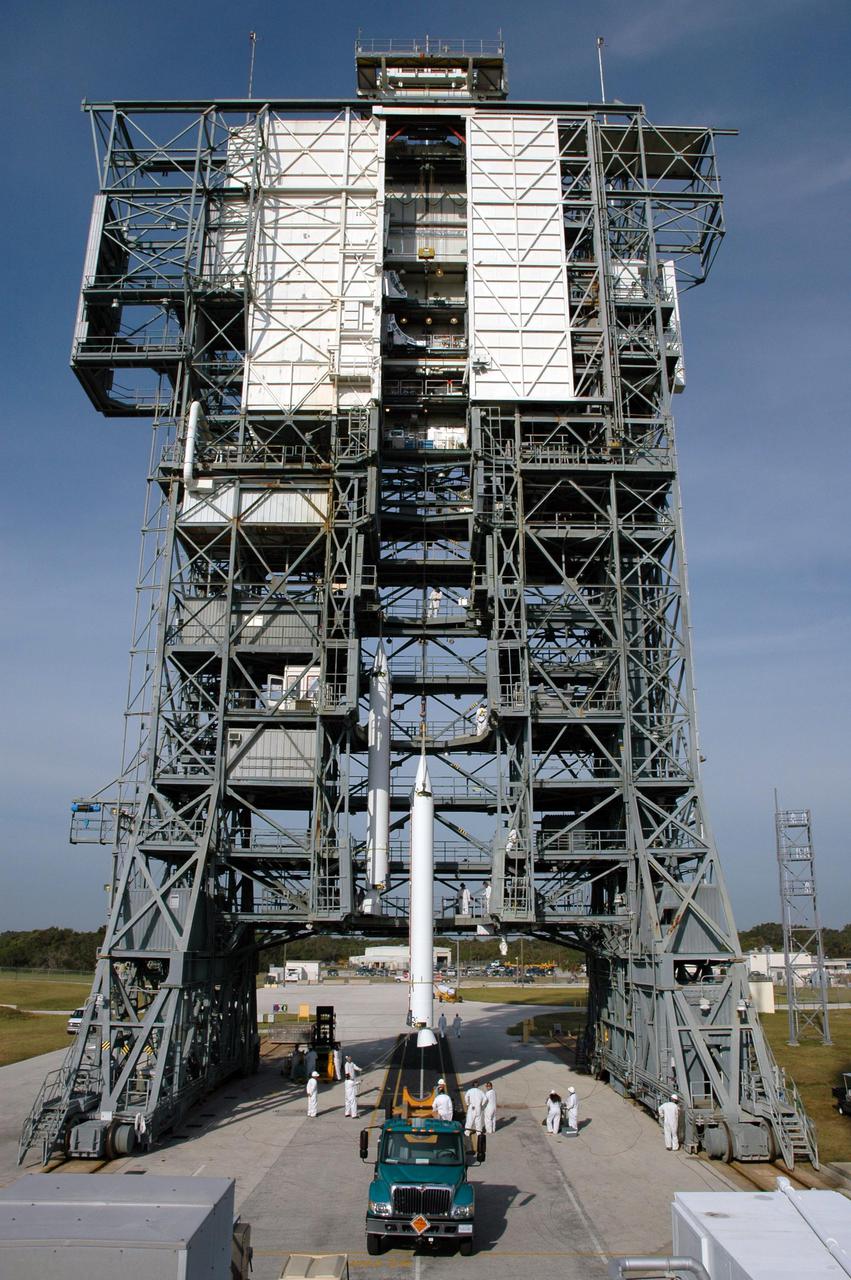
KENNEDY SPACE CENTER, FLA. - On Launch Pad 17-B, Cape Canaveral Air Force Station, Fla., another Solid Rocket Booster (SRB) is ready to be lifted up the mobile service tower and attached to the Boeing Delta II launch vehicle for launch of the Deep Impact spacecraft. A NASA Discovery mission, Deep Impact will probe beneath the surface of Comet Tempel 1 on July 4, 2005, when the comet is 83 million miles from Earth, and reveal the secrets of its interior. After releasing a 3- by 3-foot projectile to crash onto the surface, Deep Impact’s flyby spacecraft will collect pictures and data of how the crater forms, measuring the crater’s depth and diameter, as well as the composition of the interior of the crater and any material thrown out, and determining the changes in natural outgassing produced by the impact. It will send the data back to Earth through the antennas of the Deep Space Network. Deep Impact project management is handled by the Jet Propulsion Laboratory in Pasadena, Calif. The spacecraft is scheduled to launch Dec. 30, 2004.
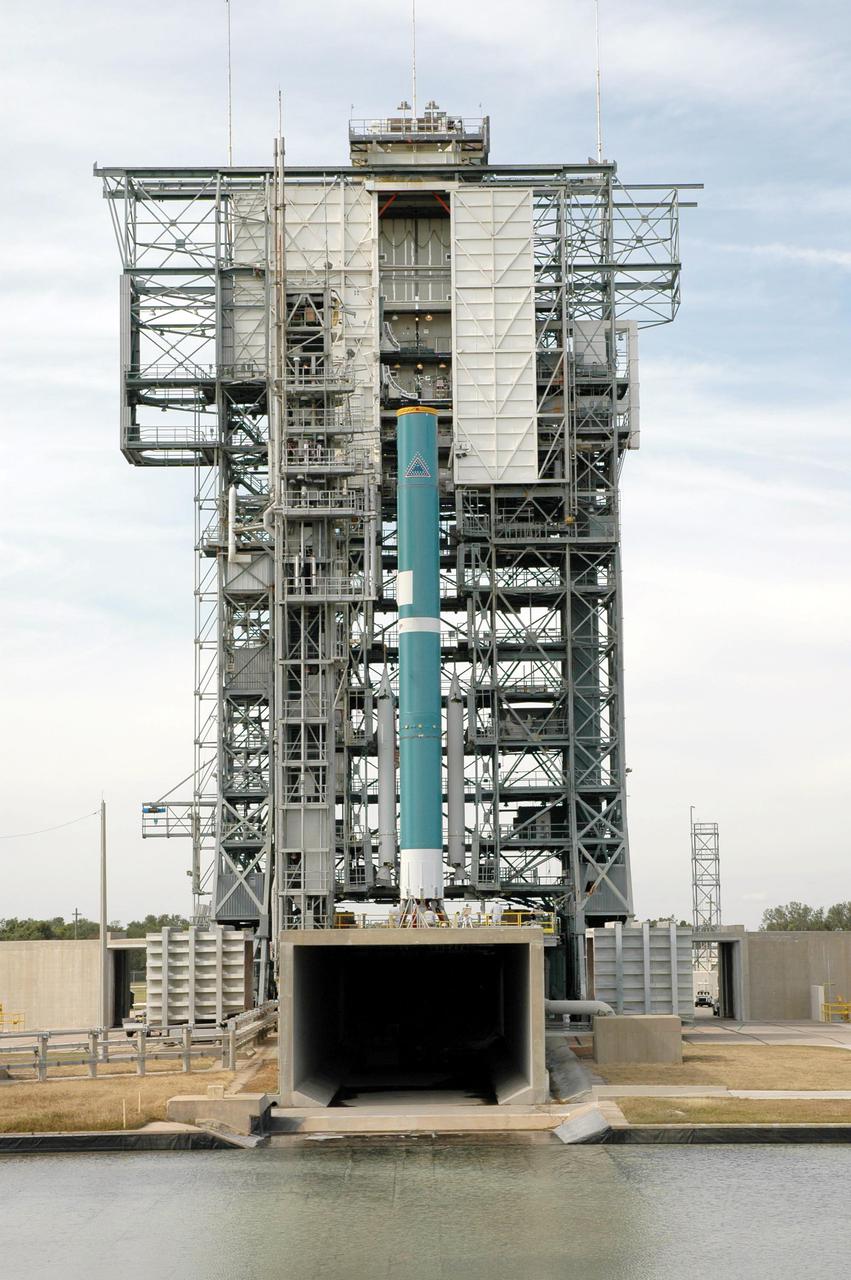
KENNEDY SPACE CENTER, FLA. - On Launch Pad 17-B, Cape Canaveral Air Force Station, Fla., the Boeing Delta II launch vehicle for launch of the Deep Impact spacecraft is seen with three Solid Rocket Boosters (SRBs) attached. A NASA Discovery mission, Deep Impact will probe beneath the surface of Comet Tempel 1 on July 4, 2005, when the comet is 83 million miles from Earth, and reveal the secrets of its interior. After releasing a 3- by 3-foot projectile to crash onto the surface, Deep Impact’s flyby spacecraft will collect pictures and data of how the crater forms, measuring the crater’s depth and diameter, as well as the composition of the interior of the crater and any material thrown out, and determining the changes in natural outgassing produced by the impact. It will send the data back to Earth through the antennas of the Deep Space Network. Deep Impact project management is handled by the Jet Propulsion Laboratory in Pasadena, Calif. The spacecraft is scheduled to launch Dec. 30, 2004.
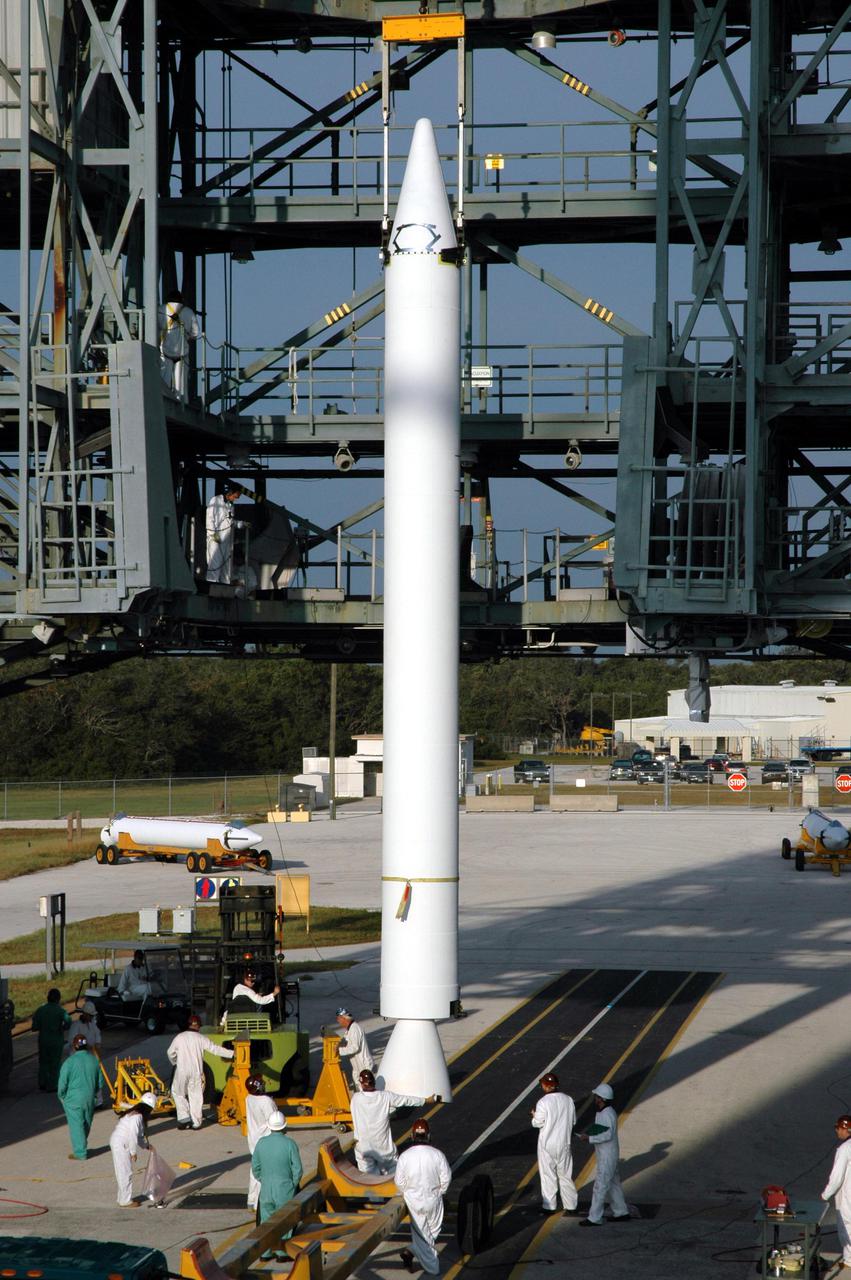
KENNEDY SPACE CENTER, FLA. - On Launch Pad 17-B, Cape Canaveral Air Force Station, Fla., workers prepare a Solid Rocket Booster (SRB) to be lifted up the mobile service tower and attached to the Boeing Delta II launch vehicle for launch of the Deep Impact spacecraft. A NASA Discovery mission, Deep Impact will probe beneath the surface of Comet Tempel 1 on July 4, 2005, when the comet is 83 million miles from Earth, and reveal the secrets of its interior. After releasing a 3- by 3-foot projectile to crash onto the surface, Deep Impact’s flyby spacecraft will collect pictures and data of how the crater forms, measuring the crater’s depth and diameter, as well as the composition of the interior of the crater and any material thrown out, and determining the changes in natural outgassing produced by the impact. It will send the data back to Earth through the antennas of the Deep Space Network. Deep Impact project management is handled by the Jet Propulsion Laboratory in Pasadena, Calif. The spacecraft is scheduled to launch Dec. 30, 2004.
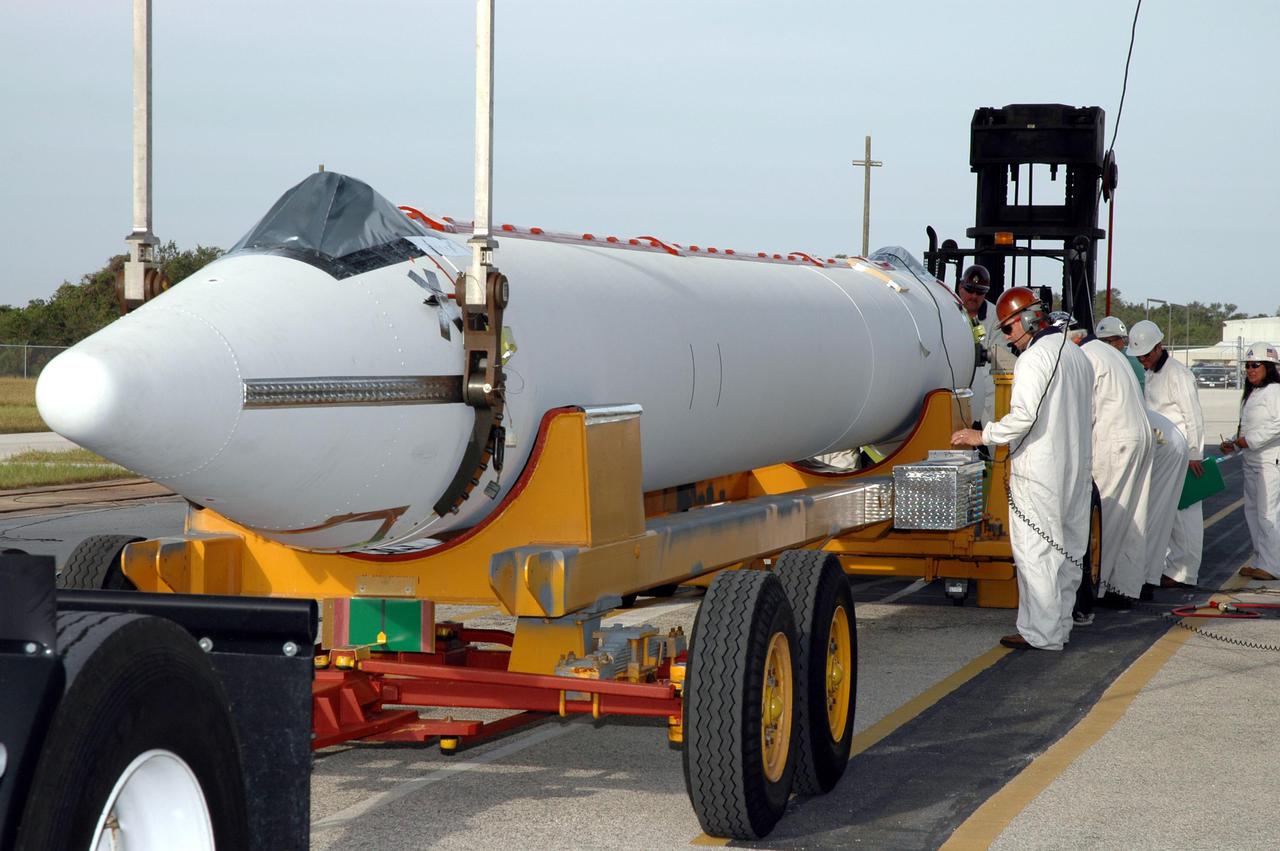
KENNEDY SPACE CENTER, FLA. - On Launch Pad 17-B, Cape Canaveral Air Force Station, Fla., another Solid Rocket Booster (SRB) arrives for attachment to the Boeing Delta II launch vehicle for launch of the Deep Impact spacecraft. A NASA Discovery mission, Deep Impact will probe beneath the surface of Comet Tempel 1 on July 4, 2005, when the comet is 83 million miles from Earth, and reveal the secrets of its interior. After releasing a 3- by 3-foot projectile to crash onto the surface, Deep Impact’s flyby spacecraft will collect pictures and data of how the crater forms, measuring the crater’s depth and diameter, as well as the composition of the interior of the crater and any material thrown out, and determining the changes in natural outgassing produced by the impact. It will send the data back to Earth through the antennas of the Deep Space Network. Deep Impact project management is handled by the Jet Propulsion Laboratory in Pasadena, Calif. The spacecraft is scheduled to launch Dec. 30, 2004.
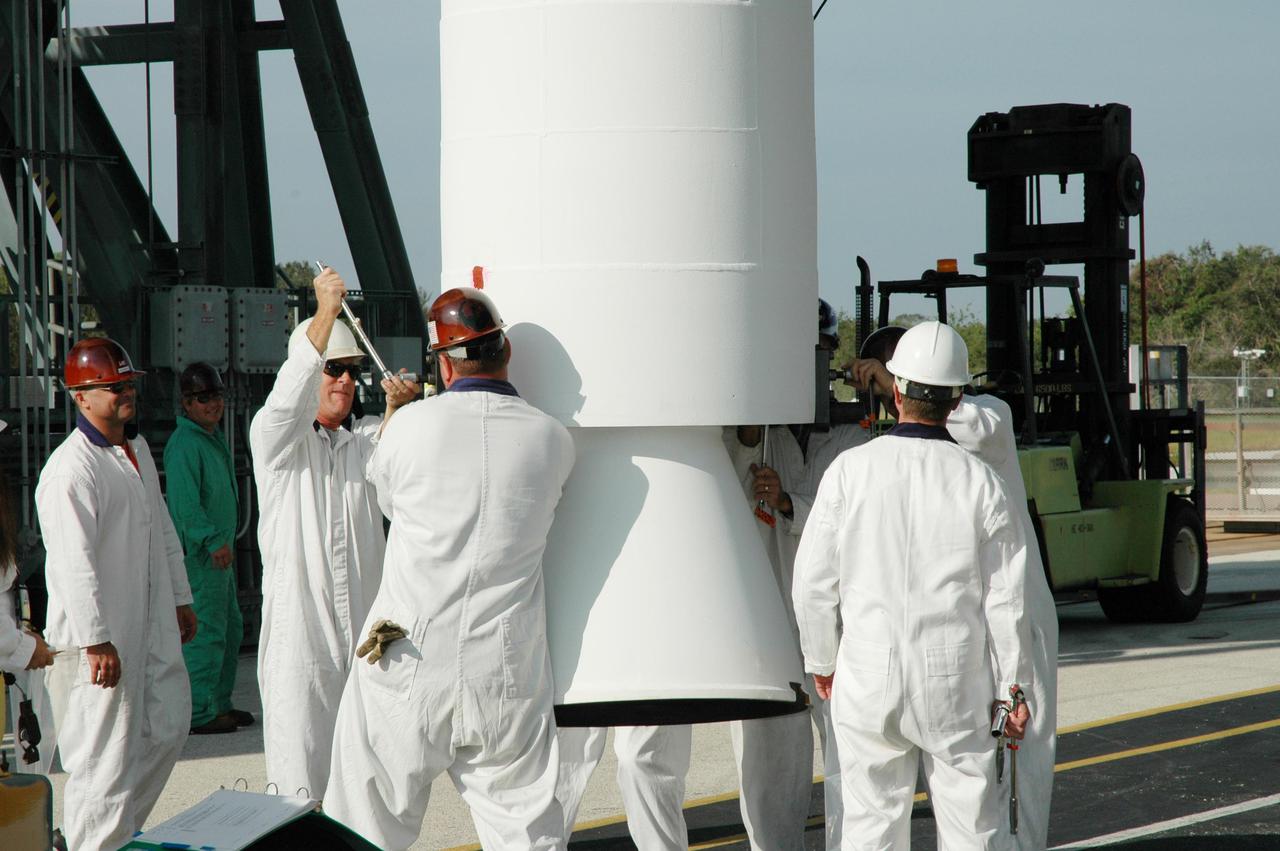
KENNEDY SPACE CENTER, FLA. - On Launch Pad 17-B, Cape Canaveral Air Force Station, Fla., workers prepare another Solid Rocket Booster (SRB) to be lifted up the mobile service tower and attached to the Boeing Delta II launch vehicle for launch of the Deep Impact spacecraft. A NASA Discovery mission, Deep Impact will probe beneath the surface of Comet Tempel 1 on July 4, 2005, when the comet is 83 million miles from Earth, and reveal the secrets of its interior. After releasing a 3- by 3-foot projectile to crash onto the surface, Deep Impact’s flyby spacecraft will collect pictures and data of how the crater forms, measuring the crater’s depth and diameter, as well as the composition of the interior of the crater and any material thrown out, and determining the changes in natural outgassing produced by the impact. It will send the data back to Earth through the antennas of the Deep Space Network. Deep Impact project management is handled by the Jet Propulsion Laboratory in Pasadena, Calif. The spacecraft is scheduled to launch Dec. 30, 2004.
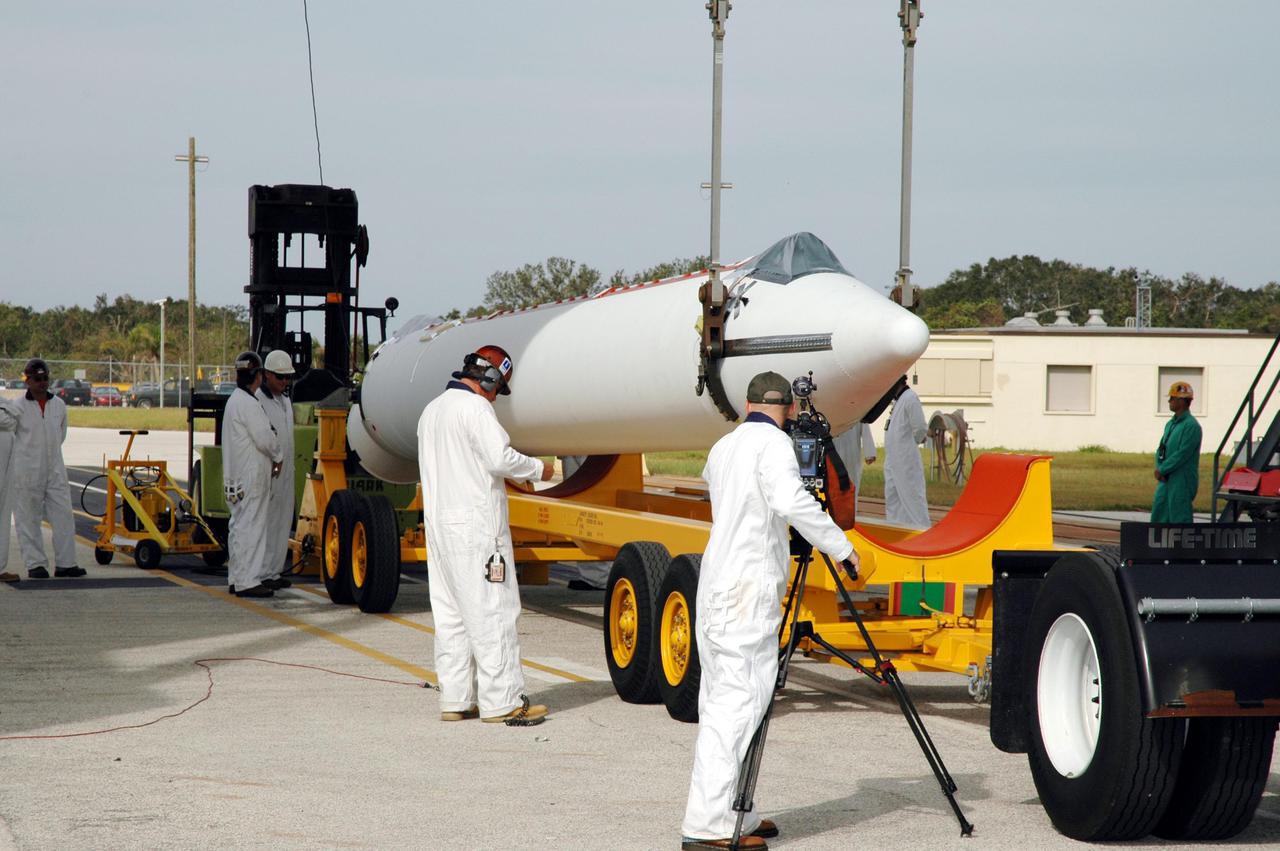
KENNEDY SPACE CENTER, FLA. - On Launch Pad 17-B, Cape Canaveral Air Force Station, Fla., another Solid Rocket Booster (SRB) arrives at the pad. It will be lifted up the mobile service tower and attached to the Boeing Delta II launch vehicle for launch of the Deep Impact spacecraft. A NASA Discovery mission, Deep Impact will probe beneath the surface of Comet Tempel 1 on July 4, 2005, when the comet is 83 million miles from Earth, and reveal the secrets of its interior. After releasing a 3- by 3-foot projectile to crash onto the surface, Deep Impact’s flyby spacecraft will collect pictures and data of how the crater forms, measuring the crater’s depth and diameter, as well as the composition of the interior of the crater and any material thrown out, and determining the changes in natural outgassing produced by the impact. It will send the data back to Earth through the antennas of the Deep Space Network. Deep Impact project management is handled by the Jet Propulsion Laboratory in Pasadena, Calif. The spacecraft is scheduled to launch Dec. 30, 2004.