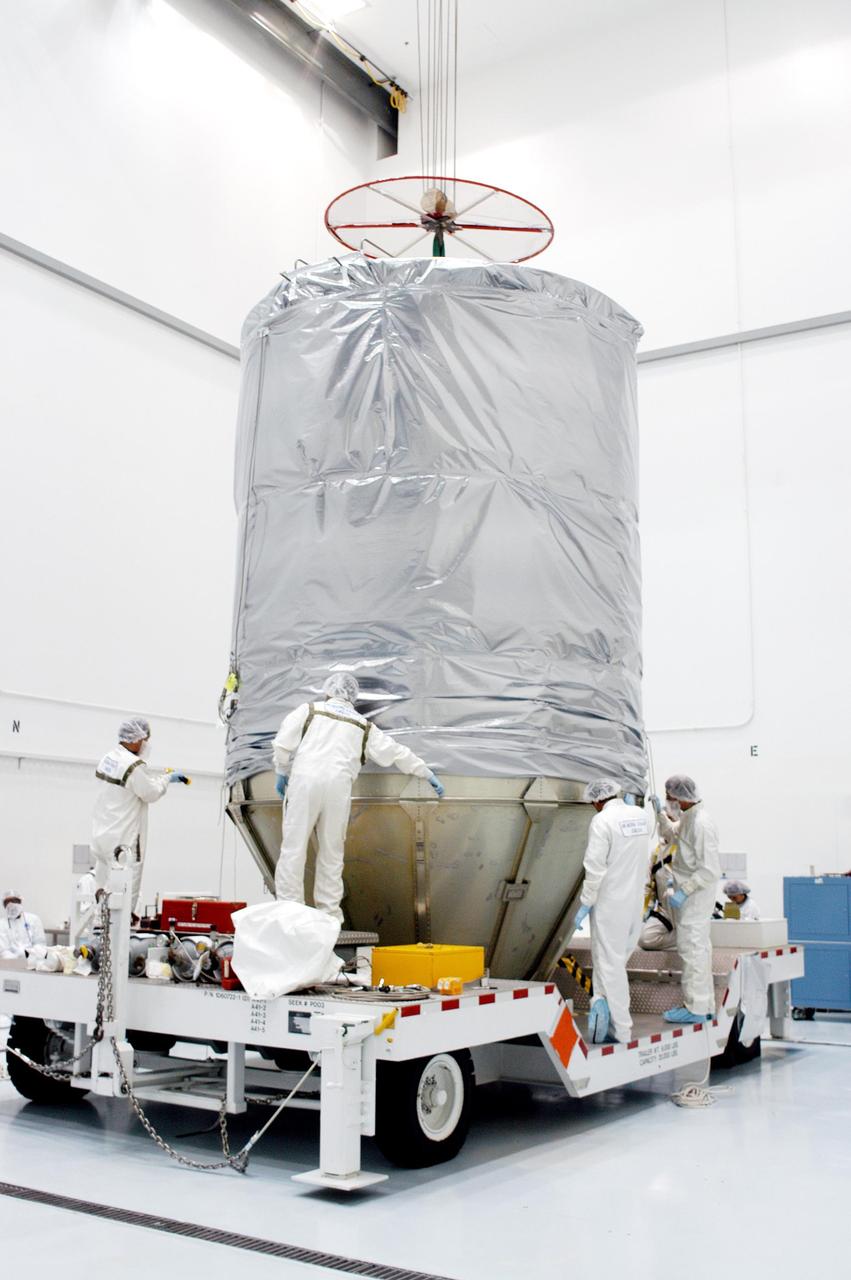
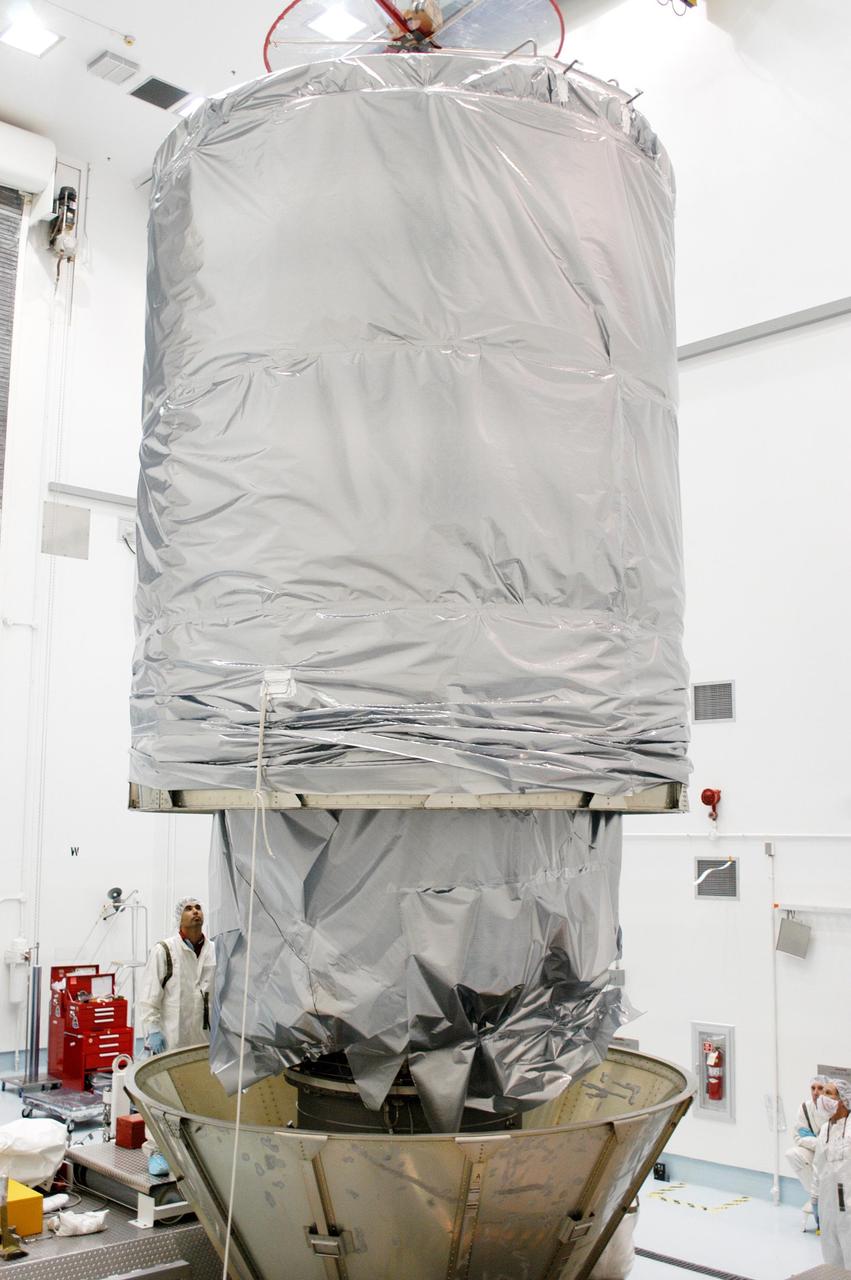
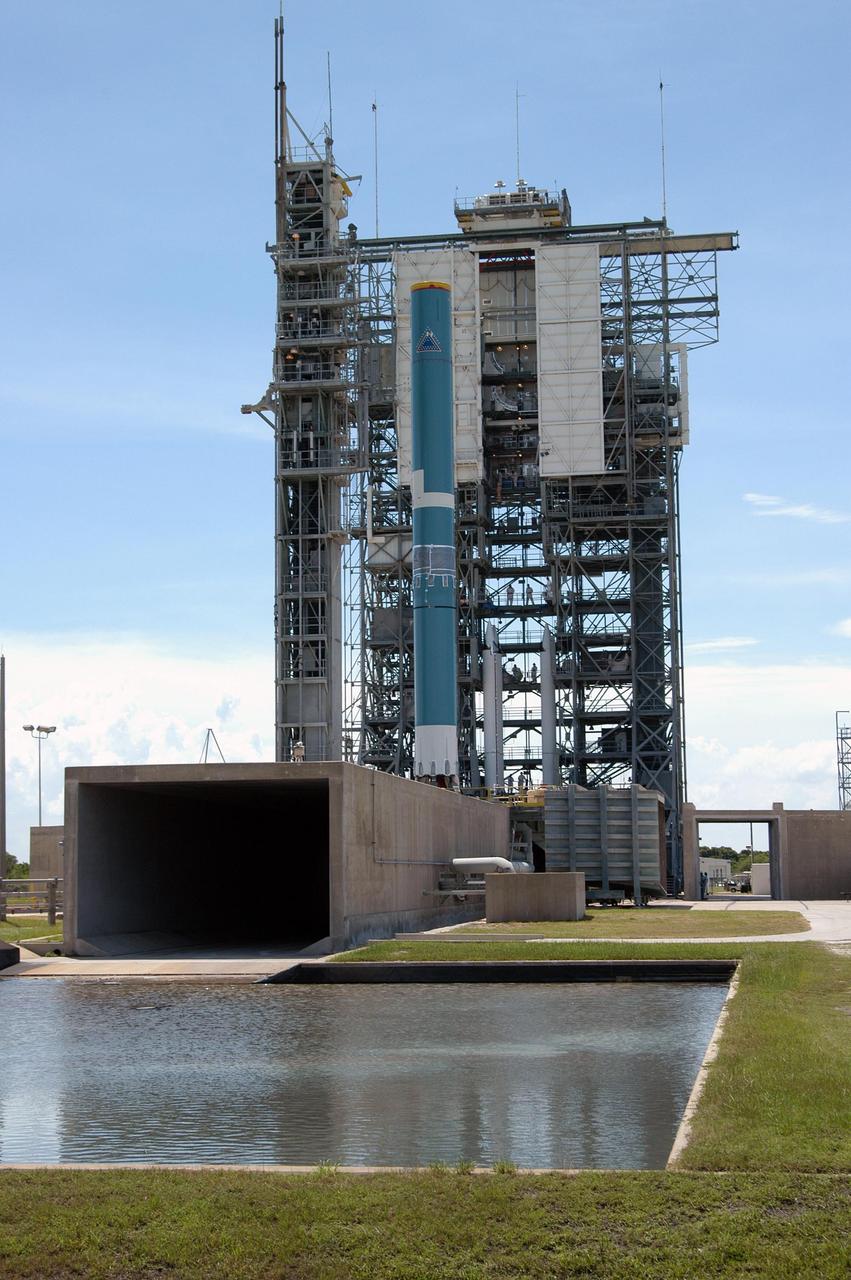
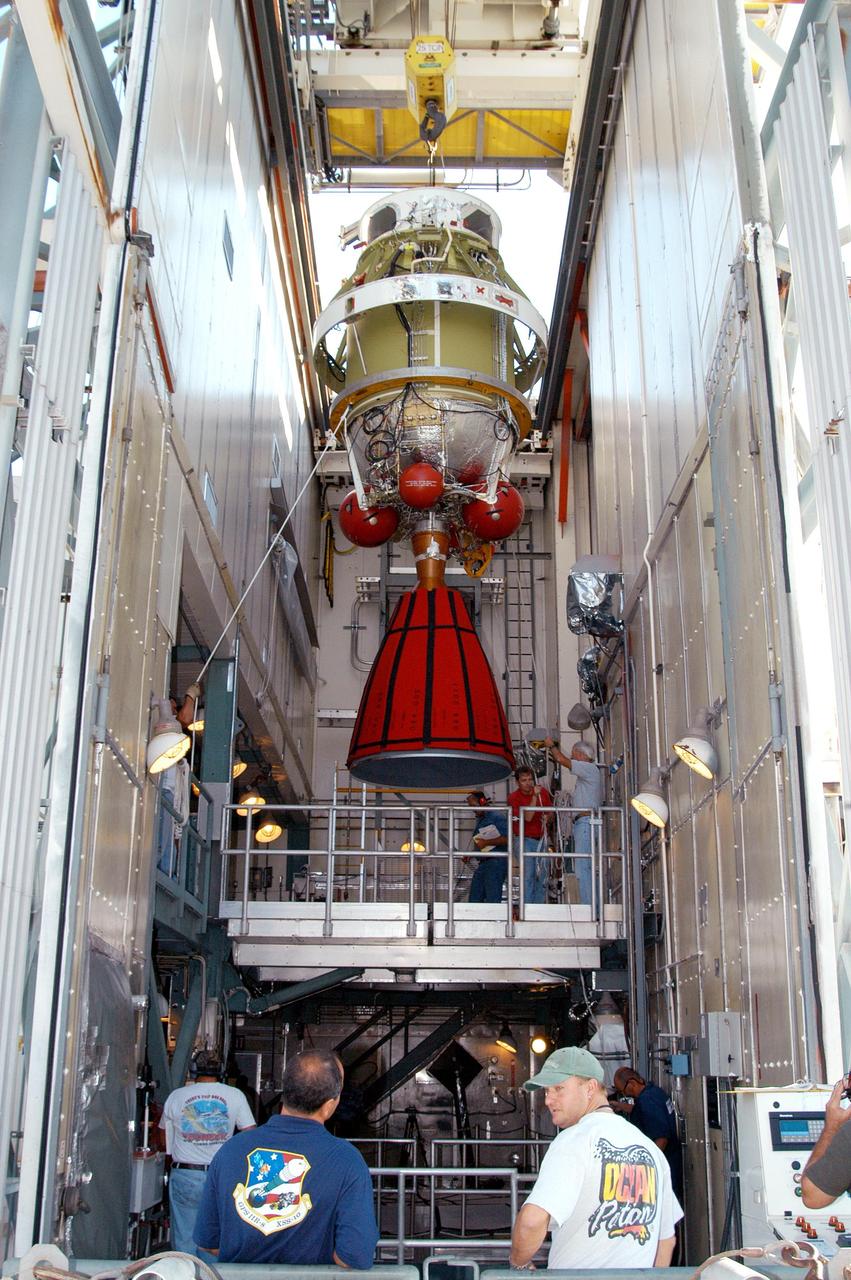
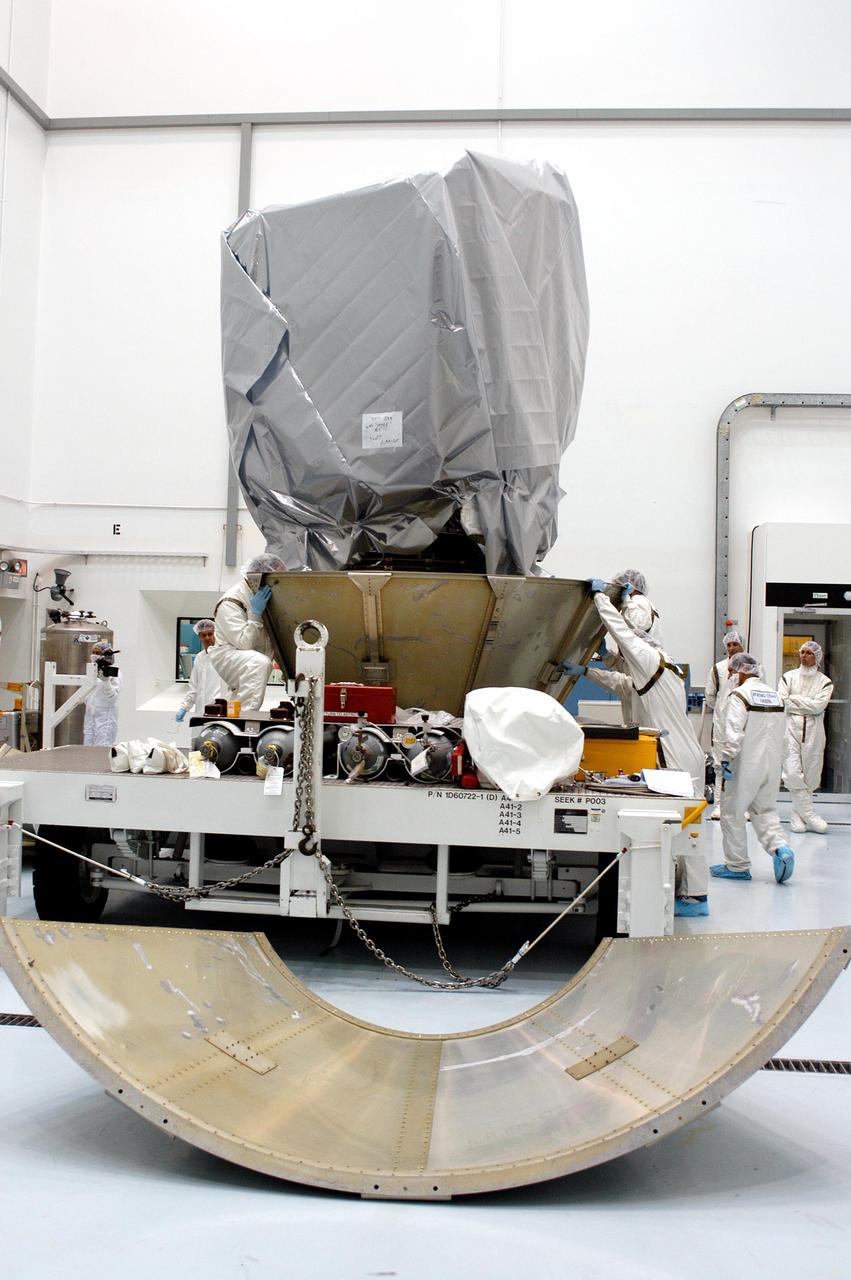
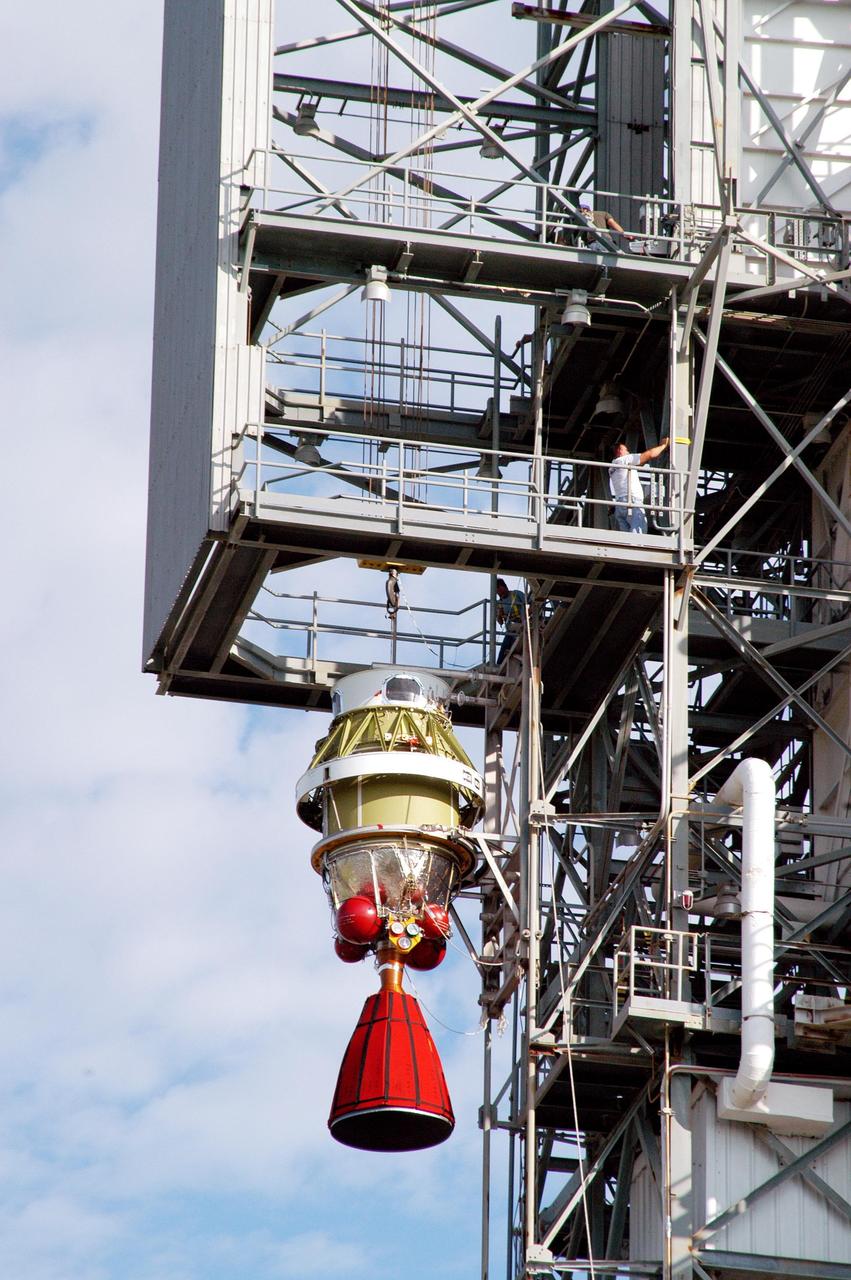
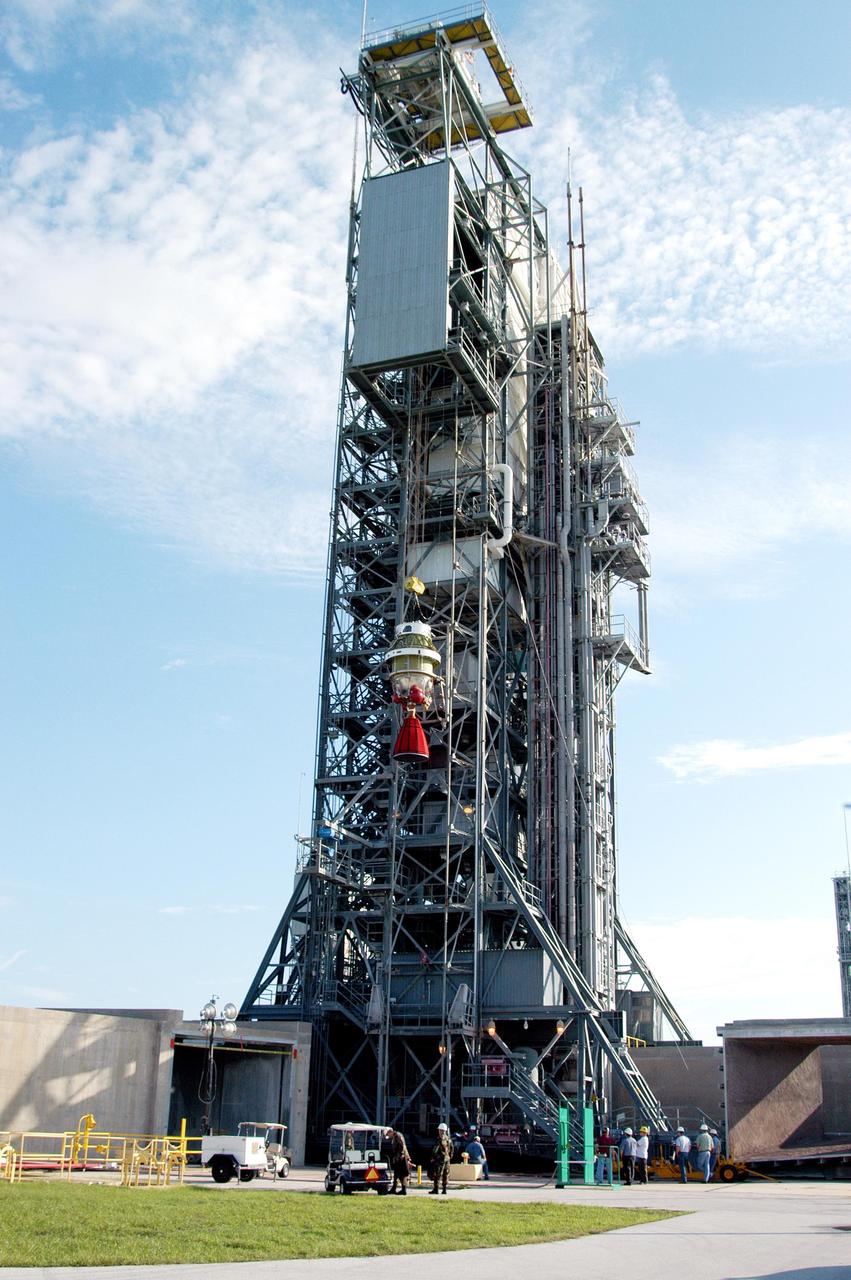
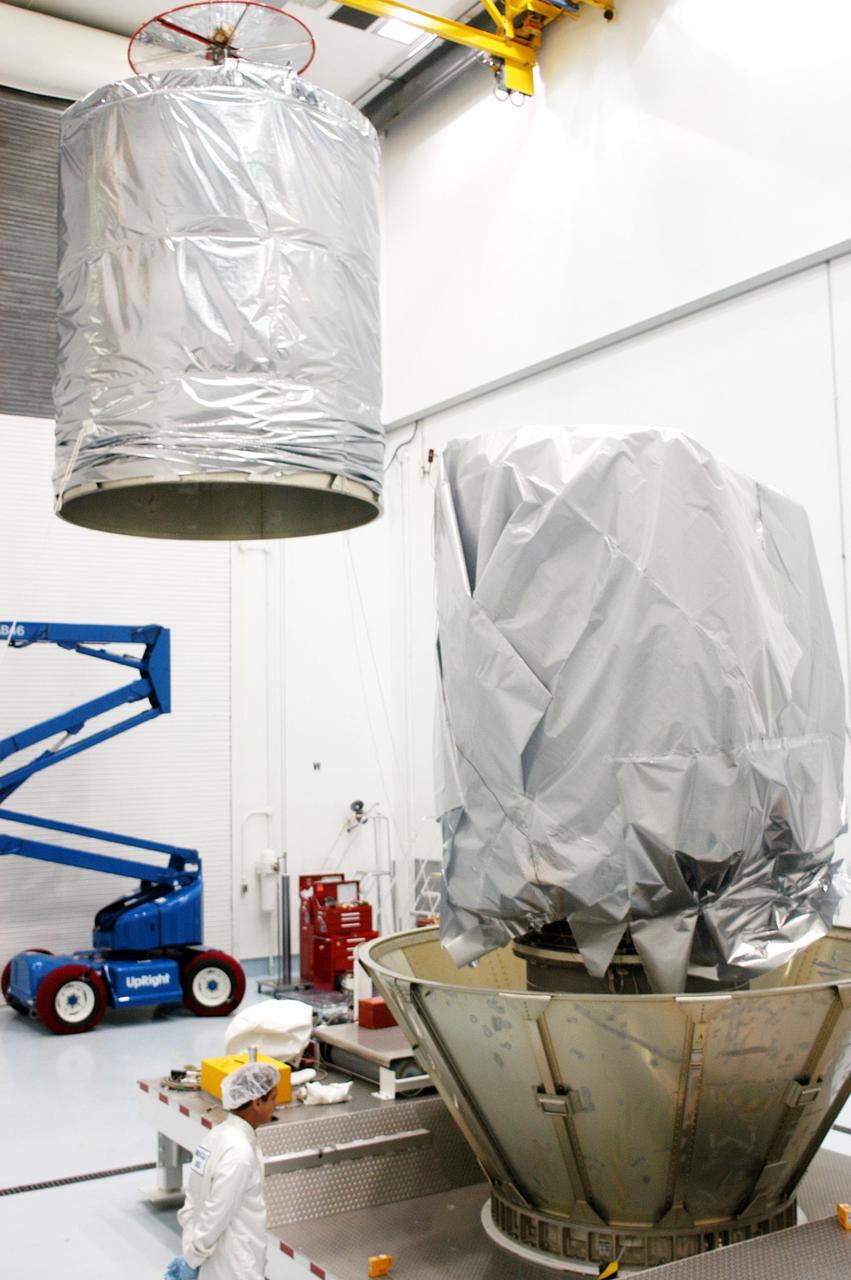
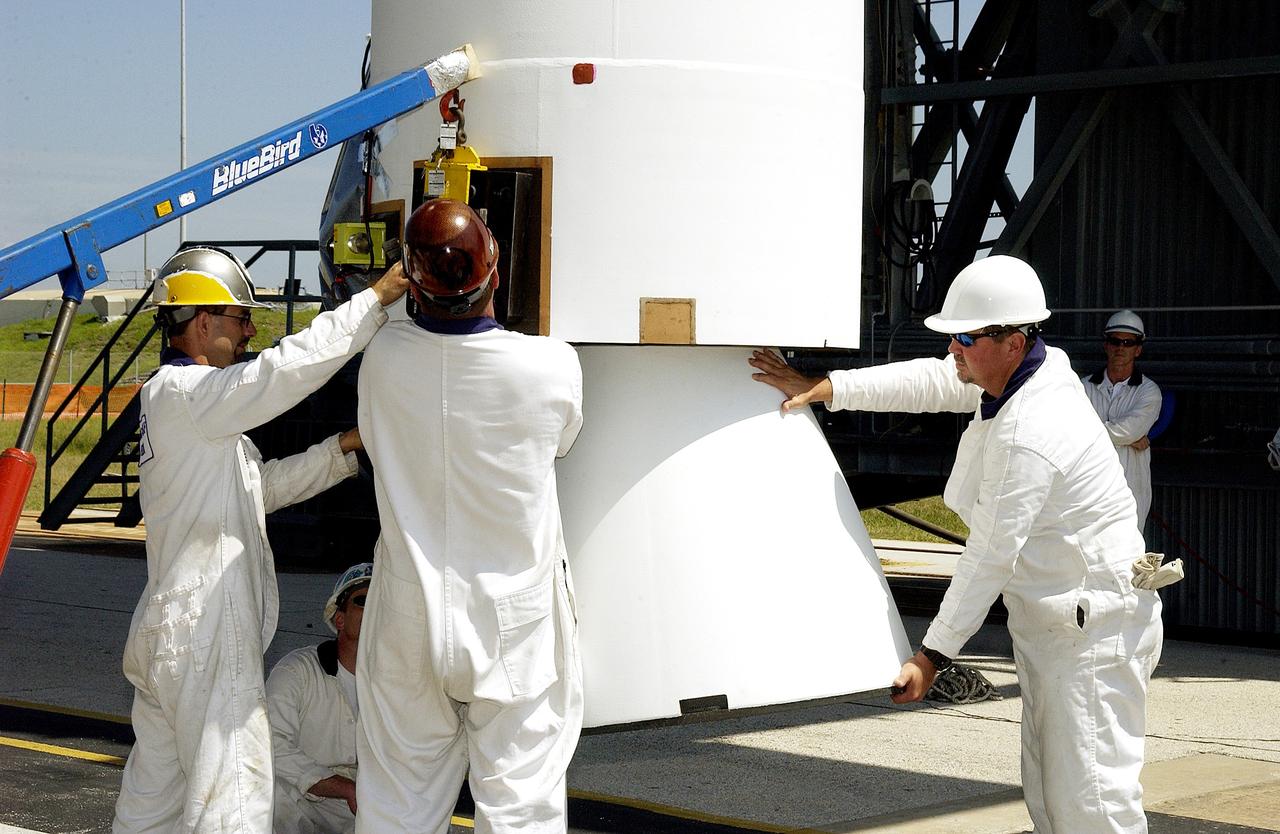
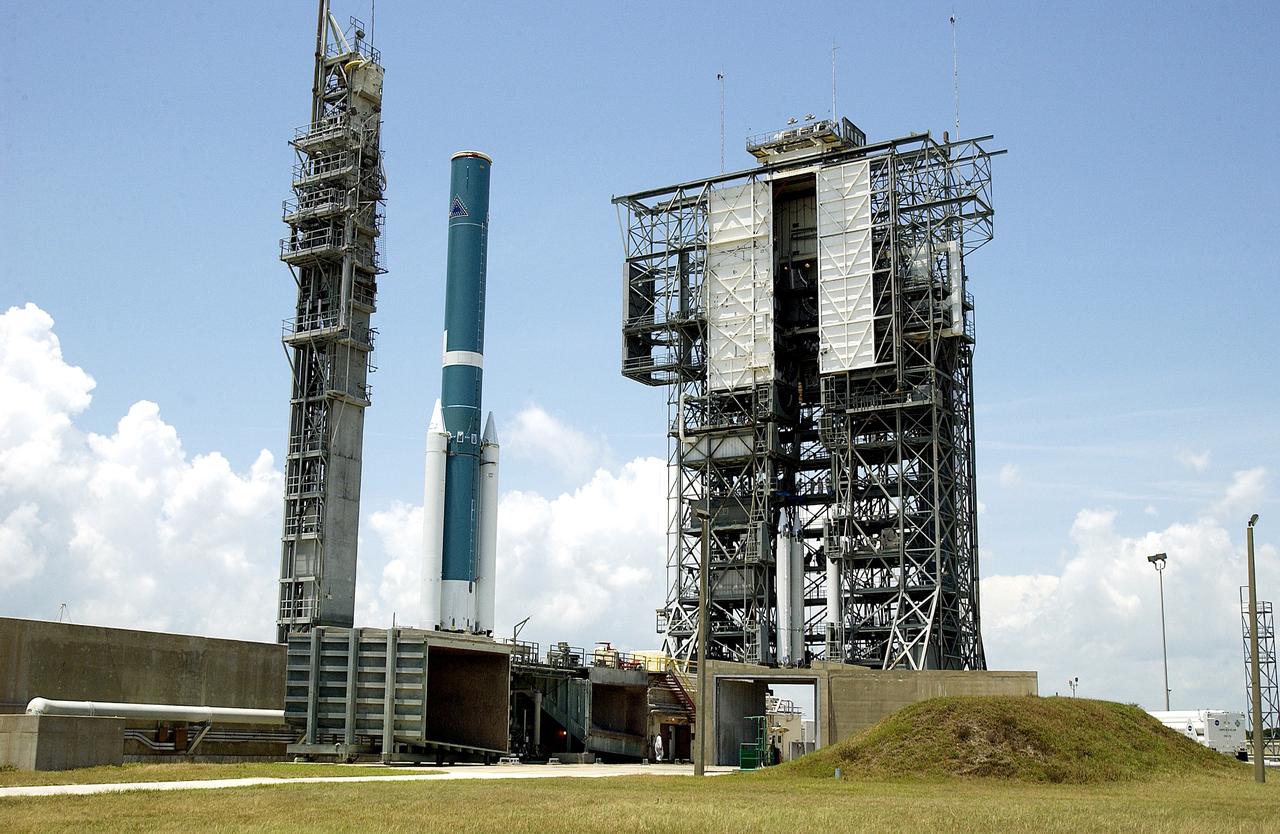
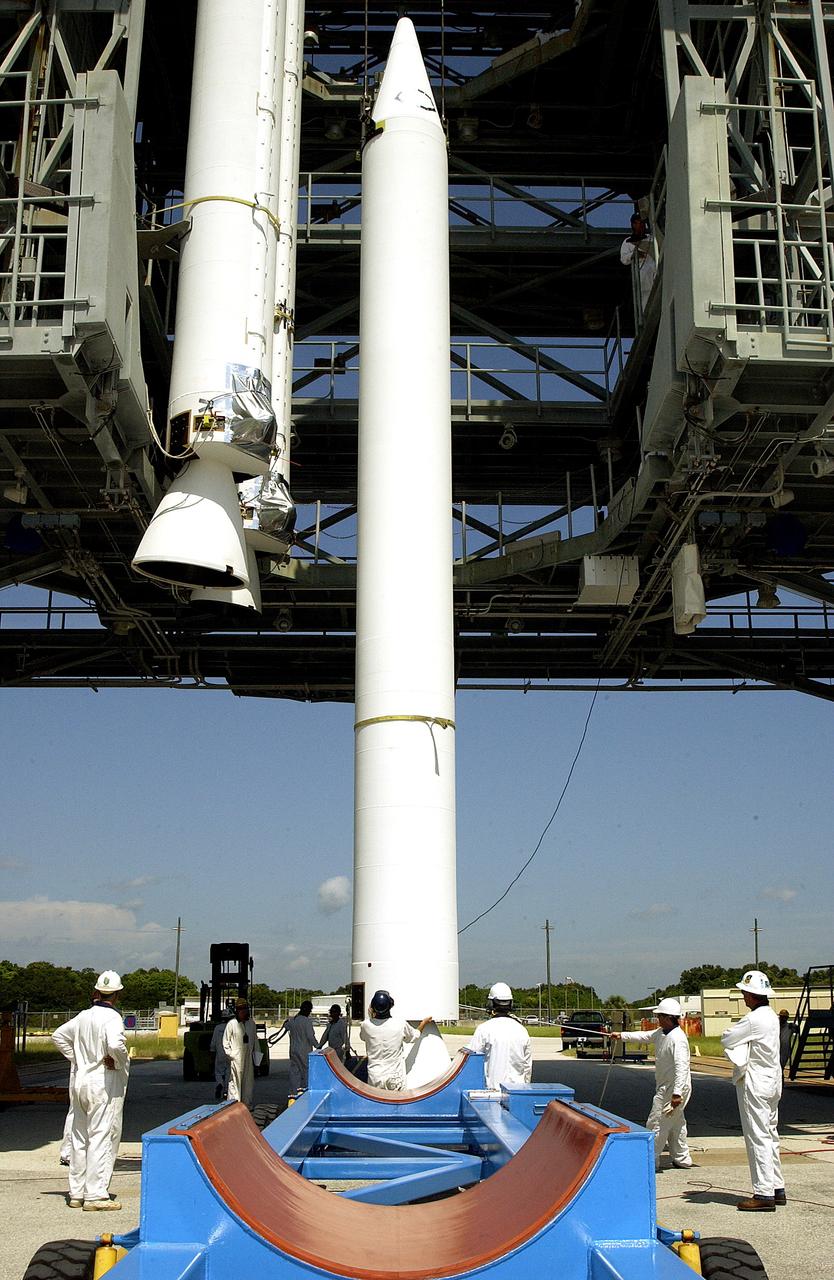
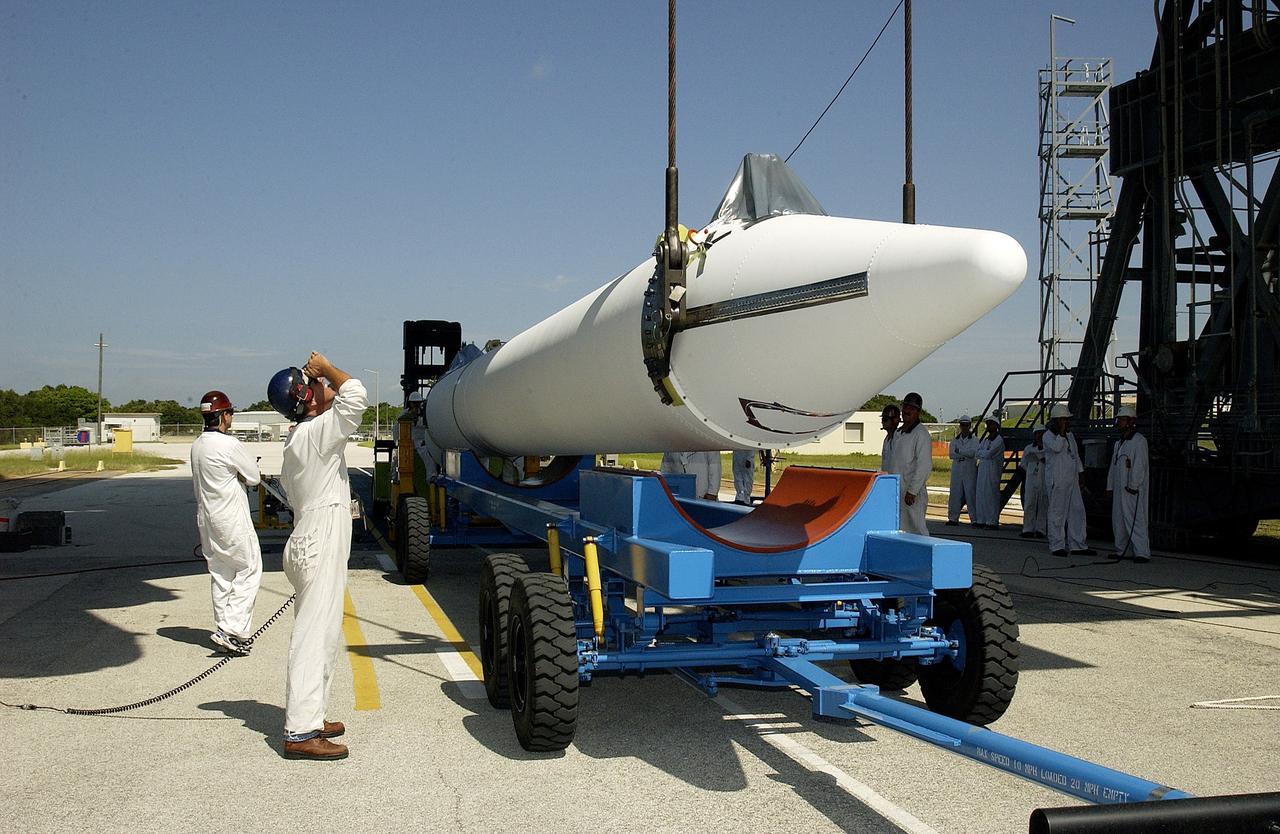
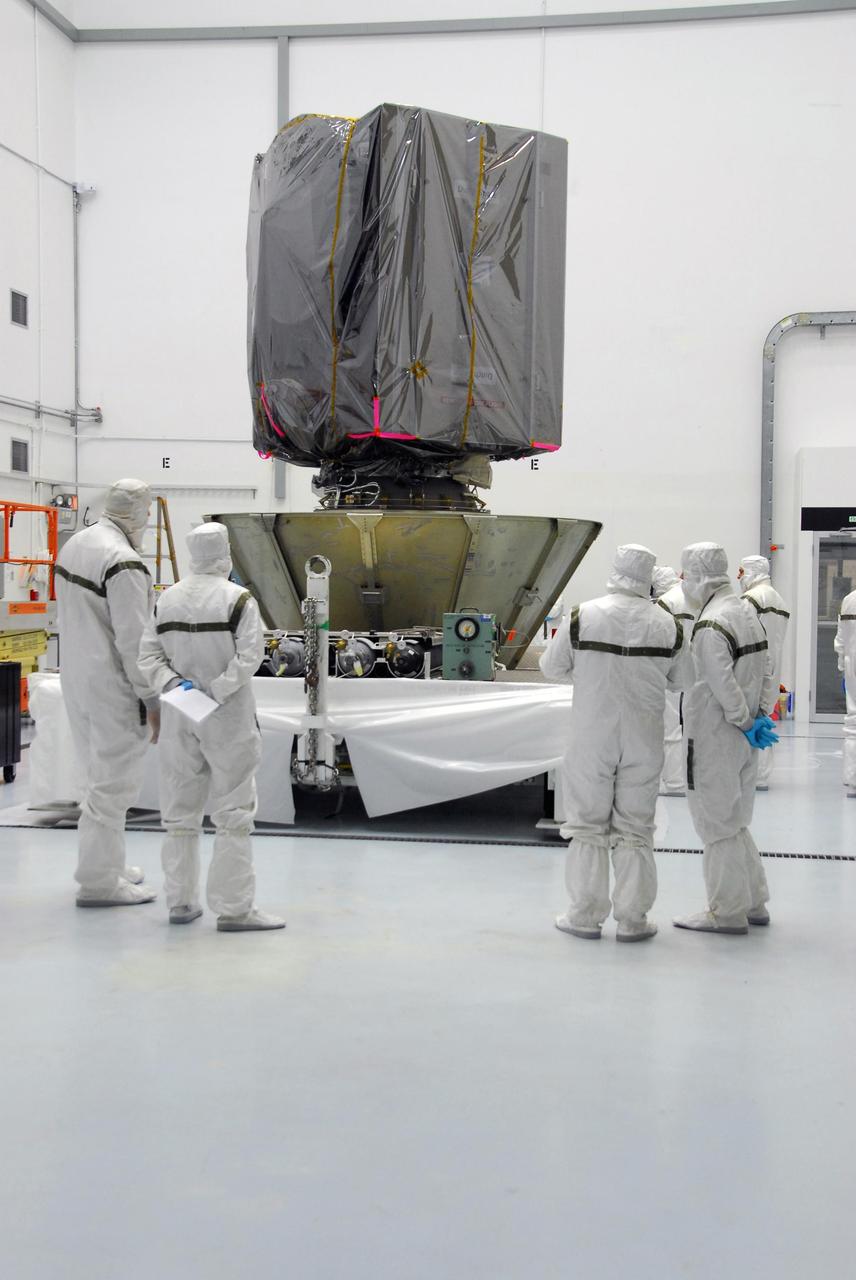
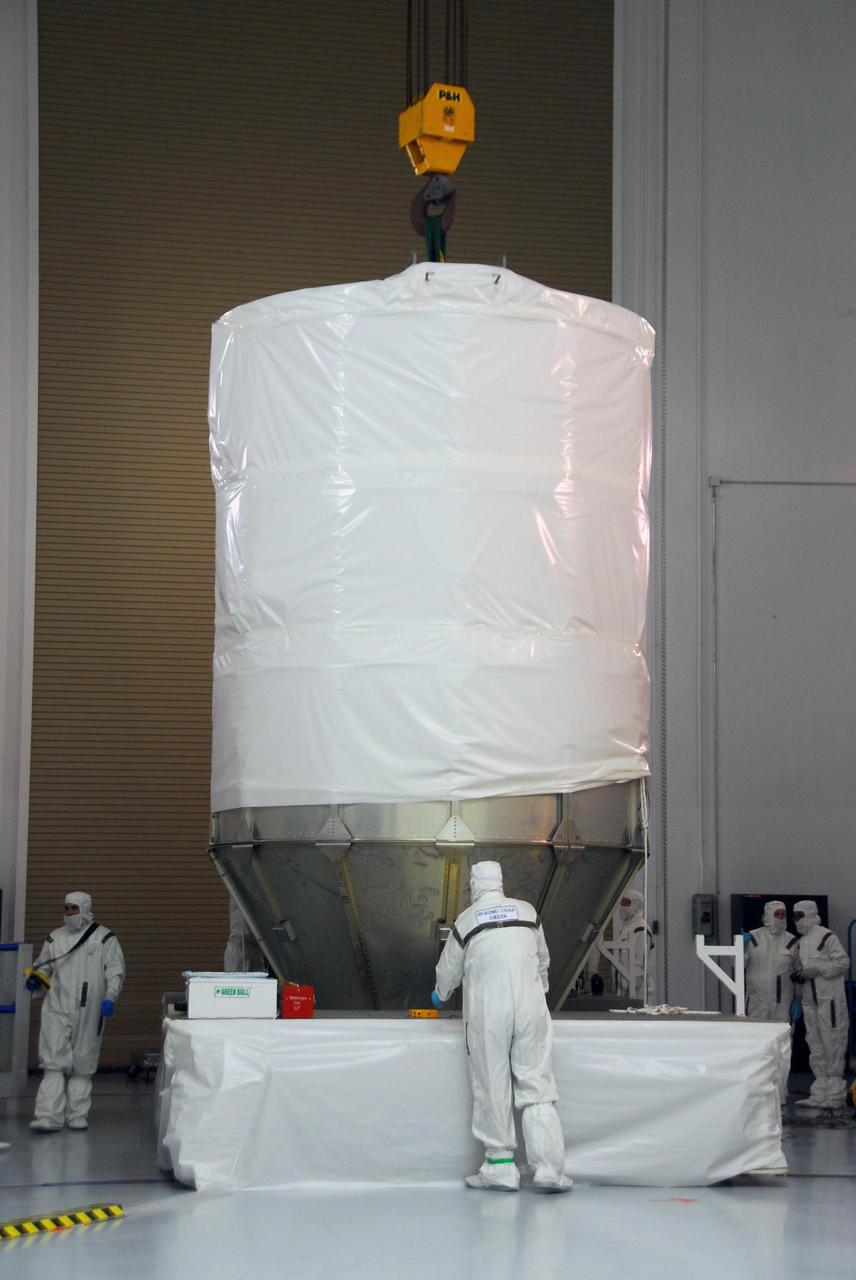
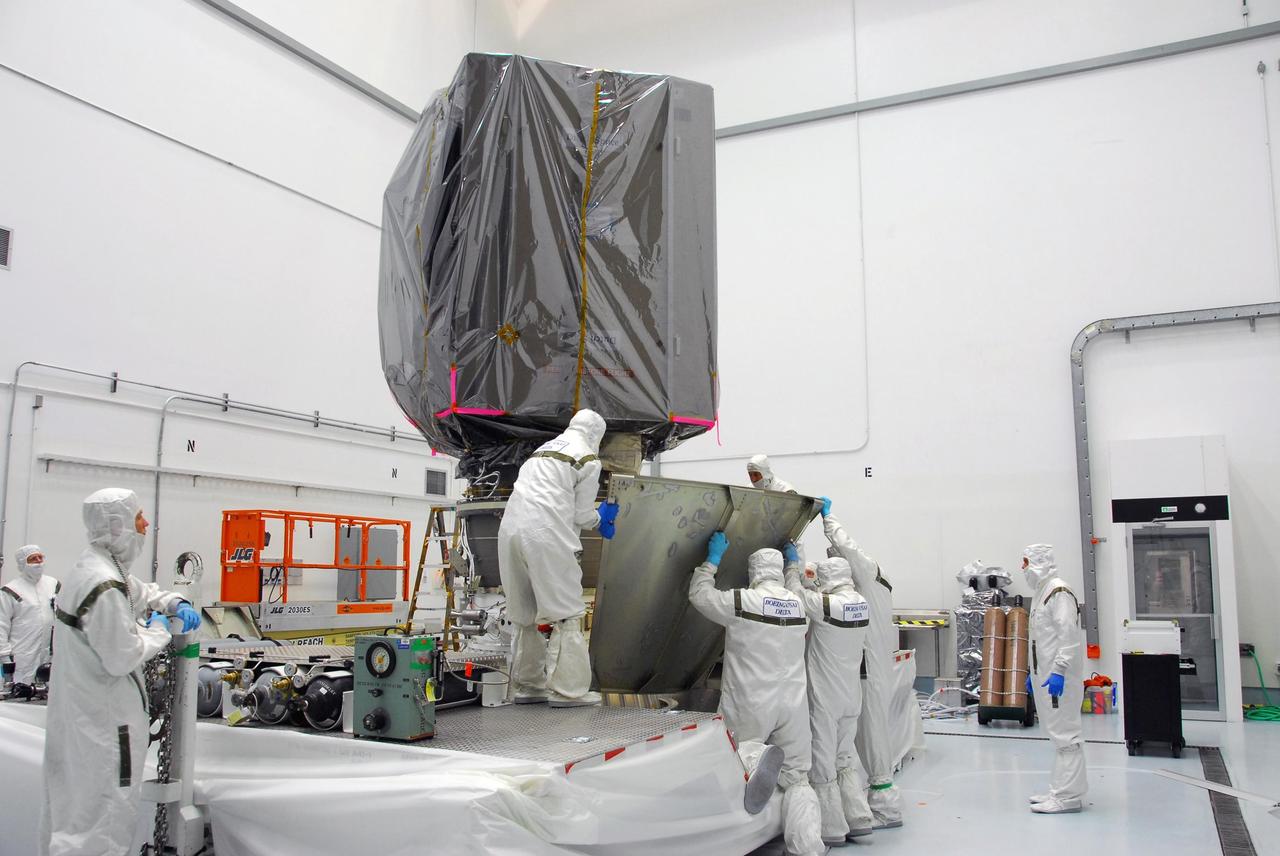
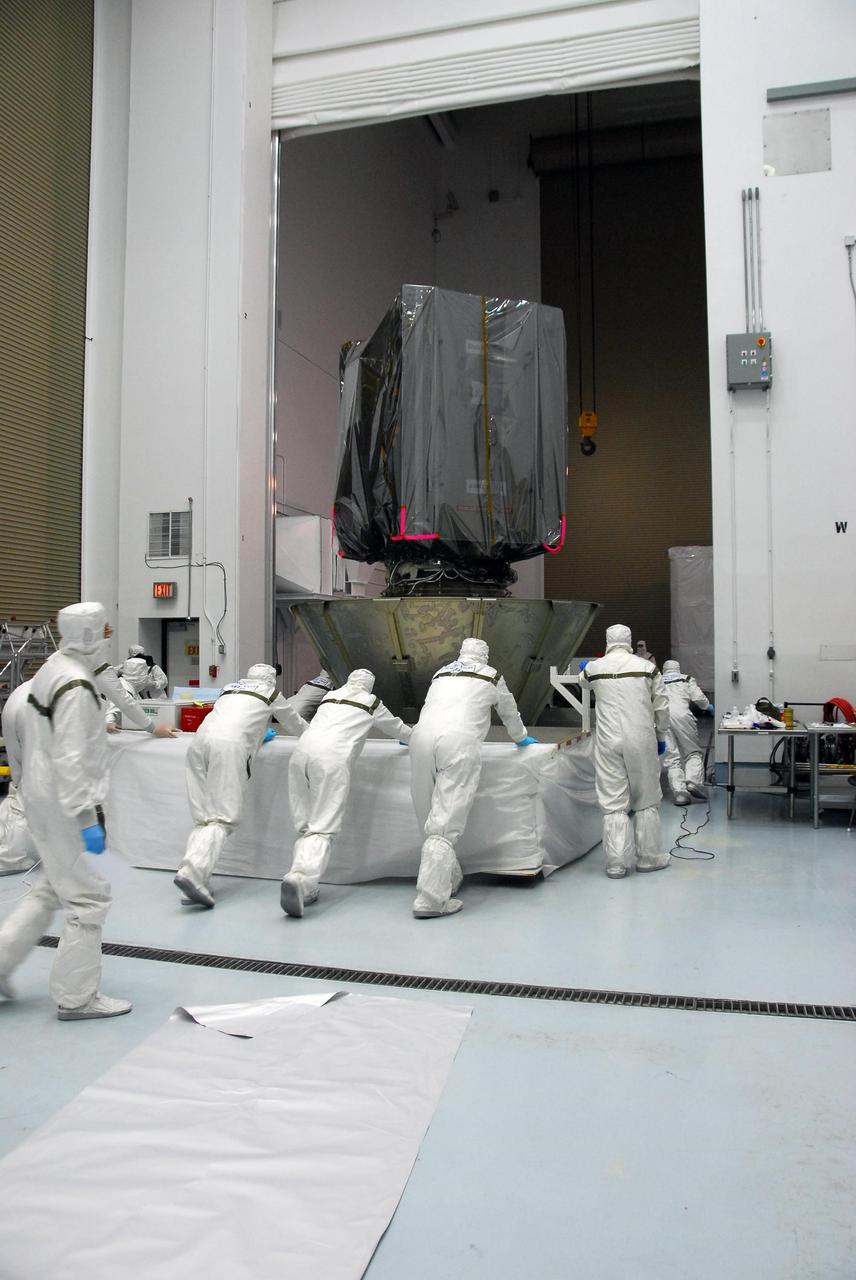
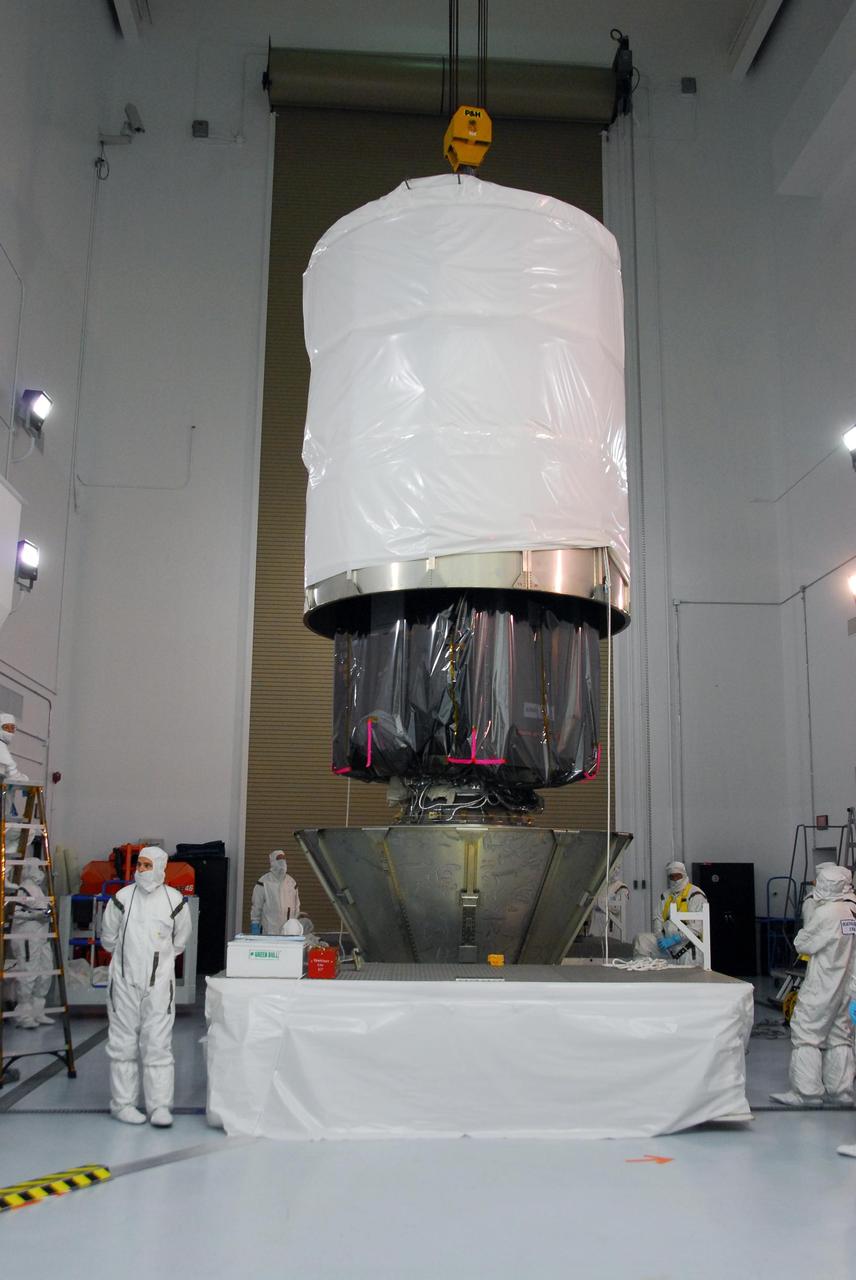
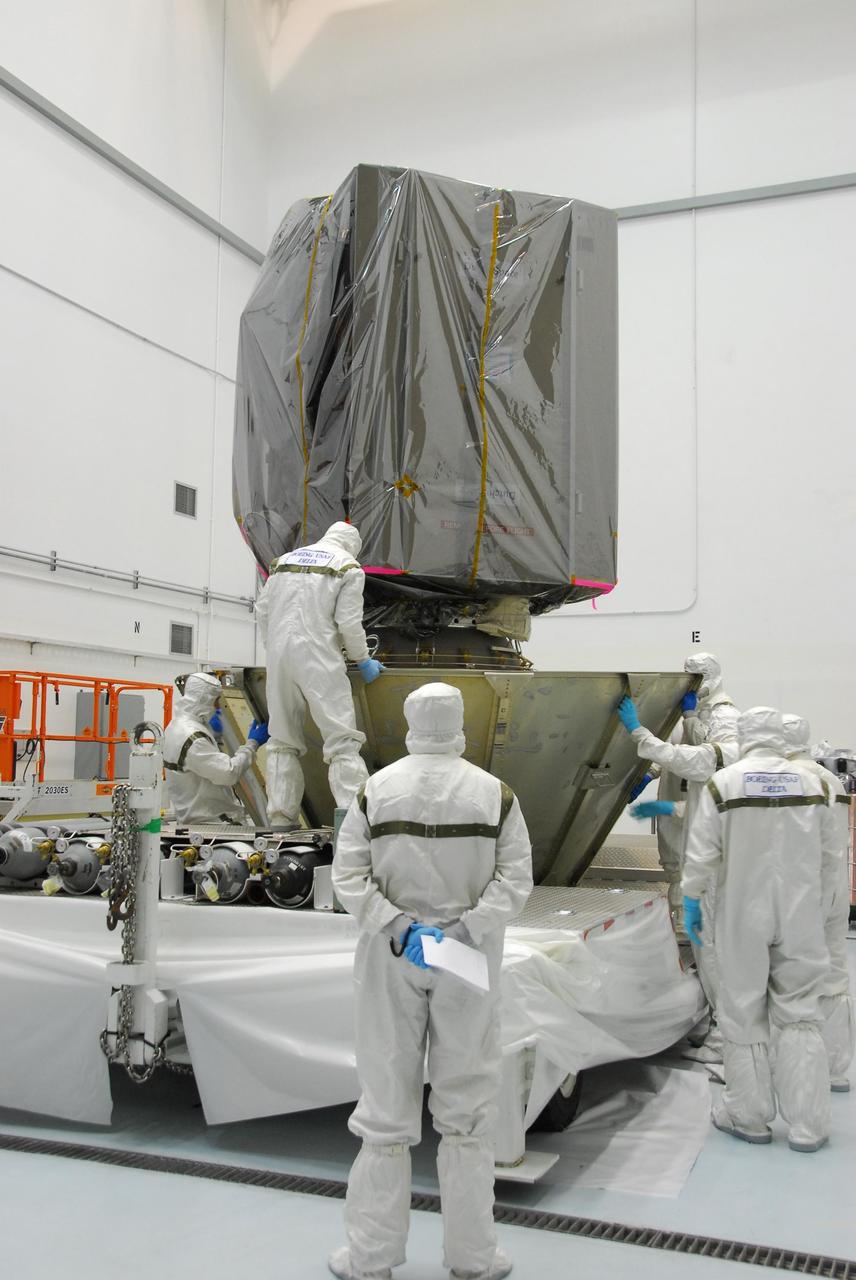
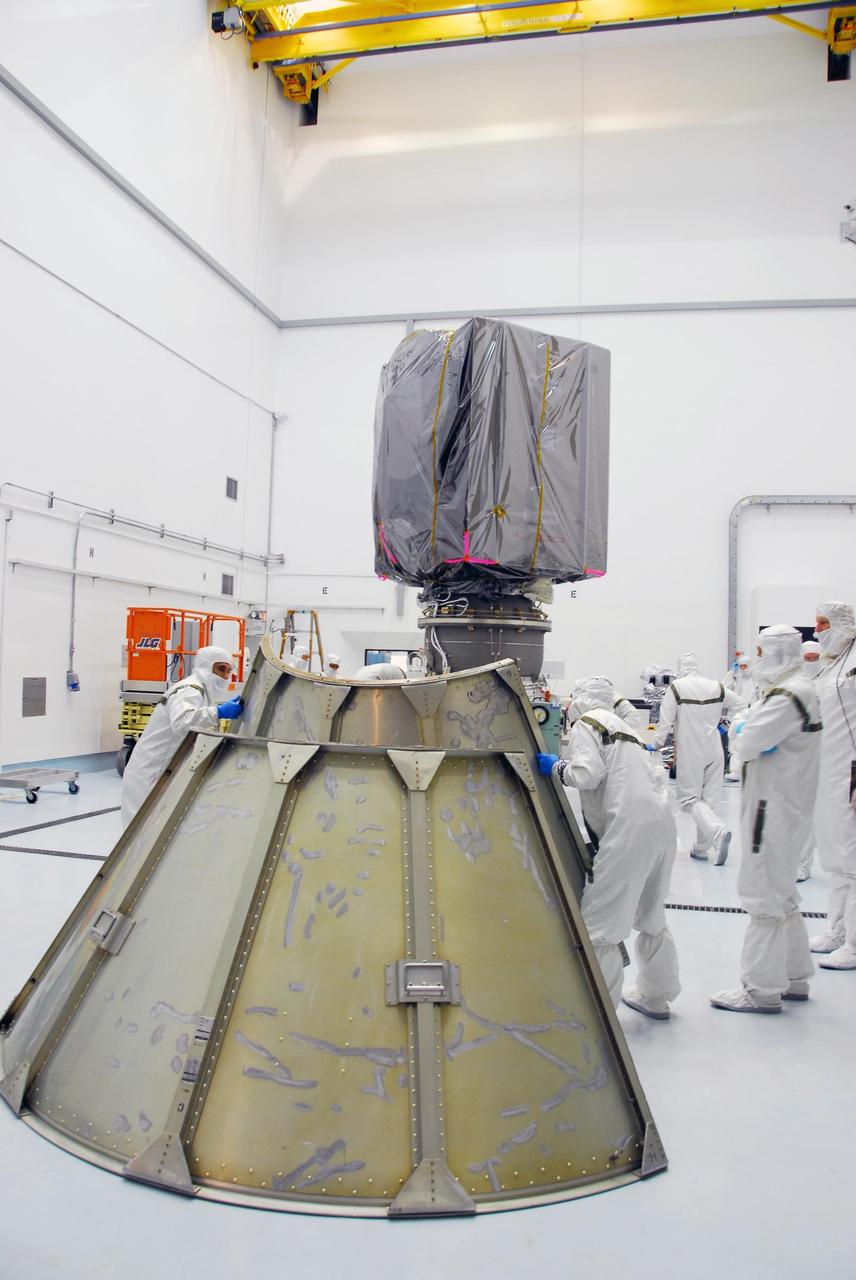
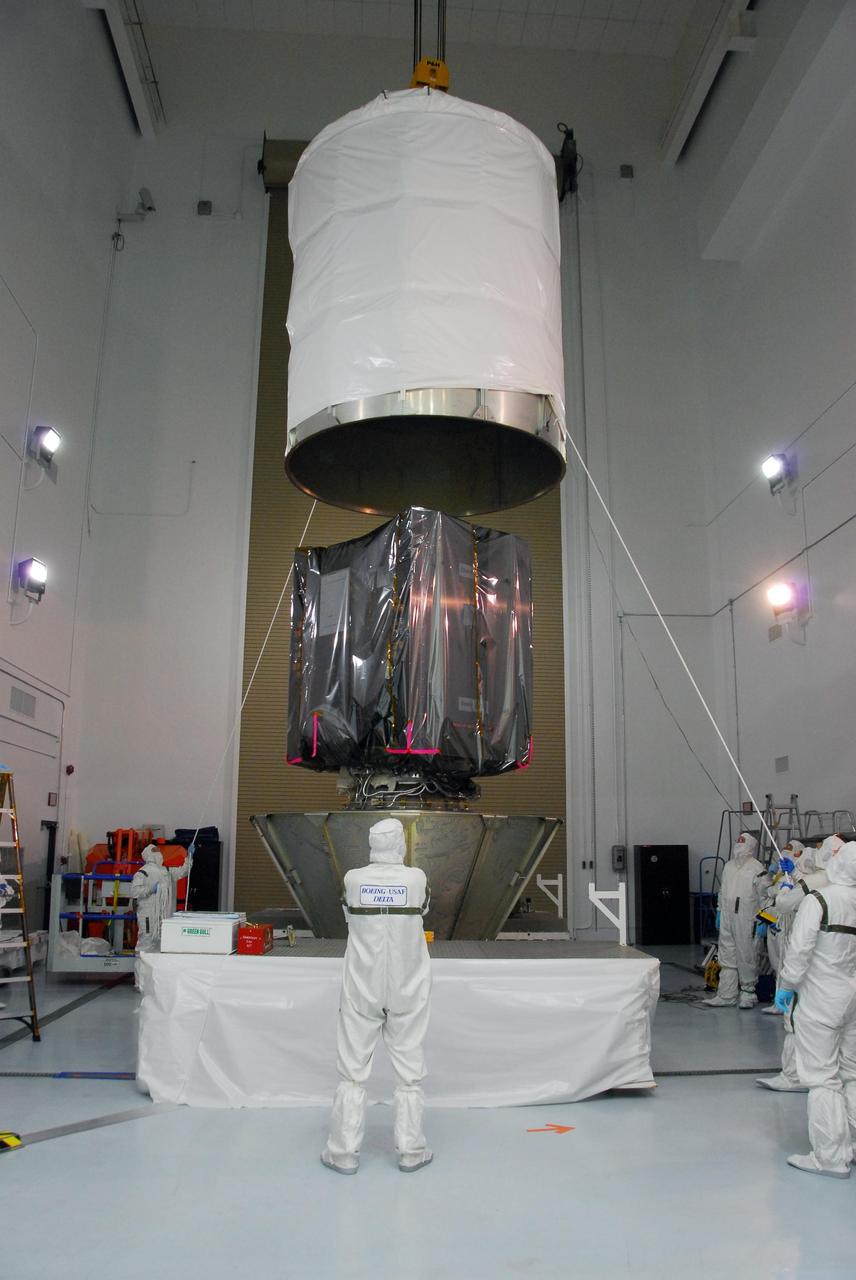
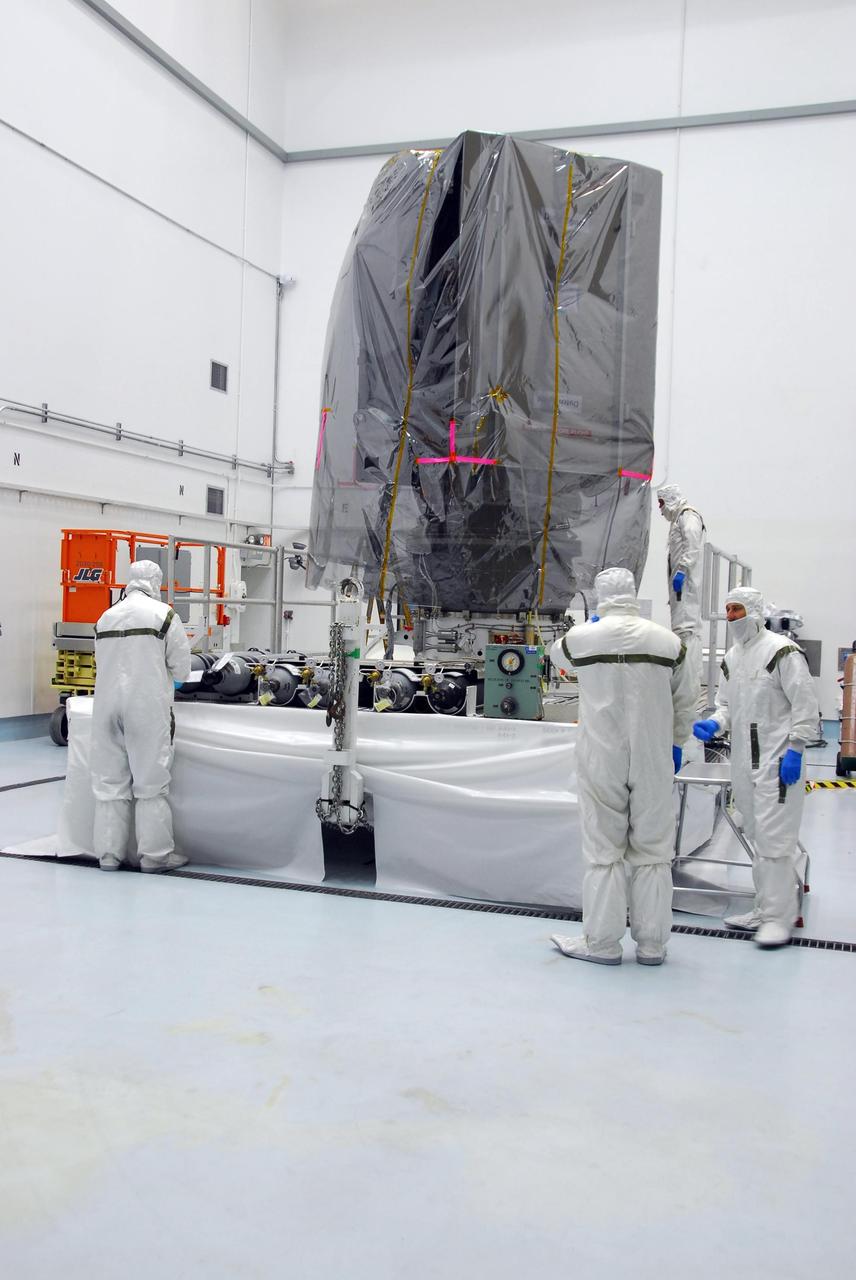
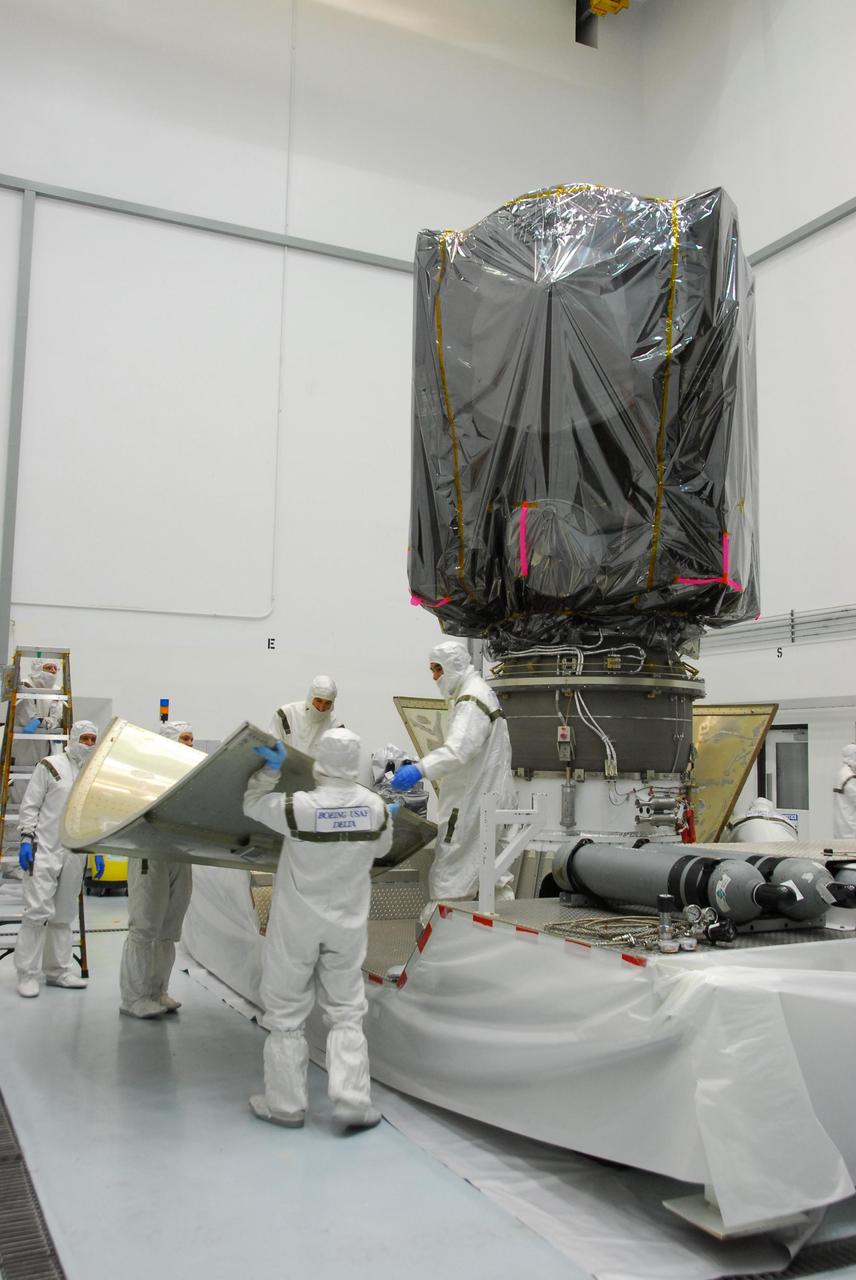
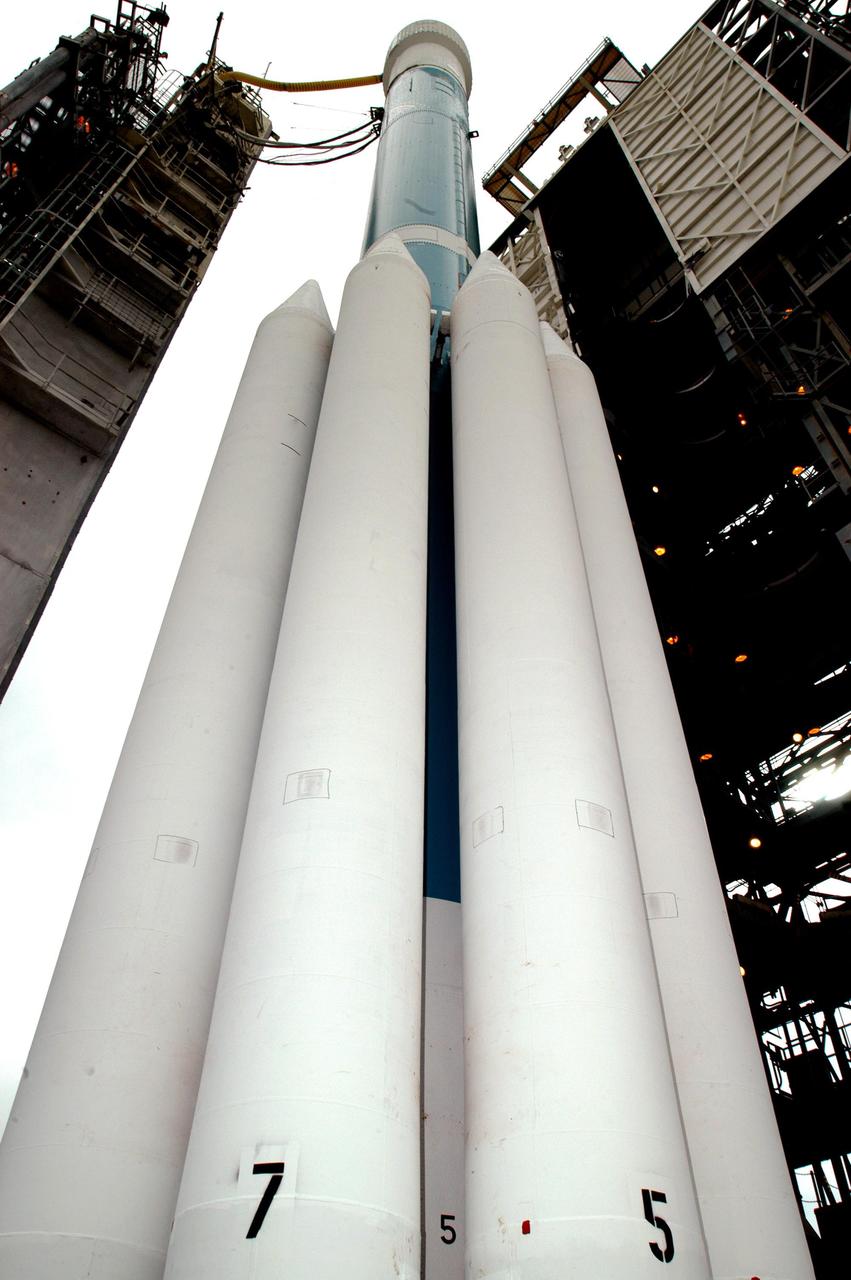
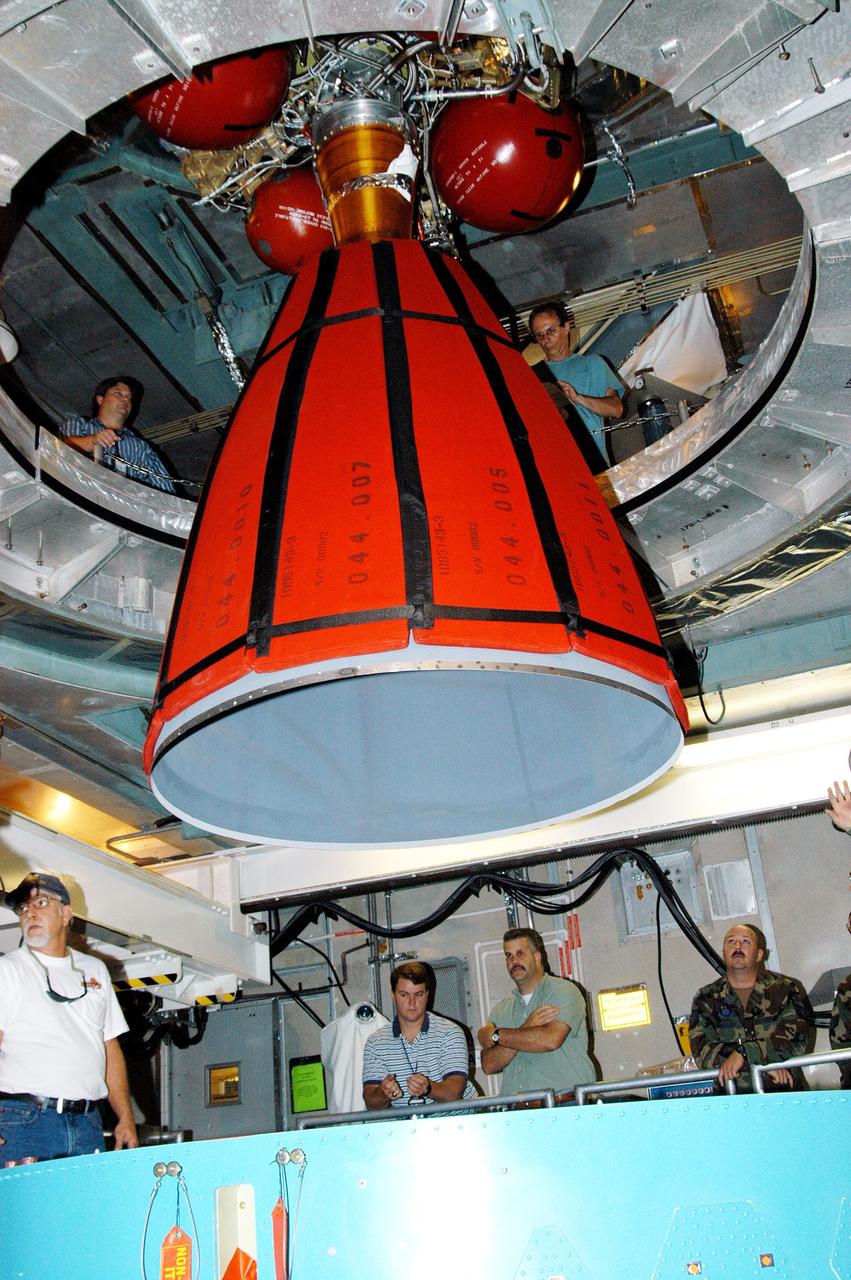
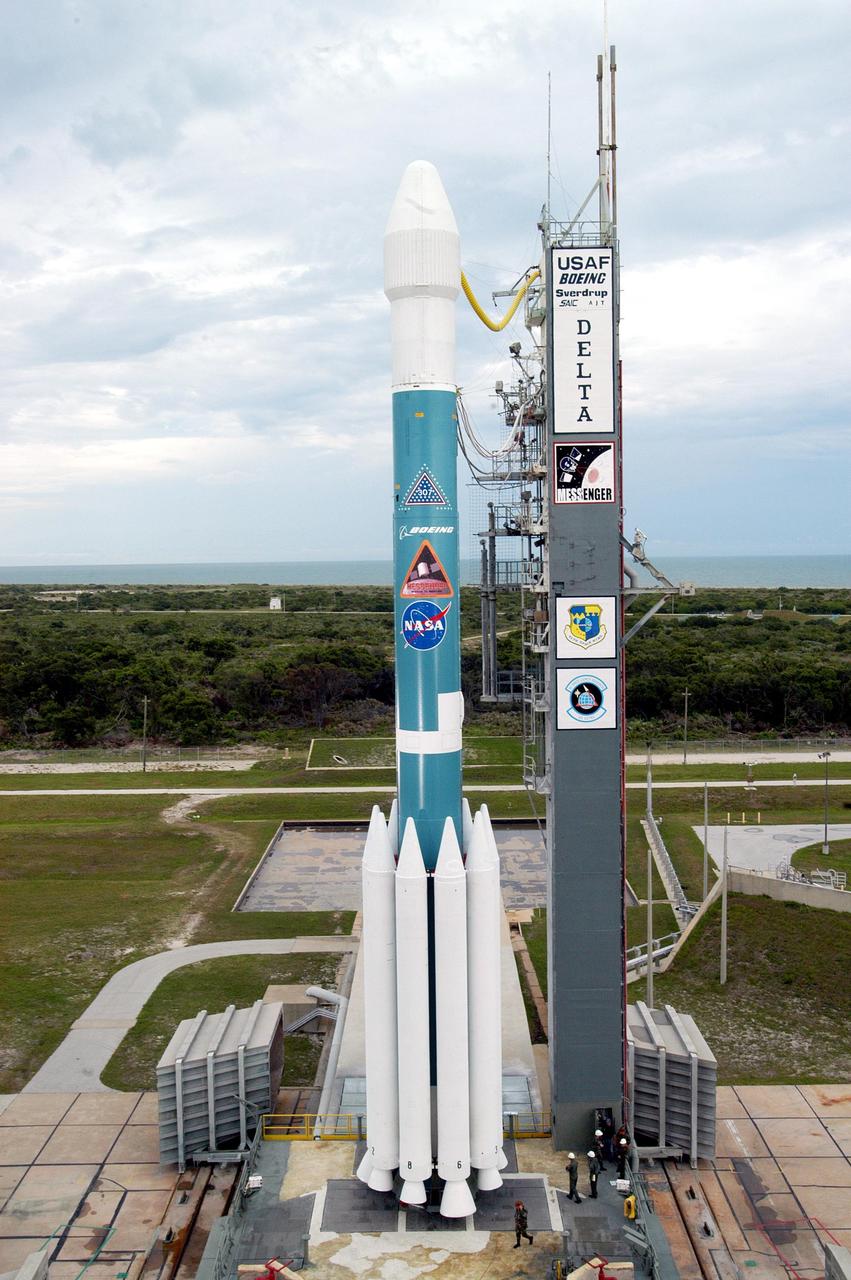
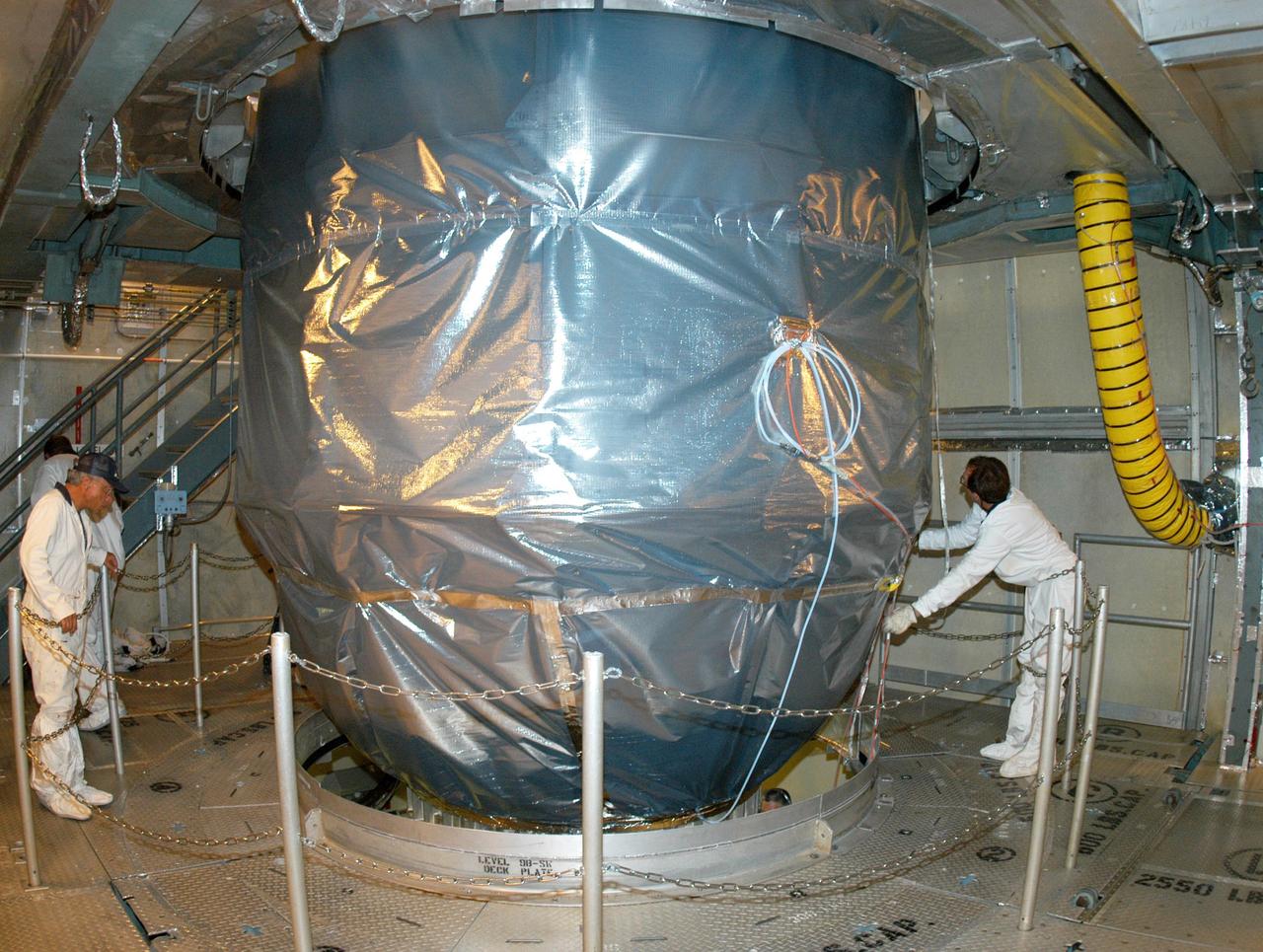
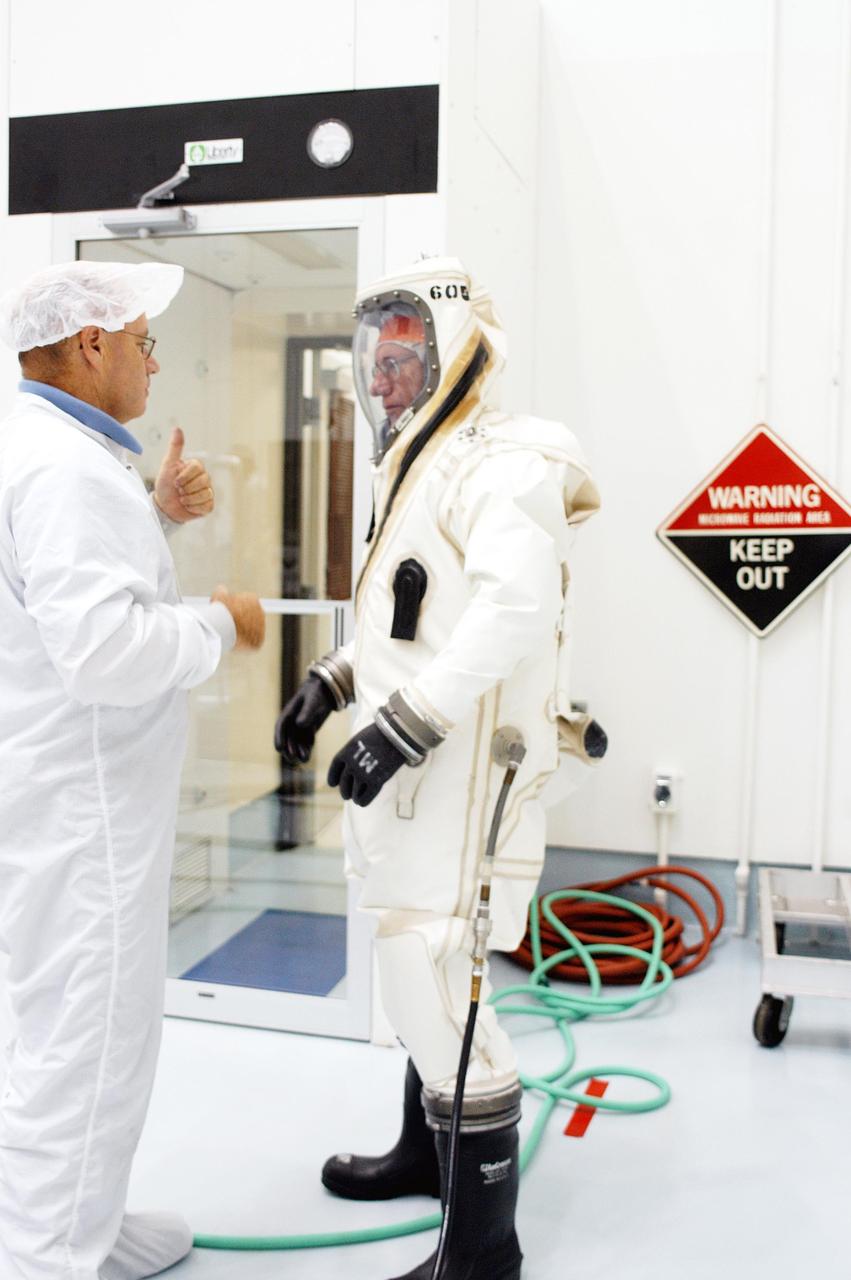
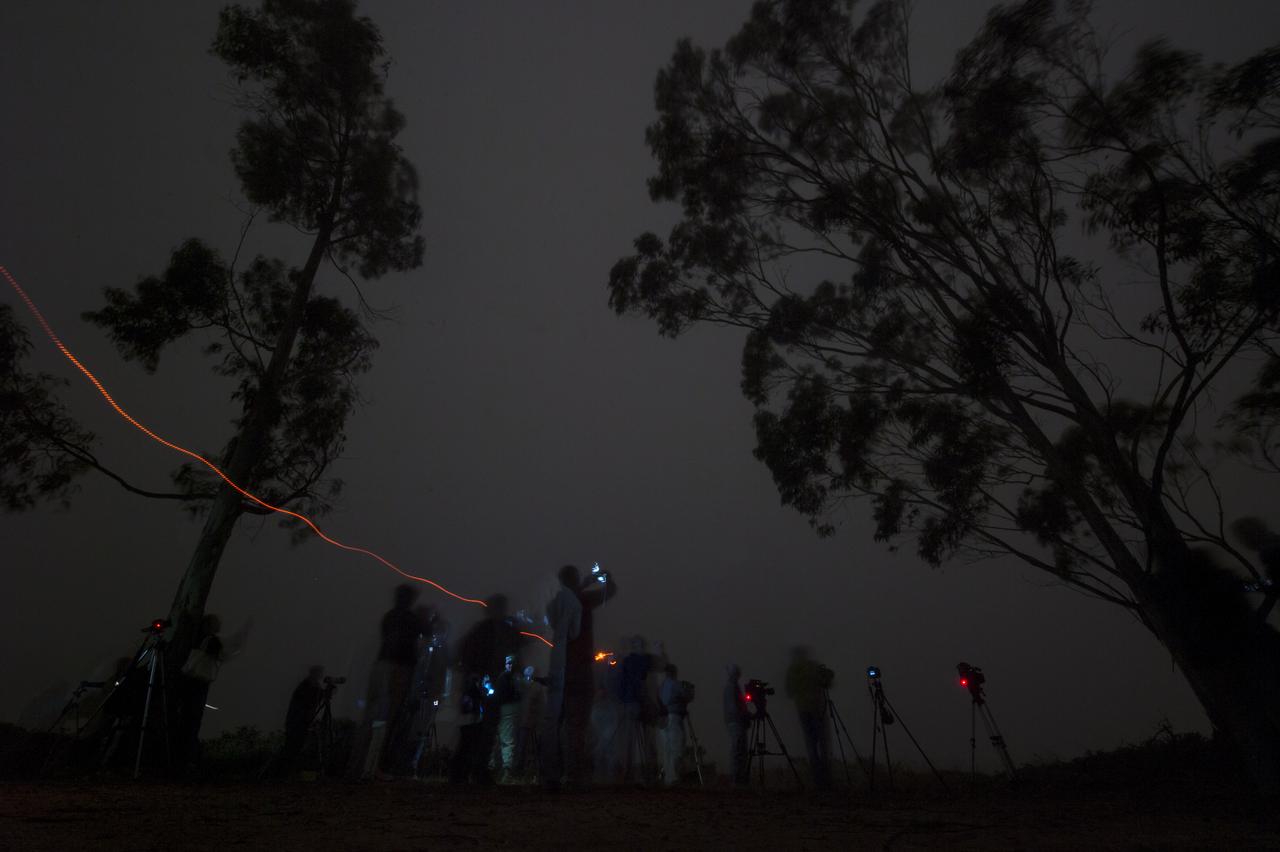
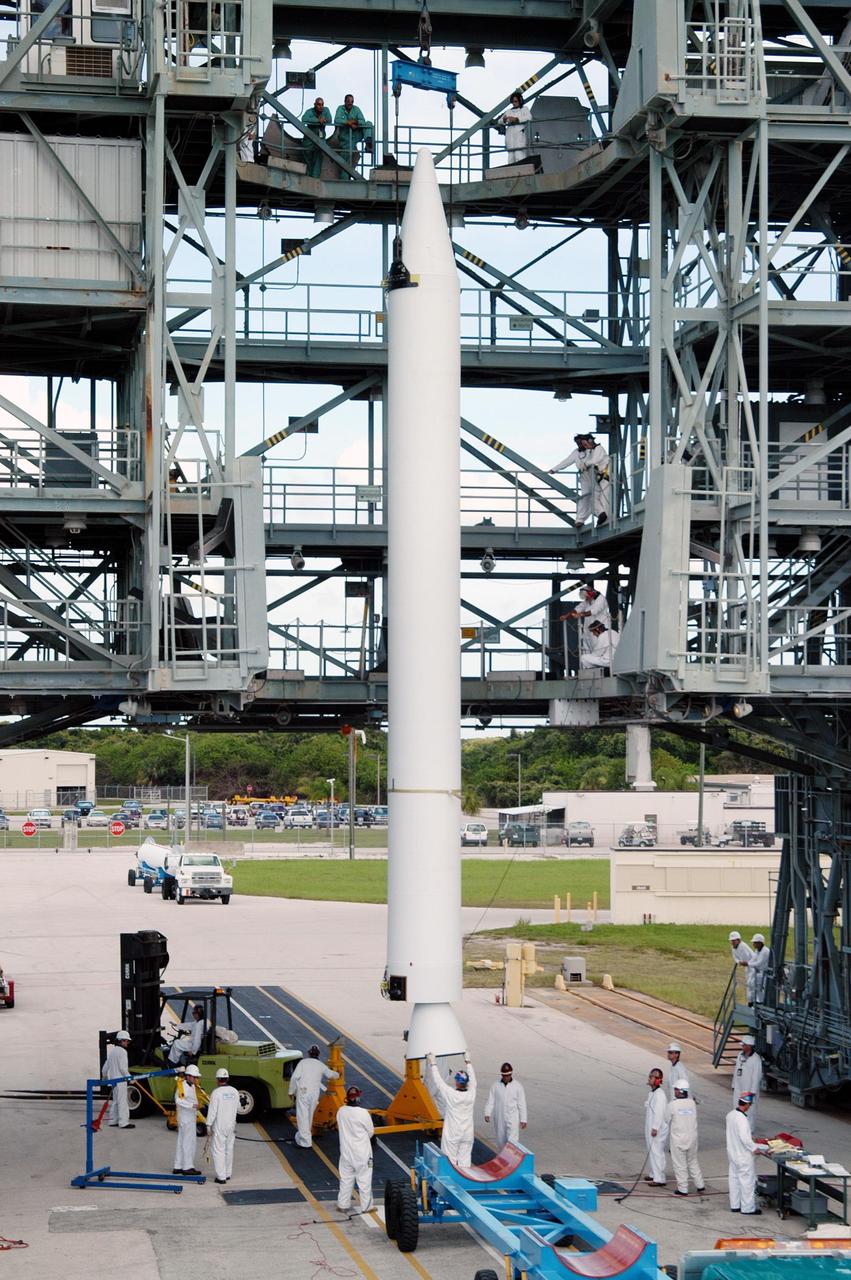
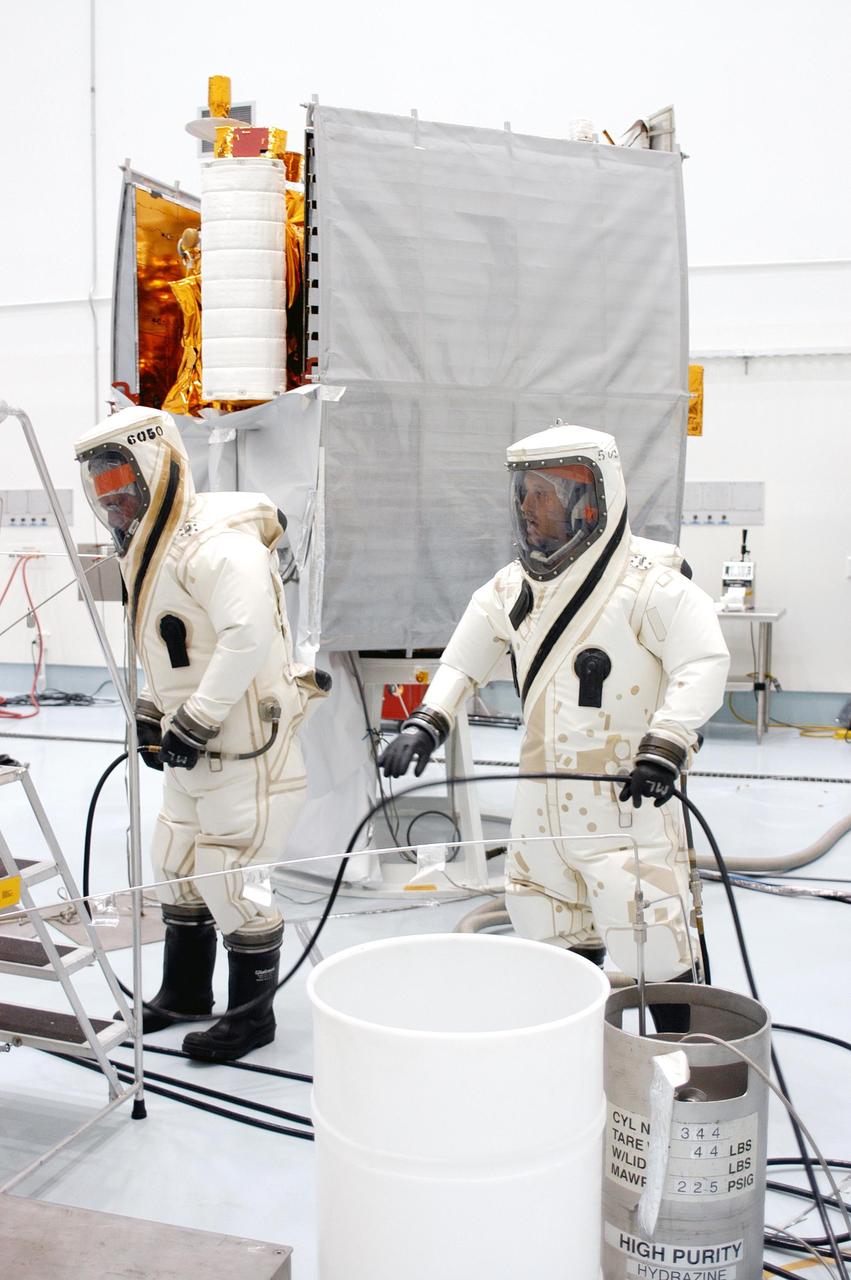
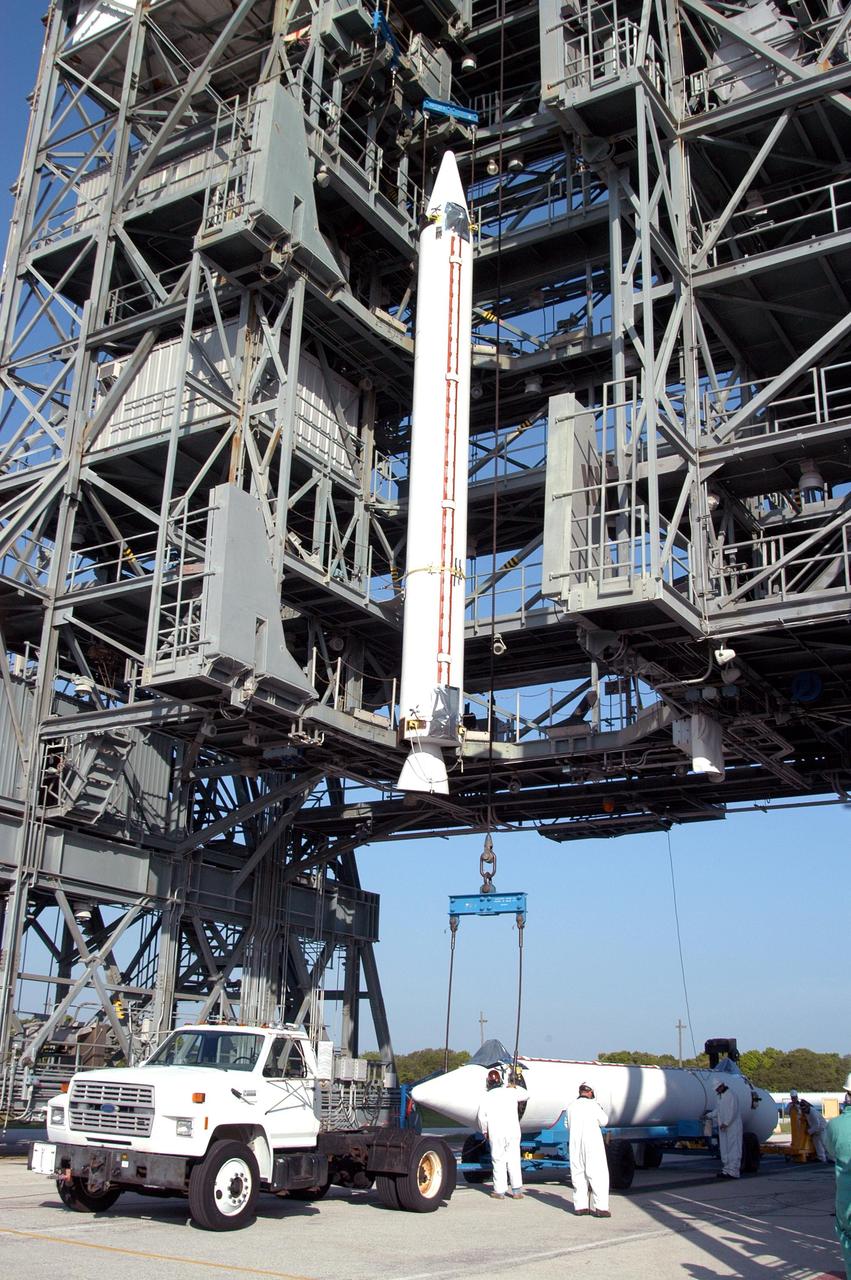
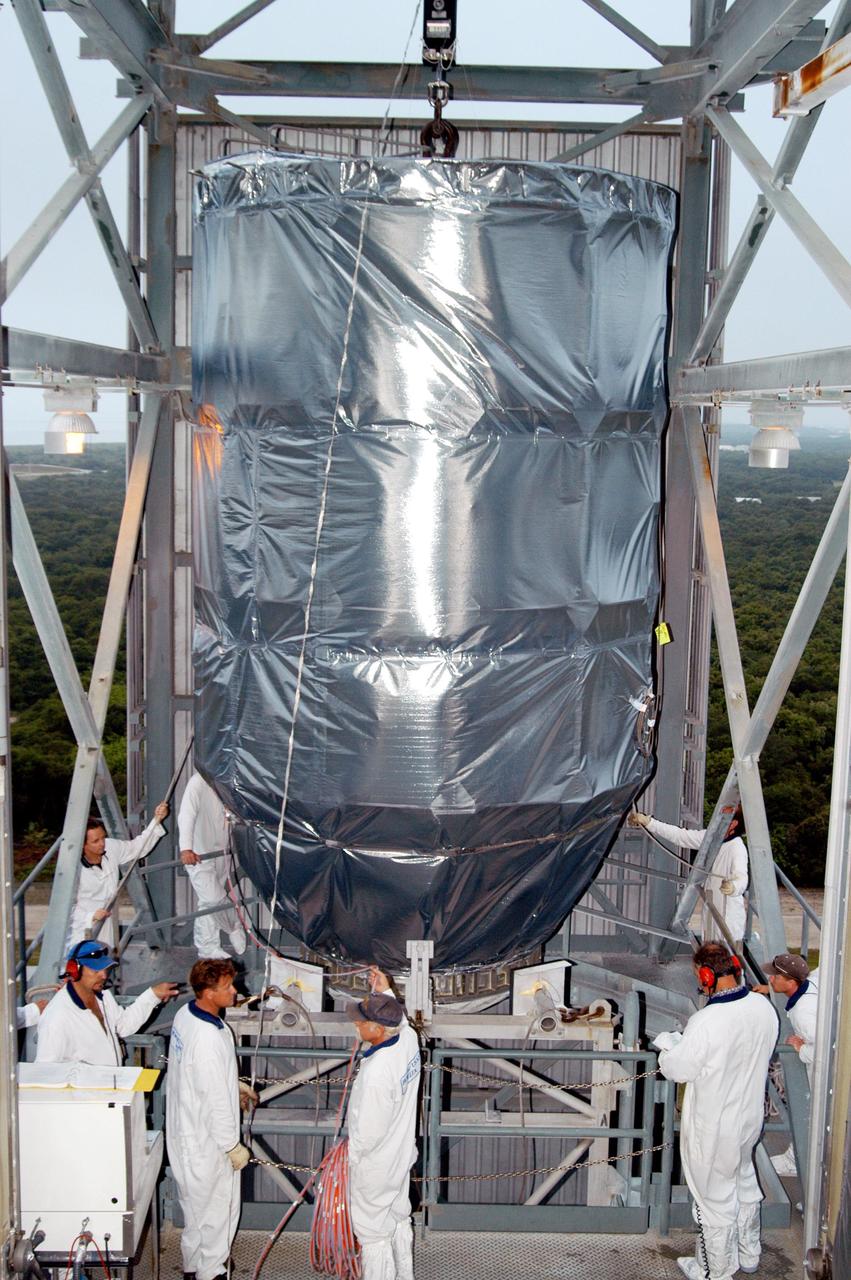
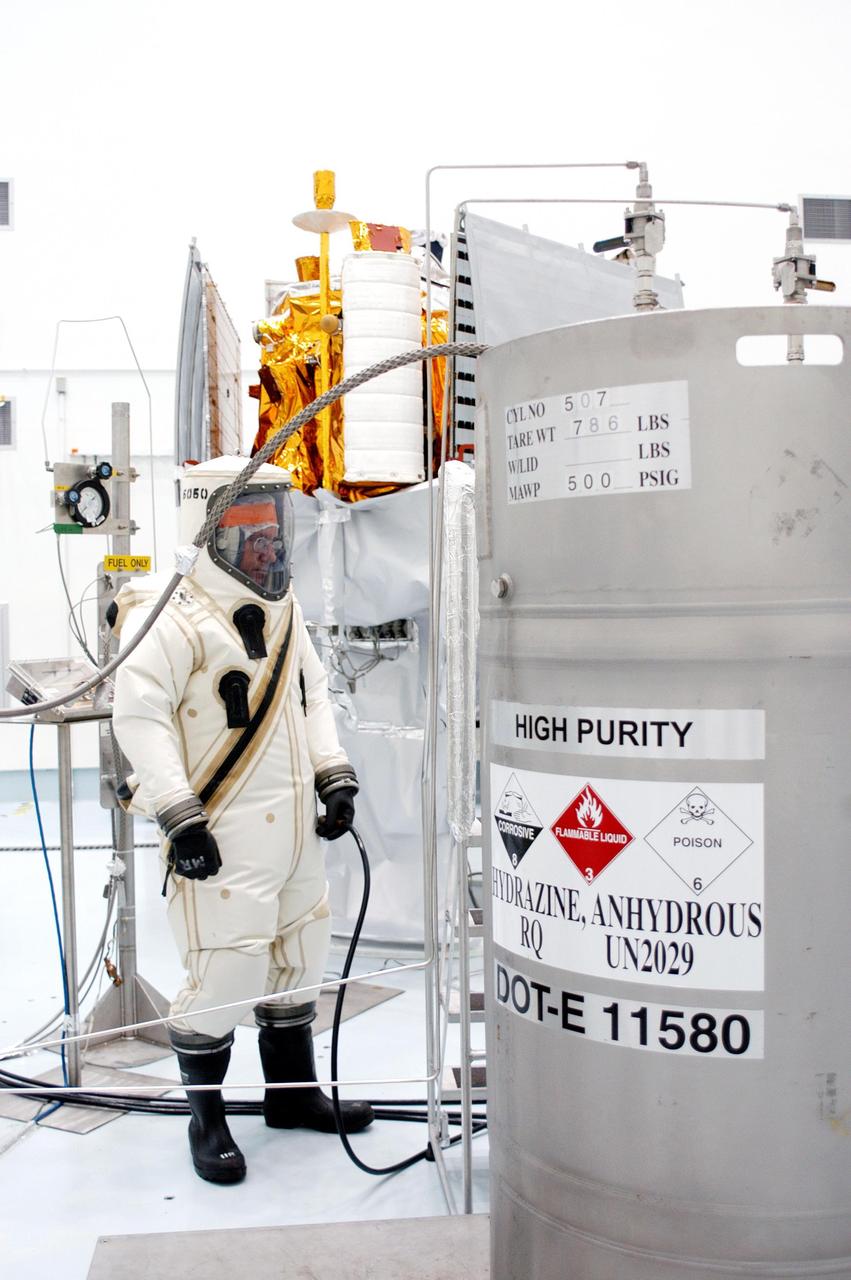
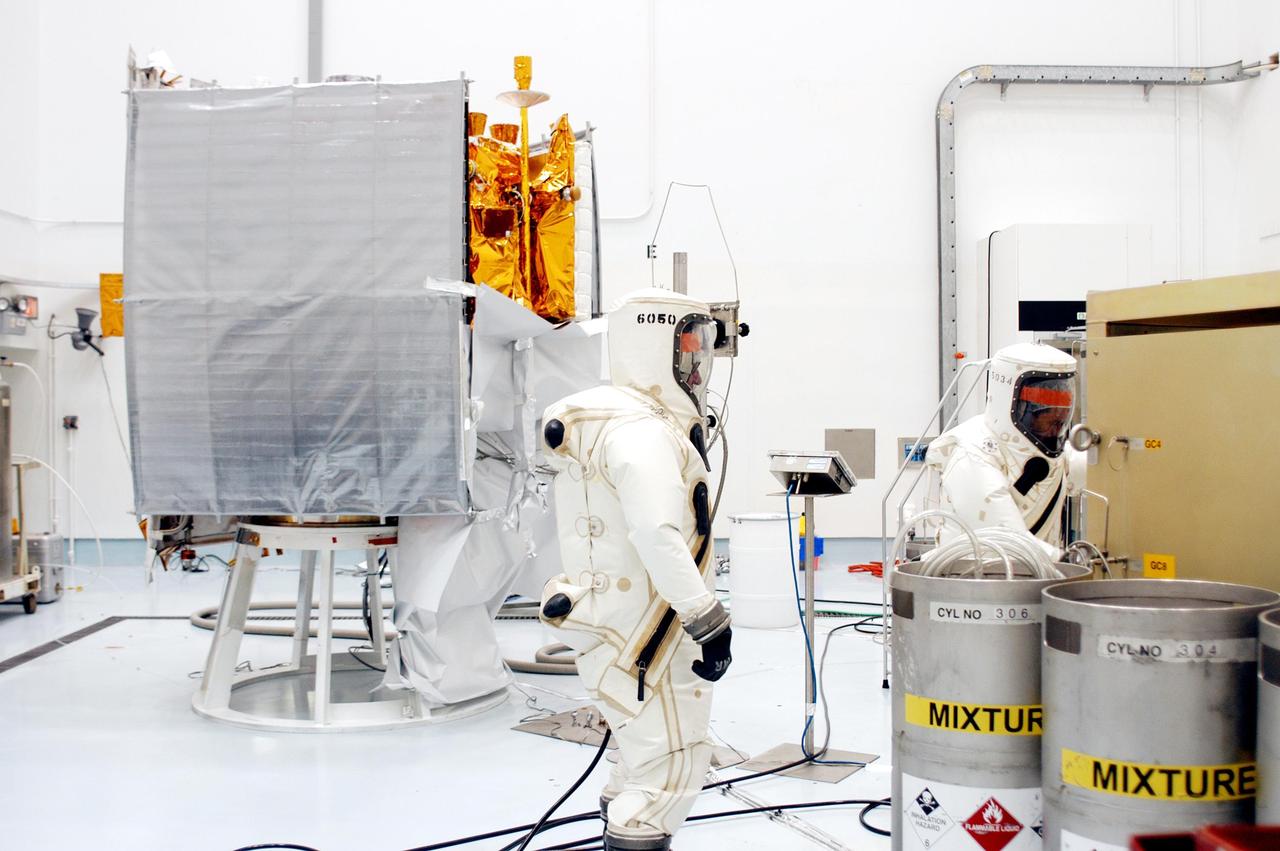
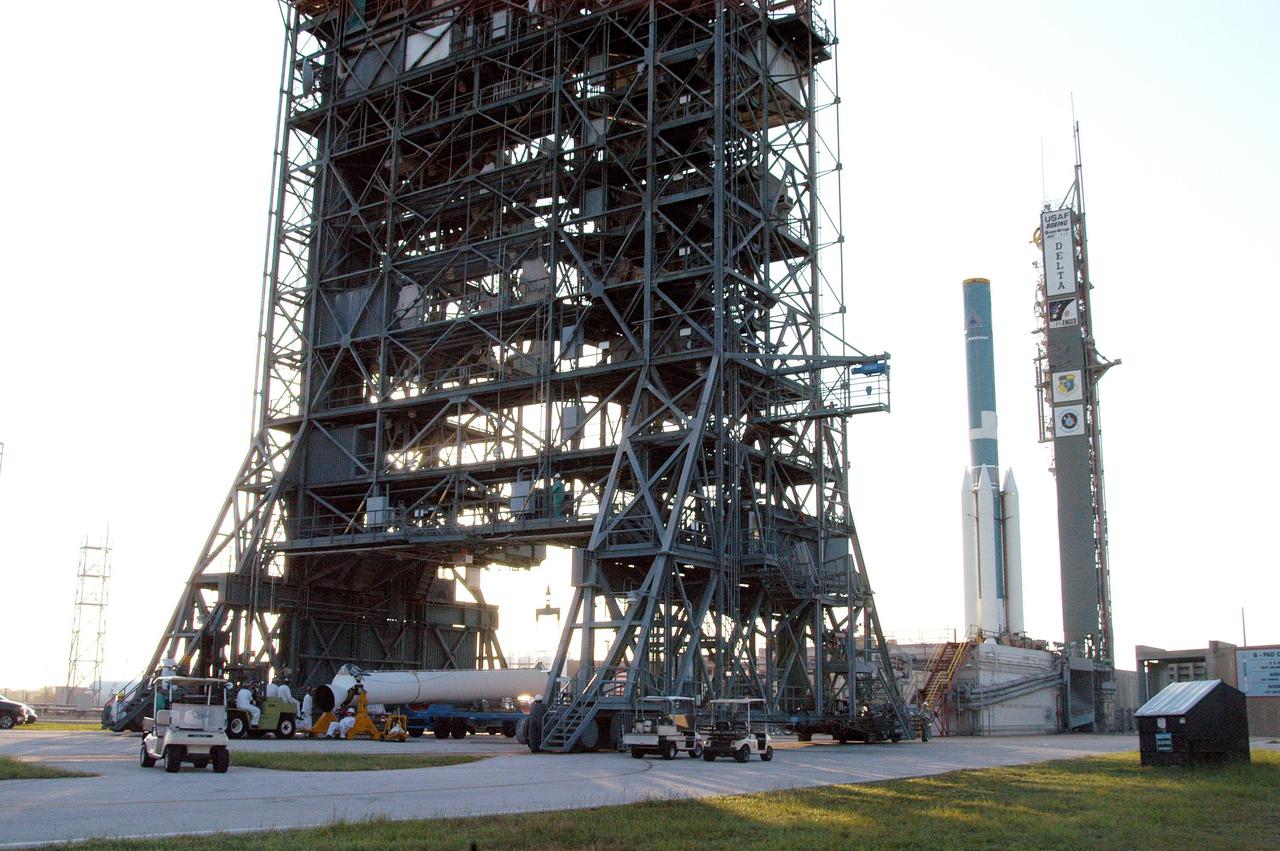
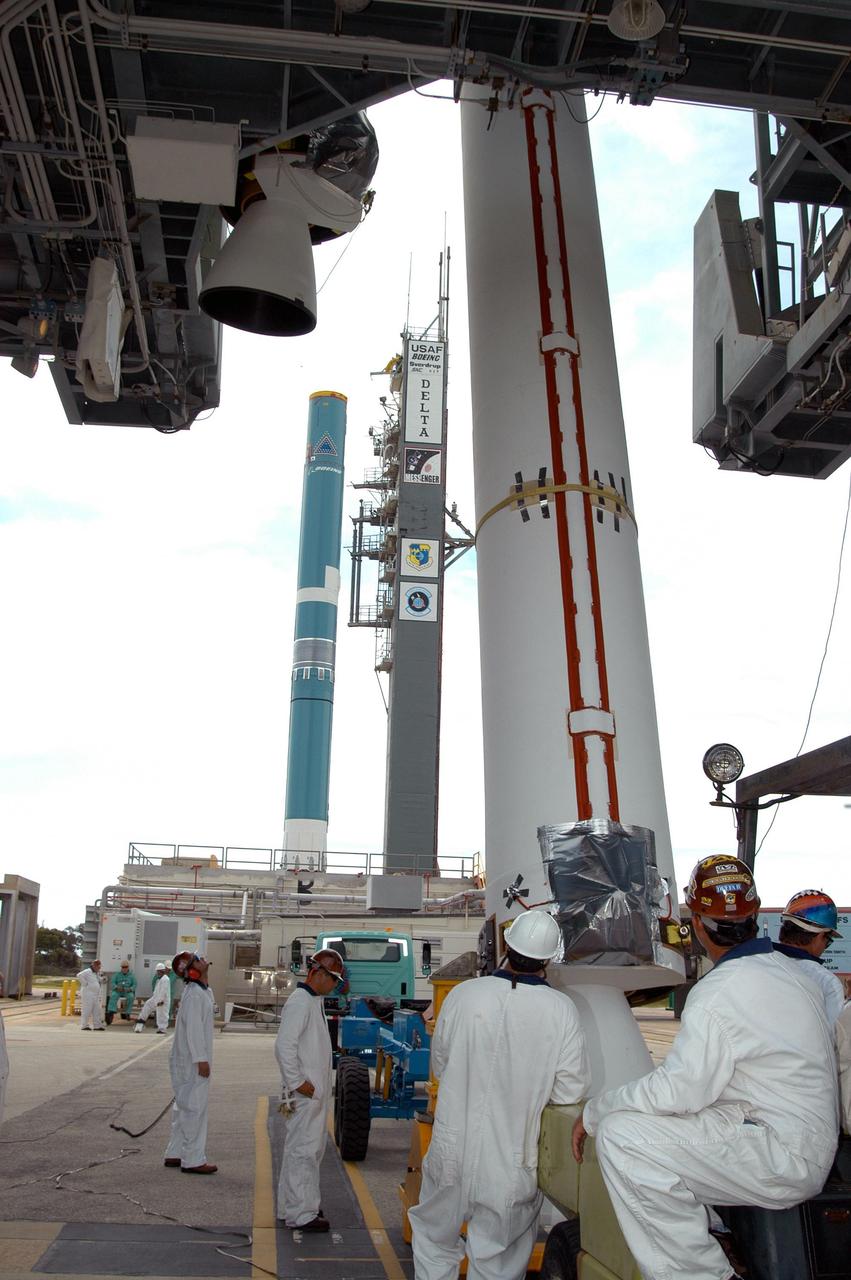
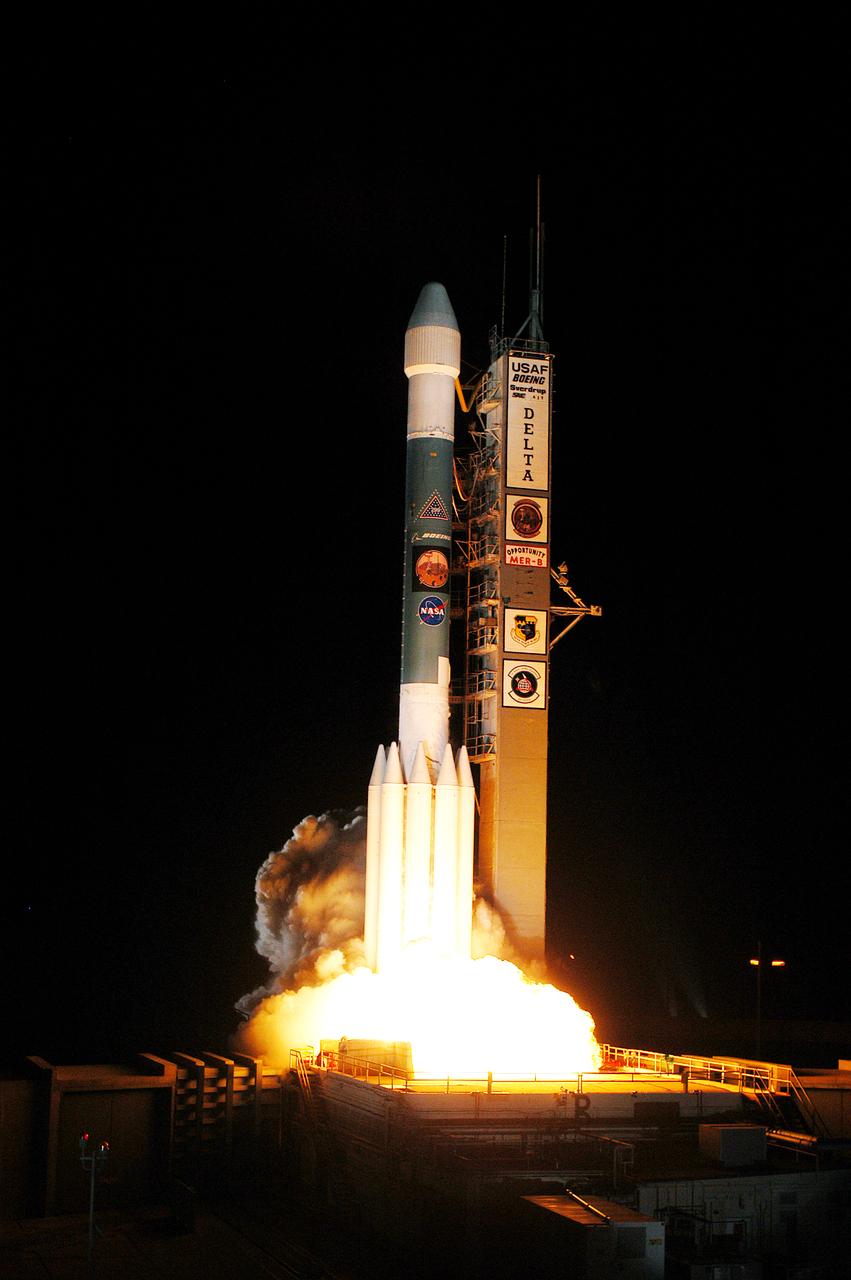
On Launch Complex 17-B, Cape Canaveral Air Force Station, the Delta II Heavy launch vehicle carrying the rover "Opportunity" for the second Mars Exploration Rover mission is poised for launch after rollback of the Mobile Service Tower. Opportunity will reach Mars on Jan. 25, 2004. Together the two MER rovers, Spirit (launched June 10) and Opportunity, seek to determine the history of climate and water at two sites on Mars where conditions may once have been favorable to life. The rovers are identical. They will navigate themselves around obstacles as they drive across the Martian surface, traveling up to about 130 feet each Martian day. Each rover carries five scientific instruments including a panoramic camera and microscope, plus a rock abrasion tool that will grind away the outer surfaces of rocks to expose their interiors for examination. Each rover’s prime mission is planned to last three months on Mars.
Delta II Heavy MER-B Prelaunch
On Launch Complex 17-B, Cape Canaveral Air Force Station, the Delta II Heavy launch vehicle carrying the rover "Opportunity" for the second Mars Exploration Rover mission is poised for launch after rollback of the Mobile Service Tower. Opportunity will reach Mars on Jan. 25, 2004. Together the two MER rovers, Spirit (launched June 10) and Opportunity, seek to determine the history of climate and water at two sites on Mars where conditions may once have been favorable to life. The rovers are identical. They will navigate themselves around obstacles as they drive across the Martian surface, traveling up to about 130 feet each Martian day. Each rover carries five scientific instruments including a panoramic camera and microscope, plus a rock abrasion tool that will grind away the outer surfaces of rocks to expose their interiors for examination. Each rover’s prime mission is planned to last three months on Mars.
Delta II Heavy MER-B Prelaunch
On Launch Complex 17-B, Cape Canaveral Air Force Station, the Delta II Heavy launch vehicle carrying the rover "Opportunity" for the second Mars Exploration Rover mission is poised for launch after rollback of the Mobile Service Tower. Opportunity will reach Mars on Jan. 25, 2004. Together the two MER rovers, Spirit (launched June 10) and Opportunity, seek to determine the history of climate and water at two sites on Mars where conditions may once have been favorable to life. The rovers are identical. They will navigate themselves around obstacles as they drive across the Martian surface, traveling up to about 130 feet each Martian day. Each rover carries five scientific instruments including a panoramic camera and microscope, plus a rock abrasion tool that will grind away the outer surfaces of rocks to expose their interiors for examination. Each rover’s prime mission is planned to last three months on Mars.
Delta II Heavy MER-B Prelaunch
The Mobile Service Tower is ready to be rolled back at Launch Complex 17-B, Cape Canaveral Air Force Station, to launch the Delta II Heavy launch vehicle carrying the rover "Opportunity" on the second Mars Exploration Rover mission. Opportunity will reach Mars on Jan. 25, 2004. Together the two MER rovers, Spirit (launched June 10) and Opportunity, seek to determine the history of climate and water at two sites on Mars where conditions may once have been favorable to life. The rovers are identical. They will navigate themselves around obstacles as they drive across the Martian surface, traveling up to about 130 feet each Martian day. Each rover carries five scientific instruments including a panoramic camera and microscope, plus a rock abrasion tool that will grind away the outer surfaces of rocks to expose their interiors for examination. Each rover’s prime mission is planned to last three months on Mars.
Delta II Heavy MER-B - MST Rollback
On Launch Complex 17-B, Cape Canaveral Air Force Station, the Delta II Heavy launch vehicle carrying the rover "Opportunity" for the second Mars Exploration Rover mission is poised for launch after rollback of the Mobile Service Tower. Opportunity will reach Mars on Jan. 25, 2004. Together the two MER rovers, Spirit (launched June 10) and Opportunity, seek to determine the history of climate and water at two sites on Mars where conditions may once have been favorable to life. The rovers are identical. They will navigate themselves around obstacles as they drive across the Martian surface, traveling up to about 130 feet each Martian day. Each rover carries five scientific instruments including a panoramic camera and microscope, plus a rock abrasion tool that will grind away the outer surfaces of rocks to expose their interiors for examination. Each rover’s prime mission is planned to last three months on Mars.
Delta II Heavy MER-B Prelaunch
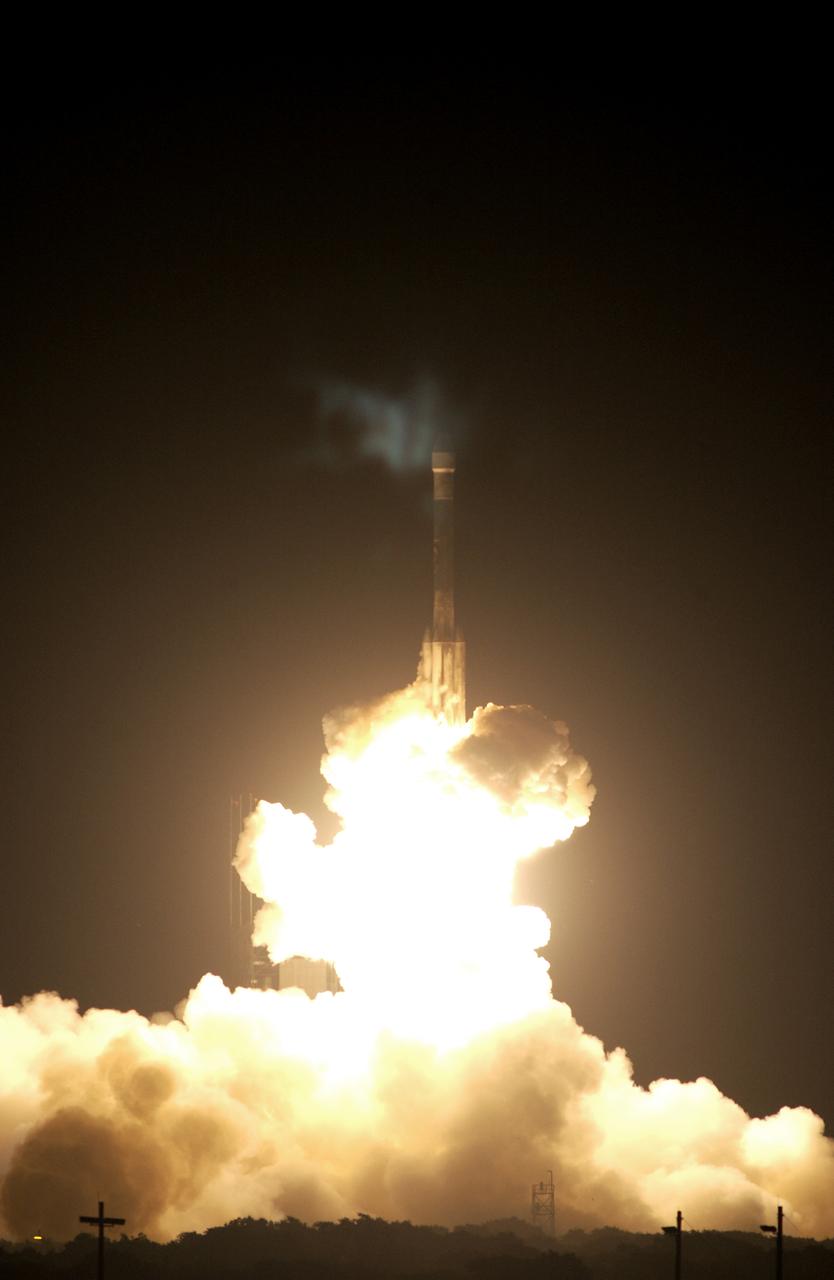
On Launch Complex 17-B, Cape Canaveral Air Force Station, the Delta II Heavy launch vehicle carrying the rover "Opportunity" for the second Mars Exploration Rover mission launches at 11:18:15 p.m. EDT. Opportunity will reach Mars on Jan. 25, 2004. Together the two MER rovers, Spirit (launched June 10) and Opportunity, seek to determine the history of climate and water at two sites on Mars where conditions may once have been favorable to life. The rovers are identical. They will navigate themselves around obstacles as they drive across the Martian surface, traveling up to about 130 feet each Martian day. Each rover carries five scientific instruments including a panoramic camera and microscope, plus a rock abrasion tool that will grind away the outer surfaces of rocks to expose their interiors for examination. Each rover’s prime mission is planned to last three months on Mars.
Delta II Heavy launch of "Opportunity" MER-B Rover
On Launch Complex 17-B, Cape Canaveral Air Force Station, the Delta II Heavy launch vehicle carrying the rover "Opportunity" for the second Mars Exploration Rover mission launches at 11:18:15 p.m. EDT. Opportunity will reach Mars on Jan. 25, 2004. Together the two MER rovers, Spirit (launched June 10) and Opportunity, seek to determine the history of climate and water at two sites on Mars where conditions may once have been favorable to life. The rovers are identical. They will navigate themselves around obstacles as they drive across the Martian surface, traveling up to about 130 feet each Martian day. Each rover carries five scientific instruments including a panoramic camera and microscope, plus a rock abrasion tool that will grind away the outer surfaces of rocks to expose their interiors for examination. Each rover’s prime mission is planned to last three months on Mars.
Delta II Heavy launch of "Opportunity" MER-B Rover
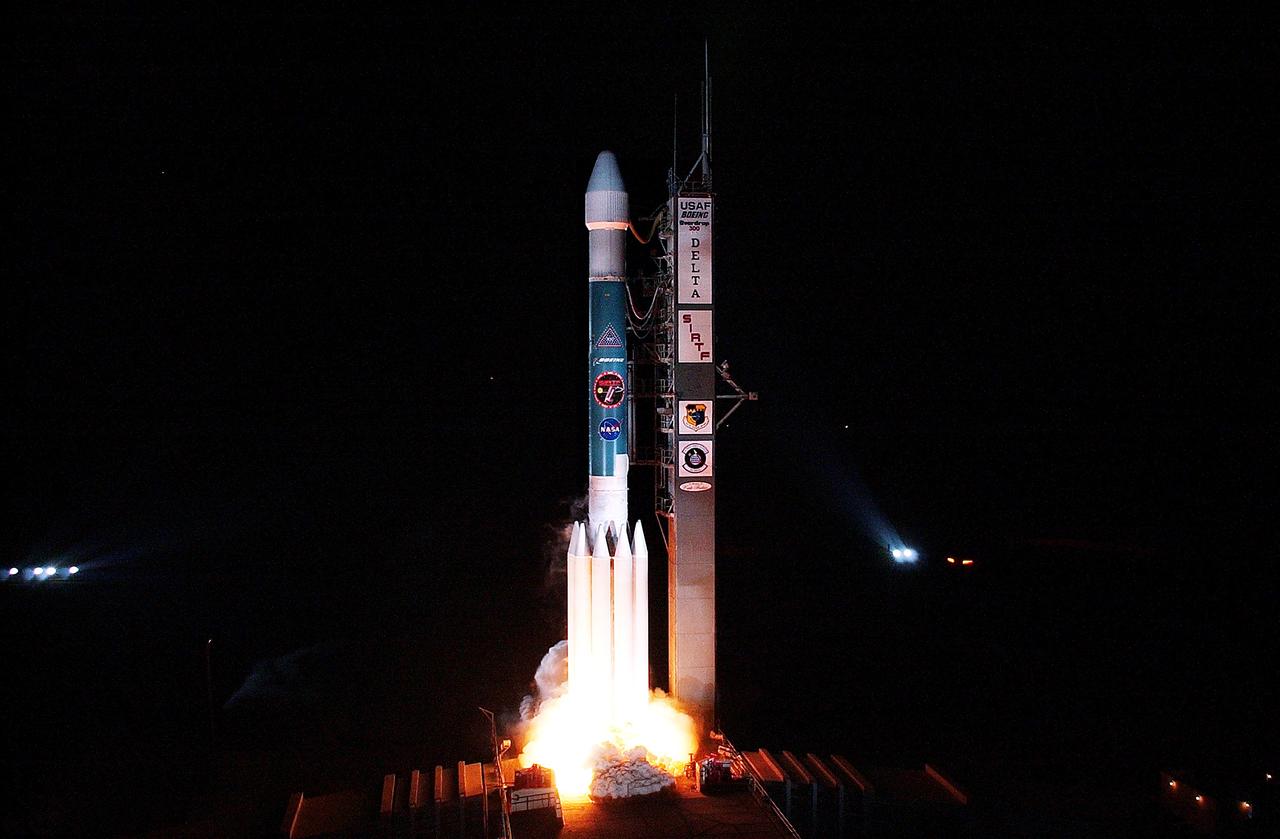
KENNEDY SPACE CENTER, FLA.  -  NASA's Space Infrared Telescope Facility (SIRTF) lifts off from Launch Pad 17-B, Cape Canaveral Air Force Station, on Aug. 25 at 1:35:39 a.m. EDT. SIRTF will obtain images and spectra by detecting the infrared energy, or heat, radiated by objects in space. Consisting of a 0.85-meter telescope and three cryogenically cooled science instruments, SIRTF will be the largest infrared telescope ever launched into space. It is the fourth and final element in NASA’s family of orbiting “Great Observatories.” Its highly sensitive instruments will give a unique view of the Universe and peer into regions of space that are hidden from optical telescopes.
KENNEDY SPACE CENTER, FLA. - NASA's Space Infrared Telescope Facility (SIRTF) lifts off from Launch Pad 17-B, Cape Canaveral Air Force Station, on Aug. 25 at 1:35:39 a.m. EDT. SIRTF will obtain images and spectra by detecting the infrared energy, or heat, radiated by objects in space. Consisting of a 0.85-meter telescope and three cryogenically cooled science instruments, SIRTF will be the largest infrared telescope ever launched into space. It is the fourth and final element in NASA’s family of orbiting “Great Observatories.” Its highly sensitive instruments will give a unique view of the Universe and peer into regions of space that are hidden from optical telescopes.
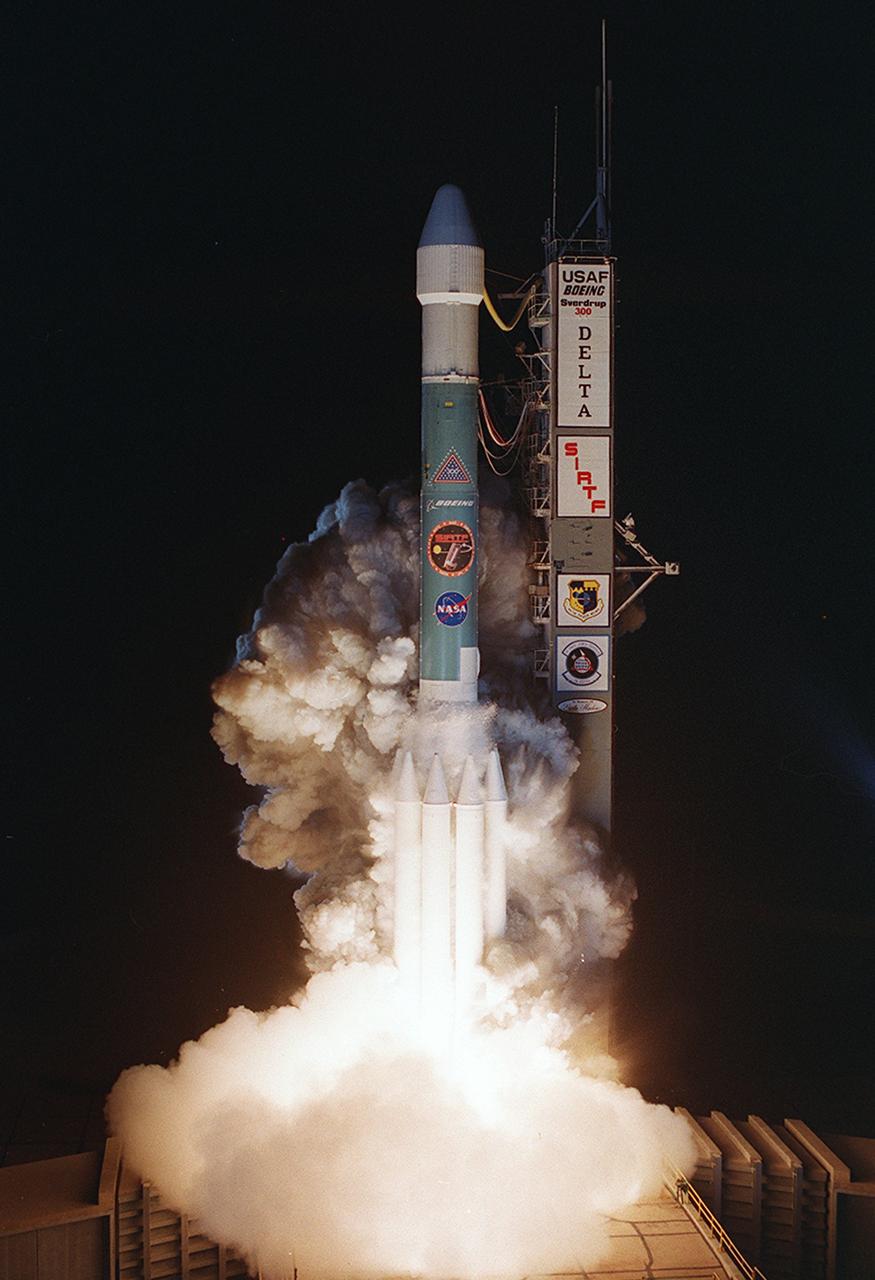
KENNEDY SPACE CENTER, FLA.  -  NASA's Space Infrared Telescope Facility (SIRTF) lifts off from Launch Pad 17-B, Cape Canaveral Air Force Station, on Aug. 25 at 1:35:39 a.m. EDT. SIRTF will obtain images and spectra by detecting the infrared energy, or heat, radiated by objects in space. Consisting of a 0.85-meter telescope and three cryogenically cooled science instruments, SIRTF will be the largest infrared telescope ever launched into space. It is the fourth and final element in NASA’s family of orbiting “Great Observatories.” Its highly sensitive instruments will give a unique view of the Universe and peer into regions of space that are hidden from optical telescopes.
KENNEDY SPACE CENTER, FLA. - NASA's Space Infrared Telescope Facility (SIRTF) lifts off from Launch Pad 17-B, Cape Canaveral Air Force Station, on Aug. 25 at 1:35:39 a.m. EDT. SIRTF will obtain images and spectra by detecting the infrared energy, or heat, radiated by objects in space. Consisting of a 0.85-meter telescope and three cryogenically cooled science instruments, SIRTF will be the largest infrared telescope ever launched into space. It is the fourth and final element in NASA’s family of orbiting “Great Observatories.” Its highly sensitive instruments will give a unique view of the Universe and peer into regions of space that are hidden from optical telescopes.
KENNEDY SPACE CENTER, FLA.  -  NASA's Space Infrared Telescope Facility (SIRTF) lifts off from Launch Pad 17-B, Cape Canaveral Air Force Station, on Aug. 25 at 1:35:39 a.m. EDT. SIRTF will obtain images and spectra by detecting the infrared energy, or heat, radiated by objects in space. Consisting of a 0.85-meter telescope and three cryogenically cooled science instruments, SIRTF will be the largest infrared telescope ever launched into space. It is the fourth and final element in NASA’s family of orbiting “Great Observatories.” Its highly sensitive instruments will give a unique view of the Universe and peer into regions of space that are hidden from optical telescopes.
KENNEDY SPACE CENTER, FLA. - NASA's Space Infrared Telescope Facility (SIRTF) lifts off from Launch Pad 17-B, Cape Canaveral Air Force Station, on Aug. 25 at 1:35:39 a.m. EDT. SIRTF will obtain images and spectra by detecting the infrared energy, or heat, radiated by objects in space. Consisting of a 0.85-meter telescope and three cryogenically cooled science instruments, SIRTF will be the largest infrared telescope ever launched into space. It is the fourth and final element in NASA’s family of orbiting “Great Observatories.” Its highly sensitive instruments will give a unique view of the Universe and peer into regions of space that are hidden from optical telescopes.
KENNEDY SPACE CENTER, FLA. -- At Cape Canaveral Air Force Station, the Delta II second stage for GLAST has arrived at Hangar M and is moved into place for weighing.  The Delta rocket will be used to launch the Gamma-Ray Large Area Space Telescope, or GLAST, May 16 from Launch Pad 17-B on CCAFS. The GLAST is a powerful space observatory that will explore the Universe's ultimate frontier, where nature harnesses forces and energies far beyond anything possible on Earth;  probe some of science's deepest questions, such as what our Universe is made of, and search for new laws of physics; explain how black holes accelerate jets of material to nearly light speed; and help crack the mystery of stupendously powerful explosions known as gamma-ray bursts.  Photo credit: NASA/Kim Shiflett
KSC-08pd0432
KENNEDY SPACE CENTER, FLA.  -  NASA's Space Infrared Telescope Facility (SIRTF) lifts off from Launch Pad 17-B, Cape Canaveral Air Force Station, on Aug. 25 at 1:35:39 a.m. EDT. SIRTF will obtain images and spectra by detecting the infrared energy, or heat, radiated by objects in space. Consisting of a 0.85-meter telescope and three cryogenically cooled science instruments, SIRTF will be the largest infrared telescope ever launched into space. It is the fourth and final element in NASA’s family of orbiting “Great Observatories.” Its highly sensitive instruments will give a unique view of the Universe and peer into regions of space that are hidden from optical telescopes.
KENNEDY SPACE CENTER, FLA. - NASA's Space Infrared Telescope Facility (SIRTF) lifts off from Launch Pad 17-B, Cape Canaveral Air Force Station, on Aug. 25 at 1:35:39 a.m. EDT. SIRTF will obtain images and spectra by detecting the infrared energy, or heat, radiated by objects in space. Consisting of a 0.85-meter telescope and three cryogenically cooled science instruments, SIRTF will be the largest infrared telescope ever launched into space. It is the fourth and final element in NASA’s family of orbiting “Great Observatories.” Its highly sensitive instruments will give a unique view of the Universe and peer into regions of space that are hidden from optical telescopes.
KENNEDY SPACE CENTER, FLA.  -  NASA's Space Infrared Telescope Facility (SIRTF) lifts off from Launch Pad 17-B, Cape Canaveral Air Force Station, on Aug. 25 at 1:35:39 a.m. EDT. SIRTF will obtain images and spectra by detecting the infrared energy, or heat, radiated by objects in space. Consisting of a 0.85-meter telescope and three cryogenically cooled science instruments, SIRTF will be the largest infrared telescope ever launched into space. It is the fourth and final element in NASA’s family of orbiting “Great Observatories.” Its highly sensitive instruments will give a unique view of the Universe and peer into regions of space that are hidden from optical telescopes.
KENNEDY SPACE CENTER, FLA. - NASA's Space Infrared Telescope Facility (SIRTF) lifts off from Launch Pad 17-B, Cape Canaveral Air Force Station, on Aug. 25 at 1:35:39 a.m. EDT. SIRTF will obtain images and spectra by detecting the infrared energy, or heat, radiated by objects in space. Consisting of a 0.85-meter telescope and three cryogenically cooled science instruments, SIRTF will be the largest infrared telescope ever launched into space. It is the fourth and final element in NASA’s family of orbiting “Great Observatories.” Its highly sensitive instruments will give a unique view of the Universe and peer into regions of space that are hidden from optical telescopes.
KENNEDY SPACE CENTER, FLA. -- At Cape Canaveral Air Force Station, workers prepare the Delta II second stage for GLAST for weighing. The Delta rocket will be used to launch the Gamma-Ray Large Area Space Telescope, or GLAST, May 16 from Launch Pad 17-B on CCAFS. The GLAST is a powerful space observatory that will explore the Universe's ultimate frontier, where nature harnesses forces and energies far beyond anything possible on Earth;  probe some of science's deepest questions, such as what our Universe is made of, and search for new laws of physics; explain how black holes accelerate jets of material to nearly light speed; and help crack the mystery of stupendously powerful explosions known as gamma-ray bursts.  Photo credit: NASA/Kim Shiflett
KSC-08pd0434
KENNEDY SPACE CENTER, FLA. -- At Cape Canaveral Air Force Station, the Delta II second stage for GLAST has arrived at Hangar M and is prepared for weighing.  The Delta rocket will be used to launch the Gamma-Ray Large Area Space Telescope, or GLAST, May 16 from Launch Pad 17-B on CCAFS. The GLAST is a powerful space observatory that will explore the Universe's ultimate frontier, where nature harnesses forces and energies far beyond anything possible on Earth;  probe some of science's deepest questions, such as what our Universe is made of, and search for new laws of physics; explain how black holes accelerate jets of material to nearly light speed; and help crack the mystery of stupendously powerful explosions known as gamma-ray bursts.  Photo credit: NASA/Kim Shiflett
KSC-08pd0433
KENNEDY SPACE CENTER, FLA.  -  NASA's Space Infrared Telescope Facility (SIRTF) lifts off from Launch Pad 17-B, Cape Canaveral Air Force Station, on Aug. 25 at 1:35:39 a.m. EDT. SIRTF will obtain images and spectra by detecting the infrared energy, or heat, radiated by objects in space. Consisting of a 0.85-meter telescope and three cryogenically cooled science instruments, SIRTF will be the largest infrared telescope ever launched into space. It is the fourth and final element in NASA’s family of orbiting “Great Observatories.” Its highly sensitive instruments will give a unique view of the Universe and peer into regions of space that are hidden from optical telescopes.
KENNEDY SPACE CENTER, FLA. - NASA's Space Infrared Telescope Facility (SIRTF) lifts off from Launch Pad 17-B, Cape Canaveral Air Force Station, on Aug. 25 at 1:35:39 a.m. EDT. SIRTF will obtain images and spectra by detecting the infrared energy, or heat, radiated by objects in space. Consisting of a 0.85-meter telescope and three cryogenically cooled science instruments, SIRTF will be the largest infrared telescope ever launched into space. It is the fourth and final element in NASA’s family of orbiting “Great Observatories.” Its highly sensitive instruments will give a unique view of the Universe and peer into regions of space that are hidden from optical telescopes.
KENNEDY SPACE CENTER, FLA. -   A solid rocket booster (SRB) for the Delta II Heavy rocket that will launch the Space Infrared Telescope Facility (SIRTF) arrives at Launch Complex 17-B, Cape Canaveral Air Force Station.  The Delta II Heavy features nine 46-inch-diameter, stretched SRBs.  Consisting of three cryogenically cooled science instruments and an 0.85-meter telescope, SIRTF is one of NASA's largest infrared telescopes to be launched.  SIRTF will obtain images and spectra by detecting the infrared energy, or heat, radiated by objects in space. Most of this infrared radiation is blocked by the Earth's atmosphere and cannot be observed from the ground.
KENNEDY SPACE CENTER, FLA. - A solid rocket booster (SRB) for the Delta II Heavy rocket that will launch the Space Infrared Telescope Facility (SIRTF) arrives at Launch Complex 17-B, Cape Canaveral Air Force Station. The Delta II Heavy features nine 46-inch-diameter, stretched SRBs. Consisting of three cryogenically cooled science instruments and an 0.85-meter telescope, SIRTF is one of NASA's largest infrared telescopes to be launched. SIRTF will obtain images and spectra by detecting the infrared energy, or heat, radiated by objects in space. Most of this infrared radiation is blocked by the Earth's atmosphere and cannot be observed from the ground.
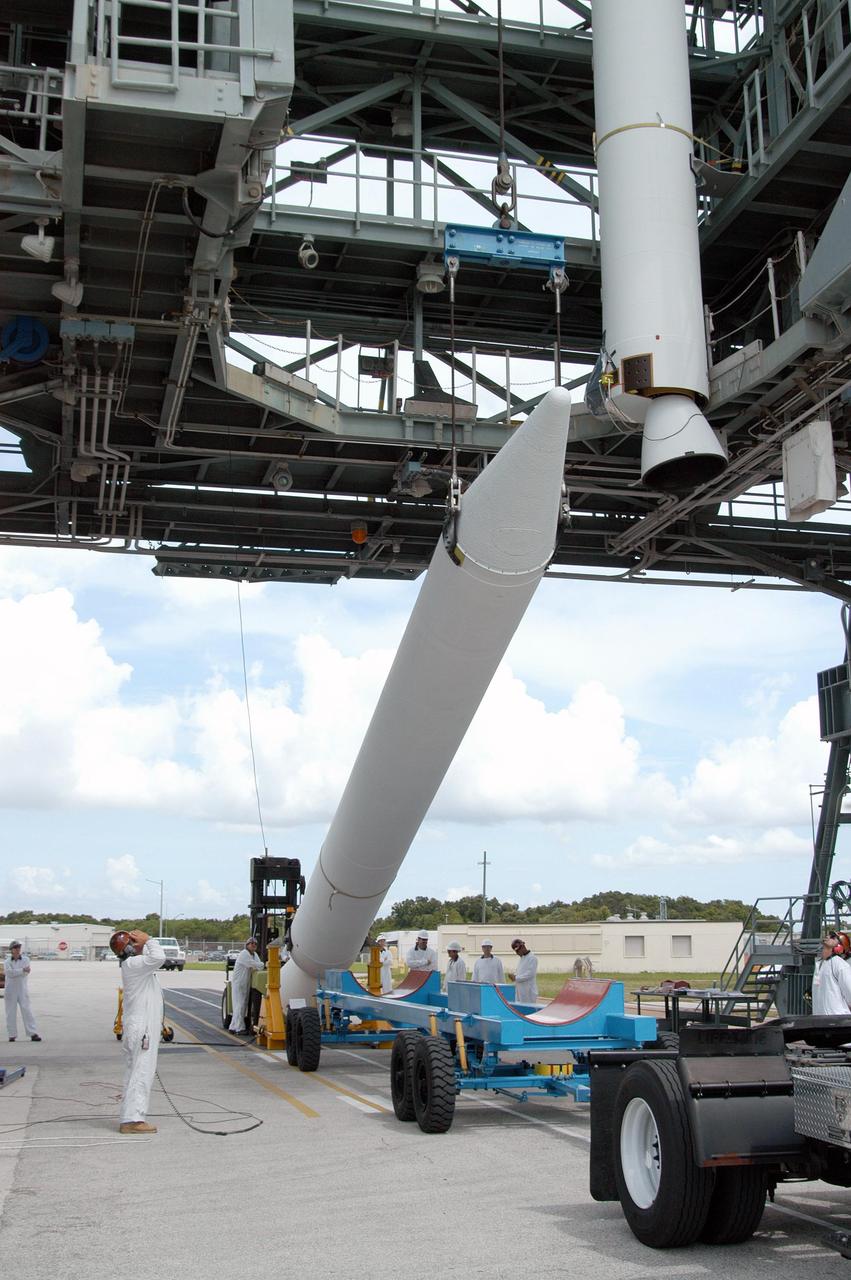
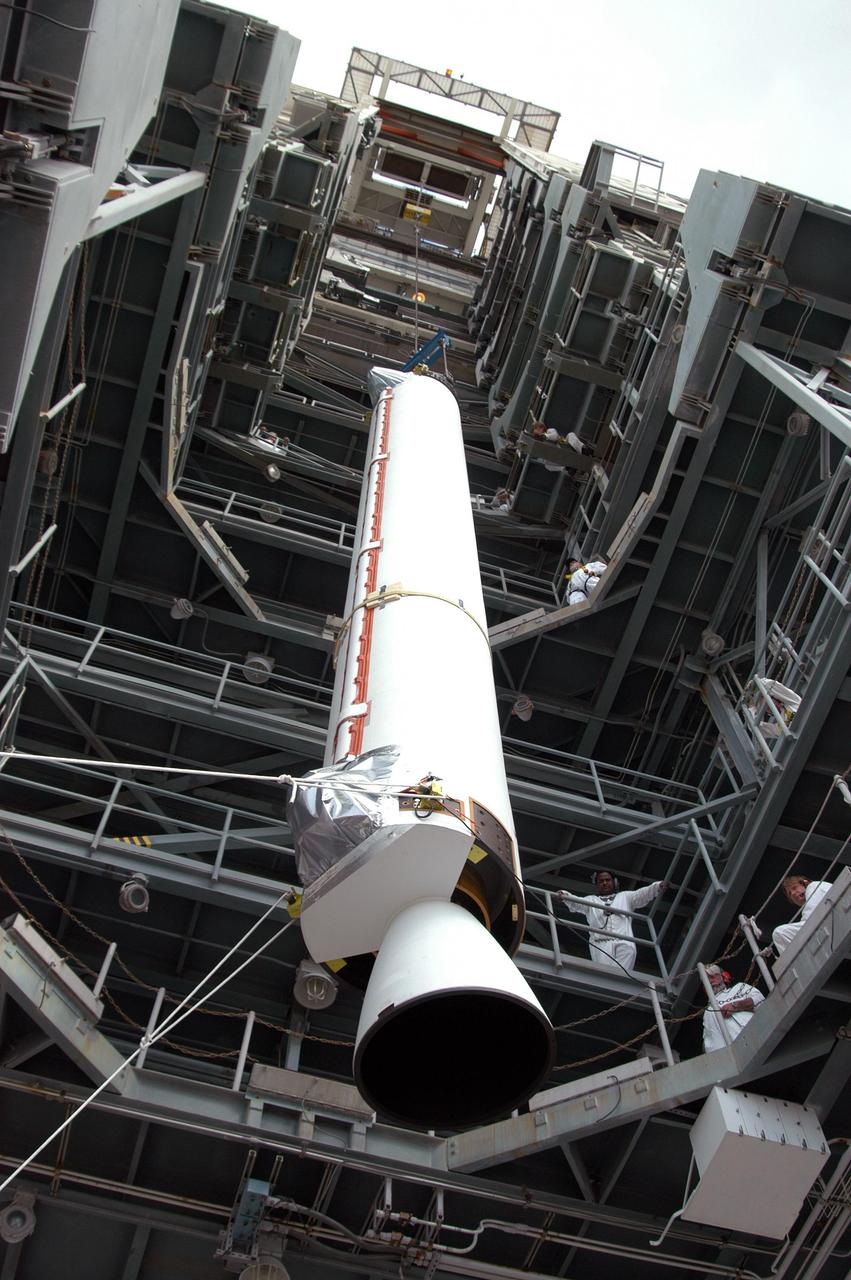
KENNEDY SPACE CENTER, FLA. -   A solid rocket booster (SRB) is lifted to vertical on Launch Complex 17-B, Cape Canaveral Air Force Station. The SRB will be attached to the Delta II Heavy rocket that will launch the Space Infrared Telescope Facility (SIRTF).  The Delta II Heavy features nine 46-inch-diameter, stretched SRBs.  Consisting of three cryogenically cooled science instruments and an 0.85-meter telescope, SIRTF is one of NASA's largest infrared telescopes to be launched.  SIRTF will obtain images and spectra by detecting the infrared energy, or heat, radiated by objects in space. Most of this infrared radiation is blocked by the Earth's atmosphere and cannot be observed from the ground.
KENNEDY SPACE CENTER, FLA. - A solid rocket booster (SRB) is lifted to vertical on Launch Complex 17-B, Cape Canaveral Air Force Station. The SRB will be attached to the Delta II Heavy rocket that will launch the Space Infrared Telescope Facility (SIRTF). The Delta II Heavy features nine 46-inch-diameter, stretched SRBs. Consisting of three cryogenically cooled science instruments and an 0.85-meter telescope, SIRTF is one of NASA's largest infrared telescopes to be launched. SIRTF will obtain images and spectra by detecting the infrared energy, or heat, radiated by objects in space. Most of this infrared radiation is blocked by the Earth's atmosphere and cannot be observed from the ground.
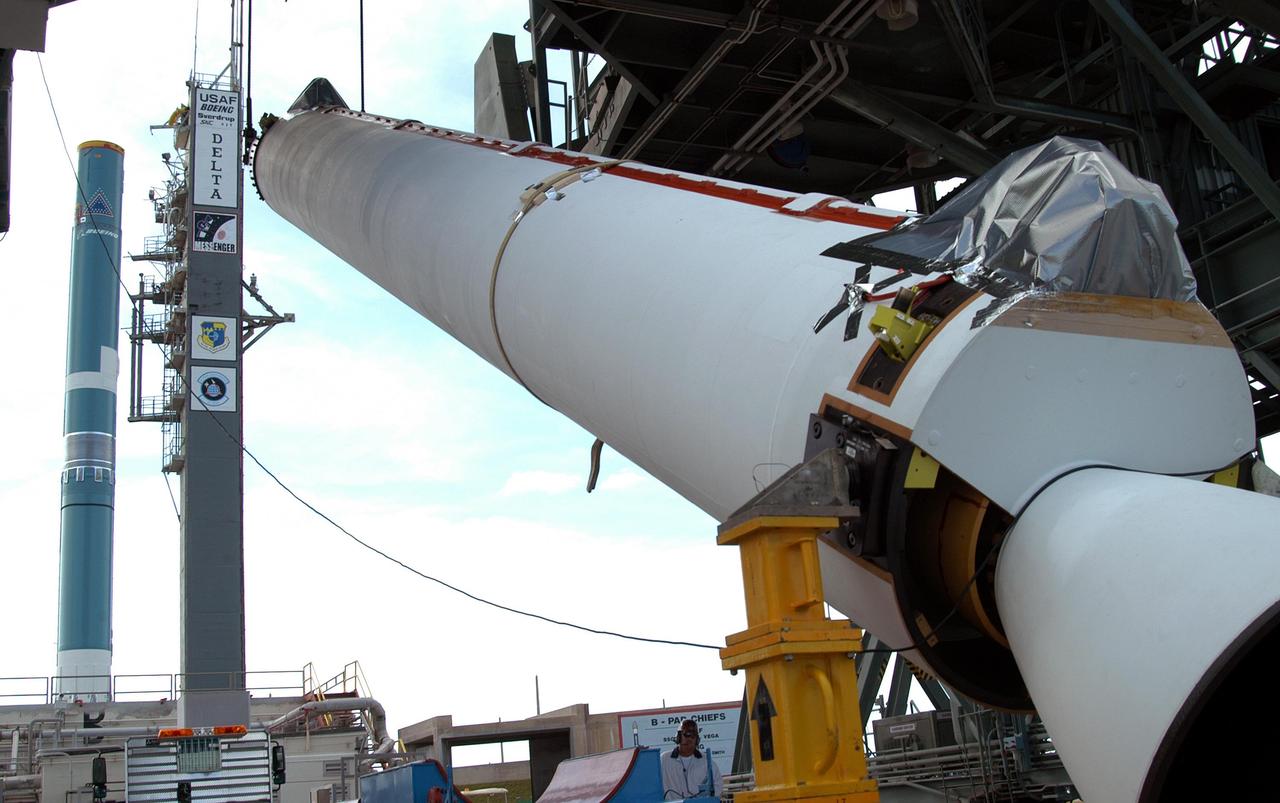
KENNEDY SPACE CENTER, FLA. -   A solid rocket booster (SRB) for the Delta II Heavy rocket that will launch the Space Infrared Telescope Facility (SIRTF) is lifted off its transporter on Launch Complex 17-B, Cape Canaveral Air Force Station.  The SRB will be added to the launch vehicle in the background.  The Delta II Heavy features nine 46-inch-diameter, stretched SRBs.  SIRTF, consisting of three cryogenically cooled science instruments and an 0.85-meter telescope, is one of NASA's largest infrared telescopes to be launched.  SIRTF will obtain images and spectra by detecting the infrared energy, or heat, radiated by objects in space. Most of this infrared radiation is blocked by the Earth's atmosphere and cannot be observed from the ground.
KENNEDY SPACE CENTER, FLA. - A solid rocket booster (SRB) for the Delta II Heavy rocket that will launch the Space Infrared Telescope Facility (SIRTF) is lifted off its transporter on Launch Complex 17-B, Cape Canaveral Air Force Station. The SRB will be added to the launch vehicle in the background. The Delta II Heavy features nine 46-inch-diameter, stretched SRBs. SIRTF, consisting of three cryogenically cooled science instruments and an 0.85-meter telescope, is one of NASA's largest infrared telescopes to be launched. SIRTF will obtain images and spectra by detecting the infrared energy, or heat, radiated by objects in space. Most of this infrared radiation is blocked by the Earth's atmosphere and cannot be observed from the ground.
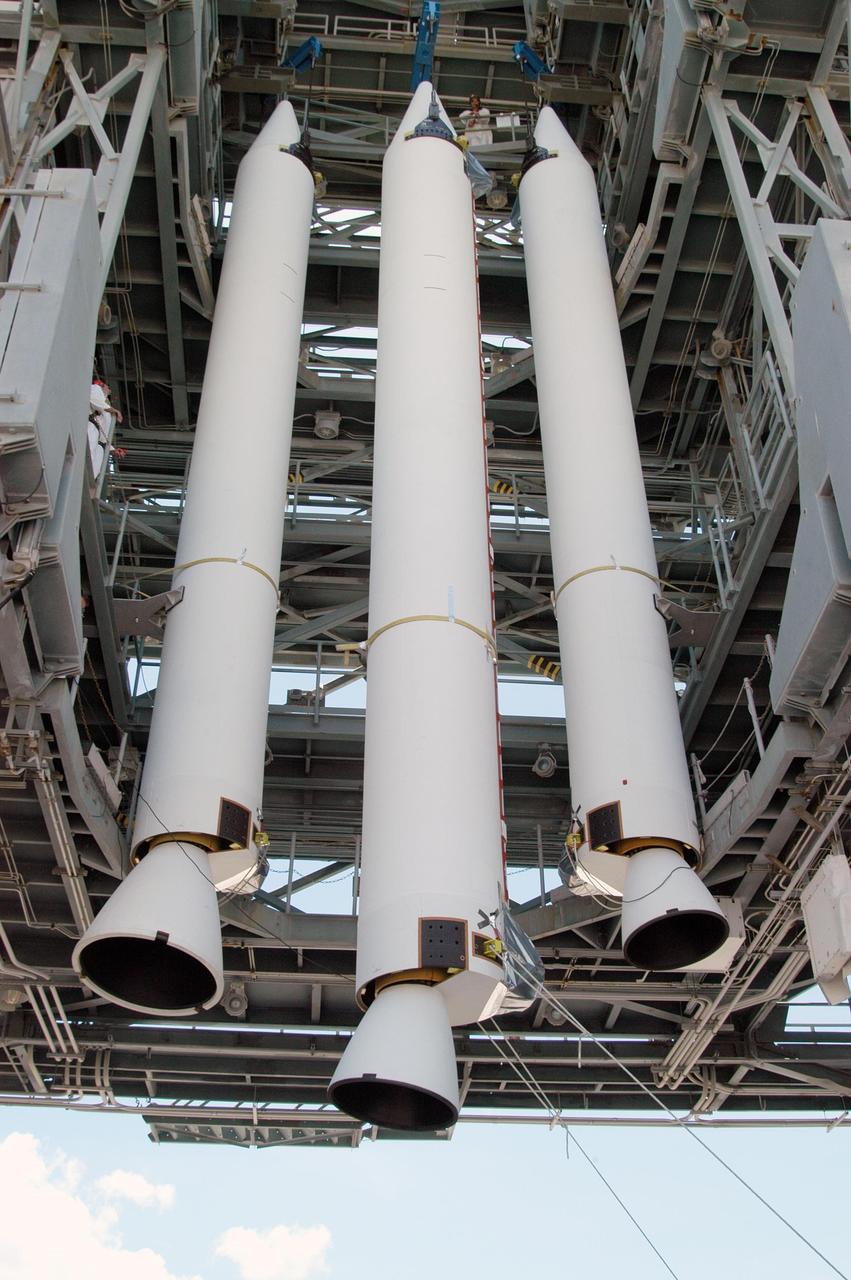
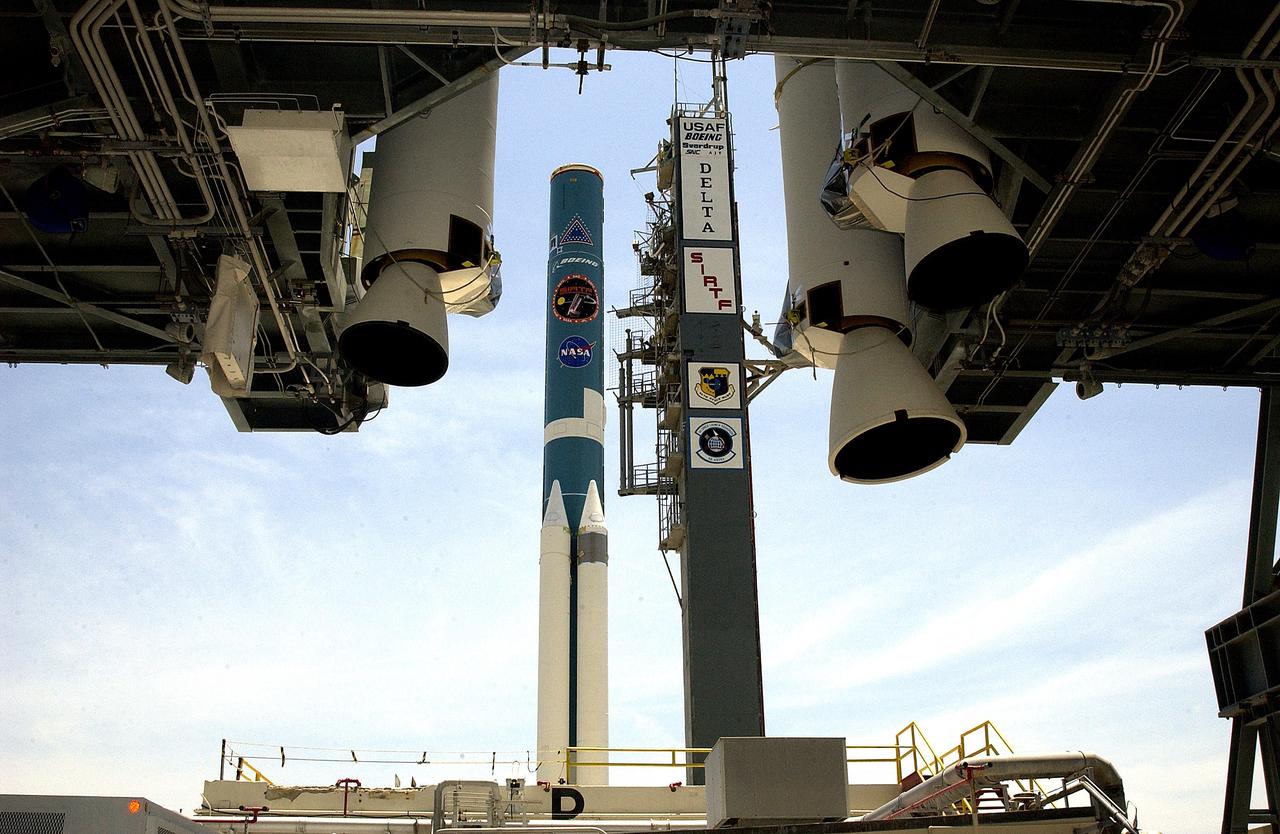
KENNEDY SPACE CENTER, FLA. -   On Launch Complex 17-B, Cape Canaveral Air Force Station, the Delta II Heavy rocket  (background) is framed by the solid rocket boosters (foreground) suspended in the mobile service tower.  The SRBs will be added to those already attached to the rocket.  The Delta II Heavy will launch the Space Infrared Telescope Facility (SIRTF).  Consisting of three cryogenically cooled science instruments and an 0.85-meter telescope, SIRTF is one of NASA's largest infrared telescopes to be launched.  SIRTF will obtain images and spectra by detecting the infrared energy, or heat, radiated by objects in space. Most of this infrared radiation is blocked by the Earth's atmosphere and cannot be observed from the ground.
KENNEDY SPACE CENTER, FLA. - On Launch Complex 17-B, Cape Canaveral Air Force Station, the Delta II Heavy rocket (background) is framed by the solid rocket boosters (foreground) suspended in the mobile service tower. The SRBs will be added to those already attached to the rocket. The Delta II Heavy will launch the Space Infrared Telescope Facility (SIRTF). Consisting of three cryogenically cooled science instruments and an 0.85-meter telescope, SIRTF is one of NASA's largest infrared telescopes to be launched. SIRTF will obtain images and spectra by detecting the infrared energy, or heat, radiated by objects in space. Most of this infrared radiation is blocked by the Earth's atmosphere and cannot be observed from the ground.
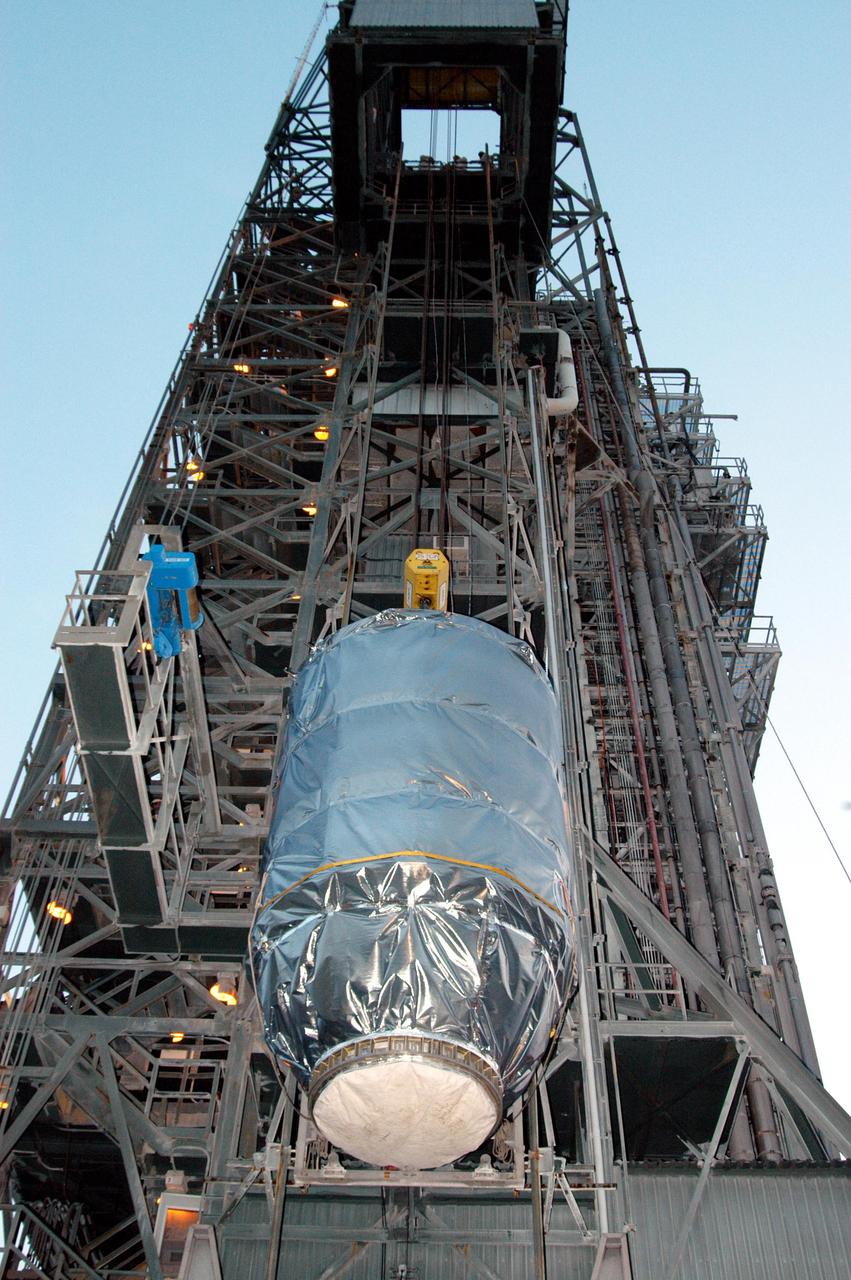
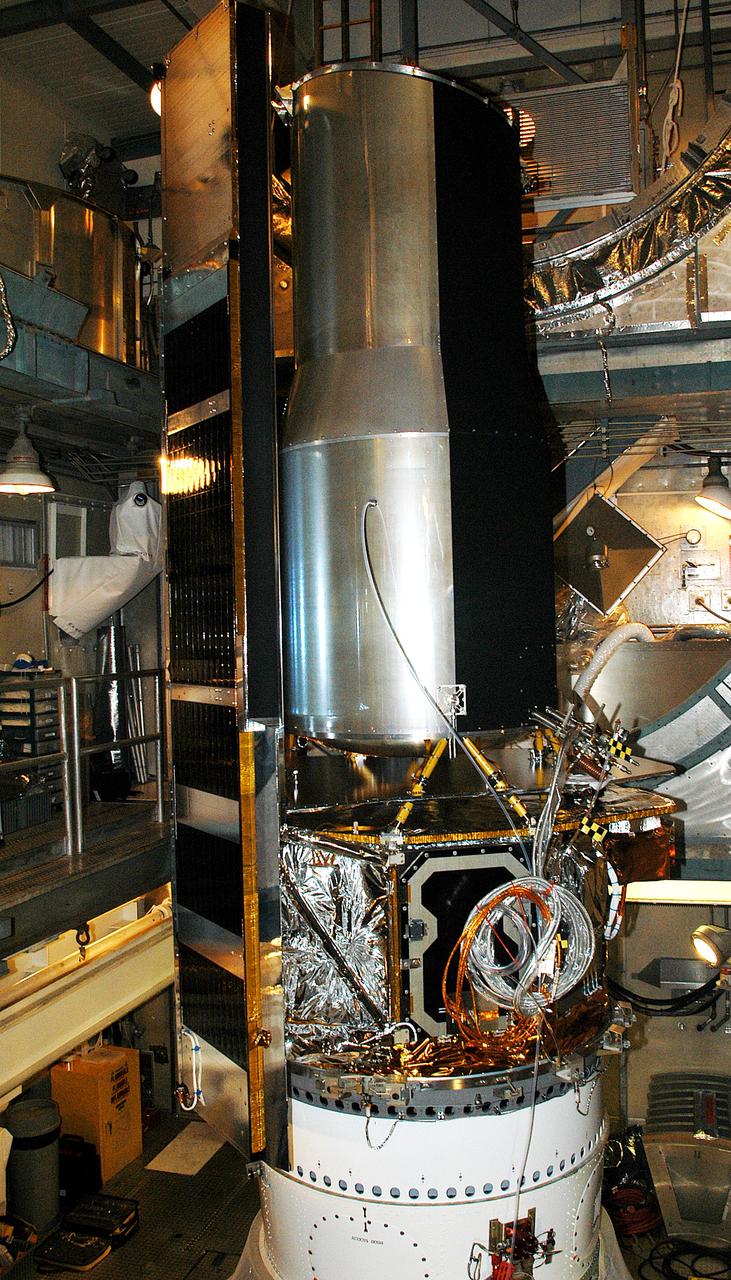
KENNEDY SPACE CENTER, FLA.  - In the mobile service tower on Launch Pad 17-B, Cape Canaveral Air Force Station, the Space Infrared Telescope Facility (SIRTF) waits for encapsulation. SIRTF will obtain images and spectra by detecting the infrared energy, or heat, radiated by objects in space. Consisting of a 0.85-meter telescope and three cryogenically cooled science instruments, SIRTF will be the largest infrared telescope ever launched into space. It is the fourth and final element in NASA’s family of orbiting “Great Observatories.” Its highly sensitive instruments will give a unique view of the Universe and peer into regions of space that are hidden from optical telescopes.
KENNEDY SPACE CENTER, FLA. - In the mobile service tower on Launch Pad 17-B, Cape Canaveral Air Force Station, the Space Infrared Telescope Facility (SIRTF) waits for encapsulation. SIRTF will obtain images and spectra by detecting the infrared energy, or heat, radiated by objects in space. Consisting of a 0.85-meter telescope and three cryogenically cooled science instruments, SIRTF will be the largest infrared telescope ever launched into space. It is the fourth and final element in NASA’s family of orbiting “Great Observatories.” Its highly sensitive instruments will give a unique view of the Universe and peer into regions of space that are hidden from optical telescopes.
KENNEDY SPACE CENTER, FLA.  - In the mobile service tower on Launch Pad 17-B, Cape Canaveral Air Force Station, the first half of the fairing (background) moves toward the Space Infrared Telescope Facility (foreground) for encapsulation. SIRTF will obtain images and spectra by detecting the infrared energy, or heat, radiated by objects in space. Consisting of a 0.85-meter telescope and three cryogenically cooled science instruments, SIRTF will be the largest infrared telescope ever launched into space. It is the fourth and final element in NASA’s family of orbiting “Great Observatories.” Its highly sensitive instruments will give a unique view of the Universe and peer into regions of space that are hidden from optical telescopes.
KENNEDY SPACE CENTER, FLA. - In the mobile service tower on Launch Pad 17-B, Cape Canaveral Air Force Station, the first half of the fairing (background) moves toward the Space Infrared Telescope Facility (foreground) for encapsulation. SIRTF will obtain images and spectra by detecting the infrared energy, or heat, radiated by objects in space. Consisting of a 0.85-meter telescope and three cryogenically cooled science instruments, SIRTF will be the largest infrared telescope ever launched into space. It is the fourth and final element in NASA’s family of orbiting “Great Observatories.” Its highly sensitive instruments will give a unique view of the Universe and peer into regions of space that are hidden from optical telescopes.
KENNEDY SPACE CENTER, FLA.  - In the mobile service tower on Launch Pad 17-B, Cape Canaveral Air Force Station, the top of the fairing is seen as it moves into place around the Space Infrared Telescope Facility (SIRTF). SIRTF will obtain images and spectra by detecting the infrared energy, or heat, radiated by objects in space. Consisting of a 0.85-meter telescope and three cryogenically cooled science instruments, SIRTF will be the largest infrared telescope ever launched into space. It is the fourth and final element in NASA’s family of orbiting “Great Observatories.” Its highly sensitive instruments will give a unique view of the Universe and peer into regions of space that are hidden from optical telescopes.
KENNEDY SPACE CENTER, FLA. - In the mobile service tower on Launch Pad 17-B, Cape Canaveral Air Force Station, the top of the fairing is seen as it moves into place around the Space Infrared Telescope Facility (SIRTF). SIRTF will obtain images and spectra by detecting the infrared energy, or heat, radiated by objects in space. Consisting of a 0.85-meter telescope and three cryogenically cooled science instruments, SIRTF will be the largest infrared telescope ever launched into space. It is the fourth and final element in NASA’s family of orbiting “Great Observatories.” Its highly sensitive instruments will give a unique view of the Universe and peer into regions of space that are hidden from optical telescopes.
KENNEDY SPACE CENTER, FLA.  - In the mobile service tower on Launch Pad 17-B, Cape Canaveral Air Force Station, workers watch as the first half of the fairing moves closer around the Space Infrared Telescope Facility (SIRTF). SIRTF will obtain images and spectra by detecting the infrared energy, or heat, radiated by objects in space. Consisting of a 0.85-meter telescope and three cryogenically cooled science instruments, SIRTF will be the largest infrared telescope ever launched into space. It is the fourth and final element in NASA’s family of orbiting “Great Observatories.” Its highly sensitive instruments will give a unique view of the Universe and peer into regions of space that are hidden from optical telescopes.
KENNEDY SPACE CENTER, FLA. - In the mobile service tower on Launch Pad 17-B, Cape Canaveral Air Force Station, workers watch as the first half of the fairing moves closer around the Space Infrared Telescope Facility (SIRTF). SIRTF will obtain images and spectra by detecting the infrared energy, or heat, radiated by objects in space. Consisting of a 0.85-meter telescope and three cryogenically cooled science instruments, SIRTF will be the largest infrared telescope ever launched into space. It is the fourth and final element in NASA’s family of orbiting “Great Observatories.” Its highly sensitive instruments will give a unique view of the Universe and peer into regions of space that are hidden from optical telescopes.
KENNEDY SPACE CENTER, FLA.  - In the mobile service tower on Launch Pad 17-B, Cape Canaveral Air Force Station, the Space Infrared Telescope Facility (SIRTF) waits for encapsulation. SIRTF will obtain images and spectra by detecting the infrared energy, or heat, radiated by objects in space. Consisting of a 0.85-meter telescope and three cryogenically cooled science instruments, SIRTF will be the largest infrared telescope ever launched into space. It is the fourth and final element in NASA’s family of orbiting “Great Observatories.” Its highly sensitive instruments will give a unique view of the Universe and peer into regions of space that are hidden from optical telescopes.
KENNEDY SPACE CENTER, FLA. - In the mobile service tower on Launch Pad 17-B, Cape Canaveral Air Force Station, the Space Infrared Telescope Facility (SIRTF) waits for encapsulation. SIRTF will obtain images and spectra by detecting the infrared energy, or heat, radiated by objects in space. Consisting of a 0.85-meter telescope and three cryogenically cooled science instruments, SIRTF will be the largest infrared telescope ever launched into space. It is the fourth and final element in NASA’s family of orbiting “Great Observatories.” Its highly sensitive instruments will give a unique view of the Universe and peer into regions of space that are hidden from optical telescopes.
KENNEDY SPACE CENTER, FLA.  - In the mobile service tower on Launch Pad 17-B, Cape Canaveral Air Force Station, workers move the first half of the fairing around the Space Infrared Telescope Facility (SIRTF) behind it for encapsulation. SIRTF will obtain images and spectra by detecting the infrared energy, or heat, radiated by objects in space. Consisting of a 0.85-meter telescope and three cryogenically cooled science instruments, SIRTF will be the largest infrared telescope ever launched into space. It is the fourth and final element in NASA’s family of orbiting “Great Observatories.” Its highly sensitive instruments will give a unique view of the Universe and peer into regions of space that are hidden from optical telescopes.
KENNEDY SPACE CENTER, FLA. - In the mobile service tower on Launch Pad 17-B, Cape Canaveral Air Force Station, workers move the first half of the fairing around the Space Infrared Telescope Facility (SIRTF) behind it for encapsulation. SIRTF will obtain images and spectra by detecting the infrared energy, or heat, radiated by objects in space. Consisting of a 0.85-meter telescope and three cryogenically cooled science instruments, SIRTF will be the largest infrared telescope ever launched into space. It is the fourth and final element in NASA’s family of orbiting “Great Observatories.” Its highly sensitive instruments will give a unique view of the Universe and peer into regions of space that are hidden from optical telescopes.
KENNEDY SPACE CENTER, FLA.  - In the mobile service tower on Launch Pad 17-B, Cape Canaveral Air Force Station, the first half of the fairing is moved around the Space Infrared Telescope Facility (SIRTF). SIRTF will obtain images and spectra by detecting the infrared energy, or heat, radiated by objects in space. Consisting of a 0.85-meter telescope and three cryogenically cooled science instruments, SIRTF will be the largest infrared telescope ever launched into space. It is the fourth and final element in NASA’s family of orbiting “Great Observatories.” Its highly sensitive instruments will give a unique view of the Universe and peer into regions of space that are hidden from optical telescopes.
KENNEDY SPACE CENTER, FLA. - In the mobile service tower on Launch Pad 17-B, Cape Canaveral Air Force Station, the first half of the fairing is moved around the Space Infrared Telescope Facility (SIRTF). SIRTF will obtain images and spectra by detecting the infrared energy, or heat, radiated by objects in space. Consisting of a 0.85-meter telescope and three cryogenically cooled science instruments, SIRTF will be the largest infrared telescope ever launched into space. It is the fourth and final element in NASA’s family of orbiting “Great Observatories.” Its highly sensitive instruments will give a unique view of the Universe and peer into regions of space that are hidden from optical telescopes.
KENNEDY SPACE CENTER, FLA.  - In the mobile service tower on Launch Pad 17-B, Cape Canaveral Air Force Station, the Space Infrared Telescope Facility (SIRTF) waits for encapsulation. SIRTF will obtain images and spectra by detecting the infrared energy, or heat, radiated by objects in space. Consisting of a 0.85-meter telescope and three cryogenically cooled science instruments, SIRTF will be the largest infrared telescope ever launched into space. It is the fourth and final element in NASA’s family of orbiting “Great Observatories.” Its highly sensitive instruments will give a unique view of the Universe and peer into regions of space that are hidden from optical telescopes.
KENNEDY SPACE CENTER, FLA. - In the mobile service tower on Launch Pad 17-B, Cape Canaveral Air Force Station, the Space Infrared Telescope Facility (SIRTF) waits for encapsulation. SIRTF will obtain images and spectra by detecting the infrared energy, or heat, radiated by objects in space. Consisting of a 0.85-meter telescope and three cryogenically cooled science instruments, SIRTF will be the largest infrared telescope ever launched into space. It is the fourth and final element in NASA’s family of orbiting “Great Observatories.” Its highly sensitive instruments will give a unique view of the Universe and peer into regions of space that are hidden from optical telescopes.
KENNEDY SPACE CENTER, FLA. -   Another solid rocket booster (SRB) is lifted to vertical on Launch Complex 17-B, Cape Canaveral Air Force Station, to join the one already in place in the mobile service tower.  The SRBs will be attached to the Delta II Heavy rocket in the background that will launch the Space Infrared Telescope Facility (SIRTF). The Delta II Heavy features nine 46-inch-diameter, stretched SRBs.  SIRTF, consisting of three cryogenically cooled science instruments and an 0.85-meter telescope, is one of NASA's largest infrared telescopes to be launched.  SIRTF will obtain images and spectra by detecting the infrared energy, or heat, radiated by objects in space. Most of this infrared radiation is blocked by the Earth's atmosphere and cannot be observed from the ground.
KENNEDY SPACE CENTER, FLA. - Another solid rocket booster (SRB) is lifted to vertical on Launch Complex 17-B, Cape Canaveral Air Force Station, to join the one already in place in the mobile service tower. The SRBs will be attached to the Delta II Heavy rocket in the background that will launch the Space Infrared Telescope Facility (SIRTF). The Delta II Heavy features nine 46-inch-diameter, stretched SRBs. SIRTF, consisting of three cryogenically cooled science instruments and an 0.85-meter telescope, is one of NASA's largest infrared telescopes to be launched. SIRTF will obtain images and spectra by detecting the infrared energy, or heat, radiated by objects in space. Most of this infrared radiation is blocked by the Earth's atmosphere and cannot be observed from the ground.
KENNEDY SPACE CENTER, FLA. -   Another solid rocket booster (SRB) is lifted to vertical on Launch Complex 17-B, Cape Canaveral Air Force Station, to join the one already in place in the mobile service tower.  The SRBs will be attached to the Delta II Heavy rocket that will launch the Space Infrared Telescope Facility (SIRTF).  The Delta II Heavy features nine 46-inch-diameter, stretched SRBs.  SIRTF, consisting of three cryogenically cooled science instruments and an 0.85-meter telescope, is one of NASA's largest infrared telescopes to be launched.  SIRTF will obtain images and spectra by detecting the infrared energy, or heat, radiated by objects in space. Most of this infrared radiation is blocked by the Earth's atmosphere and cannot be observed from the ground.
KENNEDY SPACE CENTER, FLA. - Another solid rocket booster (SRB) is lifted to vertical on Launch Complex 17-B, Cape Canaveral Air Force Station, to join the one already in place in the mobile service tower. The SRBs will be attached to the Delta II Heavy rocket that will launch the Space Infrared Telescope Facility (SIRTF). The Delta II Heavy features nine 46-inch-diameter, stretched SRBs. SIRTF, consisting of three cryogenically cooled science instruments and an 0.85-meter telescope, is one of NASA's largest infrared telescopes to be launched. SIRTF will obtain images and spectra by detecting the infrared energy, or heat, radiated by objects in space. Most of this infrared radiation is blocked by the Earth's atmosphere and cannot be observed from the ground.
KENNEDY SPACE CENTER, FLA. -  The Boeing Delta II Heavy second-stage engine, the Aerojet AJ10-118K, is lifted up the mobile service tower on Pad 17-B, Cape Canaveral Air Force Station.  At right can be seen the first stage of the Delta II and the nine Solid Rocket Boosters surrounding it.  The Delta II is the launch vehicle for the MESSENGER (Mercury Surface, Space Environment, Geochemistry and Ranging) spacecraft, scheduled to lift off Aug. 2.  Bound for Mercury, the spacecraft is expected to reach orbit around the planet in March 2011.  MESSENGER was built for NASA by the Johns Hopkins University Applied Physics Laboratory in Laurel, Md.
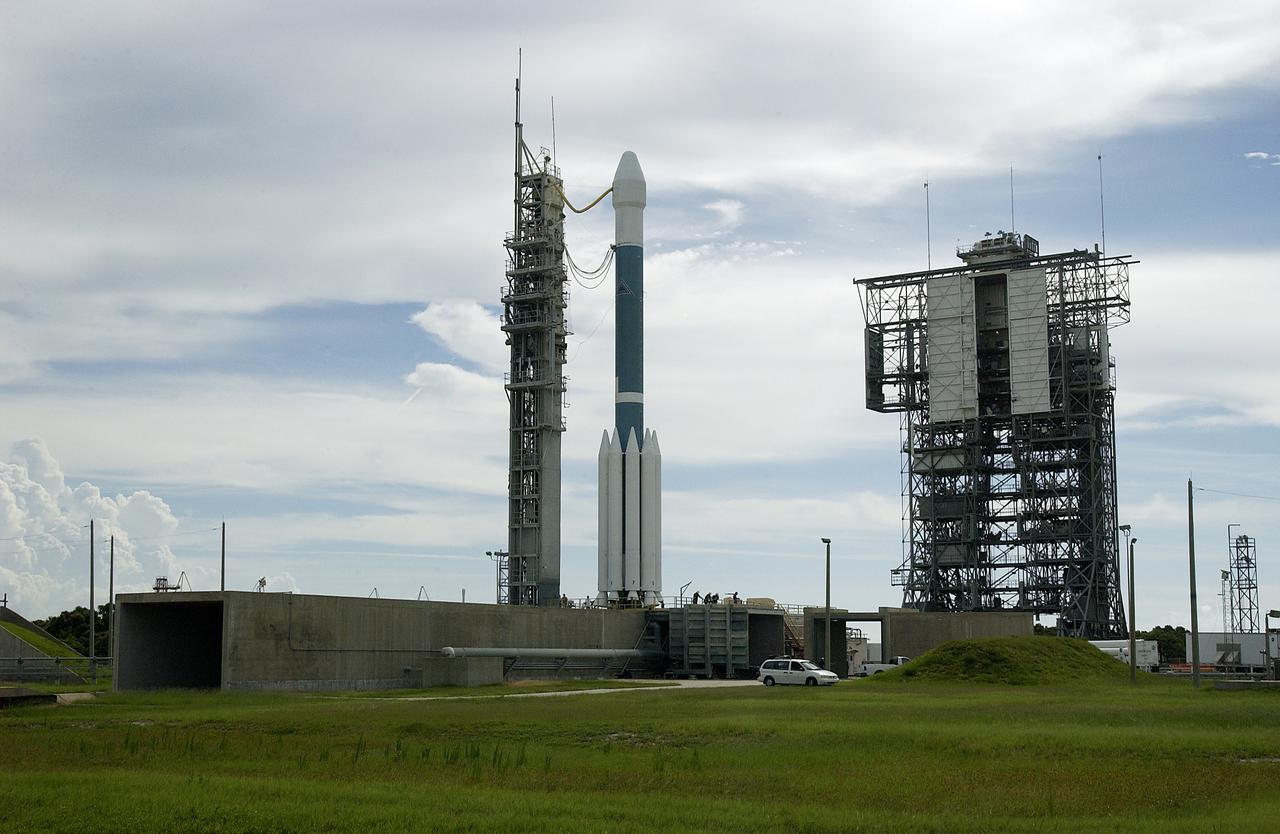
KSC-04pd1448
KENNEDY SPACE CENTER, FLA. -  On Pad 17-B, Cape Canaveral Air Force Station, the mobile service tower at left moves toward the Boeing Delta II Heavy rocket at right.  The tower holds three out of nine Solid Rocket Boosters (SRBs) that will be mated to the Boeing Delta II for the Aug. 2 launch of the MESSENGER spacecraft to the planet Mercury.  The spacecraft is expected to reach orbit around Mercury in March 2011.  MESSENGER was built for NASA by the Johns Hopkins University Applied Physics Laboratory in Laurel, Md.
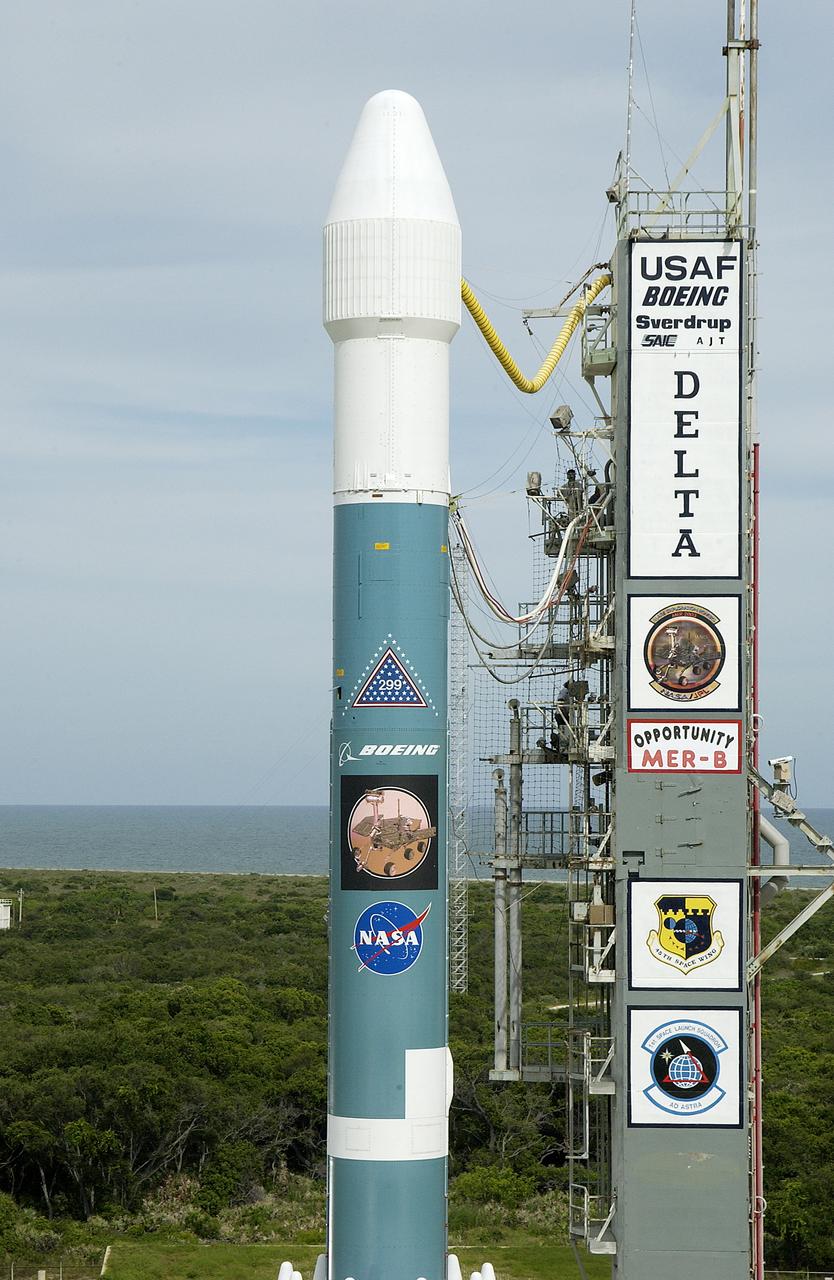
KSC-04pd1416
KENNEDY SPACE CENTER, FLA. -  On Pad 17-B, Cape Canaveral Air Force Station, the mobile service tower delivers the first three Solid Rocket Boosters (SRBs) to the Boeing Delta II Heavy rocket for mating.  In the foreground is the cooling water pond.  The Delta II is the launch vehicle for the Aug. 2 launch of the MESSENGER spacecraft to the planet Mercury.  The spacecraft is expected to reach orbit around Mercury in March 2011.  MESSENGER was built for NASA by the Johns Hopkins University Applied Physics Laboratory in Laurel, Md.
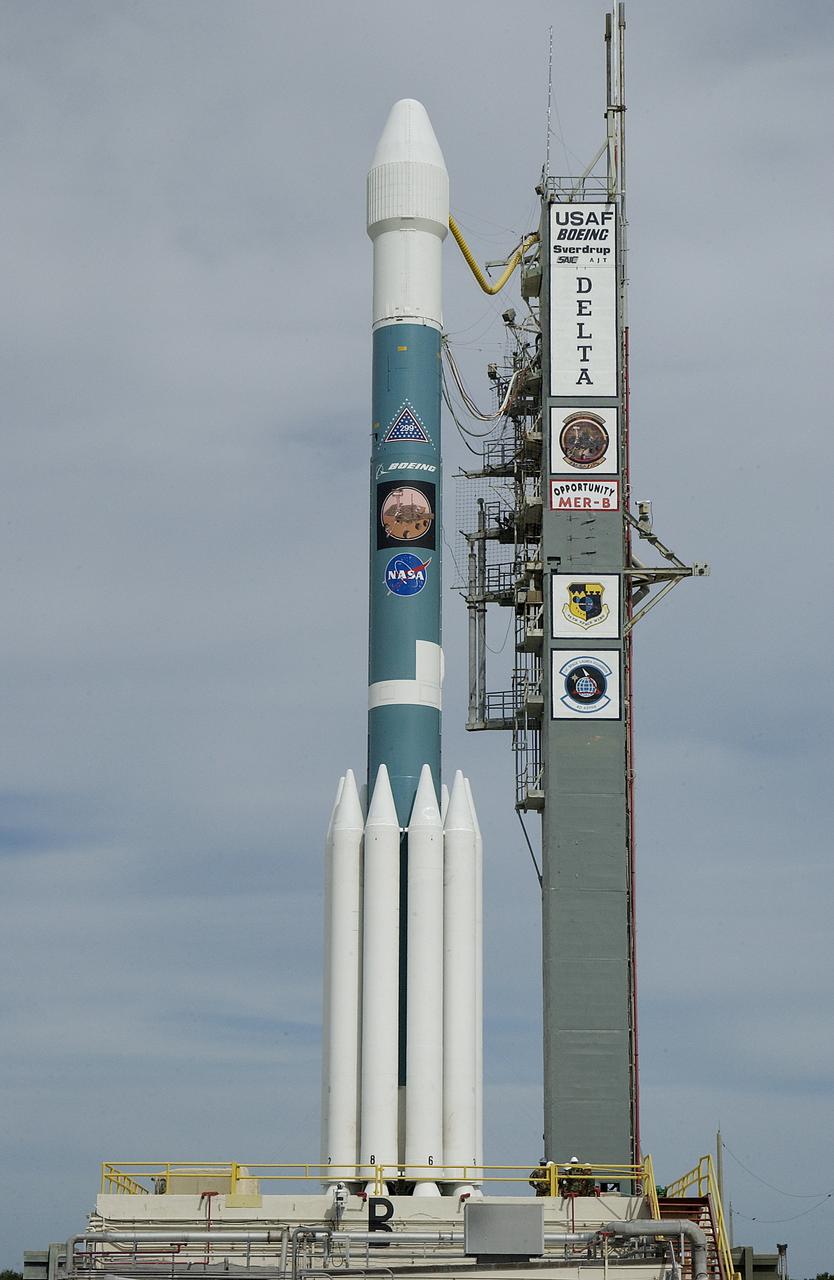
KSC-04pd1418
KENNEDY SPACE CENTER, FLA. --  On Launch Pad 17-B at Cape Canaveral Air Force Station, the second stage of the Delta II launch vehicle for the Dawn spacecraft is lowered into the hole toward the Delta first stage below.  The two stages will be mated. The Delta II-Heavy, manufactured by the United Launch Alliance, is scheduled to launch the Dawn spacecraft on its 4-year flight to the asteroid belt.  The Delta II-Heavy is the strongest rocket in the Delta II class. It will use three stages and nine solid-fueled booster rockets to propel Dawn on its way. A 9.5-foot payload fairing will protect the spacecraft from the heat and stresses of launch. Dawn's goal is to characterize the conditions and processes of the solar system's earliest epoch by investigating in detail the largest protoplanets that have remained intact since their formations: asteroid Vesta and the dwarf planet Ceres.  They reside in the extensive zone between Mars and Jupiter together with many other smaller bodies, called the asteroid belt.  Dawn is scheduled to launch July 7.  Photo credit: NASA/Jack Pfaller
KSC-07pd1514
KENNEDY SPACE CENTER, FLA. --  The second stage of the Delta II launch vehicle for the Dawn spacecraft is lifted alongside the mobile service tower on Launch Pad 17-B at Cape Canaveral Air Force Station.  At right can be seen the solid rocket boosters surrounding Delta's first stage.  The second stage will be mated with the first stage.   The Delta II-Heavy, manufactured by the United Launch Alliance, is scheduled to launch the Dawn spacecraft on its 4-year flight to the asteroid belt.  The Delta II-Heavy is the strongest rocket in the Delta II class. It will use three stages and nine solid-fueled booster rockets to propel Dawn on its way. A 9.5-foot payload fairing will protect the spacecraft from the heat and stresses of launch. Dawn's goal is to characterize the conditions and processes of the solar system's earliest epoch by investigating in detail the largest protoplanets that have remained intact since their formations: asteroid Vesta and the dwarf planet Ceres.  They reside in the extensive zone between Mars and Jupiter together with many other smaller bodies, called the asteroid belt.  Dawn is scheduled to launch July 7.  Photo credit: NASA/Jack Pfaller
KSC-07pd1511
KENNEDY SPACE CENTER, FLA. -- The second stage of the Delta II launch vehicle for the Dawn spacecraft is lifted alongside the mobile service tower on Launch Pad 17-B at Cape Canaveral Air Force Station.  It will be mated with the first stage already in the tower. The Delta II-Heavy, manufactured by the United Launch Alliance, is scheduled to launch the Dawn spacecraft on its 4-year flight to the asteroid belt.  The Delta II-Heavy is the strongest rocket in the Delta II class. It will use three stages and nine solid-fueled booster rockets to propel Dawn on its way. A 9.5-foot payload fairing will protect the spacecraft from the heat and stresses of launch. Dawn's goal is to characterize the conditions and processes of the solar system's earliest epoch by investigating in detail the largest protoplanets that have remained intact since their formations: asteroid Vesta and the dwarf planet Ceres.  They reside in the extensive zone between Mars and Jupiter together with many other smaller bodies, called the asteroid belt.  Dawn is scheduled to launch July 7.  Photo credit: NASA/Jack Pfaller
KSC-07pd1512
KENNEDY SPACE CENTER, FLA. --   The second stage of the Delta II launch vehicle for the Dawn spacecraft arrives on Launch Pad 17-B at Cape Canaveral Air Force Station where it will be mated with the first stage. The Delta II-Heavy, manufactured by the United Launch Alliance, is scheduled to launch the Dawn spacecraft on its 4-year flight to the asteroid belt.  The Delta II-Heavy is the strongest rocket in the Delta II class. It will use three stages and nine solid-fueled booster rockets to propel Dawn on its way. A 9.5-foot payload fairing will protect the spacecraft from the heat and stresses of launch. Dawn's goal is to characterize the conditions and processes of the solar system's earliest epoch by investigating in detail the largest protoplanets that have remained intact since their formations: asteroid Vesta and the dwarf planet Ceres.  They reside in the extensive zone between Mars and Jupiter together with many other smaller bodies, called the asteroid belt.  Dawn is scheduled to launch July 7.  Photo credit: NASA/Jack Pfaller
KSC-07pd1509
KENNEDY SPACE CENTER, FLA. --  On Launch Pad 17-B at Cape Canaveral Air Force Station, the second stage of the Delta II launch vehicle for the Dawn spacecraft arrives at the upper level of the mobile service tower.  It will be moved inside the tower and mated with the first stage already in the tower. The Delta II-Heavy, manufactured by the United Launch Alliance, is scheduled to launch the Dawn spacecraft on its 4-year flight to the asteroid belt.  The Delta II-Heavy is the strongest rocket in the Delta II class. It will use three stages and nine solid-fueled booster rockets to propel Dawn on its way. A 9.5-foot payload fairing will protect the spacecraft from the heat and stresses of launch. Dawn's goal is to characterize the conditions and processes of the solar system's earliest epoch by investigating in detail the largest protoplanets that have remained intact since their formations: asteroid Vesta and the dwarf planet Ceres.  They reside in the extensive zone between Mars and Jupiter together with many other smaller bodies, called the asteroid belt.  Dawn is scheduled to launch July 7.  Photo credit: NASA/Jack Pfaller
KSC-07pd1513
KENNEDY SPACE CENTER, FLA. --  On Launch Pad 17-B at Cape Canaveral Air Force Station, workers maneuver the second stage of the Delta II launch vehicle onto the first stage for mating.   The Delta II-Heavy, manufactured by the United Launch Alliance, is scheduled to launch the Dawn spacecraft on its 4-year flight to the asteroid belt.  The Delta II-Heavy is the strongest rocket in the Delta II class. It will use three stages and nine solid-fueled booster rockets to propel Dawn on its way. A 9.5-foot payload fairing will protect the spacecraft from the heat and stresses of launch. Dawn's goal is to characterize the conditions and processes of the solar system's earliest epoch by investigating in detail the largest protoplanets that have remained intact since their formations: asteroid Vesta and the dwarf planet Ceres.  They reside in the extensive zone between Mars and Jupiter together with many other smaller bodies, called the asteroid belt.  Dawn is scheduled to launch July 7.  Photo credit: NASA/Jack Pfaller
KSC-07pd1515
KENNEDY SPACE CENTER, FLA. --   The second stage of the Delta II launch vehicle for the Dawn spacecraft is lifted alongside the mobile service tower on Launch Pad 17-B at Cape Canaveral Air Force Station.  It will be mated with the first stage already in the tower. The Delta II-Heavy, manufactured by the United Launch Alliance, is scheduled to launch the Dawn spacecraft on its 4-year flight to the asteroid belt.  The Delta II-Heavy is the strongest rocket in the Delta II class. It will use three stages and nine solid-fueled booster rockets to propel Dawn on its way. A 9.5-foot payload fairing will protect the spacecraft from the heat and stresses of launch. Dawn's goal is to characterize the conditions and processes of the solar system's earliest epoch by investigating in detail the largest protoplanets that have remained intact since their formations: asteroid Vesta and the dwarf planet Ceres.  They reside in the extensive zone between Mars and Jupiter together with many other smaller bodies, called the asteroid belt.  Dawn is scheduled to launch July 7.  Photo credit: NASA/Jack Pfaller
KSC-07pd1510
KENNEDY SPACE CENTER, FLA. - Boeing workers at Astrotech Space Operations in Titusville, Fla., secure the first part of a transportation canister around the Delta II upper stage booster on the MESSENGER (Mercury Surface, Space Environment, Geochemistry and Ranging) spacecraft.  Another panel waits in front of the work stand.  MESSENGER will be transferred to Launch Pad 17-B at Cape Canaveral Air Force Station, Fla.  Liftoff of MESSENGER aboard a Boeing Delta II Heavy rocket is scheduled for Aug. 2.  The spacecraft is expected to reach orbit around the planet in March 2011.  MESSENGER was built for NASA by the Johns Hopkins University Applied Physics Laboratory in Laurel, Md.
KSC-04pd1487
KENNEDY SPACE CENTER, FLA. - After bagging the MESSENGER (Mercury Surface, Space Environment, Geochemistry and Ranging) spacecraft, Boeing workers at Astrotech Space Operations in Titusville, Fla., place the first part of a transportation canister around the Delta II upper stage booster.  MESSENGER will be transferred to Launch Pad 17-B at Cape Canaveral Air Force Station, Fla.  Liftoff of MESSENGER aboard a Boeing Delta II Heavy rocket is scheduled for Aug. 2.  The spacecraft is expected to reach orbit around the planet in March 2011.  MESSENGER was built for NASA by the Johns Hopkins University Applied Physics Laboratory in Laurel, Md.
KSC-04pd1486
KENNEDY SPACE CENTER, FLA. -  Workers at Pad 17-B, Cape Canaveral Air Force Station, watch as one of the last Solid Rocket Boosters (SRBs) is lifted up the mobile service tower for mating with the Boeing Delta II Heavy rocket (seen in the background).  The Delta II will launch the MESSENGER (Mercury Surface, Space Environment, Geochemistry and Ranging) spacecraft Aug. 2, bound for Mercury.  The spacecraft is expected to reach orbit around Mercury in March 2011.  MESSENGER was built for NASA by the Johns Hopkins University Applied Physics Laboratory in Laurel, Md.
KSC-04pd1441
KENNEDY SPACE CENTER, FLA. - At Astrotech Space Operations in Titusville, Fla., the upper canister is lowered around the MESSENGER (Mercury Surface, Space Environment, Geochemistry and Ranging) spacecraft.  The canister will be attached to the lower protective panels around the Delta II  upper stage booster for the transportation of MESSENGER to Launch Pad 17-B at Cape Canaveral Air Force Station, Fla.  Liftoff of MESSENGER aboard a Boeing Delta II Heavy rocket is scheduled for Aug. 2.  The spacecraft is expected to reach orbit around the planet in March 2011.  MESSENGER was built for NASA by the Johns Hopkins University Applied Physics Laboratory in Laurel, Md.
KSC-04pd1494
KENNEDY SPACE CENTER, FLA. -  On Pad 17-B, Cape Canaveral Air Force Station, the Boeing Delta II Heavy rocket waits for the arrival of the mobile service tower behind it.  In the foreground is the cooling water pond.  The tower holds three out of nine Solid Rocket Boosters (SRBs) that will be mated to the Boeing Delta II for the Aug. 2 launch of the MESSENGER spacecraft to the planet Mercury.  The spacecraft is expected to reach orbit around Mercury in March 2011.  MESSENGER was built for NASA by the Johns Hopkins University Applied Physics Laboratory in Laurel, Md.
KSC-04pd1417
KENNEDY SPACE CENTER, FLA. - Boeing workers at Astrotech Space Operations in Titusville, Fla., secure the first part of a transportation canister around the Delta II upper stage booster on the MESSENGER (Mercury Surface, Space Environment, Geochemistry and Ranging) spacecraft.  MESSENGER will be transferred to Launch Pad 17-B at Cape Canaveral Air Force Station, Fla.  Liftoff of MESSENGER aboard a Boeing Delta II Heavy rocket is scheduled for Aug. 2.  The spacecraft is expected to reach orbit around the planet in March 2011.  MESSENGER was built for NASA by the Johns Hopkins University Applied Physics Laboratory in Laurel, Md.
KSC-04pd1488
KENNEDY SPACE CENTER, FLA. - At Astrotech Space Operations in Titusville, Fla., an overhead crane moves the upper canister (at left) toward the MESSENGER (Mercury Surface, Space Environment, Geochemistry and Ranging) spacecraft.  The canister will be attached to the lower protective panels around the Delta II  upper stage booster for the transportation of MESSENGER to Launch Pad 17-B at Cape Canaveral Air Force Station, Fla.  Liftoff of MESSENGER aboard a Boeing Delta II Heavy rocket is scheduled for Aug. 2.  The spacecraft is expected to reach orbit around the planet in March 2011.  MESSENGER was built for NASA by the Johns Hopkins University Applied Physics Laboratory in Laurel, Md.
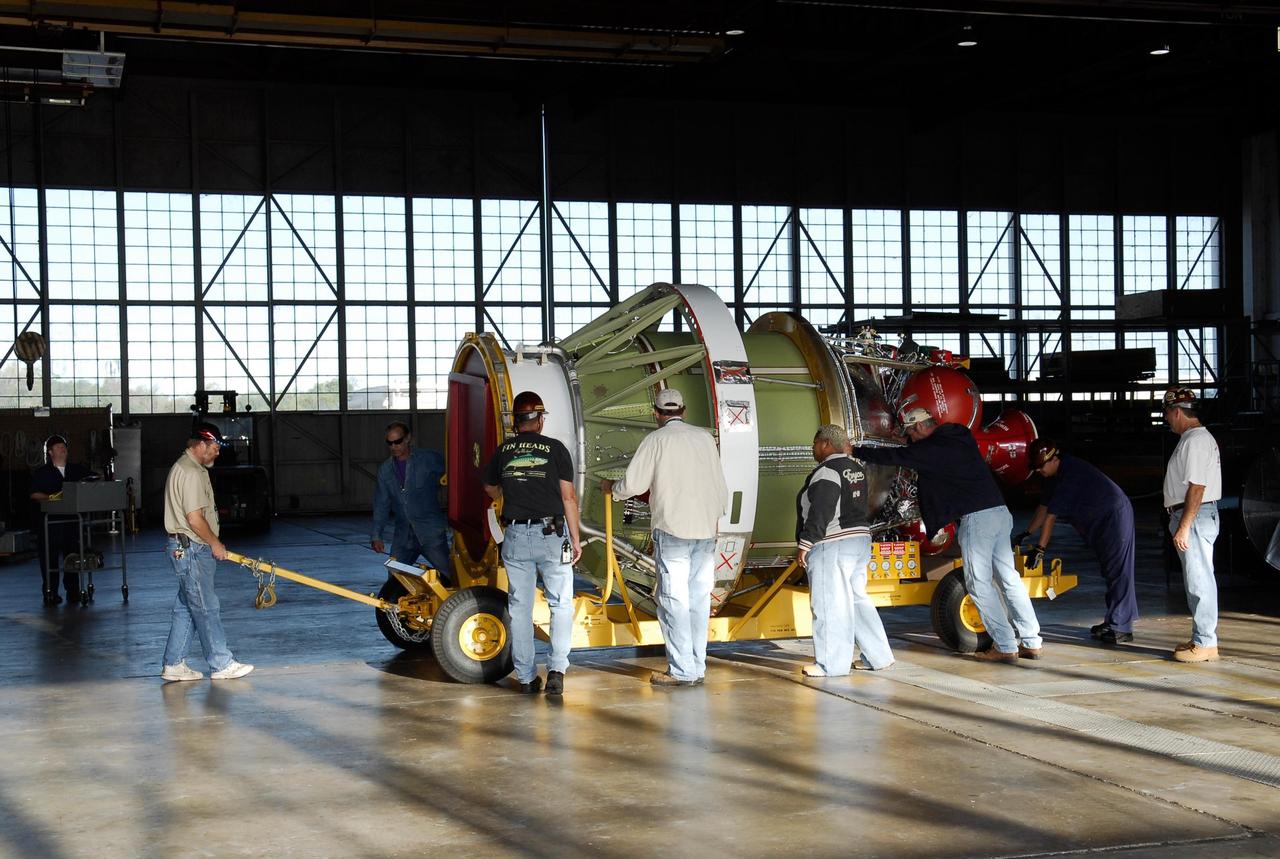
KSC-04pd1491
KENNEDY SPACE CENTER, FLA. - Boeing workers at Astrotech Space Operations in Titusville, Fla., check the second part of a transportation canister placed around the Delta II upper stage booster on the MESSENGER (Mercury Surface, Space Environment, Geochemistry and Ranging) spacecraft.  MESSENGER will be transported to Launch Pad 17-B at Cape Canaveral Air Force Station, Fla.  Liftoff of MESSENGER aboard a Boeing Delta II Heavy rocket is scheduled for Aug. 2.  The spacecraft is expected to reach orbit around the planet in March 2011.  MESSENGER was built for NASA by the Johns Hopkins University Applied Physics Laboratory in Laurel, Md.
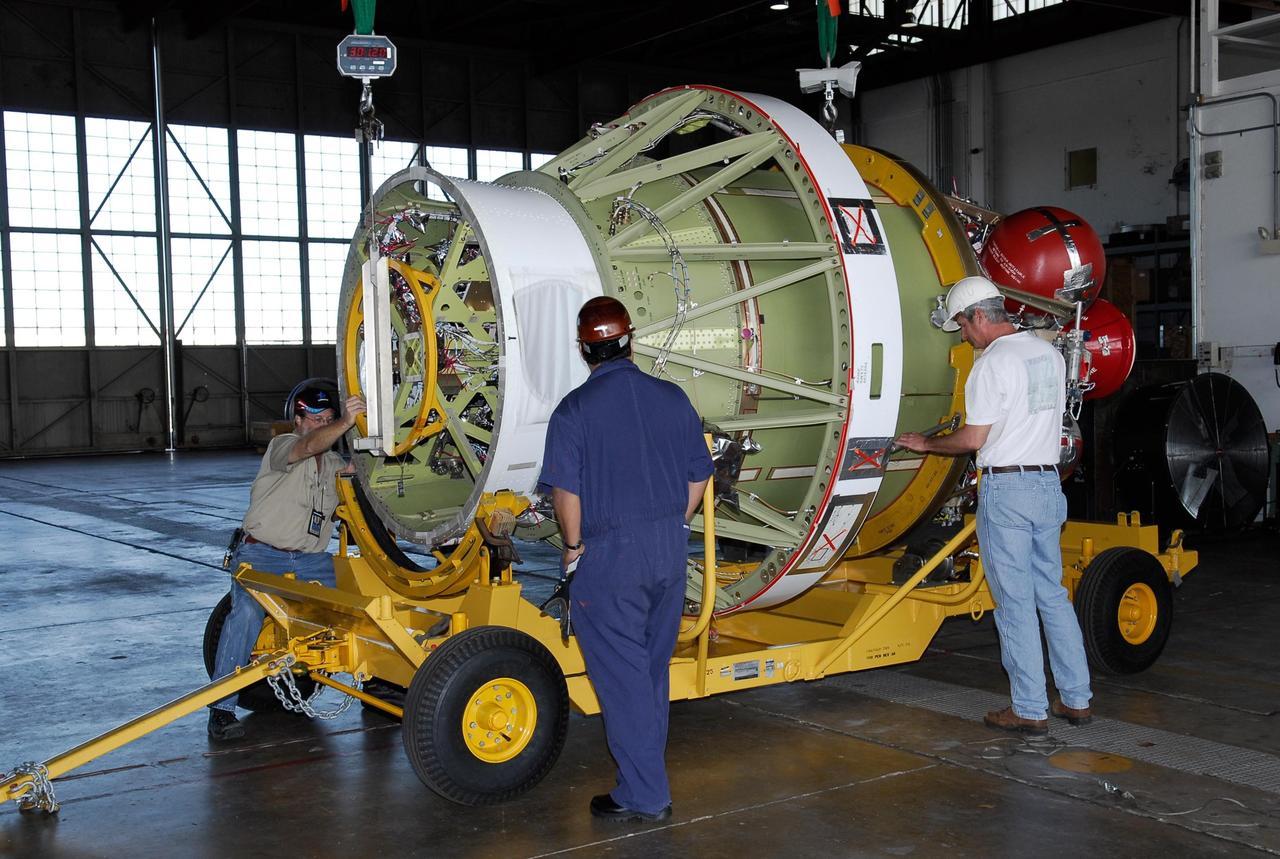
KSC-04pd1489
KENNEDY SPACE CENTER, FLA. - At Astrotech Space Operations in Titusville, Fla., Boeing workers make final adjustments to the mating of the upper canister around the MESSENGER (Mercury Surface, Space Environment, Geochemistry and Ranging) spacecraft with the lower protective panels around the Delta II  upper stage booster for the transportation of MESSENGER to Launch Pad 17-B at Cape Canaveral Air Force Station, Fla.  Liftoff of MESSENGER aboard a Boeing Delta II Heavy rocket is scheduled for Aug. 2.  The spacecraft is expected to reach orbit around the planet in March 2011.  MESSENGER was built for NASA by the Johns Hopkins University Applied Physics Laboratory in Laurel, Md.
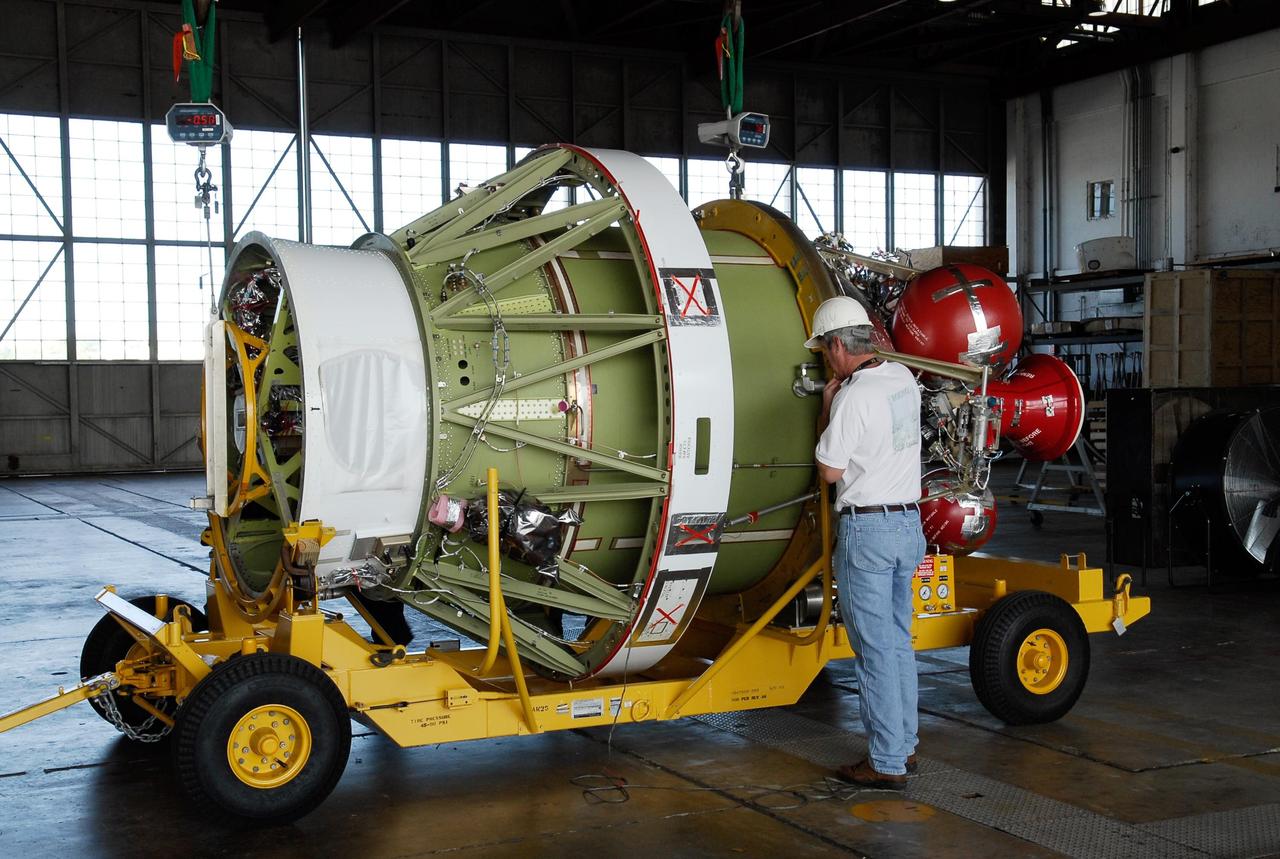
KSC-04pd1495
KENNEDY SPACE CENTER, FLA. -  - The Boeing Delta II Heavy second-stage engine, the Aerojet AJ10-118K, approaches the top of the mobile service tower on Pad 17-B, Cape Canaveral Air Force Station.  The engine will be mated with the first stage of the Delta II, which is the launch vehicle for the MESSENGER (Mercury Surface, Space Environment, Geochemistry and Ranging) spacecraft, scheduled to lift off Aug. 2.  Bound for Mercury, the spacecraft is expected to reach orbit around the planet in March 2011.  MESSENGER was built for NASA by the Johns Hopkins University Applied Physics Laboratory in Laurel, Md.
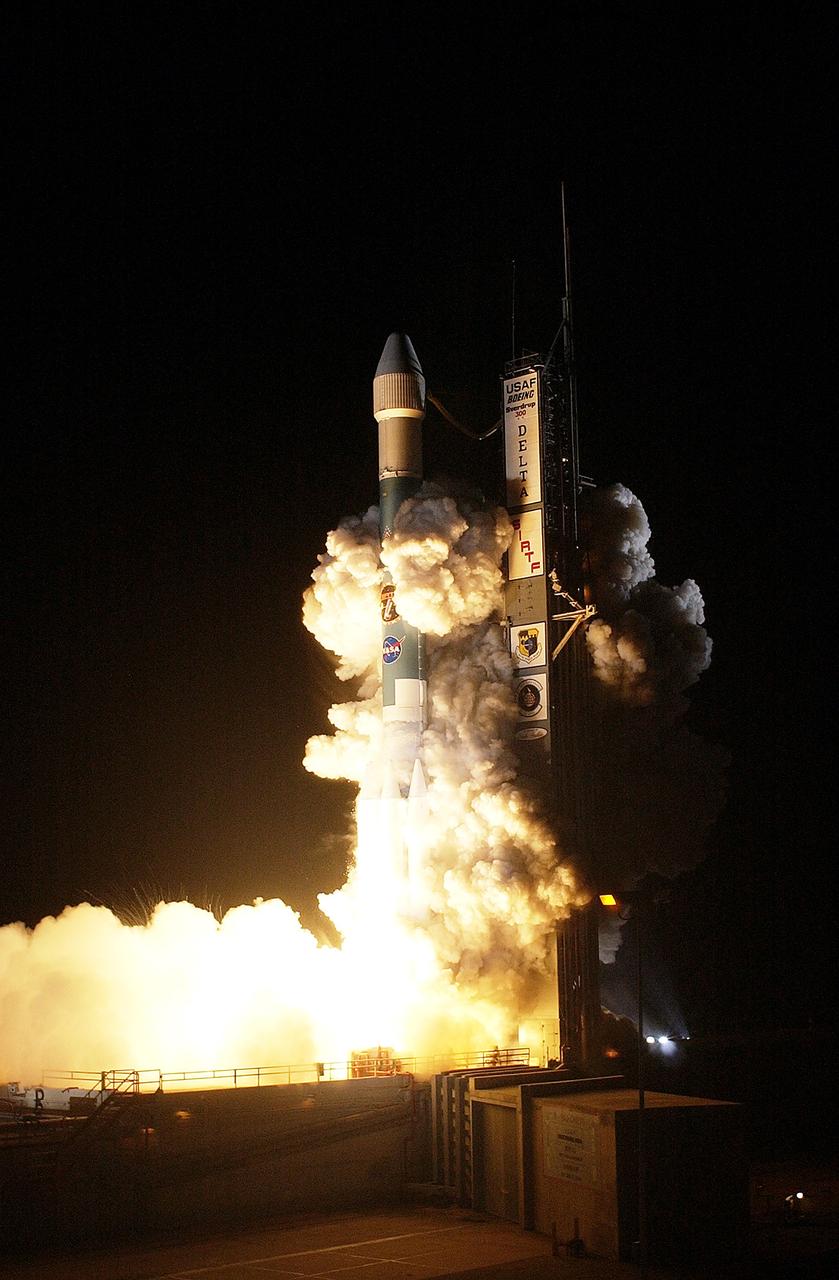
KSC-04pd1449
KENNEDY SPACE CENTER, FLA. - Boeing workers at Astrotech Space Operations in Titusville, Fla., watch the movement of the upper canister as it is lowered around the MESSENGER (Mercury Surface, Space Environment, Geochemistry and Ranging) spacecraft.  The canister will be attached to the lower protective panels around the Delta II  upper stage booster for the transportation of MESSENGER to Launch Pad 17-B at Cape Canaveral Air Force Station, Fla.  Liftoff of MESSENGER aboard a Boeing Delta II Heavy rocket is scheduled for Aug. 2.  The spacecraft is expected to reach orbit around the planet in March 2011.  MESSENGER was built for NASA by the Johns Hopkins University Applied Physics Laboratory in Laurel, Md.
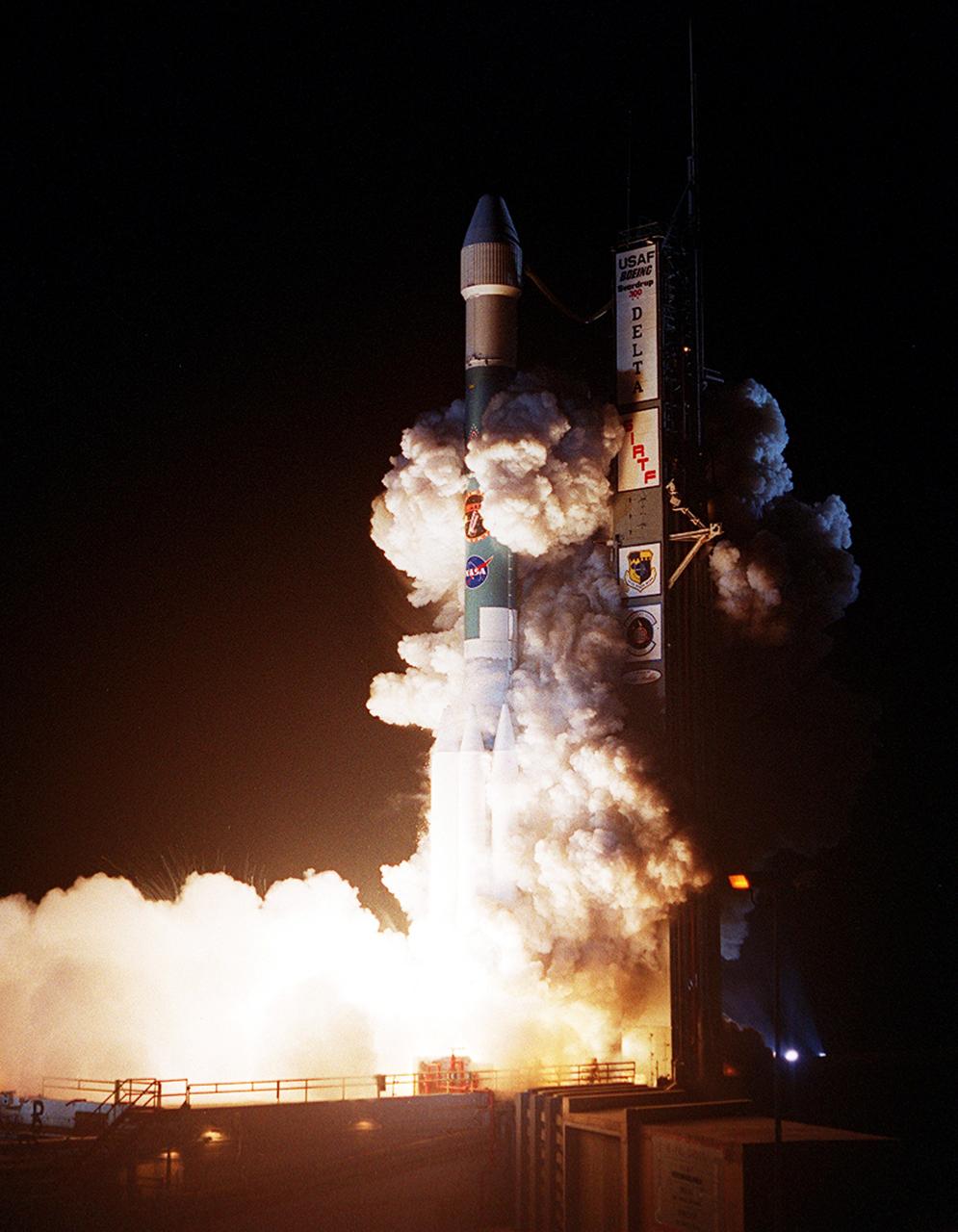
KSC-04pd1493
KENNEDY SPACE CENTER, FLA. -  The Boeing Delta II Heavy second-stage engine, the Aerojet AJ10-118K, is lifted up the mobile service tower at Pad 17-B, Cape Canaveral Air Force Station.  The Delta II is the launch vehicle for the MESSENGER (Mercury Surface, Space Environment, Geochemistry and Ranging) spacecraft, scheduled to lift off Aug. 2.  Bound for Mercury, the spacecraft is expected to reach orbit around the planet in March 2011.  MESSENGER was built for NASA by the Johns Hopkins University Applied Physics Laboratory in Laurel, Md.
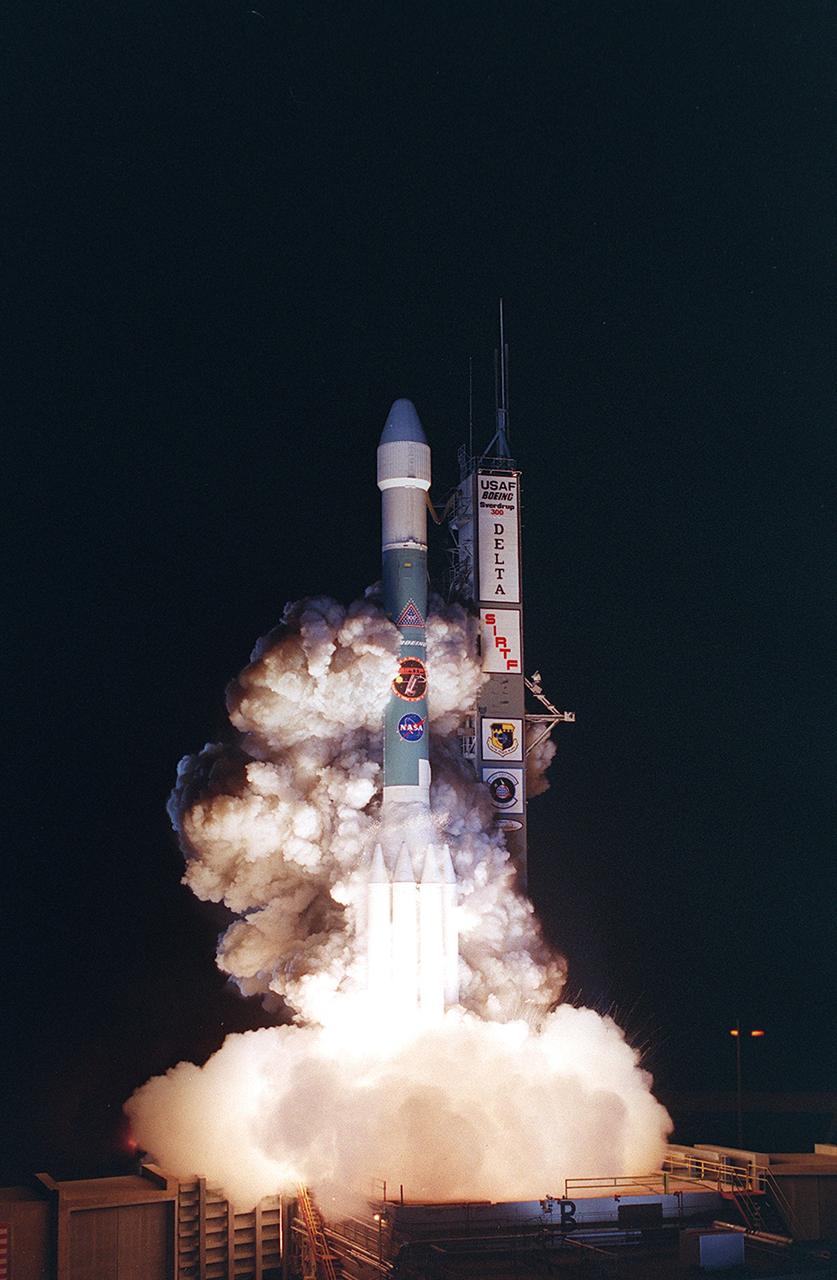
KSC-04pd1447
KENNEDY SPACE CENTER, FLA. - Boeing workers at Astrotech Space Operations in Titusville, Fla., watch the movement of the upper canister as it is lowered around the MESSENGER (Mercury Surface, Space Environment, Geochemistry and Ranging) spacecraft.  The canister will be attached to the lower protective panels around the Delta II  upper stage booster for the transportation of MESSENGER to Launch Pad 17-B at Cape Canaveral Air Force Station, Fla.  Liftoff of MESSENGER aboard a Boeing Delta II Heavy rocket is scheduled for Aug. 2.  The spacecraft is expected to reach orbit around the planet in March 2011.  MESSENGER was built for NASA by the Johns Hopkins University Applied Physics Laboratory in Laurel, Md.
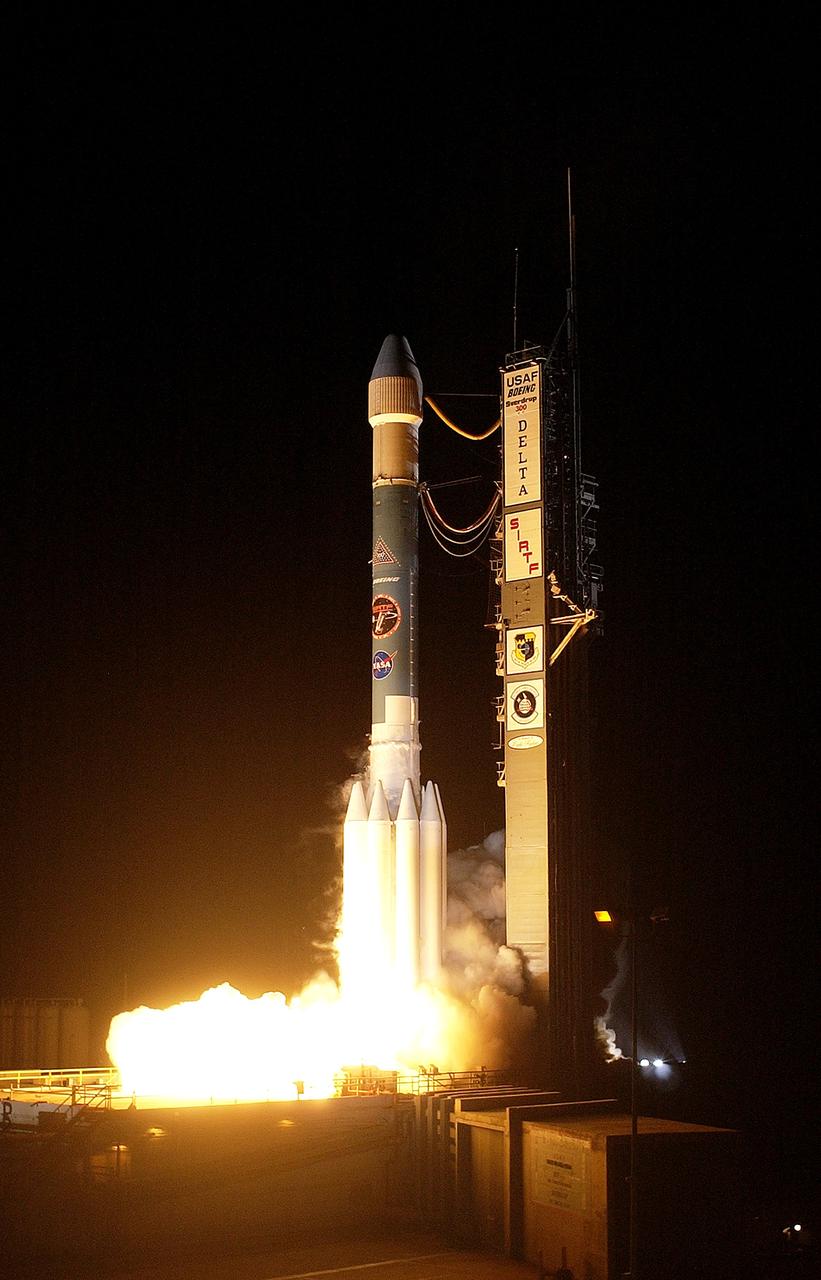
KSC-04pd1492
KENNEDY SPACE CENTER, FLA. -  The Boeing Delta II Heavy second-stage engine, the Aerojet AJ10-118K, is ready for lifting up the mobile service tower at Pad 17-B, Cape Canaveral Air Force Station.  The Delta II is the launch vehicle for the MESSENGER (Mercury Surface, Space Environment, Geochemistry and Ranging) spacecraft, scheduled to lift off Aug. 2.  Bound for Mercury, the spacecraft is expected to reach orbit around the planet in March 2011.  MESSENGER was built for NASA by the Johns Hopkins University Applied Physics Laboratory in Laurel, Md.
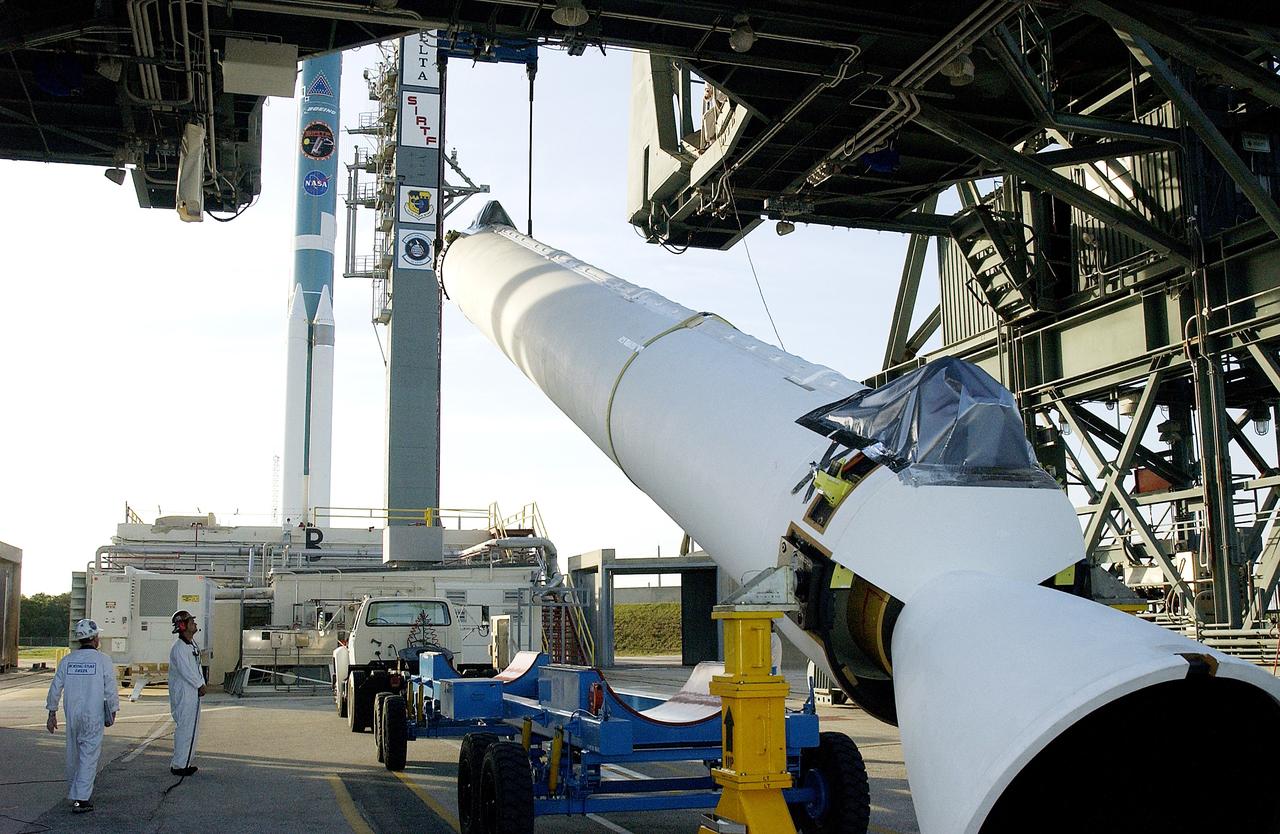
KSC-04pd1446
KENNEDY SPACE CENTER, FLA. - Boeing workers at Astrotech Space Operations in Titusville, Fla., prepare to lift the upper canister (at left) and move it over to the MESSENGER (Mercury Surface, Space Environment, Geochemistry and Ranging) spacecraft.  The canister will be attached to the lower protective panels around the Delta II  upper stage booster for the transportation of MESSENGER to Launch Pad 17-B at Cape Canaveral Air Force Station, Fla.  Liftoff of MESSENGER aboard a Boeing Delta II Heavy rocket is scheduled for Aug. 2.  The spacecraft is expected to reach orbit around the planet in March 2011.  MESSENGER was built for NASA by the Johns Hopkins University Applied Physics Laboratory in Laurel, Md.
KSC-04pd1490
KENNEDY SPACE CENTER, FLA. -  On Pad 17-B, Cape Canaveral Air Force Station, workers move the Boeing Delta II Heavy second-stage engine, the Aerojet AJ10-118K, inside the mobile service tower.  The engine will be mated with the first stage of the Delta II, which is the launch vehicle for the MESSENGER (Mercury Surface, Space Environment, Geochemistry and Ranging) spacecraft, scheduled to lift off Aug. 2.  Bound for Mercury, the spacecraft is expected to reach orbit around the planet in March 2011.  MESSENGER was built for NASA by the Johns Hopkins University Applied Physics Laboratory in Laurel, Md.
KSC-04pd1451
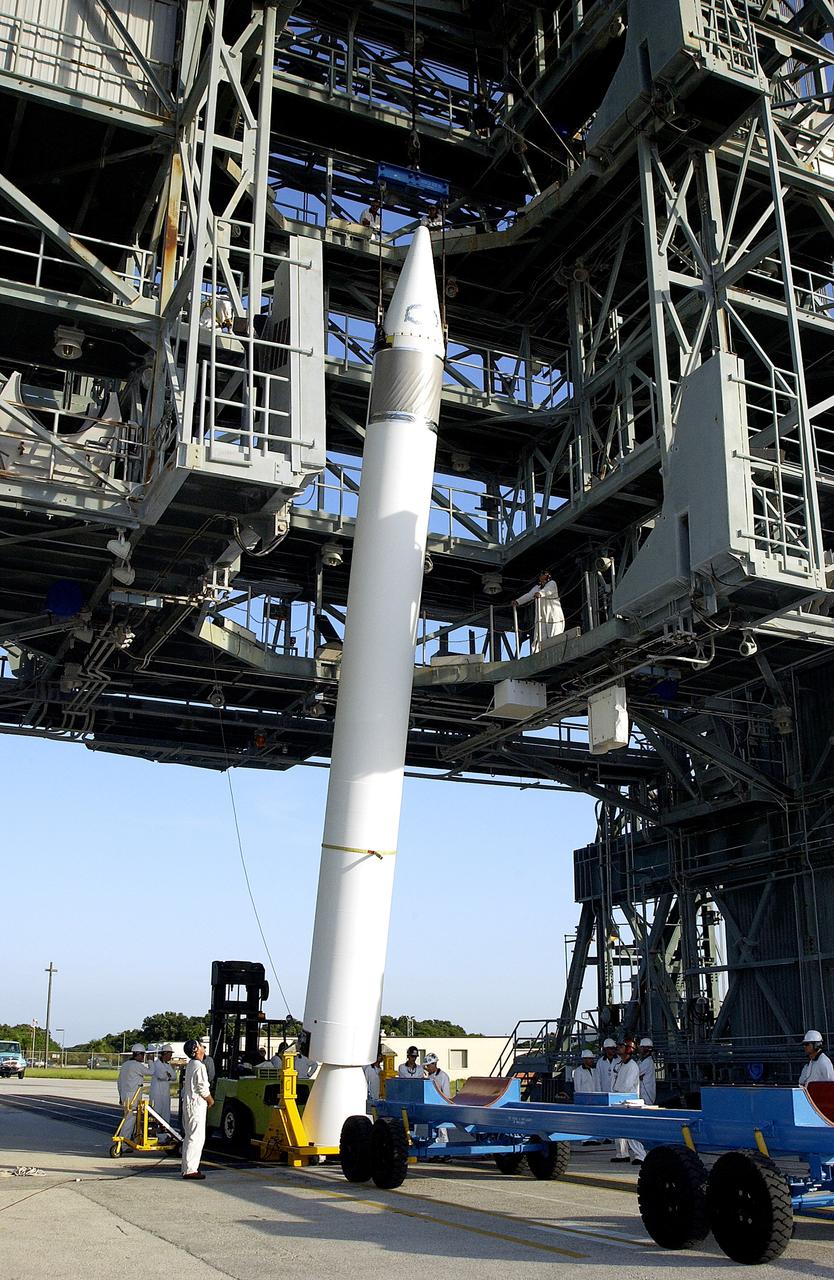
KENNEDY SPACE CENTER, FLA. -   Workers on Launch Complex 17-B, Cape Canaveral Air Force Station, help steady a solid rocket booster (SRB) being lifted into the mobile service tower.  It is one of nine  46-inch-diameter, stretched SRBs that are being attached to the Delta II Heavy rocket that will launch the Space Infrared Telescope Facility (SIRTF).  Consisting of three cryogenically cooled science instruments and an 0.85-meter telescope, SIRTF is one of NASA's largest infrared telescopes to be launched.  SIRTF will obtain images and spectra by detecting the infrared energy, or heat, radiated by objects in space. Most of this infrared radiation is blocked by the Earth's atmosphere and cannot be observed from the ground.
KENNEDY SPACE CENTER, FLA. - Workers on Launch Complex 17-B, Cape Canaveral Air Force Station, help steady a solid rocket booster (SRB) being lifted into the mobile service tower. It is one of nine 46-inch-diameter, stretched SRBs that are being attached to the Delta II Heavy rocket that will launch the Space Infrared Telescope Facility (SIRTF). Consisting of three cryogenically cooled science instruments and an 0.85-meter telescope, SIRTF is one of NASA's largest infrared telescopes to be launched. SIRTF will obtain images and spectra by detecting the infrared energy, or heat, radiated by objects in space. Most of this infrared radiation is blocked by the Earth's atmosphere and cannot be observed from the ground.
KENNEDY SPACE CENTER, FLA. -   On Launch Complex 17-B, Cape Canaveral Air Force Station, a solid rocket booster (SRB) is lifted into the mobile service tower, joining two others.  They are three of nine  46-inch-diameter, stretched SRBs that are being attached to the Delta II Heavy rocket that will launch the Space Infrared Telescope Facility (SIRTF).  Consisting of three cryogenically cooled science instruments and an 0.85-meter telescope, SIRTF is one of NASA's largest infrared telescopes to be launched.  SIRTF will obtain images and spectra by detecting the infrared energy, or heat, radiated by objects in space. Most of this infrared radiation is blocked by the Earth's atmosphere and cannot be observed from the ground.
KENNEDY SPACE CENTER, FLA. - On Launch Complex 17-B, Cape Canaveral Air Force Station, a solid rocket booster (SRB) is lifted into the mobile service tower, joining two others. They are three of nine 46-inch-diameter, stretched SRBs that are being attached to the Delta II Heavy rocket that will launch the Space Infrared Telescope Facility (SIRTF). Consisting of three cryogenically cooled science instruments and an 0.85-meter telescope, SIRTF is one of NASA's largest infrared telescopes to be launched. SIRTF will obtain images and spectra by detecting the infrared energy, or heat, radiated by objects in space. Most of this infrared radiation is blocked by the Earth's atmosphere and cannot be observed from the ground.
KENNEDY SPACE CENTER, FLA. -   On Launch Complex 17-B, Cape Canaveral Air Force Station, another solid rocket booster (SRB) is being raised from its transporter to lift it to vertical.  It is one of nine  46-inch-diameter, stretched SRBs that are being attached to the Delta II Heavy rocket that will launch the Space Infrared Telescope Facility (SIRTF).  Consisting of three cryogenically cooled science instruments and an 0.85-meter telescope, SIRTF is one of NASA's largest infrared telescopes to be launched.  SIRTF will obtain images and spectra by detecting the infrared energy, or heat, radiated by objects in space. Most of this infrared radiation is blocked by the Earth's atmosphere and cannot be observed from the ground.
KENNEDY SPACE CENTER, FLA. - On Launch Complex 17-B, Cape Canaveral Air Force Station, another solid rocket booster (SRB) is being raised from its transporter to lift it to vertical. It is one of nine 46-inch-diameter, stretched SRBs that are being attached to the Delta II Heavy rocket that will launch the Space Infrared Telescope Facility (SIRTF). Consisting of three cryogenically cooled science instruments and an 0.85-meter telescope, SIRTF is one of NASA's largest infrared telescopes to be launched. SIRTF will obtain images and spectra by detecting the infrared energy, or heat, radiated by objects in space. Most of this infrared radiation is blocked by the Earth's atmosphere and cannot be observed from the ground.
KENNEDY SPACE CENTER, FLA. -   On Launch Complex 17-B, Cape Canaveral Air Force Station, the Delta II Heavy rocket waits the arrival of the mobile service tower with three additional solid rocket boosters (SRBs).  Nine 46-inch-diameter, stretched SRBs will help launch the Space Infrared Telescope Facility (SIRTF).  Consisting of three cryogenically cooled science instruments and an 0.85-meter telescope, SIRTF is one of NASA's largest infrared telescopes to be launched.  SIRTF will obtain images and spectra by detecting the infrared energy, or heat, radiated by objects in space. Most of this infrared radiation is blocked by the Earth's atmosphere and cannot be observed from the ground.
KENNEDY SPACE CENTER, FLA. - On Launch Complex 17-B, Cape Canaveral Air Force Station, the Delta II Heavy rocket waits the arrival of the mobile service tower with three additional solid rocket boosters (SRBs). Nine 46-inch-diameter, stretched SRBs will help launch the Space Infrared Telescope Facility (SIRTF). Consisting of three cryogenically cooled science instruments and an 0.85-meter telescope, SIRTF is one of NASA's largest infrared telescopes to be launched. SIRTF will obtain images and spectra by detecting the infrared energy, or heat, radiated by objects in space. Most of this infrared radiation is blocked by the Earth's atmosphere and cannot be observed from the ground.
KENNEDY SPACE CENTER, FLA. --    At Astrotech, technicians secure the upper canister over the Dawn spacecraft. Dawn will be transported to Launch Pad 17-B and lifted into the mobile service tower for mating with the Delta II launch vehicle. The Delta II-Heavy, manufactured by the United Launch Alliance, is scheduled to launch the Dawn spacecraft on its 4-year flight to the asteroid belt.  The Delta II-Heavy will use three stages and nine solid-fueled booster rockets to propel Dawn on its way. A 9.5-foot payload fairing will protect the spacecraft from the heat and stresses of launch. Dawn's goal is to characterize the conditions and processes of the solar system's earliest epoch by investigating in detail the largest protoplanets that have remained intact since their formations: asteroid Vesta and the dwarf planet Ceres.  They reside in the extensive zone between Mars and Jupiter together with many other smaller bodies, called the asteroid belt.  Dawn is scheduled to launch July 7.    Photo credit: NASA/George Shelton
KSC-07pd1646
KENNEDY SPACE CENTER, FLA. --    At Astrotech, technicians move the first segment of the lower canister around the upper stage booster below the Dawn spacecraft.  When enclosed in the canister, Dawn will be transported to Launch Pad 17-B and lifted into the mobile service tower for mating with the Delta II launch vehicle.  The Delta II-Heavy, manufactured by the United Launch Alliance, is scheduled to launch the Dawn spacecraft on its 4-year flight to the asteroid belt.  The Delta II-Heavy will use three stages and nine solid-fueled booster rockets to propel Dawn on its way. A 9.5-foot payload fairing will protect the spacecraft from the heat and stresses of launch. Dawn's goal is to characterize the conditions and processes of the solar system's earliest epoch by investigating in detail the largest protoplanets that have remained intact since their formations: asteroid Vesta and the dwarf planet Ceres.  They reside in the extensive zone between Mars and Jupiter together with many other smaller bodies, called the asteroid belt.  Dawn is scheduled to launch July 7.    Photo credit: NASA/George Shelton
KSC-07pd1639
KENNEDY SPACE CENTER, FLA. --    At Astrotech, technicians move the first segment of the lower canister around the upper stage booster below the Dawn spacecraft.  When enclosed in the canister, Dawn will be transported to Launch Pad 17-B and lifted into the mobile service tower for mating with the Delta II launch vehicle. The Delta II-Heavy, manufactured by the United Launch Alliance, is scheduled to launch the Dawn spacecraft on its 4-year flight to the asteroid belt.  The Delta II-Heavy will use three stages and nine solid-fueled booster rockets to propel Dawn on its way. A 9.5-foot payload fairing will protect the spacecraft from the heat and stresses of launch. Dawn's goal is to characterize the conditions and processes of the solar system's earliest epoch by investigating in detail the largest protoplanets that have remained intact since their formations: asteroid Vesta and the dwarf planet Ceres.  They reside in the extensive zone between Mars and Jupiter together with many other smaller bodies, called the asteroid belt.  Dawn is scheduled to launch July 7.    Photo credit: NASA/George Shelton
KSC-07pd1638
KENNEDY SPACE CENTER, FLA. --  At Astrotech, the Dawn spacecraft has been wrapped with a protective cover before it is enclosed in a canister.  Dawn will be transported to Launch Pad 17-B and lifted into the mobile service tower for mating with the Delta II launch vehicle.  The Delta II-Heavy, manufactured by the United Launch Alliance, is scheduled to launch the Dawn spacecraft on its 4-year flight to the asteroid belt.  The Delta II-Heavy will use three stages and nine solid-fueled booster rockets to propel Dawn on its way. A 9.5-foot payload fairing will protect the spacecraft from the heat and stresses of launch. Dawn's goal is to characterize the conditions and processes of the solar system's earliest epoch by investigating in detail the largest protoplanets that have remained intact since their formations: asteroid Vesta and the dwarf planet Ceres.  They reside in the extensive zone between Mars and Jupiter together with many other smaller bodies, called the asteroid belt.  Dawn is scheduled to launch July 7.    Photo credit: NASA/George Shelton
KSC-07pd1636
KENNEDY SPACE CENTER, FLA. --   At Astrotech, technicians move the first segment of the lower canister toward the stand holding the Dawn spacecraft.   When enclosed in the canister, Dawn will be transported to Launch Pad 17-B and lifted into the mobile service tower for mating with the Delta II launch vehicle.  The Delta II-Heavy, manufactured by the United Launch Alliance, is scheduled to launch the Dawn spacecraft on its 4-year flight to the asteroid belt.  The Delta II-Heavy will use three stages and nine solid-fueled booster rockets to propel Dawn on its way. A 9.5-foot payload fairing will protect the spacecraft from the heat and stresses of launch. Dawn's goal is to characterize the conditions and processes of the solar system's earliest epoch by investigating in detail the largest protoplanets that have remained intact since their formations: asteroid Vesta and the dwarf planet Ceres.  They reside in the extensive zone between Mars and Jupiter together with many other smaller bodies, called the asteroid belt.  Dawn is scheduled to launch July 7.    Photo credit: NASA/George Shelton
KSC-07pd1637
KENNEDY SPACE CENTER, FLA. --     At Astrotech, technicians examine the lower canister they placed around the bottom of the Dawn spacecraft.  When enclosed in the canister, Dawn will be transported to Launch Pad 17-B and lifted into the mobile service tower for mating with the Delta II launch vehicle. The Delta II-Heavy, manufactured by the United Launch Alliance, is scheduled to launch the Dawn spacecraft on its 4-year flight to the asteroid belt.  The Delta II-Heavy will use three stages and nine solid-fueled booster rockets to propel Dawn on its way. A 9.5-foot payload fairing will protect the spacecraft from the heat and stresses of launch. Dawn's goal is to characterize the conditions and processes of the solar system's earliest epoch by investigating in detail the largest protoplanets that have remained intact since their formations: asteroid Vesta and the dwarf planet Ceres.  They reside in the extensive zone between Mars and Jupiter together with many other smaller bodies, called the asteroid belt.  Dawn is scheduled to launch July 7.    Photo credit: NASA/George Shelton
KSC-07pd1642
KENNEDY SPACE CENTER, FLA. --     At Astrotech, technicians place another segment of the canister around the upper stage booster below the Dawn spacecraft.  When enclosed in the canister, Dawn will be transported to Launch Pad 17-B and lifted into the mobile service tower for mating with the Delta II launch vehicle. The Delta II-Heavy, manufactured by the United Launch Alliance, is scheduled to launch the Dawn spacecraft on its 4-year flight to the asteroid belt.  The Delta II-Heavy will use three stages and nine solid-fueled booster rockets to propel Dawn on its way. A 9.5-foot payload fairing will protect the spacecraft from the heat and stresses of launch. Dawn's goal is to characterize the conditions and processes of the solar system's earliest epoch by investigating in detail the largest protoplanets that have remained intact since their formations: asteroid Vesta and the dwarf planet Ceres.  They reside in the extensive zone between Mars and Jupiter together with many other smaller bodies, called the asteroid belt.  Dawn is scheduled to launch July 7.    Photo credit: NASA/George Shelton
KSC-07pd1641
KENNEDY SPACE CENTER, FLA. --    At Astrotech, technicians lower the upper canister over the Dawn spacecraft.  After enclosure, Dawn will be transported to Launch Pad 17-B and lifted into the mobile service tower for mating with the Delta II launch vehicle.  The Delta II-Heavy, manufactured by the United Launch Alliance, is scheduled to launch the Dawn spacecraft on its 4-year flight to the asteroid belt.  The Delta II-Heavy will use three stages and nine solid-fueled booster rockets to propel Dawn on its way. A 9.5-foot payload fairing will protect the spacecraft from the heat and stresses of launch. Dawn's goal is to characterize the conditions and processes of the solar system's earliest epoch by investigating in detail the largest protoplanets that have remained intact since their formations: asteroid Vesta and the dwarf planet Ceres.  They reside in the extensive zone between Mars and Jupiter together with many other smaller bodies, called the asteroid belt.  Dawn is scheduled to launch July 7.    Photo credit: NASA/George Shelton
KSC-07pd1645
KENNEDY SPACE CENTER, FLA. --     At Astrotech, technicians move the partially enclosed Dawn spacecraft into another room to complete the canning.  When enclosed in the canister, Dawn will be transported to Launch Pad 17-B and lifted into the mobile service tower for mating with the Delta II launch vehicle. The Delta II-Heavy, manufactured by the United Launch Alliance, is scheduled to launch the Dawn spacecraft on its 4-year flight to the asteroid belt.  The Delta II-Heavy will use three stages and nine solid-fueled booster rockets to propel Dawn on its way. A 9.5-foot payload fairing will protect the spacecraft from the heat and stresses of launch. Dawn's goal is to characterize the conditions and processes of the solar system's earliest epoch by investigating in detail the largest protoplanets that have remained intact since their formations: asteroid Vesta and the dwarf planet Ceres.  They reside in the extensive zone between Mars and Jupiter together with many other smaller bodies, called the asteroid belt.  Dawn is scheduled to launch July 7.    Photo credit: NASA/George Shelton
KSC-07pd1643
KENNEDY SPACE CENTER, FLA. --    At Astrotech, technicians move another segment of the lower canister onto the workstand holding the Dawn spacecraft.  When enclosed in the canister, Dawn will be transported to Launch Pad 17-B and lifted into the mobile service tower for mating with the Delta II launch vehicle.  The Delta II-Heavy, manufactured by the United Launch Alliance, is scheduled to launch the Dawn spacecraft on its 4-year flight to the asteroid belt.  The Delta II-Heavy will use three stages and nine solid-fueled booster rockets to propel Dawn on its way. A 9.5-foot payload fairing will protect the spacecraft from the heat and stresses of launch. Dawn's goal is to characterize the conditions and processes of the solar system's earliest epoch by investigating in detail the largest protoplanets that have remained intact since their formations: asteroid Vesta and the dwarf planet Ceres.  They reside in the extensive zone between Mars and Jupiter together with many other smaller bodies, called the asteroid belt.  Dawn is scheduled to launch July 7.    Photo credit: NASA/George Shelton
KSC-07pd1640
KENNEDY SPACE CENTER, FLA. --   At Astrotech, technicians begin lowering the upper canister over the Dawn spacecraft.  After enclosure, Dawn will be transported to Launch Pad 17-B and lifted into the mobile service tower for mating with the Delta II launch vehicle. The Delta II-Heavy, manufactured by the United Launch Alliance, is scheduled to launch the Dawn spacecraft on its 4-year flight to the asteroid belt.  The Delta II-Heavy will use three stages and nine solid-fueled booster rockets to propel Dawn on its way. A 9.5-foot payload fairing will protect the spacecraft from the heat and stresses of launch. Dawn's goal is to characterize the conditions and processes of the solar system's earliest epoch by investigating in detail the largest protoplanets that have remained intact since their formations: asteroid Vesta and the dwarf planet Ceres.  They reside in the extensive zone between Mars and Jupiter together with many other smaller bodies, called the asteroid belt.  Dawn is scheduled to launch July 7.    Photo credit: NASA/George Shelton
KSC-07pd1644
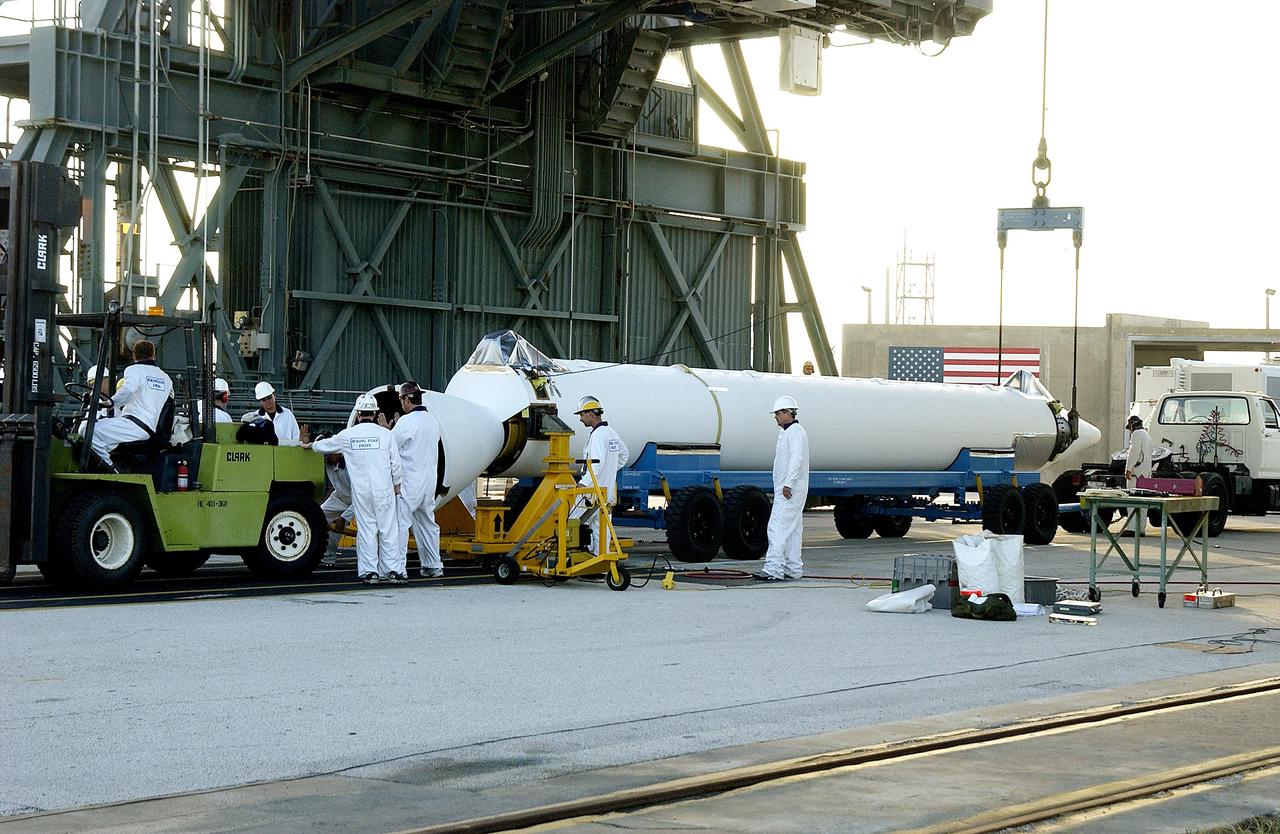
KENNEDY SPACE CENTER, FLA. - On Launch Pad 17-B at Cape Canaveral Air Force Station, the Mobile Service Tower is rolled back from the pad, revealing the MESSENGER (MErcury Surface, Space ENvironment, GEochemistry and Ranging) spacecraft aboard a Delta II rocket. The nine solid booster rockets on this Delta model 7925-H provide it with heavy lift capability. MESSENGER is ready for liftoff on Aug. 2 at 2:16 a.m. EDT and is expected to enter Mercury orbit in March 2011. MESSENGER was built for NASA by the Johns Hopkins University Applied Physics Laboratory in Laurel, Md.
KSC-04pd1602
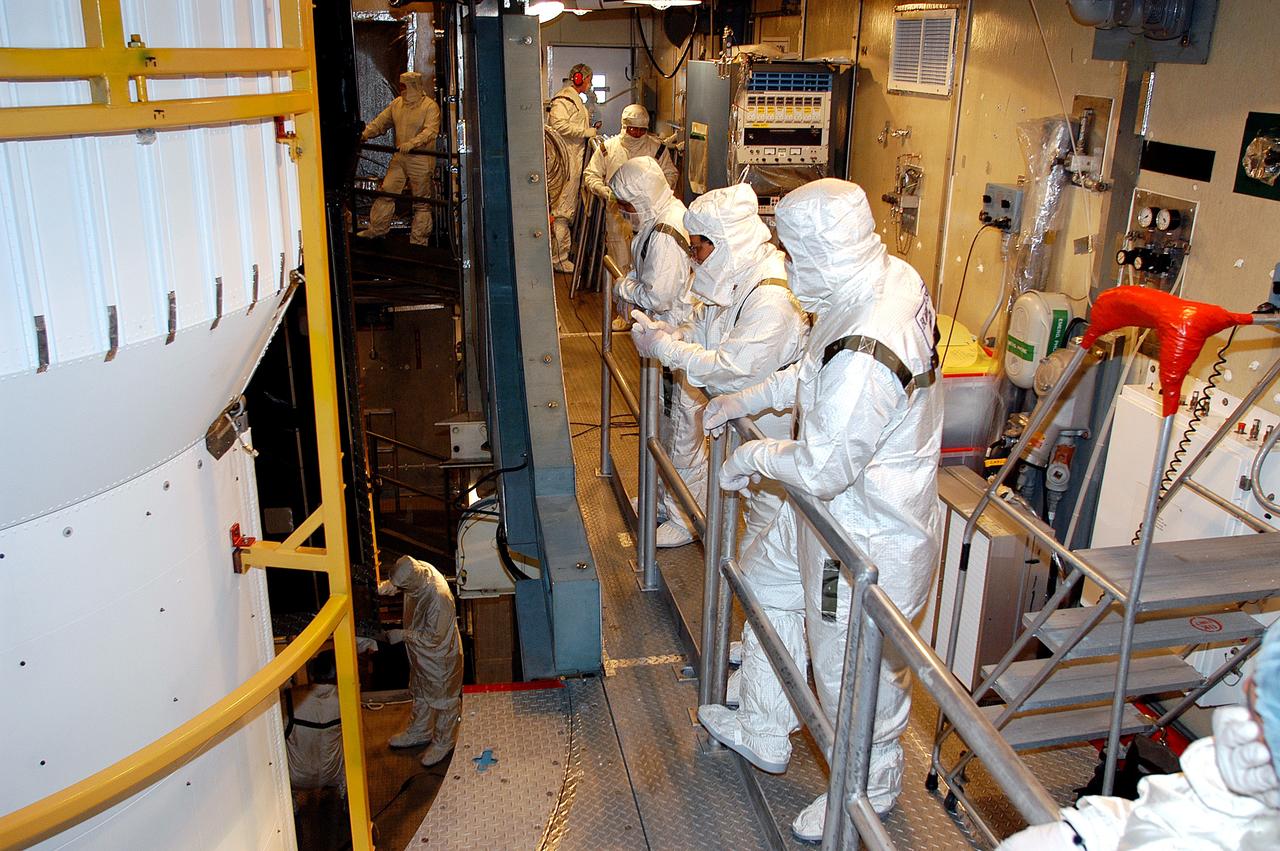
KENNEDY SPACE CENTER, FLA. -  Workers in the mobile service tower on Pad 17-B, Cape Canaveral Air Force Station, check the progress of the Boeing Delta II Heavy second-stage engine as it descends toward the first stage.  The Delta is the launch vehicle for the MESSENGER (Mercury Surface, Space Environment, Geochemistry and Ranging) spacecraft, scheduled to lift off Aug. 2.  Bound for Mercury, the spacecraft is expected to reach orbit around the planet in March 2011.  MESSENGER was built for NASA by the Johns Hopkins University Applied Physics Laboratory in Laurel, Md.
KSC-04pd1453
KENNEDY SPACE CENTER, FLA. - On Launch Pad 17-B at Cape Canaveral Air Force Station, the Mobile Service Tower has been removed from around the MESSENGER (MErcury Surface, Space ENvironment, GEochemistry and Ranging) spacecraft aboard a Delta II rocket. The nine solid booster rockets on this Delta model 7925-H provide it with heavy lift capability. MESSENGER is ready for liftoff on Aug. 2 at 2:16 a.m. EDT and is expected to enter Mercury orbit in March 2011. MESSENGER was built for NASA by the Johns Hopkins University Applied Physics Laboratory in Laurel, Md.
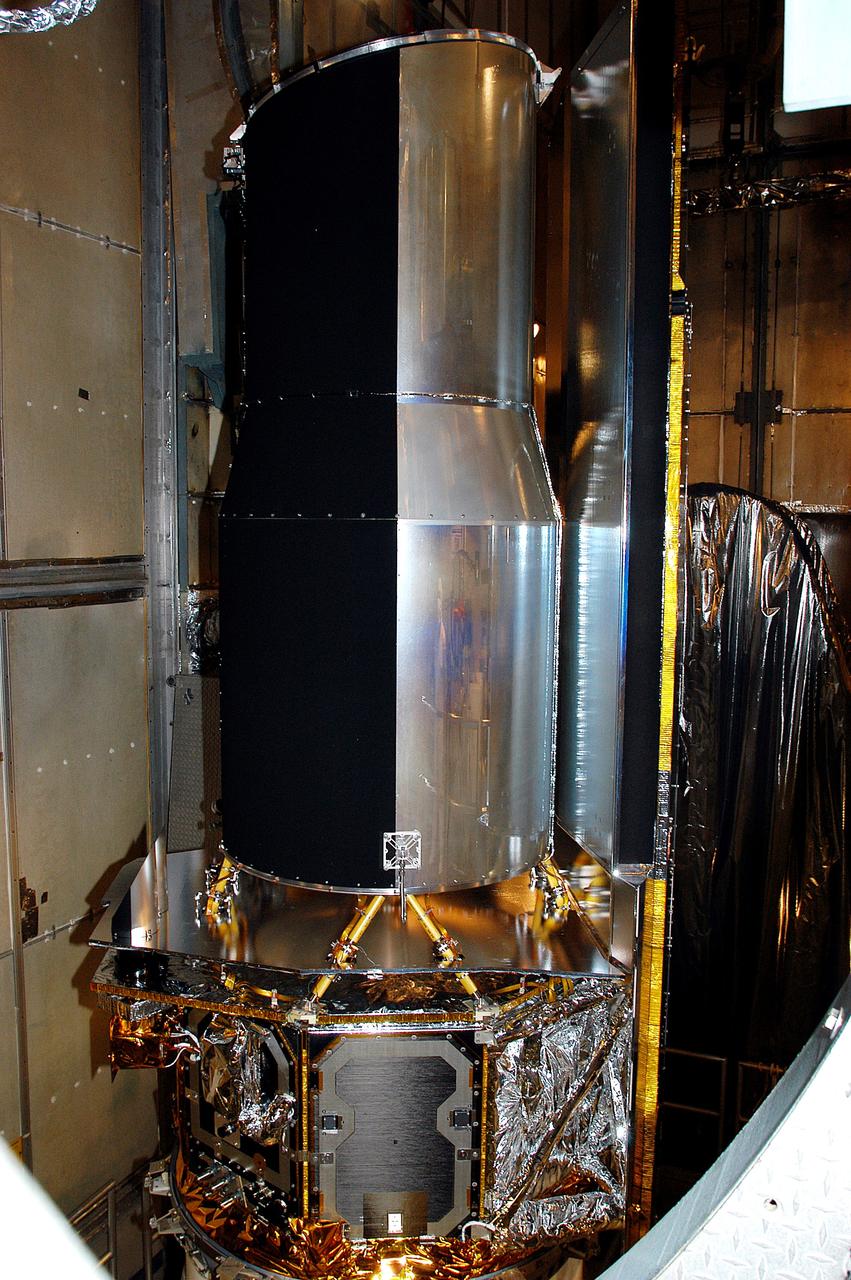
KSC-04pd1604
KENNEDY SPACE CENTER, FLA. -  At Pad 17-B, Cape Canaveral Air Force Station, the first Solid Rocket Booster  (SRB) for the MESSENGER spacecraft launch is raised from the transporter.  The SRB will be mated to the Boeing Delta II Heavy rocket for the Aug. 2 launch of MESSENGER to the planet Mercury.  The spacecraft is expected to reach orbit around the planet in March 2011.  MESSENGER was built for NASA by the Johns Hopkins University Applied Physics Laboratory in Laurel, Md.
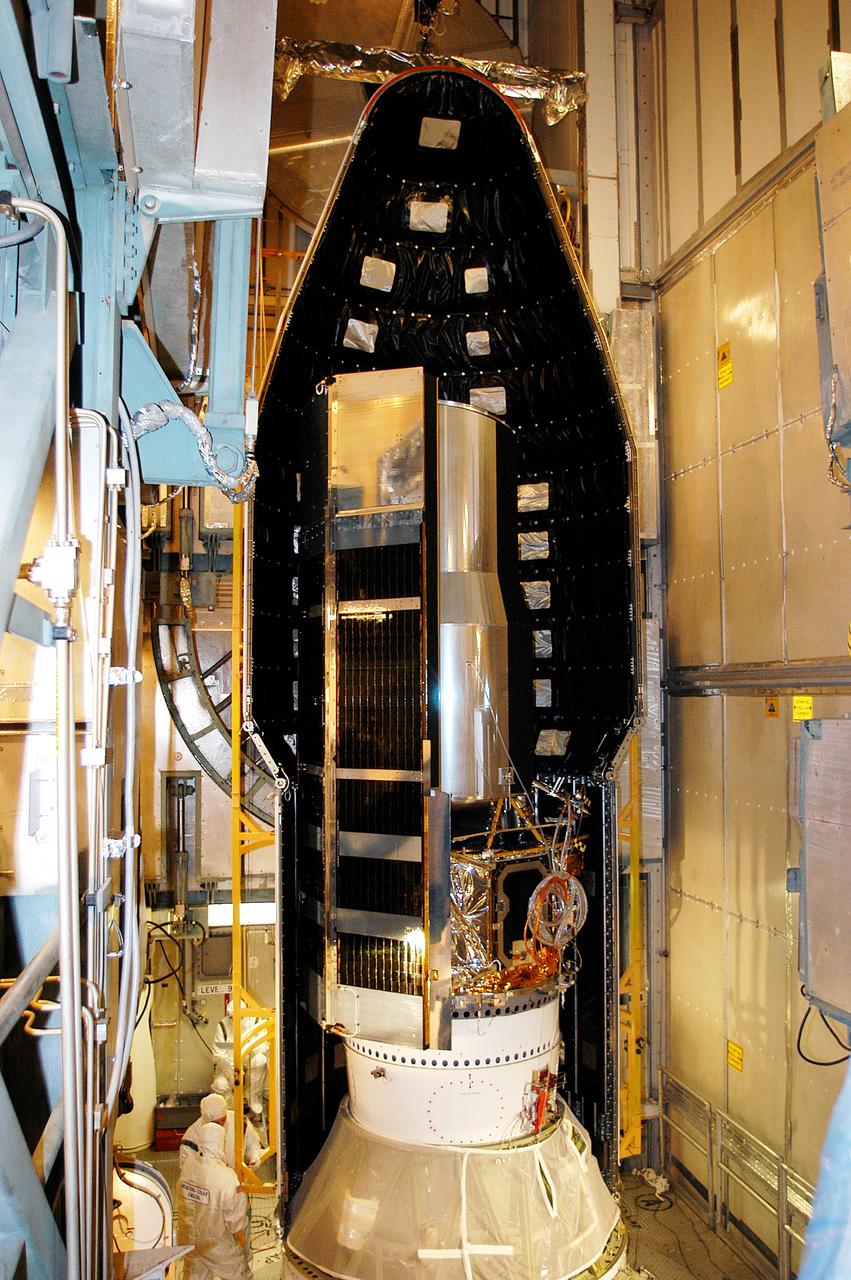
KSC-04pd1403
KENNEDY SPACE CENTER, FLA. -  On Pad 17-B, Cape Canaveral Air Force Station, a second Solid Rocket Booster (SRB) is lifted up the mobile service tower. The SRB and eight others will be mated to the Boeing Delta II Heavy rocket for the Aug. 2 launch of the MESSENGER spacecraft to the planet Mercury.  The spacecraft is expected to reach orbit around Mercury in March 2011.  MESSENGER was built for NASA by the Johns Hopkins University Applied Physics Laboratory in Laurel, Md.
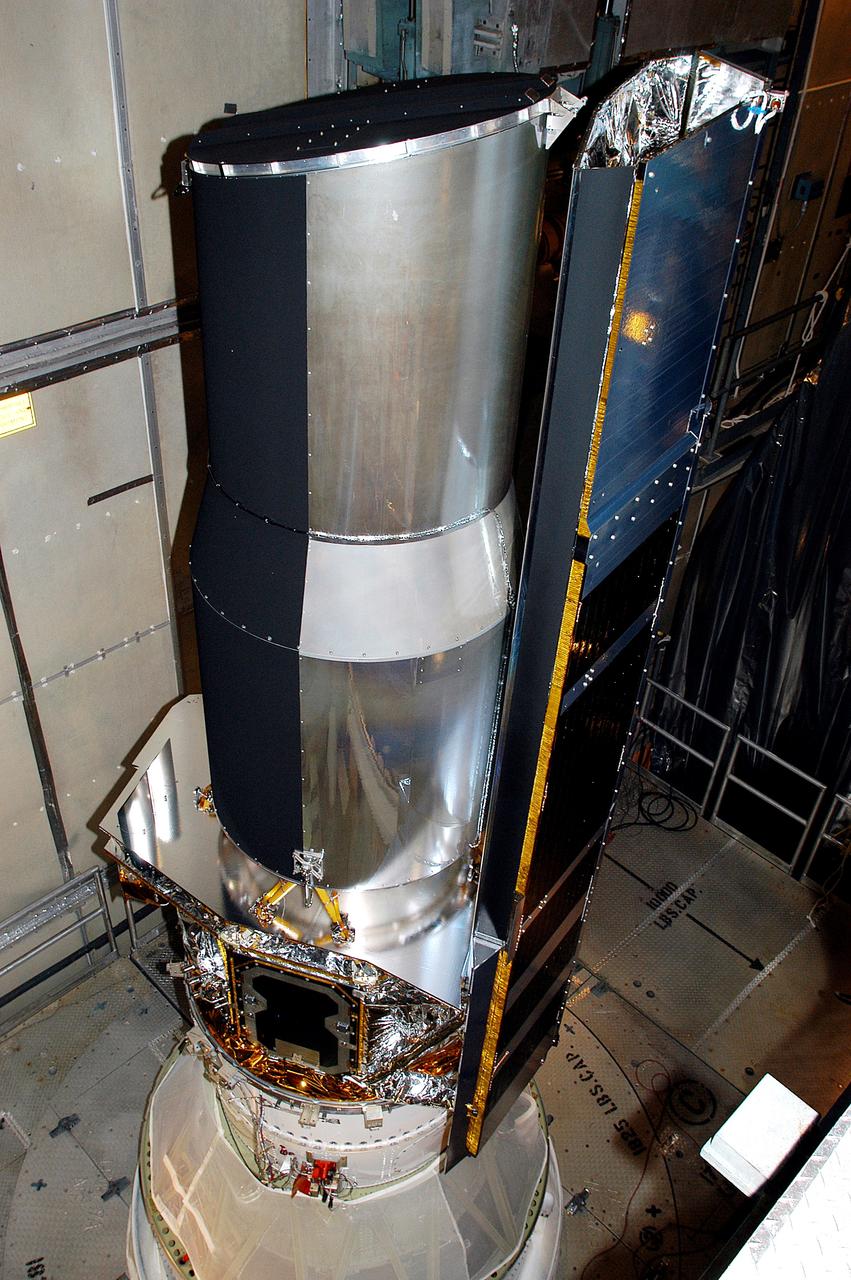
KSC-04pd1413
KENNEDY SPACE CENTER, FLA. -  On Launch Pad 17-B at Cape Canaveral Air Force Station, the MESSENGER spacecraft is lowered toward the Boeing Delta II Heavy rocket for mating. Liftoff is scheduled for Aug. 2.  The spacecraft is expected to reach orbit around the planet in March 2011.  MESSENGER was built for NASA by the Johns Hopkins University Applied Physics Laboratory in Laurel, Md.
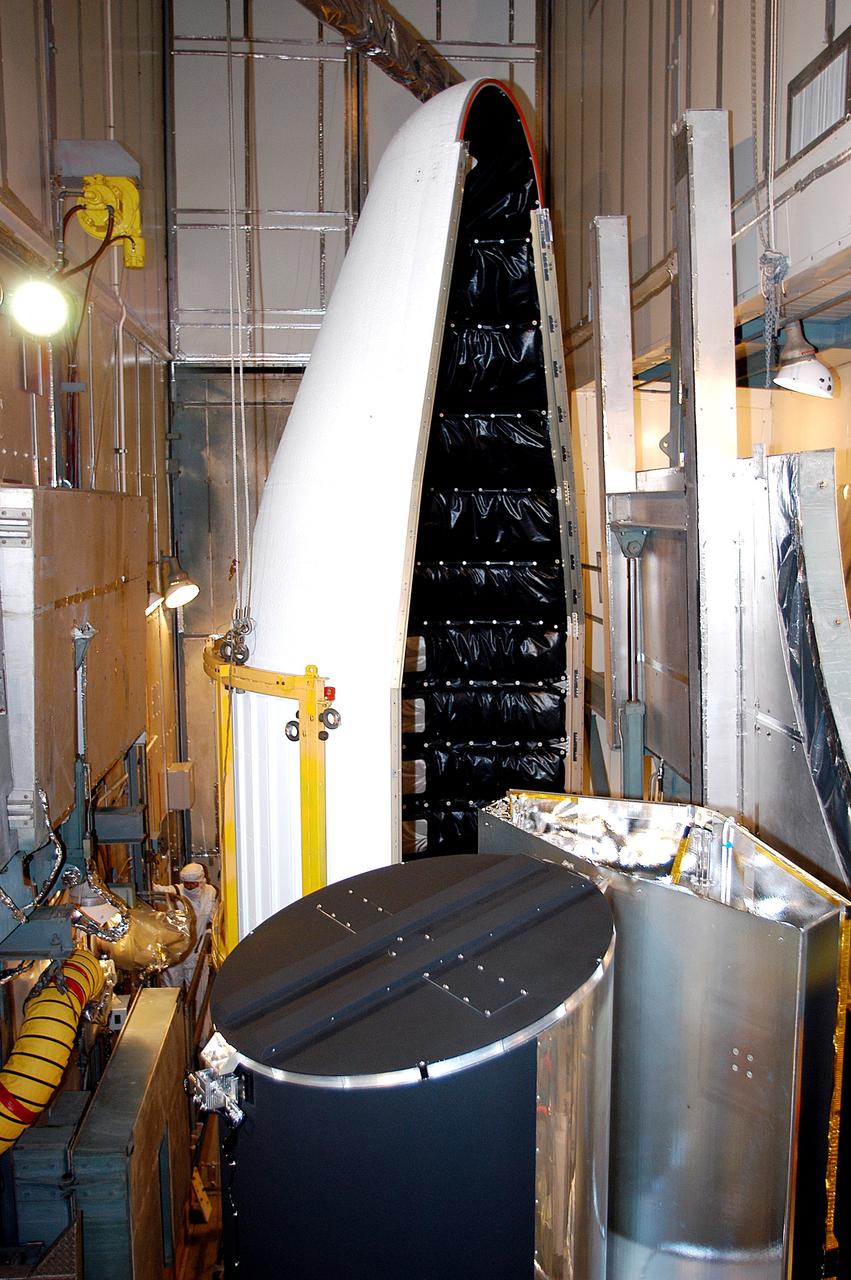
KSC-04pd1520
KENNEDY SPACE CENTER, FLA. -  A second Solid Rocket Booster  (SRB) for the MESSENGER spacecraft launch is raised from its transporter at Pad 17-B, Cape Canaveral Air Force Station, before being lifted up the mobile service tower.  The SRB will be mated to the Boeing Delta II Heavy rocket, seen in the background, for the Aug. 2 launch to the planet Mercury.  The spacecraft is expected to reach orbit around Mercury in March 2011.  MESSENGER was built for NASA by the Johns Hopkins University Applied Physics Laboratory in Laurel, Md.
KSC-04pd1409
KENNEDY SPACE CENTER, FLA. -  On Pad 17-B, Cape Canaveral Air Force Station, workers check the Solid Rocket Booster (SRB) waiting to be lifted up the mobile service tower. The SRB and eight others will be mated to the Boeing Delta II Heavy rocket for the Aug. 2 launch of the MESSENGER spacecraft to the planet Mercury.  The spacecraft is expected to reach orbit around Mercury in March 2011.  MESSENGER was built for NASA by the Johns Hopkins University Applied Physics Laboratory in Laurel, Md.
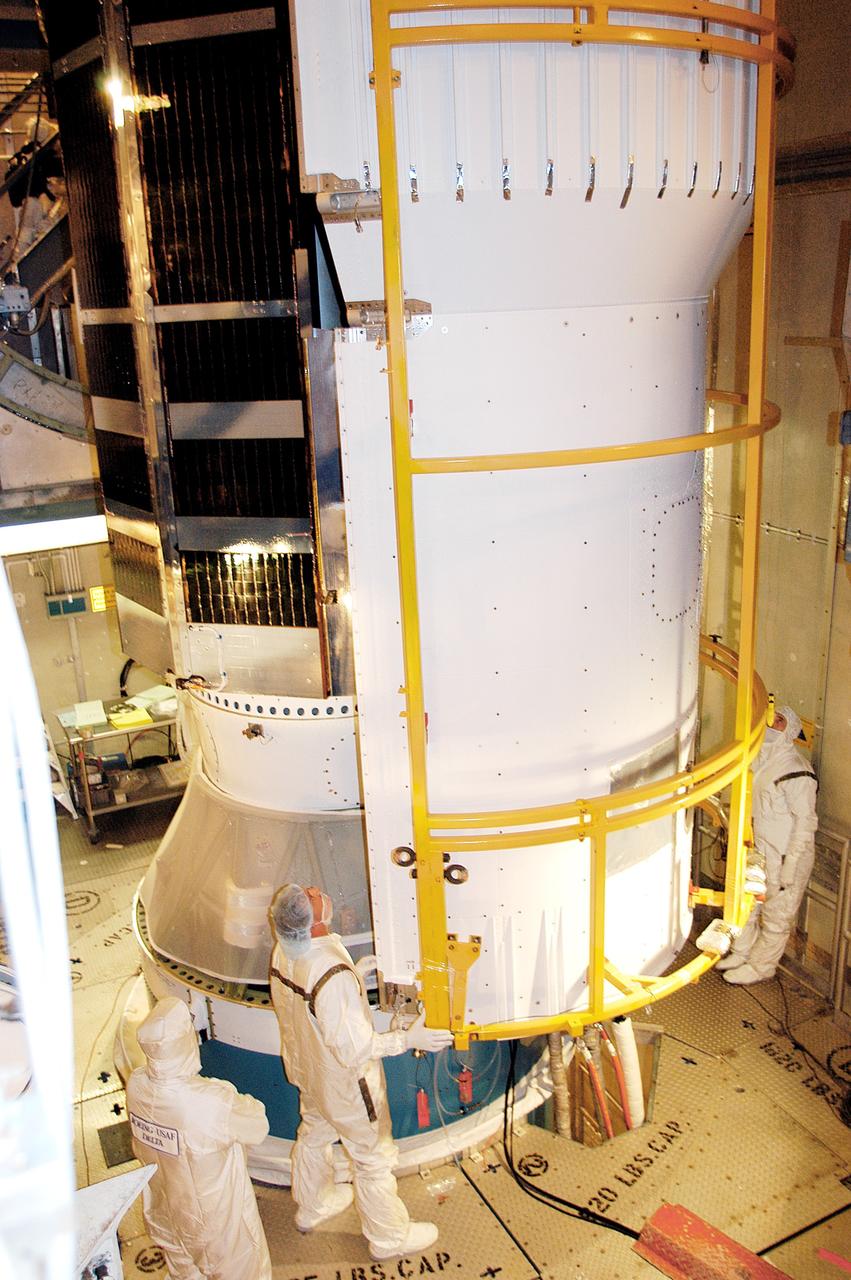
KSC-04pd1412
KENNEDY SPACE CENTER, FLA. -  This view looks upward inside the mobile service tower on Launch Pad 17-B at Cape Canaveral Air Force Station as the MESSENGER spacecraft is lowered toward the Boeing Delta II Heavy rocket for mating. Liftoff is scheduled for Aug. 2.  The spacecraft is expected to reach orbit around the planet in March 2011.  MESSENGER was built for NASA by the Johns Hopkins University Applied Physics Laboratory in Laurel, Md.
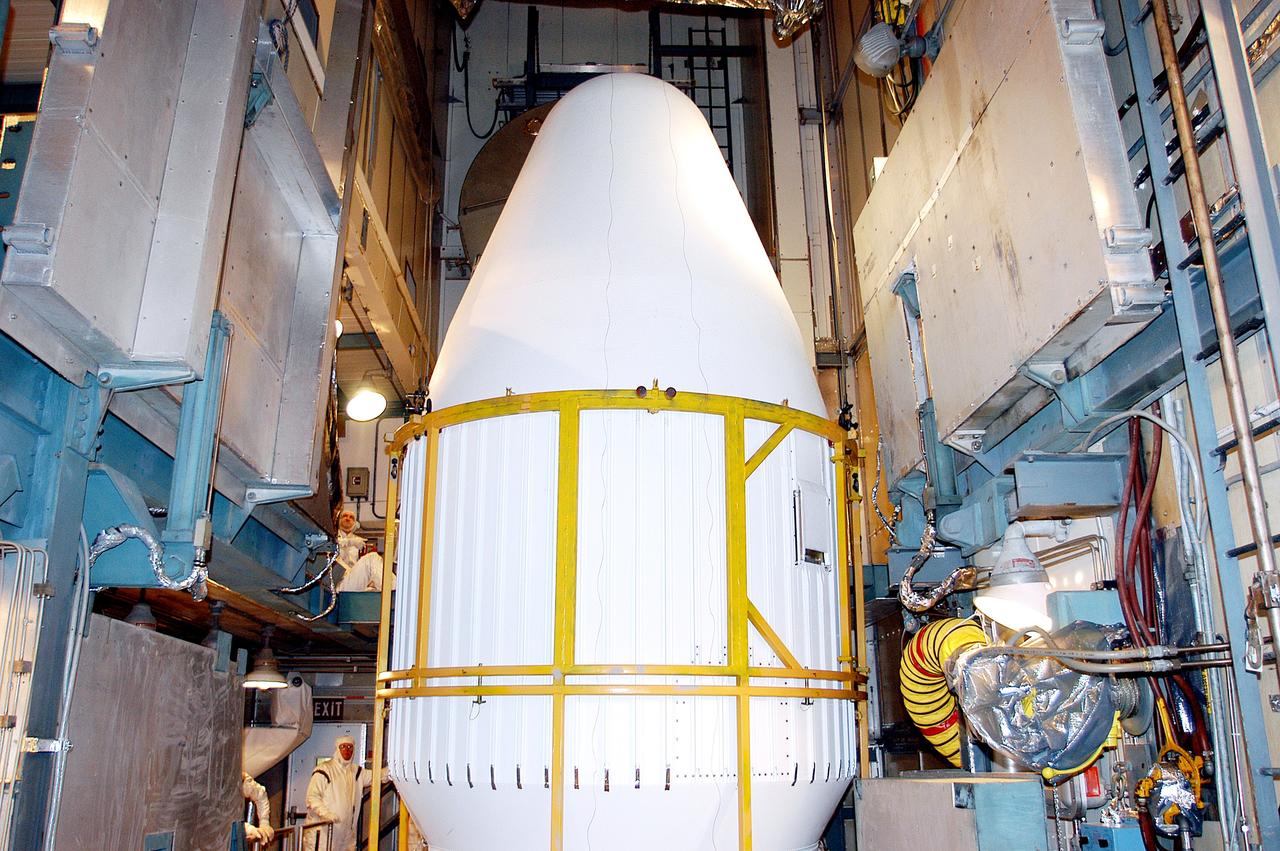
KSC-04pd1521
KENNEDY SPACE CENTER, FLA. - A worker at Astrotech Space Operations in Titusville, Fla., helps suit up another worker for spacecraft propellant loading of the MESSENGER (Mercury Surface, Space Environment, Geochemistry and Ranging) spacecraft.  Liftoff of MESSENGER aboard a Boeing Delta II Heavy rocket, bound for Mercury, is scheduled for Aug. 2.  The spacecraft is expected to reach orbit around the planet in March 2011.  MESSENGER was built for NASA by the Johns Hopkins University Applied Physics Laboratory in Laurel, Md.
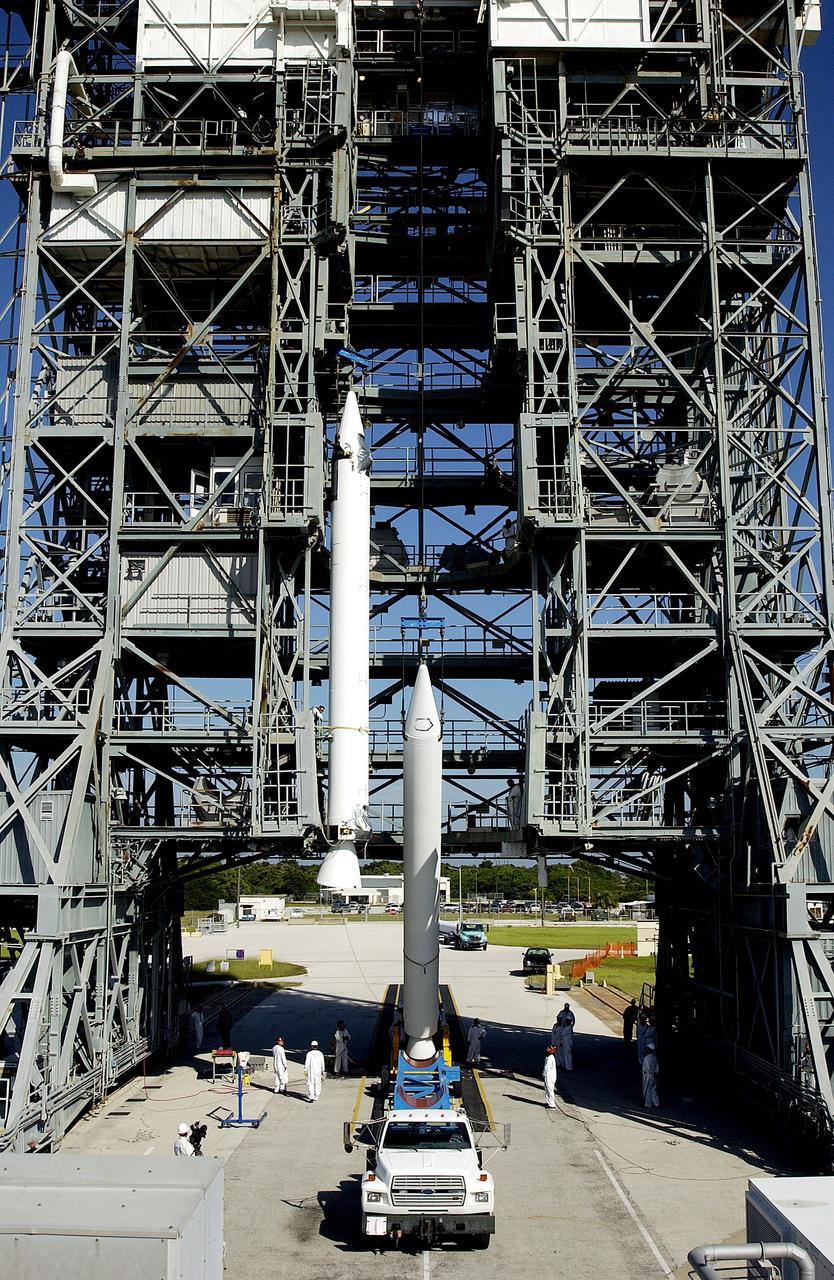
KSC-04pd1432
KENNEDY SPACE CENTER, FLA. -  A Solid Rocket Booster  (SRB) arrives at Pad 17-B, Cape Canaveral Air Force Station.  It is the first SRB that will be mated to the Boeing Delta II Heavy rocket for the MESSENGER spacecraft launch.  Scheduled to lift off Aug. 2, bound for Mercury, the spacecraft is expected to reach orbit around Mercury in March 2011.  MESSENGER was built for NASA by the Johns Hopkins University Applied Physics Laboratory in Laurel, Md.
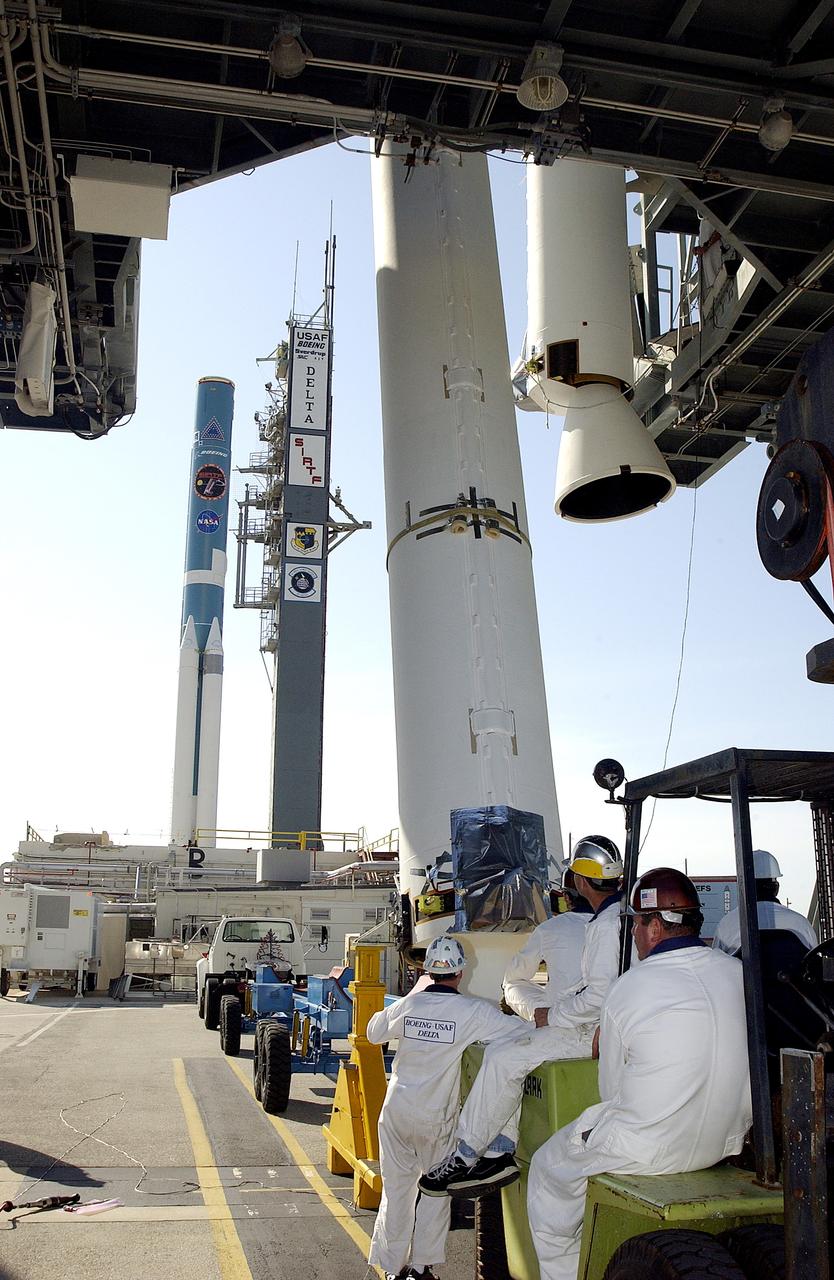
KSC-04pd1402
KENNEDY SPACE CENTER, FLA. -  On Launch Pad 17-B at Cape Canaveral Air Force Station, the MESSENGER spacecraft arrives near the top of the mobile service tower, where it will be mated to the Boeing Delta II Heavy rocket.  Liftoff is scheduled for Aug. 2.  The spacecraft is expected to reach orbit around the planet in March 2011.  MESSENGER was built for NASA by the Johns Hopkins University Applied Physics Laboratory in Laurel, Md.
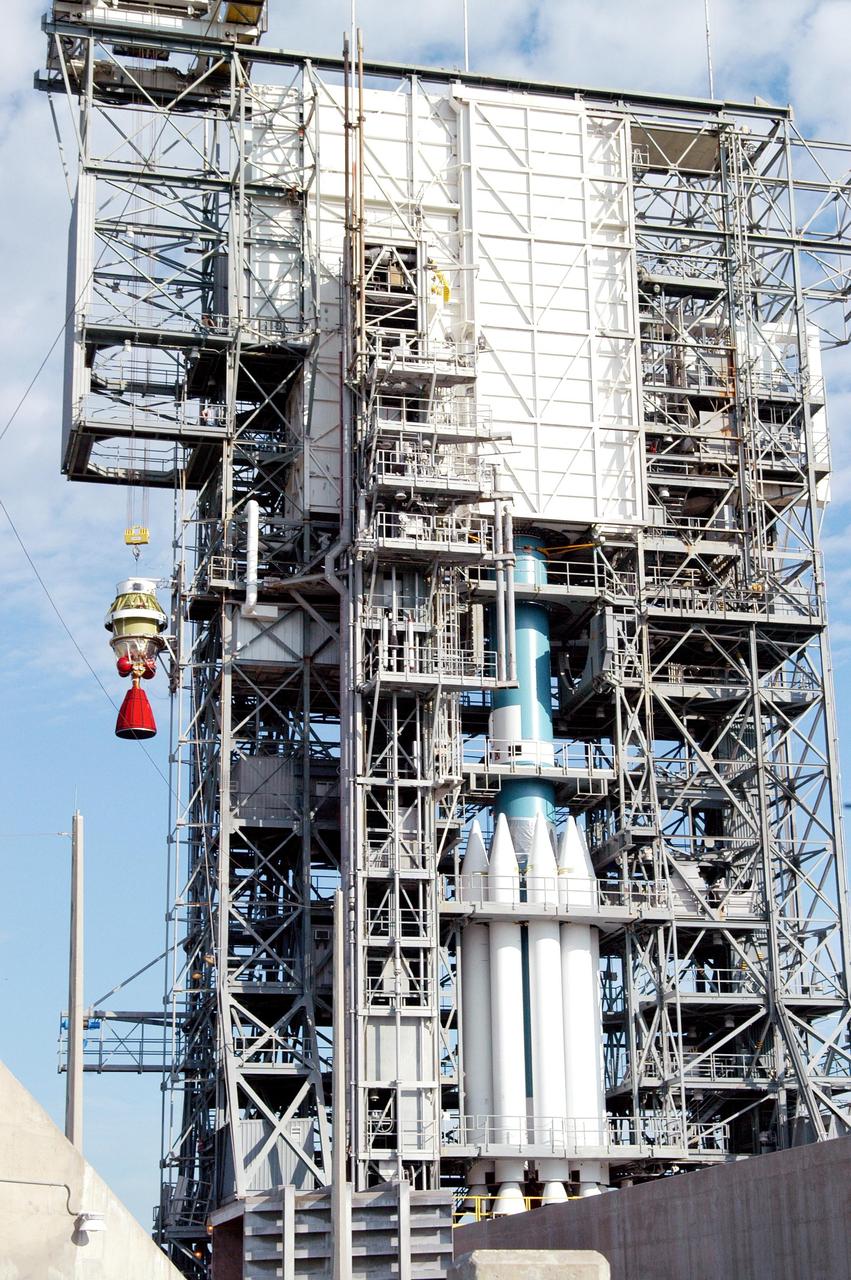
KSC-04pd1517
KENNEDY SPACE CENTER, FLA. -  On Launch Pad 17-B at Cape Canaveral Air Force Station, the MESSENGER spacecraft is lifted up the mobile service tower, where it will be mated to the Boeing Delta II Heavy rocket.  Liftoff is scheduled for Aug. 2.  The spacecraft is expected to reach orbit around the planet in March 2011.  MESSENGER was built for NASA by the Johns Hopkins University Applied Physics Laboratory in Laurel, Md.
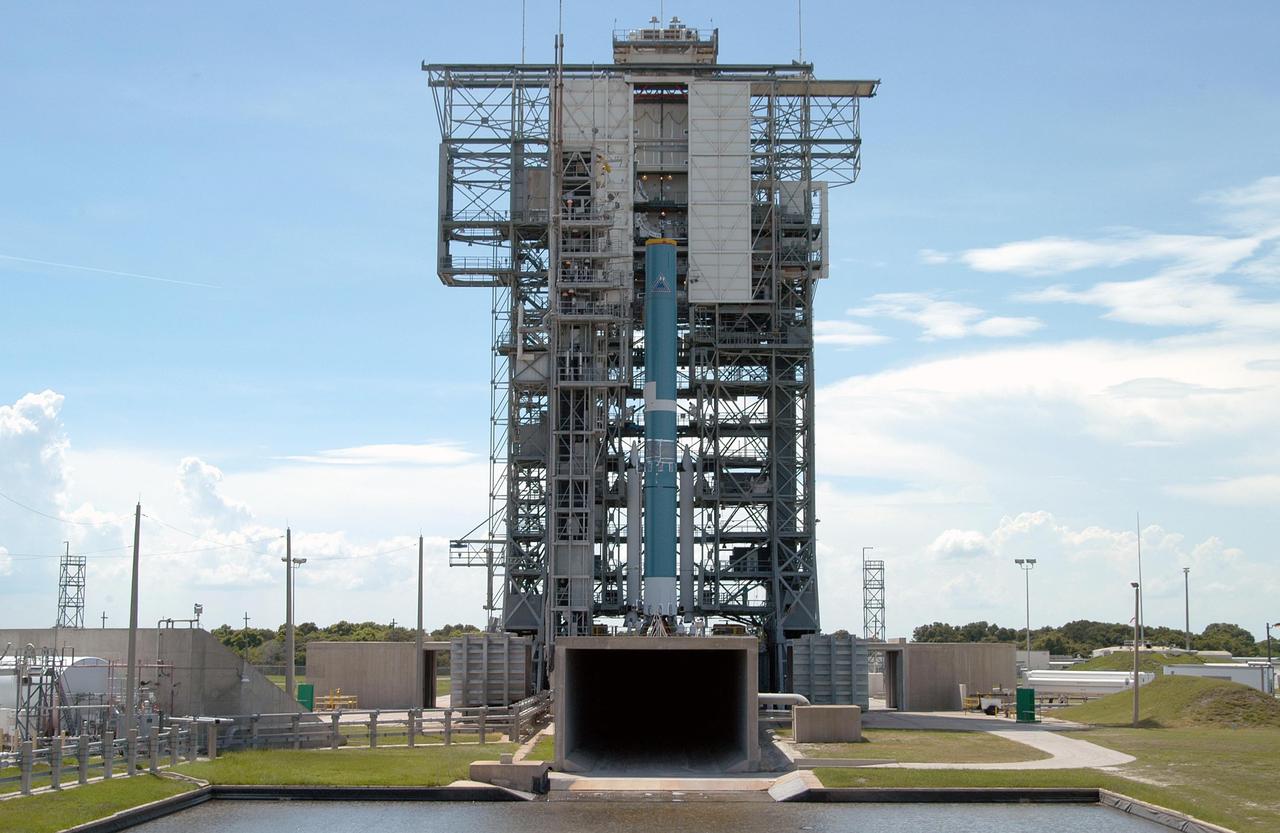
KSC-04pd1515
KENNEDY SPACE CENTER, FLA. -  On Launch Pad 17-B at Cape Canaveral Air Force Station, the MESSENGER spacecraft is lowered toward the Boeing Delta II Heavy rocket for mating. Liftoff is scheduled for Aug. 2.  The spacecraft is expected to reach orbit around the planet in March 2011.  MESSENGER was built for NASA by the Johns Hopkins University Applied Physics Laboratory in Laurel, Md.
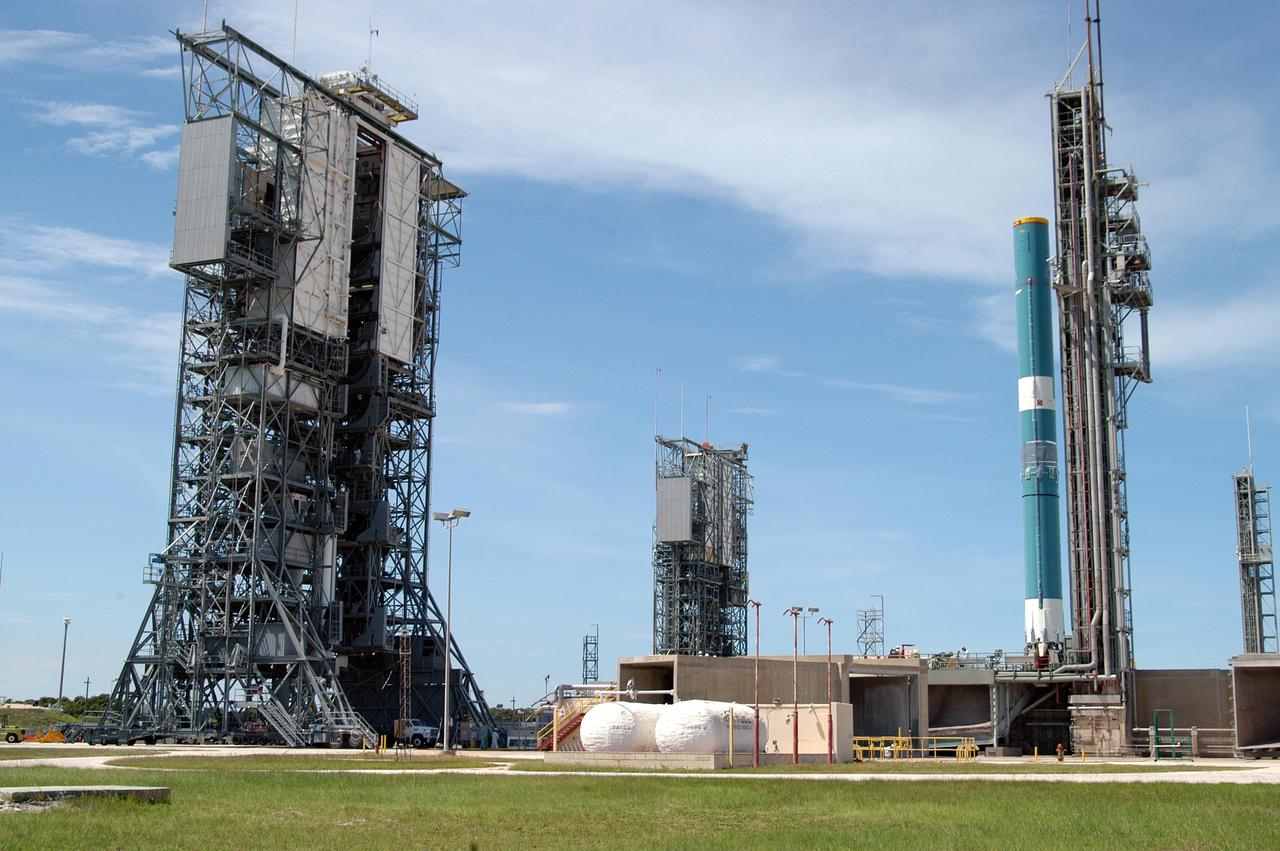
KSC-04pd1523
KENNEDY SPACE CENTER, FLA. -  The MESSENGER spacecraft, aboard a transporter, arrives on Launch Pad 17-B at Cape Canaveral Air Force Station.  It will be mated to the Boeing Delta II Heavy rocket for liftoff on Aug. 2.  The spacecraft is expected to reach orbit around the planet in March 2011.  MESSENGER was built for NASA by the Johns Hopkins University Applied Physics Laboratory in Laurel, Md.
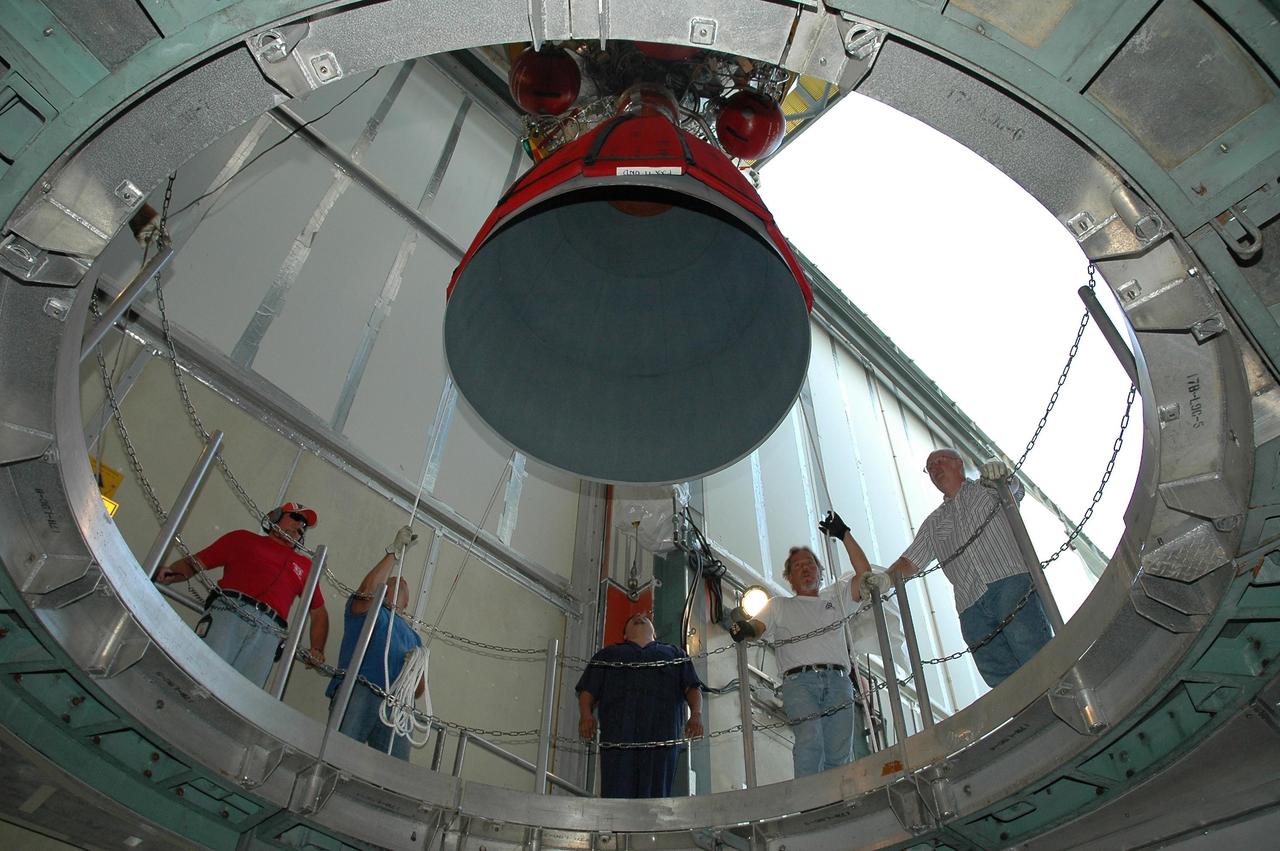
KSC-04pd1513
KENNEDY SPACE CENTER, FLA. -  On Pad 17-B, Cape Canaveral Air Force Station, a third Solid Rocket Booster (SRB) is raised from its transporter under the mobile service tower.  It will be lifted up the tower to join the other SRBs there and later mated to the Boeing Delta II Heavy rocket for the Aug. 2 launch of the MESSENGER spacecraft to the planet Mercury.  The spacecraft is expected to reach orbit around Mercury in March 2011.  MESSENGER was built for NASA by the Johns Hopkins University Applied Physics Laboratory in Laurel, Md.
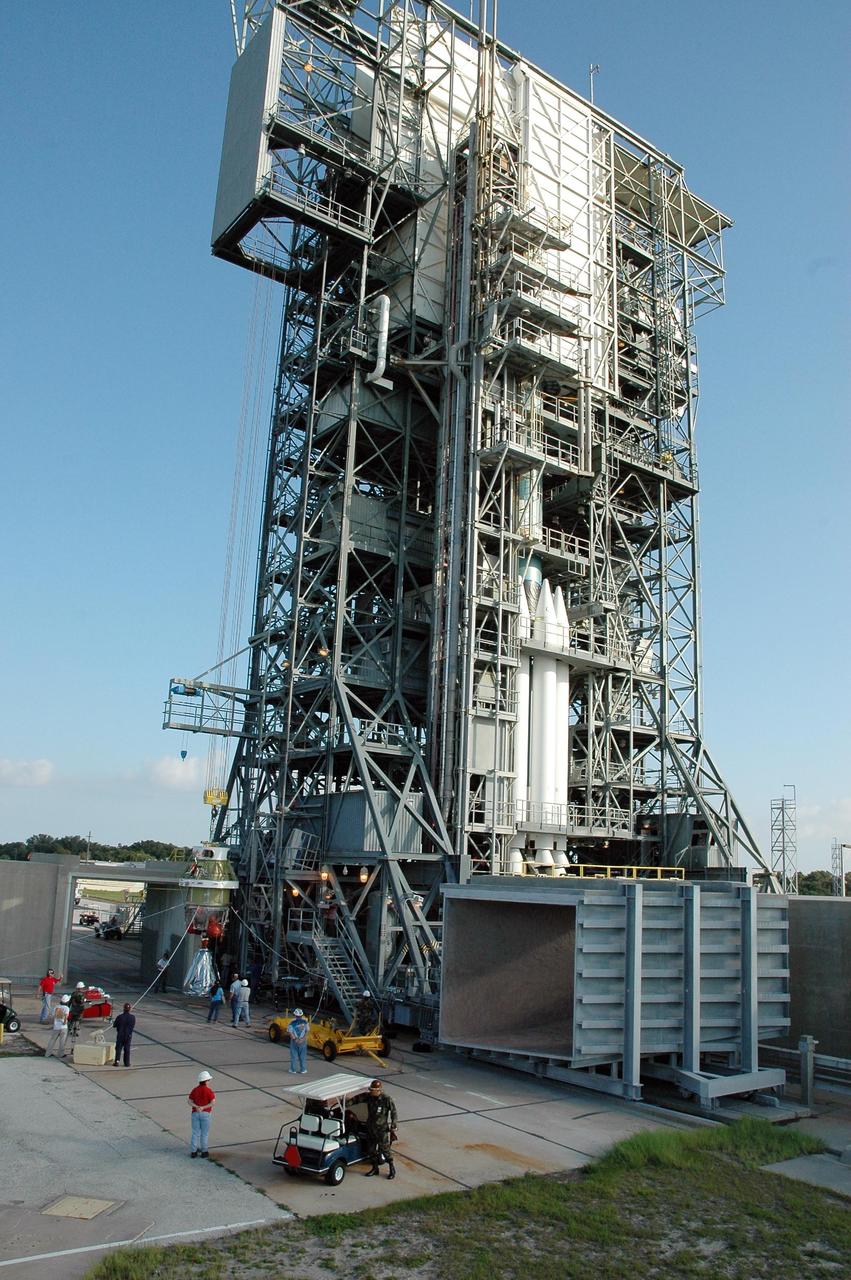
KSC-04pd1414
KENNEDY SPACE CENTER, FLA. -  The first Solid Rocket Booster  (SRB) for the MESSENGER spacecraft launch is lifted up the mobile service tower at Pad 17-B, Cape Canaveral Air Force Station.  The SRB will be mated to the Boeing Delta II Heavy rocket for the Aug. 2 launch to the planet Mercury.  The spacecraft is expected to reach orbit around Mercury in March 2011.  MESSENGER was built for NASA by the Johns Hopkins University Applied Physics Laboratory in Laurel, Md.
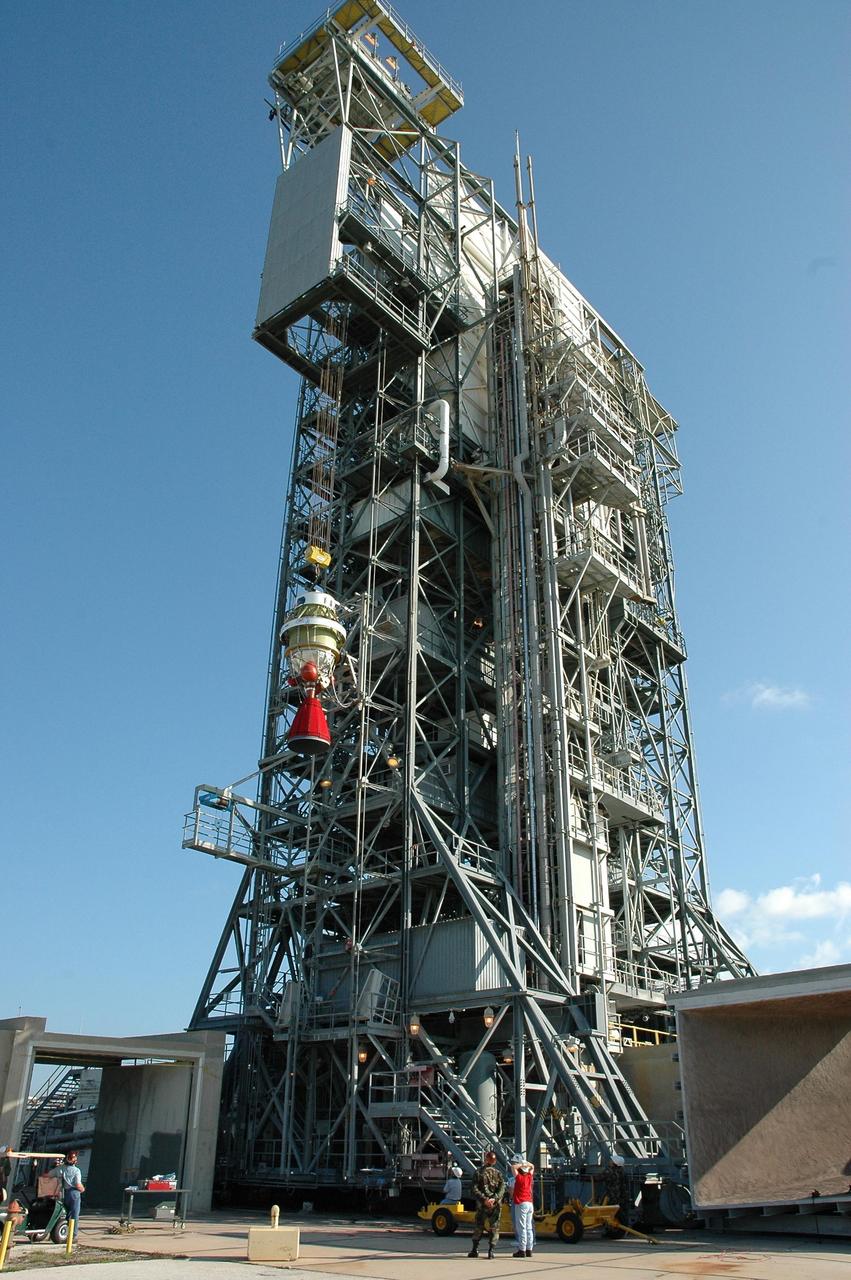
KSC-04pd1407
KENNEDY SPACE CENTER, FLA. -  On Launch Pad 17-B at Cape Canaveral Air Force Station, the MESSENGER spacecraft is viewed from inside the mobile service tower as it arrives at the top, where it will be mated to the Boeing Delta II Heavy rocket.  Liftoff is scheduled for Aug. 2.  The spacecraft is expected to reach orbit around the planet in March 2011.  MESSENGER was built for NASA by the Johns Hopkins University Applied Physics Laboratory in Laurel, Md.
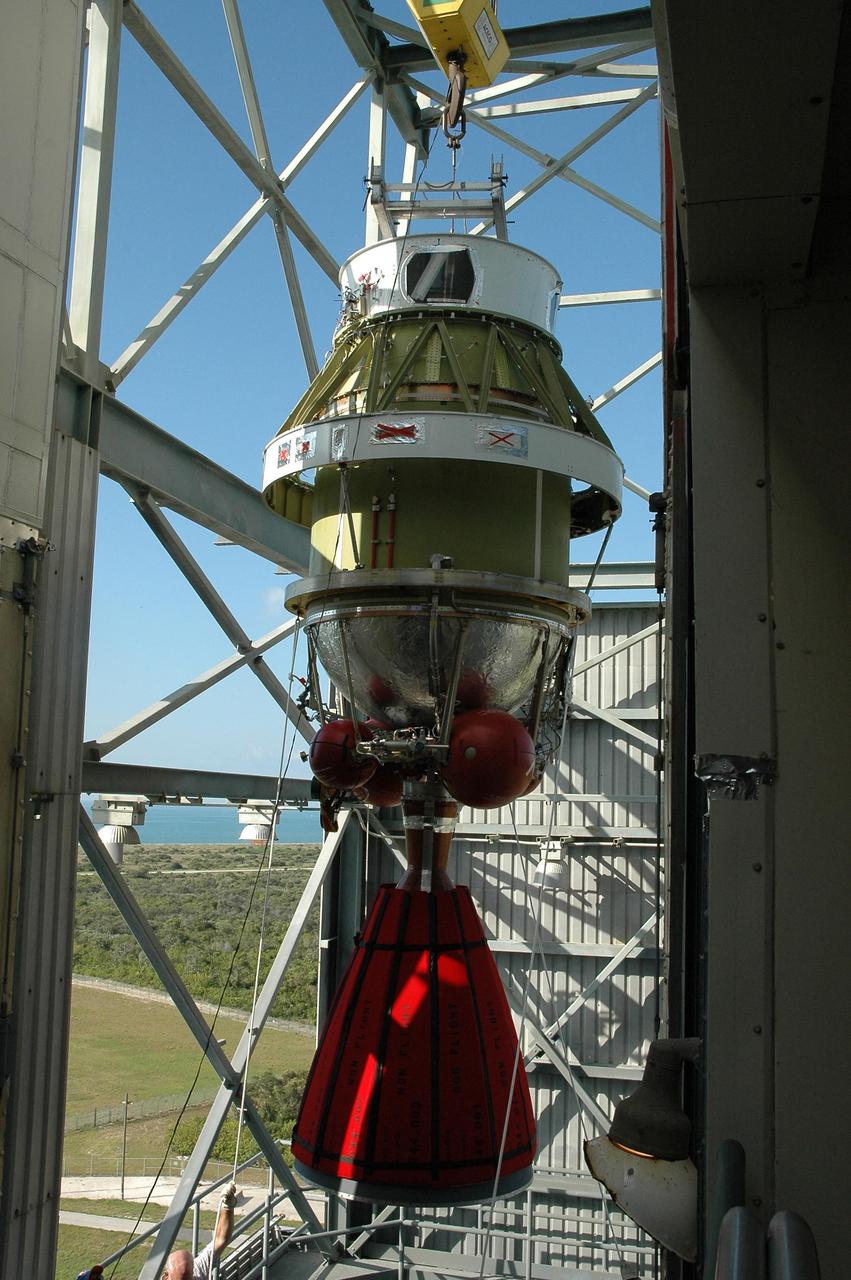
KSC-04pd1518
KENNEDY SPACE CENTER, FLA. -  At Pad 17-B, Cape Canaveral Air Force Station, the first Solid Rocket Booster  (SRB) for the MESSENGER spacecraft launch is held in a vertical position for lifting up the mobile service tower.  The SRB will be mated to the Boeing Delta II Heavy rocket for the Aug. 2 launch of MESSENGER to the planet Mercury.  The spacecraft is expected to reach orbit around Mercury in March 2011.  MESSENGER was built for NASA by the Johns Hopkins University Applied Physics Laboratory in Laurel, Md.
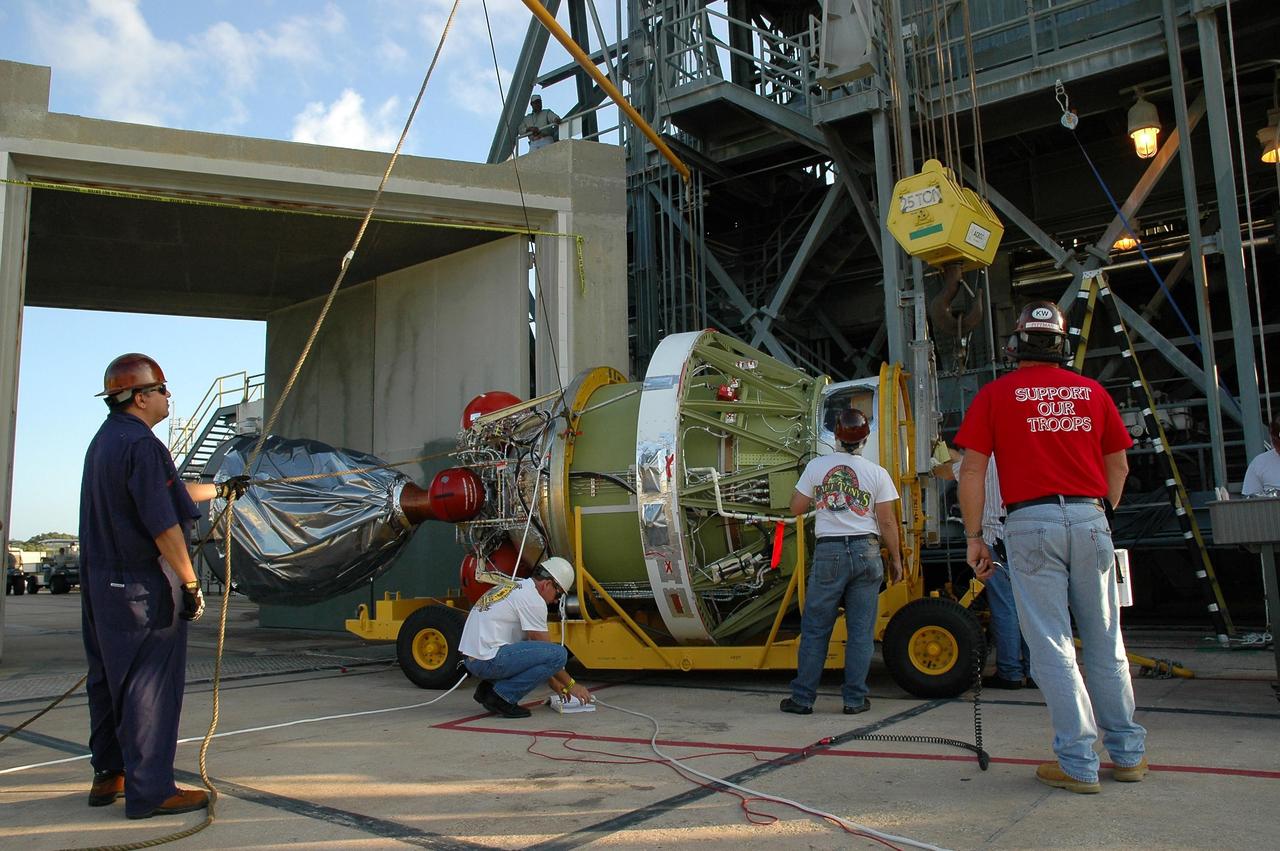
KSC-04pd1406
KENNEDY SPACE CENTER, FLA. -  On Pad 17-B, Cape Canaveral Air Force Station, workers steady the Solid Rocket Booster (SRB) waiting to be lifted up the mobile service tower. The SRB and eight others will be mated to the Boeing Delta II Heavy rocket for the Aug. 2 launch of the MESSENGER spacecraft to the planet Mercury.  The spacecraft is expected to reach orbit around Mercury in March 2011.  MESSENGER was built for NASA by the Johns Hopkins University Applied Physics Laboratory in Laurel, Md.
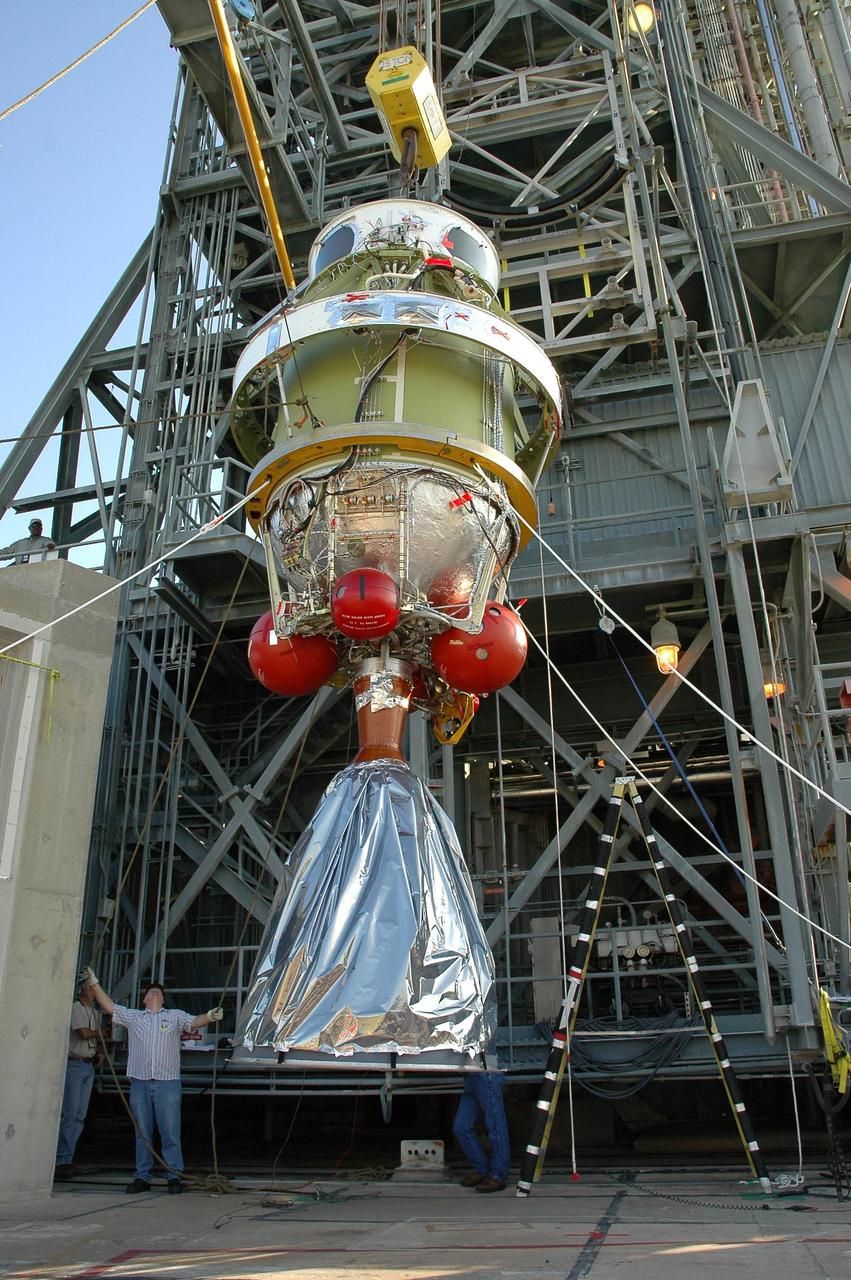
KSC-04pd1411
KENNEDY SPACE CENTER, FLA. -  On Pad 17-B, Cape Canaveral Air Force Station, a third Solid Rocket Booster (SRB) is lifted up the mobile service tower to join the other SRBs there.  They will later be mated to the Boeing Delta II Heavy rocket for the Aug. 2 launch of the MESSENGER spacecraft to the planet Mercury.  The spacecraft is expected to reach orbit around Mercury in March 2011.  MESSENGER was built for NASA by the Johns Hopkins University Applied Physics Laboratory in Laurel, Md.
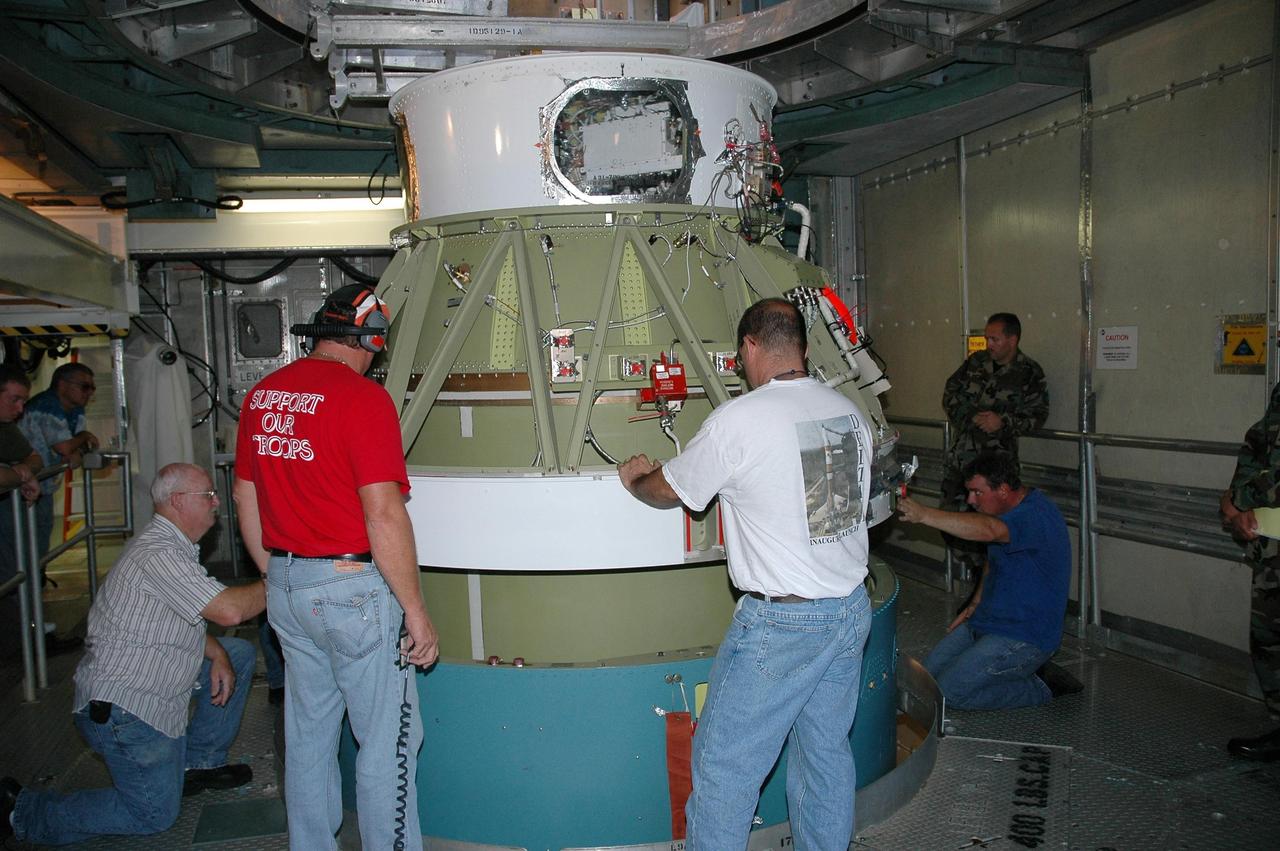
KSC-04pd1415
KENNEDY SPACE CENTER, FLA. -  Aboard a transporter, the MESSENGER spacecraft is en route to Launch Pad 17-B at Cape Canaveral Air Force Station.  It will be mated to the Boeing Delta II Heavy rocket for liftoff on Aug. 2.  The spacecraft is expected to reach orbit around the planet in March 2011.  MESSENGER was built for NASA by the Johns Hopkins University Applied Physics Laboratory in Laurel, Md.
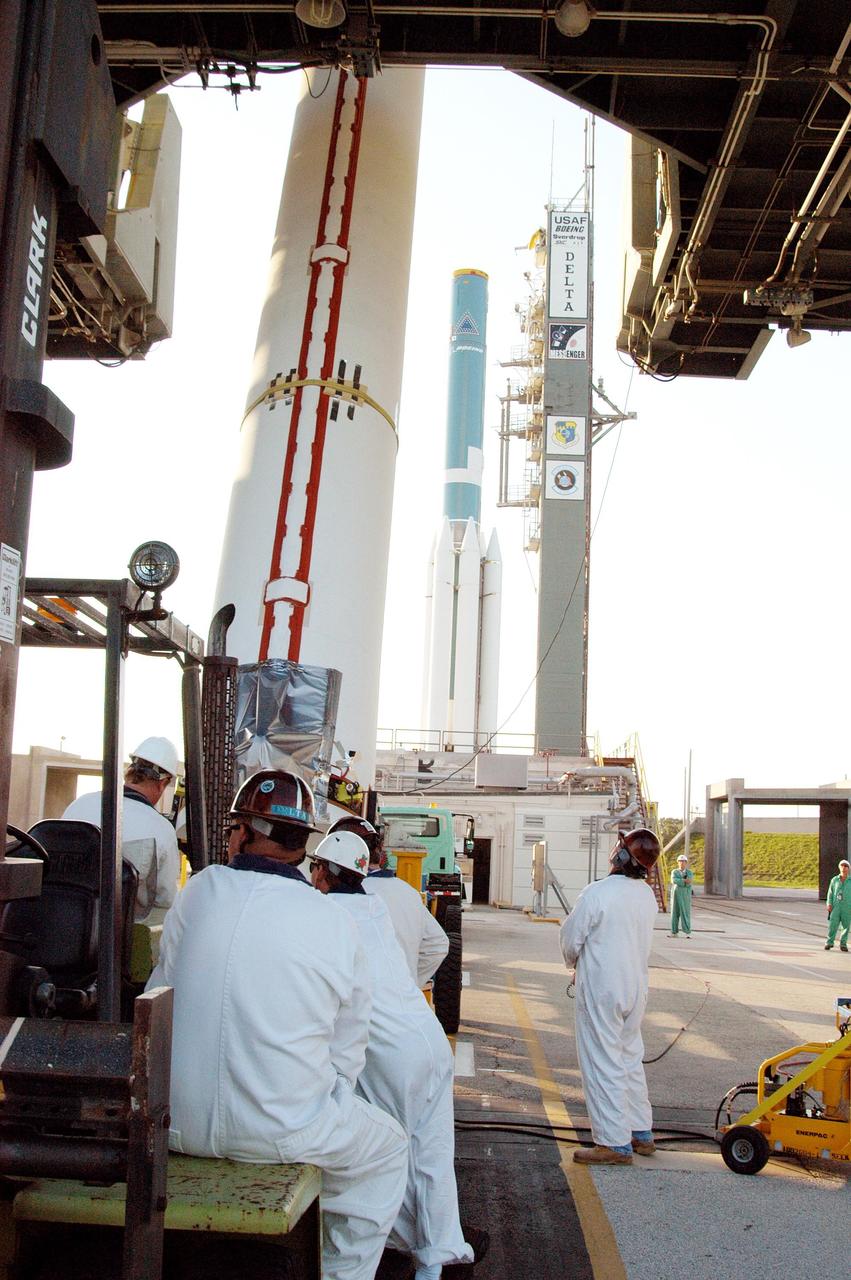
KSC-04pd1512
KENNEDY SPACE CENTER, FLA. -  A worker at Astrotech Space Operations in Titusville, Fla., suits up for spacecraft propellant loading of the MESSENGER (Mercury Surface, Space Environment, Geochemistry and Ranging) spacecraft.  Liftoff of MESSENGER aboard a Boeing Delta II Heavy rocket, bound for Mercury, is scheduled for Aug. 2.  The spacecraft is expected to reach orbit around the planet in March 2011.  MESSENGER was built for NASA by the Johns Hopkins University Applied Physics Laboratory in Laurel, Md.
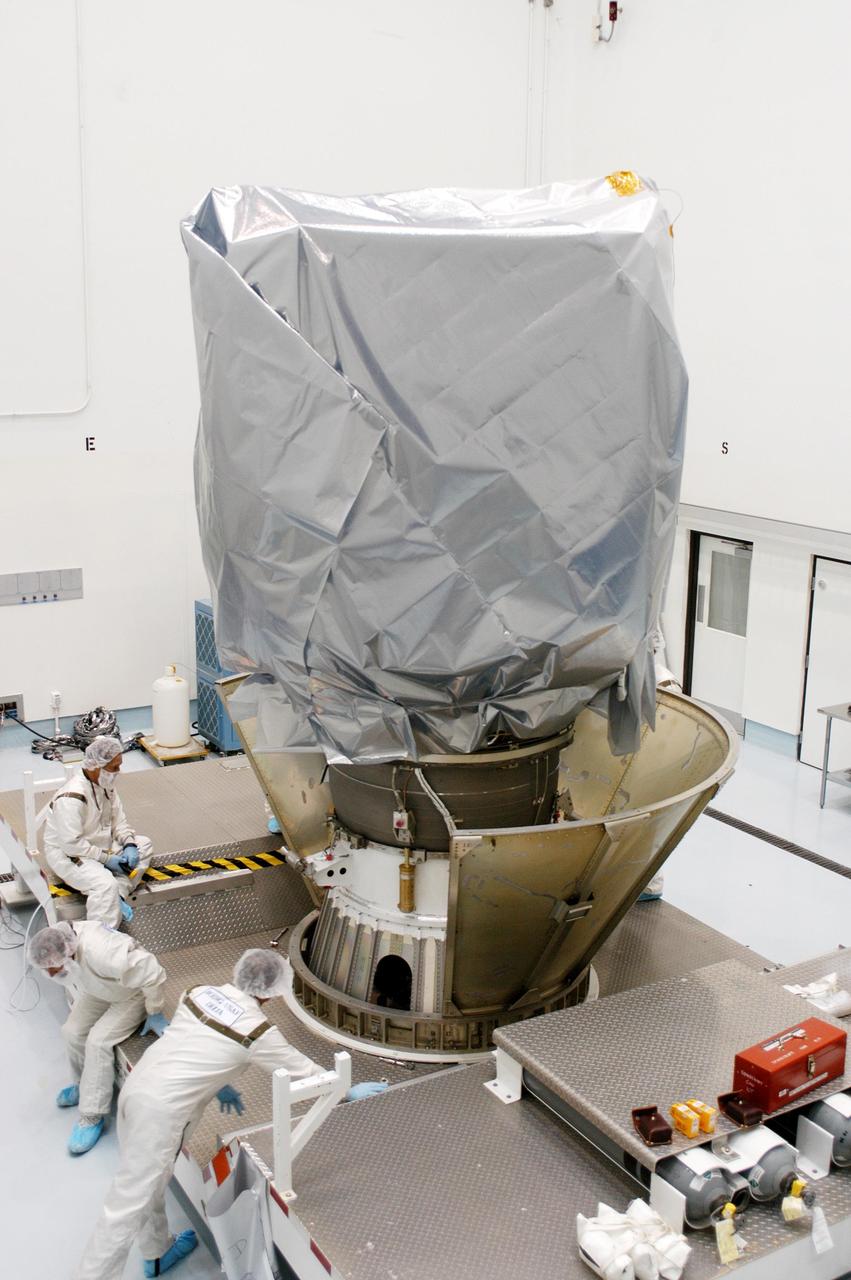
KSC-04pd1429
KENNEDY SPACE CENTER, FLA. -  At Pad 17-B, Cape Canaveral Air Force Station, the first Solid Rocket Booster  (SRB) for the MESSENGER spacecraft launch is raised from the transporter.  The SRB will be mated to the Boeing Delta II Heavy rocket, seen at left, for the Aug. 2 launch of MESSENGER to the planet Mercury.  The spacecraft is expected to reach orbit around Mercury in March 2011.  MESSENGER was built for NASA by the Johns Hopkins University Applied Physics Laboratory in Laurel, Md.
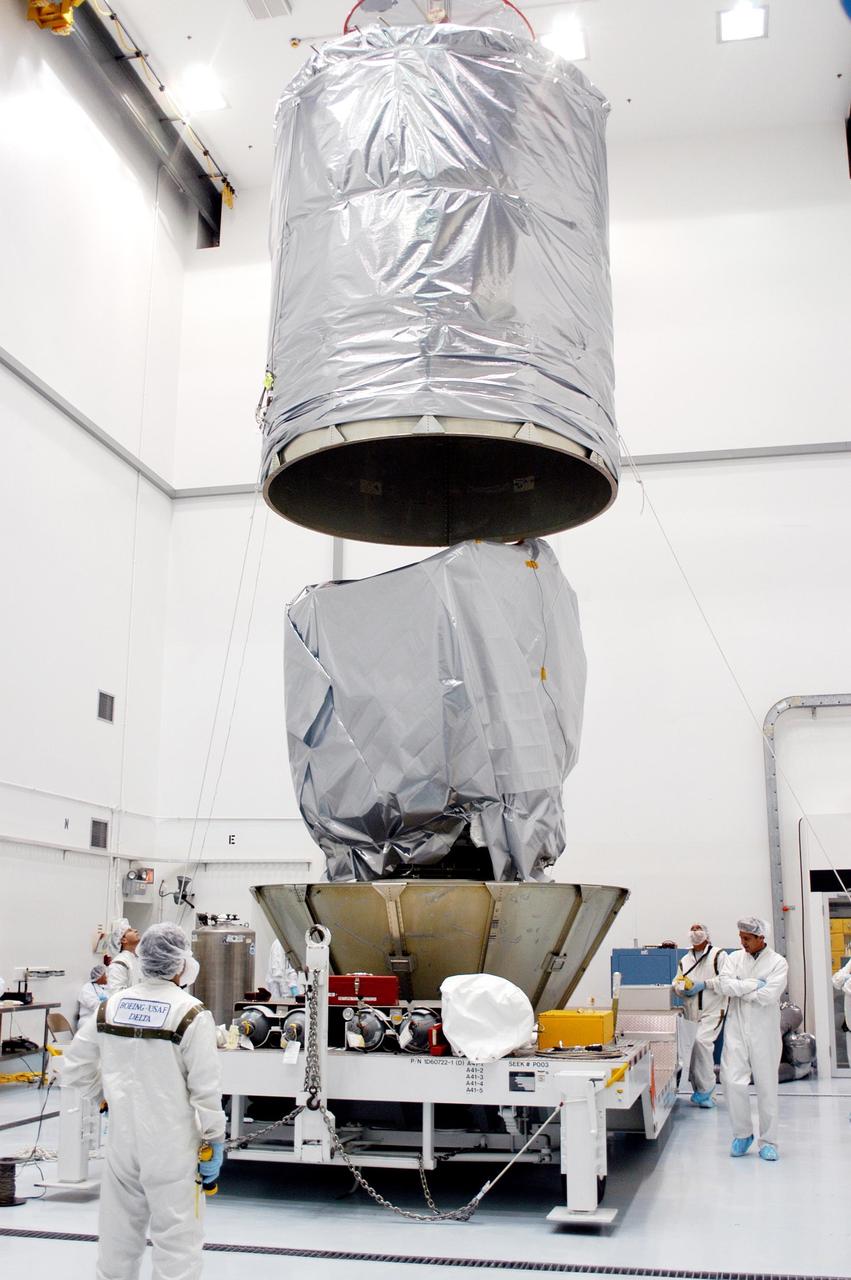
KSC-04pd1405
KENNEDY SPACE CENTER, FLA. - A worker (left) at Astrotech Space Operations in Titusville, Fla., questions another worker about the oxygen connection in his protective suit before spacecraft propellant loading of the MESSENGER (Mercury Surface, Space Environment, Geochemistry and Ranging) spacecraft.  Liftoff of MESSENGER aboard a Boeing Delta II Heavy rocket, bound for Mercury, is scheduled for Aug. 2.  The spacecraft is expected to reach orbit around the planet in March 2011.  MESSENGER was built for NASA by the Johns Hopkins University Applied Physics Laboratory in Laurel, Md.
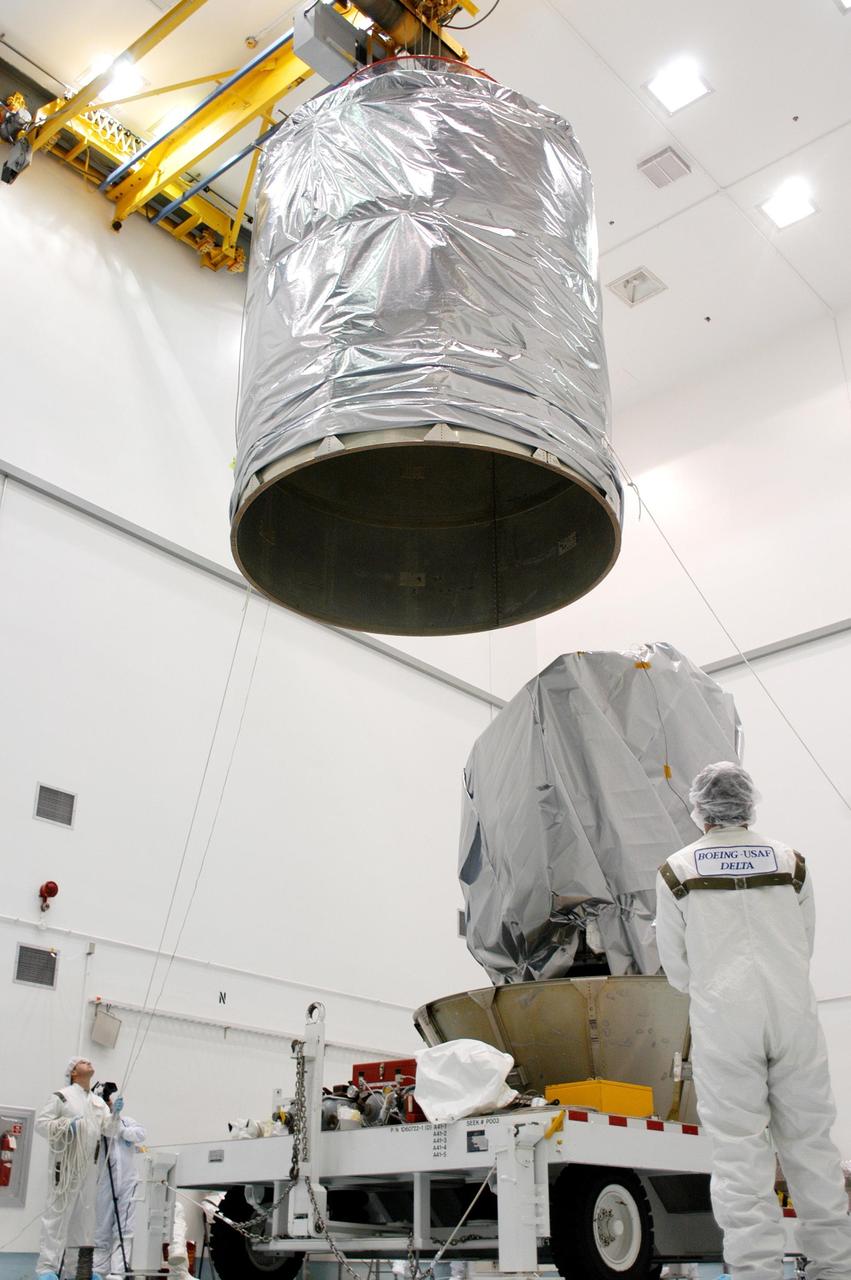
KSC-04pd1433
KENNEDY SPACE CENTER, FLA. -  On Launch Pad 17-B at Cape Canaveral Air Force Station, the MESSENGER spacecraft is lowered into position for mating with the Boeing Delta II Heavy rocket.  Liftoff is scheduled for Aug. 2.  The spacecraft is expected to reach orbit around the planet in March 2011.  MESSENGER was built for NASA by the Johns Hopkins University Applied Physics Laboratory in Laurel, Md.
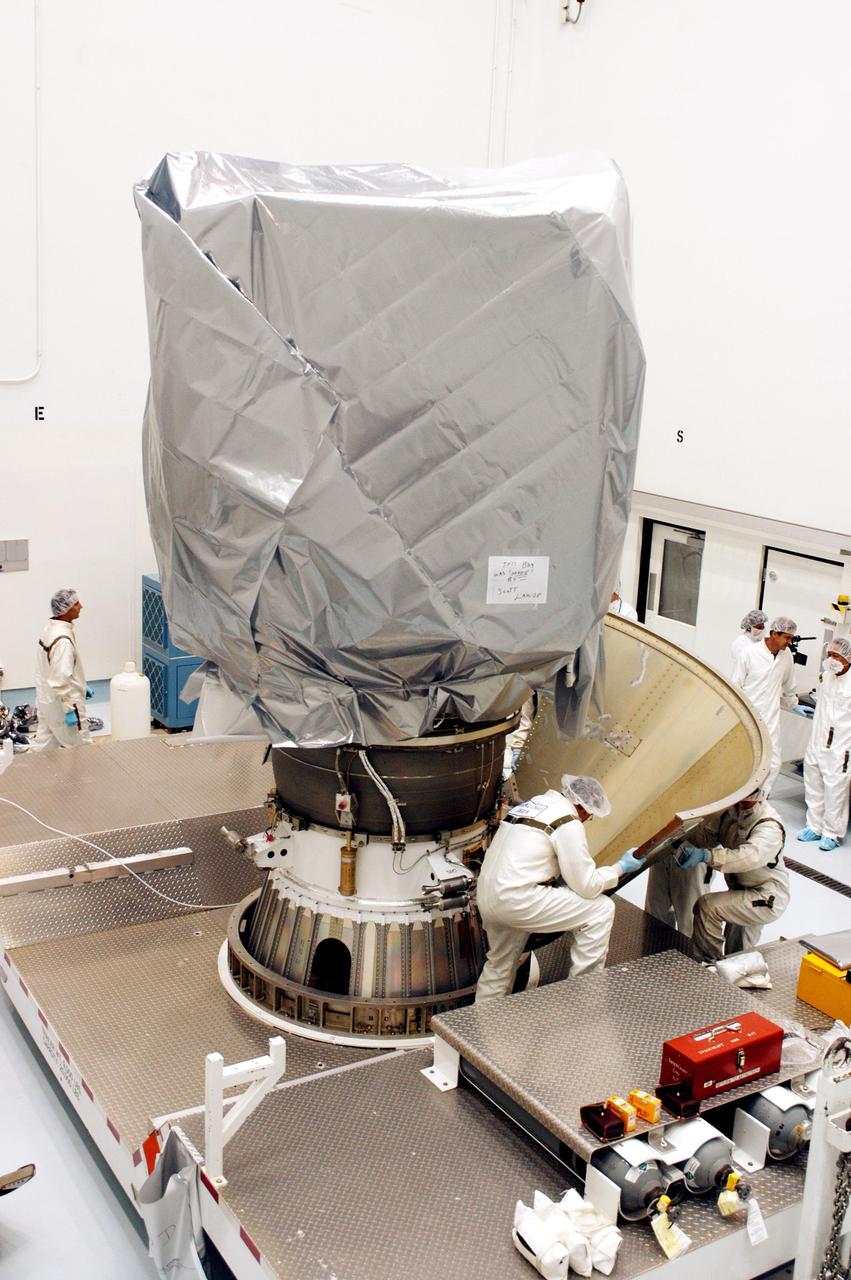
KSC-04pd1524
Workers help guide the second stage of the Delta II Heavy rocket onto the first stage, below. The rocket will launch the Space Infrared Telescope Facility (SIRTF), currently scheduled for mid-August. SIRTF consists of three cryogenically cooled science instruments and an 0.85-meter telescope, and is one of NASA's largest infrared telescopes to be launched. SIRTF will obtain images and spectra by detecting the infrared energy, or heat, radiated by objects in space. Most of this infrared radiation is blocked by the Earth's atmosphere and cannot be observed from the ground.
Delta II - SIRTF Lift and Mate
The second stage of the Delta II Heavy rocket is ready for mating onto the first stage, below. The rocket will launch the Space Infrared Telescope Facility (SIRTF), currently scheduled for mid-August. SIRTF consists of three cryogenically cooled science instruments and an 0.85-meter telescope, and is one of NASA's largest infrared telescopes to be launched. SIRTF will obtain images and spectra by detecting the infrared energy, or heat, radiated by objects in space. Most of this infrared radiation is blocked by the Earth's atmosphere and cannot be observed from the ground.
Delta II - SIRTF Lift and Mate
KENNEDY SPACE CENTER, FLA. - A suited worker at Astrotech Space Operations in Titusville, Fla., looks over the fuel supply to be loaded in the MESSENGER (Mercury Surface, Space Environment, Geochemistry and Ranging) spacecraft.  Liftoff of MESSENGER aboard a Boeing Delta II Heavy rocket, bound for Mercury, is scheduled for Aug. 2.  The spacecraft is expected to reach orbit around the planet in March 2011.  MESSENGER was built for NASA by the Johns Hopkins University Applied Physics Laboratory in Laurel, Md.
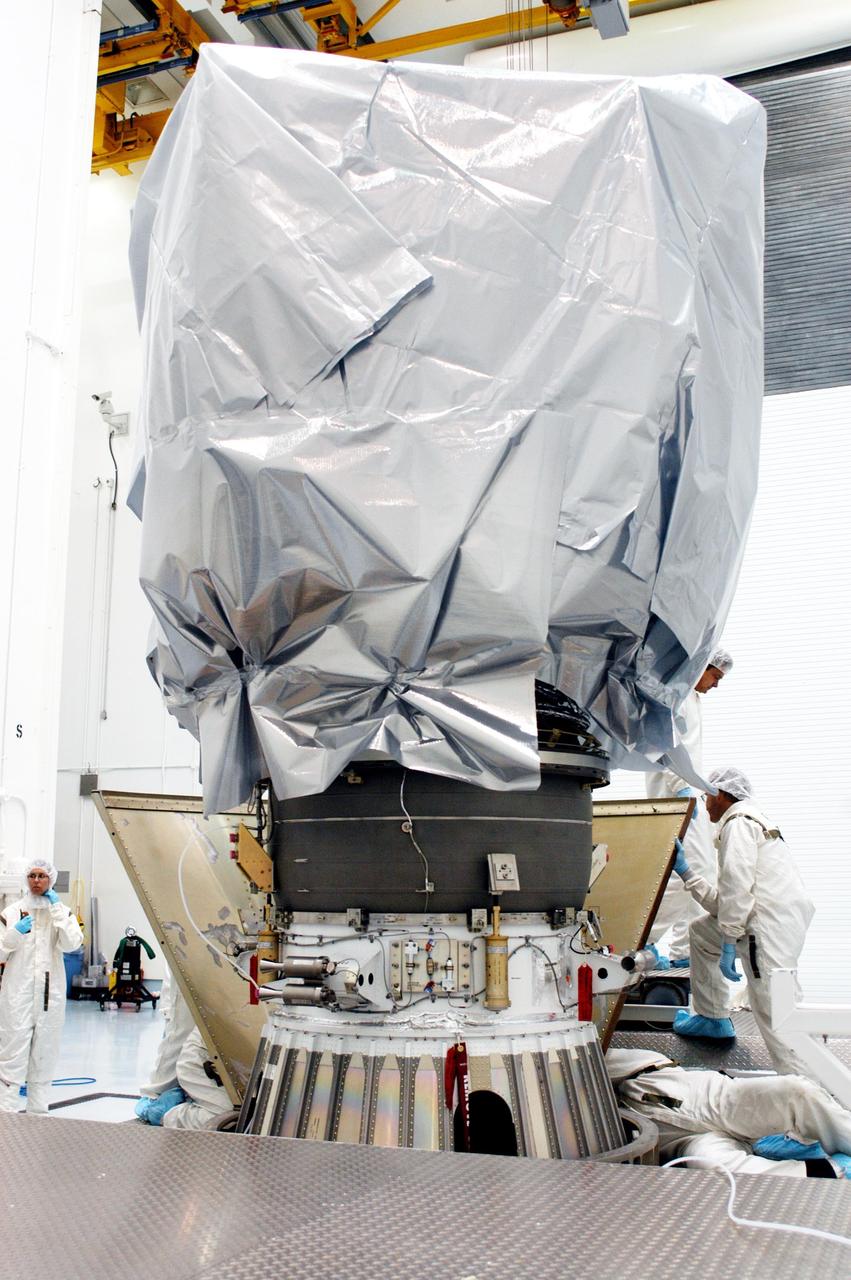
KSC-04pd1435