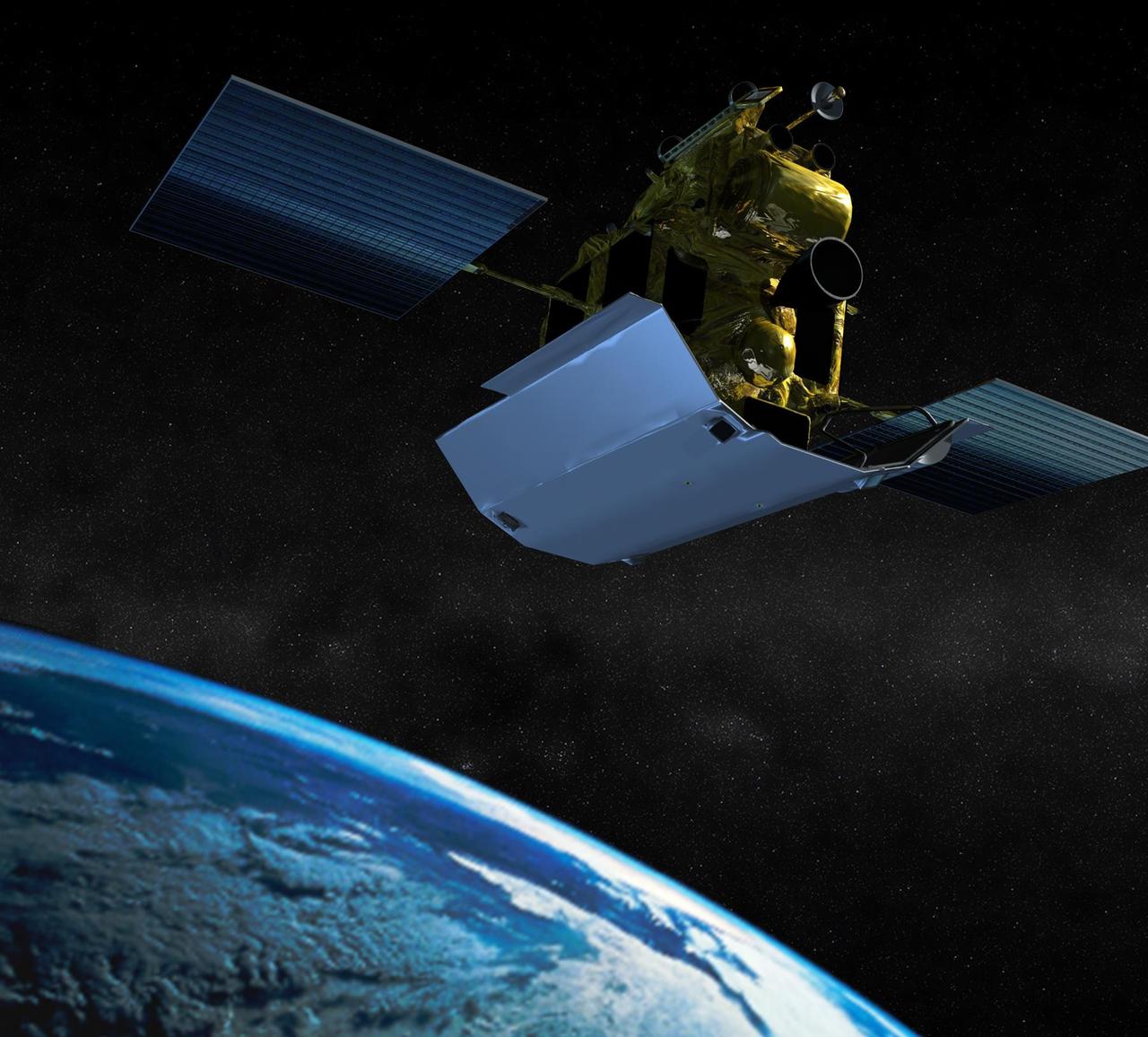
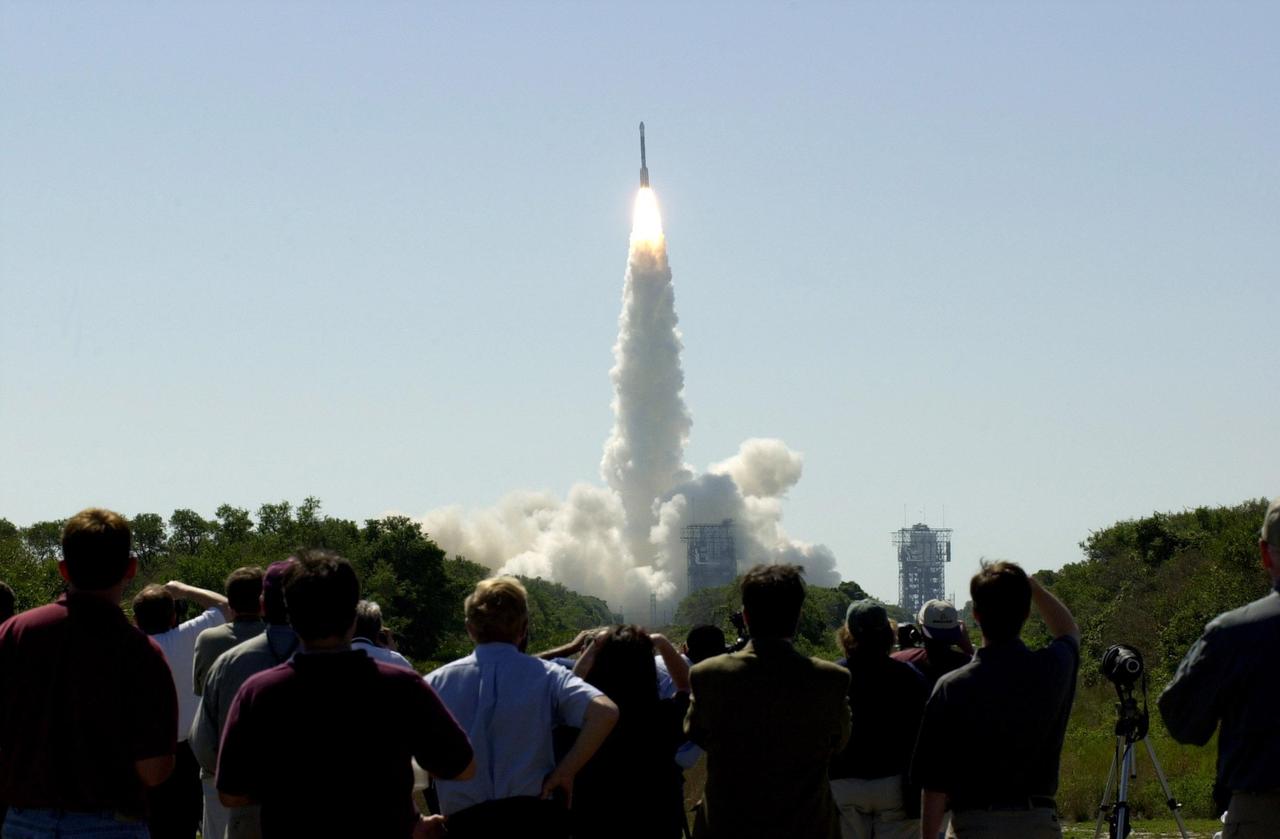
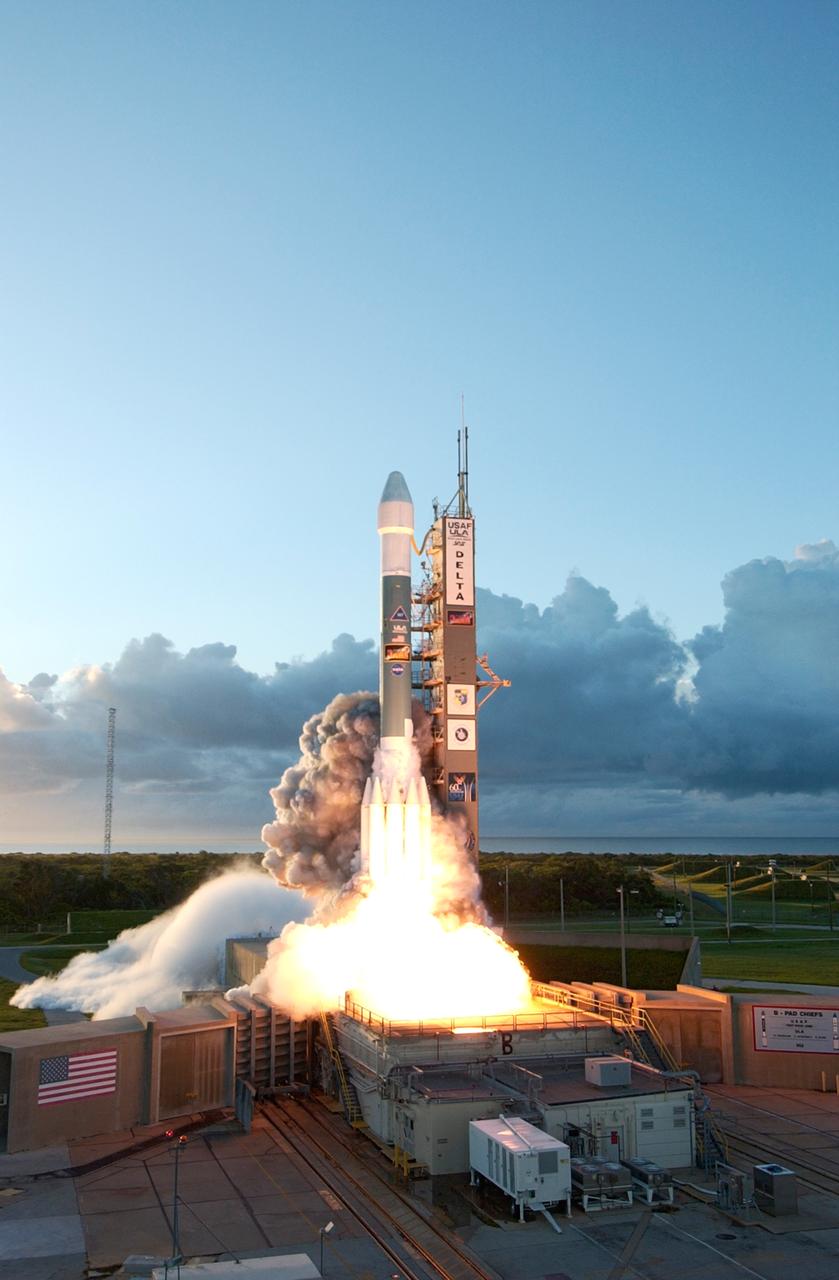
Against a backdrop of clouds on the horizon, the Delta II rocket carrying NASA's Dawn spacecraft rises from the smoke and fire on the launch pad to begin its 1.7-billion-mile journey through the inner solar system to study a pair of asteroids. Liftoff was at 7:34 a.m. EDT from Pad 17-B at Cape Canaveral Air Force Station. Dawn is the ninth mission in NASA's Discovery Program. The spacecraft will be the first to orbit two planetary bodies, asteroid Vesta and dwarf planet Ceres, during a single mission. Vesta and Ceres lie in the asteroid belt between Mars and Jupiter. It is also NASA's first purely scientific mission powered by three solar electric ion propulsion engines.
Delta II rocket carrying NASA's Dawn spacecraft launches from pa
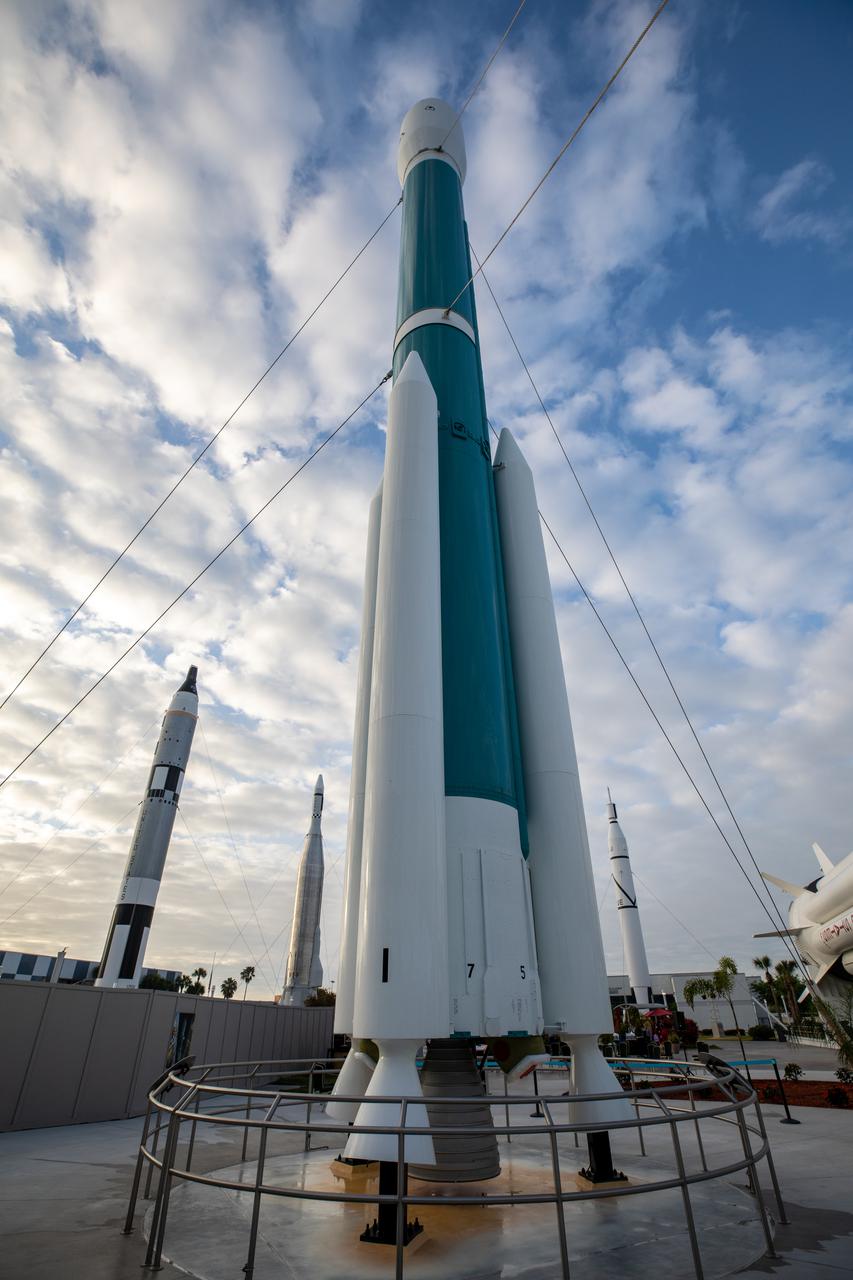
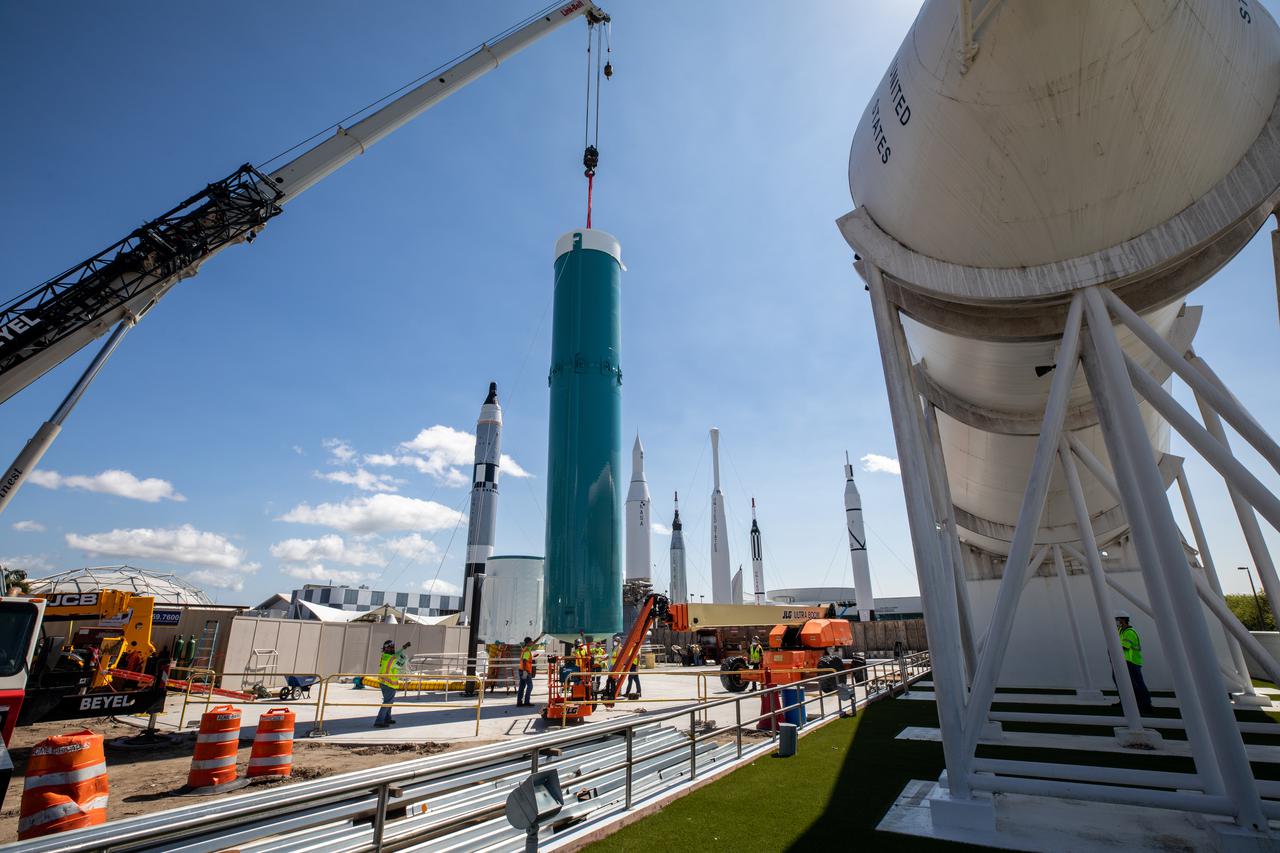
The last United Launch Alliance Delta II rocket joined the lineup of historic launch vehicles in the Rocket Garden at the Kennedy Space Center Visitor Complex in Florida, on March 3, 2021. Workers use a crane to stack the segments of the Delta II in its display area. The Delta II rocket was a workhorse for NASA and civilian scientists, the U.S. military, and commercial clients throughout its almost 30 years of service. Since its first launch in 1989, the Delta II has launched 154 successful missions. NASA’s Launch Services Program launched the ICESat-2 spacecraft on the final Delta II launch on Sept. 15, 2018, from Vandenberg Air Force Base in California.
Delta II Rocket at KSC Visitor Complex
The last United Launch Alliance Delta II rocket joined the lineup of historic launch vehicles in the Rocket Garden at the Kennedy Space Center Visitor Complex in Florida, on March 3, 2021. Workers use a crane to stack the segments of the Delta II in its display area. The Delta II rocket was a workhorse for NASA and civilian scientists, the U.S. military, and commercial clients throughout its almost 30 years of service. Since its first launch in 1989, the Delta II has launched 154 successful missions. NASA’s Launch Services Program launched the ICESat-2 spacecraft on the final Delta II launch on Sept. 15, 2018, from Vandenberg Air Force Base in California.
Delta II Rocket at KSC Visitor Complex
The last United Launch Alliance Delta II rocket joined the lineup of historic launch vehicles in the Rocket Garden at the Kennedy Space Center Visitor Complex in Florida, on March 3, 2021. The first segment was placed in its display area. The Delta II rocket was a workhorse for NASA and civilian scientists, the U.S. military, and commercial clients throughout its almost 30 years of service. Since its first launch in 1989, the Delta II has launched 154 successful missions. NASA’s Launch Services Program launched the ICESat-2 spacecraft on the final Delta II launch on Sept. 15, 2018, from Vandenberg Air Force Base in California.
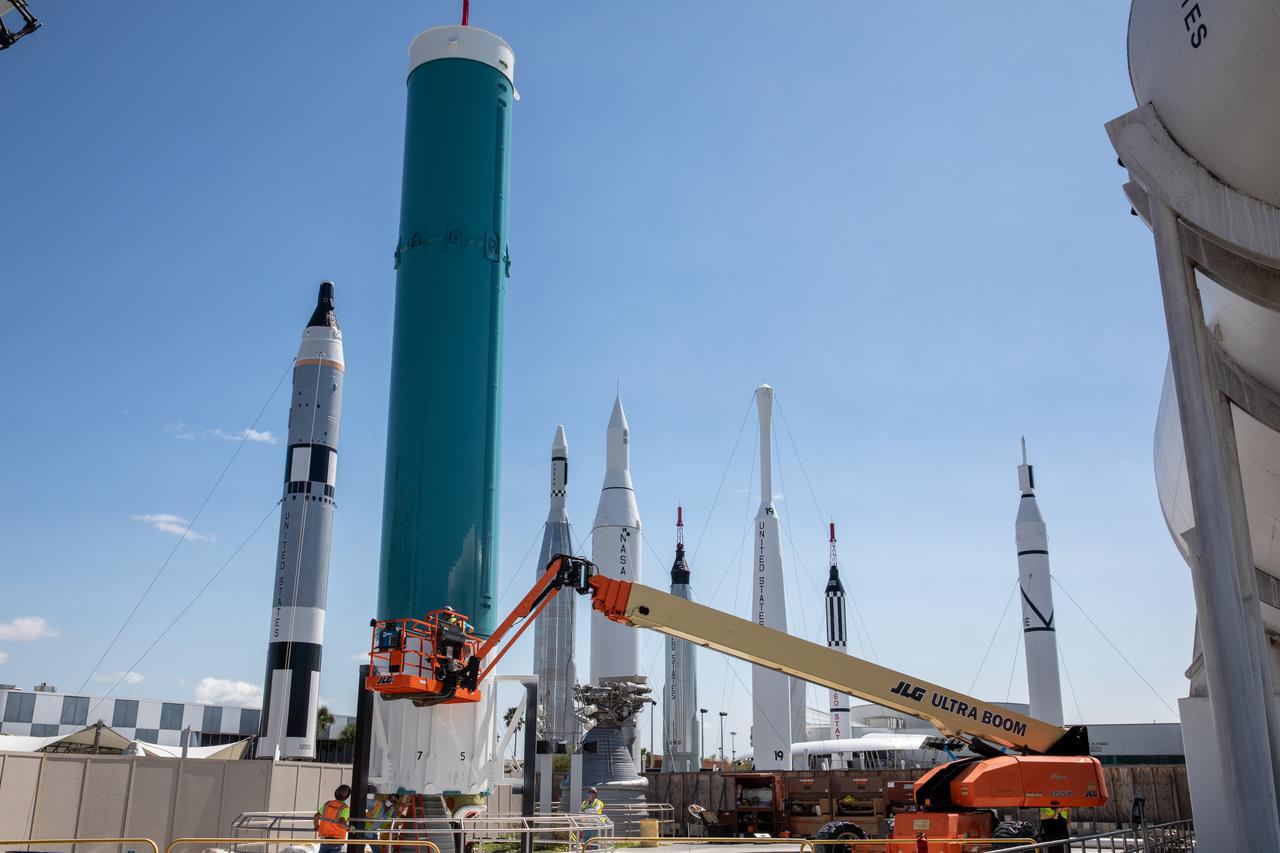
Delta II Rocket at KSC Visitor Complex
The last United Launch Alliance Delta II rocket joined the lineup of historic launch vehicles in the Rocket Garden at the Kennedy Space Center Visitor Complex in Florida, on March 3, 2021. Workers use a crane to lift a segment of the Delta II for stacking in its display area. The Delta II rocket was a workhorse for NASA and civilian scientists, the U.S. military, and commercial clients throughout its almost 30 years of service. Since its first launch in 1989, the Delta II has launched 154 successful missions. NASA’s Launch Services Program launched the ICESat-2 spacecraft on the final Delta II launch on Sept. 15, 2018, from Vandenberg Air Force Base in California.
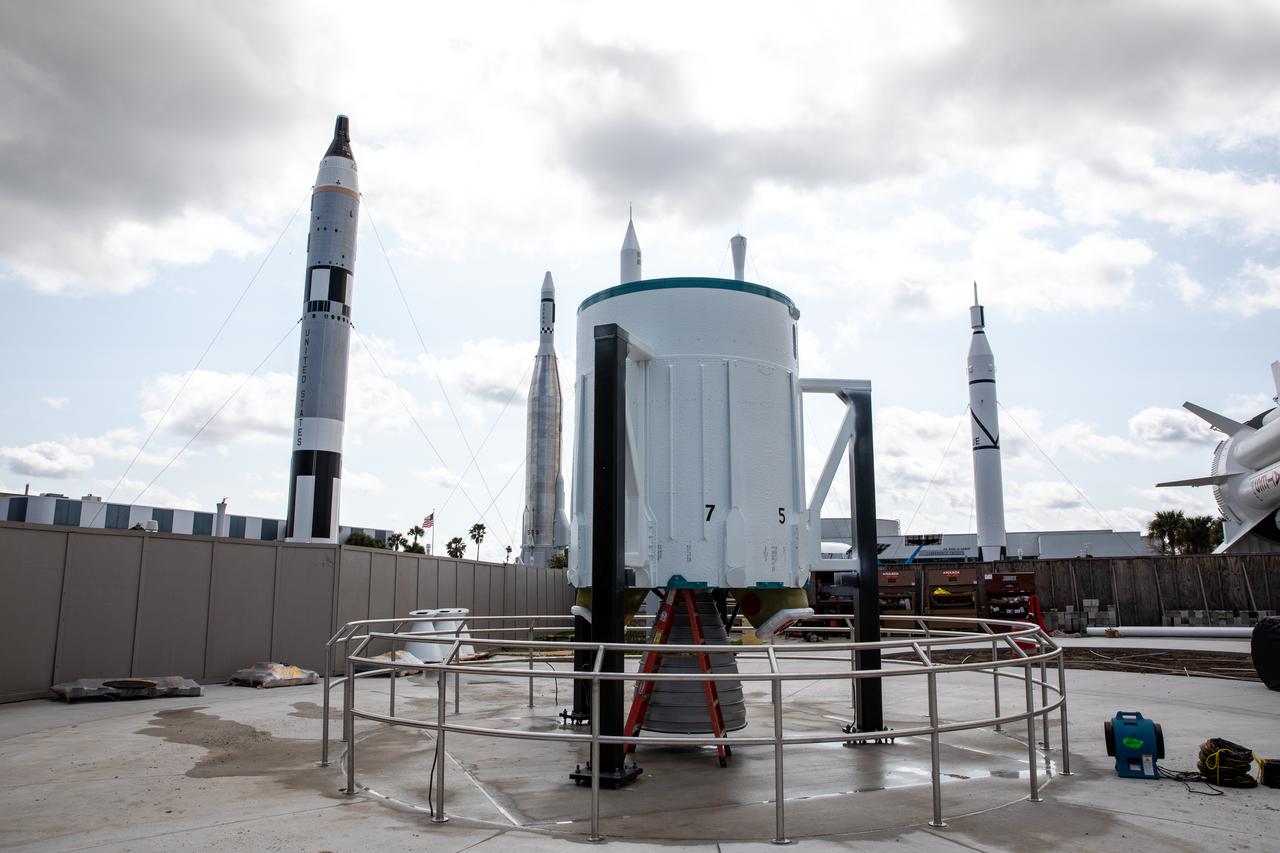
Delta II Rocket at KSC Visitor Complex
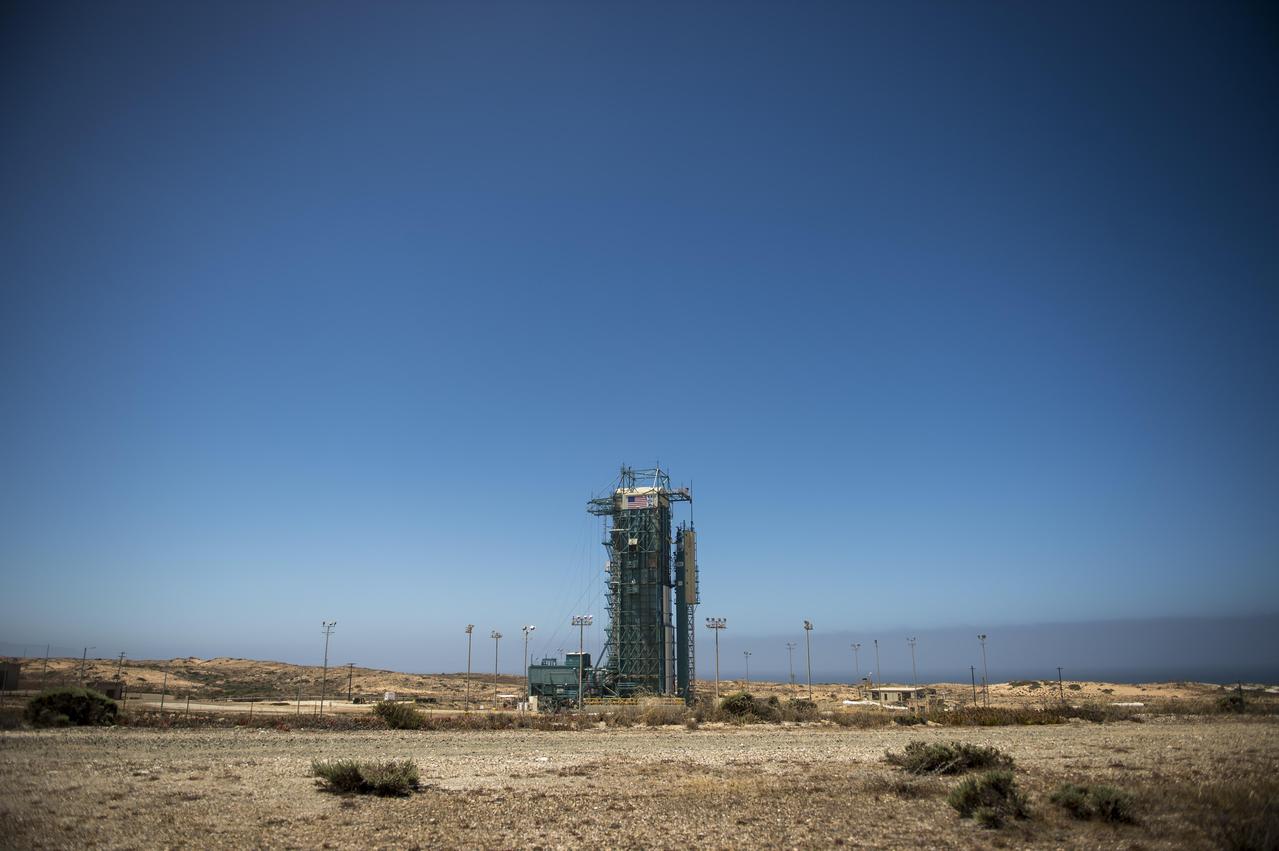
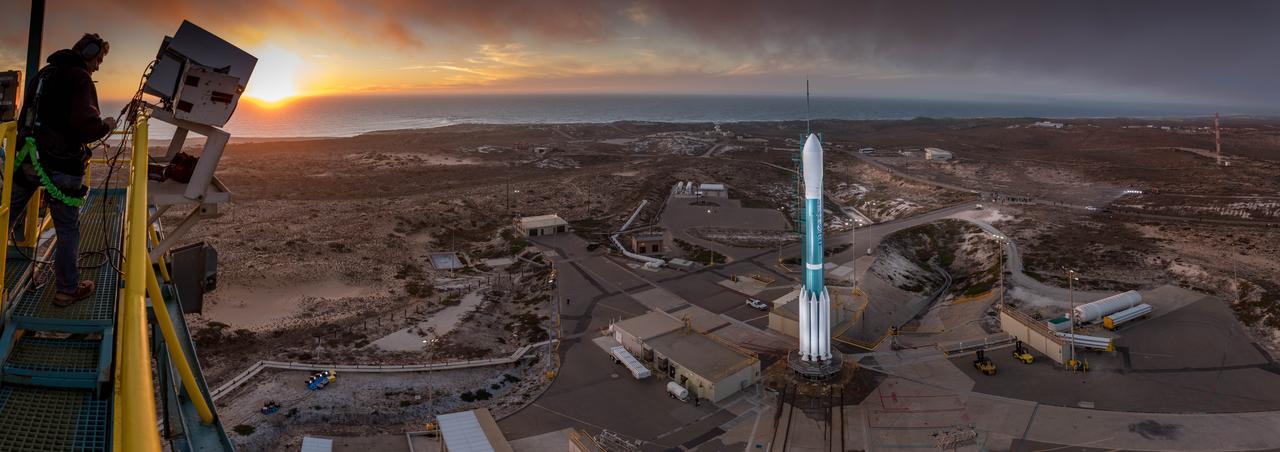
At Vandenberg Air Force Base in California, this panoramic view shows the United Launch Alliance Delta II rocket at Space Launch Complex 2 from the gantry shortly after rollback. Preparations are underway to launch the Joint Polar Satellite System-1, or JPSS-1, spacecraft built by Ball Aerospace and Technologies Corp. of Boulder, Colorado. JPSS is the first in a series four next-generation environmental satellites in a collaborative program between the NOAA and NASA.
Delta II JPSS-1 Rocket on Pad
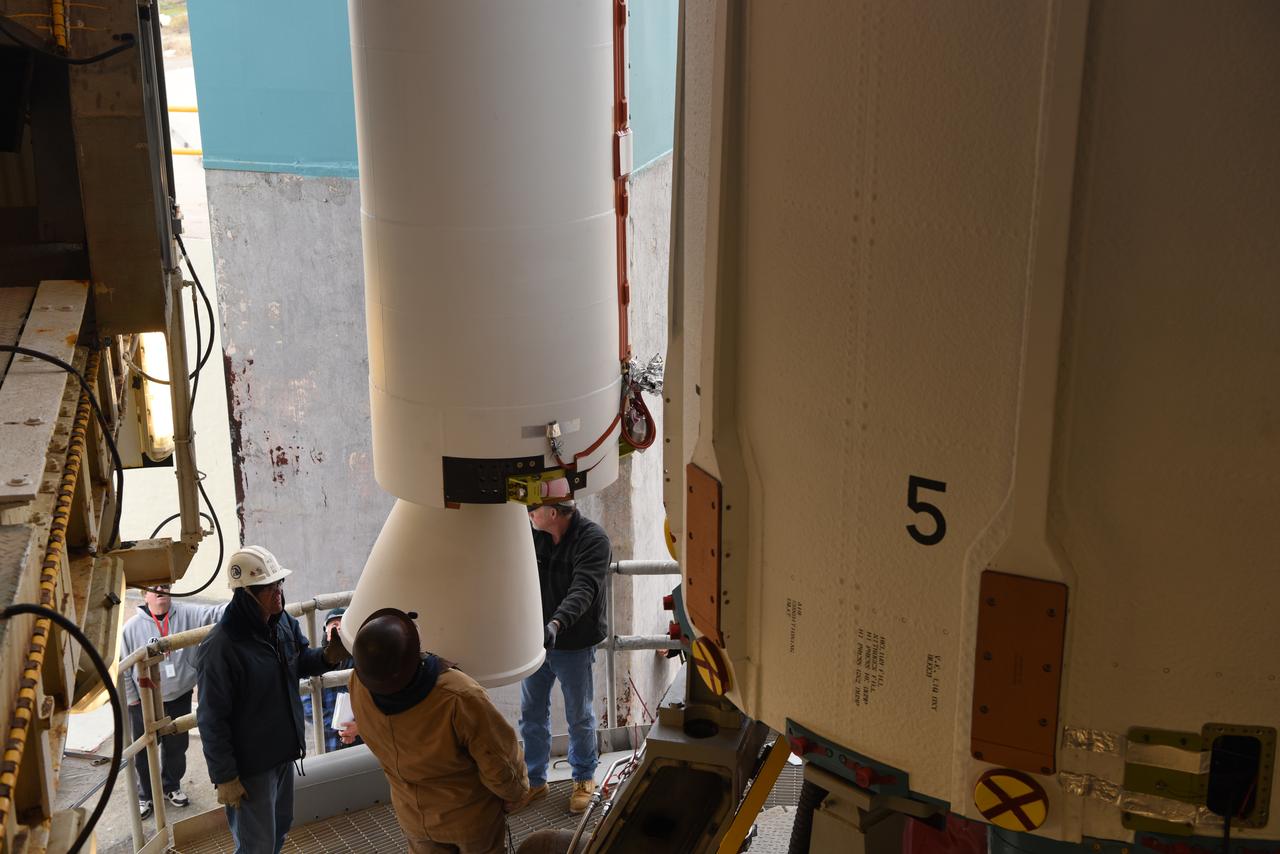
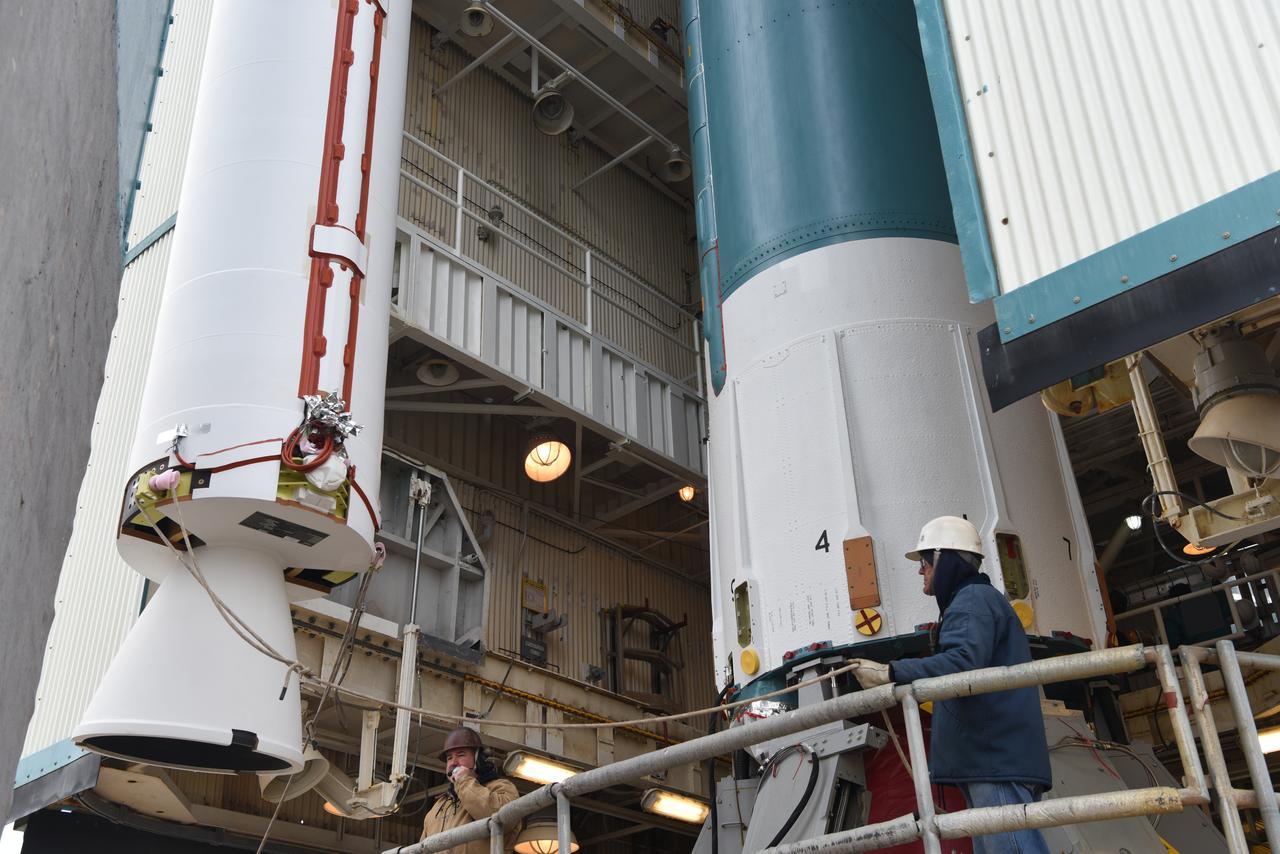
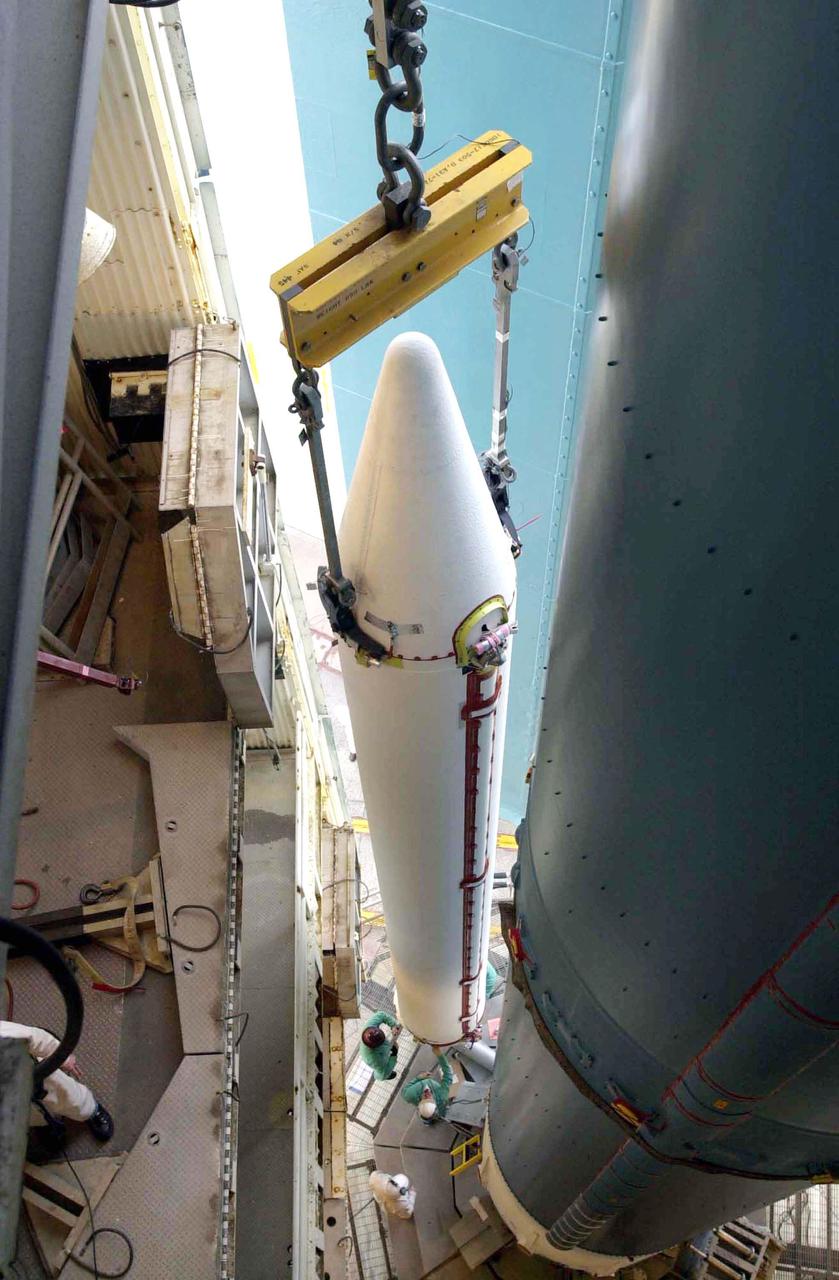
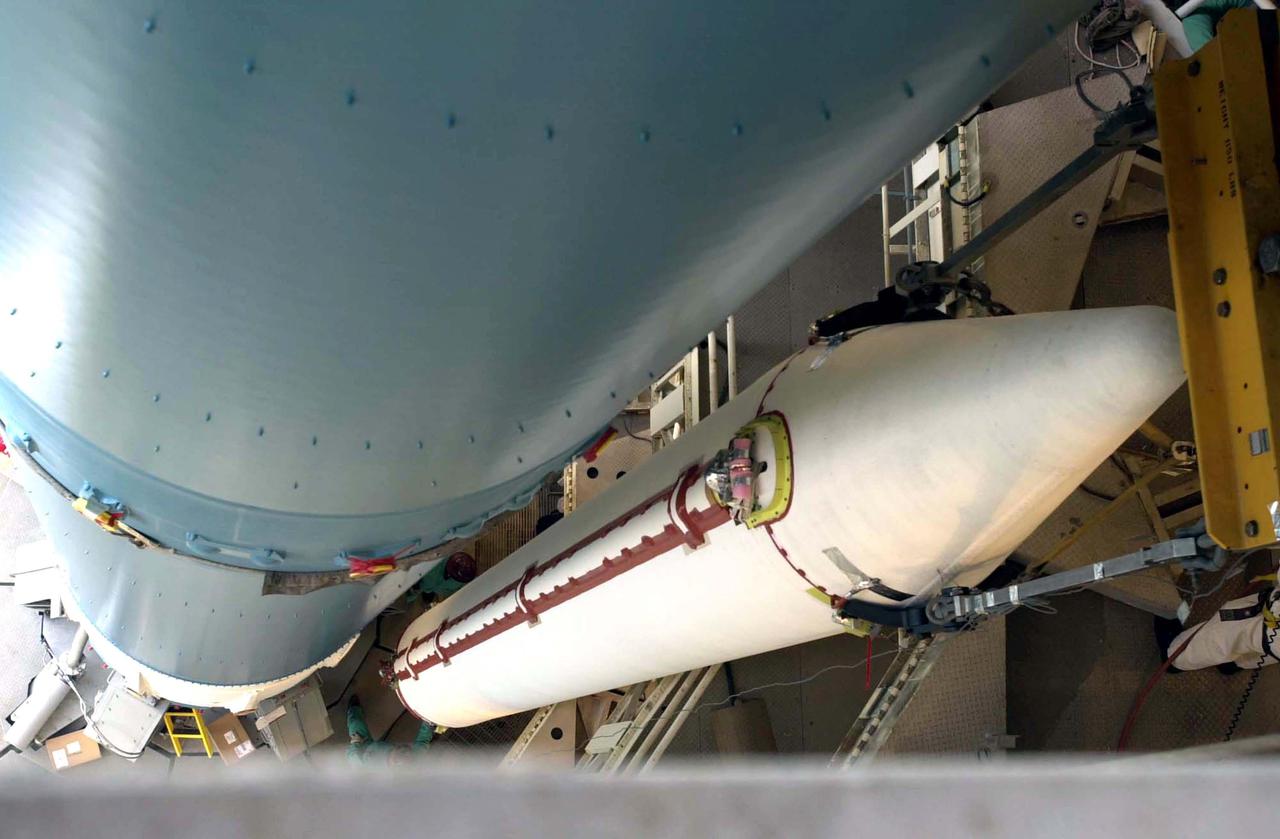
At Vandenberg Air Force Base in California, a solid rocket motor is attached to a United Launch Alliance Delta II rocket at Space Launch Complex 2. Preparations are continuing for launch of the Joint Polar Satellite System (JPSS-1) spacecraft on March 27, 2017. JPSS-1 is part of the next-generation environmental satellite system, a collaborative program between the National Oceanic and Atmospheric Administration (NOAA) and NASA.
Delta II JPSS-1 Solid Rocket Motor (SRM) Hoist and Mate
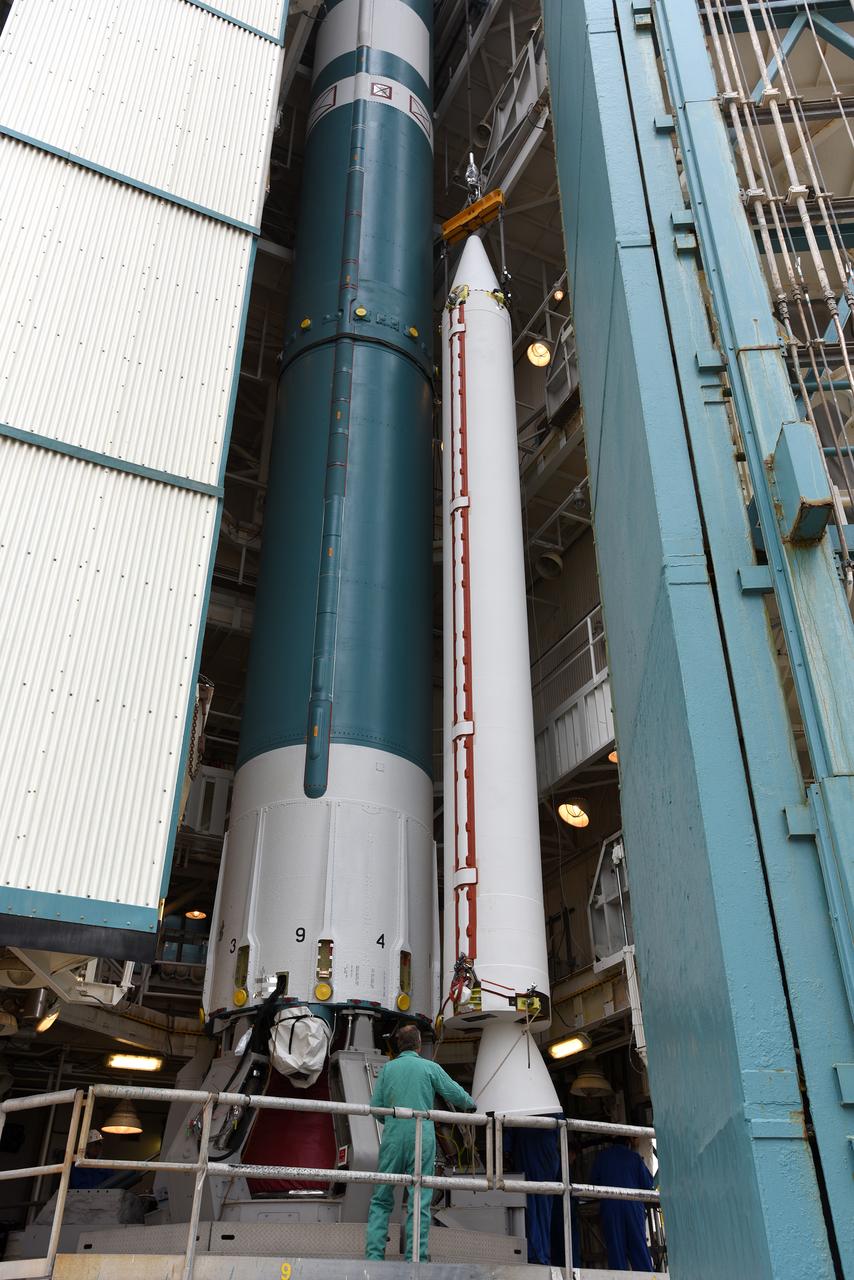
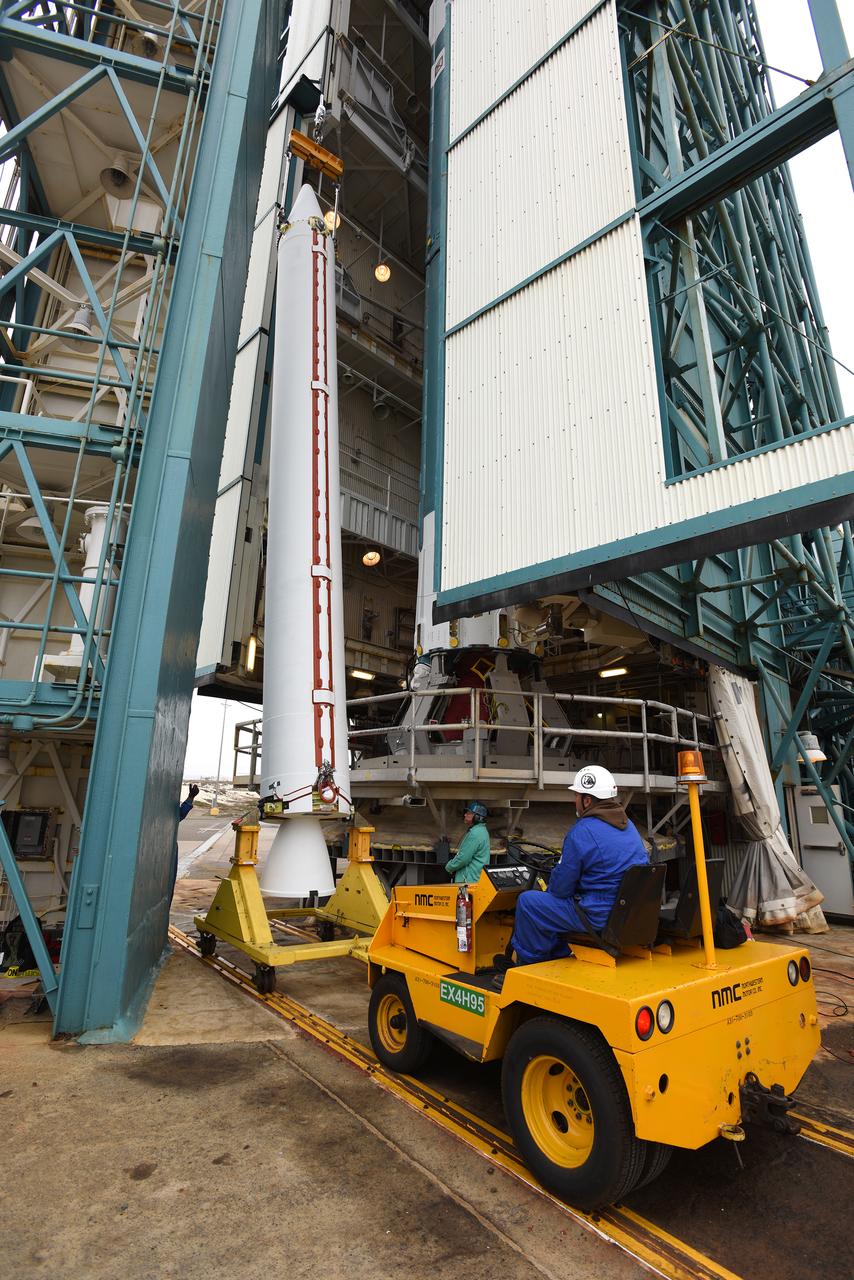
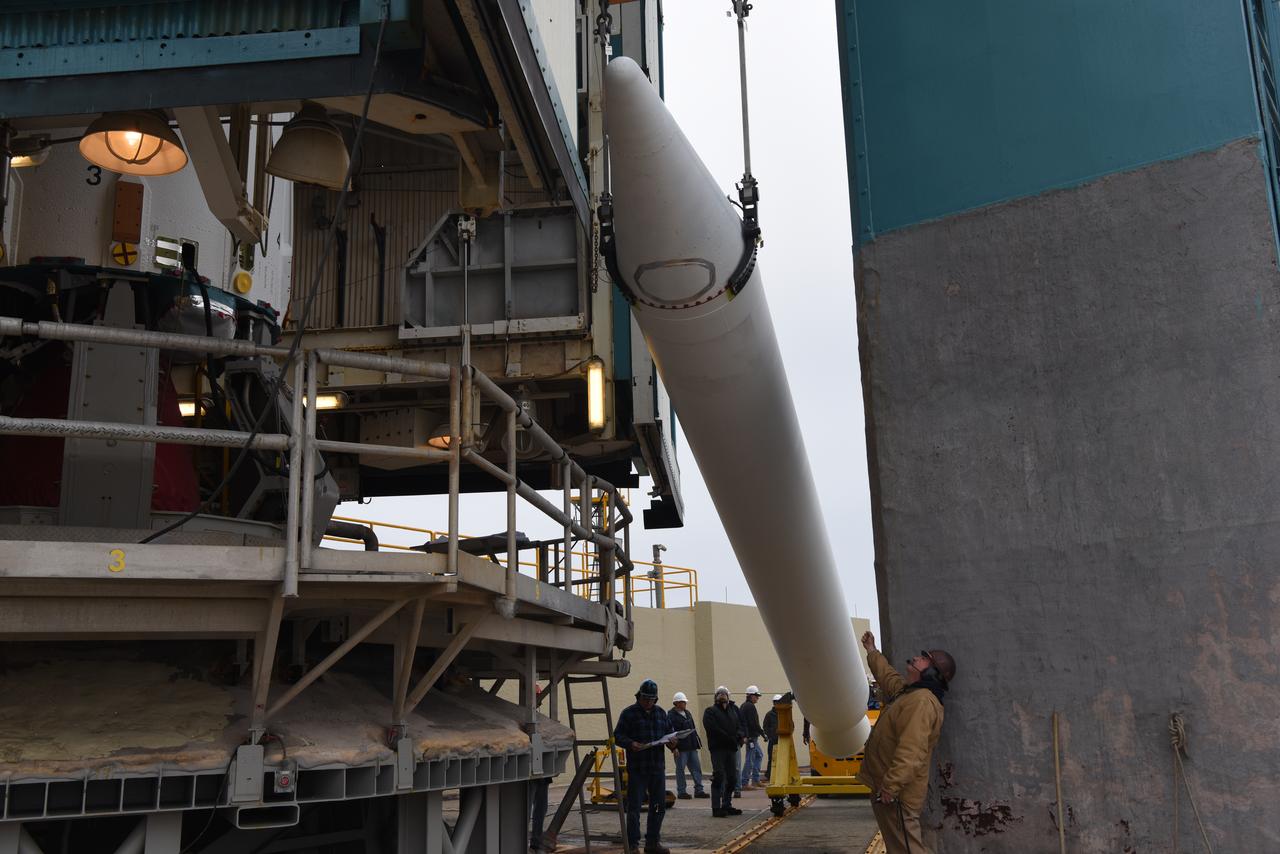
At Vandenberg Air Force Base in California, a solid rocket motor is lifted at Space Launch Complex 2 to be attached to a United Launch Alliance Delta II rocket. Preparations are continuing for launch of the Joint Polar Satellite System (JPSS-1) spacecraft on March 27, 2017. JPSS-1 is part of the next-generation environmental satellite system, a collaborative program between the National Oceanic and Atmospheric Administration (NOAA) and NASA.
Delta II JPSS-1 Solid Rocket Motor (SRM) Hoist and Mate
At Vandenberg Air Force Base in California, a solid rocket motor is lifted at Space Launch Complex 2 to be attached to a United Launch Alliance Delta II rocket. Preparations are continuing for launch of the Joint Polar Satellite System (JPSS-1) spacecraft on March 27, 2017. JPSS-1 is part of the next-generation environmental satellite system, a collaborative program between the National Oceanic and Atmospheric Administration (NOAA) and NASA.
Delta II JPSS-1 Solid Rocket Motor (SRM) Hoist and Mate
At Vandenberg Air Force Base in California, a solid rocket motor is lifted at Space Launch Complex 2 to be attached to a United Launch Alliance Delta II rocket. Preparations are continuing for launch of the Joint Polar Satellite System (JPSS-1) spacecraft on March 27, 2017. JPSS-1 is part of the next-generation environmental satellite system, a collaborative program between the National Oceanic and Atmospheric Administration (NOAA) and NASA.
Delta II JPSS-1 Solid Rocket Motor (SRM) Hoist and Mate
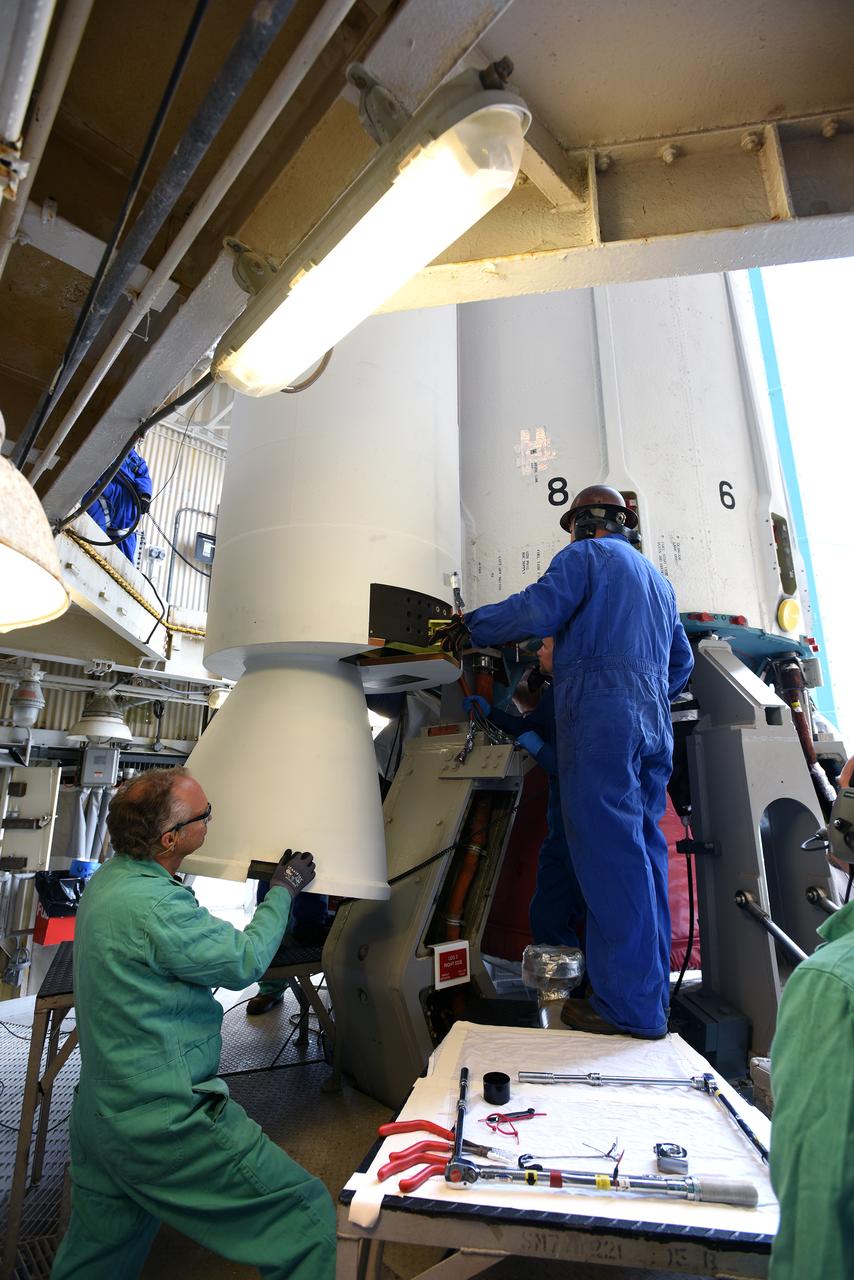
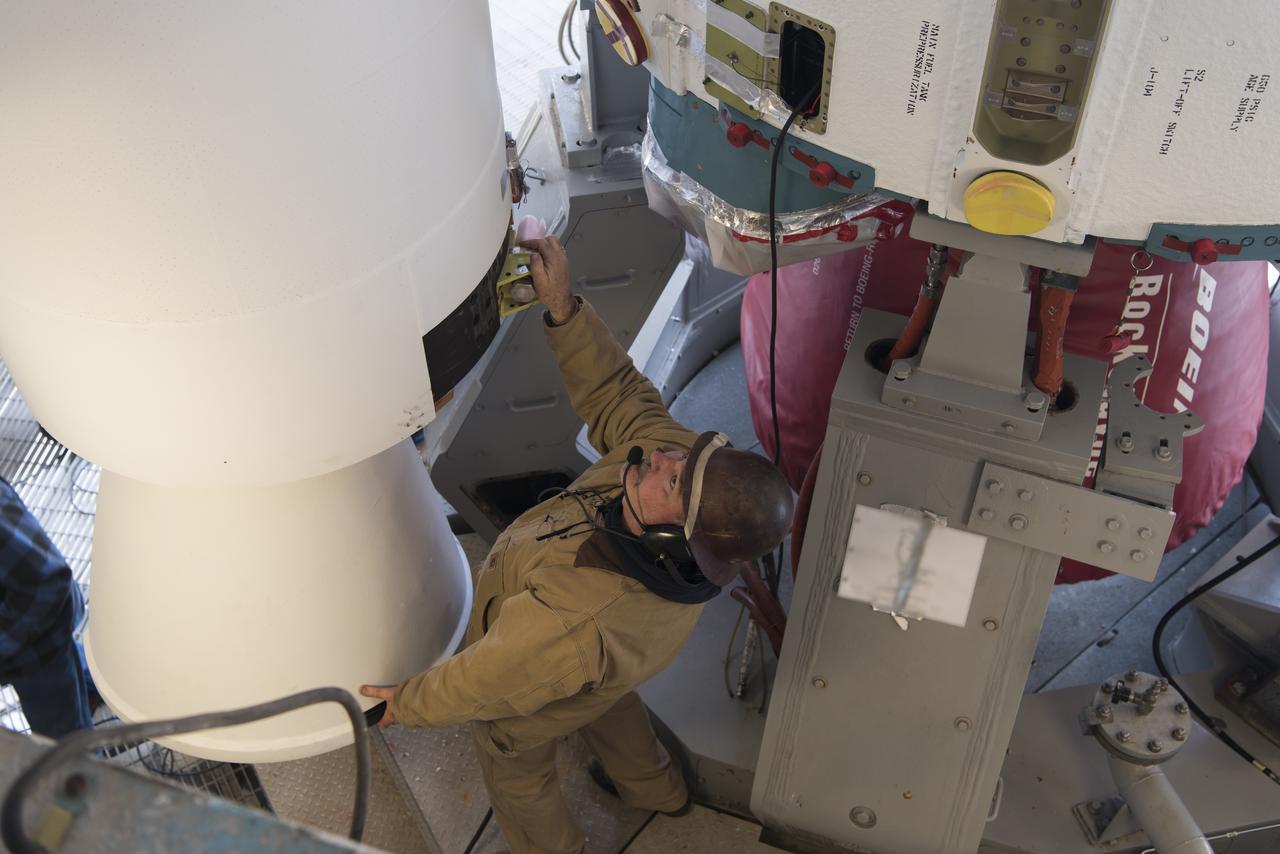
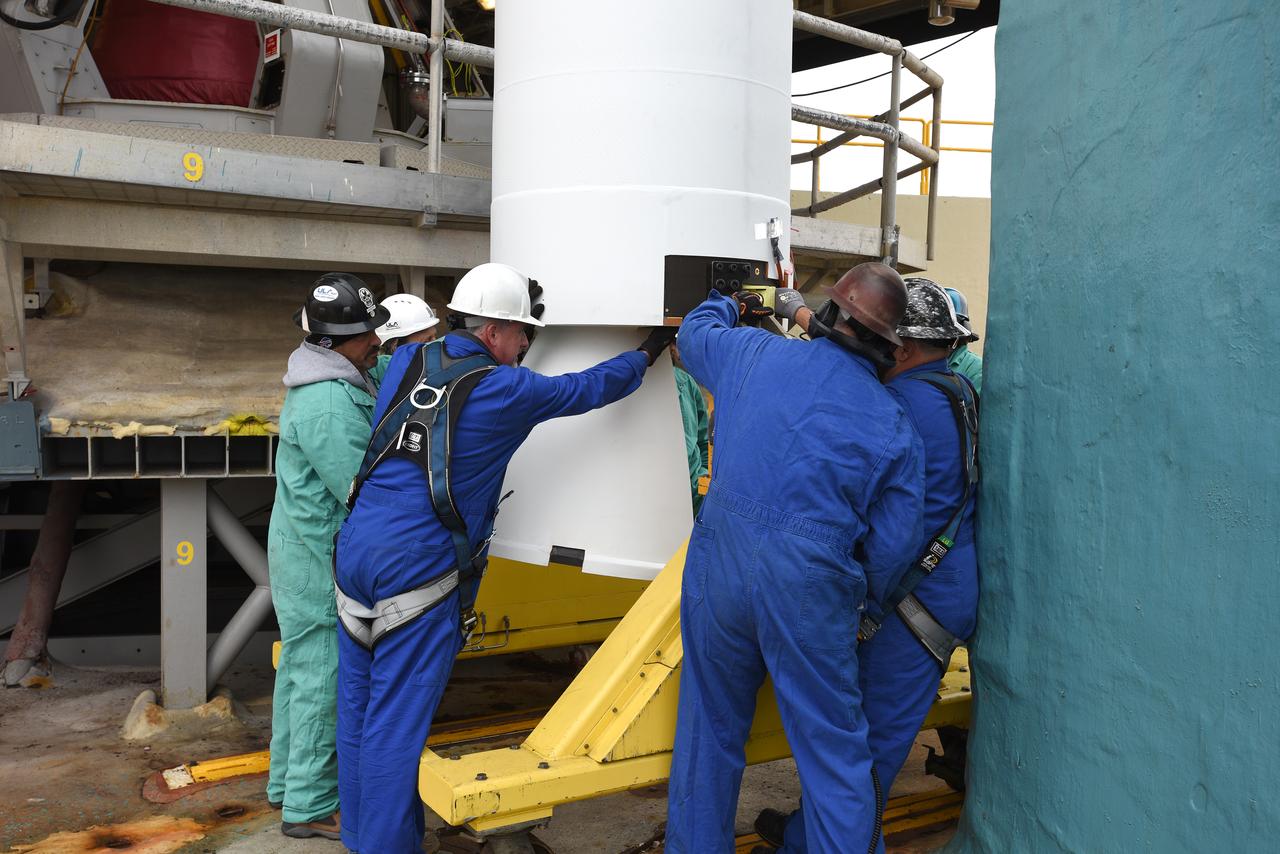
At Vandenberg Air Force Base in California, technicians inspect a solid rocket motor at Space Launch Complex 2 as it is attached to a United Launch Alliance Delta II rocket. Preparations are continuing for launch of the Joint Polar Satellite System (JPSS-1) spacecraft on March 27, 2017. JPSS-1 is part of the next-generation environmental satellite system, a collaborative program between the National Oceanic and Atmospheric Administration (NOAA) and NASA.
Delta II JPSS-1 Solid Rocket Motor (SRM) Hoist and Mate
At Vandenberg Air Force Base in California, technicians inspect a solid rocket motor at Space Launch Complex 2 as it is attached to a United Launch Alliance Delta II rocket. Preparations are continuing for launch of the Joint Polar Satellite System (JPSS-1) spacecraft on March 27, 2017. JPSS-1 is part of the next-generation environmental satellite system, a collaborative program between the National Oceanic and Atmospheric Administration (NOAA) and NASA.
Delta II JPSS-1 Solid Rocket Motor (SRM) Hoist and Mate
At Vandenberg Air Force Base in California, a solid rocket motor is lifted at Space Launch Complex 2 to be attached to a United Launch Alliance Delta II rocket. Preparations are continuing for launch of the Joint Polar Satellite System (JPSS-1) spacecraft on March 27, 2017. JPSS-1 is part of the next-generation environmental satellite system, a collaborative program between the National Oceanic and Atmospheric Administration (NOAA) and NASA.
Delta II JPSS-1 Solid Rocket Motor (SRM) Hoist and Mate
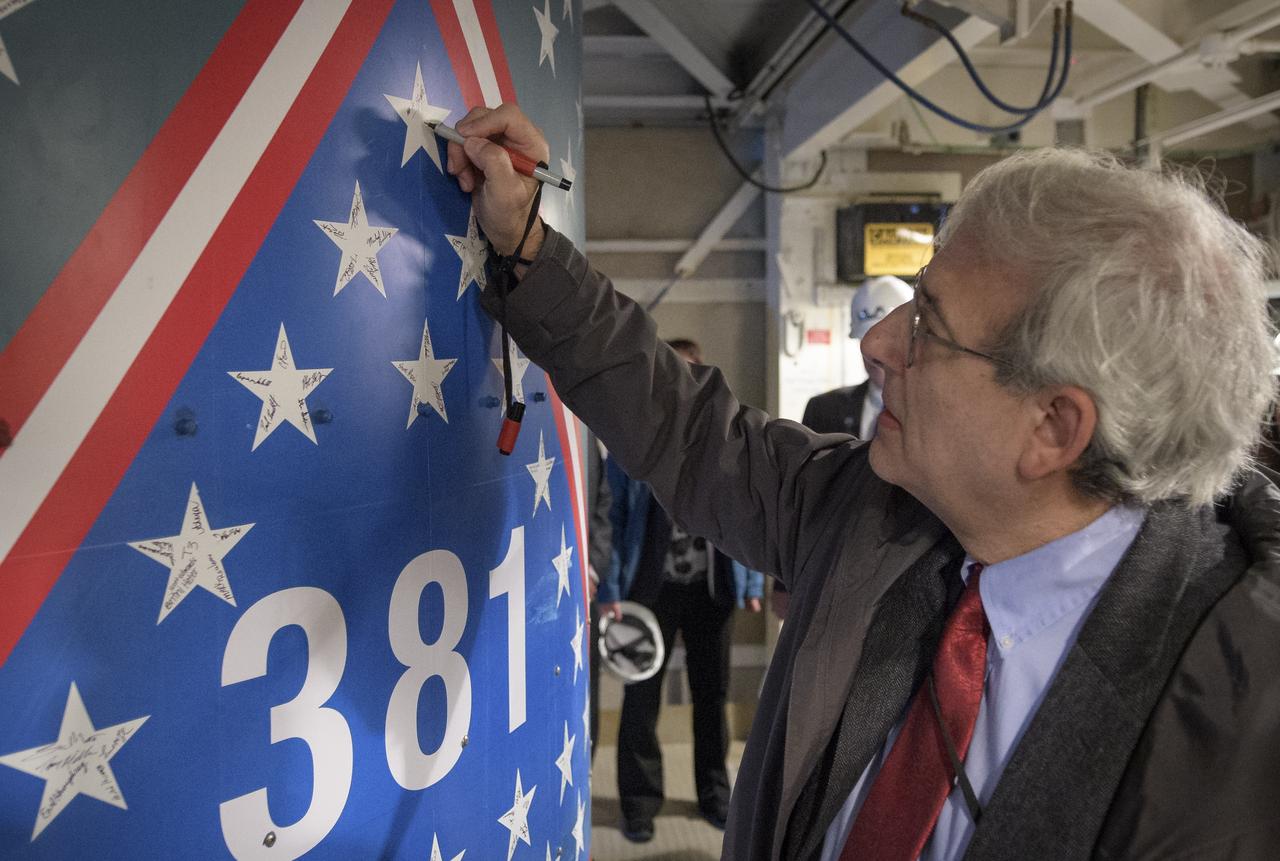
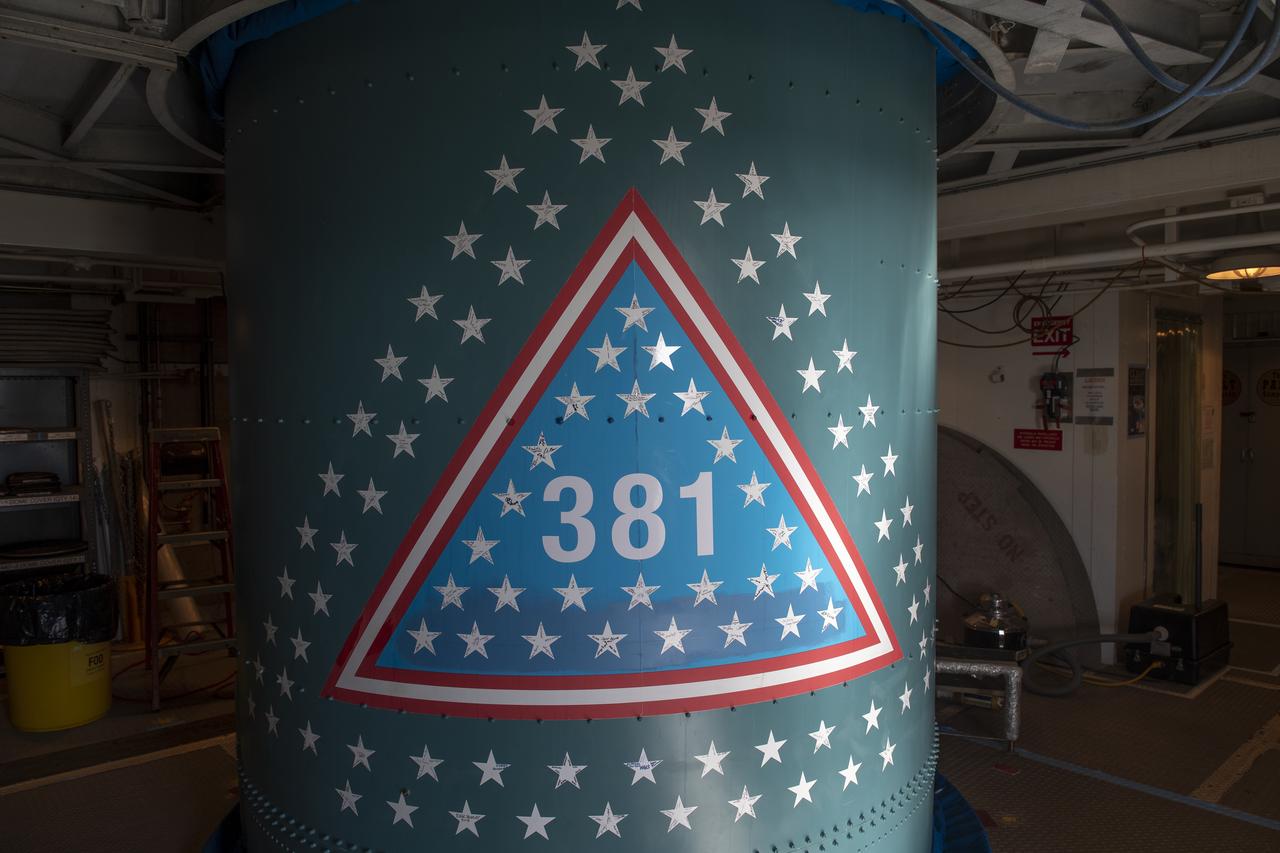
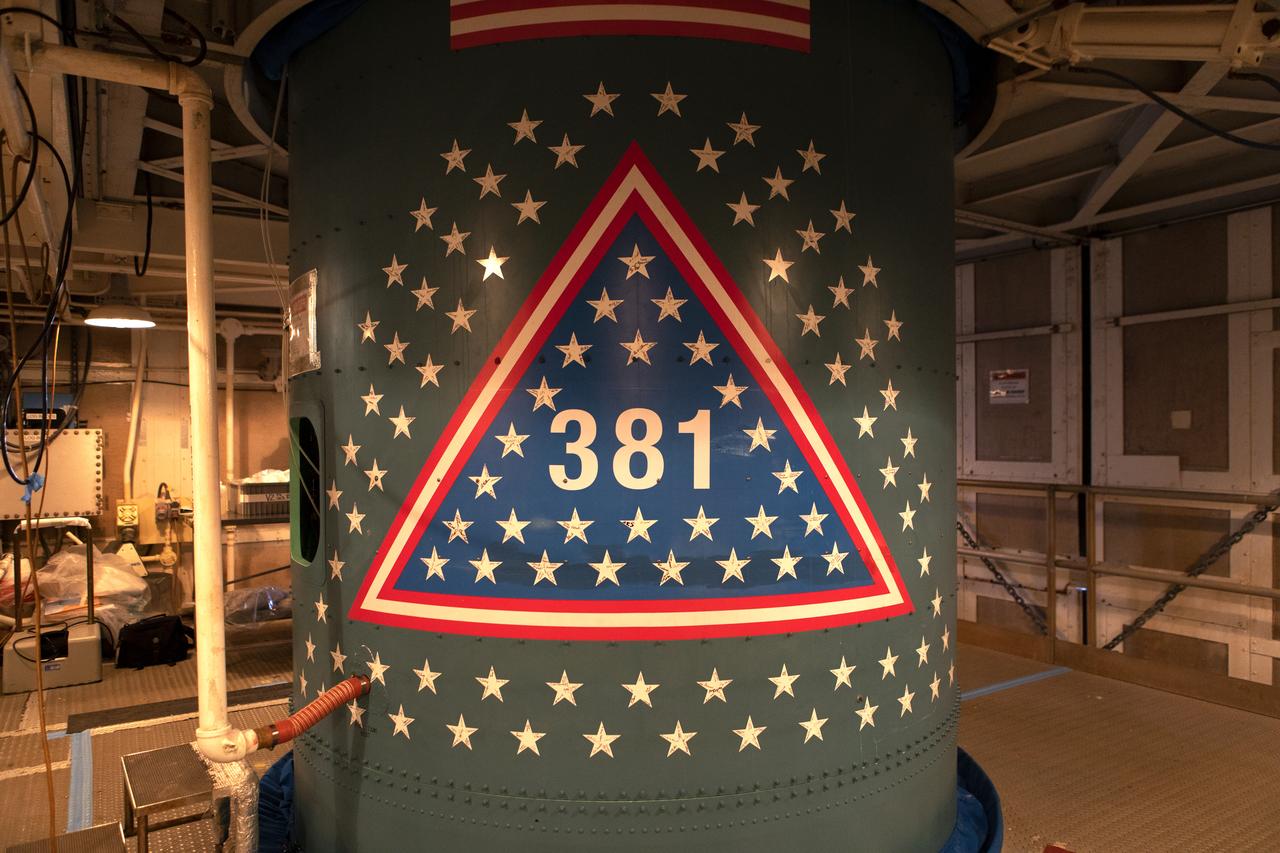
Michael Freilich, director of NASA’s Earth Science Division, NASA Headquarters, signs a star on the United Launch Alliance Delta II with the NASA Ice, Cloud and land Elevation Satellite-2 (ICESat-2) onboard, Thursday, Sept. 13, 2018, at Vandenberg Air Force Base in California. This will be the final launch of a Delta II rocket. The “381” on the rocket signifies that this is the 381st flight in the Delta family. The first Delta I was launched in May 1960. A star traditionally was placed on the rocket to recognize each mission. For the final Delta II, stars were sent to team members and partners throughout the nation. This rocket boasts more than 150 stars with over 800 signatures of people who have been part of the Delta II program. The ICESat-2 mission will measure the changing height of Earth's ice. Photo Credit: (NASA/Bill Ingalls)
ICESat-2 Prelaunch
At Vandenberg Air Force Base in California, a United Launch Alliance Delta II rocket stands at Space Launch Complex 2 as preparations are continuing for launch of the Joint Polar Satellite System (JPSS-1) spacecraft on March 27, 2017. JPSS-1 is part of the next-generation environmental satellite system, a collaborative program between the National Oceanic and Atmospheric Administration (NOAA) and NASA.
Delta II JPSS-1 Solid Rocket Motor (SRM) Hoist and Mate
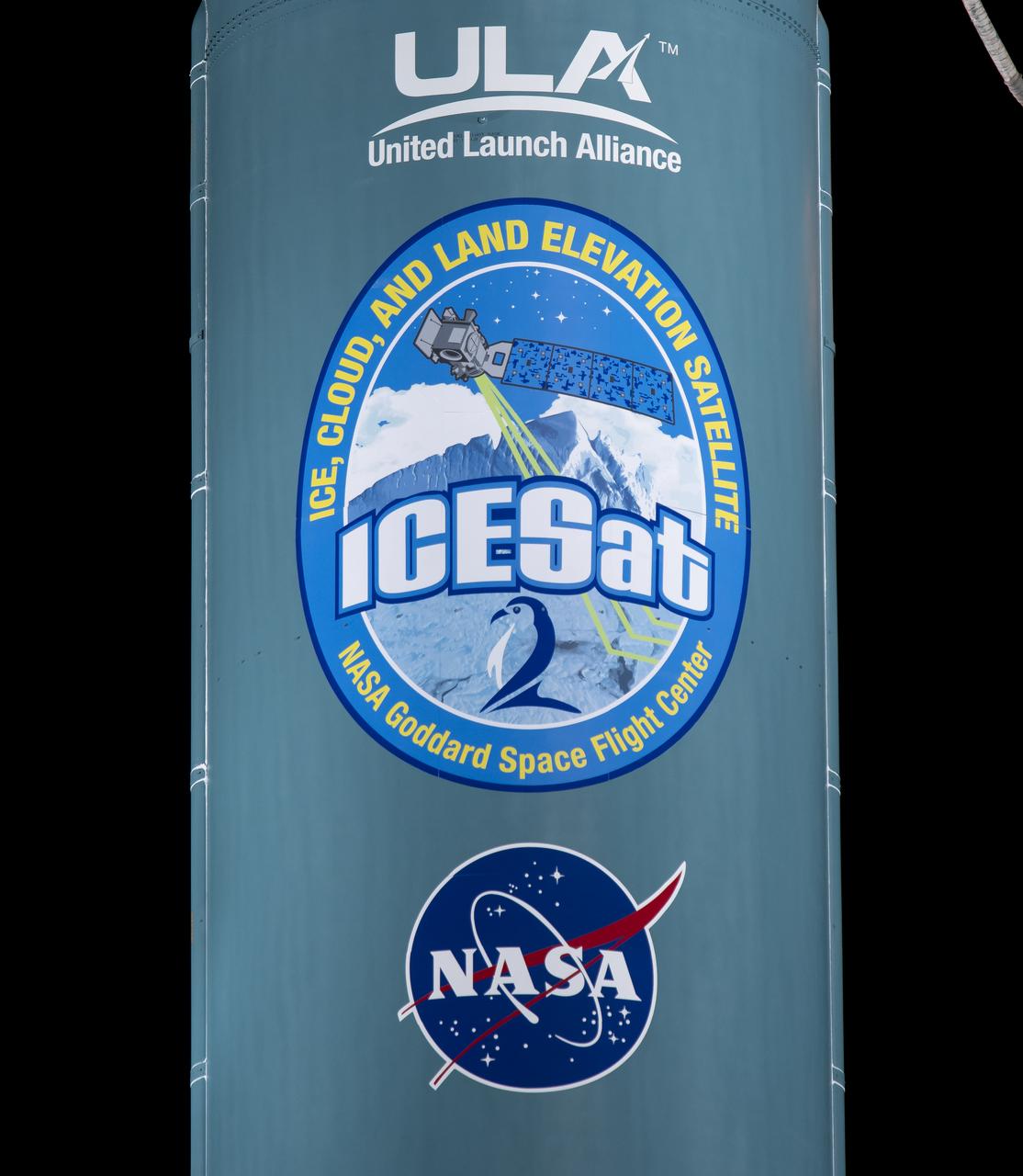
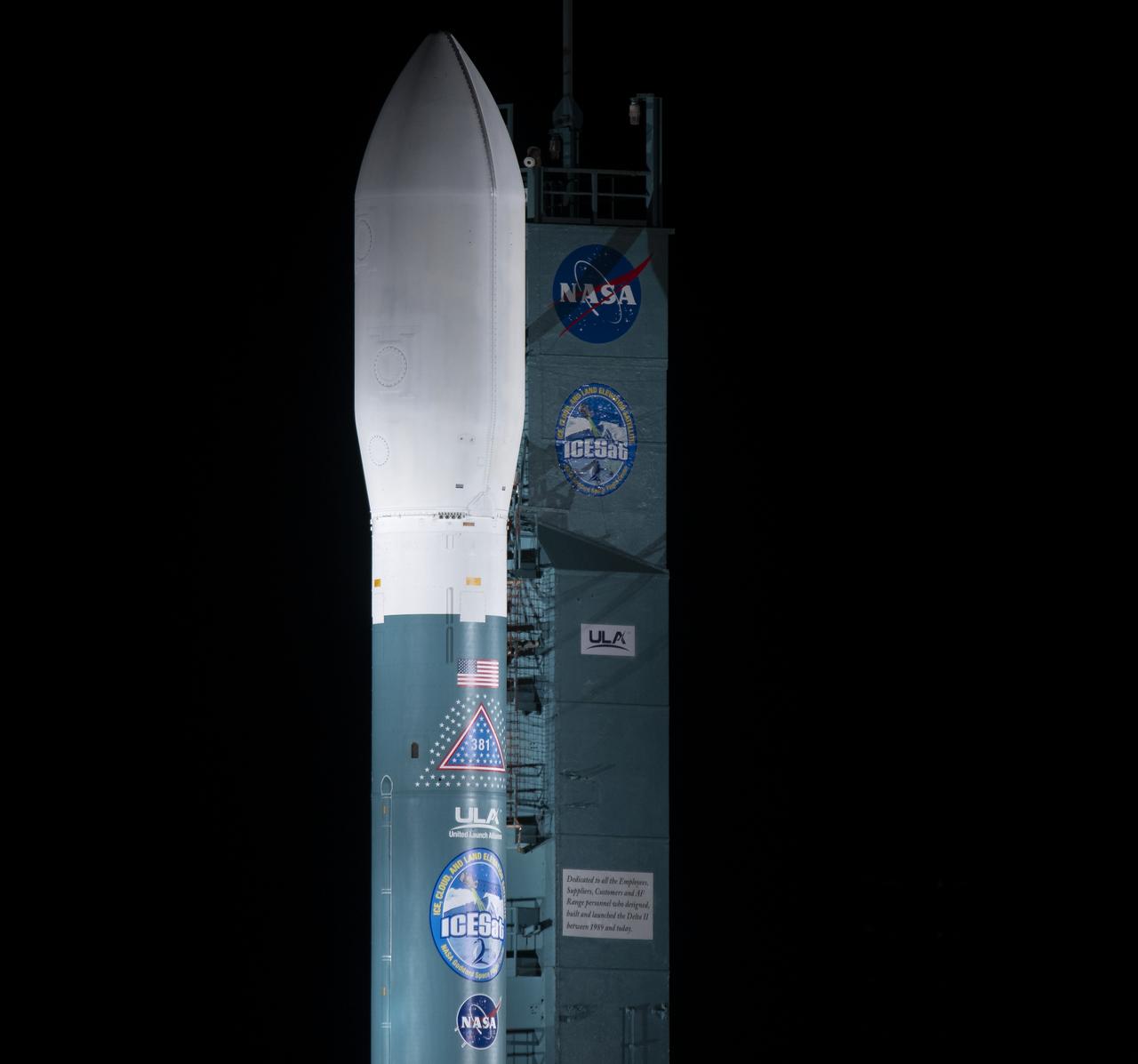
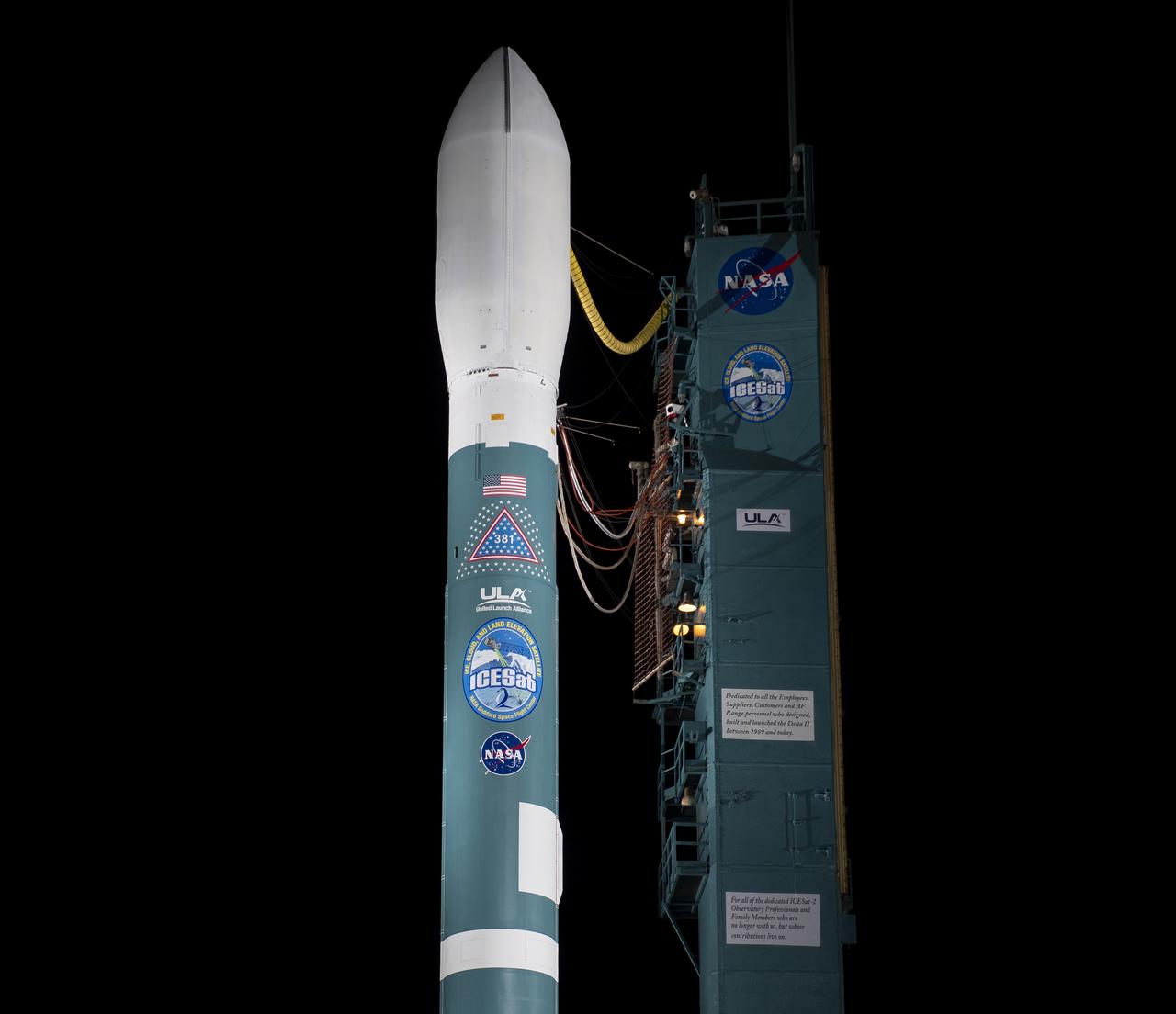
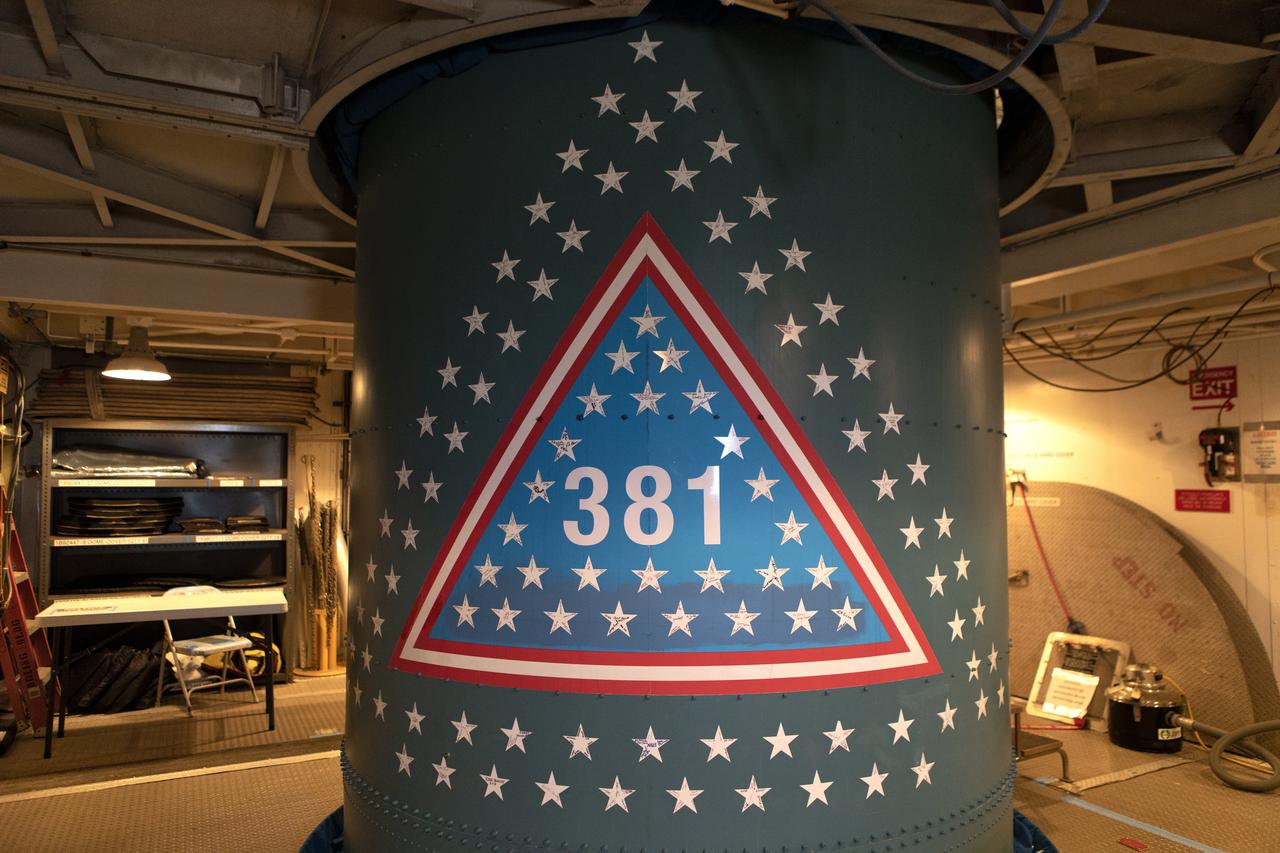
An emblem signifying the 381st flight of the United Launch Alliance Delta family is seen on the Delta II rocket, with the NASA Ice, Cloud and land Elevation Satellite-2 (ICESat-2) onboard, Wednesday, Sept. 12, 2018, at Vandenberg Air Force Base in California. The first Delta I was launched in May 1960. A star traditionally was placed on the rocket to recognize each mission. For the final Delta II, stars were sent to team members and partners throughout the nation. This rocket boasts more than 150 stars with over 800 signatures of people who have been part of the Delta II program. The ICESat-2 mission will measure the changing height of Earth's ice. Photo Credit: (NASA/Bill Ingalls)
ICESat-2 Prelaunch
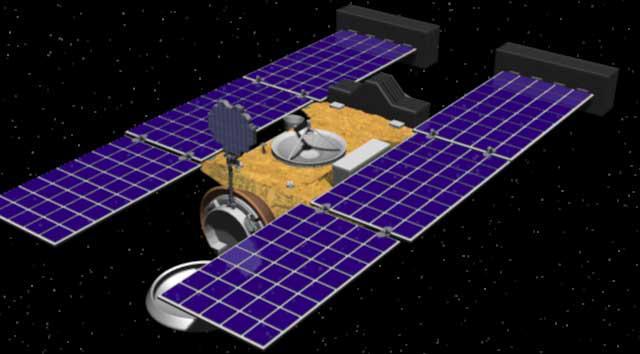
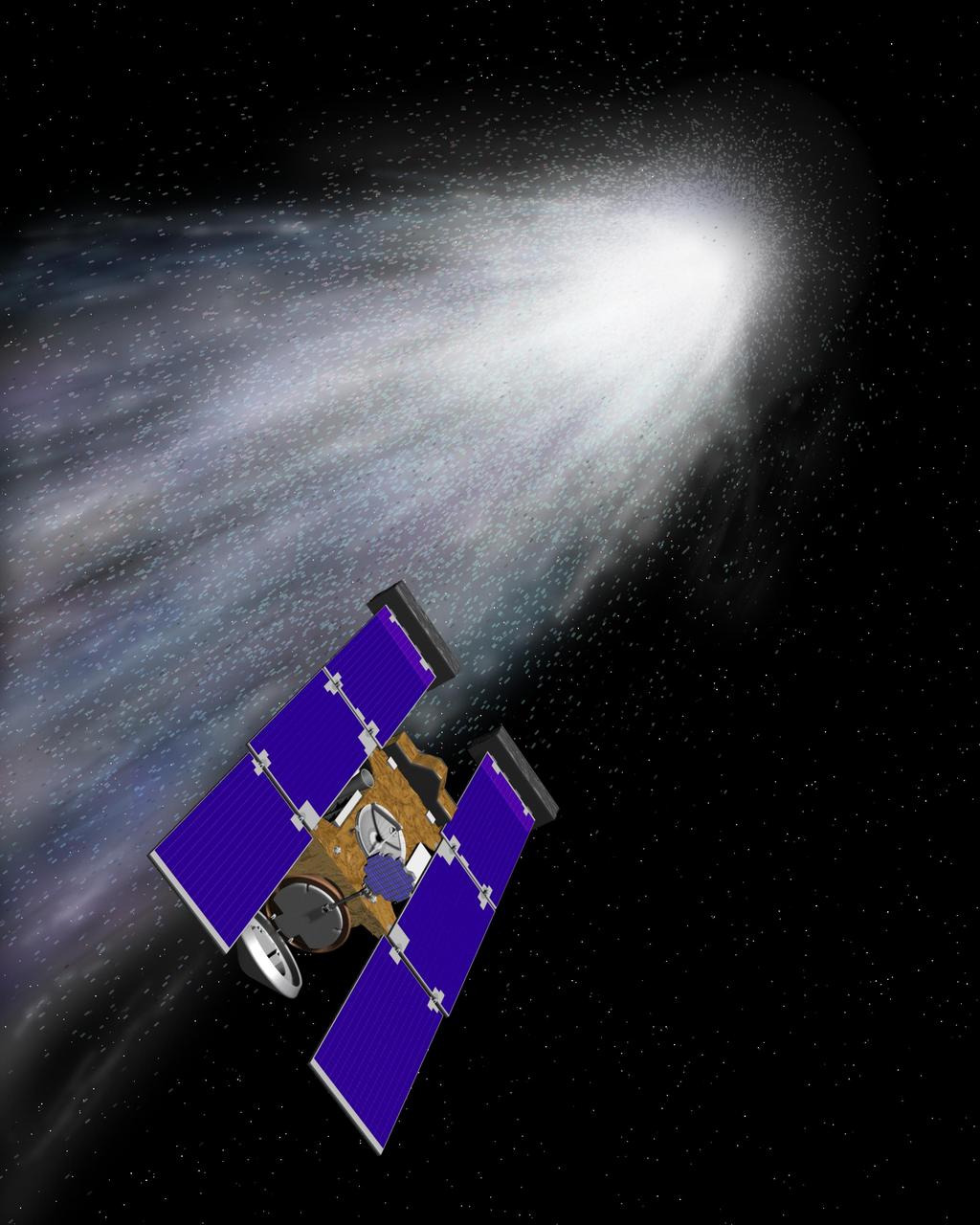
Artist rendering of NASA Stardust spacecraft. The spacecraft was launched on February 7, 1999, from Cape Canaveral Air Station, Florida, aboard a Delta II rocket.
Stardust Comet Wild 2 Encounter Artist Concept
Artist rendering of NASA Stardust spacecraft. The spacecraft was launched on February 7, 1999, from Cape Canaveral Air Station, Florida, aboard a Delta II rocket.
Stardust Spacecraft Artist Concept
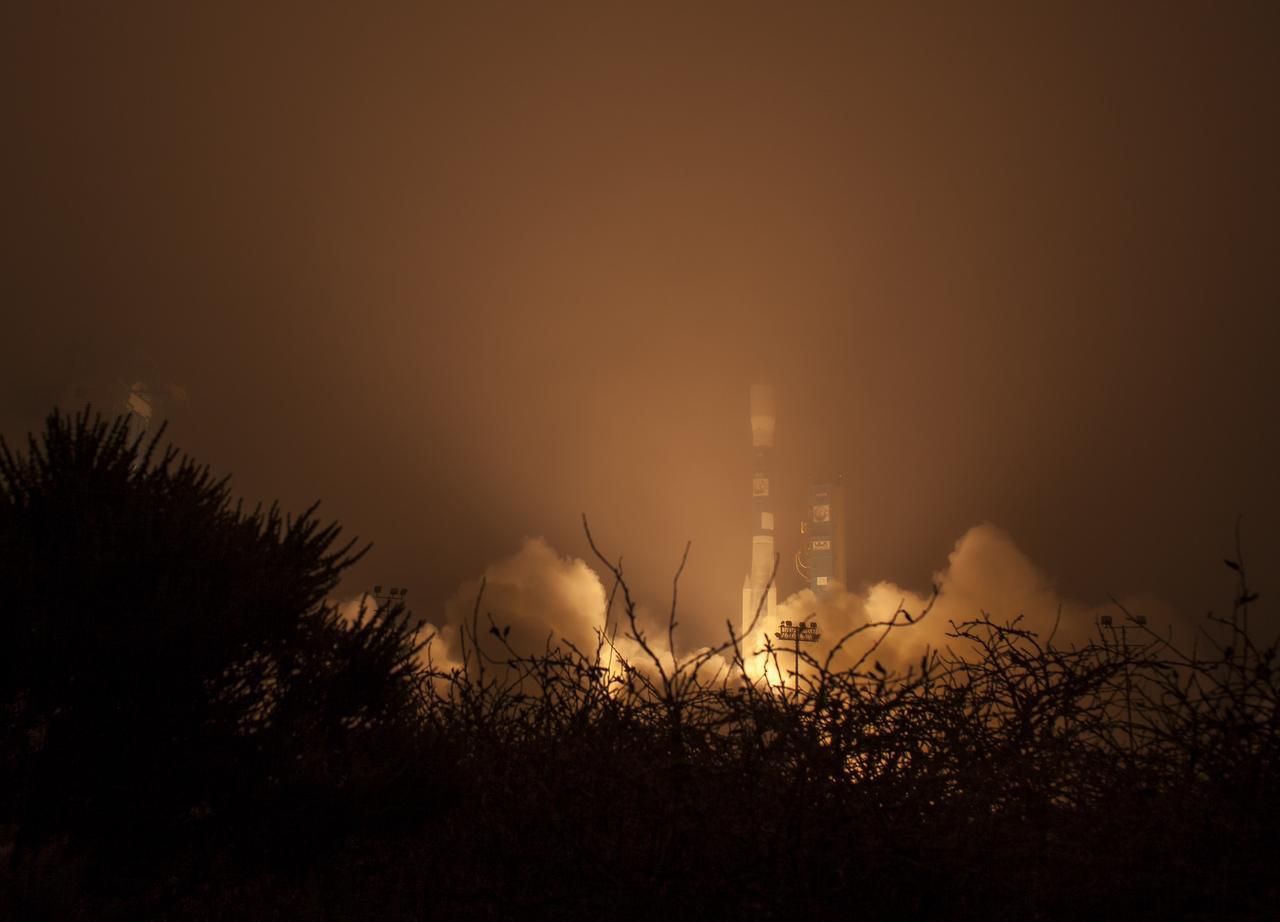
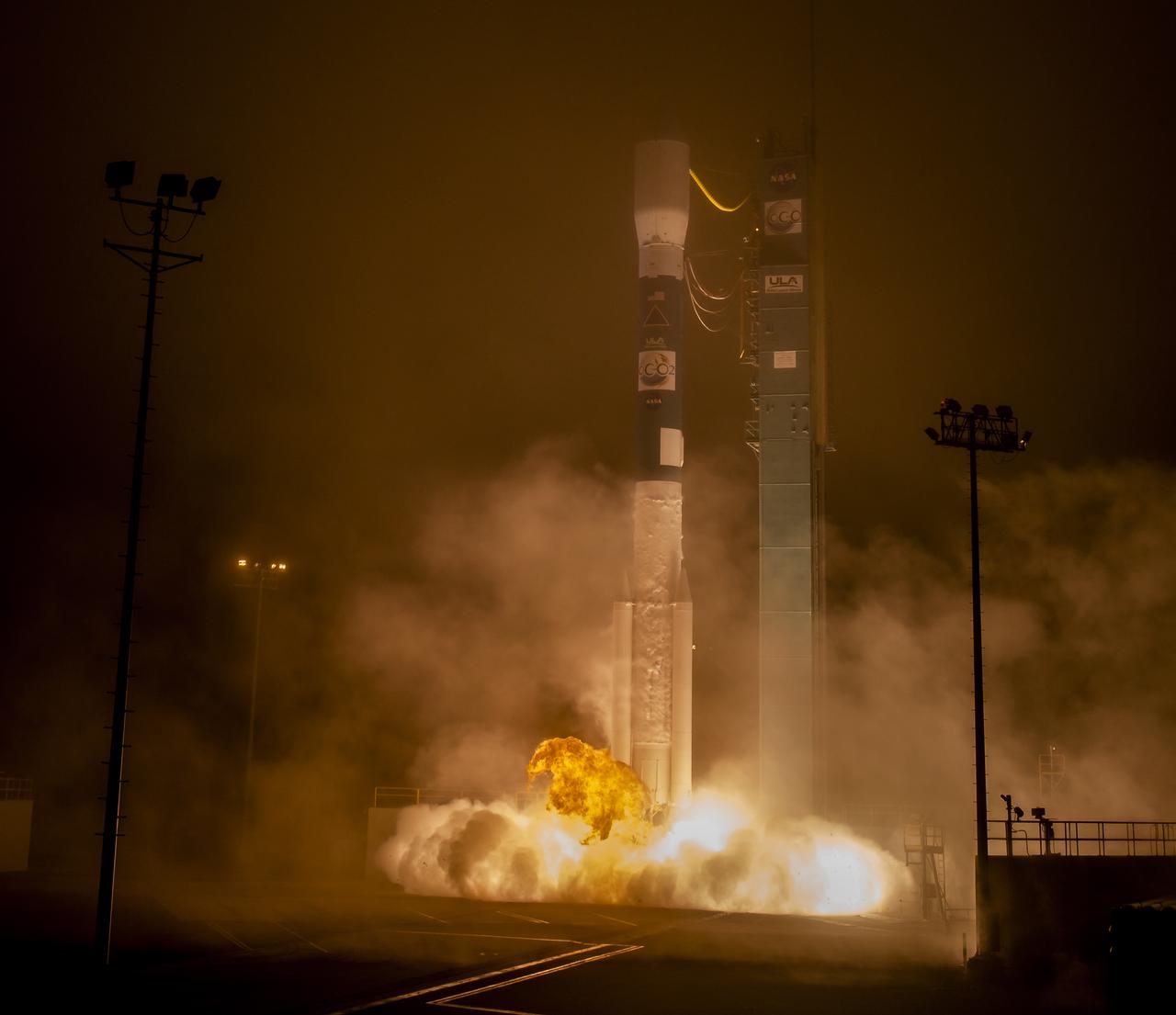
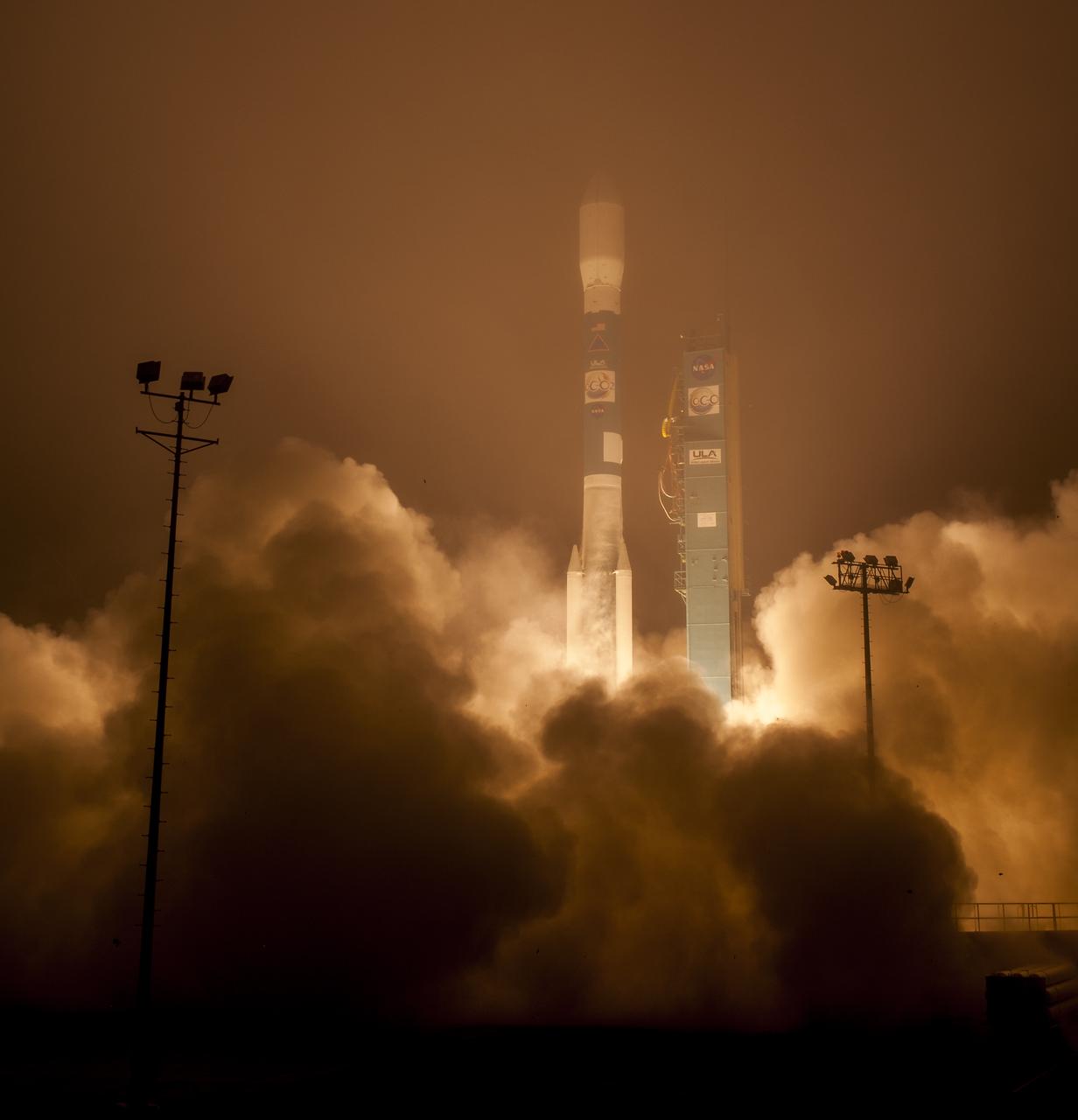
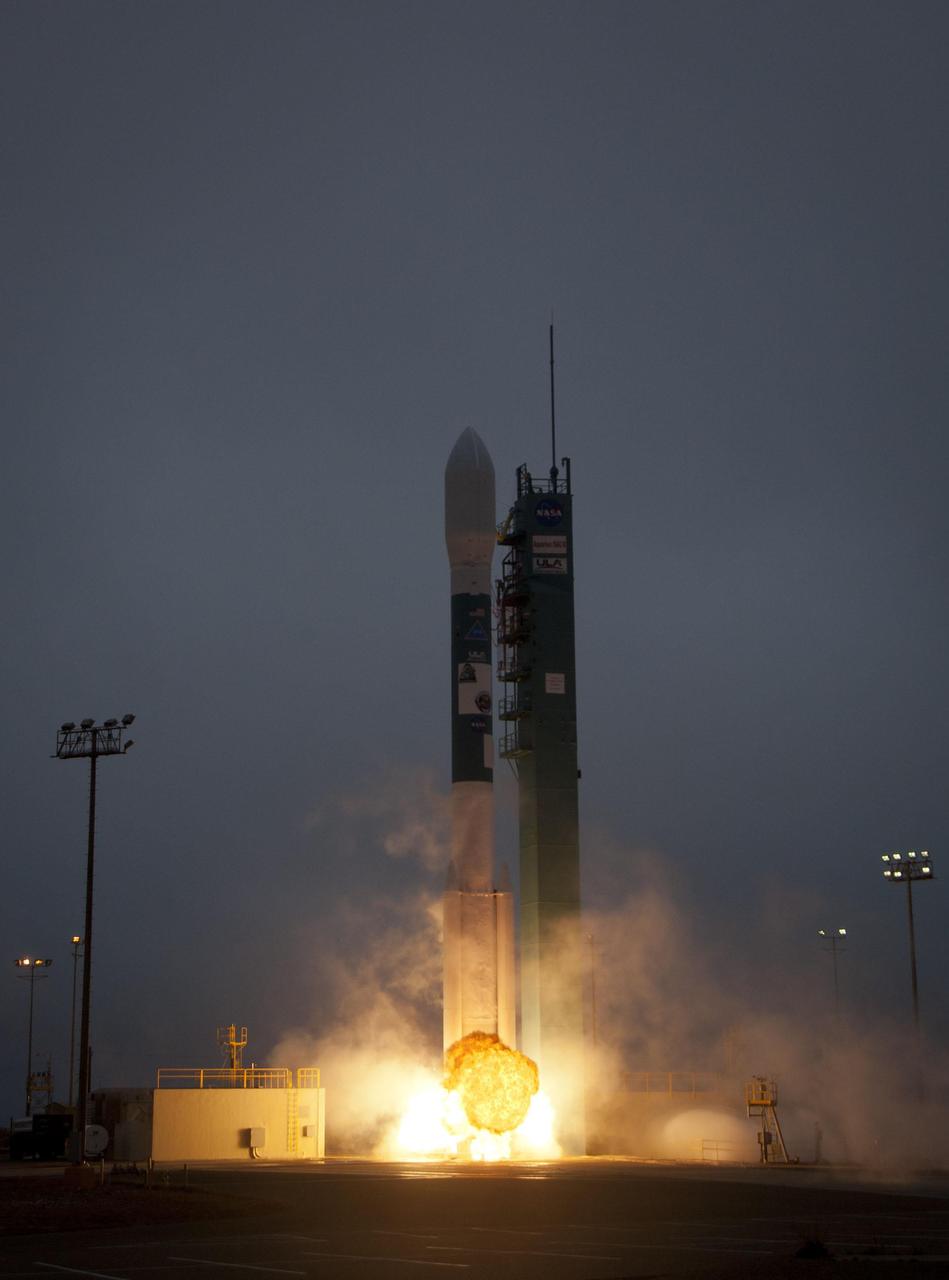
A United Launch Alliance Delta II rocket launches with the Orbiting Carbon Observatory-2 (OCO-2)satellite onboard from Space Launch Complex 2 at Vandenberg Air Force Base, Calif. on Wednesday, July 2, 2014. OCO-2 will measure the global distribution of carbon dioxide, the leading human-produced greenhouse gas driving changes in Earth’s climate. Photo Credit: (NASA/Bill Ingalls)
Orbiting Carbon Observatory-2 (OCO-2) Launch
A United Launch Alliance Delta II rocket launches with the Orbiting Carbon Observatory-2 (OCO-2)satellite onboard from Space Launch Complex 2 at Vandenberg Air Force Base, Calif. on Wednesday, July 2, 2014. OCO-2 will measure the global distribution of carbon dioxide, the leading human-produced greenhouse gas driving changes in Earth’s climate. Photo Credit: (NASA/Bill Ingalls)
Orbiting Carbon Observatory-2 (OCO-2) Launch
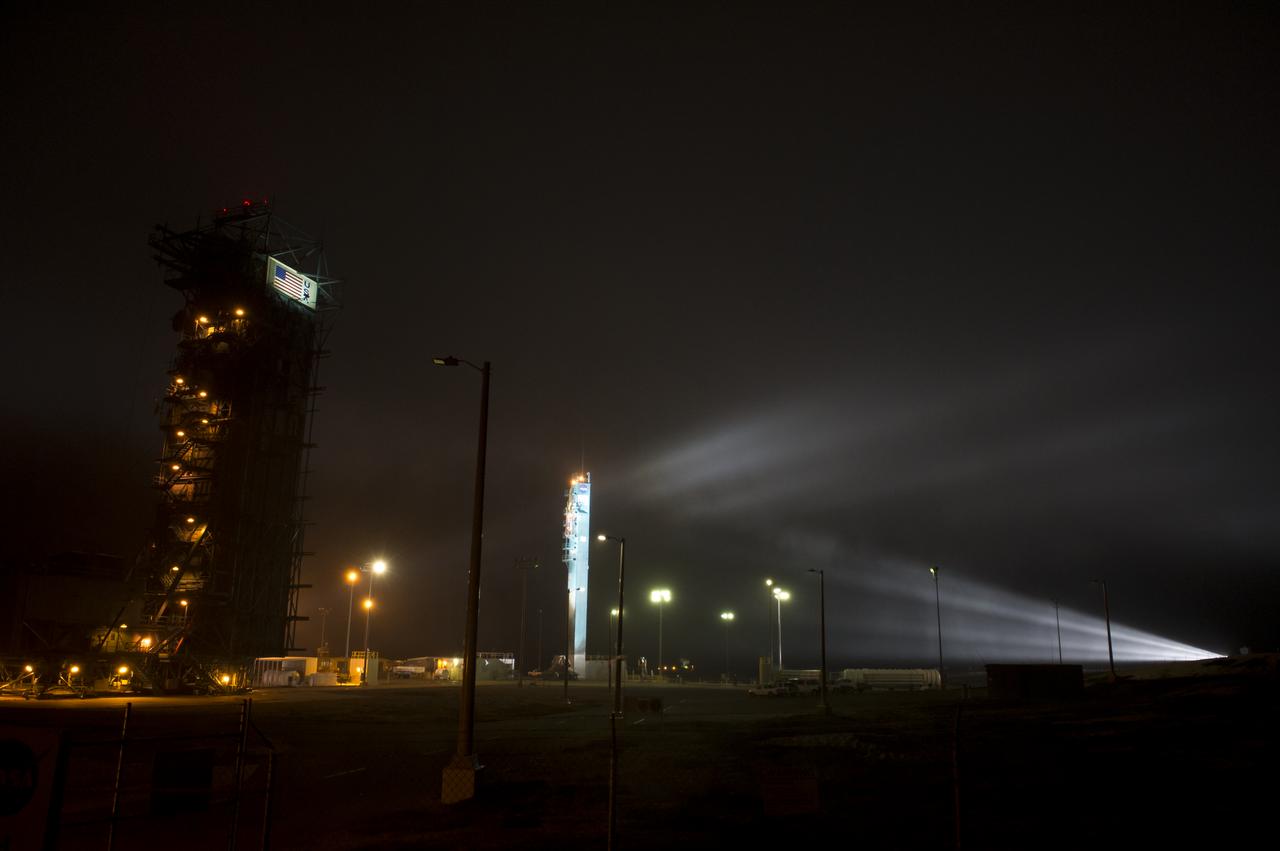
Lights shine on the umbilical tower shortly after a United Launch Alliance Delta II rocket launched with the Orbiting Carbon Observatory-2 (OCO-2)satellite onboard from Space Launch Complex 2 at Vandenberg Air Force Base, Calif. on Wednesday, July 2, 2014. OCO-2 will measure the global distribution of carbon dioxide, the leading human-produced greenhouse gas driving changes in Earth’s climate. Photo Credit: (NASA/Bill Ingalls)
Orbiting Carbon Observatory-2 (OCO-2) Launch
A United Launch Alliance Delta II rocket launches with the Orbiting Carbon Observatory-2 (OCO-2)satellite onboard from Space Launch Complex 2 at Vandenberg Air Force Base, Calif. on Wednesday, July 2, 2014. OCO-2 will measure the global distribution of carbon dioxide, the leading human-produced greenhouse gas driving changes in Earth’s climate. Photo Credit: (NASA/Bill Ingalls)
Orbiting Carbon Observatory-2 (OCO-2) Launch
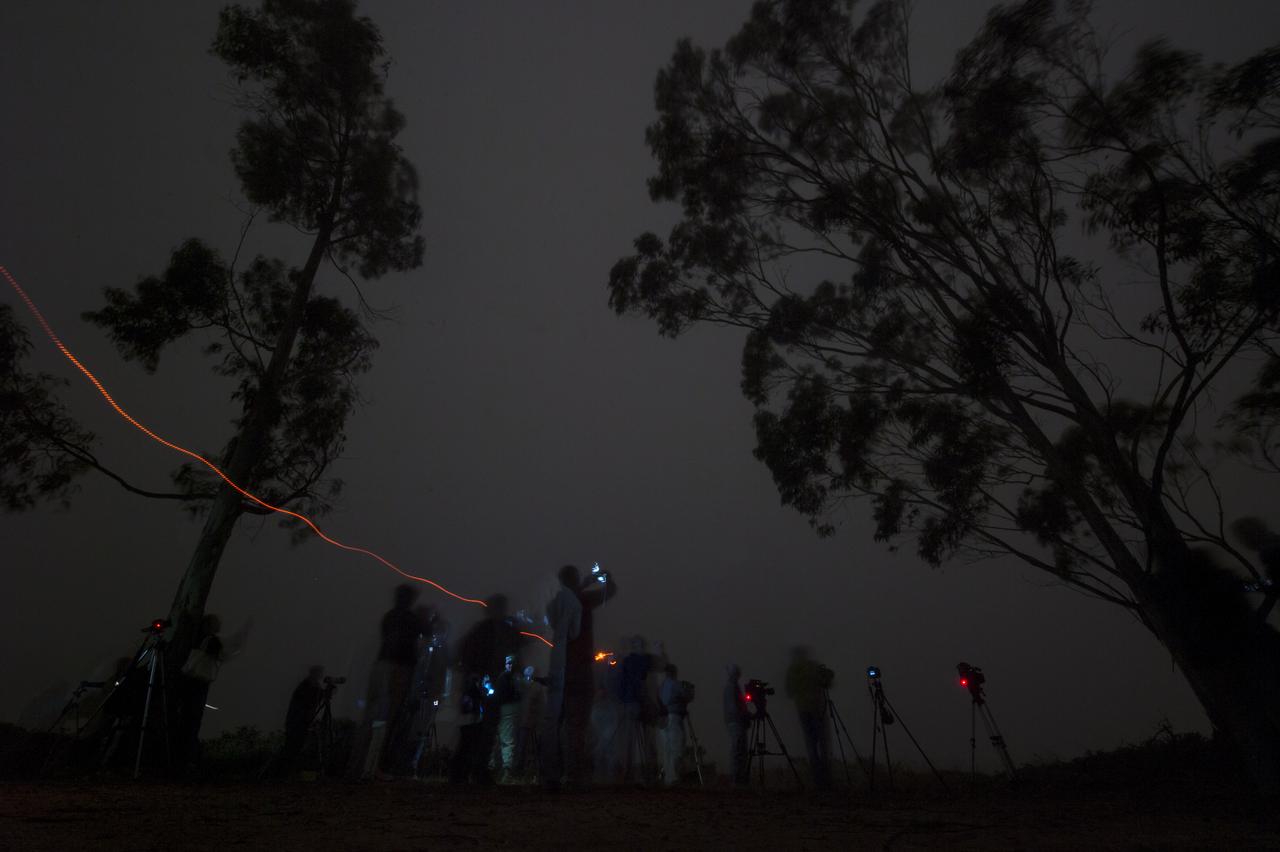
Members of the media are unable to see the launch of the United Launch Alliance Delta II rocket with the Orbiting Carbon Observatory-2 (OCO-2) satellite onboard due to heavy fog at Vandenberg Air Force Base, Calif. on Wednesday, July 2, 2014. OCO-2 launched at 2:56 a.m. PDT. OCO-2 will measure the global distribution of carbon dioxide, the leading human-produced greenhouse gas driving changes in Earth’s climate. Photo Credit: (NASA/Bill Ingalls)
Orbiting Carbon Observatory-2 (OCO-2) Launch
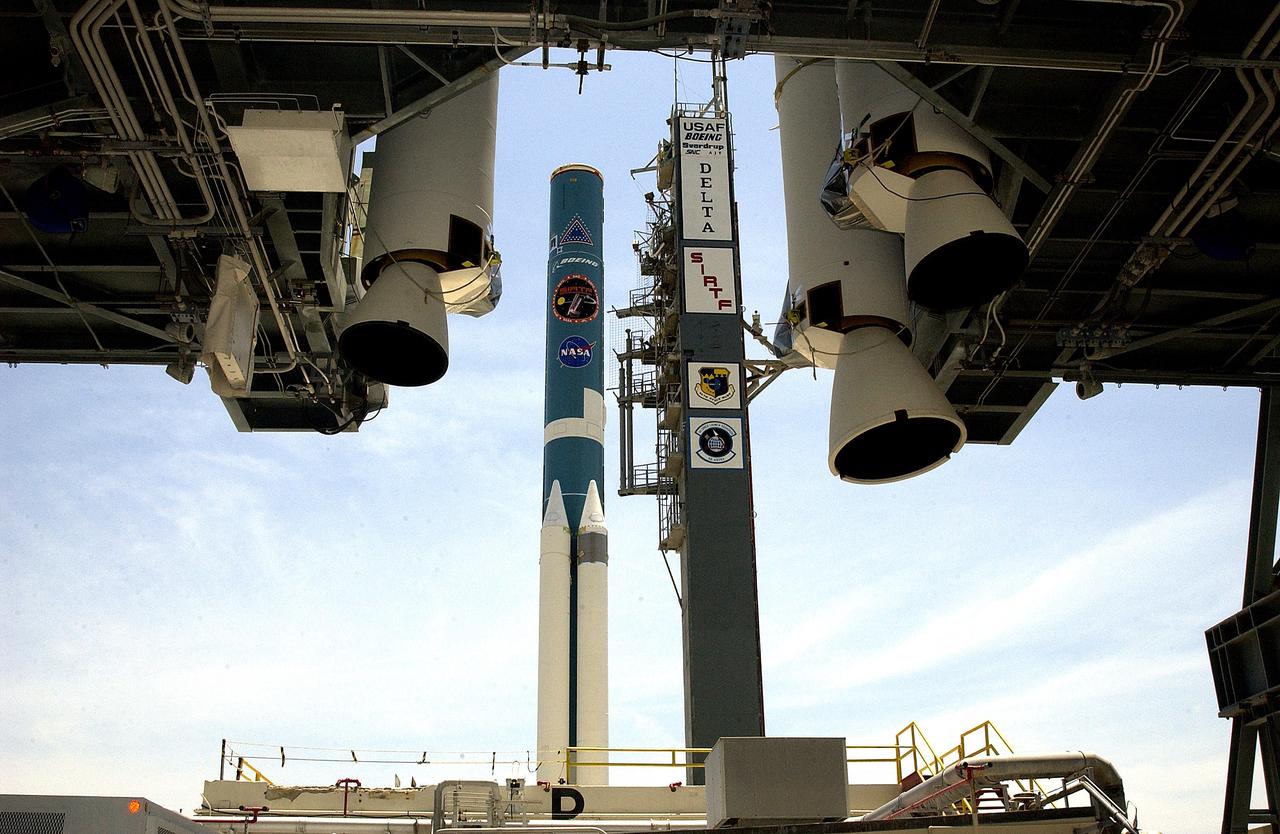
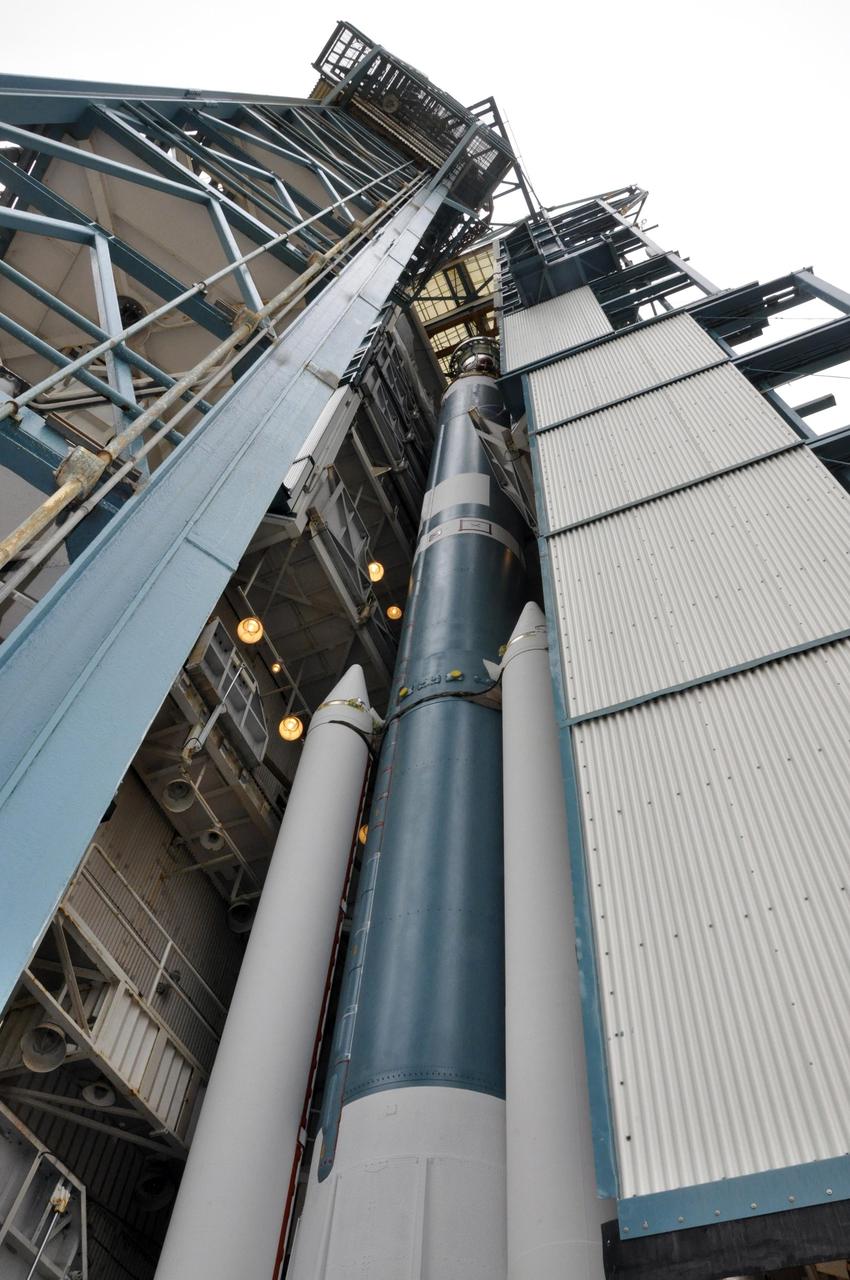
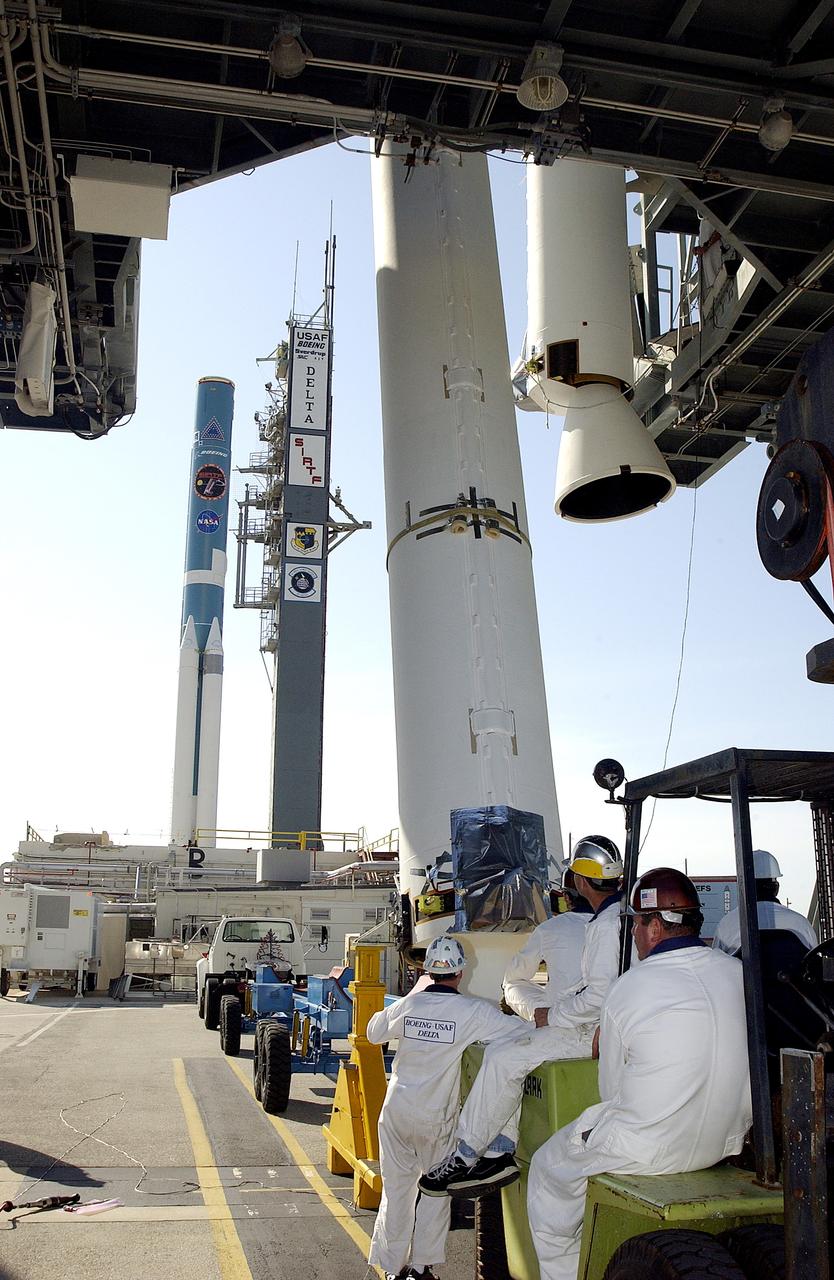
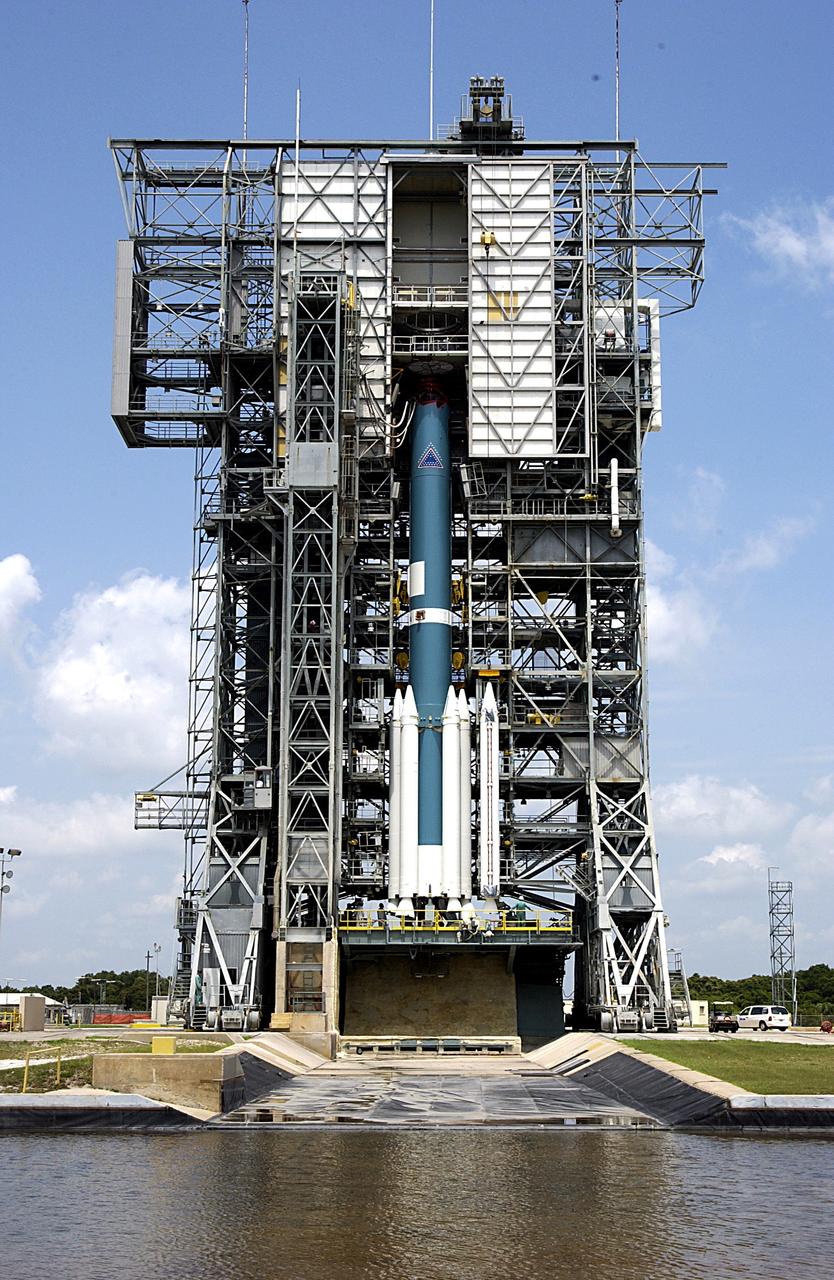
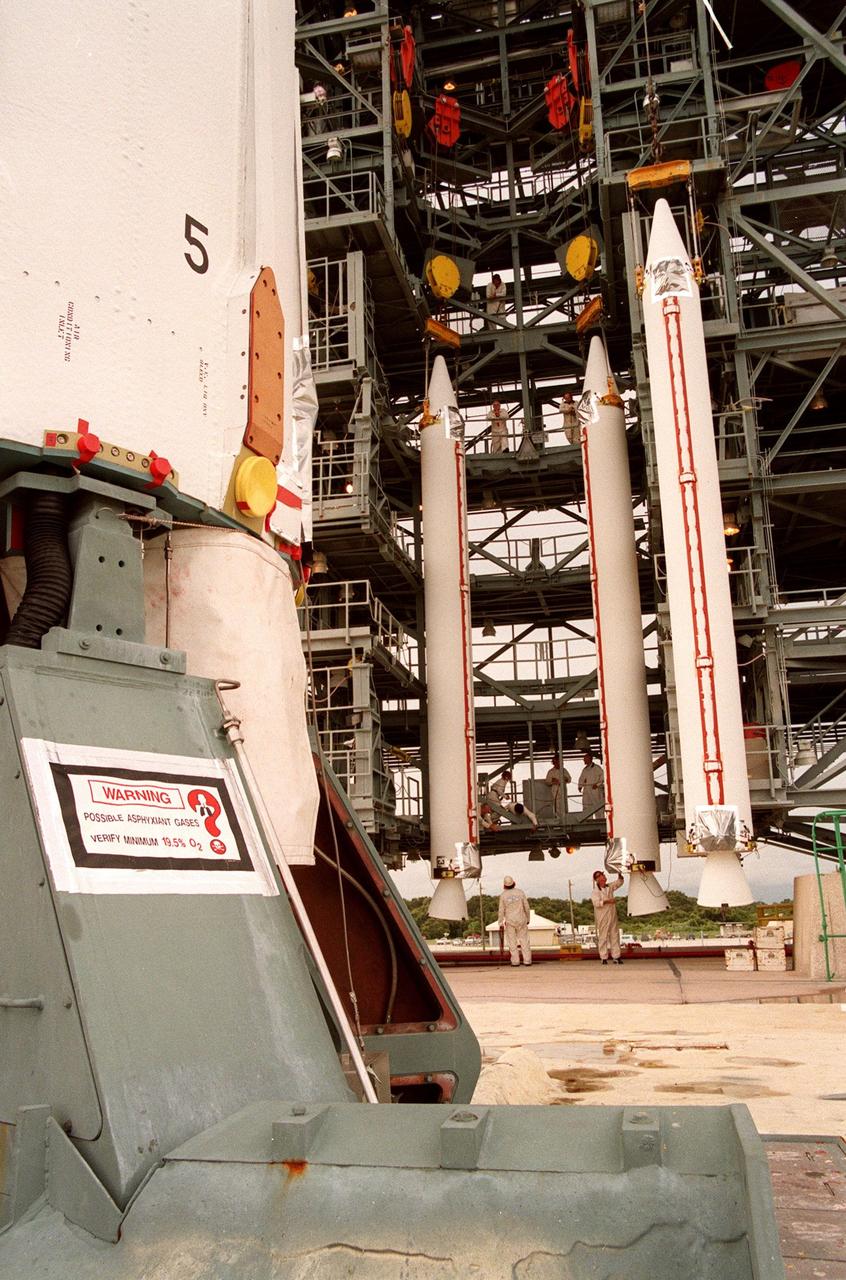
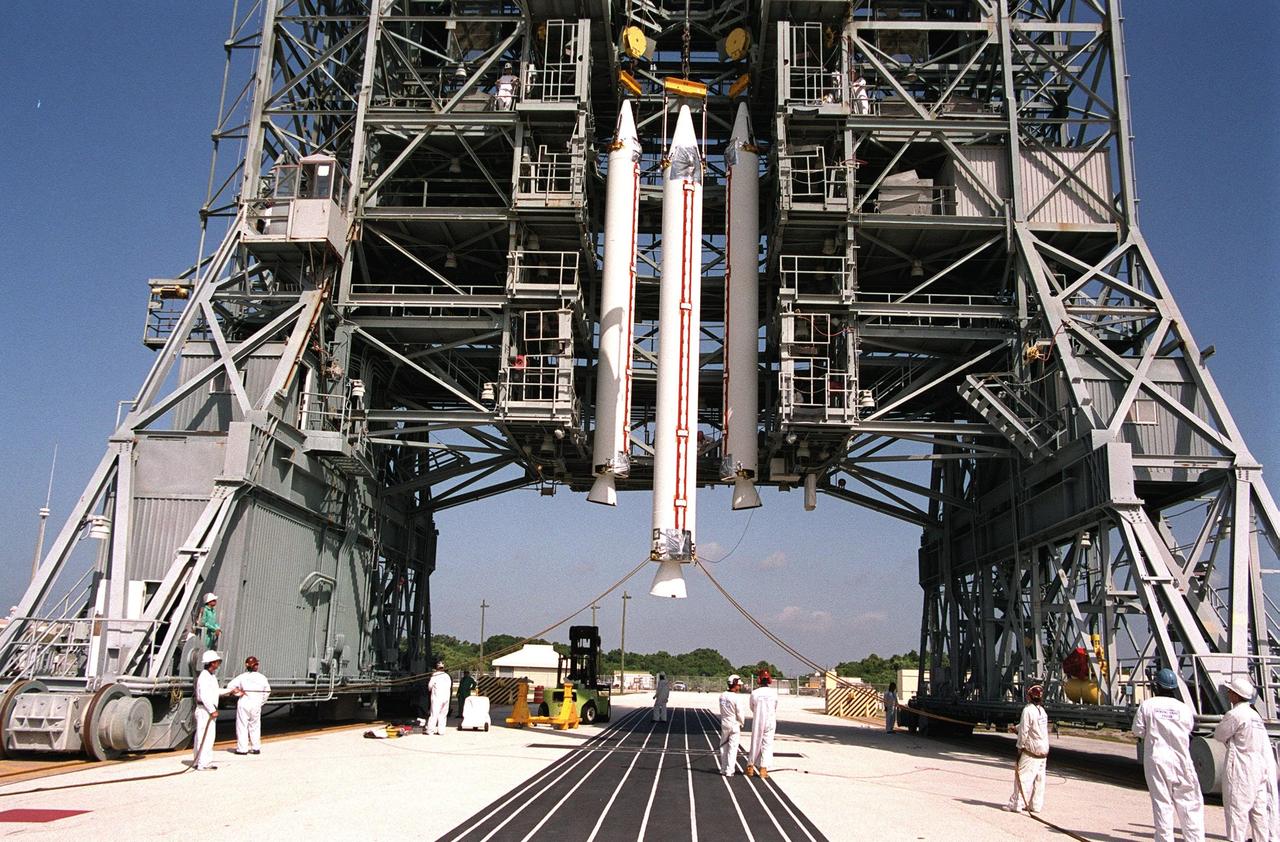
KENNEDY SPACE CENTER, FLA. -   On Launch Complex 17-B, Cape Canaveral Air Force Station, the Delta II Heavy rocket  (background) is framed by the solid rocket boosters (foreground) suspended in the mobile service tower.  The SRBs will be added to those already attached to the rocket.  The Delta II Heavy will launch the Space Infrared Telescope Facility (SIRTF).  Consisting of three cryogenically cooled science instruments and an 0.85-meter telescope, SIRTF is one of NASA's largest infrared telescopes to be launched.  SIRTF will obtain images and spectra by detecting the infrared energy, or heat, radiated by objects in space. Most of this infrared radiation is blocked by the Earth's atmosphere and cannot be observed from the ground.
KENNEDY SPACE CENTER, FLA. - On Launch Complex 17-B, Cape Canaveral Air Force Station, the Delta II Heavy rocket (background) is framed by the solid rocket boosters (foreground) suspended in the mobile service tower. The SRBs will be added to those already attached to the rocket. The Delta II Heavy will launch the Space Infrared Telescope Facility (SIRTF). Consisting of three cryogenically cooled science instruments and an 0.85-meter telescope, SIRTF is one of NASA's largest infrared telescopes to be launched. SIRTF will obtain images and spectra by detecting the infrared energy, or heat, radiated by objects in space. Most of this infrared radiation is blocked by the Earth's atmosphere and cannot be observed from the ground.
Workers monitor the Delta II second stage for NASA OCO-2, as it is lifted into position for mating with the rocket first stage in the mobile service tower at Space Launch Complex 2 on Vandenberg Air Force Base in California.
Lifting NASA OCO-2 Delta II Launch Vehicle Second Stage into Position for Mating
NASA Soil Moisture Active Passive SMAP satellite is transported across Vandenberg Air Force Base in California to Space Launch Complex 2, where it will be mated to a Delta II rocket for launch, targeted for Jan. 29.
Satellite in a Can
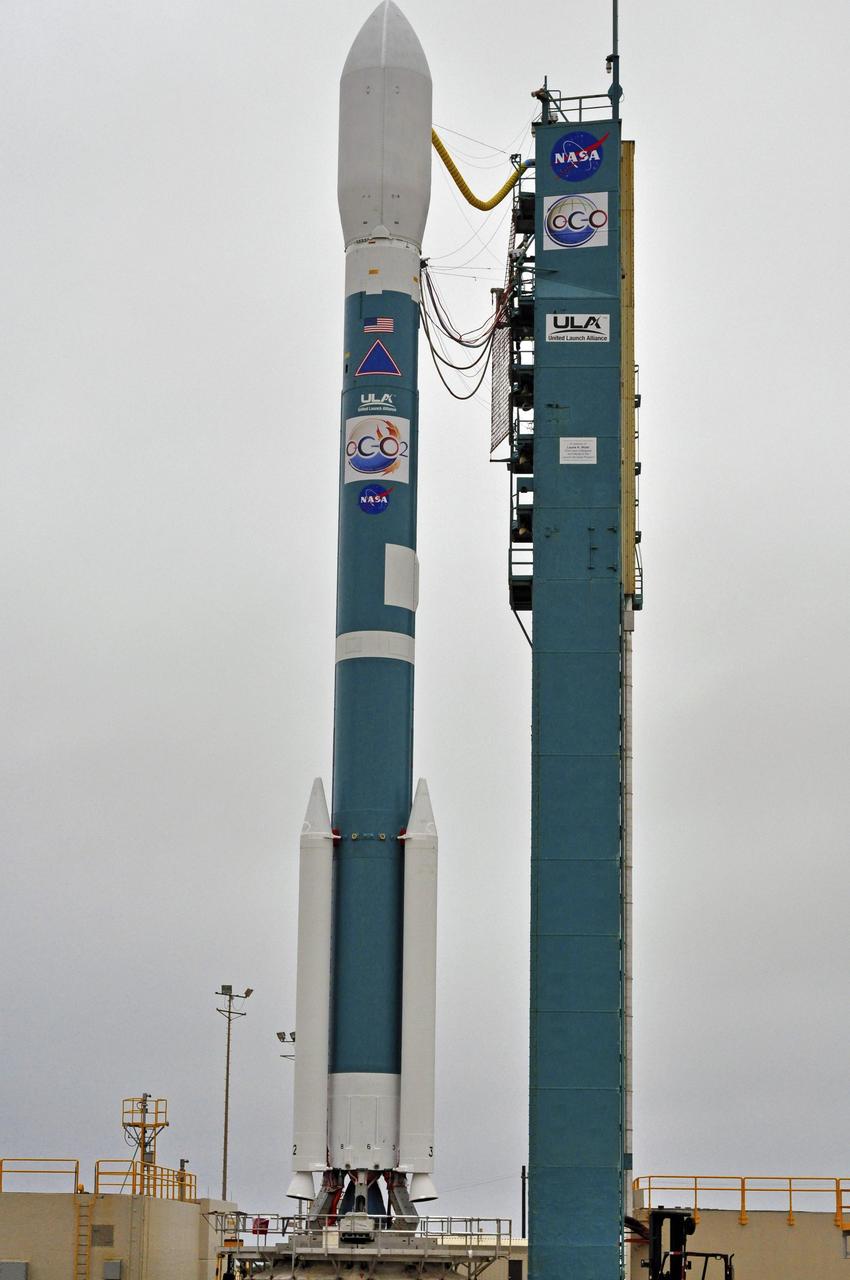
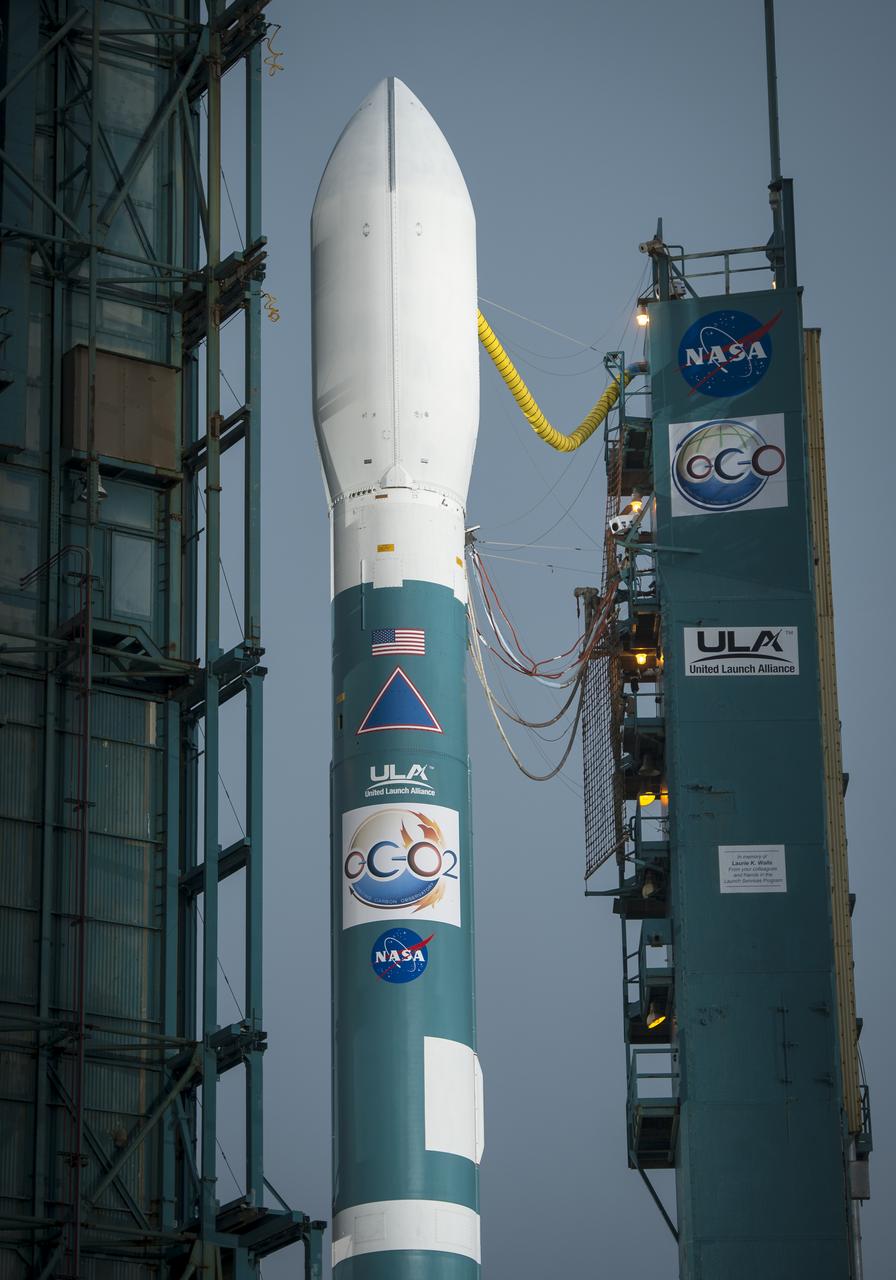
NASA Orbiting Carbon Observatory-2, perched atop a United Launch Alliance Delta II rocket, awaits launch at the Vandenberg Air Force Base in central California.
Orbiting Carbon Observatory-2 on the Pad
A Delta II rocket launches with the Aquarius/SAC-D spacecraft payload from Space Launch Complex 2 at Vandenberg Air Force Base, Calif. on Friday, June 10, 2011.
Aquarius Lifts Off!
At Space Launch Complex 2 on Vandenberg Air Force Base in California, NASA Soil Moisture Active Passive SMAP mission satellite is lifted up the side of a mobile service tower for mating to its Delta II rocket.
Going Up
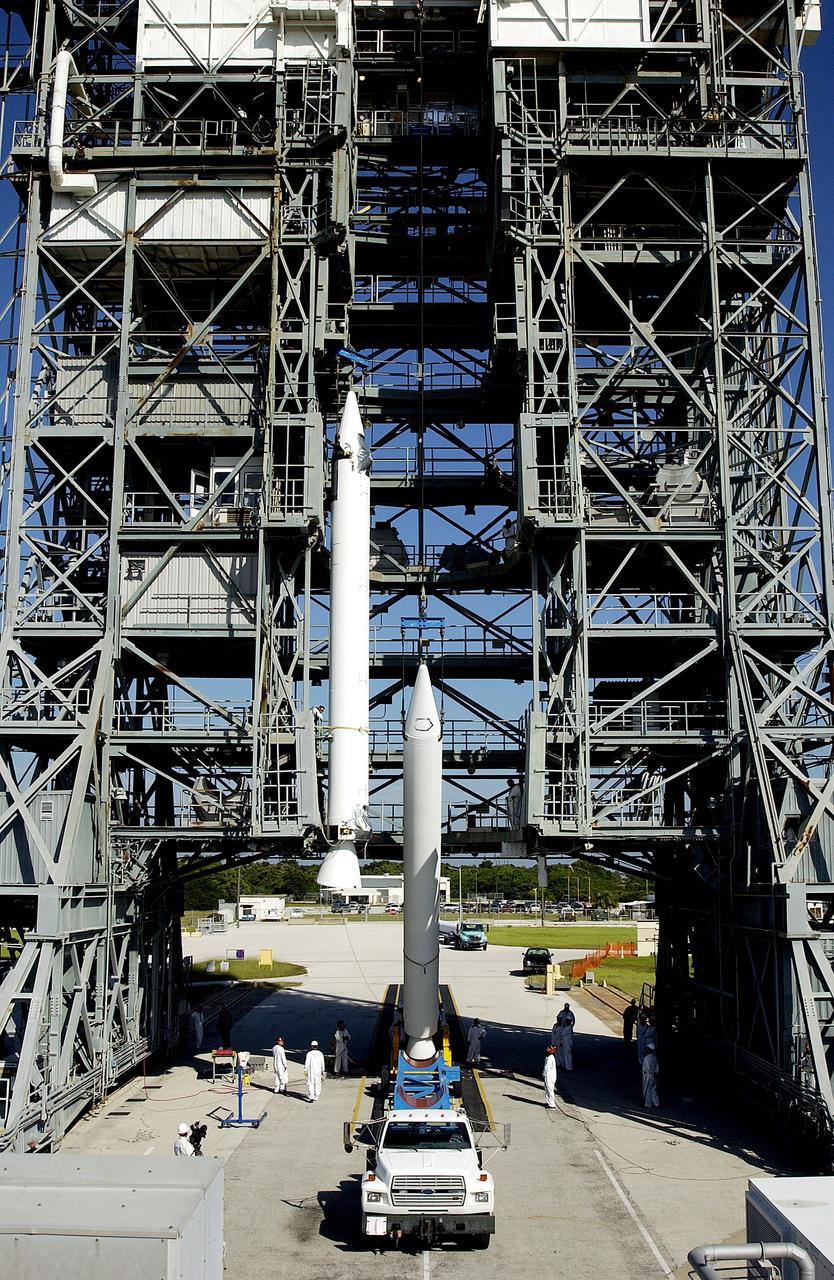
KENNEDY SPACE CENTER, FLA. -   A solid rocket booster (SRB) for the Delta II Heavy rocket that will launch the Space Infrared Telescope Facility (SIRTF) arrives at Launch Complex 17-B, Cape Canaveral Air Force Station.  The Delta II Heavy features nine 46-inch-diameter, stretched SRBs.  Consisting of three cryogenically cooled science instruments and an 0.85-meter telescope, SIRTF is one of NASA's largest infrared telescopes to be launched.  SIRTF will obtain images and spectra by detecting the infrared energy, or heat, radiated by objects in space. Most of this infrared radiation is blocked by the Earth's atmosphere and cannot be observed from the ground.
KENNEDY SPACE CENTER, FLA. - A solid rocket booster (SRB) for the Delta II Heavy rocket that will launch the Space Infrared Telescope Facility (SIRTF) arrives at Launch Complex 17-B, Cape Canaveral Air Force Station. The Delta II Heavy features nine 46-inch-diameter, stretched SRBs. Consisting of three cryogenically cooled science instruments and an 0.85-meter telescope, SIRTF is one of NASA's largest infrared telescopes to be launched. SIRTF will obtain images and spectra by detecting the infrared energy, or heat, radiated by objects in space. Most of this infrared radiation is blocked by the Earth's atmosphere and cannot be observed from the ground.
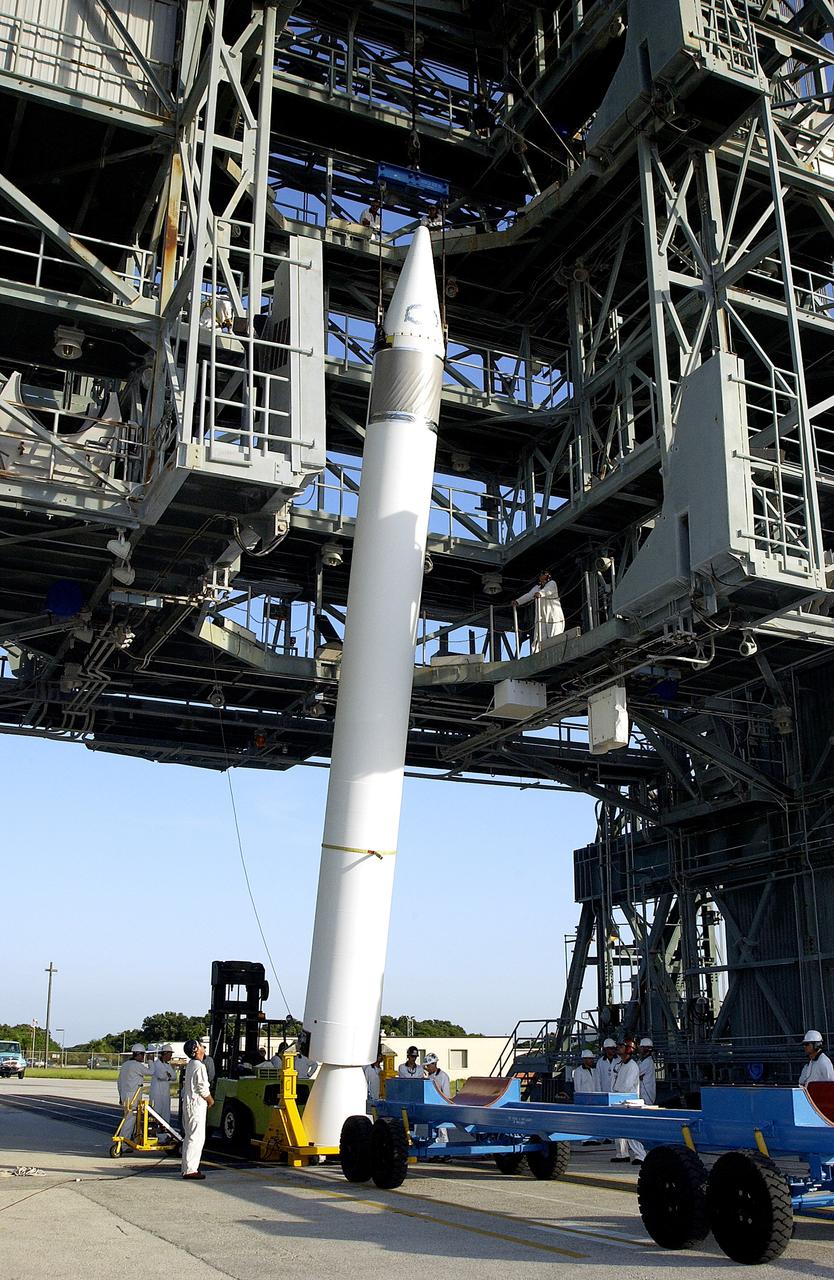
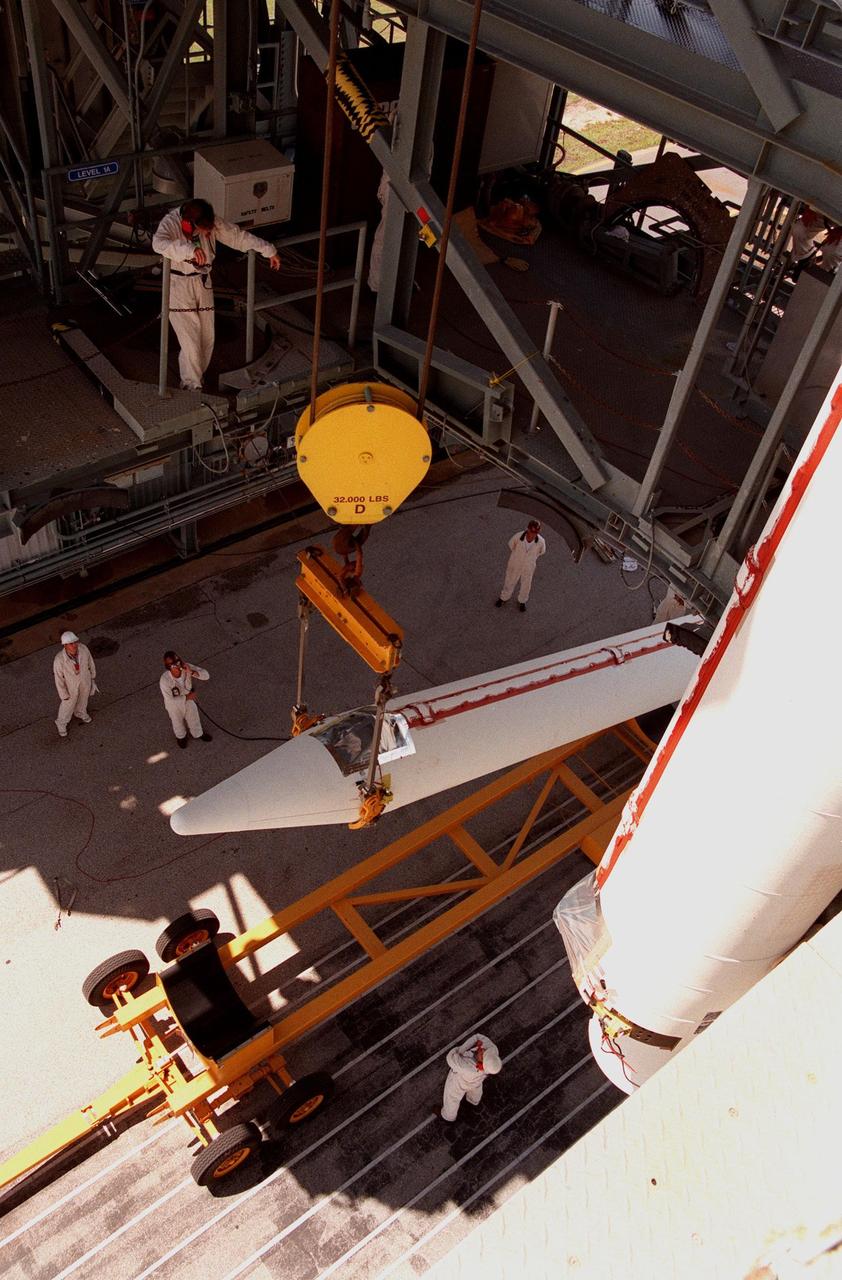
KENNEDY SPACE CENTER, FLA. -   A solid rocket booster (SRB) is lifted to vertical on Launch Complex 17-B, Cape Canaveral Air Force Station. The SRB will be attached to the Delta II Heavy rocket that will launch the Space Infrared Telescope Facility (SIRTF).  The Delta II Heavy features nine 46-inch-diameter, stretched SRBs.  Consisting of three cryogenically cooled science instruments and an 0.85-meter telescope, SIRTF is one of NASA's largest infrared telescopes to be launched.  SIRTF will obtain images and spectra by detecting the infrared energy, or heat, radiated by objects in space. Most of this infrared radiation is blocked by the Earth's atmosphere and cannot be observed from the ground.
KENNEDY SPACE CENTER, FLA. - A solid rocket booster (SRB) is lifted to vertical on Launch Complex 17-B, Cape Canaveral Air Force Station. The SRB will be attached to the Delta II Heavy rocket that will launch the Space Infrared Telescope Facility (SIRTF). The Delta II Heavy features nine 46-inch-diameter, stretched SRBs. Consisting of three cryogenically cooled science instruments and an 0.85-meter telescope, SIRTF is one of NASA's largest infrared telescopes to be launched. SIRTF will obtain images and spectra by detecting the infrared energy, or heat, radiated by objects in space. Most of this infrared radiation is blocked by the Earth's atmosphere and cannot be observed from the ground.
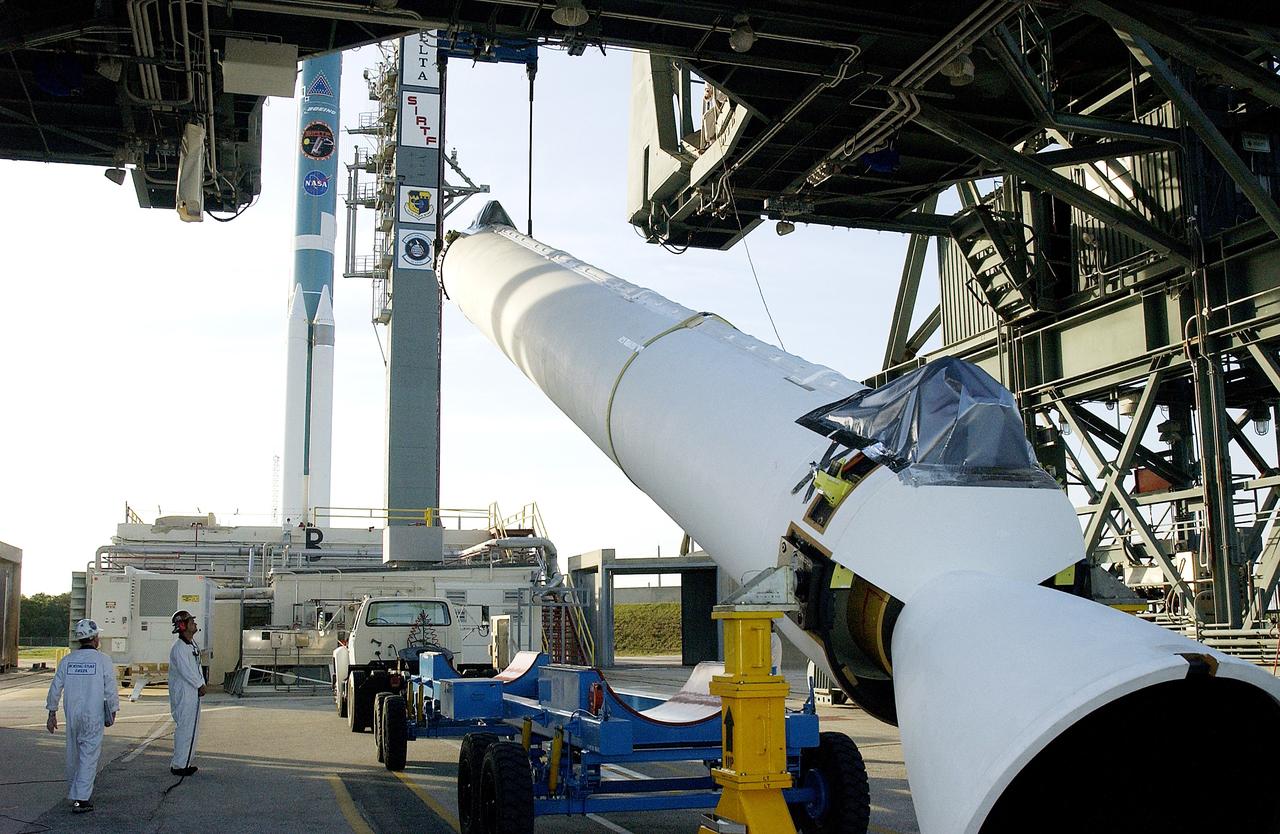
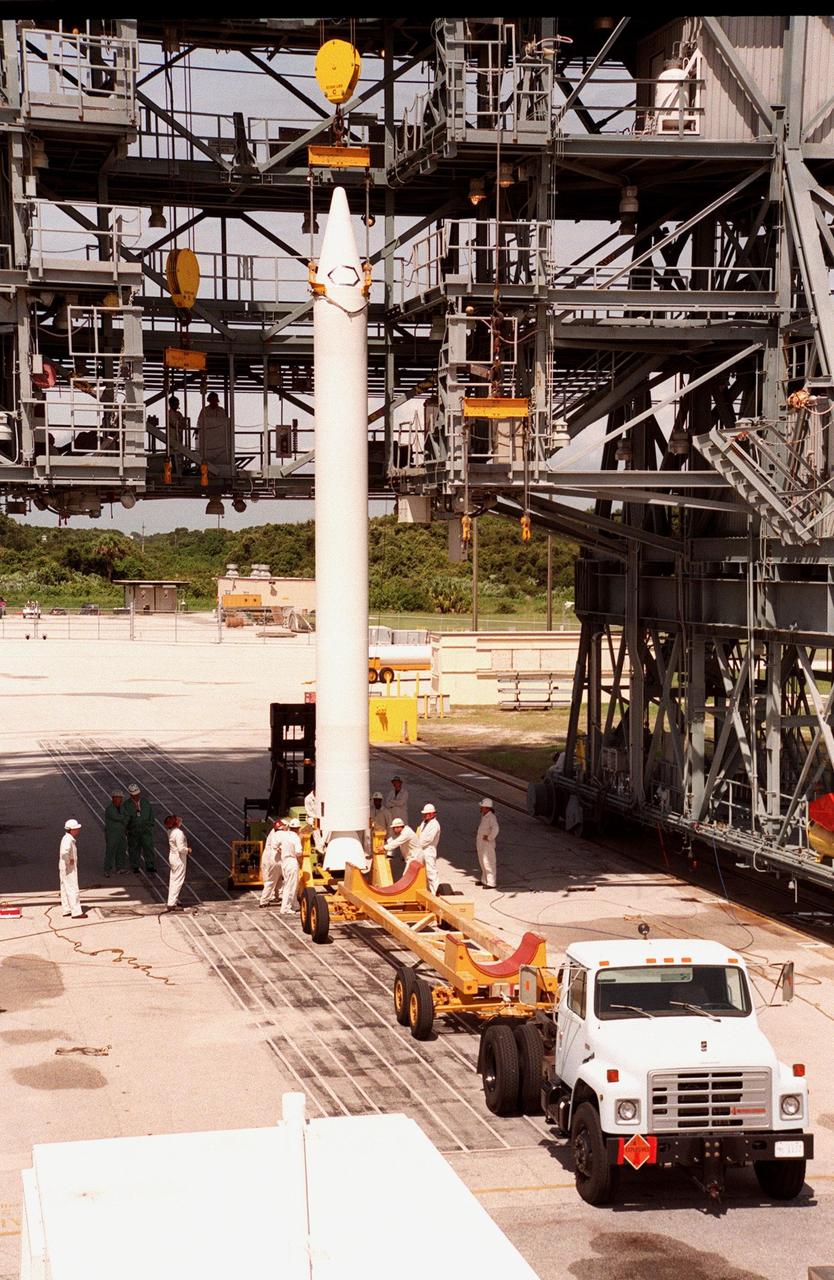
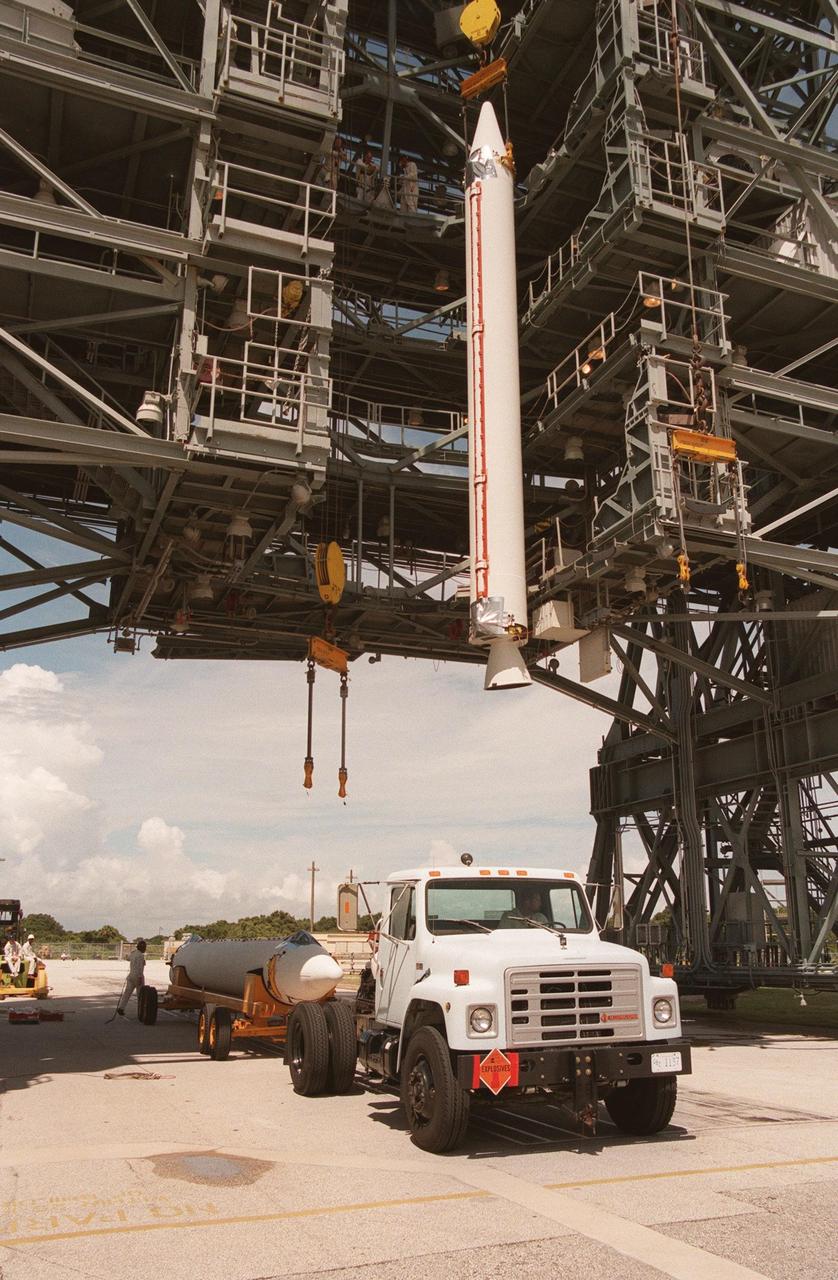
KENNEDY SPACE CENTER, FLA. -   A solid rocket booster (SRB) for the Delta II Heavy rocket that will launch the Space Infrared Telescope Facility (SIRTF) is lifted off its transporter on Launch Complex 17-B, Cape Canaveral Air Force Station.  The SRB will be added to the launch vehicle in the background.  The Delta II Heavy features nine 46-inch-diameter, stretched SRBs.  SIRTF, consisting of three cryogenically cooled science instruments and an 0.85-meter telescope, is one of NASA's largest infrared telescopes to be launched.  SIRTF will obtain images and spectra by detecting the infrared energy, or heat, radiated by objects in space. Most of this infrared radiation is blocked by the Earth's atmosphere and cannot be observed from the ground.
KENNEDY SPACE CENTER, FLA. - A solid rocket booster (SRB) for the Delta II Heavy rocket that will launch the Space Infrared Telescope Facility (SIRTF) is lifted off its transporter on Launch Complex 17-B, Cape Canaveral Air Force Station. The SRB will be added to the launch vehicle in the background. The Delta II Heavy features nine 46-inch-diameter, stretched SRBs. SIRTF, consisting of three cryogenically cooled science instruments and an 0.85-meter telescope, is one of NASA's largest infrared telescopes to be launched. SIRTF will obtain images and spectra by detecting the infrared energy, or heat, radiated by objects in space. Most of this infrared radiation is blocked by the Earth's atmosphere and cannot be observed from the ground.
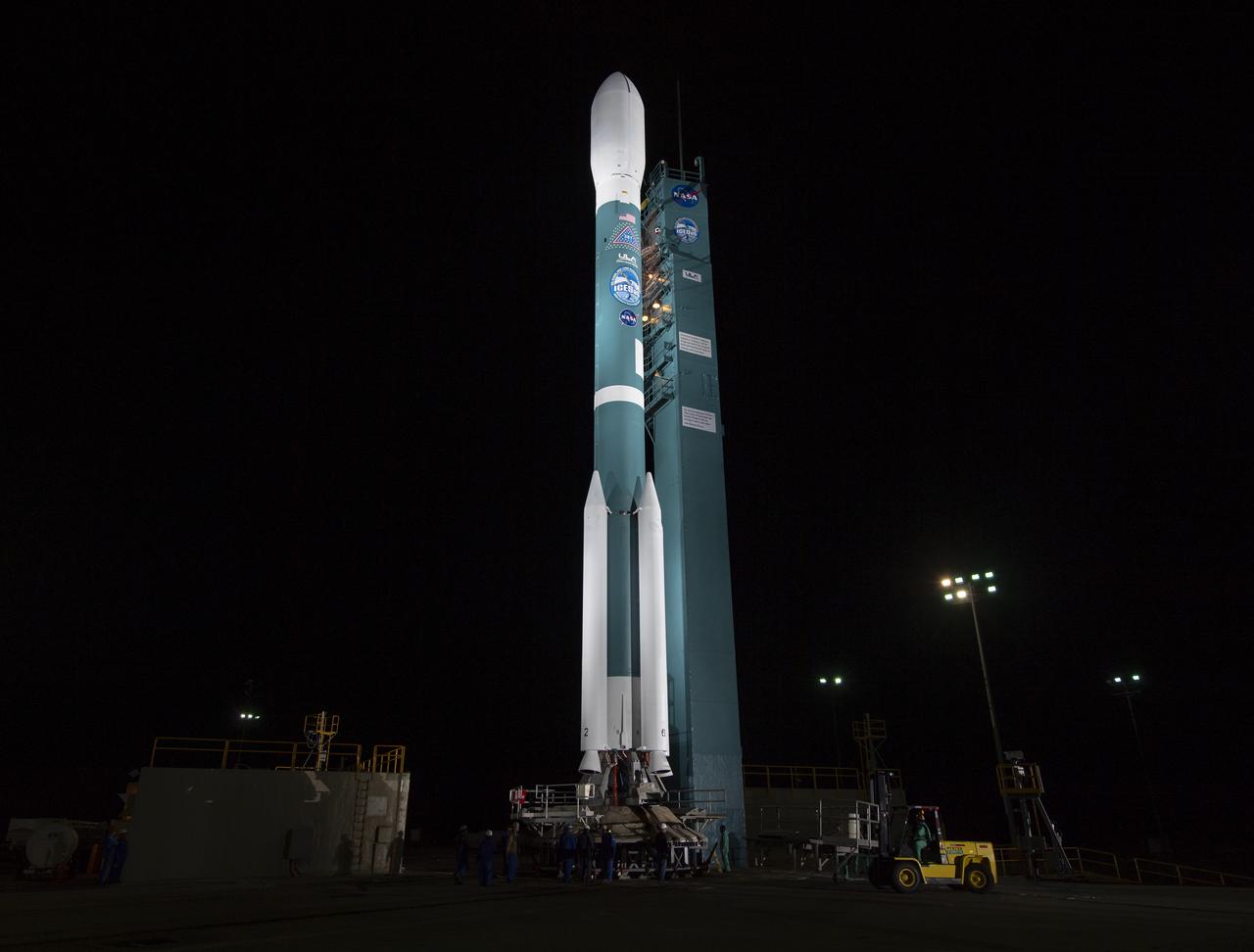
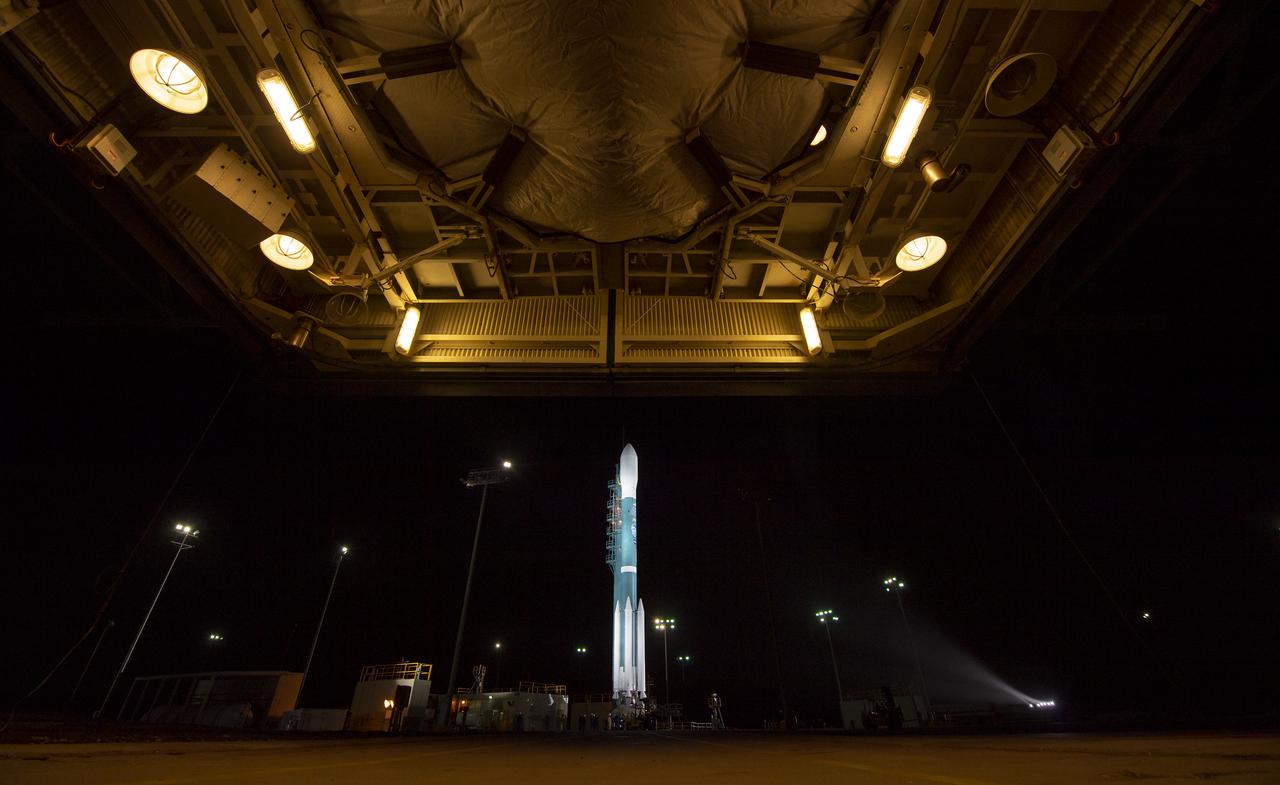
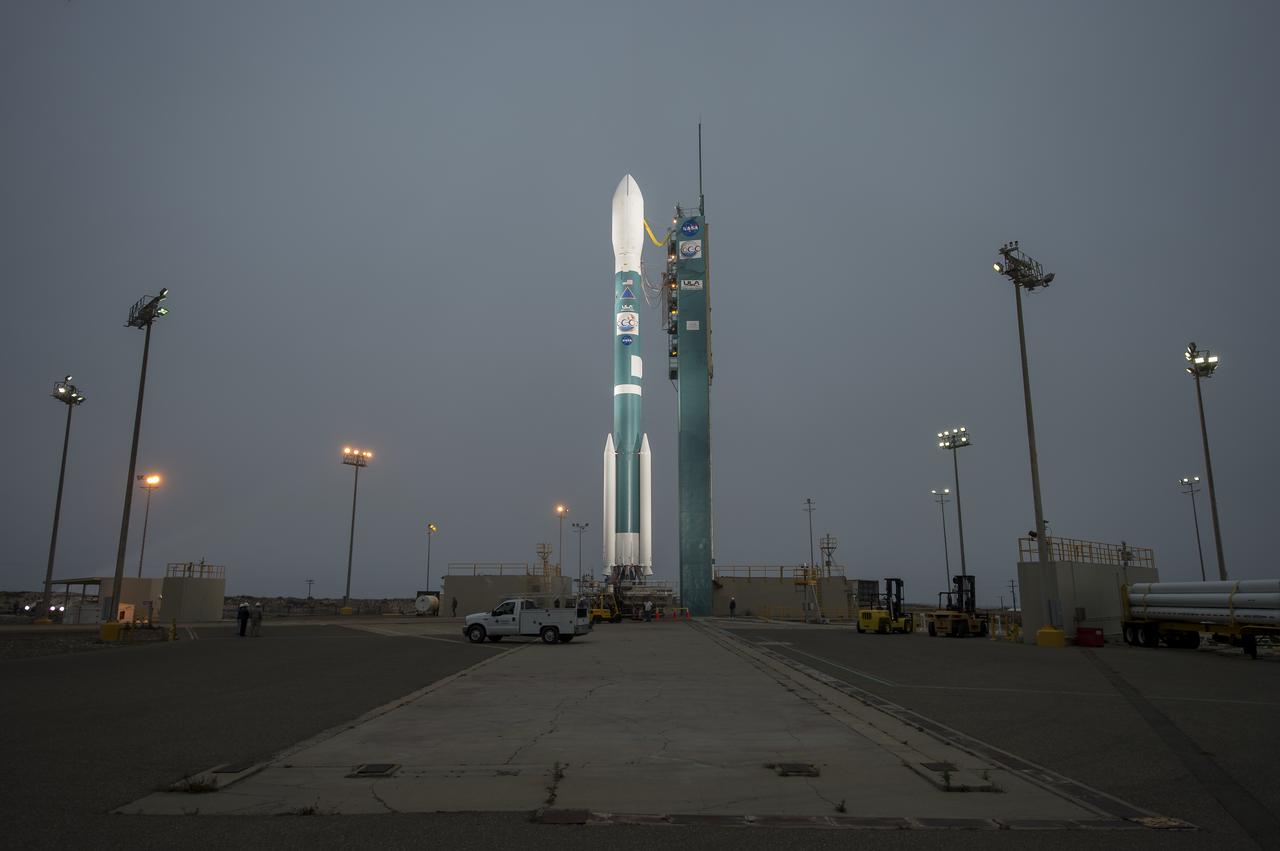
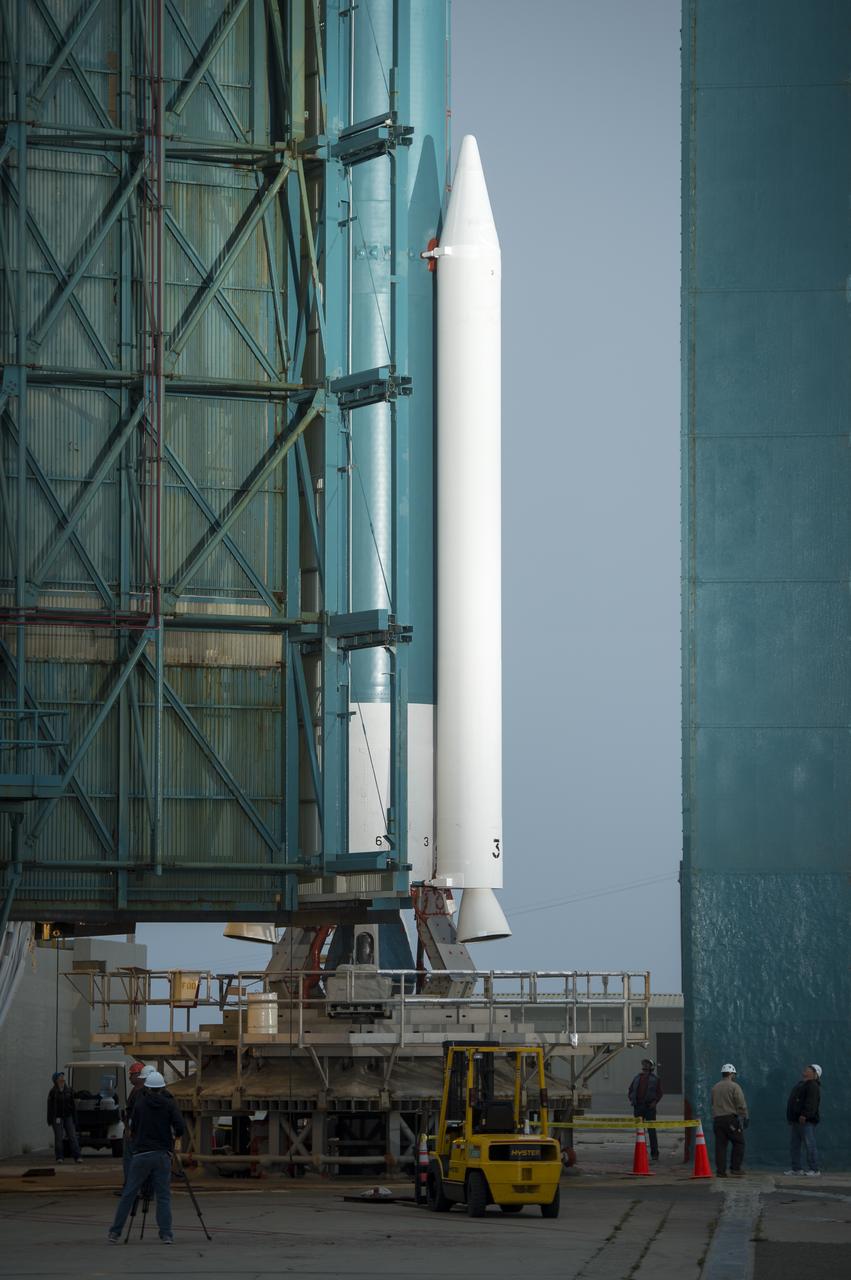
The United Launch Alliance (ULA) Delta II rocket with the NASA Ice, Cloud and land Elevation Satellite-2 (ICESat-2) onboard is seen shortly after the mobile service tower at SLC-2 was rolled back, Saturday, Sept. 15, 2018, at Vandenberg Air Force Base in California. The ICESat-2 mission will measure the changing height of Earth's ice. Photo Credit: (NASA/Bill Ingalls)
ICESat-2 Prelaunch
The United Launch Alliance (ULA) Delta II rocket with the NASA Ice, Cloud and land Elevation Satellite-2 (ICESat-2) onboard is seen shortly after the mobile service tower at SLC-2 was rolled back, Saturday, Sept. 15, 2018, at Vandenberg Air Force Base in California. The ICESat-2 mission will measure the changing height of Earth's ice. Photo Credit: (NASA/Bill Ingalls)
ICESat-2 Prelaunch
The United Launch Alliance (ULA) Delta II rocket with the NASA Ice, Cloud and land Elevation Satellite-2 (ICESat-2) onboard is seen shortly after the mobile service tower at SLC-2 was rolled back, Saturday, Sept. 15, 2018, at Vandenberg Air Force Base in California. The ICESat-2 mission will measure the changing height of Earth's ice. Photo Credit: (NASA/Bill Ingalls)
ICESat-2 Prelaunch
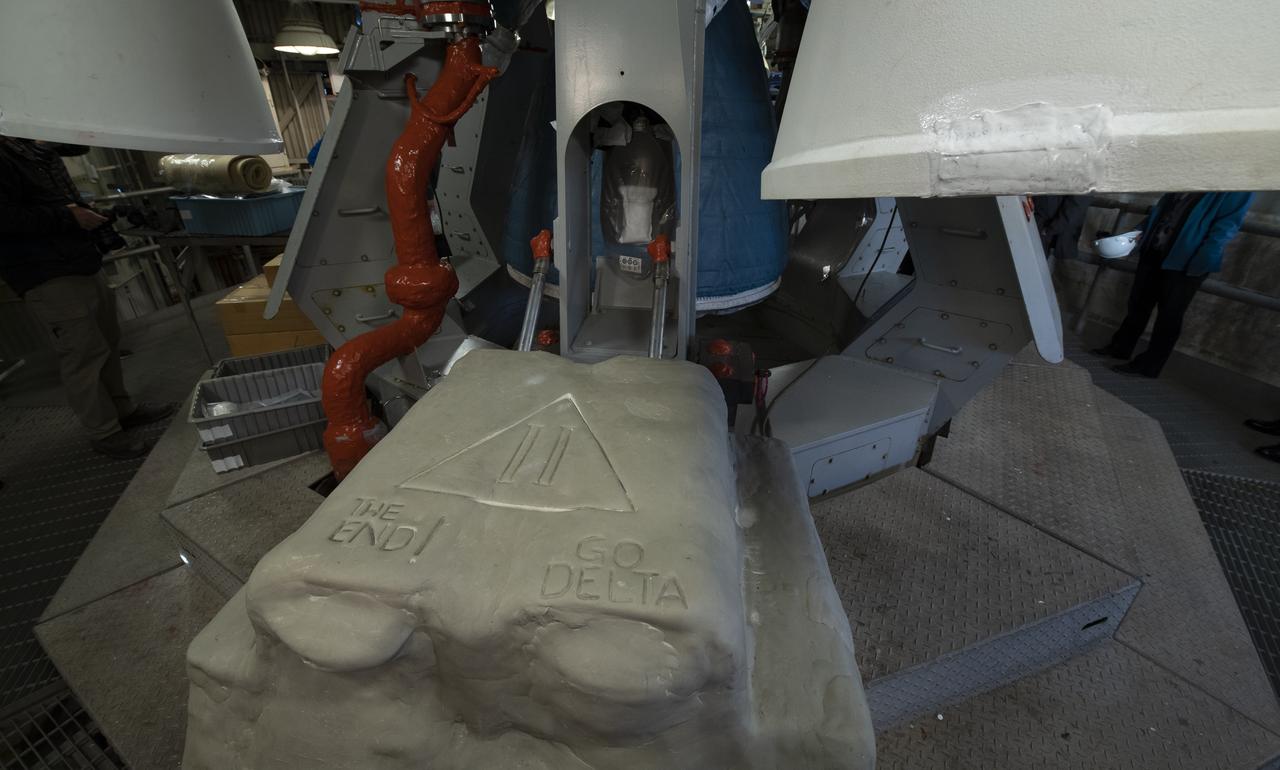
Base of the SLC-2 launch pad is embossed with well wishes for the final launch of the United Launch Alliance Delta II rocket, Thursday, Sept. 13, 2018, at Vandenberg Air Force Base in California. ULA launched NASA's Ice, Cloud and land Elevation Satellite-2 (ICESat-2) on Saturday, Sept. 15, 2018. The ICESat-2 mission will measure the changing height of Earth's ice. Photo Credit: (NASA/Bill Ingalls)
ICESat-2 Prelaunch
The United Launch Alliance (ULA) Delta II rocket with the NASA Ice, Cloud and land Elevation Satellite-2 (ICESat-2) onboard is seen shortly after the mobile service tower at SLC-2 was rolled back, Saturday, Sept. 15, 2018, at Vandenberg Air Force Base in California. The ICESat-2 mission will measure the changing height of Earth's ice. Photo Credit: (NASA/Bill Ingalls)
ICESat-2 Prelaunch
The United Launch Alliance Delta II rocket with the Orbiting Carbon Observatory-2 (OCO-2) satellite onboard, is seen moments after the launch gantry was moved at the Space Launch Complex 2, Monday, June 30, 2014, Vandenberg Air Force Base, Calif. OCO-2 will measure the global distribution of carbon dioxide, the leading human-produced greenhouse gas driving changes in Earth’s climate. OCO-2 is set for a July 1, 2014 launch. Photo Credit: (NASA/Bill Ingalls)
Orbiting Carbon Observatory-2 (OCO-2)
The launch gantry is rolled back to reveal the United Launch Alliance Delta II rocket with the Orbiting Carbon Observatory-2 (OCO-2) satellite onboard, at the Space Launch Complex 2, Monday, June 30, 2014, Vandenberg Air Force Base, Calif.  OCO-2 will measure the global distribution of carbon dioxide, the leading human-produced greenhouse gas driving changes in Earth’s climate.  OCO-2 is set for a July 1, 2014 launch. Photo Credit: (NASA/Bill Ingalls)
Orbiting Carbon Observatory-2 (OCO-2)
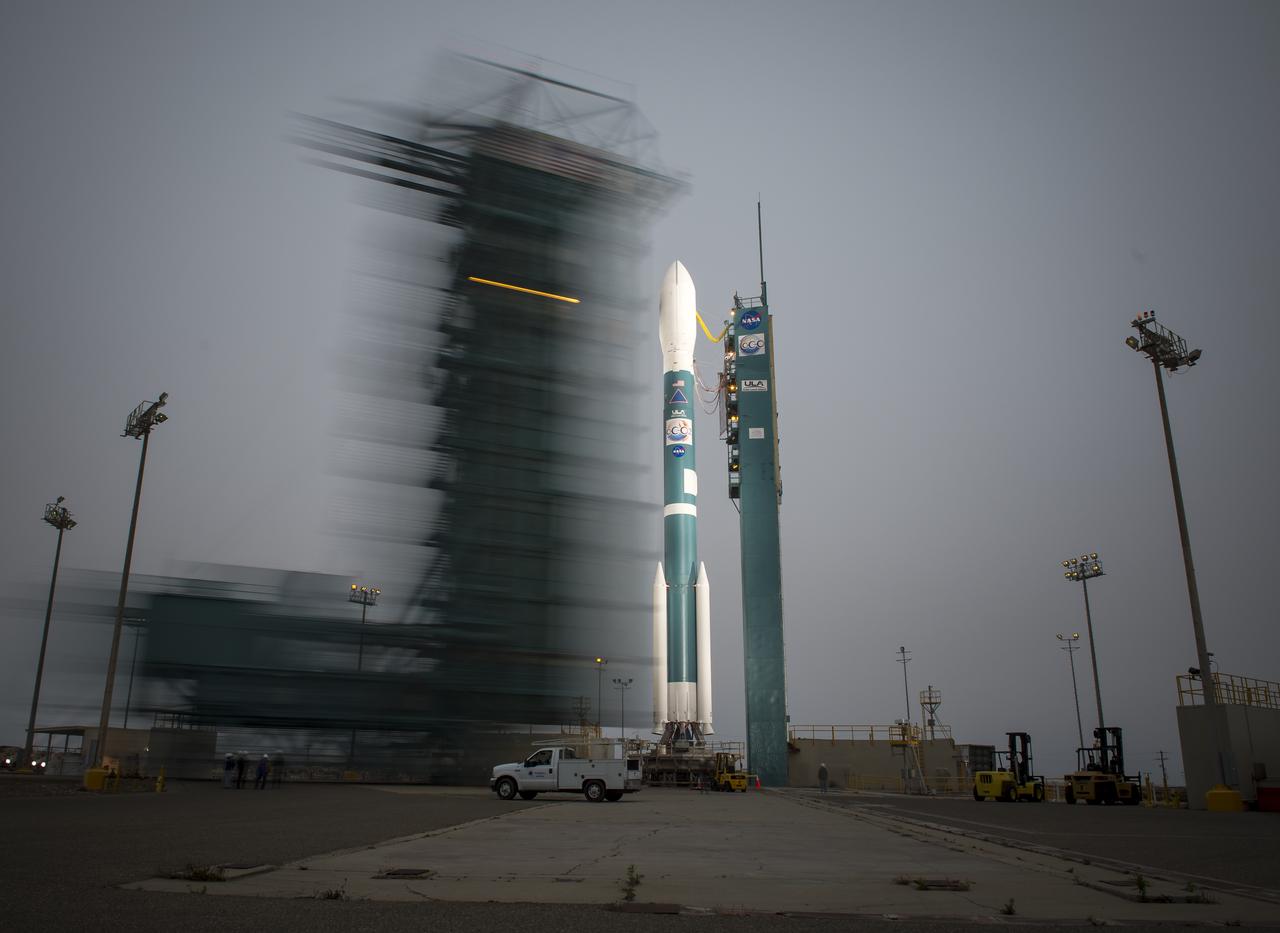
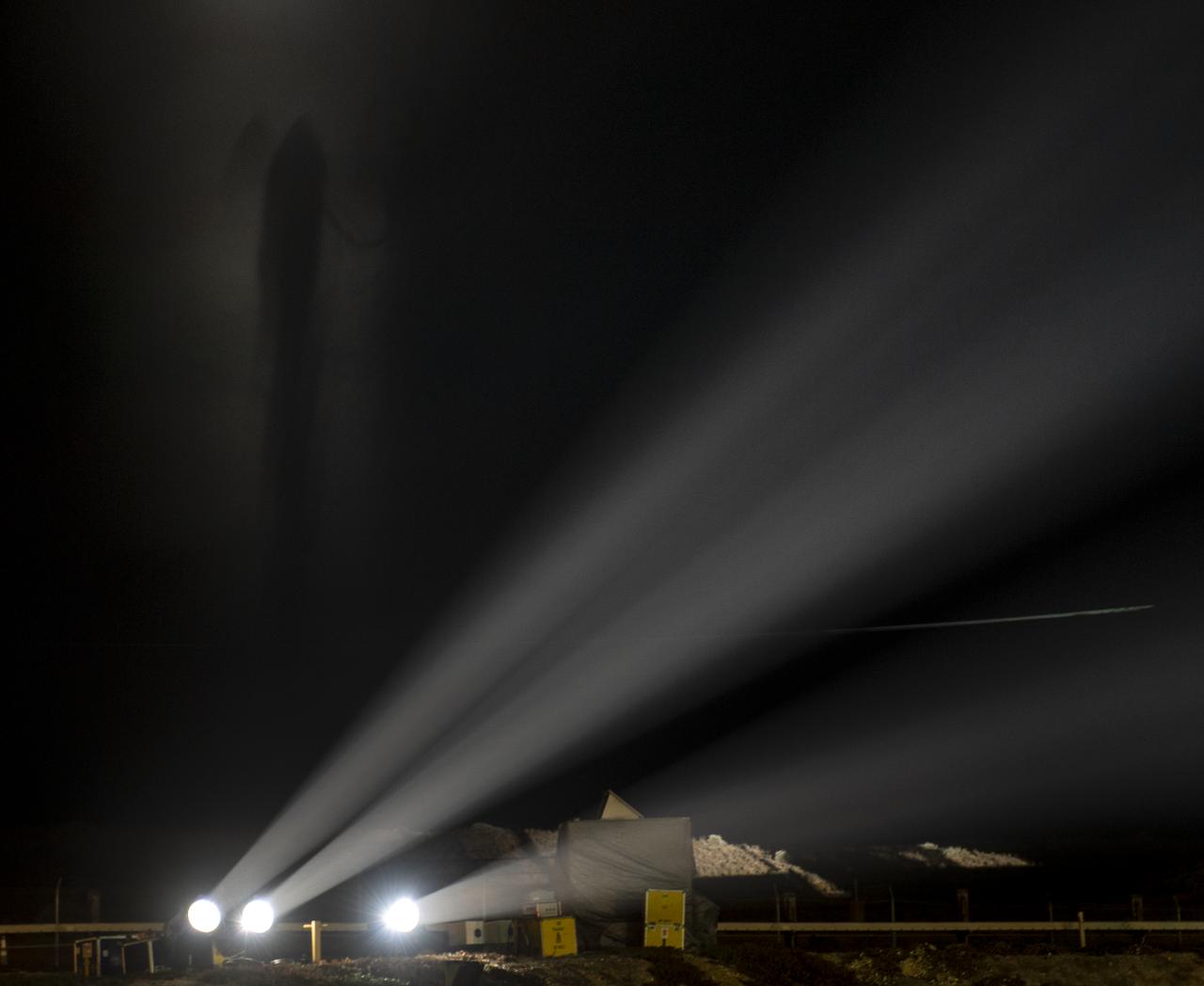
The silhouette of the United Launch Alliance (ULA) Delta II rocket, with the NASA Ice, Cloud and land Elevation Satellite-2 (ICESat-2) onboard, is seen in the fog shortly after the mobile service tower at SLC-2 was rolled back, Saturday, Sept. 15, 2018, at Vandenberg Air Force Base in California. The ICESat-2 mission will measure the changing height of Earth's ice. Photo Credit: (NASA/Bill Ingalls)
ICESat-2 Prelaunch
The United Launch Alliance (ULA) Delta II rocket with the NASA Ice, Cloud and land Elevation Satellite-2 (ICESat-2) onboard is seen shortly after the mobile service tower at SLC-2 was rolled back, Saturday, Sept. 15, 2018, at Vandenberg Air Force Base in California. The ICESat-2 mission will measure the changing height of Earth's ice. Photo Credit: (NASA/Bill Ingalls)
ICESat-2 Prelaunch
Workers monitor the progress of the rollback of the launch gantry from the United Launch Alliance Delta II rocket with the Orbiting Carbon Observatory-2 (OCO-2) satellite onboard, at Space Launch Complex 2, Monday, June 30, 2014, Vandenberg Air Force Base, Calif.  OCO-2 will measure the global distribution of carbon dioxide, the leading human-produced greenhouse gas driving changes in Earth’s climate.  OCO-2 is set for a July 1, 2014 launch. Photo Credit: (NASA/Bill Ingalls)
Orbiting Carbon Observatory-2 (OCO-2)
The United Launch Alliance Delta II rocket with the Orbiting Carbon Observatory-2 (OCO-2) satellite onboard, is seen as the launch gantry is moved at the Space Launch Complex 2, Monday, June 30, 2014, Vandenberg Air Force Base, Calif. OCO-2 will measure the global distribution of carbon dioxide, the leading human-produced greenhouse gas driving changes in Earth’s climate. OCO-2 is set for a July 1, 2014 launch. Photo Credit: (NASA/Bill Ingalls)
Orbiting Carbon Observatory-2 (OCO-2)
The United Launch Alliance (ULA) Delta II rocket with the NASA Ice, Cloud and land Elevation Satellite-2 (ICESat-2) onboard is seen shortly after the mobile service tower at SLC-2 was rolled back, Saturday, Sept. 15, 2018, at Vandenberg Air Force Base in California. The ICESat-2 mission will measure the changing height of Earth's ice. Photo Credit: (NASA/Bill Ingalls)
ICESat-2 Prelaunch
Stars are in view on the first stage of the United Launch Alliance Delta II rocket at Space Launch Complex 2 at Vandenberg Air Force Base in California, on Sept. 13, 2018. Historically, each Delta rocket used to notate the number of launches within the program, beginning in May, 1960, with the first Delta I. This practice was brought back for the final Delta II launch of ICESat-2. The “381” on the rocket signifies that this will be the 381st flight in the Delta family. A star traditionally was placed on the rocket to recognize each mission. For the final Delta II, stars were sent to team members and partners throughout the nation. This rocket boasts more than 150 stars with over 800 signatures of people who have been part of the Delta II program.
Delta II ICESat-2 Stars on First Stage Booster
Stars are in view on the first stage of the United Launch Alliance Delta II rocket at Space Launch Complex 2 at Vandenberg Air Force Base in California, on Sept. 13, 2018. Historically, each Delta rocket used to notate the number of launches within the program, beginning in May, 1960, with the first Delta I. This practice was brought back for the final Delta II launch of ICESat-2. The “381” on the rocket signifies that this will be the 381st flight in the Delta family. A star traditionally was placed on the rocket to recognize each mission. For the final Delta II, stars were sent to team members and partners throughout the nation. This rocket boasts more than 150 stars with over 800 signatures of people who have been part of the Delta II program.
Delta II ICESat-2 Stars on First Stage Booster
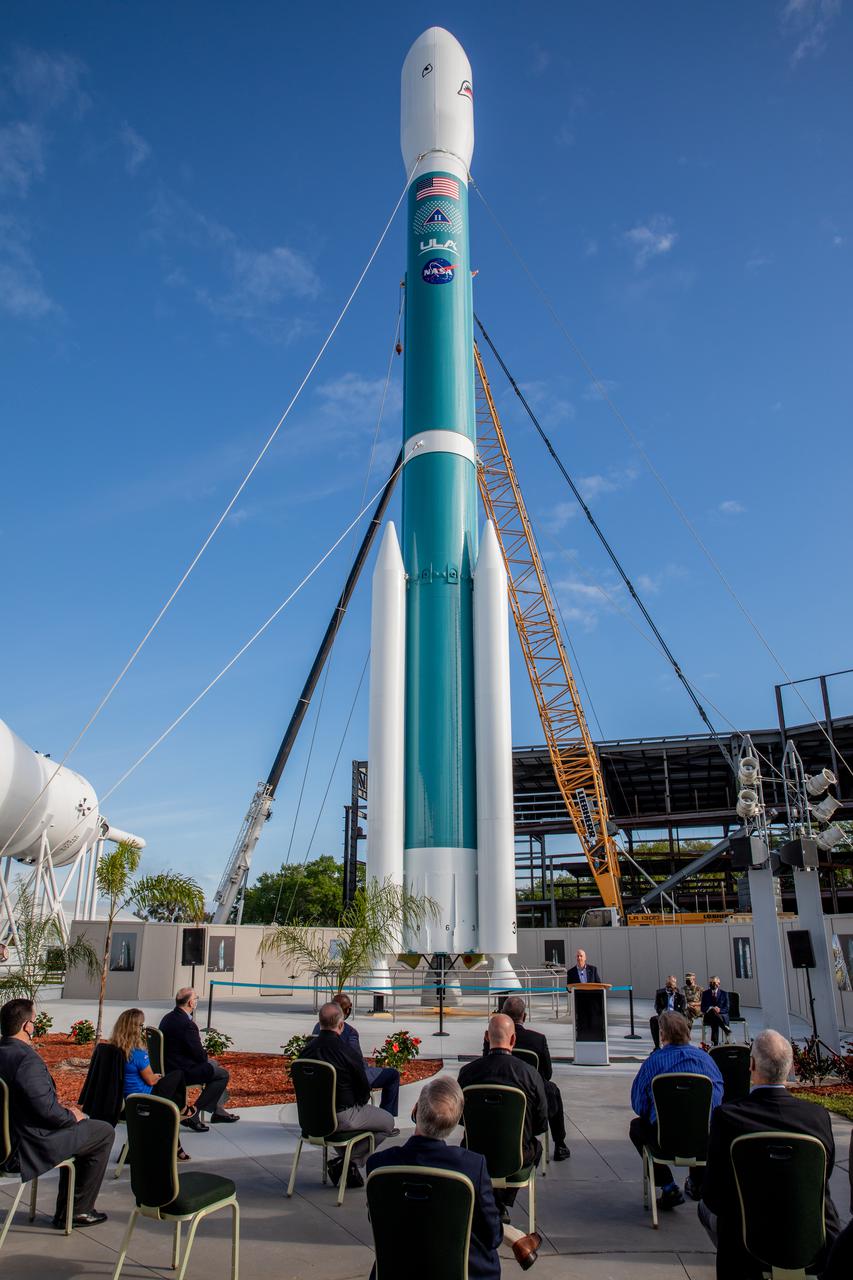
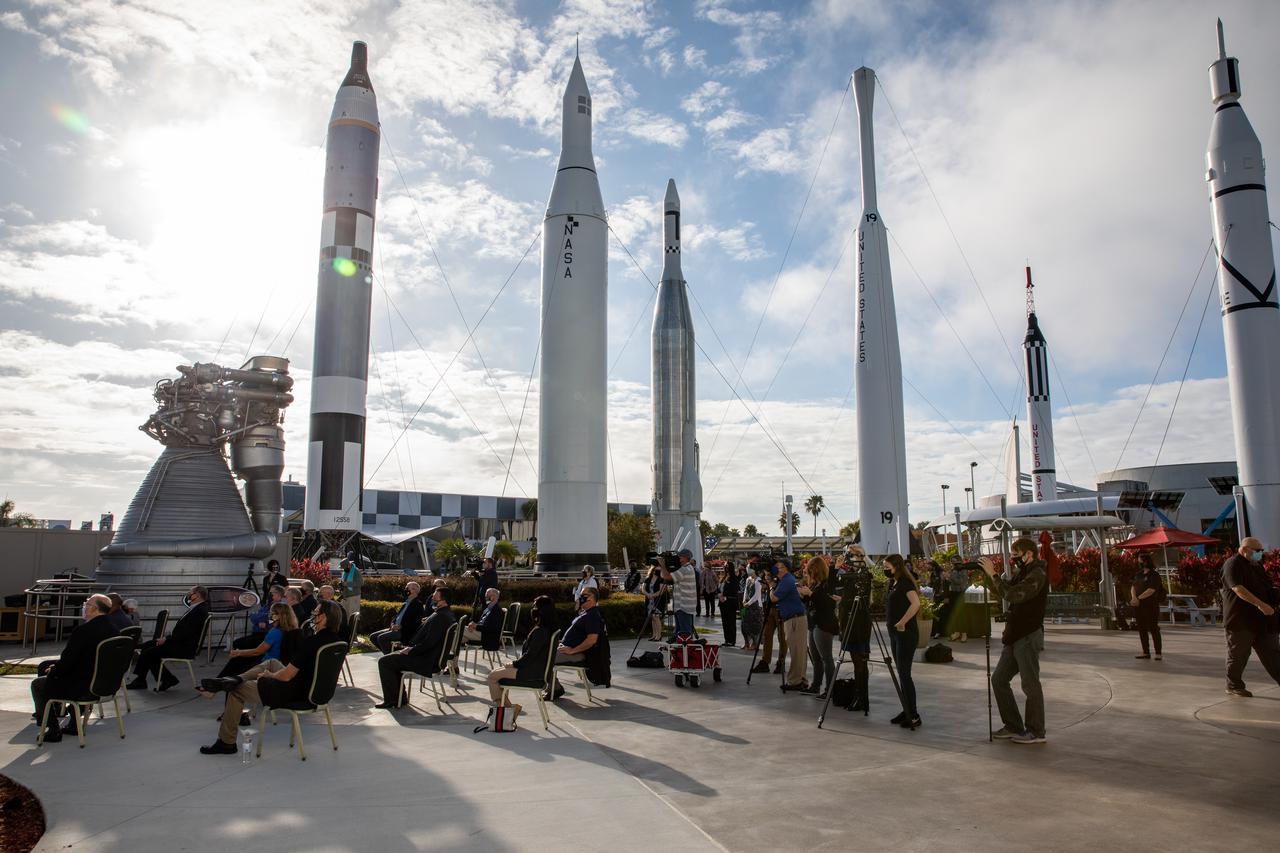
Guests attend a ribbon-cutting ceremony to welcome the last United Launch Alliance Delta II rocket to the lineup of historic launch vehicles in the Rocket Garden at the Kennedy Space Center Visitor Complex in Florida, on March 23, 2021. The Delta II rocket was a workhorse for NASA and civilian scientists, the U.S. military, and commercial clients throughout its almost 30 years of service. Since its first launch in 1989, the Delta II has launched 154 successful missions. NASA’s Launch Services Program launched the ICESat-2 spacecraft on the final Delta II launch on Sept. 15, 2018, from Vandenberg Air Force Base in California.
Delta II Exhibit Ribbon Cutting Ceremony
During a ribbon-cutting ceremony, the last United Launch Alliance Delta II rocket joins the lineup of historic launch vehicles in the Rocket Garden at the Kennedy Space Center Visitor Complex in Florida, on March 23, 2021. The Delta II rocket was a workhorse for NASA and civilian scientists, the U.S. military, and commercial clients throughout its almost 30 years of service. Since its first launch in 1989, the Delta II has launched 154 successful missions. NASA’s Launch Services Program launched the ICESat-2 spacecraft on the final Delta II launch for the agency on Sept. 15, 2018, from Vandenberg Air Force Base in California.
Delta II Exhibit Ribbon Cutting Ceremony
Guests attend a ribbon-cutting ceremony for the last United Launch Alliance Delta II rocket as it joins the lineup of historic launch vehicles in the Rocket Garden at the Kennedy Space Center Visitor Complex in Florida, on March 23, 2021. The Delta II rocket was a workhorse for NASA and civilian scientists, the U.S. military, and commercial clients throughout its almost 30 years of service. Since its first launch in 1989, the Delta II has launched 154 successful missions. NASA’s Launch Services Program launched the ICESat-2 spacecraft on the final Delta II launch on Sept. 15, 2018, from Vandenberg Air Force Base in California.
Delta II Exhibit Ribbon Cutting Ceremony
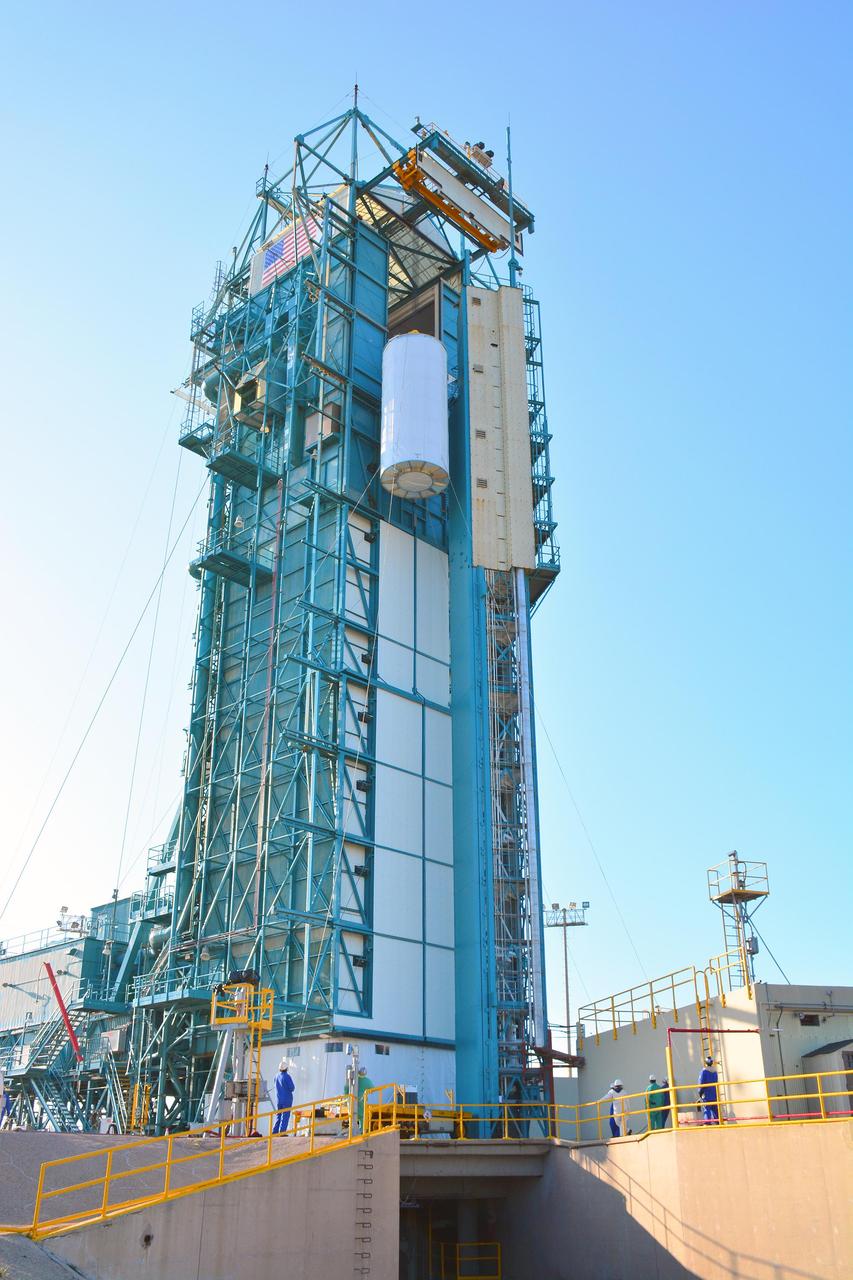
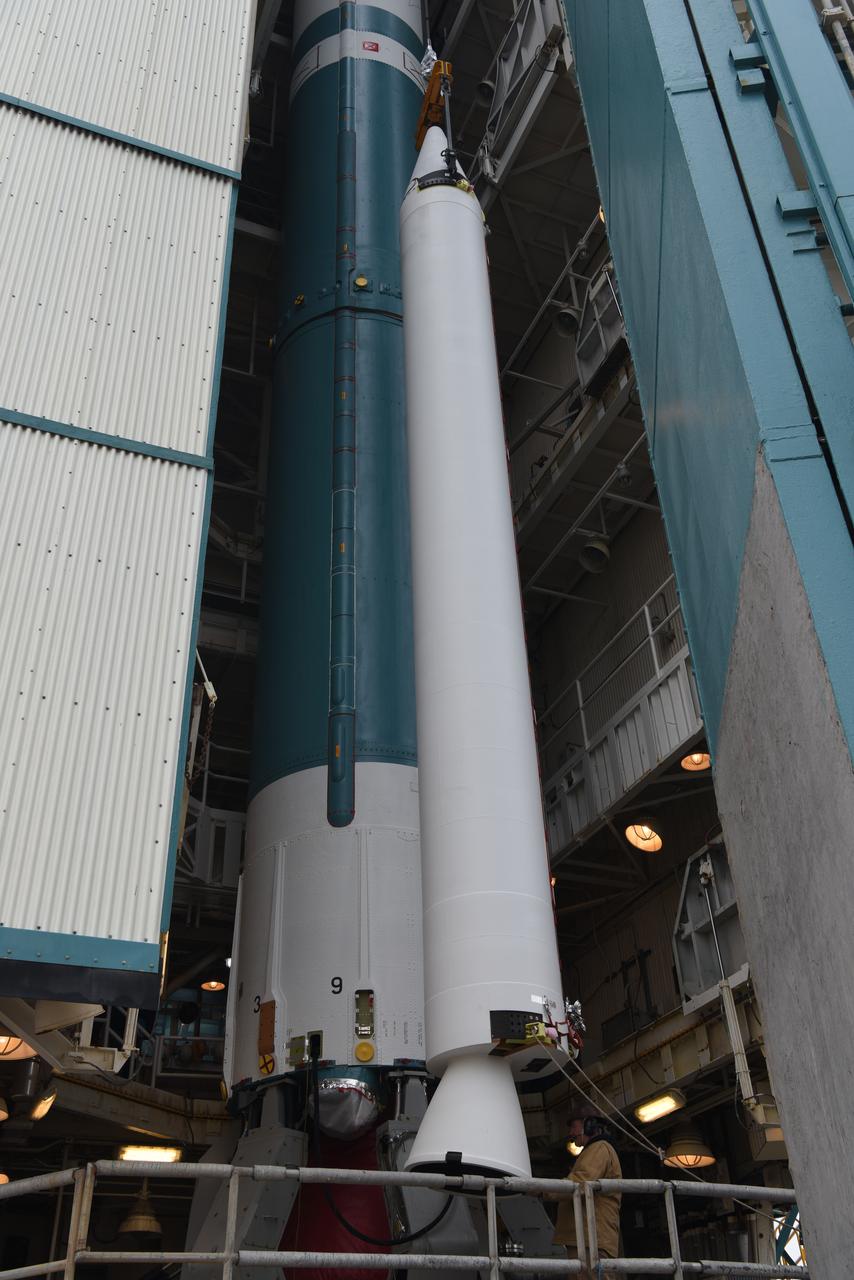
The solid rocket motor for mating to the United Launch Alliance Delta II launch vehicle is lifted up at the Vertical Integration Facility (VIF) at Space Launch Complex 2 on June 14, 2018, at Vandenberg Air Force Base in California. The solid rocket motor will be attached to the rocket. NASA's Ice, Cloud and land Elevation Satellite-2 (ICESat-2) will launch on the final Delta II rocket. ICESat-2 will measure the height of a changing Earth, one laser pulse at a time, 10,000 laser pulses a second. The satellite will carry a single instrument, the Advanced Topographic Laser Altimeter System. ICESat-2 will help scientists investigate why, and how much our planet's frozen and icy areas, called the cryosphere, is changing in a warming climate.
Delta II ICESat-2 SRM Lift and Mate
United Launch Alliance (ULA) technicians assist as the solid rocket motor is lifted up and moved toward the Delta II launch vehicle in the Vertical Integration Facility (VIF) at Space Launch Complex 2 on June 14, 2018, at Vandenberg Air Force Base in California. The solid rocket motor will be attached to the rocket. NASA's Ice, Cloud and land Elevation Satellite-2 (ICESat-2) will launch on the final ULA Delta II rocket. ICESat-2 will measure the height of a changing Earth, one laser pulse at a time, 10,000 laser pulses a second. The satellite will carry a single instrument, the Advanced Topographic Laser Altimeter System. ICESat-2 will help scientists investigate why, and how much our planet's frozen and icy areas, called the cryosphere, is changing in a warming climate.
Delta II ICESat-2 SRM Lift and Mate
The solid rocket motor for mating to the United Launch Alliance Delta II launch vehicle is lifted up at the Vertical Integration Facility (VIF) at Space Launch Complex 2 on June 14, 2018, at Vandenberg Air Force Base in California. The solid rocket motor will be attached to the rocket. NASA's Ice, Cloud and land Elevation Satellite-2 (ICESat-2) will launch on the final Delta II rocket. ICESat-2 will measure the height of a changing Earth, one laser pulse at a time, 10,000 laser pulses a second. The satellite will carry a single instrument, the Advanced Topographic Laser Altimeter System. ICESat-2 will help scientists investigate why, and how much our planet's frozen and icy areas, called the cryosphere, is changing in a warming climate.
Delta II ICESat-2 SRM Lift and Mate
United Launch Alliance (ULA) technicians assist as the solid rocket motor is moved toward the Delta II launch vehicle in the Vertical Integration Facility (VIF) at Space Launch Complex 2 on June 14, 2018, at Vandenberg Air Force Base in California. The solid rocket motor will be attached to the rocket. NASA's Ice, Cloud and land Elevation Satellite-2 (ICESat-2) will launch on the final ULA Delta II rocket. ICESat-2 will measure the height of a changing Earth, one laser pulse at a time, 10,000 laser pulses a second. The satellite will carry a single instrument, the Advanced Topographic Laser Altimeter System. ICESat-2 will help scientists investigate why, and how much our planet's frozen and icy areas, called the cryosphere, is changing in a warming climate.
Delta II ICESat-2 SRM Lift and Mate
The solid rocket motor for mating to the United Launch Alliance Delta II launch vehicle is lifted up at the Vertical Integration Facility (VIF) at Space Launch Complex 2 on June 14, 2018, at Vandenberg Air Force Base in California. The solid rocket motor will be attached to the rocket. NASA's Ice, Cloud and land Elevation Satellite-2 (ICESat-2) will launch on the final Delta II rocket. ICESat-2 will measure the height of a changing Earth, one laser pulse at a time, 10,000 laser pulses a second. The satellite will carry a single instrument, the Advanced Topographic Laser Altimeter System. ICESat-2 will help scientists investigate why, and how much our planet's frozen and icy areas, called the cryosphere, is changing in a warming climate.
Delta II ICESat-2 SRM Lift and Mate
The solid rocket motor for mating to the United Launch Alliance Delta II launch vehicle arrives at the Vertical Integration Facility (VIF) at Space Launch Complex 2 on June 14, 2018, at Vandenberg Air Force Base in California. The solid rocket motor will be lifted up and attached to the rocket. NASA's Ice, Cloud and land Elevation Satellite-2 (ICESat-2) will launch on the final Delta II rocket. ICESat-2 will measure the height of a changing Earth, one laser pulse at a time, 10,000 laser pulses a second. The satellite will carry a single instrument, the Advanced Topographic Laser Altimeter System. ICESat-2 will help scientists investigate why, and how much our planet's frozen and icy areas, called the cryosphere, is changing in a warming climate.
Delta II ICESat-2 SRM Lift and Mate
The solid rocket motor for mating to the United Launch Alliance Delta II launch vehicle is lifted up at the Vertical Integration Facility (VIF) at Space Launch Complex 2 on June 14, 2018, at Vandenberg Air Force Base in California. The solid rocket motor will be attached to the rocket. NASA's Ice, Cloud and land Elevation Satellite-2 (ICESat-2) will launch on the final Delta II rocket. ICESat-2 will measure the height of a changing Earth, one laser pulse at a time, 10,000 laser pulses a second. The satellite will carry a single instrument, the Advanced Topographic Laser Altimeter System. ICESat-2 will help scientists investigate why, and how much our planet's frozen and icy areas, called the cryosphere, is changing in a warming climate.
Delta II ICESat-2 SRM Lift and Mate
The launch gantry, surrounding the United Launch Alliance Delta II rocket with the Orbiting Carbon Observatory-2 OCO-2 satellite onboard, is seen at Space Launch Complex 2, Sunday, June 29, 2014, Vandenberg Air Force Base, Calif.
Orbiting Carbon Observatory-2 Ready to Blast Off
The Delta II second stage for NASA Orbiting Carbon Observatory-2 mission, or OCO-2, is positioned atop the rocket first stage in the mobile service tower at Space Launch Complex 2 on Vandenberg Air Force Base in California.
Positioning NASA OCO-2 Delta II Launch Vehicle Second Stage for Mating
Artist impression of NASA MErcury Surface, Space ENvironment, GEochemistry, and Ranging MESSENGER spacecraft as it leaves Earth, following its Aug. 3, 2004 launch from Cape Canaveral Air Force Station, Fla. aboard a Delta II rocket.
MESSENGER Departing Earth Artist Concept
At 11:02 a.m. EDT on April 7, 2001, crowds watch a Boeing Delta II rocket lift off from Cape Canaveral Air Force Station, Florida, carrying NASA 2001 Mars Odyssey spacecraft into space on its seven-month journey to Mars.
Odyssey Launch to Mars on April 7, 2001
The Delta II second stage for NASA Orbiting Carbon Observatory-2 mission, or OCO-2, makes contact with the rocket first stage in the mobile service tower at Space Launch Complex 2 on Vandenberg Air Force Base in California.
Mating NASA OCO-2 Delta II Launch Vehicle First and Second Stages
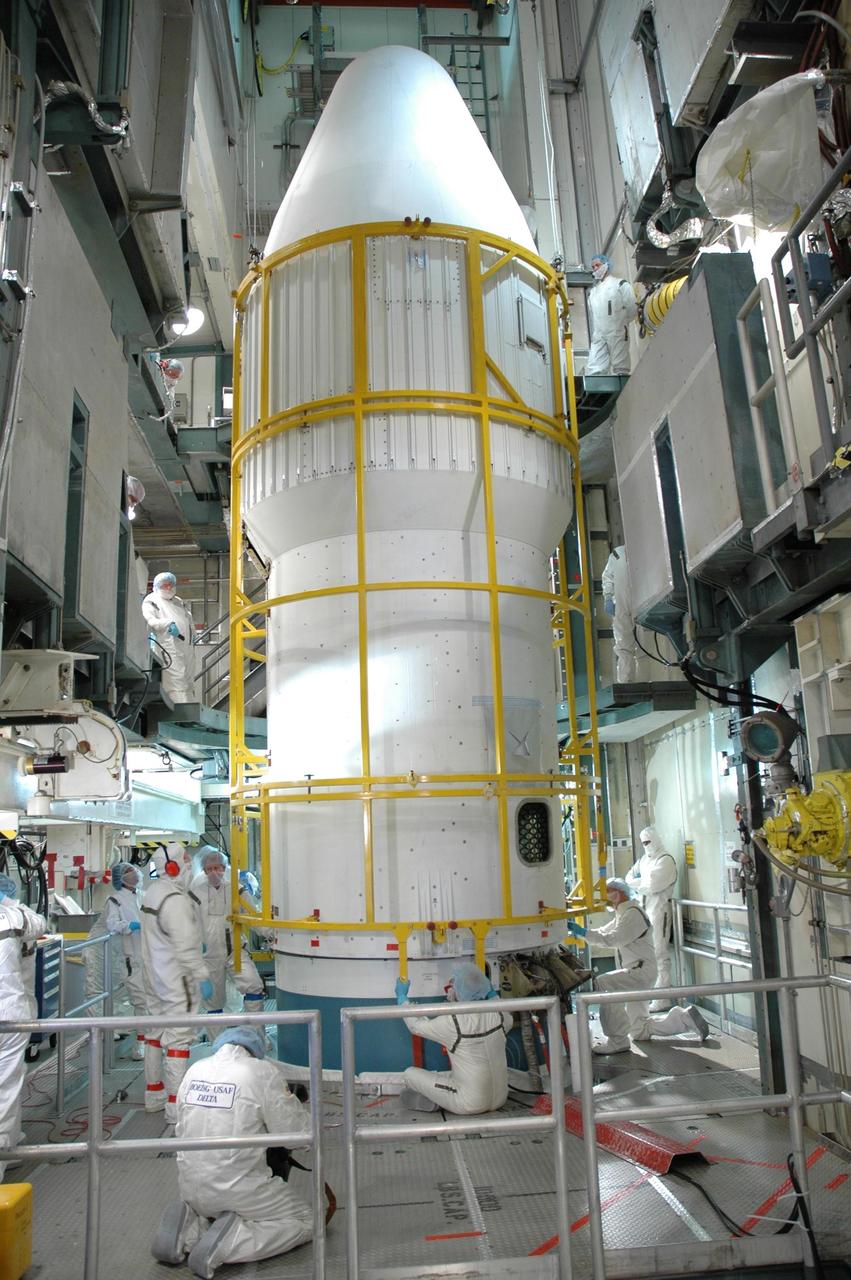
KENNEDY SPACE CENTER, FLA. - The Delta II rocket’s third stage waits in the Payload Hazardous Servicing Facility for mating with the Mars Exploration Rover 2 (MER-2).  They will then be installed into the transportation canister for transfer to the launch pad.  NASA's twin Mars Exploration Rovers are designed to study the history of water on Mars. These robotic geologists are equipped with a robotic arm, a drilling tool, three spectrometers, and four pairs of cameras that allow them to have a human-like, 3D view of the terrain. Each rover could travel as far as 100 meters in one day to act as Mars scientists' eyes and hands, exploring an environment where humans can't yet go.  MER-2 is scheduled to launch June 5 as MER-A aboard a Delta II rocket from Cape Canaveral Air Force Station.
KENNEDY SPACE CENTER, FLA. - The Delta II rocket’s third stage waits in the Payload Hazardous Servicing Facility for mating with the Mars Exploration Rover 2 (MER-2). They will then be installed into the transportation canister for transfer to the launch pad. NASA's twin Mars Exploration Rovers are designed to study the history of water on Mars. These robotic geologists are equipped with a robotic arm, a drilling tool, three spectrometers, and four pairs of cameras that allow them to have a human-like, 3D view of the terrain. Each rover could travel as far as 100 meters in one day to act as Mars scientists' eyes and hands, exploring an environment where humans can't yet go. MER-2 is scheduled to launch June 5 as MER-A aboard a Delta II rocket from Cape Canaveral Air Force Station.
KENNEDY SPACE CENTER, FLA. -  The Delta II rocket’s third stage arrives at the Payload Hazardous Servicing Facility.  It will be mated with the Mars Exploration Rover 2 (MER-2) and then installed into the transportation canister for transfer to the launch pad.  NASA's twin Mars Exploration Rovers are designed to study the history of water on Mars. These robotic geologists are equipped with a robotic arm, a drilling tool, three spectrometers, and four pairs of cameras that allow them to have a human-like, 3D view of the terrain. Each rover could travel as far as 100 meters in one day to act as Mars scientists' eyes and hands, exploring an environment where humans can't yet go.  MER-2 is scheduled to launch June 5 as MER-A aboard a Delta II rocket from Cape Canaveral Air Force Station.
KENNEDY SPACE CENTER, FLA. - The Delta II rocket’s third stage arrives at the Payload Hazardous Servicing Facility. It will be mated with the Mars Exploration Rover 2 (MER-2) and then installed into the transportation canister for transfer to the launch pad. NASA's twin Mars Exploration Rovers are designed to study the history of water on Mars. These robotic geologists are equipped with a robotic arm, a drilling tool, three spectrometers, and four pairs of cameras that allow them to have a human-like, 3D view of the terrain. Each rover could travel as far as 100 meters in one day to act as Mars scientists' eyes and hands, exploring an environment where humans can't yet go. MER-2 is scheduled to launch June 5 as MER-A aboard a Delta II rocket from Cape Canaveral Air Force Station.
KENNEDY SPACE CENTER, FLA. - The Delta II rocket’s third stage rolls into the Payload Hazardous Servicing Facility.  It will be mated with the Mars Exploration Rover 2 (MER-2) and then installed into the transportation canister for transfer to the launch pad.  NASA's twin Mars Exploration Rovers are designed to study the history of water on Mars. These robotic geologists are equipped with a robotic arm, a drilling tool, three spectrometers, and four pairs of cameras that allow them to have a human-like, 3D view of the terrain. Each rover could travel as far as 100 meters in one day to act as Mars scientists' eyes and hands, exploring an environment where humans can't yet go.  MER-2 is scheduled to launch June 5 as MER-A aboard a Delta II rocket from Cape Canaveral Air Force Station.
KENNEDY SPACE CENTER, FLA. - The Delta II rocket’s third stage rolls into the Payload Hazardous Servicing Facility. It will be mated with the Mars Exploration Rover 2 (MER-2) and then installed into the transportation canister for transfer to the launch pad. NASA's twin Mars Exploration Rovers are designed to study the history of water on Mars. These robotic geologists are equipped with a robotic arm, a drilling tool, three spectrometers, and four pairs of cameras that allow them to have a human-like, 3D view of the terrain. Each rover could travel as far as 100 meters in one day to act as Mars scientists' eyes and hands, exploring an environment where humans can't yet go. MER-2 is scheduled to launch June 5 as MER-A aboard a Delta II rocket from Cape Canaveral Air Force Station.
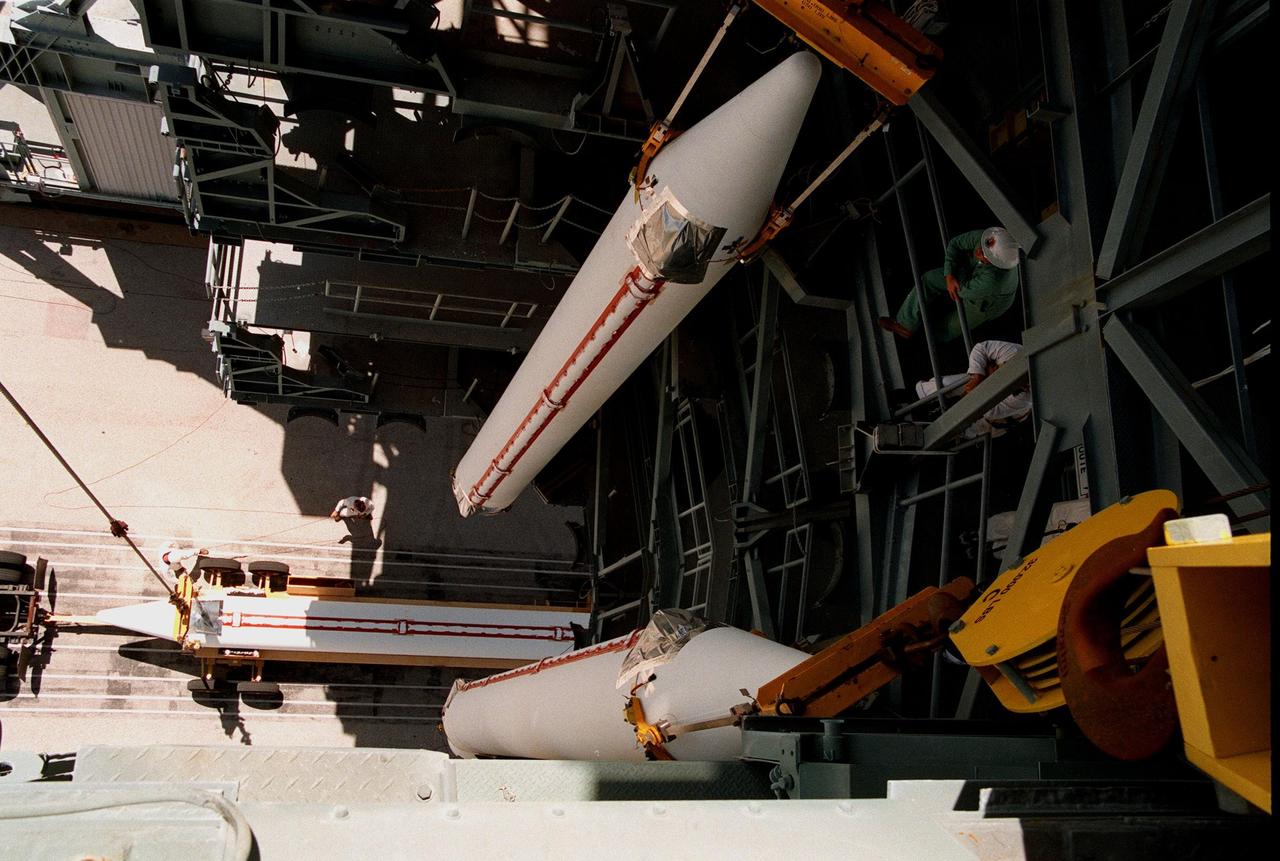
KENNEDY SPACE CENTER, FLA. -   Another solid rocket booster (SRB) is lifted to vertical on Launch Complex 17-B, Cape Canaveral Air Force Station, to join the one already in place in the mobile service tower.  The SRBs will be attached to the Delta II Heavy rocket in the background that will launch the Space Infrared Telescope Facility (SIRTF). The Delta II Heavy features nine 46-inch-diameter, stretched SRBs.  SIRTF, consisting of three cryogenically cooled science instruments and an 0.85-meter telescope, is one of NASA's largest infrared telescopes to be launched.  SIRTF will obtain images and spectra by detecting the infrared energy, or heat, radiated by objects in space. Most of this infrared radiation is blocked by the Earth's atmosphere and cannot be observed from the ground.
KENNEDY SPACE CENTER, FLA. - Another solid rocket booster (SRB) is lifted to vertical on Launch Complex 17-B, Cape Canaveral Air Force Station, to join the one already in place in the mobile service tower. The SRBs will be attached to the Delta II Heavy rocket in the background that will launch the Space Infrared Telescope Facility (SIRTF). The Delta II Heavy features nine 46-inch-diameter, stretched SRBs. SIRTF, consisting of three cryogenically cooled science instruments and an 0.85-meter telescope, is one of NASA's largest infrared telescopes to be launched. SIRTF will obtain images and spectra by detecting the infrared energy, or heat, radiated by objects in space. Most of this infrared radiation is blocked by the Earth's atmosphere and cannot be observed from the ground.
KENNEDY SPACE CENTER, FLA. -   Another solid rocket booster (SRB) is lifted to vertical on Launch Complex 17-B, Cape Canaveral Air Force Station, to join the one already in place in the mobile service tower.  The SRBs will be attached to the Delta II Heavy rocket that will launch the Space Infrared Telescope Facility (SIRTF).  The Delta II Heavy features nine 46-inch-diameter, stretched SRBs.  SIRTF, consisting of three cryogenically cooled science instruments and an 0.85-meter telescope, is one of NASA's largest infrared telescopes to be launched.  SIRTF will obtain images and spectra by detecting the infrared energy, or heat, radiated by objects in space. Most of this infrared radiation is blocked by the Earth's atmosphere and cannot be observed from the ground.
KENNEDY SPACE CENTER, FLA. - Another solid rocket booster (SRB) is lifted to vertical on Launch Complex 17-B, Cape Canaveral Air Force Station, to join the one already in place in the mobile service tower. The SRBs will be attached to the Delta II Heavy rocket that will launch the Space Infrared Telescope Facility (SIRTF). The Delta II Heavy features nine 46-inch-diameter, stretched SRBs. SIRTF, consisting of three cryogenically cooled science instruments and an 0.85-meter telescope, is one of NASA's largest infrared telescopes to be launched. SIRTF will obtain images and spectra by detecting the infrared energy, or heat, radiated by objects in space. Most of this infrared radiation is blocked by the Earth's atmosphere and cannot be observed from the ground.
VANDENBERG AIR FORCE BASE, CALIF. -  At Space Launch Complex 2 on Vandenberg Air Force Base in California,  the first of three Solid Rocket Boosters is lifted alongside the first stage of a Boeing Delta II rocket for mating.  The Boeing Delta II will launch the National Oceanic and Atmospheric Administration (NOAA-N) spacecraft.  Launch of NOAA-N aboard the Boeing Delta II rocket is currently scheduled for May 11, 2005.  NOAA-N is the fourth in the series of support dedicated microwave instruments for the generation of temperature, moisture, surface, and hydrological products in cloudy regions where visible and infrared (IR) instruments have decreased capability.
KSC-05pd-0682
VANDENBERG AIR FORCE BASE, CALIF. -  At Space Launch Complex 2 on Vandenberg Air Force Base in California, one of three Solid Rocket Boosters is lifted alongside the first stage of a Boeing Delta II rocket for mating.  The Boeing Delta II will launch the National Oceanic and Atmospheric Administration (NOAA-N) spacecraft.  Launch of NOAA-N aboard the Boeing Delta II rocket is currently scheduled for May 11, 2005.  NOAA-N is the fourth in the series of support dedicated microwave instruments for the generation of temperature, moisture, surface, and hydrological products in cloudy regions where visible and infrared (IR) instruments have decreased capability.
KSC-05pd-0683
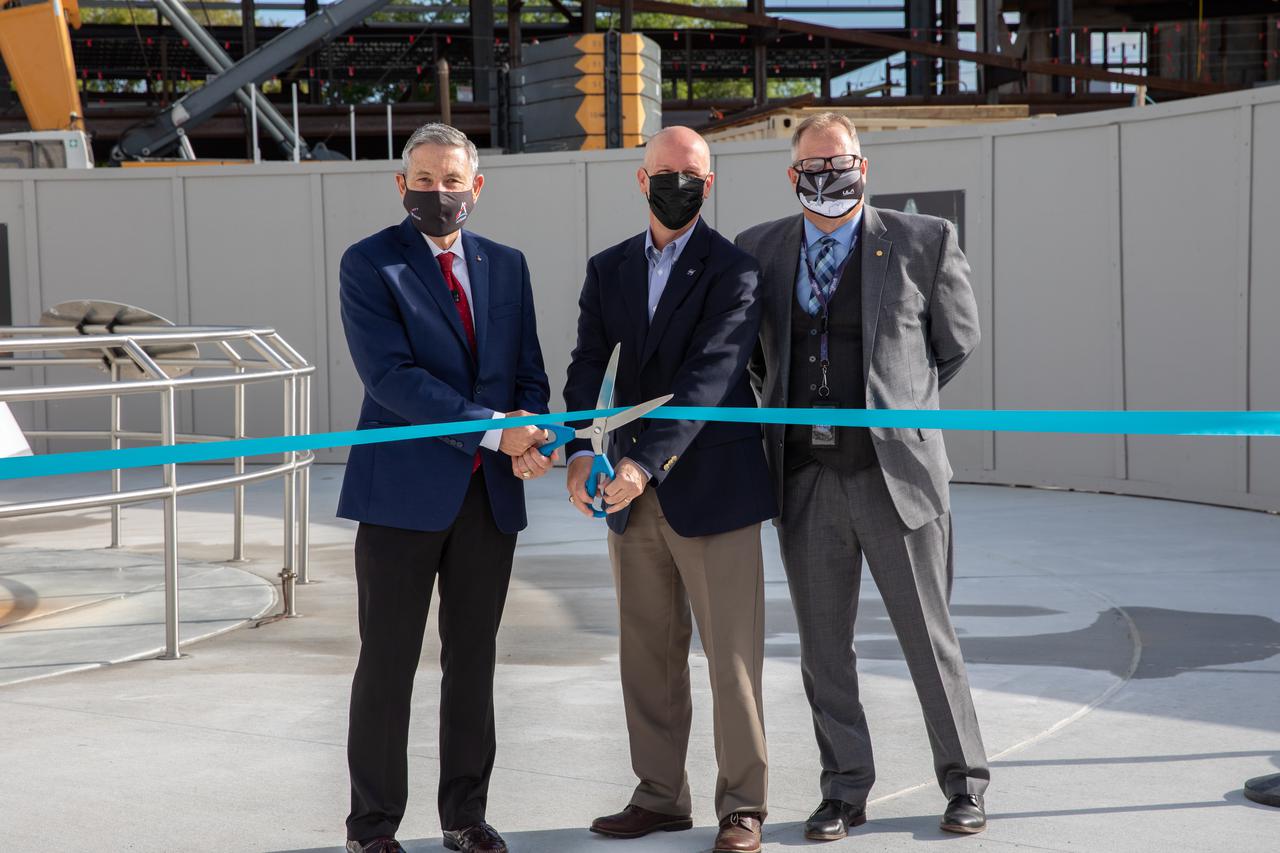
A ribbon-cutting ceremony welcomes the last United Launch Alliance Delta II rocket to the lineup of historic launch vehicles in the Rocket Garden at the Kennedy Space Center Visitor Complex in Florida, on March 23, 2021. Cutting the ribbon, from left are Kennedy Space Center Director Bob Cabana, Tim Dunn, launch director, Launch Services Program, and Therrin Protze, chief operating officer, Delaware North/KSCVC. The Delta II rocket was a workhorse for NASA and civilian scientists, the U.S. military, and commercial clients throughout its almost 30 years of service. Since its first launch in 1989, the Delta II has launched 154 successful missions. NASA’s Launch Services Program launched the ICESat-2 spacecraft on the final Delta II launch on Sept. 15, 2018, from Vandenberg Air Force Base in California.
Delta II Exhibit Ribbon Cutting Ceremony
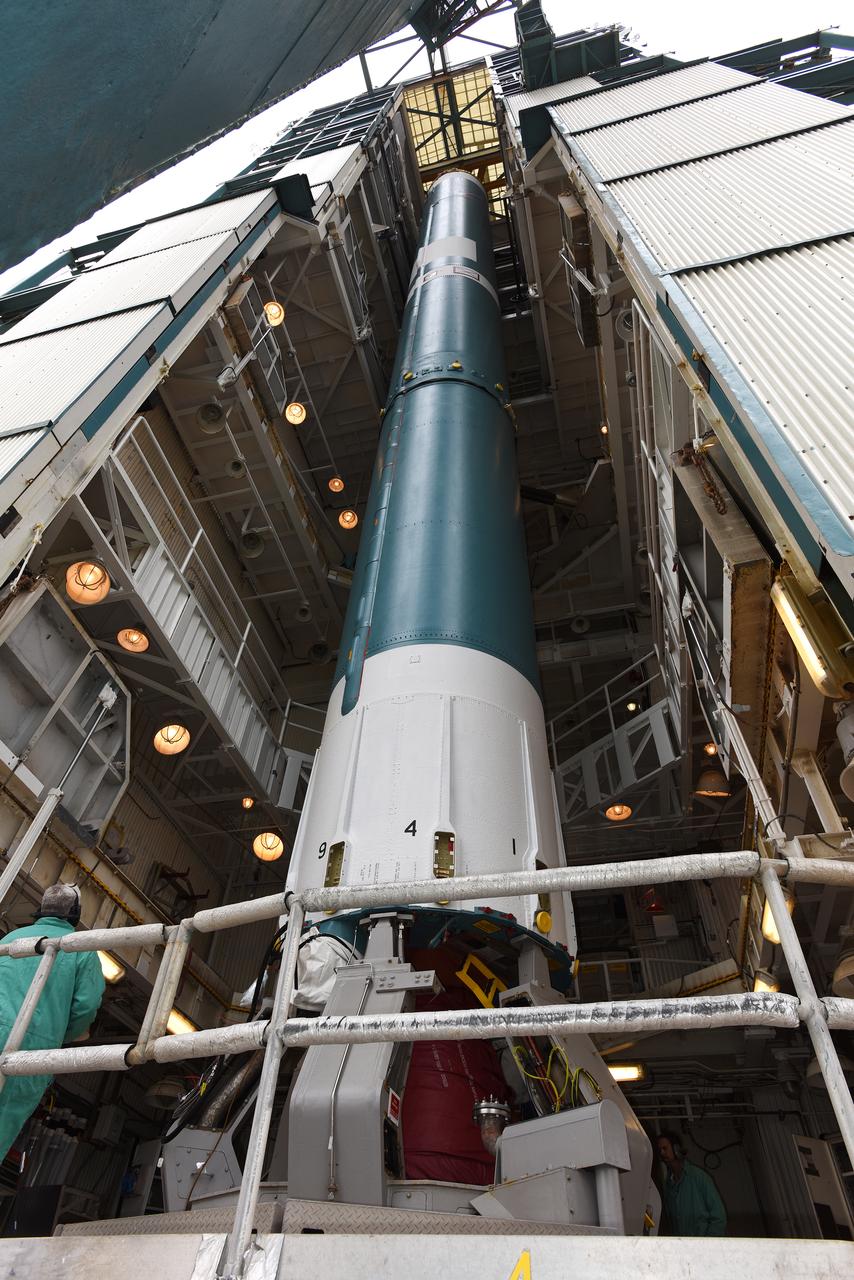
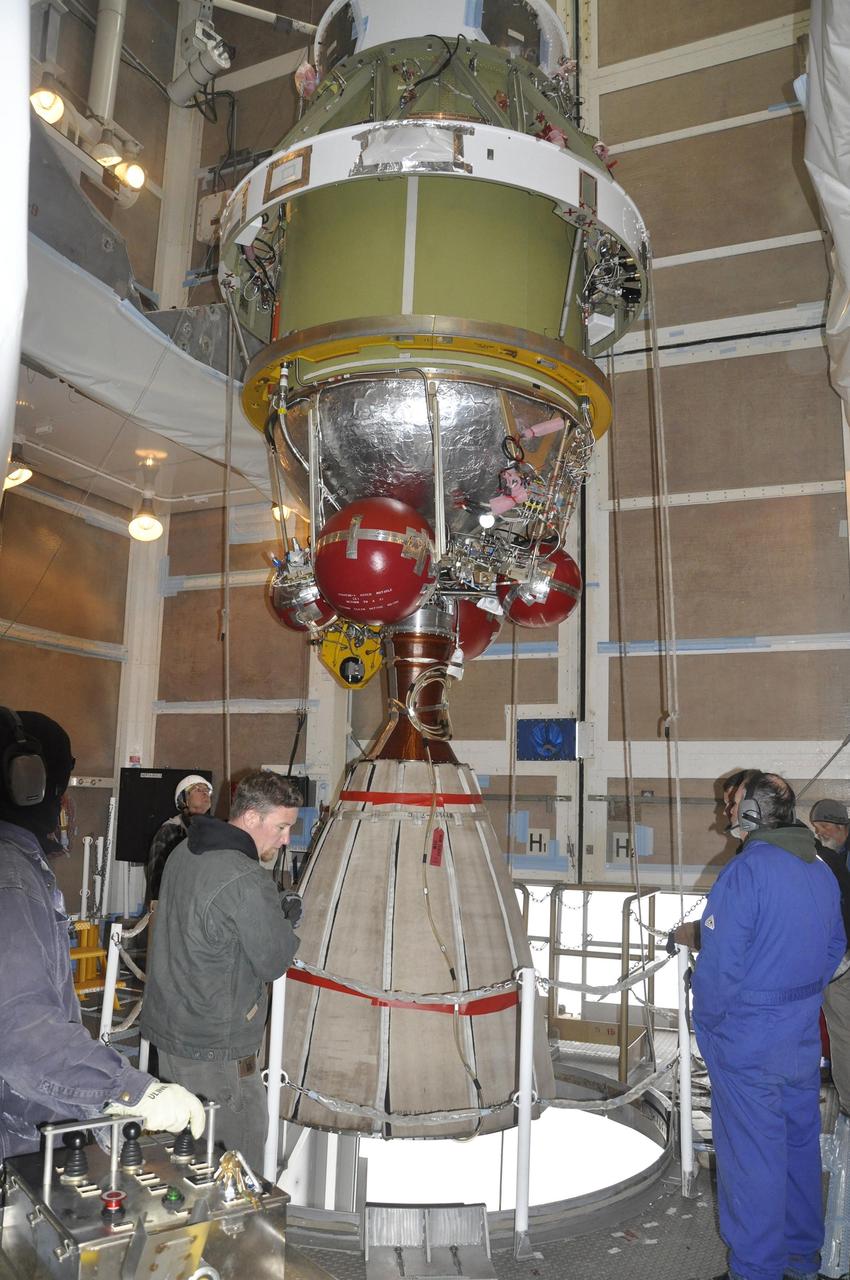
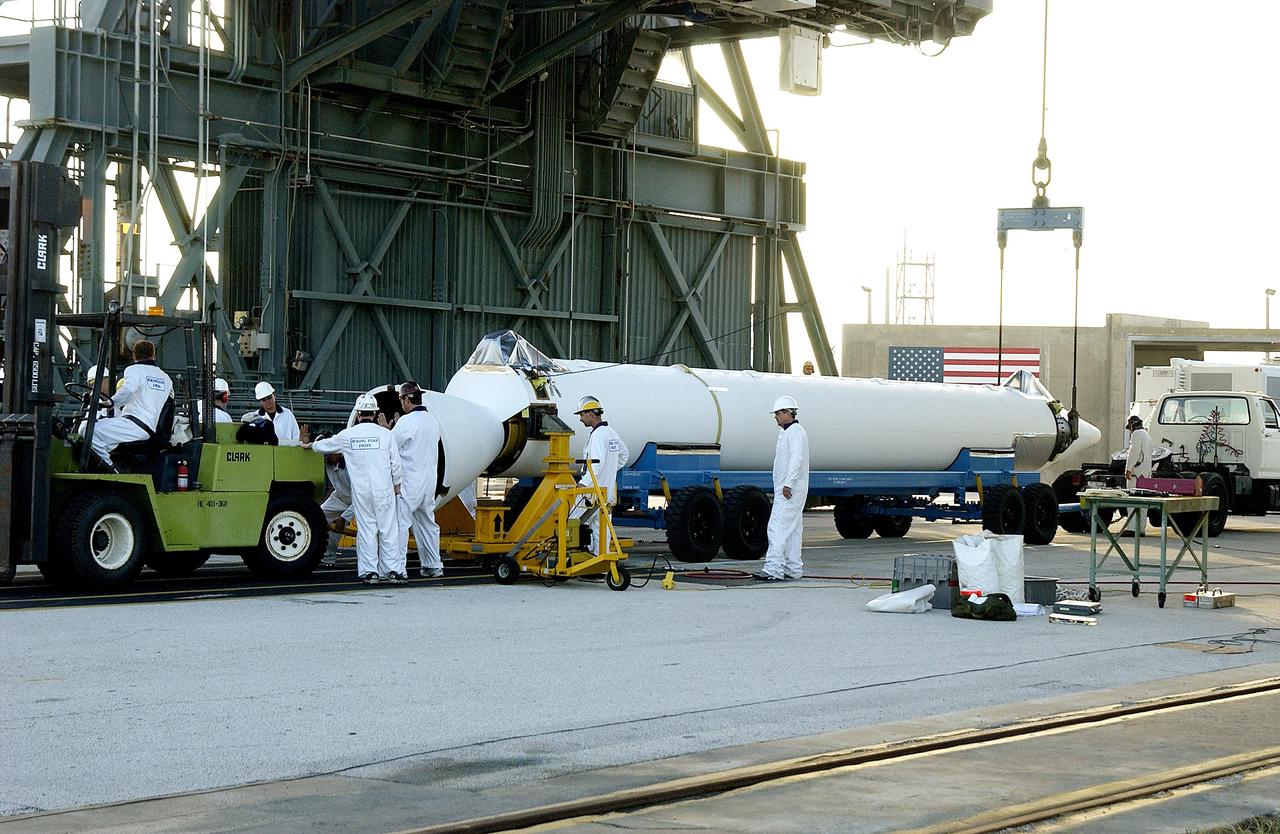
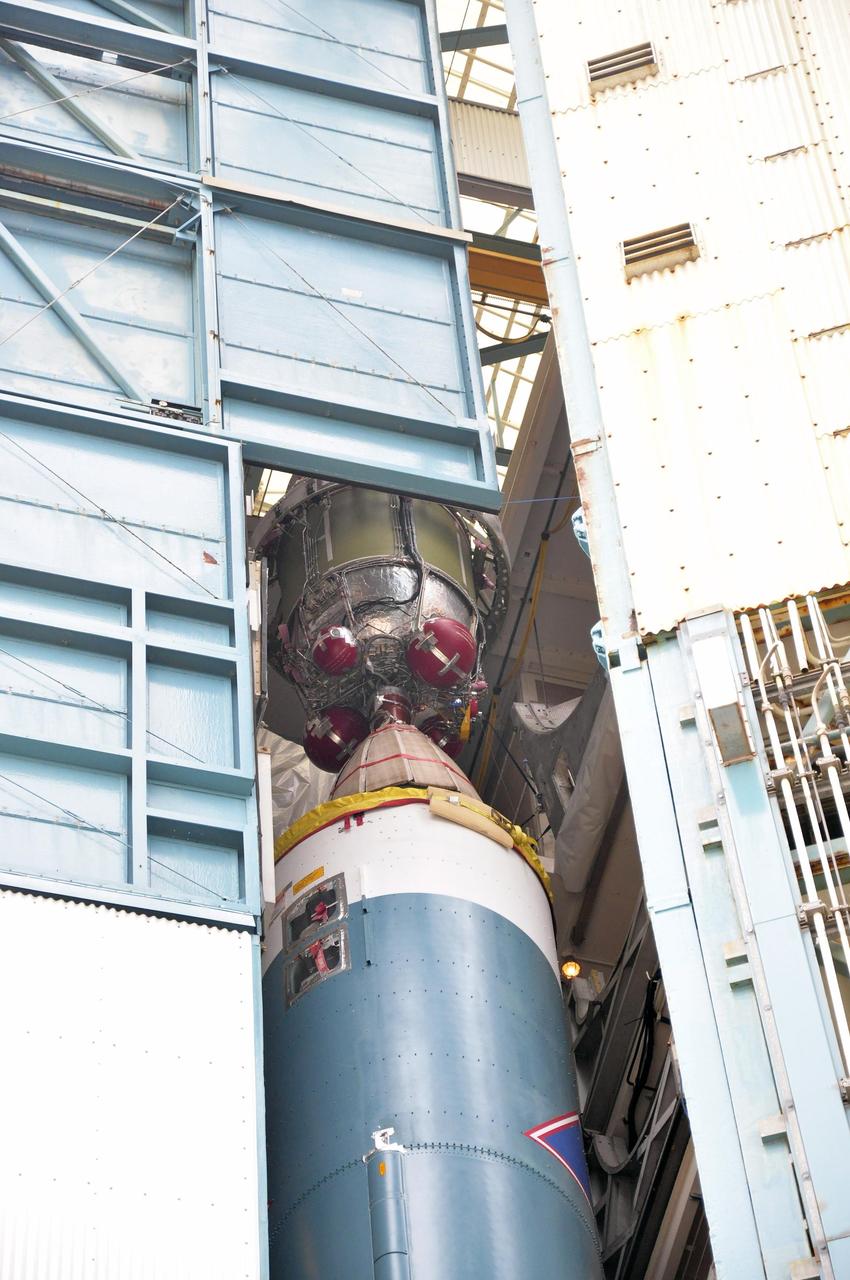
KENNEDY SPACE CENTER, FLA. -- Inside the mobile service tower on Launch Pad 17-B at Cape Canaveral Air Force Station, technicians secure both halves of the fairing around the Dawn spacecraft to the upper stage booster of the Delta II rocket below. The fairing is a molded structure that fits flush with the outside surface of the Delta II upper stage booster and forms an aerodynamically smooth nose cone, protecting the spacecraft during launch and ascent.   Dawn is scheduled to launch between 7:25 and 7:54 a.m. on Sept. 26 aboard a Delta II rocket.  Photo credit: NASA/Jim Grossmann
KSC-07pd2517
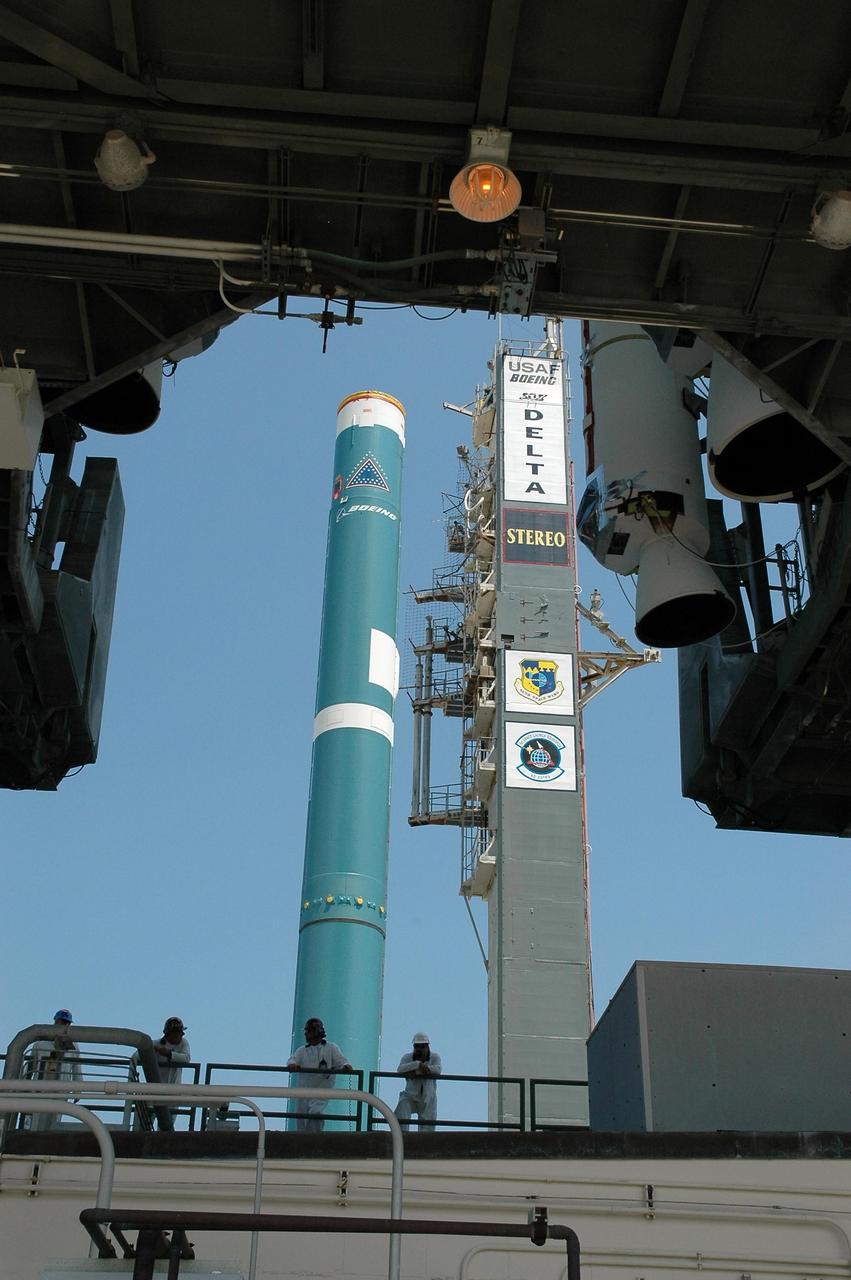
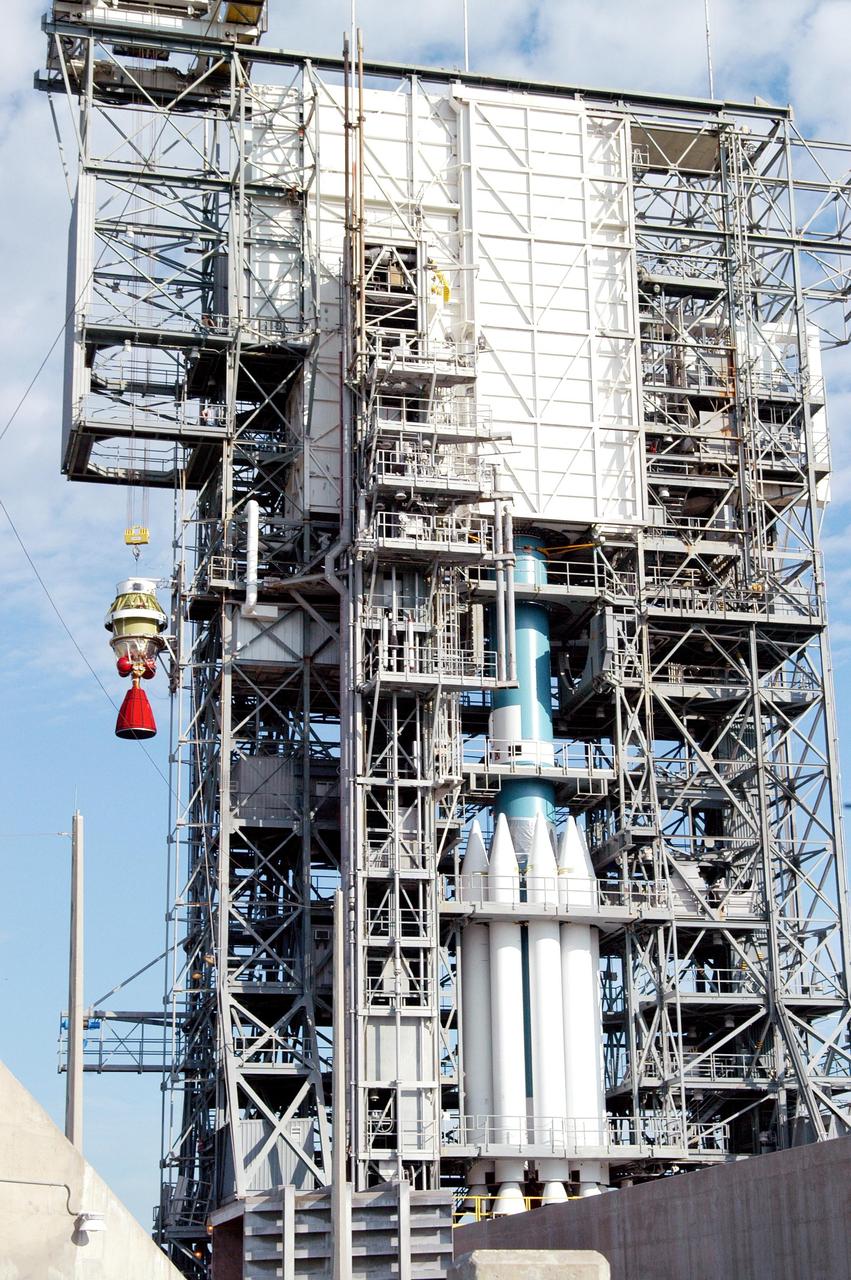
KENNEDY SPACE CENTER, FLA. -    A Boeing Delta II rocket is seen from under the mobile service tower on Launch Pad 17-B at Cape Canaveral Air Force Station.  Visible on the tower at right are the lower portions of the solid rocket boosters that will be mated to the Delta II.  The Delta rocket is the launch vehicle for NASA's Solar Terrestrial Relations Observatory (STEREO).  Preparations are under way for a liftoff no earlier than July 22. STEREO consists of two spacecraft whose mission is the first to take measurements of the sun and solar wind in 3-D. This new view will improve our understanding of space weather and its impact on the Earth. Photo credit: NASA/Jack Pfaller
KSC-06pd1005
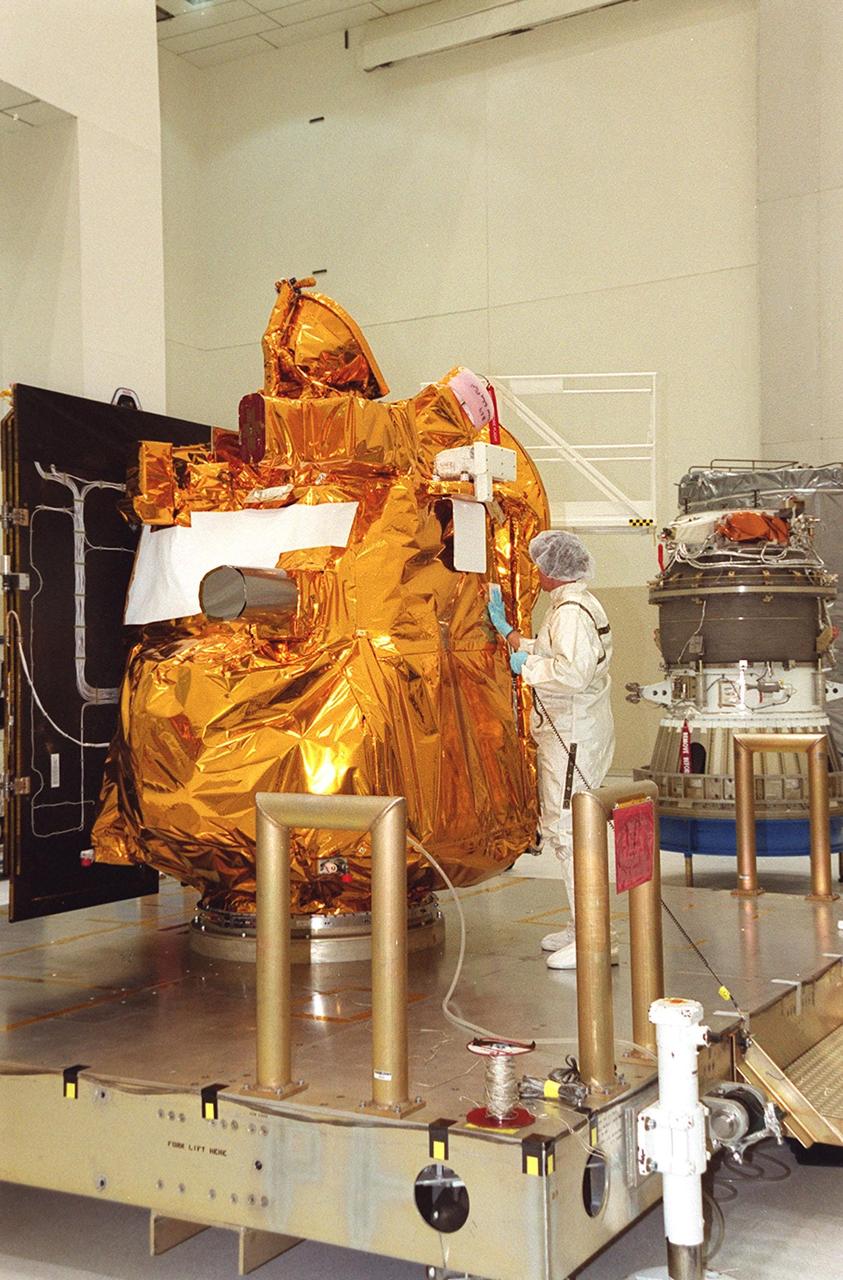
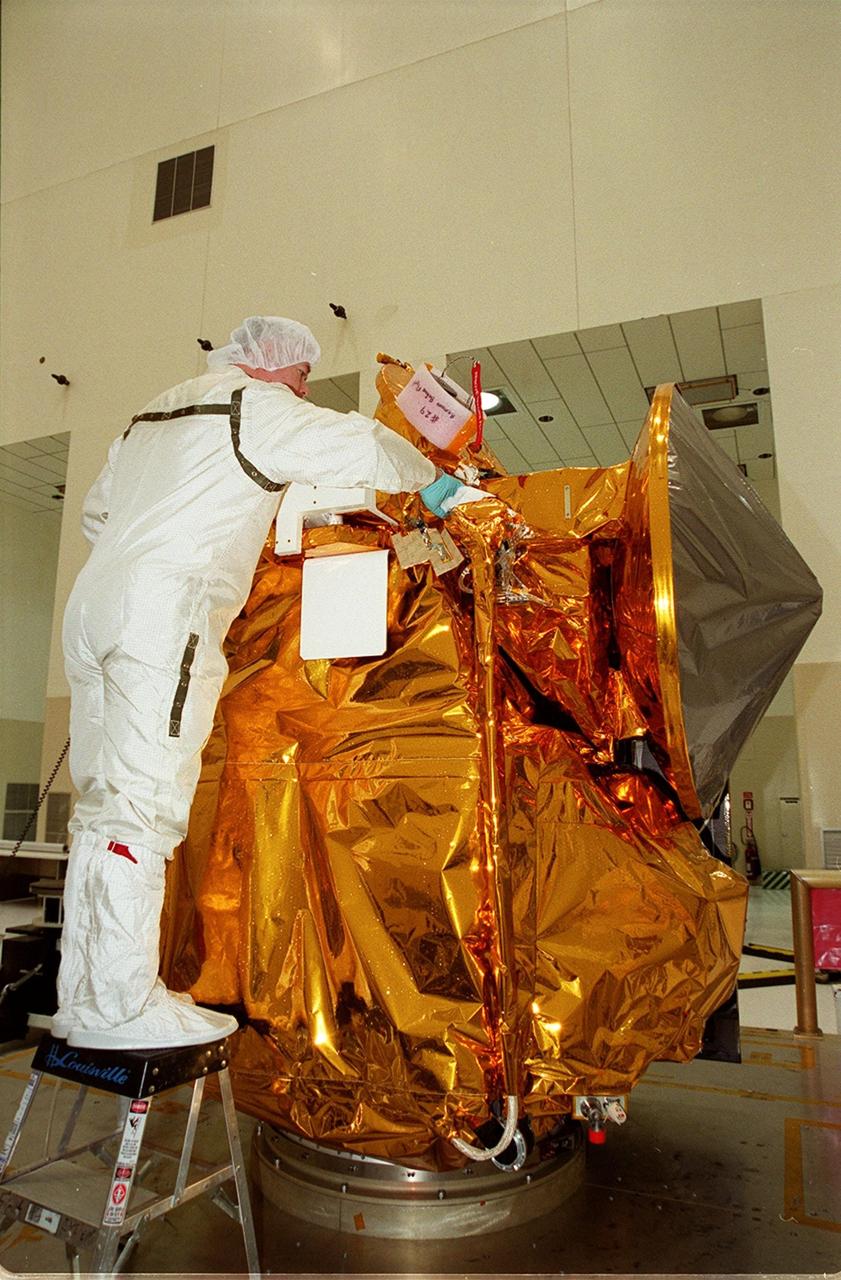
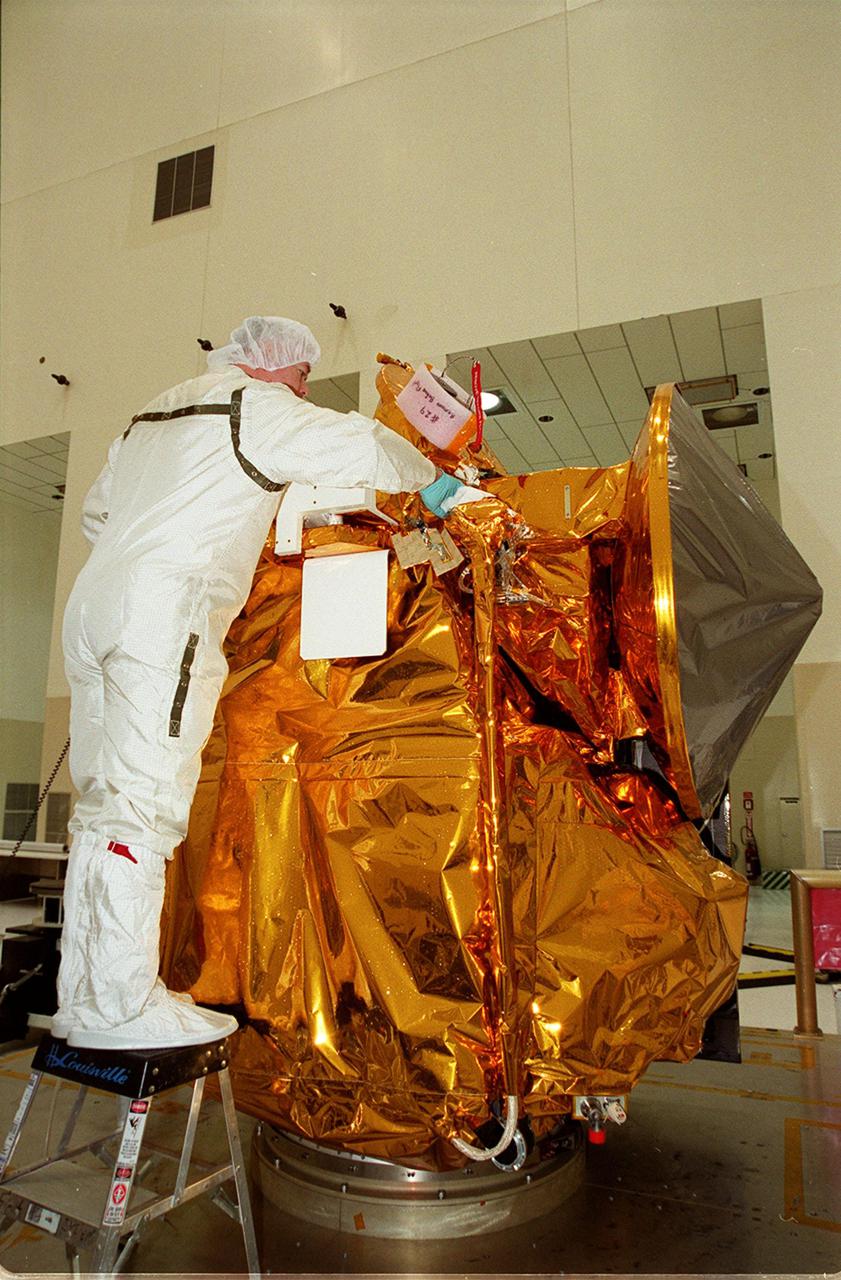
A worker in the Space Assembly and Encapsulation Facility 2 prepares the Mars Odyssey Orbiter (center) for its move to the third stage (right) of a Delta rocket. The Mars Odyssey is scheduled for launch on April 7, 2001, aboard a Delta II rocket from Launch Pad 17-A, Cape Canaveral Air Force Station
KSC-01PP-0600
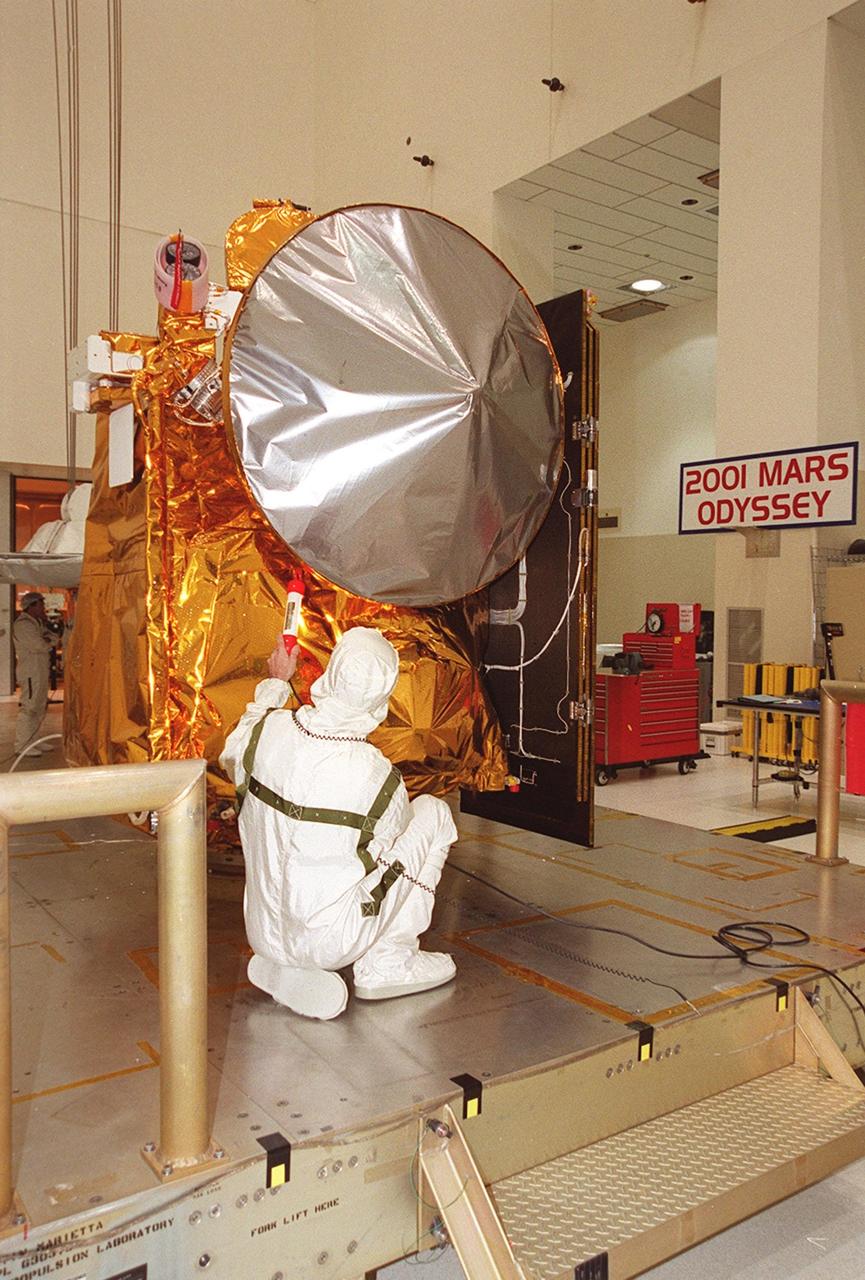
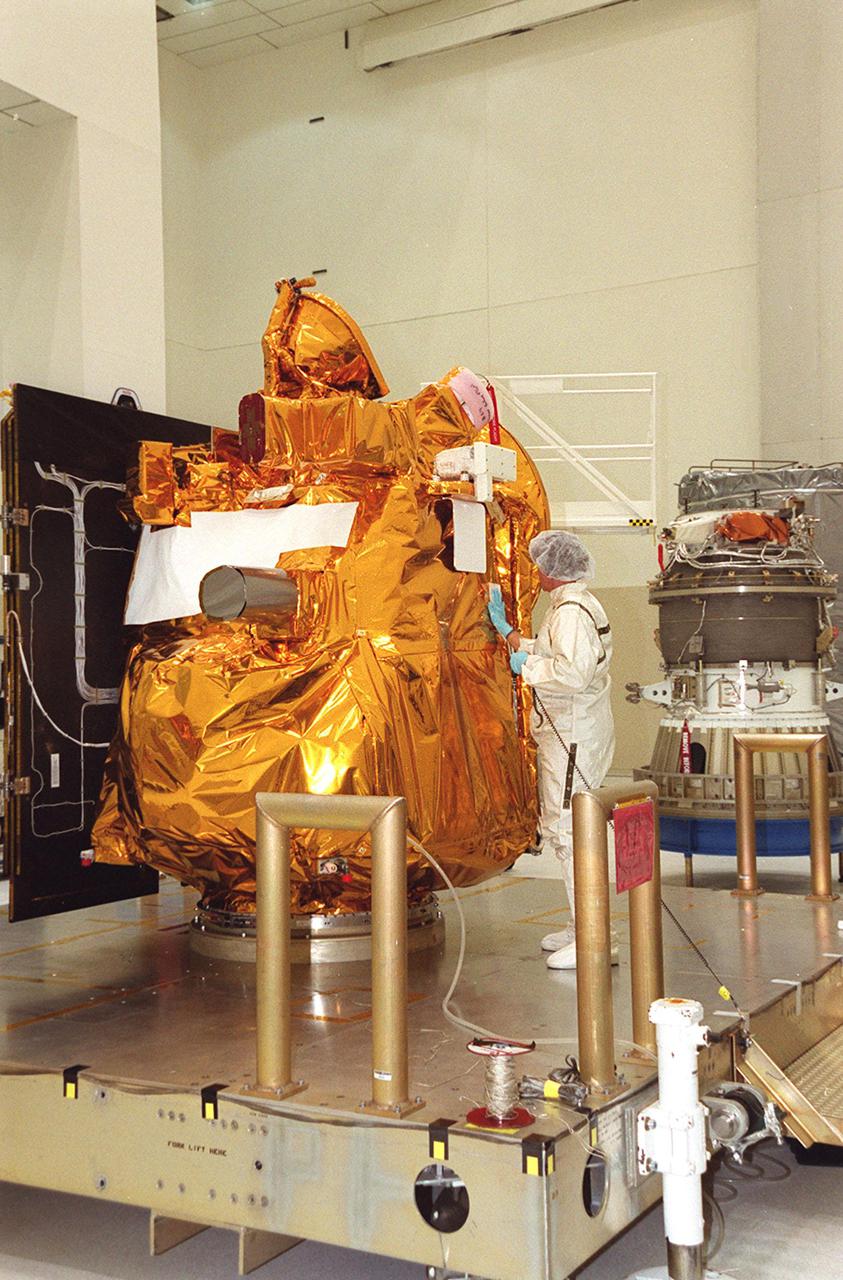
A worker in the Space Assembly and Encapsulation Facility 2 checks out the Mars Odyssey Orbiter before its move to the third stage of a Delta rocket. The Mars Odyssey is scheduled for launch on April 7, 2001, aboard a Delta II rocket from Launch Pad 17-A, Cape Canaveral Air Force Station
KSC-01PP-0601
A worker in the Space Assembly and Encapsulation Facility 2 checks out the Mars Odyssey Orbiter before its move to the third stage of a Delta rocket. The Mars Odyssey is scheduled for launch on April 7, 2001, aboard a Delta II rocket from Launch Pad 17-A, Cape Canaveral Air Force Station
KSC01pp0601
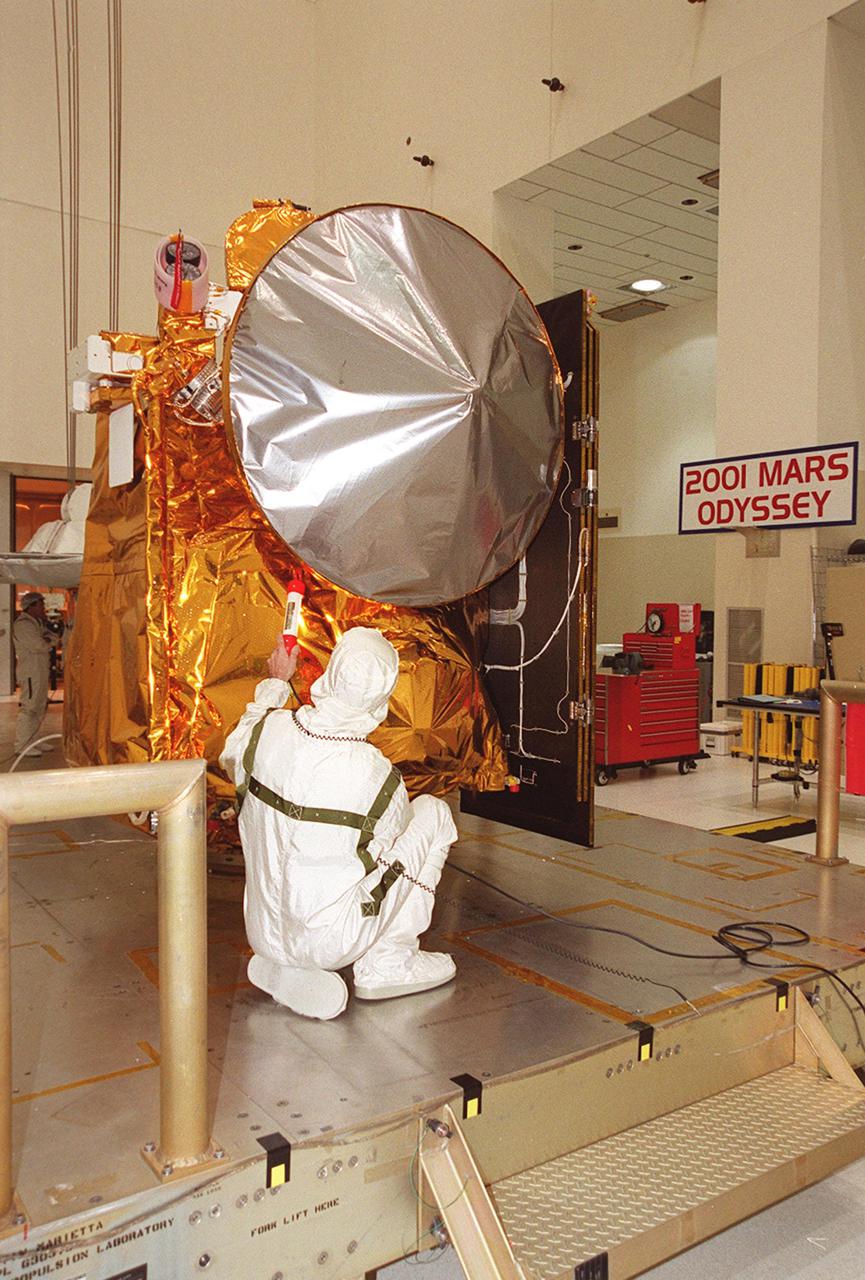
A worker in the Space Assembly and Encapsulation Facility 2 checks out the Mars Odyssey Orbiter before its move to the third stage of a Delta rocket. The Mars Odyssey is scheduled for launch on April 7, 2001, aboard a Delta II rocket from Launch Pad 17-A, Cape Canaveral Air Force Station
KSC-01PP-0602
A worker in the Space Assembly and Encapsulation Facility 2 prepares the Mars Odyssey Orbiter (center) for its move to the third stage (right) of a Delta rocket. The Mars Odyssey is scheduled for launch on April 7, 2001, aboard a Delta II rocket from Launch Pad 17-A, Cape Canaveral Air Force Station
KSC01pp0600
A worker in the Space Assembly and Encapsulation Facility 2 checks out the Mars Odyssey Orbiter before its move to the third stage of a Delta rocket. The Mars Odyssey is scheduled for launch on April 7, 2001, aboard a Delta II rocket from Launch Pad 17-A, Cape Canaveral Air Force Station
KSC01pp0602
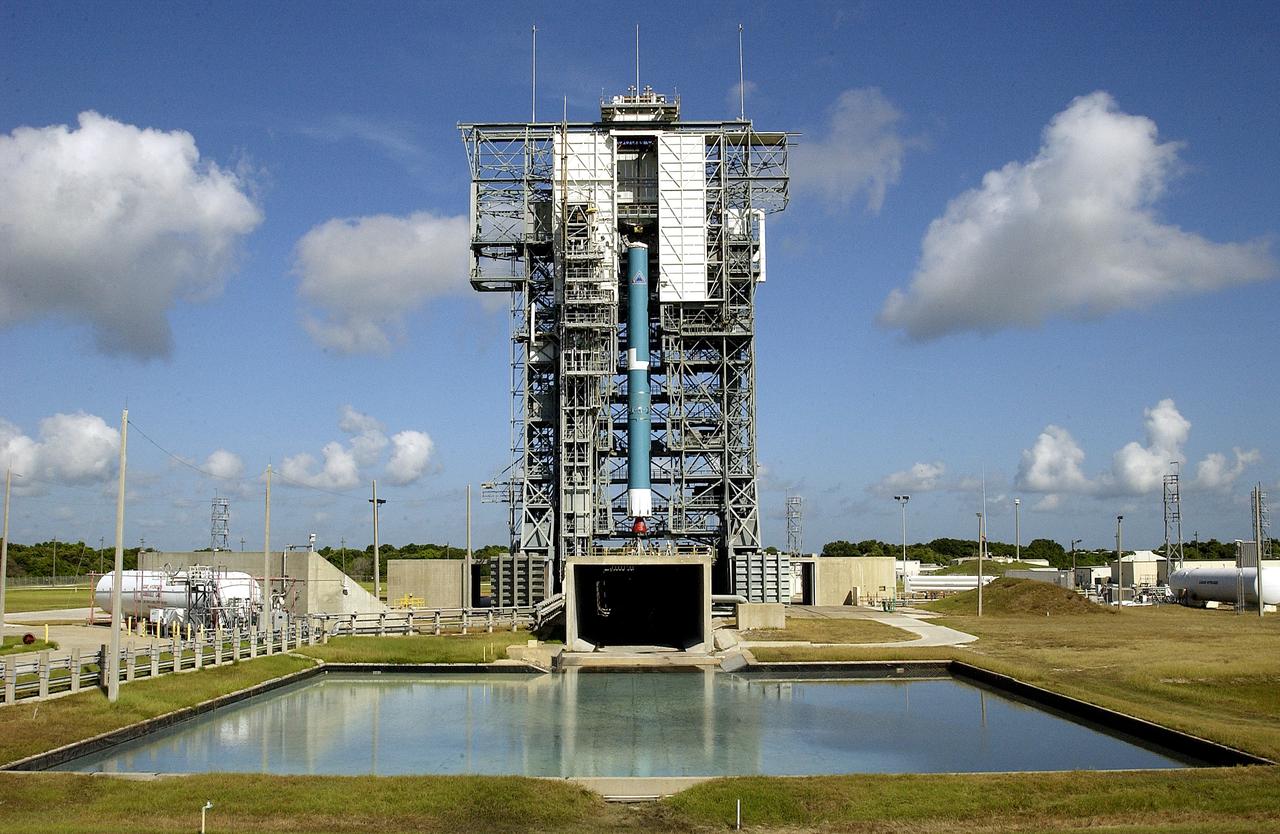
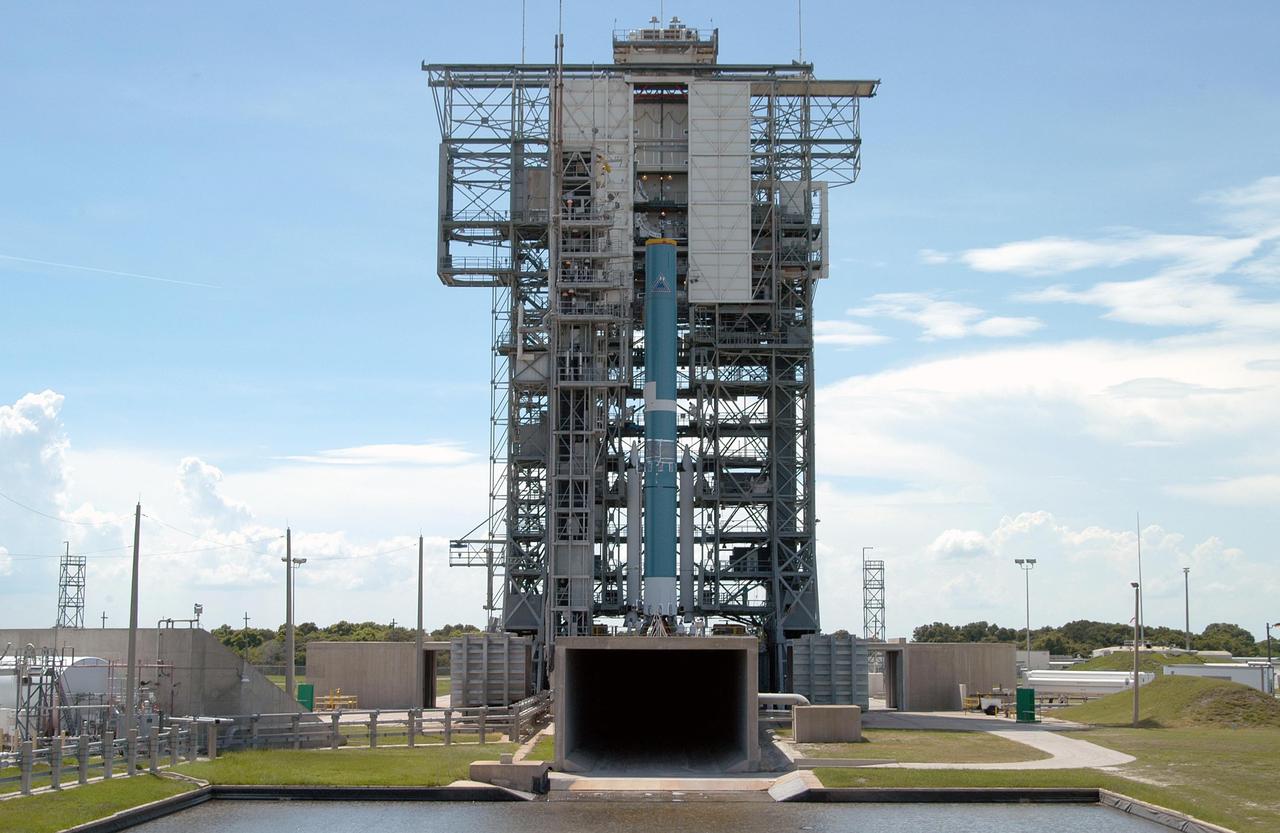
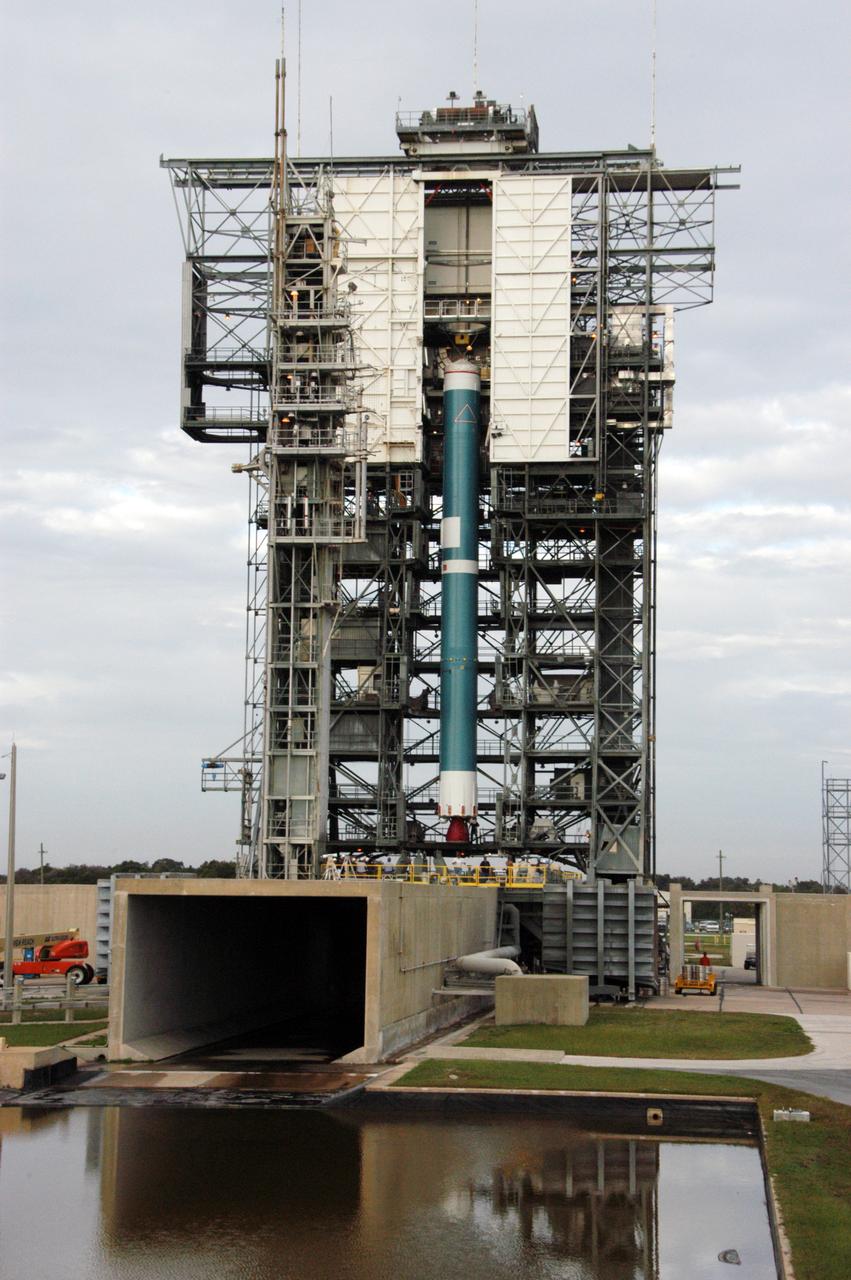
KENNEDY SPACE CENTER, FLA. -  On Launch Complex 17-B, Cape Canaveral Air Force Station, the first stage of a Delta II rocket is lifted up the mobile service tower.  Below the rocket is the flame trench, and in the foreground is the overflow pool.  The rocket is being erected to launch the Space InfraRed Telescope Facility (SIRTF).  Consisting of an 0.85-meter telescope and three cryogenically cooled science instruments, SIRTF is one of NASA's largest infrared telescopes to be launched.  SIRTF will obtain images and spectra by detecting the infrared energy, or heat, radiated by objects in space. Most of this infrared radiation is blocked by the Earth's atmosphere and cannot be observed from the ground.
KENNEDY SPACE CENTER, FLA. - On Launch Complex 17-B, Cape Canaveral Air Force Station, the first stage of a Delta II rocket is lifted up the mobile service tower. Below the rocket is the flame trench, and in the foreground is the overflow pool. The rocket is being erected to launch the Space InfraRed Telescope Facility (SIRTF). Consisting of an 0.85-meter telescope and three cryogenically cooled science instruments, SIRTF is one of NASA's largest infrared telescopes to be launched. SIRTF will obtain images and spectra by detecting the infrared energy, or heat, radiated by objects in space. Most of this infrared radiation is blocked by the Earth's atmosphere and cannot be observed from the ground.
KENNEDY SPACE CENTER, FLA. -  The Delta II rocket on Launch Complex 17-A, Cape Canaveral Air Force Station, is having solid rocket boosters (SRBs) installed that will help launch Mars Exploration Rover 2 (MER-2) on June 5.  In the center are three more solid rocket boosters that will be added to the Delta, which will carry nine in all.  NASA’s twin Mars Exploration Rovers are designed to study the history of water on Mars. These robotic geologists are equipped with a robotic arm, a drilling tool, three spectrometers, and four pairs of cameras that allow them to have a human-like, 3D view of the terrain. Each rover could travel as far as 100 meters in one day to act as Mars scientists' eyes and hands, exploring an environment where humans can’t yet go.  MER-2 is scheduled to launch as MER-A.  MER-1 (MER-B) will launch June 25.
KENNEDY SPACE CENTER, FLA. - The Delta II rocket on Launch Complex 17-A, Cape Canaveral Air Force Station, is having solid rocket boosters (SRBs) installed that will help launch Mars Exploration Rover 2 (MER-2) on June 5. In the center are three more solid rocket boosters that will be added to the Delta, which will carry nine in all. NASA’s twin Mars Exploration Rovers are designed to study the history of water on Mars. These robotic geologists are equipped with a robotic arm, a drilling tool, three spectrometers, and four pairs of cameras that allow them to have a human-like, 3D view of the terrain. Each rover could travel as far as 100 meters in one day to act as Mars scientists' eyes and hands, exploring an environment where humans can’t yet go. MER-2 is scheduled to launch as MER-A. MER-1 (MER-B) will launch June 25.
A booster is lifted off a truck for installation onto the Boeing Delta 7326 rocket that will launch Deep Space 1 at Launch Pad 17A, Cape Canaveral Air Station. Delta II rockets are medium capacity expendable launch vehicles derived from the Delta family of rockets built and launched since 1960. Since then there have been more than 245 Delta launches. The Delta 7236 has three solid rocket boosters and a Star 37 upper stage. Delta IIs are manufactured in Huntington Beach, Calif. Rocketdyne, a division of The Boeing Company, builds Delta II's main engine in Canoga Park, Calif. Deep Space 1, the first flight in NASA's New Millennium Program, is designed to validate 12 new technologies for scientific space missions of the next century. Onboard experiments include an ion propulsion engine and software that tracks celestial bodies so the spacecraft can make its own navigation decisions without the intervention of ground controllers. Deep Space 1 will complete most of its mission objectives within the first two months, but may also do a flyby of a near-Earth asteroid, 1992 KD, in July 1999
KSC-98pc1117
Three boosters are lifted into place at Launch Pad 17A, Cape Canaveral Air Station, for installation onto the Boeing Delta 7326 rocket that will launch Deep Space 1. Delta II rockets are medium capacity expendable launch vehicles derived from the Delta family of rockets built and launched since 1960. Since then there have been more than 245 Delta launches. The Delta 7236 has three solid rocket boosters and a Star 37 upper stage. Delta IIs are manufactured in Huntington Beach, Calif. Rocketdyne, a division of The Boeing Company, builds Delta II's main engine in Canoga Park, Calif. Deep Space 1, the first flight in NASA's New Millennium Program, is designed to validate 12 new technologies for scientific space missions of the next century. Onboard experiments include an ion propulsion engine and software that tracks celestial bodies so the spacecraft can make its own navigation decisions without the intervention of ground controllers. Deep Space 1 will complete most of its mission objectives within the first two months, but may also do a flyby of a near-Earth asteroid, 1992 KD, in July 1999
KSC-98pc1119
Two boosters are lifted into place, while a third waits on the ground, for installation onto the Boeing Delta 7326 rocket that will launch Deep Space 1 at Launch Pad 17A, Cape Canaveral Air Station. Delta II rockets are medium capacity expendable launch vehicles derived from the Delta family of rockets built and launched since 1960. Since then there have been more than 245 Delta launches. The Delta 7236 has three solid rocket boosters and a Star 37 upper stage. Delta IIs are manufactured in Huntington Beach, Calif. Rocketdyne, a division of The Boeing Company, builds Delta II's main engine in Canoga Park, Calif. Deep Space 1, the first flight in NASA's New Millennium Program, is designed to validate 12 new technologies for scientific space missions of the next century. Onboard experiments include an ion propulsion engine and software that tracks celestial bodies so the spacecraft can make its own navigation decisions without the intervention of ground controllers. Deep Space 1 will complete most of its mission objectives within the first two months, but may also do a flyby of a near-Earth asteroid, 1992 KD, in July 1999
KSC-98pc1118
A booster is raised off a truck bed and prepared for lifting to the Boeing Delta 7326 rocket that will launch Deep Space 1 at Launch Pad 17A, Cape Canaveral Air Station. Delta II rockets are medium capacity expendable launch vehicles derived from the Delta family of rockets built and launched since 1960. Since then there have been more than 245 Delta launches. The Delta 7236 has three solid rocket boosters and a Star 37 upper stage. Delta IIs are manufactured in Huntington Beach, Calif. Rocketdyne, a division of The Boeing Company, builds Delta II's main engine in Canoga Park, Calif. Deep Space 1, the first flight in NASA's New Millennium Program, is designed to validate 12 new technologies for scientific space missions of the next century. Onboard experiments include an ion propulsion engine and software that tracks celestial bodies so the spacecraft can make its own navigation decisions without the intervention of ground controllers. Deep Space 1 will complete most of its mission objectives within the first two months, but may also do a flyby of a near-Earth asteroid, 1992 KD, in July 1999
KSC-98pc1116
A booster is lifted for installation onto the Boeing Delta 7326 rocket that will launch Deep Space 1 at Launch Pad 17A, Cape Canaveral Air Station. Delta II rockets are medium capacity expendable launch vehicles derived from the Delta family of rockets built and launched since 1960. Since then there have been more than 245 Delta launches. The Delta 7236 has three solid rocket boosters and a Star 37 upper stage. Delta IIs are manufactured in Huntington Beach, Calif. Rocketdyne, a division of The Boeing Company, builds Delta II's main engine in Canoga Park, Calif. Deep Space 1, the first flight in NASA's New Millennium Program, is designed to validate 12 new technologies for scientific space missions of the next century. Onboard experiments include an ion propulsion engine and software that tracks celestial bodies so the spacecraft can make its own navigation decisions without the intervention of ground controllers. Deep Space 1 will complete most of its mission objectives within the first two months, but may also do a flyby of a near-Earth asteroid, 1992 KD, in July 1999
KSC-98pc1111
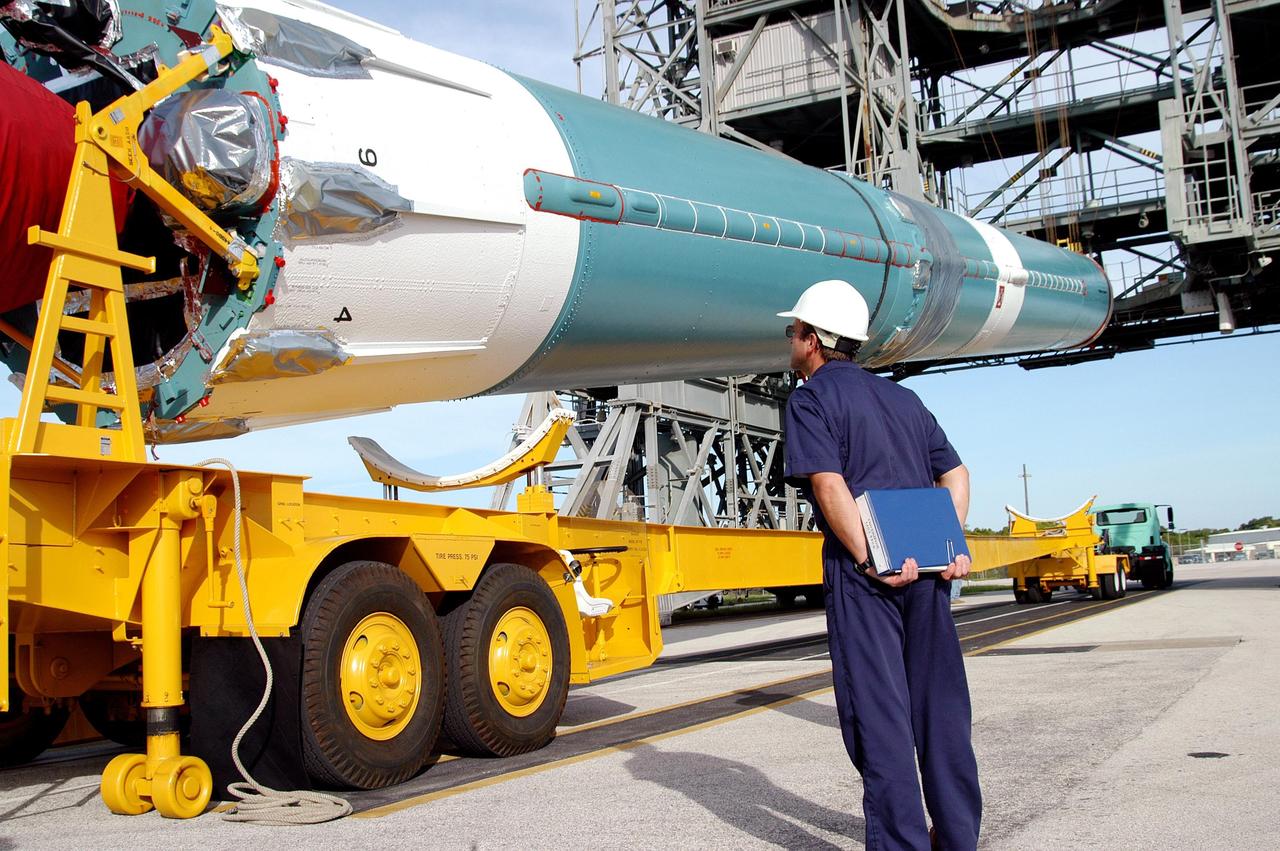
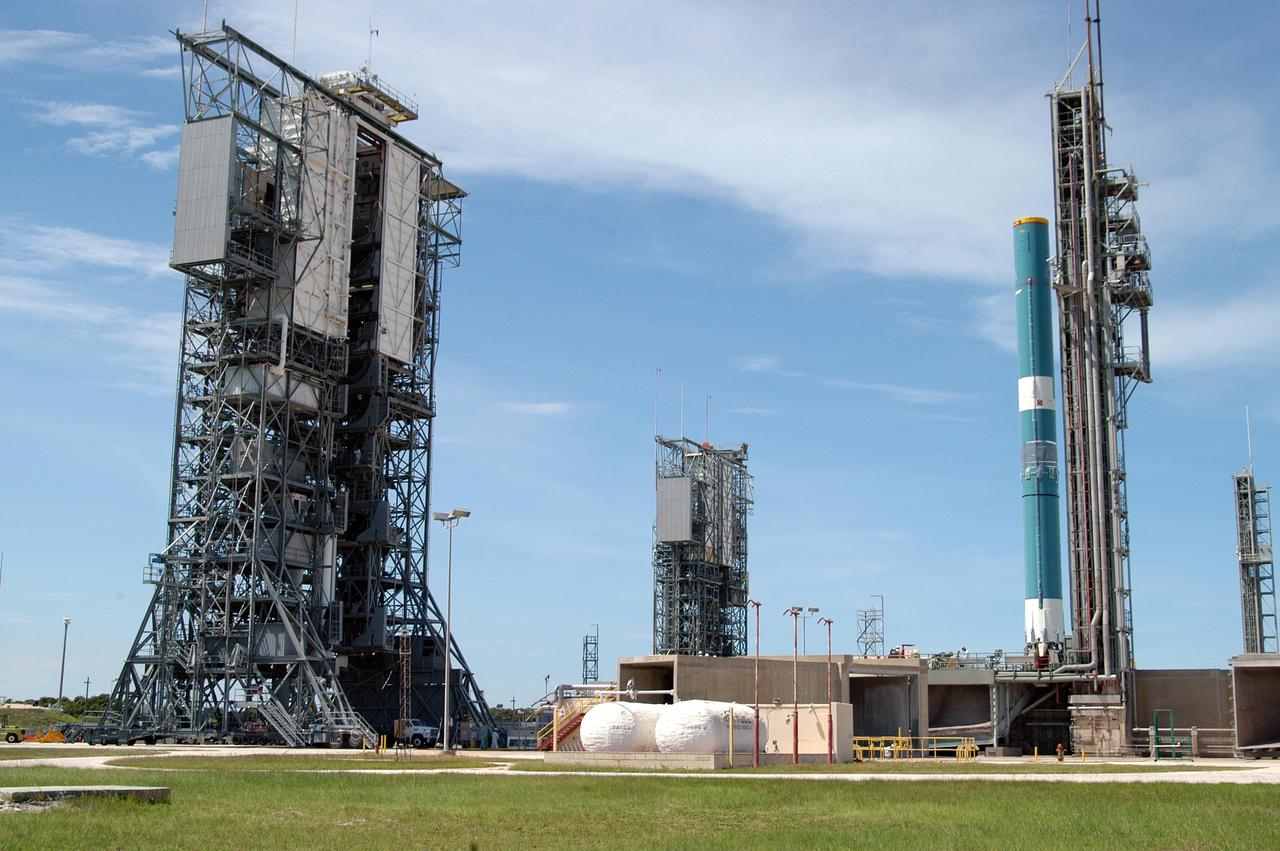
KENNEDY SPACE CENTER, FLA. -  On Pad 17-B, Cape Canaveral Air Force Station, the mobile service tower at left moves toward the Boeing Delta II Heavy rocket at right.  The tower holds three out of nine Solid Rocket Boosters (SRBs) that will be mated to the Boeing Delta II for the Aug. 2 launch of the MESSENGER spacecraft to the planet Mercury.  The spacecraft is expected to reach orbit around Mercury in March 2011.  MESSENGER was built for NASA by the Johns Hopkins University Applied Physics Laboratory in Laurel, Md.
KSC-04pd1416
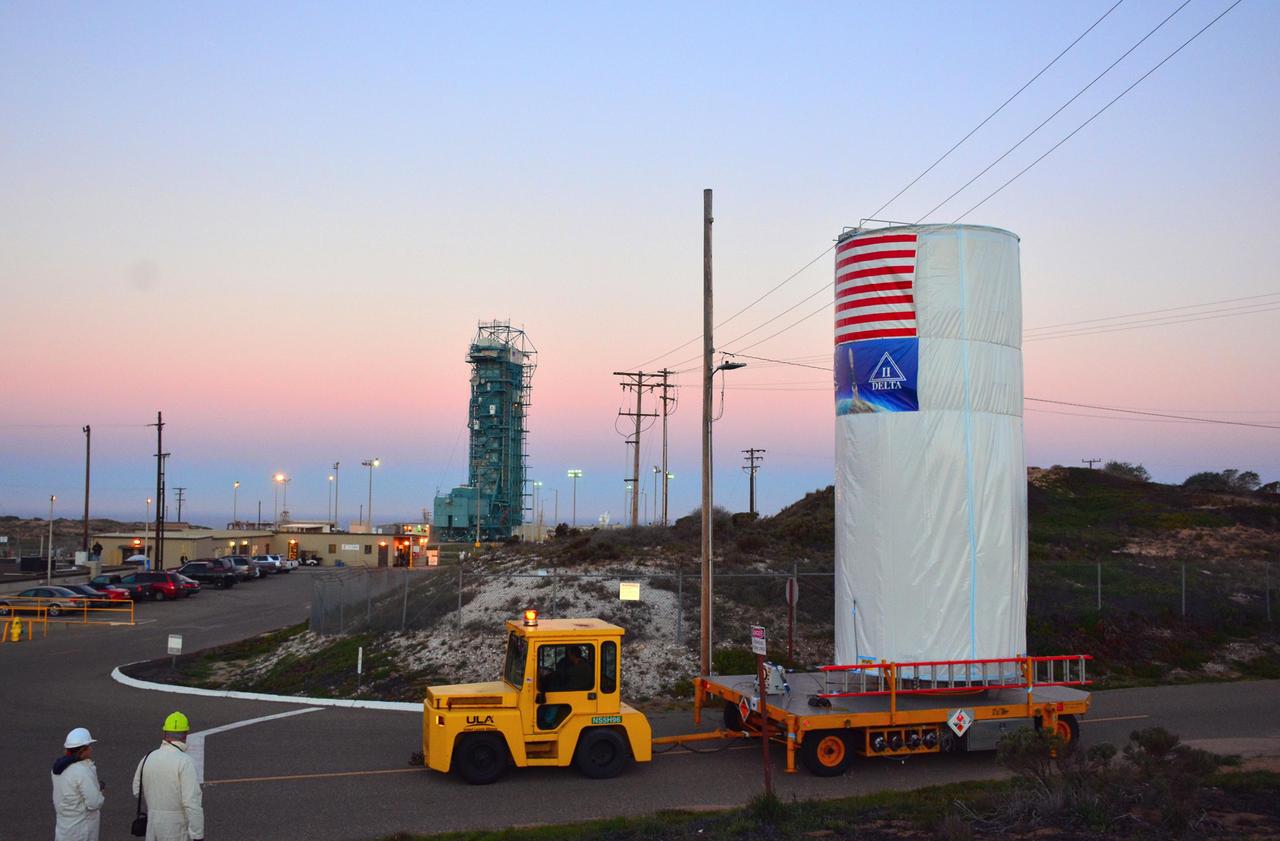
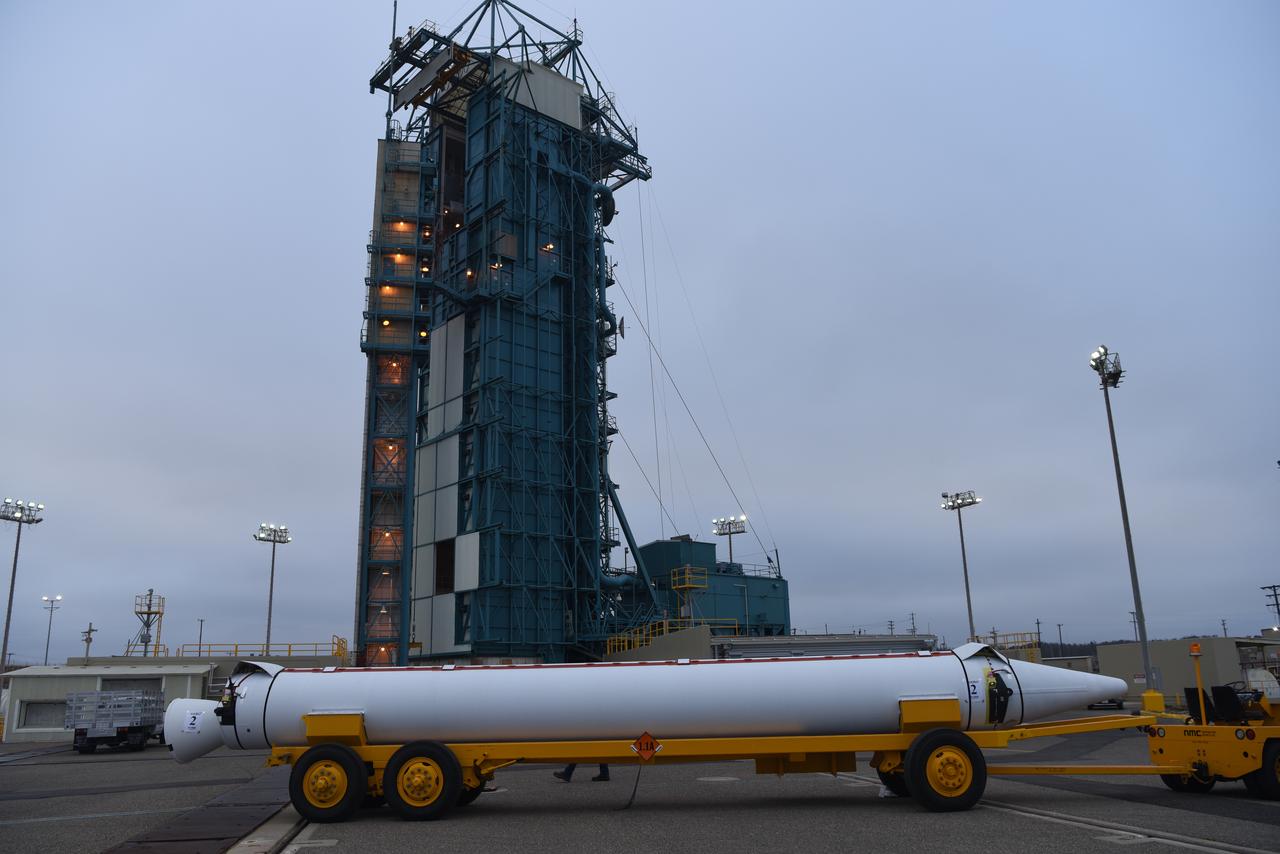
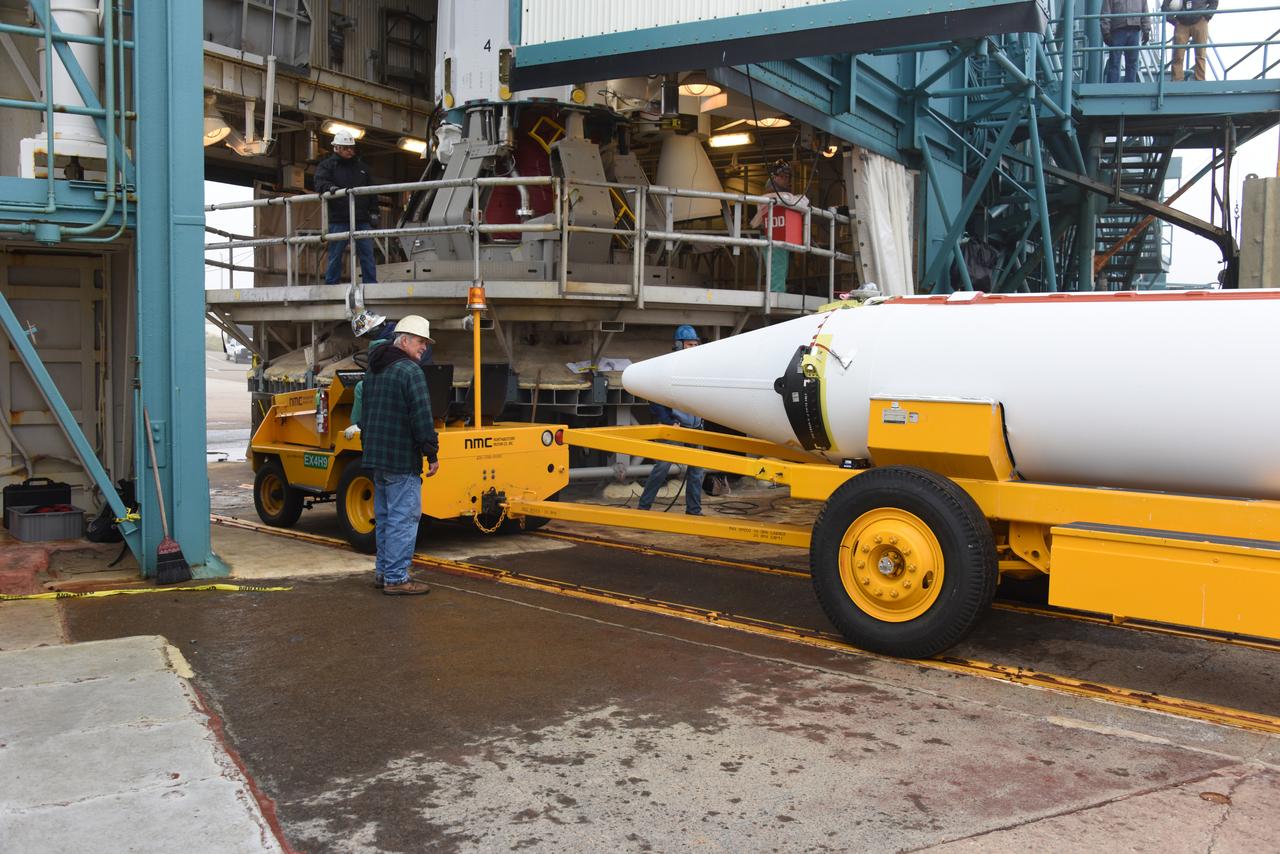
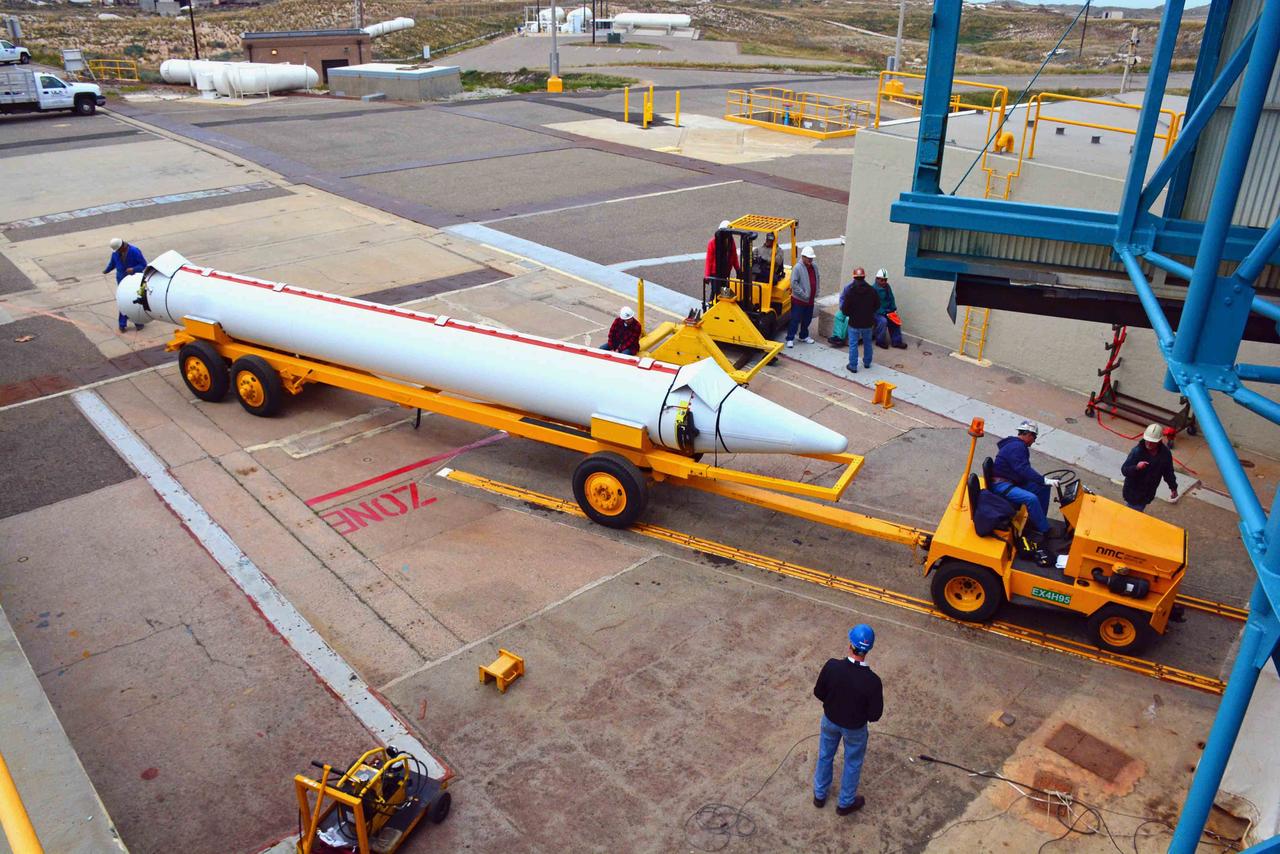
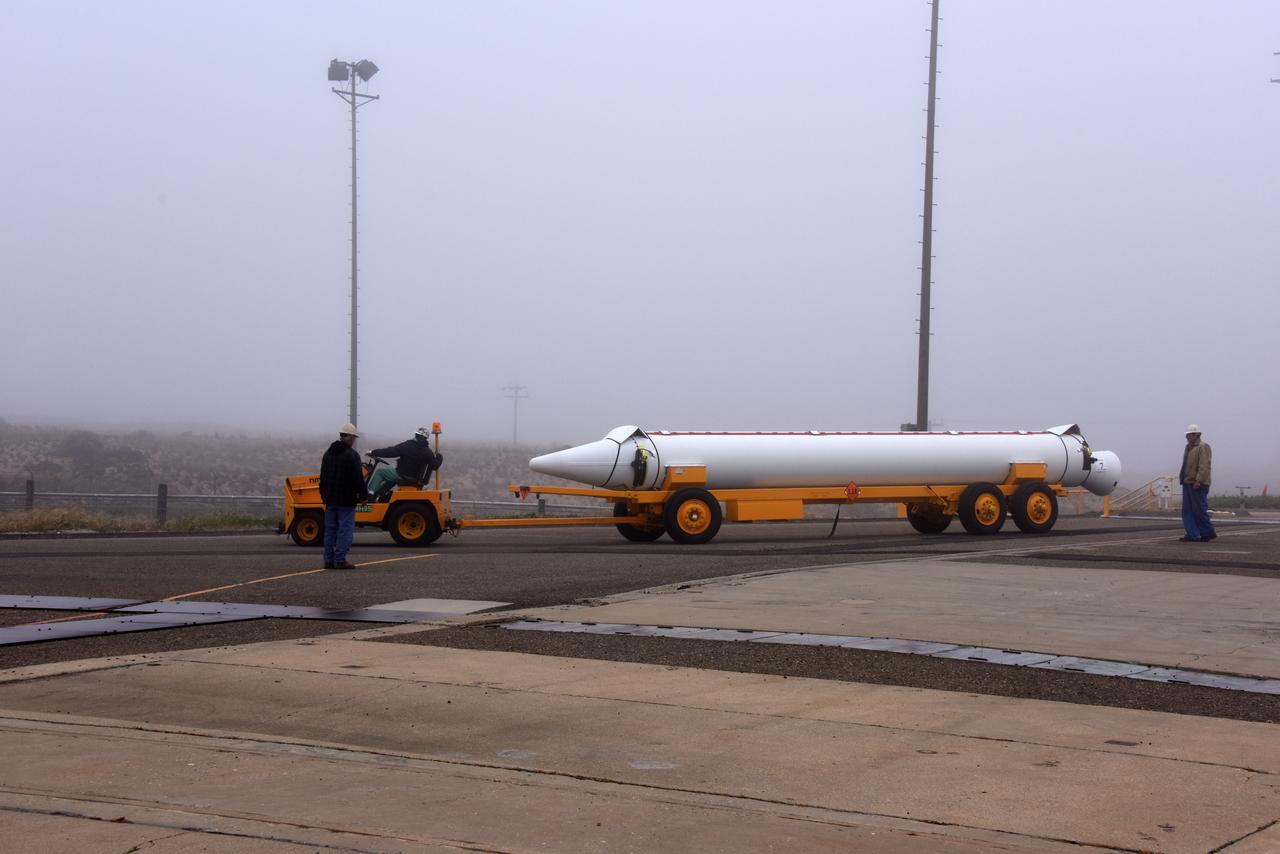
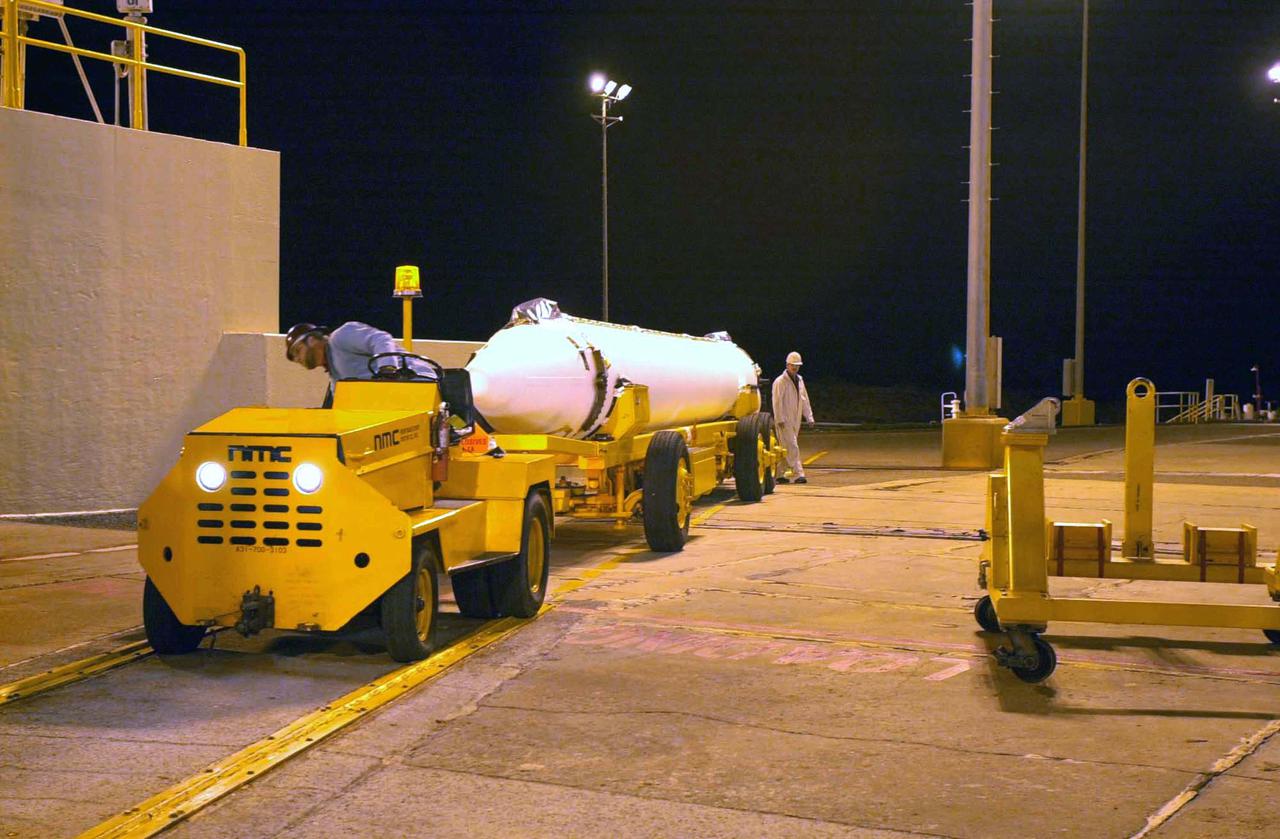
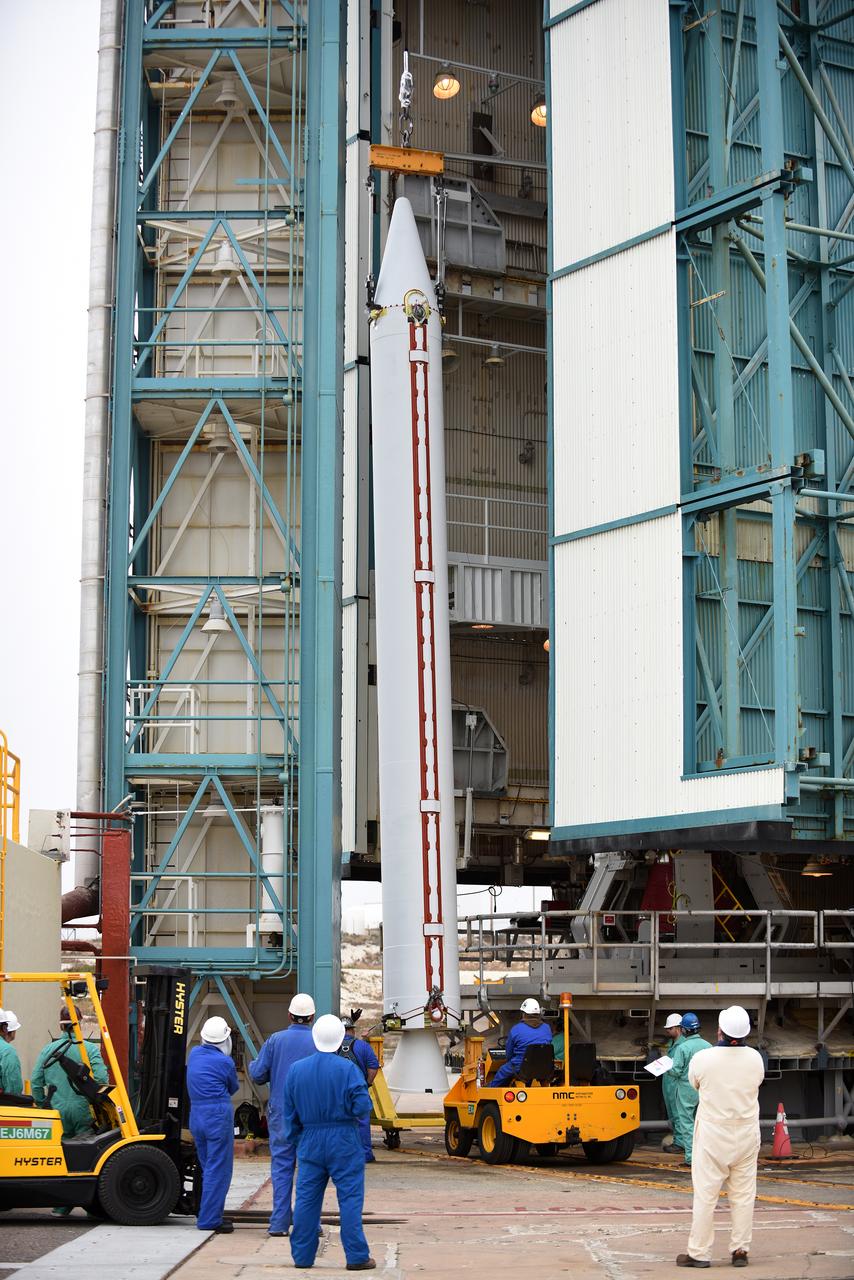
The United Launch Alliance/Orbital ATK Delta II solid rocket motor is towed to Space Launch Complex 2 at Vandenberg Air Force Base in California. The rocket motor will be mated to the Delta II first stage in preparation for launch of the Joint Polar Satellite System-1 (JPSS-1) later this year. JPSS, a next-generation environmental satellite system, is a collaborative program between the National Oceanic and Atmospheric Administration (NOAA) and NASA.
Delta II JPSS-1 SRM Installation onto Booster
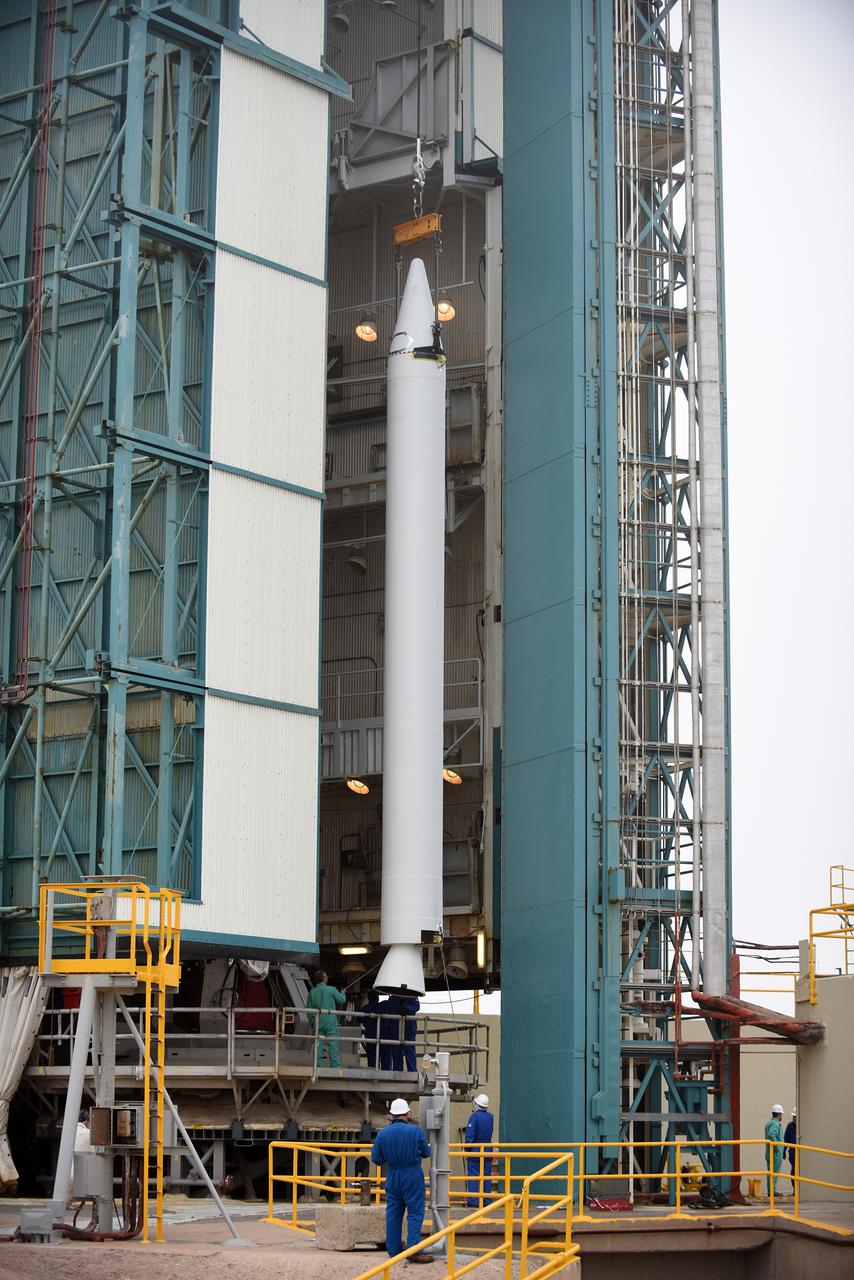
The United Launch Alliance/Orbital ATK Delta II solid rocket motor arrives at Space Launch Complex 2 at Vandenberg Air Force Base in California. The rocket motor will be mated to the Delta II first stage in preparation for launch of the Joint Polar Satellite System-1 (JPSS-1) later this year. JPSS, a next-generation environmental satellite system, is a collaborative program between the National Oceanic and Atmospheric Administration (NOAA) and NASA.
Delta II JPSS-1 SRM Installation onto Booster
KENNEDY SPACE CENTER, FLA. -  On Pad 17-B, Cape Canaveral Air Force Station, the mobile service tower delivers the first three Solid Rocket Boosters (SRBs) to the Boeing Delta II Heavy rocket for mating.  In the foreground is the cooling water pond.  The Delta II is the launch vehicle for the Aug. 2 launch of the MESSENGER spacecraft to the planet Mercury.  The spacecraft is expected to reach orbit around Mercury in March 2011.  MESSENGER was built for NASA by the Johns Hopkins University Applied Physics Laboratory in Laurel, Md.
KSC-04pd1418
KENNEDY SPACE CENTER, FLA. -  The first stage of the Boeing Delta II rocket is lifted off its transporter on Pad 17-B, Cape Canaveral Air Force Station.  The rocket will be moved into the mobile service tower.  The Delta II is the launch vehicle for the MESSENGER spacecraft, scheduled to lift off Aug. 2, bound for Mercury.   The spacecraft is expected to reach orbit around Mercury in March 2011.  MESSENGER was built for NASA by the Johns Hopkins University Applied Physics Laboratory in Laurel, Md.
KSC-04pd1390
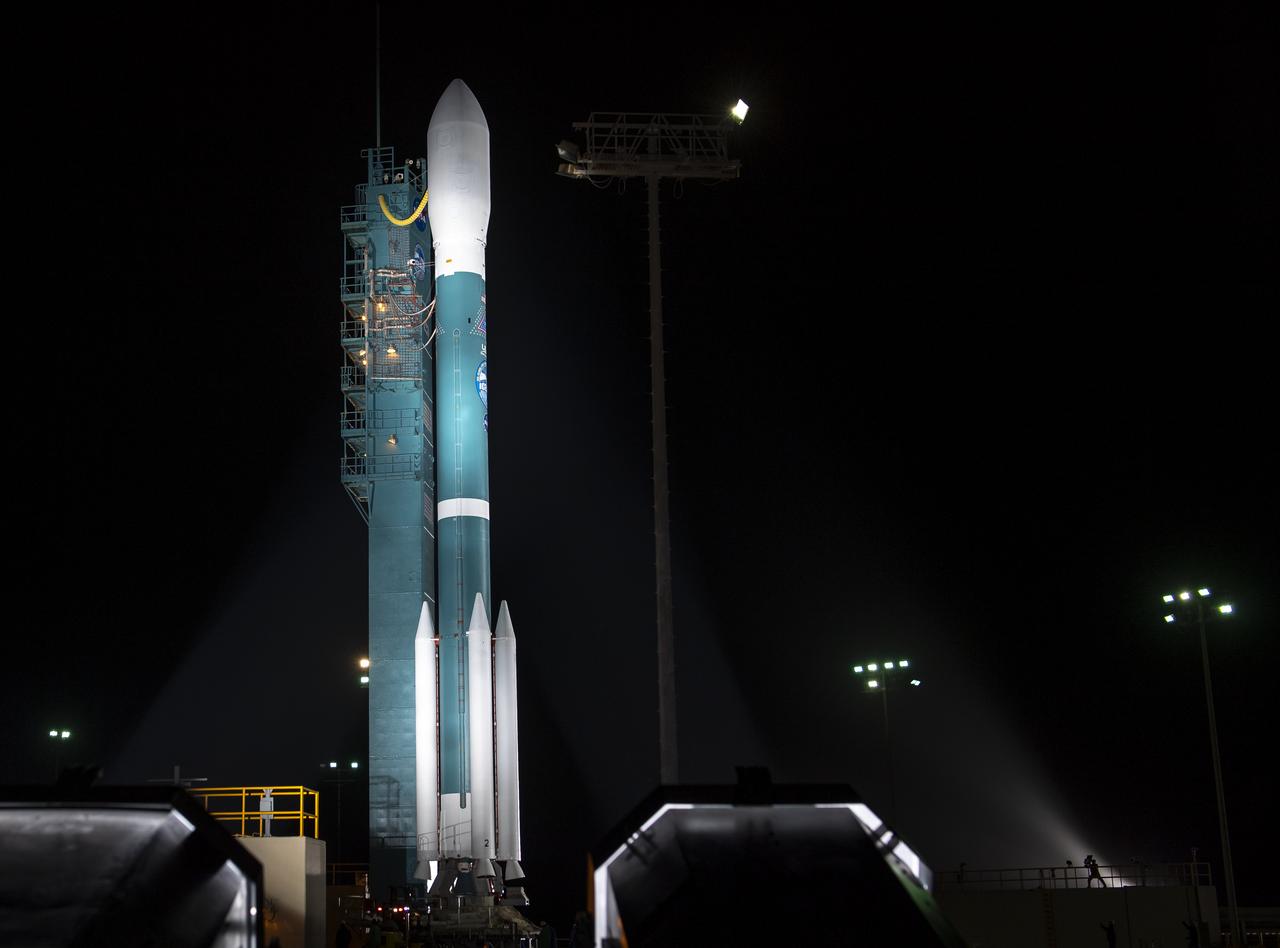
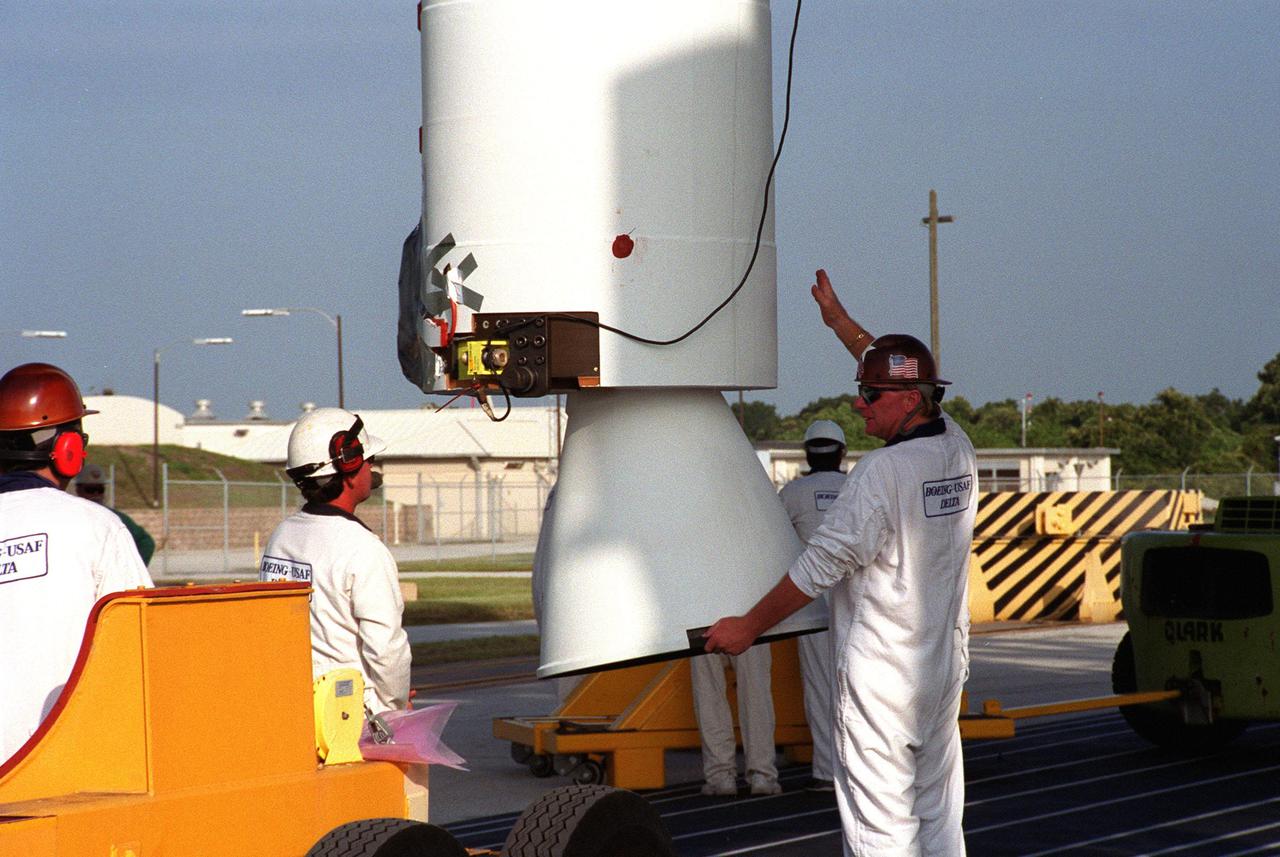
The United Launch Alliance/Orbital ATK Delta II solid rocket motor arrives at Space Launch Complex 2 at Vandenberg Air Force Base in California. The rocket motor will be mated to the Delta II first stage in preparation for launch of the Joint Polar Satellite System-1 (JPSS-1) later this year. JPSS, a next-generation environmental satellite system, is a collaborative program between the National Oceanic and Atmospheric Administration (NOAA) and NASA.
Delta II JPSS-1 SRM Installation onto Booster
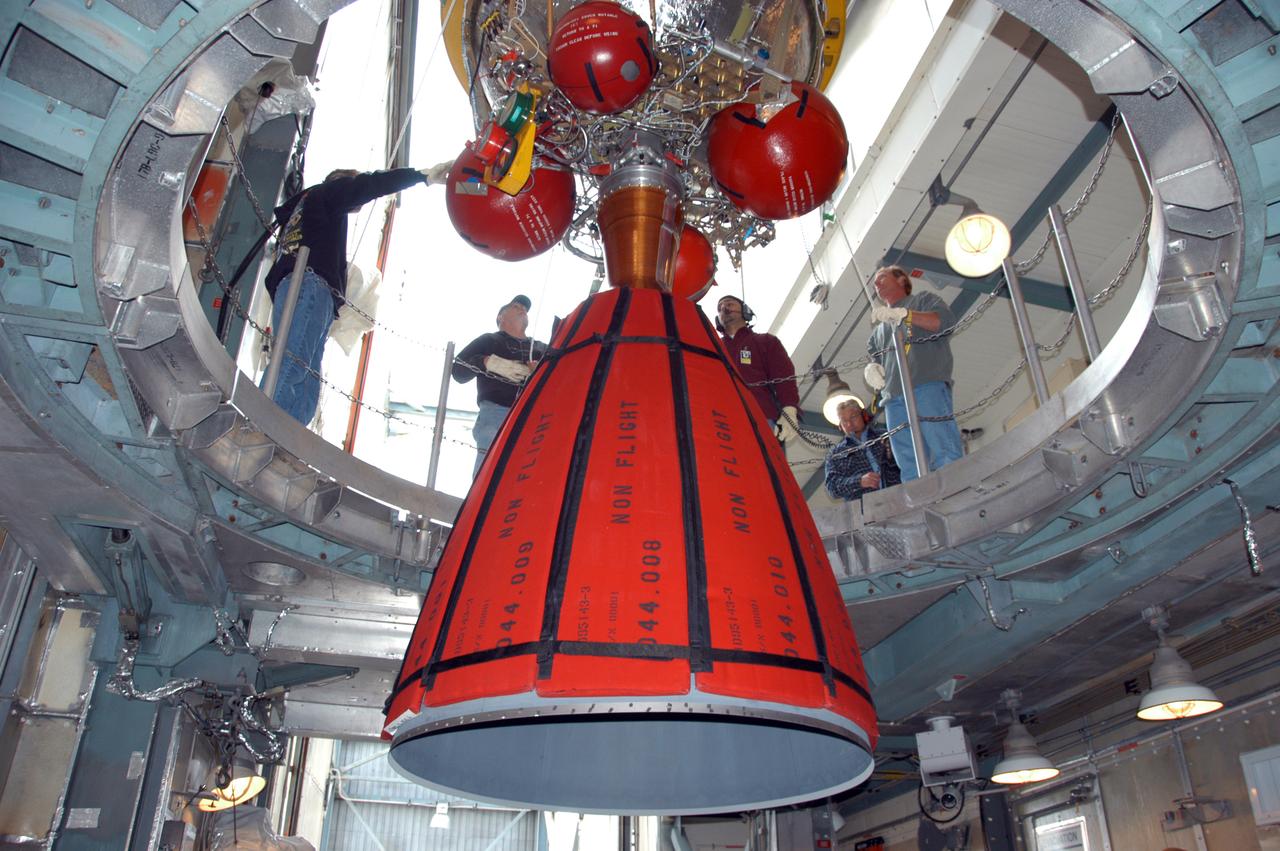
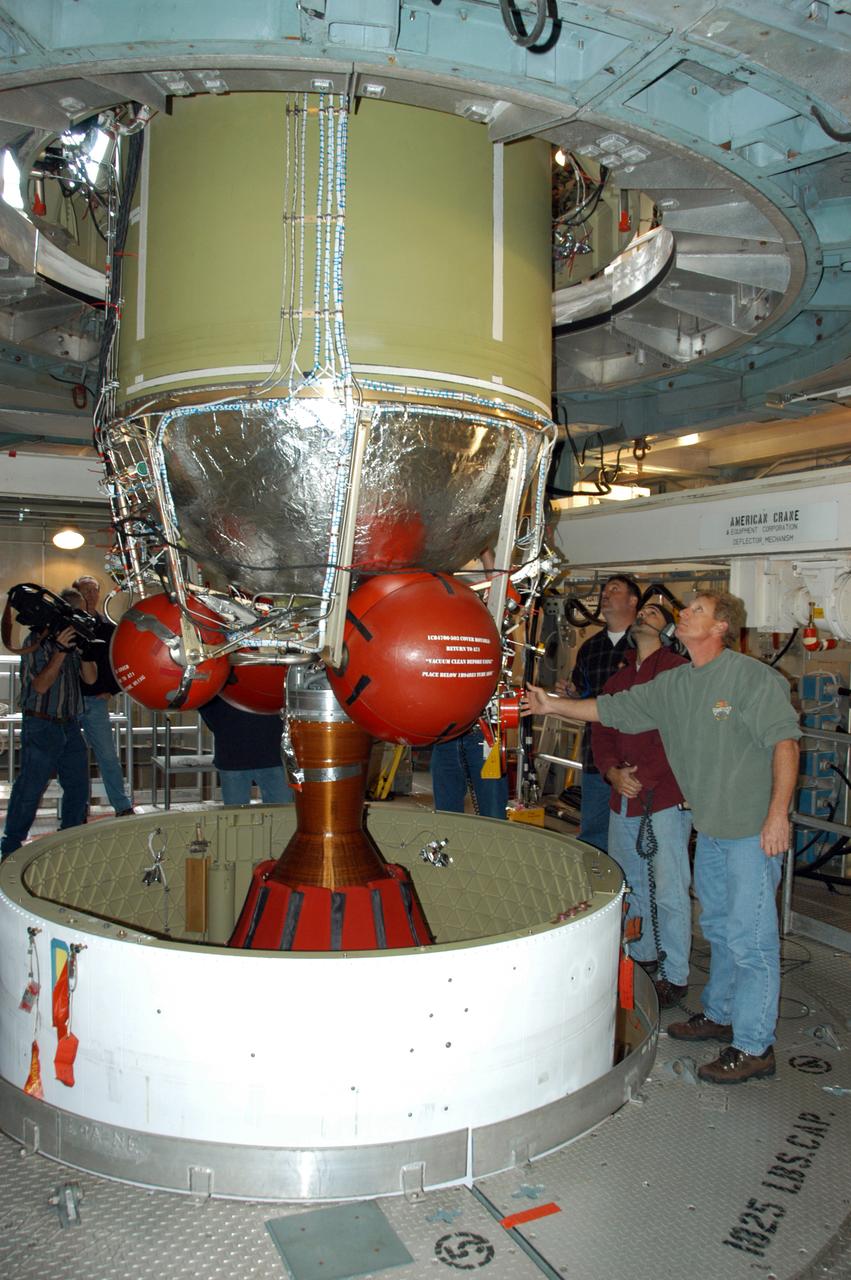
KENNEDY SPACE CENTER, FLA. -  The Boeing Delta II Heavy second-stage engine, the Aerojet AJ10-118K, is lifted up the mobile service tower on Pad 17-B, Cape Canaveral Air Force Station.  At right can be seen the first stage of the Delta II and the nine Solid Rocket Boosters surrounding it.  The Delta II is the launch vehicle for the MESSENGER (Mercury Surface, Space Environment, Geochemistry and Ranging) spacecraft, scheduled to lift off Aug. 2.  Bound for Mercury, the spacecraft is expected to reach orbit around the planet in March 2011.  MESSENGER was built for NASA by the Johns Hopkins University Applied Physics Laboratory in Laurel, Md.
KSC-04pd1448
On Pad 17-B at Cape Canaveral Air Force Station, the Delta II second stage is being lowered toward the Delta II first stage, already in place inside the mobile service tower. The Delta II is the launch vehicle for the THEMIS spacecraft. THEMIS consists of five identical probes, the largest number of scientific satellites ever launched into orbit aboard a single rocket. This unique constellation of satellites will resolve the tantalizing mystery of what causes the spectacular sudden brightening of the aurora borealis and aurora australis - the fiery skies over the Earth's northern and southern polar regions. THEMIS is scheduled to launch Feb. 15 from Cape Canaveral Air Force Station.
Delta II Second stage lift and mate
On Pad 17-B at Cape Canaveral Air Force Station, the Delta II second stage is being lowered toward the Delta II first stage, already in place inside the mobile service tower. The Delta II is the launch vehicle for the THEMIS spacecraft. THEMIS consists of five identical probes, the largest number of scientific satellites ever launched into orbit aboard a single rocket. This unique constellation of satellites will resolve the tantalizing mystery of what causes the spectacular sudden brightening of the aurora borealis and aurora australis - the fiery skies over the Earth's northern and southern polar regions. THEMIS is scheduled to launch Feb. 15 from Cape Canaveral Air Force Station.
Delta II Second stage lift and mate
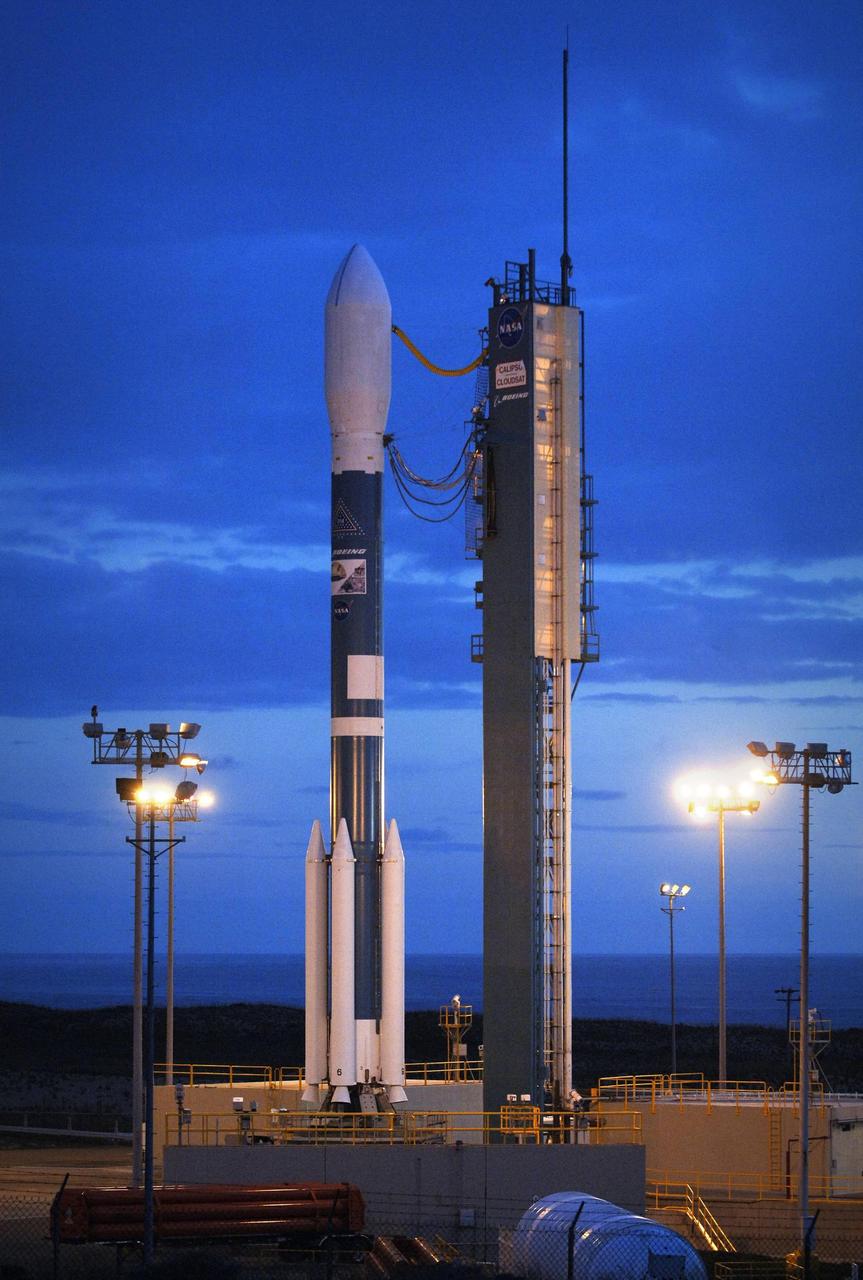
VANDENBERG AIR FORCE BASE, CALIF.  - On Space Launch Complex 2, the Delta II rocket stands ready for fueling in preparation for launch.  The CALIPSO and CloudSat satellites are set to launch at 6:02 a.m. EDT on April 23 from Vandenberg Air Force Base (VAFB) on missions to study clouds and aerosols, tiny particles in the air.  CALIPSO and CloudSat are set to fly into orbit aboard a Boeing Delta II rocket. The Delta II is designed to boost medium-sized satellites and robotic explorers into space.  NASA selected a model 7420-10C for this mission, which is a two-stage rocket equipped with four strap-on motors and a protective 10-foot payload fairing.  Photo credit: NASA/Bill Ingalls
KSC-06pd0696
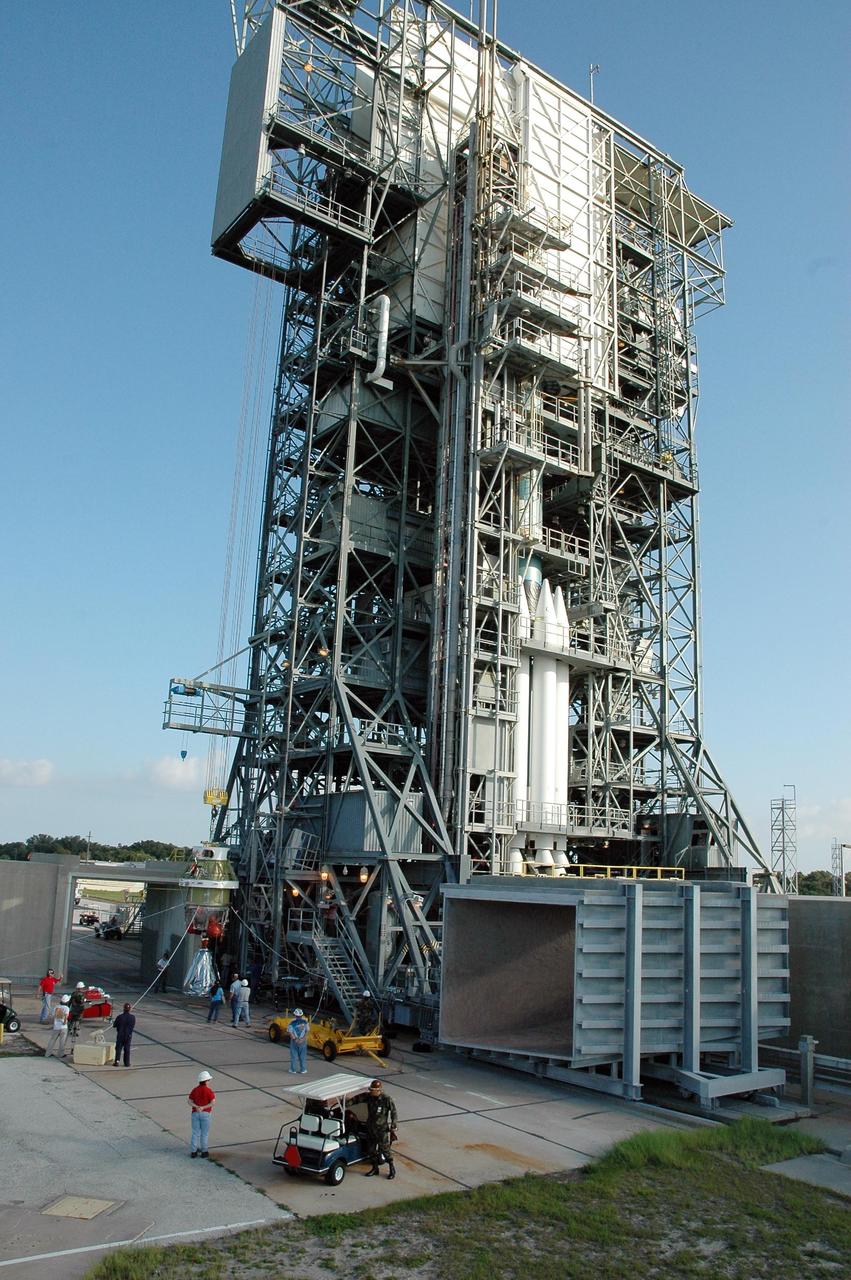
KENNEDY SPACE CENTER, FLA. --  The second stage of the Delta II launch vehicle for the Dawn spacecraft is lifted alongside the mobile service tower on Launch Pad 17-B at Cape Canaveral Air Force Station.  At right can be seen the solid rocket boosters surrounding Delta's first stage.  The second stage will be mated with the first stage.   The Delta II-Heavy, manufactured by the United Launch Alliance, is scheduled to launch the Dawn spacecraft on its 4-year flight to the asteroid belt.  The Delta II-Heavy is the strongest rocket in the Delta II class. It will use three stages and nine solid-fueled booster rockets to propel Dawn on its way. A 9.5-foot payload fairing will protect the spacecraft from the heat and stresses of launch. Dawn's goal is to characterize the conditions and processes of the solar system's earliest epoch by investigating in detail the largest protoplanets that have remained intact since their formations: asteroid Vesta and the dwarf planet Ceres.  They reside in the extensive zone between Mars and Jupiter together with many other smaller bodies, called the asteroid belt.  Dawn is scheduled to launch July 7.  Photo credit: NASA/Jack Pfaller
KSC-07pd1511
VANDENBERG AFB, CALIF. - Workers on the mobile service tower at Space Launch Complex 2, Vandenberg Air Force Base, Calif., check the Delta II rocket’s second stage as it is mated with the first stage. The Delta II is the launch vehicle for the Gravity Probe B experiment, developed by Stanford University, Lockheed Martin and NASA’s Marshall Space Flight Center.   The Gravity Probe B will launch a payload of four gyroscopes into low-Earth polar orbit to test two extraordinary predictions of Albert Einstein’s general theory of relativity: the geodetic effect (how space and time are warped by the presence of the Earth) and frame dragging (how Earth’s rotation drags space and time around with it). Once in orbit, for 18 months each gyroscope’s spin axis will be monitored as it travels through local spacetime, observing and measuring these effects. The targeted launch date is Dec. 6, 2003.
VANDENBERG AFB, CALIF. - Workers on the mobile service tower at Space Launch Complex 2, Vandenberg Air Force Base, Calif., check the Delta II rocket’s second stage as it is mated with the first stage. The Delta II is the launch vehicle for the Gravity Probe B experiment, developed by Stanford University, Lockheed Martin and NASA’s Marshall Space Flight Center. The Gravity Probe B will launch a payload of four gyroscopes into low-Earth polar orbit to test two extraordinary predictions of Albert Einstein’s general theory of relativity: the geodetic effect (how space and time are warped by the presence of the Earth) and frame dragging (how Earth’s rotation drags space and time around with it). Once in orbit, for 18 months each gyroscope’s spin axis will be monitored as it travels through local spacetime, observing and measuring these effects. The targeted launch date is Dec. 6, 2003.
On Launch Pad 17-B at Cape Canaveral Air Force Station in Florida, the United Launch Alliance Delta II rocket is moved inside the mobile service tower where nine solid rocket boosters will be attached in sets of three. The rocket is the launch vehicle for the THEMIS spacecraft, consisting of five identical probes, the largest number of scientific satellites ever launched into orbit aboard a single rocket. This unique constellation of satellites will resolve the tantalizing mystery of what causes the spectacular sudden brightening of the aurora borealis and aurora australis - the fiery skies over the Earth's northern and southern polar regions. THEMIS is scheduled to launch aboard the Delta II at 6:07 p.m. EST on Feb. 15.
Delta II First stage lift for THEMIS payload at complex 17B
KENNEDY SPACE CENTER, FLA. -  On Launch Complex 17-B, Cape Canaveral Air Force Station, the Space Infrared Telescope Facility (SIRTF) observatory is being dismantled  from atop the Delta II rocket.  It will be taken back to NASA Spacecraft Hangar AE. SIRTF will remain in the clean room at Hangar AE until it returns to the pad in early August.
KENNEDY SPACE CENTER, FLA. - On Launch Complex 17-B, Cape Canaveral Air Force Station, the Space Infrared Telescope Facility (SIRTF) observatory is being dismantled from atop the Delta II rocket. It will be taken back to NASA Spacecraft Hangar AE. SIRTF will remain in the clean room at Hangar AE until it returns to the pad in early August.
KENNEDY SPACE CENTER, FLA. -  Workers on Launch Complex 17-B, Cape Canaveral Air Force Station, start dismantling the Space Infrared Telescope Facility (SIRTF) observatory from atop the Delta II rocket.  It will be taken back to NASA Spacecraft Hangar AE. SIRTF will remain in the clean room at Hangar AE until it returns to the pad in early August.
KENNEDY SPACE CENTER, FLA. - Workers on Launch Complex 17-B, Cape Canaveral Air Force Station, start dismantling the Space Infrared Telescope Facility (SIRTF) observatory from atop the Delta II rocket. It will be taken back to NASA Spacecraft Hangar AE. SIRTF will remain in the clean room at Hangar AE until it returns to the pad in early August.
VANDENBERG AIR FORCE BASE, CALIF. -  After its arrival at Space Launch Complex 2 on Vandenberg Air Force Base in California, one of three Solid Rocket Boosters is lifted from the transporter and will be raised to a vertical position.  It will be lifted up the launch service tower and mated with a Boeing Delta II rocket for the launch of the National Oceanic and Atmospheric Administration (NOAA-N) spacecraft.   Launch of NOAA-N aboard the Boeing Delta II rocket is currently scheduled for May 11, 2005.  NOAA-N is the fourth in the series of support dedicated microwave instruments for the generation of temperature, moisture, surface, and hydrological products in cloudy regions where visible and infrared (IR) instruments have decreased capability.
KSC-05pd-0681