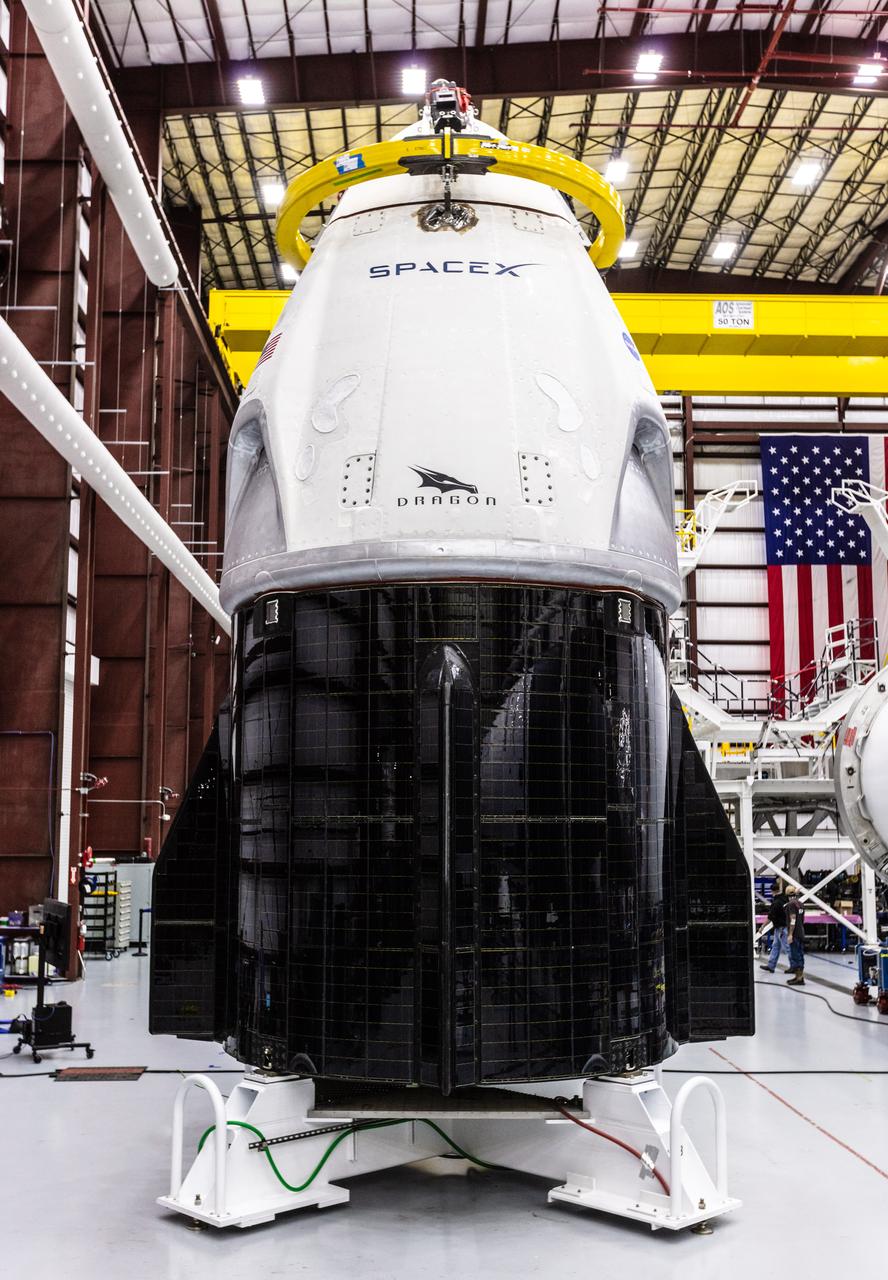
SpaceX's Crew Dragon spacecraft and Falcon 9 rocket are positioned inside the company's hangar at Launch Complex 39A at NASA's Kennedy Space Center in Florida, on Dec. 18, 2018, ahead of the Demo-1 uncrewed flight test targeted for January 17, 2019. The Demo-1 flight test is the precursor to the company's Demo-2 flight test, which will fly two NASA astronauts to the International Space Station as part of NASA's Commercial Crew Program. Demo-2 is targeted for June 2019.

SpaceX's Crew Dragon spacecraft and Falcon 9 rocket are positioned inside the company's hangar at Launch Complex 39A at NASA's Kennedy Space Center in Florida, on Dec. 18, 2018, ahead of the Demo-1 uncrewed flight test targeted for January 17, 2019. The Demo-1 flight test is the precursor to the company's Demo-2 flight test, which will fly two NASA astronauts to the International Space Station as part of NASA's Commercial Crew Program. Demo-2 is targeted for June 2019.
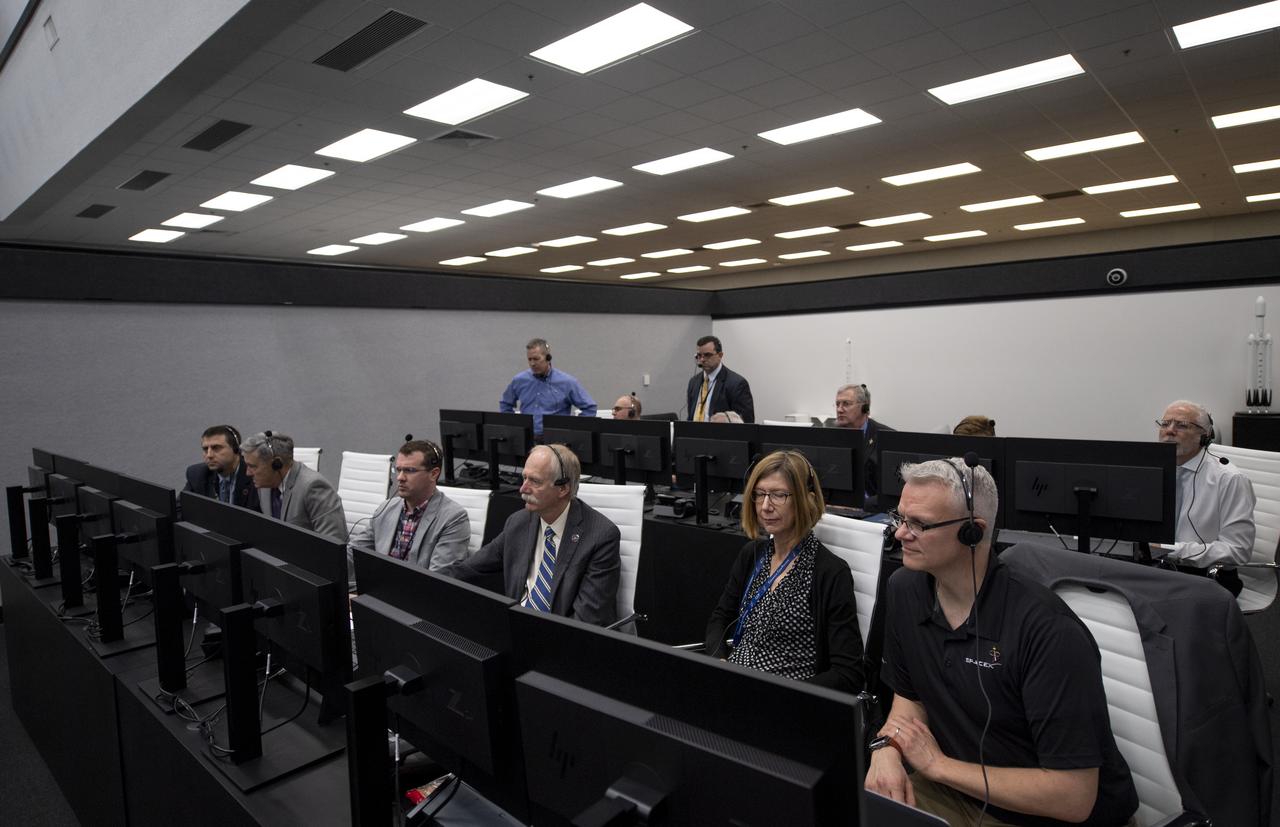
NASA management monitors the countdown of the launch of a SpaceX Falcon 9 rocket carrying the company's Crew Dragon spacecraft on the Demo-1 mission from firing room four of the Launch Control Center, Saturday, March 2, 2019 at the Kennedy Space Center in Florida. The Demo-1 mission is the first launch of a commercially built and operated American spacecraft and space system designed for humans as part of NASA's Commercial Crew Program. The mission will serve as an end-to-end test of the system's capabilities. Photo Credit: (NASA/Joel Kowsky)
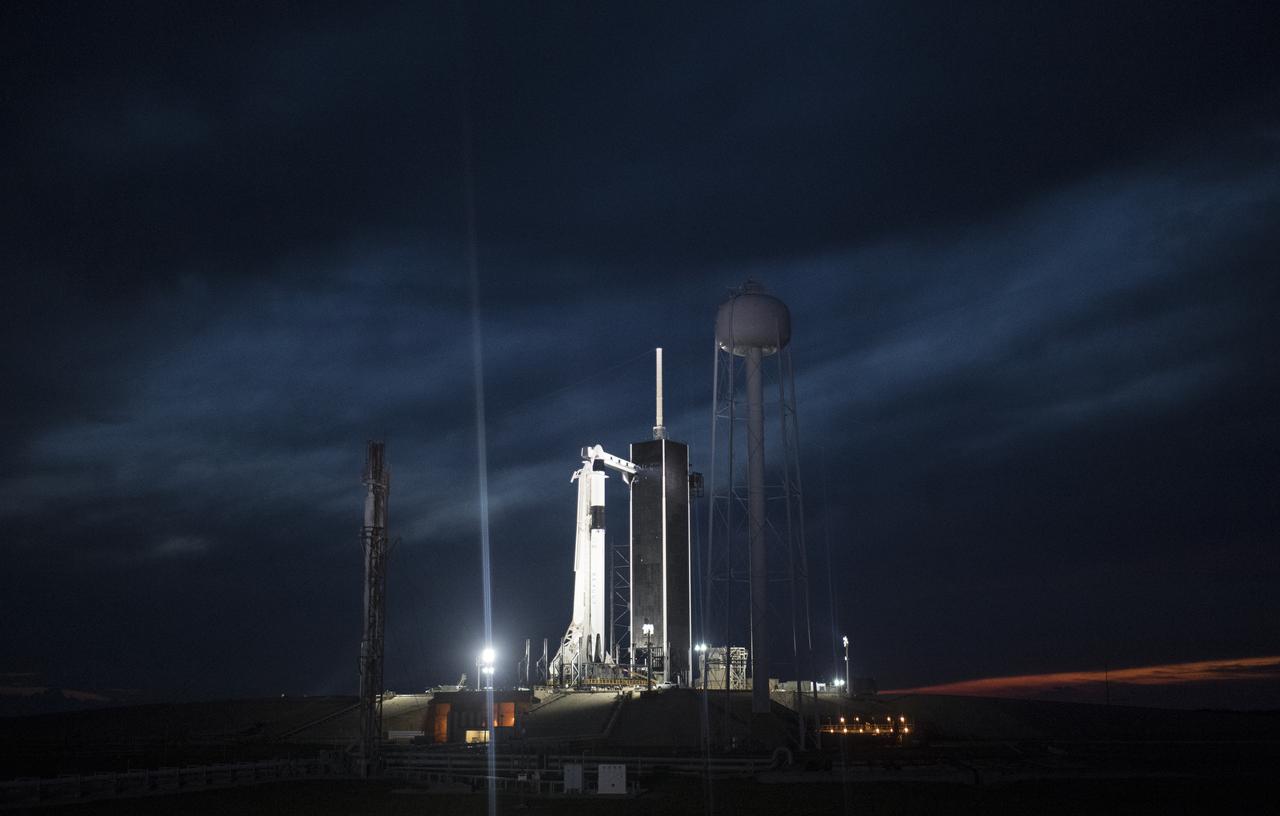
A SpaceX Falcon 9 rocket with the company's Crew Dragon spacecraft onboard is seen illuminated on the launch pad by spotlights at Launch Complex 39A as preparations continue for the Demo-1 mission, Friday, March 1, 2019 at the Kennedy Space Center in Florida. The Demo-1 mission will be the first launch of a commercially built and operated American spacecraft and space system designed for humans as part of NASA's Commercial Crew Program. The mission, currently targeted for a 2:49am launch on March 2, will serve as an end-to-end test of the system's capabilities. Photo Credit: (NASA/Joel Kowsky)
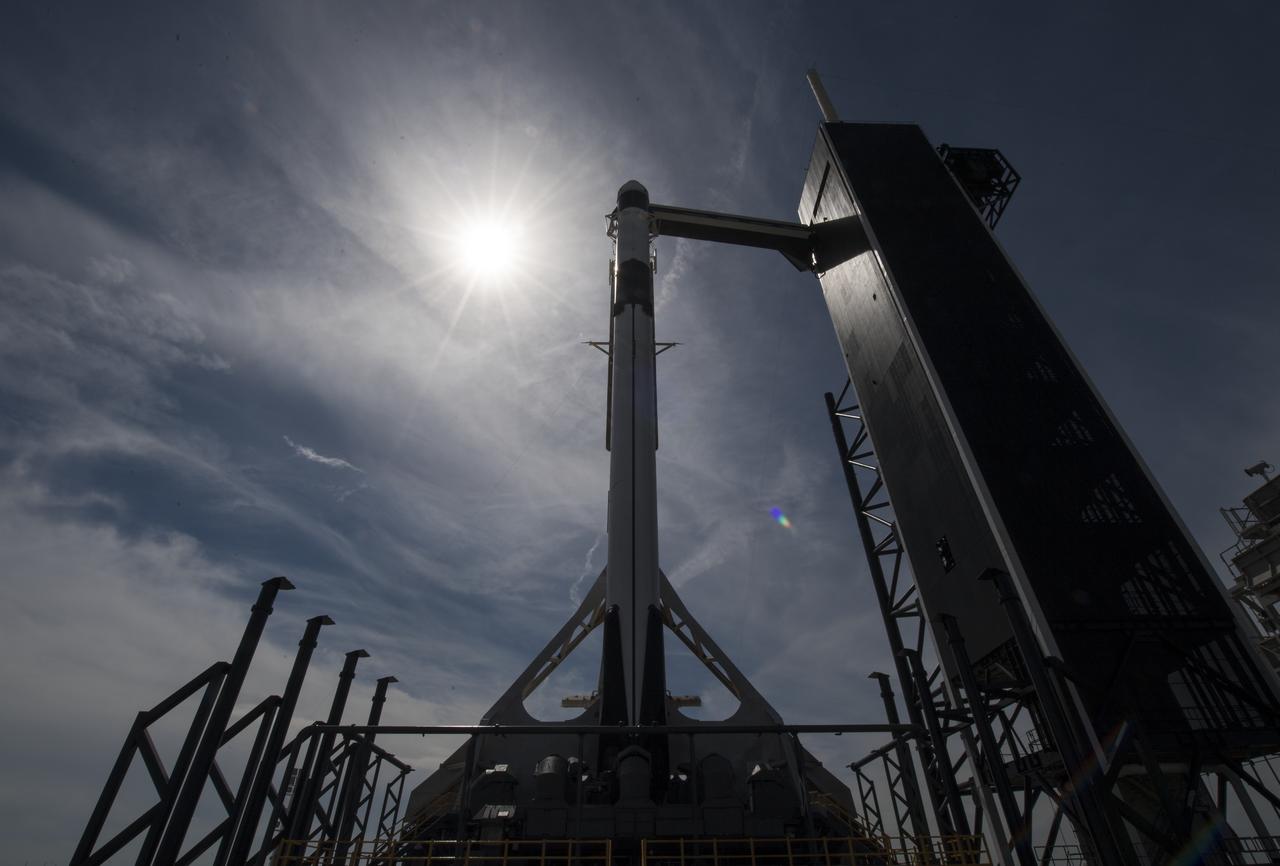
The SpaceX Falcon 9 rocket with the company's Crew Dragon spacecraft onboard is seen on the launch pad at Launch Complex 39A as preparations continue for the Demo-1 mission, Friday, March 1, 2019 at the Kennedy Space Center in Florida. The Demo-1 mission will be the first launch of a commercially built and operated American spacecraft and space system designed for humans as part of NASA's Commercial Crew Program. The mission, currently targeted for a 2:49am launch on March 2, will serve as an end-to-end test of the system's capabilities. Photo Credit: (NASA/Joel Kowsky)
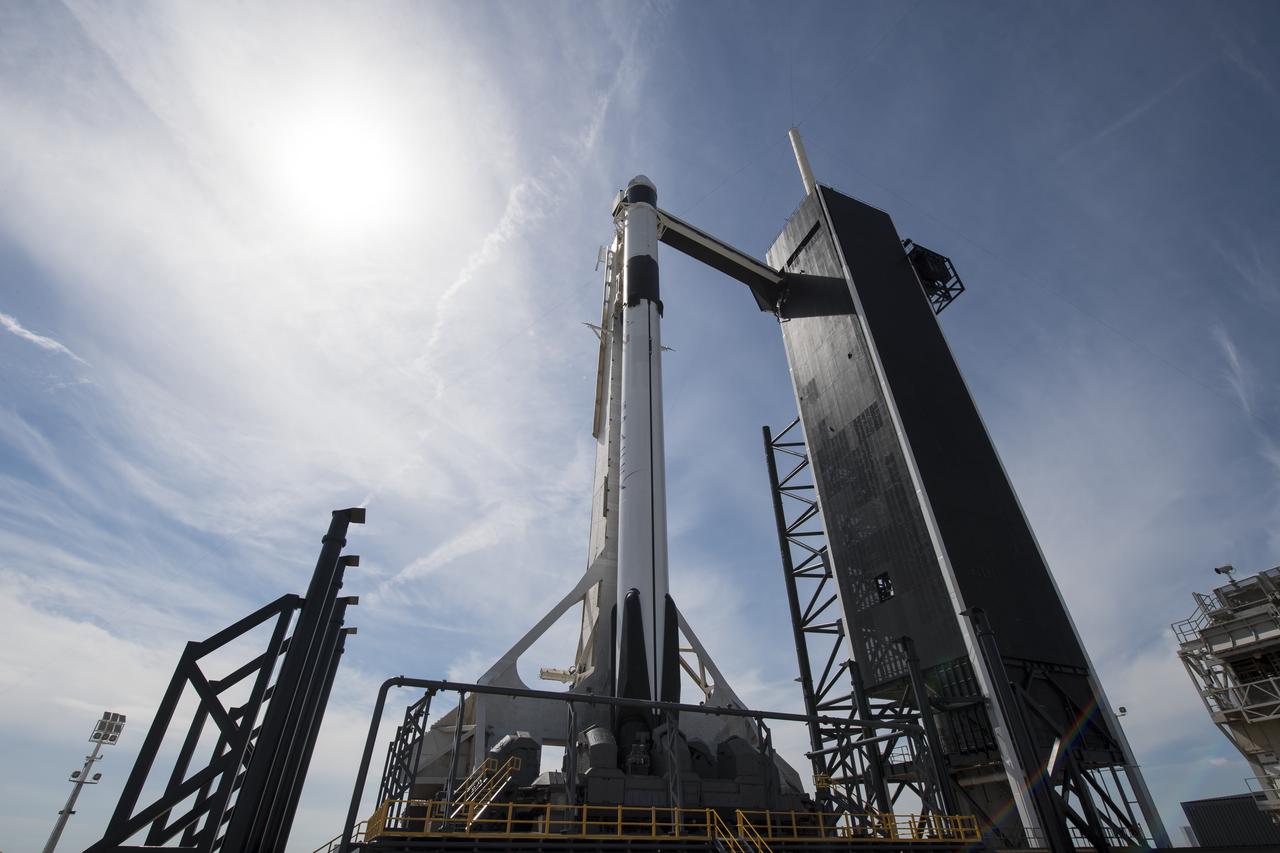
The SpaceX Falcon 9 rocket with the company's Crew Dragon spacecraft onboard is seen on the launch pad at Launch Complex 39A as preparations continue for the Demo-1 mission, Friday, March 1, 2019 at the Kennedy Space Center in Florida. The Demo-1 mission will be the first launch of a commercially built and operated American spacecraft and space system designed for humans as part of NASA's Commercial Crew Program. The mission, currently targeted for a 2:49am launch on March 2, will serve as an end-to-end test of the system's capabilities. Photo Credit: (NASA/Joel Kowsky)
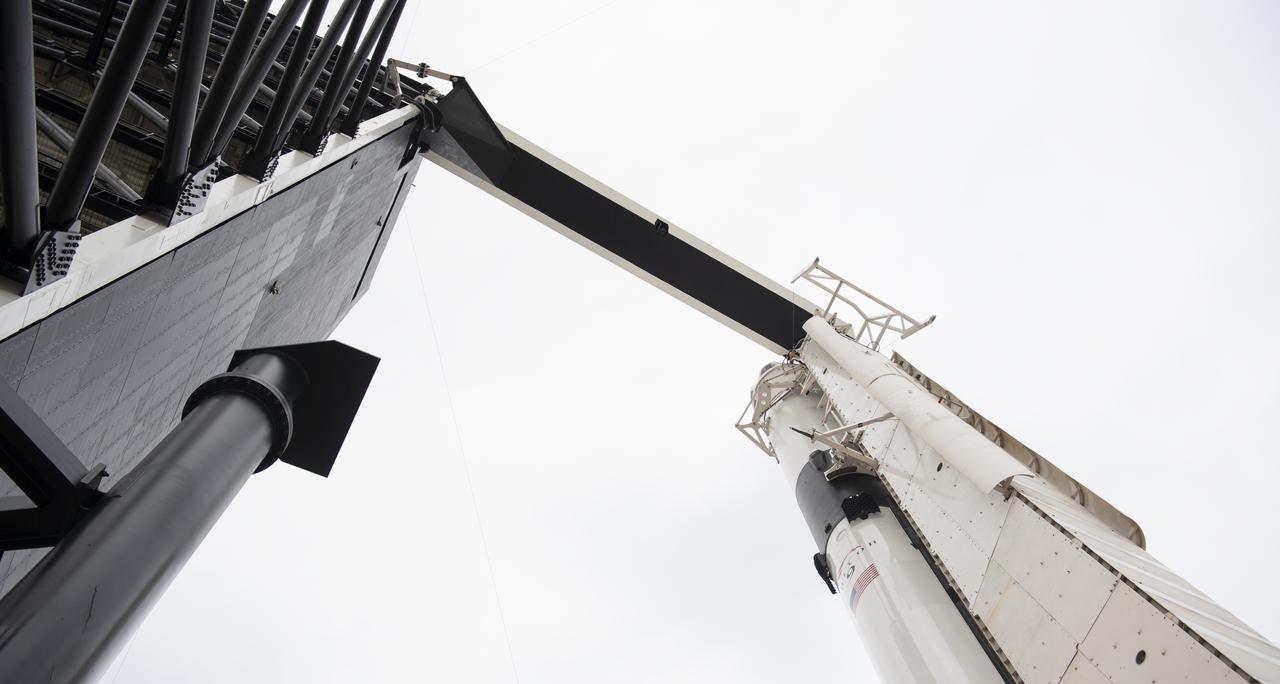
A SpaceX Falcon 9 rocket with the company's Crew Dragon spacecraft onboard is seen on the launch pad at Launch Complex 39A as preparations continue for the Demo-1 mission, Friday, March 1, 2019 at the Kennedy Space Center in Florida. The Demo-1 mission launched at 2:49am ET on Saturday, March 2 and was the first launch of a commercially built and operated American spacecraft and space system designed for humans as part of NASA's Commercial Crew Program. The mission will serve as an end-to-end test of the system's capabilities. Photo Credit: (NASA/Joel Kowsky)
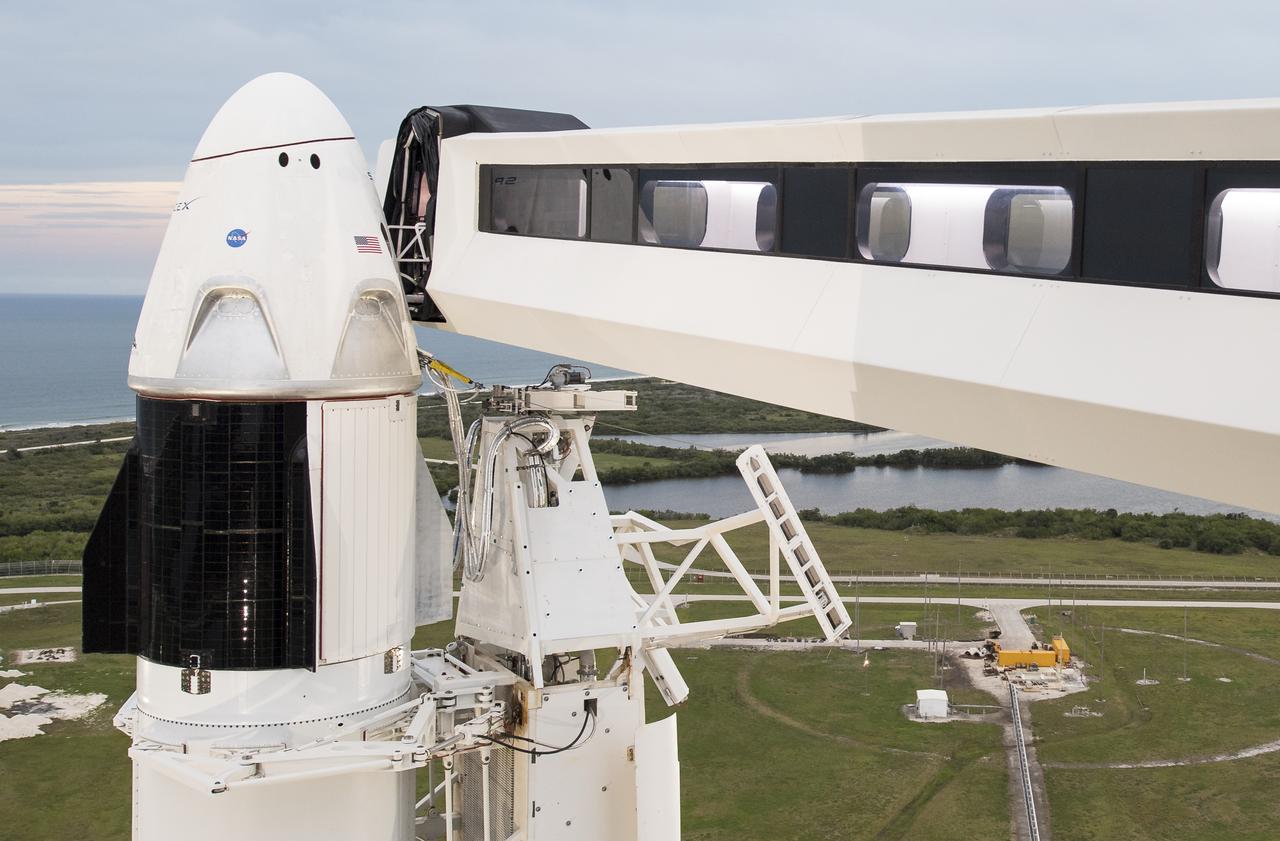
The SpaceX Crew Dragon spacecraft is seen atop the company's Falcon 9 rocket on the launch pad of Launch Complex 39A before the early Saturday morning launch of the Demo-1 mission, Friday, March 1, 2019 at the Kennedy Space Center in Florida. The Demo-1 mission launched at 2:49am ET on Saturday, March 2 and was the first launch of a commercially built and operated American spacecraft and space system designed for humans as part of NASA's Commercial Crew Program. The mission will serve as an end-to-end test of the system's capabilities. Photo Credit: (NASA/Joel Kowsky)
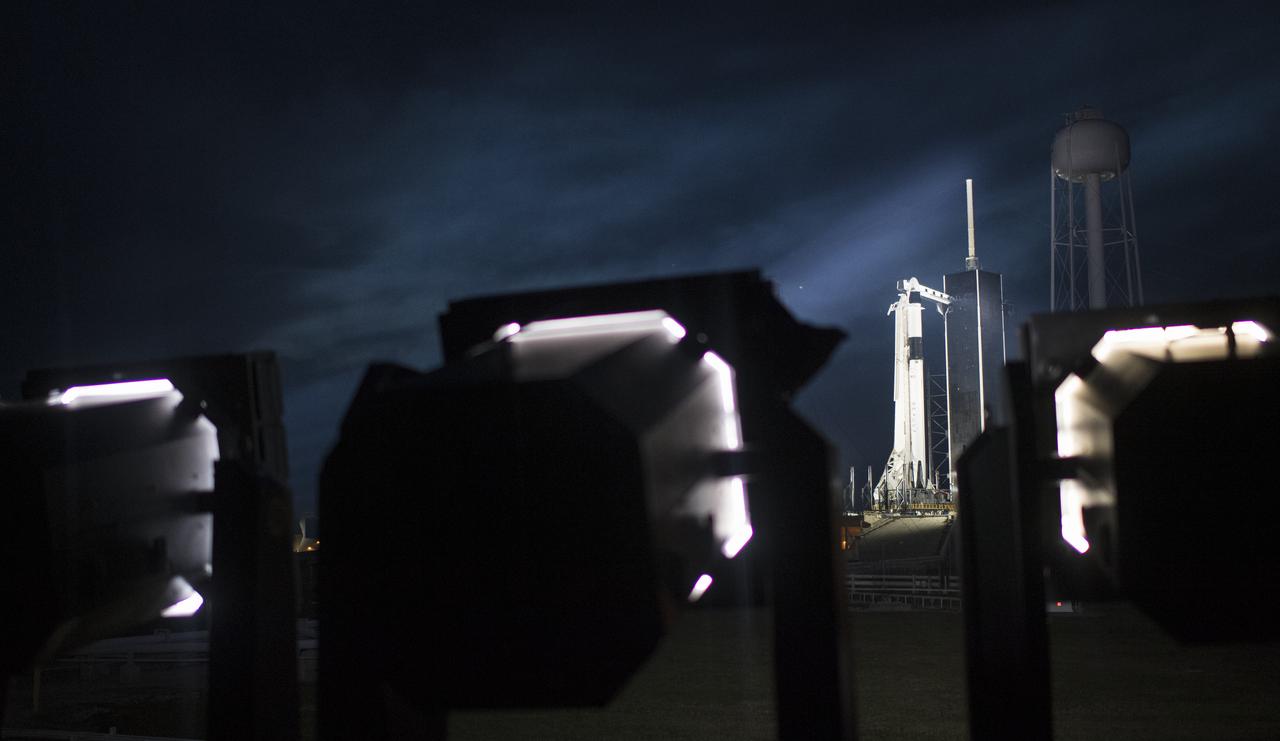
A SpaceX Falcon 9 rocket with the company's Crew Dragon spacecraft onboard is seen illuminated on the launch pad by spotlights at Launch Complex 39A as preparations continue for the Demo-1 mission, Friday, March 1, 2019 at the Kennedy Space Center in Florida. The Demo-1 mission will be the first launch of a commercially built and operated American spacecraft and space system designed for humans as part of NASA's Commercial Crew Program. The mission, currently targeted for a 2:49am launch on March 2, will serve as an end-to-end test of the system's capabilities. Photo Credit: (NASA/Joel Kowsky)
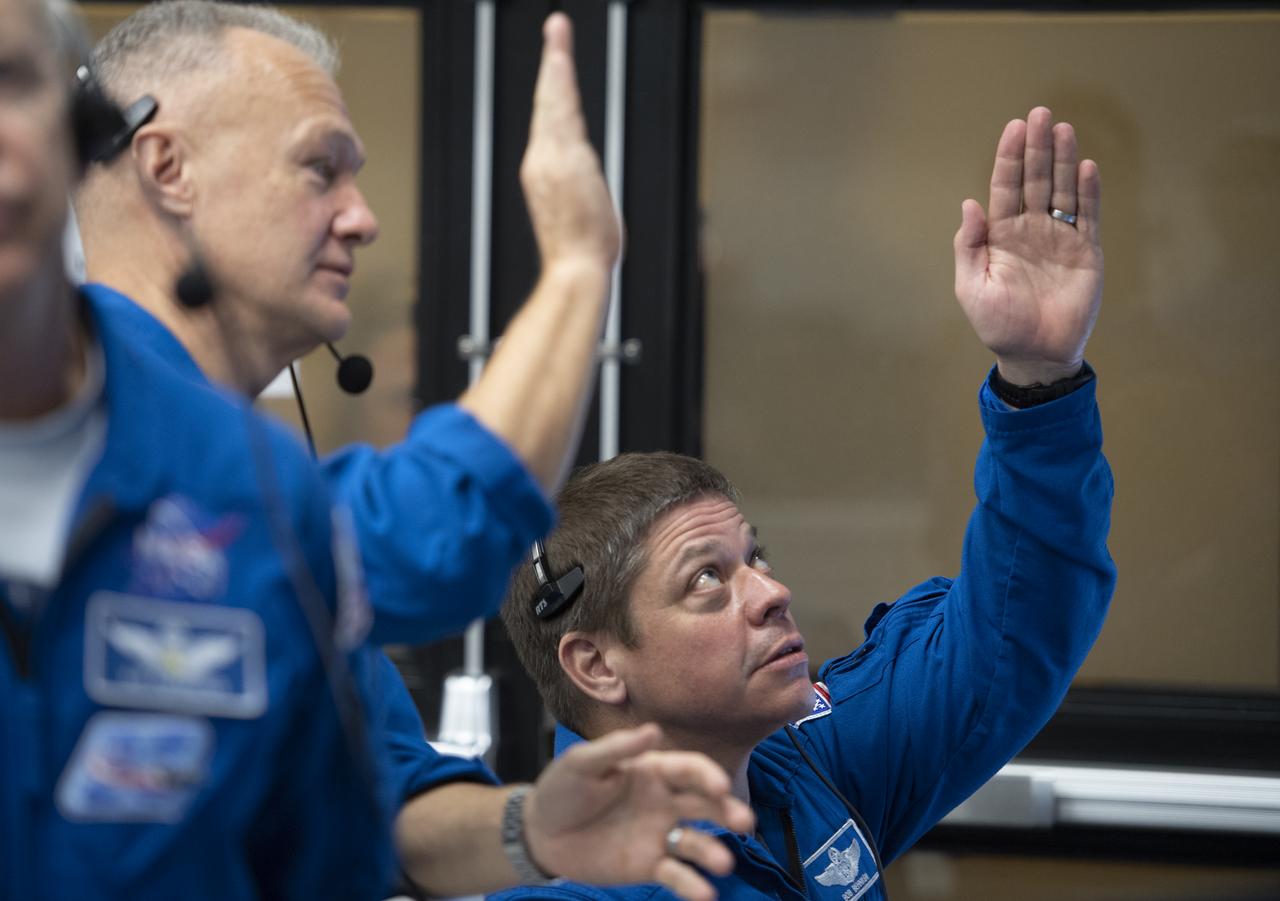
NASA astronauts Doug Hurley, left, and Bob Behnken, right, who are assigned to fly on the crewed Demo-2 mission, watch the launch of a SpaceX Falcon 9 rocket carrying the company's Crew Dragon spacecraft on the Demo-1 mission from firing room four of the Launch Control Center, Saturday, March 2, 2019 at the Kennedy Space Center in Florida. The Demo-1 mission is the first launch of a commercially built and operated American spacecraft and space system designed for humans as part of NASA's Commercial Crew Program. The mission will serve as an end-to-end test of the system's capabilities. Photo Credit: (NASA/Joel Kowsky)
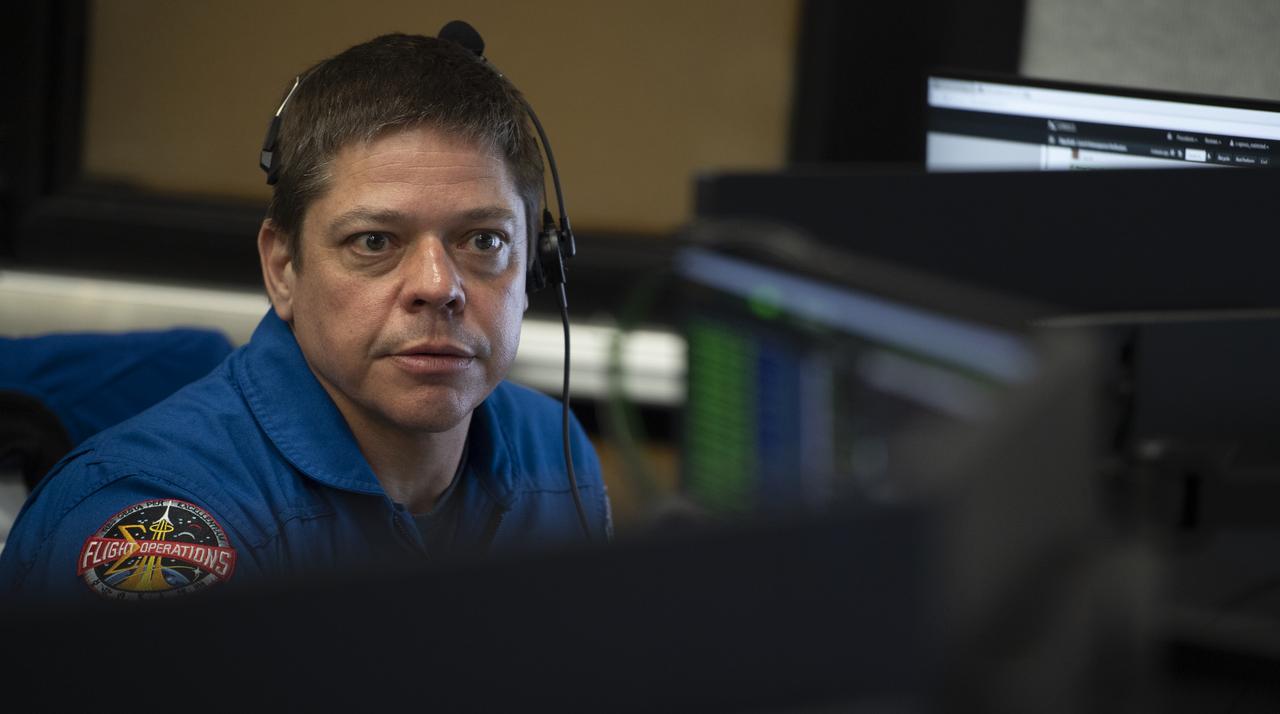
NASA astronaut Bob Behnken monitors the countdown of the launch of a SpaceX Falcon 9 rocket carrying the company's Crew Dragon spacecraft on the Demo-1 mission from firing room four of the Launch Control Center, Saturday, March 2, 2019 at the Kennedy Space Center in Florida. Behnken, along with NASA astronaut Doug Hurley are assigned to fly on the crewed Demo-2 mission. The Demo-1 mission will be the first launch of a commercially built and operated American spacecraft and space system designed for humans as part of NASA's Commercial Crew Program. The mission will serve as an end-to-end test of the system's capabilities. Photo Credit: (NASA/Joel Kowsky)
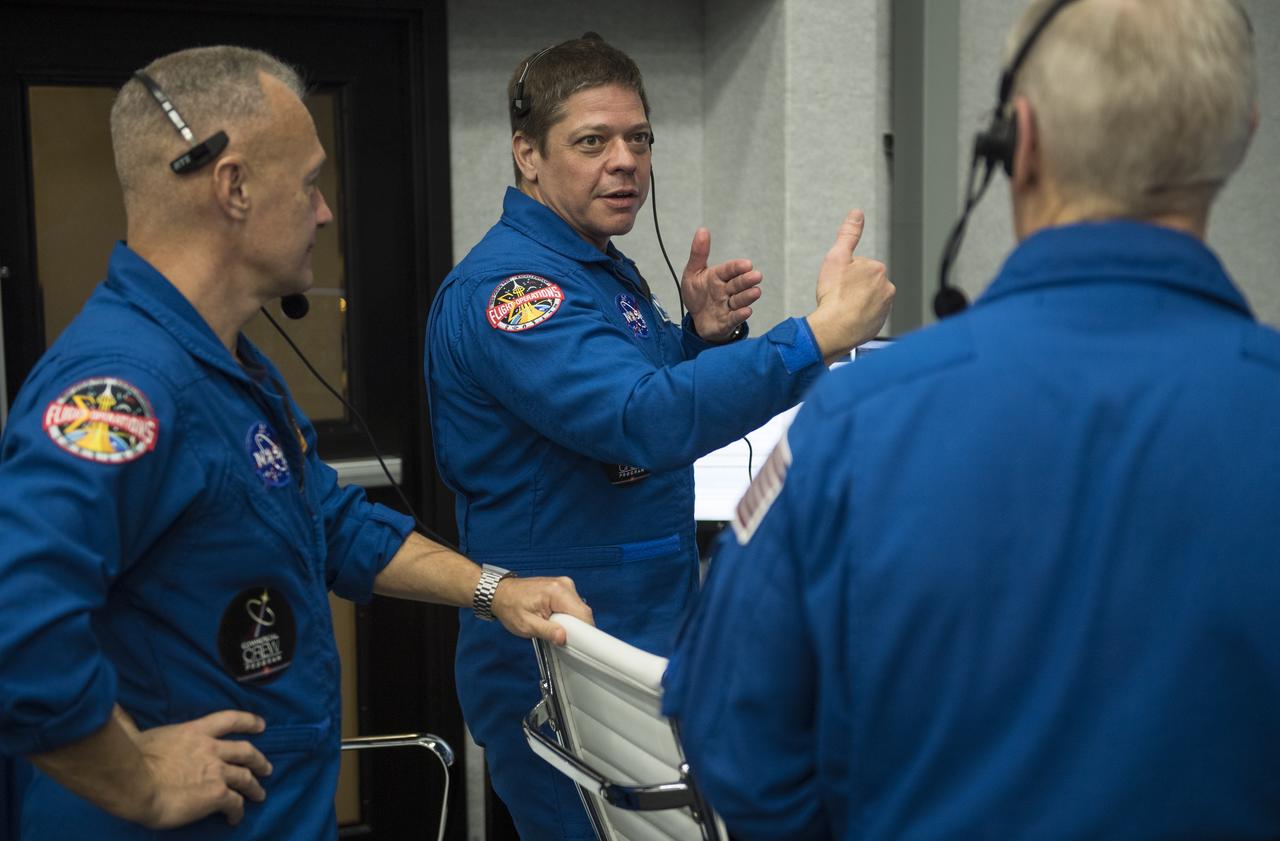
NASA astronauts Doug Hurley, left, and Bob Behnken, right, who are assigned to fly on the crewed Demo-2 mission, watch the launch of a SpaceX Falcon 9 rocket carrying the company's Crew Dragon spacecraft on the Demo-1 mission from firing room four of the Launch Control Center, Saturday, March 2, 2019 at the Kennedy Space Center in Florida. The Demo-1 mission is the first launch of a commercially built and operated American spacecraft and space system designed for humans as part of NASA's Commercial Crew Program. The mission will serve as an end-to-end test of the system's capabilities. Photo Credit: (NASA/Joel Kowsky)
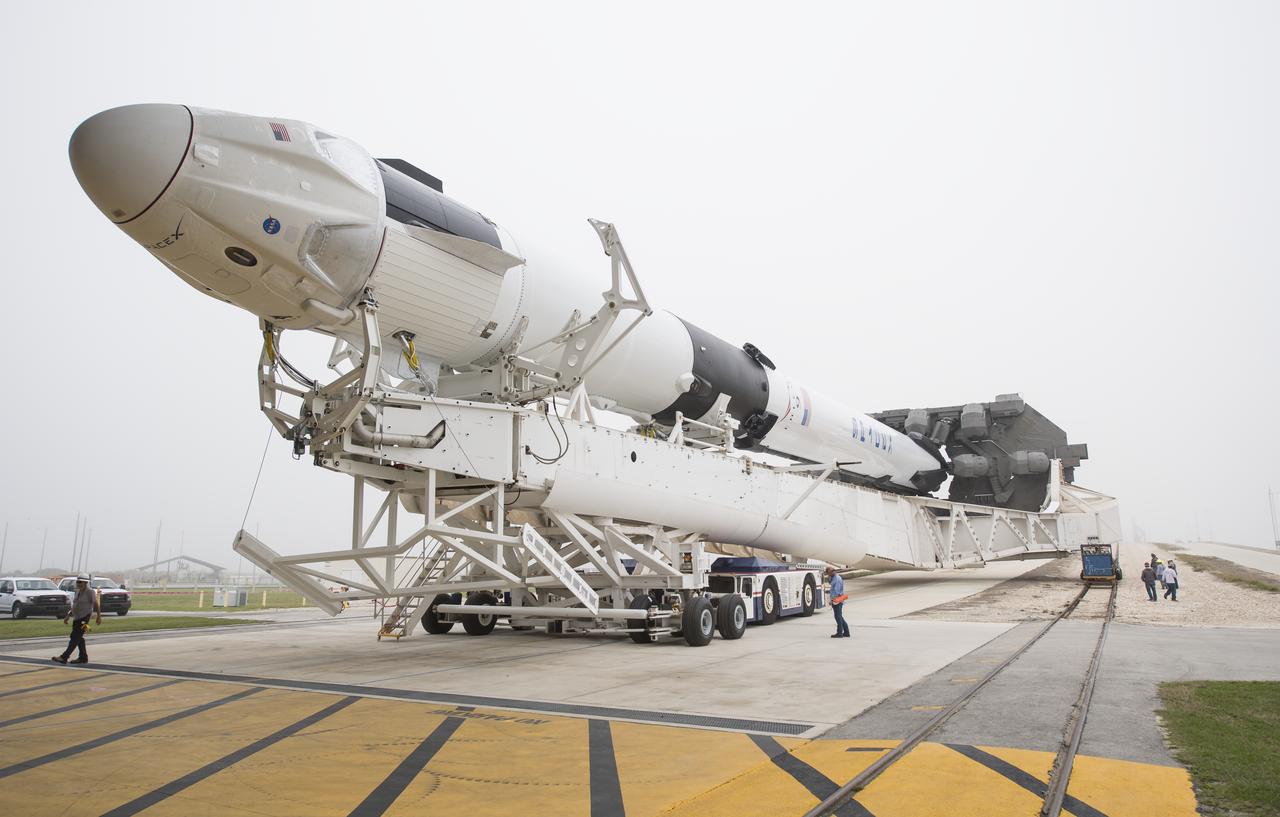
A SpaceX Falcon 9 rocket with the company's Crew Dragon spacecraft onboard is seen as it is rolled out of the horizontal integration facility at Launch Complex 39A as preparations continue for the Demo-1 mission, Feb. 28, 2019 at the Kennedy Space Center in Florida. The Demo-1 mission will be the first launch of a commercially built and operated American spacecraft and space system designed for humans as part of NASA's Commercial Crew Program. The mission, currently targeted for a 2:49am launch on March 2, will serve as an end-to-end test of the system's capabilities. Photo Credit: (NASA/Joel Kowsky)
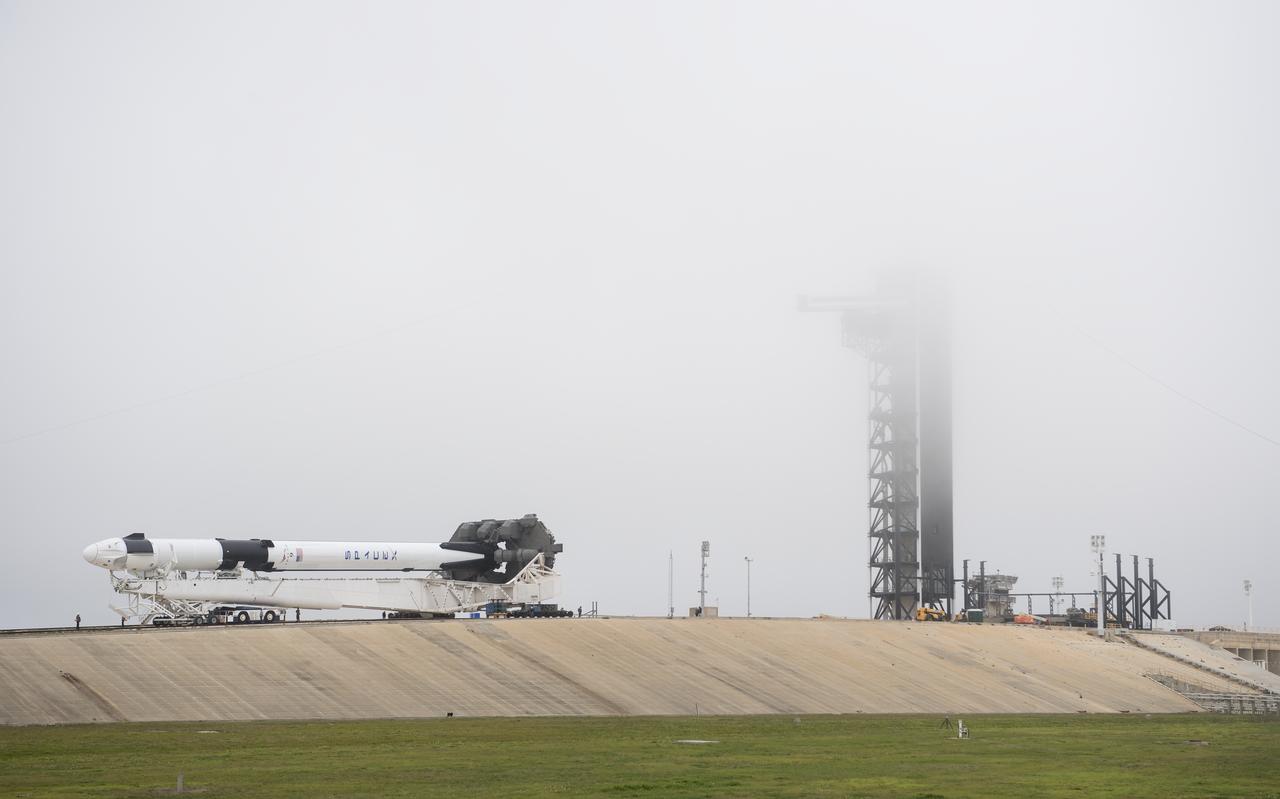
A SpaceX Falcon 9 rocket with the company's Crew Dragon spacecraft onboard is seen as it is rolled to the launch pad at Launch Complex 39A as preparations continue for the Demo-1 mission, Feb. 28, 2019 at the Kennedy Space Center in Florida. The Demo-1 mission will be the first launch of a commercially built and operated American spacecraft and space system designed for humans as part of NASA's Commercial Crew Program. The mission, currently targeted for a 2:49am launch on March 2, will serve as an end-to-end test of the system's capabilities. Photo Credit: (NASA/Joel Kowsky)
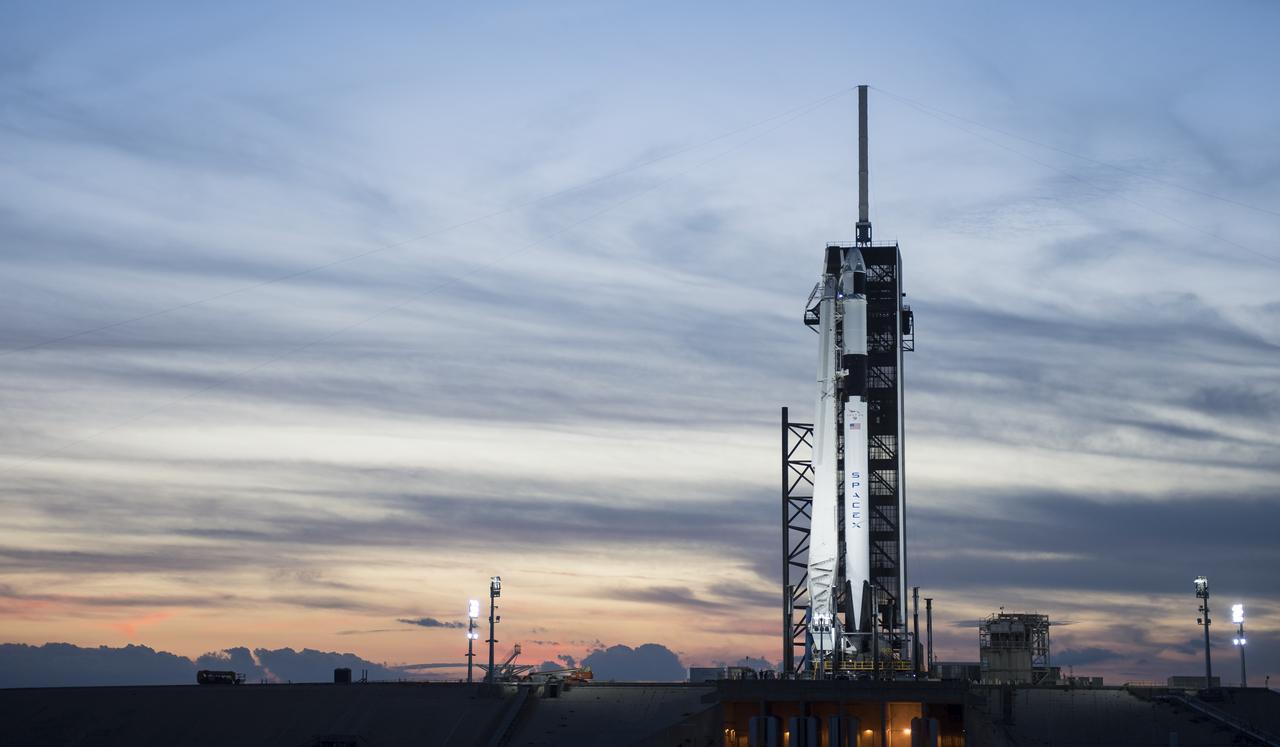
A SpaceX Falcon 9 rocket with the company's Crew Dragon spacecraft onboard is seen after being raised into a vertical position on the launch pad at Launch Complex 39A as preparations continue for the Demo-1 mission, Feb. 28, 2019 at the Kennedy Space Center in Florida. The Demo-1 mission will be the first launch of a commercially built and operated American spacecraft and space system designed for humans as part of NASA's Commercial Crew Program. The mission, currently targeted for a 2:49am launch on March 2, will serve as an end-to-end test of the system's capabilities. Photo Credit: (NASA/Joel Kowsky)
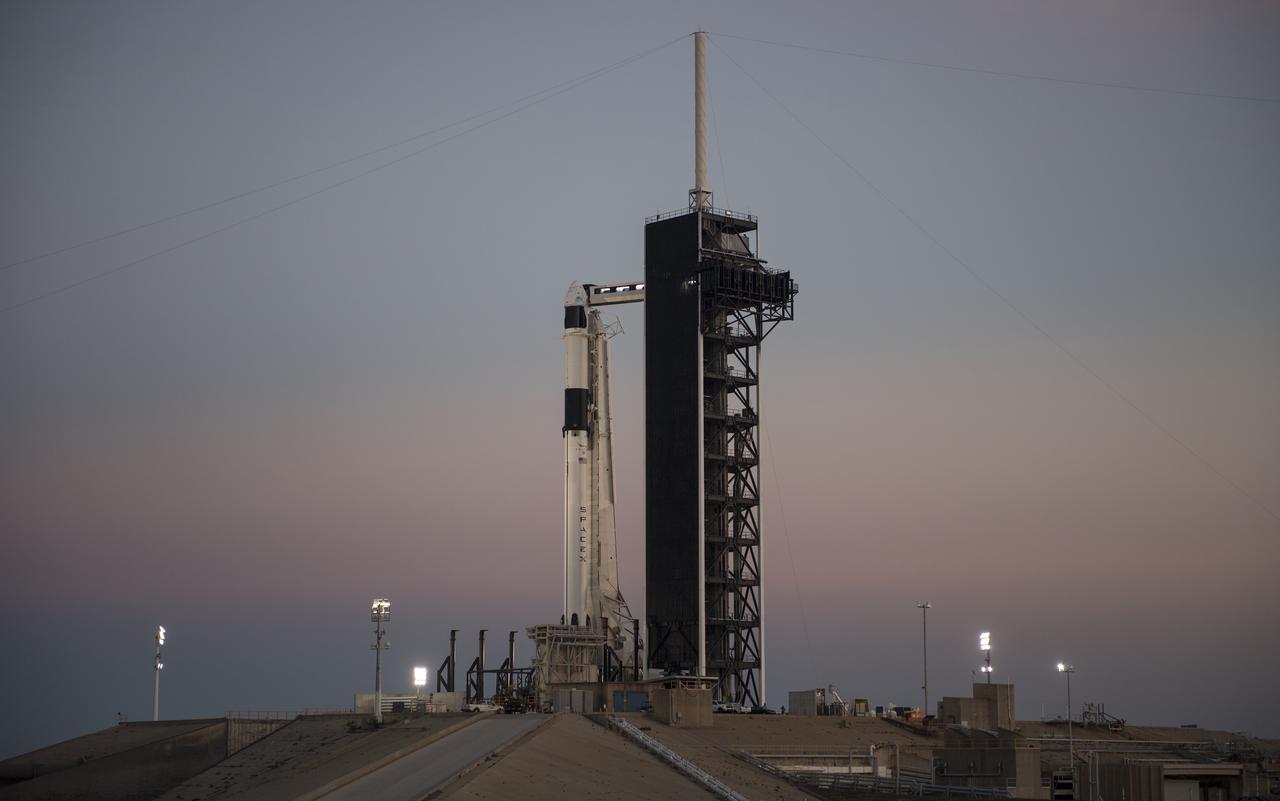
A SpaceX Falcon 9 rocket with the company's Crew Dragon spacecraft onboard is seen after being raised into a vertical position on the launch pad at Launch Complex 39A as preparations continue for the Demo-1 mission, Feb. 28, 2019 at the Kennedy Space Center in Florida. The Demo-1 mission will be the first launch of a commercially built and operated American spacecraft and space system designed for humans as part of NASA's Commercial Crew Program. The mission, currently targeted for a 2:49am launch on March 2, will serve as an end-to-end test of the system's capabilities. Photo Credit: (NASA/Joel Kowsky)
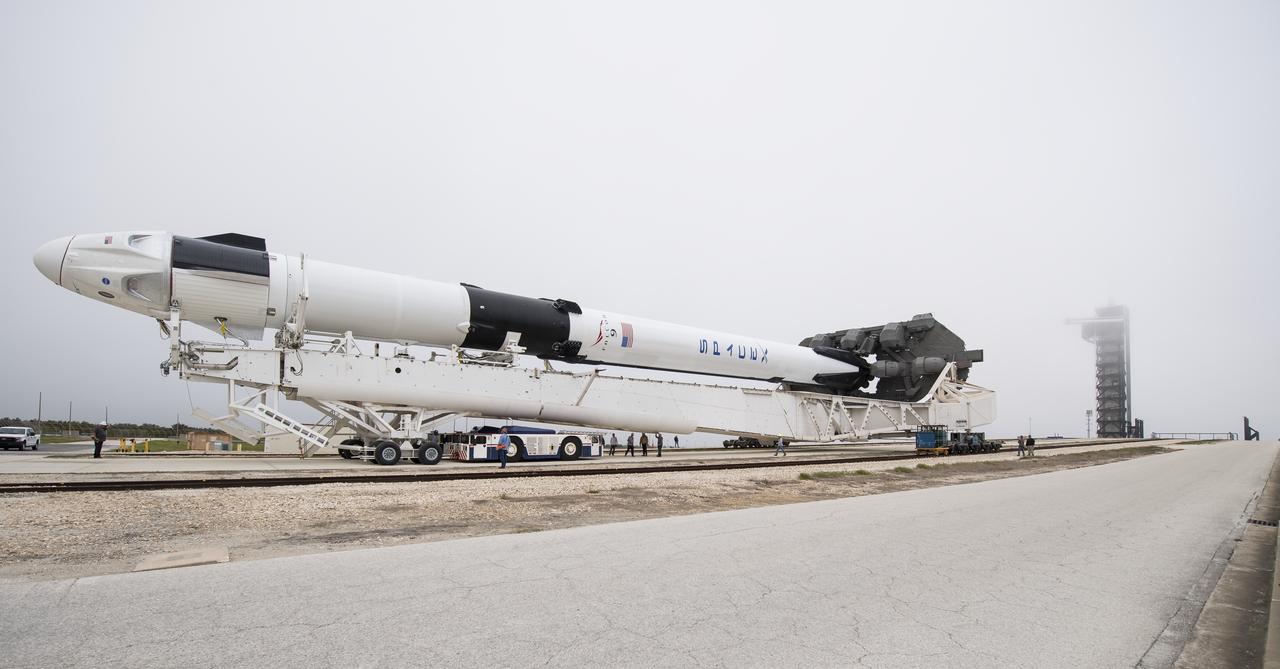
A SpaceX Falcon 9 rocket with the company's Crew Dragon spacecraft onboard is seen as it is rolled out of the horizontal integration facility at Launch Complex 39A as preparations continue for the Demo-1 mission, Feb. 28, 2019 at the Kennedy Space Center in Florida. The Demo-1 mission will be the first launch of a commercially built and operated American spacecraft and space system designed for humans as part of NASA's Commercial Crew Program. The mission, currently targeted for a 2:49am launch on March 2, will serve as an end-to-end test of the system's capabilities. Photo Credit: (NASA/Joel Kowsky)
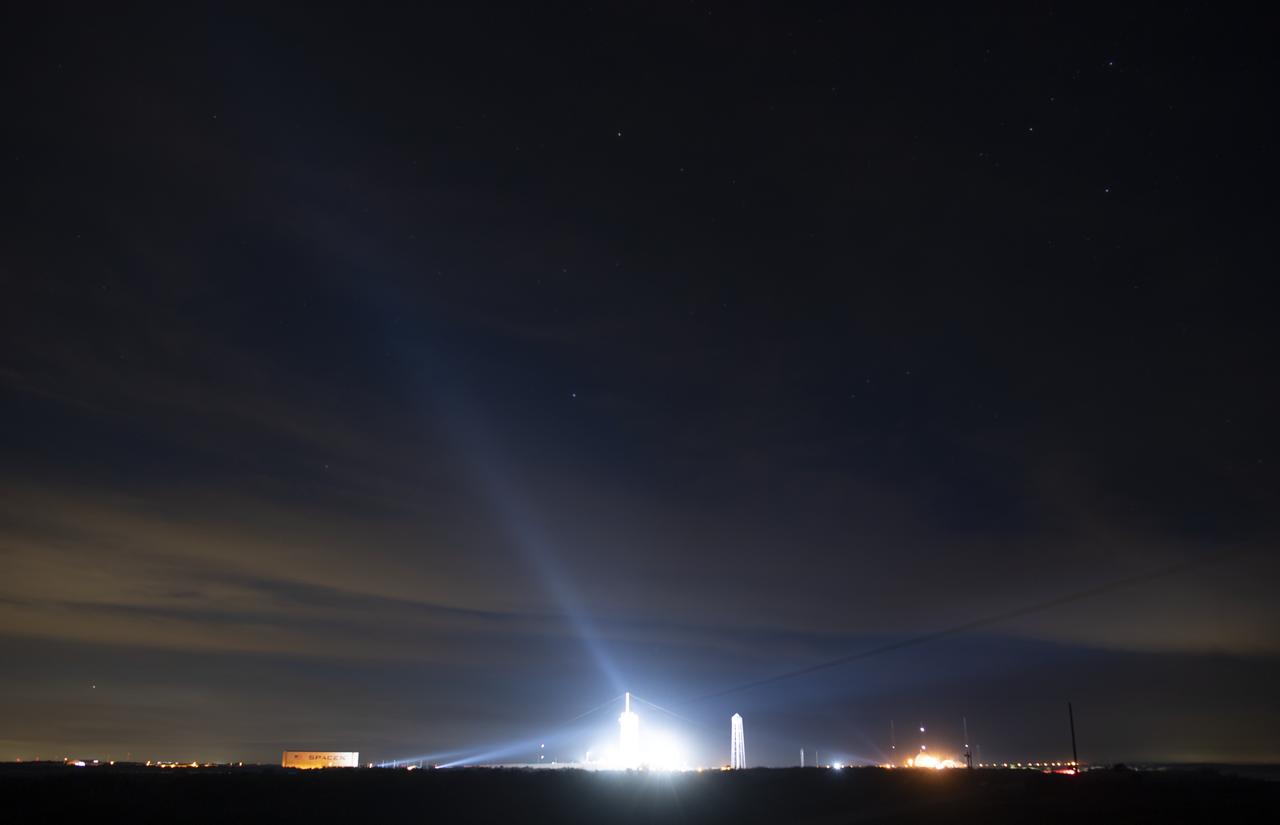
A SpaceX Falcon 9 rocket with the company's Crew Dragon spacecraft onboard is seen illuminated by spotlights on the launch pad at Launch Complex 39A as preparations continue for the Demo-1 mission, Thursday, Feb. 28, 2019 at the Kennedy Space Center in Florida. The Demo-1 mission will be the first launch of a commercially built and operated American spacecraft and space system designed for humans as part of NASA's Commercial Crew Program. The mission, currently targeted for a 2:49am launch on March 2, will serve as an end-to-end test of the system's capabilities. Photo Credit: (NASA/Joel Kowsky)
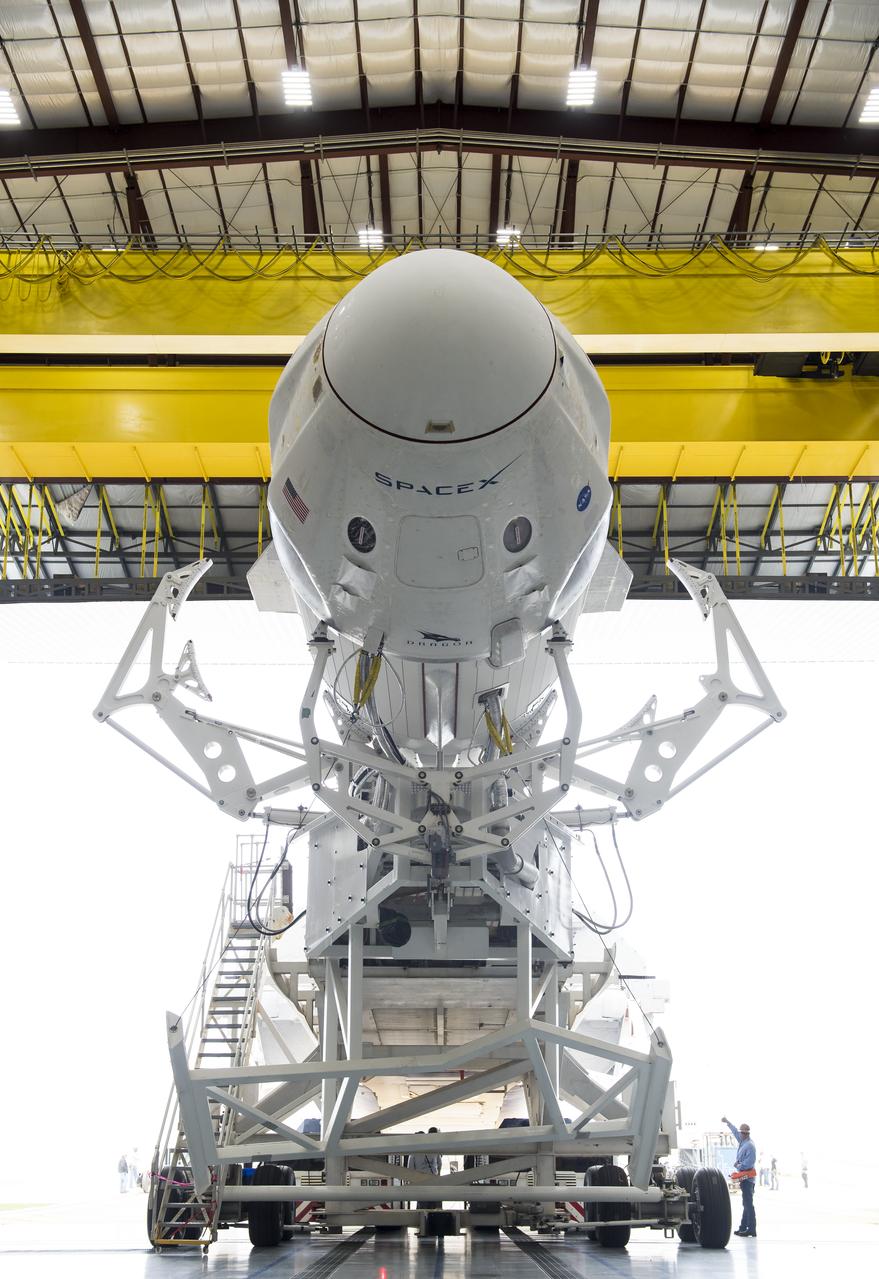
A SpaceX Falcon 9 rocket with the company's Crew Dragon spacecraft onboard is seen as it is rolled out of the horizontal integration facility at Launch Complex 39A as preparations continue for the Demo-1 mission, Feb. 28, 2019 at the Kennedy Space Center in Florida. The Demo-1 mission will be the first launch of a commercially built and operated American spacecraft and space system designed for humans as part of NASA's Commercial Crew Program. The mission, currently targeted for a 2:49am launch on March 2, will serve as an end-to-end test of the system's capabilities. Photo Credit: (NASA/Joel Kowsky)
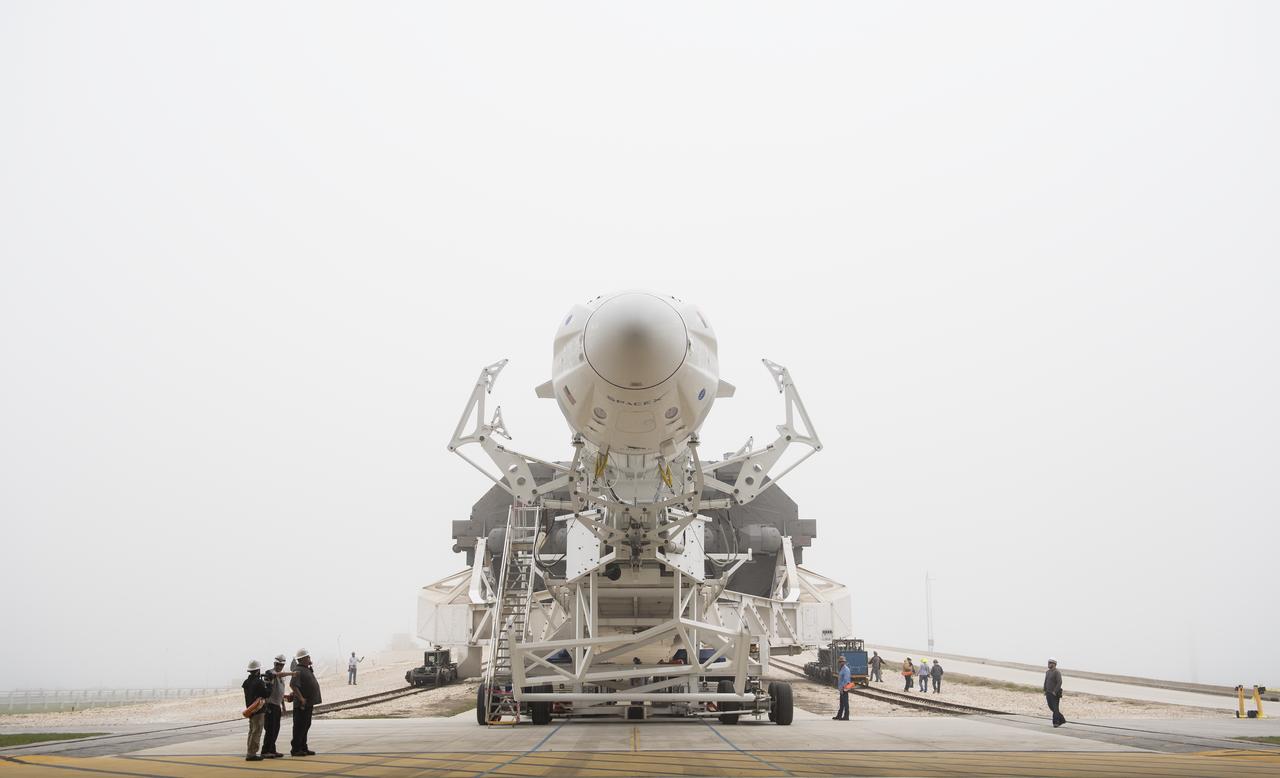
A SpaceX Falcon 9 rocket with the company's Crew Dragon spacecraft onboard is seen as it is rolled out of the horizontal integration facility at Launch Complex 39A as preparations continue for the Demo-1 mission, Feb. 28, 2019 at the Kennedy Space Center in Florida. The Demo-1 mission will be the first launch of a commercially built and operated American spacecraft and space system designed for humans as part of NASA's Commercial Crew Program. The mission, currently targeted for a 2:49am launch on March 2, will serve as an end-to-end test of the system's capabilities. Photo Credit: (NASA/Joel Kowsky)
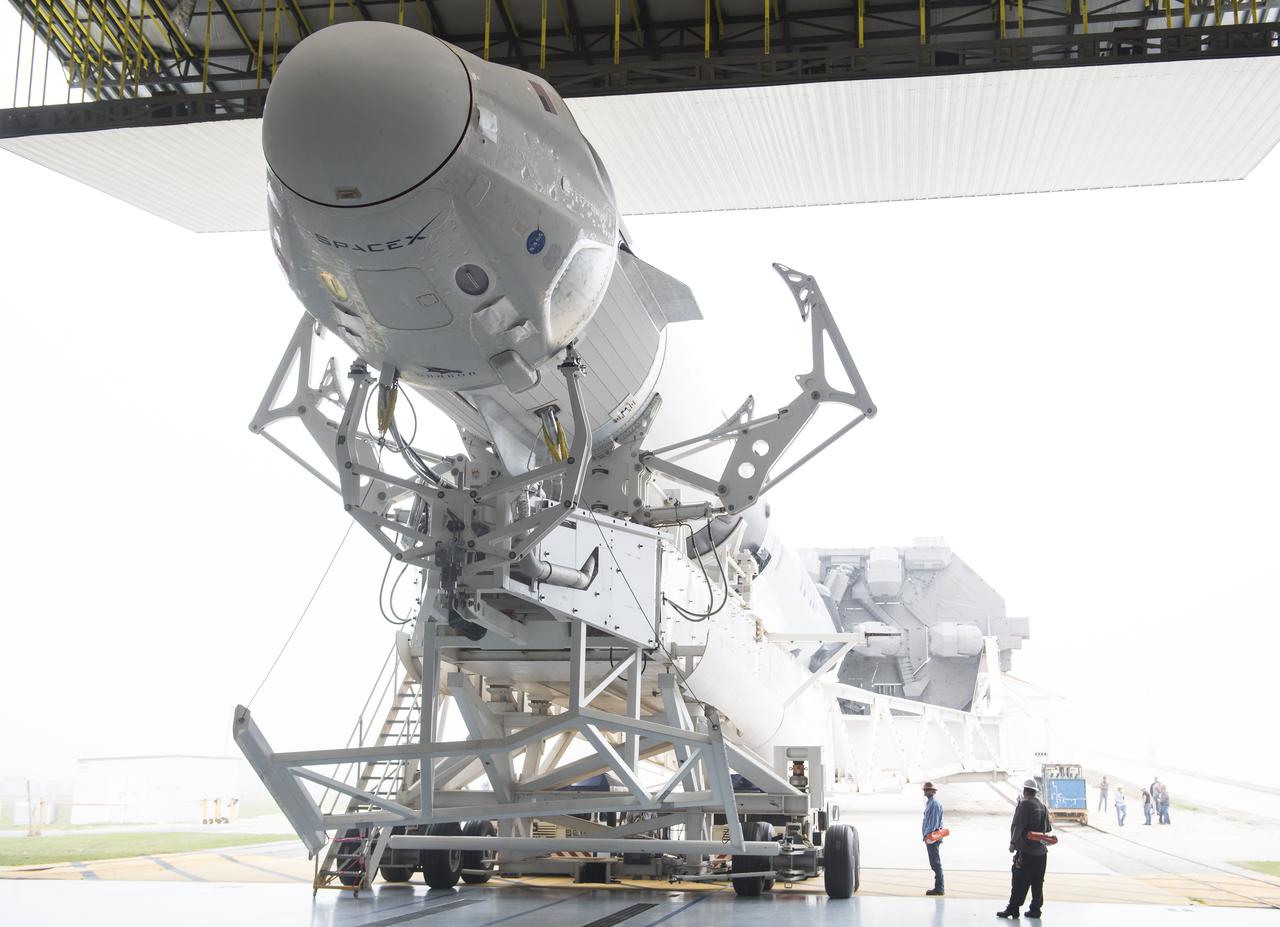
A SpaceX Falcon 9 rocket with the company's Crew Dragon spacecraft onboard is seen as it is rolled out of the horizontal integration facility at Launch Complex 39A as preparations continue for the Demo-1 mission, Feb. 28, 2019 at the Kennedy Space Center in Florida. The Demo-1 mission will be the first launch of a commercially built and operated American spacecraft and space system designed for humans as part of NASA's Commercial Crew Program. The mission, currently targeted for a 2:49am launch on March 2, will serve as an end-to-end test of the system's capabilities. Photo Credit: (NASA/Joel Kowsky)
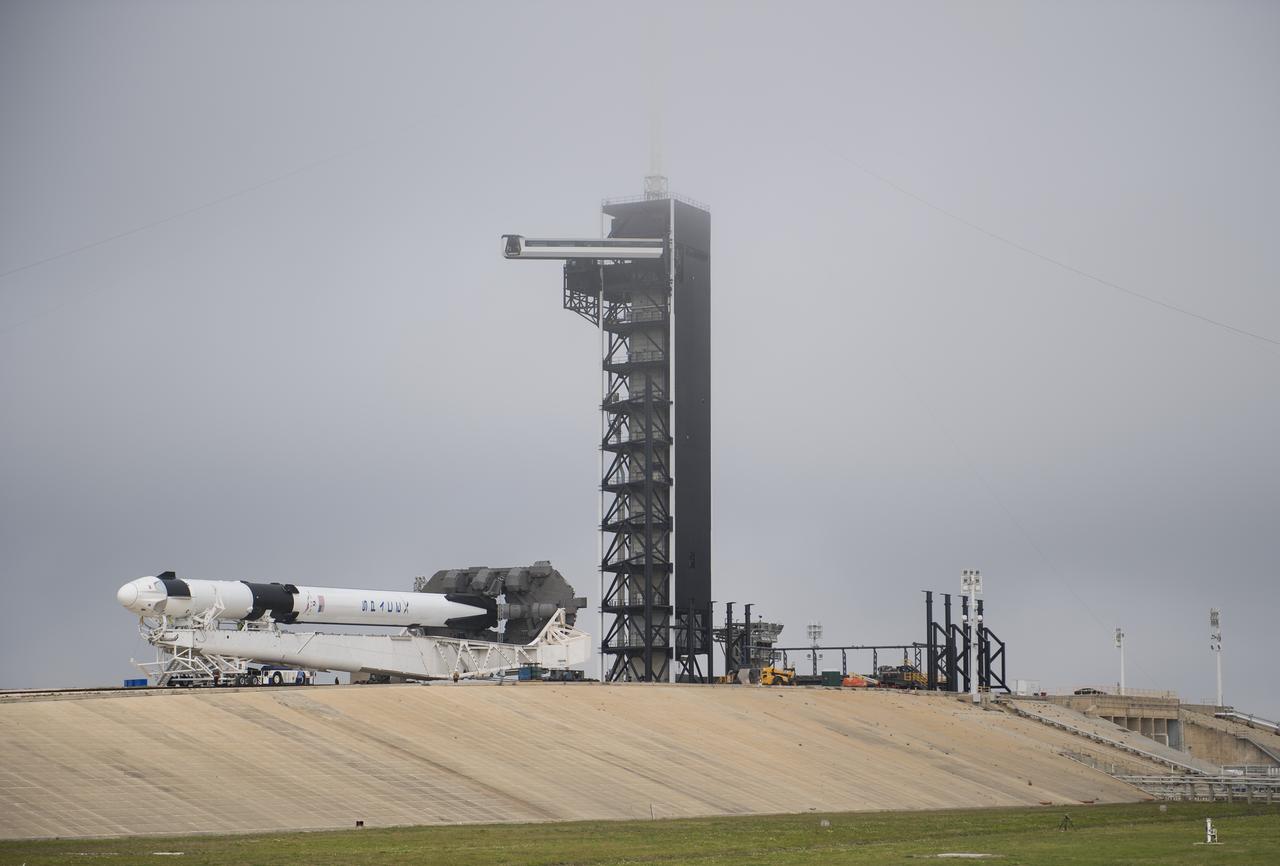
A SpaceX Falcon 9 rocket with the company's Crew Dragon spacecraft onboard is seen as it is rolled to the launch pad at Launch Complex 39A as preparations continue for the Demo-1 mission, Feb. 28, 2019 at the Kennedy Space Center in Florida. The Demo-1 mission will be the first launch of a commercially built and operated American spacecraft and space system designed for humans as part of NASA's Commercial Crew Program. The mission, currently targeted for a 2:49am launch on March 2, will serve as an end-to-end test of the system's capabilities. Photo Credit: (NASA/Joel Kowsky)
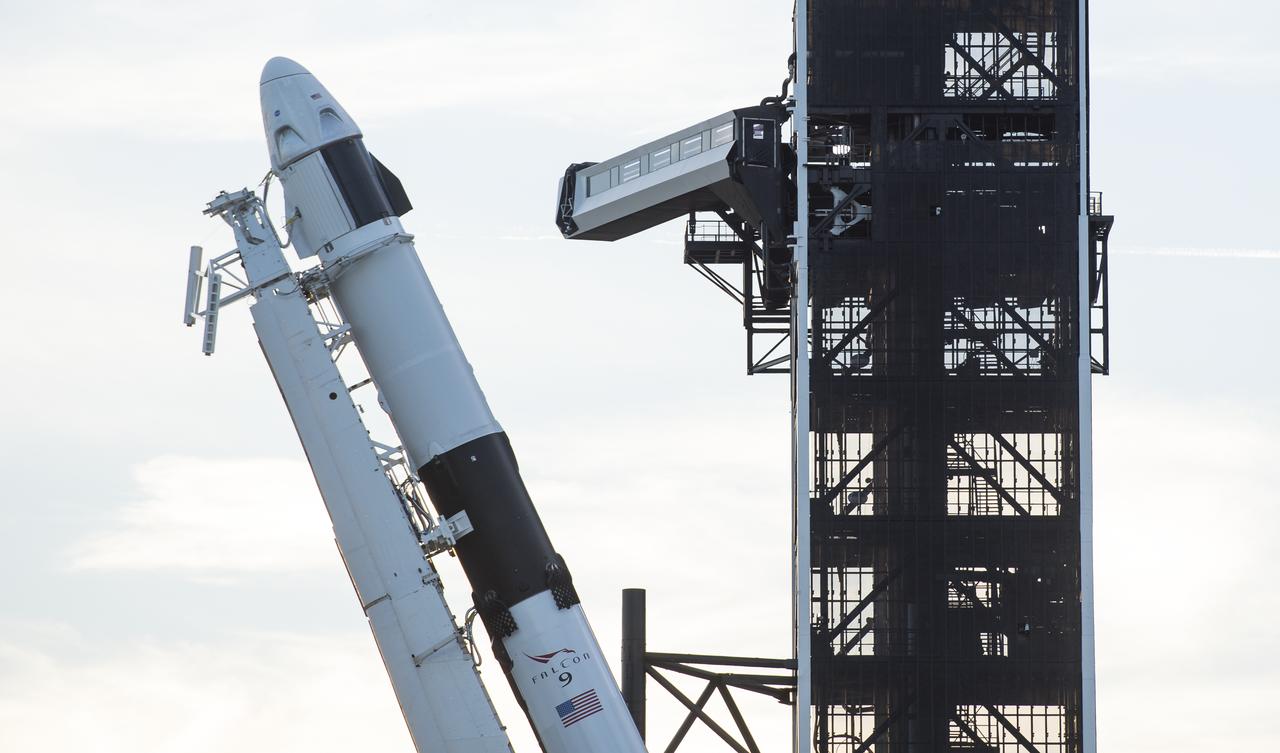
A SpaceX Falcon 9 rocket with the company's Crew Dragon spacecraft onboard is seen as it is raised into a vertical position on the launch pad at Launch Complex 39A as preparations continue for the Demo-1 mission, Feb. 28, 2019 at the Kennedy Space Center in Florida. The Demo-1 mission will be the first launch of a commercially built and operated American spacecraft and space system designed for humans as part of NASA's Commercial Crew Program. The mission, currently targeted for a 2:49am launch on March 2, will serve as an end-to-end test of the system's capabilities. Photo Credit: (NASA/Joel Kowsky)
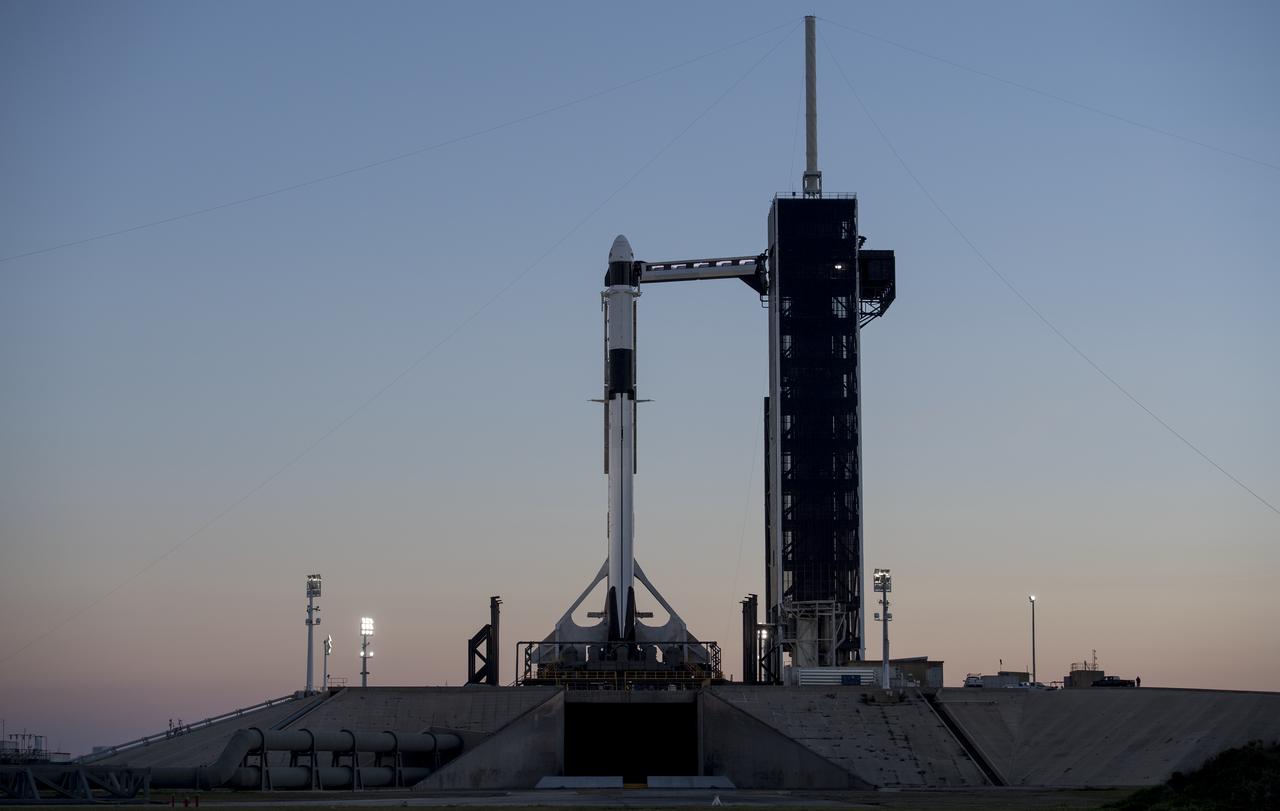
A SpaceX Falcon 9 rocket with the company's Crew Dragon spacecraft onboard is seen after being into a vertical position on the launch pad at Launch Complex 39A as preparations continue for the Demo-1 mission, Feb. 28, 2019 at the Kennedy Space Center in Florida. The Demo-1 mission will be the first launch of a commercially built and operated American spacecraft and space system designed for humans as part of NASA's Commercial Crew Program. The mission, currently targeted for a 2:49am launch on March 2, will serve as an end-to-end test of the system's capabilities. Photo Credit: (NASA/Joel Kowsky)
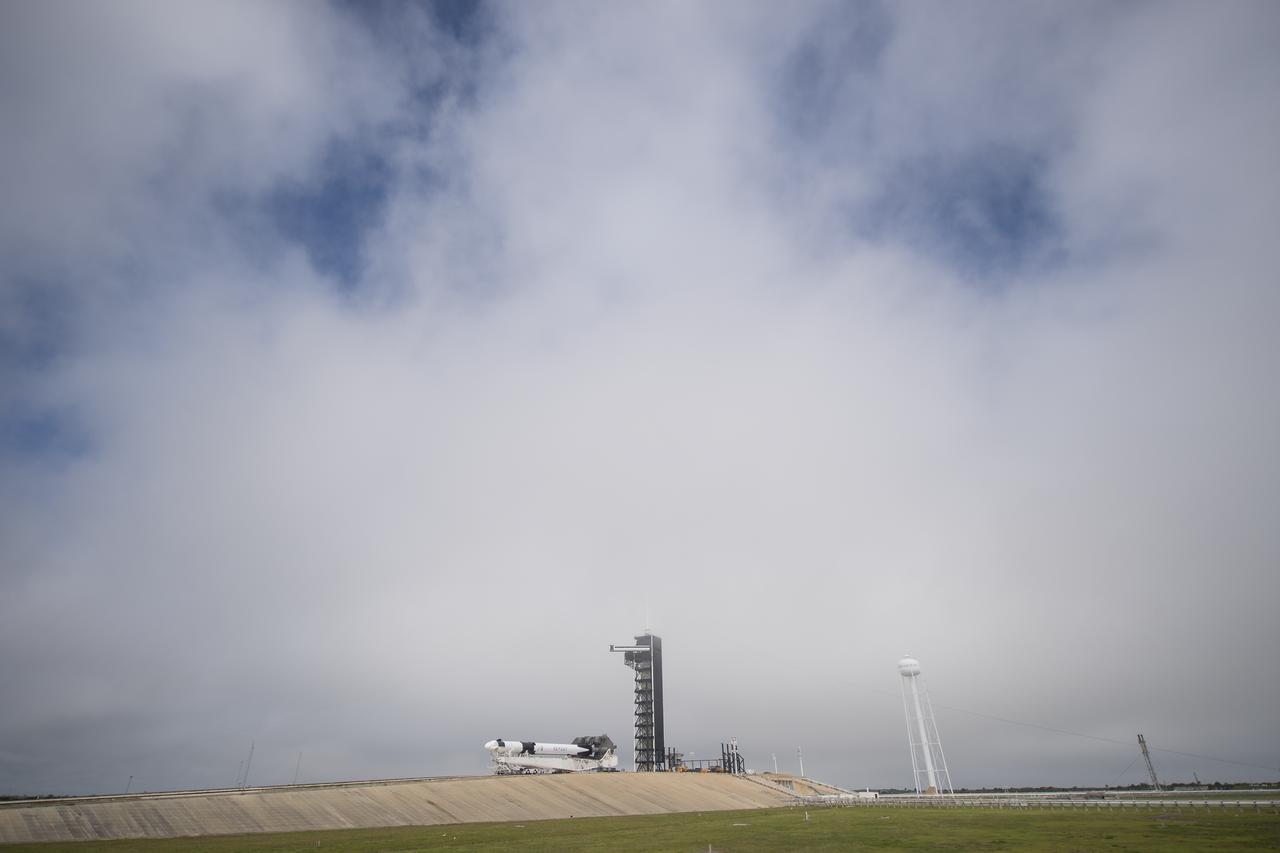
A SpaceX Falcon 9 rocket with the company's Crew Dragon spacecraft onboard is seen as it is rolled to the launch pad at Launch Complex 39A as preparations continue for the Demo-1 mission, Feb. 28, 2019 at the Kennedy Space Center in Florida. The Demo-1 mission will be the first launch of a commercially built and operated American spacecraft and space system designed for humans as part of NASA's Commercial Crew Program. The mission, currently targeted for a 2:49am launch on March 2, will serve as an end-to-end test of the system's capabilities. Photo Credit: (NASA/Joel Kowsky)
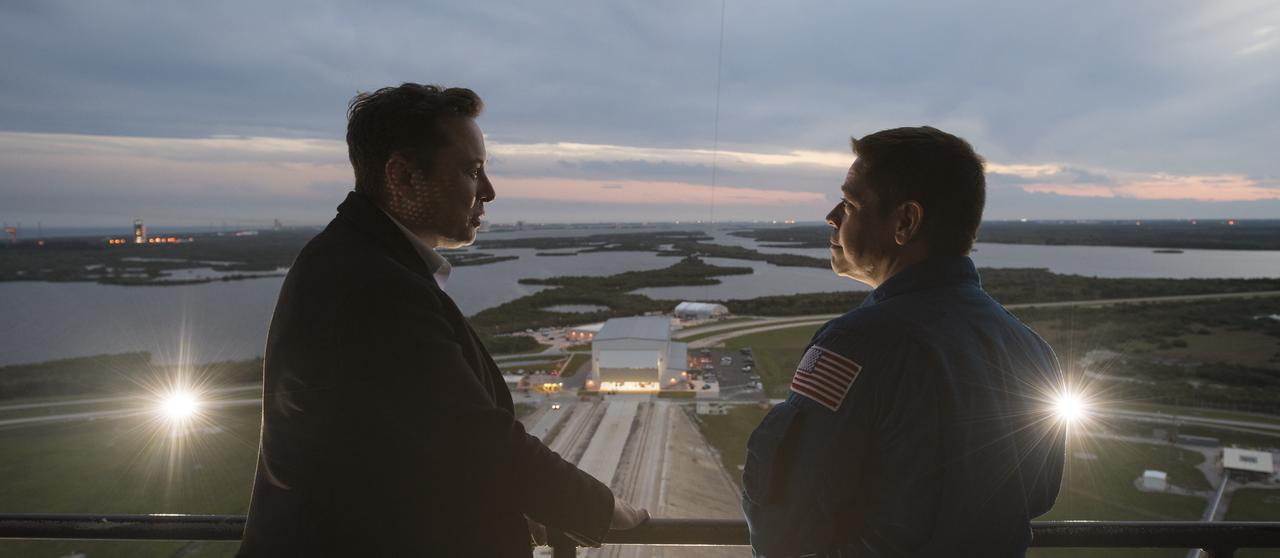
SpaceX CEO and Chief Designer Elon Musk, left, speaks with NASA astronaut Bob Behnken on the fixed service structure of Launch Complex 39A during a tour before the early Saturday morning launch of the Demo-1 mission, Friday, March 1, 2019 at the Kennedy Space Center in Florida. The Demo-1 mission launched at 2:49am ET on Saturday, March 2 and was the first launch of a commercially built and operated American spacecraft and space system designed for humans as part of NASA's Commercial Crew Program. The mission will serve as an end-to-end test of the system's capabilities. Behnken and fellow NASA astronaut Doug Hurley are assigned to fly onboard Crew Dragon for the Demo-2 mission. Photo Credit: (NASA/Joel Kowsky)
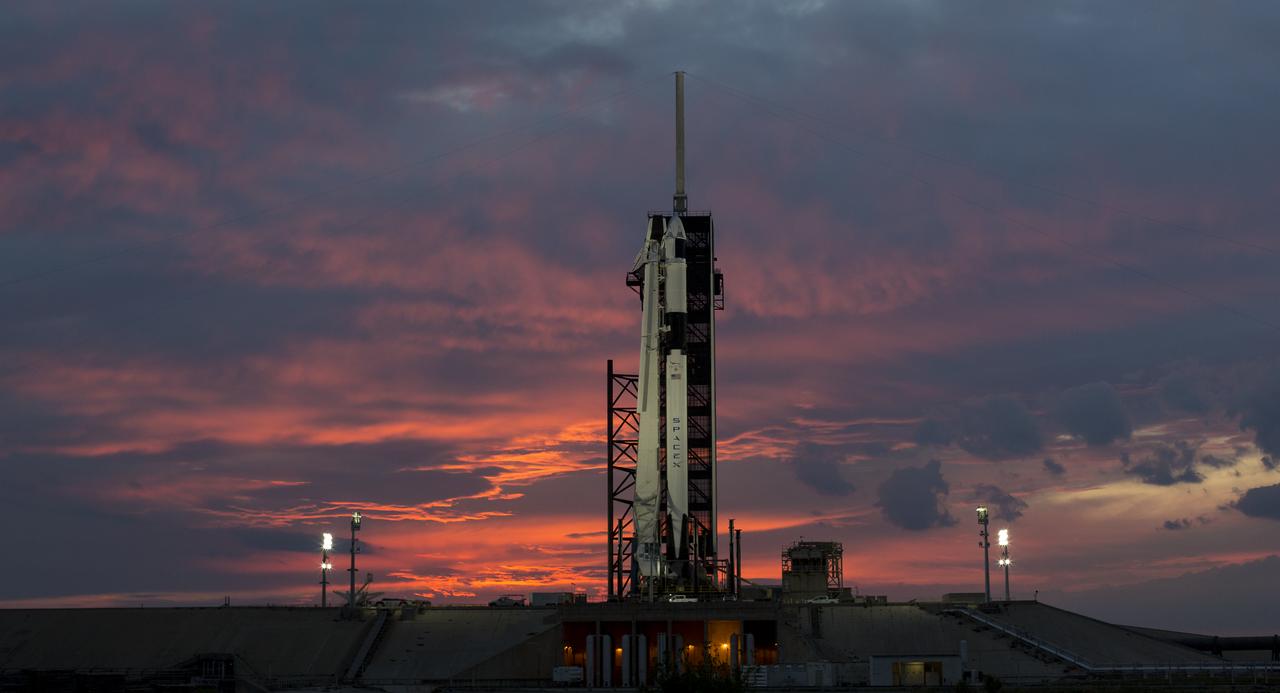
A SpaceX Falcon 9 rocket with the company's Crew Dragon spacecraft onboard is seen at sunset on the launch pad at Launch Complex 39A as preparations continue for the Demo-1 mission, Friday, March 1, 2019 at the Kennedy Space Center in Florida. The Demo-1 mission launched at 2:49am ET on Saturday, March 2 and was the first launch of a commercially built and operated American spacecraft and space system designed for humans as part of NASA's Commercial Crew Program. The mission will serve as an end-to-end test of the system's capabilities. Photo Credit: (NASA/Joel Kowsky)
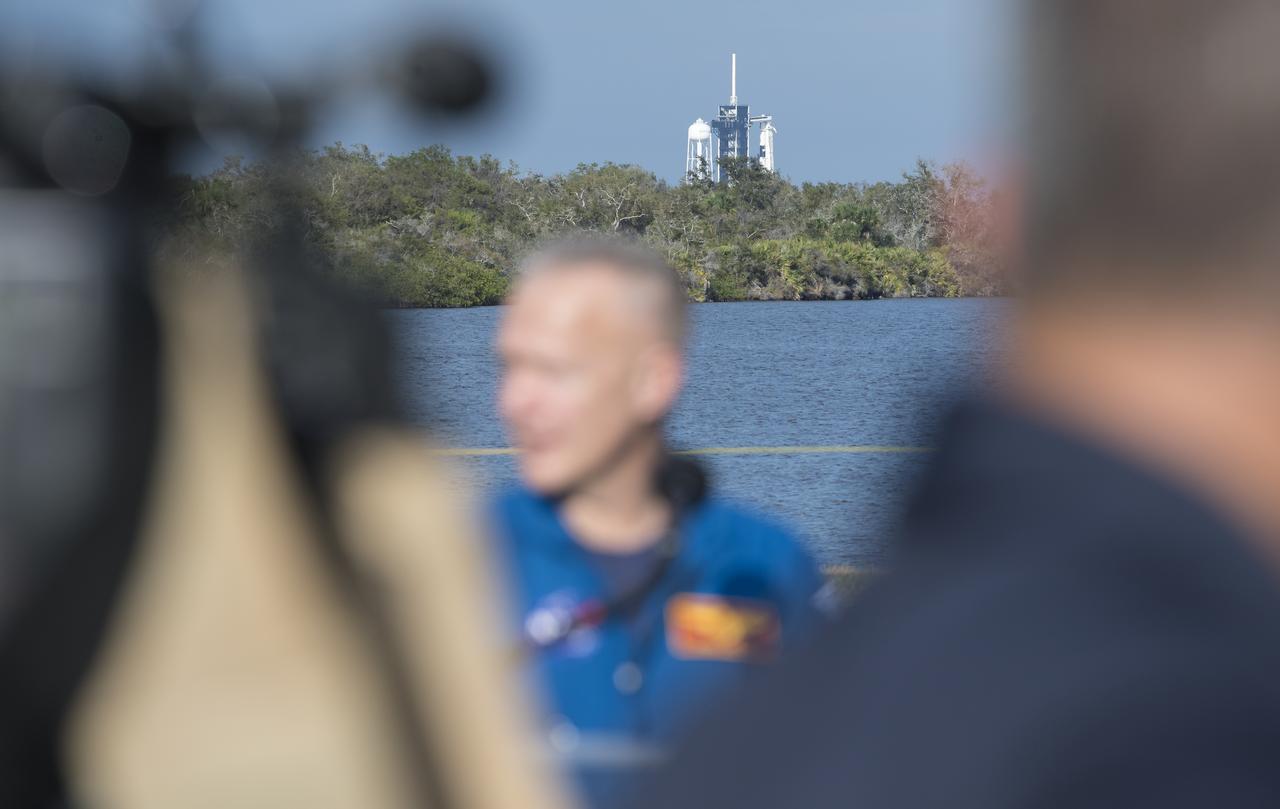
A SpaceX Falcon 9 rocket with the company's Crew Dragon spacecraft onboard is seen in the distance on the launch pad at Launch Complex 39A during a press conference ahead of the SpaceX Demo-1 mission, Friday, March 1, 2019 at the Kennedy Space Center in Florida. The Demo-1 mission will be the first launch of a commercially built and operated American spacecraft and space system designed for humans as part of NASA's Commercial Crew Program. The mission, currently targeted for a 2:49am launch on March 2, will serve as an end-to-end test of the system's capabilities. Photo Credit: (NASA/Joel Kowsky)
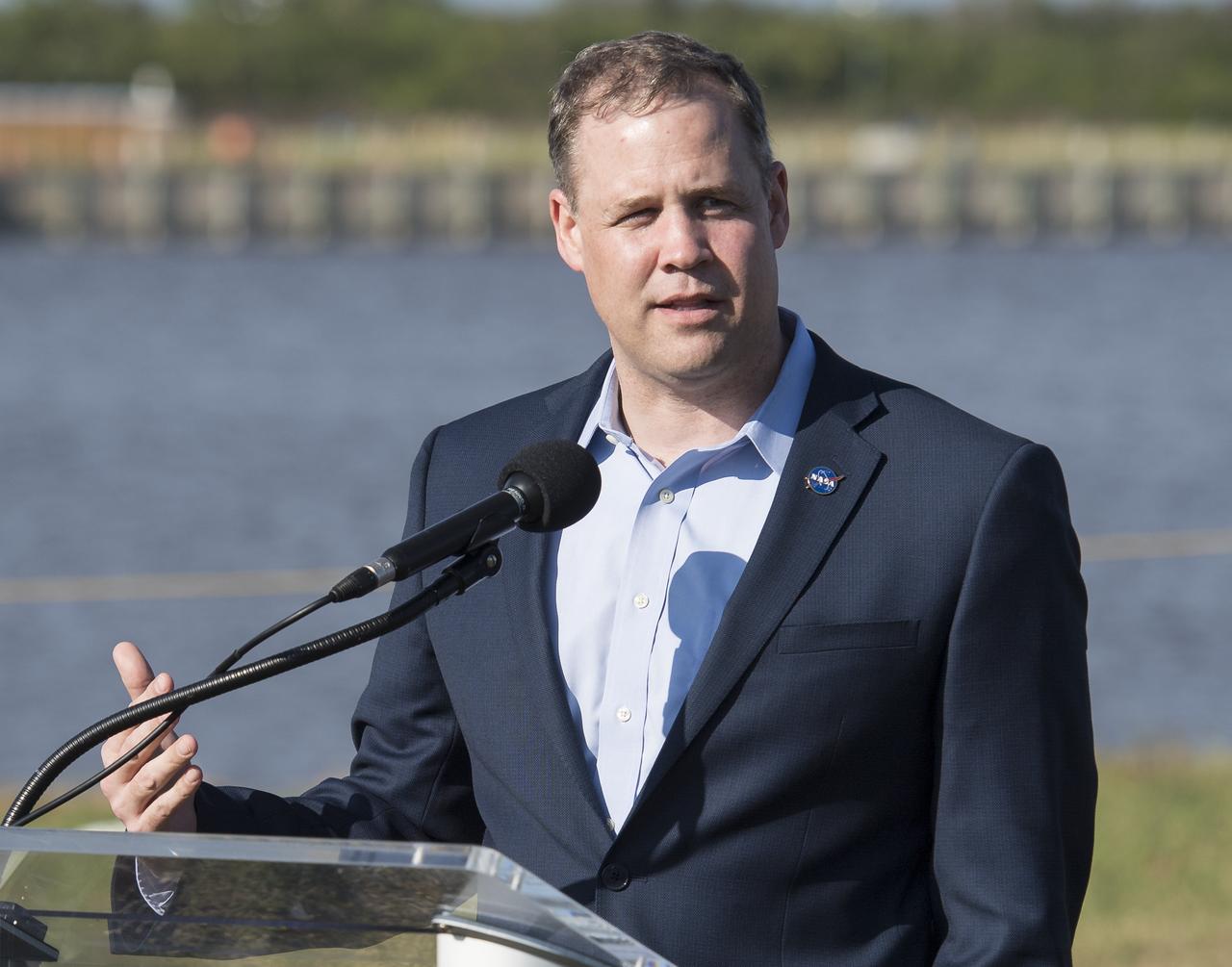
NASA Administrator Jim Bridenstine speaks during a press conference ahead of the SpaceX Demo-1 mission, Friday, March 1, 2019 at the Kennedy Space Center in Florida. The Demo-1 mission will be the first launch of a commercially built and operated American spacecraft and space system designed for humans as part of NASA's Commercial Crew Program. The mission, currently targeted for a 2:49am launch on March 2, will serve as an end-to-end test of the system's capabilities. Photo Credit: (NASA/Joel Kowsky)
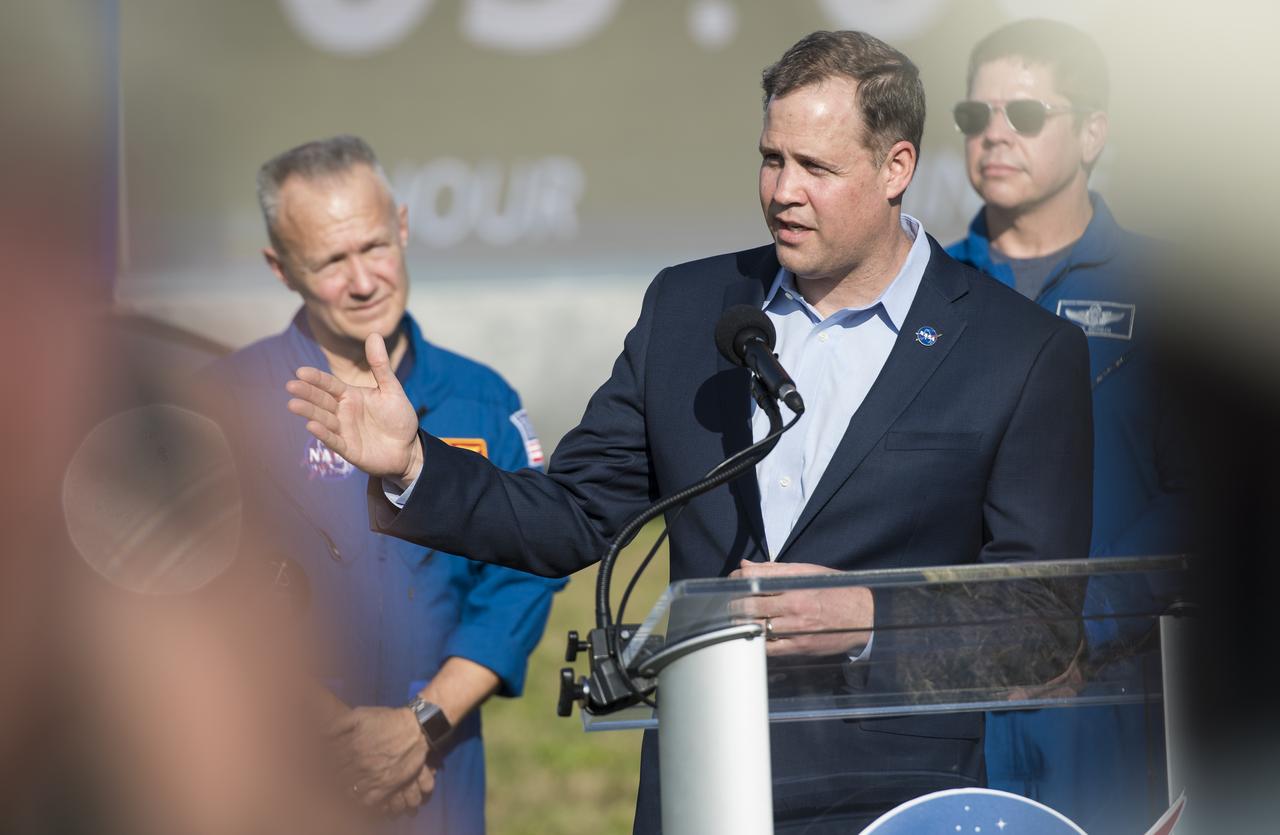
NASA Administrator Jim Bridenstine answers a question during a press conference ahead of the SpaceX Demo-1 mission, Friday, March 1, 2019 at the Kennedy Space Center in Florida. The Demo-1 mission will be the first launch of a commercially built and operated American spacecraft and space system designed for humans as part of NASA's Commercial Crew Program. The mission, currently targeted for a 2:49am launch on March 2, will serve as an end-to-end test of the system's capabilities. Photo Credit: (NASA/Joel Kowsky)
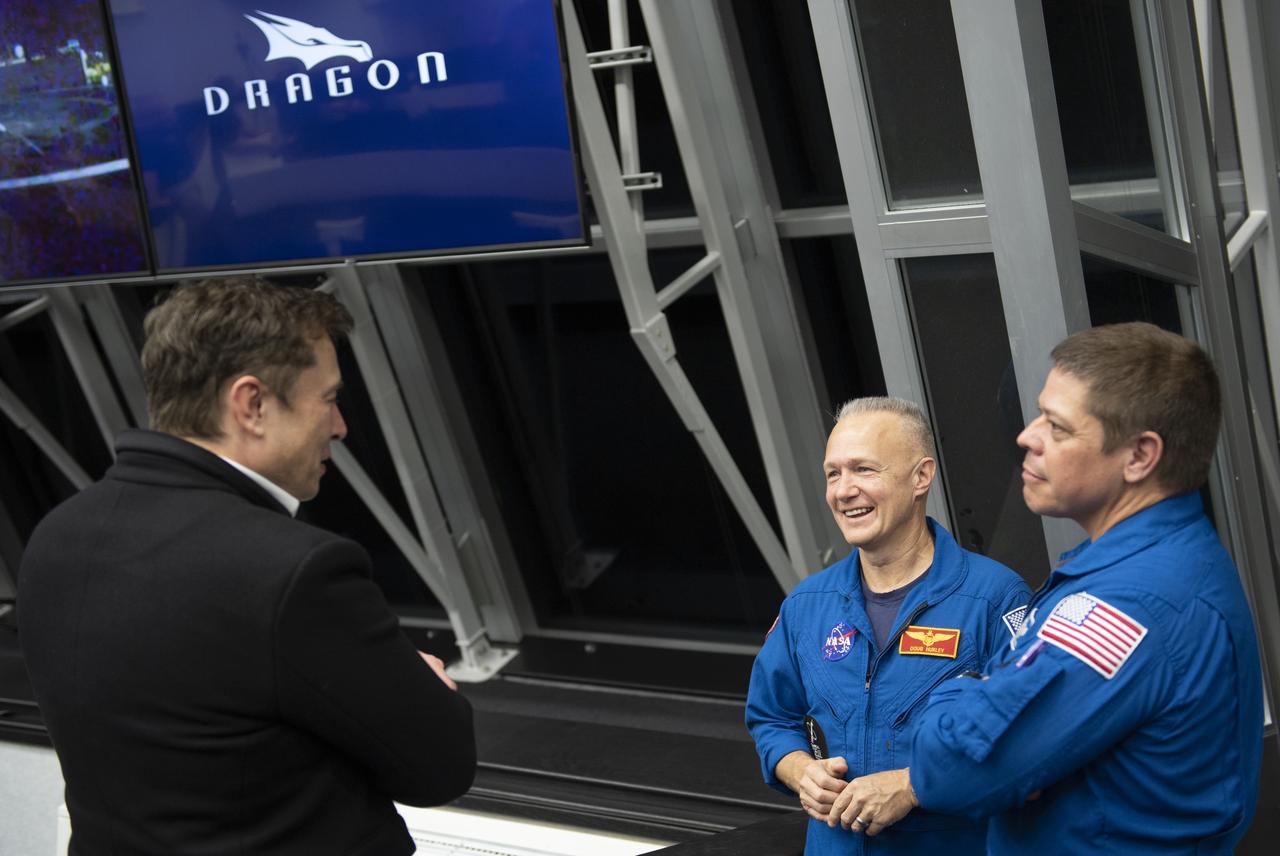
SpaceX CEO and Chief Designer Elon Musk, left, speaks with NASA astronauts Doug Hurley, center, and Bob Behnken, right, who are assigned to fly on the crewed Demo-2 mission after launch of a SpaceX Falcon 9 rocket carrying the company's Crew Dragon spacecraft on the Demo-1 mission from firing room four of the Launch Control Center, Saturday, March 2, 2019 at the Kennedy Space Center in Florida. The Demo-1 mission is the first launch of a commercially built and operated American spacecraft and space system designed for humans as part of NASA's Commercial Crew Program. The mission will serve as an end-to-end test of the system's capabilities. Photo Credit: (NASA/Joel Kowsky)
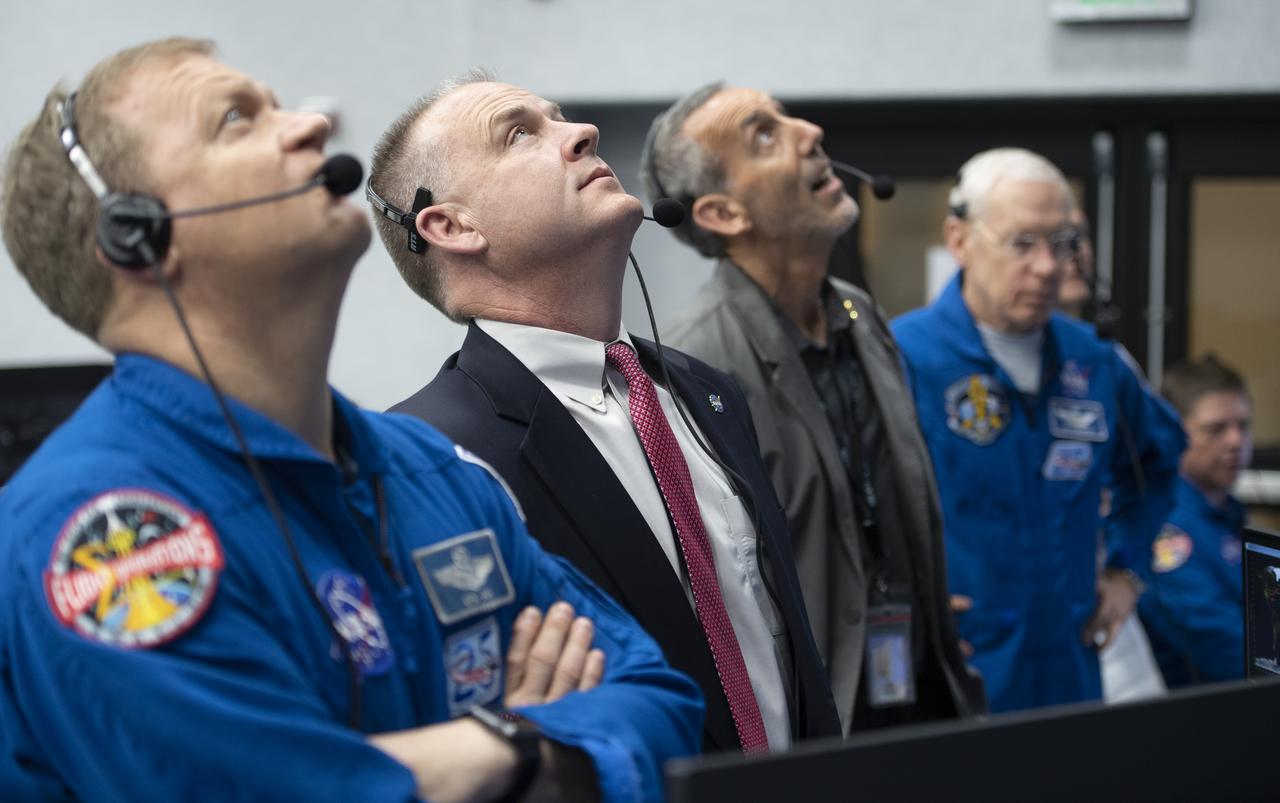
NASA astronaut Eric Boe, assistant to the chief of the astronaut office for commercial crew, left, and Norm Knight, deputy director of flight operations at NASA's Johnson Space Center watch the launch of a SpaceX Falcon 9 rocket carrying the company's Crew Dragon spacecraft on the Demo-1 mission from firing room four of the Launch Control Center, Saturday, March 2, 2019 at the Kennedy Space Center in Florida. The Demo-1 mission is the first launch of a commercially built and operated American spacecraft and space system designed for humans as part of NASA's Commercial Crew Program. The mission will serve as an end-to-end test of the system's capabilities. Photo Credit: (NASA/Joel Kowsky)
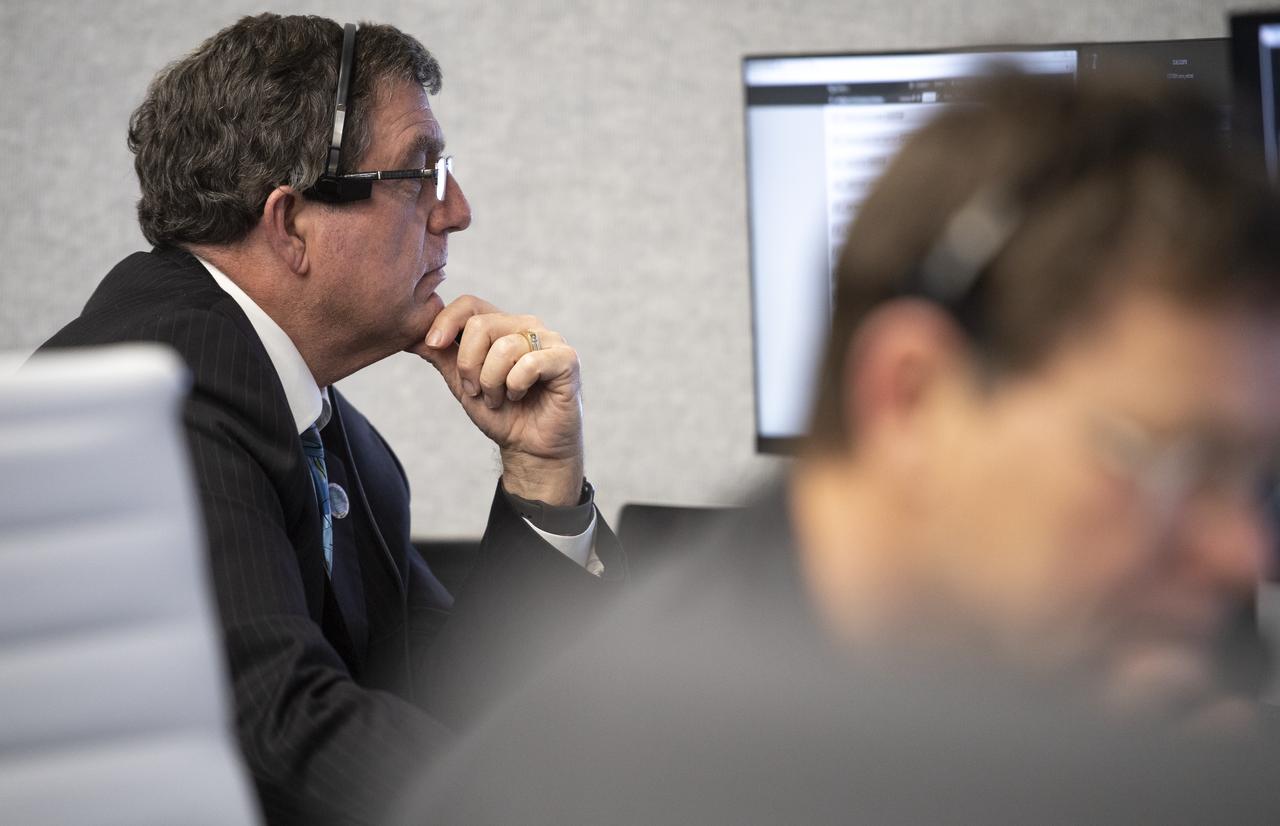
NASA International Space Station Program Manager Kirk Shireman monitors the countdown of the launch of a SpaceX Falcon 9 rocket carrying the company's Crew Dragon spacecraft on the Demo-1 mission from firing room four of the Launch Control Center, Saturday, March 2, 2019 at the Kennedy Space Center in Florida. The Demo-1 mission will be the first launch of a commercially built and operated American spacecraft and space system designed for humans as part of NASA's Commercial Crew Program. The mission will serve as an end-to-end test of the system's capabilities. Photo Credit: (NASA/Joel Kowsky)

NASA astronaut Doug Hurley and chief of the astronaut office Pat Forrester watch the launch of a SpaceX Falcon 9 rocket carrying the company's Crew Dragon spacecraft on the Demo-1 mission from firing room four of the Launch Control Center, Saturday, March 2, 2019 at the Kennedy Space Center in Florida. The Demo-1 mission is the first launch of a commercially built and operated American spacecraft and space system designed for humans as part of NASA's Commercial Crew Program. The mission will serve as an end-to-end test of the system's capabilities. Photo Credit: (NASA/Joel Kowsky)
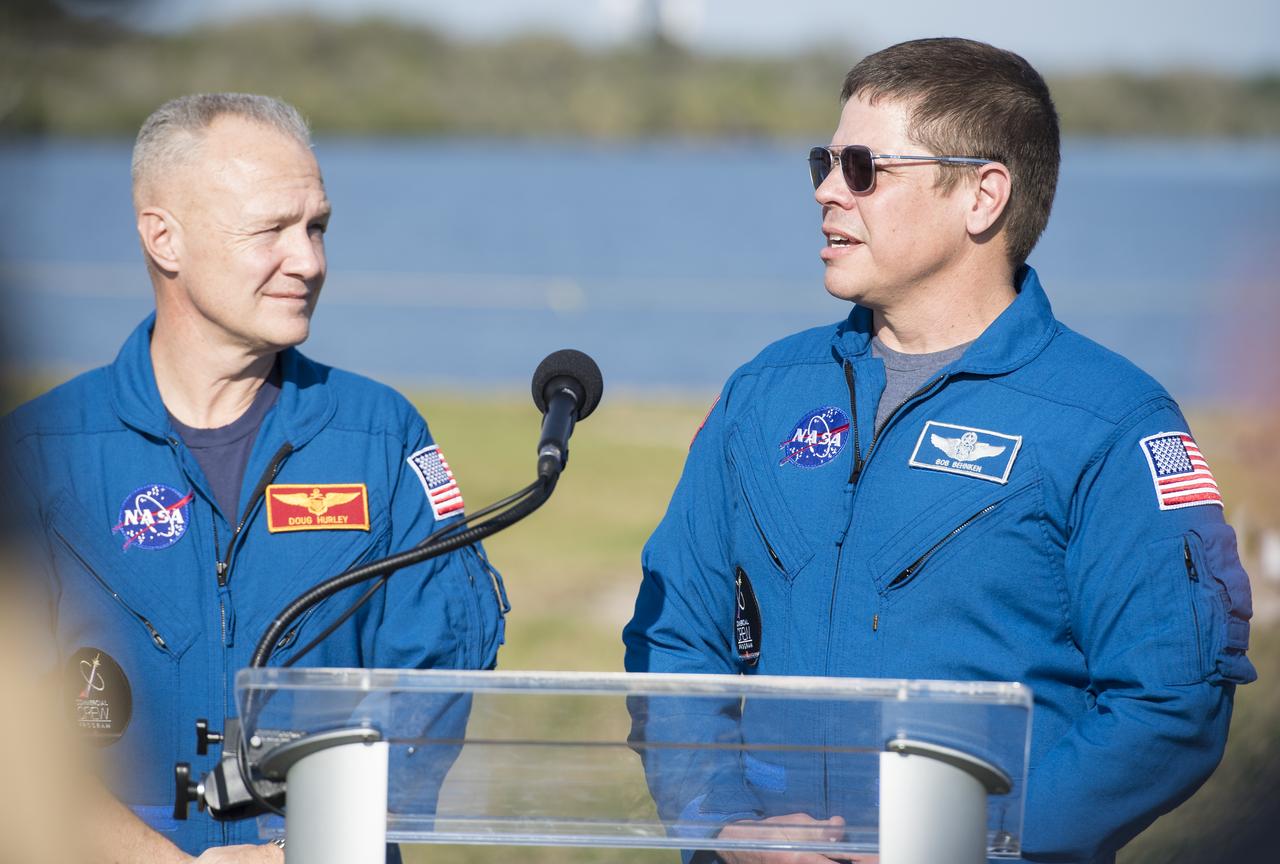
NASA astronauts Bob Behnken, right, and Doug Hurley, who are assigned to the first crewed test flight of SpaceX's Crew Dragon answer questions during a press conference ahead of the SpaceX Demo-1 mission, Friday, March 1, 2019 at the Kennedy Space Center in Florida. The Demo-1 mission will be the first launch of a commercially built and operated American spacecraft and space system designed for humans as part of NASA's Commercial Crew Program. The mission, currently targeted for a 2:49am launch on March 2, will serve as an end-to-end test of the system's capabilities. Photo Credit: (NASA/Joel Kowsky)
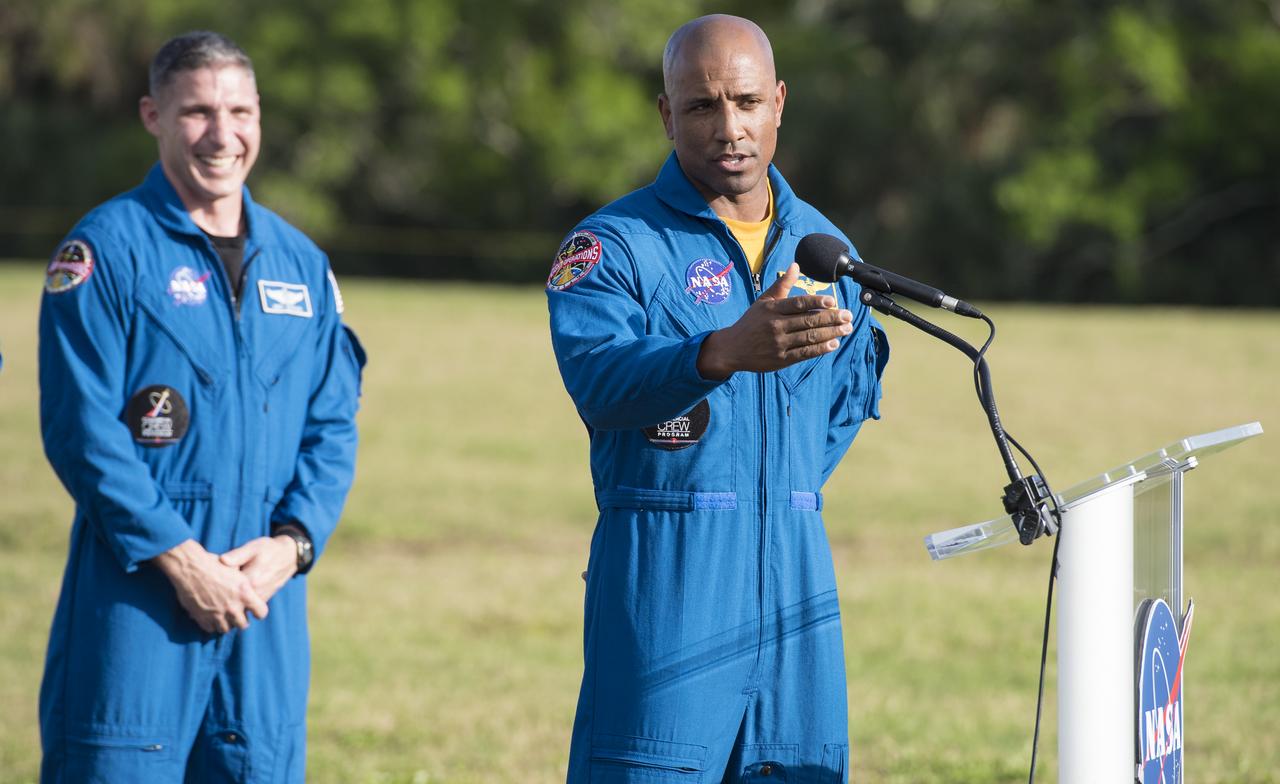
NASA astronaut Victor Glover, who has been assigned to the first operational mission of SpaceX's Crew Dragon, answer a question during a press conference ahead of the SpaceX Demo-1 mission, Friday, March 1, 2019 at the Kennedy Space Center in Florida. The Demo-1 mission will be the first launch of a commercially built and operated American spacecraft and space system designed for humans as part of NASA's Commercial Crew Program. The mission, currently targeted for a 2:49am launch on March 2, will serve as an end-to-end test of the system's capabilities. Photo Credit: (NASA/Joel Kowsky)
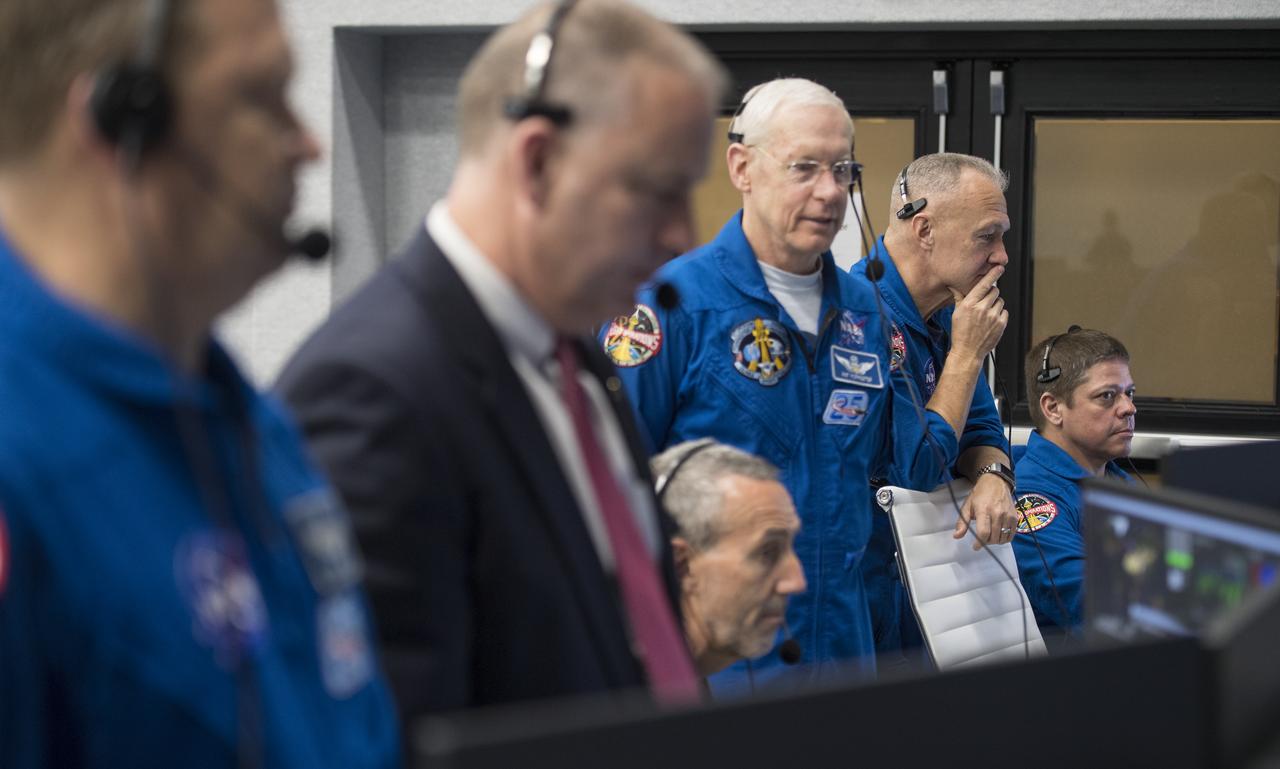
NASA's chief of the astronaut office Pat Forrester, third from right and NASA astronauts Doug Hurley, second from right, and Bob Behnken, right, who are assigned to fly on the crewed Demo-2 mission, monitor the countdown of the launch of a SpaceX Falcon 9 rocket carrying the company's Crew Dragon spacecraft on the Demo-1 mission from firing room four of the Launch Control Center, Saturday, March 2, 2019 at the Kennedy Space Center in Florida. The Demo-1 mission will be the first launch of a commercially built and operated American spacecraft and space system designed for humans as part of NASA's Commercial Crew Program. The mission will serve as an end-to-end test of the system's capabilities. Photo Credit: (NASA/Joel Kowsky)
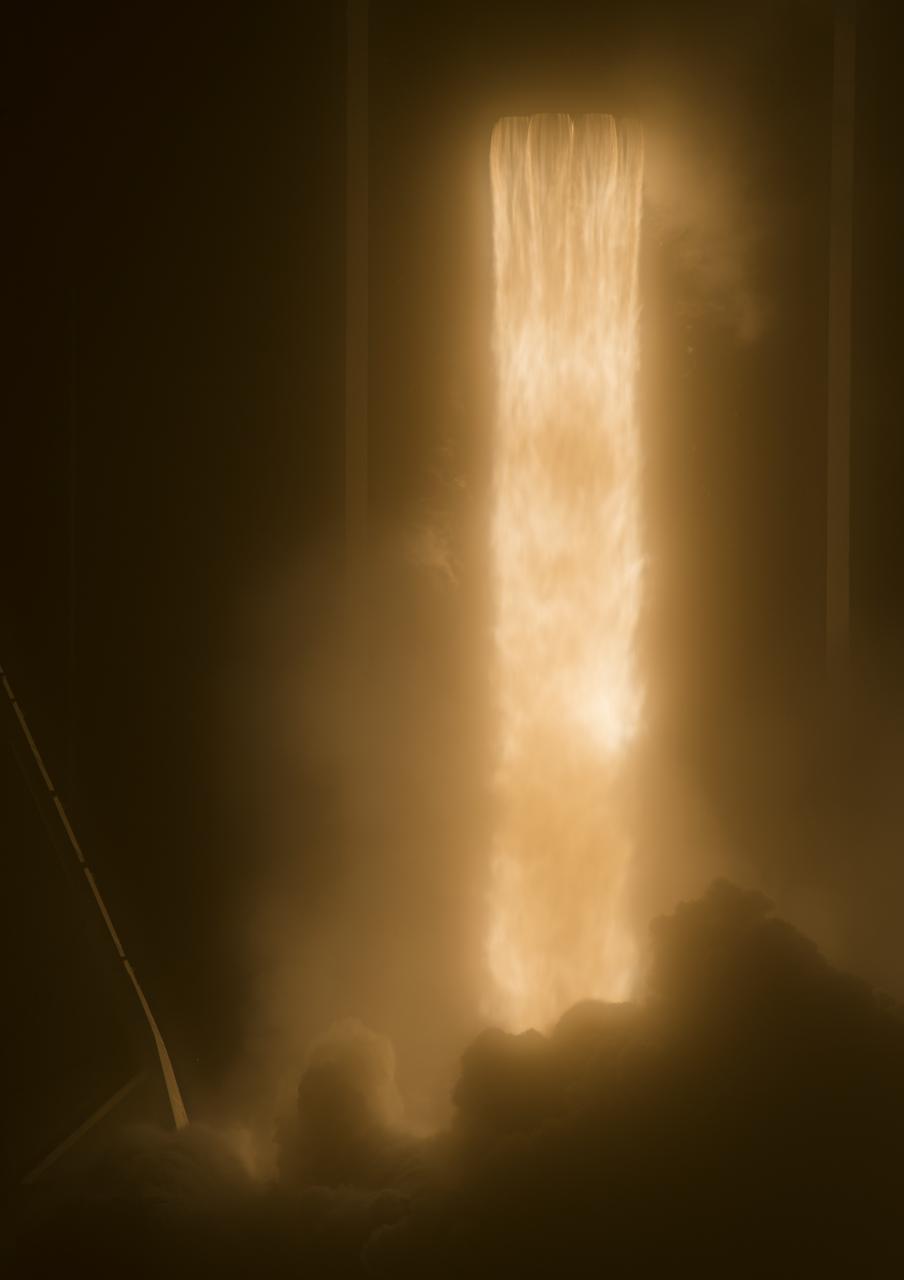
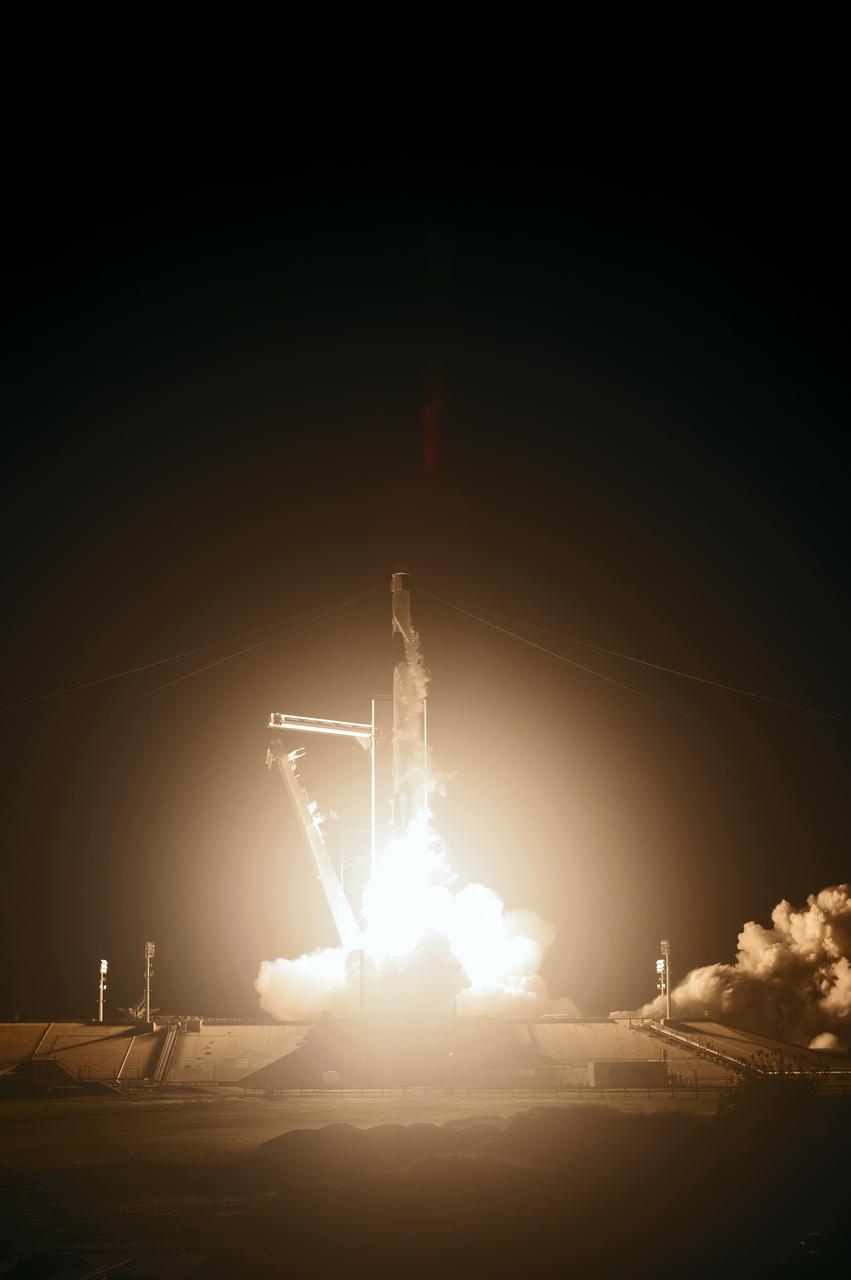
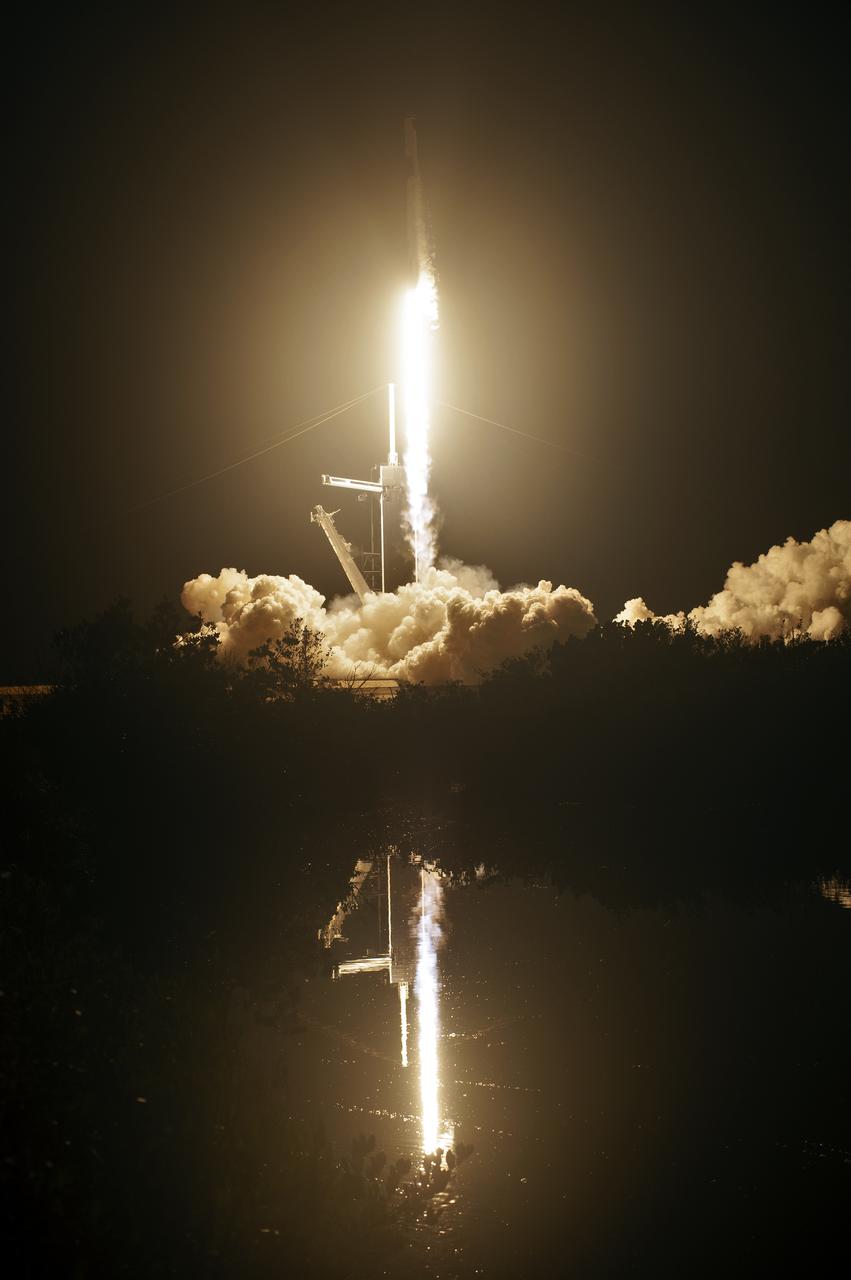
A SpaceX Falcon 9 rocket with the company's Crew Dragon spacecraft onboard launches from Launch Complex 39A, Saturday, March 2, 2019 at the Kennedy Space Center in Florida. The Demo-1 mission launched at 2:49am ET and was the first launch of a commercially built and operated American spacecraft and space system designed for humans as part of NASA's Commercial Crew Program. The mission will serve as an end-to-end test of the system's capabilities. Photo Credit: (NASA/Joel Kowsky)
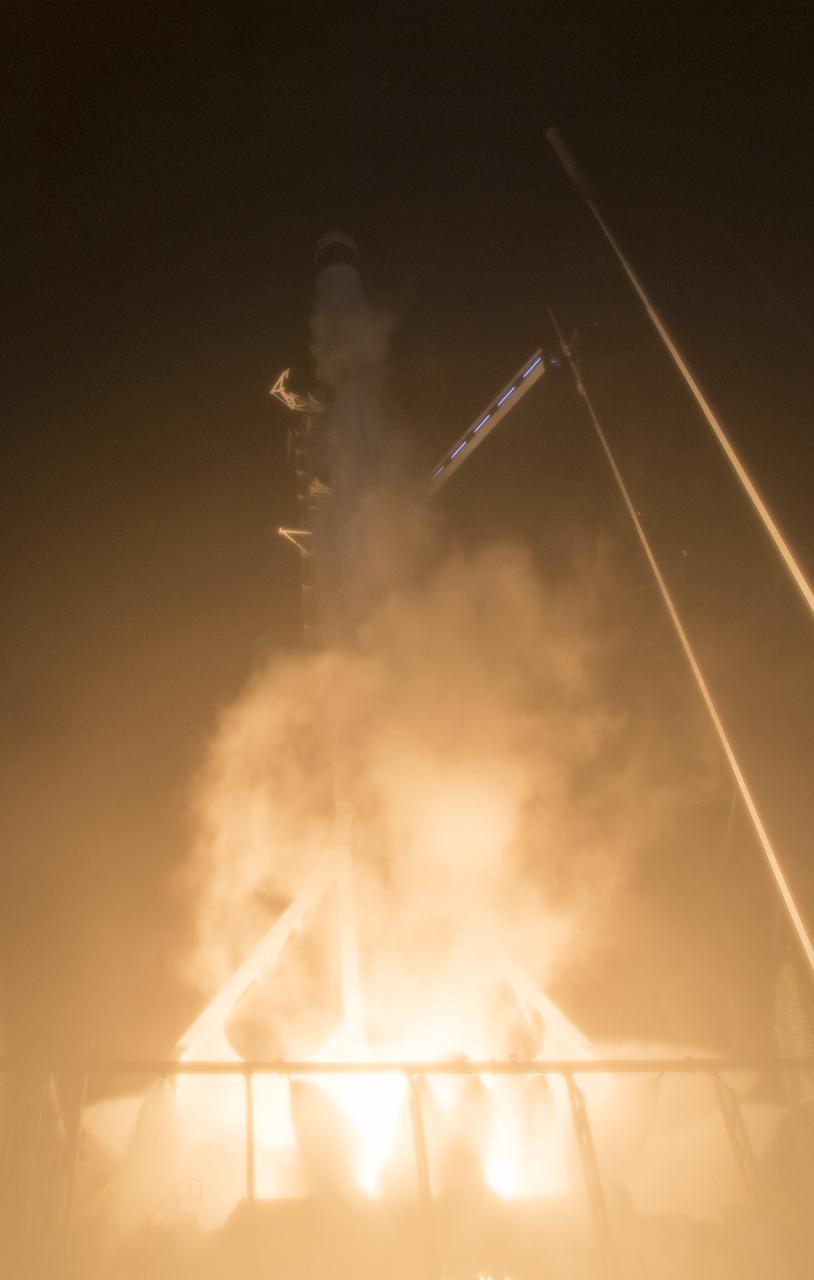
A SpaceX Falcon 9 rocket with the company's Crew Dragon spacecraft onboard launches from Launch Complex 39A, Saturday, March 2, 2019 at the Kennedy Space Center in Florida. The Demo-1 mission launched at 2:49am ET and was the first launch of a commercially built and operated American spacecraft and space system designed for humans as part of NASA's Commercial Crew Program. The mission will serve as an end-to-end test of the system's capabilities. Photo Credit: (NASA/Joel Kowsky)
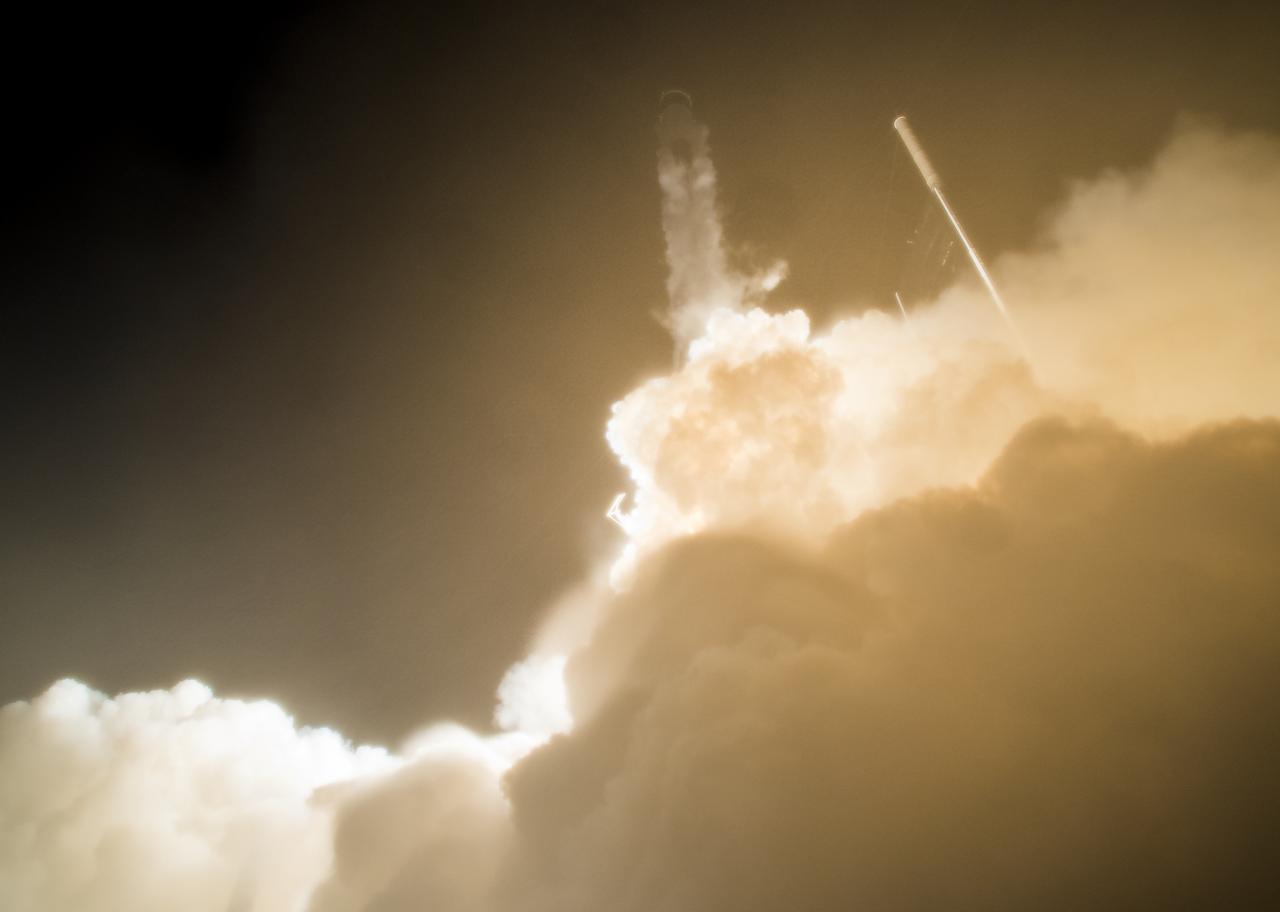
A SpaceX Falcon 9 rocket with the company's Crew Dragon spacecraft onboard launches from Launch Complex 39A, Saturday, March 2, 2019 at the Kennedy Space Center in Florida. The Demo-1 mission launched at 2:49am ET and was the first launch of a commercially built and operated American spacecraft and space system designed for humans as part of NASA's Commercial Crew Program. The mission will serve as an end-to-end test of the system's capabilities. Photo Credit: (NASA/Joel Kowsky)
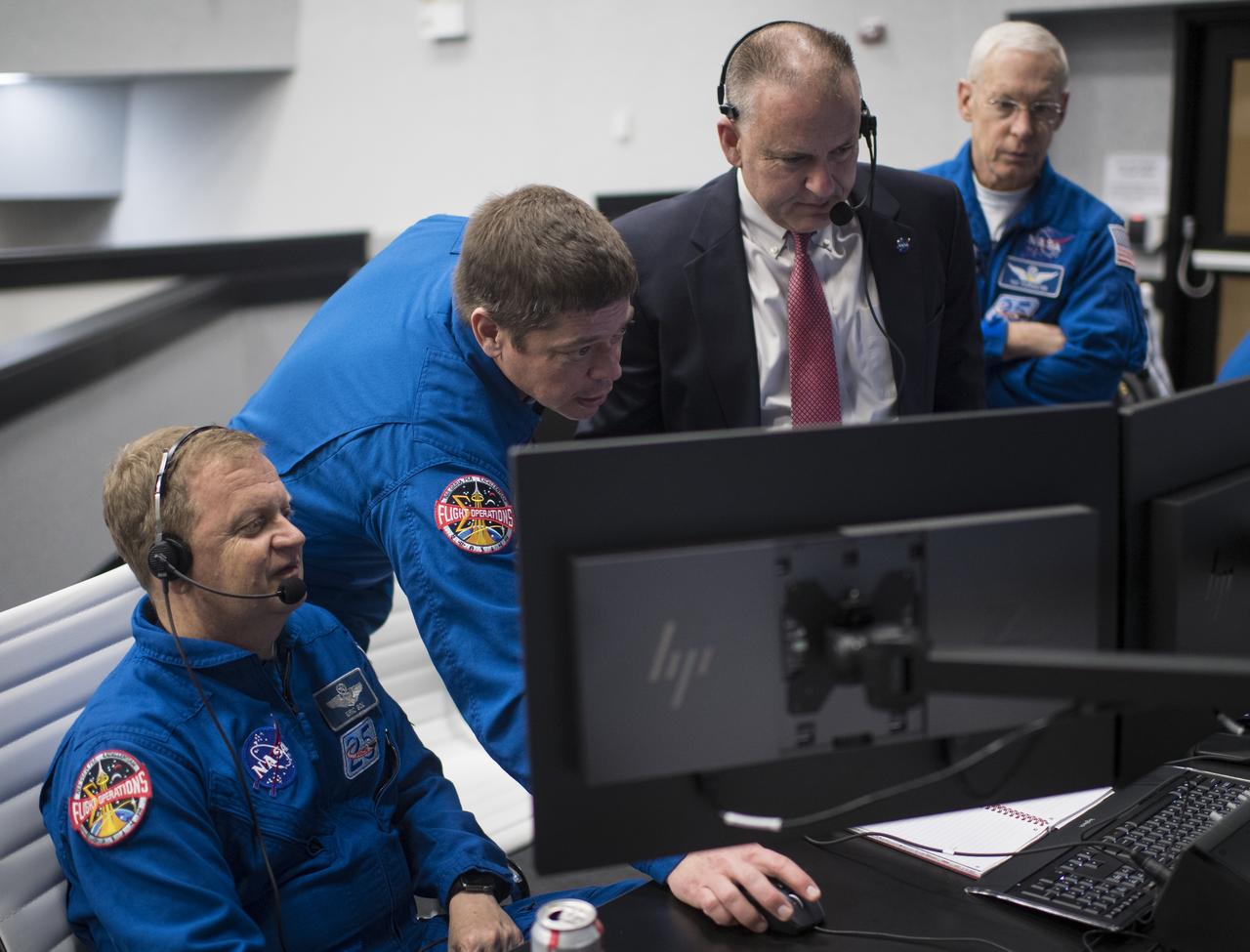
NASA astronaut Eric Boe, assistant to the chief of the astronaut office for commercial crew, left, NASA astronaut Bob Behnken, Norm Knight, deputy director of flight operations at NASA's Johnson Space Center and chief of the astronaut office Pat Forrester monitor the countdown of the launch of a SpaceX Falcon 9 rocket carrying the company's Crew Dragon spacecraft on the Demo-1 mission from firing room four of the Launch Control Center, Saturday, March 2, 2019 at the Kennedy Space Center in Florida. The Demo-1 mission will be the first launch of a commercially built and operated American spacecraft and space system designed for humans as part of NASA's Commercial Crew Program. The mission will serve as an end-to-end test of the system's capabilities. Photo Credit: (NASA/Joel Kowsky)
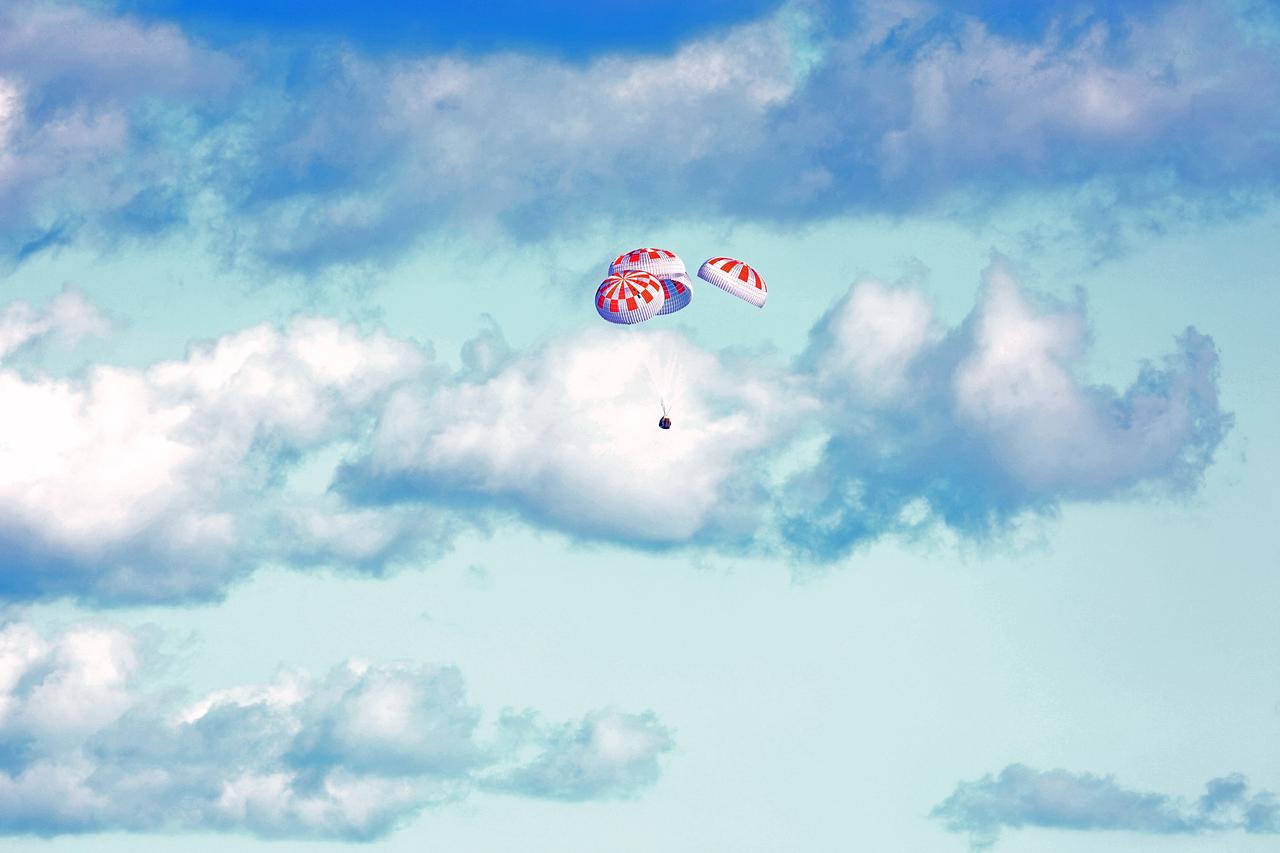
SpaceX’s Crew Dragon is guided by four parachutes toward the Atlantic Ocean on March 8 after returning from the International Space Station on the Demo-1 mission. The uncrewed spacecraft docked to the orbiting laboratory on March 3, following a 2:49 a.m. EST liftoff aboard a SpaceX Falcon 9 rocket from Launch Complex 39A at NASA’s Kennedy Space Center in Florida on March 2. Crew Dragon made 18 orbits of Earth before successfully attaching to the space station. The spacecraft undocked at 2:32 a.m., March 8, splashing down in the Atlantic Ocean, about 200 miles off Florida’s east coast at 8:45 a.m. SpaceX’s inaugural flight with NASA’s Commercial Crew Program is the first flight test of a space system designed for humans built and operated by a commercial company through a public-private partnership. NASA and SpaceX will use data from Demo-1 to further prepare for Demo-2, the crewed flight test that will carry NASA astronauts Bob Behnken and Doug Hurley to the International Space Station later this year.
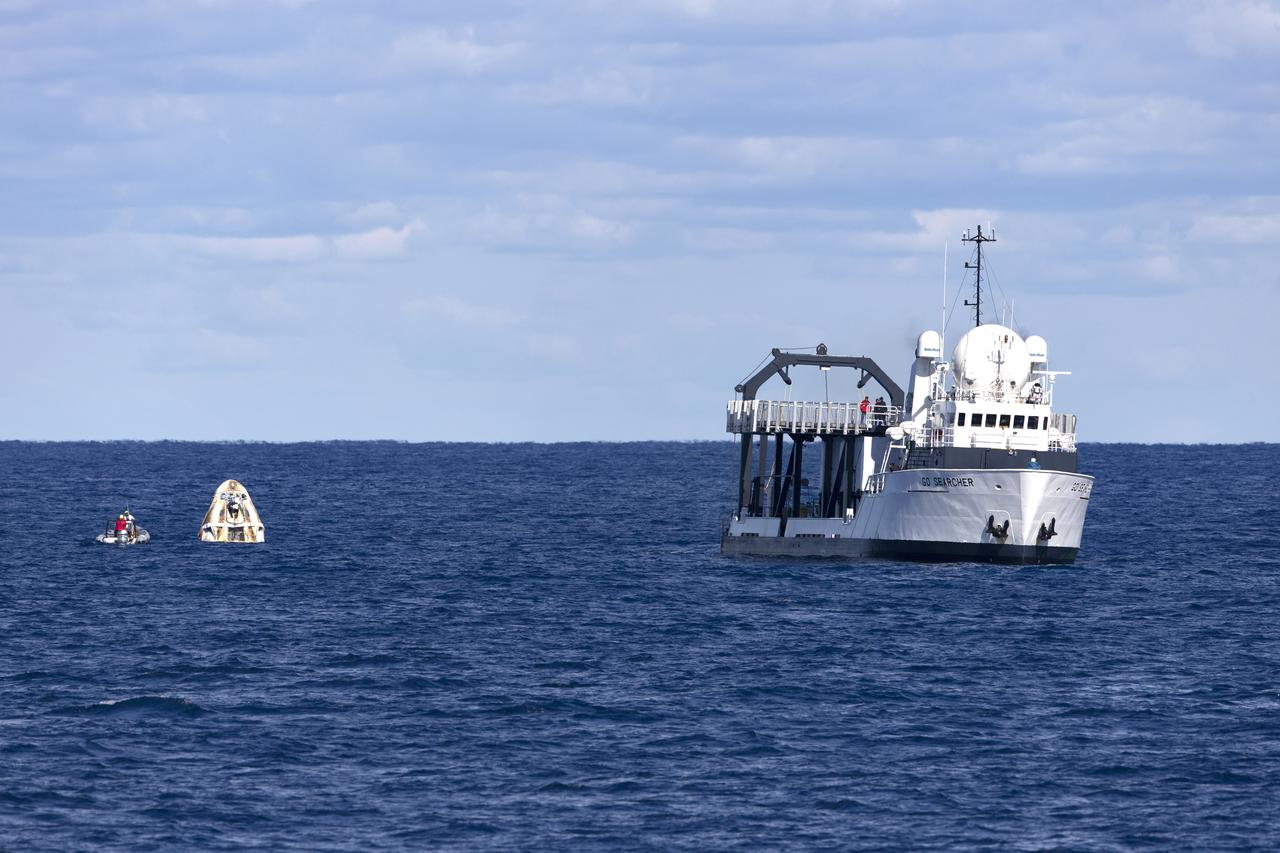
SpaceX’s recovery ship, Go Searcher, prepares to retrieve the company’s Crew Dragon from the Atlantic Ocean, about 200 miles off the east coast of Florida, March 8, 2019. The uncrewed spacecraft docked to the orbiting laboratory on March 3, following a 2:49 a.m. EST liftoff aboard a SpaceX Falcon 9 rocket from Launch Complex 39A at NASA’s Kennedy Space Center in Florida on March 2. The spacecraft undocked at 2:32 a.m., March 8, splashing down in the Atlantic Ocean at 8:45 a.m. SpaceX’s inaugural flight with NASA’s Commercial Crew Program, known as Demo-1, is the first flight test of a space system designed for humans built and operated by a commercial company through a public-private partnership. NASA and SpaceX will use data from Demo-1 to further prepare for Demo-2, the crewed flight test that will carry NASA astronauts Bob Behnken and Doug Hurley to the International Space Station later this year.
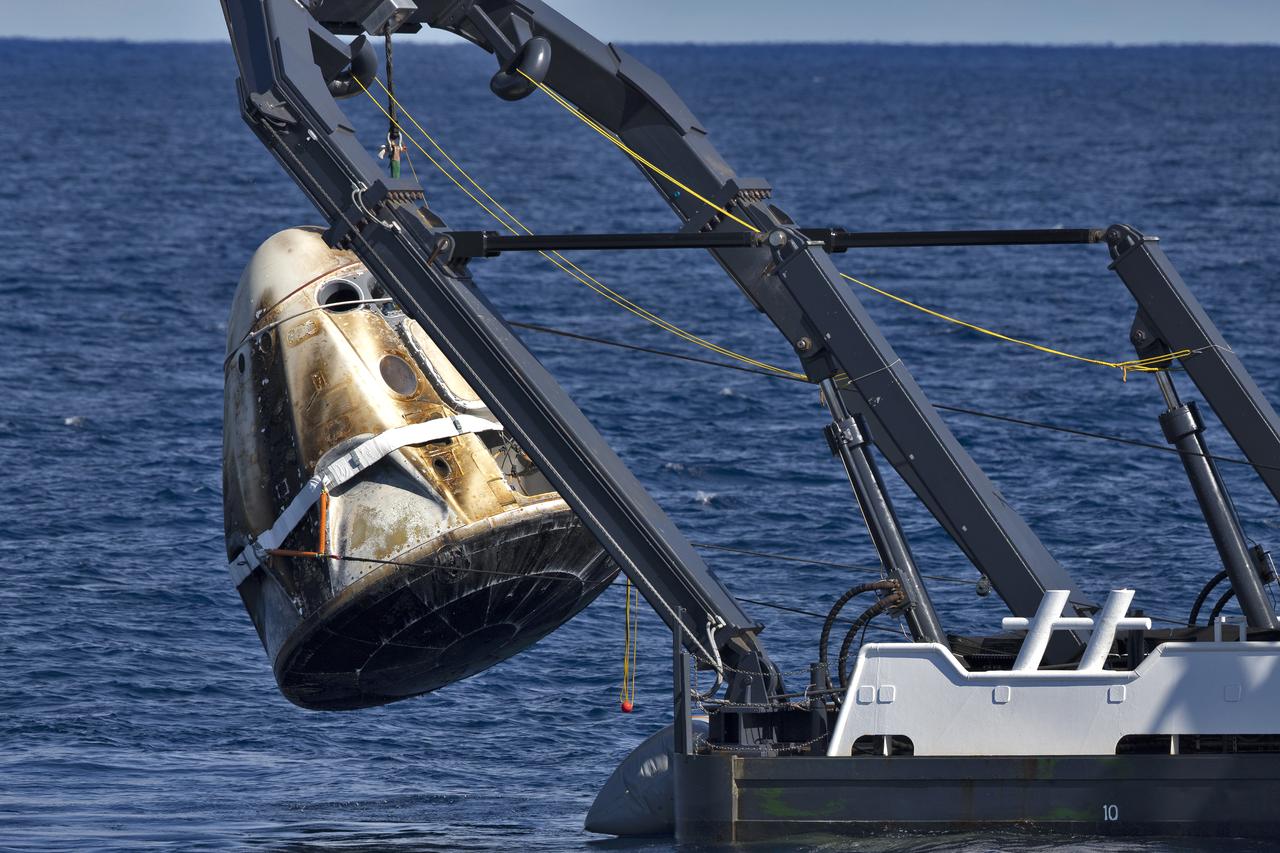
SpaceX’s Crew Dragon is retrieved by the company’s recovery ship, Go Searcher, in the Atlantic Ocean, about 200 miles off the east coast of Florida March 8, 2019, after its return to Earth on the Demo-1 mission. The uncrewed spacecraft docked to the orbiting laboratory on March 3, following a 2:49 a.m. EST liftoff aboard a SpaceX Falcon 9 rocket from Launch Complex 39A at NASA’s Kennedy Space Center in Florida on March 2. The spacecraft undocked at 2:32 a.m., March 8, splashing down in the Atlantic Ocean, at 8:45 a.m. SpaceX’s inaugural flight with NASA’s Commercial Crew Program is the first flight test of a space system designed for humans built and operated by a commercial company through a public-private partnership. NASA and SpaceX will use data from Demo-1 to further prepare for Demo-2, the crewed flight test that will carry NASA astronauts Bob Behnken and Doug Hurley to the International Space Station later this year.
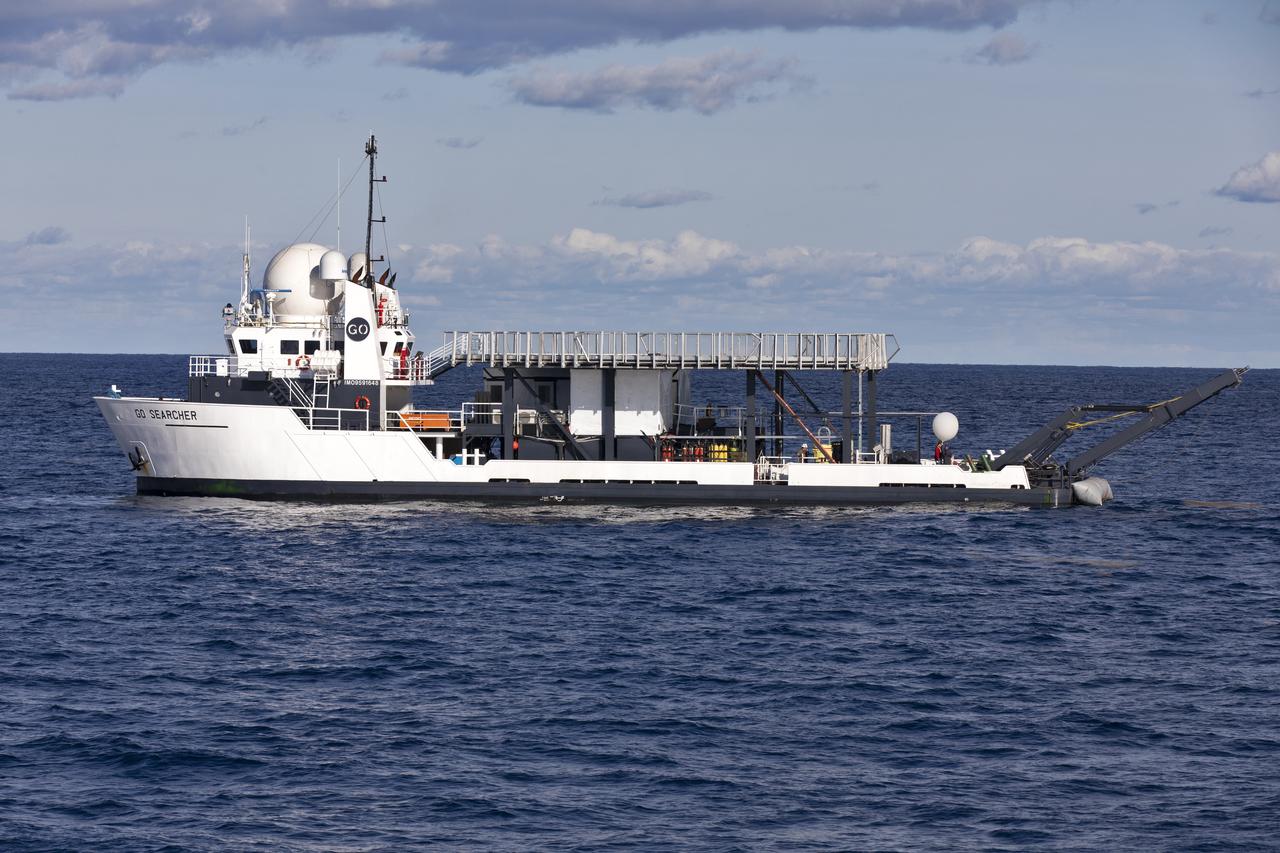
SpaceX’s recovery ship, Go Searcher, sails in the Atlantic Ocean off the east coast of Florida March 8, 2019, in preparation to retrieve the company’s Crew Dragon upon its return to Earth on the Demo-1 mission. The uncrewed spacecraft docked to the orbiting laboratory on March 3, following a 2:49 a.m. EST liftoff aboard a SpaceX Falcon 9 rocket from Launch Complex 39A at NASA’s Kennedy Space Center in Florida on March 2. The spacecraft undocked at 2:32 a.m., March 8, splashing down in the Atlantic Ocean at 8:45 a.m. SpaceX’s inaugural flight with NASA’s Commercial Crew Program is the first flight test of a space system designed for humans built and operated by a commercial company through a public-private partnership. NASA and SpaceX will use data from Demo-1 to further prepare for Demo-2, the crewed flight test that will carry NASA astronauts Bob Behnken and Doug Hurley to the International Space Station later this year.
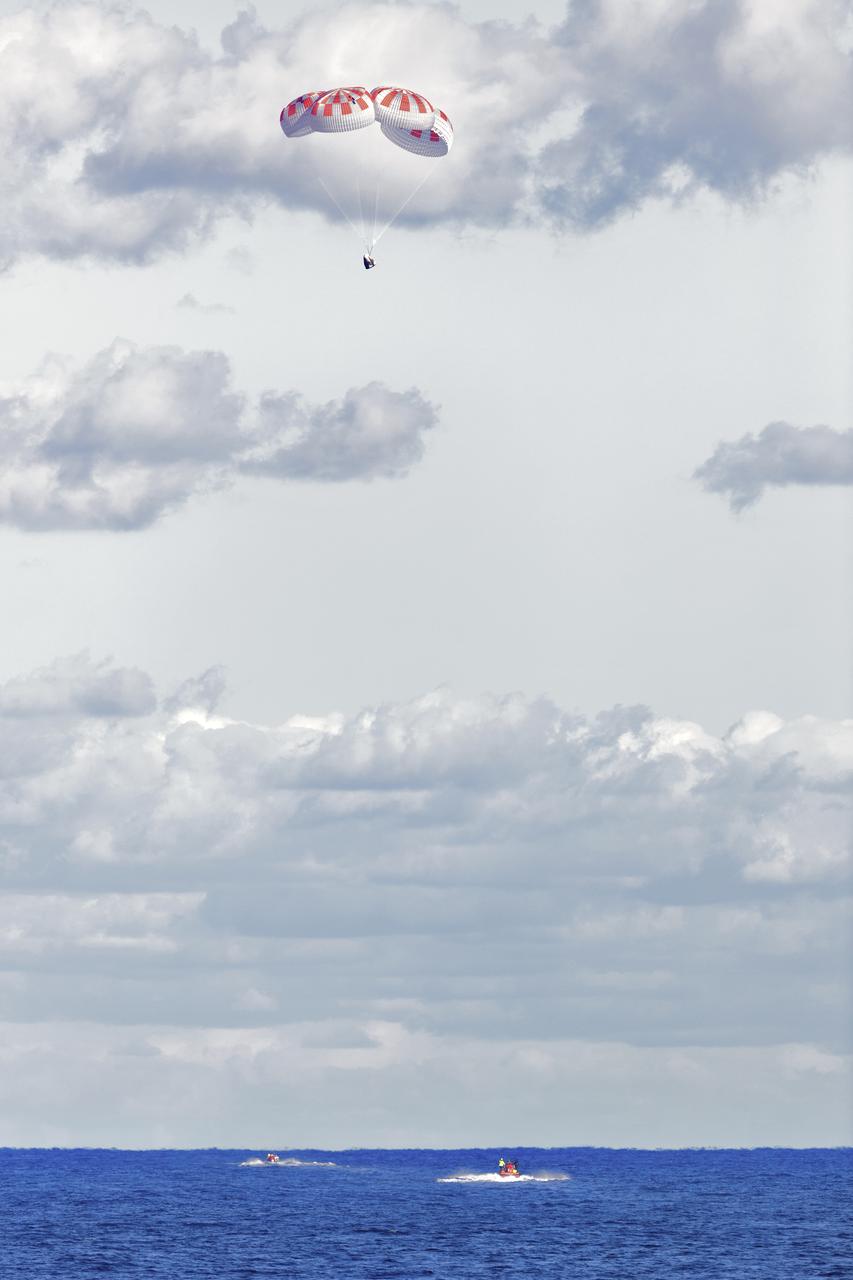
SpaceX’s Crew Dragon is guided by four parachutes toward the Atlantic Ocean on March 8, 2019, after returning from the International Space Station on the Demo-1 mission. The uncrewed spacecraft docked to the orbiting laboratory on March 3, following a 2:49 a.m. EST liftoff aboard a SpaceX Falcon 9 rocket from Launch Complex 39A at NASA’s Kennedy Space Center in Florida on March 2. Crew Dragon made 18 orbits of Earth before successfully attaching to the space station. The spacecraft undocked at 2:32 a.m., March 8, splashing down in the Atlantic Ocean, about 200 miles off Florida’s east coast at 8:45 a.m. SpaceX’s inaugural flight with NASA’s Commercial Crew Program is the first flight test of a space system designed for humans built and operated by a commercial company through a public-private partnership. NASA and SpaceX will use data from Demo-1 to further prepare for Demo-2, the crewed flight test that will carry NASA astronauts Bob Behnken and Doug Hurley to the International Space Station later this year.
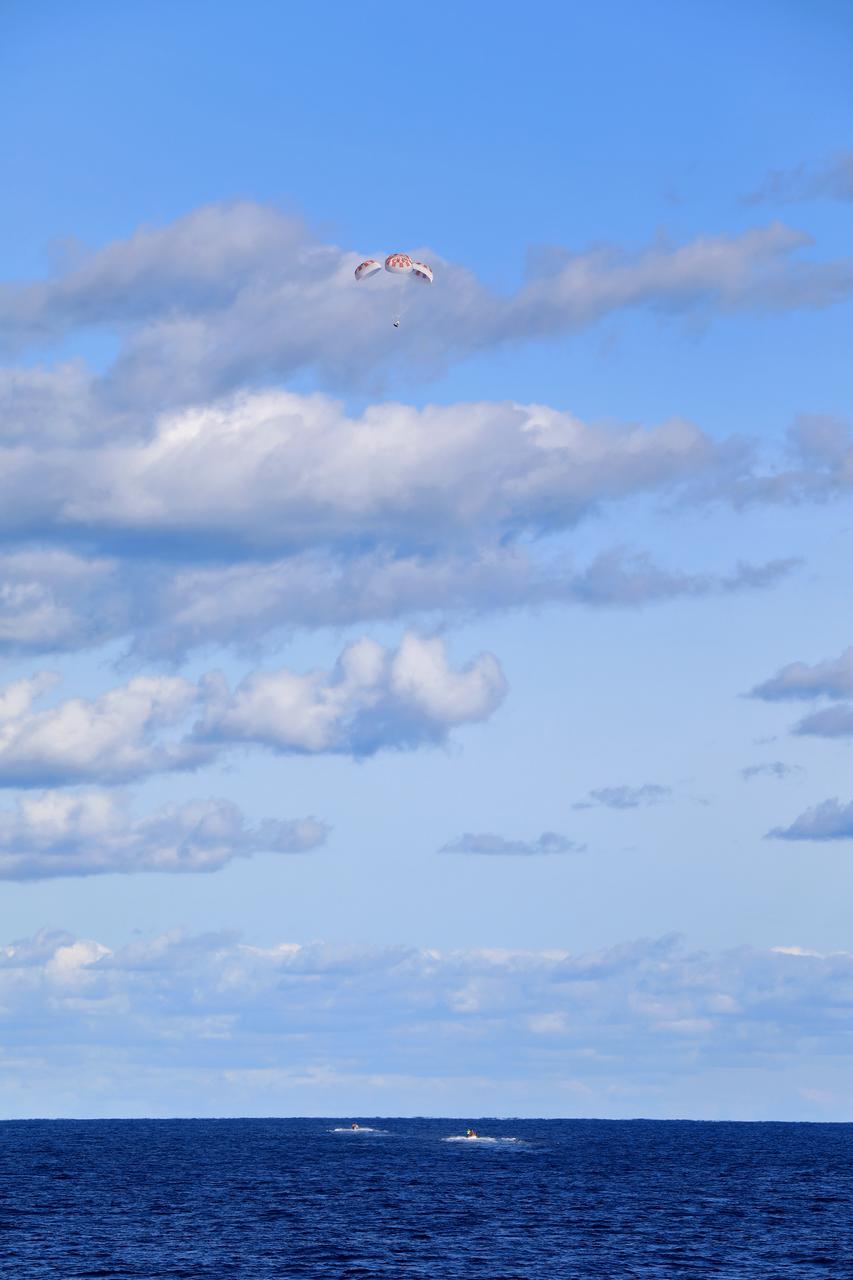
SpaceX’s Crew Dragon is guided by four parachutes toward the Atlantic Ocean on March 8 after returning from the International Space Station on the Demo-1 mission. The uncrewed spacecraft docked to the orbiting laboratory on March 3, following a 2:49 a.m. EST liftoff aboard a SpaceX Falcon 9 rocket from Launch Complex 39A at NASA’s Kennedy Space Center in Florida on March 2. Crew Dragon made 18 orbits of Earth before successfully attaching to the space station. The spacecraft undocked at 2:32 a.m., March 8, splashing down in the Atlantic Ocean, about 200 miles off Florida’s east coast at 8:45 a.m. SpaceX’s inaugural flight with NASA’s Commercial Crew Program is the first flight test of a space system designed for humans built and operated by a commercial company through a public-private partnership. NASA and SpaceX will use data from Demo-1 to further prepare for Demo-2, the crewed flight test that will carry NASA astronauts Bob Behnken and Doug Hurley to the International Space Station later this year.
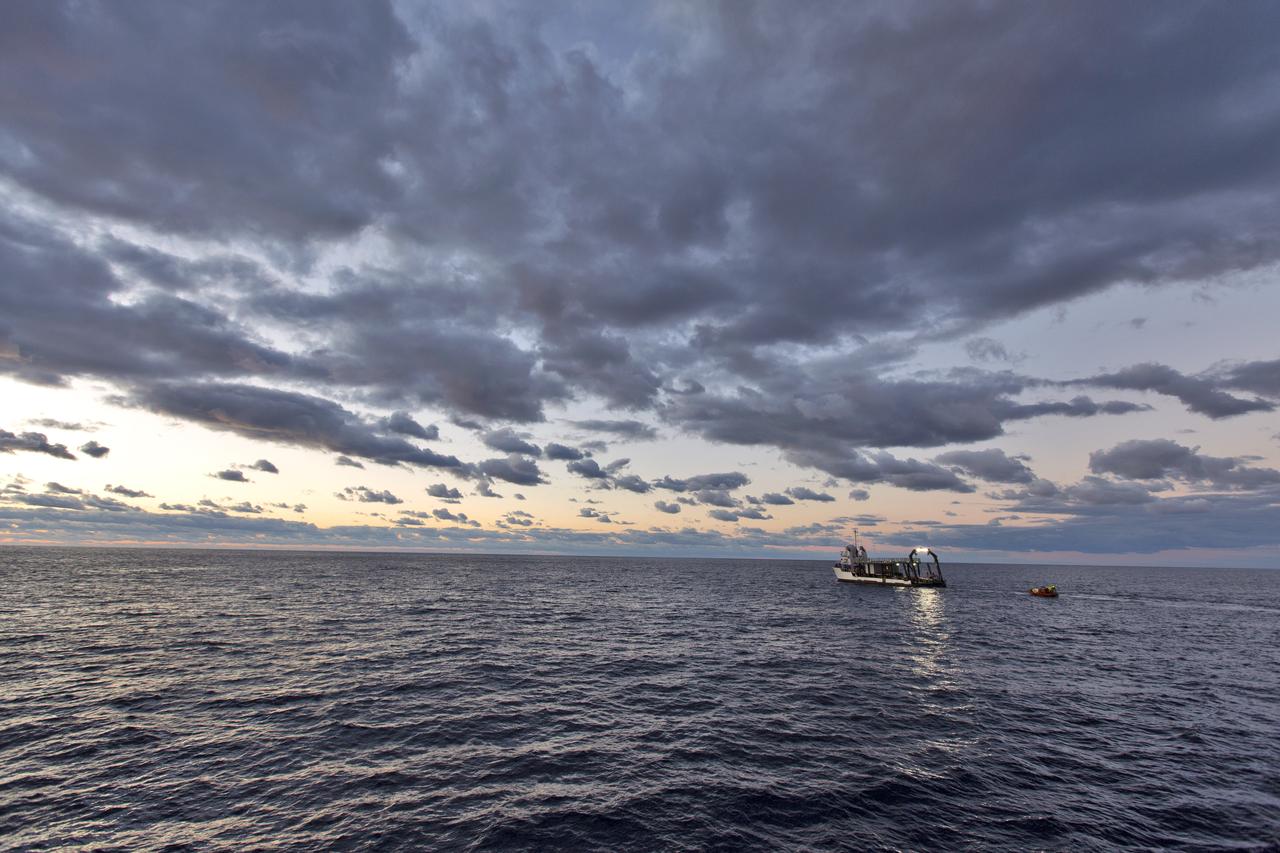
SpaceX’s recovery ship, Go Searcher, sails in the Atlantic Ocean off the east coast of Florida March 8, 2019, in preparation to retrieve the company’s Crew Dragon upon its return to Earth on the Demo-1 mission. The uncrewed spacecraft docked to the orbiting laboratory on March 3, following a 2:49 a.m. EST liftoff aboard a SpaceX Falcon 9 rocket from Launch Complex 39A at NASA’s Kennedy Space Center in Florida on March 2. The spacecraft undocked at 2:32 a.m., March 8, splashing down in the Atlantic Ocean at 8:45 a.m. SpaceX’s inaugural flight with NASA’s Commercial Crew Program is the first flight test of a space system designed for humans built and operated by a commercial company through a public-private partnership. NASA and SpaceX will use data from Demo-1 to further prepare for Demo-2, the crewed flight test that will carry NASA astronauts Bob Behnken and Doug Hurley to the International Space Station later this year.
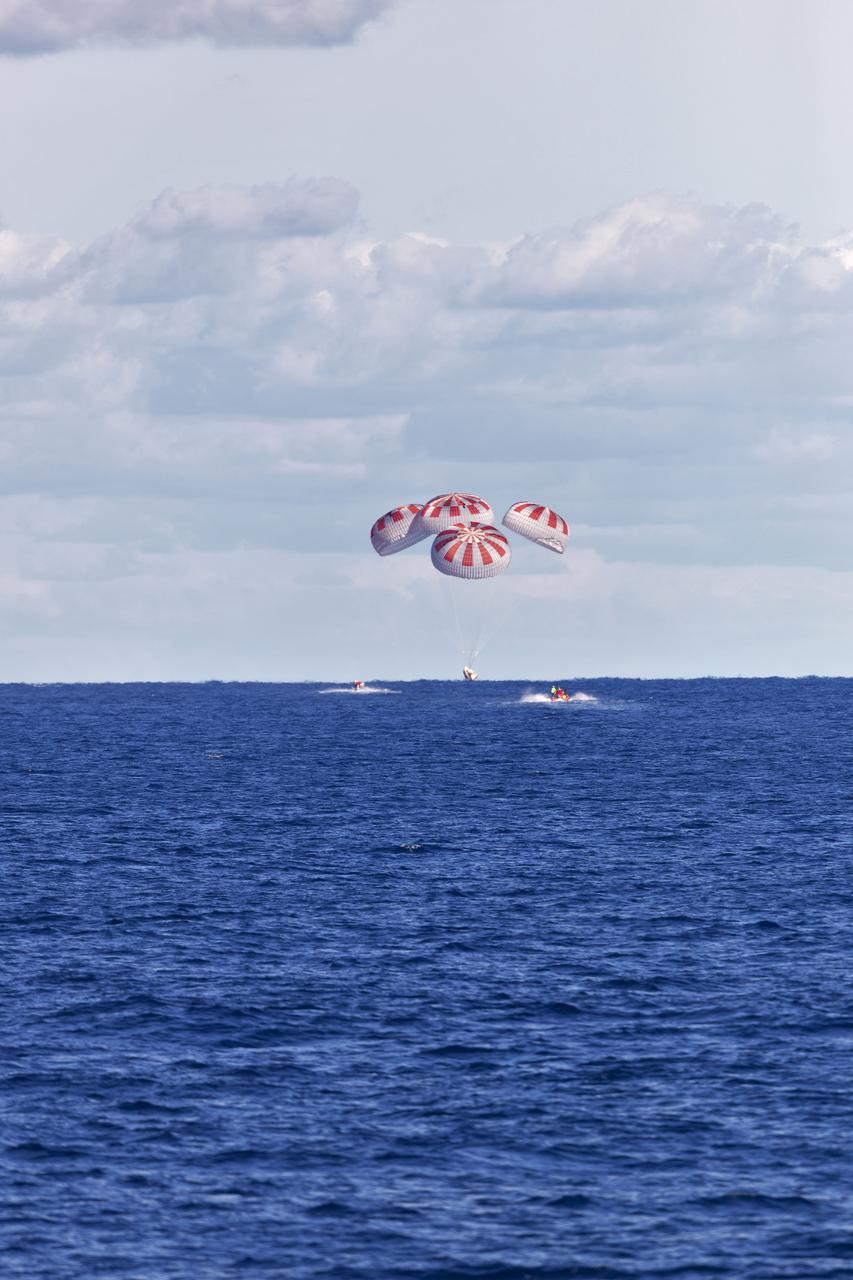
SpaceX’s Crew Dragon is guided by four parachutes as it splashes down in the Atlantic Ocean about 200 miles off Florida’s east coast on March 8, 2019, after returning from the International Space Station on the Demo-1 mission. The uncrewed spacecraft docked to the orbiting laboratory on March 3, following a 2:49 a.m. EST liftoff aboard a SpaceX Falcon 9 rocket from Launch Complex 39A at NASA’s Kennedy Space Center in Florida on March 2. Crew Dragon made 18 orbits of Earth before successfully attaching to the space station. The spacecraft undocked at 2:32 a.m., March 8, splashing down in the Atlantic Ocean at 8:45 a.m. SpaceX’s inaugural flight with NASA’s Commercial Crew Program is the first flight test of a space system designed for humans built and operated by a commercial company through a public-private partnership. NASA and SpaceX will use data from Demo-1 to further prepare for Demo-2, the crewed flight test that will carry NASA astronauts Bob Behnken and Doug Hurley to the International Space Station later this year.
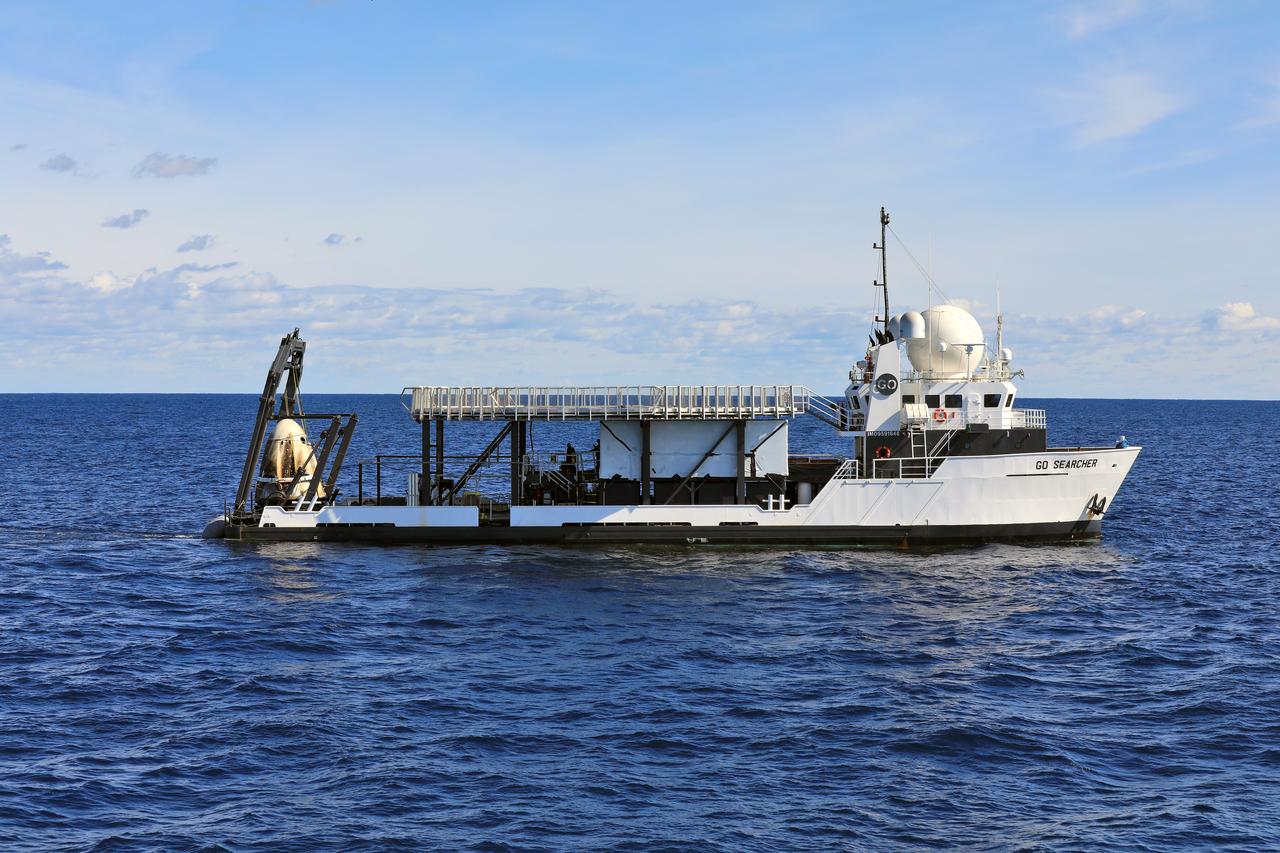
SpaceX’s Crew Dragon is carried by the company’s recovery ship, Go Searcher, in the Atlantic Ocean, about 200 miles off Florida’s east coast, on March 8, after returning from the International Space Station on the Demo-1 mission. The uncrewed spacecraft docked to the orbiting laboratory on March 3, following a 2:49 a.m. EST liftoff aboard a SpaceX Falcon 9 rocket from Launch Complex 39A at NASA’s Kennedy Space Center in Florida on March 2. Crew Dragon made 18 orbits of Earth before successfully attaching to the space station. The spacecraft undocked at 2:32 a.m., March 8, splashing down in the Atlantic Ocean, at 8:45 a.m. SpaceX’s inaugural flight with NASA’s Commercial Crew Program is the first flight test of a space system designed for humans built and operated by a commercial company through a public-private partnership. NASA and SpaceX will use data from Demo-1 to further prepare for Demo-2, the crewed flight test that will carry NASA astronauts Bob Behnken and Doug Hurley to the International Space Station later this year
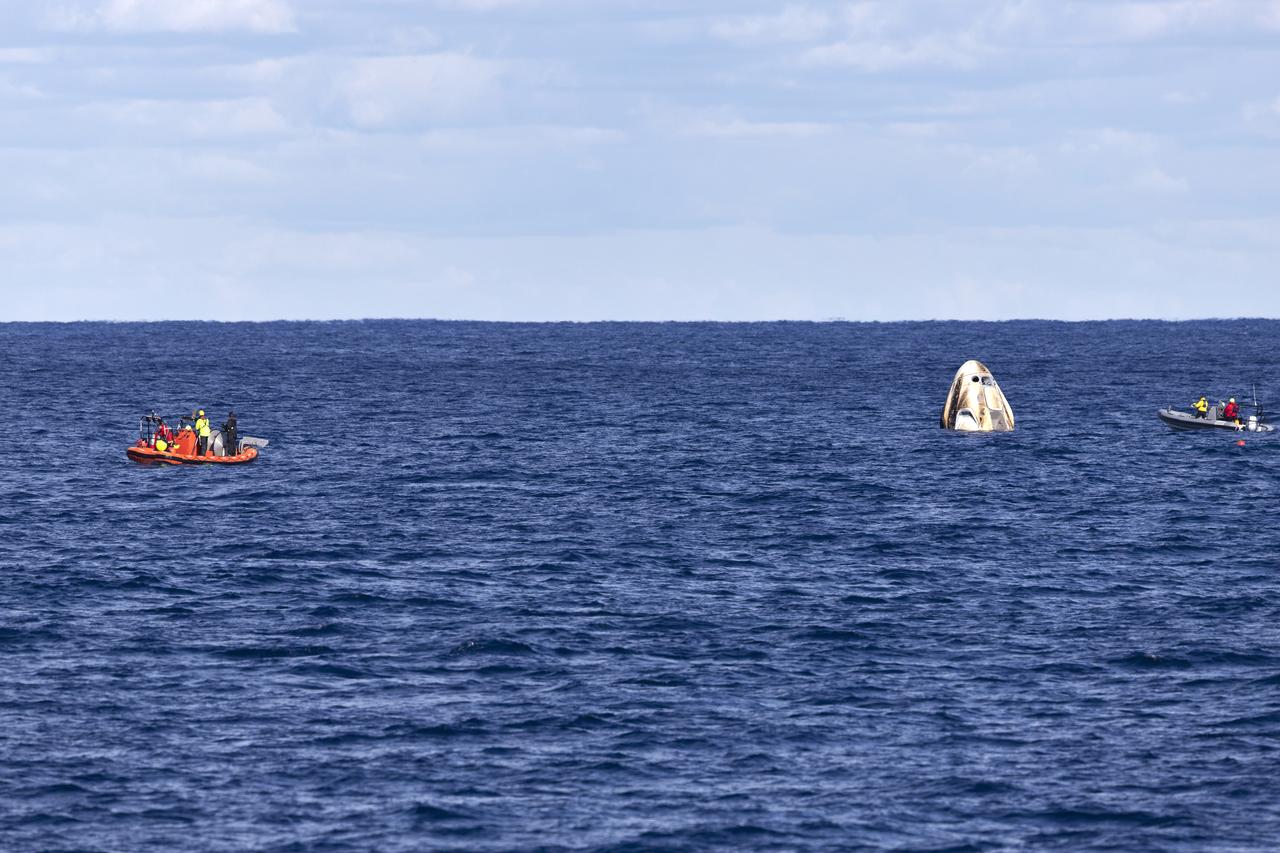
SpaceX’s Crew Dragon floats in the Atlantic Ocean, about 200 miles off Florida’s east coast, March 8, 2019, after returning from the International Space Station on the Demo-1 mission. The uncrewed spacecraft docked to the orbiting laboratory on March 3, following a 2:49 a.m. EST liftoff aboard a SpaceX Falcon 9 rocket from Launch Complex 39A at NASA’s Kennedy Space Center in Florida on March 2. The spacecraft undocked at 2:32 a.m., March 8, splashing down in the Atlantic Ocean at 8:45 a.m. SpaceX’s inaugural flight with NASA’s Commercial Crew Program is the first flight test of a space system designed for humans built and operated by a commercial company through a public-private partnership. NASA and SpaceX will use data from Demo-1 to further prepare for Demo-2, the crewed flight test that will carry NASA astronauts Bob Behnken and Doug Hurley to the International Space Station later this year.

SpaceX’s Crew Dragon is guided by four parachutes as it approaches splashdown in the Atlantic Ocean about 200 miles off Florida’s east coast on March 8, 2019, after returning from the International Space Station on the Demo-1 mission. The uncrewed spacecraft docked to the orbiting laboratory on March 3, following a 2:49 a.m. EST liftoff aboard a SpaceX Falcon 9 rocket from Launch Complex 39A at NASA’s Kennedy Space Center in Florida on March 2. Crew Dragon made 18 orbits of Earth before successfully attaching to the space station. The spacecraft undocked at 2:32 a.m., March 8, splashing down in the Atlantic Ocean at 8:45 a.m. SpaceX’s inaugural flight with NASA’s Commercial Crew Program is the first flight test of a space system designed for humans built and operated by a commercial company through a public-private partnership. NASA and SpaceX will use data from Demo-1 to further prepare for Demo-2, the crewed flight test that will carry NASA astronauts Bob Behnken and Doug Hurley to the International Space Station later this year.
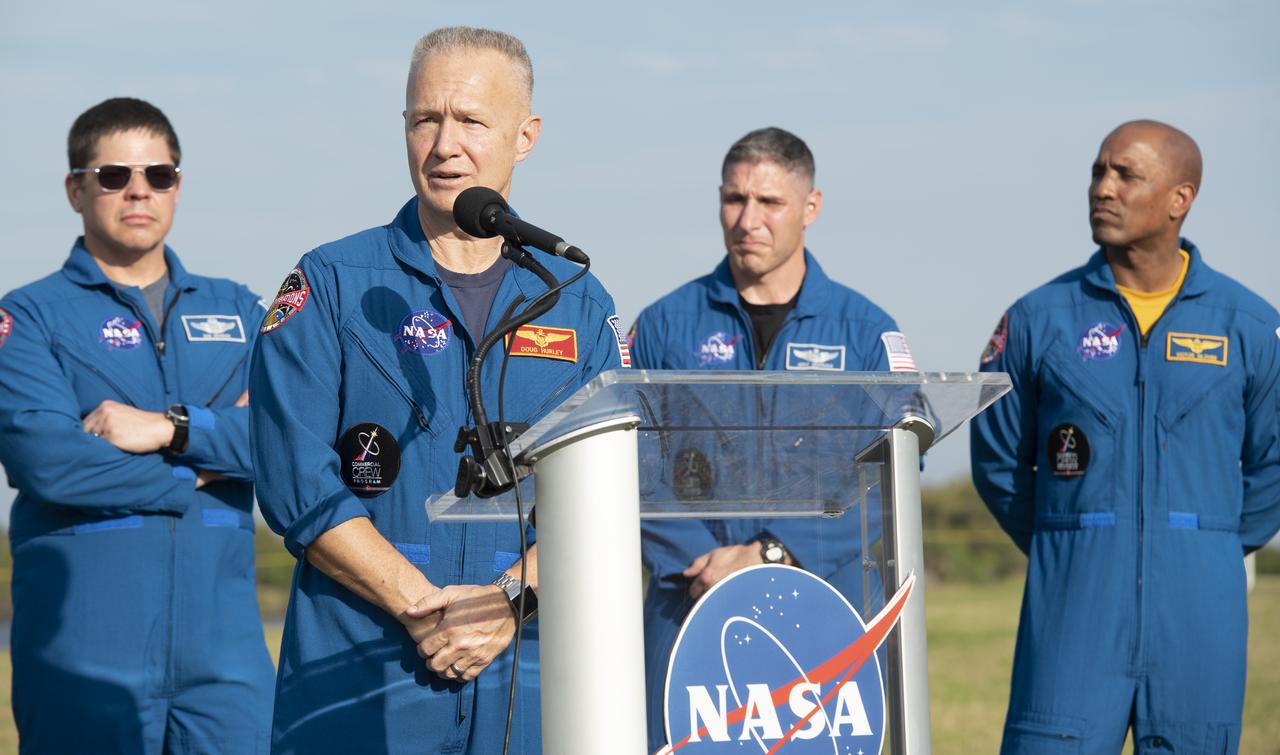
NASA astronaut Doug Hurley, second from left, answers questions during a press conference ahead of the SpaceX Demo-1 mission, Friday, March 1, 2019 at the Kennedy Space Center in Florida. Hurley and Bob Behnken, left, are assigned to the company’s first crewed test flight, and Mike Hopkins, second from right, and Victor Glover, right, are assigned to the first operational mission for Crew Dragon. The Demo-1 mission will be the first launch of a commercially built and operated American spacecraft and space system designed for humans as part of NASA's Commercial Crew Program. The mission, currently targeted for a 2:49am launch on March 2, will serve as an end-to-end test of the system's capabilities. Photo Credit: (NASA/Joel Kowsky)
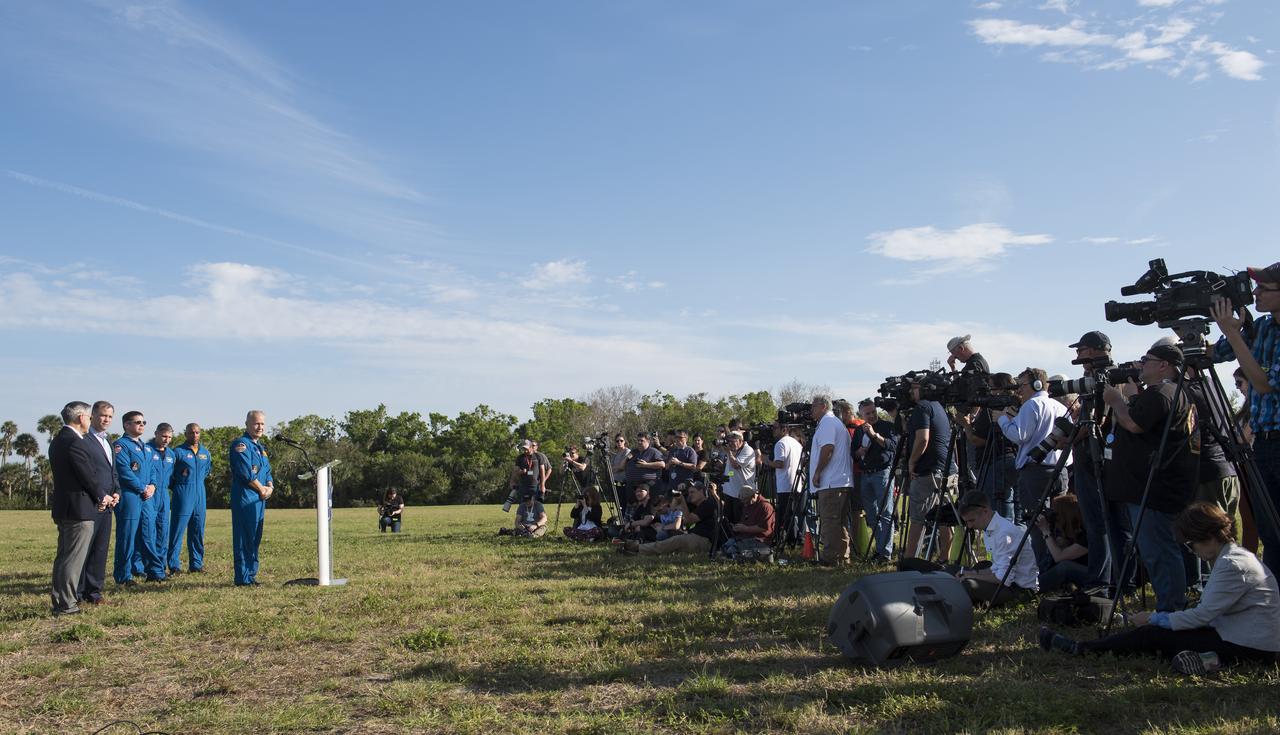
NASA Administrator Jim Bridenstine, Kennedy Space Center Director Bob Cabana, and NASA astronauts Bob Behnken and Doug Hurley who are assigned to the company’s first test flight, and Mike Hopkins and Victor Glover who are assigned to the first operational mission for SpaceX’s Crew Dragon speak during a press conference ahead of the SpaceX Demo-1 mission, Friday, March 1, 2019 at the Kennedy Space Center in Florida. The Demo-1 mission will be the first launch of a commercially built and operated American spacecraft and space system designed for humans as part of NASA's Commercial Crew Program. The mission, currently targeted for a 2:49am launch on March 2, will serve as an end-to-end test of the system's capabilities. Photo Credit: (NASA/Joel Kowsky)
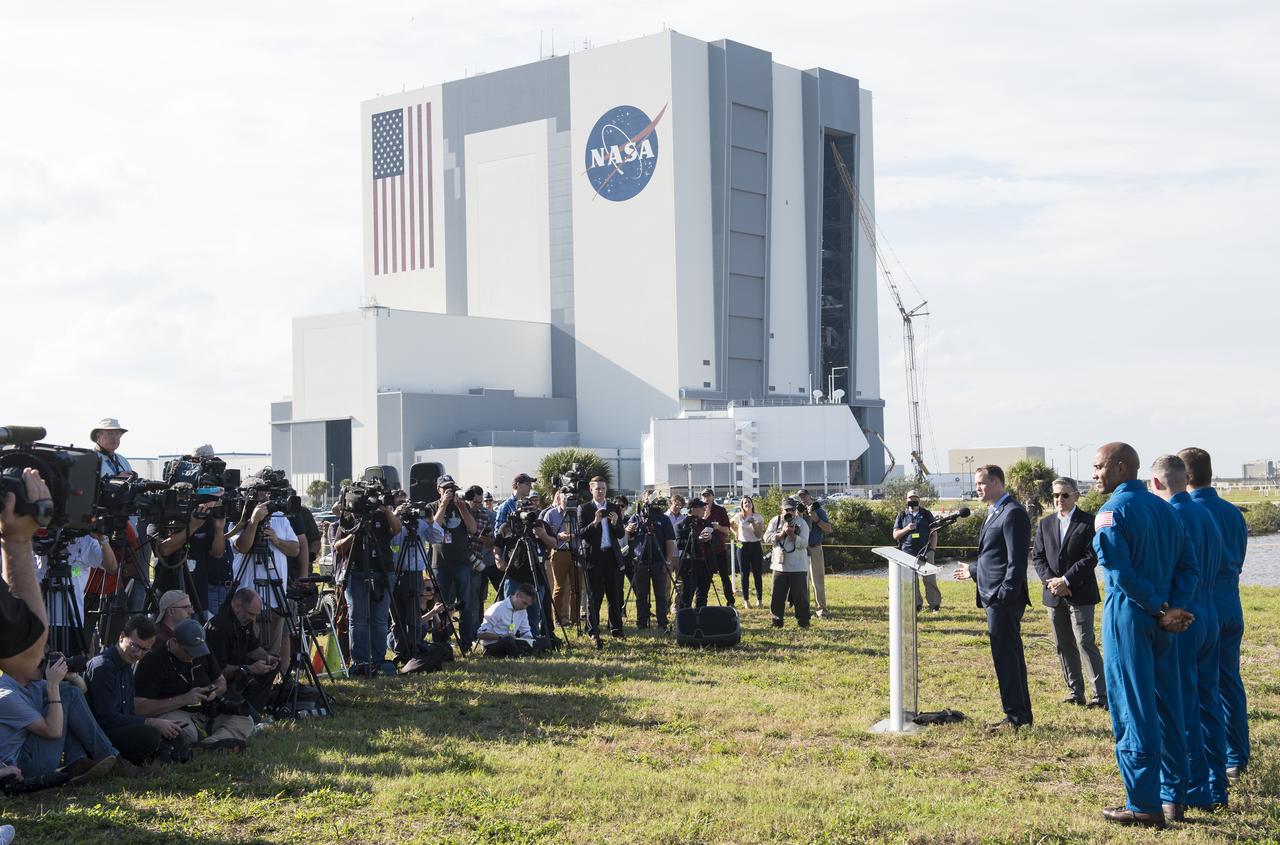
NASA Administrator Jim Bridenstine, Kennedy Space Center Director Bob Cabana, and NASA astronauts Bob Behnken and Doug Hurley who are assigned to the company’s first test flight, and Mike Hopkins and Victor Glover who are assigned to the first operational mission for SpaceX’s Crew Dragon speak during a press conference ahead of the SpaceX Demo-1 mission, Friday, March 1, 2019 at the Kennedy Space Center in Florida. The Demo-1 mission will be the first launch of a commercially built and operated American spacecraft and space system designed for humans as part of NASA's Commercial Crew Program. The mission, currently targeted for a 2:49am launch on March 2, will serve as an end-to-end test of the system's capabilities. Photo Credit: (NASA/Joel Kowsky)
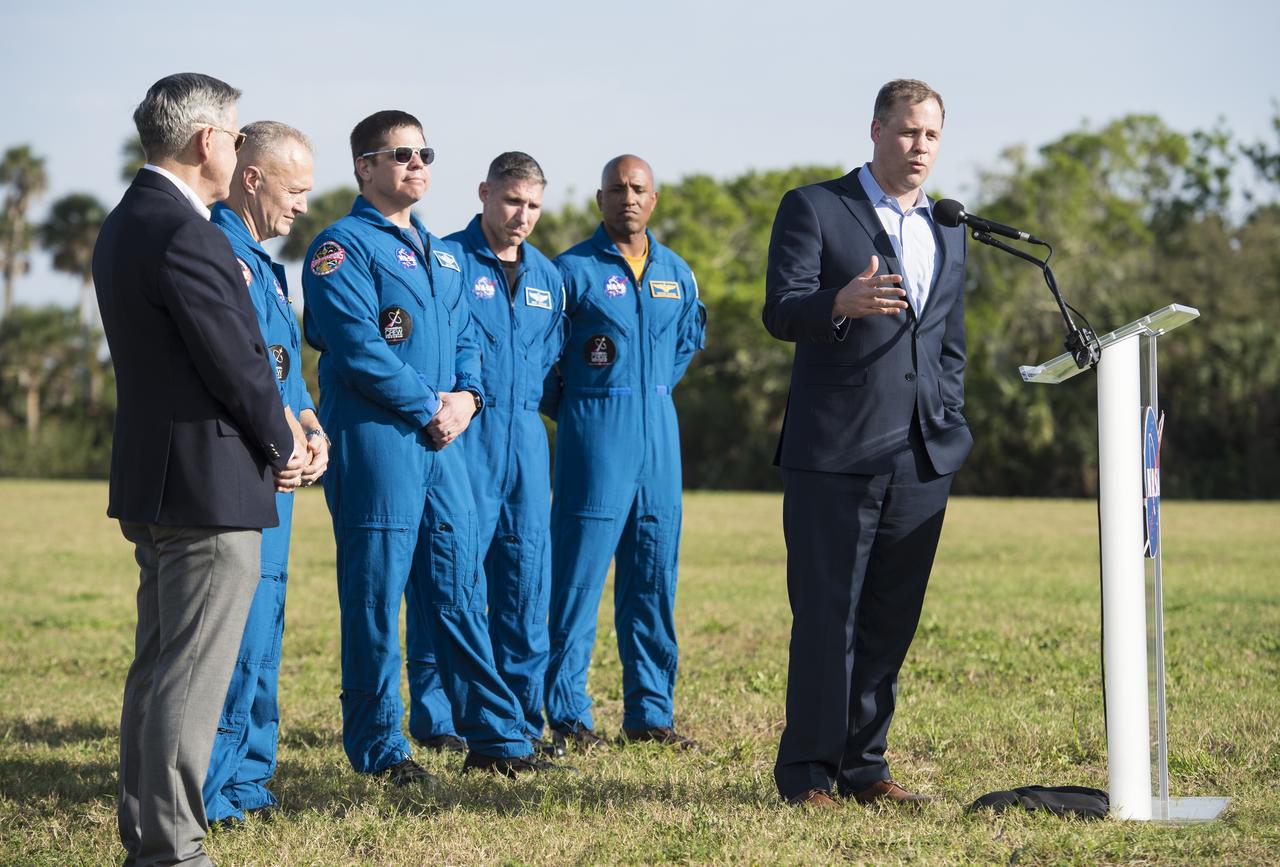
NASA Administrator Jim Bridenstine, Kennedy Space Center Director Bob Cabana, and NASA astronauts Bob Behnken and Doug Hurley who are assigned to the company’s first test flight, and Mike Hopkins and Victor Glover who are assigned to the first operational mission for SpaceX’s Crew Dragon speak during a press conference ahead of the SpaceX Demo-1 mission, Friday, March 1, 2019 at the Kennedy Space Center in Florida. The Demo-1 mission will be the first launch of a commercially built and operated American spacecraft and space system designed for humans as part of NASA's Commercial Crew Program. The mission, currently targeted for a 2:49am launch on March 2, will serve as an end-to-end test of the system's capabilities. Photo Credit: (NASA/Joel Kowsky)
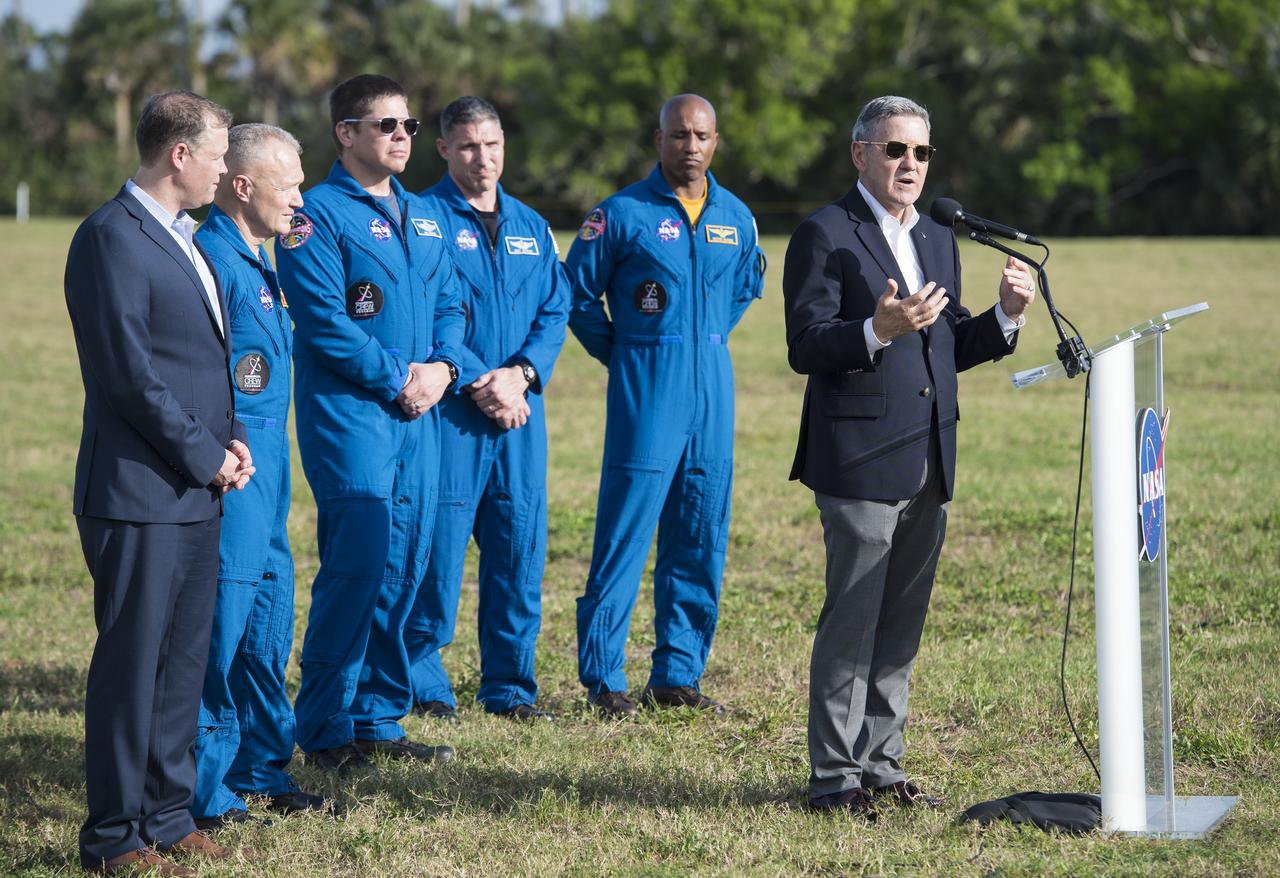
Kennedy Space Center Director Bob Cabana answers questions during a press conference along with NASA Administrator Jim Bridenstine and NASA astronauts Doug Hurley, Bob Behnken, Mike Hopkins, and Victor Glover, ahead of the SpaceX Demo-1 mission, Friday, March 1, 2019 at the Kennedy Space Center in Florida. The Demo-1 mission will be the first launch of a commercially built and operated American spacecraft and space system designed for humans as part of NASA's Commercial Crew Program. The mission, currently targeted for a 2:49am launch on March 2, will serve as an end-to-end test of the system's capabilities. Photo Credit: (NASA/Joel Kowsky)
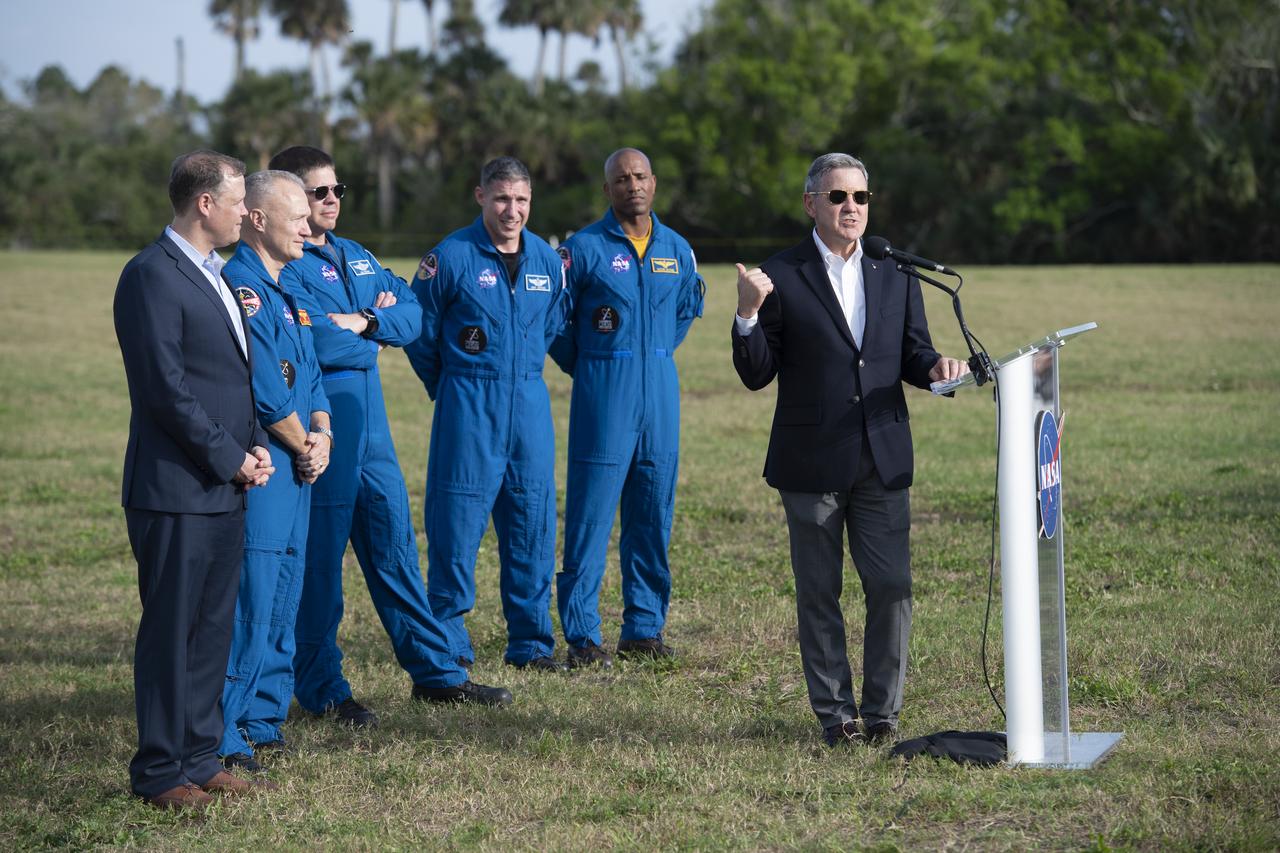
Kennedy Space Center Director Bob Cabana answers questions during a press conference along with NASA Administrator Jim Bridenstine and NASA astronauts Doug Hurley, Bob Behnken, Mike Hopkins, and Victor Glover, ahead of the SpaceX Demo-1 mission, Friday, March 1, 2019 at the Kennedy Space Center in Florida. The Demo-1 mission will be the first launch of a commercially built and operated American spacecraft and space system designed for humans as part of NASA's Commercial Crew Program. The mission, currently targeted for a 2:49am launch on March 2, will serve as an end-to-end test of the system's capabilities. Photo Credit: (NASA/Joel Kowsky)
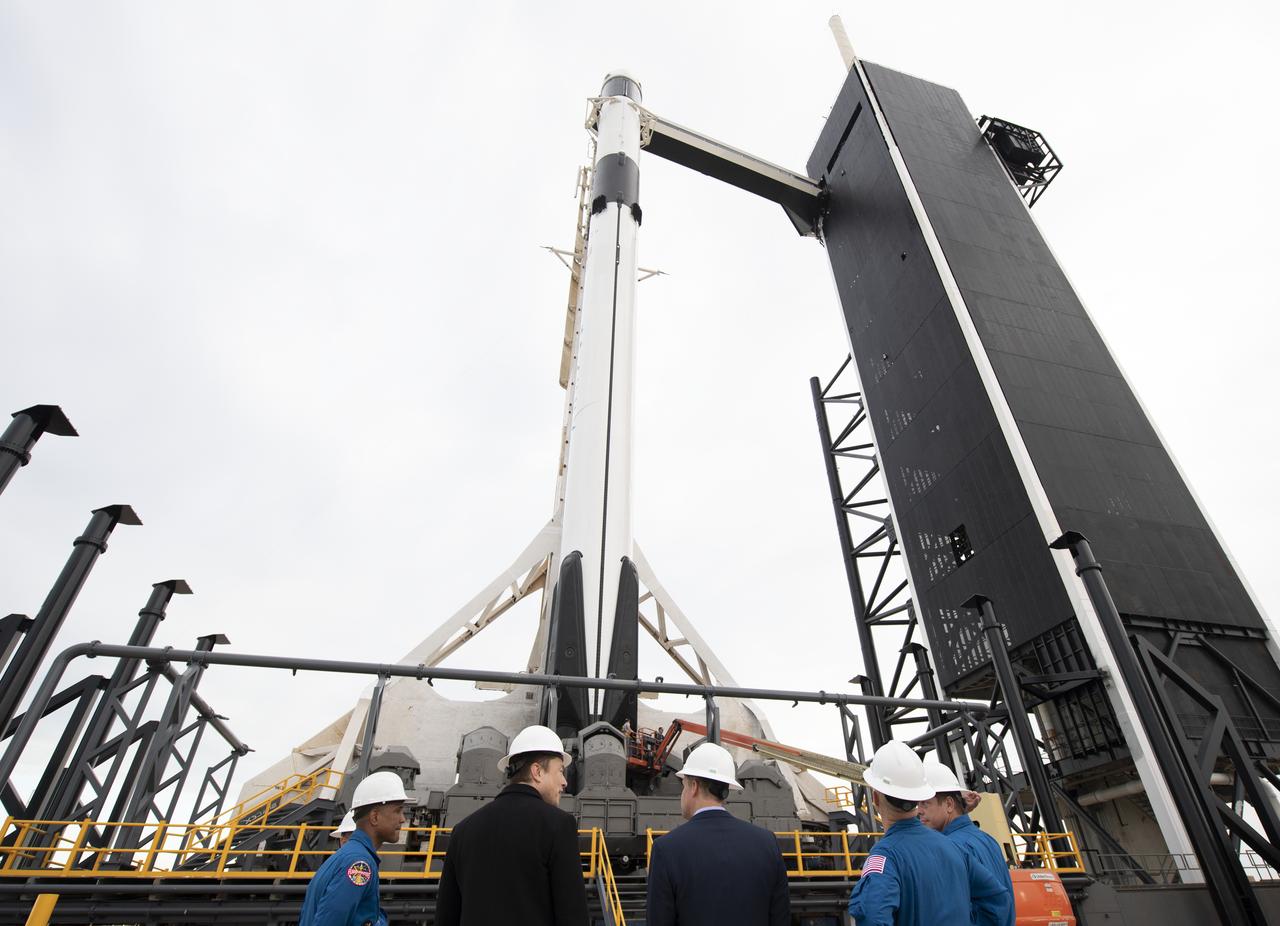
SpaceX CEO and Chief Designer Elon Musk, second from left, NASA Administrator Jim Bridenstine, third form right, and NASA astronauts Mike Hopkins, Victor Glover, Doug Hurley and Bob Behnken are seen with the SpaceX Falcon 9 rocket with the company's Crew Dragon spacecraft onboard during a tour of Launch Complex 39A before the early Saturday morning launch of the Demo-1 mission, Friday, March 1, 2019 at the Kennedy Space Center in Florida. The Demo-1 mission launched at 2:49am ET on Saturday, March 2 and was the first launch of a commercially built and operated American spacecraft and space system designed for humans as part of NASA's Commercial Crew Program. The mission will serve as an end-to-end test of the system's capabilities. Hurley and Behnken are assigned to fly onboard Crew Dragon for the Demo-2 mission and Glover and Hopkins have been assigned to fly to the International Space Station on Crew Dragon's first operational mission. Photo Credit: (NASA/Joel Kowsky)
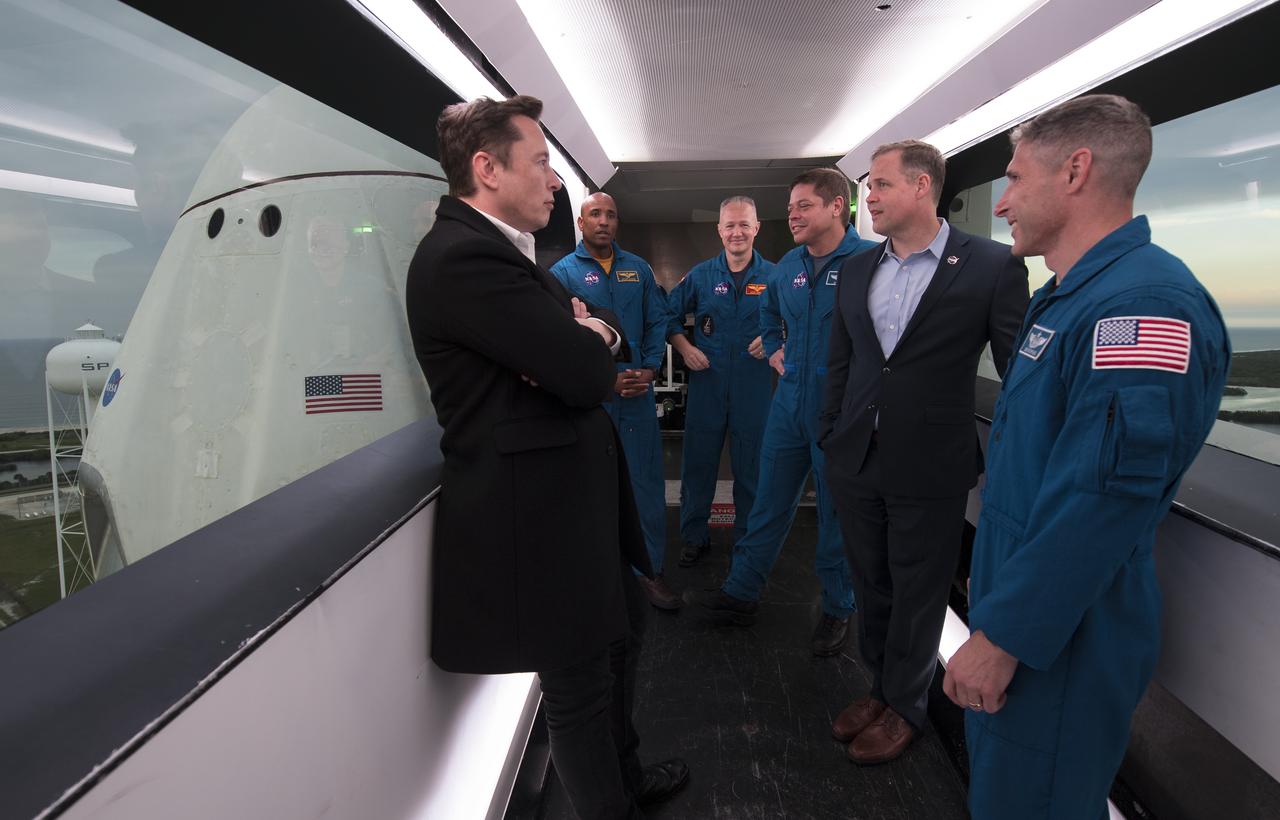
SpaceX CEO and Chief Designer Elon Musk, left, NASA astronauts Victor Glover, Doug Hurley, Bob Behnken, NASA Administrator Jim Bridenstine, and NASA astronaut Mike Hopkins are seen inside the crew access arm with the SpaceX Crew Dragon spacecraft visible behind them during a tour of Launch Complex 39A before the early Saturday morning launch of the Demo-1 mission, Friday, March 1, 2019 at the Kennedy Space Center in Florida. The Demo-1 mission launched at 2:49am ET on Saturday, March 2 and was the first launch of a commercially built and operated American spacecraft and space system designed for humans as part of NASA's Commercial Crew Program. The mission will serve as an end-to-end test of the system's capabilities. Hurley and Behnken are assigned to fly onboard Crew Dragon for the Demo-2 mission and Glover and Hopkins have been assigned to fly to the International Space Station on Crew Dragon's first operational mission. Photo Credit: (NASA/Joel Kowsky)
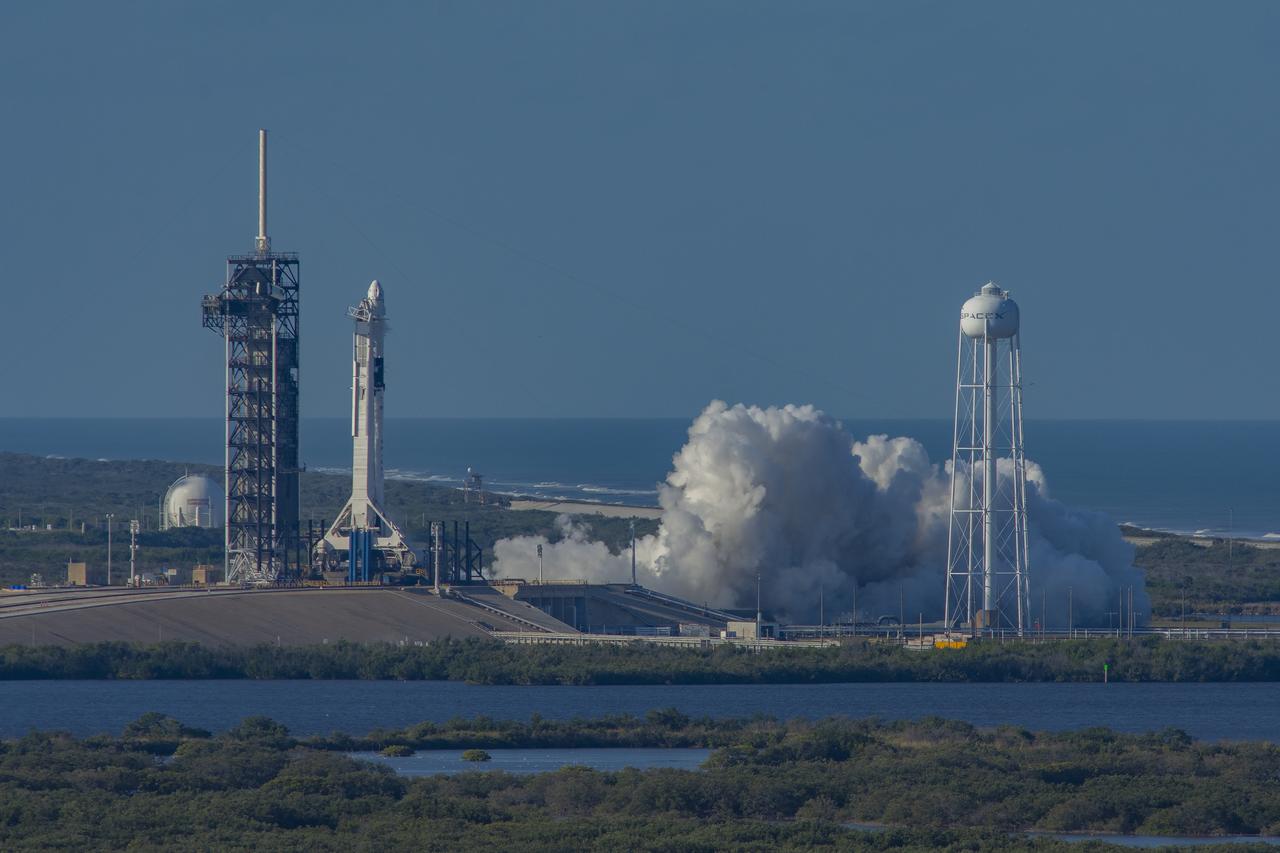
At NASA Kennedy Space Center’s Launch Complex 39A, the nine engines of a SpaceX Falcon 9 rocket roar to life in a brief static firing on Jan. 24, 2019. The test was part of checkouts prior to its liftoff for Demo-1, the inaugural flight of one of the spacecraft designed to take NASA astronauts to and from the International Space Station. NASA has worked with SpaceX and Boeing in developing Commercial Crew Program spacecraft to facilitate new human spaceflight systems launching from U.S. soil with the goal of safe, reliable and cost-effective access to low-Earth orbit destinations such as the space station.
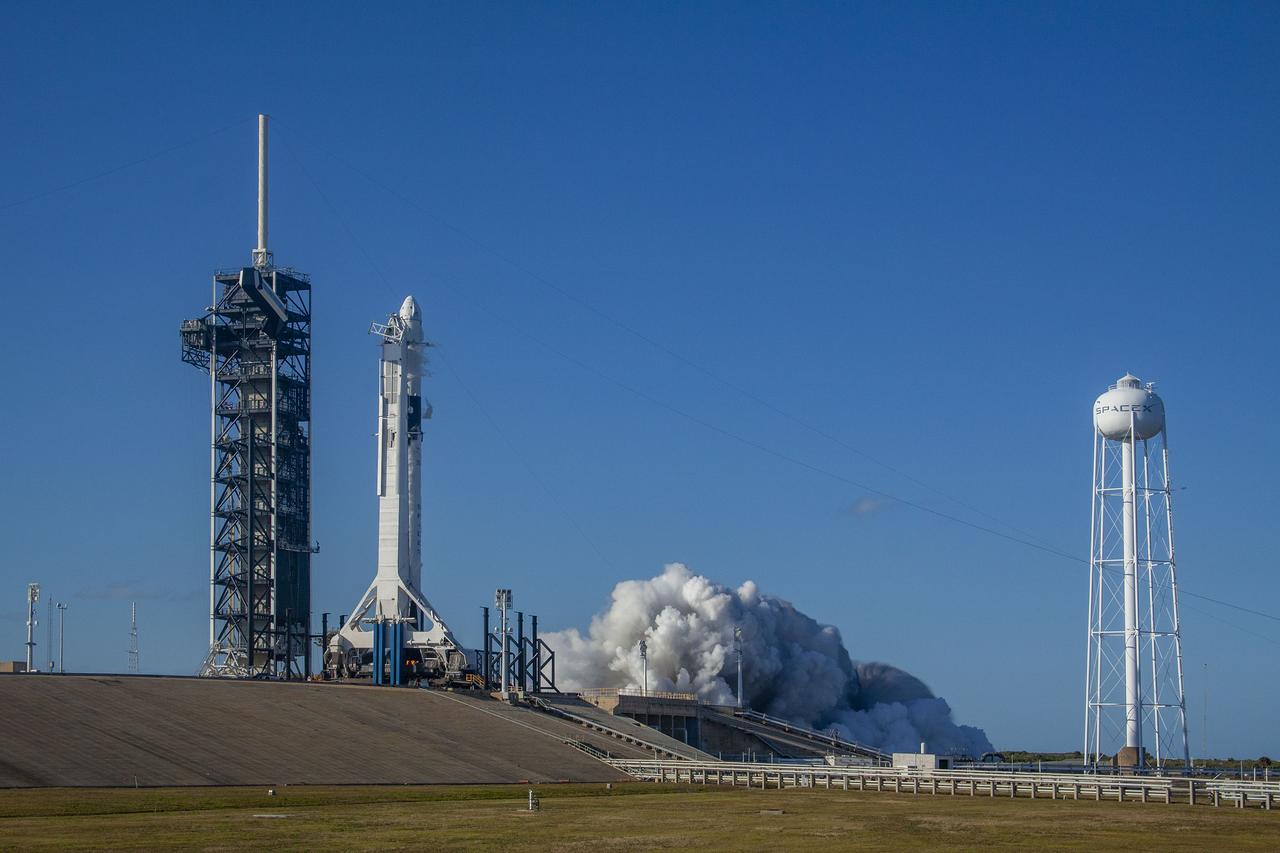
At NASA Kennedy Space Center’s Launch Complex 39A, the nine engines of a SpaceX Falcon 9 rocket roar to life in a brief static firing on Jan. 24, 2019. The test was part of checkouts prior to its liftoff for Demo-1, the inaugural flight of one of the spacecraft designed to take NASA astronauts to and from the International Space Station. NASA has worked with SpaceX and Boeing in developing Commercial Crew Program spacecraft to facilitate new human spaceflight systems launching from U.S. soil with the goal of safe, reliable and cost-effective access to low-Earth orbit destinations such as the space station.
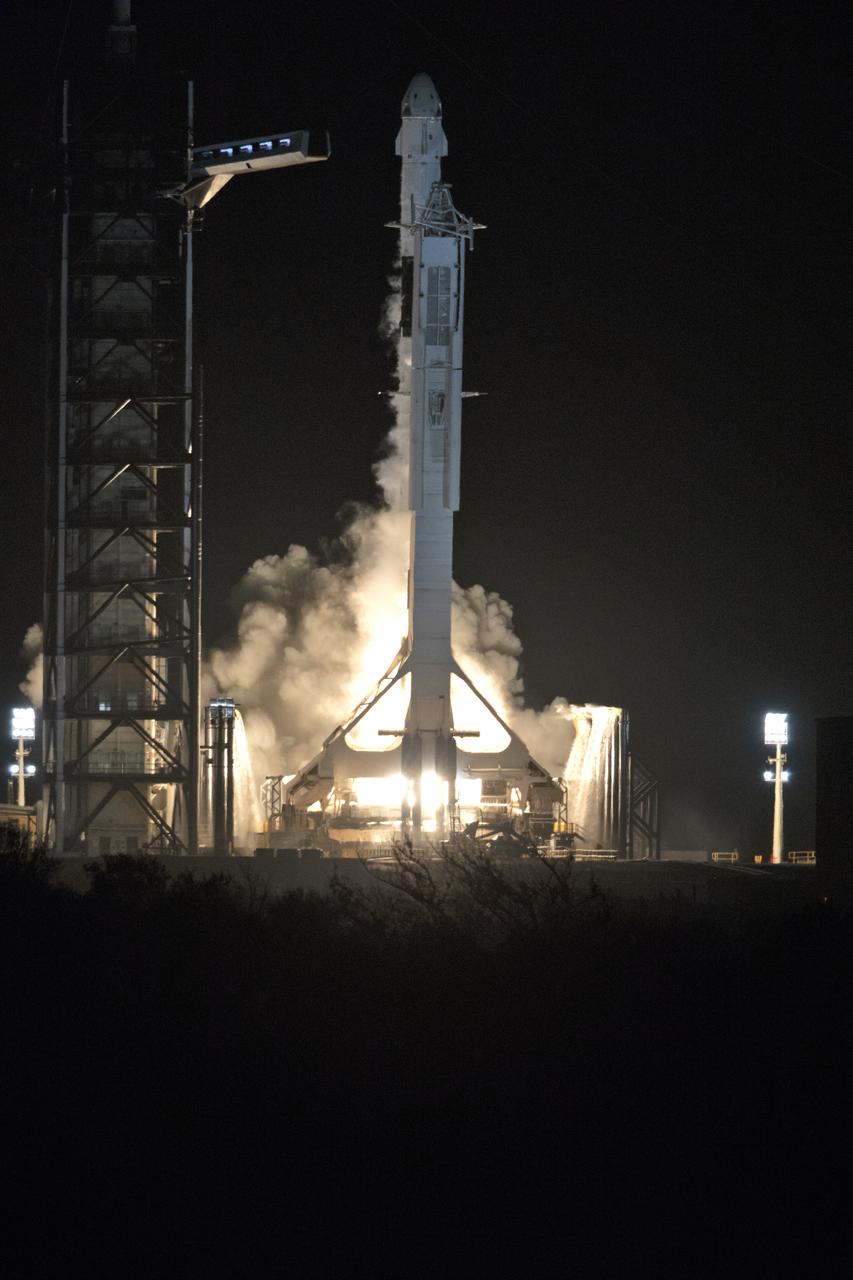
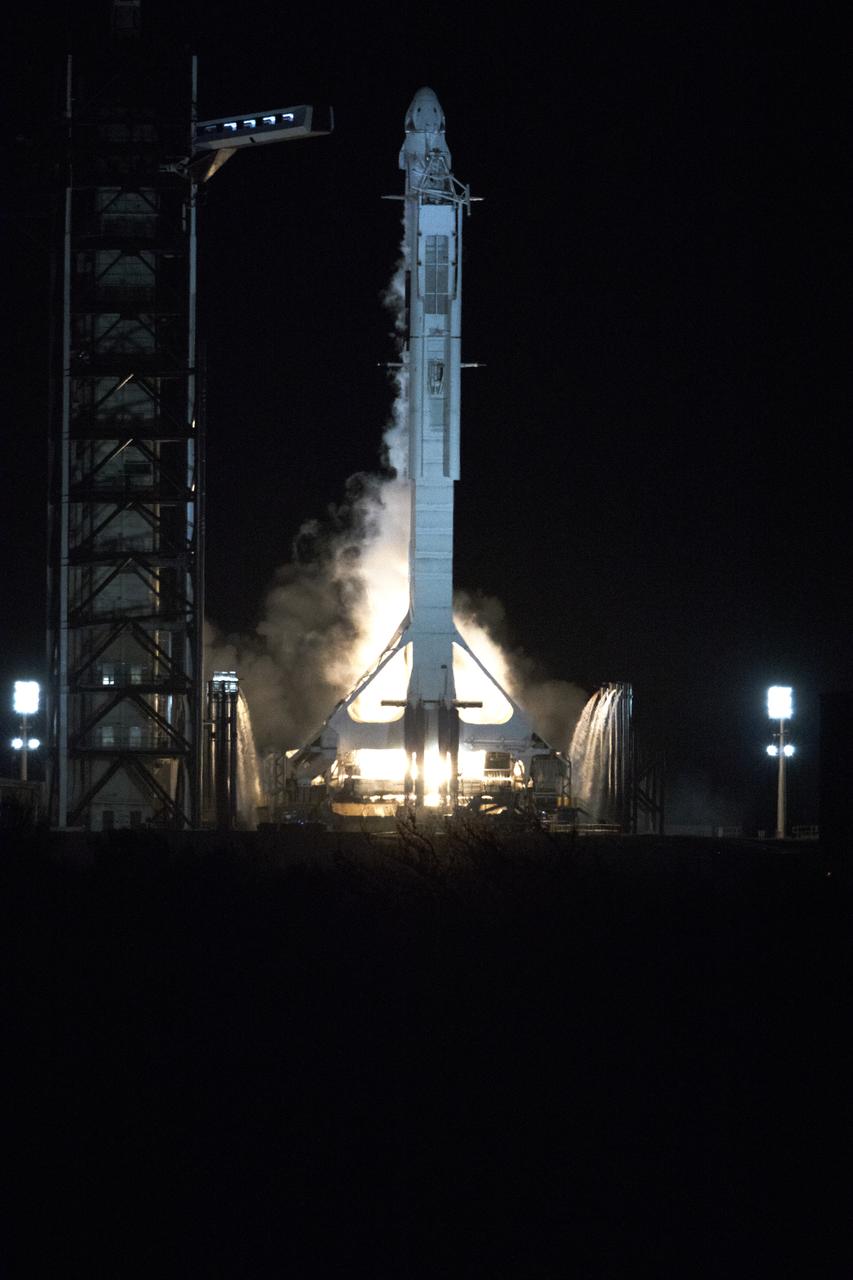
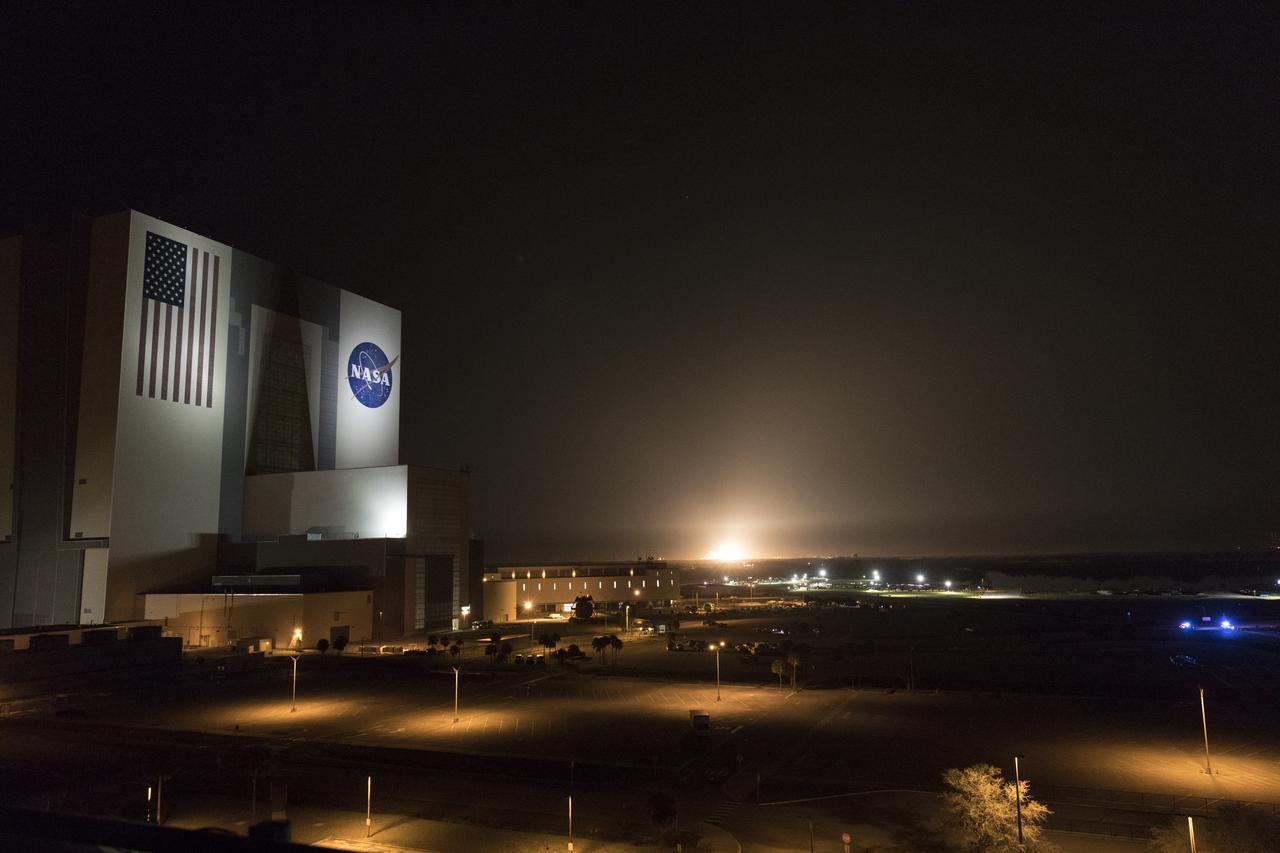
A two-stage SpaceX Falcon 9 rocket lifts off from Launch Complex 39A at NASA’s Kennedy Space Center in Florida for Demo-1, the first uncrewed mission of the agency’s Commercial Crew Program. Liftoff was at 2:49 a.m., March 2, 2019. The SpaceX Crew Dragon’s trip to the International Space Station is designed to validate end-to-end systems and capabilities, leading to certification to fly crew. NASA has worked with SpaceX and Boeing in developing the Commercial Crew Program spacecraft to facilitate new human spaceflight systems launching from U.S. soil with the goal of safe, reliable and cost-effective access to low-Earth orbit destinations, such as the space station.
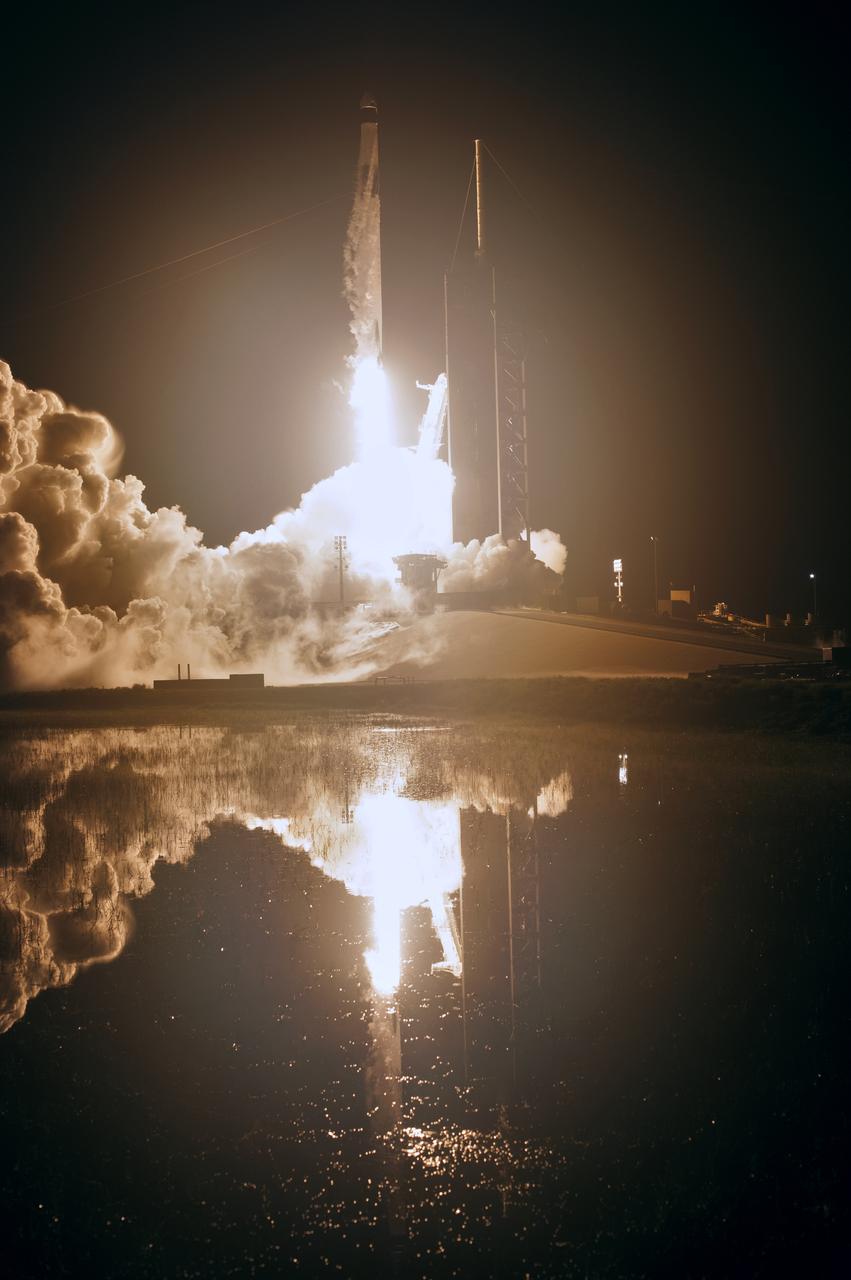
A two-stage SpaceX Falcon 9 rocket lifts off from Launch Complex 39A at NASA’s Kennedy Space Center in Florida for Demo-1, the first uncrewed mission of the agency’s Commercial Crew Program. Liftoff was at 2:49 a.m., March 2, 2019. The SpaceX Crew Dragon’s trip to the International Space Station is designed to validate end-to-end systems and capabilities, leading to certification to fly crew. NASA has worked with SpaceX and Boeing in developing the Commercial Crew Program spacecraft to facilitate new human spaceflight systems launching from U.S. soil with the goal of safe, reliable and cost-effective access to low-Earth orbit destinations, such as the space station.
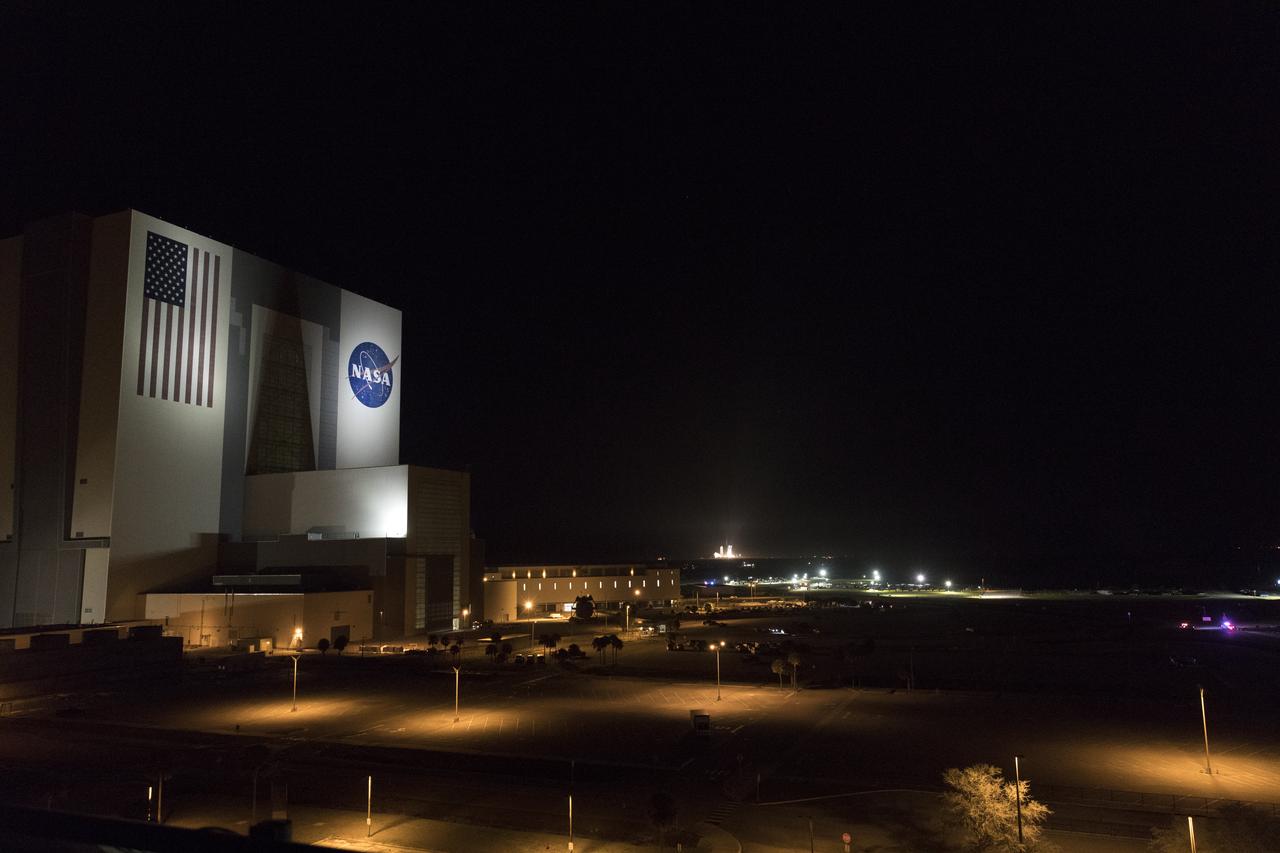
A two-stage SpaceX Falcon 9 rocket lifts off from Launch Complex 39A at NASA’s Kennedy Space Center in Florida for Demo-1, the first uncrewed mission of the agency’s Commercial Crew Program. Liftoff was at 2:49 a.m., March 2, 2019. The SpaceX Crew Dragon’s trip to the International Space Station is designed to validate end-to-end systems and capabilities, leading to certification to fly crew. NASA has worked with SpaceX and Boeing in developing the Commercial Crew Program spacecraft to facilitate new human spaceflight systems launching from U.S. soil with the goal of safe, reliable and cost-effective access to low-Earth orbit destinations, such as the space station.
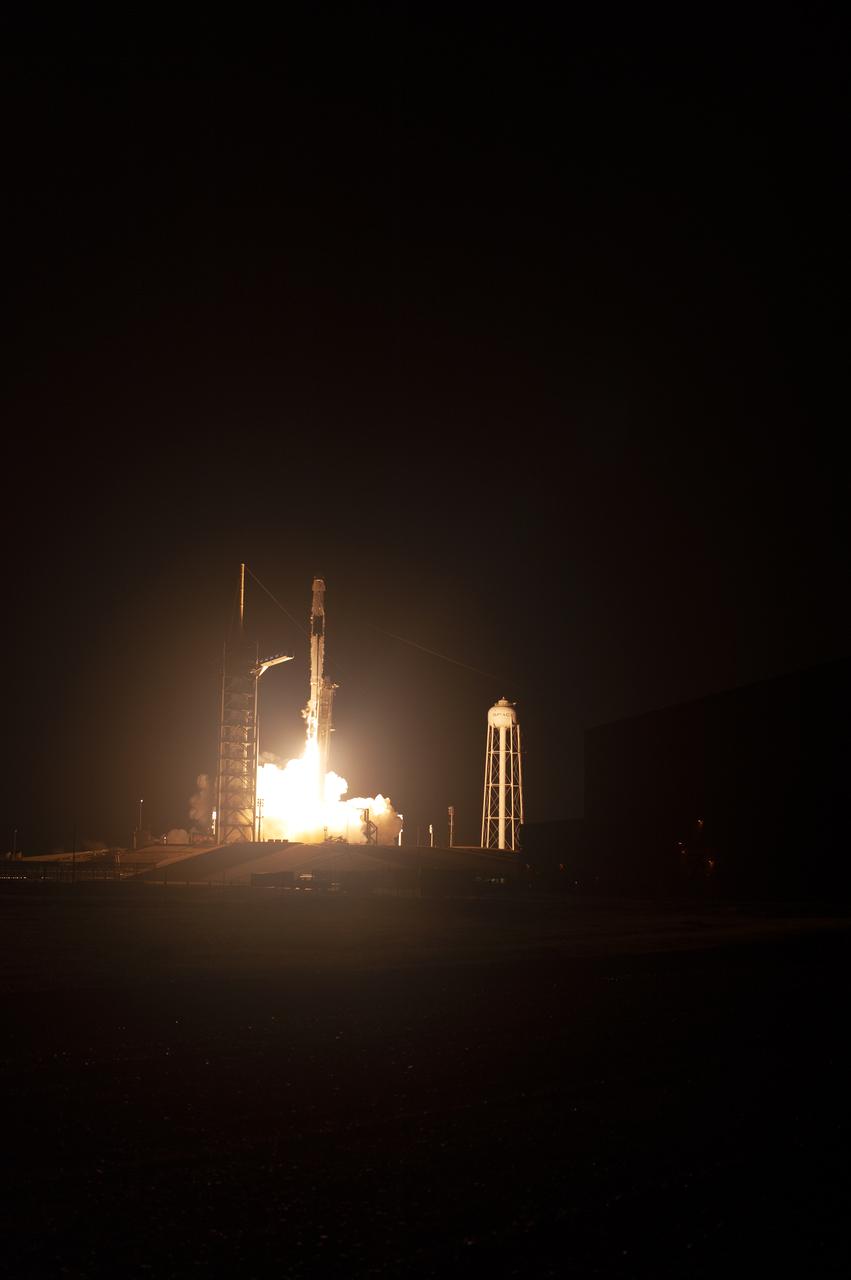
A two-stage SpaceX Falcon 9 rocket lifts off from Launch Complex 39A at NASA’s Kennedy Space Center in Florida for Demo-1, the first uncrewed mission of the agency’s Commercial Crew Program. Liftoff was at 2:49 a.m., March 2, 2019. The SpaceX Crew Dragon’s trip to the International Space Station is designed to validate end-to-end systems and capabilities, leading to certification to fly crew. NASA has worked with SpaceX and Boeing in developing the Commercial Crew Program spacecraft to facilitate new human spaceflight systems launching from U.S. soil with the goal of safe, reliable and cost-effective access to low-Earth orbit destinations, such as the space station.
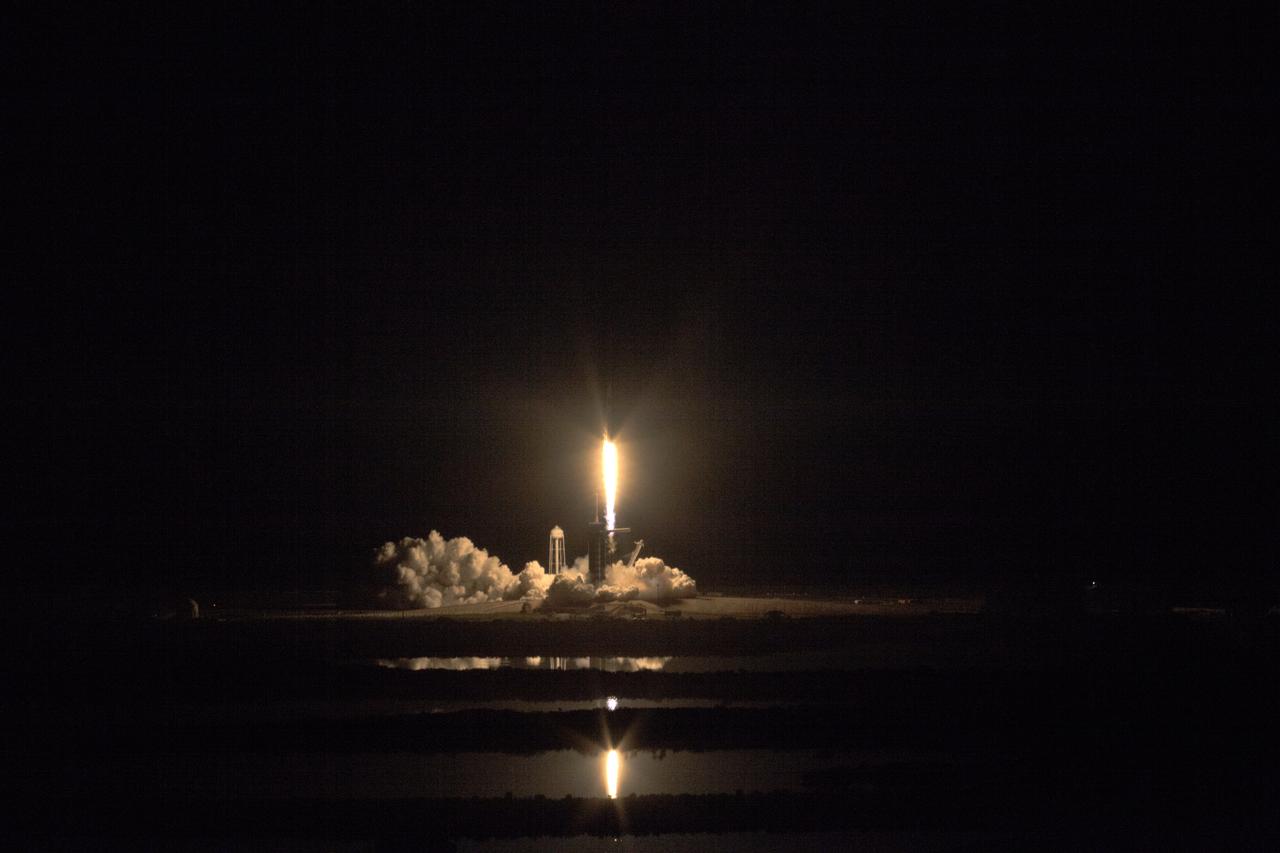
A two-stage SpaceX Falcon 9 rocket lifts off from Launch Complex 39A at NASA’s Kennedy Space Center in Florida for Demo-1, the first uncrewed mission of the agency’s Commercial Crew Program. Liftoff was at 2:49 a.m., March 2, 2019. The SpaceX Crew Dragon’s trip to the International Space Station is designed to validate end-to-end systems and capabilities, leading to certification to fly crew. NASA has worked with SpaceX and Boeing in developing the Commercial Crew Program spacecraft to facilitate new human spaceflight systems launching from U.S. soil with the goal of safe, reliable and cost-effective access to low-Earth orbit destinations, such as the space station.
A two-stage SpaceX Falcon 9 rocket lifts off from Launch Complex 39A at NASA’s Kennedy Space Center in Florida for Demo-1, the first uncrewed mission of the agency’s Commercial Crew Program. Liftoff was at 2:49 a.m., March 2, 2019. The SpaceX Crew Dragon’s trip to the International Space Station is designed to validate end-to-end systems and capabilities, leading to certification to fly crew. NASA has worked with SpaceX and Boeing in developing the Commercial Crew Program spacecraft to facilitate new human spaceflight systems launching from U.S. soil with the goal of safe, reliable and cost-effective access to low-Earth orbit destinations, such as the space station.
A two-stage SpaceX Falcon 9 rocket lifts off from Launch Complex 39A at NASA’s Kennedy Space Center in Florida for Demo-1, the first uncrewed mission of the agency’s Commercial Crew Program. Liftoff was at 2:49 a.m., March 2, 2019. The SpaceX Crew Dragon’s trip to the International Space Station is designed to validate end-to-end systems and capabilities, leading to certification to fly crew. NASA has worked with SpaceX and Boeing in developing the Commercial Crew Program spacecraft to facilitate new human spaceflight systems launching from U.S. soil with the goal of safe, reliable and cost-effective access to low-Earth orbit destinations, such as the space station.
A two-stage SpaceX Falcon 9 rocket lifts off from Launch Complex 39A at NASA’s Kennedy Space Center in Florida for Demo-1, the first uncrewed mission of the agency’s Commercial Crew Program. Liftoff was at 2:49 a.m., March 2, 2019. The SpaceX Crew Dragon’s trip to the International Space Station is designed to validate end-to-end systems and capabilities, leading to certification to fly crew. NASA has worked with SpaceX and Boeing in developing the Commercial Crew Program spacecraft to facilitate new human spaceflight systems launching from U.S. soil with the goal of safe, reliable and cost-effective access to low-Earth orbit destinations, such as the space station.
A two-stage SpaceX Falcon 9 rocket lifts off from Launch Complex 39A at NASA’s Kennedy Space Center in Florida for Demo-1, the first uncrewed mission of the agency’s Commercial Crew Program. Liftoff was at 2:49 a.m., March 2, 2019. The SpaceX Crew Dragon’s trip to the International Space Station is designed to validate end-to-end systems and capabilities, leading to certification to fly crew. NASA has worked with SpaceX and Boeing in developing the Commercial Crew Program spacecraft to facilitate new human spaceflight systems launching from U.S. soil with the goal of safe, reliable and cost-effective access to low-Earth orbit destinations, such as the space station.
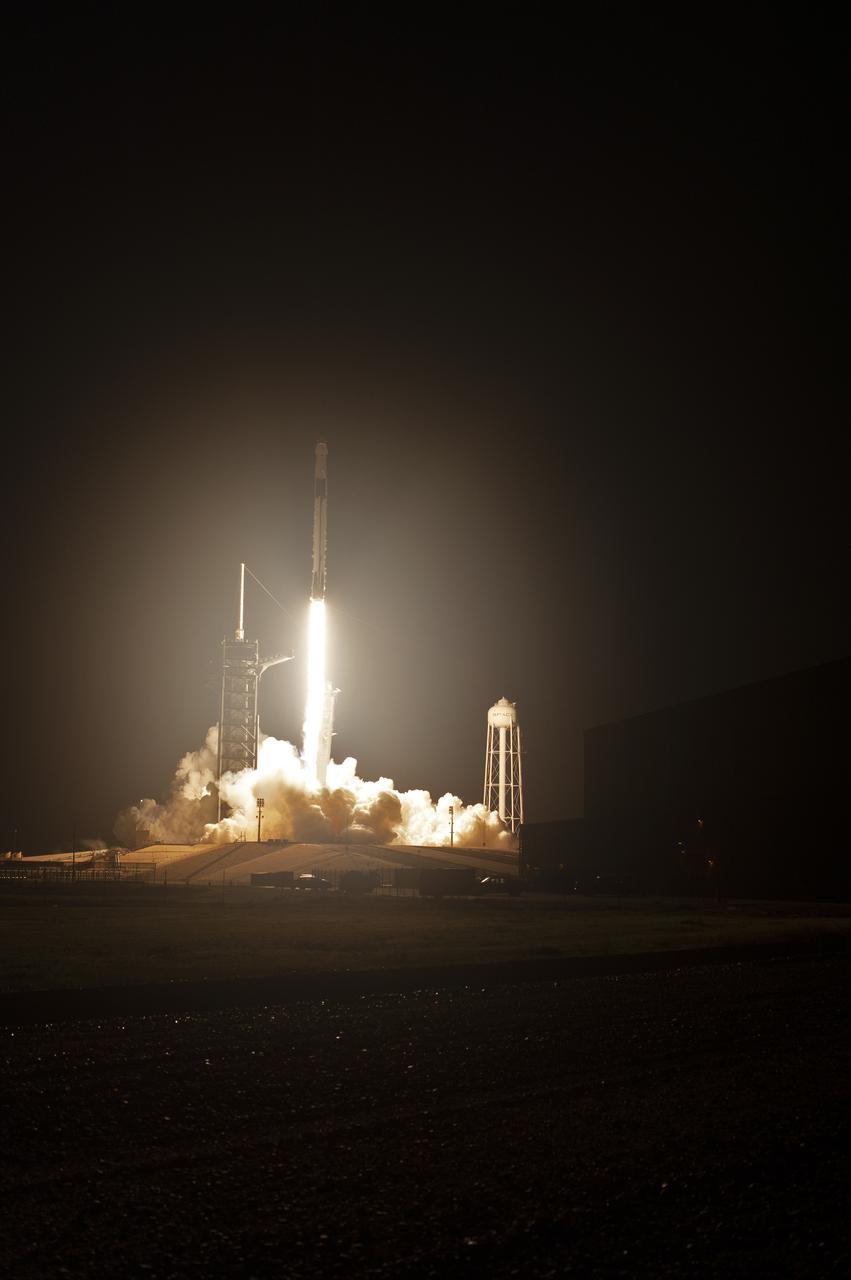
A two-stage SpaceX Falcon 9 rocket lifts off from Launch Complex 39A at NASA’s Kennedy Space Center in Florida for Demo-1, the first uncrewed mission of the agency’s Commercial Crew Program. Liftoff was at 2:49 a.m., March 2, 2019. The SpaceX Crew Dragon’s trip to the International Space Station is designed to validate end-to-end systems and capabilities, leading to certification to fly crew. NASA has worked with SpaceX and Boeing in developing the Commercial Crew Program spacecraft to facilitate new human spaceflight systems launching from U.S. soil with the goal of safe, reliable and cost-effective access to low-Earth orbit destinations, such as the space station.
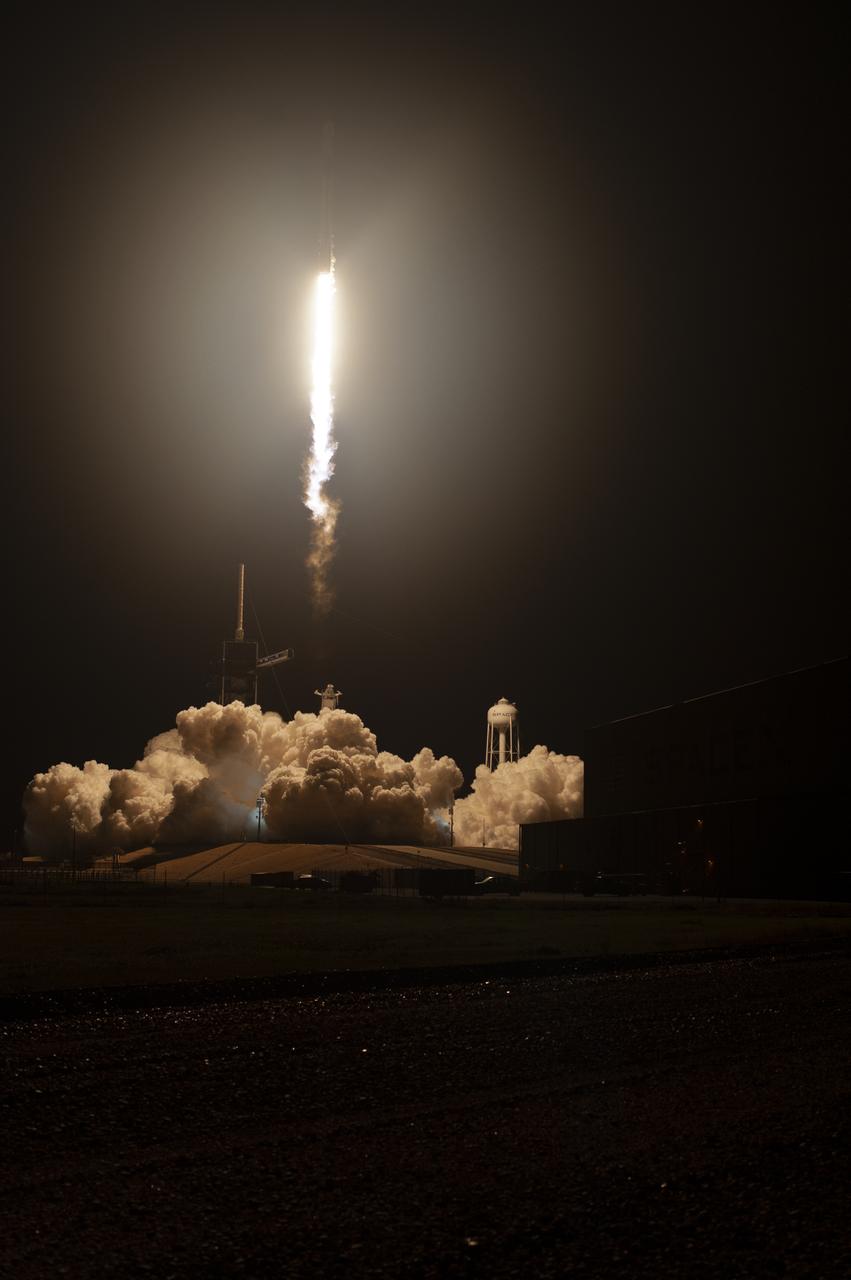
A two-stage SpaceX Falcon 9 rocket lifts off from Launch Complex 39A at NASA’s Kennedy Space Center in Florida for Demo-1, the first uncrewed mission of the agency’s Commercial Crew Program. Liftoff was at 2:49 a.m., March 2, 2019. The SpaceX Crew Dragon’s trip to the International Space Station is designed to validate end-to-end systems and capabilities, leading to certification to fly crew. NASA has worked with SpaceX and Boeing in developing the Commercial Crew Program spacecraft to facilitate new human spaceflight systems launching from U.S. soil with the goal of safe, reliable and cost-effective access to low-Earth orbit destinations, such as the space station.
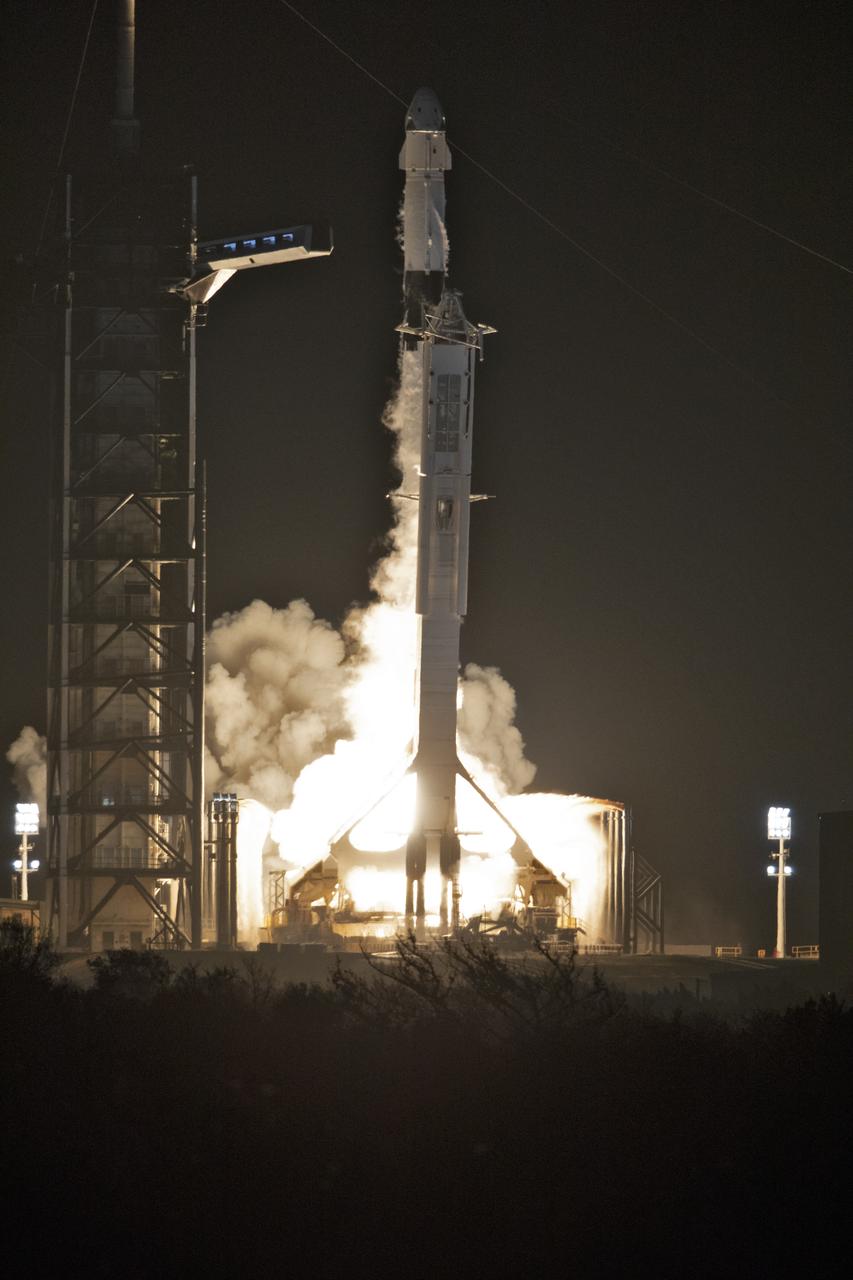
A two-stage SpaceX Falcon 9 rocket lifts off from Launch Complex 39A at NASA’s Kennedy Space Center in Florida for Demo-1, the first uncrewed mission of the agency’s Commercial Crew Program. Liftoff was at 2:49 a.m., March 2, 2019. The SpaceX Crew Dragon’s trip to the International Space Station is designed to validate end-to-end systems and capabilities, leading to certification to fly crew. NASA has worked with SpaceX and Boeing in developing the Commercial Crew Program spacecraft to facilitate new human spaceflight systems launching from U.S. soil with the goal of safe, reliable and cost-effective access to low-Earth orbit destinations, such as the space station.
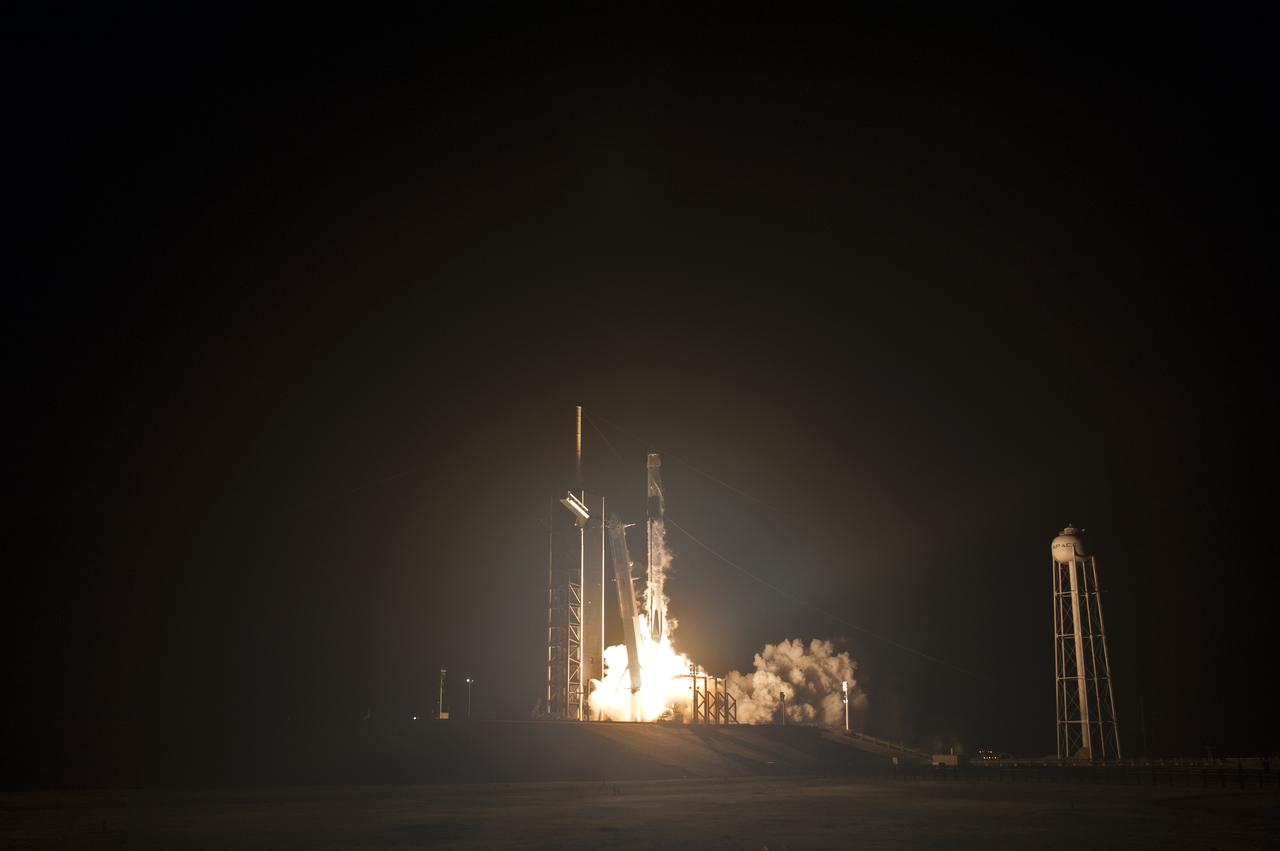
A two-stage SpaceX Falcon 9 rocket lifts off from Launch Complex 39A at NASA’s Kennedy Space Center in Florida for Demo-1, the first uncrewed mission of the agency’s Commercial Crew Program. Liftoff was at 2:49 a.m., March 2, 2019. The SpaceX Crew Dragon’s trip to the International Space Station is designed to validate end-to-end systems and capabilities, leading to certification to fly crew. NASA has worked with SpaceX and Boeing in developing the Commercial Crew Program spacecraft to facilitate new human spaceflight systems launching from U.S. soil with the goal of safe, reliable and cost-effective access to low-Earth orbit destinations, such as the space station.
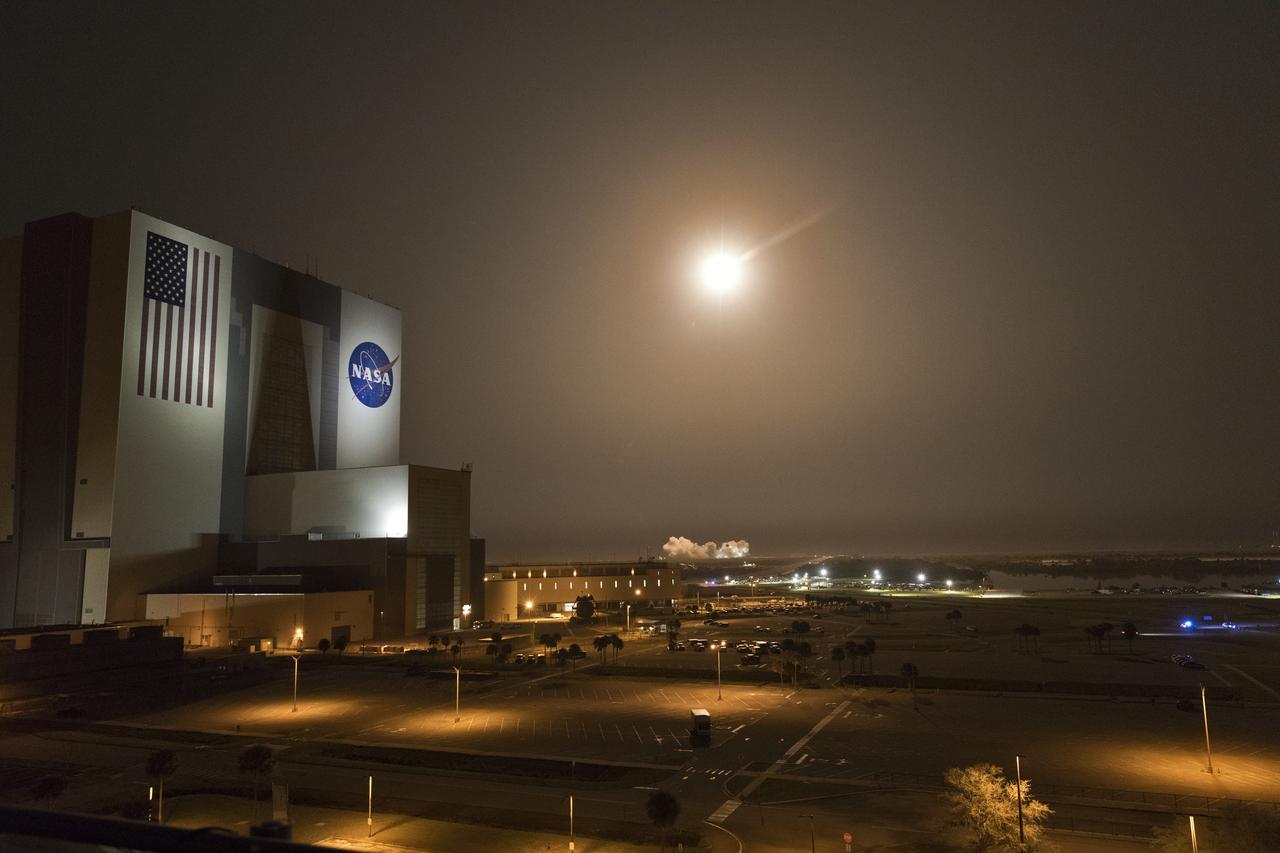
A two-stage SpaceX Falcon 9 rocket lifts off from Launch Complex 39A at NASA’s Kennedy Space Center in Florida for Demo-1, the first uncrewed mission of the agency’s Commercial Crew Program. Liftoff was at 2:49 a.m., March 2, 2019. The SpaceX Crew Dragon’s trip to the International Space Station is designed to validate end-to-end systems and capabilities, leading to certification to fly crew. NASA has worked with SpaceX and Boeing in developing the Commercial Crew Program spacecraft to facilitate new human spaceflight systems launching from U.S. soil with the goal of safe, reliable and cost-effective access to low-Earth orbit destinations, such as the space station.
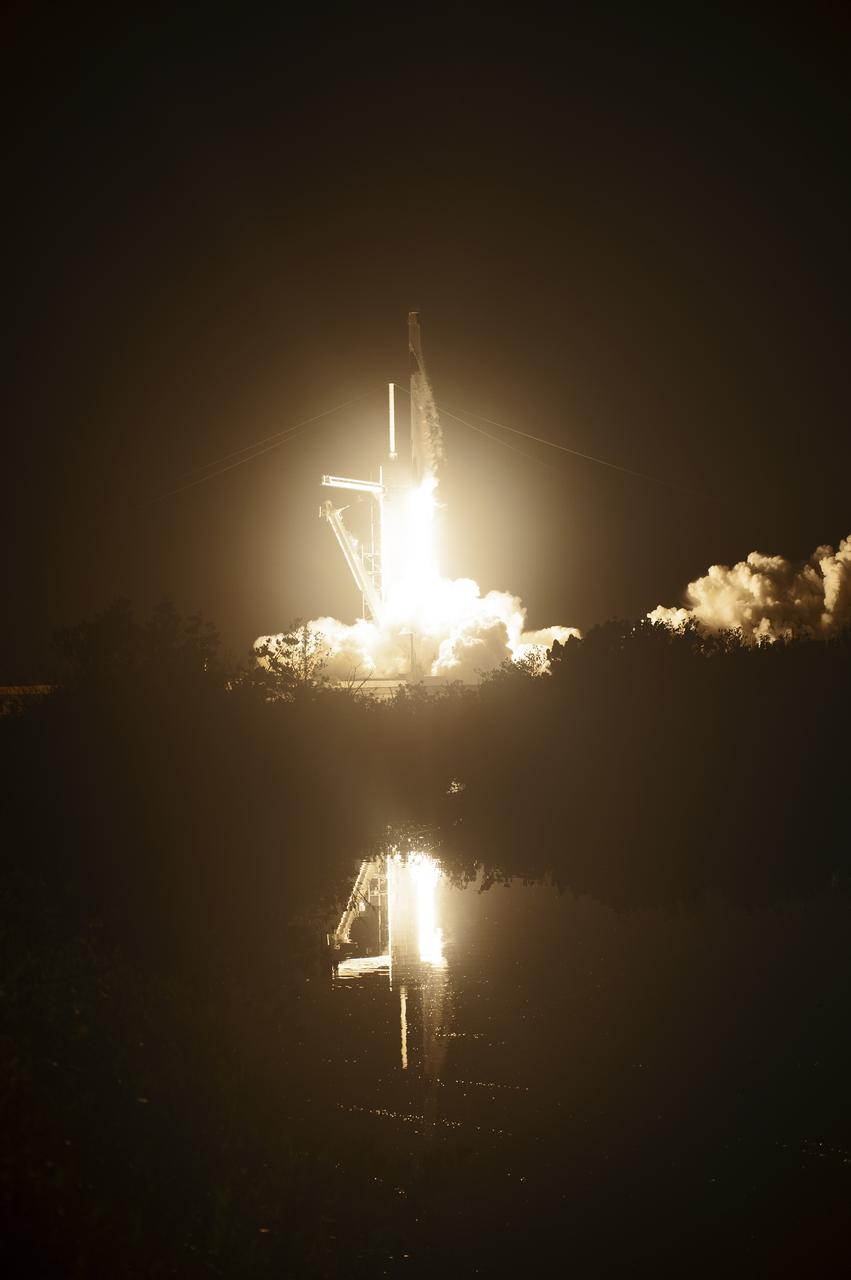
A two-stage SpaceX Falcon 9 rocket lifts off from Launch Complex 39A at NASA’s Kennedy Space Center in Florida for Demo-1, the first uncrewed mission of the agency’s Commercial Crew Program. Liftoff was at 2:49 a.m., March 2, 2019. The SpaceX Crew Dragon’s trip to the International Space Station is designed to validate end-to-end systems and capabilities, leading to certification to fly crew. NASA has worked with SpaceX and Boeing in developing the Commercial Crew Program spacecraft to facilitate new human spaceflight systems launching from U.S. soil with the goal of safe, reliable and cost-effective access to low-Earth orbit destinations, such as the space station.
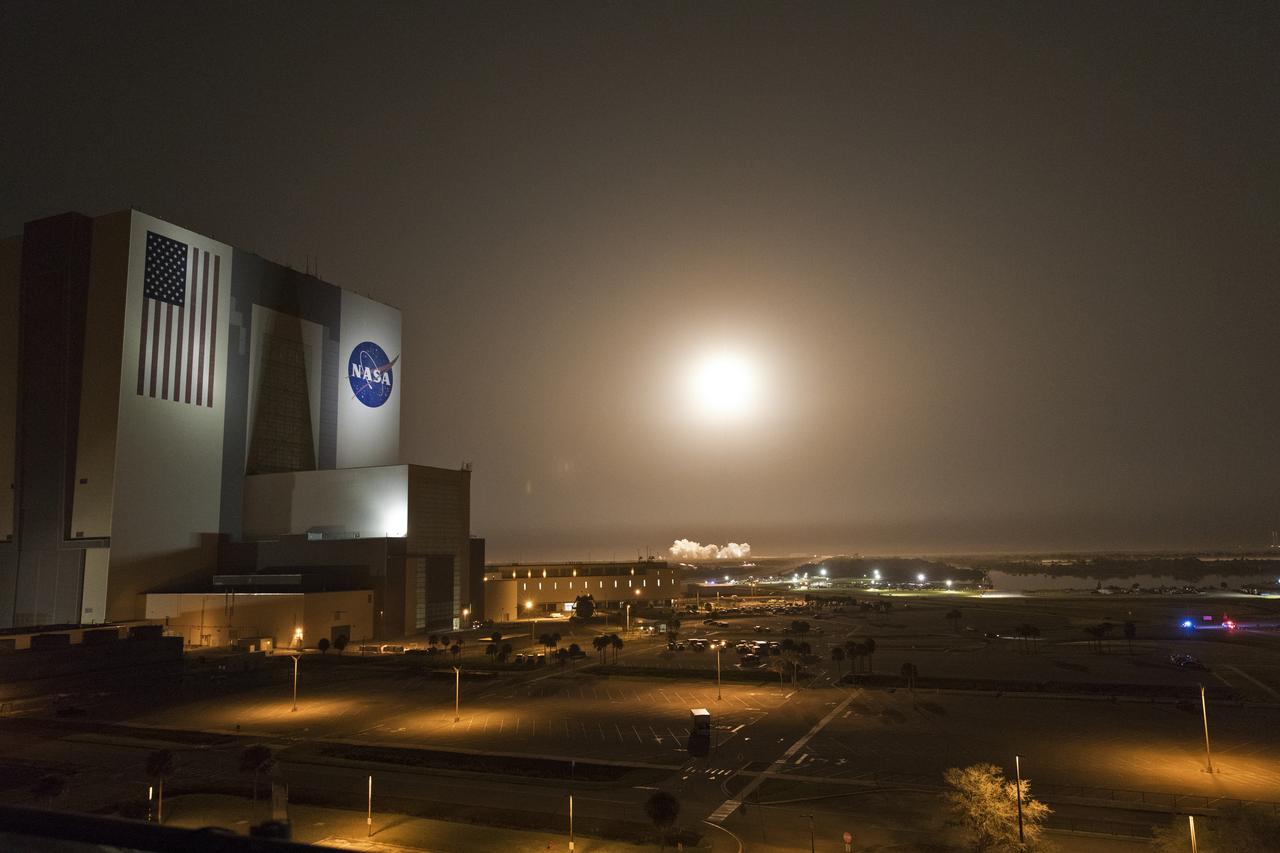
A two-stage SpaceX Falcon 9 rocket lifts off from Launch Complex 39A at NASA’s Kennedy Space Center in Florida for Demo-1, the first uncrewed mission of the agency’s Commercial Crew Program. Liftoff was at 2:49 a.m., March 2, 2019. The SpaceX Crew Dragon’s trip to the International Space Station is designed to validate end-to-end systems and capabilities, leading to certification to fly crew. NASA has worked with SpaceX and Boeing in developing the Commercial Crew Program spacecraft to facilitate new human spaceflight systems launching from U.S. soil with the goal of safe, reliable and cost-effective access to low-Earth orbit destinations, such as the space station.

A two-stage SpaceX Falcon 9 rocket lifts off from Launch Complex 39A at NASA’s Kennedy Space Center in Florida for Demo-1, the first uncrewed mission of the agency’s Commercial Crew Program. Liftoff was at 2:49 a.m., March 2, 2019. The SpaceX Crew Dragon’s trip to the International Space Station is designed to validate end-to-end systems and capabilities, leading to certification to fly crew. NASA has worked with SpaceX and Boeing in developing the Commercial Crew Program spacecraft to facilitate new human spaceflight systems launching from U.S. soil with the goal of safe, reliable and cost-effective access to low-Earth orbit destinations, such as the space station.
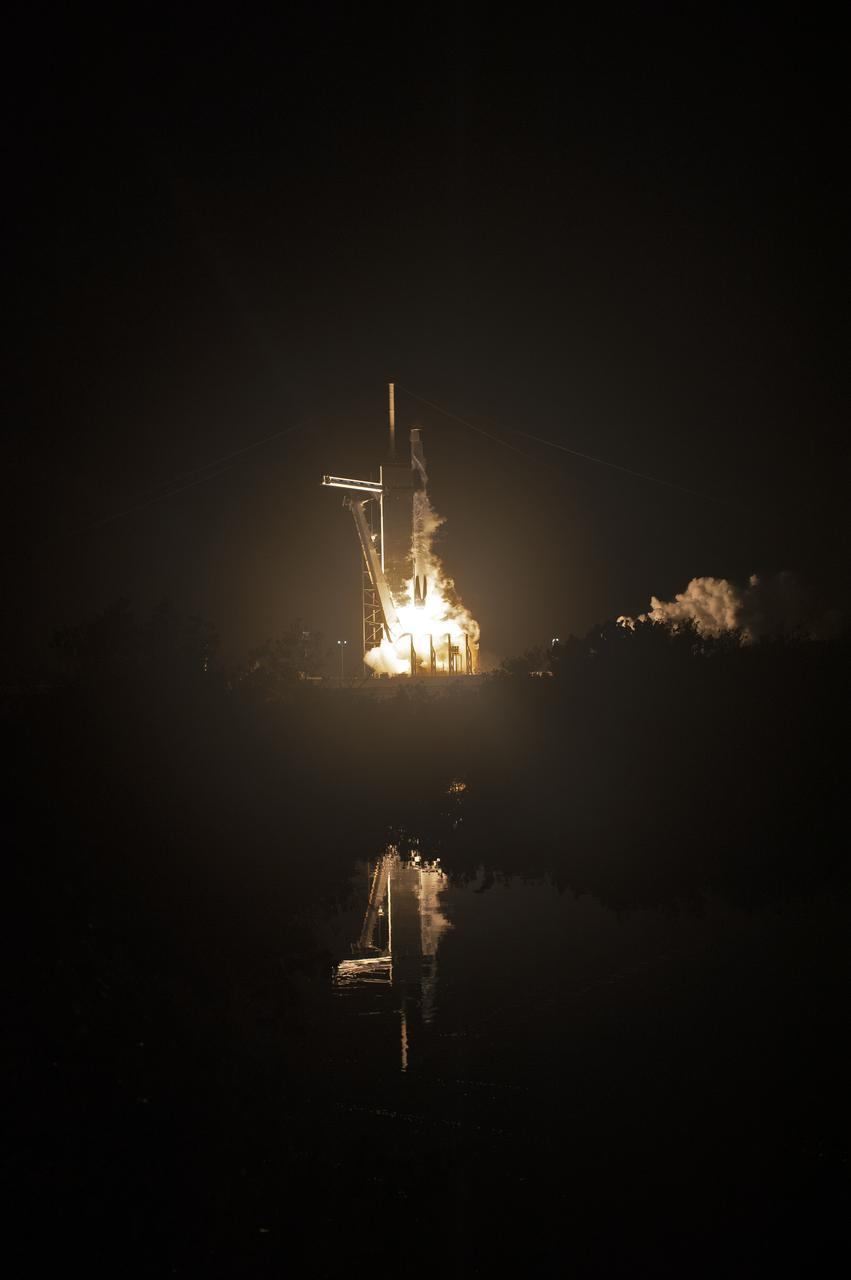
A two-stage SpaceX Falcon 9 rocket lifts off from Launch Complex 39A at NASA’s Kennedy Space Center in Florida for Demo-1, the first uncrewed mission of the agency’s Commercial Crew Program. Liftoff was at 2:49 a.m., March 2, 2019. The SpaceX Crew Dragon’s trip to the International Space Station is designed to validate end-to-end systems and capabilities, leading to certification to fly crew. NASA has worked with SpaceX and Boeing in developing the Commercial Crew Program spacecraft to facilitate new human spaceflight systems launching from U.S. soil with the goal of safe, reliable and cost-effective access to low-Earth orbit destinations, such as the space station.

A two-stage SpaceX Falcon 9 rocket lifts off from Launch Complex 39A at NASA’s Kennedy Space Center in Florida for Demo-1, the first uncrewed mission of the agency’s Commercial Crew Program. Liftoff was at 2:49 a.m., March 2, 2019. The SpaceX Crew Dragon’s trip to the International Space Station is designed to validate end-to-end systems and capabilities, leading to certification to fly crew. NASA has worked with SpaceX and Boeing in developing the Commercial Crew Program spacecraft to facilitate new human spaceflight systems launching from U.S. soil with the goal of safe, reliable and cost-effective access to low-Earth orbit destinations, such as the space station.

A two-stage SpaceX Falcon 9 rocket lifts off from Launch Complex 39A at NASA’s Kennedy Space Center in Florida for Demo-1, the first uncrewed mission of the agency’s Commercial Crew Program. Liftoff was at 2:49 a.m., March 2, 2019. The SpaceX Crew Dragon’s trip to the International Space Station is designed to validate end-to-end systems and capabilities, leading to certification to fly crew. NASA has worked with SpaceX and Boeing in developing the Commercial Crew Program spacecraft to facilitate new human spaceflight systems launching from U.S. soil with the goal of safe, reliable and cost-effective access to low-Earth orbit destinations, such as the space station.
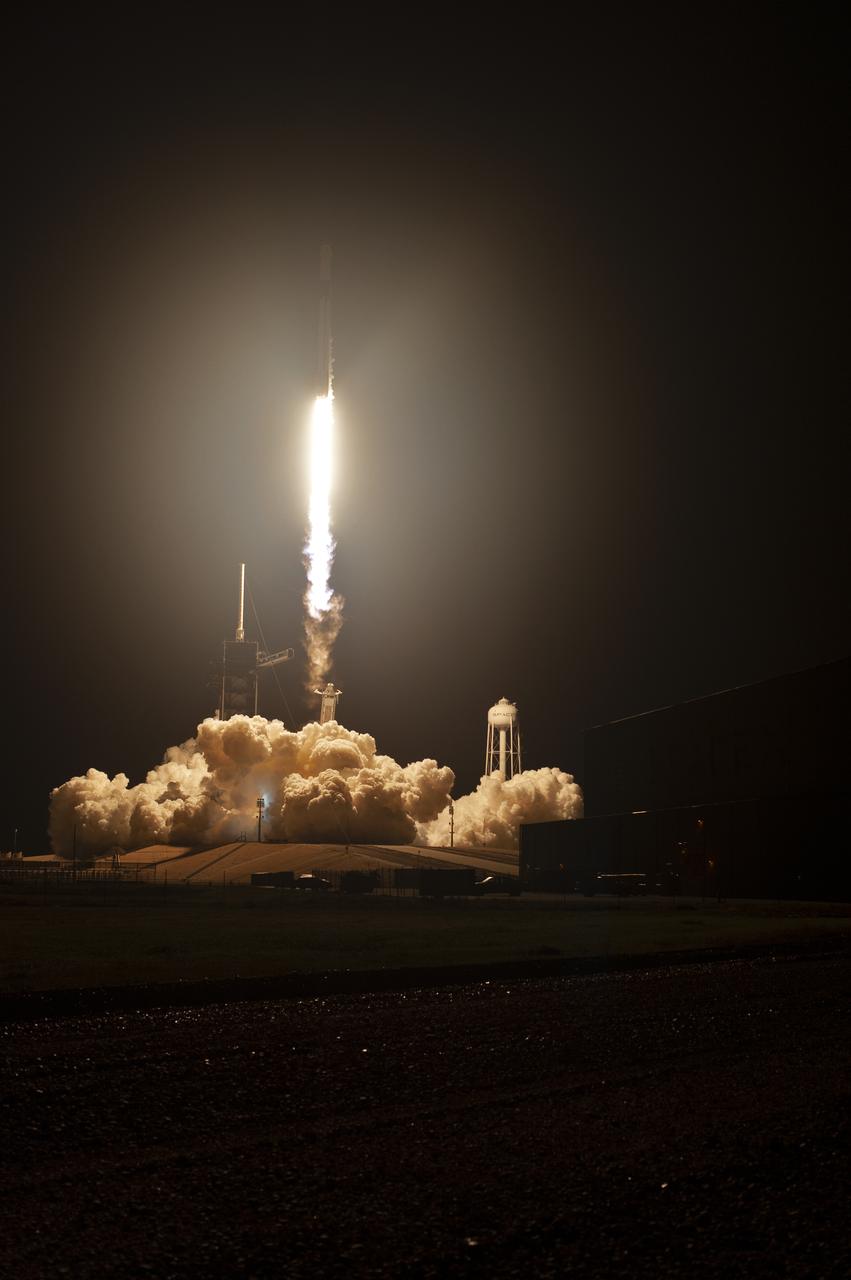
A two-stage SpaceX Falcon 9 rocket lifts off from Launch Complex 39A at NASA’s Kennedy Space Center in Florida for Demo-1, the first uncrewed mission of the agency’s Commercial Crew Program. Liftoff was at 2:49 a.m., March 2, 2019. The SpaceX Crew Dragon’s trip to the International Space Station is designed to validate end-to-end systems and capabilities, leading to certification to fly crew. NASA has worked with SpaceX and Boeing in developing the Commercial Crew Program spacecraft to facilitate new human spaceflight systems launching from U.S. soil with the goal of safe, reliable and cost-effective access to low-Earth orbit destinations, such as the space station.

A two-stage SpaceX Falcon 9 rocket lifts off from Launch Complex 39A at NASA’s Kennedy Space Center in Florida for Demo-1, the first uncrewed mission of the agency’s Commercial Crew Program. Liftoff was at 2:49 a.m., March 2, 2019. The SpaceX Crew Dragon’s trip to the International Space Station is designed to validate end-to-end systems and capabilities, leading to certification to fly crew. NASA has worked with SpaceX and Boeing in developing the Commercial Crew Program spacecraft to facilitate new human spaceflight systems launching from U.S. soil with the goal of safe, reliable and cost-effective access to low-Earth orbit destinations, such as the space station.
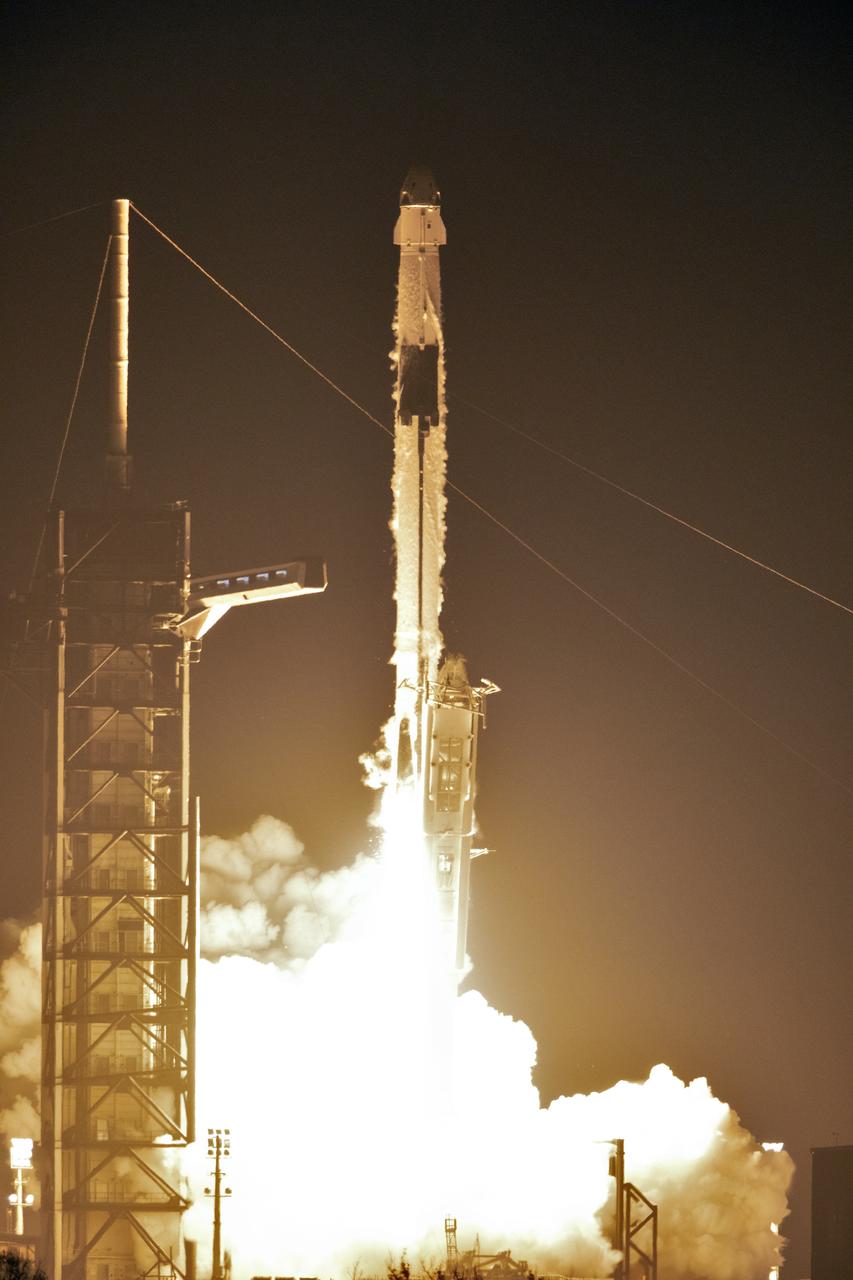
A two-stage SpaceX Falcon 9 rocket lifts off from Launch Complex 39A at NASA’s Kennedy Space Center in Florida for Demo-1, the first uncrewed mission of the agency’s Commercial Crew Program. Liftoff was at 2:49 a.m., March 2, 2019. The SpaceX Crew Dragon’s trip to the International Space Station is designed to validate end-to-end systems and capabilities, leading to certification to fly crew. NASA has worked with SpaceX and Boeing in developing the Commercial Crew Program spacecraft to facilitate new human spaceflight systems launching from U.S. soil with the goal of safe, reliable and cost-effective access to low-Earth orbit destinations, such as the space station.
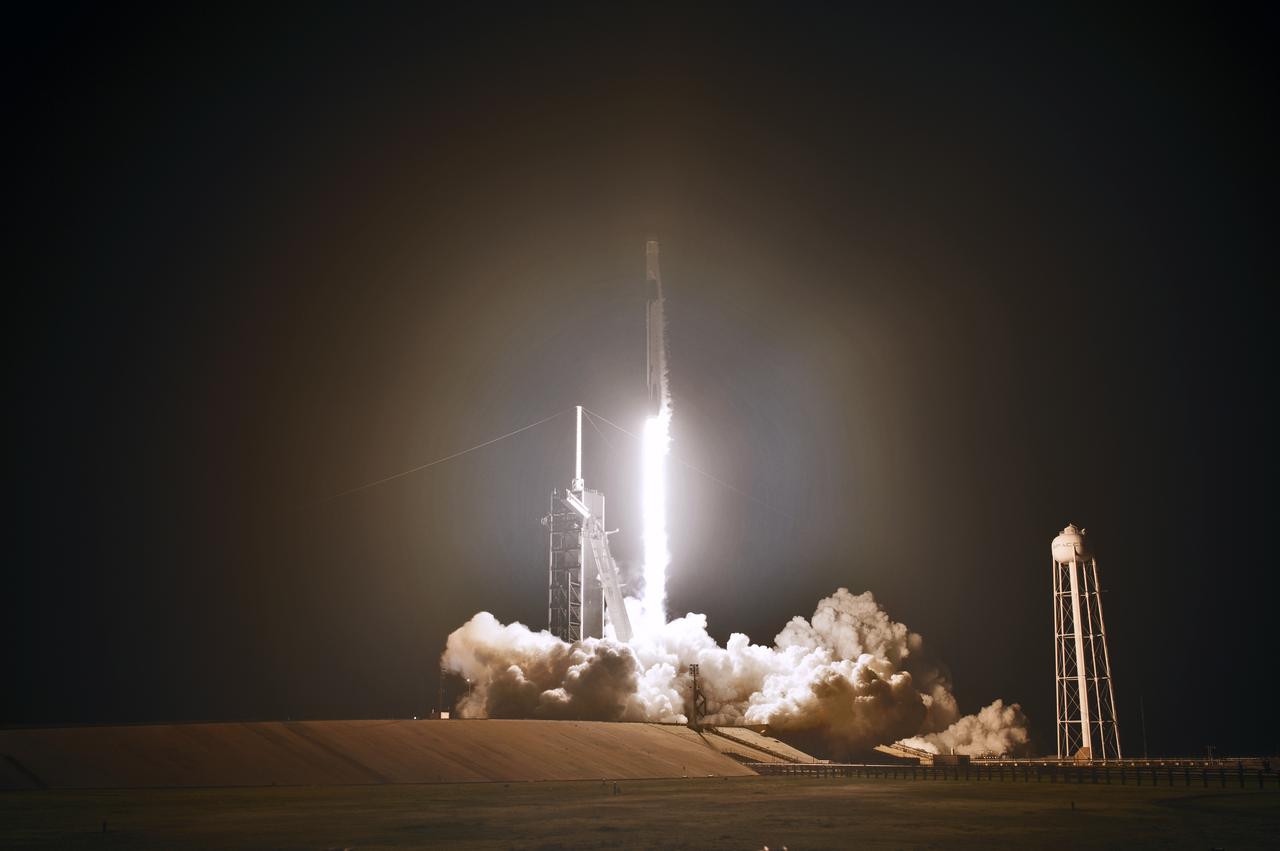
A two-stage SpaceX Falcon 9 rocket lifts off from Launch Complex 39A at NASA’s Kennedy Space Center in Florida for Demo-1, the first uncrewed mission of the agency’s Commercial Crew Program. Liftoff was at 2:49 a.m., March 2, 2019. The SpaceX Crew Dragon’s trip to the International Space Station is designed to validate end-to-end systems and capabilities, leading to certification to fly crew. NASA has worked with SpaceX and Boeing in developing the Commercial Crew Program spacecraft to facilitate new human spaceflight systems launching from U.S. soil with the goal of safe, reliable and cost-effective access to low-Earth orbit destinations, such as the space station.
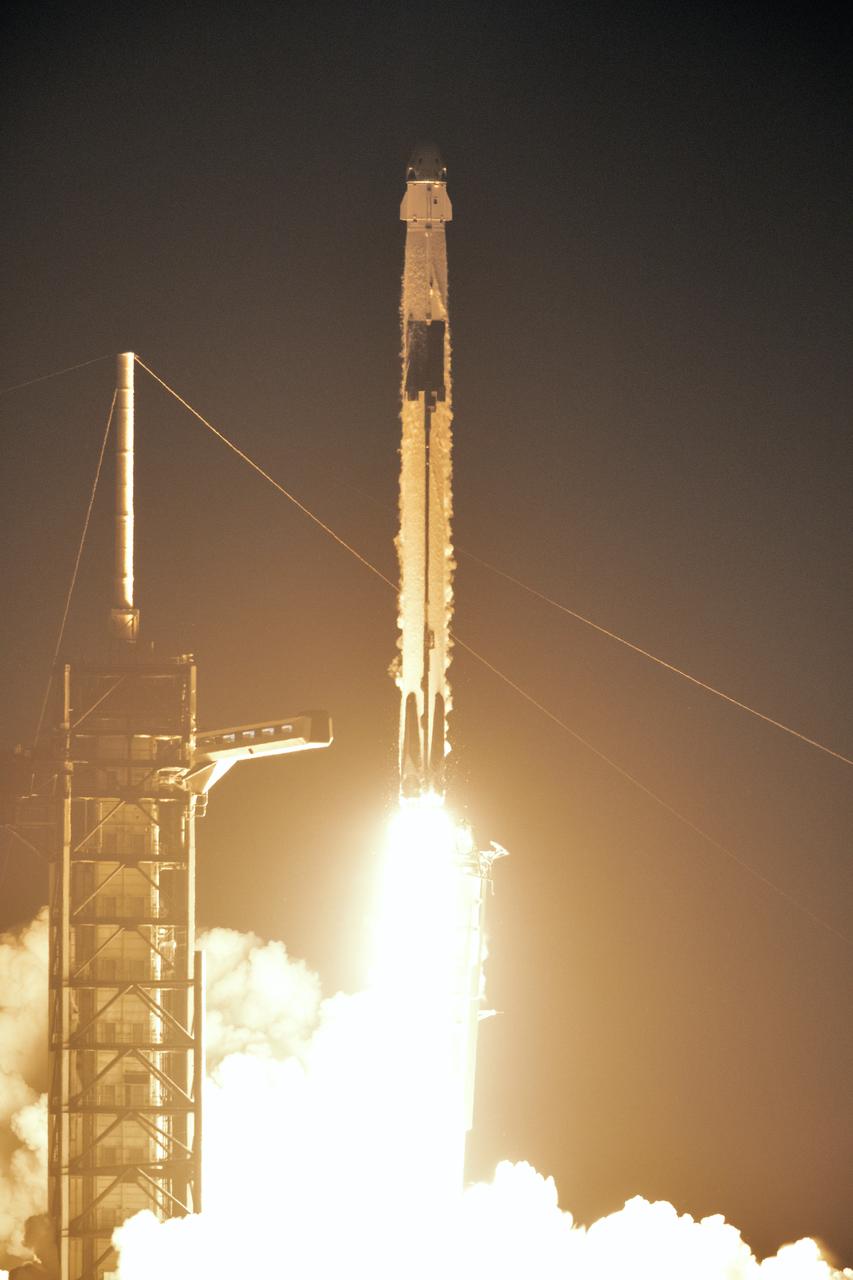
A two-stage SpaceX Falcon 9 rocket lifts off from Launch Complex 39A at NASA’s Kennedy Space Center in Florida for Demo-1, the first uncrewed mission of the agency’s Commercial Crew Program. Liftoff was at 2:49 a.m., March 2, 2019. The SpaceX Crew Dragon’s trip to the International Space Station is designed to validate end-to-end systems and capabilities, leading to certification to fly crew. NASA has worked with SpaceX and Boeing in developing the Commercial Crew Program spacecraft to facilitate new human spaceflight systems launching from U.S. soil with the goal of safe, reliable and cost-effective access to low-Earth orbit destinations, such as the space station.
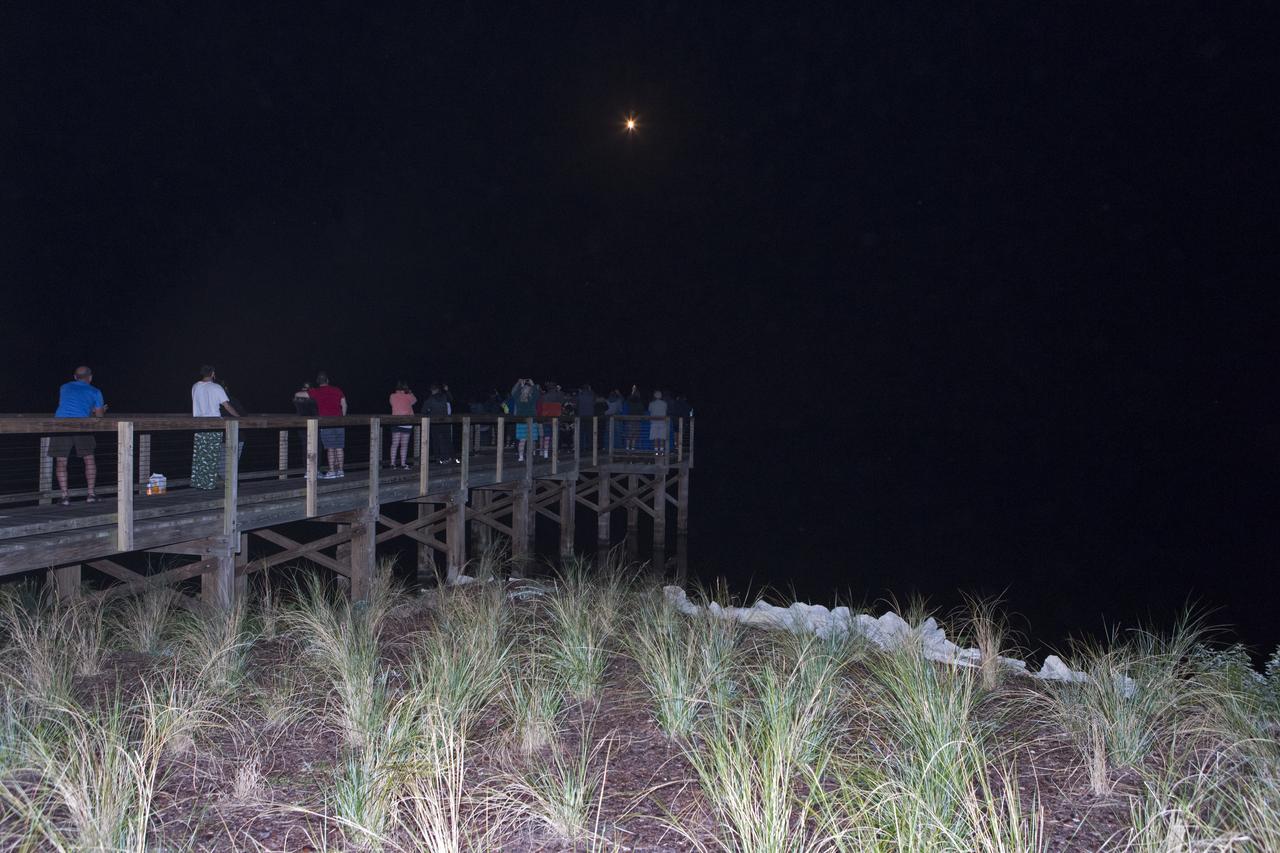
A two-stage SpaceX Falcon 9 rocket lifts off from Launch Complex 39A at NASA’s Kennedy Space Center in Florida for Demo-1, the first uncrewed mission of the agency’s Commercial Crew Program. Liftoff was at 2:49 a.m., March 2, 2019. The SpaceX Crew Dragon’s trip to the International Space Station is designed to validate end-to-end systems and capabilities, leading to certification to fly crew. NASA has worked with SpaceX and Boeing in developing the Commercial Crew Program spacecraft to facilitate new human spaceflight systems launching from U.S. soil with the goal of safe, reliable and cost-effective access to low-Earth orbit destinations, such as the space station.
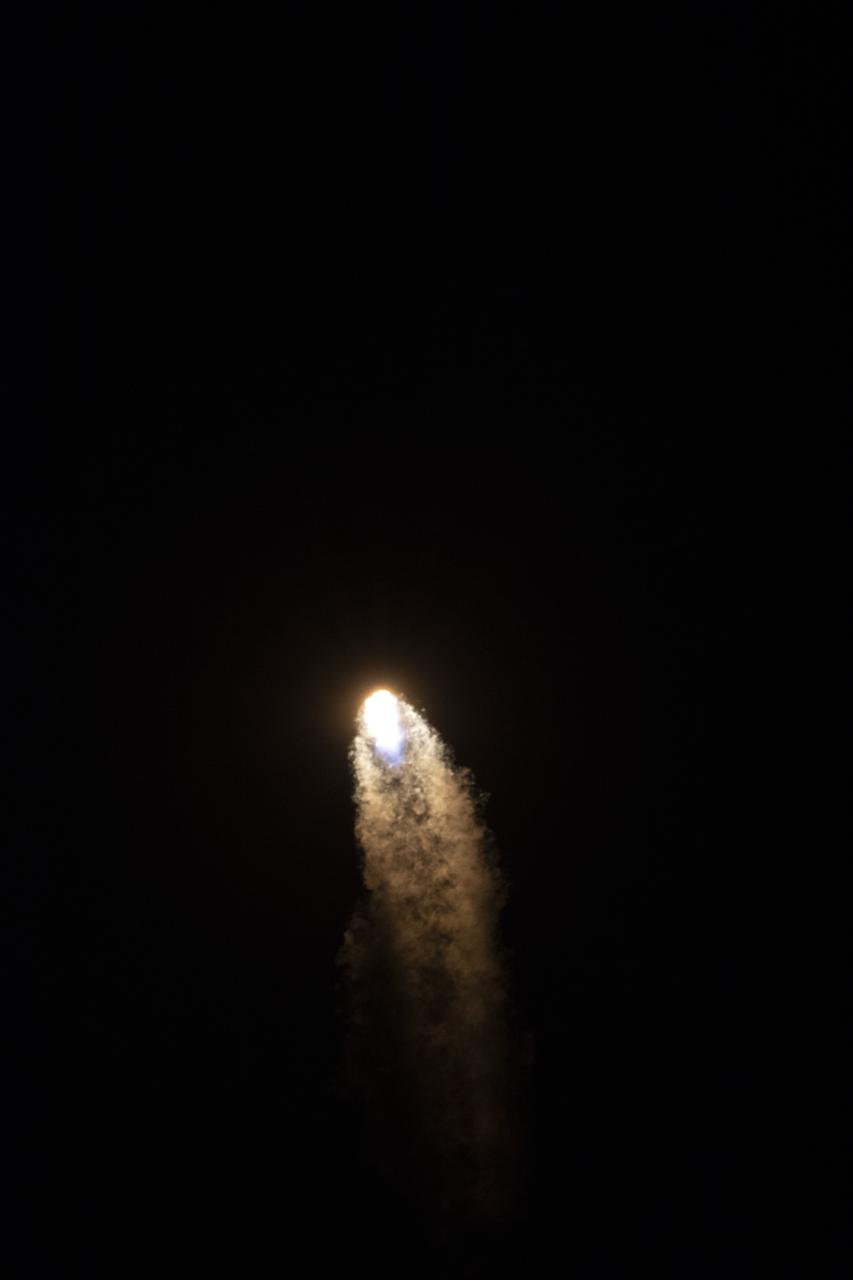
A two-stage SpaceX Falcon 9 rocket lifts off from Launch Complex 39A at NASA’s Kennedy Space Center in Florida for Demo-1, the first uncrewed mission of the agency’s Commercial Crew Program. Liftoff was at 2:49 a.m., March 2, 2019. The SpaceX Crew Dragon’s trip to the International Space Station is designed to validate end-to-end systems and capabilities, leading to certification to fly crew. NASA has worked with SpaceX and Boeing in developing the Commercial Crew Program spacecraft to facilitate new human spaceflight systems launching from U.S. soil with the goal of safe, reliable and cost-effective access to low-Earth orbit destinations, such as the space station.
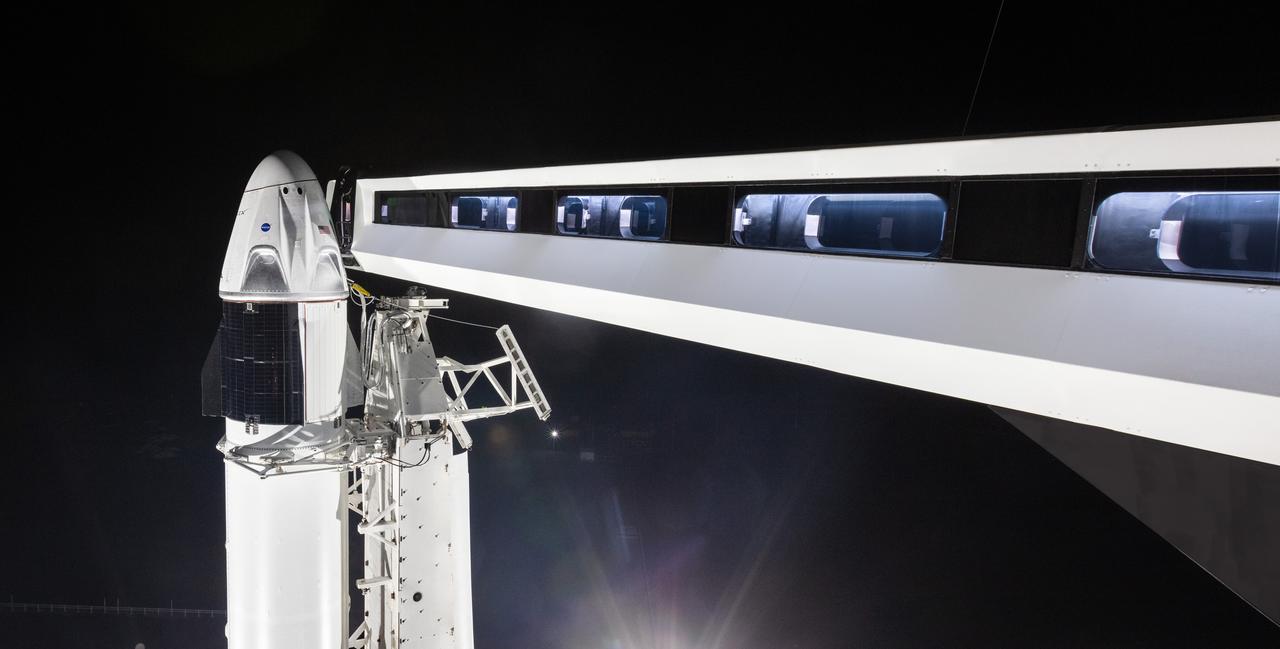
At NASA Kennedy Space Center’s Launch Complex 39A, the crew access arm has been extended to the SpaceX Crew Dragon spacecraft on Jan. 3, 2019. Mounted atop the company’s Falcon 9 rocket, both will undergo checkouts prior to its liftoff for Demo-1, the inaugural flight of one of the spacecraft designed to take NASA astronauts to and from the International Space Station. NASA has worked with SpaceX and Boeing in developing Commercial Crew Program spacecraft to facilitate new human spaceflight systems launching from U.S. soil with the goal of safe, reliable and cost-effective access to low-Earth orbit destinations such as the space station.
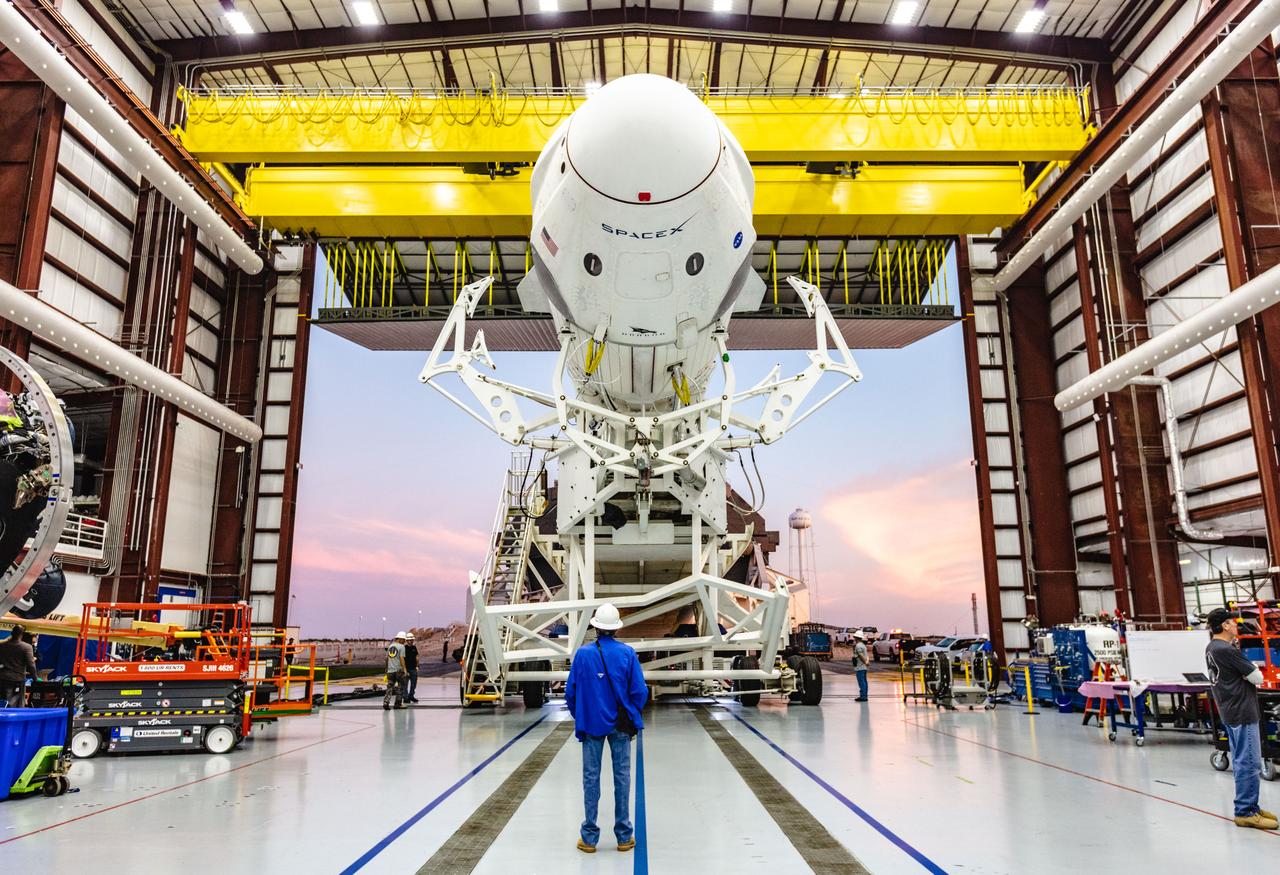
A SpaceX Falcon 9 rocket with the company’s Crew Dragon attached, rolls out of the company’s hangar at NASA Kennedy Space Center’s Launch Complex 39A on Jan. 3, 2019. The rocket will undergo checkouts prior to the liftoff of Demo-1, the inaugural flight of one of the spacecraft designed to take NASA astronauts to and from the International Space Station. NASA has worked with SpaceX and Boeing in developing Commercial Crew Program spacecraft to facilitate new human spaceflight systems launching from U.S. soil with the goal of safe, reliable and cost-effective access to low-Earth orbit destinations such as the space station.
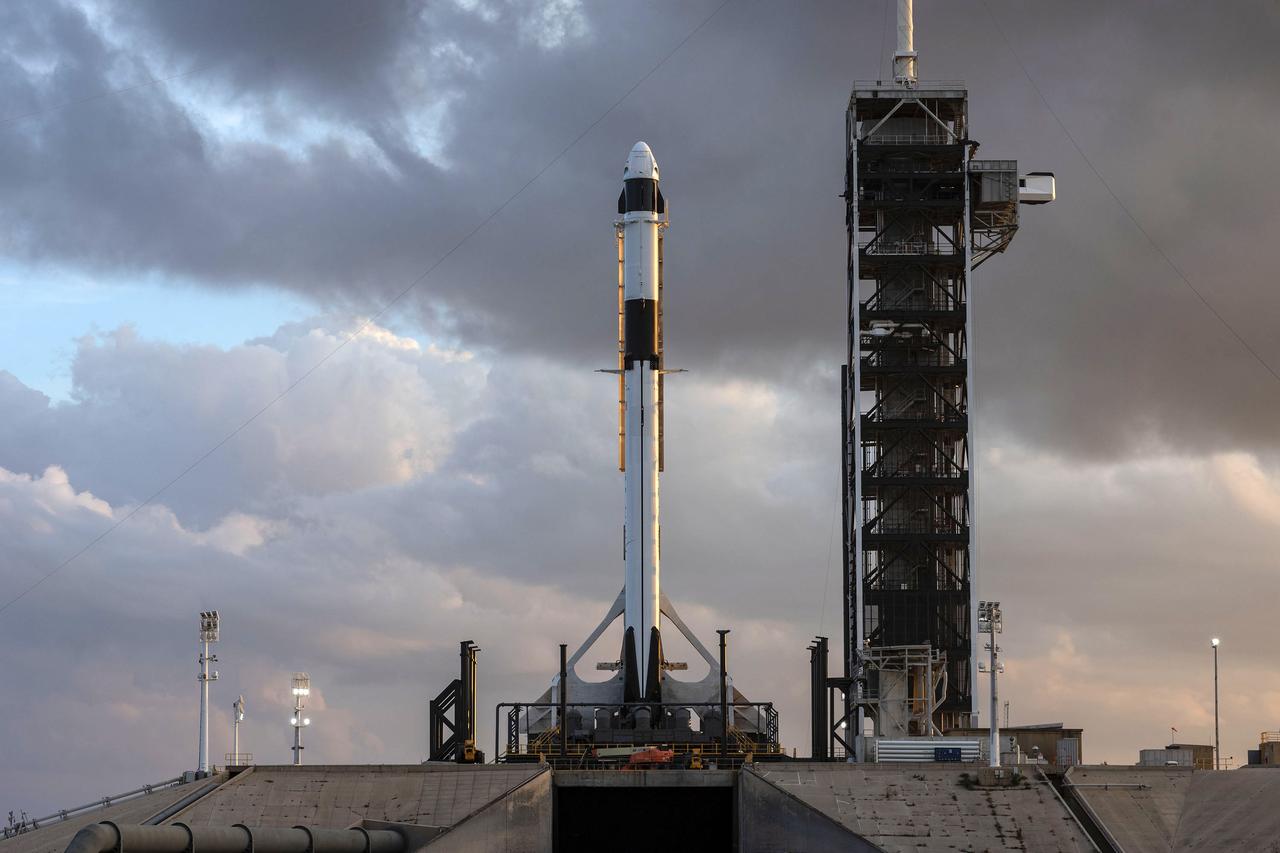
A SpaceX Falcon 9 rocket with the company’s Crew Dragon attached, stands at NASA Kennedy Space Center’s Launch Complex 39A on Jan. 3, 2019. The rocket will undergo checkouts prior to the liftoff of Demo-1, the inaugural flight of one of the spacecraft designed to take NASA astronauts to and from the International Space Station. NASA has worked with SpaceX and Boeing in developing Commercial Crew Program spacecraft to facilitate new human spaceflight systems launching from U.S. soil with the goal of safe, reliable and cost-effective access to low-Earth orbit destinations such as the space station.

A SpaceX Falcon 9 rocket with the company’s Crew Dragon attached, rolls out of the company’s hangar at NASA Kennedy Space Center’s Launch Complex 39A on Jan. 3, 2019. The rocket will undergo checkouts prior to the liftoff of Demo-1, the inaugural flight of one of the spacecraft designed to take NASA astronauts to and from the International Space Station. NASA has worked with SpaceX and Boeing in developing Commercial Crew Program spacecraft to facilitate new human spaceflight systems launching from U.S. soil with the goal of safe, reliable and cost-effective access to low-Earth orbit destinations such as the space station.
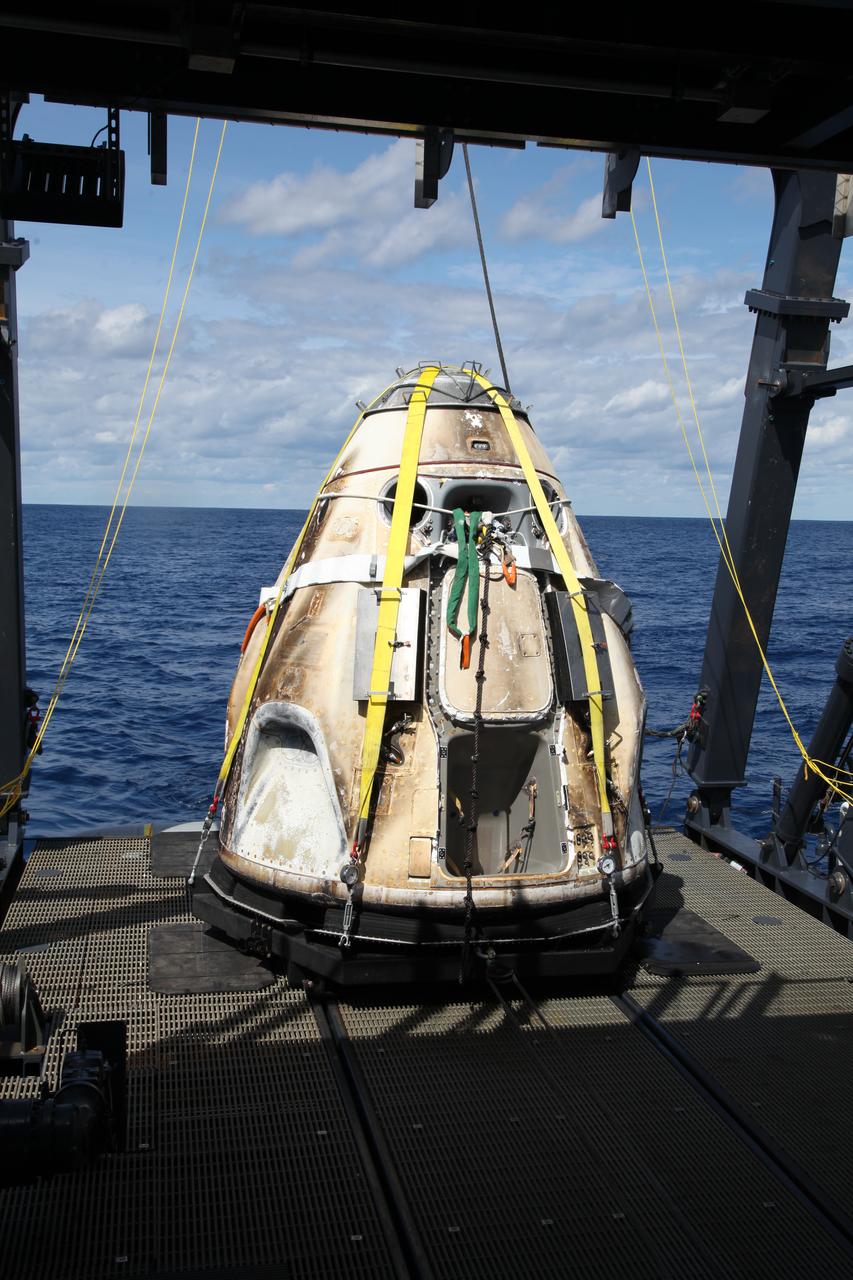
SpaceX’s Crew Dragon is loaded onto the company’s recovery ship, Go Searcher, in the Atlantic Ocean, about 200 miles off Florida’s east coast, on March 8, after returning from the International Space Station on the Demo-1 mission. The uncrewed spacecraft docked to the orbiting laboratory on March 3, following a 2:49 a.m. EST liftoff aboard a SpaceX Falcon 9 rocket from Launch Complex 39A at NASA’s Kennedy Space Center in Florida on March 2. The spacecraft undocked at 2:32 a.m., March 8, splashing down in the Atlantic Ocean, at 8:45 a.m. SpaceX’s inaugural flight with NASA’s Commercial Crew Program is the first flight test of a space system designed for humans built and operated by a commercial company through a public-private partnership. NASA and SpaceX will use data from Demo-1 to further prepare for Demo-2, the crewed flight test that will carry NASA astronauts Bob Behnken and Doug Hurley to the International Space Station later this year.
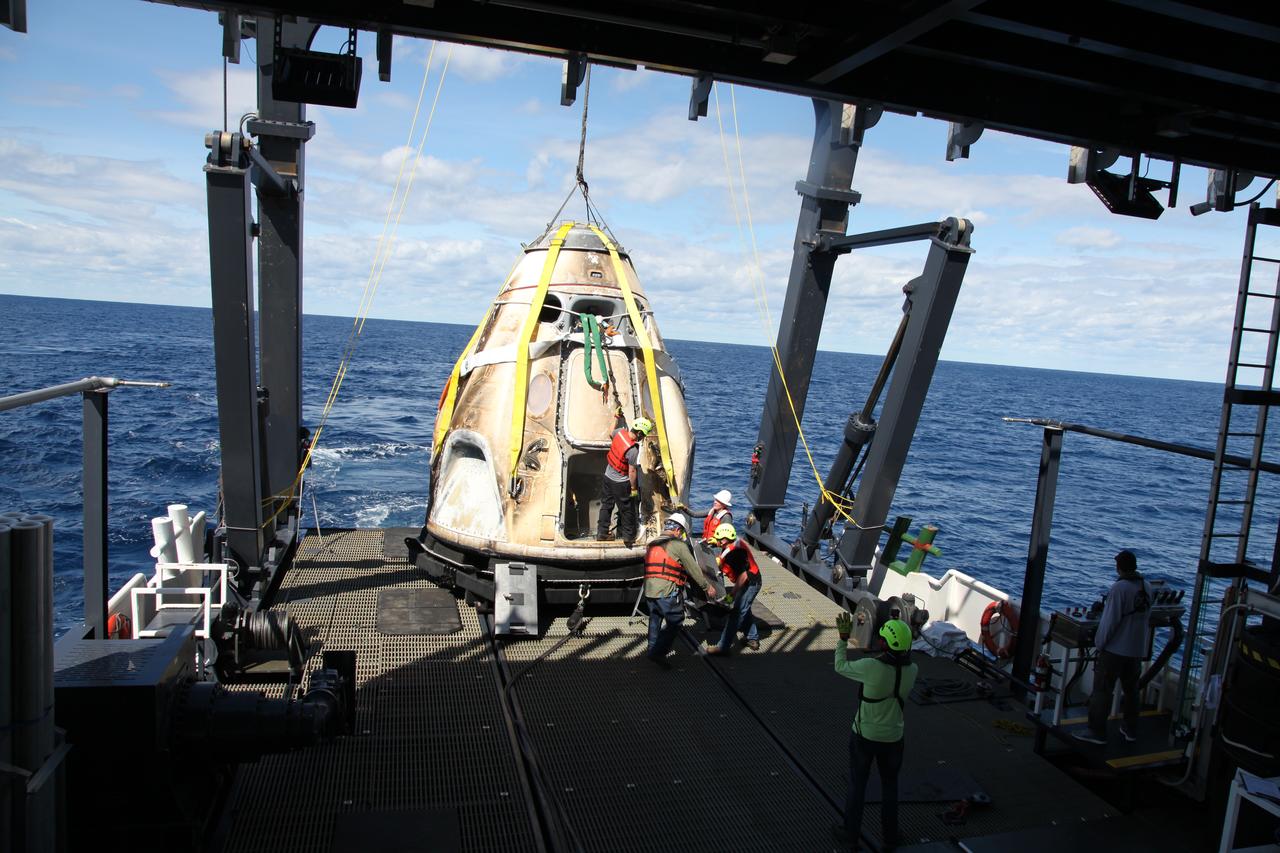
SpaceX’s Crew Dragon is loaded onto the company’s recovery ship, Go Searcher, in the Atlantic Ocean, about 200 miles off Florida’s east coast, on March 8, after returning from the International Space Station on the Demo-1 mission. The uncrewed spacecraft docked to the orbiting laboratory on March 3, following a 2:49 a.m. EST liftoff aboard a SpaceX Falcon 9 rocket from Launch Complex 39A at NASA’s Kennedy Space Center in Florida on March 2. The spacecraft undocked at 2:32 a.m., March 8, splashing down in the Atlantic Ocean, at 8:45 a.m. SpaceX’s inaugural flight with NASA’s Commercial Crew Program is the first flight test of a space system designed for humans built and operated by a commercial company through a public-private partnership. NASA and SpaceX will use data from Demo-1 to further prepare for Demo-2, the crewed flight test that will carry NASA astronauts Bob Behnken and Doug Hurley to the International Space Station later this year.
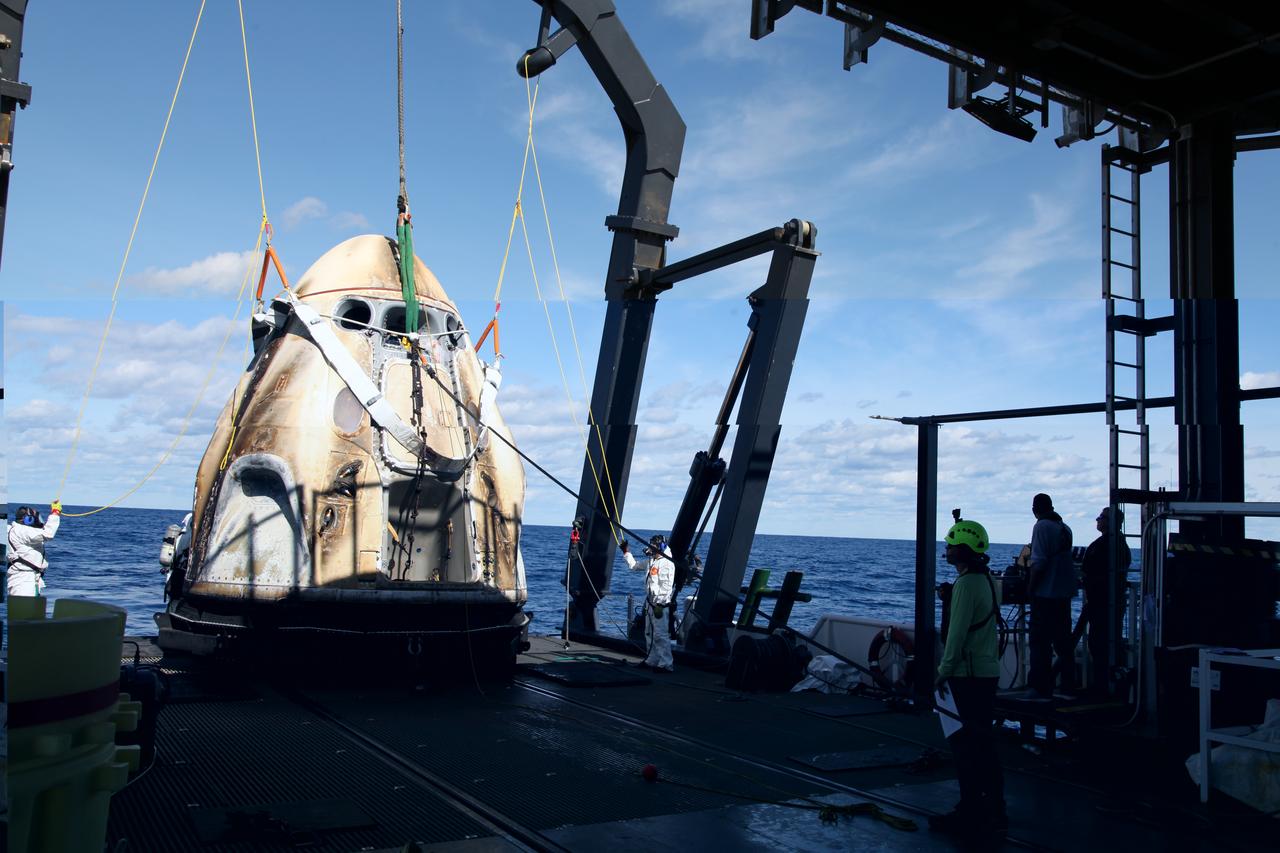
SpaceX’s Crew Dragon is loaded onto the company’s recovery ship, Go Searcher, in the Atlantic Ocean, about 200 miles off Florida’s east coast, on March 8, after returning from the International Space Station on the Demo-1 mission. The uncrewed spacecraft docked to the orbiting laboratory on March 3, following a 2:49 a.m. EST liftoff aboard a SpaceX Falcon 9 rocket from Launch Complex 39A at NASA’s Kennedy Space Center in Florida on March 2. The spacecraft undocked at 2:32 a.m., March 8, splashing down in the Atlantic Ocean, at 8:45 a.m. SpaceX’s inaugural flight with NASA’s Commercial Crew Program is the first flight test of a space system designed for humans built and operated by a commercial company through a public-private partnership. NASA and SpaceX will use data from Demo-1 to further prepare for Demo-2, the crewed flight test that will carry NASA astronauts Bob Behnken and Doug Hurley to the International Space Station later this year.
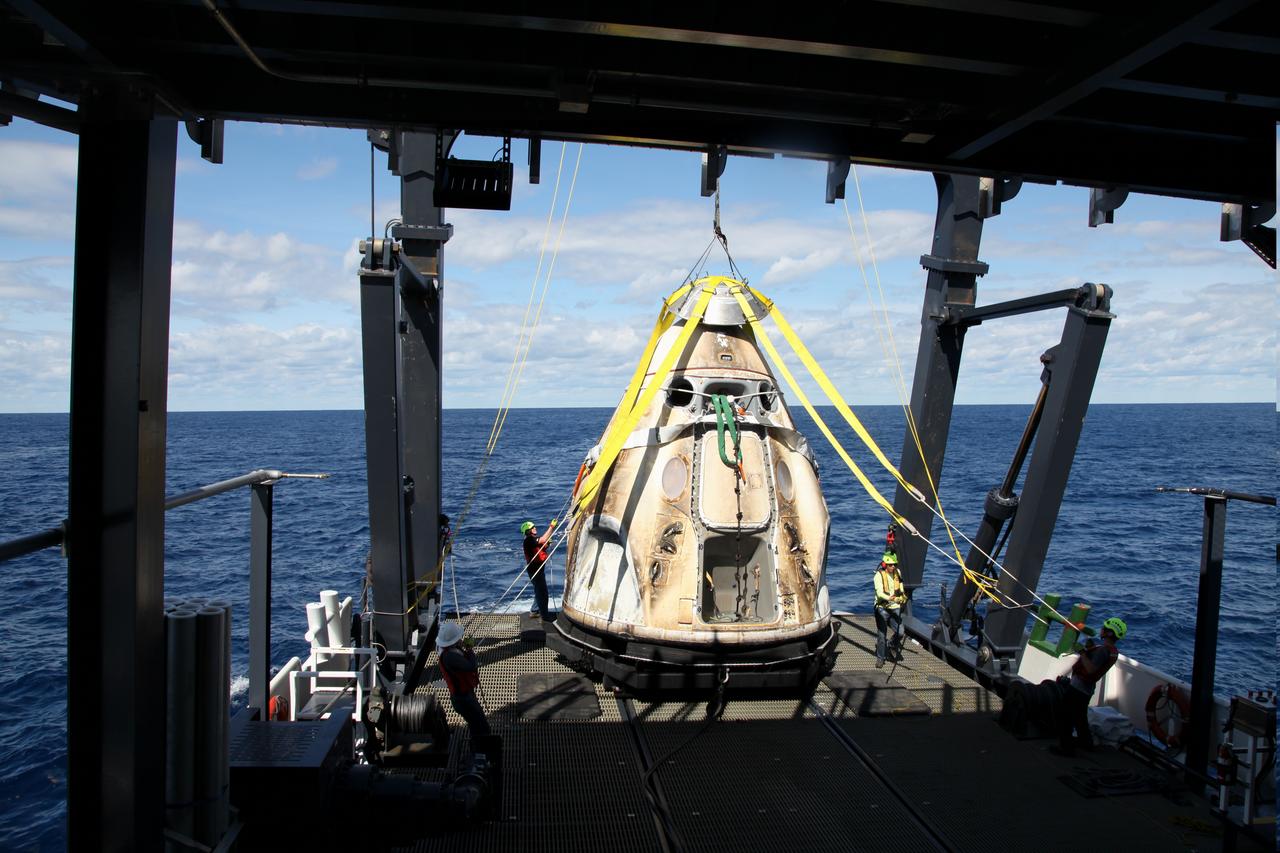
SpaceX’s Crew Dragon is loaded onto the company’s recovery ship, Go Searcher, in the Atlantic Ocean, about 200 miles off Florida’s east coast, on March 8, after returning from the International Space Station on the Demo-1 mission. The uncrewed spacecraft docked to the orbiting laboratory on March 3, following a 2:49 a.m. EST liftoff aboard a SpaceX Falcon 9 rocket from Launch Complex 39A at NASA’s Kennedy Space Center in Florida on March 2. The spacecraft undocked at 2:32 a.m., March 8, splashing down in the Atlantic Ocean, at 8:45 a.m. SpaceX’s inaugural flight with NASA’s Commercial Crew Program is the first flight test of a space system designed for humans built and operated by a commercial company through a public-private partnership. NASA and SpaceX will use data from Demo-1 to further prepare for Demo-2, the crewed flight test that will carry NASA astronauts Bob Behnken and Doug Hurley to the International Space Station later this year.
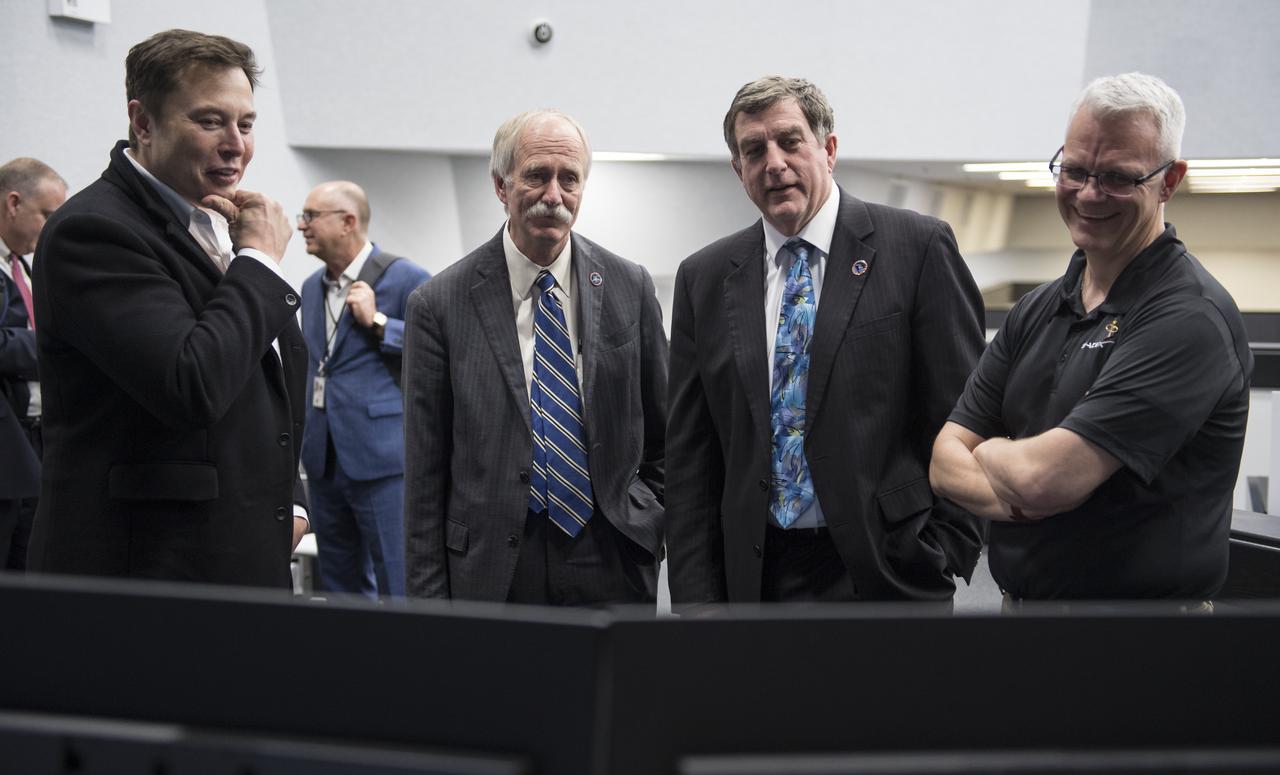
SpaceX CEO and Chief Designer Elon Musk, left, NASA Associate Administrator for the Human Exploration and Operations Mission Directorate William Gerstenmaier, second from left, NASA International Space Station Program Manager Kirk Shireman, second from right, and SpaceX Director of Crew Mission Management Benji Reed, right, watch the progress of the Crew Dragon spacecraft after launch from firing room four of the Launch Control Center, Saturday, March 2, 2019 at the Kennedy Space Center in Florida. The Demo-1 mission is the first launch of a commercially built and operated American spacecraft and space system designed for humans as part of NASA's Commercial Crew Program. The mission will serve as an end-to-end test of the system's capabilities. Photo Credit: (NASA/Joel Kowsky)
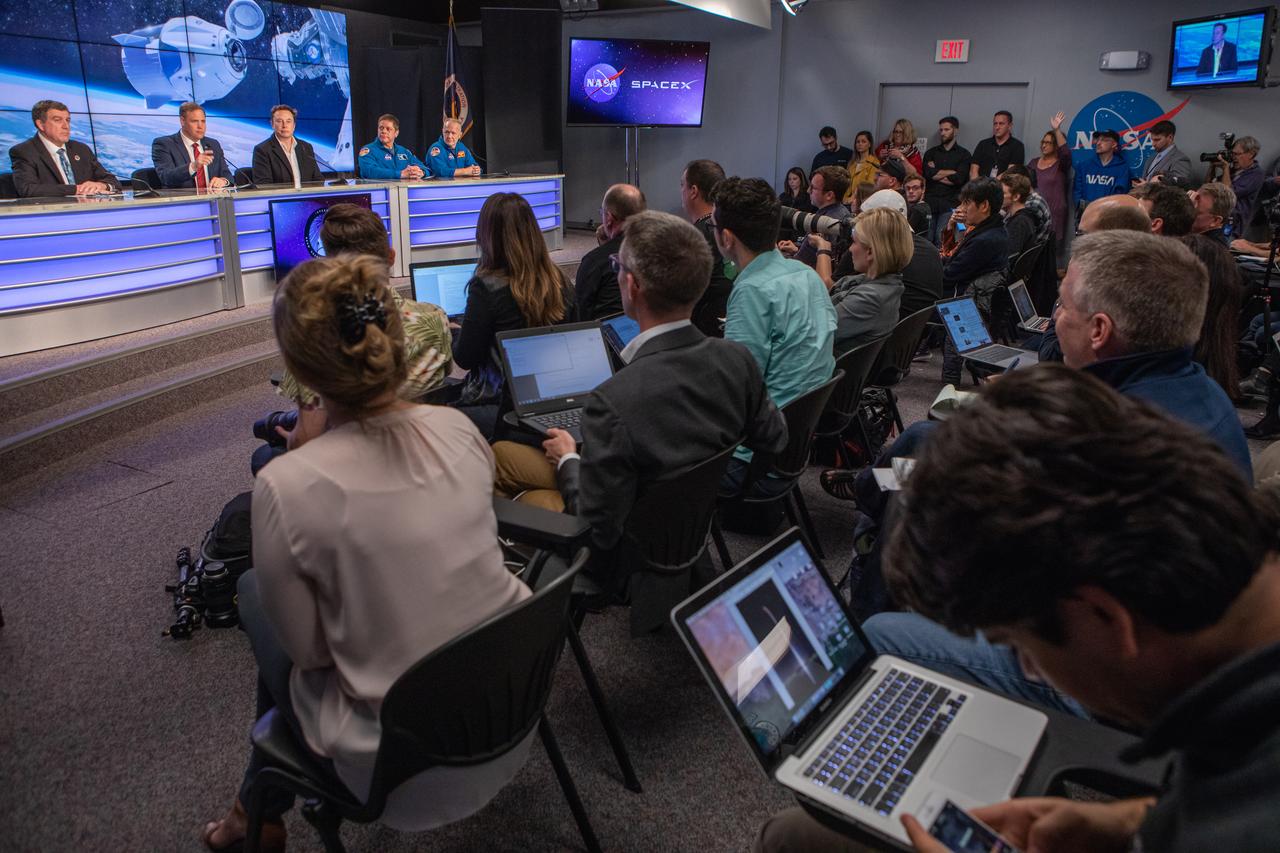
Members of the media gather in Kennedy Space Center’s Press Site auditorium during a post launch news conference with agency and industry leaders following the March 2, 2:49 a.m. EST launch of the SpaceX Demo-1 Commercial Crew Program (CCP) mission to the International Space Station. The Crew Dragon’s trip to the space station is designed to validate end-to-end systems and capabilities, leading to certification to fly crew. NASA has worked with SpaceX and Boeing in developing the CCP spacecraft to facilitate new human spaceflight systems launching from U.S. soil with the goal of safe, reliable and cost-effective access to low-Earth orbit destinations, such as the space station.

Bettina Inclán, NASA associate administrator for Communications, addresses members of the media during a post launch news conference in Kennedy Space Center’s Press Site auditorium following the March 2, 2:49 a.m. EST launch of the SpaceX Demo-1 Commercial Crew Program (CCP) mission to the International Space Station. The Crew Dragon’s trip to the space station is designed to validate end-to-end systems and capabilities, leading to certification to fly crew. NASA has worked with SpaceX and Boeing in developing the CCP spacecraft to facilitate new human spaceflight systems launching from U.S. soil with the goal of safe, reliable and cost-effective access to low-Earth orbit destinations, such as the space station.