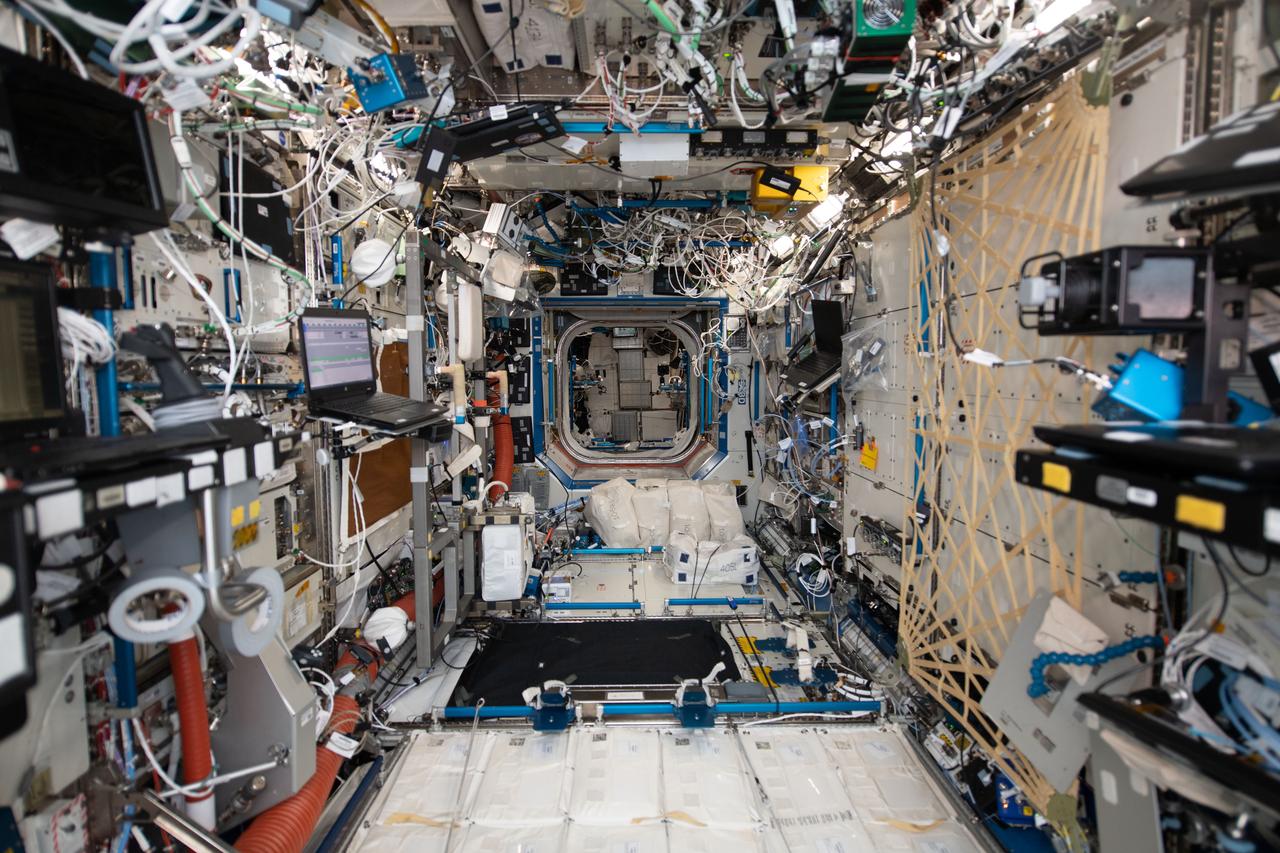
iss058e004610 (1/20/2019) --- A View of the Destiny US Laboratory aboard the International Space Station (ISS). The U.S. Laboratory Module, called Destiny, is the primary research laboratory for U.S. payloads, supporting a wide range of experiments and studies contributing to health, safety, and quality of life for people all over the world. Science conducted on the ISS offers researchers an unparalleled opportunity to test physical processes in the absence of gravity. The results of these experiments will allow scientists to better understand our world and ourselves and prepare us for future missions. Destiny provides internal interfaces to accommodate 24 equipment racks for accommodation and control of ISS systems and scientific research.
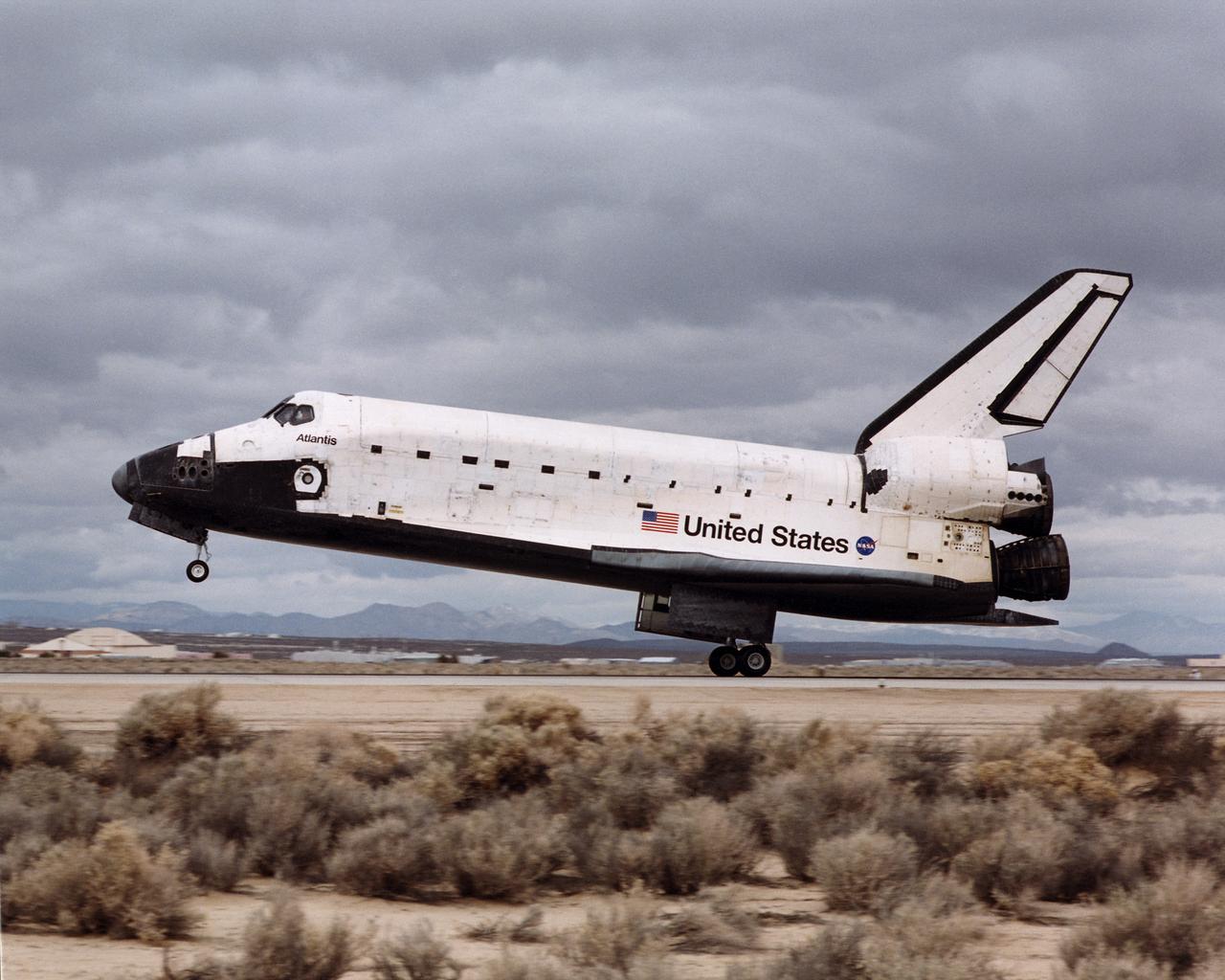
Space Shuttle Atlantis landed at 12:33 p.m. February 20, 2001, on the runway at Edwards Air Force Base, California, where NASA's Dryden Flight Research Center is located. The mission, which began February 7, logged 5.3 million miles as the shuttle orbited earth while delivering the Destiny science laboratory to the International Space Station. Inclement weather conditions in Florida prompted the decision to land Atlantis at Edwards. The last time a space shuttle landed at Edwards was Oct. 24, 2000.
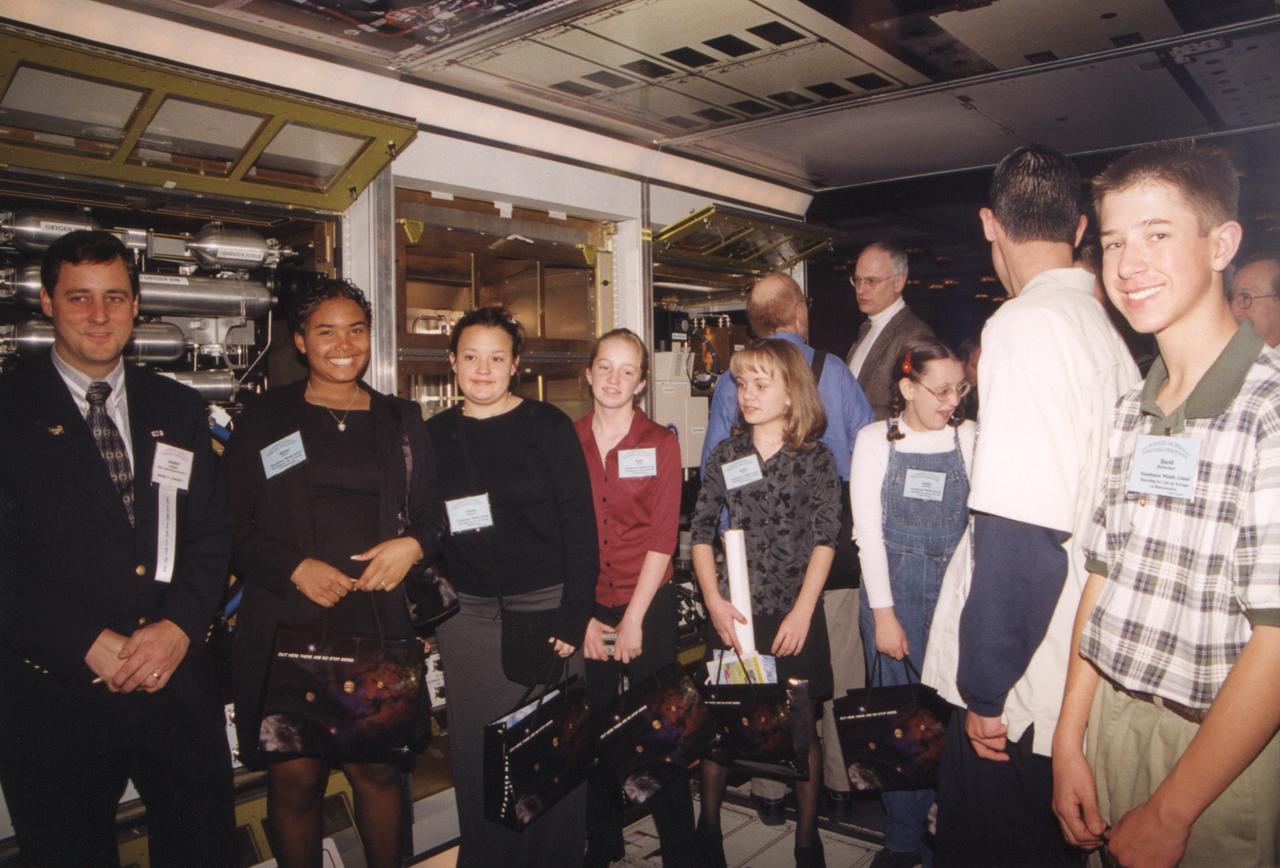
Students from Albuquerque, MN, tour through the mockup of the U.S. Destiny laboratory module that will be attached to the International Space Station (ISS). Behind them are the racks for the Fluids and Combustion Facility being developed by Glenn Research Center. The mockup was on display at the Space Tehnology International Forum in Albuquerque, MN. Photo credit: NASA/Marshall Space Flight Center
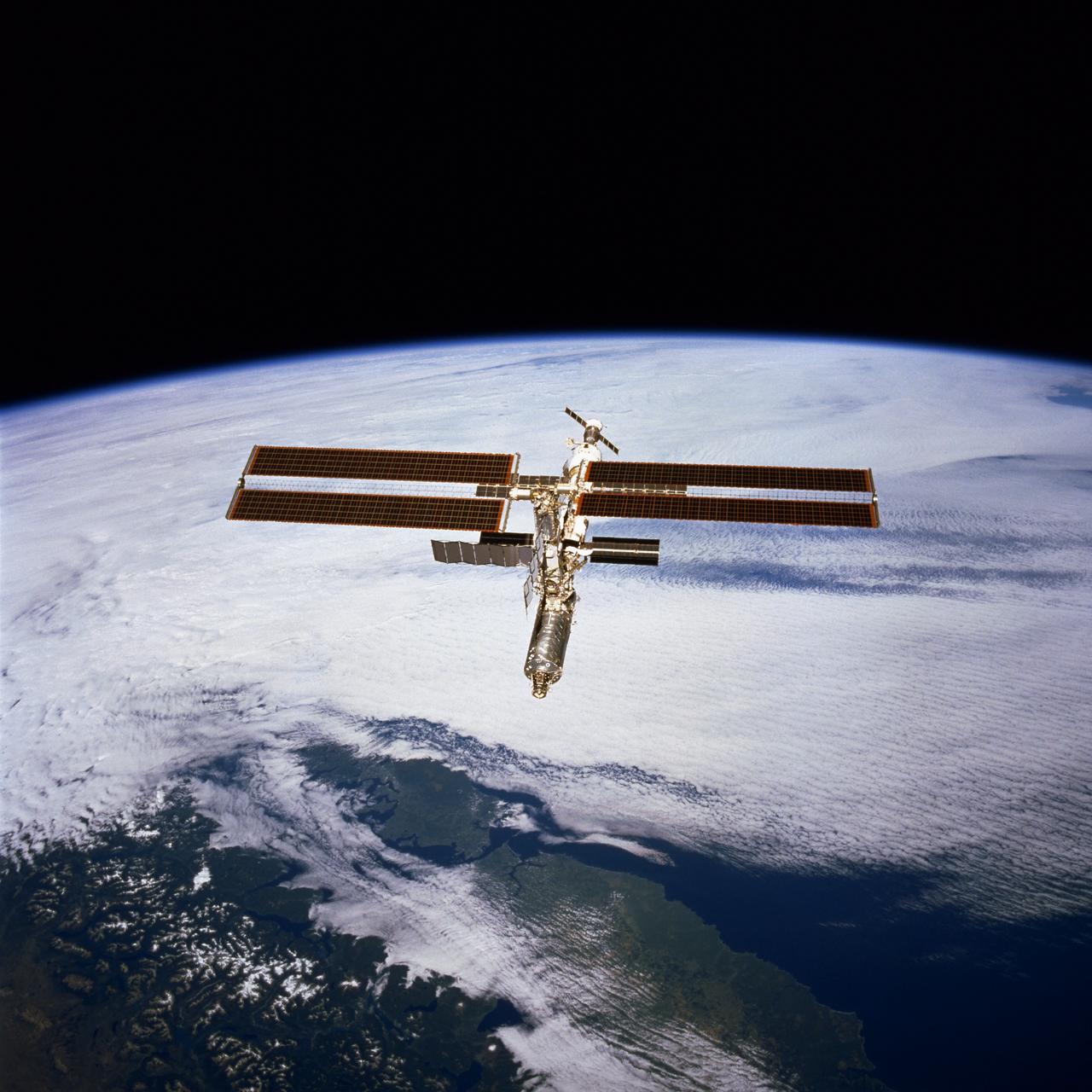
The International Space Station (ISS), with the newly installed U.S. Laboratory, Destiny, is backdropped over clouds, water and land in South America. South Central Chile shows up at the bottom of the photograph. Just below the Destiny, the Chacao Charnel separates the large island of Chile from the mainland and connects the Gulf of Coronado on the Pacific side with the Gulf of Ancud, southwest of the city of Puerto Montt. The American-made Destiny module is the cornerstone for space-based research aboard the orbiting platform and the centerpiece of the ISS, where unprecedented science experiments will be performed in the near-zero gravity of space. Destiny will also serve as the command and control center for the ISS. The aluminum module is 8.5-meters (28-feet) long and 4.3-meters (14-feet) in diameter. The laboratory consists of three cylindrical sections and two endcones with hatches that will be mated to other station components. A 50.9-centimeter (20-inch-) diameter window is located on one side of the center module segment. This pressurized module is designed to accommodate pressurized payloads. It has a capacity of 24 rack locations. Payload racks will occupy 15 locations especially designed to support experiments. The Destiny module was built by the Boeing Company under the direction of the Marshall Space Flight Center.
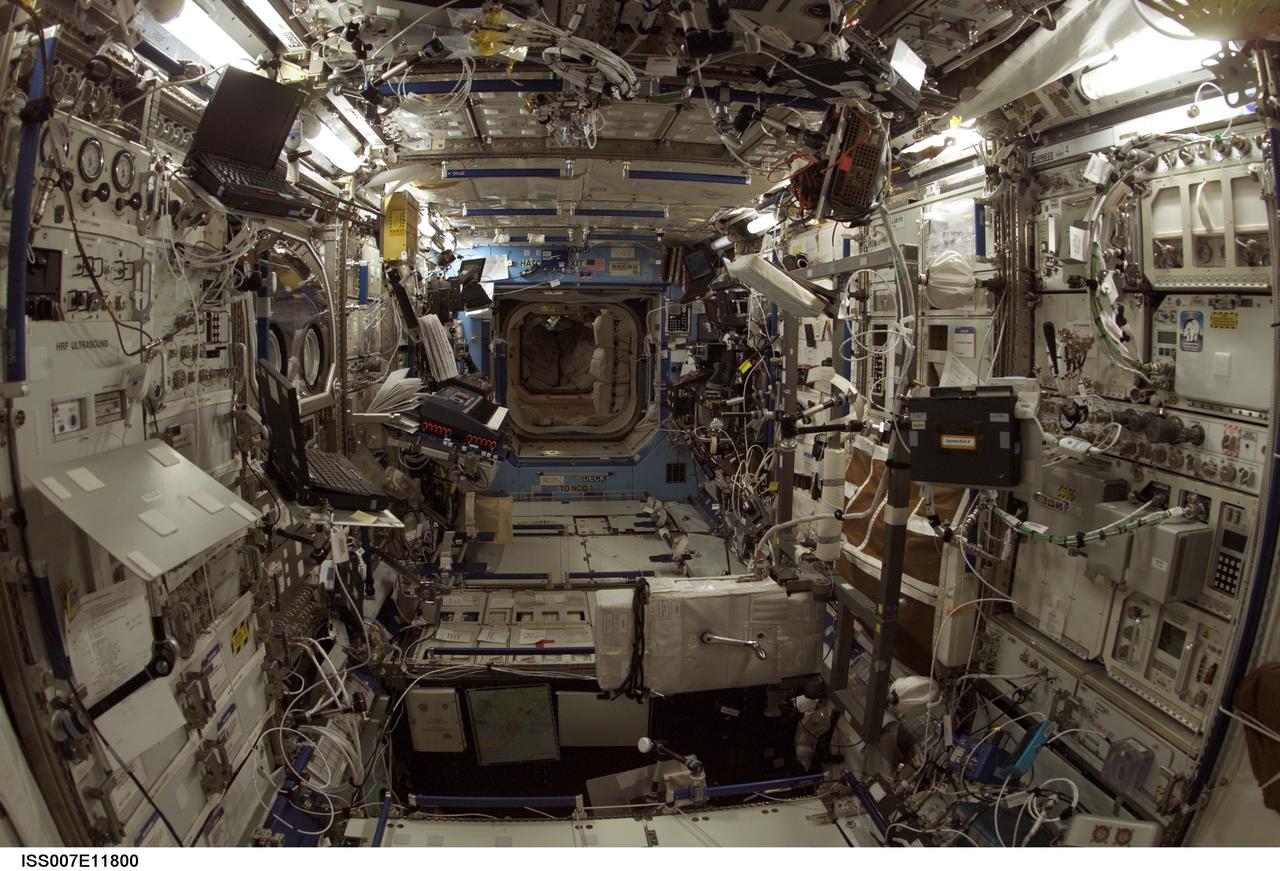
ISS007-E-11800 (3 August 2003) --- Interior view of the Destiny laboratory on the International Space Station (ISS) during the Expedition 7 mission.
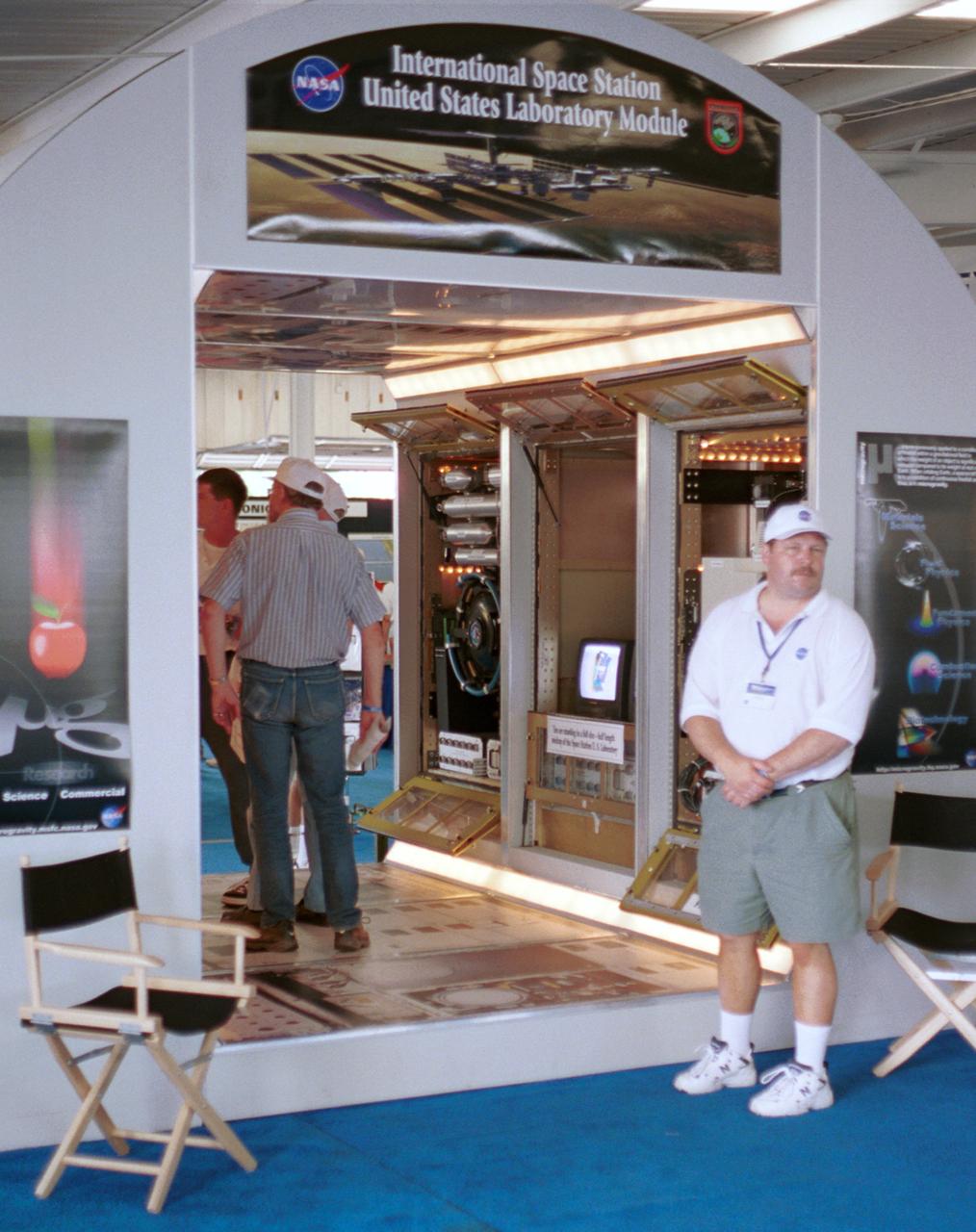
Thomas Turk, an engineer with NASA's Glenn Research Center, waits for more visitors at a mockup of part of Destiny, the U.S. laboratory module that will be attached to the International Space Station (ISS) in Year 2001. Visible behind Turk are engineering models of the three racks that will make up the Fluids and Combustion Facility (FCF) in the module. The mockup is full scale, although Destiny will be twice as long to accomodate six experiment racks along each side. The exhibit was part of the NASA outreach activity at AirVenture 2000 sponsored by the Expeprimental Aircraft Association in Oshkosh, WI.
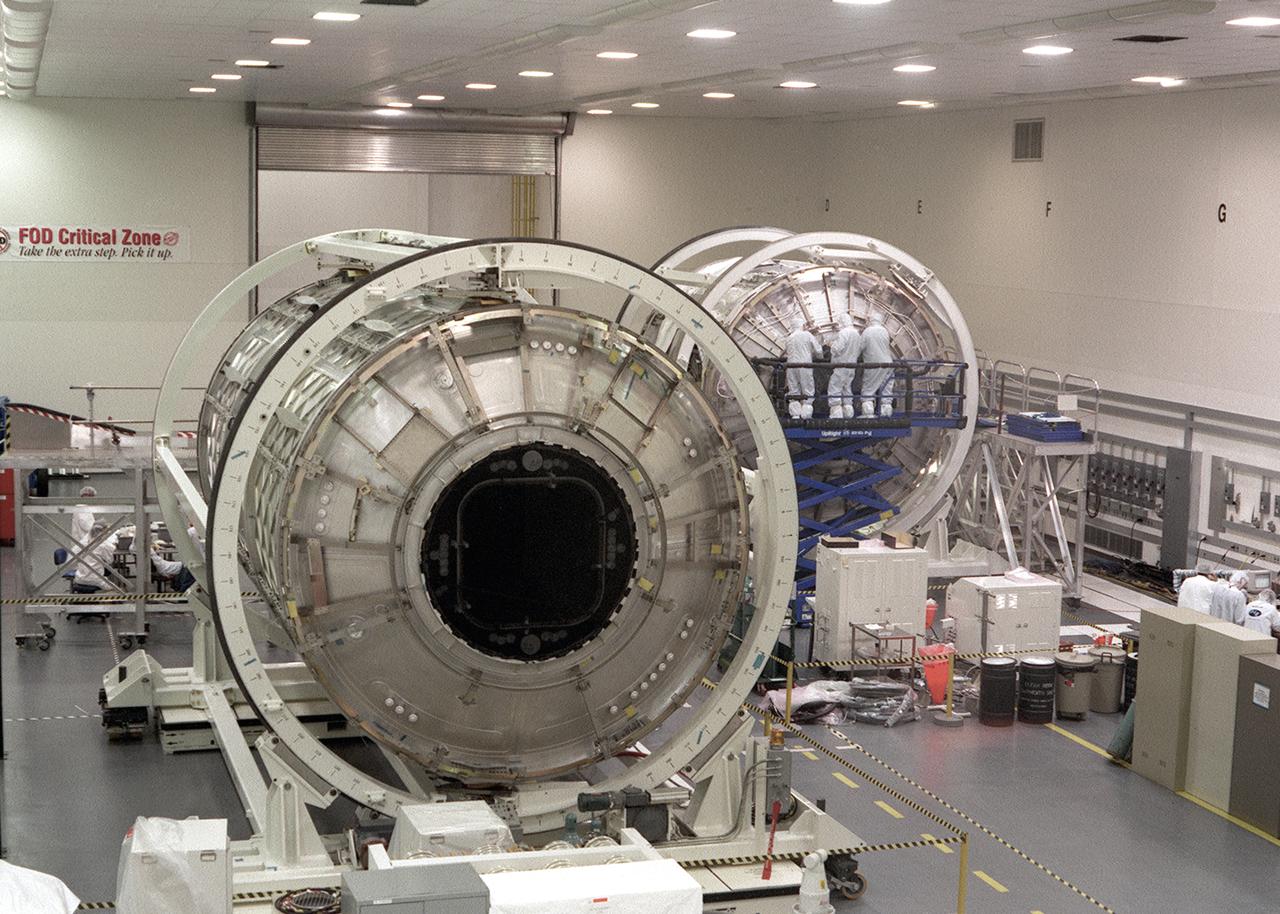
This Boeing photograph shows the Node 1, Unity module, Flight Article (at right) and the U.S. Laboratory module, Destiny, Flight Article for the International Space Station (ISS) being manufactured in the High Bay Clean Room of the Space Station Manufacturing Facility at the Marshall Space Flight Center. The Node 1, or Unity, serves as a cornecting passageway to Space Station modules. The U.S. built Unity module was launched aboard the orbiter Endeavour (STS-88 mission) on December 4, 1998 and connected to the Zarya, the Russian-built Functional Energy Block (FGB). The U.S. Laboratory (Destiny) module is the centerpiece of the ISS, where science experiments will be performed in the near-zero gravity of space. The U.S. Laboratory/Destiny was launched aboard the orbiter Atlantis (STS-98 mission) on February 7, 2001. The ISS is a multidisciplinary laboratory, technology test bed, and observatory that will provide unprecedented undertakings in scientific, technological, and international experimentation.
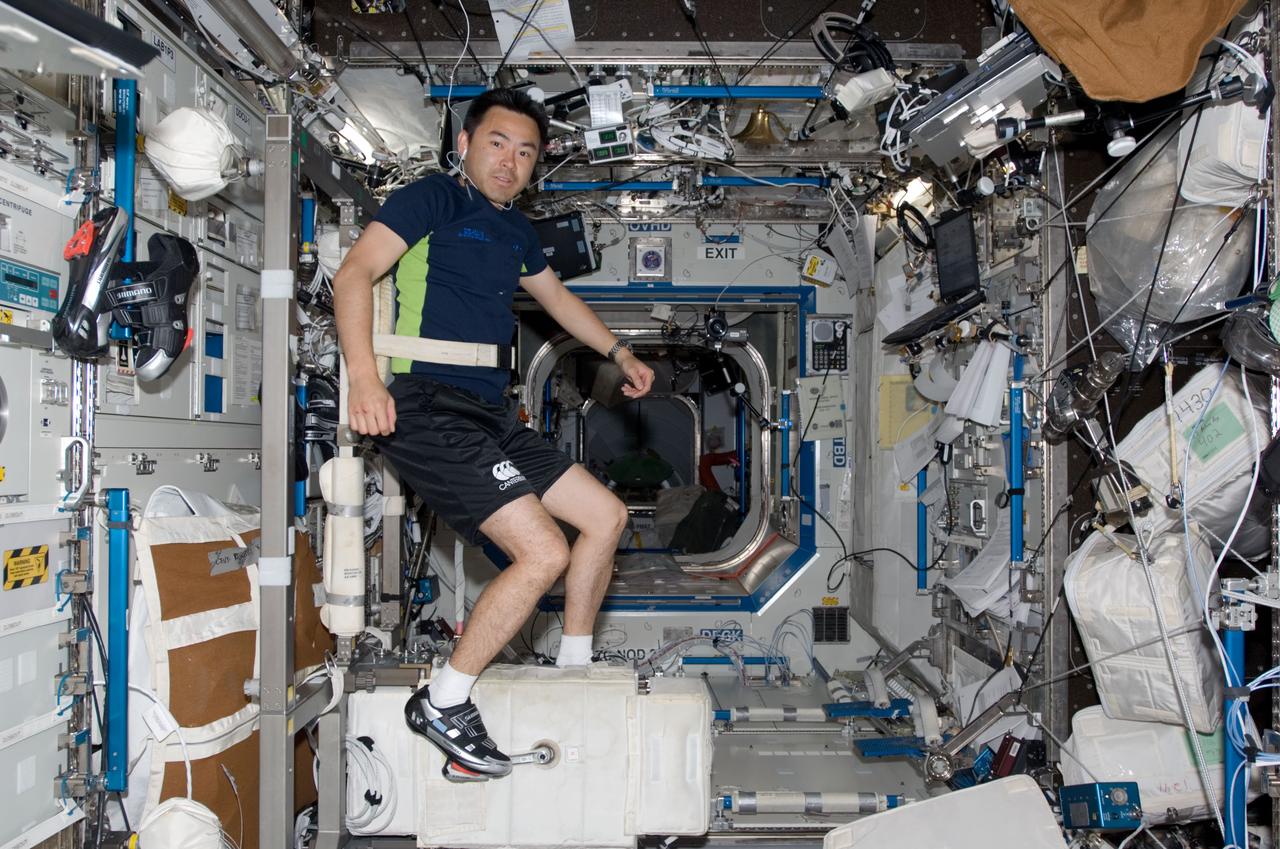
S124-E-007613 (7 June 2008) --- JAXA astronaut Akihiko Hoshide, STS-124 mission specialist, exercises on the Cycle Ergometer in the Destiny laboratory of the International Space Station.
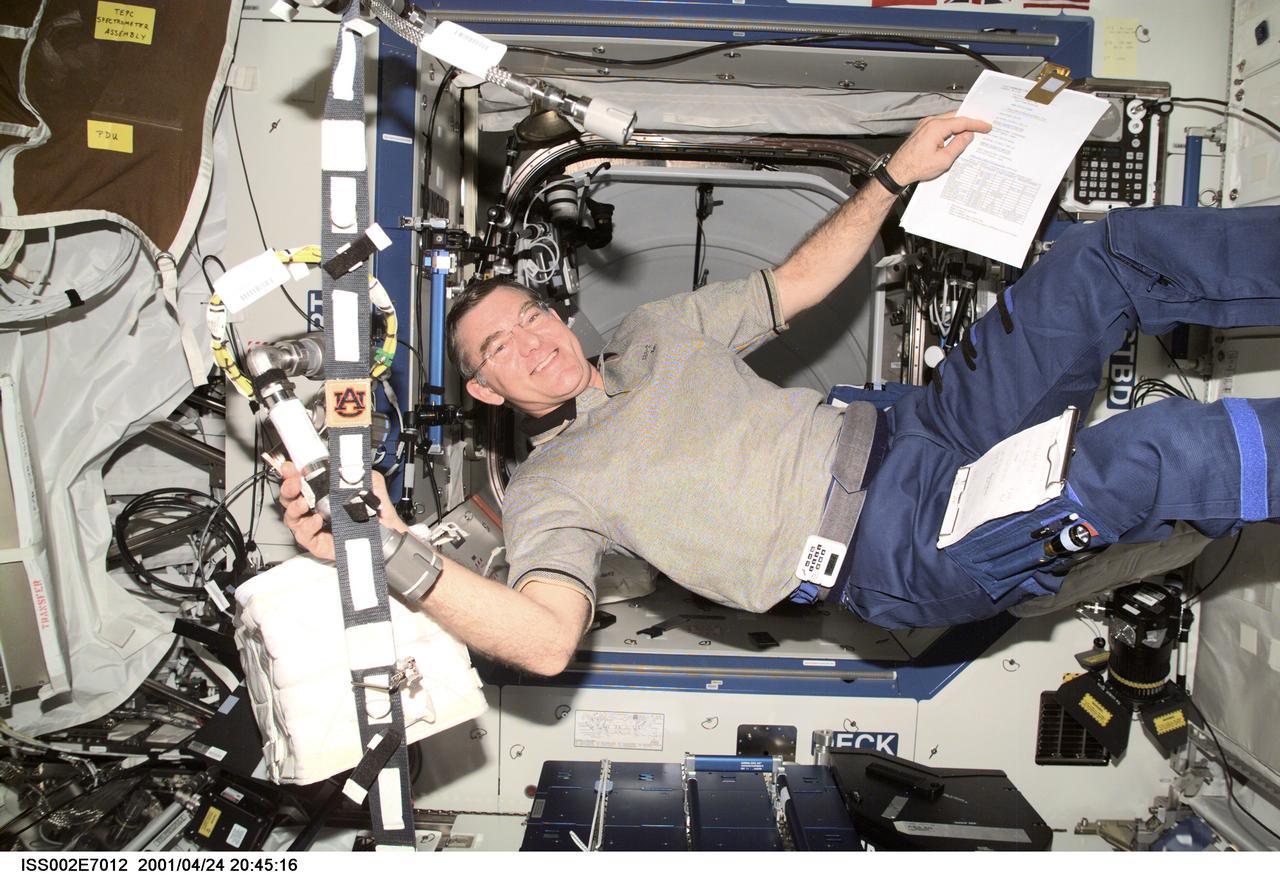
ISS002-E-7012 (24 April 2001) --- Astronaut James S. Voss, Expedition Two flight engineer, handles a connector in the Destiny/U.S. Laboratory. A digital still camera was used to record this image.
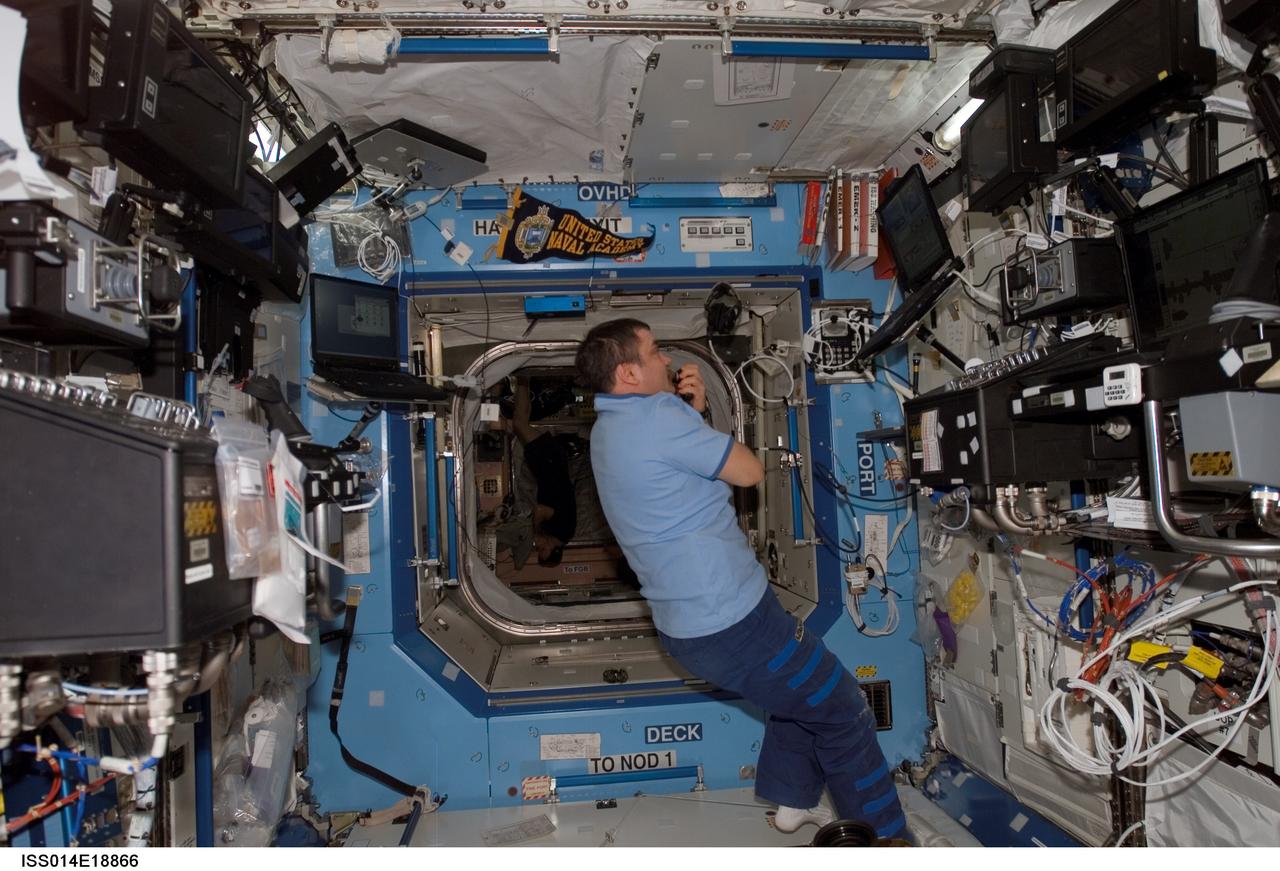
ISS014-E-18866 (3 April 2007) --- Cosmonaut Mikhail Tyurin, Expedition 14 flight engineer representing Russia's Federal Space Agency, uses a communication system in the Destiny laboratory of the International Space Station.
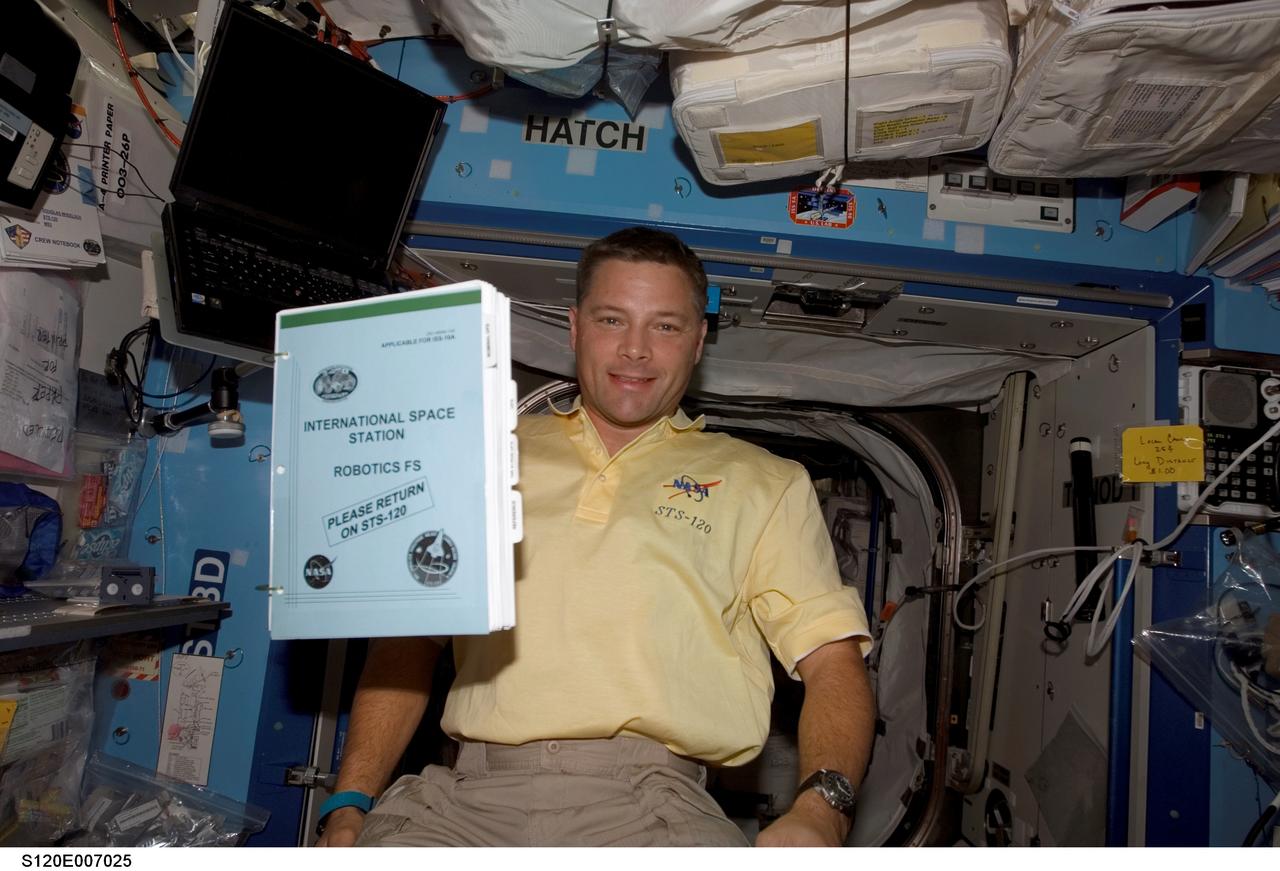
S120-E-007025 (28 Oct. 2007) --- Astronaut Doug Wheelock, STS-120 mission specialist, poses for a photo as a procedures handbook floats freely nearby in the Destiny laboratory of the International Space Station.
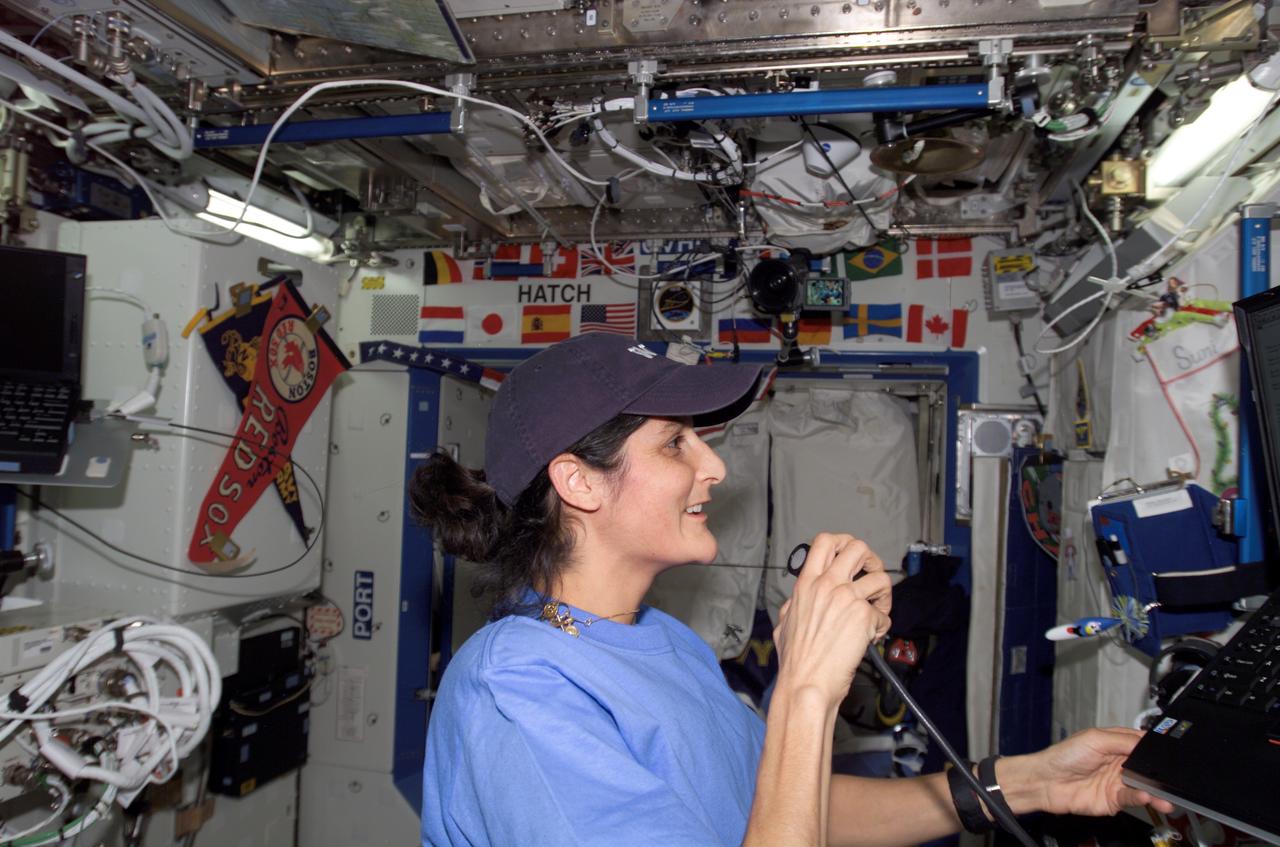
ISS014-E-12995 (26 Jan. 2007) --- Astronaut Sunita L. Williams, Expedition 14 flight engineer, uses a communication system in the Destiny laboratory of the International Space Station.
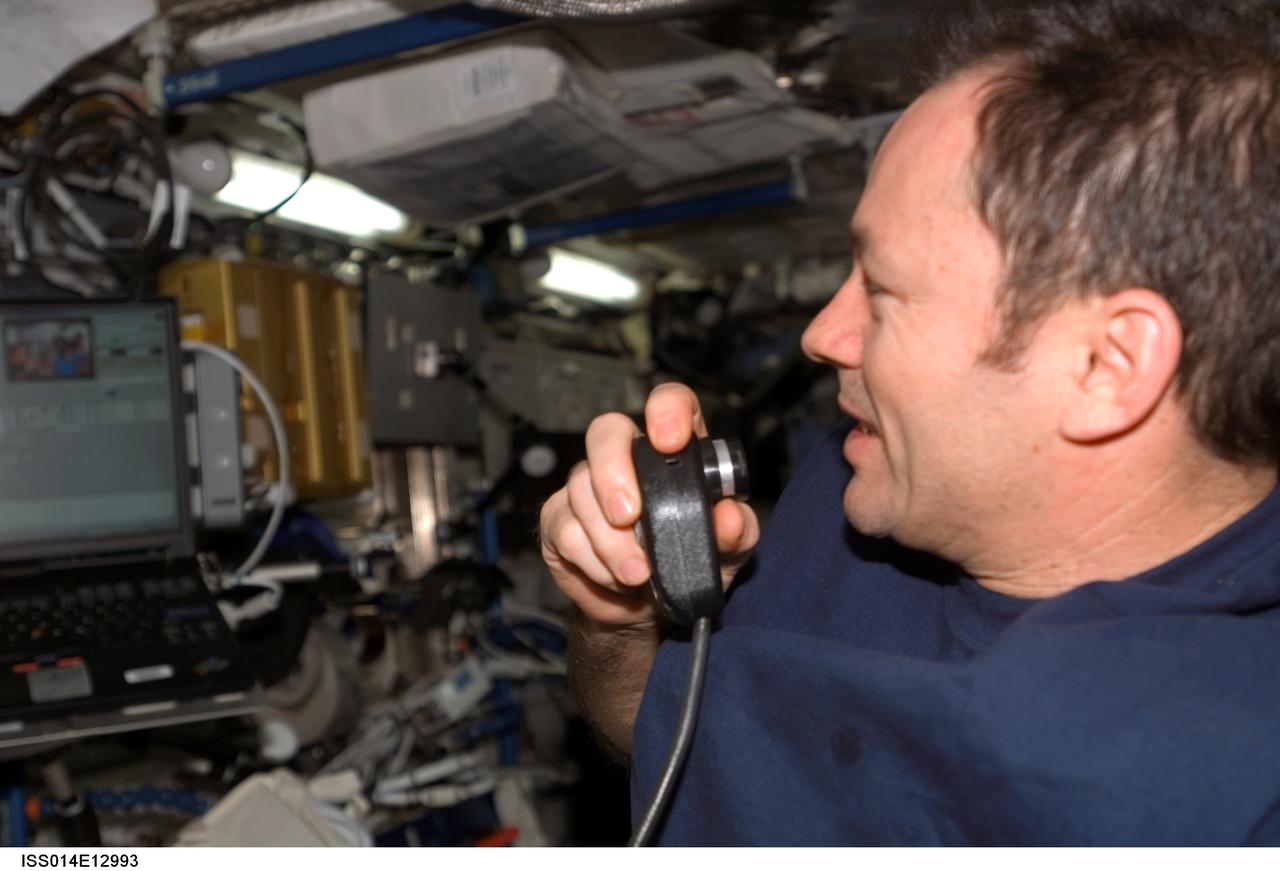
ISS014-E-12993 (26 Jan. 2007) --- Astronaut Michael E. Lopez-Alegria, Expedition 14 commander and NASA space station science officer, uses a communication system in the Destiny laboratory of the International Space Station.
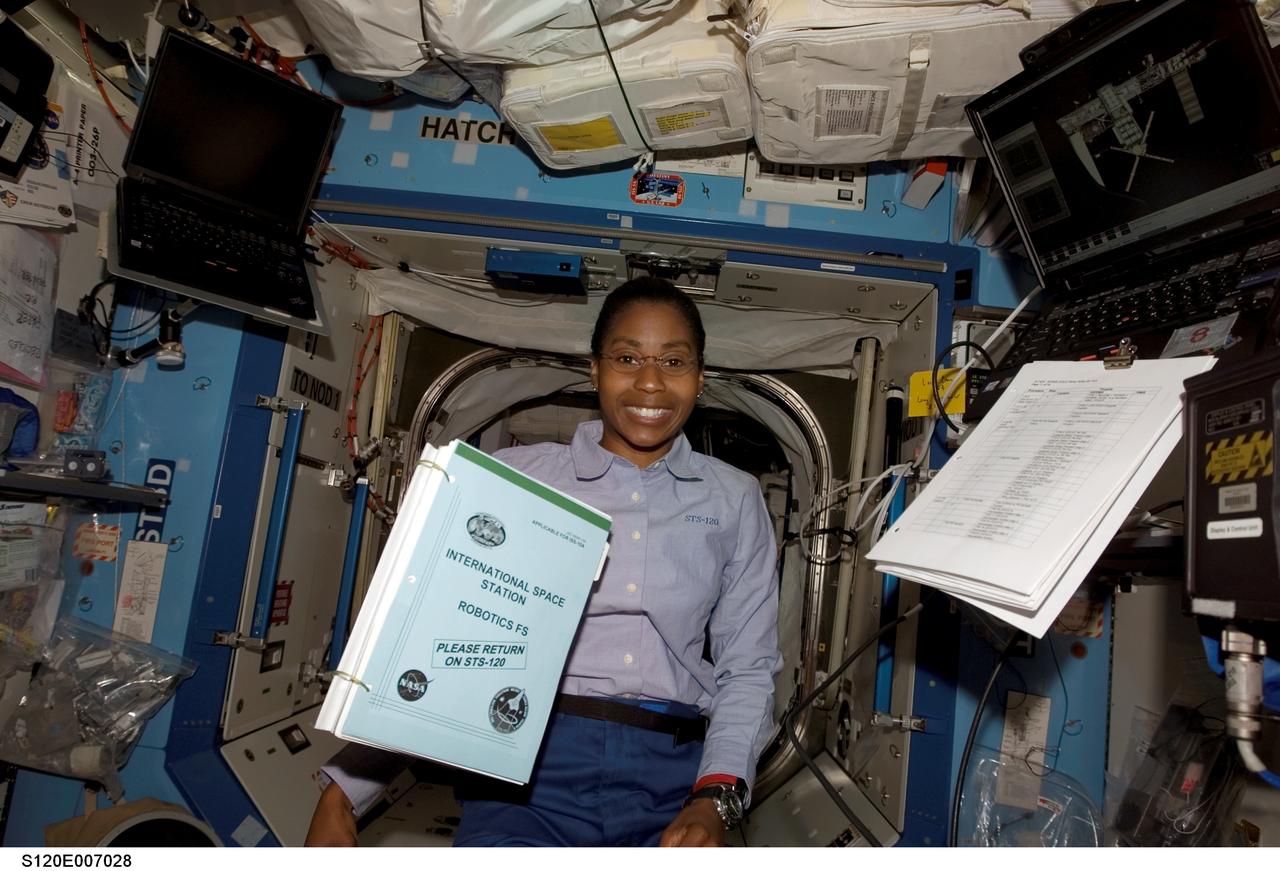
S120-E-007028 (28 Oct. 2007) --- Astronaut Stephanie Wilson, STS-120 mission specialist, poses for a photo as a procedures handbook floats freely nearby in the Destiny laboratory of the International Space Station.
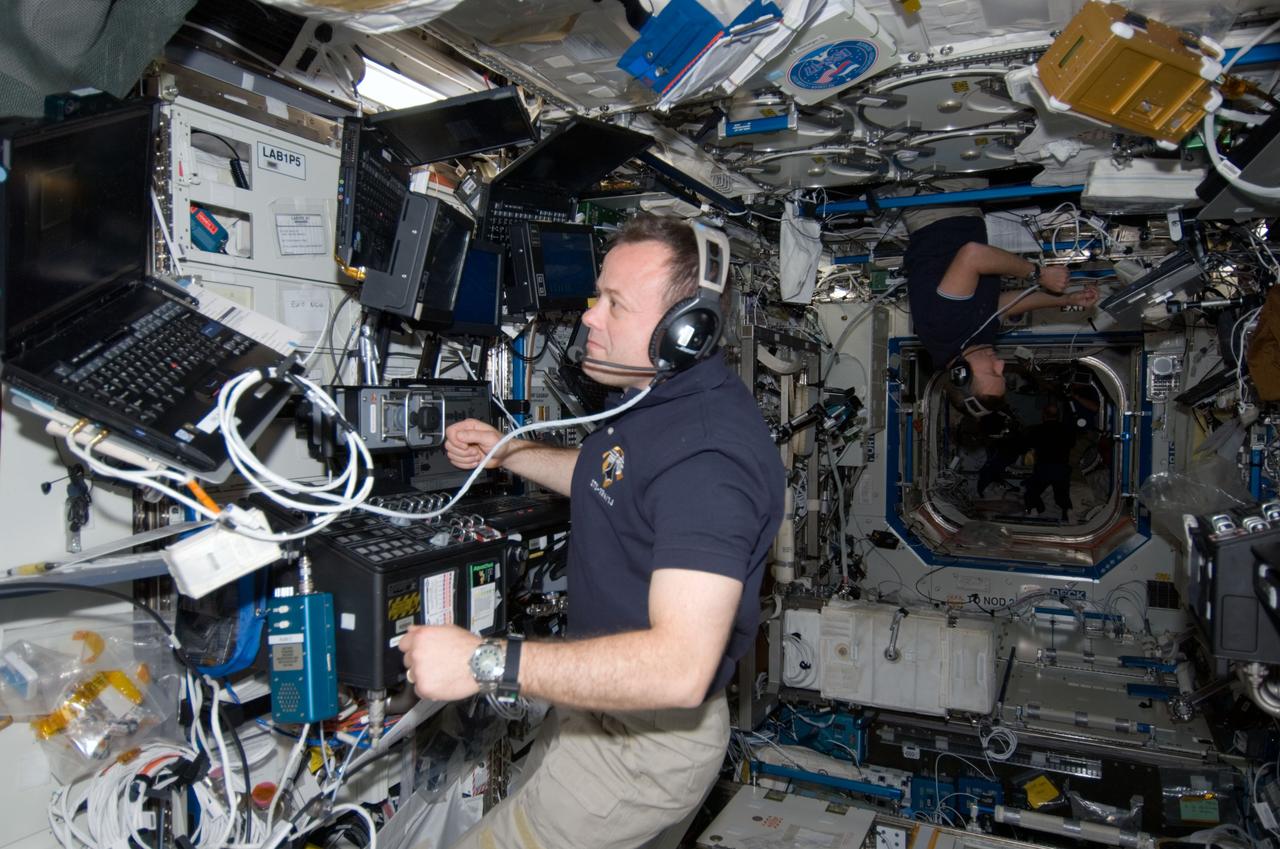
S124-E-009836 (10 June 2008) --- Astronaut Ron Garan, STS-124 mission specialist, uses a communication system in the Destiny laboratory of the International Space Station while Space Shuttle Discovery is docked with the station.
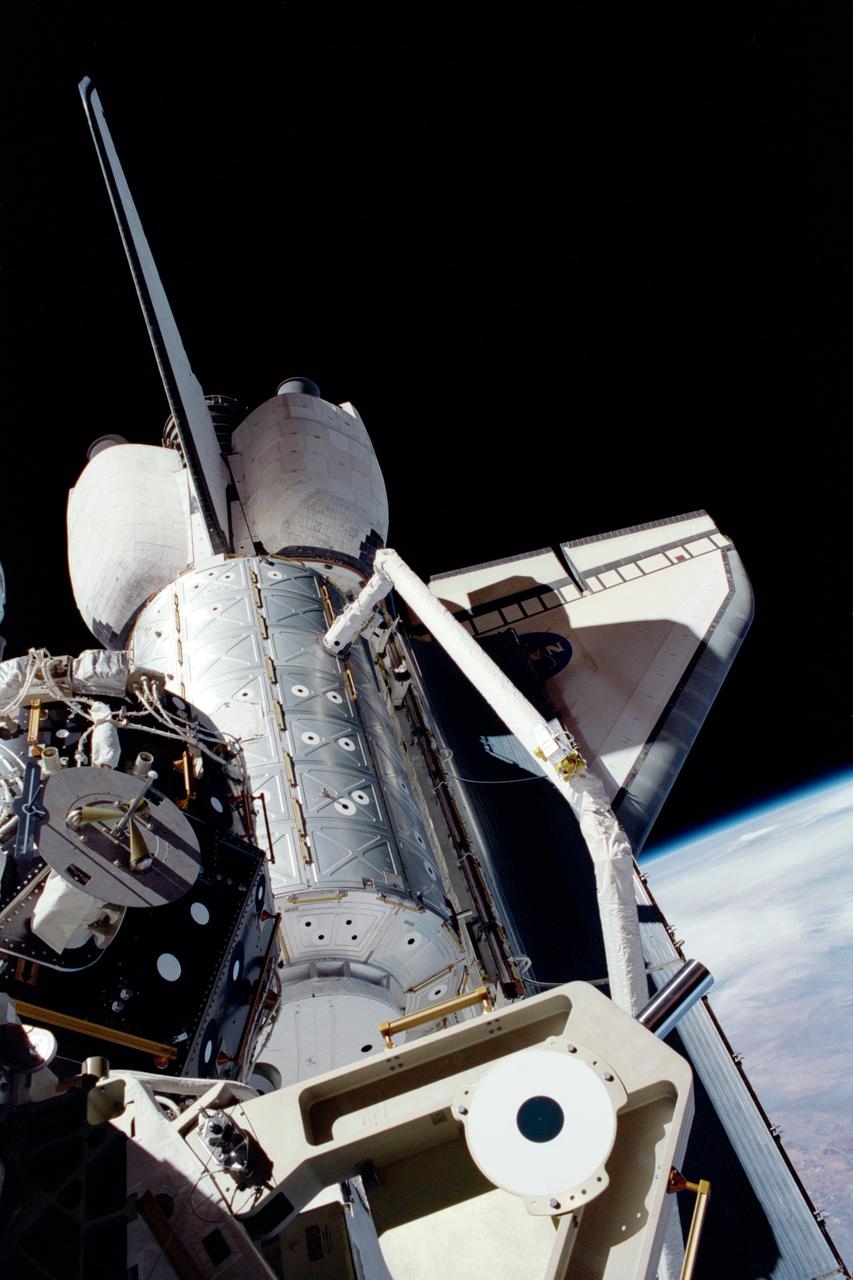
In the grasp of the Shuttle's Remote Manipulator System (RMS) robot arm, the U.S. Laboratory, Destiny, is moved from its stowage position in the cargo bay of the Space Shuttle Atlantis. This photograph was taken by astronaut Thomas D. Jones during his Extravehicular Activity (EVA). The American-made Destiny module is the cornerstone for space-based research aboard the orbiting platform and the centerpiece of the International Space Station (ISS), where unprecedented science experiments will be performed in the near-zero gravity of space. Destiny will also serve as the command and control center for the ISS. The aluminum module is 8.5- meters (28-feet) long and 4.3-meters (14-feet) in diameter. The laboratory consists of three cylindrical sections and two endcones with hatches that will be mated to other station components. A 50.9-centimeter- (20-inch-) diameter window is located on one side of the center module segment. This pressurized module is designed to accommodate pressurized payloads. It has a capacity of 24 rack locations. Payload racks will occupy 15 locations especially designed to support experiments. The Destiny module was built by the Boeing Company under the direction of the Marshall Space Flight Center.
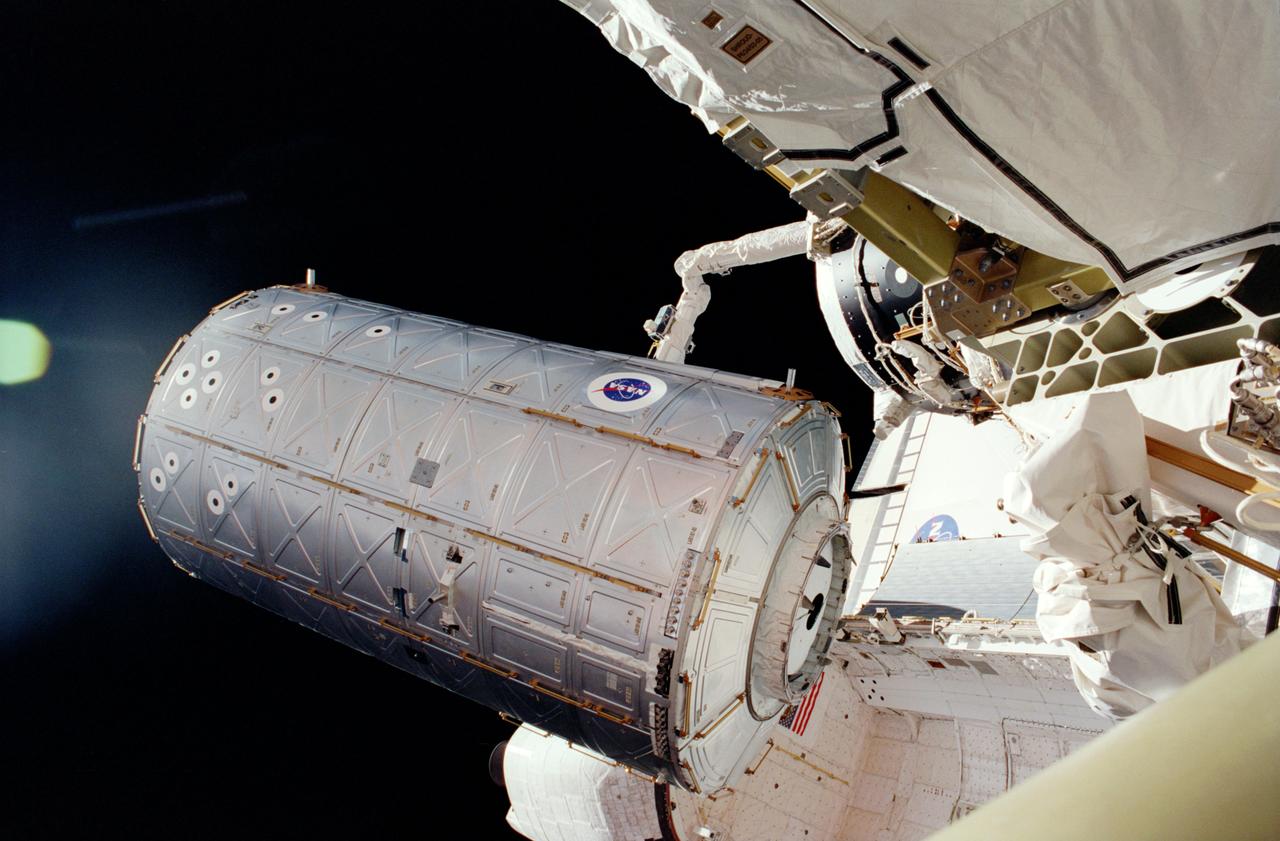
In the grasp of the Shuttle's Remote Manipulator System (RMS) robot arm, the U.S. Laboratory, Destiny, is moved from its stowage position in the cargo bay of the Space Shuttle Atlantis. This photograph was taken by astronaut Thomas D. Jones during his Extravehicular Activity (EVA). The American-made Destiny module is the cornerstone for space-based research aboard the orbiting platform and the centerpiece of the International Space Station (ISS), where unprecedented science experiments will be performed in the near-zero gravity of space. Destiny will also serve as the command and control center for the ISS. The aluminum module is 8.5- meters (28-feet) long and 4.3-meters (14-feet) in diameter. The laboratory consists of three cylindrical sections and two endcones with hatches that will be mated to other station components. A 50.9-centimeter (20-inch-) diameter window is located on one side of the center module segment. This pressurized module is designed to accommodate pressurized payloads. It has a capacity of 24 rack locations. Payload racks will occupy 15 locations especially designed to support experiments. The Destiny module was built by the Boeing Company under the direction of the Marshall Space Flight Center.
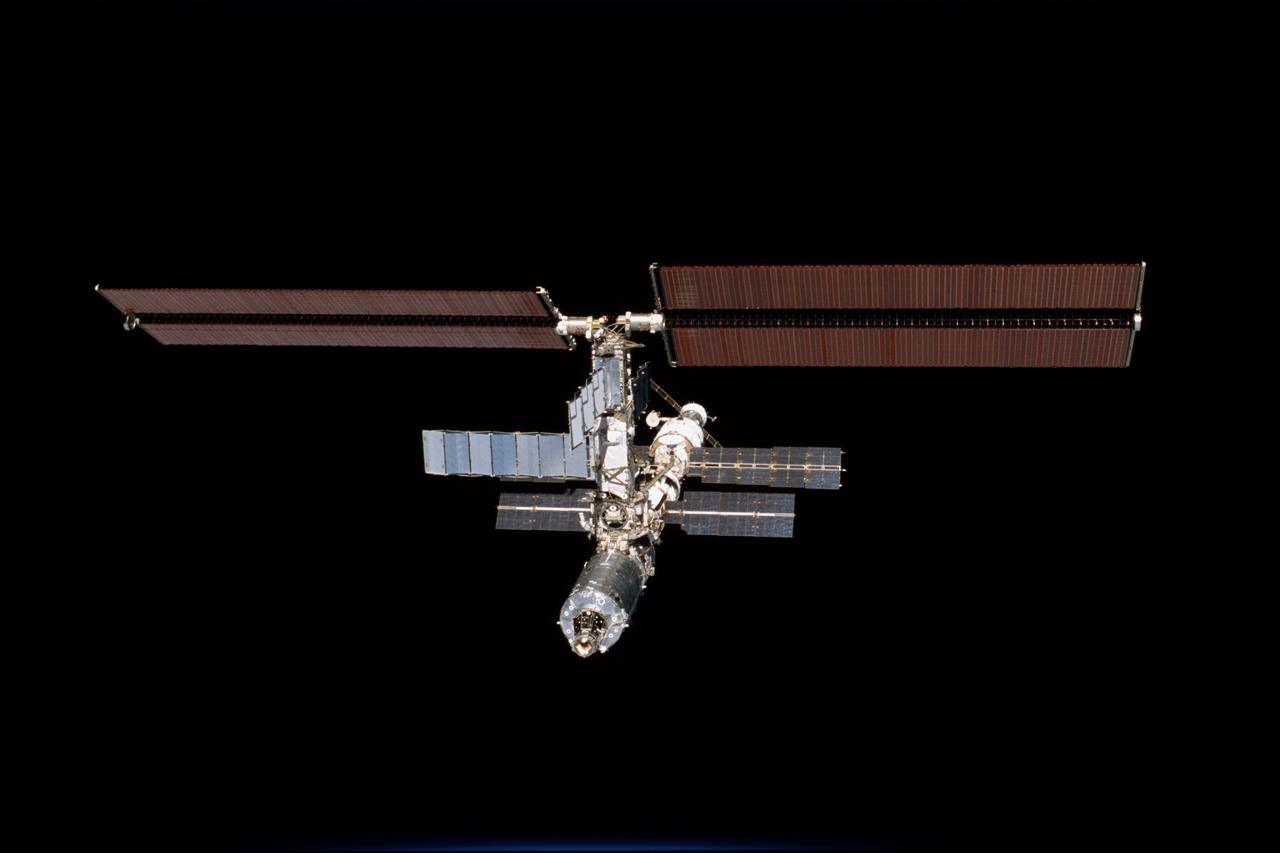
The International Space Station (ISS), with its newly attached U.S. Laboratory, Destiny, was photographed by a crew member aboard the Space Shuttle Orbiter Atlantis during a fly-around inspection after Atlantis separated from the Space Station. The Laboratory is shown in the foreground of this photograph. The American-made Destiny module is the cornerstone for space-based research aboard the orbiting platform and the centerpiece of the International Space Station (ISS), where unprecedented science experiments will be performed in the near-zero gravity of space. Destiny will also serve as the command and control center for the ISS. The aluminum module is 8.5-meters (28-feet) long and 4.3-meters (14-feet) in diameter. The laboratory consists of three cylindrical sections and two endcones with hatches that will be mated to other station components. A 50.9-centimeter (20-inch-) diameter window is located on one side of the center module segment. This pressurized module is designed to accommodate pressurized payloads. It has a capacity of 24 rack locations. Payload racks will occupy 15 locations especially designed to support experiments. The Destiny module was built by the Boeing Company under the direction of the Marshall Space Flight Center.
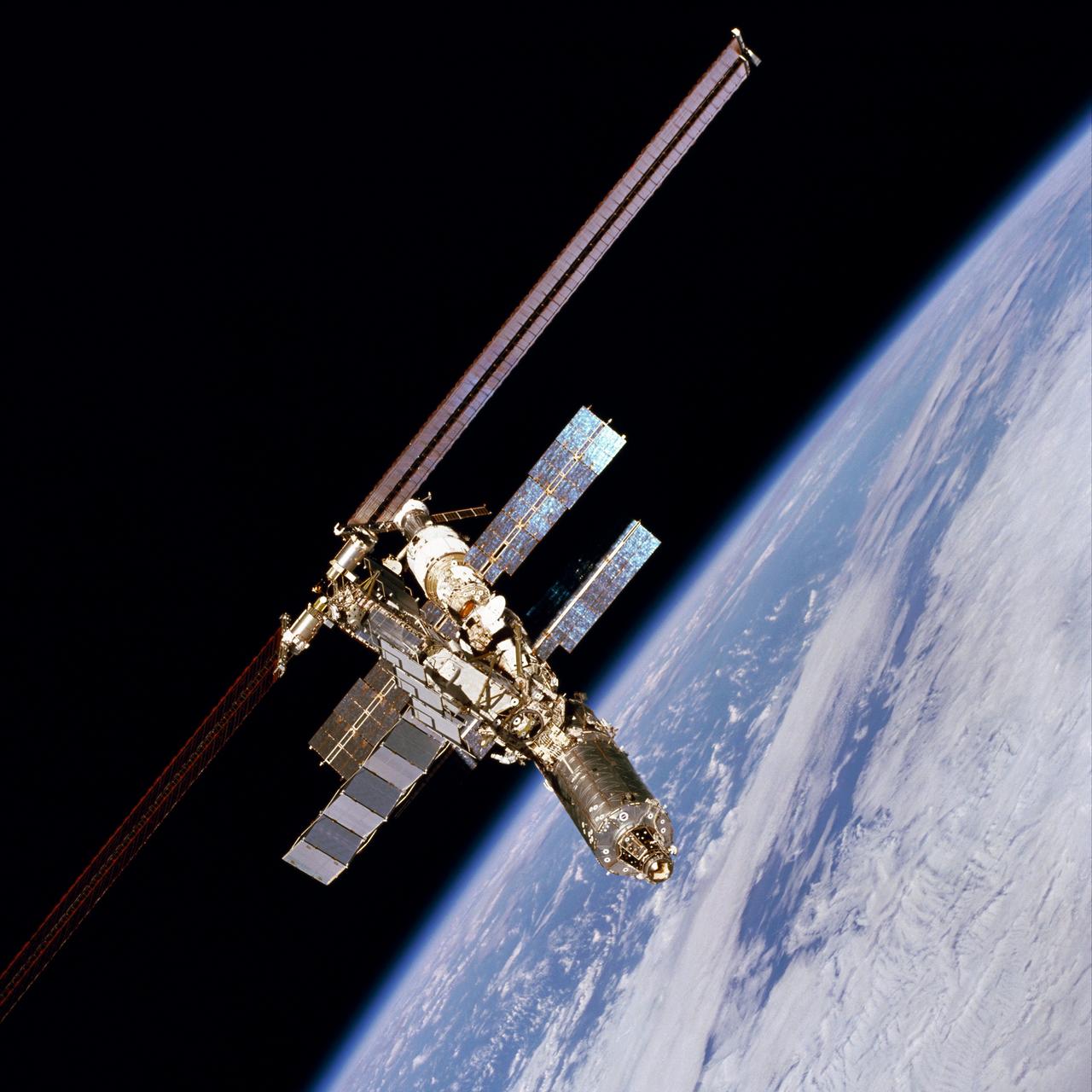
With its new U.S. Laboratory, Destiny, contrasted over a blue and white Earth, the International Space Station (ISS) was photographed by one of the STS-98 crew members aboard the Space Shuttle Atlantis following separation of the Shuttle and Station. The Laboratory is shown at the lower right of the Station. The American-made Destiny module is the cornerstone for space-based research aboard the orbiting platform and the centerpiece of the ISS, where unprecedented science experiments will be performed in the near-zero gravity of space. Destiny will also serve as the command and control center for the ISS. The aluminum module is 8.5- meters (28-feet) long and 4.3-meters (14-feet) in diameter. The laboratory consists of three cylindrical sections and two endcones with hatches that will be mated to other station components. A 50.9-centimeter (20-inch-) diameter window is located on one side of the center module segment. This pressurized module is designed to accommodate pressurized payloads. It has a capacity of 24 rack locations. Payload racks will occupy 15 locations especially designed to support experiments. The Destiny module was built by the Boeing Company under the direction of the Marshall Space Flight Center.
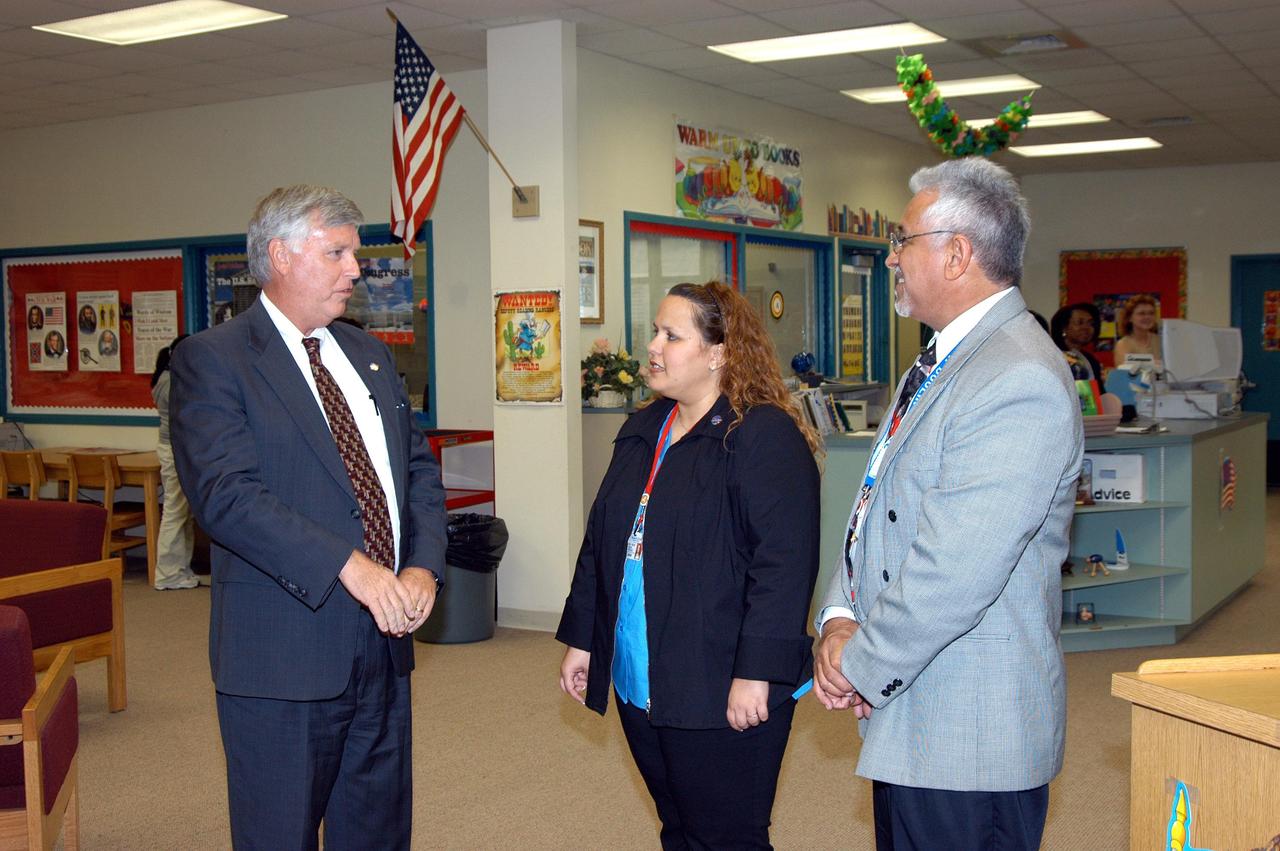
KENNEDY SPACE CENTER, FLA. -- Center Director Jim Kennedy (left) talks to Eduardo Tillet (right), principal of Howard A. Doolin Middle School, Miami, Fla., on his visit to share America’s new vision for space exploration with the next generation of explorers. Kennedy, joined by astronaut David Wolf, is talking with students about our destiny as explorers, NASA’s stepping stone approach to exploring Earth, the Moon, Mars and beyond, how space impacts our lives, and how people and machines rely on each other in space.
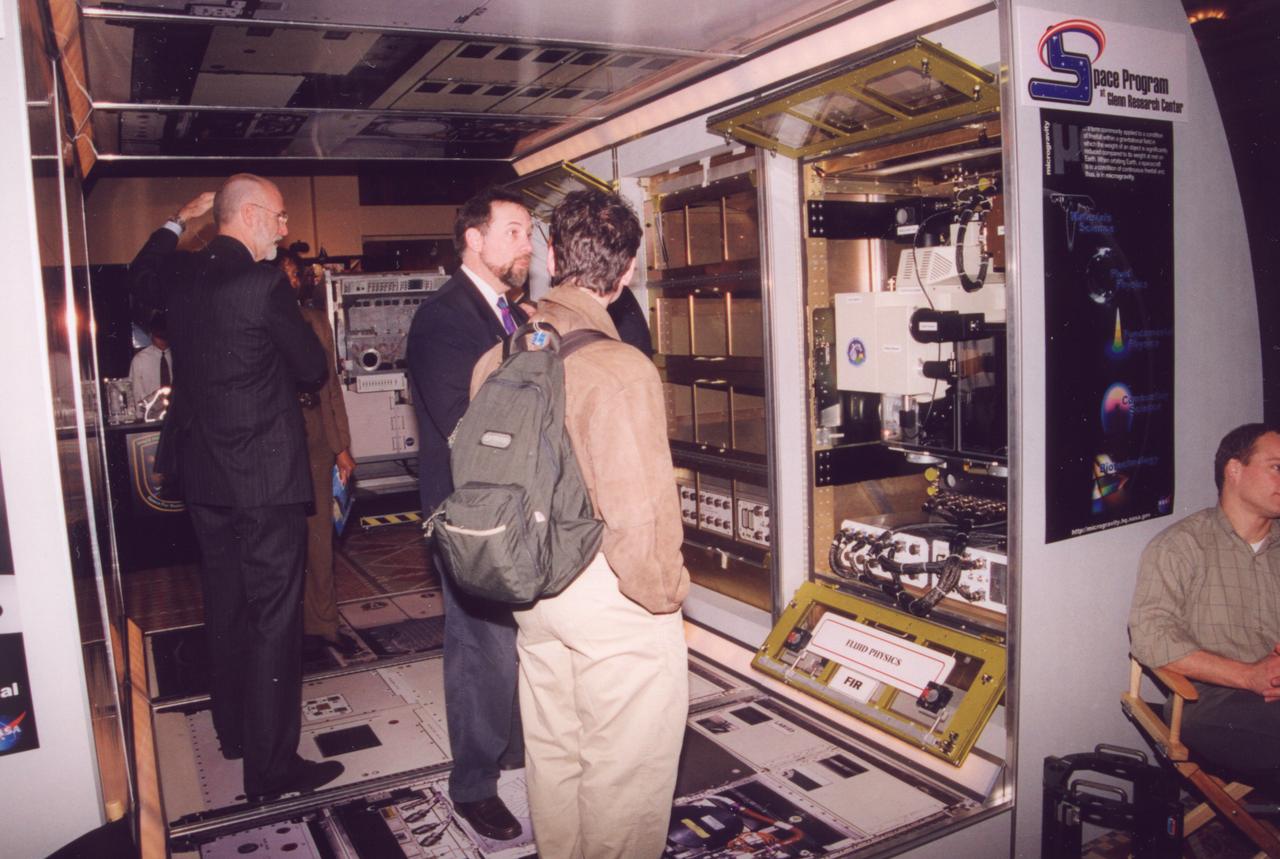
Engineers from NASA's Glen Research Center demonstrate the access to one of the experiment racks plarned for the U.S. Destiny laboratory module on the International Space Station (ISS). This mockup has the full diameter, full corridor width, and half the length of the module. The mockup includes engineering mockups of the Fluids and Combustion Facility being developed by NASA's Glenn Research Center. (The full module will be six racks long; the mockup is three racks long). Photo credit: NASA/Marshall Space Flight Center (MSFC)
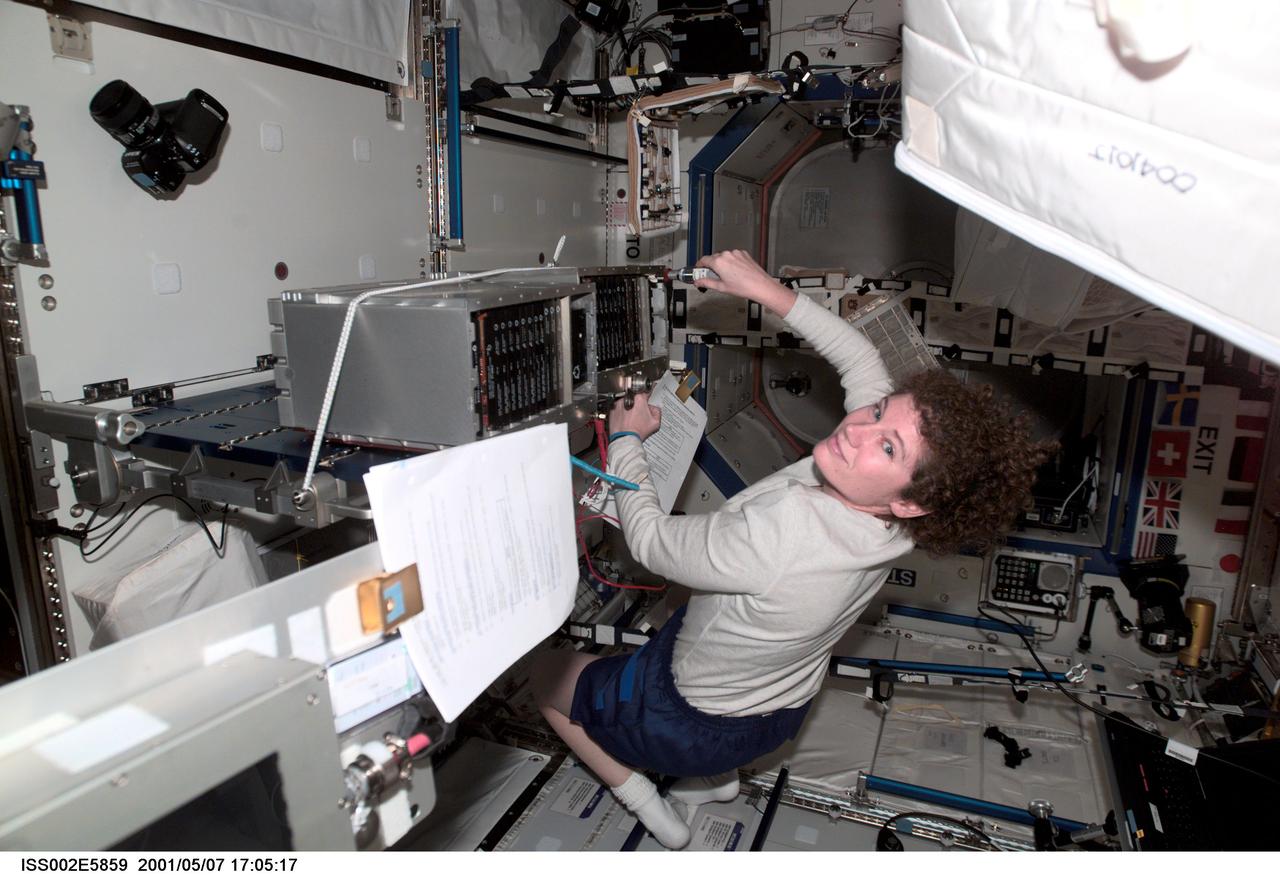
ISS002-E-5859 (7 May 2001) --- Susan J. Helms, Expedition Two flight engineer, works on an Enhanced Space Station Multiplexer / Demultiplexer (ESSMDM) at the Maintenance Work Assembly (MWA) work surface in the Destiny module. The image was taken with a digital still camera.

SS01-E-5353 (14 February 2001) --- Cosmonaut Sergei K. Krikalev, flight engineer for the three-man Expedition One crew, floats in the Destiny laboratory onboard the International Space Station (ISS). The scene was recorded with a digital still camera.
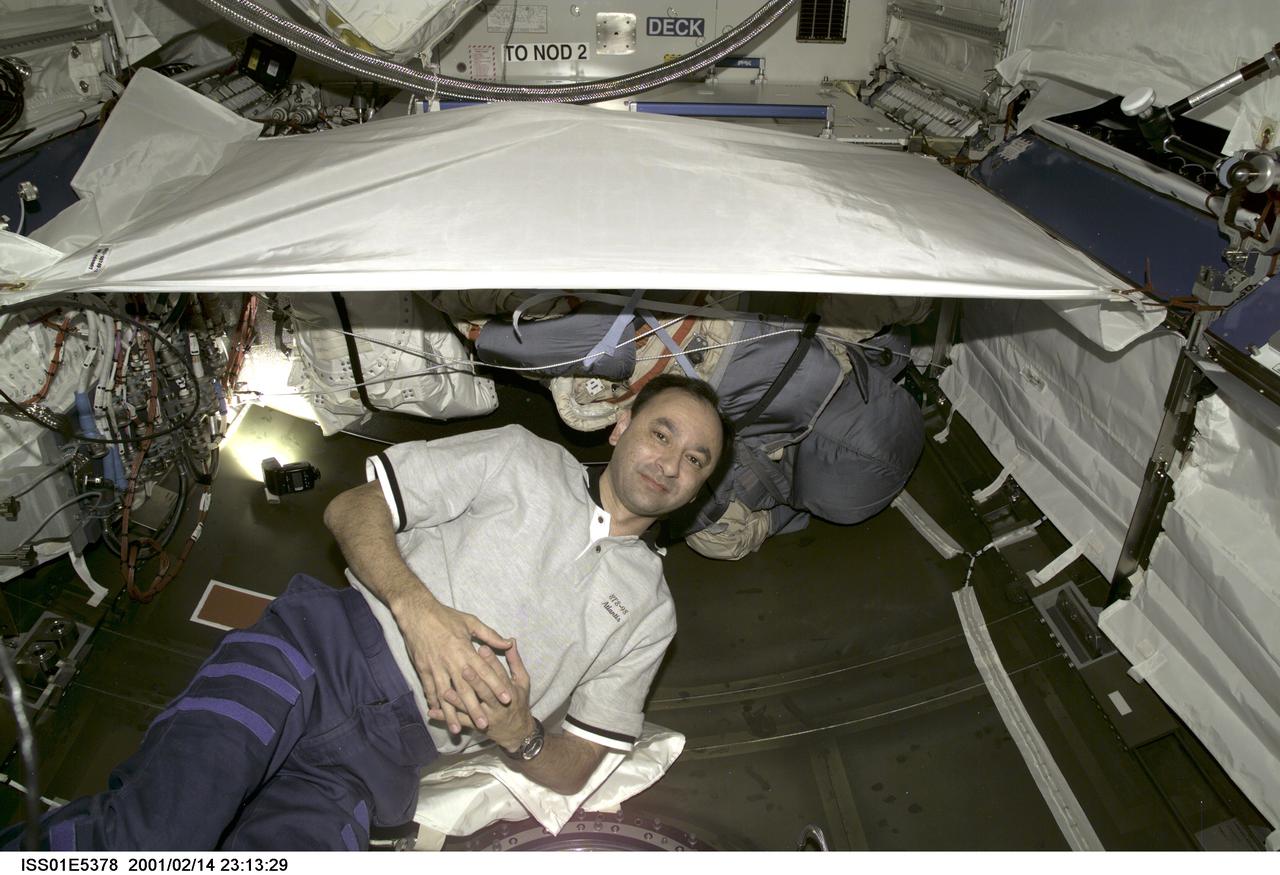
ISS01-E-5378 (14 February 2001) --- Astronaut Mark L. Polansky is pictured in the new Destiny laboratory. The STS-98 and Expedition One crews have been busy in the lab since its hatch was opened earlier in the week. This photo was taken with a digital still camera.
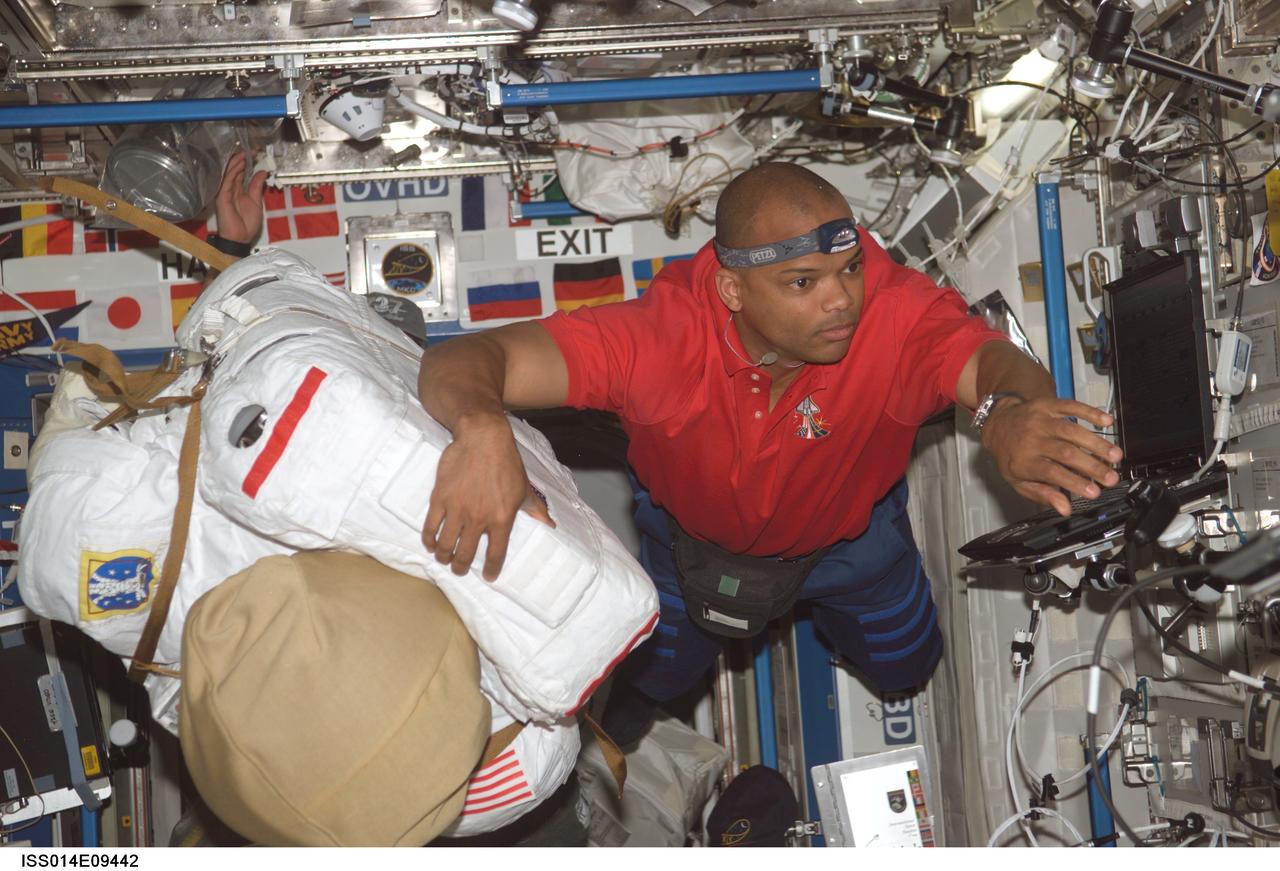
ISS014-E-09442 (12 Dec. 2006) --- Astronaut Robert L. Curbeam, Jr., STS-116 mission specialist, floats with his Extravehicular Mobility Unit (EMU) spacesuit in the Destiny laboratory of the International Space Station as he prepares for the mission's first scheduled session of extravehicular activity (EVA).
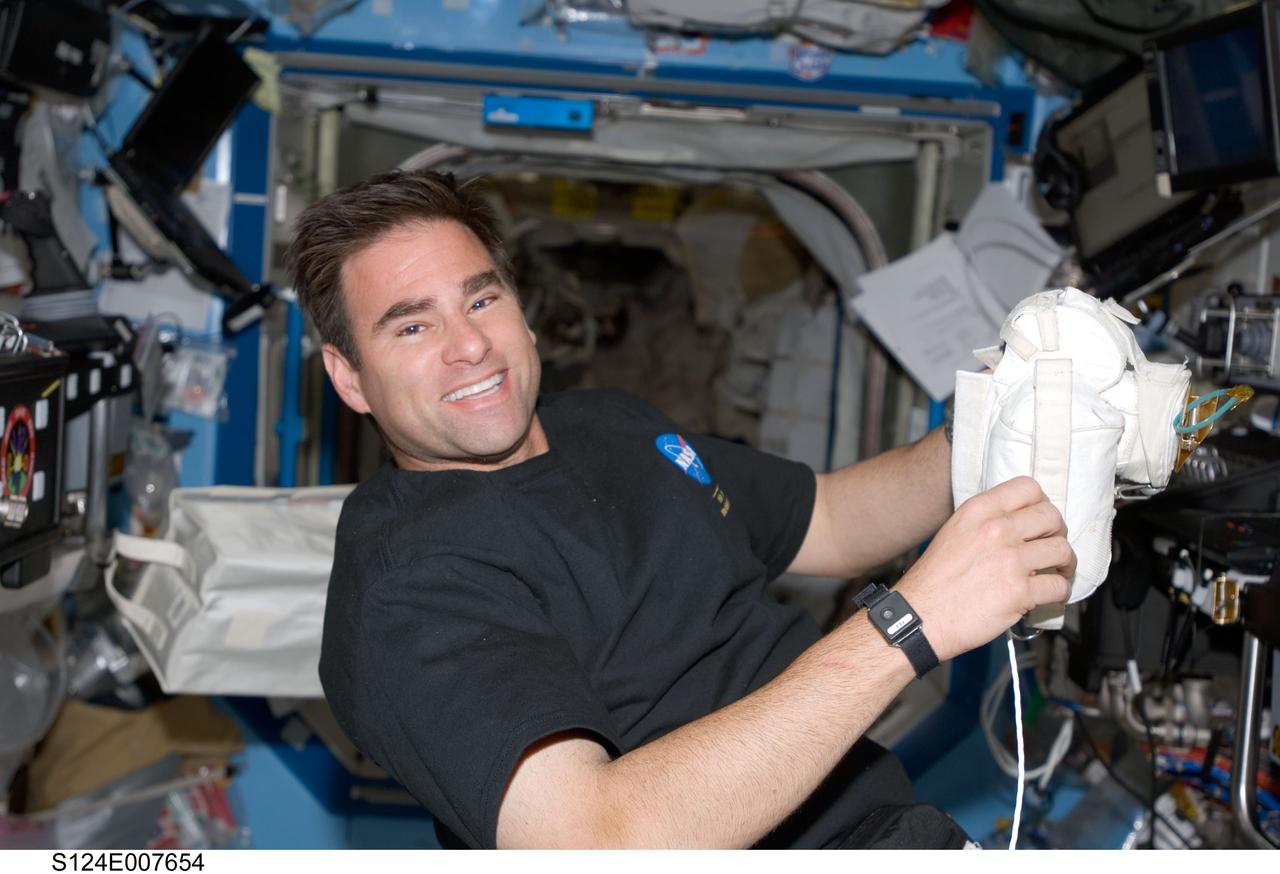
S124-E-007654 (7 June 2008) --- Astronaut Greg Chamitoff, Expedition 17 flight engineer, takes a moment for a photo as he works in the Destiny laboratory of the International Space Station while Space Shuttle Discovery is docked with the station.
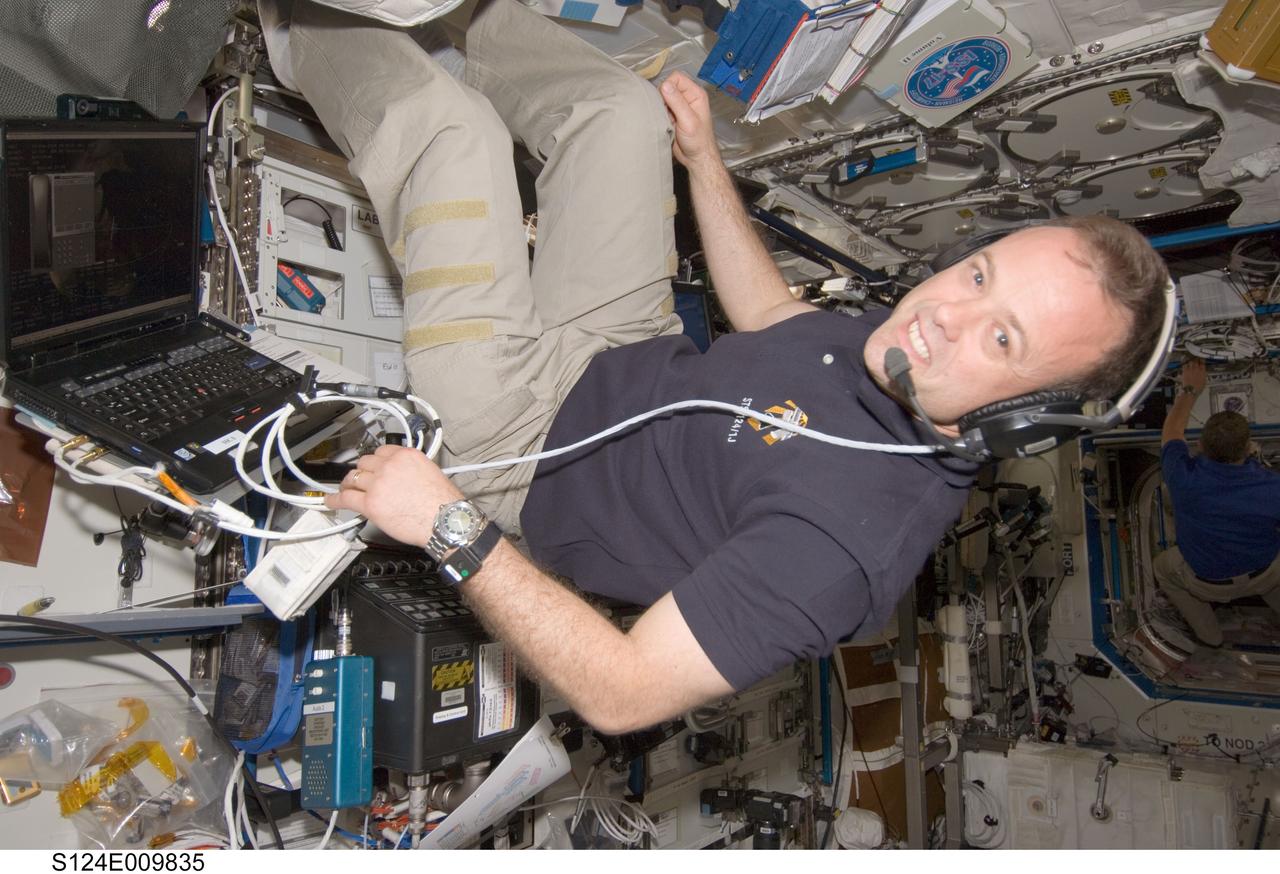
S124-E-009835 (10 June 2008) --- Astronaut Ron Garan, STS-124 mission specialist, takes a moment for a photo as he uses a communication system in the Destiny laboratory of the International Space Station while Space Shuttle Discovery is docked with the station.
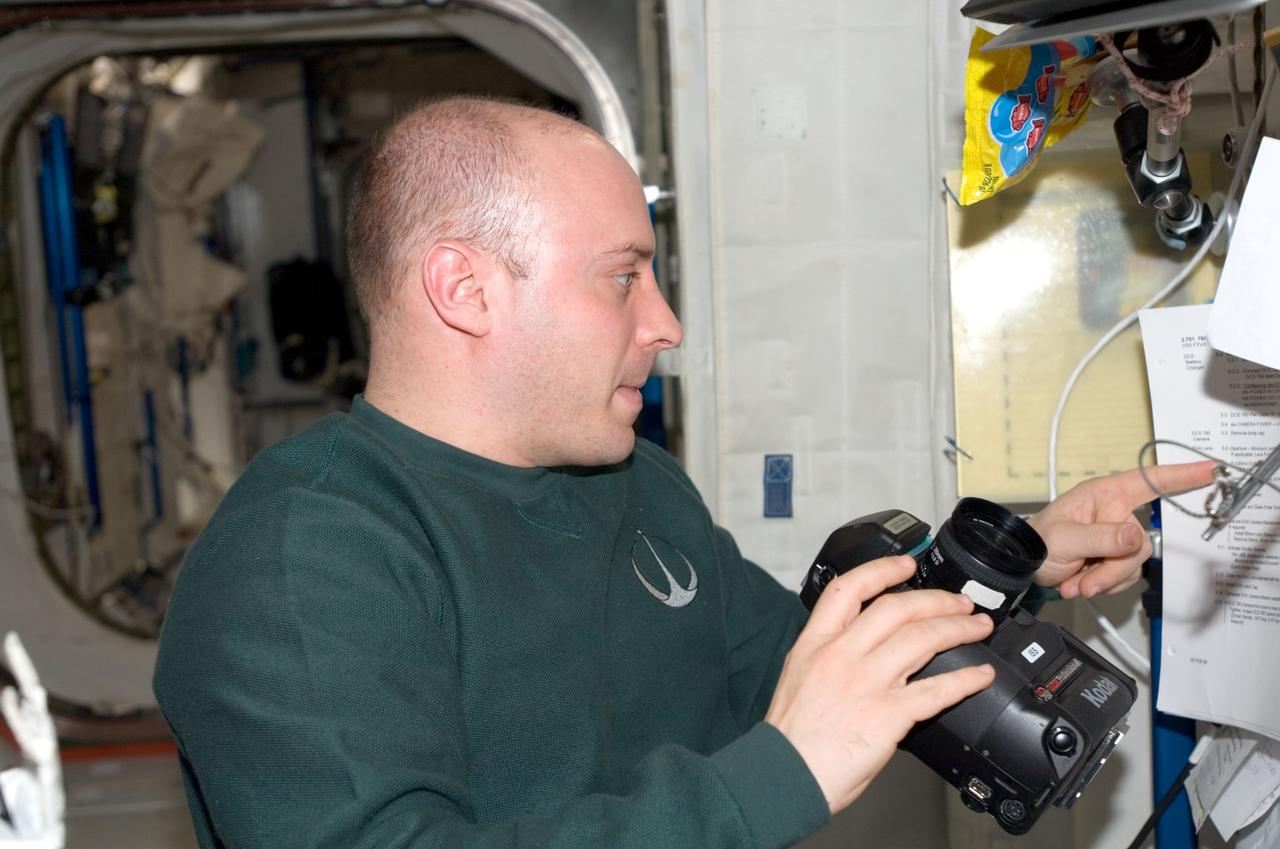
S124-E-006024 (2 June 2008) --- Astronaut Garrett Reisman, STS-124 mission specialist, looks over a checklist while holding a camera in the Destiny laboratory of the International Space Station while Space Shuttle Discovery is docked with the station.
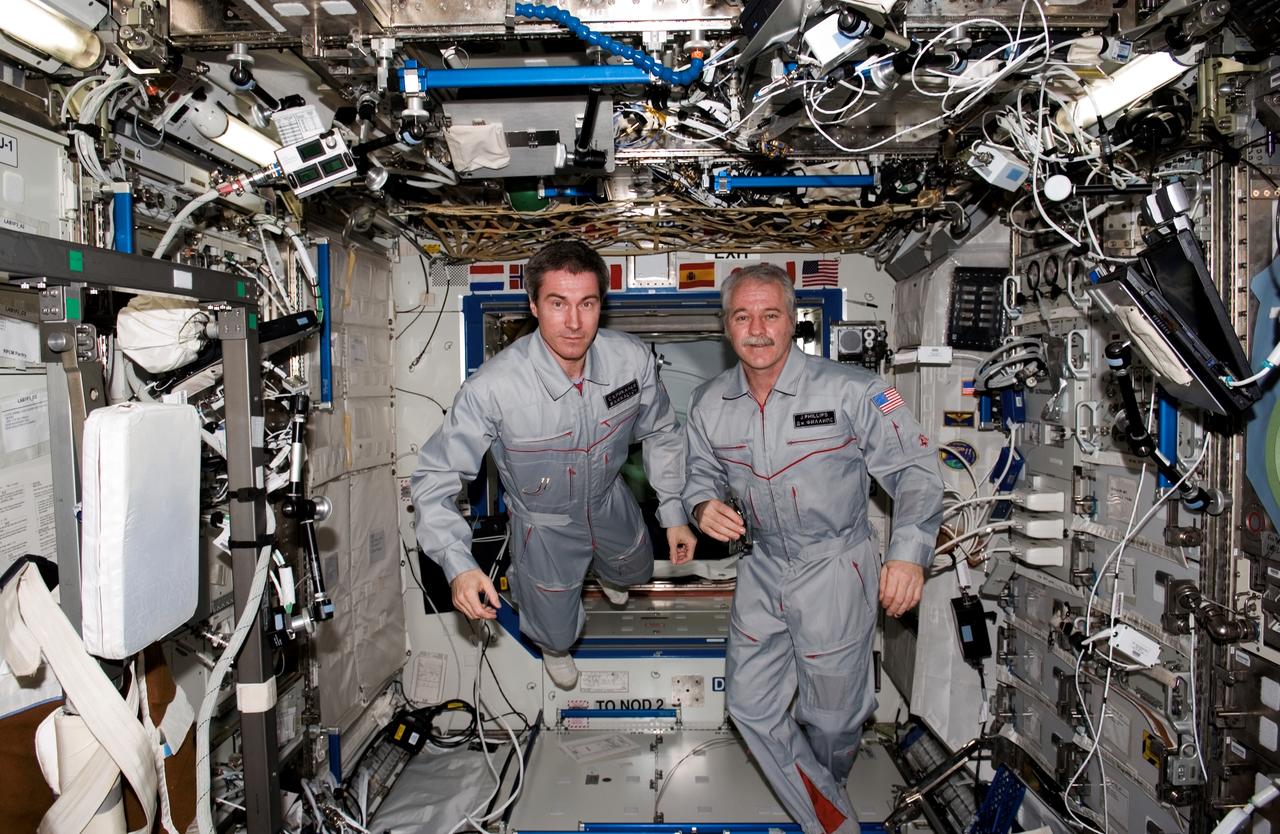
ISS011-E-12408 (2 August 2005) --- Cosmonaut Sergei K. Krikalev (left), Expedition 11 commander representing Russia's Federal Space Agency, and astronaut John L. Phillips, NASA space station science officer and flight engineer, pose for a photo in the Destiny laboratory of the international space station.
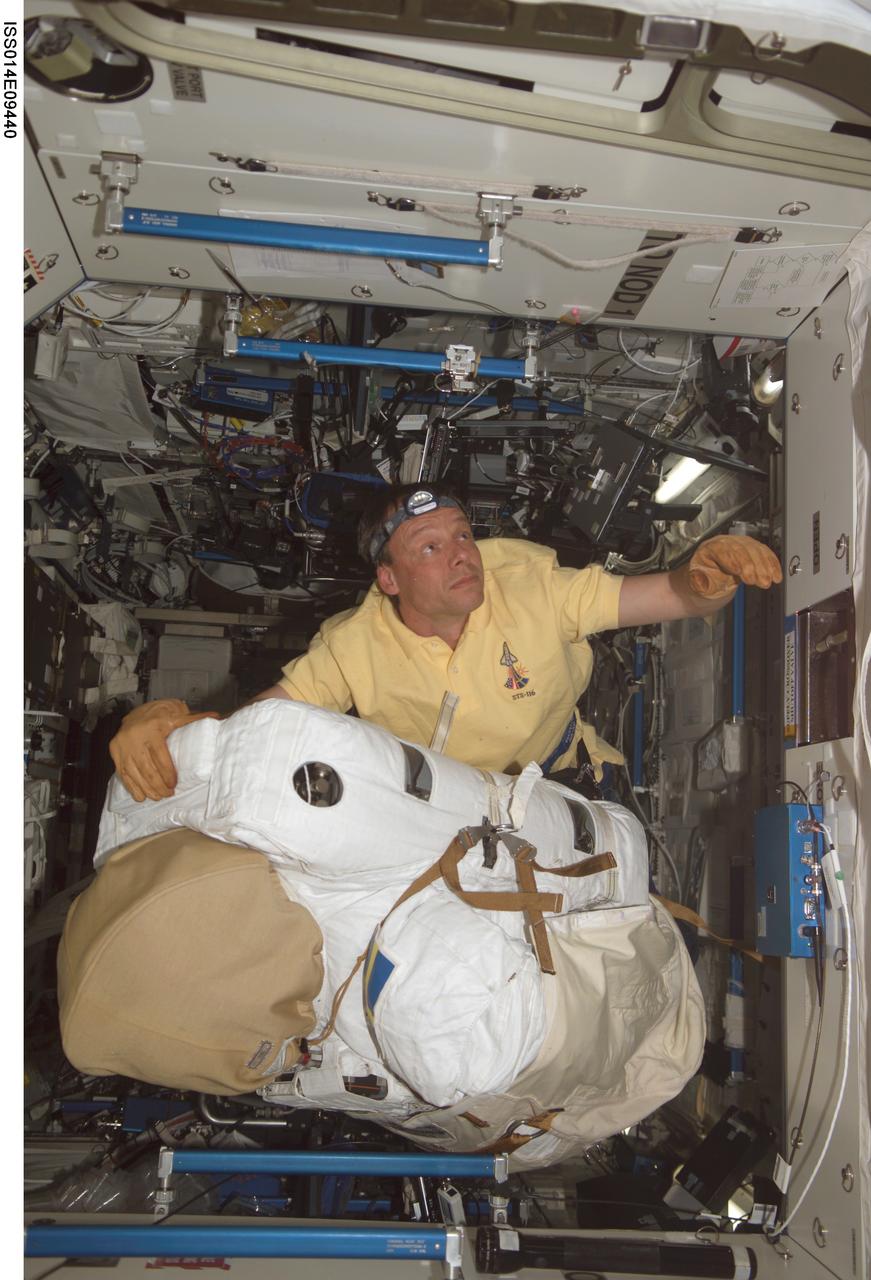
ISS014-E-09440 (12 Dec. 2006) --- European Space Agency (ESA) astronaut Christer Fuglesang, STS-116 mission specialist, floats with his Extravehicular Mobility Unit (EMU) spacesuit in the Destiny laboratory of the International Space Station as he prepares for the mission's first scheduled session of extravehicular activity (EVA).
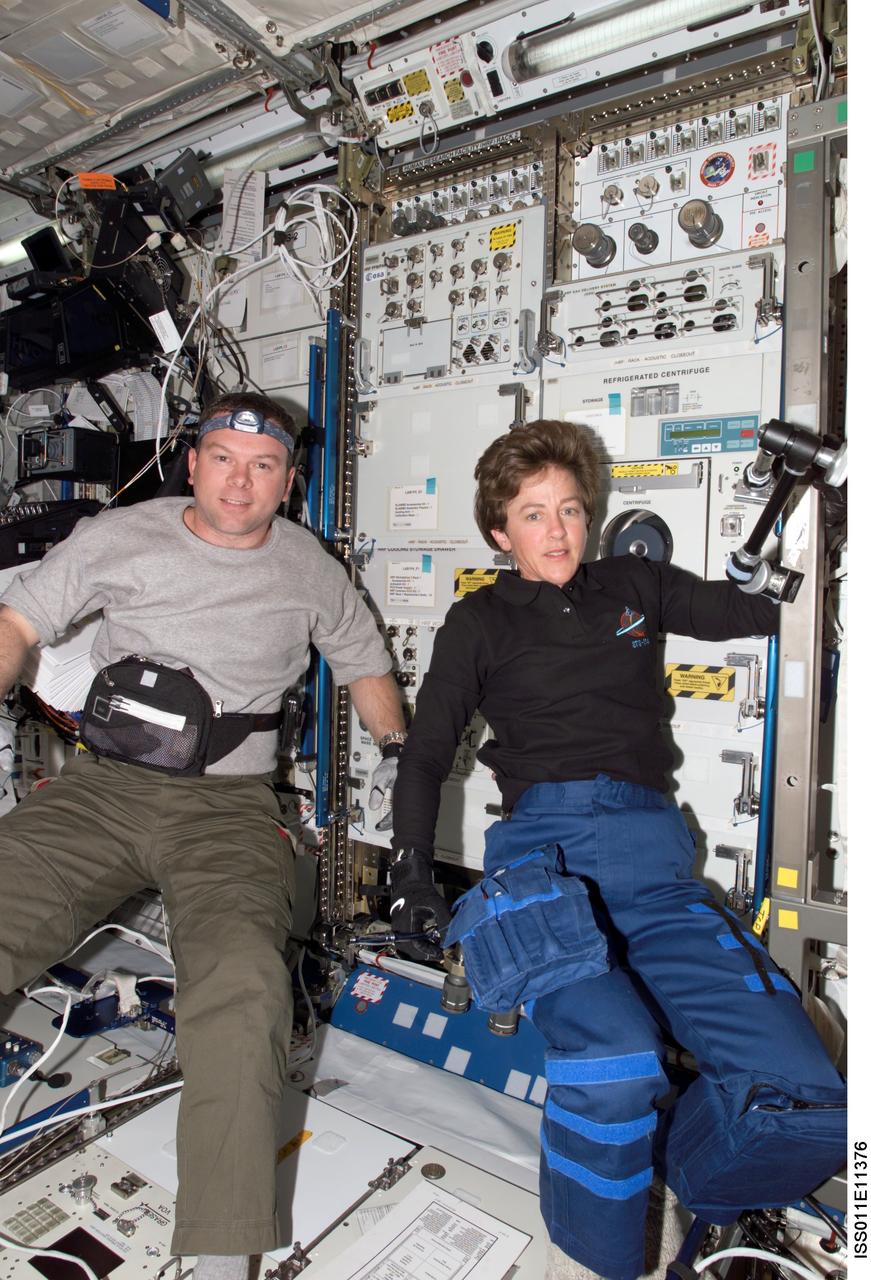
ISS011-E-11376 (31 July 2005) --- Astronauts James M. Kelly (left), STS-114 pilot, and Wendy B. Lawrence, mission specialist, are photographed after installing the new Human Research Facility (HRF) rack 2 in the Destiny laboratory of the International Space Station.
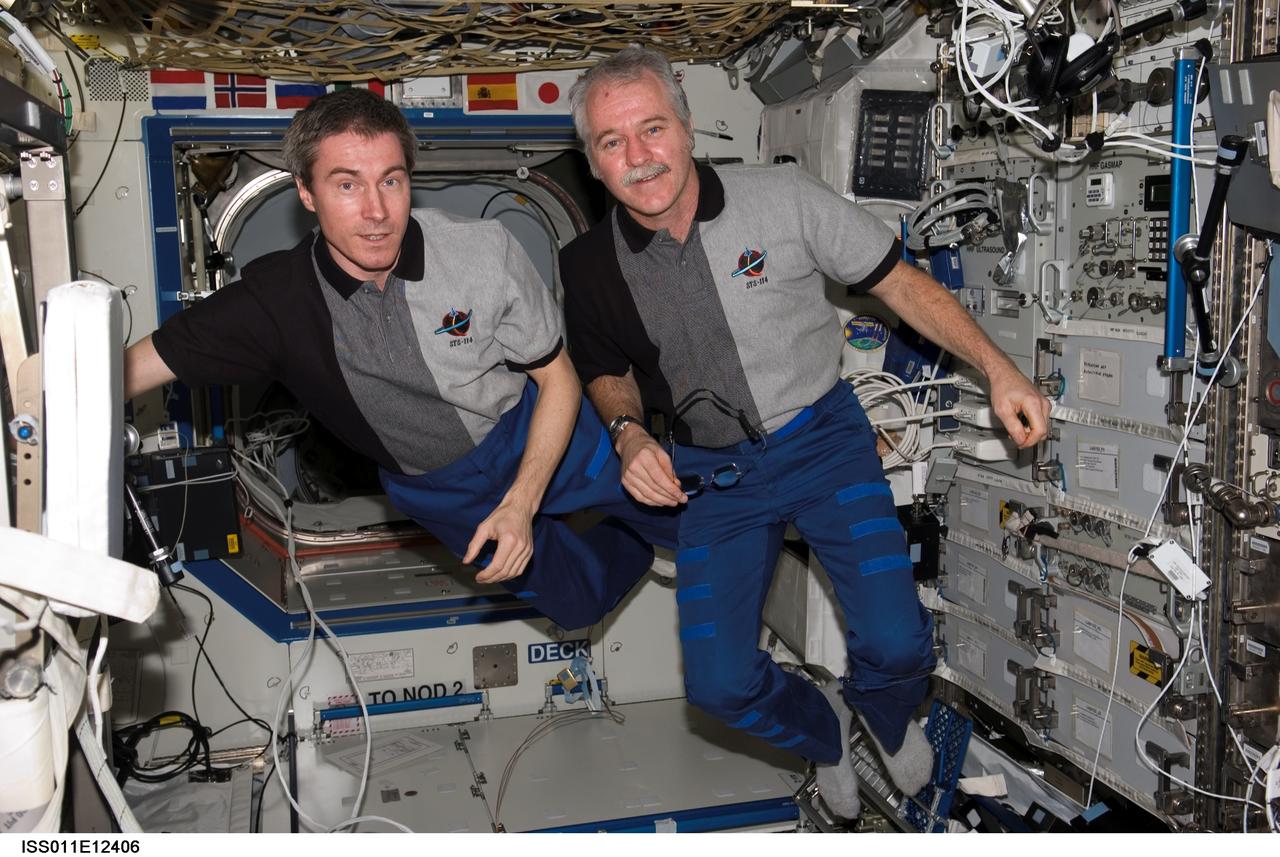
ISS011-E-12406 (2 August 2005) --- Cosmonaut Sergei K. Krikalev (left), Expedition 11 commander representing Russia's Federal Space Agency, and astronaut John L. Phillips, NASA Space Station science officer and flight engineer, pose for a photo in the Destiny laboratory of the International Space Station.
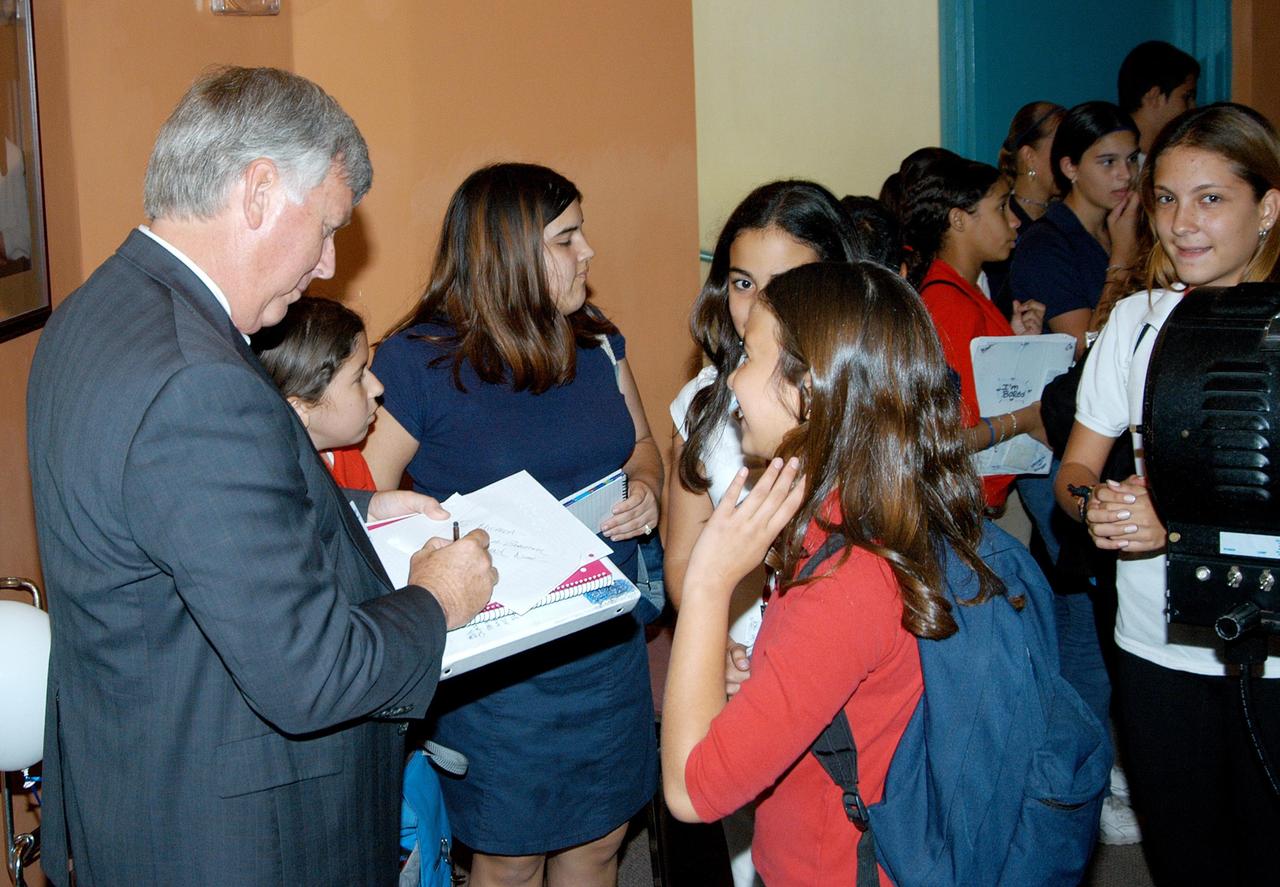
KENNEDY SPACE CENTER, FLA. -- After his presentation, Center Director Jim Kennedy signs a memento for a student at Howard A. Doolin Middle School, Miami, Fla. The school is one of 100 taking part in the NASA Explorer Schools (NES) program. Kennedy visited the school to share America’s new vision for space exploration with the next generation of explorers. He is talking with students in Florida and Georgia Explorer Schools about our destiny as explorers, NASA’s stepping stone approach to exploring Earth, the Moon, Mars and beyond, how space impacts our lives, and how people and machines rely on each other in space.
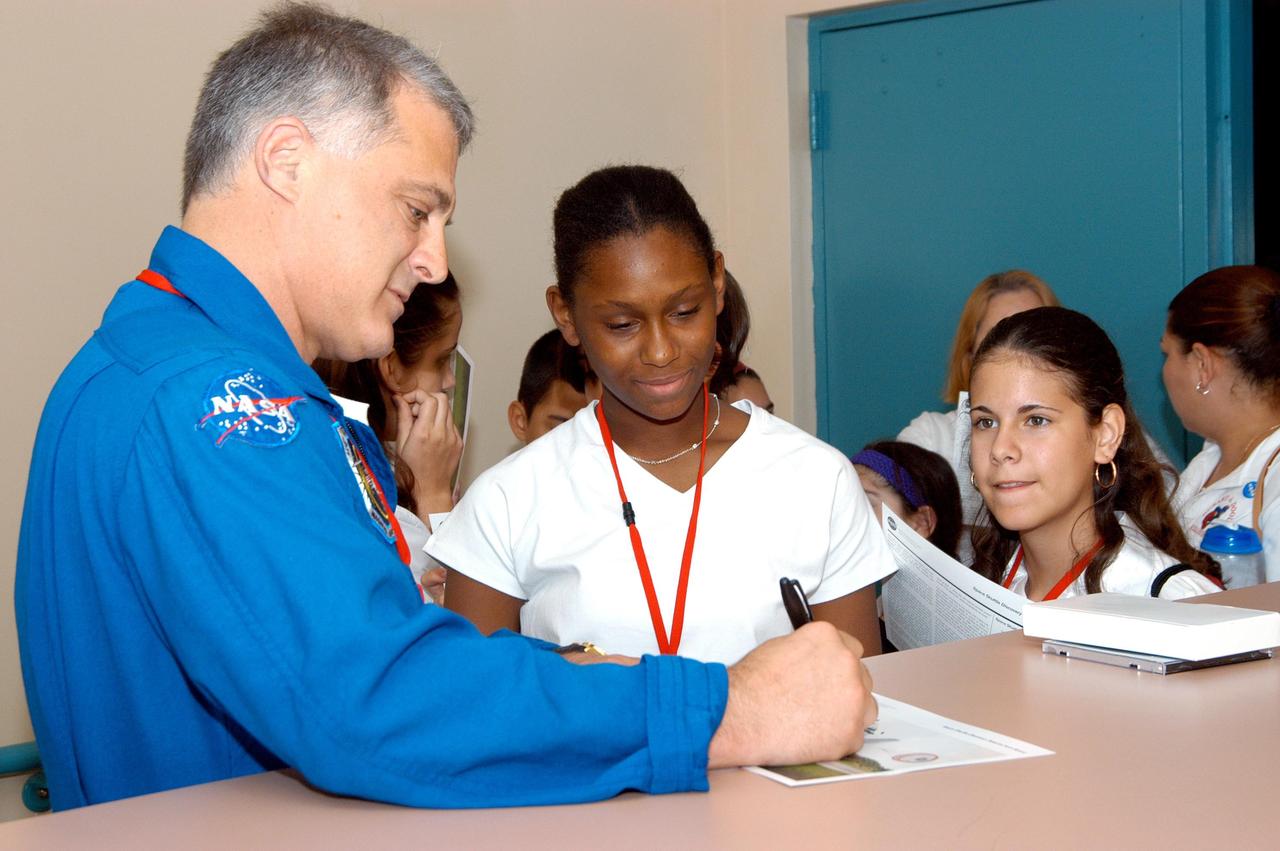
KENNEDY SPACE CENTER, FLA. -- After his presentation at Howard A. Doolin Middle School, Miami, Fla., astronaut David Wolf signs a memento for a student. The school is one of 100 taking part in the NASA Explorer Schools (NES) program. Center Director Jim Kennedy and Wolf visited the school to share America’s new vision for space exploration with the next generation of explorers. They talked with students about our destiny as explorers, NASA’s stepping stone approach to exploring Earth, the Moon, Mars and beyond, how space impacts our lives, and how people and machines rely on each other in space.
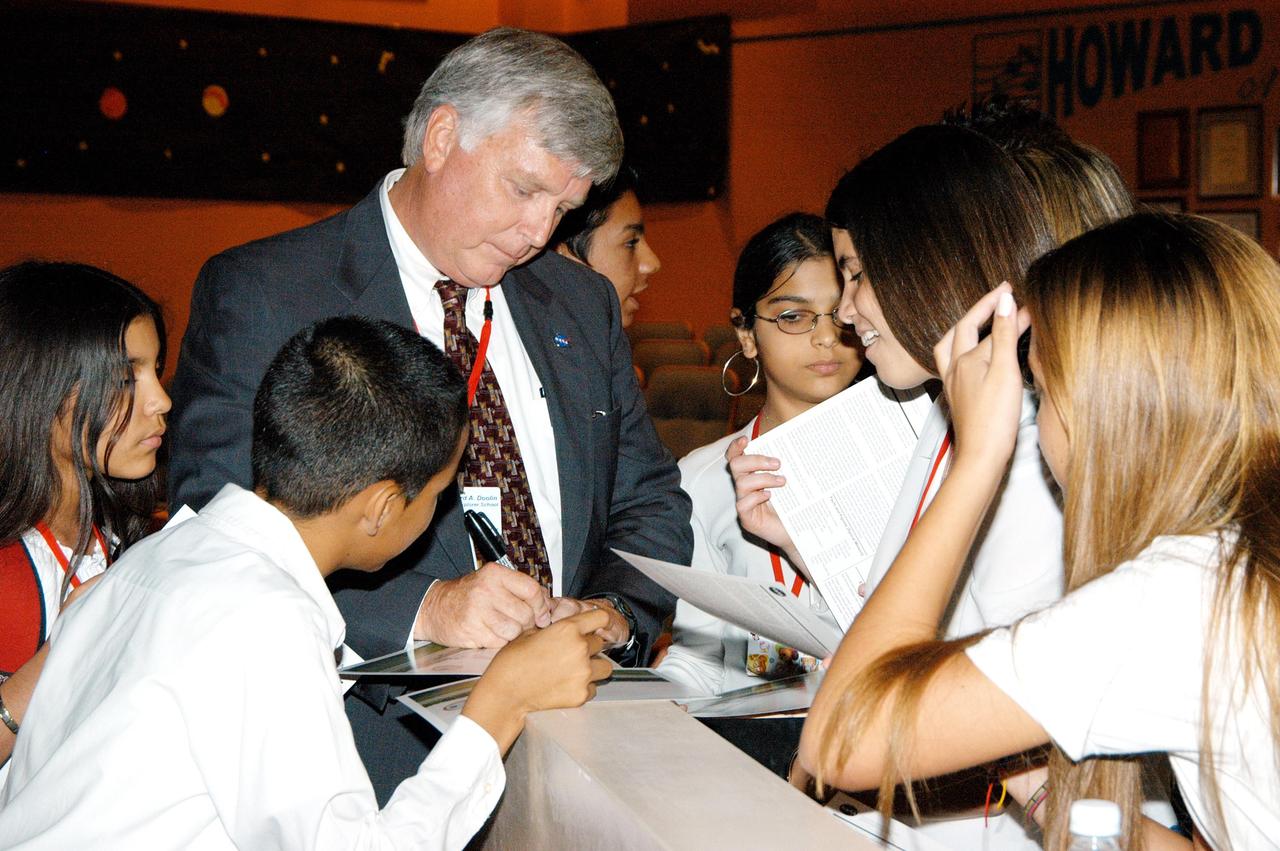
KENNEDY SPACE CENTER, FLA. -- After his presentation, students at Howard A. Doolin Middle School, Miami, Fla., gather around Center Director Jim Kennedy as he signs a memento for a student. The school is one of 100 taking part in the NASA Explorer Schools (NES) program. Kennedy visited the school to share America’s new vision for space exploration with the next generation of explorers. He is talking with students in Florida and Georgia Explorer Schools about our destiny as explorers, NASA’s stepping stone approach to exploring Earth, the Moon, Mars and beyond, how space impacts our lives, and how people and machines rely on each other in space.
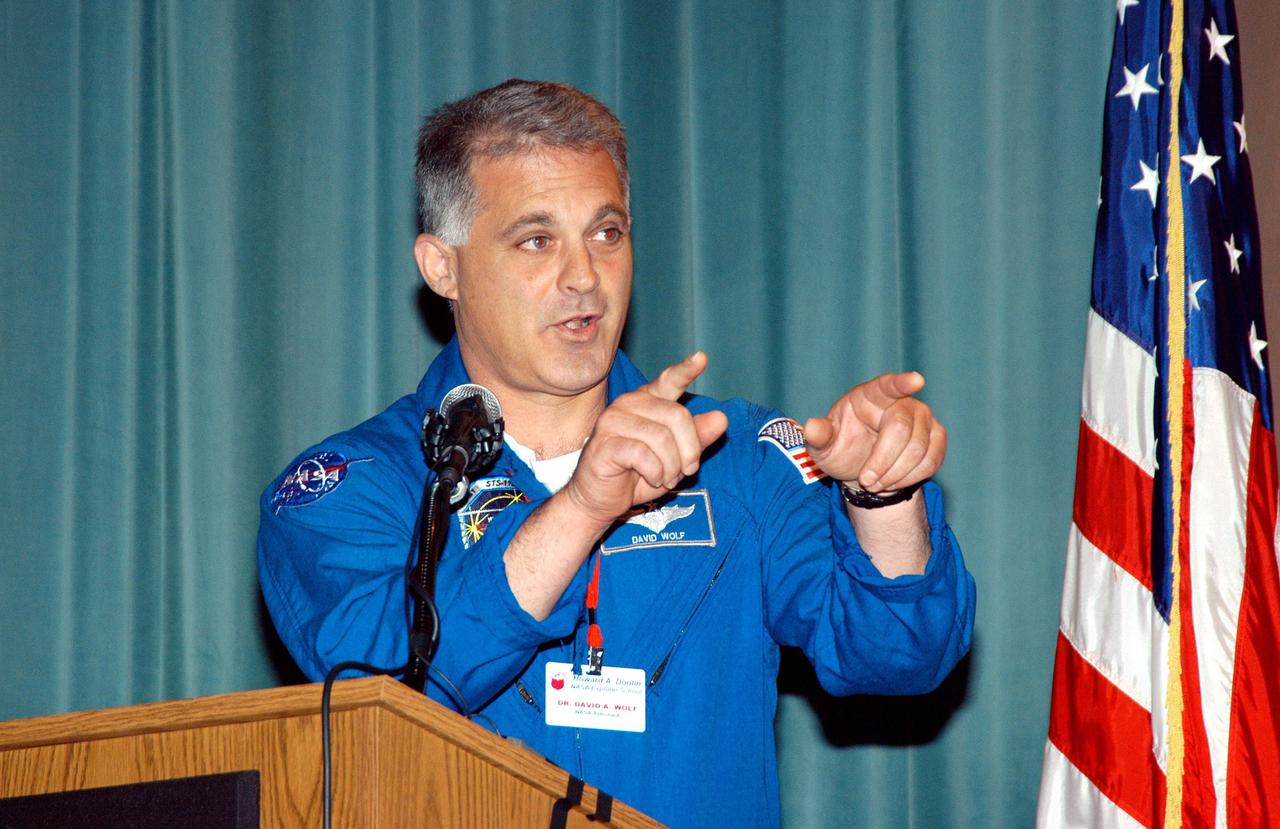
KENNEDY SPACE CENTER, FLA. -- Astronaut David Wolf addresses students and faculty of Howard A. Doolin Middle School, Miami, Fla., about his experiences in space. Doolin Middle School is one of 100 to take part in the NASA Explorer Schools (NES) program. Wolf joins Center Director Jim Kennedy on his visit to share America’s new vision for space exploration with the next generation of explorers. He is talking with students in Florida and Georgia Explorer Schools about our destiny as explorers, NASA’s stepping stone approach to exploring Earth, the Moon, Mars and beyond, how space impacts our lives, and how people and machines rely on each other in space.
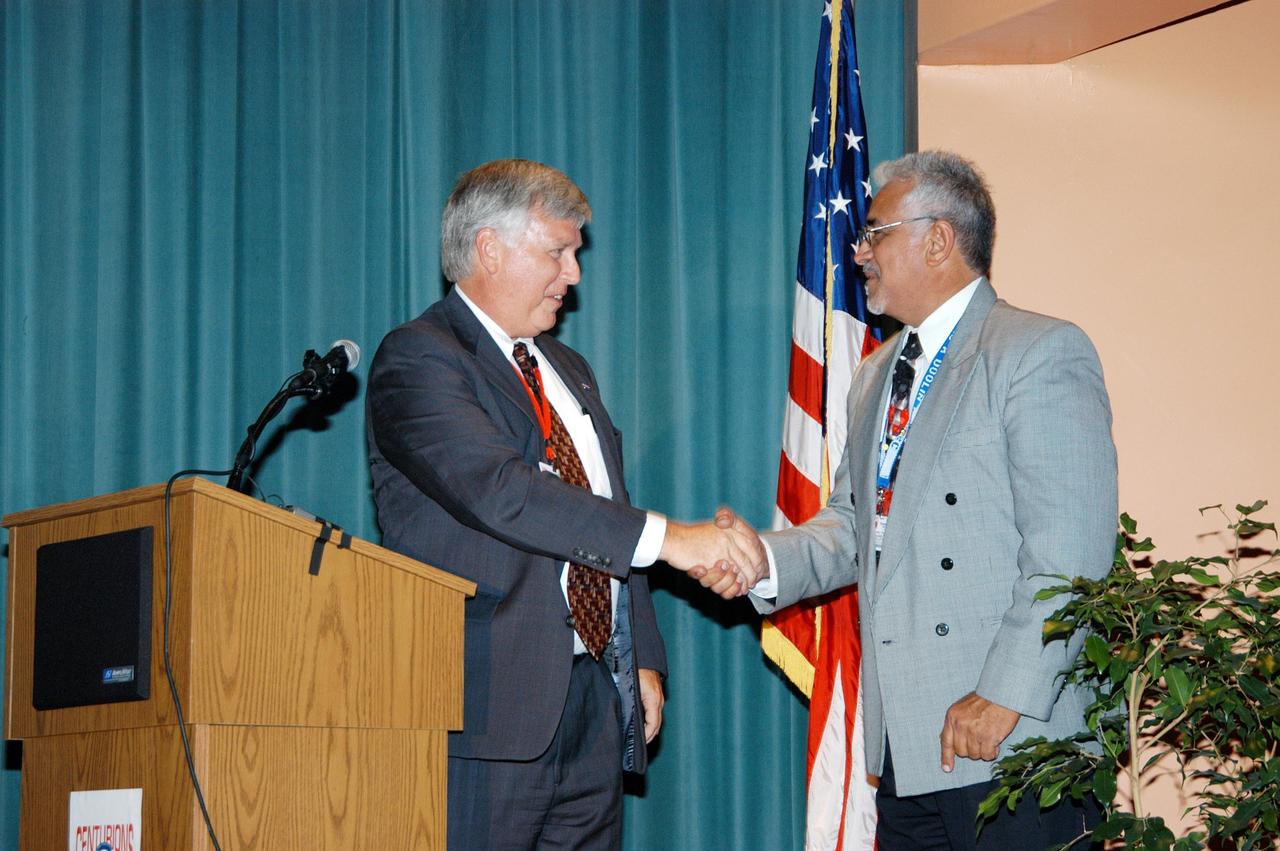
KENNEDY SPACE CENTER, FLA. -- Center Director Jim Kennedy (left) is thanked by Principal Eduardo Tillet for his presentation to the faculty and students of Howard A. Doolin Middle School, Miami, Fla. The school is one of 100 taking part in the NASA Explorer Schools (NES) program. The purpose of Kennedy’s visit is to share America’s new vision for space exploration with the next generation of explorers. He is talking with students in Florida and Georgia Explorer Schools about our destiny as explorers, NASA’s stepping stone approach to exploring Earth, the Moon, Mars and beyond, how space impacts our lives, and how people and machines rely on each other in space.
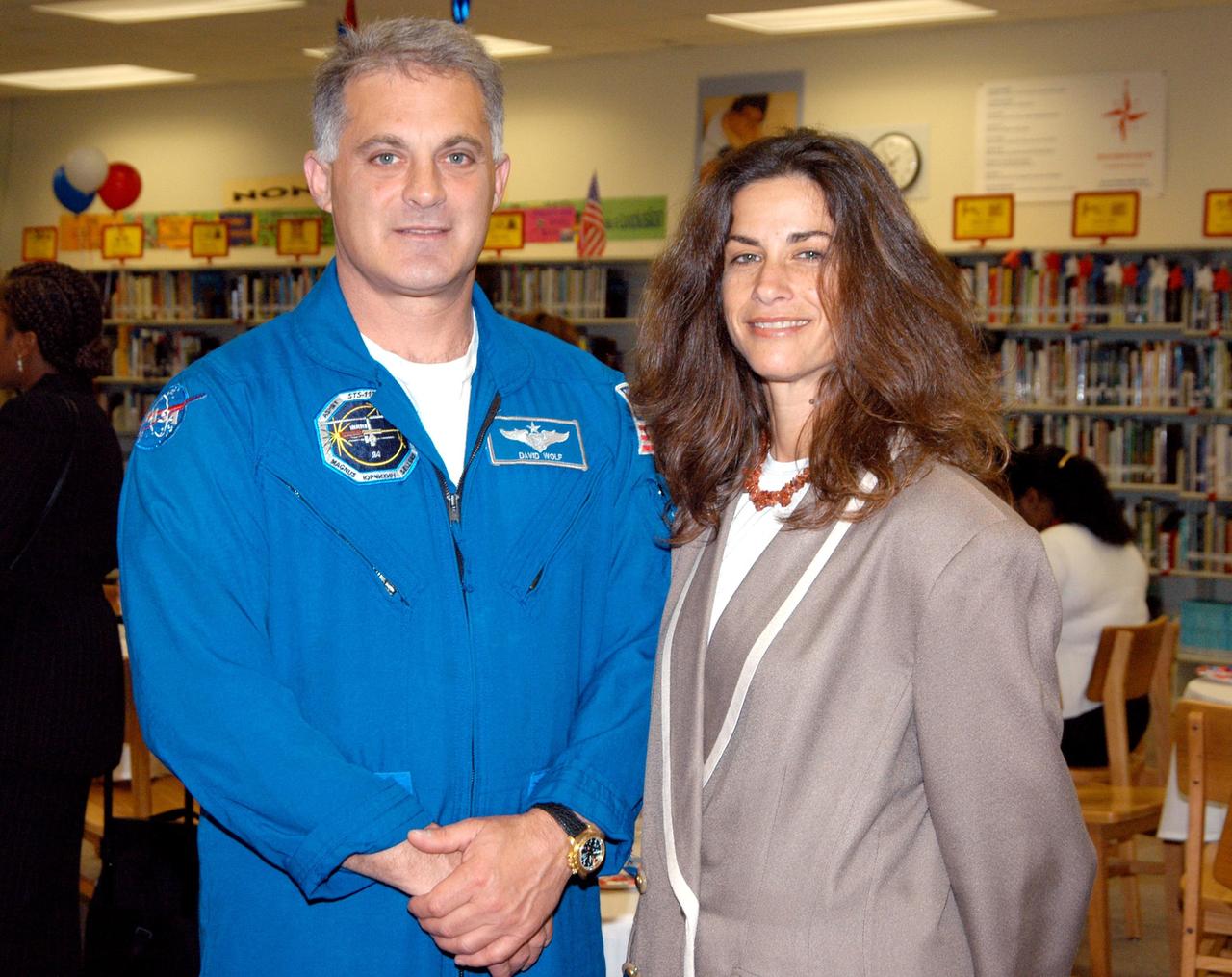
KENNEDY SPACE CENTER, FLA. -- During lunch in the library at Howard A. Doolin Middle School, Miami, Fla., astronaut David Wolf pauses for a photo with a member of the school board. Doolin Middle School is one of 100 to take part in the NASA Explorer Schools program. Wolf joined Center Director Jim Kennedy to share America’s new vision for space exploration with the next generation of explorers. Kennedy is talking with students about our destiny as explorers, NASA’s stepping stone approach to exploring Earth, the Moon, Mars and beyond, how space impacts our lives, and how people and machines rely on each other in space.
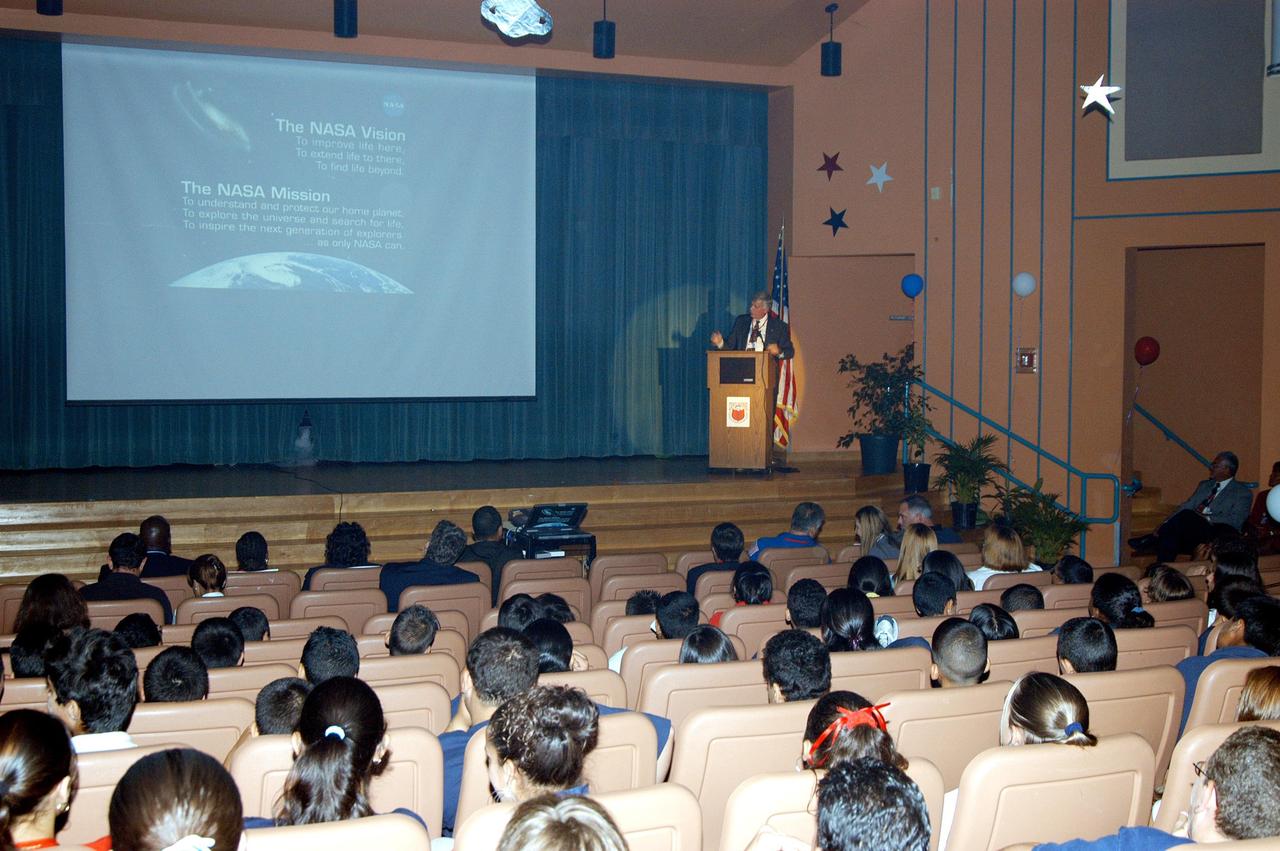
KENNEDY SPACE CENTER, FLA. -- Center Director Jim Kennedy addresses students and faculty of Howard A. Doolin Middle School, Miami, Fla. Doolin Middle School is one of 100 to take part in the NASA Explorer Schools (NES) program. Kennedy is visiting Explorer Schools in Florida and Georgia to share America’s new vision for space exploration with the next generation of explorers. He is talking with students, about our destiny as explorers, NASA’s stepping stone approach to exploring Earth, the Moon, Mars and beyond, how space impacts our lives, and how people and machines rely on each other in space.
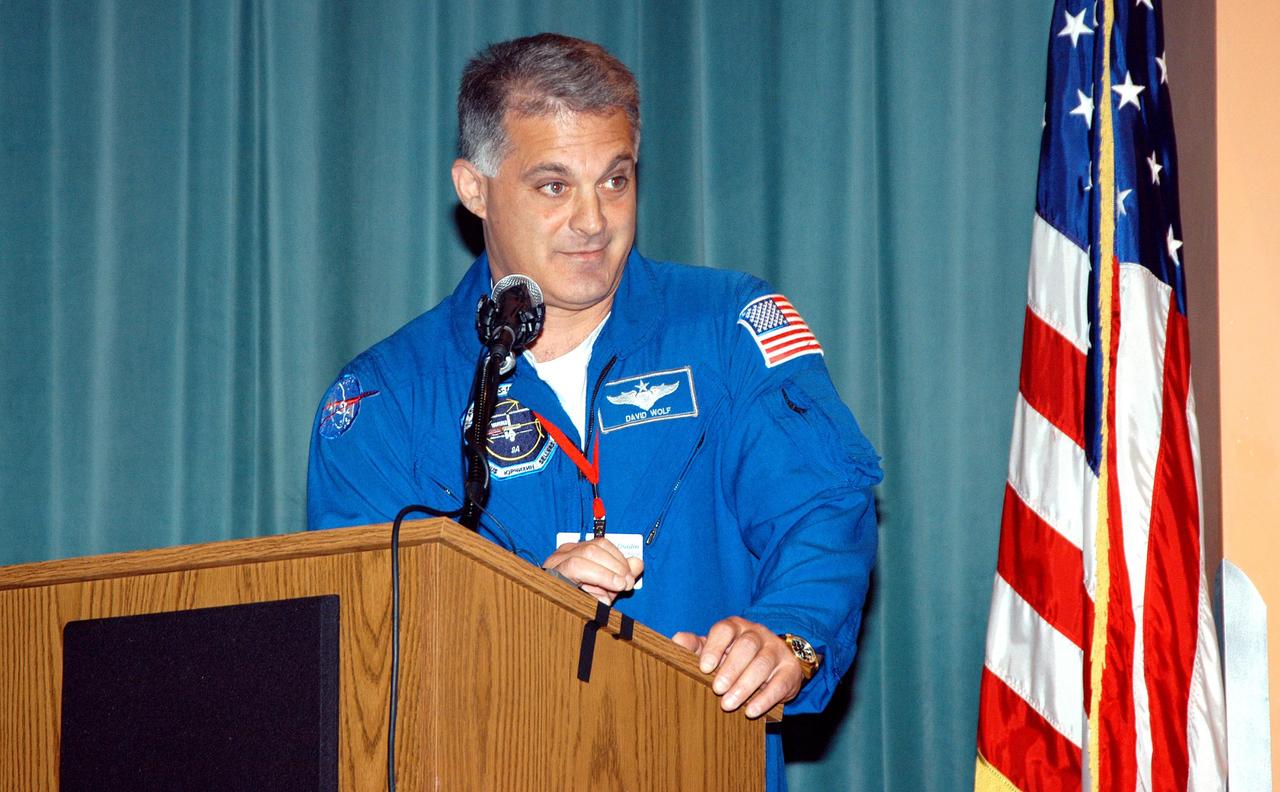
KENNEDY SPACE CENTER, FLA. -- Astronaut David Wolf addresses students and faculty of Howard A. Doolin Middle School, Miami, Fla., about his experiences in space. Doolin Middle School is one of 100 to take part in the NASA Explorer Schools (NES) program. Wolf joins Center Director Jim Kennedy on his visit to share America’s new vision for space exploration with the next generation of explorers. He is talking with students in Florida and Georgia Explorer Schools about our destiny as explorers, NASA’s stepping stone approach to exploring Earth, the Moon, Mars and beyond, how space impacts our lives, and how people and machines rely on each other in space.
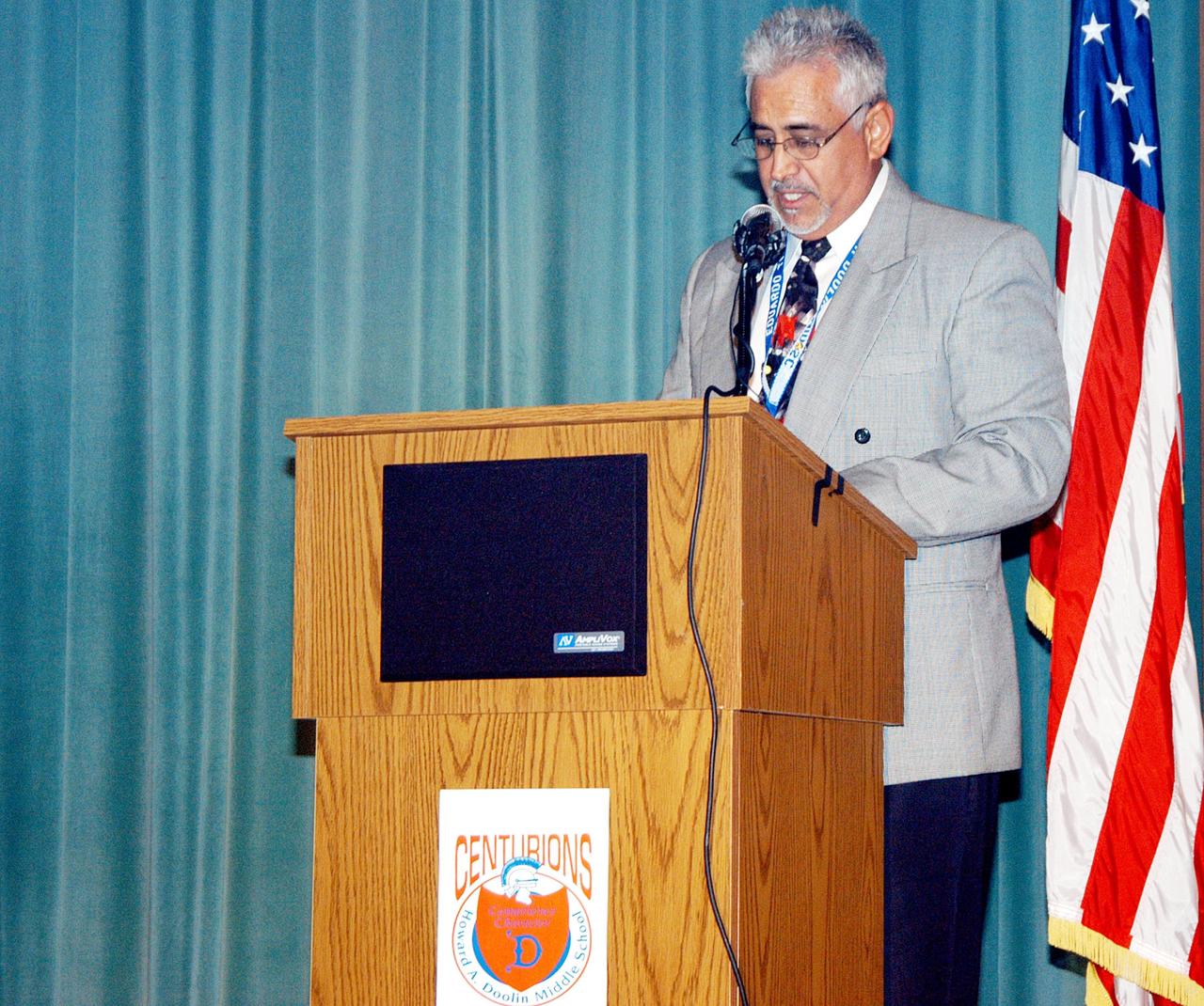
KENNEDY SPACE CENTER, FLA. -- Eduardo Tillet, principal of Howard A. Doolin Middle School, Miami, Fla., welcomes Center Director Jim Kennedy, plus NASA and KSC representatives, to the school. Doolin Middle School is one of 100 to take part in the NASA Explorer Schools (NES) program. Kennedy is talking with students, about our destiny as explorers, NASA’s stepping stone approach to exploring Earth, the Moon, Mars and beyond, how space impacts our lives, and how people and machines rely on each other in space. He is visiting NES schools in Florida and Georgia to share America’s new vision for space exploration with the next generation of explorers.
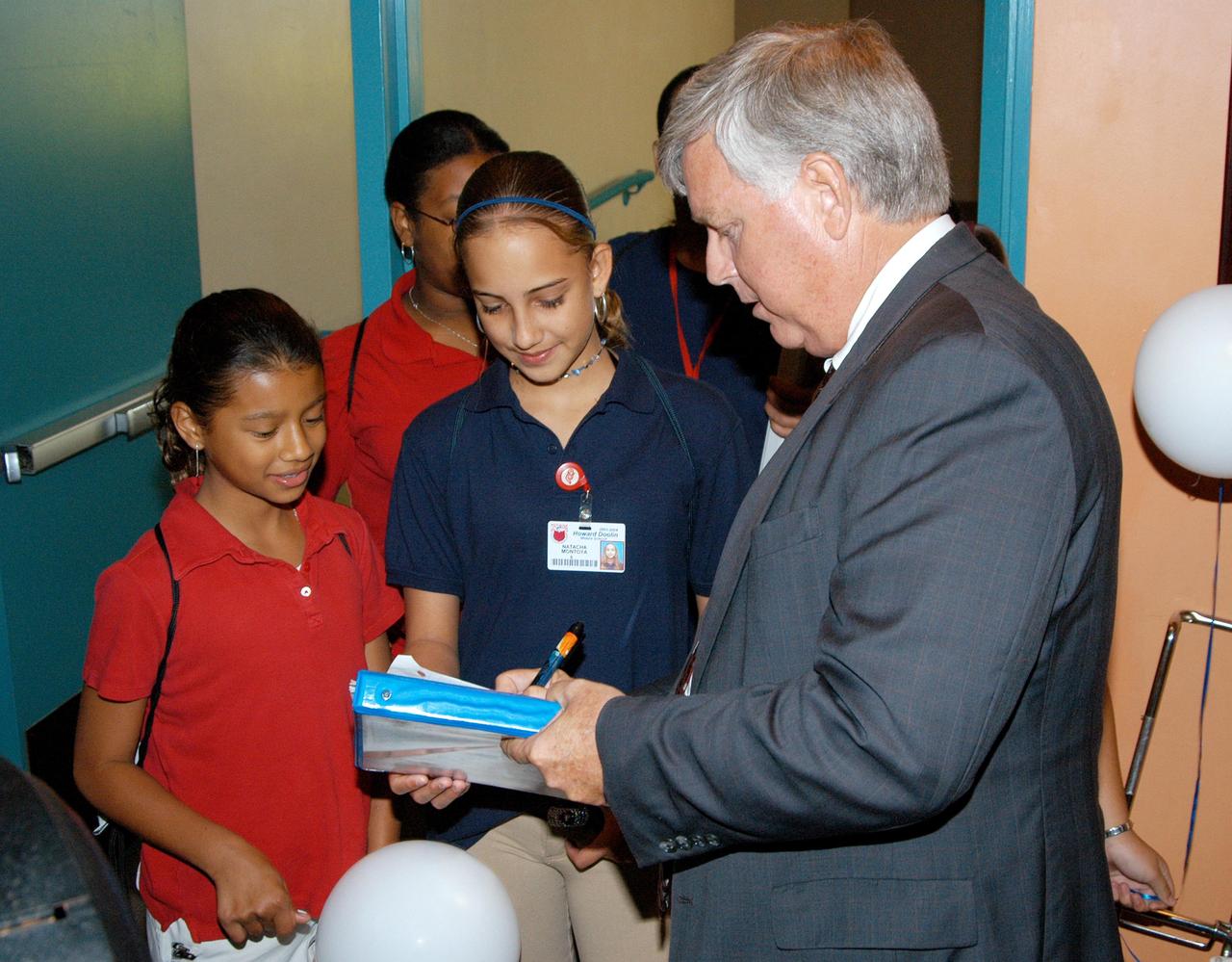
KENNEDY SPACE CENTER, FLA. -- After his presentation, Center Director Jim Kennedy signs a memento for a student at Howard A. Doolin Middle School, Miami, Fla. The school is one of 100 taking part in the NASA Explorer Schools (NES) program. Kennedy visited the school to share America’s new vision for space exploration with the next generation of explorers. He is talking with students in Florida and Georgia Explorer Schools about our destiny as explorers, NASA’s stepping stone approach to exploring Earth, the Moon, Mars and beyond, how space impacts our lives, and how people and machines rely on each other in space.
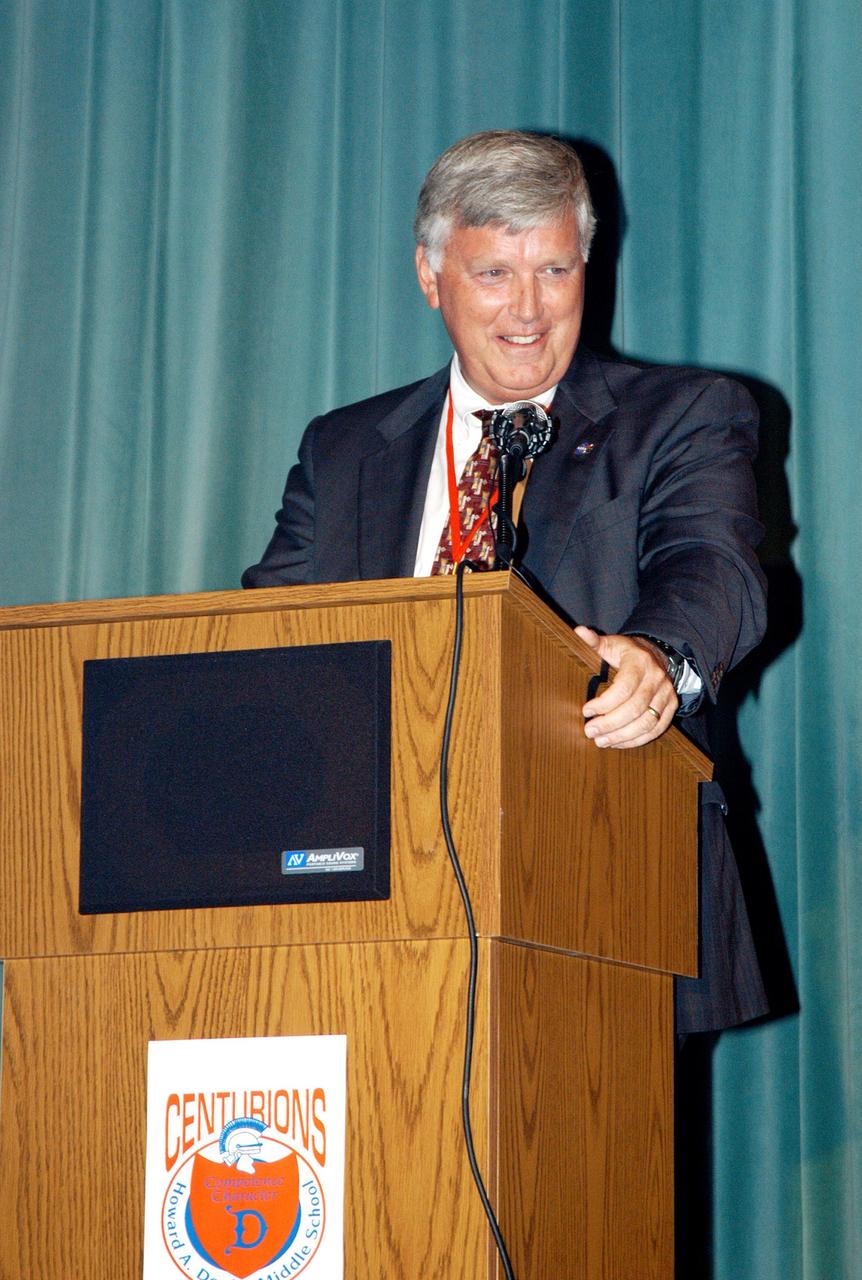
KENNEDY SPACE CENTER, FLA. -- Center Director Jim Kennedy addresses students and faculty of Howard A. Doolin Middle School, Miami, Fla. Doolin Middle School is one of 100 to take part in the NASA Explorer Schools (NES) program. Kennedy is visiting NES schools in Florida and Georgia to share America’s new vision for space exploration with the next generation of explorers. He is talking with students, about our destiny as explorers, NASA’s stepping stone approach to exploring Earth, the Moon, Mars and beyond, how space impacts our lives, and how people and machines rely on each other in space.
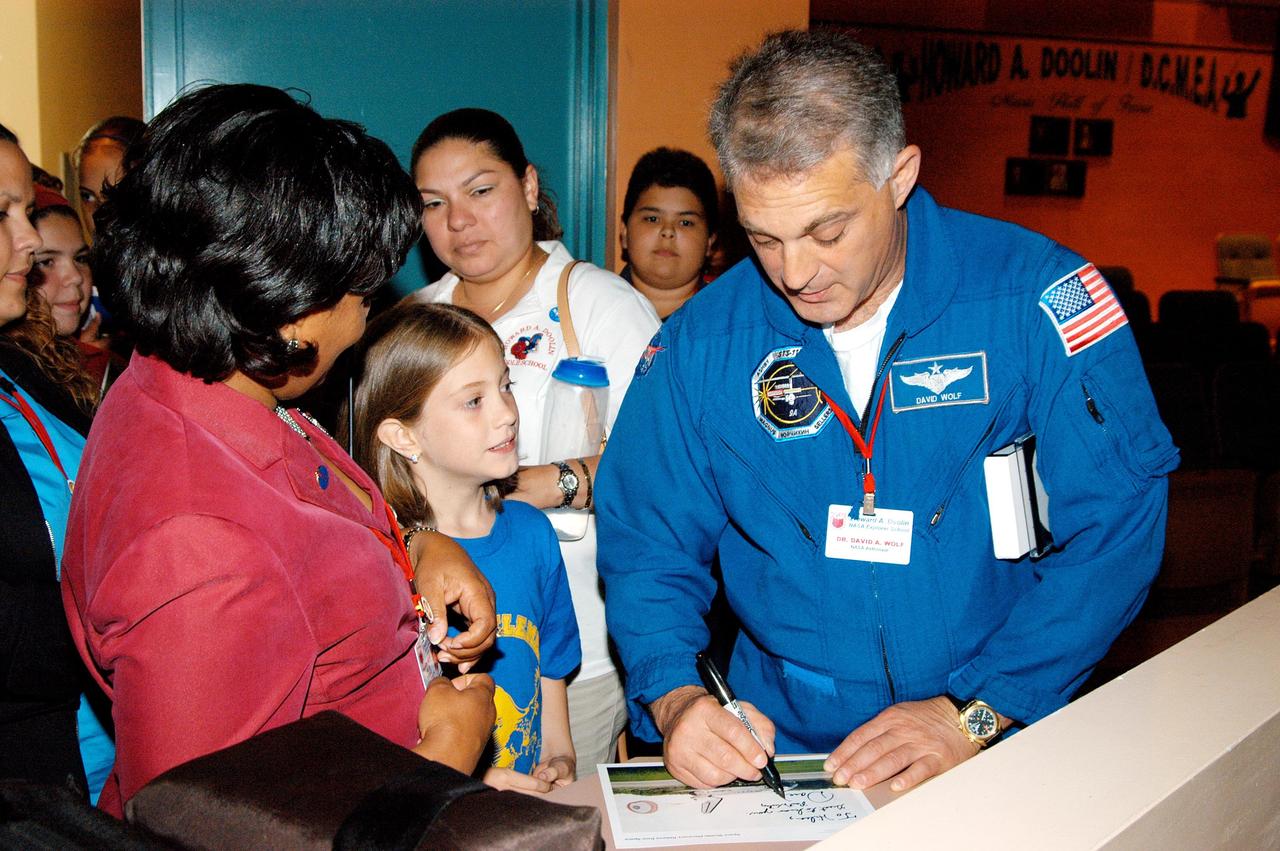
KENNEDY SPACE CENTER, FLA. -- After his presentation, astronaut David Wolf signs a memento for a student at Howard A. Doolin Middle School, Miami, Fla. The school is one of 100 taking part in the NASA Explorer Schools (NES) program. Center Director Jim Kennedy and Wolf visited the school to share America’s new vision for space exploration with the next generation of explorers. They talked with students about our destiny as explorers, NASA’s stepping stone approach to exploring Earth, the Moon, Mars and beyond, how space impacts our lives, and how people and machines rely on each other in space.
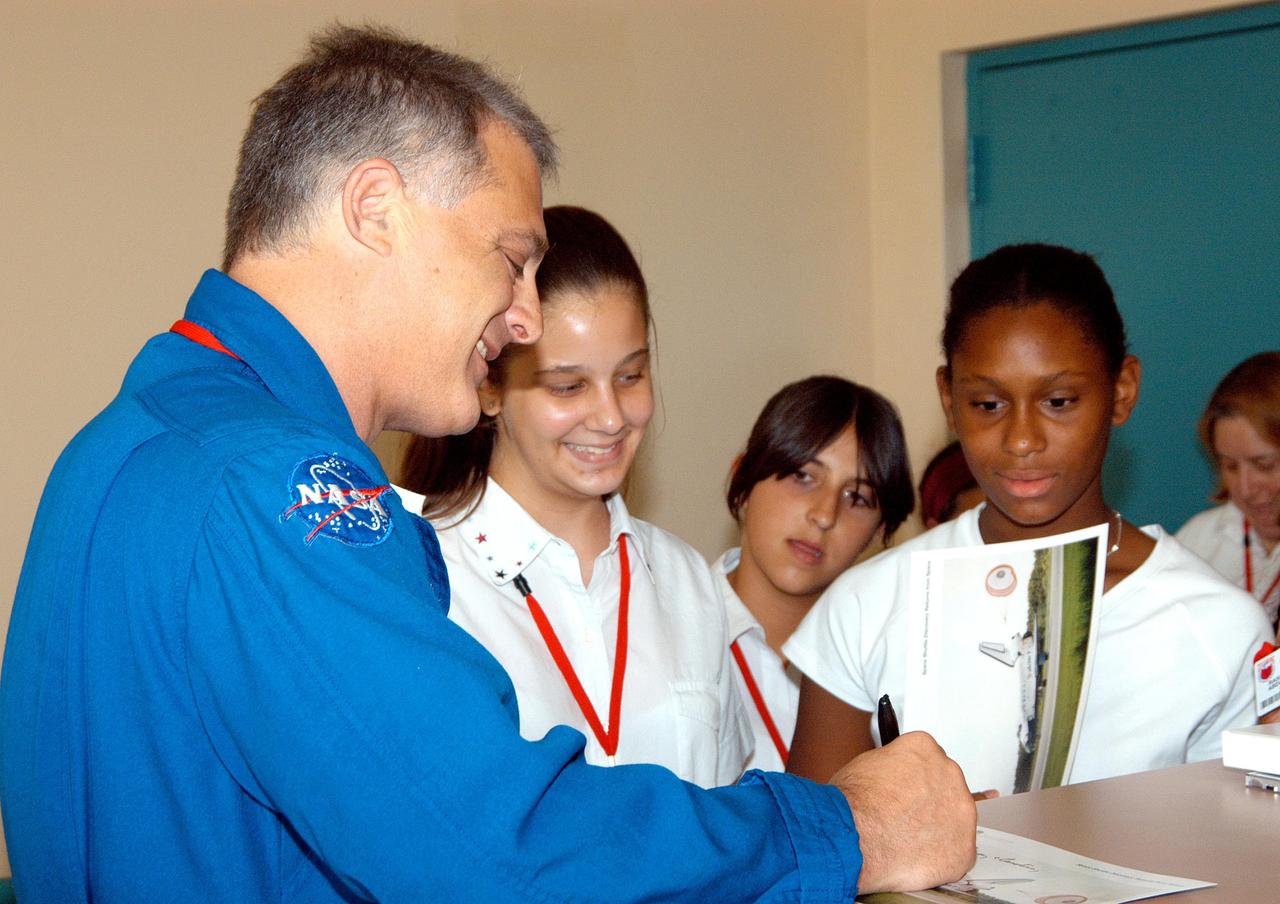
KENNEDY SPACE CENTER, FLA. -- After his presentation at Howard A. Doolin Middle School, Miami, Fla., astronaut David Wolf signs a memento for a student. The school is one of 100 taking part in the NASA Explorer Schools (NES) program. Center Director Jim Kennedy and Wolf visited the school to share America’s new vision for space exploration with the next generation of explorers. They talked with students about our destiny as explorers, NASA’s stepping stone approach to exploring Earth, the Moon, Mars and beyond, how space impacts our lives, and how people and machines rely on each other in space.
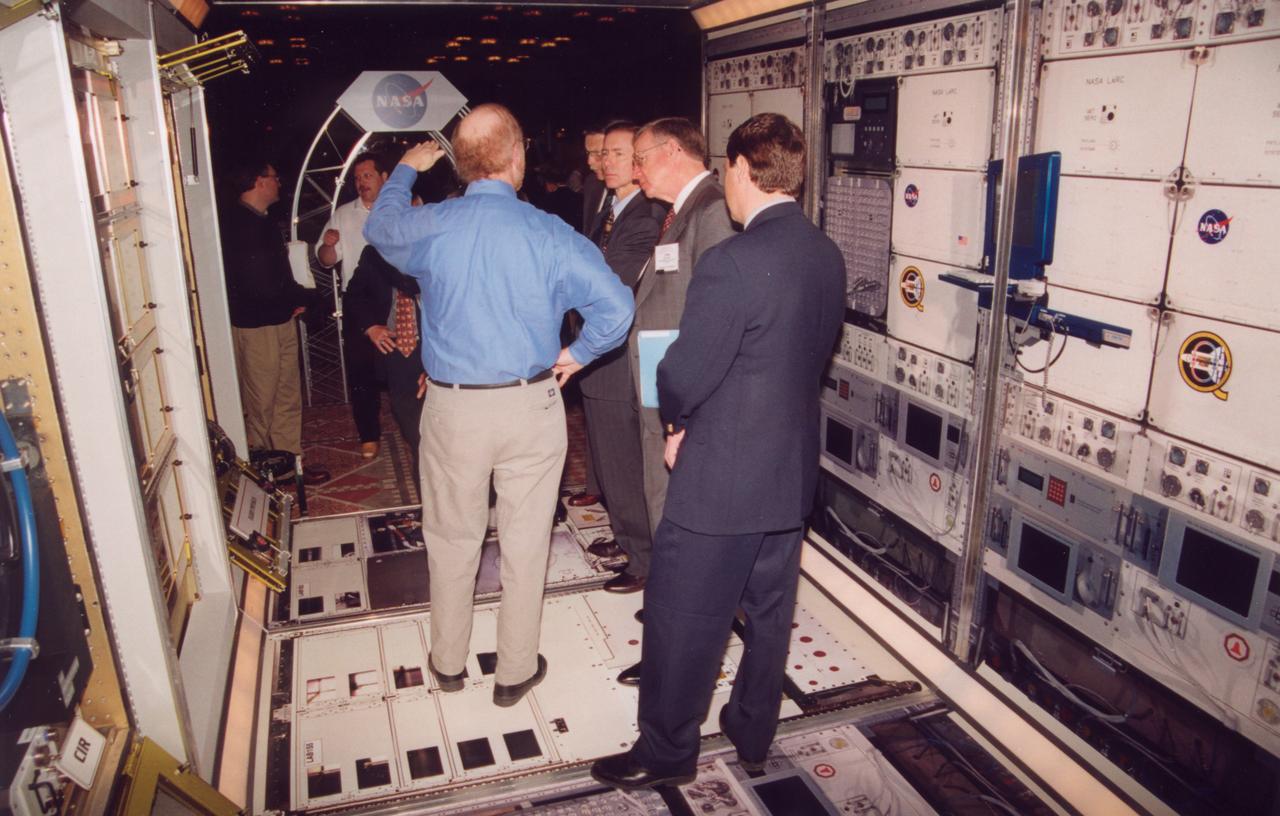
Engineers from NASA's Glenn Research Center demonstrate the access to one of the experiment racks planned for the U.S. Destiny laboratory module on the International Space Station (ISS). This mockup has the full diameter, full corridor width, and half the length of the module. The mockup includes engineering mockups of the Fluids and Combustion Facility being developed by NASA's Glenn Research Center. (The full module will be six racks long; the mockup is three racks long). Listening at center is former astronaut Brewster Shaw (center), now a program official with the Boeing Co., the ISS prime contractor. Photo credit: NASA/Marshall Space Flight Center (MSFC)
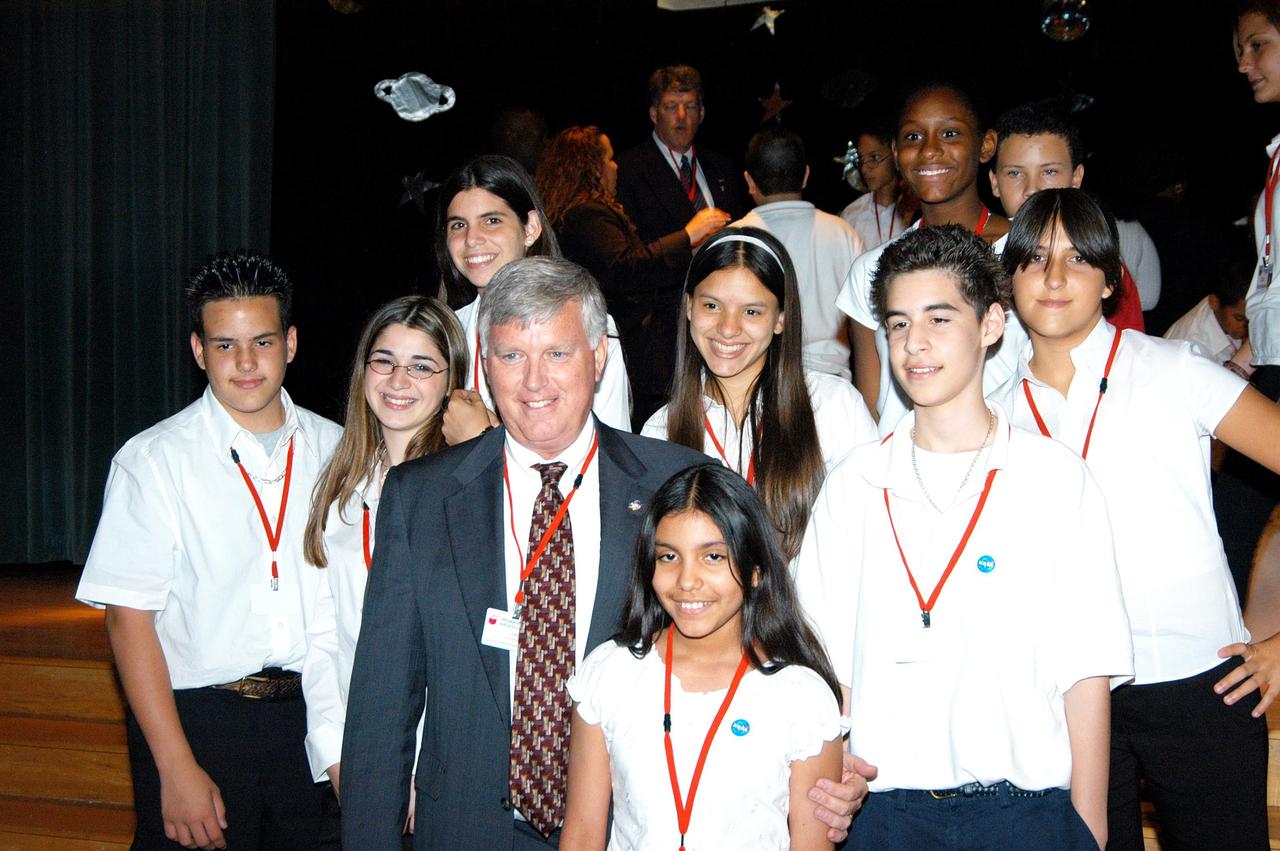
KENNEDY SPACE CENTER, FLA. -- Center Director Jim Kennedy poses for a photo with students at Howard A. Doolin Middle School, Miami, Fla. The school is one of 100 taking part in the NASA Explorer Schools (NES) program. The purpose of Kennedy’s visit is to share America’s new vision for space exploration with the next generation of explorers. He is talking with students in Florida and Georgia Explorer Schools about our destiny as explorers, NASA’s stepping stone approach to exploring Earth, the Moon, Mars and beyond, how space impacts our lives, and how people and machines rely on each other in space.
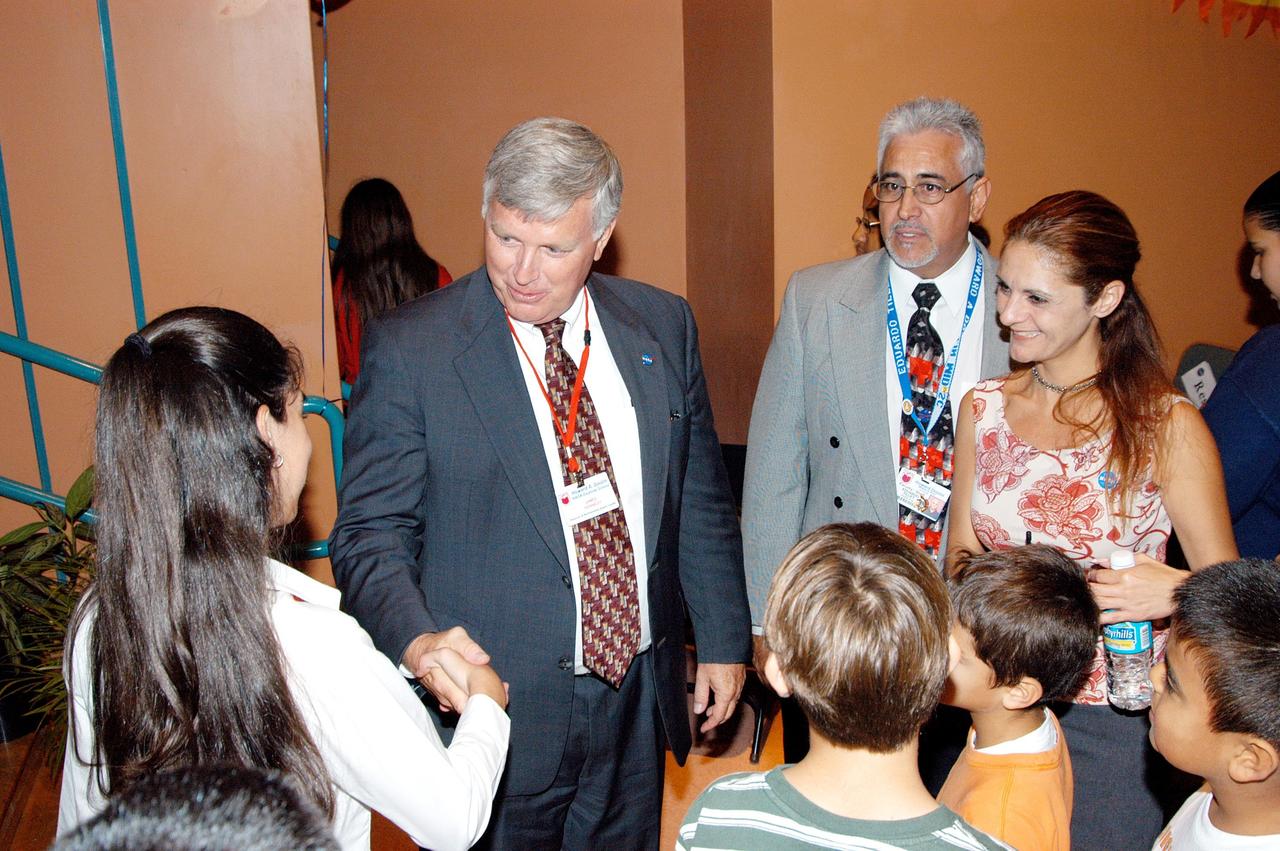
KENNEDY SPACE CENTER, FLA. -- Center Director Jim Kennedy (center) greets a student after his presentation at Howard A. Doolin Middle School, Miami, Fla. The school is one of 100 taking part in the NASA Explorer Schools (NES) program. The purpose of Kennedy’s visit is to share America’s new vision for space exploration with the next generation of explorers. He is talking with students in Florida and Georgia Explorer Schools about our destiny as explorers, NASA’s stepping stone approach to exploring Earth, the Moon, Mars and beyond, how space impacts our lives, and how people and machines rely on each other in space.
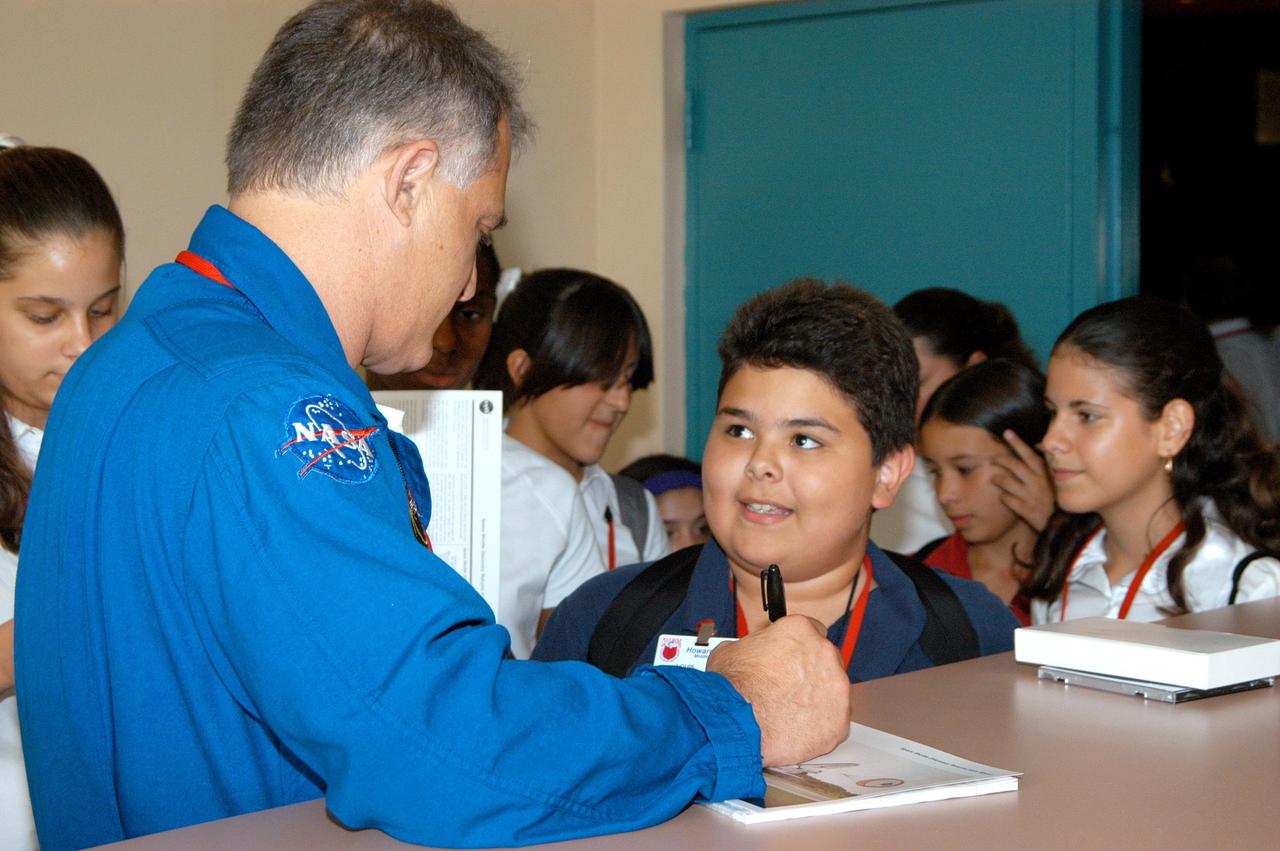
KENNEDY SPACE CENTER, FLA. -- After his presentation at Howard A. Doolin Middle School, Miami, Fla., astronaut David Wolf signs a memento for a student. The school is one of 100 taking part in the NASA Explorer Schools (NES) program. Center Director Jim Kennedy and Wolf visited the school to share America’s new vision for space exploration with the next generation of explorers. They talked with students about our destiny as explorers, NASA’s stepping stone approach to exploring Earth, the Moon, Mars and beyond, how space impacts our lives, and how people and machines rely on each other in space.
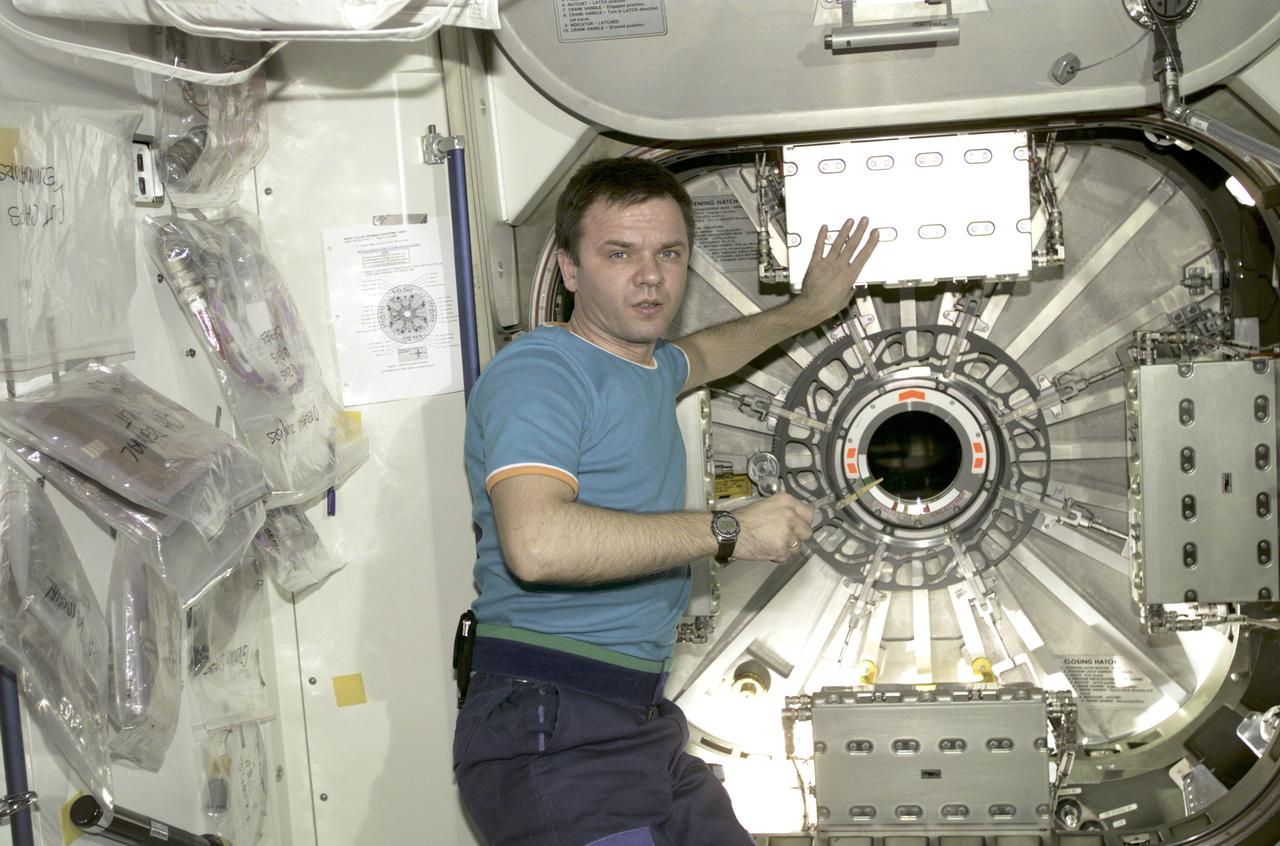
Cosmonaut Yuri P. Gidzenko, Expedition One Soyuz commander, stands near the hatch leading from the Unity node into the newly-attached Destiny laboratory aboard the International Space Station (ISS). The Node 1, or Unity, serves as a cornecting passageway to Space Station modules. The U.S.-built Unity module was launched aboard the Orbiter Endeavour (STS-88 mission) on December 4, 1998, and connected to Zarya, the Russian-built Functional Cargo Block (FGB). The U.S. Laboratory (Destiny) module is the centerpiece of the ISS, where science experiments will be performed in the near-zero gravity in space. The Destiny Module was launched aboard the Space Shuttle Orbiter Atlantis (STS-98 mission) on February 7, 2001. The aluminum module is 8.5 meters (28 feet) long and 4.3 meters (14 feet) in diameter. The laboratory consists of three cylindrical sections and two endcones with hatches that will be mated to other station components. A 50.9-centimeter- (20-inch-) diameter window is located on one side of the center module segment. This pressurized module is designed to accommodate pressurized payloads. It has a capacity of 24 rack locations, and payload racks will occupy 13 locations especially designed to support experiments.
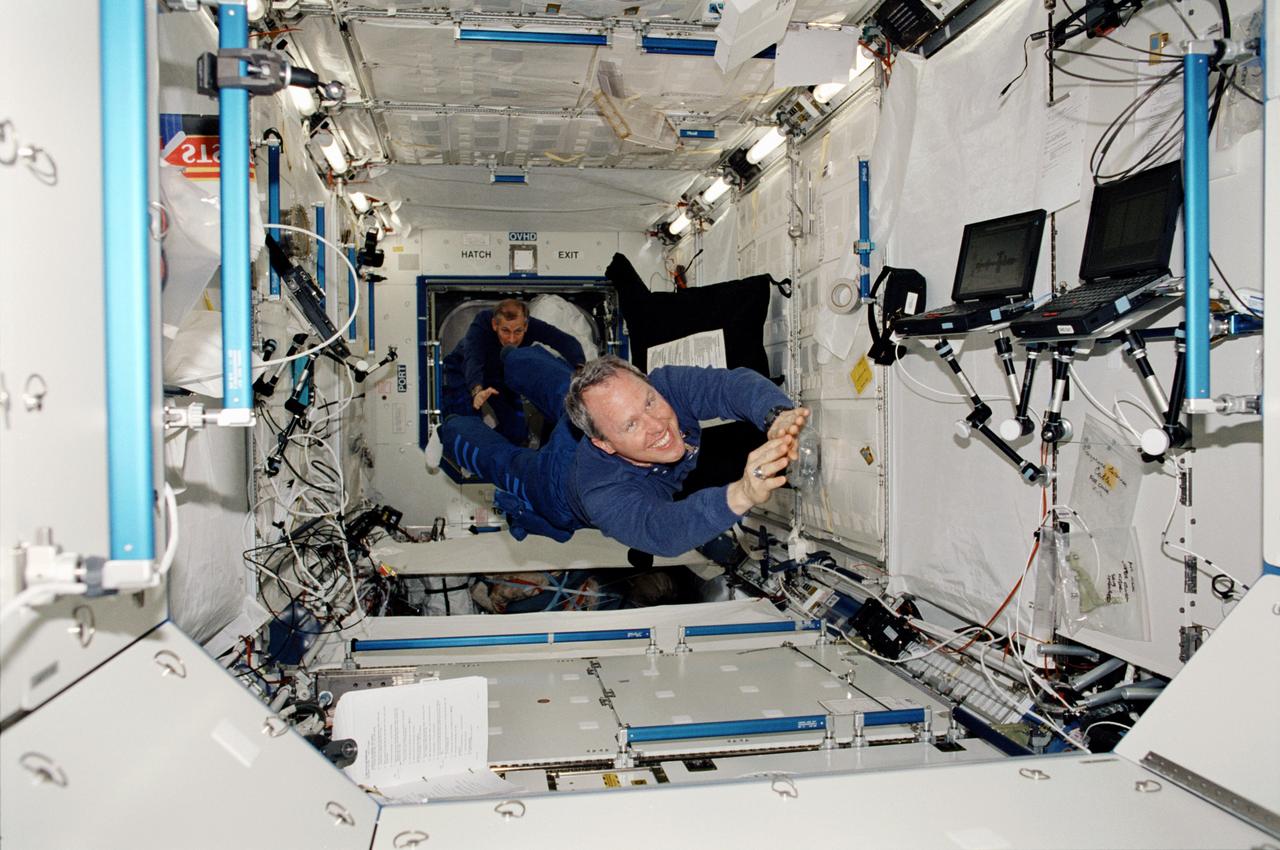
This STS-98 mission photograph shows astronauts Thomas D. Jones (foreground) and Kerneth D. Cockrell floating inside the newly installed Laboratory aboard the International Space Station (ISS). The American-made Destiny module is the cornerstone for space-based research aboard the orbiting platform and the centerpiece of the ISS, where unprecedented science experiments will be performed in the near-zero gravity of space. Destiny will also serve as the command and control center for the ISS. The aluminum module is 8.5-meters (28-feet) long and 4.3-meters (14-feet) in diameter. The laboratory consists of three cylindrical sections and two endcones with hatches that will be mated to other station components. A 50.9-centimeter (20-inch-) diameter window is located on one side of the center module segment. This pressurized module is designed to accommodate pressurized payloads. It has a capacity of 24 rack locations. Payload racks will occupy 15 locations especially designed to support experiments. The Destiny module was built by the Boeing Company under the direction of the Marshall Space Flight Center.

S128-E-008352 (7 Sept. 2009) --- NASA astronaut Kevin Ford, STS-128 pilot, is pictured in the Destiny laboratory of the International Space Station while Space Shuttle Discovery remains docked with the station.

ISS007-E-13293 (24 August 2003) --- Astronaut Edward T. Lu, Expedition 7 NASA ISS science officer and flight engineer, floats in the Destiny laboratory on the International Space Station (ISS).
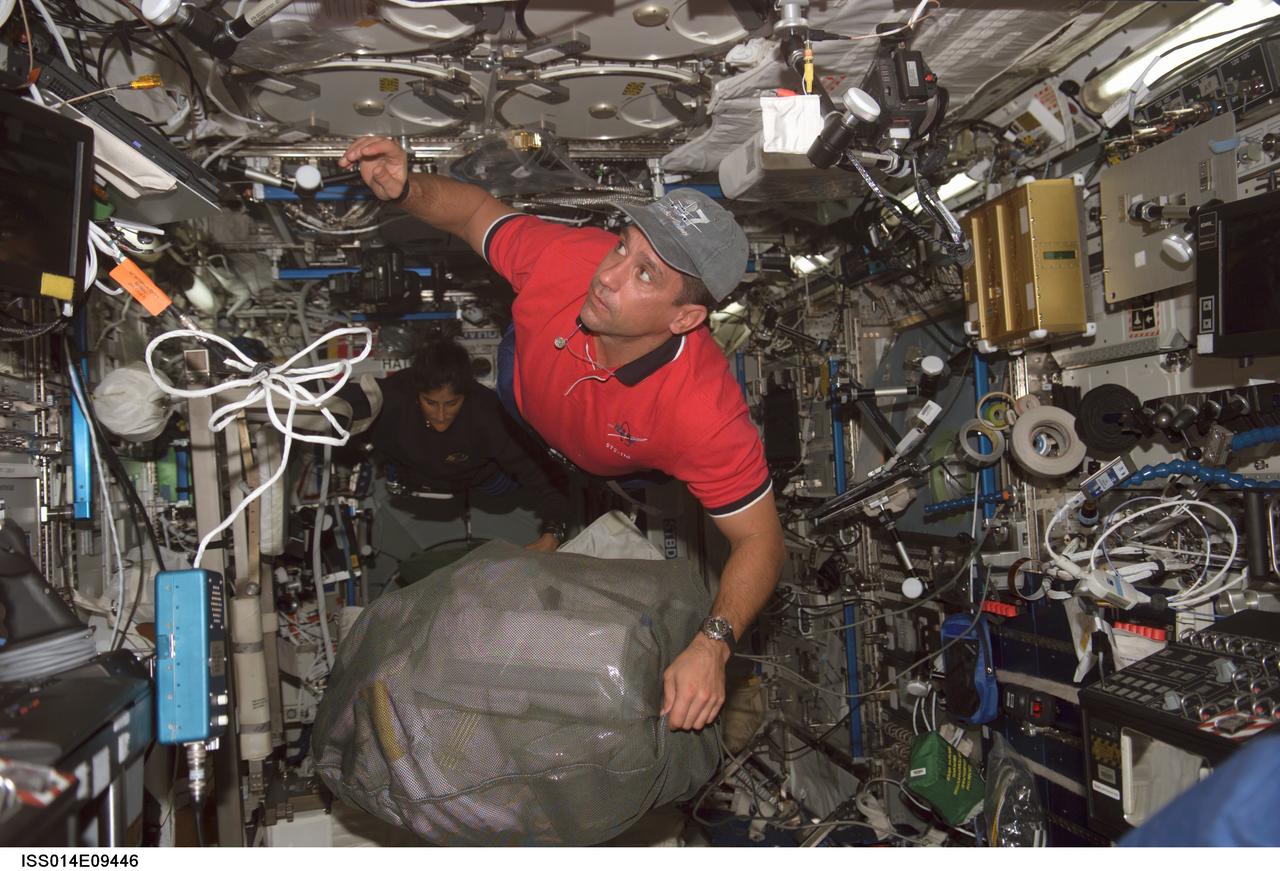
ISS014-E-09446 (11 Dec. 2006) --- Astronaut William A. (Bill) Oefelein, STS-116 pilot, moves a stowage bag through the Destiny laboratory of the International Space Station while Space Shuttle Discovery was docked with the station.
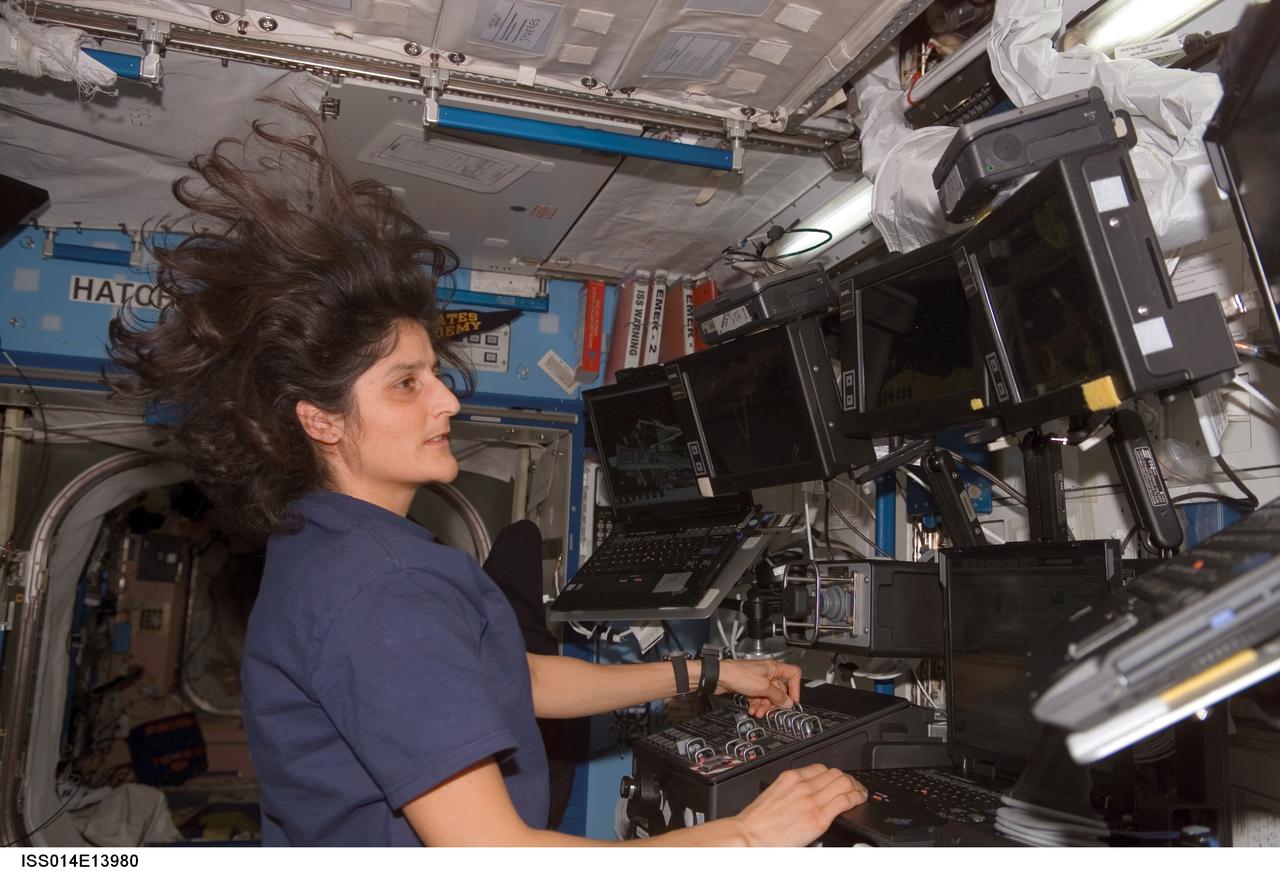
ISS014-E-13980 (19 Feb. 2007) --- Astronaut Sunita L. Williams, Expedition 14 flight engineer, works the controls of the Space Station Remote Manipulator System (SSRMS) or Canadarm2 in the Destiny laboratory of the International Space Station.
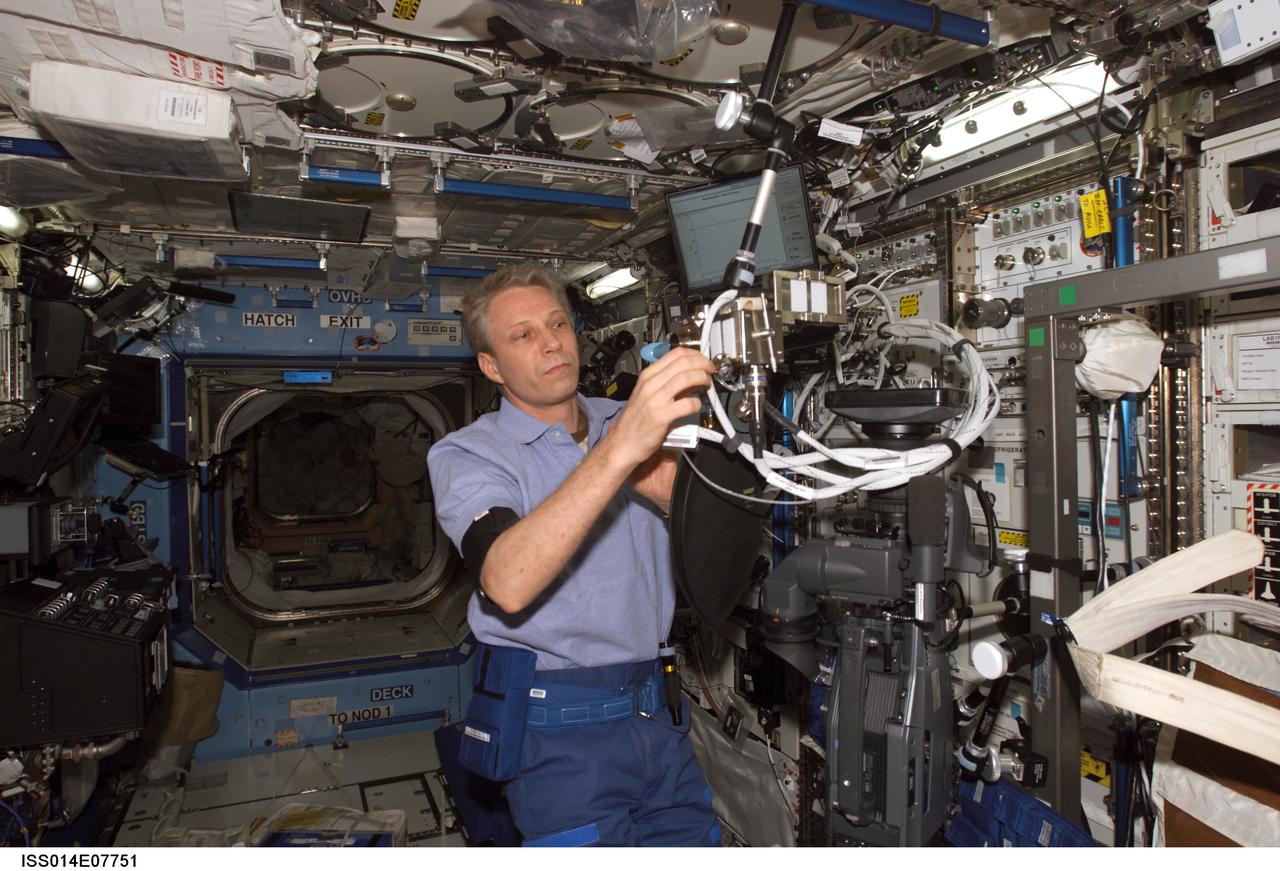
ISS014-E-07751 (10 Nov. 2006) --- European Space Agency (ESA) astronaut Thomas Reiter, Expedition 14 flight engineer, works with the Cardiac experiment--Breathing Protocol 5--in the Destiny laboratory of the International Space Station.
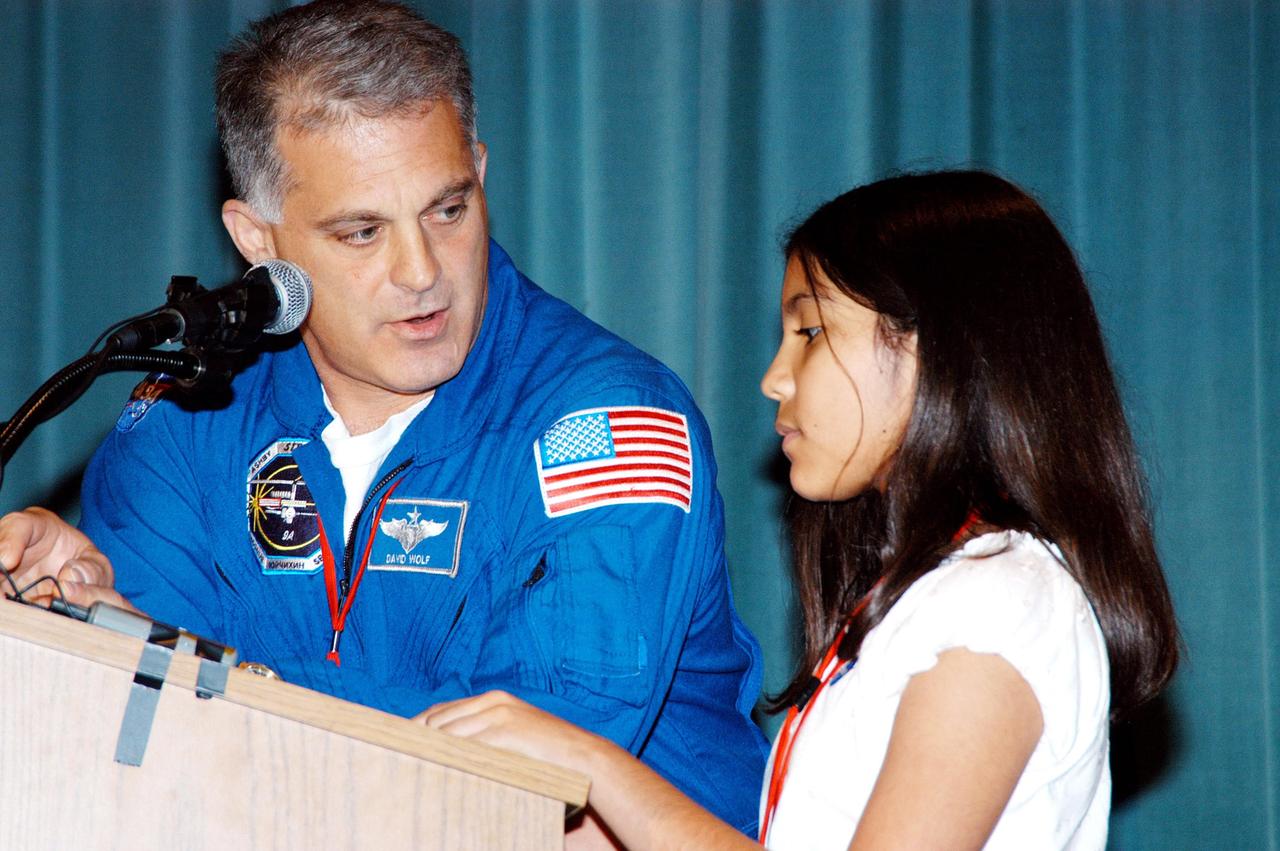
KENNEDY SPACE CENTER, FLA. -- Astronaut David Wolf answers questions from a student on stage at Howard A. Doolin Middle School, Miami, Fla., during his talk about his experiences in space. Doolin Middle School is one of 100 to take part in the NASA Explorer Schools (NES) program. Wolf joins Center Director Jim Kennedy (seated at lower left) on his visit to share America’s new vision for space exploration with the next generation of explorers. He is talking with students in Florida and Georgia Explorer Schools about our destiny as explorers, NASA’s stepping stone approach to exploring Earth, the Moon, Mars and beyond, how space impacts our lives, and how people and machines rely on each other in space.
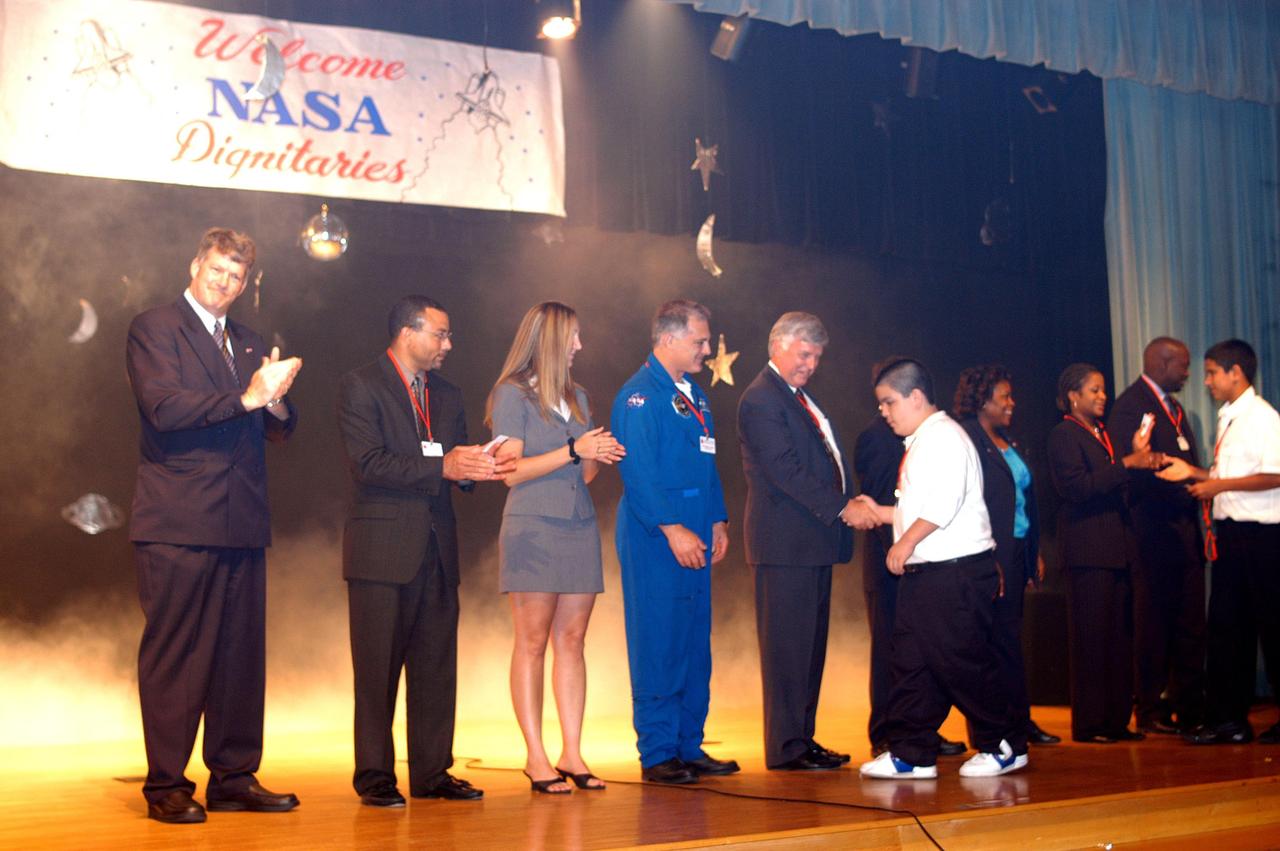
KENNEDY SPACE CENTER, FLA. -- During a visit to Howard A. Doolin Middle School, Miami, Fla., Center Director Jim Kennedy (shaking hands, center) and other NASA and KSC representatives are greeted by students on stage. With Kennedy on stage are (left to right), Jim Gerard, Aerospace Education Services Program (AESP) representative; Steve Lewis, assistant to Kennedy; Amber Marek, with KSC External Relations; David Wolf, astronaut; Kennedy; Les Gold, AESP representative; Burdette Brown; and Patricia Leonard and Clarence Bostic, Education Programs and University Research Division. Doolin Middle School is one of 100 to take part in the NASA Explorer Schools program. Kennedy is talking with students, the next generation of explorers, about our destiny as explorers, NASA’s stepping stone approach to exploring Earth, the Moon, Mars and beyond, how space impacts our lives, and how people and machines rely on each other in space.
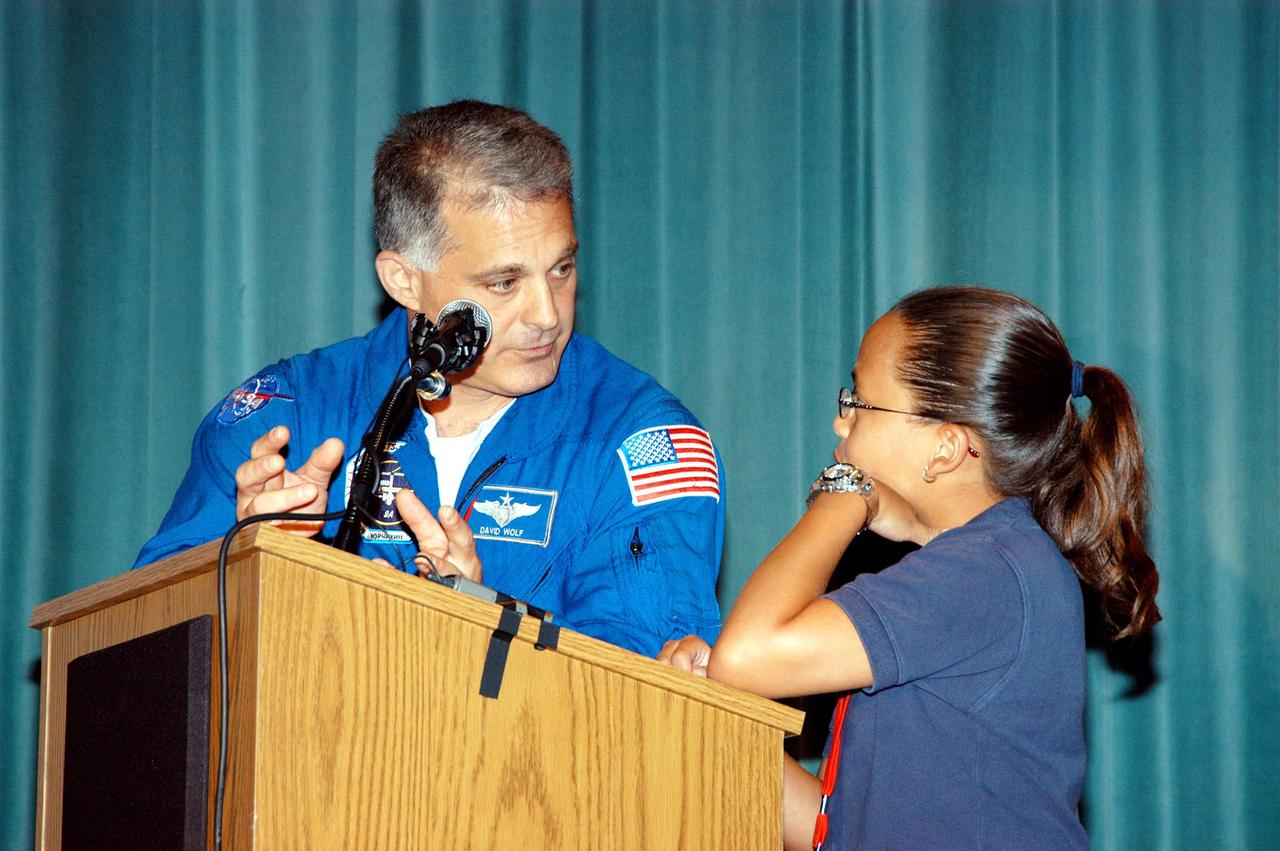
KENNEDY SPACE CENTER, FLA. -- Astronaut David Wolf answers questions from a student on stage at Howard A. Doolin Middle School, Miami, Fla., during his talk about his experiences in space. Doolin Middle School is one of 100 to take part in the NASA Explorer Schools (NES) program. Wolf joins Center Director Jim Kennedy (seated at lower left) on his visit to share America’s new vision for space exploration with the next generation of explorers. He is talking with students in Florida and Georgia Explorer Schools about our destiny as explorers, NASA’s stepping stone approach to exploring Earth, the Moon, Mars and beyond, how space impacts our lives, and how people and machines rely on each other in space.
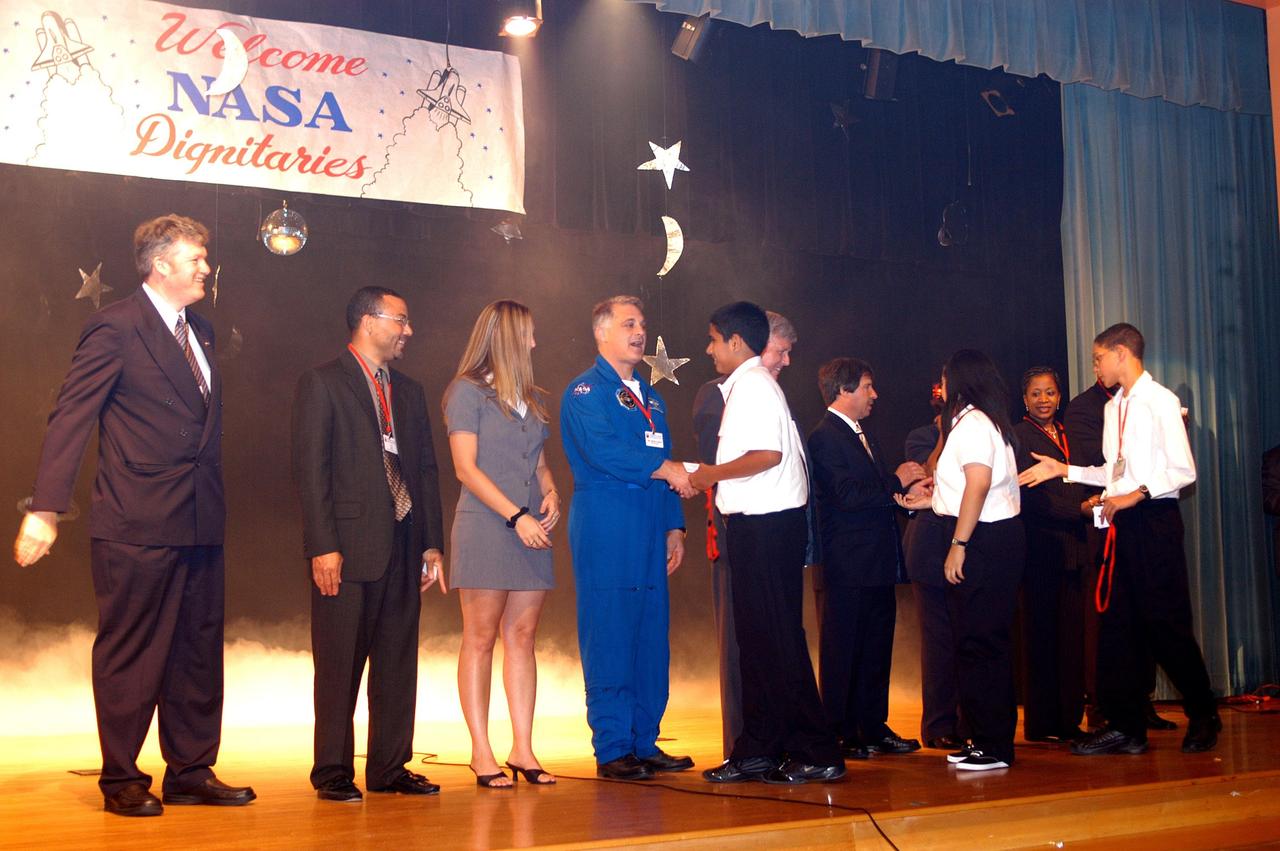
KENNEDY SPACE CENTER, FLA. -- During a visit to Howard A. Doolin Middle School, Miami, Fla., Center Director Jim Kennedy and other NASA and KSC representatives are greeted by students on stage. From left to right, are Jim Gerard, Aerospace Education Services Program (AESP) representative; Steve Lewis, assistant to Kennedy; Amber Marek, with KSC External Relations; David Wolf, astronaut; Kennedy; Les Gold, AESP representative; Burdette Brown; and Patricia Leonard and Clarence Bostic, Education Programs and University Research Division. Doolin Middle School is one of 100 to take part in the NASA Explorer Schools program. Kennedy is talking with students, the next generation of explorers, about our destiny as explorers, NASA’s stepping stone approach to exploring Earth, the Moon, Mars and beyond, how space impacts our lives, and how people and machines rely on each other in space.
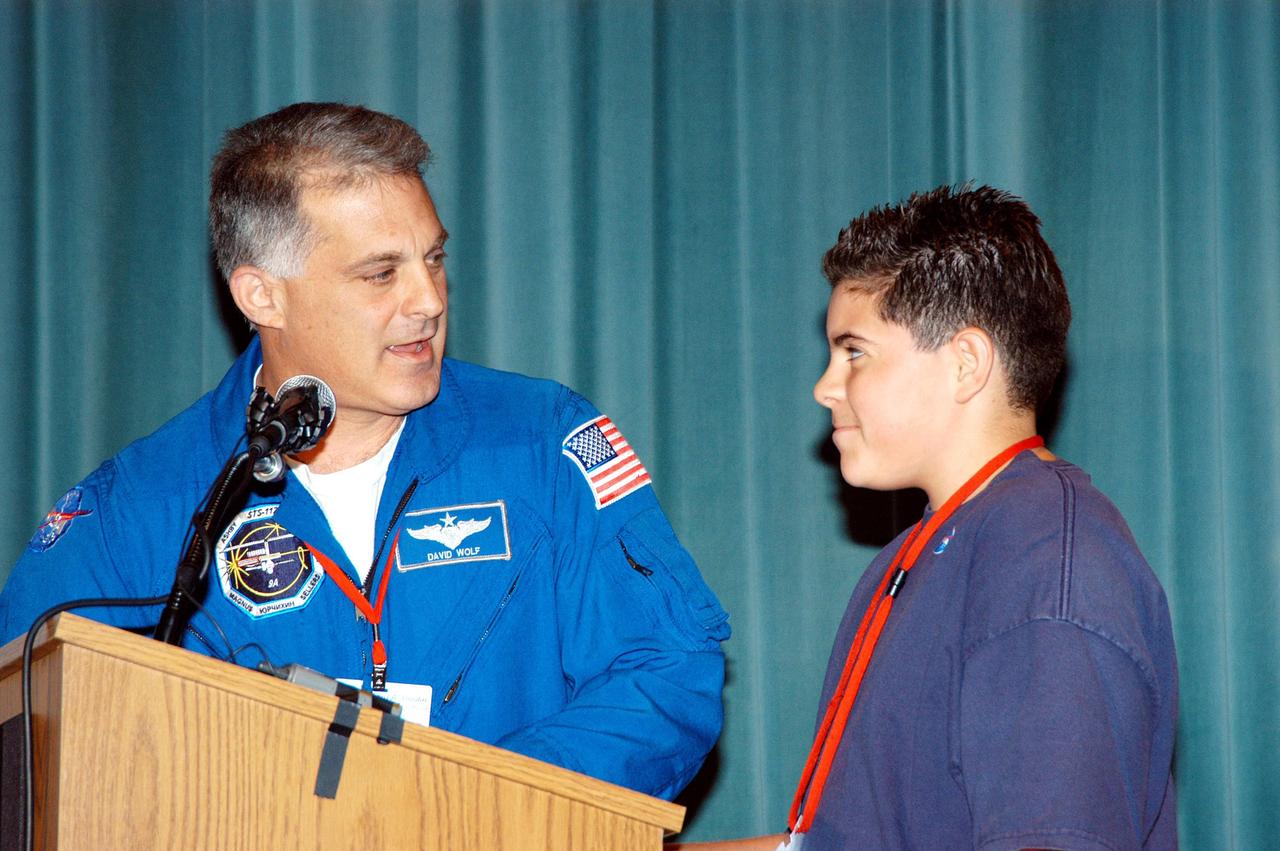
KENNEDY SPACE CENTER, FLA. -- Astronaut David Wolf answers questions from a student on stage at Howard A. Doolin Middle School, Miami, Fla., during his talk about his experiences in space. Doolin Middle School is one of 100 to take part in the NASA Explorer Schools (NES) program. Wolf joins Center Director Jim Kennedy (seated at lower left) on his visit to share America’s new vision for space exploration with the next generation of explorers. He is talking with students in Florida and Georgia Explorer Schools about our destiny as explorers, NASA’s stepping stone approach to exploring Earth, the Moon, Mars and beyond, how space impacts our lives, and how people and machines rely on each other in space.
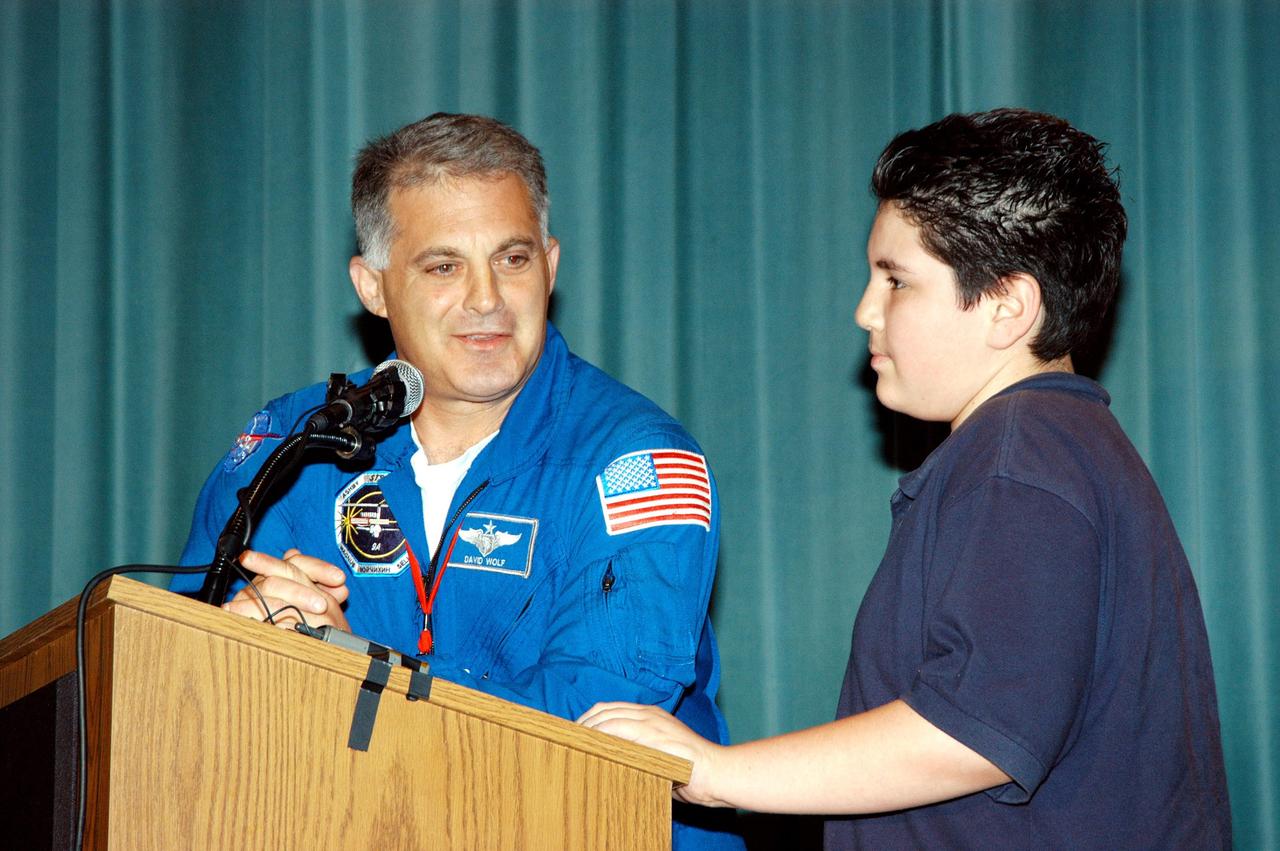
KENNEDY SPACE CENTER, FLA. -- Astronaut David Wolf answers questions from a student on stage at Howard A. Doolin Middle School, Miami, Fla., during his talk about his experiences in space. Doolin Middle School is one of 100 to take part in the NASA Explorer Schools (NES) program. Wolf joins Center Director Jim Kennedy (seated at lower left) on his visit to share America’s new vision for space exploration with the next generation of explorers. He is talking with students in Florida and Georgia Explorer Schools about our destiny as explorers, NASA’s stepping stone approach to exploring Earth, the Moon, Mars and beyond, how space impacts our lives, and how people and machines rely on each other in space.
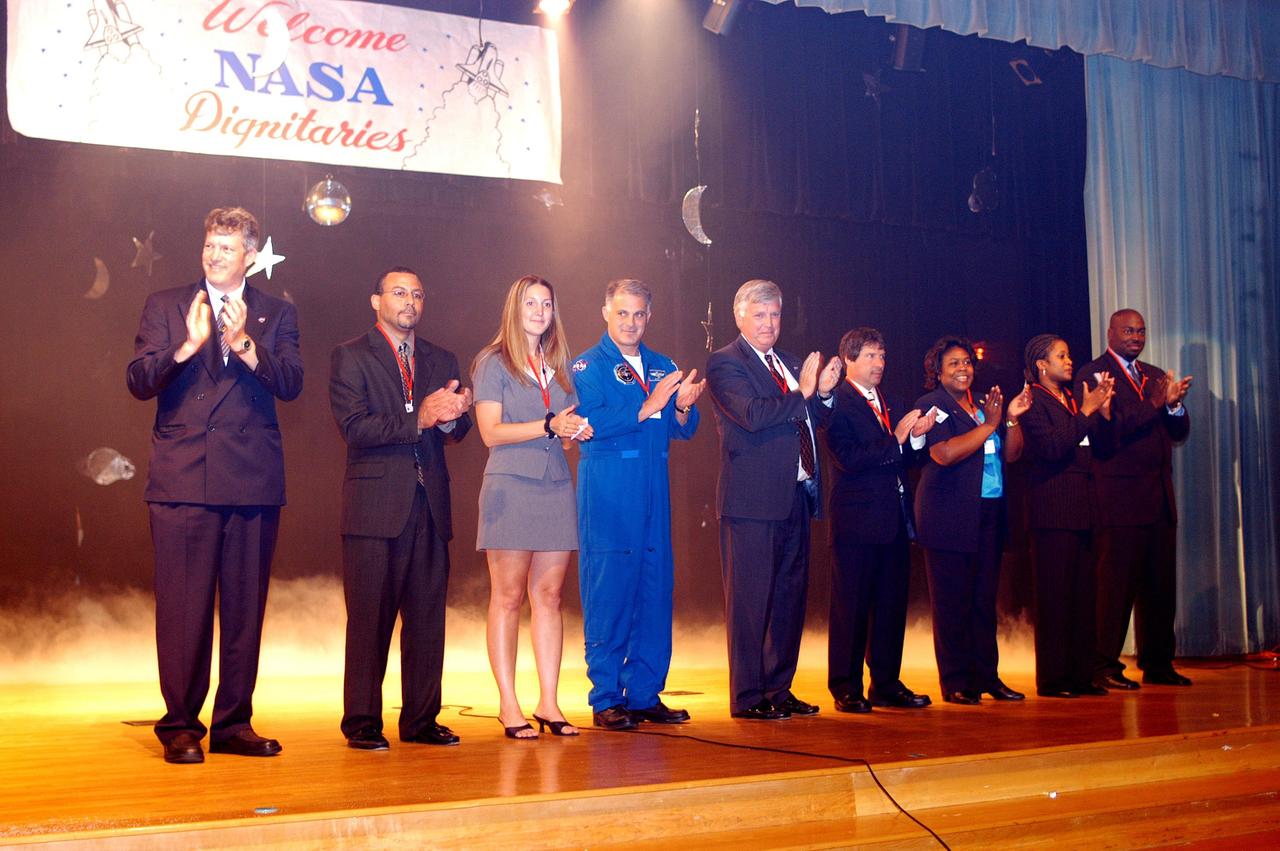
KENNEDY SPACE CENTER, FLA. -- During a visit to Howard A. Doolin Middle School, Miami, Fla., Center Director Jim Kennedy and other NASA and KSC representatives applaud faculty and students from the stage. From left to right are Jim Gerard, Aerospace Education Services Program (AESP) representative; Steve Lewis, assistant to Kennedy; Amber Marek, with KSC External Relations; David Wolf, astronaut; Kennedy; Les Gold, AESP representative; Burdette Brown; and Patricia Leonard and Clarence Bostic, Education Programs and University Research Division. Doolin Middle School is one of 100 to take part in the NASA Explorer Schools program. Kennedy is talking with students, the next generation of explorers, about our destiny as explorers, NASA’s stepping stone approach to exploring Earth, the Moon, Mars and beyond, how space impacts our lives, and how people and machines rely on each other in space.
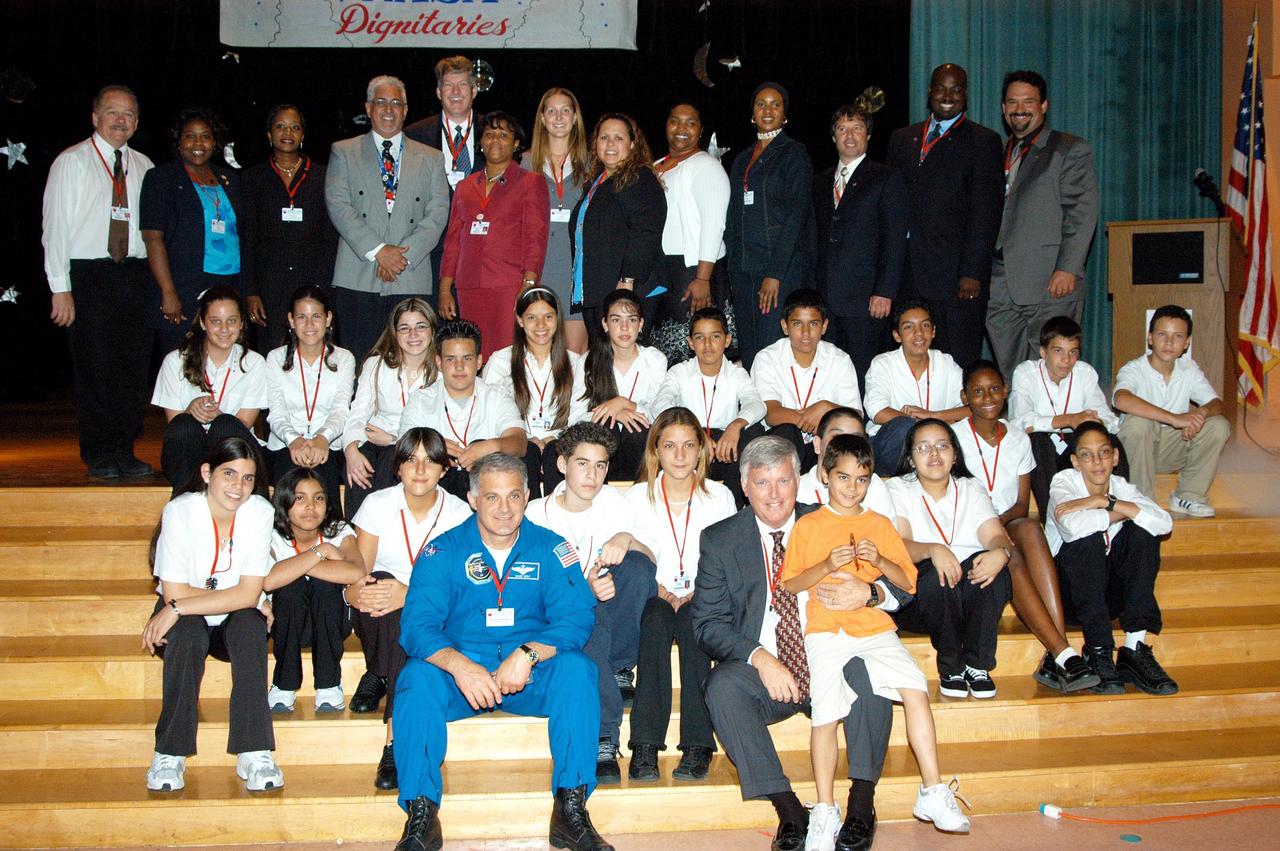
KENNEDY SPACE CENTER, FLA. -- Astronaut David Wolf (left) and Center Director Jim Kennedy (right, with boy) pose for a photo with students and faculty in Howard A. Doolin Middle School, Miami, Fla., plus other NASA and KSC representatives (rear). The school is one of 100 taking part in the NASA Explorer Schools (NES) program. The purpose of Kennedy’s visit is to share America’s new vision for space exploration with the next generation of explorers. He is talking with students in Florida and Georgia Explorer Schools about our destiny as explorers, NASA’s stepping stone approach to exploring Earth, the Moon, Mars and beyond, how space impacts our lives, and how people and machines rely on each other in space.
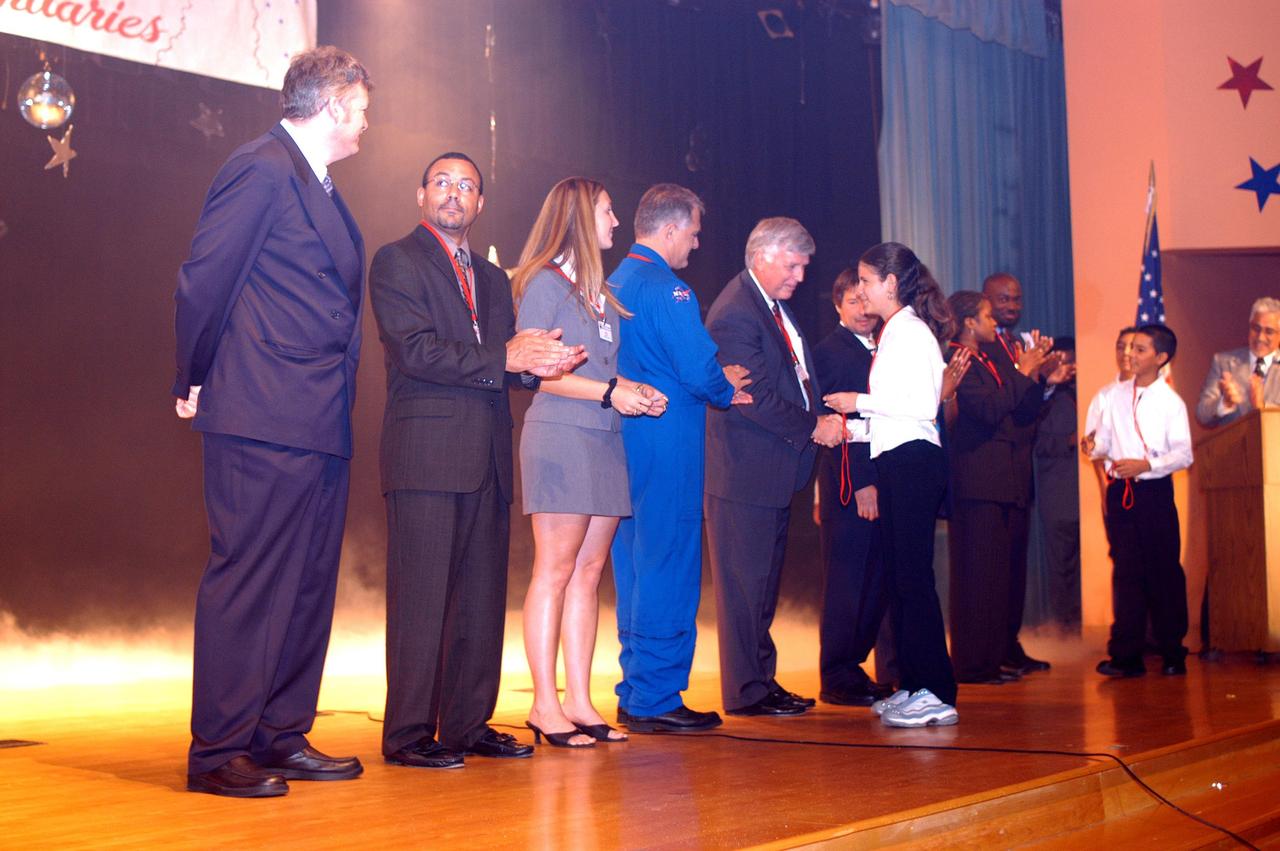
KENNEDY SPACE CENTER, FLA. -- During a visit to Howard A. Doolin Middle School, Miami, Fla., Center Director Jim Kennedy and other NASA and KSC representatives are greeted by students on stage. From left to right are Jim Gerard, Aerospace Education Services Program representative; Steve Lewis, assistant to Kennedy; Amber Marek, with KSC External Relations; David Wolf, astronaut; Kennedy; Les Gold, AESP representative; Burdette Brown; and Patricia Leonard and Clarence Bostic, Education Programs and University Research Division. Doolin Middle School is one of 100 to take part in the NASA Explorer Schools program. Kennedy is talking with students, the next generation of explorers, about our destiny as explorers, NASA’s stepping stone approach to exploring Earth, the Moon, Mars and beyond, how space impacts our lives, and how people and machines rely on each other in space.
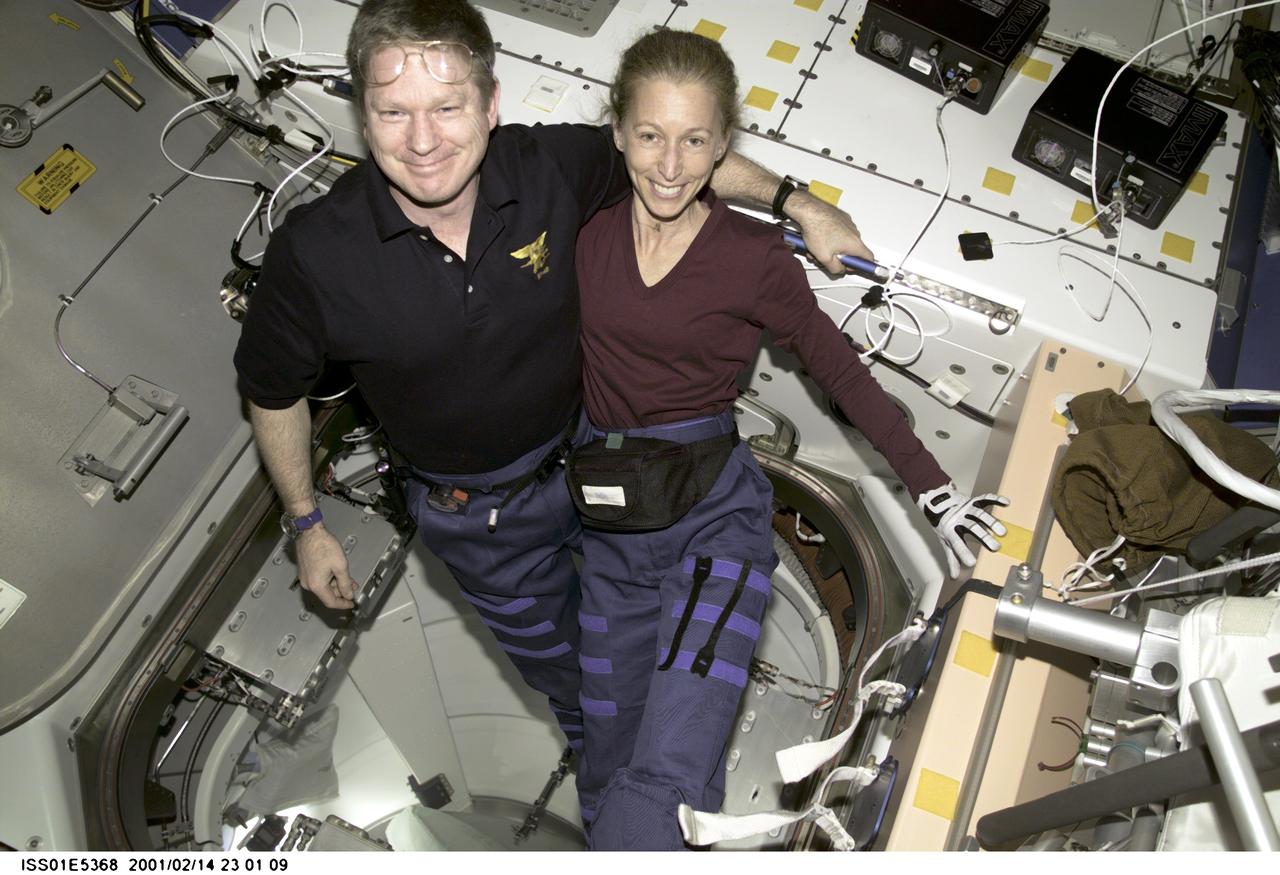
ISS01-E-5368 (14 February 2001) --- Onboard the new Destiny laboratory, Expedition One commander William M. (Bill) Shepherd, shares a brief break from a busy work agenda with astronaut Marsha S. Ivins, STS-98 mission specialist. The two are alumni of the tenth class of NASA astronaut candidates, having come aboard with 15 other trainees in the summer of 1984.
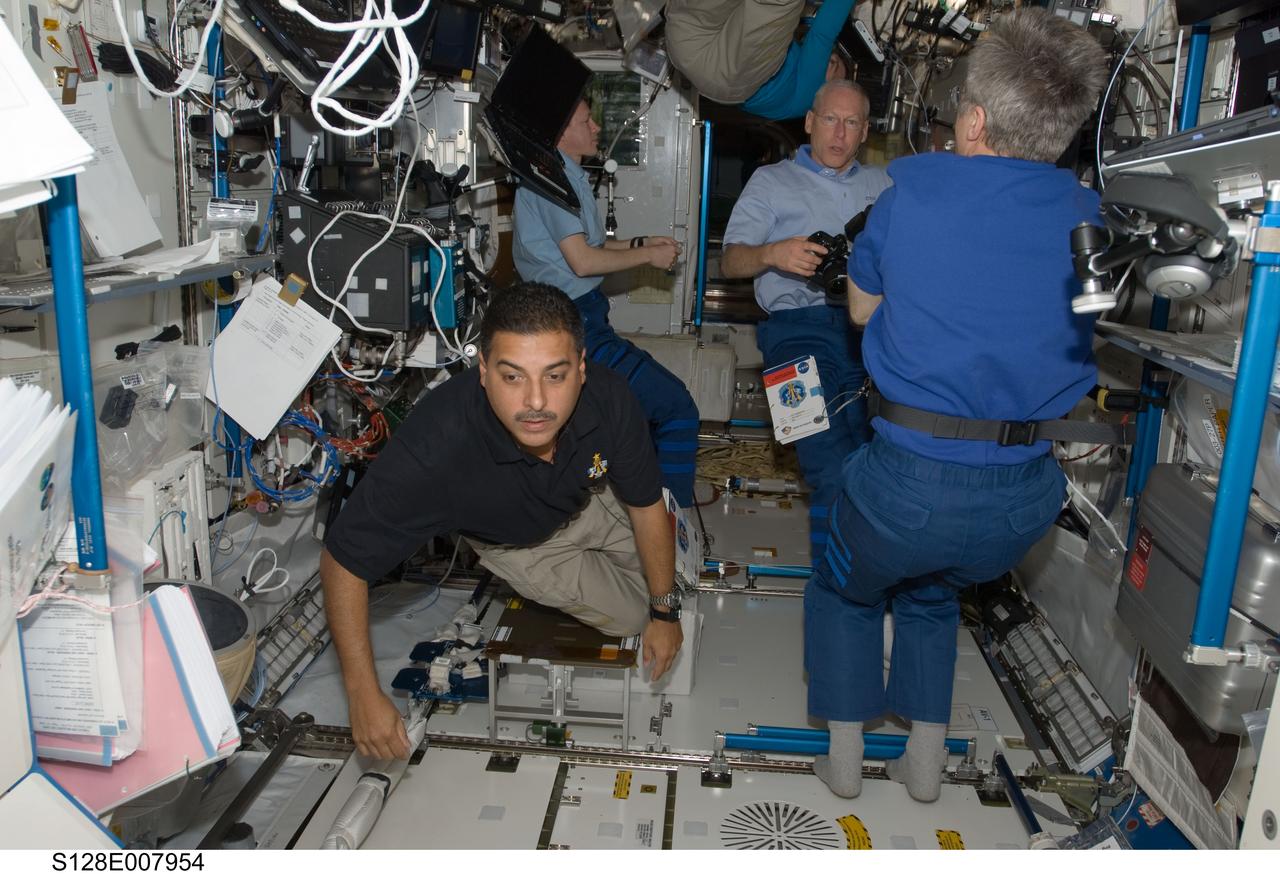
S128-E-007954 (7 Sept. 2009) --- NASA astronauts Jose Hernandez (left foreground) and Patrick Forrester (right background), both STS-128 mission specialists; and Michael Barratt (top center), Expedition 20 flight engineer; along with European Space Agency astronaut Frank De Winne (left background) and Canadian Space Agency astronaut Robert Thirsk, both Expedition 20 flight engineers, are busy with various tasks in the Destiny laboratory of the International Space Station.
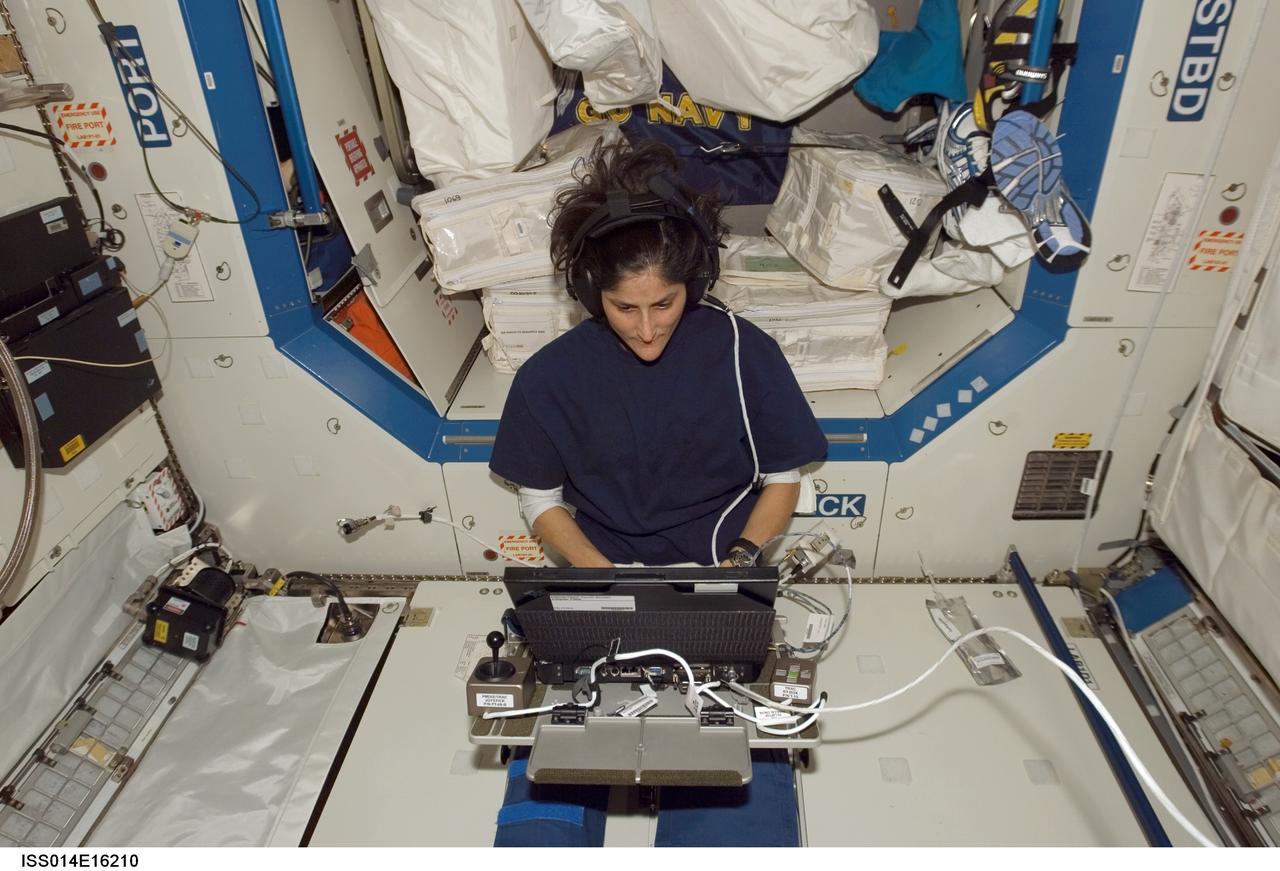
ISS014-E-16210 (8 March 2007) --- Astronaut Sunita L. Williams, Expedition 14 flight engineer, works with the Test of Reaction and Adaptation Capabilities (TRAC) experiment in the Destiny laboratory of the International Space Station. The TRAC investigation will test the theory of brain adaptation during space flight by testing hand-eye coordination before, during and after the space flight.
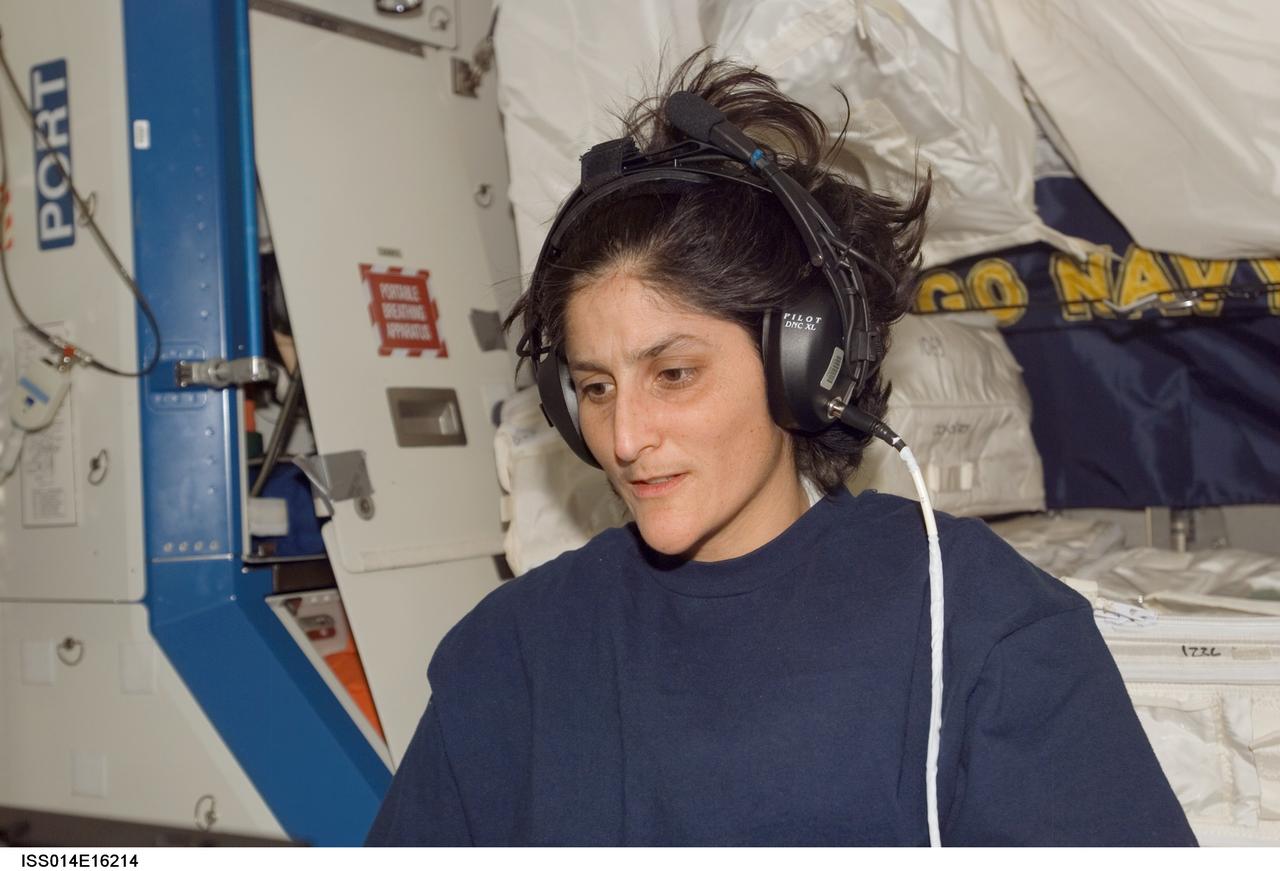
ISS014-E-16214 (8 March 2007) --- Astronaut Sunita L. Williams, Expedition 14 flight engineer, works with the Test of Reaction and Adaptation Capabilities (TRAC) experiment in the Destiny laboratory of the International Space Station. The TRAC investigation will test the theory of brain adaptation during space flight by testing hand-eye coordination before, during and after the space flight.
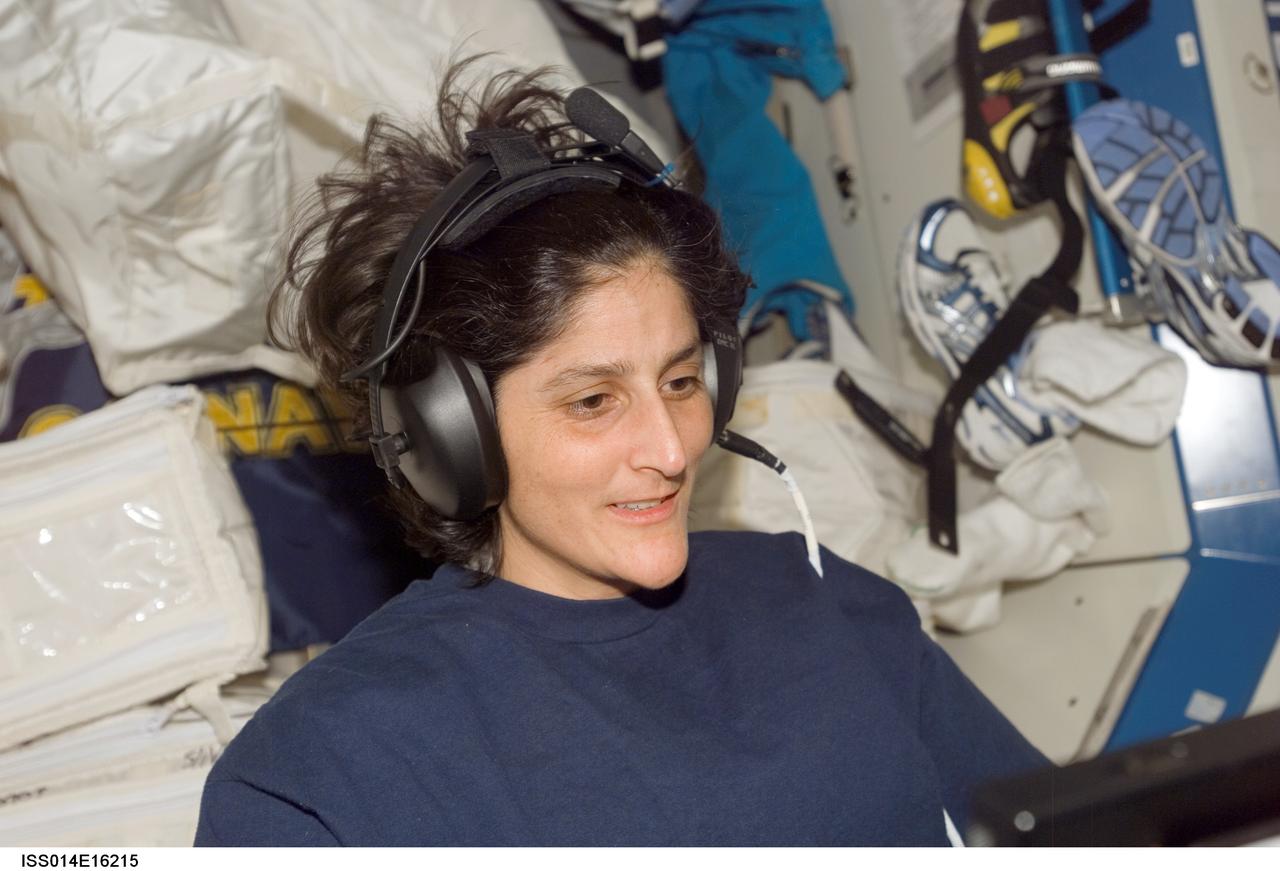
ISS014-E-16215 (8 March 2007) --- Astronaut Sunita L. Williams, Expedition 14 flight engineer, works with the Test of Reaction and Adaptation Capabilities (TRAC) experiment in the Destiny laboratory of the International Space Station. The TRAC investigation will test the theory of brain adaptation during space flight by testing hand-eye coordination before, during and after the space flight.
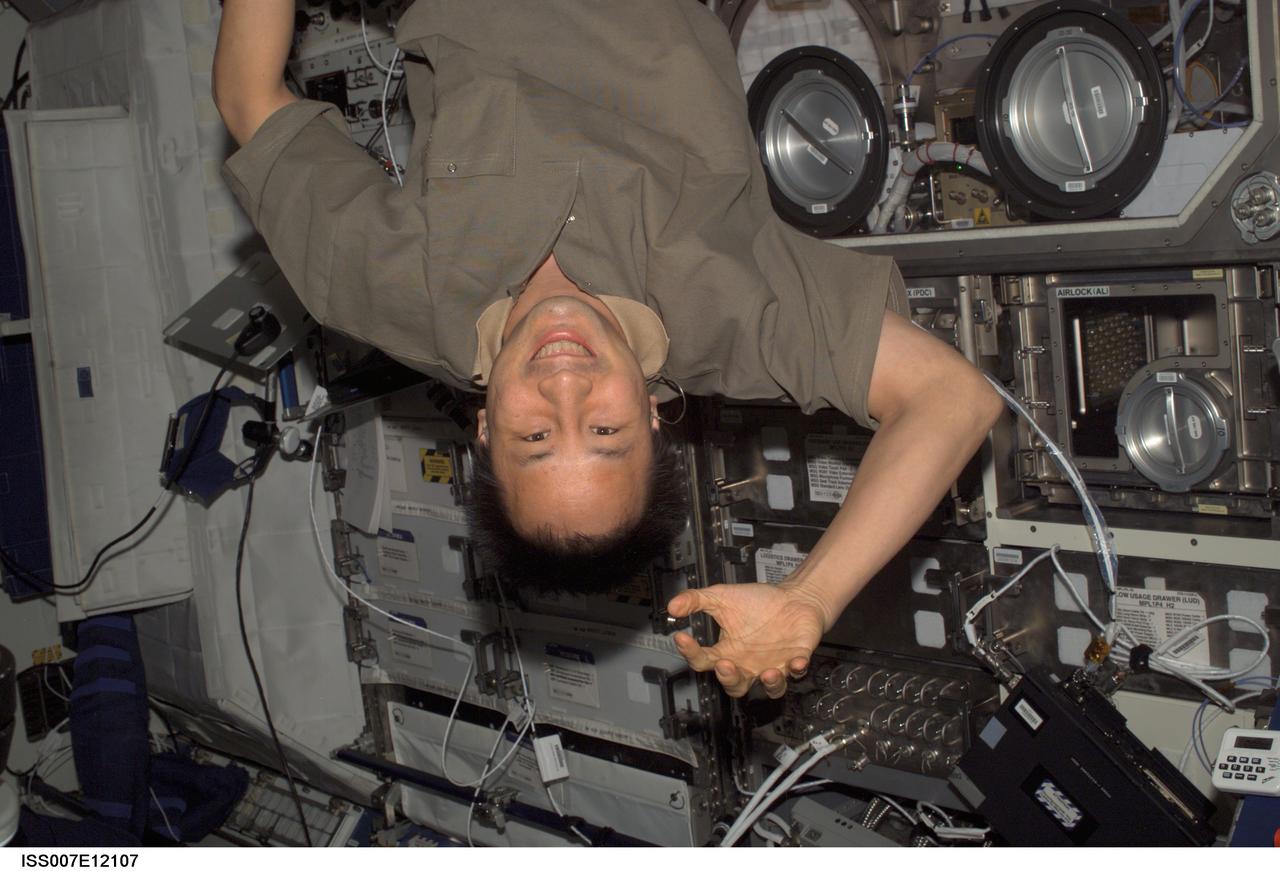
ISS007-E-12107 (6 August 2003) --- Astronaut Edward T. Lu, Expedition 7 NASA ISS science officer and flight engineer, enjoys a light moment as he floats upside down in the Destiny laboratory on the International Space Station (ISS).
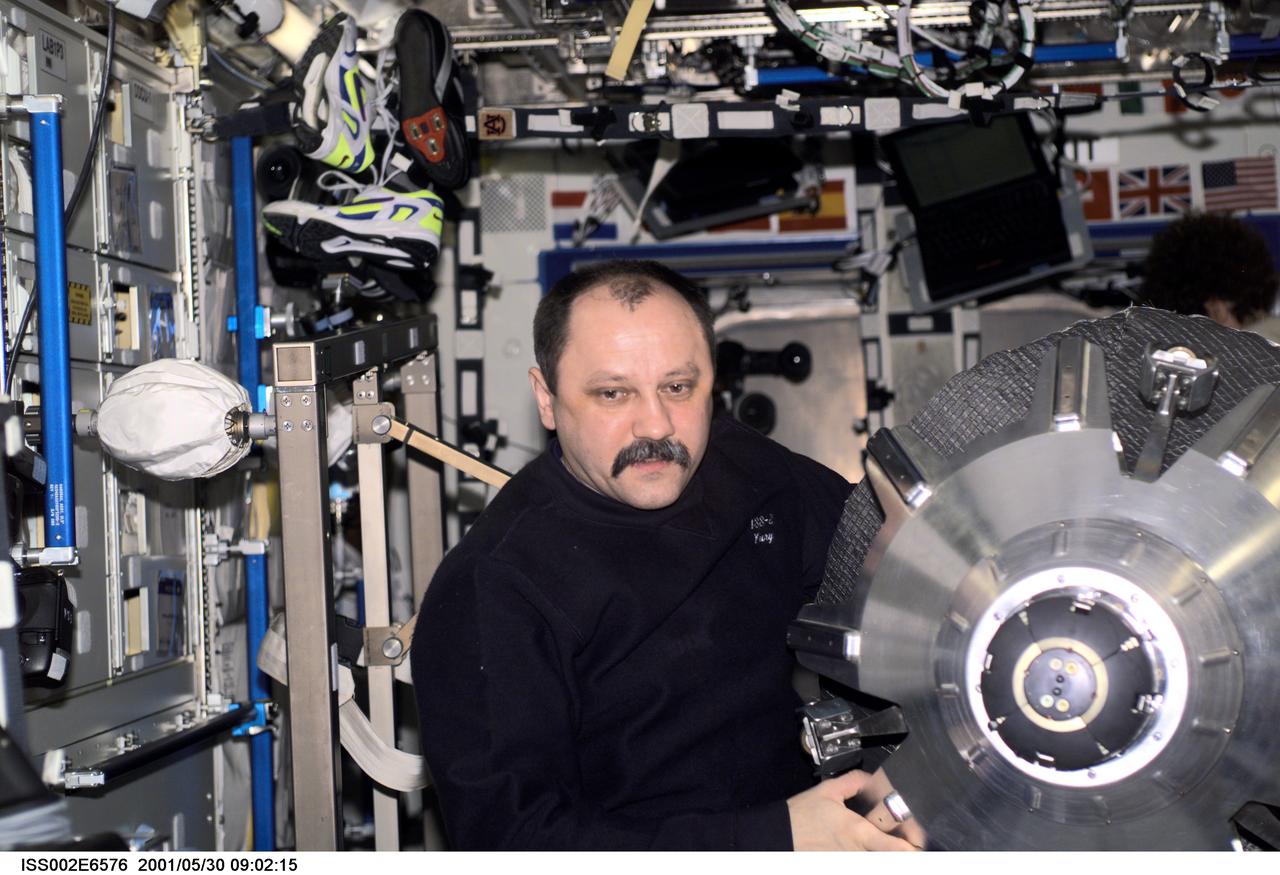
ISS002-E-6576 (30 May 2001) --- Yury V. Usachev of Rosaviakosmos, Expedition Two mission commander, moves a docking probe through the Destiny Laboratory on the International Space Station (ISS). The image was recorded with a digital still camera.
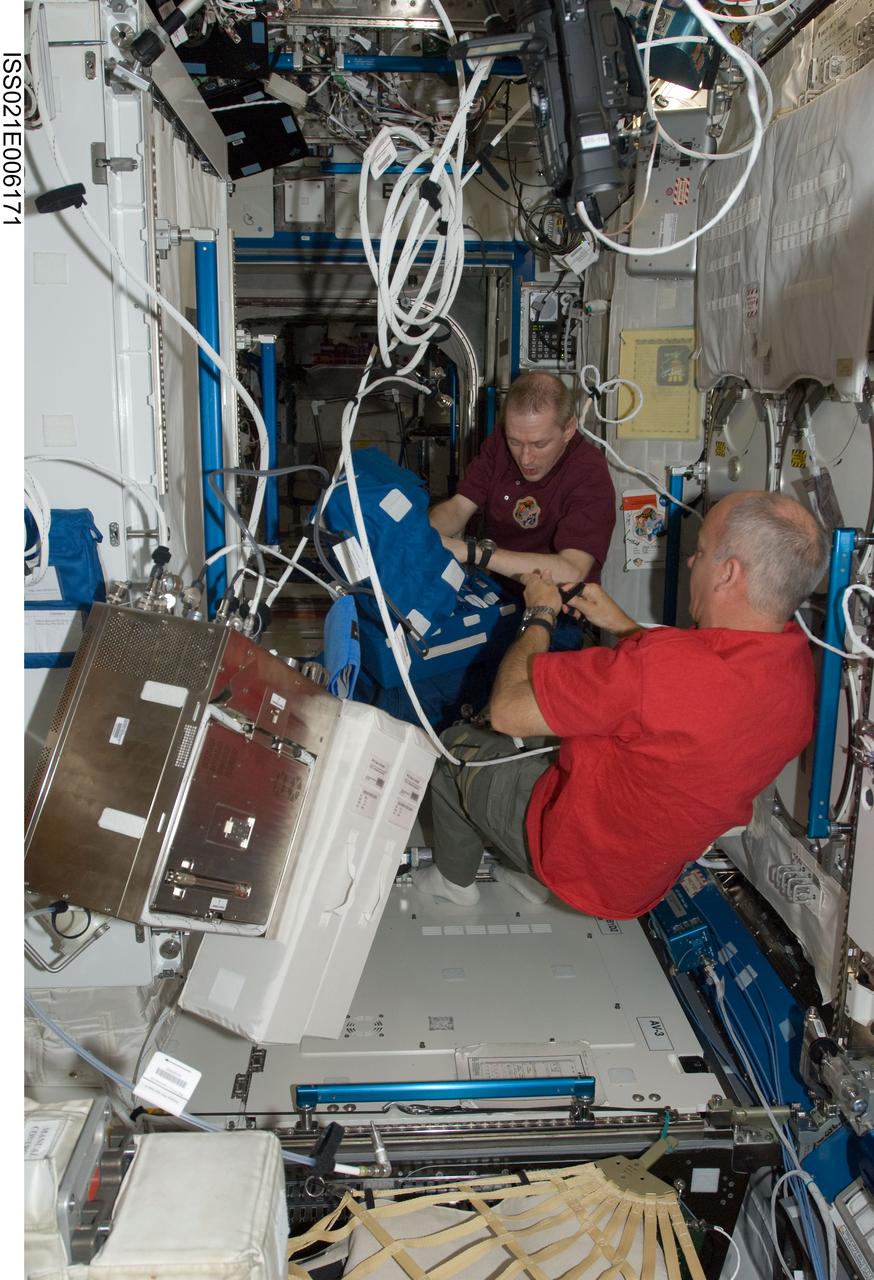
ISS021-E-006171 (14 Oct. 2009) --- European Space Agency astronaut Frank De Winne (background), Expedition 21 commander; and NASA astronaut Jeffrey Williams, flight engineer, work in the Destiny laboratory of the International Space Station.
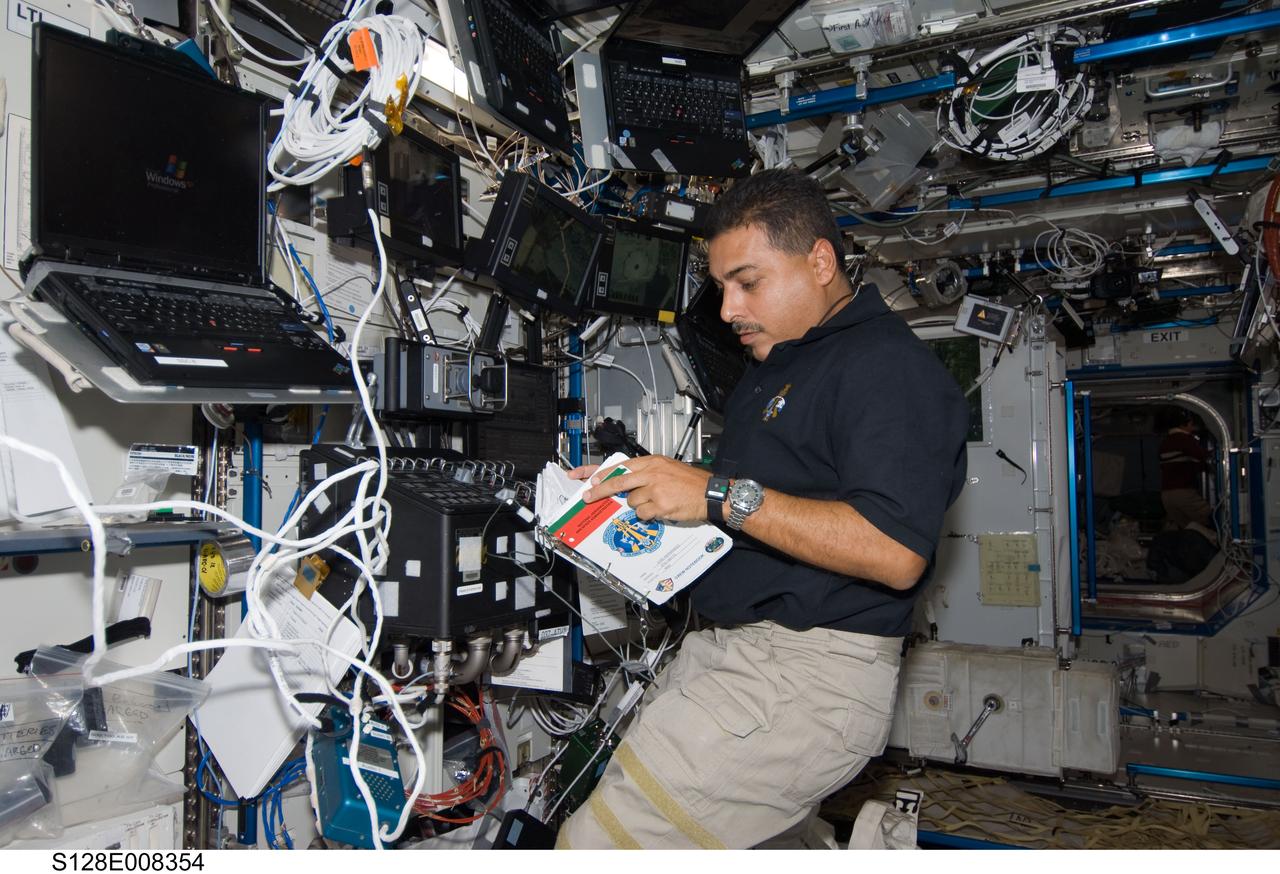
S128-E-008354 (7 Sept. 2009) --- NASA astronaut Jose Hernandez, STS-128 mission specialist, reads a procedures checklist in the Destiny laboratory of the International Space Station while Space Shuttle Discovery remains docked with the station.
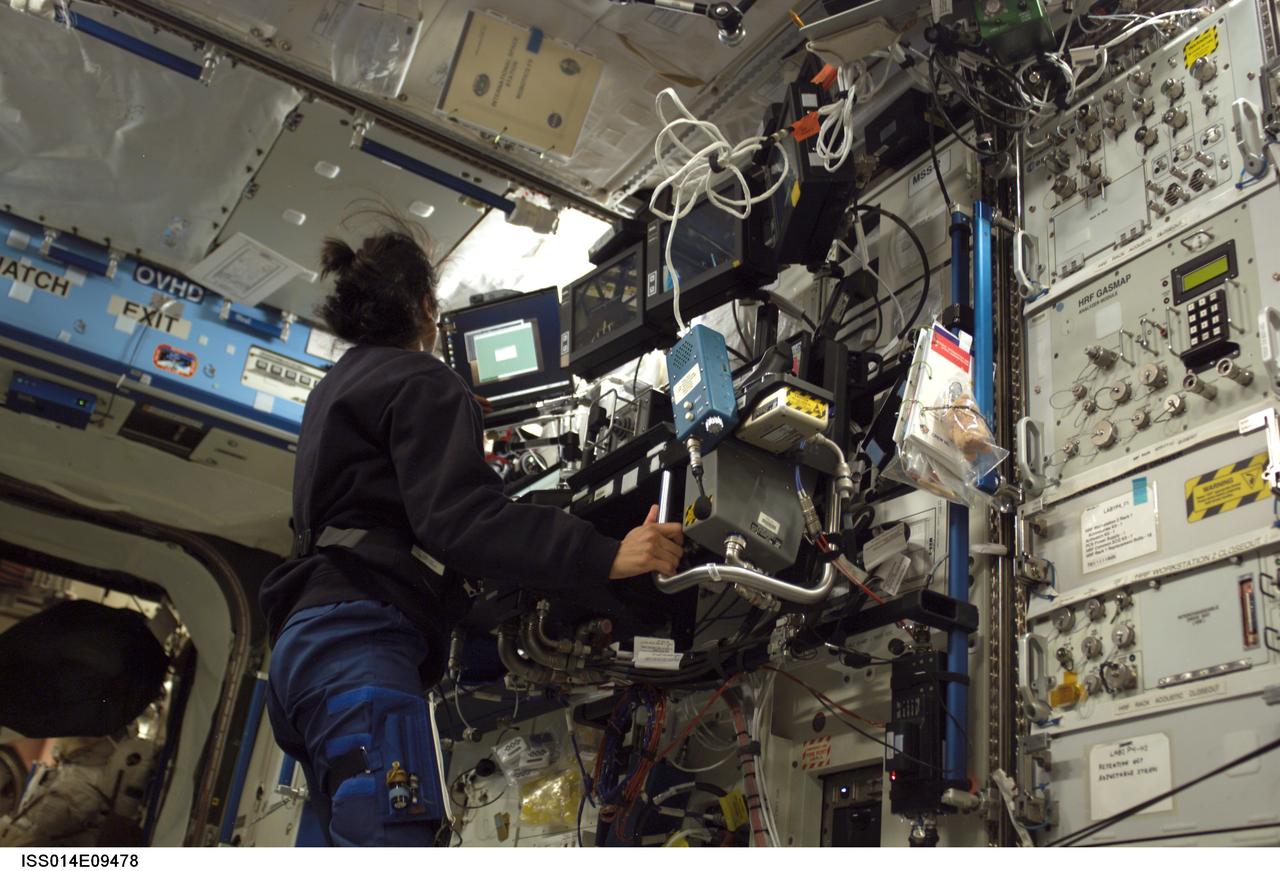
ISS014-E-09478 (11 Dec. 2006) --- Astronaut Sunita L. Williams, STS-116 mission specialist, works the controls of the Space Station Remote Manipulator System (SSRMS) or Canadarm2 in the Destiny laboratory of the International Space Station during flight day three activities.
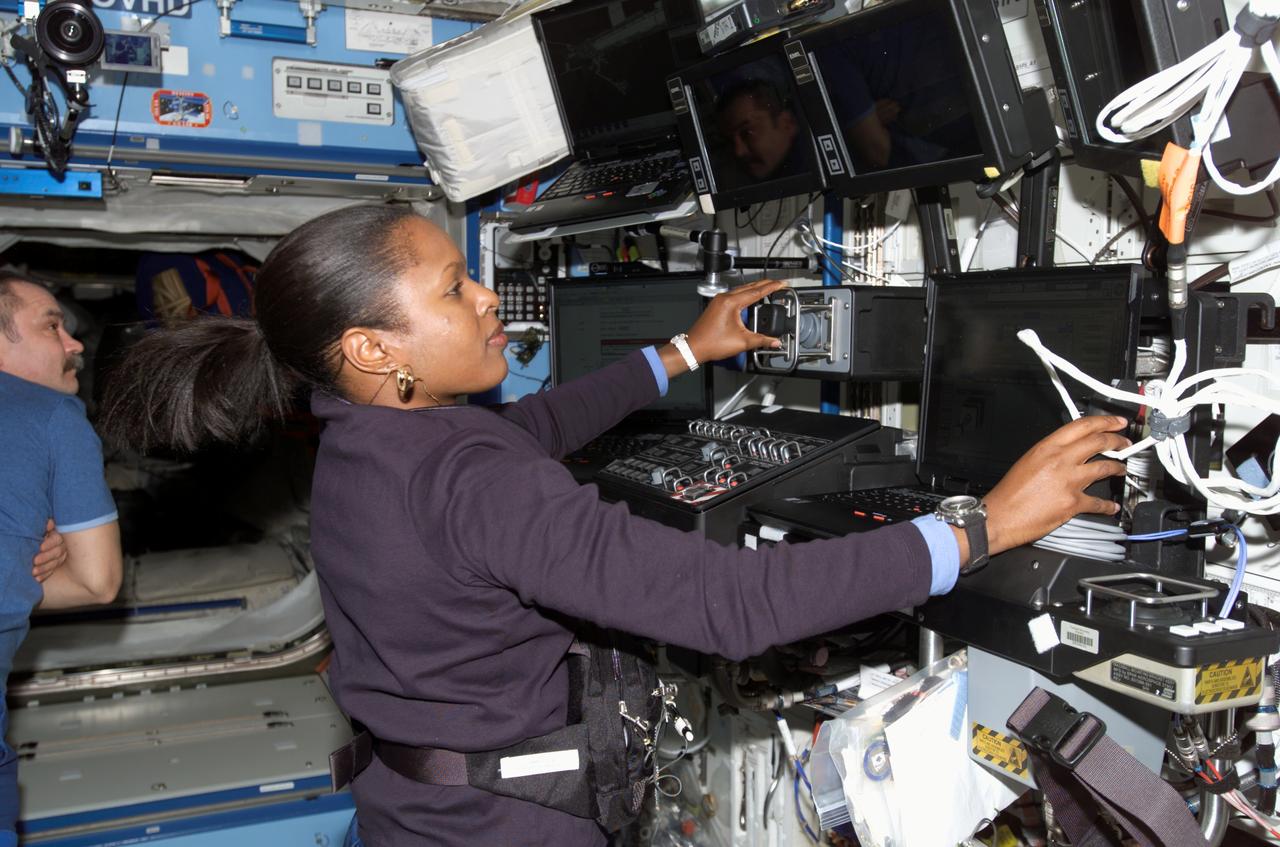
ISS014-E-09631 (12 Dec. 2006) --- Astronaut Joan E. Higginbotham, STS-116 mission specialist, works the controls of the Space Station Remote Manipulator System (SSRMS) or Canadarm2 in the Destiny laboratory of the International Space Station during flight day four activities.
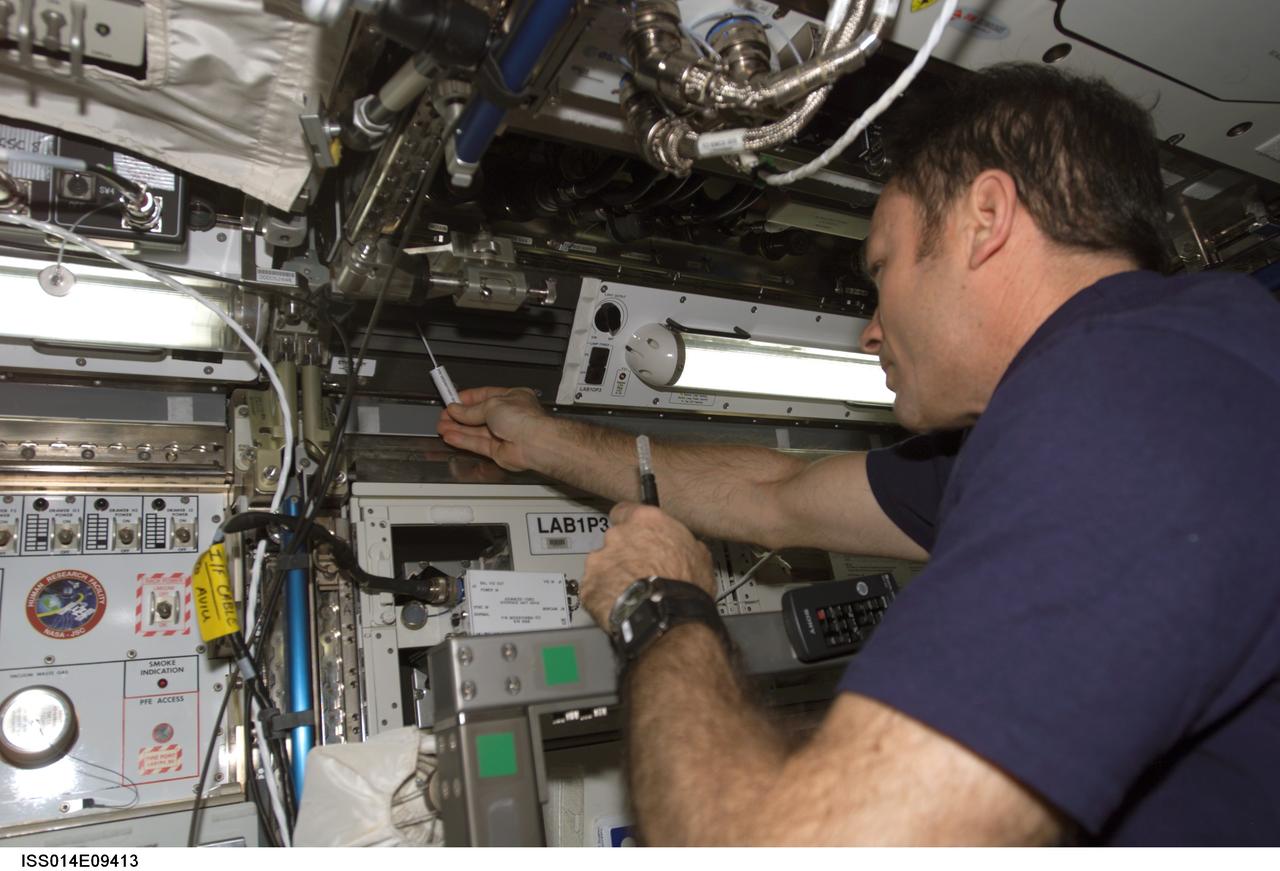
ISS014-E-09413 (8 Dec. 2006) --- Astronaut Michael E. Lopez-Alegria, Expedition 14 commander and NASA space station science officer, conducts a Surface, Water and Air Biocharacterization (SWAB) air sampling in the Destiny laboratory of the International Space Station.
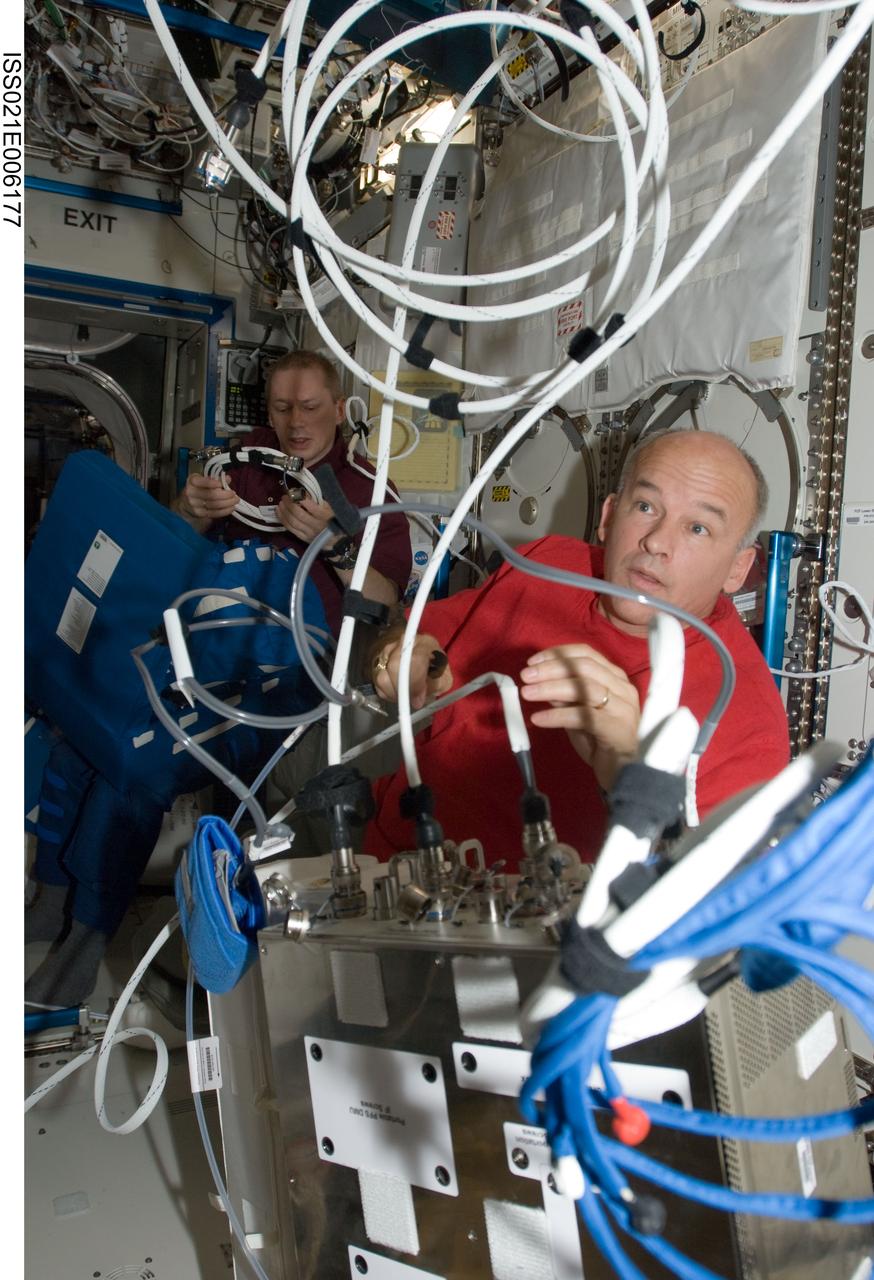
ISS021-E-006177 (14 Oct. 2009) --- NASA astronaut Jeffrey Williams, Expedition 21 flight engineer, works with the Portable Pulmonary Function System (PPFS) in the Destiny laboratory of the International Space Station. European Space Agency astronaut Frank De Winne, commander, works in the background.
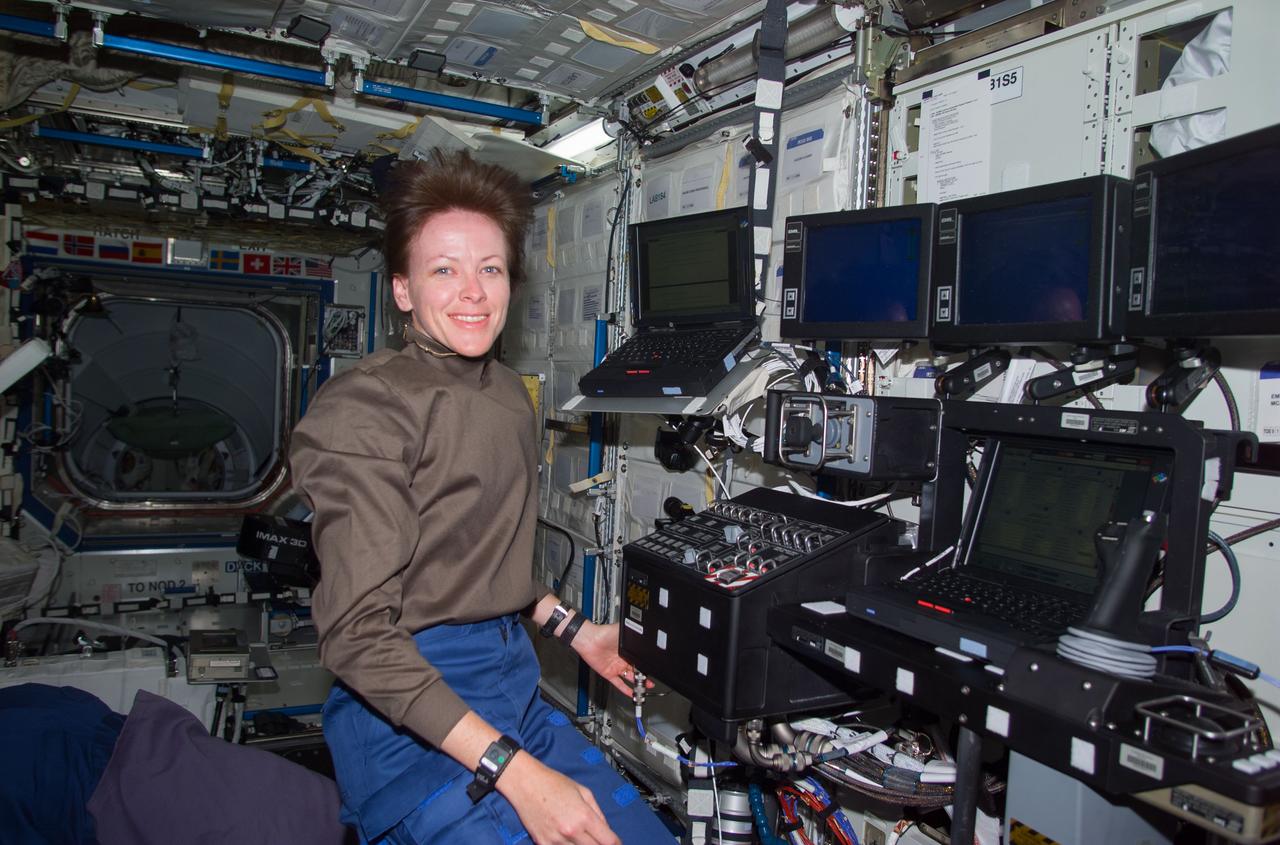
S104-E-5114 (16 July 2001) --- Janet L. Kavandi, STS-104 mission specialist, looks over the Canadarm2, Space Station Remote Manipulator System (SSRMS), control station in the Destiny laboratory during STS-104's visit to the International Space Station (ISS).
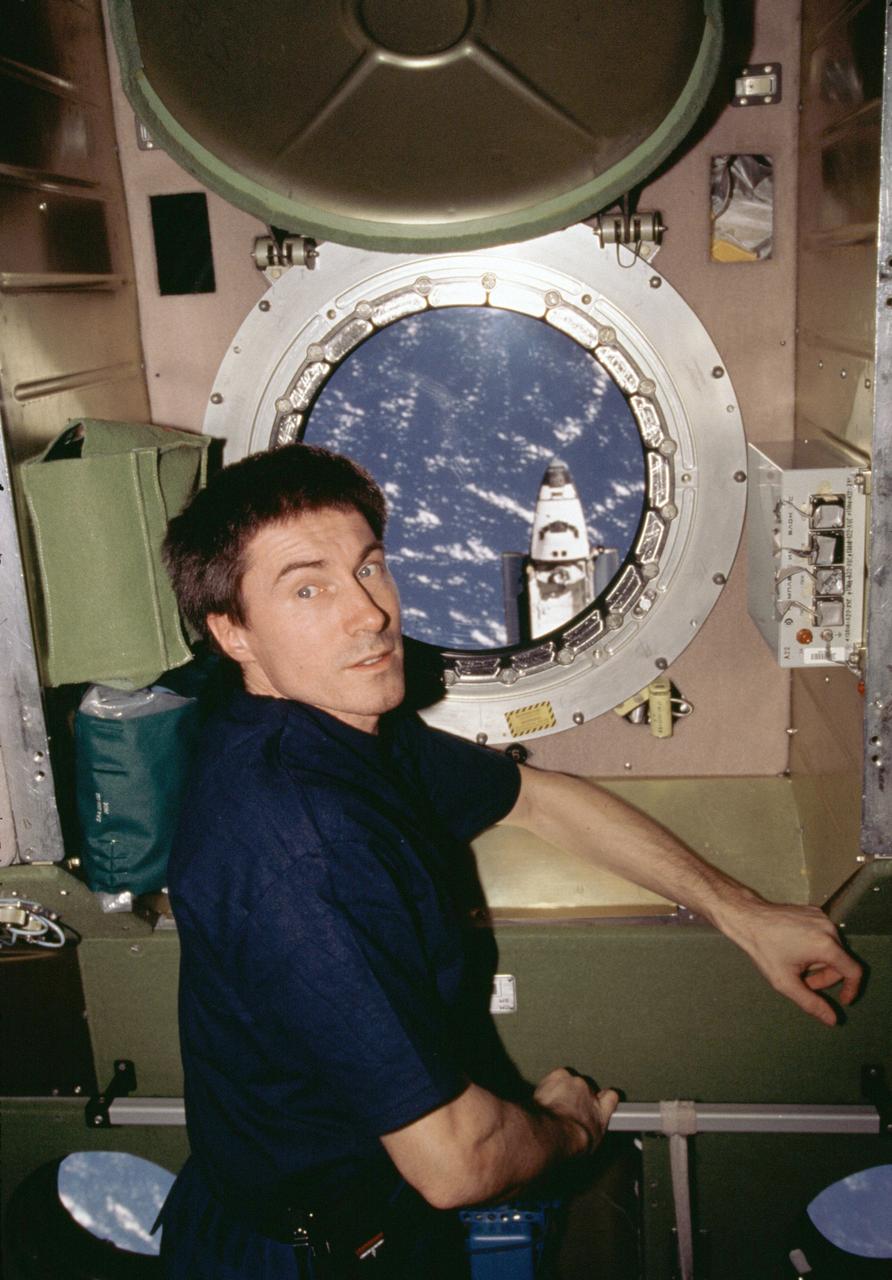
Cosmonaut Sergei K. Krikalev, flight engineer for Expedition One, is positioned by a porthole aboard the Zvezda Service Module of the International Space Station (ISS) as the Space Shuttle Atlantis approaches for docking to begin several days of joint activities between the two crews. Visible through the window are the crew cabin and forward section of the Shuttle amidst scattered clouds above the Western Pacific. The aft part of the cargo bay stowing the Destiny Laboratory is not visible in this scene.
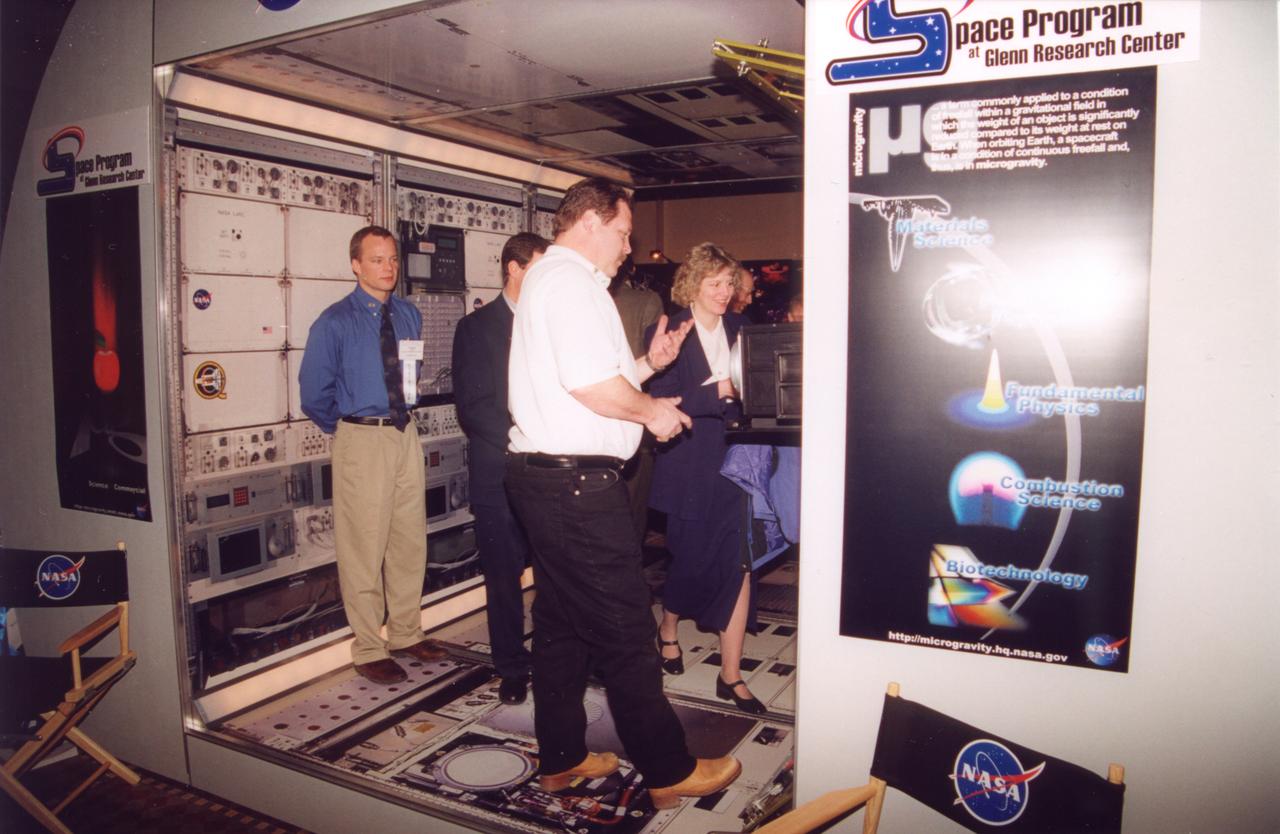
Engineers from NASA's Glenn Research Center, demonstrate access to one of the experiment racks planned for the U.S. Destiny laboratory module on the International Space Station. This mockup has the full diameter, full corridor width, and half the length of the module. The mockup includes engineering mockups of the Fluids and Combustion Facility being developed by NASA's Glenn Research Center. (The full module will be six racks long; the mockup is three rack long) Photo credit: NASA/Marshall Space Flight Center
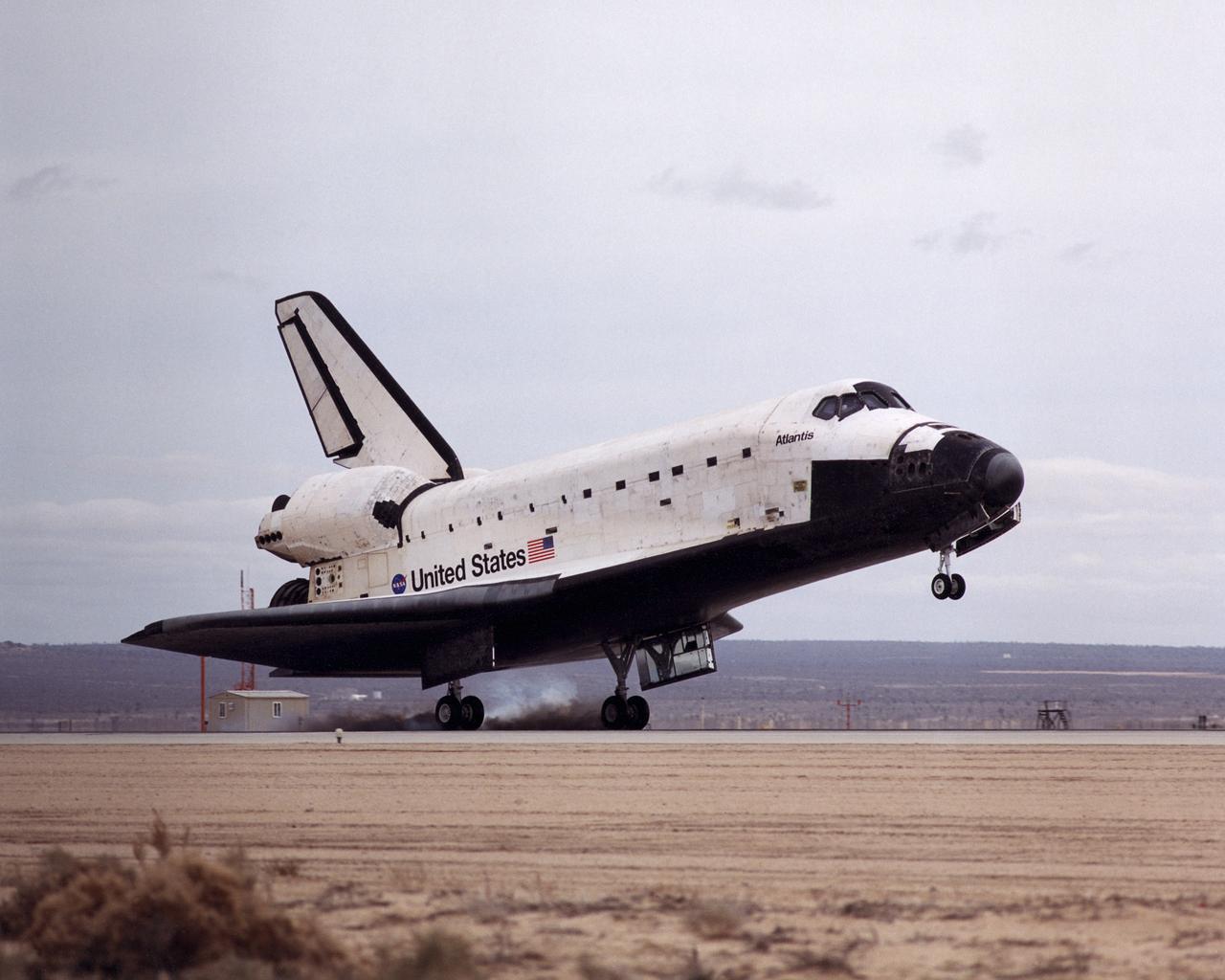
Space Shuttle Atlantis landed at 12:33 p.m. February 20, 2001, on the runway at Edwards Air Force Base, California, where NASA's Dryden Flight Research Center is located. The mission, which began February 7, logged 5.3 million miles as the shuttle orbited earth while delivering the Destiny science laboratory to the International Space Station. Inclement weather conditions in Florida prompted the decision to land Atlantis at Edwards. The last time a space shuttle landed at Edwards was Oct. 24, 2000.
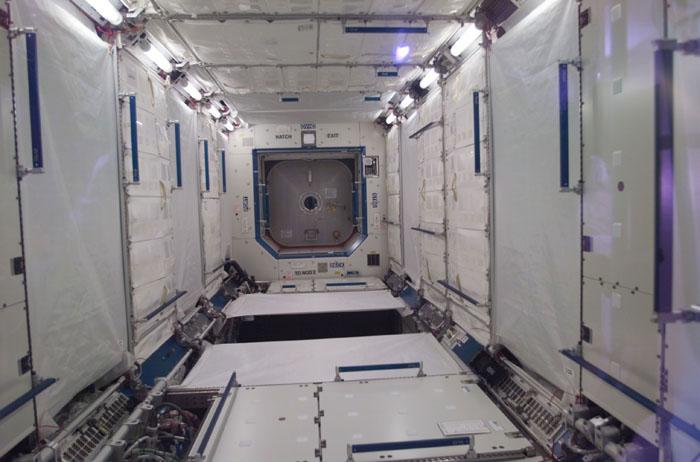
STS98-E-5113 (11 February 2001) --- This wide shot, photographed with a digital still camera, shows the interior of the newly attached Destiny laboratory. The crews of Atlantis and the International Space Station opened the laboratory on Feb. 11 and spent the first full day of what are planned to be years of work ahead inside the orbiting science and command center. Station commander William M. (Bill) Shepherd opened the Destiny hatch, and he and shuttle commander Kenneth D. Cockrell ventured inside at 8:38 a.m. (CST), Feb. 11. As depicted in subsequent digital images in this series, members of both crews went to work quickly inside the new module, activating air systems, fire extinguishers, alarm systems, computers and internal communications. The crew also continued equipment transfers from the shuttle to the station.
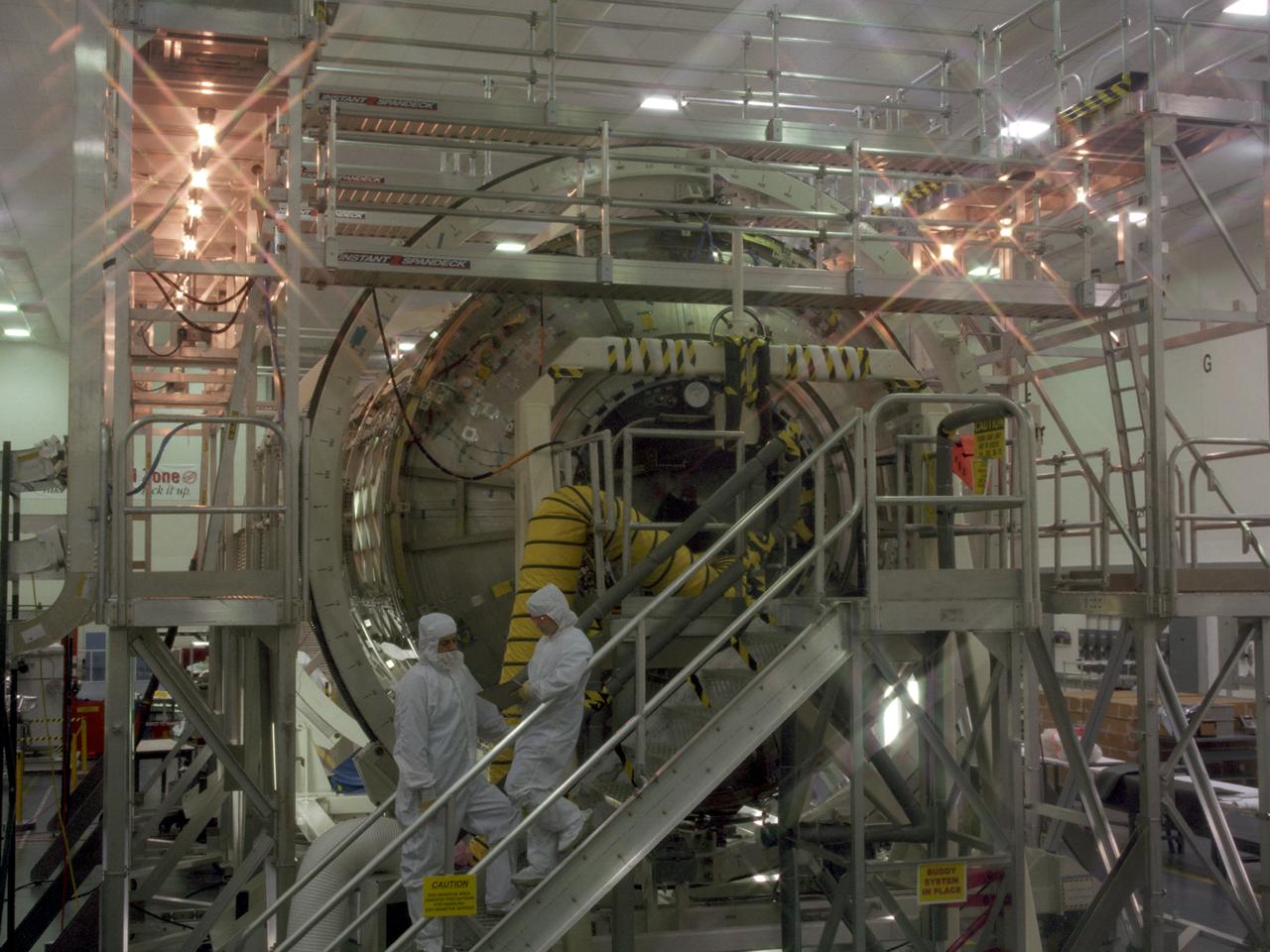
This photograph shows the U.S. Laboratory Module (also called Destiny) for the International Space Station (ISS), under construction in the Space Station manufacturing facility at the Marshall Space Flight Center. The U.S. Laboratory module is the centerpiece of the ISS, where science experiments will be performed in the near-zero gravity of space. The Destiny Module was launched aboard the Space Shuttle orbiter Atlantis (STS-67 mission) on February 7, 2001. The aluminum module is 8.5 meters (28 feet) long and 4.3 meters (14 feet) in diameter. The laboratory consists of three cylindrical sections and two end cones with hatches that will be mated to other station components. A 50.9-centimeter- (20-inch-) diameter window is located on one side of the center module segment. This pressurized module is designed to accommodate pressurized payloads. It has a capacity of 24 rack locations, and payload racks will occupy 13 locations especially designed to support experiments. The ISS is a multidisciplinary laboratory, technology test bed, and observatory that will provide unprecedented undertakings in scientific, technological, and international experimentation.
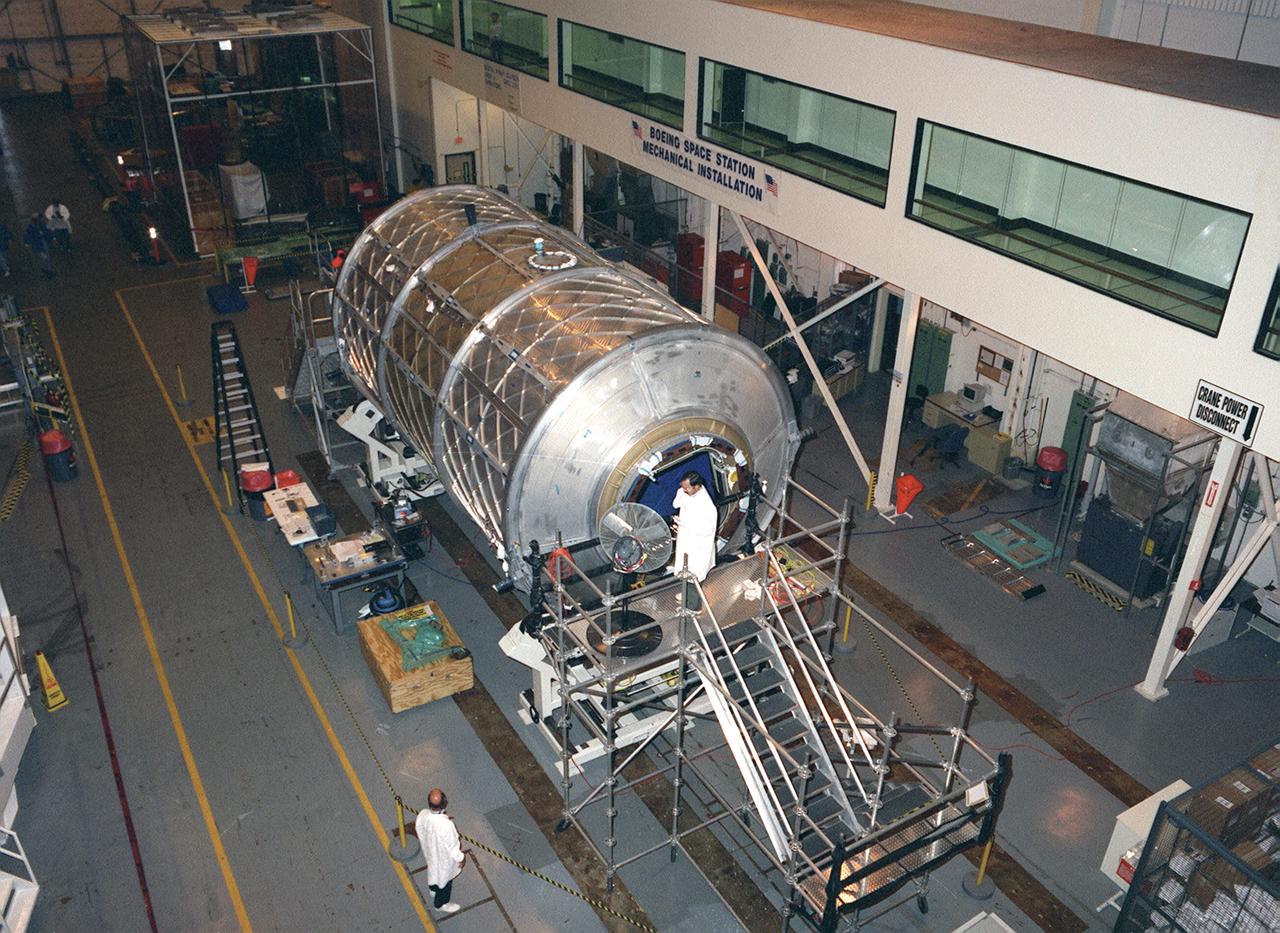
In this photograph, the U.S. Laboratory Module (also called Destiny) for the International Space Station (ISS) is shown under construction in the West High Bay of the Space Station manufacturing facility (building 4708) at the Marshall Space Flight Center. The U.S. Laboratory module is the centerpiece of the ISS, where science experiments will be performed in the near-zero gravity of space. The Destiny Module was launched aboard the Space Shuttle orbiter Atlantis (STS-98 mission) on February 7, 2001. The aluminum module is 8.5 meters (28 feet) long and 4.3 meters (14 feet) in diameter. The laboratory consists of three cylindrical sections and two endcones with hatches that will be mated to other station components. A 50.9-centimeter- (20-inch-) diameter window is located on one side of the center module segment. This pressurized module is designed to accommodate pressurized payloads. It has a capacity of 24 rack locations, and payload racks will occupy 13 locations especially designed to support experiments. The ISS is a multidisciplinary laboratory, technology test bed, and observatory that will provide unprecedented undertakings in scientific, technological, and international experimentation.
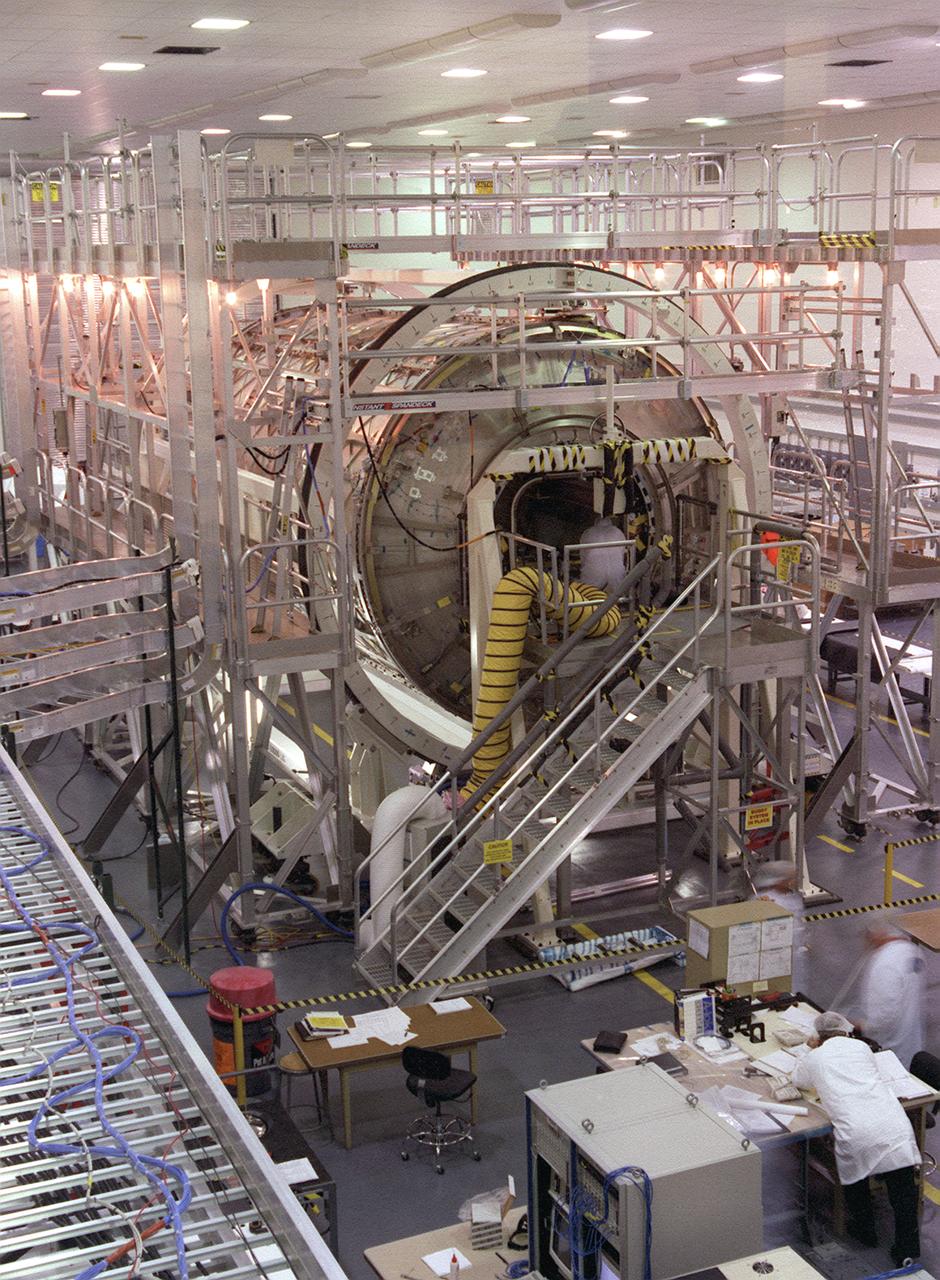
In this photograph, the U.S. Laboratory Module (also called Destiny) for the International Space Station (ISS) is shown under construction in the West High Bay of the Space Station manufacturing facility (building 4708) at the Marshall Space Flight Center. The U.S. Laboratory module is the centerpiece of the ISS, where science experiments will be performed in the near-zero gravity of space. The Destiny Module was launched aboard the Space Shuttle orbiter Atlantis (STS-98 mission) on February 7, 2001. The aluminum module is 8.5 meters (28 feet) long and 4.3 meters (14 feet) in diameter. The laboratory consists of three cylindrical sections and two endcones with hatches that will be mated to other station components. A 50.9-centimeter- (20-inch-) diameter window is located on one side of the center module segment. This pressurized module is designed to accommodate pressurized payloads. It has a capacity of 24 rack locations, and payload racks will occupy 13 locations especially designed to support experiments. The ISS is a multidisciplinary laboratory, technology test bed, and observatory that will provide unprecedented undertakings in scientific, technological, and international experimentation.
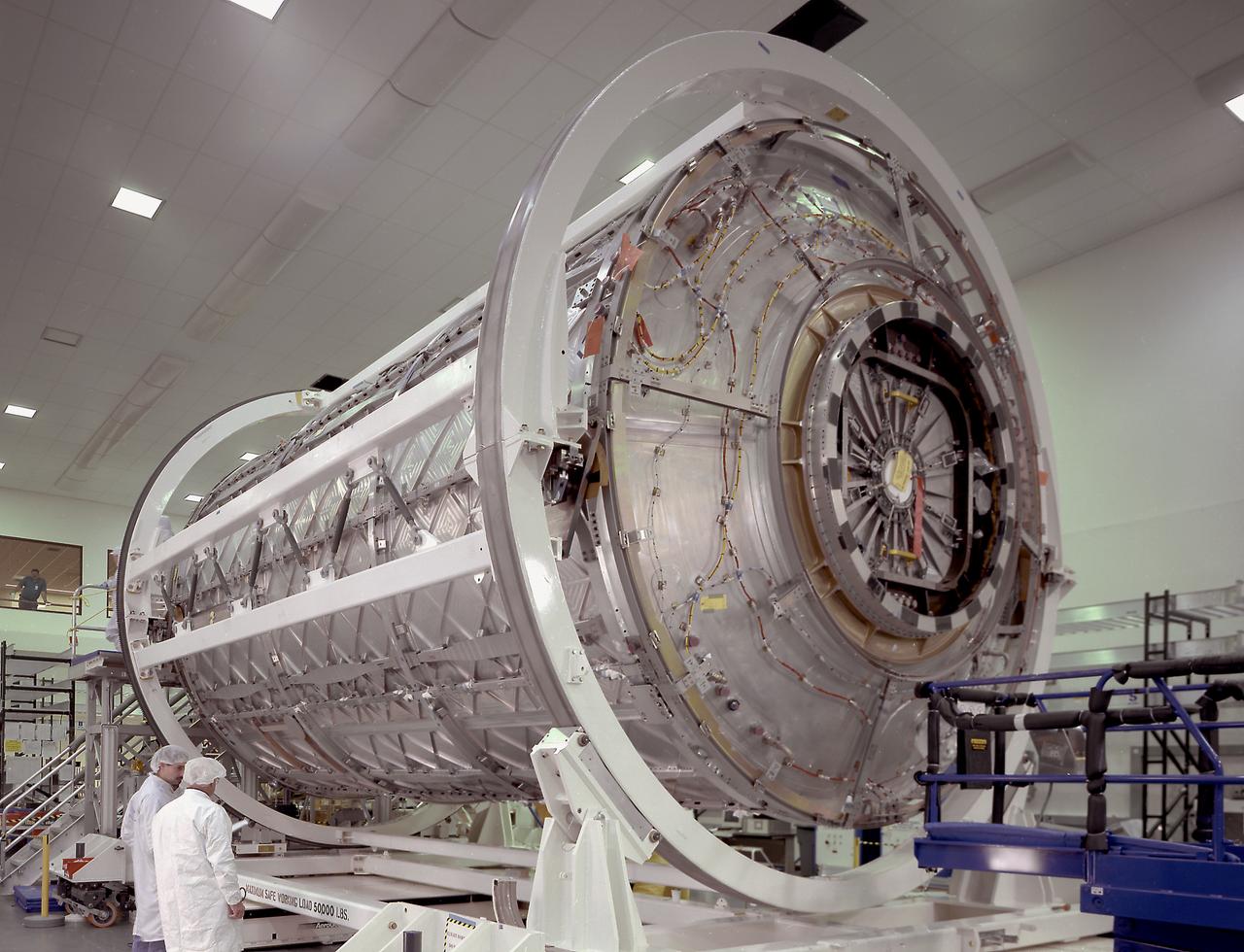
This photograph shows the U.S. Laboratory Module (also called Destiny) for the International Space Station (ISS), in the Space Station manufacturing facility at the Marshall Space Flight Center, being readied for shipment to the Kennedy Space Center. The U.S. Laboratory module is the centerpiece of the ISS, where science experiments will be performed in the near-zero gravity of space. The Destiny Module was launched aboard the Space Shuttle orbiter Atlantis (STS-67 mission) on February 7, 2001. The aluminum module is 8.5 meters (28 feet) long and 4.3 meters (14 feet) in diameter. The laboratory consists of three cylindrical sections and two endcones with hatches that will be mated to other station components. A 50.9-centimeter- (20-inch-) diameter window is located on one side of the center module segment. This pressurized module is designed to accommodate pressurized payloads. It has a capacity of 24 rack locations, and payload racks will occupy 13 locations especially designed to support experiments. The ISS is a multidisciplinary laboratory, technology test bed, and observatory that will provide unprecedented undertakings in scientific, technological, and international experimentation.

ISS011-E-11417 (2 August 2005) --- Astronauts Wendy B. Lawrence (foreground), STS-114 mission specialist, and James M. Kelly, pilot, work at the Canadarm2 workstation in the Destiny laboratory on the International Space Station.
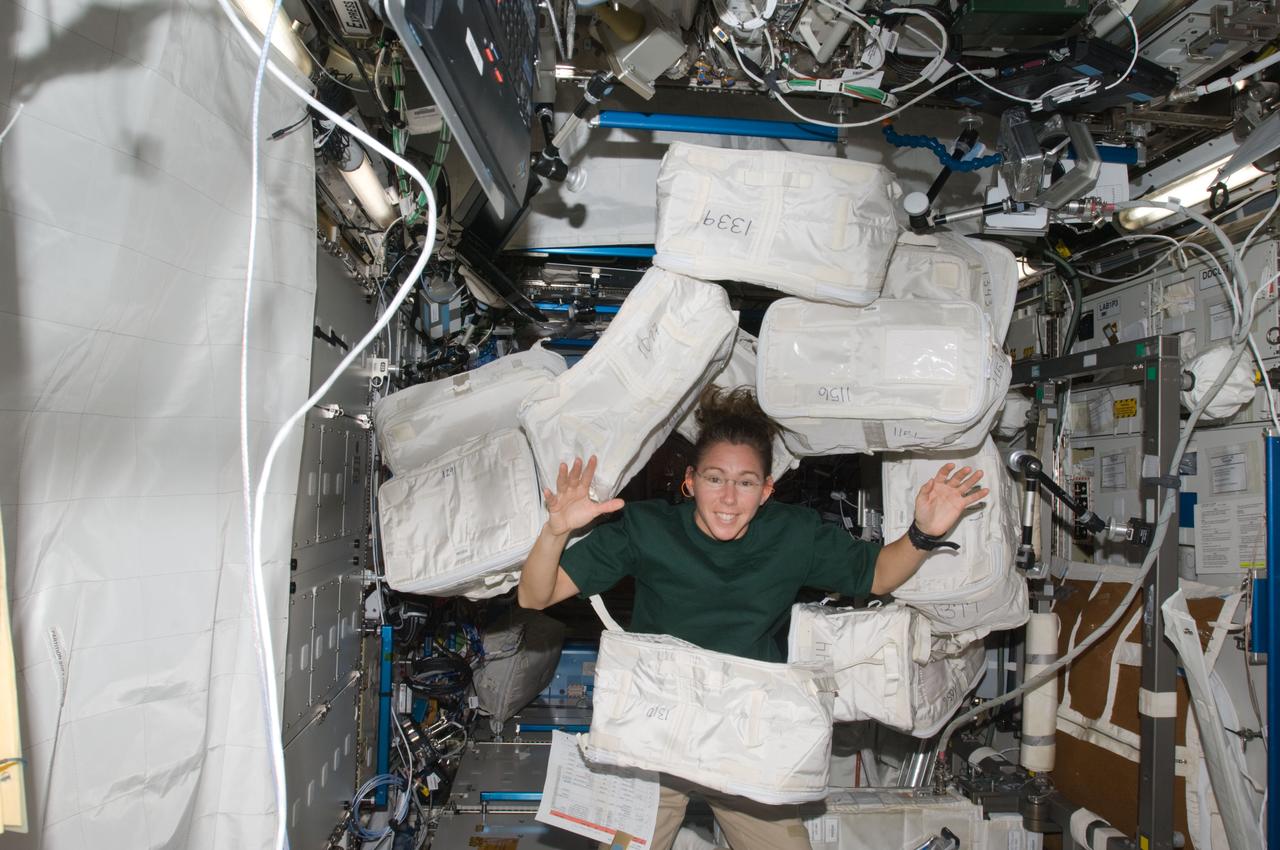
ISS018-E-014682 (22 Dec. 2008) --- Astronaut Sandra Magnus, Expedition 18 flight engineer, is pictured among stowage containers floating freely in the Destiny laboratory of the International Space Station.

ISS003-E-7916 (8 November 2001) --- Cosmonaut Vladimir N. Dezhurov, Expedition Three flight engineer representing Rosaviakosmos, works in the Destiny laboratory on the International Space Station (ISS). This image was taken with a digital still camera.
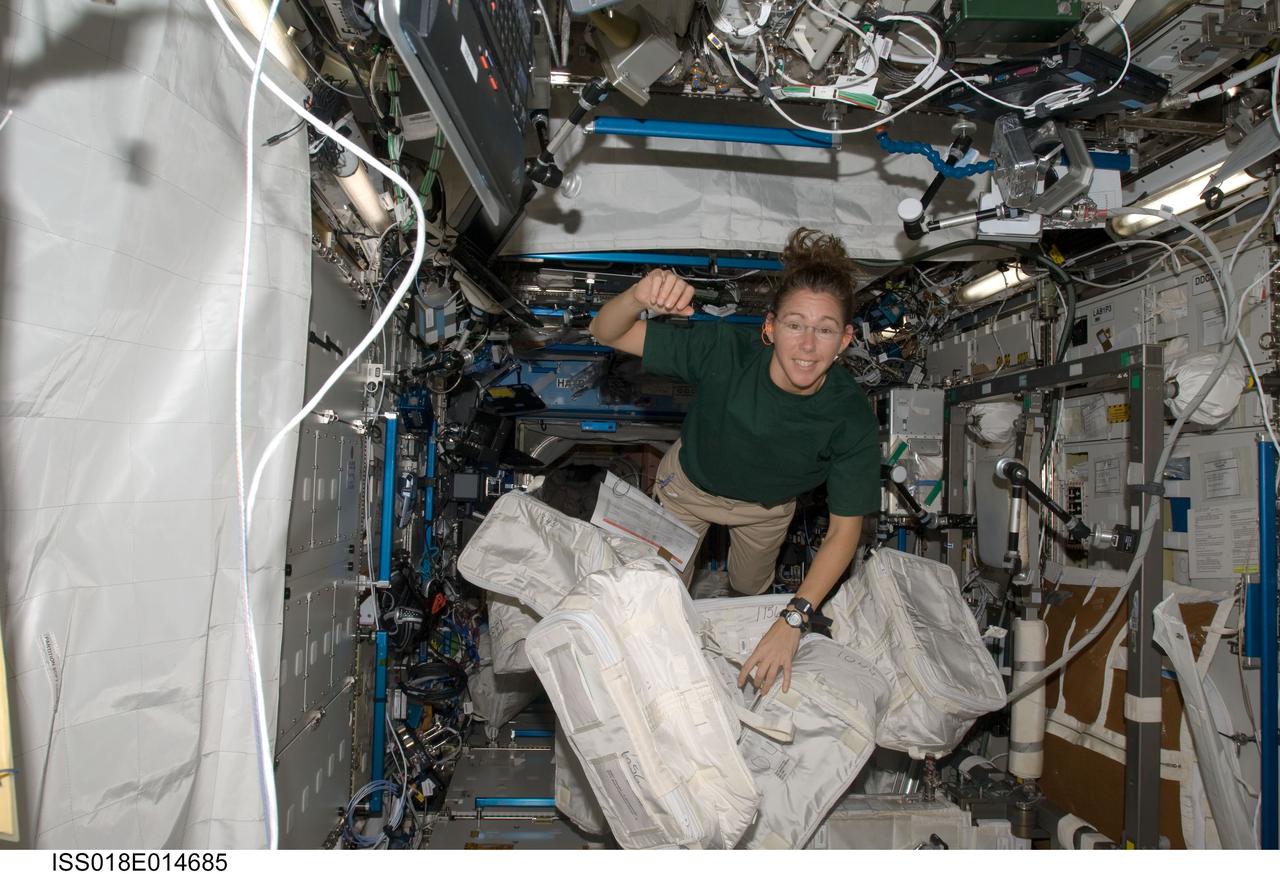
ISS018-E-014685 (22 Dec. 2008) --- Astronaut Sandra Magnus, Expedition 18 flight engineer, is pictured near stowage containers floating freely in the Destiny laboratory of the International Space Station.
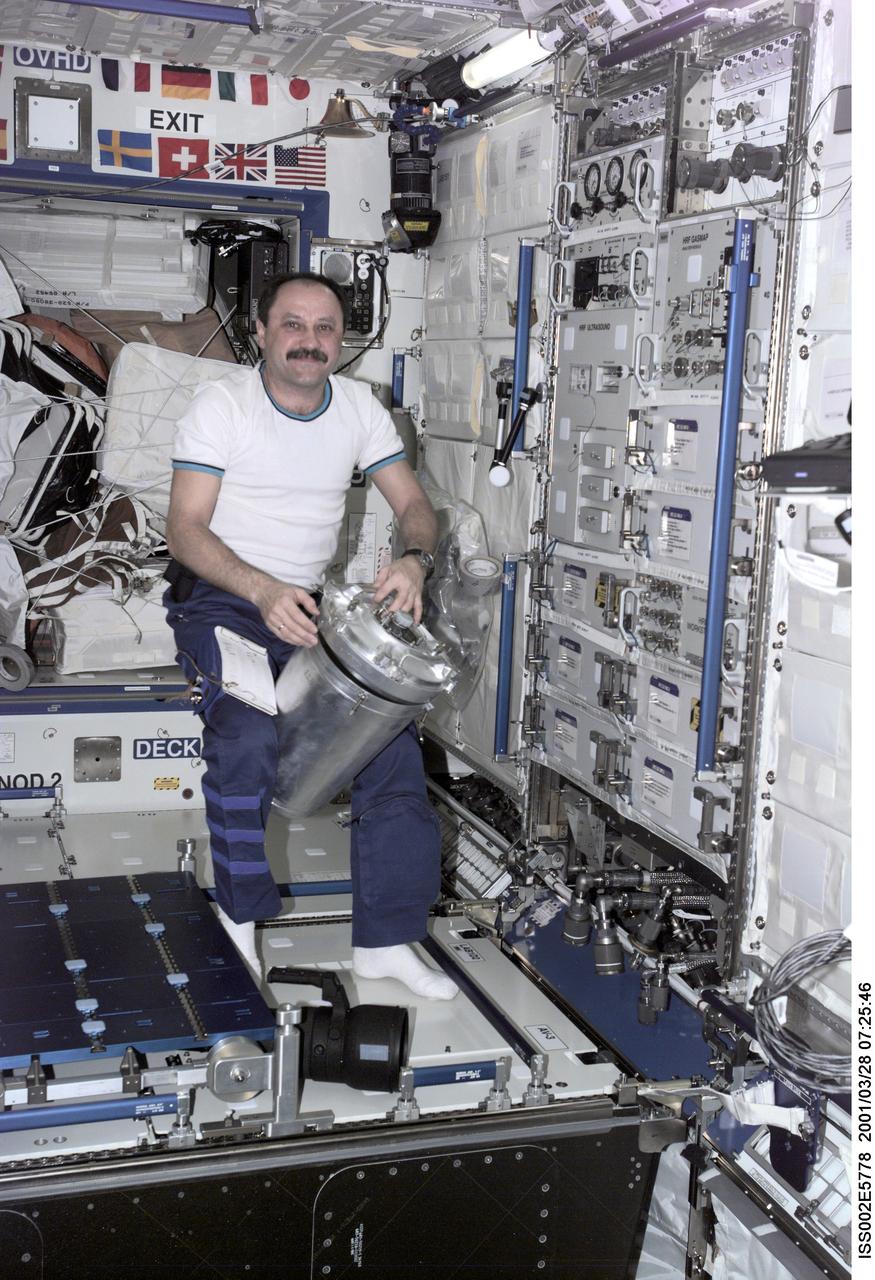
ISS002-E-5778 (28 March 2001) --- Yury V. Usachev of Rosaviakosmos, Expedtion Two mission commander, works with a Russian water container in the Destiny module. The image was taken with a digital still camera.
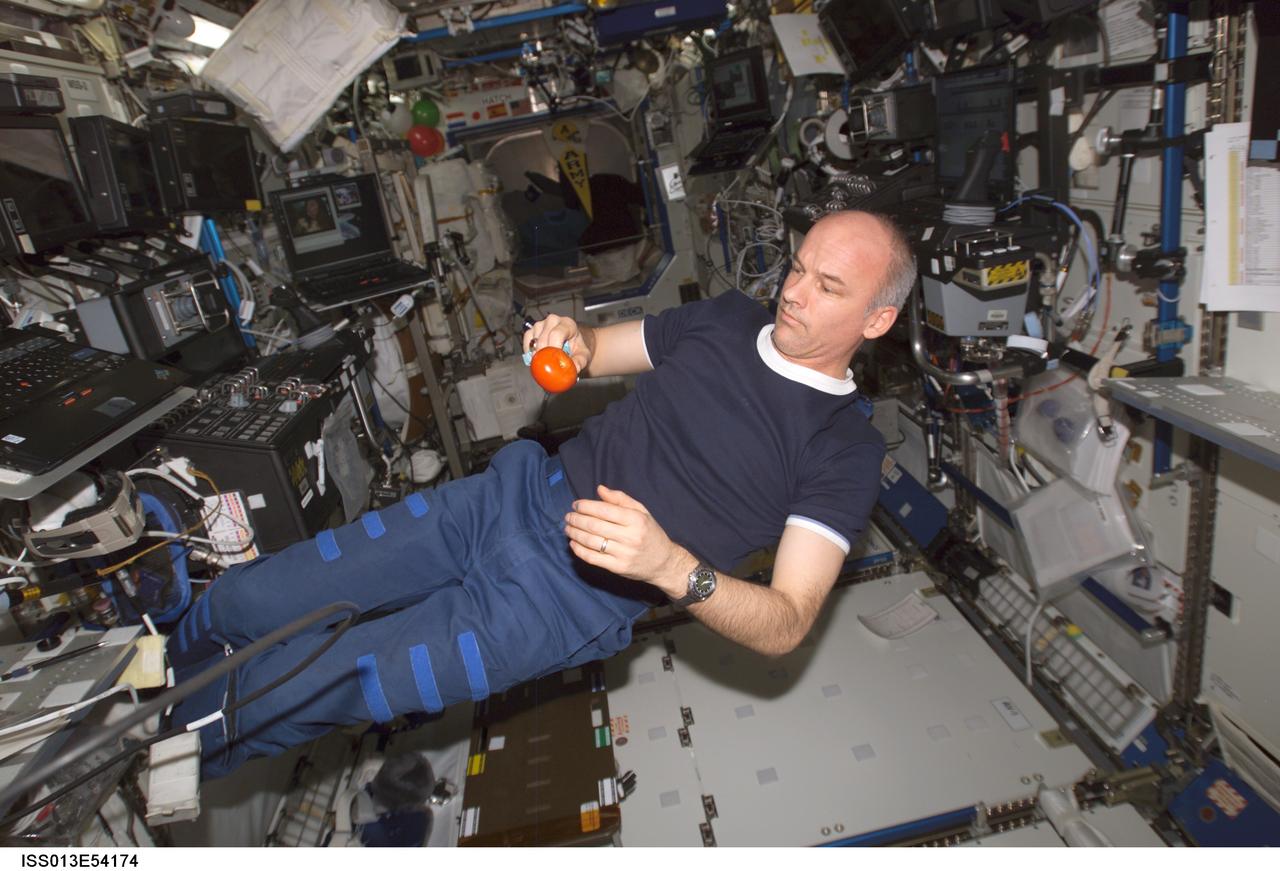
ISS013-E-54174 (16 July 2006) --- Astronaut Jeffrey N. Williams, Expedition 13 NASA space station science officer and flight engineer, watches a tomato float freely in the Destiny laboratory of the International Space Station.
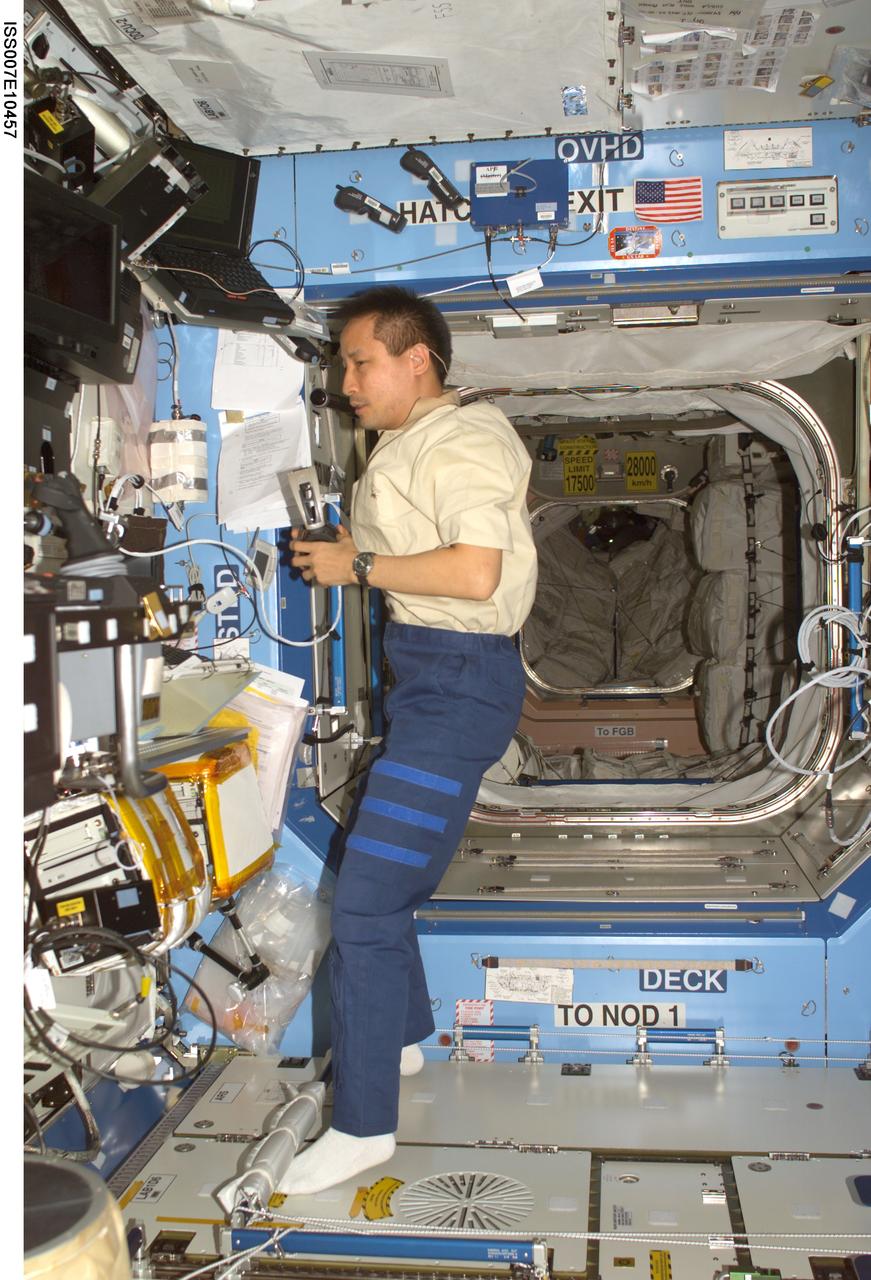
ISS007-E-10457 (14 July 2003) --- Astronaut Edward T. Lu, Expedition 7 NASA ISS science officer and flight engineer, works in the Destiny laboratory on the International Space Station (ISS).
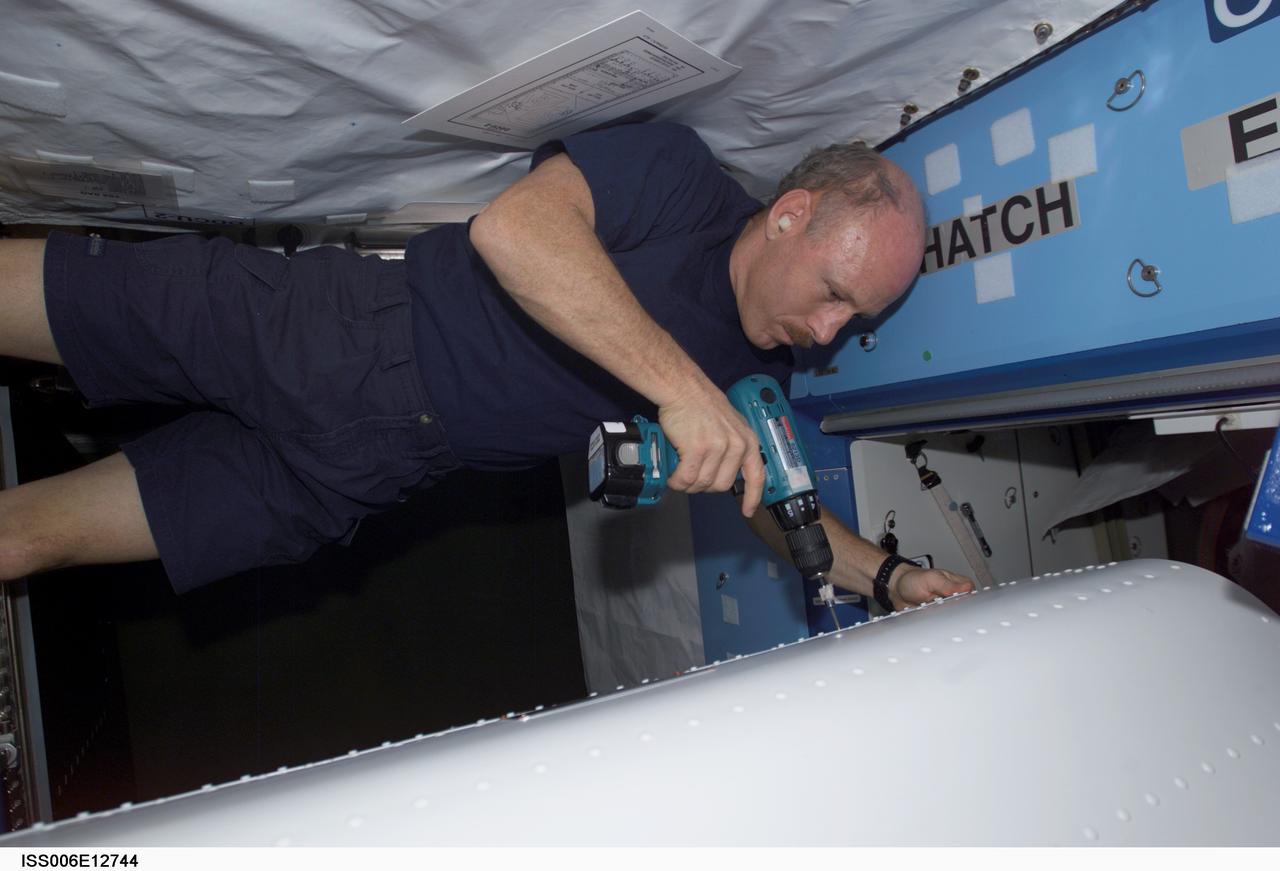
ISS006-E-12744 (30 December 2002) --- Astronaut Kenneth D. Bowersox, Expedition Six mission commander, performs in-flight maintenance (IFM) in the Destiny laboratory on the International Space Station (ISS).
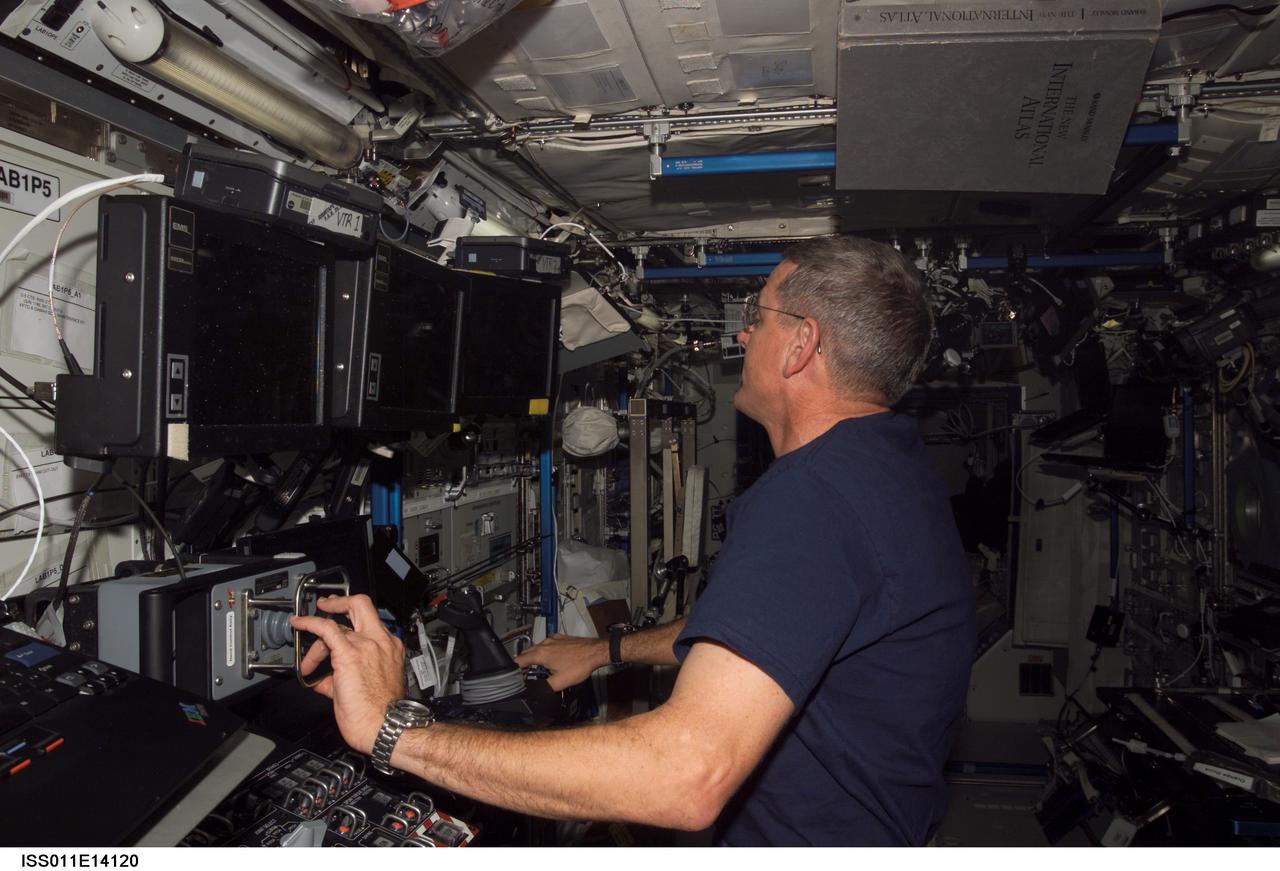
ISS011-E-14120 (5 October 2005) --- Astronaut William S. McArthur, Jr., Expedition 12 commander and NASA science officer, works with Space Station Remote Manipulator System or Canadarm2 controls located in the Destiny lab, while sharing duty time with the Expedition 11 crewmembers on the international space station. The Expedition 11 crew of cosmonaut Sergei K. Krikalev of Russia's Federal Space Agency, commander, and astronaut John L. Phillips, flight engineer and NASA science officer, along with spaceflight participant Greg Olsen, will be returning to Earth early next week.
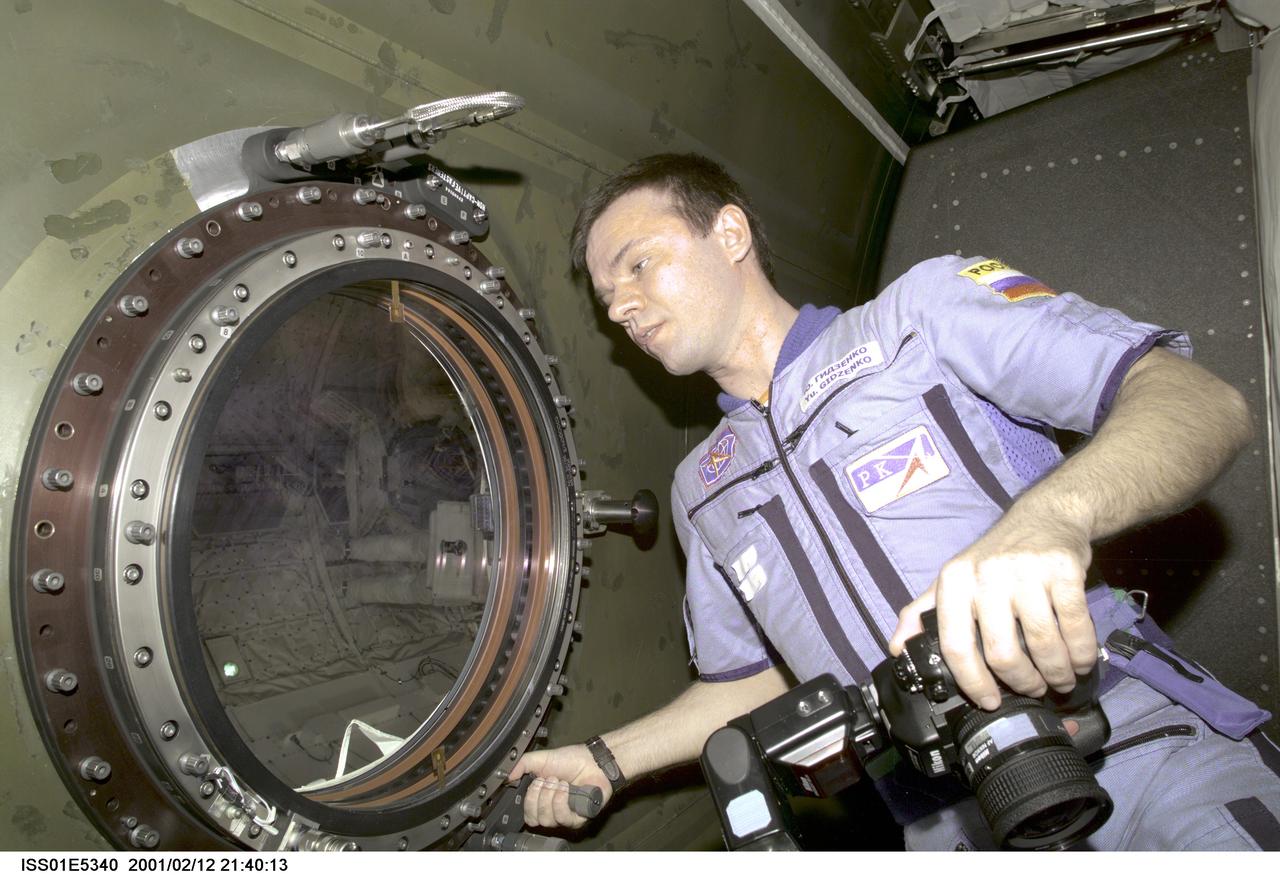
ISS01-E-5340 (12 February 2001) --- Cosmonaut Yuri P. Gidzenko, Expedition One's Soyuz commander, prepares to take pictures through the porthole in the Destiny laboratory. Gidzenko's photos will document parts of the second STS-98 space walk in the cargo bay of the Space Shuttle Atlantis. The legs of one of the space walkers can be seen through the window. Representing the Russian Aviation and Space Agency along with another cosmonaut, Gidzenko is part of a three man crew that intiated full-time habitation of the outpost in early November of 2000. This scene was recorded with a digital still camera.
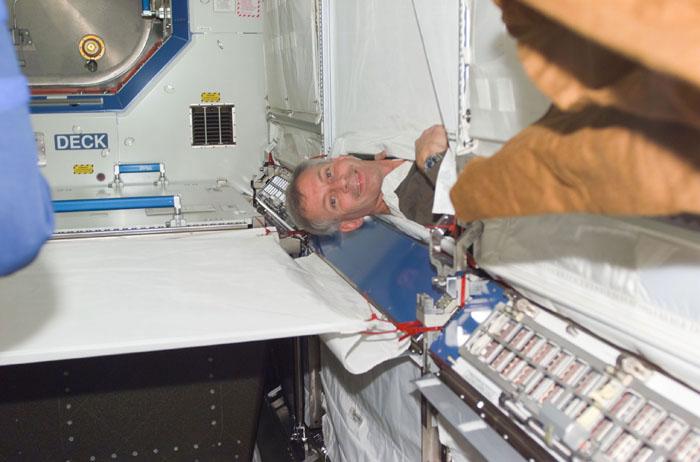
STS98-E-5149 (11 February 2001) --- Astronaut Kenneth D. Cockrell, STS-98 commander, emerges from behind temporary covering in the newly attached Destiny laboratory onboard the International Space Station (ISS). After the Destiny hatch was opened early in the day, members of both crews went to work quickly inside the new module, activating air systems, fire extinguishers, alarm systems, computers and internal communications. The crews also took some photos and continued equipment transfers from the shuttle to the station. The scene was taken with a digital still camera.
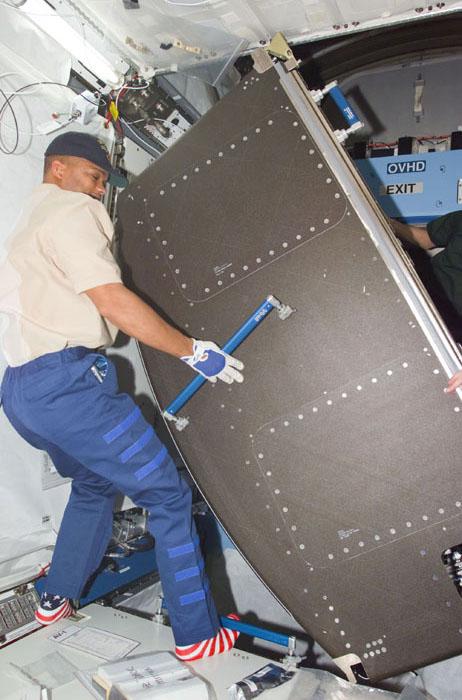
STS98-E-5157 (11 February 2001) --- Astronaut Robert L. Curbeam, STS-98 mission specialist, installs some of the fixtures in the newly attached Destiny laboratory onboard the International Space Station (ISS). After the Destiny hatch was opened early in the day, members of both crews went to work quickly inside the new module, activating air systems, fire extinguishers, alarm systems, computers and internal communications. The crews also took some photos and continued equipment transfers from the shuttle to the station. The scene was taken with a digital still camera.
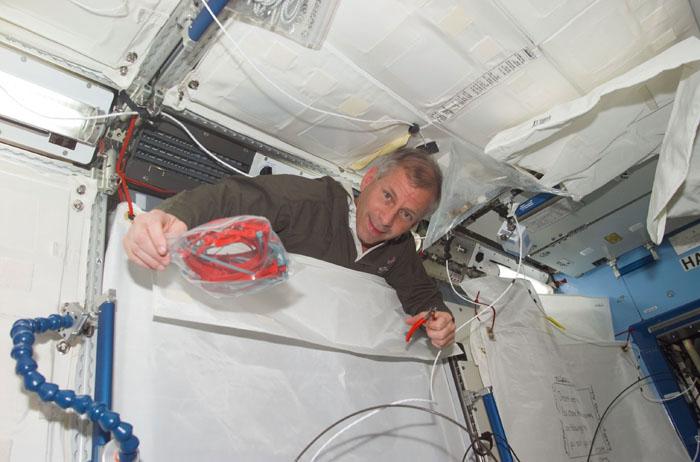
STS98-E-5150 (11 February 2001) --- Astronaut Kenneth D. Cockrell, STS-98 commander, emerges from behind wall covering in the newly attached Destiny laboratory onboard the International Space Station (ISS). After the Destiny hatch was opened early in the day, members of both crews went to work quickly inside the new module, activating air systems, fire extinguishers, alarm systems, computers and internal communications. The crews also took some photos and continued equipment transfers from the shuttle to the station. The scene was taken with a digital still camera.