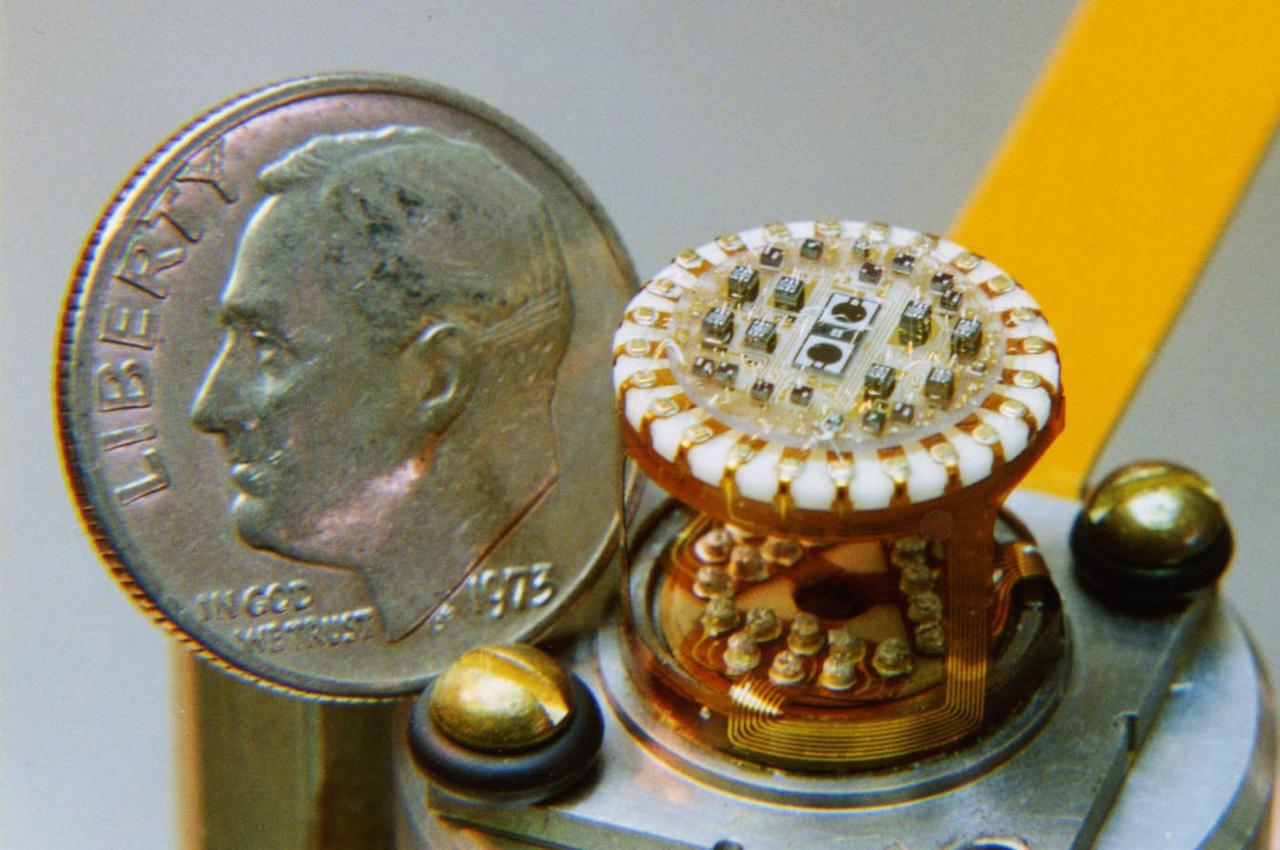
In this photo, the Gravity Probe B (GP-B) detector mount assembly is shown in comparison to the size of a dime. The assembly is used to detect exactly how much starlight is coming through different beams from the beam splitter in the telescope. The measurements from the tiny chips inside are what keeps GP-B aimed at the guide star. The GP-B is the relativity experiment developed at Stanford University to test two extraordinary predictions of Albert Einstein’s general theory of relativity. The experiment will measure, very precisely, the expected tiny changes in the direction of the spin axes of four gyroscopes contained in an Earth-orbiting satellite at a 400-mile altitude. So free are the gyroscopes from disturbance that they will provide an almost perfect space-time reference system. They will measure how space and time are very slightly warped by the presence of the Earth, and, more profoundly, how the Earth’s rotation very slightly drags space-time around with it. These effects, though small for the Earth, have far-reaching implications for the nature of matter and the structure of the Universe. GP-B is among the most thoroughly researched programs ever undertaken by NASA. This is the story of a scientific quest in which physicists and engineers have collaborated closely over many years. Inspired by their quest, they have invented a whole range of technologies that are already enlivening other branches of science and engineering. Launched April 20, 2004 , the GP-B program was managed for NASA by the Marshall Space Flight Center. Development of the GP-B is the responsibility of Stanford University along with major subcontractor Lockheed Martin Corporation. (Image credit to Paul Ehrensberger, Stanford University.)
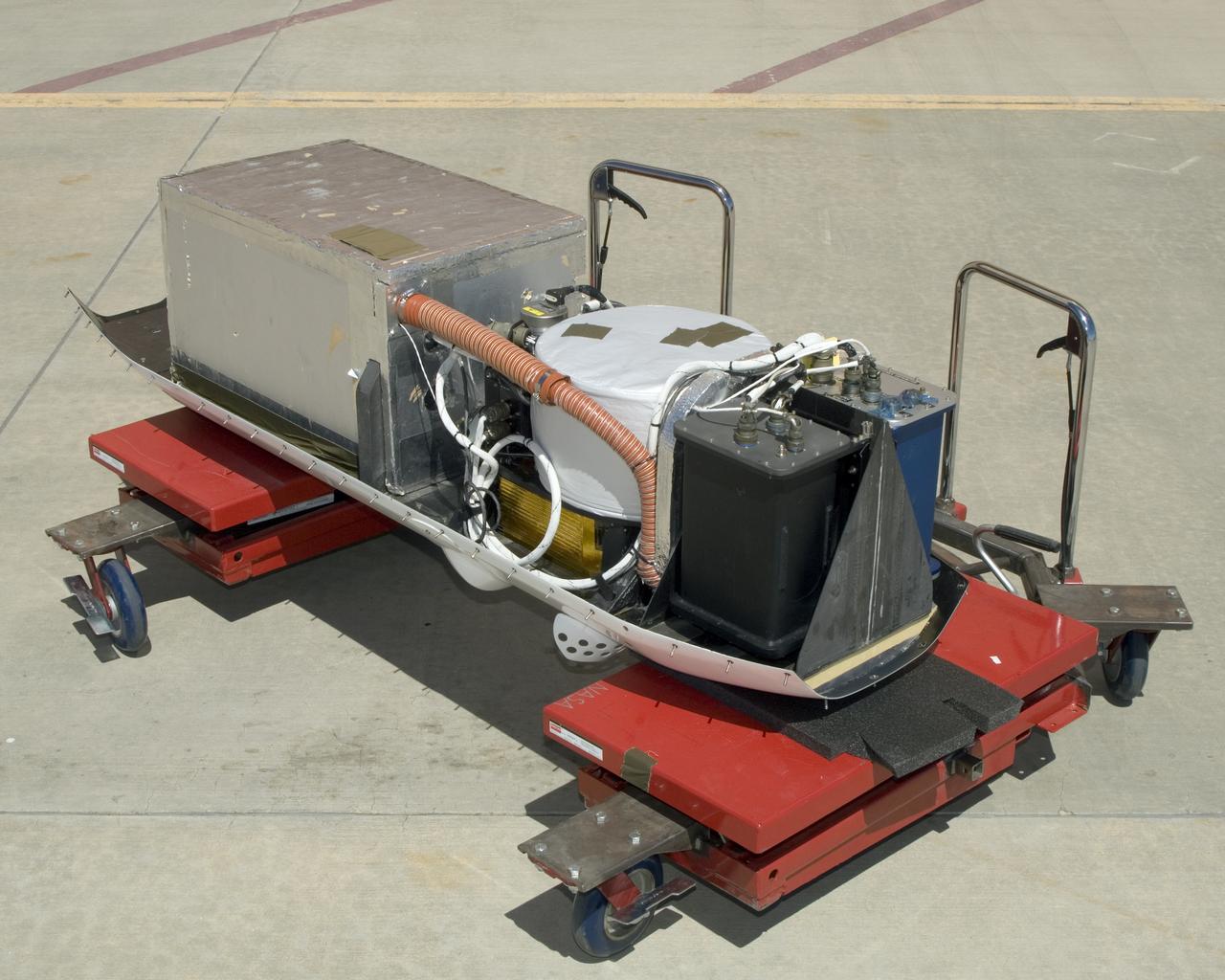
The instruments that make up the Ames Autonomous Module Scanner (AMS) that provided precise thermal-infrared imaging during the Western States Fire Mission in 2007 are detailed in this photo of the AMS as mounted on Ikhana's pod tray. The large foil-covered foam-insulated box at left covers the pressure vessel containing the data system computers and other electronics. The round white-topped assembly is the scan head, including the scan mirror, folded telescope, blackbody references, spectrometer and detectors. Two pressure boxes visible at the forward end of the tray contain the Applanix POS/AV precision navigation subsystem (black) and the power distributor including circuit breakers and ancillary wiring, scan motor controller and the blackbody reference temperature controller (blue).
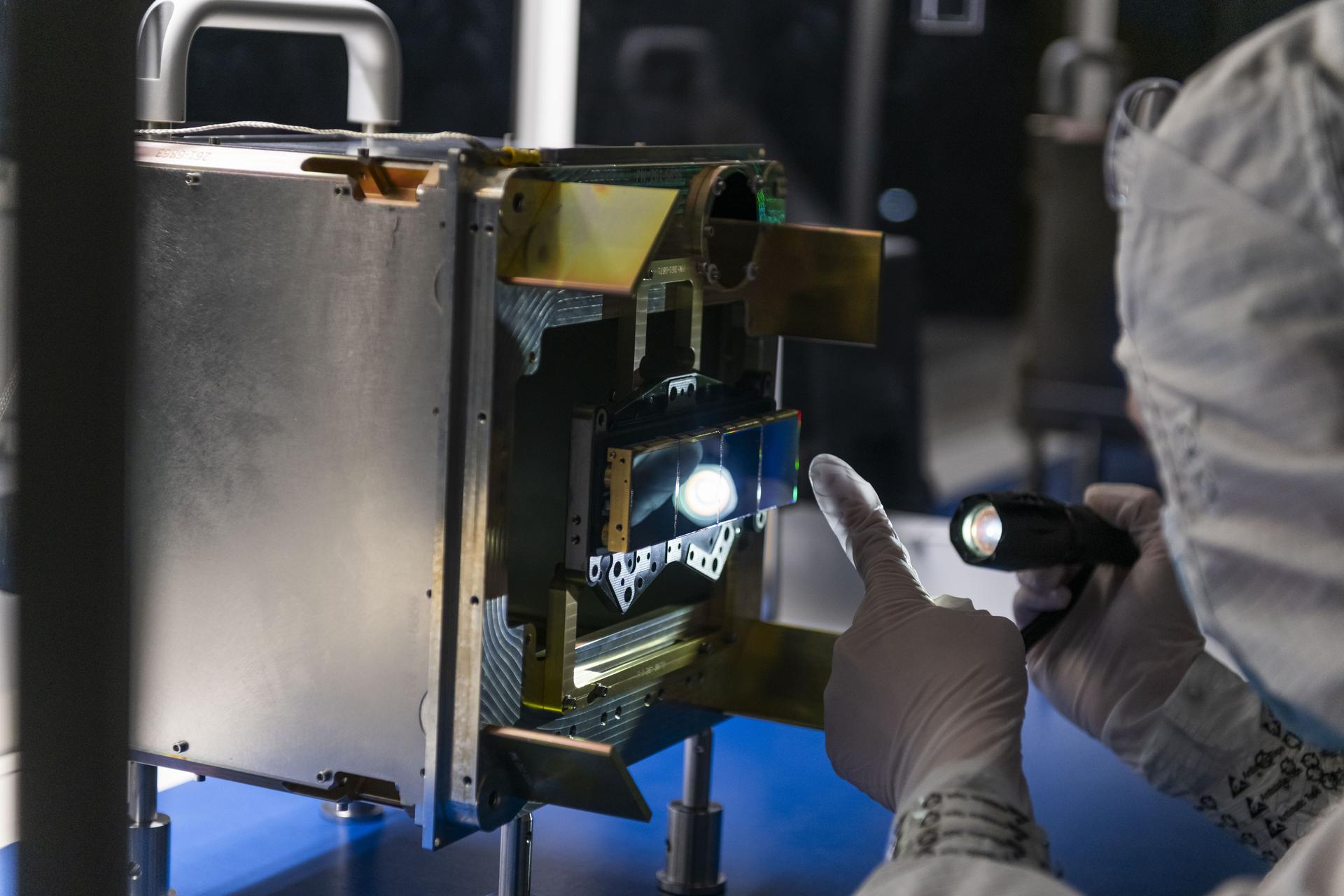
An engineer inspects the surface of four mid-wavelength infrared science detectors for NASA’s Near-Earth Object (NEO) Surveyor mission atop a clean room bench at the Space Dynamics Laboratory (SDL) in Logan, Utah. Mounted to a sensor chip assembly, the four blue-green-colored detectors are made with mercury cadmium telluride (HgCdTe), a versatile semiconducting alloy that is sensitive to infrared wavelengths. There are two such assemblies that form the heart of NEO Surveyor’s two science cameras. These state-of-the-art cameras sense solar heat re-radiated by near-Earth objects. The mission’s cameras and telescope, which has an aperture of nearly 20 inches (50 centimeters), will be housed inside the spacecraft’s instrument enclosure, a structure that is designed to ensure heat produced by the spacecraft and instrument during operations doesn’t interfere with its infrared observations. Targeting launch in late 2027, the NEO Surveyor mission is led by Professor Amy Mainzer at the University of California, Los Angeles for NASA’s Planetary Defense Coordination Office and is being managed by the agency’s Jet Propulsion Laboratory in Southern California for the Planetary Missions Program Office at NASA’s Marshall Space Flight Center in Huntsville, Alabama. BAE Systems and the Space Dynamics Laboratory in Logan, Utah, and Teledyne are among the companies that were contracted to build the spacecraft and its instrumentation. The Laboratory for Atmospheric and Space Physics at the University of Colorado Boulder will support operations, and IPAC at Caltech in Pasadena, California, is responsible for producing some of the mission’s data products. Caltech manages JPL for NASA. More information about NEO Surveyor is available at: https://science.nasa.gov/mission/neo-surveyor/
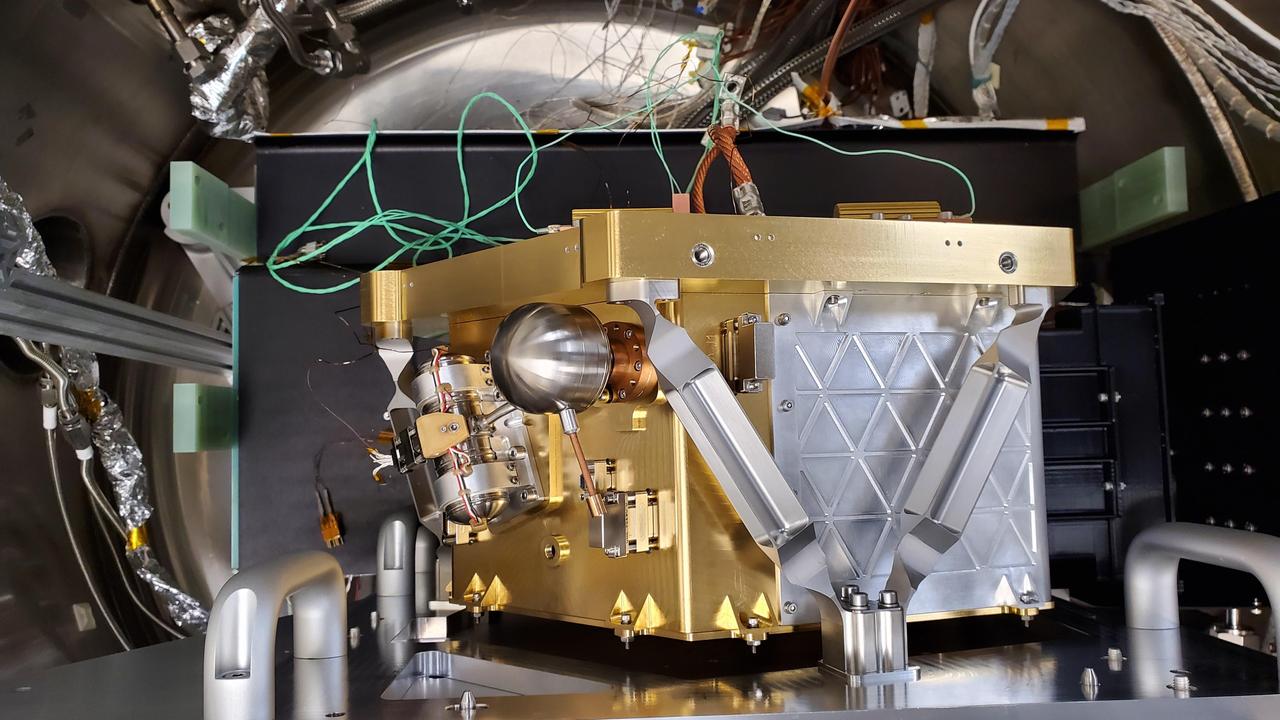
The High-resolution Volatiles and Minerals Moon Mapper (HVM³), seen here, is one of two instruments that will be carried aboard NASA's Lunar Trailblazer. Launching in 2023, the small spacecraft – measuring only 11.5 feet (3.5 meters) wide with its solar panels fully deployed – will detect and map water on the Moon's surface to determine its abundance, location, form, and how it changes over time. HVM³ recently completed a significant milestone in a clean room at NASA's Jet Propulsion Laboratory in Southern California. The high-resolution spectrometer measures the infrared light (with wavelengths from 0.6 to 3.6 microns in size) that is absorbed by water. To make sure the instrument is properly aligned, the Trailblazer team cooled HVM3 down to temperatures it will experience in space and made tiny physical adjustments to make sure all the wavelengths of incoming light arrive at the correct locations on the instrument's detector. Figure A shows several members of the Trailblazer team surrounding the instrument – minus its radiator and electronics – mounted on HVM³'s optical bench assembly while undergoing cold alignment. The assembly was placed inside a thermal vacuum chamber and brought to a cold focal plane operating temperature of about minus 240 degrees Fahrenheit (minus 155 degrees Celsius). The team then measured light of different wavelengths across all of the detector's pixels. Based on the data recorded, the team calculated the small adjustments that needed to be made, took the instrument out of the chamber and made those changes, placed it back into the chamber, and then repeated the steps iteratively until HVM³ was in perfect alignment. With this important step complete, a radiator will next be installed to ensure the instrument maintains optimal operating temperatures while Trailblazer is in orbit around the Moon. Then, vibration tests will be carried out to make sure the spectrometer will stay in alignment after the extreme shaking of launch. Lunar Trailblazer was selected to be part of NASA's SIMPLEx (Small Innovative Missions for Planetary Exploration) program in 2019. The mission is led by Caltech in Pasadena, California, and managed by JPL. https://photojournal.jpl.nasa.gov/catalog/PIA25252
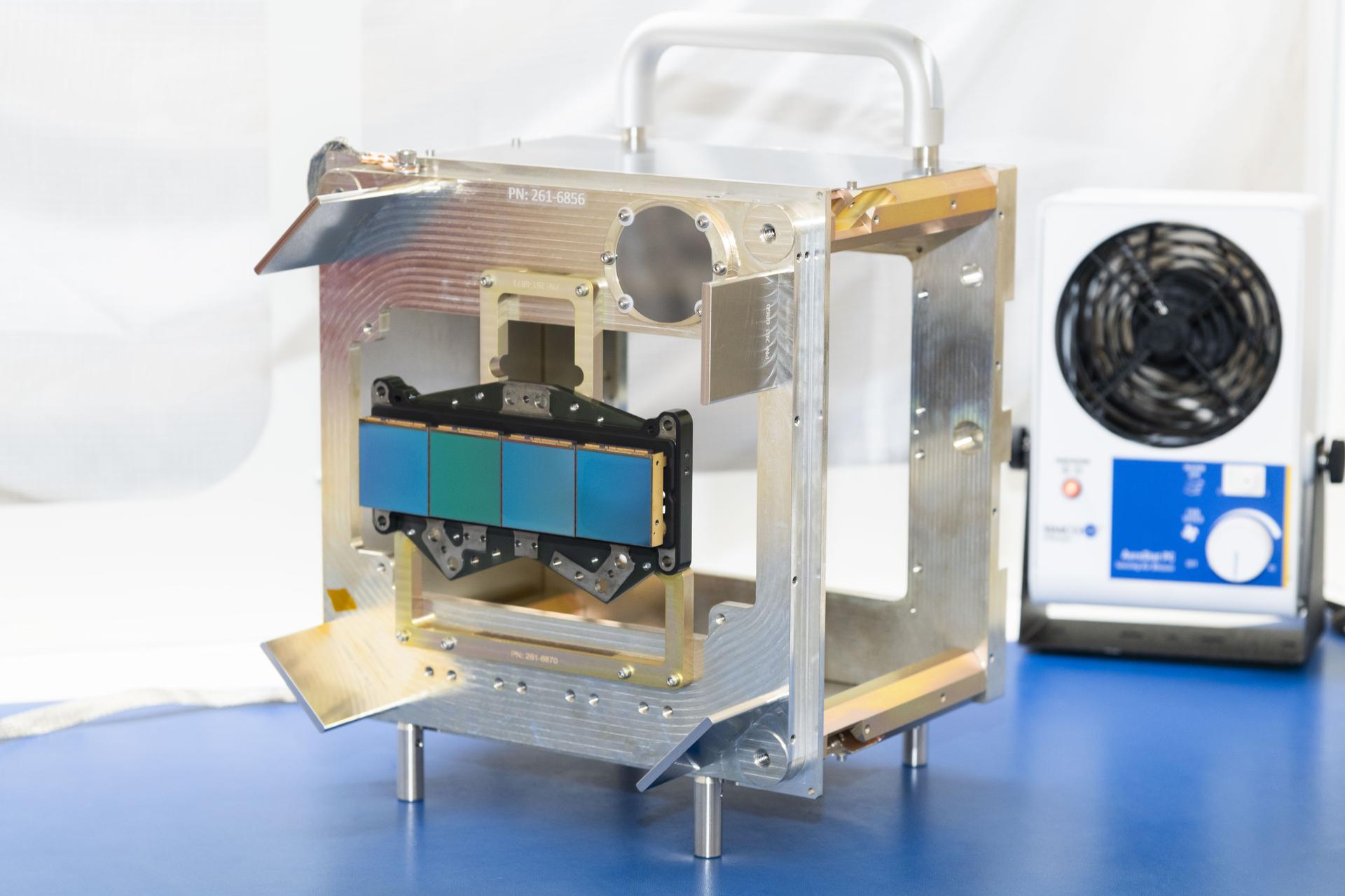
Four mid-wavelength infrared science detectors for NASA’s Near-Earth Object (NEO) Surveyor mission are shown here on a clean room bench at the Space Dynamics Laboratory (SDL) in Logan, Utah. Mounted to a sensor chip assembly, the four blue-green-colored detectors are made with mercury cadmium telluride (HgCdTe), a versatile semiconducting alloy that is sensitive to infrared wavelengths. There are two such assemblies that form the heart of NEO Surveyor’s two science cameras. These state-of-the-art cameras sense solar heat re-radiated by near-Earth objects. The mission’s cameras and telescope, which has an aperture of nearly 20 inches (50 centimeters), will be housed inside the spacecraft’s instrument enclosure, a structure that is designed to ensure heat produced by the spacecraft and instrument during operations doesn’t interfere with its infrared observations. Targeting launch in late 2027, the NEO Surveyor mission is led by Professor Amy Mainzer at the University of California, Los Angeles for NASA’s Planetary Defense Coordination Office and is being managed by the agency’s Jet Propulsion Laboratory in Southern California for the Planetary Missions Program Office at NASA’s Marshall Space Flight Center in Huntsville, Alabama. BAE Systems and the Space Dynamics Laboratory in Logan, Utah, and Teledyne are among the companies that were contracted to build the spacecraft and its instrumentation. The Laboratory for Atmospheric and Space Physics at the University of Colorado Boulder will support operations, and IPAC at Caltech in Pasadena, California, is responsible for producing some of the mission’s data products. Caltech manages JPL for NASA. More information about NEO Surveyor is available at: https://science.nasa.gov/mission/neo-surveyor/
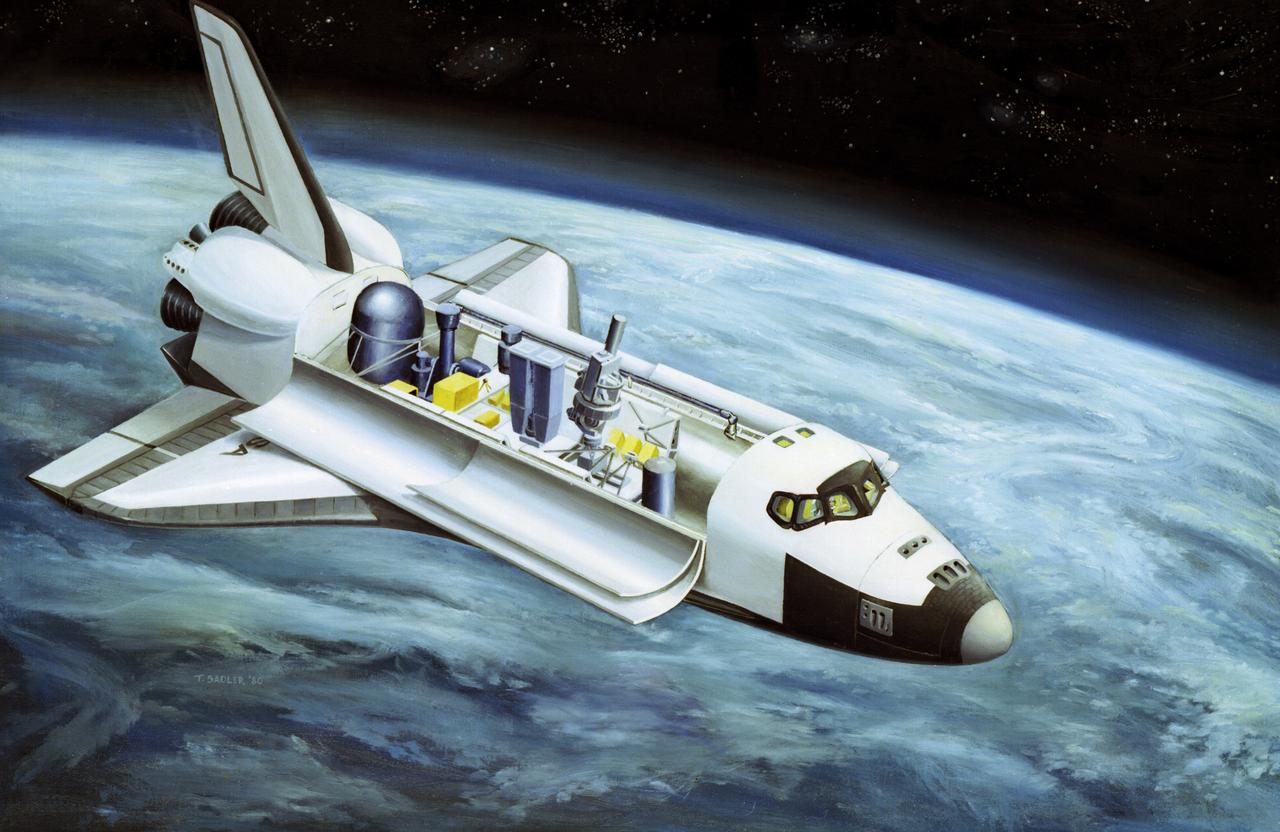
This illustration depicts the configuration of the Spacelab-2 in the cargo bay of the orbiter. Spacelab was a versatile laboratory carried in the Space Shuttle's cargo bay for scientific research flights. Each Spacelab mission had a unique design appropriate to the mission's goals. A number of Spacelab configurations could be assembled from pressurized habitation modules and exposed platforms called pallets. Spacelab-2 was the first pallet-only mission. One of the goals of the mission was to verify that the pallets' configuration was satisfactory for observations and research. Except for two biological experiments and an experiment that used ground-based instruments, the Spacelab-2 scientific instruments needed direct exposure to space. On the first pallet, three solar instruments and one atmospheric instrument were mounted on the Instrument Pointing System, which was being tested on its first flight. The second Spacelab pallet held a large double x-ray telescope and three plasma physics detectors. The last pallet supported an infrared telescope, a superfluid helium technology experiment, and a small plasma diagnostics satellite. The Spacelab-2 mission was designed to capitalize on the Shuttle-Spacelab capabilities, to launch and retrieve satellites, and to point several instruments independently with accuracy and stability. Spacelab-2 (STS-51F, 19th Shuttle mission) was launched aboard Space Shuttle Orbiter Challenger on July 29, 1985. The Marshall Space Flight Center had overall management responsibilities of the Spacelab missions.
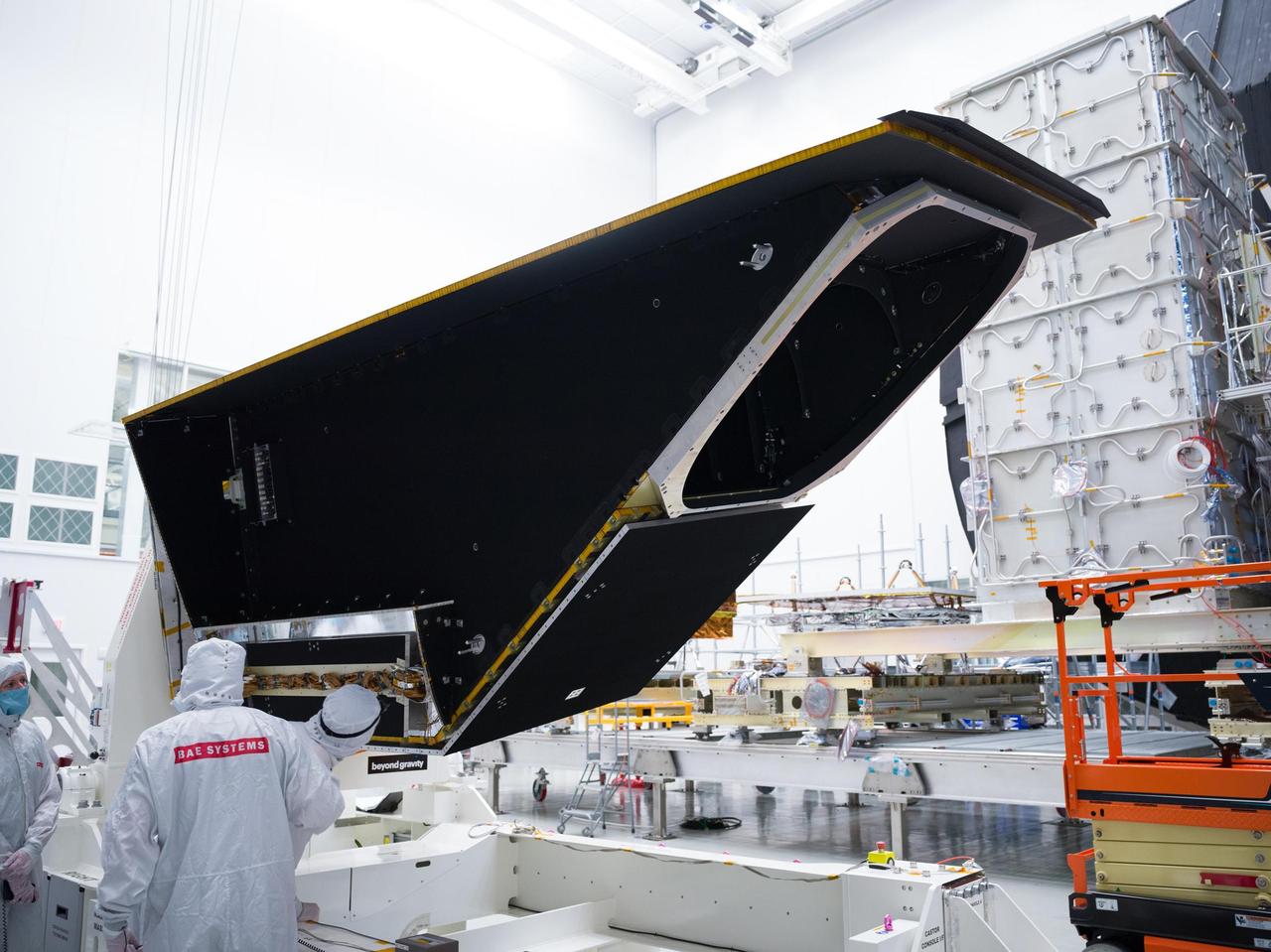
The instrument enclosure for NASA's Near-Earth Object Surveyor is prepared for environmental testing inside the historic Chamber A in the Space Environment Simulation Laboratory at the agency's Johnson Space Center in Houston in December 2024. Mounted to its articulating platform, on which it was securely positioned during assembly, the 12-foot-long (3.7-meter-long) angular structure was inspected by technicians before being placed inside the testing chamber. Figure A shows the reflective side of the instrument enclosure as it was rotated on the assembly dolly before being transferred to a testing platform. The cavernous opening to Chamber A is in the background. The instrument enclosure is designed to protect the spacecraft's infrared telescope while also removing heat from it during operations. After environmental testing was completed, the enclosure returned to NASA's Jet Propulsion Laboratory in Southern California for further work, after which it will ship to the Space Dynamics Laboratory (SDL) in Logan, Utah, and be joined to the telescope. Both the instrument enclosure and telescope were assembled at JPL. As NASA's first space-based detection mission specifically designed for planetary defense, NEO Surveyor will seek out, measure, and characterize the hardest-to-find asteroids and comets that might pose a hazard to Earth. While many near-Earth objects don't reflect much visible light, they glow brightly in infrared light due to heating by the Sun. The spacecraft's telescope, which has an aperture of nearly 20 inches (50 centimeters), features detectors sensitive to two infrared wavelengths in which near-Earth objects re-radiate solar heat. Targeting launch in late 2027, the NEO Surveyor mission is led by Prof. Amy Mainzer at UCLA for NASA's Planetary Defense Coordination Office and is being managed by JPL for the Planetary Missions Program Office at NASA's Marshall Space Flight Center in Huntsville, Alabama. BAE Systems, SDL, and Teledyne are among the companies that were contracted to build the spacecraft and its instrumentation. The Laboratory for Atmospheric and Space Physics at the University of Colorado Boulder will support operations, and Caltech/IPAC in Pasadena, California, is responsible for producing some of the mission's data products. Caltech manages JPL for NASA. https://photojournal.jpl.nasa.gov/catalog/PIA26582

NICER team members Takashi Okajima, Yang Soong, and Steven Kenyon apply epoxy to the X-ray concentrator mounts after alignment. The epoxy holds the optics assemblies fixed in position through the vibrations experienced during launch to the International Space Station. The payload’s 56 mirror assemblies concentrate X-rays onto silicon detectors to gather data that will probe the interior makeup of neutron stars, including those that appear to flash regularly, called pulsars. The Neutron star Interior Composition Explorer (NICER) is a NASA Explorer Mission of Opportunity dedicated to studying the extraordinary environments — strong gravity, ultra-dense matter, and the most powerful magnetic fields in the universe — embodied by neutron stars. An attached payload aboard the International Space Station, NICER will deploy an instrument with unique capabilities for timing and spectroscopy of fast X-ray brightness fluctuations. The embedded Station Explorer for X-ray Timing and Navigation Technology demonstration (SEXTANT) will use NICER data to validate, for the first time in space, technology that exploits pulsars as natural navigation beacons. Credit: NASA/Goddard/ Keith Gendreau <b><a href="http://www.nasa.gov/audience/formedia/features/MP_Photo_Guidelines.html" rel="nofollow">NASA image use policy.</a></b> <b><a href="http://www.nasa.gov/centers/goddard/home/index.html" rel="nofollow">NASA Goddard Space Flight Center</a></b> enables NASA’s mission through four scientific endeavors: Earth Science, Heliophysics, Solar System Exploration, and Astrophysics. Goddard plays a leading role in NASA’s accomplishments by contributing compelling scientific knowledge to advance the Agency’s mission. <b>Follow us on <a href="http://twitter.com/NASAGoddardPix" rel="nofollow">Twitter</a></b> <b>Like us on <a href="http://www.facebook.com/pages/Greenbelt-MD/NASA-Goddard/395013845897?ref=tsd" rel="nofollow">Facebook</a></b> <b>Find us on <a href="http://instagrid.me/nasagoddard/?vm=grid" rel="nofollow">Instagram</a></b>