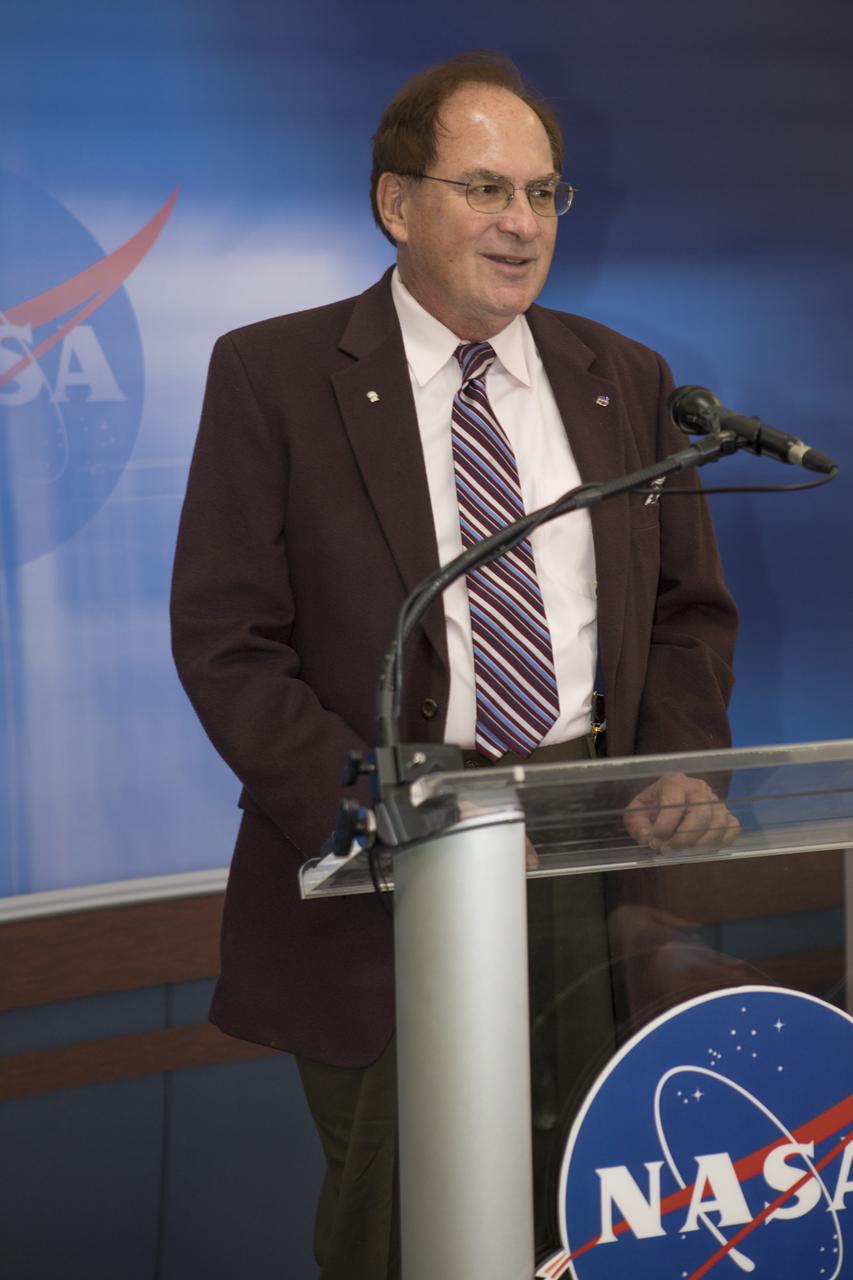
George Diller, who retired in 2017 after a 37-year career in NASA Public Affairs, was honored as a 2018 “Chronicler” during a ceremony at Kennedy Space Center’s NASA News Center in Florida on Friday, May 4. Diller and Craig Covault had their names officially added to the “Chroniclers wall” during the event. “Chroniclers” recognizes retirees of the news and communications business who helped spread news of American space exploration from Kennedy for 10 years or more. Diller was known by many as “The Voice of Kennedy Launch Control.”
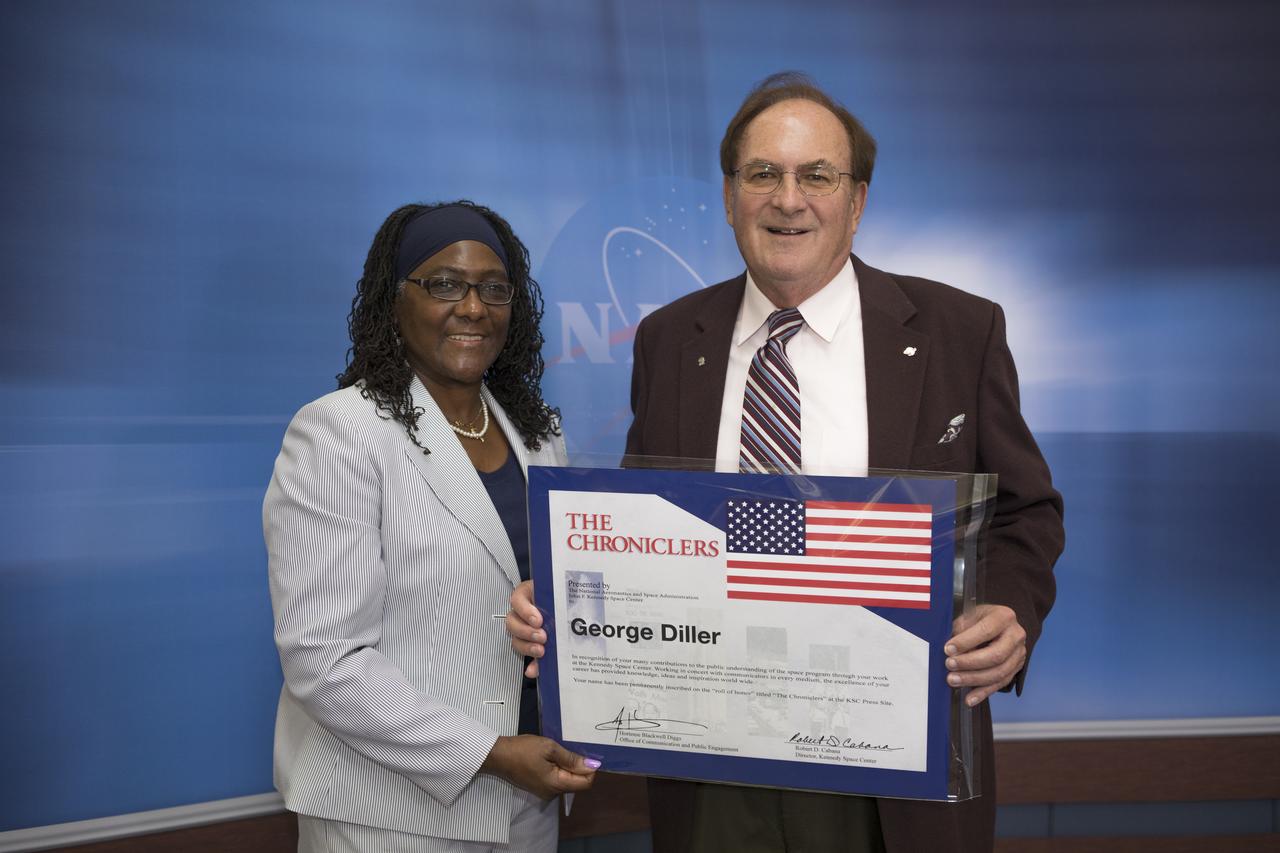
Kennedy Space Center Office of Communication and Public Engagement Deputy Director Hortense Diggs, left, poses with “Chronicler” George Diller during an event at Kennedy’s NASA News Center in Florida on Friday, May 4. Diller, who retired in 2017, had a 37-year career in NASA Public Affairs. “Chroniclers” recognizes retirees of the news and communications business who helped spread news of American space exploration from Kennedy for 10 years or more.
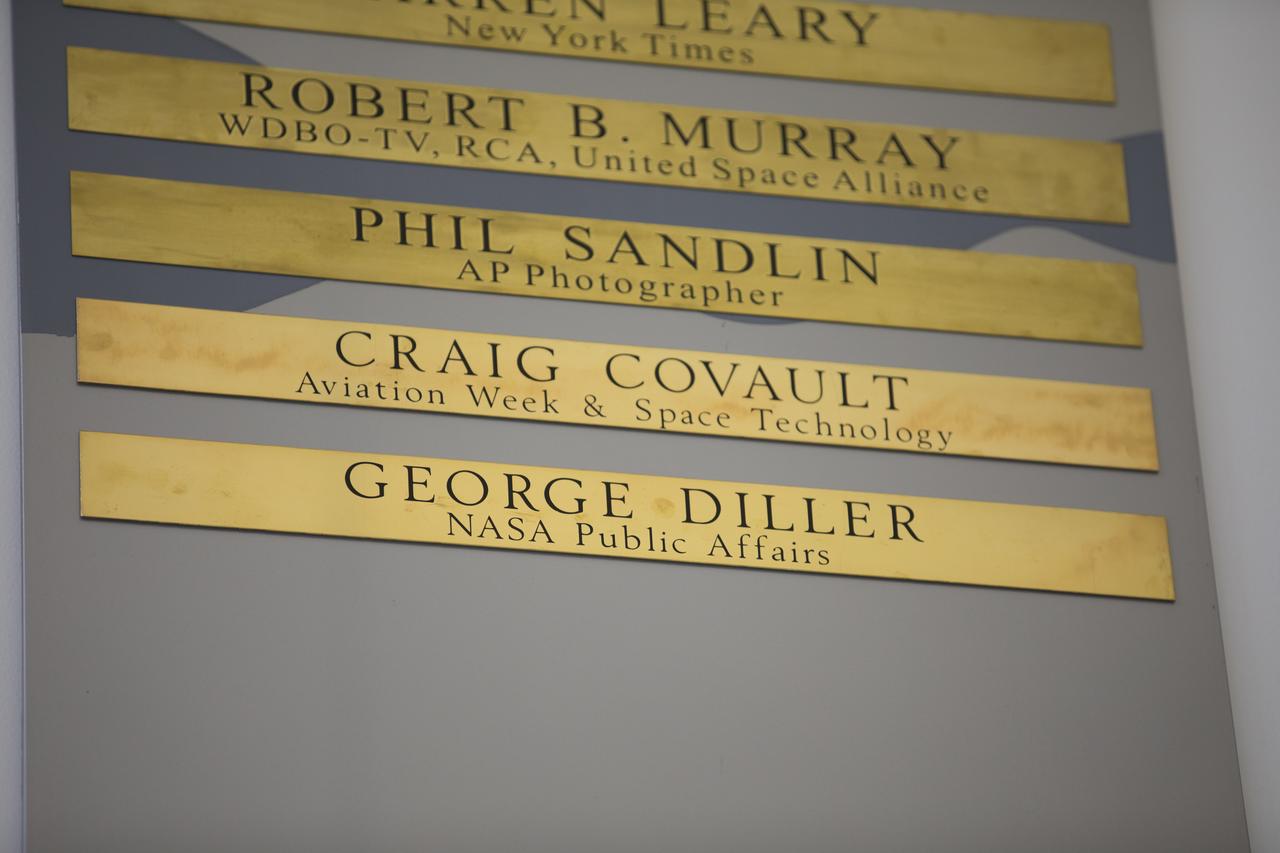
Brass strips engraved with the names of Craig Covault and George Diller were unveiled during a ceremony at Kennedy Space Center’s NASA News Center in Florida on Friday, May 4. Covault covered approximately 100 space shuttle launches and missions during his 48-year career. Diller was known by many as “The Voice of Kennedy Launch Control” during his 37-year career in NASA Public Affairs. “Chroniclers” recognizes retirees of the news and communications business who helped spread news of American space exploration from Kennedy for 10 years or more.
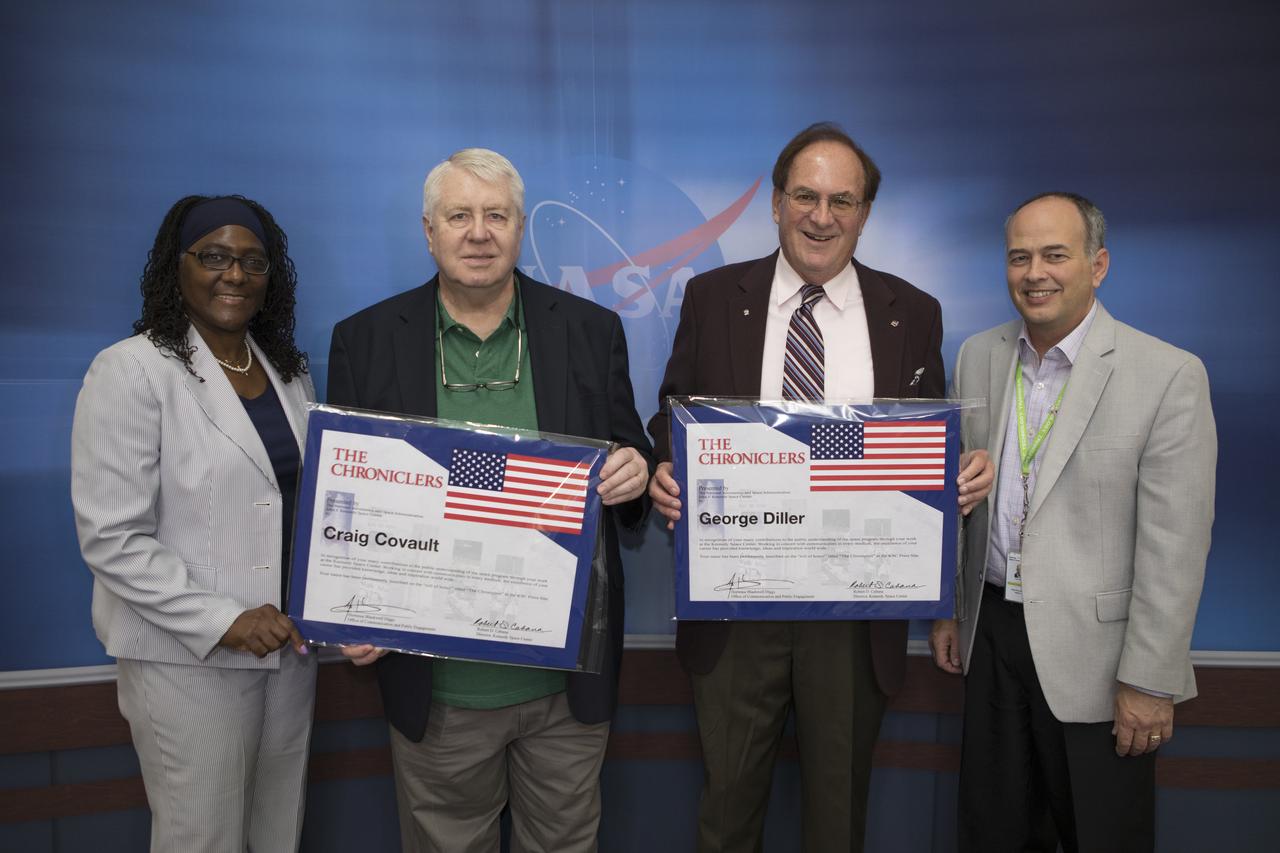
Craig Covault and George Diller are the newest additions to the “Chroniclers wall,” which recognizes retirees of the news and communications business who helped spread news of American space exploration from Kennedy Space Center in Florida for 10 years or more. The two men were honored during a gathering at Kennedy’s NASA News Center on Friday, May 4. Posing with the inductees are, far left, Hortense Diggs, Office of Communication and Public Engagement deputy director at Kennedy; and far right, Kennedy Office of Communication Division Chief David Culp.
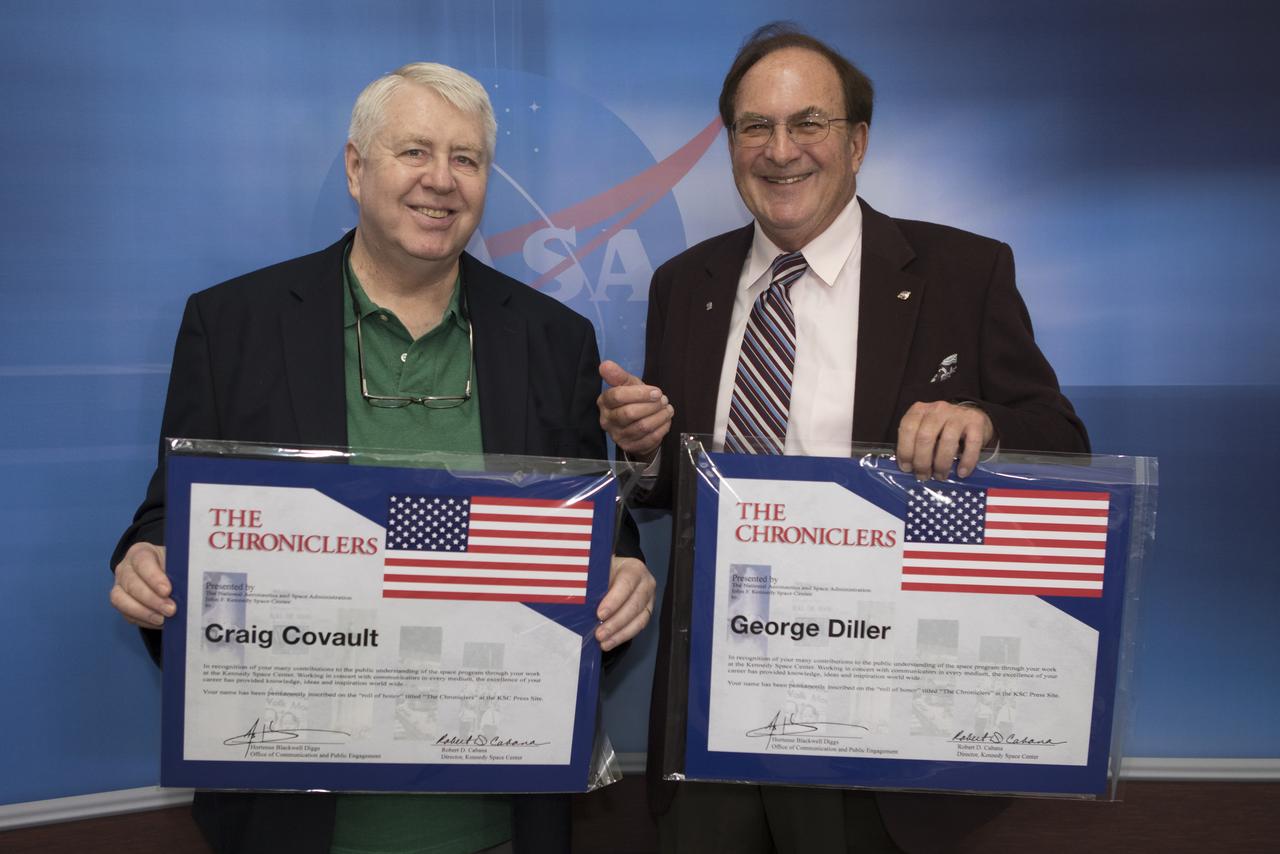
Craig Covault, left, and George Diller were honored as “Chroniclers” during an event at Kennedy Space Center’s NASA News Center on Friday, May 4. The longtime friends combined for more than 80 years of U.S. space exploration news reporting. “Chroniclers” recognizes retirees of the news and communications business who helped spread news of American space exploration from Kennedy for 10 years or more.
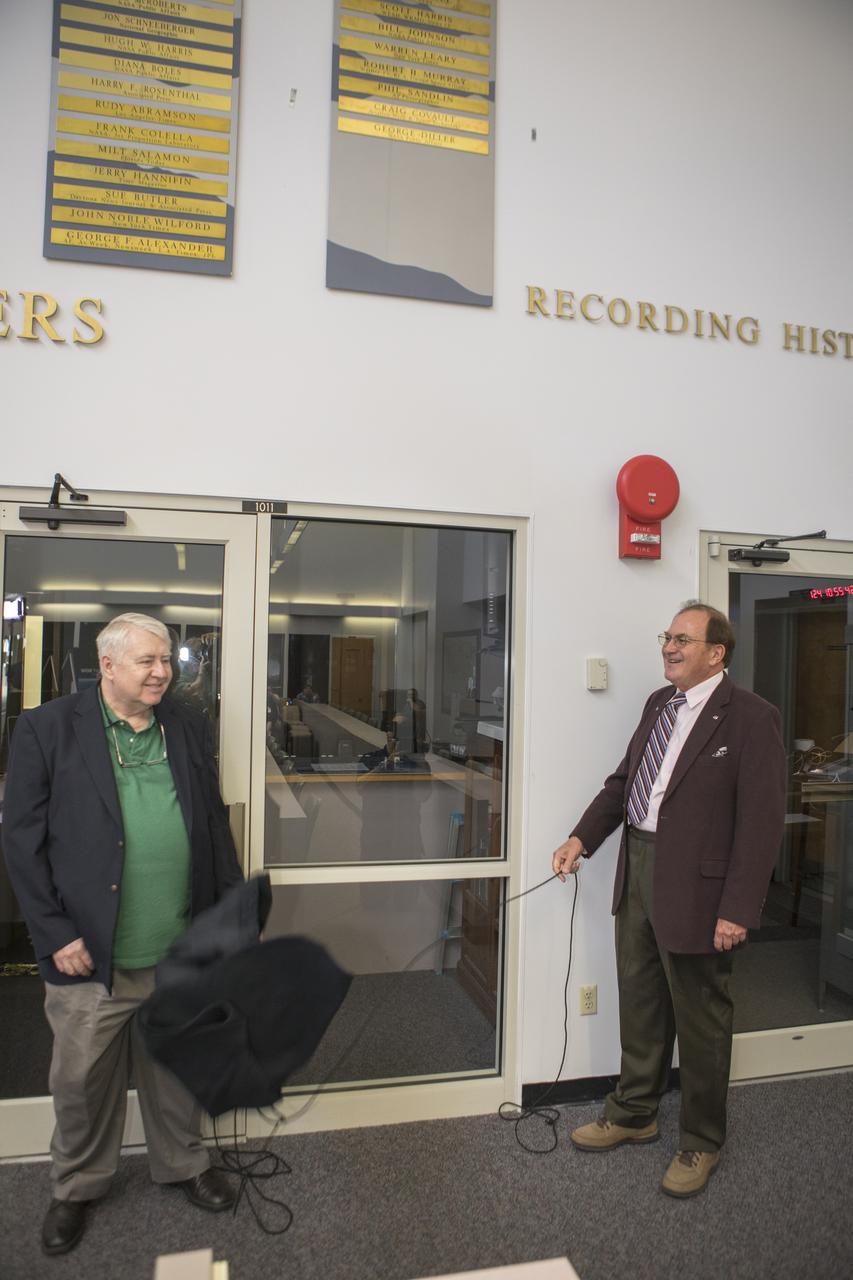
Craig Covault, left, and George Diller unveil their names on the “Chroniclers wall” during a gathering of the honorees’ friends, family, media, and current and former NASA officials at Kennedy Space Center’s NASA News Center in Florida on Friday, May 4. “Chroniclers” recognizes retirees of the news and communications business who helped spread news of American space exploration from Kennedy for 10 years or more. The two men combined for 85 years of U.S. space exploration coverage.
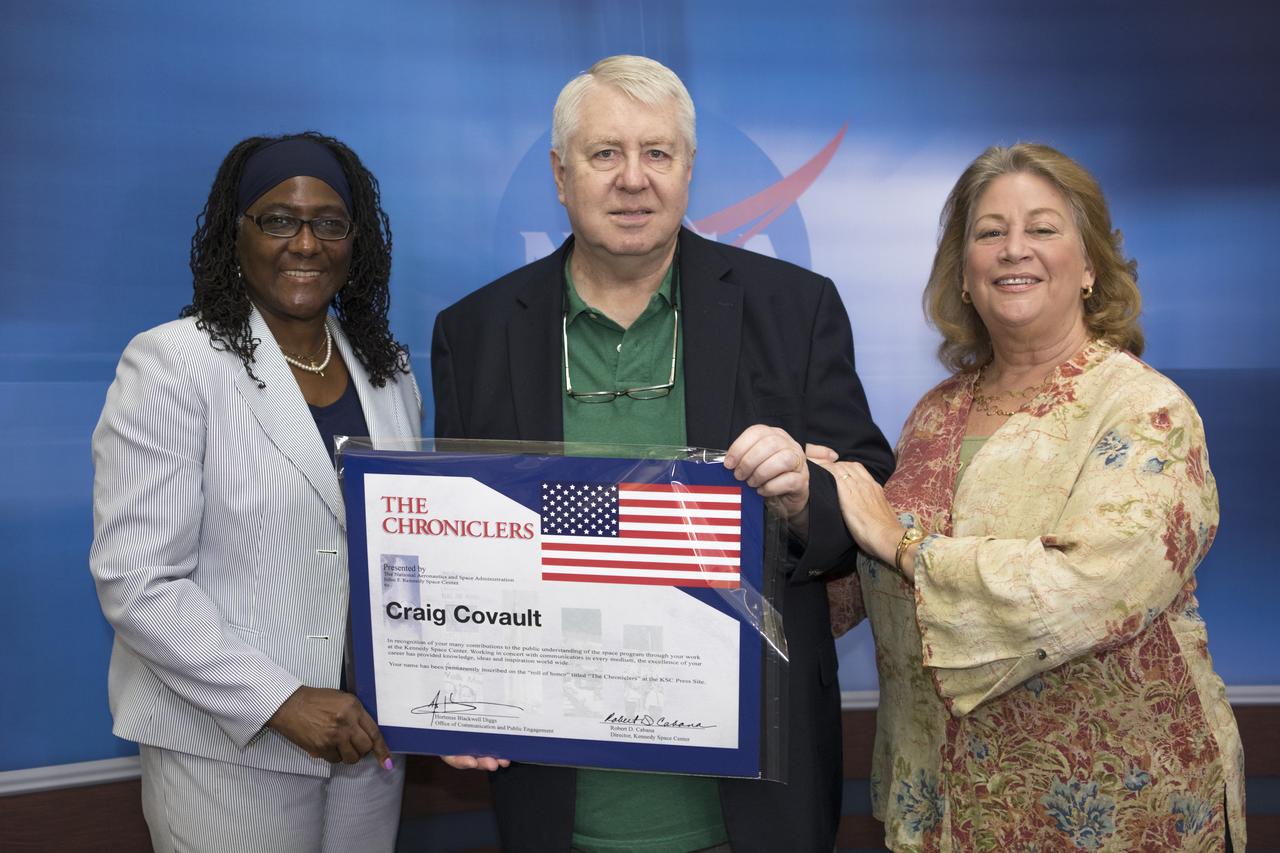
Craig Covault and George Diller were honored as the 75th and 76th members of the “Chroniclers” roll of honor during an event at Kennedy Space Center’s NASA News Center in Florida on Friday, May 4. From left to right are Hortense Diggs, deputy director of Kennedy’s Office of Communication and Public Engagement, Craig Covault, and Covault’s wife, Nancy. “Chroniclers” recognizes retirees of the news and communications business who helped spread news of American space exploration from Kennedy for 10 years or more.
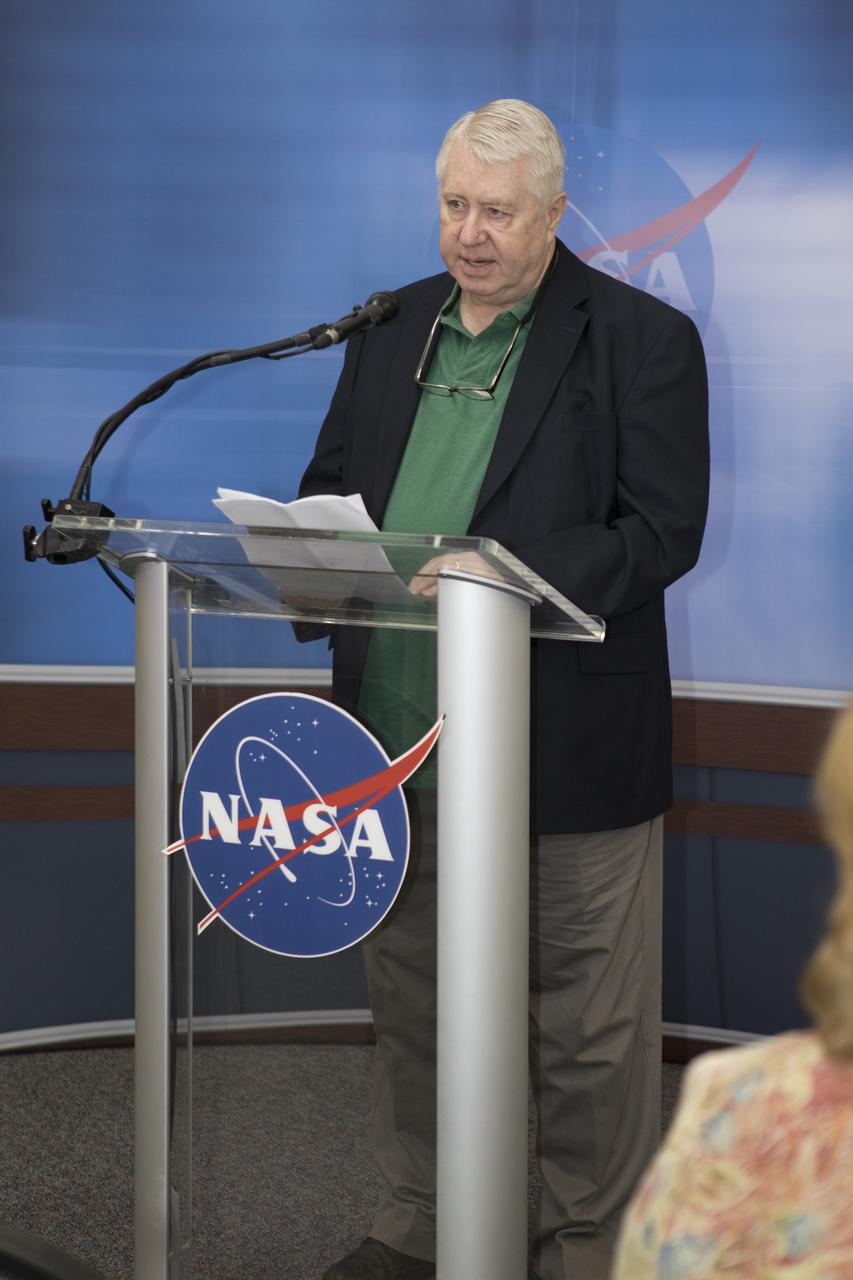
Craig Covault covered approximately 100 space shuttle launches and missions from Kennedy Space Center in Florida during his 48-year career writing about space and aeronautics. Covault, who is credited with 2,000 news and feature stories for Aviation Week & Space Technology, was installed as a member of the “Chroniclers” during a ceremony at Kennedy’s NASA News Center on Friday, May 4. “Chroniclers” recognizes retirees of the news and communications business who helped spread news of American space exploration from Kennedy for 10 years or more. George Diller also earned a spot on the “Chroniclers wall” at the event.

Hortense Diggs, deputy director of Kennedy Space Center’s Office of Communication and Public Engagement, delivers remarks during The Chroniclers 2018 ceremony at Kennedy’s NASA News Center in Florida on Friday, May 4. Craig Covault and George Diller were inducted as the 75th and 76th members of the “Chroniclers,” which recognizes retirees of the news and communications business who helped spread news of American space exploration from Kennedy for 10 years or more. Brass strips engraved with each awardee’s name and affiliation were added to the “Chroniclers wall” and unveiled during the event at the NASA News Center.
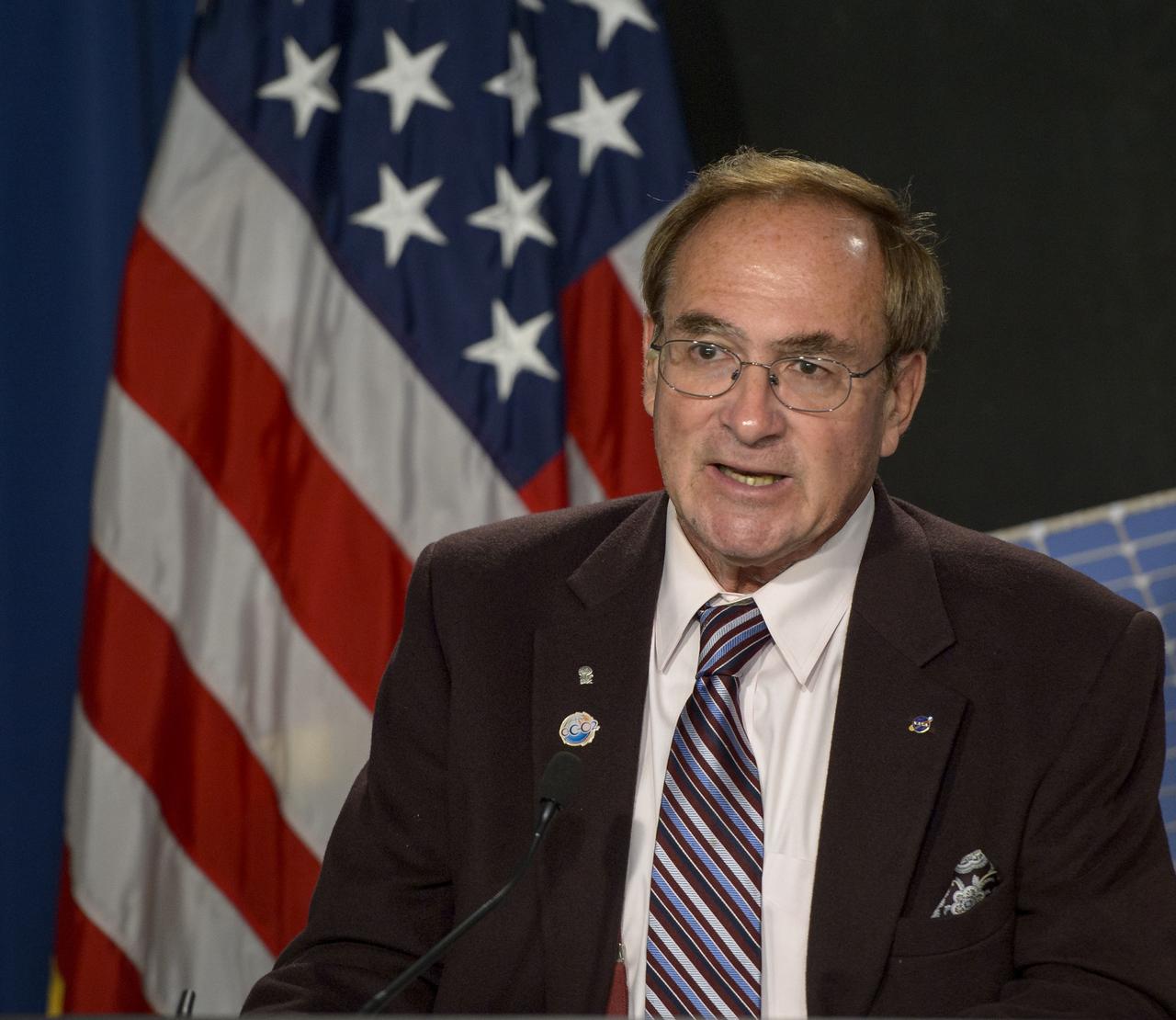
NASA Kennedy Space Center Public Affairs Officer George Diller, moderates a briefing ahead of the planned launch of the Orbiting Carbon Observatory-2 (OCO-2), Sunday, June 29, 2014, Vandenberg Air Force Base, Calif. OCO-2 will measure the global distribution of carbon dioxide, the leading human-produced greenhouse gas driving changes in Earth’s climate. OCO-2 is set to launch on July 1, 2014 at 2:59 a.m. PDT. Photo Credit: (NASA/Bill Ingalls)
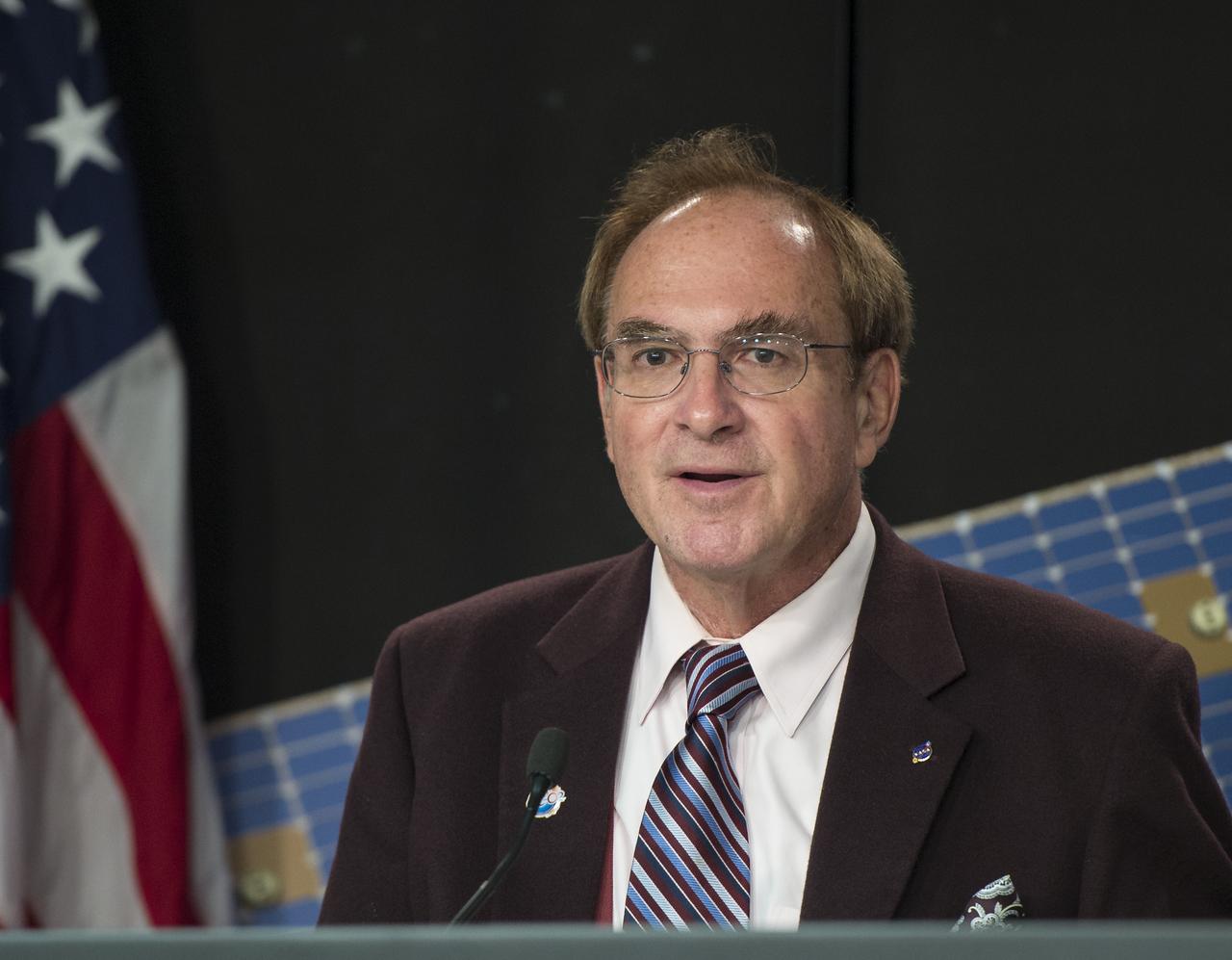
NASA Kennedy Space Center Public Affairs Officer George Diller, moderates a post-launch press briefing, following the successful launch of the Orbiting Carbon Observatory-2 (OCO-2), NASA’s first spacecraft dedicated to studying carbon dioxide, Wednesday, July 2, 2014, at the Vandenberg Air Force Base, Calif. OCO-2 will measure the global distribution of carbon dioxide, the leading human-produced greenhouse gas driving changes in Earth’s climate. Photo Credit: (NASA/Bill Ingalls)
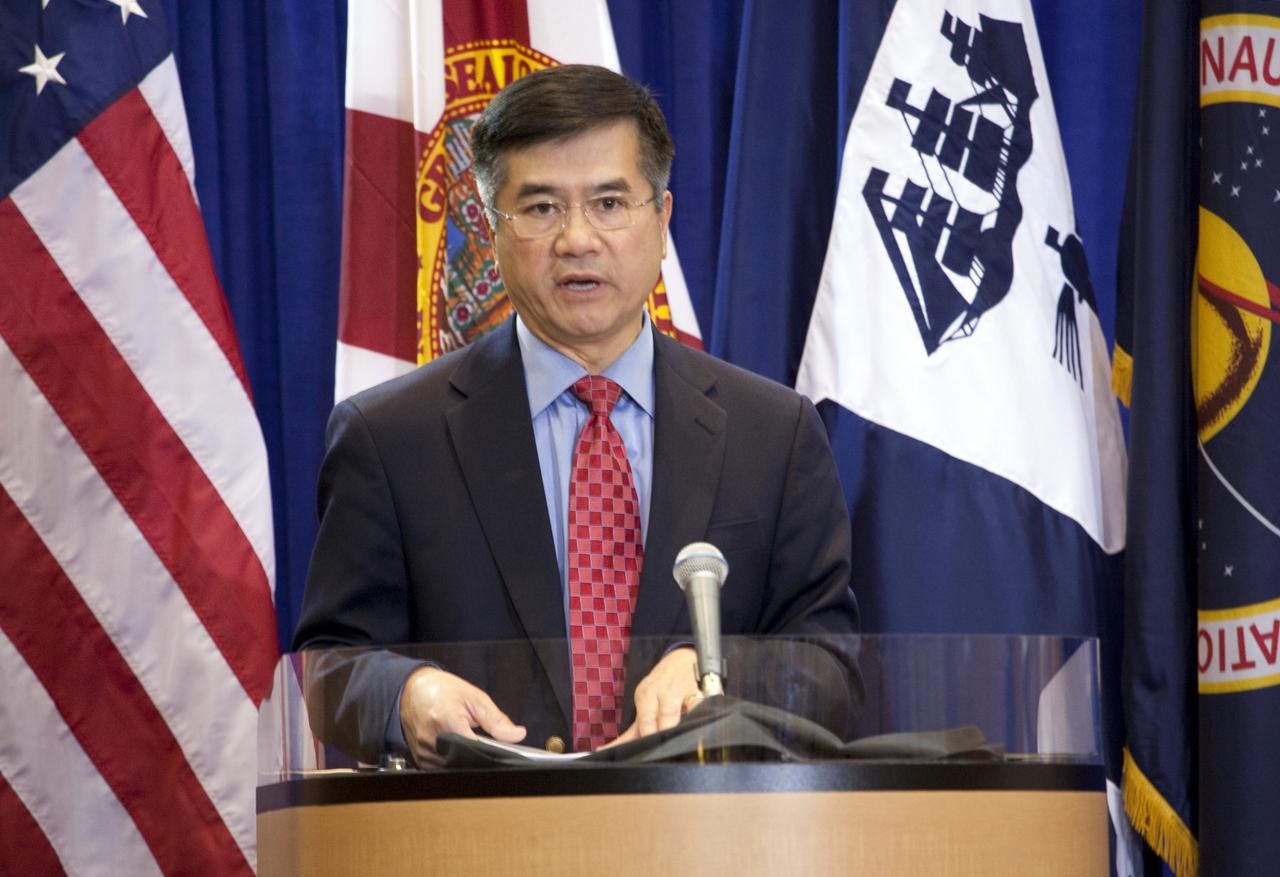
ORLANDO, Fla. – Secretary of Commerce Gary Locke addresses business and industry leaders during a town hall meeting at the Orlando Airport Hyatt Hotel as part of the Presidential Task Force on Space Industry Work Force and Economic Development. The task force heard from local leaders about ways to strengthen the work force as NASA moves toward retirement of the Space Shuttle Program. The task force is a $40 million, multi-agency initiative for regional and economic growth to assist the Space Coast as the country’s space exploration efforts expand and transform. Photo credit: NASA_Amanda Diller
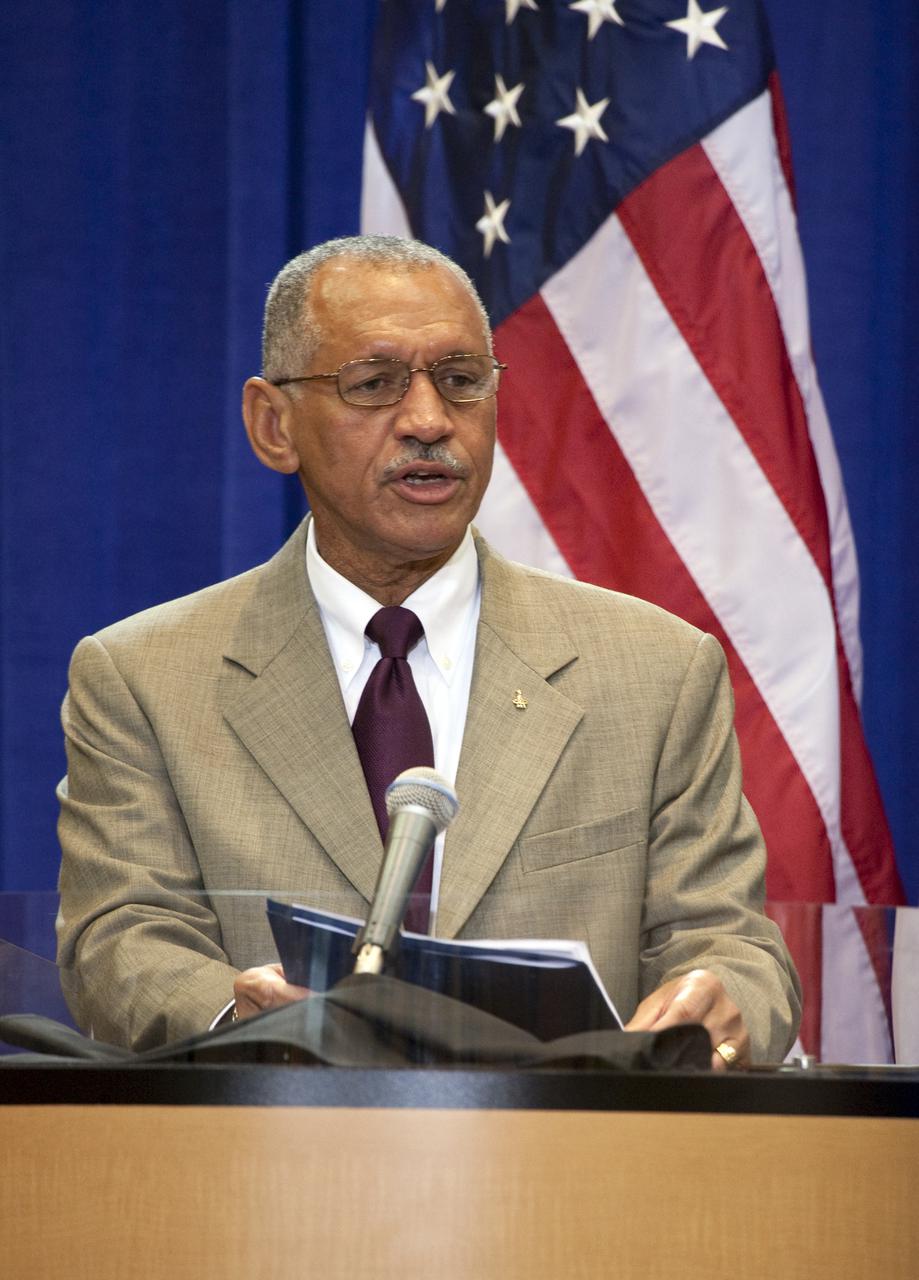
ORLANDO, Fla. – NASA Administrator Charles Bolden speaks to business and industry leaders during a town hall meeting at the Orlando Airport Hyatt Hotel as part of the Presidential Task Force on Space Industry Work Force and Economic Development. The task force heard from local leaders about ways to strengthen the work force as NASA moves toward retirement of the Space Shuttle Program. The task force is a $40 million, multi-agency initiative for regional and economic growth to assist the Space Coast as the country’s space exploration efforts expand and transform. Photo credit: NASA_Amanda Diller
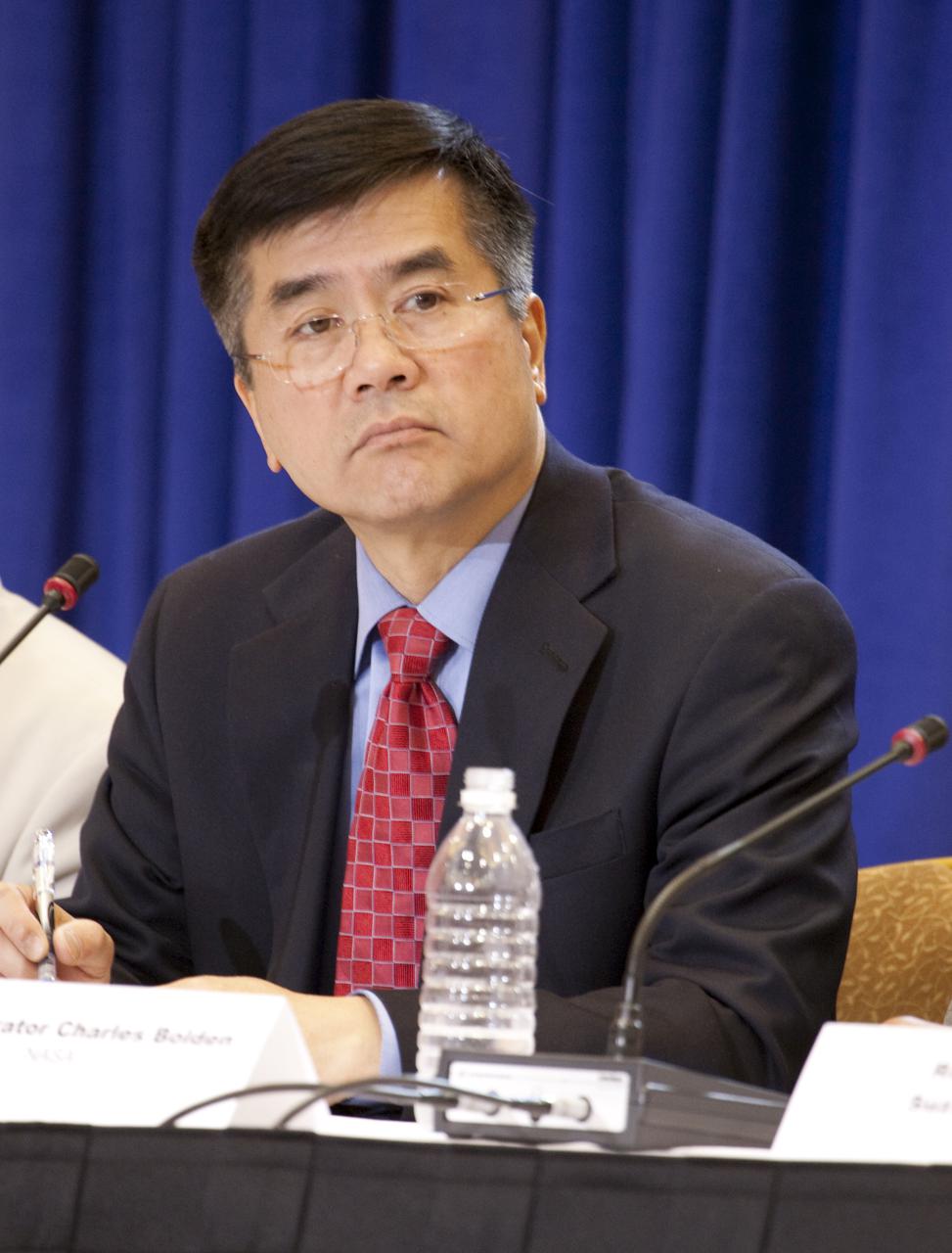
ORLANDO, Fla. – Secretary of Commerce Gary Locke listens to presentations from business and community leaders during a town hall meeting at the Orlando Airport Hyatt Hotel as part of the Presidential Task Force on Space Industry Work Force and Economic Development. The task force heard from local leaders about ways to strengthen the work force as NASA moves toward retirement of the Space Shuttle Program. The task force is a $40 million, multi-agency initiative for regional and economic growth to assist the Space Coast as the country’s space exploration efforts expand and transform. Photo credit: NASA_Amanda Diller
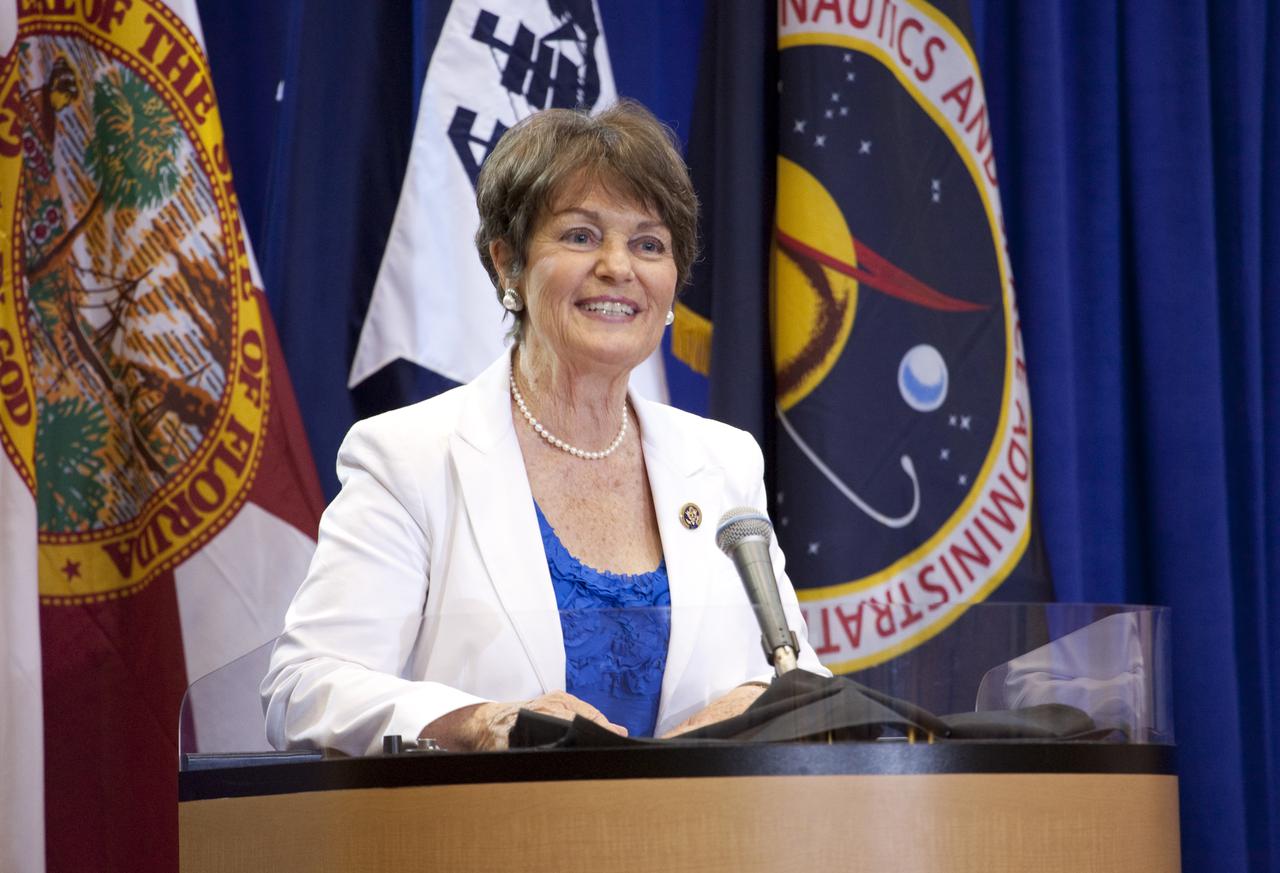
ORLANDO, Fla. – Rep. Suzanne Kosmas of Florida speaks during a town hall meeting at the Orlando Airport Hyatt Hotel as part of the Presidential Task Force on Space Industry Work Force and Economic Development. The task force heard from local leaders about ways to strengthen the work force as NASA moves toward retirement of the Space Shuttle Program. The task force is a $40 million, multi-agency initiative for regional and economic growth to assist the Space Coast as the country’s space exploration efforts expand and transform. Photo credit: NASA_Amanda Diller
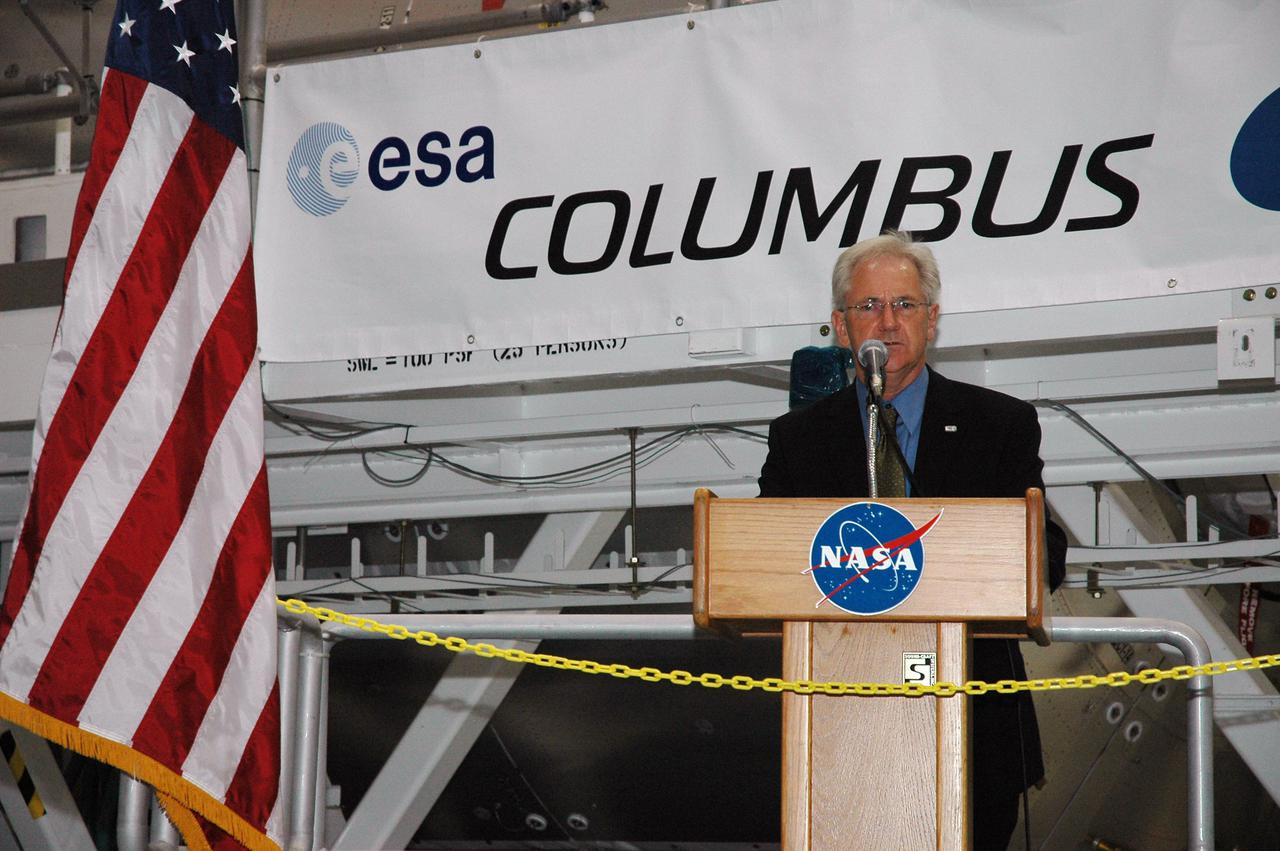
KENNEDY SPACE CENTER, FLA. - Alan Thirkettle, International Space Station program manager for the European Space Agency (ESA), speaks at a ceremony in the Space Station Processing Facility following the delivery of ESA's Columbus module to Kennedy Space Center. Columbus is the European Space Agency's research laboratory for the International Space Station. The module will be prepared in the SSPF for delivery to the space station on a future space shuttle mission. Columbus will expand the research facilities of the station and provide researchers with the ability to conduct numerous experiments in the life, physical and materials sciences. Photo credit: NASA_Amanda Diller
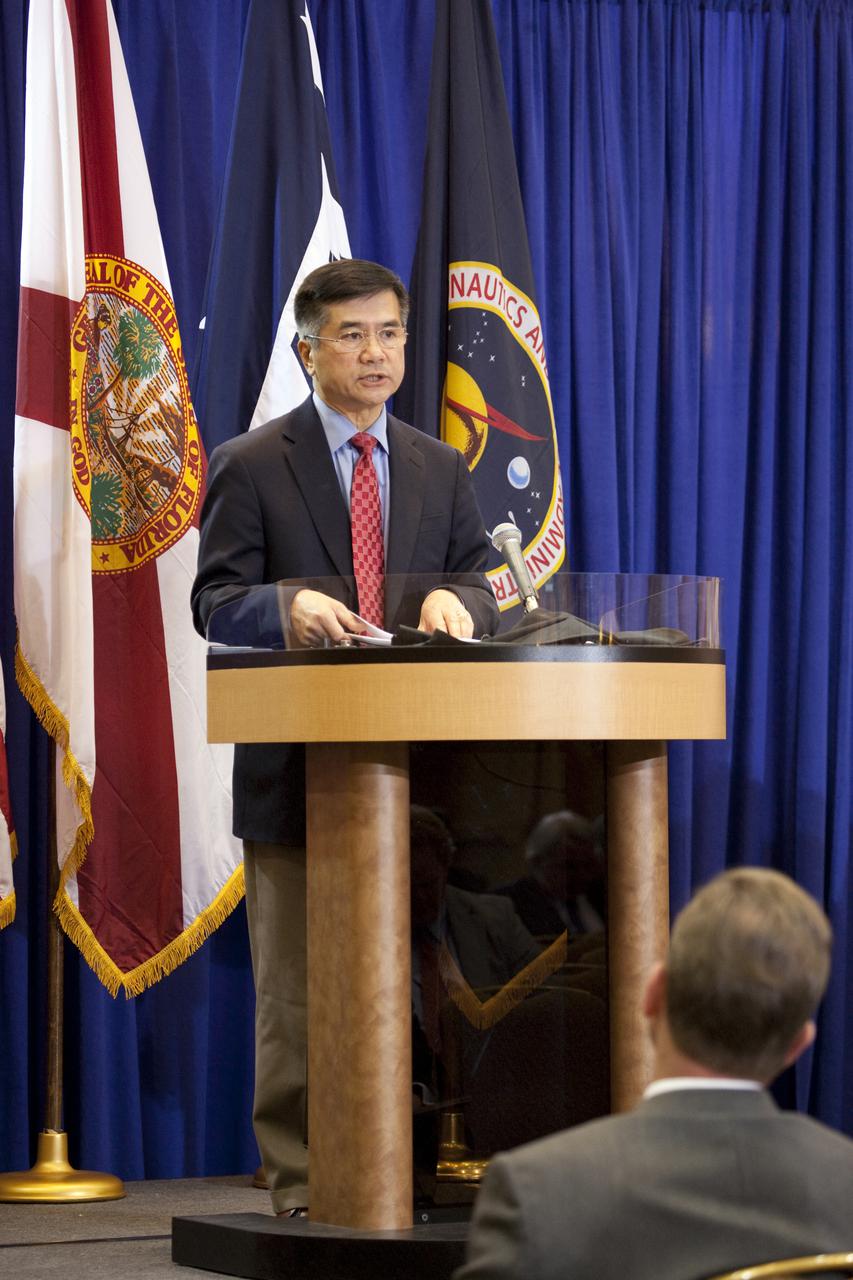
ORLANDO, Fla. – Secretary of Commerce Gary Locke addresses business and industry leaders during a town hall meeting at the Orlando Airport Hyatt Hotel as part of the Presidential Task Force on Space Industry Work Force and Economic Development. The task force heard from local leaders about ways to strengthen the work force as NASA moves toward retirement of the Space Shuttle Program. The task force is a $40 million, multi-agency initiative for regional and economic growth to assist the Space Coast as the country’s space exploration efforts expand and transform. Photo credit: NASA_Amanda Diller
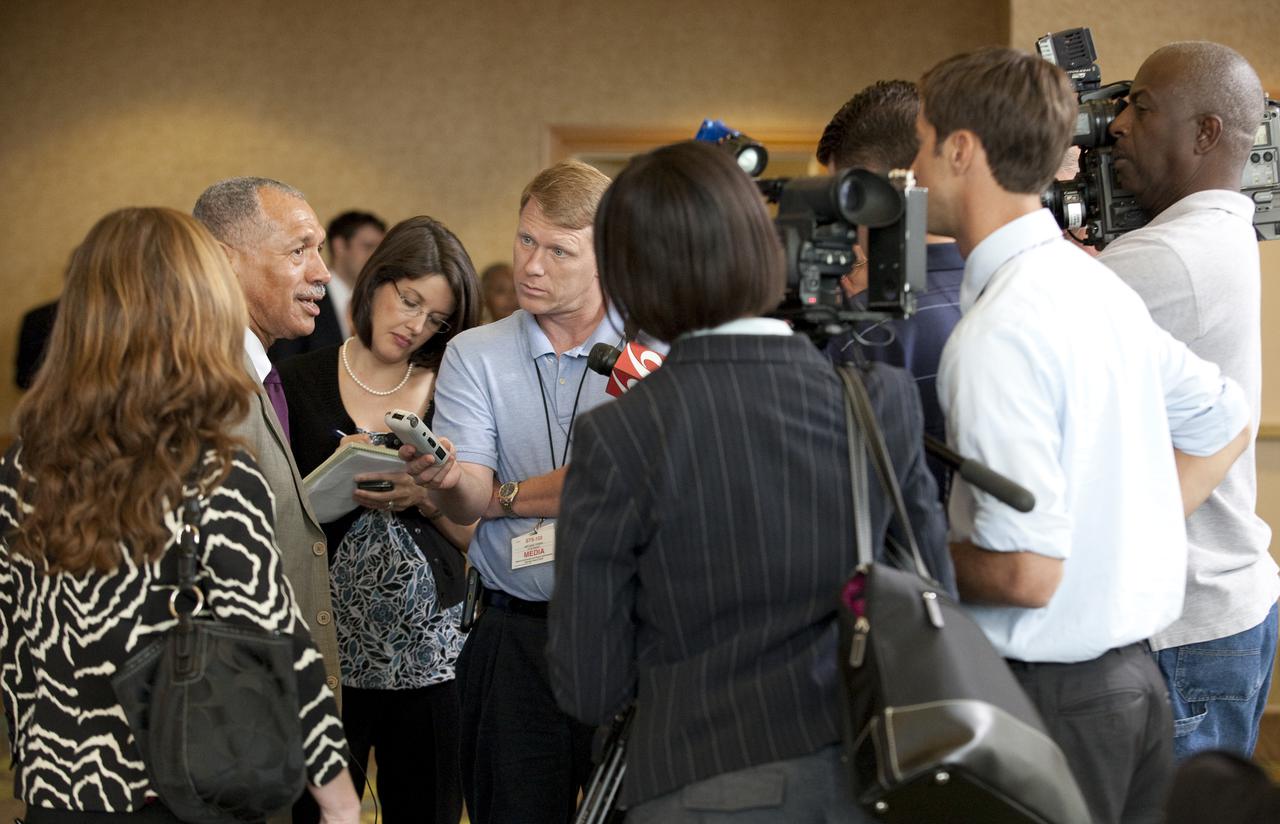
ORLANDO, Fla. – NASA Administrator Charles Bolden, second from left, speaks to reporters during a town hall meeting at the Orlando Airport Hyatt Hotel as part of the Presidential Task Force on Space Industry Work Force and Economic Development. The task force heard from local leaders about ways to strengthen the work force as NASA moves toward retirement of the Space Shuttle Program. The task force is a $40 million, multi-agency initiative for regional and economic growth to assist the Space Coast as the country’s space exploration efforts expand and transform. Photo credit: NASA_Amanda Diller
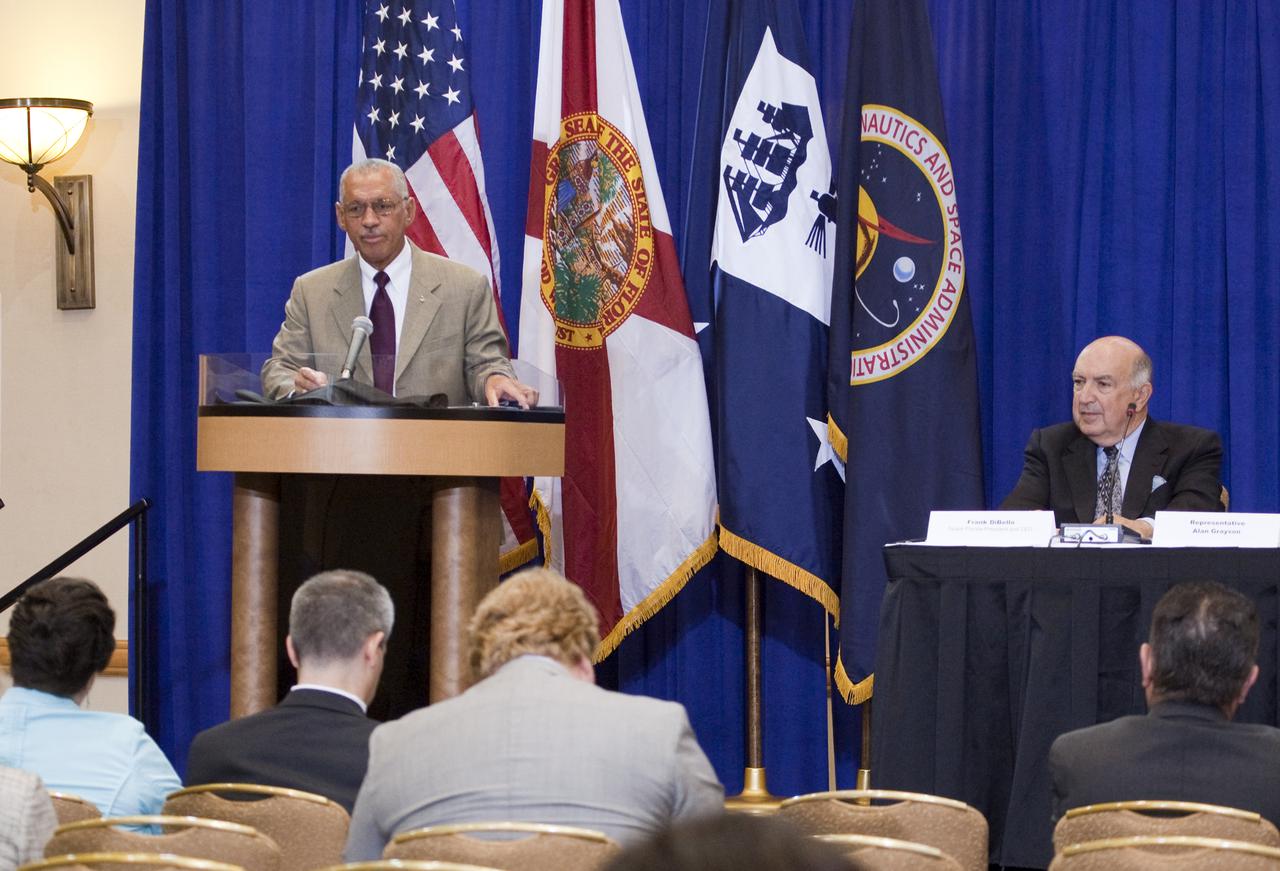
ORLANDO, Fla. – NASA Administrator Charles Bolden speaks during a town hall meeting at the Orlando Airport Hyatt Hotel as part of the Presidential Task Force on Space Industry Work Force and Economic Development. Seated at right is panel moderator and Space Florida President Frank DiBello. The task force heard from local leaders about ways to strengthen the work force as NASA moves toward retirement of the Space Shuttle Program. The task force is a $40 million, multi-agency initiative for regional and economic growth to assist the Space Coast as the country’s space exploration efforts expand and transform. Photo credit: NASA_Amanda Diller
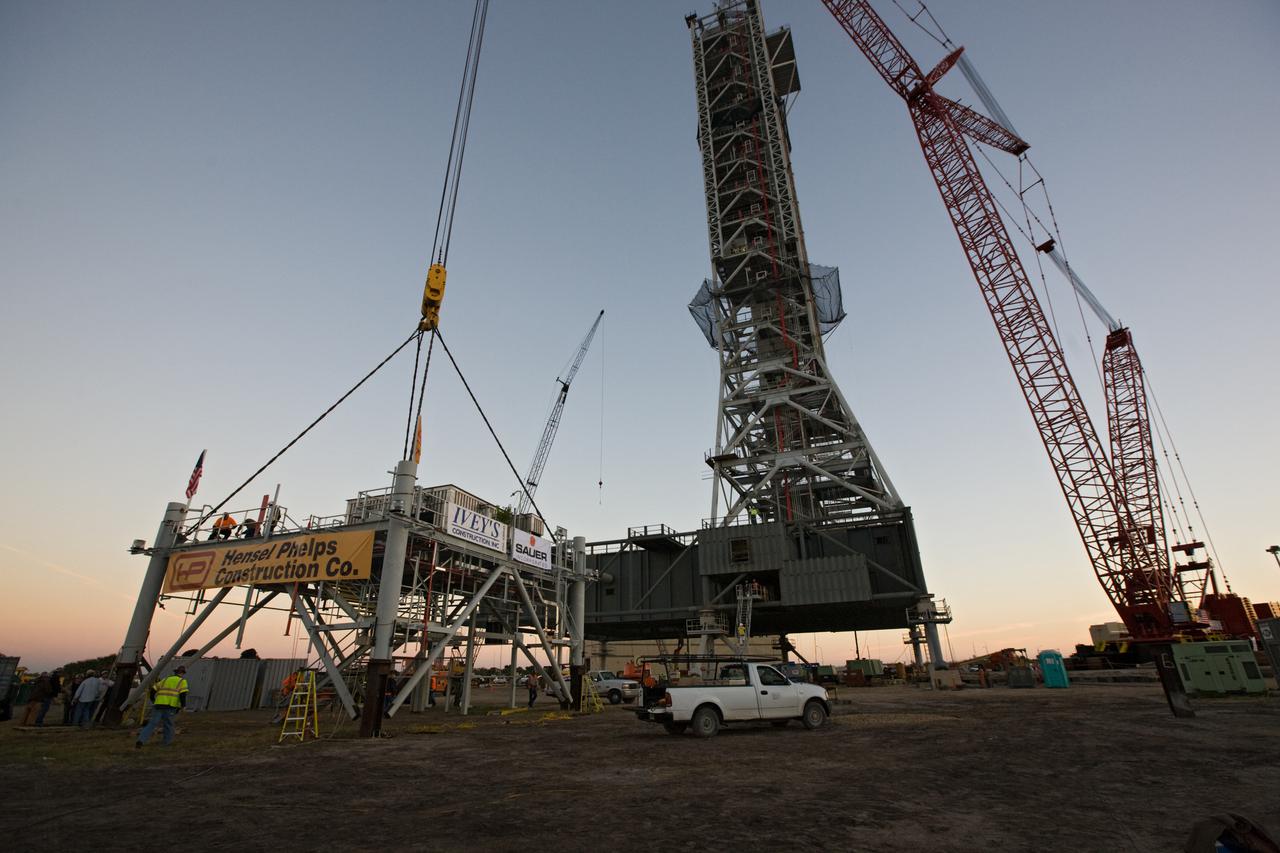
CAPE CANAVERAL, Fla. – At NASA’s Kennedy Space Center in Florida, a large crane is attached to the tenth and final tower segment of the new mobile launcher, or ML, being constructed to support the Constellation Program. When completed, the tower will be approximately 345 feet tall and have multiple platforms for personnel access. Its base is being made lighter than space shuttle mobile launcher platforms so the crawler-transporter can pick up the heavier load of the tower and a taller rocket. For information on the Constellation Program, visit http:__www.nasa.gov_constellation. Photo credit: NASA_Amanda Diller
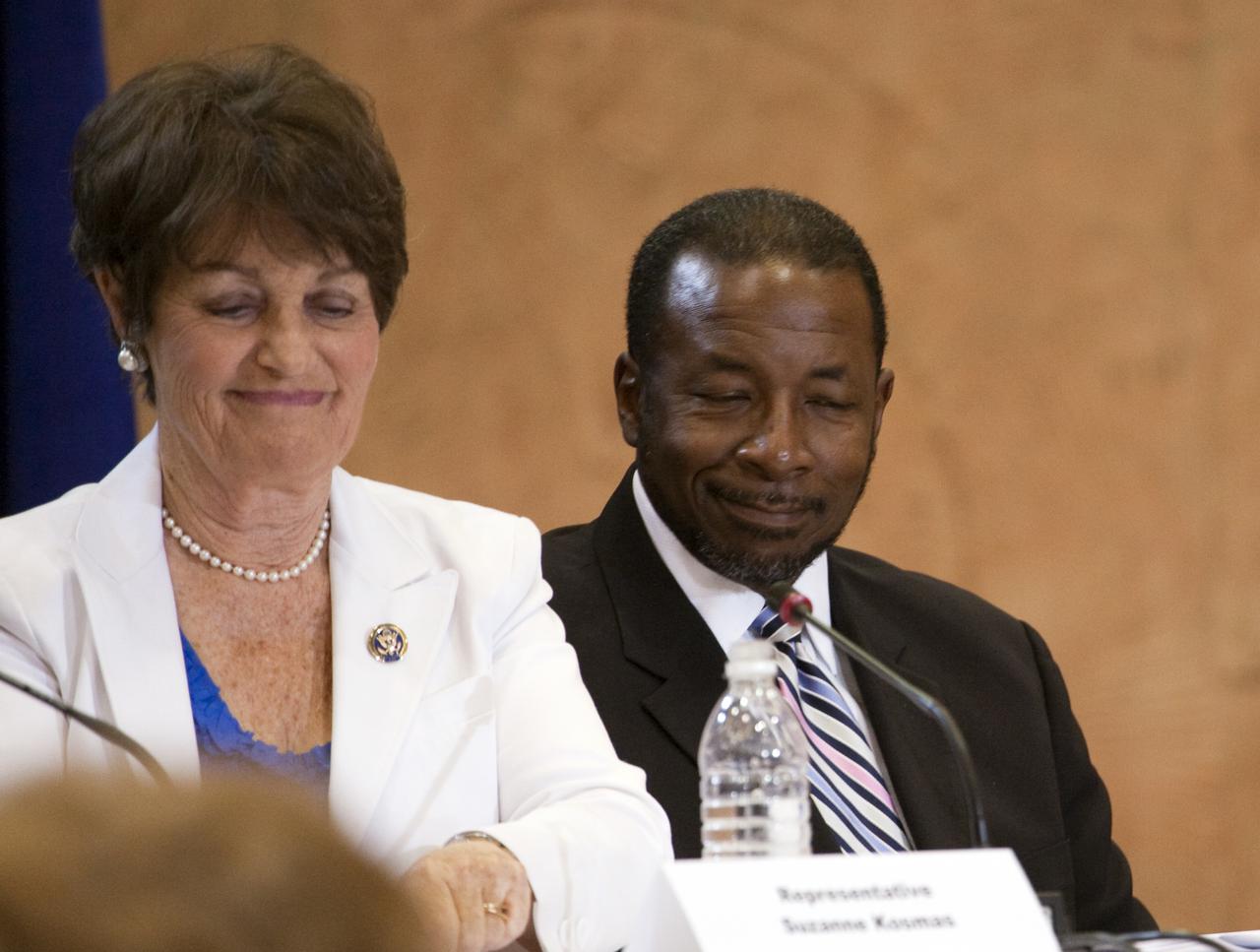
ORLANDO, Fla. – Rep. Suzanne Kosmas of Florida and NASA Associate Administrator for Mission Support Woodrow Whitlow, listen to presentations from business and community leaders during a town hall meeting at the Orlando Airport Hyatt Hotel as part of the Presidential Task Force on Space Industry Work Force and Economic Development. The task force heard from local leaders about ways to strengthen the work force as NASA moves toward retirement of the Space Shuttle Program. The task force is a $40 million, multi-agency initiative for regional and economic growth to assist the Space Coast as the country’s space exploration efforts expand and transform. Photo credit: NASA_Amanda Diller
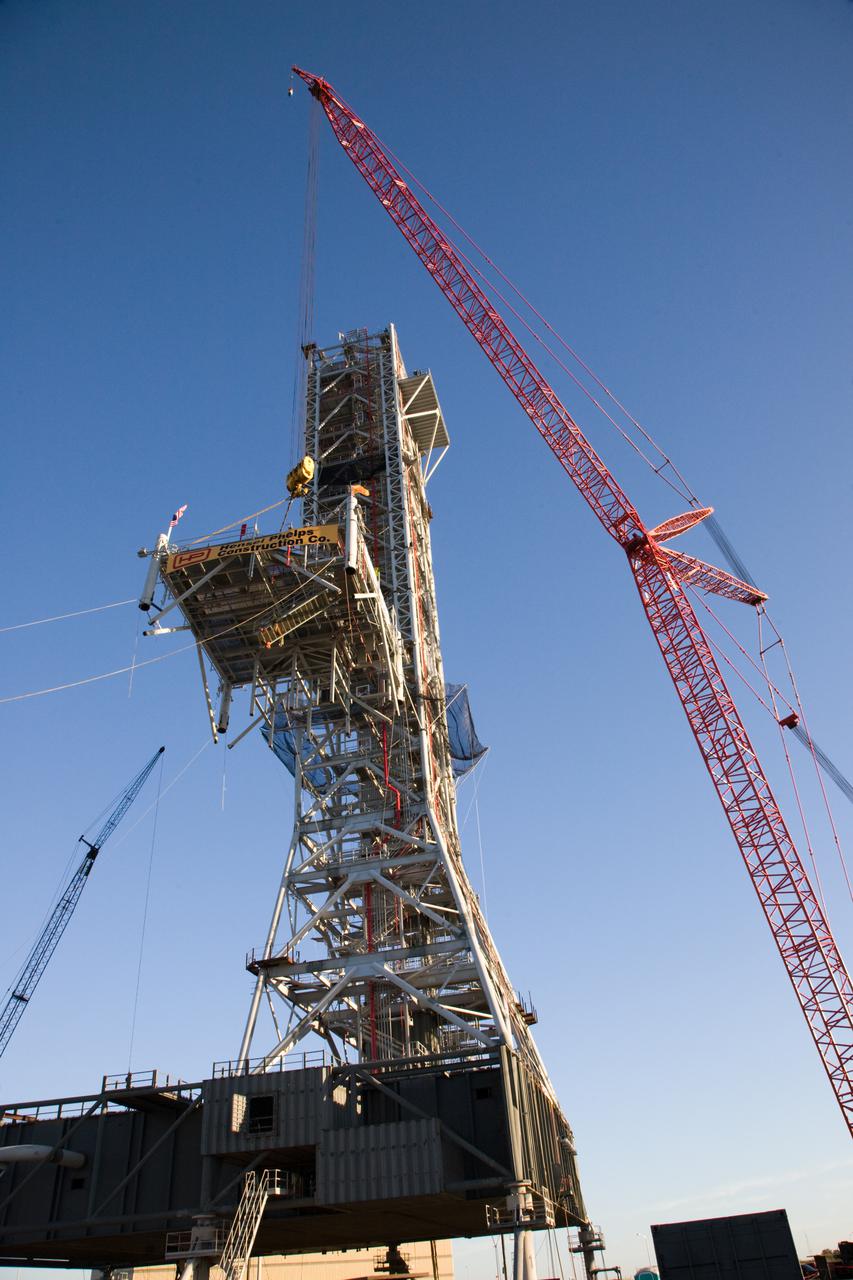
CAPE CANAVERAL, Fla. – At NASA’s Kennedy Space Center in Florida, a large crane lifts the tenth and final tower segment of a new mobile launcher, or ML, being constructed to support the Constellation Program, to the top of the growing tower. When completed, the tower will be approximately 345 feet tall and have multiple platforms for personnel access. Its base is being made lighter than space shuttle mobile launcher platforms so the crawler-transporter can pick up the heavier load of the tower and a taller rocket. For information on the Constellation Program, visit http:__www.nasa.gov_constellation. Photo credit: NASA_Amanda Diller
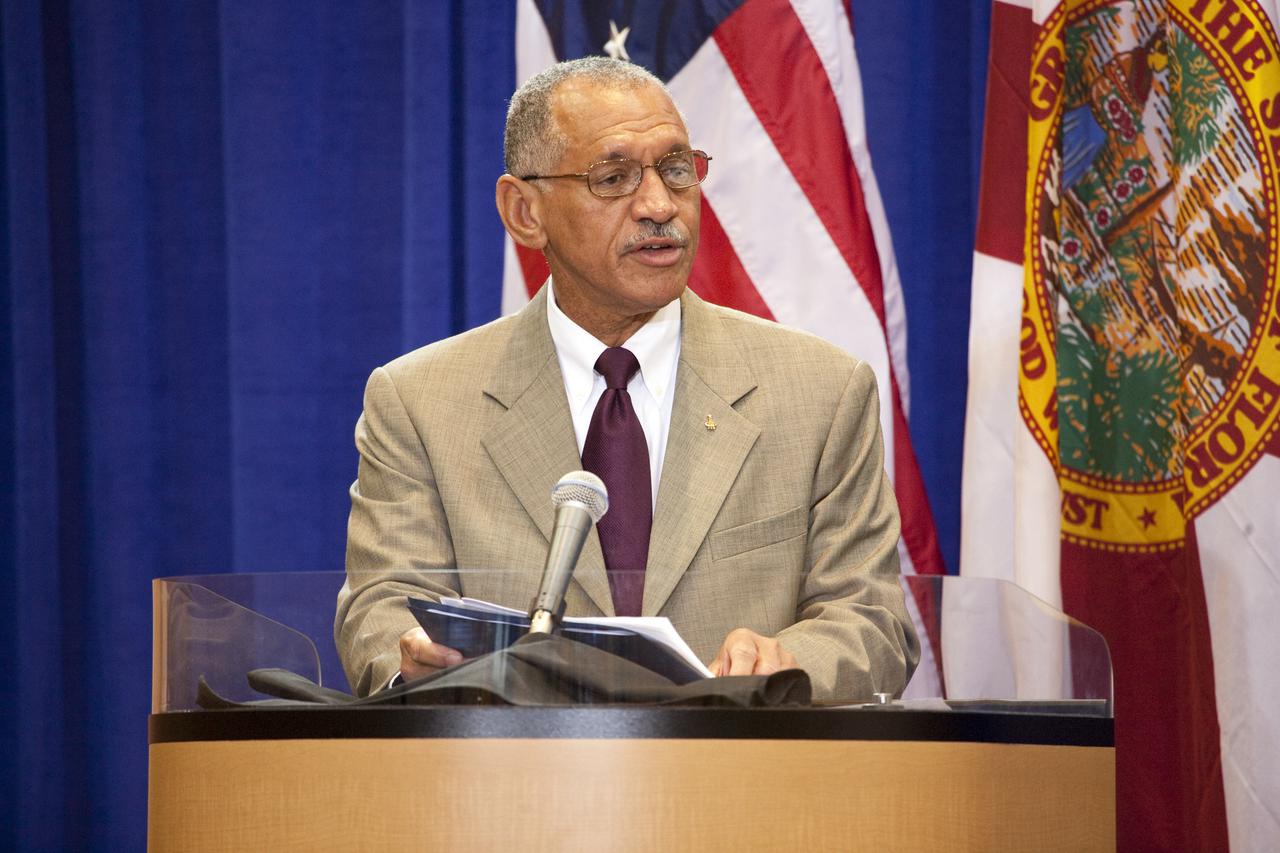
ORLANDO, Fla. – NASA Administrator Charles Bolden speaks to business and industry leaders during a town hall meeting at the Orlando Airport Hyatt Hotel as part of the Presidential Task Force on Space Industry Work Force and Economic Development. The task force heard from local leaders about ways to strengthen the work force as NASA moves toward retirement of the Space Shuttle Program. The task force is a $40 million, multi-agency initiative for regional and economic growth to assist the Space Coast as the country’s space exploration efforts expand and transform. Photo credit: NASA_Amanda Diller
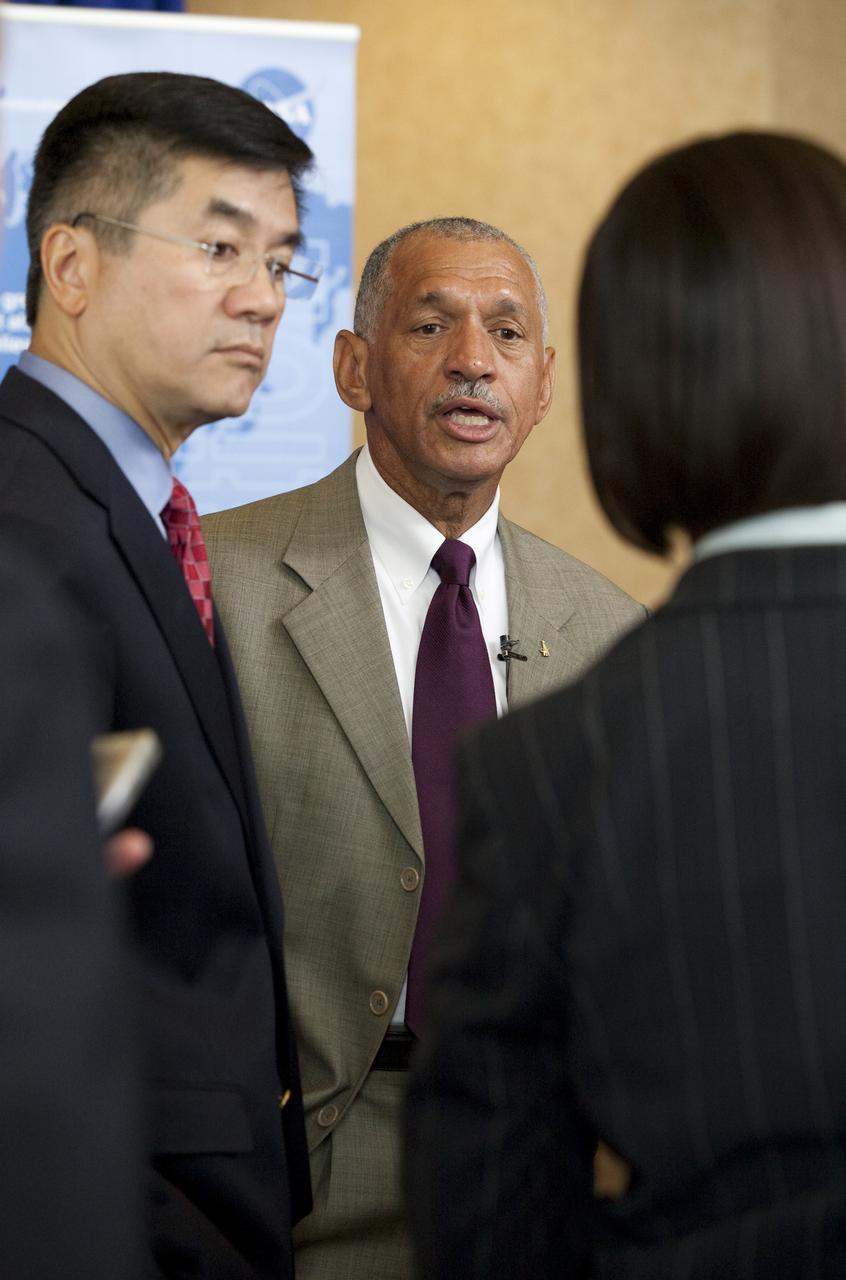
ORLANDO, Fla. – Secretary of Commerce Gary Locke, left, and NASA Administrator Charles Bolden speak to reporters during a town hall meeting at the Orlando Airport Hyatt Hotel as part of the Presidential Task Force on Space Industry Work Force and Economic Development. The task force heard from local leaders about ways to strengthen the work force as NASA moves toward retirement of the Space Shuttle Program. The task force is a $40 million, multi-agency initiative for regional and economic growth to assist the Space Coast as the country’s space exploration efforts expand and transform. Photo credit: NASA_Amanda Diller
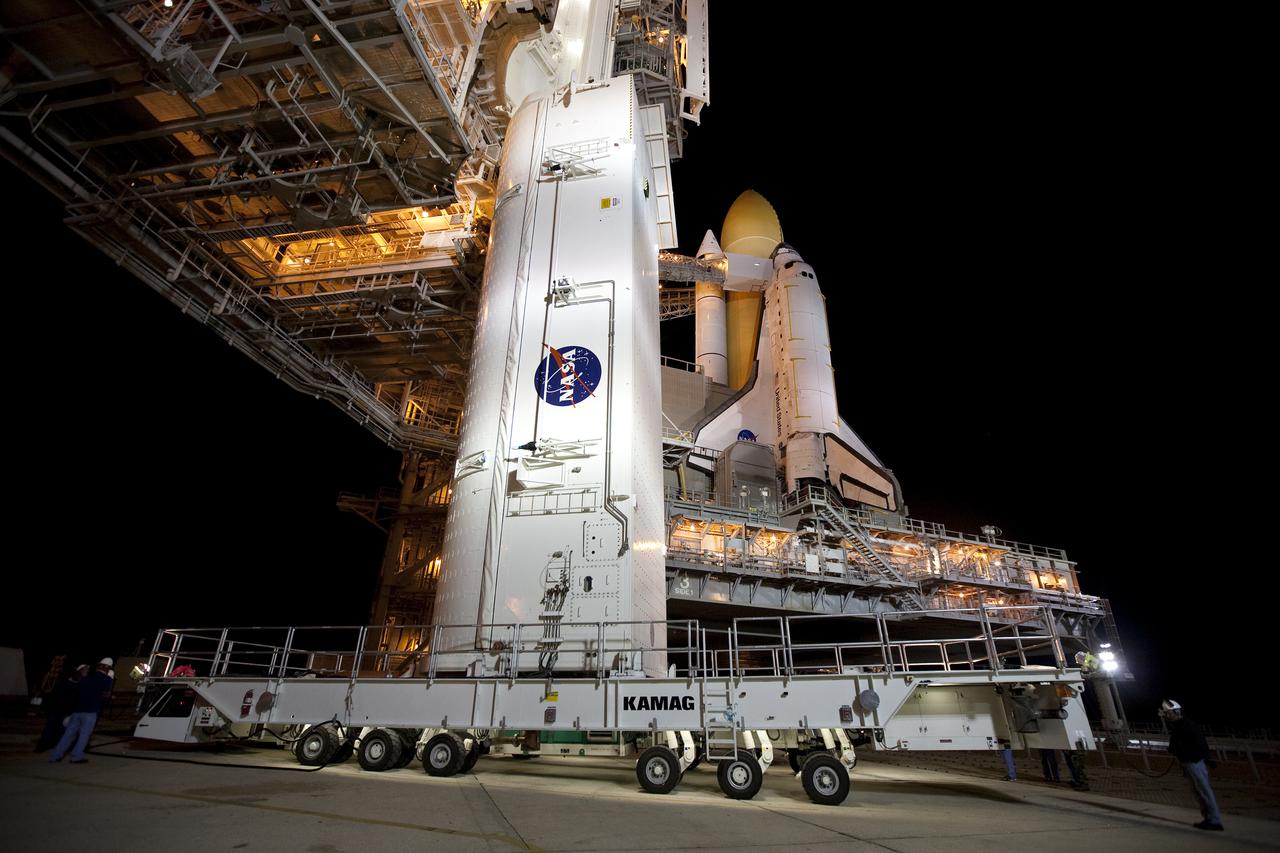
CAPE CANAVERAL, Fla. - At Launch Pad 39A at NASA's Kennedy Space Center in Florida, preparations are under way to lift the payload canister containing the multi-purpose logistics module Leonardo, standing vertically on a transporter, into the pad's payload changout room. Located on the pad's rotating service structure, the room is an enclosed, environmentally controlled area that supports payload delivery and servicing at the pad and attaches to the shuttle's cargo bay for vertical payload installation. The contents of the canister, including Leonardo, is set to be transferred into space shuttle Discovery's cargo bay on March 24. The seven-member STS-131 crew will deliver Leonardo, filled with resupply stowage platforms and racks, to the International Space Station. STS-131 will be the 33rd shuttle mission to the station and the 131st shuttle mission overall. Launch is targeted for April 5. For information on the STS-131 mission and crew, visit http:__www.nasa.gov_mission_pages_shuttle_shuttlemissions_sts131_index.html. Photo credit: NASA_Amanda Diller
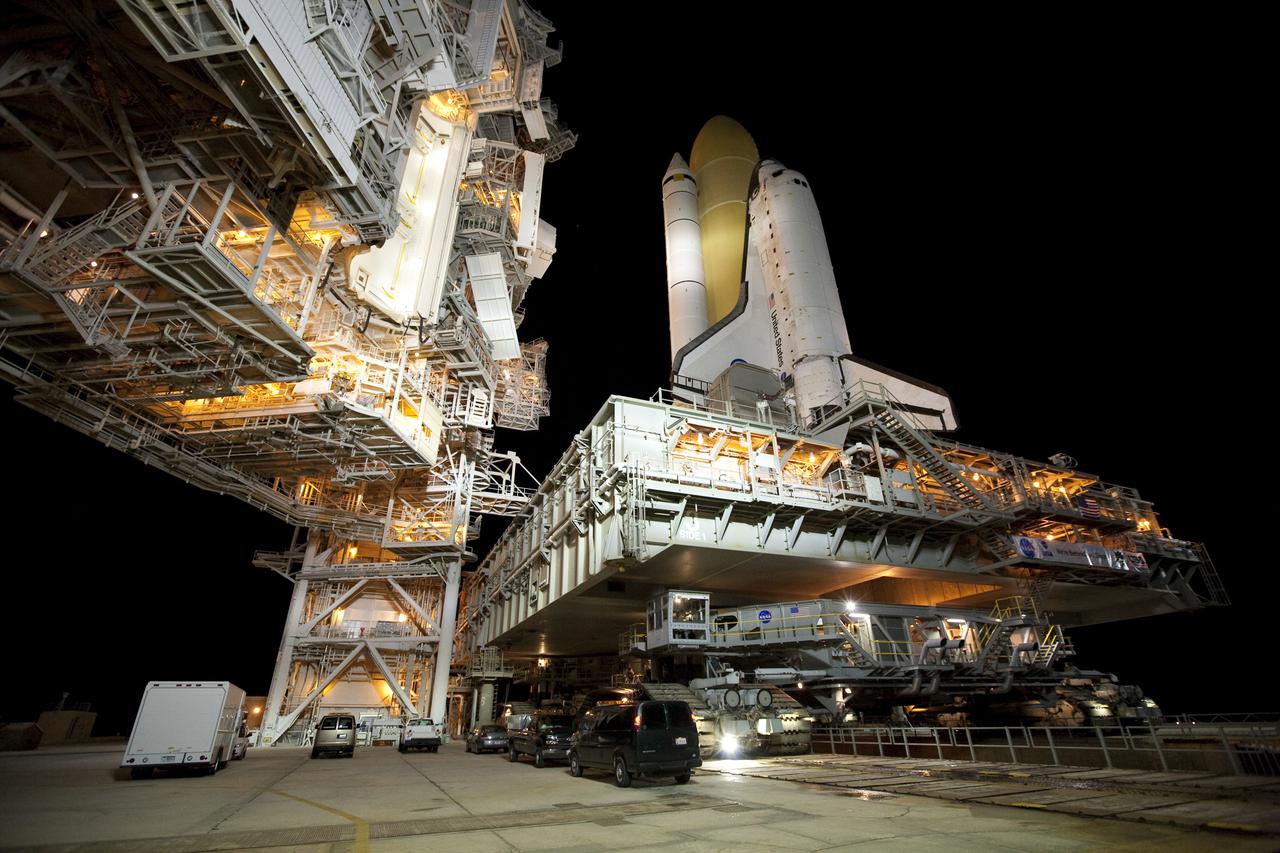
CAPE CANAVERAL, Fla. – A crawler-transporter delivers space shuttle Discovery over the flame trench next to the fixed service structure on Launch Pad 39A at NASA's Kennedy Space Center in Florida before sunrise. Discovery's first motion on its 3.4-mile trip from the Vehicle Assembly Building was at 11:58 p.m. EST March 2. The shuttle was secured on the pad at 6:48 a.m. March 3. Rollout is a significant milestone in launch processing activities. The seven-member STS-131 crew will deliver the multi-purpose logistics module Leonardo, filled with resupply stowage platforms and racks, to the International Space Station aboard Discovery. Targeted for launch on April 5, STS-131 will be the 33rd shuttle mission to the station and the 131st shuttle mission overall. For information on the STS-131 mission and crew, visit http:__www.nasa.gov_mission_pages_shuttle_shuttlemissions_sts131_index.html. Photo credit: NASA_Amanda Diller
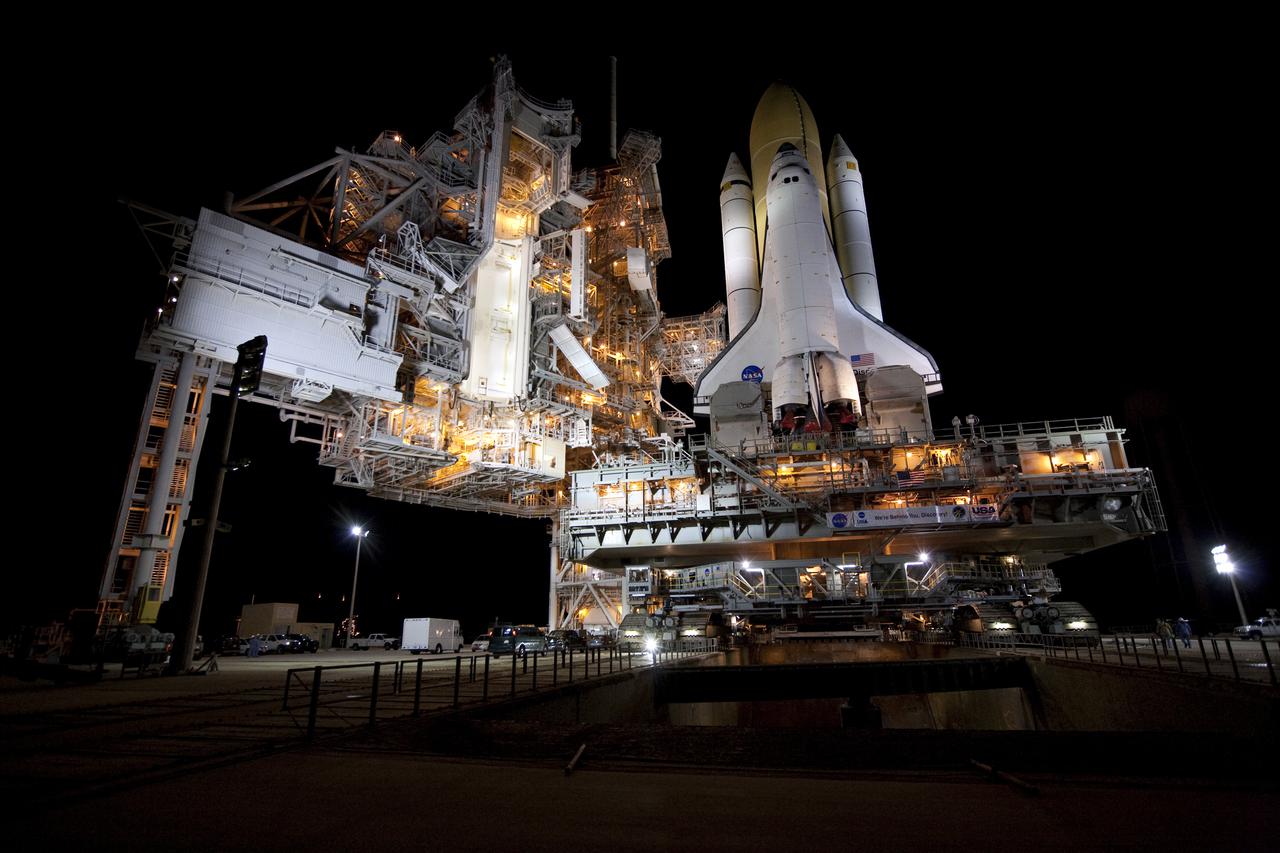
CAPE CANAVERAL, Fla. – The rotating service structure, at left, is retracted on Launch Pad 39A at NASA's Kennedy Space Center in Florida to receive space shuttle Discovery. Discovery's first motion on its 3.4-mile trip from the Vehicle Assembly Building was at 11:58 p.m. EST March 2. The shuttle was secured on the pad at 6:48 a.m. March 3. Rollout is a significant milestone in launch processing activities. The seven-member STS-131 crew will deliver the multi-purpose logistics module Leonardo, filled with resupply stowage platforms and racks, to the International Space Station aboard Discovery. Targeted for launch on April 5, STS-131 will be the 33rd shuttle mission to the station and the 131st shuttle mission overall. For information on the STS-131 mission and crew, visit http:__www.nasa.gov_mission_pages_shuttle_shuttlemissions_sts131_index.html. Photo credit: NASA_Amanda Diller
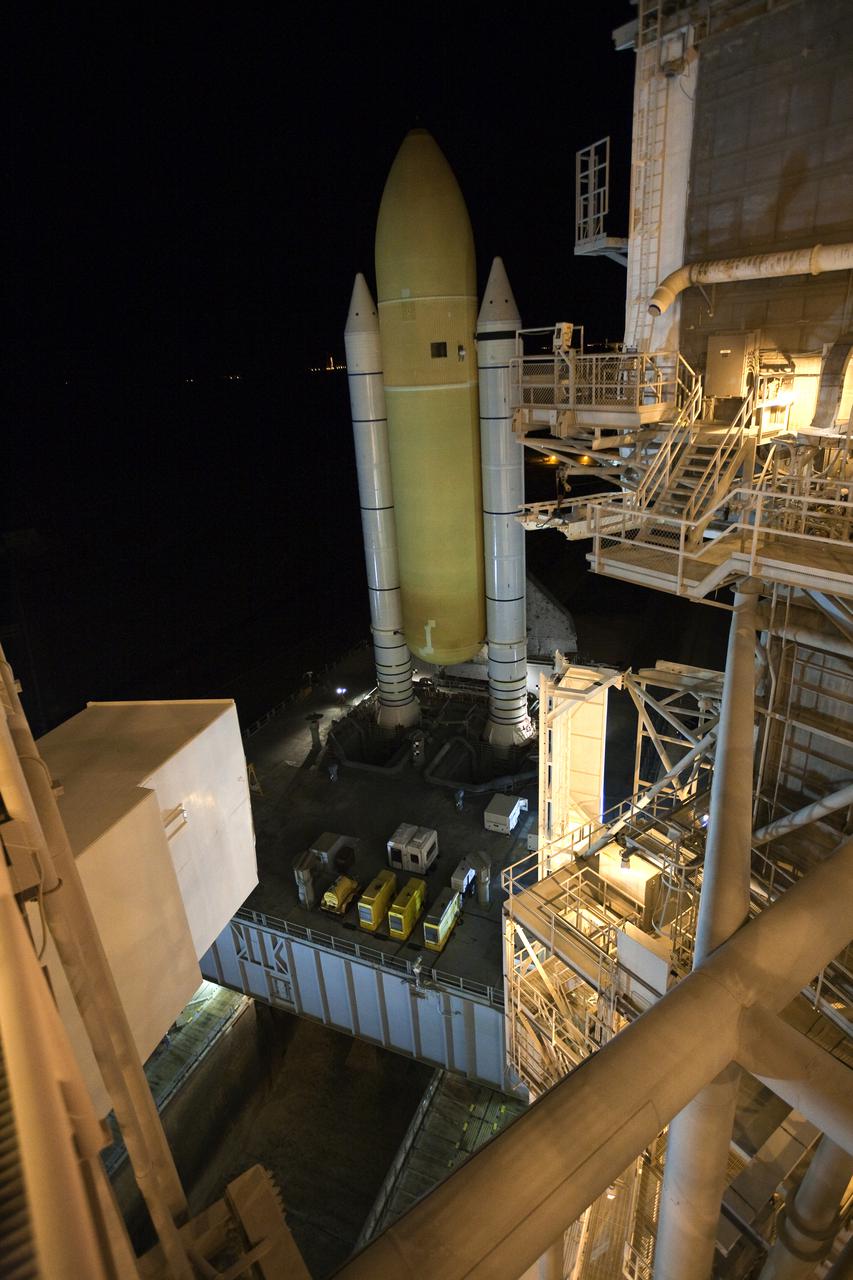
CAPE CANAVERAL, Fla. – Space shuttle Discovery rolls into place over the flame trench on Launch Pad 39A at NASA's Kennedy Space Center in Florida just before dawn. Discovery's first motion on its 3.4-mile trip from the Vehicle Assembly Building was at 11:58 p.m. EST March 2. The shuttle was secured on the pad at 6:48 a.m. March 3. Rollout is a significant milestone in launch processing activities. The seven-member STS-131 crew will deliver the multi-purpose logistics module Leonardo, filled with resupply stowage platforms and racks, to the International Space Station aboard Discovery. Targeted for launch on April 5, STS-131 will be the 33rd shuttle mission to the station and the 131st shuttle mission overall. For information on the STS-131 mission and crew, visit http:__www.nasa.gov_mission_pages_shuttle_shuttlemissions_sts131_index.html. Photo credit: NASA_Amanda Diller

CAPE CANAVERAL, Fla. – At NASA's Kennedy Space Center in Florida, work is under way to construct the launch mount for a new mobile launcher, or ML, which will support NASA's future human spaceflight program, following the arrival of all eight segments. The construction is taking place in Launch Complex 39 in the mobile launcher park site north of Kennedy's Vehicle Assembly Building. The new launcher is 355 feet tall and has multiple platforms for personnel access. The base of the launcher is lighter than space shuttle mobile launcher platforms so the crawler-transporter can pick up the heavier load of the tower and a taller rocket. For information on NASA's future plans, visit http:__www.nasa.gov. Photo credit: NASA_Amanda Diller
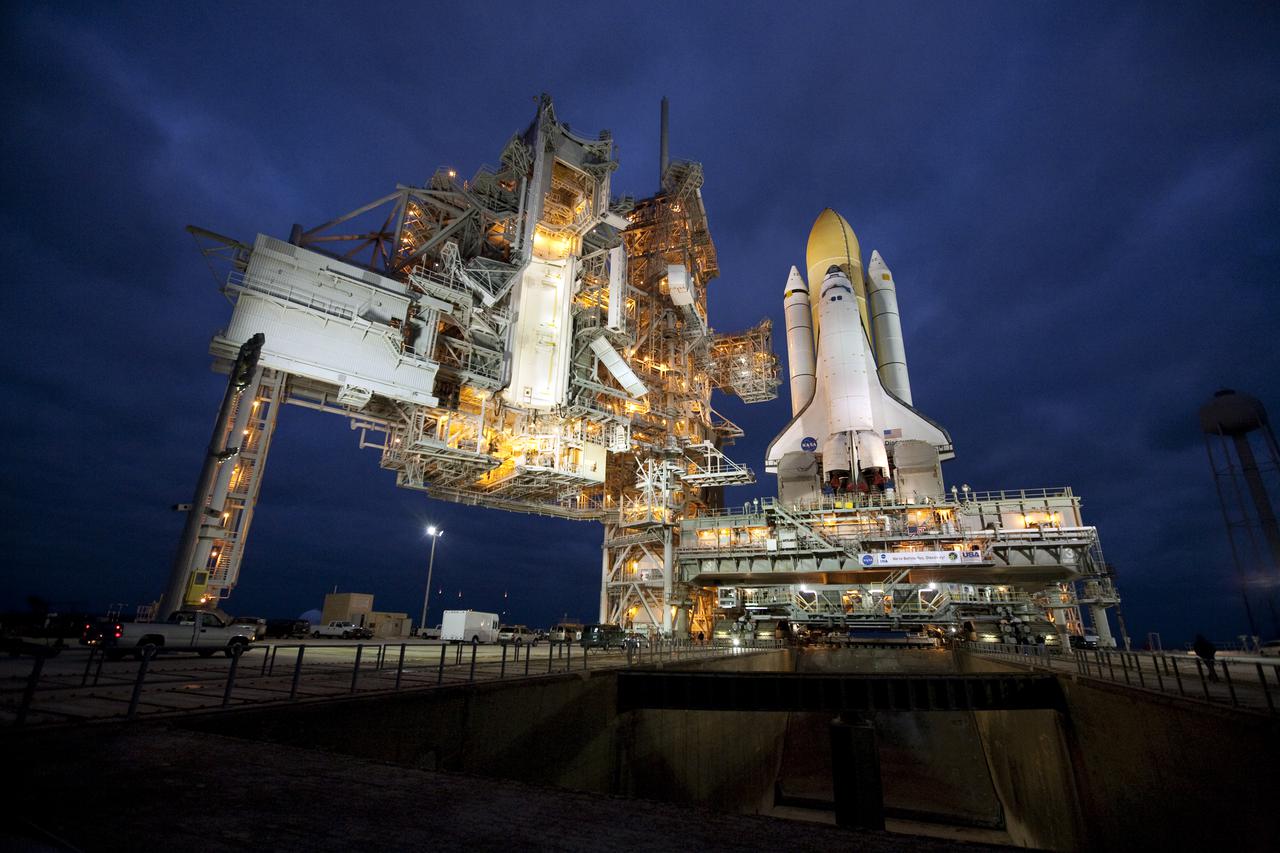
CAPE CANAVERAL, Fla. – On Launch Pad 39A at NASA's Kennedy Space Center in Florida, operations are under way to secure space shuttle Discovery to the pad. Discovery's first motion on its 3.4-mile trip from the Vehicle Assembly Building was at 11:58 p.m. EST March 2. The shuttle was secured on the pad at 6:48 a.m. March 3. Rollout is a significant milestone in launch processing activities. The seven-member STS-131 crew will deliver the multi-purpose logistics module Leonardo, filled with resupply stowage platforms and racks, to the International Space Station aboard Discovery. Targeted for launch on April 5, STS-131 will be the 33rd shuttle mission to the station and the 131st shuttle mission overall. For information on the STS-131 mission and crew, visit http:__www.nasa.gov_mission_pages_shuttle_shuttlemissions_sts131_index.html. Photo credit: NASA_Amanda Diller
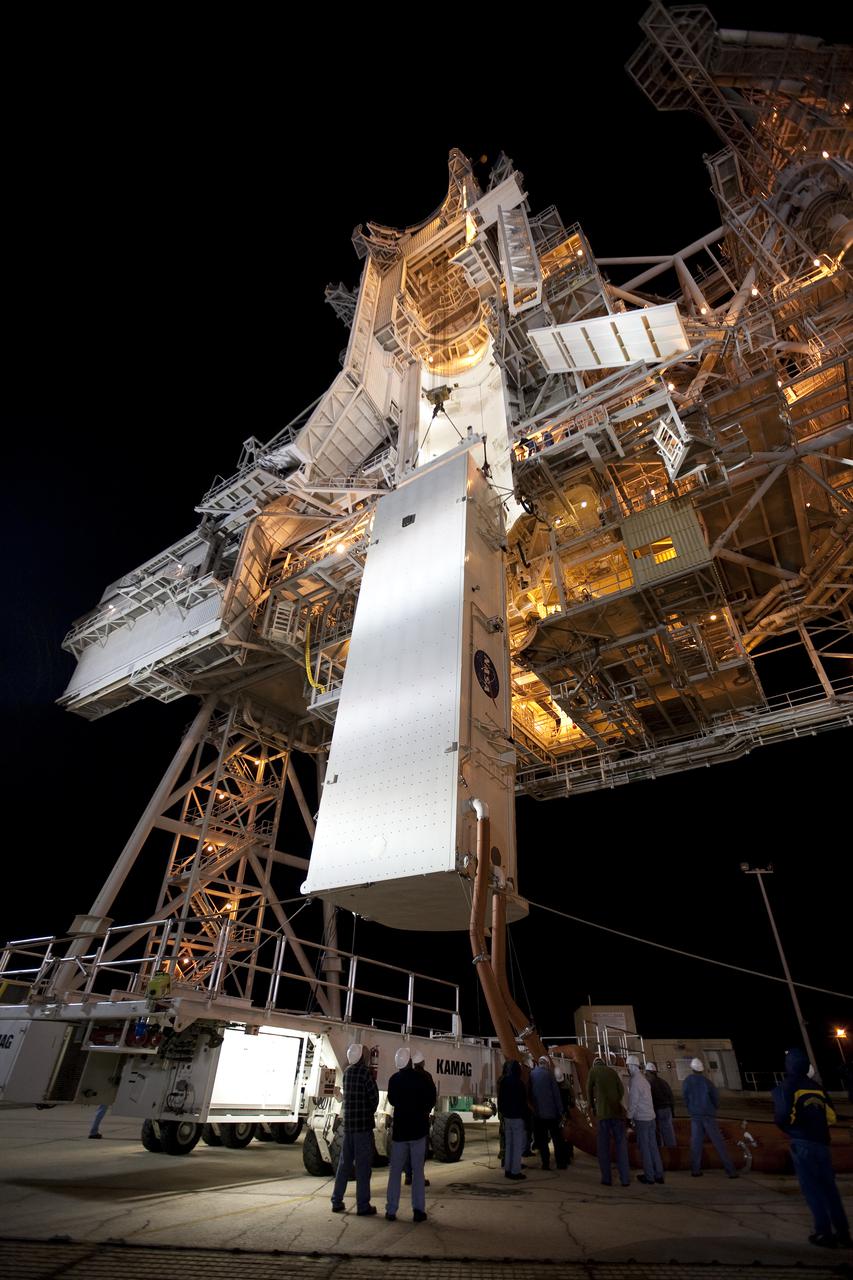
CAPE CANAVERAL, Fla. - At Launch Pad 39A at NASA's Kennedy Space Center in Florida, the payload canister containing the multi-purpose logistics module Leonardo is lifted into the pad's payload changout room. Located on the pad's rotating service structure, the room is an enclosed, environmentally controlled area that supports payload delivery and servicing at the pad and attaches to the shuttle's cargo bay for vertical payload installation. The contents of the canister, including Leonardo, is set to be transferred into space shuttle Discovery's cargo bay on March 24. The seven-member STS-131 crew will deliver Leonardo, filled with resupply stowage platforms and racks, to the International Space Station. STS-131 will be the 33rd shuttle mission to the station and the 131st shuttle mission overall. Launch is targeted for April 5. For information on the STS-131 mission and crew, visit http:__www.nasa.gov_mission_pages_shuttle_shuttlemissions_sts131_index.html. Photo credit: NASA_Amanda Diller
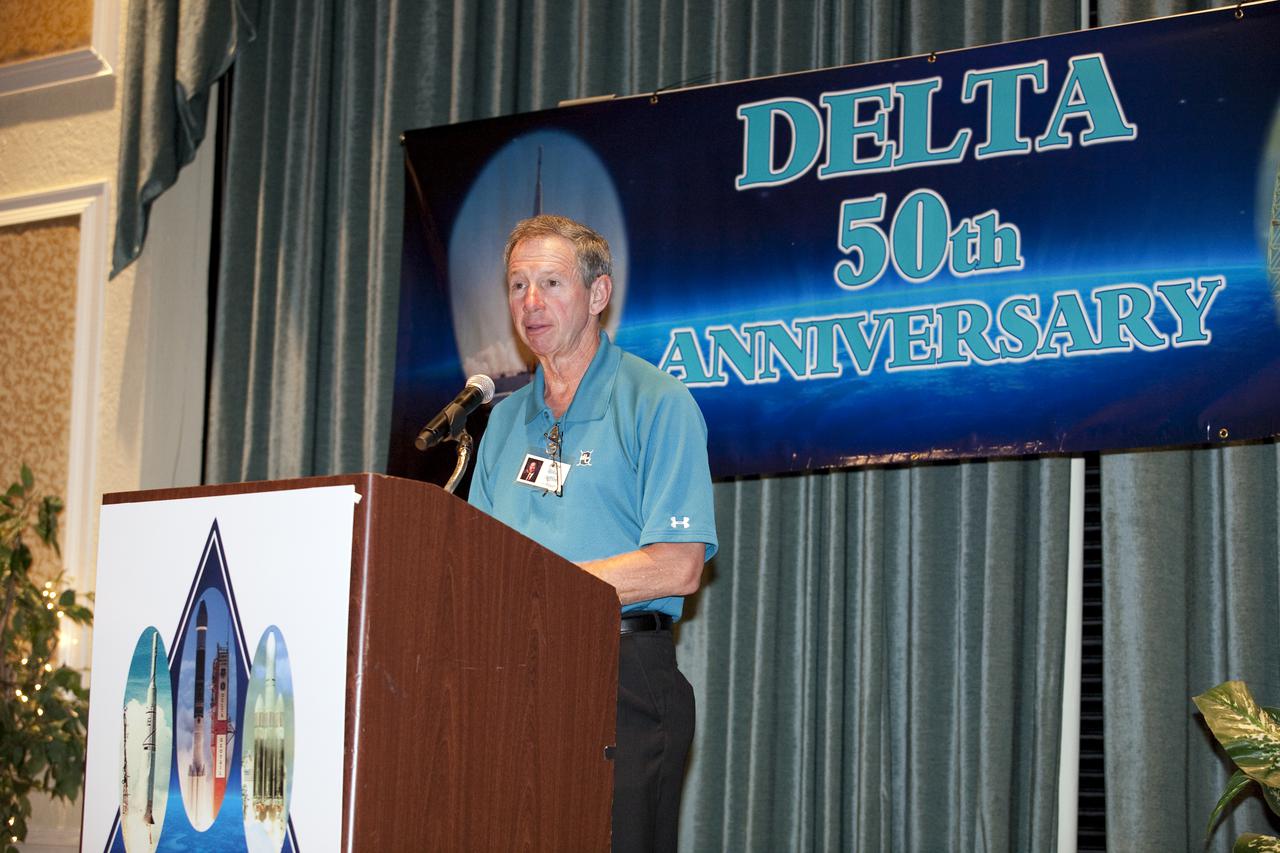
CAPE CANAVERAL, Fla. - Mike Griffin, professor of mechanical and aerospace engineering at the University of Alabama in Huntsville and former NASA administrator, helps the space agency, the U.S. Air Force, United Launch Alliance, Boeing, Pratt and Whitney Rocketdyne, Aerojet and the NASA Alumni League celebrate the Delta expendable launch vehicle program's 50th anniversary at the Radisson Resort in Cape Canaveral, Fla., on May 16. NASA launched the first Delta rocket, which only was intended to be an interim launch vehicle, on May 13, 1960. A half-century later, more than 300 Delta rockets have launched to place crucial weather and environmental satellites into Earth orbit. The vehicles also have sent spacecraft on missions to other planets and comets, and to study the universe. Currently, the Delta II and Delta IV are in use by NASA's Launch Services Program based at Kennedy Space Center in Florida, and are launched by United Launch Alliance. Photo credit: NASA_Amanda Diller
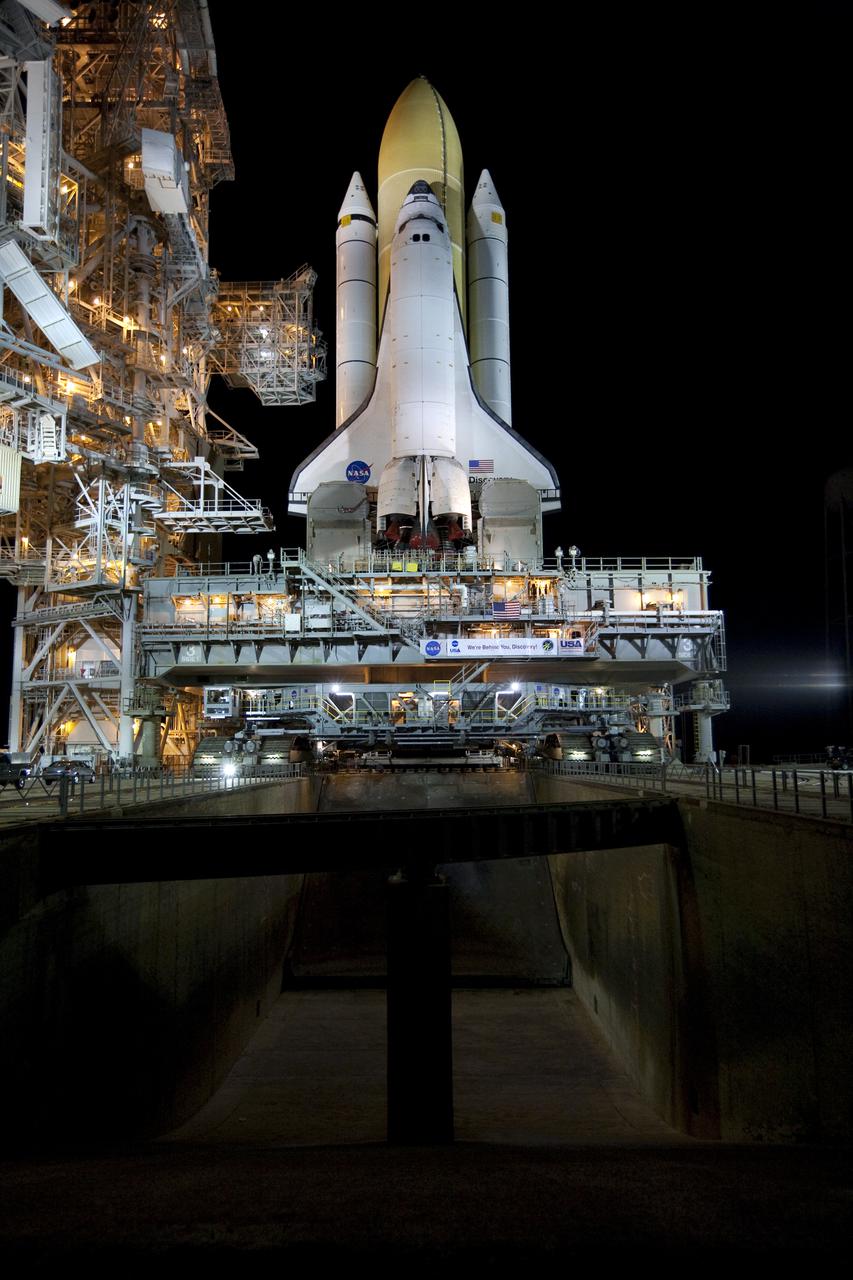
CAPE CANAVERAL, Fla. – On Launch Pad 39A at NASA's Kennedy Space Center in Florida, operations are under way to secure the mobile launcher platform supporting space shuttle Discovery on the pad's pedestals. Discovery's first motion on its 3.4-mile trip from the Vehicle Assembly Building was at 11:58 p.m. EST March 2. The shuttle was secured on the pad at 6:48 a.m. March 3. Rollout is a significant milestone in launch processing activities. The seven-member STS-131 crew will deliver the multi-purpose logistics module Leonardo, filled with resupply stowage platforms and racks, to the International Space Station aboard Discovery. Targeted for launch on April 5, STS-131 will be the 33rd shuttle mission to the station and the 131st shuttle mission overall. For information on the STS-131 mission and crew, visit http:__www.nasa.gov_mission_pages_shuttle_shuttlemissions_sts131_index.html. Photo credit: NASA_Amanda Diller
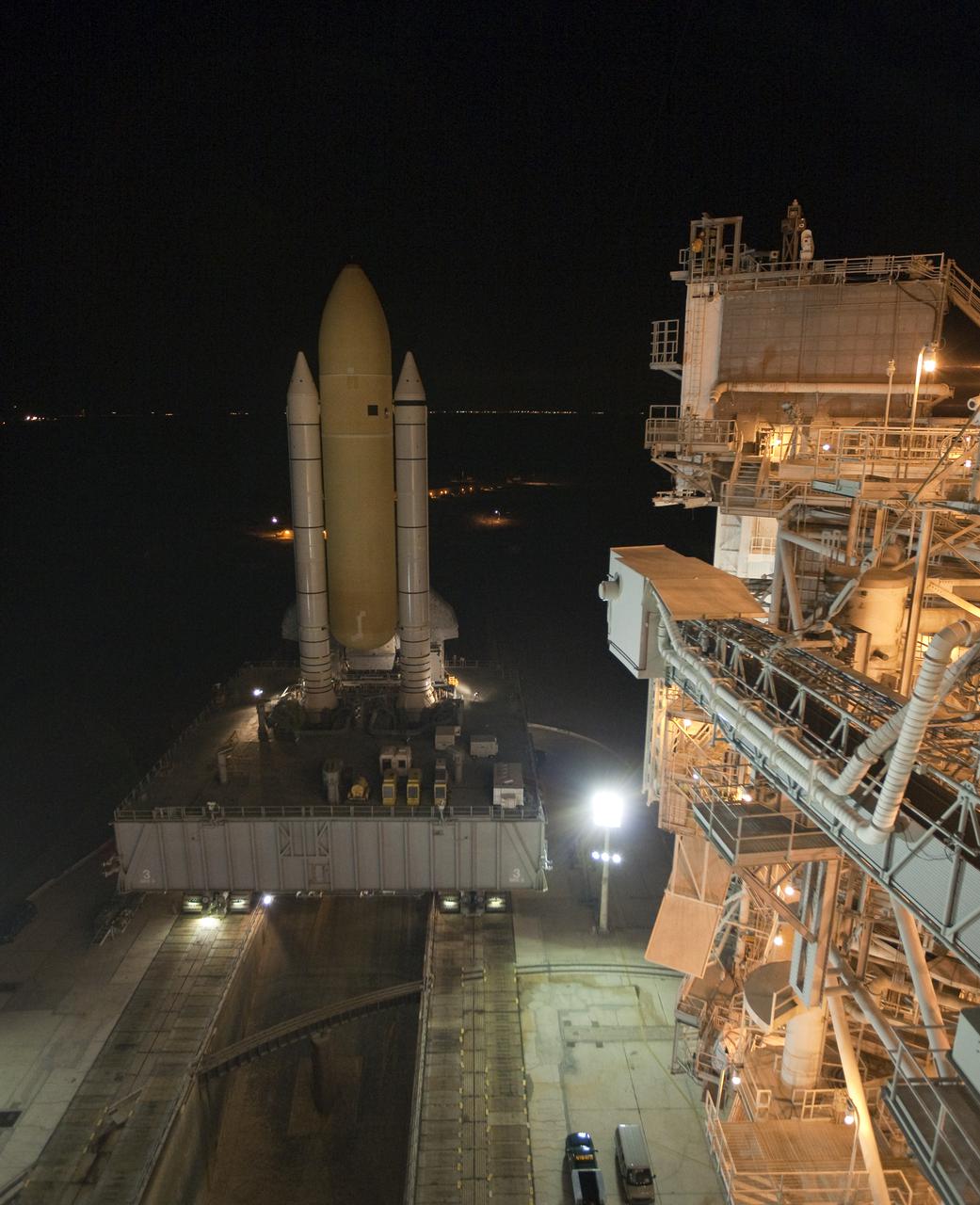
CAPE CANAVERAL, Fla. – Space shuttle Discovery rolls into place over the flame trench on Launch Pad 39A at NASA's Kennedy Space Center in Florida just before dawn. Discovery's first motion on its 3.4-mile trip from the Vehicle Assembly Building was at 11:58 p.m. EST March 2. The shuttle was secured on the pad at 6:48 a.m. March 3. Rollout is a significant milestone in launch processing activities. The seven-member STS-131 crew will deliver the multi-purpose logistics module Leonardo, filled with resupply stowage platforms and racks, to the International Space Station aboard Discovery. Targeted for launch on April 5, STS-131 will be the 33rd shuttle mission to the station and the 131st shuttle mission overall. For information on the STS-131 mission and crew, visit http:__www.nasa.gov_mission_pages_shuttle_shuttlemissions_sts131_index.html. Photo credit: NASA_Amanda Diller
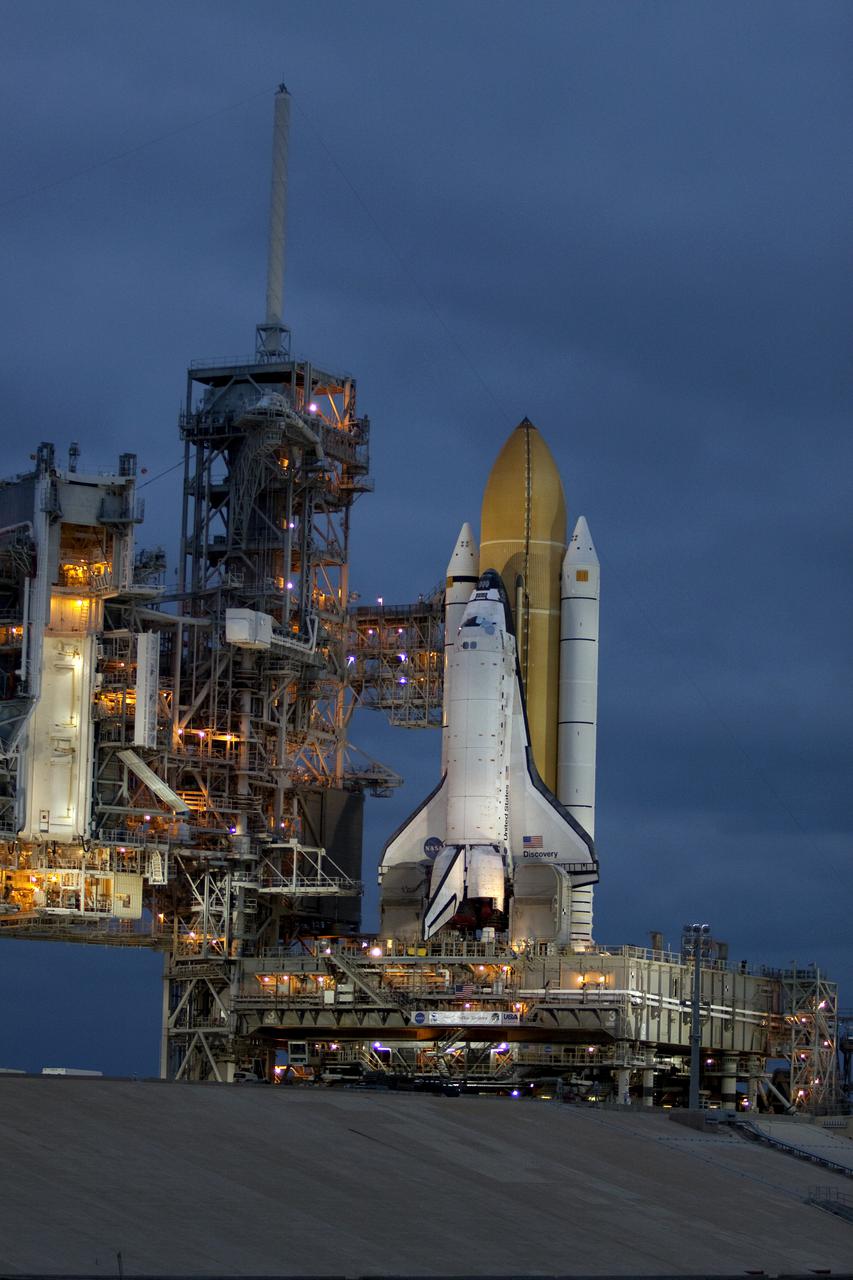
CAPE CANAVERAL, Fla. – The fixed and rotating service structures are brightly lit on Launch Pad 39A at NASA's Kennedy Space Center in Florida for the arrival of space shuttle Discovery just before dawn. Discovery's first motion on its 3.4-mile trip from the Vehicle Assembly Building was at 11:58 p.m. EST March 2. The shuttle was secured on the pad at 6:48 a.m. March 3. Rollout is a significant milestone in launch processing activities. The seven-member STS-131 crew will deliver the multi-purpose logistics module Leonardo, filled with resupply stowage platforms and racks, to the International Space Station aboard Discovery. Targeted for launch on April 5, STS-131 will be the 33rd shuttle mission to the station and the 131st shuttle mission overall. For information on the STS-131 mission and crew, visit http:__www.nasa.gov_mission_pages_shuttle_shuttlemissions_sts131_index.html. Photo credit: NASA_Amanda Diller
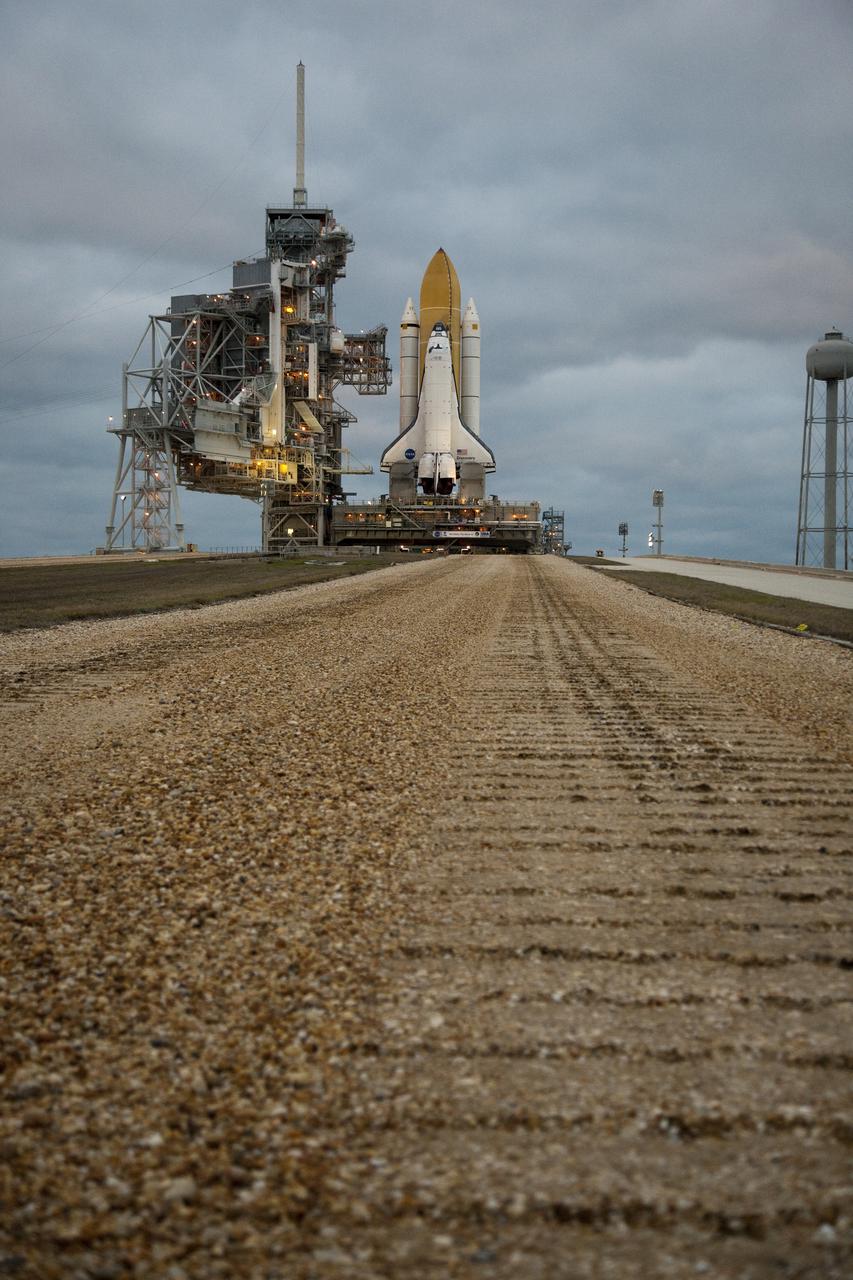
CAPE CANAVERAL, Fla. – Sunrise finds space shuttle Discovery has traveled the five percent grade to the top of Launch Pad 39A at NASA's Kennedy Space Center in Florida. Discovery's first motion on its 3.4-mile trip from the Vehicle Assembly Building was at 11:58 p.m. EST March 2. The shuttle was secured on the pad at 6:48 a.m. March 3. Rollout is a significant milestone in launch processing activities. The seven-member STS-131 crew will deliver the multi-purpose logistics module Leonardo, filled with resupply stowage platforms and racks, to the International Space Station aboard Discovery. Targeted for launch on April 5, STS-131 will be the 33rd shuttle mission to the station and the 131st shuttle mission overall. For information on the STS-131 mission and crew, visit http:__www.nasa.gov_mission_pages_shuttle_shuttlemissions_sts131_index.html. Photo credit: NASA_Amanda Diller
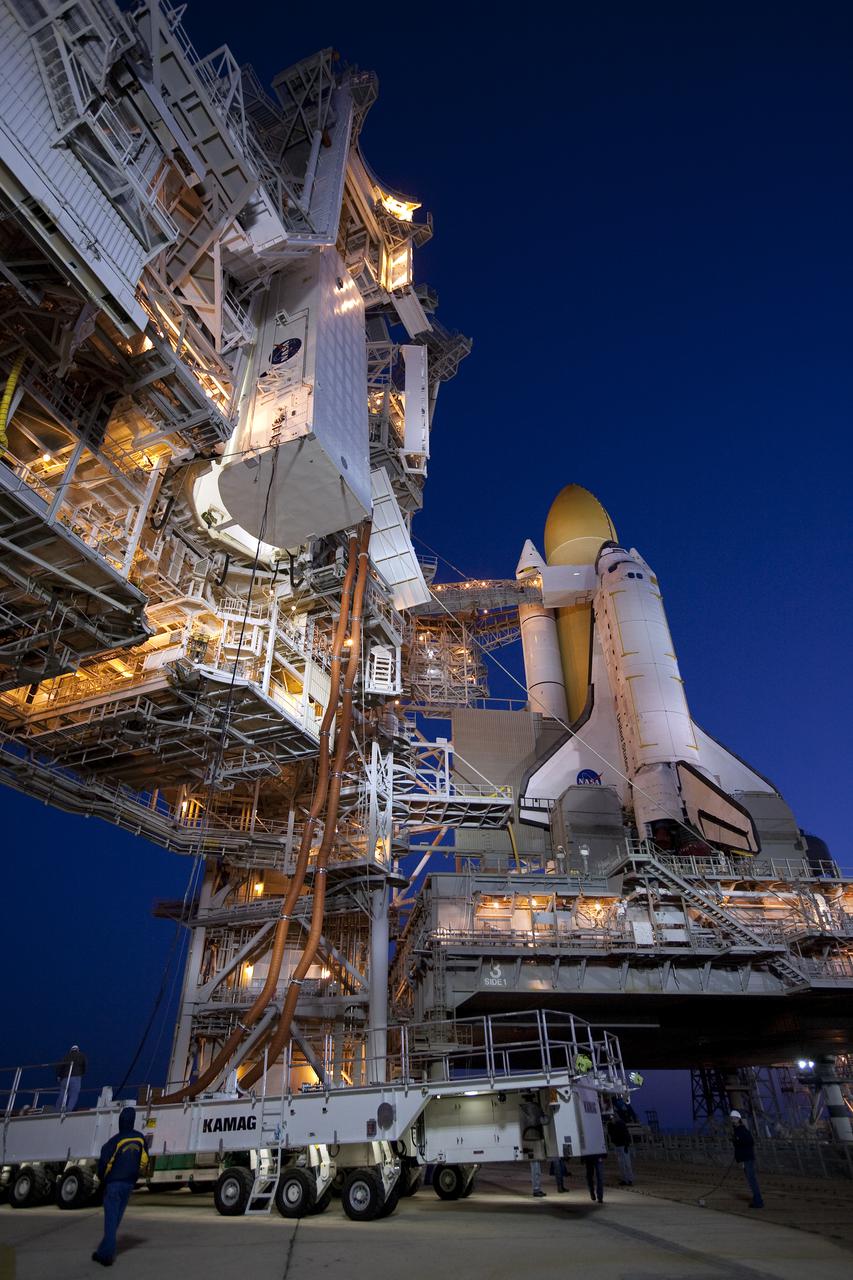
CAPE CANAVERAL, Fla. - Dawn over Launch Pad 39A at NASA's Kennedy Space Center in Florida finds the payload canister containing the multi-purpose logistics module Leonardo being lifted into the pad's payload changeout room. Located on the pad's rotating service structure, the room is an enclosed, environmentally controlled area that supports payload delivery and servicing at the pad and attaches to the shuttle's cargo bay for vertical payload installation. The contents of the canister, including Leonardo, is set to be transferred into space shuttle Discovery's cargo bay on March 24. The seven-member STS-131 crew will deliver Leonardo, filled with resupply stowage platforms and racks, to the International Space Station. STS-131 will be the 33rd shuttle mission to the station and the 131st shuttle mission overall. Launch is targeted for April 5. For information on the STS-131 mission and crew, visit http:__www.nasa.gov_mission_pages_shuttle_shuttlemissions_sts131_index.html. Photo credit: NASA_Amanda Diller
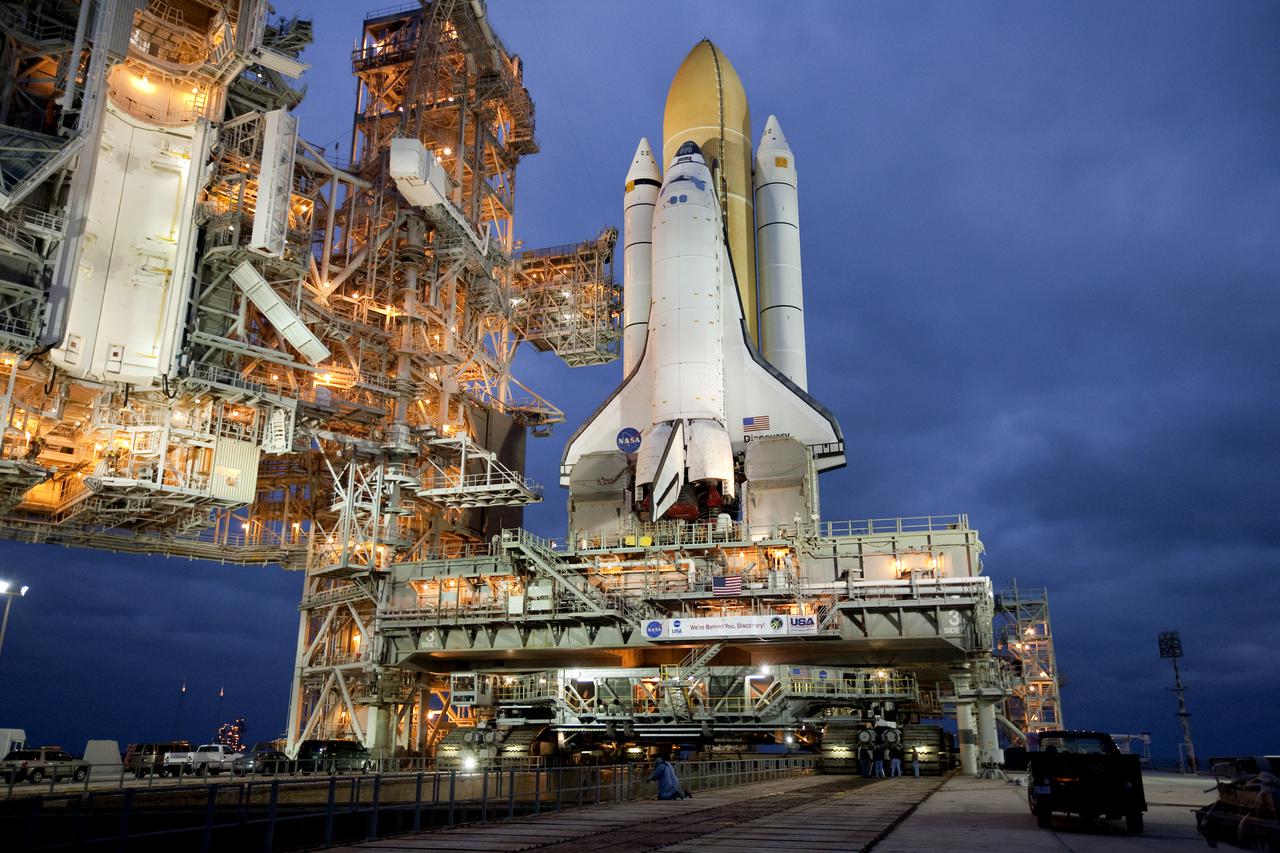
CAPE CANAVERAL, Fla. – Dawn at Launch Pad 39A at NASA's Kennedy Space Center in Florida finds NASA and United Space Alliance employees hard at work securing space shuttle Discovery to the pad. Discovery's first motion on its 3.4-mile trip from the Vehicle Assembly Building was at 11:58 p.m. EST March 2. The shuttle was secured on the pad at 6:48 a.m. March 3. Rollout is a significant milestone in launch processing activities. The seven-member STS-131 crew will deliver the multi-purpose logistics module Leonardo, filled with resupply stowage platforms and racks, to the International Space Station aboard Discovery. Targeted for launch on April 5, STS-131 will be the 33rd shuttle mission to the station and the 131st shuttle mission overall. For information on the STS-131 mission and crew, visit http:__www.nasa.gov_mission_pages_shuttle_shuttlemissions_sts131_index.html. Photo credit: NASA_Amanda Diller
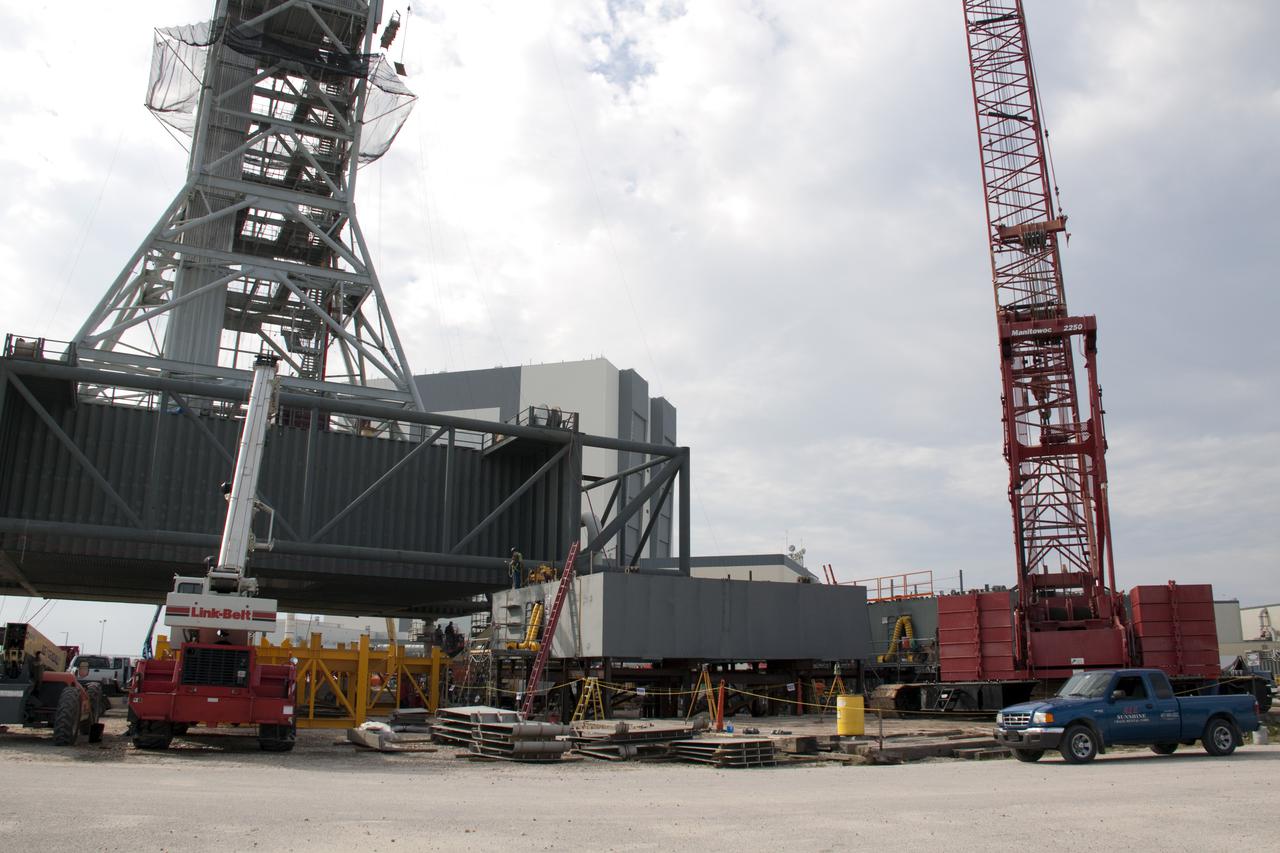
CAPE CANAVERAL, Fla. – At NASA's Kennedy Space Center in Florida, work progresses on the construction of the launch mount for a new mobile launcher, or ML, which will support NASA's future human spaceflight program, following the arrival of all eight segments. The base of the launcher's tower is at left. The construction is taking place in Launch Complex 39 in the mobile launcher park site north of Kennedy's Vehicle Assembly Building. The new launcher is 355 feet tall and has multiple platforms for personnel access. The base of the launcher is lighter than space shuttle mobile launcher platforms so the crawler-transporter can pick up the heavier load of the tower and a taller rocket. For information on NASA's future plans, visit http:__www.nasa.gov. Photo credit: NASA_Amanda Diller
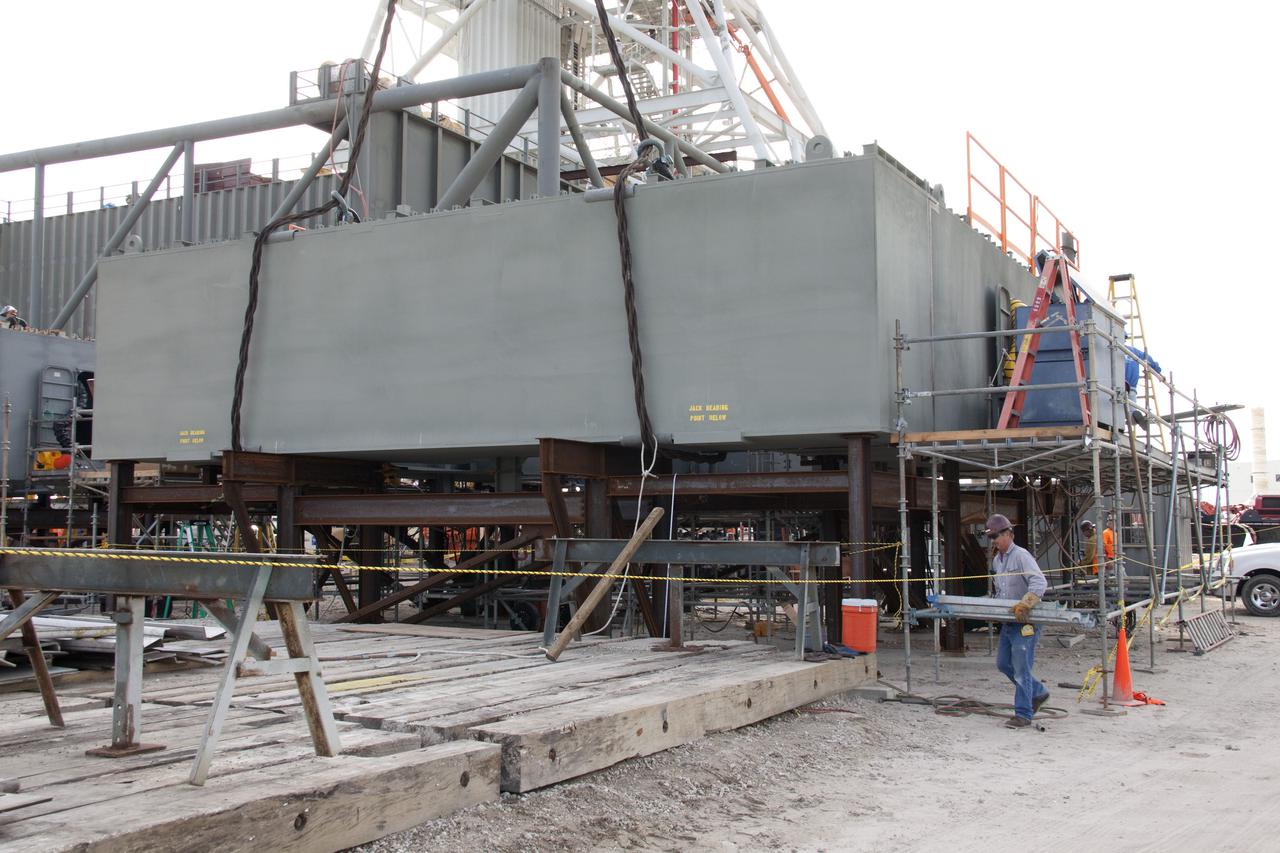
CAPE CANAVERAL, Fla. – At NASA's Kennedy Space Center in Florida, works begins to construct the launch mount for a new mobile launcher, or ML, which will support NASA's future human spaceflight program, following the arrival of all eight segments. The construction is taking place in Launch Complex 39 in the mobile launcher park site north of Kennedy's Vehicle Assembly Building. The new launcher is 355 feet tall and has multiple platforms for personnel access. The base of the launcher is lighter than space shuttle mobile launcher platforms so the crawler-transporter can pick up the heavier load of the tower and a taller rocket. For information on NASA's future plans, visit http:__www.nasa.gov. Photo credit: NASA_Amanda Diller
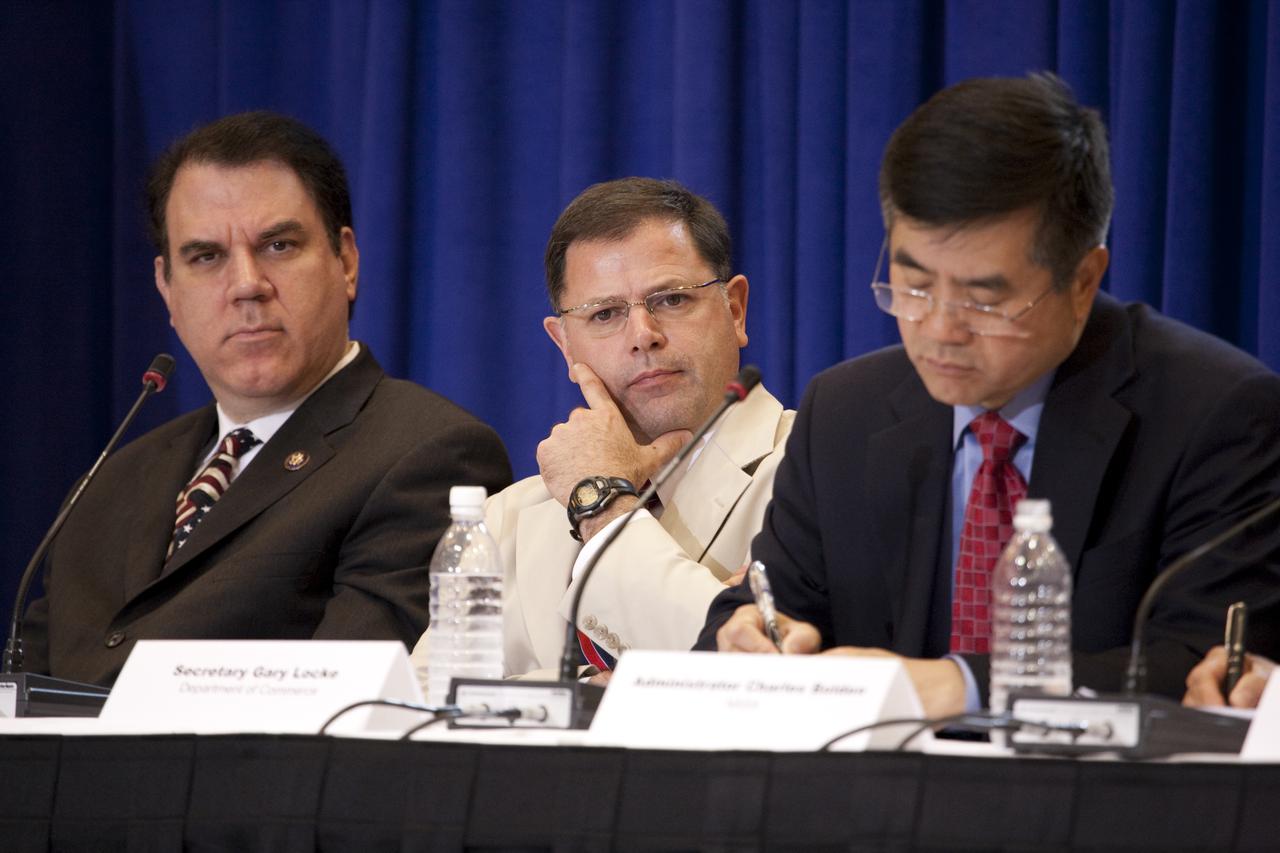
ORLANDO, Fla. – From left, Rep. Alan Grayson of Florida, Assistant Secretary of Commerce for Economic Development John Fernandez and Secretary of Commerce Gary Locke listen to presentations from business and community leaders during a town hall meeting at the Orlando Airport Hyatt Hotel as part of the Presidential Task Force on Space Industry Work Force and Economic Development. The task force heard from local leaders about ways to strengthen the work force as NASA moves toward retirement of the Space Shuttle Program. The task force is a $40 million, multi-agency initiative for regional and economic growth to assist the Space Coast as the country’s space exploration efforts expand and transform. Photo credit: NASA_Amanda Diller
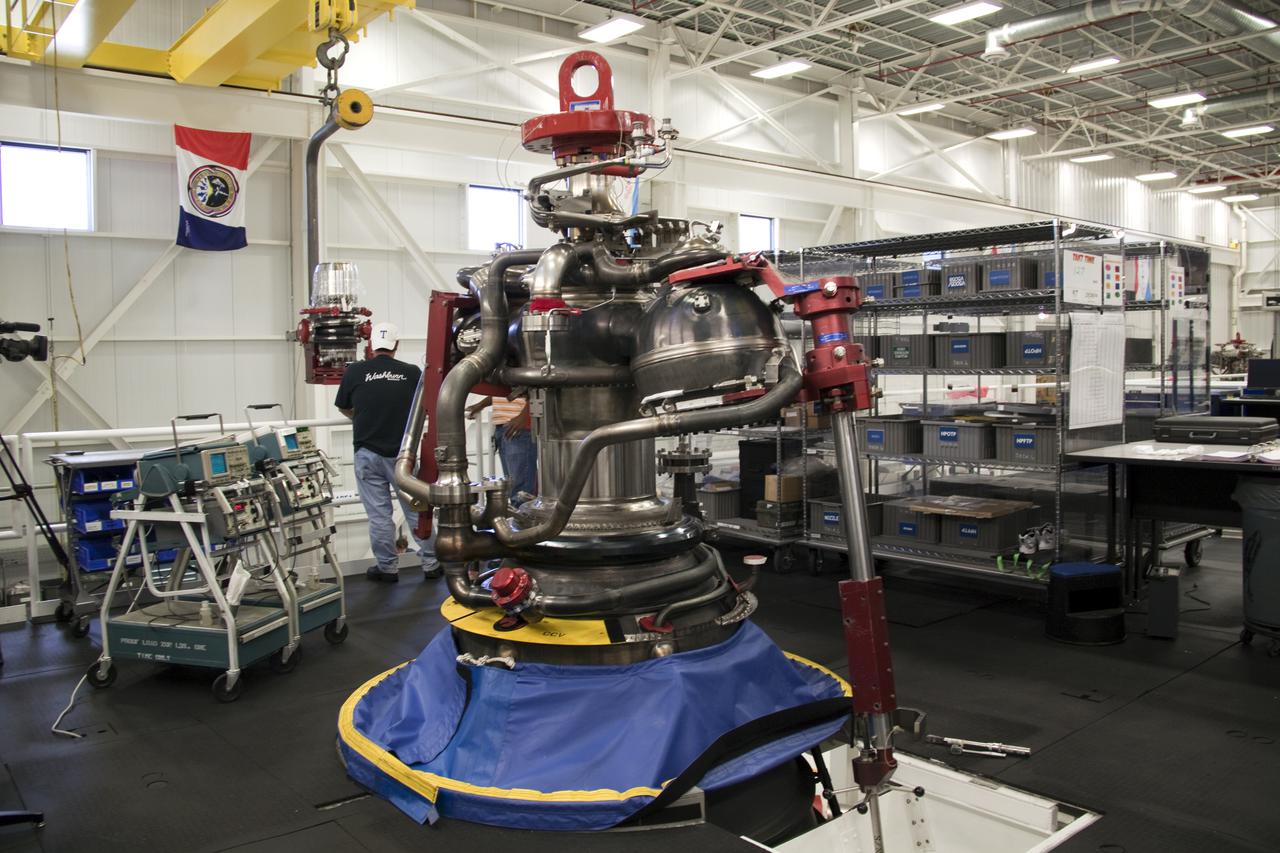
CAPE CANAVERAL, Fla. – In the Space Shuttle Main Engine Processing Facility at NASA's Kennedy Space Center in Florida, preparations are under way to install a high pressure oxidizer turbo pump on space shuttle main engine no. 2062, seen here. The engine, or SSME, is the last one scheduled to be built at Kennedy by Pratt and Whitney Rocketdyne before the end of the Space Shuttle Program. Three main engines are clustered at the aft end of the shuttle and have a combined thrust of more than 1.2 million pounds. Even though an SSME weighs one-seventh as much as a locomotive engine, its high-pressure fuel pump alone delivers as much horsepower as 28 locomotives. Each engine operates during the entire eight-and-a-half minute climb to orbit. Post-flight inspections and maintenance of each engine also are conducted in the SSME Processing Facility between shuttle missions. Photo credit: NASA_Amanda Diller
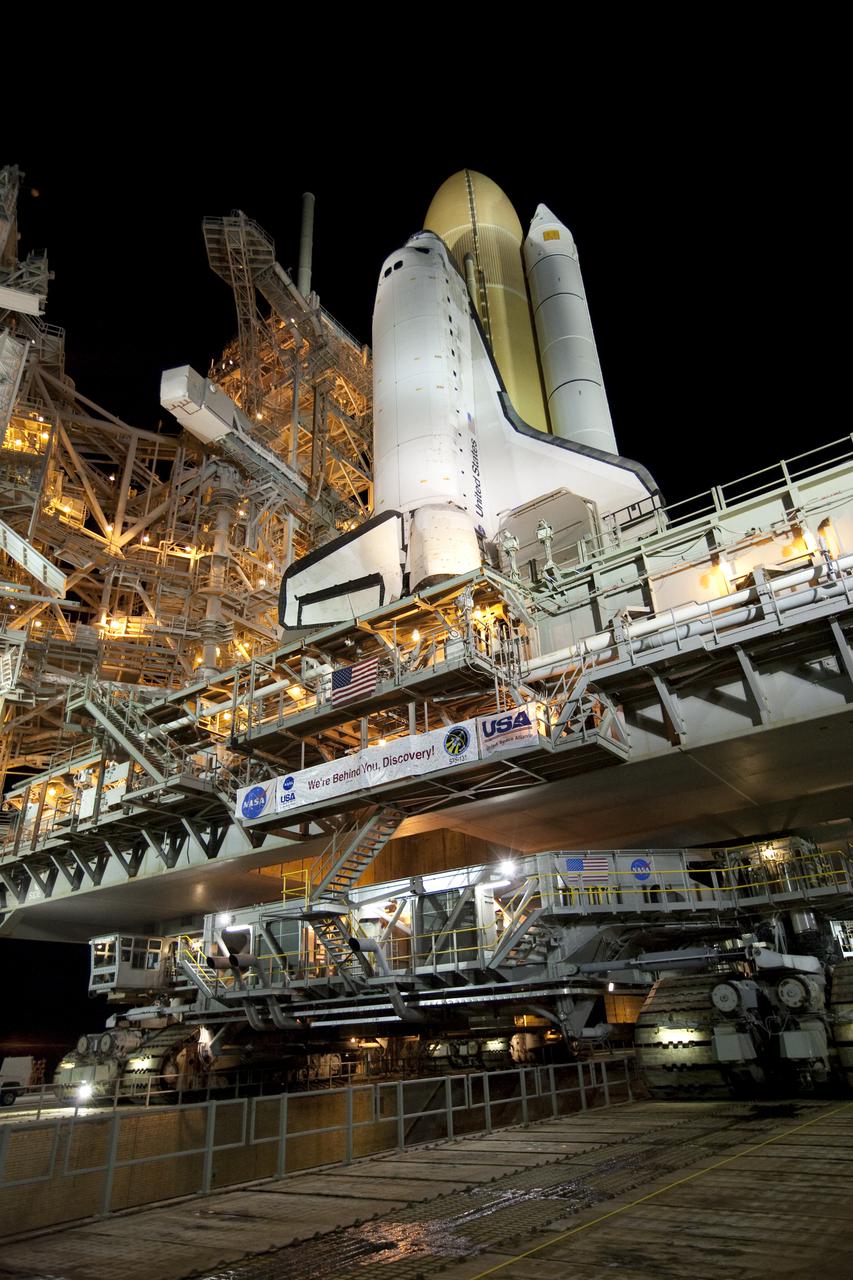
CAPE CANAVERAL, Fla. – On Launch Pad 39A at NASA's Kennedy Space Center in Florida, the crawler-transporter beneath space shuttle Discovery crosses over the pad's flame trench. Discovery's first motion on its 3.4-mile trip from the Vehicle Assembly Building was at 11:58 p.m. EST March 2. The shuttle was secured on the pad at 6:48 a.m. March 3. Rollout is a significant milestone in launch processing activities. The seven-member STS-131 crew will deliver the multi-purpose logistics module Leonardo, filled with resupply stowage platforms and racks, to the International Space Station aboard Discovery. Targeted for launch on April 5, STS-131 will be the 33rd shuttle mission to the station and the 131st shuttle mission overall. For information on the STS-131 mission and crew, visit http:__www.nasa.gov_mission_pages_shuttle_shuttlemissions_sts131_index.html. Photo credit: NASA_Amanda Diller
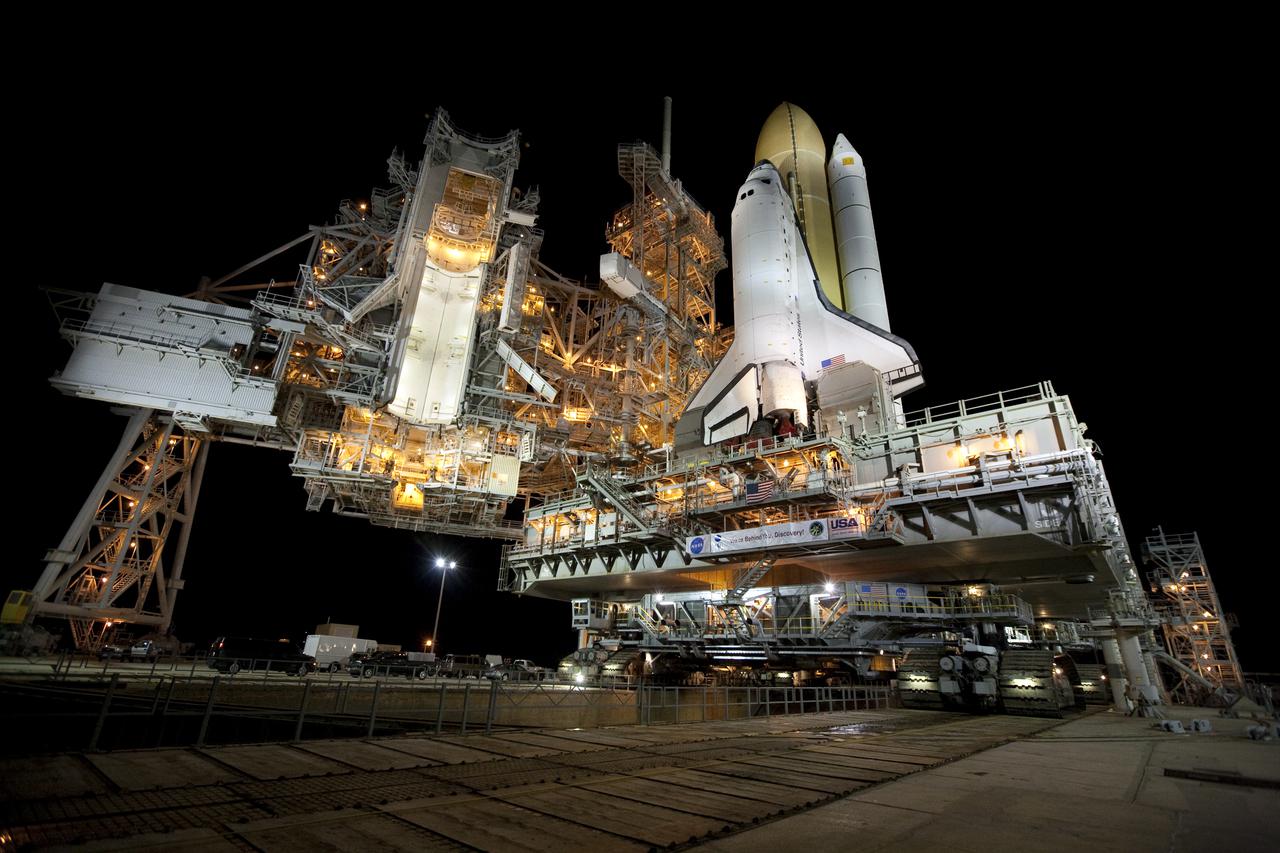
CAPE CANAVERAL, Fla. – The rotating and fixed service structures are brightly lit on Launch Pad 39A at NASA's Kennedy Space Center in Florida for the arrival of space shuttle Discovery just before sunrise. Discovery's first motion on its 3.4-mile trip from the Vehicle Assembly Building was at 11:58 p.m. EST March 2. The shuttle was secured on the pad at 6:48 a.m. March 3. Rollout is a significant milestone in launch processing activities. The seven-member STS-131 crew will deliver the multi-purpose logistics module Leonardo, filled with resupply stowage platforms and racks, to the International Space Station aboard Discovery. Targeted for launch on April 5, STS-131 will be the 33rd shuttle mission to the station and the 131st shuttle mission overall. For information on the STS-131 mission and crew, visit http:__www.nasa.gov_mission_pages_shuttle_shuttlemissions_sts131_index.html. Photo credit: NASA_Amanda Diller
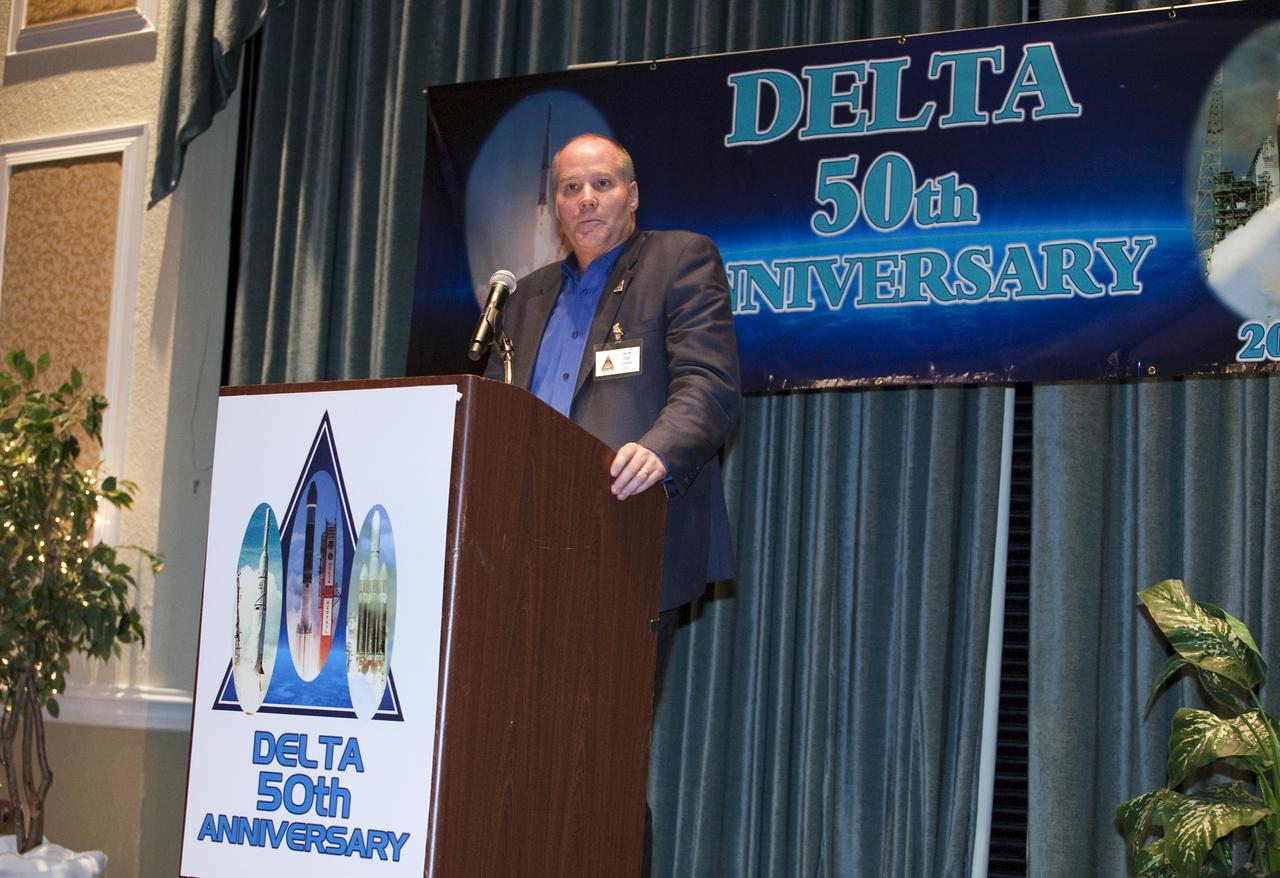
CAPE CANAVERAL, Fla. - Daniel Collins, chief operating officer of United Launch Alliance, helps the company, NASA, the U.S. Air Force, Boeing, Pratt and Whitney Rocketdyne, Aerojet and the NASA Alumni League celebrate the Delta expendable launch vehicle program's 50th anniversary at the Radisson Resort in Cape Canaveral, Fla., on May 16. NASA launched the first Delta rocket, which only was intended to be an interim launch vehicle, on May 13, 1960. A half-century later, more than 300 Delta rockets have launched to place crucial weather and environmental satellites into Earth orbit. The vehicles also have sent spacecraft on missions to other planets and comets, and to study the universe. Currently, the Delta II and Delta IV are in use by NASA's Launch Services Program based at Kennedy Space Center in Florida, and are launched by United Launch Alliance. Photo credit: NASA_Amanda Diller
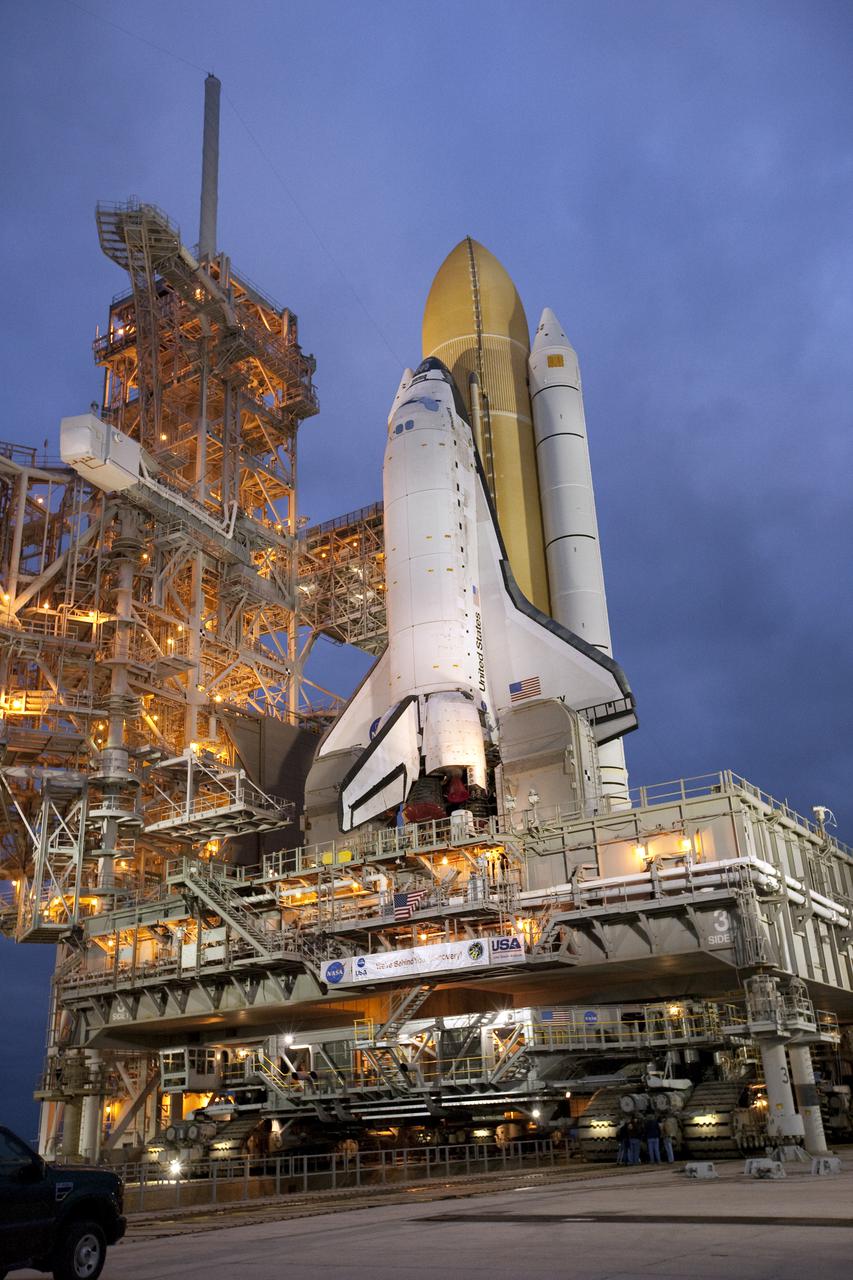
CAPE CANAVERAL, Fla. – The lightning mast atop the fixed service structure at Launch Pad 39A at NASA's Kennedy Space Center in Florida stands ready to protect space shuttle Discovery. Discovery's first motion on its 3.4-mile trip from the Vehicle Assembly Building was at 11:58 p.m. EST March 2. The shuttle was secured on the pad at 6:48 a.m. March 3. Rollout is a significant milestone in launch processing activities. The seven-member STS-131 crew will deliver the multi-purpose logistics module Leonardo, filled with resupply stowage platforms and racks, to the International Space Station aboard Discovery. Targeted for launch on April 5, STS-131 will be the 33rd shuttle mission to the station and the 131st shuttle mission overall. For information on the STS-131 mission and crew, visit http:__www.nasa.gov_mission_pages_shuttle_shuttlemissions_sts131_index.html. Photo credit: NASA_Amanda Diller
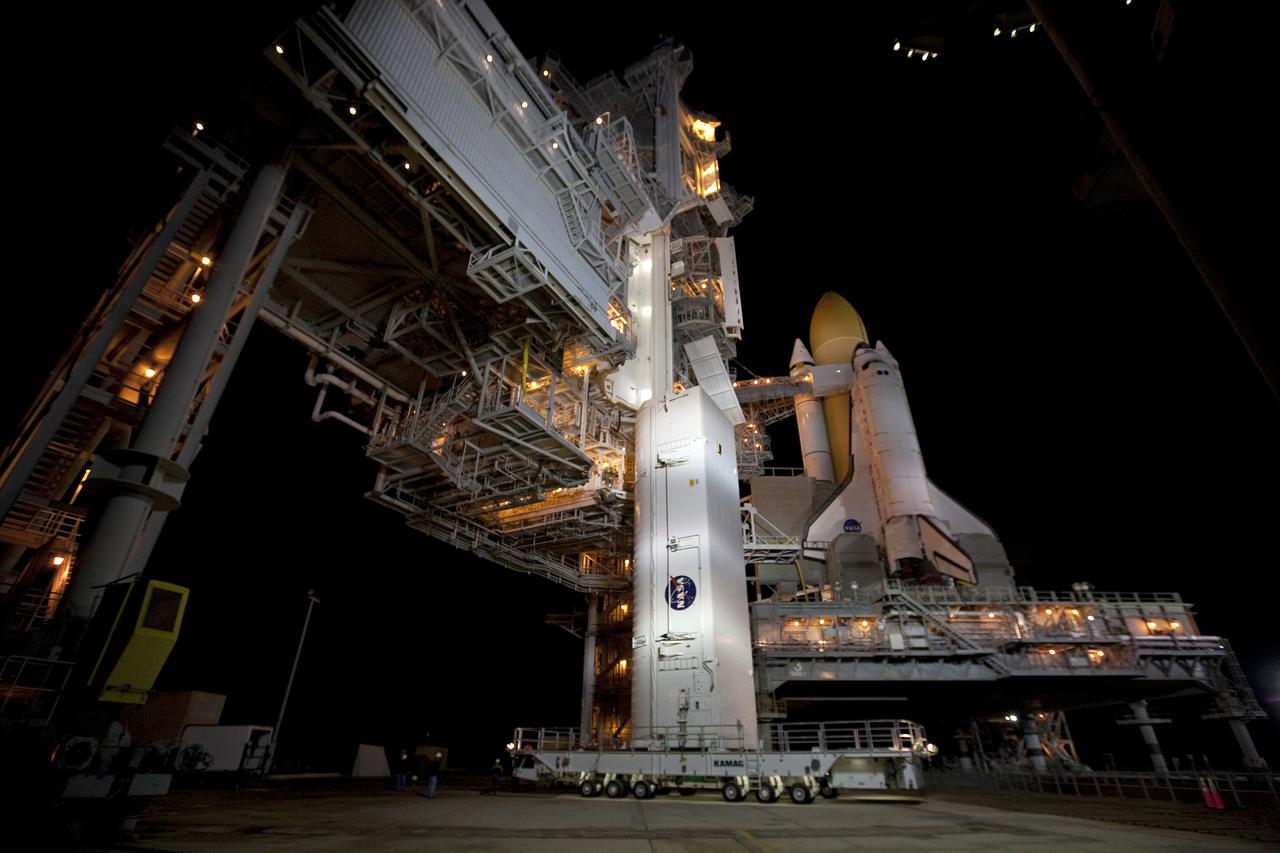
CAPE CANAVERAL, Fla. - At NASA's Kennedy Space Center in Florida, the payload canister containing the multi-purpose logistics module Leonardo, standing vertically on a transporter, arrives at Launch Pad 39A. The canister next will be lifted into the pad's payload changout room. Located on the pad's rotating service structure, the room is an enclosed, environmentally controlled area that supports payload delivery and servicing at the pad and attaches to the shuttle's cargo bay for vertical payload installation. The contents of the canister, including Leonardo, is set to be transferred into space shuttle Discovery's cargo bay on March 24. The seven-member STS-131 crew will deliver Leonardo, filled with resupply stowage platforms and racks, to the International Space Station. STS-131 will be the 33rd shuttle mission to the station and the 131st shuttle mission overall. Launch is targeted for April 5. For information on the STS-131 mission and crew, visit http:__www.nasa.gov_mission_pages_shuttle_shuttlemissions_sts131_index.html. Photo credit: NASA_Amanda Diller
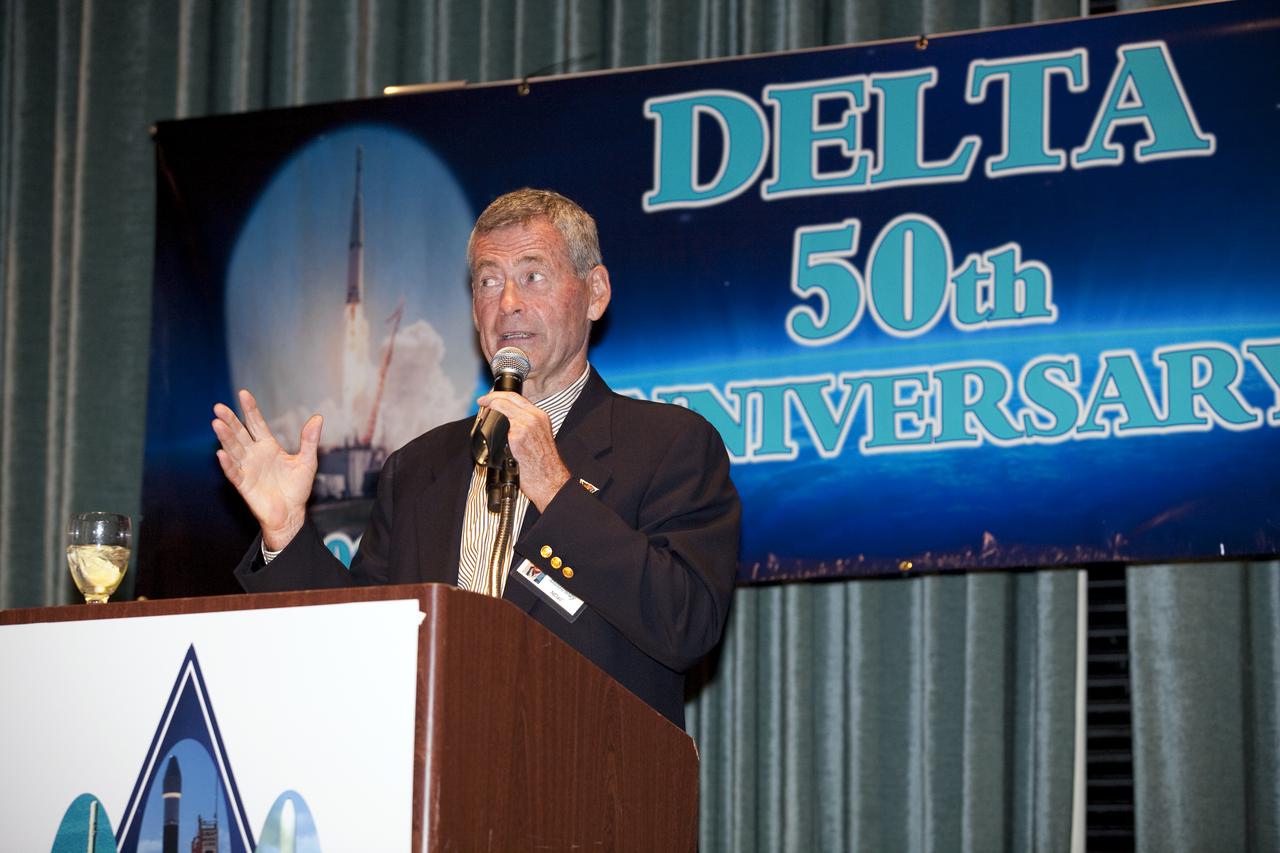
CAPE CANAVERAL, Fla. - Lyle Holloway, former director of launch sites originally for McDonnell Douglas, helps NASA, the U.S. Air Force, United Launch Alliance, Boeing, Pratt and Whitney Rocketdyne, Aerojet and the NASA Alumni League celebrate the Delta expendable launch vehicle program's 50th anniversary at the Radisson Resort in Cape Canaveral, Fla., on May 16. NASA launched the first Delta rocket, which only was intended to be an interim launch vehicle, on May 13, 1960. A half-century later, more than 300 Delta rockets have launched to place crucial weather and environmental satellites into Earth orbit. The vehicles also have sent spacecraft on missions to other planets and comets, and to study the universe. Currently, the Delta II and Delta IV are in use by NASA's Launch Services Program based at Kennedy Space Center in Florida, and are launched by United Launch Alliance. Photo credit: NASA_Amanda Diller
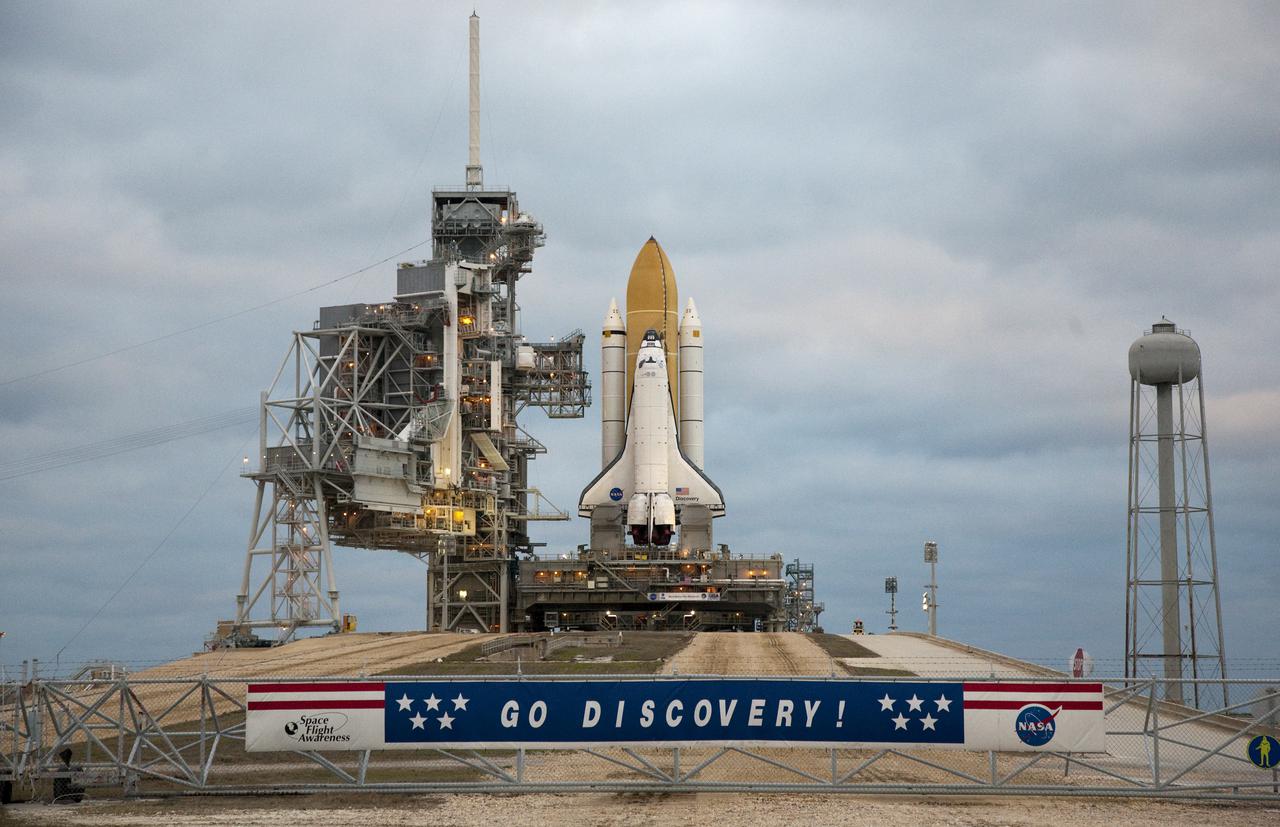
CAPE CANAVERAL, Fla. – Excitement builds at NASA's Kennedy Space Center in Florida in anticipation of space shuttle Discovery's upcoming liftoff from Launch Pad 39A. Go Discovery_ Discovery's first motion on its 3.4-mile trip from the Vehicle Assembly Building was at 11:58 p.m. EST March 2. The shuttle was secured on the pad at 6:48 a.m. March 3. Rollout is a significant milestone in launch processing activities. The seven-member STS-131 crew will deliver the multi-purpose logistics module Leonardo, filled with resupply stowage platforms and racks, to the International Space Station aboard Discovery. Targeted for launch on April 5, STS-131 will be the 33rd shuttle mission to the station and the 131st shuttle mission overall. For information on the STS-131 mission and crew, visit http:__www.nasa.gov_mission_pages_shuttle_shuttlemissions_sts131_index.html. Photo credit: NASA_Amanda Diller
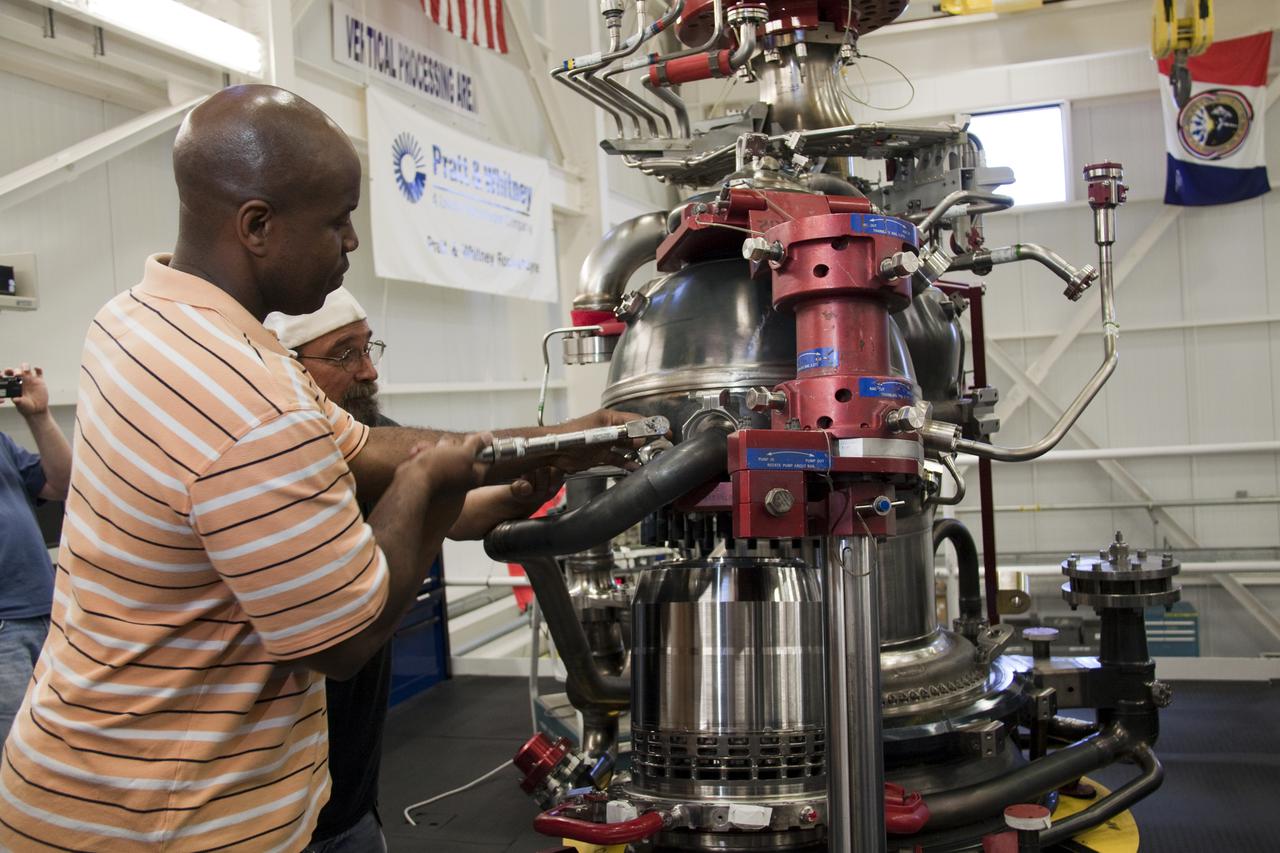
CAPE CANAVERAL, Fla. – In the Space Shuttle Main Engine Processing Facility at NASA's Kennedy Space Center in Florida, Pratt and Whitney Rocketdyne engine technician Teryon Jones, left, and quality inspector Barry Martin install a high pressure oxidizer turbo pump on space shuttle main engine no. 2062. The engine, or SSME, is the last one scheduled to be built at Kennedy before the end of the Space Shuttle Program. Three main engines are clustered at the aft end of the shuttle and have a combined thrust of more than 1.2 million pounds. Even though an SSME weighs one-seventh as much as a locomotive engine, its high-pressure fuel pump alone delivers as much horsepower as 28 locomotives. Each engine operates during the entire eight-and-a-half minute climb to orbit. Post-flight inspections and maintenance of each engine also are conducted in the SSME Processing Facility between shuttle missions. Photo credit: NASA_Amanda Diller
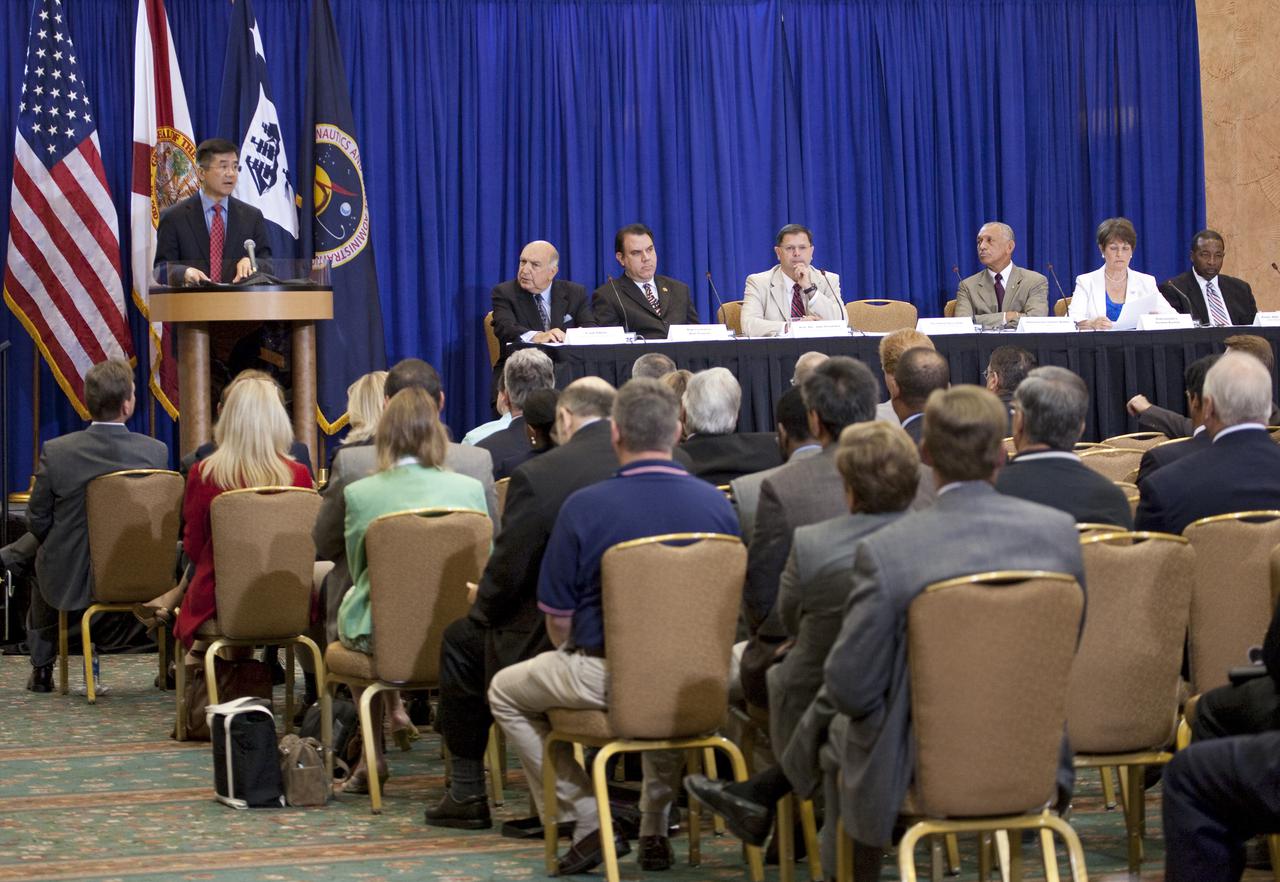
ORLANDO, Fla. – Secretary of Commerce Gary Locke addresses business and industry leaders during a town hall meeting at the Orlando Airport Hyatt Hotel as part of the Presidential Task Force on Space Industry Work Force and Economic Development. Panel members, seated from the left are, Space Florida President Frank DiBello, Rep. Alan Grayson of Florida, Assistant Secretary of Commerce for Economic Development John Fernandez, NASA Administrator Charles Bolden, Rep. Suzanne Kosmas of Florida and NASA Associate Administrator for Mission Support Woodrow Whitlow. The task force heard from local leaders about ways to strengthen the work force as NASA moves toward retirement of the Space Shuttle Program. The task force is a $40 million, multi-agency initiative for regional and economic growth to assist the Space Coast as the country’s space exploration efforts expand and transform. Photo credit: NASA_Amanda Diller
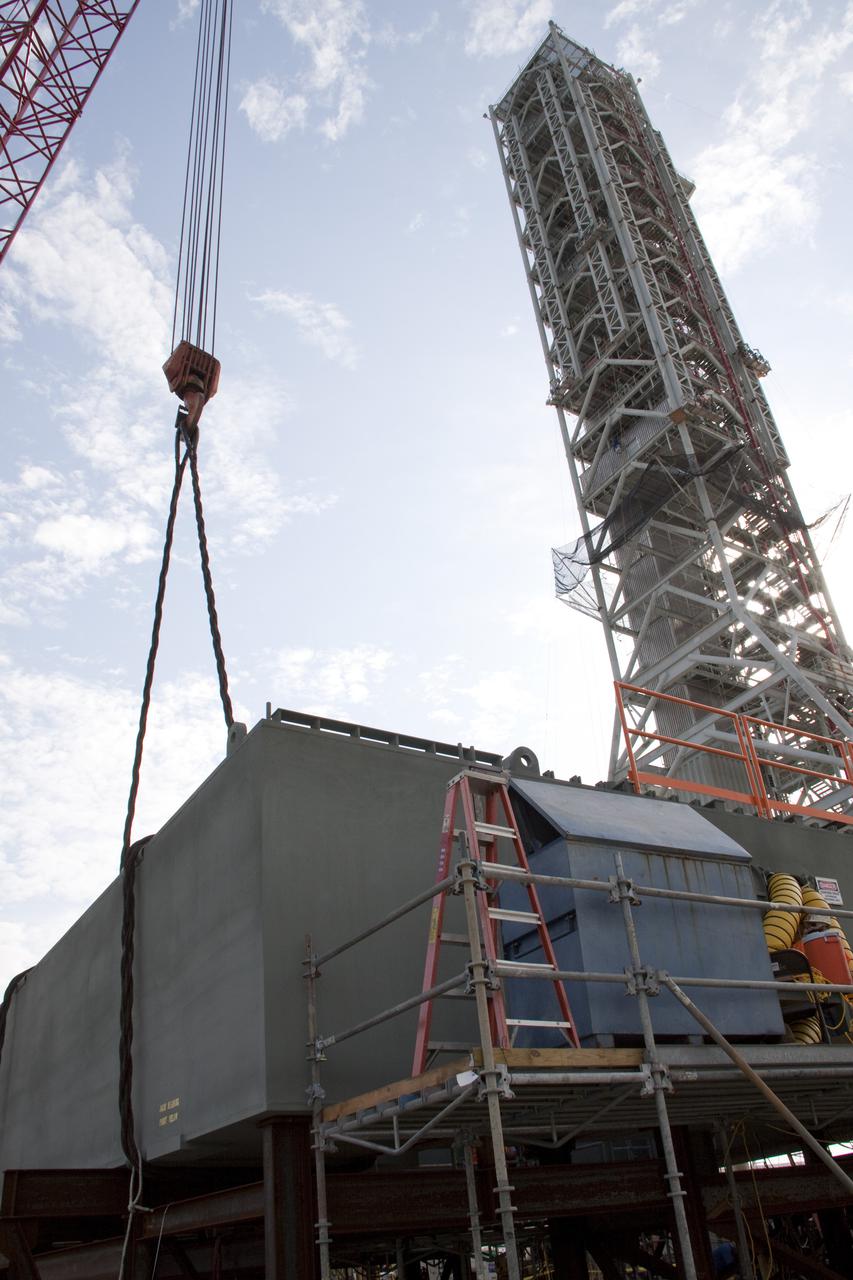
CAPE CANAVERAL, Fla. – At NASA's Kennedy Space Center in Florida, a crane is enlisted to lift a section of the launch mount for a new mobile launcher, or ML, being constructed to support NASA's future human spaceflight program. All eight segments of the mount have been delivered to Kennedy. The launcher's tower looms overhead, at right. The construction is taking place in Launch Complex 39 in the mobile launcher park site north of Kennedy's Vehicle Assembly Building. The new launcher is 355 feet tall and has multiple platforms for personnel access. The base of the launcher is lighter than space shuttle mobile launcher platforms so the crawler-transporter can pick up the heavier load of the tower and a taller rocket. For information on NASA's future plans, visit http:__www.nasa.gov. Photo credit: NASA_Amanda Diller
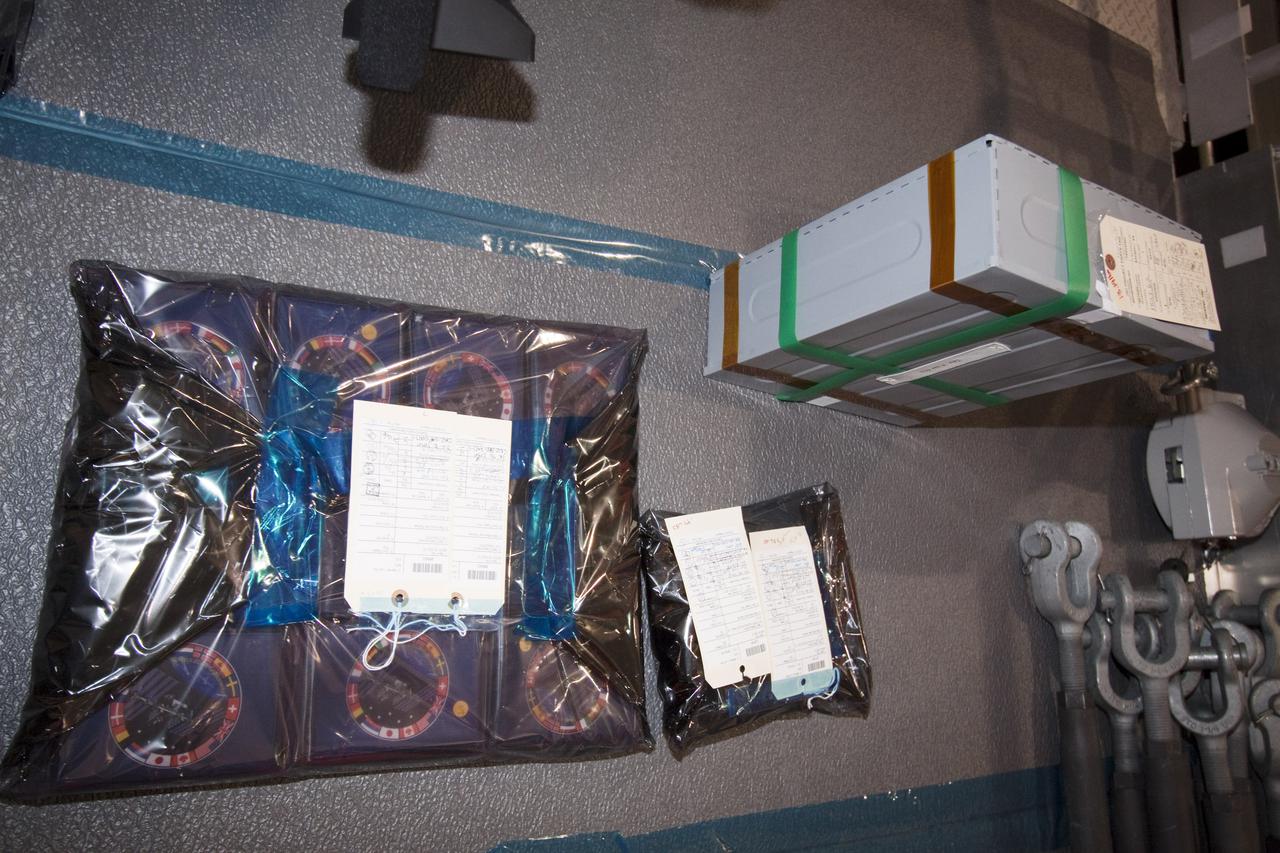
CAPE CANAVERAL, Fla. - In the Space Station Processing Facility at NASA's Kennedy Space Center in Florida, plastic bags contain International Space Station patches and other memorabilia that will be stored in the Multi-Purpose Logistics Module Leonardo and carried into space on its upcoming flight. The seven-member STS-131 crew will deliver Leonardo, filled with resupply stowage platforms and racks, to the International Space Station aboard space shuttle Discovery. On STS-131, work to attach a spare ammonia tank assembly to the station's exterior and return a European experiment from outside the station's Columbus module will be conducted during three spacewalks. Targeted for launch on April 5, STS-131 will be the 33rd shuttle mission to the station and the 131st shuttle mission overall. For information on the STS-131 mission and crew, visit http:__www.nasa.gov_mission_pages_shuttle_shuttlemissions_sts131_index.html. Photo credit: NASA_Amanda Diller
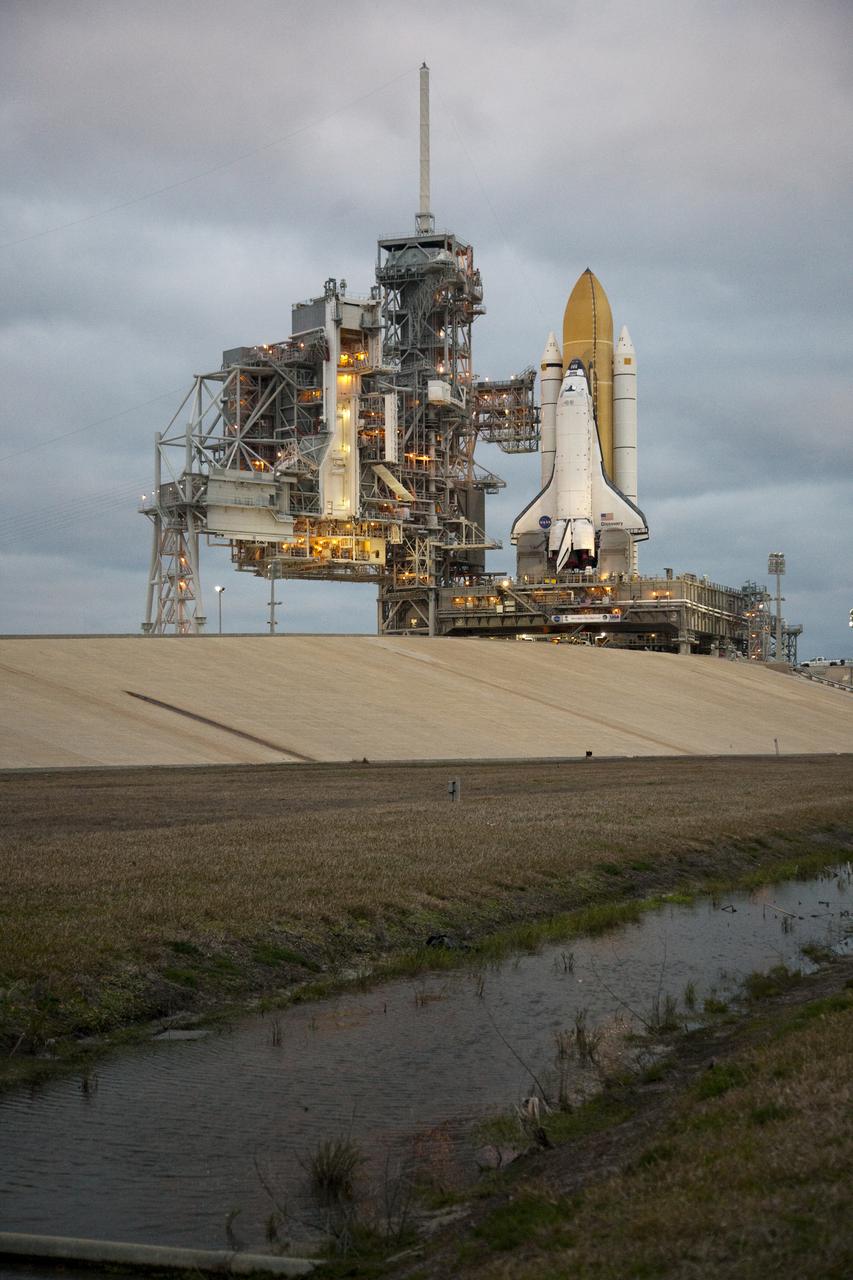
CAPE CANAVERAL, Fla. – The sun rises over Launch Pad 39A at NASA's Kennedy Space Center in Florida to a cloud-filled sky and operations under way to secure space shuttle Discovery to the pad. Discovery's first motion on its 3.4-mile trip from the Vehicle Assembly Building was at 11:58 p.m. EST March 2. The shuttle was secured on the pad at 6:48 a.m. March 3. Rollout is a significant milestone in launch processing activities. The seven-member STS-131 crew will deliver the multi-purpose logistics module Leonardo, filled with resupply stowage platforms and racks, to the International Space Station aboard Discovery. Targeted for launch on April 5, STS-131 will be the 33rd shuttle mission to the station and the 131st shuttle mission overall. For information on the STS-131 mission and crew, visit http:__www.nasa.gov_mission_pages_shuttle_shuttlemissions_sts131_index.html. Photo credit: NASA_Amanda Diller
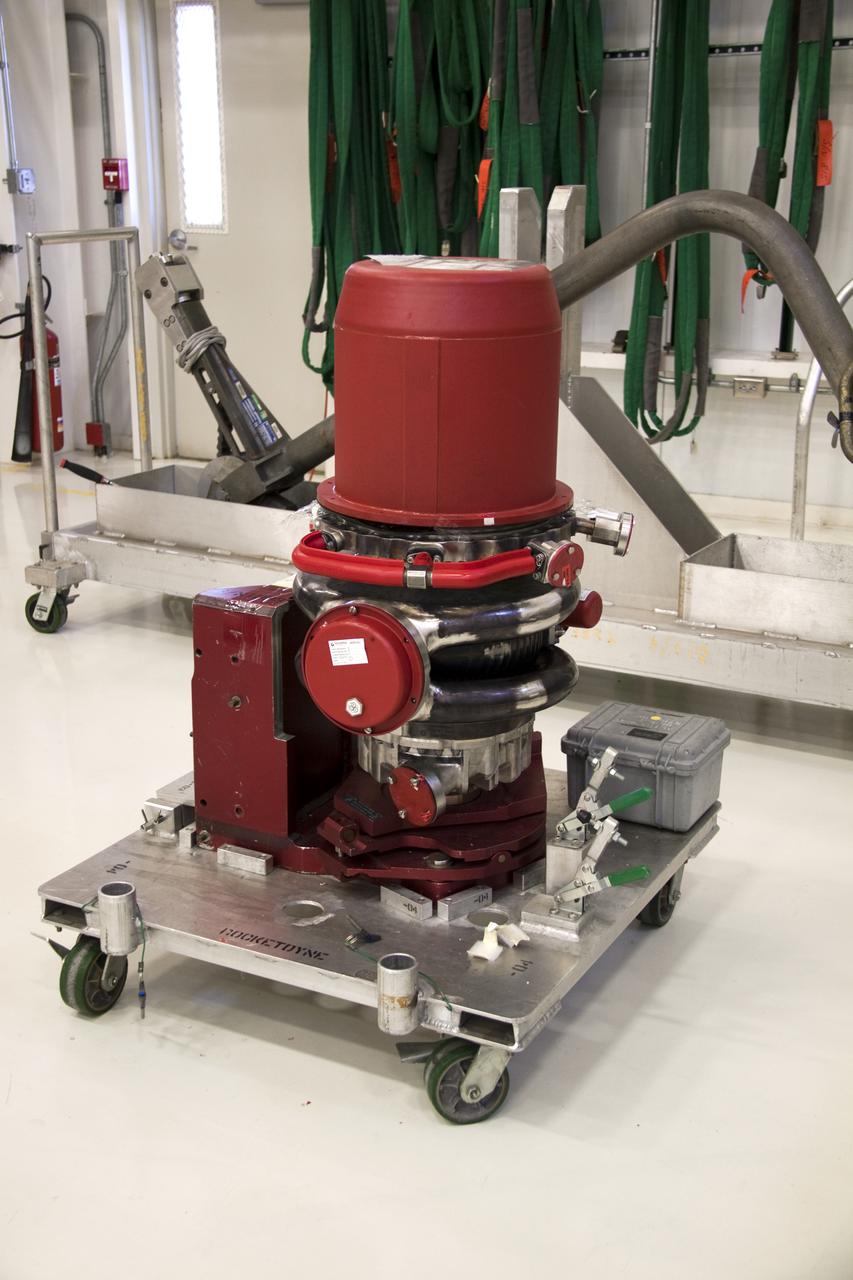
CAPE CANAVERAL, Fla. – In the Space Shuttle Main Engine Processing Facility at NASA's Kennedy Space Center in Florida, preparations are under way to install this high pressure oxidizer turbo pump on space shuttle main engine no. 2062. The engine, or SSME, is the last one scheduled to be built at Kennedy by Pratt and Whitney Rocketdyne before the end of the Space Shuttle Program. Three main engines are clustered at the aft end of the shuttle and have a combined thrust of more than 1.2 million pounds. Even though an SSME weighs one-seventh as much as a locomotive engine, its high-pressure fuel pump alone delivers as much horsepower as 28 locomotives. Each engine operates during the entire eight-and-a-half minute climb to orbit. Post-flight inspections and maintenance of each engine also are conducted in the SSME Processing Facility between shuttle missions. Photo credit: NASA_Amanda Diller
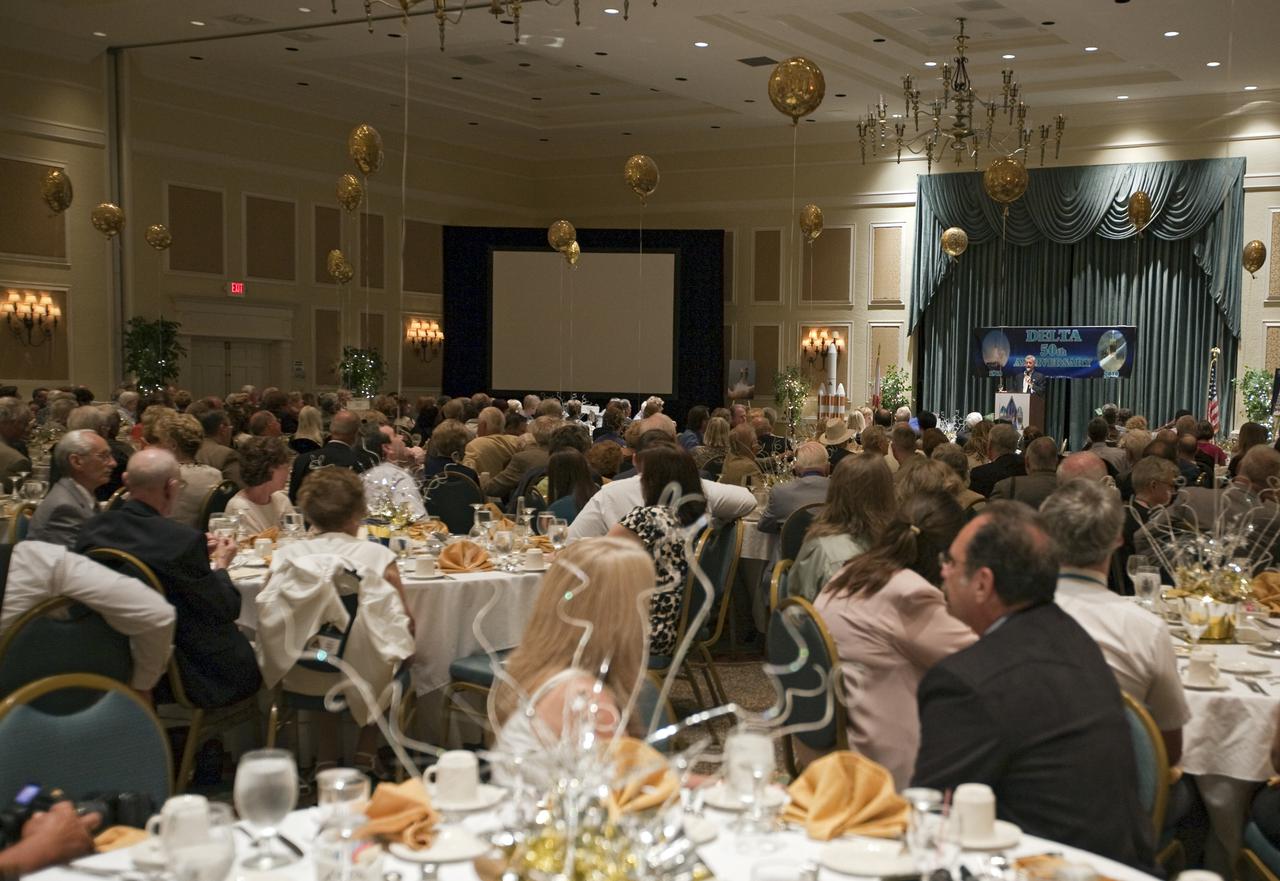
CAPE CANAVERAL, Fla. - Hundreds of NASA, U.S. Air Force, United Launch Alliance, Boeing, Pratt and Whitney Rocketdyne and Aerojet employees, along with NASA Alumni League members, celebrate the Delta expendable launch vehicle program's 50th anniversary at the Radisson Resort in Cape Canaveral, Fla., on May 16. NASA launched the first Delta rocket, which only was intended to be an interim launch vehicle, on May 13, 1960. A half-century later, more than 300 Delta rockets have launched to place crucial weather and environmental satellites into Earth orbit. The vehicles also have sent spacecraft on missions to other planets and comets, and to study the universe. Currently, the Delta II and Delta IV are in use by NASA's Launch Services Program based at Kennedy Space Center in Florida, and are launched by United Launch Alliance. Photo credit: NASA_Amanda Diller
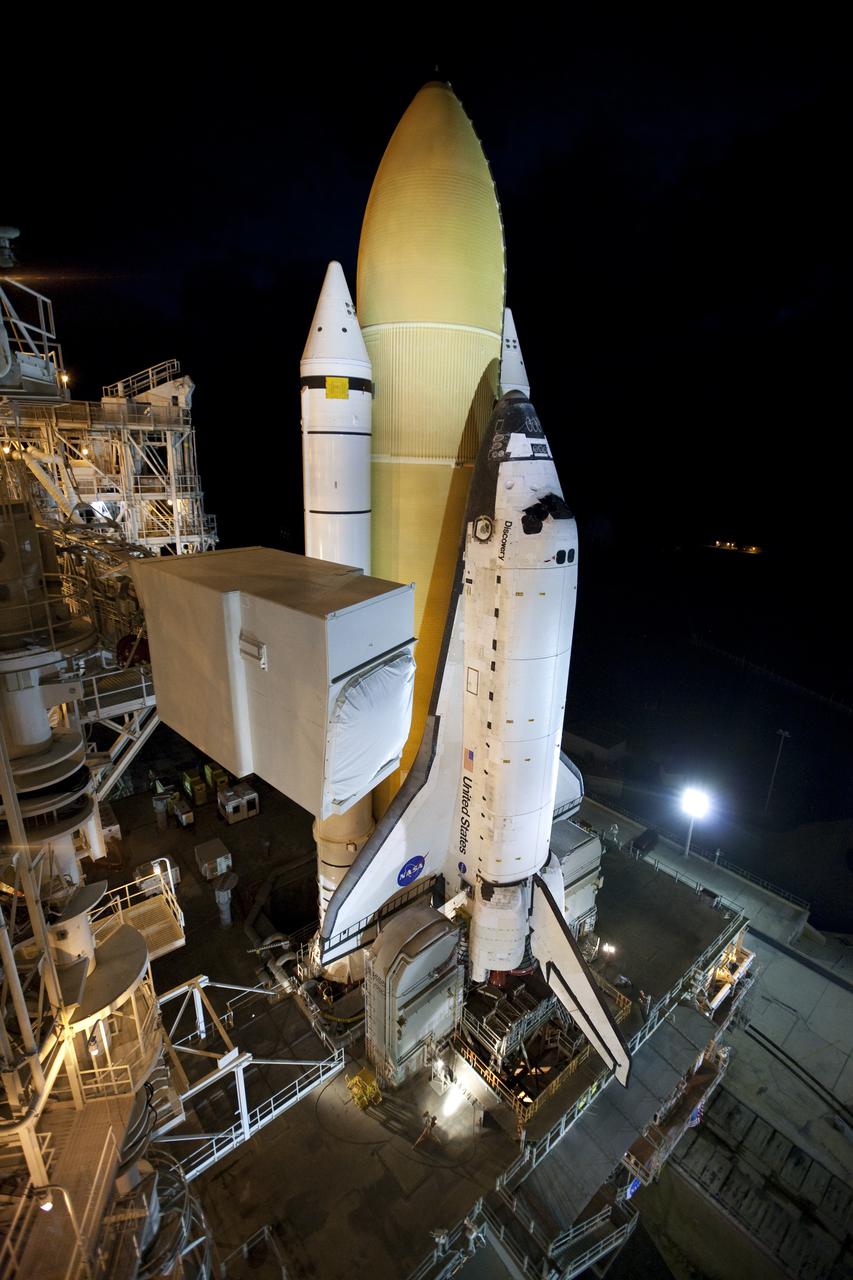
CAPE CANAVERAL, Fla. – On Launch Pad 39A at NASA's Kennedy Space Center in Florida, the pad's White Room, which provides workers and astronauts an entry point to a shuttle's crew compartment, awaits placement against space shuttle Discovery. Discovery's first motion on its 3.4-mile trip from the Vehicle Assembly Building was at 11:58 p.m. EST March 2. The shuttle was secured on the pad at 6:48 a.m. March 3. Rollout is a significant milestone in launch processing activities. The seven-member STS-131 crew will deliver the multi-purpose logistics module Leonardo, filled with resupply stowage platforms and racks, to the International Space Station aboard Discovery. Targeted for launch on April 5, STS-131 will be the 33rd shuttle mission to the station and the 131st shuttle mission overall. For information on the STS-131 mission and crew, visit http:__www.nasa.gov_mission_pages_shuttle_shuttlemissions_sts131_index.html. Photo credit: NASA_Amanda Diller
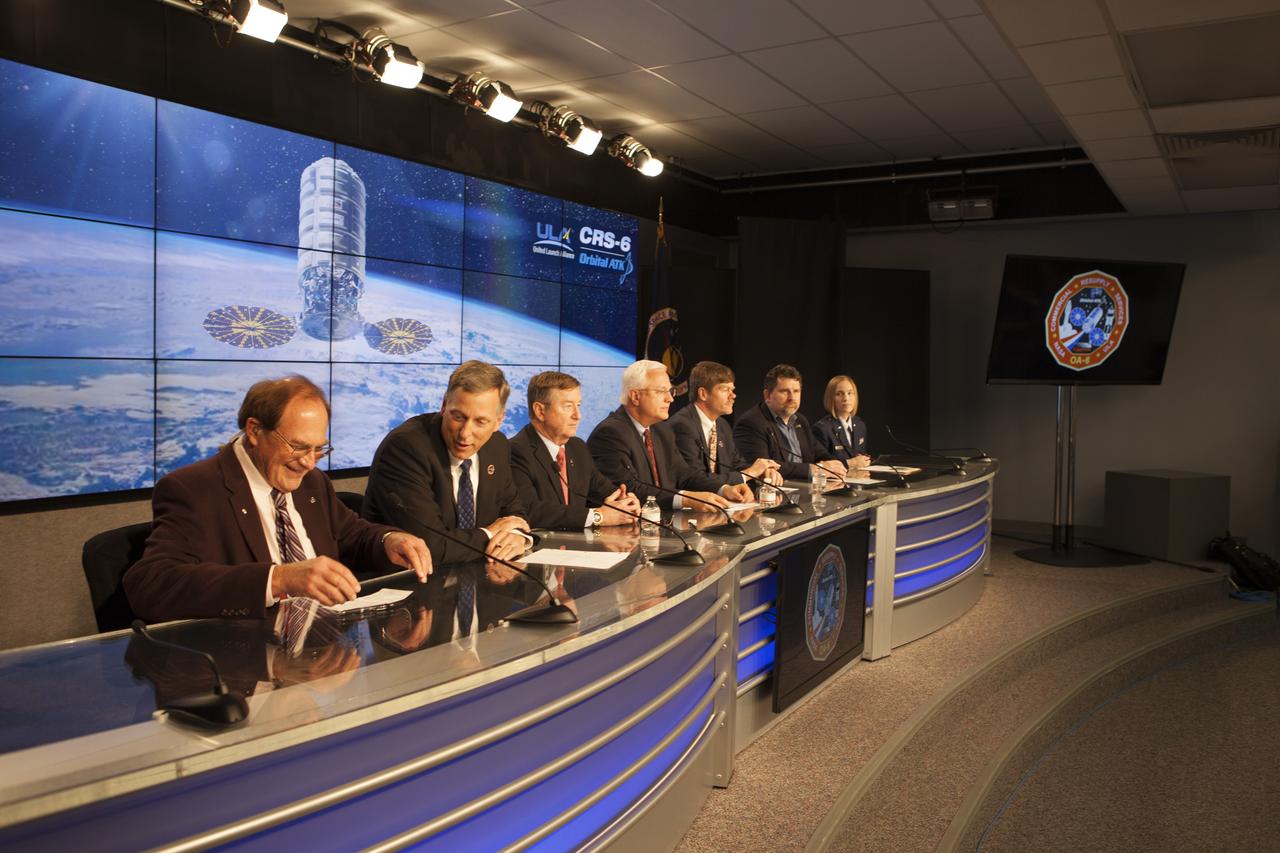
In the Kennedy Space Center’s Press Site auditorium, agency and industry leaders speak to members of the media at a prelaunch news conference for Orbital ATK CRS-6 commercial resupply services mission to the International Space Station. From left are: George Diller of NASA Communications; Kenneth Todd, NASA ISS Operations Integration manager; Frank Culbertson, president of Orbital ATK's Space System Group; Vern Thorp, United Space Alliance's program manager for NASA missions; Pete Hasbrook, NASA associate program scientist for the ISS Program at the Johnson Space Center in Houston; Dr. Michael Roberts deputy chief scientist for the Center for the Advancement for Science in Space, or CASIS; and Capt. Laura Godoy, launch weather officer of the U.S. Air Force 45th Weather Squadron.
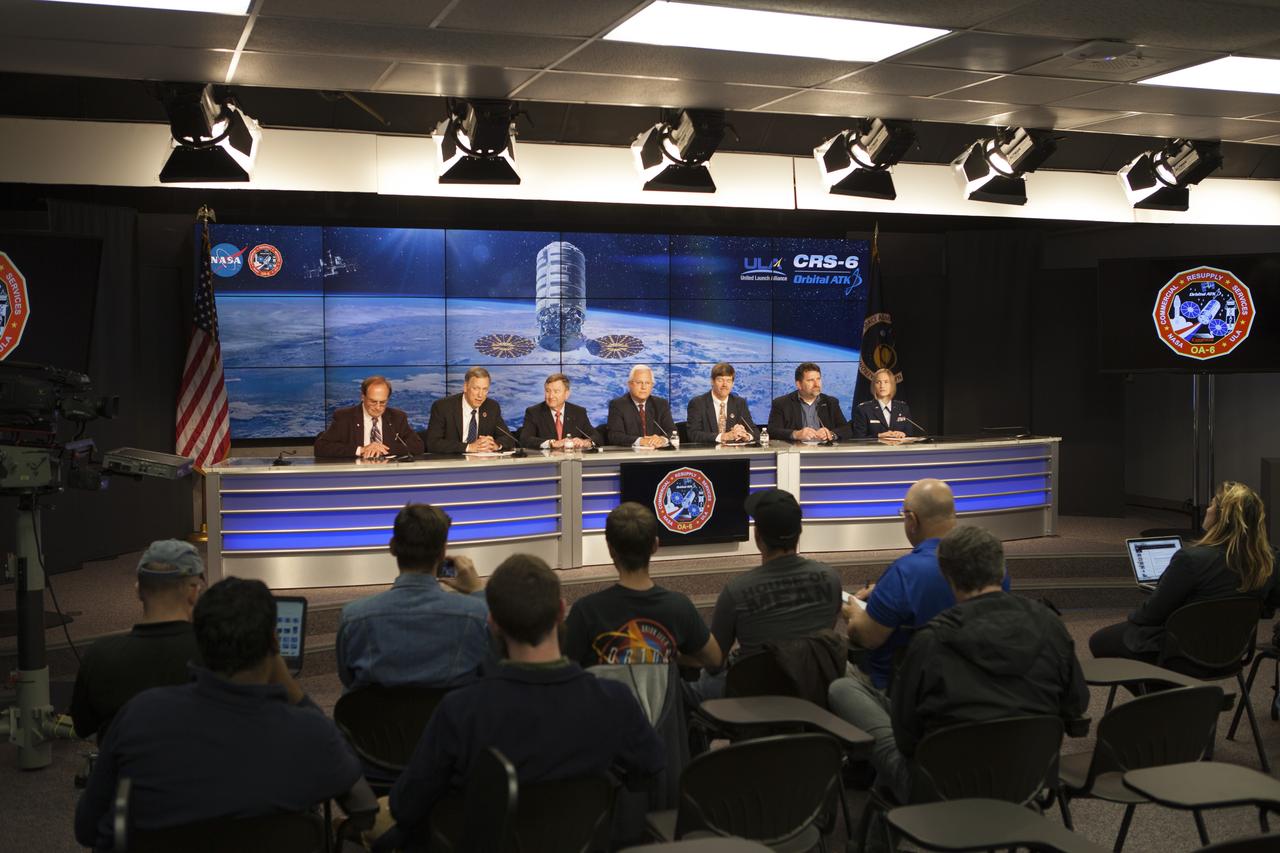
In the Kennedy Space Center’s Press Site auditorium, agency and industry leaders speak to members of the media at a prelaunch news conference for Orbital ATK CRS-6 commercial resupply services mission to the International Space Station. From left are: George Diller of NASA Communications; Kenneth Todd, NASA ISS Operations Integration manager; Frank Culbertson, president of Orbital ATK's Space System Group; Vern Thorp, United Space Alliance's program manager for NASA missions; Pete Hasbrook, NASA associate program scientist for the ISS Program at the Johnson Space Center in Houston; Dr. Michael Roberts deputy chief scientist for the Center for the Advancement for Science in Space, or CASIS; and Capt. Laura Godoy, launch weather officer of the U.S. Air Force 45th Weather Squadron.

From left, NASA Kennedy Space Center Public Affairs Officer George Diller, Ken Jucks, OCO-2 program scientist, NASA Headquarters, Dave Crisp, OCO-2 science team leader, JPL, and Annmarie Eldering, OCO-2 deputy project scientist, JPL, give a science briefing ahead of the planned launch of the Orbiting Carbon Observatory-2 (OCO-2), Sunday, June 29, 2014, Vandenberg Air Force Base, Calif. OCO-2 will measure the global distribution of carbon dioxide, the leading human-produced greenhouse gas driving changes in Earth’s climate. OCO-2 is set to launch on July 1, 2014 at 2:59 a.m. PDT. Photo Credit: (NASA/Bill Ingalls)
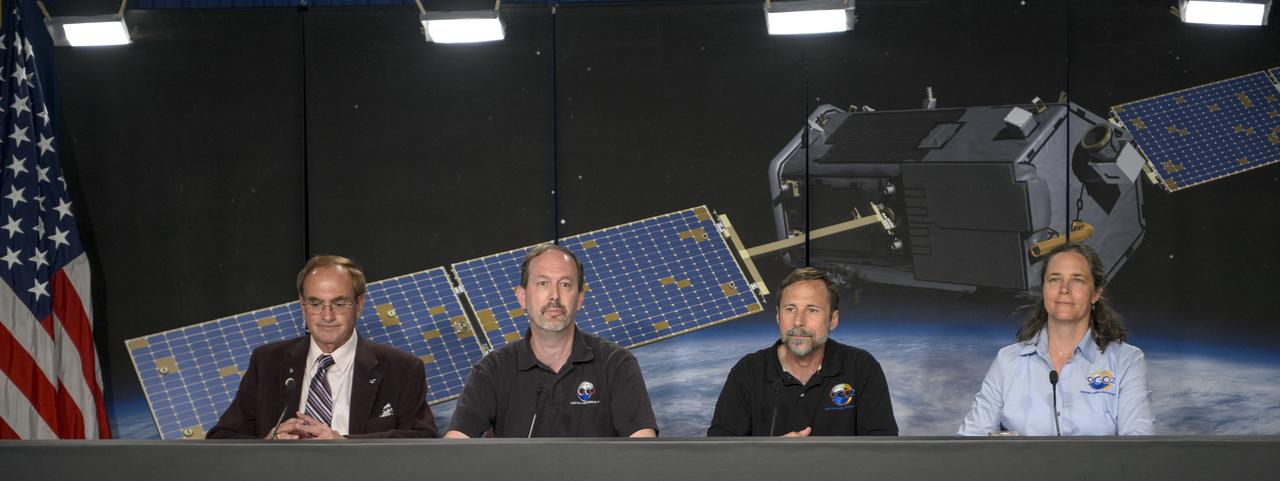
From left, NASA Kennedy Space Center Public Affairs Officer George Diller, Ken Jucks, OCO-2 program scientist, NASA Headquarters, Dave Crisp, OCO-2 science team leader, JPL, and Annmarie Eldering, OCO-2 deputy project scientist, JPL, give a science briefing ahead of the planned launch of the Orbiting Carbon Observatory-2 (OCO-2), Sunday, June 29, 2014, Vandenberg Air Force Base, Calif. OCO-2 will measure the global distribution of carbon dioxide, the leading human-produced greenhouse gas driving changes in Earth’s climate. OCO-2 is set to launch on July 1, 2014 at 2:59 a.m. PDT. Photo Credit: (NASA/Bill Ingalls)
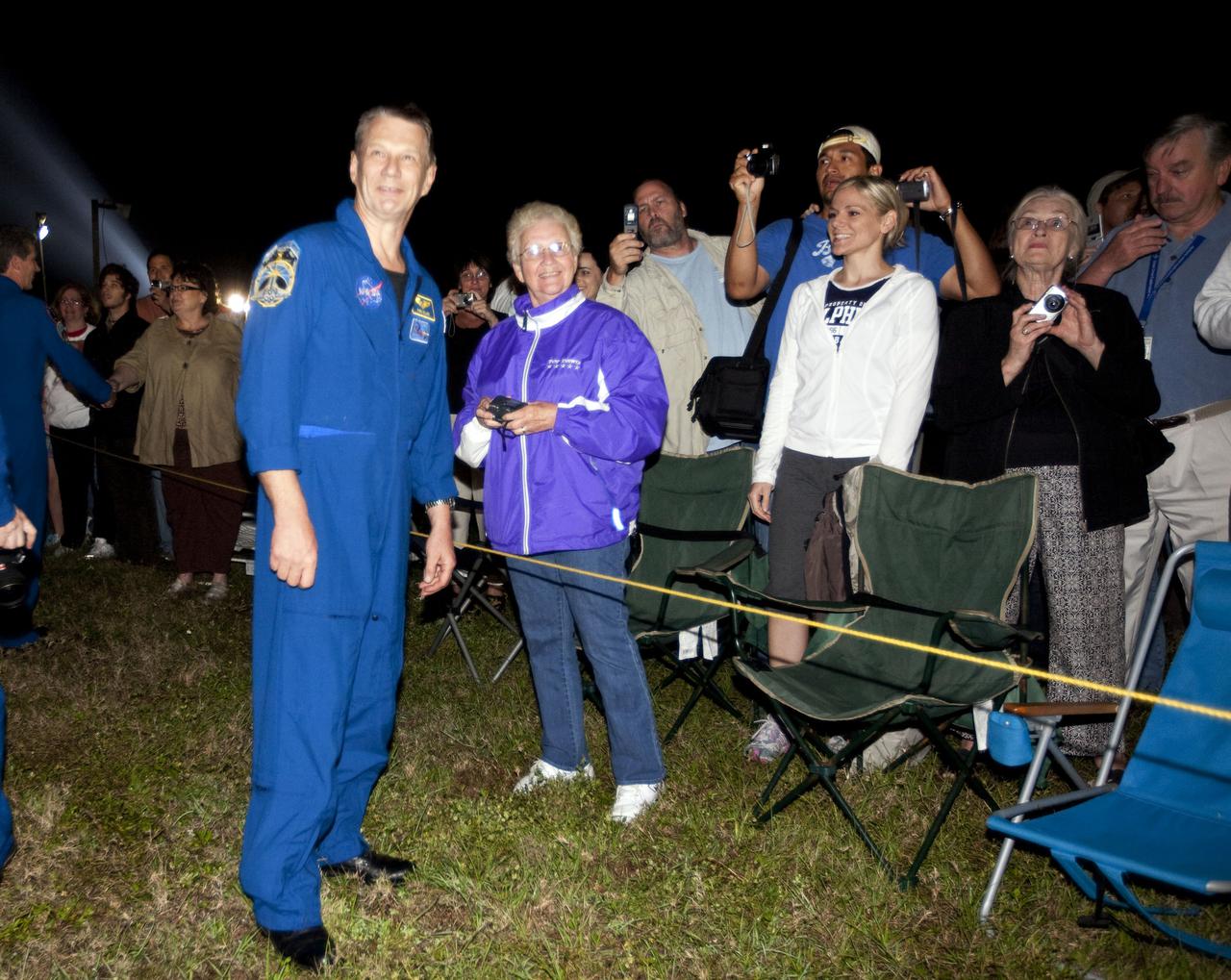
CAPE CANAVERAL, Fla. – Outside the Vehicle Assembly Building at NASA's Kennedy Space Center in Florida, STS-132 Mission Specialist Piers Sellers joins Kennedy employees and their families who turned out to watch space shuttle Atlantis begin its move to Launch Pad 39A. Atlantis' first motion on its 3.4-mile trip from the Vehicle Assembly Building was at 11:31 p.m. EDT April 21. The shuttle was secured on the pad at 6:03 a.m. April 22. Rollout is a significant milestone in launch processing activities. On the STS-132 mission, the six-member crew will deliver an Integrated Cargo Carrier, or ICC, and the Russian-built Mini-Research Module-1, or MRM-1, to the International Space Station. The ICC is an unpressurized flat bed pallet and keel yoke assembly used to support the transfer of exterior cargo from the shuttle to the space station. The MRM-1, known as Rassvet, is the second in a series of new pressurized components for Russia and will be permanently attached to the Earth-facing port of the Zarya control module. Rassvet, which translates to 'dawn,' will be used for cargo storage and will provide an additional docking port to the station. STS-132 is the 34th mission to the station and the 132nd shuttle mission overall. Atlantis is targeted to launch on May 14 at 2:19 p.m. For information on the STS-132 mission, visit http:__www.nasa.gov_mission_pages_shuttle_shuttlemissions_sts132_index.html. Photo credit: NASA_Amanda Diller
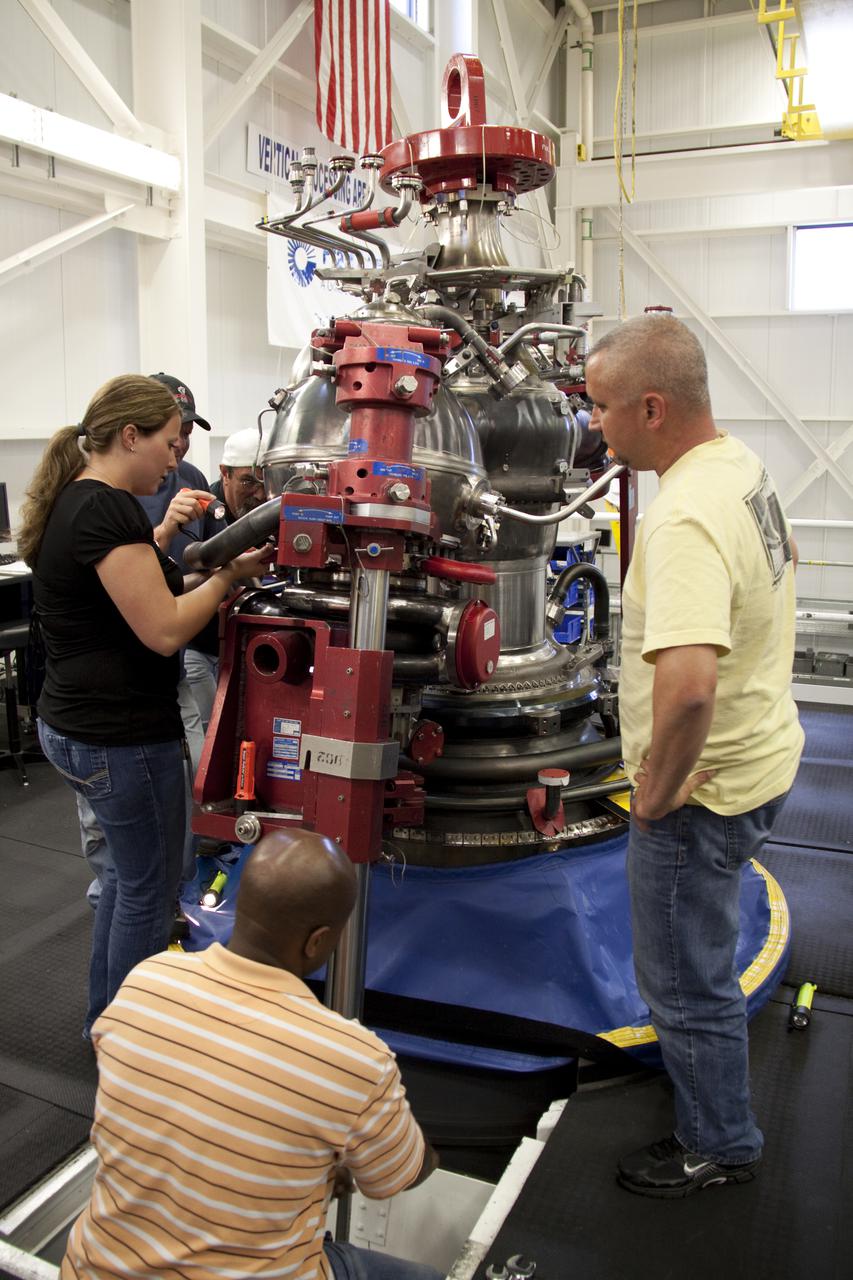
CAPE CANAVERAL, Fla. – In the Space Shuttle Main Engine Processing Facility at NASA's Kennedy Space Center in Florida, a team of Pratt and Whitney Rocketdyne employees installs a high pressure oxidizer turbo pump on space shuttle main engine no. 2062. The engine, or SSME, is the last one scheduled to be built at Kennedy before the end of the Space Shuttle Program. Around the engine, from right to left, are engine technicians Ryan Mahony and Teryon Jones, engineer Jessica Tandy, engine technician Ken Burley and quality inspector Barry Martin. Three main engines are clustered at the aft end of the shuttle and have a combined thrust of more than 1.2 million pounds. Even though an SSME weighs one-seventh as much as a locomotive engine, its high-pressure fuel pump alone delivers as much horsepower as 28 locomotives. Each engine operates during the entire eight-and-a-half minute climb to orbit. Post-flight inspections and maintenance of each engine also are conducted in the SSME Processing Facility between shuttle missions. Photo credit: NASA_Amanda Diller
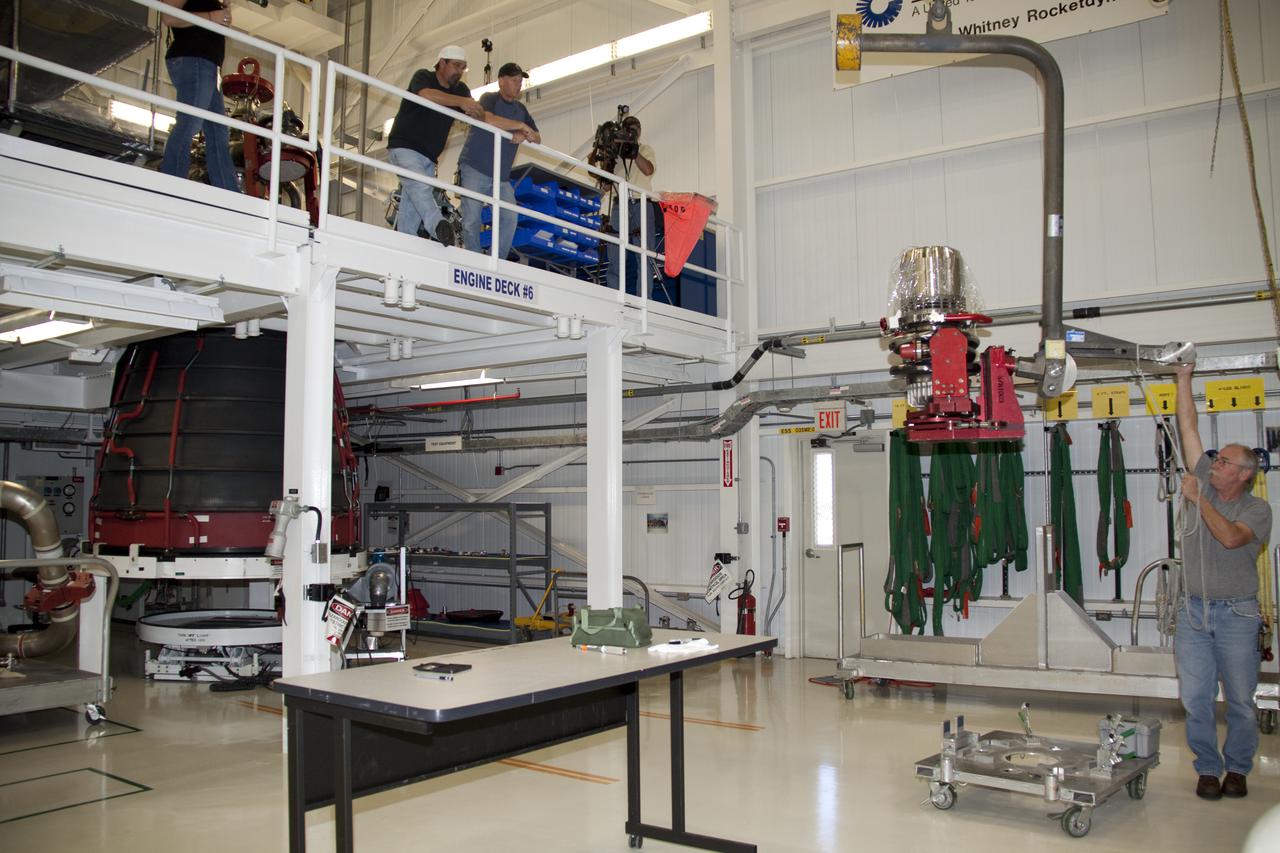
CAPE CANAVERAL, Fla. – On the floor of the Space Shuttle Main Engine Processing Facility at NASA's Kennedy Space Center in Florida, Pratt and Whitney Rocketdyne engine technician Dan Bode lifts a high pressure oxidizer turbo pump off its stand for installation on space shuttle main engine no. 2062. The engine, or SSME, is the last one scheduled to be built at Kennedy by Pratt and Whitney Rocketdyne before the end of the Space Shuttle Program. Three main engines are clustered at the aft end of the shuttle and have a combined thrust of more than 1.2 million pounds. Even though an SSME weighs one-seventh as much as a locomotive engine, its high-pressure fuel pump alone delivers as much horsepower as 28 locomotives. Each engine operates during the entire eight-and-a-half minute climb to orbit. Post-flight inspections and maintenance of each engine also are conducted in the SSME Processing Facility between shuttle missions. Photo credit: NASA_Amanda Diller
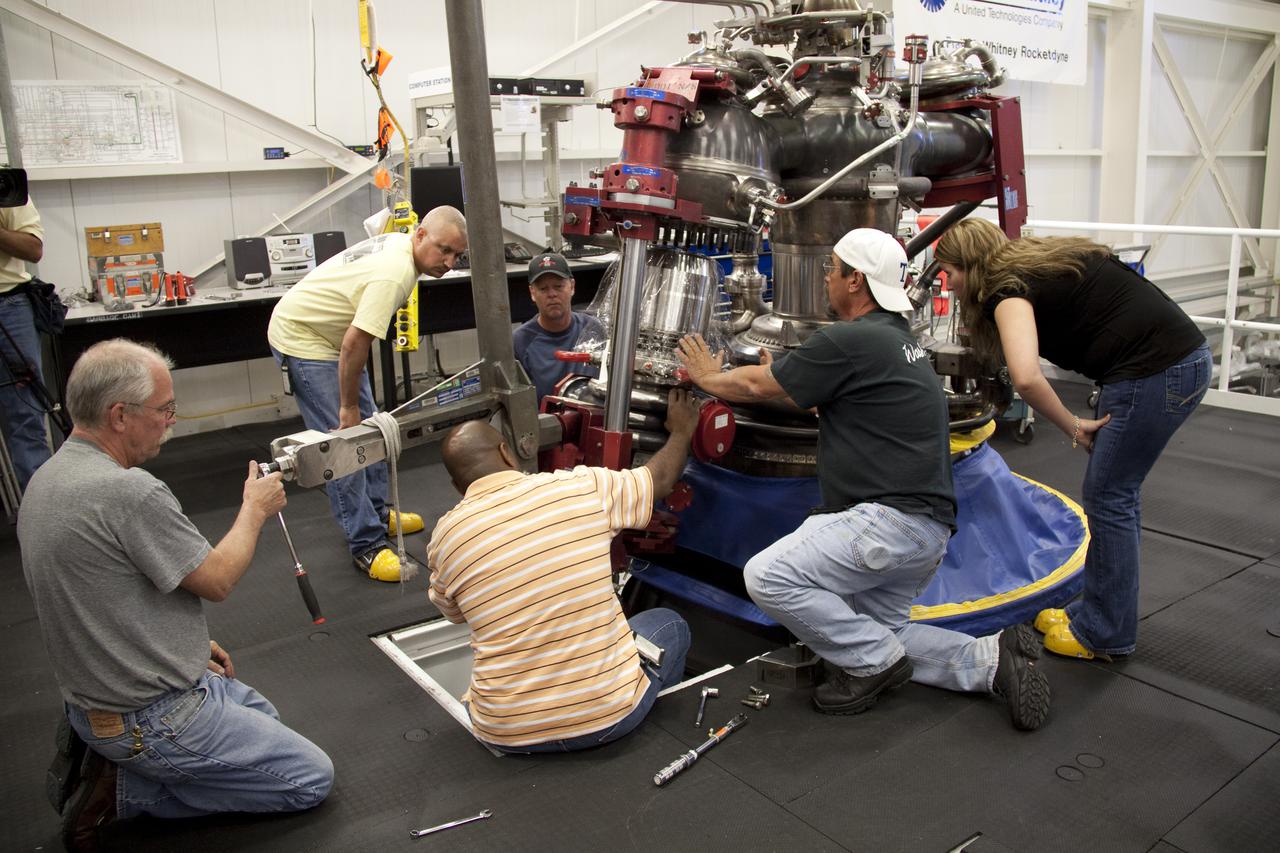
CAPE CANAVERAL, Fla. – In the Space Shuttle Main Engine Processing Facility at NASA's Kennedy Space Center in Florida, Pratt and Whitney Rocketdyne engine technicians install a high pressure oxidizer turbo pump on space shuttle main engine no. 2062. The engine, or SSME, is the last one scheduled to be built at Kennedy before the end of the Space Shuttle Program. In front of the engine, from left, are Dan Bode, Teryon Jones, quality inspector Barry Martin, and engineer Jessica Tandy. Behind the engine, from left, are Ryan Mahony and Ken Burley. Three main engines are clustered at the aft end of the shuttle and have a combined thrust of more than 1.2 million pounds. Even though an SSME weighs one-seventh as much as a locomotive engine, its high-pressure fuel pump alone delivers as much horsepower as 28 locomotives. Each engine operates during the entire eight-and-a-half minute climb to orbit. Post-flight inspections and maintenance of each engine also are conducted in the SSME Processing Facility between shuttle missions. Photo credit: NASA_Amanda Diller
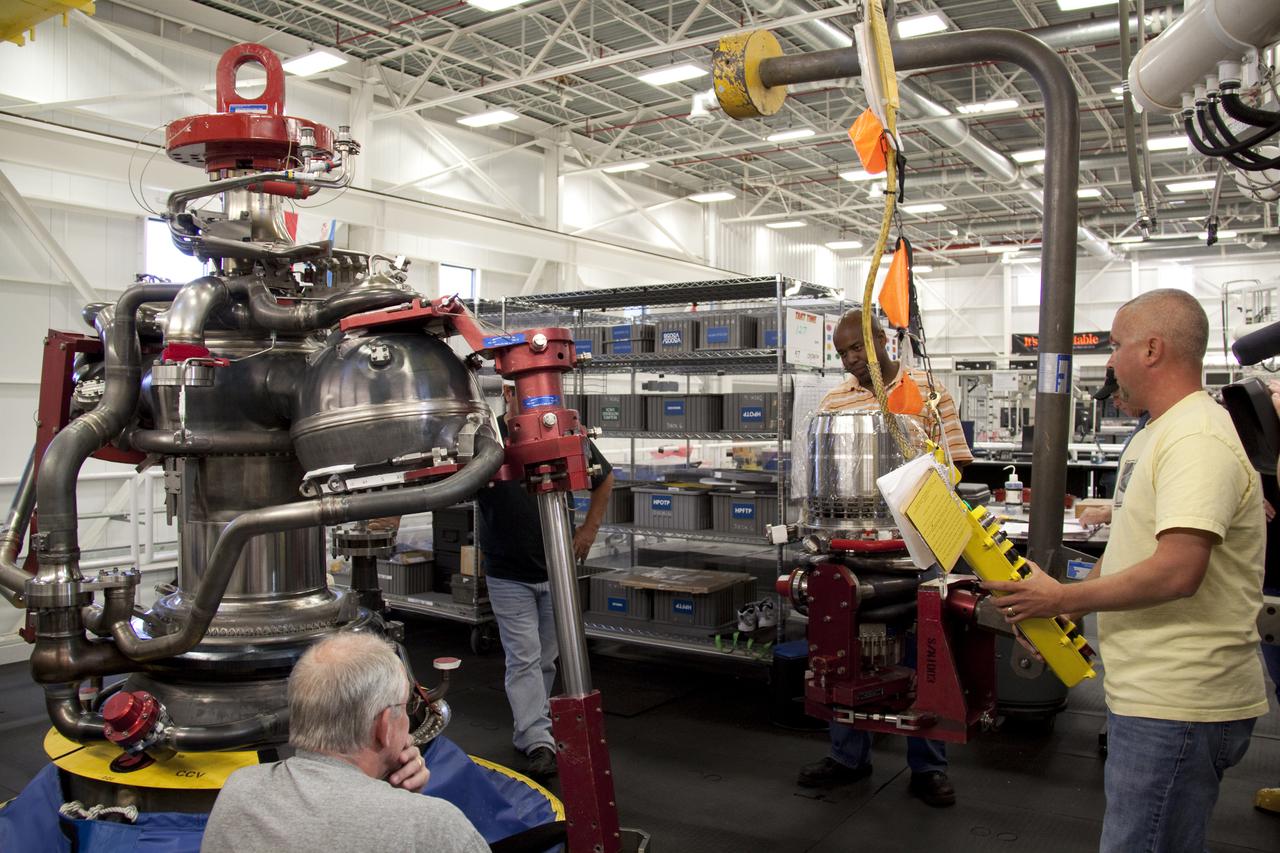
CAPE CANAVERAL, Fla. – In the Space Shuttle Main Engine Processing Facility at NASA's Kennedy Space Center in Florida, Pratt and Whitney Rocketdyne engine technicians prepare to install a high pressure oxidizer turbo pump on space shuttle main engine no. 2062. The engine, or SSME, is the last one scheduled to be built at Kennedy before the end of the Space Shuttle Program. From left are Dan Bode, Teryon Jones, and Ryan Mahony. Quality inspector Barry Martin is standing beside the engine, just out of view. Three main engines are clustered at the aft end of the shuttle and have a combined thrust of more than 1.2 million pounds. Even though an SSME weighs one-seventh as much as a locomotive engine, its high-pressure fuel pump alone delivers as much horsepower as 28 locomotives. Each engine operates during the entire eight-and-a-half minute climb to orbit. Post-flight inspections and maintenance of each engine also are conducted in the SSME Processing Facility between shuttle missions. Photo credit: NASA_Amanda Diller
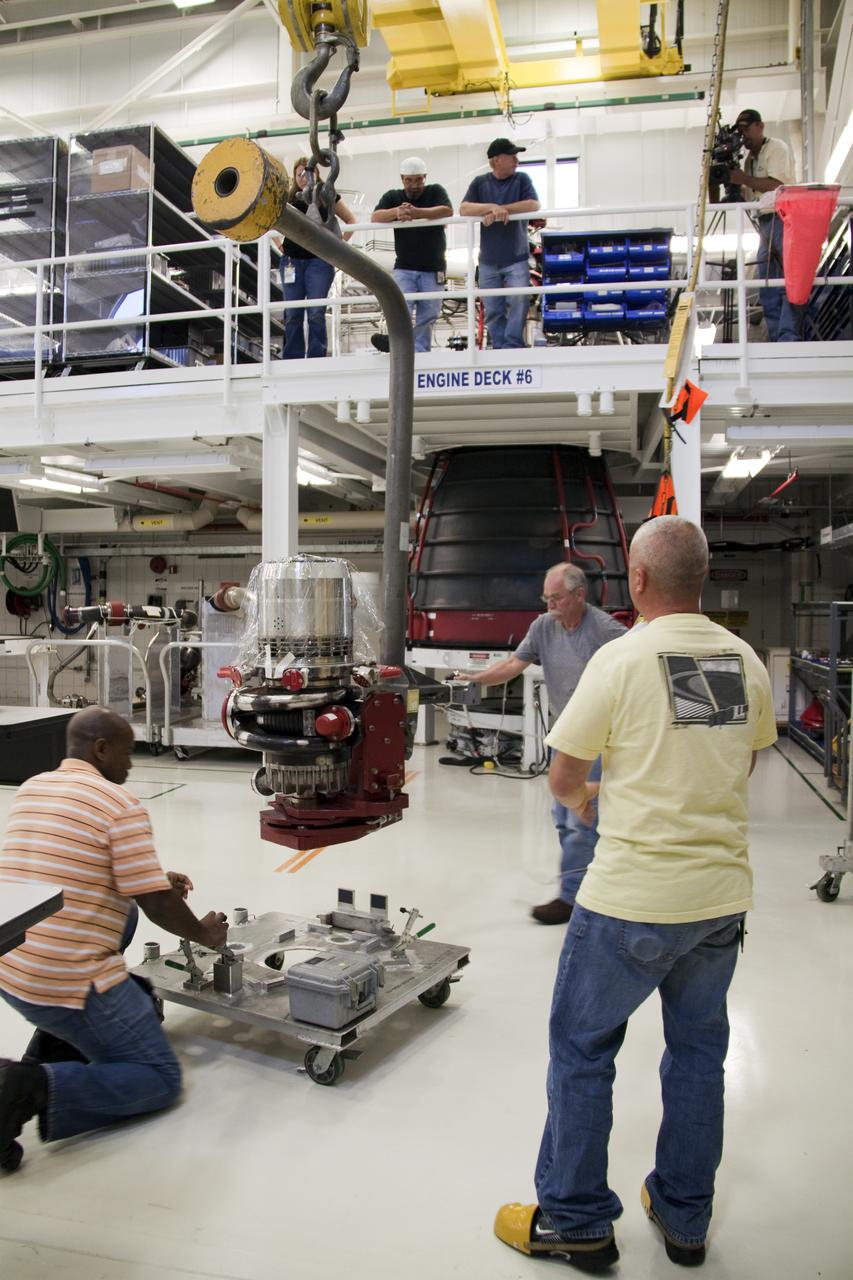
CAPE CANAVERAL, Fla. – On the floor of the Space Shuttle Main Engine Processing Facility at NASA's Kennedy Space Center in Florida, Pratt and Whitney Rocketdyne engine technicians lift a high pressure oxidizer turbo pump off its stand for installation on space shuttle main engine no. 2062. The engine, or SSME, is the last one scheduled to be built at Kennedy by Pratt and Whitney Rocketdyne before the end of the Space Shuttle Program. From left are Teryon Jones, Dan Bode and Ryan Mahony. Three main engines are clustered at the aft end of the shuttle and have a combined thrust of more than 1.2 million pounds. Even though an SSME weighs one-seventh as much as a locomotive engine, its high-pressure fuel pump alone delivers as much horsepower as 28 locomotives. Each engine operates during the entire eight-and-a-half minute climb to orbit. Post-flight inspections and maintenance of each engine also are conducted in the SSME Processing Facility between shuttle missions. Photo credit: NASA_Amanda Diller

CAPE CANAVERAL, Fla. – In the Space Shuttle Main Engine Processing Facility at NASA's Kennedy Space Center in Florida, Pratt and Whitney Rocketdyne engine technicians prepare a high pressure oxidizer turbo pump for installation on space shuttle main engine no. 2062. The engine, or SSME, is the last one scheduled to be built at Kennedy before the end of the Space Shuttle Program. Ryan Mahony is standing; Teryon Jones, left, and Dan Bode are kneeling next to the pump. Three main engines are clustered at the aft end of the shuttle and have a combined thrust of more than 1.2 million pounds. Even though an SSME weighs one-seventh as much as a locomotive engine, its high-pressure fuel pump alone delivers as much horsepower as 28 locomotives. Each engine operates during the entire eight-and-a-half minute climb to orbit. Post-flight inspections and maintenance of each engine also are conducted in the SSME Processing Facility between shuttle missions. Photo credit: NASA_Amanda Diller
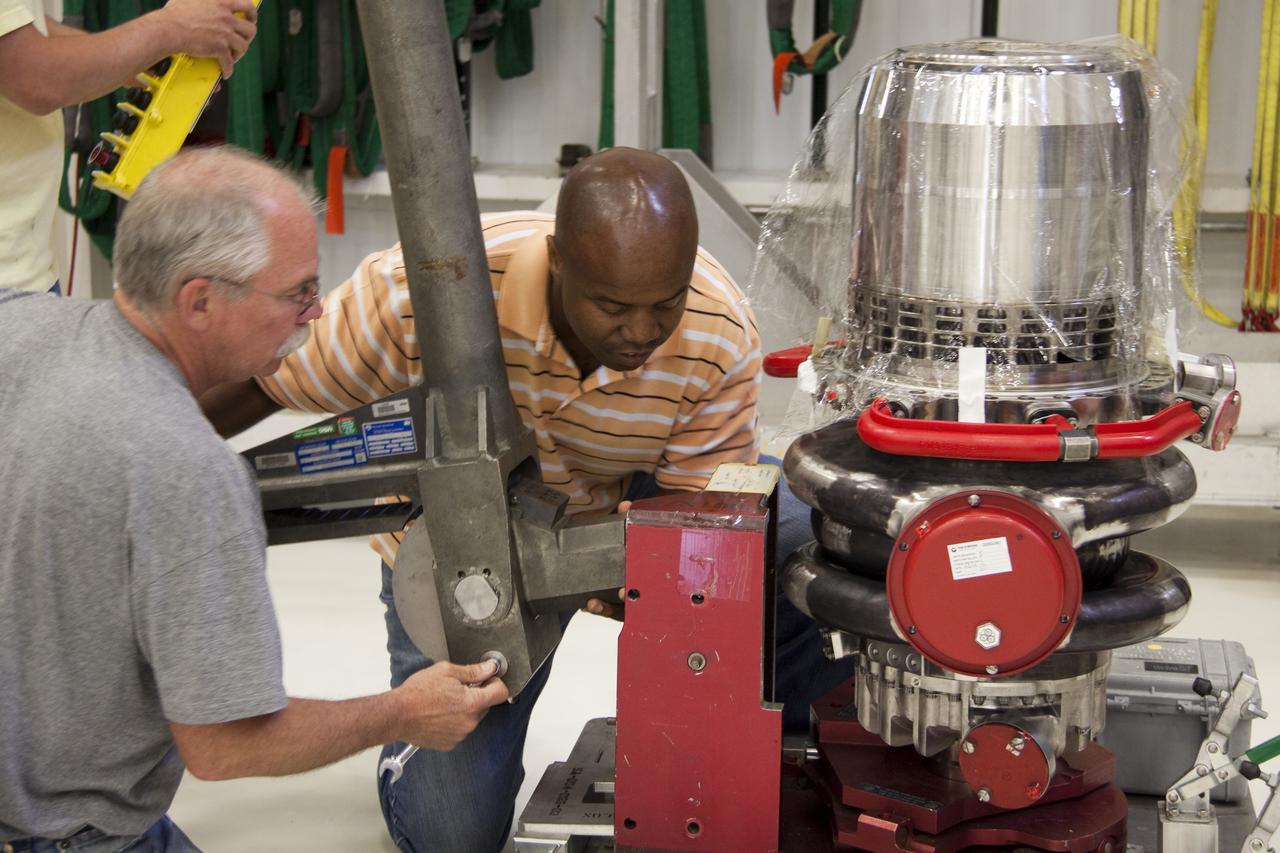
CAPE CANAVERAL, Fla. – In the Space Shuttle Main Engine Processing Facility at NASA's Kennedy Space Center in Florida, Pratt and Whitney Rocketdyne engine technicians prepare a high pressure oxidizer turbo pump for installation on space shuttle main engine no. 2062. The engine, or SSME, is the last one scheduled to be built at Kennedy by Pratt and Whitney Rocketdyne before the end of the Space Shuttle Program. From left are Dan Bode and Teryon Jones. Three main engines are clustered at the aft end of the shuttle and have a combined thrust of more than 1.2 million pounds. Even though an SSME weighs one-seventh as much as a locomotive engine, its high-pressure fuel pump alone delivers as much horsepower as 28 locomotives. Each engine operates during the entire eight-and-a-half minute climb to orbit. Post-flight inspections and maintenance of each engine also are conducted in the SSME Processing Facility between shuttle missions. Photo credit: NASA_Amanda Diller
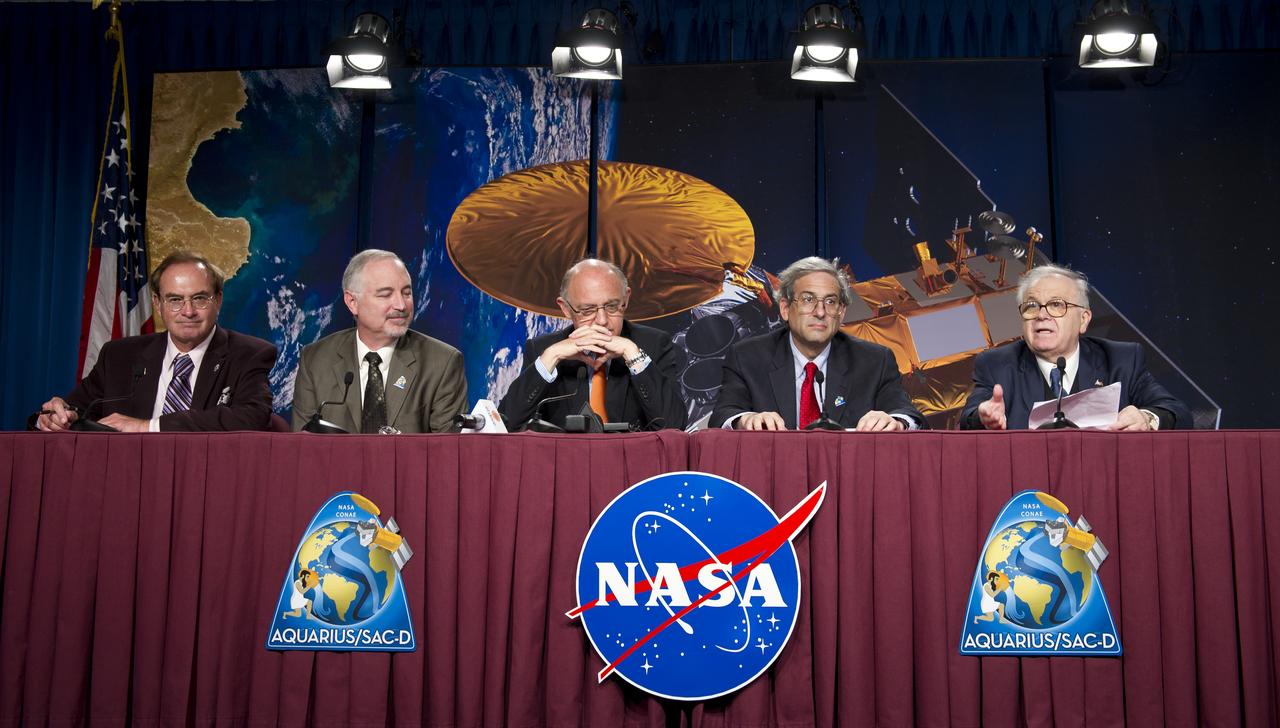
From left, George Diller, NASA Public Affairs Officer; Charles Gay, Deputy Associate Administrator, NASA Science Mission Directorate; Hector Timerman, Foreign Minister of Argentina, Buenos Aires; Michael Freilich, NASA Earth Science Division Director, NASA Headquarters; and Conrado Varotto, CONAE Executive and Technical Director, Buenos Aires, are seen at the Aquarius/SAC-D post-launch press conference on Friday, June 10, 2011 at the NASA Resident Office, Vandenberg Air Force Base, Calif. The joint U.S./Argentinian Aquarius/Satélite de Aplicaciones Científicas (SAC)-D mission, launched earlier on Friday June 10, will map the salinity at the ocean surface, information critical to improving our understanding of two major components of Earth's climate system: the water cycle and ocean circulation. Photo Credit: (NASA/Bill Ingalls)
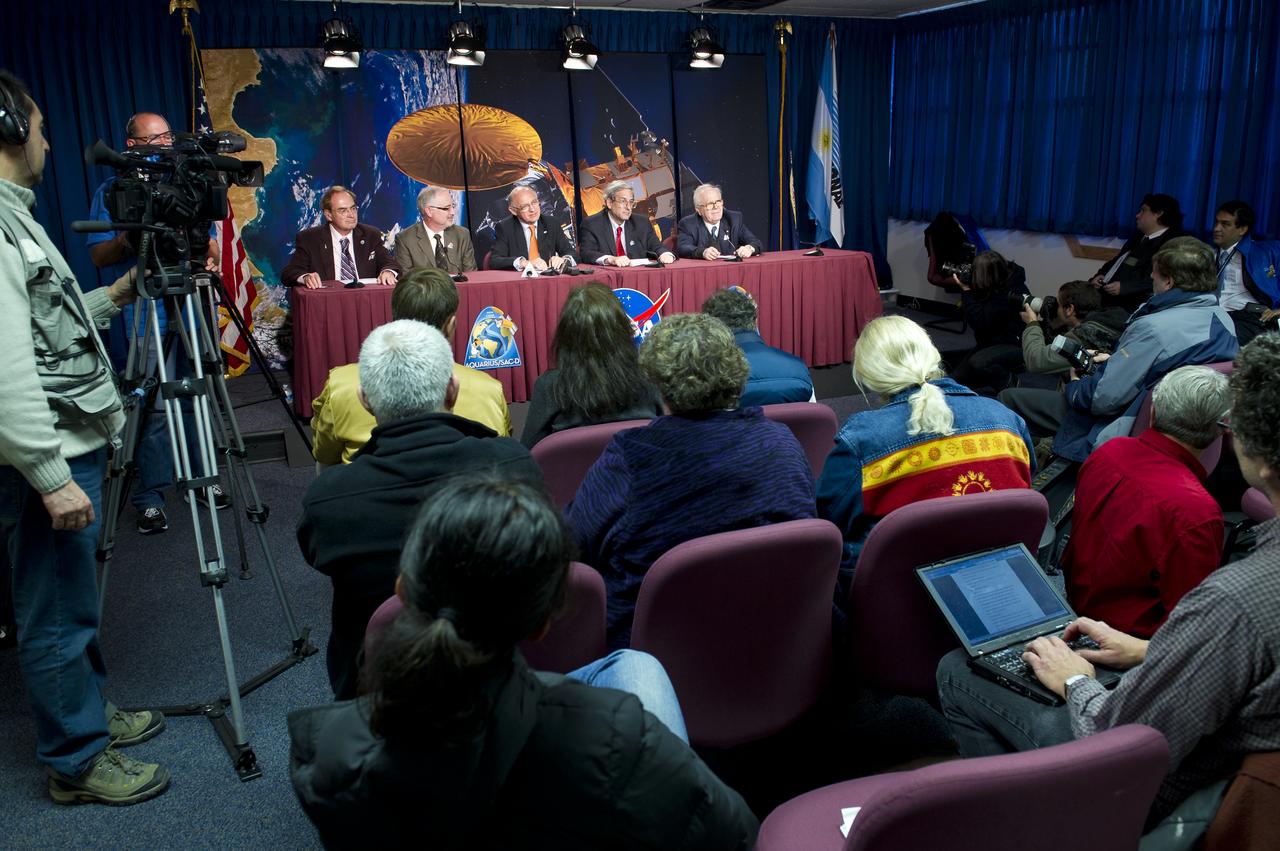
Seated from left, George Diller, NASA Public Affairs Officer; Charles Gay, Deputy Associate Administrator, NASA Science Mission Directorate; Hector Timerman, Foreign Minister of Argentina, Buenos Aires; Michael Freilich, NASA Earth Science Division Director, NASA Headquarters; and Conrado Varotto, CONAE Executive and Technical Director, Buenos Aires, are seen at the Aquarius/SAC-D post-launch press conference on Friday, June 10, 2011 at the NASA Resident Office, Vandenberg Air Force Base, Calif. The joint U.S./Argentinian Aquarius/Satélite de Aplicaciones Científicas (SAC)-D mission, launched earlier on Friday June 10, will map the salinity at the ocean surface, information critical to improving our understanding of two major components of Earth's climate system: the water cycle and ocean circulation. Photo Credit: (NASA/Bill Ingalls)
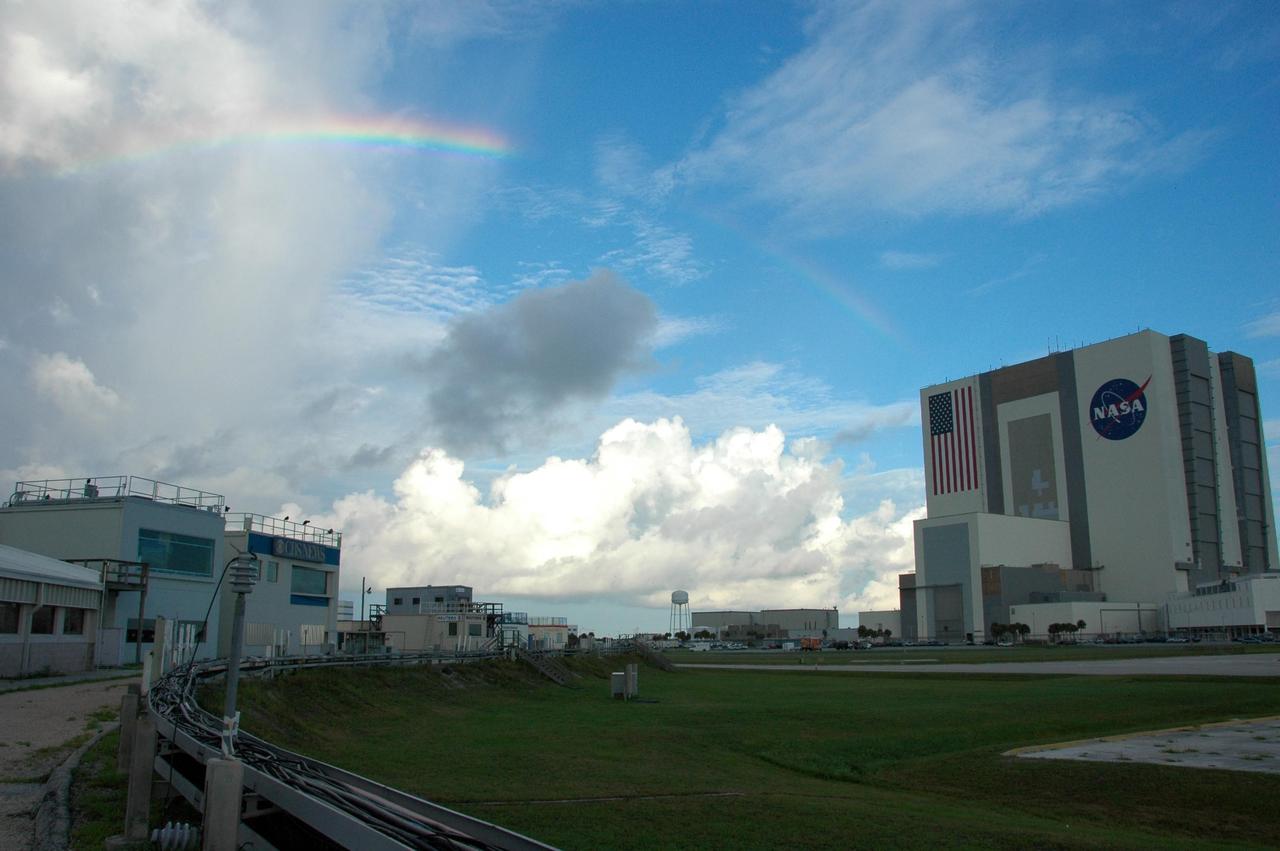
KENNEDY SPACE CENTER, FLA. -- A rainbow arcs over NASA's Kennedy Space Center in the Launch Complex 39Area. At right is the Vehicle Assembly Building; at left is the NASA News Center. Photo credit: NASA/Amanda Diller
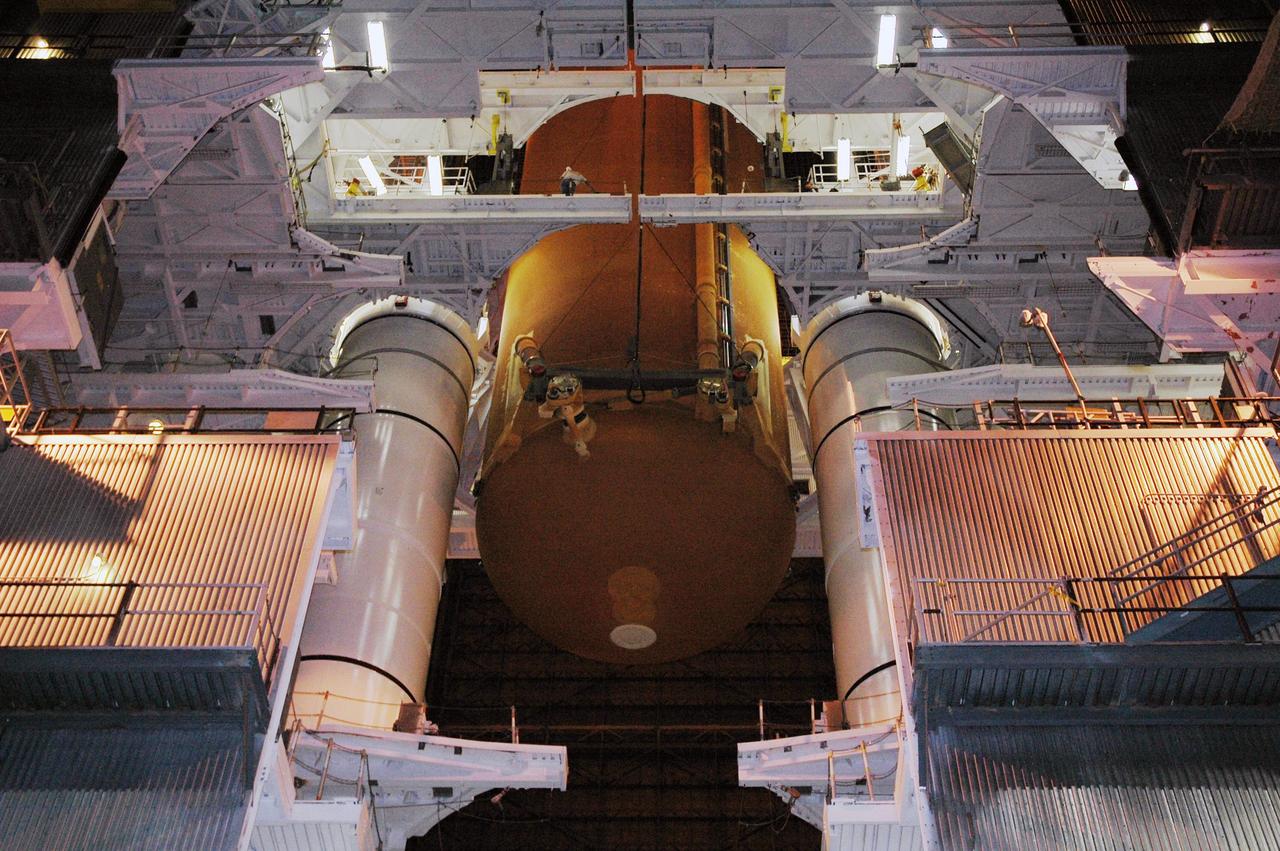
KENNEDY SPACE CENTER, FLA. - In high bay 3 of the Vehicle Assembly Building, the external tank designated for Space Shuttle Discovery is lowered into position between the solid rocket boosters on the mobile launcher platform. Discovery is scheduled to launch on mission STS-121 in July. Photo credit: NASA/Amanda Diller

CAPE CANAVERAL, Fla. – Platform C is moved away from the Vehicle Assembly Building at NASA's Kennedy Space Center to allow refurbishment of the facility for the Constellation Program's Ares 1-X vehicle in high bay 3. The platform will be demolished. Photo credit: NASA/Amanda Diller
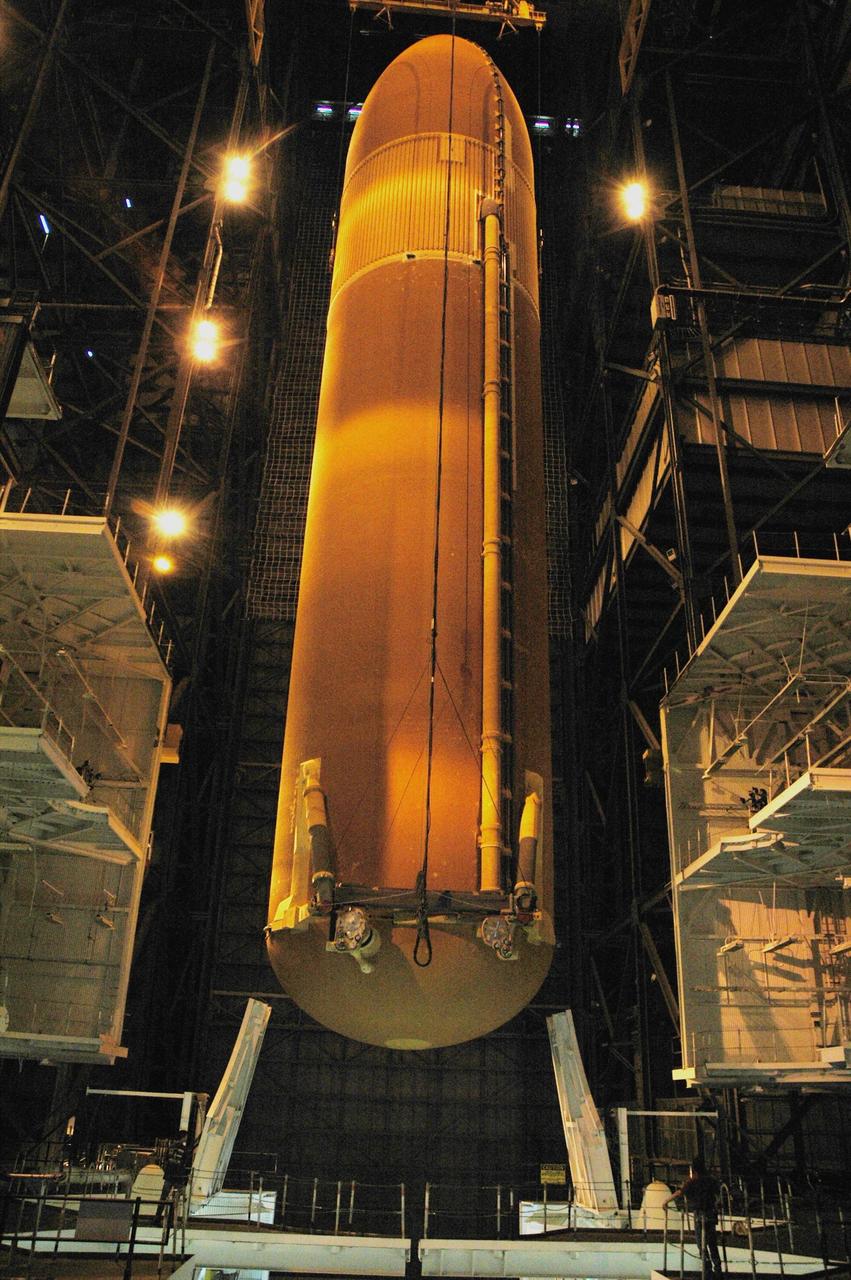
KENNEDY SPACE CENTER, FLA. - In high bay 3 of the Vehicle Assembly Building, the external tank designated for Space Shuttle Discovery is lowered into position between the solid rocket boosters on the mobile launcher platform. Discovery is scheduled to launch on mission STS-121 in July. Photo credit: NASA/Amanda Diller
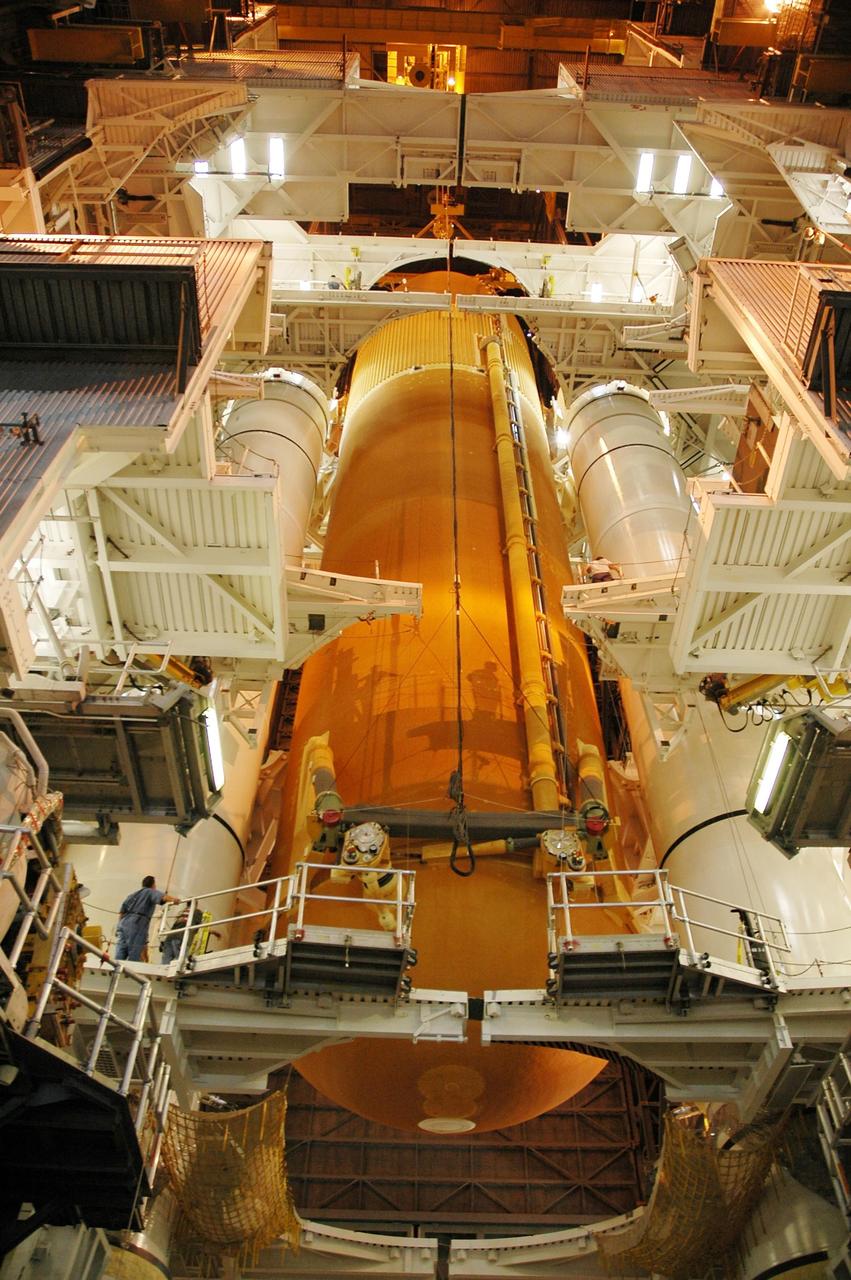
KENNEDY SPACE CENTER, FLA. - In high bay 3 of the Vehicle Assembly Building, the external tank designated for Space Shuttle Discovery is lowered into position between the solid rocket boosters on the mobile launcher platform. Discovery is scheduled to launch on mission STS-121 in July. Photo credit: NASA/Amanda Diller
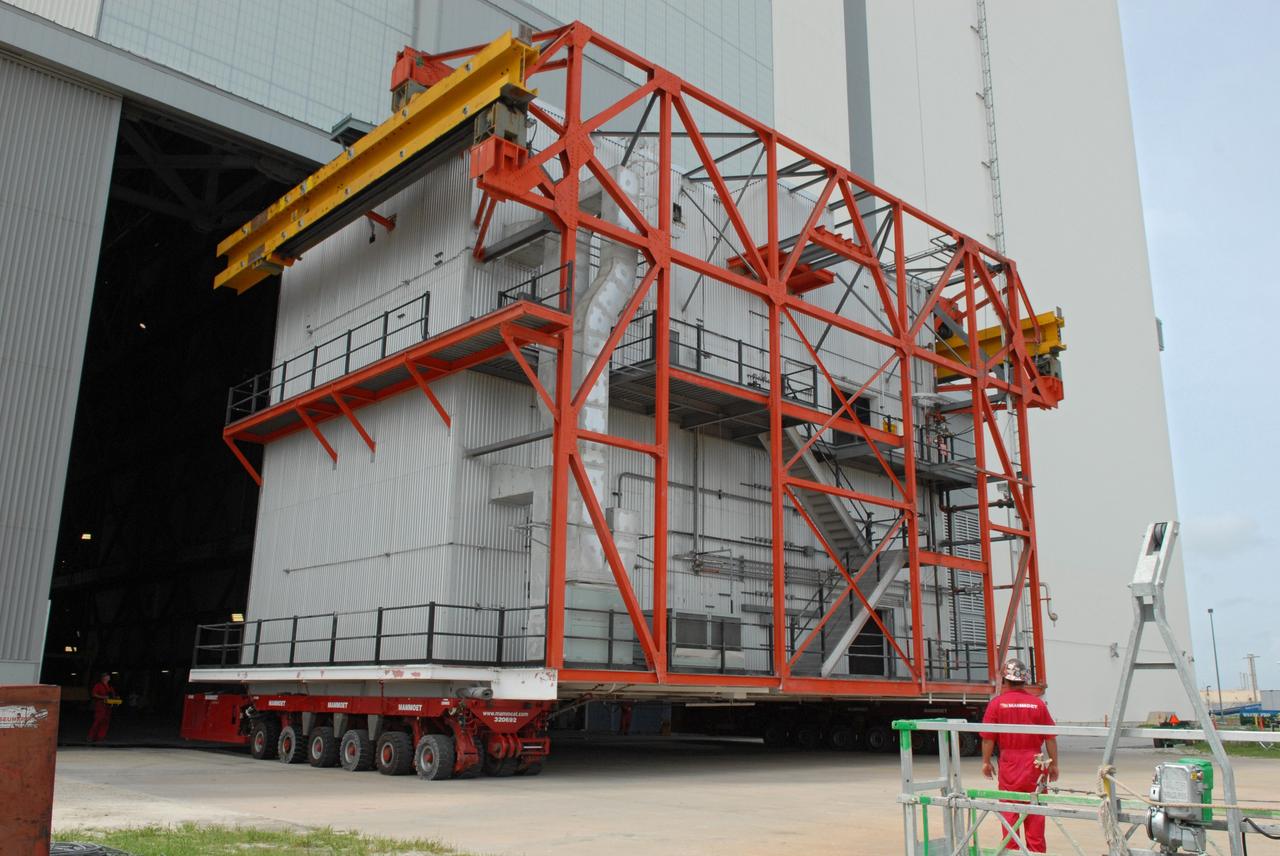
CAPE CANAVERAL, Fla. – Platform C is moved out of Vehicle Assembly Building at NASA's Kennedy Space Center to allow refurbishment of the facility for the Constellation Program's Ares 1-X vehicle in high bay 3. The platform will be demolished. Photo credit: NASA/Amanda Diller
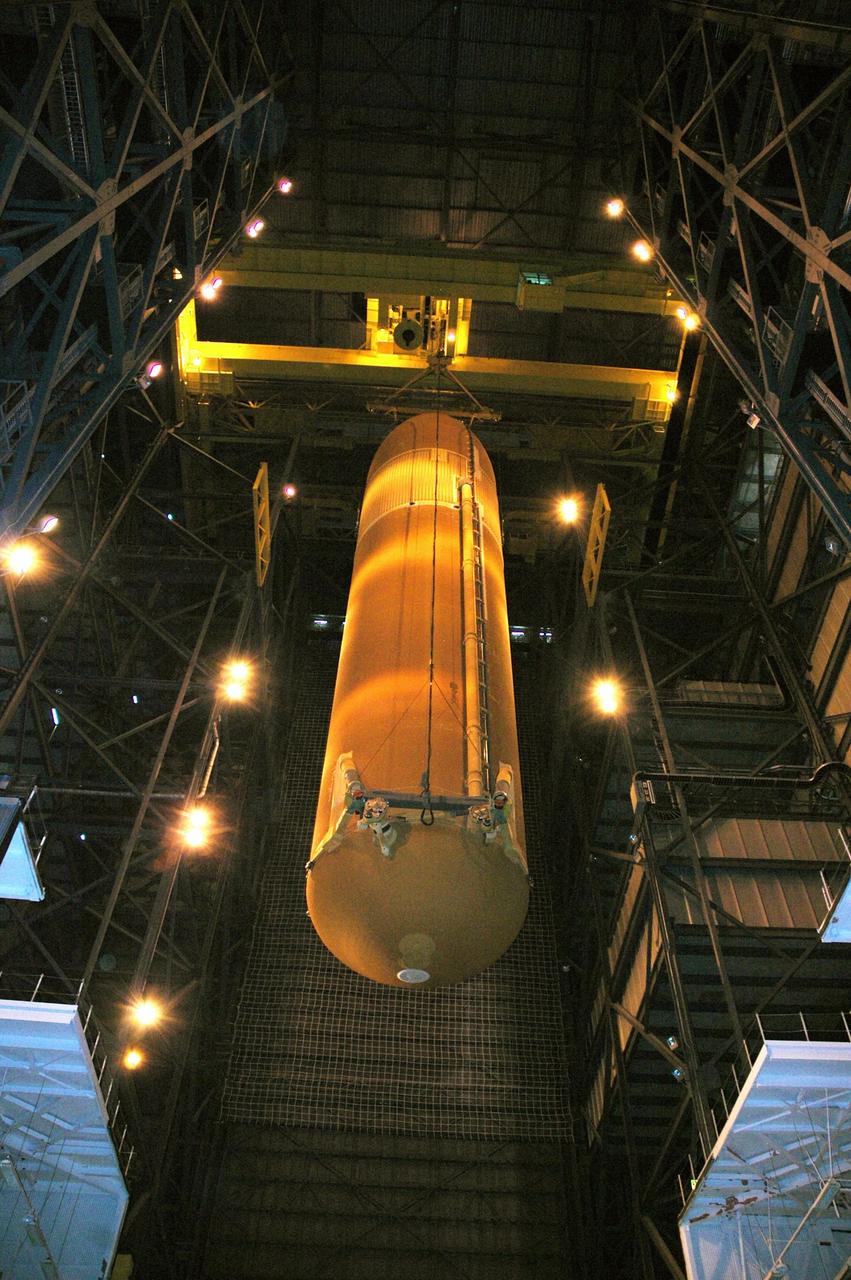
KENNEDY SPACE CENTER, FLA. - In the Vehicle Assembly Building, the external tank designated for Space Shuttle Discovery is lowered into high bay 3. There it will be stacked with the solid rocket boosters already in place on the mobile launcher platform. Discovery is scheduled to launch on mission STS-121 in July. Photo credit: NASA/Amanda Diller
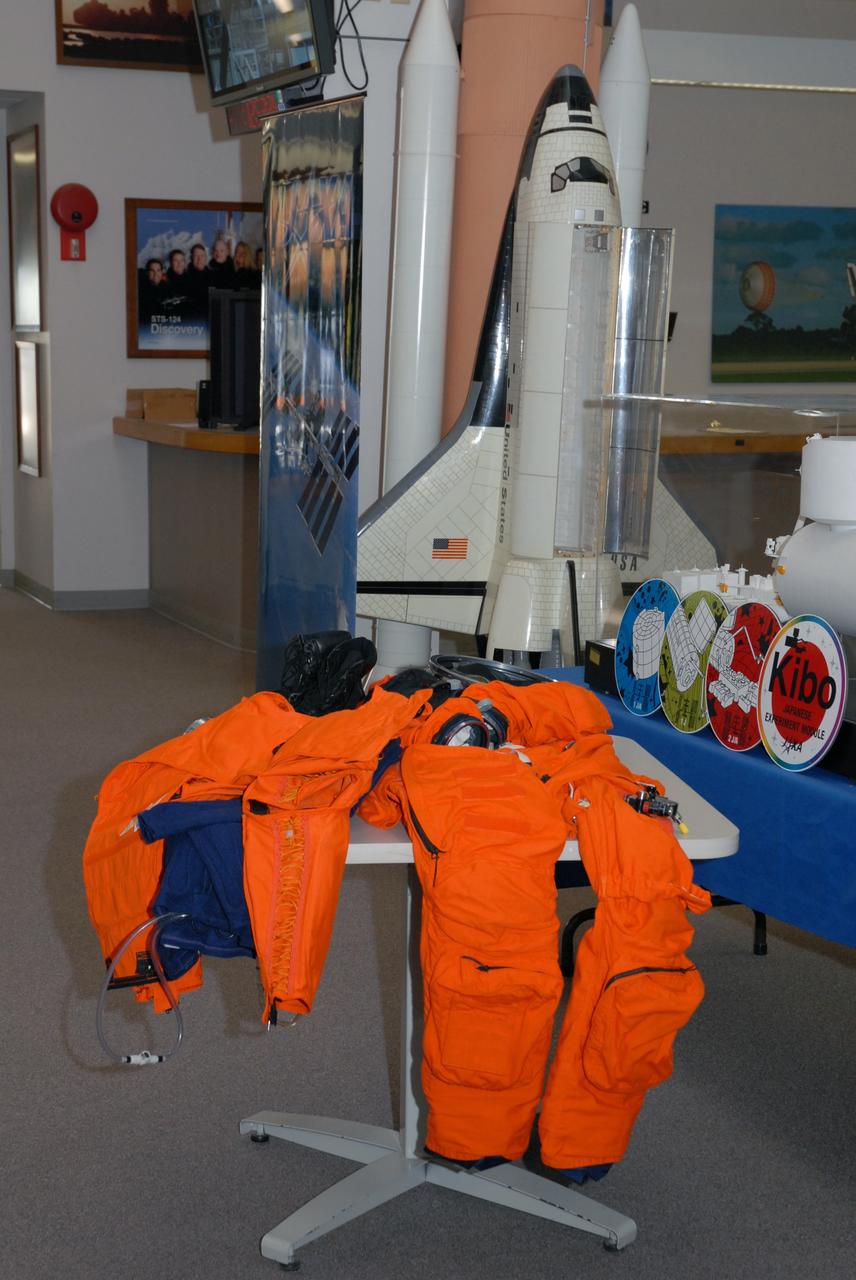
CAPE CANAVERAL, Fla. -- In the NASA News Center at NASA's Kennedy Space Center, components of the astronauts' launch and entry suit are on display for the media. Shuttle Crew Escape System Manager KC Chhipwadia described the individual pieces and their importance to the safety of the shuttle crews during their missions. Photo credit: NASA/Amanda Diller
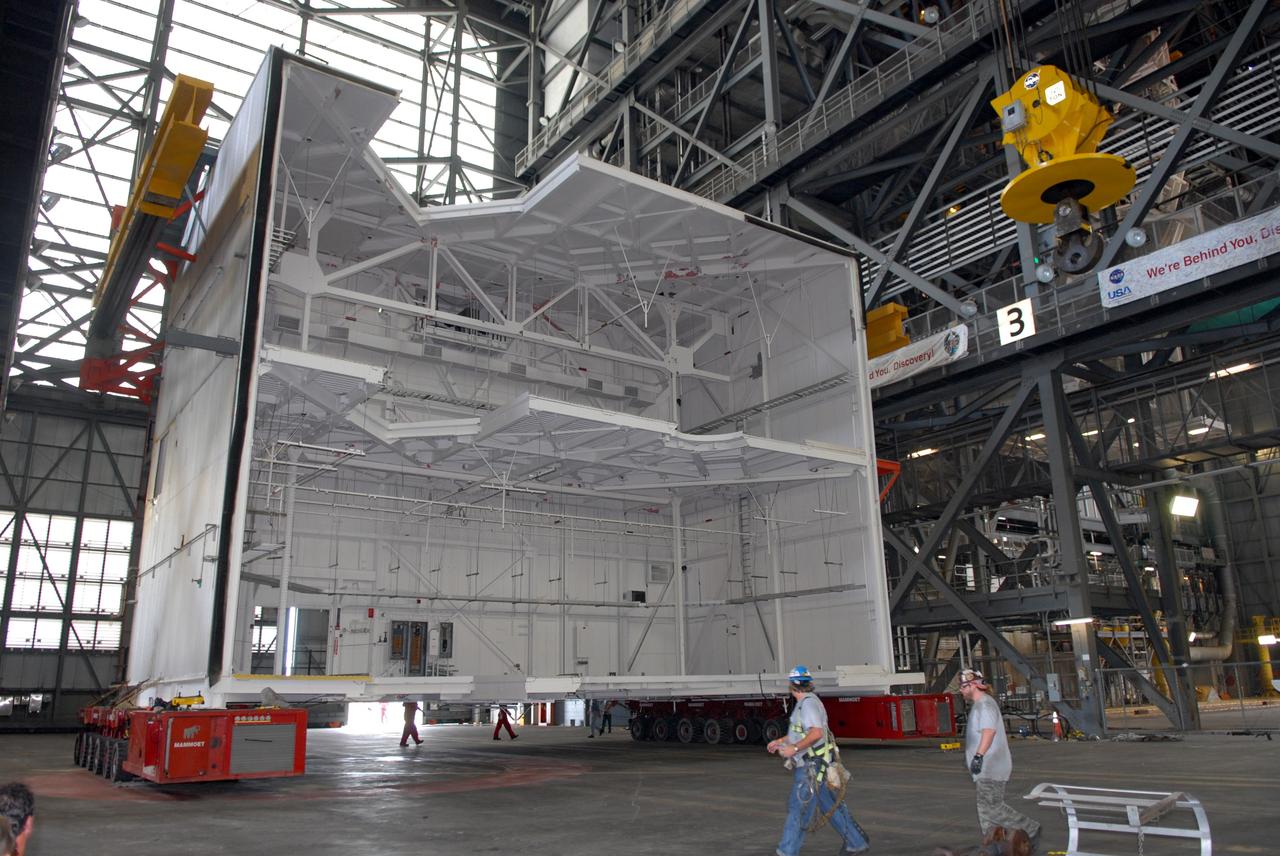
CAPE CANAVERAL, Fla. – In the Vehicle Assembly Building, or VAB, at NASA's Kennedy Space Center, Platform C is being moved from high bay 3 to allow refurbishment of the facility for the Constellation Program's Ares 1-X vehicle. The platform will be removed from the VAB and demolished. Photo credit: NASA/Amanda Diller
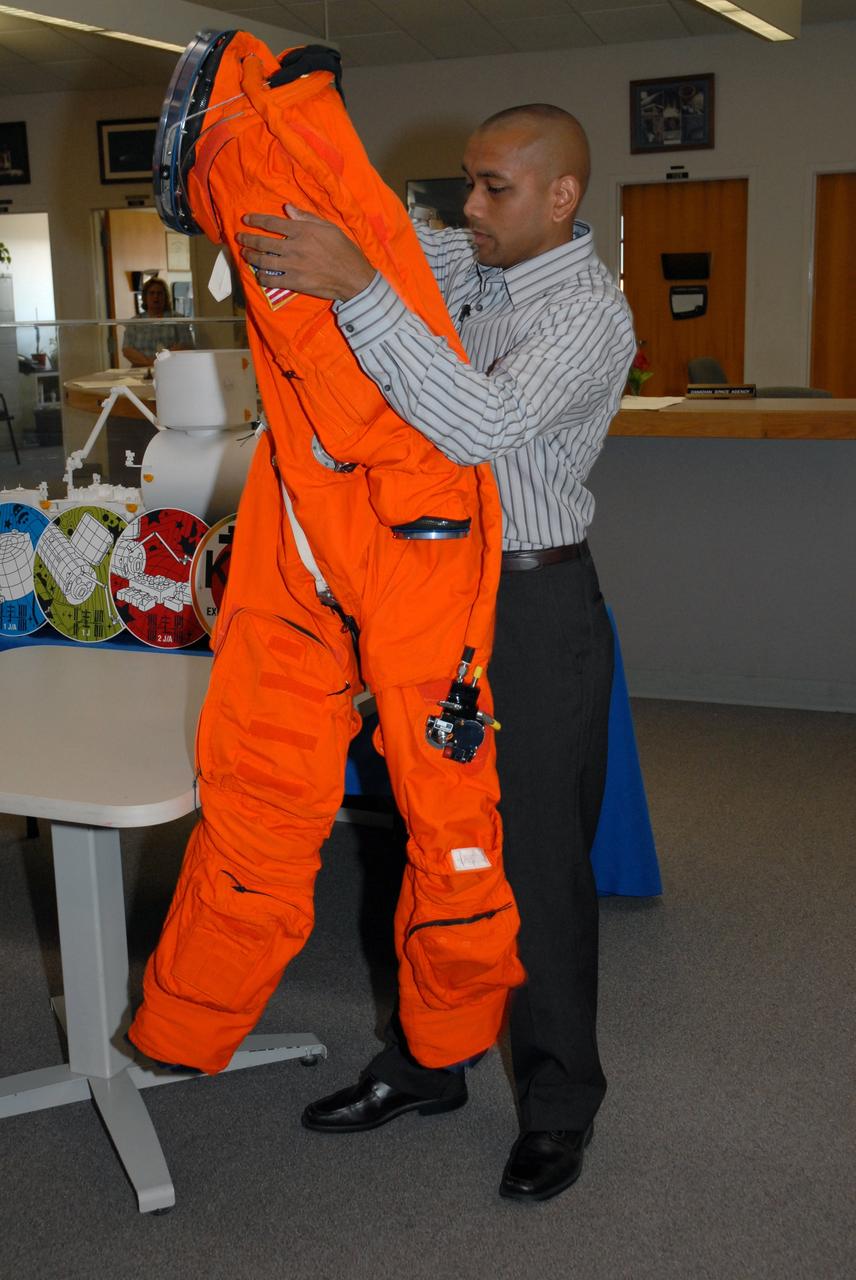
CAPE CANAVERAL, Fla. -- In the NASA News Center at NASA's Kennedy Space Center, Shuttle Crew Escape System Manager KC Chhipwadia demonstrates the launch and entry suit used by shuttle crews during their missions. He explains that entry into the suit is from the back. Photo credit: NASA/Amanda Diller
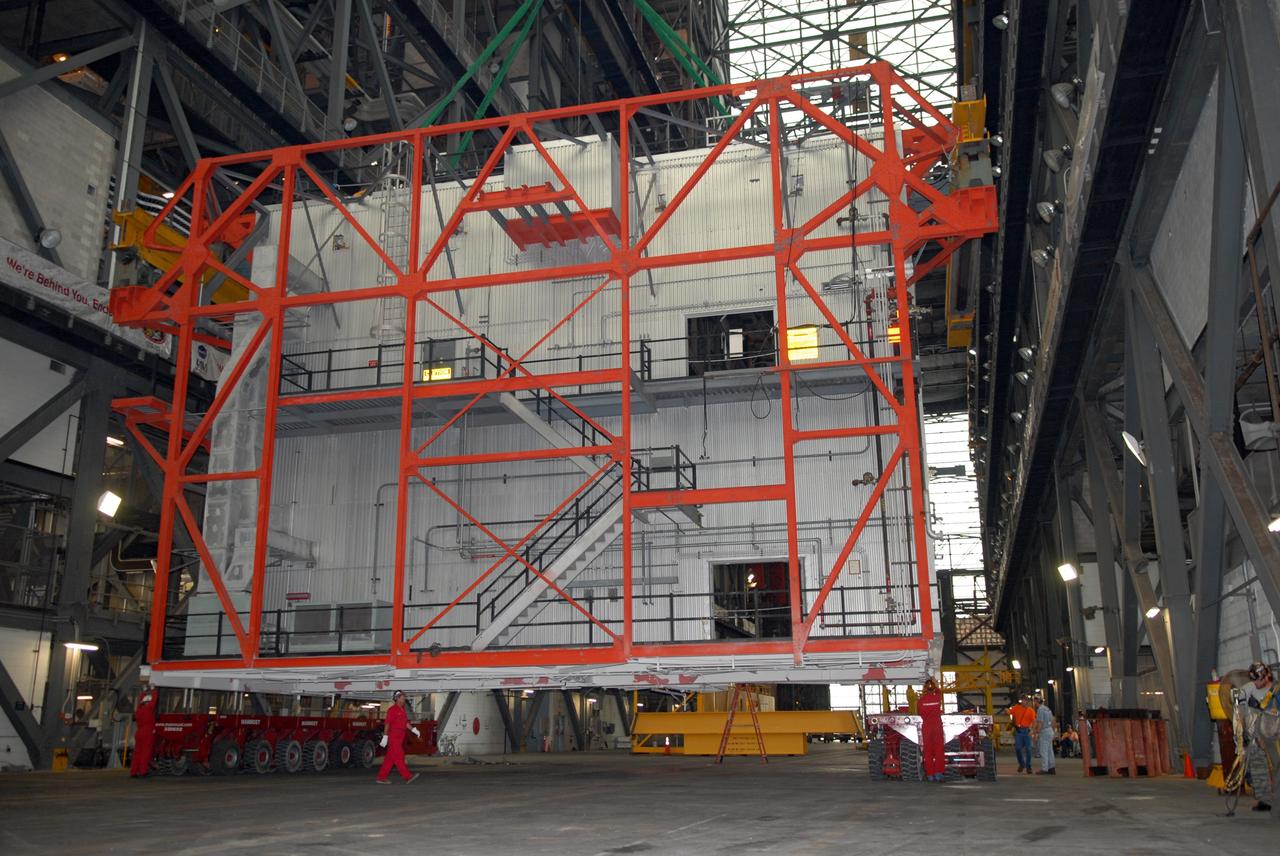
CAPE CANAVERAL, Fla. – In the Vehicle Assembly Building, or VAB, at NASA's Kennedy Space Center, Platform C is being moved from high bay 3 to allow refurbishment of the facility for the Constellation Program's Ares 1-X vehicle. The platform will be removed from the VAB and demolished. Photo credit: NASA/Amanda Diller
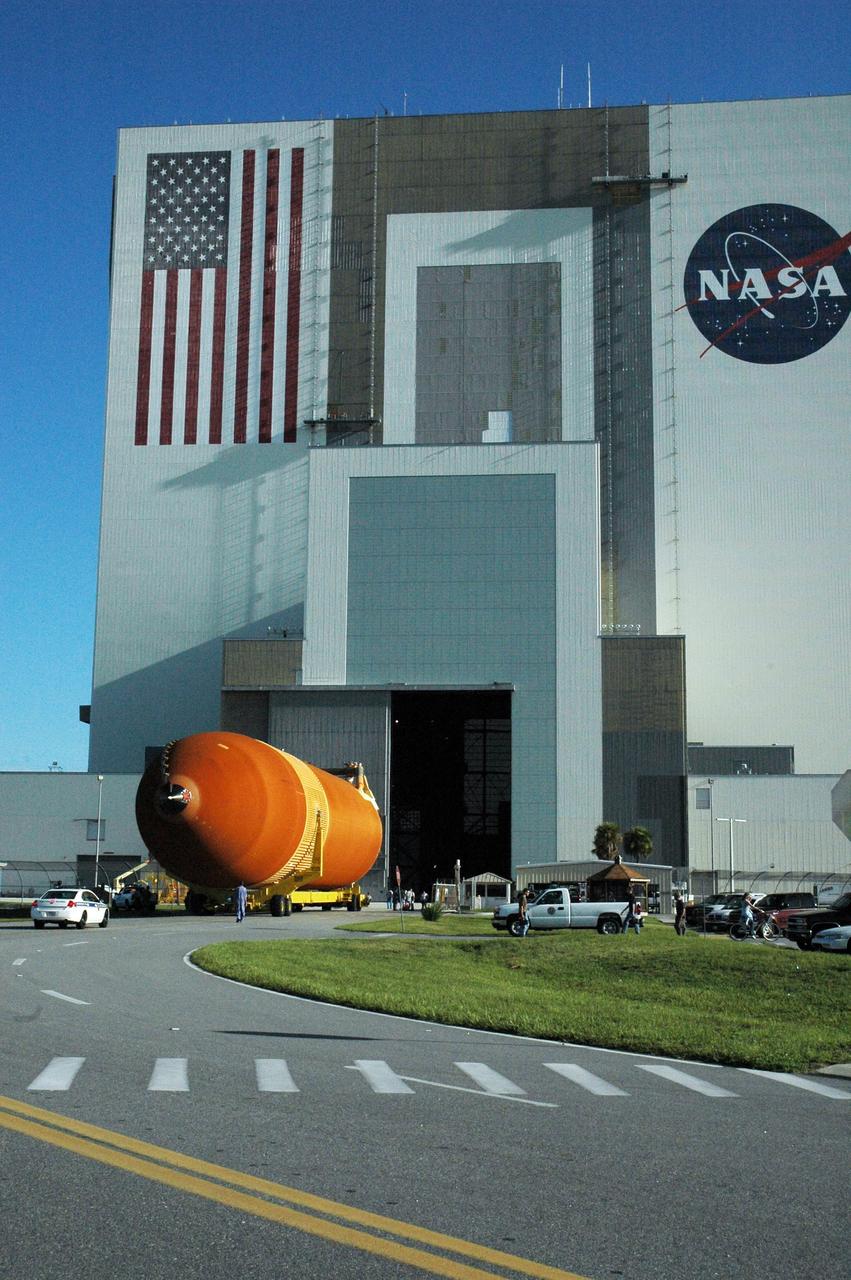
KENNEDY SPACE CENTER, FLA. -- Aboard a transporter, external tank No. 120 moves toward the open door of the Vehicle Assembly Building. There it will be lifted into a checkout cell. ET-120 will be used for launching Space Shuttle Discovery on mission STS-120 in October. NASA/Amanda Diller
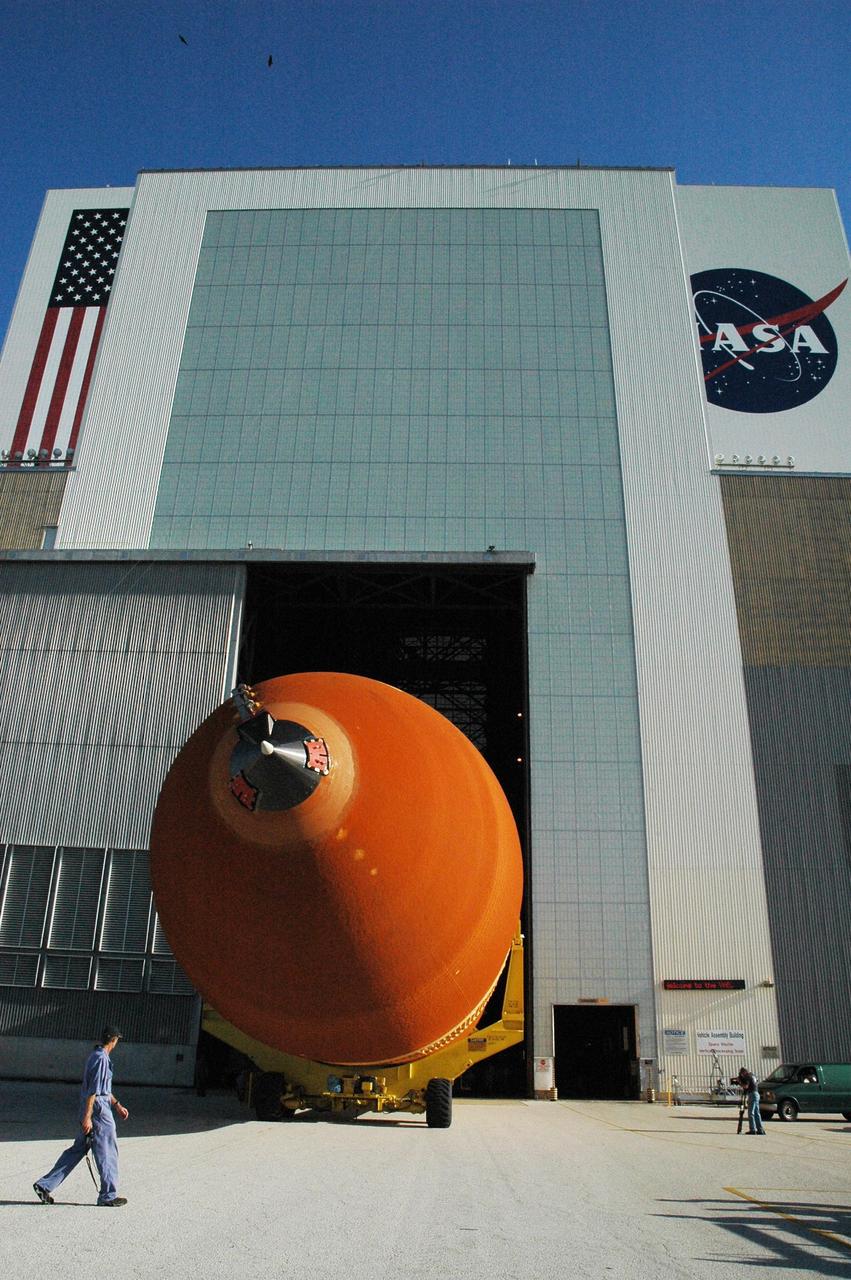
KENNEDY SPACE CENTER, FLA. -- Aboard a transporter, external tank No. 120 moves into the open door of the Vehicle Assembly Building. There it will be lifted into a checkout cell. ET-120 will be used for launching Space Shuttle Discovery on mission STS-120 in October. NASA/Amanda Diller
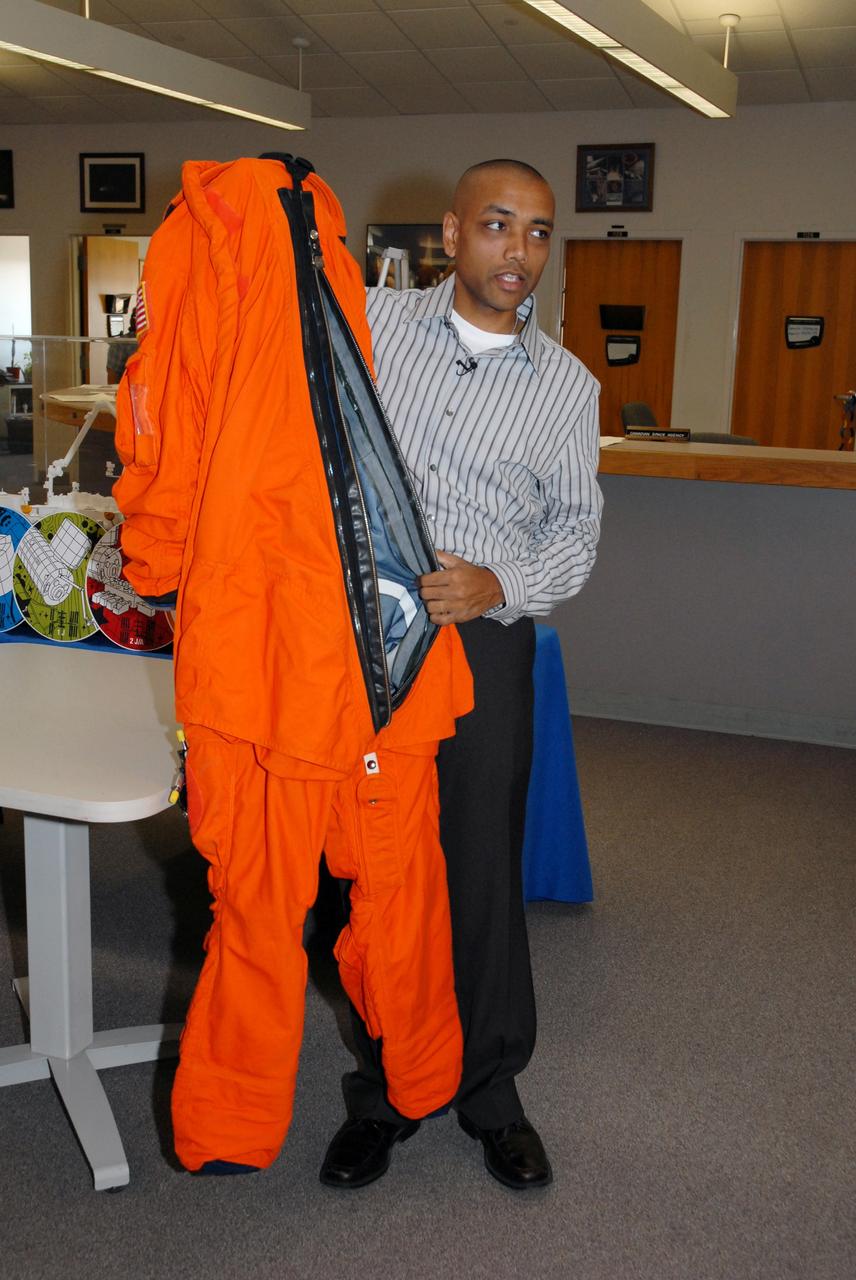
CAPE CANAVERAL, Fla. -- In the NASA News Center at NASA's Kennedy Space Center, Shuttle Crew Escape System Manager KC Chhipwadia demonstrates the launch and entry suit used by shuttle crews during their missions. He explains that entry into the suit is from the back. Photo credit: NASA/Amanda Diller

KENNEDY SPACE CENTER, FLA. - In high bay 3 of the Vehicle Assembly Building, the external tank designated for Space Shuttle Discovery is lowered into position between the solid rocket boosters on the mobile launcher platform. Discovery is scheduled to launch on mission STS-121 in July. Photo credit: NASA/Amanda Diller
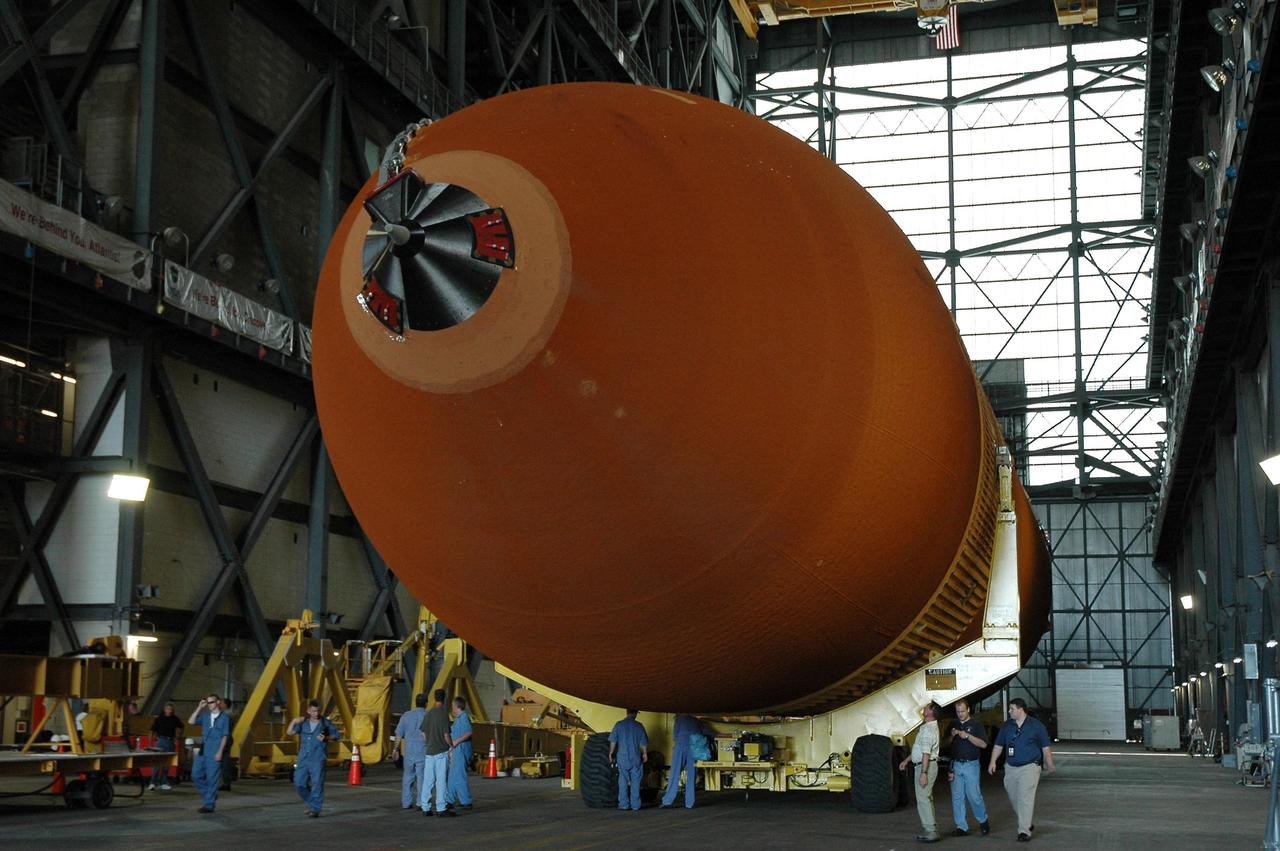
KENNEDY SPACE CENTER, FLA. -- In the transfer aisle of the Vehicle Assembly Building, external tank No. 120 waits to be fitted with overhead crane. The tank will be lifted into a checkout cell. ET-120 will be used for launching Space Shuttle Discovery on mission STS-120 in October. NASA/Amanda Diller
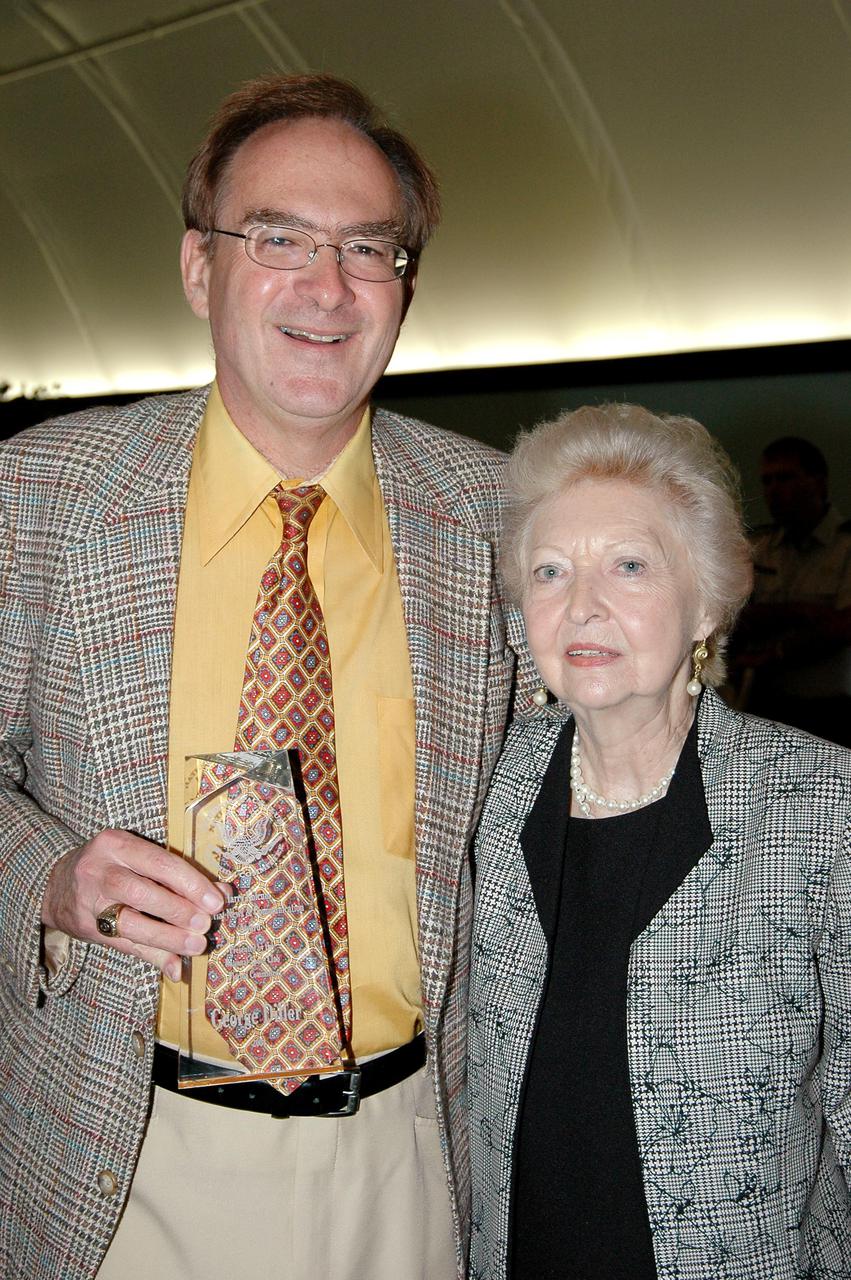
KENNEDY SPACE CENTER, FLA. - NASA public affairs specialist George Diller (left) is honored with a Harry Kolcum Memorial News and Communications Award for 2004 by the National Space Club Florida Committee at the Radisson Resort at the Port, Cape Canaveral, Fla. He is joined by Marcie Young, wife of the late chief of NASA news operations at Kennedy Space Center, Dick Young, with whom Diller worked for many years. Each year, the National Space Club Florida Committee recognizes area representatives of the news media and communications professions for excellence in their ability to communicate the space story along Florida’s Space Coast and throughout the world. The award is named in honor of Harry Kolcum, the former managing editor of Aviation Week and Space Technology, who was Cape bureau chief from 1980 to 1993 prior to his death in 1994. Kolcum was a founding member of the National Space Club Florida Committee.
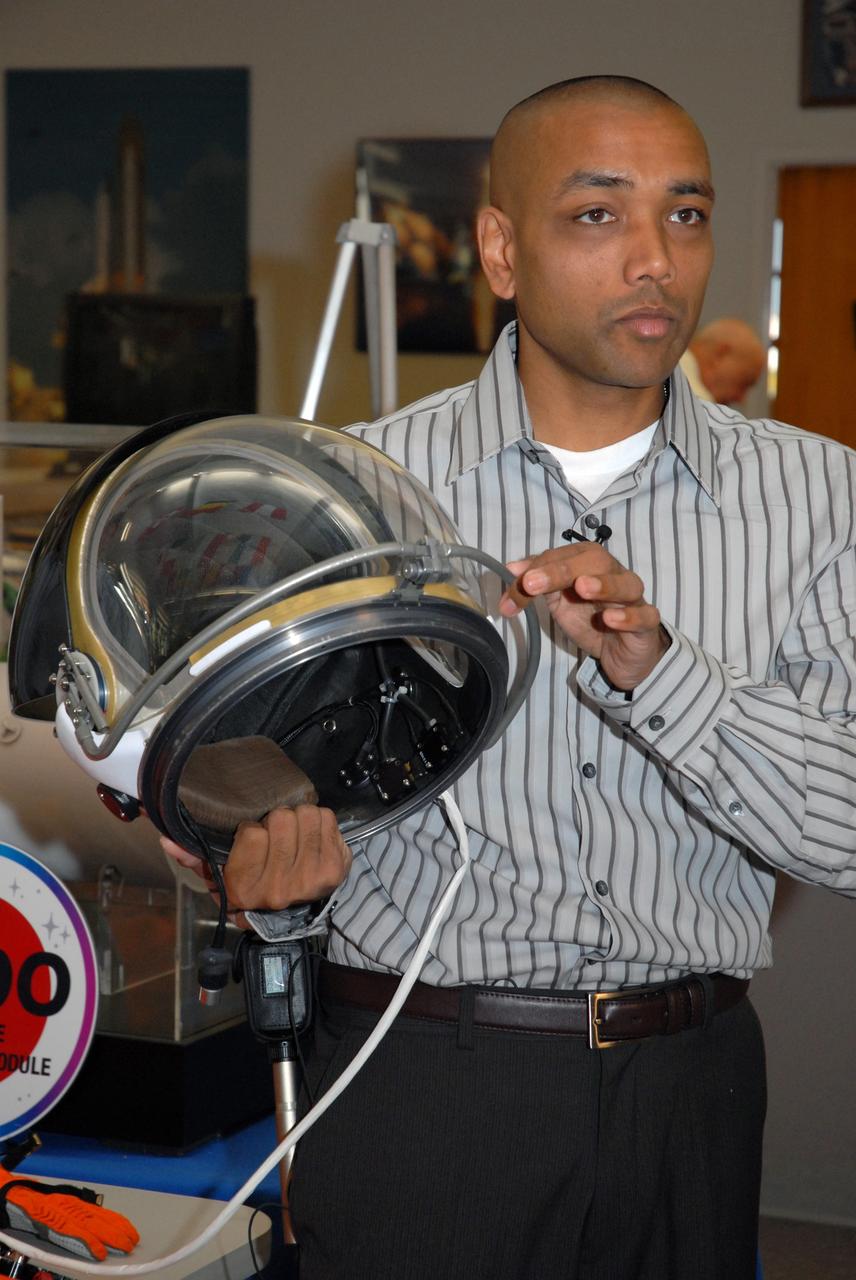
CAPE CANAVERAL, Fla. -- In the NASA News Center at NASA's Kennedy Space Center, Shuttle Crew Escape System Manager KC Chhipwadia describes for the media the elements of the helmet that is part of the launch and entry suit (seen on the table) used by shuttle crews during their missions. He is holding onto the bar that latches to secure the closed visor. The helmet provides oxygen when needed plus a communication system. Photo credit: NASA/Amanda Diller
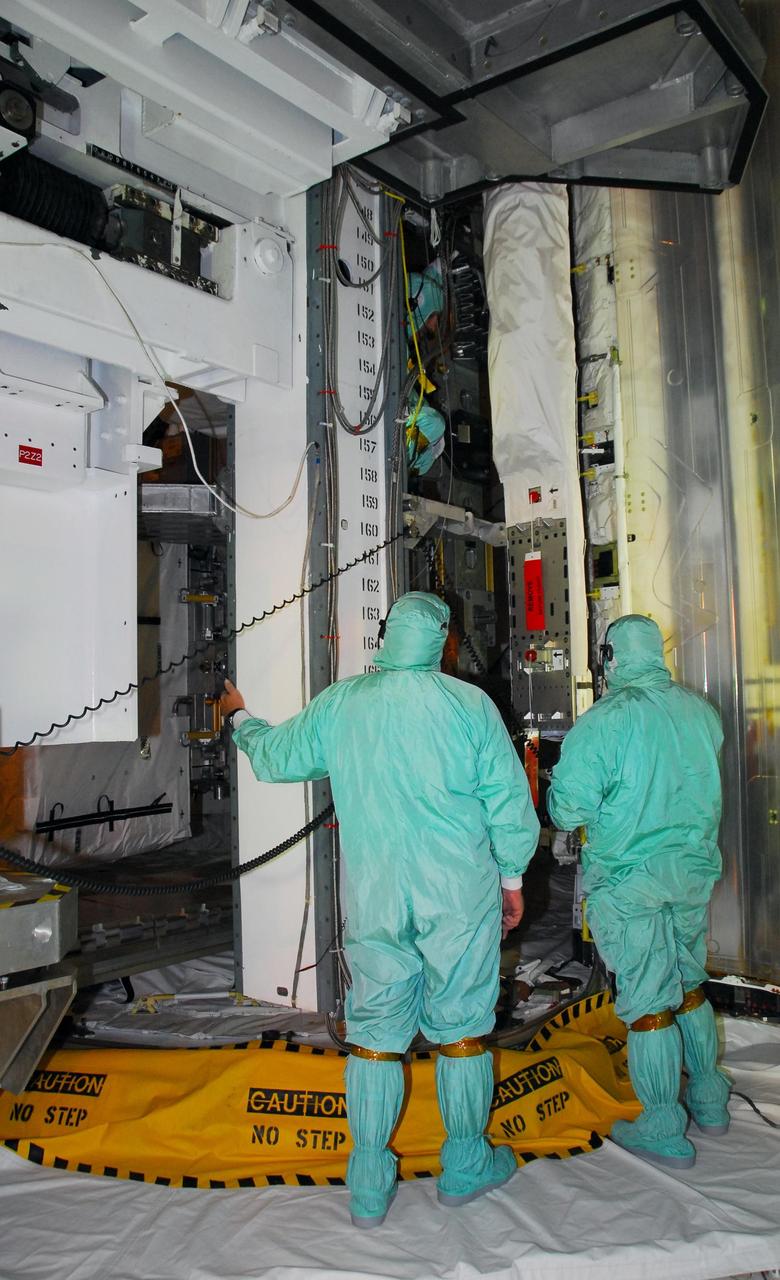
KENNEDY SPACE CENTER, FLA. -- On Launch Pad 39A, workers in the payload changeout room monitor the payload ground-handling mechanism as it transfers the mission STS-118 payload into the payload bay on Space Shuttle Endeavour. The payload includes the S5 truss, the SPACEHAB module and the external stowage platform 3. The mission is the 22nd flight to the International Space Station and is targeted for launch on Aug.7. Photo credit: NASA/Amanda Diller
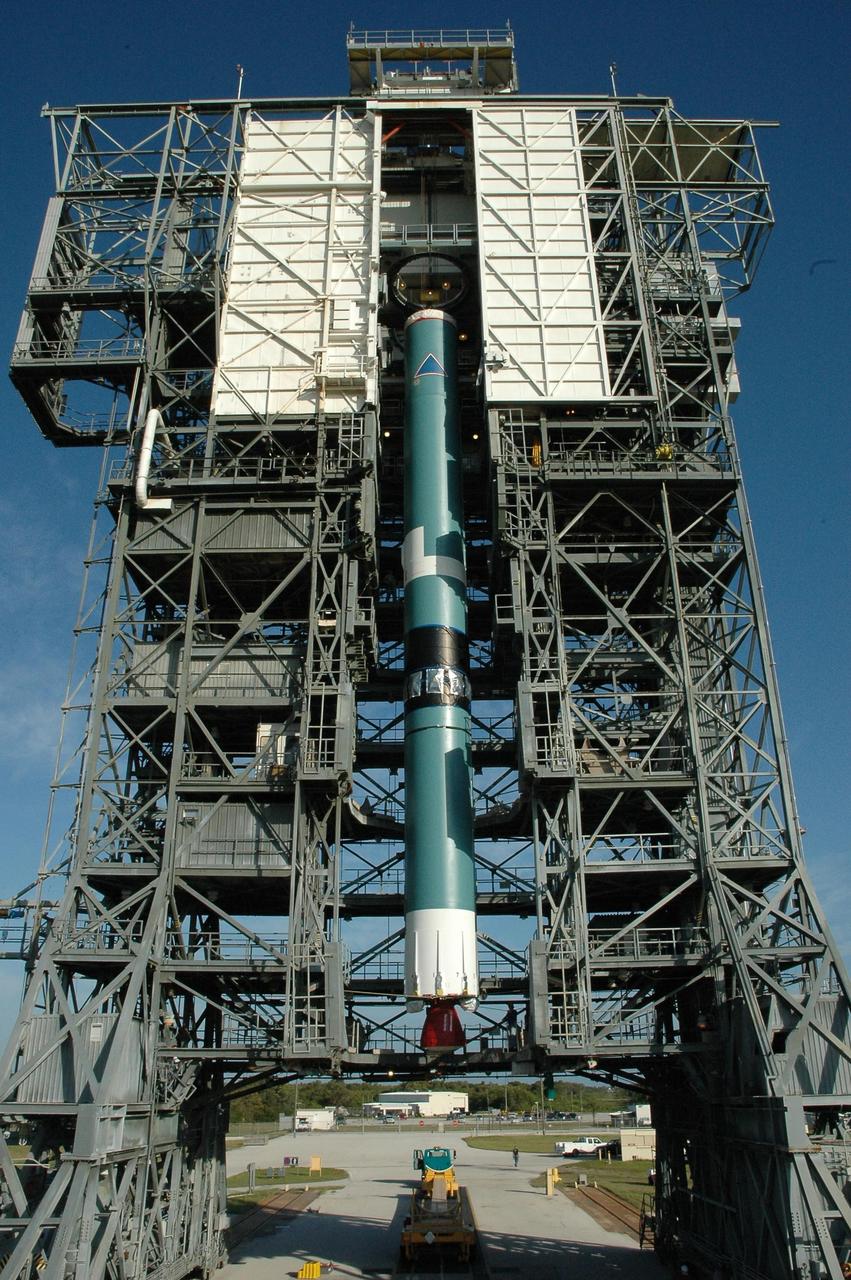
KENNEDY SPACE CENTER, FLA. -- On Launch Pad 17-B at Cape Canaveral Air Force Station, the first stage of a Delta II rocket is placed in the mobile service tower. The rocket is the launch vehicle for the Dawn spacecraft, targeted for liftoff on June 30. Dawn's mission is to explore two of the asteroid belt's most intriguing and dissimilar occupants: asteroid Vesta and the dwarf planet Ceres. Photo credit: NASA/Amanda Diller
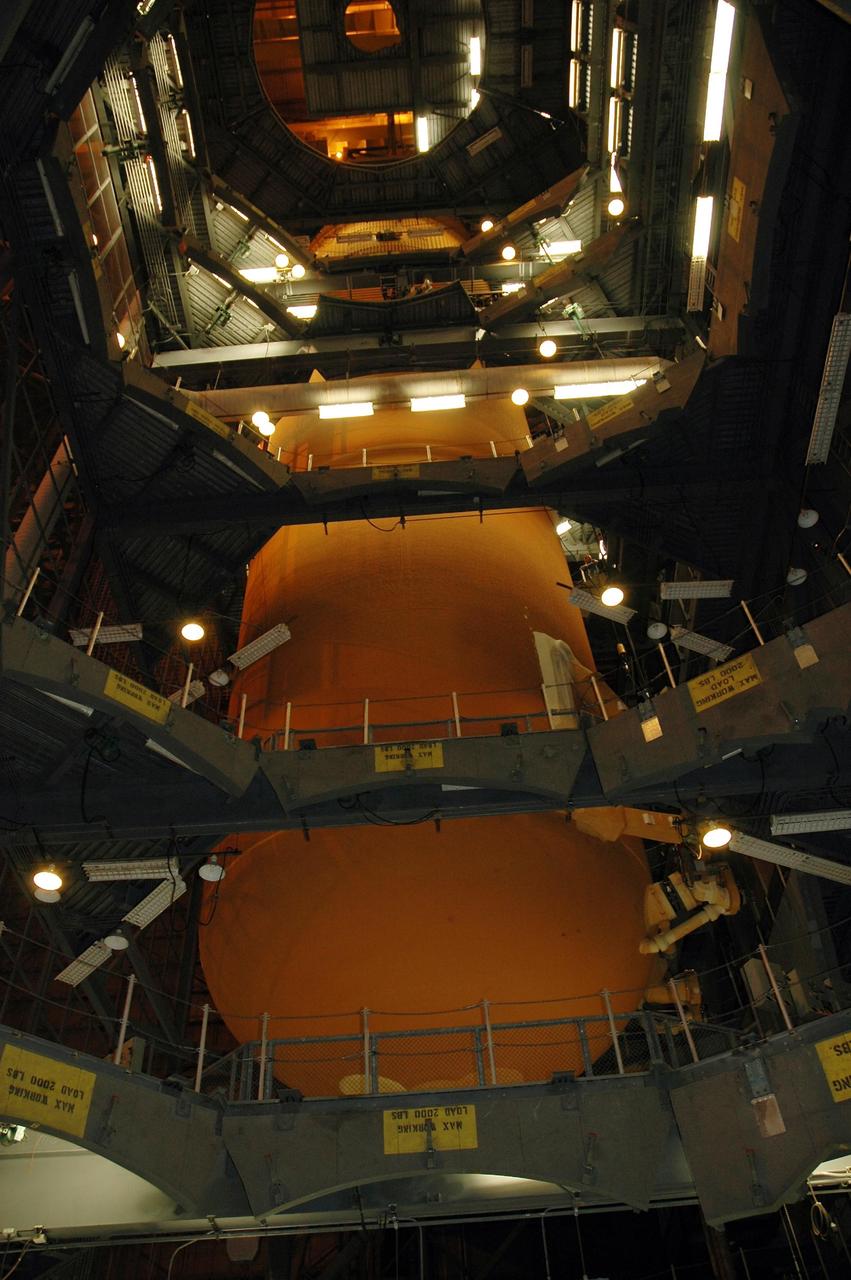
KENNEDY SPACE CENTER, FLA. -- The external tank for Endeavour is being lifted from the checkout cell inside the Vehicle Assembly Building for mating with the solid rocket boosters. Endeavour is currently targeted for rollover to the VAB July 5. Endeavour is the designated orbiter for mission STS-118, targeted for launch on Aug. 9 to the International Space Station. The mission will continue space station construction by delivering a third starboard truss segment, S5, as well as carrying the external stowage platform 3. Photo credit: NASA/Amanda Diller
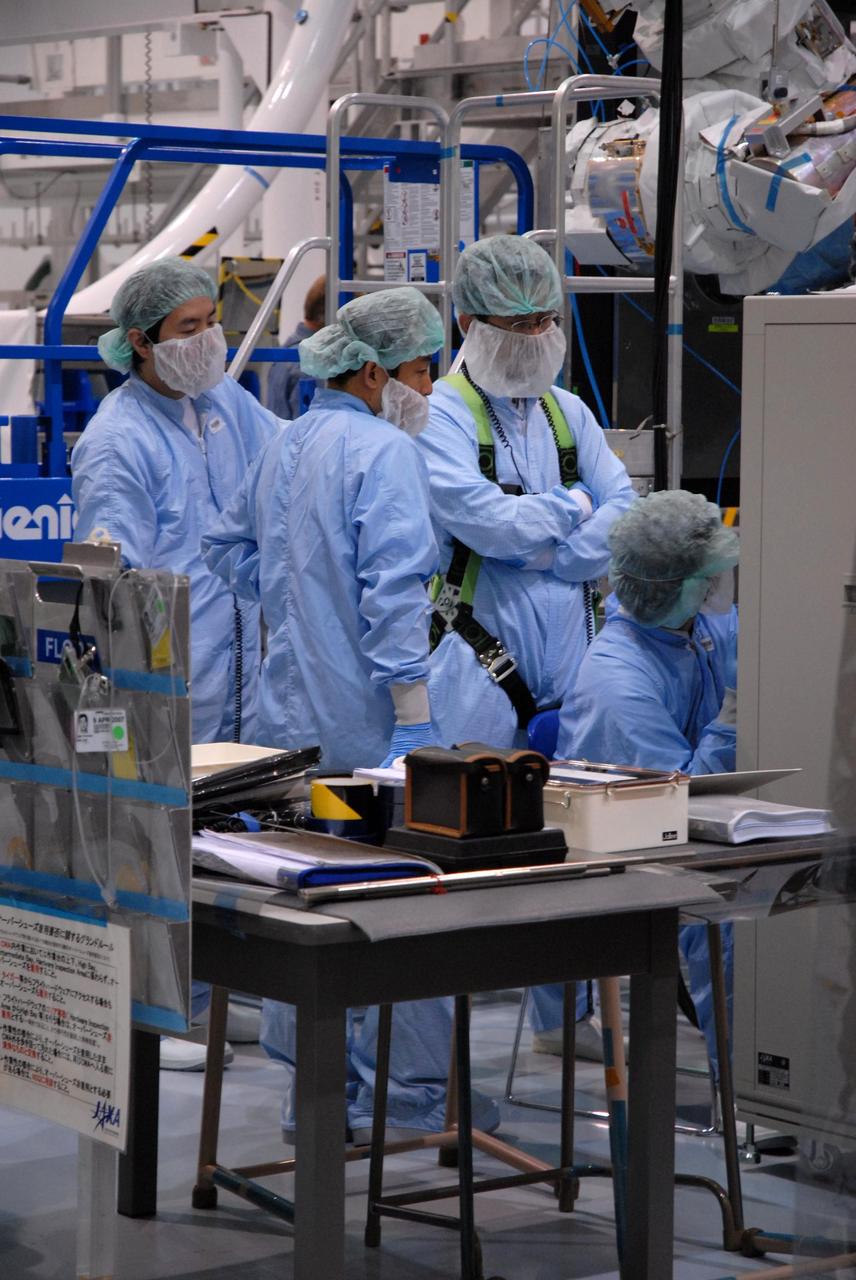
KENNEDY SPACE CENTER, FLA. -- Inside the Space Station Processing Facility at Kennedy Space Center, workers from the Japan Aerospace Exploration Agency watch from a control area as the Remote Manipulator System, or robotic arm, is attached to a hoisting device to prepare it for installation to the Japanese Experiment Module for testing. The RMS is one of the payloads scheduled to be delivered to the station on a future mission tentatively scheduled for 2008. The RMS is similar to the robotic arm already installed on the station's mobile base system. Photo credit: NASA/Amanda Diller
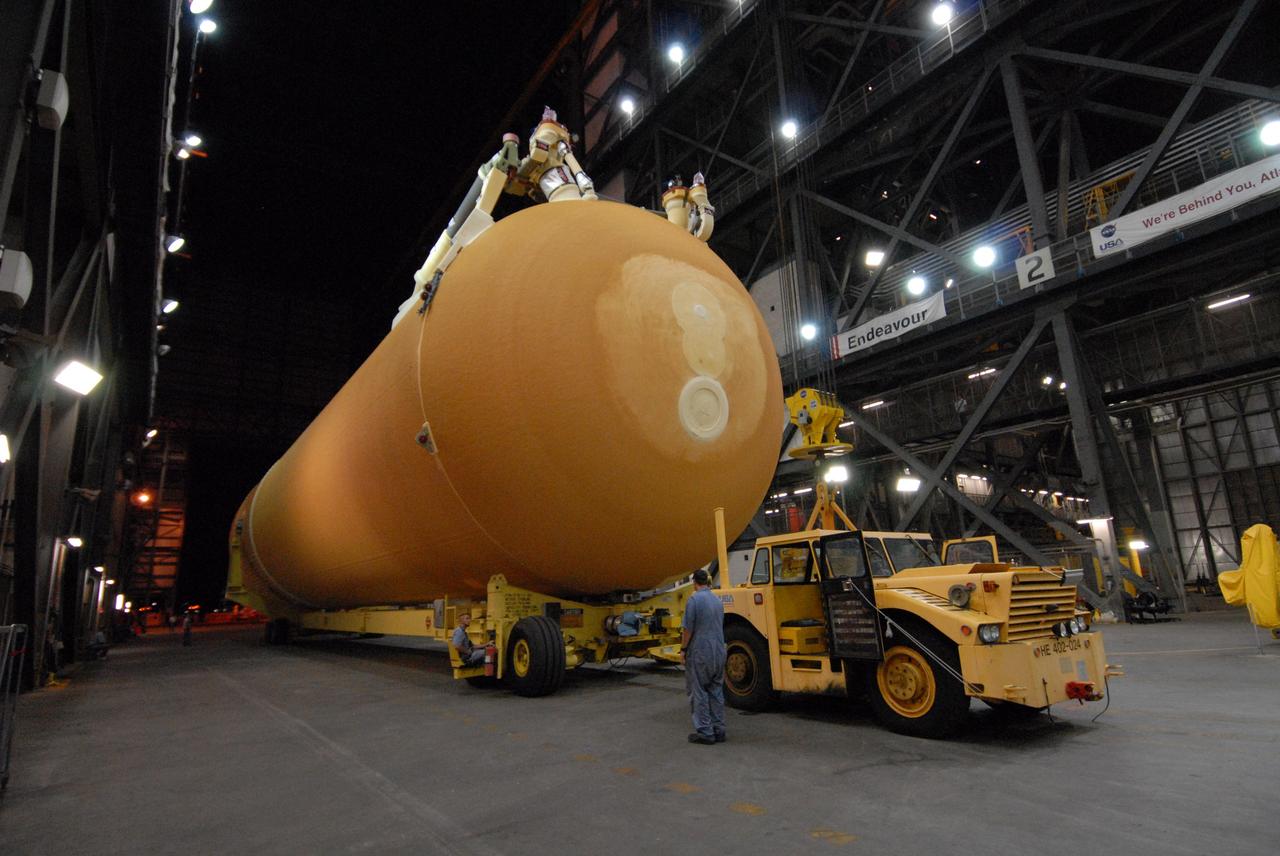
CAPE CANAVERAL, Fla. – The external tank for space shuttle Atlantis' STS-125 mission to NASA's Hubble Space Telescope comes to a stop in the transfer aisle of the Vehicle Assembly Building at NASA's Kennedy Space Center. The tank arrived at the turn basin earlier in the day aboard the Pegasus barge. Inside the building, the tank will be raised to vertical, lifted and moved into a checkout cell. Stacking of the tank and solid rocket boosters is scheduled for Aug. 7. Atlantis is targeted to launch Oct. 8. Photo credit: NASA/Amanda Diller
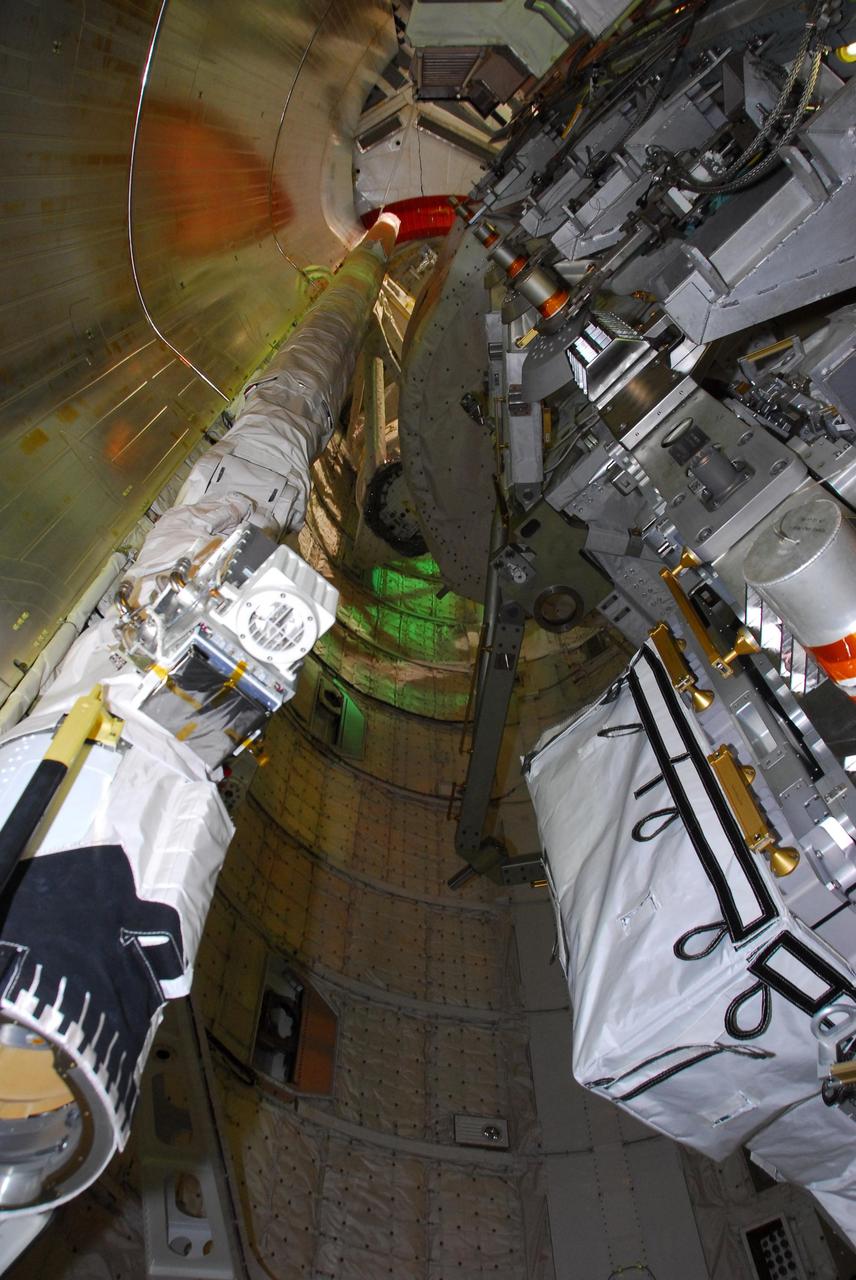
KENNEDY SPACE CENTER, FLA. -- The payload for mission STS-118 is being installed in the payload bay on Space Shuttle Endeavour from the payload changeout room on Launch Pad 39A. The payload includes the S5 truss, SPACEHAB module and external stowage platform 3. The mission is the 22nd flight to the International Space Station and is targeted for launch on Aug.7. Photo credit: NASA/Amanda Diller
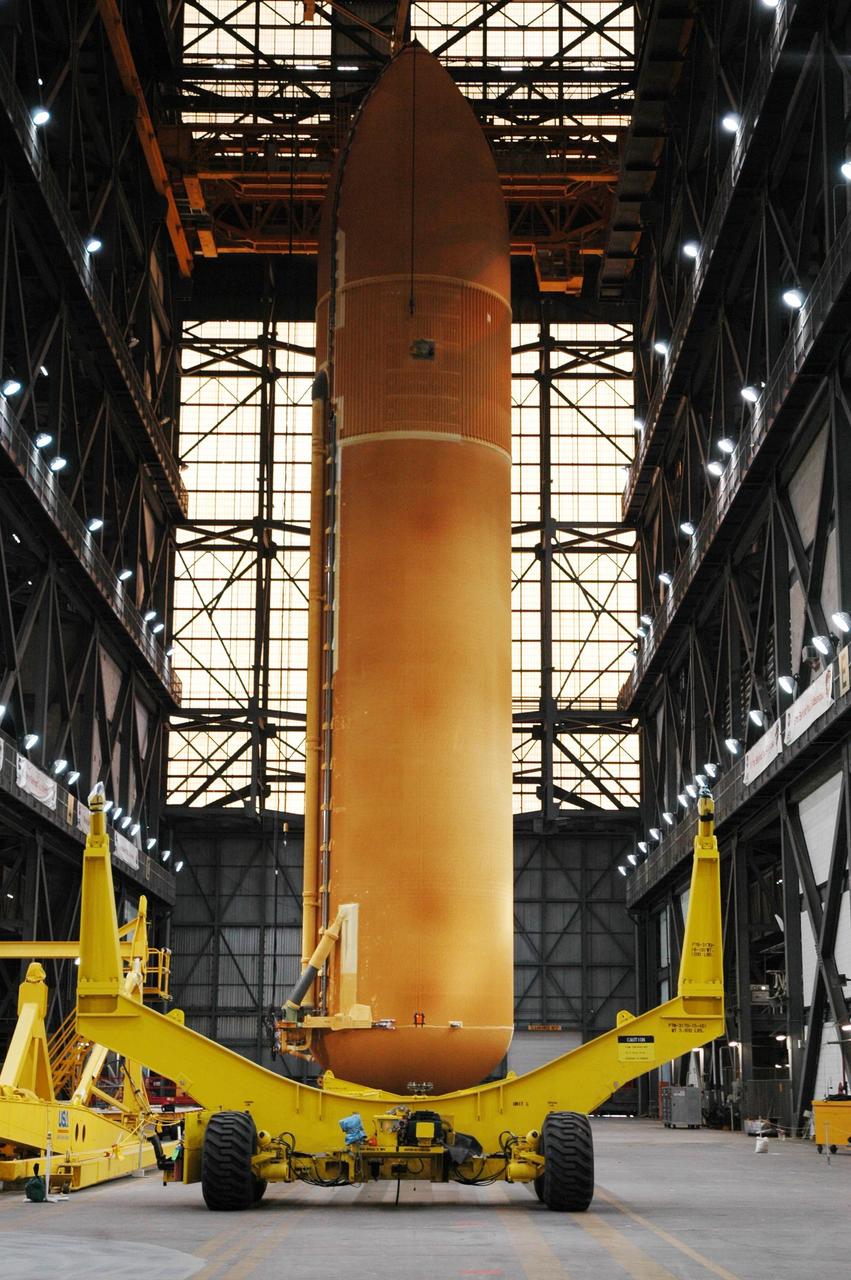
KENNEDY SPACE CENTER, FLA. - In the transfer aisle of the Vehicle Assembly Building, the external tank designated for Space Shuttle Discovery is ready to be lifted and moved to high bay 3. There it will be stacked with the solid rocket boosters already in place on the mobile launcher platform. Discovery is scheduled to launch on mission STS-121 in July. Photo credit: NASA/Amanda Diller
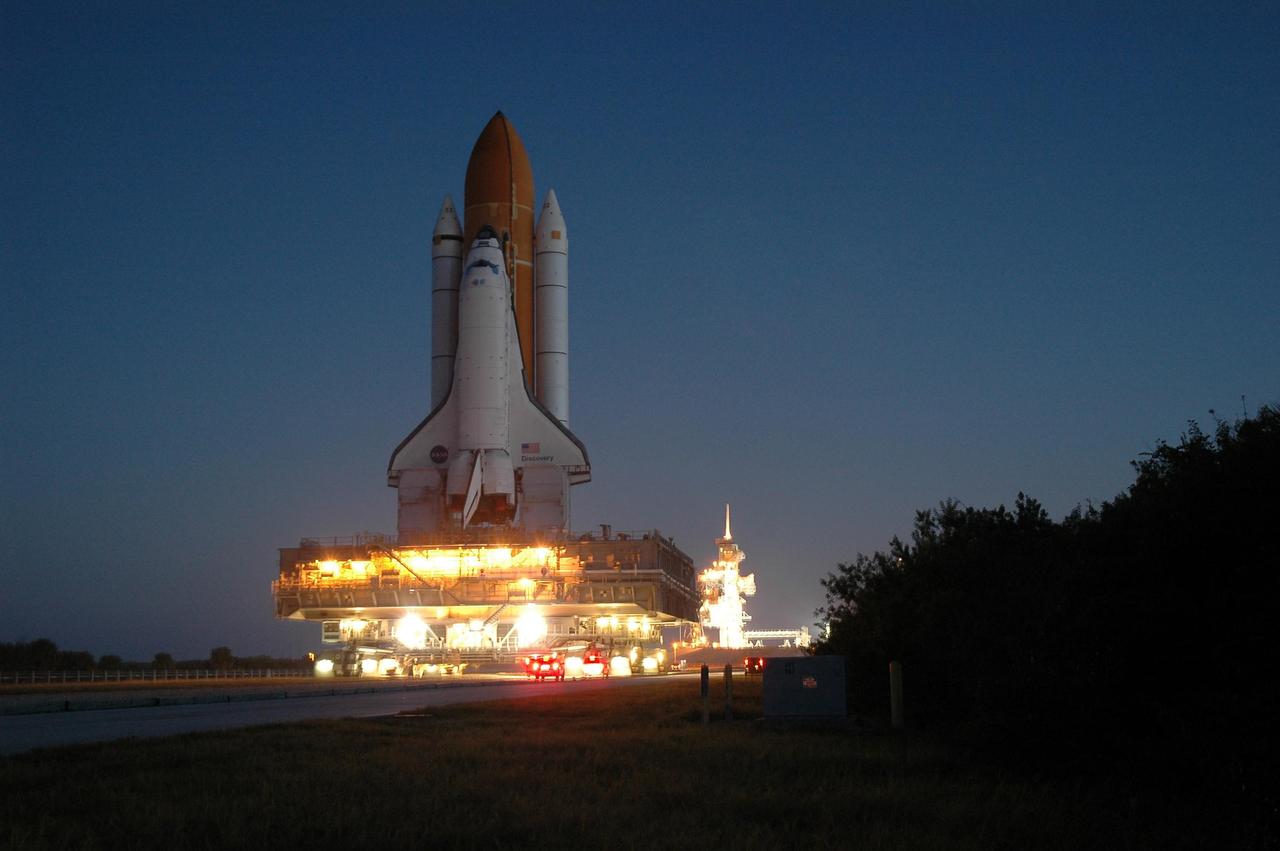
KENNEDY SPACE CENTER, FLA. -- Space Shuttle Discovery is well on its way on the long, slow journey from high bay 3 of the Vehicle Assembly Building to Launch Pad 39B and launch of mission STS-116. The mission is No. 20 to the International Space Station and construction flight 12A.1. The mission payload is the SPACEHAB module, the P5 integrated truss structure and other key components. The launch window for mission STS-116 opens Dec. 7. Photo credit: NASA/Amanda Diller
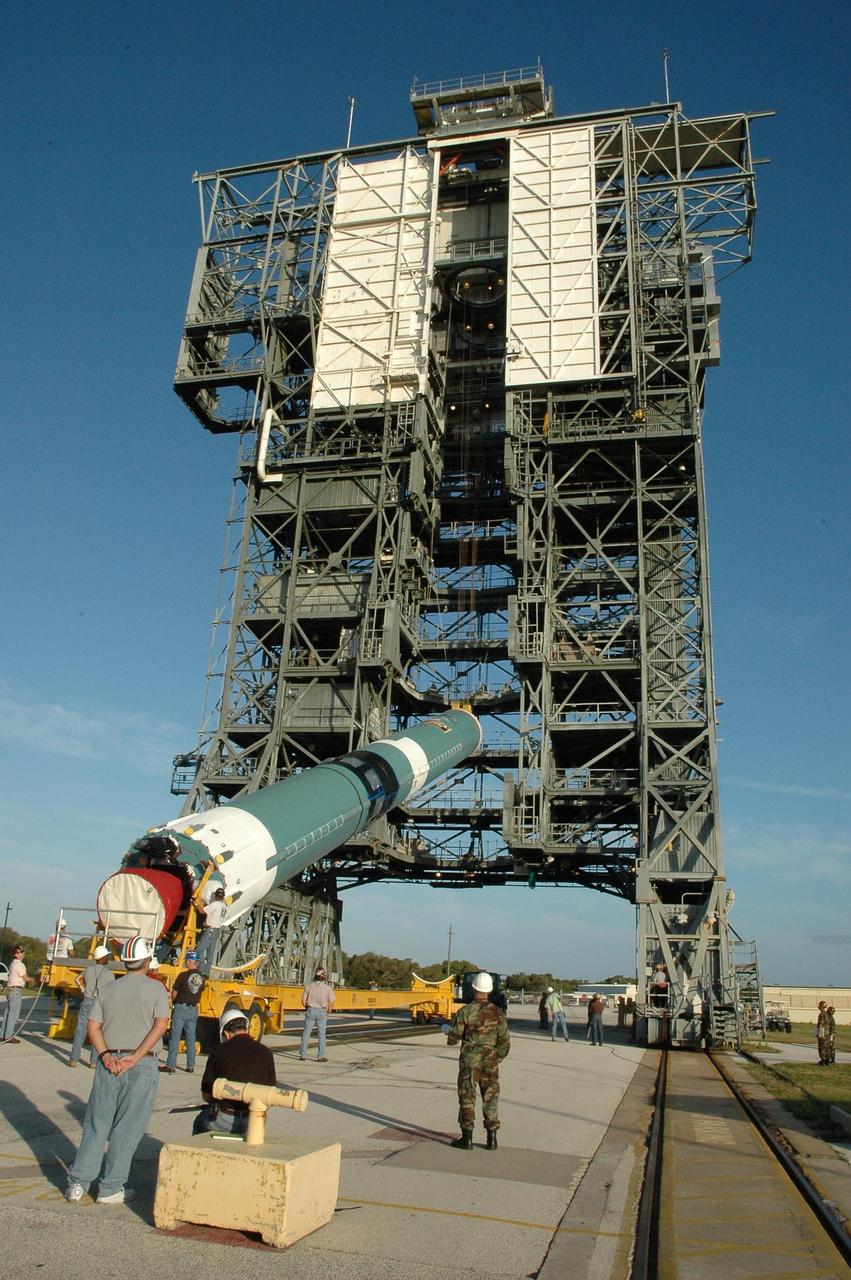
KENNEDY SPACE CENTER, FLA. -- On Launch Pad 17-B at Cape Canaveral Air Force Station, the first stage of a Delta II rocket is being raised off its transporter into a vertical position. Once vertical, the rocket will be lifted up into the mobile service tower. The rocket is the launch vehicle for the Dawn spacecraft, targeted for liftoff on June 30. Dawn's mission is to explore two of the asteroid belt's most intriguing and dissimilar occupants: asteroid Vesta and the dwarf planet Ceres. Photo credit: NASA/Amanda Diller
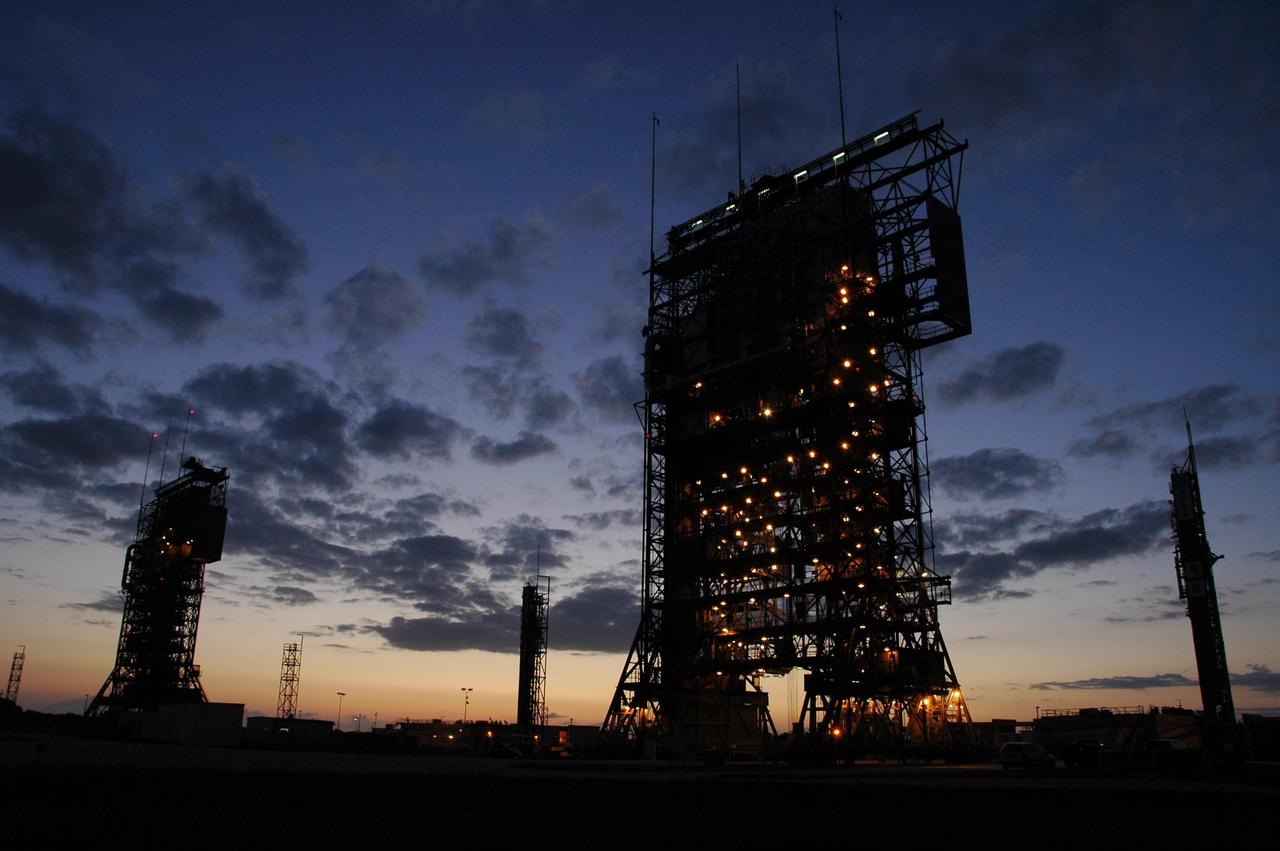
KENNEDY SPACE CENTER, FLA. -- The mobile service towers on Launch Pads 17-A (left) and 17-B (right) are silhouetted against the pre-dawn sky at Cape Canaveral Air Force Station. In the background are the launch gantries. Pad 17-B is the site for the launch of the Dawn spacecraft on June 30. Dawn's mission is to explore two of the asteroid belt's most intriguing and dissimilar occupants: asteroid Vesta and the dwarf planet Ceres. Photo credit: NASA/Amanda Diller
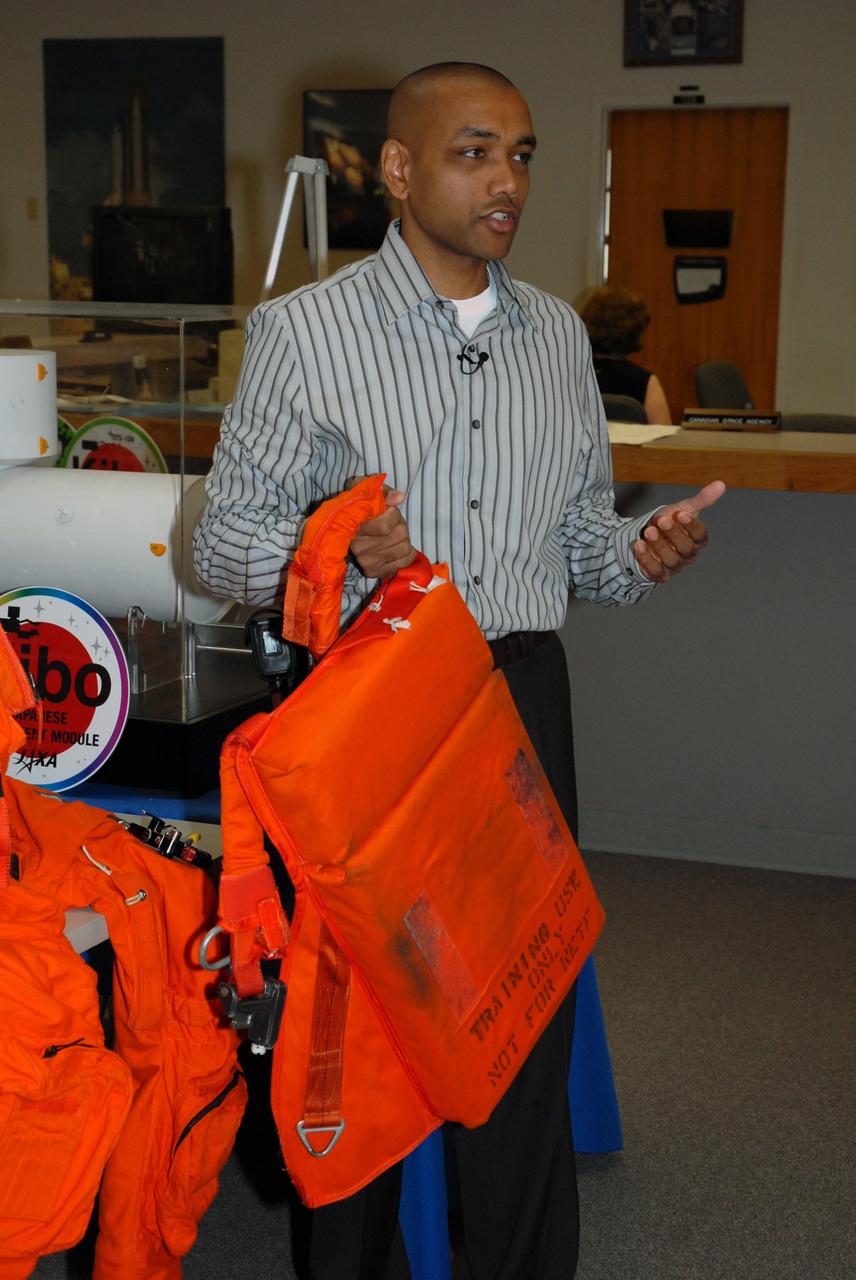
CAPE CANAVERAL, Fla. -- In the NASA News Center at NASA's Kennedy Space Center, Shuttle Crew Escape System Manager KC Chhipwadia describes for the media the components of the parachute worn by shuttle crews during launch and landing. On top is a pilot and drag chute. In the middle is the main chute. At bottom is a survival life raft. The elements of the suit and parachute provide safety elements in the event of an emergency. Photo credit: NASA/Amanda Diller