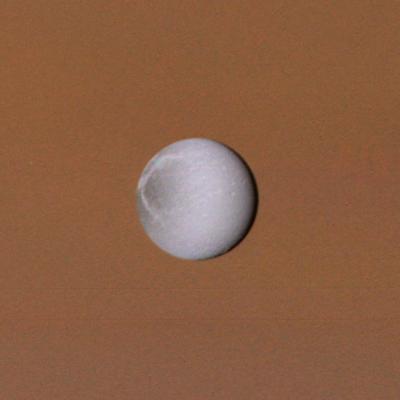
Dione
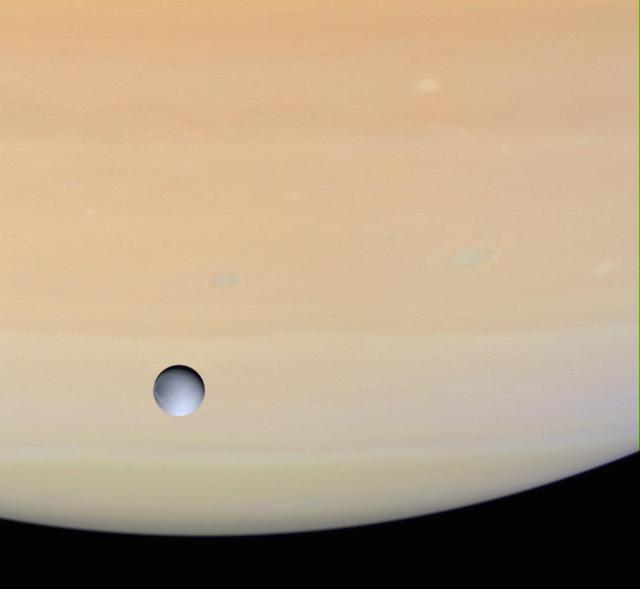
Dione and Saturn
Dione Thumbnail
Dione Surprise
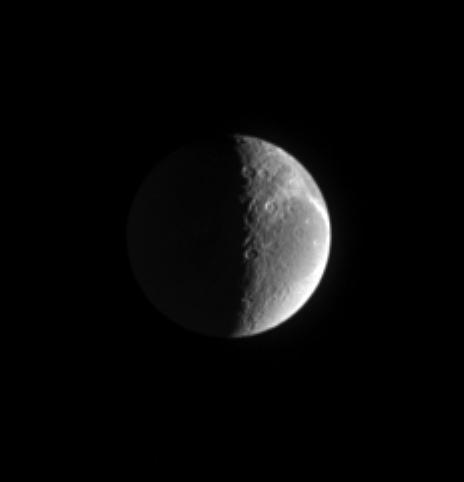
Daybreak on Dione
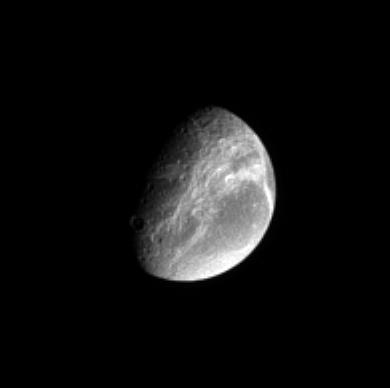
Dione Canyonlands
Wisps on Dione
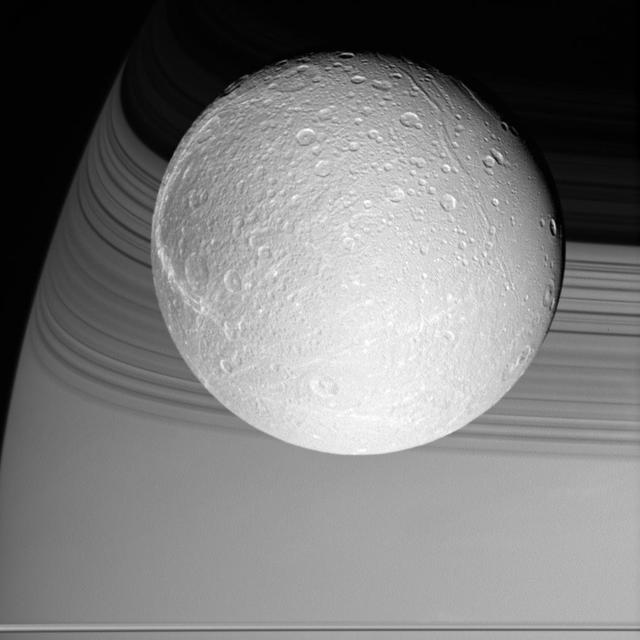
On Approach to Dione
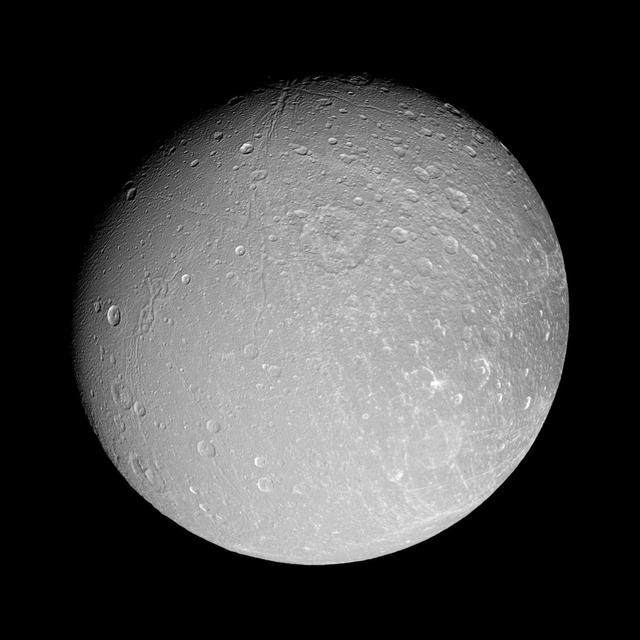
Facing Dione
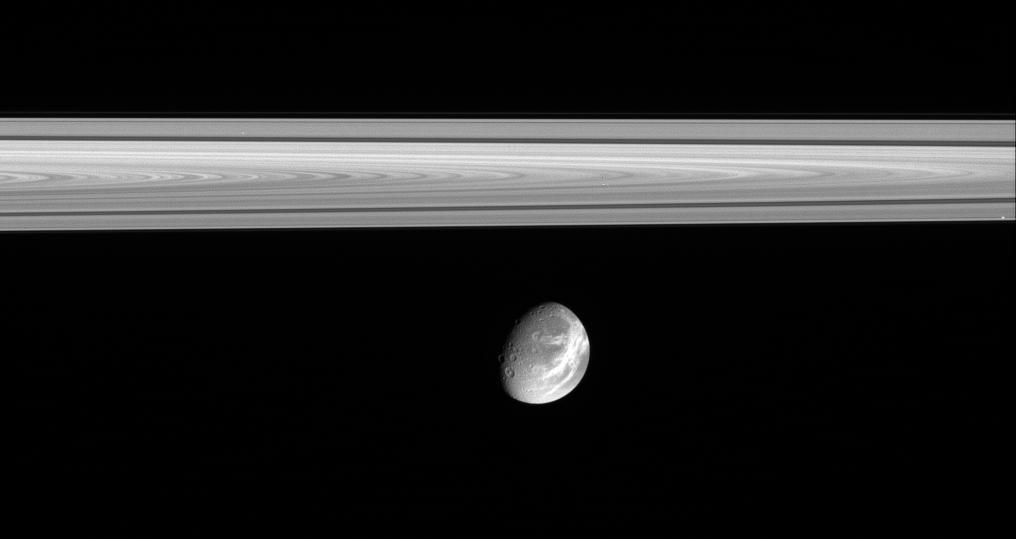
Captivating Dione
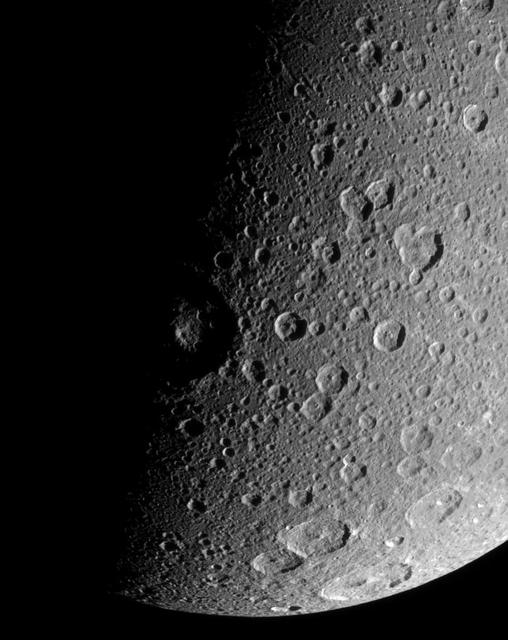
Battered Dione
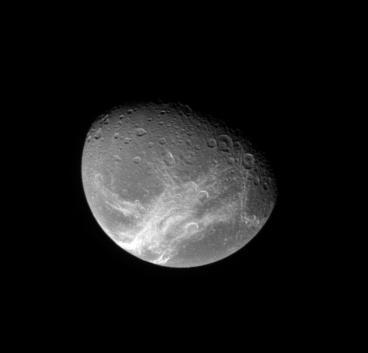
Dione Below
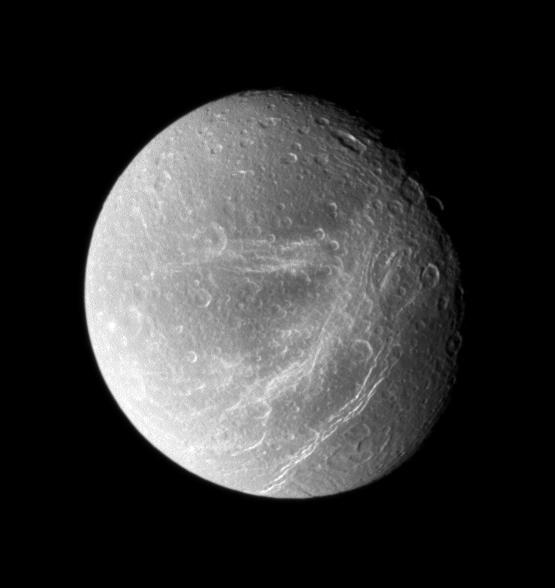
Scratches on Dione
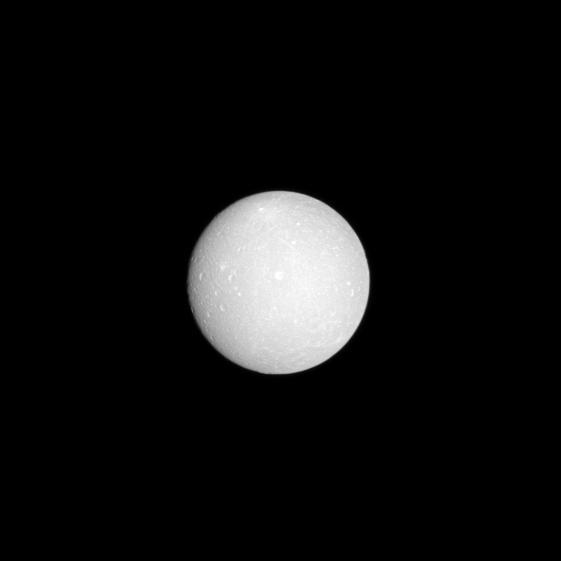
Details on Dione
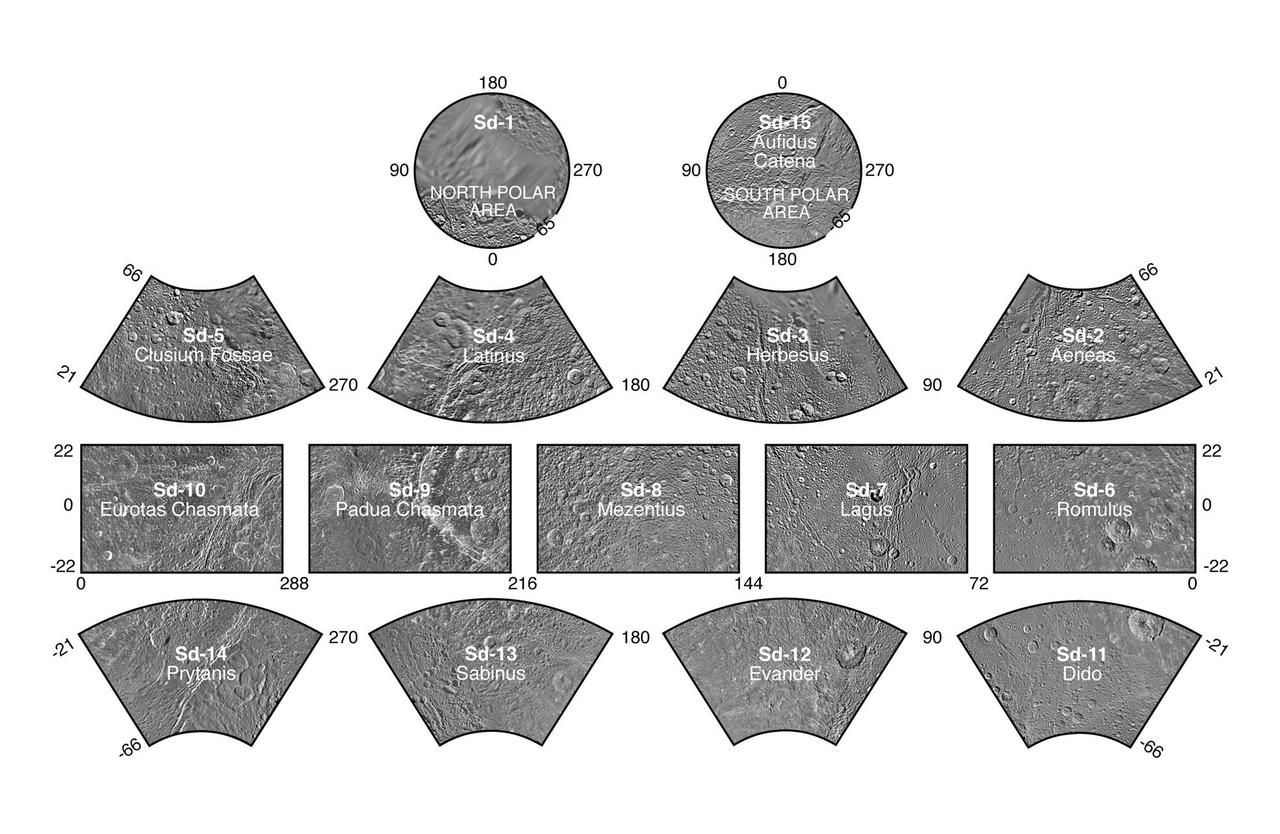
The Dione Atlas
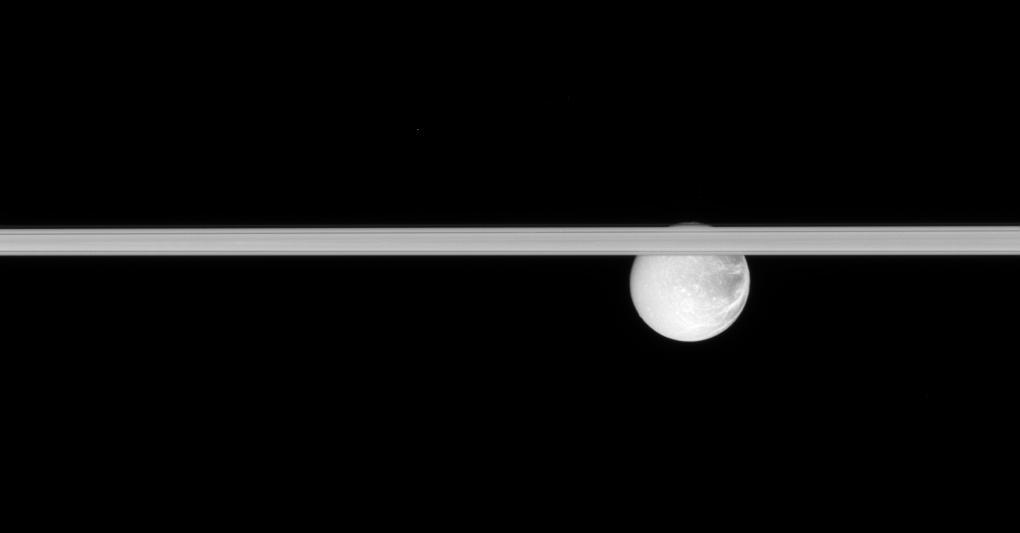
Hiding Dione
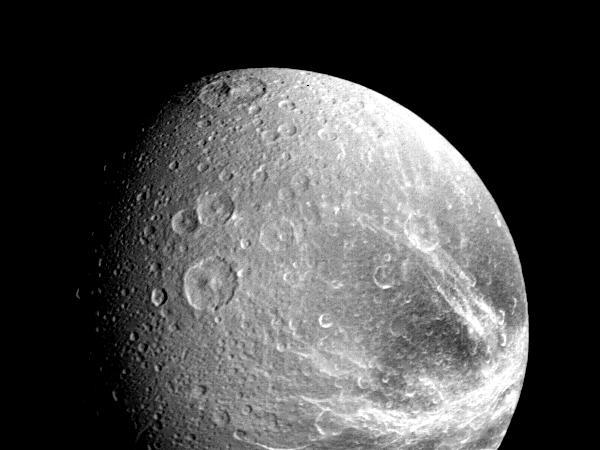
The Saturnian Moon Dione
Saturn Satellite Dione
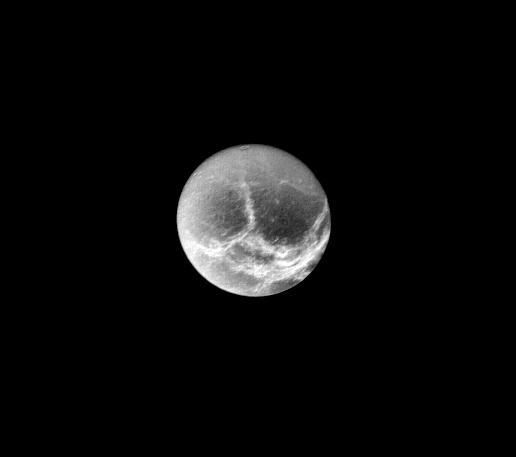
Dione - Circular Impact Craters
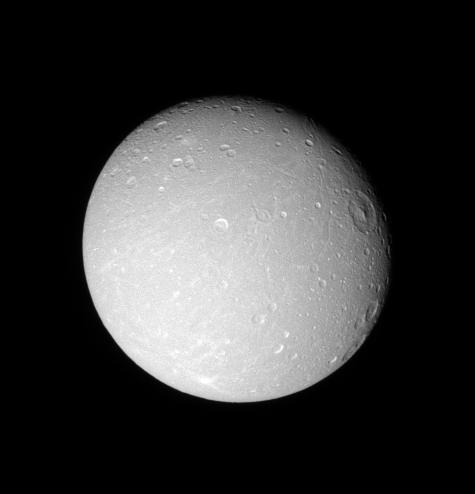
Detail on Dione Monochrome
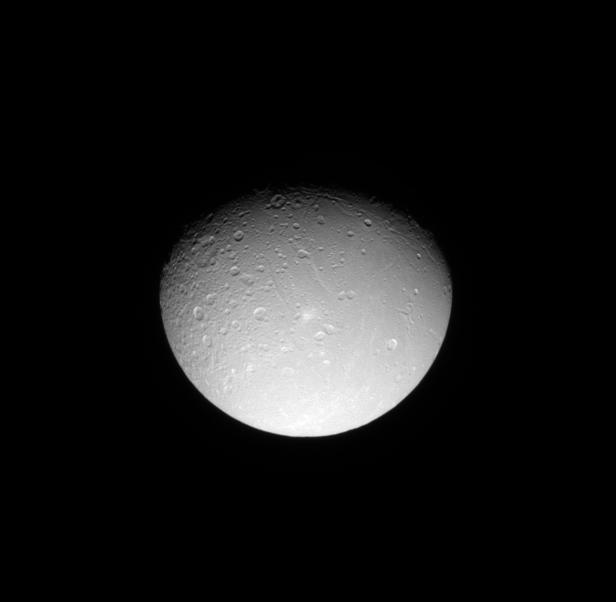
Dione Cratered Surface
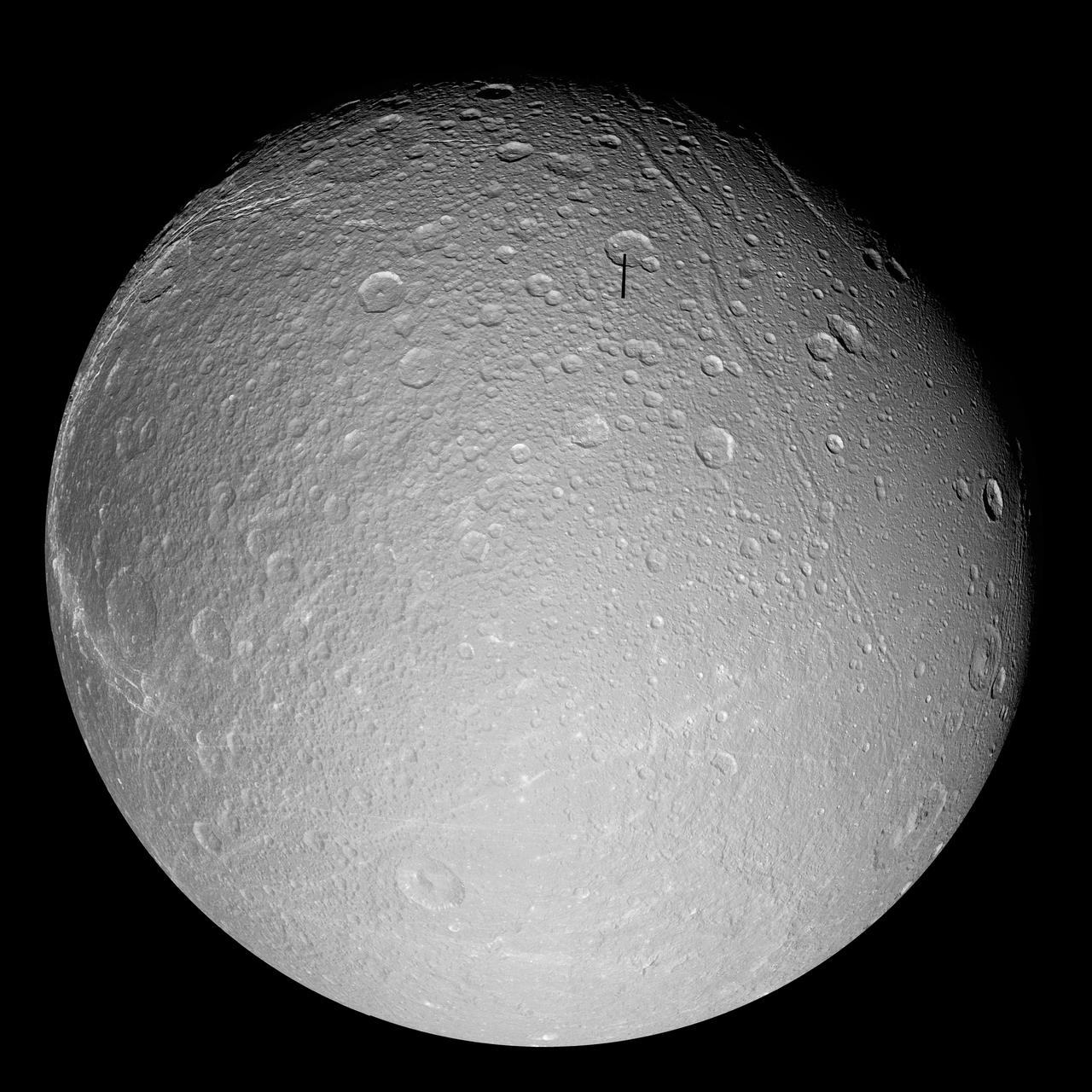
Dione in Full View
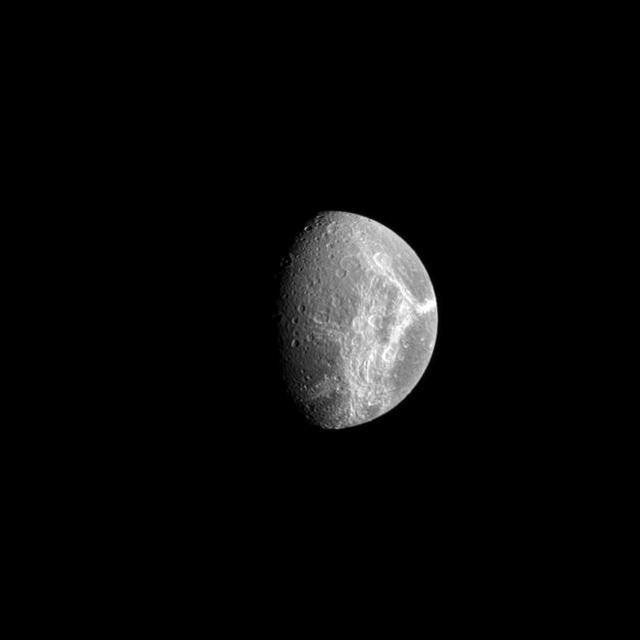
Dione Icy Wisps
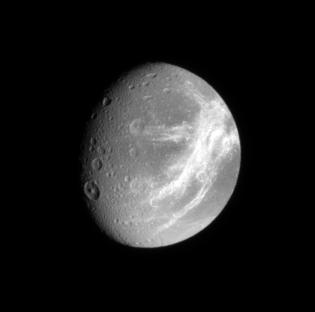
Dione Fractured Face
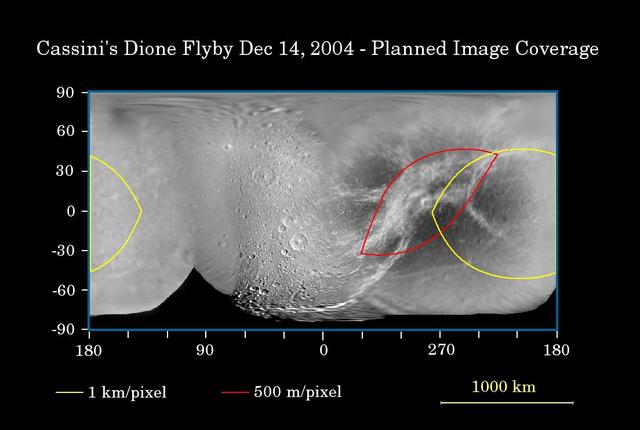
First Flyby of Dione
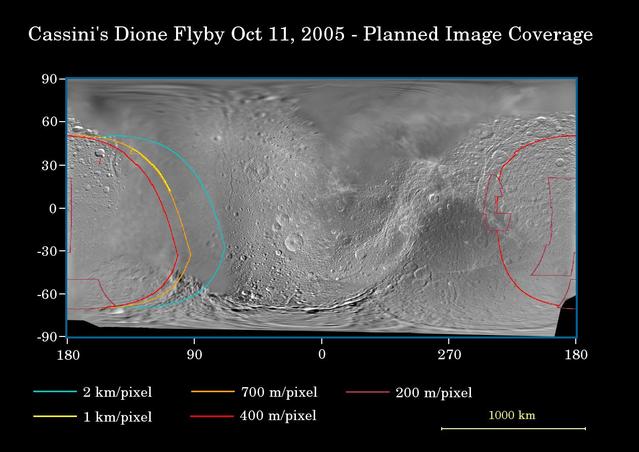
Cassini Visit to Dione
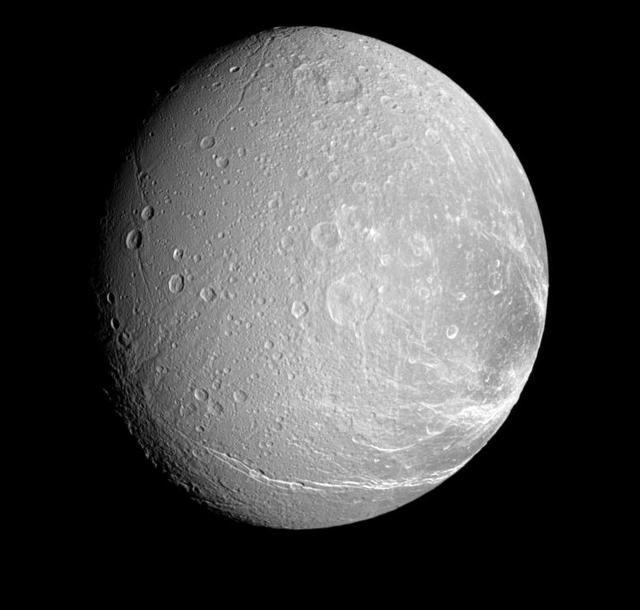
Cracked-up Dione
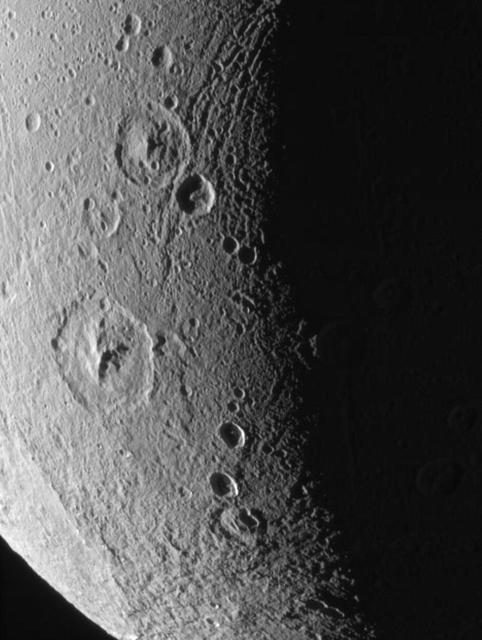
Dione: Magnified View
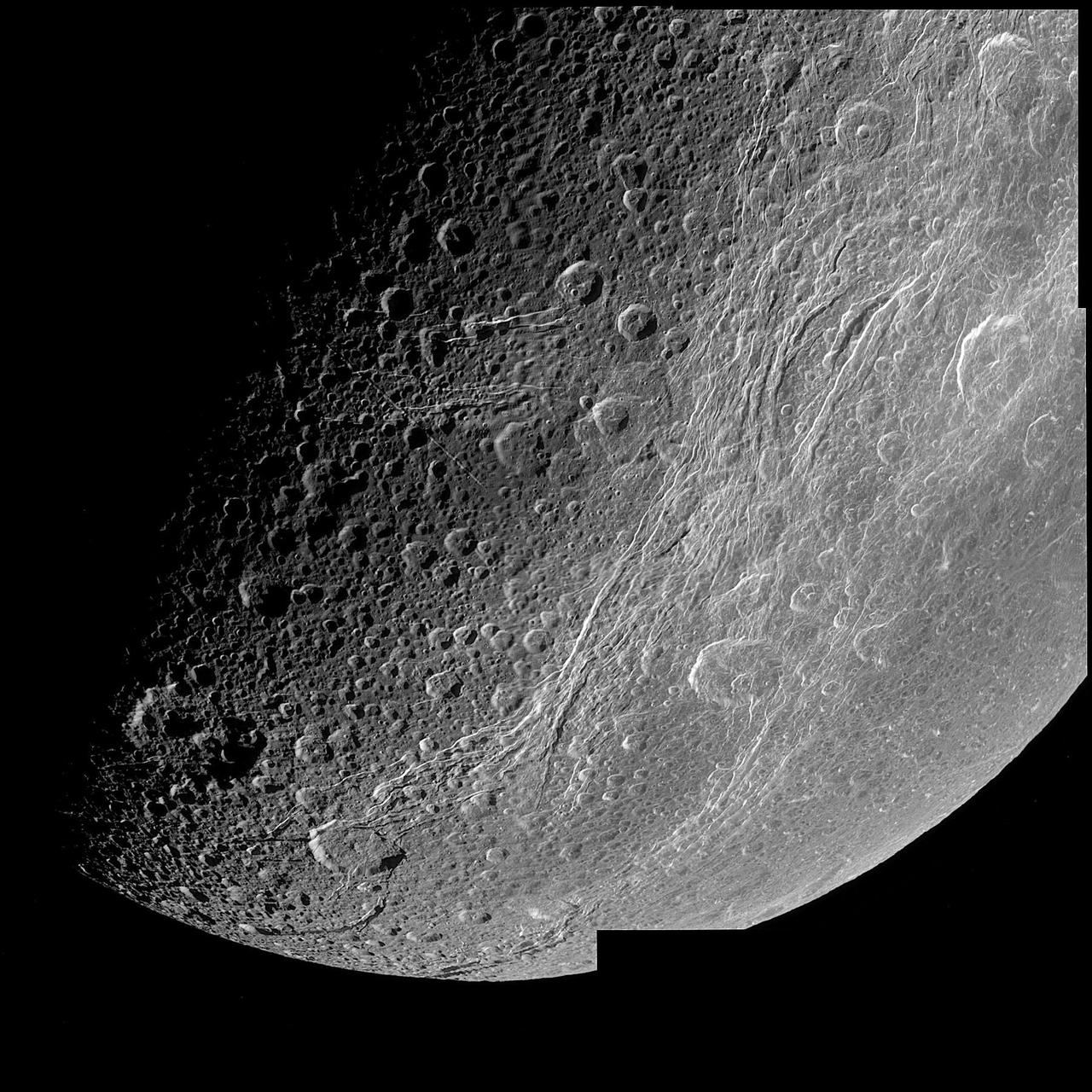
Highest Resolution View of Dione
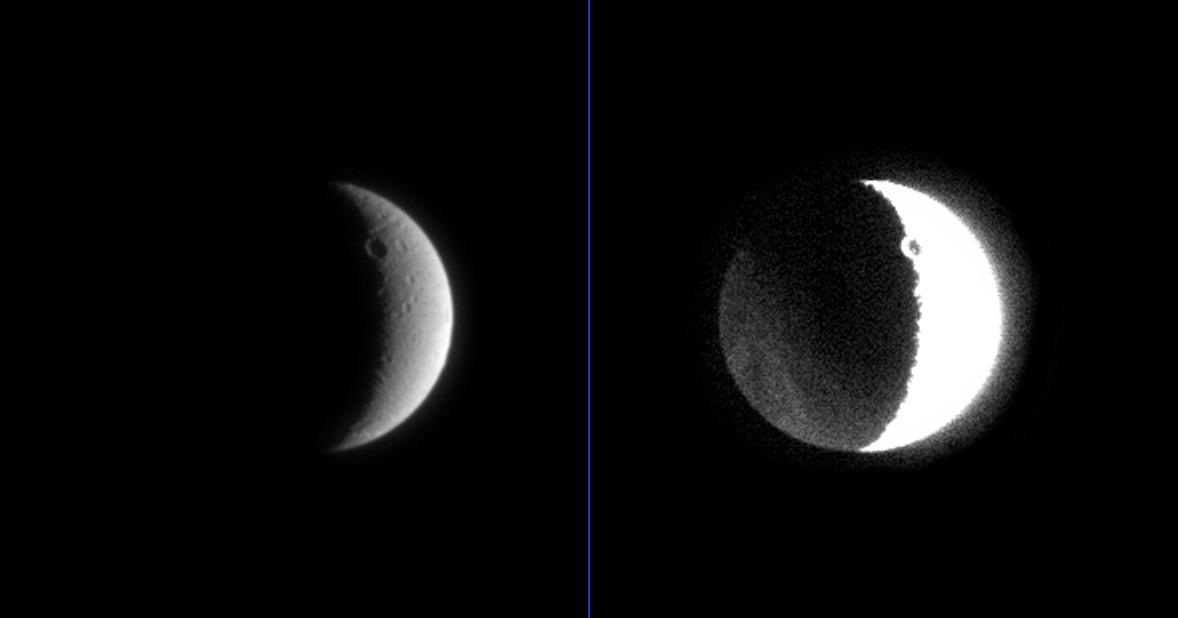
Dark Side of Dione
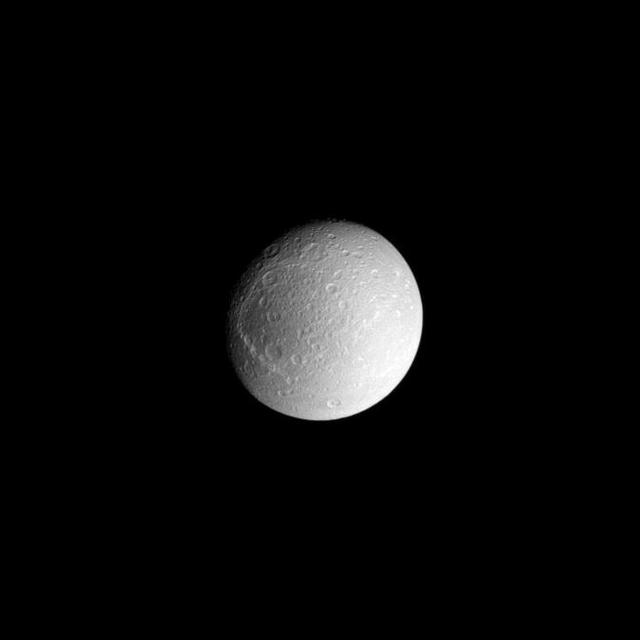
Dione Transition Zone
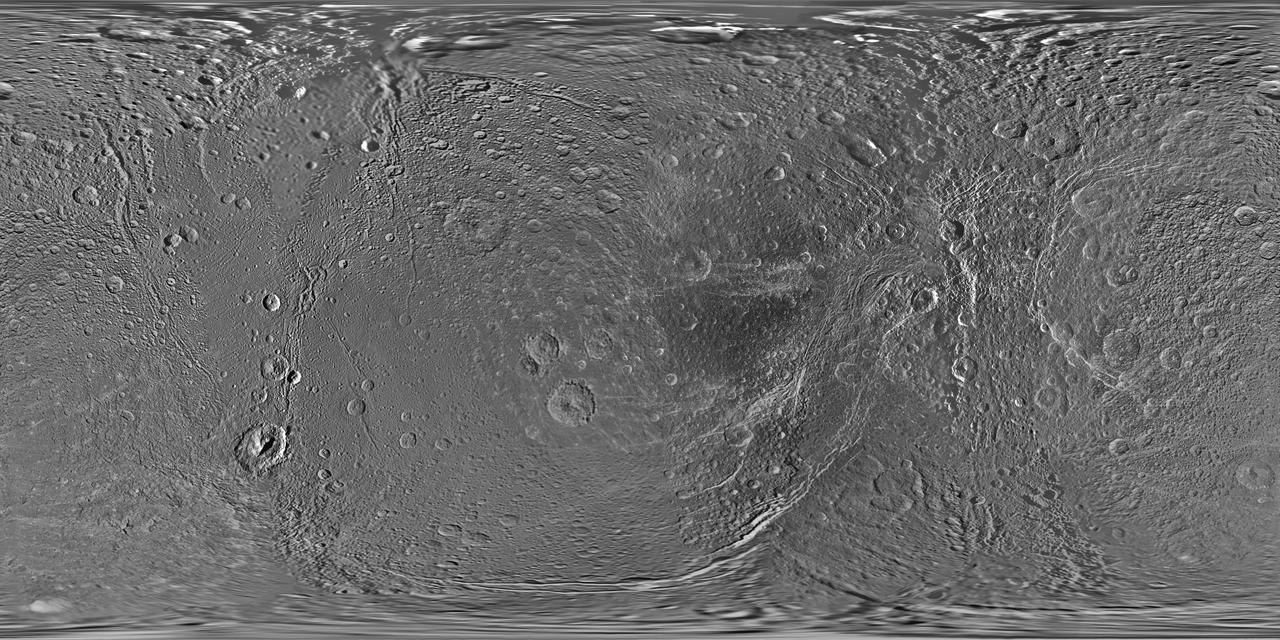
Map of Dione - October 2010
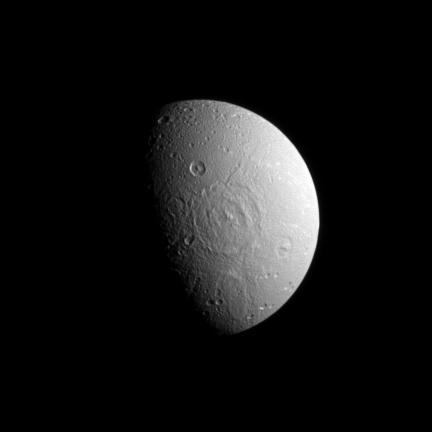
Dione Pockmarked Side

Streaking Away from Dione
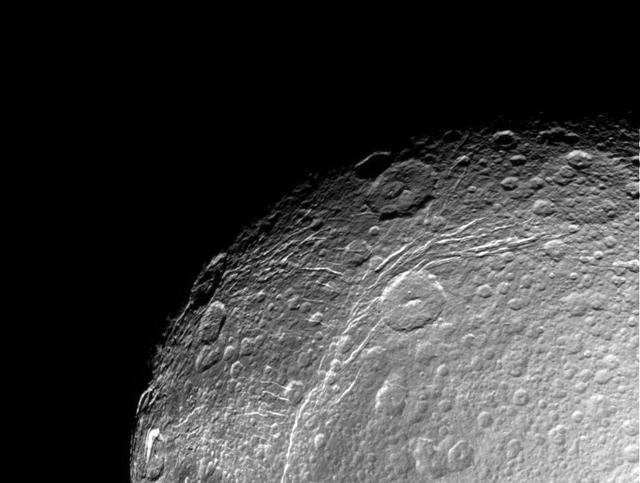
Dione Close-up
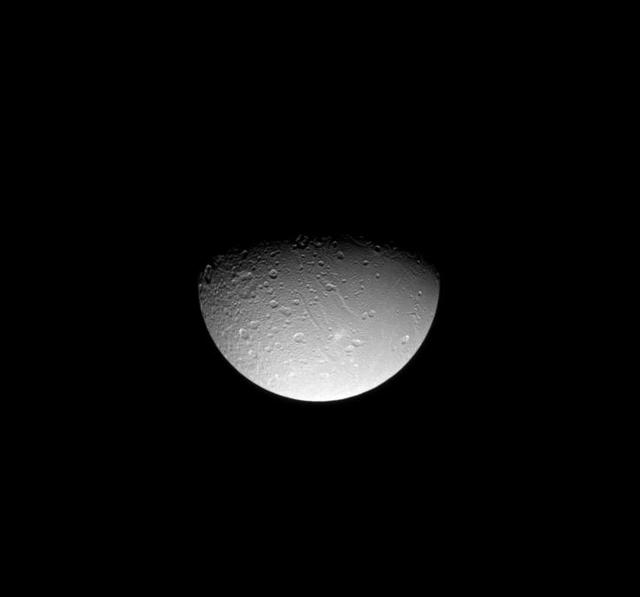
Dione Fractured North
Dione Streaky Side
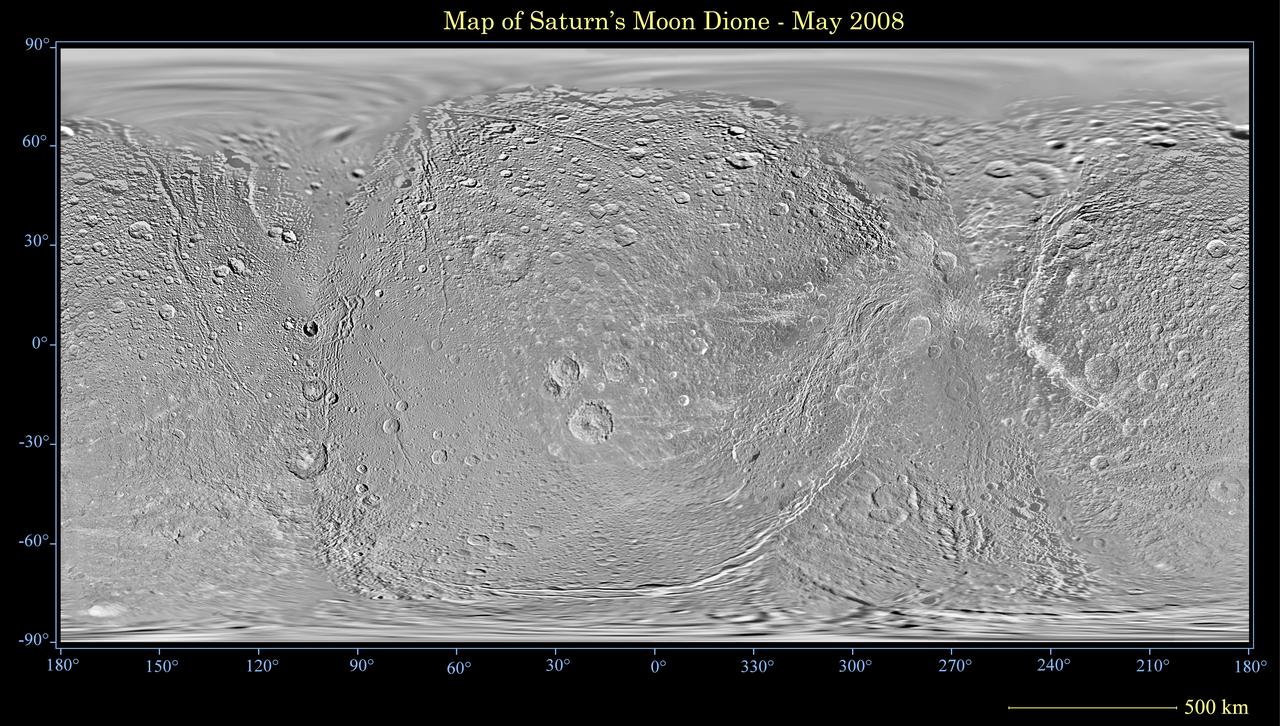
Map of Dione - May 2008
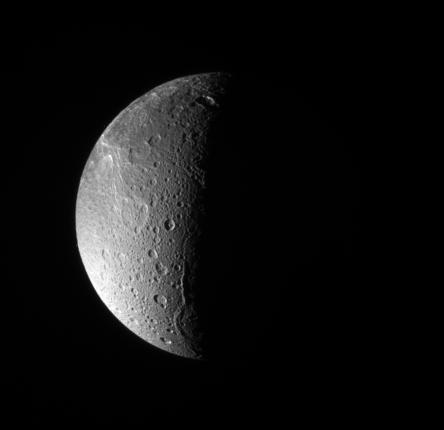
Dione: North Polar View
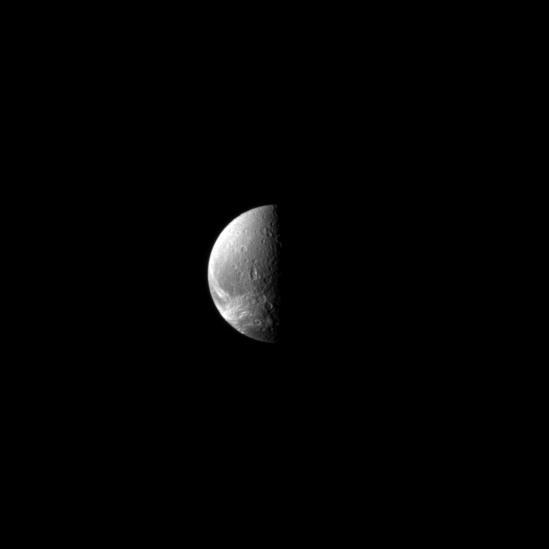
Down Dione Way
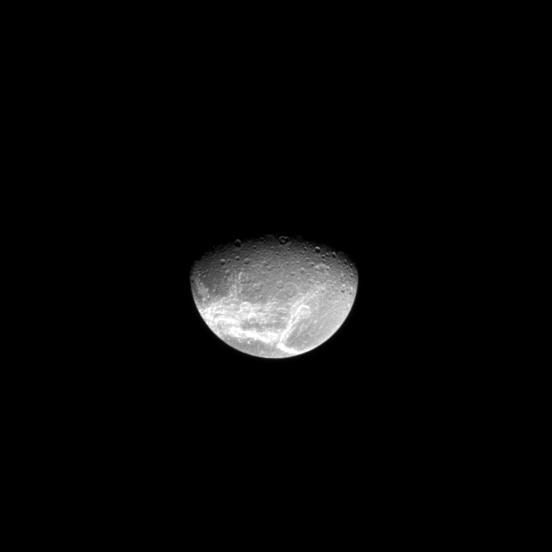
Looking Down on Dione
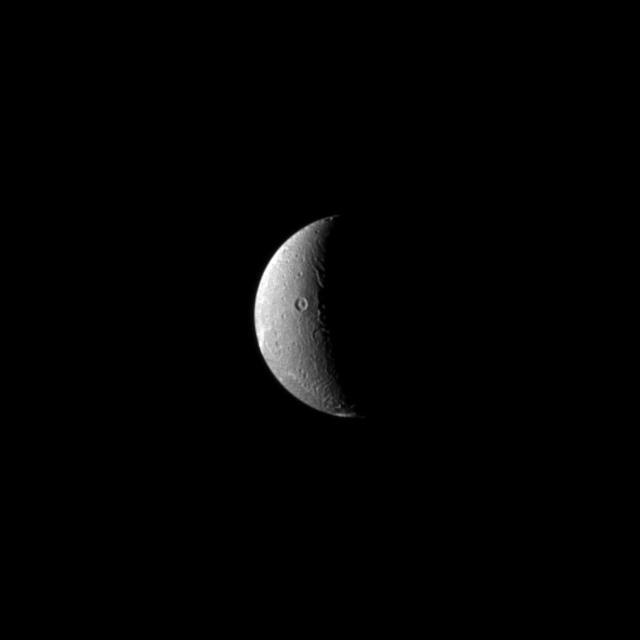
In this recent view of Dione, the Cassini spacecraft looks on as the moon slow rotation brings the terrain from day into night. Dione rotation period is 66 hours.
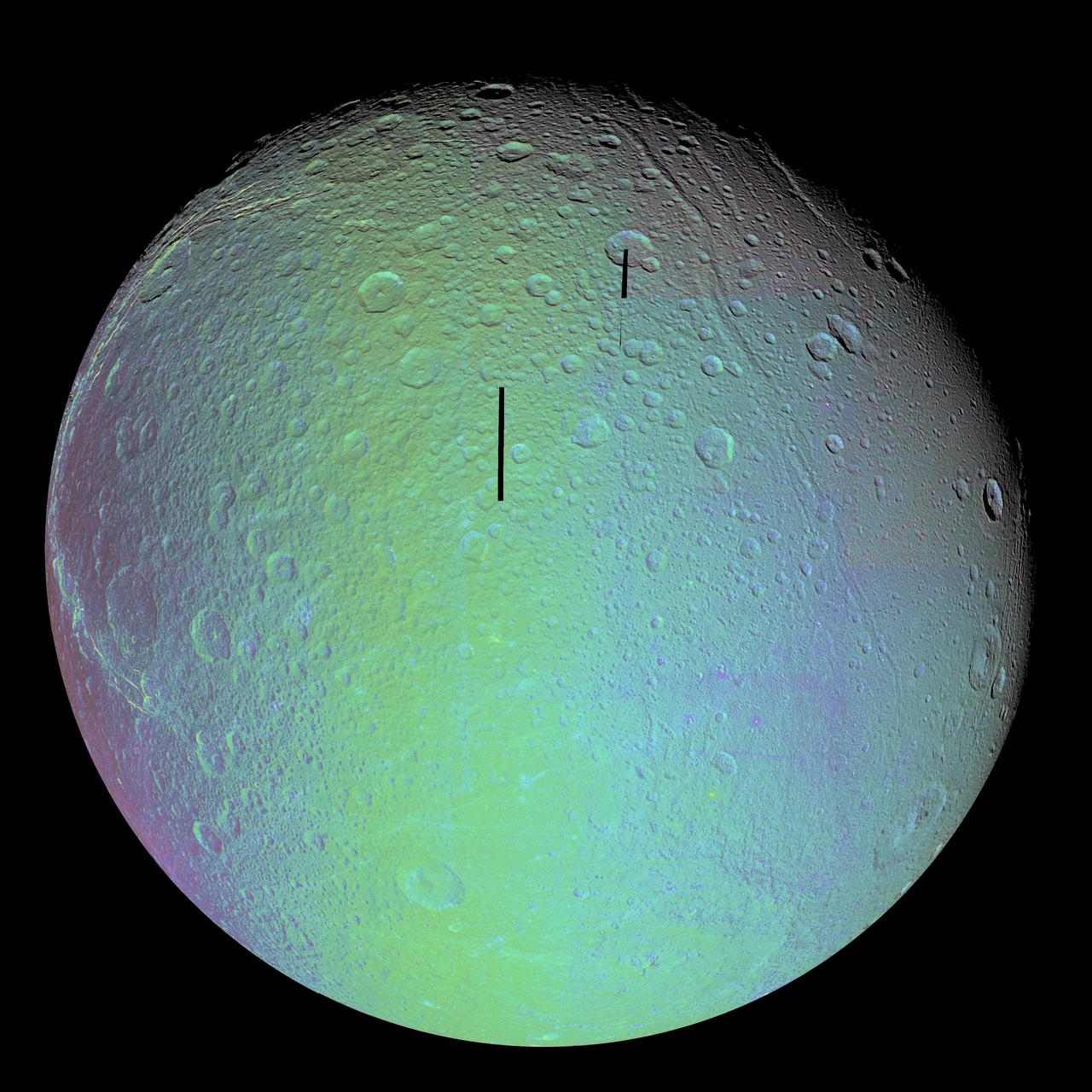
Dione in Full View - False Color
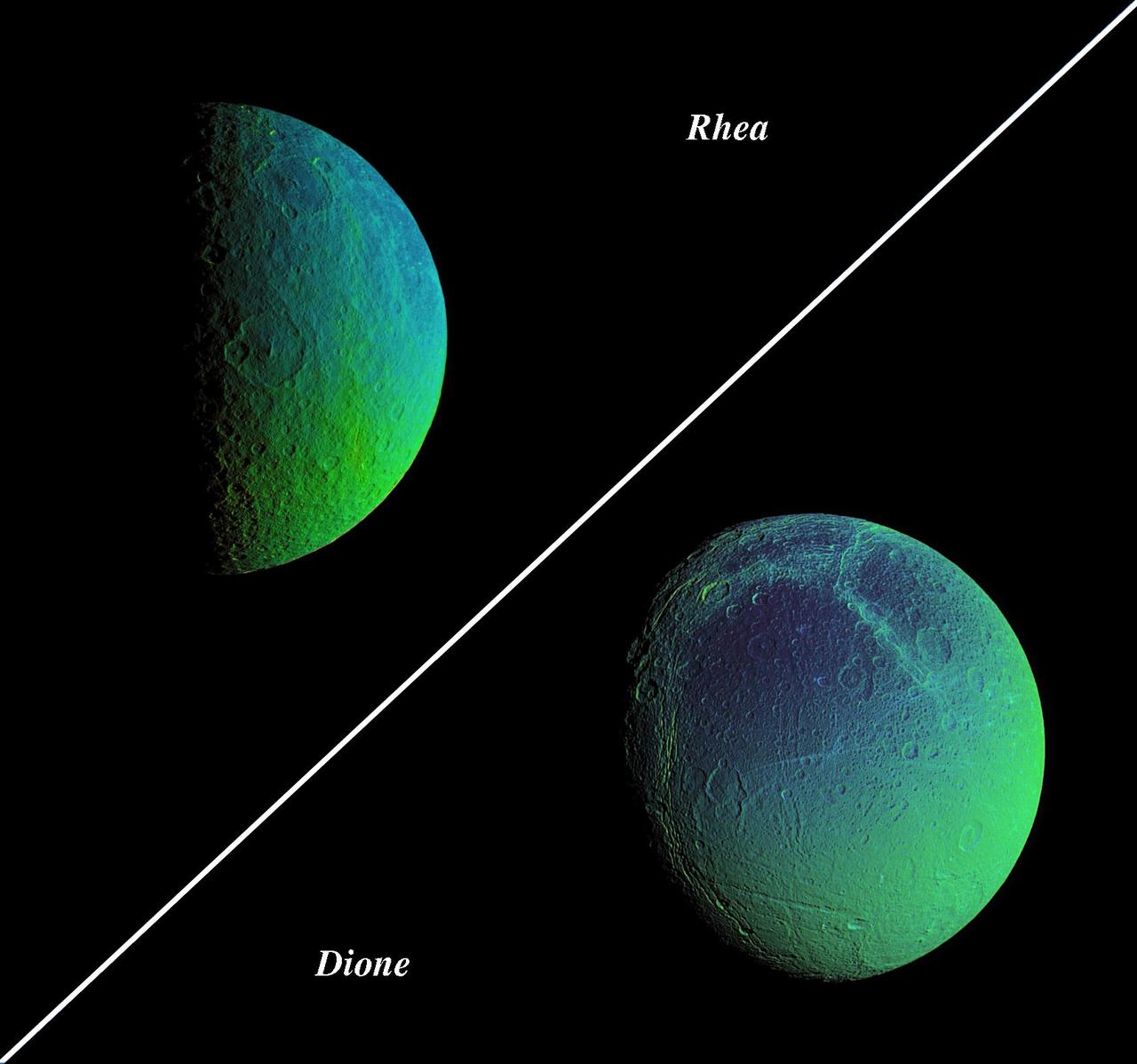
Color Variation Across Rhea and Dione
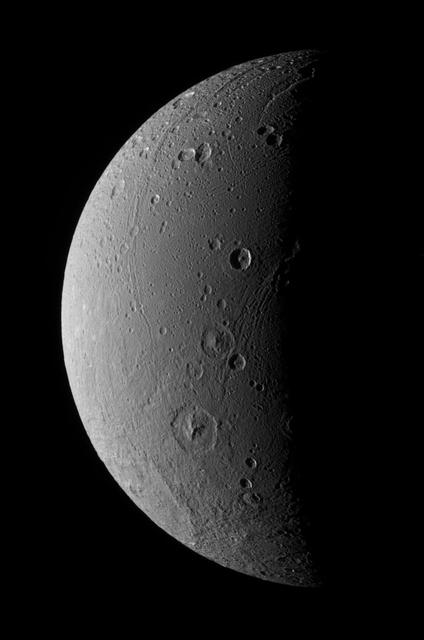
Dione Has Her Faults Monochrome
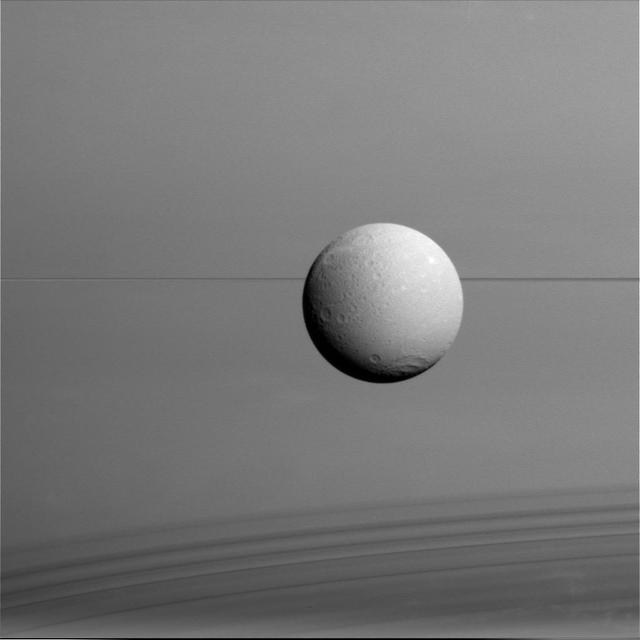
Dione hangs in front of Saturn and its icy rings in this view, captured during Cassini final close flyby of the icy moon. North on Dione is up.

NASA Cassini imaging scientists processed this view of Saturn moon Dione, taken during a close flyby on June 16, 2015. This was Cassini fourth targeted flyby of Dione.
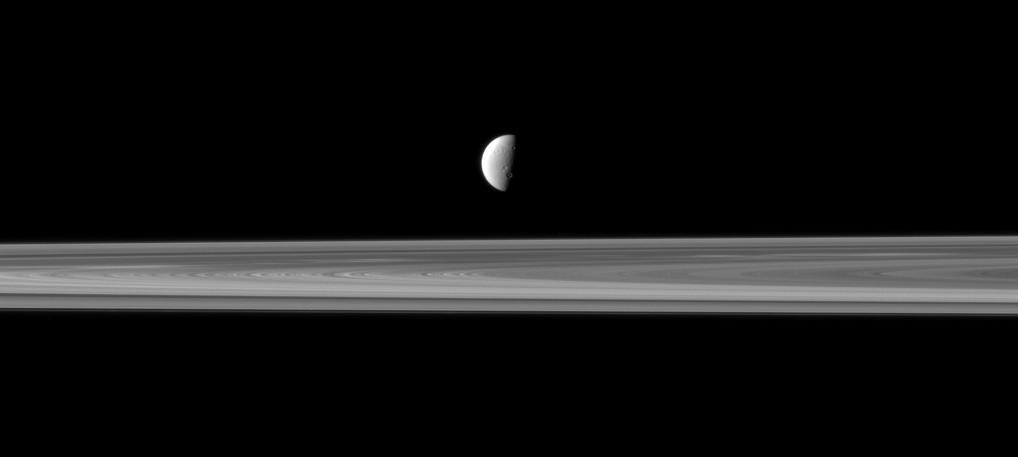
Saturn fourth largest moon, Dione, appears like a solitary ornament suspended above the rings in view from NASA Cassini spacecraft. The rings are closer to Cassini in this view, with Dione more distant.
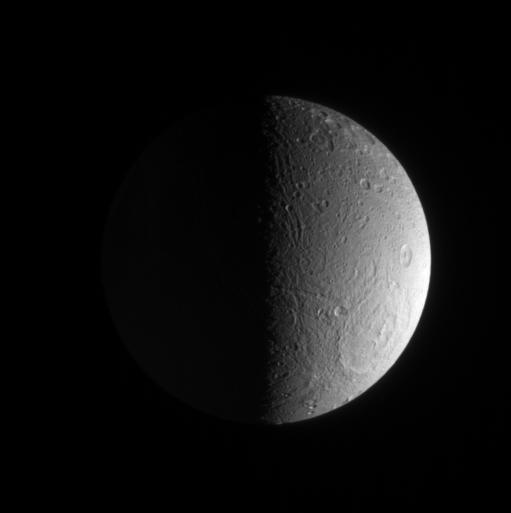
Grooves and deep craters adorn terrain at high southern latitudes on Dione
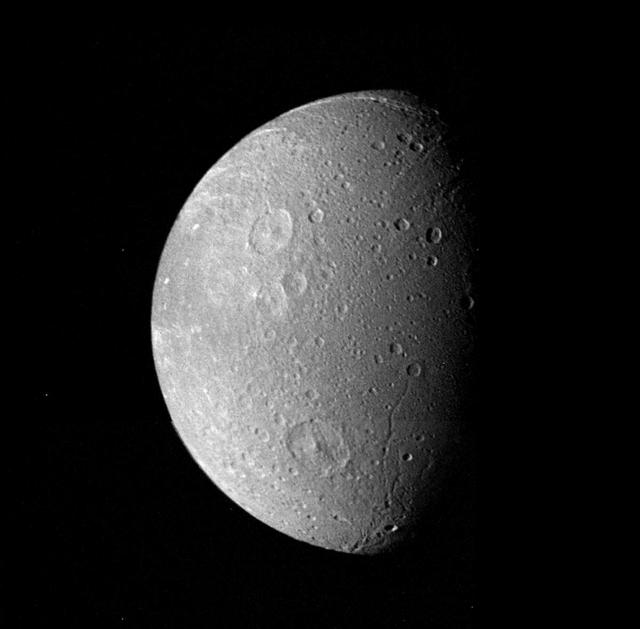
Many impact craters -- the record of the collision of cosmic debris -- are shown in this mosaic from NASA Voyager 1 of Saturn moon Dione.
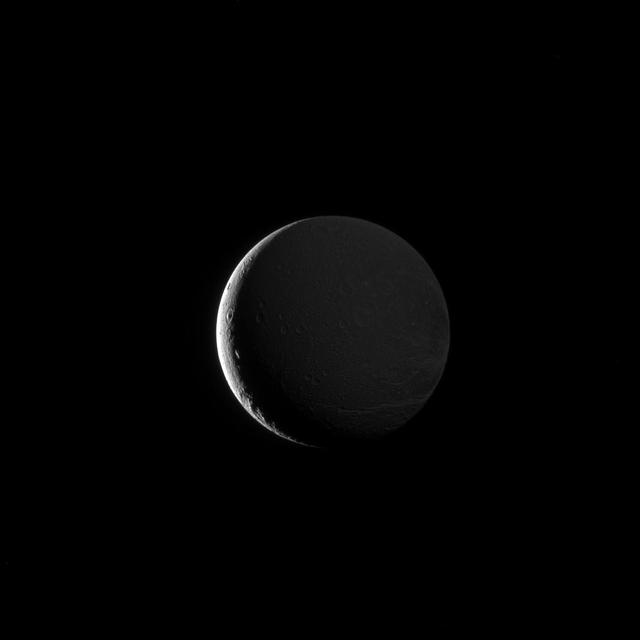
Dione lit hemisphere faces away from NASA Cassini spacecraft camera, yet the moon darkened surface features are dimly illuminated in this image, due to Saturnshine. Although direct sunlight provides the best illumination for imaging, light reflected off of Saturn can do the job as well. In this image, Dione (698 miles or 1,123 kilometers across) is above Saturn's day side, and the moon's night side is faintly illuminated by sunlight reflected off the planet's disk. This view looks toward the Saturn-facing side of Dione. North on Dione is up and rotated 8 degrees to the right. The image was taken in visible light with the Cassini spacecraft narrow-angle camera on Oct. 23, 2016. The view was obtained at a distance of approximately 313,000 miles (504,000 kilometers) from Dione. Image scale is 1.8 miles (3 kilometers) per pixel. http://photojournal.jpl.nasa.gov/catalog/PIA20514
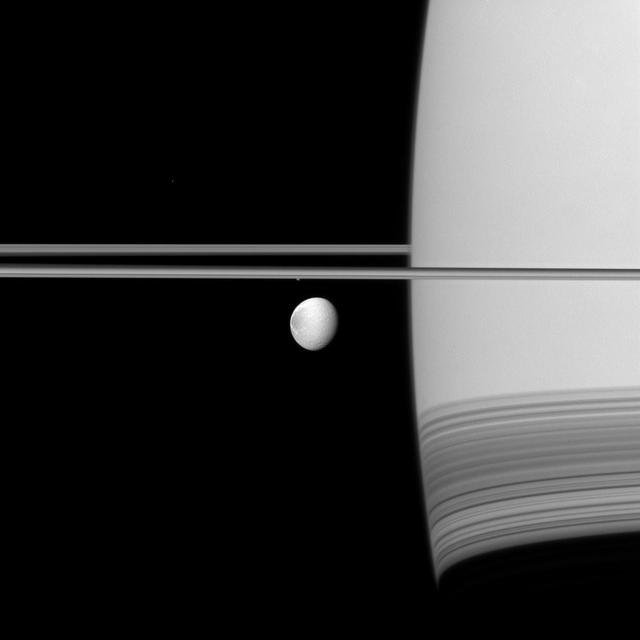
Saturn moon Dione coasts along in its orbit appearing in front of its parent planet in this view from NASA Cassini spacecraft. The wispy terrain on the trailing hemisphere of Dione can be seen on the left of the moon here.

NASA Cassini imaging scientists processed this view of Saturn moon Dione, taken during a close flyby on June 16, 2015. This was Cassini fourth targeted flyby of Dione.
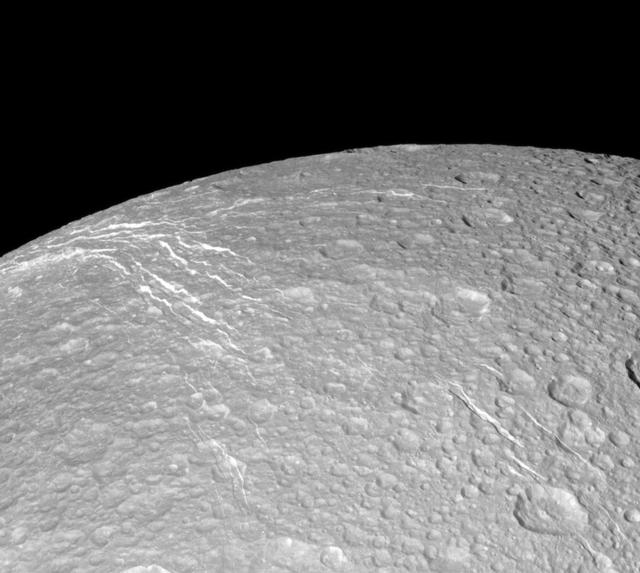
NASA Cassini spacecraft looks across the surface of Saturn moon Dione and details the wispy terrain first chronicled by Voyager. This fractured terrain covers the trailing hemisphere of Dione.
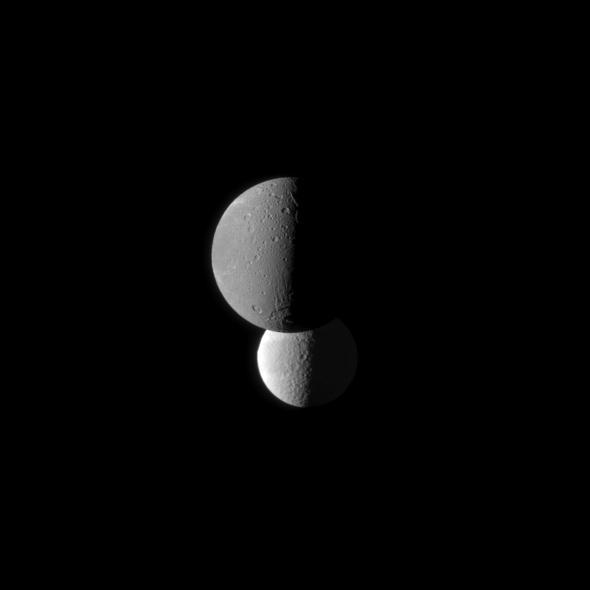
Saturn moon Dione, in the foreground of this image from NASA Cassini spacecraft, appears darker than the moon Tethys. Tethys appears brighter because it has a higher albedo than Dione, meaning Tethys reflects more sunlight.
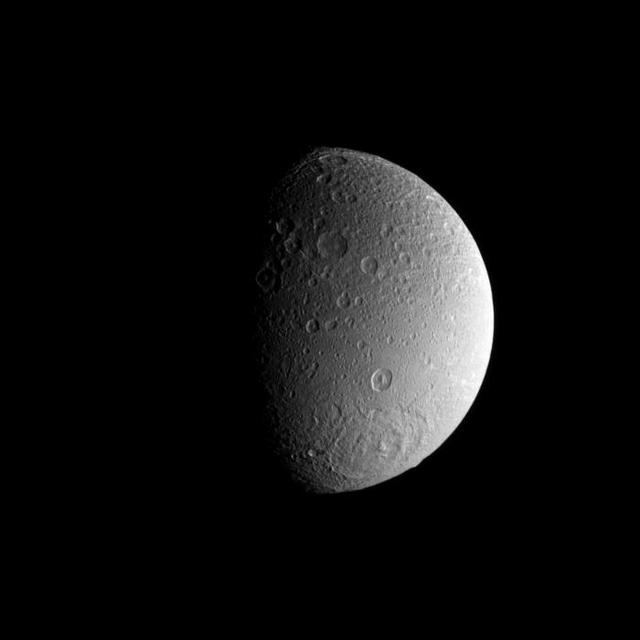
A large impact basin dominates the high southern latitudes of Saturn moon Dione.
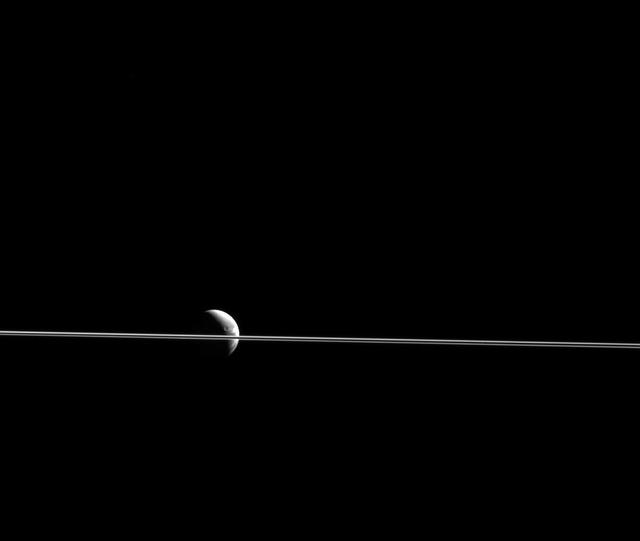
Dione appears cut in two by Saturn razor-thin rings, seen nearly edge-on in a view from NASA Cassini spacecraft.
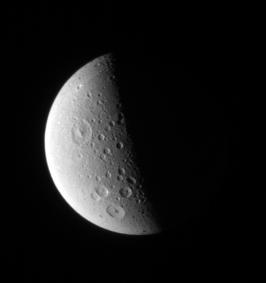
Craters of all sizes litter the landscape on Dione. The larger craters in this view display prominent central peak
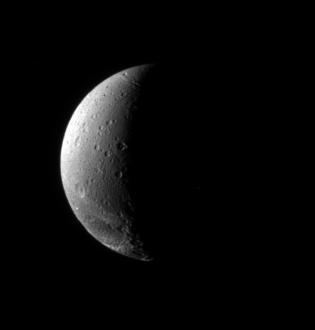
The fractured terrain so distinctive to Dione curves away toward the south in this view, which looks down at the moon northern hemisphere
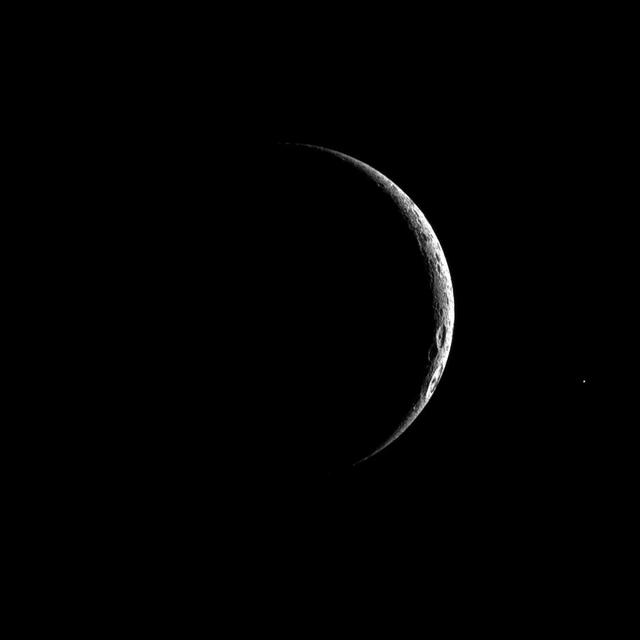
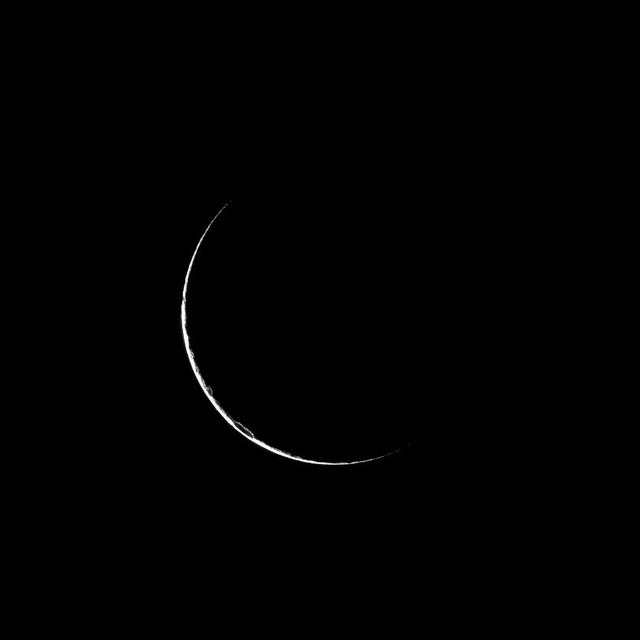
A thin crescent of cratered terrain is illuminated on Saturn third largest moon, Dione in this image captured by NASA Cassini spacecraft.
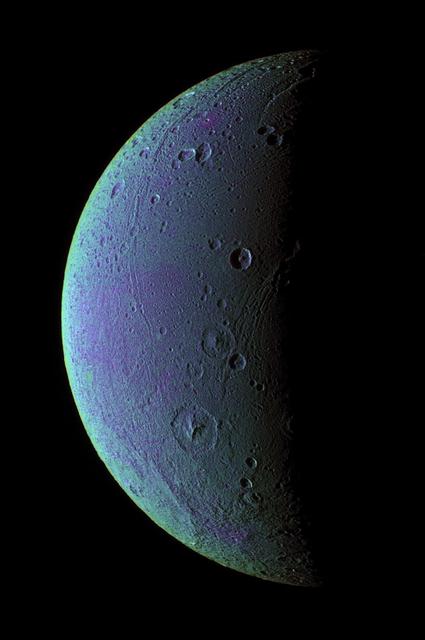
Dione Has Her Faults False Color
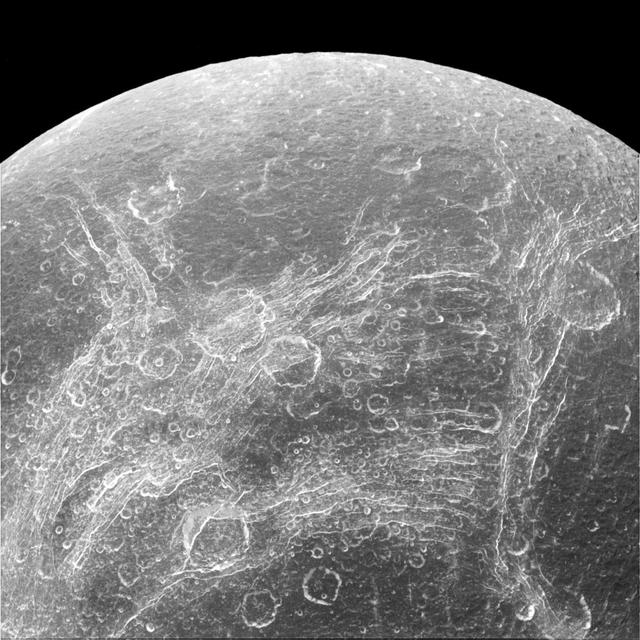
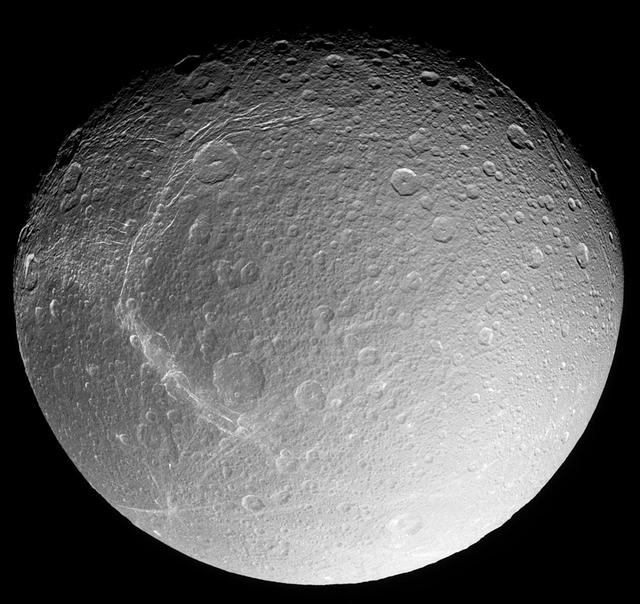
While not bursting with activity like its sister satellite Enceladus, the surface of Dione is definitely not boring. Some parts of the surface are covered by linear features, called chasmata, which provide dramatic contrast to the round impact craters that typically cover moons. The bright network of fractures on Dione (698 miles or 1123 kilometers across) was seen originally at poor resolution in Voyager images and was labeled as "wispy terrain." The nature of this terrain was unclear until Cassini showed that they weren't surface deposits of frost, as some had suspected, but rather a pattern of bright icy cliffs among myriad fractures. One possibility is that this stress pattern may be related to Dione's orbital evolution and the effect of tidal stresses over time. This view looks toward the trailing hemisphere of Dione. North on Dione is up. The image was taken in visible light with the Cassini spacecraft narrow-angle camera on April 11, 2015. The view was acquired at a distance of approximately 68,000 miles (110,000 kilometers) from Dione. Image scale is 2,200 feet (660 meters) per pixel. http://photojournal.jpl.nasa.gov/catalog/PIA18327
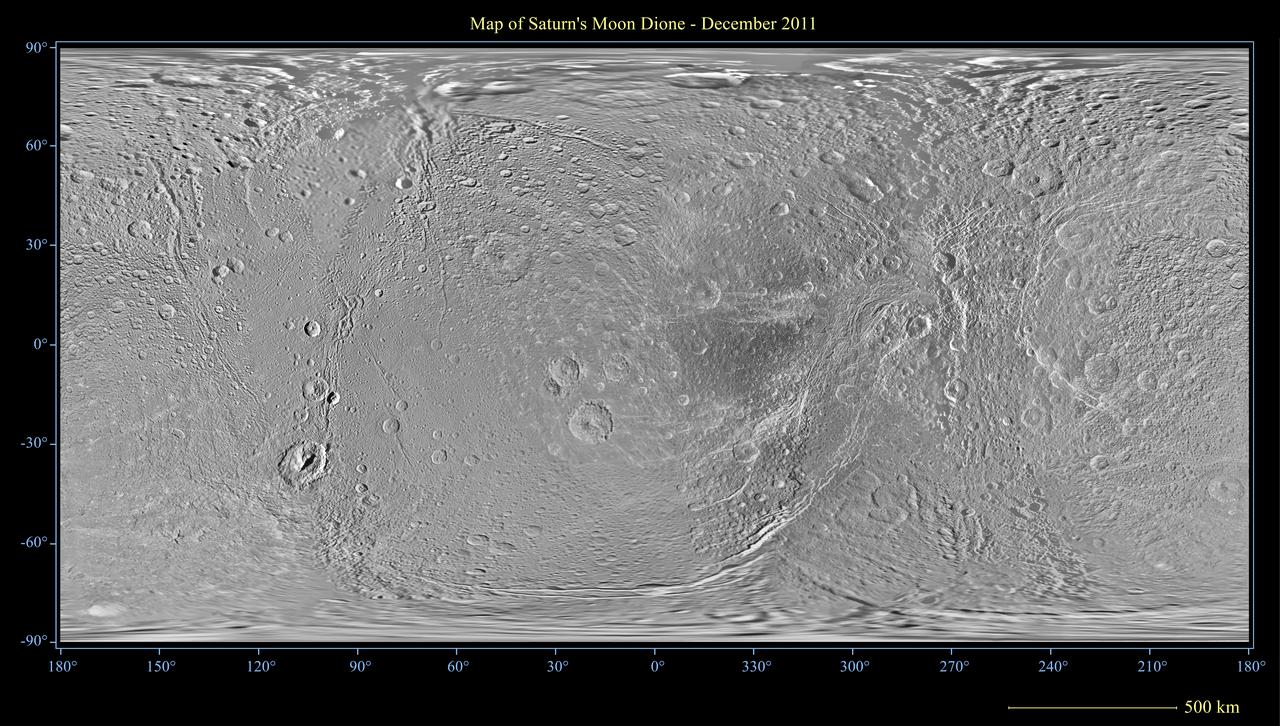
This global map of Saturn moon Dione was created using images taken during flybys by NASA Cassini spacecraft. This global map of Saturn moon Dione was created using images taken during flybys by NASA Cassini spacecraft.
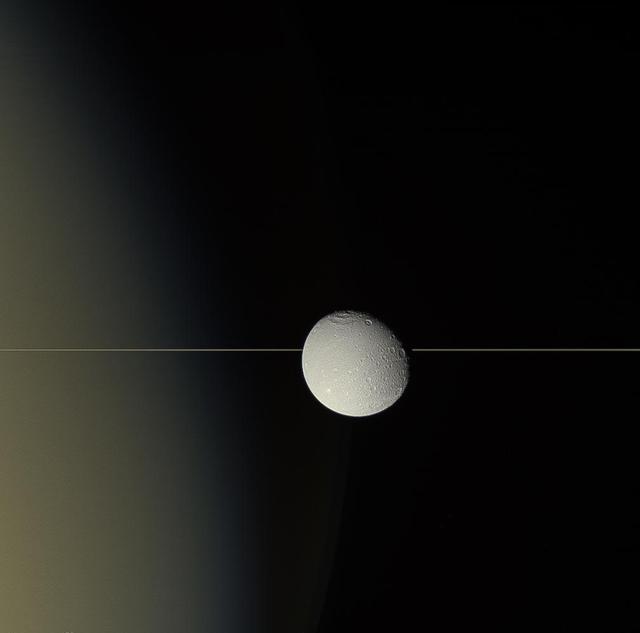
Saturn's moon Dione drifts before the planet's rings, seen here almost edge on. For all their immense width, the rings are relatively paper-thin, about 30 feet (10 meters) in most places. For its part, Dione is about 698 miles (1,123 kilometers) across. This natural-color view was obtained on Aug. 17, 2015 with Cassini's wide-angle camera at a distance of approximately 66,200 miles (106,500 kilometers) from Dione. The Cassini spacecraft ended its mission on Sept. 15, 2017 https://photojournal.jpl.nasa.gov/catalog/PIA17219
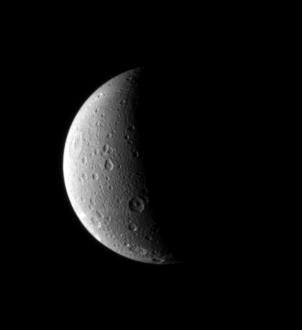
Dione looks lovely half lit in this portrait from the Cassini spacecraft. Just visible is a long canyon running southward just left of the terminator
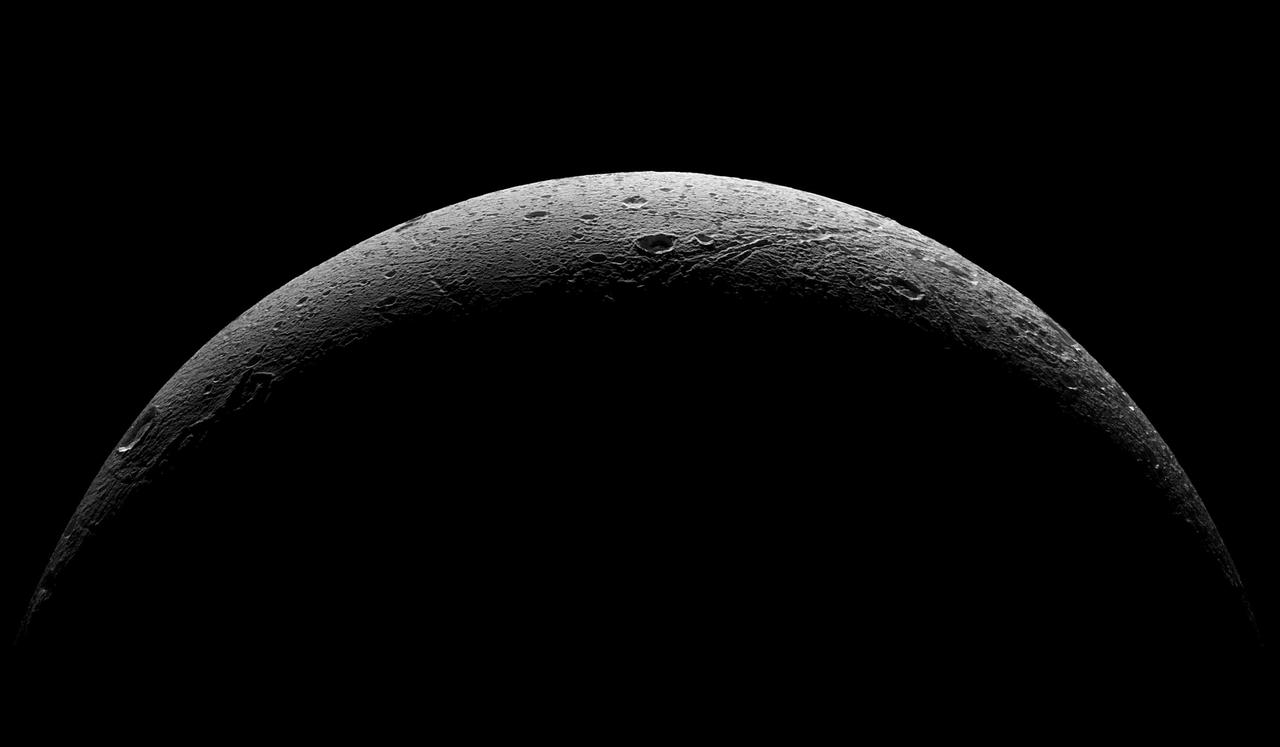
NASA Cassini spacecraft captured this parting view showing the rough and icy crescent of Saturn moon Dione following the spacecraft last close flyby of the moon on Aug. 17, 2015. Cassini obtained a similar crescent view in 2005 (see PIA07745). The earlier view has an image scale about four times higher, but does not show the moon's full crescent as this view does. Five visible light (clear spectral filter), narrow-angle camera images were combined to create this mosaic view. The scene is an orthographic projection centered on terrain at 0.4 degrees north latitude, 30.6 degrees west longitude on Dione. An orthographic view is most like the view seen by a distant observer looking through a telescope. The view was acquired at distances ranging from approximately 37,000 miles (59,000 kilometers) to 47,000 miles (75,000 kilometers) from Dione and at a sun-Dione-spacecraft, or phase, angle of 145 degrees. Image scale is about 1,300 feet (400 meters) per pixel. North on Dione is up and rotated 34 degrees to the right. http://photojournal.jpl.nasa.gov/catalog/PIA19649
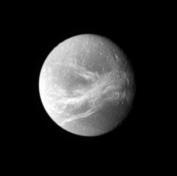
Dione appears small and far off in this Cassini view, which nonetheless manages to capture a detailed look at the moon's beautiful bright streaks, or "linea." The linea are a system of braided canyons that cut across the moon's face. North on Dione (1,126 kilometers, or 700 miles across) is up and rotated 28 degrees to the right. The image was taken in visible light with the Cassini spacecraft narrow-angle camera on May 29, 2007. The view was obtained at a distance of approximately 1.8 million kilometers (1.1 million miles) from Dione and at a Sun-Dione-spacecraft, or phase, angle of 28 degrees. Image scale is 11 kilometers (7 miles) per pixel. http://photojournal.jpl.nasa.gov/catalog/PIA08978
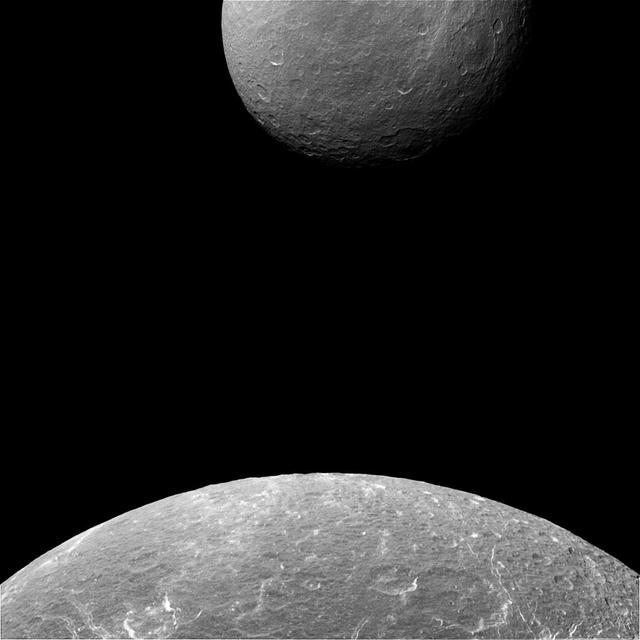
Is Dione (698 miles or 1123 kilometers across) suddenly larger than Rhea (949 miles or 1527 kilometers across)? No, of course not. Cassini simply captured an image when Dione was much closer to the camera, making the moon appear much bigger than her larger sister moon. Besides their beauty, images like these can help Cassini's navigators determine exactly where the spacecraft is and confirm that it is on course. This view looks toward the trailing hemisphere of Dione. North on Dione is up. The image was taken in visible light with the Cassini spacecraft narrow-angle camera on April 11, 2015. The view was obtained at a distance of approximately 68,000 miles (110,000 kilometers) from Dione and at a Sun-Dione-spacecraft, or phase, angle of 29 degrees. Image scale at Dione is 2,165 feet (660 meters) per pixel. Rhea was 300,000 miles (500,000 kilometers) away at a phase (Sun-Rhea-spacecraft) angle of 30 degrees. The image scale at Rhea is 2 miles (3 kilometers) per pixel. http://photojournal.jpl.nasa.gov/catalog/pia18319
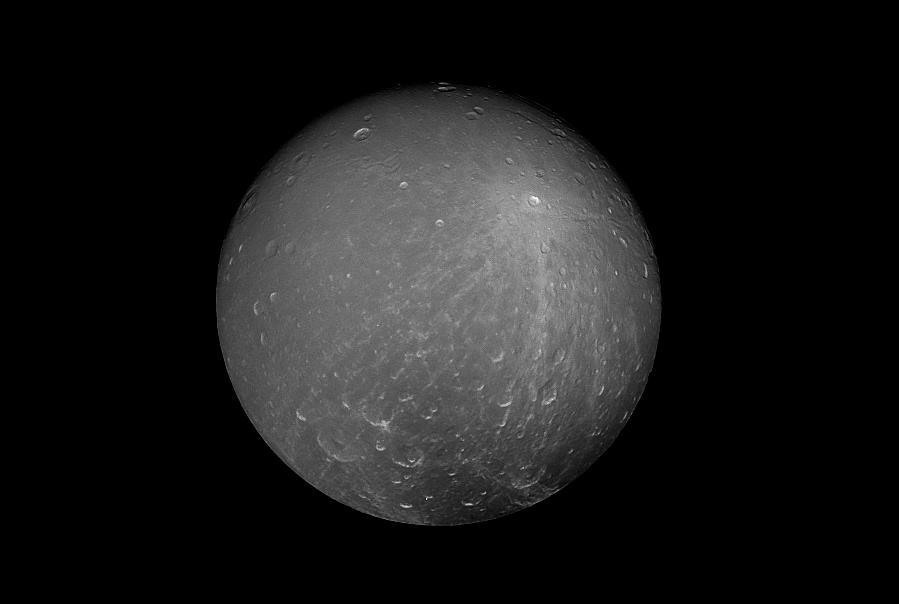
Cassini captured this striking view of Saturn's moon Dione on July 23, 2012. Dione is about 698 miles (1,123 kilometers) across. Its density suggests that about a third of the moon is made up of a dense core (probably silicate rock) with the remainder of its material being water ice. At Dione's average temperature of -304 degrees Fahrenheit (-186 degrees Celsius), ice is so hard it behaves like rock. The image was taken with Cassini's narrow-angle camera at a distance of approximately 260,000 miles (418,000 kilometers) from Dione, through a polarized filter and a spectral filter sensitive to green light. The Cassini spacecraft ended its mission on Sept. 15, 2017. https://photojournal.jpl.nasa.gov/catalog/PIA17197
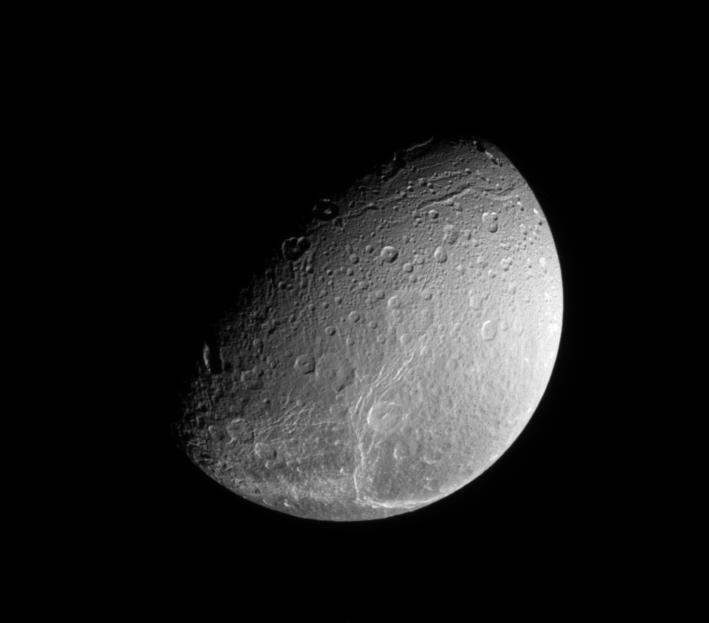
The Cassini spacecraft looks down on the north pole of Dione and the fine fractures that cross its trailing hemisphere.
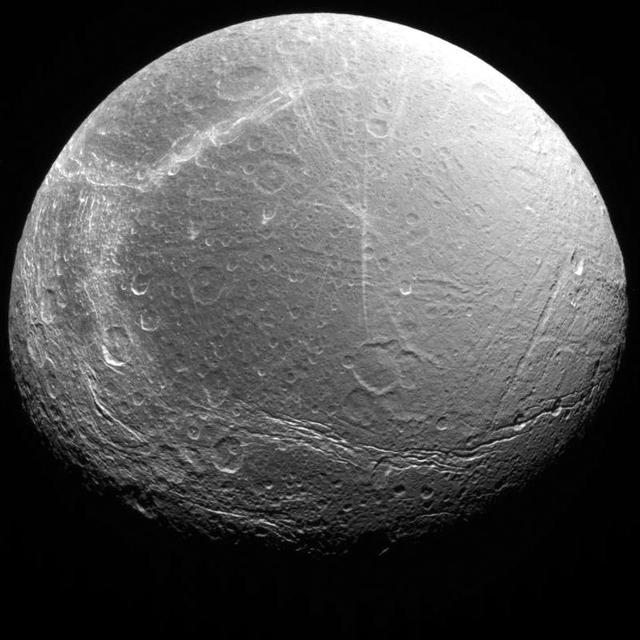
Cracks, canyons, craters, and streaks are seen in this image of Saturn icy moon, Dione, taken from Voyager 2 on August 3, 2005.
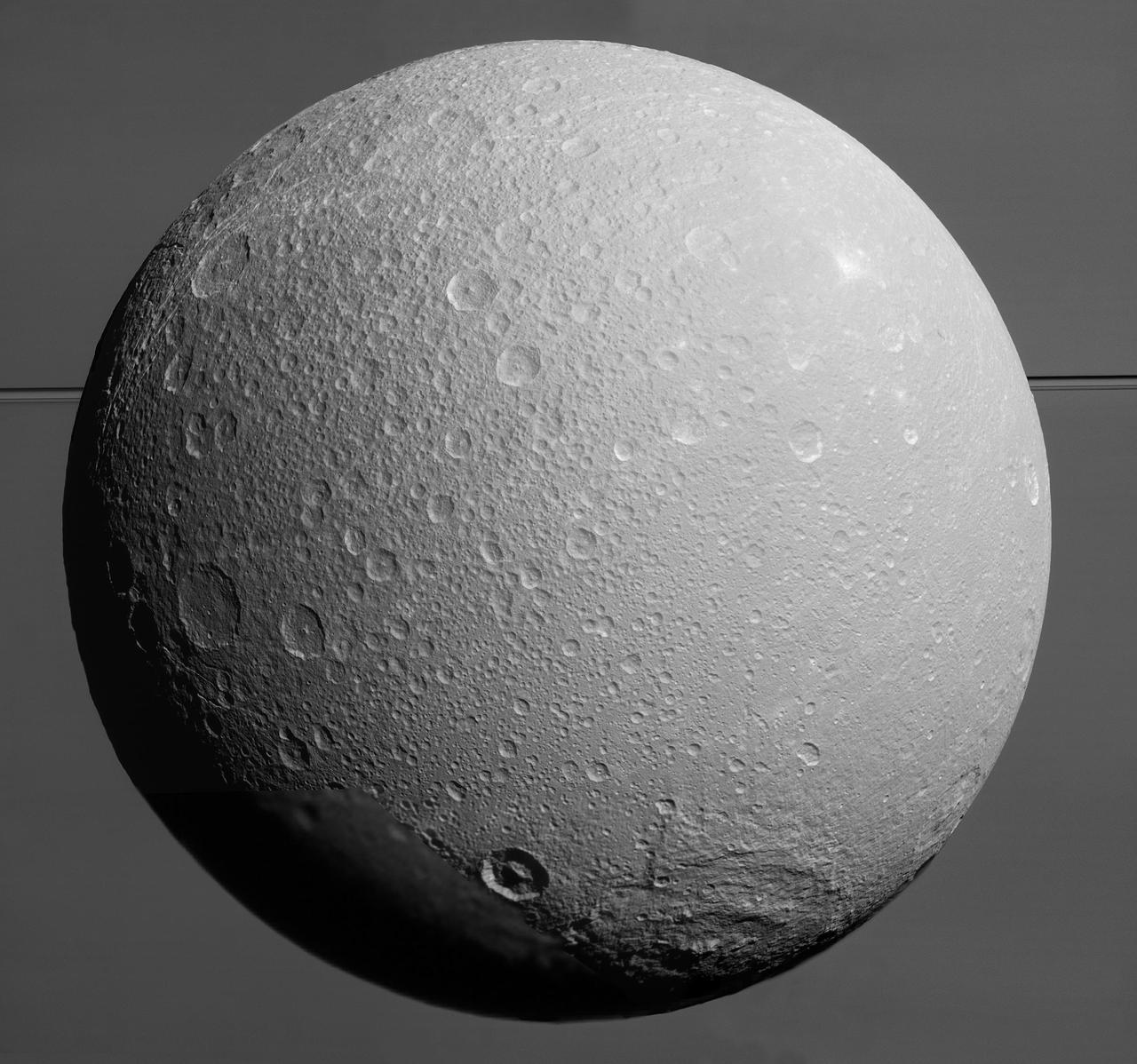
This view from NASA Cassini spacecraft looks toward Saturn icy moon Dione, with giant Saturn and its rings in the background, just prior to the mission final close approach to the moon on August 17, 2015. At lower right is the large, multi-ringed impact basin named Evander, which is about 220 miles (350 kilometers) wide. The canyons of Padua Chasma, features that form part of Dione's bright, wispy terrain, reach into the darkness at left. Imaging scientists combined nine visible light (clear spectral filter) images to create this mosaic view: eight from the narrow-angle camera and one from the wide-angle camera, which fills in an area at lower left. The scene is an orthographic projection centered on terrain at 0.2 degrees north latitude, 179 degrees west longitude on Dione. An orthographic view is most like the view seen by a distant observer looking through a telescope. North on Dione is up. The view was acquired at distances ranging from approximately 106,000 miles (170,000 kilometers) to 39,000 miles (63,000 kilometers) from Dione and at a sun-Dione-spacecraft, or phase, angle of 35 degrees. Image scale is about 1,500 feet (450 meters) per pixel. http://photojournal.jpl.nasa.gov/catalog/PIA19650
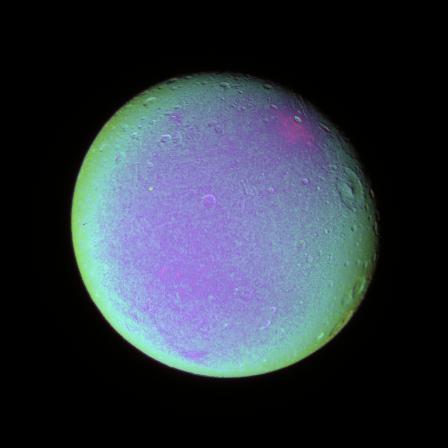
The leading hemisphere of Dione displays subtle variations in color across its surface in this false color view. To create this view, ultraviolet, green and infrared images were combined into a single black and white picture that isolates and maps regional color differences. This "color map" was then superposed over a clear-filter image. The origin of the color differences is not yet understood, but may be caused by subtle differences in the surface composition or the sizes of grains making up the icy soil. Terrain visible here is on the moon's leading hemisphere. North on Dione (1,126 kilometers, or 700 miles across) is up and rotated 17 degrees to the right. All images were acquired with the Cassini spacecraft narrow-angle camera on Dec. 24, 2005 at a distance of approximately 597,000 kilometers (371,000 miles) from Dione and at a Sun-Dione-spacecraft, or phase, angle of 21 degrees. Image scale is 4 kilometers (2 miles) per pixel. http://photojournal.jpl.nasa.gov/catalog/PIA07688
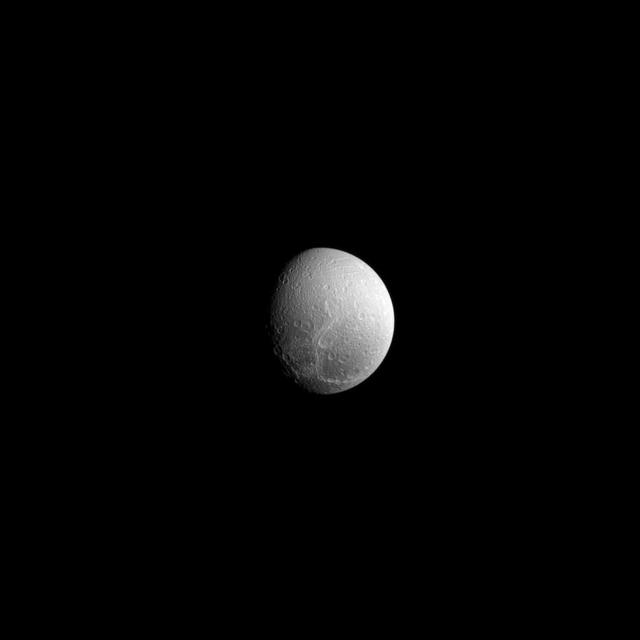
Although the crack-like features seen here on Dione surface appear wispy and faded, they are in reality a series of geologically fresh fractures as seen in this images captured by NASA Cassini spacecraft.
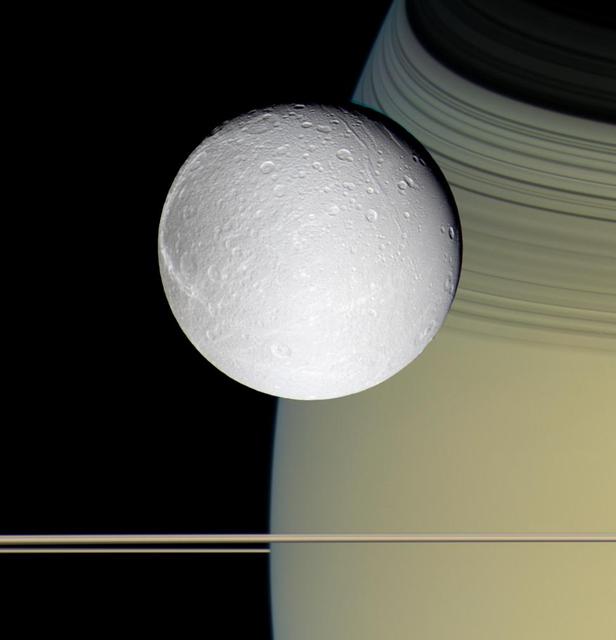
Speeding toward pale, icy Dione, Cassini view is enriched by the tranquil gold and blue hues of Saturn in the distance. The horizontal stripes near the bottom of the image are Saturn rings.
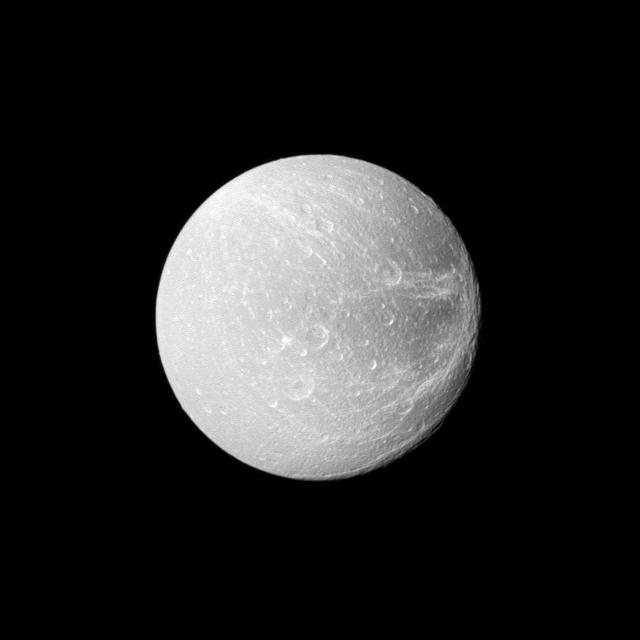
Wispy terrain stretches across the trailing hemisphere of Saturn moon Dione on the right of this image taken by NASA Cassini spacecraft during the spacecraft flyby on April 7, 2010.
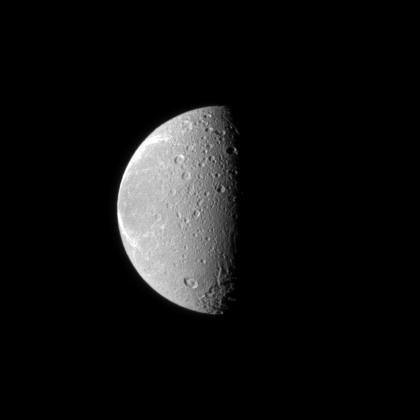
The tortured terrain of Saturn moon Dione is documented in this NASA Cassini spacecraft image. The wispy fractures on the moon trailing hemisphere can be seen on the left, and cratered terrain on the moon anti-Saturn side dominates the center.
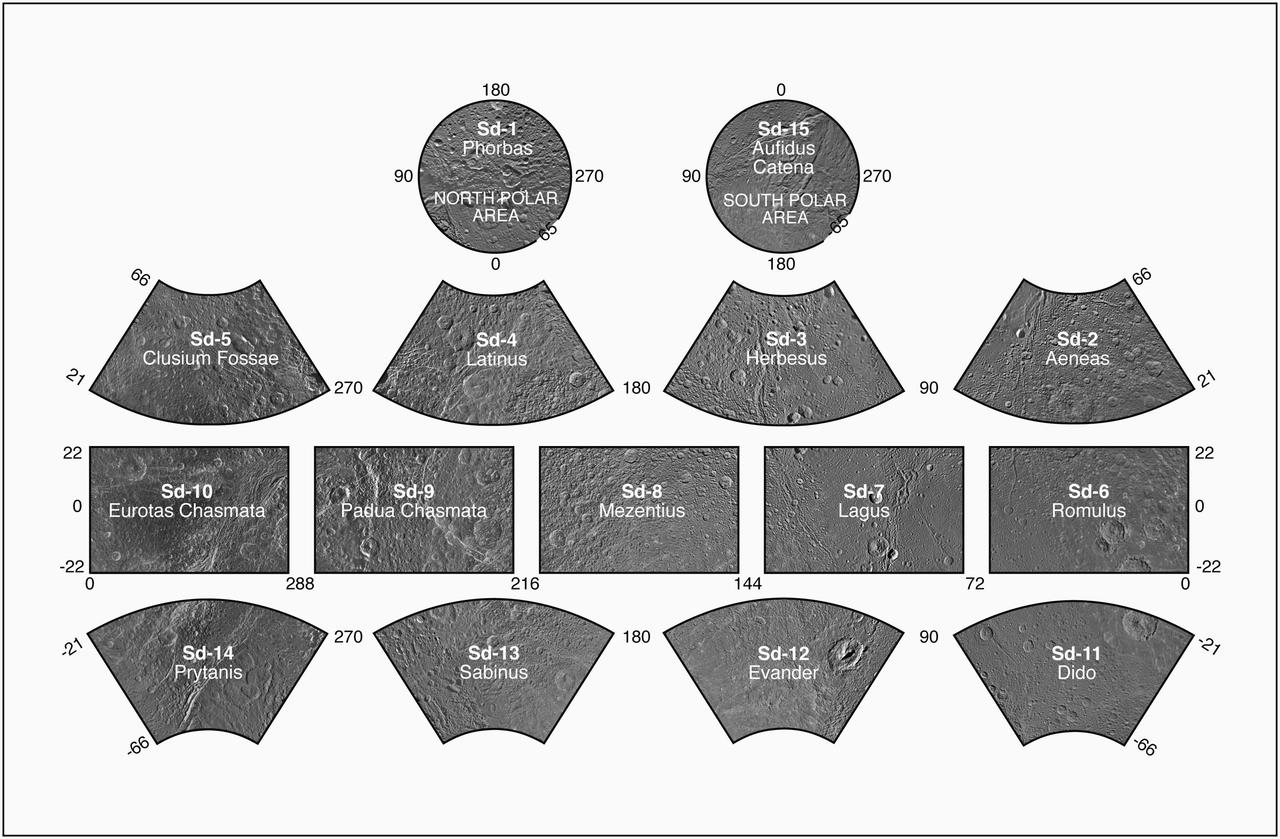
The latest version of a complete set of cartographic map sheets from a high-resolution Dione atlas was released today by the Cassini Imaging Team. Full photomosaic maps are available at the Photojournal.
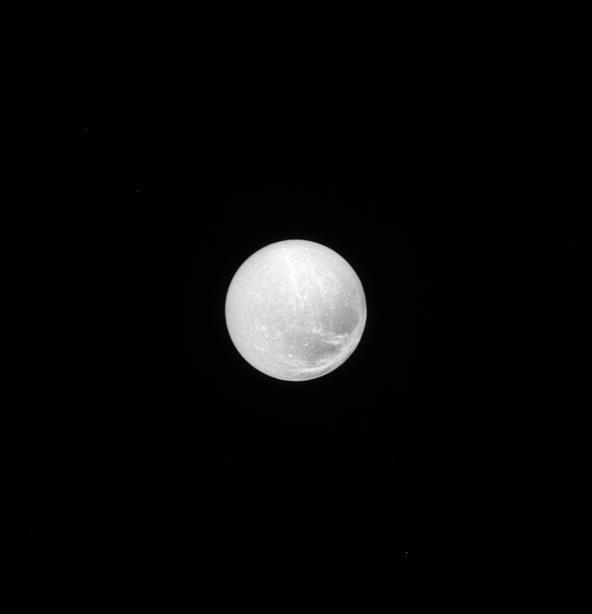
As seen by NASA Cassini spacecraft, the surface of Dione is covered in craters, reminding us of the impacts that have shaped all of the worlds of our solar system; the surface also bears linear features that suggest geological activity in the past.
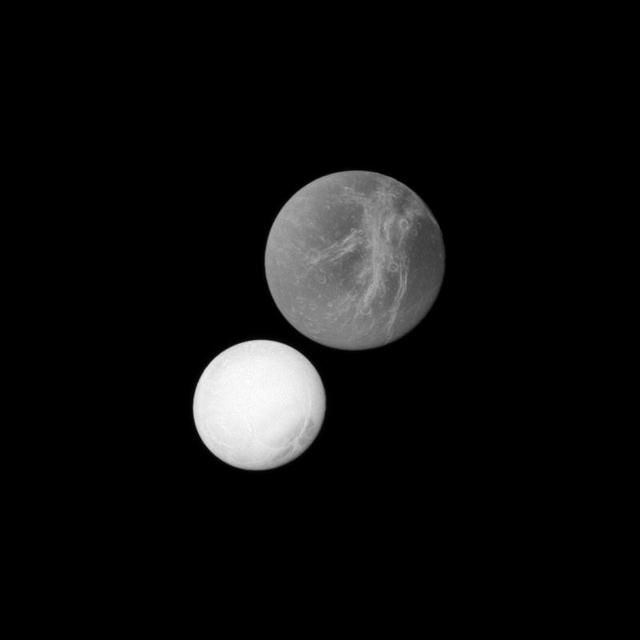
At top of this image, Saturn moon Dione may appear closer to the spacecraft because it is larger than the moon Enceladus in the lower left. However, Enceladus was actually closer to the spacecraft in this image captured by NASA Cassini spacecraft.
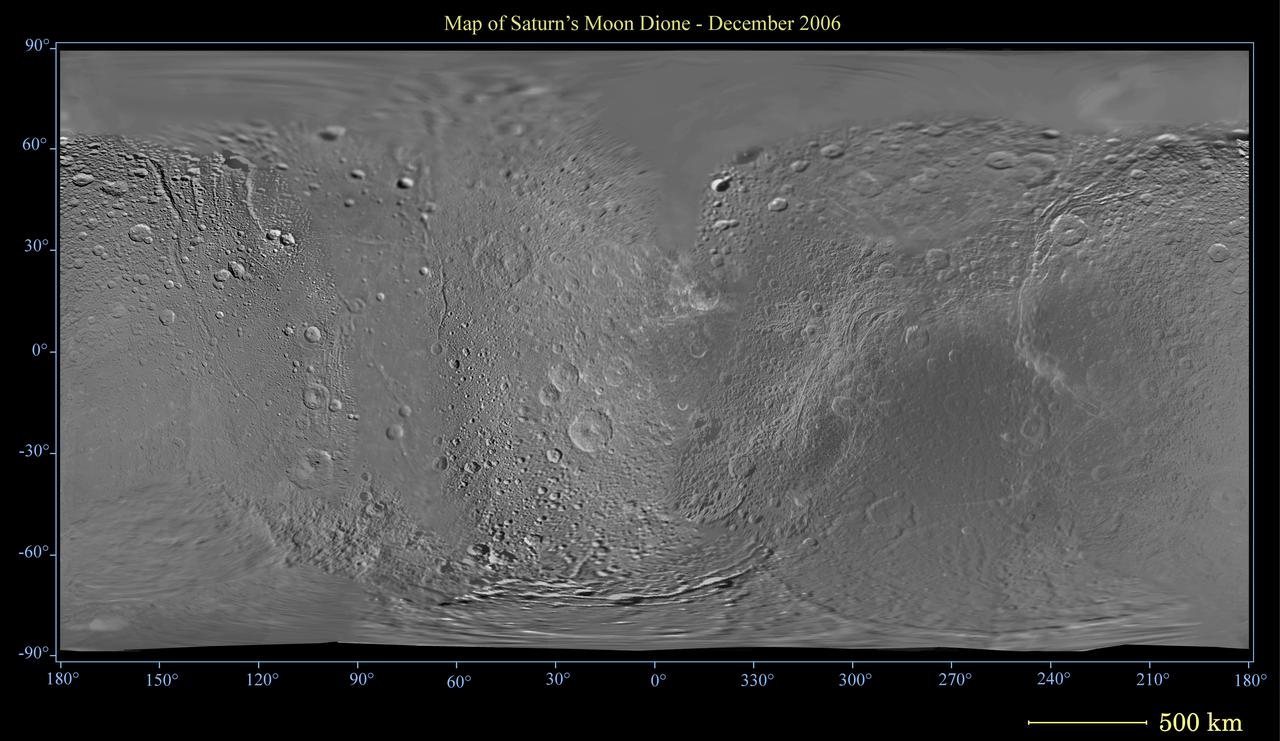
This global digital map of Saturn moon Dione was created using data taken by the Cassini spacecraft, with gaps in coverage filled in by NASA Voyager spacecraft data
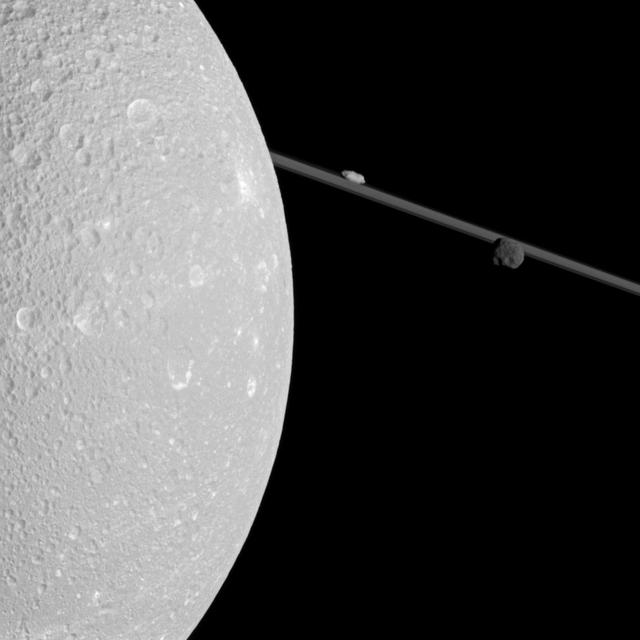
Flying past Saturn moon Dione, NASA Cassini captured this view which includes two smaller moons, Epimetheus and Prometheus, near the planet rings.

Cassini whizzed past Dione on Aug. 16, 2006, capturing this slightly motion-blurred view of the moon fractured and broken landscape in reflected light from Saturn
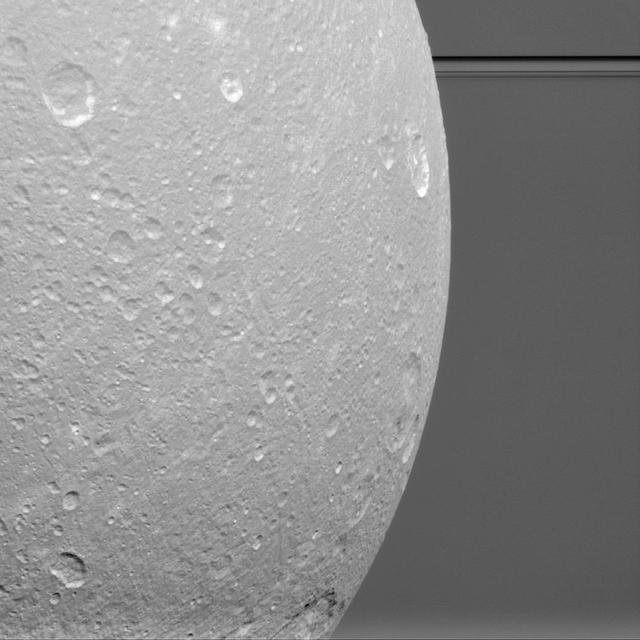
Saturn's rings are so expansive that they often sneak into Cassini's pictures of other bodies. Here, they appear with the planet in a picture taken during a close flyby of Dione. The flyby of Dione (698 miles or 1123 kilometers across) during which this image was taken was the last close encounter with this moon during Cassini's mission. The main goal of the flyby was to use the spacecraft as a probe to measure Dione's gravity field. However, scientists also managed to take some very close images of the surface. All of the data will be helpful to understand the interior structure and geological history of this distant, icy world. This view is centered on terrain at 7 degrees south latitude, 122 degrees west longitude. The image was taken in visible light with the Cassini spacecraft narrow-angle camera on Aug. 17, 2015. The view was obtained at a distance of approximately 48,000 miles (77,000 kilometers) from Dione and at a Sun-Dione-spacecraft, or phase angle of 35 degrees. Image scale is 1,520 feet (464 meters) per pixel. http://photojournal.jpl.nasa.gov/catalog/PIA18344
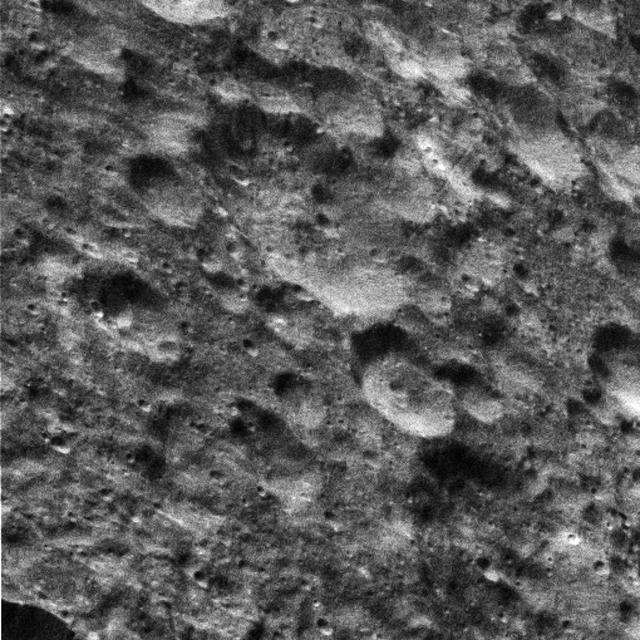
This view from NASA Cassini spacecraft shows terrain on Saturn moon Dione that is entirely lit by reflected light from Saturn, called Saturnshine. Imaging scientists set a relatively short exposure time (10 milliseconds) for this and other views obtained during this fast flyby in order to avoid smearing the images. Despite the short exposure time, the light from Saturn was sufficient to provide a good look at features on the moon's night side. The image was acquired in visible light with the Cassini spacecraft wide-angle camera during a close flyby of the icy moon on Aug. 17, 2015. The view was acquired at an altitude of approximately 600 miles (970 kilometers) above Dione and has an image scale of about 190 feet (58 meters) per pixel. North on Dione is toward lower left. http://photojournal.jpl.nasa.gov/catalog/PIA19652
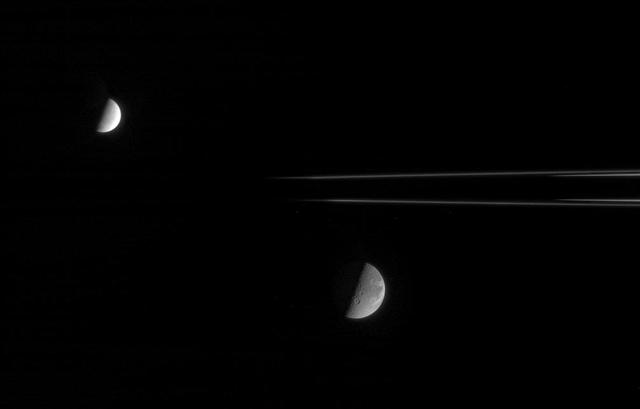
Dione and Enceladus

Mimas and Dione
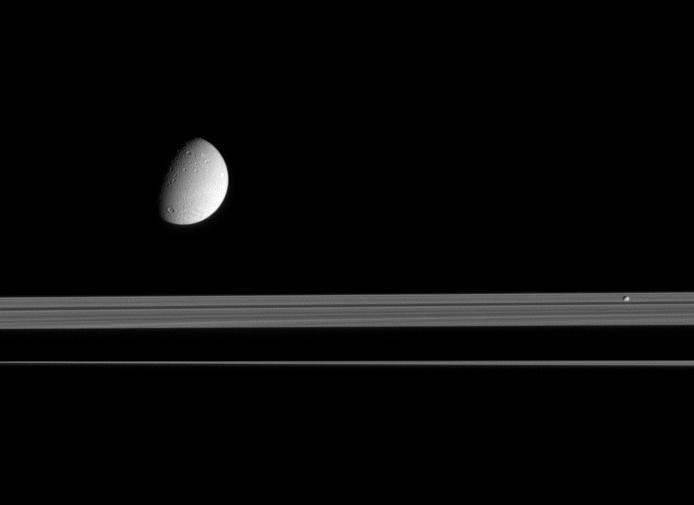
Dione and Pandora
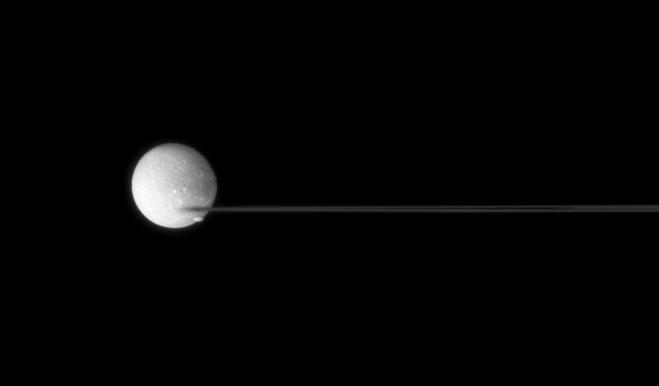
Crossing Dione
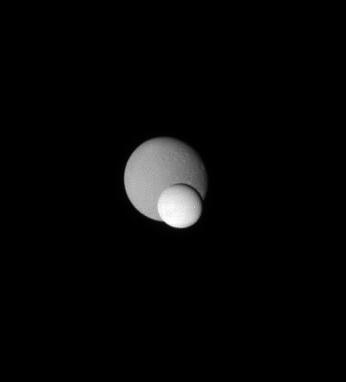
Enceladus and Dione
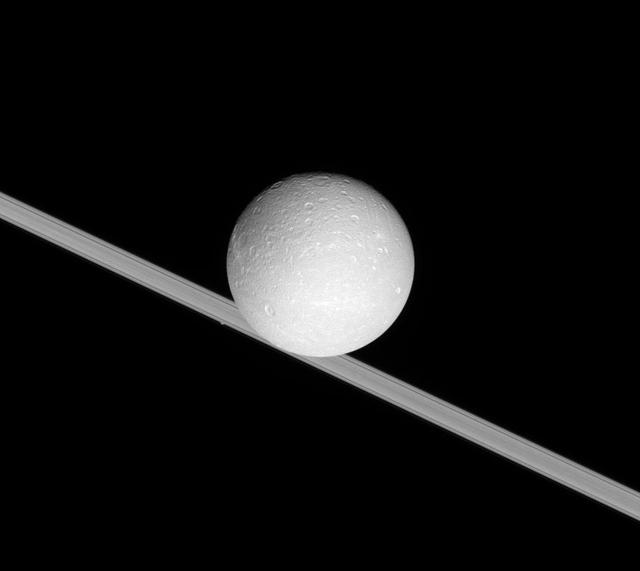
Inclined Dione
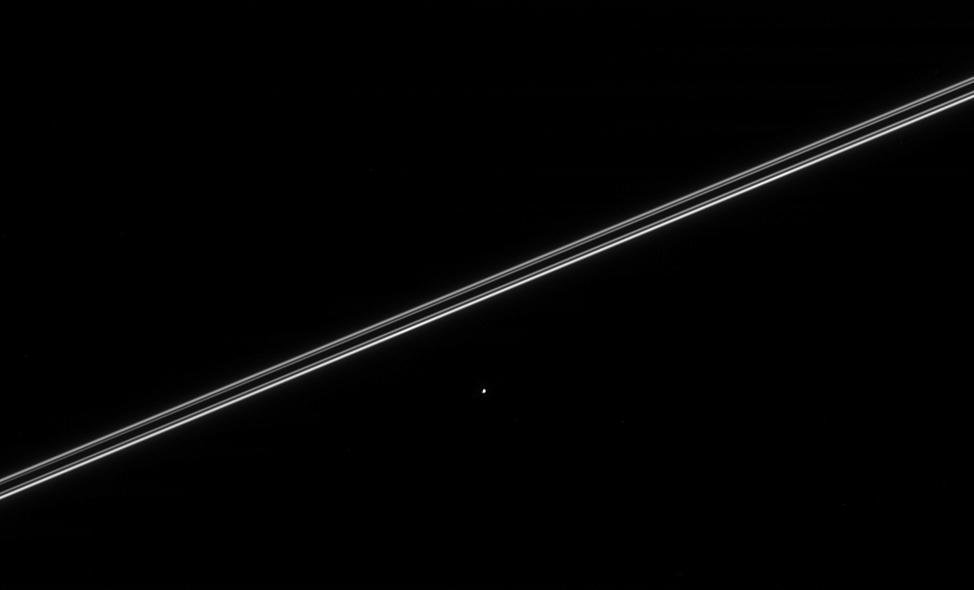
Dione Companion
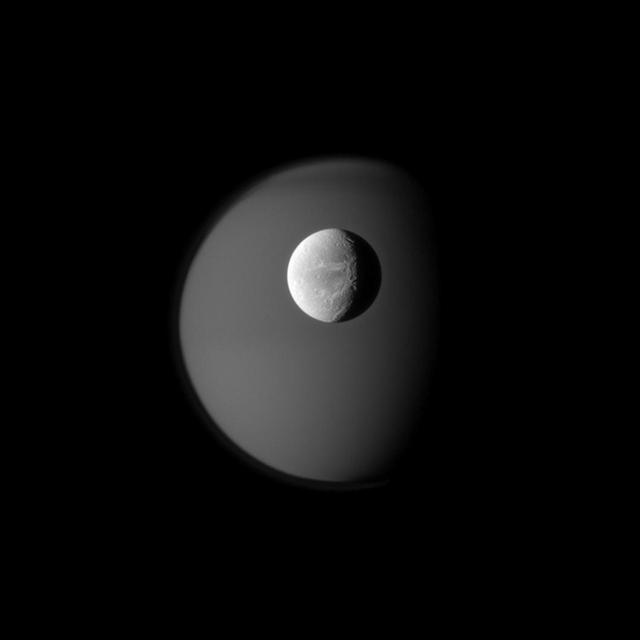
The surface of Saturn moon Dione is rendered in crisp detail against a hazy, ghostly Titan. A portion of the wispy terrain of Dione trailing hemisphere can be seen on the right in this captured by NASA Cassini spacecraft.
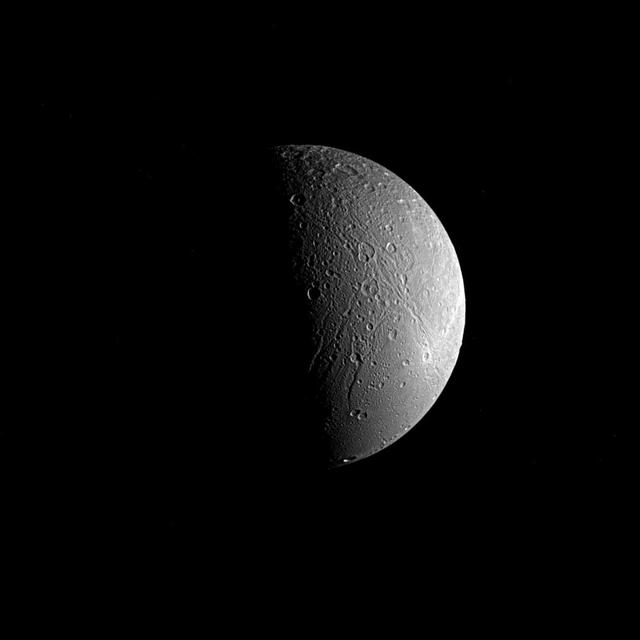
Saturn's moon Dione is captured in this view from NASA's Cassini spacecraft, half in shadow and half in light. Sinuous canyons carve interconnected paths across the moon's icy landscape. Subtle variations in brightness hint at differences in composition, as well as the size and shape of grains in Dione's surface material, or regolith. Cassini spent more than a decade at Saturn studying Dione (698 miles or 1,123 kilometers across) and the planet's many other moons as part of the quest to understand how the moons formed and evolved, and how they are connected. This view looks toward the side of Dione that faces away from Saturn. North is up and rotated 59 degrees to the right. The image was taken in visible light with the Cassini spacecraft narrow-angle camera on June 22, 2017. The view was obtained at a distance of approximately 224,000 miles (360,000 kilometers) from Dione. Image scale is 1.4 mile (2.2 kilometers) per pixel. The Cassini spacecraft ended its mission on Sept. 15, 2017. https://photojournal.jpl.nasa.gov/catalog/PIA21349
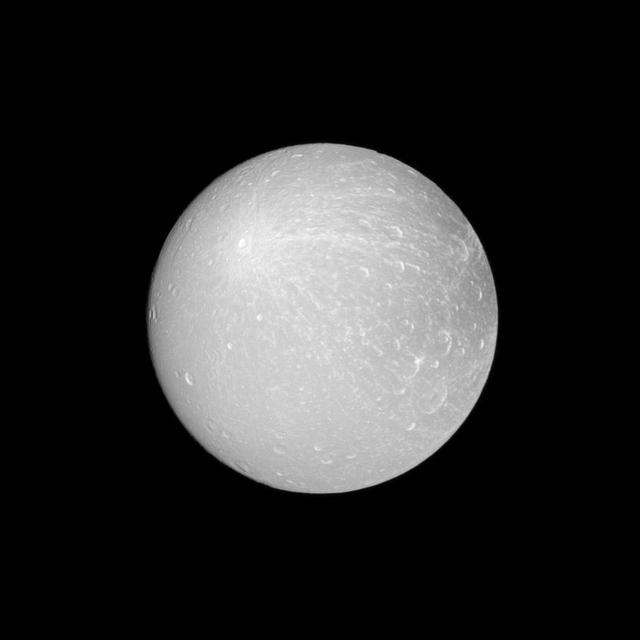
NASA Cassini spacecraft looks at an example of a ray crater on the leading hemisphere of Saturn moon Dione. The ray crater is in the upper-left of the image and ejecta rays show up as brighter material emanating from the crater.
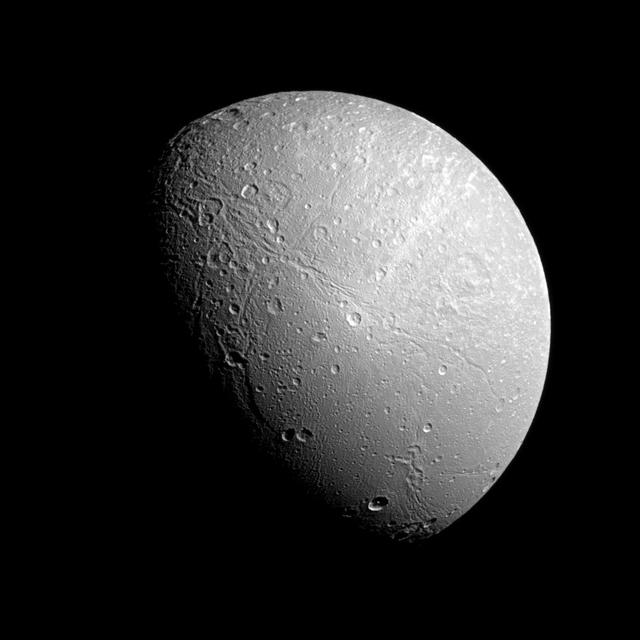
The famed wispy terrain on Saturn moon Dione is front and center in this recent image captured by NASA Cassini spacecraft. The wisps are fresh fractures on the trailing hemisphere of the moon icy surface.
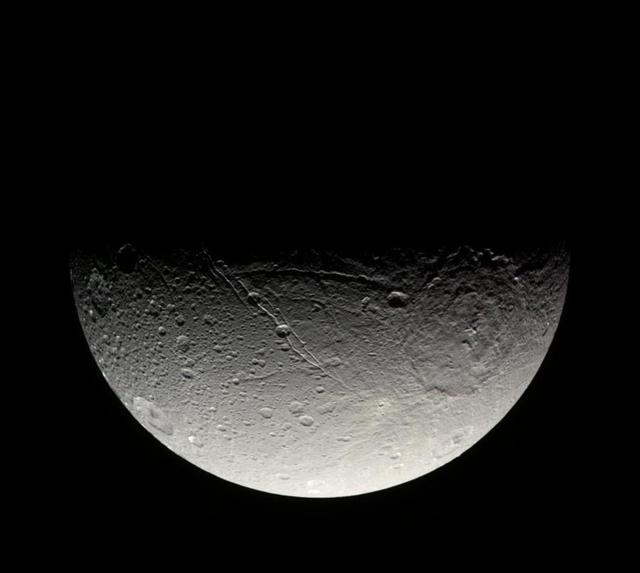
The Cassini spacecraft takes in the crater-strewn surface near Dione south pole in this natural color view. Long fractures slice across the surface here, as on other parts of the moon
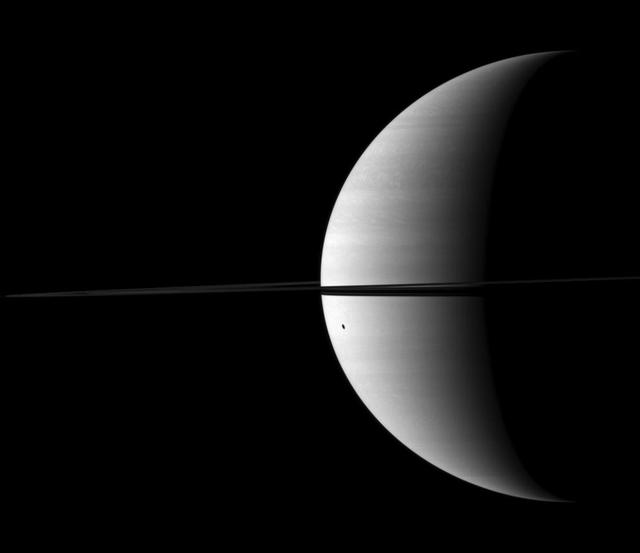
Dione shadow is elongated as it is cast onto the round shape of Saturn in this image taken by NASA Cassini spacecraft. The moon is not visible here. This view looks toward the northern, sunlit side of the rings from just above the ringplane.
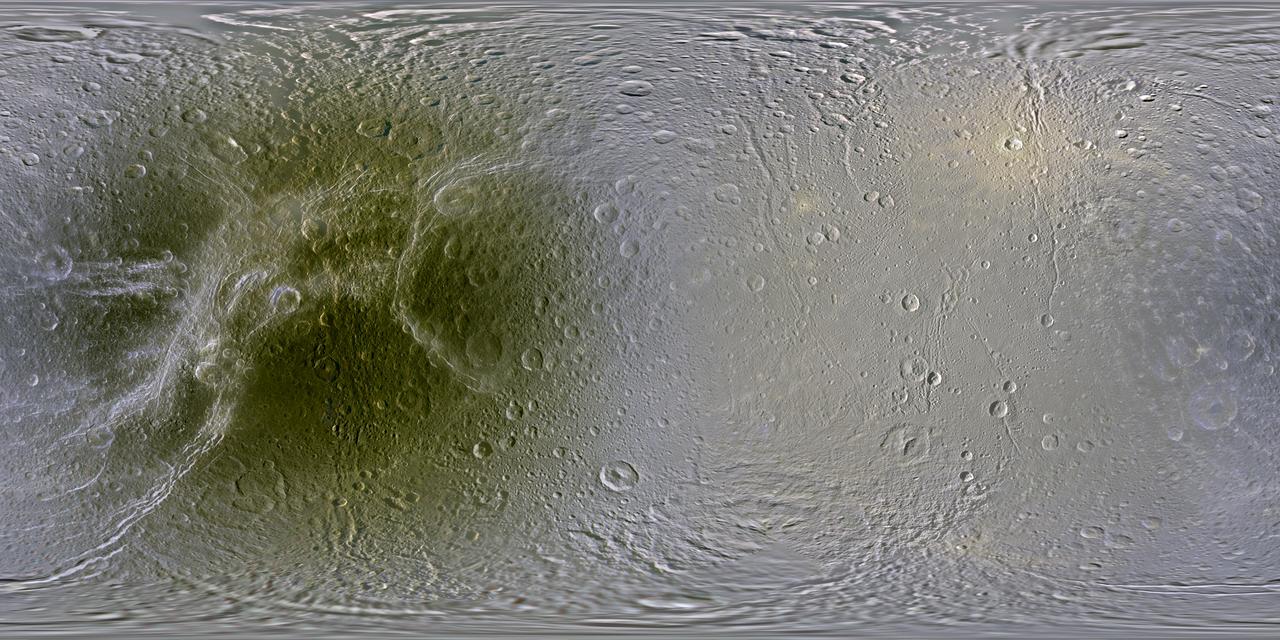
This set of global, color mosaics of Saturn moon Dione taken by NASA Cassini spacecraft during its first ten years exploring the Saturn system; obvious feature on the maps is the difference in color and brightness between the two hemispheres.
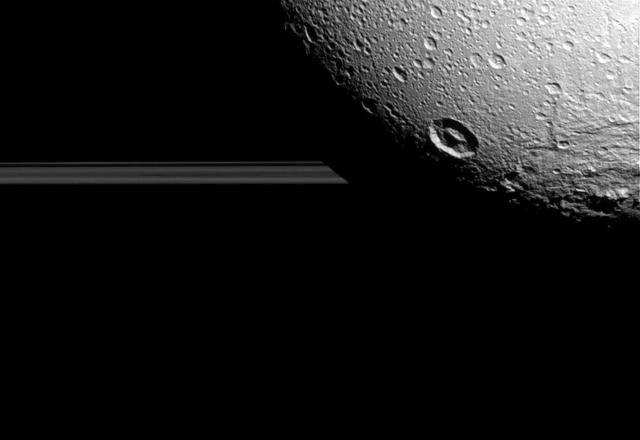
Saturn moon Dione hangs in front of Saturn rings in this view taken by NASA Cassini spacecraft during the inbound leg of its last close flyby of the icy moon.