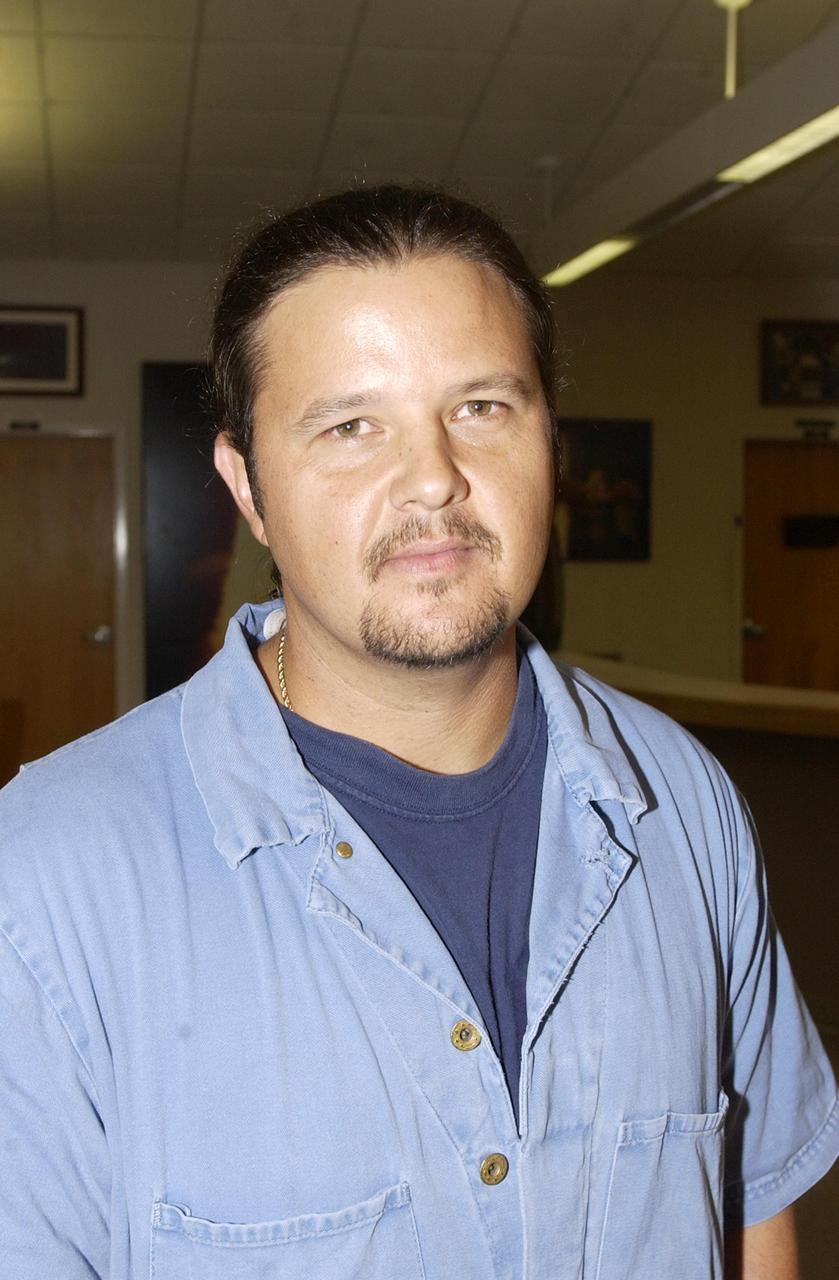
KENNEDY SPACE CENTER, FLA. -- Andy Fish, an SRB retrieval diver and diver medical technician with United Space Alliance, is in the spotlight for helping rescue a diver in distress off Cape Canaveral Sept. 11. Fish and others were on a certification exercise on board Freedom Star, one of the Shuttle Rocket Booster retrieval ships, manned by USA workers. The ship was near the location of a lobster diving boat that radioed the U.S. Coast Guard for help when one of the divers experienced difficulty breathing on his return to the surface. Hearing the call for help, the captain of the Freedom Star offered to help. Fish had experience with distressed divers. He stayed with the diver in the recompression chamber aboard the Freedom Star until the ship reached Port Canaveral where a KSC Occupational Health doctor waited. The diver was stabilized and taken to Florida Hospital. .
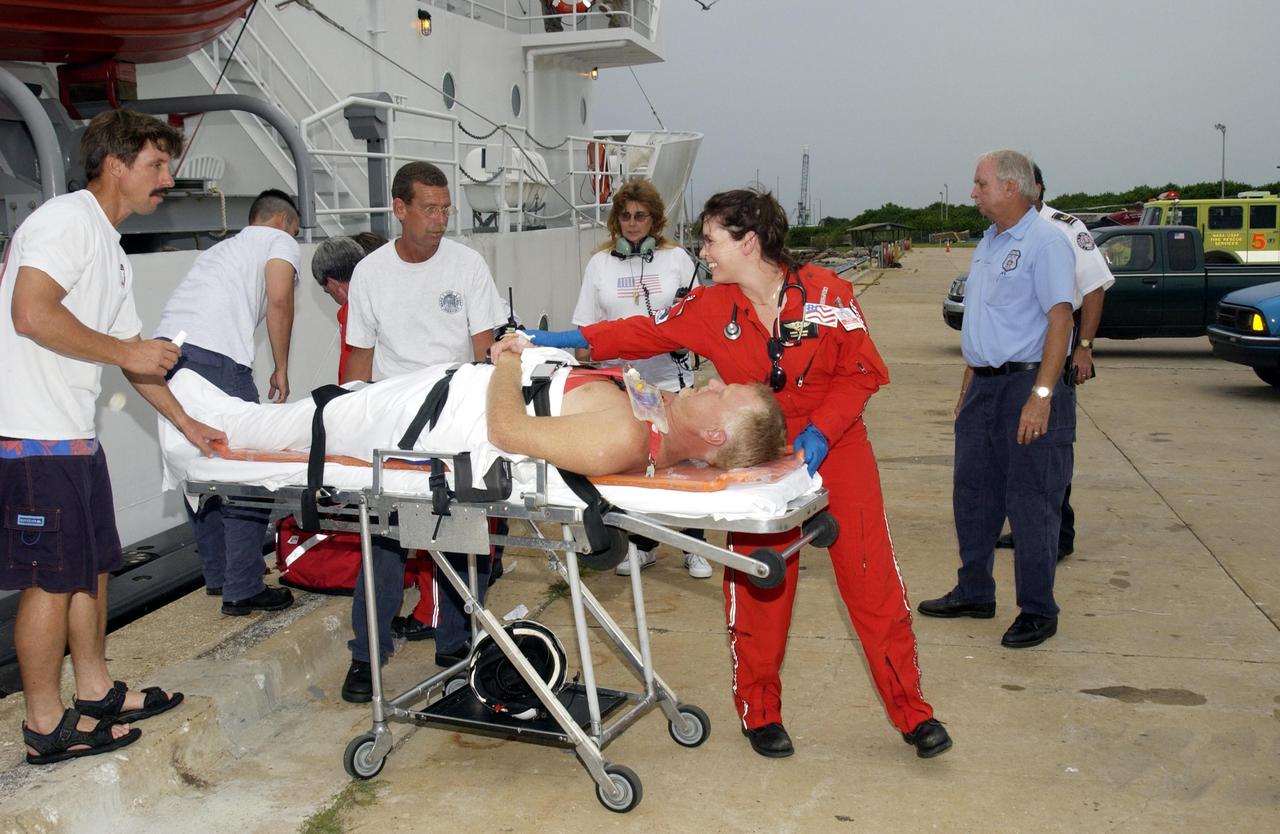
KENNEDY SPACE CENTER, FLA. - United Space Alliance workers on board the Freedom Star, one of the Shuttle Rocket Booster retrieval ships, release a distressed lobster diver to an Air Care Team from Orlando for transfer to a hospital. The ship and its dive team, including a diver medical technician, Andy Fish, were instrumental in rescuing the diver off Cape Canaveral Sept. 11. The ship was on a certification exercise and near the location of a lobster diving boat that radioed the U.S. Coast Guard for help when one of the divers experienced difficulty breathing on his return to the surface. Hearing the call for help, the captain of the Freedom Star offered to help. Fish stayed with the diver in the recompression chamber aboard the Freedom Star until the ship reached Port Canaveral where a KSC Occupational Health doctor waited. The diver was stabilized and then taken to Florida Hospital.
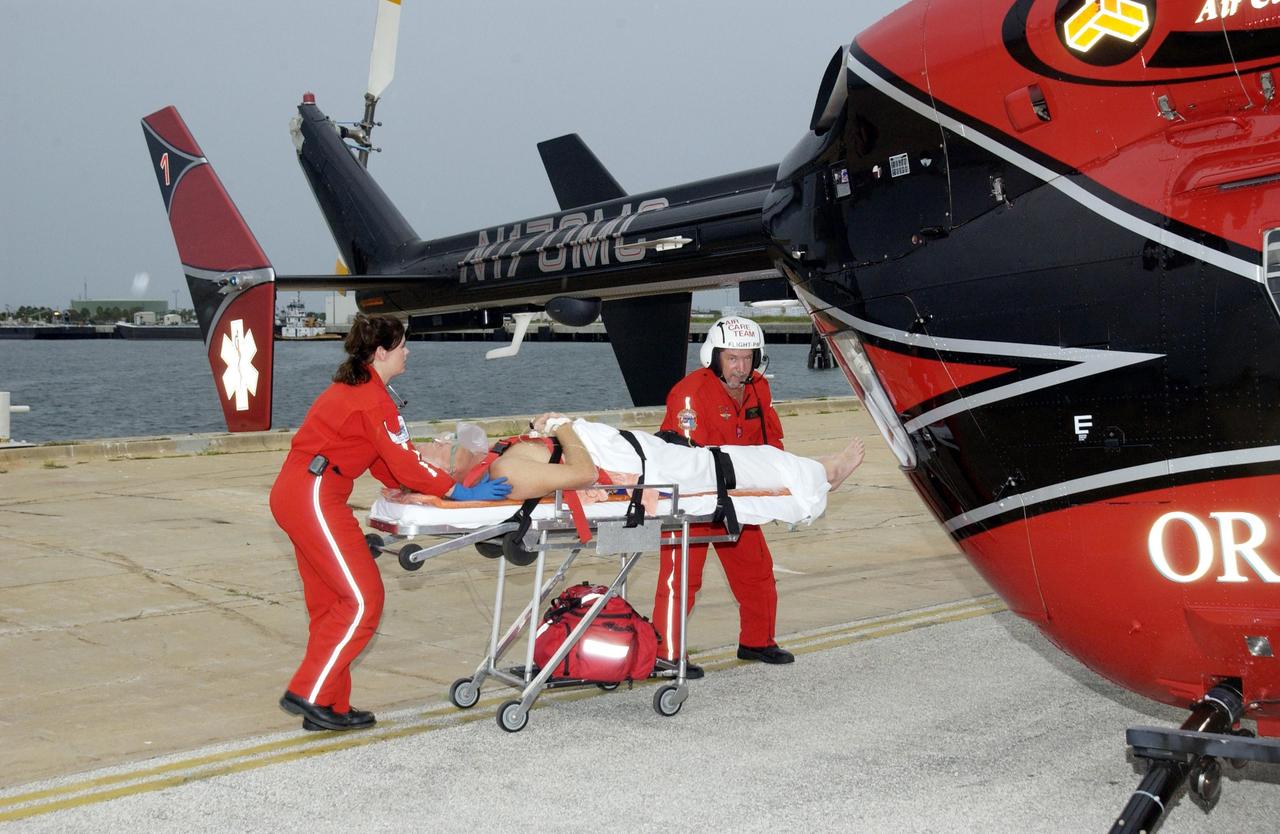
KENNEDY SPACE CENTER, FLA. -- An Air Care team from Orlando take a distressed lobster diver to the helicopter to take him to Florida Hospital. The diver was picked up by the Freedom Star, one of the Shuttle Rocket Booster retrieval ships, on a certification exercise and near the location of a lobster diving boat that radioed the U.S. Coast Guard for help when one of the divers experienced difficulty breathing on his return to the surface. Hearing the call for help, the captain of the Freedom Star offered to help. The ship had a dive team on board, including a diver medical technician, Andy Fish, as well as a hyperbaric chamber. Fish stayed with the diver in the recompression chamber aboard the Freedom Star until the ship reached Port Canaveral where a KSC Occupational Health doctor waited. The diver was stabilized and then taken to Florida Hospital.
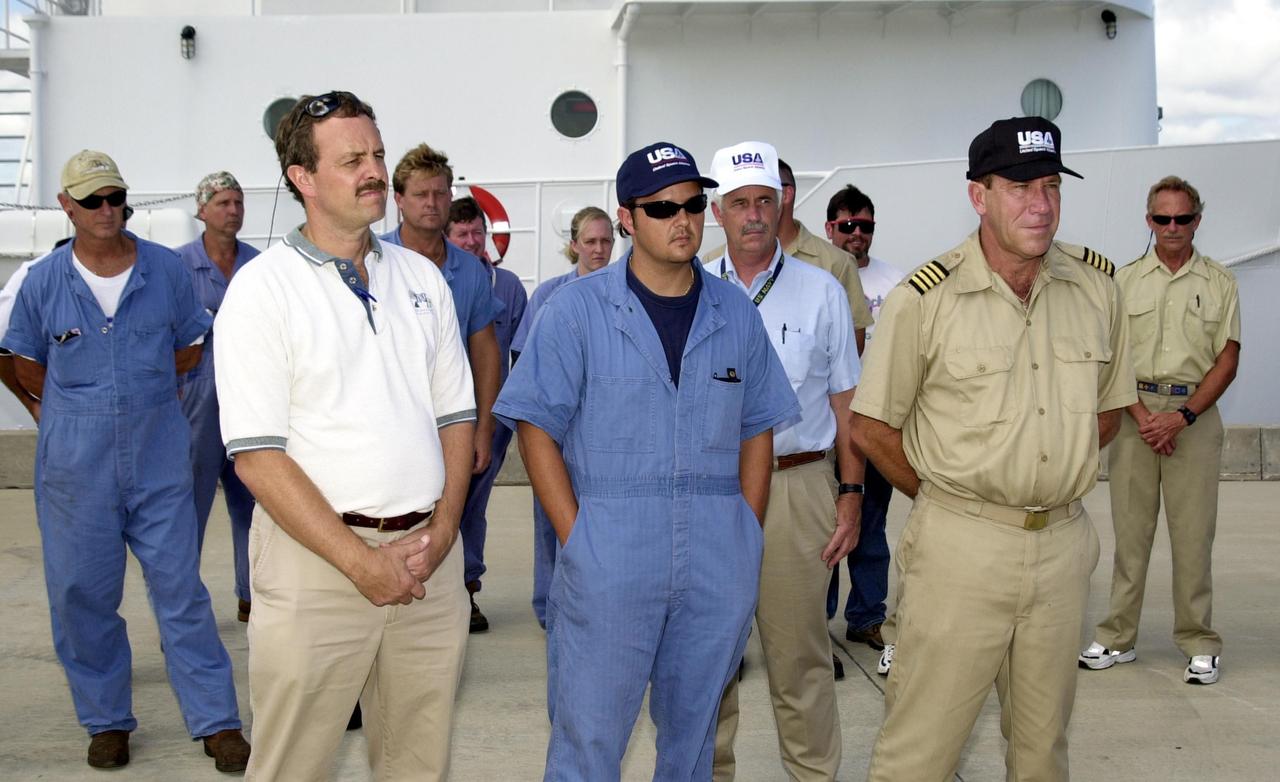
KENNEDY SPACE CENTER, FLA. - A reunion at the Hangar AF docks, Cape Canaveral Air Force Station, brought together a diver and his rescuers, the crew of KSC's Freedom Star SRB retrieval ship and a medical team. In the photo are (foreground, left to right) KSC Occupational Health physician Skip Beeler, retrieval diver and diver medical technician Andy Fish, and Freedom Star's Captain, Dave Fraine. The diver, Jack Wilcox, suffered decompression sickness on a diving expedition 20 miles off shore in the Atlantic Ocean. When the Freedom Star team heard the call for help, they asked the Coast Guard if they could assist. The ship was out on a crane certification exercise and coincidentally had a diver medical technician and other divers training on the crane. The ship's divers were trained for the hyperbaric chamber on board. Upon reaching the Army dock, KSC Occupational Health physician Skip Beeler entered the chamber and continued the process of helping to stabilize Wilcox. After several hours in the chamber, Wilcox, who lives in Orlando, was airlifted to Florida Hospital Orlando

KENNEDY SPACE CENTER, FLA. -- United Space Alliance workers on board the Freedom Star, one of the Shuttle Rocket Booster retrieval ships, check the controls on the recompression chamber at right. The ship and its dive team, including a diver medical technician, Andy Fish, were instrumental in rescuing a lobster diver in distress off Cape Canaveral Sept. 11. The ship was on a certification exercise and near the location of a lobster diving boat that radioed the U.S. Coast Guard for help when one of the divers experienced difficulty breathing on his return to the surface. Hearing the call for help, the captain of the Freedom Star offered to help. Fish stayed with the diver in the recompression chamber aboard the Freedom Star until the ship reached Port Canaveral where a KSC Occupational Health doctor waited. The diver was stabilized and taken to Florida Hospital.
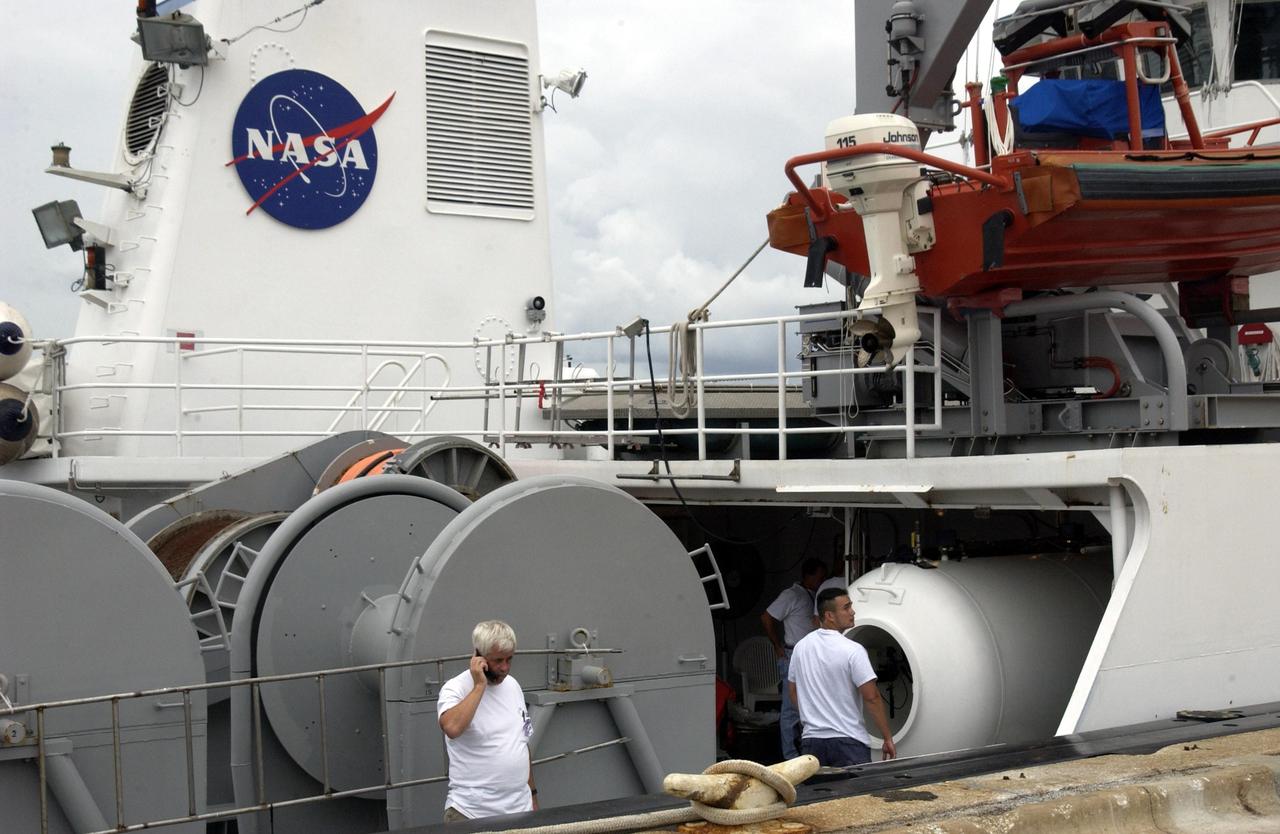
KENNEDY SPACE CENTER, FLA. - On board the Freedom Star, one of the Shuttle Rocket Booster retrieval ships, workers with United Space Alliance help finalize the rescue of a lobster diver in distress after their return to port Sept. 11. The ship was on a certification exercise and near the location of a lobster diving boat that radioed the U.S. Coast Guard for help when one of the divers experienced difficulty breathing on his return to the surface. Hearing the call for help, the captain of the Freedom Star offered to help. On board the ship was a dive team, including a diver medical technician, Andy Fish, who are trained to assist in case of a dive accident during a retrieval mission. Fish stayed with the diver in the recompression chamber aboard the Freedom Star until the ship reached Port Canaveral where a KSC Occupational Health doctor waited. The diver was stabilized and taken to Florida Hospital.
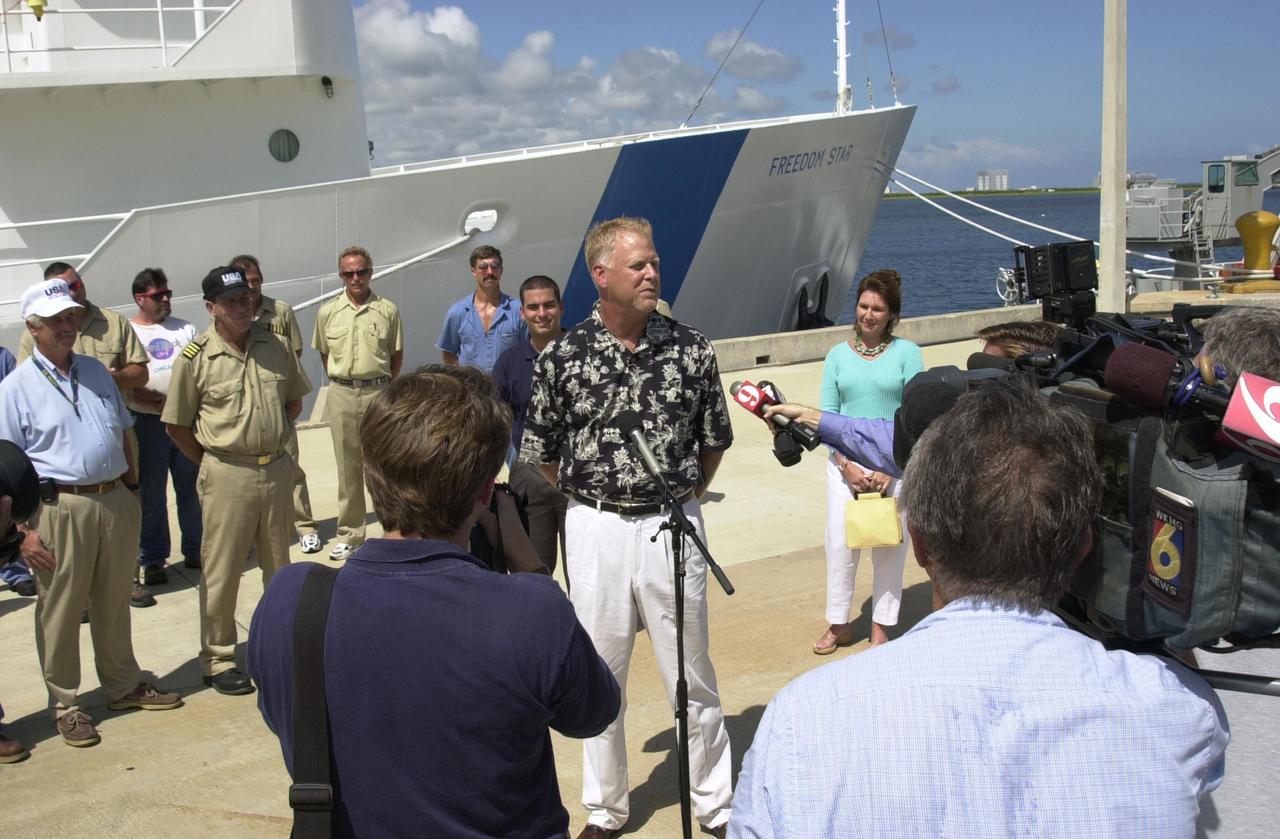
KENNEDY SPACE CENTER, FLA. - Jack Wilcox (at the microphone) answers questions from the media during a reunion with his rescuers at the Hangar AF docks, Cape Canaveral Air Force Station. At right is his wife, Patty. Wilcox reunited with the men aboard KSC's Freedom Star SRB retrieval ship that was in the vicinity when Wilcox suffered decompression sickness on a diving expedition 20 miles off shore in the Atlantic Ocean. When the Freedom Star team heard the call for help, they asked the Coast Guard if they could assist. The ship was out on a crane certification exercise and coincidentally had a diver medical technician and other divers training on the crane. The ship's divers were trained for the hyperbaric chamber on board. Upon reaching the Army dock, KSC Occupational Health physician Skip Beeler entered the chamber and continued the process of helping to stabilize Wilcox. After several hours in the chamber, Wilcox, who lives in Orlando, was airlifted to Florida Hospital Orlando.
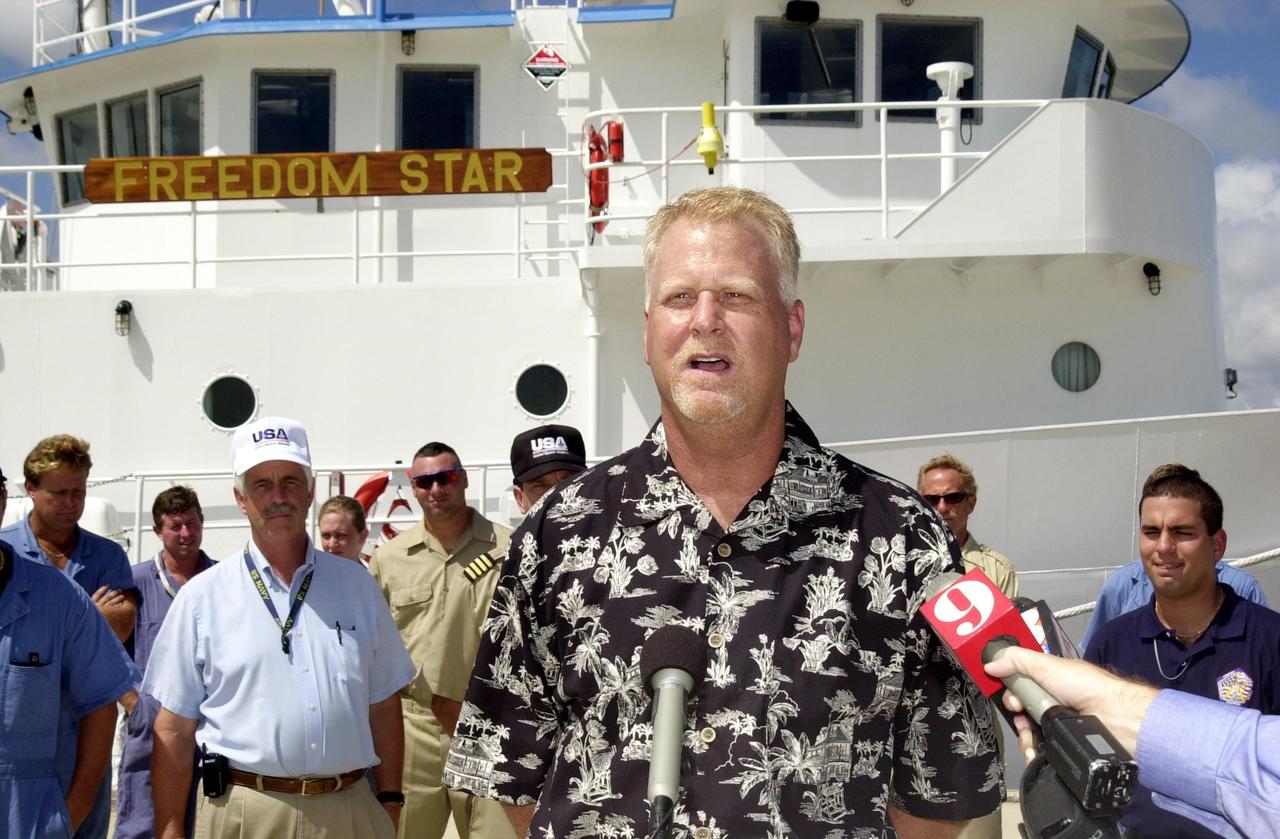
KENNEDY SPACE CENTER, FLA. - Jack Wilcox answers questions from the media during a reunion at the Hangar AF docks, Cape Canaveral Air Force Station, with his rescuers. Wilcox reunited with the men aboard KSC's Freedom Star SRB retrieval ship that was in the vicinity when Wilcox suffered decompression sickness on a diving expedition 20 miles off shore in the Atlantic Ocean. When the Freedom Star team heard the call for help, they asked the Coast Guard if they could assist. The ship was out on a crane certification exercise and coincidentally had a diver medical technician and other divers training on the crane. The ship's divers were trained for the hyperbaric chamber on board. Upon reaching the Army dock, KSC Occupational Health physician Skip Beeler entered the chamber and continued the process of helping to stabilize Wilcox. After several hours in the chamber, Wilcox, who lives in Orlando, was airlifted to Florida Hospital Orlando.
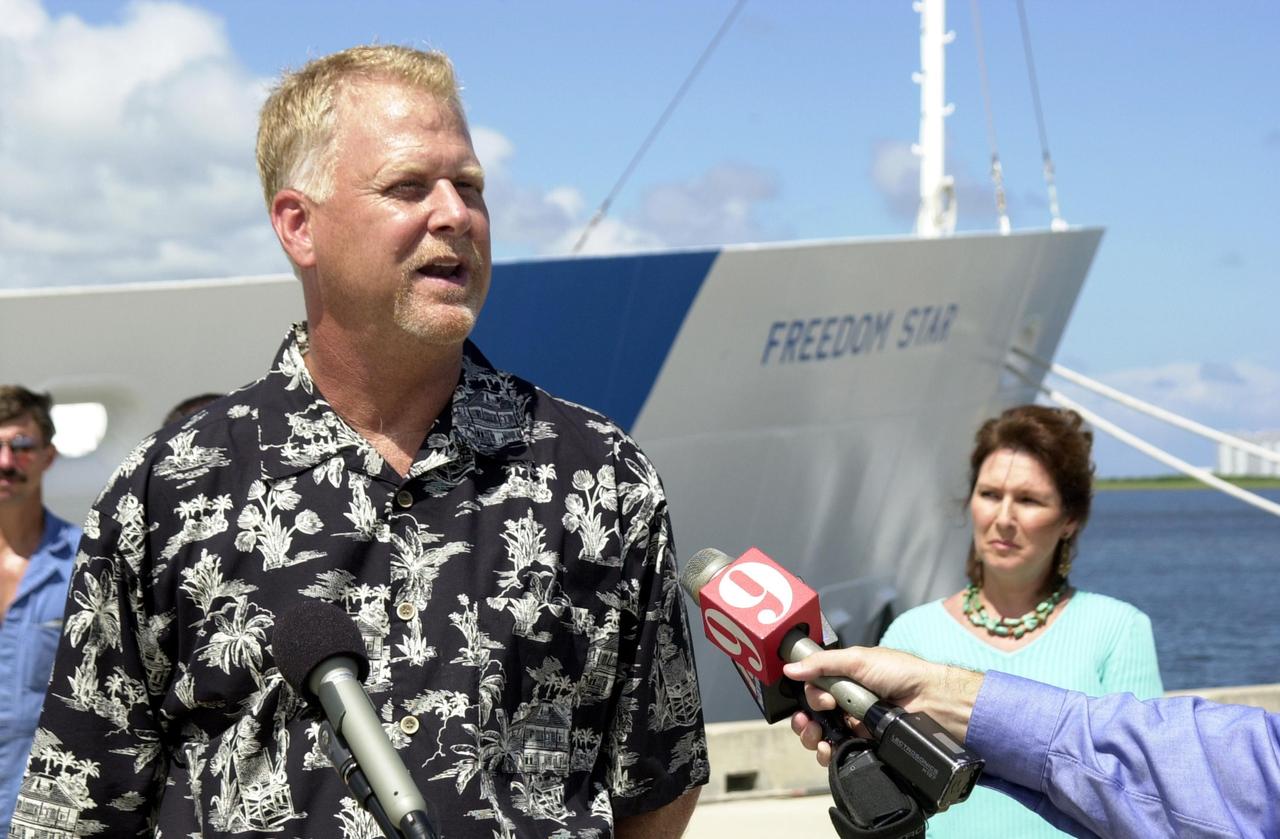
KENNEDY SPACE CENTER, FLA. - KENNEDY SPACE CENTER, FLA. - Jack Wilcox answers questions from the media during a reunion at the Hangar AF docks, Cape Canaveral Air Force Station, with his rescuers. At right is his wife, Patty. Wilcox reunited with the men aboard KSC's Freedom Star SRB retrieval ship that was in the vicinity when Wilcox suffered decompression sickness on a diving expedition 20 miles off shore in the Atlantic Ocean. When the Freedom Star team heard the call for help, they asked the Coast Guard if they could assist. The ship was out on a crane certification exercise and coincidentally had a diver medical technician and other divers training on the crane. The ship's divers were trained for the hyperbaric chamber on board. Upon reaching the Army dock, KSC Occupational Health physician Skip Beeler entered the chamber and continued the process of helping to stabilize Wilcox. After several hours in the chamber, Wilcox, who lives in Orlando, was airlifted to Florida Hospital Orlando.
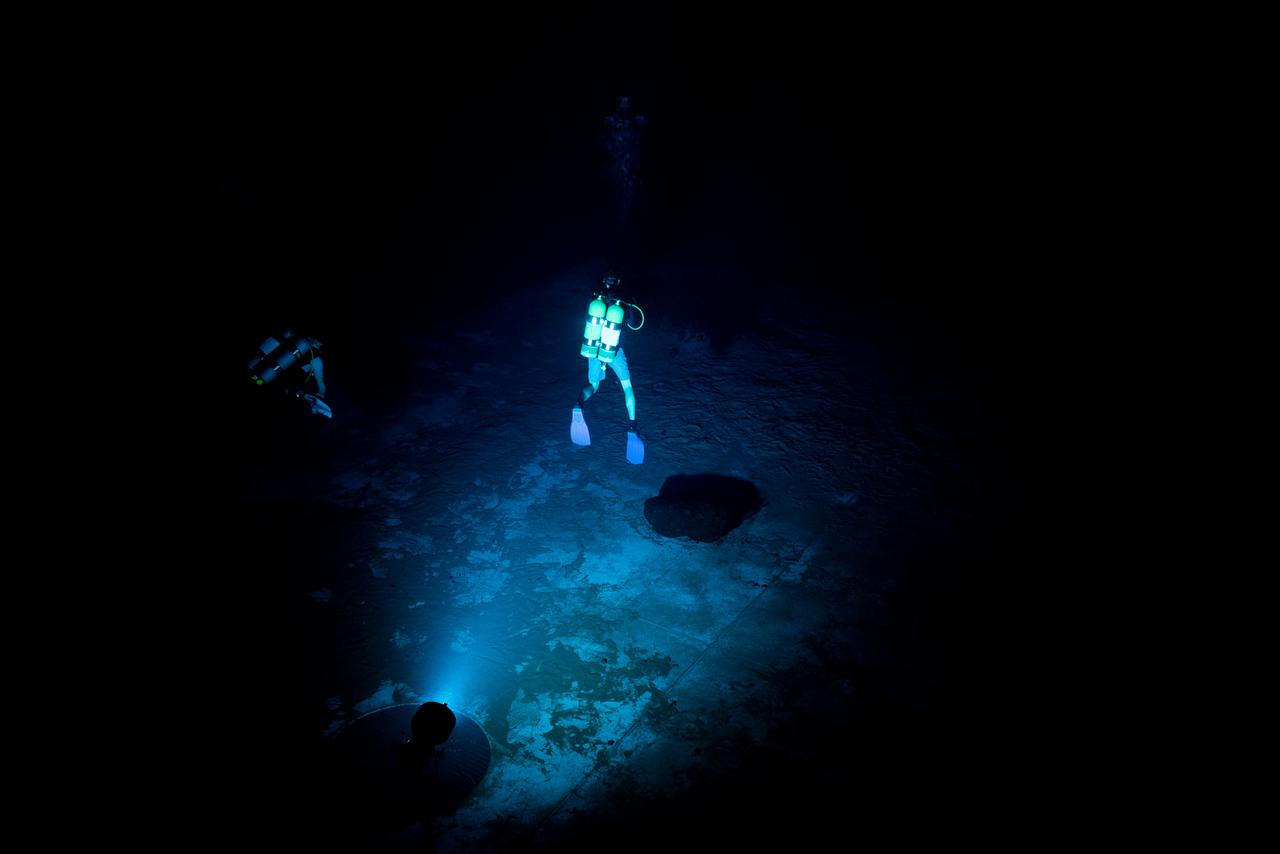
Quantitative evaluation of light source by NBL diver during NBL Preliminary Lunar Lighting Evaluation. Divers at the Neutral Buoyancy Laboratory (NBL) in Houston are setting the stage for future Moonwalk training by simulating lunar lighting conditions. At the Lunar South Pole, the Sun will remain no more than a few degrees above the horizon, resulting in extremely long and dark shadows. To prepare astronauts for these challenging lighting conditions, the team at the NBL has begun preliminary evaluations of lunar lighting solutions at the bottom of the 40-foot deep pool. This testing and evaluation involved turning off all the lights in the facility, installing black curtains on the pool walls to minimize reflections, and using a powerful underwater cinematic lamp, to get the conditions just right ahead of upcoming training for astronauts.
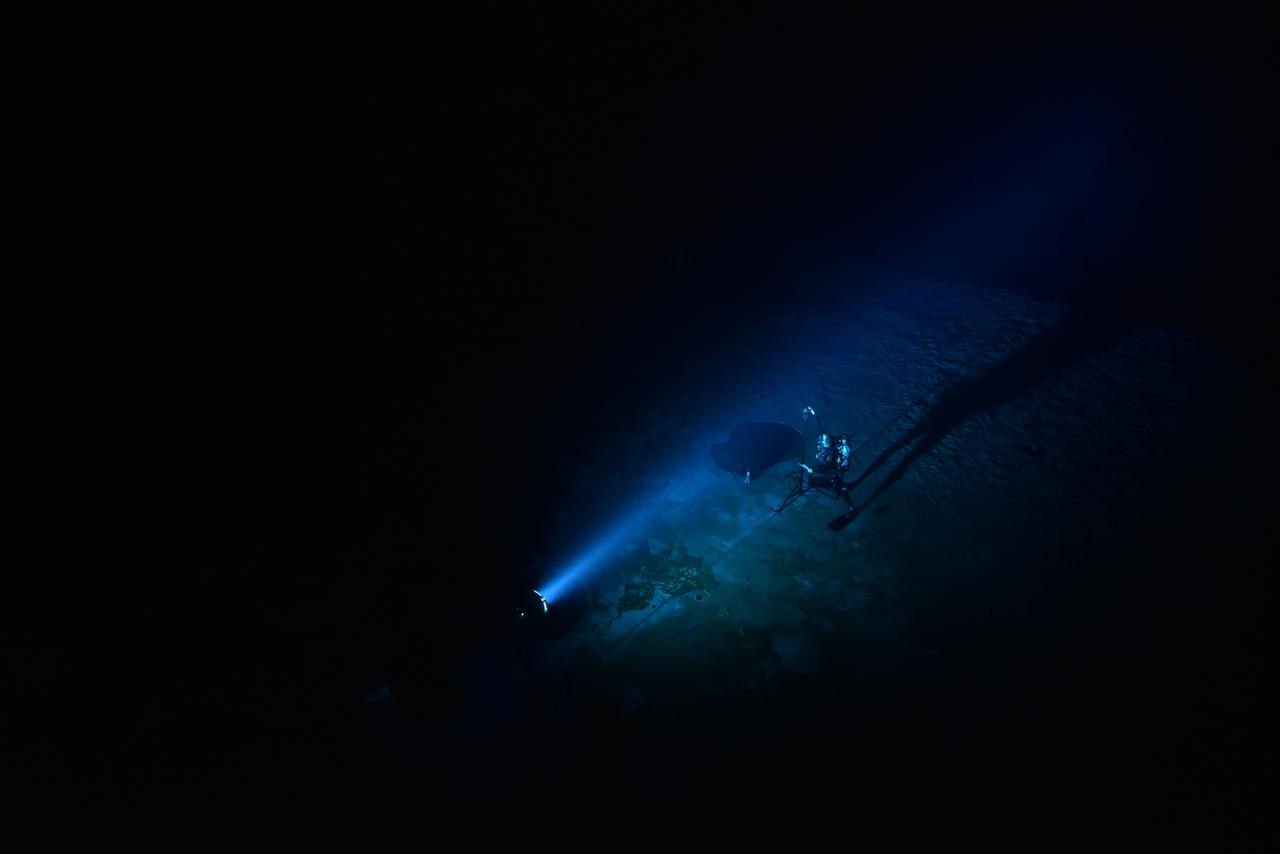
Quantitative evaluation of light source by NBL diver during NBL Preliminary Lunar Lighting Evaluation. Divers at the Neutral Buoyancy Laboratory (NBL) in Houston are setting the stage for future Moonwalk training by simulating lunar lighting conditions. At the Lunar South Pole, the Sun will remain no more than a few degrees above the horizon, resulting in extremely long and dark shadows. To prepare astronauts for these challenging lighting conditions, the team at the NBL has begun preliminary evaluations of lunar lighting solutions at the bottom of the 40-foot deep pool. This testing and evaluation involved turning off all the lights in the facility, installing black curtains on the pool walls to minimize reflections, and using a powerful underwater cinematic lamp, to get the conditions just right ahead of upcoming training for astronauts.
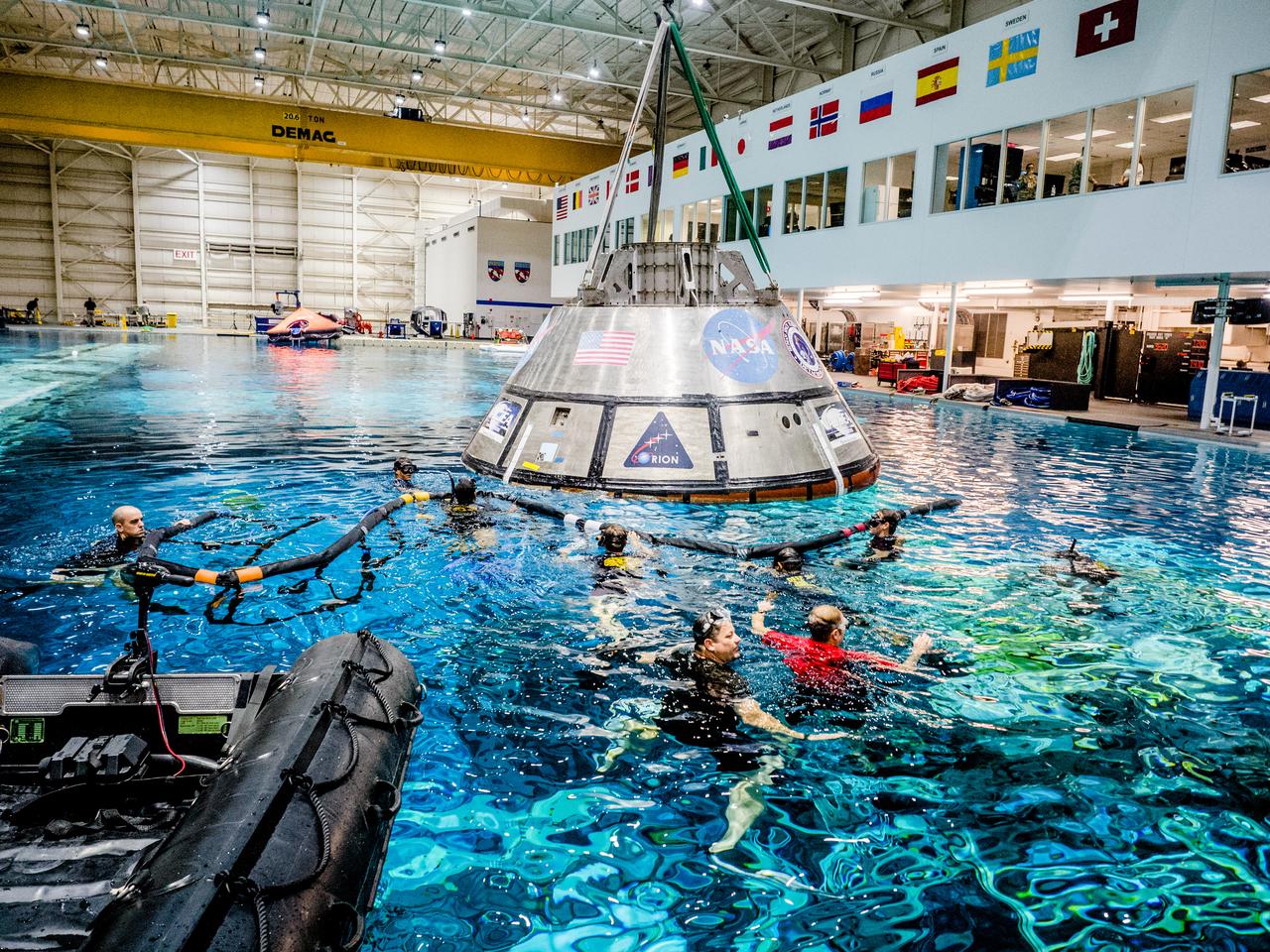
A group of U.S. Navy divers, Air Force pararescumen and Coast Guard rescue swimmers practice Orion underway recovery techniques this week in the Neutral Buoyancy Laboratory (NBL) at NASA’s Johnson Space Center in Houston on Sept. 21, 2016, to prepare for the first test flight of an uncrewed Orion spacecraft with the agency’s Space Launch System rocket during Artemis I. Part of Batch image transfer from Flickr.
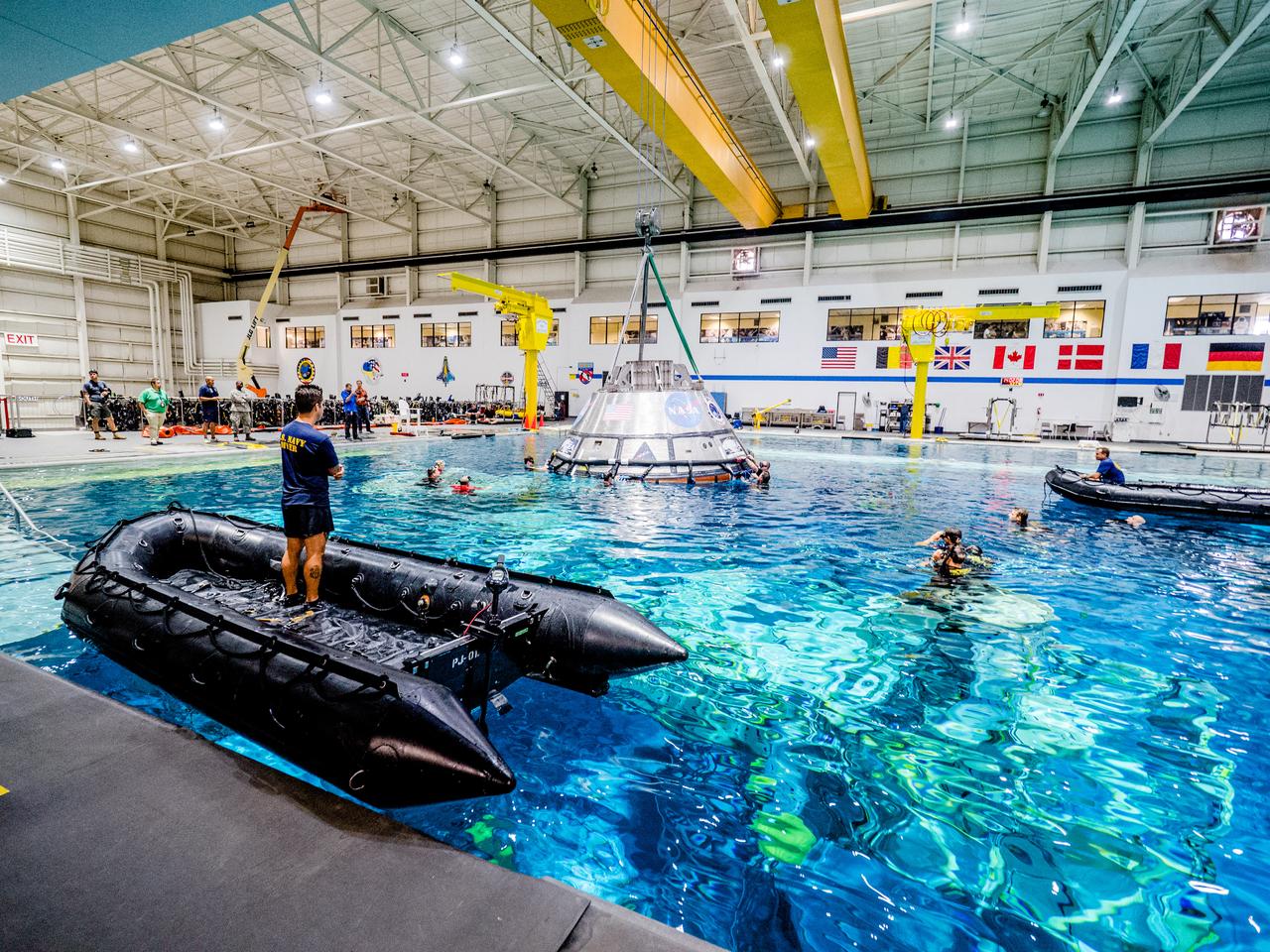
A group of U.S. Navy divers, Air Force pararescumen and Coast Guard rescue swimmers practice Orion underway recovery techniques this week in the Neutral Buoyancy Laboratory (NBL) at NASA’s Johnson Space Center in Houston on Sept. 21, 2016, to prepare for the first test flight of an uncrewed Orion spacecraft with the agency’s Space Launch System rocket during Artemis I.Part of Batch image transfer from Flickr.
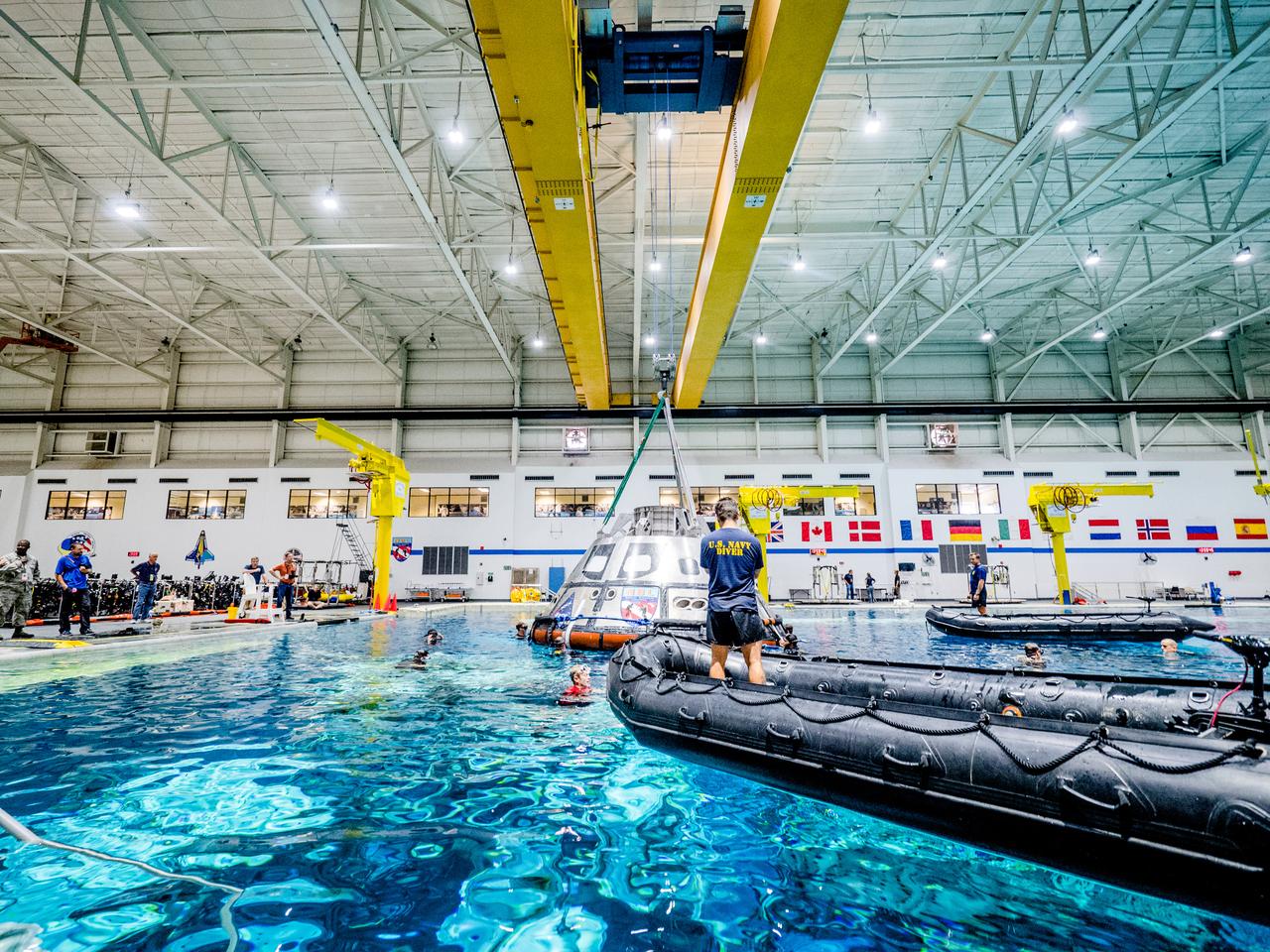
A group of U.S. Navy divers, Air Force pararescumen and Coast Guard rescue swimmers practice Orion underway recovery techniques this week in the Neutral Buoyancy Laboratory (NBL) at NASA’s Johnson Space Center in Houston on Sept. 21, 2016, to prepare for the first test flight of an uncrewed Orion spacecraft with the agency’s Space Launch System rocket during Artemis I. Part of Batch images transfer from Flickr.
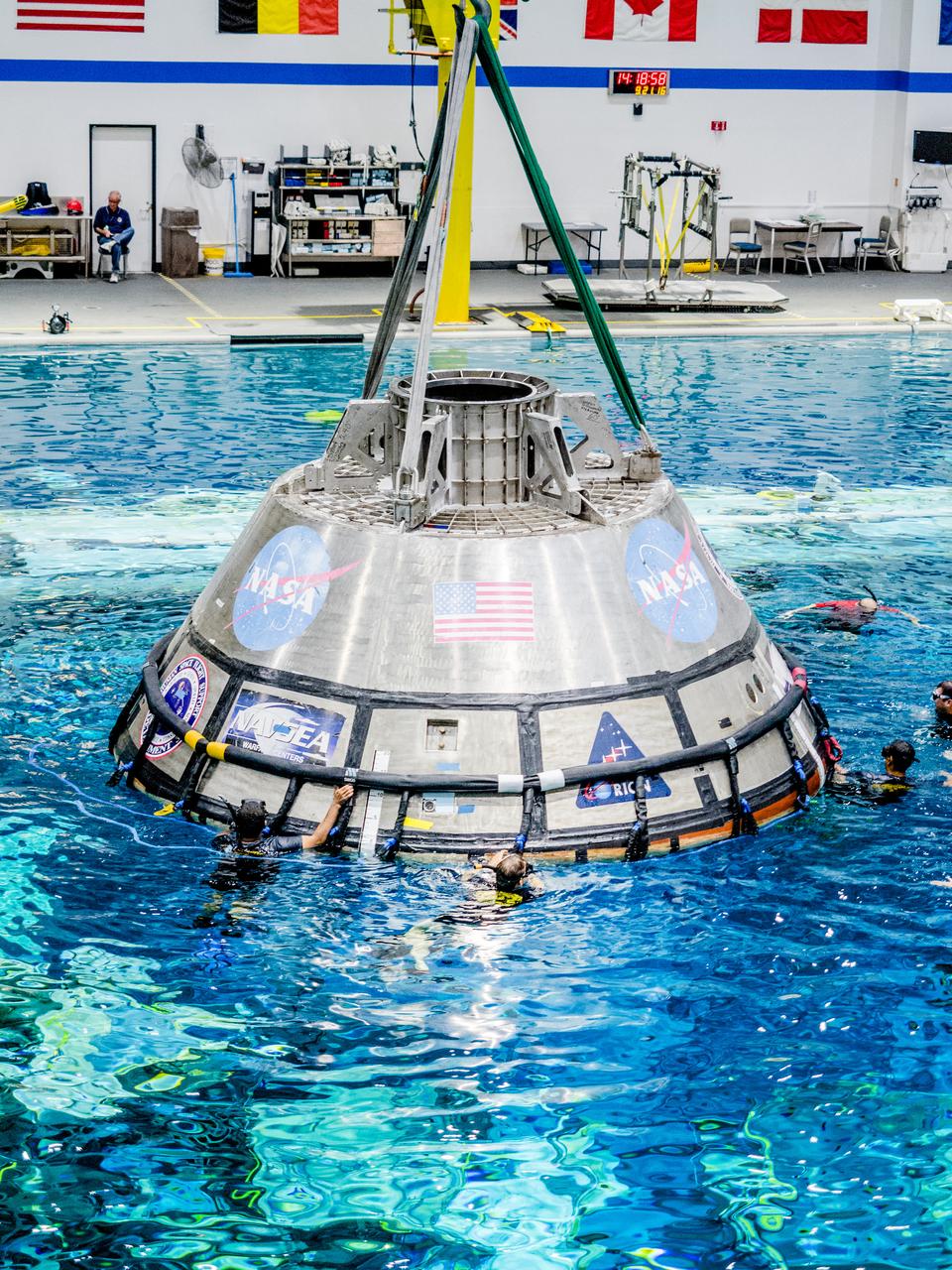
A group of U.S. Navy divers, Air Force pararescumen and Coast Guard rescue swimmers practice Orion underway recovery techniques this week in the Neutral Buoyancy Laboratory (NBL) at NASA’s Johnson Space Center in Houston on Sept. 21, 2016, to prepare for the first test flight of an uncrewed Orion spacecraft with the agency’s Space Launch System rocket during Artemis I.
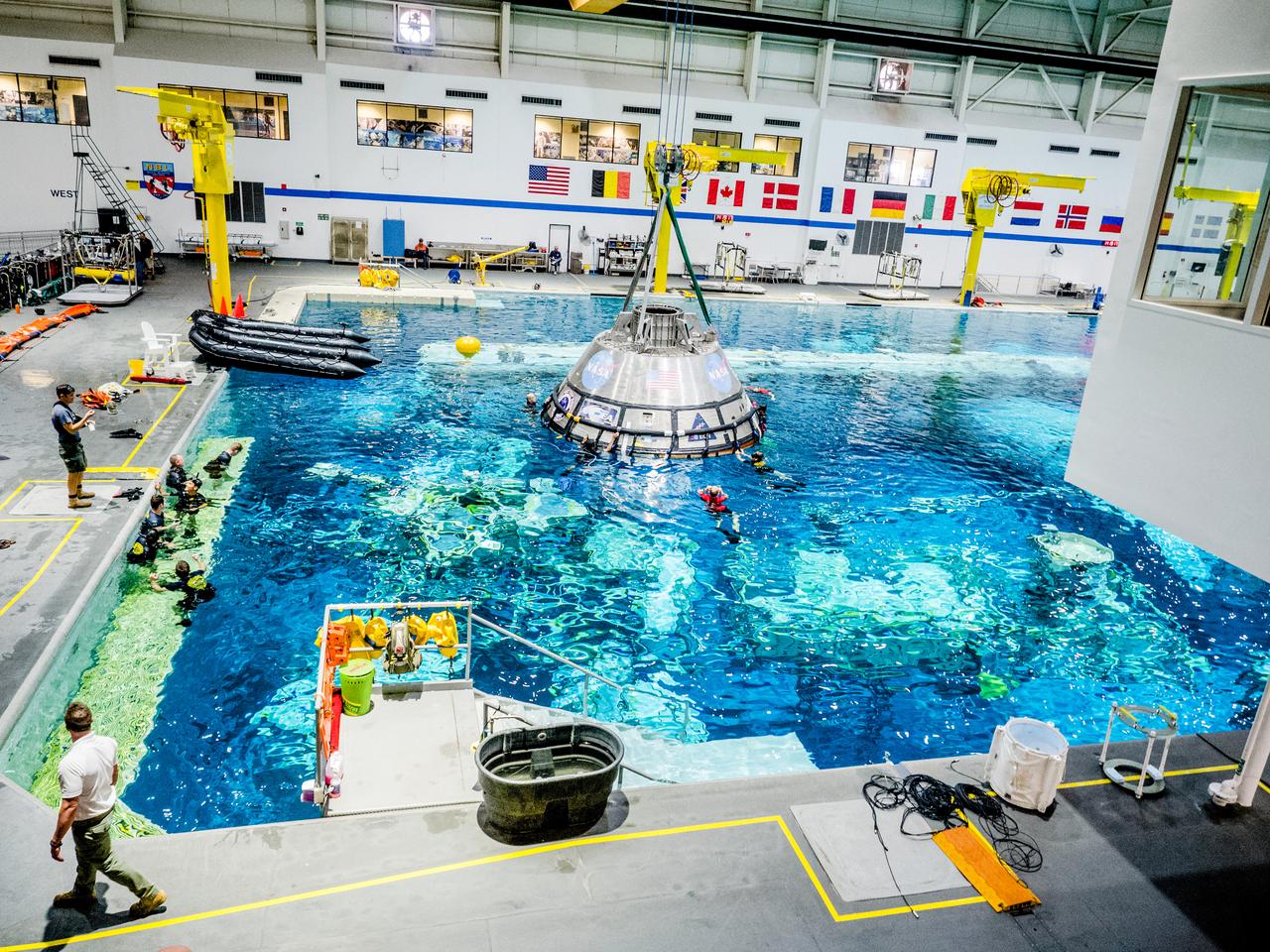
A group of U.S. Navy divers, Air Force pararescumen and Coast Guard rescue swimmers practice Orion underway recovery techniques this week in the Neutral Buoyancy Laboratory (NBL) at NASA’s Johnson Space Center in Houston on Sept. 21, 2016, to prepare for the first test flight of an uncrewed Orion spacecraft with the agency’s Space Launch System rocket during Artemis I. Part of Batch images transfer from Flickr.
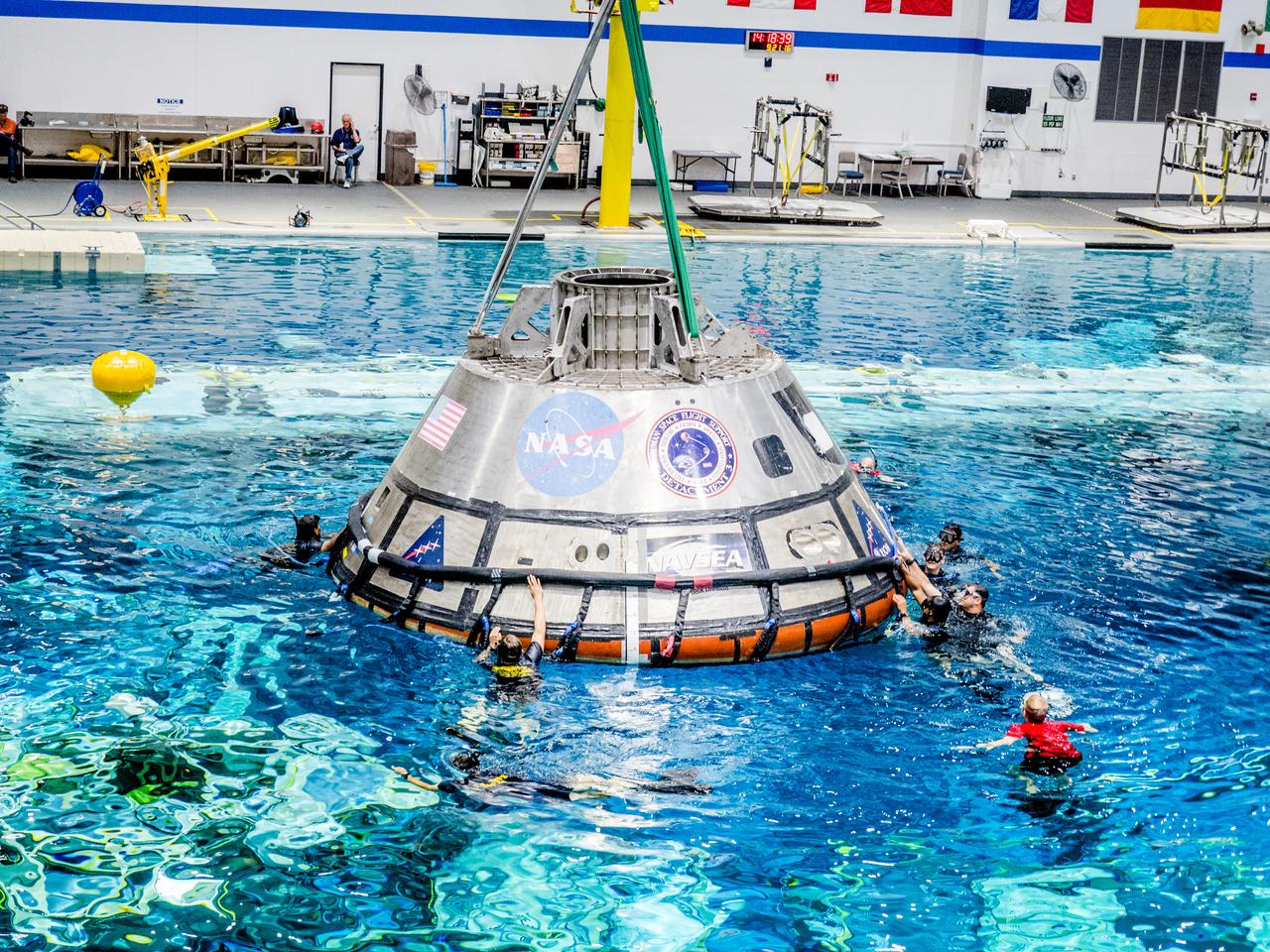
A group of U.S. Navy divers, Air Force pararescumen and Coast Guard rescue swimmers practice Orion underway recovery techniques this week in the Neutral Buoyancy Laboratory (NBL) at NASA’s Johnson Space Center in Houston on Sept. 21, 2016, to prepare for the first test flight of an uncrewed Orion spacecraft with the agency’s Space Launch System rocket during Artemis I. Part of Batch images transfer from Flickr.
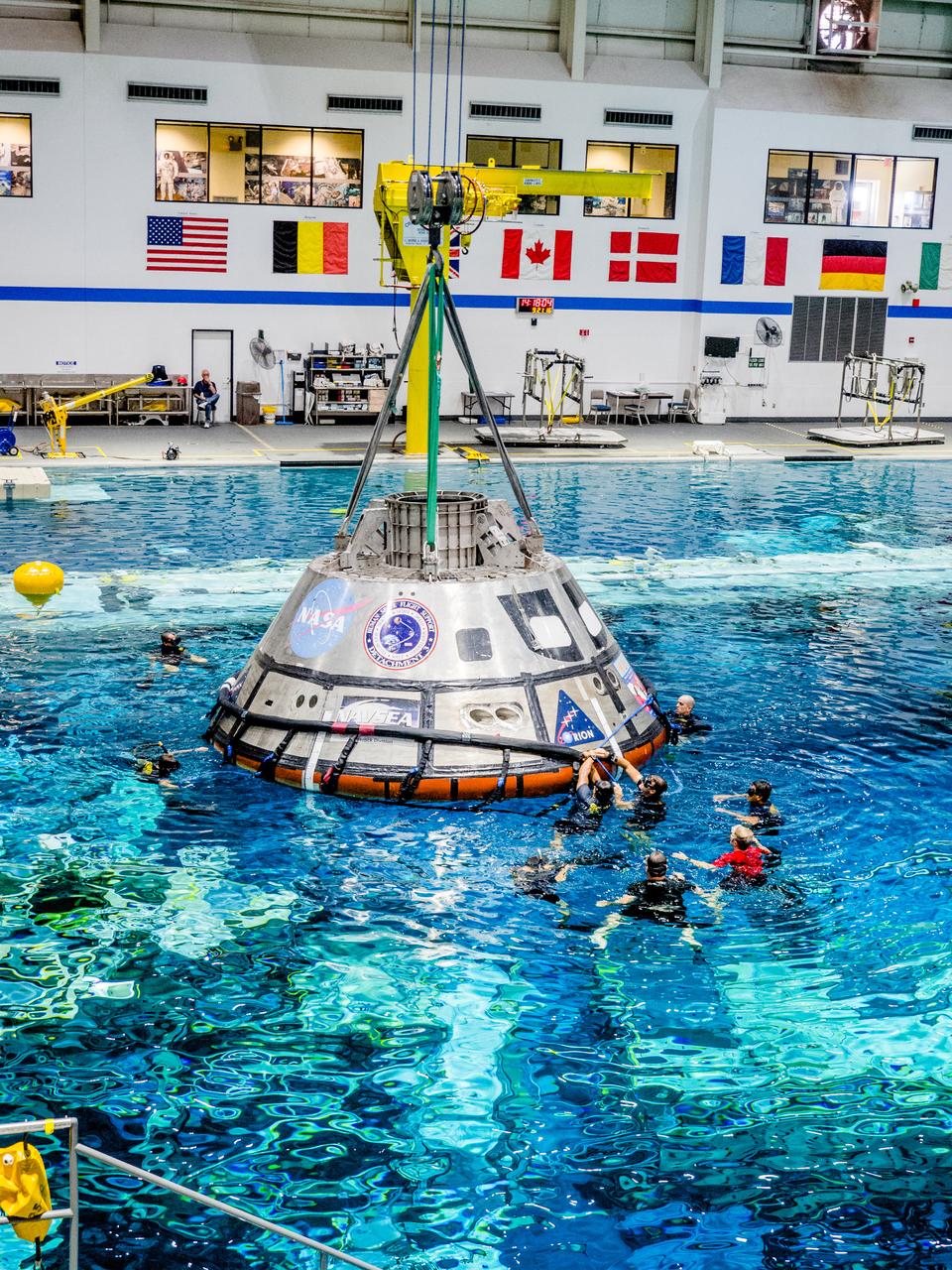
A group of U.S. Navy divers, Air Force pararescumen and Coast Guard rescue swimmers practice Orion underway recovery techniques this week in the Neutral Buoyancy Laboratory (NBL) at NASA’s Johnson Space Center in Houston on Sept. 21, 2016, to prepare for the first test flight of an uncrewed Orion spacecraft with the agency’s Space Launch System rocket during Artemis I. Part of Batch image transfer from Flickr.
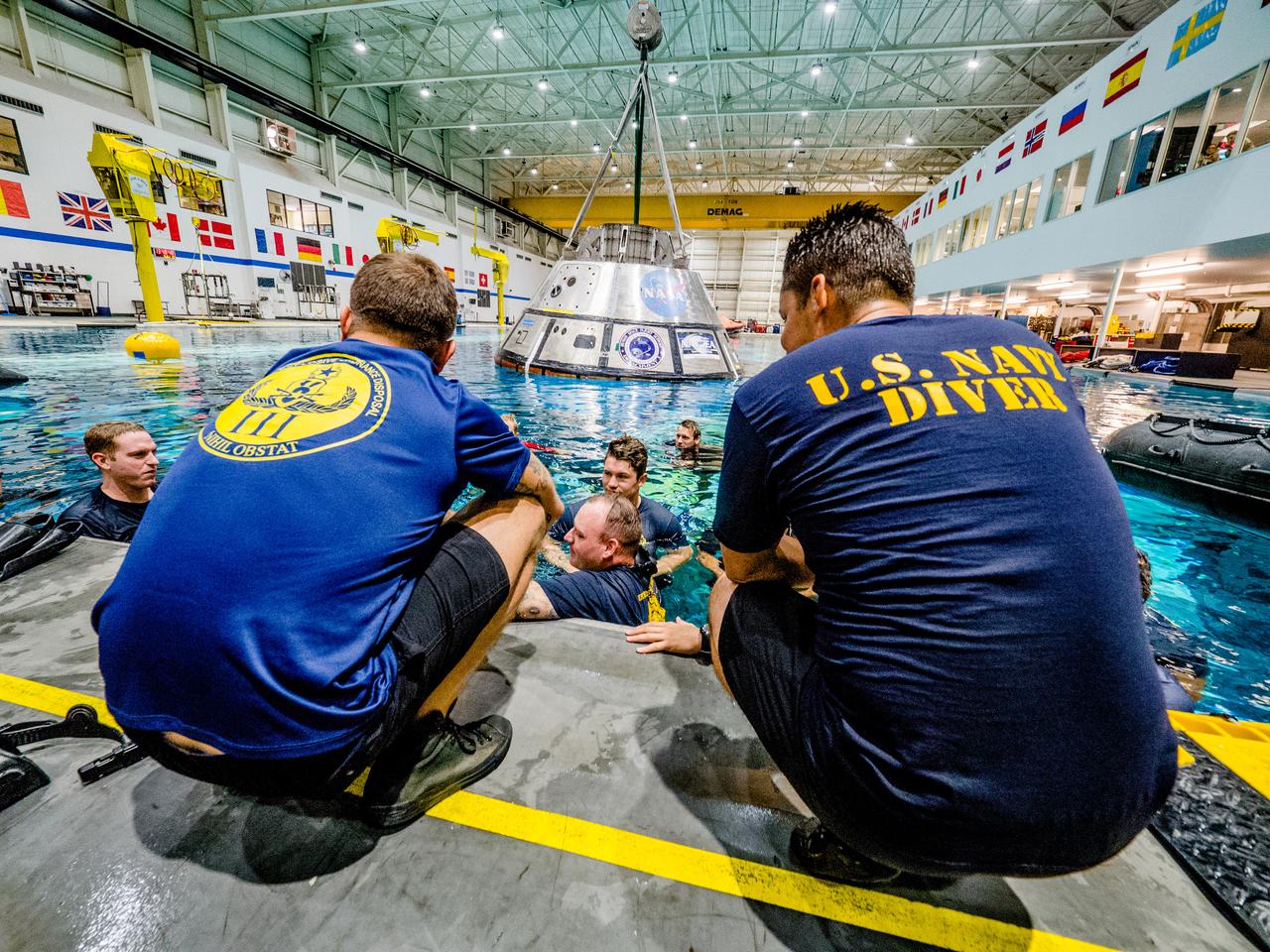
A group of U.S. Navy divers, Air Force pararescumen and Coast Guard rescue swimmers practice Orion underway recovery techniques this week in the Neutral Buoyancy Laboratory (NBL) at NASA’s Johnson Space Center in Houston on Sept. 21, 2016, to prepare for the first test flight of an uncrewed Orion spacecraft with the agency’s Space Launch System rocket during Artemis I. Part of Batch images transfer from Flickr.
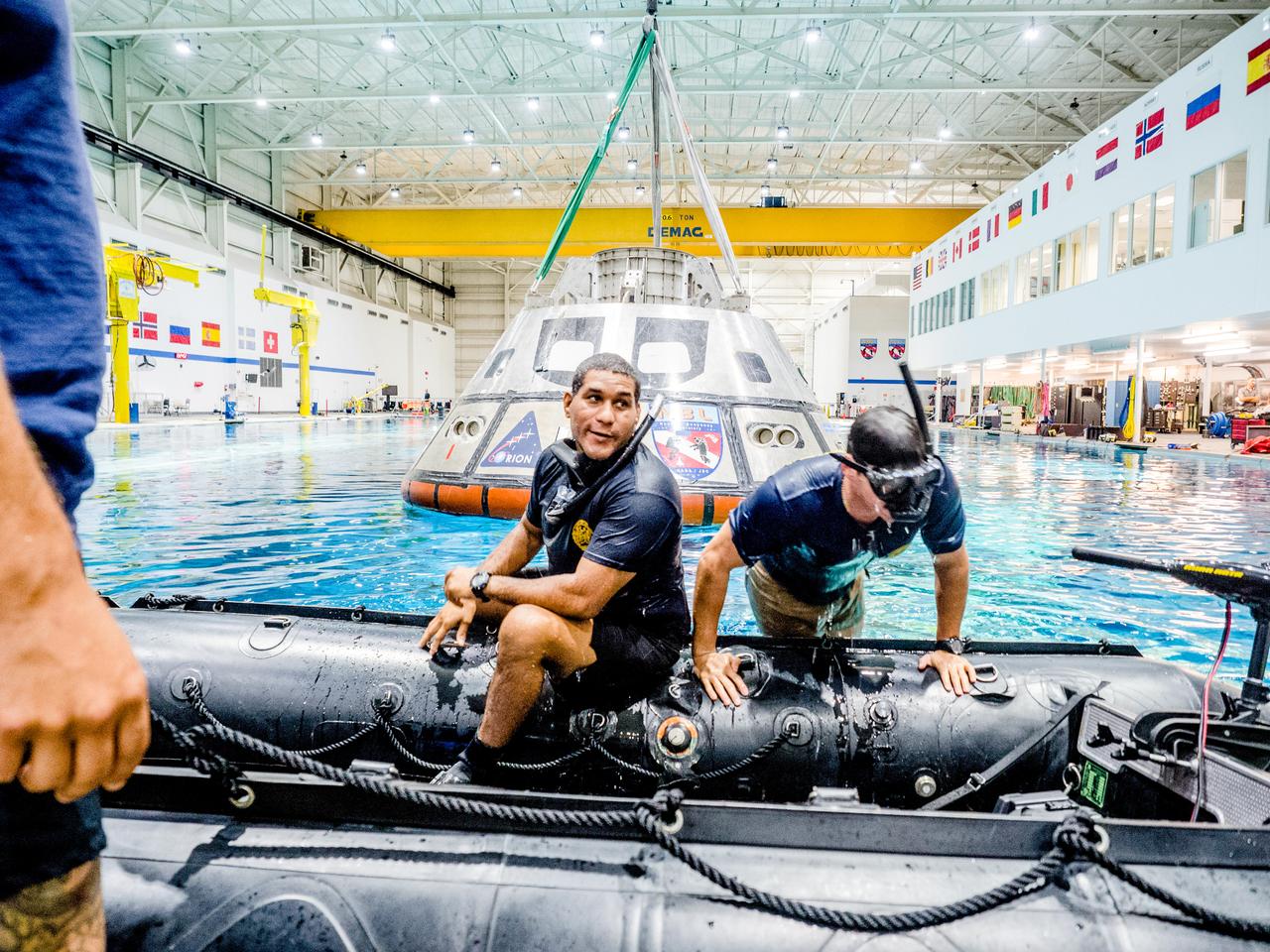
A group of U.S. Navy divers, Air Force pararescumen and Coast Guard rescue swimmers practice Orion underway recovery techniques this week in the Neutral Buoyancy Laboratory (NBL) at NASA’s Johnson Space Center in Houston on Sept. 21, 2016, to prepare for the first test flight of an uncrewed Orion spacecraft with the agency’s Space Launch System rocket during Artemis I. Part of Batch image transfer from Flickr.
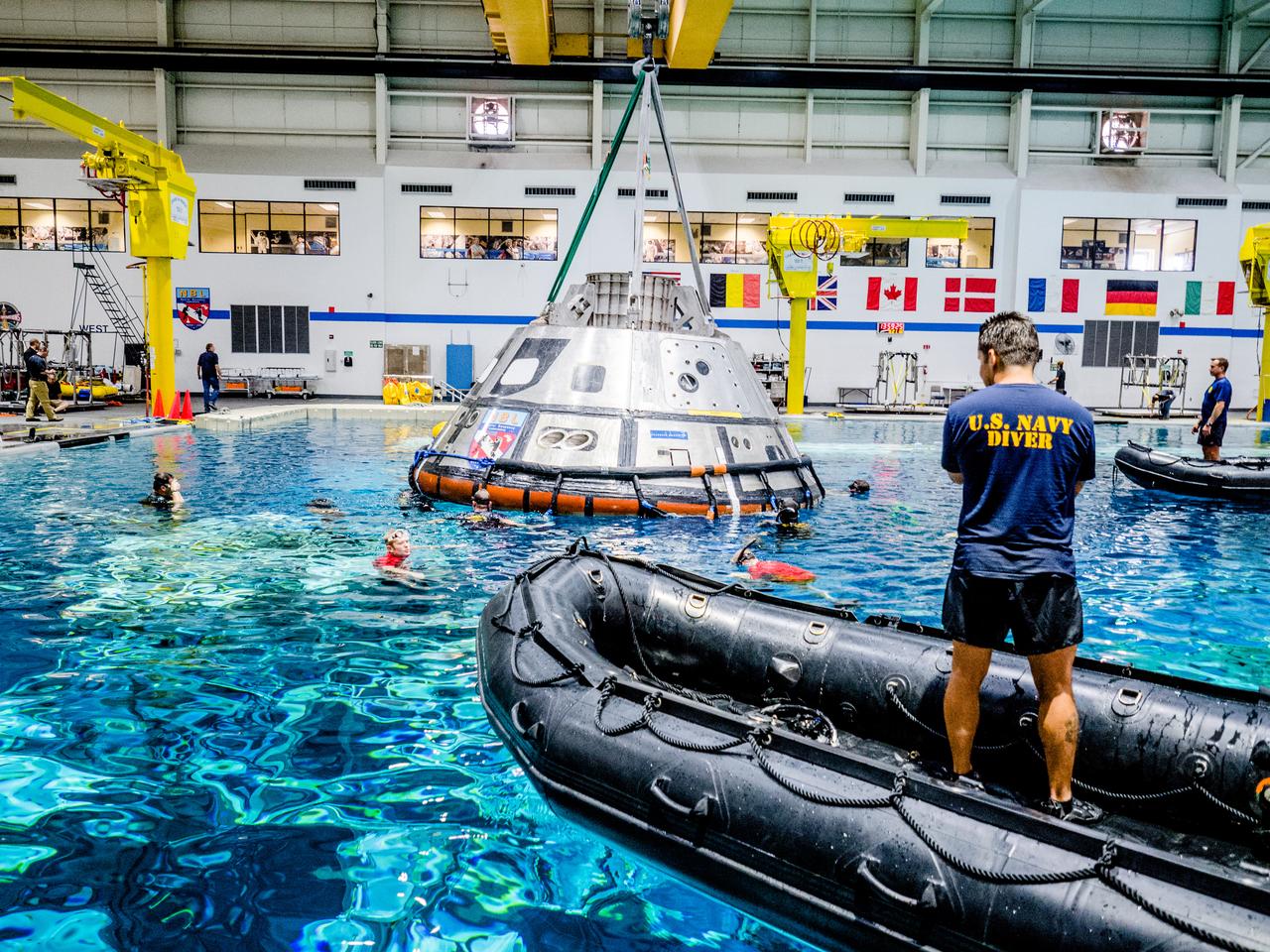
A group of U.S. Navy divers, Air Force pararescumen and Coast Guard rescue swimmers practice Orion underway recovery techniques this week in the Neutral Buoyancy Laboratory (NBL) at NASA’s Johnson Space Center in Houston on Sept. 21, 2016, to prepare for the first test flight of an uncrewed Orion spacecraft with the agency’s Space Launch System rocket during Artemis I.Part of Batch image transfer from Flickr.
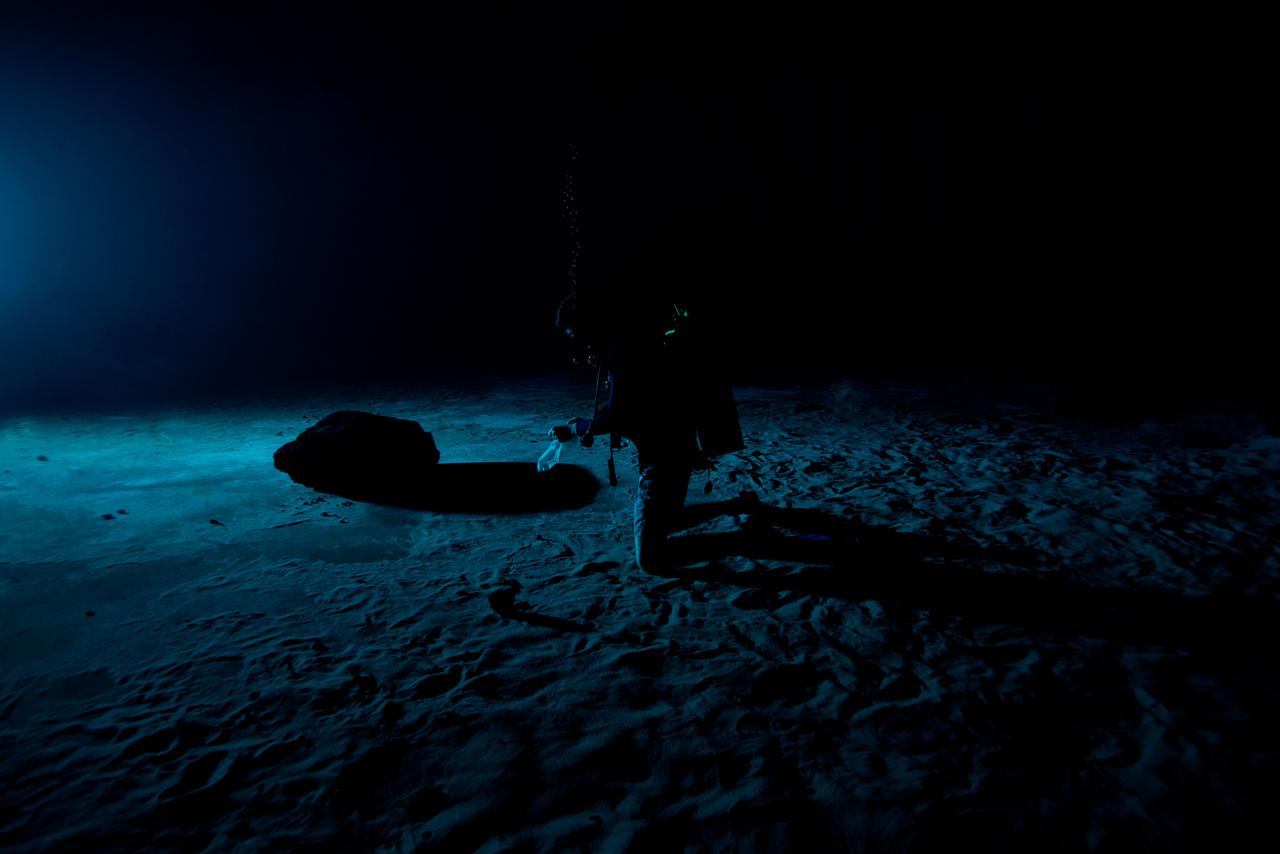
Test subjects performing subjective assessment of underwater lamp source during NBL Preliminary Lunar Lighting Evaluation. Divers at the Neutral Buoyancy Laboratory (NBL) in Houston are setting the stage for future Moonwalk training by simulating lunar lighting conditions. At the Lunar South Pole, the Sun will remain no more than a few degrees above the horizon, resulting in extremely long and dark shadows. To prepare astronauts for these challenging lighting conditions, the team at the NBL has begun preliminary evaluations of lunar lighting solutions at the bottom of the 40-foot deep pool. This testing and evaluation involved turning off all the lights in the facility, installing black curtains on the pool walls to minimize reflections, and using a powerful underwater cinematic lamp, to get the conditions just right ahead of upcoming training for astronauts.
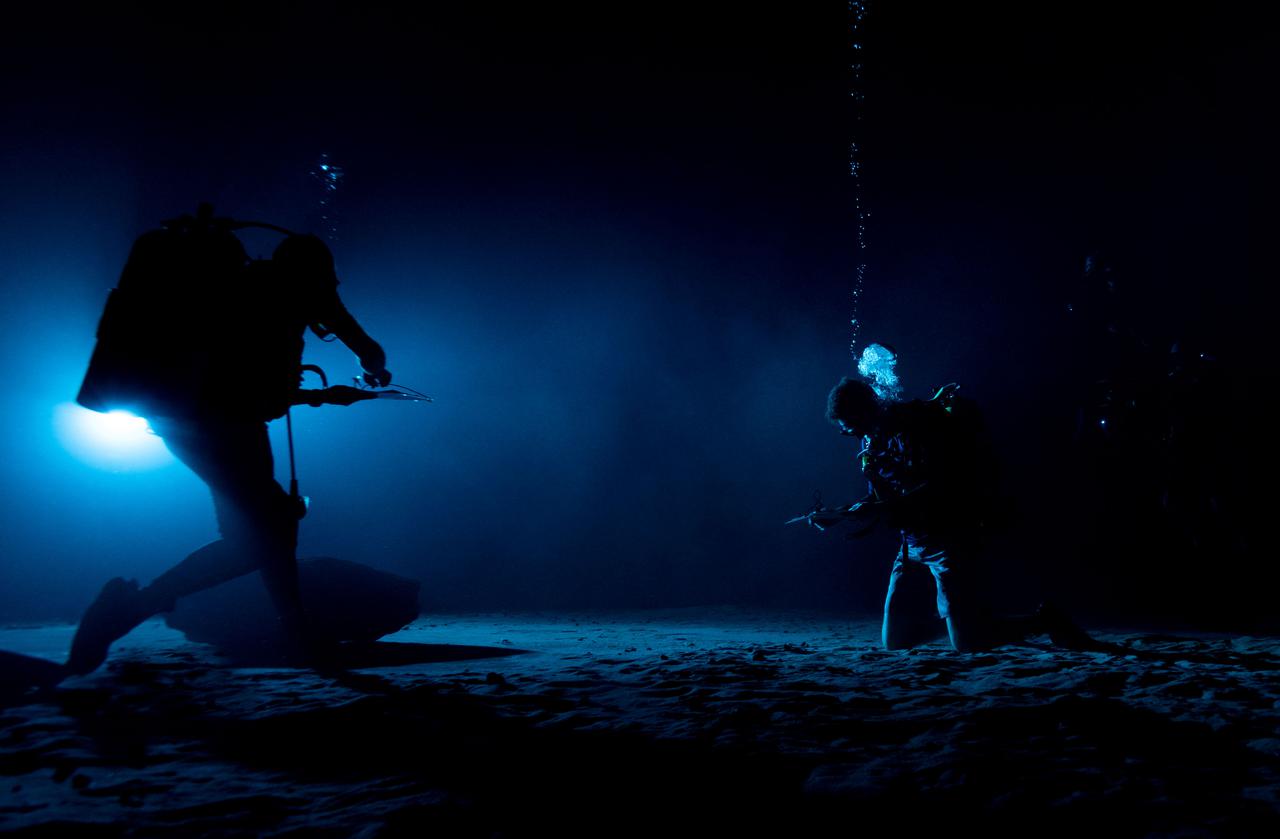
Test subjects performing subjective assessment of underwater lamp source during NBL Preliminary Lunar Lighting Evaluation. Divers at the Neutral Buoyancy Laboratory (NBL) in Houston are setting the stage for future Moonwalk training by simulating lunar lighting conditions. At the Lunar South Pole, the Sun will remain no more than a few degrees above the horizon, resulting in extremely long and dark shadows. To prepare astronauts for these challenging lighting conditions, the team at the NBL has begun preliminary evaluations of lunar lighting solutions at the bottom of the 40-foot deep pool. This testing and evaluation involved turning off all the lights in the facility, installing black curtains on the pool walls to minimize reflections, and using a powerful underwater cinematic lamp, to get the conditions just right ahead of upcoming training for astronauts.
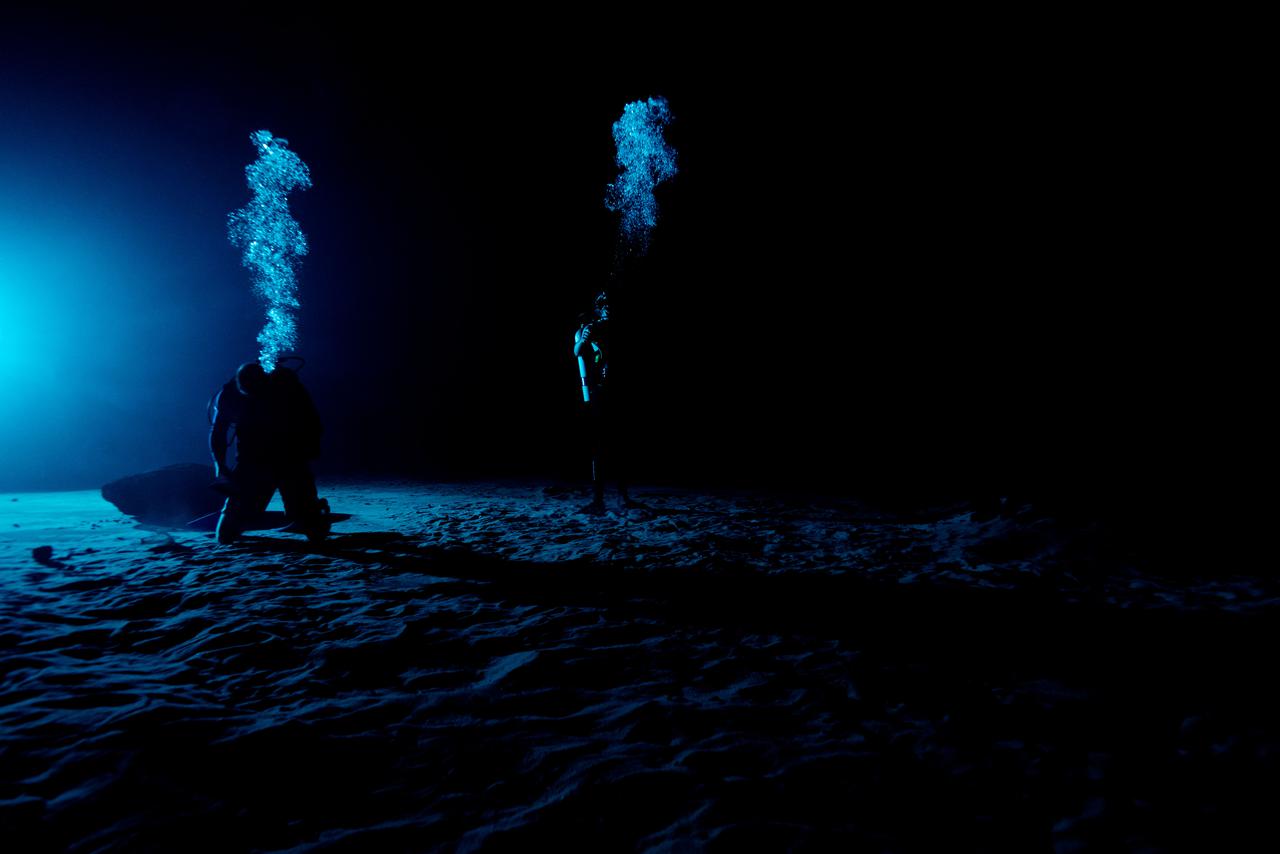
Test subjects performing mission-relevant tasks and evaluating shadow quality during NBL Preliminary Lunar Lighting Evaluation. Divers at the Neutral Buoyancy Laboratory (NBL) in Houston are setting the stage for future Moonwalk training by simulating lunar lighting conditions. At the Lunar South Pole, the Sun will remain no more than a few degrees above the horizon, resulting in extremely long and dark shadows. To prepare astronauts for these challenging lighting conditions, the team at the NBL has begun preliminary evaluations of lunar lighting solutions at the bottom of the 40-foot deep pool. This testing and evaluation involved turning off all the lights in the facility, installing black curtains on the pool walls to minimize reflections, and using a powerful underwater cinematic lamp, to get the conditions just right ahead of upcoming training for astronauts.
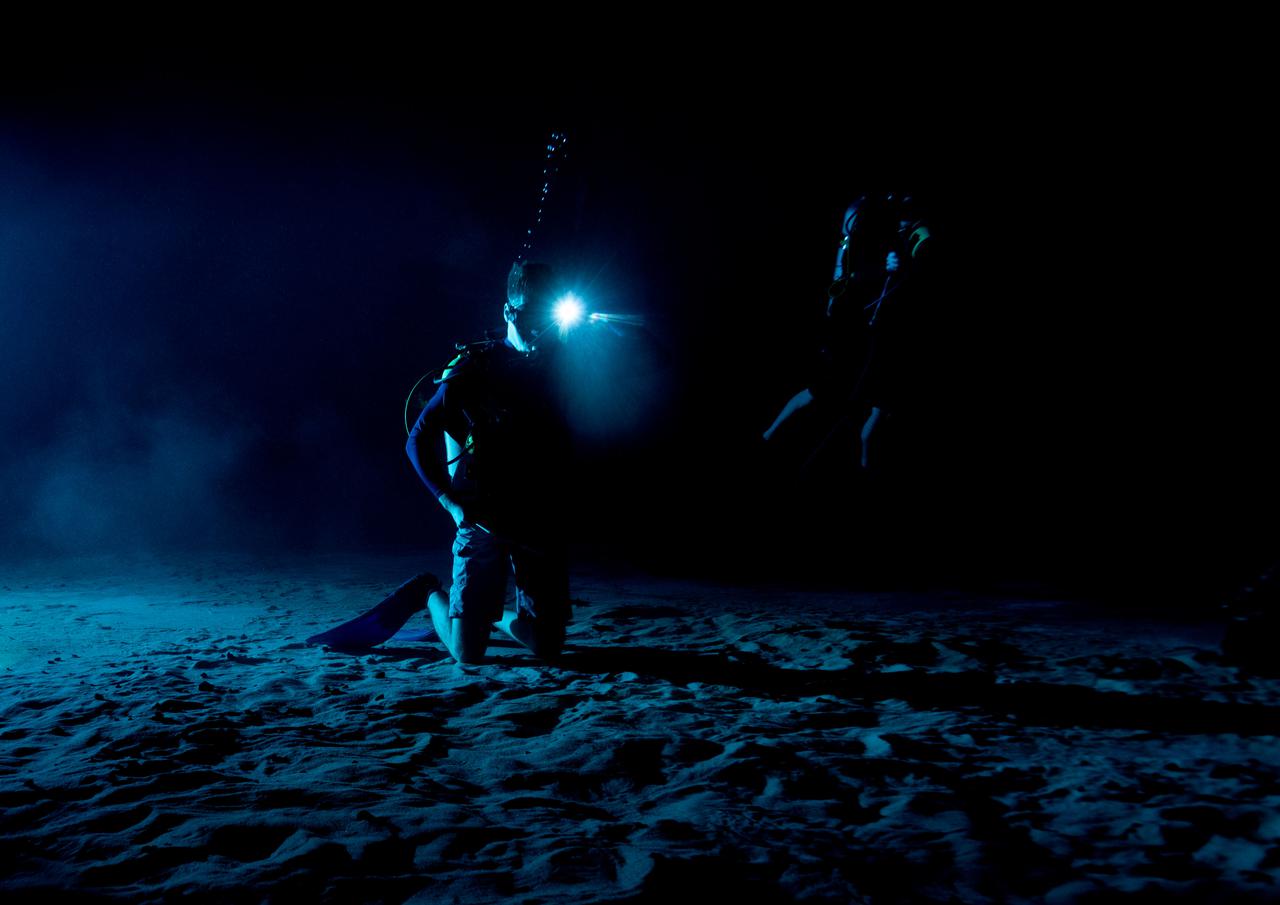
Test subjects performing subjective assessment of supplemental lighting during NBL Preliminary Lunar Lighting Evaluation. Divers at the Neutral Buoyancy Laboratory (NBL) in Houston are setting the stage for future Moonwalk training by simulating lunar lighting conditions. At the Lunar South Pole, the Sun will remain no more than a few degrees above the horizon, resulting in extremely long and dark shadows. To prepare astronauts for these challenging lighting conditions, the team at the NBL has begun preliminary evaluations of lunar lighting solutions at the bottom of the 40-foot deep pool. This testing and evaluation involved turning off all the lights in the facility, installing black curtains on the pool walls to minimize reflections, and using a powerful underwater cinematic lamp, to get the conditions just right ahead of upcoming training for astronauts.
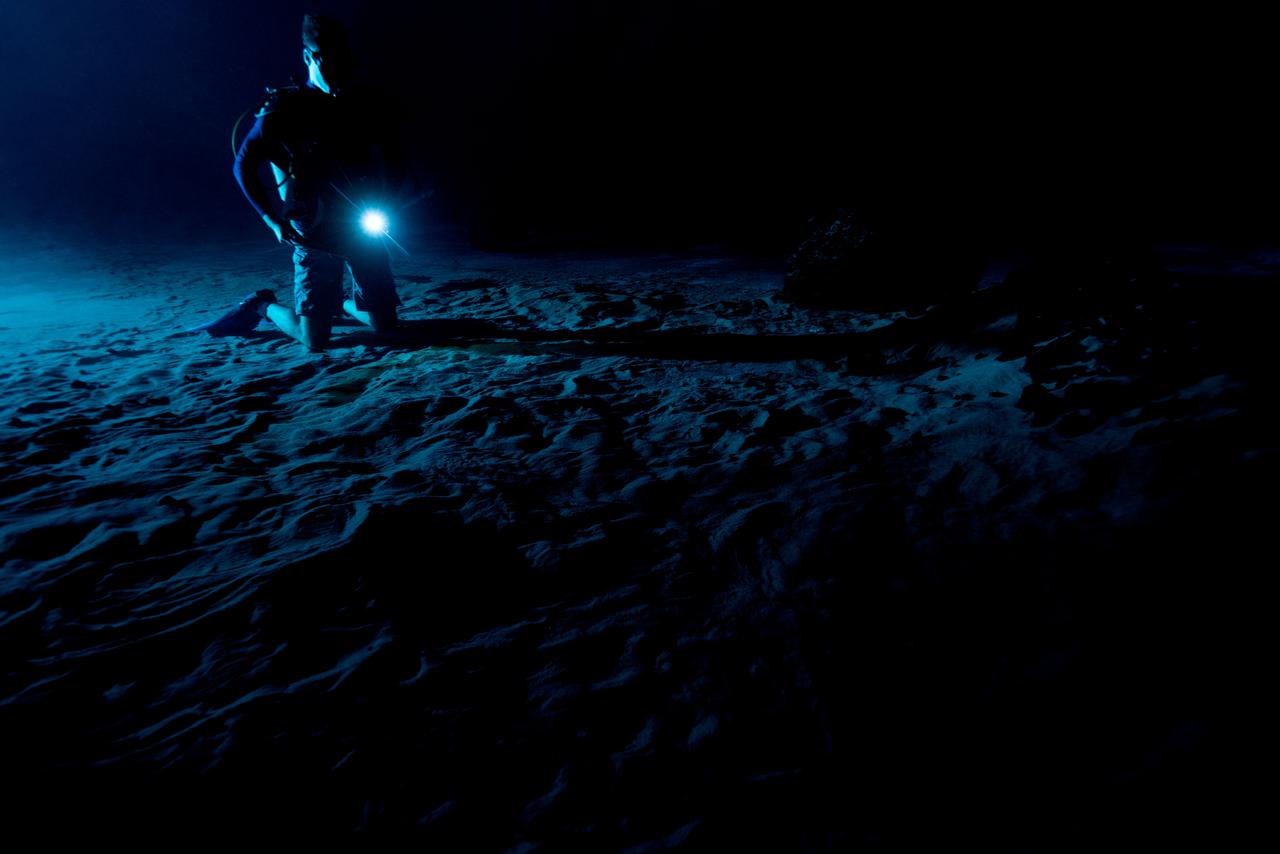
Test subjects performing subjective assessment of supplemental lighting during NBL Preliminary Lunar Lighting Evaluation. Divers at the Neutral Buoyancy Laboratory (NBL) in Houston are setting the stage for future Moonwalk training by simulating lunar lighting conditions. At the Lunar South Pole, the Sun will remain no more than a few degrees above the horizon, resulting in extremely long and dark shadows. To prepare astronauts for these challenging lighting conditions, the team at the NBL has begun preliminary evaluations of lunar lighting solutions at the bottom of the 40-foot deep pool. This testing and evaluation involved turning off all the lights in the facility, installing black curtains on the pool walls to minimize reflections, and using a powerful underwater cinematic lamp, to get the conditions just right ahead of upcoming training for astronauts.
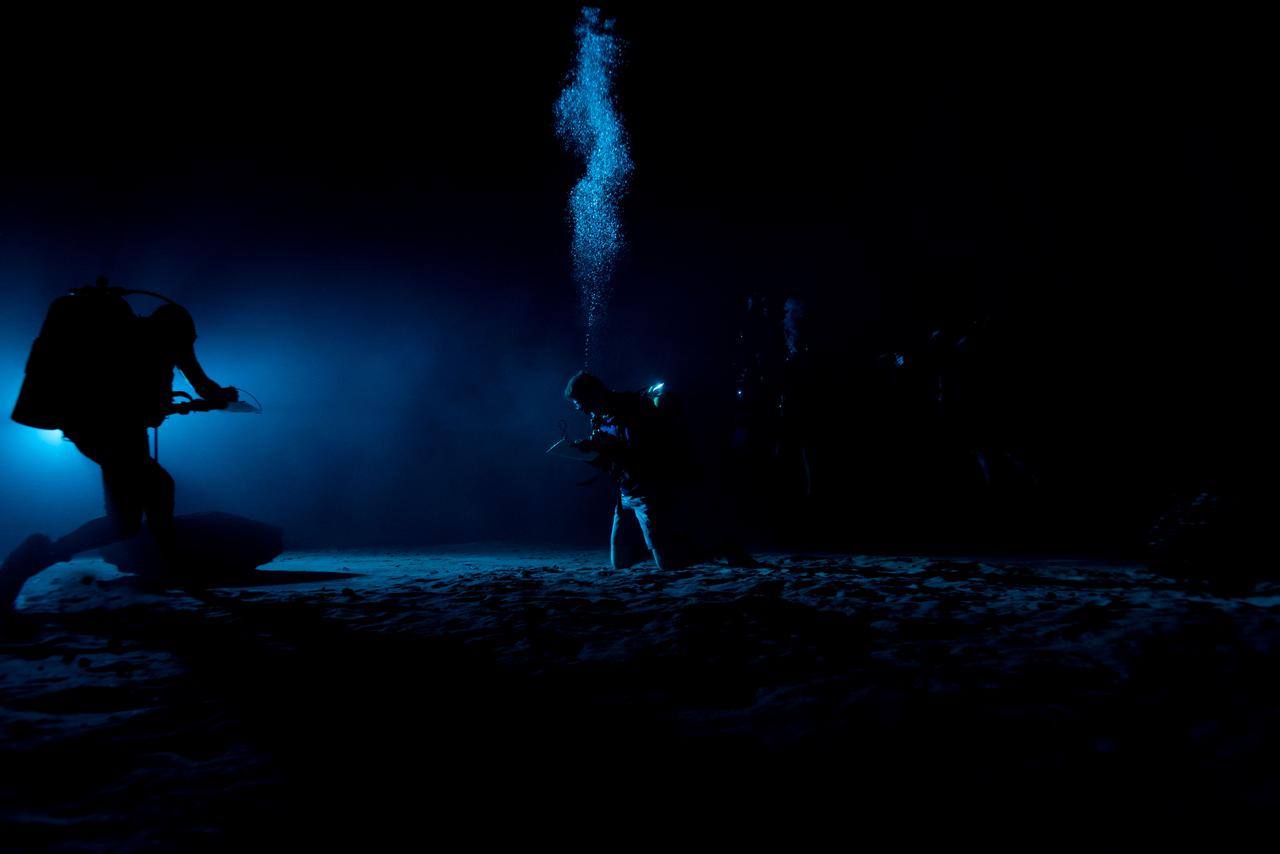
Test subjects performing subjective assessment of underwater lamp source during NBL Preliminary Lunar Lighting Evaluation. Divers at the Neutral Buoyancy Laboratory (NBL) in Houston are setting the stage for future Moonwalk training by simulating lunar lighting conditions. At the Lunar South Pole, the Sun will remain no more than a few degrees above the horizon, resulting in extremely long and dark shadows. To prepare astronauts for these challenging lighting conditions, the team at the NBL has begun preliminary evaluations of lunar lighting solutions at the bottom of the 40-foot deep pool. This testing and evaluation involved turning off all the lights in the facility, installing black curtains on the pool walls to minimize reflections, and using a powerful underwater cinematic lamp, to get the conditions just right ahead of upcoming training for astronauts.
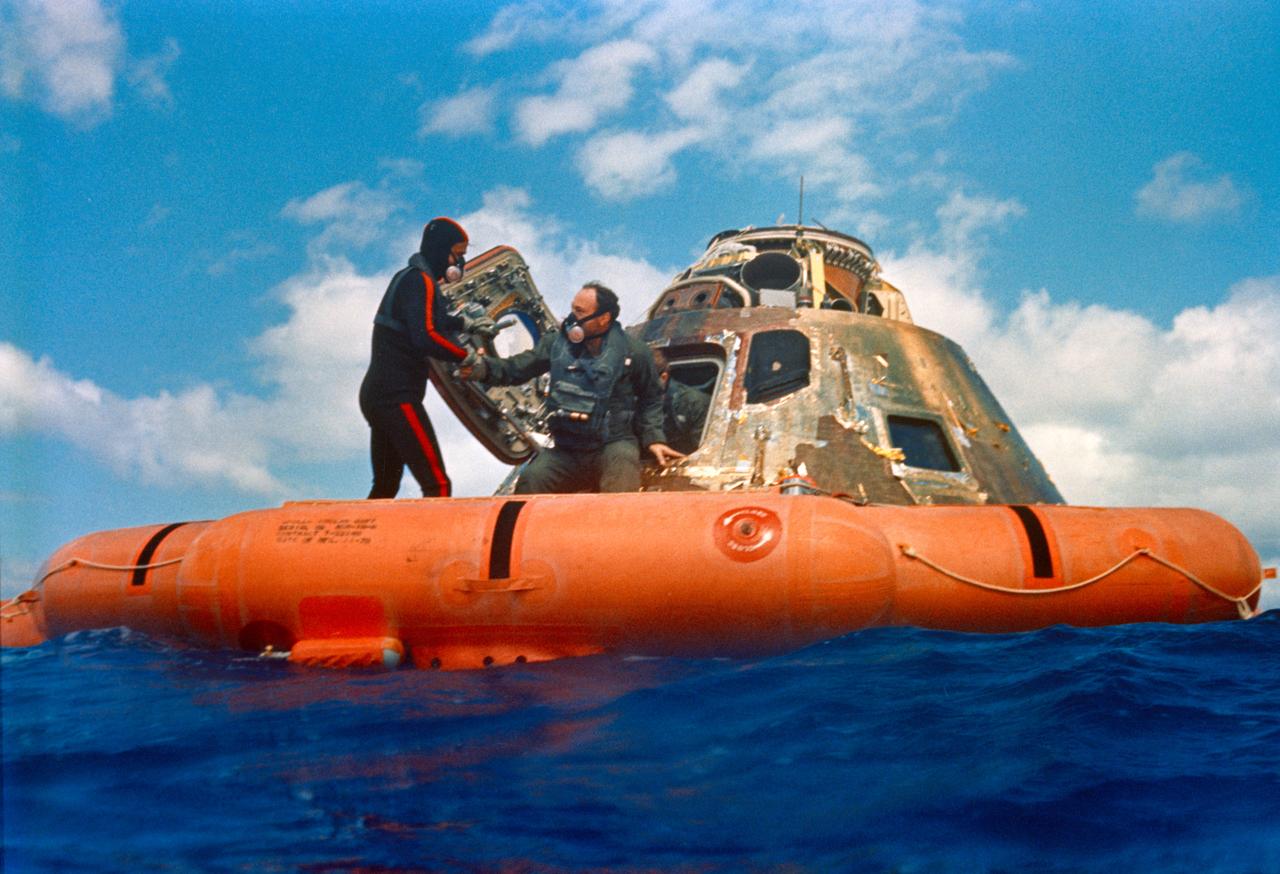
S71-19474 (9 Feb. 1971) --- Astronaut Edgar D. Mitchell, lunar module pilot, is assisted out of the Command Module (CM) by a U.S. Navy underwater demolition team swimmer during the Apollo 14 recovery operations in the South Pacific Ocean. Mitchell was followed out of the spacecraft by astronauts Alan B. Shepard Jr., commander; and Stuart A. Roosa, command module pilot. Roosa is partially visible behind Mitchell. The Apollo 14 splashdown occurred at 3:04:39 p.m. (CST), Feb. 9, 1971, in the South Pacific Ocean, approximately 765 nautical miles from American Samoa. They were transported by U.S. Navy helicopter to the USS New Orleans, prime recovery vessel.
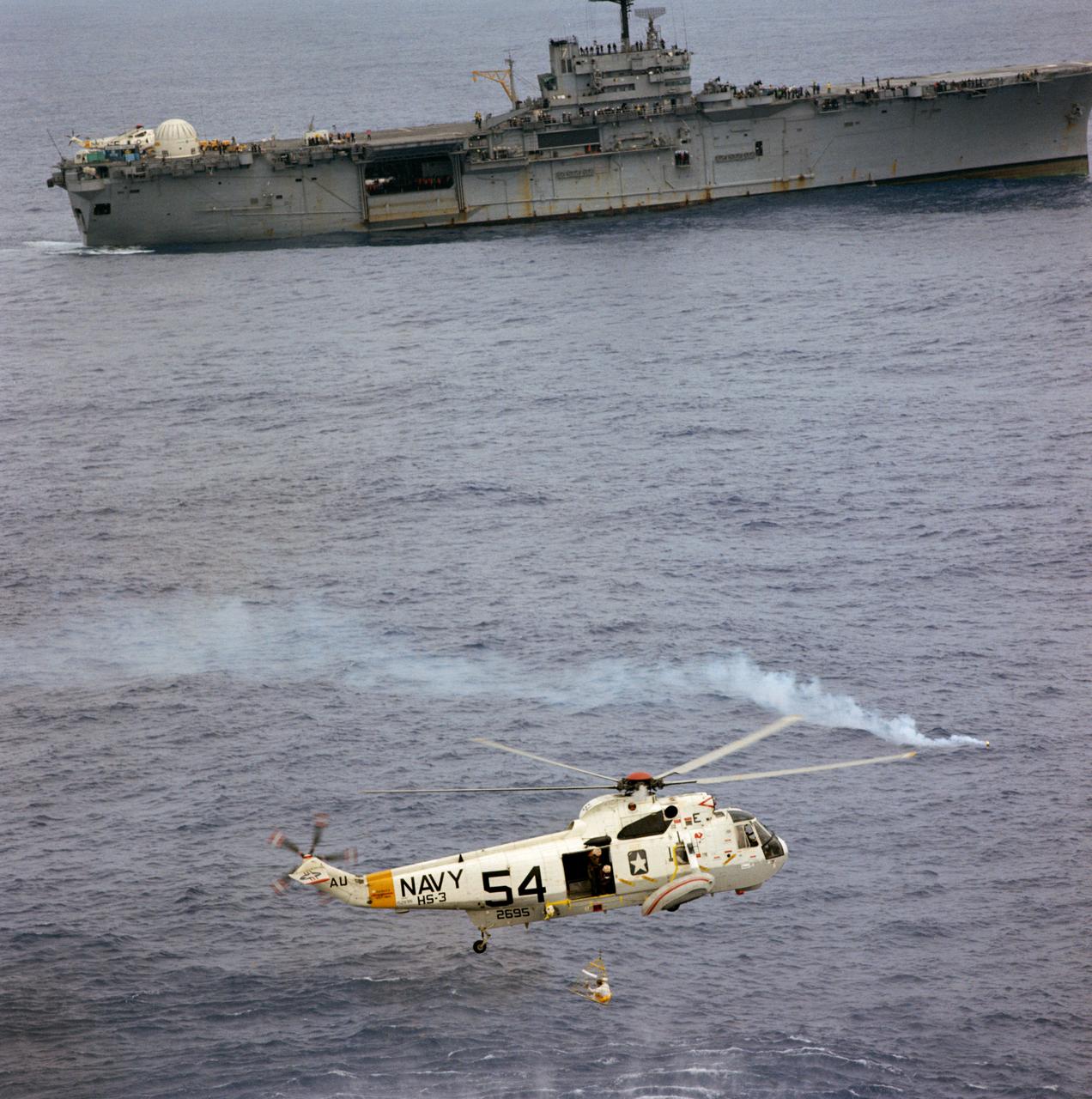
Aerial view of an Apollo 9 crewman in a new rescue net (a Billy Pugh net) being hoisted aboard a Navy helicopter after splashdown in the Atlantic recovery area and a successful ten-day, earth-orbital space mission. Navy divers have already attached a flotation collar to the command module and are assisting with recovery operations.
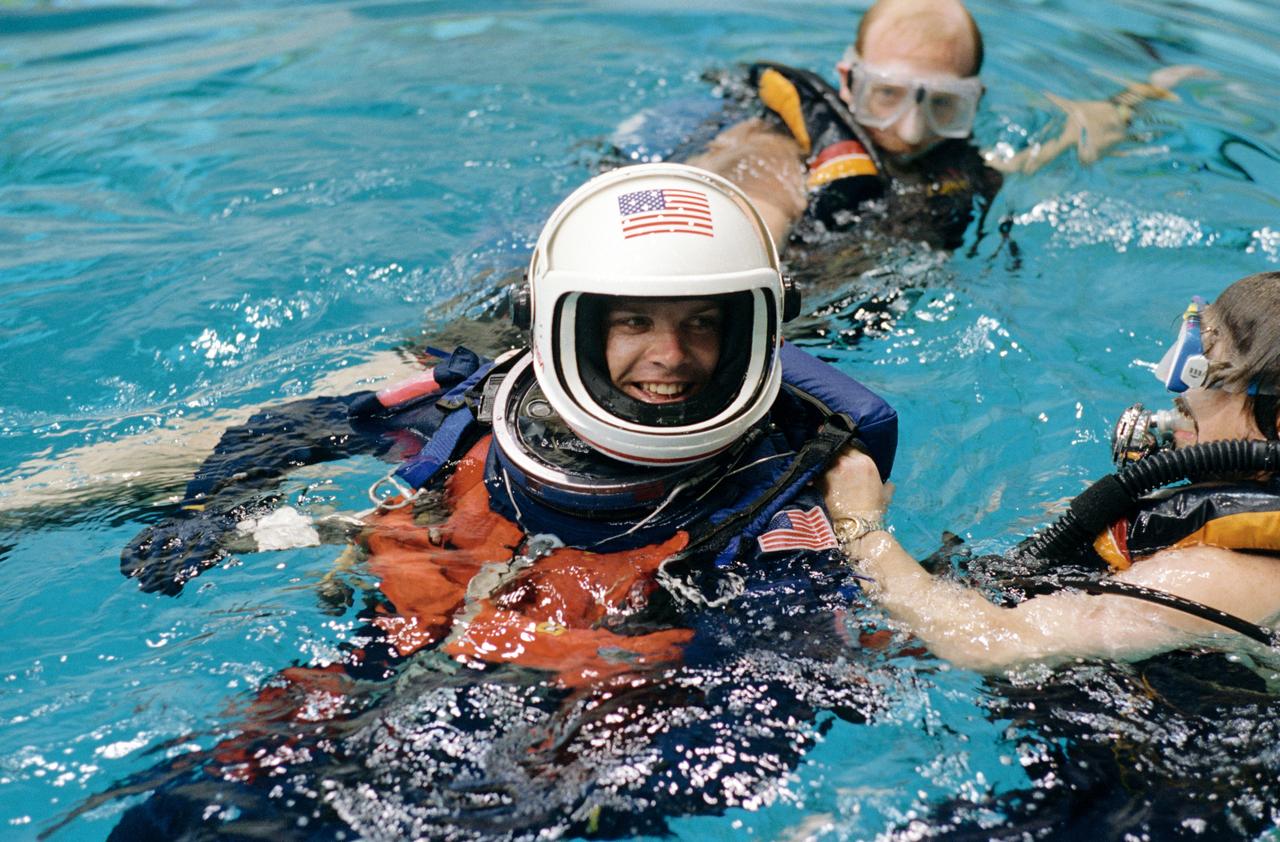
S95-03480 (16 FEB 1995) --- Attired in a training version of the Shuttle launch and entry garment, astronaut Kevin R. Kregel, pilot, gets help from SCUBA-equipped divers during a training session at the Johnson Space Center's (JSC) Weightless Environment Training Facility (WET-F). As part of the emergency bailout phase of their training agenda, the STS-70 crew members made use of this 25-feet deep pool to practice parachute landings in water and subsequent deployment of life rafts.
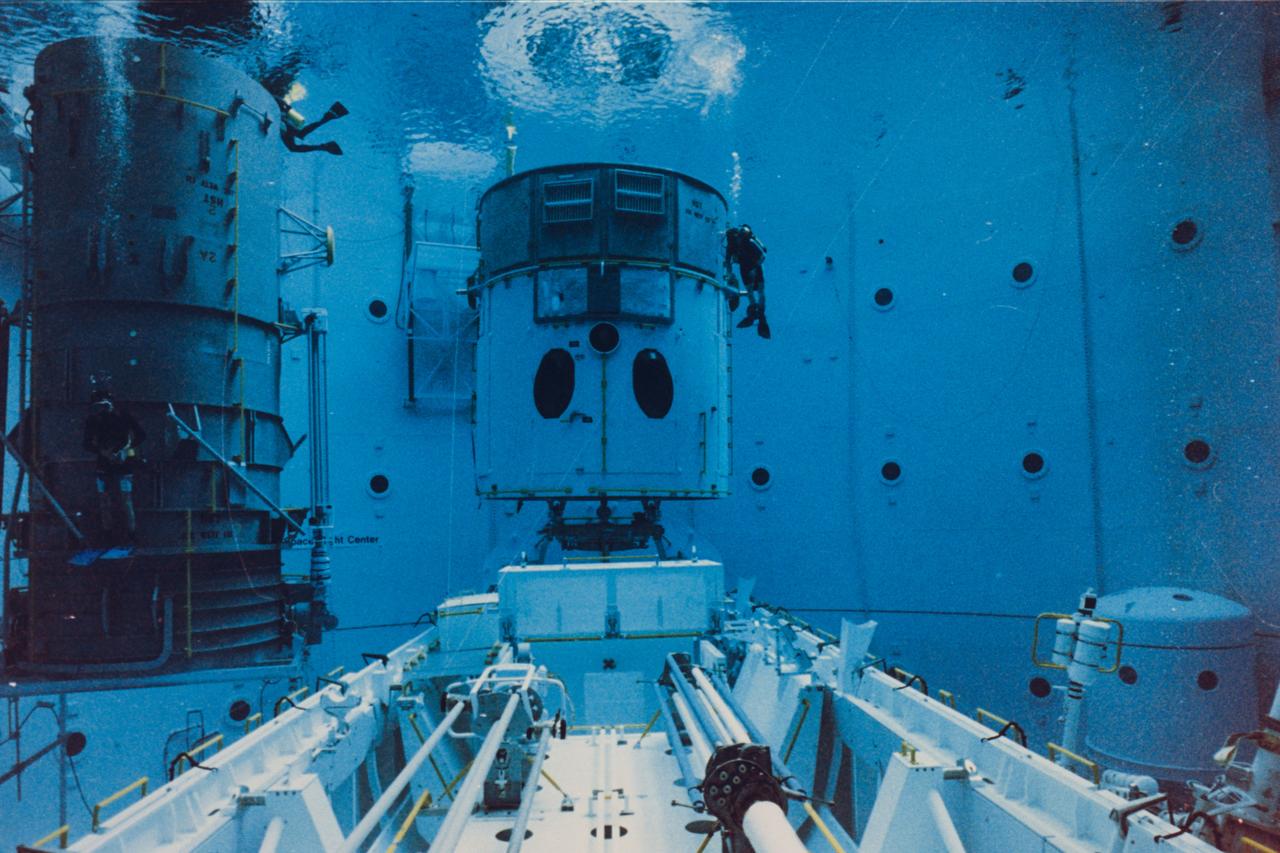
Safety divers in the Neutral Buoyancy Simulator (NBS) at the Marshall Space Flight Center (MSFC) prepare a mockup of the Hubble Space Telescope (HST) for one of 32 separate training sessions conducted by four of the STS-61 crew members in June. The three-week process allowed mission trainers to refine the timelines for the five separate spacewalks scheduled to be conducted on the actual mission scheduled for December 1993. The HST is separated into two pieces since the water tank depth cannot support the entire structure in one piece. The full length payload bay mockup shows the Solar Array Carrier in the foreground and the various containers that will house replacement hardware that will be carried on the mission.
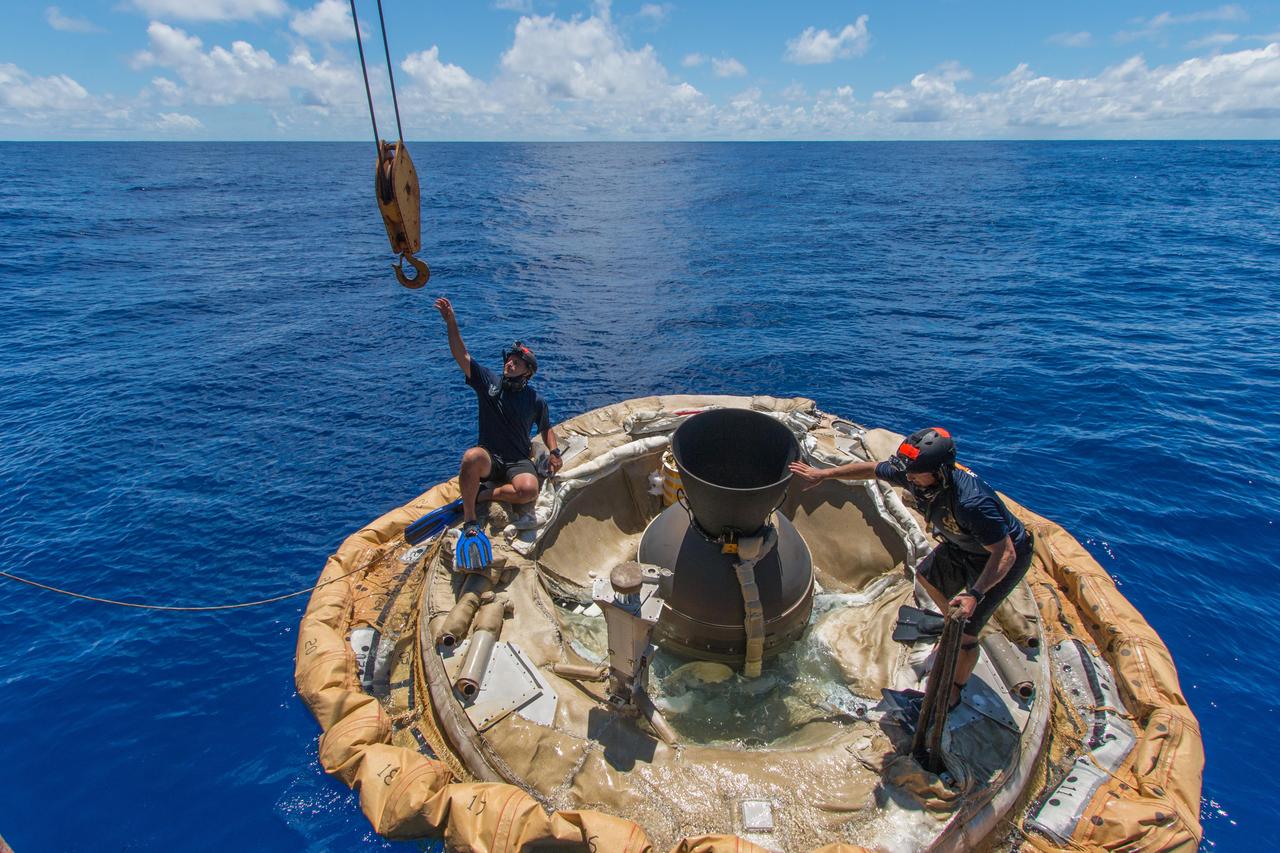
Divers retrieve the test vehicle for NASA Low-Density Supersonic Decelerator off the coast of the U.S. Navy Pacific Missile Range Facility in Kauai, Hawaii.
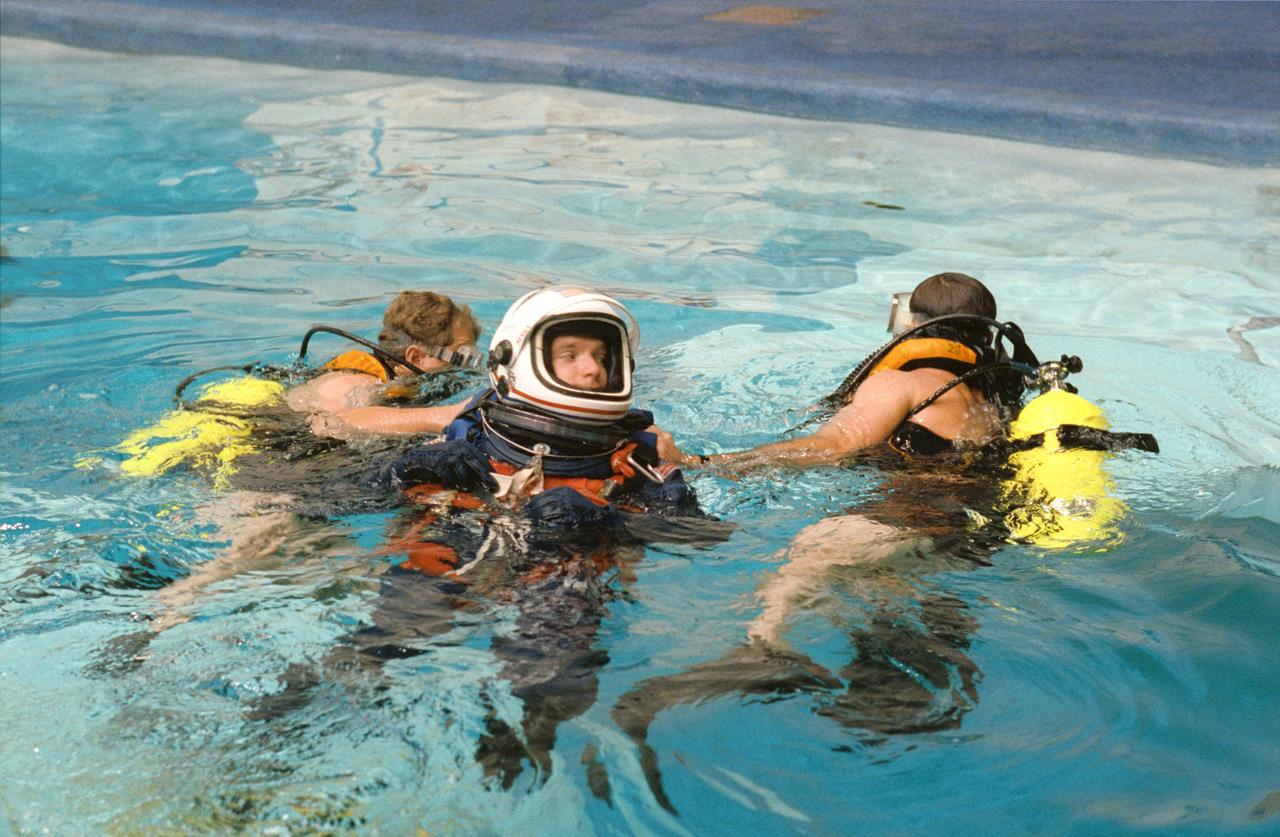
S92-50647 (Dec 1992) --- Assisted by two SCUBA-equipped divers, astronaut Charles J. Precourt, mission specialist for the STS-55/D-2 mission, participates in bailout training at the Johnson Space Center's (JSC) Weightless Environment and Training Facility (WET-F). Precourt is attired in a training version of the partial pressure Shuttle launch and entry garment. All seven prime flight crewmembers and the two backup payload specialists participated in the training session.
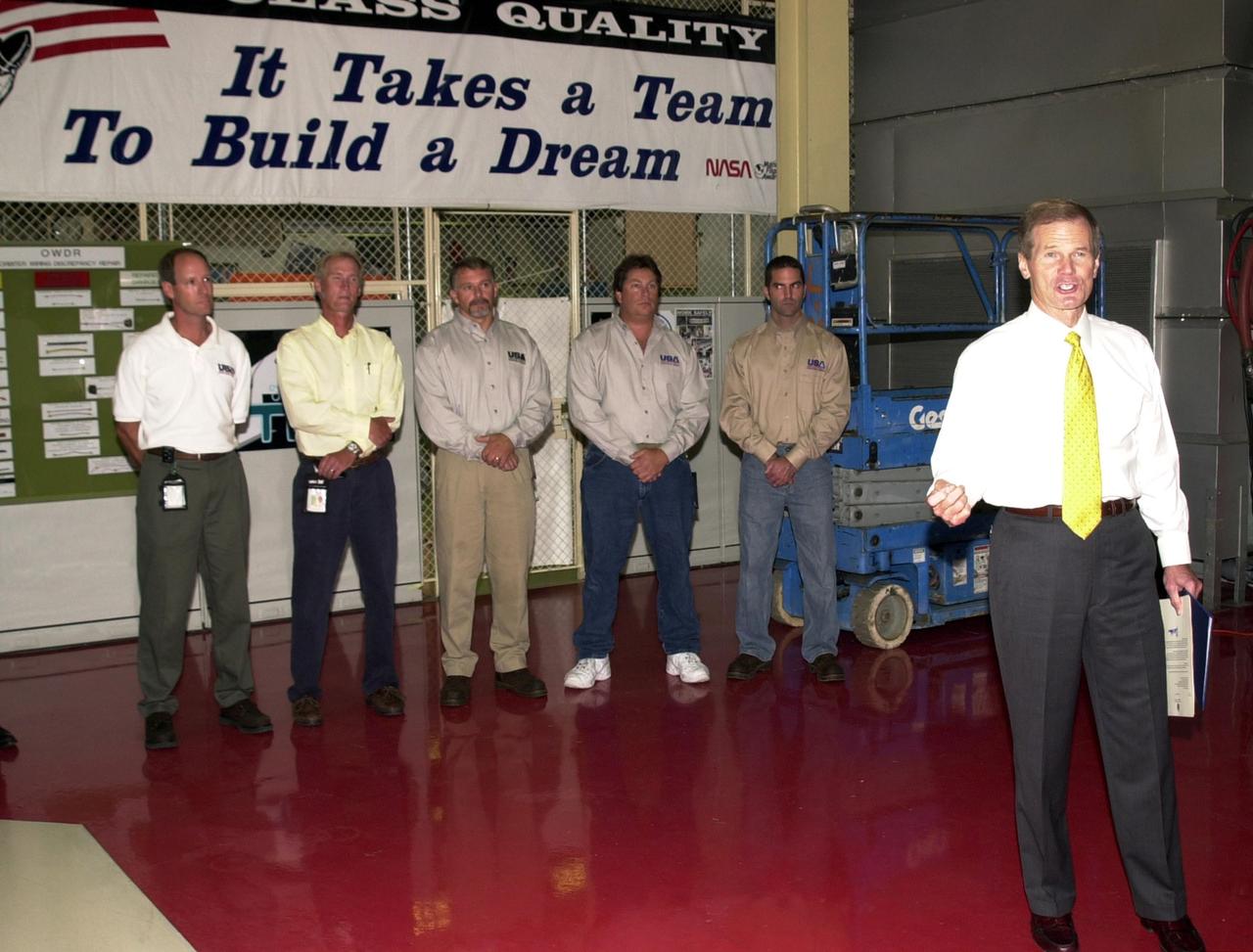
KENNEDY SPACE CENTER, FLA. - U.S. Sen. Bill Nelson (right) honors the Flow Liner Inspection & Repair team for their work on repairing the flow liners on the orbiters. The team (background) comprises (left to right) Rick Beckwith, STR engineer; Mike Young, MPS engineer; Jerry Goudy, welder; Tony Nesotas, OFP-2 aft technician; and David Strait, OPF-2 orbiter inspector. Strait first spotted the fuel-line crack; Goudy performed arc welding on one of Atlantis' flow liners. Nelson presented gold seal Senate certificates to the team.
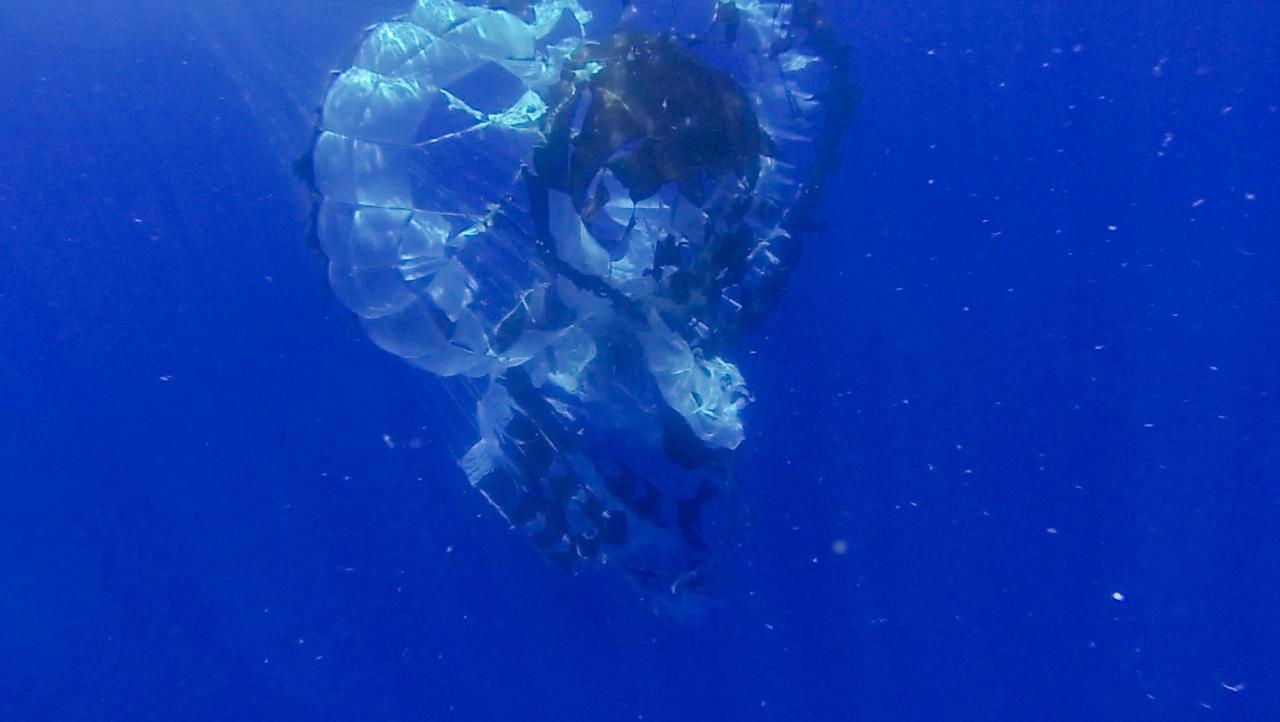
Tears are visible in the parachute from NASA Supersonic Disk Sail Parachute, which did not deploy as expected. The photo was obtained by Navy divers during recovery of the LDSD test vehicle and parachute.

STS-48 Mission Specialist (MS) James F. Buchli, wearing an extravehicular mobility unit (EMU), is watched by SCUBA-equipped divers as the platform he is standing on is lowered into JSC's Weightless Environment Training Facility (WETF) Bldg 29 pool. When completely underwater, Buchli will be released from the platform and will perform contingency extravehicular activity (EVA) operations. This underwater simulation of a spacewalk is part of the training required for Buchli's upcoming mission aboard Discovery, Orbiter Vehicle (OV) 103.
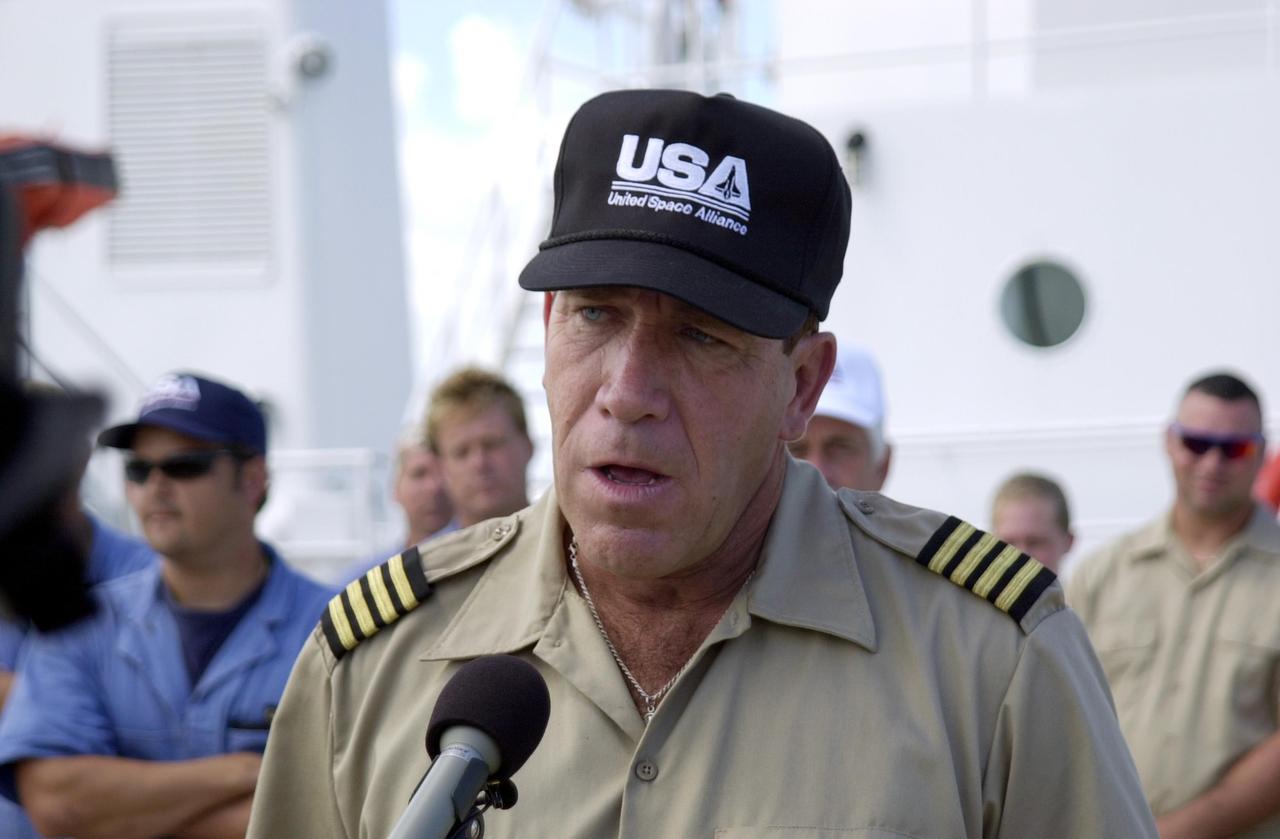
KENNEDY SPACE CENTER, FLA. - At the Hangar AF docks, Cape Canaveral Air Force Station, the captain of the Freedom Star, David Fraine, addresses those attending a reunion of a diver, Jack Wilcox, and his rescuers: the crew of KSC's Freedom Star Solid Rocket Booster (SRB) retrieval ship and a medical team. The diver suffered decompression sickness on a diving expedition 20 miles offshore in the Atlantic Ocean. When the Freedom Star team heard the call for help, they asked the Coast Guard if they could assist. The ship was out on a crane certification exercise and coincidentally had a diver medical technician and other divers training on the crane. The ship's divers were trained for the hyperbaric chamber on board. Upon reaching the Army dock, KSC Occupational Health physician Skip Beeler entered the chamber and continued the process of helping to stabilize Wilcox. After several hours in the chamber, Wilcox, who lives in Orlando, was airlifted to Florida Hospital Orlando.
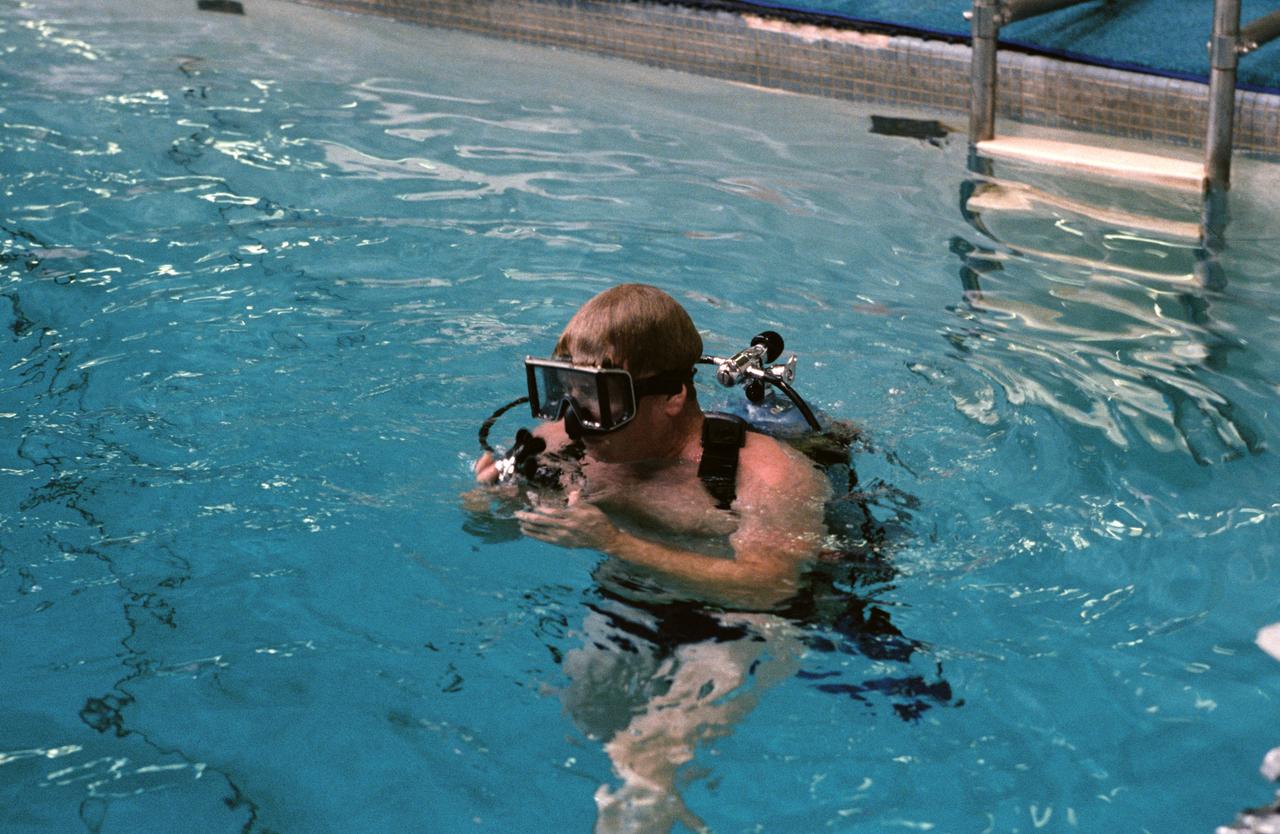
Preparations for Underwater EVA training for the STS 41-G crew. Divers prepare to don their scuba gear for the begining of EVA training.

S65-61887 (16 Dec. 1965) --- A water level view of Navy divers with the Gemini 6 spacecraft.
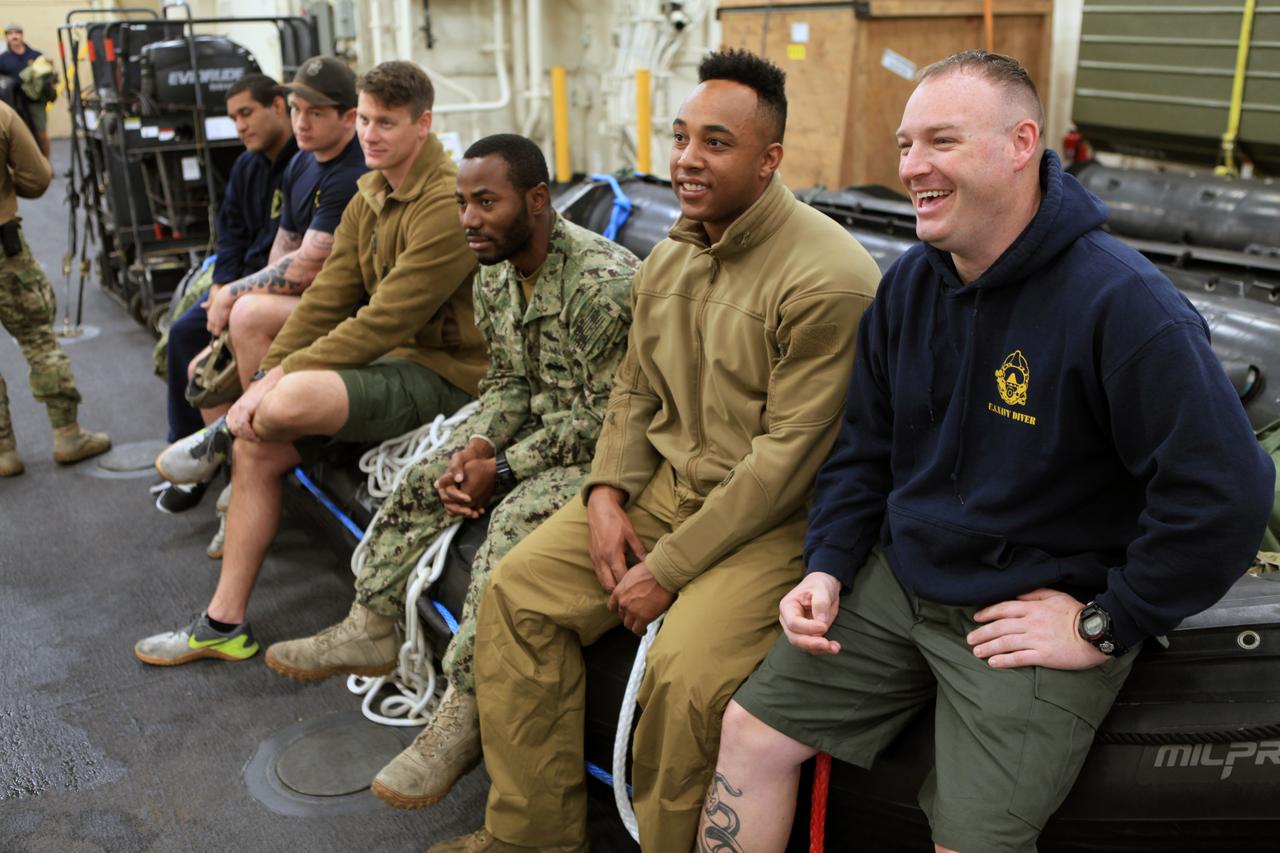
Navy diver Michael Tuft (far right) and his team wait to be called for their part in Underway Recovery Test 6 aboard the USS Anchorage. The divers will be the first people astronauts aboard the Orion spacecraft see when they splash down in the Pacific Ocean after Exploration Mission-2. The testing with the NASA Recovery Team and the U.S. Navy will provide important data that is being used to improve recovery procedures and hardware ahead of Orion's next flight, Exploration Mission-1, when it splashes down in the Pacific Ocean.
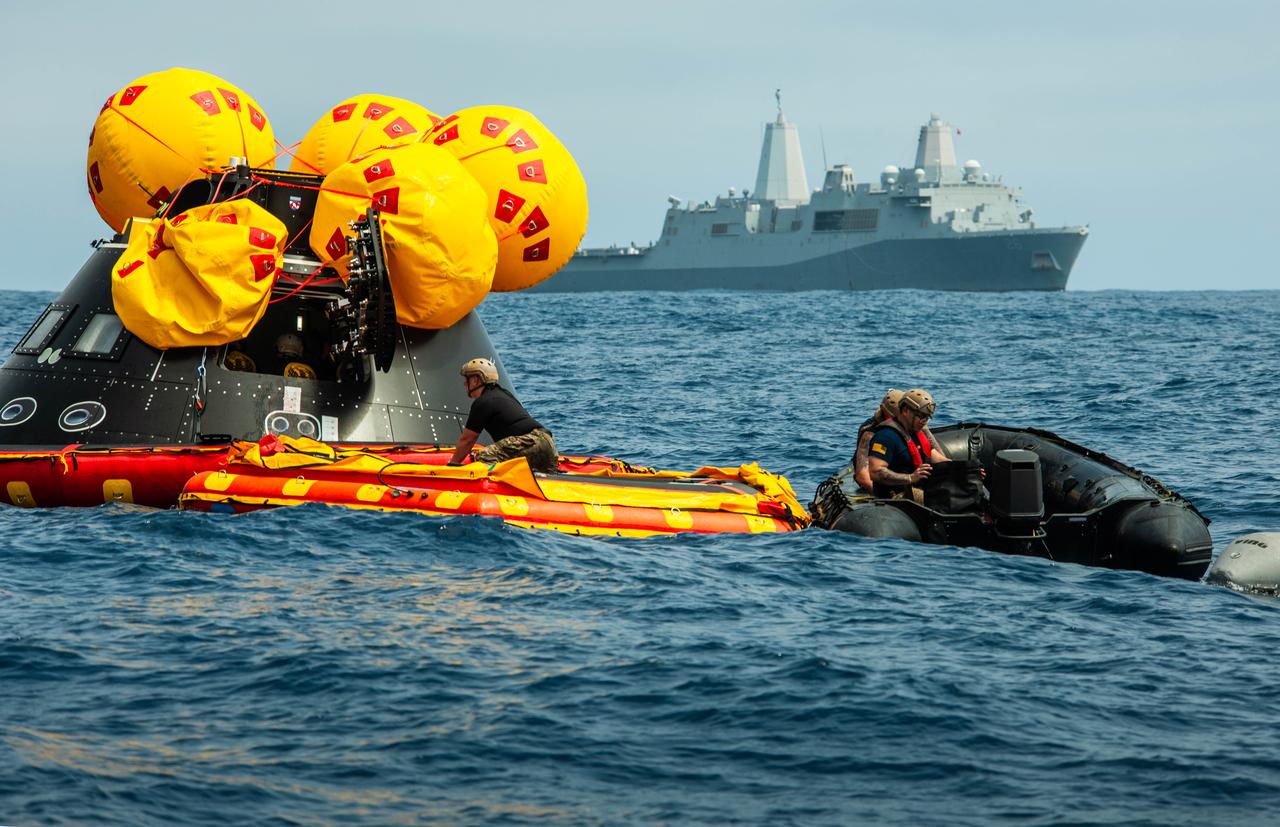
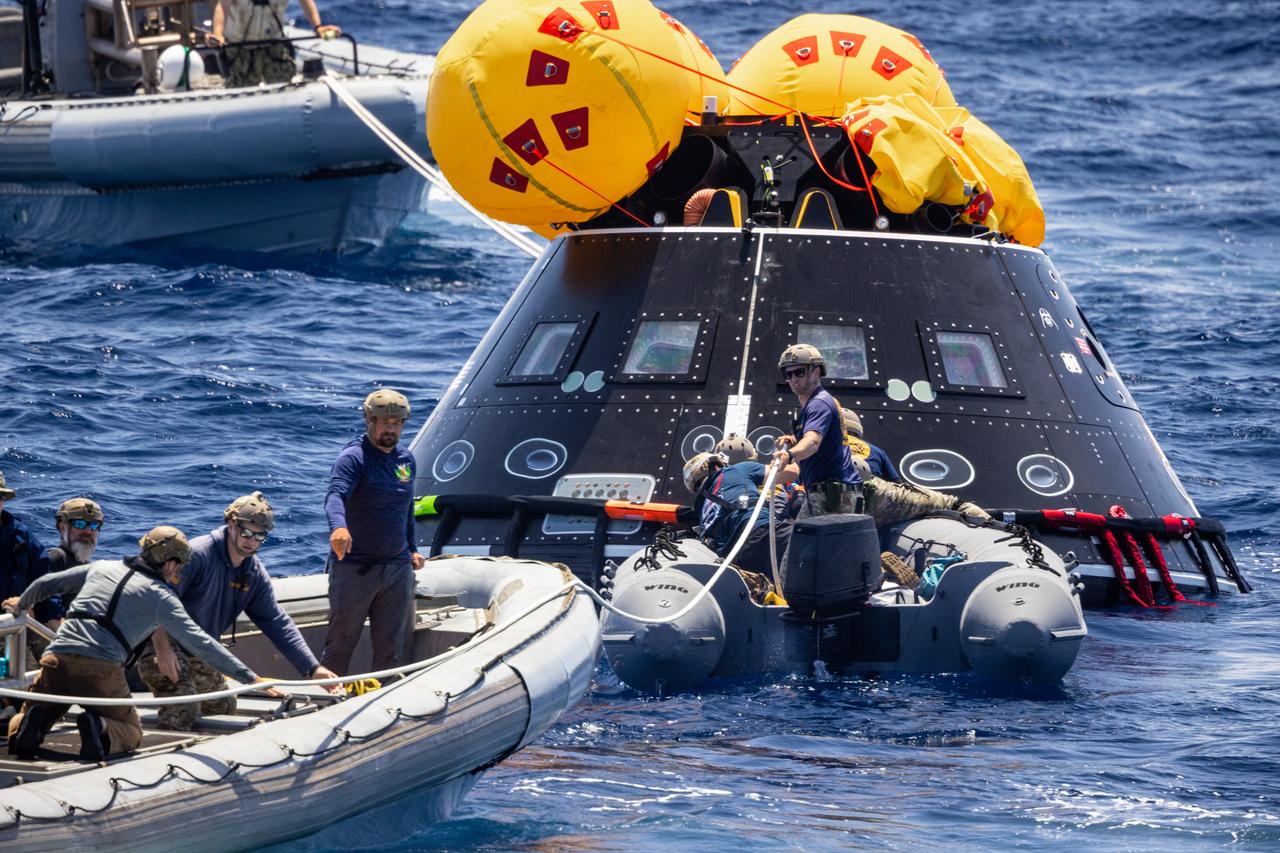
Navy divers from Explosive Ordnance Disposal (EOD) Expeditionary Support Unit 1 work to secure the Orion Crew Module Test Article (CMTA) in the Pacific Ocean as part of NASA’s Underway Recovery Test 10 (URT-10). The divers are trained in open water and small boat procedures and will be the team to help Artemis astronauts exit the Orion spacecraft and make it safely to the recovery ship after splashdown in addition to preparing the spacecraft to be transported back inside the recovery ship.
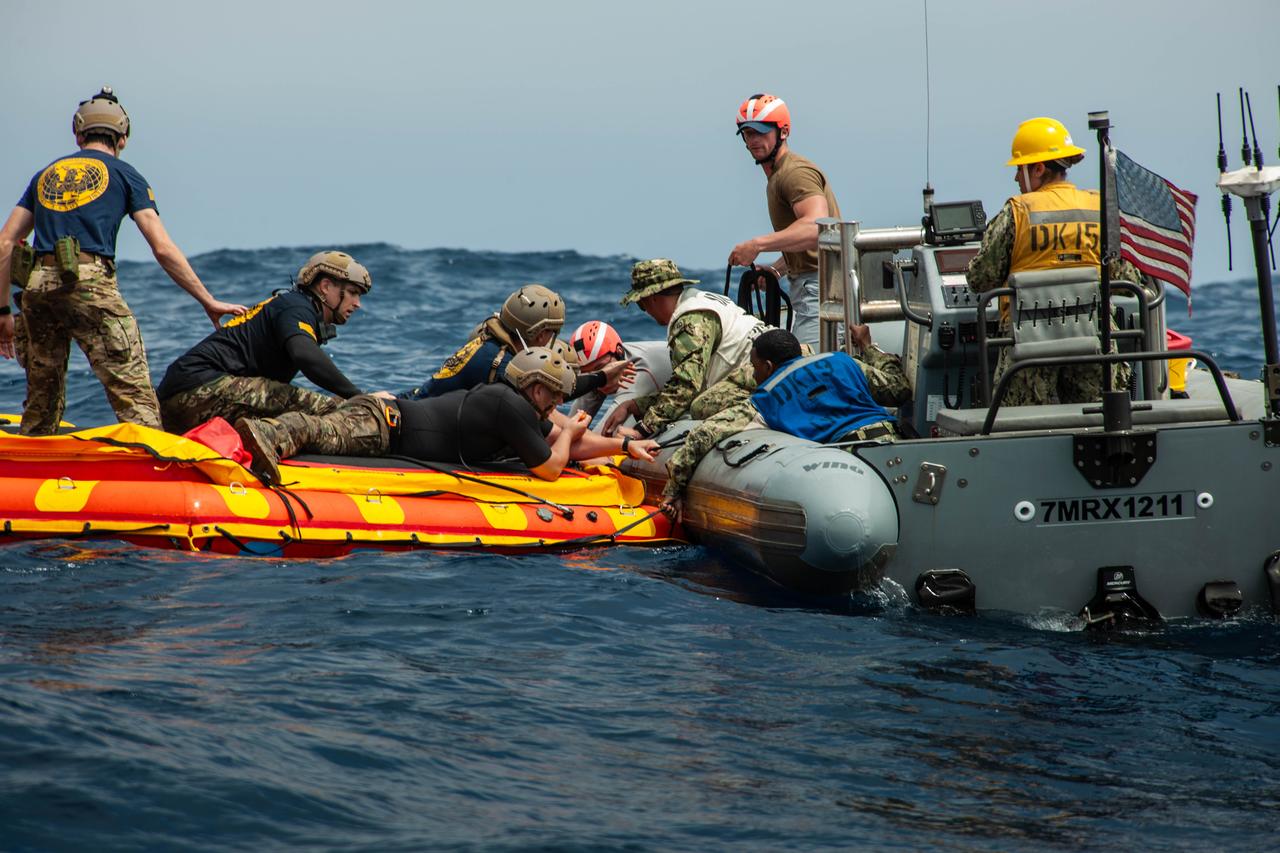
Navy divers from Explosive Ordnance Disposal (EOD) Expeditionary Support Unit 1 work to secure the Orion Crew Module Test Article (CMTA) in the Pacific Ocean as part of NASA’s Underway Recovery Test 10 (URT-10). The divers are trained in open water and small boat procedures and will be the team to help Artemis astronauts exit the Orion spacecraft and make it safely to the recovery ship after splashdown in addition to preparing the spacecraft to be transported back inside the recovery ship.
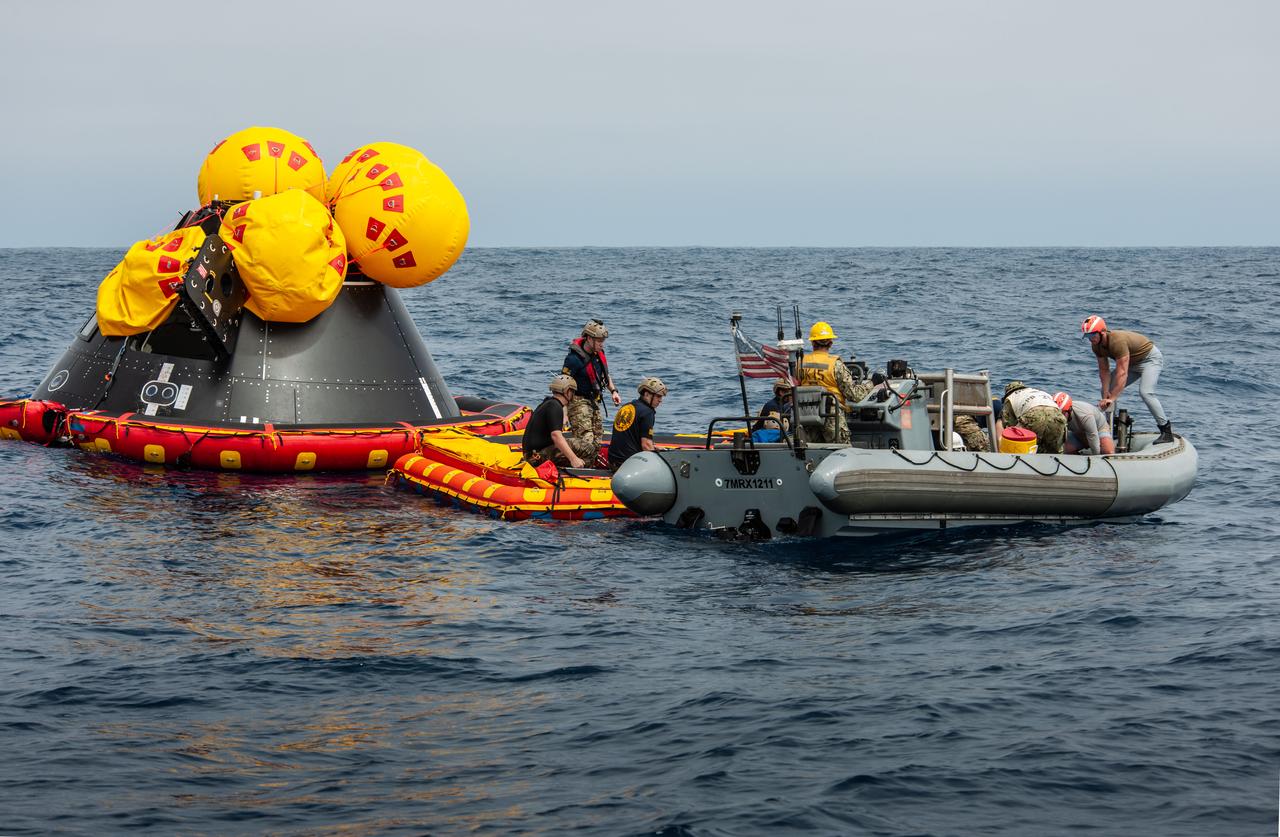
Navy divers from Explosive Ordnance Disposal (EOD) Expeditionary Support Unit 1 work to secure the Orion Crew Module Test Article (CMTA) in the Pacific Ocean as part of NASA’s Underway Recovery Test 10 (URT-10). The divers are trained in open water and small boat procedures and will be the team to help Artemis astronauts exit the Orion spacecraft and make it safely to the recovery ship after splashdown in addition to preparing the spacecraft to be transported back inside the recovery ship.
Navy divers from Explosive Ordnance Disposal (EOD) Expeditionary Support Unit 1 work to secure the Orion Crew Module Test Article (CMTA) in the Pacific Ocean as part of NASA’s Underway Recovery Test 10 (URT-10). The divers are trained in open water and small boat procedures and will be the team to help Artemis astronauts exit the Orion spacecraft and make it safely to the recovery ship after splashdown in addition to preparing the spacecraft to be transported back inside the recovery ship.
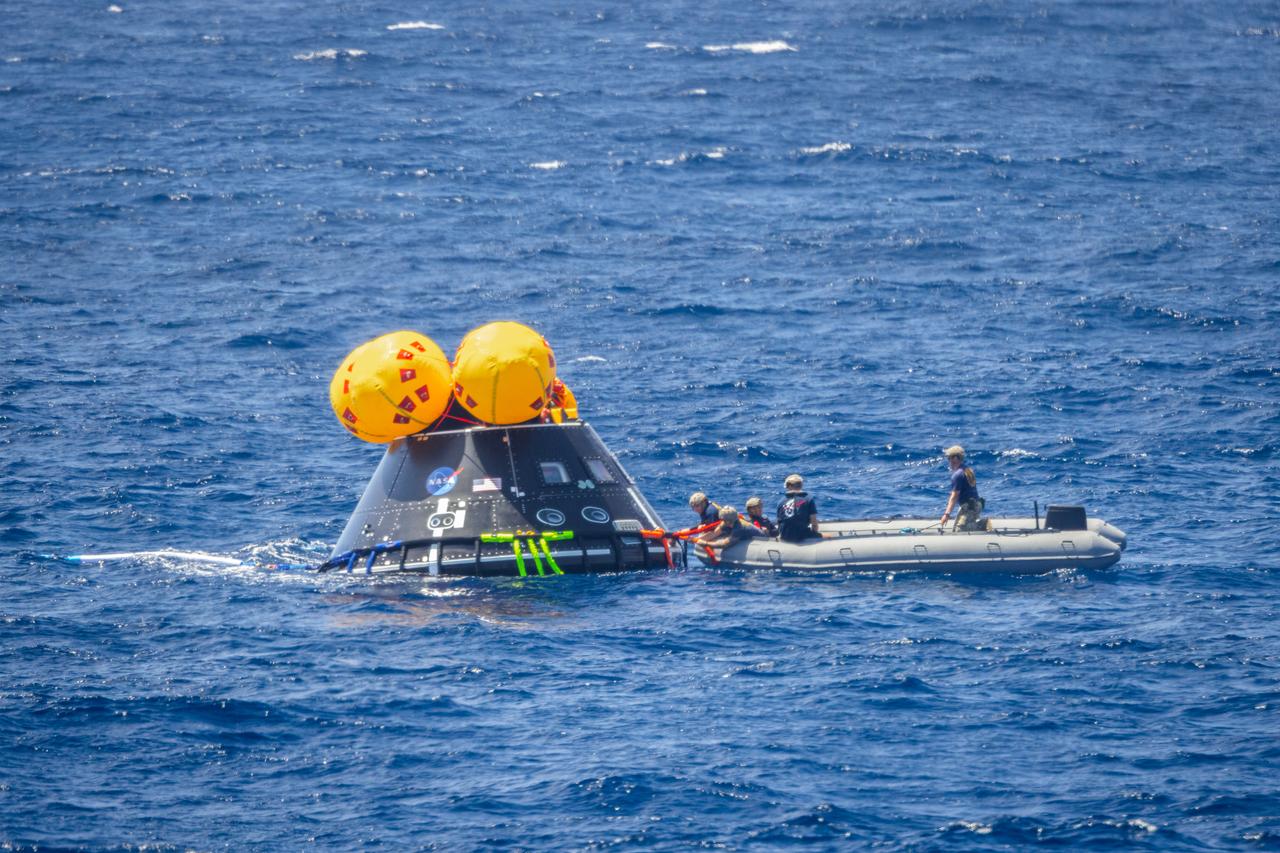
Navy divers from Explosive Ordnance Disposal (EOD) Expeditionary Support Unit 1 work to secure the Orion Crew Module Test Article (CMTA) in the Pacific Ocean as part of NASA’s Underway Recovery Test 10 (URT-10). The divers are trained in open water and small boat procedures and will be the team to help Artemis astronauts exit the Orion spacecraft and make it safely to the recovery ship after splashdown in addition to preparing the spacecraft to be transported back inside the recovery ship.
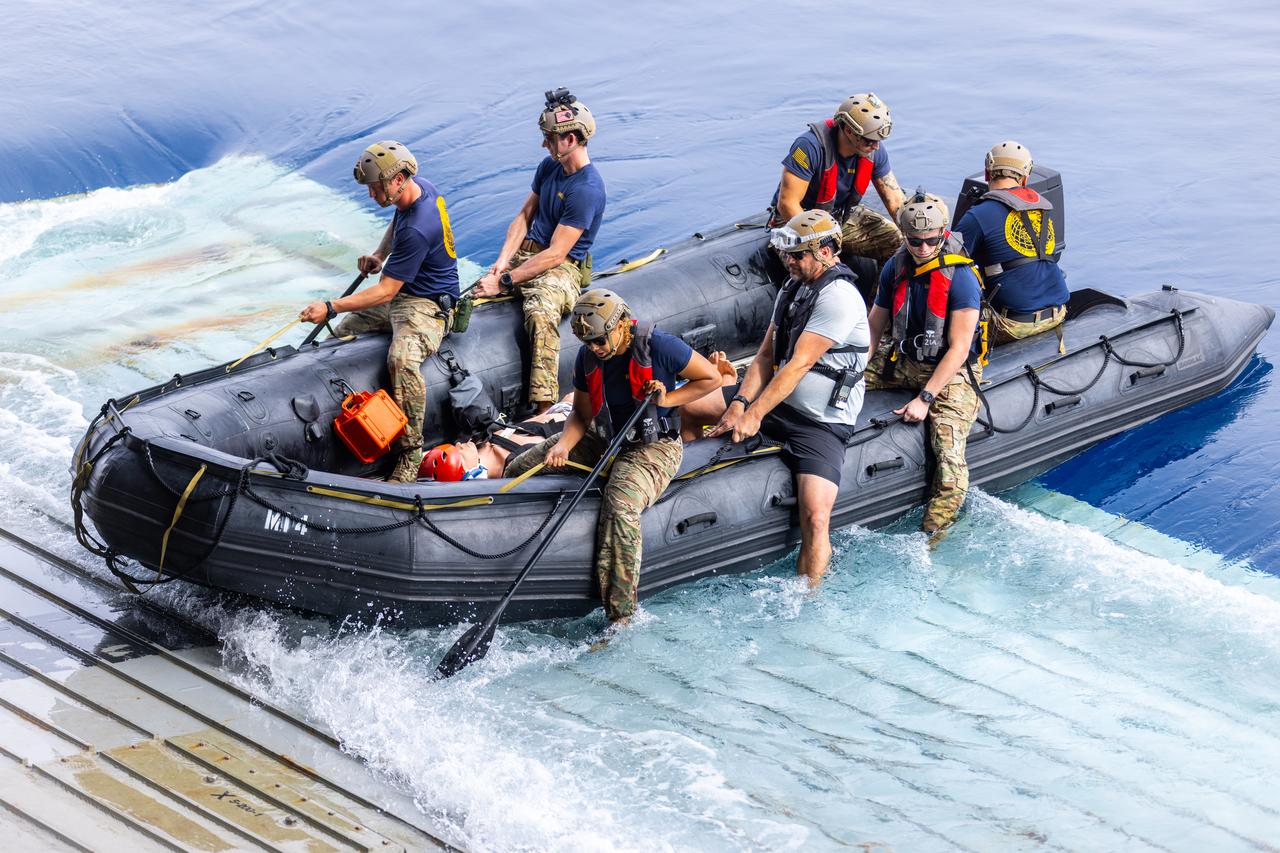
Navy divers from Explosive Ordnance Disposal (EOD) Expeditionary Support Unit 1 prepare to enter the Pacific Ocean from the well deck of USS John P Murtha as part of NASA’s Underway Recovery Test 10 (URT-10). The divers are trained in open water and small boat procedures and will be the team to help Artemis astronauts exit the Orion spacecraft and make it safely to the recovery ship after splashdown.
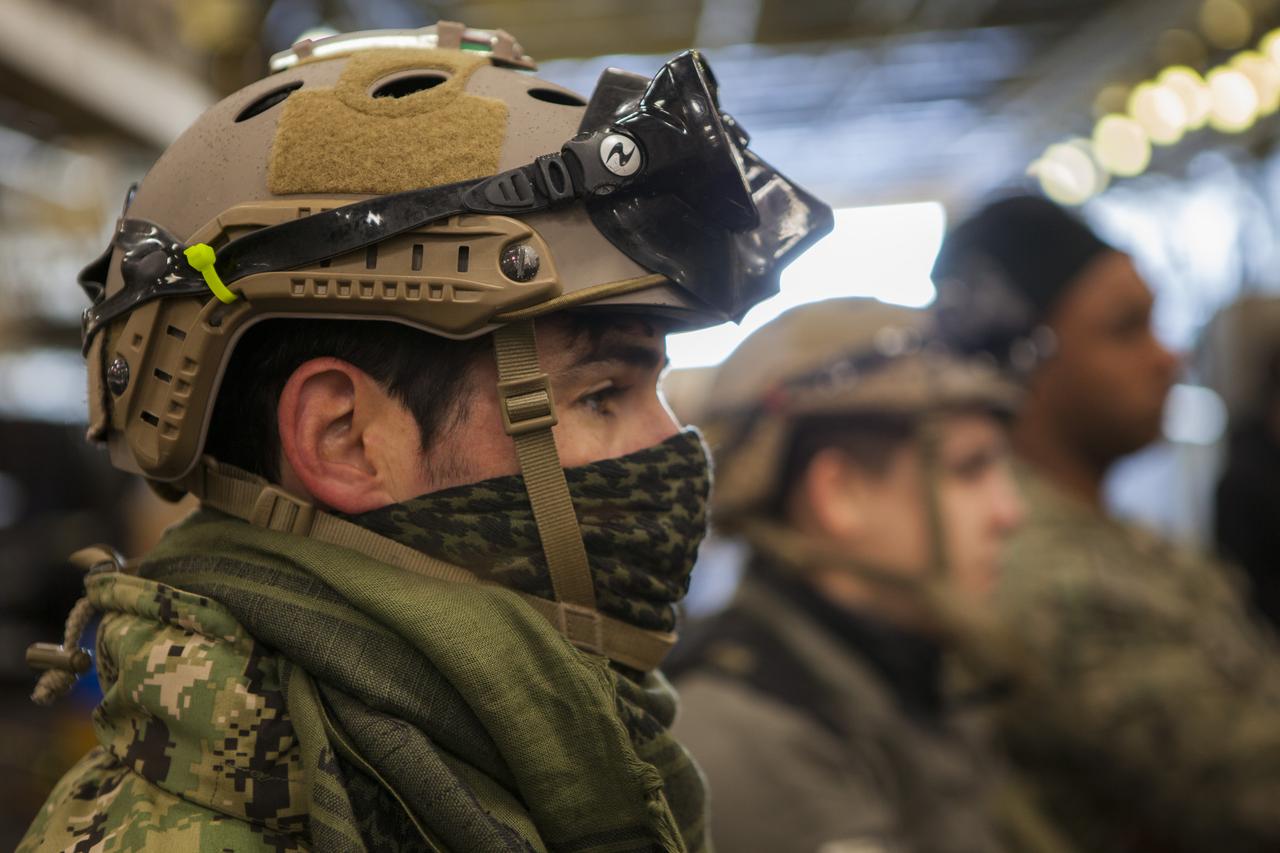
Navy Diver 2nd Class Laethem and his fellow divers get briefed before heading out to sea to recover the Orion test article during Underway Recovery Test 6 off the coast of San Diego. Kennedy Space Center’s NASA Recovery Team works with the U.S. Navy to improve recovery procedures and hardware ahead of Orion's next flight, Exploration Mission-1, when it splashes down in the Pacific Ocean.
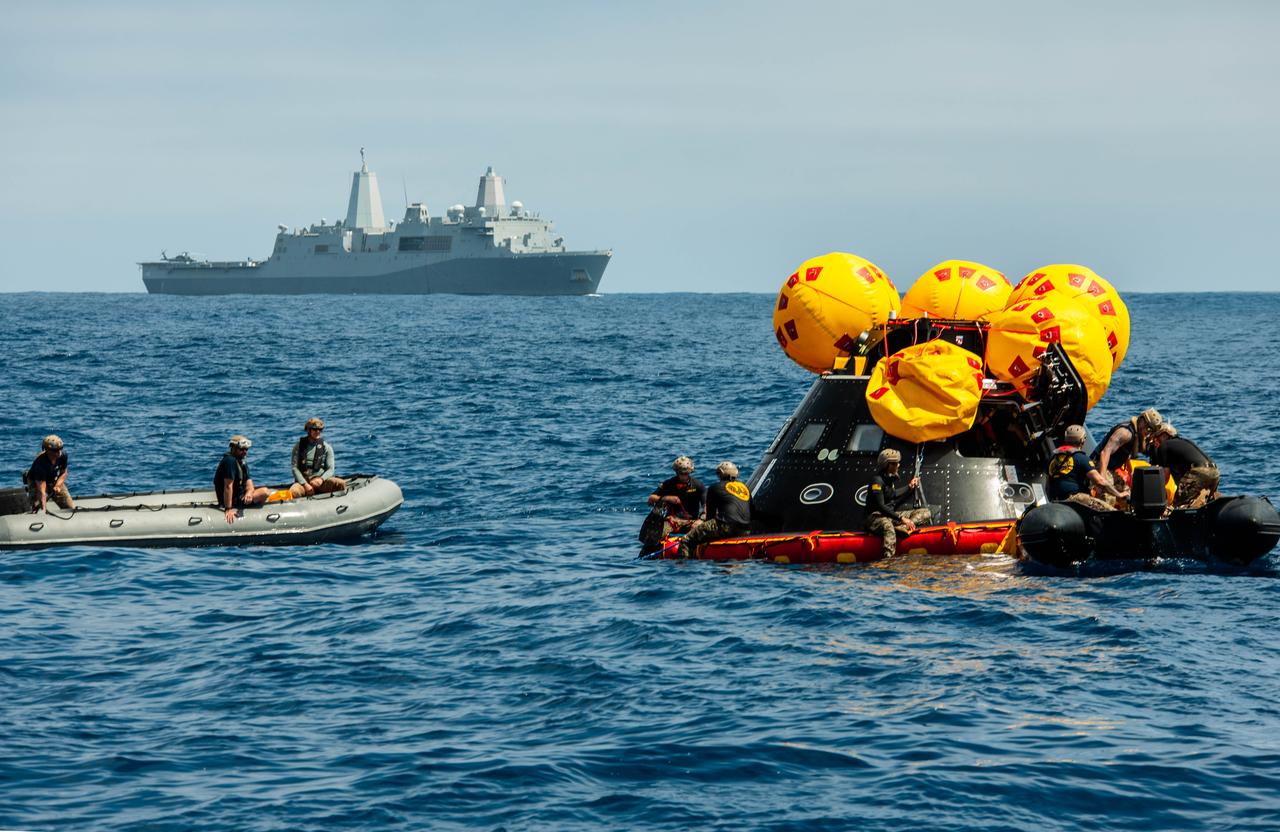
Navy divers from Explosive Ordnance Disposal (EOD) Expeditionary Support Unit 1 work to secure the Orion Crew Module Test Article (CMTA) in the Pacific Ocean as part of NASA’s Underway Recovery Test 10 (URT-10). The divers are trained in open water and small boat procedures and will be the team to help Artemis astronauts exit the Orion spacecraft and make it safely to the recovery ship after splashdown in addition to preparing the spacecraft to be transported back inside the recovery ship.
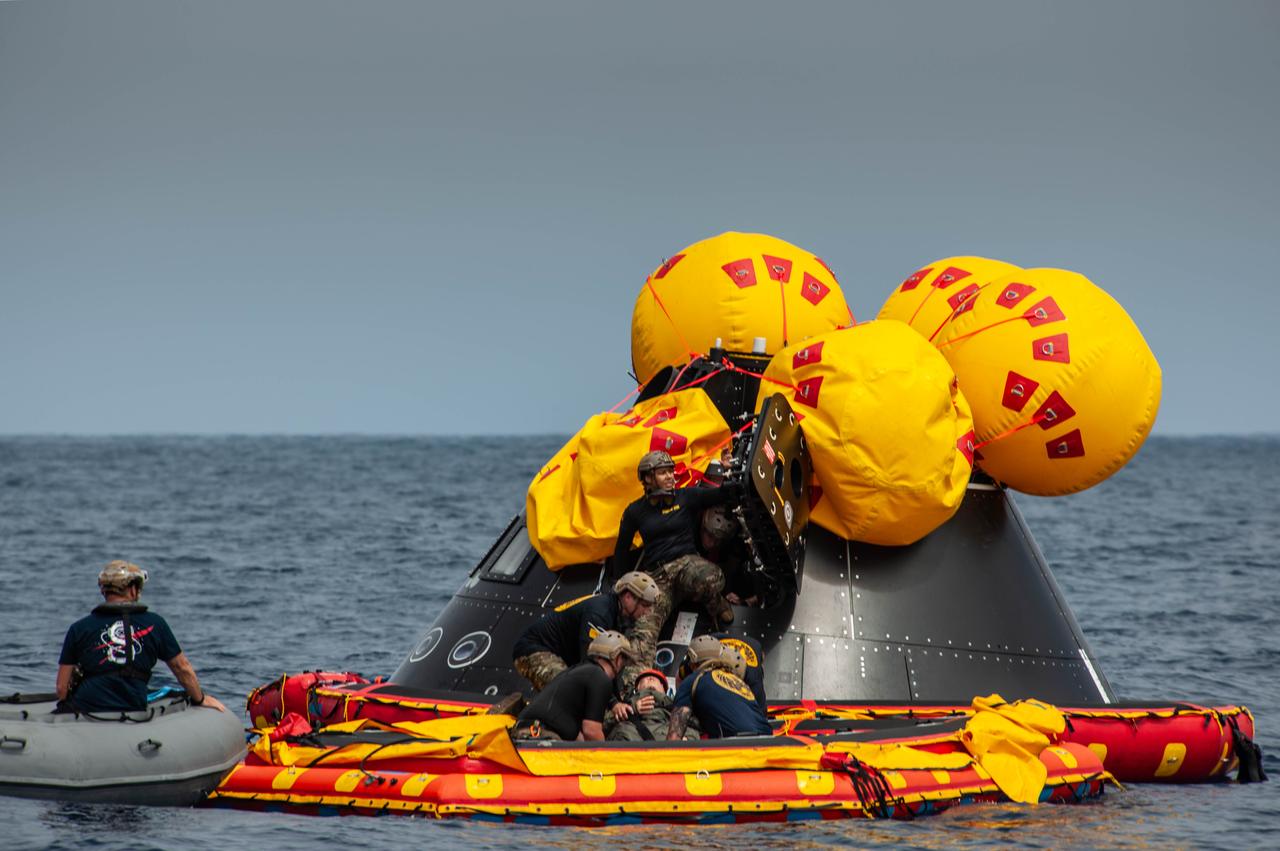
Navy divers from Explosive Ordnance Disposal (EOD) Expeditionary Support Unit 1 practice contingency recovery procedures with a manikin and the Orion Crew Module Test Article (CMTA) in the Pacific Ocean as part of NASA’s Underway Recovery Test 10 (URT-10). The divers are trained in open water and small boat procedures and will be the team to help Artemis astronauts exit the Orion spacecraft and make it safely to the recovery ship after splashdown in addition to preparing the spacecraft to be transported back inside the recovery ship.
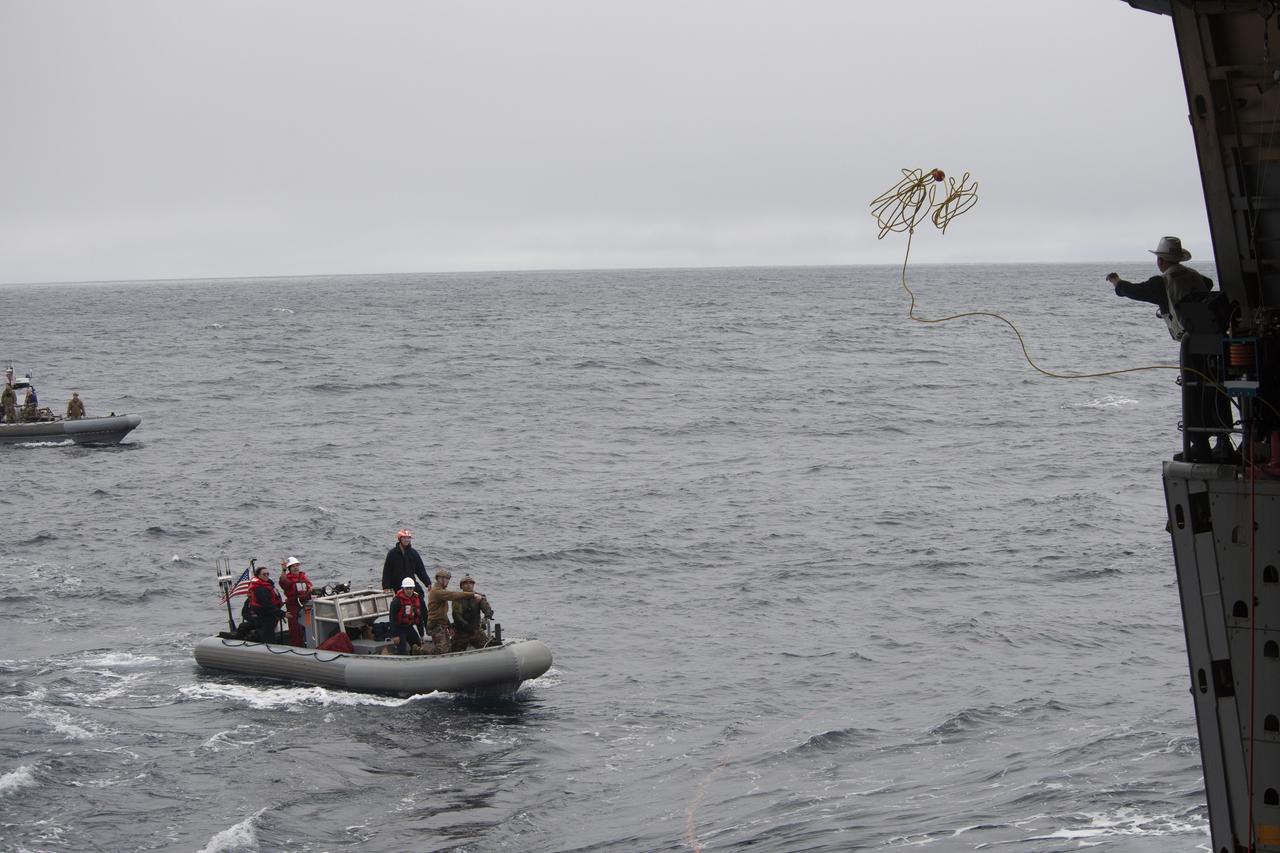
A sailor with the USS John P. Murtha (LPD 26) throws a tending line to a Navy diver assigned to Explosive Ordnance Disposal (EOD) Expeditionary Support Unit (ESU) One during Underway Recovery Test 9 (URT-9). The diver will attach the line to a mock Orion capsule so it can be brought into the well deck of the ship. During the weeklong test, NASA’s Landing and Recovery team is performing their final mission certification ahead of Artemis I.
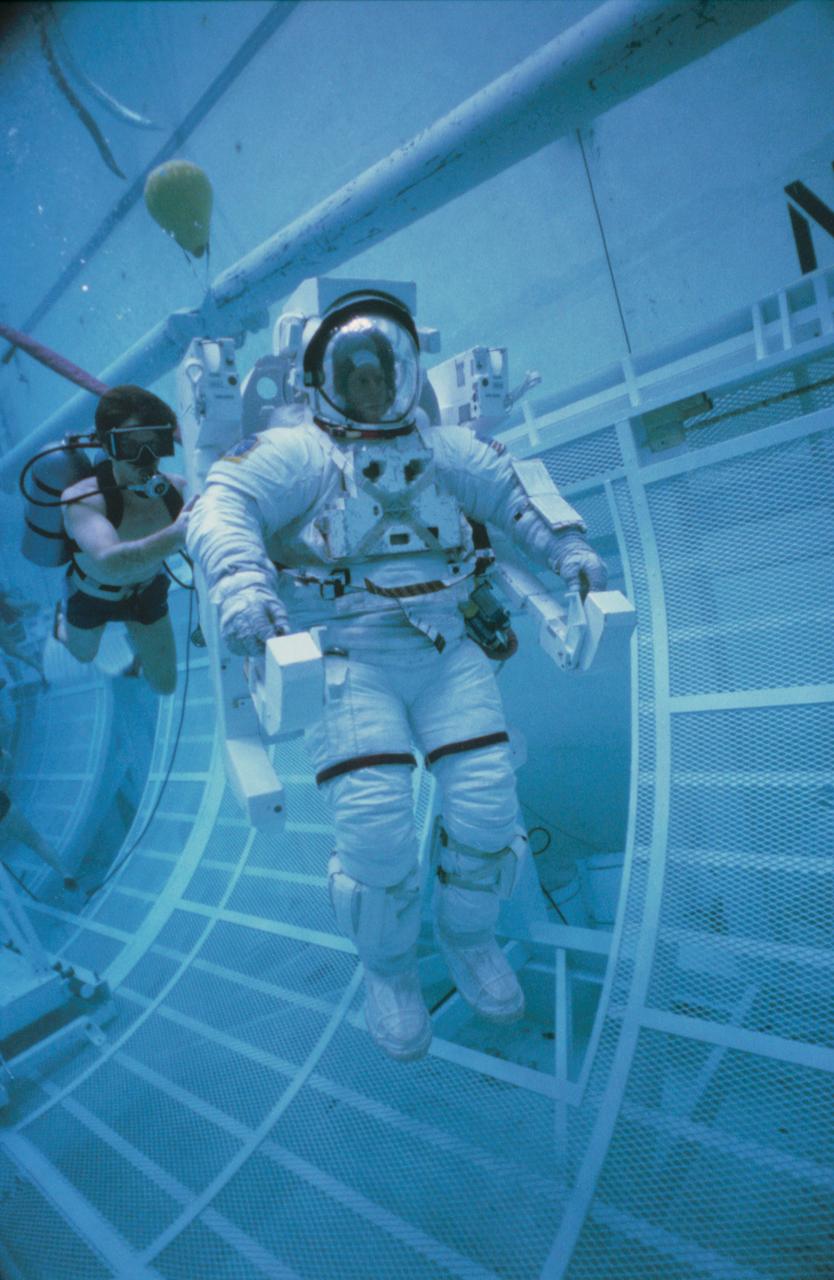
Underwater extravehicular activity (EVA) training in the weightless environment training facility (WETF) with astronauts George Nelson and James van Hoften. They are using tools to assemble material in the facility while surrounded by divers (428895); View of George Nelson in full extravehicular mobility unit (EMU) floating inside the space shuttle payload bay mockup with a diver behind him (42896).
Navy divers from Explosive Ordnance Disposal (EOD) Expeditionary Support Unit 1 work to secure the Orion Crew Module Test Article (CMTA) in the Pacific Ocean as part of NASA’s Underway Recovery Test 10 (URT-10). The divers are trained in open water and small boat procedures and will be the team to help Artemis astronauts exit the Orion spacecraft and make it safely to the recovery ship after splashdown in addition to preparing the spacecraft to be transported back inside the recovery ship.
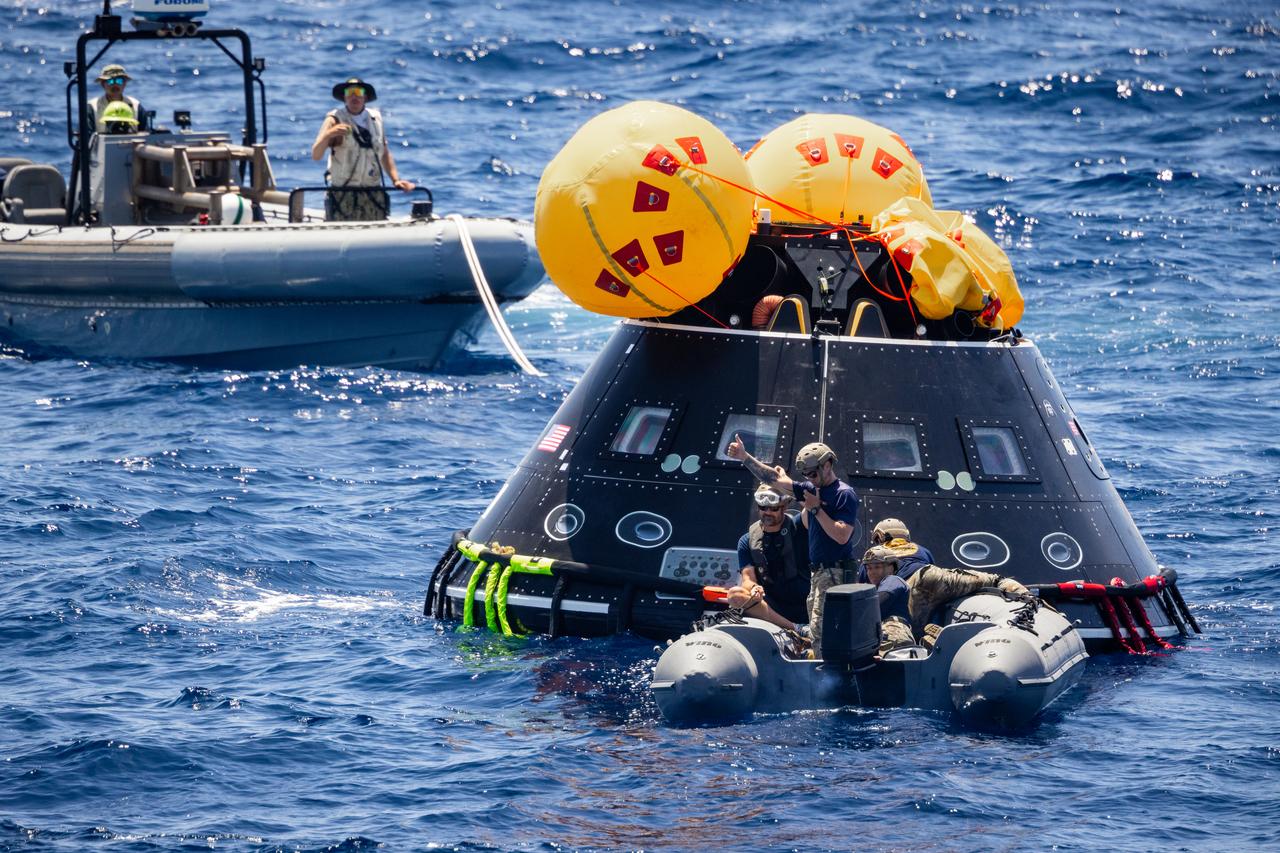
Navy divers from Explosive Ordnance Disposal (EOD) Expeditionary Support Unit 1 work to secure the Orion Crew Module Test Article (CMTA) in the Pacific Ocean as part of NASA’s Underway Recovery Test 10 (URT-10). The divers are trained in open water and small boat procedures and will be the team to help Artemis astronauts exit the Orion spacecraft and make it safely to the recovery ship after splashdown in addition to preparing the spacecraft to be transported back inside the recovery ship.
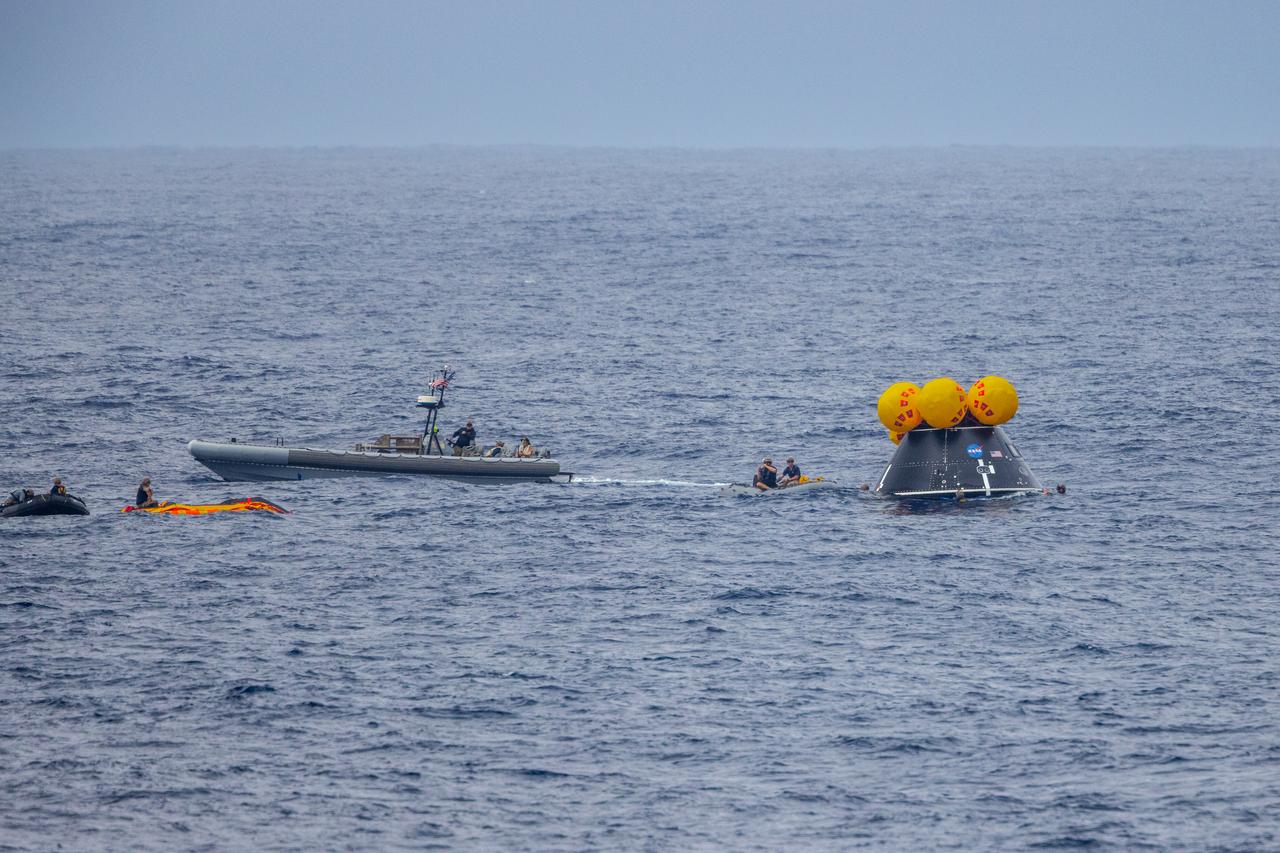
Navy divers from Explosive Ordnance Disposal (EOD) Expeditionary Support Unit 1 work to secure the Orion Crew Module Test Article (CMTA) in the Pacific Ocean as part of NASA’s Underway Recovery Test 10 (URT-10). The divers are trained in open water and small boat procedures and will be the team to help Artemis astronauts exit the Orion spacecraft and make it safely to the recovery ship after splashdown in addition to preparing the spacecraft to be transported back inside the recovery ship.
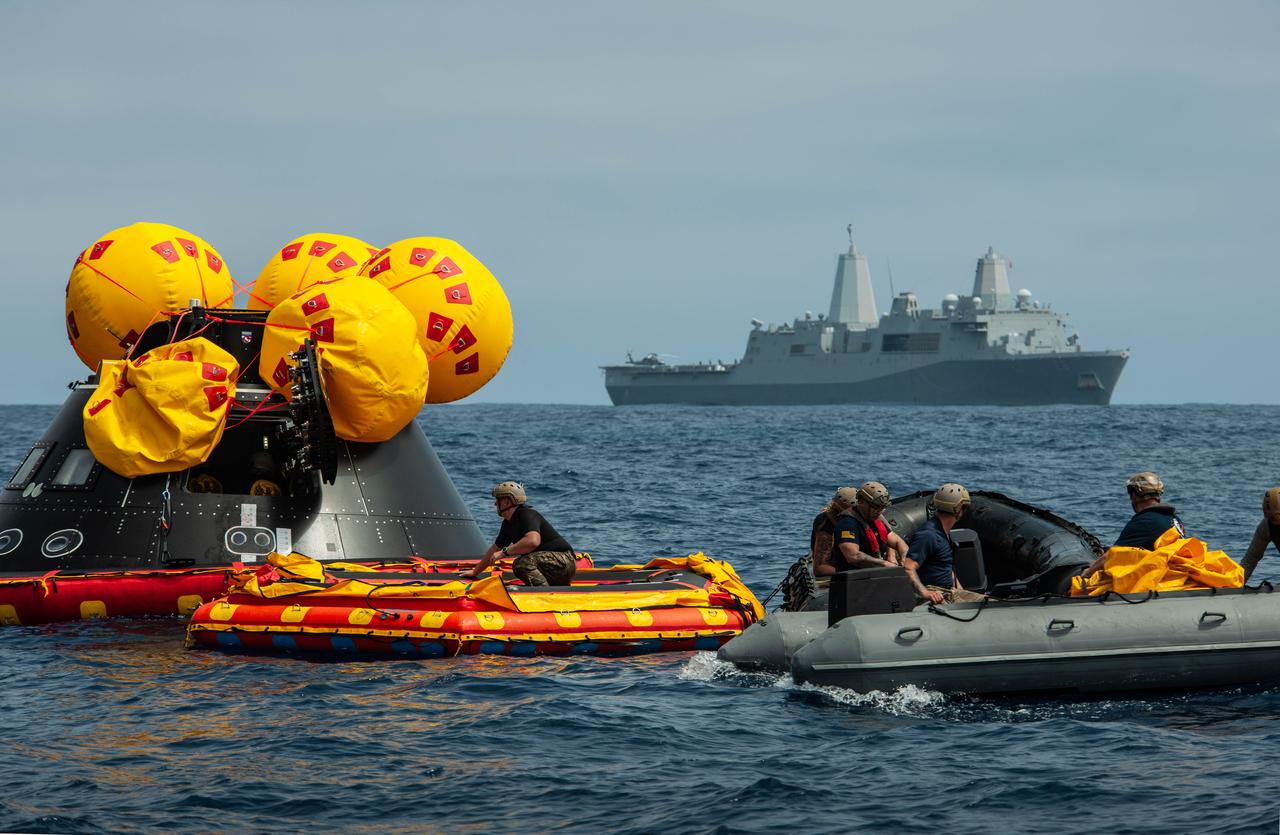
Navy divers from Explosive Ordnance Disposal (EOD) Expeditionary Support Unit 1 work to secure the Orion Crew Module Test Article (CMTA) in the Pacific Ocean as part of NASA’s Underway Recovery Test 10 (URT-10). The divers are trained in open water and small boat procedures and will be the team to help Artemis astronauts exit the Orion spacecraft and make it safely to the recovery ship after splashdown in addition to preparing the spacecraft to be transported back inside the recovery ship.
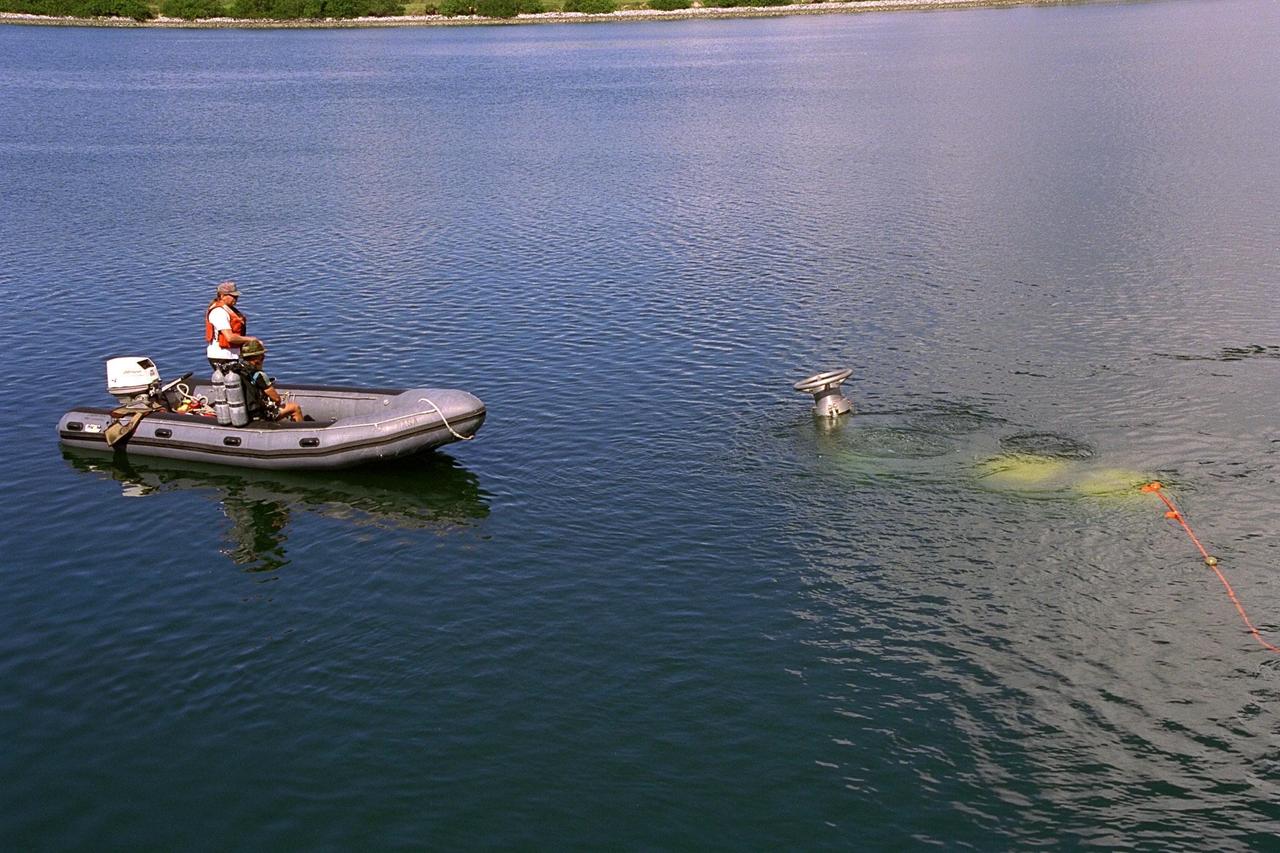
KENNEDY SPACE CENTER, FLA. -- A scuba diver stands by as the unmanned Max Rover submersible goes down to insert a Diver Operated Plug (DOP) into an aft nozzle like the ones used on the Space Shuttle's solid rocket boosters (SRBs). NASA and contractor Deep Sea Systems demonstrated the submersible at Port Canaveral's Trident pier. Kennedy Space Center's SRB retrieval team and Advanced Systems Development laboratory staff hope that the new robotic technology will make the process of inserting the plug into spent SRBs safer and less strenuous. Currently, scuba divers manually insert the DOP into the aft nozzle of a jettisoned SRB 60 to 70 feet below the surface of the Atlantic Ocean. After the plug is installed, water is pumped out of the booster allowing it to float horizontally. It is then towed back to Hangar AF at Cape Canaveral Air Station for refurbishment. Deep Sea Systems of Falmouth, Mass., built the submersible for NASA
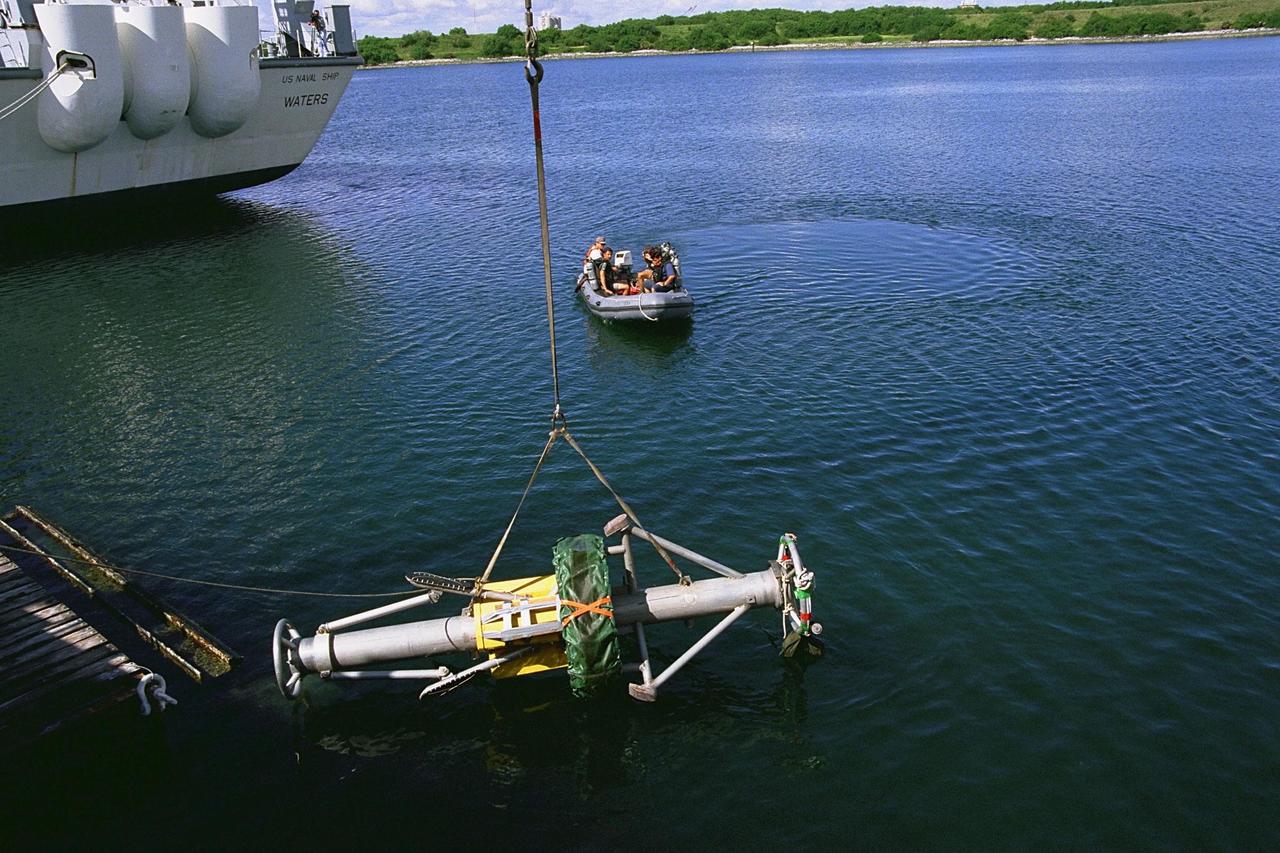
KENNEDY SPACE CENTER, FLA. -- As scuba divers stand by, a Diver Operated Plug (DOP) is lowered into the water at the Trident Pier at Port Canaveral during a test of the unmanned robotic submersible recovery system, known as Max Rover. Kennedy Space Center's solid rocket booster (SRB) retrieval team and Advanced Systems Development laboratory staff hope that the new robotic technology will make the process of inserting the plug into spent SRBs safer and less strenuous. Currently, scuba divers manually insert the DOP into the aft nozzle of a jettisoned SRB 60 to 70 feet below the surface of the Atlantic Ocean. After the plug is installed, water is pumped out of the booster allowing it to float horizontally. It is then towed back to Hangar AF at Cape Canaveral Air Station for refurbishment. Deep Sea Systems of Falmouth, Mass., built the submersible for NASA
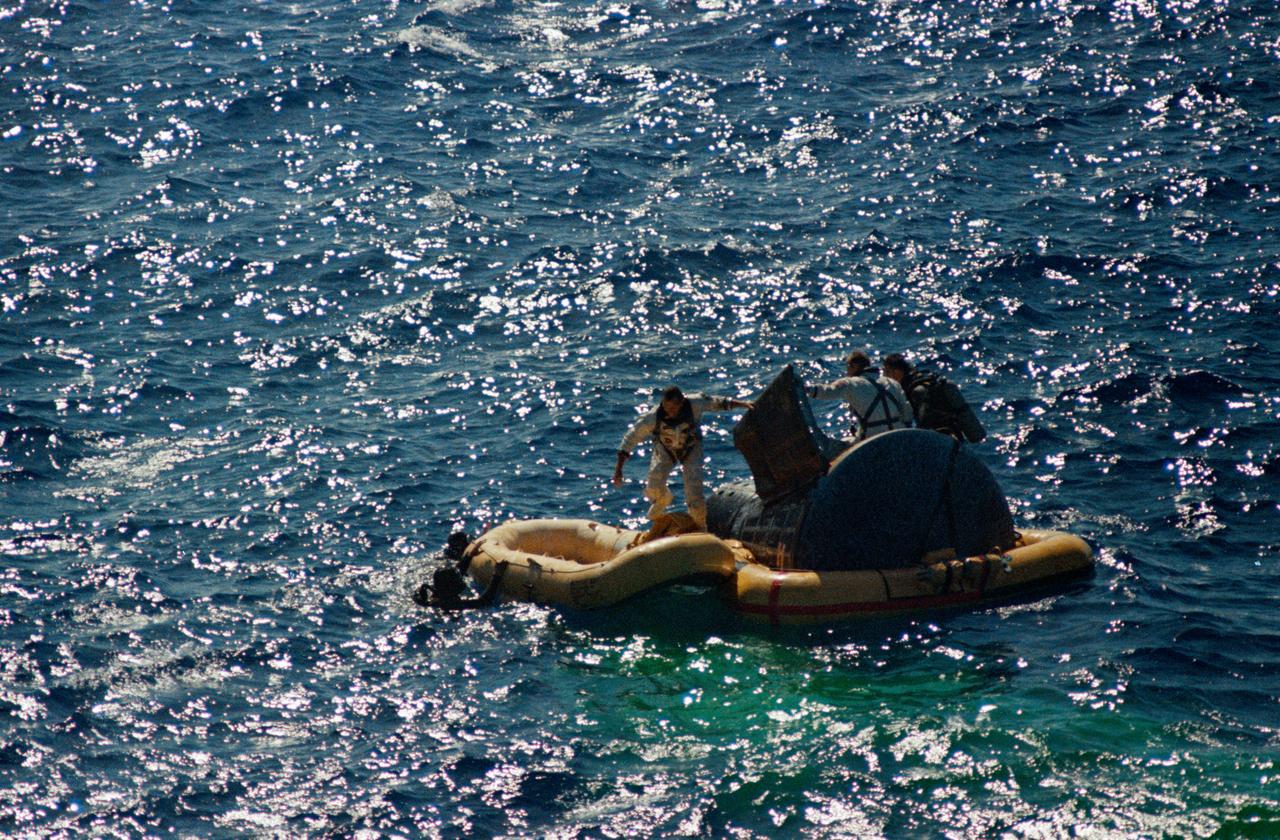
S65-51653 (29 Aug. 1965) --- Astronauts L. Gordon Cooper Jr. and Charles Conrad Jr. exit their spacecraft after splashdown of the Gemini-5 spacecraft. They are photographed boarding a life raft with the help of Navy divers.
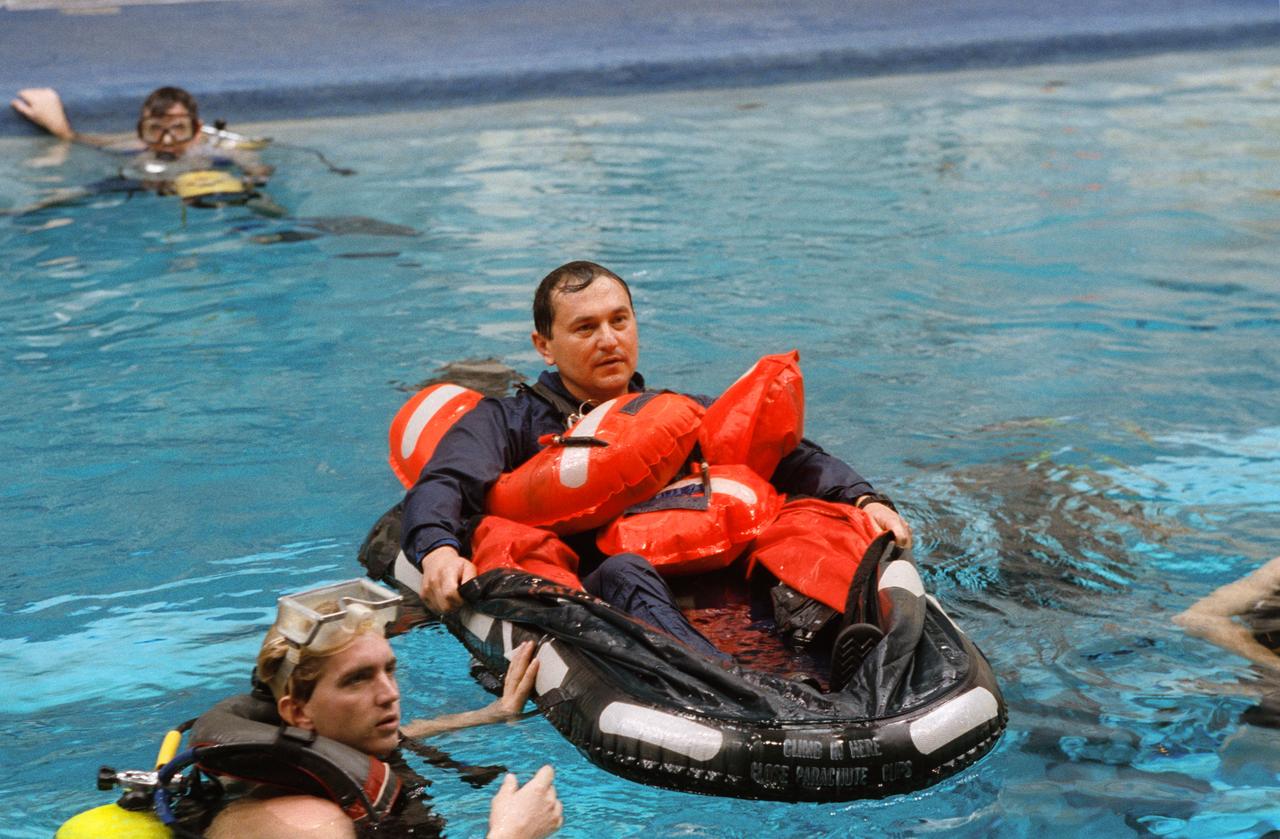
Russian Cosmonaut Vladimir Titov maneuvers a small life raft during bailout training at JSC's Weightless Environment Training Facility (WETF). Two SCUBA-equipped divers assisted Titov in the STS-60 training exercise.
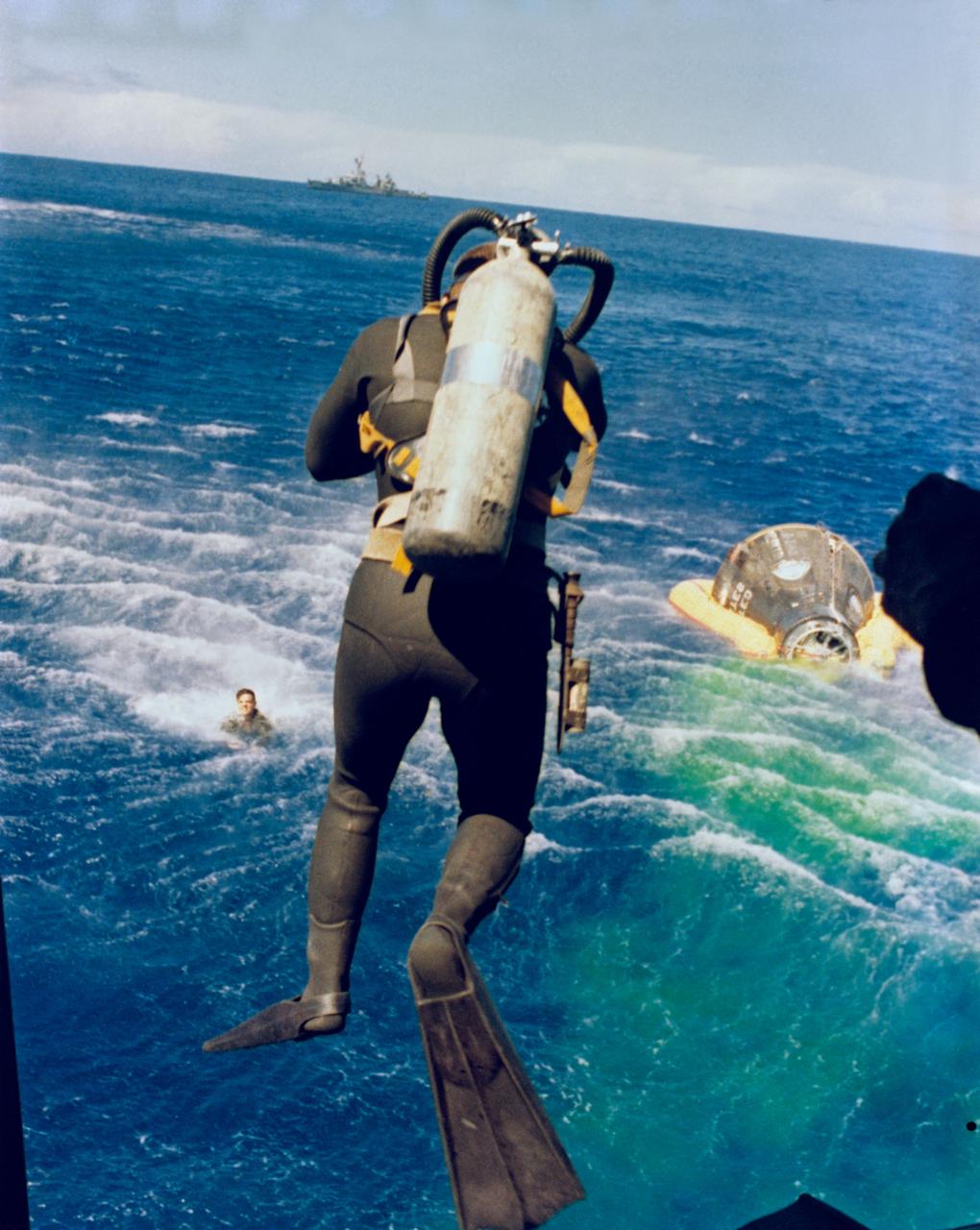
S65-46627 (29 Aug. 1965) --- Navy divers exit their helicopter to recover the Gemini-5 spacecraft and astronauts. The NASA Headquarters alternative photo number is 65-H-669.
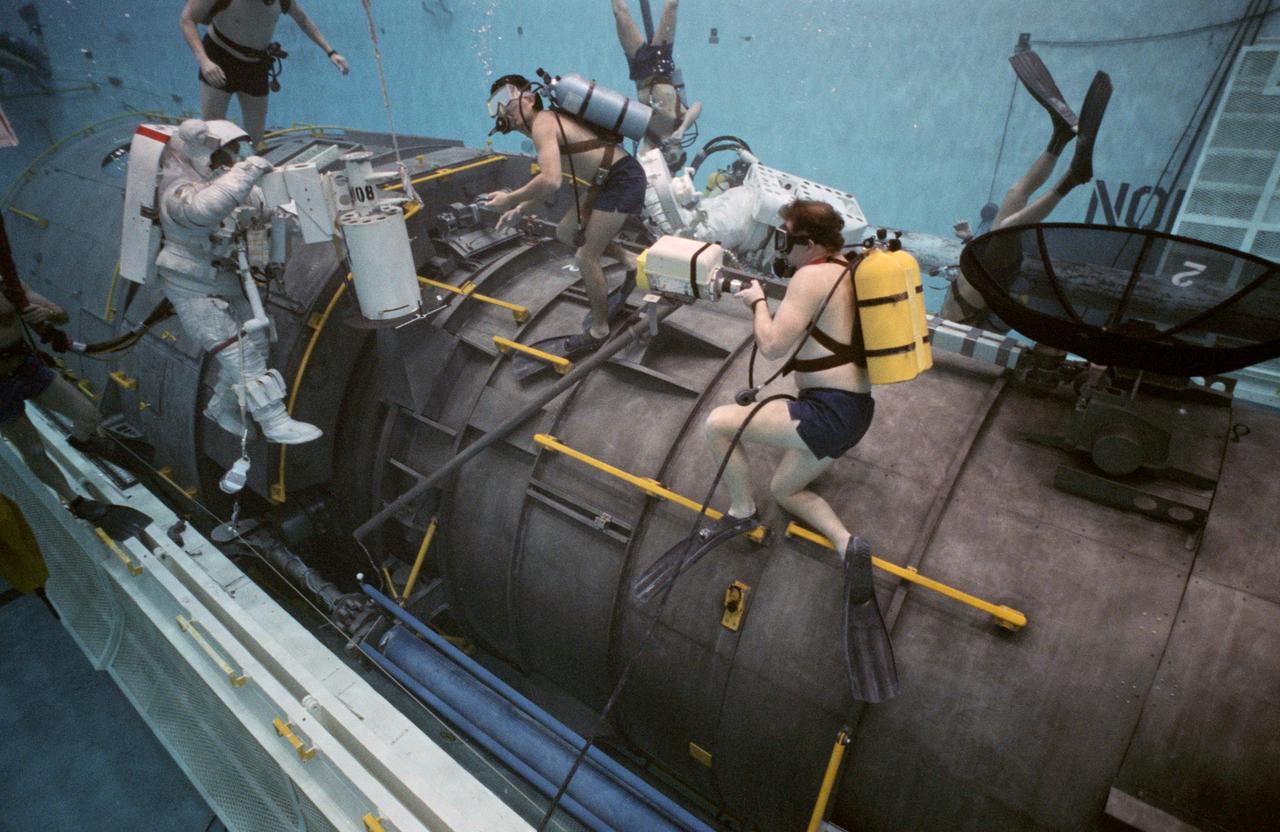
STS-31 Mission Specialist (MS) Bruce McCandless II (left), wearing an extravehicular mobility unit (EMU), maneuvers his way around a mockup of the remote manipulator system (RMS) end effector during an underwater simulation in JSC's Weightless Environment Training Facility (WETF) Bldg 29 pool. The end effector is attached to a grapple fixture on the Hubble Space Telescope (HST) mockup. As McCandless performs contingency extravehicular activity (EVA) procedures, fellow crewmember MS Kathryn D. Sullivan, in EMU, works on the opposite side of the HST mockup, and SCUBA-equipped divers monitor the activity. Though no EVA is planned for STS-31, the two crewmembers train for contingencies that would necessitate leaving the shirt sleeve environment of Discovery's, Orbiter Vehicle (OV) 103's, crew cabin and performing chores with the HST payload or related hardware in the payload bay (PLB).
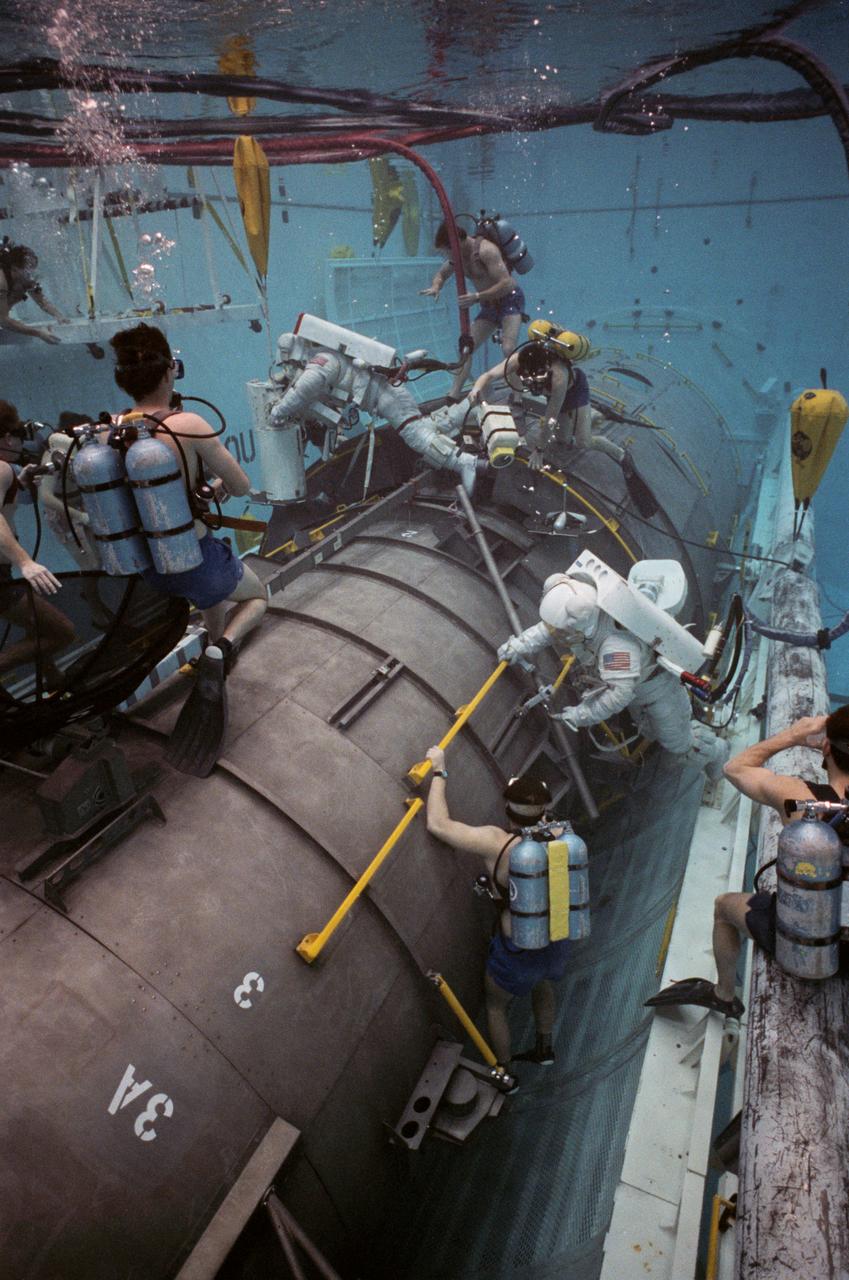
This overall view shows STS-31 Mission Specialist (MS) Bruce McCandless II (left) and MS Kathryn D. Sullivan making a practice space walk in JSC's Weightless Environment Training Facility (WETF) Bldg 29 pool. McCandless works with a mockup of the remote manipulator system (RMS) end effector which is attached to a grapple fixture on the Hubble Space Telescope (HST) mockup. Sullivan manipulates HST hardware on the Support System Module (SSM) forward shell. SCUBA-equipped divers monitor the extravehicular mobility unit (EMU) suited crewmembers during this simulated extravehicular activity (EVA). No EVA is planned for the Hubble Space Telescope (HST) deployment, but the duo has trained for contingencies which might arise during the STS-31 mission aboard Discovery, Orbiter Vehicle (OV) 103. Photo taken by NASA JSC photographer Sheri Dunnette.
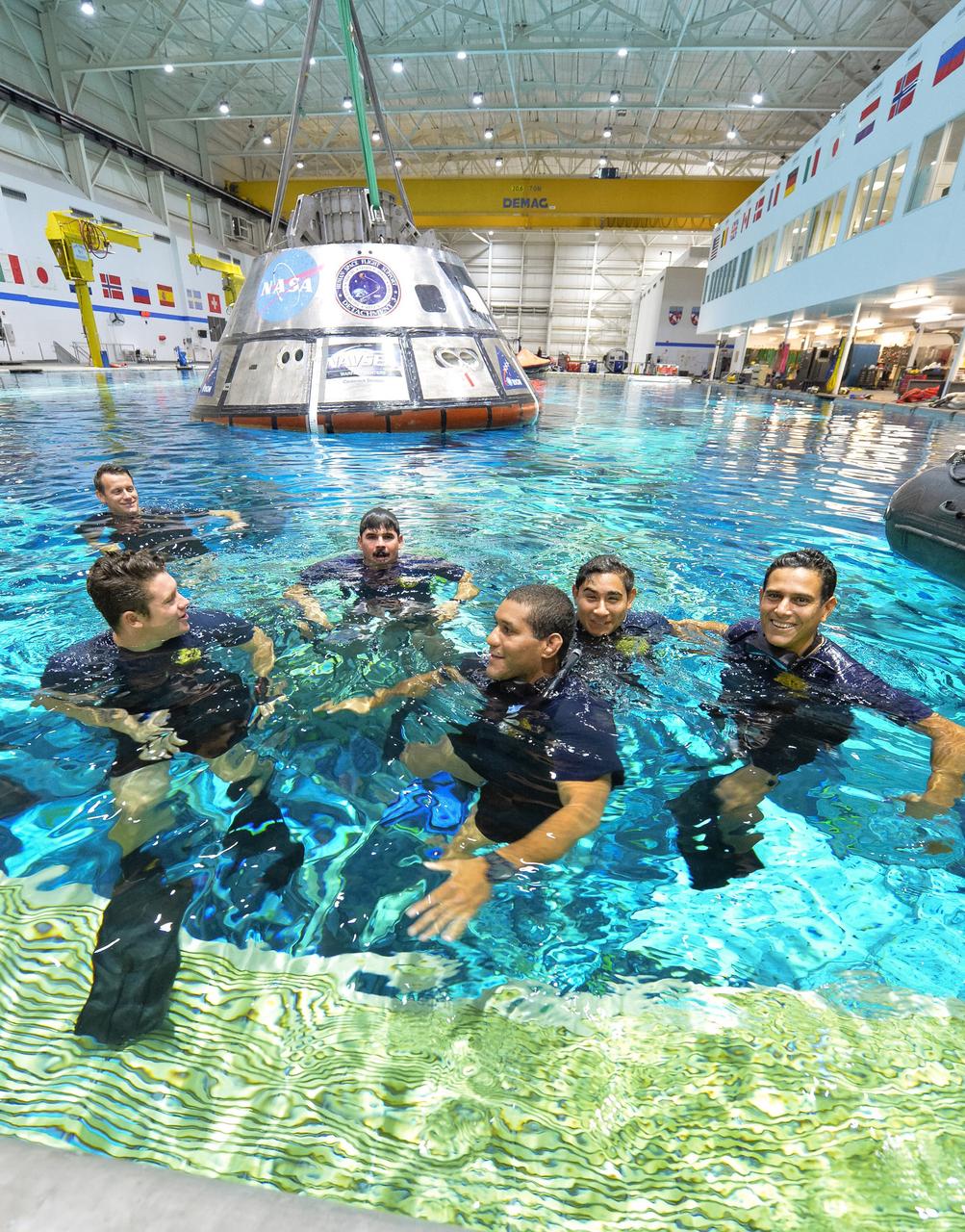
U.S. Navy divers are training in the Neutral Buoyancy Laboratory at NASA’s Johnson Space Center in Houston. Navy divers, Air Force pararescuemen and Coast Guard rescue swimmers practice Orion underway recovery techniques using a test version of the Orion spacecraft. Training will help the team prepare for Underway Recovery Test 5 for Exploration Mission 1 aboard the USS San Diego in the Pacific Ocean off the coast of California in October. The Ground Systems Development and Operations Program, along with the U.S. Navy and Lockheed Martin, are preparing the recovery team, hardware and operations to support EM-1 recovery.
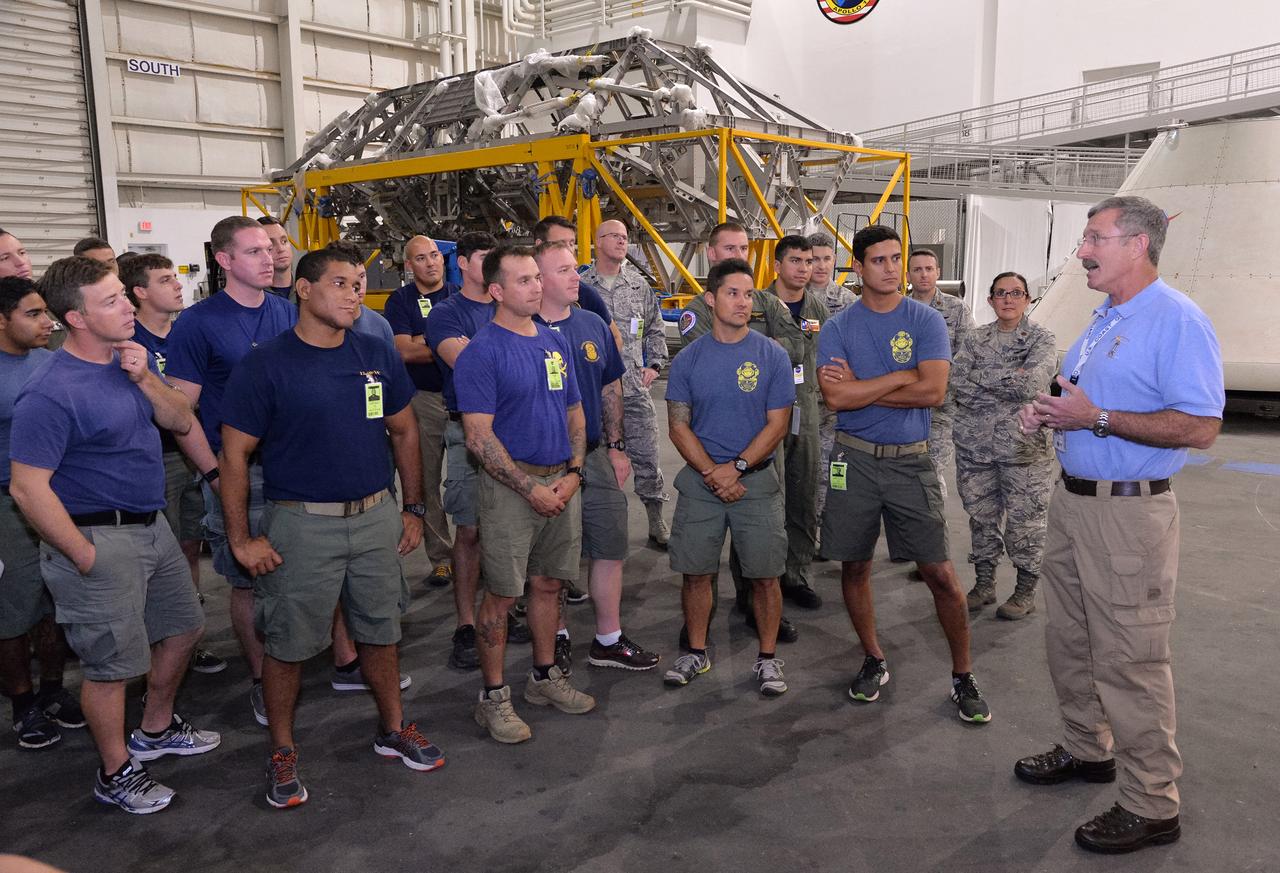
NASA astronaut Dan Burbank speaks to a group of U.S. Navy divers at the Neutral Buoyancy Laboratory (NBL) at the agency’s Johnson Space Center in Houston. Navy divers, Air Force pararescuemen and Coast Guard rescue swimmers are preparing to practice Orion underway recovery techniques with a test version of the Orion spacecraft. Training will help the team prepare for Underway Recovery Test 5 for Exploration Mission 1 aboard the USS San Diego in the Pacific Ocean off the coast of California in October. The Ground Systems Development and Operations Program, along with the U.S. Navy and Lockheed Martin, are preparing the recovery team, hardware and operations to support EM-1 recovery.
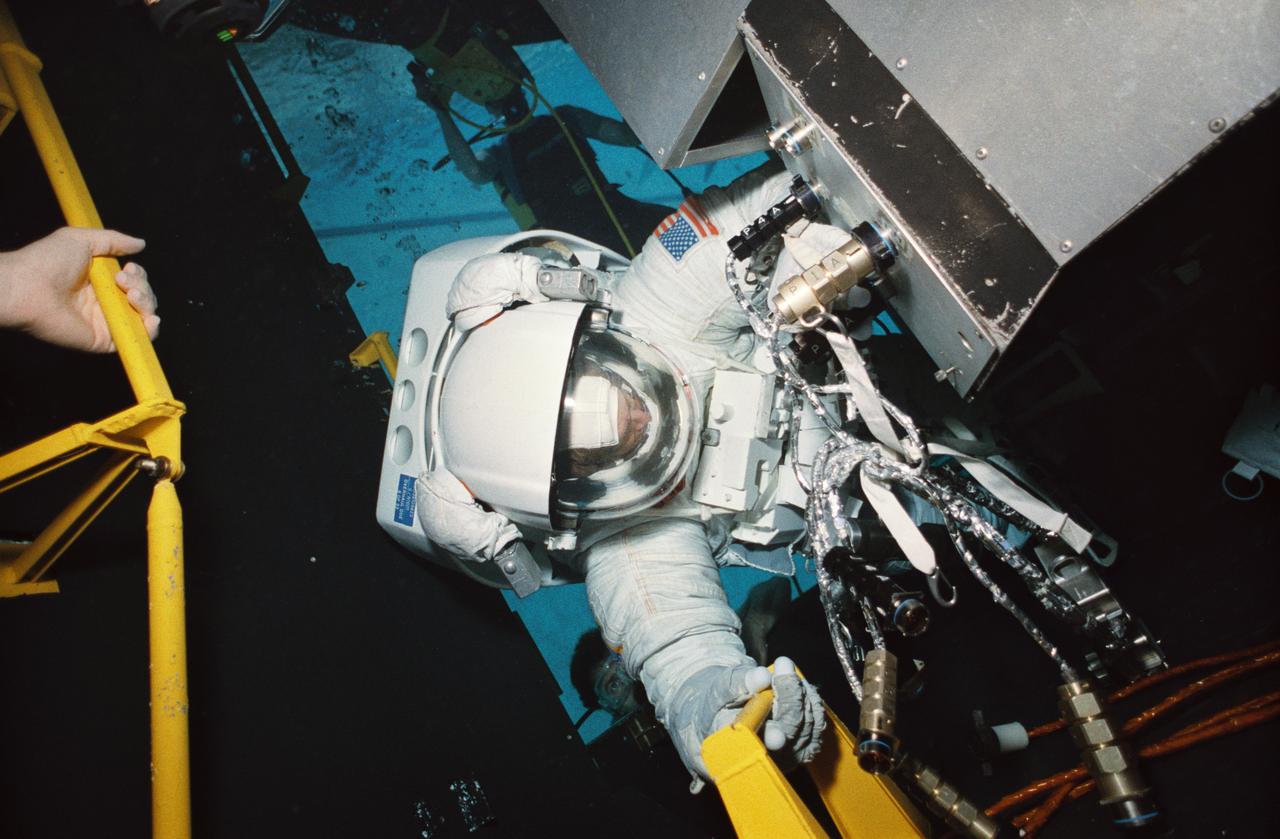
S93-33104 (7 Apr 1993) --- Wearing a training version of Space Shuttle Extravehicular Mobility Unit (EMU), astronaut Jeffrey A. Hoffman uses the giant pool of the Johnson Space Center's (JSC) Weightless Environment Training Facility (WET-F) to rehearse for the Hubble Space Telescope (HST) repair mission. Out of frame is astronaut F. Story Musgrave, who will join Hoffman in STS-61 EVA. The hand at top frame belongs to a SCUBA-equipped diver. A number of divers are on hand for all training sessions in the WET-F. A total of five extravehicular activity (EVA) sessions will be conducted during the scheduled December mission of the Endeavour.
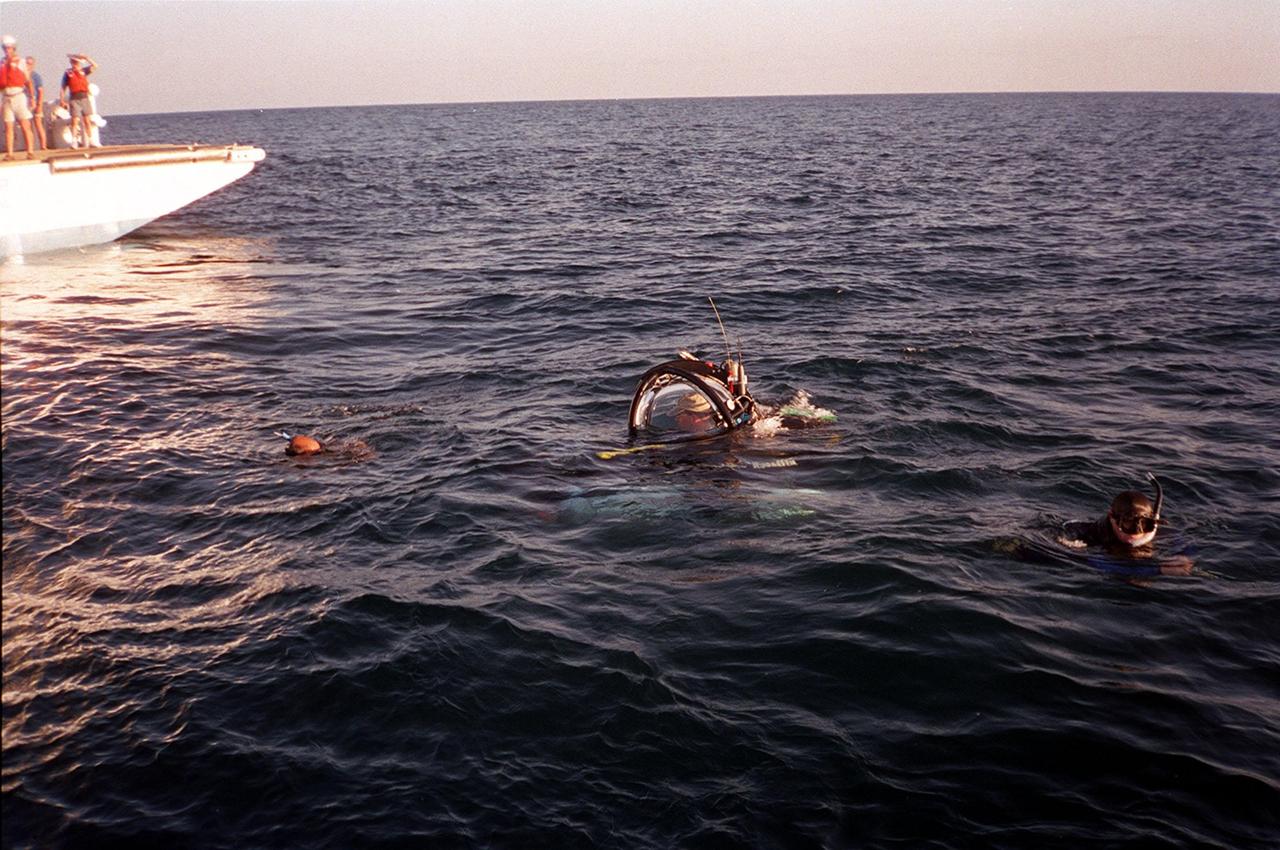
KENNEDY SPACE CENTER, FLA. -- The one-man submarine known as DeepWorker 2000 is tested in Atlantic waters near Cape Canaveral, Fla. Nearby are divers; inside the sub is the pilot, Anker Rasmussen. The sub is being tested on its ability to duplicate the sometimes hazardous job United Space Alliance (USA) divers perform to recover the expended boosters in the ocean after a launch. The boosters splash down in an impact area about 140 miles east of Jacksonville and after recovery are towed back to KSC for refurbishment by the specially rigged recovery ships. DeepWorker 2000 will be used in a demonstration during retrieval operations after the upcoming STS-101 launch. The submarine pilot will demonstrate capabilities to cut tangled parachute riser lines using a manipulator arm and attach a Diver Operator Plug to extract water and provide flotation for the booster. DeepWorker 2000 was built by Nuytco Research Ltd., North Vancouver, British Columbia. It is 8.25 feet long, 5.75 feet high, and weighs 3,800 pounds. USA is a prime contractor to NASA for the Space Shuttle program
KENNEDY SPACE CENTER, FLA. -- The one-man submarine known as DeepWorker 2000 is tested in Atlantic waters near Cape Canaveral, Fla. Nearby are divers; inside the sub is the pilot, Anker Rasmussen. The sub is being tested on its ability to duplicate the sometimes hazardous job United Space Alliance (USA) divers perform to recover the expended boosters in the ocean after a launch. The boosters splash down in an impact area about 140 miles east of Jacksonville and after recovery are towed back to KSC for refurbishment by the specially rigged recovery ships. DeepWorker 2000 will be used in a demonstration during retrieval operations after the upcoming STS-101 launch. The submarine pilot will demonstrate capabilities to cut tangled parachute riser lines using a manipulator arm and attach a Diver Operator Plug to extract water and provide flotation for the booster. DeepWorker 2000 was built by Nuytco Research Ltd., North Vancouver, British Columbia. It is 8.25 feet long, 5.75 feet high, and weighs 3,800 pounds. USA is a prime contractor to NASA for the Space Shuttle program
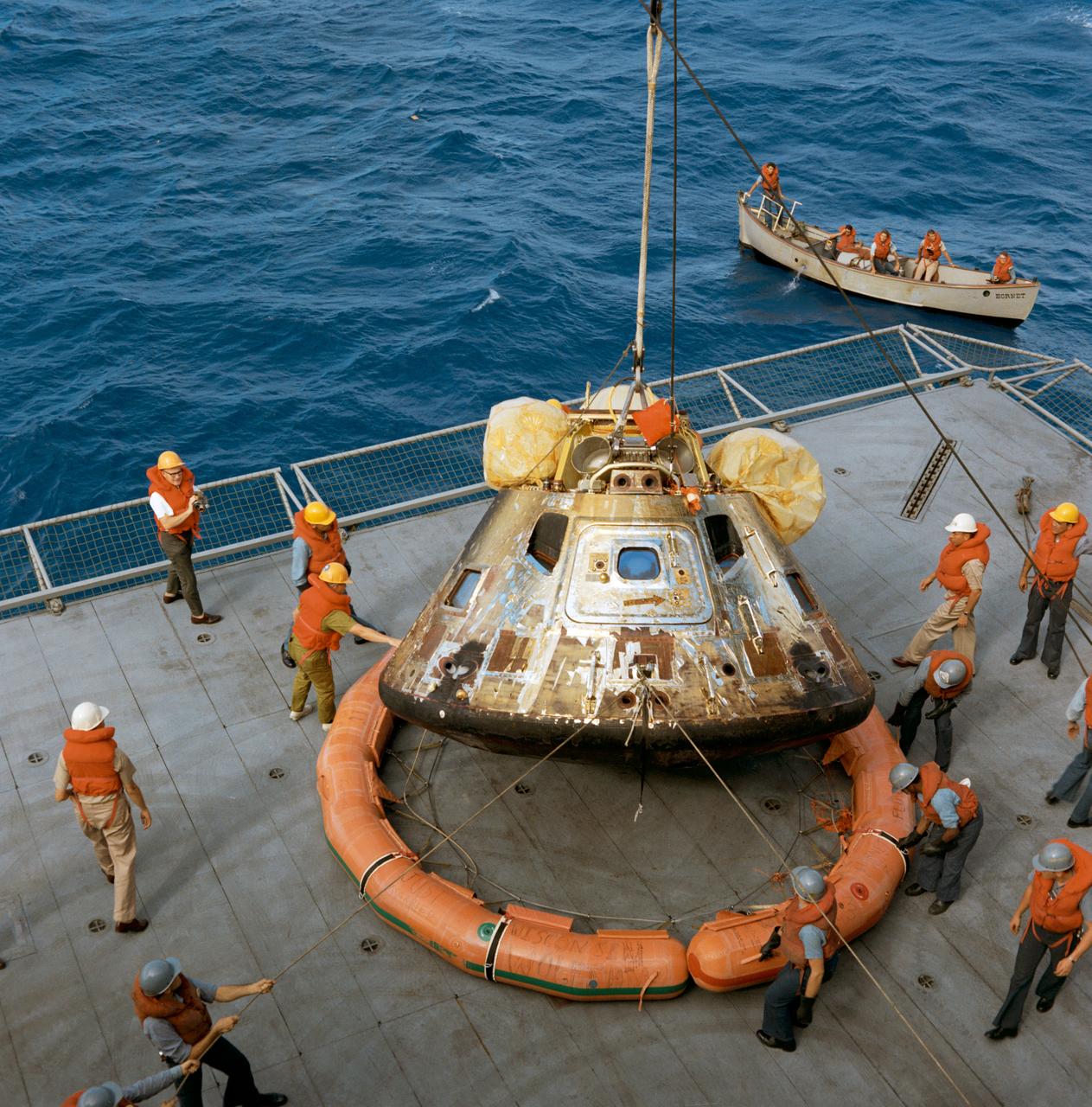
The Apollo 11 spacecraft Command Module is photographed being lowered to the deck of the U.S.S. Hornet, prime recovery ship for the historic lunar landing mission. Note the flotation ring attached by Navy divers has been removed from the capsule.
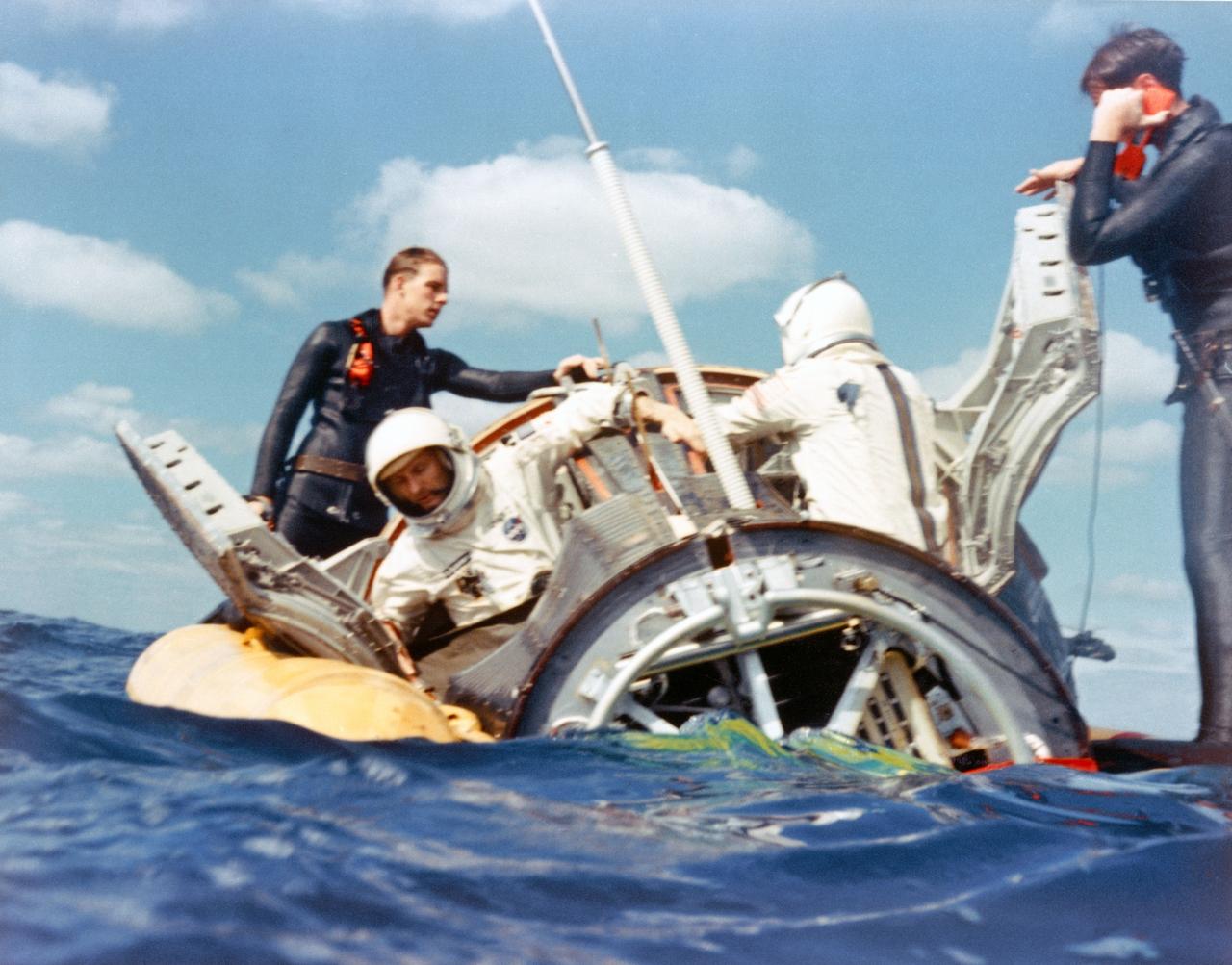
S65-61886 (16 Dec. 1965) --- A water level view of Navy divers assisting Gemini-6 crew members Stafford and Schirra to open hatches after landing in the Atlantic. Photo credit: NASA or National Aeronautics and Space Administration
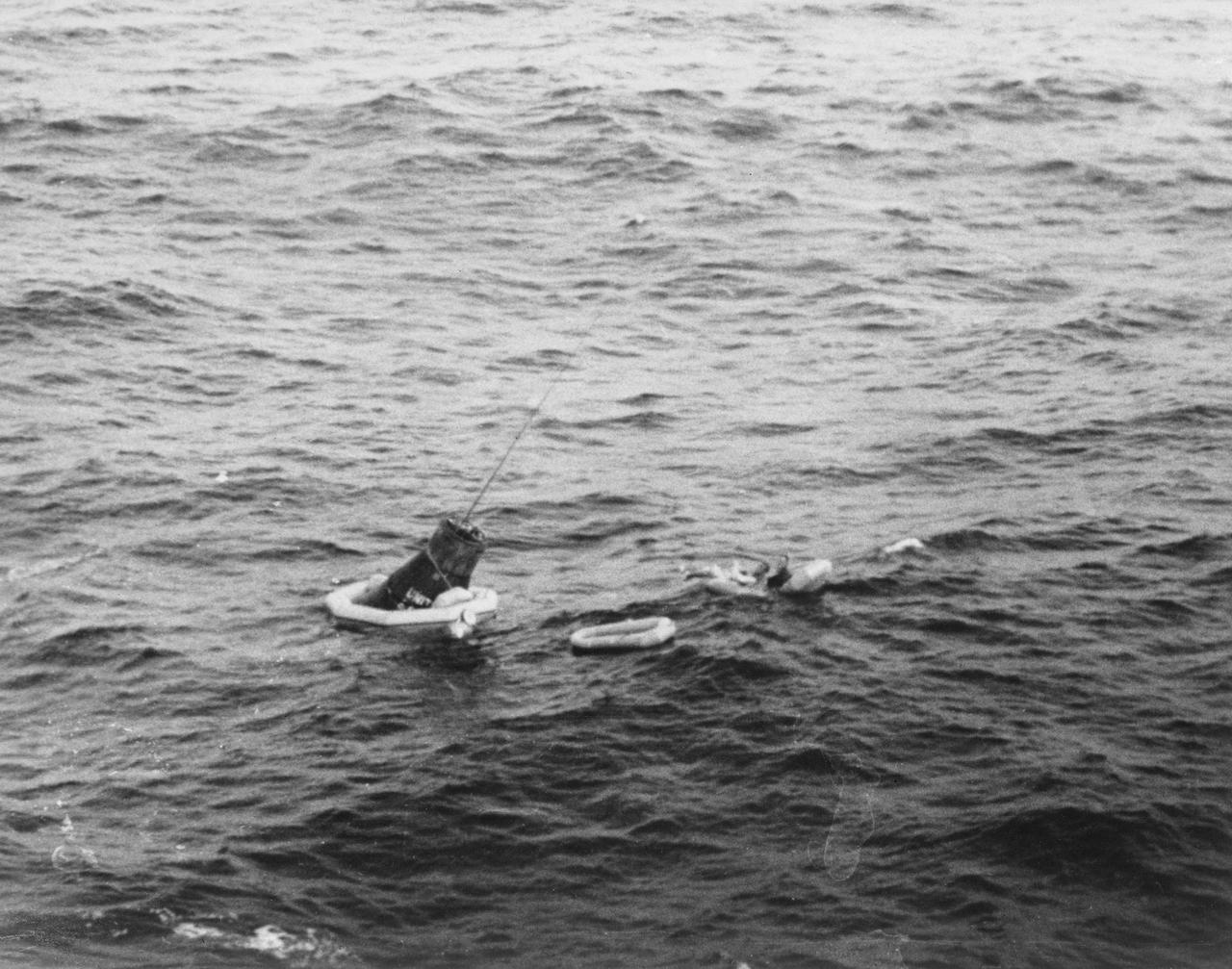
S62-04065 (24 May 1962) --- Astronaut M. Scott Carpenter, prime pilot for the Mercury-Atlas 7 (MA-7) mission, is seen being recovered from the Atlantic Ocean after MA-7 flight. A diver helps Carpenter into a life raft while the capsule floats nearby. Photo credit: NASA

JSC2002-00824 (17 April 2002) --- Astronaut James M. Kelly, STS-114 pilot, assisted by divers, floats in a small life raft during an emergency egress training session in the Neutral Buoyancy Laboratory (NBL) near the Johnson Space Center (JSC).
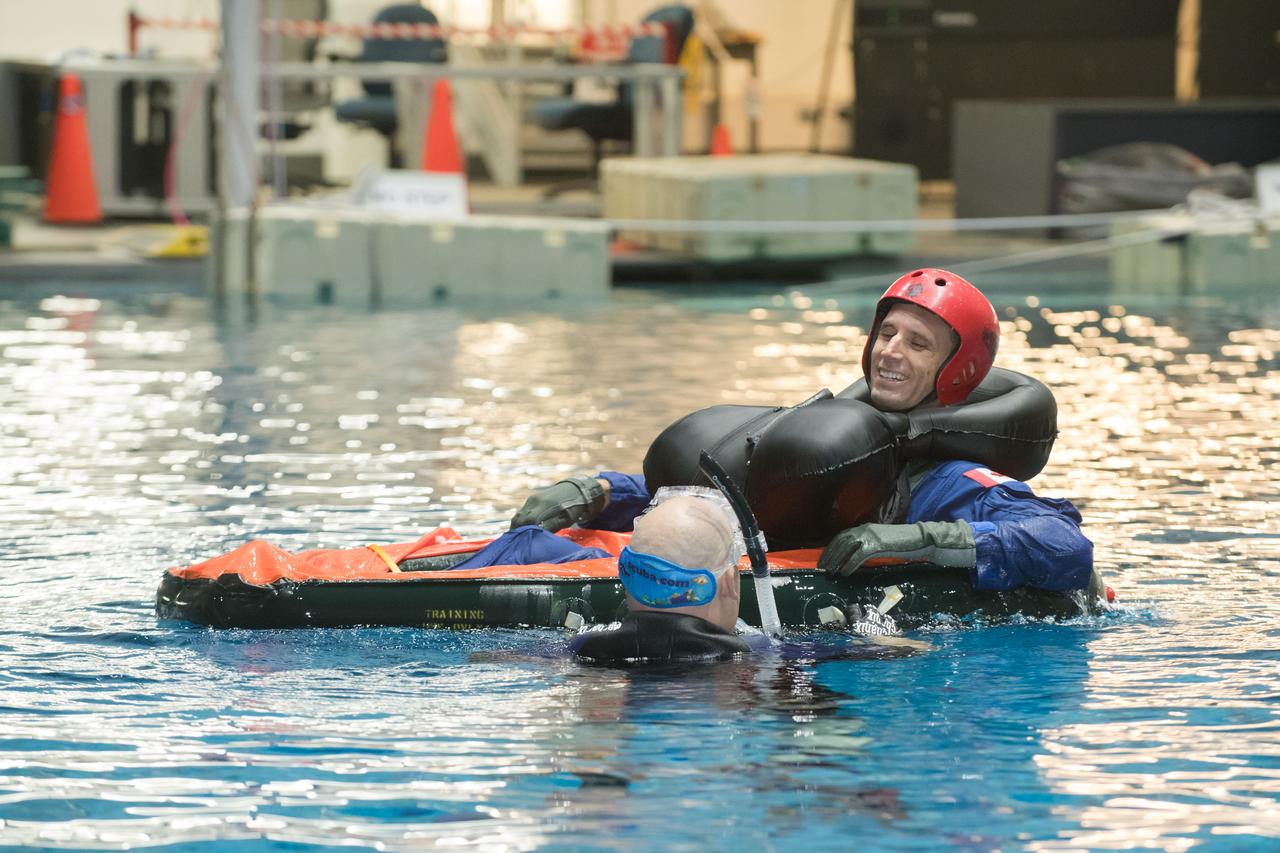
jsc2017e114943 (09-06-17) --- During water survival training in 2017 at NASA Johnson Space Center’s Neutral Buoyancy Laboratory in Houston, Canadian Space Agency astronaut candidate Joshua Kutryk is guided through training by divers. Photo Credit: (NASA/James Blair)

JSC2002-00573 (19 February 2002) --- Astronaut Pamela A. Melroy, STS-112 pilot, assisted by divers, floats in a small life raft during an emergency egress training session in the Neutral Buoyancy Laboratory (NBL) near the Johnson Space Center (JSC).
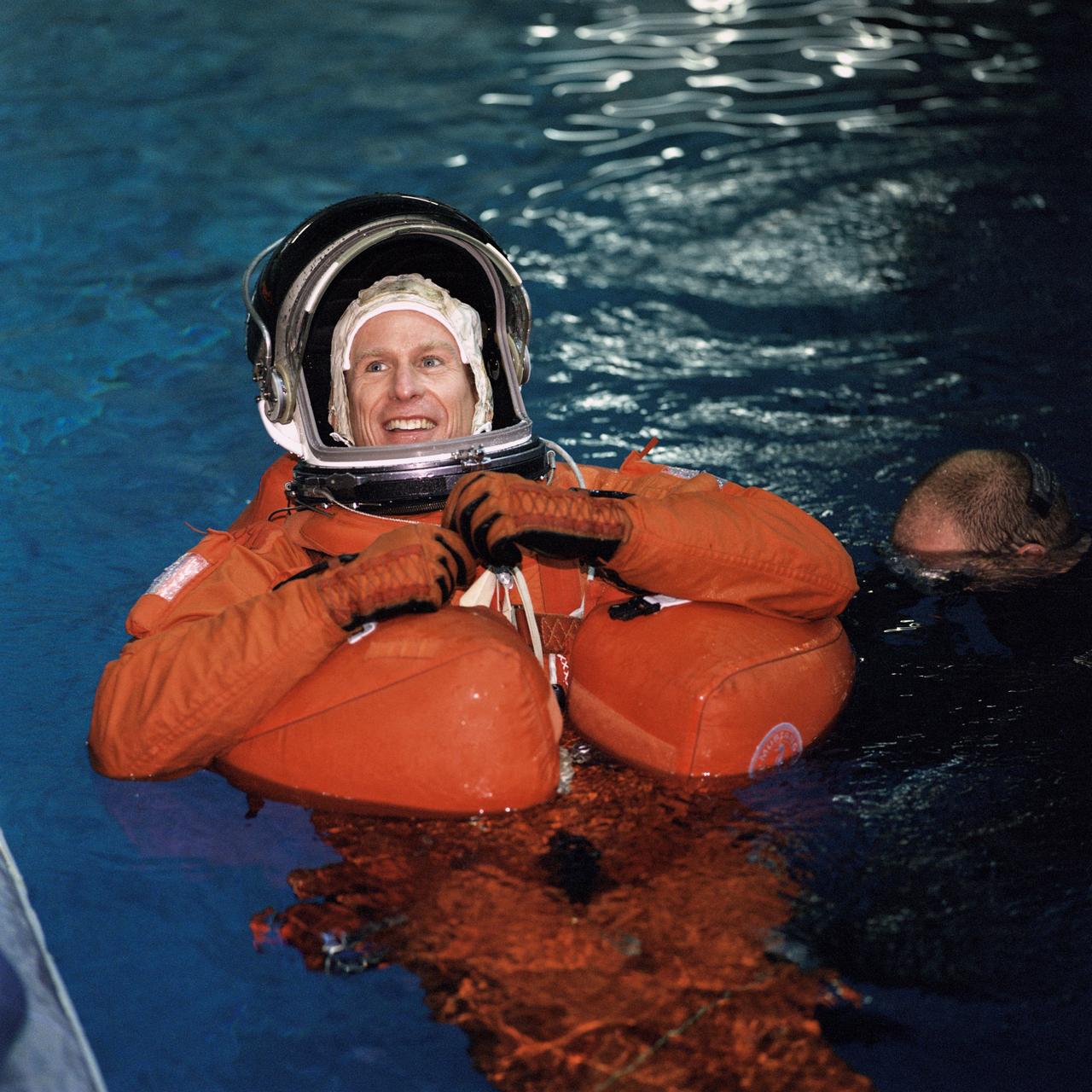
JSC2001-00022 (January 2001) --- Astronaut Michael L. Gernhardt, STS-104 mission specialist, is assisted by a diver during an emergency bailout training session in the Neutral Buoyancy Laboratory (NBL) near Johnson Space Center (JSC). Gernhardt will join four other astronauts for a June mission with the International Space Station (ISS).

jsc2017e114953 (09-06-17) --- During water survival training in 2017 at NASA Johnson Space Center’s Neutral Buoyancy Laboratory in Houston, NASA astronaut candidate Frank Rubio is guided through training by divers. Photo Credit: (NASA/James Blair)

jsc2017e114936 (09-06-17) --- During water survival refresher training in 2017 at NASA Johnson Space Center’s Neutral Buoyancy Laboratory in Houston, NASA astronaut candidate Kayla Barron is guided through training by divers. Photo Credit: (NASA/James Blair)
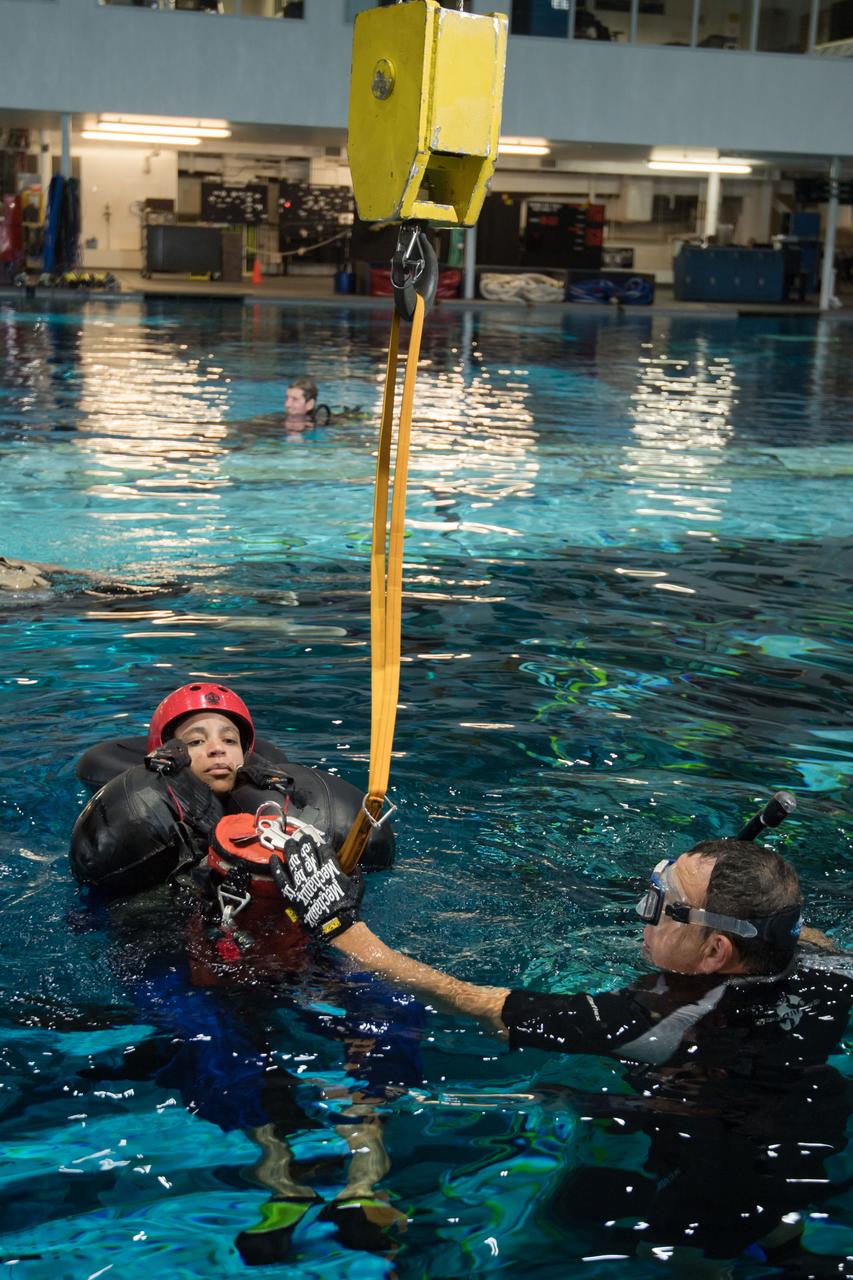
jsc2017e1117884 (08-23-2017) --- During water survival training in 2017 at NASA Johnson Space Center’s Neutral Buoyancy Laboratory in Houston, NASA astronaut candidate Jessica Watkins is guided through training by divers. Photo Credit: (NASA/David DeHoyos)
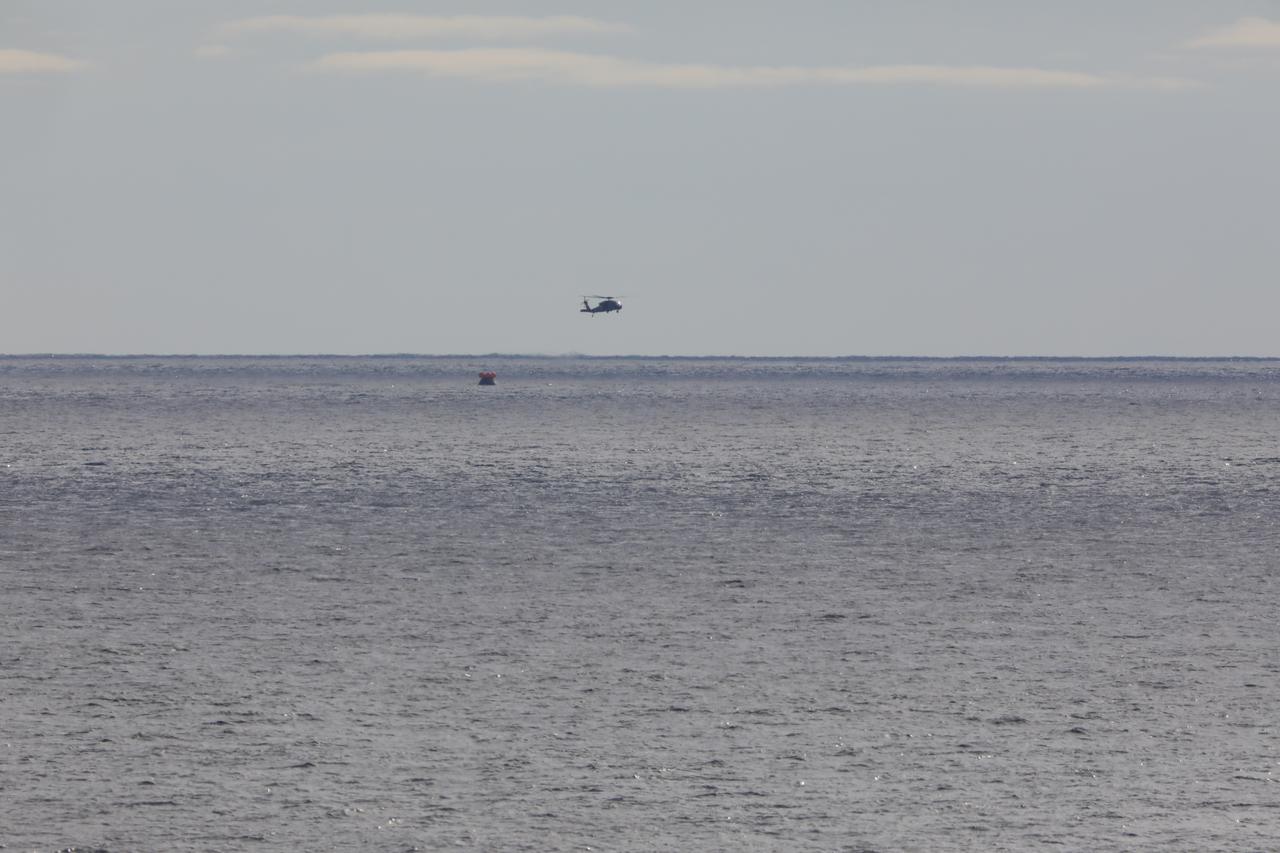
Helicopters and Navy divers surround NASA’s Orion spacecraft after it splashed down at 12:40 p.m. EST Dec. 11, 2022 in the Pacific Ocean after a 25.5 day mission to the Moon. Orion will be recovered by NASA’s Landing and Recovery team, U.S. Navy and Department of Defense partners aboard the USS Portland.
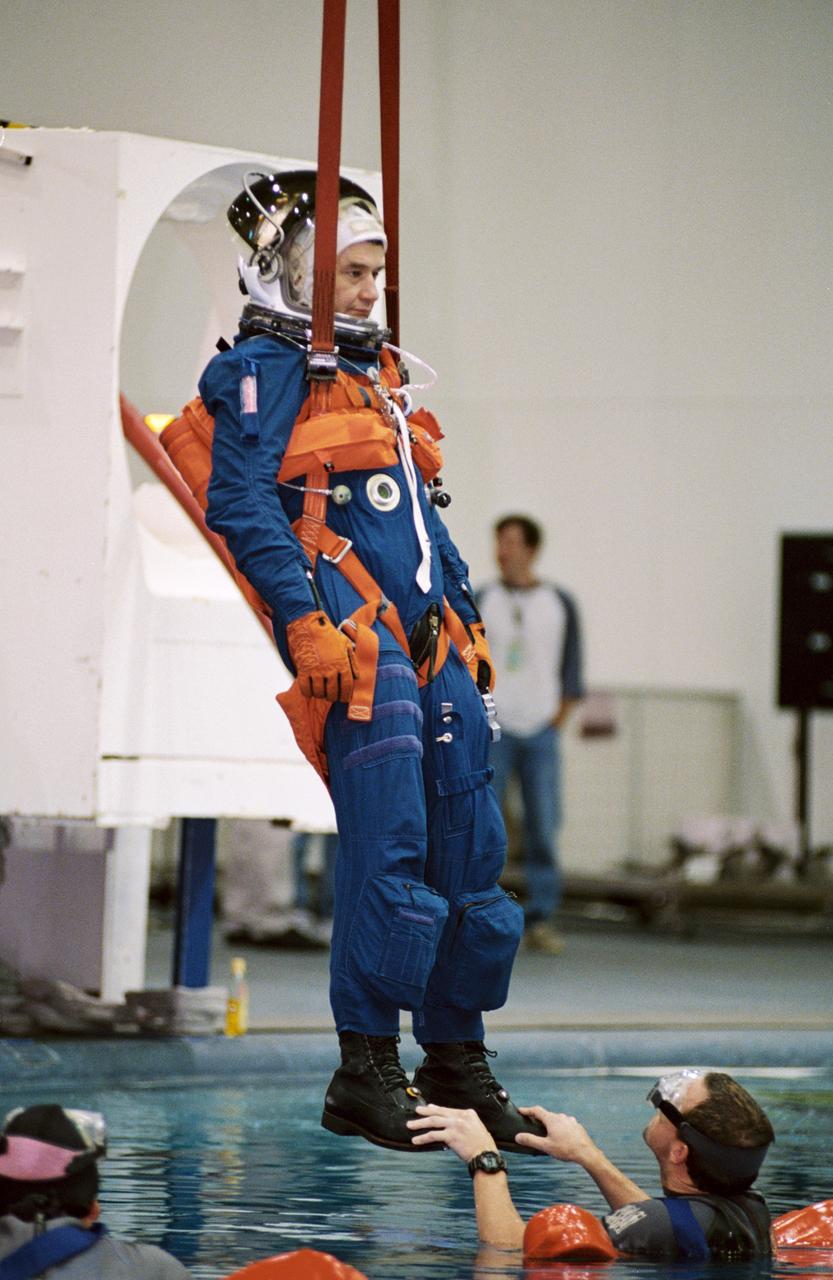
JSC2001-01922 (12 July 2001) --- Cosmonaut Valeri G. Korzun, Expedition Five mission commander, assisted by Johnson Engineering diver Gabriel Meyer, simulates a parachute drop into water during an emergency bailout training session in the Neutral Buoyancy Laboratory (NBL) near the Johnson Space Center (JSC). Korzun represents Rosaviakosmos.
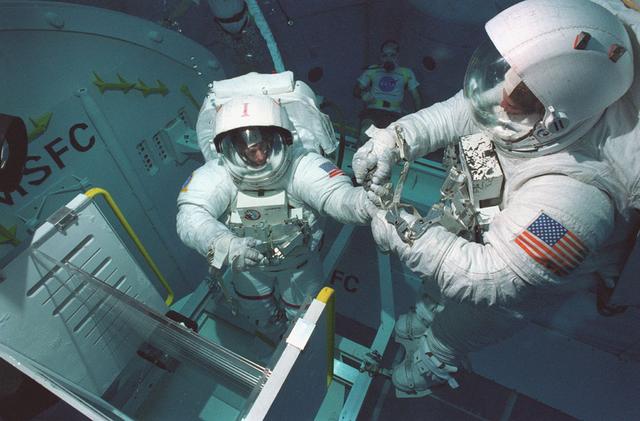
Marshall's Neutral Buoyancy Simulator (NBS) is used to simulate the gravitational fields and buoyancy effects outer space has on astronauts and their ability to perform tasks in this environment. In this example, a diver performs a temporary fluid line repair task using a repair kit developed by Marshall engineers. The analysis will determine the value of this repair kit and its feasibility.
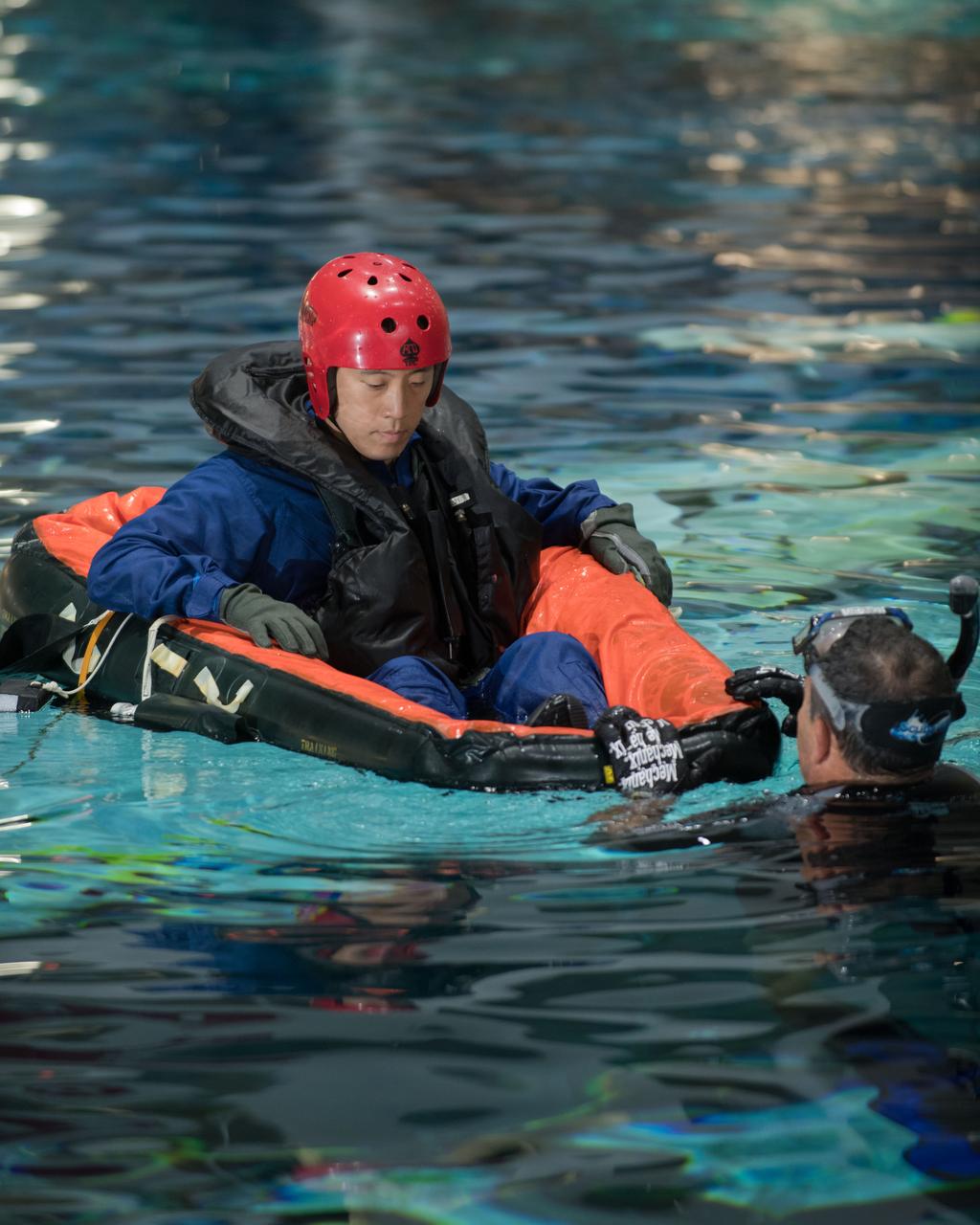
jsc2017e1117804 (08-23-2017) --- During water survival training in 2017 at NASA Johnson Space Center’s Neutral Buoyancy Laboratory in Houston, NASA astronaut candidate Jonny Kim (left) works alongside divers. Photo Credit: (NASA/David DeHoyos)
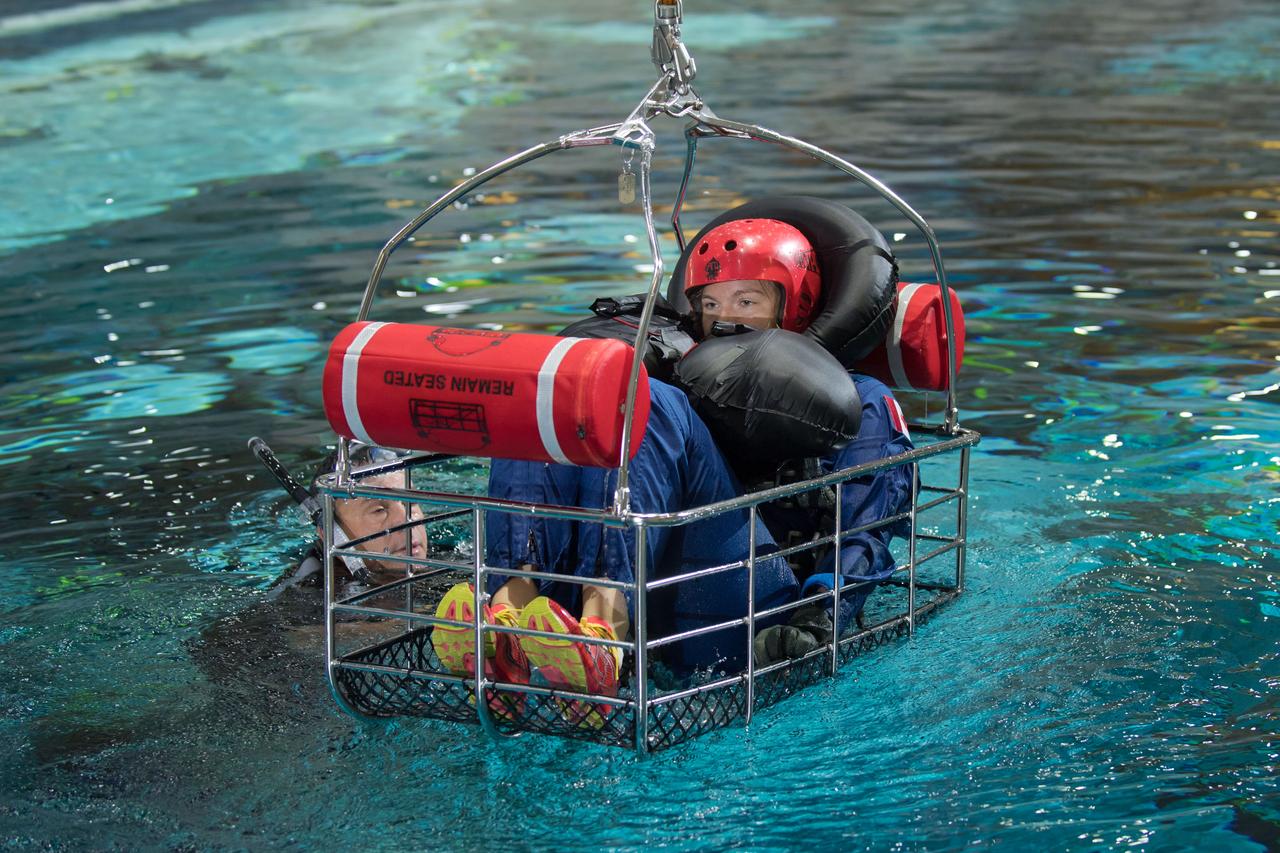
jsc2017e1117871 (08-23-2017) --- During water survival training in 2017 at NASA Johnson Space Center’s Neutral Buoyancy Laboratory in Houston, Canadian Space Agency astronaut candidate Jennifer Sidey-Gibbons is guided through training by divers. Photo Credit: (NASA/David DeHoyos)

jsc2017e114955 (09-06-17) --- During water survival training in 2017 at NASA Johnson Space Center’s Neutral Buoyancy Laboratory in Houston, NASA astronaut candidate Frank Rubio is guided through training by divers. Photo Credit: (NASA/James Blair)

jsc2017e114929 (09-06-17) --- During water survival training in 2017 at NASA Johnson Space Center’s Neutral Buoyancy Laboratory in Houston, NASA astronaut candidate Jasmin Moghbeli is guided through training by divers. Photo Credit: (NASA/James Blair)
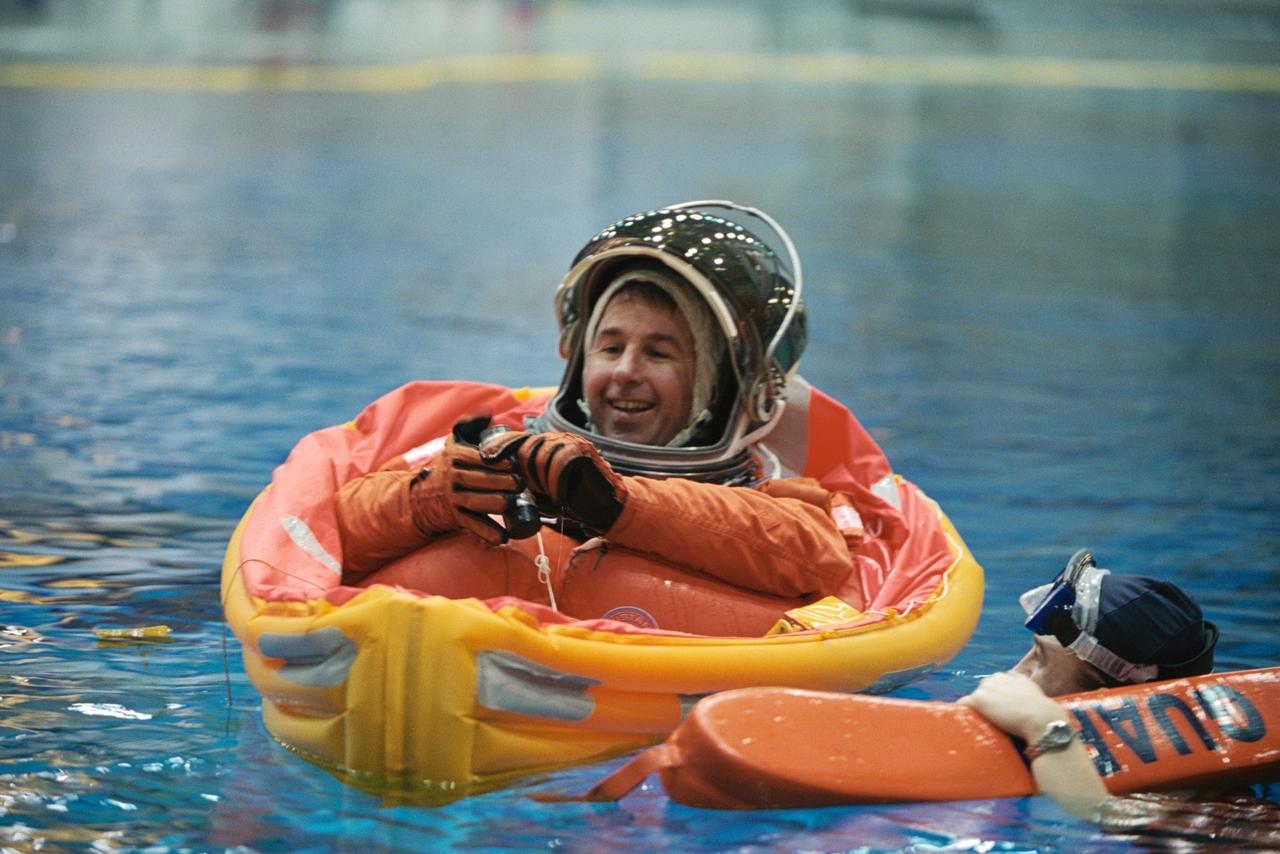
JSC2002-00818 (17 April 2002) --- Astronaut Stephen K. Robinson, STS-114 mission specialist, assisted by divers, floats in a small life raft during an emergency egress training session in the Neutral Buoyancy Laboratory (NBL) near the Johnson Space Center (JSC).
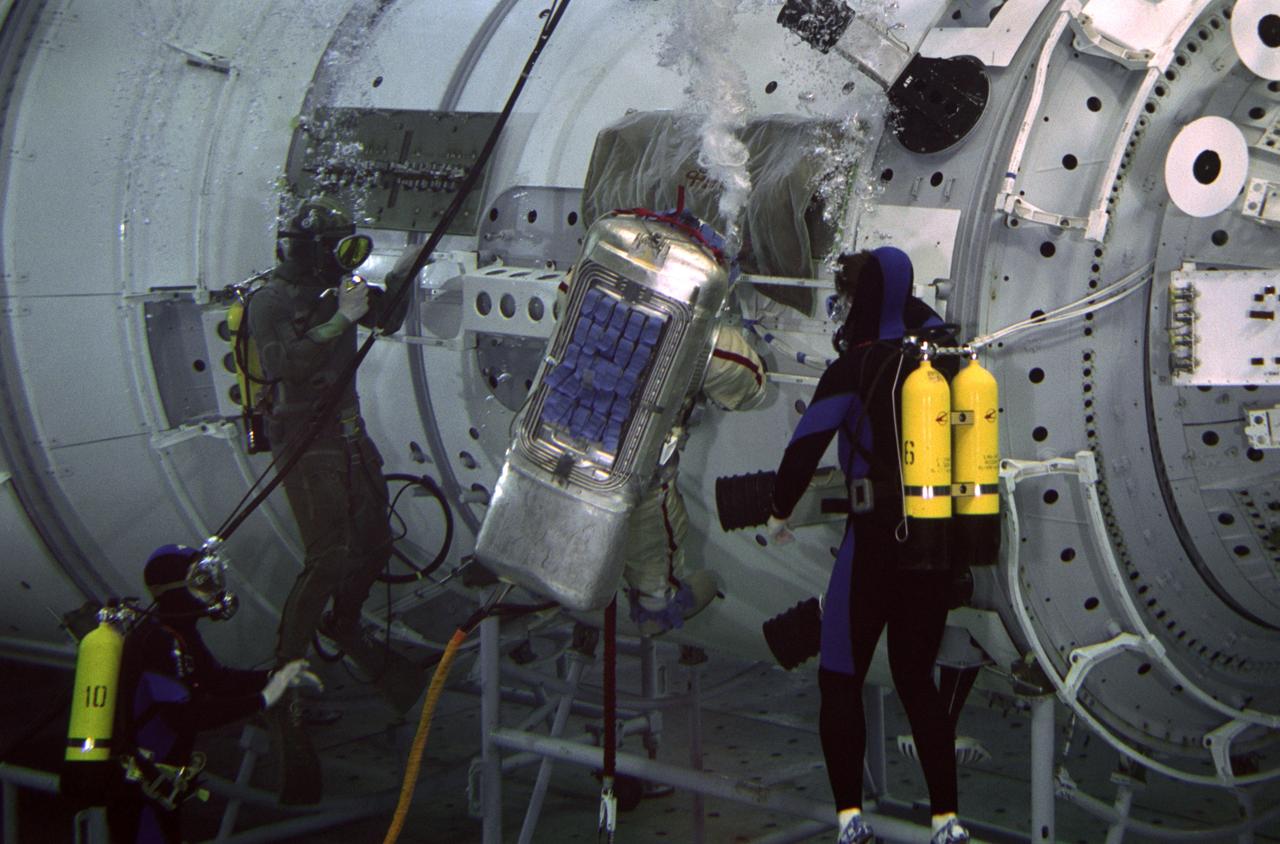
JSC2000-05367 (7 June 2000) --- Astronaut William Shepherd, ISS Expedition One commander, rehearses an extravehicular activity (EVA) with a full scale training model of the Zvezda Service Module in the Hydrolab facility at the Gagarin Cosmonaut Training Center in Russia. SCUBA-equipped divers assist in the spacewalk rehearsal.
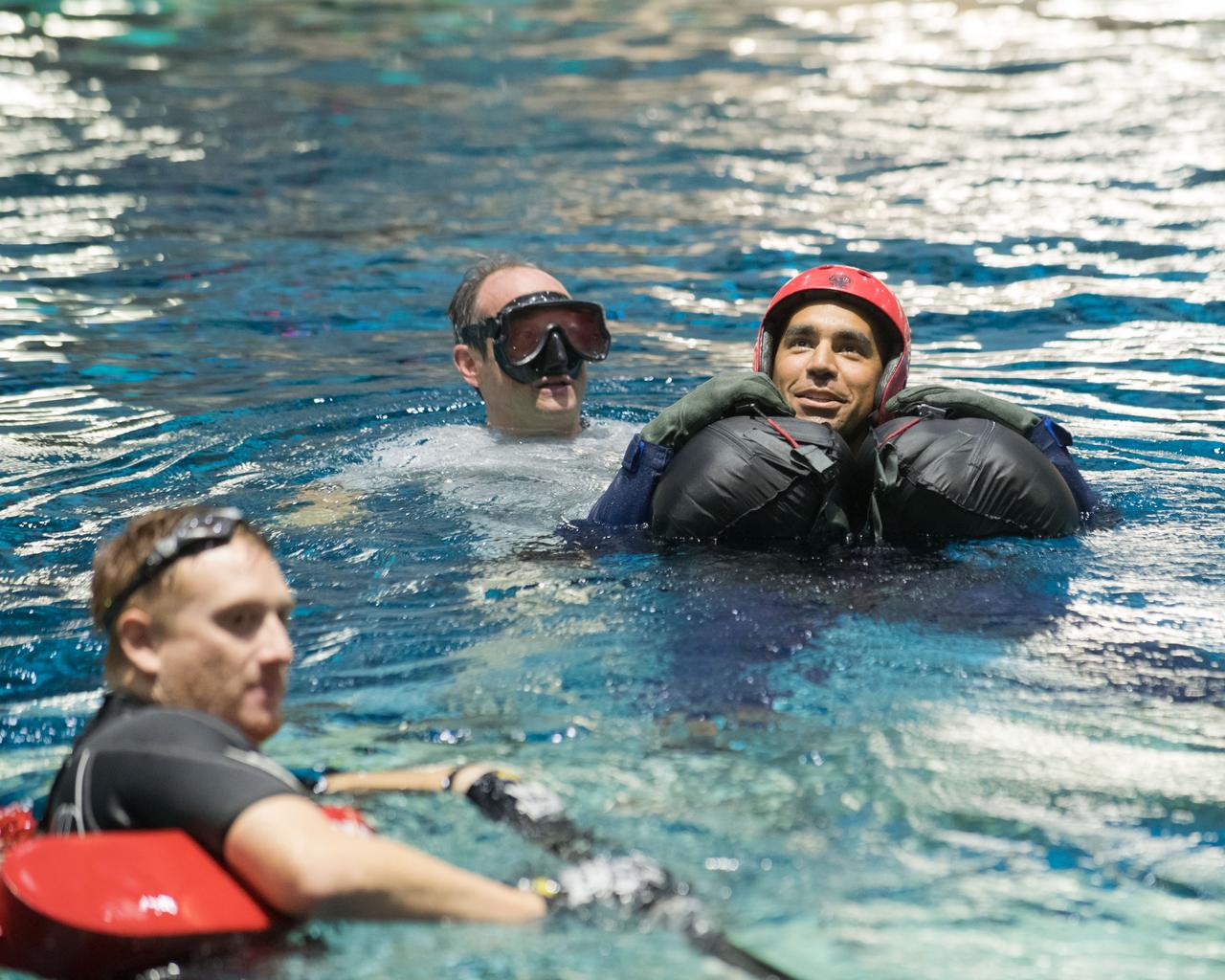
jsc2017e114927 (09-06-17) --- During water survival training in 2017 at NASA Johnson Space Center’s Neutral Buoyancy Laboratory in Houston, NASA astronaut candidate Raja Chari is guided through training by divers. Photo Credit: (NASA/James Blair)
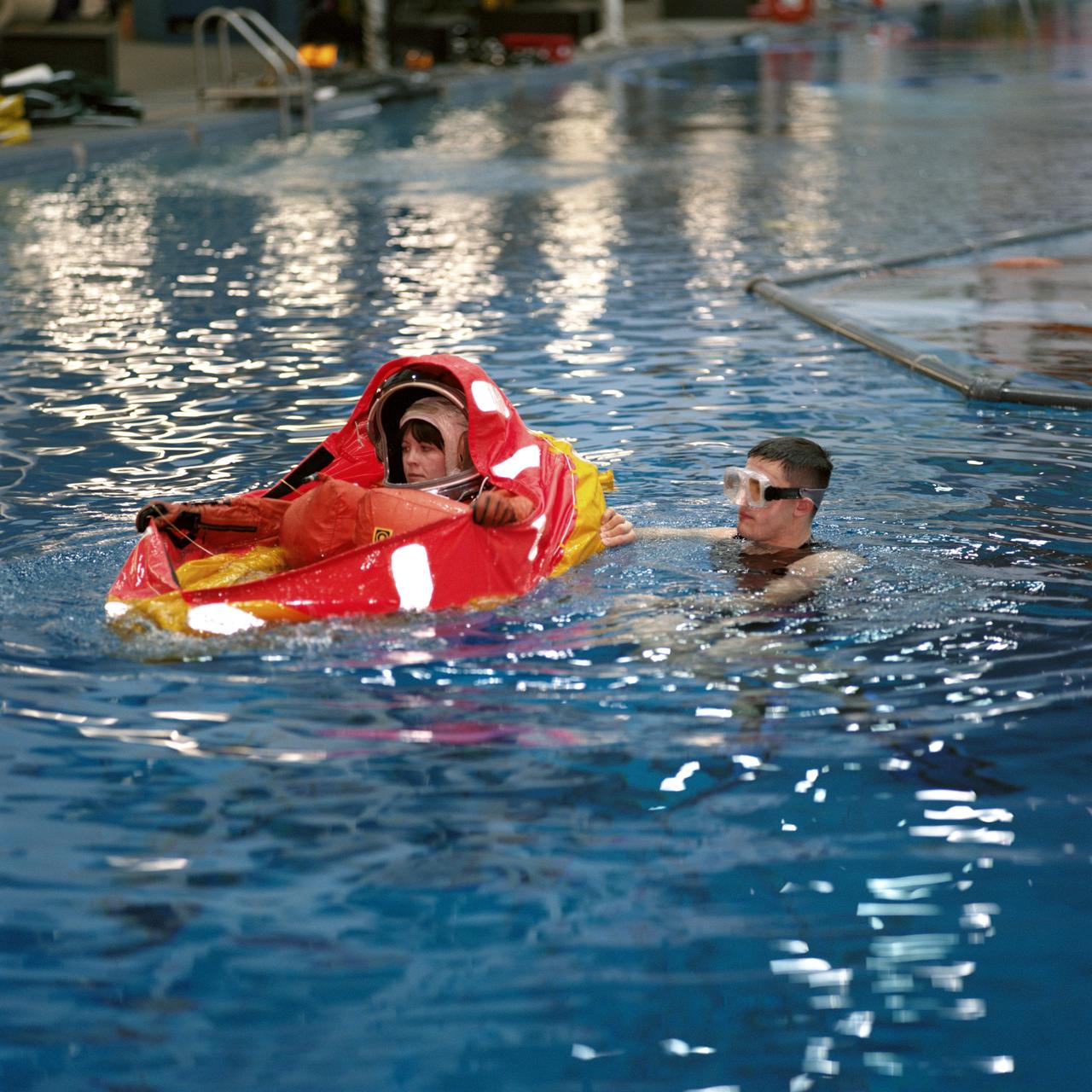
JSC2001-00021 (January 2001) --- Astronaut Janet L. Kavandi, STS-104 mission specialist, is assisted by a diver during an emergency bailout training session in the Neutral Buoyancy Laboratory (NBL) near Johnson Space Center (JSC). Kavandi will join four other astronauts for a June mission with the International Space Station (ISS).
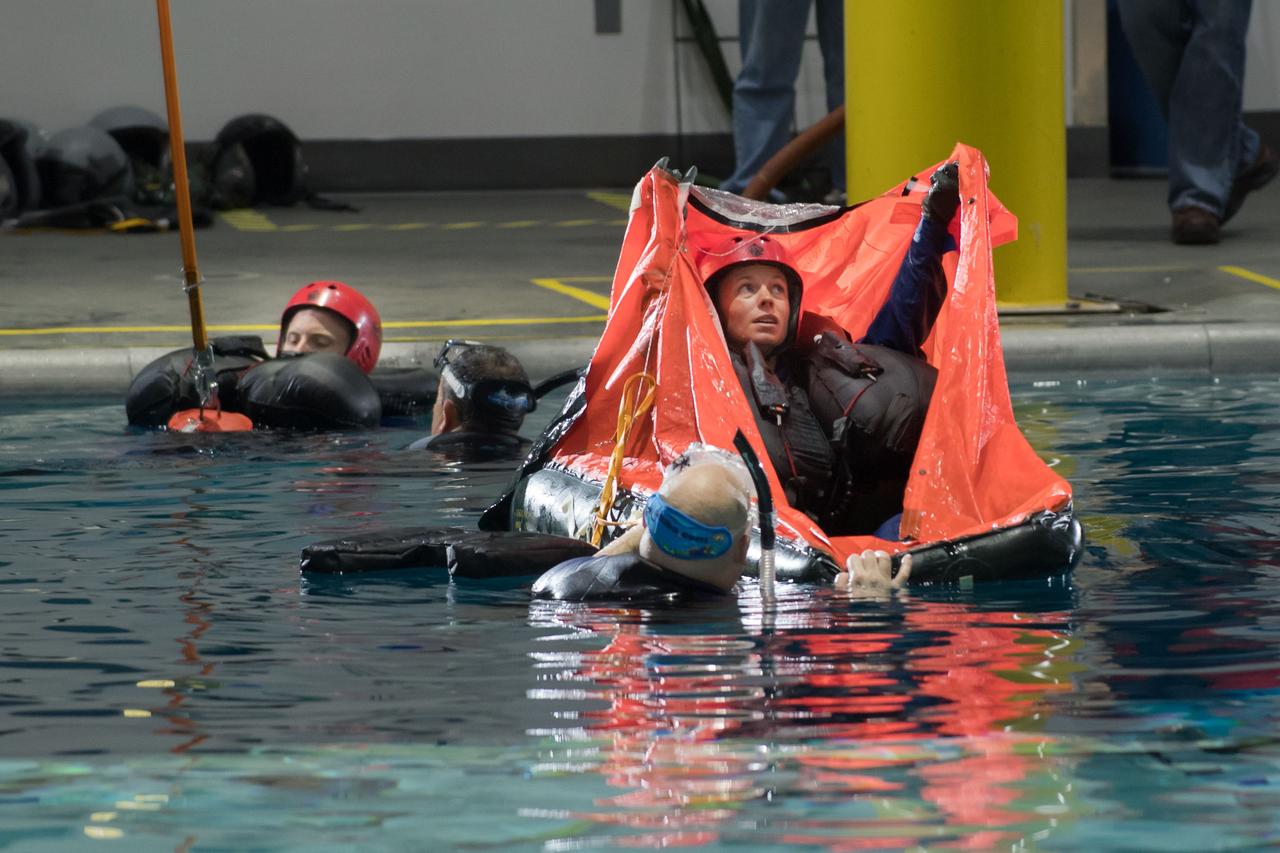
jsc2017e1117836 (08-23-2017) --- During water survival training in 2017 at NASA Johnson Space Center’s Neutral Buoyancy Laboratory in Houston, NASA astronaut candidate Zena Cardman (foreground) and Warren Hoburg (background) work alongside divers. Photo Credit: (NASA/David DeHoyos)
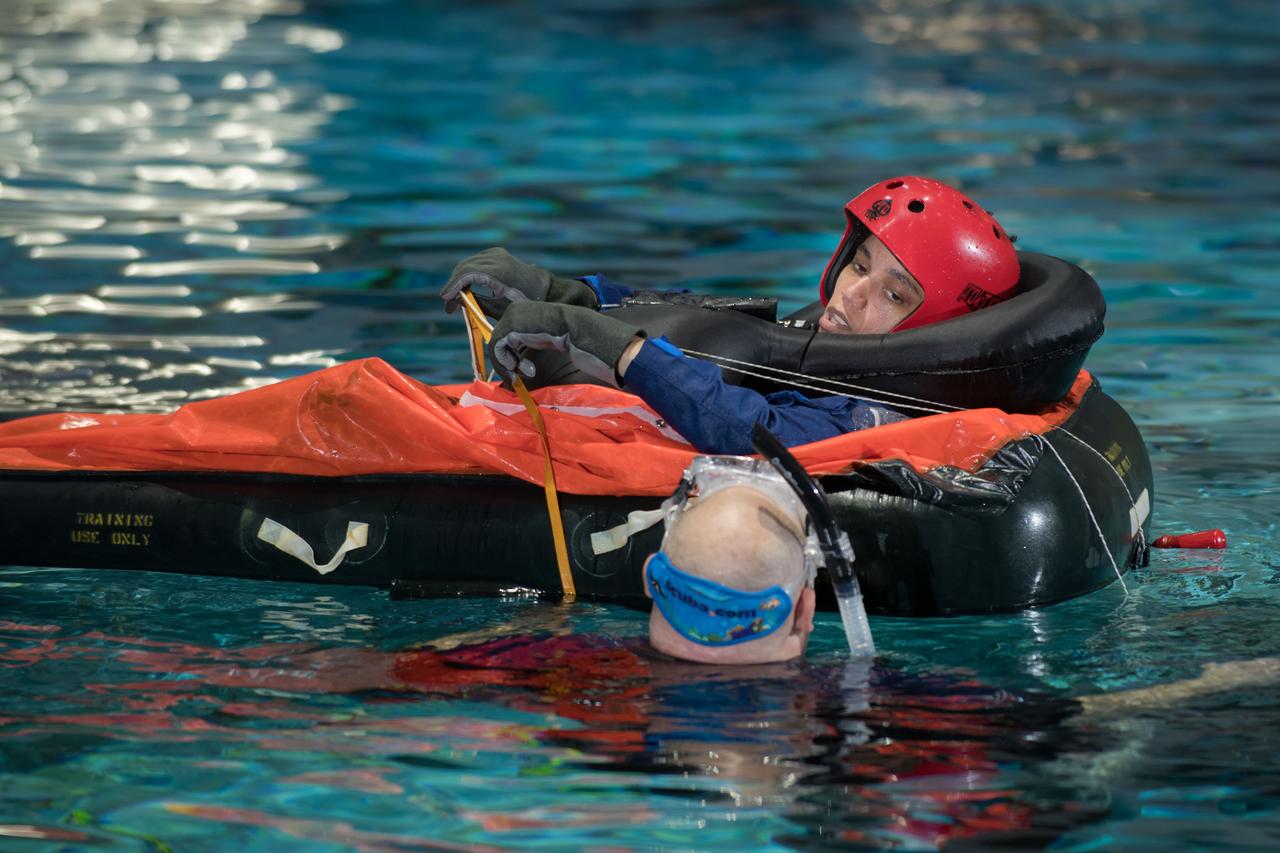
jsc2017e1117879 (08-23-2017) --- During water survival training in 2017 at NASA Johnson Space Center’s Neutral Buoyancy Laboratory in Houston, NASA astronaut candidate Jessica Watkins works alongside divers. Photo Credit: (NASA/David DeHoyos)
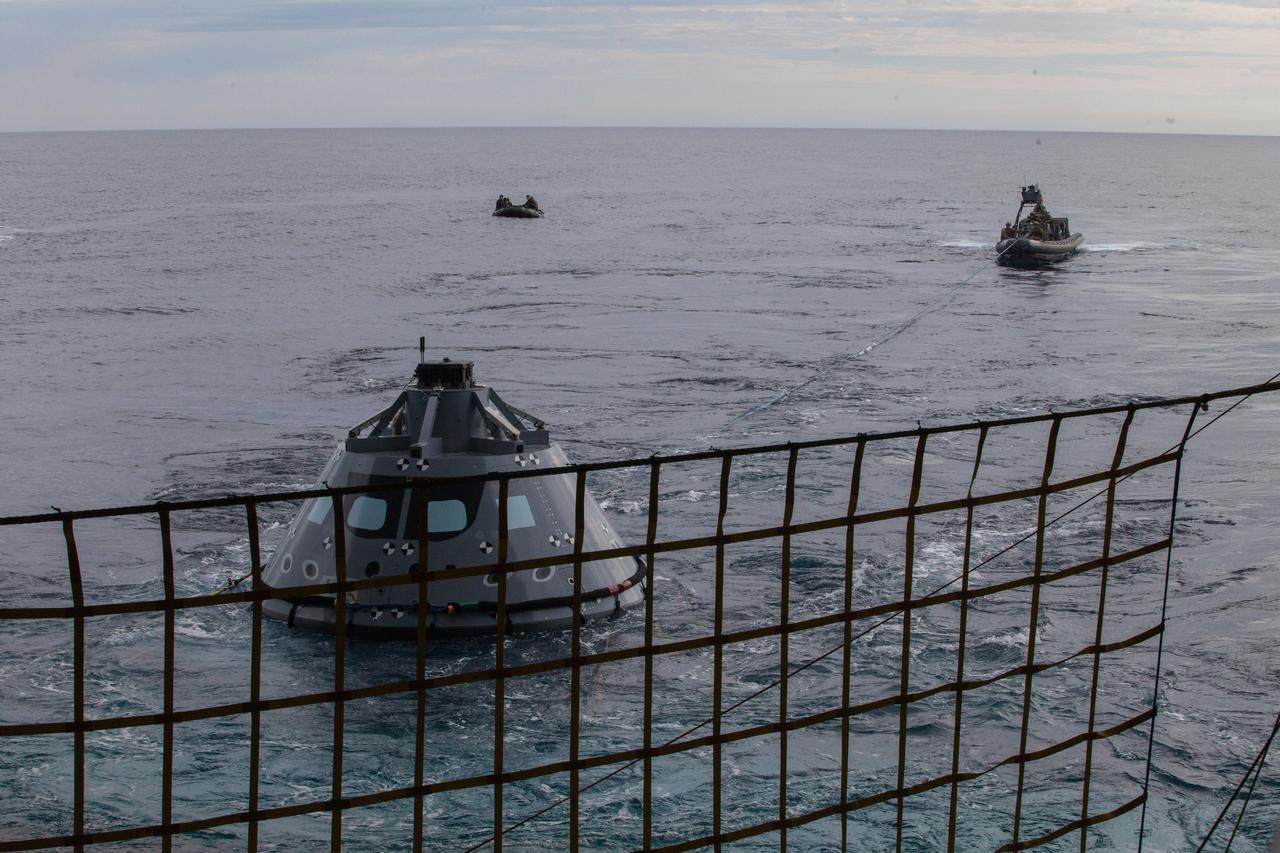
U.S. Navy divers and other personnel in a rigid hull inflatable boat are handling tether lines attached to a test version of the Orion crew module during Underway Recovery Test 5 in the Pacific Ocean off the coast of California. U.S. Navy divers in a smaller watercraft called a Zodiac boat are farther away. NASA's Ground Systems Development and Operations Program and the U.S. Navy are conducting a series of tests using the well deck of the USS San Diego, several watercraft and personnel to prepare for recovery of Orion on its return from deep space missions. The testing will allow the team to demonstrate and evaluate recovery processes, procedures, hardware and personnel in open waters. Part of Batch images transfer from Flickr.
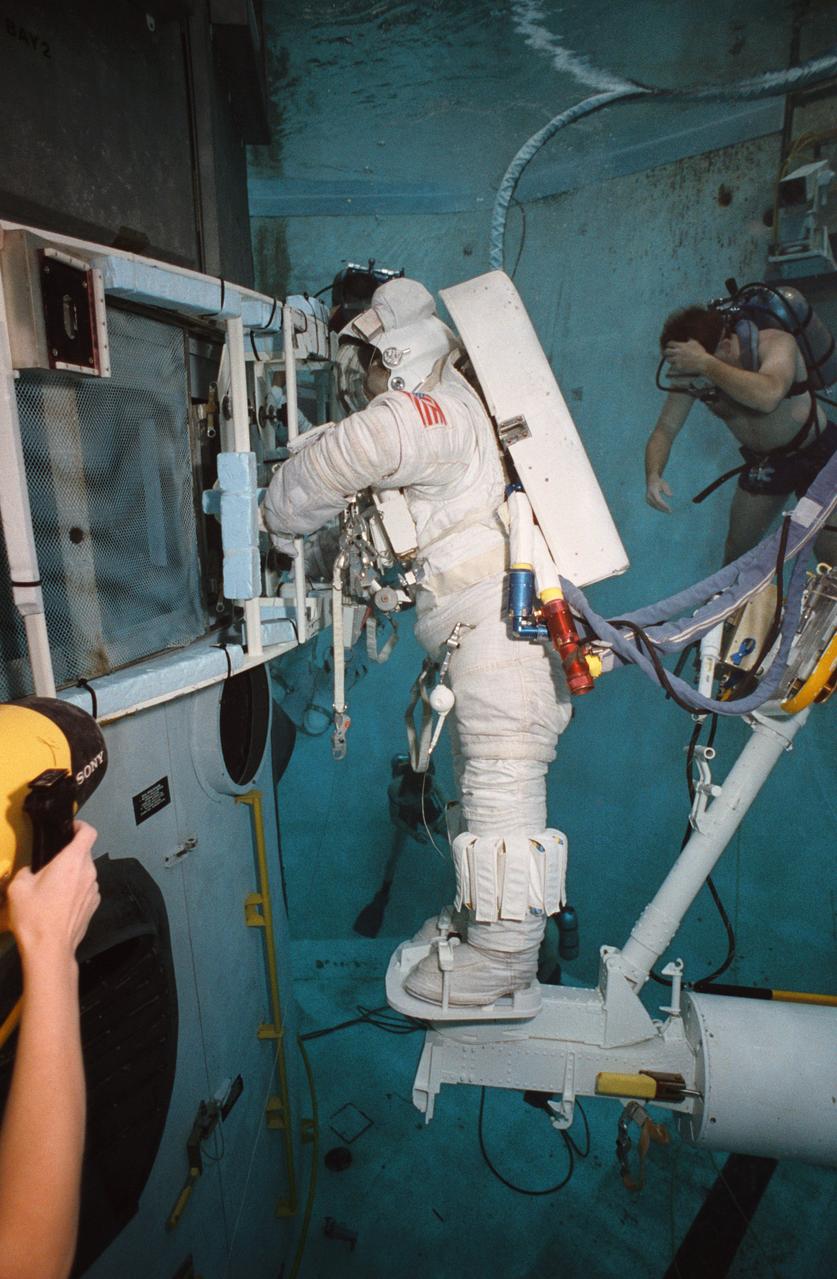
S93-33101 (5 Apr 1993) --- Wearing a training version of Space Shuttle Extravehicular Mobility Unit (EMU), astronaut Kathryn C. Thornton uses the giant pool of the Johnson Space Center's (JSC) Weightless Environment Training Facility (WET-F) to rehearse for the Hubble Space Telescope (HST) repair mission. Standing on a mobile foot restraint connected to the Shuttle's robot arm, Thornton grasps a large structure which attaches to the Wide Field/Planetary Camera (WF/PC). The current WF/PC on the HST will be replaced with WF/PC-2. Out of frame is astronaut Thomas D. Akers, who will join Thornton in STS-61 EVA. A SCUBA-equipped diver can be seen in the background. A number of divers are on hand for all training sessions in the WET-F. A total of five extravehicular activity (EVA) sessions will be conducted during the scheduled December mission of the Endeavour.
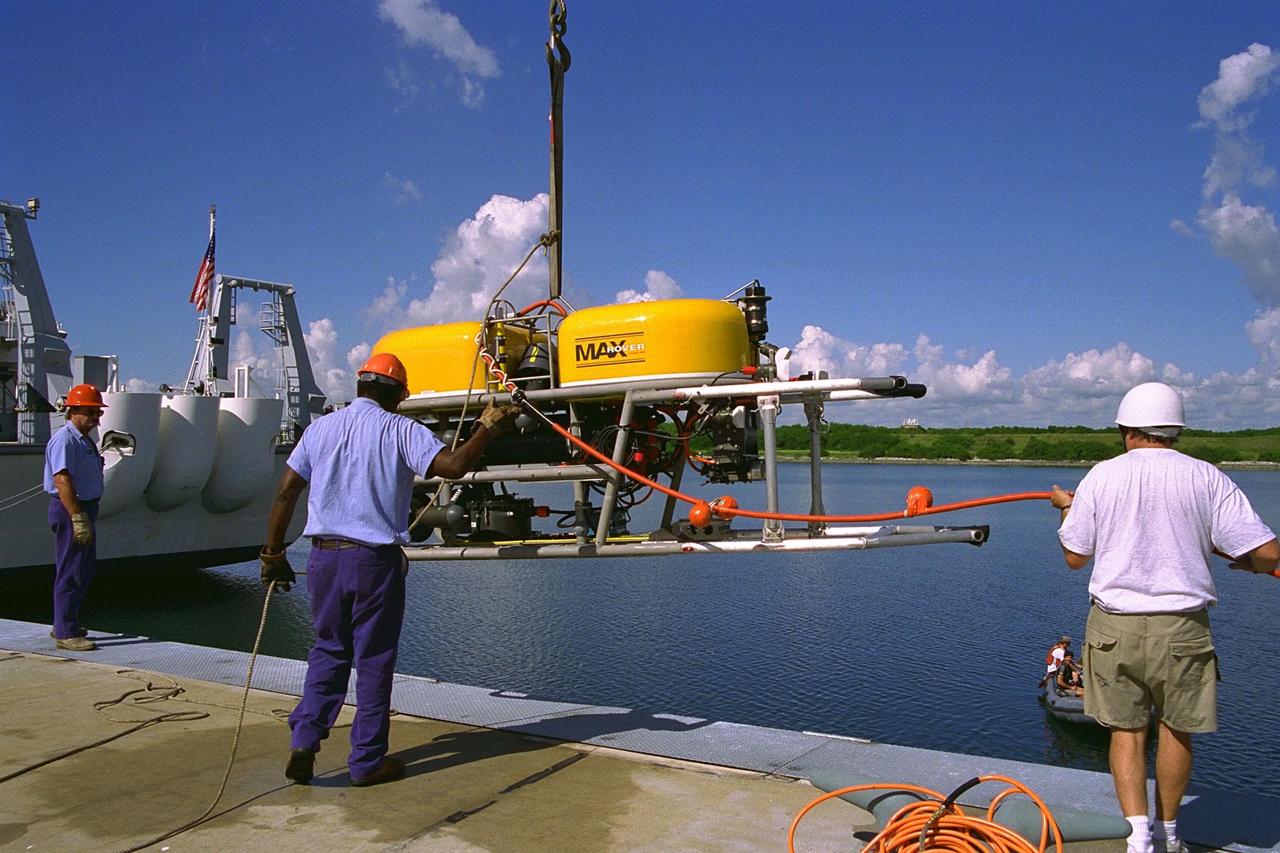
KENNEDY SPACE CENTER, FLA. -- Technicians lower the unmanned robotic submersible recovery system, known as Max Rover, into the water at the Trident Pier at Port Canaveral during a test of the system. Kennedy Space Center's solid rocket booster (SRB) retrieval team and Advanced Systems Development laboratory staff hope that the new robotic technology will make the process of inserting the Diver Operated Plug (DOP) into the aft nozzle of a spent SRB safer and less strenuous. Currently, scuba divers manually insert the DOP into the aft nozzle of a jettisoned SRB 60 to 70 feet below the surface of the Atlantic Ocean. After the plug is installed, water is pumped out of the booster allowing it to float horizontally. It is then towed back to Hangar AF at Cape Canaveral Air Station. Deep Sea Systems of Falmouth, Mass., built the submersible for NASA
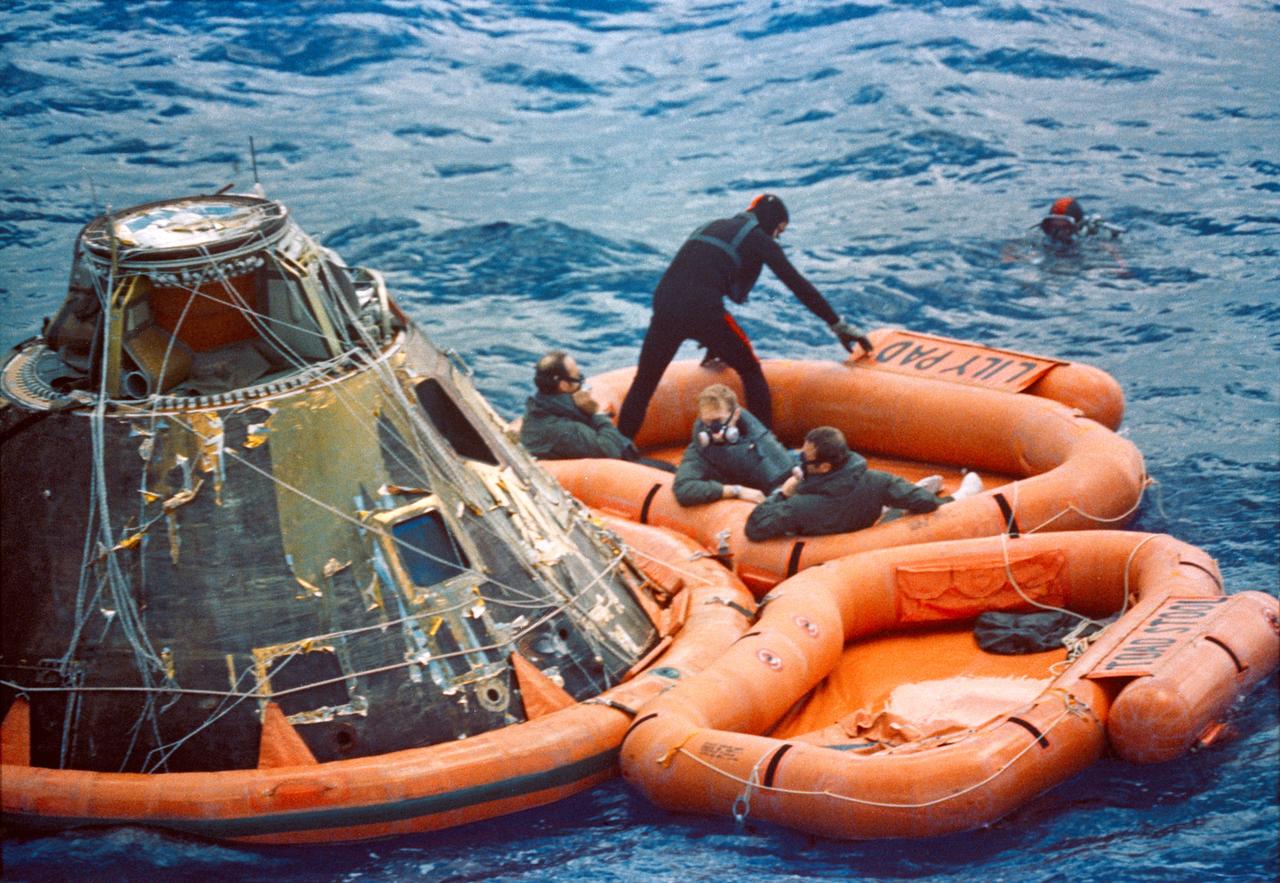
S71-19475 (9 Feb. 1971) --- The Apollo 14 crewmembers sit in a life raft beside their Command Module (CM) in the South Pacific Ocean as they await a U.S. Navy helicopter, which will take them aboard the USS New Orleans, prime recovery ship. The crew men are, from left to right, astronauts Alan B. Shepard Jr., commander; Stuart A. Roosa, command module pilot; and Edgar D. Mitchell, lunar module pilot. Two U.S. Navy underwater demolition team swimmers (one partially visible in right upper corner) assist in the recovery operations. The Apollo 14 spacecraft splashed down at 3:04:39 p.m. (CST), Feb. 9, 1971, approximately 765 nautical miles from American Samoa in the South Pacific Ocean.
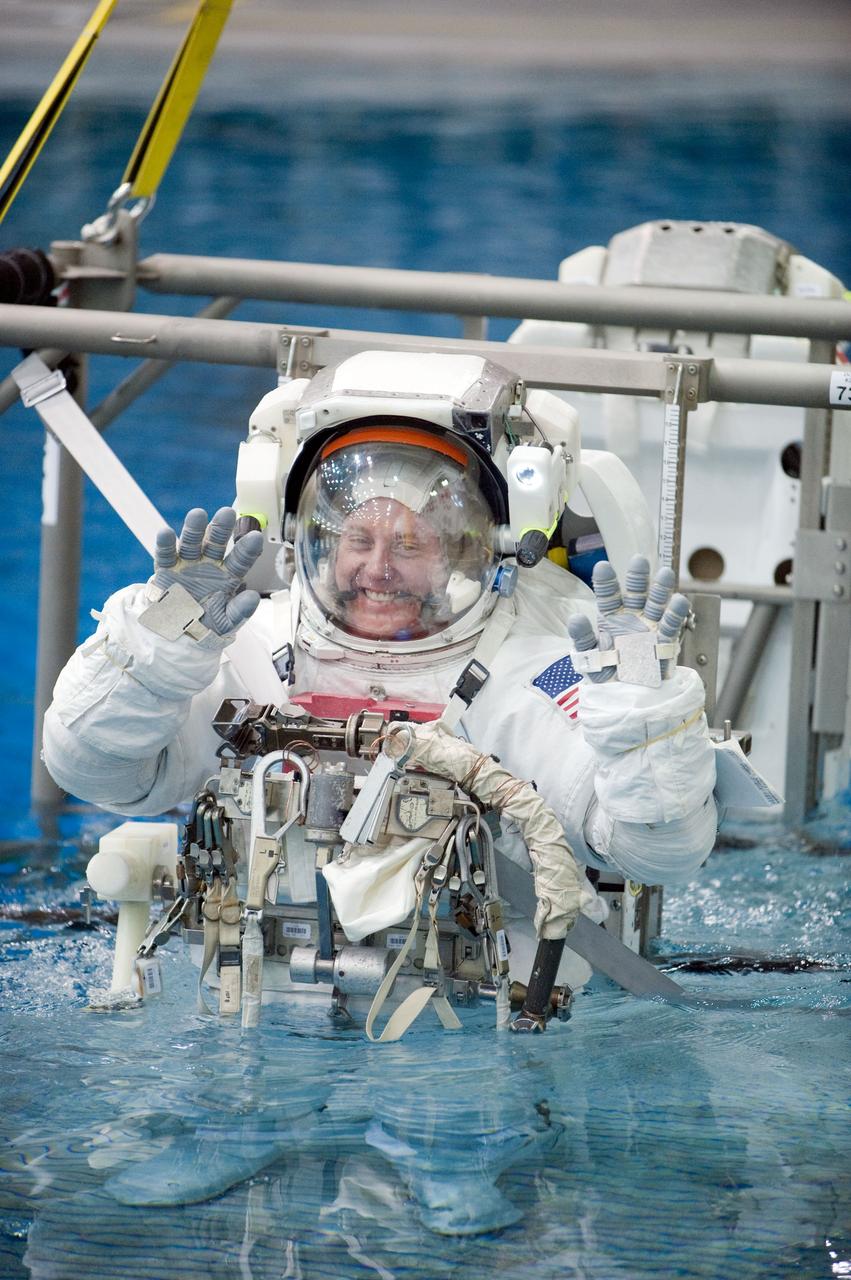
JSC2011-E-029127 (25 March 2011) --- NASA astronauts Michael Fincke and Greg Chamitoff (partially obscured), both STS-134 mission specialists, attired in training versions of their Extravehicular Mobility Unit (EMU) spacesuits, are submerged in the waters of the Neutral Buoyancy Laboratory (NBL) near NASA's Johnson Space Center. Divers (out of frame) are in the water to assist Fincke and Chamitoff in their rehearsal, which is intended to help prepare them for work on the exterior of the International Space Station. Photo credit: NASA or National Aeronautics and Space Administration
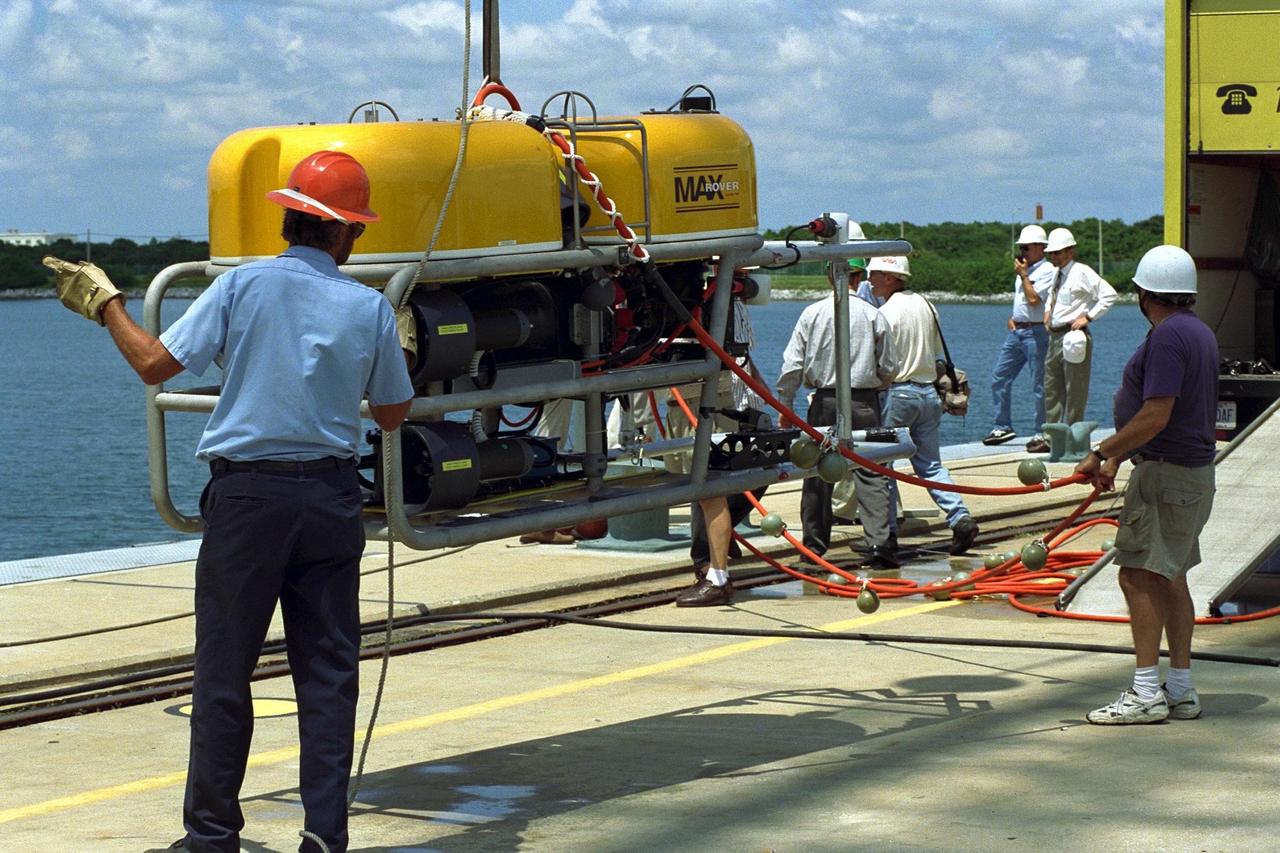
KENNEDY SPACE CENTER, FLA. -- Kennedy Space Center's Advanced Systems Development organization conducts a test of an unmanned robotic submersible to evaluate its ability to assist divers in the task of recovering spent solid rocket boosters (SRBs) in the Atlantic Ocean. NASA and contractor Deep Sea Systems of Falmouth, Mass., demonstrated the Max Rover submersible at Port Canaveral's Trident pier. The fact-finding tests are part of NASA's effort to make SRB recovery operations safer and less strenuous
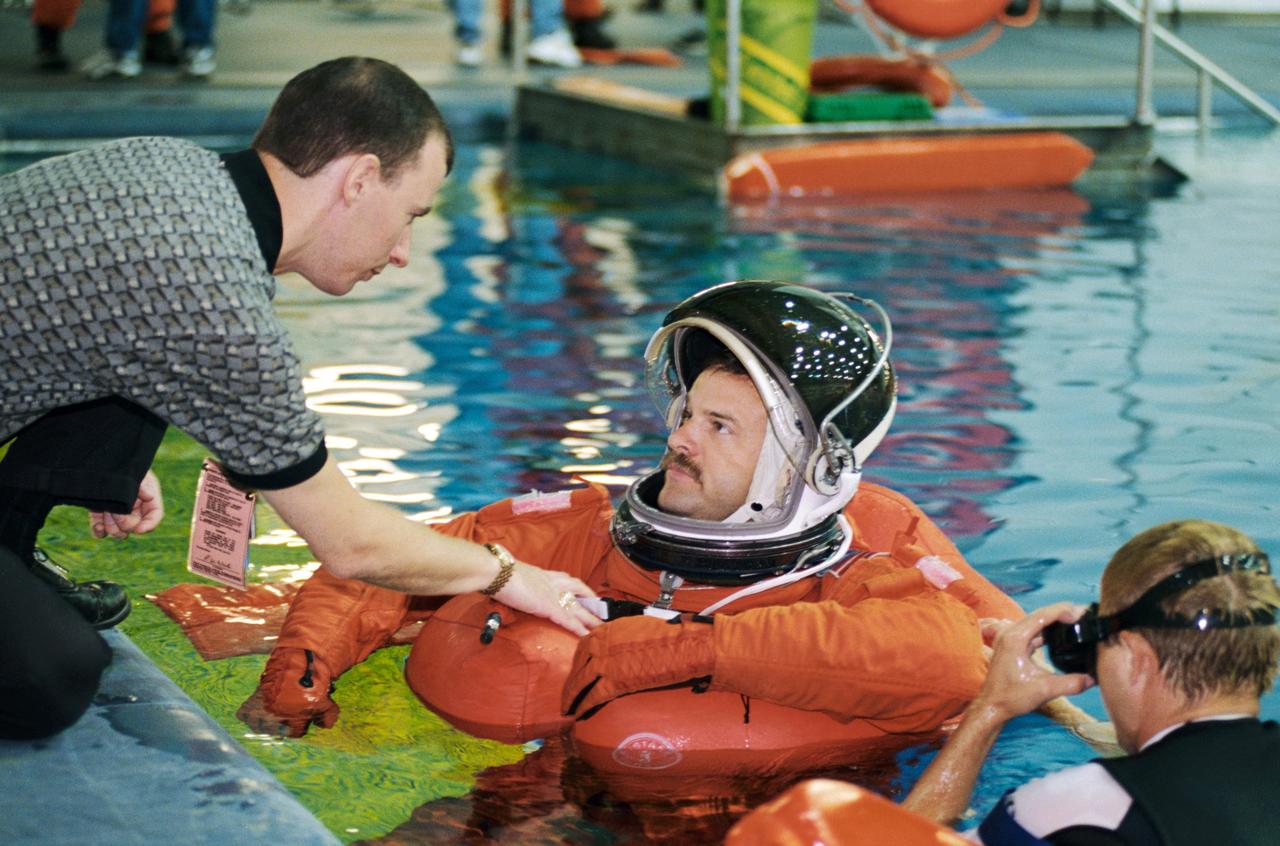
JSC2001-01921 (12 July 2001) --- Astronaut Scott D. Altman, STS-109 mission commander, is assisted by United Space Alliance (USA) crew trainer David Pogue and a diver during an emergency bailout training session in the Neutral Buoyancy Laboratory (NBL) near the Johnson Space Center (JSC). STS-109 will be the 108th shuttle flight and the fourth Hubble Space Telescope (HST) servicing mission.
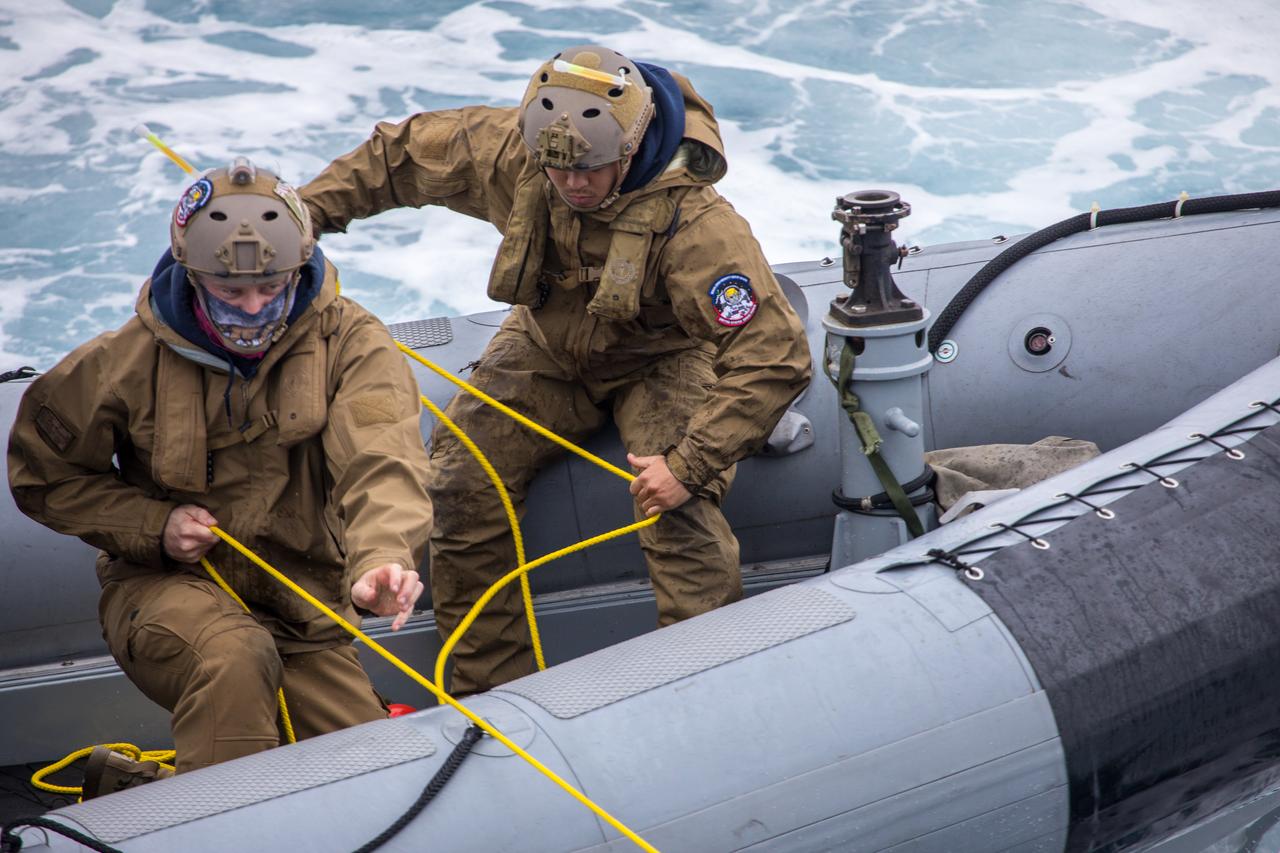
During the first full mission profile test of the recovery procedures for Artemis I, NASA’s Landing and Recovery team met their objectives. The team works with members of the DoD to hone their procedures before Orion splashes down in the Pacific as part of NASA’s Artemis program. During Underway Recovery Test-8, two divers from EOD Mobile Unit 3, MDS Company 3-1work the tending line while a test version of Orion is being pulled into the well deck of the USS John P. Murtha.
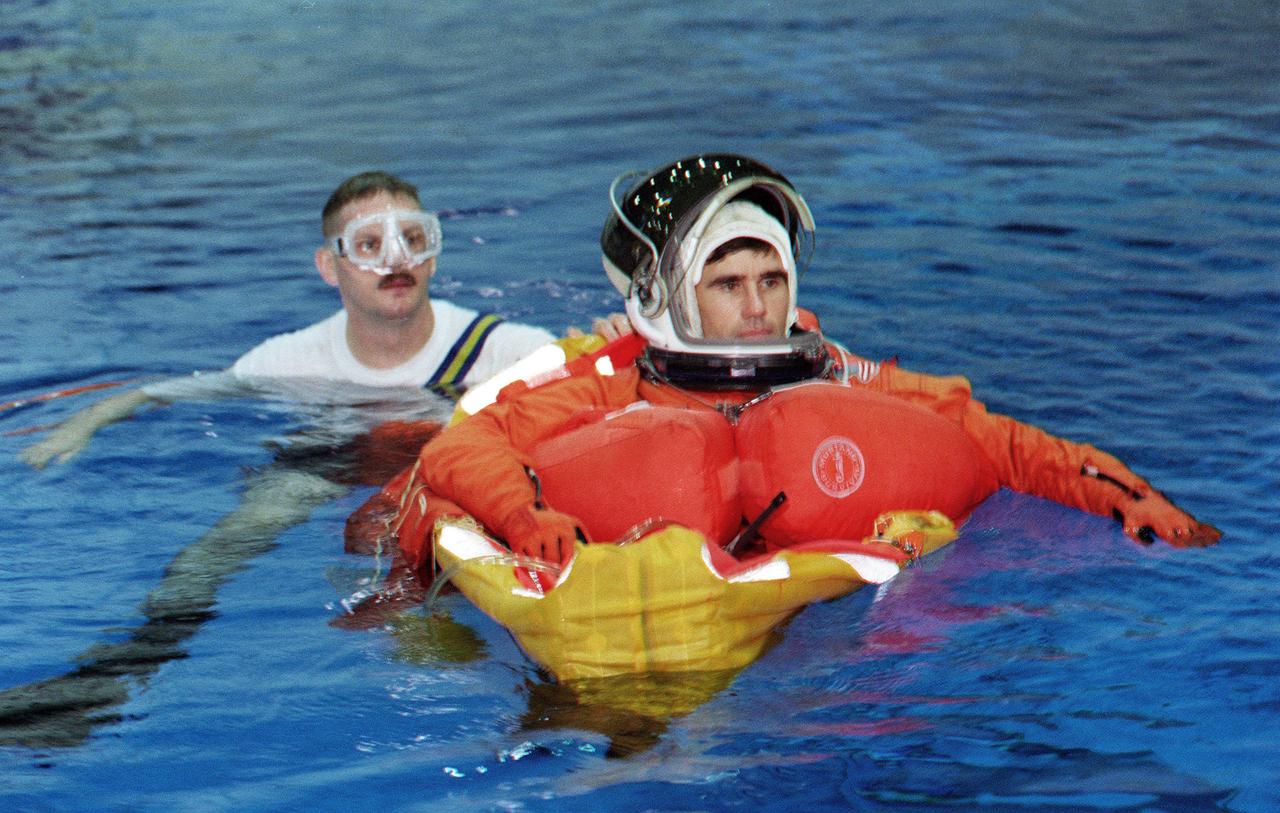
S99-09098 (6 August 1999) --- Cosmonaut Yuri I. Malenchenko, mission specialist representing the Russian Space Agency (RSA), floats in a small life raft following a simulated parachute drop. A diver remains nearby to assist in the training activity. The exercise was part of an emergency bailout training session at the Neutral Buoyancy Laboratory (NBL). Malenchenko will join five astronauts and a second cosmonaut for one of the scheduled missions next year with the International Space Station (ISS).
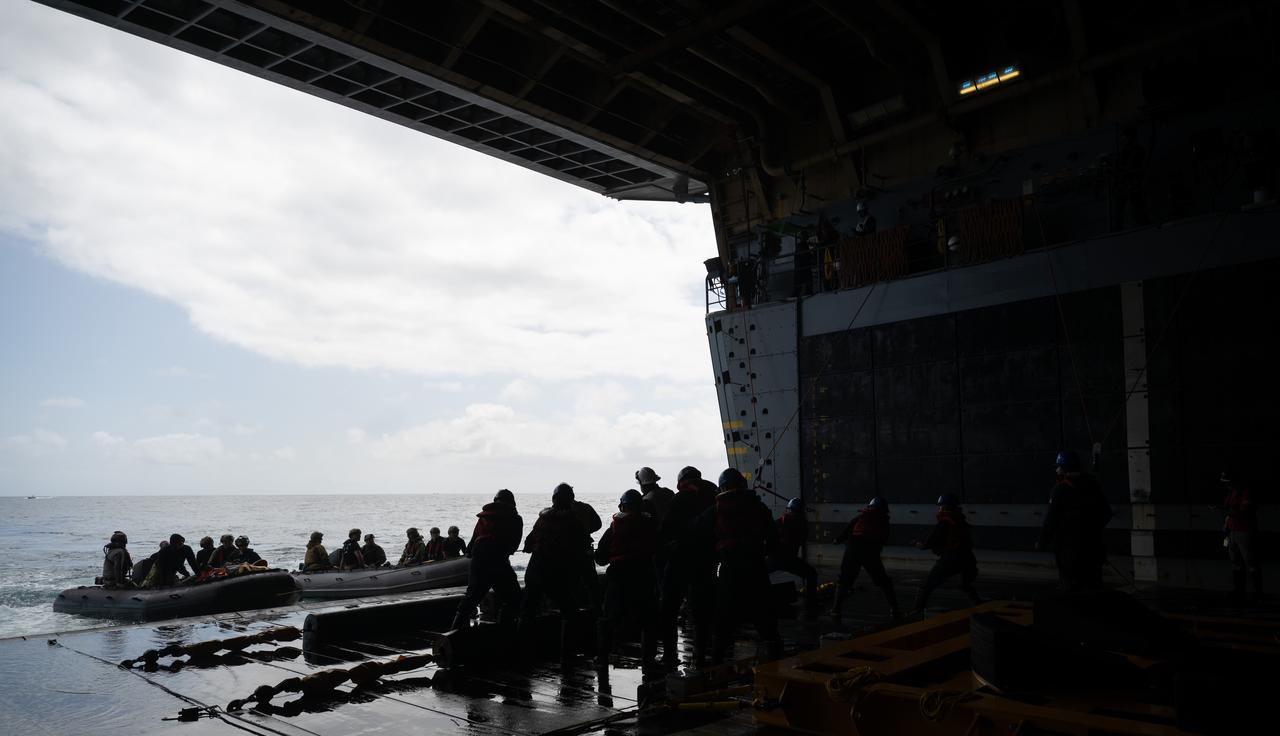
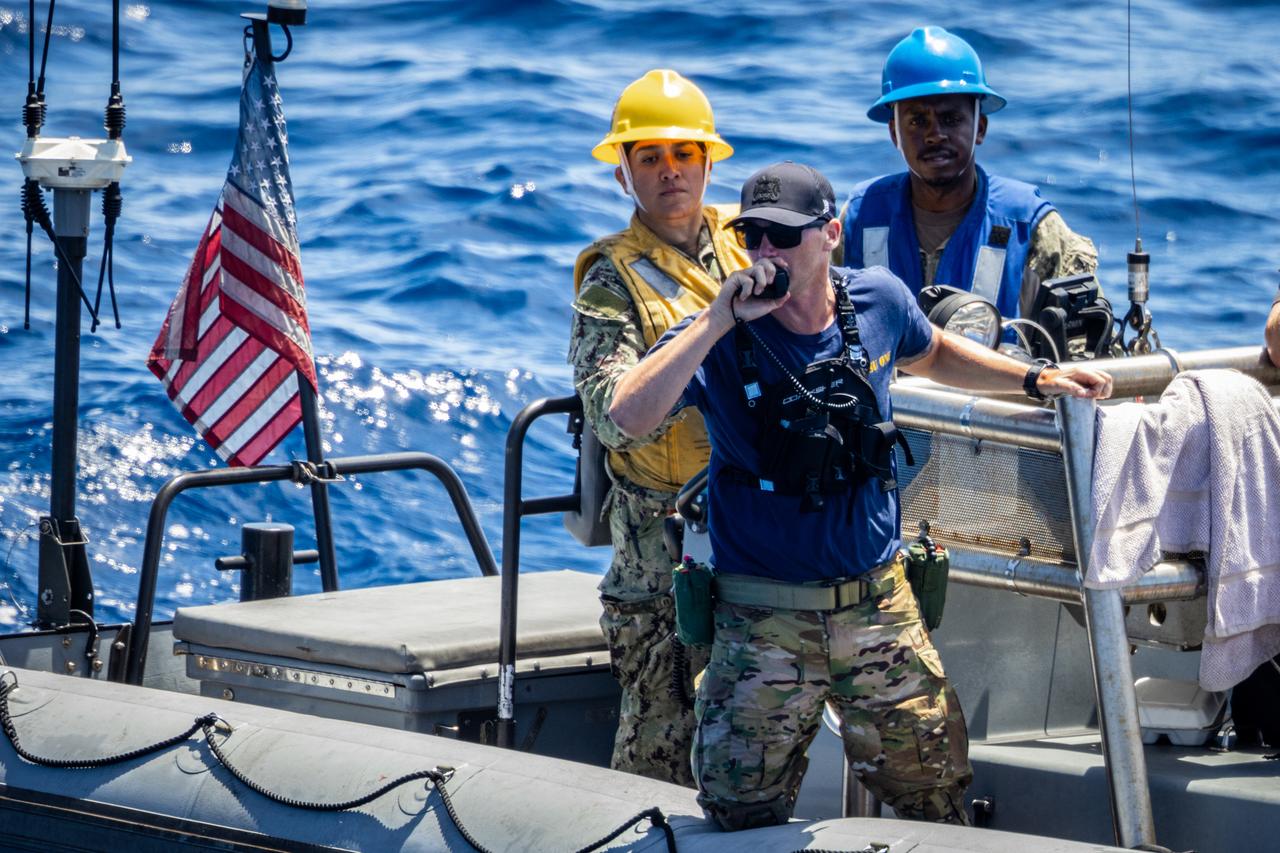
Navy Divers of Explosive Ordnance Disposal Expeditionary Support Unit (EODESU) 1 prepare to take part in practicing Artemis recovery operations during Underway Recovery Test-12 onboard USS Somerset off the coast of California, Friday, March 28, 2025. During the test, NASA and Department of Defense teams are practicing to ensure recovery procedures are validated as NASA plans to send the Artemis II astronauts around the Moon and splashdown in the Pacific Ocean. Photo Credit: (NASA/Joel Kowsky)