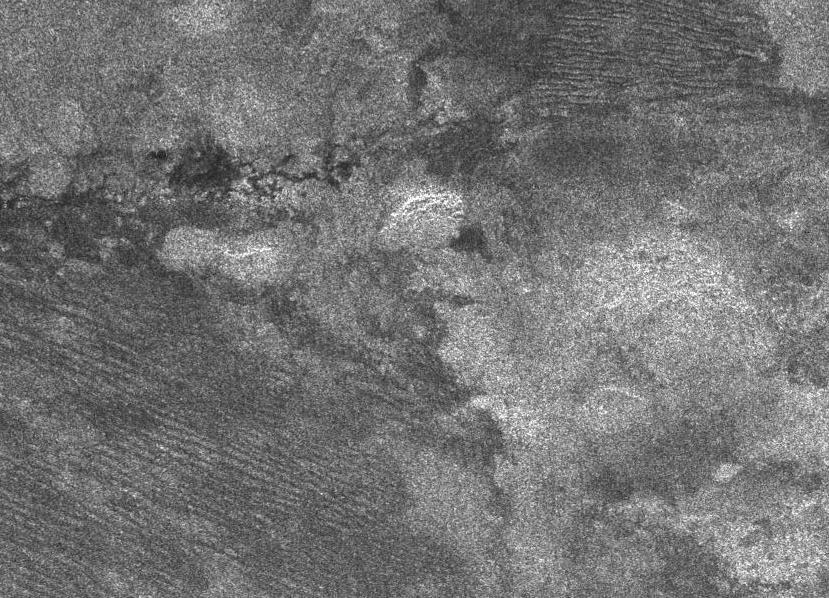
Diverse Geology

A Diverse Family

Diversity of Impacts
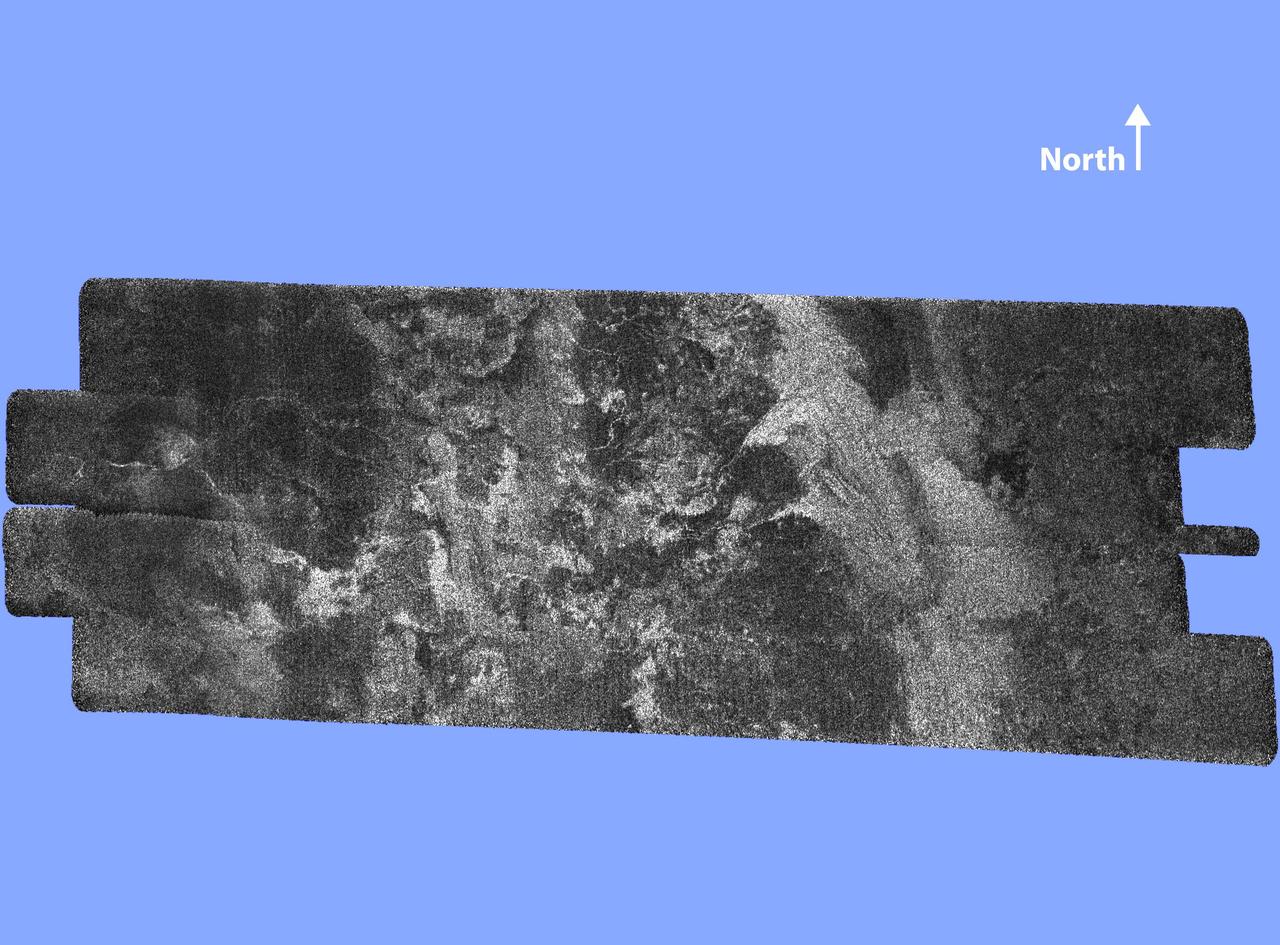
Diversity on Titan
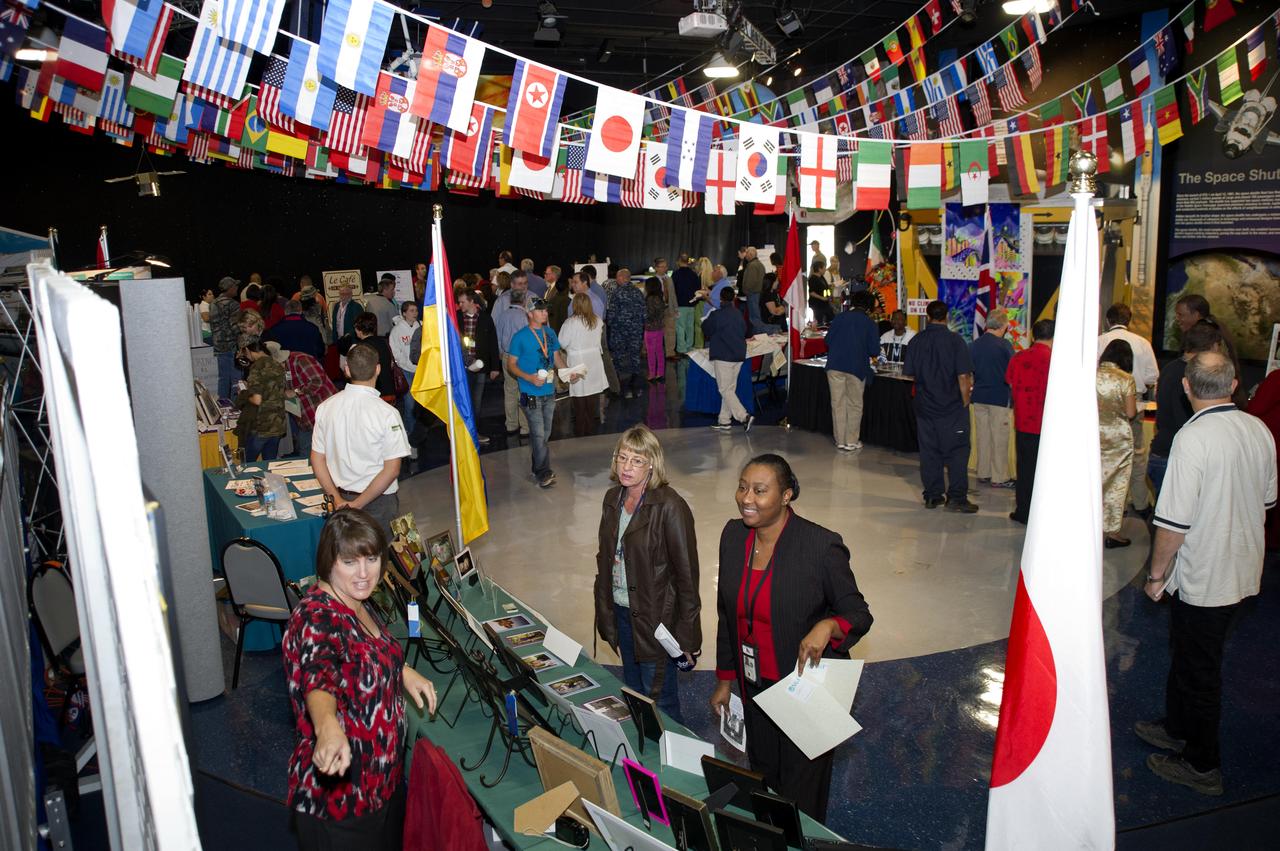
John C. Stennis Space Center employees enjoyed 2012 Diversity Day activities Oct. 31. During the day, Stennis employees were able to visit exhibits highlighting different cultures and participate in a range of activities.

John C. Stennis Space Center employees enjoyed 2012 Diversity Day activities Oct. 31. During the day, Stennis employees were able to visit cultural exhibits and participate such events as an employee talent showcase, a car/motorcycle show, Stennis 'Family Feud' contests and a cultural dress parade.

John C. Stennis Space Center employees enjoyed 2012 Diversity Day activities Oct. 31. The day's color-filled schedule included an employee talent showcase, a car/motorcycle show, Stennis 'Family Feud' contests, a cultural dress parade, food vendors and various cultural exhibits.
Lowest Altitude Diversity

Diversity in Mawrth Region, Mars

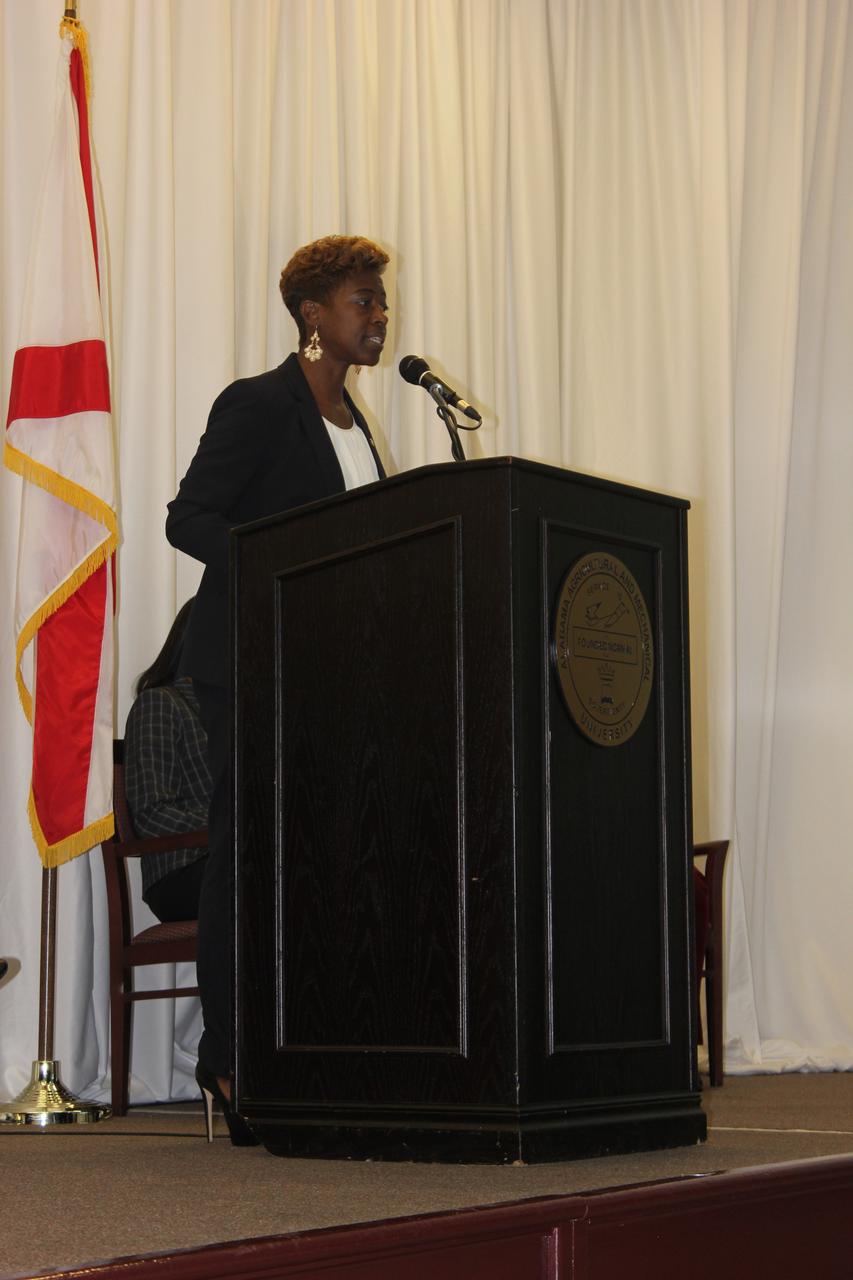
Jessica Conner, special emphasis program manager, Office of Diversity and Equal Opportunity, addresses the audience during the “KSC and Proud to Be” centerwide diversity event held at Kennedy Space Center’s Operations Support Building II (OSB II) on Aug. 20, 2019. The event featured a presentation by Robin Hauser, a director and producer of award-winning documentaries. Hauser, who has spoken at the White House and at conferences worldwide, addressed bias in artificial intelligence. A new employee video focusing on the importance of employee resource groups at the center made its debut showing at the event.

Jessica Conner, special emphasis program manager, Office of Diversity and Equal Opportunity, addresses the audience during the “KSC and Proud to Be” centerwide diversity event held at Kennedy Space Center’s Operations Support Building II (OSB II) on Aug. 20, 2019. The event featured a presentation by Robin Hauser, a director and producer of award-winning documentaries. Hauser, who has spoken at the White House and at conferences worldwide, addressed bias in artificial intelligence. A new employee video focusing on the importance of employee resource groups at the center made its debut showing at the event.
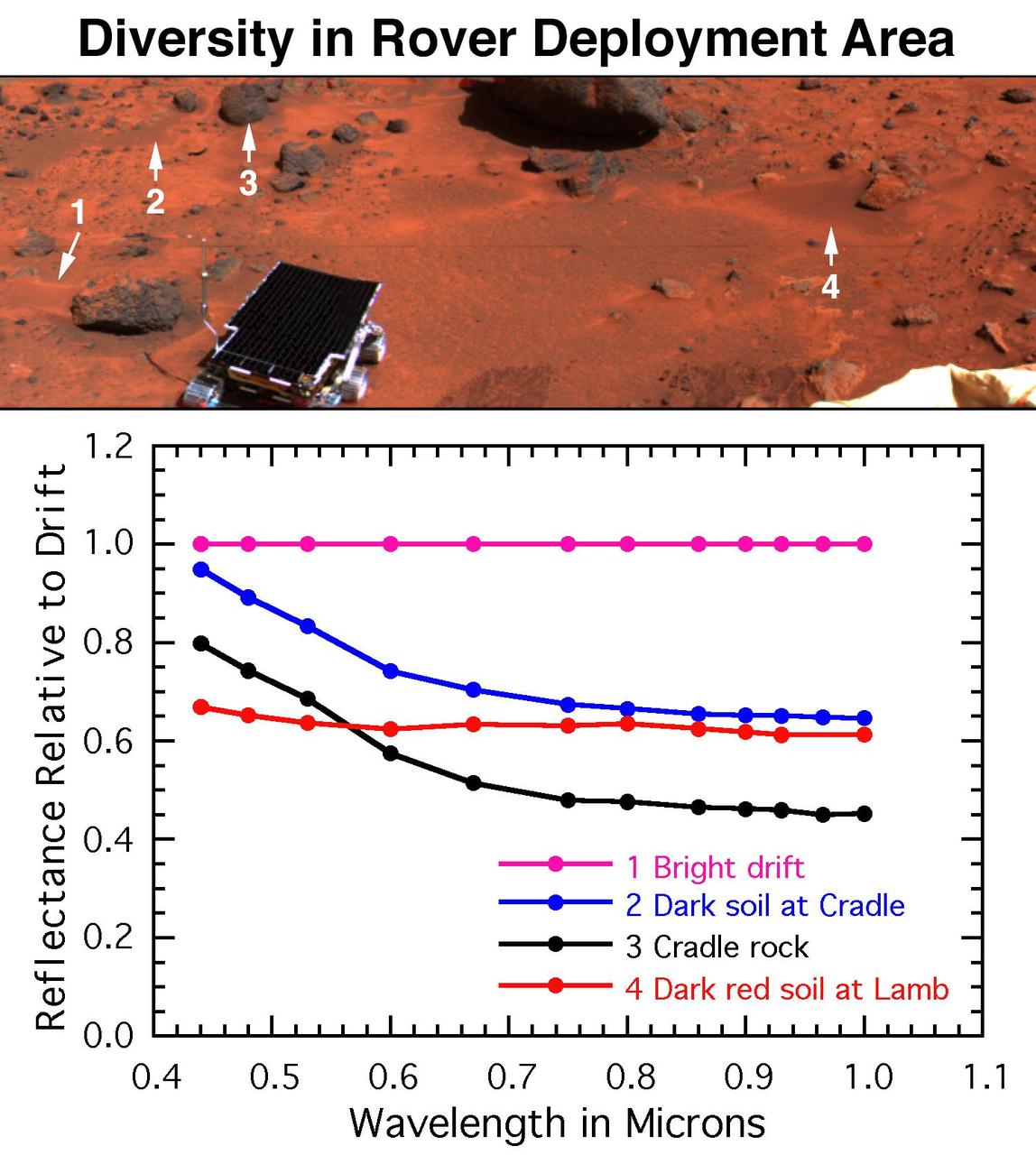
Diversity of Soils near Rover Deploy Region

Diverse Geologic Features of Western Tharsis, Mars
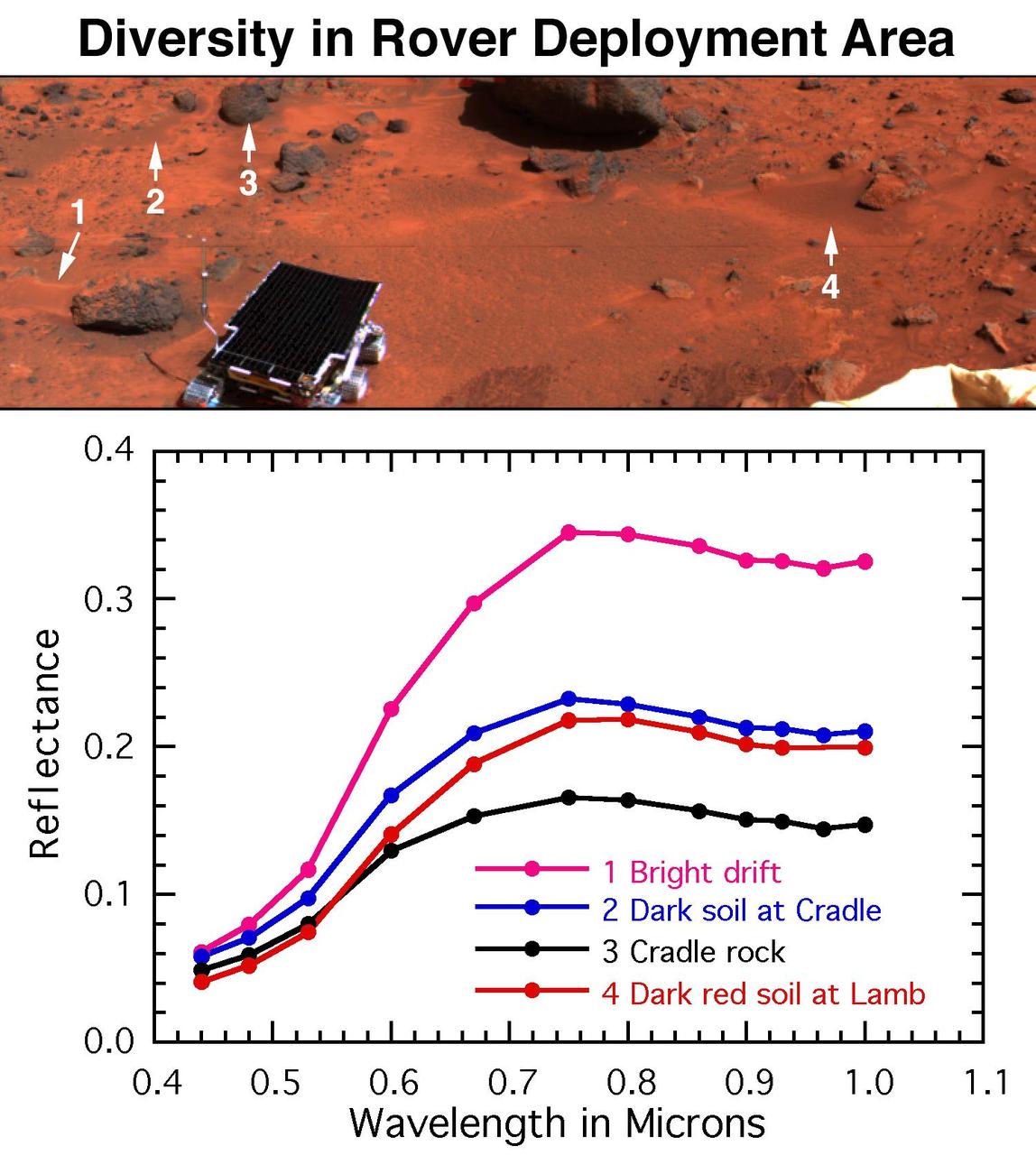
Diversity of Soils near Rover Deploy Region

Kennedy Space Center employees interact during the “KSC and Proud to Be” centerwide diversity event held at the Florida spaceport’s Operations Support Building II (OSB II) on Aug. 20, 2019. The event featured a presentation by Robin Hauser, a director and producer of award-winning documentaries. Hauser, who has spoken at the White House and at conferences worldwide, addressed bias in artificial intelligence. A new employee video focusing on the importance of employee resource groups at the center made its debut showing at the event.
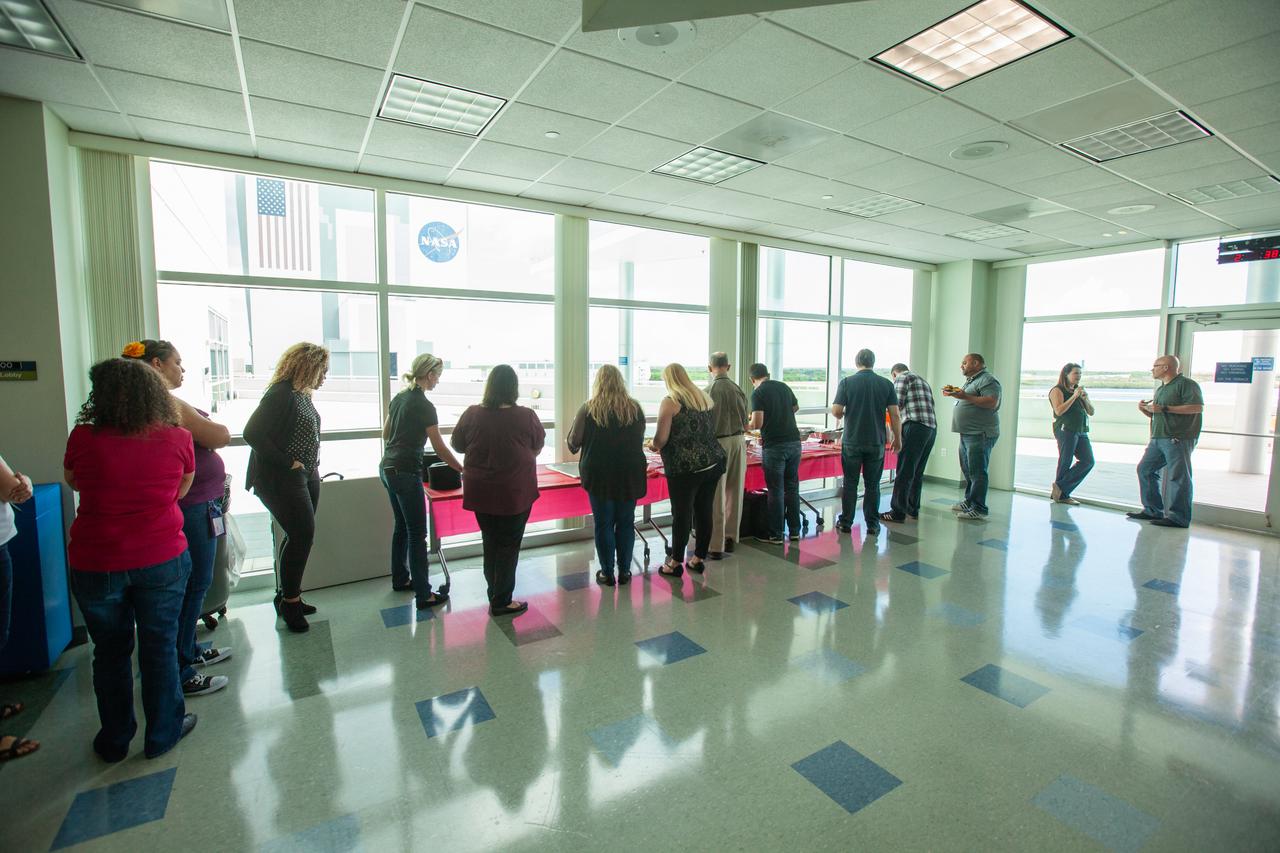
Kennedy Space Center employees sample food at the “KSC and Proud to Be” centerwide diversity event held at the Florida spaceport’s Operations Support Building II (OSB II) on Aug. 20, 2019. The event featured a presentation by Robin Hauser, a director and producer of award-winning documentaries. Hauser, who has spoken at the White House and at conferences worldwide, addressed bias in artificial intelligence. A new employee video focusing on the importance of employee resource groups at the center made its debut showing at the event.
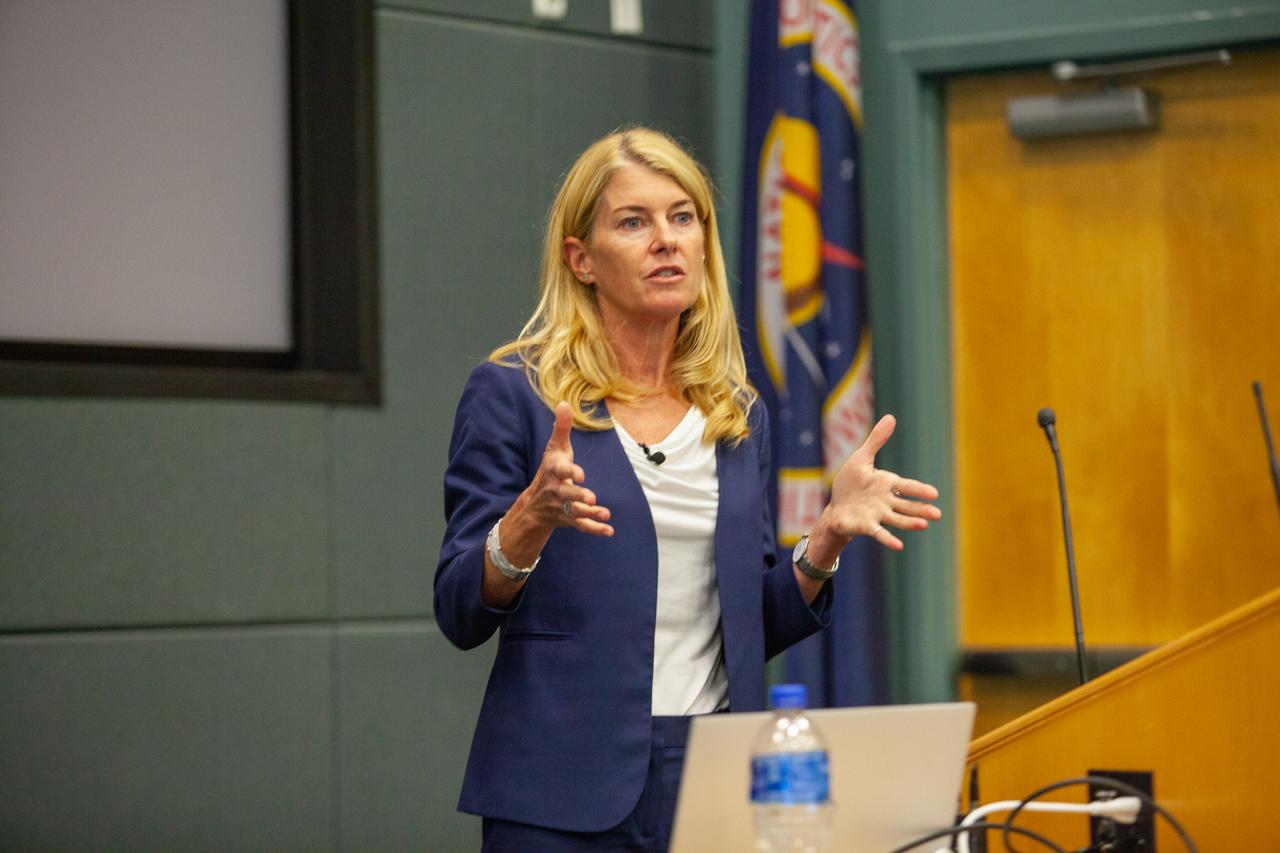
Robin Hauser, a director and producer of award-winning documentaries, delivers a presentation during the “KSC and Proud to Be” centerwide diversity event held at Kennedy Space Center’s Operations Support Building II (OSB II) on Aug. 20, 2019. Hauser, who has spoken at the White House and at conferences worldwide, addressed bias in artificial intelligence. The event wrapped up with the debut showing of a new employee video focusing on the importance of employee resource groups at the center, followed by closing remarks from Kennedy Director Bob Cabana.

Kennedy Space Center employees interact during the “KSC and Proud to Be” centerwide diversity event held at the Florida spaceport’s Operations Support Building II (OSB II) on Aug. 20, 2019. The event featured a presentation by Robin Hauser, a director and producer of award-winning documentaries. Hauser, who has spoken at the White House and at conferences worldwide, addressed bias in artificial intelligence. A new employee video focusing on the importance of employee resource groups at the center made its debut showing at the event.
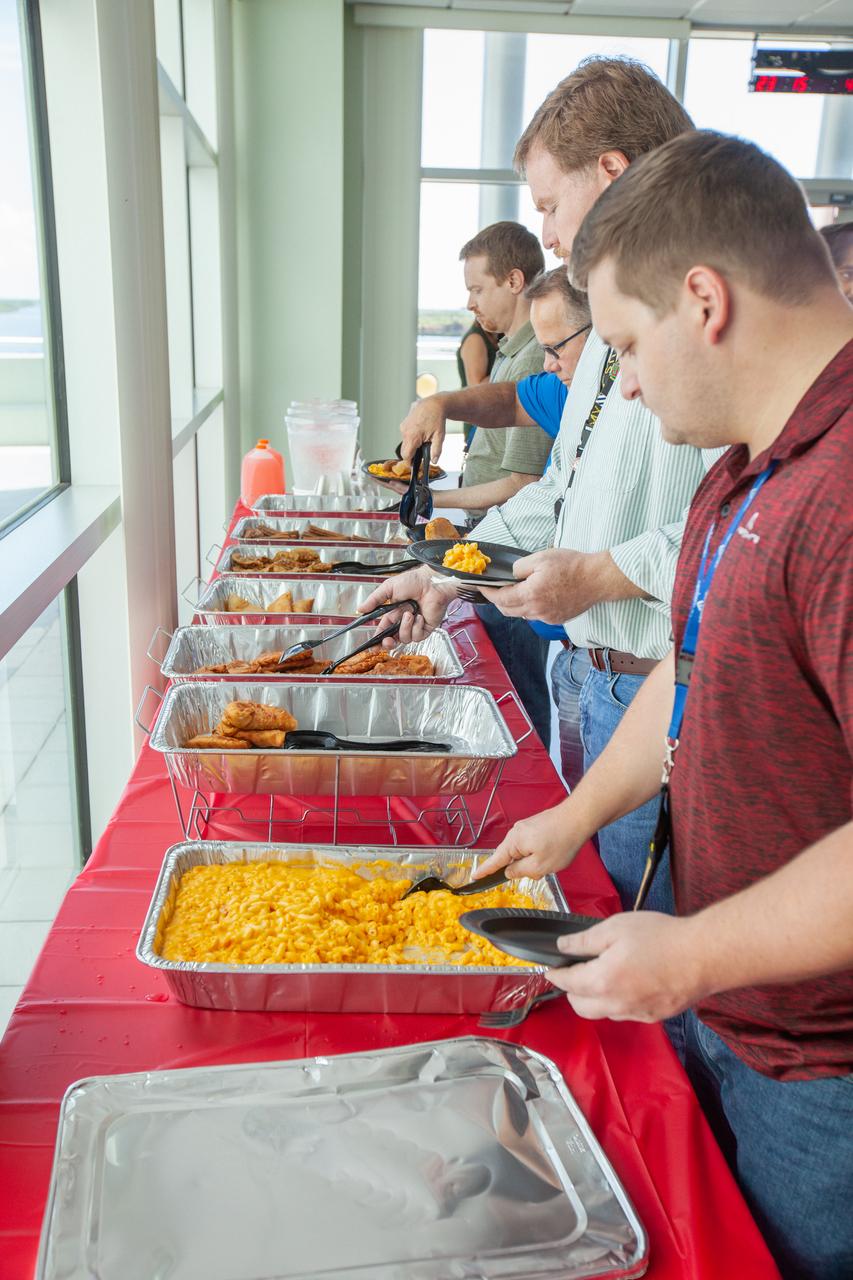
Kennedy Space Center employees sample food at the “KSC and Proud to Be” centerwide diversity event held at the Florida spaceport’s Operations Support Building II (OSB II) on Aug. 20, 2019. The event featured a presentation by Robin Hauser, a director and producer of award-winning documentaries. Hauser, who has spoken at the White House and at conferences worldwide, addressed bias in artificial intelligence. A new employee video focusing on the importance of employee resource groups at the center made its debut showing at the event.

Robin Hauser, a director and producer of award-winning documentaries, delivers a presentation during the “KSC and Proud to Be” centerwide diversity event held at Kennedy Space Center’s Operations Support Building II (OSB II) on Aug. 20, 2019. Hauser, who has spoken at the White House and at conferences worldwide, addressed bias in artificial intelligence. The event wrapped up with the debut showing of a new employee video focusing on the importance of employee resource groups at the center, followed by closing remarks from Kennedy Director Bob Cabana.

The audience tunes in during the “KSC and Proud to Be” centerwide diversity event held at Kennedy Space Center’s Operations Support Building II (OSB II) on Aug. 20, 2019. The event featured a presentation by Robin Hauser, a director and producer of award-winning documentaries. Hauser, who has spoken at the White House and at conferences worldwide, addressed bias in artificial intelligence. A new employee video focusing on the importance of employee resource groups at the center made its debut showing at the event.
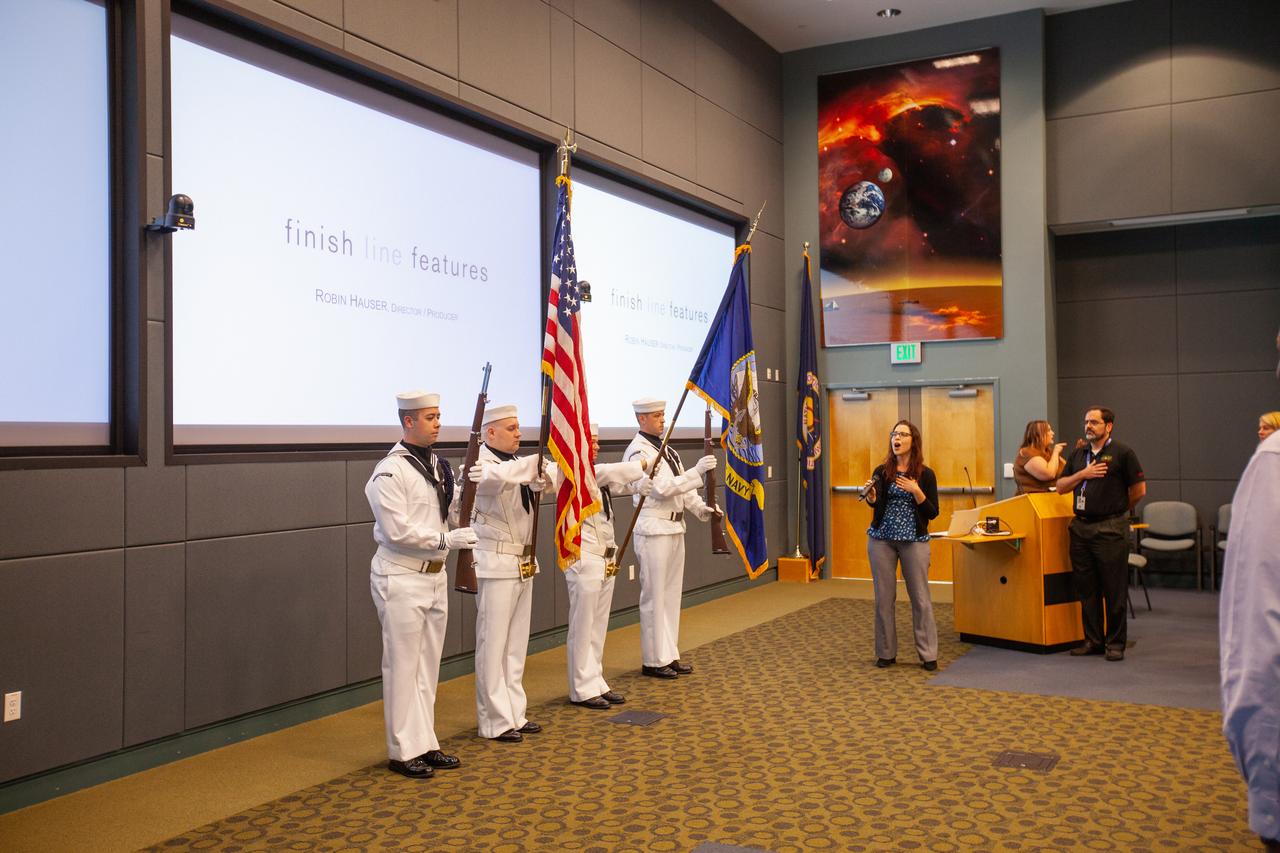
Ivette Aponte, from Kennedy Space Center’s Engineering Directorate, sings the National Anthem at the “KSC and Proud to Be” centerwide diversity event held at the Florida spaceport’s Operations Support Building II (OSB II) on Aug. 20, 2019. The event featured a presentation by Robin Hauser, a director and producer of award-winning documentaries. Hauser, who has spoken at the White House and at conferences worldwide, addressed bias in artificial intelligence. A new employee video focusing on the importance of employee resource groups at the center made its debut showing at the event.
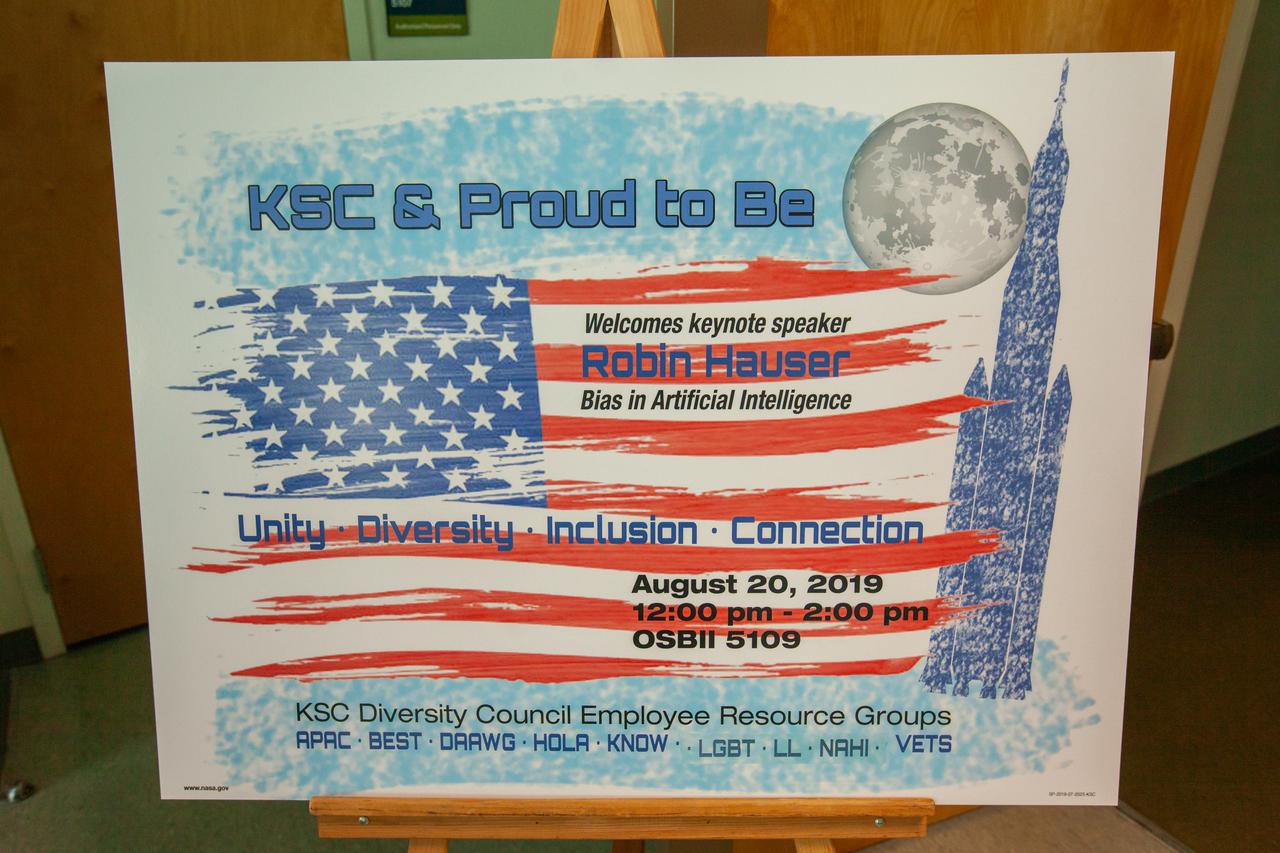
A sign welcomes Kennedy Space Center employees to the “KSC and Proud to Be” centerwide diversity event held at the Florida spaceport’s Operations Support Building II (OSB II) on Aug. 20, 2019. The event featured a presentation by Robin Hauser, a director and producer of award-winning documentaries. Hauser, who has spoken at the White House and at conferences worldwide, addressed bias in artificial intelligence. A new employee video focusing on the importance of employee resource groups at the center made its debut showing at the event.

Kennedy Space Center employees sample food at the “KSC and Proud to Be” centerwide diversity event held at the Florida spaceport’s Operations Support Building II (OSB II) on Aug. 20, 2019. The event featured a presentation by Robin Hauser, a director and producer of award-winning documentaries. Hauser, who has spoken at the White House and at conferences worldwide, addressed bias in artificial intelligence. A new employee video focusing on the importance of employee resource groups at the center made its debut showing at the event.
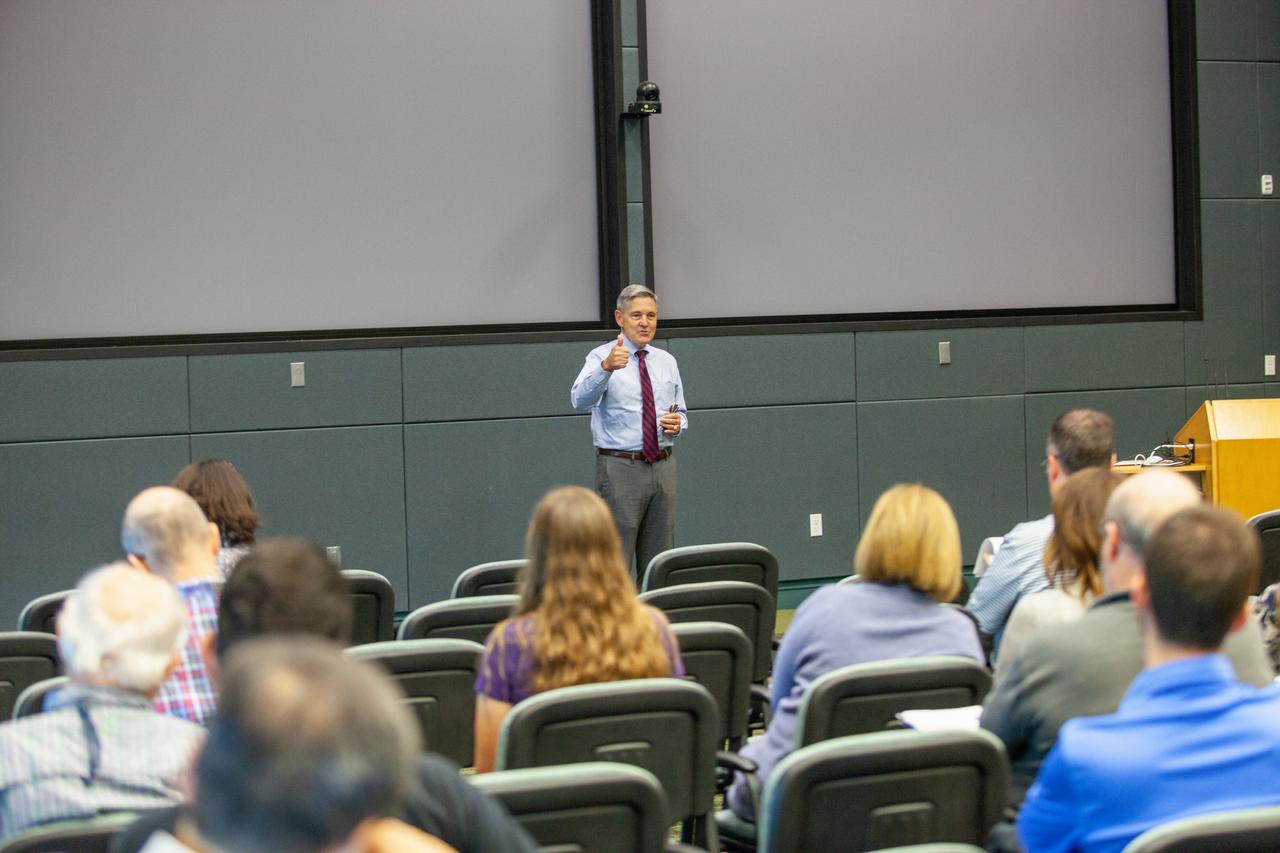
Kennedy Space Center Director Bob Cabana speaks during the “KSC and Proud to Be” centerwide diversity event held at the Florida spaceport’s Operations Support Building II (OSB II) on Aug. 20, 2019. The event featured a presentation by Robin Hauser, a director and producer of award-winning documentaries. Hauser, who has spoken at the White House and at conferences worldwide, addressed bias in artificial intelligence. A new employee video focusing on the importance of employee resource groups at the center made its debut showing at the event.
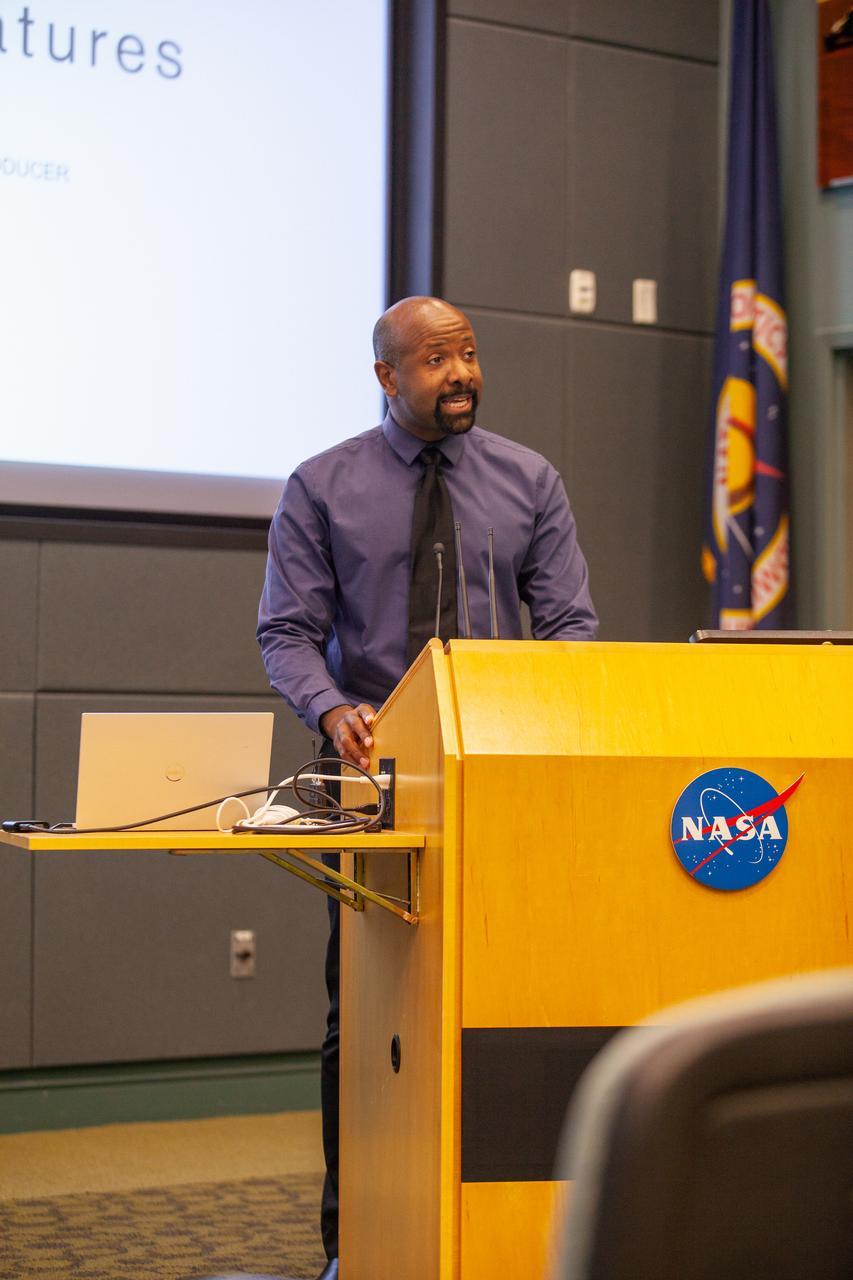
Martin Hayes, co-chair of the Black Employee Strategy Team (BEST) at Kennedy Space Center, speaks during the “KSC and Proud to Be” centerwide diversity event held at the Florida spaceport’s Operations Support Building II (OSB II) on Aug. 20, 2019. The event featured a presentation by Robin Hauser, a director and producer of award-winning documentaries. Hauser, who has spoken at the White House and at conferences worldwide, addressed bias in artificial intelligence. A new employee video focusing on the importance of employee resource groups at the center made its debut showing at the event.
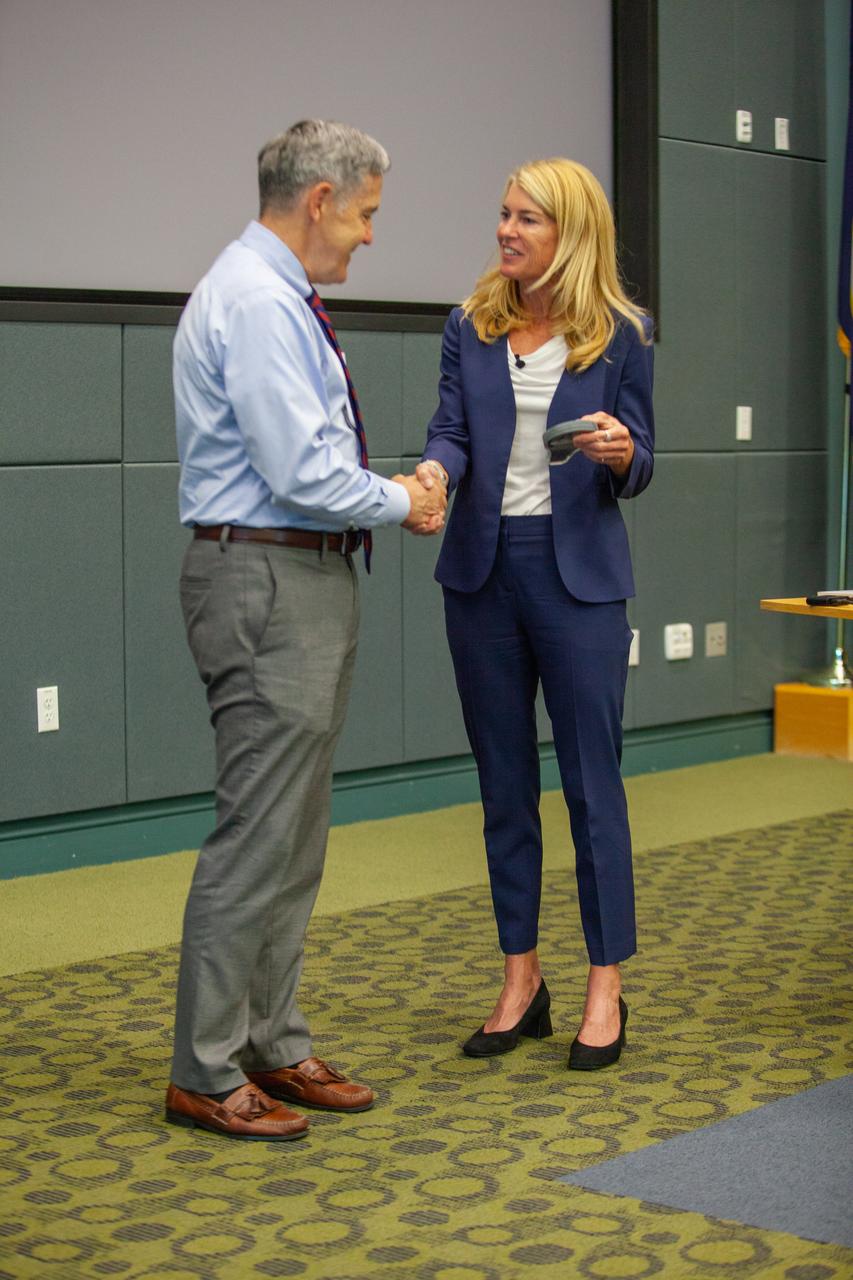
Kennedy Space Center Director Bob Cabana, left, presents well-known documentary filmmaker Robin Hauser with a token of appreciation during the “KSC and Proud to Be” centerwide diversity event held at the Florida spaceport’s Operations Support Building II (OSB II) on Aug. 20, 2019. The plaque was made from glass that was a part of Kennedy’s Launch Control Center during the Apollo and Space Shuttle programs. Hauser, who has spoken at the White House and at conferences worldwide, addressed bias in artificial intelligence. A new employee video focusing on the importance of employee resource groups at the center made its debut showing at the event.
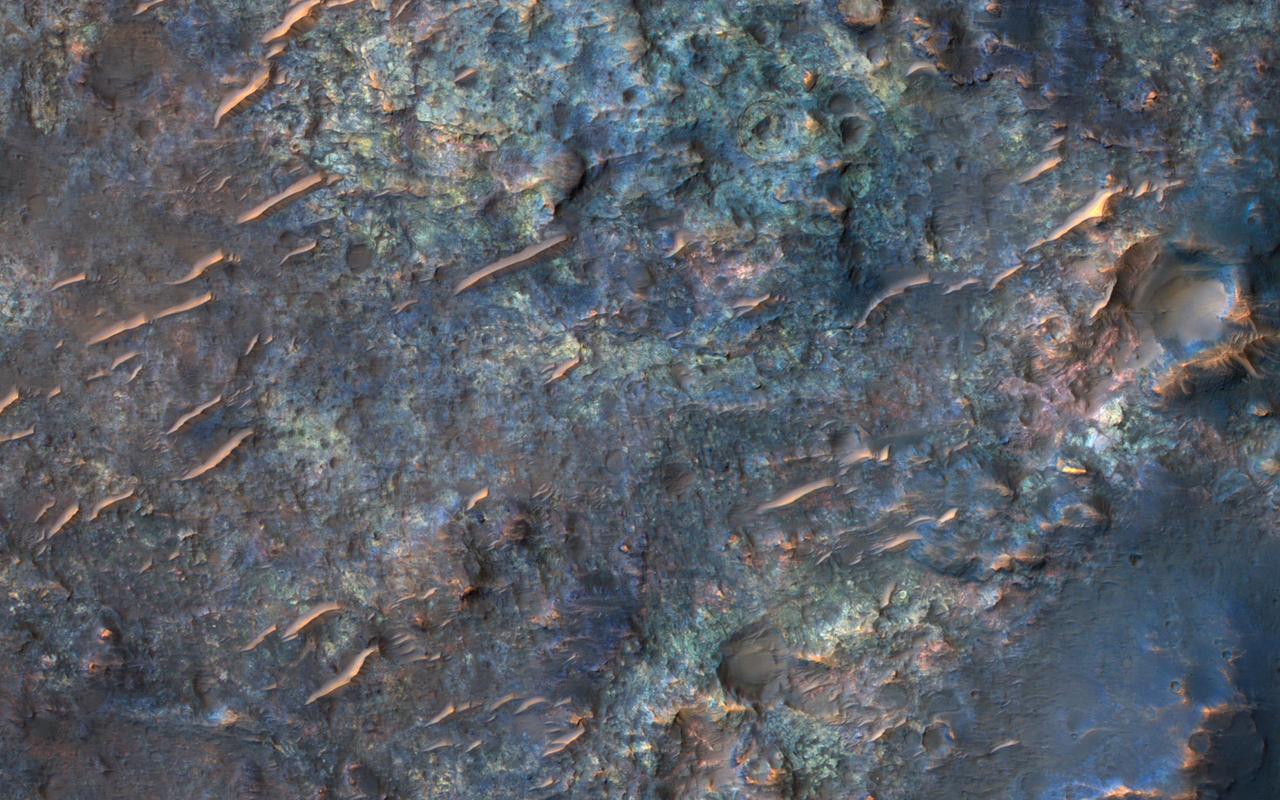
This image from NASA's Mars Reconnaissance Orbiter (MRO) shows bedrock units with diverse colors indicating different mineral concentrations. More information is available at https://photojournal.jpl.nasa.gov/catalog/PIA22434
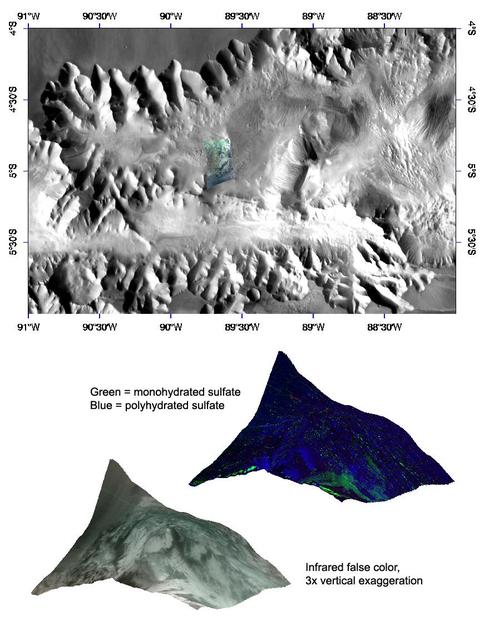
Interior Layered Deposits in Tithonium Chasma Reveal Diverse Compositions
Diverse Rock Named Squash

This ultraviolet image from NASA Galaxy Evolution Explorer is of a diverse group of galaxy types. NGC 3190 is a dusty edge on spiral galaxy. NGC 3187 is highly distorted.
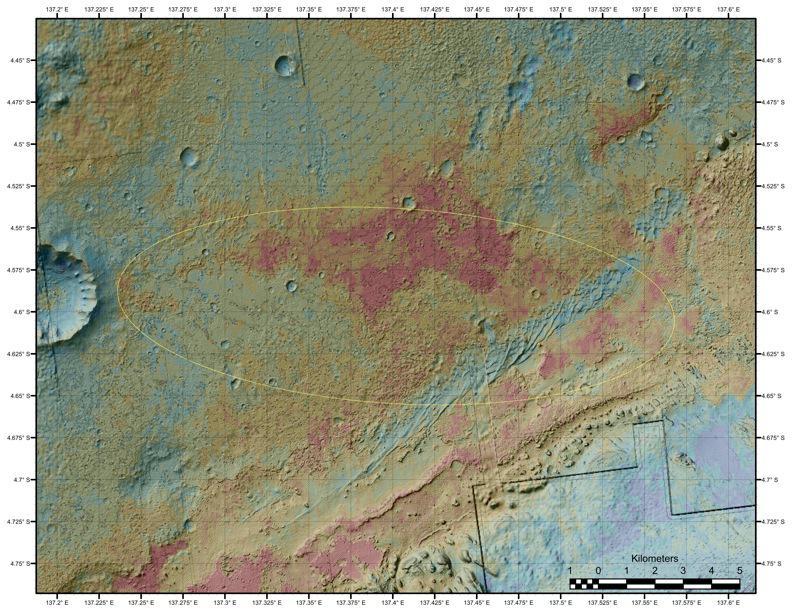
The area where NASA Curiosity rover will land on Aug. 5 PDT Aug. 6 EDT has a geological diversity that scientists are eager to investigate, as seen in this false-color map based on data from NASA Mars Odyssey orbiter.

This enhanced color view of Pluto's surface diversity was created by merging Ralph/Multispectral Visible Imaging Camera (MVIC) color imagery (650 meters per pixel) with Long Range Reconnaissance Imager panchromatic imagery (230 meters per pixel). At lower right, ancient, heavily cratered terrain is coated with dark, reddish tholins. At upper right, volatile ices filling the informally named Sputnik Planum have modified the surface, creating a chaos-like array of blocky mountains. Volatile ice also occupies a few nearby deep craters, and in some areas the volatile ice is pocked with arrays of small sublimation pits. At left, and across the bottom of the scene, gray-white CH4 ice deposits modify tectonic ridges, the rims of craters, and north-facing slopes. The scene in this image is 260 miles (420 kilometers) wide and 140 miles (225 kilometers) from top to bottom; north is to the upper left. http://photojournal.jpl.nasa.gov/catalog/PIA20534

Victoria Webb (center) discusses African-American history during a Black History Month program for John C. Stennis Space Center employees on Feb. 16. Webb, a 103-year-old native of Pass Christian, was guest speaker for the program, sponsored by the Stennis Diversity Council and the Naval Meteorology and Oceanography Command. She was joined in her presentation by Valli Battle (left), a NAVOCEANO employee at Stennis, and friend Jeanell Barnes. Black History Month was first observed in 1976 and is celebrated each February. The 2011 theme was African-Americans and the Civil War.

Steve Shih, NASA associate administrator for Diversity & Equal Opportunity, addresses NASA team members during a Nov. 6 mentoring event at the agency's Marshall Space Flight Center. Shih discussed ways for team members on both sides of the mentoring equation to get the most out of the experience.
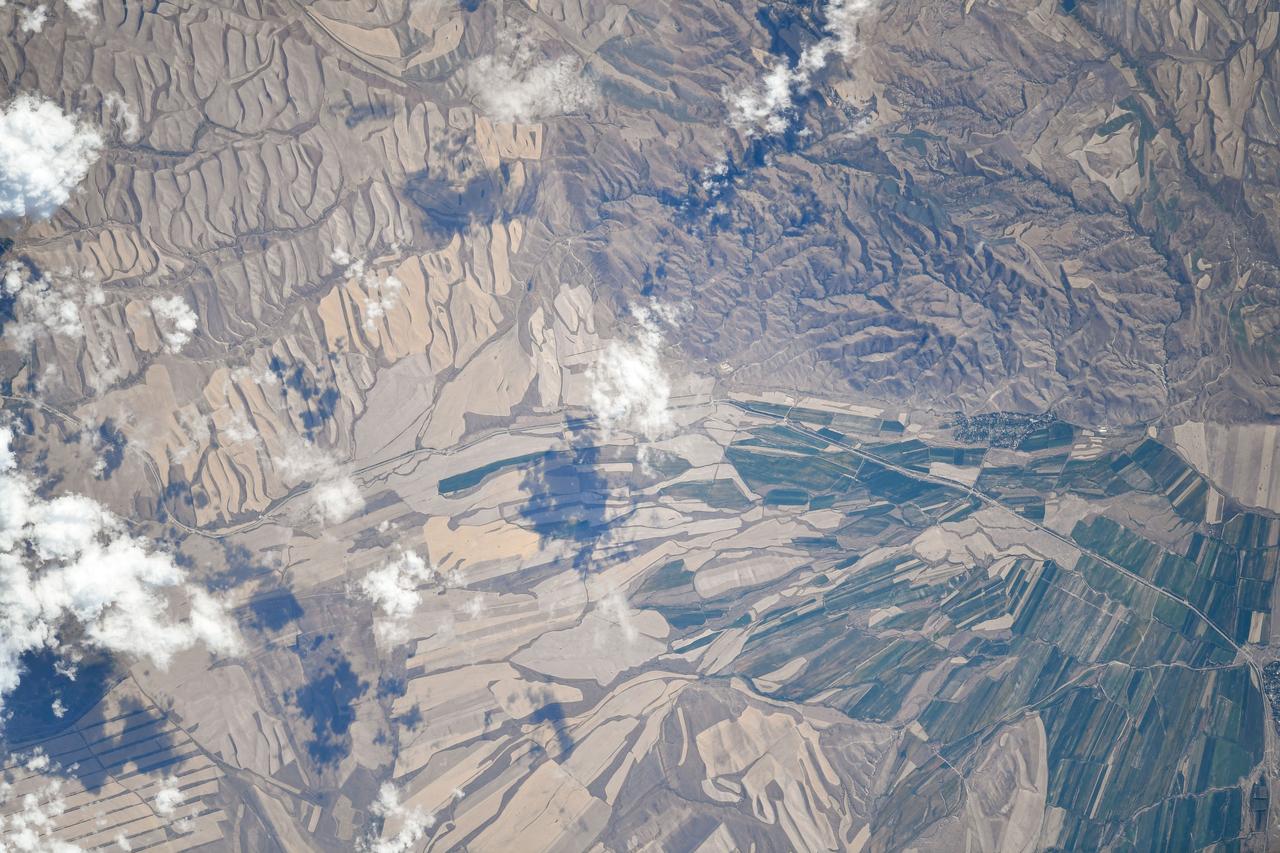
iss073e0510447 (Aug. 19, 2025) --- Agricultural activities in the diverse landscape of Kazakhstan's Jetisu region, near the Chinese border and once a key corridor of the ancient Silk Road, are pictured from the International Space Station as it orbited 263 miles above the Central Asian nation. Credit: Roscosmos
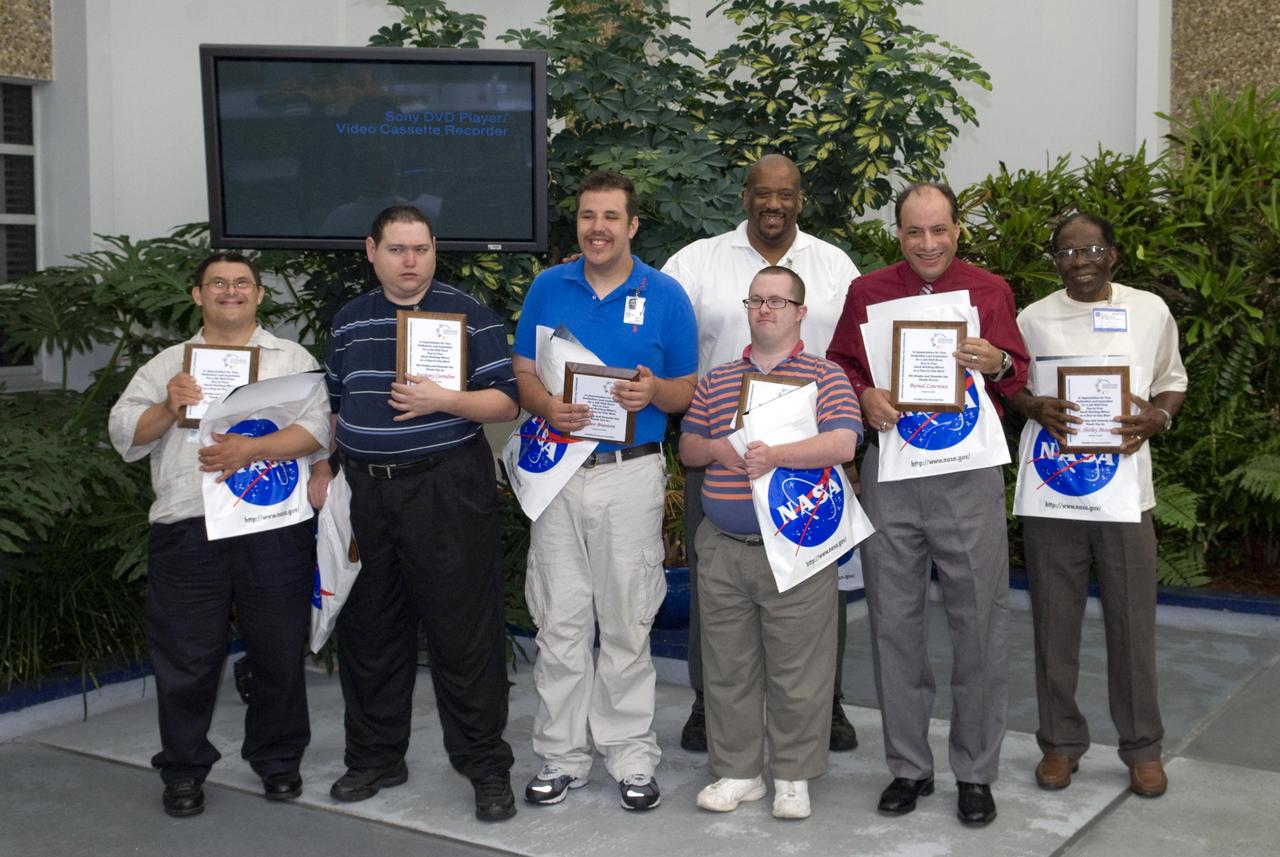
Members of STARC, a non-profit organization in Slidell, La., that seeks to help people with disabilities lead meaningful, productive lives, pose with their appreciation awards during Disability Awareness Day at Stennis Space Center on Oct. 15. The group members received appreciation awards for their dedicated service to the rocket engine testing facility. Disability Awareness Day was hosted by the Stennis Diversity Council and included guest speakers from several area agencies.
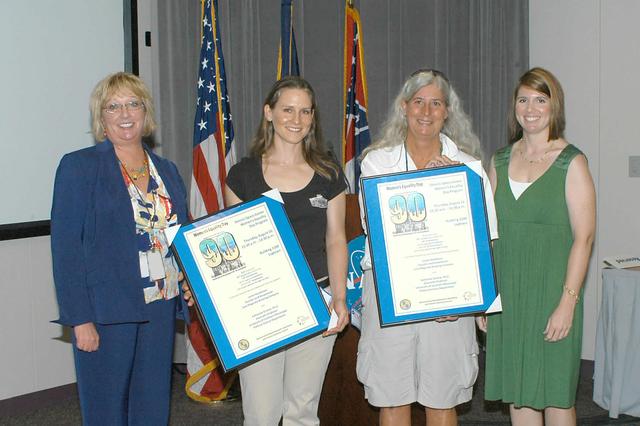
NASA's John C. Stennis Space Center celebrated Women's Equality Day with a program featuring presentations from a pair of area women - Leslie Henderson, founder and brewmaster of Lazy Magnolia Brewing Co. in Kiln, Miss., and Kathanne Greene, associate professor of political science at the University of Southern Mississippi in Hattiesburg. Shown are (l to r): Jo Ann Larson, Stennis Equal Opportunity officer; Henderson; Greene; and Shannon Breland, public affairs officer for the Naval Research Laboratory at Stennis and a member of the Stennis Diversity Council.

Dr. Shanique Brown, an assistant professor of industrial-organizational psychology at Wayne State University in Detroit, Michigan, delivers the Black History Month keynote address to team members at NASA's Marshall Space Flight Center Feb. 28. Participants mingled with Brown and Marshall leaders after the speech and a panel discussion on diversity and inclusion, and sampled a variety of ethnic foods. The 2019 commemoration, themed "Migrations From Here to There," was organized by Marshall's Office of Diversity and Equal Opportunity

NASA John C. Stennis Space Center employees observed Women's History Month on March 17 with a panel discussion that featured accomplished women of the facility. The gathering featured (l to r): Pam Covington, manager of the NASA Office of External Affairs at Stennis; Mary Jones, assistant chief of staff with the Navy Meterology & Oceanography Command; and Lauren Underwood, senior research scientist with Science Systems and Applications, Inc. In addition to the panel discussion, the Stennis Diversity Council and Patriot Technologies also hosted a pair of 'lunch-and-learn' sessions focused on women's issues and history. The luncheons featured videos on Sally Hemings, the slave widely recognized as the mistress of President Thomas Jefferson; and several mothers of U.S. presidents.
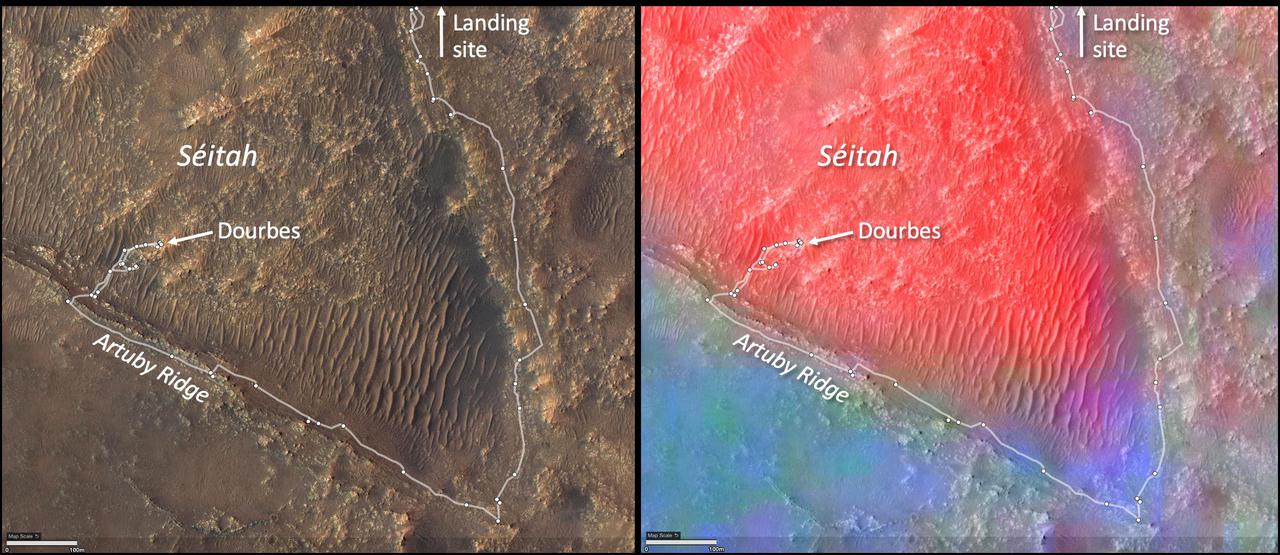
These annotated images show two views of the "Séítah" geologic unit of Mars' Jezero Crater. The map on the left shows terrain features of the crater with annotations depicting the rover's route during its first science campaign. "Artuby" is a ridgeline running along a portion of the southern boundary of Séítah. "Dourbes" is the name of an abrading target on a rock in South Séítah. The multi-hued map on the right shows the diversity of igneous (solidified from lava or magma) minerals in the same region. Olivine is shown in red. Calcium-poor pyroxene in green. Calcium-rich pyroxene is in blue. A key objective for Perseverance's mission on Mars is astrobiology, including the search for signs of ancient microbial life. The rover will characterize the planet's geology and past climate, pave the way for human exploration of the Red Planet, and be the first mission to collect and cache Martian rock and regolith (broken rock and dust). Subsequent NASA missions, in cooperation with ESA (European Space Agency), would send spacecraft to Mars to collect these sealed samples from the surface and return them to Earth for in-depth analysis. The Mars 2020 Perseverance mission is part of NASA's Moon to Mars exploration approach, which includes Artemis missions to the Moon that will help prepare for human exploration of the Red Planet. https://photojournal.jpl.nasa.gov/catalog/PIA25024

These composite images from NASA Dawn spacecraft images show the spectacular spectral diversity of asteroid Vesta surface.
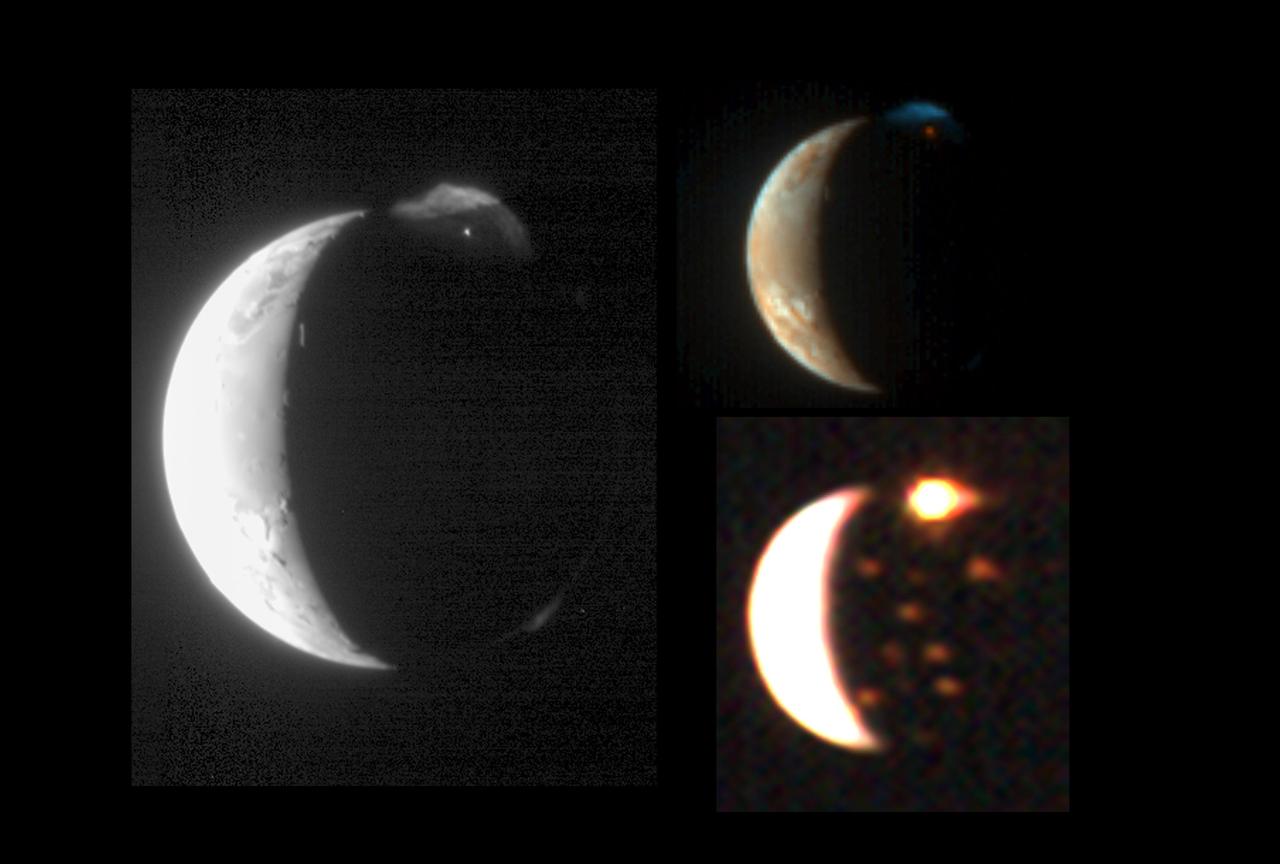
This montage demonstrates New Horizons ability to observe the same target in complementary ways using its diverse suite of instruments.
![The diversity of landforms that make up the state of California is evident in this new [sic] rendition of the 3-D topography of the state.](https://images-assets.nasa.gov/image/PIA03333/PIA03333~medium.jpg)
The diversity of landforms that make up the state of California is evident in this new [sic] rendition of the 3-D topography of the state.
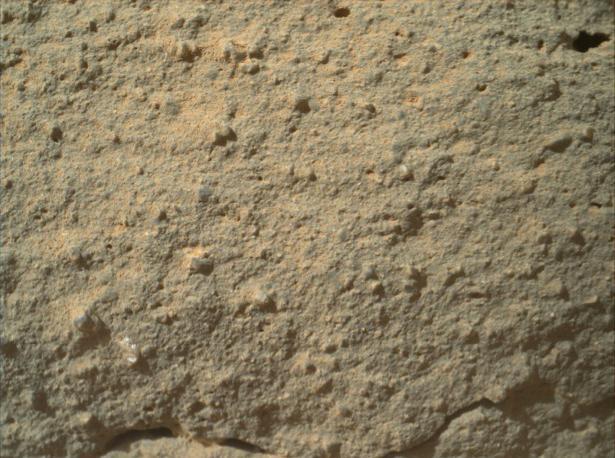
This image from NASA Curiosity rover shows the great diversity of grains found on the surface of a Martian rock.
![The diversity of landforms that make up the state of California is evident in this new [sic] rendition of the 3-D topography of the state.](https://images-assets.nasa.gov/image/PIA03347/PIA03347~medium.jpg)
The diversity of landforms that make up the state of California is evident in this new [sic] rendition of the 3-D topography of the state.
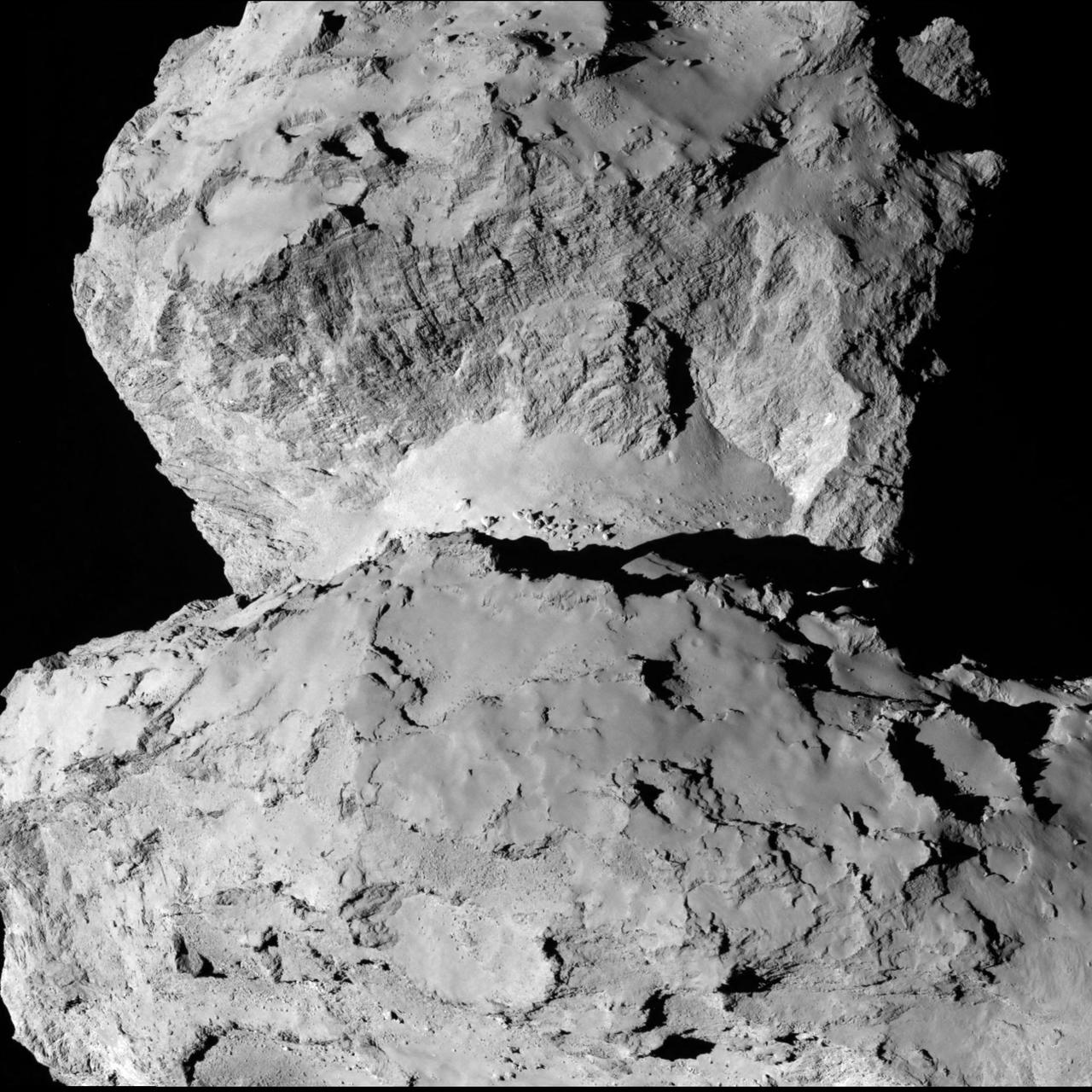
This image from ESA Rosetta spacecraft is of 67P/Churyumov-Gerasimenko shows the diversity of surface structures on the comet nucleus.
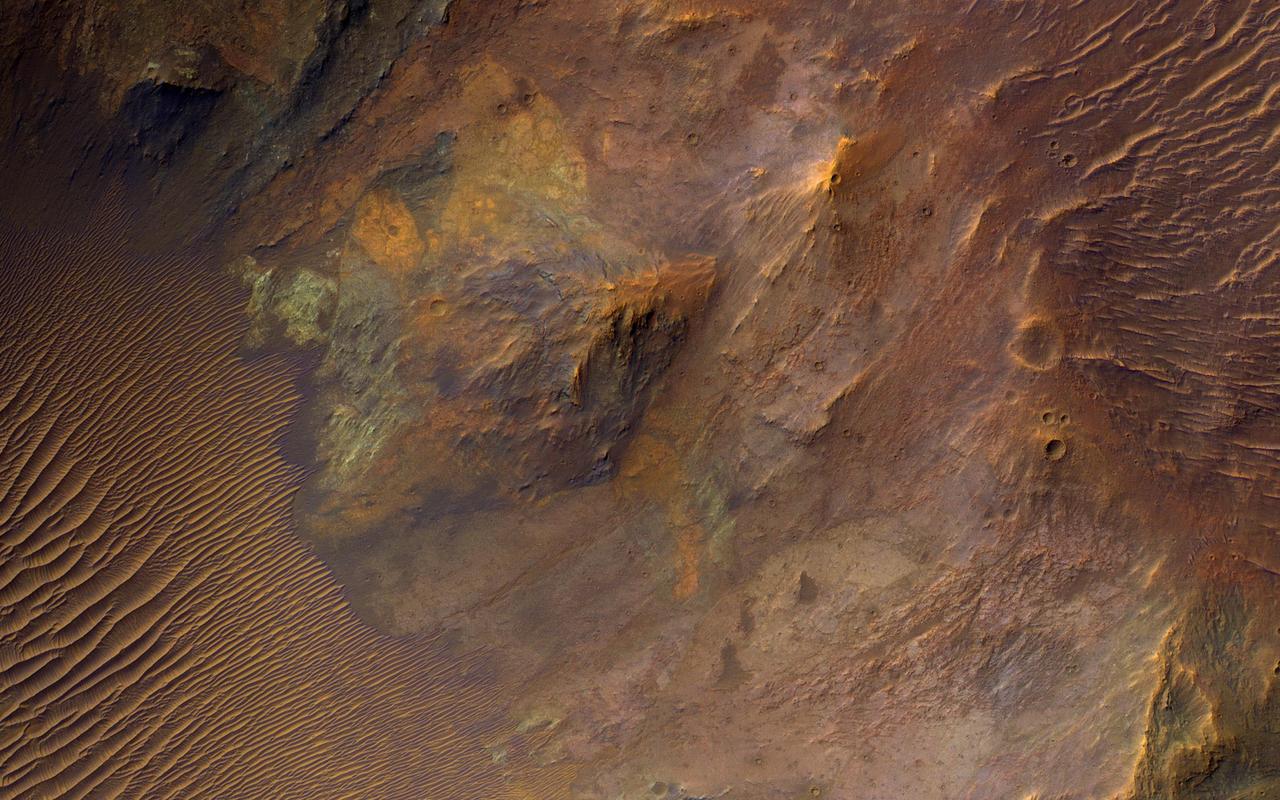
Large impacts produce uplifted central structures, either peaks, or pits, or an uplifted peak with a central pit. This crater south of Aurorae Chaos has a central pit exposing bedrock units with diverse colors, indicating diverse rock compositions. This crater includes clay-rich minerals identified by the CRISM instrument on MRO. See this enhanced-color cutout over the eastern half of the central pit. https://photojournal.jpl.nasa.gov/catalog/PIA23737
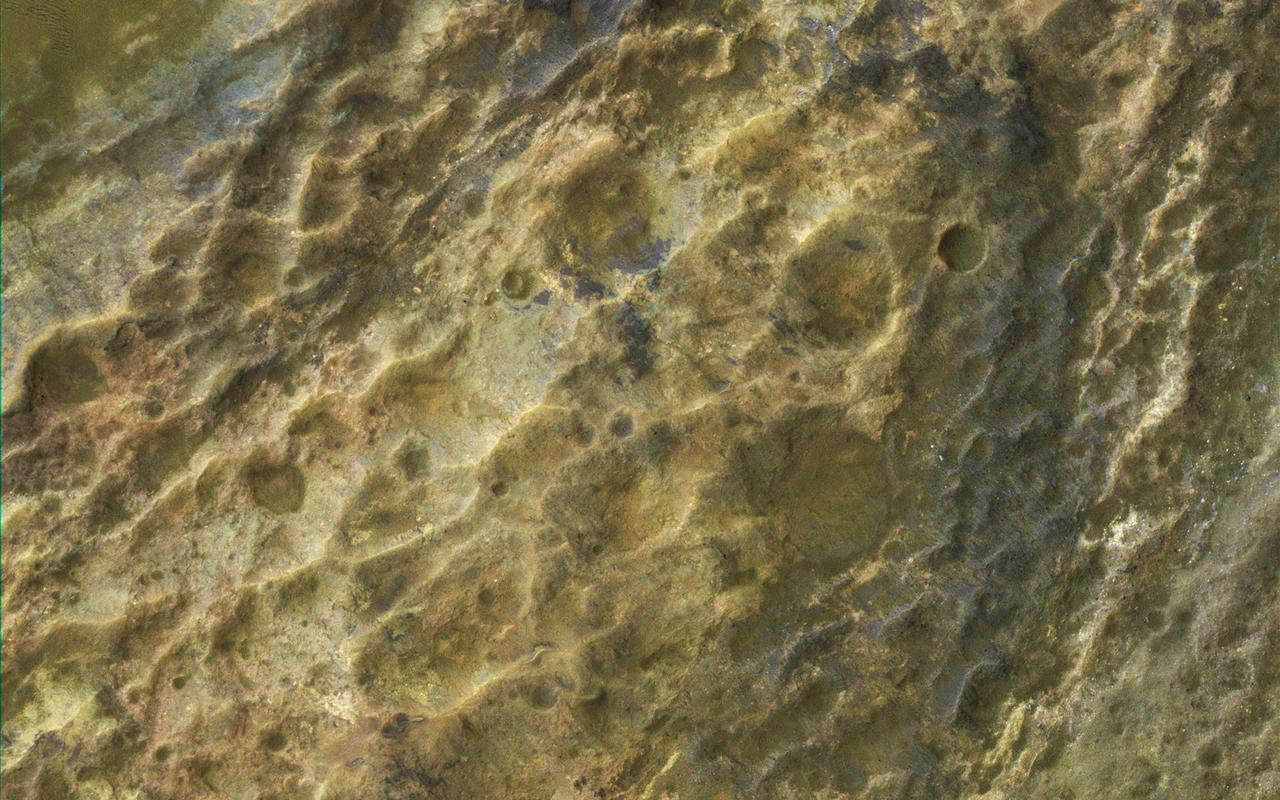
This image captured by NASA Mars Reconnaissance Orbiter MRO covers diverse surface units on the floor of eastern Coprates Chasma in eastern Valles Marineris. The bedrock has diverse minerals producing wonderful color contrasts. In over 10 years of orbiting Mars, HiRISE has acquired nearly 50,000 large images, but they cover less than 3 percent of the Martian surface. https://photojournal.jpl.nasa.gov/catalog/PIA21606

This full-resolution mosaic of Venus, obtained by NASA Magellan spacecraft, shows an area replete with diverse volcanic features. http://photojournal.jpl.nasa.gov/catalog/PIA00265

This image captures some of the geologic diversity of Mars. There are hills of ancient terrains on the floor of Juventae Chasma, surrounded by younger sediments, including dark sand sheets and dunes that are likely active today. The hills are heavily eroded by landslides, forming gullies in some places. Diverse colors represent unaltered volcanic minerals (blue and green) and altered minerals (brighter and reddish colors). https://photojournal.jpl.nasa.gov/catalog/PIA23104
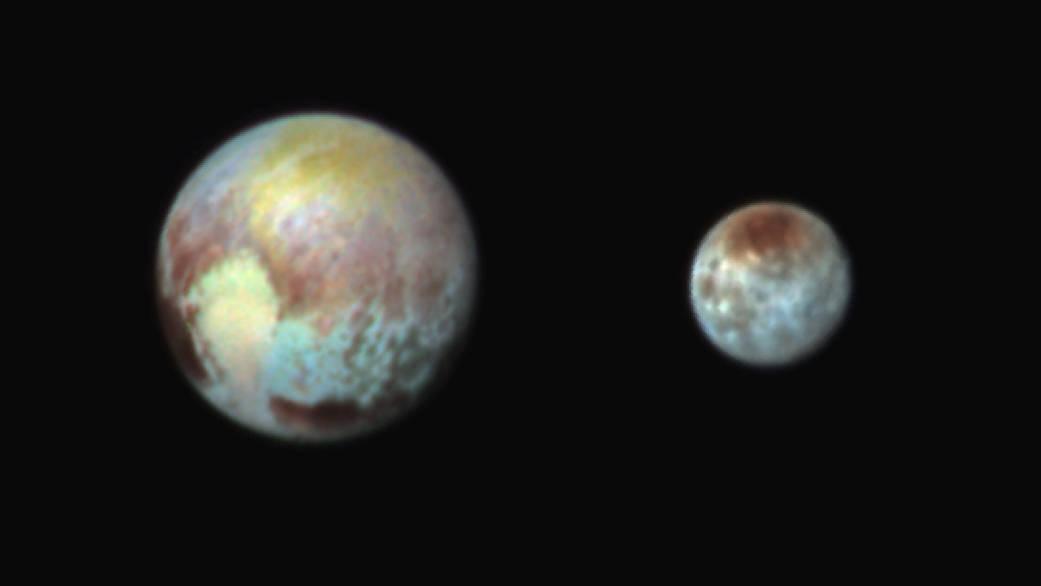
This July 13, 2015, image of Pluto and Charon is presented in false colors to make differences in surface material and features easy to see. It was obtained by the Ralph instrument on NASA's New Horizons spacecraft, using three filters to obtain color information, which is exaggerated in the image. These are not the actual colors of Pluto and Charon, and the apparent distance between the two bodies has been reduced for this side-by-side view. The image reveals that the bright heart-shaped region of Pluto includes areas that differ in color characteristics. The western lobe, shaped like an ice-cream cone, appears peach color in this image. A mottled area on the right (east) appears bluish. Even within Pluto's northern polar cap, in the upper part of the image, various shades of yellow-orange indicate subtle compositional differences. The surface of Charon is viewed using the same exaggerated color. The red on the dark northern polar cap of Charon is attributed to hydrocarbon materials including a class of chemical compounds called tholins. The mottled colors at lower latitudes point to the diversity of terrains on Charon. This image was taken at 3:38 a.m. EDT on July 13, one day before New Horizons' closest approach to Pluto. http://photojournal.jpl.nasa.gov/catalog/PIA19707
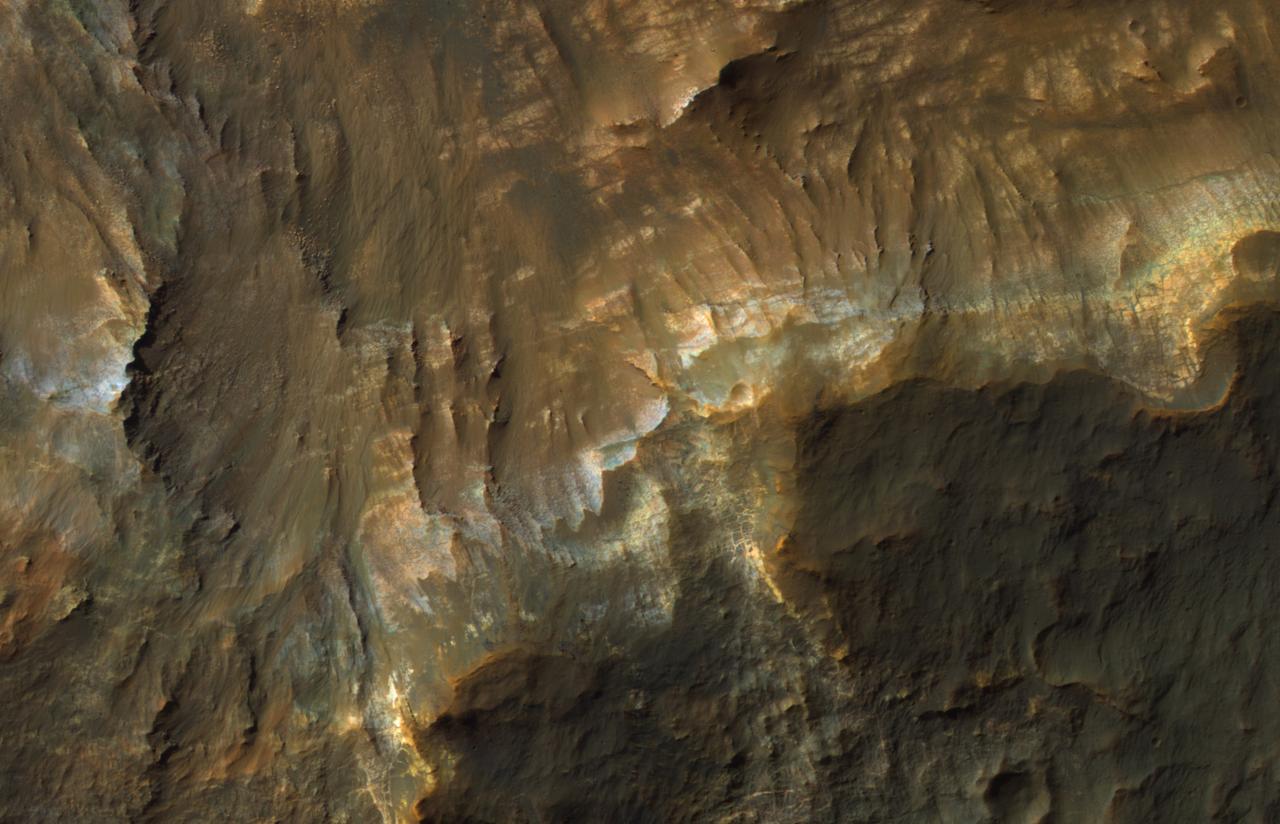
This color image from NASA's Mars Reconnaissance Orbiter (MRO) shows bedrock layers of diverse colors and composition. For more information see https://photojournal.jpl.nasa.gov/catalog/PIA22437
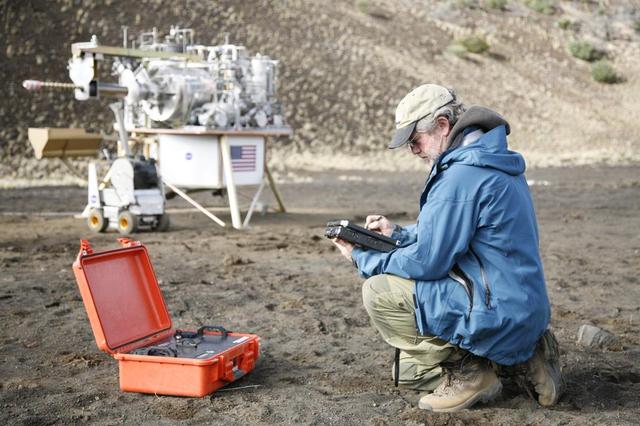
Decades of work preparing a miniaturized laboratory for identifying minerals on Mars have also yielded spinoff versions with diverse applications on Earth and, possibly, the moon.

This observation from NASA Mars Reconnaissance Orbiter shows an incredible diversity of ancient lava tubes and impact craters filled with sediment on the flank of Arsia Mons.
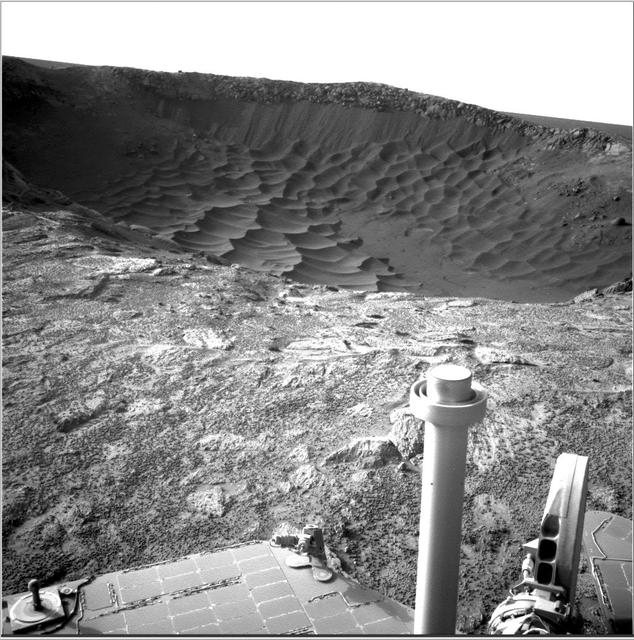
This image from NASA Mars Exploration Rover at the edge of Santa Maria crater shows diverse textures of the crater. Contrast has been enhanced to emphasize the textures.

An astonishing diversity of geological features, ecological systems and human landscapes across North America is indicated within this image from NASA Terra spacecraft.
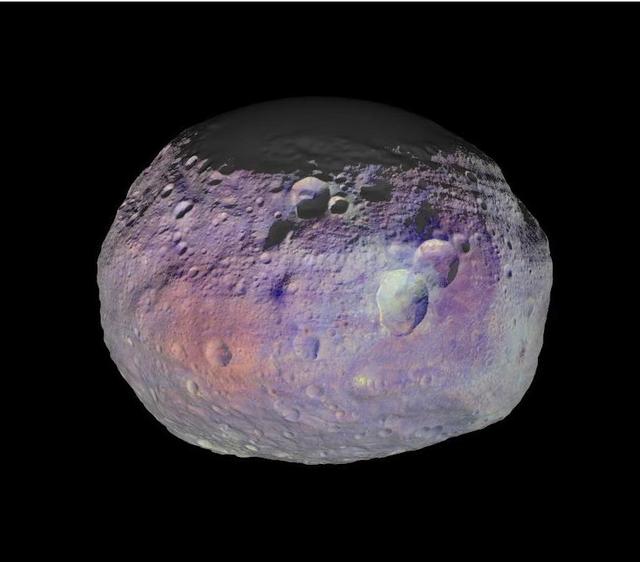
This image of asteroid Vesta is one of many images taken by NASA Dawn spacecraft to create an animation showing the diversity of minerals through color representation.

The area in and near the landing site selected for landing of NASA Mars Science Laboratory offers a diversity of possible targets for examination by the mission rover, Curiosity.
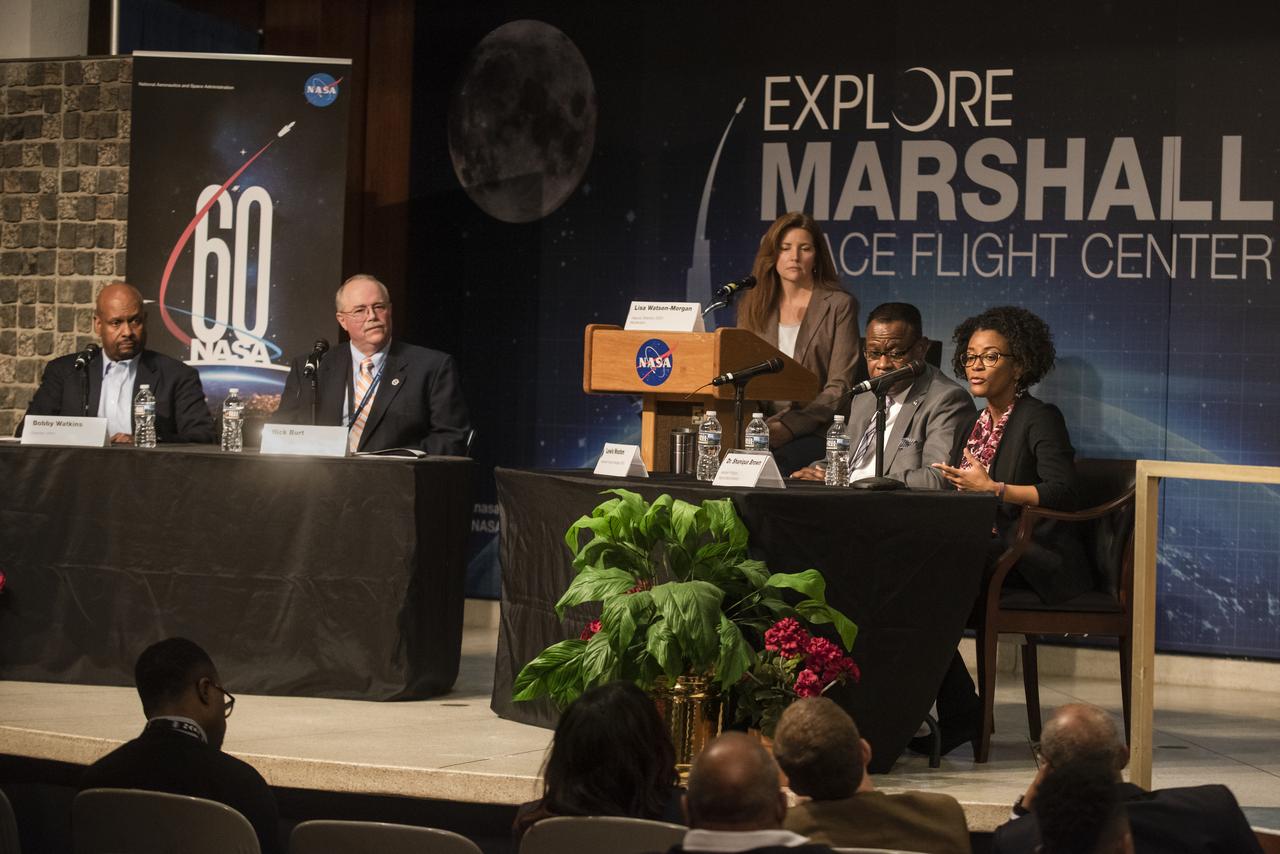
Wayne State University professor Shanique Brown, far right, takes part in a panel discussion on diversity and building strong, inclusive teams. She was joined by, from right, Lewis Wooten, associate program manager for the Space Launch System Program Office at Marshall; moderator Lisa Watson-Morgan, deputy director of Marshall's Engineering Directorate; Rick Burt, director of Marshall's Safety & Mission Assurance Directorate; and Bobby Watkins, director of the Human Exploration Development and Operations Office.

This is a full resolution radar mosaic of the Lavinia region of Venus as seen by NASA Magellan spacecraft. This area shows a diverse set of geologic features. http://photojournal.jpl.nasa.gov/catalog/PIA00087
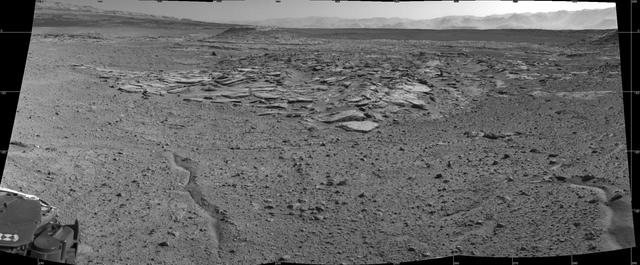
NASA Curiosity Mars rover recorded this view of various rock types at waypoint called the Kimberley shortly after arriving at the location on April 2, 2014. The site offers a diversity of rock types exposed close together.
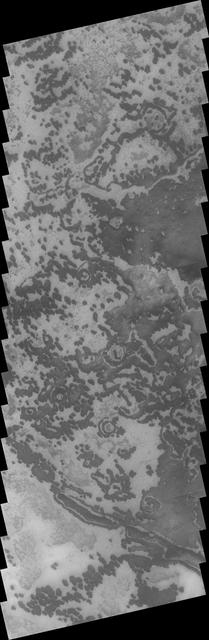
This VIS image from NASA 2001 Mars Odyssey spacecraft of the south polar region was collected during the summer season. The markings of the pole are very diverse and easy to see after the winter frost has been removed.
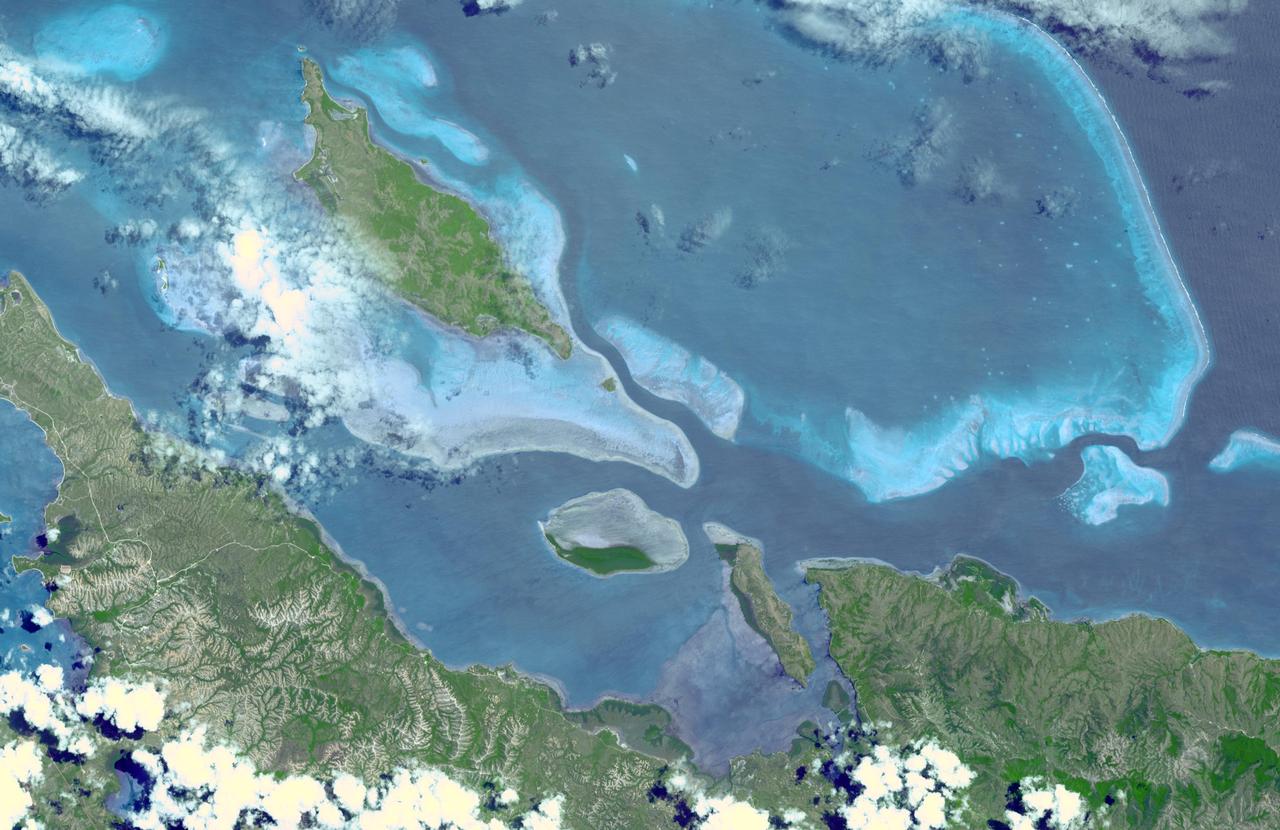
In this image, taken by NASA Terra spacecraft, six marine clusters represent the main diversity of coral reefs and associated ecosystems in the French Pacific Ocean archipelago of New Caledonia.
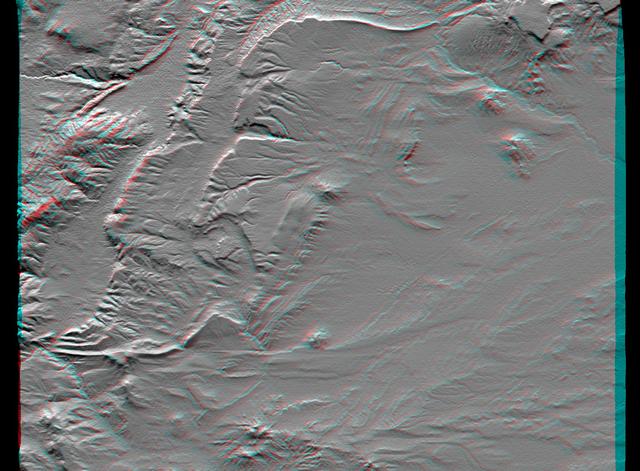
This anaglyph, from NASA Shuttle Radar Topography Mission, is of an area southwest of Zapala, Argentina, showing a wide diversity of geologic features. 3D glasses are necessary to view this image.
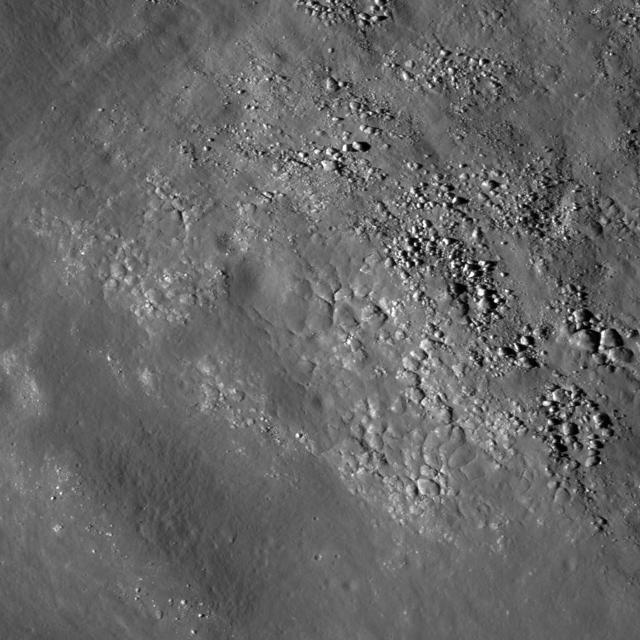
Diverse textures on the floor of Saha E which could be the result of impact melt coating boulders and other deposits on the floor of the crater on the lunar farside in this image taken by NASA Lunar Reconnaissance Orbiter.
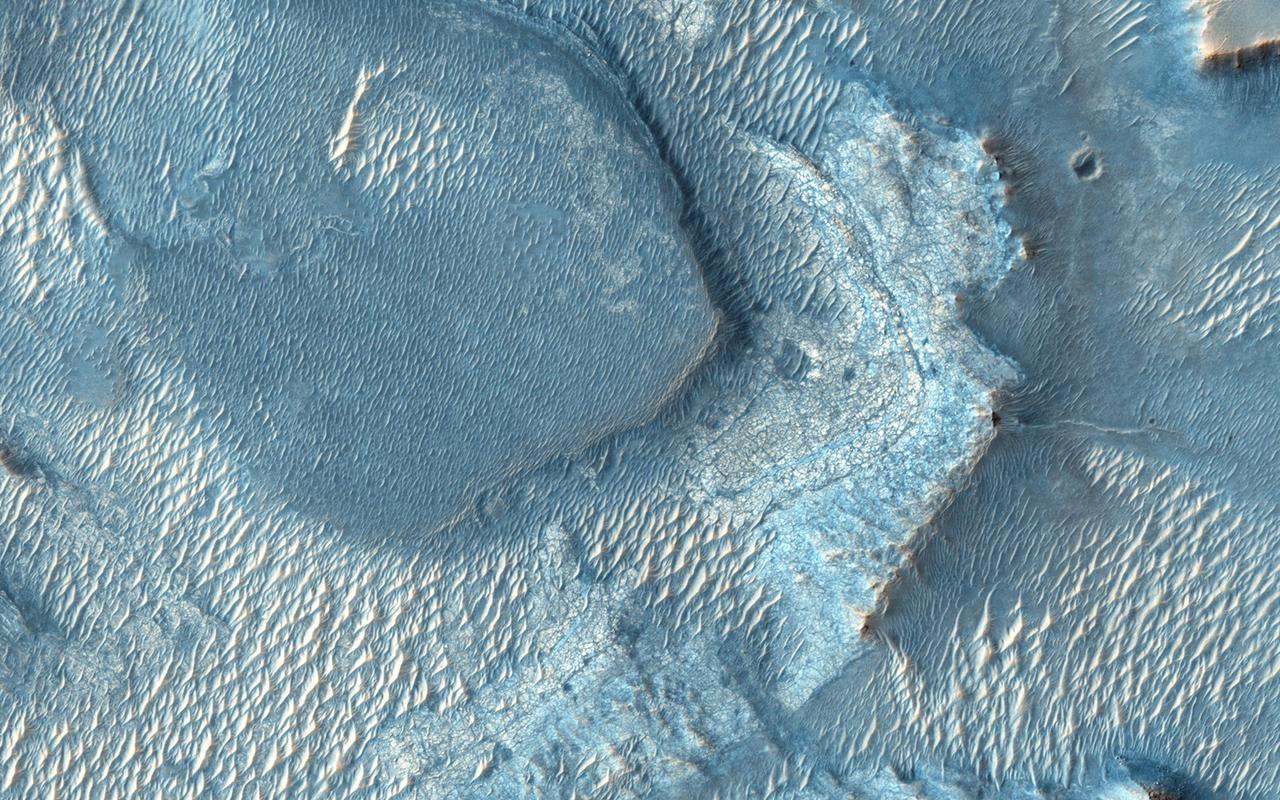
Nili Fossae, once considered a potential landing spot for the Mars Science Laboratory, has one of the largest, most diverse exposures of clay minerals as seen by NASA Mars Reconnaissance Orbiter.
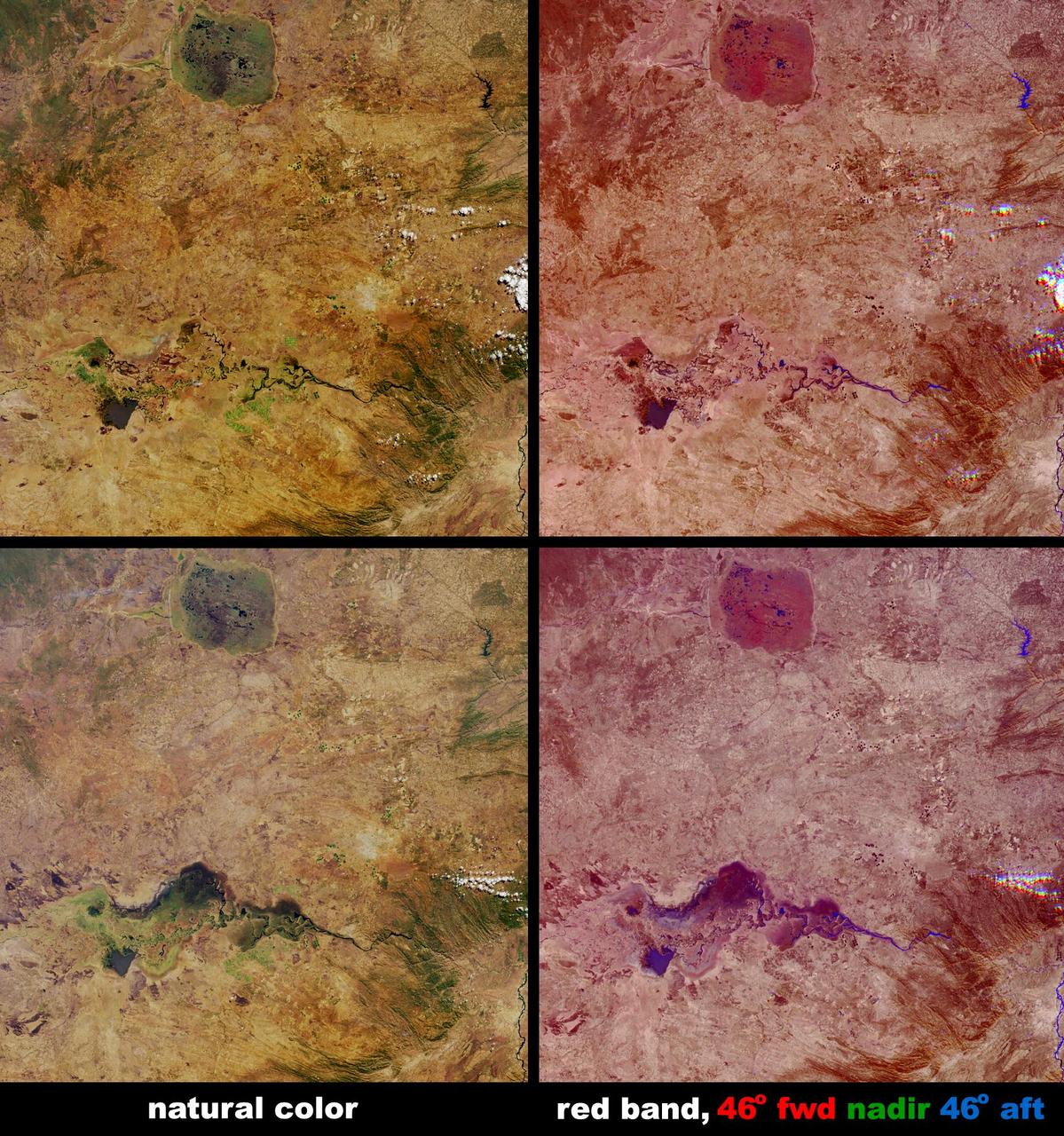
Heavy rainfall in southern Africa between December 2003 and April 2004 provided central Zambia with floodwaters needed to support the diverse uses of water within the Kafue Flats area as seen by NASA Terra spacecraft.

Data from NASA Moon Mineralogy Mapper instrument on the Indian Space Research Organization Chandrayaan-1 spacecraft reveal subtle and previously unknown lunar diversity and features. Animation available at the Photojournal.

From a position in the shallow Yellowknife Bay depression, NASA Mars rover Curiosity used its right Mast Camera Mastcam to take the telephoto images combined into this panorama of geological diversity.
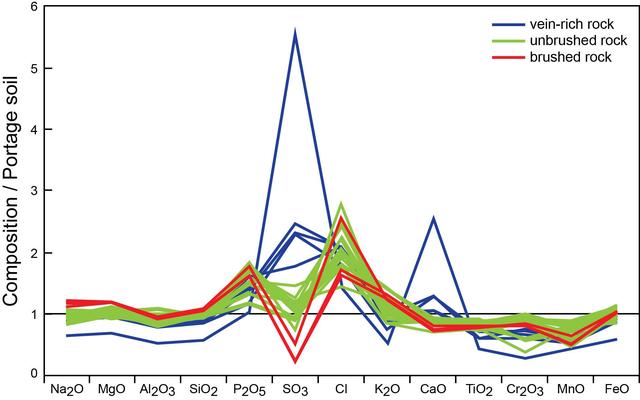
This graphic presents results from APXS onboard NASA rover Curiosity, with the comparisons simplified across diverse elements by dividing the amount of each element measured in the rocks by the amount of the same element in a local soil.

From a position in the shallow Yellowknife Bay depression, NASA Mars rover Curiosity used its right Mast Camera Mastcam to take the telephoto images combined into this panorama of geological diversity.

NASA Mars Reconnaissance Orbiter shows the surface outside this large crater is relatively dark, while the interior wall of the crater exposes lighter, layered bedrock of diverse colors.

This ethereal scene captured by NASA New Horizons spacecraft tells yet another story of Pluto diversity of geological and compositional features-this time in an enhanced color image of the north polar area.

Saturn most prominent feature, its dazzling ring system, takes center stage in this stunning natural color mosaic which reveals the color and diversity present in this wonder of the solar system.

The Aristarchus region is one of the most diverse and interesting areas on the Moon. About 500 images from NASA's Clementine spacecraft were processed and combined into a multispectral mosaic of this region. http://photojournal.jpl.nasa.gov/catalog/PIA00090
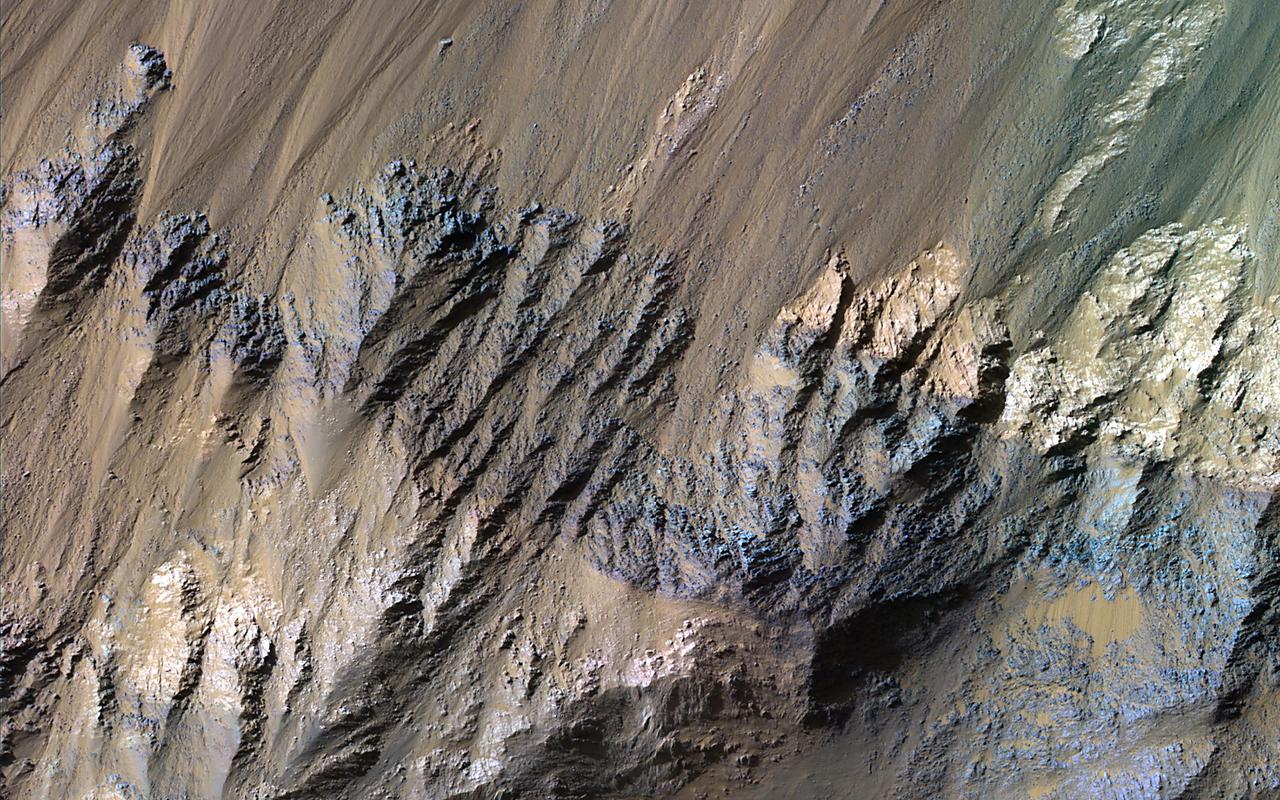
This image shows the southern wall of Coprates Chasma, in the equatorial canyon system of Valles Marineris. While much of the lower slopes are covered by sand, exposed bedrock is clearly visible in the upper canyon walls. In an enhanced color image, the varying colors – shades of white, cyan, and purple – are suggestive of multiple minerals being present within the bedrock, indicating a complicated geologic history, possibly involving alteration by water. (In this cutout, north is down.) https://photojournal.jpl.nasa.gov/catalog/PIA25985
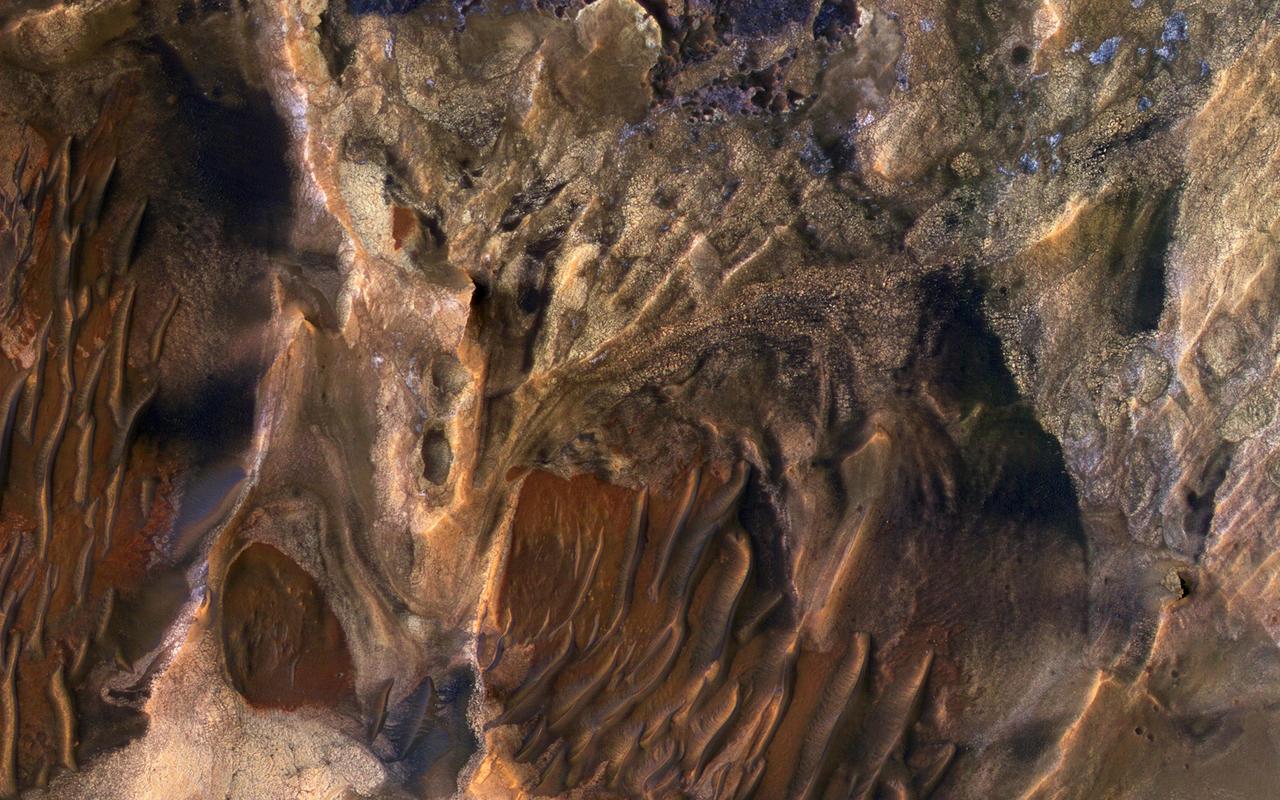
This scene captured by NASA Mars Reconnaissance Orbiter includes chaotic deposits with a wide range of colors. The deposits are distinctive with both unique colors and small-scale textures such as fracture patterns. These are probably sedimentary rocks, transported and deposited in water or air. The original layers may have been jumbled in a landslide. Dark or reddish sand dunes cover some of the bedrock. http://photojournal.jpl.nasa.gov/catalog/PIA19860

Diverse Group of Glenn Research Center Employees

Diverse Group of Glenn Research Center Employees

Retired Marshall scientist, Jeanette Scissum-Mickens, was honored by Alabama Governor Kay Ivey at the Alabama Historically Black Colleges and Universities Roundtable Discussion: Minority Women in STEM event held at the University of Alabama A&M in Huntsville, Alabama. Scissum-Mickens was honored as the “Hidden Figure of Alabama A&M.” She was the first African-American mathematician hired by Marshall in 1964.
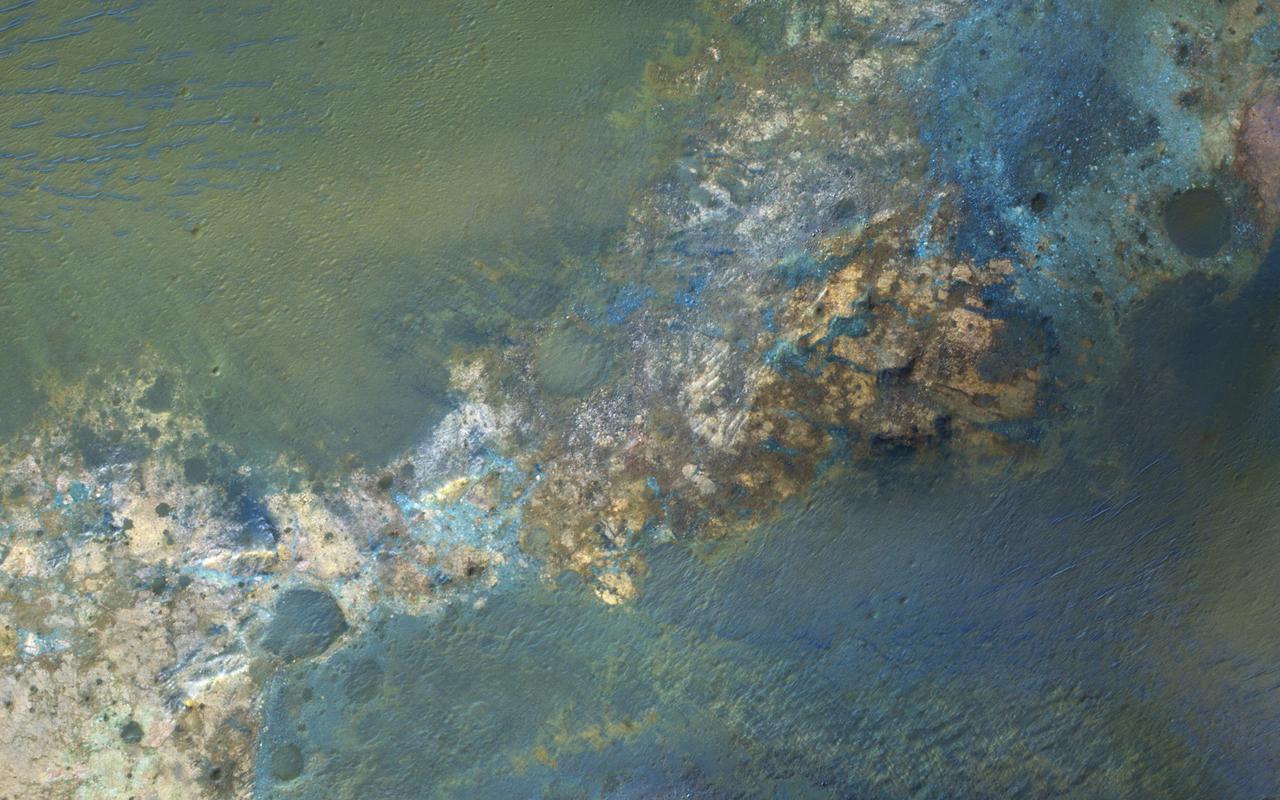
Large impact craters rebound from the initial shock, raising deep bedrock to the surface in the central uplift of the crater. Often this bedrock has greater compositional diversity than the surface layers, because they are from greater depths, older, jumbled, and altered, and very diverse. http://photojournal.jpl.nasa.gov/catalog/PIA20814
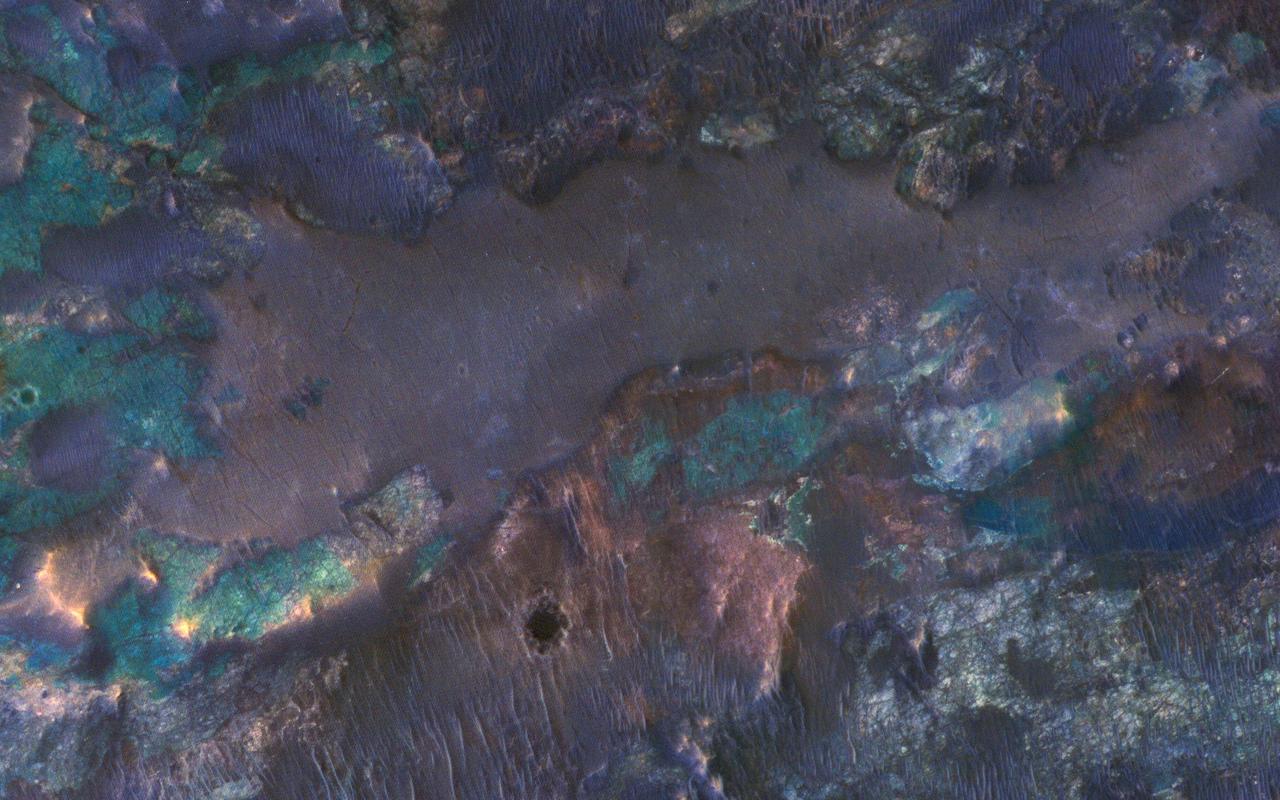
The collision that created Hargraves Crater impacted into diverse bedrock lithologies of ancient Mars; the impact ejecta is a rich mix of rock types with different colors and textures, as seen by NASA Mars Reconnaissance Orbiter. The crater is named after Robert Hargraves who discovered and studied meteorite impacts on the Earth. https://photojournal.jpl.nasa.gov/catalog/PIA21609
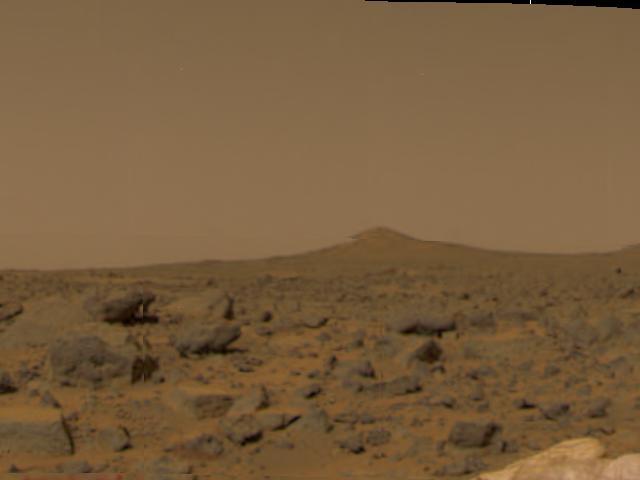
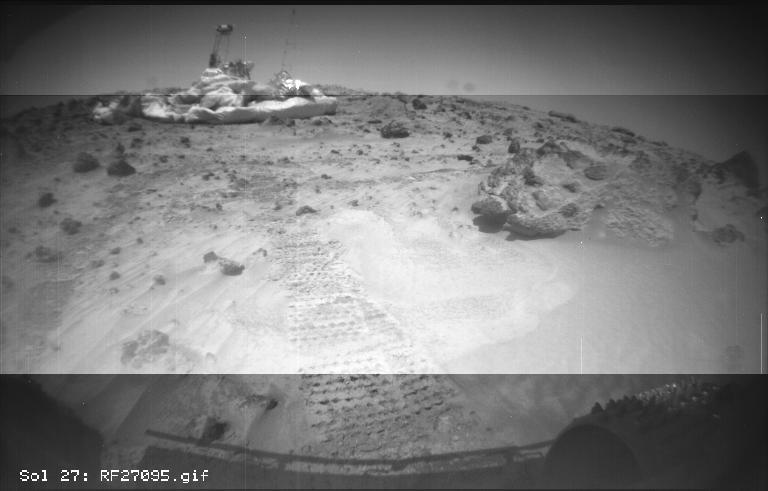
This image of the Martian surface was taken in the afternoon of Mars Pathfinder's first day on Mars. Taken by the Imager for Mars Pathfinder (IMP camera), the image shows a diversity of rocks strewn in the foreground. A hill is visible in the distance (the notch within the hill is an image artifact). Airbags are seen at the lower right. http://photojournal.jpl.nasa.gov/catalog/PIA00612
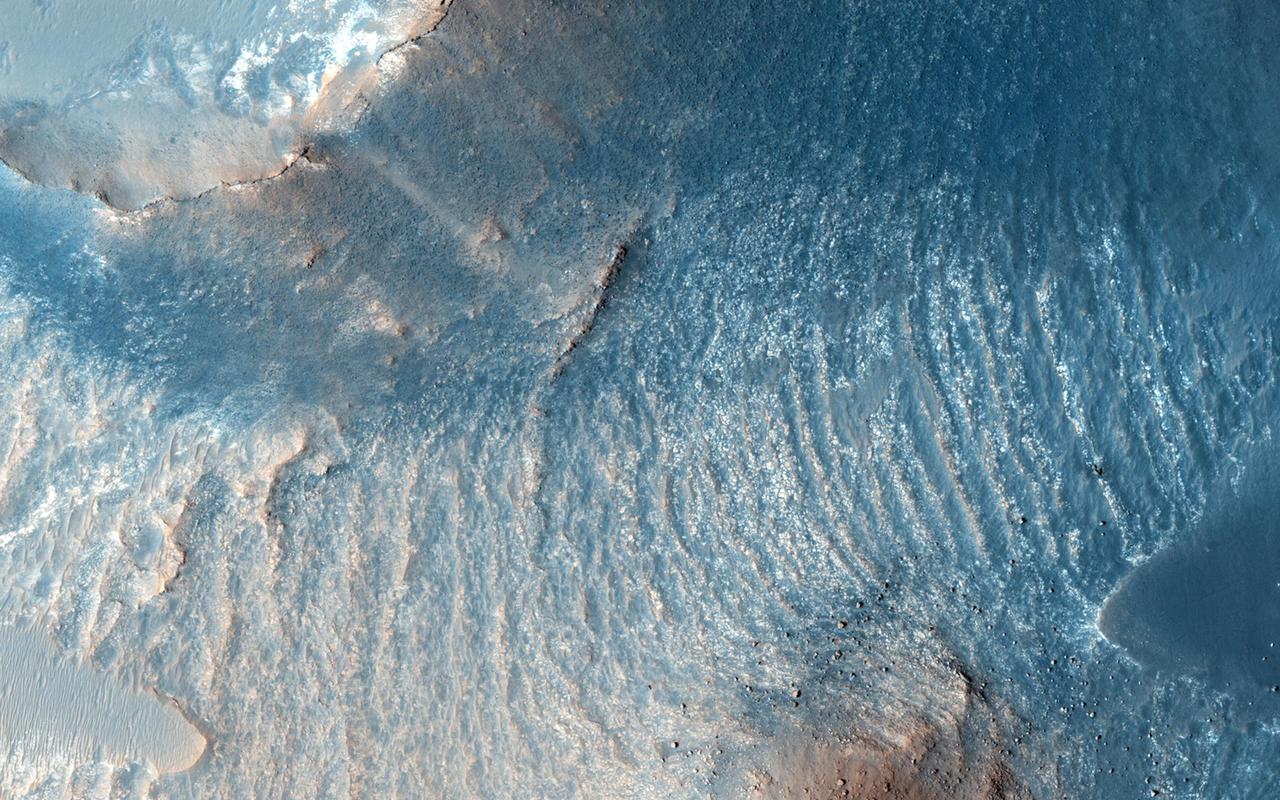
A variety of diverse morphological features are present in this image (21 by 5.5 kilometers) located in the southeastern area of the Nili Fossae region and just northeast of Syrtis Major. This particular region has been studied intensely due to the presence of volcanics from Syrtis Major and impact ejecta from the Isidis Basin. The region is rich in unaltered mafic deposits, in contact with diverse altered deposits rich in clays, carbonates, and sulfates. These deposits make the Nili Fossae region one of the most colorful regions on Mars, which is most distinctive in infrared color composites (IRB). HiRISE IRB color aids in chemical and mineral-type mapping, especially when correlated with other MRO instruments such as CRISM. http://photojournal.jpl.nasa.gov/catalog/PIA19940
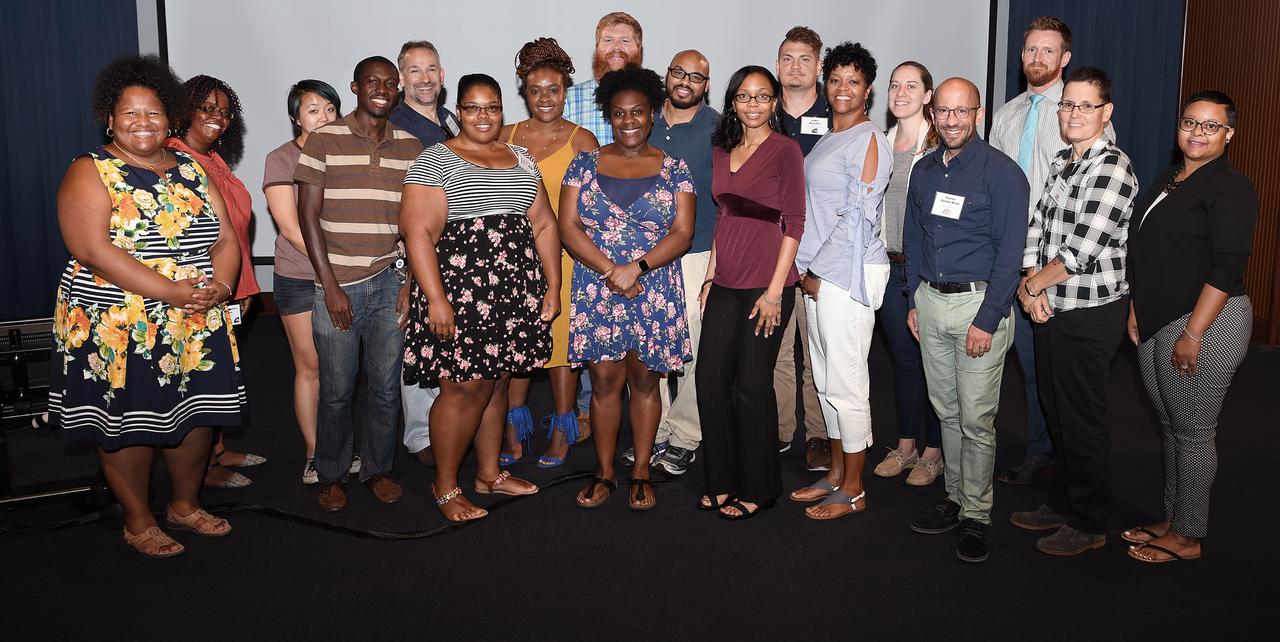
Diversity and Inclusion Program D&IP Advisory Committee Orientation was held August 9, 2018 Group shot
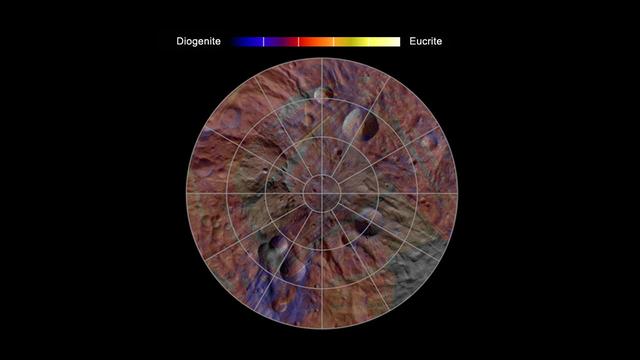
This image, made from data obtained by NASA Dawn spacecraft, shows the mineral distribution in the southern hemisphere of the giant asteroid Vesta.
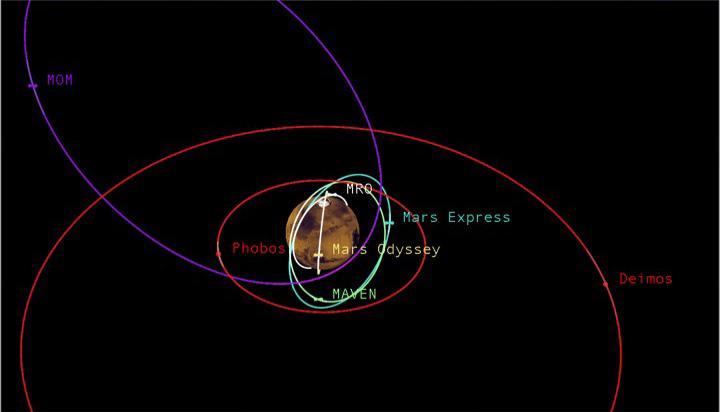
This graphic depicts the relative shapes and distances from Mars for five active orbiter missions plus the planet's two natural satellites. It illustrates the potential for intersections of the spacecraft orbits. The number of active orbiter missions at Mars increased from three to five in 2014. With the increased traffic, NASA has augmented a process for anticipating orbit intersections and avoiding collisions. NASA's Mars Odyssey and MRO (Mars Reconnaissance Orbiter) travel near-circular orbits. The European Space Agency's Mars Express, NASA's MAVEN (Mars Atmosphere and Volatile Evolution) and India's MOM (Mars Orbiter Mission), travel more elliptical orbits. Phobos and Deimos are the two natural moons of Mars. http://photojournal.jpl.nasa.gov/catalog/PIA19396

Terby Crater, sitting on the northern rim of Hellas Basin, has been filled by sedimentary deposits, perhaps deposited by or in water, as observed by NASA Mars Reconnaissance Orbiter.
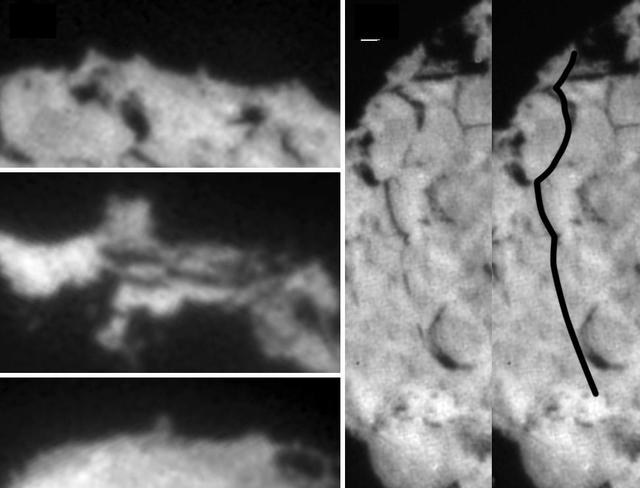
These images taken by NASA's Stardust spacecraft highlight the diverse features that make up the surface of comet Wild 2, showing a variety of small pinnacles and mesas seen on the limb of the comet and the location of a 2-kilometer (1.2-mile) series of aligned scarps, or cliffs, that are best seen in the stereo images. http://photojournal.jpl.nasa.gov/catalog/PIA06284
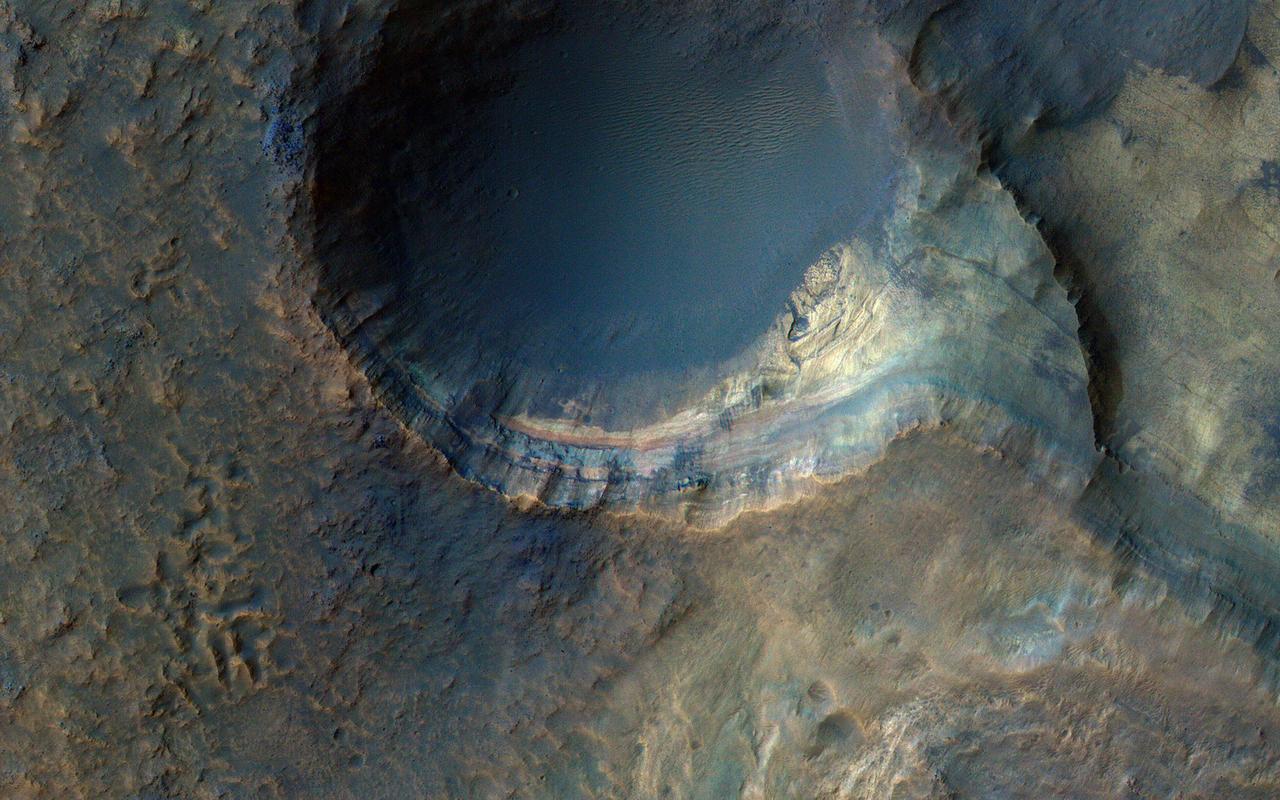
The sedimentary history of Mars is important to understanding climate change and the evolution of Mars. Sedimentary rocks consist of fine particles carried by the atmosphere and/or water and deposited in generally flat-lying layers, which become indurated (turn into rock) over time. This image covers some steep slopes with good exposures of the bedrock layers, revealing diverse color and textures. A detailed study of many such exposures along with compositional data can be used to reconstruct the sequence of events and interpret the geologic history. https://photojournal.jpl.nasa.gov/catalog/PIA25354

Representatives of the state of Alabama, academia, and industry listen and take part in a panel discussion led by NASA Marshall Space Flight Center's Ruth Jones as part of the first Alabama Historically Black Colleges and Universities Roundtable Discussion. The event focused on drawing more minorities, specifically women, into academic fields and careers in science, technology, engineering and mathematics.
Marshall’s Ruth Jones, a mishap investigation specialist, told her NASA story and spoke about minority statistics in science, technology, engineering and mathematics (STEM). Jones also led a panel discussing how to engage, encourage and draw more minority students in to STEM fields and careers.
![This enhanced-color sample reveals the incredible diversity of landforms on some Martian plains that appear bland and uniform at larger scales. Here we see layers, small channels suggesting water flow, craters, and indurated sand dunes. The map is projected here at a scale of 25 centimeters (9.8 inches) per pixel. [The original image scale is 25.7 centimeters (10.1 inches) per pixel (with 1 x 1 binning); objects on the order of 77 centimeters (30.3 inches) across are resolved.] North is up. http://photojournal.jpl.nasa.gov/catalog/PIA21573](https://images-assets.nasa.gov/image/PIA21573/PIA21573~medium.jpg)
This enhanced-color sample reveals the incredible diversity of landforms on some Martian plains that appear bland and uniform at larger scales. Here we see layers, small channels suggesting water flow, craters, and indurated sand dunes. The map is projected here at a scale of 25 centimeters (9.8 inches) per pixel. [The original image scale is 25.7 centimeters (10.1 inches) per pixel (with 1 x 1 binning); objects on the order of 77 centimeters (30.3 inches) across are resolved.] North is up. http://photojournal.jpl.nasa.gov/catalog/PIA21573
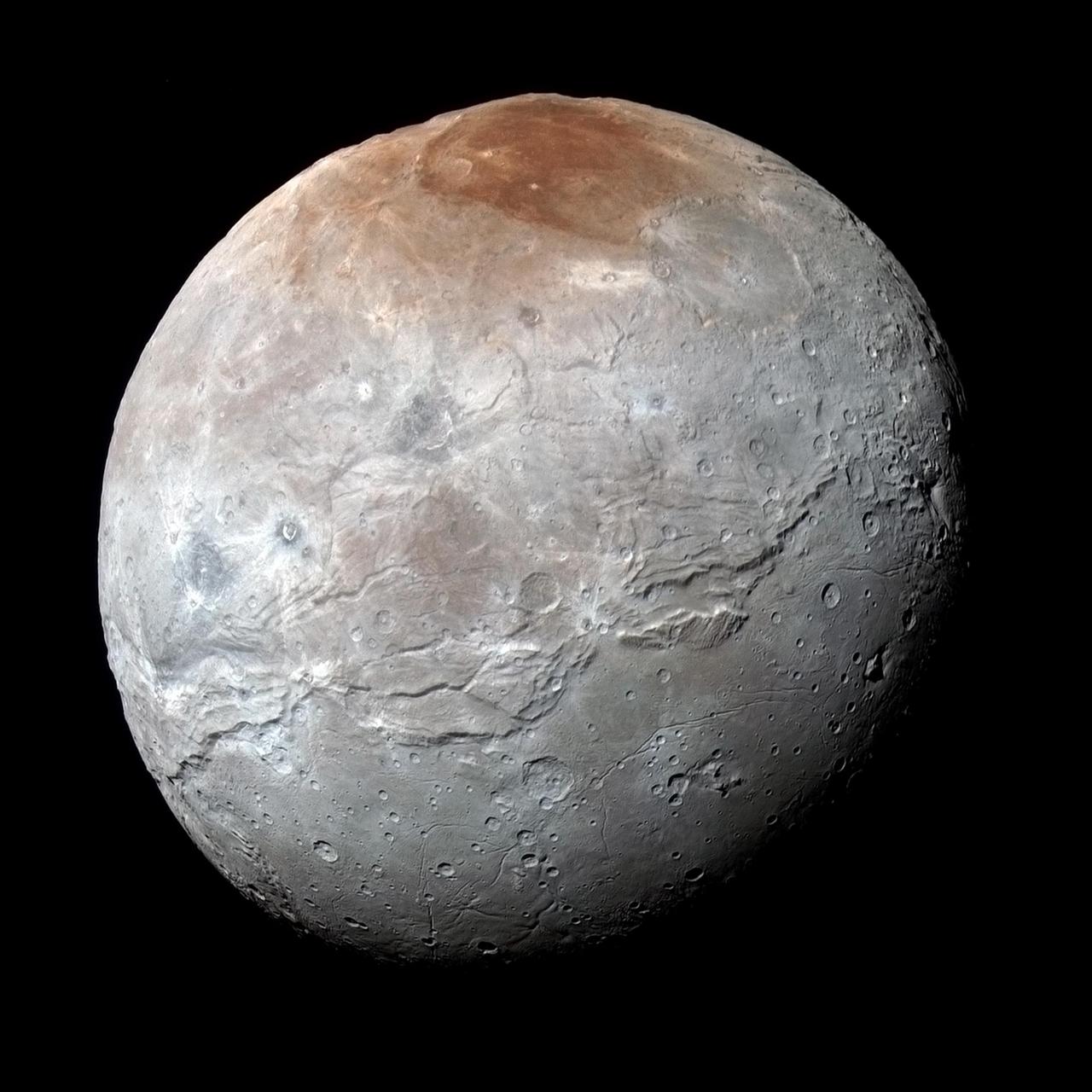
NASA's New Horizons captured this high-resolution enhanced color view of Charon just before closest approach on July 14, 2015. The image combines blue, red and infrared images taken by the spacecraft's Ralph/Multispectral Visual Imaging Camera (MVIC); the colors are processed to best highlight the variation of surface properties across Charon. Charon's color palette is not as diverse as Pluto's; most striking is the reddish north (top) polar region, informally named Mordor Macula. Charon is 754 miles (1,214 kilometers) across; this image resolves details as small as 1.8 miles (2.9 kilometers). http://photojournal.jpl.nasa.gov/catalog/PIA19968

Crystal Moten, NASA Headquarters Office of Diversity and Equal Opportunity, speaks at the MLK Day of Service, Tuesday, January 21, 2020 at NASA Headquarters in Washington. Photo Credit: (NASA/Aubrey Gemignani)

This view of scientists taking a break during the Pan Pacific Microgravity Conference on May 2-3, 2001, in Pasadena, CA, shows some of the diversity of the researchers attracted to the field.

Kennedy Space Center Office of Diversity and Equal Opportunity Manager Rob Grant speaks to NASA civil service and contractor employees and guests in Kennedy Space Center’s Training Auditorium on April 12, 2019. Rogers talked about the power of diversity during “Columbia: The Mission Continues,” an event organized by the Apollo Challenger Columbia Lessons Learned Program (ACCLLP). The event is part of the Space Shuttle Columbia national tour and took place on the 38th anniversary of STS-1, the first orbital spaceflight of NASA’s Space Shuttle Program. The tour launched at Kennedy and will make its way to each of the 10 NASA centers.

Portrait of Robin "Rob" Lee of the Office of Diversity & Equal Opp. Branch, in front of NASA Langley's "Meatball." The portrait was done for Thalia Patrinos at NASA Headquarters as part of "Faces of NASA" project. Due to the COVID-19 pandemic, masks were mandated by Governor Northam in Virginia in public settings. "Well, little did I know, even at a young age, he instilled in me the importance of seeing people for people. And being able to help people and being able to meet them in their time of need. And that carried me throughout my entire life. Even still today.” — Robin Lee, Director of Office of Diversity and Equal Opportunity, Langley Research Center
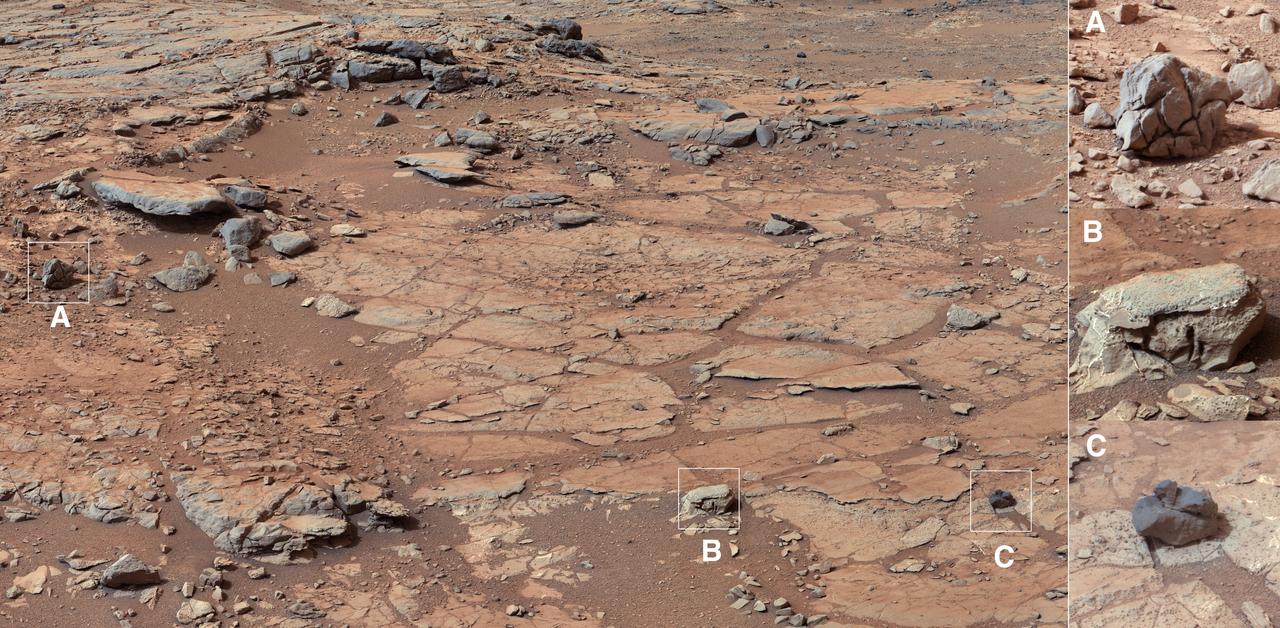
The right Mast Camera Mastcam of NASA Curiosity Mars rover provided this contextual view of the vicinity of the location called John Klein, selected as Curiosity first drilling site.