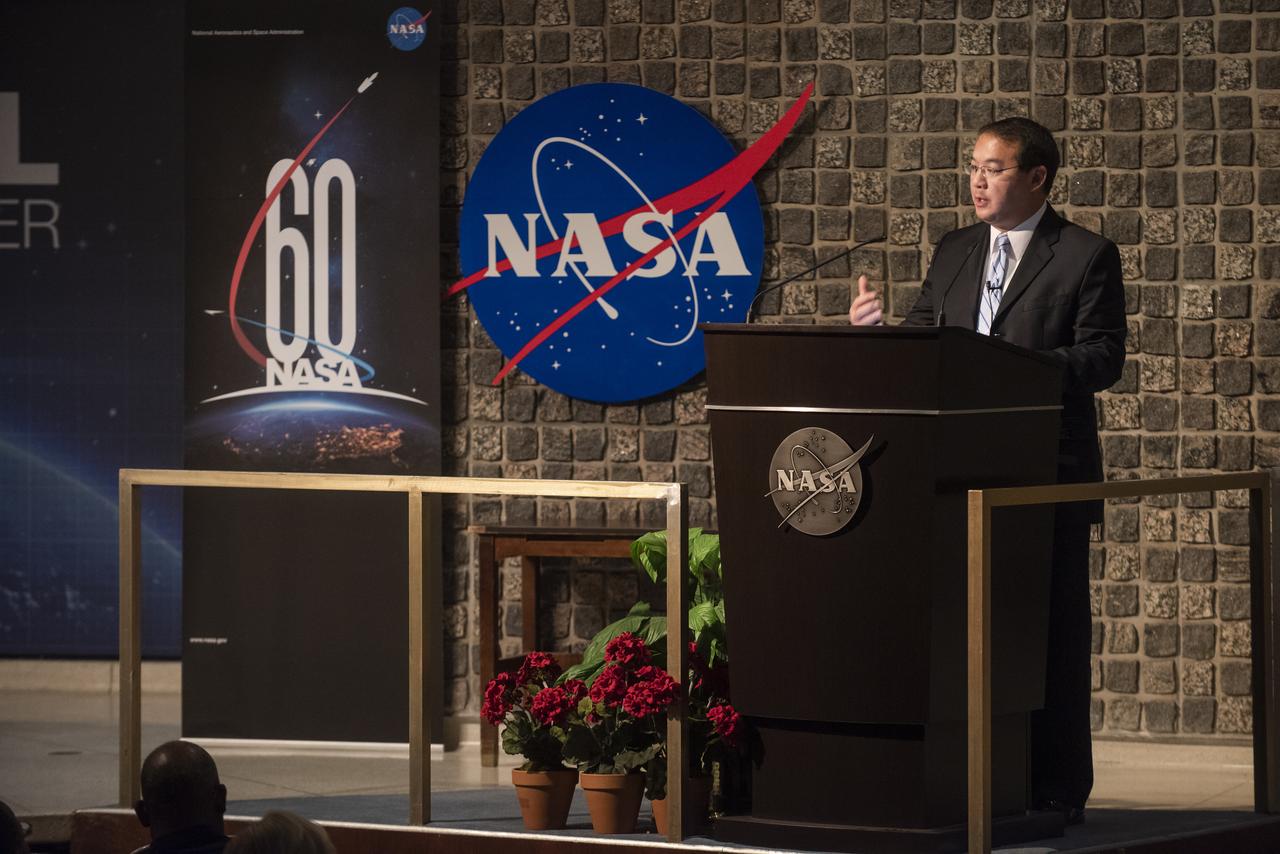
Steve Shih, NASA associate administrator for Diversity & Equal Opportunity, addresses NASA team members during a Nov. 6 mentoring event at the agency's Marshall Space Flight Center. Shih discussed ways for team members on both sides of the mentoring equation to get the most out of the experience.
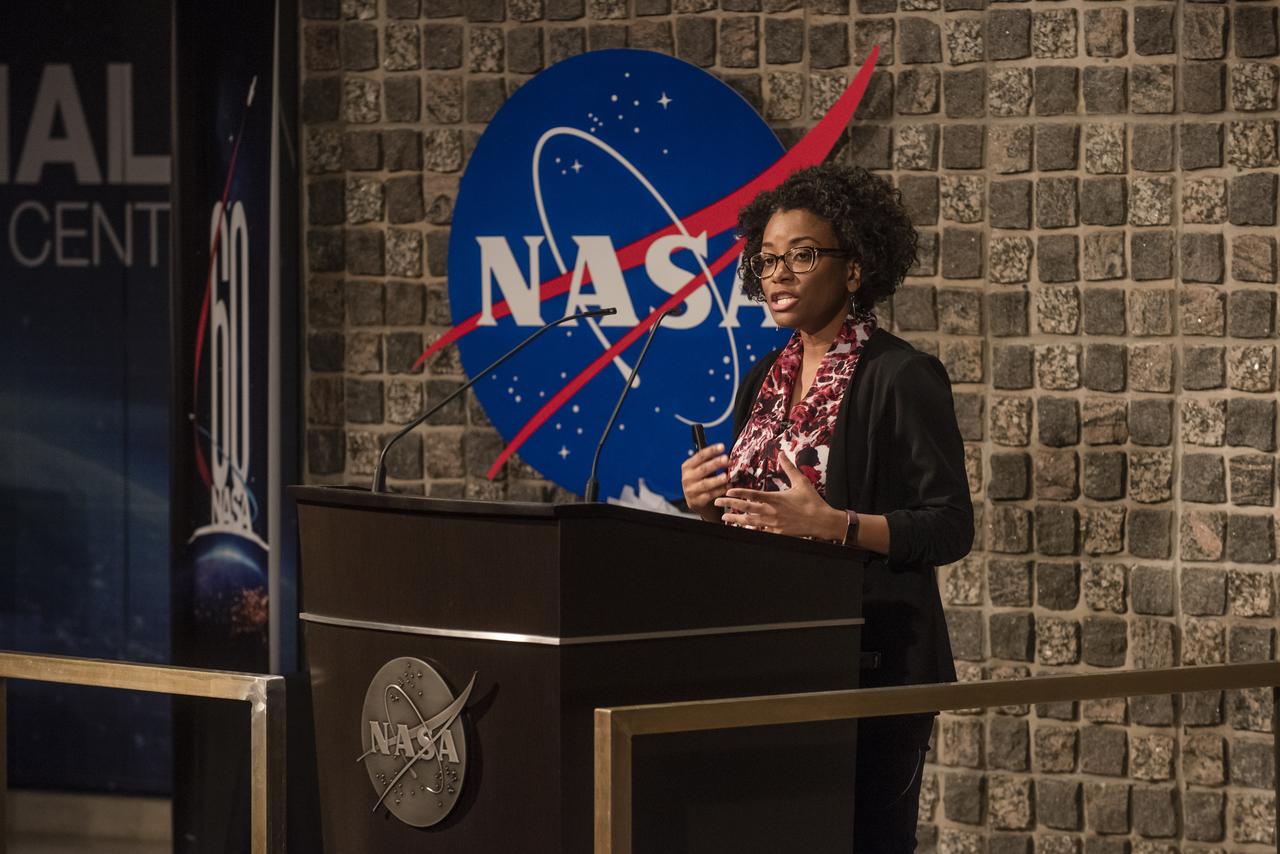
Dr. Shanique Brown, an assistant professor of industrial-organizational psychology at Wayne State University in Detroit, Michigan, delivers the Black History Month keynote address to team members at NASA's Marshall Space Flight Center Feb. 28. Participants mingled with Brown and Marshall leaders after the speech and a panel discussion on diversity and inclusion, and sampled a variety of ethnic foods. The 2019 commemoration, themed "Migrations From Here to There," was organized by Marshall's Office of Diversity and Equal Opportunity
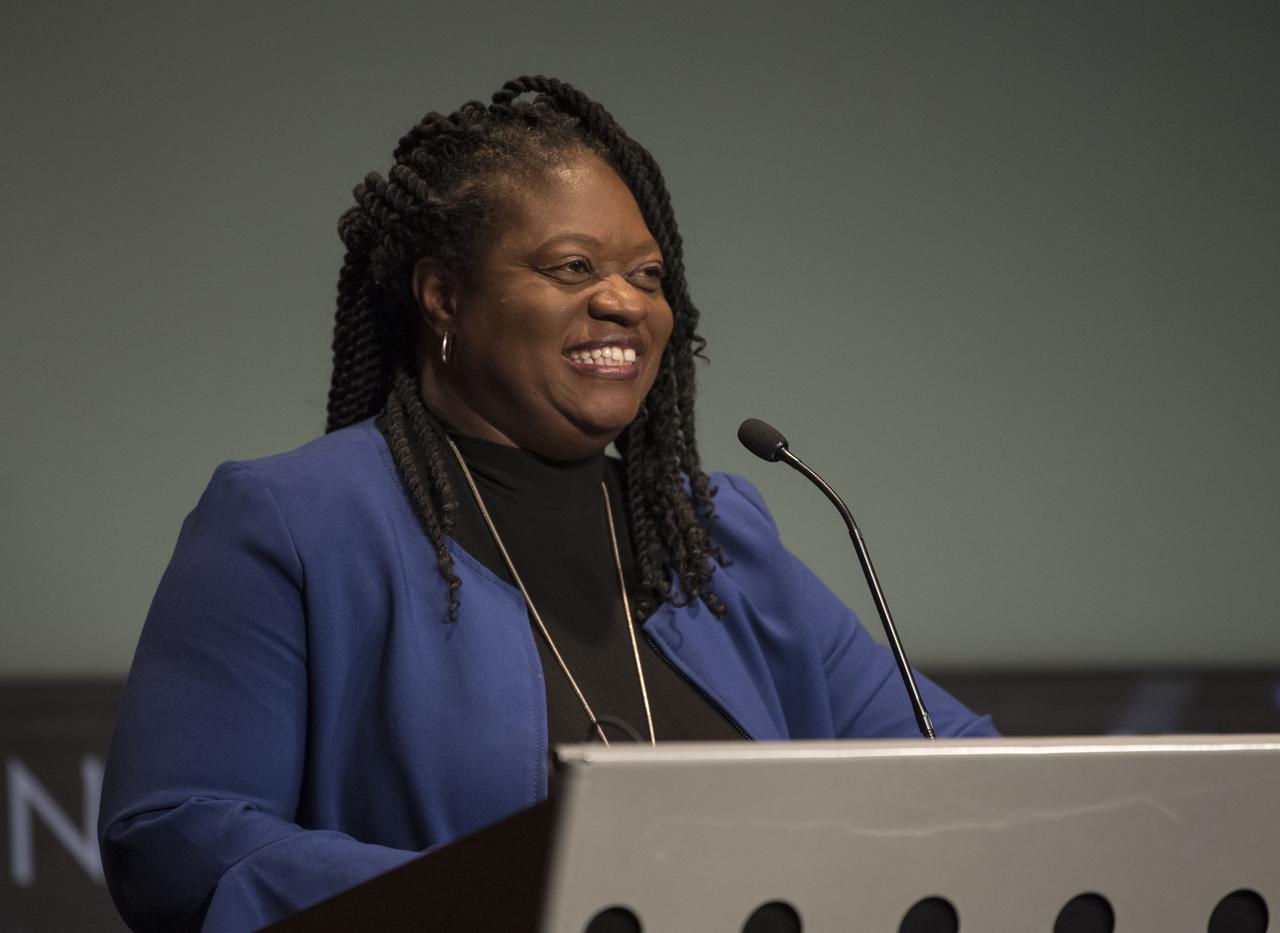
Crystal Moten, NASA Headquarters Office of Diversity and Equal Opportunity, speaks at the MLK Day of Service, Tuesday, January 21, 2020 at NASA Headquarters in Washington. Photo Credit: (NASA/Aubrey Gemignani)

Jessica Conner, special emphasis program manager, Office of Diversity and Equal Opportunity, addresses the audience during the “KSC and Proud to Be” centerwide diversity event held at Kennedy Space Center’s Operations Support Building II (OSB II) on Aug. 20, 2019. The event featured a presentation by Robin Hauser, a director and producer of award-winning documentaries. Hauser, who has spoken at the White House and at conferences worldwide, addressed bias in artificial intelligence. A new employee video focusing on the importance of employee resource groups at the center made its debut showing at the event.

Jessica Conner, special emphasis program manager, Office of Diversity and Equal Opportunity, addresses the audience during the “KSC and Proud to Be” centerwide diversity event held at Kennedy Space Center’s Operations Support Building II (OSB II) on Aug. 20, 2019. The event featured a presentation by Robin Hauser, a director and producer of award-winning documentaries. Hauser, who has spoken at the White House and at conferences worldwide, addressed bias in artificial intelligence. A new employee video focusing on the importance of employee resource groups at the center made its debut showing at the event.
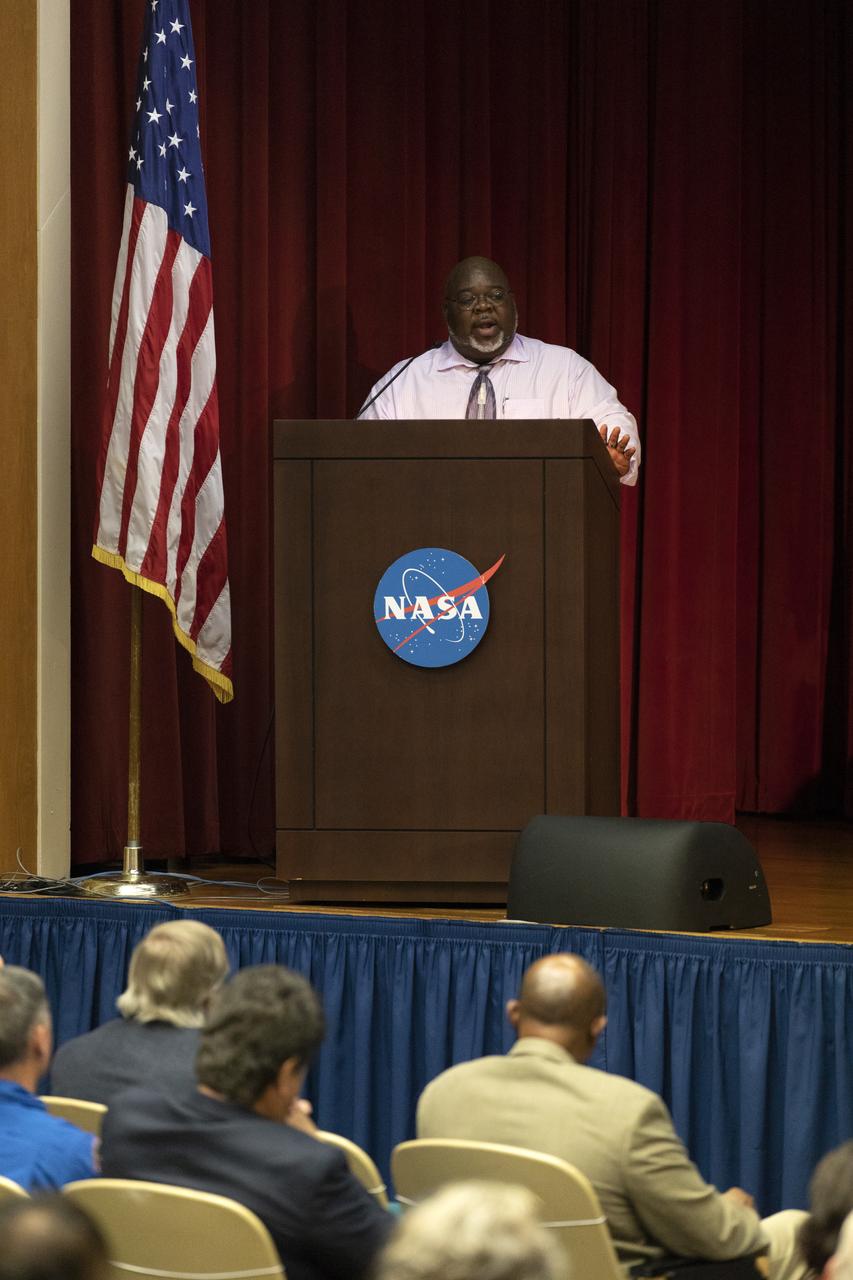
Kennedy Space Center Office of Diversity and Equal Opportunity Manager Rob Grant speaks to NASA civil service and contractor employees and guests in Kennedy Space Center’s Training Auditorium on April 12, 2019. Rogers talked about the power of diversity during “Columbia: The Mission Continues,” an event organized by the Apollo Challenger Columbia Lessons Learned Program (ACCLLP). The event is part of the Space Shuttle Columbia national tour and took place on the 38th anniversary of STS-1, the first orbital spaceflight of NASA’s Space Shuttle Program. The tour launched at Kennedy and will make its way to each of the 10 NASA centers.
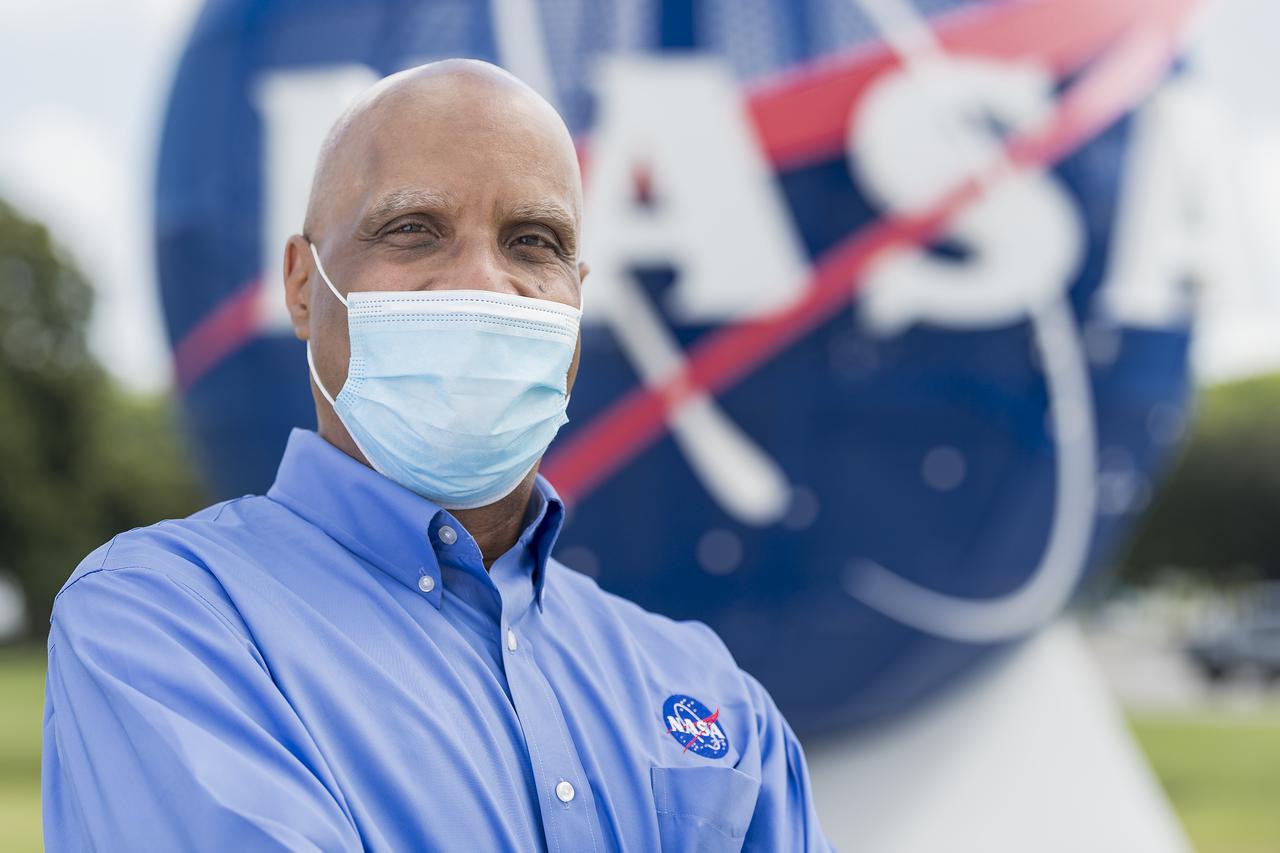
Portrait of Robin "Rob" Lee of the Office of Diversity & Equal Opp. Branch, in front of NASA Langley's "Meatball." The portrait was done for Thalia Patrinos at NASA Headquarters as part of "Faces of NASA" project. Due to the COVID-19 pandemic, masks were mandated by Governor Northam in Virginia in public settings. "Well, little did I know, even at a young age, he instilled in me the importance of seeing people for people. And being able to help people and being able to meet them in their time of need. And that carried me throughout my entire life. Even still today.” — Robin Lee, Director of Office of Diversity and Equal Opportunity, Langley Research Center
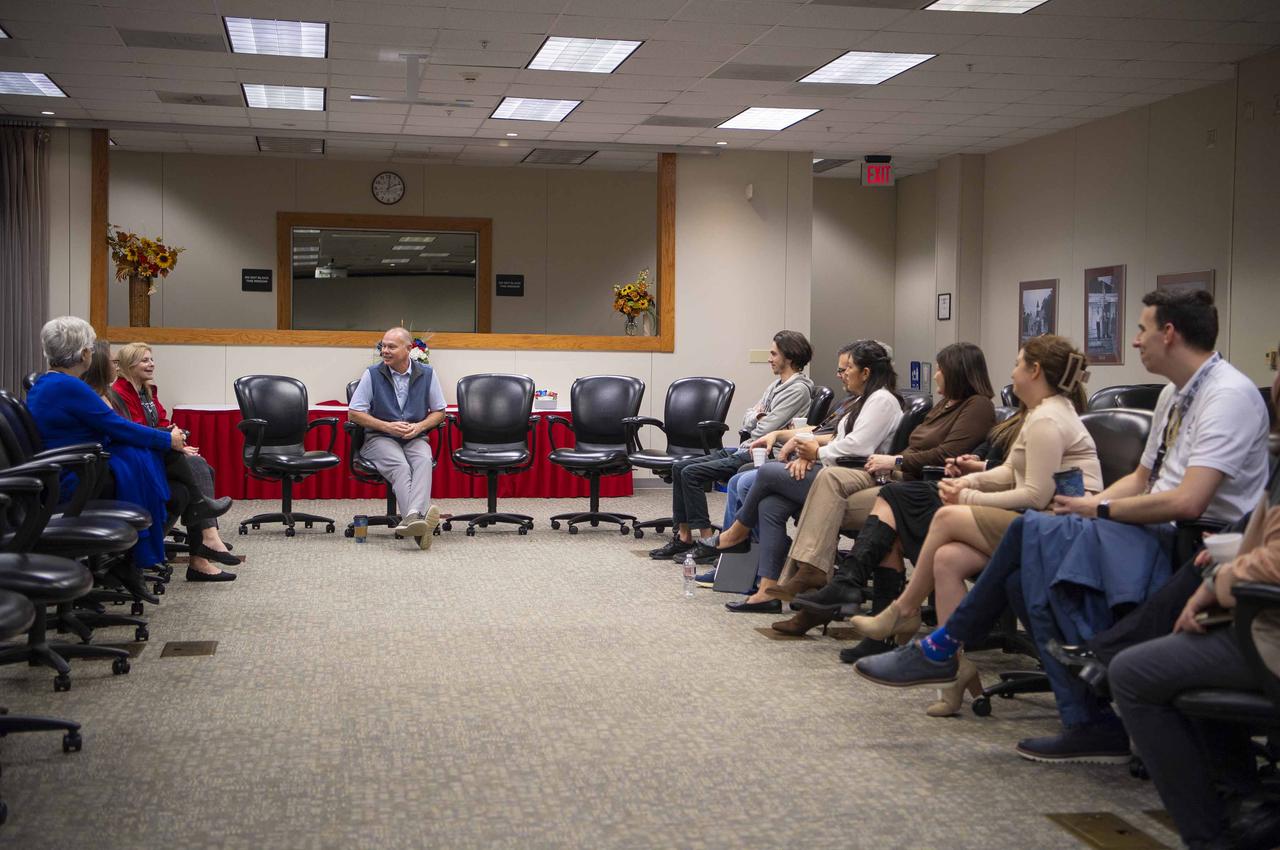
NASA Stennis Director John Bailey hosts a Java with John session on Dec. 10 with employees representing the Office of the Chief Financial Officer, Office of STEM Engagement, Office of Diversity and Equal Opportunity, Office of the Chief Human Capital Officer, and the center’s Autonomous Systems Laboratory team. Java with John is an employee-led discussion in a casual environment aimed at fostering a culture in which employees are welcome to share what matters most to them at work.
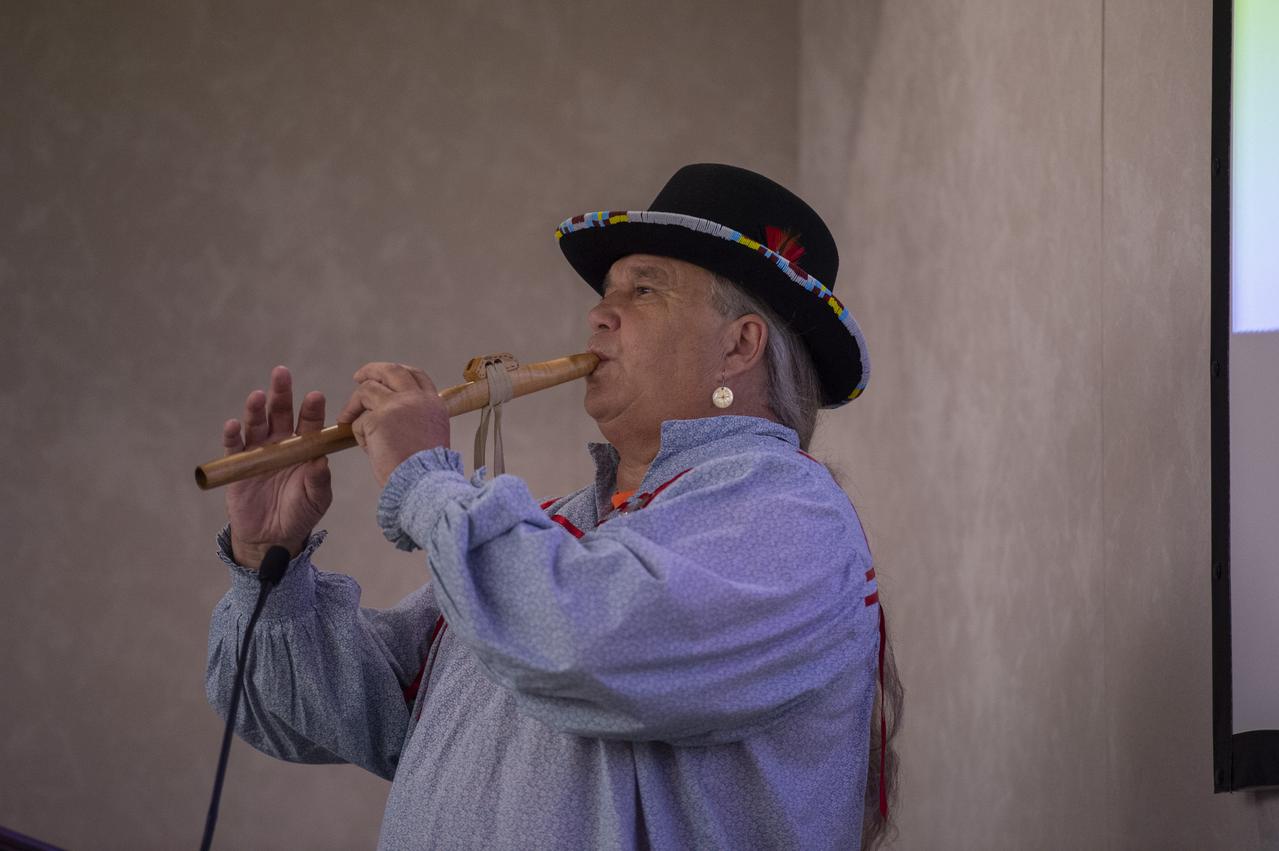
JIMMY YELLOWHORSE, FROM DECATUR, ALABAMA, PLAYS A HAND-CARVED FLUTE DURING THE NATIVE AMERICAN HERITAGE MONTH PROGRAM NOV. 13 AT NASA’S MARSHALL SPACE FLIGHT CENTER. YELLOWHORSE CRAFTED THE FLUTE HIMSELF FROM CEDAR, WALNUT AND MAHOGANY, USING TRADITIONAL CHEROKEE TECHNIQUES. THE ANNUAL OBSERVANCE, COORDINATED BY MARSHALL'S OFFICE OF DIVERSITY AND EQUAL OPPORTUNITY, HONORS THE CULTURE AND CONTRIBUTIONS OF NATIVE AMERICANS THROUGH STORYTELLING AND ETHNIC FOOD SAMPLINGS.
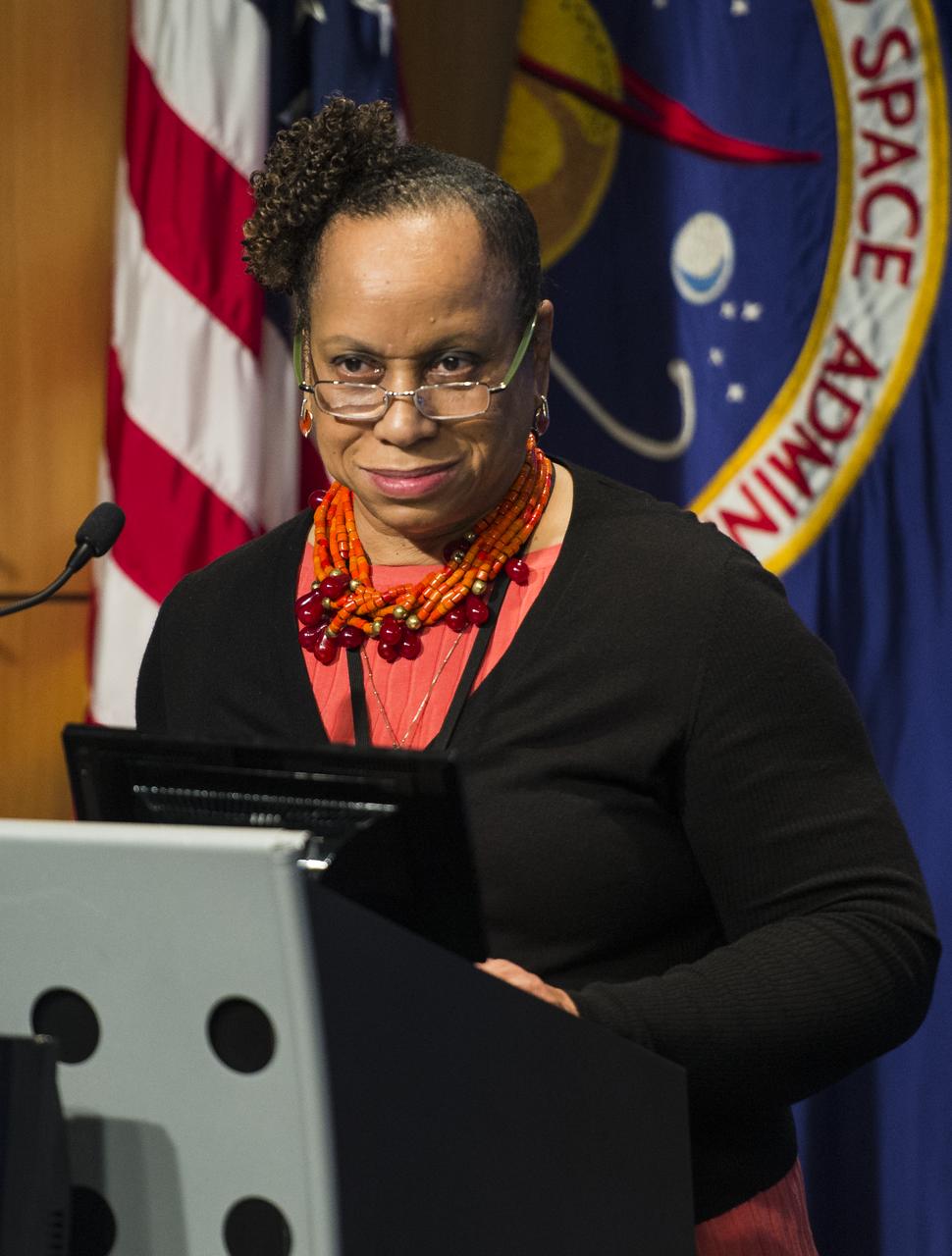
Brenda Manuel, Associate Administrator for Diversity and Equal Opportunity at NASA gives opening remarks at an event celebrating the 50th Anniversary of the Civil Rights Act of 1964 on Monday, June 23, 2014 in the James E. Webb Auditorium at NASA Headquarters in Washington, DC. the event highlighted the influence of the Civil Rights Act on NASA. Photo Credit: (NASA/Joel Kowsky)
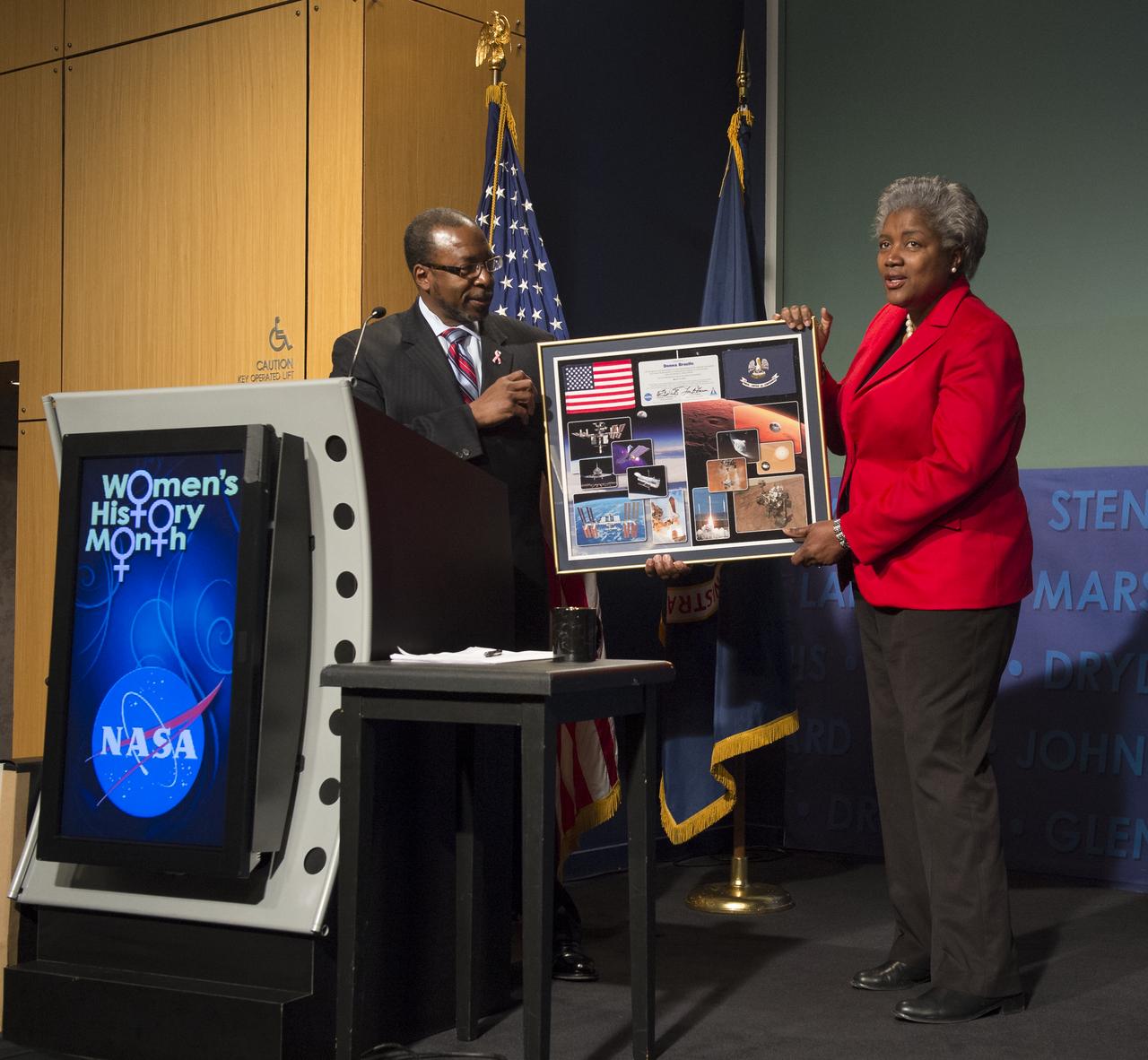
Dr. Woodrow Whitlow, Jr. (left), Associate Administrator for Mission Support Directorate at NASA Headquarters presents Donna Brazile, keynote speaker at a program celebrating National Women's History Month, with a framed NASA montage, Thursday, March 14, 2013 in Washington. The theme of theprogram was "Women Inspiring Innovation Through Imagination," and was sponsored by the HQ Equal Opportunity and Diversity Management Division at NASA Headquarters. The event also commemorates the 100th Anniversary of the Women's Suffrage March on Washington. Photo Credit: (NASA/Carla Cioffi)
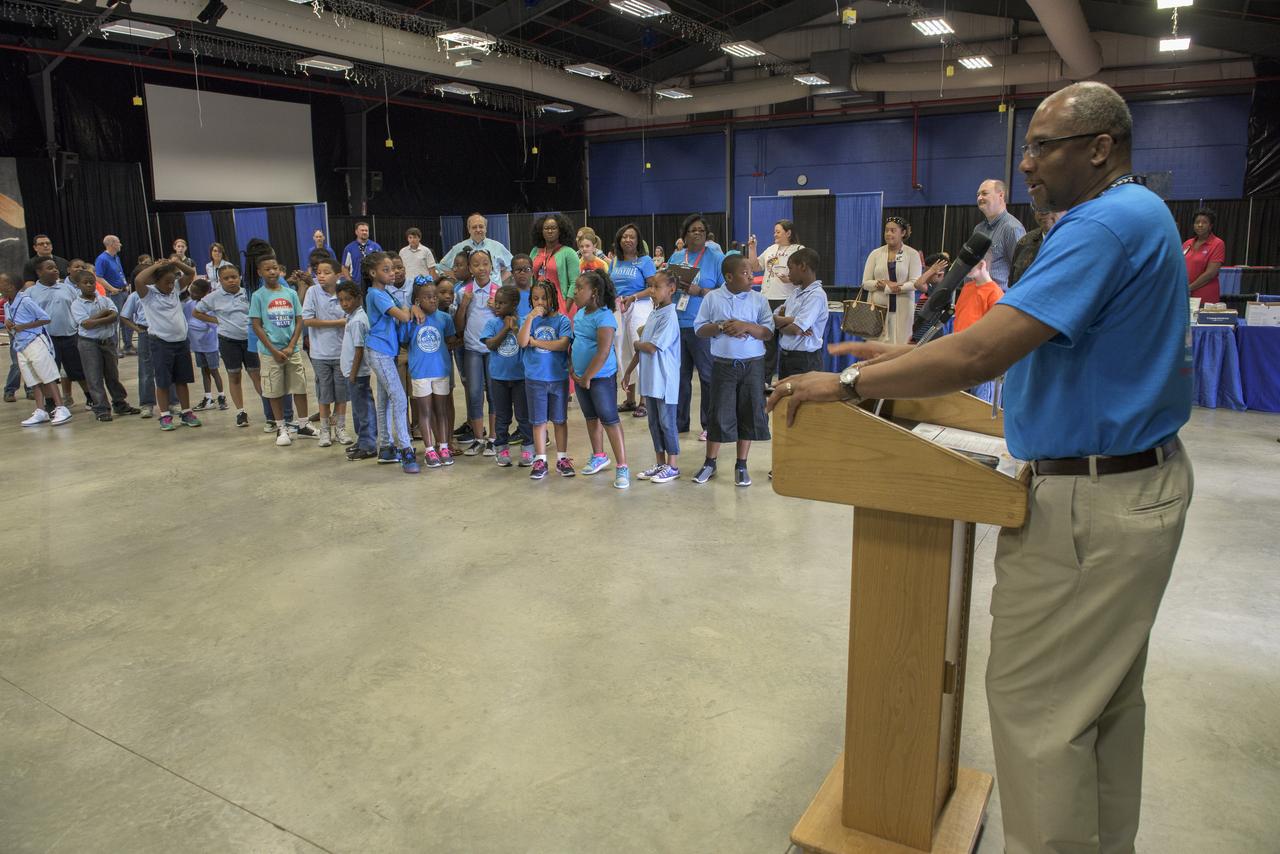
NASA’S MARSHALL SPACE FLIGHT CENTER KICKS OFF ITS ANNUAL "TAKE OUR CHILDREN TO WORK DAY" EVENTS JUNE 23 WITH OPENING REMARKS FROM LOUCIOUS HIRES, DIRECTOR OF MARSHALL’S OFFICE OF DIVERSITY AND EQUAL OPPORTUNITY. AN ESTIMATED 500 POTENTIAL FUTURE SPACEFARERS, SCIENTISTS AND ENGINEERS IN GRADES 3-12 TOOK PART IN THE DAY’S ACTIVITIES, TOURS AND PRESENTATIONS.
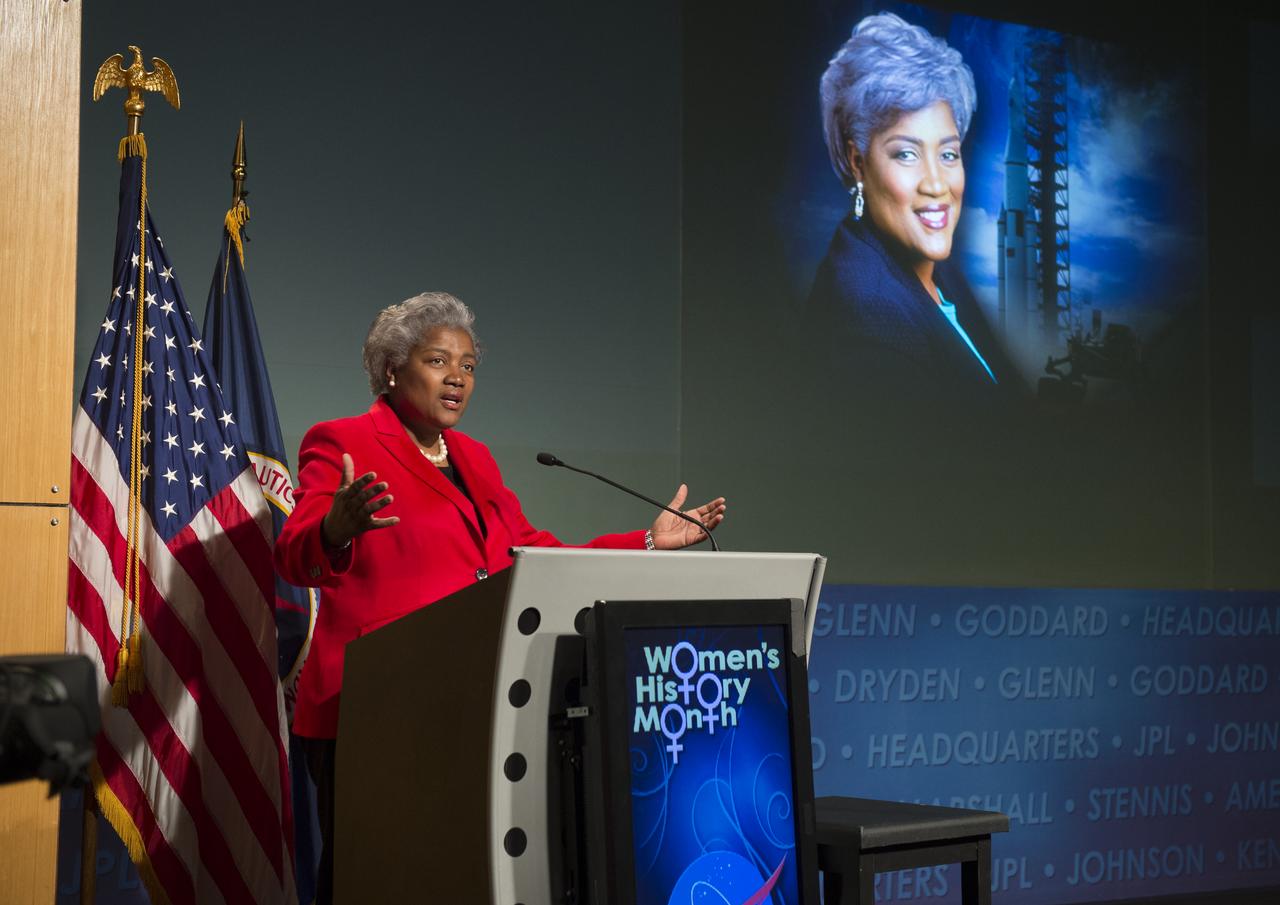
Donna Brazile, adjunct professor at Georgetown University, syndicated newspaper columnist and vice chair of voter registration and participation at the Democratic National Committee (DNC), gives the keynote speech at a program celebrating National Women's History Month at NASA Headquarters, Thursday, March 14, 2013 in Washington. The theme of this year's program was "Women Inspiring Innovation Through Imagination." The program was sponsored by the HQ Equal Opportunity and Diversity Management Division at NASA Headquarters and commemorates the 100th Anniversary of the Women's Suffrage March on Washington. Photo Credit: (NASA/Carla Cioffi)
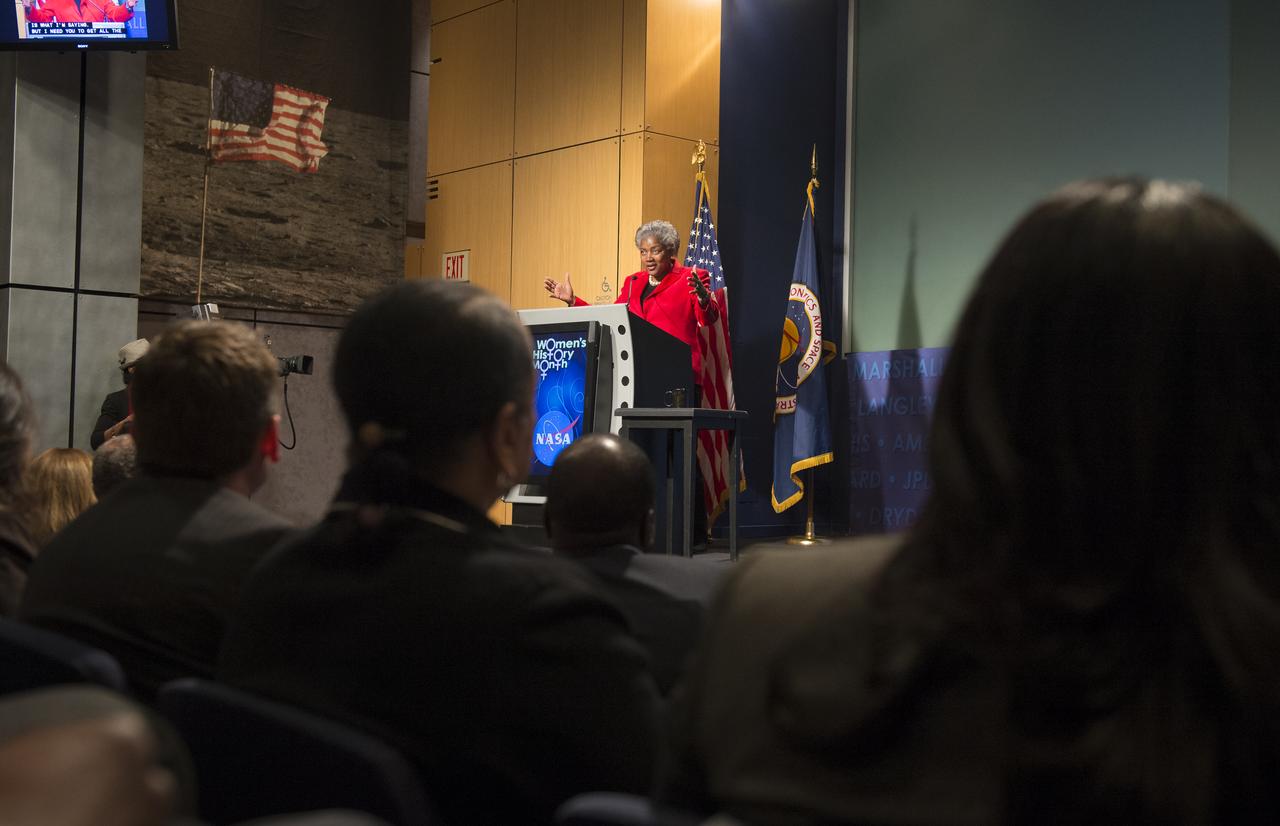
Donna Brazile, adjunct professor at Georgetown University, syndicated newspaper columnist and vice chair of voter registration and participation at the Democratic National Committee (DNC), gives the keynote speech at a program celebrating National Women's History Month at NASA Headquarters, Thursday, March 14, 2013 in Washington. The theme of this year's program was "Women Inspiring Innovation Through Imagination." The program was sponsored by the HQ Equal Opportunity and Diversity Management Division at NASA Headquarters and commemorates the 100th Anniversary of the Women's Suffrage March on Washington. Photo Credit: (NASA/Carla Cioffi)

Donna Brazile, adjunct professor at Georgetown University, syndicated newspaper columnist and vice chair of voter registration and participation at the Democratic National Committee (DNC), gives the keynote speech at a program celebrating National Women's History Month at NASA Headquarters, Thursday, March 14, 2013 in Washington. The theme of this year's program was "Women Inspiring Innovation Through Imagination." The program was sponsored by the HQ Equal Opportunity and Diversity Management Division at NASA Headquarters and commemorates the 100th Anniversary of the Women's Suffrage March on Washington. Photo Credit: (NASA/Carla Cioffi)
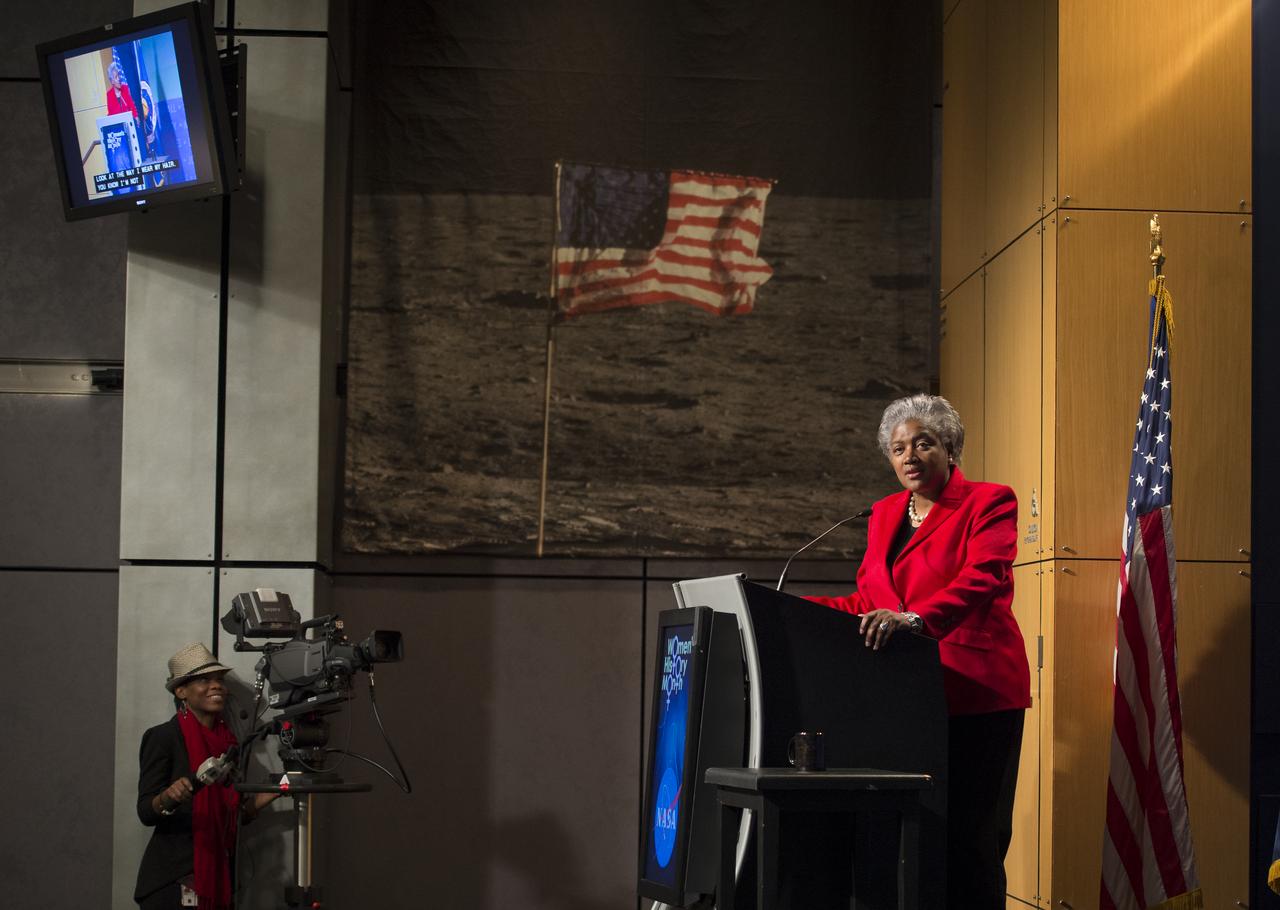
Donna Brazile, adjunct professor at Georgetown University, syndicated newspaper columnist and vice chair of voter registration and participation at the Democratic National Committee (DNC), gives the keynote speech at a program celebrating National Women's History Month at NASA Headquarters, Thursday, March 14, 2013 in Washington. The theme of this year's program was "Women Inspiring Innovation Through Imagination." The program was sponsored by the HQ Equal Opportunity and Diversity Management Division at NASA Headquarters and commemorates the 100th Anniversary of the Women's Suffrage March on Washington. Photo Credit: (NASA/Carla Cioffi)
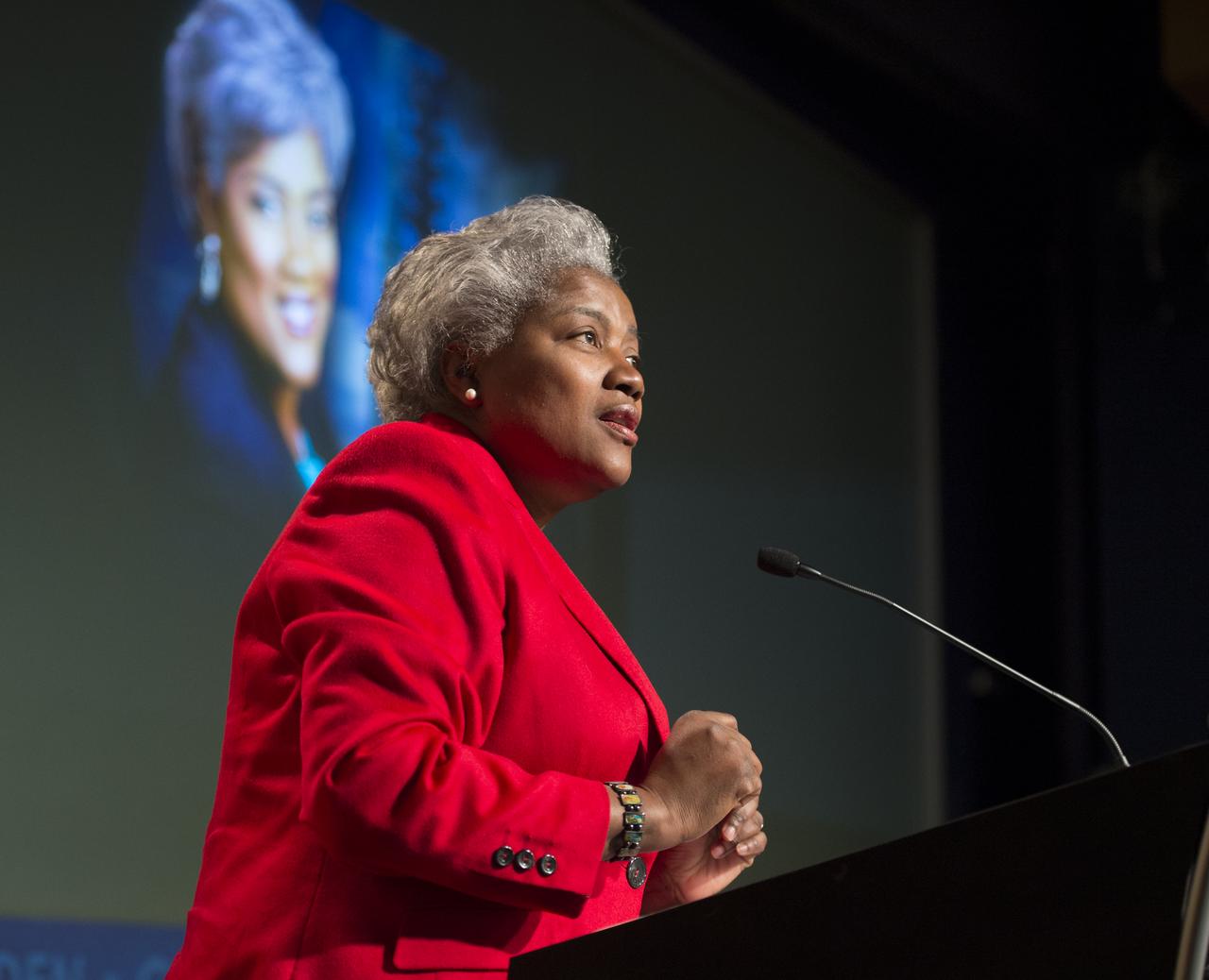
Donna Brazile, adjunct professor at Georgetown University, syndicated newspaper columnist and vice chair of voter registration and participation at the Democratic National Committee (DNC), gives the keynote speech at a program celebrating National Women's History Month at NASA Headquarters, Thursday, March 14, 2013 in Washington. The theme of this year's program was "Women Inspiring Innovation Through Imagination." The program was sponsored by the HQ Equal Opportunity and Diversity Management Division at NASA Headquarters and commemorates the 100th Anniversary of the Women's Suffrage March on Washington. Photo Credit: (NASA/Carla Cioffi)
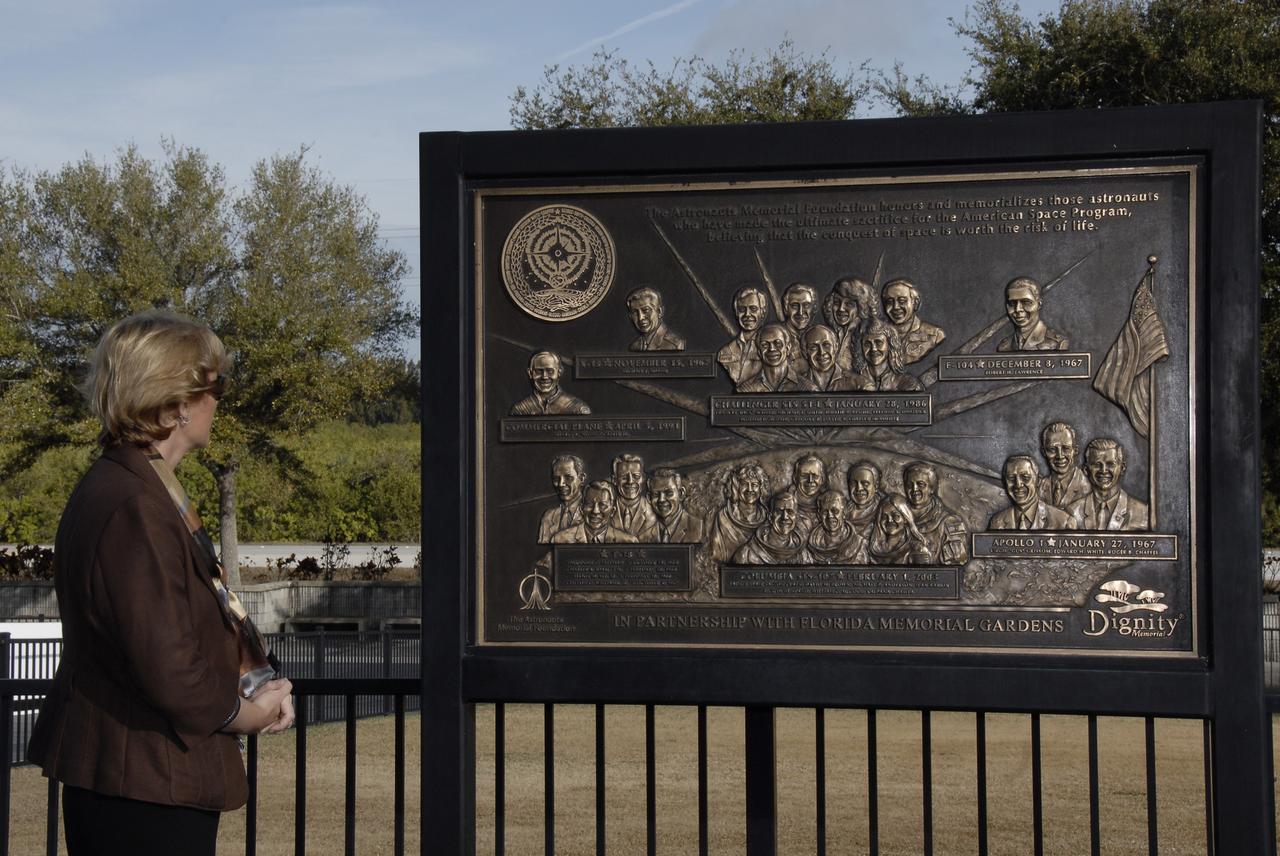
CAPE CANAVERAL, Fla. – Near the Space Mirror Memorial at NASA's Kennedy Space Center Visitor Complex, a large plaque commemorates the crews of Apollo 1 and space shuttles Challenger and Columbia who lost their lives while furthering the cause of exploration and discovery. At left is Tara Gillam, manager of the Office of Diversity and Equal Opportunity at Kennedy. Jan. 29 is NASA's Day of Remembrance observance and included a wreath-laying ceremony in front of the Space Mirror Memorial. Photo credit: NASA/Kim Shiflett
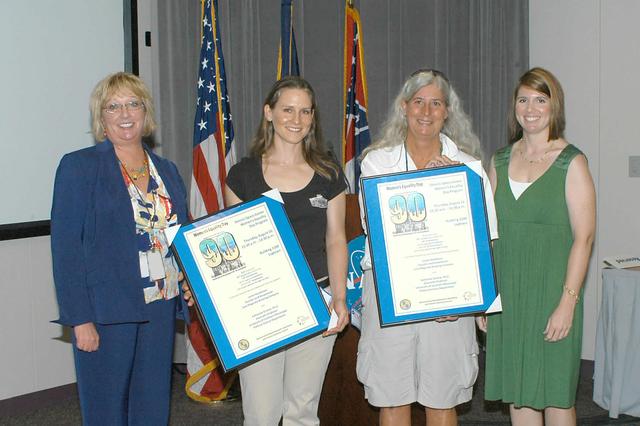
NASA's John C. Stennis Space Center celebrated Women's Equality Day with a program featuring presentations from a pair of area women - Leslie Henderson, founder and brewmaster of Lazy Magnolia Brewing Co. in Kiln, Miss., and Kathanne Greene, associate professor of political science at the University of Southern Mississippi in Hattiesburg. Shown are (l to r): Jo Ann Larson, Stennis Equal Opportunity officer; Henderson; Greene; and Shannon Breland, public affairs officer for the Naval Research Laboratory at Stennis and a member of the Stennis Diversity Council.
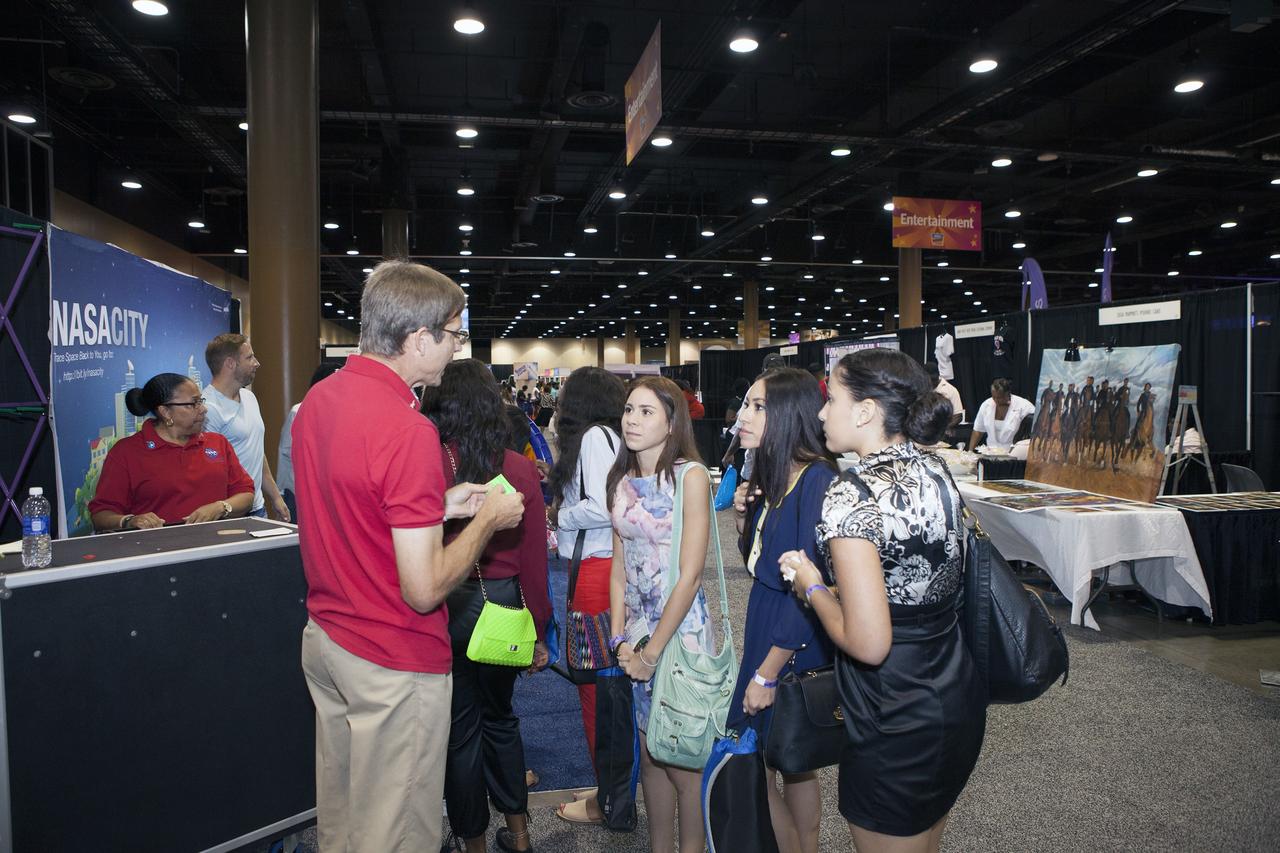
KISSIMMEE, Fla. – Guests at the Tom Joyner Family Reunion participate in "Learn and Spin Challenge," an opportunity to answer questions related to science, technology, engineering and math. Robert Smith asks a question as part of NASA’s educational theme during the five-day event. Behind Smith, to the left, is Debbie Houston who also supported the "Learn and Spin Challenge." The Tom Joyner Family Reunion is designed to present uplifting programs, entertainment and information about growing, diverse communities. An annual event of the nationally-syndicated Tom Joyner Morning Show, the many exhibits included NASA's participation focusing on encouraging young people to consider studies and careers in STEM -- science, technology, engineering and math. NASA's Education Division promoted the benefits of math and scientific learning along with career opportunities offered by the space agency. The activities took place at the Gaylord Palms Resort in Kissimmee, Florida, during the Labor Day weekend. Photo credit: NASA/Daniel Casper
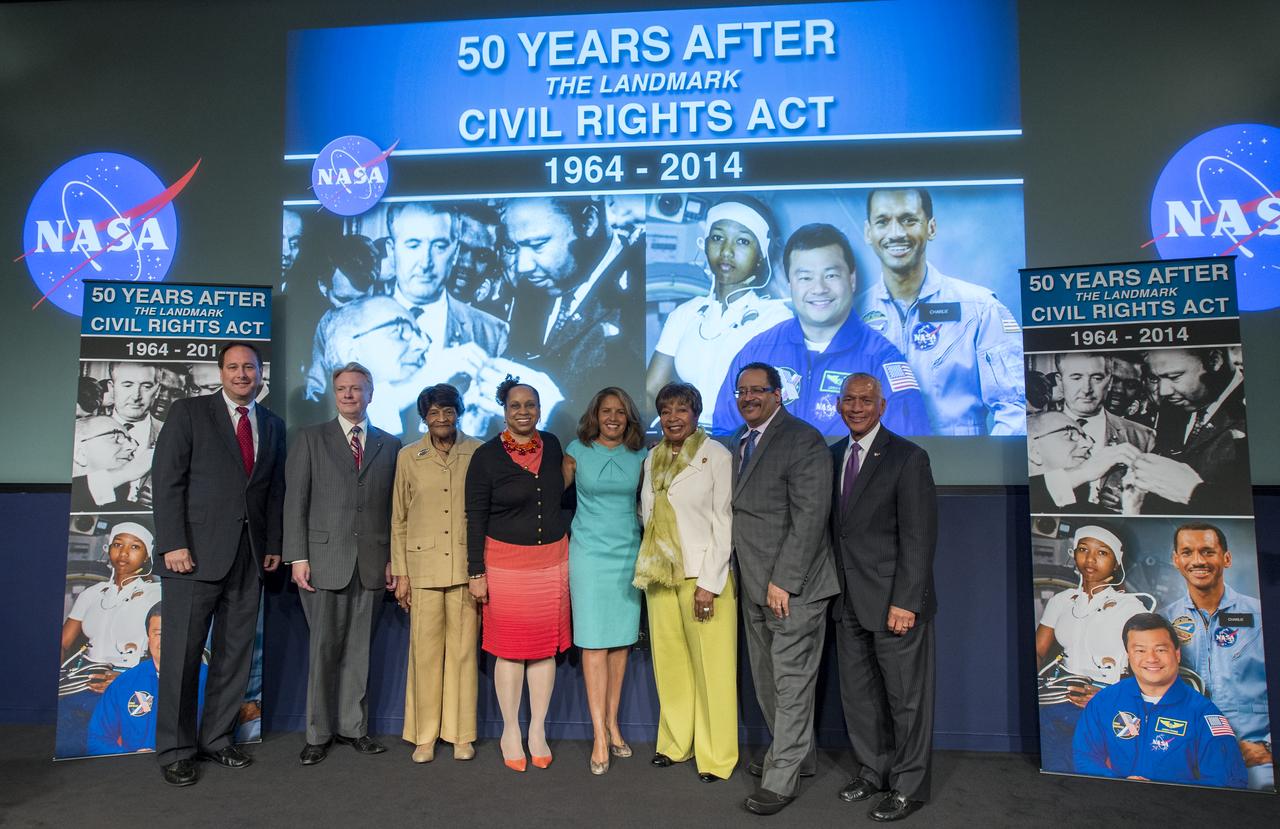
From left: Robert Lightroot. NASA Associate Administrator; Dr. Roger Launius, Associate Director of Collections and Curatorial Affairs at the Smithsonian National Air and Space Museum; Dr. Harriett Jenkins, Former Assistant Administrator for Equal Opportunity Programs at NASA; Brenda Manuel, Associate Administrator for Diversity and Equal Opportunity at NASA; Suzanne Malveaux, CNN Correspondent and panel moderator; U.S. Representative Eddie Bernice Johnson, of Texas; Dr. Michael Eric Dyson, professor of sociology at Georgetown University; and Charles Bolden, NASA Administrator; pose for a picture following an event celebrating the 50th Anniversary of the Civil Rights Act of 1964 on Monday, June 23, 2014 in the James E. Webb Auditorium at NASA Headquarters in Washington, DC. The event highlighted the influence of the Civil Rights Act on NASA. Photo Credit: (NASA/Joel Kowsky)
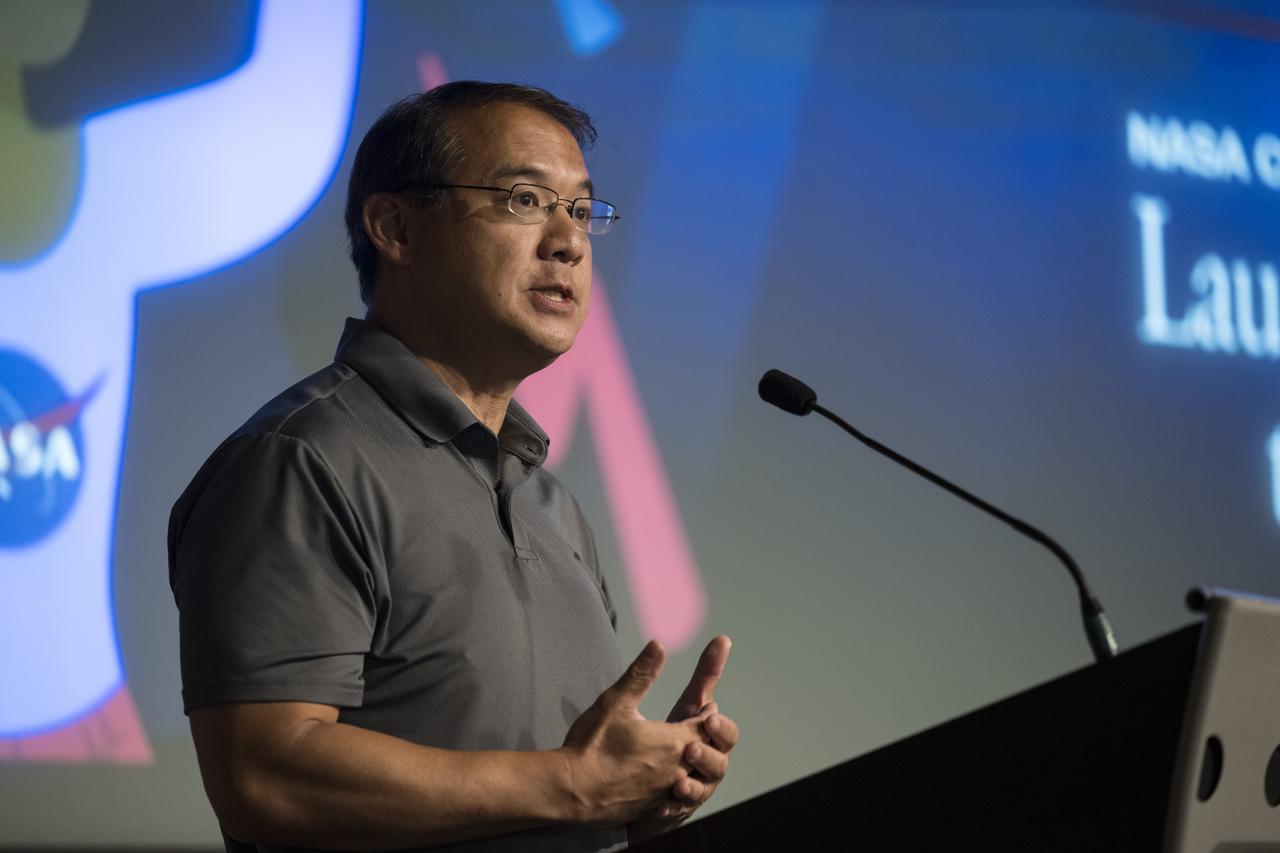
NASA Associate Administrator for Diversity and Equal Opportunity, Steve Shih, provides closing remarks after a panel discussion with NASA's four female center directors: Dr. Marla Peréz-Davis of Glenn Research Center, Vanessa Wyche of Johnson Space Center, Janet Petro of Kennedy Space Center, and Jody Singer of Marshall Space Flight Center, during the "DirectHERS" - Launching Through the Glass Ceiling event, Tuesday, June 7, 2022, at the Mary W. Jackson NASA Headquarters Building in Washington. Photo Credit: (NASA/Aubrey Gemignani)
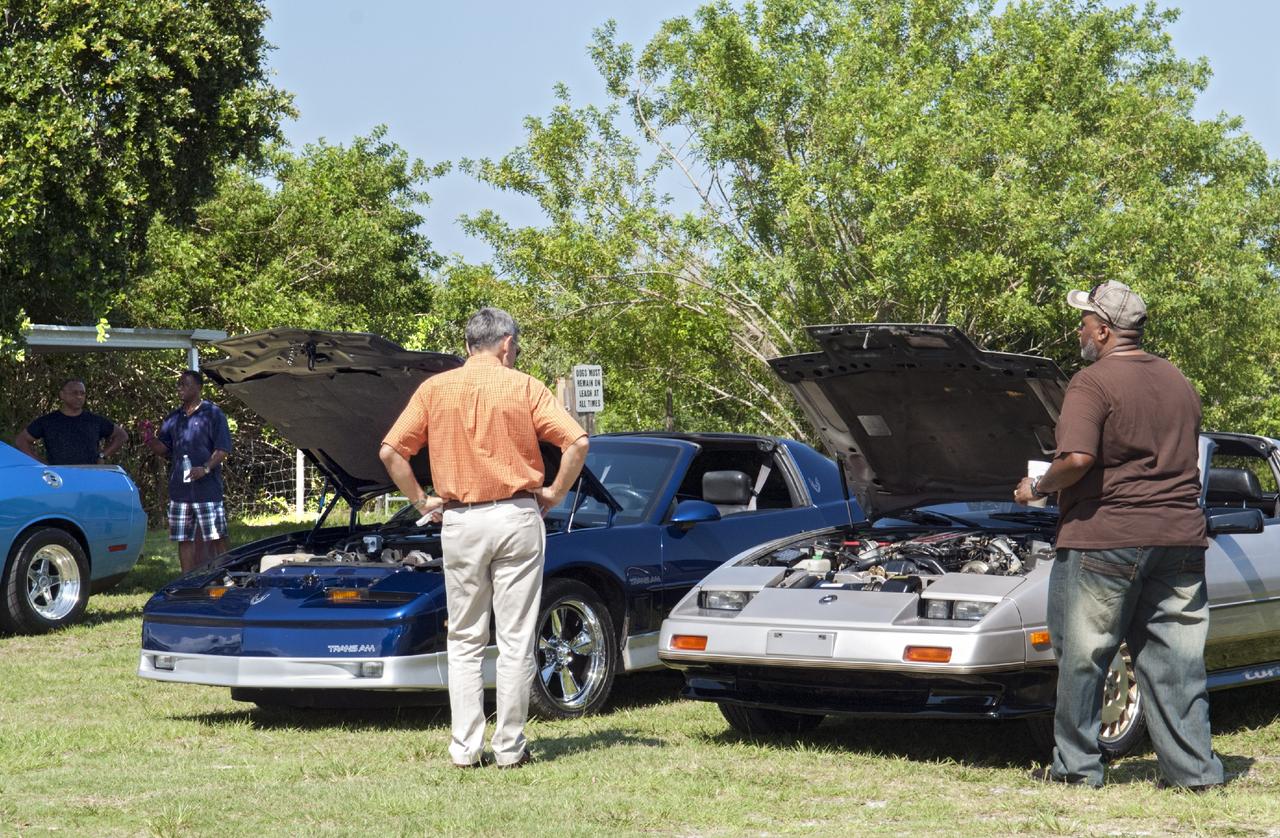
Merritt Island, Fla. – Kennedy Space Center Director Bob Cabana enjoys the automobiles on display in the a noncompetitive car show at 2013 Black Employee Strategy Team BEST BBQ at KARS Park I on Merritt Island. Events also included a spades tournament. BEST hosts the barbecue as a fundraiser for the Evelyn Johnson Scholarship, which is handed out every year to students who exemplify significant achievement both academically and in their community. The scholarship is in honor of Evelyn Johnson, a founding member of BEST and former deputy director of Kennedy’s Diversity and Equal Opportunity Office. Photo credit: NASA/ Charisse Nahser
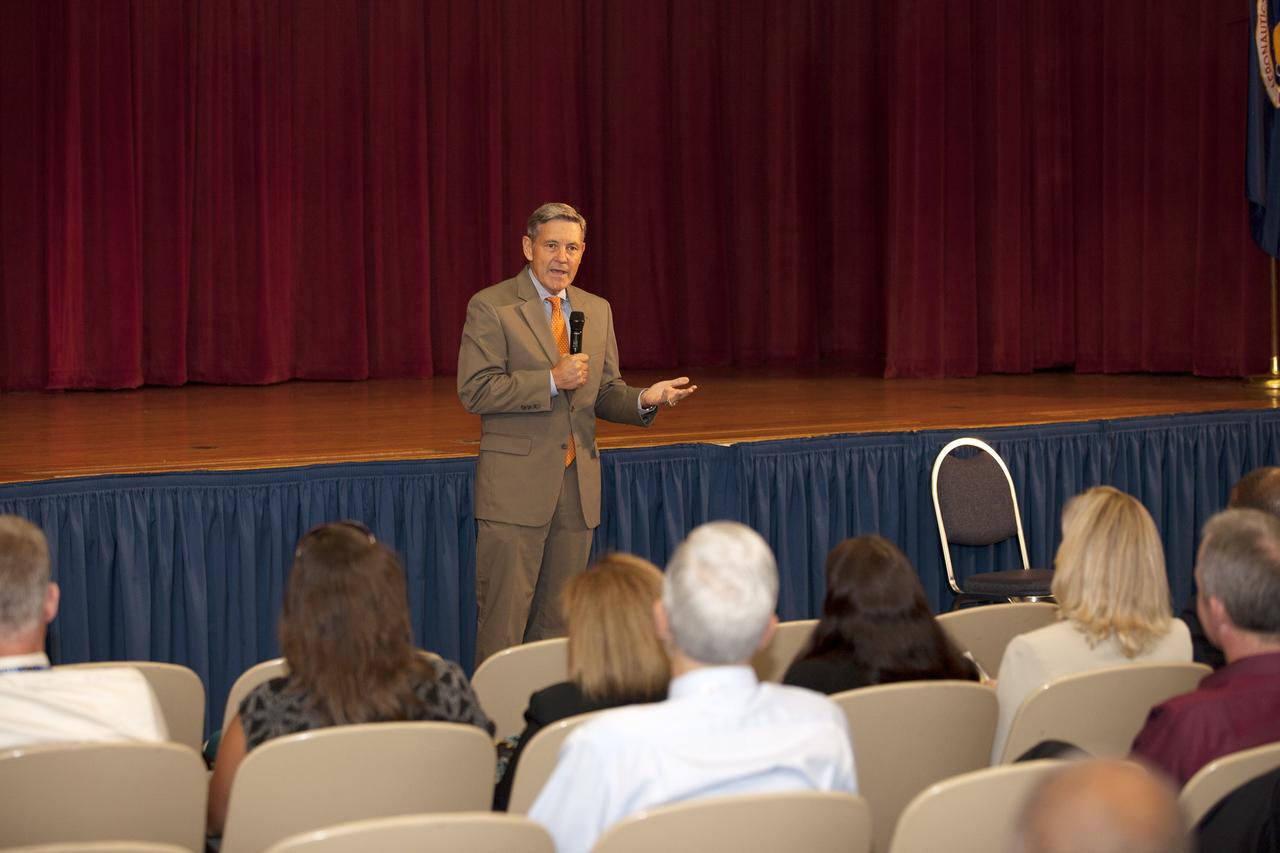
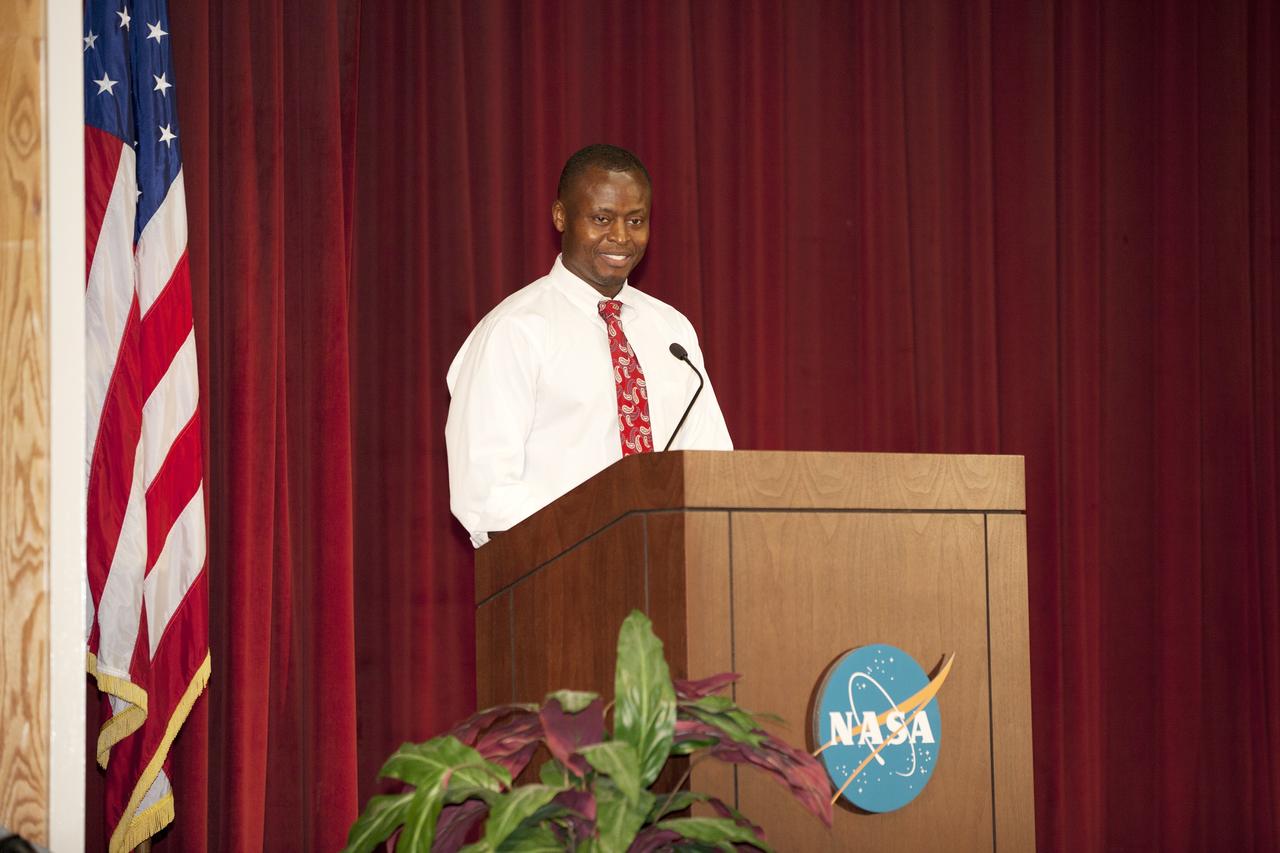
CAPE CANAVERAL, Fla. -- In the KSC Training Auditorium at NASA's Kennedy Space Center in Florida, Center Director Robert Cabana makes the opening remarks at a special event marking the 50th anniversary of the Civil Rights Act of 1964. Dr. Mary Frances Berry, an award-winning civil rights activist and former member of the U.S. Commission on Civil Rights, was the guest speaker. The event was presented by Kennedy's Office of Diversity and Equal Opportunity. For more information on Kennedy Space Center, visit http://www.nasa.gov/kennedy. Photo credit: NASA/Kim Shiflett
CAPE CANAVERAL, Fla. -- In the KSC Training Auditorium at NASA's Kennedy Space Center in Florida, Yves Lamothe, transition manager for the Ground Systems Development and Operations Program, is the master of ceremonies at a special event marking the 50th anniversary of the Civil Rights Act of 1964. Center Director Robert Cabana made the opening remarks. Dr. Mary Frances Berry, an award-winning civil rights activist and former member of the U.S. Commission on Civil Rights, was the guest speaker. The event was presented by Kennedy's Office of Diversity and Equal Opportunity. For more information on Kennedy Space Center, visit http://www.nasa.gov/kennedy. Photo credit: NASA/Kim Shiflett
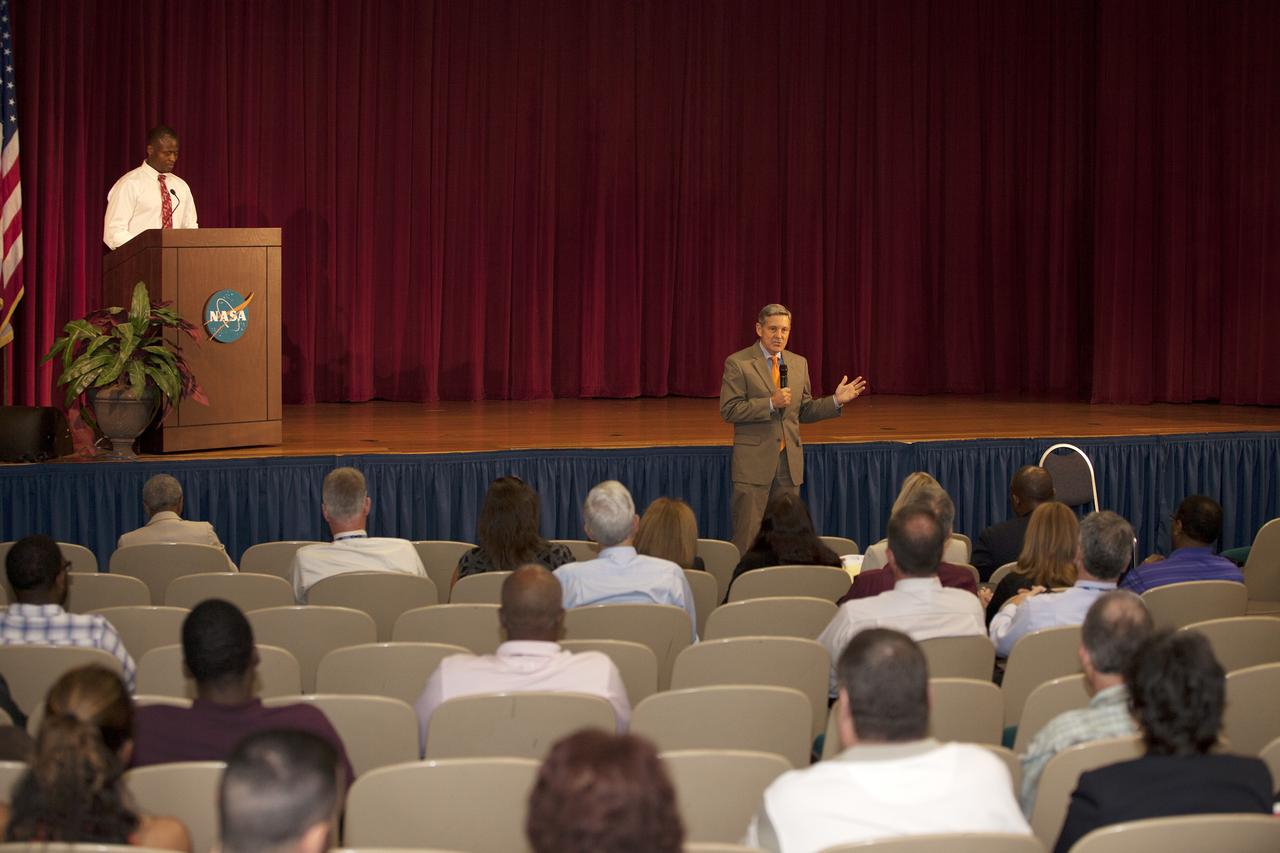
CAPE CANAVERAL, Fla. -- In the KSC Training Auditorium at NASA's Kennedy Space Center in Florida, Center Director Robert Cabana addresses the audience at a special event marking the 50th anniversary of the Civil Rights Act of 1964. Yves Lamothe, on stage, transition manager for the Ground Systems Development and Operations Program, was the master of ceremonies. Dr. Mary Frances Berry, an award-winning civil rights activist and former member of the U.S. Commission on Civil Rights, was the guest speaker. The event was presented by Kennedy's Office of Diversity and Equal Opportunity. For more information on Kennedy Space Center, visit http://www.nasa.gov/kennedy. Photo credit: NASA/Kim Shiflett
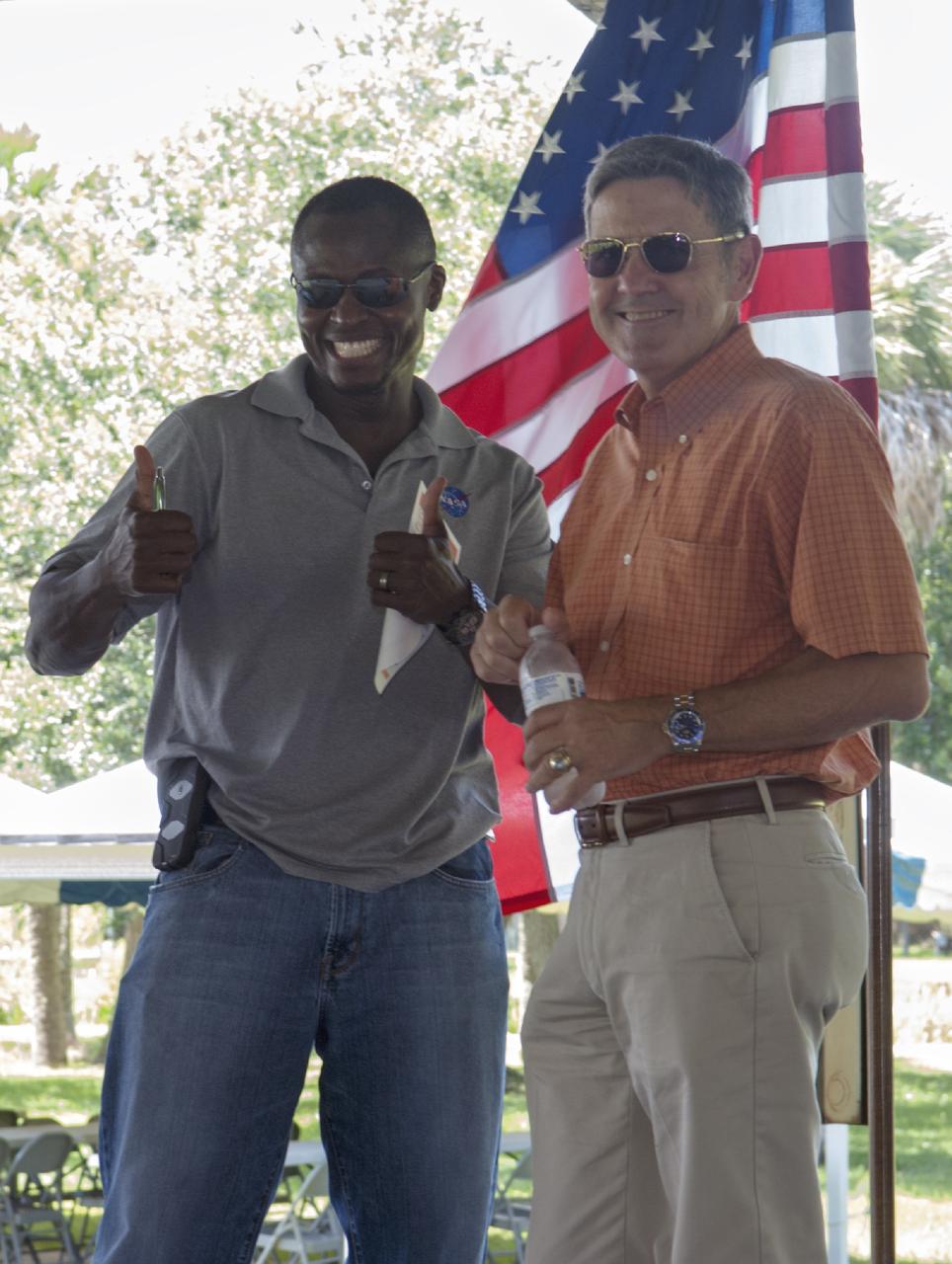
Merritt Island, Fla. – Kennedy Space Center worker Yves Lamothe and Center Director Bob Cabana welcome guests to the 2013 Black Employee Strategy Team BEST BBQ at KARS Park I on Merritt Island. Events included a noncompetitive car show and a spades tournament. BEST hosts the barbecue as a fundraiser for the Evelyn Johnson Scholarship, which is handed out every year to students who exemplify significant achievement both academically and in their community. The scholarship is in honor of Evelyn Johnson, a founding member of BEST and former deputy director of Kennedy’s Diversity and Equal Opportunity Office. Photo credit: NASA/ Charisse Nahser

LITTLE BIG MOUNTAIN PERFORMS A TRADITIONAL NATIVE AMERICAN HOOP DANCE AT NASA MARSHALL SPACE FLIGHT CENTER’S 2015 NATIVE AMERICAN HERITAGE EVENT. THE EVENT, HELD NOV. 3 ON THE LAWN OF THE ACTIVITIES BUILDING, BUILDING 4316, HONORED THE CONTRIBUTIONS, ACHIEVEMENTS, SACRIFICES AND CULTURAL AND HISTORICAL LEGACY OF AMERICAN INDIANS. IN ITS EARLIEST FORM, THE STORYTELLING HOOP DANCE IS BELIEVED TO HAVE BEEN PART OF A HEALING CEREMONY DESIGNED TO RESTORE BALANCE AND HARMONY IN THE WORLD. WITH NO BEGINNING OR END, THE HOOP REPRESENTS THE NEVER-ENDING CIRCLE OF LIFE. THE SPECIAL EMPHASIS PROGRAM -- SPONSORED BY THE OFFICE OF DIVERSITY AND EQUAL OPPORTUNITY -- WAS PART OF MARSHALL’S OBSERVANCE OF NATIONAL NATIVE AMERICAN HERITAGE MONTH.
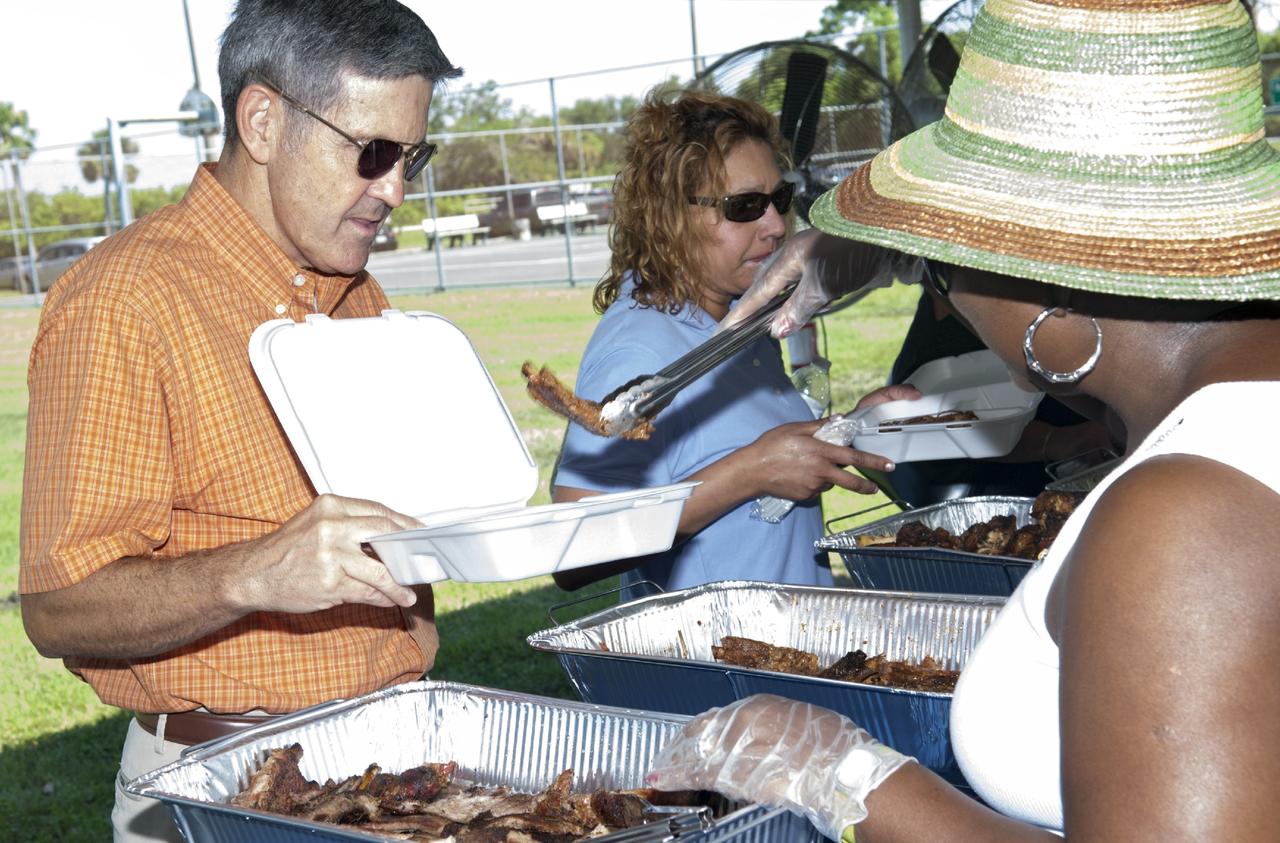
Merritt Island, Fla. – Kennedy Space Center worker Bettye Lee serves Center Director Bob Cabana some delicious food at the 2013 The Black Employee Strategy Team BEST BBQ at KARS I Park on Merritt Island. Events included a noncompetitive car show and a spades tournament. BEST hosts the barbecue as a fundraiser for the Evelyn Johnson Scholarship, which is handed out every year to students who exemplify significant achievement both academically and in their community. The scholarship is in honor of Evelyn Johnson, a founding member of BEST and former deputy director of Kennedy’s Diversity and Equal Opportunity office. Photo credit: NASA/ Charisse Nahser
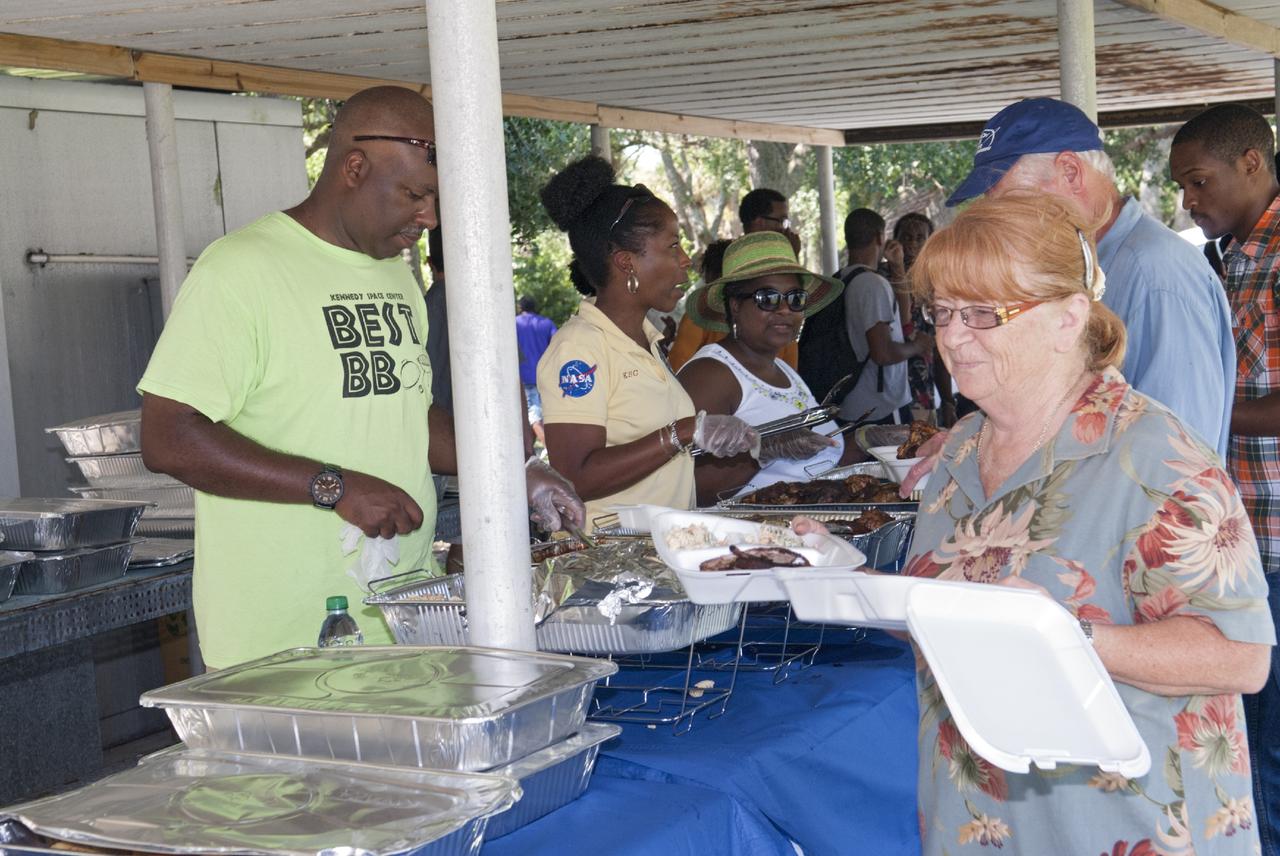
Merritt Island, Fla. – Kennedy Space Center worker James Davis, Maxine Daniels, and Bettye Lee serve delicious food to attendees at the 2013 Black Employee Strategy Team BEST BBQ at KARS I Park on Merritt Island. Events included a noncompetitive car show and a spades tournament. BEST hosts the barbecue as a fundraiser for the Evelyn Johnson Scholarship, which is handed out every year to students who exemplify significant achievement both academically and in their community. The scholarship is in honor of Evelyn Johnson, a founding member of BEST and former deputy director of Kennedy’s Diversity and Equal Opportunity Office. Photo credit: NASA/ Charisse Nahser
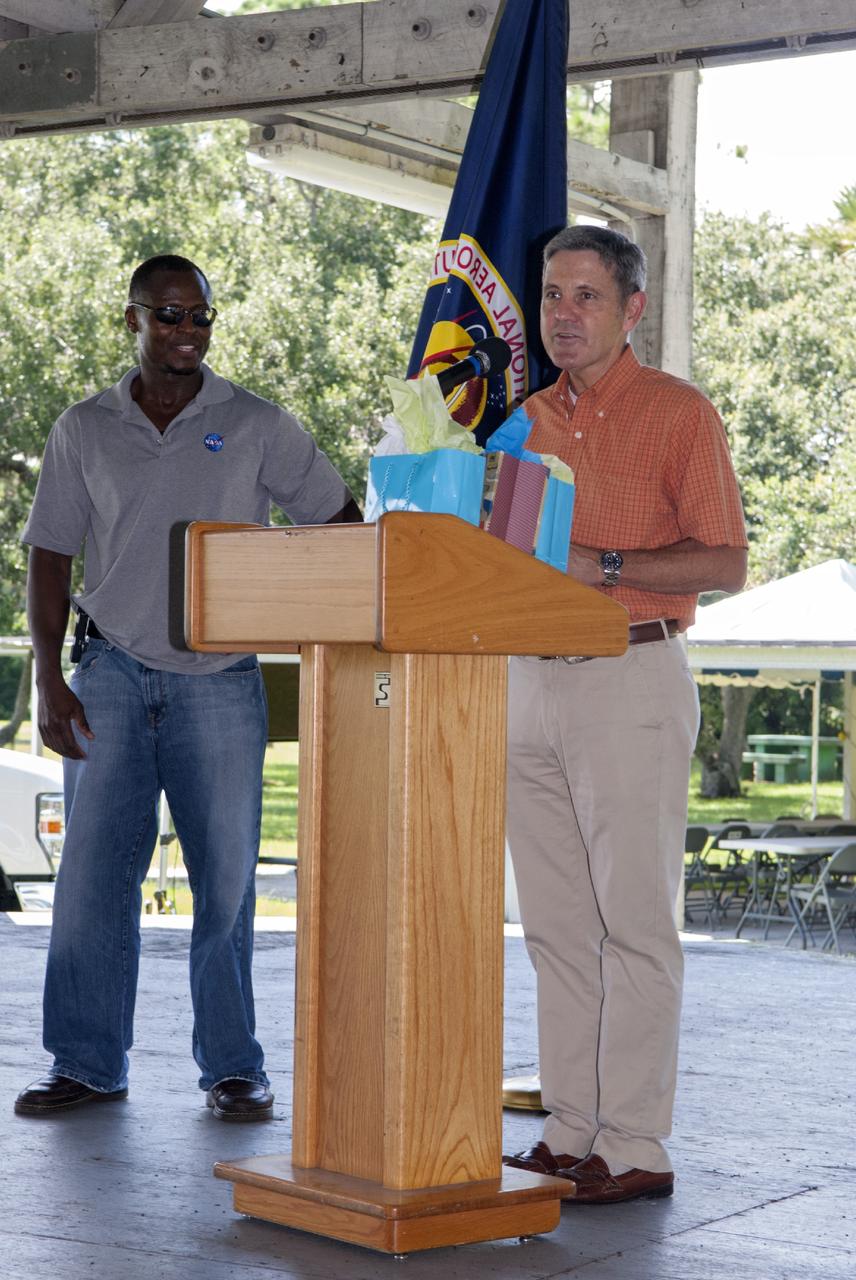
Merritt Island, Fla. – Kennedy Space Center worker Yves Lamothe and Center Director Bob Cabana welcome guests to the 2013 Black Employee Strategy Team BEST BBQ at KARS Park I on Merritt Island. Events included a noncompetitive car show and a spades tournament. BEST hosts the barbecue as a fundraiser for the Evelyn Johnson Scholarship, which is handed out every year to students who exemplify significant achievement both academically and in their community. The scholarship is in honor of Evelyn Johnson, a founding member of BEST and former deputy director of Kennedy’s Diversity and Equal Opportunity Office. Photo credit: NASA/ Charisse Nahser
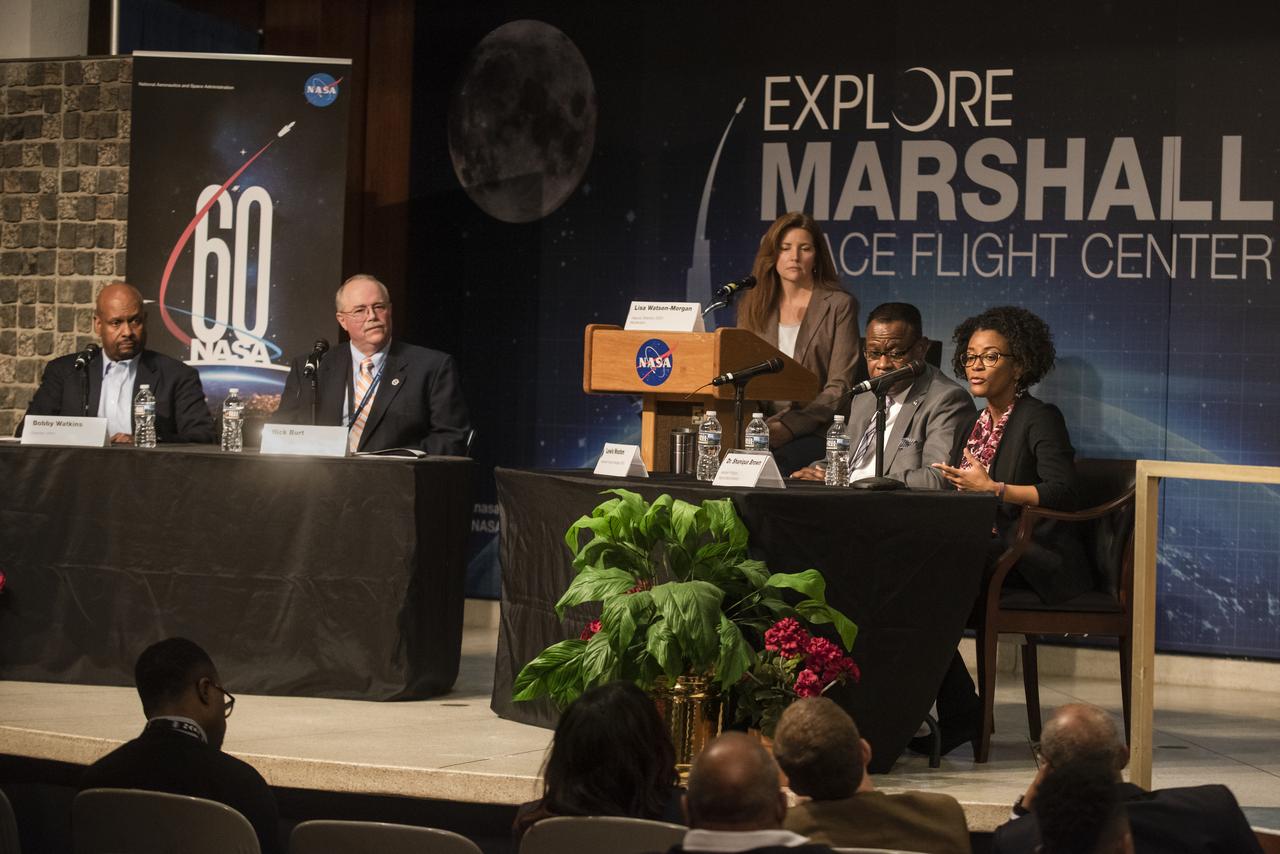
Wayne State University professor Shanique Brown, far right, takes part in a panel discussion on diversity and building strong, inclusive teams. She was joined by, from right, Lewis Wooten, associate program manager for the Space Launch System Program Office at Marshall; moderator Lisa Watson-Morgan, deputy director of Marshall's Engineering Directorate; Rick Burt, director of Marshall's Safety & Mission Assurance Directorate; and Bobby Watkins, director of the Human Exploration Development and Operations Office.
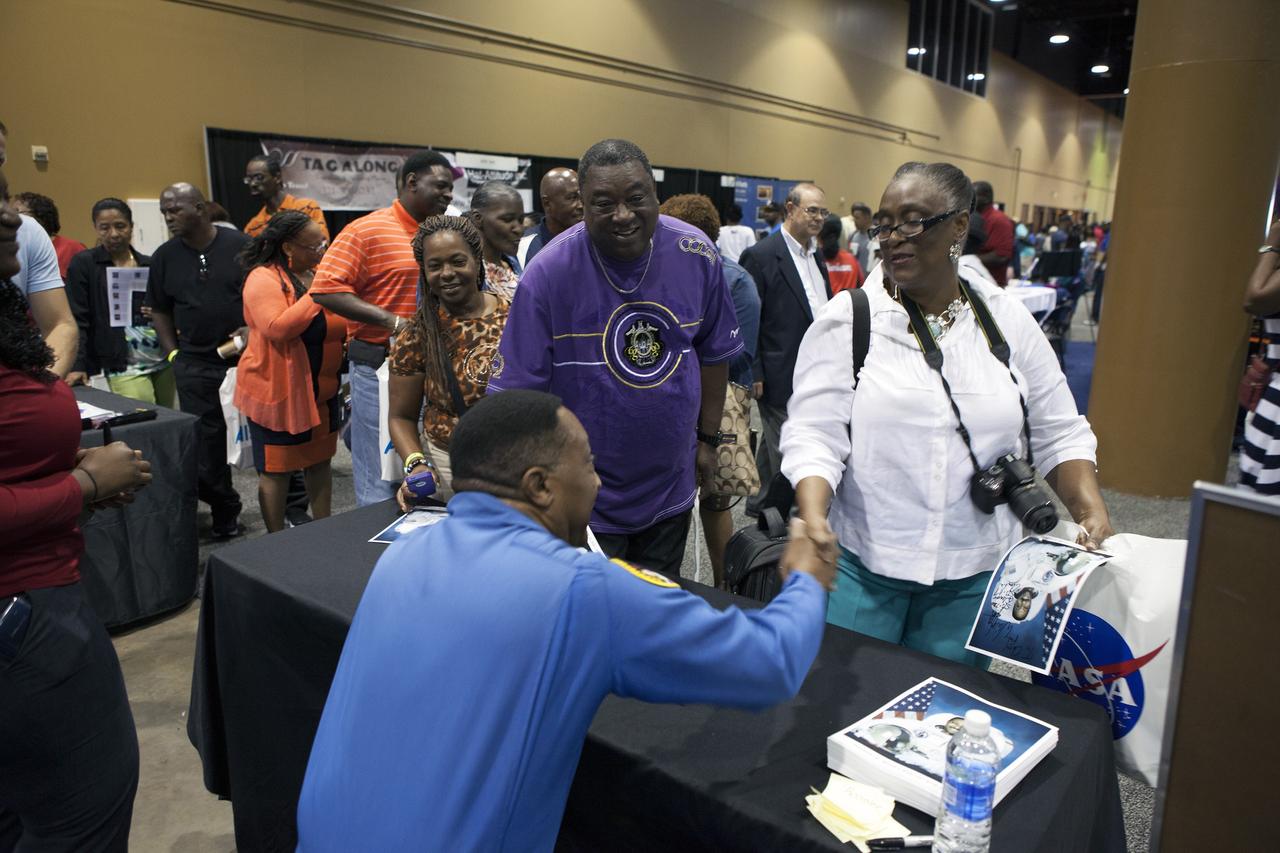
KISSIMMEE, Fla. – Former NASA astronaut Winston Scott signed autographs and posed for pictures with guests at the agency exhibit during the Tom Joyner Family Reunion. Now a senior vice president at the Florida Institute of Technology, he said that he likes to emphasize to young people how important a good education is in preparation for the future. The Tom Joyner Family Reunion is designed to present uplifting programs, entertainment and information about growing, diverse communities. An annual event of the nationally-syndicated Tom Joyner Morning Show, the many exhibits included NASA's participation focusing on encouraging young people to consider studies and careers in STEM -- science, technology, engineering and math. NASA's Education Division promoted the benefits of math and scientific learning along with career opportunities offered by the space agency. The activities took place at the Gaylord Palms Resort in Kissimmee, Florida, during the Labor Day weekend. Photo credit: NASA/Daniel Casper
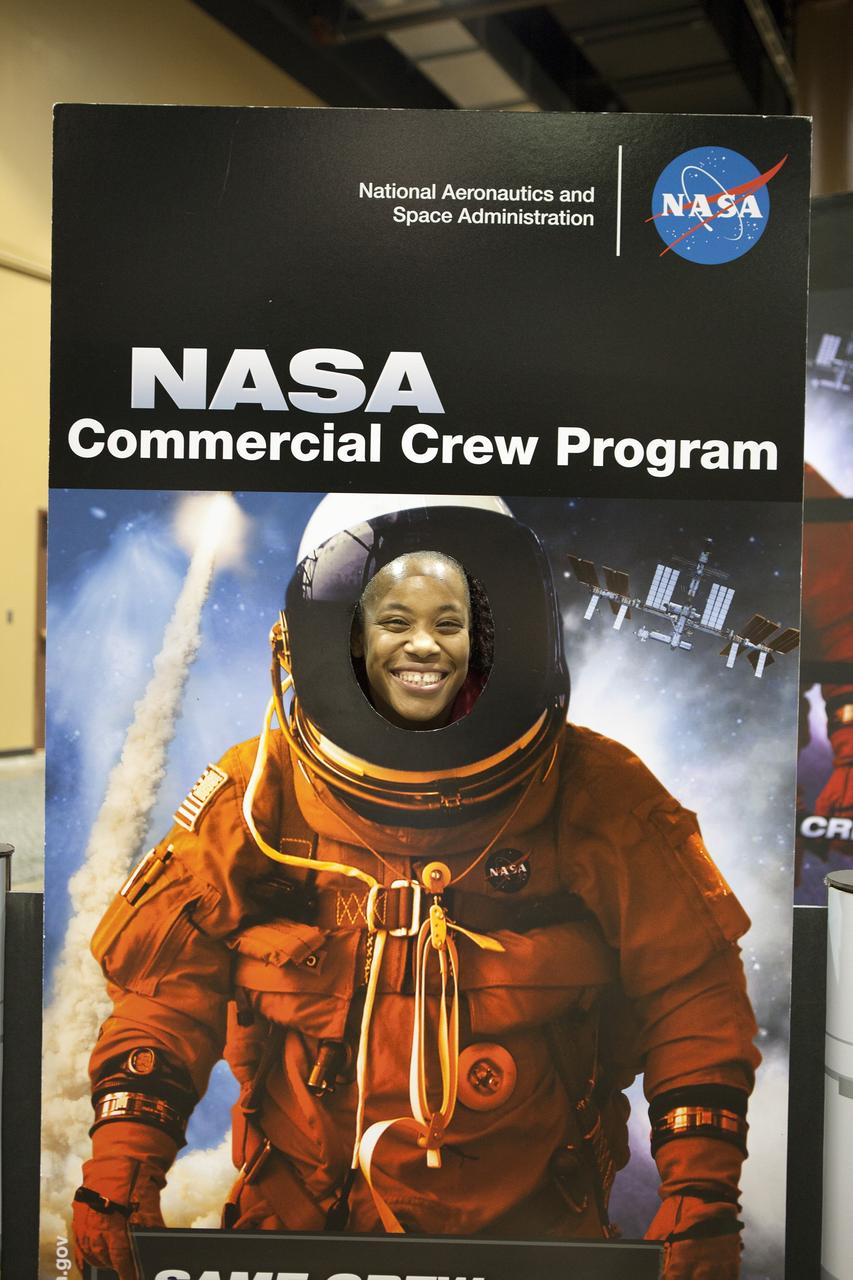
KISSIMMEE, Fla. – A guest at the Tom Joyner Family Reunion is photographed with a Commercial Crew Program exhibit during the five-day event. Thousands of visitors spoke with agency representatives who explained the agency’s efforts with CCP, the International Space Station, Ground Systems Development and Operations Program, as well as the Launch Services Program. The Tom Joyner Family Reunion is designed to present uplifting programs, entertainment and information about growing, diverse communities. An annual event of the nationally-syndicated Tom Joyner Morning Show, the many exhibits included NASA's participation focusing on encouraging young people to consider studies and careers in STEM -- science, technology, engineering and math. NASA's Education Division promoted the benefits of math and scientific learning along with career opportunities offered by the space agency. The activities took place at the Gaylord Palms Resort in Kissimmee, Florida, during the Labor Day weekend. Photo credit: NASA/Daniel Casper
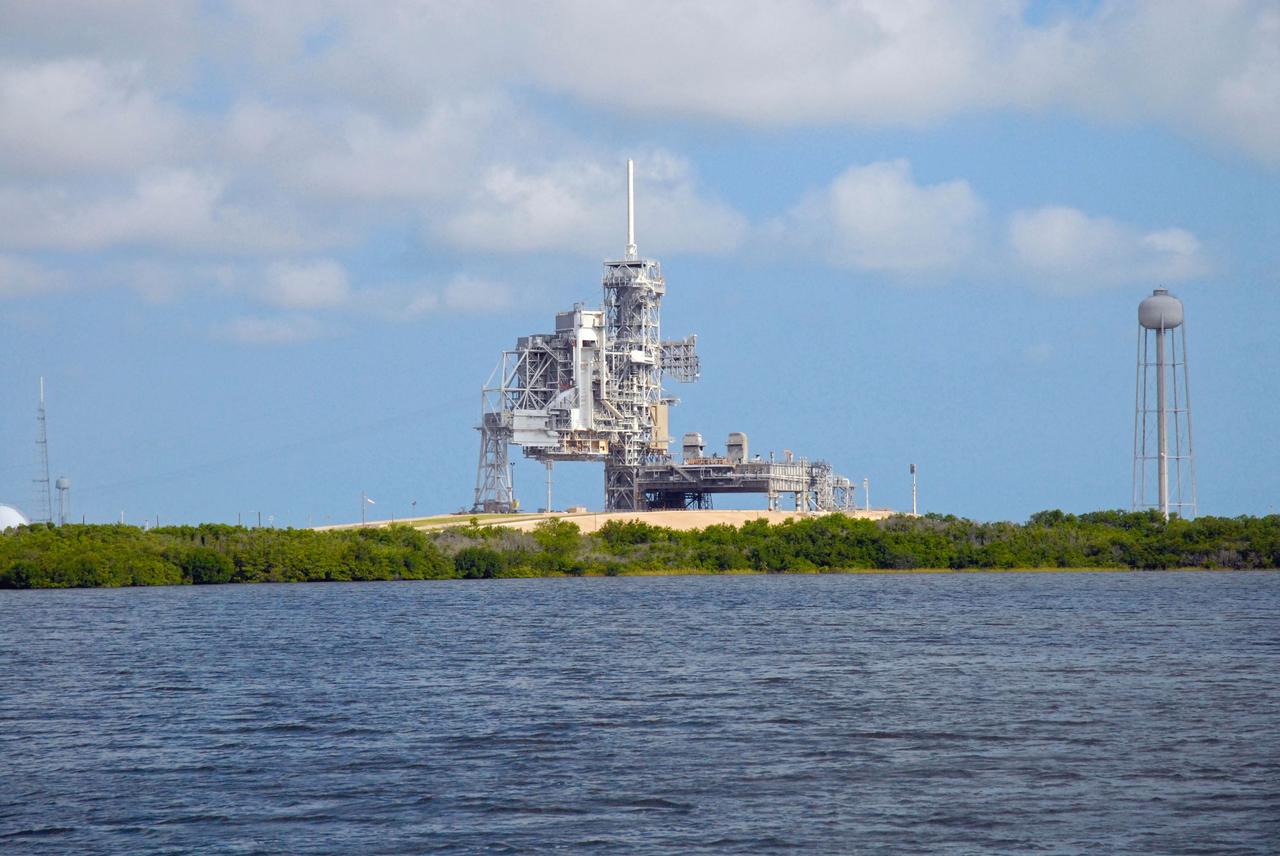
CAPE CANAVERAL, Fla. – Launch Pad 39A is seen during a field-guided boat tour of NASA's Kennedy Space Center in Florida. As part of the center's first-ever Innovation Expo, the tour, called "Living Outdoor Laboratory for Environmental Sustainability," is giving employees the opportunity to see the unique estuarine ecosystems that are protected from development by the presence of Kennedy and the Merritt Island National Wildlife Refuge. The diverse and healthy area encompassing about 140,000 acres of central Florida's east coast has been closed to the public for 50 years, allowing the coastal dunes, saltwater estuaries and marshes, freshwater impoundments, scrub, pine flatwoods, and hardwood hammocks to provide habitats for more than 1,000 species of plants and animals. Innovation Expo is showcasing the innovative work taking place throughout the center's facilities and labs to encourage employees to work together to solve future challenges. For more information, visit http://www.nasa.gov/kennedy. Photo credit: NASA
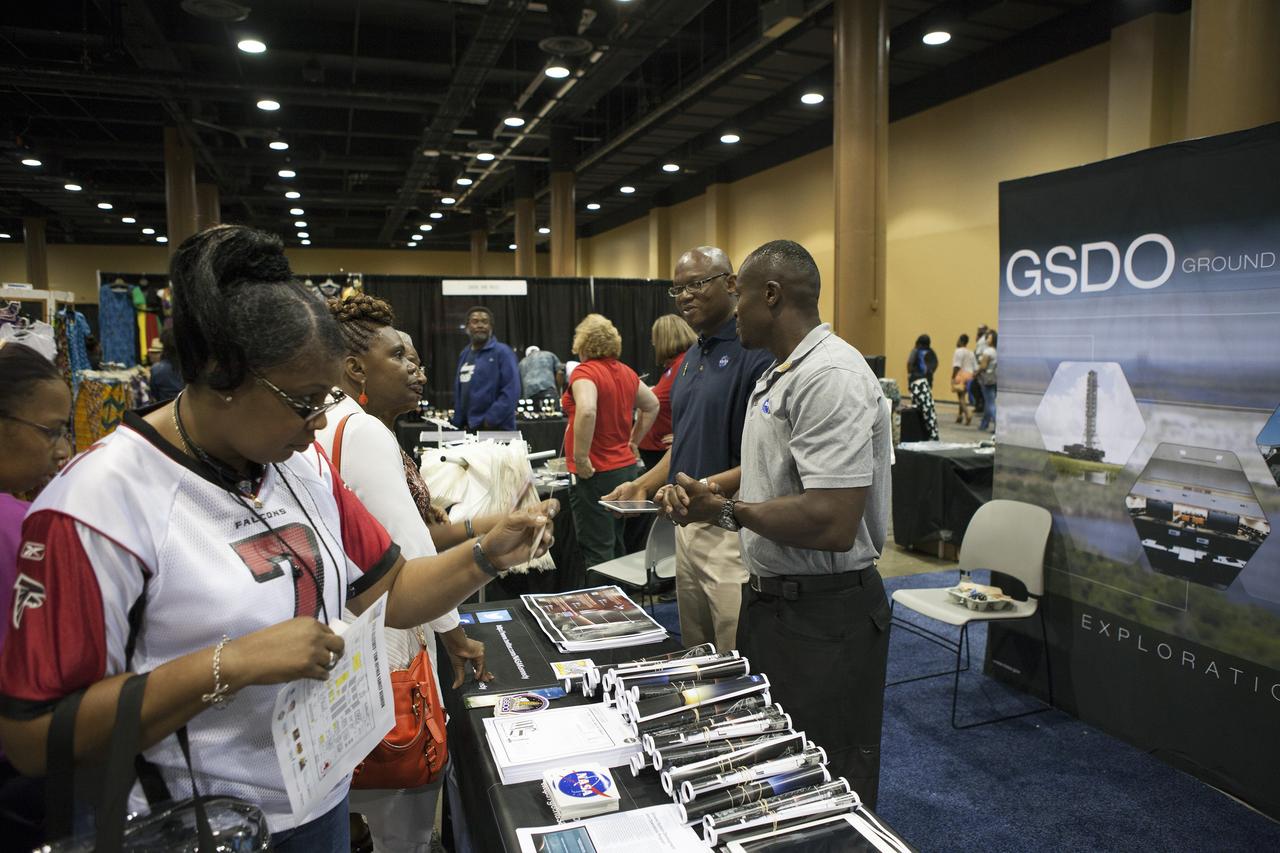
KISSIMMEE, Fla. – During the Tom Joyner Family Reunion, Ken Fullwood of Booz-Allen-Hamilton, left, and Yves Lamothe of the NASA Technical Management Branch of the Ground Systems Development and Operations Program talk to guests about ongoing work to convert the Kennedy Space Center into a 21st century spaceport. The Tom Joyner Family Reunion is designed to present uplifting programs, entertainment and information about growing, diverse communities. An annual event of the nationally-syndicated Tom Joyner Morning Show, the many exhibits included NASA's participation focusing on encouraging young people to consider studies and careers in STEM -- science, technology, engineering and math. NASA's Education Division promoted the benefits of math and scientific learning along with career opportunities offered by the space agency. The activities took place at the Gaylord Palms Resort in Kissimmee, Florida, during the Labor Day weekend. Photo credit: NASA/Daniel Casper
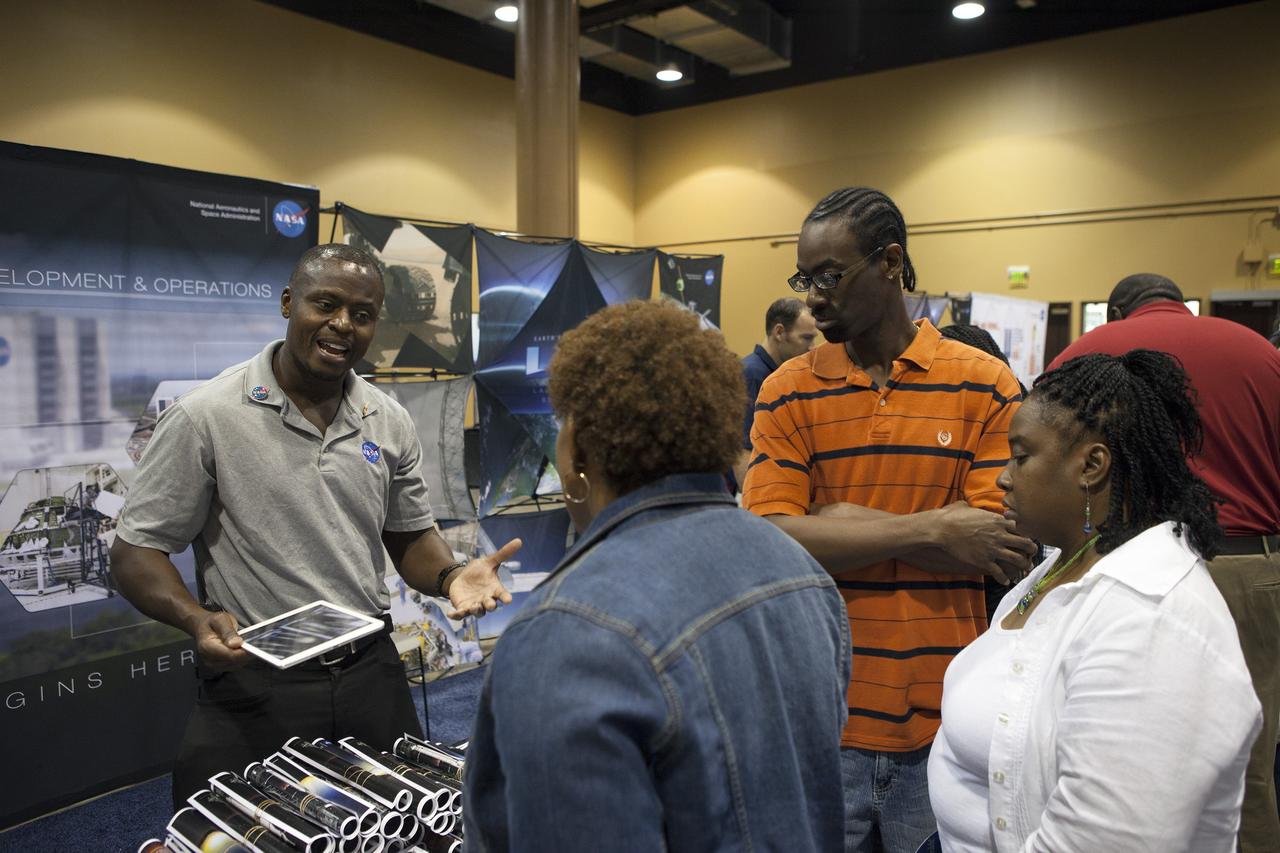
KISSIMMEE, Fla. – Yves Lamothe of the NASA Technical Management Branch of Ground Systems Development and Operations Program speaks with guests at the Tom Joyner Family Reunion about ongoing work to convert the Kennedy Space Center into a 21st century spaceport. The Tom Joyner Family Reunion is designed to present uplifting programs, entertainment and information about growing, diverse communities. An annual event of the nationally-syndicated Tom Joyner Morning Show, the many exhibits included NASA's participation focusing on encouraging young people to consider studies and careers in STEM -- science, technology, engineering and math. NASA's Education Division promoted the benefits of math and scientific learning along with career opportunities offered by the space agency. The activities took place at the Gaylord Palms Resort in Kissimmee, Florida, during the Labor Day weekend. Photo credit: NASA/Daniel Casper
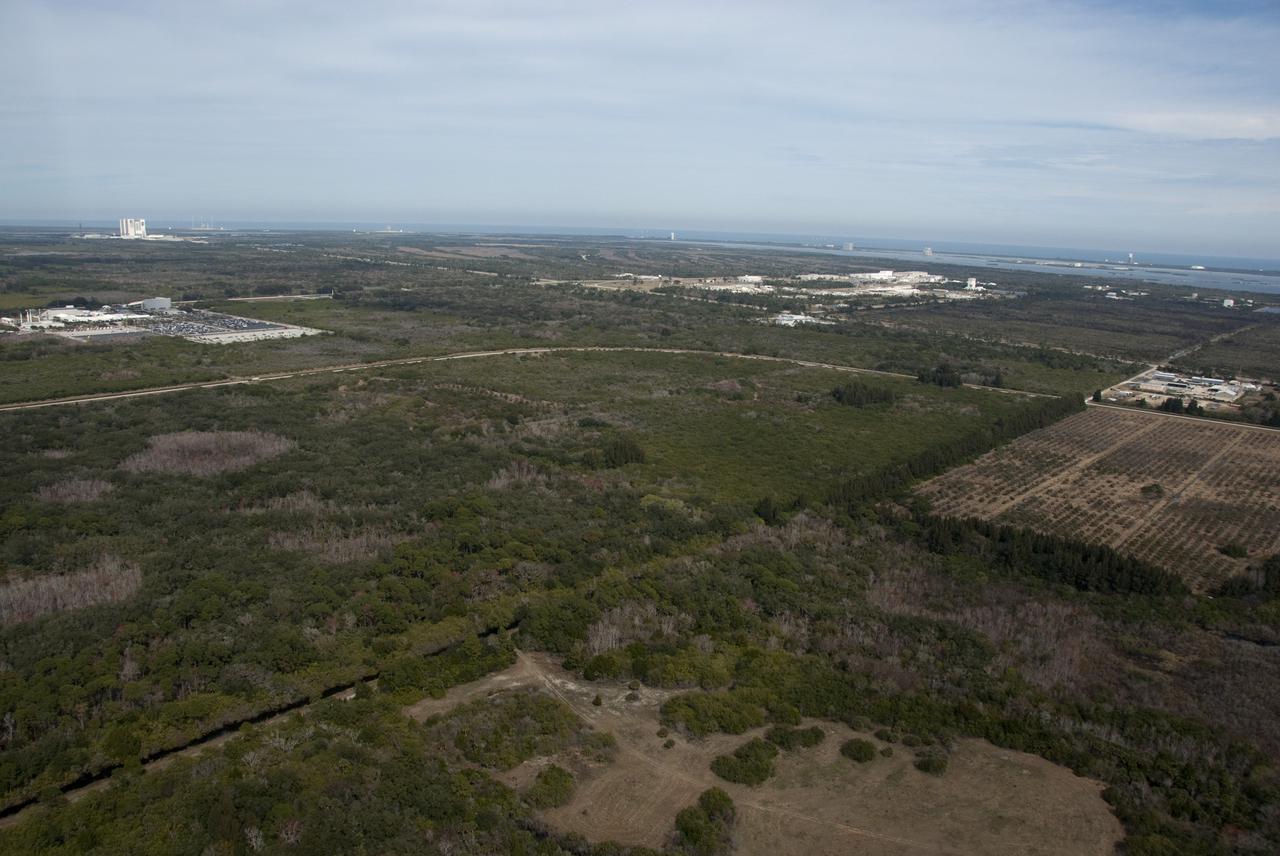
CAPE CANAVERAL, Fla. - Land located south of NASA's Kennedy Space Center Visitor Complex in Florida and adjacent to the Space Life Sciences Laboratory is the proposed site for Exploration Park. Kennedy and Space Florida, an independent special district of the State of Florida, have partnered to enable the development of a mixed-use technology and commerce park. Exploration Park will become home to diverse private sector technology and innovation enterprises offering opportunities to grow and deploy commercial space capabilities and will respond to national priorities in science and technology. The park is expected to attract tenants engaged in space technology, space commerce and space education. In addition, NASA and Space Florida plan to incorporate the existing 100,000 square foot Space Life Sciences Laboratory into the park, broadening the lab's accessibility and use beyond NASA. For more information, visit www.explorationpark.com. Photo credit: NASA_Kim Shiflett
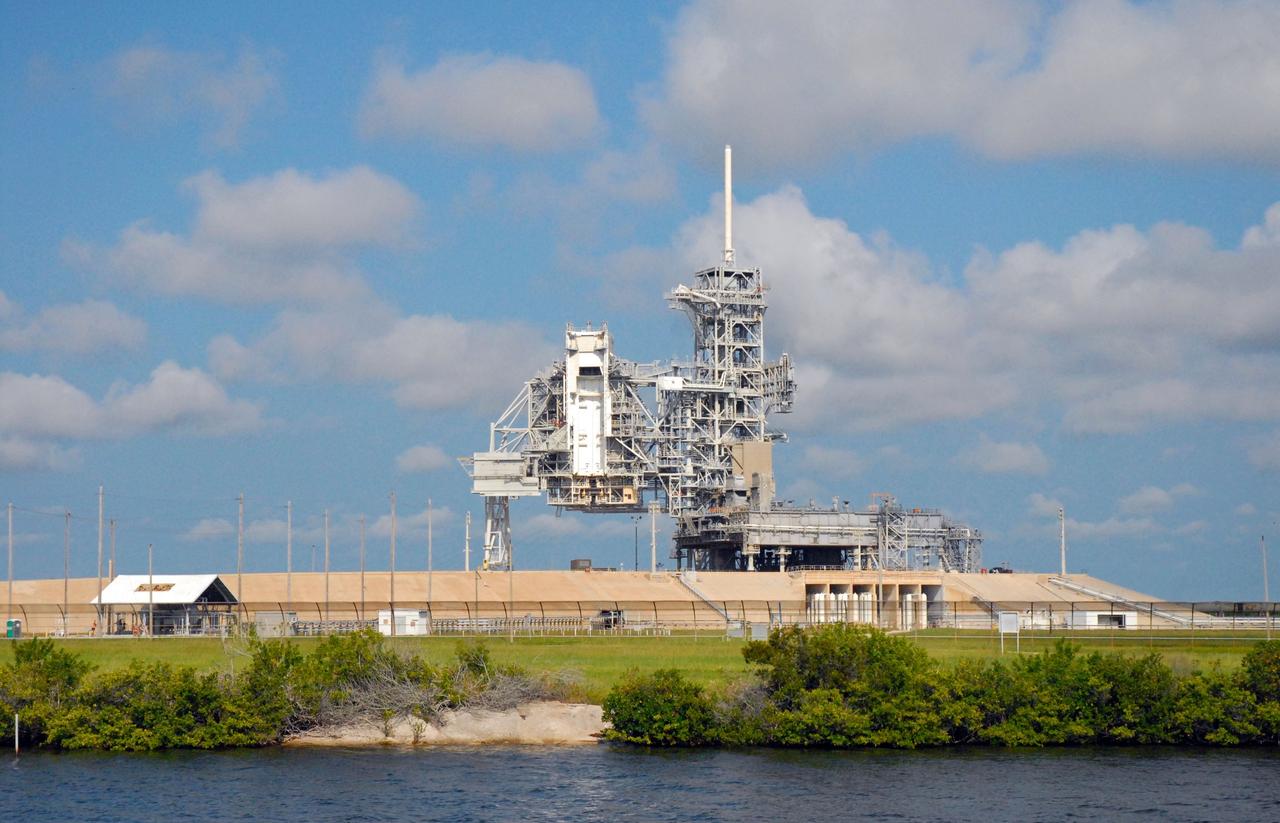
CAPE CANAVERAL, Fla. – Launch Pad 39A is seen during a field-guided boat tour of NASA's Kennedy Space Center in Florida. As part of the center's first-ever Innovation Expo, the tour, called "Living Outdoor Laboratory for Environmental Sustainability," is giving employees the opportunity to see the unique estuarine ecosystems that are protected from development by the presence of Kennedy and the Merritt Island National Wildlife Refuge. The diverse and healthy area encompassing about 140,000 acres of central Florida's east coast has been closed to the public for 50 years, allowing the coastal dunes, saltwater estuaries and marshes, freshwater impoundments, scrub, pine flatwoods, and hardwood hammocks to provide habitats for more than 1,000 species of plants and animals. Innovation Expo is showcasing the innovative work taking place throughout the center's facilities and labs to encourage employees to work together to solve future challenges. For more information, visit http://www.nasa.gov/kennedy. Photo credit: NASA
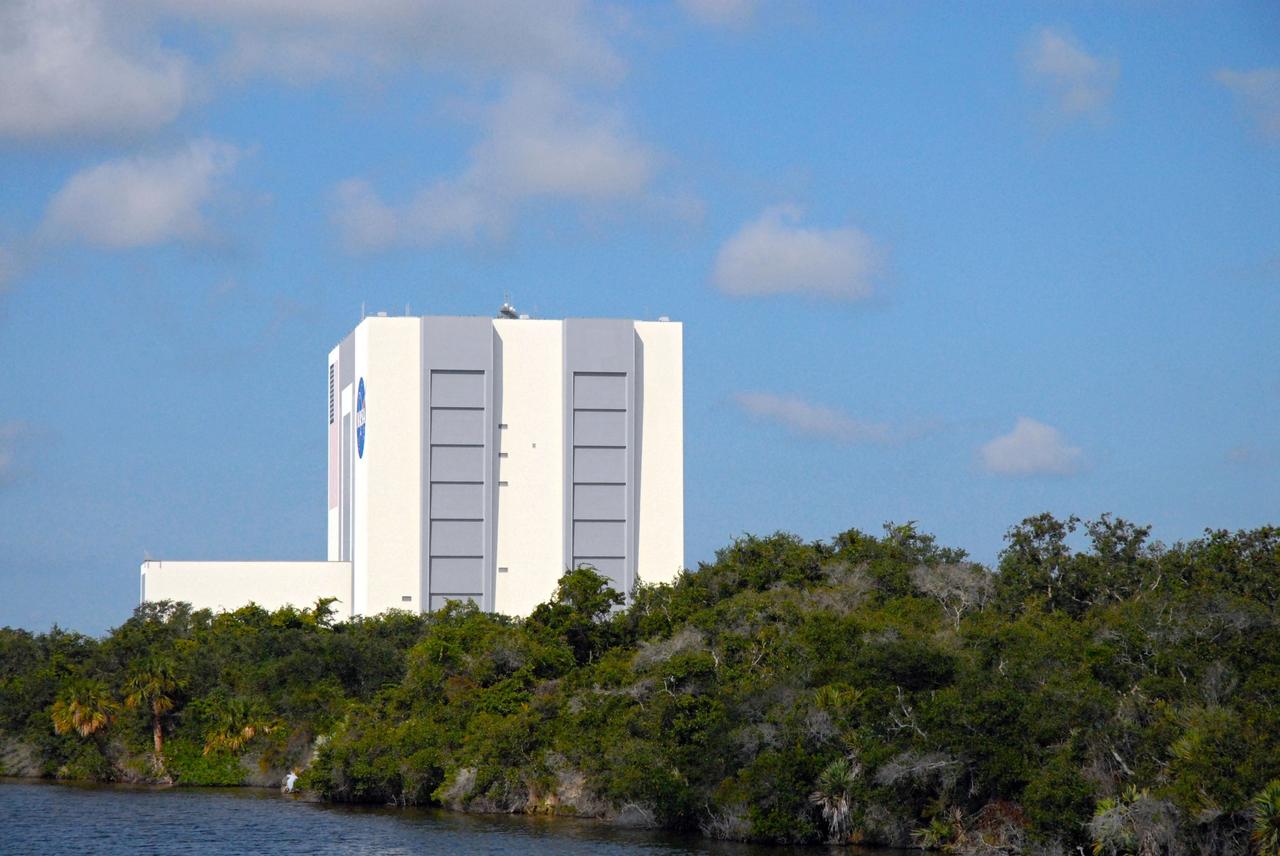
CAPE CANAVERAL, Fla. – The Vehicle Assembly Building, or VAB, is seen during a field-guided boat tour of NASA's Kennedy Space Center in Florida. As part of the center's first-ever Innovation Expo, the tour, called "Living Outdoor Laboratory for Environmental Sustainability," is giving employees the opportunity to see the unique estuarine ecosystems that are protected from development by the presence of Kennedy and the Merritt Island National Wildlife Refuge. The diverse and healthy area encompassing about 140,000 acres of central Florida's east coast has been closed to the public for 50 years, allowing the coastal dunes, saltwater estuaries and marshes, freshwater impoundments, scrub, pine flatwoods, and hardwood hammocks to provide habitats for more than 1,000 species of plants and animals. Innovation Expo is showcasing the innovative work taking place throughout the center's facilities and labs to encourage employees to work together to solve future challenges. For more information, visit http://www.nasa.gov/kennedy. Photo credit: NASA
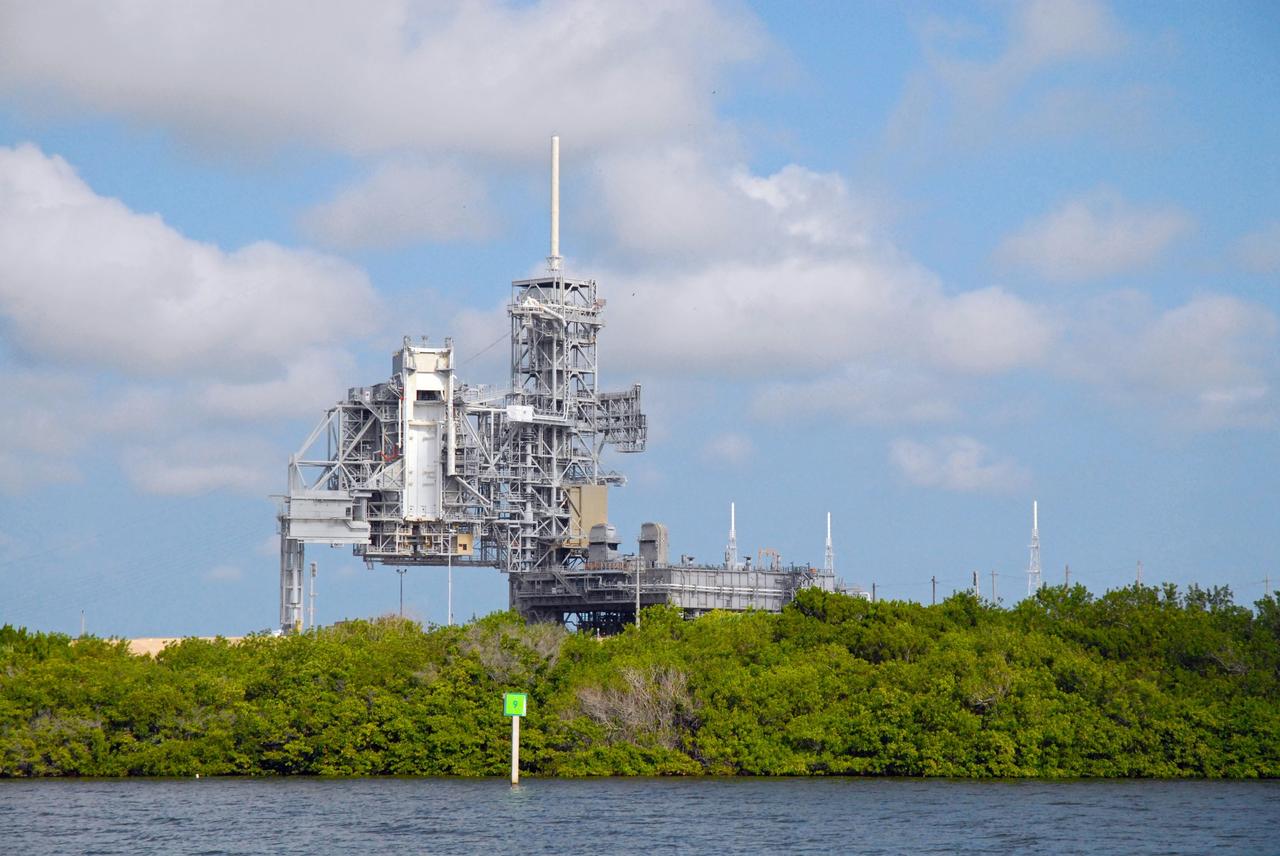
CAPE CANAVERAL, Fla. – Launch Pad 39A is seen during a field-guided boat tour of NASA's Kennedy Space Center in Florida. As part of the center's first-ever Innovation Expo, the tour, called "Living Outdoor Laboratory for Environmental Sustainability," is giving employees the opportunity to see the unique estuarine ecosystems that are protected from development by the presence of Kennedy and the Merritt Island National Wildlife Refuge. The diverse and healthy area encompassing about 140,000 acres of central Florida's east coast has been closed to the public for 50 years, allowing the coastal dunes, saltwater estuaries and marshes, freshwater impoundments, scrub, pine flatwoods, and hardwood hammocks to provide habitats for more than 1,000 species of plants and animals. Innovation Expo is showcasing the innovative work taking place throughout the center's facilities and labs to encourage employees to work together to solve future challenges. For more information, visit http://www.nasa.gov/kennedy. Photo credit: NASA
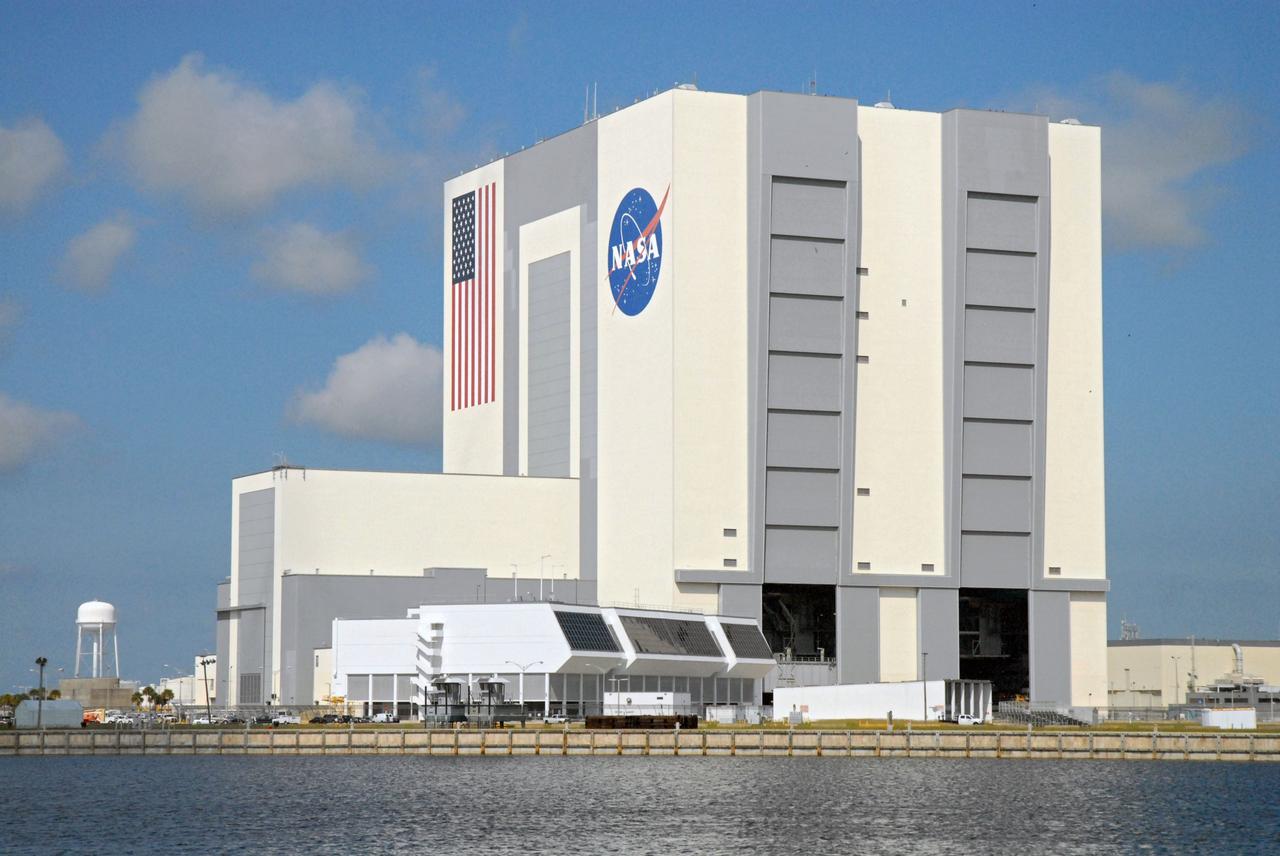
CAPE CANAVERAL, Fla. – The Vehicle Assembly Building, or VAB, is seen during a field-guided boat tour of NASA's Kennedy Space Center in Florida. As part of the center's first-ever Innovation Expo, the tour, called "Living Outdoor Laboratory for Environmental Sustainability," is giving employees the opportunity to see the unique estuarine ecosystems that are protected from development by the presence of Kennedy and the Merritt Island National Wildlife Refuge. The diverse and healthy area encompassing about 140,000 acres of central Florida's east coast has been closed to the public for 50 years, allowing the coastal dunes, saltwater estuaries and marshes, freshwater impoundments, scrub, pine flatwoods, and hardwood hammocks to provide habitats for more than 1,000 species of plants and animals. Innovation Expo is showcasing the innovative work taking place throughout the center's facilities and labs to encourage employees to work together to solve future challenges. For more information, visit http://www.nasa.gov/kennedy. Photo credit: NASA
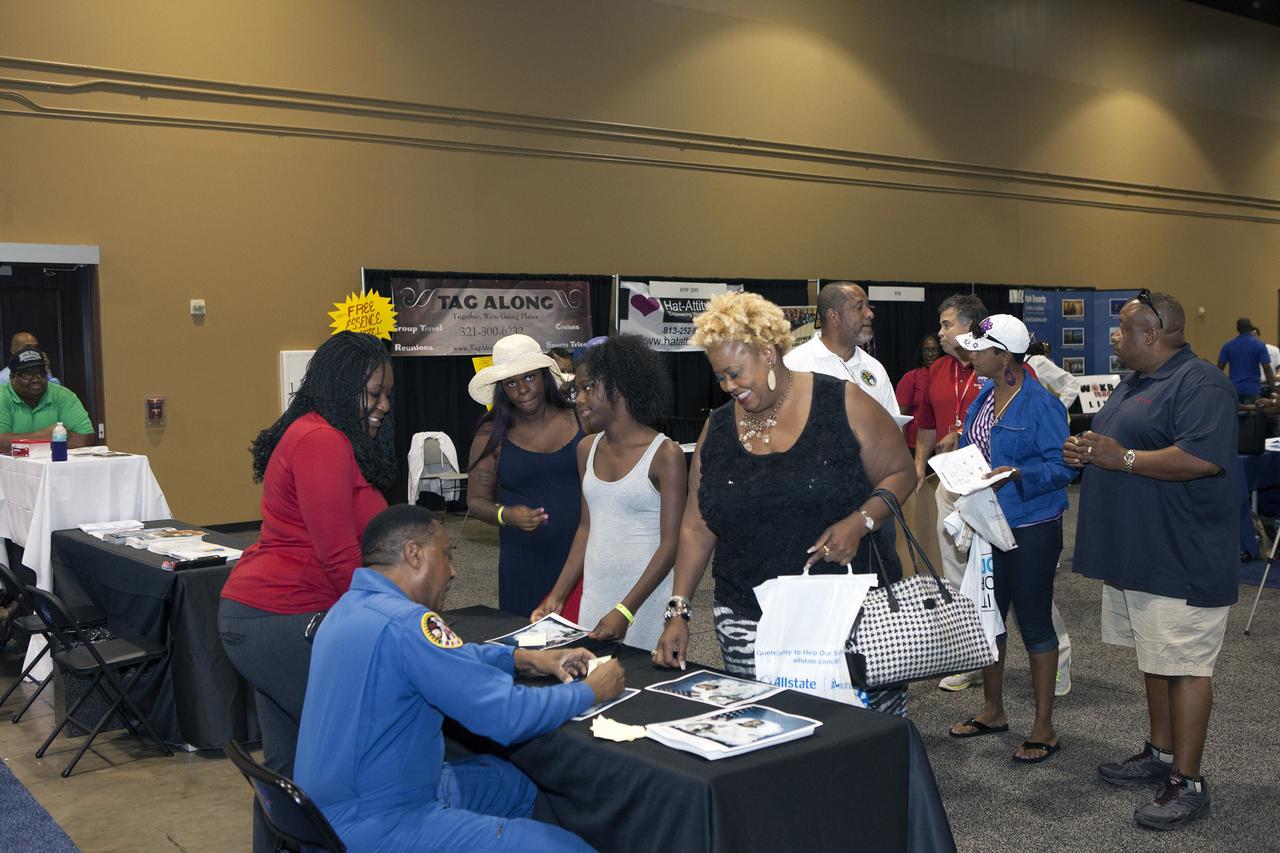
KISSIMMEE, Fla. – Former NASA astronaut Winston Scott signed autographs and posed for pictures with guests at the agency exhibit during the Tom Joyner Family Reunion. Now a senior vice president at the Florida Institute of Technology, he said that he likes to emphasize to young people how important a good education is in preparation for the future. The Tom Joyner Family Reunion is designed to present uplifting programs, entertainment and information about growing, diverse communities. An annual event of the nationally-syndicated Tom Joyner Morning Show, the many exhibits included NASA's participation focusing on encouraging young people to consider studies and careers in STEM -- science, technology, engineering and math. NASA's Education Division promoted the benefits of math and scientific learning along with career opportunities offered by the space agency. The activities took place at the Gaylord Palms Resort in Kissimmee, Florida, during the Labor Day weekend. Photo credit: NASA/Daniel Casper
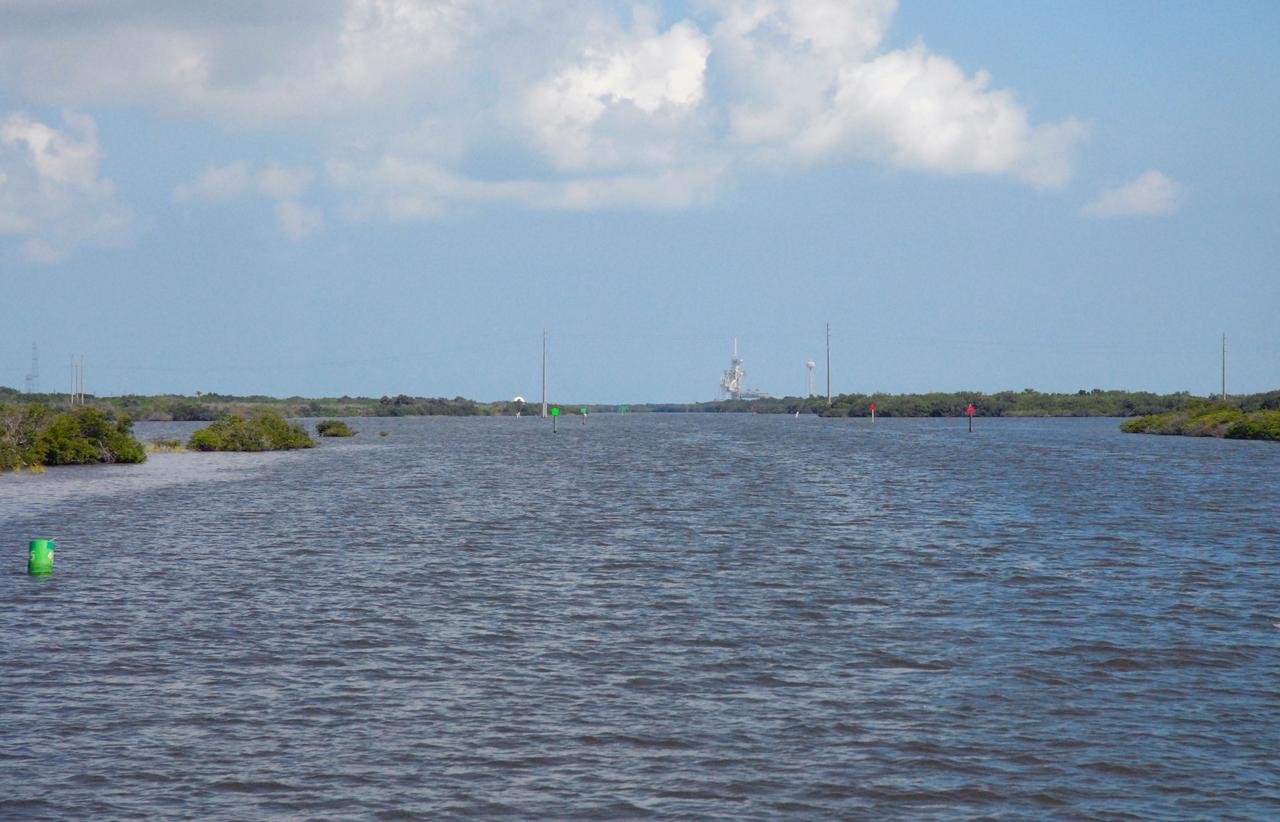
CAPE CANAVERAL, Fla. – Launch Pad 39A is seen in the distance during a field-guided boat tour of NASA's Kennedy Space Center in Florida. As part of the center's first-ever Innovation Expo, the tour, called "Living Outdoor Laboratory for Environmental Sustainability," is giving employees the opportunity to see the unique estuarine ecosystems that are protected from development by the presence of Kennedy and the Merritt Island National Wildlife Refuge. The diverse and healthy area encompassing about 140,000 acres of central Florida's east coast has been closed to the public for 50 years, allowing the coastal dunes, saltwater estuaries and marshes, freshwater impoundments, scrub, pine flatwoods, and hardwood hammocks to provide habitats for more than 1,000 species of plants and animals. Innovation Expo is showcasing the innovative work taking place throughout the center's facilities and labs to encourage employees to work together to solve future challenges. For more information, visit http://www.nasa.gov/kennedy. Photo credit: NASA
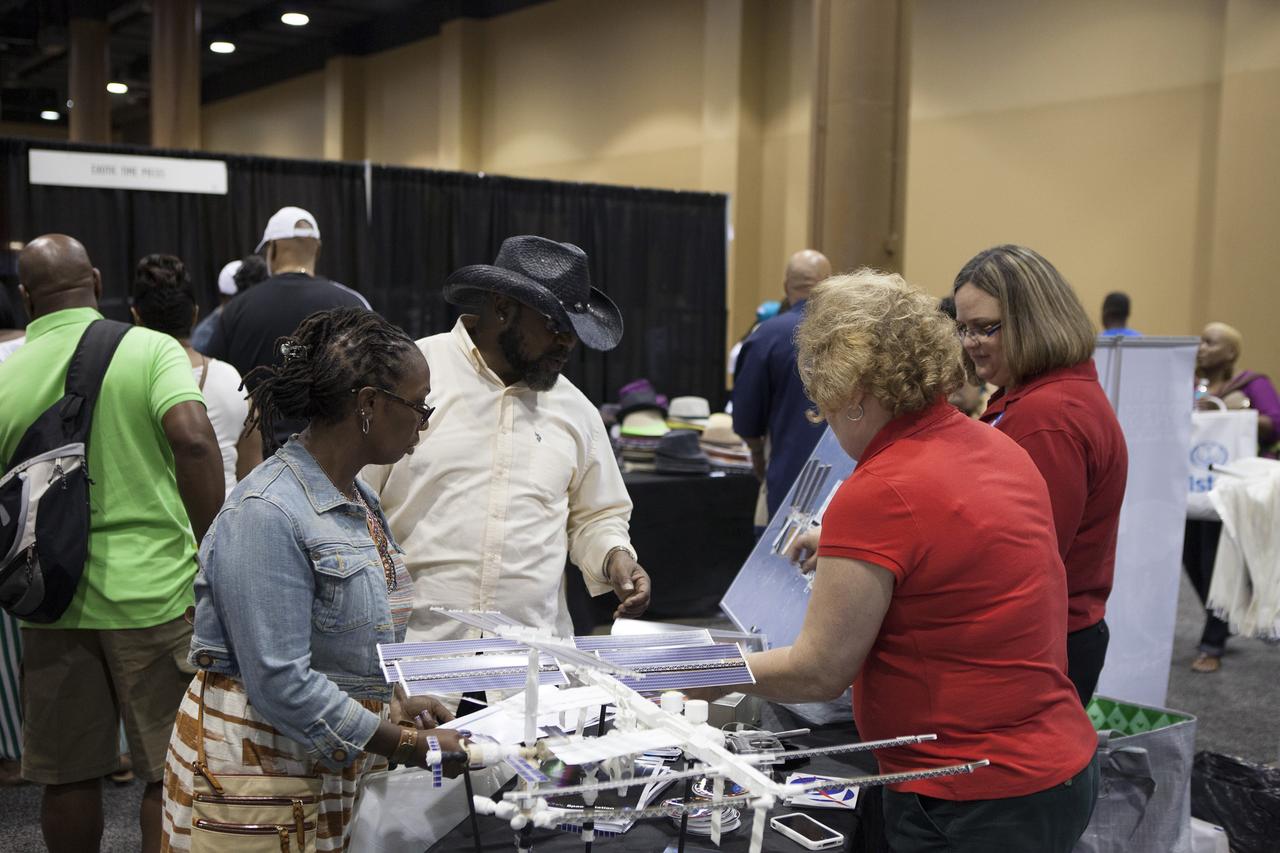
KISSIMMEE, Fla. – Guests at the Tom Joyner Family Reunion learn about NASA activities during the five-day event. Thousands of visitors spoke with agency representatives who explained the NASA’s efforts with the International Space Station, Commercial Crew Program, Ground Systems Development and Operations Program, as well as the Launch Services Program. The Tom Joyner Family Reunion is designed to present uplifting programs, entertainment and information about growing, diverse communities. An annual event of the nationally-syndicated Tom Joyner Morning Show, the many exhibits included NASA's participation focusing on encouraging young people to consider studies and careers in STEM -- science, technology, engineering and math. NASA's Education Division promoted the benefits of math and scientific learning along with career opportunities offered by the space agency. The activities took place at the Gaylord Palms Resort in Kissimmee, Florida, during the Labor Day weekend. Photo credit: NASA/Daniel Casper
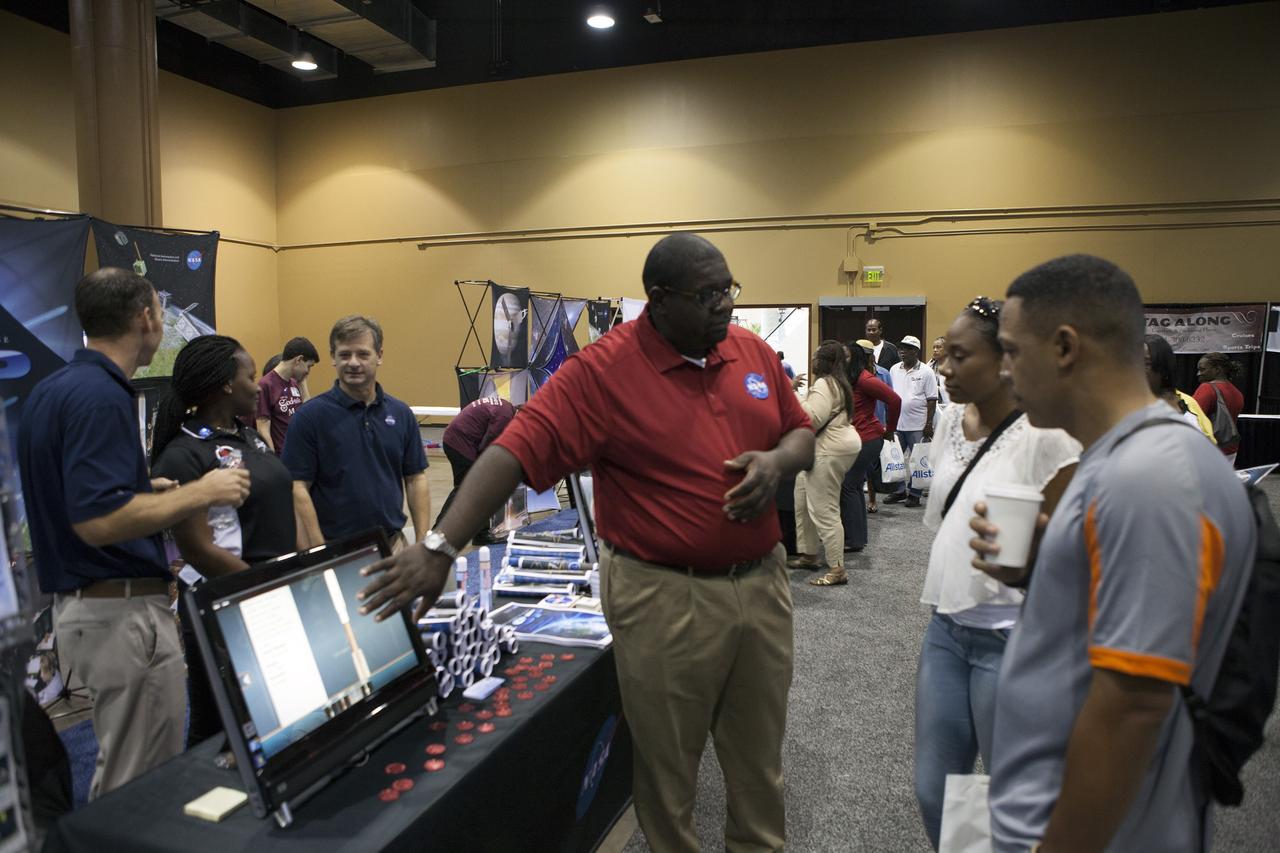
KISSIMMEE, Fla. – Guests at the Tom Joyner Family Reunion listen as Malcom Boston of the Fleet System Integration Branch of the Launch Services Program LSP explains a computer demonstration on rockets. Behind the table, from the left, are Brian Norton, Emily Fields and Randy Mizelle, all from the Program Planning Office in LSP. The Tom Joyner Family Reunion is designed to present uplifting programs, entertainment and information about growing, diverse communities. An annual event of the nationally-syndicated Tom Joyner Morning Show, the many exhibits included NASA's participation focusing on encouraging young people to consider studies and careers in STEM -- science, technology, engineering and math. NASA's Education Division promoted the benefits of math and scientific learning along with career opportunities offered by the space agency. The activities took place at the Gaylord Palms Resort in Kissimmee, Florida, during the Labor Day weekend. Photo credit: NASA/Daniel Casper
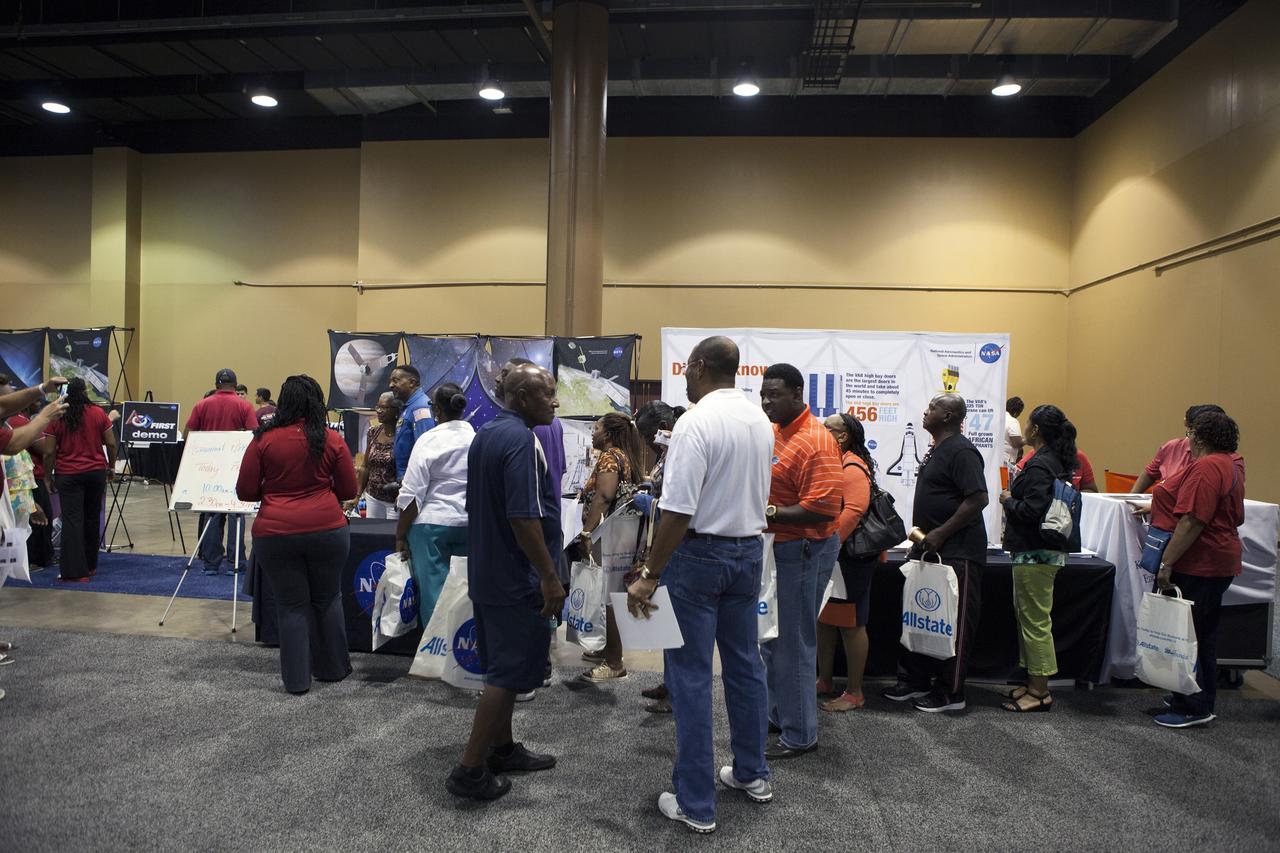
KISSIMMEE, Fla. – Guests at the Tom Joyner Family Reunion learn about NASA activities during the five-day event. Thousands of visitors spoke with agency representatives who explained the agency’s efforts with the International Space Station, Commercial Crew Program, Ground Systems Development and Operations Program, as well as the Launch Services Program. The Tom Joyner Family Reunion is designed to present uplifting programs, entertainment and information about growing, diverse communities. An annual event of the nationally-syndicated Tom Joyner Morning Show, the many exhibits included NASA's participation focusing on encouraging young people to consider studies and careers in STEM -- science, technology, engineering and math. NASA's Education Division promoted the benefits of math and scientific learning along with career opportunities offered by the space agency. The activities took place at the Gaylord Palms Resort in Kissimmee, Florida, during the Labor Day weekend. Photo credit: NASA/Daniel Casper
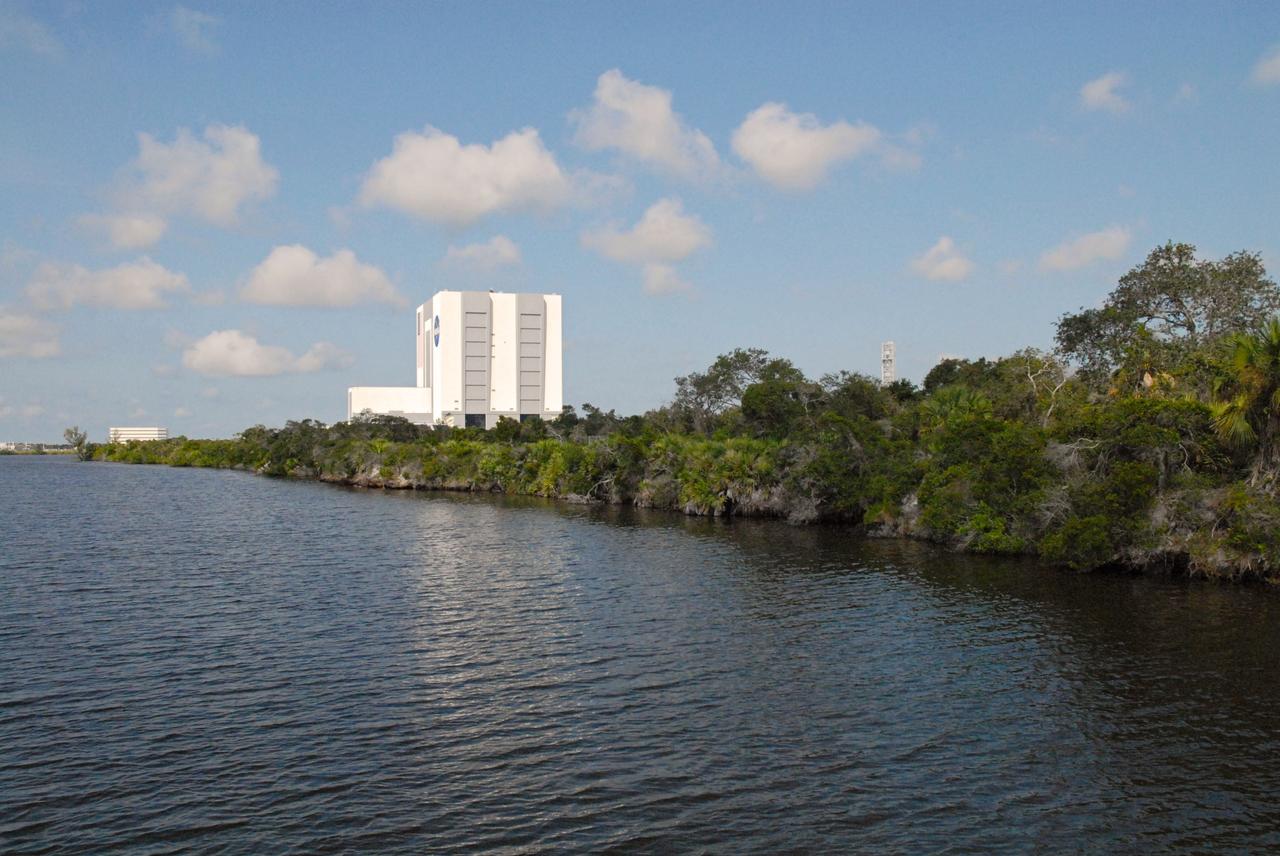
CAPE CANAVERAL, Fla. – Launch Complex 39 is seen during a field-guided boat tour of NASA's Kennedy Space Center in Florida. As part of the center's first-ever Innovation Expo, the tour, called "Living Outdoor Laboratory for Environmental Sustainability," is giving employees the opportunity to see the unique estuarine ecosystems that are protected from development by the presence of Kennedy and the Merritt Island National Wildlife Refuge. The diverse and healthy area encompassing about 140,000 acres of central Florida's east coast has been closed to the public for 50 years, allowing the coastal dunes, saltwater estuaries and marshes, freshwater impoundments, scrub, pine flatwoods, and hardwood hammocks to provide habitats for more than 1,000 species of plants and animals. Innovation Expo is showcasing the innovative work taking place throughout the center's facilities and labs to encourage employees to work together to solve future challenges. For more information, visit http://www.nasa.gov/kennedy. Photo credit: NASA
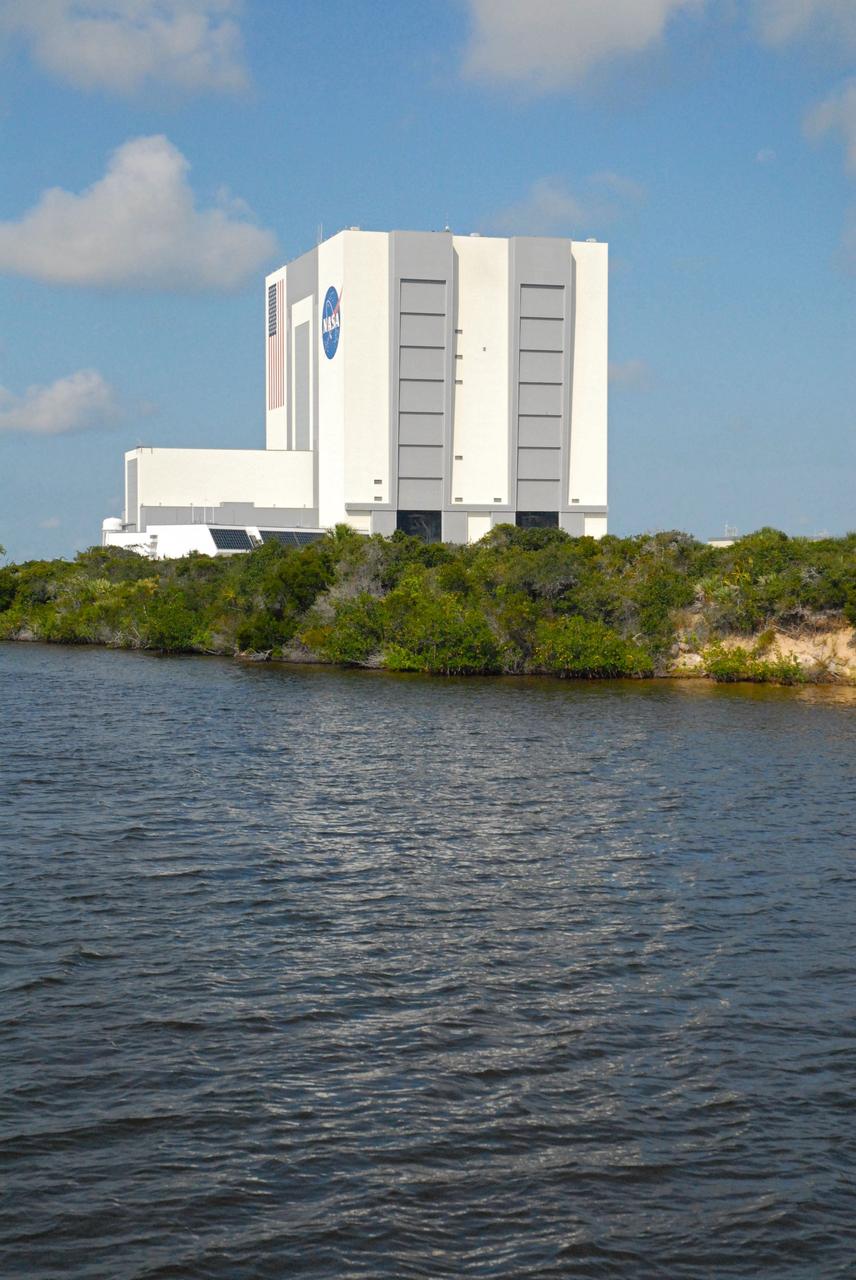
CAPE CANAVERAL, Fla. – The Vehicle Assembly Building, or VAB, is seen during a field-guided boat tour of NASA's Kennedy Space Center in Florida. As part of the center's first-ever Innovation Expo, the tour, called "Living Outdoor Laboratory for Environmental Sustainability," is giving employees the opportunity to see the unique estuarine ecosystems that are protected from development by the presence of Kennedy and the Merritt Island National Wildlife Refuge. The diverse and healthy area encompassing about 140,000 acres of central Florida's east coast has been closed to the public for 50 years, allowing the coastal dunes, saltwater estuaries and marshes, freshwater impoundments, scrub, pine flatwoods, and hardwood hammocks to provide habitats for more than 1,000 species of plants and animals. Innovation Expo is showcasing the innovative work taking place throughout the center's facilities and labs to encourage employees to work together to solve future challenges. For more information, visit http://www.nasa.gov/kennedy. Photo credit: NASA
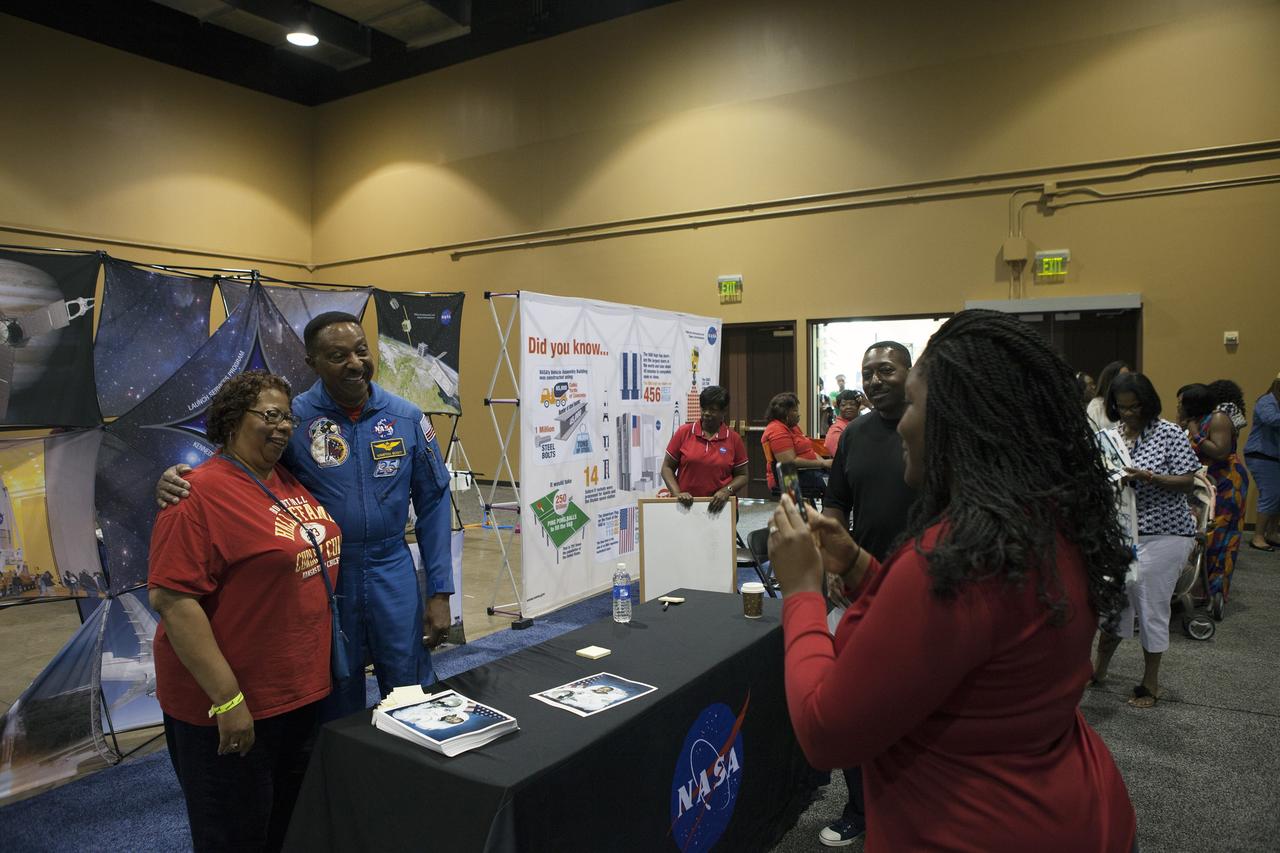
KISSIMMEE, Fla. – Former NASA astronaut Winston Scott signed autographs and posed for pictures with guests at the agency exhibit during the Tom Joyner Family Reunion. Now a senior vice president at the Florida Institute of Technology, he said that he likes to emphasize to young people how important a good education is in preparation for the future. The Tom Joyner Family Reunion is designed to present uplifting programs, entertainment and information about growing, diverse communities. An annual event of the nationally-syndicated Tom Joyner Morning Show, the many exhibits included NASA's participation focusing on encouraging young people to consider studies and careers in STEM -- science, technology, engineering and math. NASA's Education Division promoted the benefits of math and scientific learning along with career opportunities offered by the space agency. The activities took place at the Gaylord Palms Resort in Kissimmee, Florida, during the Labor Day weekend. Photo credit: NASA/Daniel Casper
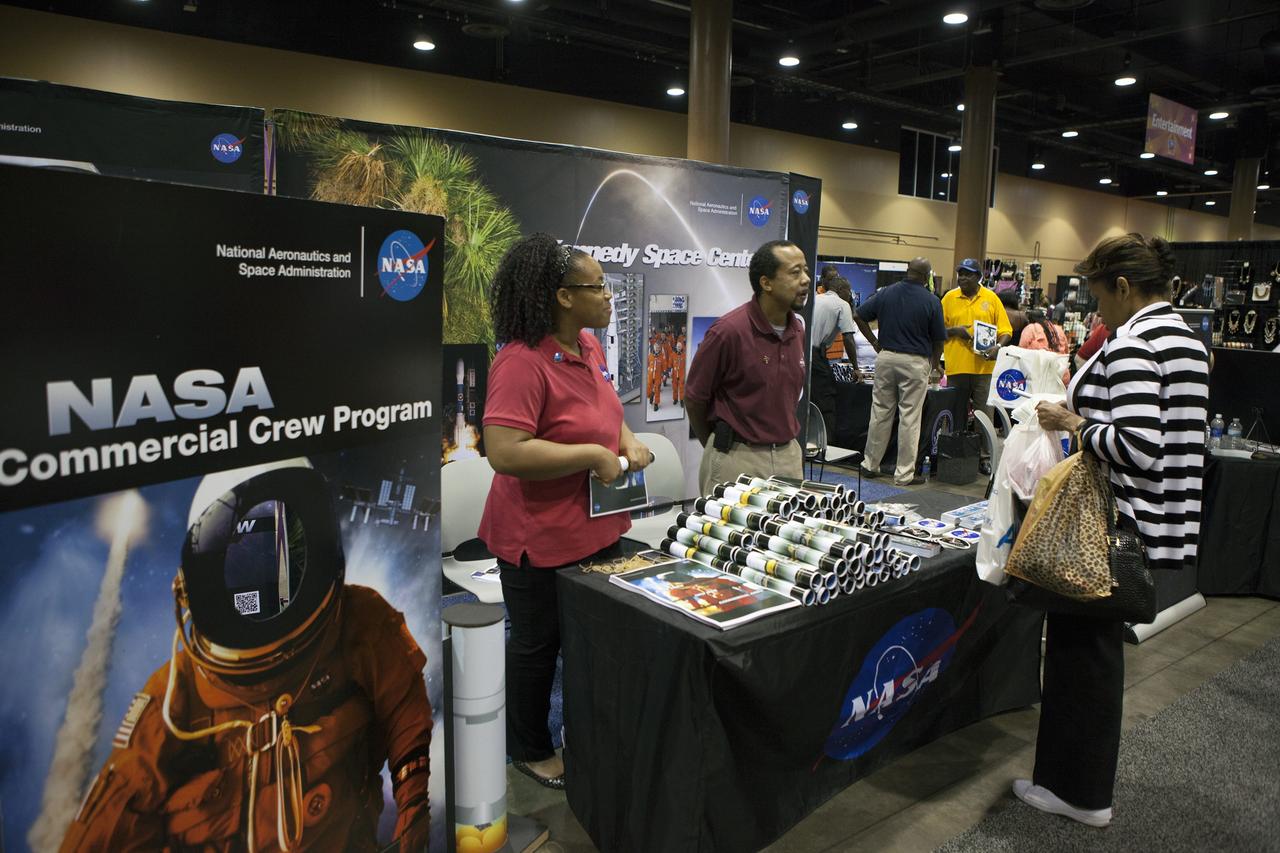
KISSIMMEE, Fla. – A guest at the Tom Joyner Family Reunion talks with Brittani Sims, left, and Sheldon Lauderdale, both work in the Program Control and Integration Office of the Commercial Crew Program. They explained that the program is facilitating development of American commercial crew space transportation capability to achieve safe, reliable and cost-effective access to and from the International Space Station and low-Earth orbit. The Tom Joyner Family Reunion is designed to present uplifting programs, entertainment and information about growing, diverse communities. An annual event of the nationally-syndicated Tom Joyner Morning Show, the many exhibits included NASA's participation focusing on encouraging young people to consider studies and careers in STEM -- science, technology, engineering and math. NASA's Education Division promoted the benefits of math and scientific learning along with career opportunities offered by the space agency. The activities took place at the Gaylord Palms Resort in Kissimmee, Florida, during the Labor Day weekend. Photo credit: NASA/Daniel Casper
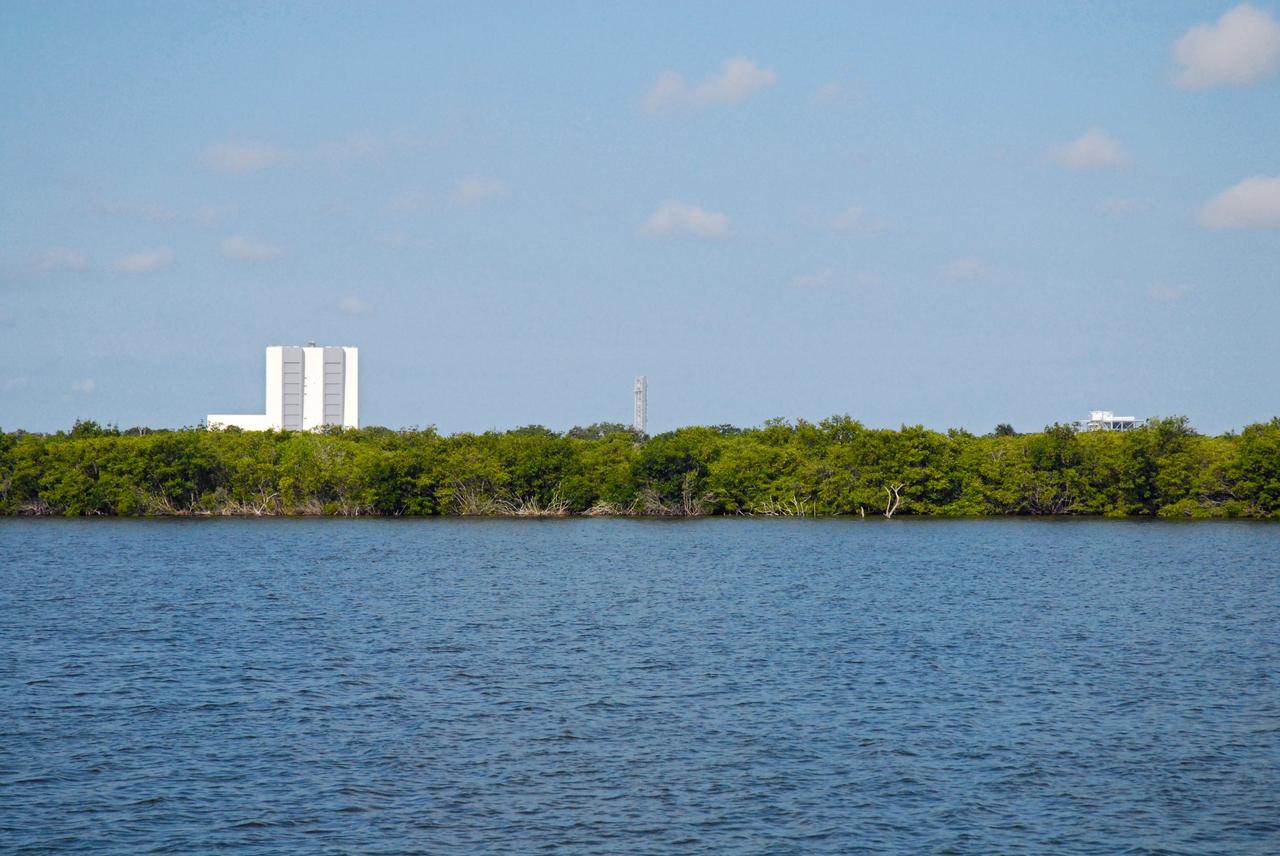
CAPE CANAVERAL, Fla. – The Vehicle Assembly Building, or VAB, and NASA's new mobile launcher, or ML, are seen in the distance during a field-guided boat tour of NASA's Kennedy Space Center in Florida. As part of the center's first-ever Innovation Expo, the tour, called "Living Outdoor Laboratory for Environmental Sustainability," is giving employees the opportunity to see the unique estuarine ecosystems that are protected from development by the presence of Kennedy and the Merritt Island National Wildlife Refuge. The 355-foot-tall ML structure, which took about two years to construct, will be modified by NASA’s Ground Systems Development and Operations, or GSDO, Program to support NASA’s Space Launch System, the heavy-lift rocket that will launch astronauts into deep space on future exploration missions. The diverse and healthy area encompassing about 140,000 acres of central Florida's east coast has been closed to the public for 50 years, allowing the coastal dunes, saltwater estuaries and marshes, freshwater impoundments, scrub, pine flatwoods, and hardwood hammocks to provide habitats for more than 1,000 species of plants and animals. Innovation Expo is showcasing the innovative work taking place throughout the center's facilities and labs to encourage employees to work together to solve future challenges. For more information, visit http://www.nasa.gov/kennedy. Photo credit: NASA
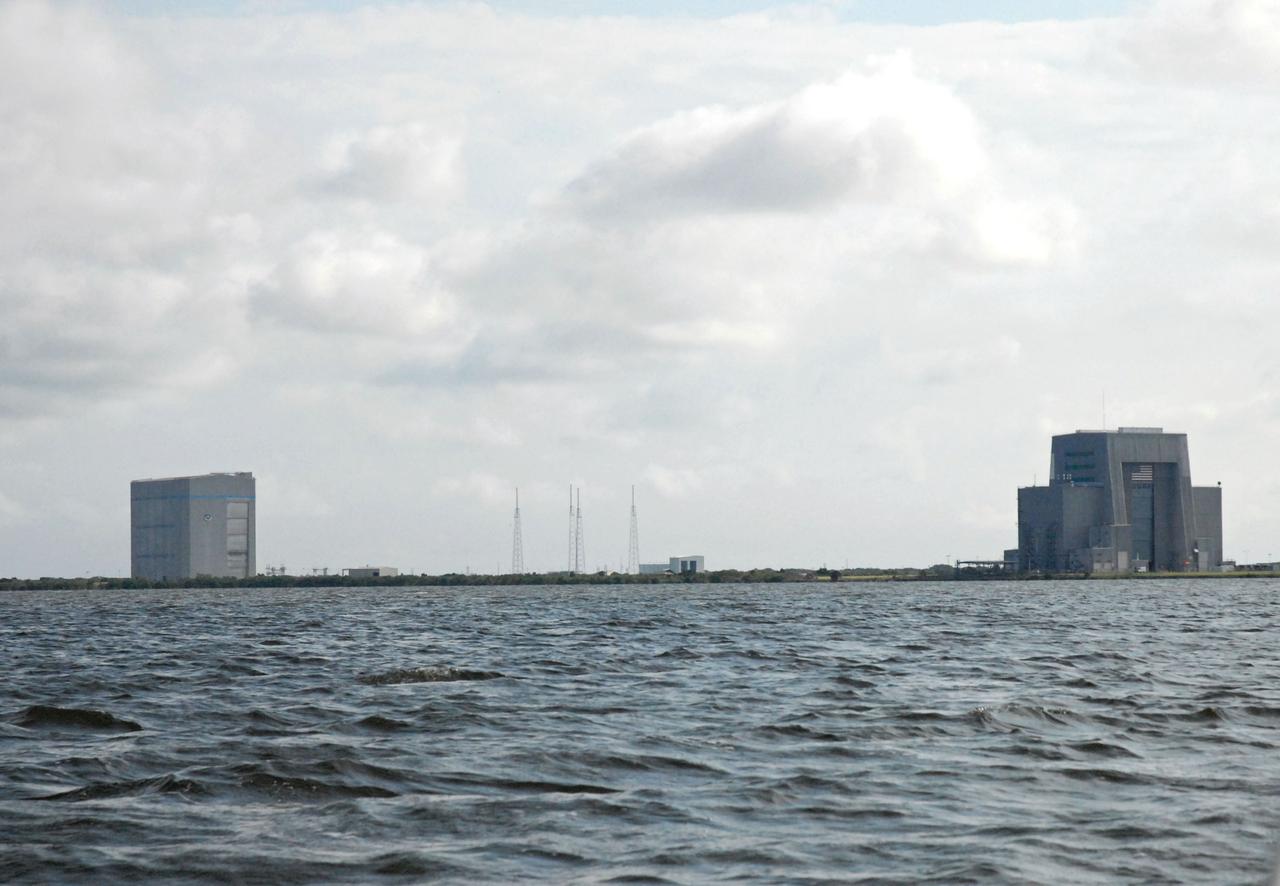
CAPE CANAVERAL, Fla. – Cape Canaveral Air Force Station's Solid Motor Assembly and Readiness Facility, or SMARF, Space Launch Complex 40, Space Exploration Technologies, or SpaceX, facility, and Solid Motor Assembly Building, or SMAB, are seen in the distance during a field-guided boat tour of NASA's Kennedy Space Center in Florida. As part of the center's first-ever Innovation Expo, the tour, called "Living Outdoor Laboratory for Environmental Sustainability," is giving employees the opportunity to see the unique estuarine ecosystems that are protected from development by the presence of Kennedy and the Merritt Island National Wildlife Refuge. The diverse and healthy area encompassing about 140,000 acres of central Florida's east coast has been closed to the public for 50 years, allowing the coastal dunes, saltwater estuaries and marshes, freshwater impoundments, scrub, pine flatwoods, and hardwood hammocks to provide habitats for more than 1,000 species of plants and animals. Innovation Expo is showcasing the innovative work taking place throughout the center's facilities and labs to encourage employees to work together to solve future challenges. For more information, visit http://www.nasa.gov/kennedy. Photo credit: NASA
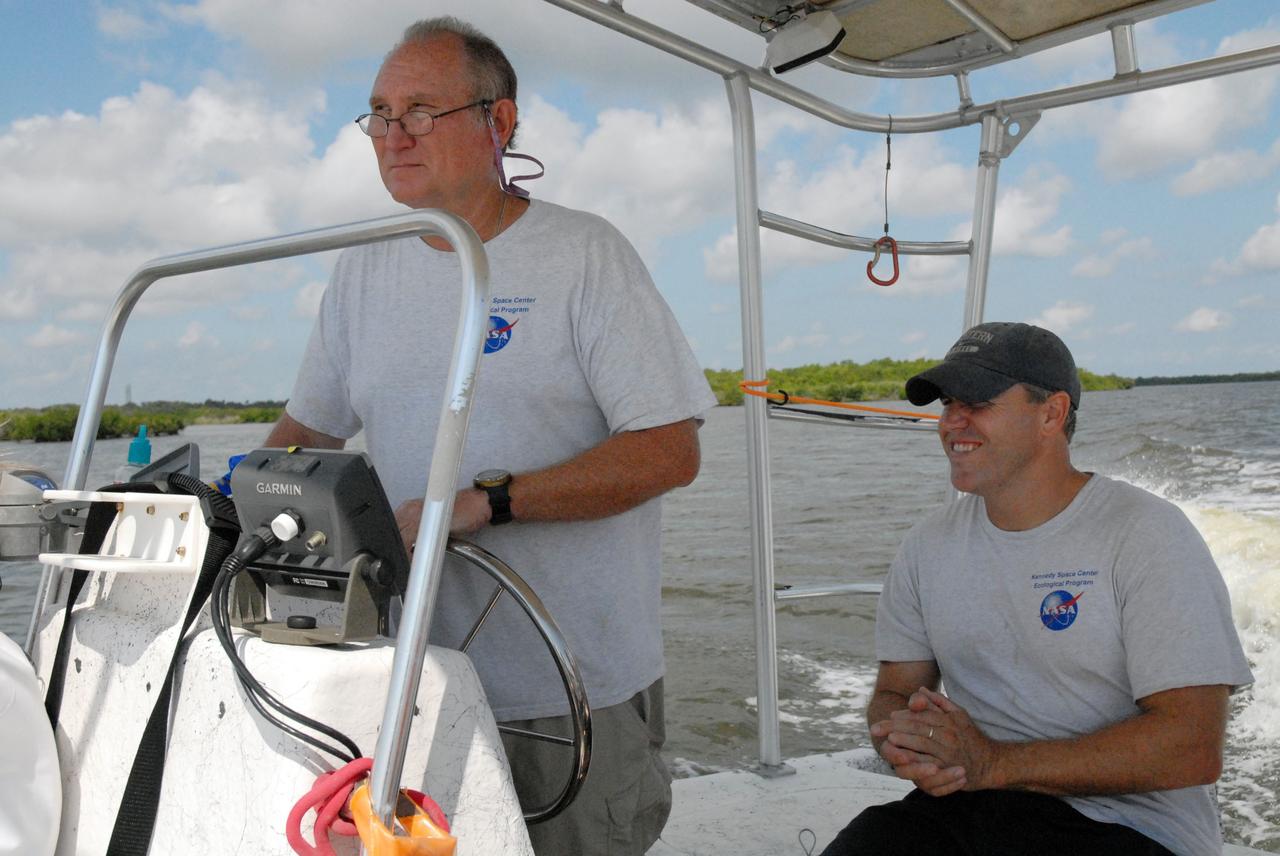
CAPE CANAVERAL, Fla. – Aquatic biologists Doug Scheidt, left, and Eric Reyier with Innovative Health Applications, or IHA, lead a field-guided boat tour of NASA's Kennedy Space Center in Florida. As part of the center's first-ever Innovation Expo, the tour, called "Living Outdoor Laboratory for Environmental Sustainability," is giving employees the opportunity to see the unique estuarine ecosystems that are protected from development by the presence of Kennedy and the Merritt Island National Wildlife Refuge. The diverse and healthy area encompassing about 140,000 acres of central Florida's east coast has been closed to the public for 50 years, allowing the coastal dunes, saltwater estuaries and marshes, freshwater impoundments, scrub, pine flatwoods, and hardwood hammocks to provide habitats for more than 1,000 species of plants and animals. Innovation Expo is showcasing the innovative work taking place throughout the center's facilities and labs to encourage employees to work together to solve future challenges. For more information, visit http://www.nasa.gov/kennedy. Photo credit: NASA
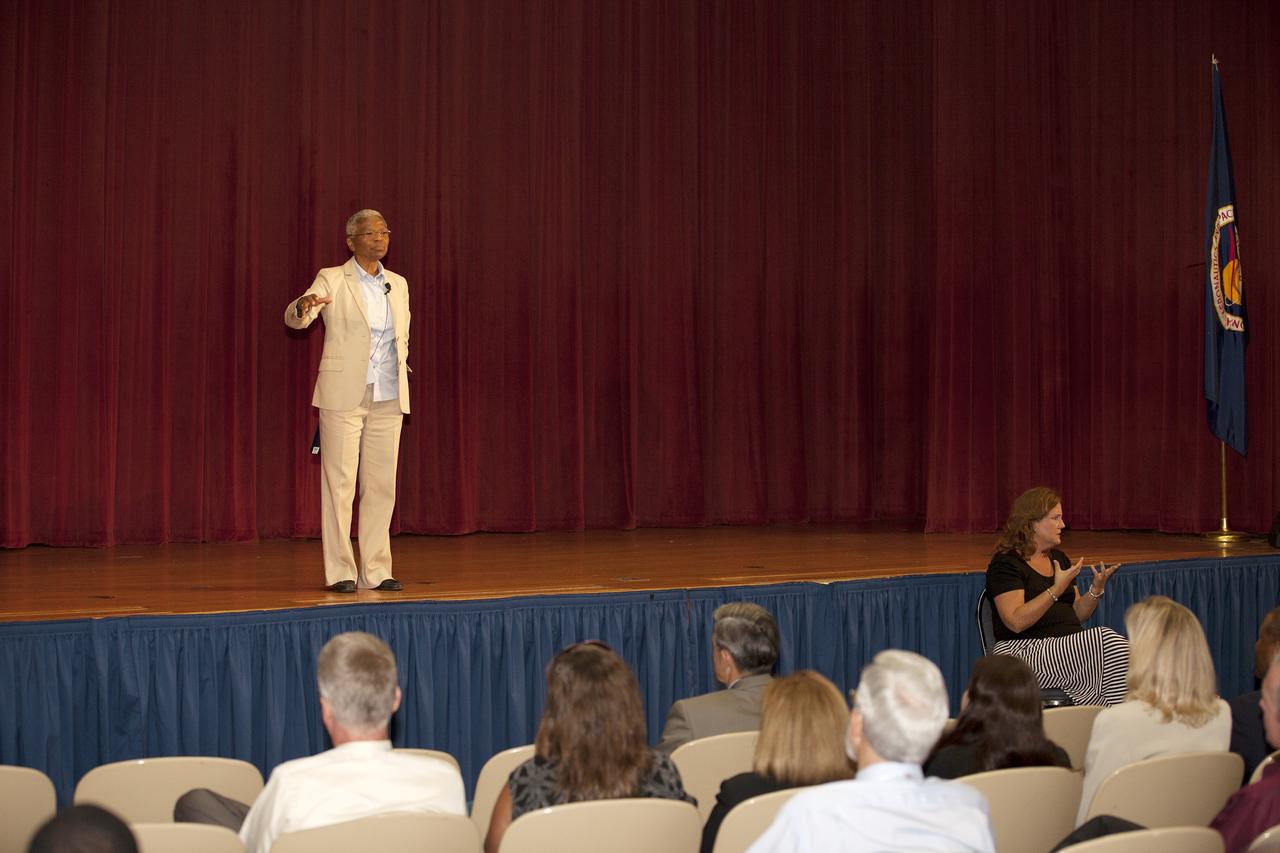
CAPE CANAVERAL, Fla. -- In the KSC Training Auditorium at NASA's Kennedy Space Center in Florida, Dr. Mary Frances Berry, on stage, addresses the audience gathered for a special event marking the 50th anniversary of the Civil Rights Act of 1964, supported by a sign-language interpreter. Berry served as the assistant secretary for education in the U.S. Department of Health, Education and Welfare HEW between 1977 and 1980. From 1980 to 2004, she was a member of the U.S. Commission on Civil Rights, serving as chair from 1993 to 2004. Among Berry's many honors are the NAACP's Roy Wilkins Award, the Rosa Parks Award of the Southern Christian Leadership Conference, and the Ebony Magazine Black Achievement Award. She is one of 75 women featured in the book "I Dream a World: Portraits of Black Women Who Changed America." Sienna College Research Institute and the Women's Hall of Fame also designated her one of "America's Women of the Century." The event was presented by Kennedy's Office of Diversity and Equal Opportunity. For more information about Kennedy Space Center, visit http://www.nasa.gov/kennedy. Photo credit: NASA/Kim Shiflett
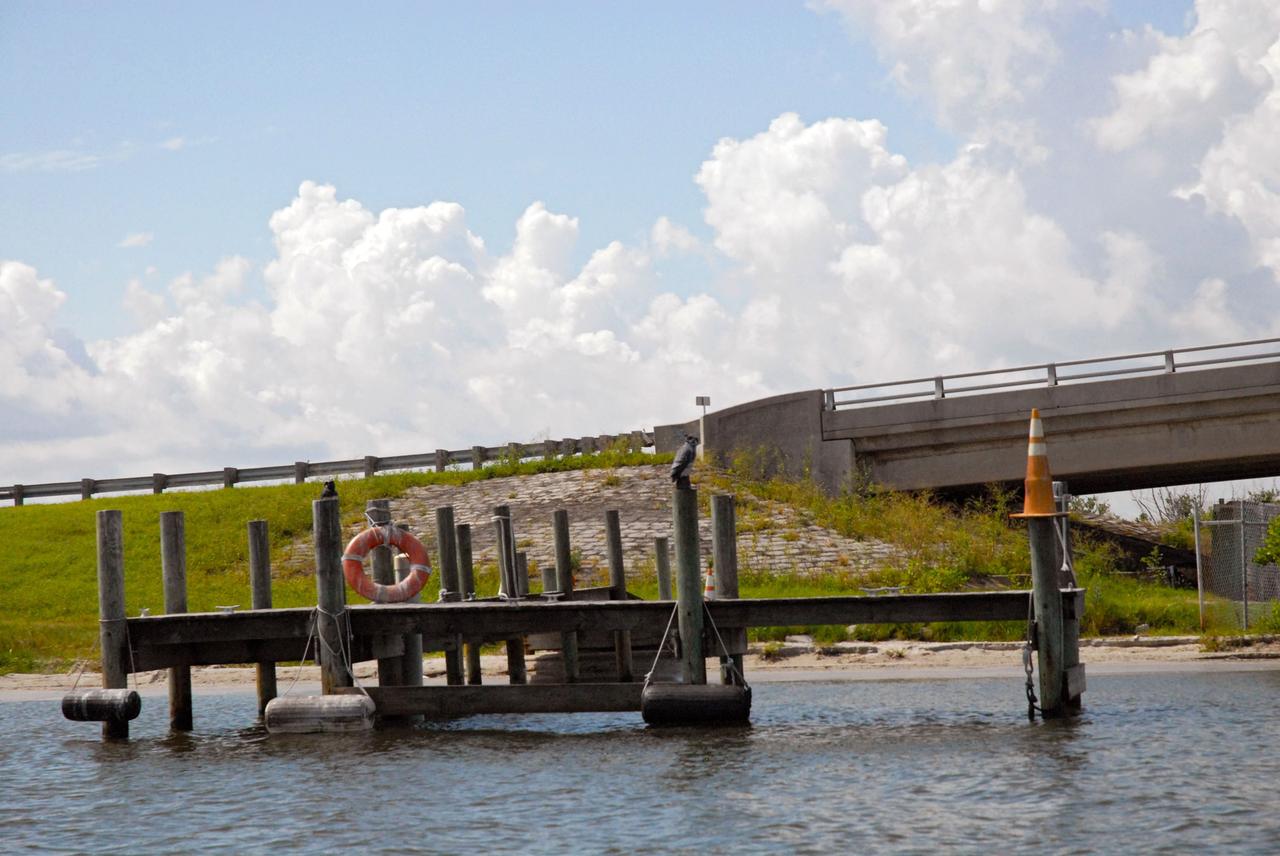
CAPE CANAVERAL, Fla. – A boat dock and the Roy D. Bridges Jr. Bridge connecting NASA Kennedy Space Center's Industrial Area to Cape Canaveral Air Force Station's Industrial Area are seen during a field-guided boat tour. As part of the Kennedy's first-ever Innovation Expo, the tour, called "Living Outdoor Laboratory for Environmental Sustainability," is giving employees the opportunity to see the unique estuarine ecosystems that are protected from development by the presence of the center and the Merritt Island National Wildlife Refuge. The diverse and healthy area encompassing about 140,000 acres of central Florida's east coast has been closed to the public for 50 years, allowing the coastal dunes, saltwater estuaries and marshes, freshwater impoundments, scrub, pine flatwoods, and hardwood hammocks to provide habitats for more than 1,000 species of plants and animals. Innovation Expo is showcasing the innovative work taking place throughout the center's facilities and labs to encourage employees to work together to solve future challenges. For more information, visit http://www.nasa.gov/kennedy. Photo credit: NASA
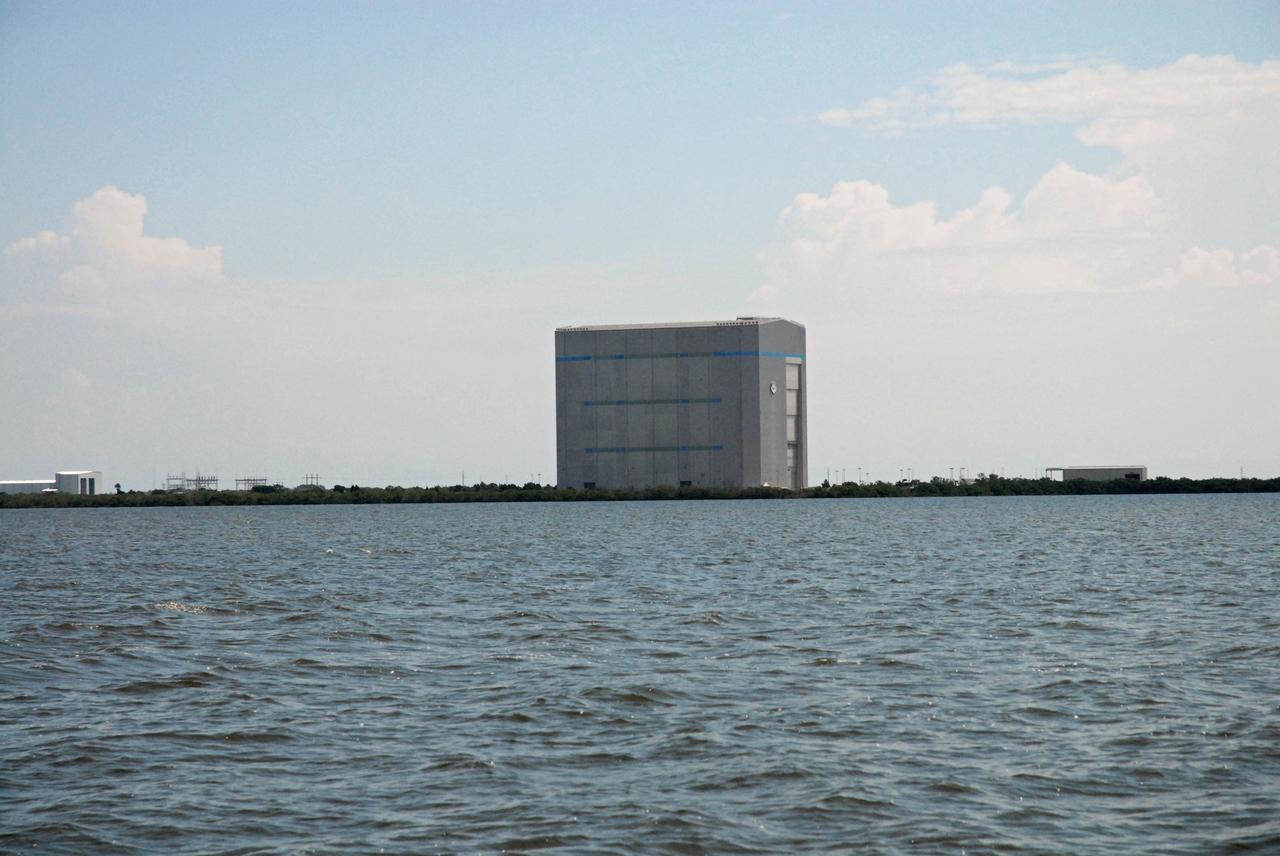
CAPE CANAVERAL, Fla. – Cape Canaveral Air Force Station's Solid Motor Assembly and Readiness Facility, or SMARF, Space Launch Complex 40, and Space Exploration Technologies, or SpaceX, facility, is seen in the distance during a field-guided boat tour of NASA's Kennedy Space Center in Florida. As part of the center's first-ever Innovation Expo, the tour, called "Living Outdoor Laboratory for Environmental Sustainability," is giving employees the opportunity to see the unique estuarine ecosystems that are protected from development by the presence of Kennedy and the Merritt Island National Wildlife Refuge. The diverse and healthy area encompassing about 140,000 acres of central Florida's east coast has been closed to the public for 50 years, allowing the coastal dunes, saltwater estuaries and marshes, freshwater impoundments, scrub, pine flatwoods, and hardwood hammocks to provide habitats for more than 1,000 species of plants and animals. Innovation Expo is showcasing the innovative work taking place throughout the center's facilities and labs to encourage employees to work together to solve future challenges. For more information, visit http://www.nasa.gov/kennedy. Photo credit: NASA
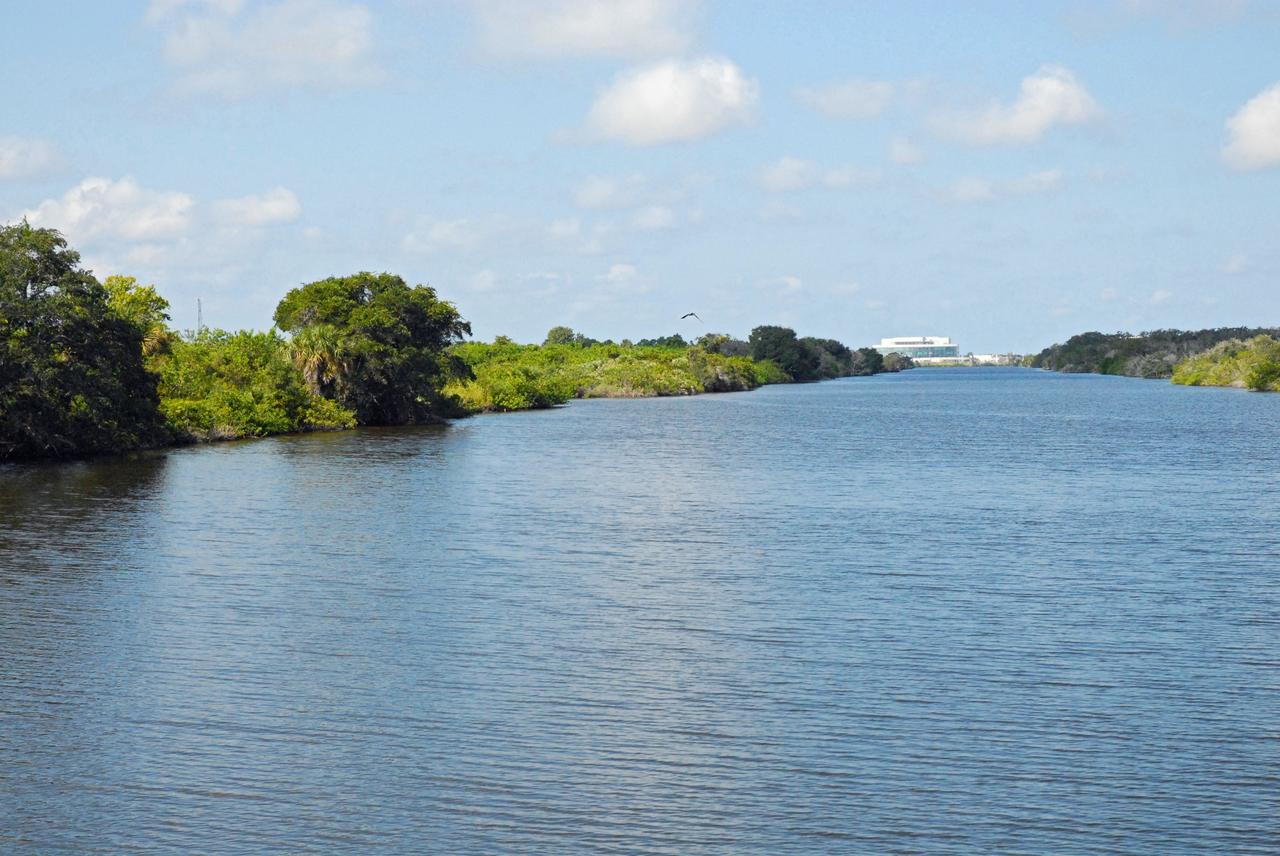
CAPE CANAVERAL, Fla. – Operations Support Building II, or OSBII, is seen in the distance during a field-guided boat tour of NASA's Kennedy Space Center in Florida. As part of the center's first-ever Innovation Expo, the tour, called "Living Outdoor Laboratory for Environmental Sustainability," is giving employees the opportunity to see the unique estuarine ecosystems that are protected from development by the presence of Kennedy and the Merritt Island National Wildlife Refuge. The diverse and healthy area encompassing about 140,000 acres of central Florida's east coast has been closed to the public for 50 years, allowing the coastal dunes, saltwater estuaries and marshes, freshwater impoundments, scrub, pine flatwoods, and hardwood hammocks to provide habitats for more than 1,000 species of plants and animals. Innovation Expo is showcasing the innovative work taking place throughout the center's facilities and labs to encourage employees to work together to solve future challenges. For more information, visit http://www.nasa.gov/kennedy. Photo credit: NASA
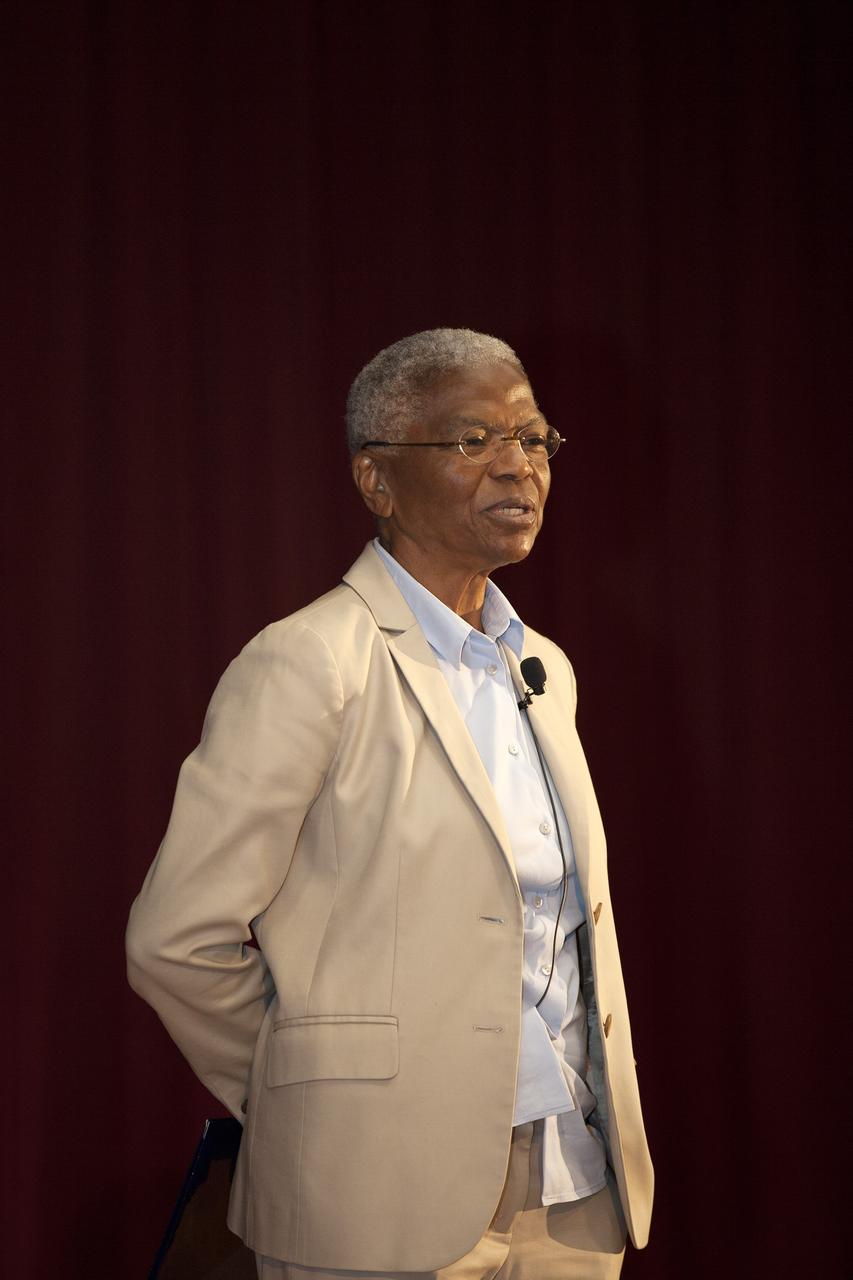
CAPE CANAVERAL, Fla. -- In the KSC Training Auditorium at NASA's Kennedy Space Center in Florida, Dr. Mary Frances Berry relates her personal experiences in the fight for civil liberties to employees gathered for a special event marking the 50th anniversary of the Civil Rights Act of 1964. Berry served as the assistant secretary for education in the U.S. Department of Health, Education and Welfare HEW between 1977 and 1980. From 1980 to 2004, she was a member of the U.S. Commission on Civil Rights, serving as chair from 1993 to 2004. Among Berry's many honors are the NAACP's Roy Wilkins Award, the Rosa Parks Award of the Southern Christian Leadership Conference, and the Ebony Magazine Black Achievement Award. She is one of 75 women featured in the book "I Dream a World: Portraits of Black Women Who Changed America." Sienna College Research Institute and the Women's Hall of Fame also designated her one of "America's Women of the Century." The event was presented by Kennedy's Office of Diversity and Equal Opportunity. For more information about Kennedy Space Center, visit http://www.nasa.gov/kennedy. Photo credit: NASA/Kim Shiflett
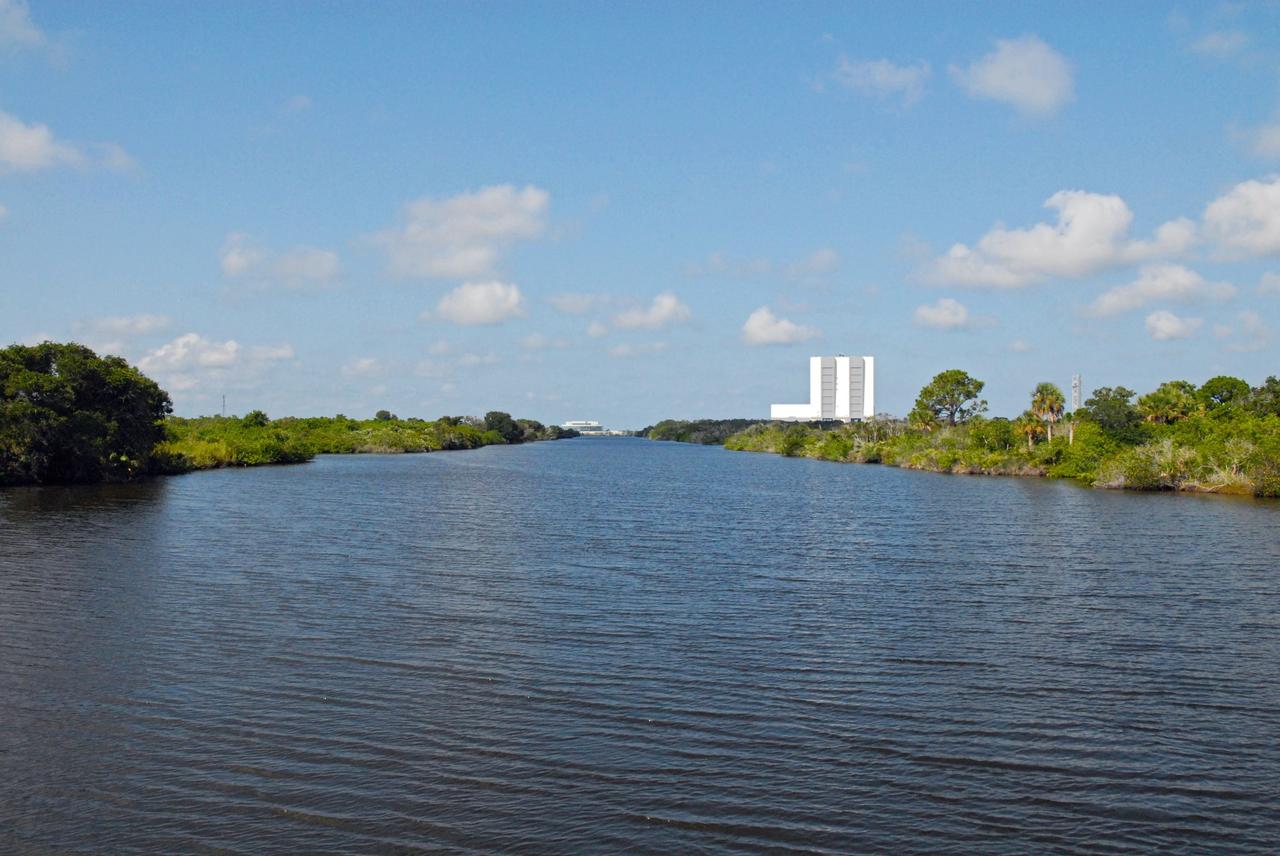
CAPE CANAVERAL, Fla. – Operations Support Building II, or OSBII, left, and the Vehicle Assembly Building, or VAB, are seen in the distance during a field-guided boat tour of NASA's Kennedy Space Center in Florida. As part of the center's first-ever Innovation Expo, the tour, called "Living Outdoor Laboratory for Environmental Sustainability," is giving employees the opportunity to see the unique estuarine ecosystems that are protected from development by the presence of Kennedy and the Merritt Island National Wildlife Refuge. The diverse and healthy area encompassing about 140,000 acres of central Florida's east coast has been closed to the public for 50 years, allowing the coastal dunes, saltwater estuaries and marshes, freshwater impoundments, scrub, pine flatwoods, and hardwood hammocks to provide habitats for more than 1,000 species of plants and animals. Innovation Expo is showcasing the innovative work taking place throughout the center's facilities and labs to encourage employees to work together to solve future challenges. For more information, visit http://www.nasa.gov/kennedy. Photo credit: NASA
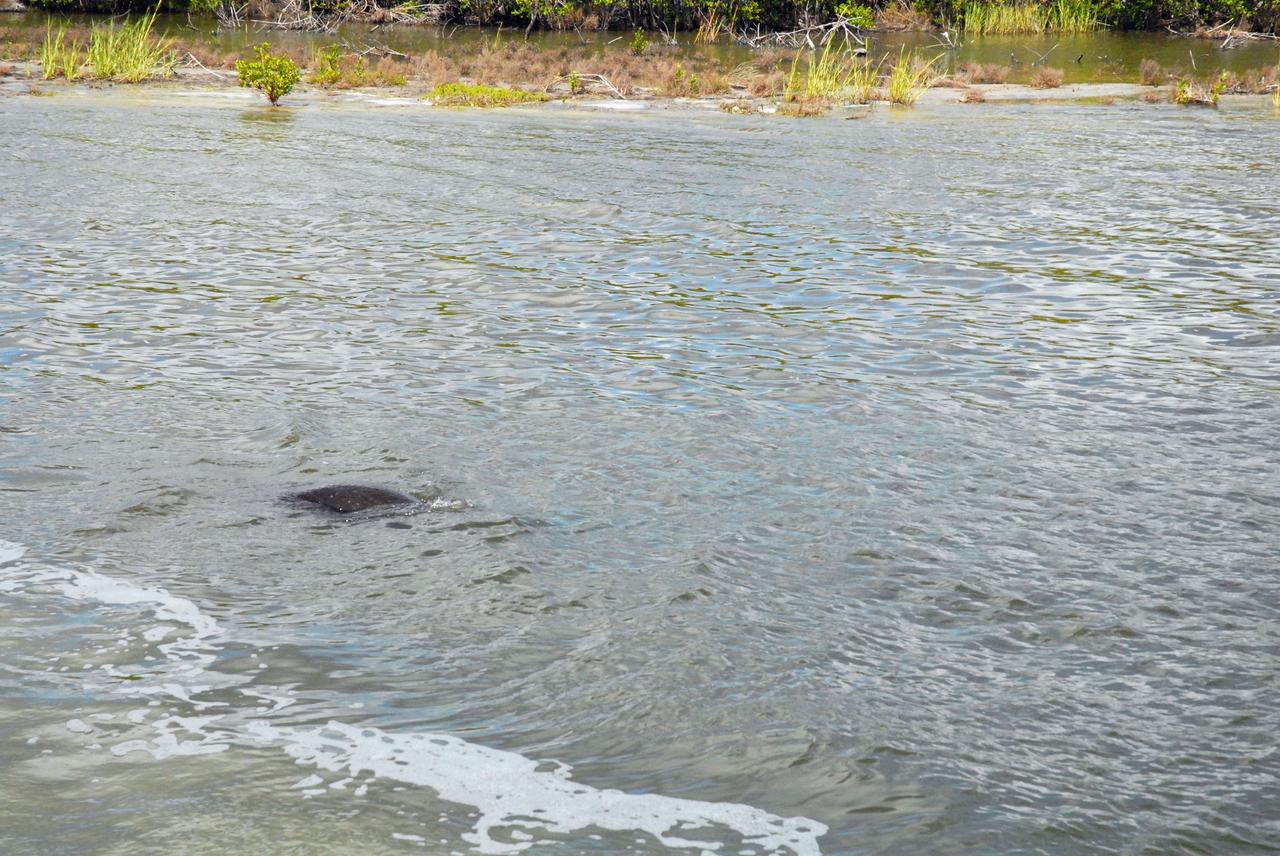
CAPE CANAVERAL, Fla. – A manatee swims in the Banana River during a field-guided boat tour of NASA's Kennedy Space Center in Florida. As part of the center's first-ever Innovation Expo, the tour, called "Living Outdoor Laboratory for Environmental Sustainability," is giving employees the opportunity to see the unique estuarine ecosystems that are protected from development by the presence of Kennedy and the Merritt Island National Wildlife Refuge. Manatees are one of the many threatened or endangered species that call the refuge home. The diverse and healthy area encompassing about 140,000 acres of central Florida's east coast has been closed to the public for 50 years, allowing the coastal dunes, saltwater estuaries and marshes, freshwater impoundments, scrub, pine flatwoods, and hardwood hammocks to provide habitats for more than 1,000 species of plants and animals. Innovation Expo is showcasing the innovative work taking place throughout the center's facilities and labs to encourage employees to work together to solve future challenges. For more information, visit http://www.nasa.gov/kennedy. Photo credit: NASA
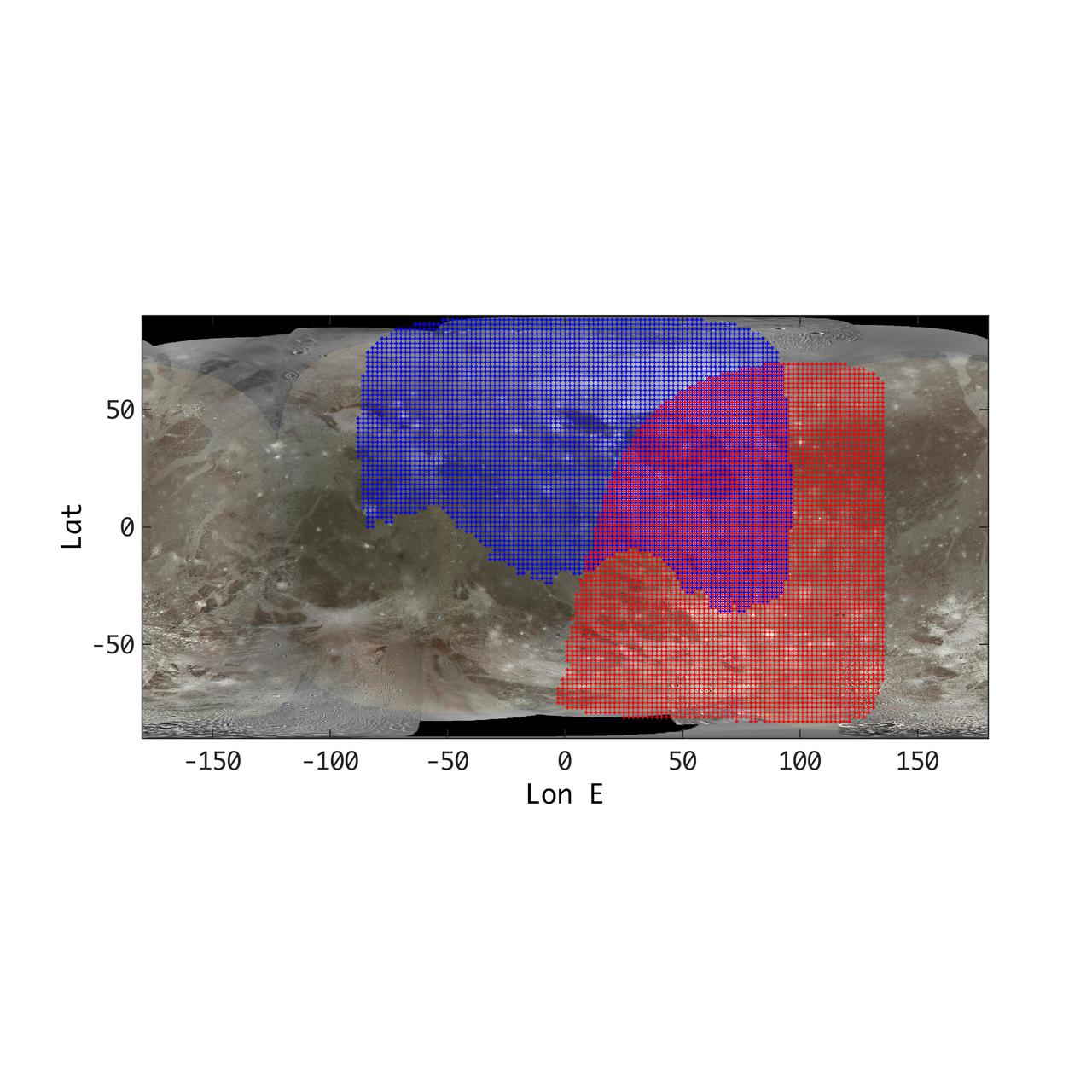
This annotated map of depicts the areas on the surface of Jupiter's moon Ganymede that were imaged by the Jovian Infrared Auroral Mapper (JIRAM) instrument aboard NASA's Juno spacecraft during two close approaches of the moon. The region shaded in blue depicts the area JIRAM covered as Juno flew past at a distance of 62,000 miles (100,000 kilometers) on Dec. 26, 2019. The infrared camera took 40 images during the encounter. The region shaded in red illustrates JIRAM coverage during the July 20, 2021, flyby, when Juno came within 31,000 miles (50,000 kilometers) of Ganymede's surface and JIRAM took 14 infrared images. The different observational geometry of the flybys provided an opportunity to see the north polar region for the first time as well as compare the diversity in composition between Ganymede's low and high latitudes. JIRAM "sees" in infrared light not visible to the human eye, providing information on Ganymede's icy shell and the composition of the ocean of liquid water beneath. It was designed to capture the infrared light emerging from deep inside Jupiter, probing the weather layer down to 30 to 45 miles (50 to 70 kilometers) below Jupiter's cloud tops. https://photojournal.jpl.nasa.gov/catalog/PIA24792
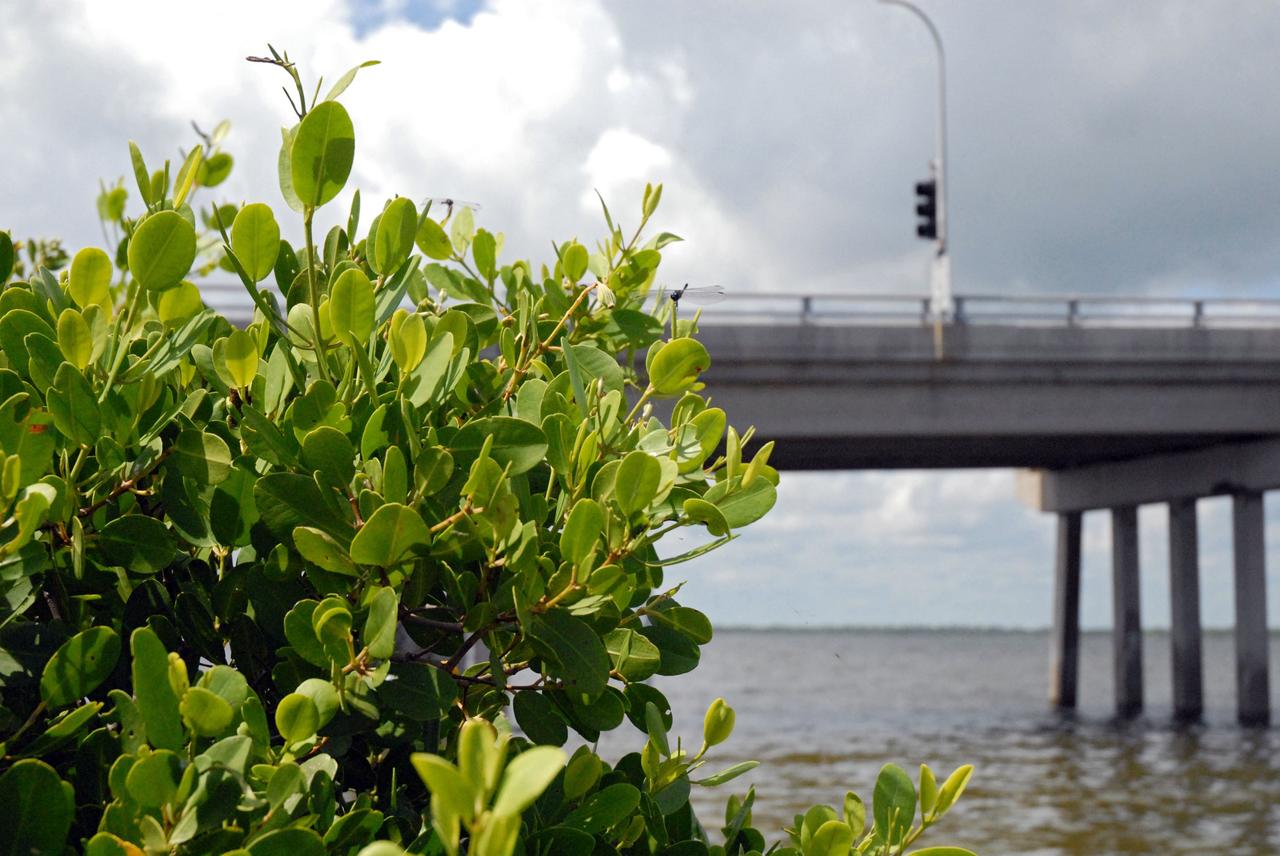
CAPE CANAVERAL, Fla. – The Roy D. Bridges Jr. Bridge connecting NASA Kennedy Space Center's Industrial Area to Cape Canaveral Air Force Station's Industrial Area is seen during a field-guided boat tour. As part of the Kennedy's first-ever Innovation Expo, the tour, called "Living Outdoor Laboratory for Environmental Sustainability," is giving employees the opportunity to see the unique estuarine ecosystems that are protected from development by the presence of the center and the Merritt Island National Wildlife Refuge. The diverse and healthy area encompassing about 140,000 acres of central Florida's east coast has been closed to the public for 50 years, allowing the coastal dunes, saltwater estuaries and marshes, freshwater impoundments, scrub, pine flatwoods, and hardwood hammocks to provide habitats for more than 1,000 species of plants and animals. Innovation Expo is showcasing the innovative work taking place throughout the center's facilities and labs to encourage employees to work together to solve future challenges. For more information, visit http://www.nasa.gov/kennedy. Photo credit: NASA
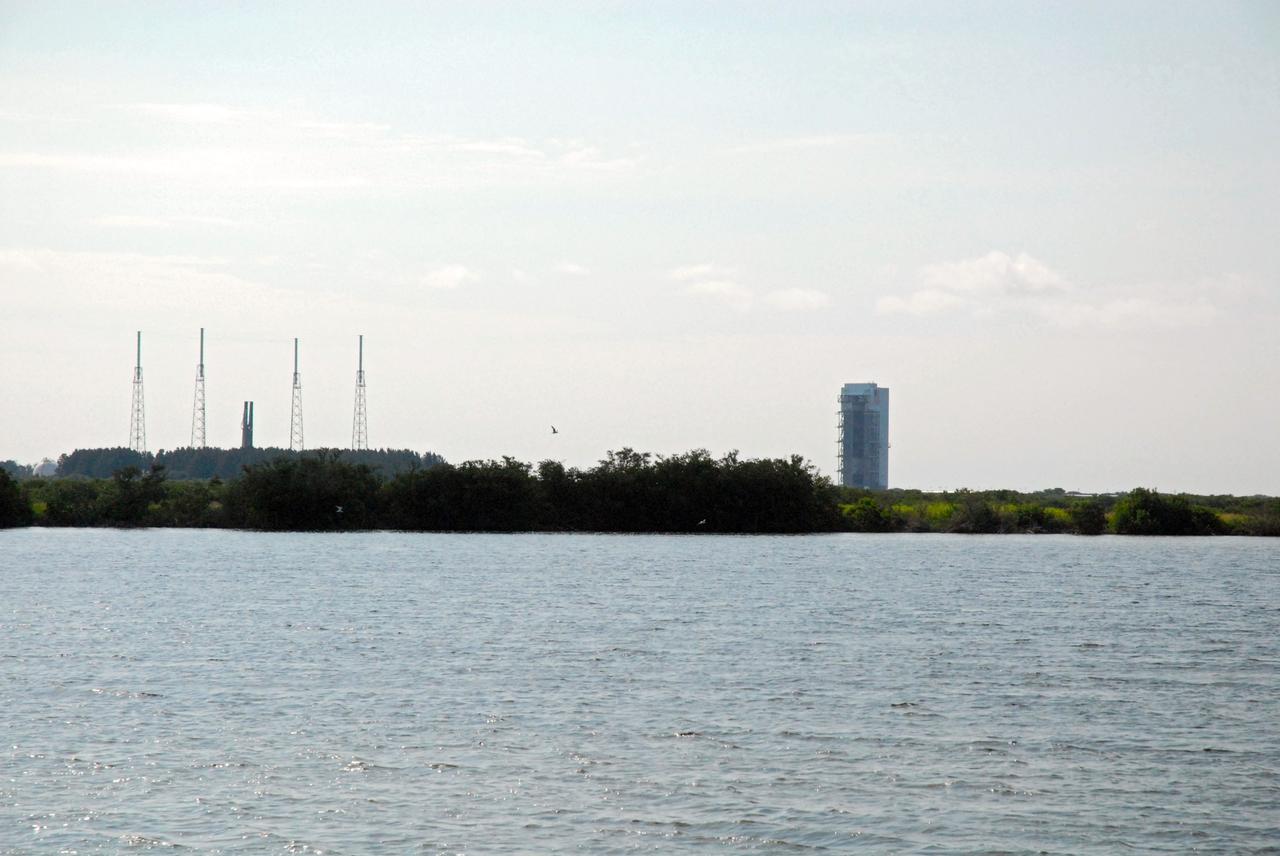
CAPE CANAVERAL, Fla. – Cape Canaveral Air Force Station's Space Launch Complex 41 and the Vertical Integration Facility, or VIF, are seen in the distance during a field-guided boat tour of NASA's Kennedy Space Center in Florida. As part of the center's first-ever Innovation Expo, the tour, called "Living Outdoor Laboratory for Environmental Sustainability," is giving employees the opportunity to see the unique estuarine ecosystems that are protected from development by the presence of Kennedy and the Merritt Island National Wildlife Refuge. The diverse and healthy area encompassing about 140,000 acres of central Florida's east coast has been closed to the public for 50 years, allowing the coastal dunes, saltwater estuaries and marshes, freshwater impoundments, scrub, pine flatwoods, and hardwood hammocks to provide habitats for more than 1,000 species of plants and animals. Innovation Expo is showcasing the innovative work taking place throughout the center's facilities and labs to encourage employees to work together to solve future challenges. For more information, visit http://www.nasa.gov/kennedy. Photo credit: NASA
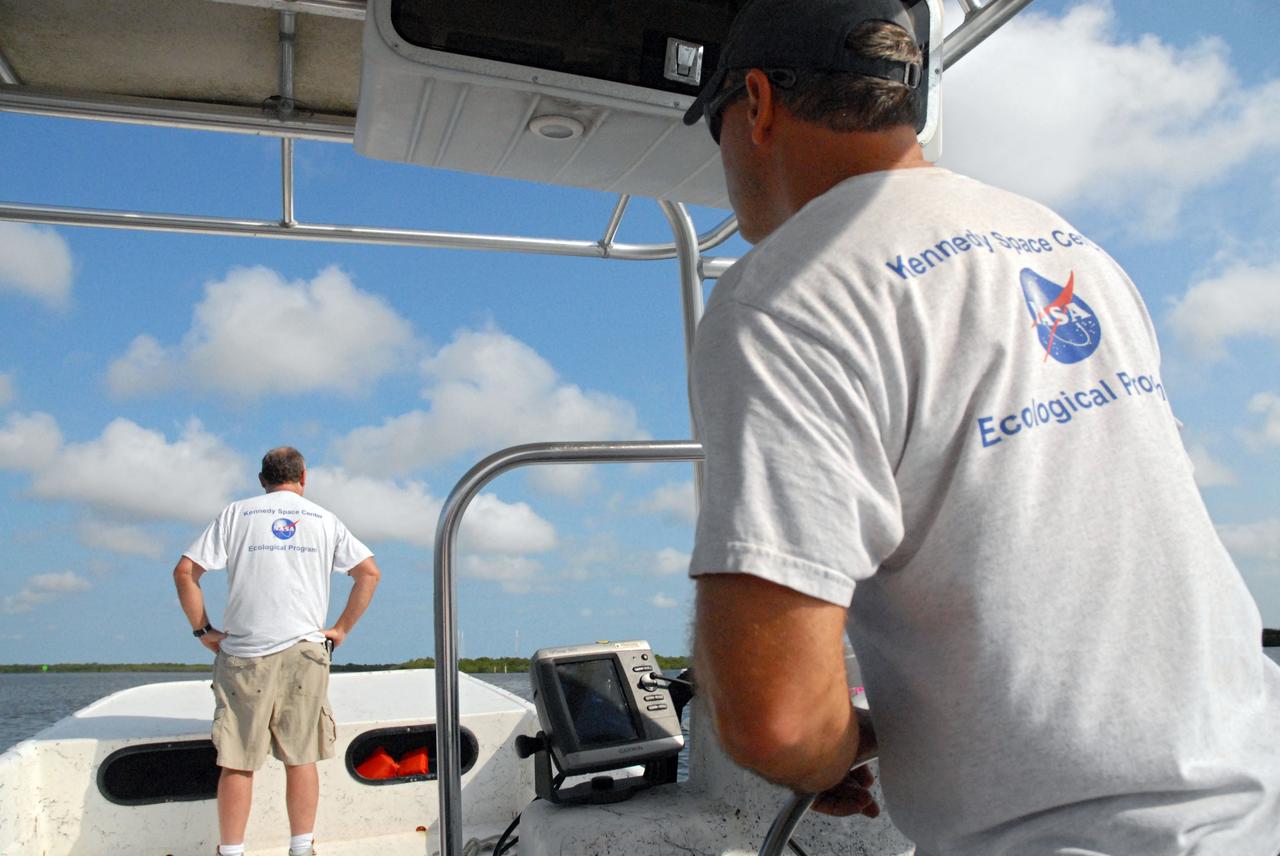
CAPE CANAVERAL, Fla. – Aquatic biologist Eric Reyier with Innovative Health Applications, or IHA, drives a skiff boat during a field-guided tour of NASA's Kennedy Space Center in Florida. As part of the center's first-ever Innovation Expo, the tour, called "Living Outdoor Laboratory for Environmental Sustainability," is giving employees the opportunity to see the unique estuarine ecosystems that are protected from development by the presence of Kennedy and the Merritt Island National Wildlife Refuge. Aquatic biologist Doug Scheidt searches for landmarks and wildlife during the tour. The diverse and healthy area encompassing about 140,000 acres of central Florida's east coast has been closed to the public for 50 years, allowing the coastal dunes, saltwater estuaries and marshes, freshwater impoundments, scrub, pine flatwoods, and hardwood hammocks to provide habitats for more than 1,000 species of plants and animals. Innovation Expo is showcasing the innovative work taking place throughout the center's facilities and labs to encourage employees to work together to solve future challenges. For more information, visit http://www.nasa.gov/kennedy. Photo credit: NASA
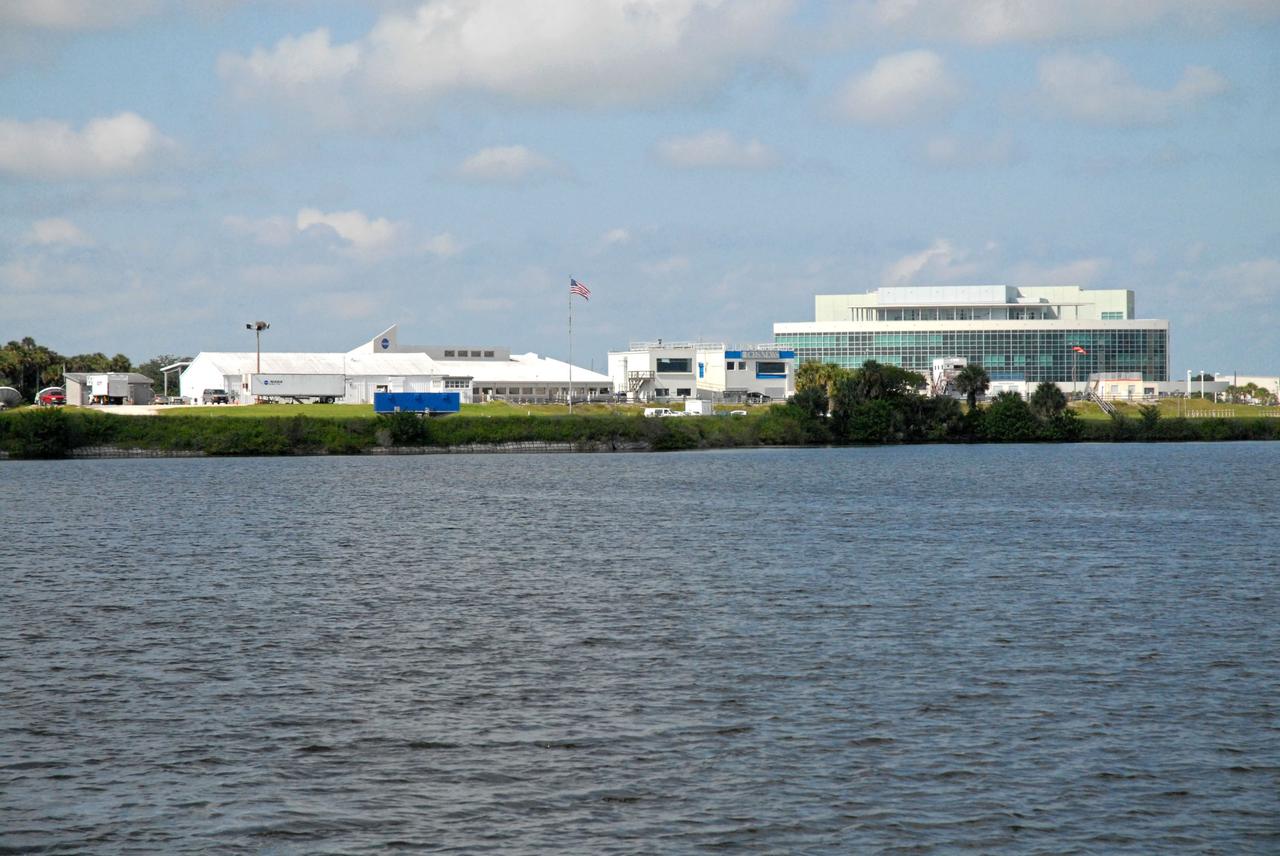
CAPE CANAVERAL, Fla. – The NASA News Center and Operations Support Building II, or OSBII, in Launch Complex 39 are seen in the distance during a field-guided boat tour of NASA's Kennedy Space Center in Florida. As part of the center's first-ever Innovation Expo, the tour, called "Living Outdoor Laboratory for Environmental Sustainability," is giving employees the opportunity to see the unique estuarine ecosystems that are protected from development by the presence of Kennedy and the Merritt Island National Wildlife Refuge. The diverse and healthy area encompassing about 140,000 acres of central Florida's east coast has been closed to the public for 50 years, allowing the coastal dunes, saltwater estuaries and marshes, freshwater impoundments, scrub, pine flatwoods, and hardwood hammocks to provide habitats for more than 1,000 species of plants and animals. Innovation Expo is showcasing the innovative work taking place throughout the center's facilities and labs to encourage employees to work together to solve future challenges. For more information, visit http://www.nasa.gov/kennedy. Photo credit: NASA
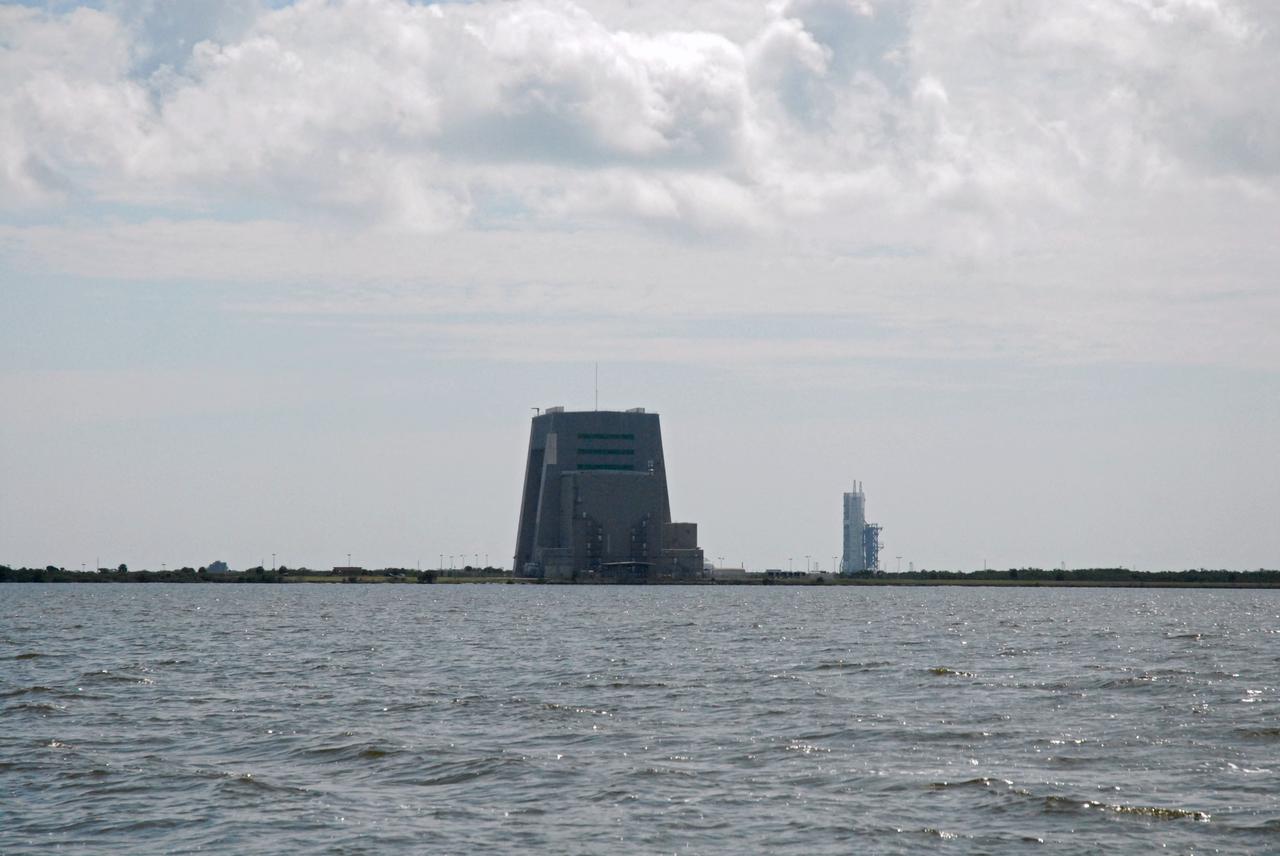
CAPE CANAVERAL, Fla. – Cape Canaveral Air Force Station's Solid Motor Assembly Building, or SMAB, and Launch Complex 37 are seen in the distance during a field-guided boat tour of NASA's Kennedy Space Center in Florida. As part of the center's first-ever Innovation Expo, the tour, called "Living Outdoor Laboratory for Environmental Sustainability," is giving employees the opportunity to see the unique estuarine ecosystems that are protected from development by the presence of Kennedy and the Merritt Island National Wildlife Refuge. The diverse and healthy area encompassing about 140,000 acres of central Florida's east coast has been closed to the public for 50 years, allowing the coastal dunes, saltwater estuaries and marshes, freshwater impoundments, scrub, pine flatwoods, and hardwood hammocks to provide habitats for more than 1,000 species of plants and animals. Innovation Expo is showcasing the innovative work taking place throughout the center's facilities and labs to encourage employees to work together to solve future challenges. For more information, visit http://www.nasa.gov/kennedy. Photo credit: NASA
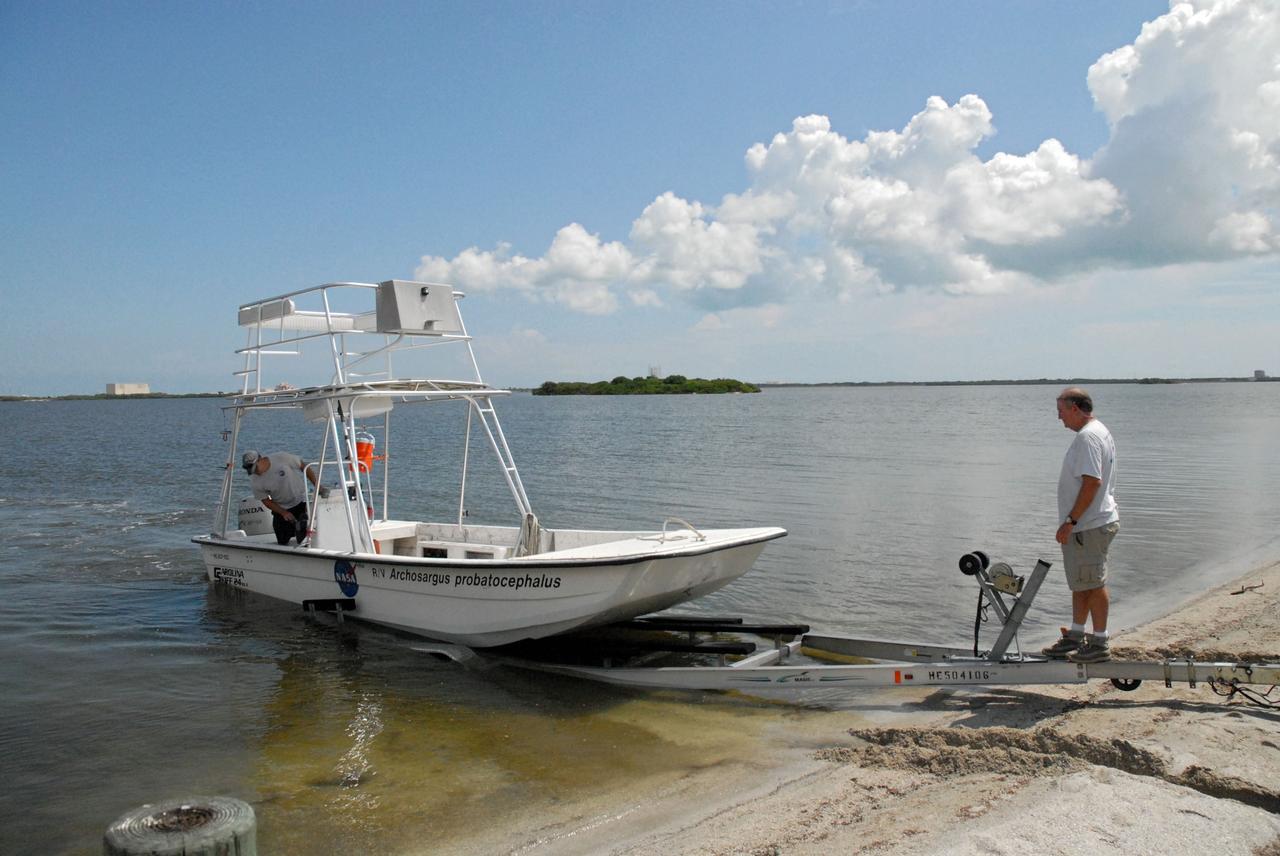
CAPE CANAVERAL, Fla. – Aquatic biologists Eric Reyier, left, and Doug Scheidt with Innovative Health Applications, or IHA, prepare for a field-guided boat tour of NASA's Kennedy Space Center in Florida. As part of the center's first-ever Innovation Expo, the tour, called "Living Outdoor Laboratory for Environmental Sustainability," is giving employees the opportunity to see the unique estuarine ecosystems that are protected from development by the presence of Kennedy and the Merritt Island National Wildlife Refuge. The diverse and healthy area encompassing about 140,000 acres of central Florida's east coast has been closed to the public for 50 years, allowing the coastal dunes, saltwater estuaries and marshes, freshwater impoundments, scrub, pine flatwoods, and hardwood hammocks to provide habitats for more than 1,000 species of plants and animals. Innovation Expo is showcasing the innovative work taking place throughout the center's facilities and labs to encourage employees to work together to solve future challenges. For more information, visit http://www.nasa.gov/kennedy. Photo credit: NASA
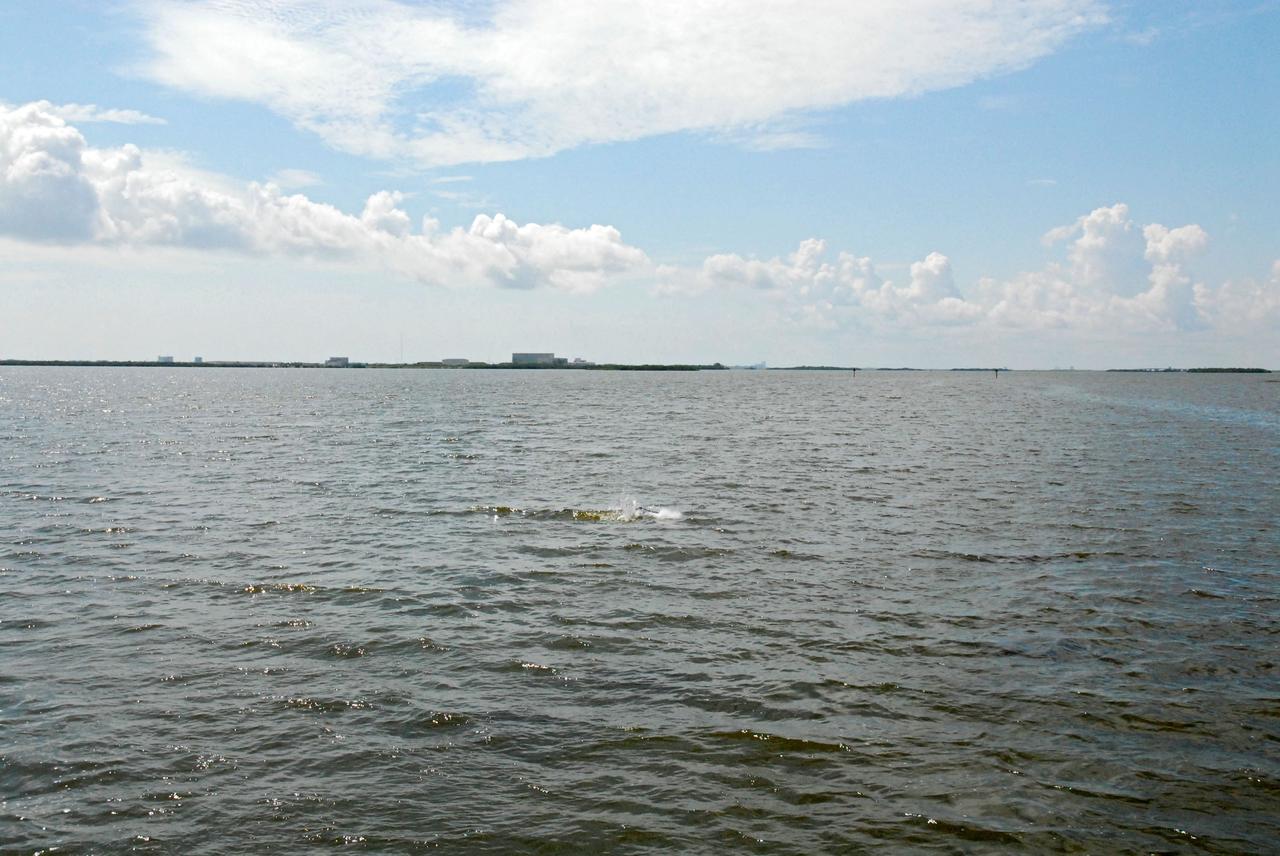
CAPE CANAVERAL, Fla. – A manatee splashes in the Banana River during a field-guided boat tour of NASA's Kennedy Space Center in Florida. As part of the center's first-ever Innovation Expo, the tour, called "Living Outdoor Laboratory for Environmental Sustainability," is giving employees the opportunity to see the unique estuarine ecosystems that are protected from development by the presence of Kennedy and the Merritt Island National Wildlife Refuge. Manatees are one of the many threatened or endangered species that call the refuge home. The diverse and healthy area encompassing about 140,000 acres of central Florida's east coast has been closed to the public for 50 years, allowing the coastal dunes, saltwater estuaries and marshes, freshwater impoundments, scrub, pine flatwoods, and hardwood hammocks to provide habitats for more than 1,000 species of plants and animals. Innovation Expo is showcasing the innovative work taking place throughout the center's facilities and labs to encourage employees to work together to solve future challenges. For more information, visit http://www.nasa.gov/kennedy. Photo credit: NASA
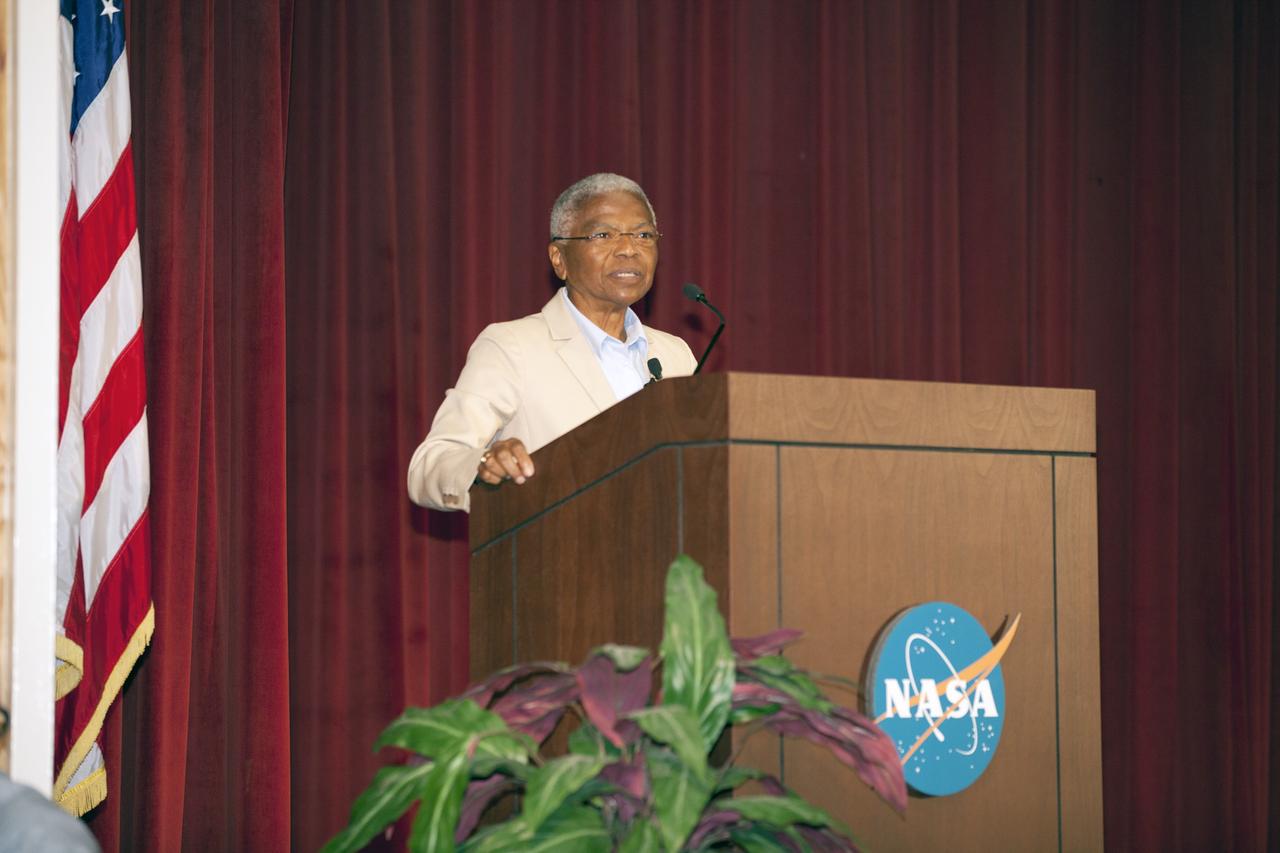
CAPE CANAVERAL, Fla. -- In the KSC Training Auditorium at NASA's Kennedy Space Center in Florida, Dr. Mary Frances Berry relates her personal experiences in the fight for civil liberties to employees gathered for a special event marking the 50th anniversary of the Civil Rights Act of 1964. Berry served as the assistant secretary for education in the U.S. Department of Health, Education and Welfare HEW between 1977 and 1980. From 1980 to 2004, she was a member of the U.S. Commission on Civil Rights, serving as chair from 1993 to 2004. Among Berry's many honors are the NAACP's Roy Wilkins Award, the Rosa Parks Award of the Southern Christian Leadership Conference, and the Ebony Magazine Black Achievement Award. She is one of 75 women featured in the book "I Dream a World: Portraits of Black Women Who Changed America." Sienna College Research Institute and the Women's Hall of Fame also designated her one of "America's Women of the Century." The event was presented by Kennedy's Office of Diversity and Equal Opportunity. For more information about Kennedy Space Center, visit http://www.nasa.gov/kennedy. Photo credit: NASA/Kim Shiflett
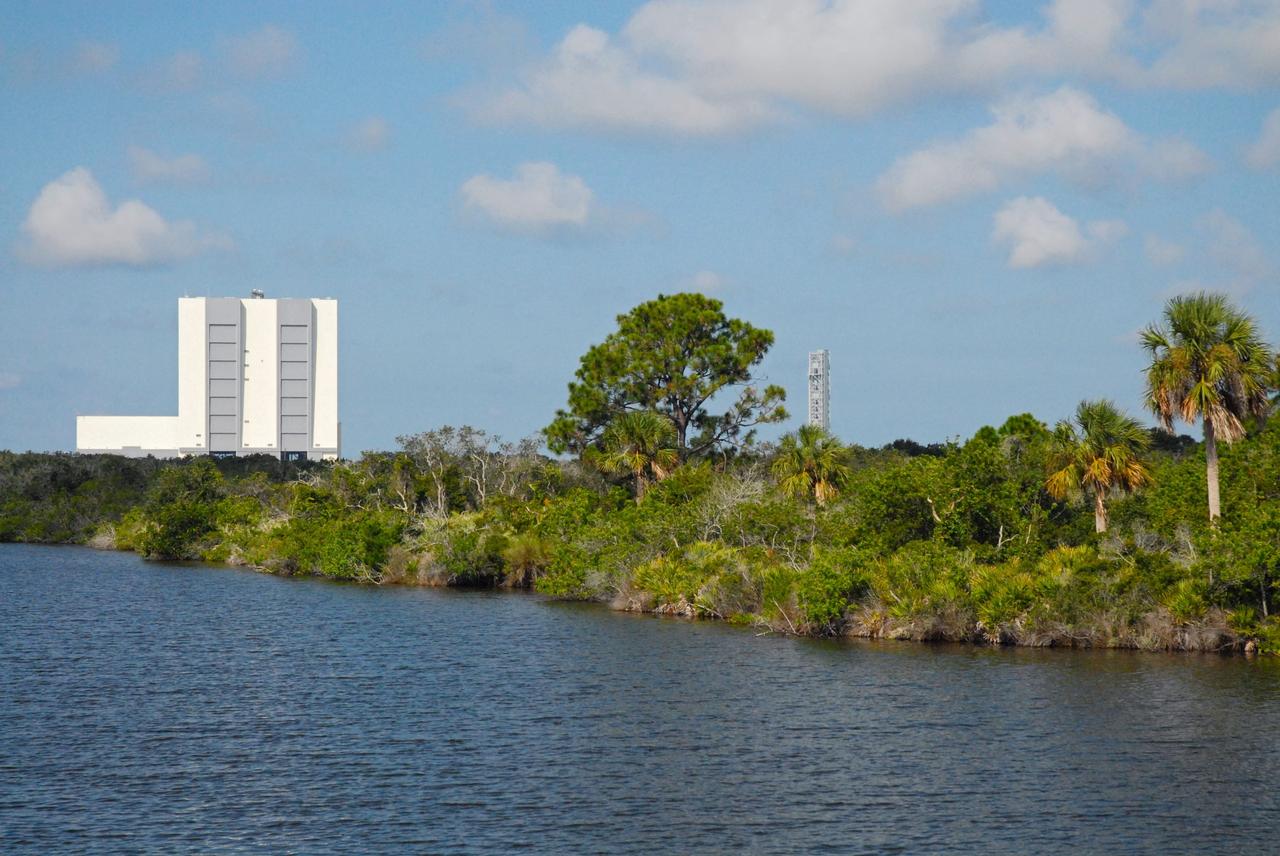
CAPE CANAVERAL, Fla. – The Vehicle Assembly Building, or VAB, and NASA's new mobile launcher, or ML, are seen in the distance during a field-guided boat tour of NASA's Kennedy Space Center in Florida. As part of the center's first-ever Innovation Expo, the tour, called "Living Outdoor Laboratory for Environmental Sustainability," is giving employees the opportunity to see the unique estuarine ecosystems that are protected from development by the presence of Kennedy and the Merritt Island National Wildlife Refuge. The 355-foot-tall ML structure, which took about two years to construct, will be modified by NASA’s Ground Systems Development and Operations, or GSDO, Program to support NASA’s Space Launch System, the heavy-lift rocket that will launch astronauts into deep space on future exploration missions. The diverse and healthy area encompassing about 140,000 acres of central Florida's east coast has been closed to the public for 50 years, allowing the coastal dunes, saltwater estuaries and marshes, freshwater impoundments, scrub, pine flatwoods, and hardwood hammocks to provide habitats for more than 1,000 species of plants and animals. Innovation Expo is showcasing the innovative work taking place throughout the center's facilities and labs to encourage employees to work together to solve future challenges. For more information, visit http://www.nasa.gov/kennedy. Photo credit: NASA
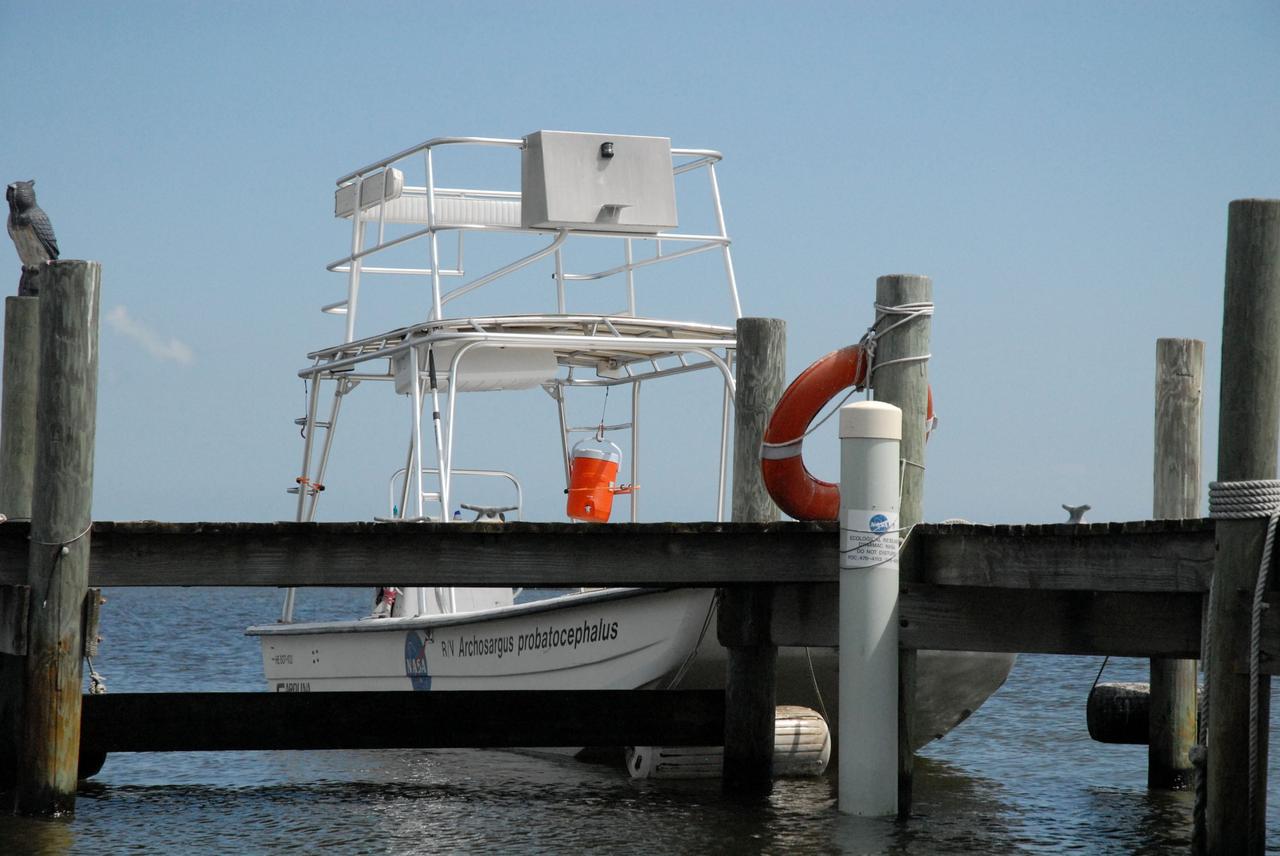
CAPE CANAVERAL, Fla. – A boat dock and skiff boat are seen near the Roy D. Bridges Jr. Bridge that connects NASA Kennedy Space Center's Industrial Area to Cape Canaveral Air Force Station's Industrial Area following a field-guided boat tour. As part of the Kennedy's first-ever Innovation Expo, the tour, called "Living Outdoor Laboratory for Environmental Sustainability," is giving employees the opportunity to see the unique estuarine ecosystems that are protected from development by the presence of the center and the Merritt Island National Wildlife Refuge. The diverse and healthy area encompassing about 140,000 acres of central Florida's east coast has been closed to the public for 50 years, allowing the coastal dunes, saltwater estuaries and marshes, freshwater impoundments, scrub, pine flatwoods, and hardwood hammocks to provide habitats for more than 1,000 species of plants and animals. Innovation Expo is showcasing the innovative work taking place throughout the center's facilities and labs to encourage employees to work together to solve future challenges. For more information, visit http://www.nasa.gov/kennedy. Photo credit: NASA
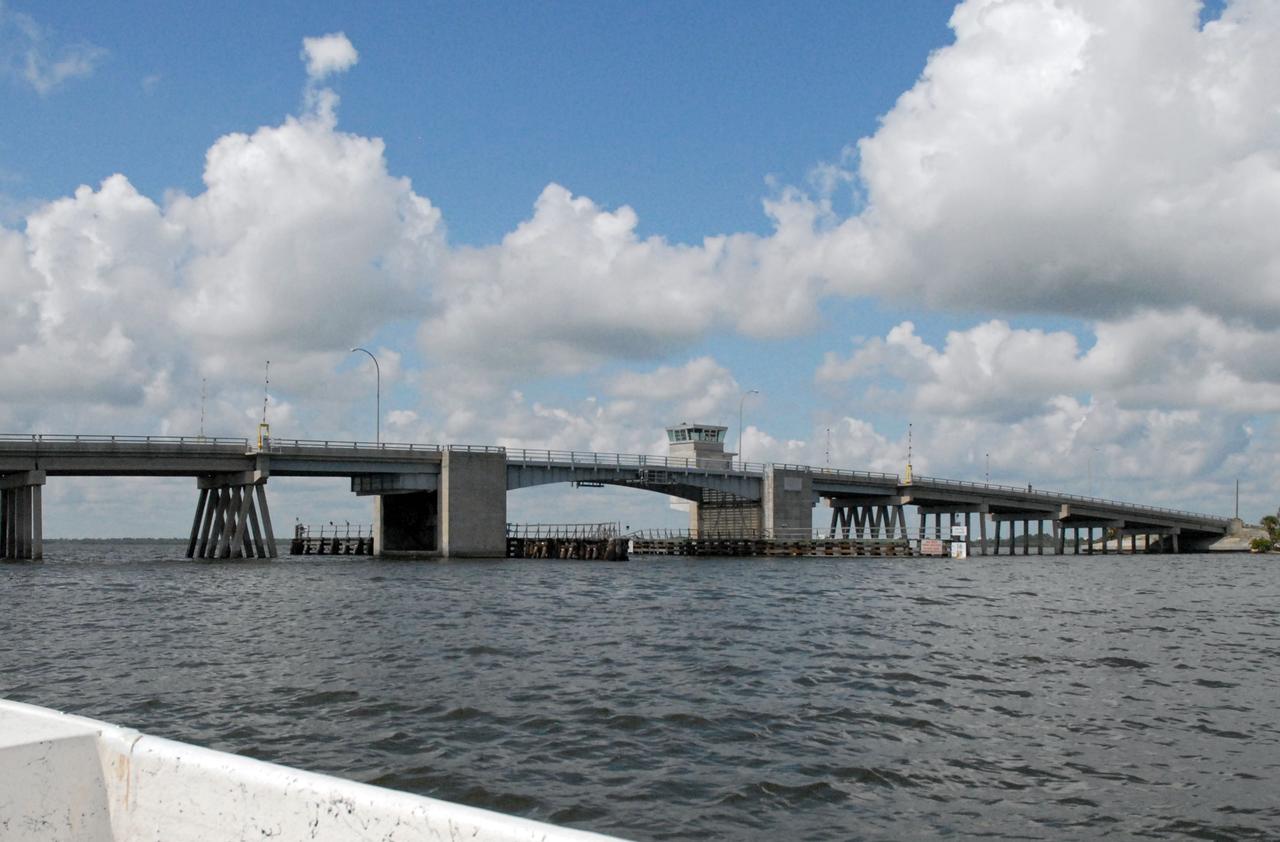
CAPE CANAVERAL, Fla. – The Roy D. Bridges Jr. Bridge connecting NASA Kennedy Space Center's Industrial Area to Cape Canaveral Air Force Station's Industrial Area is seen during a field-guided boat tour. As part of the Kennedy's first-ever Innovation Expo, the tour, called "Living Outdoor Laboratory for Environmental Sustainability," is giving employees the opportunity to see the unique estuarine ecosystems that are protected from development by the presence of the center and the Merritt Island National Wildlife Refuge. The diverse and healthy area encompassing about 140,000 acres of central Florida's east coast has been closed to the public for 50 years, allowing the coastal dunes, saltwater estuaries and marshes, freshwater impoundments, scrub, pine flatwoods, and hardwood hammocks to provide habitats for more than 1,000 species of plants and animals. Innovation Expo is showcasing the innovative work taking place throughout the center's facilities and labs to encourage employees to work together to solve future challenges. For more information, visit http://www.nasa.gov/kennedy. Photo credit: NASA
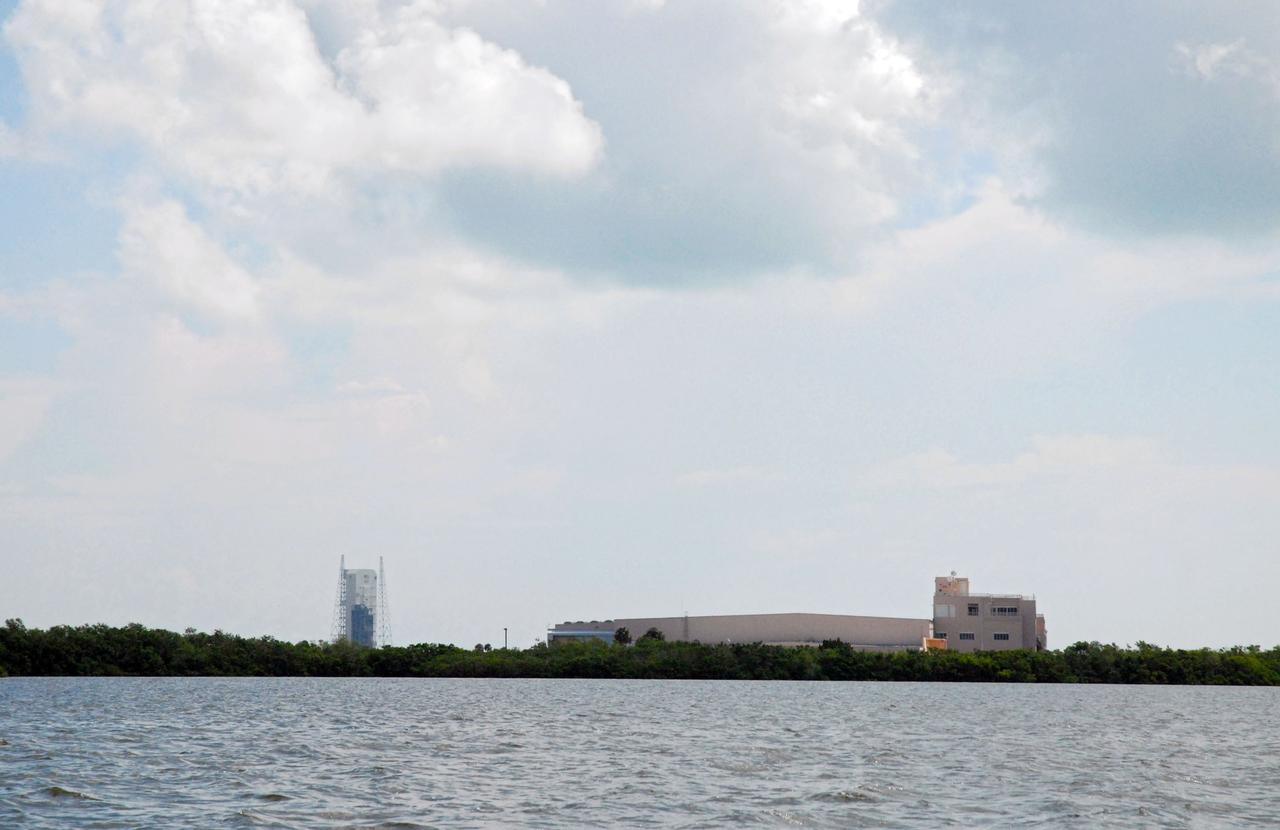
CAPE CANAVERAL, Fla. – Cape Canaveral Air Force Station's Launch Complex 37 and the Atlas V Operations Center, or ASOC, are seen in the distance during a field-guided boat tour of NASA's Kennedy Space Center in Florida. As part of the center's first-ever Innovation Expo, the tour, called "Living Outdoor Laboratory for Environmental Sustainability," is giving employees the opportunity to see the unique estuarine ecosystems that are protected from development by the presence of Kennedy and the Merritt Island National Wildlife Refuge. The diverse and healthy area encompassing about 140,000 acres of central Florida's east coast has been closed to the public for 50 years, allowing the coastal dunes, saltwater estuaries and marshes, freshwater impoundments, scrub, pine flatwoods, and hardwood hammocks to provide habitats for more than 1,000 species of plants and animals. Innovation Expo is showcasing the innovative work taking place throughout the center's facilities and labs to encourage employees to work together to solve future challenges. For more information, visit http://www.nasa.gov/kennedy. Photo credit: NASA
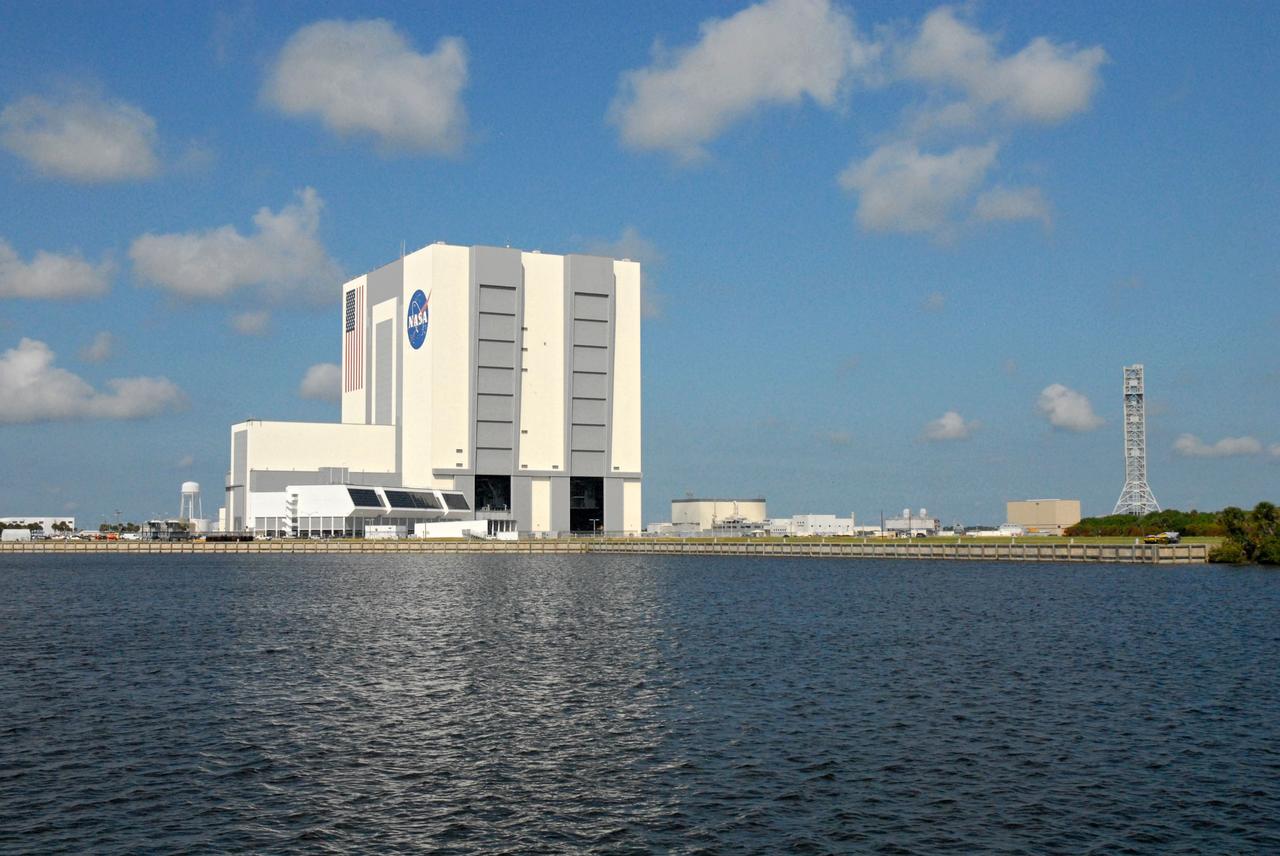
CAPE CANAVERAL, Fla. – The Vehicle Assembly Building, or VAB, and NASA's new mobile launcher, or ML, are seen during a field-guided boat tour of NASA's Kennedy Space Center in Florida. As part of the center's first-ever Innovation Expo, the tour, called "Living Outdoor Laboratory for Environmental Sustainability," is giving employees the opportunity to see the unique estuarine ecosystems that are protected from development by the presence of Kennedy and the Merritt Island National Wildlife Refuge. The 355-foot-tall ML structure, which took about two years to construct, will be modified by NASA’s Ground Systems Development and Operations, or GSDO, Program to support NASA’s Space Launch System, the heavy-lift rocket that will launch astronauts into deep space on future exploration missions. The diverse and healthy area encompassing about 140,000 acres of central Florida's east coast has been closed to the public for 50 years, allowing the coastal dunes, saltwater estuaries and marshes, freshwater impoundments, scrub, pine flatwoods, and hardwood hammocks to provide habitats for more than 1,000 species of plants and animals. Innovation Expo is showcasing the innovative work taking place throughout the center's facilities and labs to encourage employees to work together to solve future challenges. For more information, visit http://www.nasa.gov/kennedy. Photo credit: NASA
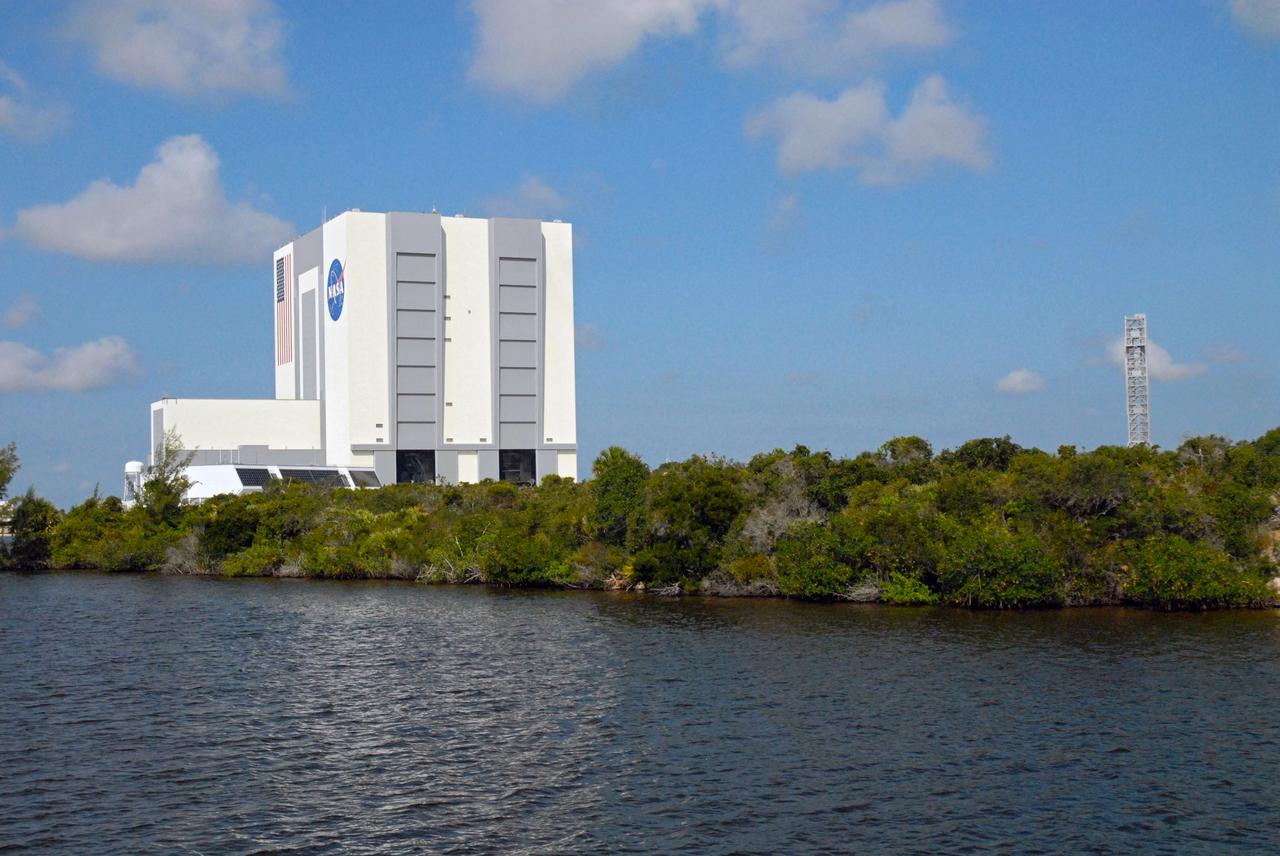
CAPE CANAVERAL, Fla. – The Vehicle Assembly Building, or VAB, and NASA's new mobile launcher, or ML, are seen during a field-guided boat tour of NASA's Kennedy Space Center in Florida. As part of the center's first-ever Innovation Expo, the tour, called "Living Outdoor Laboratory for Environmental Sustainability," is giving employees the opportunity to see the unique estuarine ecosystems that are protected from development by the presence of Kennedy and the Merritt Island National Wildlife Refuge. The 355-foot-tall ML structure, which took about two years to construct, will be modified by NASA’s Ground Systems Development and Operations, or GSDO, Program to support NASA’s Space Launch System, the heavy-lift rocket that will launch astronauts into deep space on future exploration missions. The diverse and healthy area encompassing about 140,000 acres of central Florida's east coast has been closed to the public for 50 years, allowing the coastal dunes, saltwater estuaries and marshes, freshwater impoundments, scrub, pine flatwoods, and hardwood hammocks to provide habitats for more than 1,000 species of plants and animals. Innovation Expo is showcasing the innovative work taking place throughout the center's facilities and labs to encourage employees to work together to solve future challenges. For more information, visit http://www.nasa.gov/kennedy. Photo credit: NASA
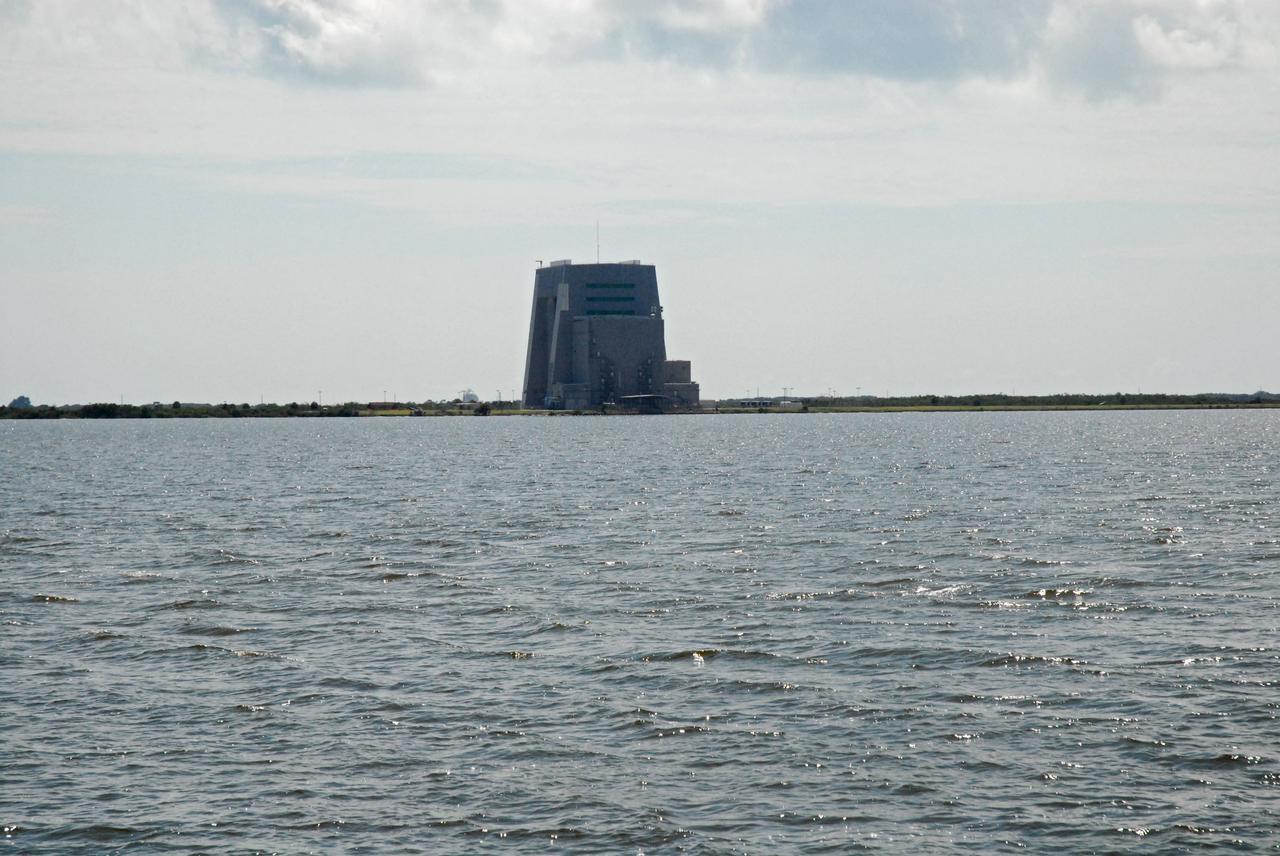
CAPE CANAVERAL, Fla. – Cape Canaveral Air Force Station's Solid Motor Assembly Building, or SMAB, is seen in the distance during a field-guided boat tour of NASA's Kennedy Space Center in Florida. As part of the center's first-ever Innovation Expo, the tour, called "Living Outdoor Laboratory for Environmental Sustainability," is giving employees the opportunity to see the unique estuarine ecosystems that are protected from development by the presence of Kennedy and the Merritt Island National Wildlife Refuge. The diverse and healthy area encompassing about 140,000 acres of central Florida's east coast has been closed to the public for 50 years, allowing the coastal dunes, saltwater estuaries and marshes, freshwater impoundments, scrub, pine flatwoods, and hardwood hammocks to provide habitats for more than 1,000 species of plants and animals. Innovation Expo is showcasing the innovative work taking place throughout the center's facilities and labs to encourage employees to work together to solve future challenges. For more information, visit http://www.nasa.gov/kennedy. Photo credit: NASA
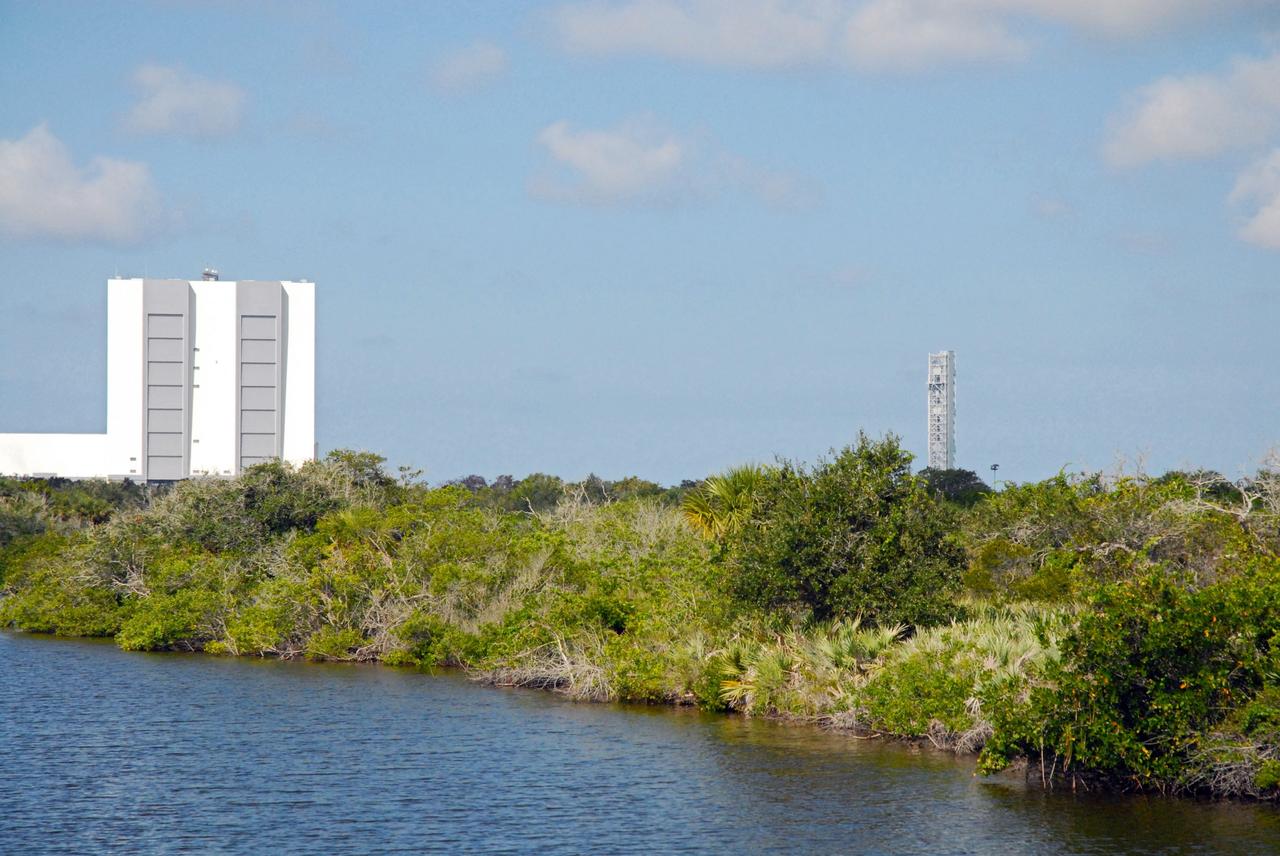
CAPE CANAVERAL, Fla. – The Vehicle Assembly Building, or VAB, and NASA's new mobile launcher, or ML, are seen in the distance during a field-guided boat tour of NASA's Kennedy Space Center in Florida. As part of the center's first-ever Innovation Expo, the tour, called "Living Outdoor Laboratory for Environmental Sustainability," is giving employees the opportunity to see the unique estuarine ecosystems that are protected from development by the presence of Kennedy and the Merritt Island National Wildlife Refuge. The 355-foot-tall ML structure, which took about two years to construct, will be modified by NASA’s Ground Systems Development and Operations, or GSDO, Program to support NASA’s Space Launch System, the heavy-lift rocket that will launch astronauts into deep space on future exploration missions. The diverse and healthy area encompassing about 140,000 acres of central Florida's east coast has been closed to the public for 50 years, allowing the coastal dunes, saltwater estuaries and marshes, freshwater impoundments, scrub, pine flatwoods, and hardwood hammocks to provide habitats for more than 1,000 species of plants and animals. Innovation Expo is showcasing the innovative work taking place throughout the center's facilities and labs to encourage employees to work together to solve future challenges. For more information, visit http://www.nasa.gov/kennedy. Photo credit: NASA
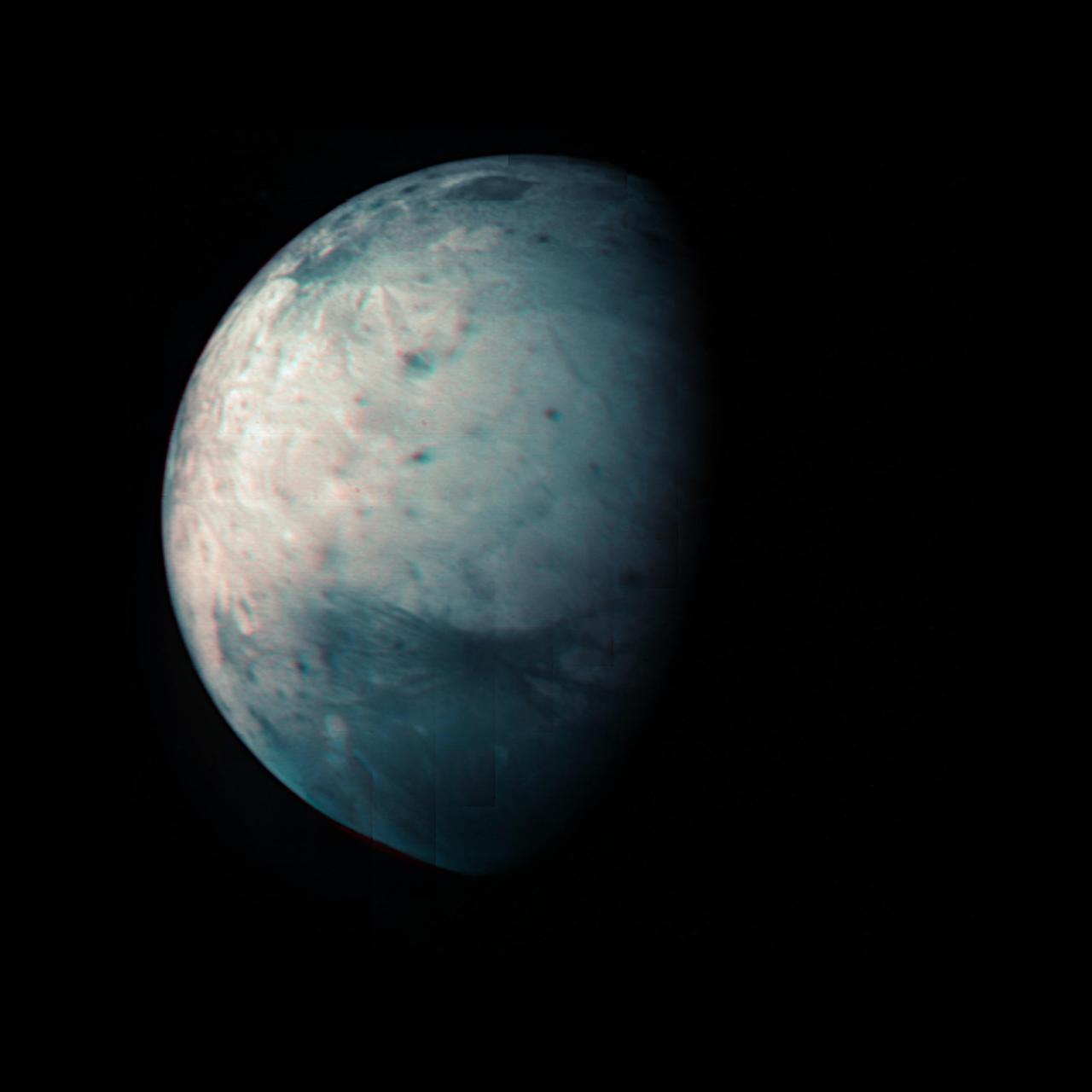
This infrared view of Ganymede was obtained by the Jovian Infrared Auroral Mapper (JIRAM) instrument aboard NASA's Juno spacecraft during its July 20th, 2021, flyby. JIRAM "sees" in infrared light not visible to the human eye, providing information on Ganymede's icy shell and the composition of the ocean of liquid water beneath. It was designed to capture the infrared light emerging from deep inside Jupiter, probing the weather layer down to 30 to 45 miles (50 to 70 kilometers) below Jupiter's cloud tops. During the flyby, Juno came within 31,136 miles (50,109 kilometers) of the icy orb. Together with the previous observational geometries provided, this data gives the opportunity for JIRAM to see different regions for the first time, as well as to compare the diversity in composition between the low and high latitudes. Because Ganymede has no atmosphere to impede the solar wind, or progress of charged particles from the Sun, the surface at its poles is constantly being bombarded by plasma from Jupiter's gigantic magnetosphere. The bombardment has a dramatic effect on Ganymede's ice: Ice is crystallized by heating at the equator and amorphized by particle radiation at the polar regions. https://photojournal.jpl.nasa.gov/catalog/PIA24791
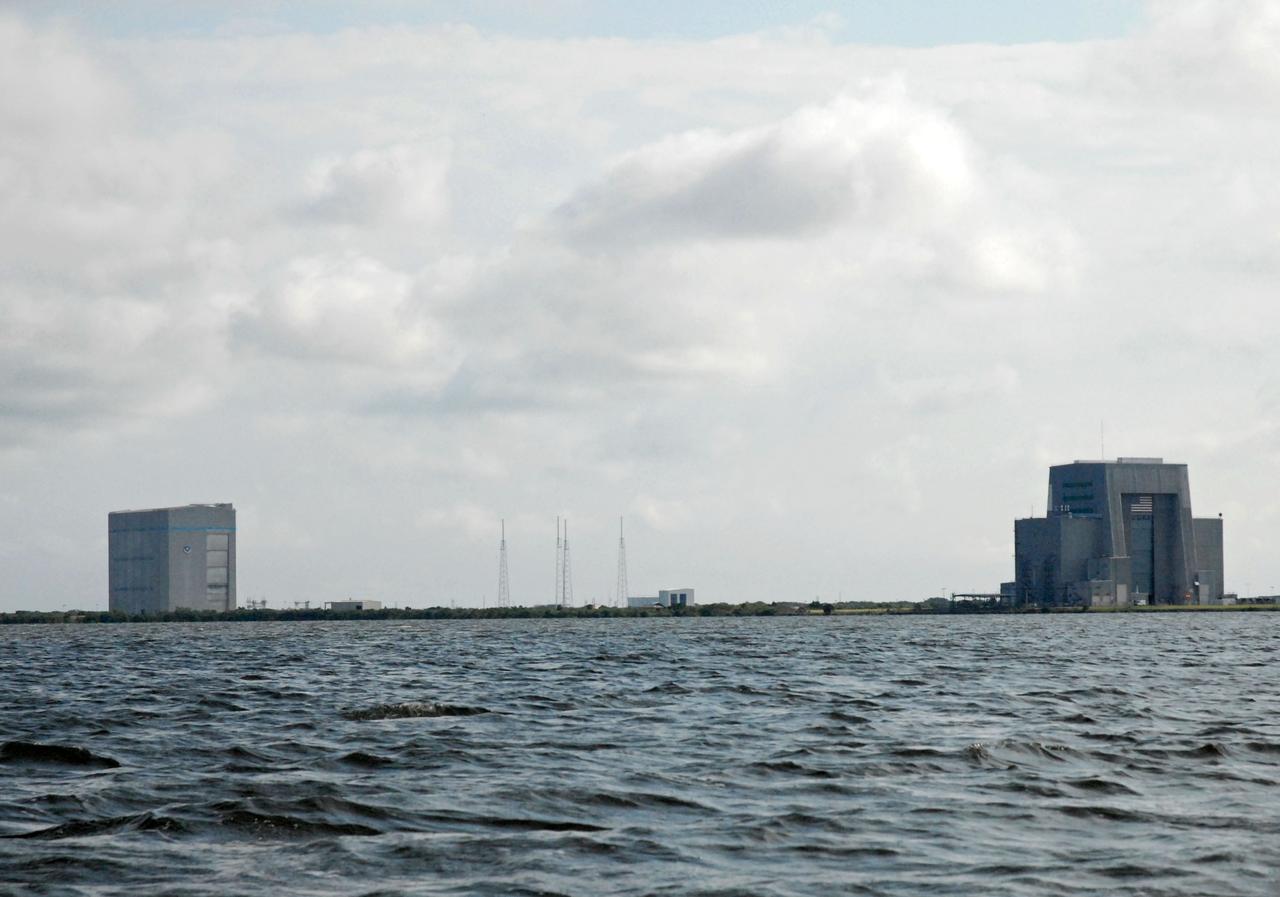
CAPE CANAVERAL, Fla. – The Vehicle Assembly Building, or VAB, is seen in the distance during a field-guided boat tour of NASA's Kennedy Space Center in Florida. As part of the center's first-ever Innovation Expo, the tour, called "Living Outdoor Laboratory for Environmental Sustainability," is giving employees the opportunity to see the unique estuarine ecosystems that are protected from development by the presence of Kennedy and the Merritt Island National Wildlife Refuge. The diverse and healthy area encompassing about 140,000 acres of central Florida's east coast has been closed to the public for 50 years, allowing the coastal dunes, saltwater estuaries and marshes, freshwater impoundments, scrub, pine flatwoods, and hardwood hammocks to provide habitats for more than 1,000 species of plants and animals. Innovation Expo is showcasing the innovative work taking place throughout the center's facilities and labs to encourage employees to work together to solve future challenges. For more information, visit http://www.nasa.gov/kennedy. Photo credit: NASA
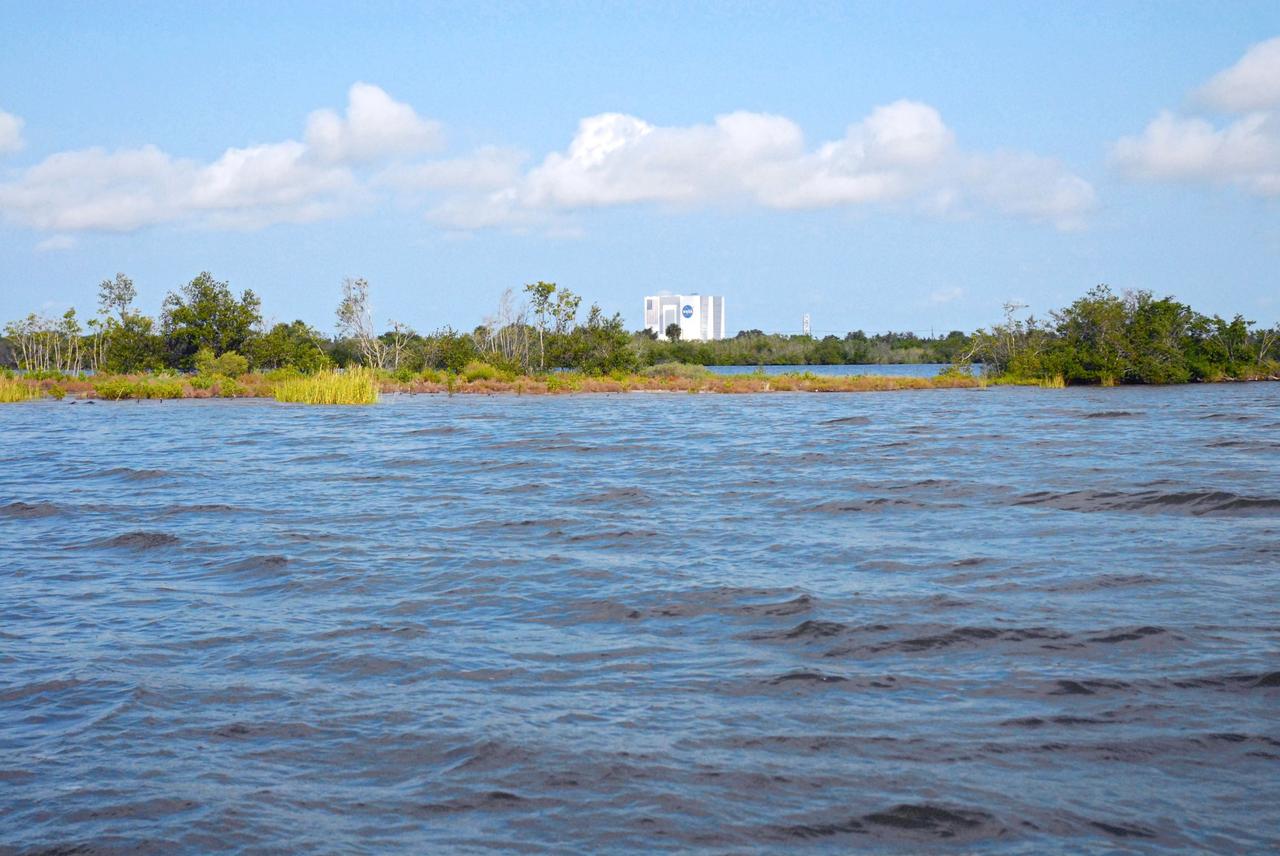
CAPE CANAVERAL, Fla. – The Vehicle Assembly Building, or VAB, is seen in the distance during a field-guided boat tour of NASA's Kennedy Space Center in Florida. As part of the center's first-ever Innovation Expo, the tour, called "Living Outdoor Laboratory for Environmental Sustainability," is giving employees the opportunity to see the unique estuarine ecosystems that are protected from development by the presence of Kennedy and the Merritt Island National Wildlife Refuge. The diverse and healthy area encompassing about 140,000 acres of central Florida's east coast has been closed to the public for 50 years, allowing the coastal dunes, saltwater estuaries and marshes, freshwater impoundments, scrub, pine flatwoods, and hardwood hammocks to provide habitats for more than 1,000 species of plants and animals. Innovation Expo is showcasing the innovative work taking place throughout the center's facilities and labs to encourage employees to work together to solve future challenges. For more information, visit http://www.nasa.gov/kennedy. Photo credit: NASA
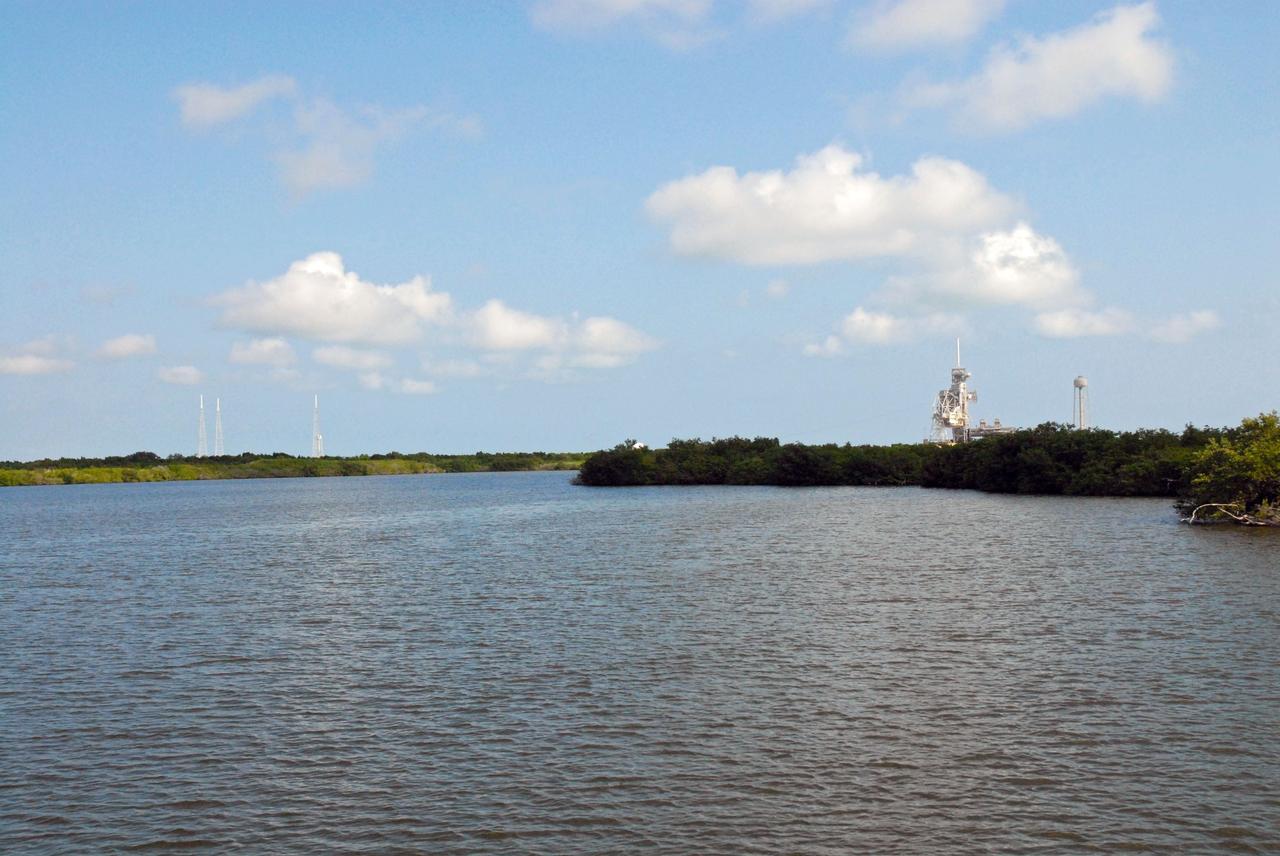
CAPE CANAVERAL, Fla. – Launch Pads 39A, right, and 39B, left, are seen in the distance during a field-guided boat tour of NASA's Kennedy Space Center in Florida. As part of the center's first-ever Innovation Expo, the tour, called "Living Outdoor Laboratory for Environmental Sustainability," is giving employees the opportunity to see the unique estuarine ecosystems that are protected from development by the presence of Kennedy and the Merritt Island National Wildlife Refuge. The diverse and healthy area encompassing about 140,000 acres of central Florida's east coast has been closed to the public for 50 years, allowing the coastal dunes, saltwater estuaries and marshes, freshwater impoundments, scrub, pine flatwoods, and hardwood hammocks to provide habitats for more than 1,000 species of plants and animals. Innovation Expo is showcasing the innovative work taking place throughout the center's facilities and labs to encourage employees to work together to solve future challenges. For more information, visit http://www.nasa.gov/kennedy. Photo credit: NASA
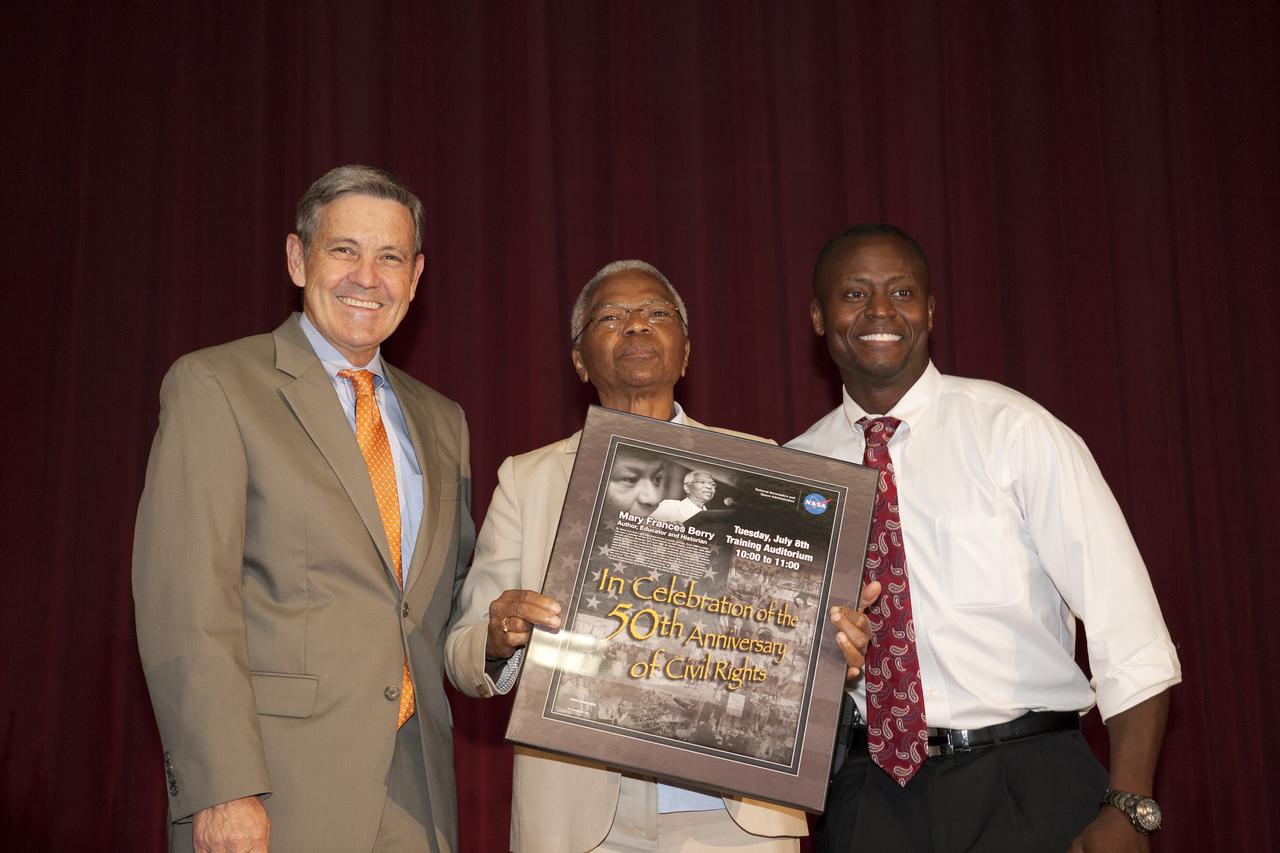
CAPE CANAVERAL, Fla. -- In the KSC Training Auditorium at NASA's Kennedy Space Center in Florida, Dr. Mary Frances Berry, center, accepts a framed poster announcing her appearance from Center Director Robert Cabana, left, who made the opening remarks, and Yves Lamothe, right, transition manager for the Ground Systems Development and Operations Program, the master of ceremonies. Berry served as the assistant secretary for education in the U.S. Department of Health, Education and Welfare HEW between 1977 and 1980. From 1980 to 2004, she was a member of the U.S. Commission on Civil Rights, serving as chair from 1993 to 2004. Among Berry's many honors are the NAACP's Roy Wilkins Award, the Rosa Parks Award of the Southern Christian Leadership Conference, and the Ebony Magazine Black Achievement Award. She is one of 75 women featured in the book "I Dream a World: Portraits of Black Women Who Changed America." Sienna College Research Institute and the Women's Hall of Fame also designated her one of "America's Women of the Century." The event was presented by Kennedy's Office of Diversity and Equal Opportunity. For more information about Kennedy Space Center, visit http://www.nasa.gov/kennedy. Photo credit: NASA/Kim Shiflett
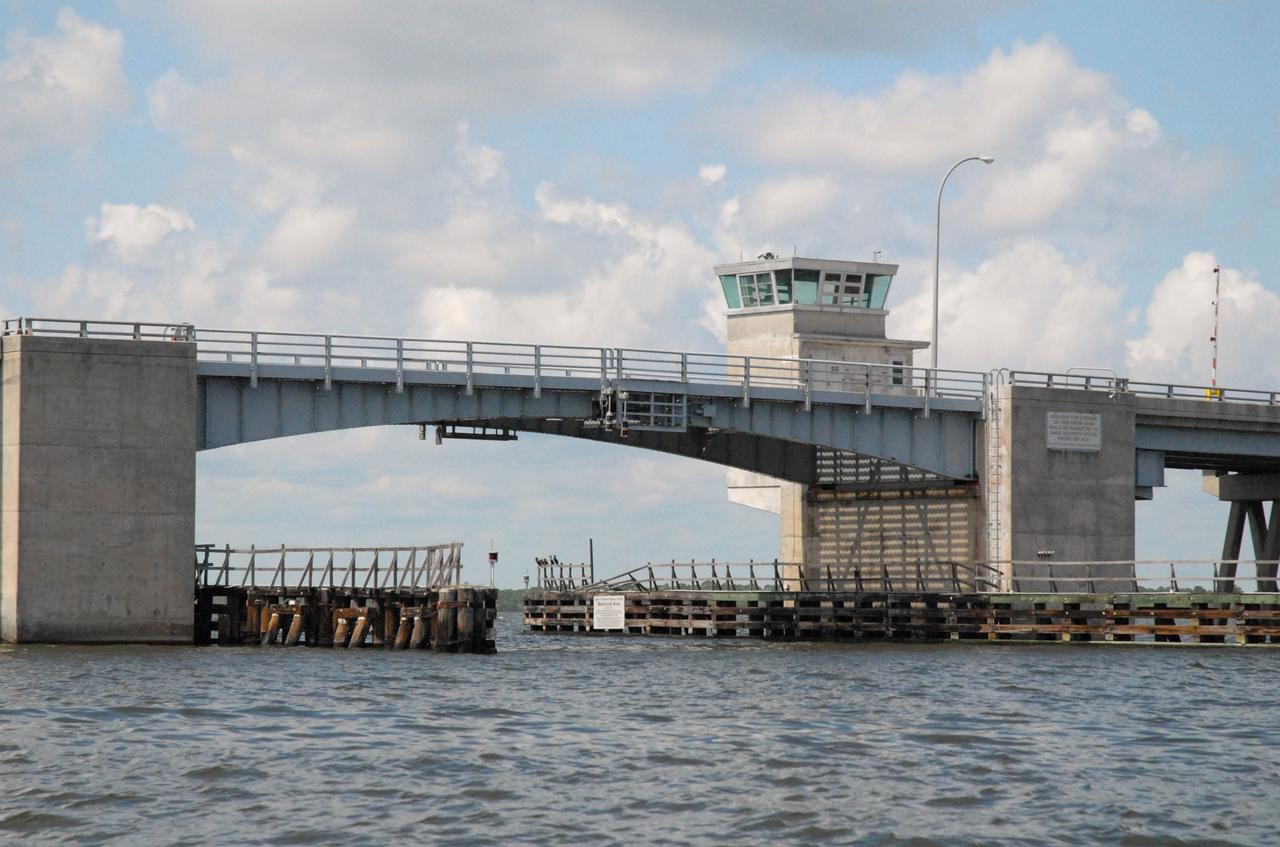
CAPE CANAVERAL, Fla. – The Roy D. Bridges Jr. Bridge connecting NASA Kennedy Space Center's Industrial Area to Cape Canaveral Air Force Station's Industrial Area is seen during a field-guided boat tour. As part of the Kennedy's first-ever Innovation Expo, the tour, called "Living Outdoor Laboratory for Environmental Sustainability," is giving employees the opportunity to see the unique estuarine ecosystems that are protected from development by the presence of the center and the Merritt Island National Wildlife Refuge. The diverse and healthy area encompassing about 140,000 acres of central Florida's east coast has been closed to the public for 50 years, allowing the coastal dunes, saltwater estuaries and marshes, freshwater impoundments, scrub, pine flatwoods, and hardwood hammocks to provide habitats for more than 1,000 species of plants and animals. Innovation Expo is showcasing the innovative work taking place throughout the center's facilities and labs to encourage employees to work together to solve future challenges. For more information, visit http://www.nasa.gov/kennedy. Photo credit: NASA
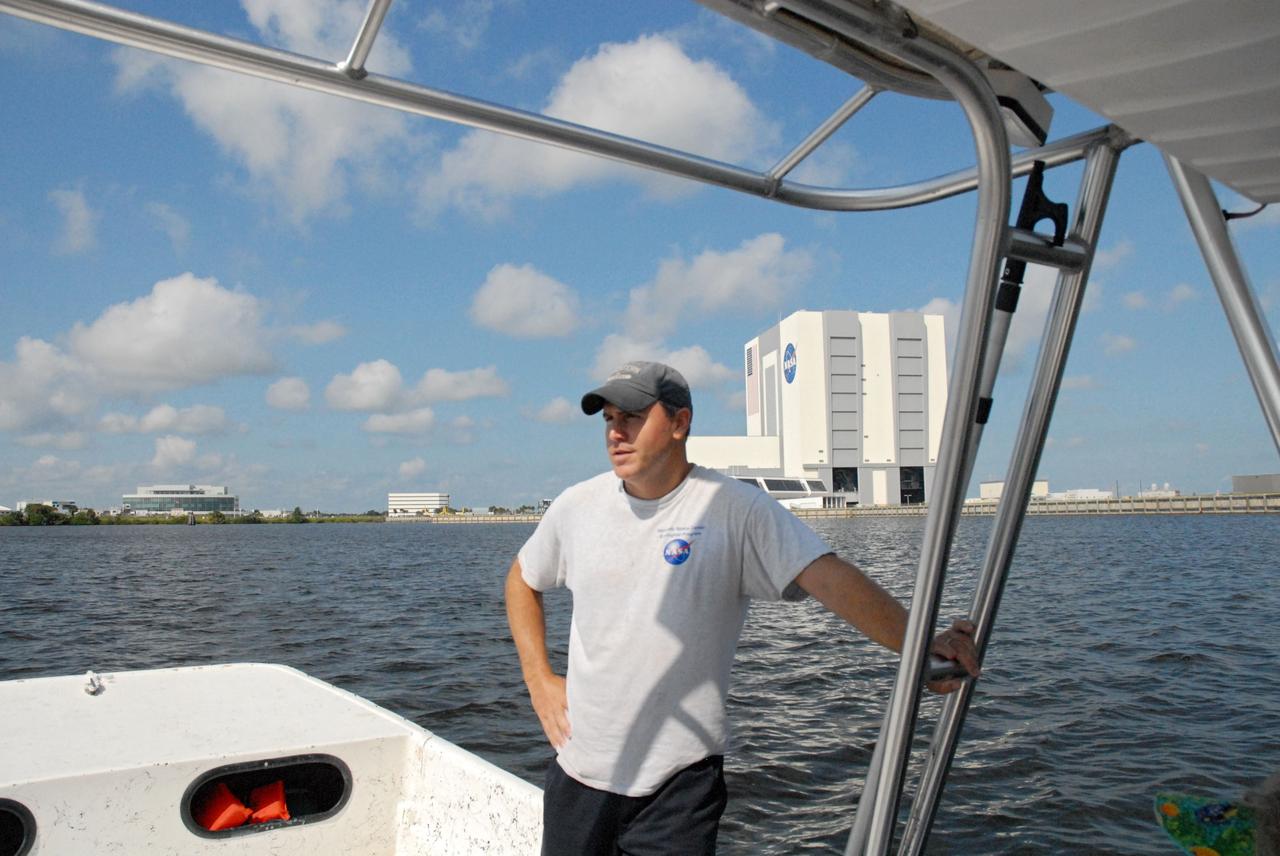
CAPE CANAVERAL, Fla. – Aquatic biologist Eric Reyier with Innovative Health Applications, or IHA, talks about the work that goes into protecting the natural habitat at a launch operations center during a field-guided boat tour of NASA's Kennedy Space Center in Florida. As part of the center's first-ever Innovation Expo, the tour, called "Living Outdoor Laboratory for Environmental Sustainability," is giving employees the opportunity to see the unique estuarine ecosystems that are protected from development by the presence of Kennedy and the Merritt Island National Wildlife Refuge. In the background is Kennedy's Launch Complex 39. The diverse and healthy area encompassing about 140,000 acres of central Florida's east coast has been closed to the public for 50 years, allowing the coastal dunes, saltwater estuaries and marshes, freshwater impoundments, scrub, pine flatwoods, and hardwood hammocks to provide habitats for more than 1,000 species of plants and animals. Innovation Expo is showcasing the innovative work taking place throughout the center's facilities and labs to encourage employees to work together to solve future challenges. For more information, visit http://www.nasa.gov/kennedy. Photo credit: NASA
![jsc2020e041336 (Sep 21, 2020) - “There are obvious highlights [about my job] and then there are some highlights that I didn’t really see coming. It’s such an honor to be just one person behind the scenes supporting the crewmembers while they’re up in space and focusing on their missions. It’s such an honor to be a part of them accomplishing their mission. The first time I got a call from space was a major highlight. Every call I’ve gotten from space since then has never gotten less exciting. The fact that I am continuously communicating with people who are living and working on the International Space Station — it’s just very surreal, it’s very mind-blowing still to this day even though I’ve been in this role for several years now. "But one of the highlights that I didn’t necessarily see coming is that a lot of the crewmembers have become mentors to me now. I look up to them for so many different reasons. And we have such a diverse corps that there’s really unlimited wisdom that I can take from listening to each crewmember’s story and from working with each crewmember. They show so much humility and perseverance. Hearing stories about their failures and their successes, watching them problem-solve and even problem-solving with them, has made me grow to be the kind of individual that I think I always wanted to become. I just never knew that I would have the opportunity to have these kinds of mentors to actually help me become that person.” — Stephanie Fernandez, Social Media and Outreach Specialist for the Astronaut Office, Johnson Space Center Image Credit: NASA / James Blair Interviewer: NASA / Thalia Patrinos](https://images-assets.nasa.gov/image/jsc2020e041336/jsc2020e041336~medium.jpg)
jsc2020e041336 (Sep 21, 2020) - “There are obvious highlights [about my job] and then there are some highlights that I didn’t really see coming. It’s such an honor to be just one person behind the scenes supporting the crewmembers while they’re up in space and focusing on their missions. It’s such an honor to be a part of them accomplishing their mission. The first time I got a call from space was a major highlight. Every call I’ve gotten from space since then has never gotten less exciting. The fact that I am continuously communicating with people who are living and working on the International Space Station — it’s just very surreal, it’s very mind-blowing still to this day even though I’ve been in this role for several years now. "But one of the highlights that I didn’t necessarily see coming is that a lot of the crewmembers have become mentors to me now. I look up to them for so many different reasons. And we have such a diverse corps that there’s really unlimited wisdom that I can take from listening to each crewmember’s story and from working with each crewmember. They show so much humility and perseverance. Hearing stories about their failures and their successes, watching them problem-solve and even problem-solving with them, has made me grow to be the kind of individual that I think I always wanted to become. I just never knew that I would have the opportunity to have these kinds of mentors to actually help me become that person.” — Stephanie Fernandez, Social Media and Outreach Specialist for the Astronaut Office, Johnson Space Center Image Credit: NASA / James Blair Interviewer: NASA / Thalia Patrinos

The veils of Saturn's most mysterious moon have begun to lift in Cassini's eagerly awaited first glimpse of the surface of Titan, a world where scientists believe organic matter rains from hazy skies and seas of liquid hydrocarbons dot a frigid surface. Surface features previously observed only from Earth-based telescopes are now visible in images of Titan taken in mid-April by Cassini through one of the narrow angle camera's spectral filters specifically designed to penetrate the thick atmosphere. The image scale is 230 kilometers (143 miles) per pixel, and it rivals the best Earth-based images. The two images displayed here show Titan from a vantage point 17 degrees below its equator, yielding a view from 50 degrees north latitude all the way to its south pole. The image on the left was taken four days after the image on the right. Titan rotated 90 degrees in that time. The two images combined cover a region extending halfway around the moon. The observed brightness variations suggest a diverse surface, with variations in average reflectivity on scales of a couple hundred kilometers. The images were taken through a narrow filter centered at 938 nanometers, a spectral region in which the only obstacle to light is the carbon-based, organic haze. Despite the rather long 38-second exposure times, there is no noticeable smear due to spacecraft motion. The images have been magnified 10 times and enhanced in contrast to bring out details. No further processing to remove the effects of the overlying atmosphere has been performed. The superimposed grid over the images illustrates the orientation of Titan -- north is up and rotated 25 degrees to the left -- as well as the geographical regions of the satellite that are illuminated and visible. The yellow curve marks the position of the boundary between day and night on Titan. The enhanced image contrast makes the region within 20 degrees of this day and night division darker than usual. The Sun illuminates Titan from the right at a phase angle of 66 degrees. Because the Sun is in the southern hemisphere as seen from Titan, the north pole is canted relative to the boundary between day and night by 25 degrees. Also shown here is a map of relative surface brightness variations on Titan as measured in images taken in the 1080-nanometer spectral region in 1997 and 1998 by the Near Infrared Camera and Multi-Object Spectrometer on NASA's Hubble Space Telescope. These images have scales of 300 kilometers (186 miles) per pixel. The map colors indicate different surface reflectivities. From darkest to brightest, the color progression is: deep blue (darkest), light blue, green, yellow, red and deep red (brightest). The large, continent-sized, red feature extending from 60 degrees to 150 degrees west longitude is called Xanadu. It is unclear whether Xanadu is a mountain range, giant basin, smooth plain, or a combination of all three. It may be dotted with hydrocarbon lakes but that is also unknown. All that is presently known is that in Earth-based images, it is the brightest region on Titan. A comparison between the Cassini images and the Hubble map indicates that Xanadu is visible as a bright region in the Cassini image on the right. The dark blue northwest-southeast trending feature from 210 degrees to 250 degrees west longitude, and the bright yellow/green region to the east (right) and southeast of it at minus 50 degrees latitude and 180 to 230 degrees west longitude on the Hubble map, can both be seen in the image on the left. It is noteworthy that the surface is visible to Cassini from its present approach viewing geometry, which is not the most favourable for surface viewing. These early Cassini observations are promising for upcoming imaging sequences of Titan in which the resolution improves by a factor of five over the next two months. These results are encouraging for future, in-orbit observations of Titan that will be acquired from lower, more favorable phase angles. The first opportunity to view small-scale features (2 kilometers or 1.2 miles) on the surface comes during a 350,000 kilometer (217,500 mile) flyby over Titan's south pole on July 2, 2004, only 30 hours after Cassini's insertion into orbit around the ringed planet. http://photojournal.jpl.nasa.gov/catalog/PIA05390