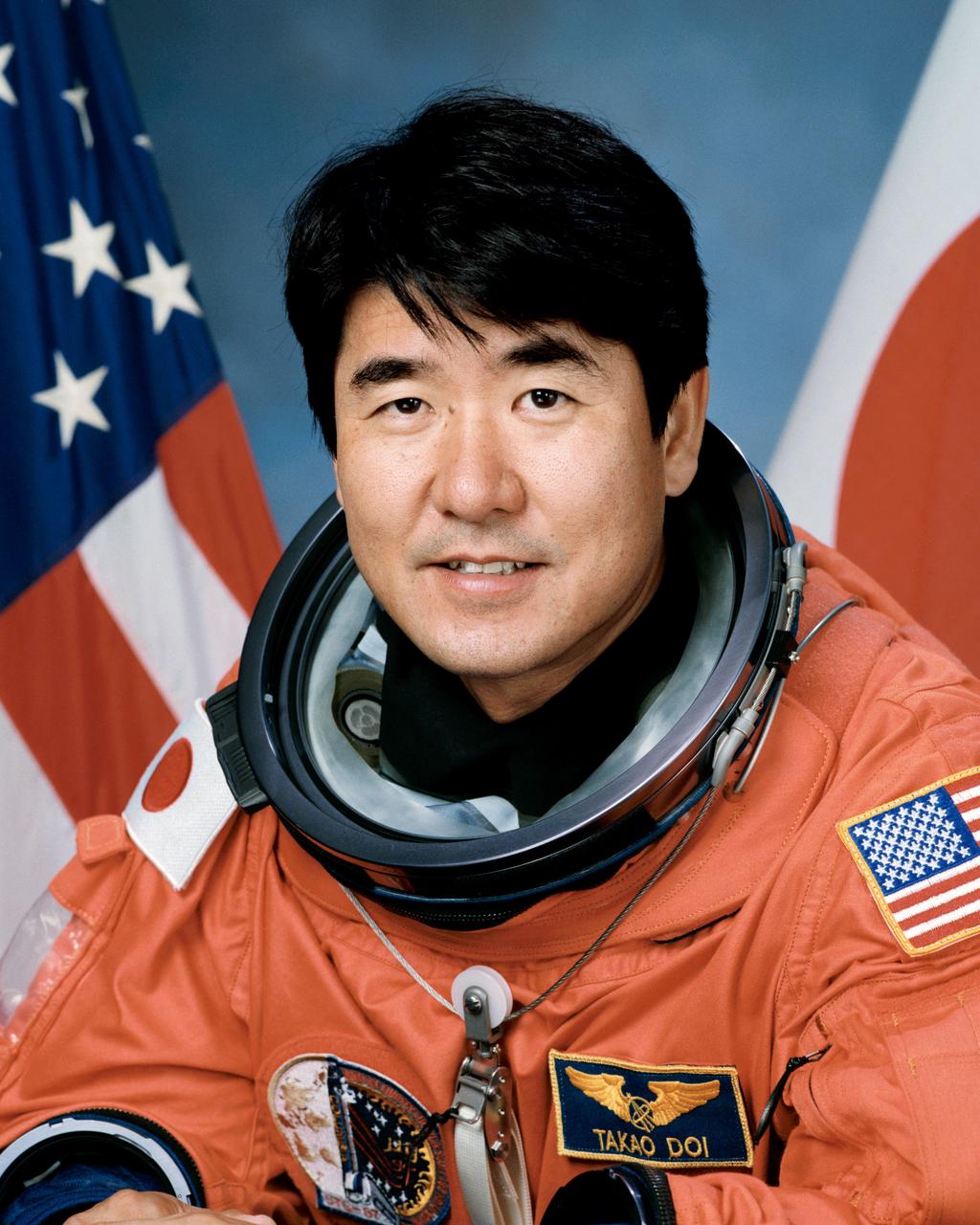
S97-12563 (5 Aug. 1997) --- Astronaut Takao Doi, mission specialist representing Japan Aerospace Exploration Agency (JAXA).
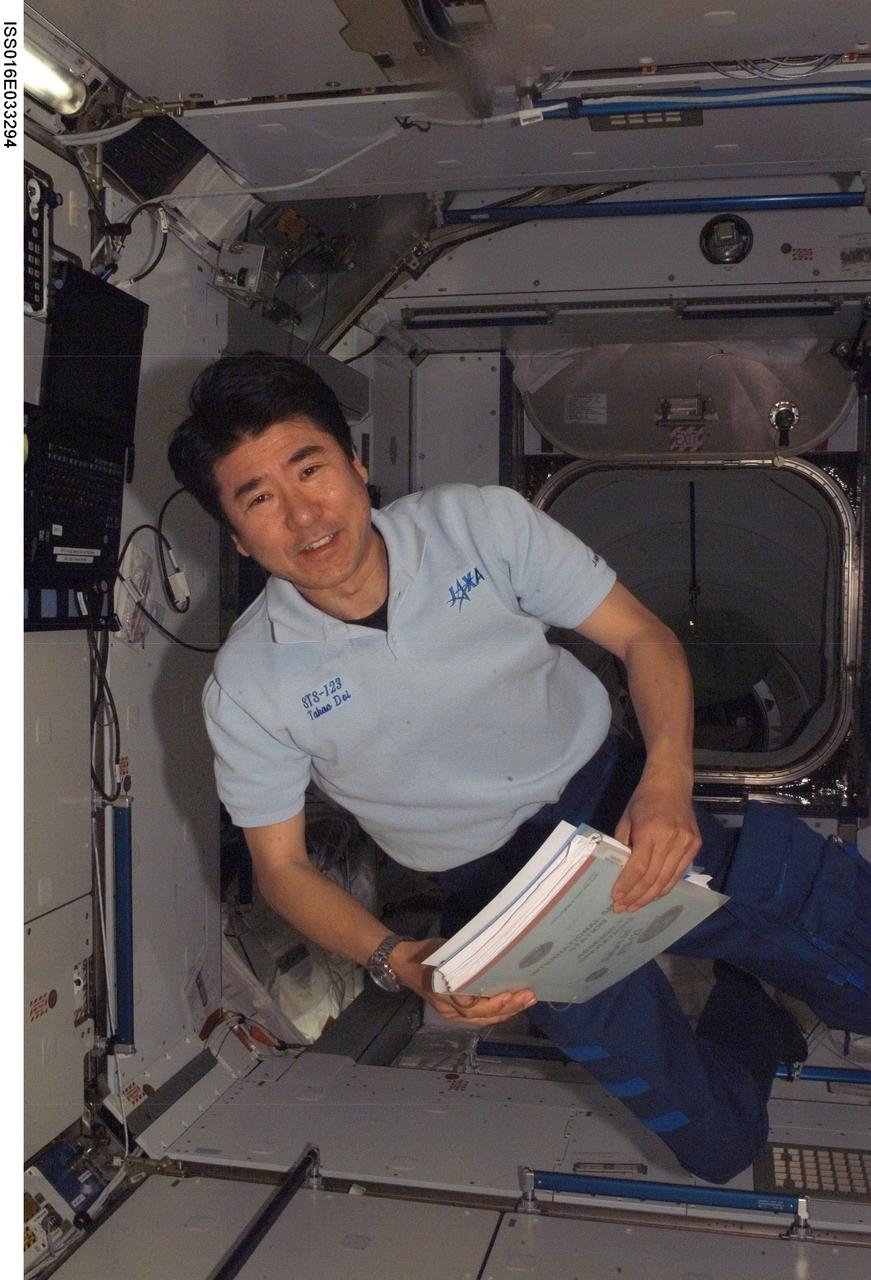
ISS016-E-033294 (22 March 2008) --- Japan Aerospace Exploration Agency (JAXA) astronaut Takao Doi, STS-123 mission specialist, floats in the Harmony node of the International Space Station while Space Shuttle Endeavour is docked with the station.
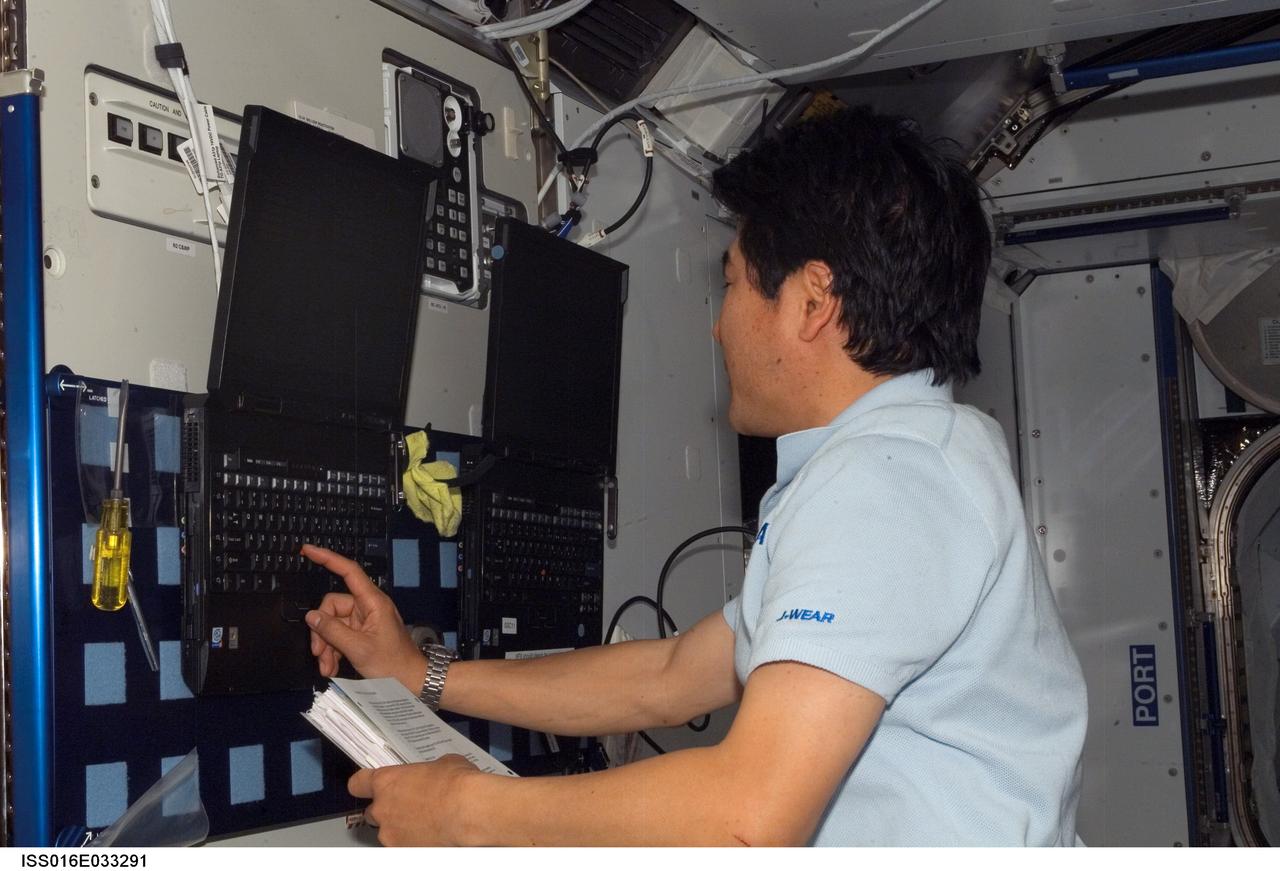
ISS016-E-033291 (22 March 2008) --- Japan Aerospace Exploration Agency (JAXA) astronaut Takao Doi, STS-123 mission specialist, uses a computer in the Harmony node of the International Space Station while Space Shuttle Endeavour is docked with the station.
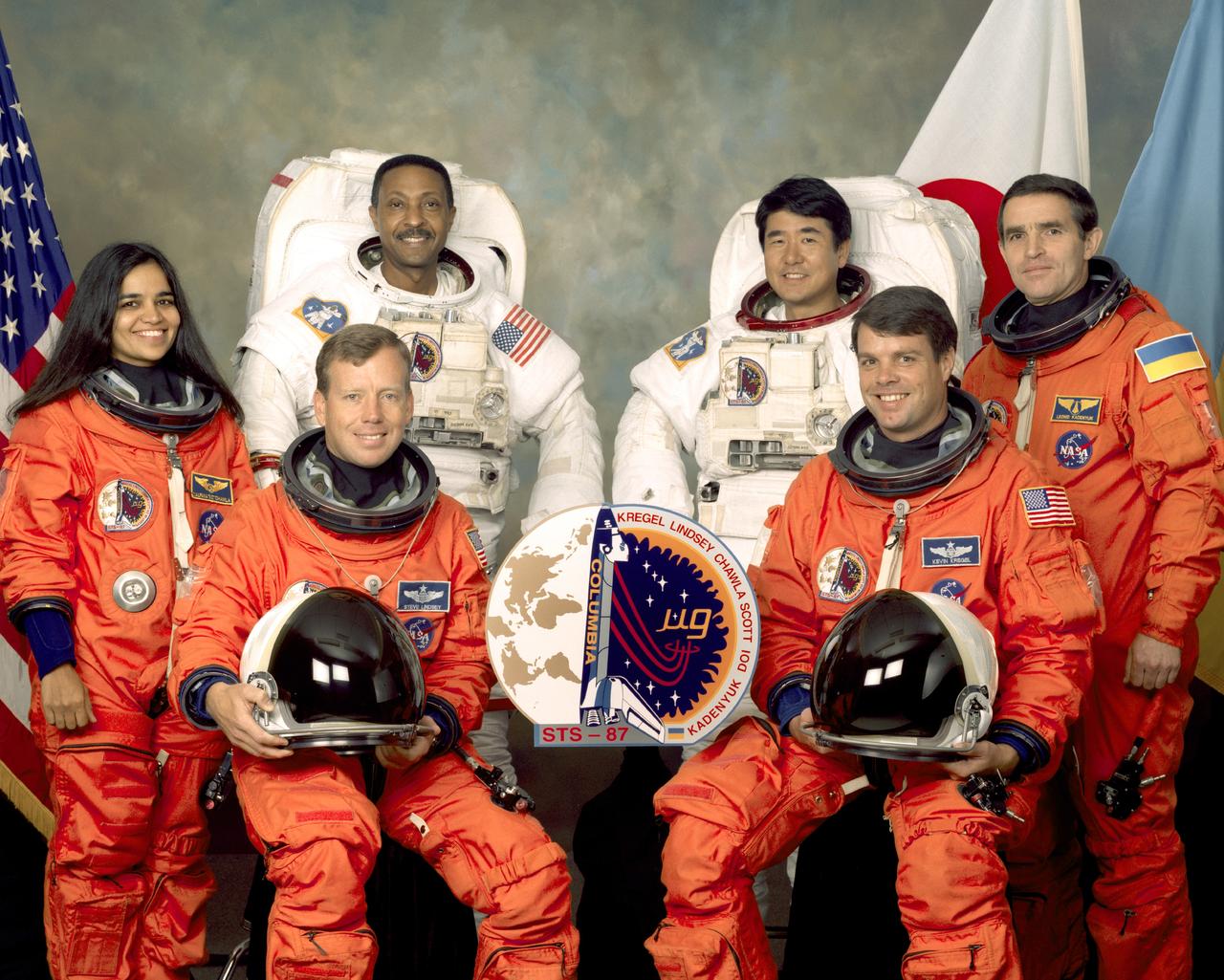
Five astronauts and a payload specialist take a break from training at the Johnson Space Center (JSC) to pose for the STS-87 crew portrait. Wearing the orange partial pressure launch and entry suits, from the left, are Kalpana Chawla, mission specialist; Steven W. Lindsey, pilot; Kevin R. Kregel, mission commander; and Leonid K. Kadenyuk, Ukrainian payload specialist. Wearing the white Extravehicular Mobility Unit (EMU) space suits are mission specialists Winston E. Scott (left) and Takao Doi (right). Doi represents Japan’s National Space Development Agency (NASDA). The STS-87 mission launched aboard the Space Shuttle Columbia on November 19, 1997. The primary payload for the mission was the U.S. Microgravity Payload-4 (USMP-4).

STS087-317-033 (19 November – 5 December 1997) --- Astronaut Takao Doi, mission specialist, prepares for one of two extravehicular activities (EVA) in the Airlock Module of the Earth-orbiting Space Shuttle Columbia. Takao Doi, an international astronaut stationed at Johnson Space Center (JSC), represents Japan's National Space Development Agency (NASDA). This view was taken with a 35mm camera.

STS087-375-009 (19 November – 5 December 1997) --- Astronaut Takao Doi, mission specialist, during one of two extravehicular activities (EVA) in the cargo bay of the Earth-orbiting Space Shuttle Columbia, waves at fellow crewmembers in Columbia’s cabin. Takao Doi, an international astronaut stationed at Johnson Space Center (JSC), represents Japan's National Space Development Agency (NASDA). This view was taken with a 35mm camera.
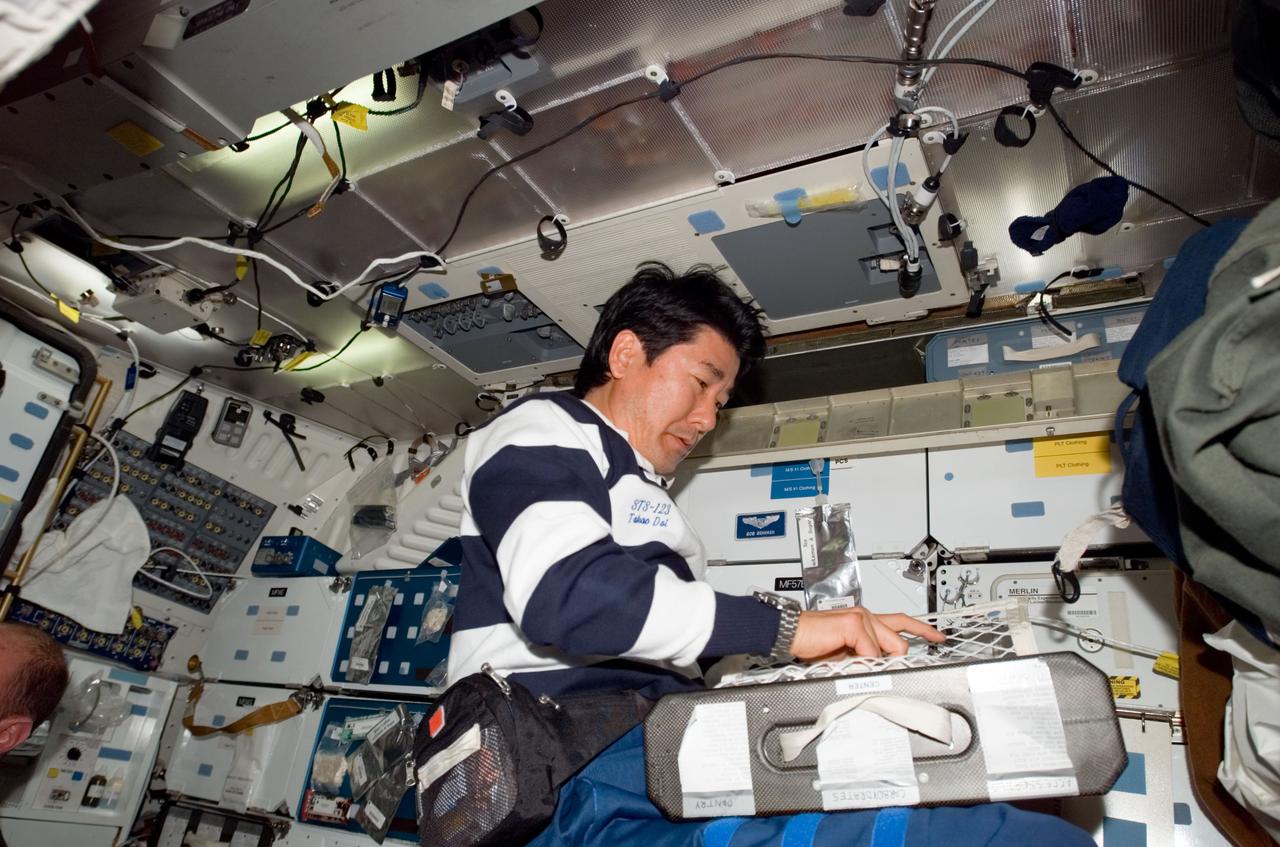
S123-E-006371 (15 March 2008) --- Japan Aerospace Exploration Agency (JAXA) astronaut Takao Doi, STS-123 mission specialist, prepares to eat a meal at the galley on the middeck of Space Shuttle Endeavour while docked with the International Space Station.
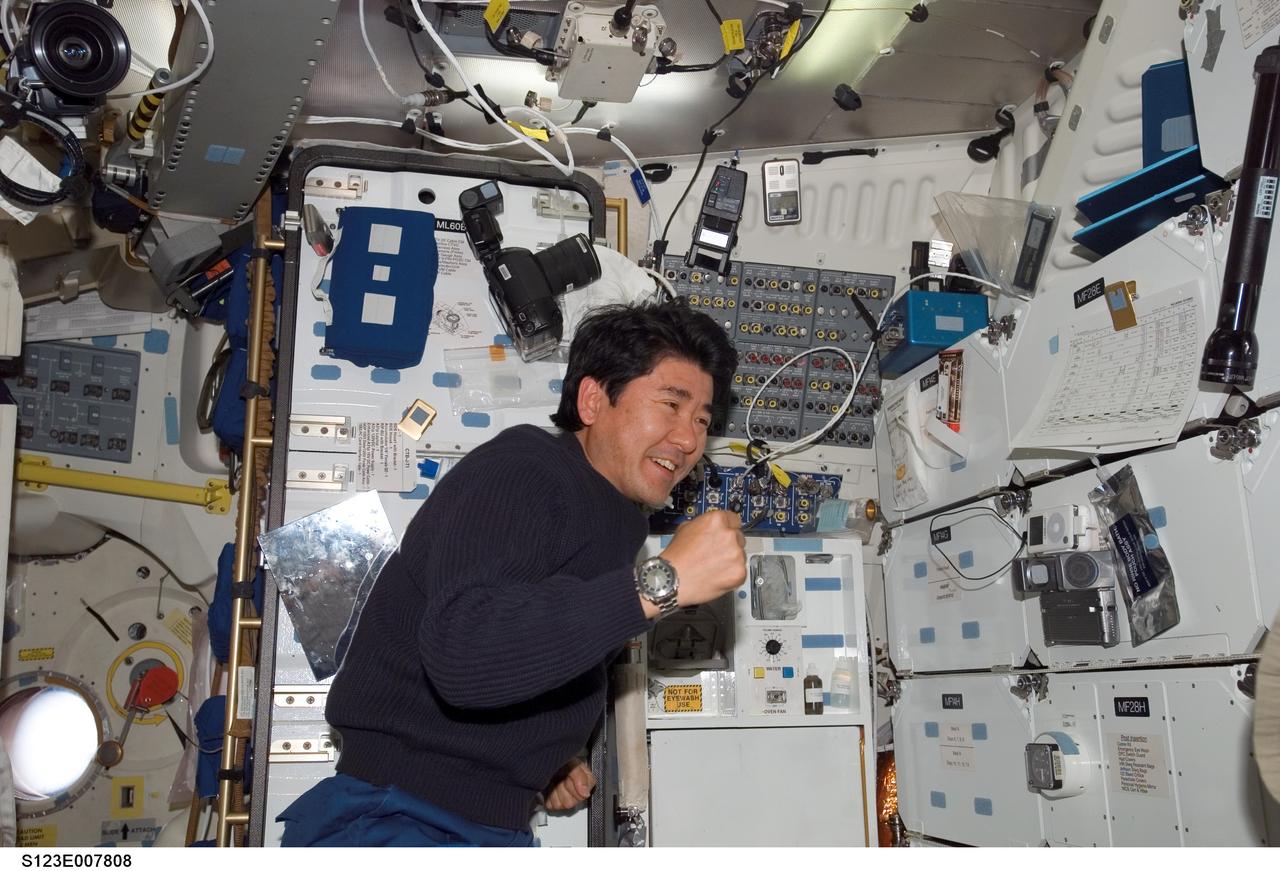
S123-E-007808 (20 March 2008) --- Japan Aerospace Exploration Agency (JAXA) astronaut Takao Doi, STS-123 mission specialist, is pictured near the galley on the middeck of Space Shuttle Endeavour while docked with the International Space Station.
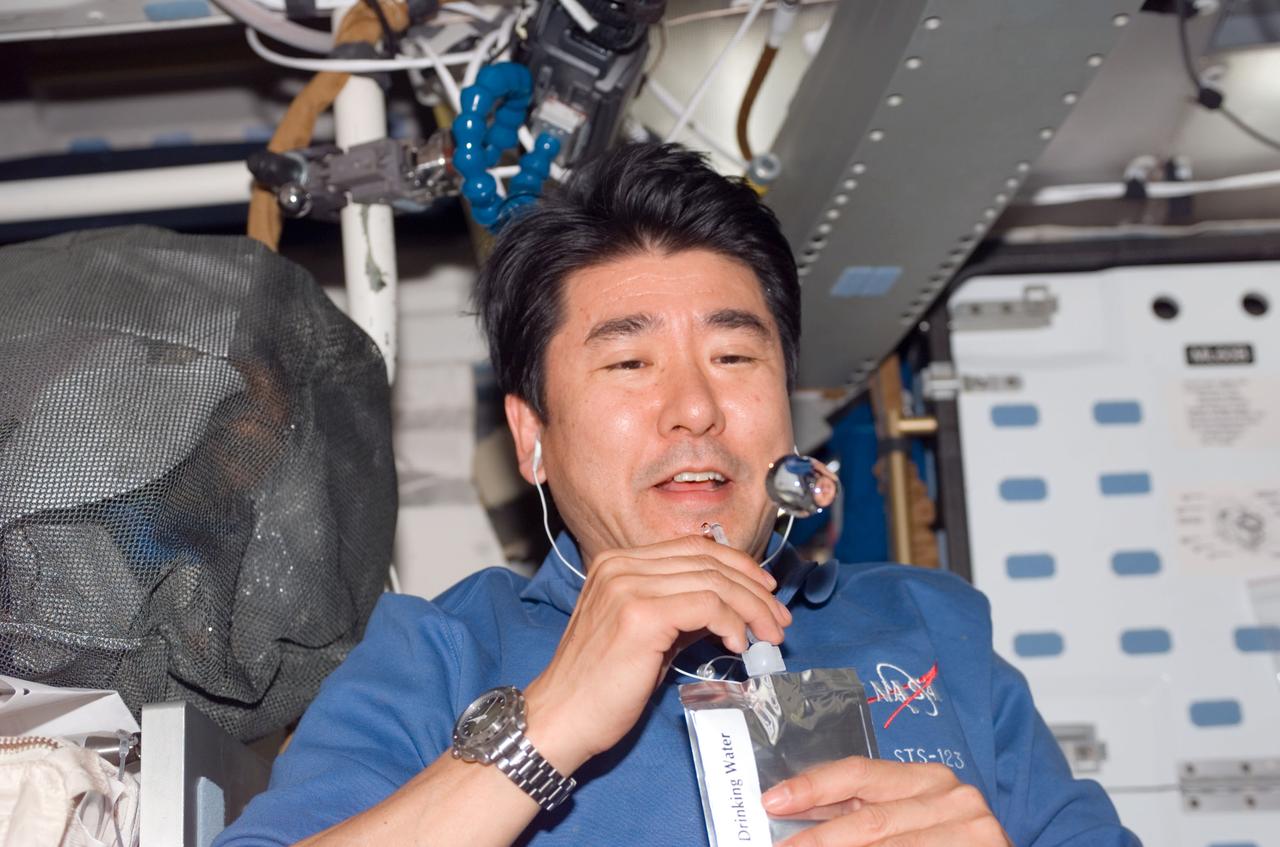
S123-E-007674 (19 March 2008) --- Japan Aerospace Exploration Agency (JAXA) astronaut Takao Doi, STS-123 mission specialist, watches a bubble float freely, after having squeezed it from his beverage container, on the middeck of Space Shuttle Endeavour while docked with the International Space Station.
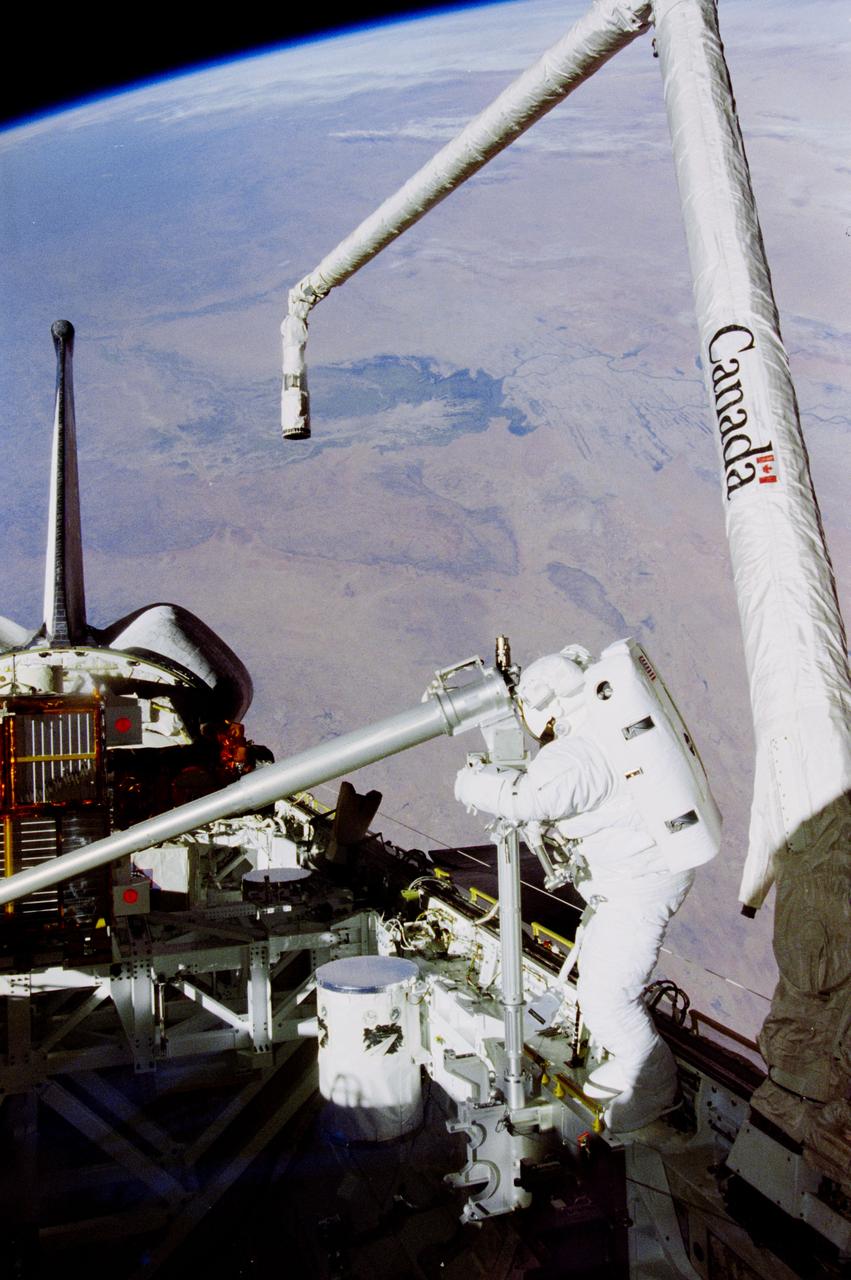
STS087-341-004 (3 Dec. 1997) --- Backdropped over Africa, Takao Doi, international mission specialist representing Japan’s National Space Development Agency (NASDA), works with a crane device during a second extravehicular activity (EVA) designed to help evaluate techniques and hardware to be used in constructing the International Space Station (ISS). Takao Doi and astronaut Winston E. Scott (out of frame) were involved in the mission's second EVA in the cargo bay of the Earth-orbiting Space Shuttle Columbia. Takao Doi is working with a 156-pound crane designed to aid spacewalkers in transporting Orbital Replacement Units (ORU) from translation carts on the exterior of the ISS to various worksites on the truss structure. The view of Earth below features an inland delta in Mali (frame center). This view is from the east toward the west and was taken with a 35mm camera.
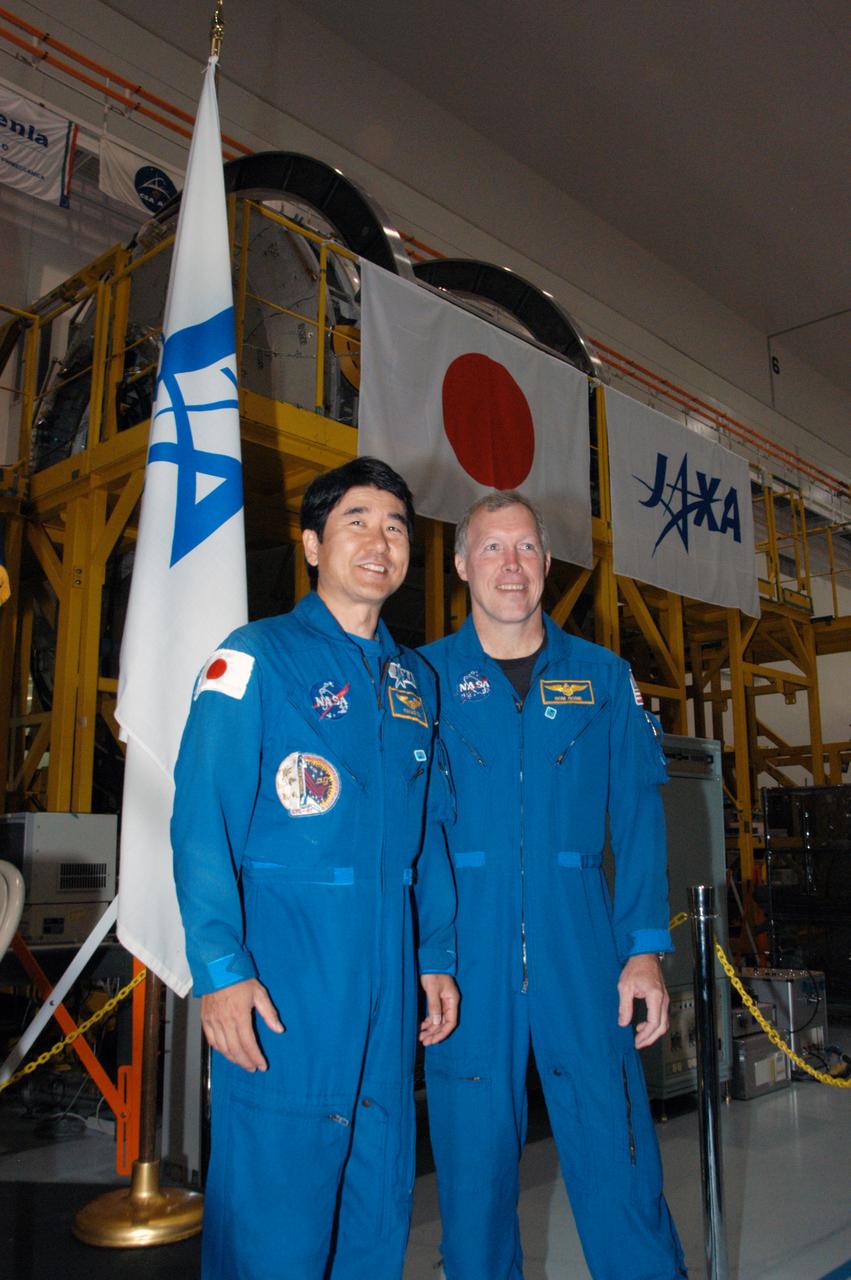
In the Space Station Processing Facility, astronaut Takao Doi (left) and Commander Dominic Gorie pose in front of the Experiment Logistics Module Pressurized Section for the Japanese Experiment Module, or JEM, that recently arrived at Kennedy. Doi and Gorie are crew members for mission STS-123 that will deliver the logistics module to the International Space Station. Earlier, NASA and Japanese Aerospace and Exploration Agency (JAXA) officials welcomed the arrival of the module. The new International Space Station component arrived at Kennedy March 12 to begin preparations for its future launch on mission STS-123. It will serve as an on-orbit storage area for materials, tools and supplies. It can hold up to eight experiment racks and will attach to the top of another larger pressurized module.
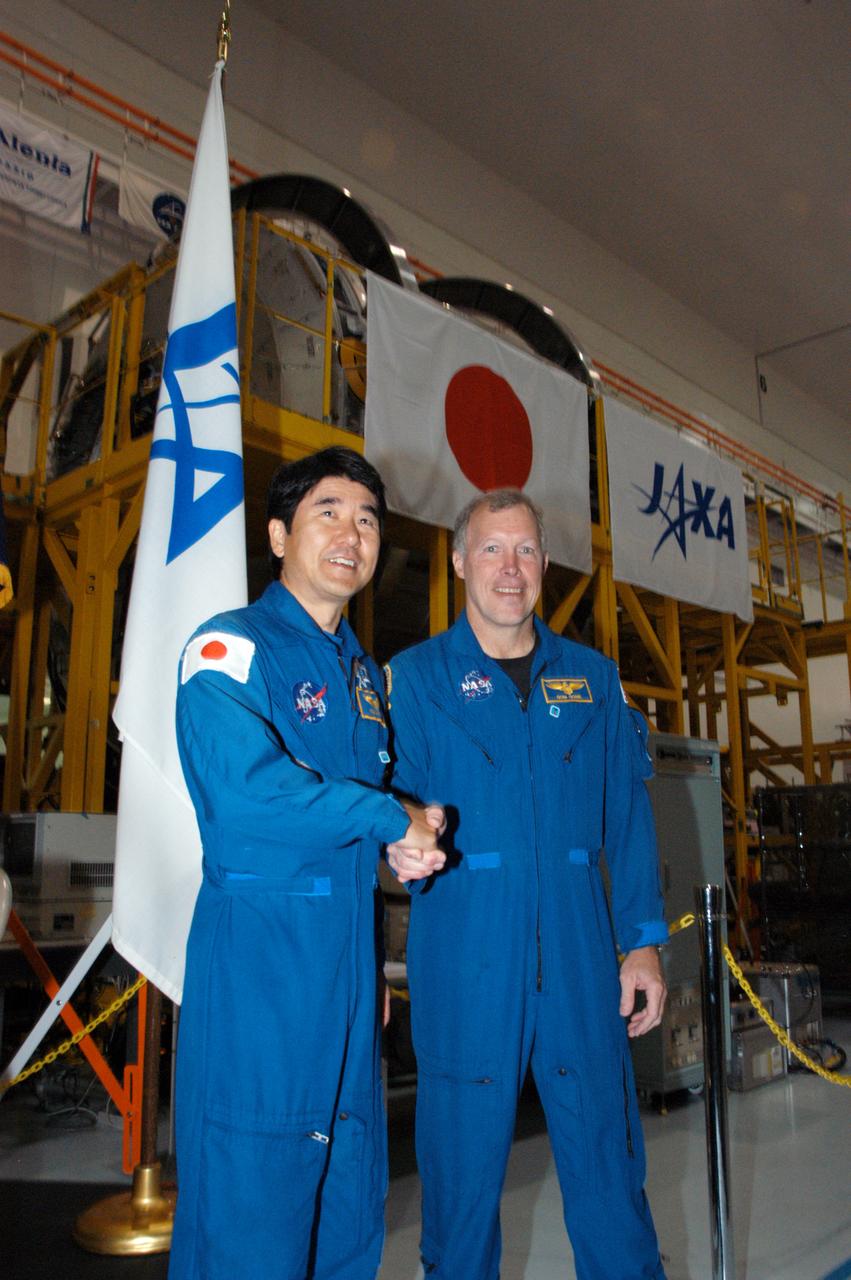
In the Space Station Processing Facility, astronaut Takao Doi (left) and Commander Dominic Gorie pose in front of the Experiment Logistics Module Pressurized Section for the Japanese Experiment Module, or JEM, that recently arrived at Kennedy. Doi and Gorie are crew members for mission STS-123 that will deliver the logistics module to the International Space Station. Earlier, NASA and Japanese Aerospace and Exploration Agency (JAXA) officials welcomed the arrival of the module. The new International Space Station component arrived at Kennedy March 12 to begin preparations for its future launch on mission STS-123. It will serve as an on-orbit storage area for materials, tools and supplies. It can hold up to eight experiment racks and will attach to the top of another larger pressurized module.
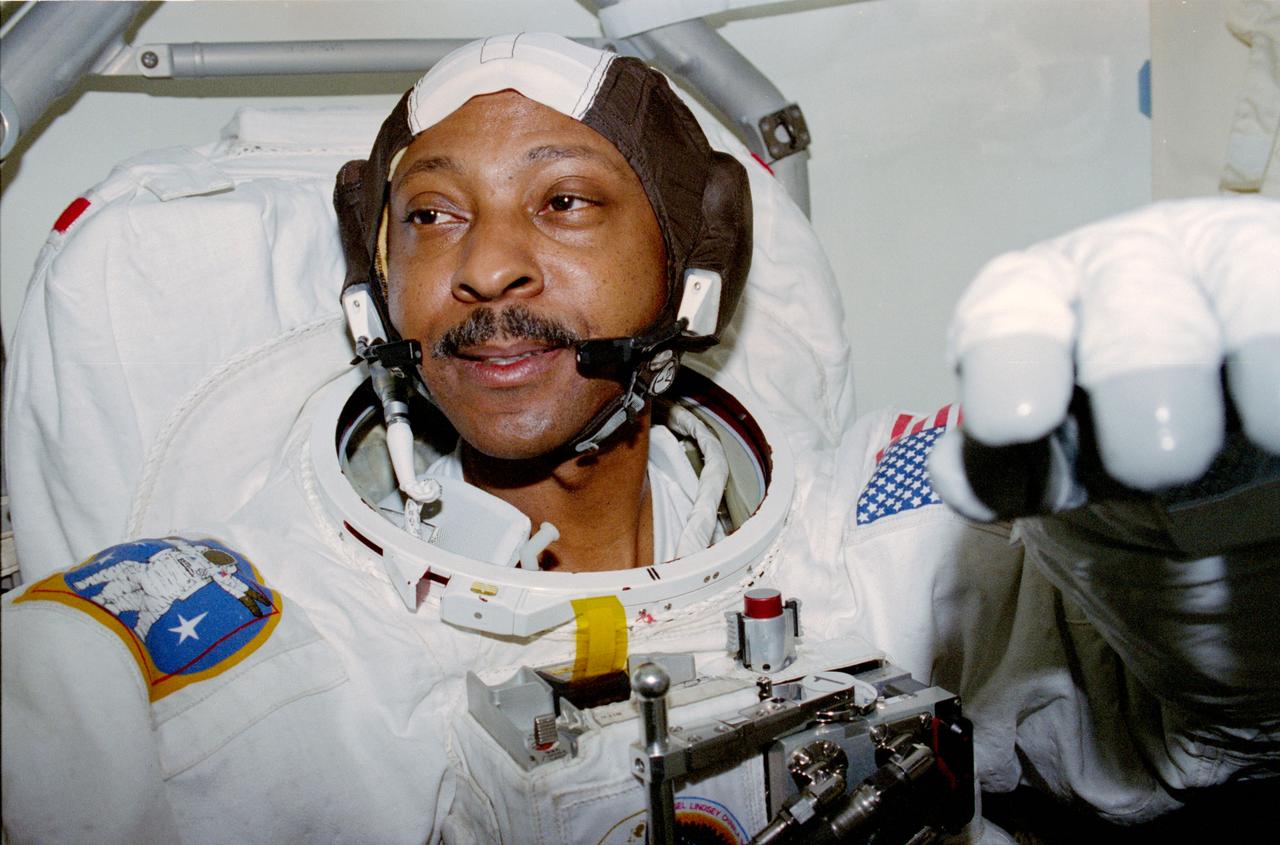
STS087-317-036 (19 November – 5 December 1997) --- Astronaut Winston E. Scott, mission specialist, goes through final touches of space suit donning in preparation for one of two extravehicular activities (EVA) he performed in and around the cargo bay of the Space Shuttle Columbia. Scott was joined by astronaut Takao Doi, an international mission specialist representing Japan's National Space Development Agency (NASDA), on both EVAs.
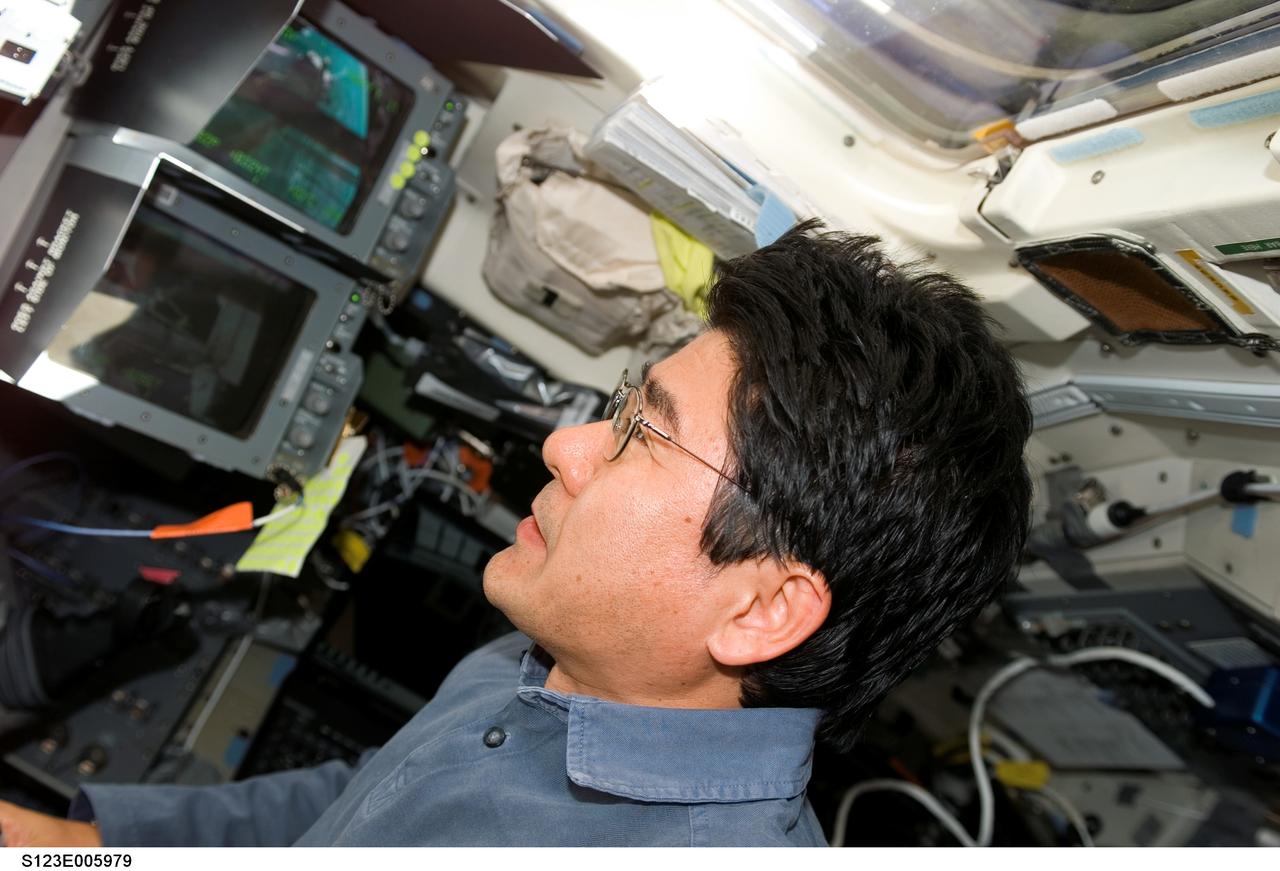
S123-E-005979 (14 March 2008) --- Japan Aerospace Exploration Agency (JAXA) astronaut Takao Doi, STS-123 mission specialist, works on the flight deck of Space Shuttle Endeavour while docked with the International Space Station.
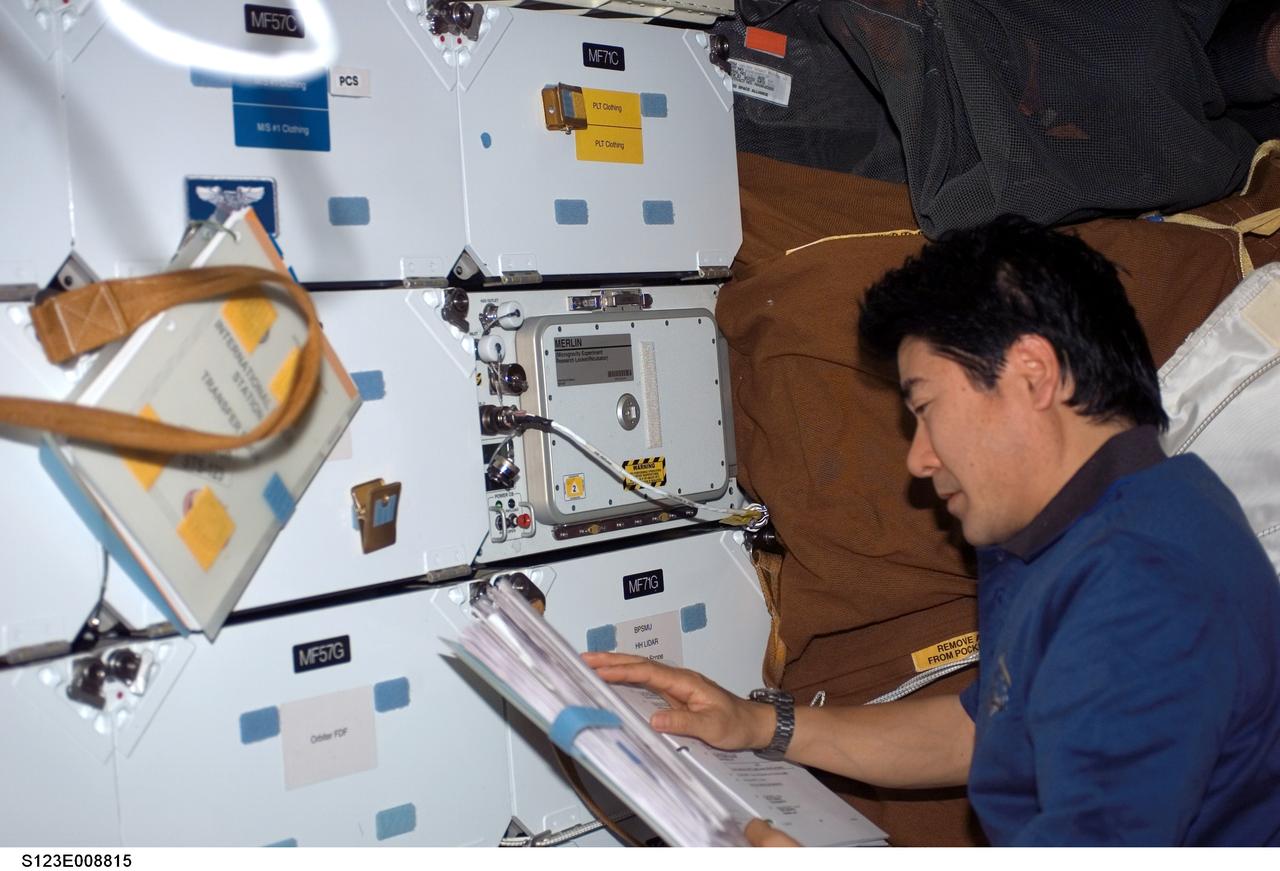
S123-E-008815 (23 March 2008) --- Japan Aerospace Exploration Agency (JAXA) astronaut Takao Doi, STS-123 mission specialist, looks over a checklist on the middeck of Space Shuttle Endeavour while docked with the International Space Station.

S123-E-005126 (11 March 2008) --- Japan Aerospace Exploration Agency (JAXA) astronaut Takao Doi, STS-123 mission specialist, prepares a meal at the galley on the middeck of Space Shuttle Endeavour late in flight day one activities.
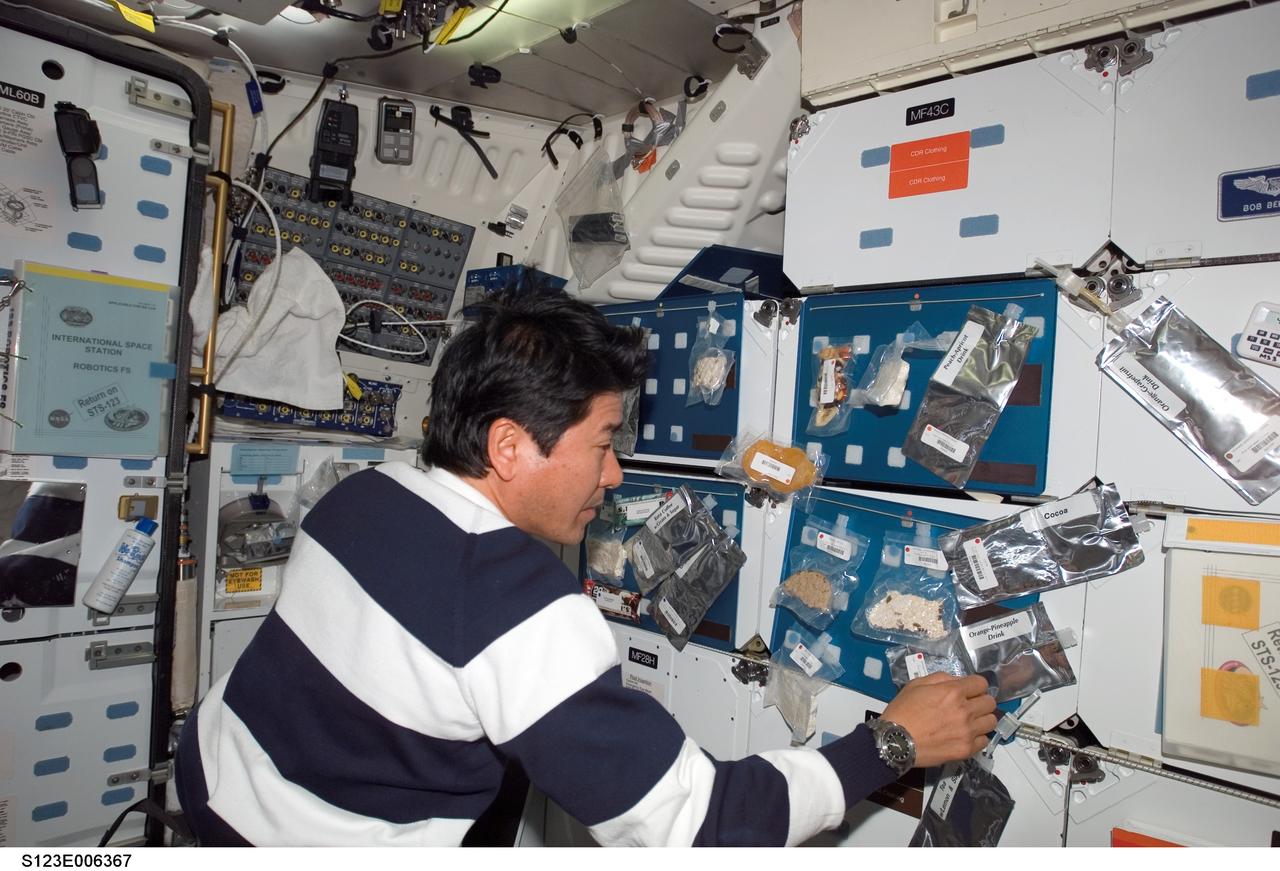
S123-E-006367 (15 March 2008) --- Japan Aerospace Exploration Agency (JAXA) astronaut Takao Doi, STS-123 mission specialists, looks over his choices of beverages and snacks at the galley on the middeck of Space Shuttle Endeavour while docked with the International Space Station.
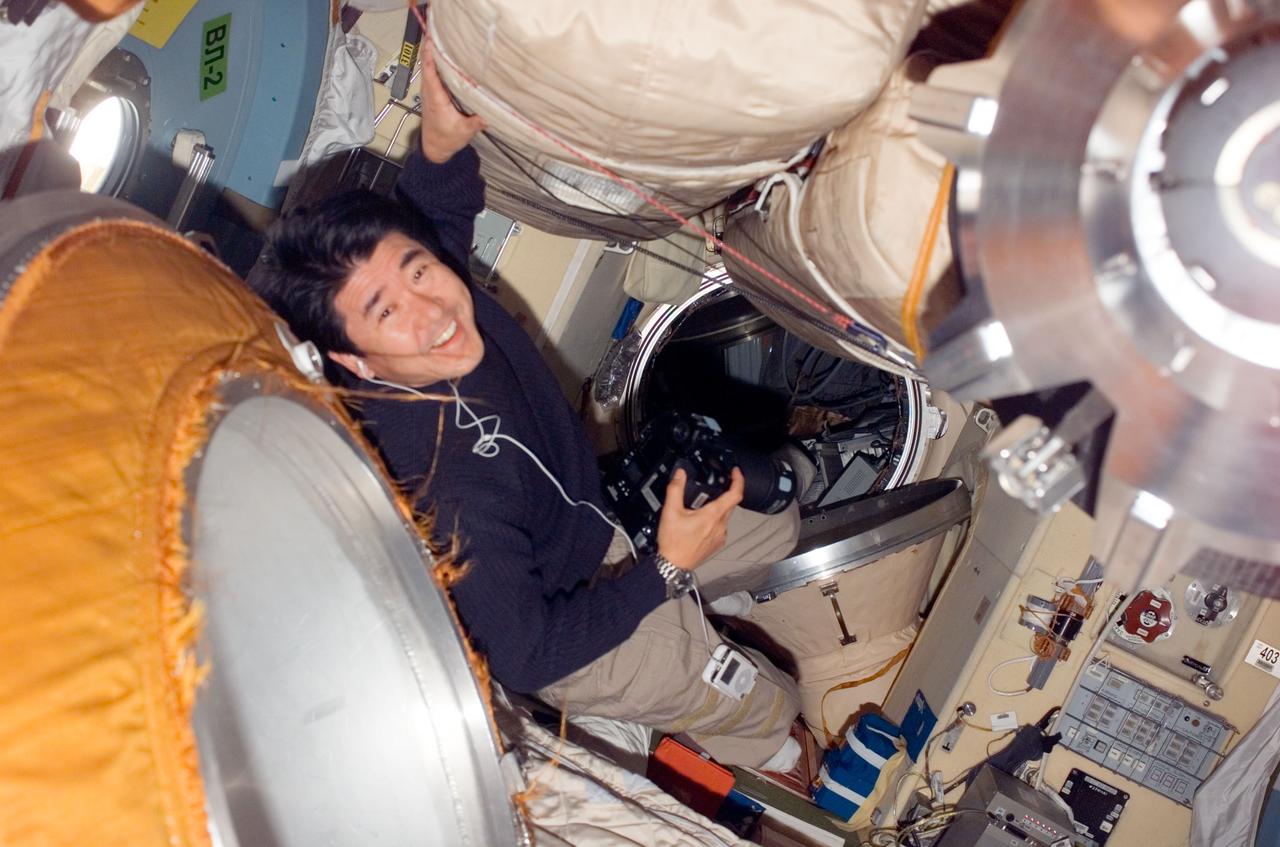
S123-E-008339 (21 March 2008) --- Japan Aerospace Exploration Agency (JAXA) astronaut Takao Doi, STS-123 mission specialist, holds a still camera in the Pirs Docking Compartment of the International Space Station while Space Shuttle Endeavour is docked with the station.
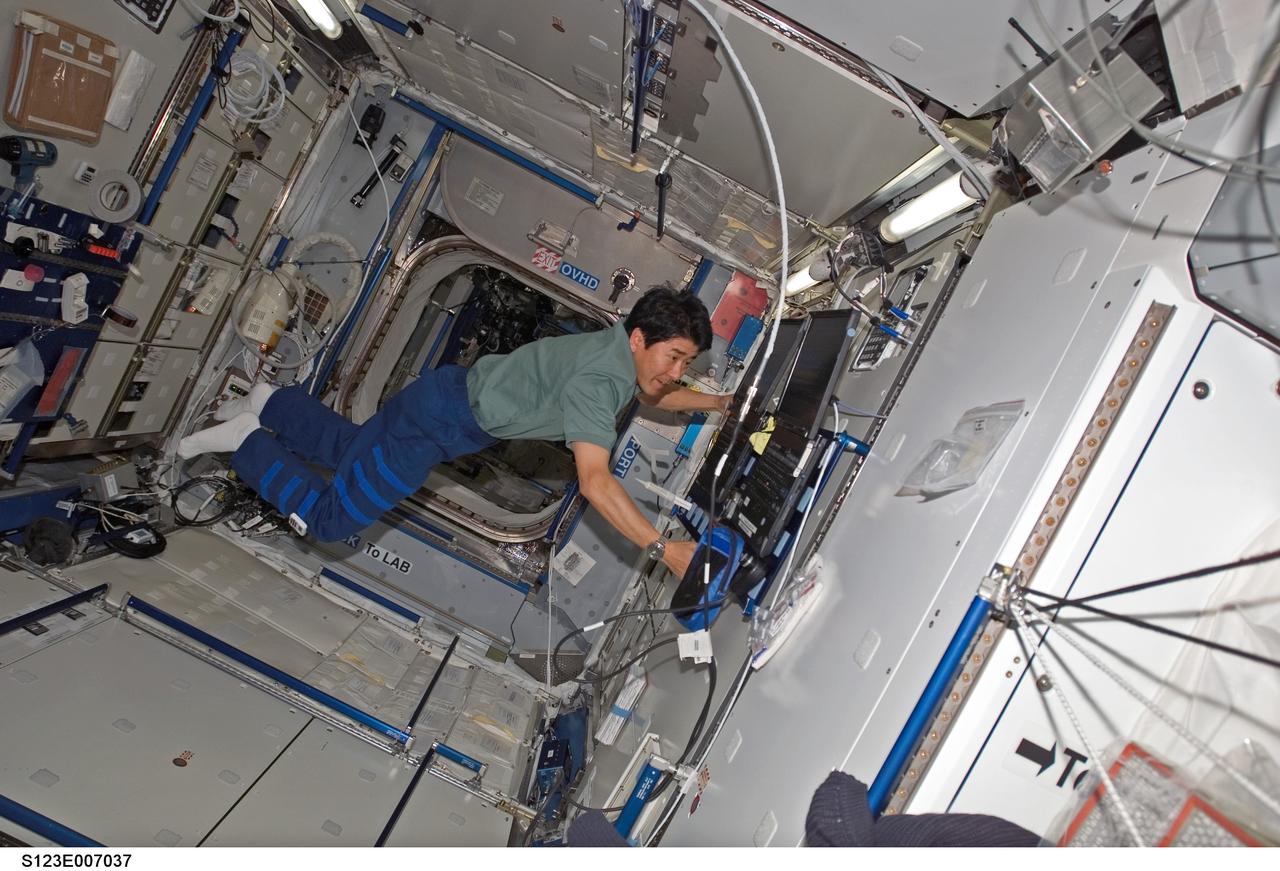
S123-E-007037 (18 March 2008) --- Japan Aerospace Exploration Agency (JAXA) astronaut Takao Doi, STS-123 mission specialist, works in the Harmony node of the International Space Station while Space Shuttle Endeavour is docked with the station.
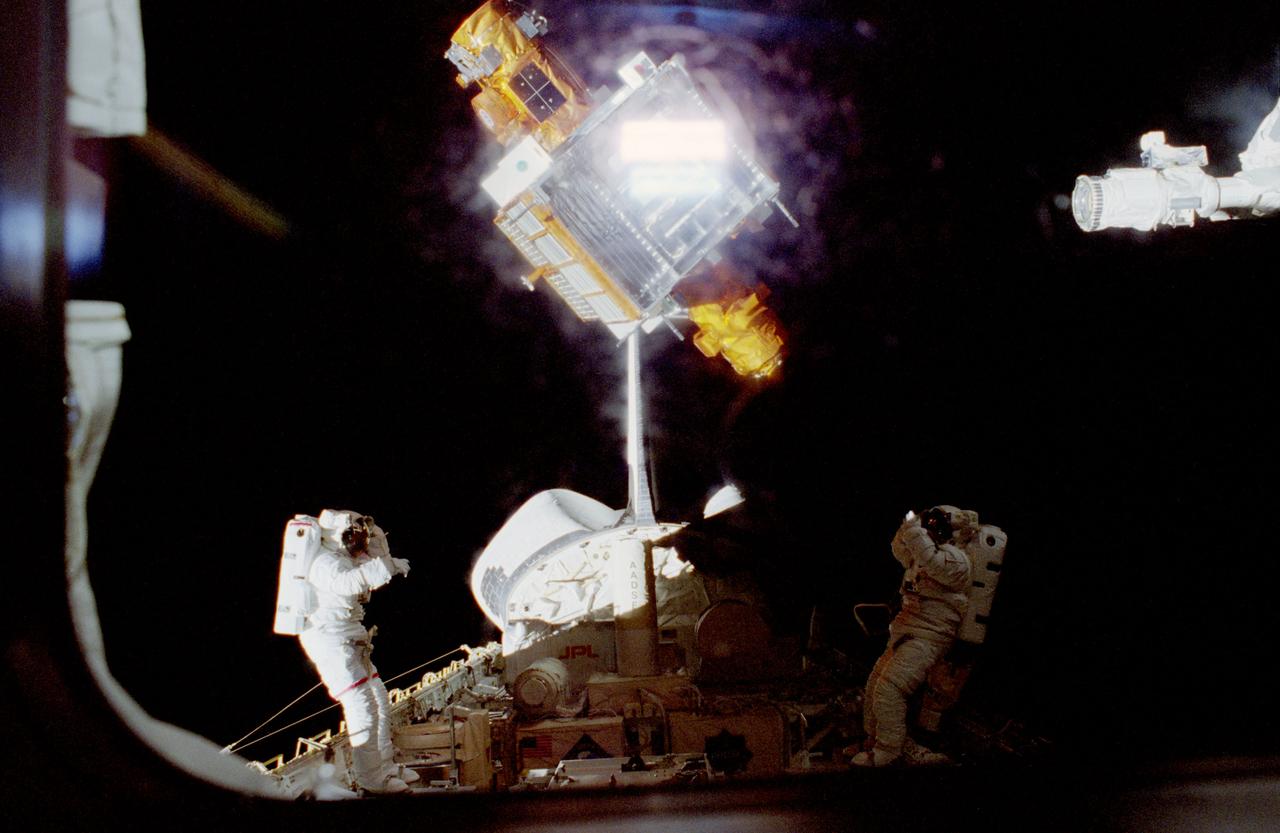
STS087-320-025 (19 November – 5 December 1997) --- Astronauts Winston E. Scott (left) and Takao Doi (partially obscured by his location in the dark shadows), await the right opportunity to grab onto the Spartan satellite. Later, when the Space Shuttle Columbia had moved closer to Spartan, the two mission specialists were able to successfully grab the satellite manually and berth it in Columbia's cargo bay. The end effector of Columbia's Remote Manipulator System (RMS), with its video camera recording the activities, is in the upper right corner. Winston E. Scott was making his second space flight and his second extravehicular activity (EVA). Takao Doi, an international mission specialist stationed at the Johnson Space Center (JSC), represents the Japan’s National Space Development Agency (NASDA).
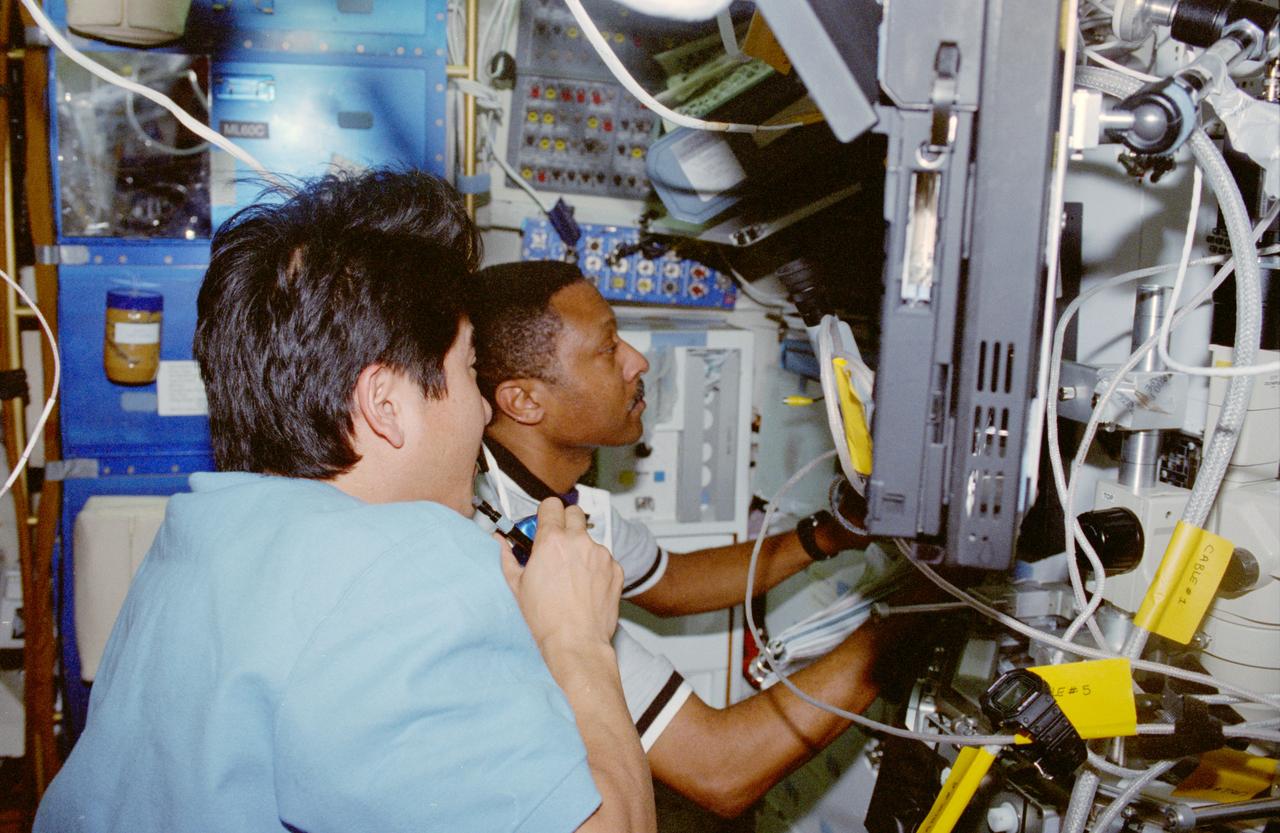
STS087-385-019 (19 November - 5 December 1997) --- Astronaut Winston E. Scott, mission specialist on right, works at the mid-deck glove box while astronaut Takao Doi, international mission specialist representing Japan's National Space Development Agency (NASDA), makes oral commentary regarding the experiment to ground controllers. The two mission specialists not only shared science research in support of the 16-day United States Microgravity Payload (USMP-4) mission, but they also shared two lengthy Extravehicular Activities (EVA) in and around the cargo bay of the Earth-orbiting Space Shuttle Columbia. The space walks marked the first EVA for both Doi and the Columbia, but the mission for Scott provided both his second EVA experience and second space flight.
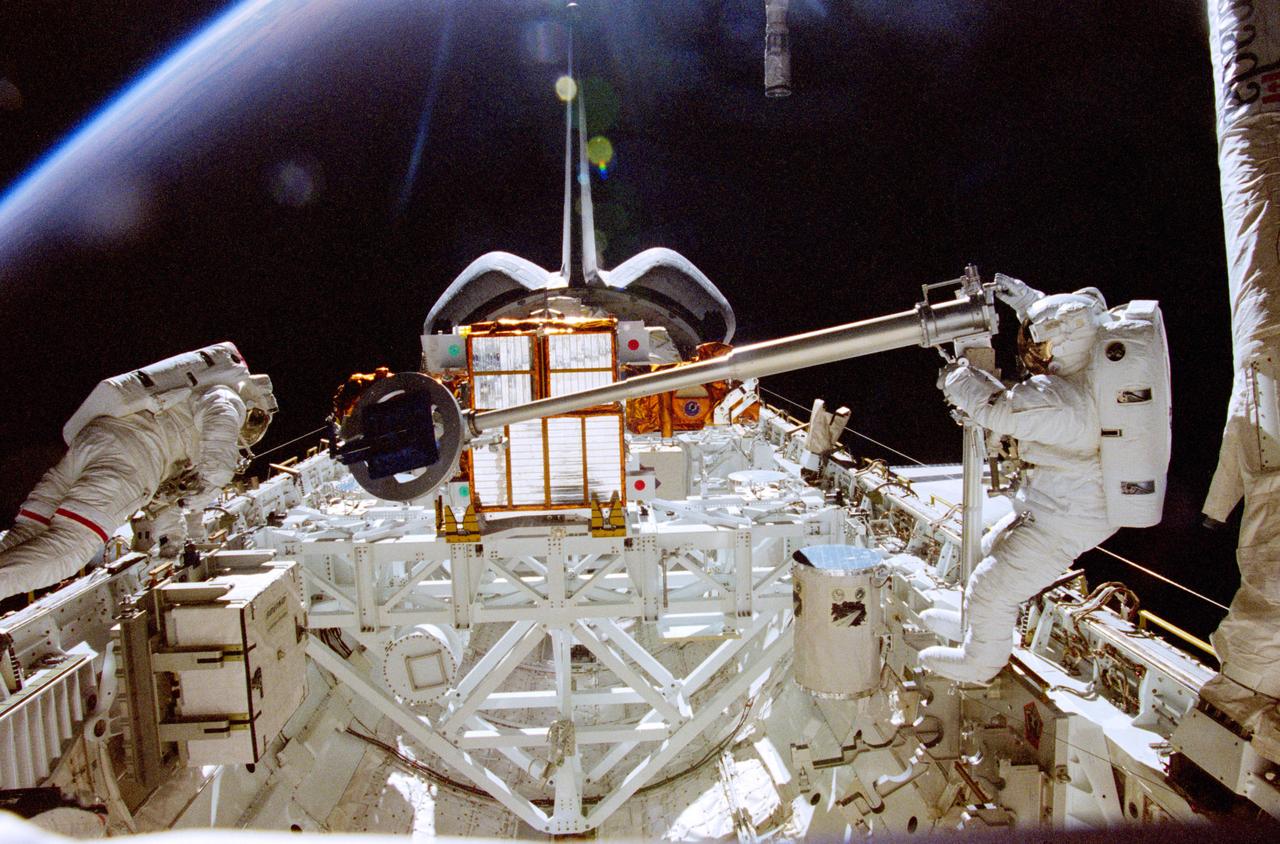
STS087-341-036 (3 Dec. 1997) --- Backdropped against a dark Earth and a light blue horizon, astronaut Takao Doi (right), international mission specialist representing Japan's National Space Development Agency (NASDA), works with a crane while astronaut Winston E. Scott looks on. This second extravehicular activity (EVA) of the mission continued the evaluation of techniques and hardware to be used in constructing the International Space Station (ISS). Near Scott can be seen the representation of a small Orbital Replacement Unit (ORU) in the grasp of the 156-pound crane operated by Doi. A similar crane could be used to transport various sized ORU’s from translation carts on the exterior of the ISS to various worksites on the truss structure. This view was captured, on 35mm film, by a crew mate in the shirt sleeve environment of the Space Shuttle Columbia's cabin. The SPARTAN-201 satellite is in its stowed position at frame center.
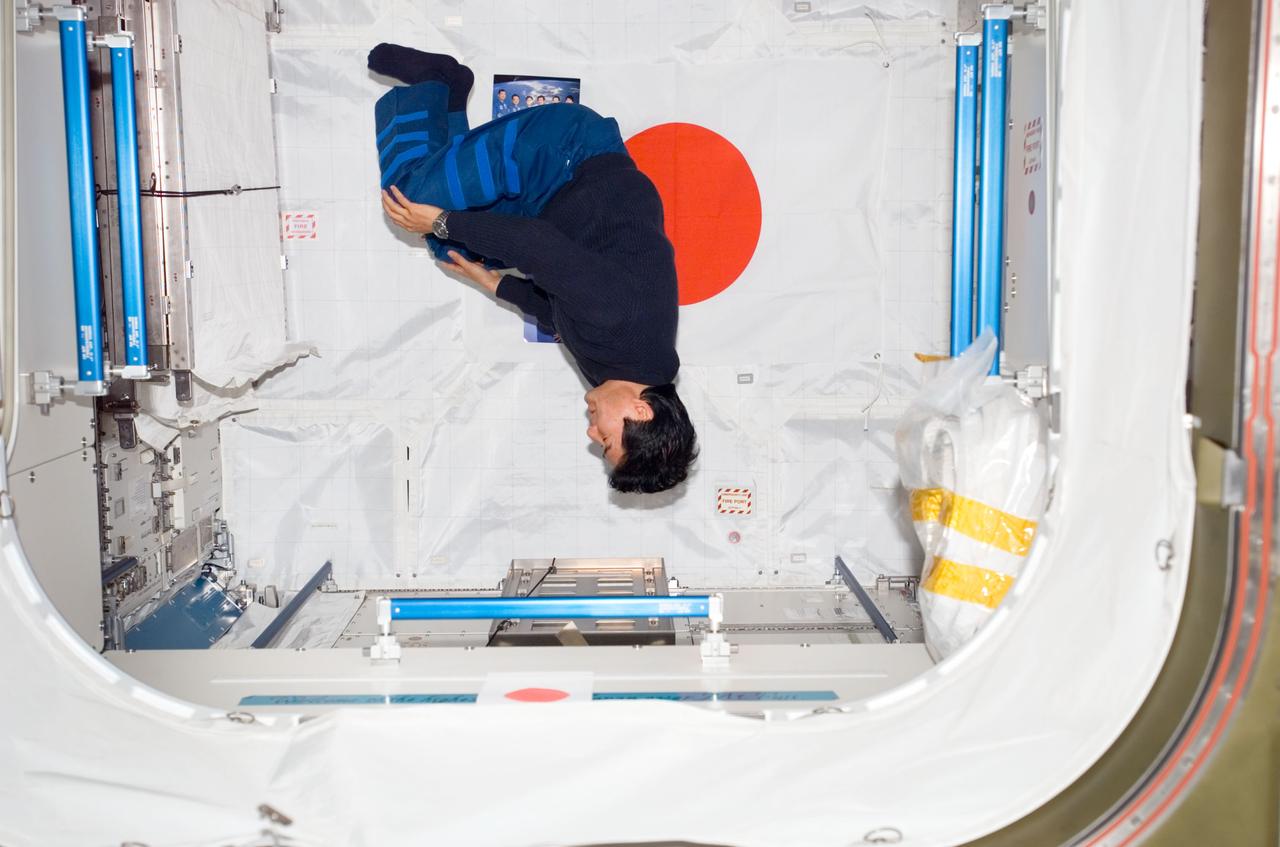
S123-E-007352 (19 March 2008) --- Japan Aerospace Exploration Agency (JAXA) astronaut Takao Doi, STS-123 mission specialist, floats in the newly installed Japanese Logistics Module - Pressurized Section (JLP) of the International Space Station while Space Shuttle Endeavour is docked with the station. The JLP is the first pressurized component of the Japan Aerospace Exploration Agency's Kibo laboratory and the newest component of the station.
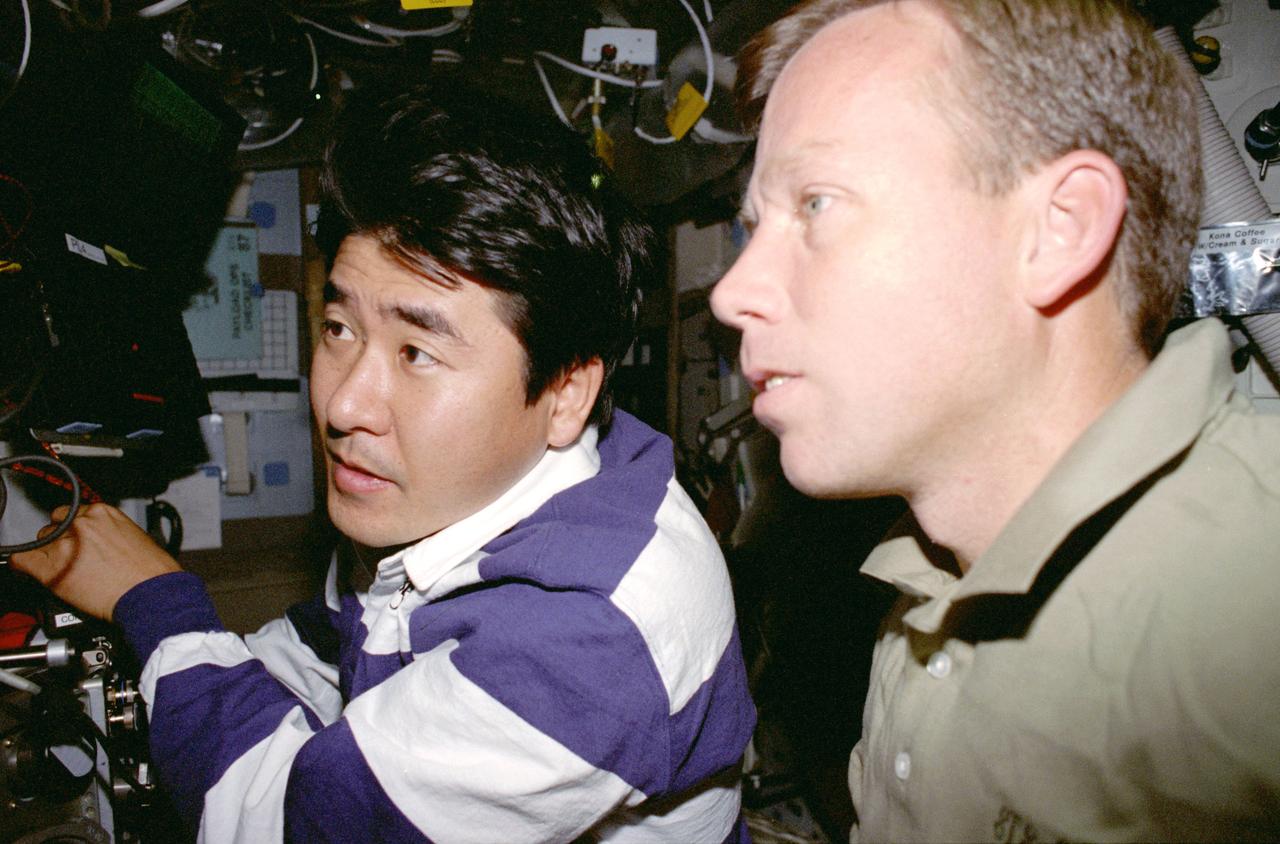
STS087-330-009 (19 November – 5 December 1997) --- Astronauts Takao Doi (left) and Steven W. Lindsey check out the Enclosed Laminar Flames (ELF) experiment on the mid-deck of the Earth-orbiting Space Shuttle Columbia. ELF has been designed to examine the effect of different air flow velocities on the stability of laminar (non-turbulent) flames. Enclosed laminar flames are commonly found in combustion systems such as power plant and gas turbine combustors, and jet engine afterburners. It is hoped that results of this investigation may help to optimize the performance of industrial combustors, including pollutant emissions and heat transfer. The microgravity environment of space makes a perfect setting for a laboratory involving combustion, an activity that creates convection in normal gravity. In microgravity, scientists can study subtle processes ordinarily masked by the effects of gravity. Doi is an international mission specialist representing Japan's National Space Development Agency (NASDA) and Lindsey is the pilot. Both are alumni of NASA's 1995 class of Astronaut Candidates (ASCAN).
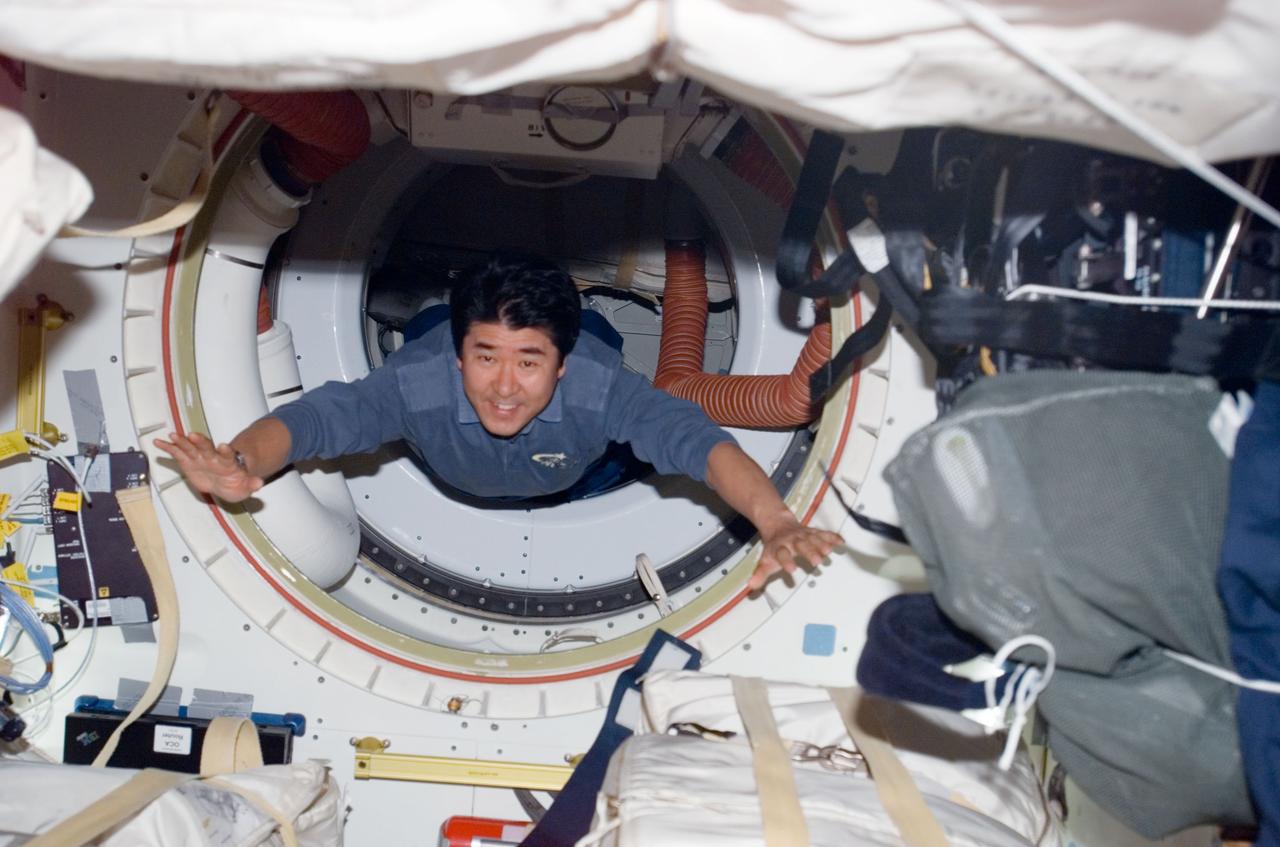
S123-E-009791 (24 March 2008) --- Japan Aerospace Exploration Agency (JAXA) astronaut Takao Doi, STS-123 mission specialist, floats through a hatch on Space Shuttle Endeavour while docked with the International Space Station.
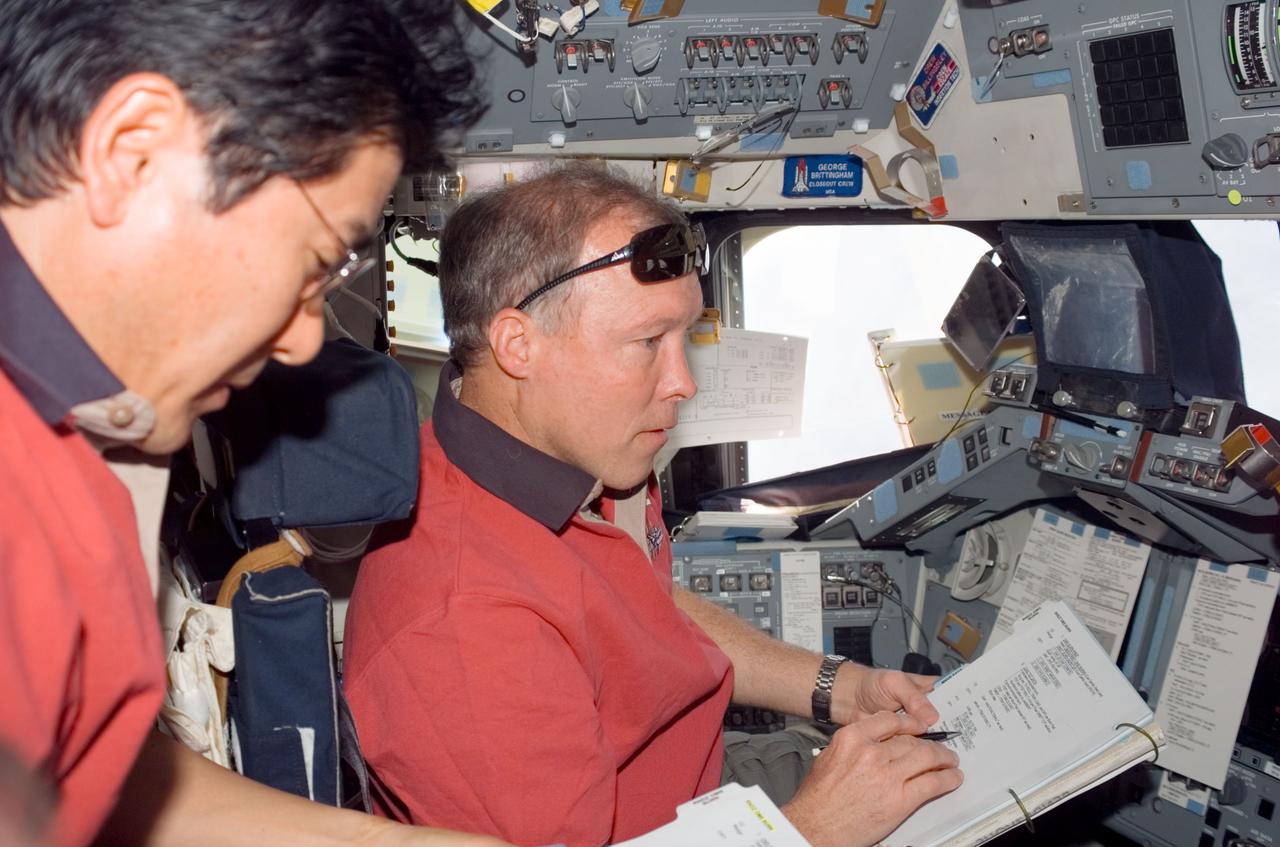
S123-E-006512 (13 March 2008) --- NASA astronaut Dominic Gorie (right), STS-123 commander, and Japan Aerospace Exploration Agency (JAXA) astronaut Takao Doi, mission specialist, look over checklists on the flight deck of Space Shuttle Endeavour while docked with the International Space Station.
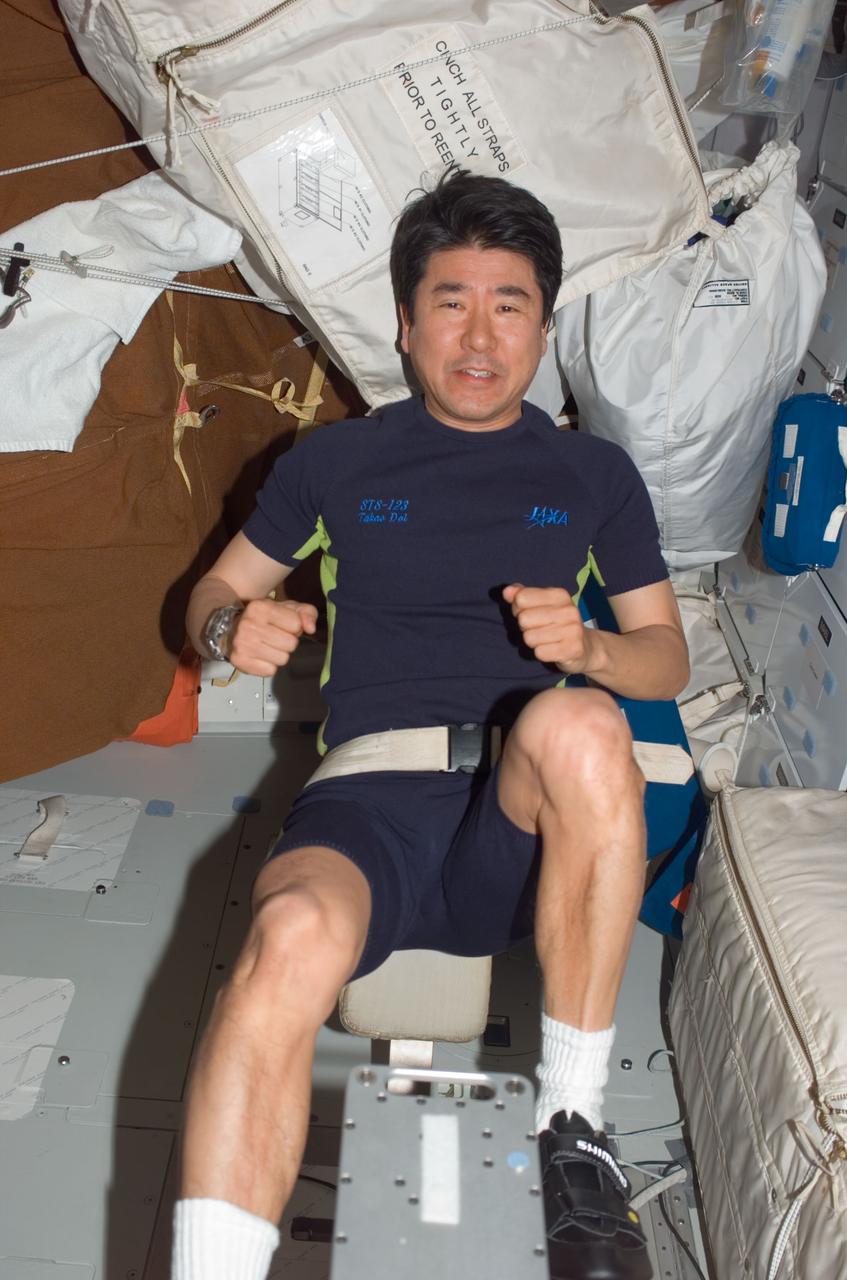
S123-E-006703 (16 March 2008) --- Japan Aerospace Exploration Agency (JAXA) astronaut Takao Doi, STS-123 mission specialist, exercises on a bicycle ergometer on the middeck of the Space Shuttle Endeavour while docked with the International Space Station.
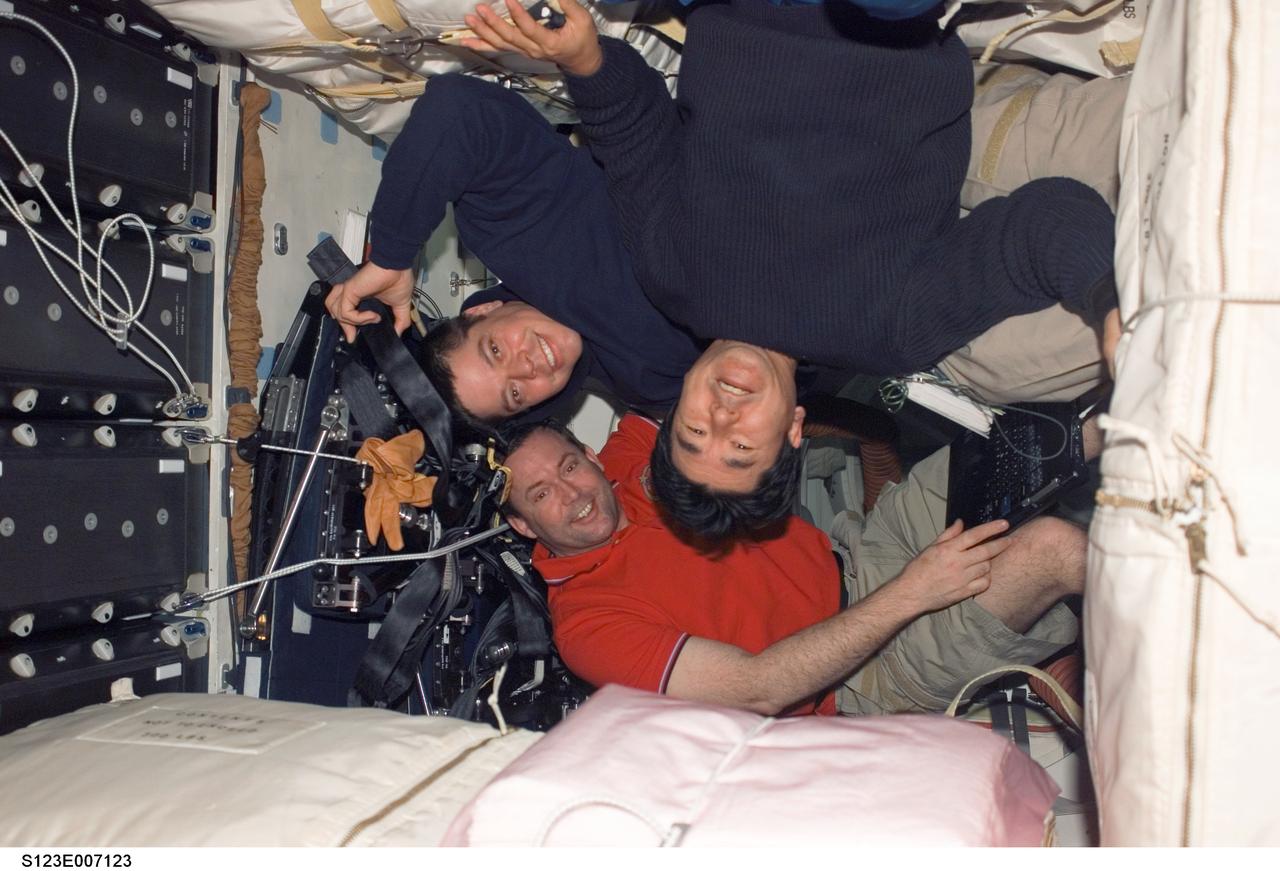
S123-E-007123 (18 March 2008) --- Japan Aerospace Exploration Agency (JAXA) astronaut Takao Doi (top right), NASA astronauts Robert L. Behnken (top left) and Mike Foreman, all STS-123 mission specialists, are pictured on the middeck of Space Shuttle Endeavour while docked with the International Space Station.
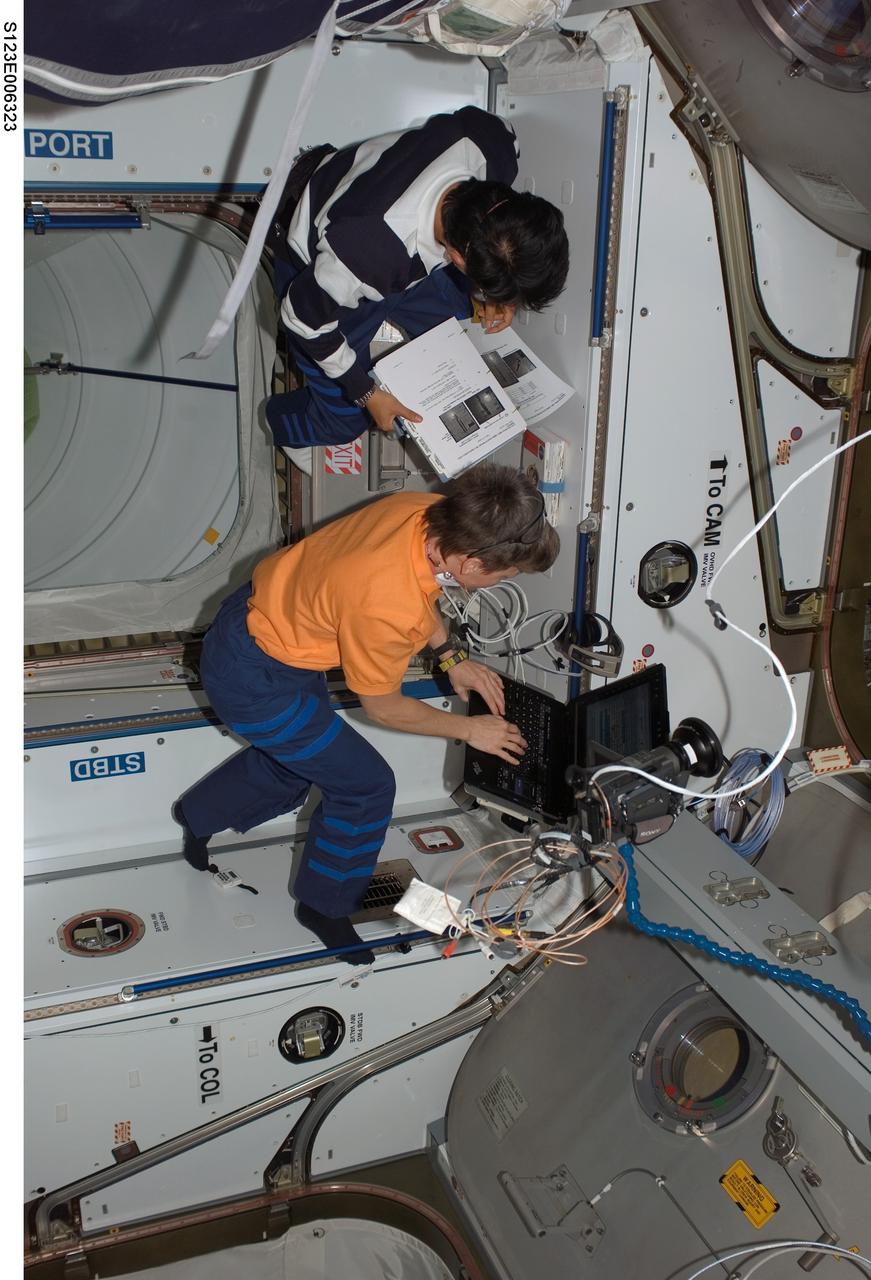
S123-E-006323 (15 March 2008) --- A high angle view shows astronaut Peggy Whitson, Expedition 16 commander, and Japan Aerospace Exploration Agency (JAXA) astronaut Takao Doi, STS-123 mission specialist, as they work aboard the Node 2, Harmony, on the International Space Station. Nine astronauts and one cosmonaut will spend over a week joining forces to perform a variety of chores on the orbital outpost.
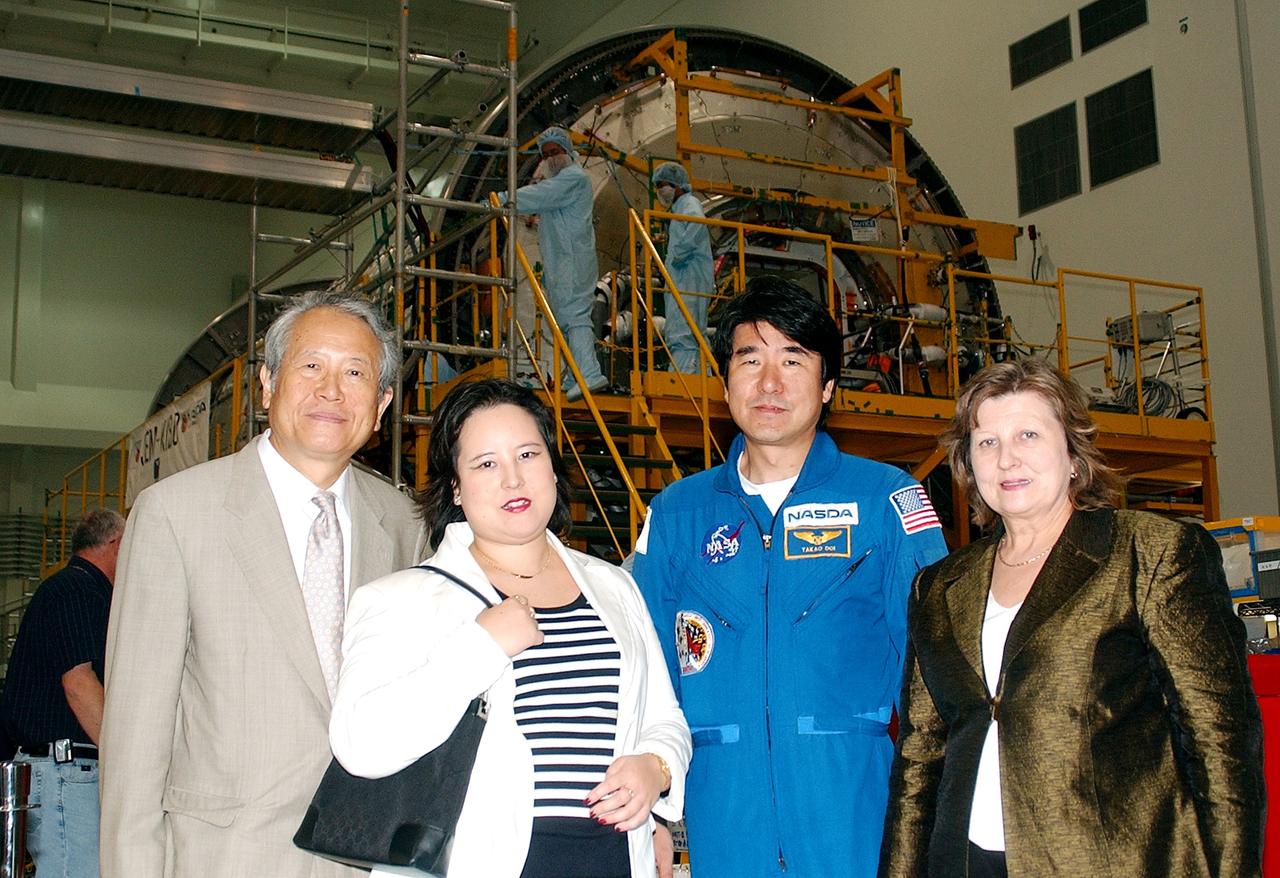
KENNEDY SPACE CENTER, FLA. - From left, the Consul General of Japan Ko Kodaira, his daughter Reiko, astronaut Dr. Takao Doi, and Kodaira's wife Marie pause for a photograph in the Space Station Processing Facility during their visit to Kennedy Space Center (KSC). Doi represented Japan on Space Shuttle mission STS-87, the fourth U.S Microgravity Payload flight. Kodaira is touring the facilities at KSC at the invitation of the local office of the National Space Development Agency of Japan (NASDA) to acquaint him with KSC's unique processing capabilities.
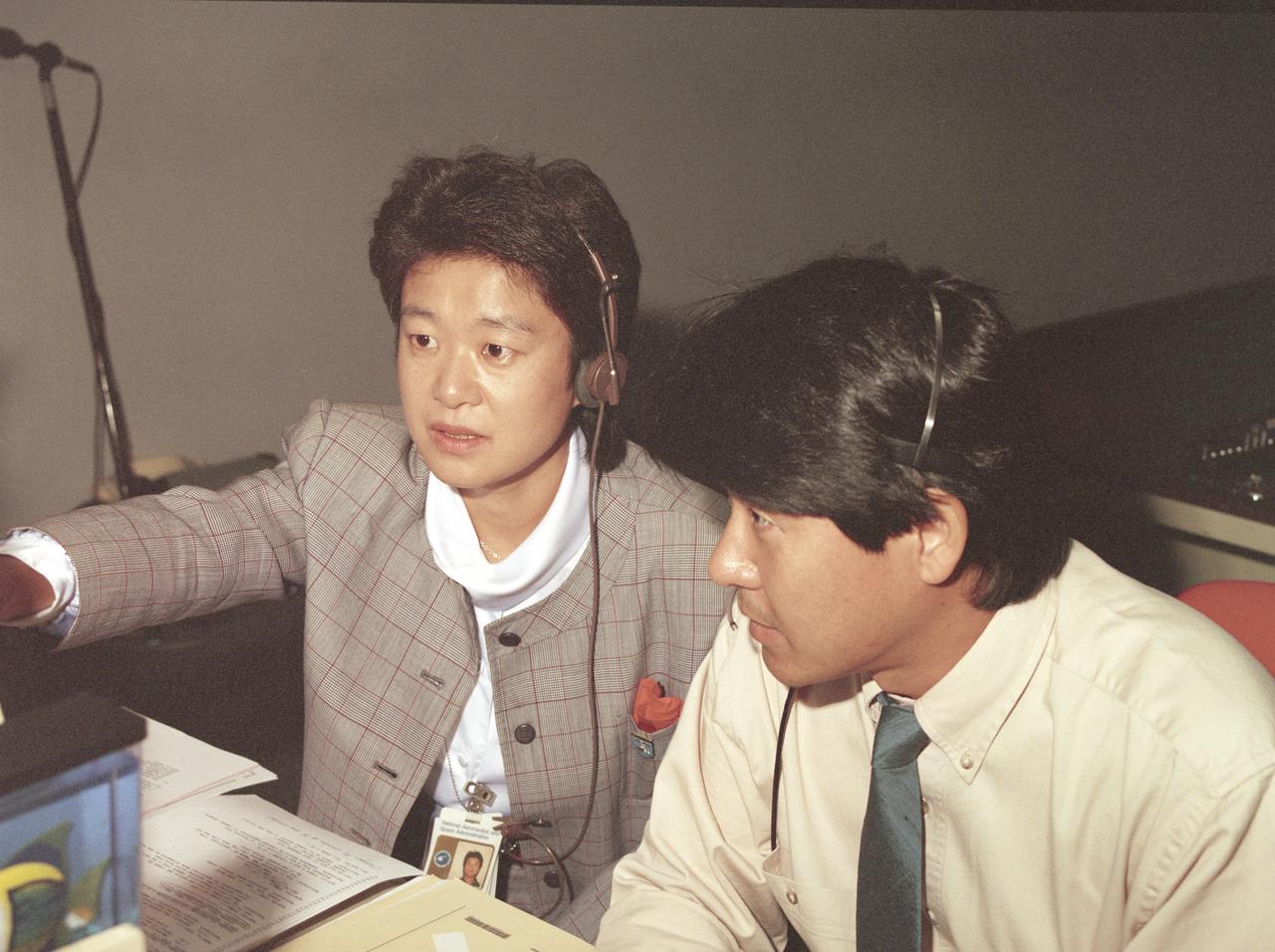
The science laboratory, Spacelab-J (SL-J), flown aboard the STS-47 flight was a joint venture between NASA and the National Space Development Agency of Japan (NASDA) utilizing a manned Spacelab module. The mission conducted 24 materials science and 20 life science experiments, of which 35 were sponsored by NASDA, 7 by NASA, and two collaborative efforts. Materials science investigations covered such fields as biotechnology, electronic materials, fluid dynamics and transport phenomena, glasses and ceramics, metals and alloys, and acceleration measurements. Life sciences included experiments on human health, cell separation and biology, developmental biology, animal and human physiology and behavior, space radiation, and biological rhythms. Test subjects included the crew, Japanese koi fish (carp), cultured animal and plant cells, chicken embryos, fruit flies, fungi and plant seeds, and frogs and frog eggs. Pictured in the Huntsville Operations Support Center (HOSC) Spacelab Payload Operations Control Center (SL POCC) of Marshall Space Flight Center (MSFC) are NASDA alternate payload specialists Dr. Doi and Dr. Mukai.
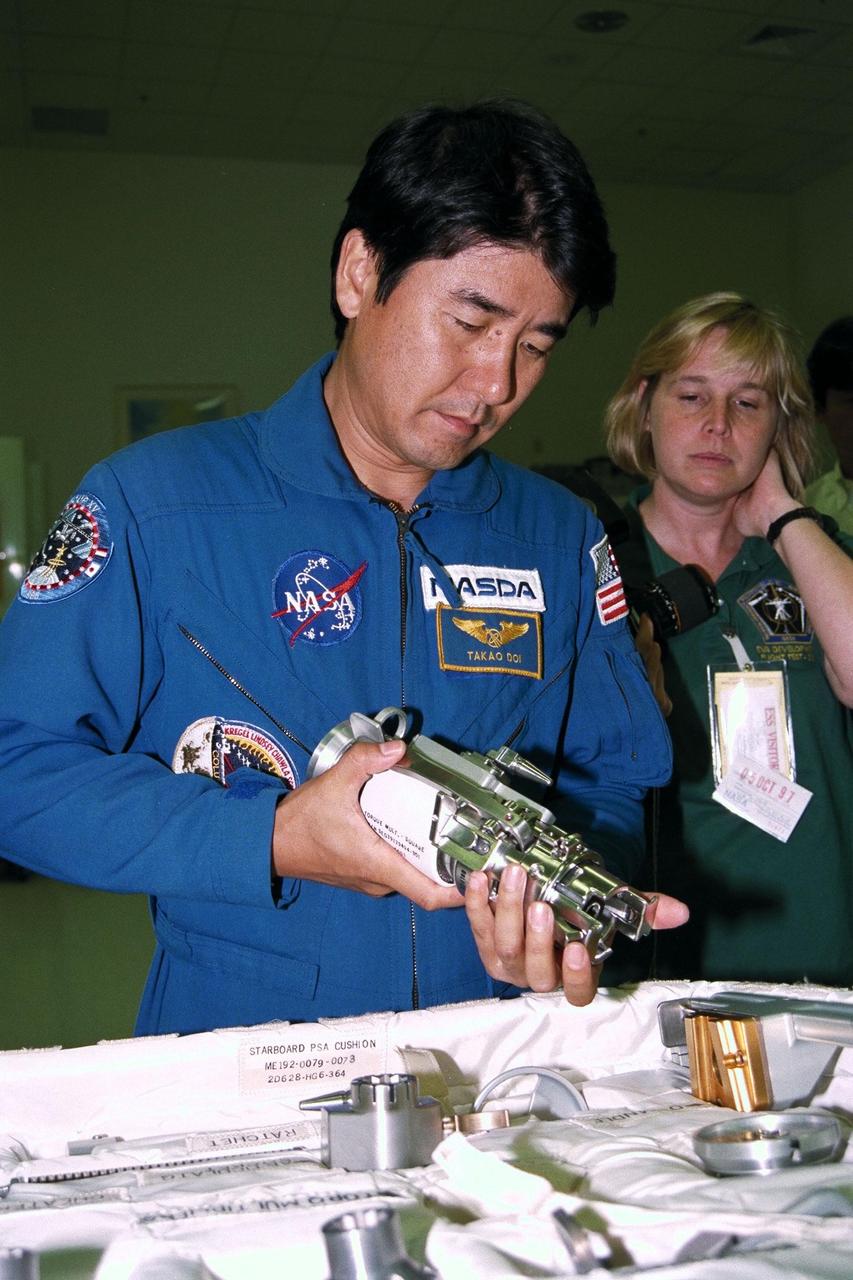
STS-87 Mission Specialist Takao Doi , Ph.D., of the National Space Development Agency of Japan, participates in the Crew Equipment Integration Test (CEIT) in Kennedy Space Center’s (KSC's) Vertical Processing Facility. Glenda Laws, the extravehicular activity (EVA) coordinator, Johnson Space Center, stands behind Dr. Doi. The CEIT gives astronauts an opportunity to get a hands-on look at the payloads with which they will be working on-orbit. STS-87 will be the fourth United States Microgravity Payload and flight of the Spartan-201 deployable satellite. During the mission, Dr. Doi will be the first Japanese astronaut to perform a spacewalk. STS-87 is scheduled for a Nov. 19 liftoff from KSC
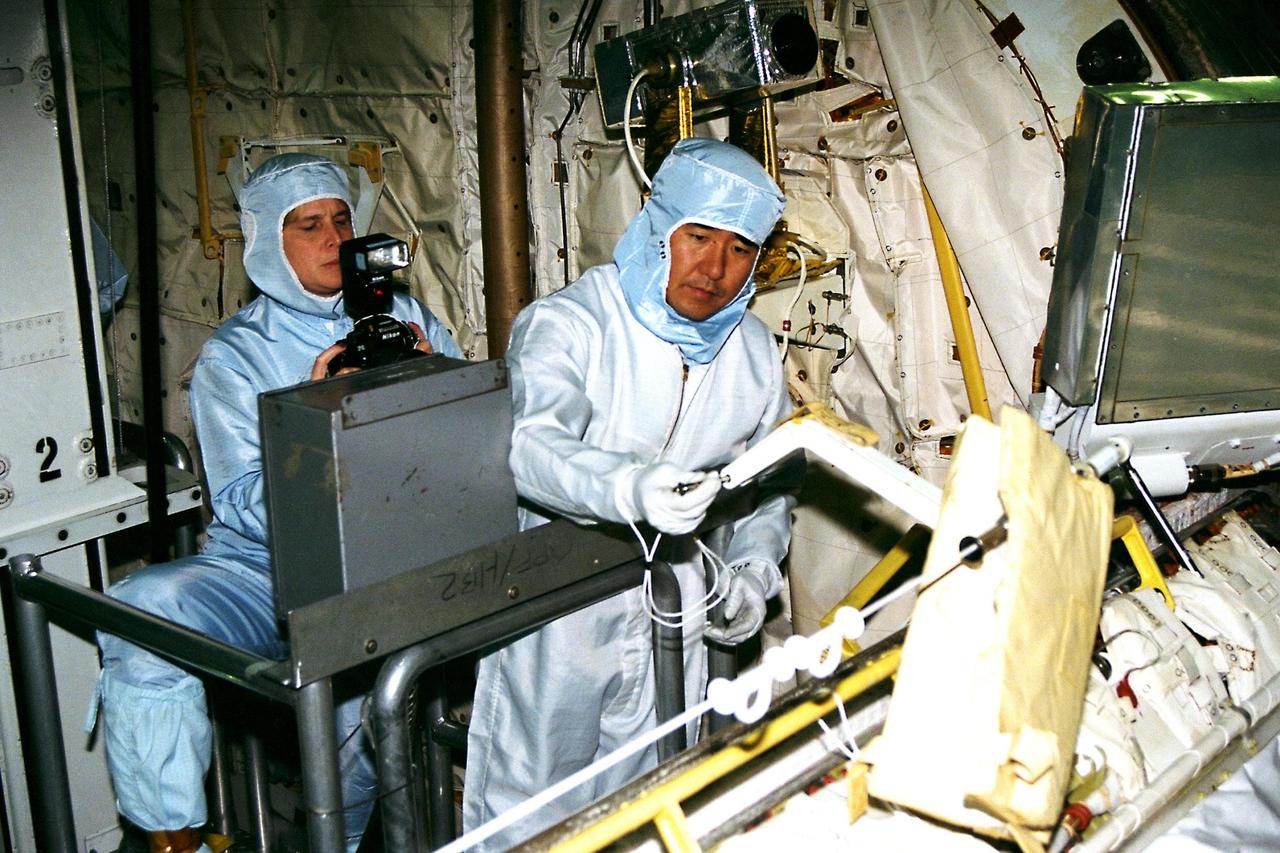
STS-87 Mission Specialist Takao Doi , Ph.D., of the National Space Development Agency of Japan, participates in the Crew Equipment Integration Test (CEIT) at Kennedy Space Center (KSC). Glenda Laws, the extravehicular activity (EVA) coordinator, Johnson Space Center, stands behind Dr. Doi. The CEIT gives astronauts an opportunity to get a hands-on look at the payloads with which they will be working on-orbit. STS-87 will be the fourth United States Microgravity Payload and flight of the Spartan-201 deployable satellite. During the mission, Dr. Doi will be the first Japanese astronaut to perform a spacewalk. STS-87 is scheduled for a Nov. 19 liftoff from KSC
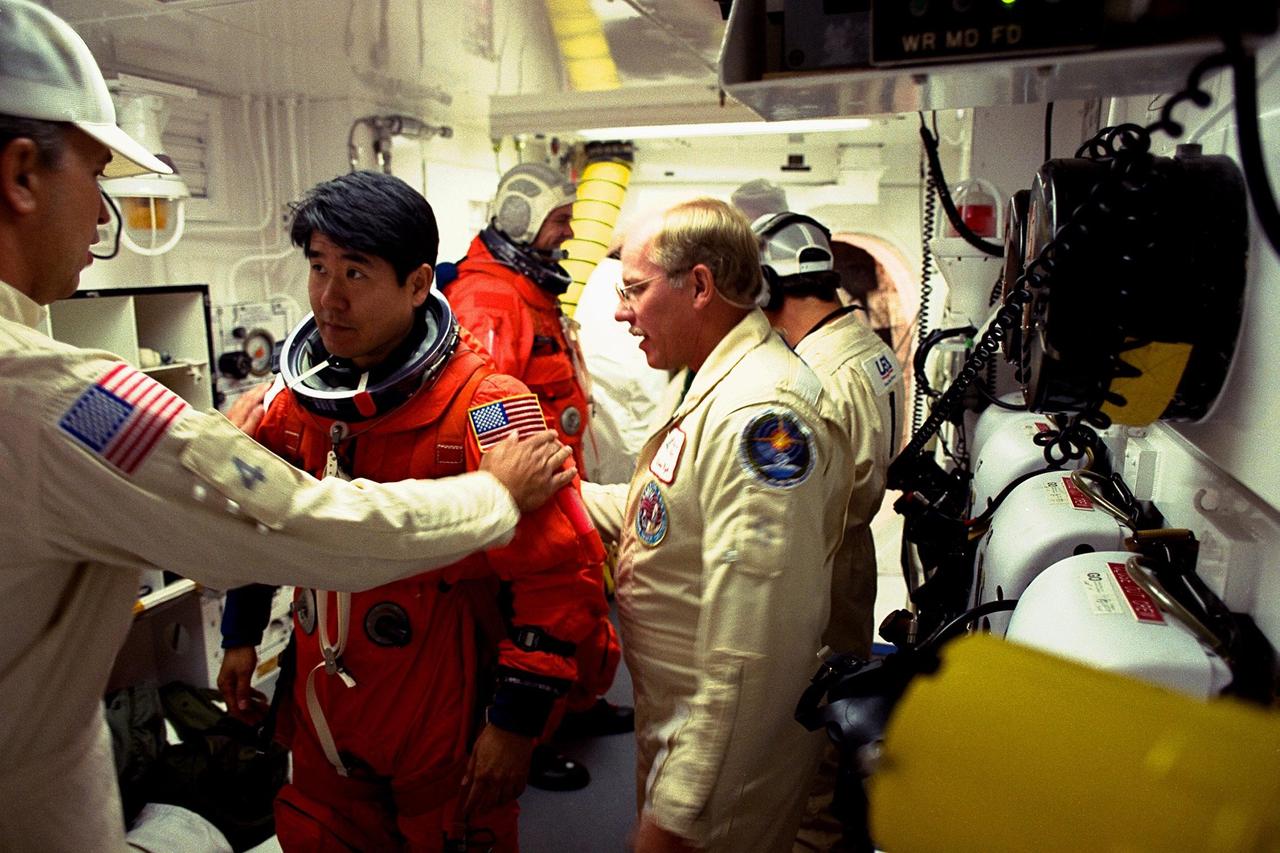
STS-87 Mission Specialist Takao Doi, Ph.D., of the National Space Development Agency of Japan, is assisted with his ascent and re-entry flight suit by Dave Law, USA mechanical technician, in the white room at Launch Pad 39B as Dr. Doi prepares to enter the Space Shuttle orbiter Columbia on launch day. At right wearing glasses is Danny Wyatt, NASA quality assurance specialist. STS-87 is the fourth flight of the United States Microgravity Payload and Spartan-201. The 16-day mission will include a spacewalk by Dr. Doi and Mission Specialist Winston Scott
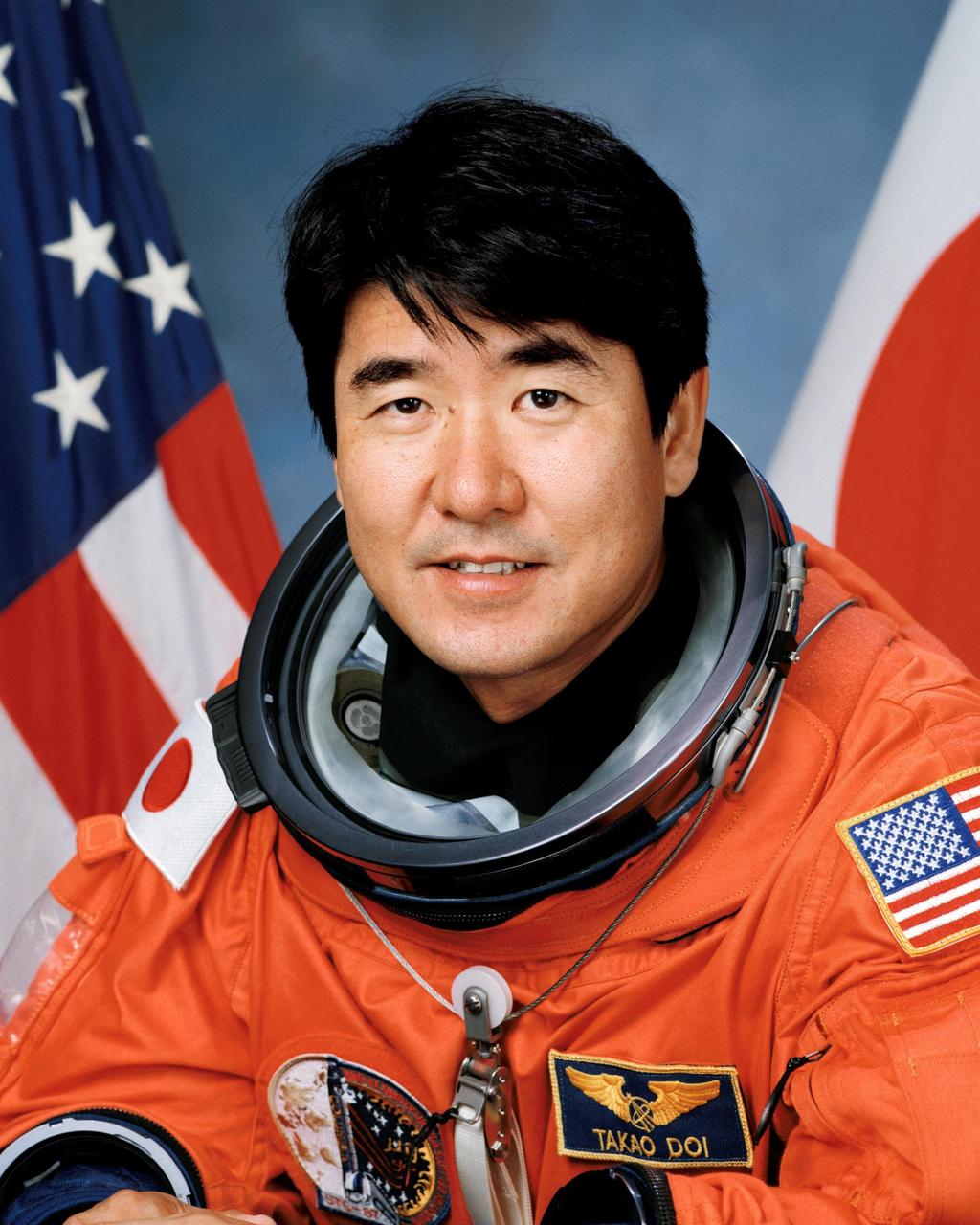
JOHNSON SPACE CENTER, HOUSTON -- S97-12563-- Astronaut Takao Doi, representing Japan Aerospace Exploration Agency (JAXA).
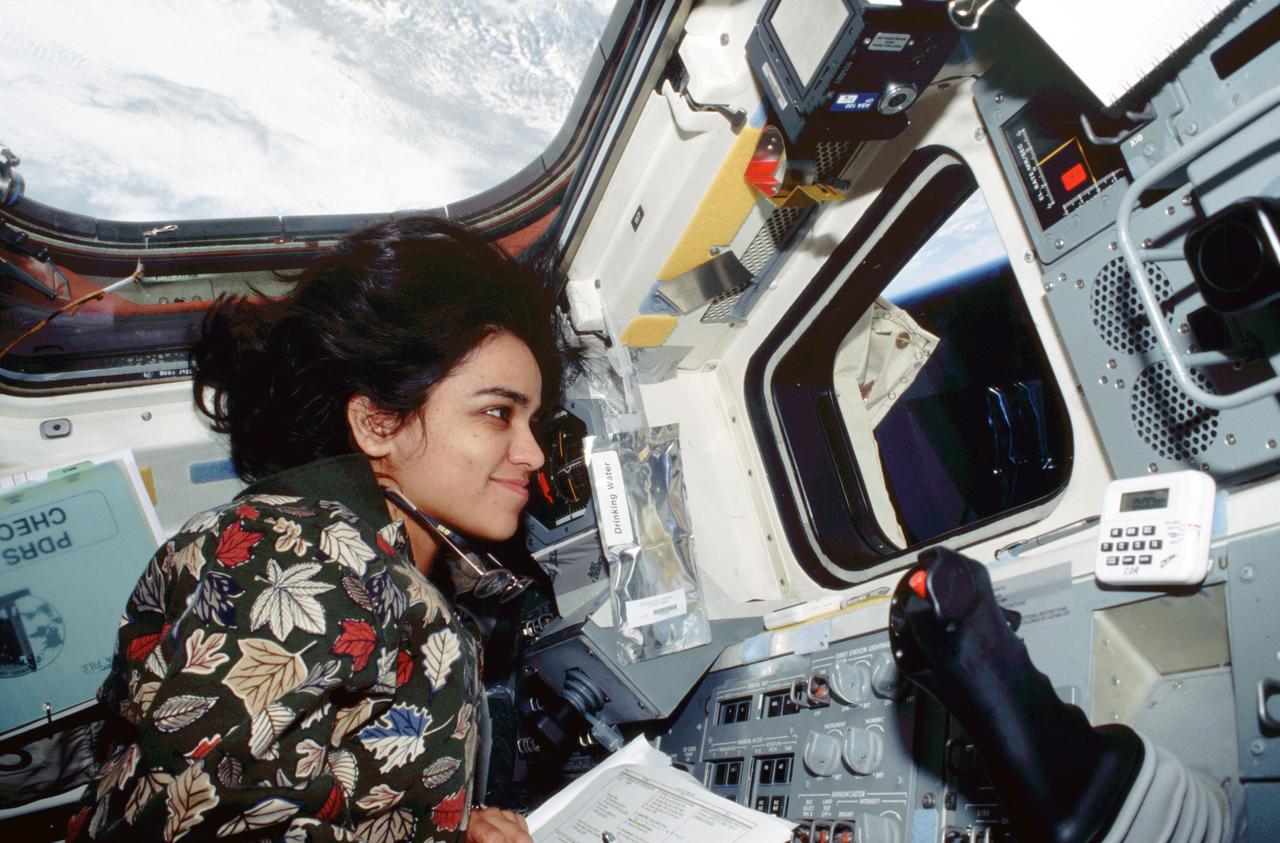
STS087-308-023 (19 November – 5 December 1997) --- Astronaut Kalpana Chawla, mission specialist, monitors the Extravehicular Activity (EVA) of fellow astronauts Winston E. Scott and Takao Doi from her temporary station on the Space Shuttle Columbia’s aft flight deck. Chawla controlled Columbia's Remote Manipulator System (RMS) at this station. Chawla (from her in-cabin post), Doi and Scott shared duties in two separate sessions of EVA during the 16-day United States Microgravity Payload (USMP) mission.
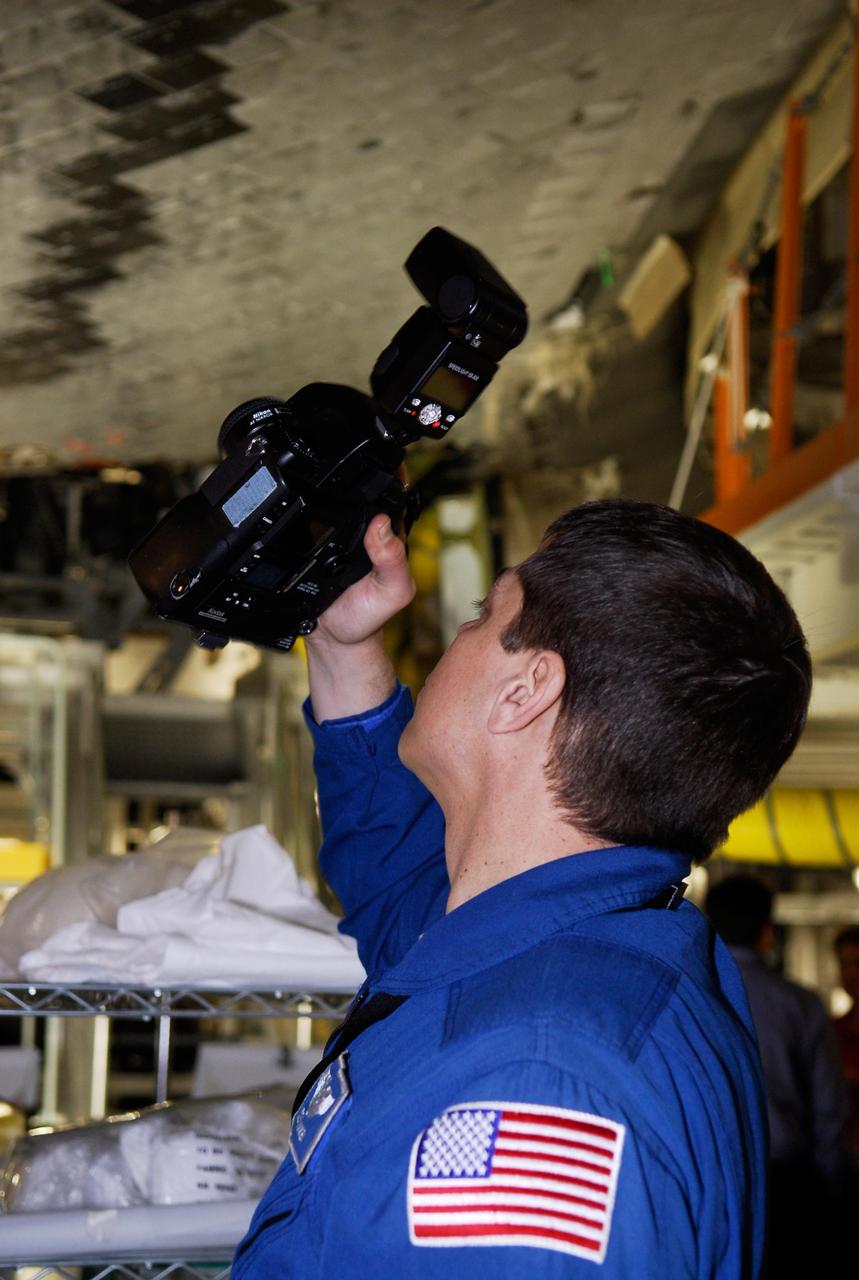
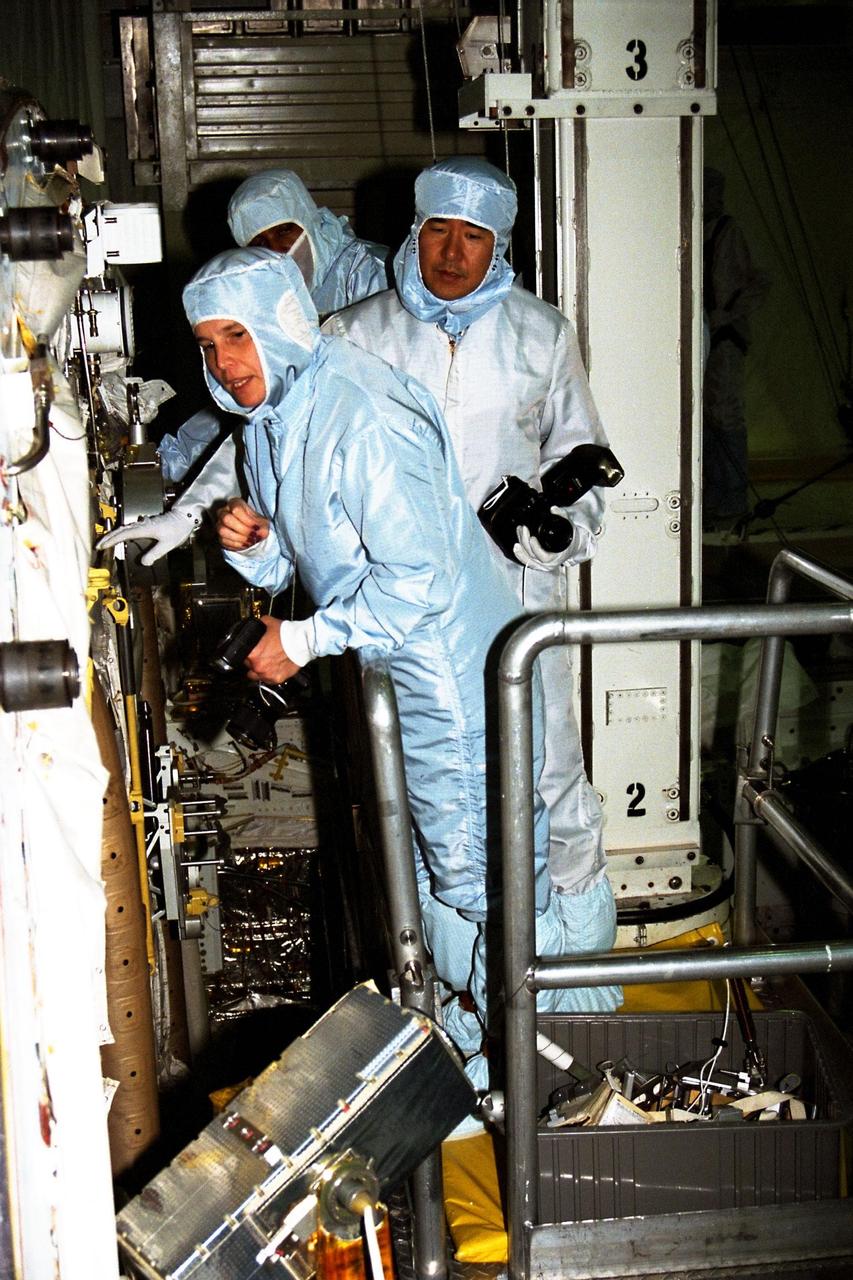
KENNEDY SPACE CENTER, FLA. -- In the Orbiter Processing Facility, STS-123 Mission Specialist Takao Doi tries out one of the cameras that will be used on the mission. Doi represents the Japanese Aerospace and Exploration Agency. He and other crew members are at NASA's Kennedy Space Center for a crew equipment interface test, a process of familiarization with payloads, hardware and the space shuttle. The STS-123 mission is targeted for launch on space shuttle Endeavour on Feb. 14. It will be the 25th assembly flight of the station. Photo credit: NASA/Kim Shiflett
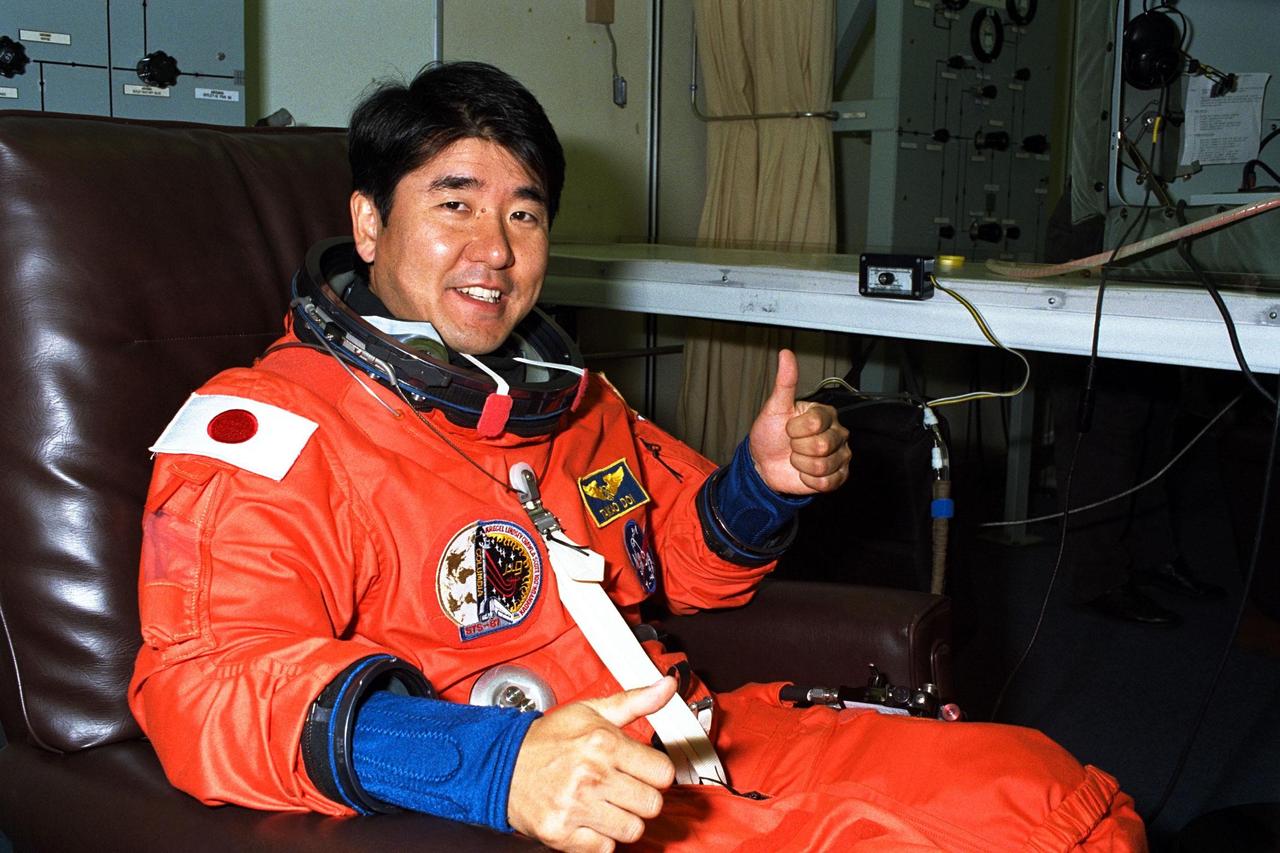
STS-87 Mission Specialist Takao Doi, Ph.D., of the National Space Development Agency of Japan, gives a ‘thumbs up’ in his launch and entry suit in the Operations and Checkout Building. He and the five other crew members will depart shortly for Launch Pad 39B, where the Space Shuttle Columbia awaits liftoff on a 16-day mission to perform microgravity and solar research. Dr. Doi is scheduled to perform an extravehicular activity spacewalk with Mission Specialist Winston Scott during STS-87
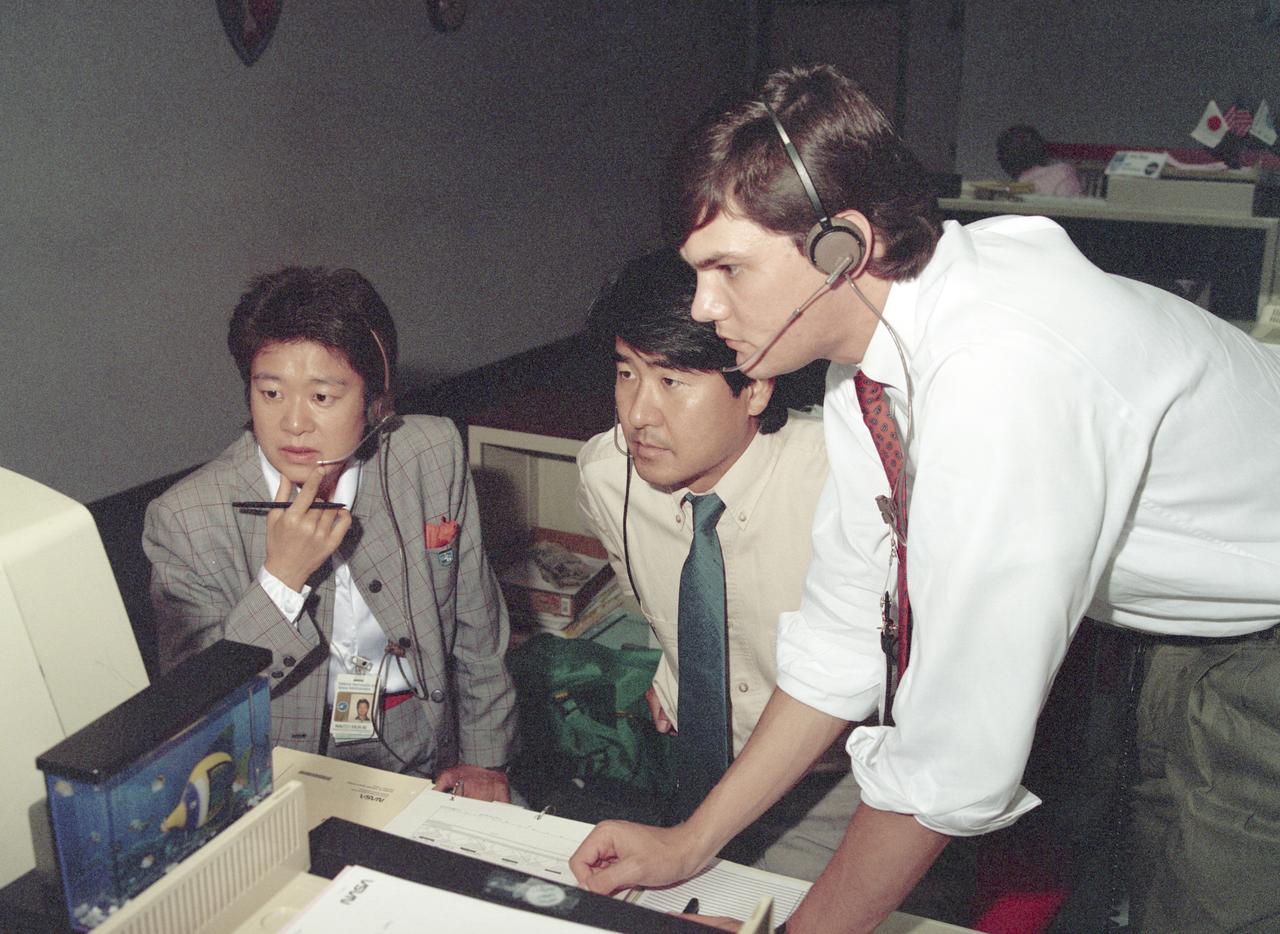
The science laboratory, Spacelab-J (SL-J), flown aboard the STS-47 flight was a joint venture between NASA and the National Space Development Agency of Japan (NASDA) utilizing a manned Spacelab module. The mission conducted 24 materials science and 20 life science experiments, of which 35 were sponsored by NASDA, 7 by NASA, and two collaborative efforts. Materials science investigations covered such fields as biotechnology, electronic materials, fluid dynamics and transport phenomena, glasses and ceramics, metals and alloys, and acceleration measurements. Life sciences included experiments on human health, cell separation and biology, developmental biology, animal and human physiology and behavior, space radiation, and biological rhythms. Test subjects included the crew, Japanese koi fish (carp), cultured animal and plant cells, chicken embryos, fruit flies, fungi and plant seeds, and frogs and frog eggs. Pictured along with George Norris in the Huntsville Operations Support Center (HOSC) Spacelab Payload Operations Control Center (SL POCC) at Marshall Space Flight Center (MSFC) are NASDA alternate payload specialists Dr. Doi and Dr. Mukai.
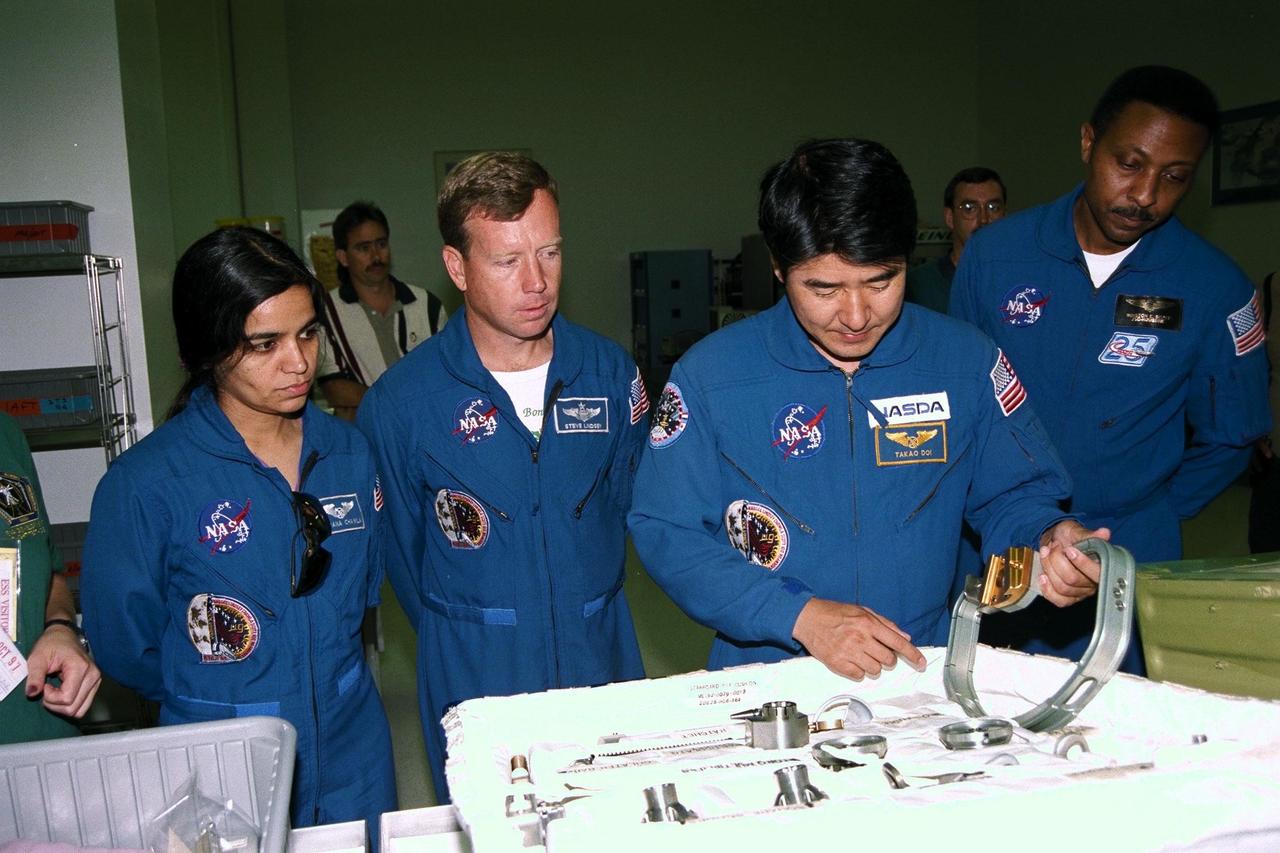
STS-87 astronaut crew members participate in the Crew Equipment Integration Test (CEIT) in Kennedy Space Center’s (KSC's) Vertical Processing Facility. From left are Mission Specialist Kalpana Chawla, Ph.D.; Pilot Steven Lindsey; Mission Specialist Takao Doi , Ph.D., of the National Space Development Agency of Japan; and Mission Specialist Winston Scott. The CEIT gives astronauts an opportunity to get a hands-on look at the payloads with which they will be working onorbit. STS-87 will be the fourth United States Microgravity Payload and flight of the Spartan-201 deployable satellite. During the STS-87 mission, scheduled for a Nov. 19 liftoff from KSC, Dr. Doi and Scott will both perform spacewalks
Participating in the Crew Equipment Integration Test (CEIT) at Kennedy Space Center are STS-87 crew members, assisted by Glenda Laws, extravehicular activity (EVA) coordinator, Johnson Space Center. Standing behind Laws are Takao Doi, Ph.D., of the National Space Development Agency of Japan, and Winston Scott, both mission specialists on STS-87. The STS-87 mission will be the fourth United States Microgravity Payload and flight of the Spartan-201 deployable satellite. During the mission, scheduled for a Nov. 19 liftoff from KSC, Dr. Doi and Scott will both perform spacewalks
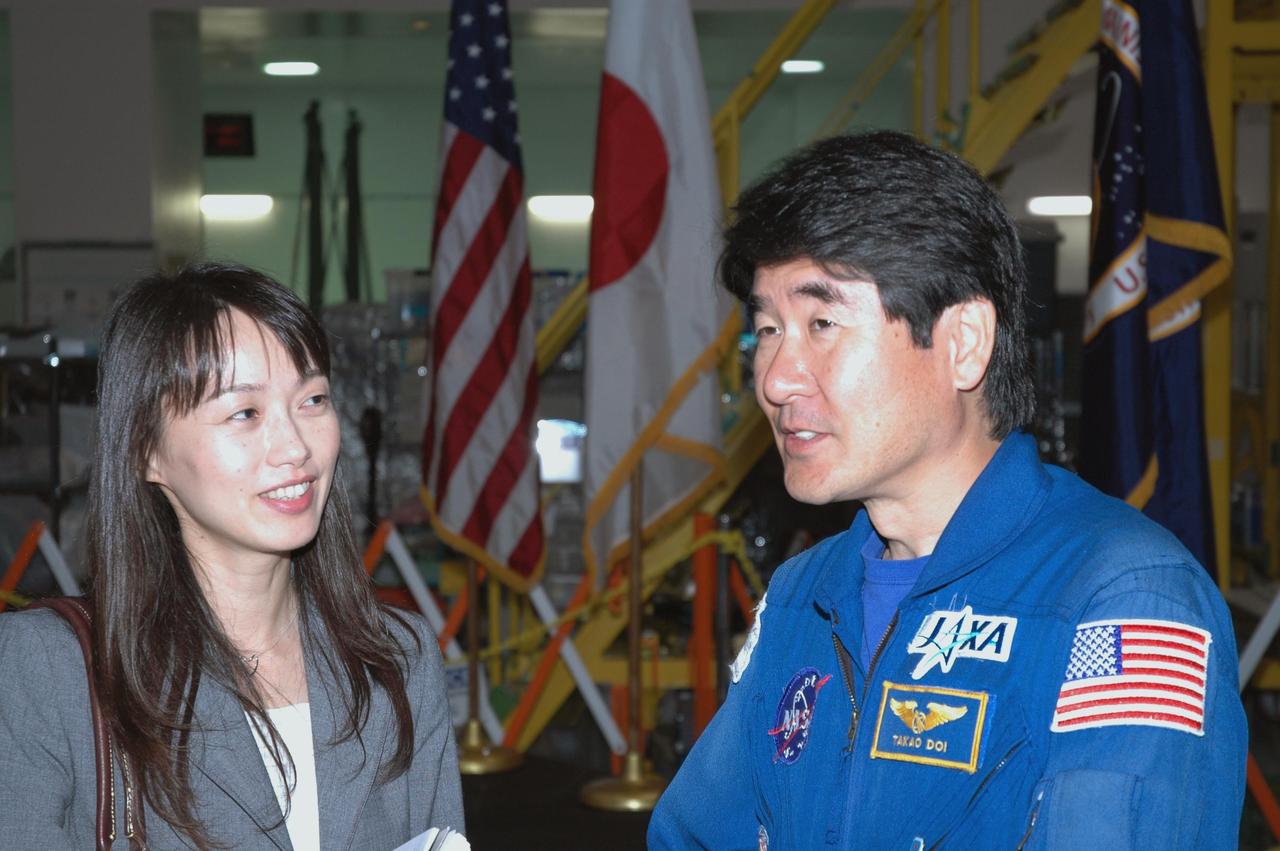
KENNEDY SPACE CENTER, FLA. -- After a welcoming ceremony for the Experiment Logistics Module Pressurized Section of the Japanese Experiment Module, astronaut Takao Doi (right) talks with Kumiko Tanabe, a public affairs representative of the Japanese Aerospace and Exploration Agency. The logistics module will be delivered to the space station on mission STS-123. Doi is a crew member on that mission.The module will serve as an on-orbit storage area for materials, tools and supplies. It can hold up to eight experiment racks and will attach to the top of another larger pressurized module. Photo credit: NASA/George Shelton
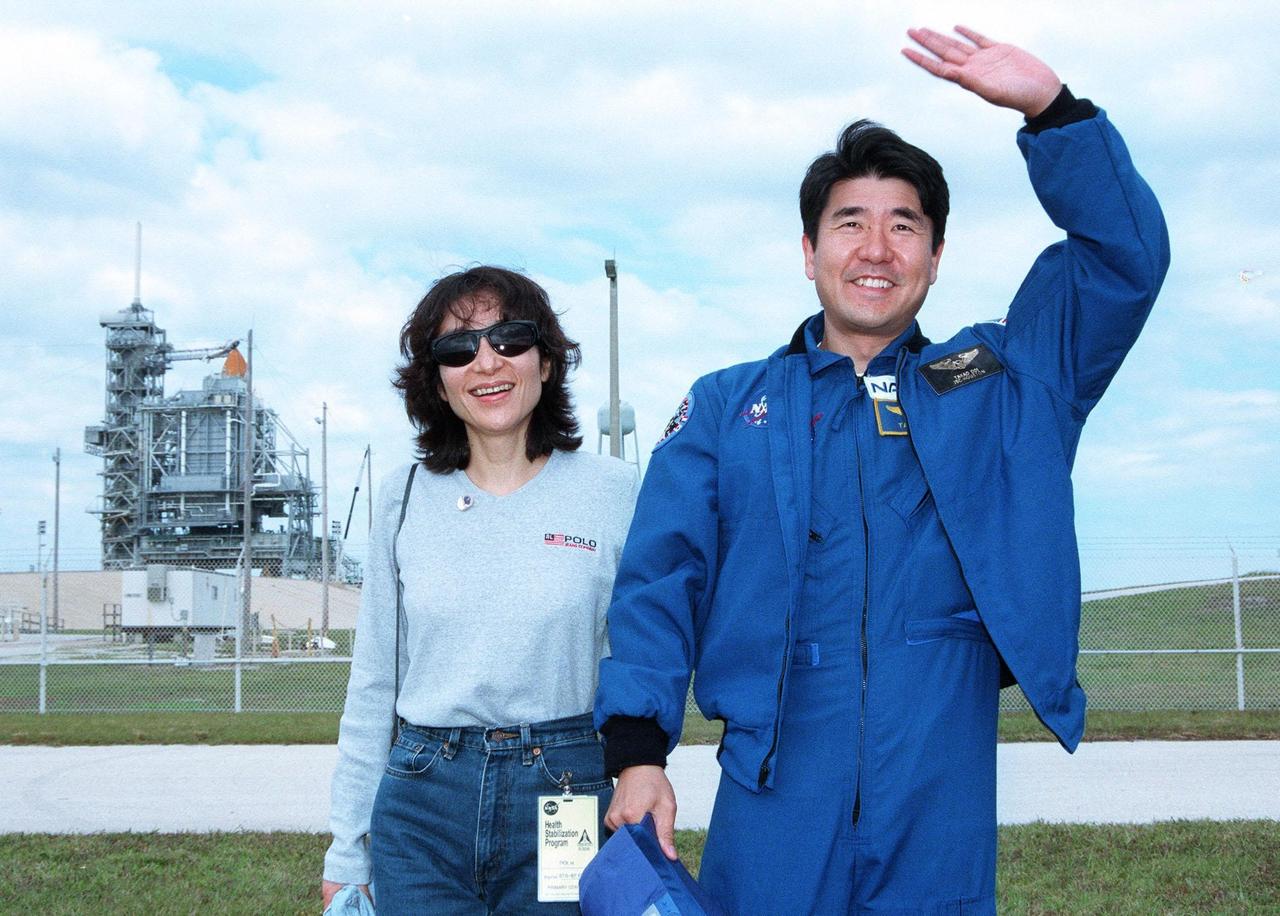
STS-87 Mission Specialist Takao Doi, Ph.D., of the National Space Development Agency of Japan poses with his wife, Hitomi Doi, in front of Kennedy Space Center's Launch Pad 39B during final prelaunch activities leading up to the scheduled Nov. 19 liftoff. The other STS-87 crew members are Commander Kevin Kregel; Pilot Steven Lindsey; Mission Specialists Kalpana Chawla, Ph.D., and Winston Scott; and Payload Specialist Leonid Kadenyuk of the National Space Agency of Ukraine. STS-87 will be the fourth flight of the United States Microgravity Payload and the Spartan-201 deployable satellite
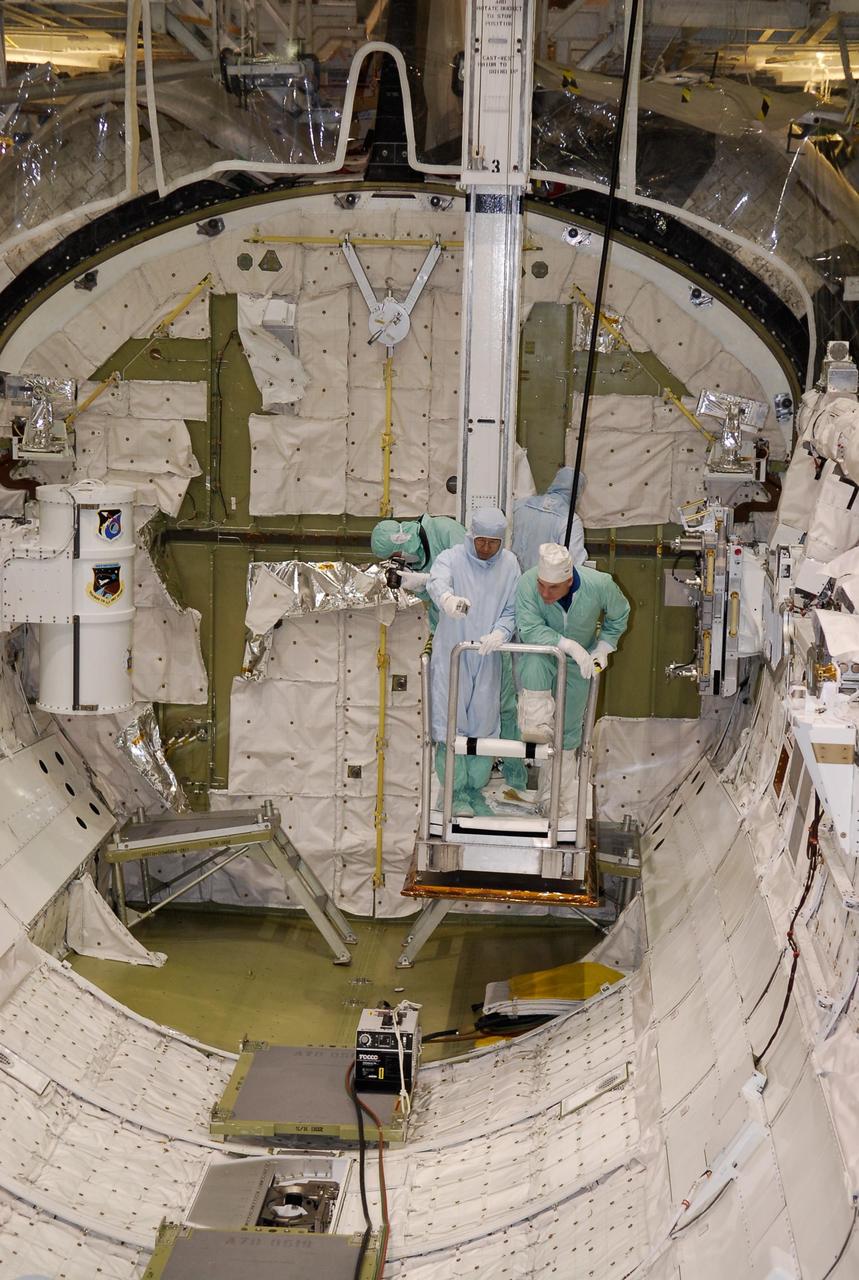
KENNEDY SPACE CENTER, FLA. -- In the Orbiter Processing Facility, STS-123 crew members are lowered into space shuttle Endeavour's payload bay to check out the equipment. At right is Mission Specialist Garrett Reisman; at left is Mission Specialist Takao Doi. The crew is at NASA's Kennedy Space Center for a crew equipment interface test, a process of familiarization with payloads, hardware and the space shuttle. Doi represents the Japanese Aerospace and Exploration Agency. Reisman will join the Expedition 16 crew on the International Space Station, replacing flight engineer Leopold Eyharts. The STS-123 mission is targeted for launch on space shuttle Endeavour on Feb. 14. It will be the 25th assembly flight of the station. Photo credit: NASA/Kim Shiflett
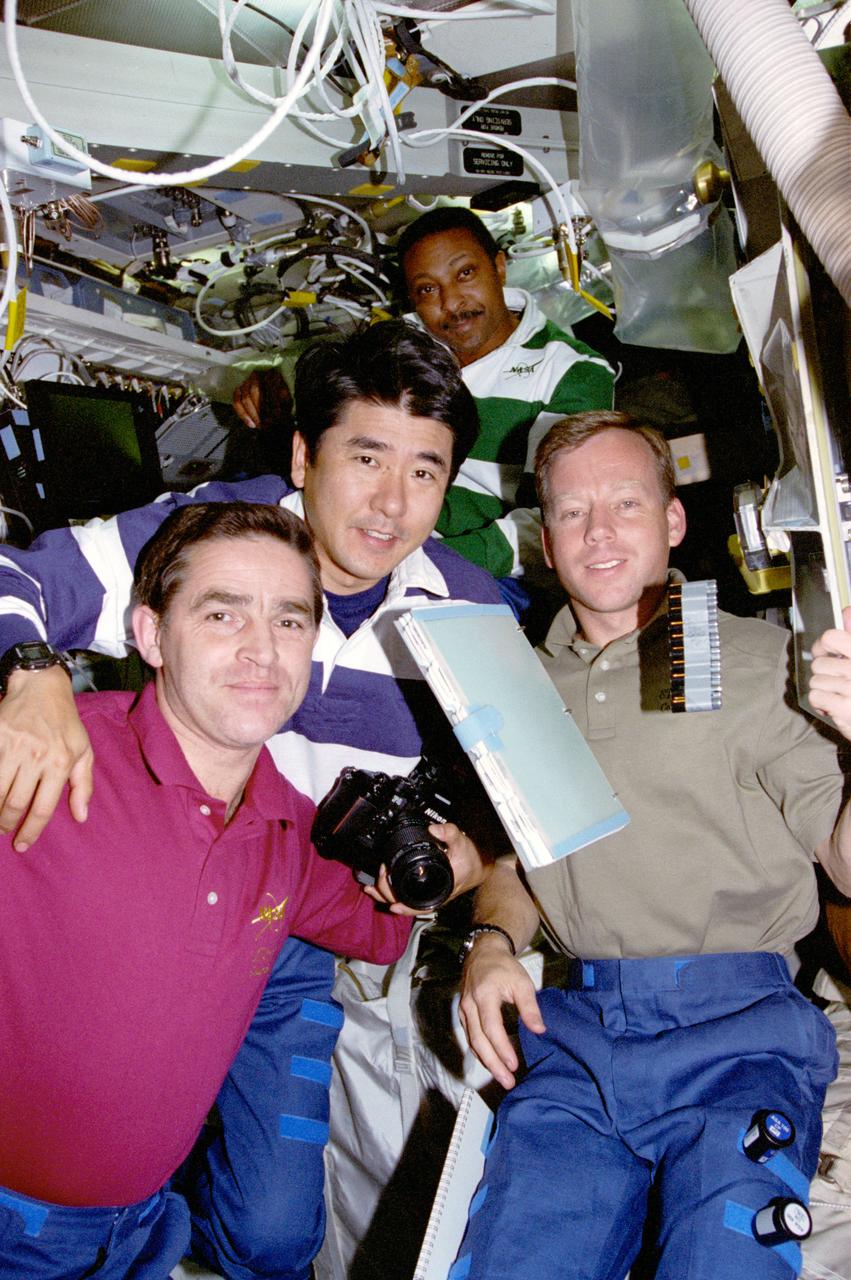
STS087-353-034 (19 November - 5 December 1997) --- Two-thirds of the crew members are pictured on the mid-deck of the Earth-orbiting Space Shuttle Columbia. From the left are Leonid Kadenyuk, payload specialist of the Ukraine; Takao Doi, international mission specialist representing Japan's National Space Development Agency (NASDA); Winston E. Scott, mission specialist; and Steven W. Lindsey, pilot. Doi was joined on two Extravehicular Activities (EVA) during the 16-day United States Microgravity Payload (USMP-4) mission by Scott.
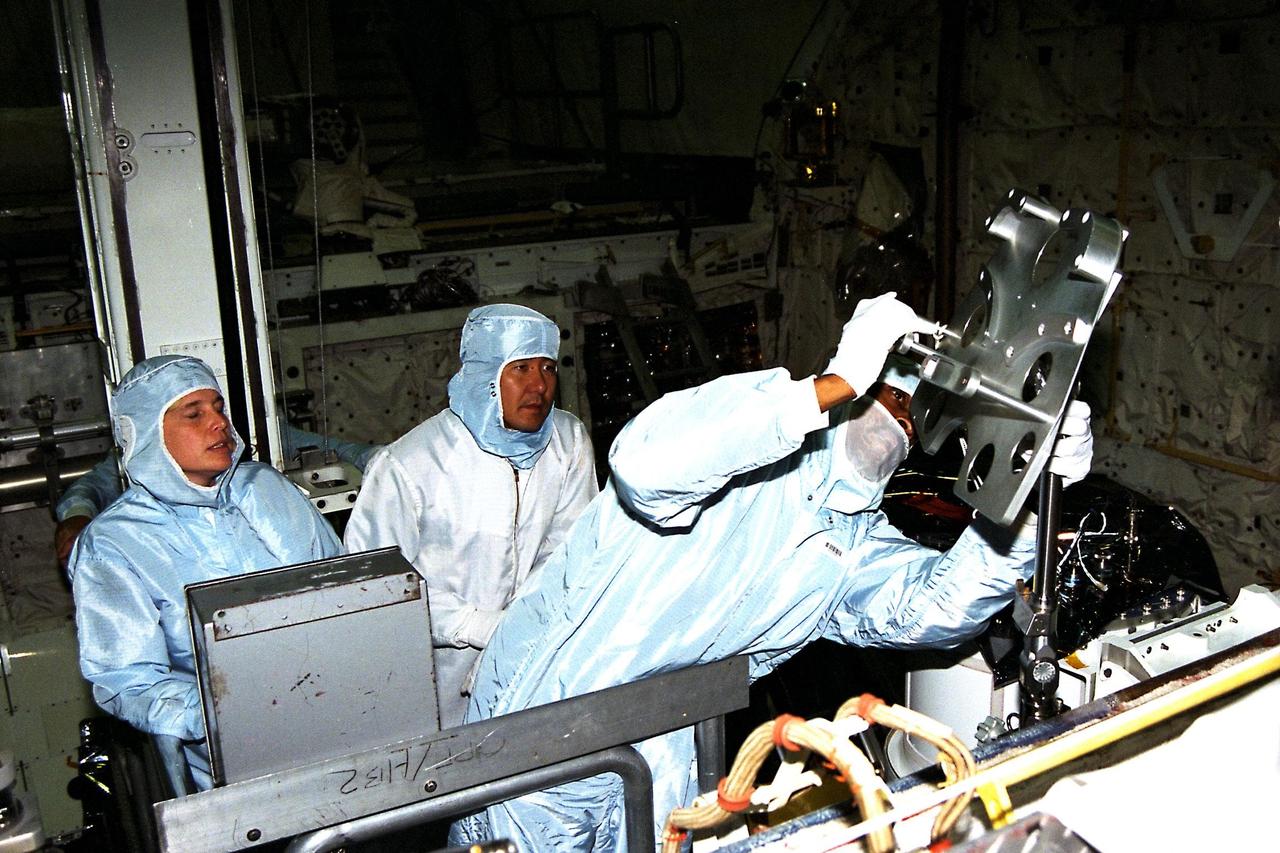
Participating in the Crew Equipment Integration Test (CEIT) at Kennedy Space Center are STS-87 crew members, assisted by Glenda Laws, extravehicular activity (EVA) coordinator, Johnson Space Center, at left. Next to Laws is Mission Specialist Takao Doi, Ph.D., of the National Space Development Agency of Japan, who is looking on as Mission Specialist Winston Scott gets a hands-on look at some of the equipment. The STS-87 mission will be the fourth United States Microgravity Payload and flight of the Spartan-201 deployable satellite. During the mission, scheduled for a Nov. 19 liftoff from KSC, Dr. Doi and Scott will both perform spacewalks
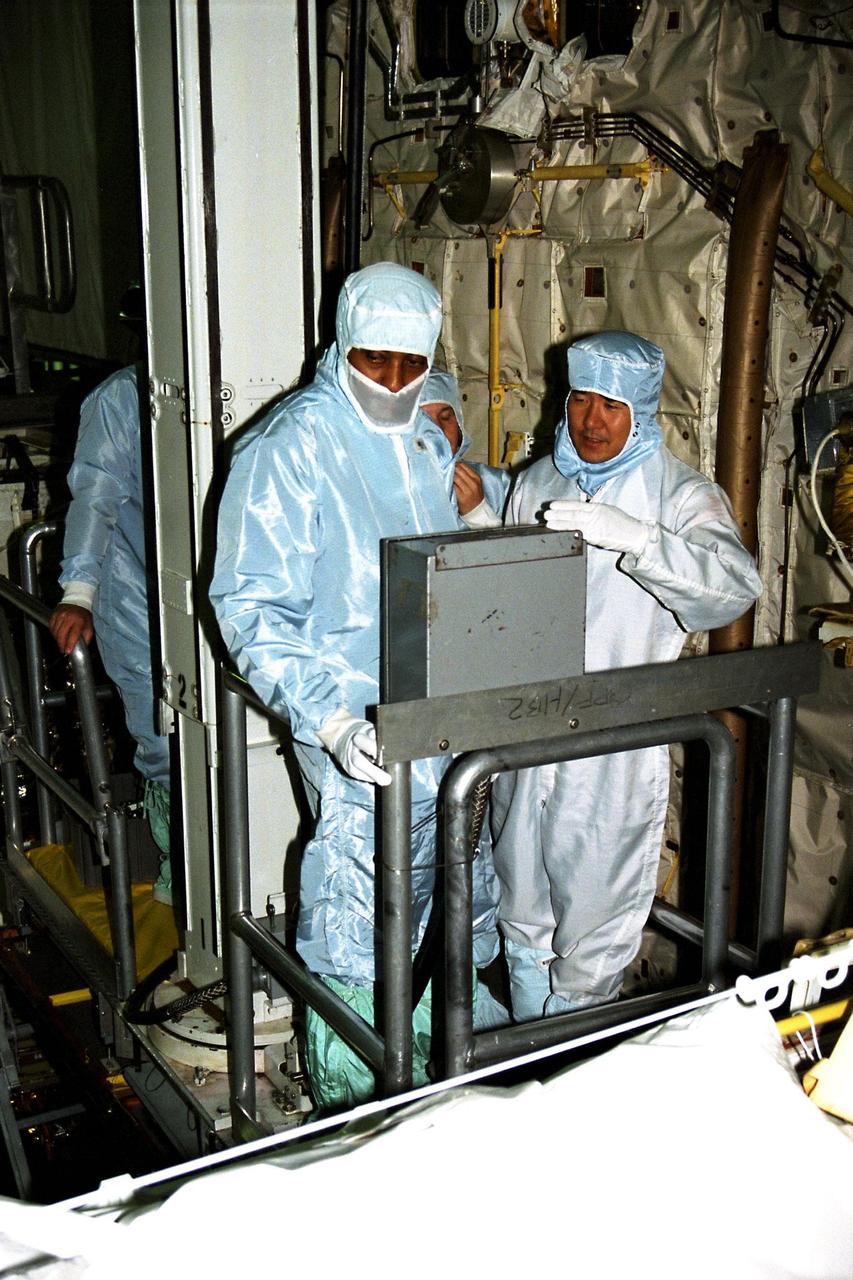
Participating in the Crew Equipment Integration Test (CEIT) at Kennedy Space Center are STS-87 crew members Winston Scott, at left, and Takao Doi, Ph.D., of the National Space Development Agency of Japan, both mission specialists on STS-87. The CEIT gives astronauts an opportunity to get a hands-on look at the payloads with which they will be working on-orbit. STS-87 will be the fourth United States Microgravity Payload and flight of the Spartan-201 deployable satellite. During the STS-87 mission, scheduled for a Nov. 19 liftoff from KSC, Dr. Doi and Scott will both perform spacewalks. STS-87 is scheduled for a Nov. 19 liftoff from KSC
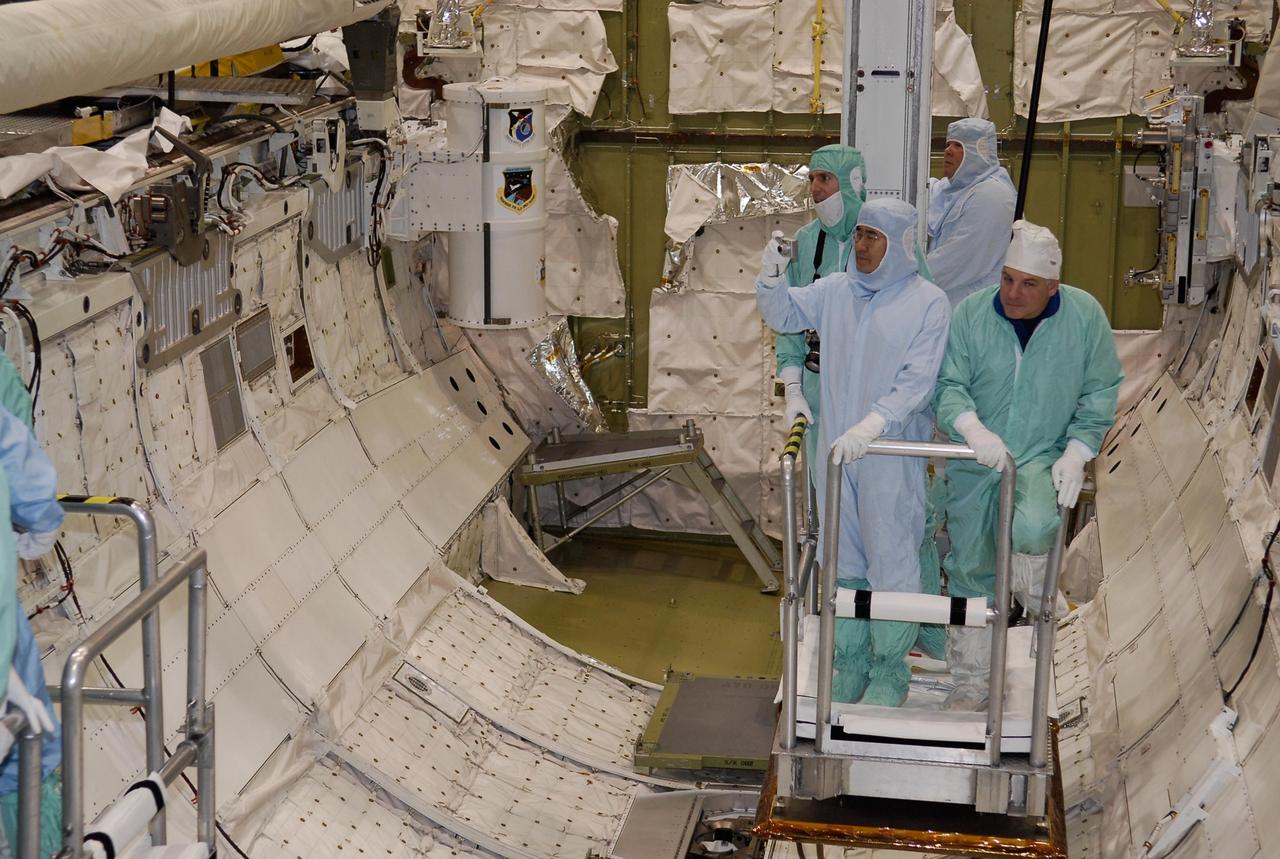
KENNEDY SPACE CENTER, FLA. -- In the Orbiter Processing Facility, STS-123 crew members are lowered into space shuttle Endeavour's payload bay to check out the equipment. At right is Mission Specialist Garrett Reisman; at left is Mission Specialist Takao Doi. The crew is at NASA's Kennedy Space Center for a crew equipment interface test, a process of familiarization with payloads, hardware and the space shuttle. Doi represents the Japanese Aerospace and Exploration Agency. Reisman will join the Expedition 16 crew on the International Space Station, replacing flight engineer Leopold Eyharts. The STS-123 mission is targeted for launch on space shuttle Endeavour on Feb. 14. It will be the 25th assembly flight of the station. Photo credit: NASA/Kim Shiflett
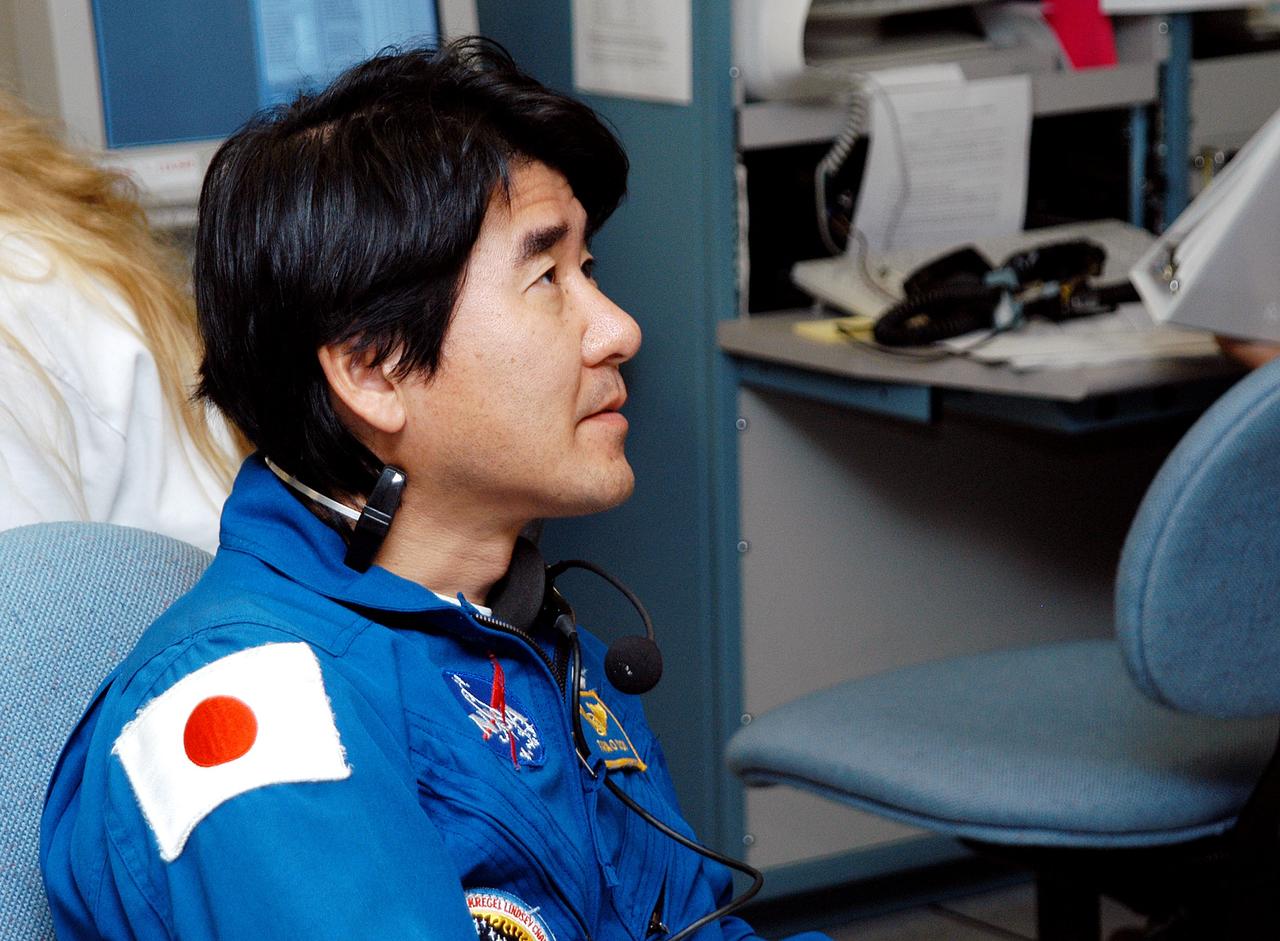
KENNEDY SPACE CENTER, FLA. - Takao Doi, an astronaut with the National Space Development Agency of Japan (NASDA), watches the sensors during a Multi-Equipment Interface Test (MEIT) on the Japanese Experiment Module (JEM). NASDA developed the laboratory at the Tsukuba Space Center near Tokyo. It is the first element, named "Kibo" (Hope), to be delivered to KSC. The JEM is Japan's primary contribution to the Station. It will enhance the unique research capabilities of the orbiting complex by providing an additional environment for astronauts to conduct science experiments.
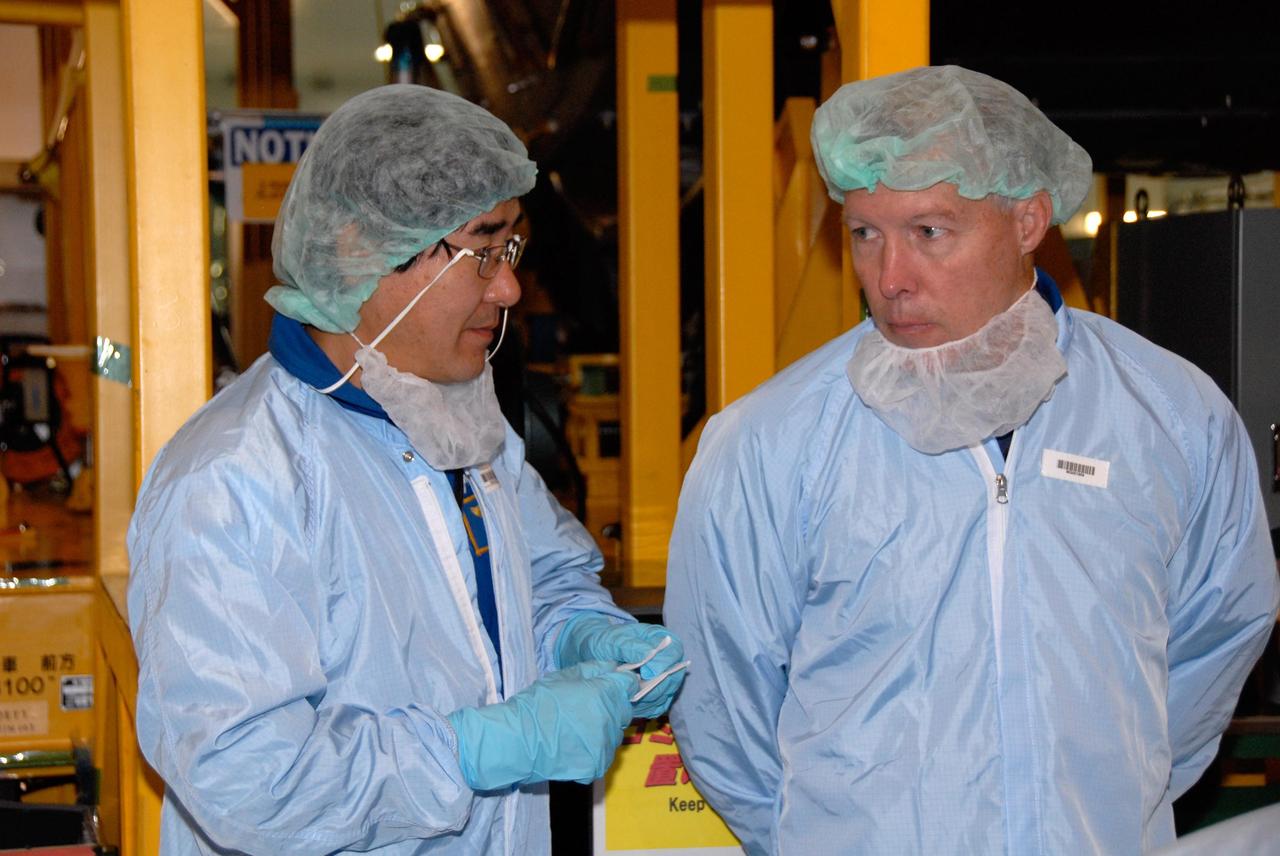
KENNEDY SPACE CENTER, FLA. -- In the Space Station Processing Facility at NASA's Kennedy Space Center, STS-123 Mission Specialist Takao Doi (left) and Commander Dominic Gorie confer about the mission payload, the Kibo Experiment Logistics Module Pressurized Section, they are looking over. They are at the center for a crew equipment interface test, which allows familiarization with equipment they will use during the mission. Crew members are Commander Dominic Gorie, Pilot Gregory Johnson and Mission Specialists Richard Linnehan, Takao Doi, Robert Behnken, Gerrett Reisman and Michael Foreman. Doi represents the Japan Aerospace Exploration Agency. Reisman will remain on the space station after the mission as a flight engineer for Expedition 16. STS-123 will carry and install one of the components of the Japanese Experiment Module, or JEM. Known as Kibo, the JEM comprises six components: two research facilities -- the Pressurized Module and Exposed Facility; a Logistics Module attached to each of them; a Remote Manipulator System; and an Inter-Orbit Communication System unit. The various components of JEM will be assembled in space over the course of three space shuttle missions. The first of those three missions, STS-123, will carry the Experiment Logistics Module Pressurized Section aboard the space shuttle Endeavour, targeted for launch in February 2008. Photo credit: NASA/Dimitrios Gerondidakis
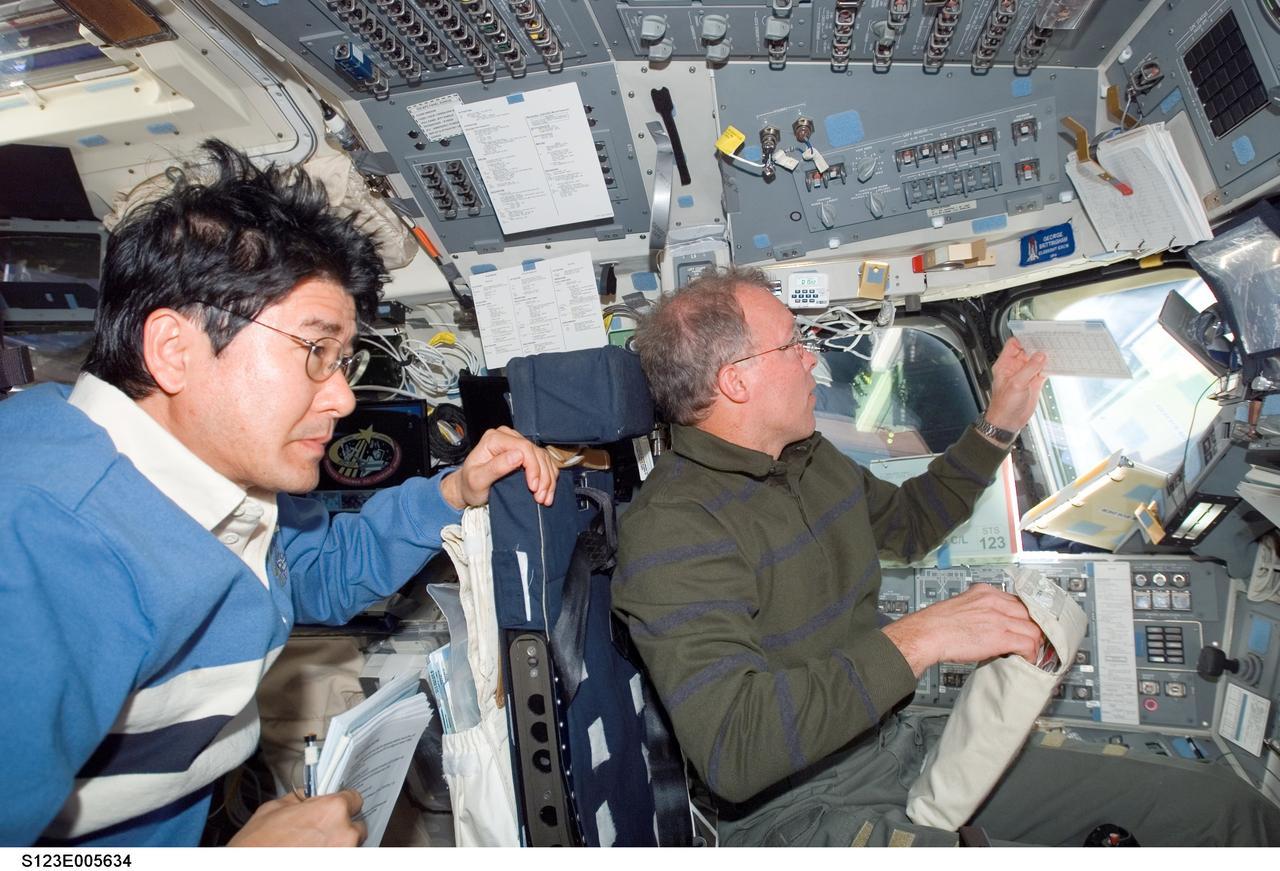
S123-E-005634 (13 March 2008) --- NASA astronaut Dominic Gorie (right), STS-123 commander; and Japan Aerospace Exploration Agency (JAXA) astronaut Takao Doi, mission specialist, are pictured on the flight deck of Space Shuttle Endeavour during flight day three activities.
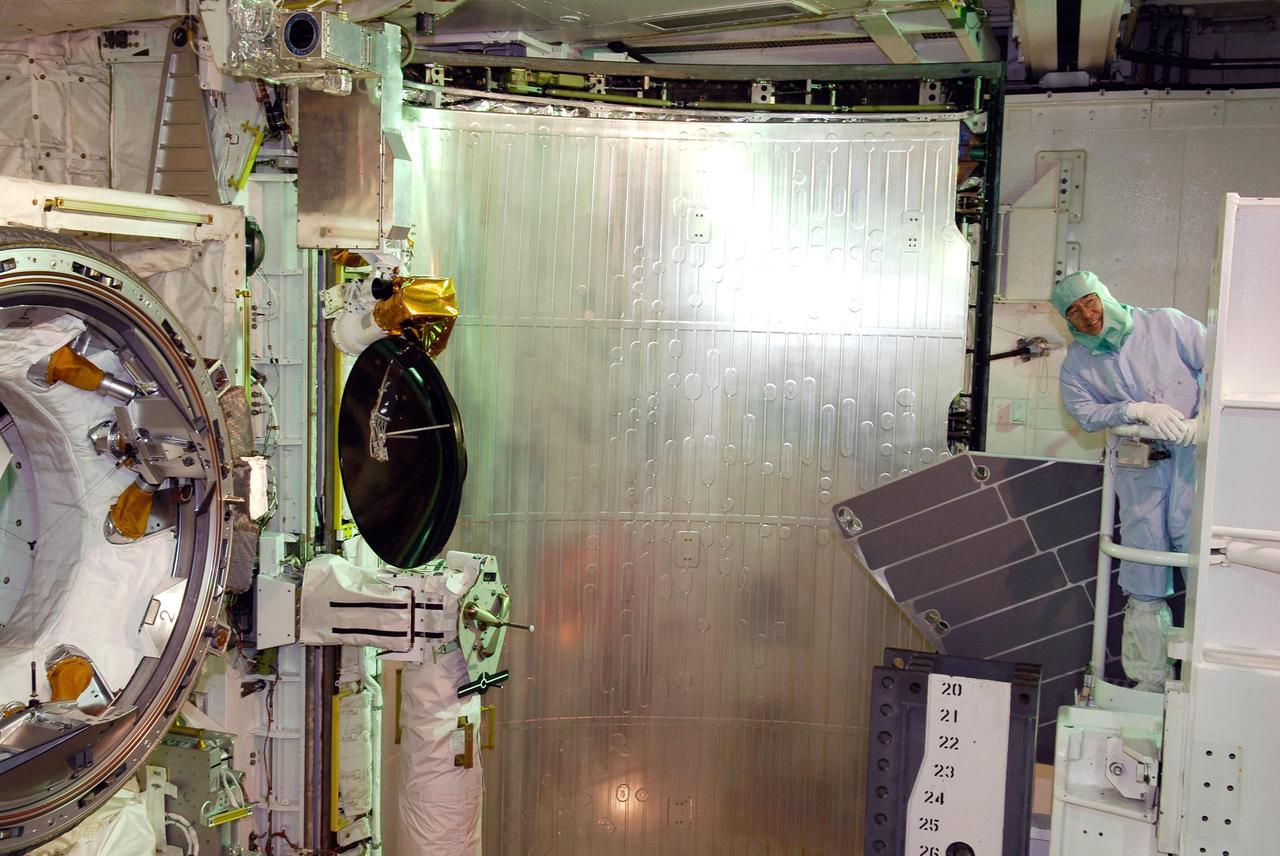
KENNEDY SPACE CENTER, FLA. -- On NASA Kennedy Space Center's Launch Pad 39A, STS-123 Mission Specialist Takao Doi looks over the payload in space shuttle Endeavour's payload bay. Doi represents the Japan Aerospace and Exploration Agency, or JAXA. He and other STS-123 crew members are at Kennedy for a full launch dress rehearsal, known as the terminal countdown demonstration test, or TCDT. The TCDT provides astronauts and ground crews with an opportunity to participate in various simulated countdown activities, including equipment familiarization and emergency training. Endeavour is targeted to launch March 11 at 2:28 a.m. EDT on the 16-day STS-123 mission to the International Space Station. Endeavour and its crew will deliver the first section of the Japan Aerospace Exploration Agency's Kibo laboratory and the Canadian Space Agency's two-armed robotic system, Dextre. Photo credit: NASA/Kim Shiflett

KENNEDY SPACE CENTER, FLA. -- In the Space Station Processing Facility, astronaut Takao Doi (left) and Commander Dominic Gorie pose in front of the Experiment Logistics Module Pressurized Section for the Japanese Experiment Module, or JEM, that recently arrived at Kennedy. Doi and Gorie are crew members for mission STS-123 that will deliver the logistics module to the International Space Station. Earlier, NASA and Japanese Aerospace and Exploration Agency (JAXA) officials welcomed the arrival of the module. The new International Space Station component arrived at Kennedy March 12 to begin preparations for its future launch on mission STS-123. It will serve as an on-orbit storage area for materials, tools and supplies. It can hold up to eight experiment racks and will attach to the top of another larger pressurized module. Photo credit: NASA/George Shelton
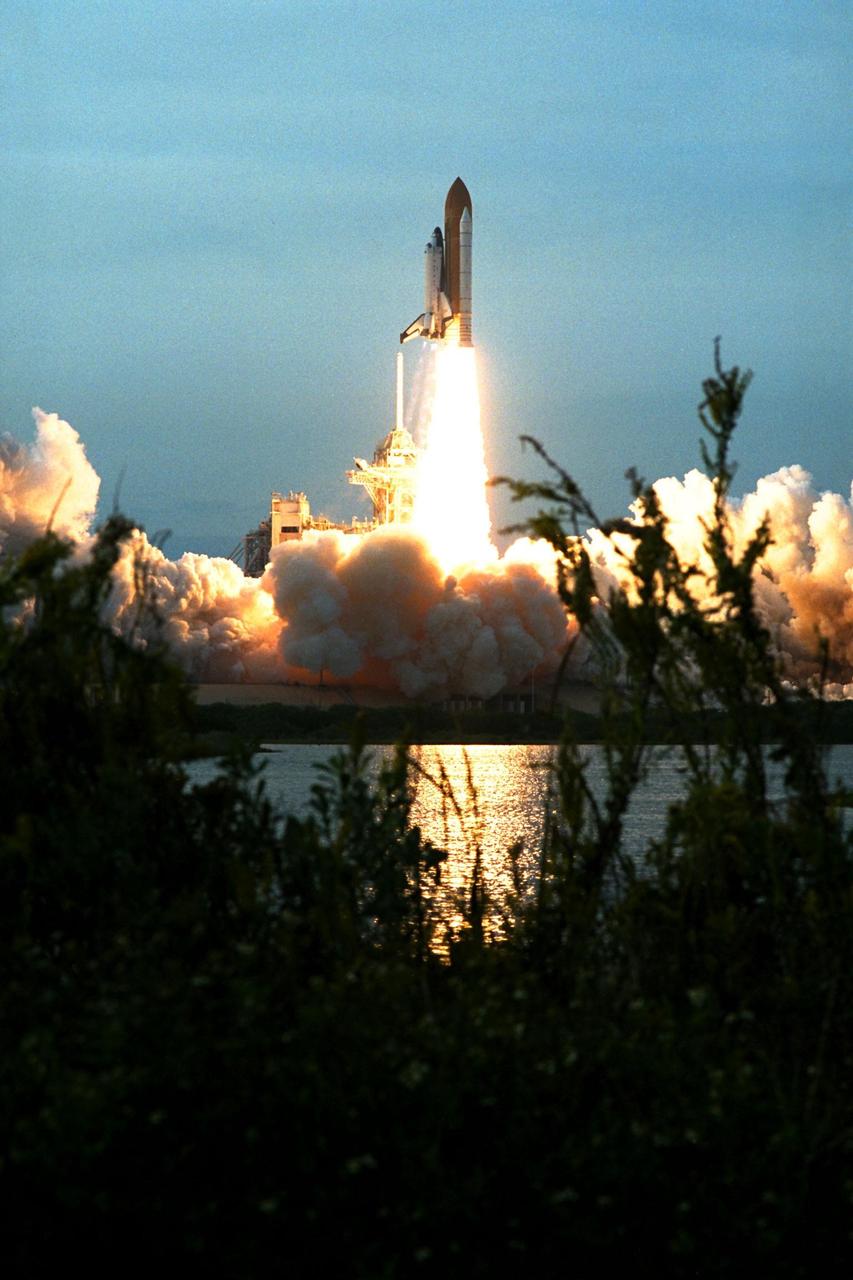
Like a rising sun lighting up the afternoon sky, the Space Shuttle Columbia soars from Launch Pad 39B at 2:46:00 p.m. EST, November 19, on the fourth flight of the United States Microgravity Payload and Spartan-201 satellite. The crew members include Mission Commander Kevin Kregel.; Pilot Steven Lindsey; Mission Specialists Kalpana Chawla, Ph.D., Winston Scott, and Takao Doi, Ph.D., of the National Space Development Agency of Japan; and Payload Specialist Leonid Kadenyuk of the National Space Agency of Ukraine. During the 16-day STS-87 mission, the crew will oversee experiments in microgravity; deploy and retrieve a solar satellite; and test a new experimental camera, the AERCam Sprint. Dr. Doi and Scott also will perform a spacewalk to practice International Space Station maneuvers
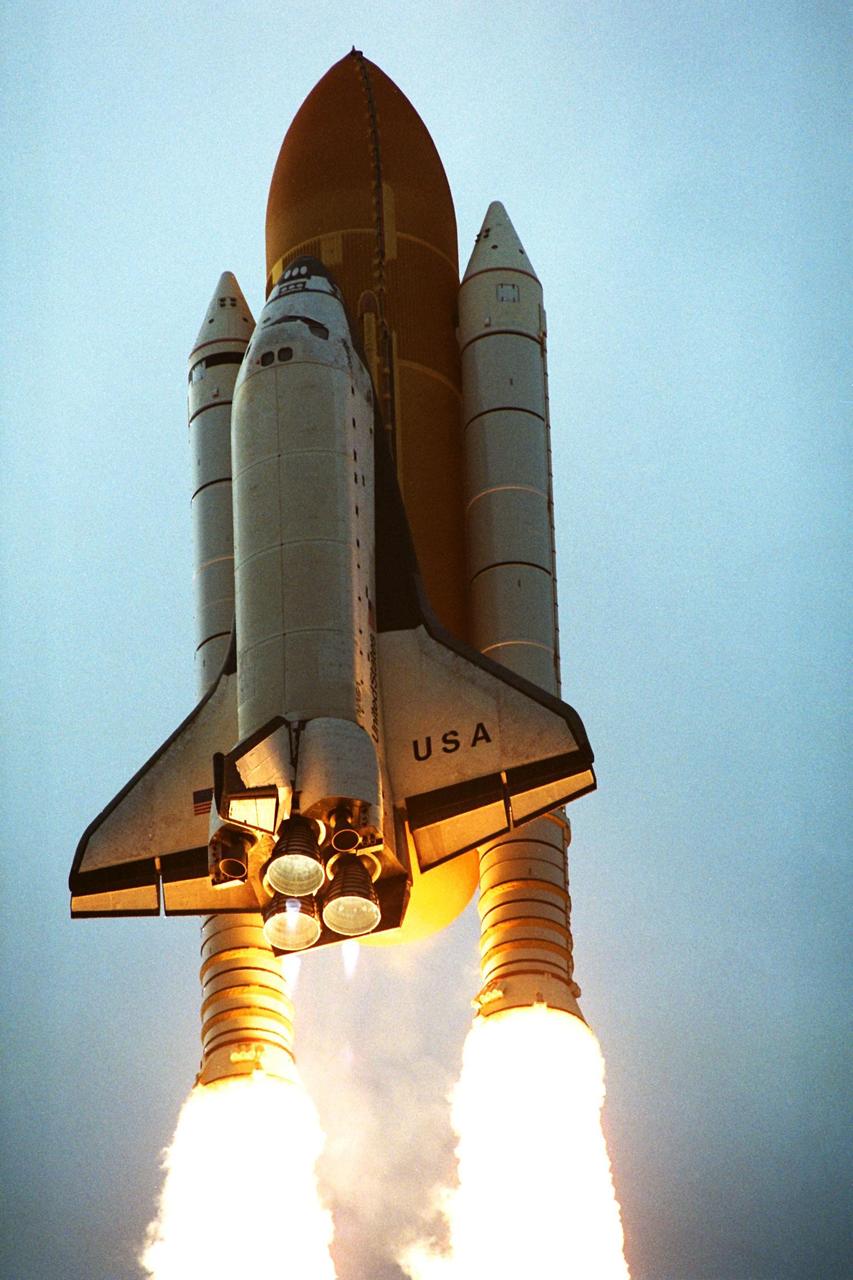
Like a rising sun lighting up the afternoon sky, the Space Shuttle Columbia soars from Launch Pad 39B at 2:46:00 p.m. EST, November 19, on the fourth flight of the United States Microgravity Payload and Spartan-201 satellite. The crew members include Mission Commander Kevin Kregel.; Pilot Steven Lindsey; Mission Specialists Kalpana Chawla, Ph.D., Winston Scott, and Takao Doi, Ph.D., of the National Space Development Agency of Japan; and Payload Specialist Leonid Kadenyuk of the National Space Agency of Ukraine. During the 16-day STS-87 mission, the crew will oversee experiments in microgravity; deploy and retrieve a solar satellite; and test a new experimental camera, the AERCam Sprint. Dr. Doi and Scott also will perform a spacewalk to practice International Space Station maneuvers

CAPE CANAVERAL, Fla. --- STS-123 Mission Specialist Takao Doi talks to the media about his experiences on the mission to the International Space Station. Doi represents the Japan Aerospace Exploration Agency. The crew landed at Kennedy aboard space shuttle Endeavour at 8:39 p.m. EDT March 26. Endeavour's 16-day flight was the longest shuttle mission to the International Space Station and included a record five spacewalks. The shuttle's seven astronauts worked with the three-member station crew and ground teams around the world to install the first section of the Japan Aerospace Exploration Agency's Kibo laboratory and the Canadian Space Agency's two-armed robotic system, known as Dextre. Photo credit: NASA/Kim Shiflett
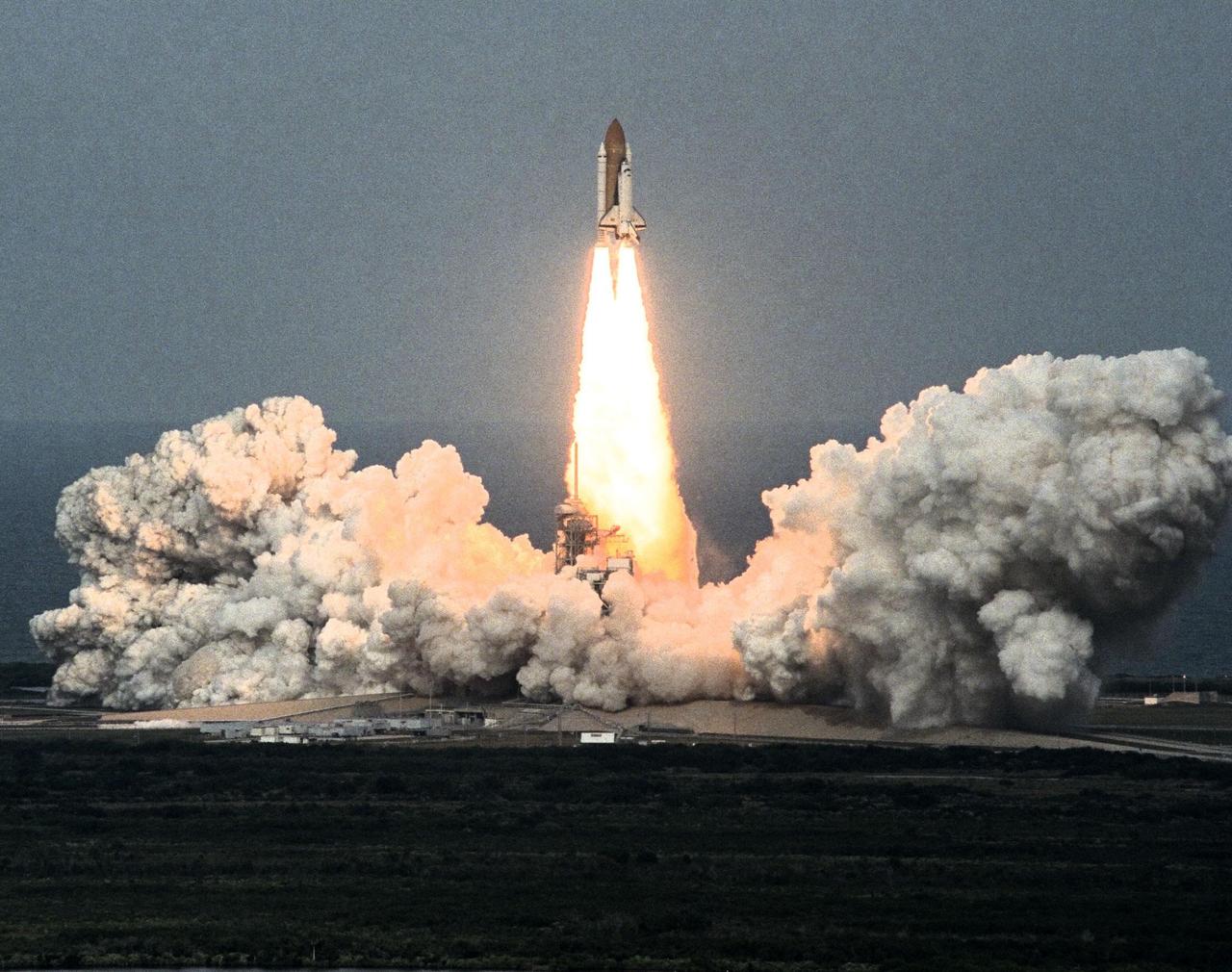
Like a rising sun lighting up the afternoon sky, the Space Shuttle Columbia soars from Launch Pad 39B at 2:46:00 p.m. EST, November 19, on the fourth flight of the United States Microgravity Payload and Spartan-201 satellite. The crew members include Mission Commander Kevin Kregel.; Pilot Steven Lindsey; Mission Specialists Kalpana Chawla, Ph.D., Winston Scott, and Takao Doi, Ph.D., of the National Space Development Agency of Japan; and Payload Specialist Leonid Kadenyuk of the National Space Agency of Ukraine. During the 16-day STS-87 mission, the crew will oversee experiments in microgravity; deploy and retrieve a solar satellite; and test a new experimental camera, the AERCam Sprint. Dr. Doi and Scott also will perform a spacewalk to practice International Space Station maneuvers
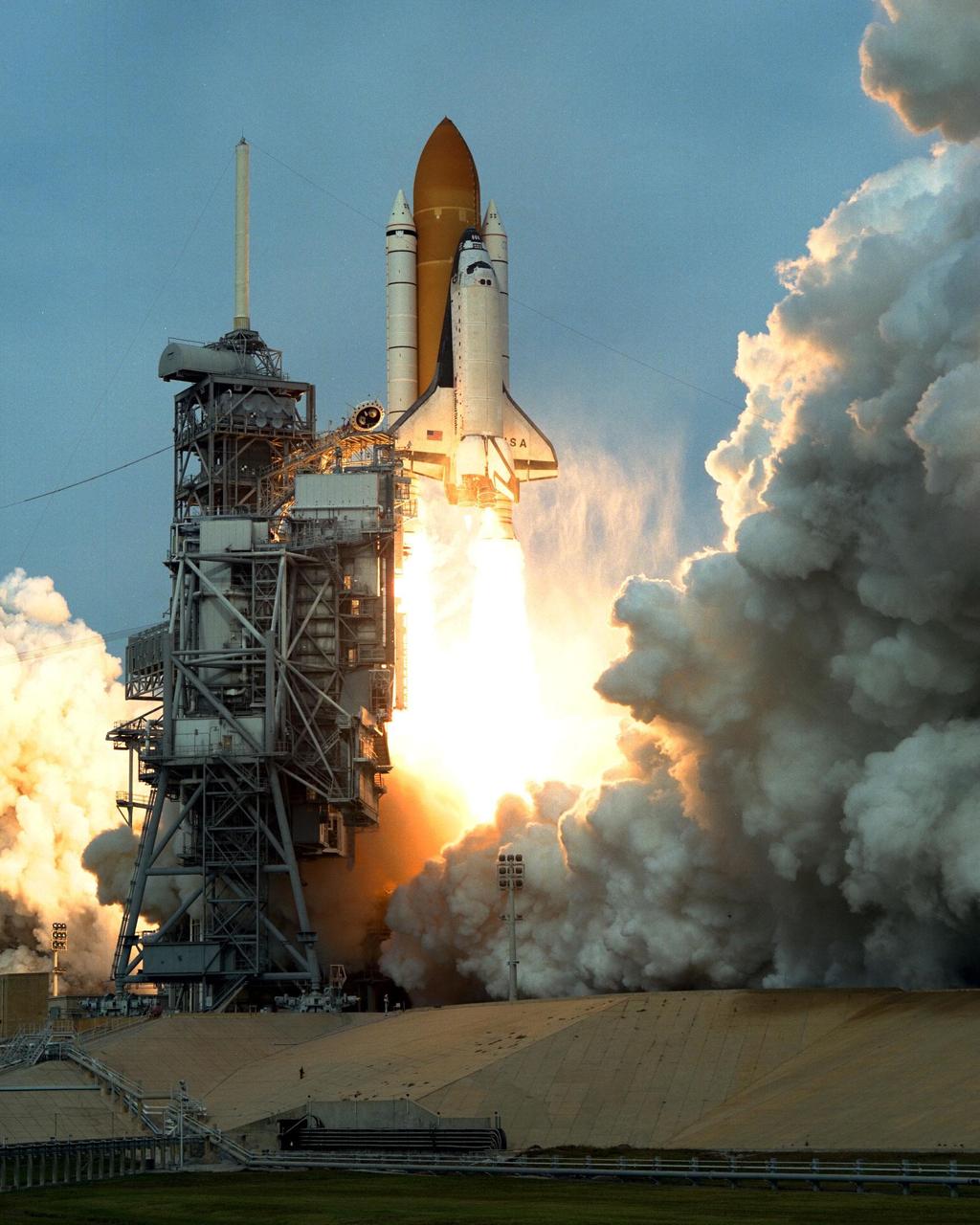
Like a rising sun lighting up the afternoon sky, the Space Shuttle Columbia soars from Launch Pad 39B at 2:46:00 p.m. EST, November 19, on the fourth flight of the United States Microgravity Payload and Spartan-201 satellite. The crew members include Mission Commander Kevin Kregel.; Pilot Steven Lindsey; Mission Specialists Kalpana Chawla, Ph.D., Winston Scott, and Takao Doi, Ph.D., of the National Space Development Agency of Japan; and Payload Specialist Leonid Kadenyuk of the National Space Agency of Ukraine. During the 16-day STS-87 mission, the crew will oversee experiments in microgravity; deploy and retrieve a solar satellite; and test a new experimental camera, the AERCam Sprint. Dr. Doi and Scott also will perform a spacewalk to practice International Space Station maneuvers
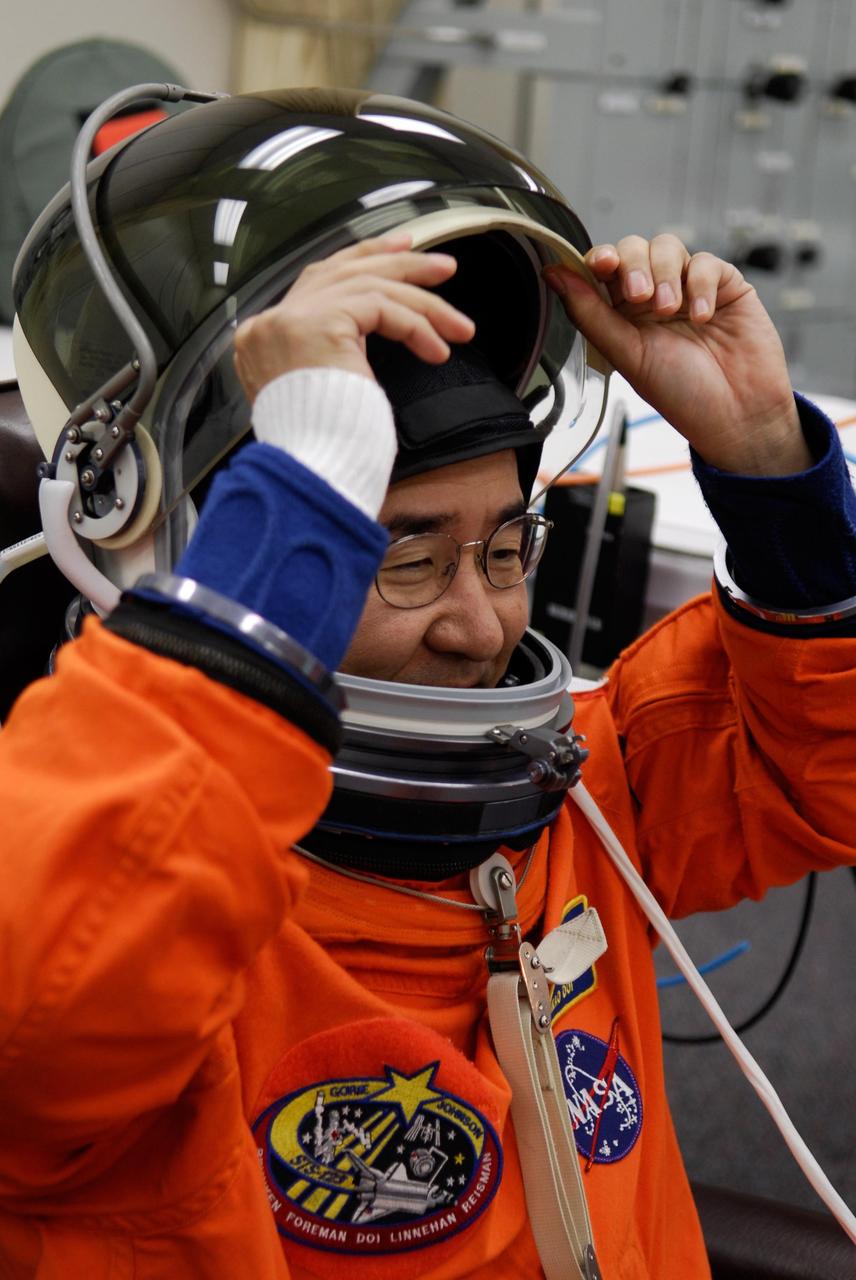
KENNEDY SPACE CENTER, FLA. -- STS-123 Mission Specialist Takao Doi tries on his helmet during suitup for the launch dress rehearsal, culmination of the terminal countdown demonstration test, or TCDT. Doi represents the Japan Aerospace Exploration Agency, or JAXA. The TCDT provides astronauts and ground crews with an opportunity to participate in various simulated countdown activities, including equipment familiarization and emergency training. Space shuttle Endeavour is targeted to launch March 11 at 2:28 a.m. EDT on the 16-day STS-123 mission to the International Space Station. Endeavour and its crew will deliver the first section of the Japan Aerospace Exploration Agency's Kibo laboratory and the Canadian Space Agency's two-armed robotic system, Dextre. Photo credit: NASA/Kim Shiflett
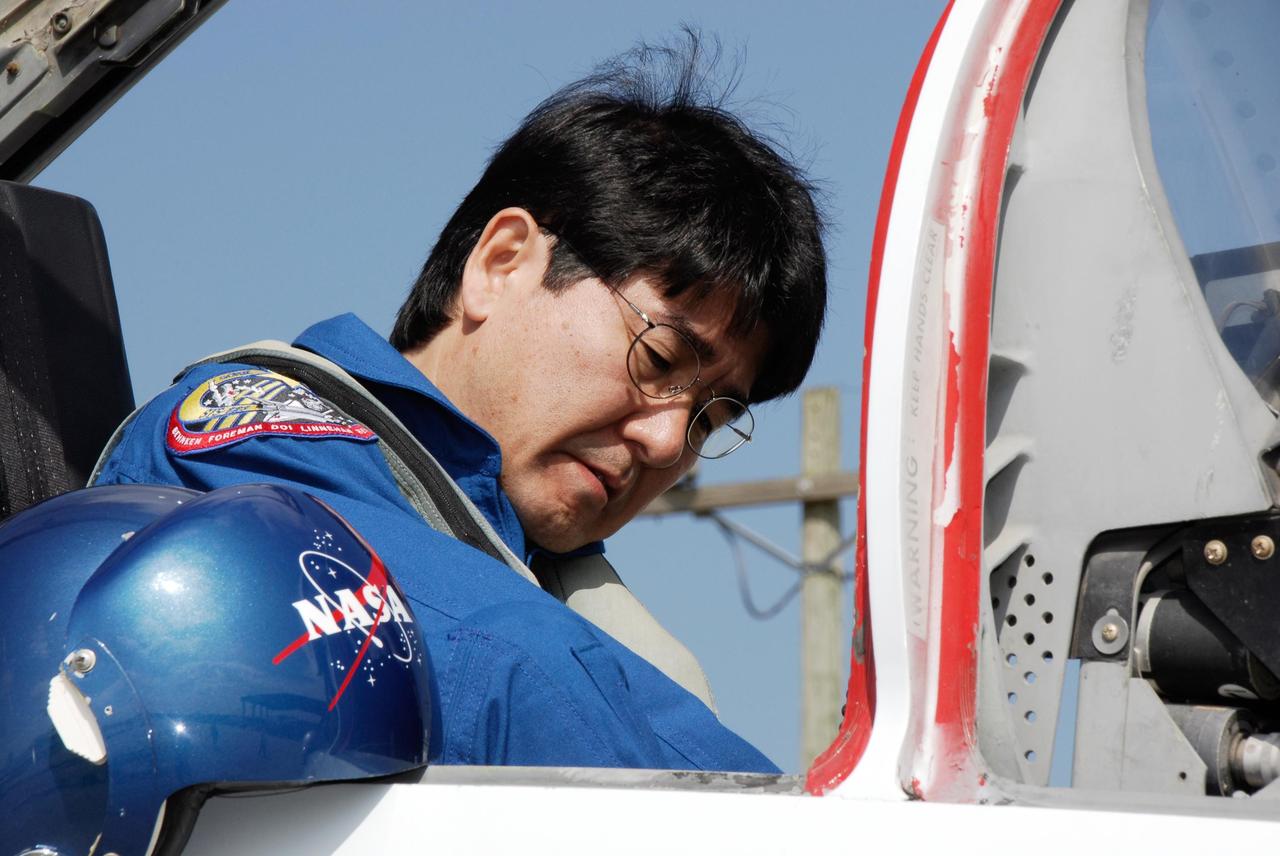
KENNEDY SPACE CENTER, FLA. -- At the NASA Kennedy Space Center's Shuttle Landing Facility, STS-123 Mission Specialist Takao Doi waits in the aircraft that will return him to Houston. He and the other STS-123 crew members took part in a terminal countdown demonstration test, or TCDT, in preparation for the launch of space shuttle Endeavour scheduled on March 11. Doi represents the Japan Aerospace Exploration Agency. The TCDT enables astronauts and ground crews to participate in various countdown activities, including equipment familiarization and emergency egress training. On the STS-123 mission, Endeavour and its crew will deliver the first section of the Japan Aerospace Exploration Agency's Kibo laboratory and the Canadian Space Agency's two-armed robotic system, Dextre Photo credit: NASA/Kim Shiflett
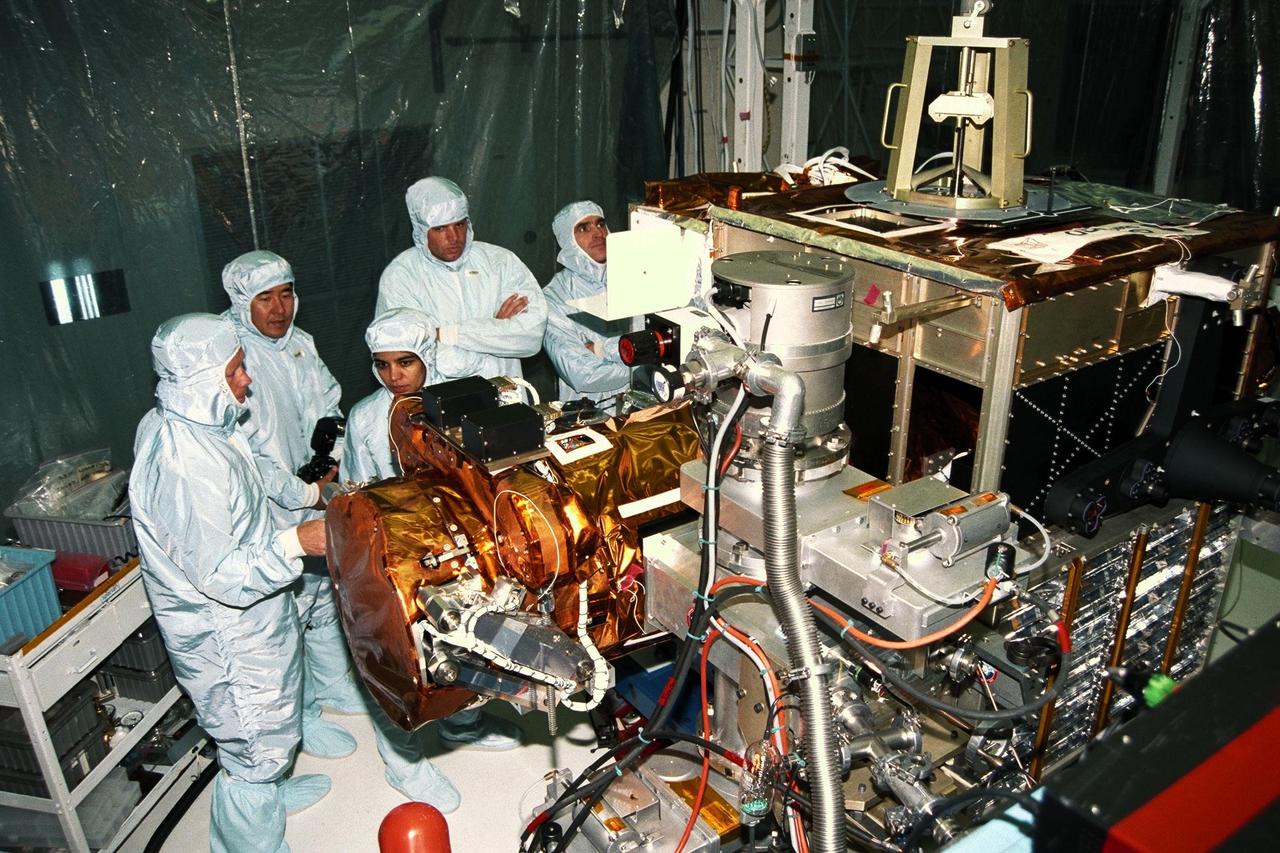
STS-87 astronaut crew members participate in the Crew Equipment Integration Test (CEIT) with the Spartan-201 payload in Kennedy Space Center’s (KSC's) Vertical Processing Facility. From left are Pilot Steven Lindsey; Mission Specialist Takao Doi, Ph.D., of the National Space Development Agency of Japan; Mission Specialist Kalpana Chawla, Ph.D.; Commander Kevin Kregel; and Payload Specialist Leonid Kadenyuk of the National Space Agency of Ukraine. The CEIT gives astronauts an opportunity to get a hands-on look at the payloads with which they will be working on-orbit. STS-87 will be the fourth United States Microgravity Payload and flight of the Spartan-201 deployable satellite. During the mission, Dr. Doi will be the first Japanese astronaut to perform a spacewalk. STS-87 is scheduled for a Nov. 19 liftoff from KSC
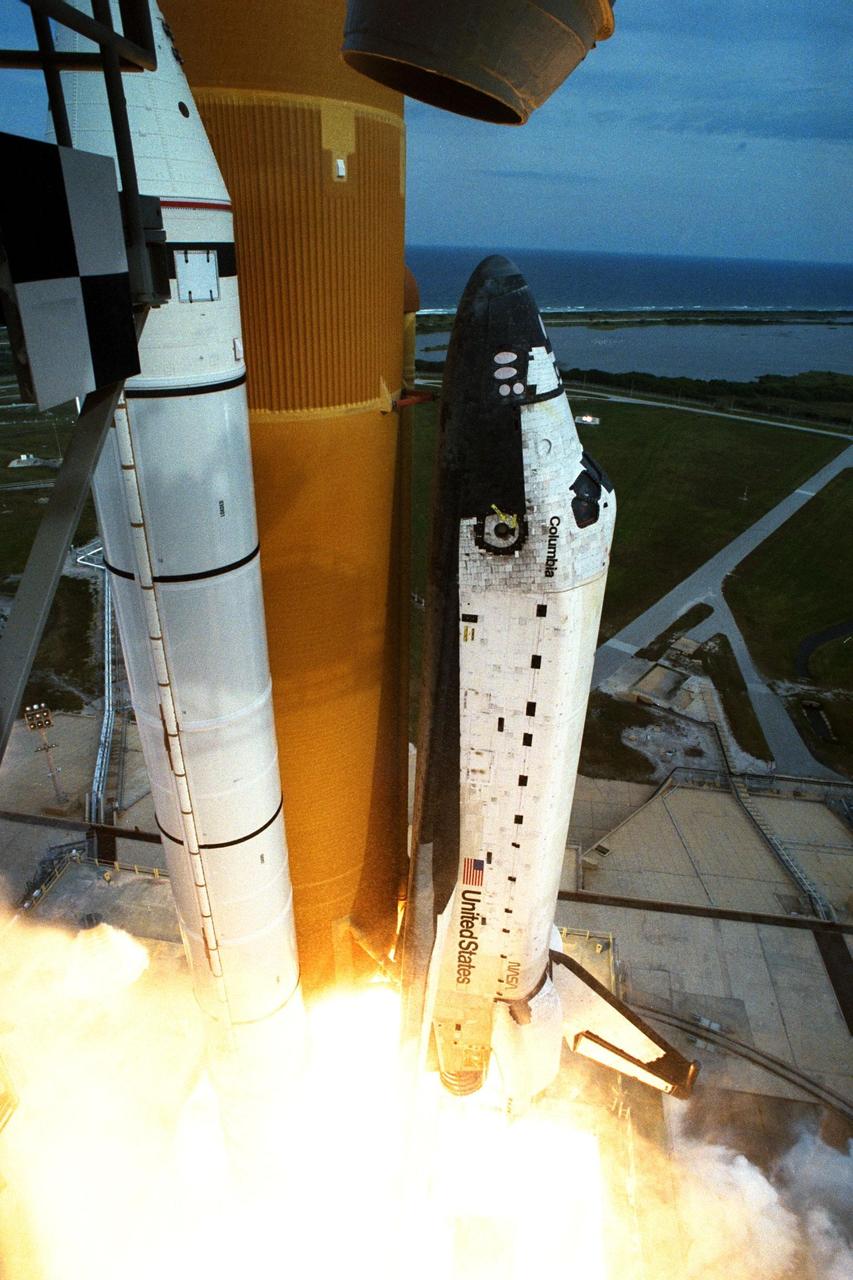
Like a rising sun lighting up the afternoon sky, the Space Shuttle Columbia soars from Launch Pad 39B at 2:46:00 p.m. EST, November 19, on the fourth flight of the United States Microgravity Payload and Spartan-201 satellite. The crew members include Mission Commander Kevin Kregel.; Pilot Steven Lindsey; Mission Specialists Kalpana Chawla, Ph.D., Winston Scott, and Takao Doi, Ph.D., of the National Space Development Agency of Japan; and Payload Specialist Leonid Kadenyuk of the National Space Agency of Ukraine. During the 16-day STS-87 mission, the crew will oversee experiments in microgravity; deploy and retrieve a solar satellite; and test a new experimental camera, the AERCam Sprint. Dr. Doi and Scott also will perform a spacewalk to practice International Space Station maneuvers
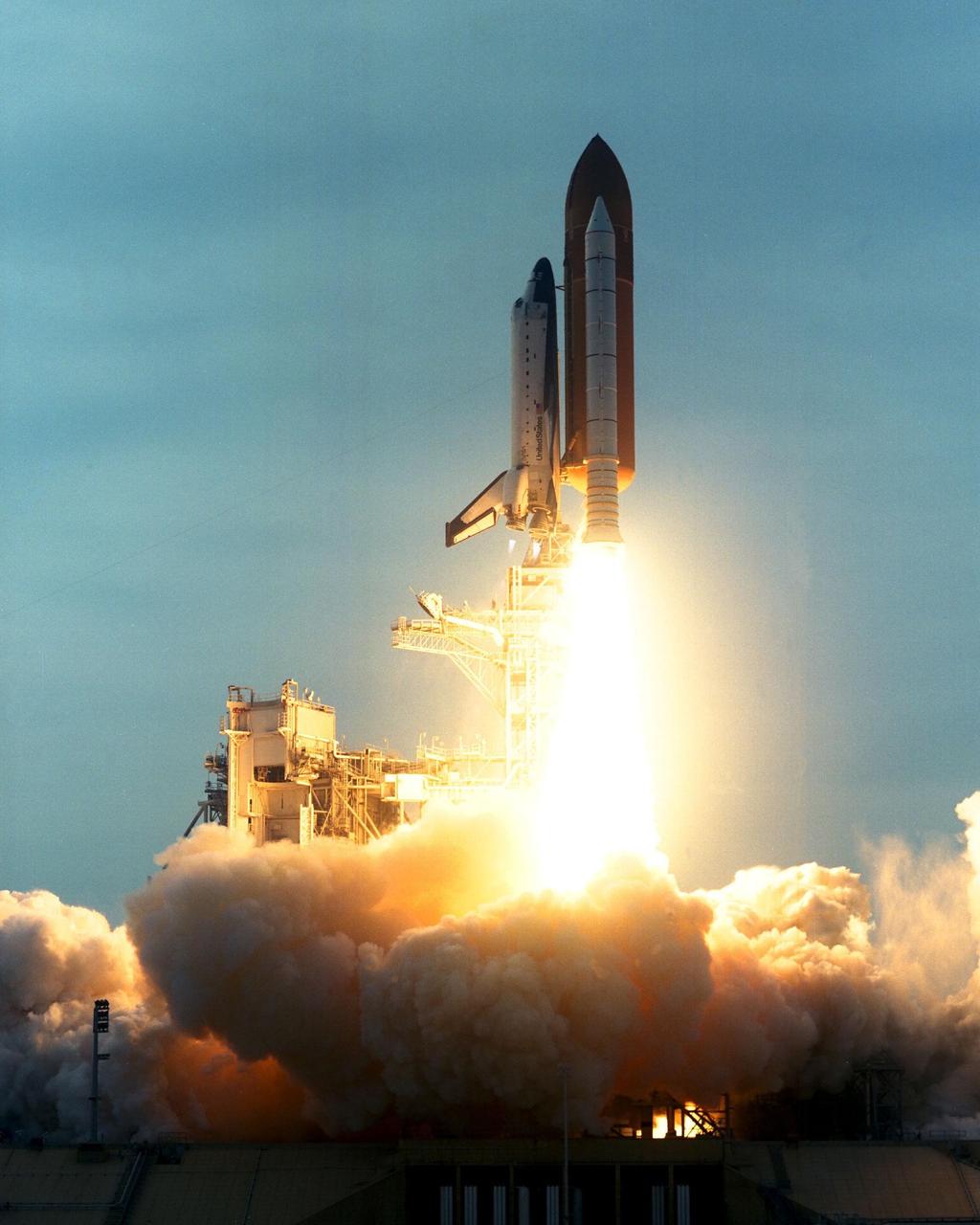
Like a rising sun lighting up the afternoon sky, the Space Shuttle Columbia soars from Launch Pad 39B at 2:46:00 p.m. EST, November 19, on the fourth flight of the United States Microgravity Payload and Spartan-201 satellite. The crew members include Mission Commander Kevin Kregel.; Pilot Steven Lindsey; Mission Specialists Kalpana Chawla, Ph.D., Winston Scott, and Takao Doi, Ph.D., of the National Space Development Agency of Japan; and Payload Specialist Leonid Kadenyuk of the National Space Agency of Ukraine. During the 16-day STS-87 mission, the crew will oversee experiments in microgravity; deploy and retrieve a solar satellite; and test a new experimental camera, the AERCam Sprint. Dr. Doi and Scott also will perform a spacewalk to practice International Space Station maneuvers

Like a rising sun lighting up the afternoon sky, the Space Shuttle Columbia soars from Launch Pad 39B at 2:46:00 p.m. EST, November 19, on the fourth flight of the United States Microgravity Payload and Spartan-201 satellite. The crew members include Mission Commander Kevin Kregel.; Pilot Steven Lindsey; Mission Specialists Kalpana Chawla, Ph.D., Winston Scott, and Takao Doi, Ph.D., of the National Space Development Agency of Japan; and Payload Specialist Leonid Kadenyuk of the National Space Agency of Ukraine. During the 16-day STS-87 mission, the crew will oversee experiments in microgravity; deploy and retrieve a solar satellite; and test a new experimental camera, the AERCam Sprint. Dr. Doi and Scott also will perform a spacewalk to practice International Space Station maneuvers

Like a rising sun lighting up the afternoon sky, the Space Shuttle Columbia soars from Launch Pad 39B at 2:46:00 p.m. EST, November 19, on the fourth flight of the United States Microgravity Payload and Spartan-201 satellite. The crew members include Mission Commander Kevin Kregel.; Pilot Steven Lindsey; Mission Specialists Kalpana Chawla, Ph.D., Winston Scott, and Takao Doi, Ph.D., of the National Space Development Agency of Japan; and Payload Specialist Leonid Kadenyuk of the National Space Agency of Ukraine. During the 16-day STS-87 mission, the crew will oversee experiments in microgravity; deploy and retrieve a solar satellite; and test a new experimental camera, the AERCam Sprint. Dr. Doi and Scott also will perform a spacewalk to practice International Space Station maneuvers
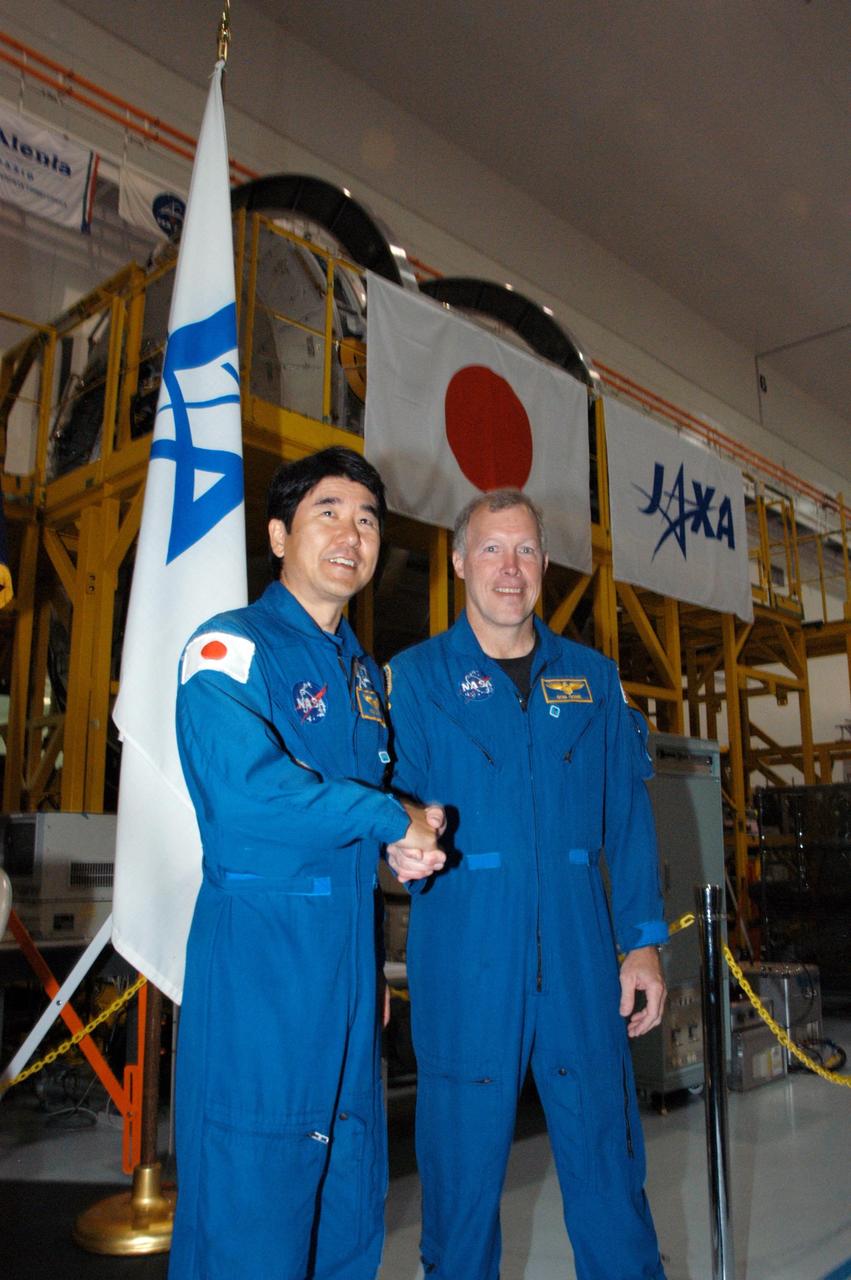
KENNEDY SPACE CENTER, FLA. -- In the Space Station Processing Facility, astronaut Takao Doi (left) and Commander Dominic Gorie pose in front of the Experiment Logistics Module Pressurized Section for the Japanese Experiment Module, or JEM, that recently arrived at Kennedy. Doi and Gorie are crew members for mission STS-123 that will deliver the logistics module to the International Space Station. Earlier, NASA and Japanese Aerospace and Exploration Agency (JAXA) officials welcomed the arrival of the module. The new International Space Station component arrived at Kennedy March 12 to begin preparations for its future launch on mission STS-123. It will serve as an on-orbit storage area for materials, tools and supplies. It can hold up to eight experiment racks and will attach to the top of another larger pressurized module. Photo credit: NASA/George Shelton
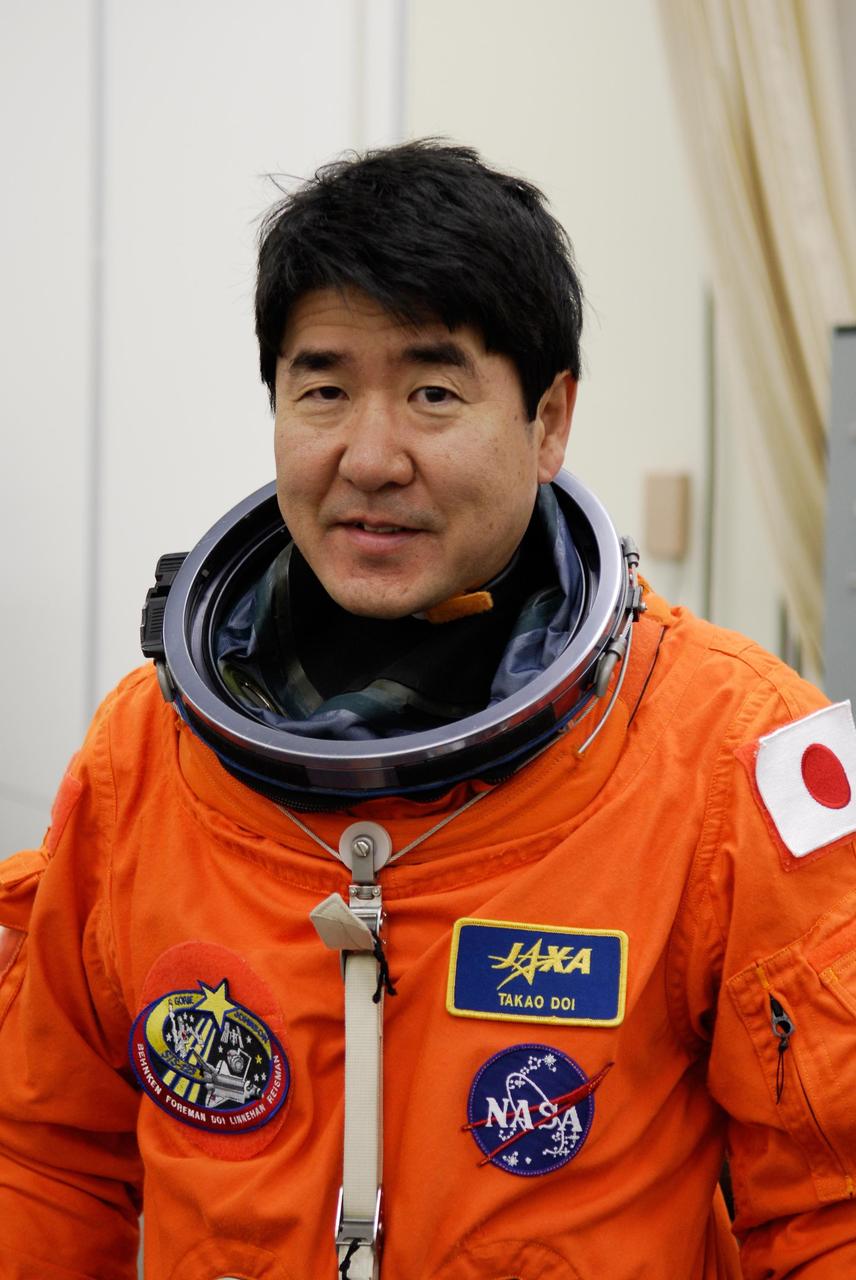
KENNEDY SPACE CENTER, FLA. -- STS-123 Mission Specialist Takao Doi suits up for the launch dress rehearsal, culmination of the terminal countdown demonstration test, or TCDT. Doi represents the Japan Aerospace Exploration Agency, or JAXA. The TCDT provides astronauts and ground crews with an opportunity to participate in various simulated countdown activities, including equipment familiarization and emergency training. Space shuttle Endeavour is targeted to launch March 11 at 2:28 a.m. EDT on the 16-day STS-123 mission to the International Space Station. Endeavour and its crew will deliver the first section of the Japan Aerospace Exploration Agency's Kibo laboratory and the Canadian Space Agency's two-armed robotic system, Dextre. Photo credit: NASA/Kim Shiflett
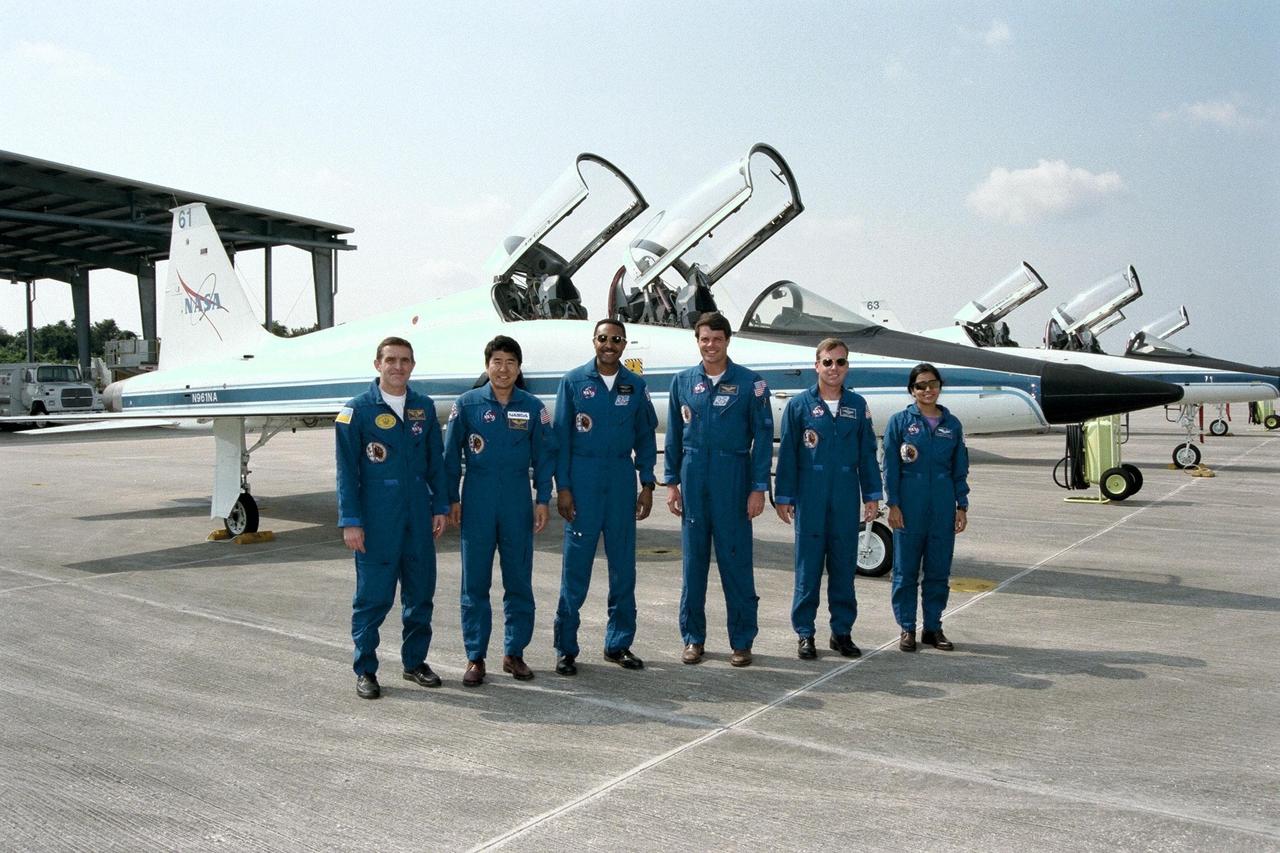
STS-87 astronaut crew members prepare to fly back to Johnson Space Center in Houston after participating in the Crew Equipment Integration Test (CEIT) at Kennedy Space Center (KSC) in early October. From left are Payload Specialist Leonid Kadenyuk of the National Space Agency of Ukraine; Mission Specialist Takao Doi, Ph.D., of the National Space Development Agency of Japan; Mission Specialist Winston Scott; Commander Kevin Kregel; Pilot Steven Lindsey; and Mission Specialist Kalpana Chawla, Ph.D. The CEIT gives astronauts an opportunity to get a hands-on look at the payloads with which they will be working on-orbit. STS-87 will be the fourth United States Microgravity Payload and flight of the Spartan-201 deployable satellite. During the STS-87 mission, scheduled for a Nov. 19 liftoff from KSC, Dr. Doi and Scott will both perform spacewalks
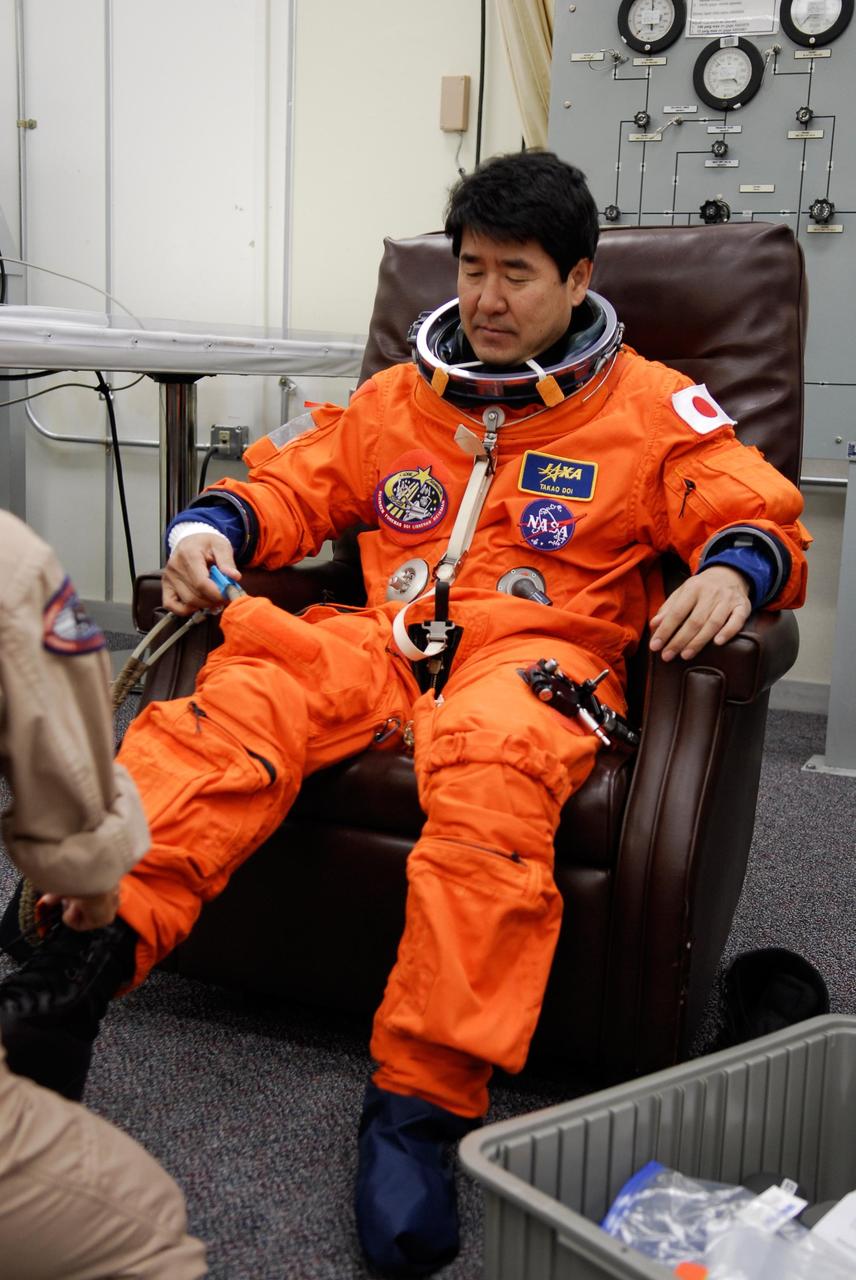
KENNEDY SPACE CENTER, FLA. -- STS-123 Mission Specialist Takao Doi is helped with his boots during suitup for the launch dress rehearsal, culmination of the terminal countdown demonstration test, or TCDT. Doi represents the Japan Aerospace and Exploration Agency, or JAXA. The TCDT provides astronauts and ground crews with an opportunity to participate in various simulated countdown activities, including equipment familiarization and emergency training. Space shuttle Endeavour is targeted to launch March 11 at 2:28 a.m. EDT on the 16-day STS-123 mission to the International Space Station. Endeavour and its crew will deliver the first section of the Japan Aerospace Exploration Agency's Kibo laboratory and the Canadian Space Agency's two-armed robotic system, Dextre. Photo credit: NASA/Kim Shiflett
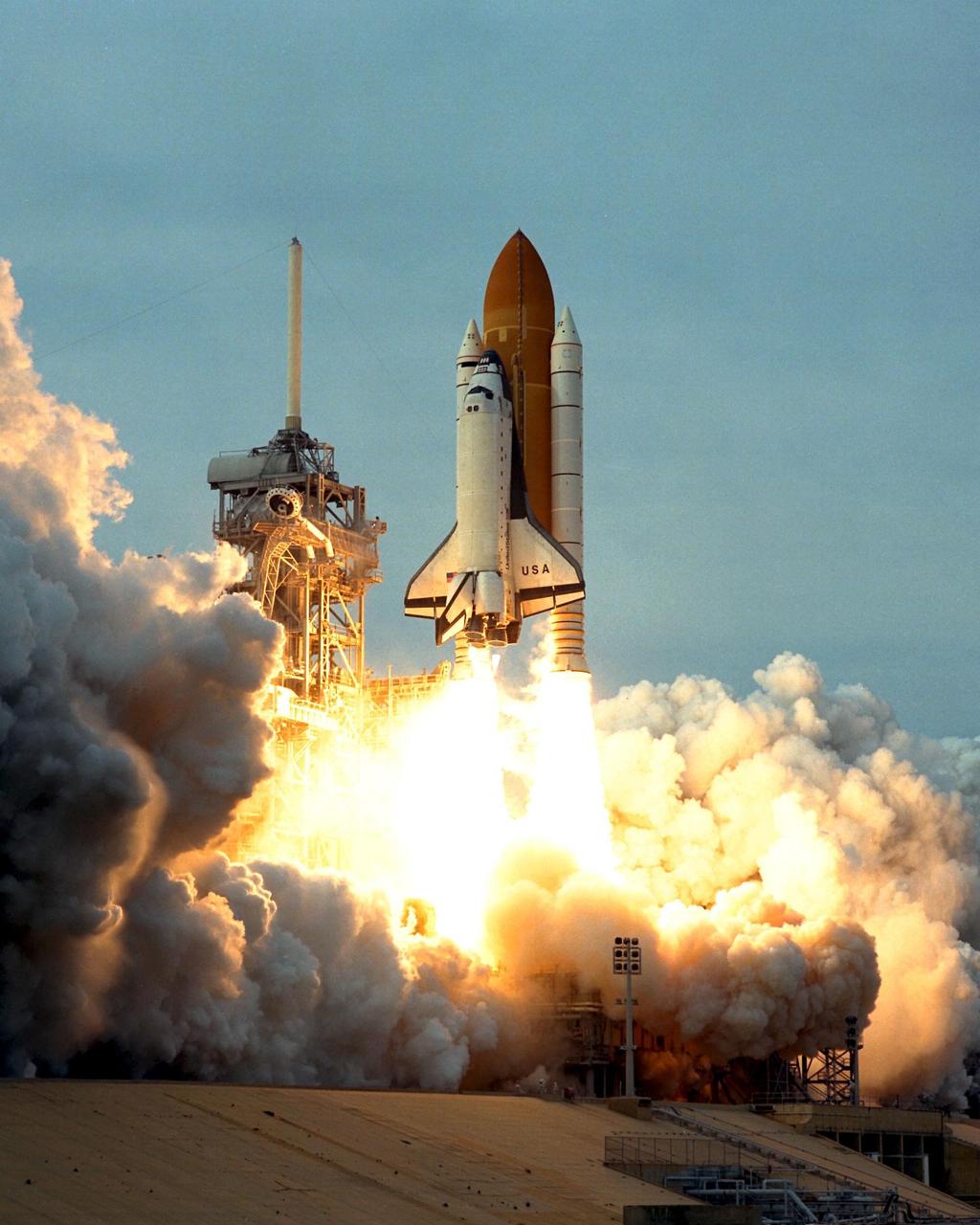
Like a rising sun lighting up the afternoon sky, the Space Shuttle Columbia soars from Launch Pad 39B at 2:46:00 p.m. EST, November 19, on the fourth flight of the United States Microgravity Payload and Spartan-201 satellite. The crew members include Mission Commander Kevin Kregel.; Pilot Steven Lindsey; Mission Specialists Kalpana Chawla, Ph.D., Winston Scott, and Takao Doi, Ph.D., of the National Space Development Agency of Japan; and Payload Specialist Leonid Kadenyuk of the National Space Agency of Ukraine. During the 16-day STS-87 mission, the crew will oversee experiments in microgravity; deploy and retrieve a solar satellite; and test a new experimental camera, the AERCam Sprint. Dr. Doi and Scott also will perform a spacewalk to practice International Space Station maneuvers

Like a rising sun lighting up the afternoon sky, the Space Shuttle Columbia soars from Launch Pad 39B at 2:46:00 p.m. EST, November 19, on the fourth flight of the United States Microgravity Payload and Spartan-201 satellite. The crew members include Mission Commander Kevin Kregel.; Pilot Steven Lindsey; Mission Specialists Kalpana Chawla, Ph.D., Winston Scott, and Takao Doi, Ph.D., of the National Space Development Agency of Japan; and Payload Specialist Leonid Kadenyuk of the National Space Agency of Ukraine. During the 16-day STS-87 mission, the crew will oversee experiments in microgravity; deploy and retrieve a solar satellite; and test a new experimental camera, the AERCam Sprint. Dr. Doi and Scott also will perform a spacewalk to practice International Space Station maneuvers
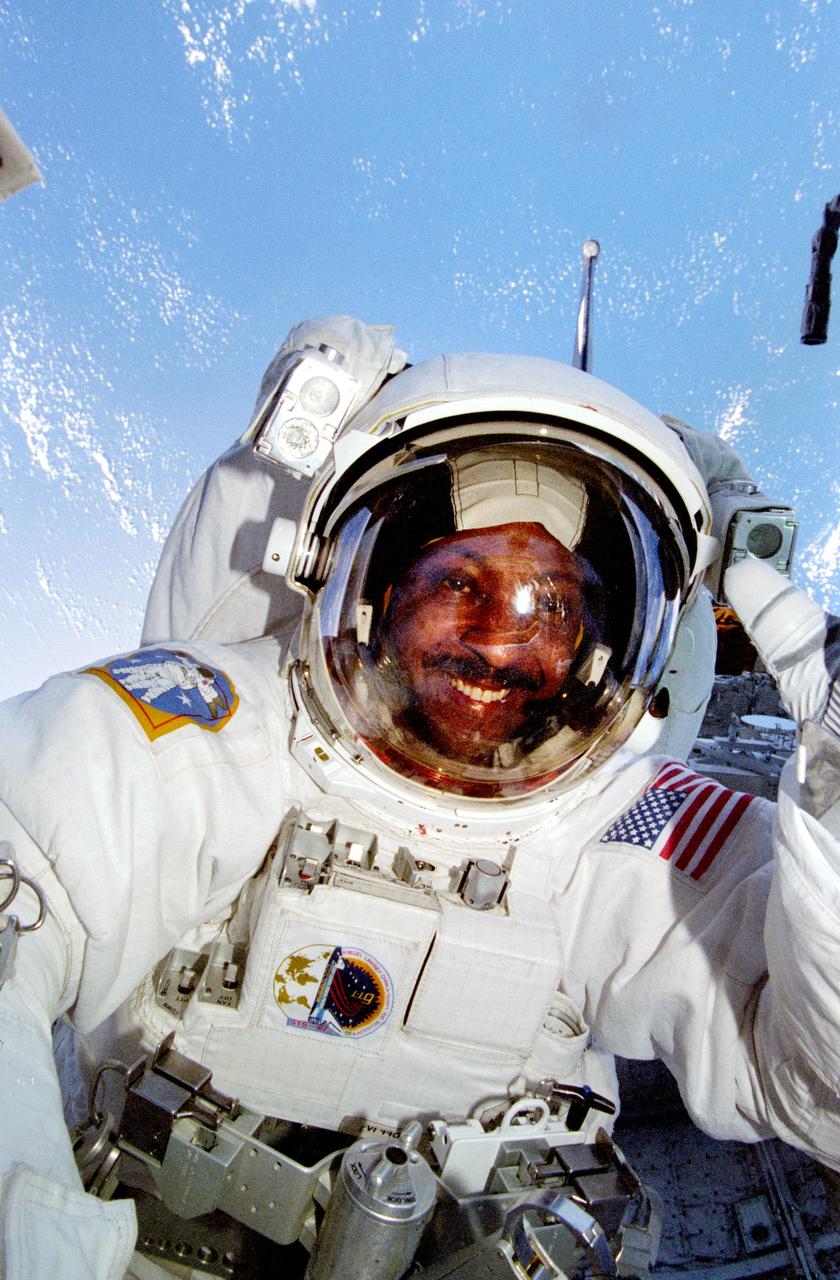
STS087-375-015 (19 November – 5 December 1997) --- Astronaut Winston E. Scott, mission specialist, during one of two extravehicular activities (EVA) in the cargo bay of the Earth-orbiting Space Shuttle Columbia, is backdropped against a blue “blanket” of ocean water. This view was taken with a 35mm camera.

STS-87 Mission Specialist Winston Scott is assisted with his ascent and re-entry flight suit in the white room at Launch Pad 39B by Danny Wyatt, NASA quality assurance specialist. STS-87 is the fourth flight of the United States Microgravity Payload and Spartan-201. Scott is scheduled to perform an extravehicular activity spacewalk with Mission Specialist Takao Doi, Ph.D., of the National Space Development Agency of Japan, during STS-87. Scott also performed a spacewalk on the STS-72 mission
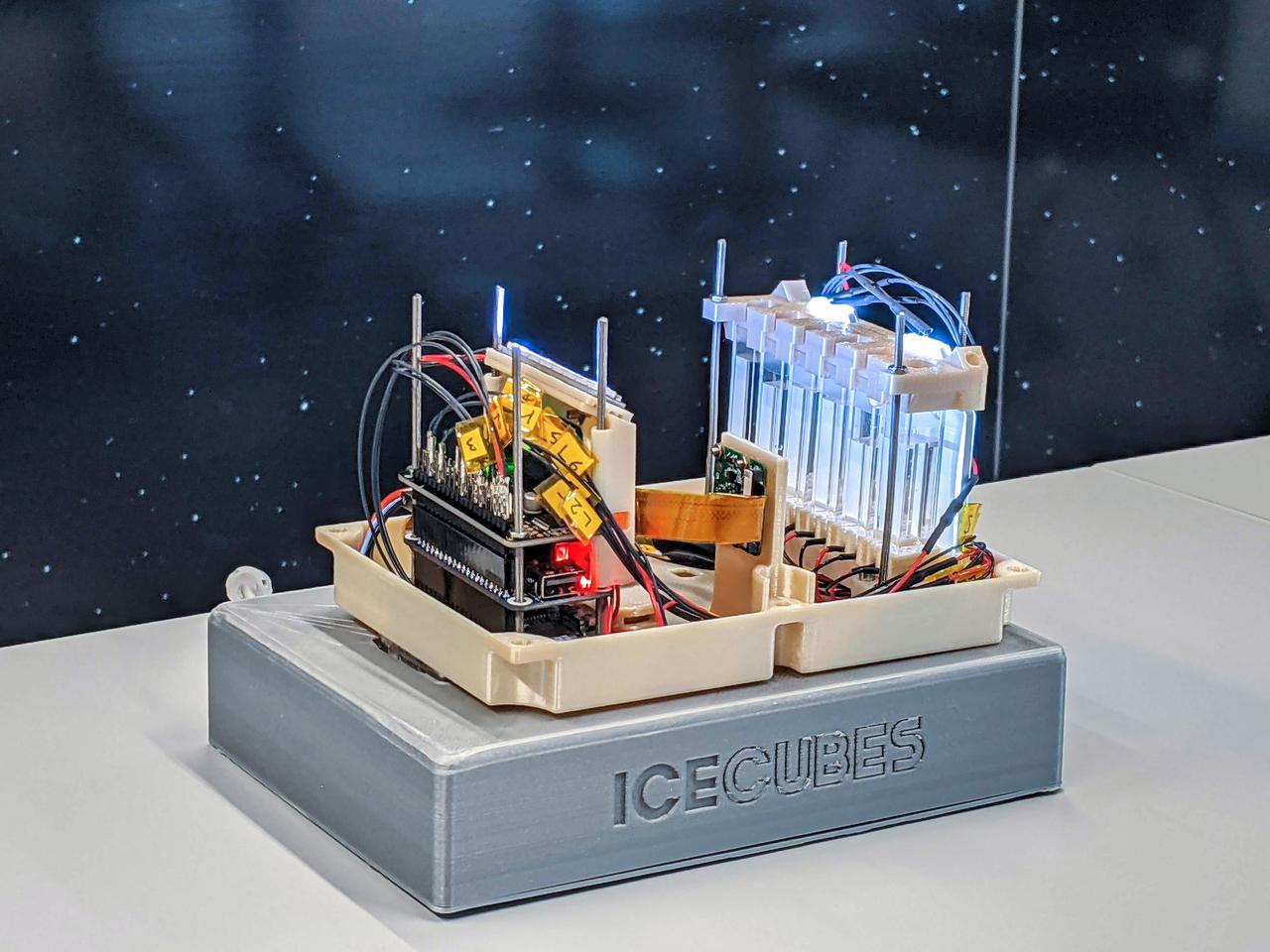
jsc2021e033555 (5/12/2021) --- A prefliight view of Ice Cubes #9 - Project Maleth. The Maltese Biocube, based on ICE Cubes platform by Space Applications Services, that will take samples to the International Space Station in a historic first for the country. The investigation studies Diabetes Mellitus Type 2 and Diabetic Foot Ulcers (DFU) using genetics and space biosciences is new and innovative research. Image credit: DOI: Ministry for Foreign and European Affairs, Malta
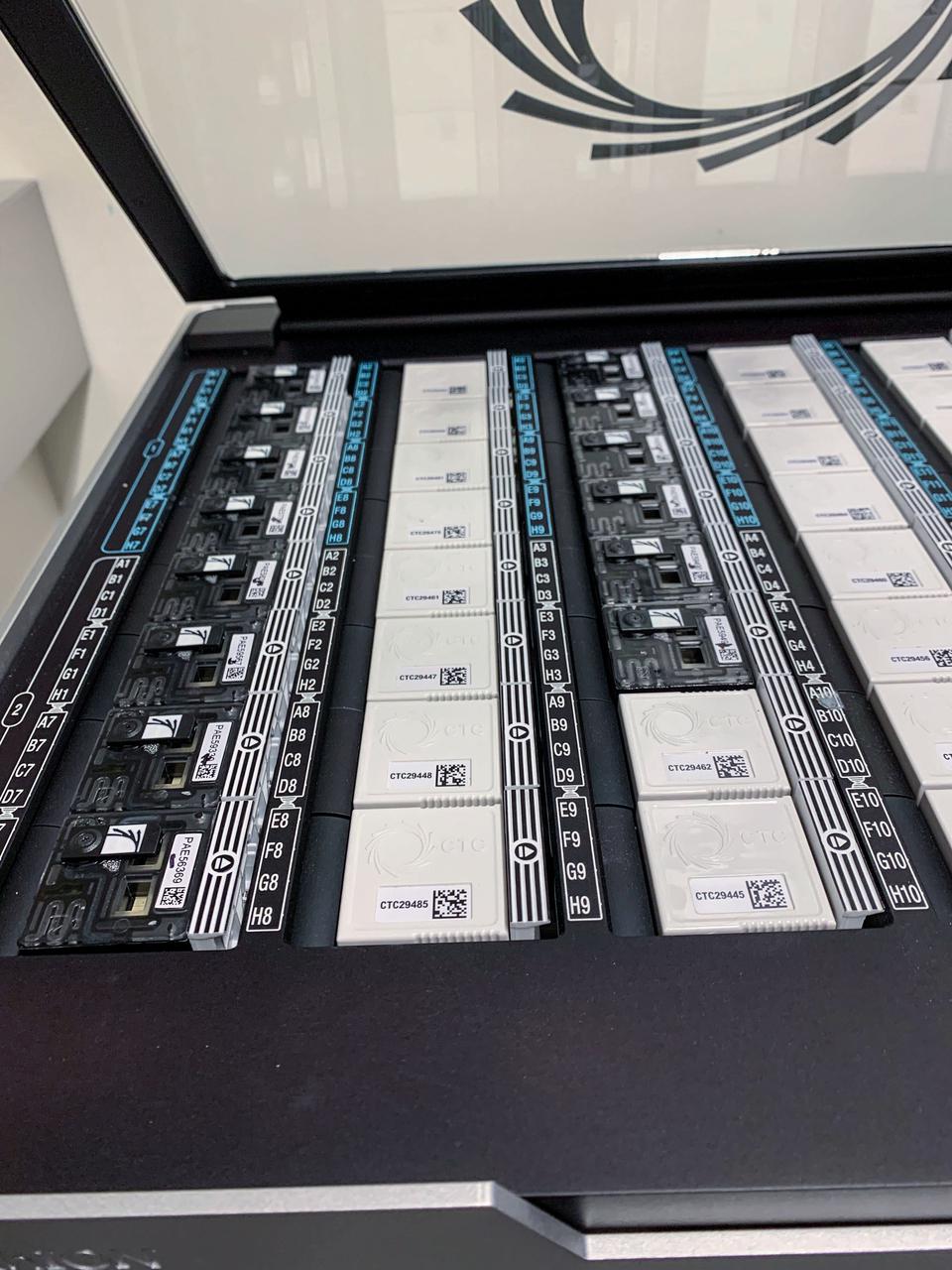
jsc2021e033549 (8/4/2021) --- A prefliight view of Ice Cubes #9 - Project Maleth. The Maltese Biocube, based on ICE Cubes platform by Space Applications Services, that will take samples to the International Space Station in a historic first for the country. The investigation studies Diabetes Mellitus Type 2 and Diabetic Foot Ulcers (DFU) using genetics and space biosciences is new and innovative research. Image credit: DOI: Ministry for Foreign and European Affairs, Malta

STS087-307-002 (19 November - 5 December 1997) --- On the Space Shuttle Columbia's middeck, the crewmembers for the mission pose for the traditional in-flight portrait. In front, left to right, are astronauts Steven W. Lindsey, pilot; Takao Doi, mission specialist representing Japan's National Space Development Agency (NASDA); and Winston E. Scott, mission specialist. In back are, from the left, astronauts Kevin R. Kregel, commander; and Kalpana Chawla, mission specialist; along with payload specialist Leonid Kadenyuk.
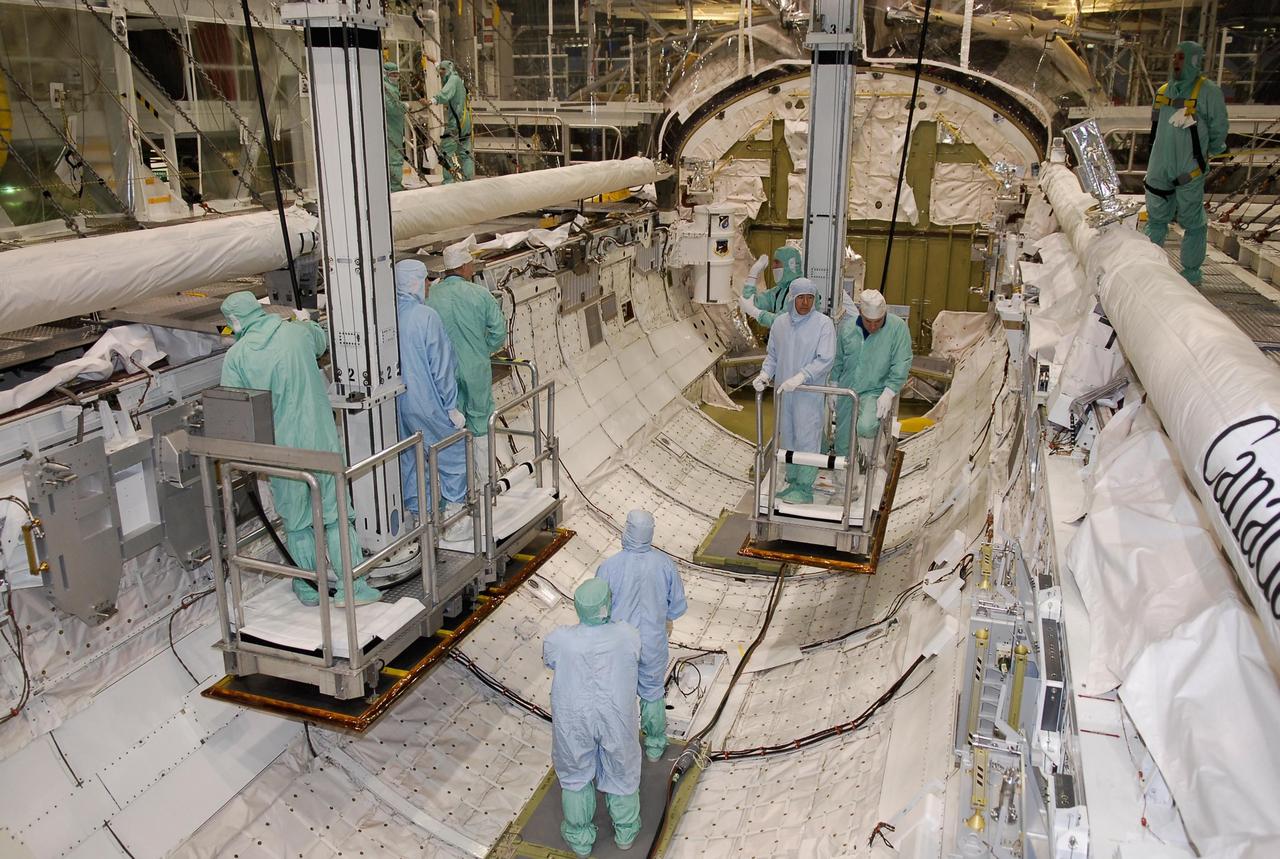
KENNEDY SPACE CENTER, FLA. -- In the Orbiter Processing Facility, STS-123 crew members get a close look inside space shuttle Endeavour's payload bay. The crew is at NASA's Kennedy Space Center for a crew equipment interface test, a process of familiarization with payloads, hardware and the space shuttle. Doi represents the Japanese Aerospace and Exploration Agency. The STS-123 mission is targeted for launch on space shuttle Endeavour on Feb. 14. It will be the 25th assembly flight of the station. Photo credit: NASA/Kim Shiflett

jsc2021e033554 (5/12/2021) --- A prefliight view of Ice Cubes #9 - Project Maleth. The Maltese Biocube, based on ICE Cubes platform by Space Applications Services, that will take samples to the International Space Station in a historic first for the country. The investigation studies Diabetes Mellitus Type 2 and Diabetic Foot Ulcers (DFU) using genetics and space biosciences is new and innovative research. Image credit: DOI: Ministry for Foreign and European Affairs, Malta
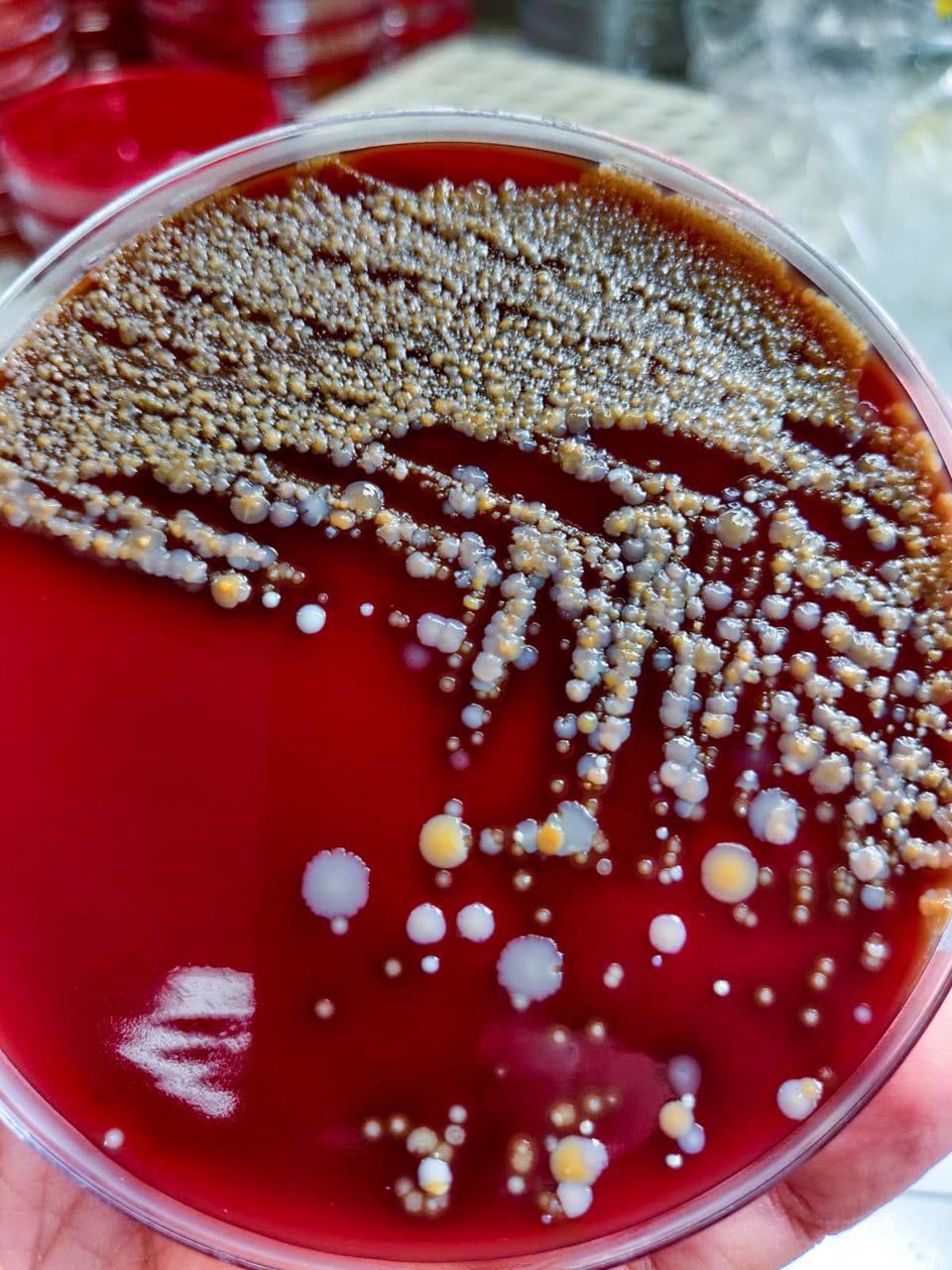
sc2021e033545 (8/4/2021) --- A preflight view the Ice Cubes #9 – Project Maleth (Space Omics Analysis of the Skin Microbiome of Diabetic Foot Ulcers, or SpaceOMIX) The investigation studies Diabetes Mellitus Type 2 and Diabetic Foot Ulcers (DFU) using genetics and space biosciences is new and innovative research. Image credit: DOI: Ministry for Foreign and European Affairs, Malta

STS087-338-003 (19 November - 5 December 1997) --- Astronaut Kalpana Chawla, mission specialist, aims a 70mm camera through the Space Shuttle Columbia's overhead window. Crew members used the camera for the ongoing Earth observations project but they used it as well to document operations with the Spartan-201 satellite and the two Extravehicular Activities (EVA) performed by astronauts Winston E. Scott and Takao Doi.
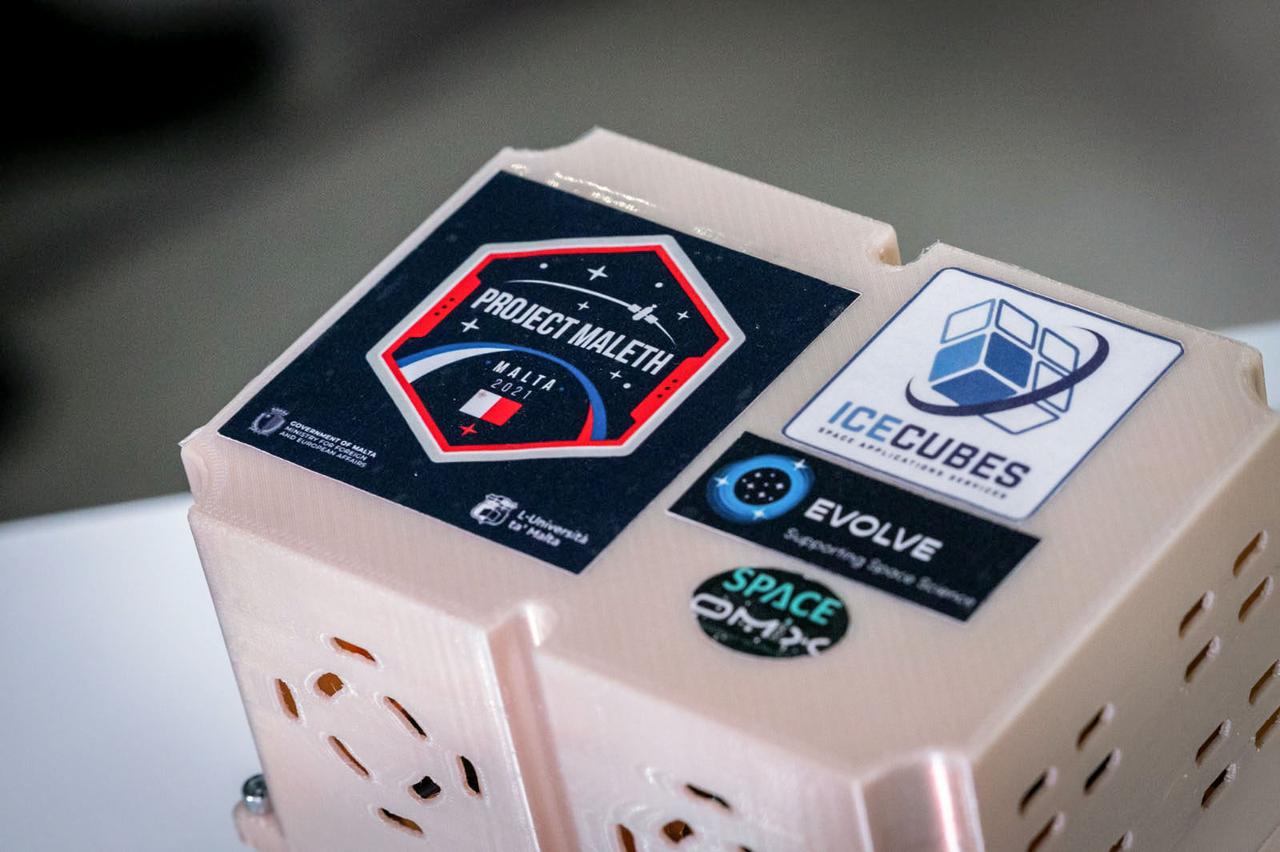
jsc2021e033543 (8/4/2021) --- A prefliight view of Ice Cubes #9 - Project Maleth. The Maltese Biocube, based on ICE Cubes platform by Space Applications Services, that will take samples to the International Space Station in a historic first for the country. The investigation studies Diabetes Mellitus Type 2 and Diabetic Foot Ulcers (DFU) using genetics and space biosciences is new and innovative research. Image credit: DOI: Ministry for Foreign and European Affairs, Malta
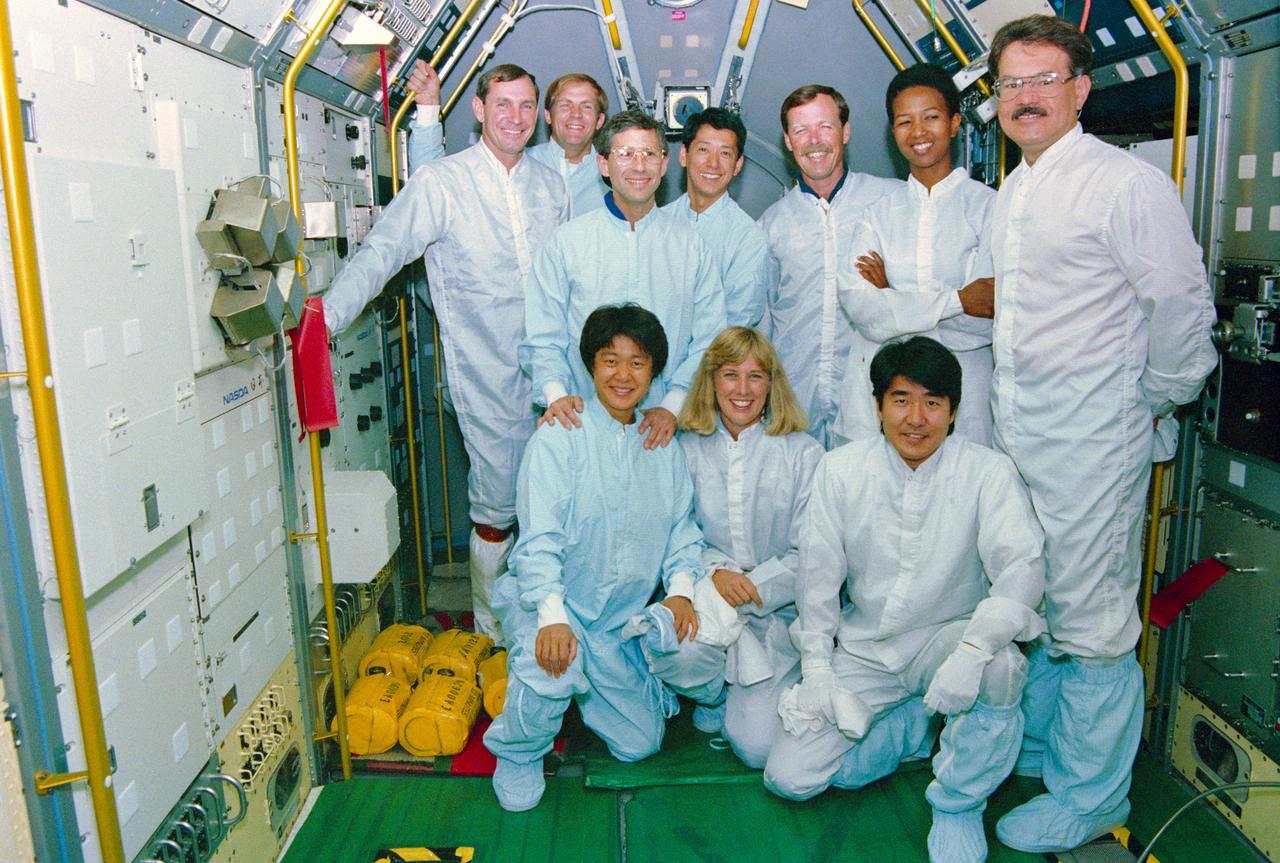
S92-44303 --- STS-47 Endeavour, Orbiter Vehicle (OV) 105, crew members and back-up payload specialists, wearing clean suits, pose for a group portrait in the Spacelab Japan (SLJ) module. The team is at the Kennedy Space Center's (KSC's) Orbiter Processing Facility (OPF) to inspect SLJ configuration and OV-105 preparations. Kneeling, from left, are back-up Payload Specialist Chiaki Naito-Mukai; Mission Specialist N. Jan Davis; and backup Payload Specialist Takao Doi. Standing, from the left, are Pilot Curtis L. Brown,Jr; Payload Commander Mark C. Lee; Jerome Apt; Payload Specialist Mamoru Mohri; Commander Robert L. Gibson; Mae C. Jemison; and back-up Payload Specialist Stanely L. Koszelak. Mohri, Mukai, and Doi represent the National Space Development Agency of Japan (NASDA). View provided by KSC with alternate KSC number KSC-92PC-1647. Photo credit: NASA

KENNEDY SPACE CENTER, FLA. -- In the Space Station Processing Facility at NASA's Kennedy Space Center, members of the STS-123 crew learn more about the mission payload, the Kibo Experiment Logistics Module Pressurized Section. They are at the center for a crew equipment interface test, which allows familiarization with equipment they will use during the mission. Crew members are Commander Dominic Gorie, Pilot Gregory Johnson and Mission Specialists Richard Linnehan, Takao Doi, Robert Behnken, Gerrett Reisman and Michael Foreman. Doi represents the Japan Aerospace Exploration Agency. Reisman will remain on the space station after the mission as a flight engineer for Expedition 16. STS-123 will carry and install one of the components of the Japanese Experiment Module, or JEM. Known as Kibo, the JEM comprises six components: two research facilities -- the Pressurized Module and Exposed Facility; a Logistics Module attached to each of them; a Remote Manipulator System; and an Inter-Orbit Communication System unit. The various components of JEM will be assembled in space over the course of three space shuttle missions. The first of those three missions, STS-123, will carry the Experiment Logistics Module Pressurized Section aboard the space shuttle Endeavour, targeted for launch in February 2008. Photo credit: NASA/Dimitrios Gerondidakis

KENNEDY SPACE CENTER, FLA. -- In the Space Station Processing Facility at NASA's Kennedy Space Center, members of the STS-123 crew get hands-on experience with the mission payload, the Kibo Experiment Logistics Module Pressurized Section. They are at the center for a crew equipment interface test, which allows familiarization with equipment they will use during the mission. Crew members are Commander Dominic Gorie, Pilot Gregory Johnson and Mission Specialists Richard Linnehan, Takao Doi, Robert Behnken, Gerrett Reisman and Michael Foreman. Doi represents the Japan Aerospace Exploration Agency. Reisman will remain on the space station after the mission as a flight engineer for Expedition 16. STS-123 will carry and install one of the components of the Japanese Experiment Module, or JEM. Known as Kibo, the JEM comprises six components: two research facilities -- the Pressurized Module and Exposed Facility; a Logistics Module attached to each of them; a Remote Manipulator System; and an Inter-Orbit Communication System unit. The various components of JEM will be assembled in space over the course of three space shuttle missions. The first of those three missions, STS-123, will carry the Experiment Logistics Module Pressurized Section aboard the space shuttle Endeavour, targeted for launch in February 2008. Photo credit: NASA/Dimitrios Gerondidakis
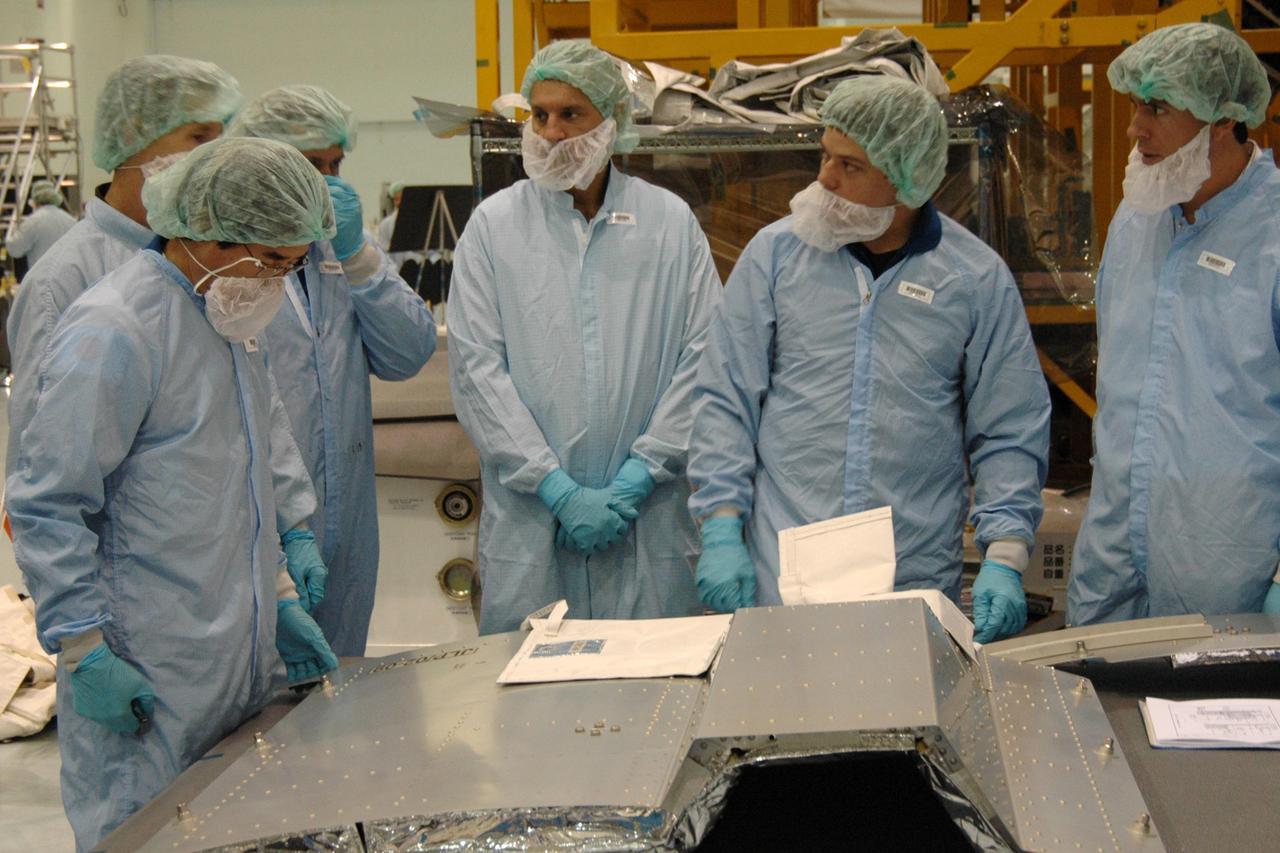
KENNEDY SPACE CENTER, FLA. -- In the Space Station Processing Facility at NASA's Kennedy Space Center, members of the STS-123 crew get hands-on experience with some of the equipment related to the mission. Crew members are Commander Dominic Gorie, Pilot Gregory Johnson and Mission Specialists Richard Linnehan, Takao Doi, Robert Behnken, Gerrett Reisman and Michael Foreman. Doi represents the Japan Aerospace Exploration Agency. Reisman will remain on the space station after the mission as a flight engineer for Expedition 16. STS-123 will carry and install one of the components of the Japanese Experiment Module, or JEM. Known as Kibo, the JEM comprises six components: two research facilities -- the Pressurized Module and Exposed Facility; a Logistics Module attached to each of them; a Remote Manipulator System; and an Inter-Orbit Communication System unit. The various components of JEM will be assembled in space over the course of three space shuttle missions. The first of those three missions, STS-123, will carry the Experiment Logistics Module Pressurized Section aboard the space shuttle Endeavour, targeted for launch in February 2008. Photo credit: NASA/Dimitrios Gerondidakis
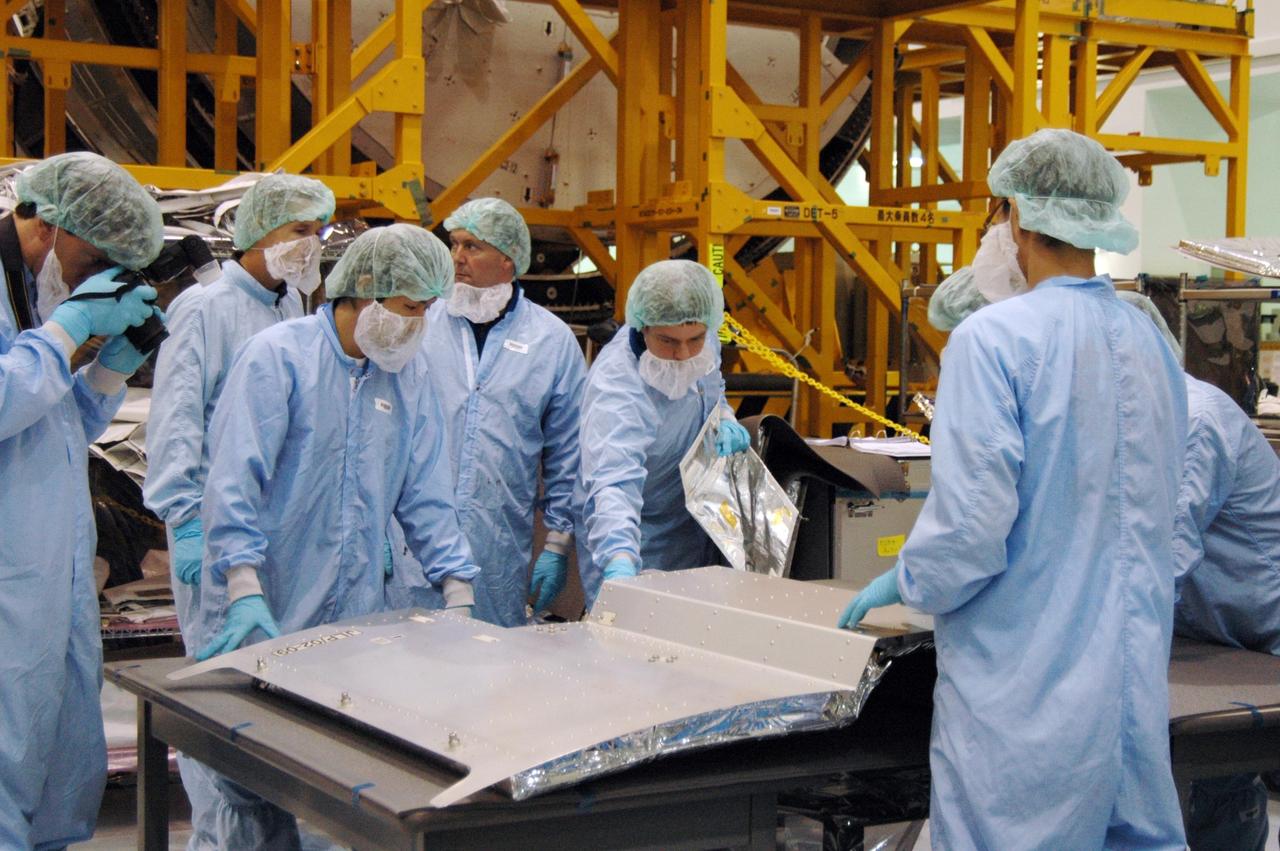
KENNEDY SPACE CENTER, FLA. -- In the Space Station Processing Facility at NASA's Kennedy Space Center, members of the STS-123 crew get hands-on experience with some of the equipment related to the mission. Crew members are Commander Dominic Gorie, Pilot Gregory Johnson and Mission Specialists Richard Linnehan, Takao Doi, Robert Behnken, Gerrett Reisman and Michael Foreman. Doi represents the Japan Aerospace Exploration Agency. Reisman will remain on the space station after the mission as a flight engineer for Expedition 16. STS-123 will carry and install one of the components of the Japanese Experiment Module, or JEM. Known as Kibo, the JEM comprises six components: two research facilities -- the Pressurized Module and Exposed Facility; a Logistics Module attached to each of them; a Remote Manipulator System; and an Inter-Orbit Communication System unit. The various components of JEM will be assembled in space over the course of three space shuttle missions. The first of those three missions, STS-123, will carry the Experiment Logistics Module Pressurized Section aboard the space shuttle Endeavour, targeted for launch in February 2008. Photo credit: NASA/Dimitrios Gerondidakis
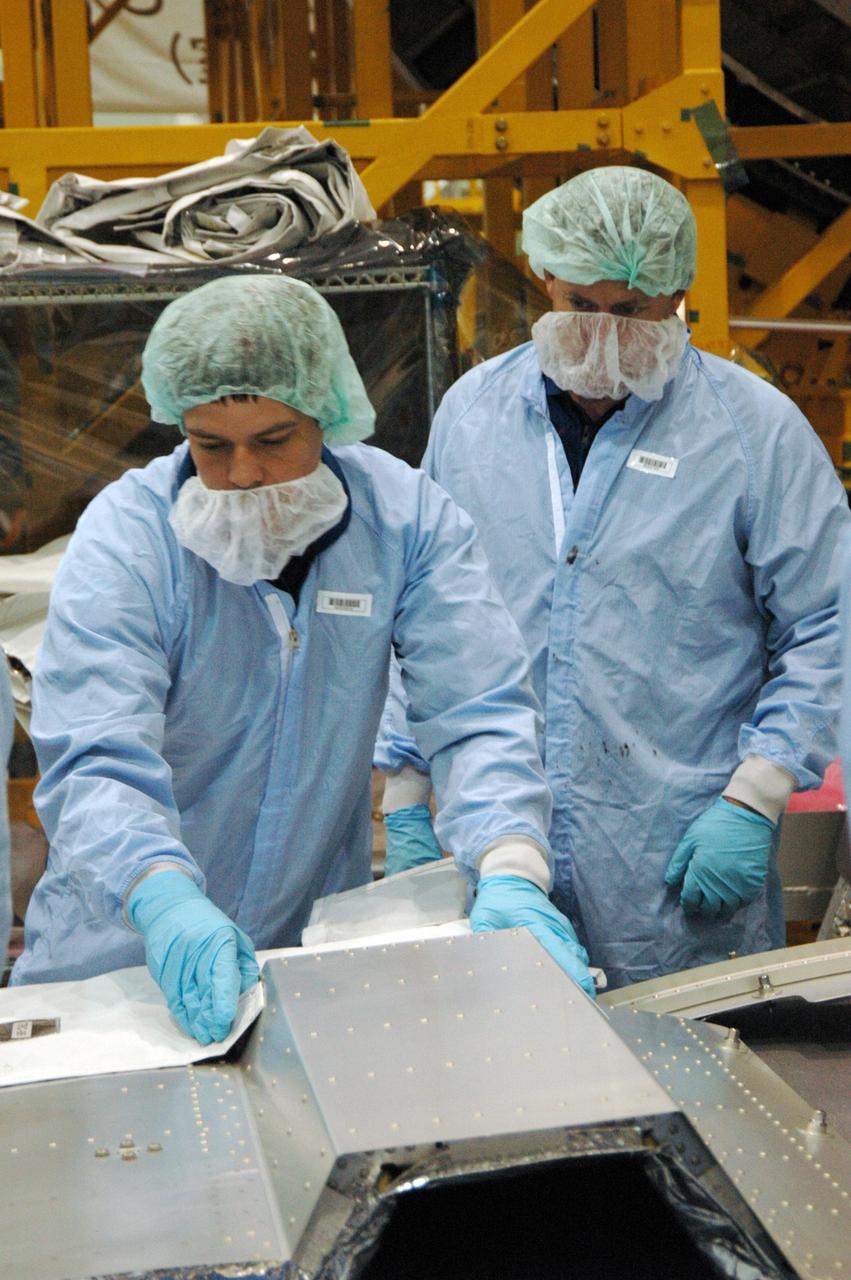
KENNEDY SPACE CENTER, FLA. -- In the Space Station Processing Facility at NASA's Kennedy Space Center, members of the STS-123 crew get hands-on experience with some of the equipment related to the mission. Crew members are Commander Dominic Gorie, Pilot Gregory Johnson and Mission Specialists Richard Linnehan, Takao Doi, Robert Behnken, Gerrett Reisman and Michael Foreman. Doi represents the Japan Aerospace Exploration Agency. Reisman will remain on the space station after the mission as a flight engineer for Expedition 16. STS-123 will carry and install one of the components of the Japanese Experiment Module, or JEM. Known as Kibo, the JEM comprises six components: two research facilities -- the Pressurized Module and Exposed Facility; a Logistics Module attached to each of them; a Remote Manipulator System; and an Inter-Orbit Communication System unit. The various components of JEM will be assembled in space over the course of three space shuttle missions. The first of those three missions, STS-123, will carry the Experiment Logistics Module Pressurized Section aboard the space shuttle Endeavour, targeted for launch in February 2008. Photo credit: NASA/Dimitrios Gerondidakis

KENNEDY SPACE CENTER, FLA. -- In the Space Station Processing Facility at NASA's Kennedy Space Center, STS-123 crew members get a close look at hardware related to the mission. They are at the center for a crew equipment interface test, which allows familiarization with equipment they will use during the mission. Crew members are Commander Dominic Gorie, Pilot Gregory Johnson and Mission Specialists Richard Linnehan, Takao Doi, Robert Behnken, Gerrett Reisman and Michael Foreman. Doi represents the Japan Aerospace Exploration Agency. Reisman will remain on the space station after the mission as a flight engineer for Expedition 16. STS-123 will carry and install one of the components of the Japanese Experiment Module, or JEM. Known as Kibo, the JEM comprises six components: two research facilities -- the Pressurized Module and Exposed Facility; a Logistics Module attached to each of them; a Remote Manipulator System; and an Inter-Orbit Communication System unit. The various components of JEM will be assembled in space over the course of three space shuttle missions. The first of those three missions, STS-123, will carry the Experiment Logistics Module Pressurized Section aboard the space shuttle Endeavour, targeted for launch in February 2008. Photo credit: NASA/Dimitrios Gerondidakis
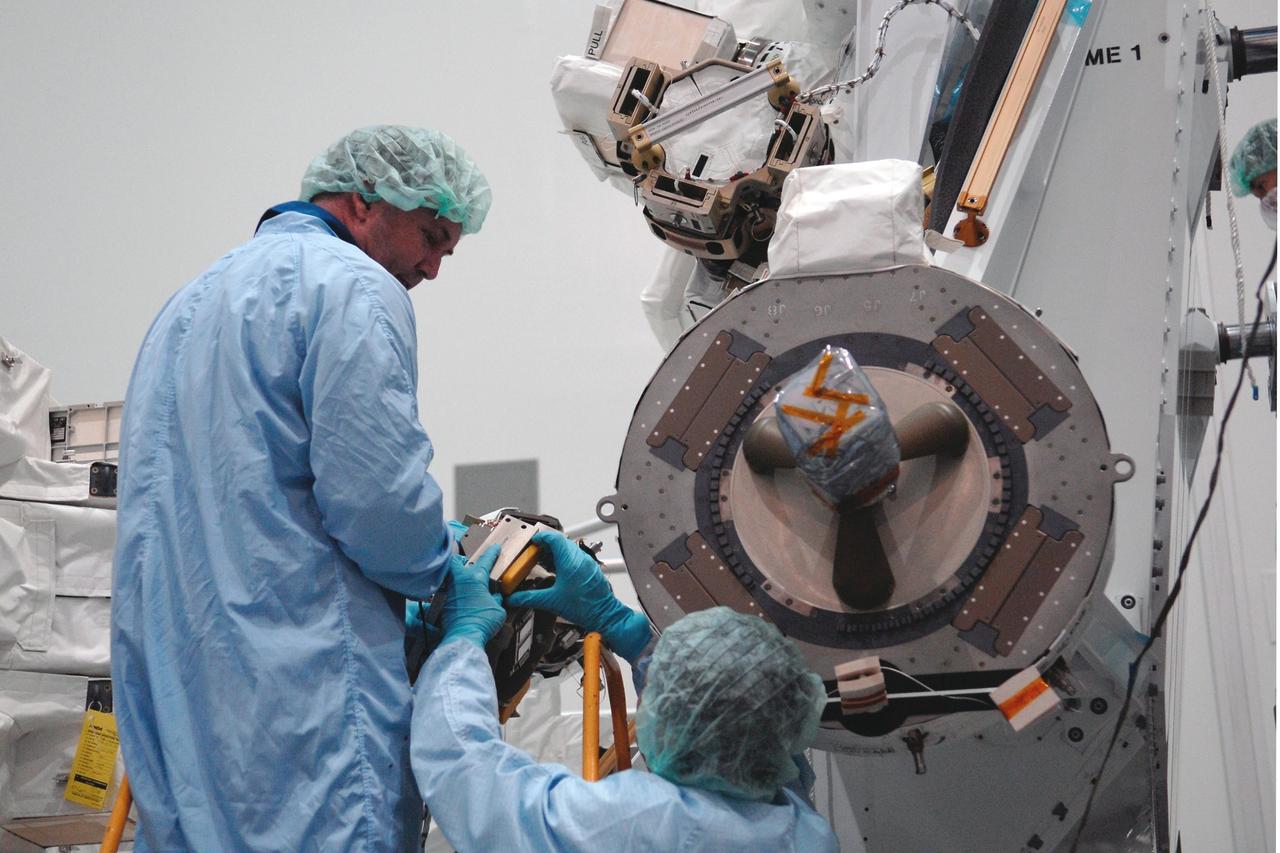
KENNEDY SPACE CENTER, FLA. -- In the Space Station Processing Facility at NASA's Kennedy Space Center, STS-123 crew members get a close look at hardware related to the mission. They are at the center for a crew equipment interface test, which allows familiarization with equipment they will use during the mission. Crew members are Commander Dominic Gorie, Pilot Gregory Johnson and Mission Specialists Richard Linnehan, Takao Doi, Robert Behnken, Gerrett Reisman and Michael Foreman. Doi represents the Japan Aerospace Exploration Agency. Reisman will remain on the space station after the mission as a flight engineer for Expedition 16. STS-123 will carry and install one of the components of the Japanese Experiment Module, or JEM. Known as Kibo, the JEM comprises six components: two research facilities -- the Pressurized Module and Exposed Facility; a Logistics Module attached to each of them; a Remote Manipulator System; and an Inter-Orbit Communication System unit. The various components of JEM will be assembled in space over the course of three space shuttle missions. The first of those three missions, STS-123, will carry the Experiment Logistics Module Pressurized Section aboard the space shuttle Endeavour, targeted for launch in February 2008. Photo credit: NASA/Dimitrios Gerondidakis
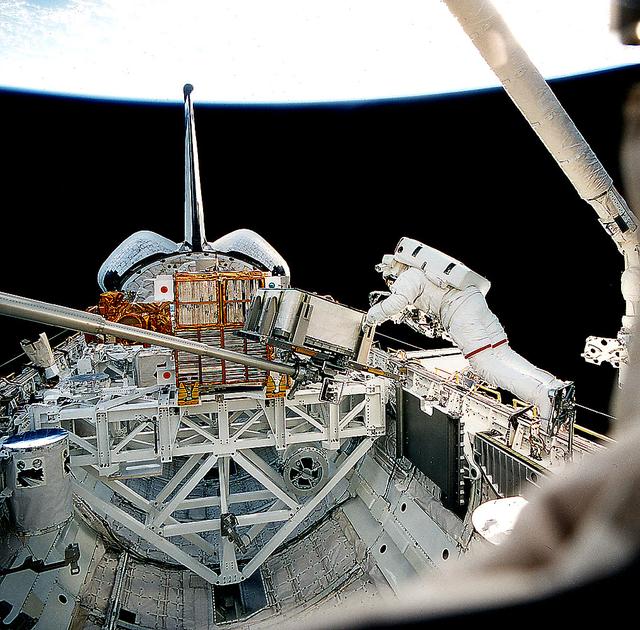
Onboard Space Shuttle Columbia's (STS-87) first ever Extravehicular Activity (EVA), astronaut Takao Doi works with a 156-pound crane carried onboard for the first time. The crane's inclusion and the work with it are part of a continuing preparation effort for future work on the International Space Station (ISS). The ongoing project allows for evaluation of tools and operating methods to be applied to the construction of the Space Station. This crane device is designed to aid future space walkers in transporting Orbital Replacement Units (ORU), with a mass up to 600 pounds (like the simulated battery pictured here), from translating carts on the exterior of ISS to various worksites on the truss structure. Earlier Doi, an international mission specialist representing Japan, and astronaut Winston E. Scott, mission specialist, had installed the crane in a socket along the middle port side of Columbia's cargo bay for the evaluation. The two began the crane operations after completing a contingency EVA to snag the free-flying Spartan 201 and berth it in the payload bay (visible in the background).
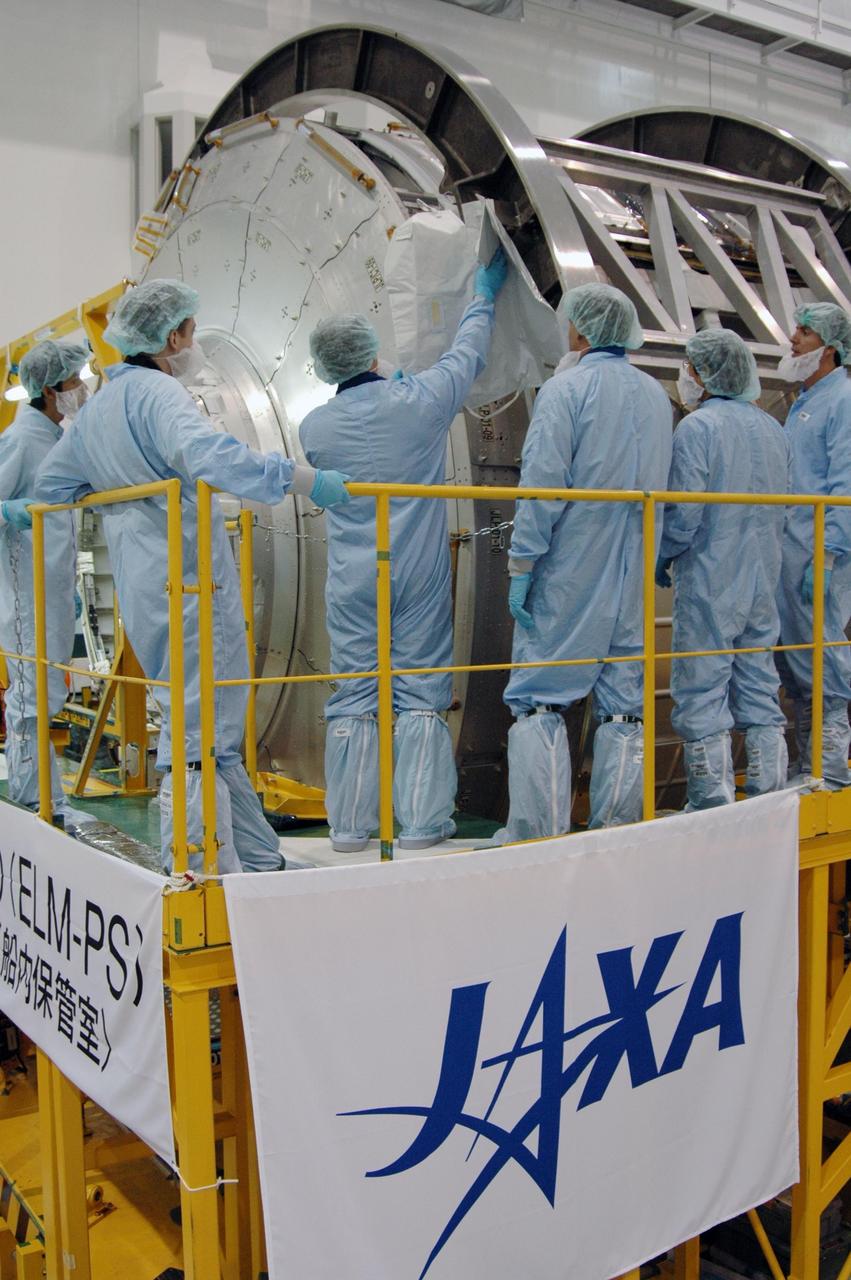
KENNEDY SPACE CENTER, FLA. -- In the Space Station Processing Facility at NASA's Kennedy Space Center, members of the STS-123 crew learn more about the mission payload, the Kibo Experiment Logistics Module Pressurized Section. Crew members are Commander Dominic Gorie, Pilot Gregory Johnson and Mission Specialists Richard Linnehan, Takao Doi, Robert Behnken, Gerrett Reisman and Michael Foreman. Doi represents the Japan Aerospace Exploration Agency. Reisman will remain on the space station after the mission as a flight engineer for Expedition 16. STS-123 will carry and install one of the components of the Japanese Experiment Module, or JEM. Known as Kibo, the JEM comprises six components: two research facilities -- the Pressurized Module and Exposed Facility; a Logistics Module attached to each of them; a Remote Manipulator System; and an Inter-Orbit Communication System unit. The various components of JEM will be assembled in space over the course of three space shuttle missions. The first of those three missions, STS-123, will carry the Experiment Logistics Module Pressurized Section aboard the space shuttle Endeavour, targeted for launch in February 2008. Photo credit: NASA/Dimitrios Gerondidakis
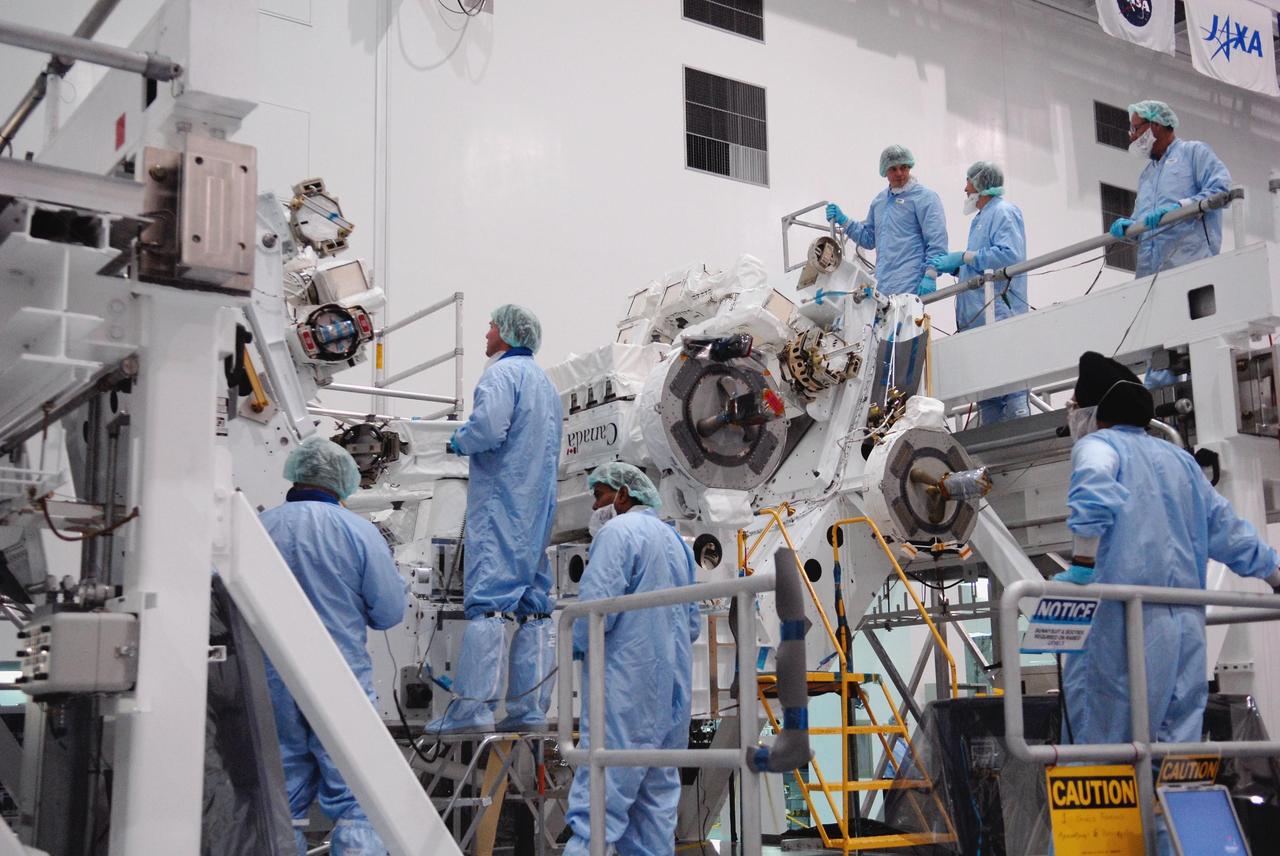
KENNEDY SPACE CENTER, FLA. -- In the Space Station Processing Facility at NASA's Kennedy Space Center, STS-123 crew members get a close look at hardware related to the mission. They are at the center for a crew equipment interface test, which allows familiarization with equipment they will use during the mission. Crew members are Commander Dominic Gorie, Pilot Gregory Johnson and Mission Specialists Richard Linnehan, Takao Doi, Robert Behnken, Gerrett Reisman and Michael Foreman. Doi represents the Japan Aerospace Exploration Agency. Reisman will remain on the space station after the mission as a flight engineer for Expedition 16. STS-123 will carry and install one of the components of the Japanese Experiment Module, or JEM. Known as Kibo, the JEM comprises six components: two research facilities -- the Pressurized Module and Exposed Facility; a Logistics Module attached to each of them; a Remote Manipulator System; and an Inter-Orbit Communication System unit. The various components of JEM will be assembled in space over the course of three space shuttle missions. The first of those three missions, STS-123, will carry the Experiment Logistics Module Pressurized Section aboard the space shuttle Endeavour, targeted for launch in February 2008. Photo credit: NASA/Dimitrios Gerondidakis
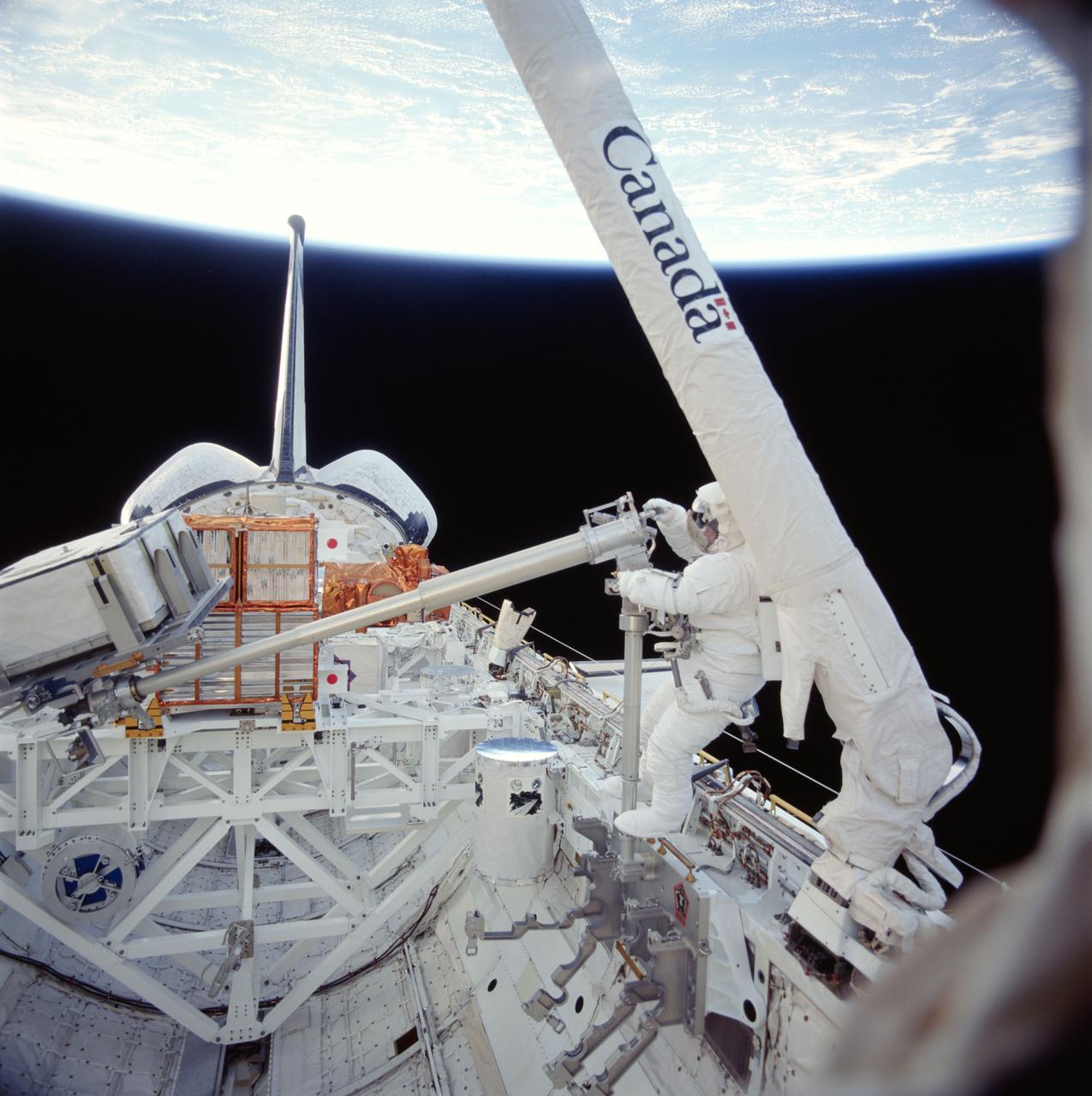
STS087-718-069 (19 November ? 5 December 1997) --- On the Space Shuttle Columbia's first ever spacewalk (EVA), astronaut Takao Doi works with a 156-pound crane carried onboard for the first time this trip of Columbia. The crane's inclusion and the work with it are part of a continuing preparation effort for future work on the International Space Station (ISS). The ongoing project allows for evaluation of tools and operating methods to be applied to the construction of the Space Station. This crane device is designed to aid future spacewalkers in transporting Orbital Replacement Units (ORU), with a mass up to 600 pounds (like the simulated battery pictured here), from translating carts on the exterior of ISS to various worksites on the truss structure. Earlier Doi, an international mission specialist representing Japan, and astronaut Winston E. Scott had installed the crane in a socket along the middle port side of Columbia's cargo bay for the evaluation. The two began the crane operations, long ago manifest for this mission, after completing a contingency spacewalk to snag the free-flying Spartan 201 and berth it in the payload bay (visible in the background).

KENNEDY SPACE CENTER, FLA. -- In the Space Station Processing Facility at NASA's Kennedy Space Center, members of the STS-123 crew get hands-on experience with some of the equipment related to the mission. Crew members are Commander Dominic Gorie, Pilot Gregory Johnson and Mission Specialists Richard Linnehan, Takao Doi, Robert Behnken, Gerrett Reisman and Michael Foreman. Doi represents the Japan Aerospace Exploration Agency. Reisman will remain on the space station after the mission as a flight engineer for Expedition 16. STS-123 will carry and install one of the components of the Japanese Experiment Module, or JEM. Known as Kibo, the JEM comprises six components: two research facilities -- the Pressurized Module and Exposed Facility; a Logistics Module attached to each of them; a Remote Manipulator System; and an Inter-Orbit Communication System unit. The various components of JEM will be assembled in space over the course of three space shuttle missions. The first of those three missions, STS-123, will carry the Experiment Logistics Module Pressurized Section aboard the space shuttle Endeavour, targeted for launch in February 2008. Photo credit: NASA/Dimitrios Gerondidakis
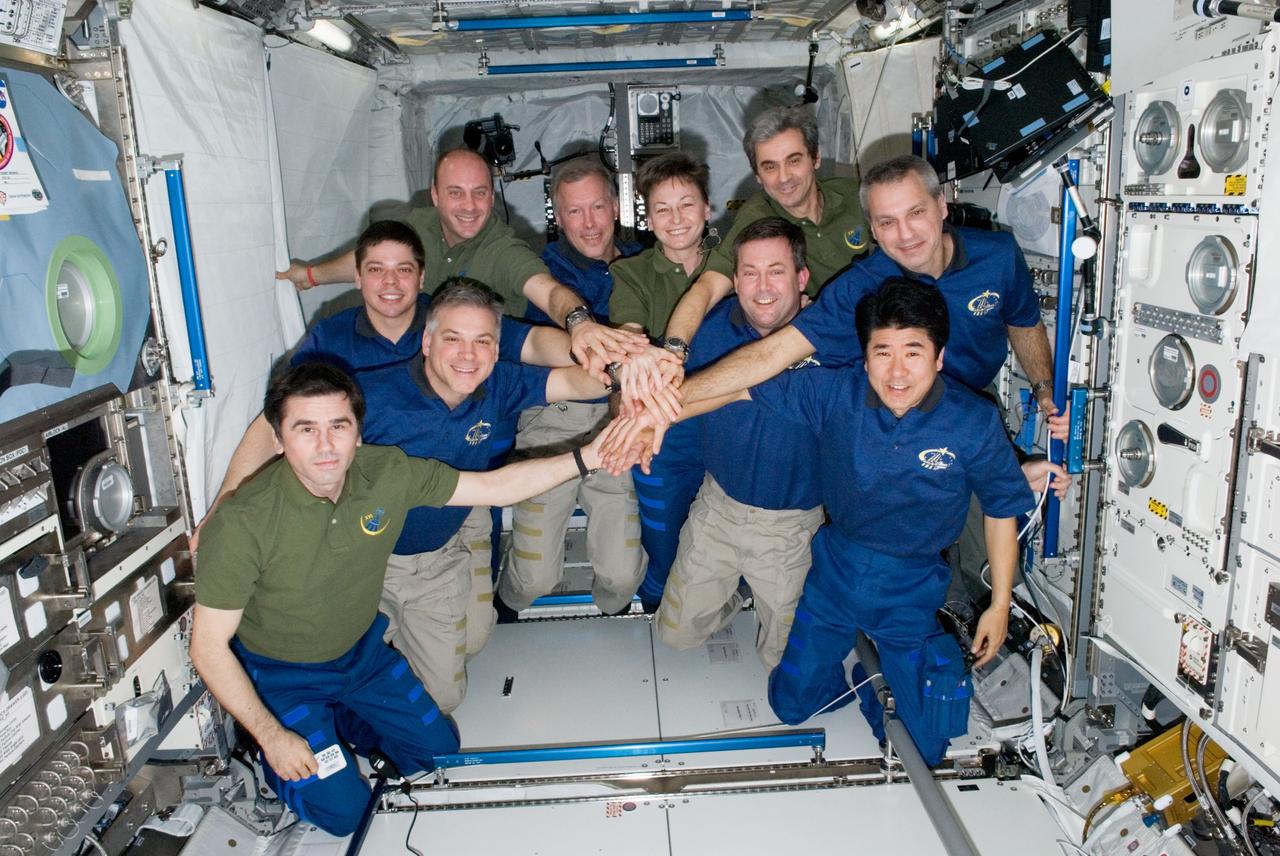
ISS016-E-033684 (24 March 2008) --- (NOTE: Picture should be rotated 180 degrees to match the identifications). The STS-123 crew used part of its last full day onboard the International Space Station posing for some in-space crew portraits. This grouping shows members of the crews for both the Space Shuttle Endeavour and Expedition 16. The Expedition 16 crew (wearing olive shirts) are astronaut Peggy Whitson (second right, rear), commander; Federal Space Agency cosmonaut Yuri Malenchenko (left, front), flight engineer; and astronaut Garrett Reisman (left rear), flight engineer. Also in a green shirt is European Space Agency astronaut Leopold Eyharts (right rear), former Expedition 16 flight engineer, who has moved over to the STS-123 crew. Soon to be leaving the station at this juncture along with Eyharts are the blue-clad Endeavour crew of astronauts Dominic Gorie (second left, rear), commander; Gregory H. Johnson (behind Malenchenko), pilot; and JAXA astronaut Takao Doi (right front), Rick Linnehan (behind Doi); Mike Foreman (second right, center row); Robert L. Behnken (far left, center row) all mission specialists.
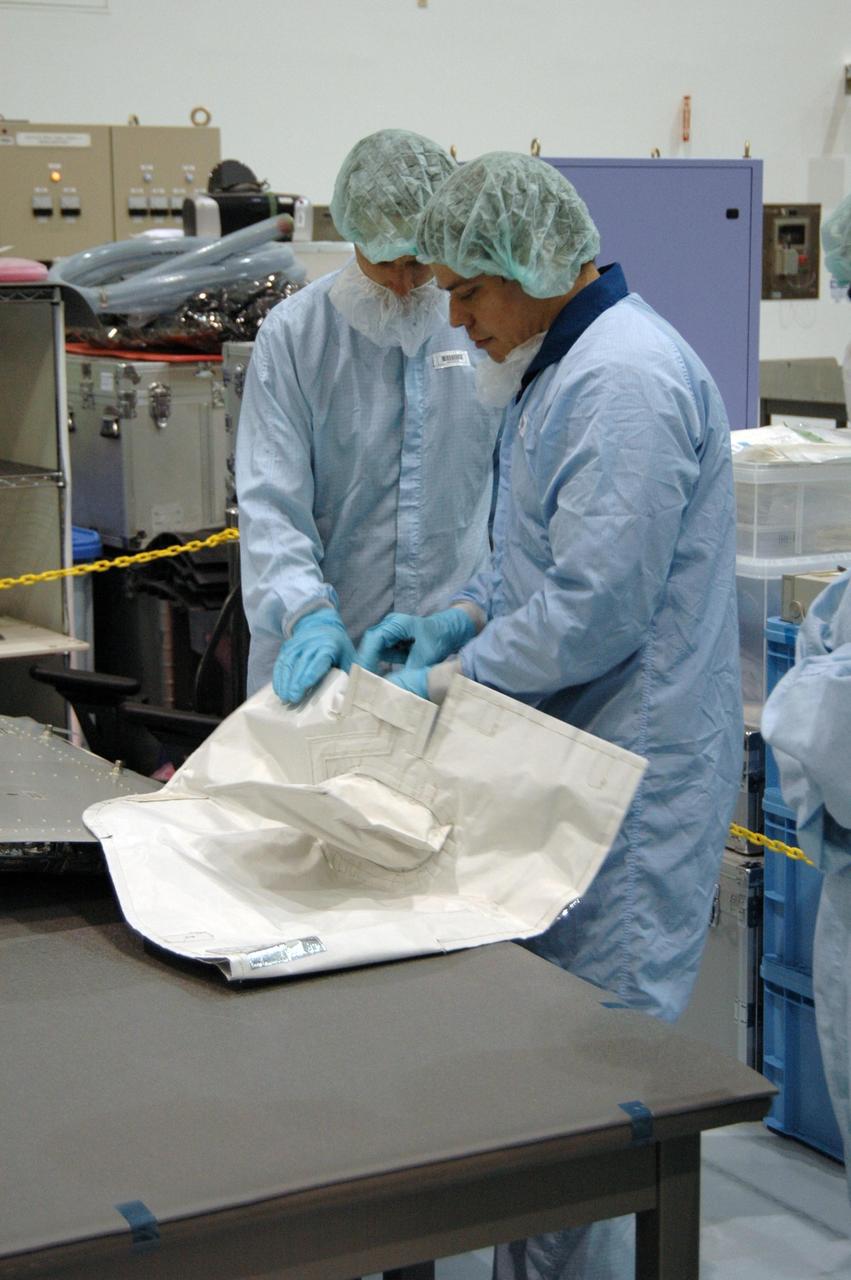
KENNEDY SPACE CENTER, FLA. -- In the Space Station Processing Facility at NASA's Kennedy Space Center, members of the STS-123 crew get hands-on experience with some of the equipment related to the mission. Crew members are Commander Dominic Gorie, Pilot Gregory Johnson and Mission Specialists Richard Linnehan, Takao Doi, Robert Behnken, Gerrett Reisman and Michael Foreman. Doi represents the Japan Aerospace Exploration Agency. Reisman will remain on the space station after the mission as a flight engineer for Expedition 16. STS-123 will carry and install one of the components of the Japanese Experiment Module, or JEM. Known as Kibo, the JEM comprises six components: two research facilities -- the Pressurized Module and Exposed Facility; a Logistics Module attached to each of them; a Remote Manipulator System; and an Inter-Orbit Communication System unit. The various components of JEM will be assembled in space over the course of three space shuttle missions. The first of those three missions, STS-123, will carry the Experiment Logistics Module Pressurized Section aboard the space shuttle Endeavour, targeted for launch in February 2008. Photo credit: NASA/Dimitrios Gerondidakis
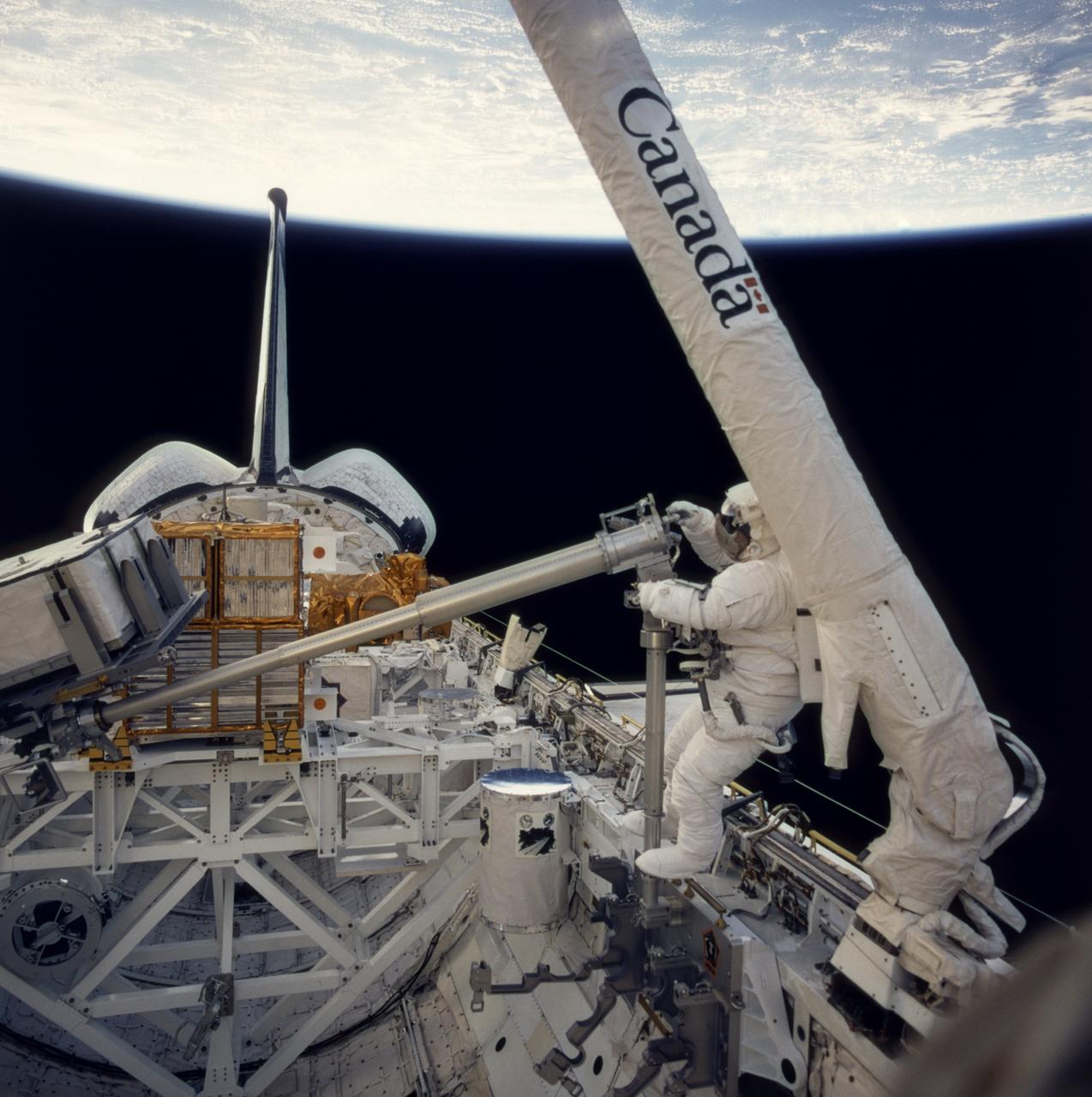
Onboard Space Shuttle Columbia's (STS-87) first ever Extravehicular Activity (EVA), astronaut Takao Doi works with a 156-pound crane carried onboard for the first time. The crane's inclusion and the work with it are part of a continuing preparation effort for future work on the International Space Station (ISS). The ongoing project allows for evaluation of tools and operating methods to be applied to the construction of the Space Station. This crane device is designed to aid future space walkers in transporting Orbital Replacement Units (ORU), with a mass up to 600 pounds (like the simulated battery pictured here), from translating carts on the exterior of ISS to various worksites on the truss structure. Earlier Doi, an international mission specialist representing Japan, and astronaut Winston E. Scott, mission specialist, had installed the crane in a socket along the middle port side of Columbia's cargo bay for the evaluation. The two began the crane operations after completing a contingency EVA to snag the free-flying Spartan 201 and berth it in the payload bay (visible in the background).
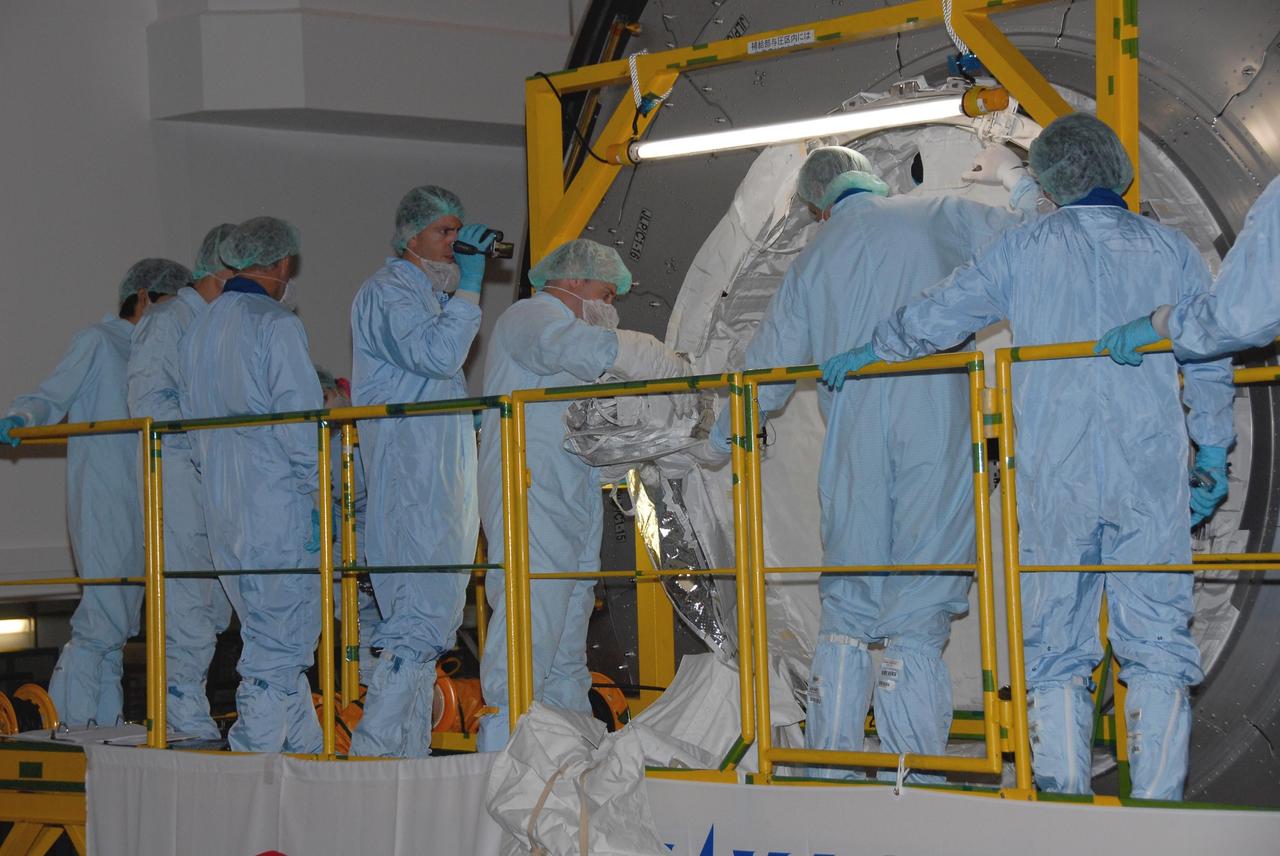
KENNEDY SPACE CENTER, FLA. -- In the Space Station Processing Facility at NASA's Kennedy Space Center, members of the STS-123 crew get hands-on experience with the mission payload, the Kibo Experiment Logistics Module Pressurized Section. They are at the center for a crew equipment interface test, which allows familiarization with equipment they will use during the mission. Crew members are Commander Dominic Gorie, Pilot Gregory Johnson and Mission Specialists Richard Linnehan, Takao Doi, Robert Behnken, Gerrett Reisman and Michael Foreman. Doi represents the Japan Aerospace Exploration Agency. Reisman will remain on the space station after the mission as a flight engineer for Expedition 16. STS-123 will carry and install one of the components of the Japanese Experiment Module, or JEM. Known as Kibo, the JEM comprises six components: two research facilities -- the Pressurized Module and Exposed Facility; a Logistics Module attached to each of them; a Remote Manipulator System; and an Inter-Orbit Communication System unit. The various components of JEM will be assembled in space over the course of three space shuttle missions. The first of those three missions, STS-123, will carry the Experiment Logistics Module Pressurized Section aboard the space shuttle Endeavour, targeted for launch in February 2008. Photo credit: NASA/Dimitrios Gerondidakis
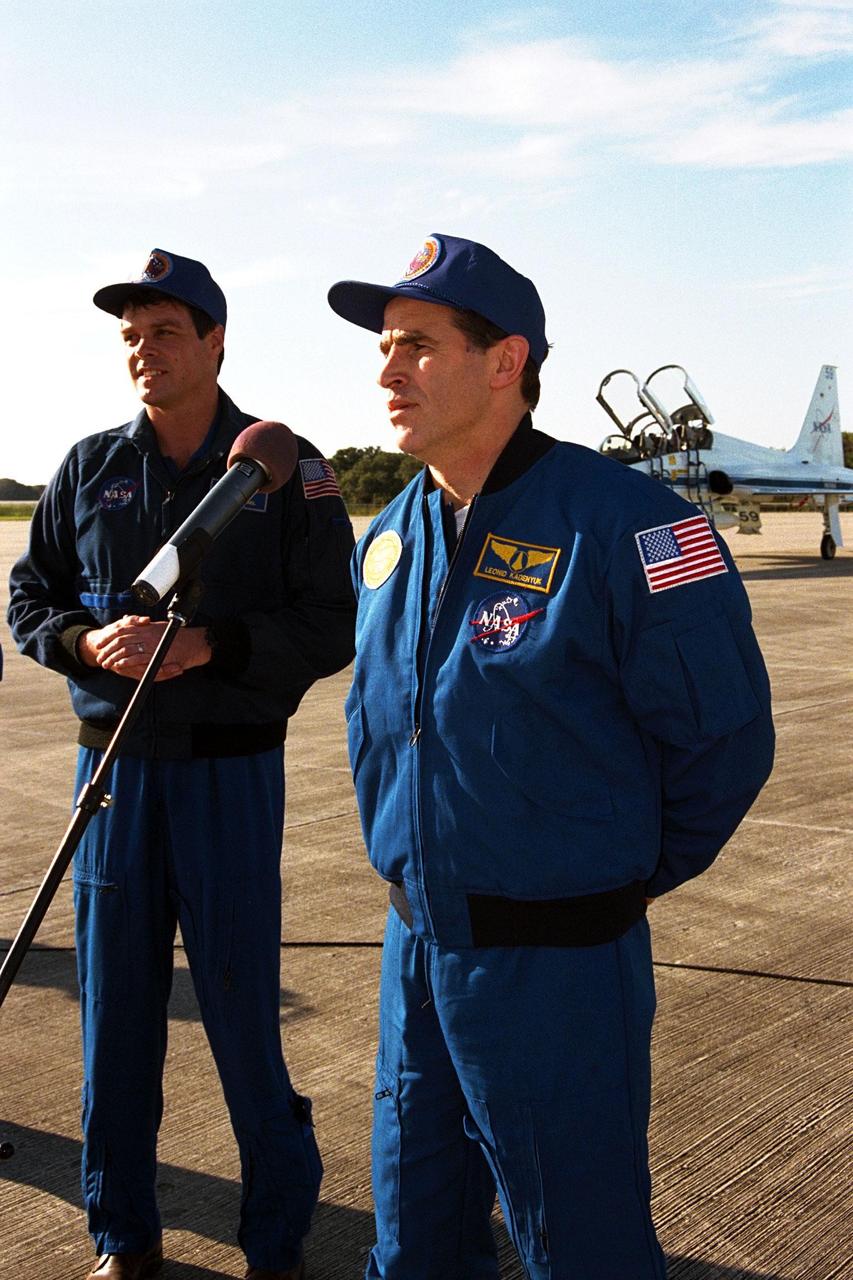
As STS-87 Commander Kevin Kregel looks on, Payload Specialist Leonid Kadenyuk of the National Space Agency of Ukraine addresses members of the press and media at Kennedy Space Center's Shuttle Landing Facility after arriving for the final prelaunch activities leading up to the scheduled Nov. 19 liftoff. Other STS-87 crew members not pictured are Pilot Steven Lindsey; and Mission Specialists Kalpana Chawla, Ph.D.; Takao Doi, Ph.D., of the National Space Development Agency of Japan; and Winston Scott. STS-87 will be the fourth flight of the United States Microgravity Payload and the Spartan-201 deployable satellite
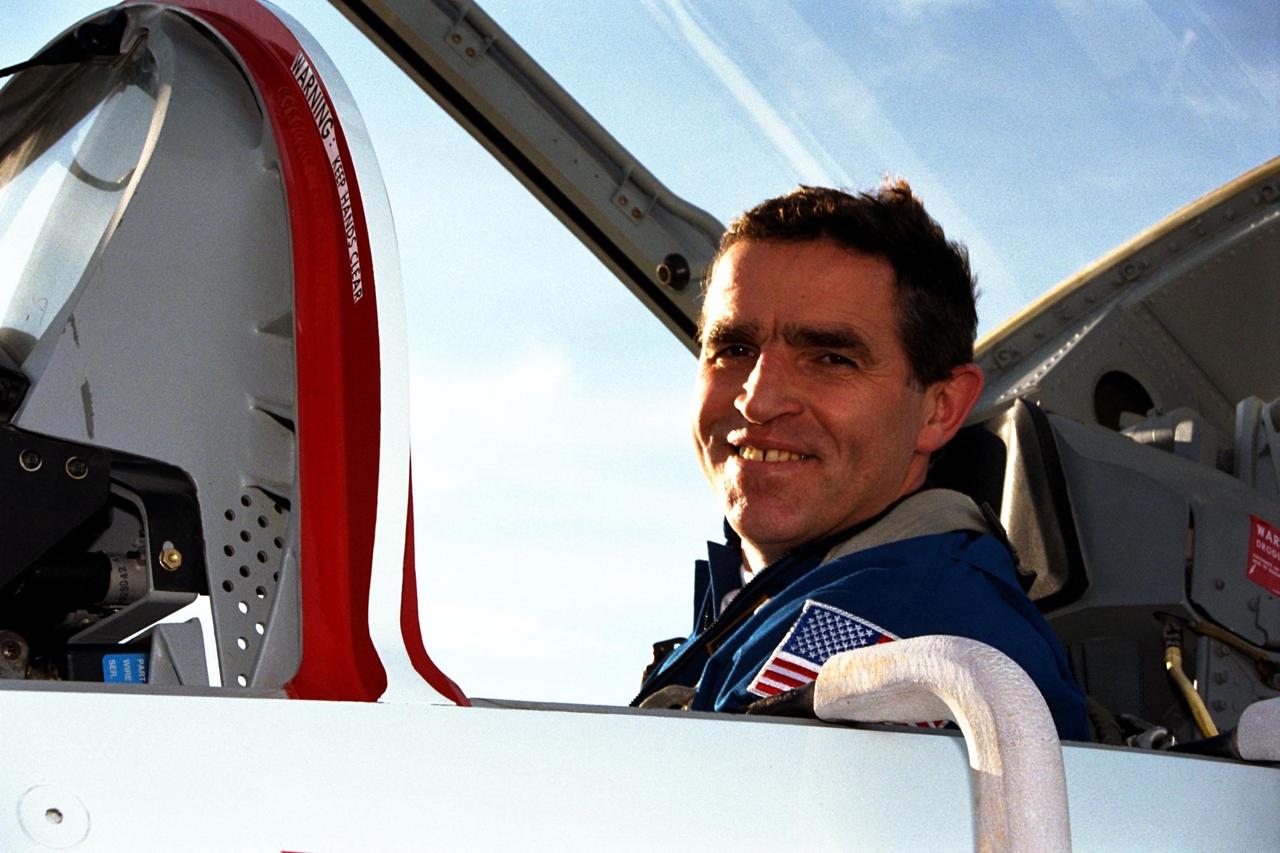
STS-87 Payload Specialist Leonid Kadenyuk of the National Space Agency of Ukraine arrives at Kennedy Space Center's Shuttle Landing Facility aboard a T-38 jet for the final prelaunch activities leading up to the scheduled Nov. 19 liftoff. The other STS-87 crew members are Commander Kevin Kregel; Pilot Steven Lindsey; and Mission Specialists Kalpana Chawla, Ph.D.; Takao Doi, Ph.D., of the National Space Development Agency of Japan; and Winston Scott. STS-87 will be the fourth flight of the United States Microgravity Payload and the Spartan-201 deployable satellite