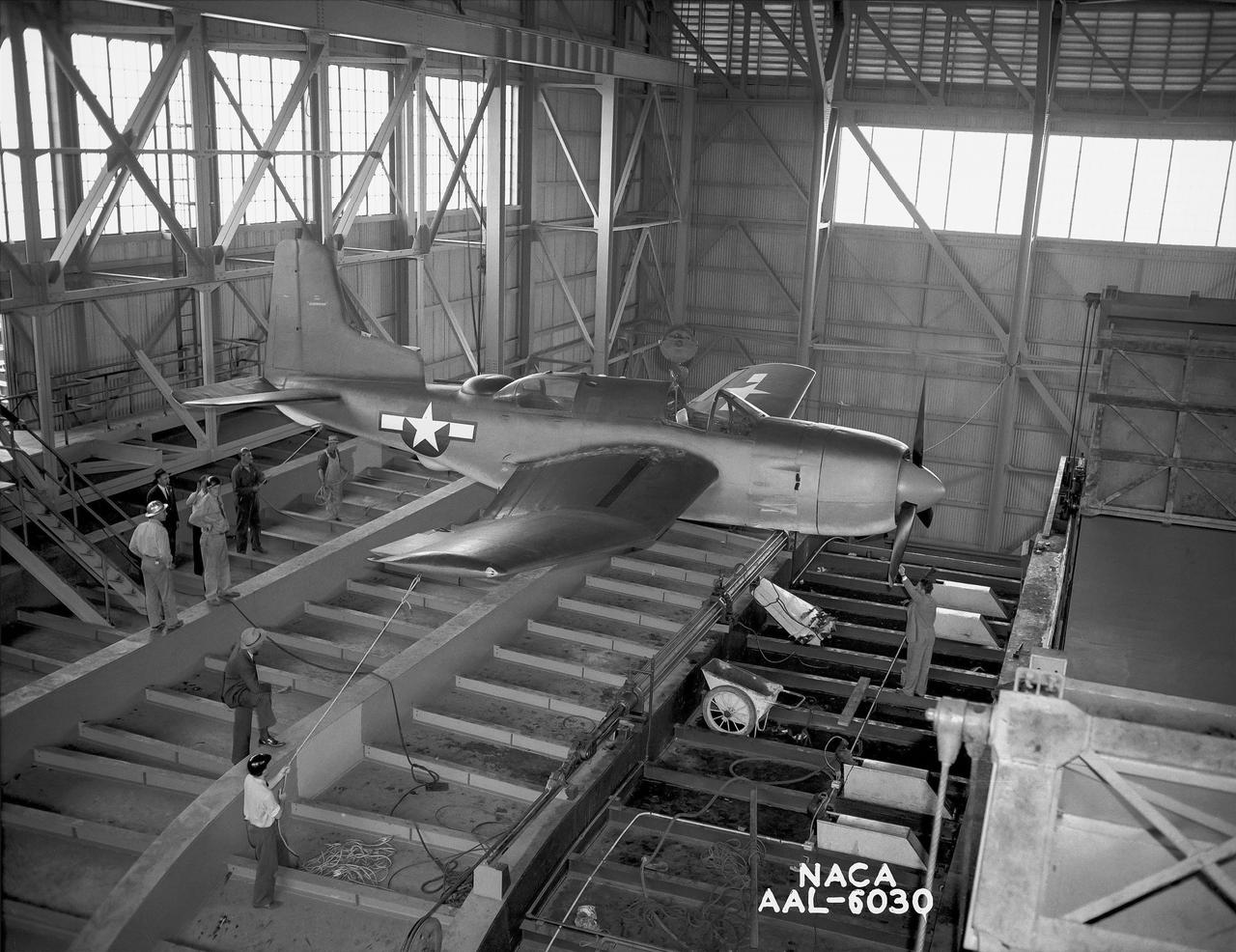
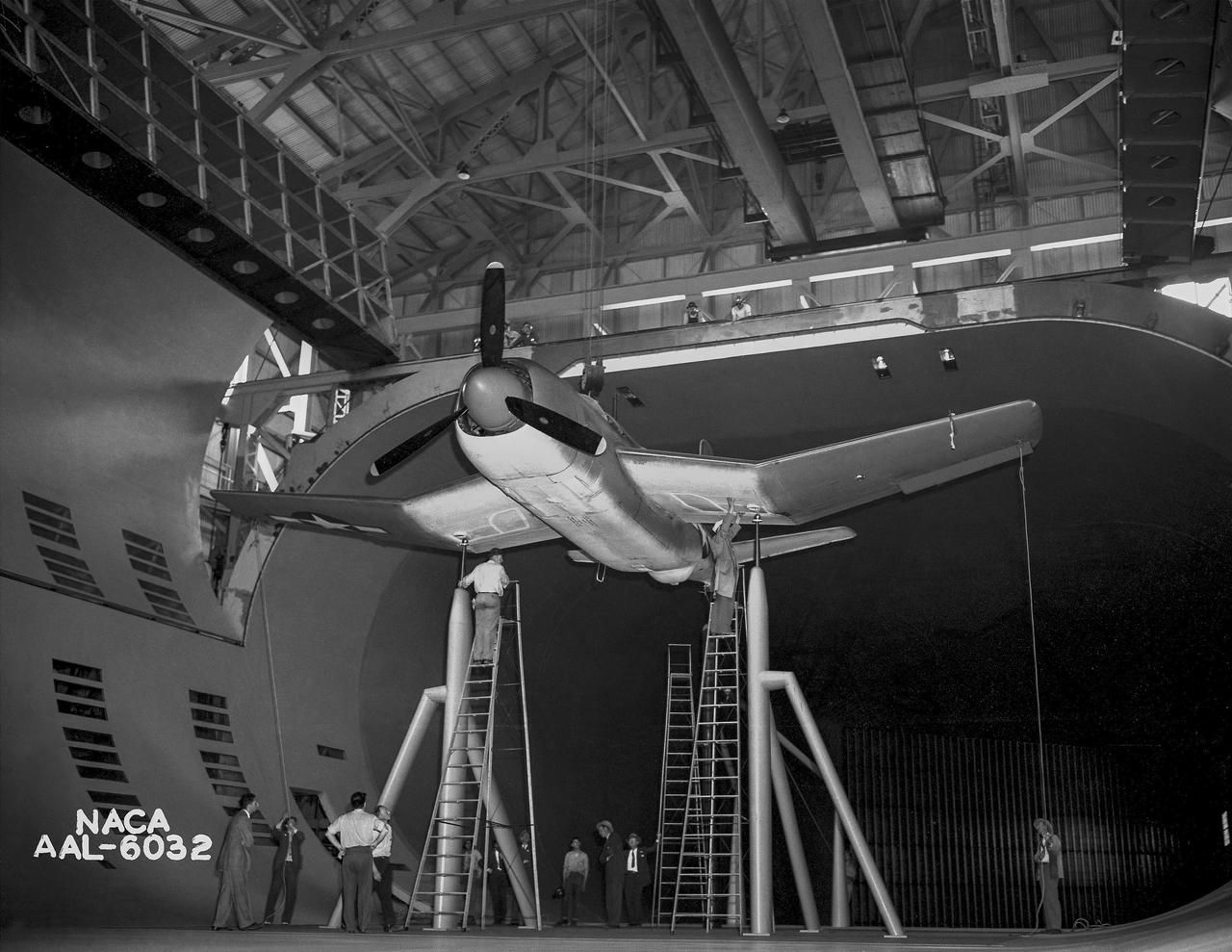
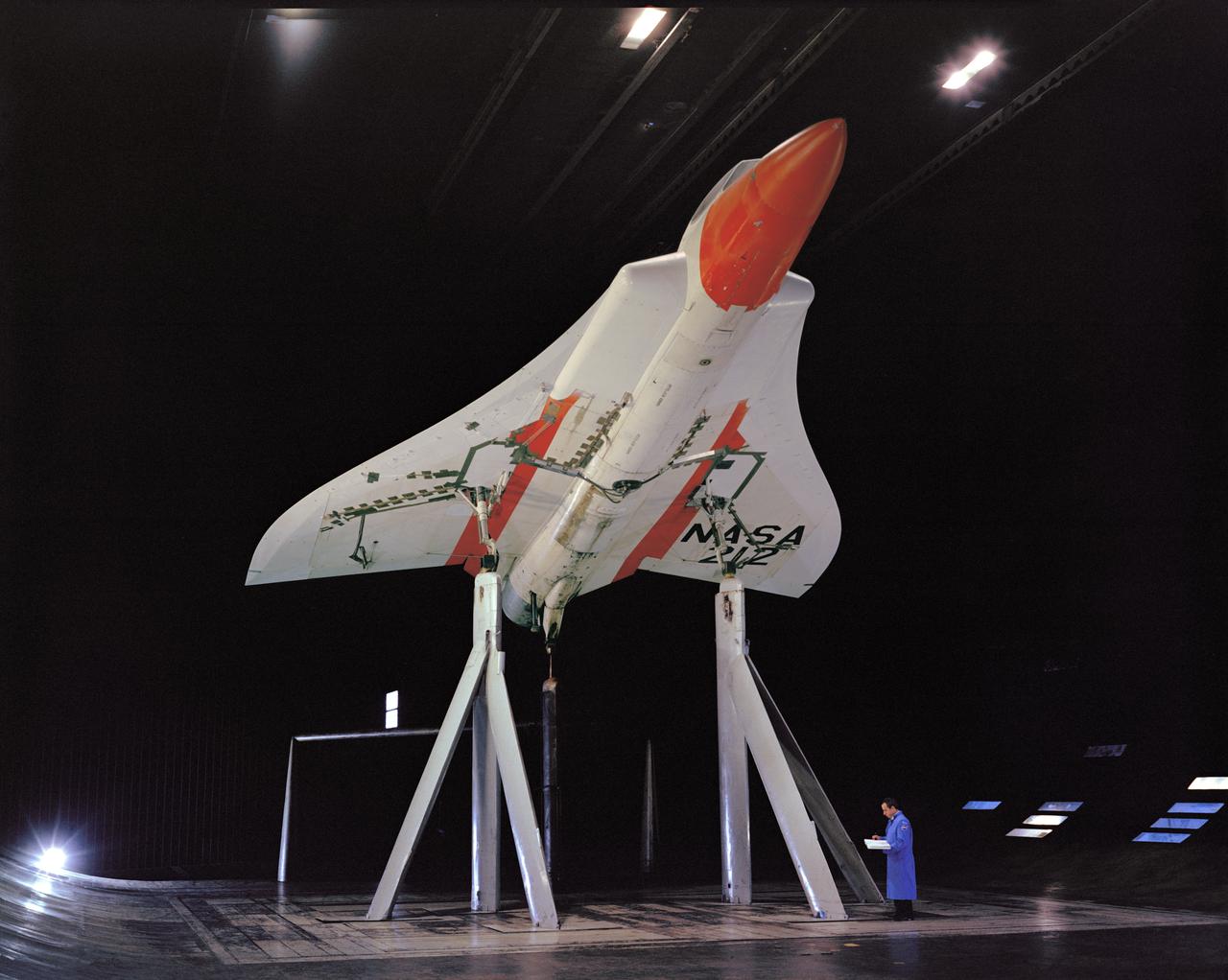
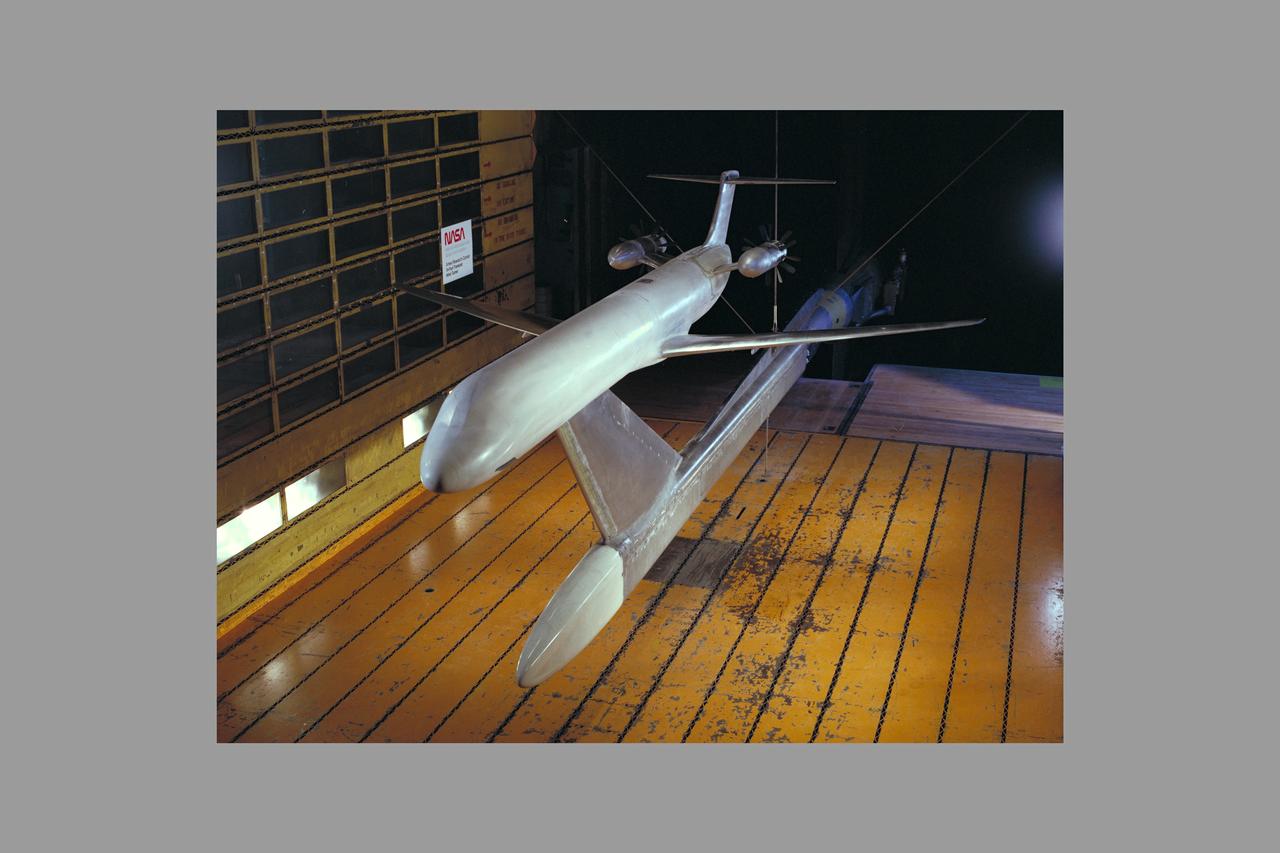
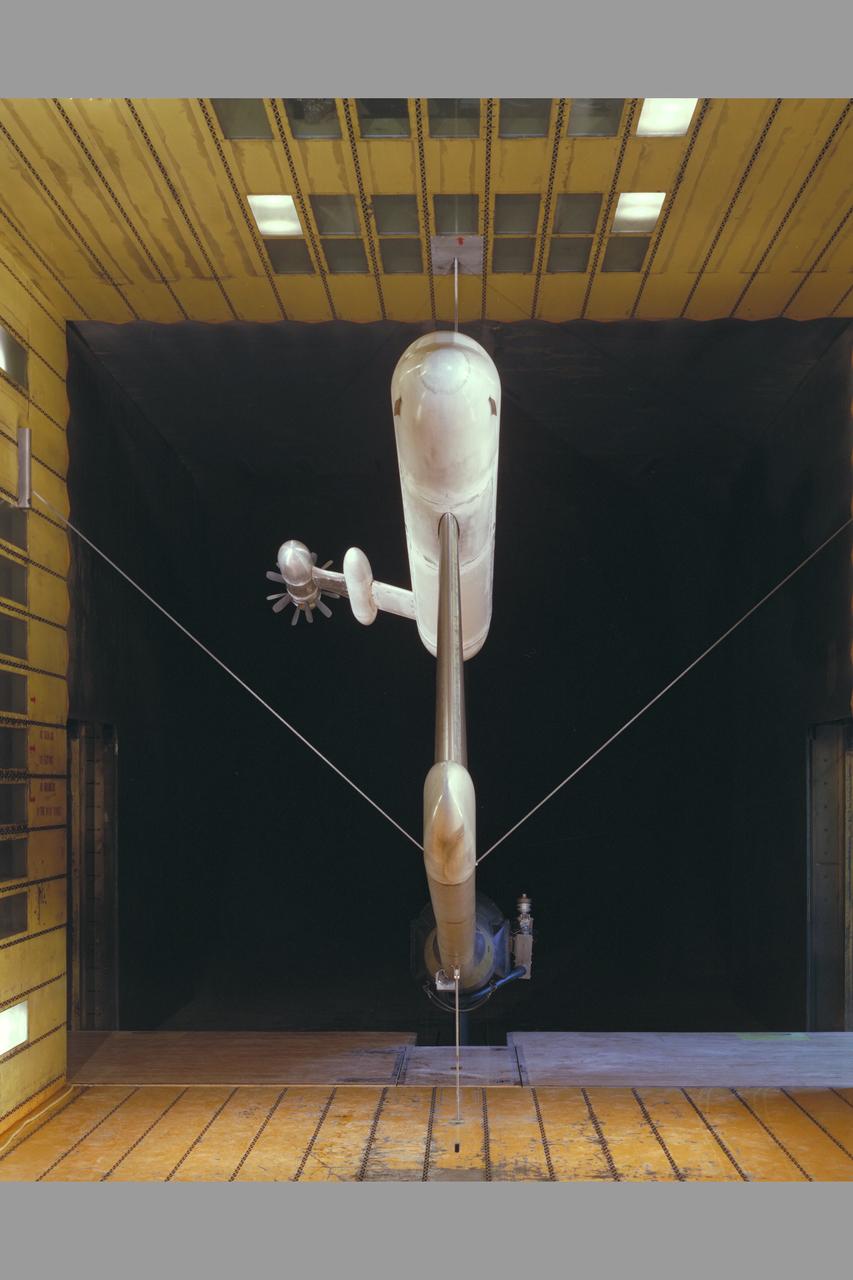
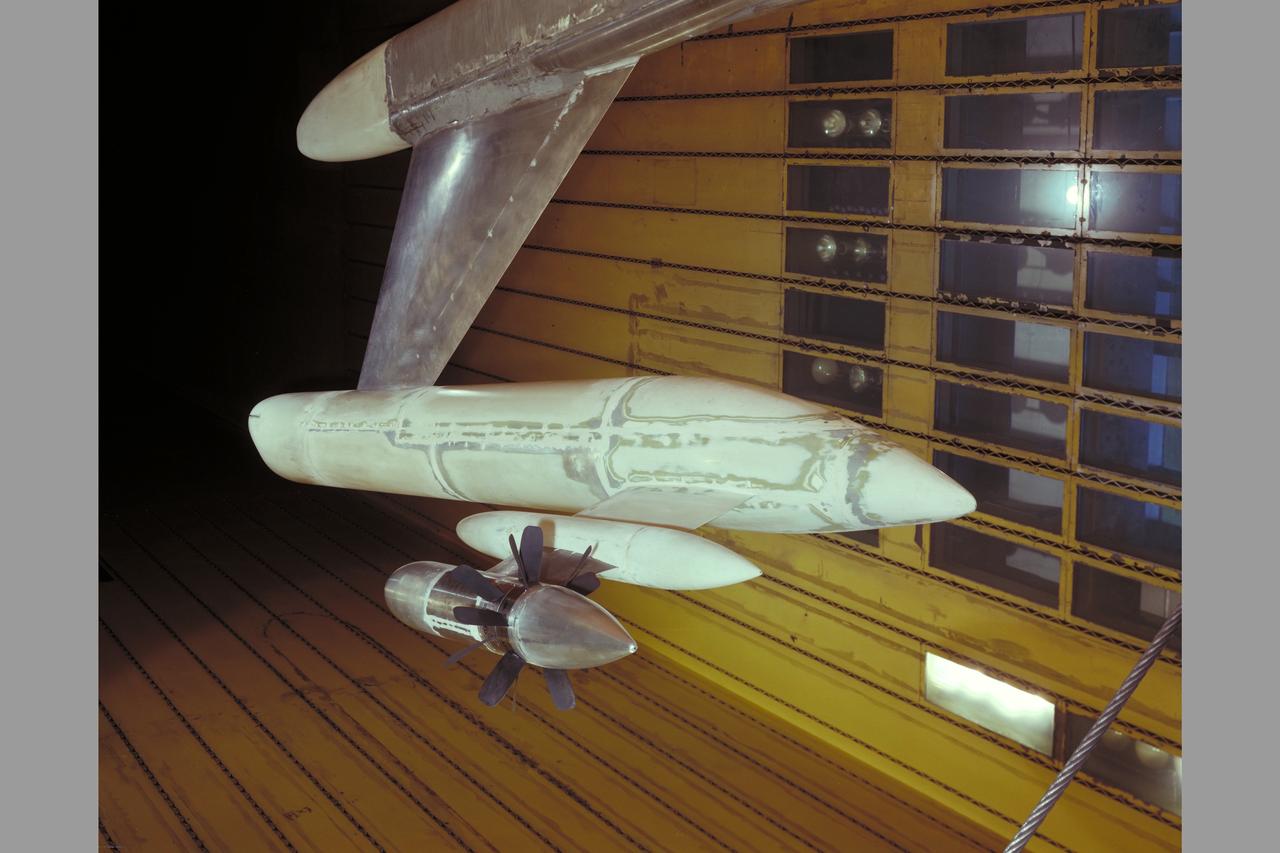
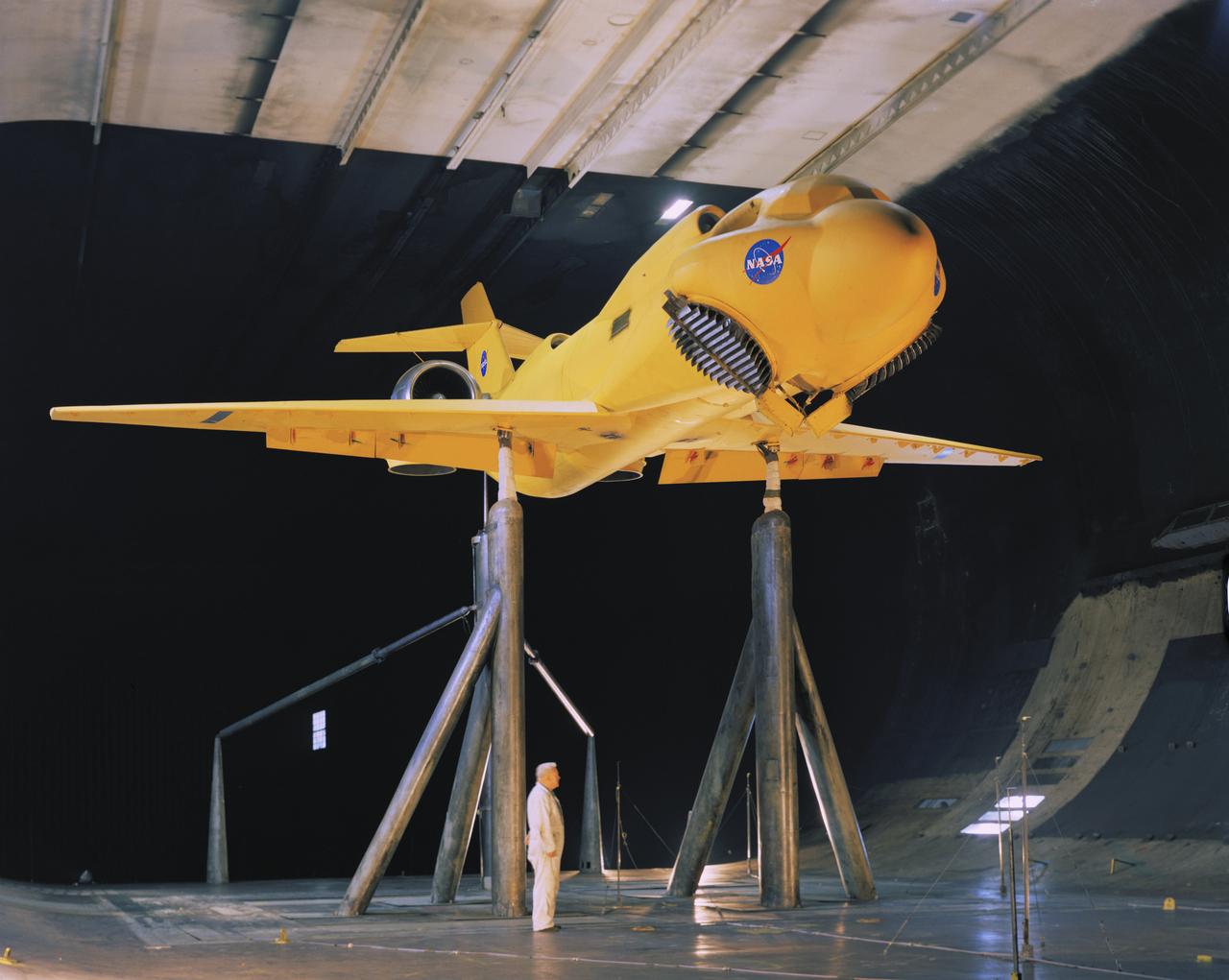
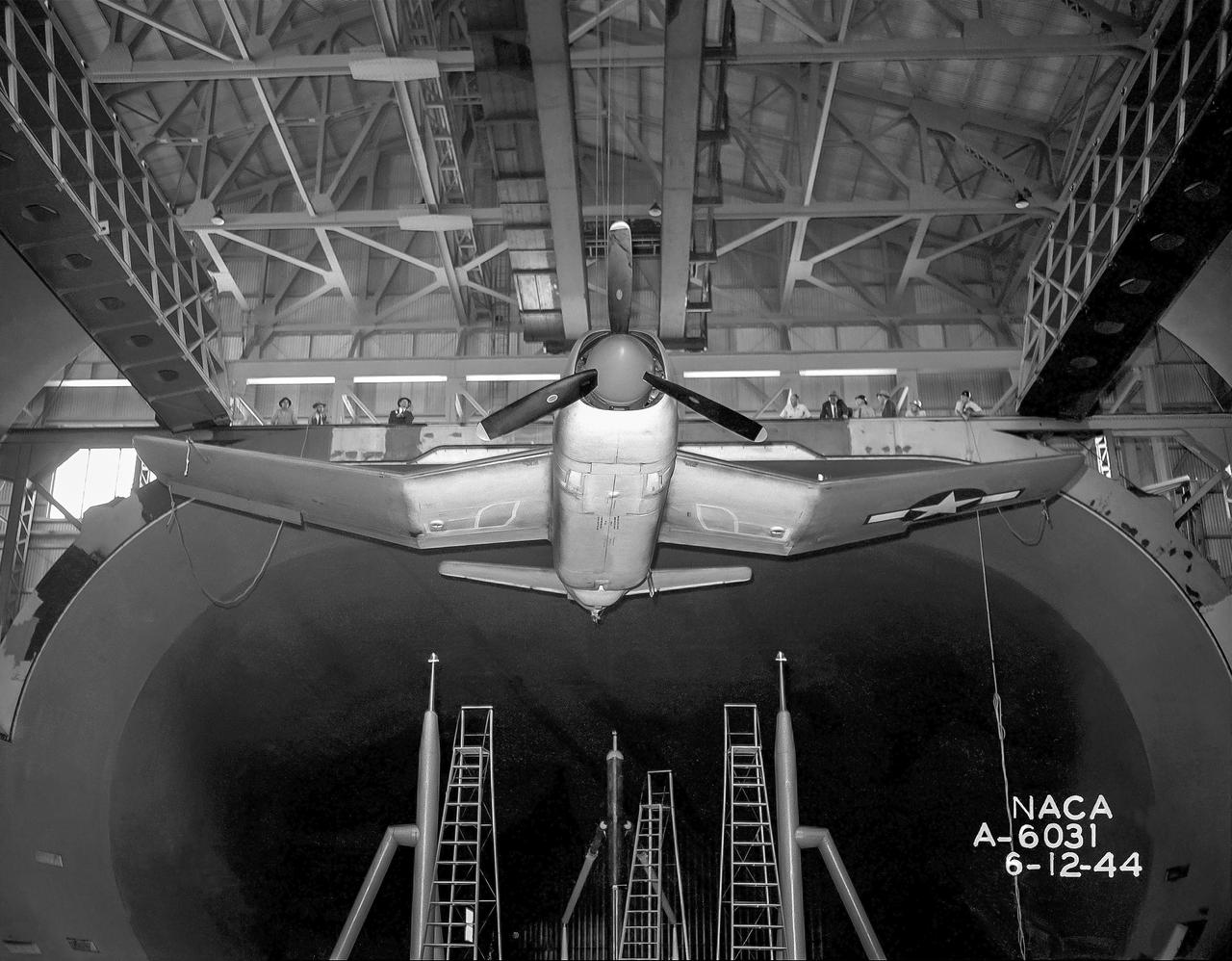
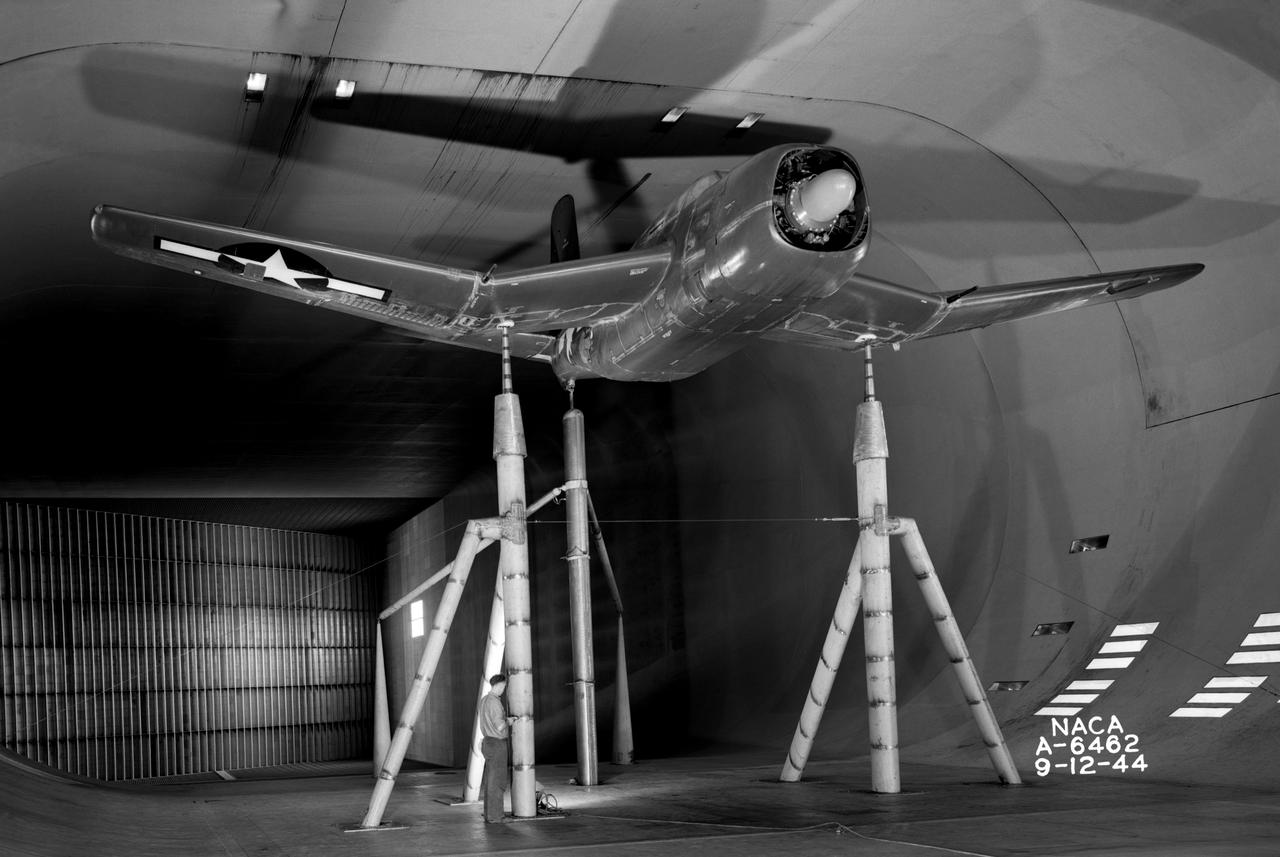
Douglas BTD-1 airplane 3/4 front view from below in Ames 40x80 foot Wind Tunnel, unseated, horizontal tail on.
Douglas BTD-1 airplane
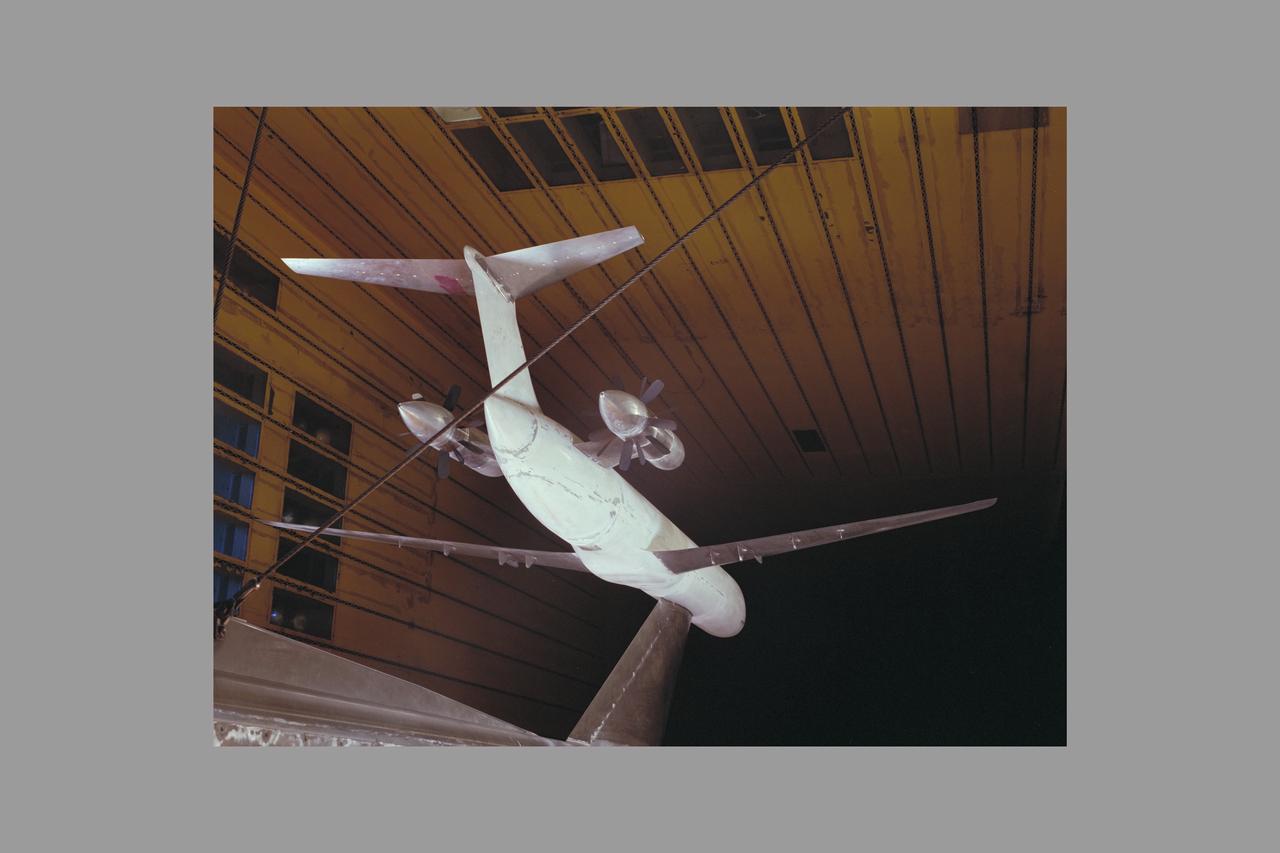
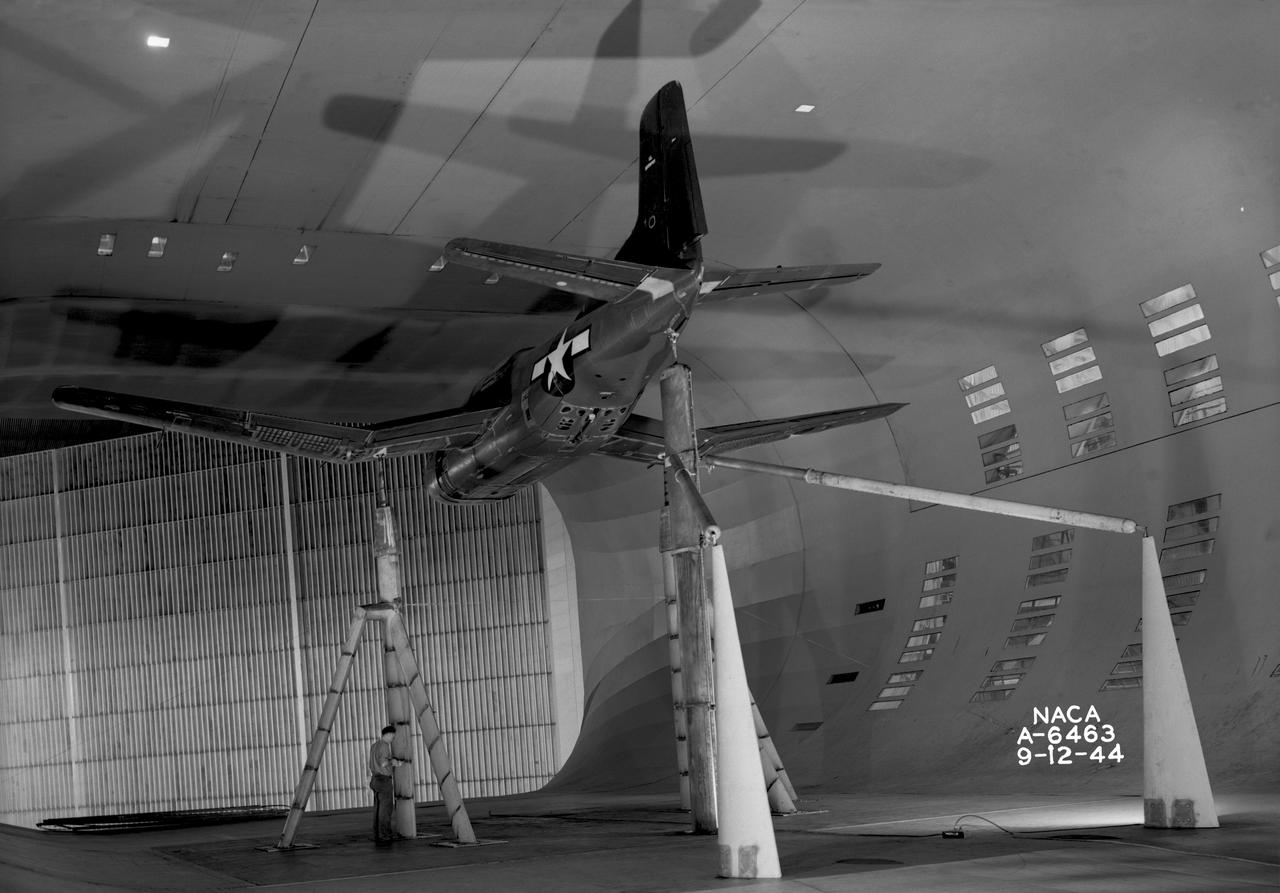
3/4 rear view from below of Douglas BTD-1 airplane in Ames 40x80 foot Wind Tunnel, unseated, horizontal tail on.
Douglas BTD-1 airplane.
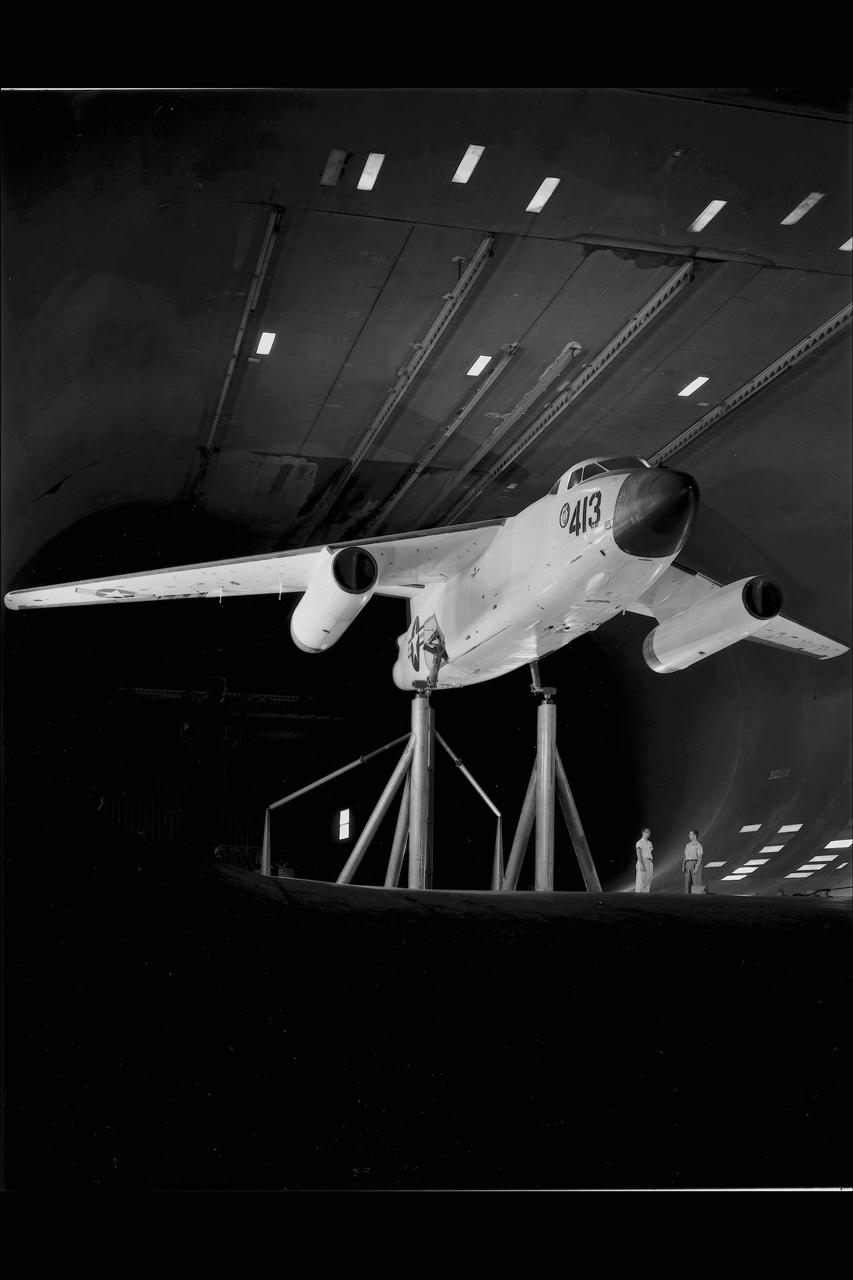
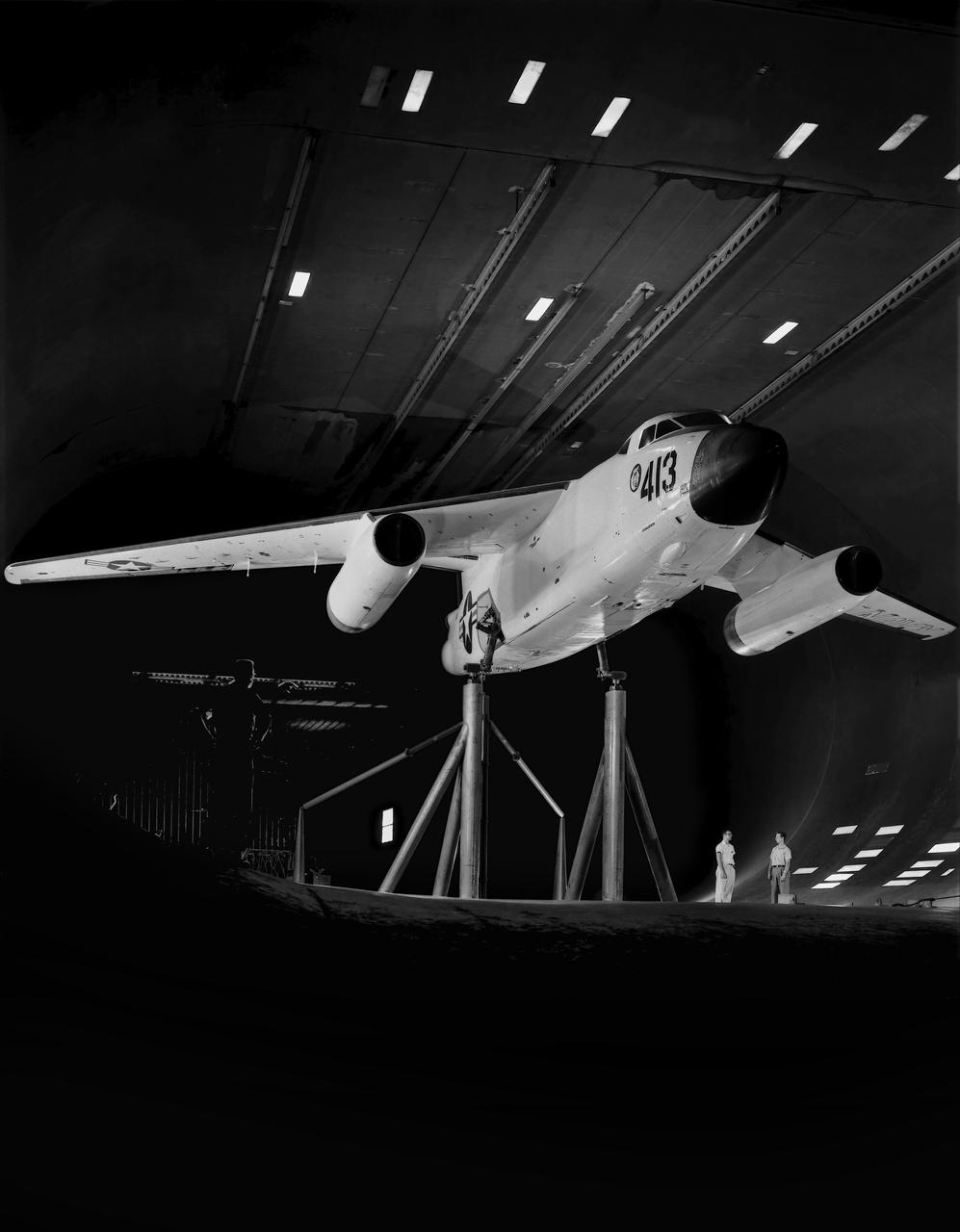
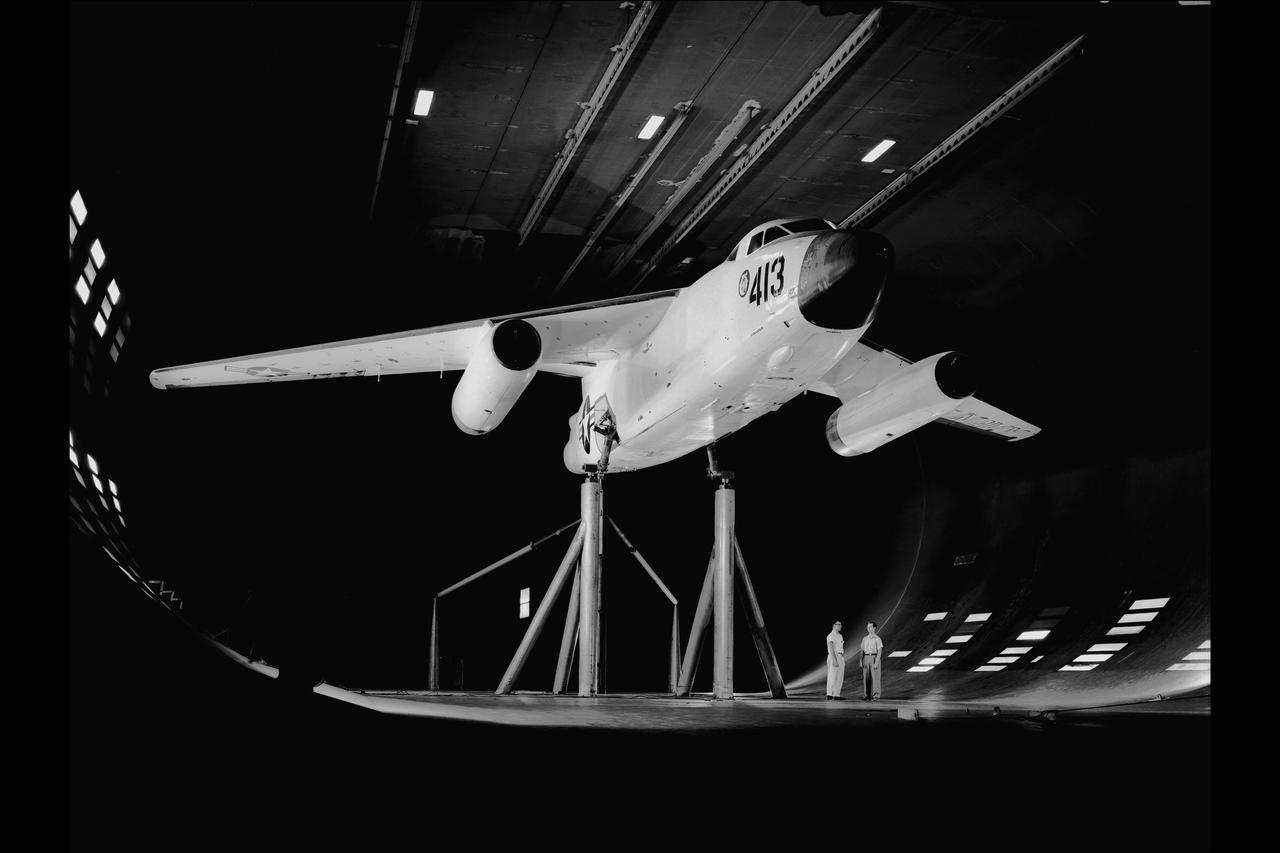
DOUGLAS XA3D-1 #413 AIRPLANE MOUNTED IN THE NACA AMES RESEARCH CENTER'S 40X80_FOOT SUBSONIC WIND TUNNEL sweptback wing  Testing the wing boundary layer control of the A3D in the 40 x 80 wind tunnel.  Boundary layer control was added to increase the lift of the wing for aircraft carrier take off and landing.
DOUGLAS XA3D-1 #413 AIRPLANE.
DOUGLAS XA3D-1 #413 AIRPLANE MOUNTED IN THE NACA AMES RESEARCH CENTER'S 40X80_FOOT SUBSONIC WIND TUNNEL  Testing the boundary layer control of the A3D in the 40 x 80 wind tunnel.  Boundary layer control was added to increase the lift of the wing for take off from an aircraft carrier.
DOUGLAS XA3D-1 #413 AIRPLANE.
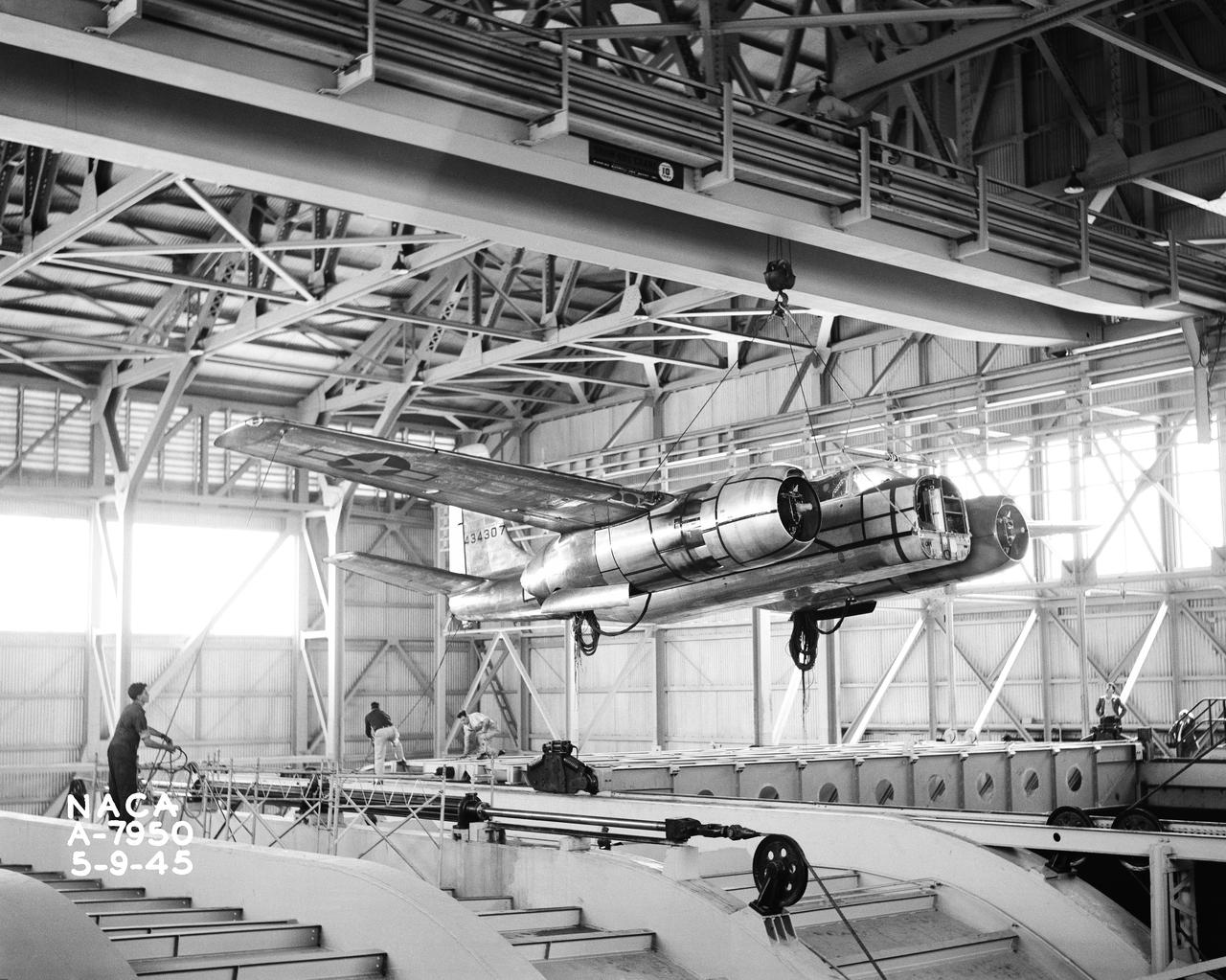
Installation of the Douglas A-26B airplane in the 40x80 foot wind tunnel at NACA's Ames Research Center. Airplane being centered over tunnel opening.
Douglas A-26B Airplane in Ames 40x80 Wind Tunnel.
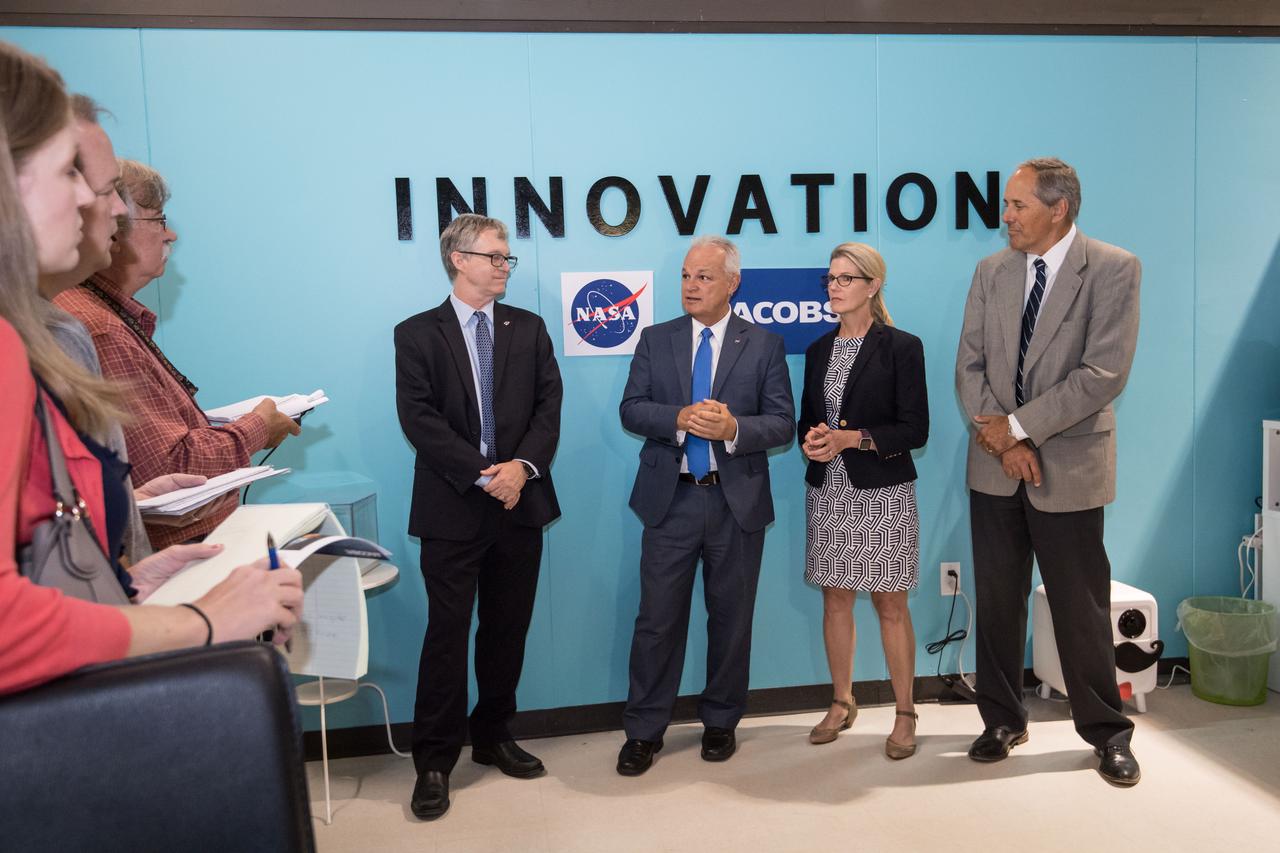
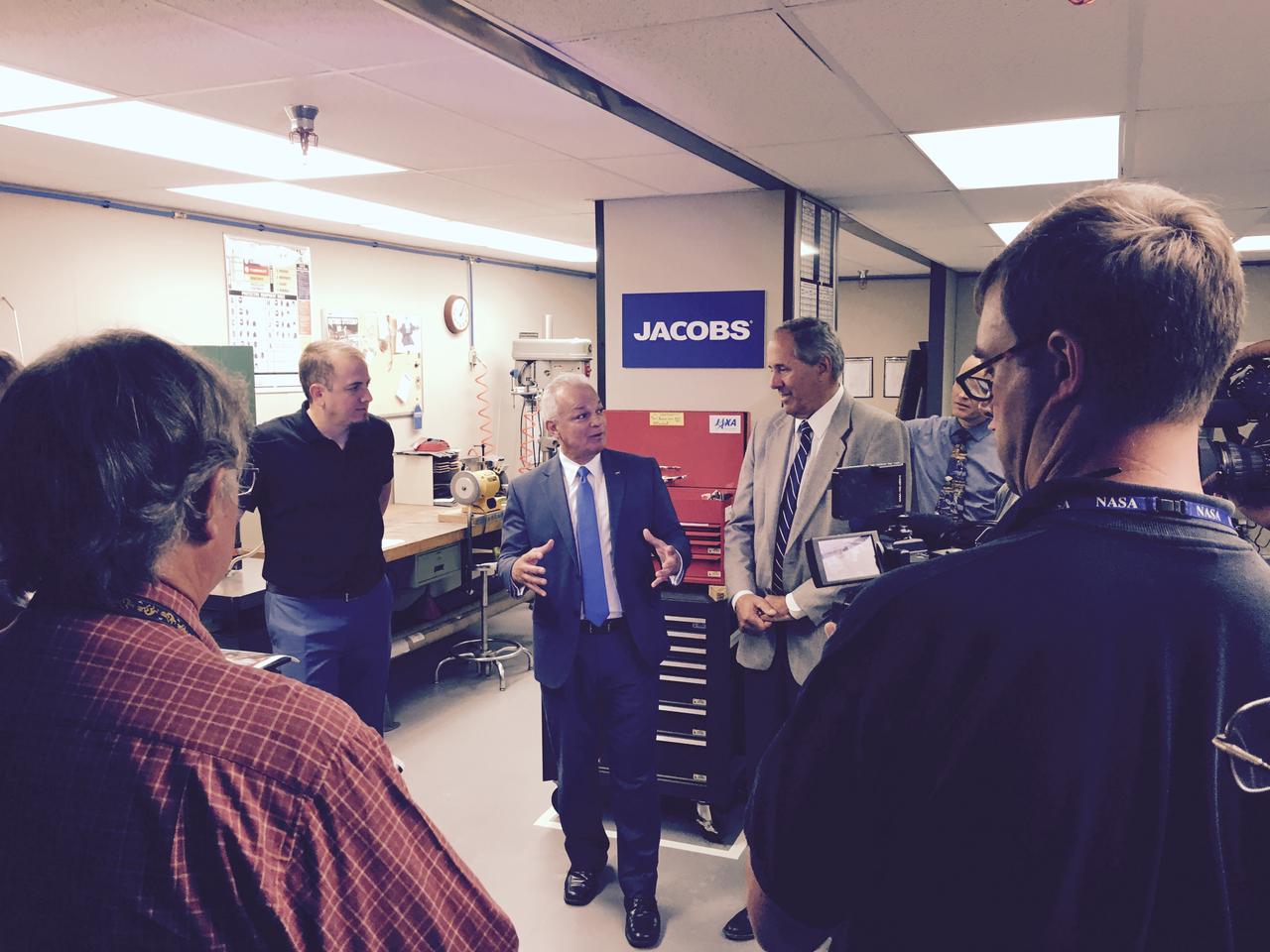
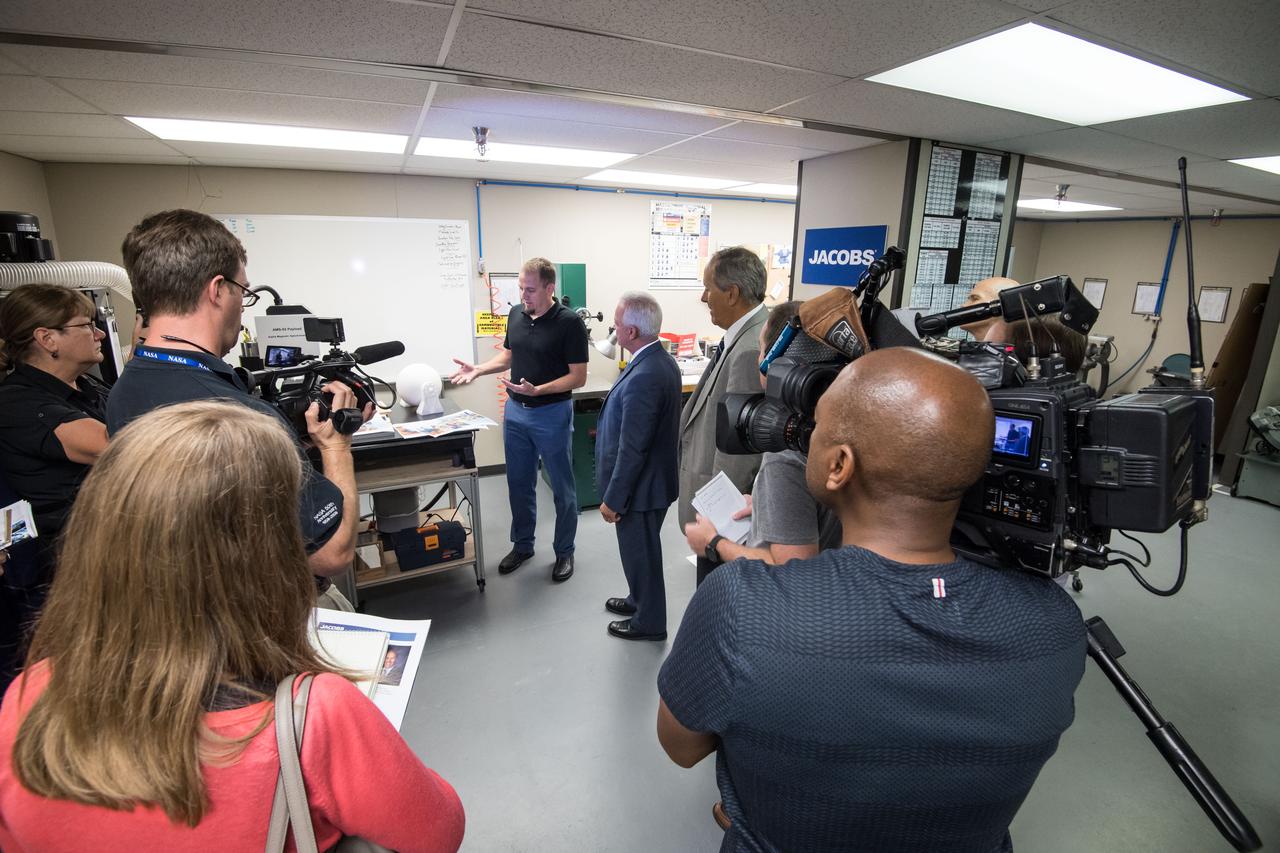
NASA Chief Technologist Douglas Terrier joins Jacobs General Manager Lon Miller during a tour of the company's Engineering Development Facility in Houston. Jacobs provides advanced technologies used aboard the International Space Station and for deep space exploration. From left: NASA’s Johnson Space Center Chief Technologist Chris Culbert, Chief Technologist Douglas Terrier, Jacobs Clear Lake Group Deputy General Manager Joy Kelly and Jacobs Clear Lake Group General Manager Lon Miller.  Date: 08-10-2017 Location: B1 & Jacobs Engineering Subject: NASA Acting Chief Technology Officer Douglas Terrier Tours JSC and Jacobs Photographer: David DeHoyos
NASA Chief Technologist Douglas Terrier Tours Jacobs' Engineering Development Facility
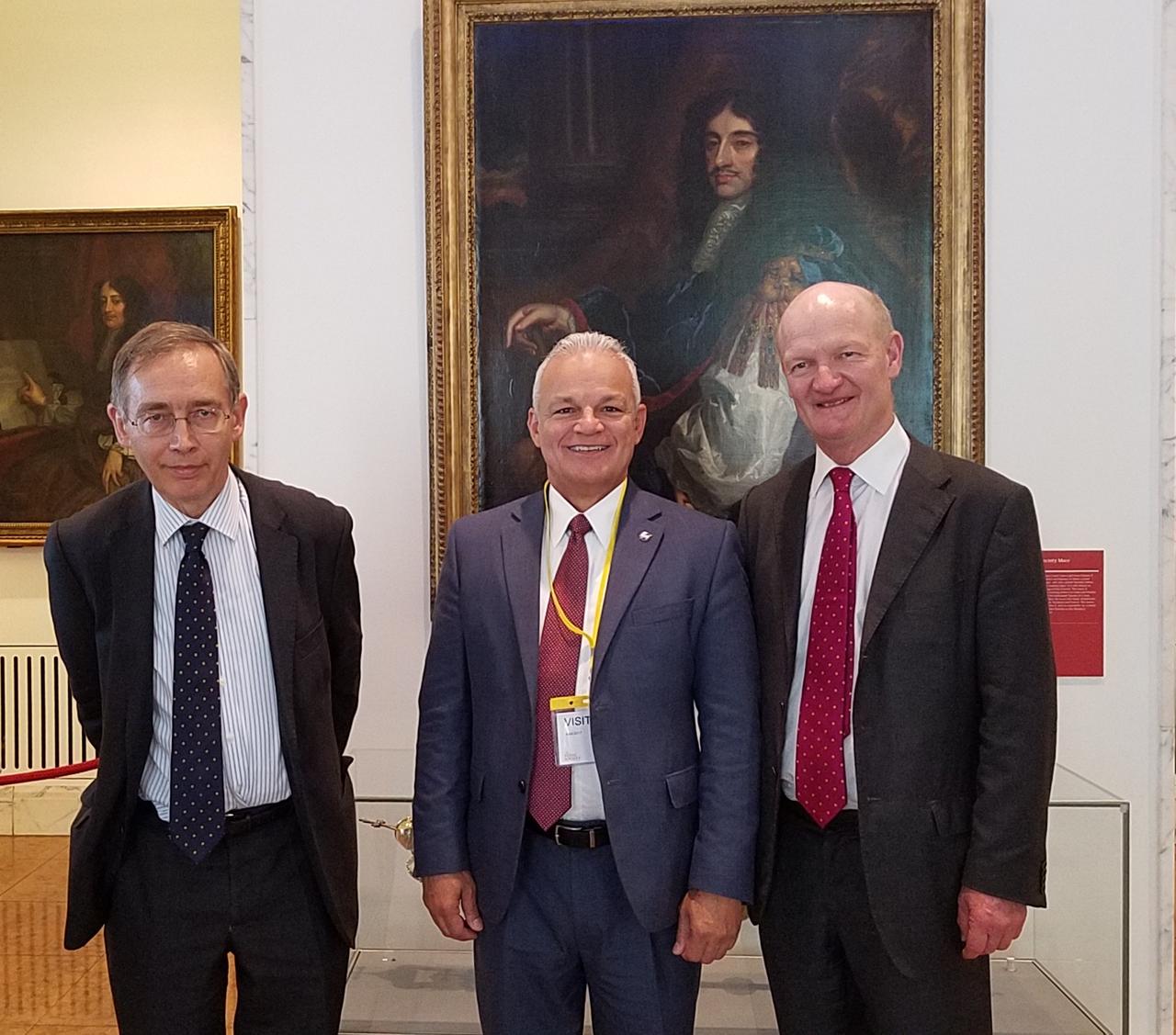
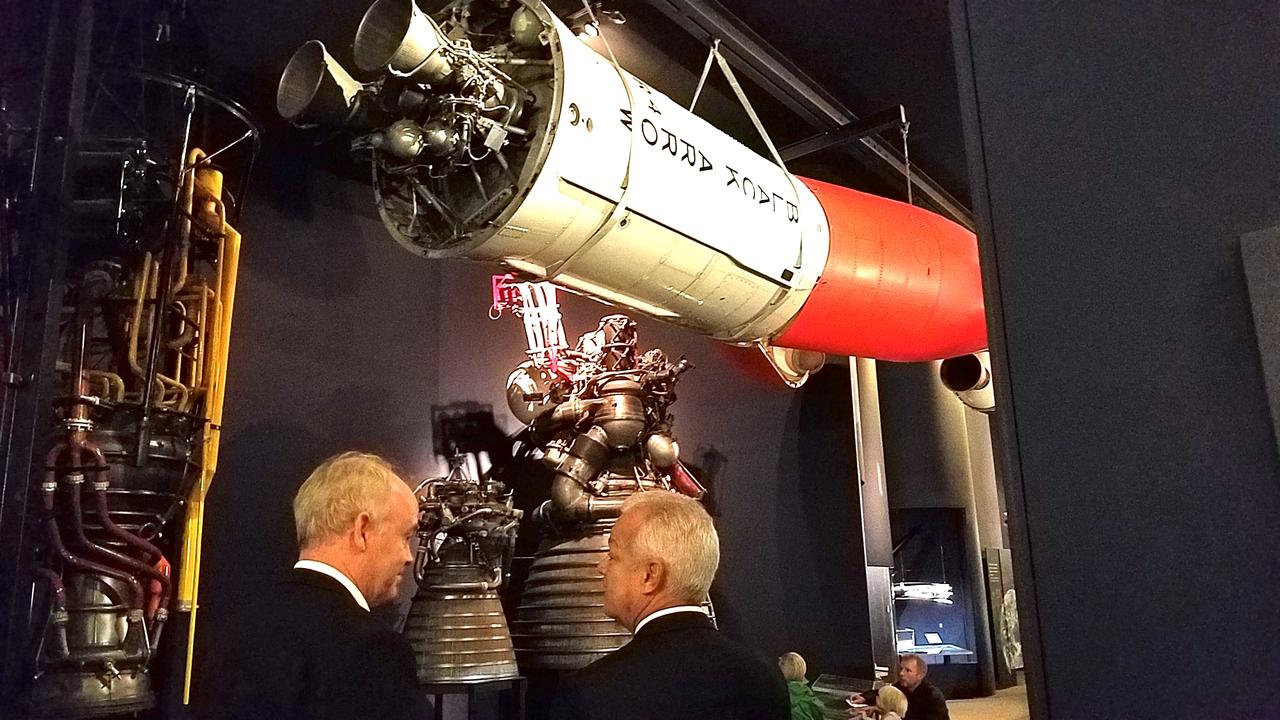
NASA Acting Chief Technologist Douglas Terrier (right) tours London’s Science Museum with Dr. David Rooney, Keeper of Technologies and Engineer and Doug Millard, Deputy Keeper of Technologies and Engineering.
NASA Acting Chief Technologist Douglas Terrier Tours London’s Science Museum
NASA Acting Chief Technologist Douglas Terrier (right) tours London’s Science Museum with Dr. David Rooney, Keeper of Technologies and Engineer and Doug Millard, Deputy Keeper of Technologies and Engineering.
NASA Acting Chief Technologist Douglas Terrier Tours London’s Science Museum
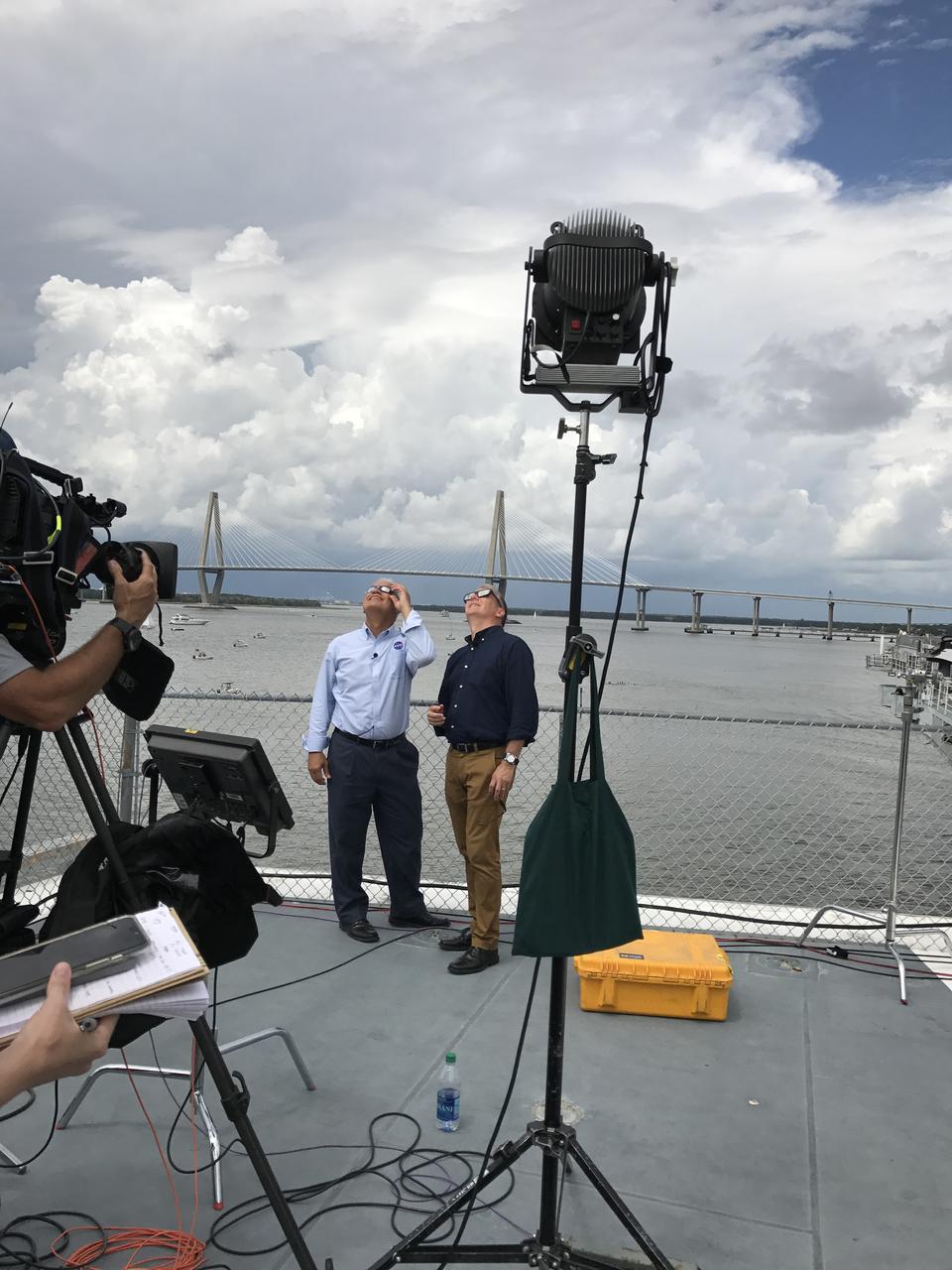
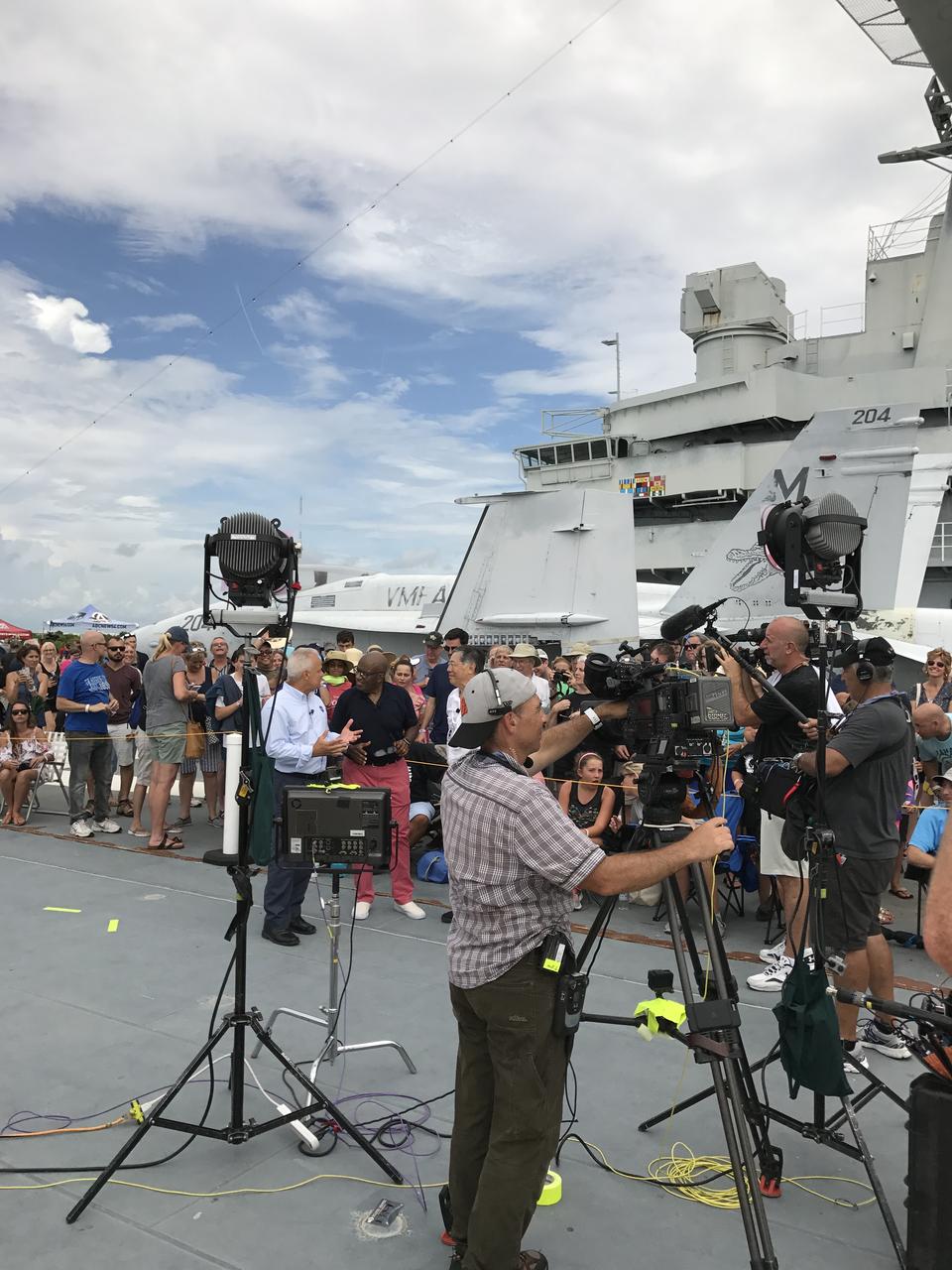
NASA CTO Douglas Terrier is interviewed by NBC's Tom Costello during an Eclipse Across America broadcast aboard the USS Yorktown in Charleston, South Carolina on Aug. 21, 2017.
NASA Acting Chief Technologist Douglas Terrier is Interviewed by NBC's Tom Costello
NASA CTO Douglas Terrier talks with the "Today Show's" Al Roker about NASA's science research during an Eclipse Across America broadcast aboard the USS Yorktown in Charleston, South Carolina on Aug. 21, 2017.
NASA Acting Chief Technologist Douglas Terrier Interviewed by Al Roker
First airplane tested in the ames 40 x 80 foot wind tunnel. Douglas XSB2D-1 (Destroyer)  hanging from overhead crane above the test section.
Mounting Douglas XSB2D-1 Airplane In 40x80 Foot Wind Tunnel.
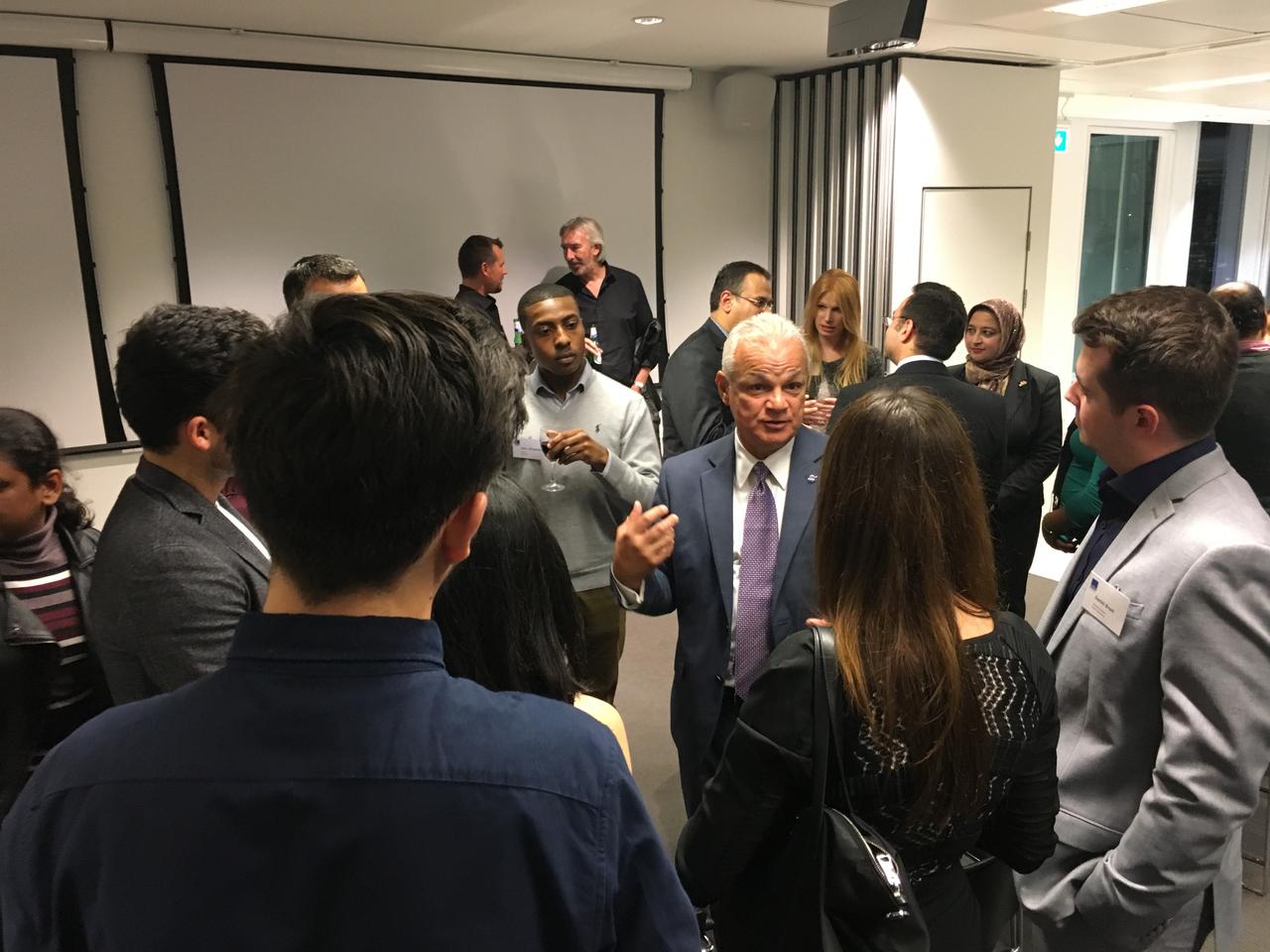
NASA Acting Chief Technologist Douglas Terrier presents on strategic leadership to students and faculty at the Warwick Business School at The Shard during his trip to London in September 27, 2017.
NASA Acting Chief Technologist Douglas Terrier Presents at the Warwick Business School at The Shard
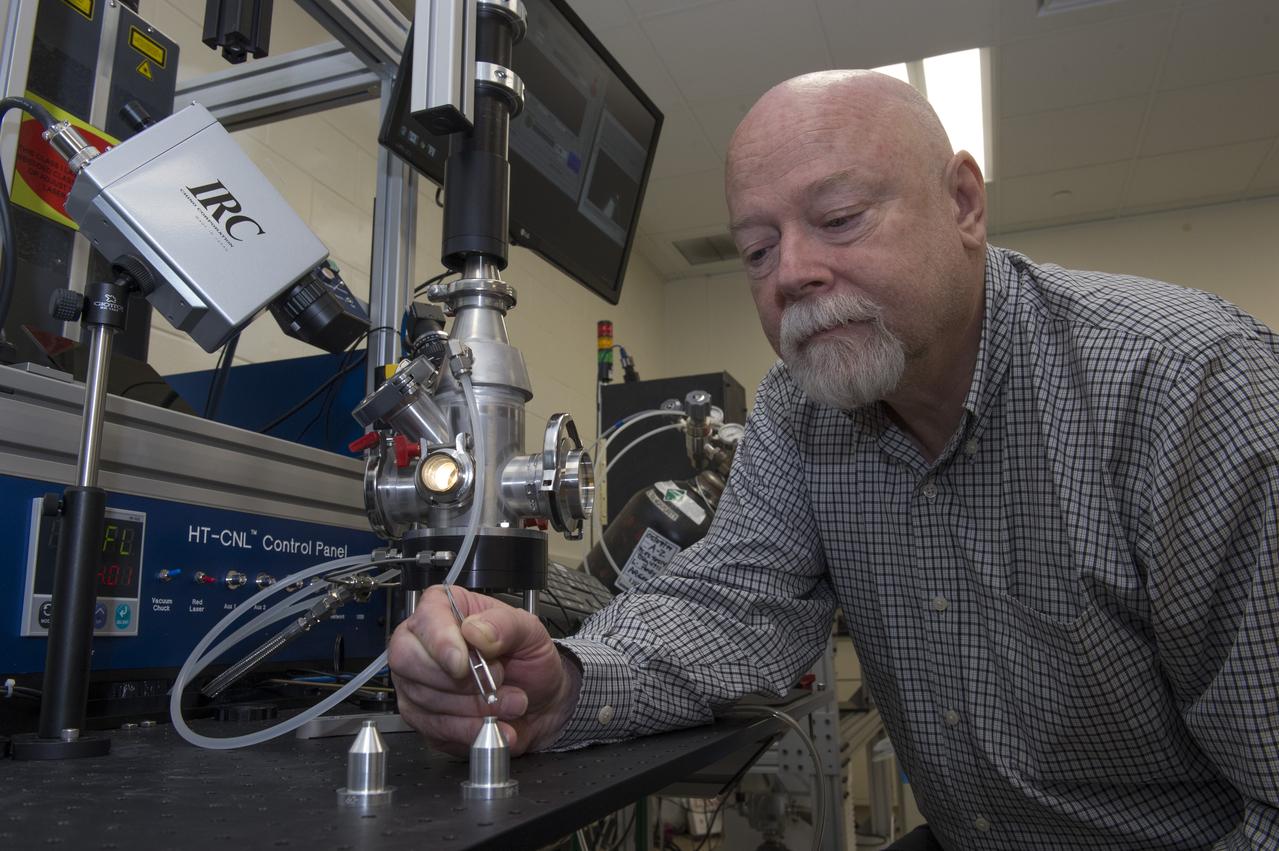
  Dr. Douglas Matson (Tufts University) working with an aerodynamic levitator in support of his MaterialsLab experiments.
Dr. Douglas Matson (Tufts University) working with an aerodyna
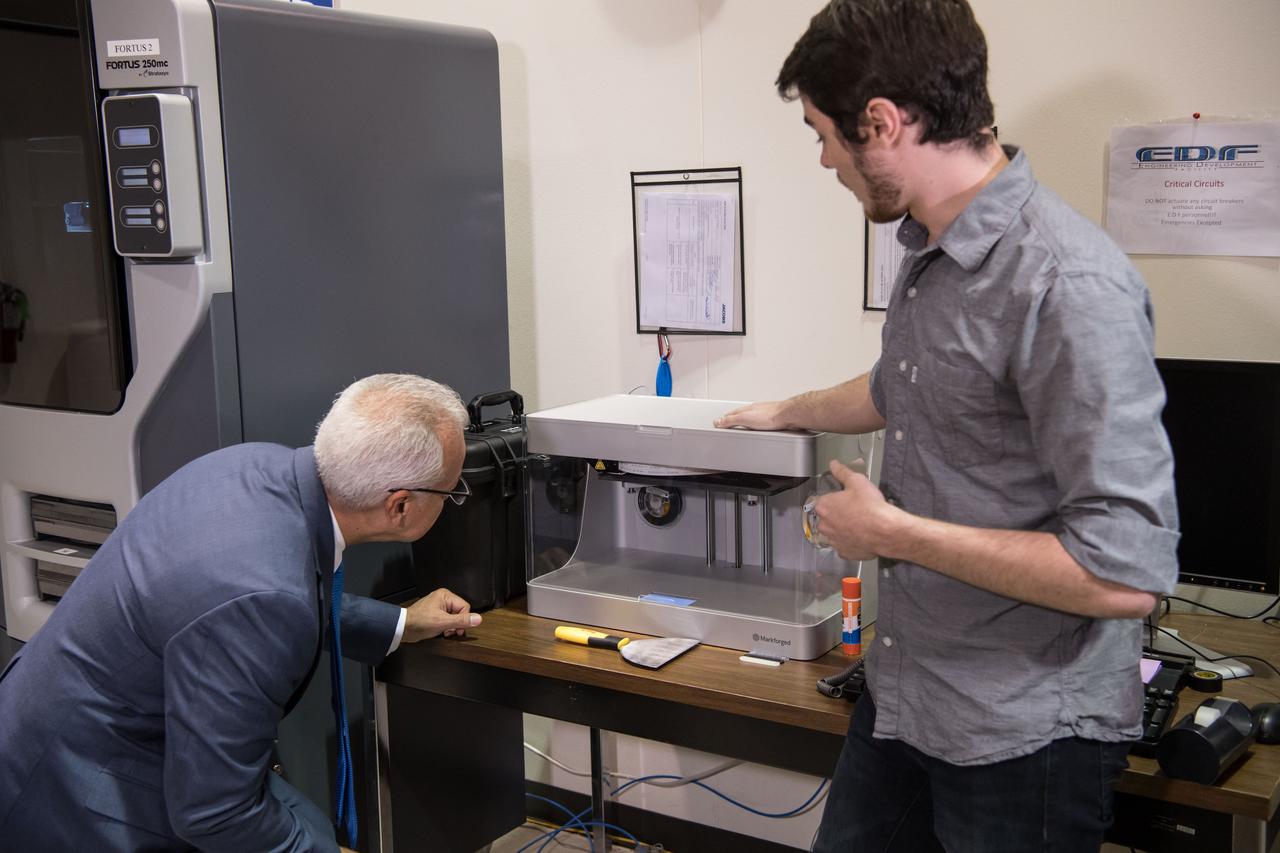
A Jacobs engineer shows NASA Chief Technologist Douglas Terrier how the company uses 3-D printers to create inexpensive physical models of new electronically designed hardware.  Date: 08-10-2017 Location: B1 & Jacobs Engineering Subject: NASA Acting Chief Technology Officer Douglas Terrier Tours JSC and Jacobs Photographer: David DeHoyos
NASA Chief Technologist Douglas Terrier Learns How Jacobs Uses 3-D Printing
American Airlines aircraft in the gate area at Charlotte Douglas International Airport where ATD-2 began in 2017.
atd2_video_still_for_web_feature_01
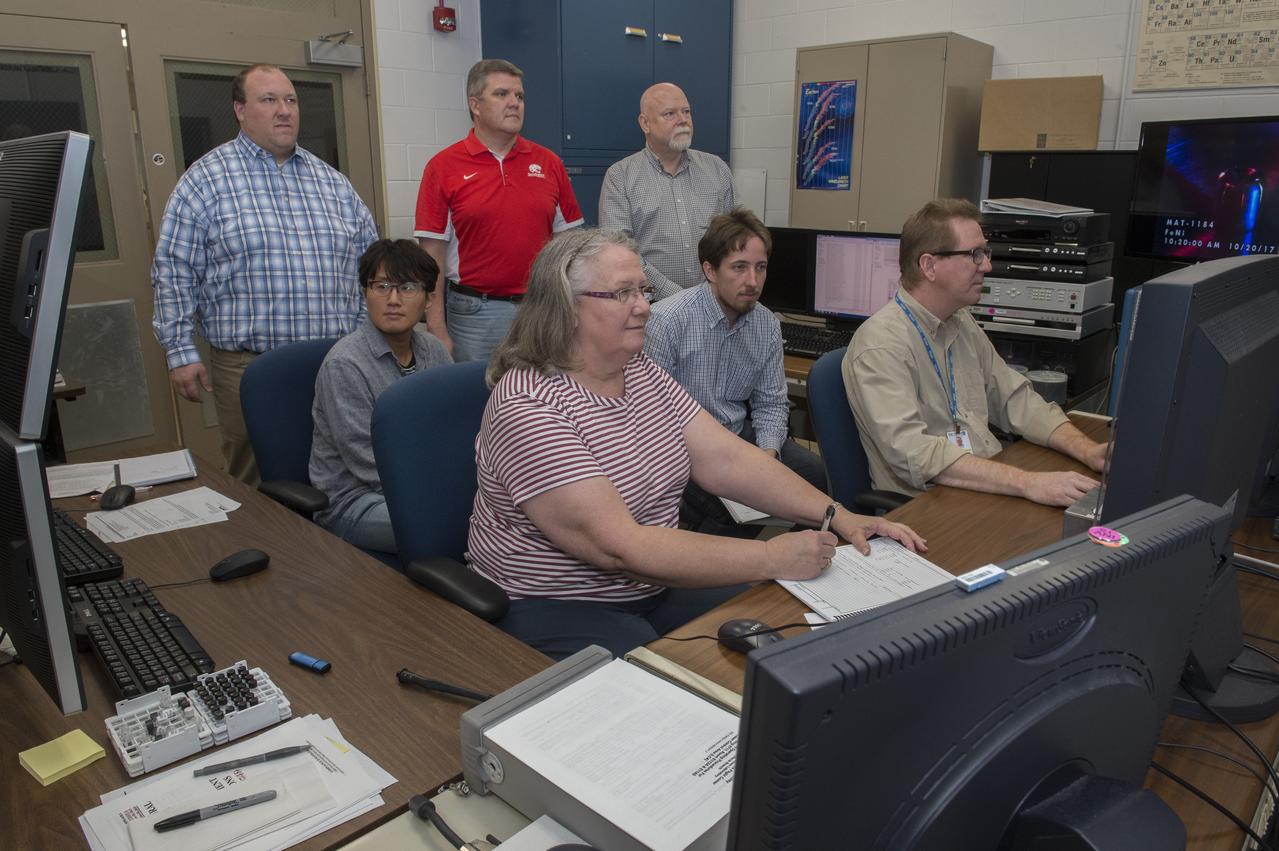
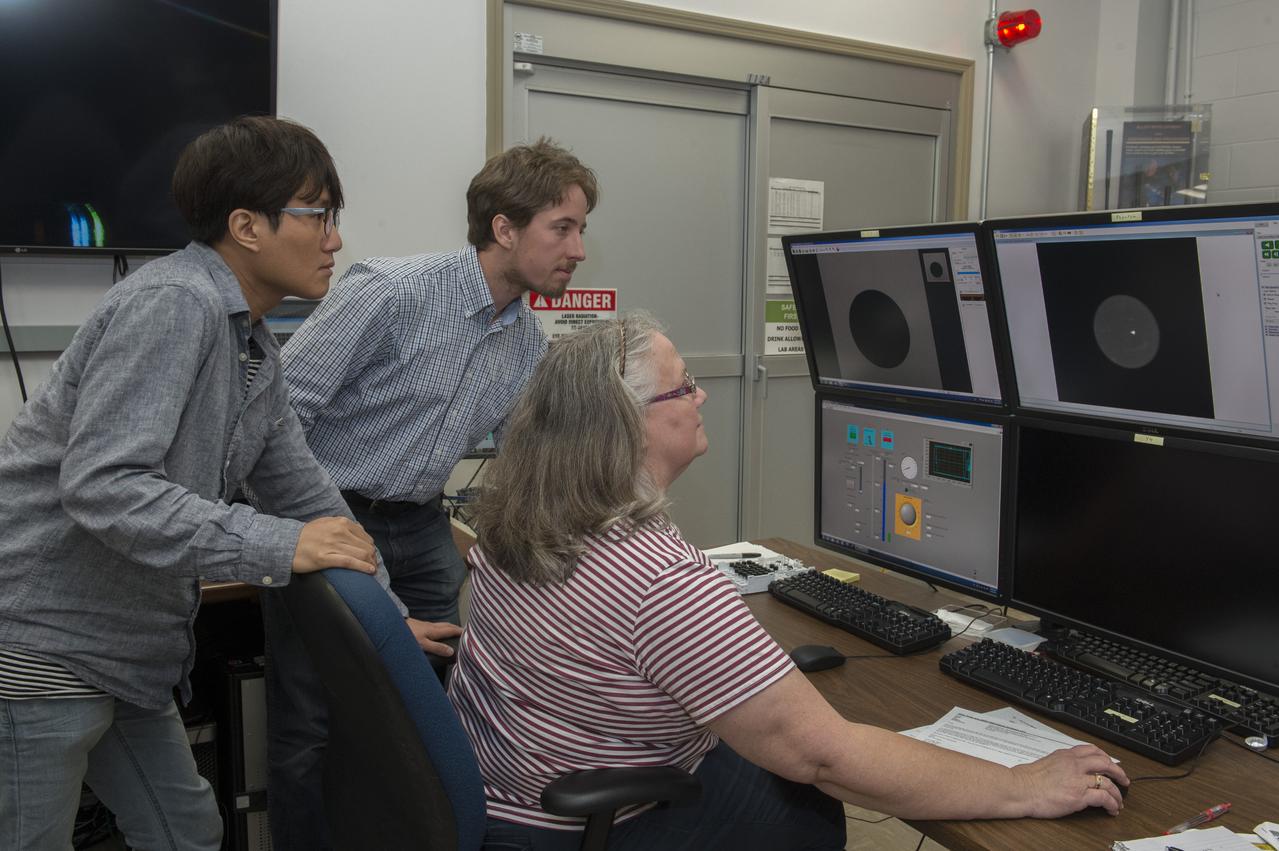
Dr. Douglas Matson, Tufts University, experimenting with an aerodynamic levitator. Dr. Matson, along with students and NASA personnel view data from tests of an aerodynamic levitator in support of his MaterialsLab experiments.  back row: Michael SanSoucie (MSFC EM41), Shawn Reagan (MSFC HP30), and Douglas Matson (Tufts University)  Middle row: Sangho Jeon (Tufts University) and Thomas Leitner (Graz University of Technology) Front row:  Trudy Allen (MSFC EM41) and Glenn Fountain (MSFC EM41)
Dr. Douglas Matson, Tufts University, experimenting with an aero
Test section of the Ames 40 x 80 foot wind tunnel with the overhead doors open.  XSB2D-1 airplane being lowered onto the struts by the overhead crane. Mechanics and engineers on orchard ladders aligning the model with ball sockets on the struts. The Douglas BTD Destroyer was an American dive/ torpedo bomber developed for the United States Navy during World War II.
Installation of the Douglas XSB2D-1 in the Test Section of the 40x80 Foot Wind Tunnel at Ames.
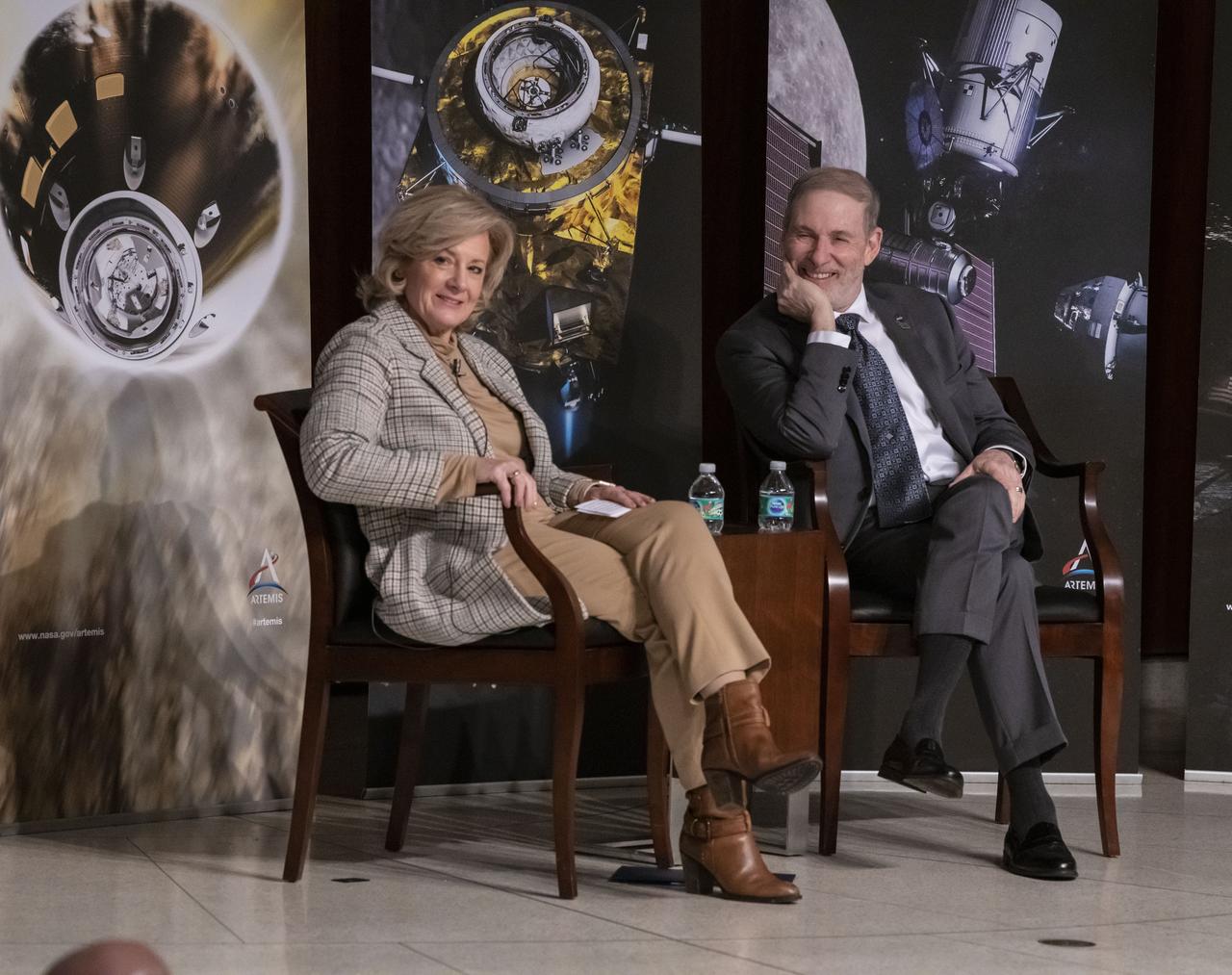
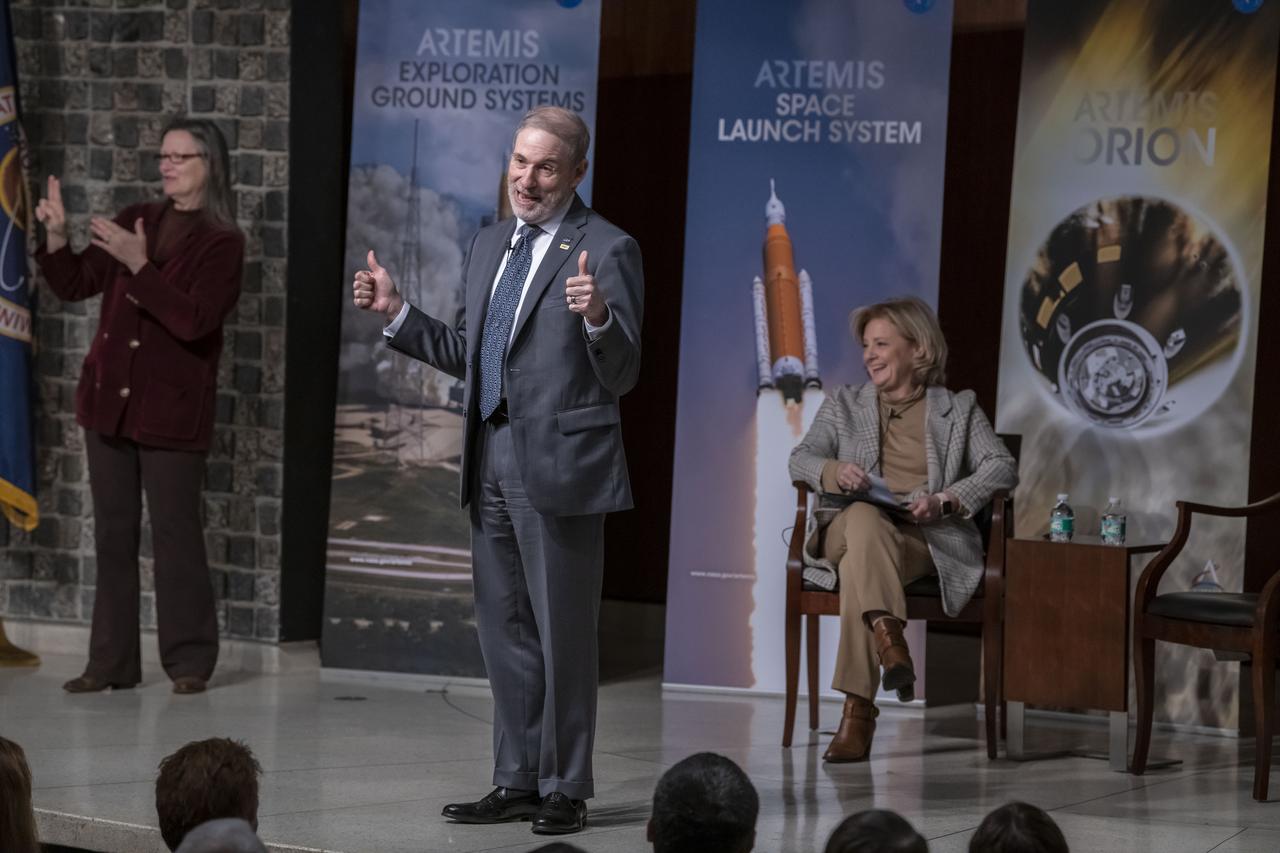
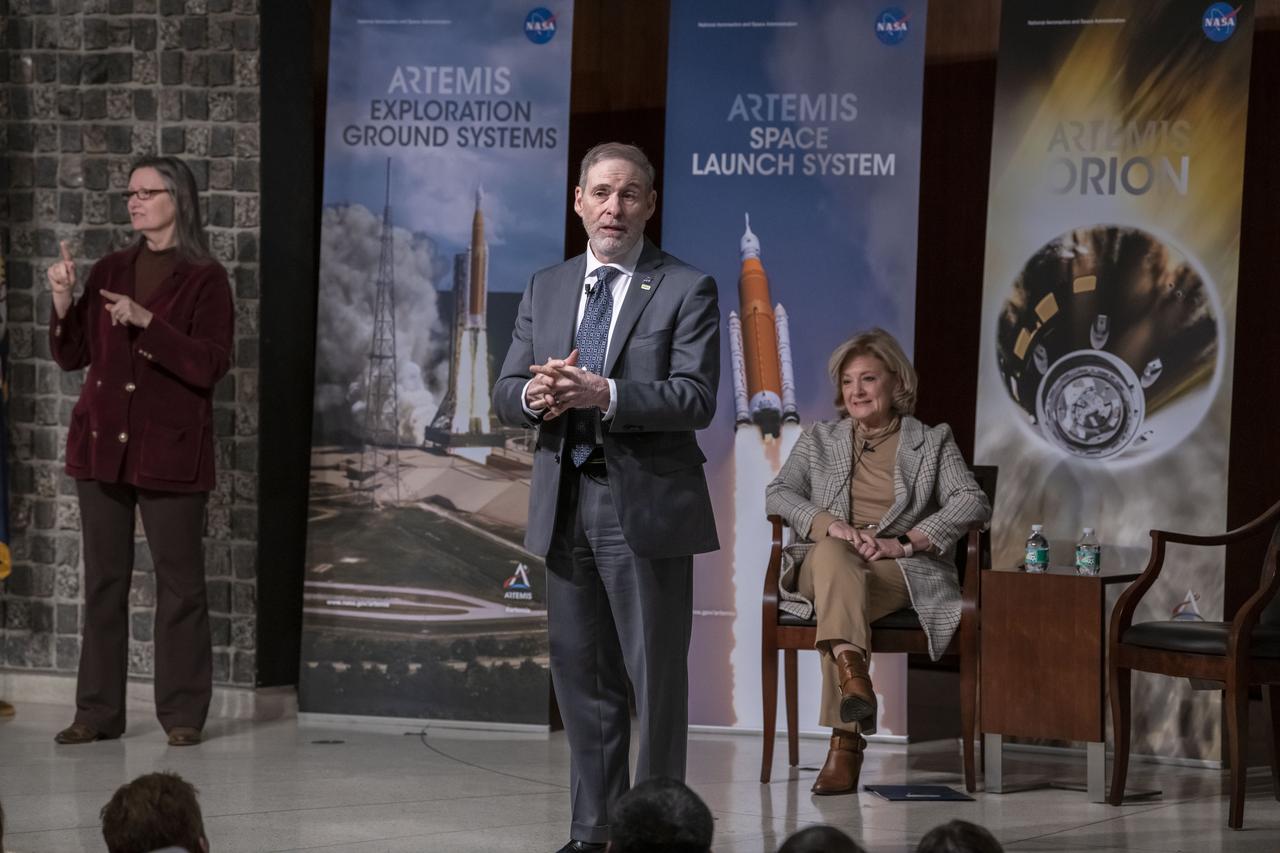
Douglas Loverro, NASA Associate Administrator for the Human Exploration and Operations Mission Directorate, and Marshall Center Director Jody Singer participate in a Town Hall with Marshall Space Flight Center employees
Associate Administrator Douglas Loverro Participates in the Hanging of the ISS Flag
Douglas Loverro, NASA Associate Administrator for the Human Exploration and Operations Mission Directorate, and Marshall Center Director Jody Singer participate in a Town Hall with Marshall Space Flight Center employees
Associate Administrator Douglas Loverro Participates in the Hanging of the ISS Flag
Douglas Loverro, NASA Associate Administrator for the Human Exploration and Operations Mission Directorate, and Marshall Center Director Jody Singer participate in a Town Hall with Marshall Space Flight Center employees
Associate Administrator Douglas Loverro Participates in the Hanging of the ISS Flag
Douglas Loverro, NASA Associate Administrator for the Human Exploration and Operations Mission Directorate, and Marshall Center Director Jody Singer participate in a Town Hall with Marshall Space Flight Center employees
Associate Administrator Douglas Loverro Participates in the Hanging of the ISS Flag
Douglas Loverro, NASA Associate Administrator for the Human Exploration and Operations Mission Directorate, and Marshall Center Director Jody Singer participate in a Town Hall with Marshall Space Flight Center employees
Associate Administrator Douglas Loverro Participates in the Hanging of the ISS Flag
Douglas Loverro, NASA Associate Administrator for the Human Exploration and Operations Mission Directorate, and Marshall Center Director Jody Singer participate in a Town Hall with Marshall Space Flight Center employees
Associate Administrator Douglas Loverro Participates in the Hanging of the ISS Flag
Douglas Loverro, NASA Associate Administrator for the Human Exploration and Operations Mission Directorate, and Marshall Center Director Jody Singer participate in a Town Hall with Marshall Space Flight Center employees
Associate Administrator Douglas Loverro Participates in the Hanging of the ISS Flag
Douglas Loverro, NASA Associate Administrator for the Human Exploration and Operations Mission Directorate, and Marshall Center Director Jody Singer participate in a Town Hall with Marshall Space Flight Center employees
Associate Administrator Douglas Loverro Participates in the Hanging of the ISS Flag
NASA Chief Technologist Douglas Terrier joined Jacobs General Manager Lon Miller during a tour of the company's Engineering Development Facility in Houston. Jacobs provides advanced technologies used aboard the international Space Station and for deep space exploration.
NASA Chief Technologist Visits Jacobs
 Douglas Loverro, NASA’s new associate administrator for the Human Exploration and Operations Mission Directorate, right, joins NASA’s Marshall Space Flight Center Director Jody Singer to answer questions from the Marshall team at a Dec. 17 town hall. Loverro discussed the importance of the workforce, positivity and the unifying and inspirational nature of space exploration. “At the end of the day, we depend on the workforce, not on Headquarters to further exploration,” Loverro said. “My job is to listen to you and translate that into telling Congress and the administration what you need to complete your job. We're seeking a common purpose, on a common mission. I'm relying on you to tell me what you need to get this mission done.”
Associate Administrator Douglas Loverro Participates in the Hang
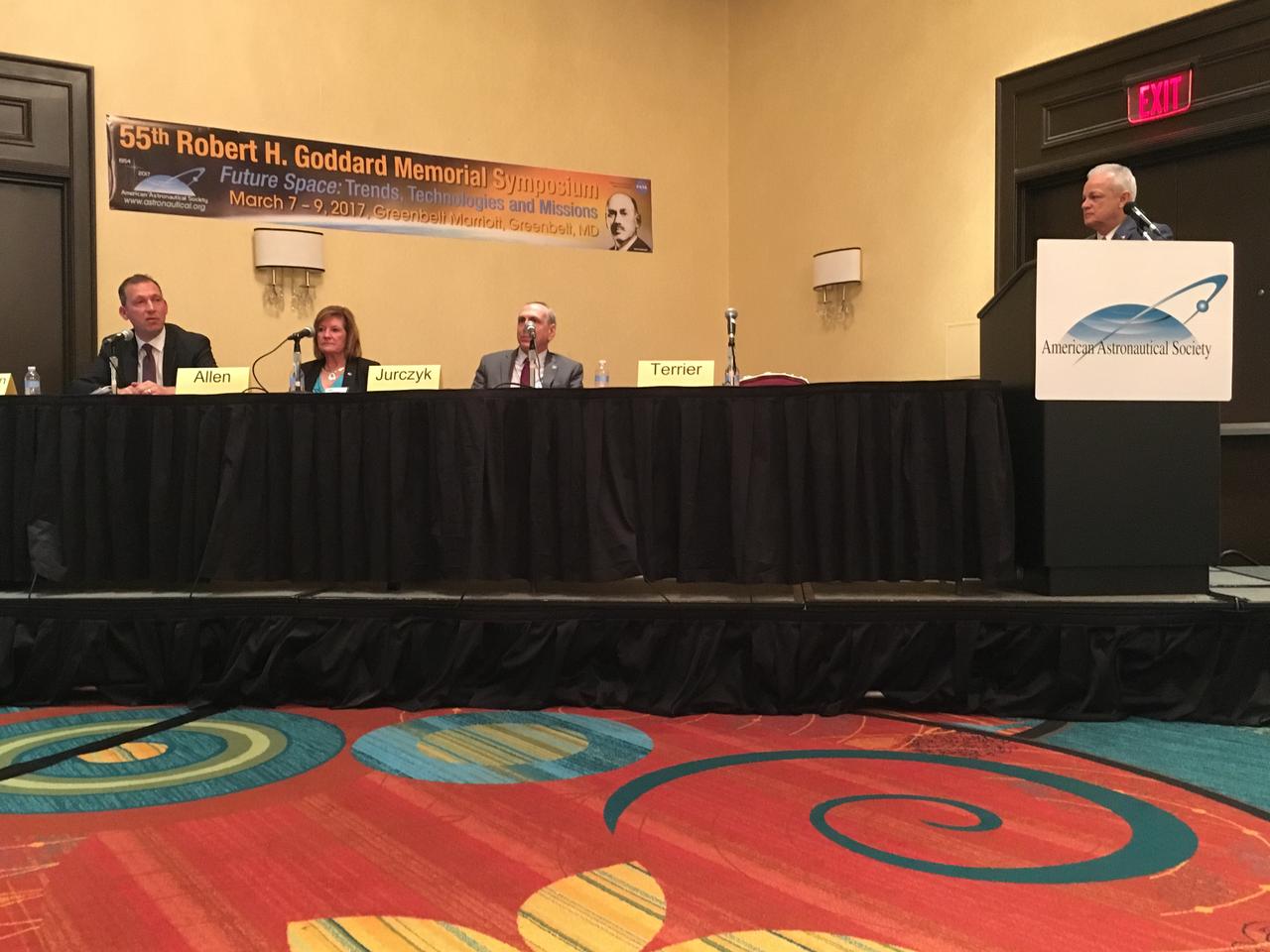
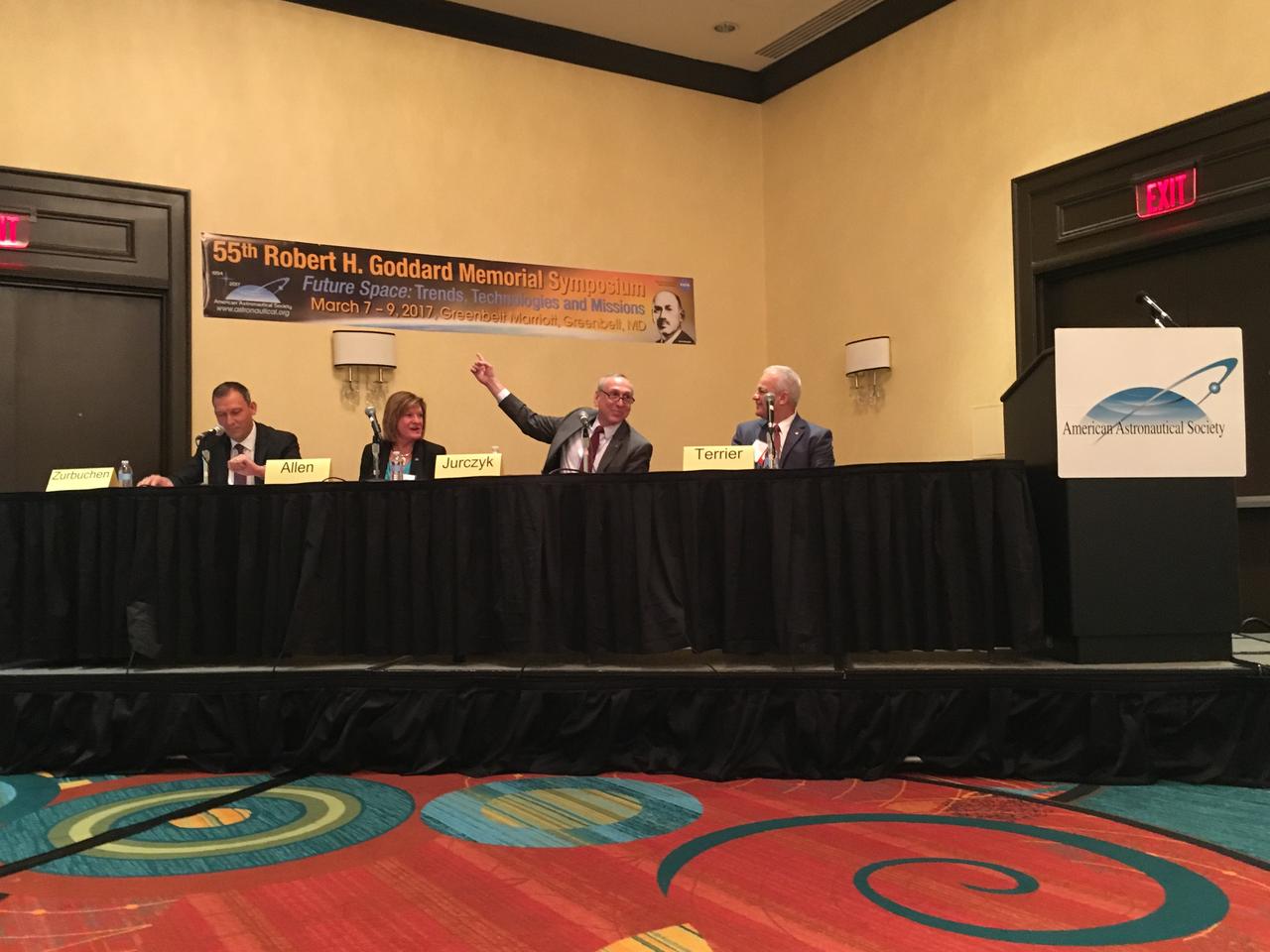
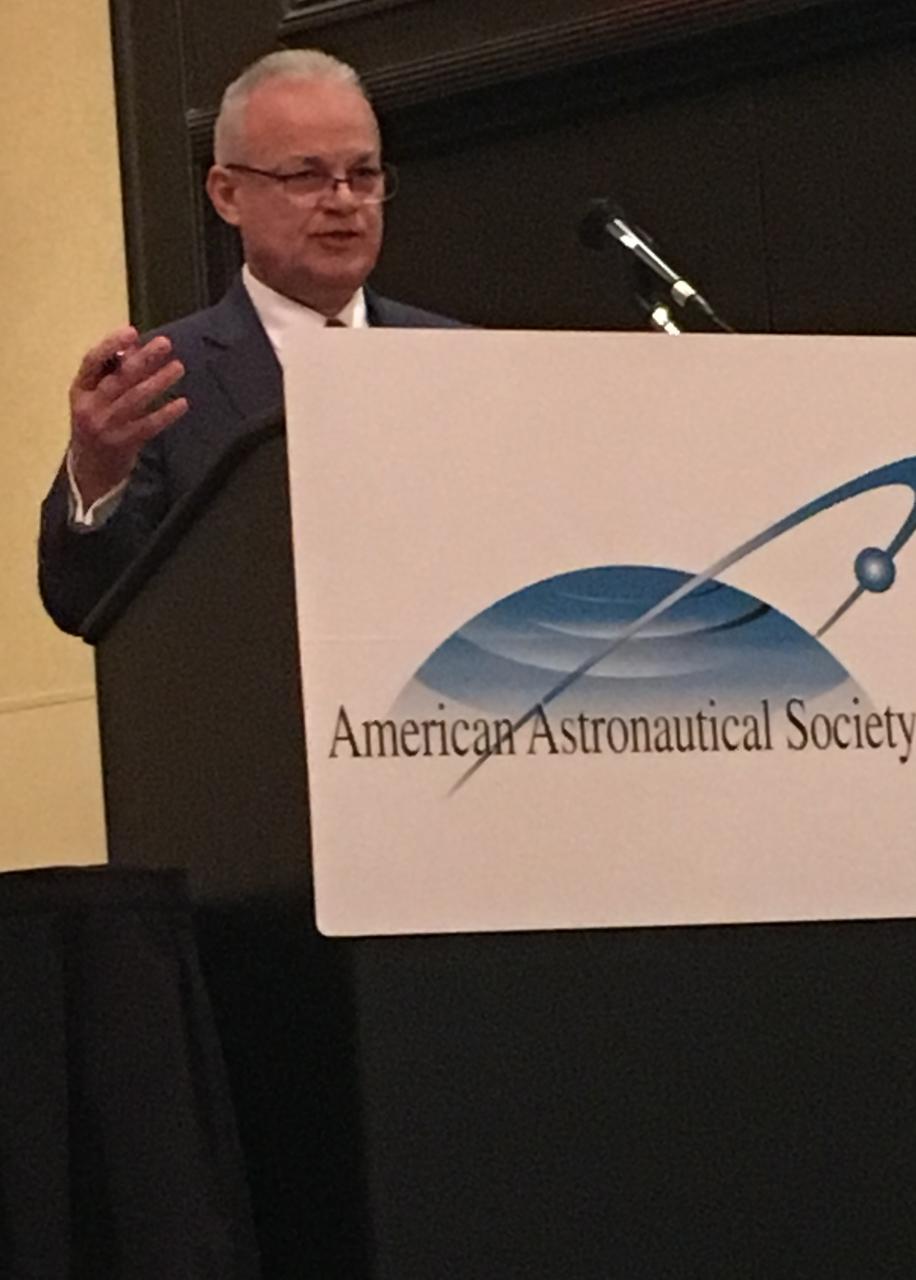
NASA Chief Technologist Douglas Terrier moderated the discussion “NASA Leadership in the Future of Science and Technology" during the AAS 55th Robert H. Goddard Memorial Symposium on March 8, 2017. Terrier was joined by Associate Administrator for Space Technology Steve Jurczyk, Chief Scientist Gale Allen and Associate Administrator for Science Thomas Zurbuchen.
NASA Chief Technologist Douglas Terrier Moderates Discussion During the AAS 55th Robert H. Goddard Memorial Symposium
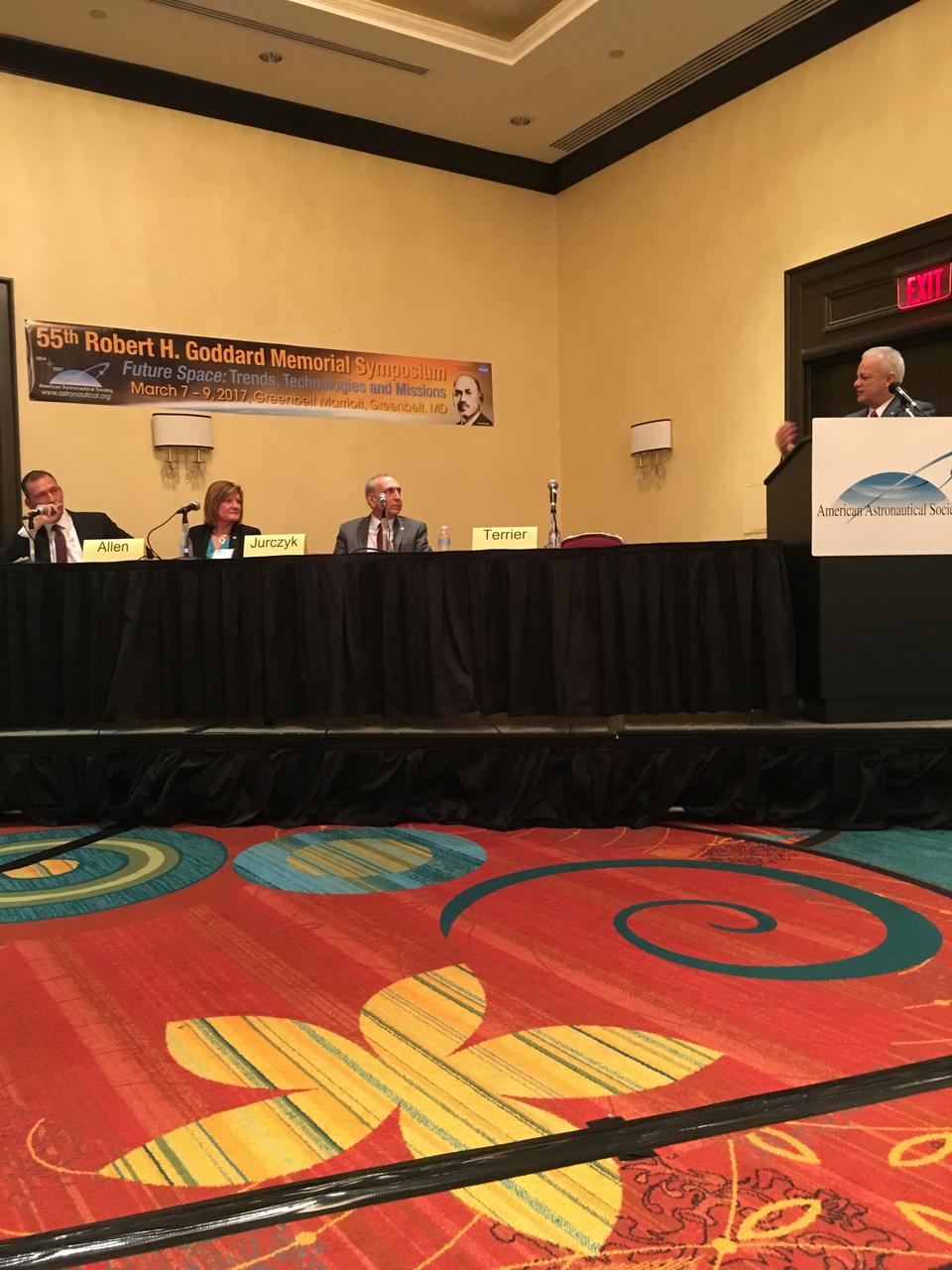
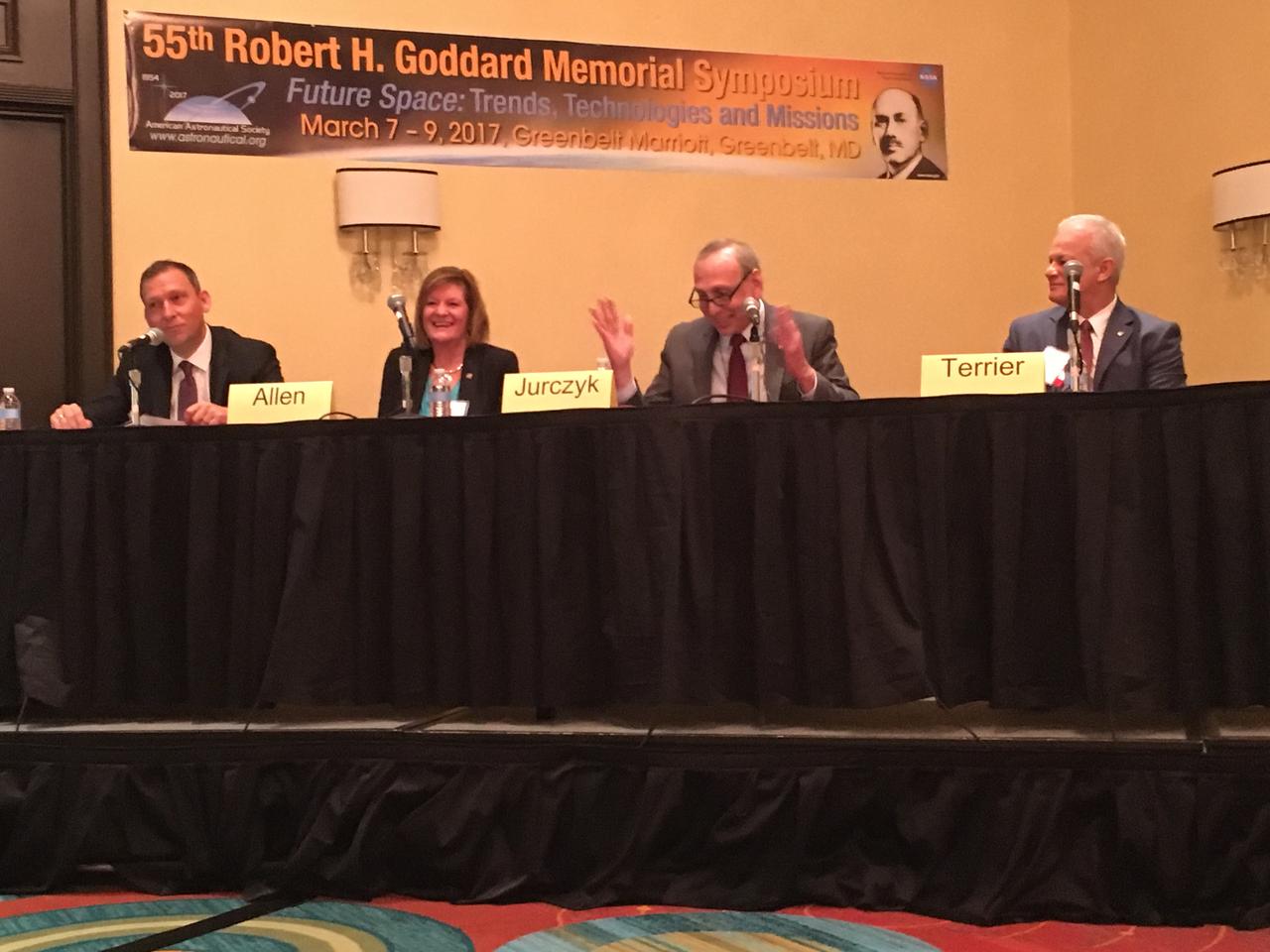
NASA Chief Technologist Douglas Terrier moderated the discussion “NASA Leadership in the Future of Science and Technology" during the AAS 55th Robert H. Goddard Memorial Symposium on March 8, 2017. Terrier was joined by Associate Administrator for Space Technology Steve Jurczyk, Chief Scientist Gale Allen and Associate Administrator for Science Thomas Zurbuchen.
NASA Chief Technologist Douglas Terrier Moderates a Panel During the AAS 55th Robert H. Goddard Memorial Symposium
NASA Chief Technologist Douglas Terrier moderated the discussion “NASA Leadership in the Future of Science and Technology" during the AAS 55th Robert H. Goddard Memorial Symposium on March 8, 2017. Terrier was joined by Associate Administrator for Space Technology Steve Jurczyk, Chief Scientist Gale Allen and Associate Administrator for Science Thomas Zurbuchen.
NASA Chief Technologist Douglas Terrier Moderates Panel During the AAS 55th Robert H. Goddard Memorial Symposium
NASA Chief Technologist Douglas Terrier moderated the discussion “NASA Leadership in the Future of Science and Technology" during the AAS 55th Robert H. Goddard Memorial Symposium on March 8, 2017. Terrier was joined by Associate Administrator for Space Technology Steve Jurczyk, Chief Scientist Gale Allen and Associate Administrator for Science Thomas Zurbuchen.
NASA Chief Technologist Douglas Terrier Moderates Panel Discussion During the AAS 55th Robert H. Goddard Memorial Symposium
NASA Chief Technologist Douglas Terrier moderated the discussion “NASA Leadership in the Future of Science and Technology" during the AAS 55th Robert H. Goddard Memorial Symposium on March 8, 2017. Terrier was joined by Associate Administrator for Space Technology Steve Jurczyk, Chief Scientist Gale Allen and Associate Administrator for Science Thomas Zurbuchen.
NASA Chief Technologist Douglas Terrier Moderates A Discussion During the AAS 55th Robert H. Goddard Memorial Symposium
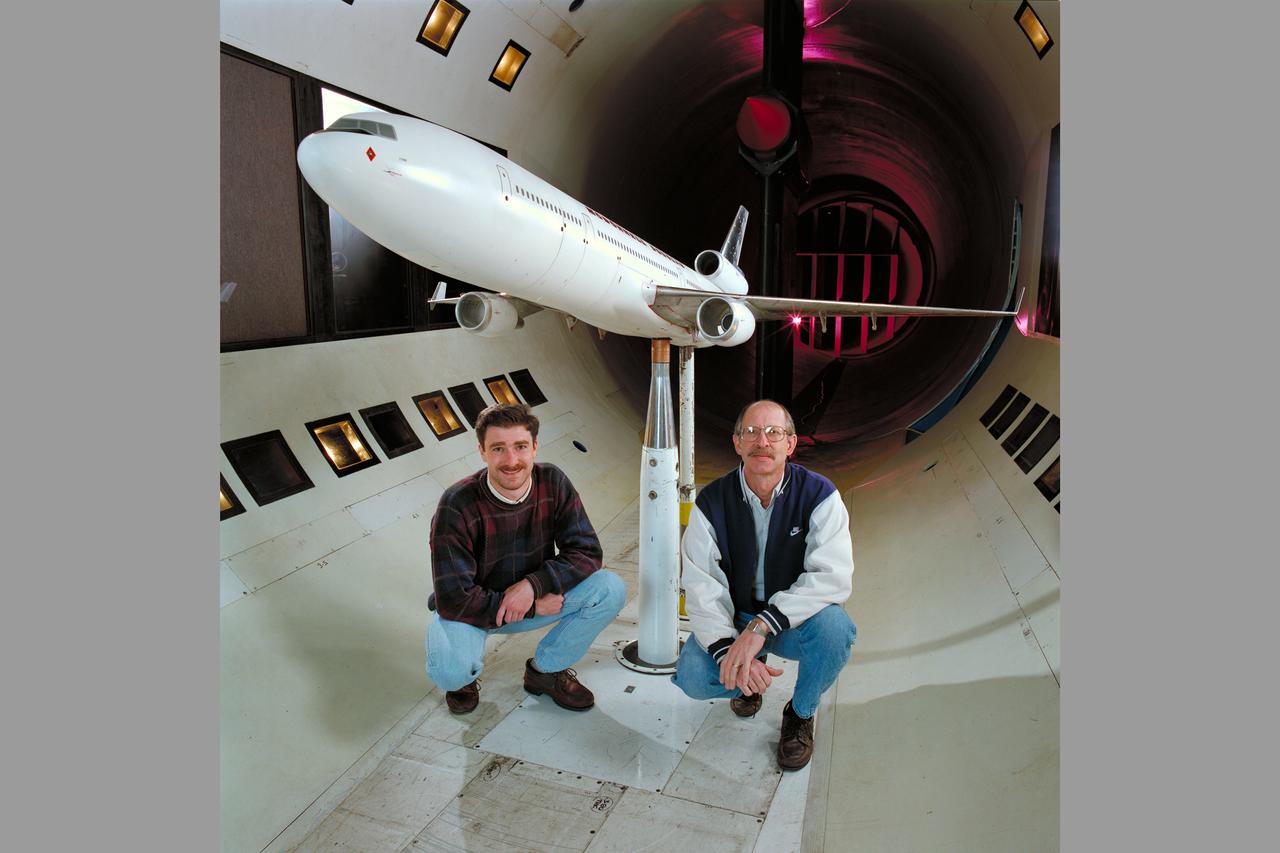
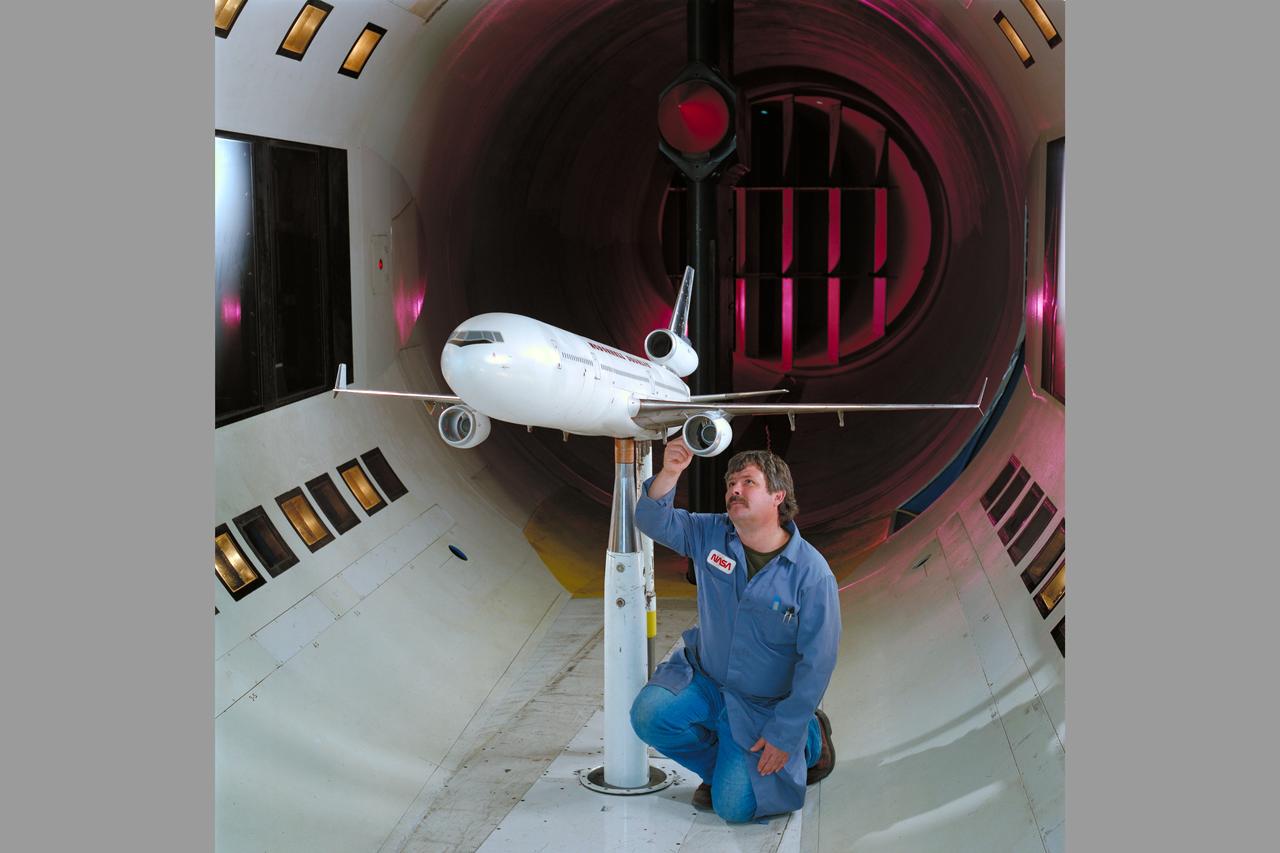
Mc Donnell Douglas MD-11 Model in Ames 12ft. W.T. with members of the MC Donnell Douglas crew (1st Non-NASA customer of the refurbished W.T.)
ARC-1969-AC96-0071-5
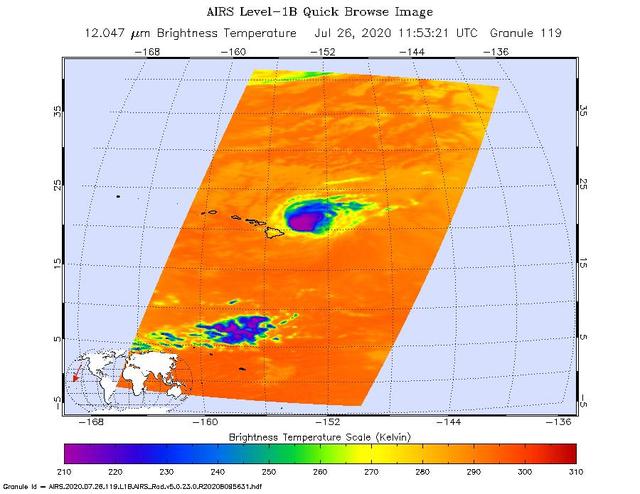
NASA's Atmospheric Infrared Sounder (AIRS) was monitoring Hurricane Douglas as it took aim at the Hawaiian Islands on July 26. Perched on NASA's Aqua satellite, AIRS is an instrument that studies Earth's weather and climate.  As of 11 a.m. local time, Douglas was sweeping toward Hawaii with the potential to directly hit portions of the islands, from Maui to Kauai, in the late afternoon or evening. The purple areas in the AIRS image — taken at 1:53 a.m. local time on July 26 — indicate very cold clouds high in the atmosphere generally linked to heavy rainfall. Warmer clouds closer to Earth's surface show up as green and blue, and orange areas indicate cloud-free parts of the sky.  The Category 1 hurricane was packing maximum sustained winds of 85 mph (140 kph) on the morning of July 26. Douglas' storm surge is forecast to push water levels as high as 3 feet (0.9 meters) above normal tides. The storm could dump as much as 15 inches (38 centimeters) of rain onto isolated parts of the Hawaiian Islands.  https://photojournal.jpl.nasa.gov/catalog/PIA23785
AIRS Captures Hurricane Douglas
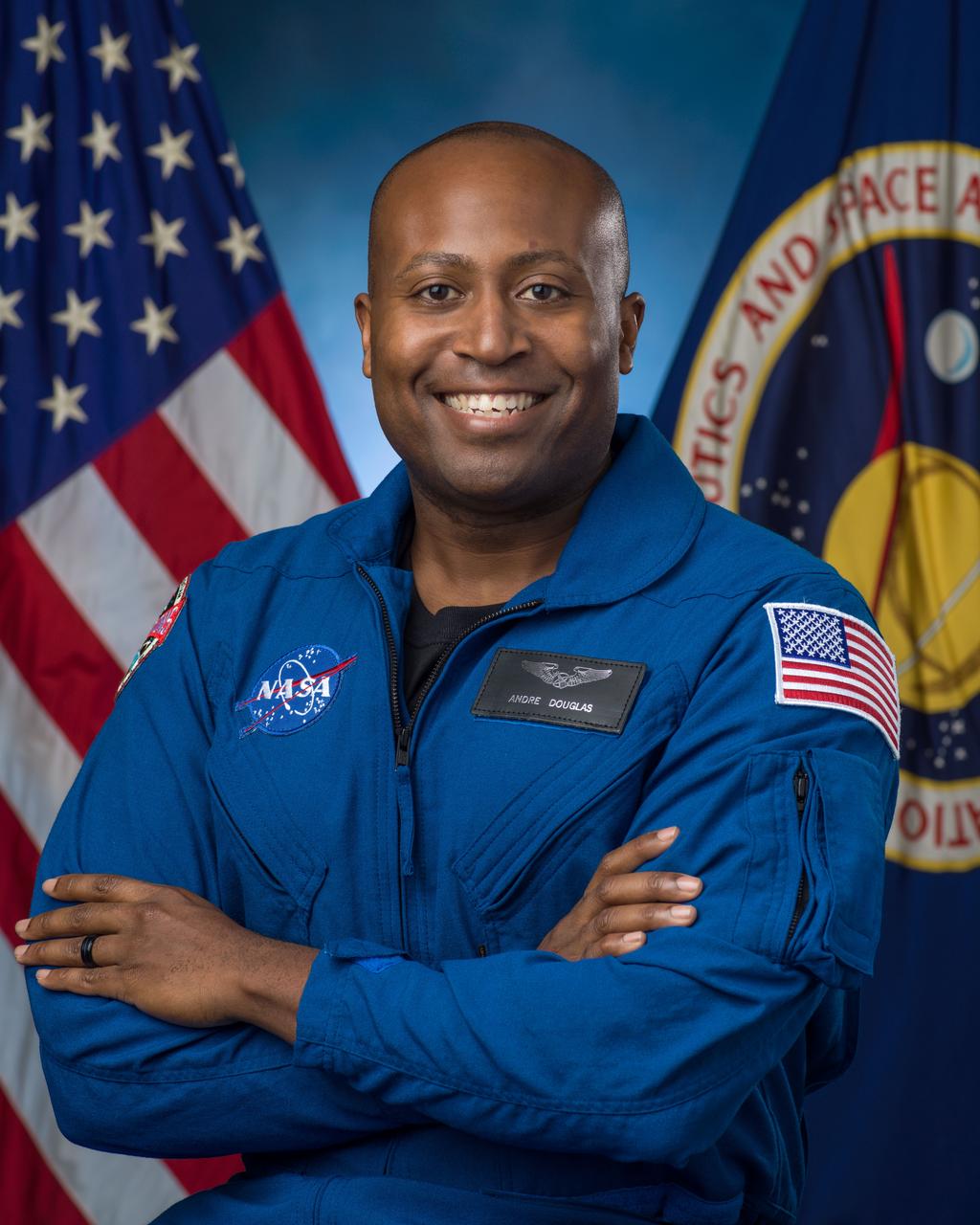
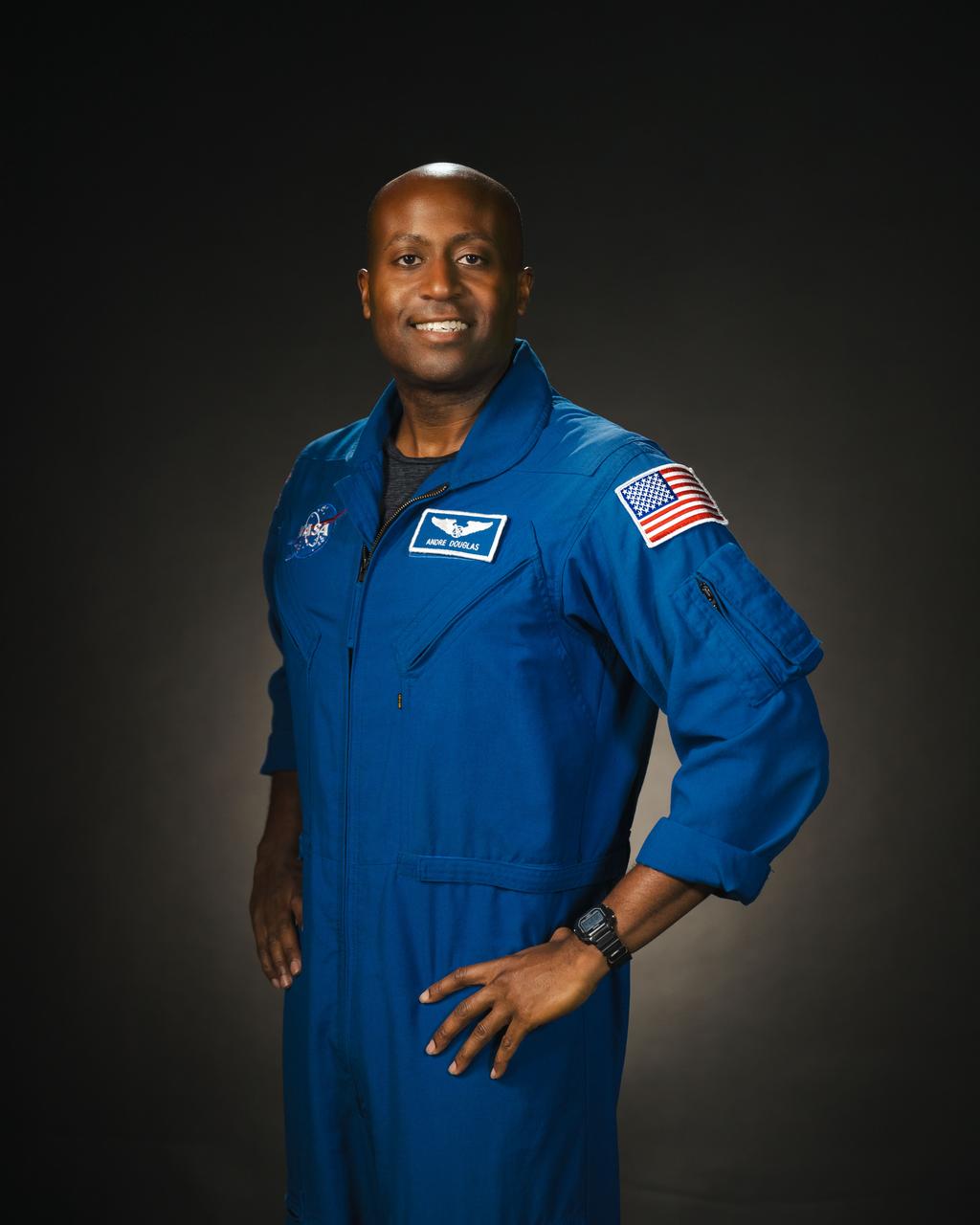
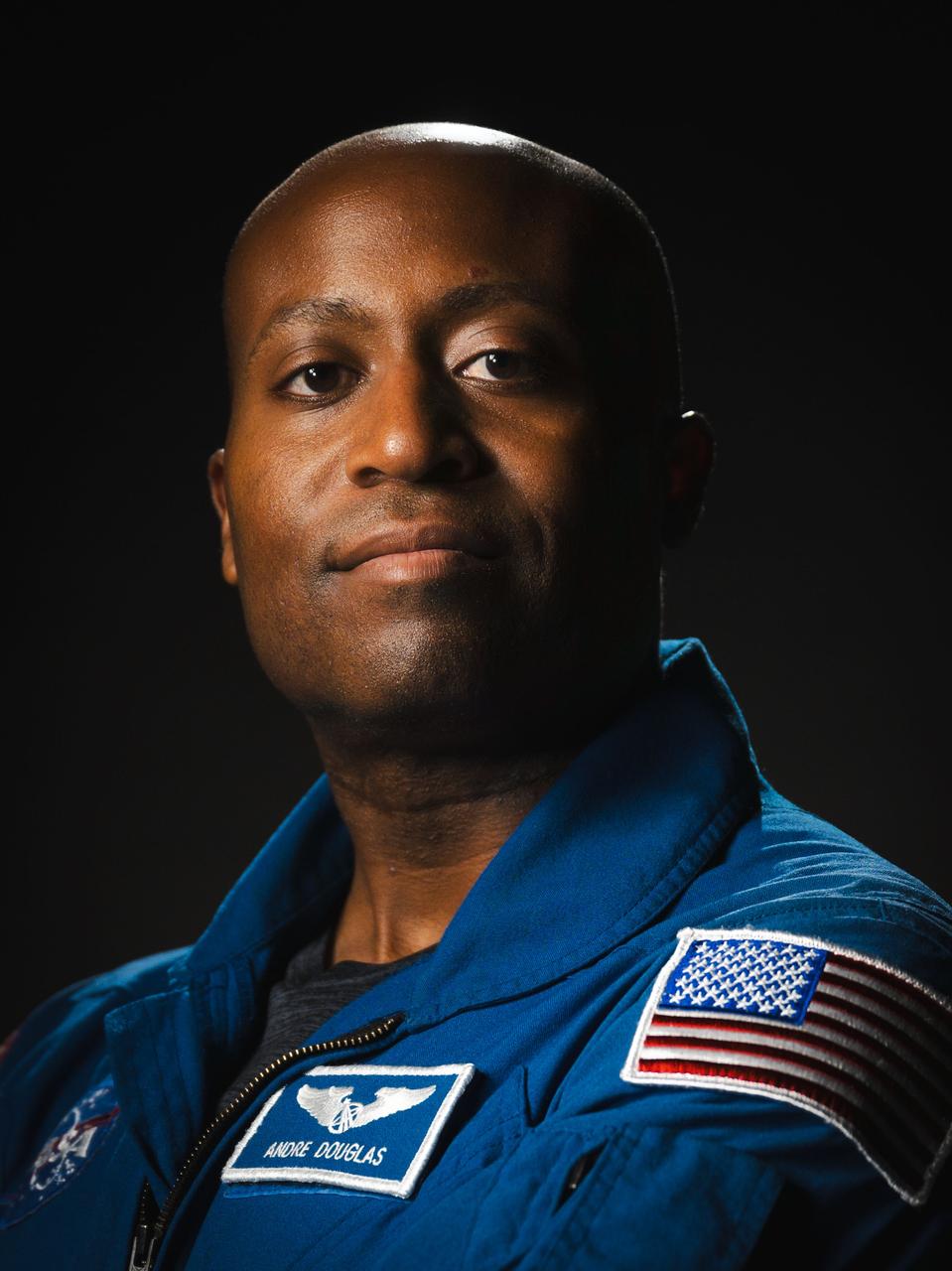
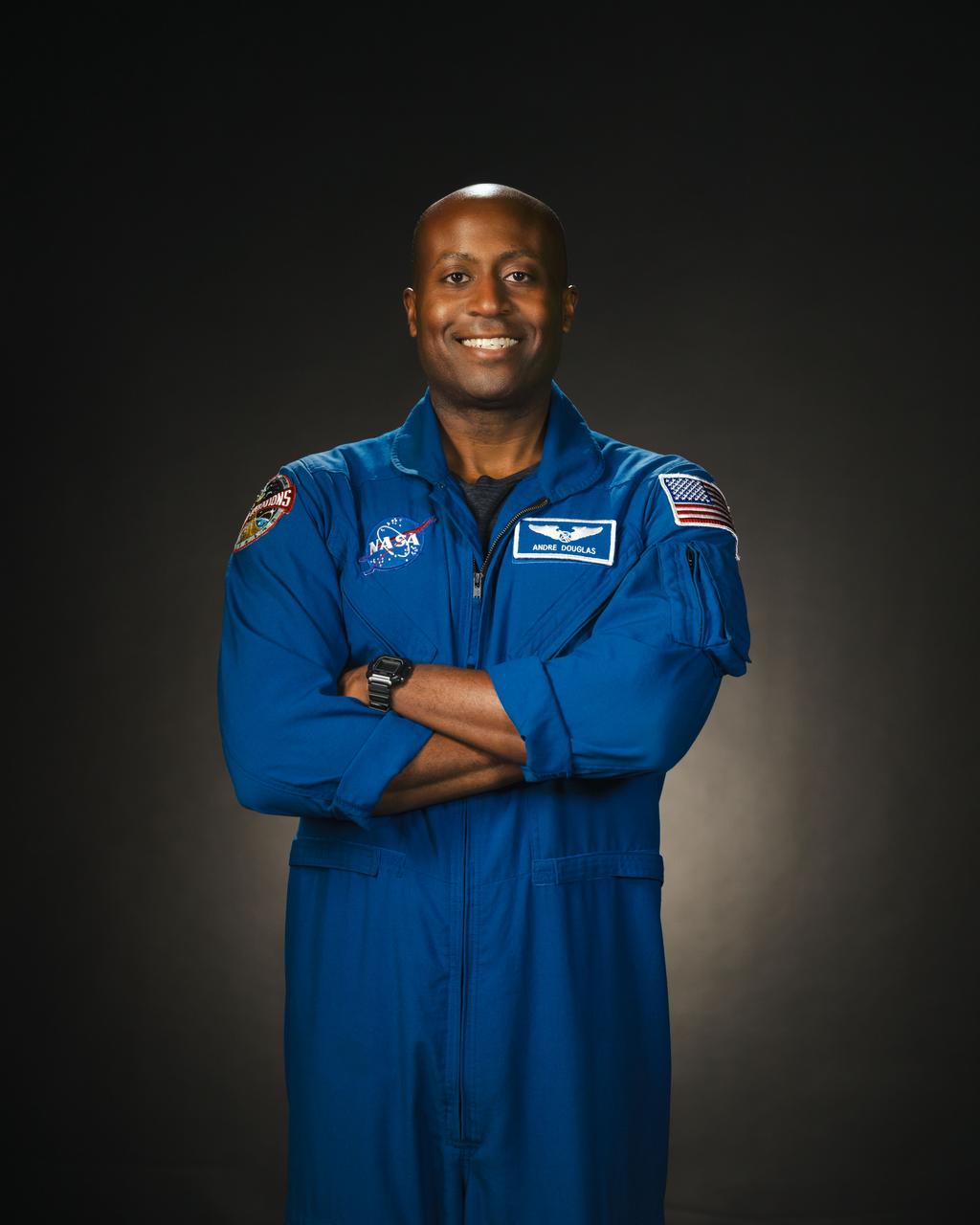
Astronaut Candidate Individual Portrait, Andre Douglas - ASCAN Class of 2021.  Photo Date: December 3, 2021.  Location: Building 8, Room 183 - Photo Studio.  Photographer: Robert Markowitz
Andre Douglas
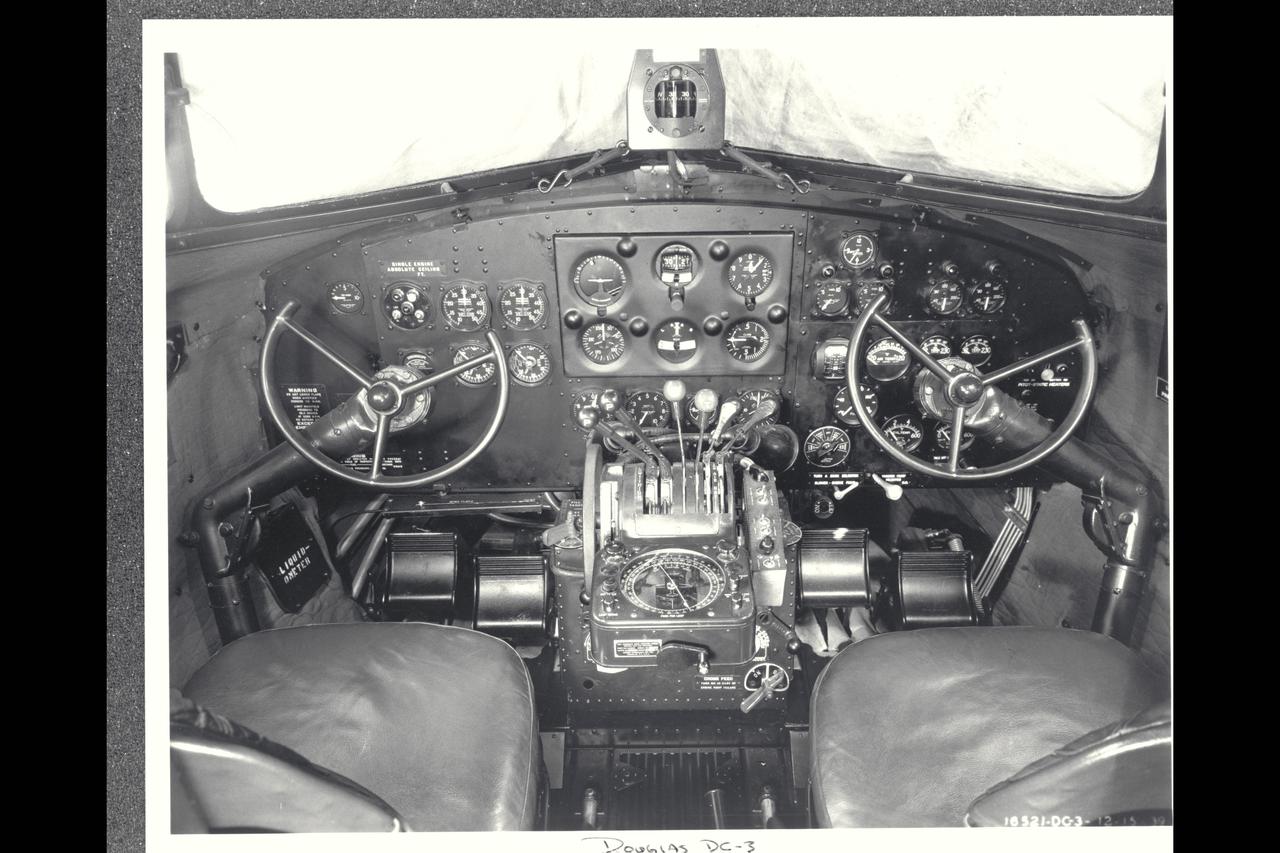
Douglas DC-8 Cockpit
ARC-1993-A83-0499-7
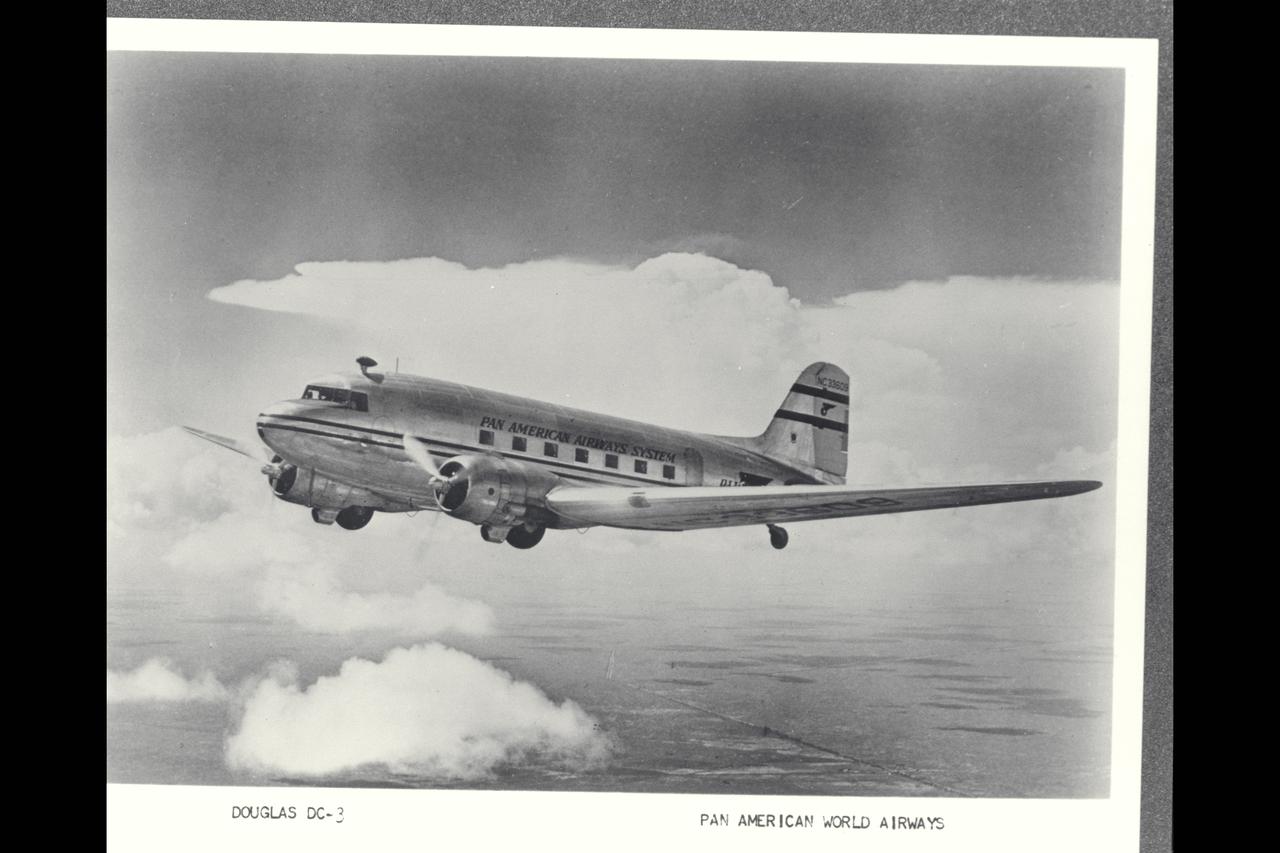
Douglas DC-3 Airplane
ARC-1993-A83-0499-6
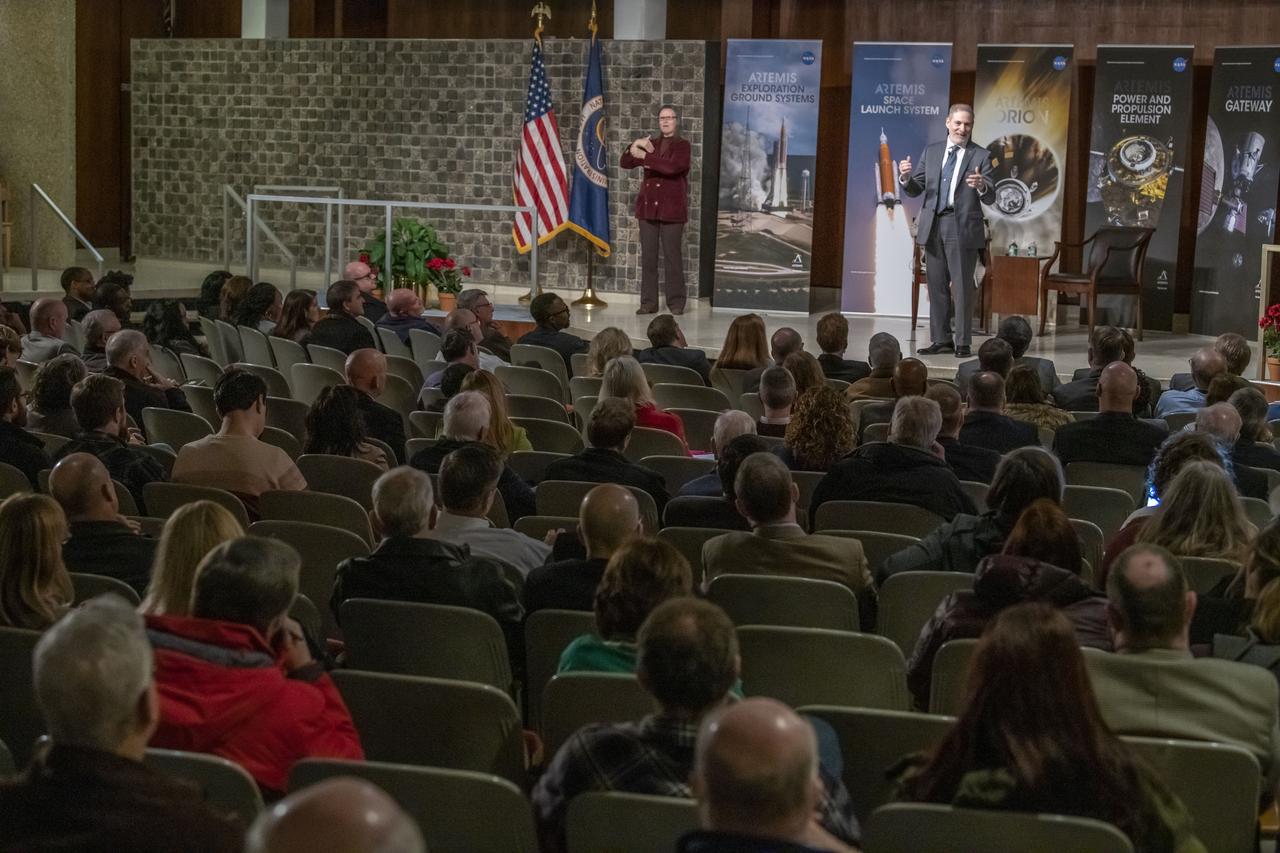
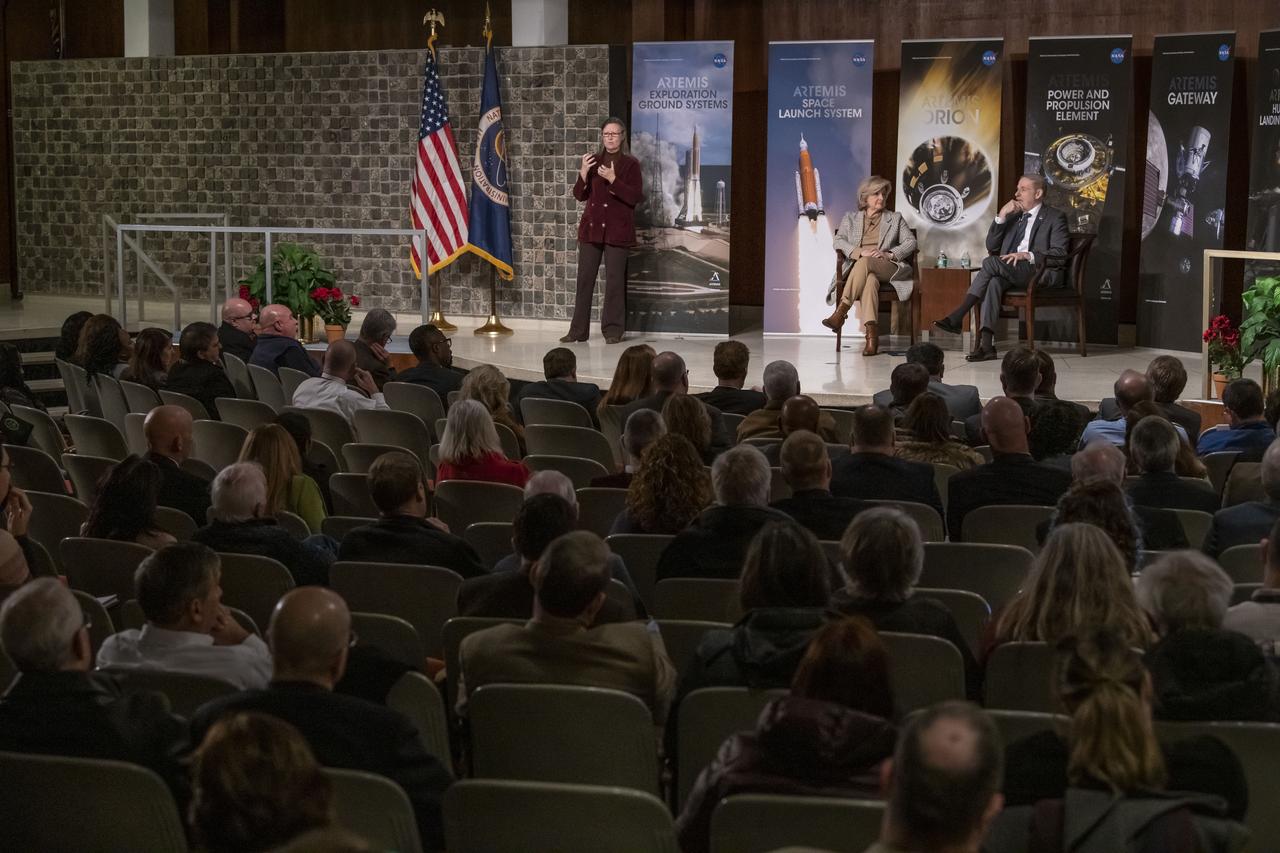
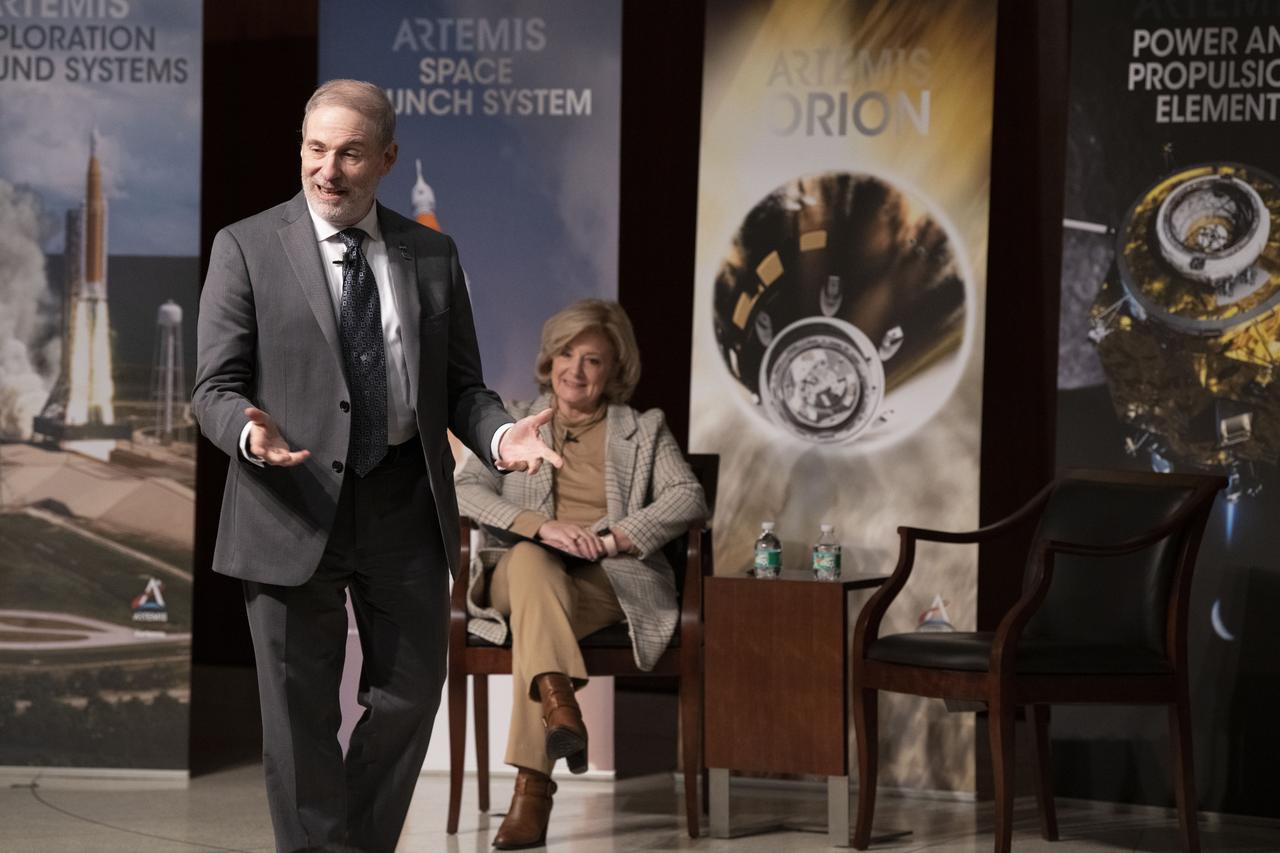
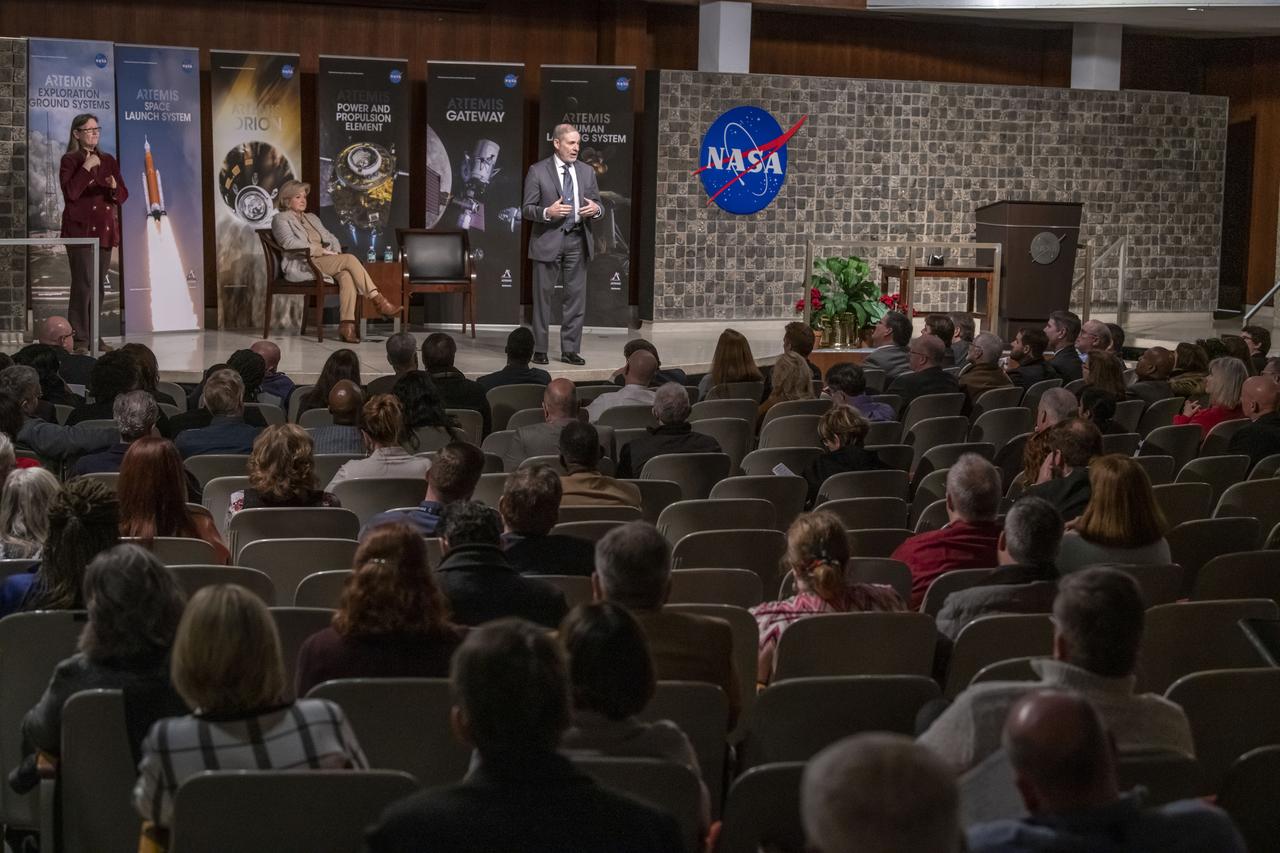
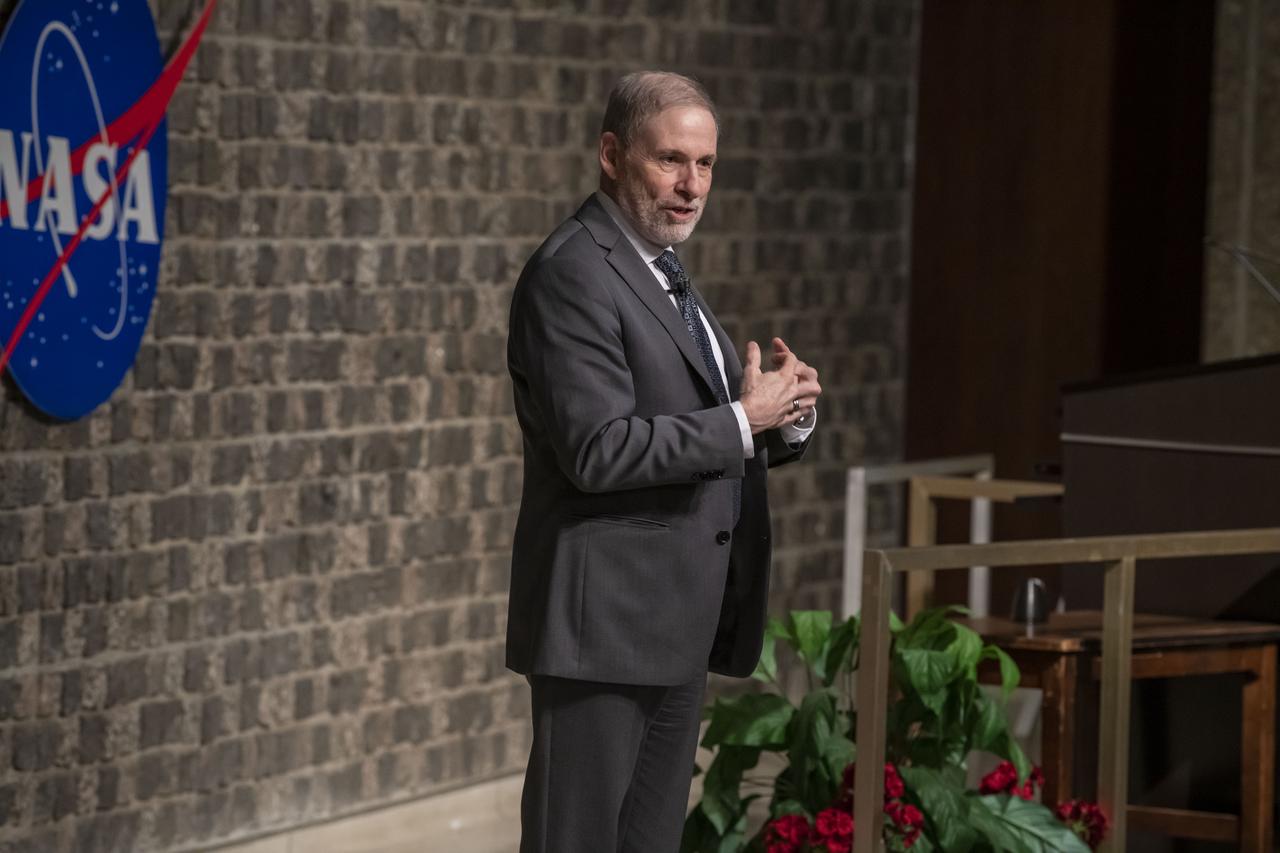
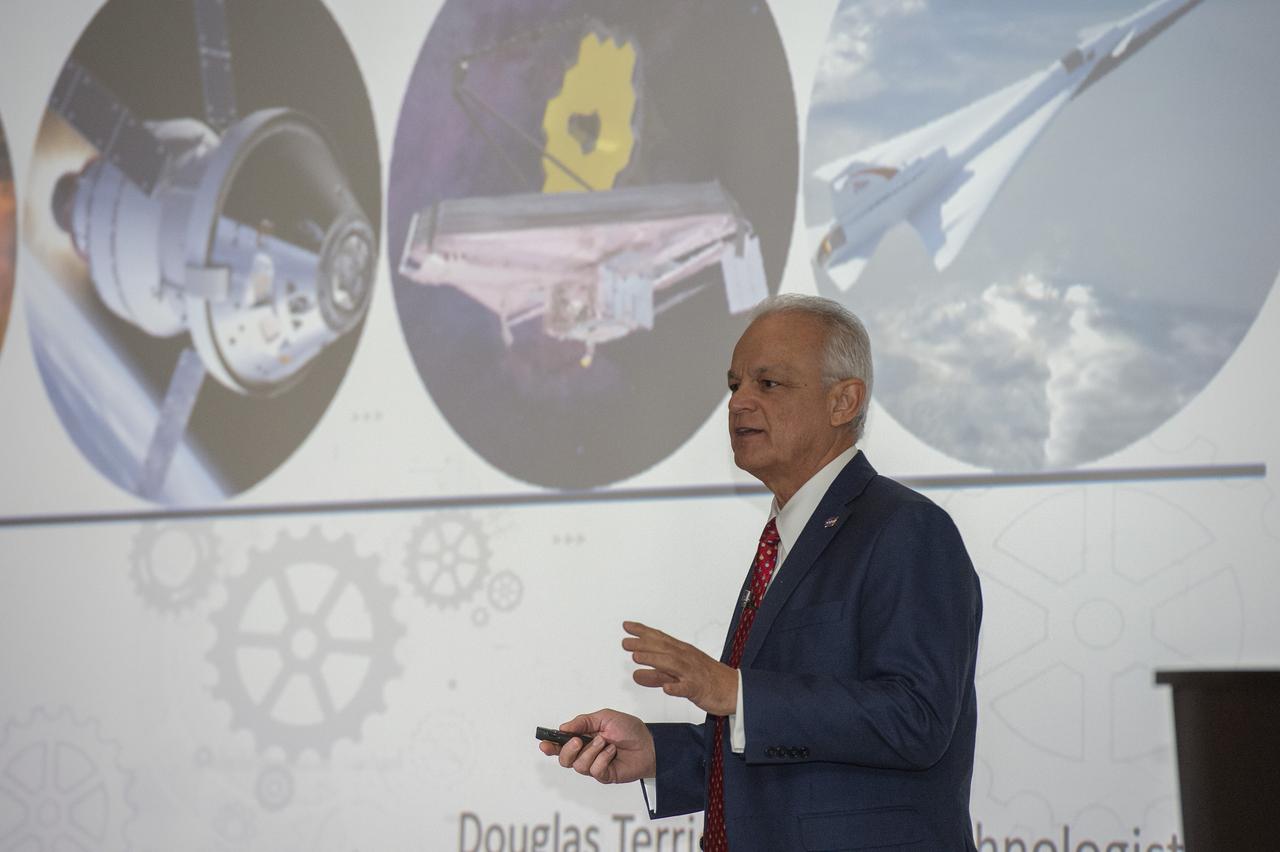
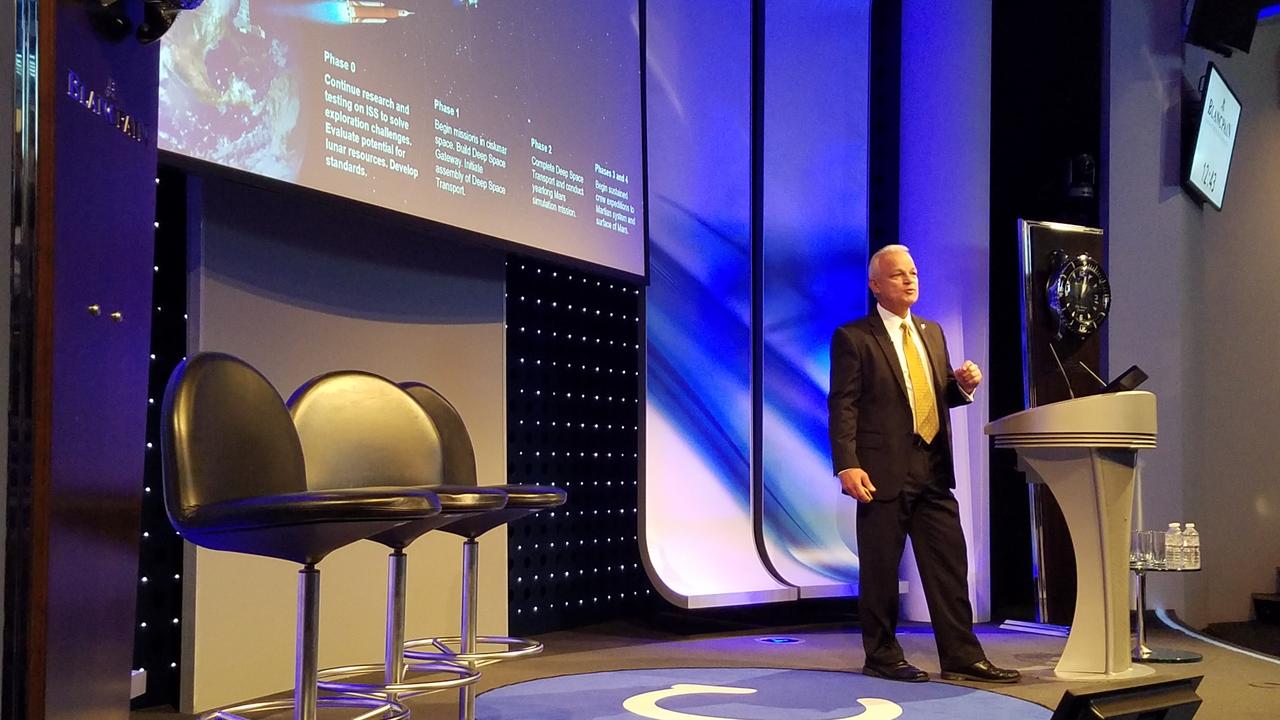
 “INNOVATION IS NOT OPTIONAL,” SAYS DOUGLAS TERRIER, NASA CHIEF TECHNOLOGIST, DURING A TALK ABOUT INNOVATION AT THE AGENCY DEC. 3 IN MORRIS AUDITORIUM AT NASA’S MARSHALL SPACE FLIGHT CENTER. TERRIER SAID THAT NASA MUST CONTINUE TO BE INNOVATIVE TO ACHIEVE THE AGENCY’S MISSIONS AND GOALS FOR THE NEXT 5-10 YEARS, INCLUDING THE 2024 ARTEMIS II MOON LANDING.
“INNOVATION IS NOT OPTIONAL,” SAYS DOUGLAS TERRIER, NASA CHI
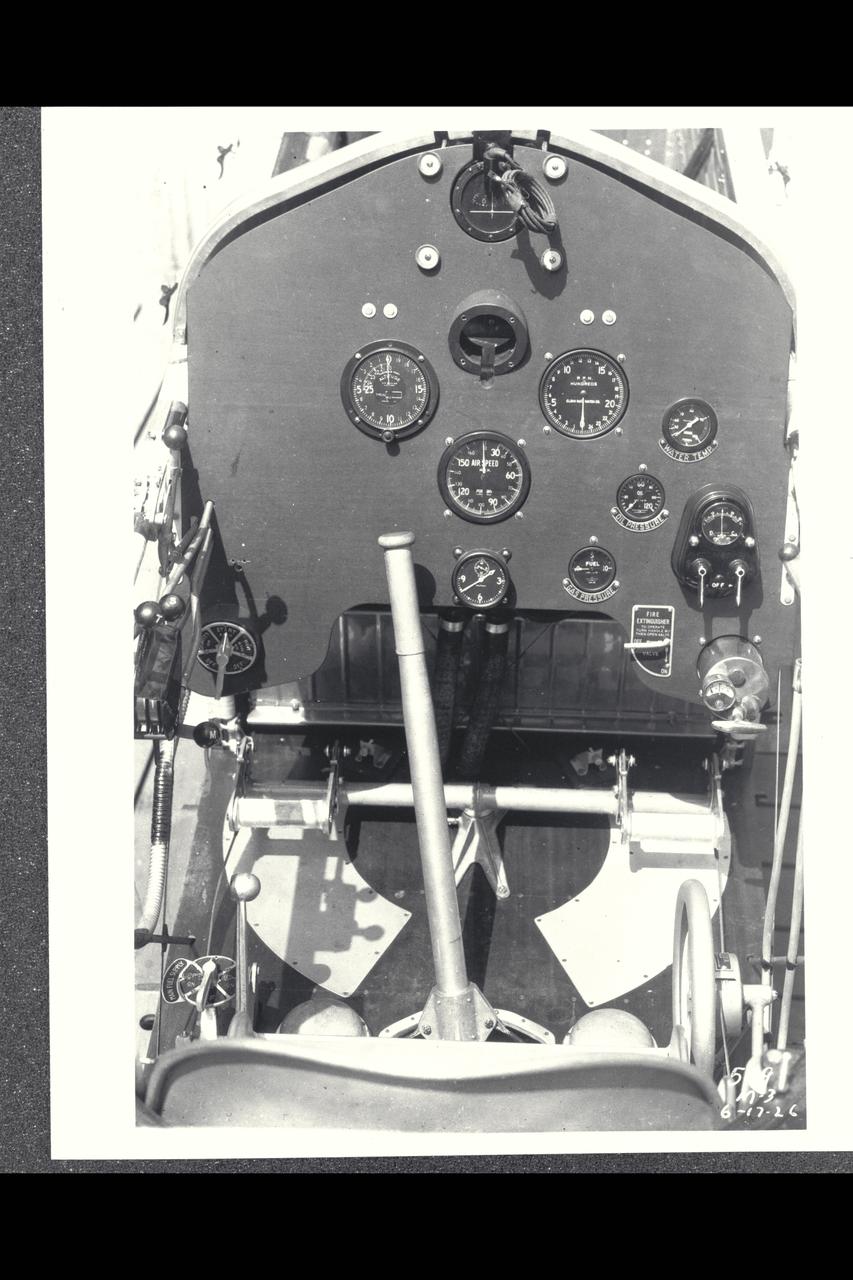
Douglas M-3 Instrument Panel
ARC-1993-A83-0499-5
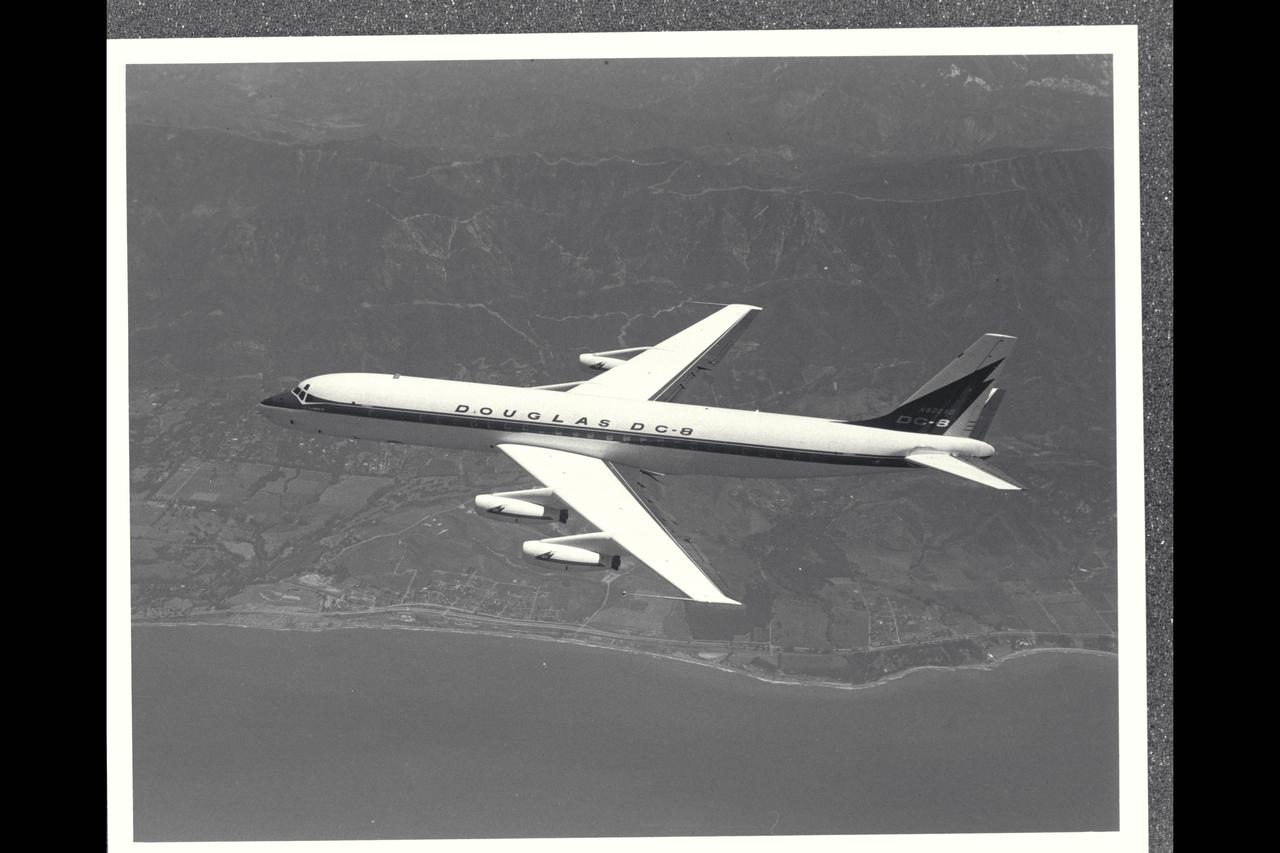
Douglas DC-8 Ariplane in Flight
ARC-1993-A83-0499-4
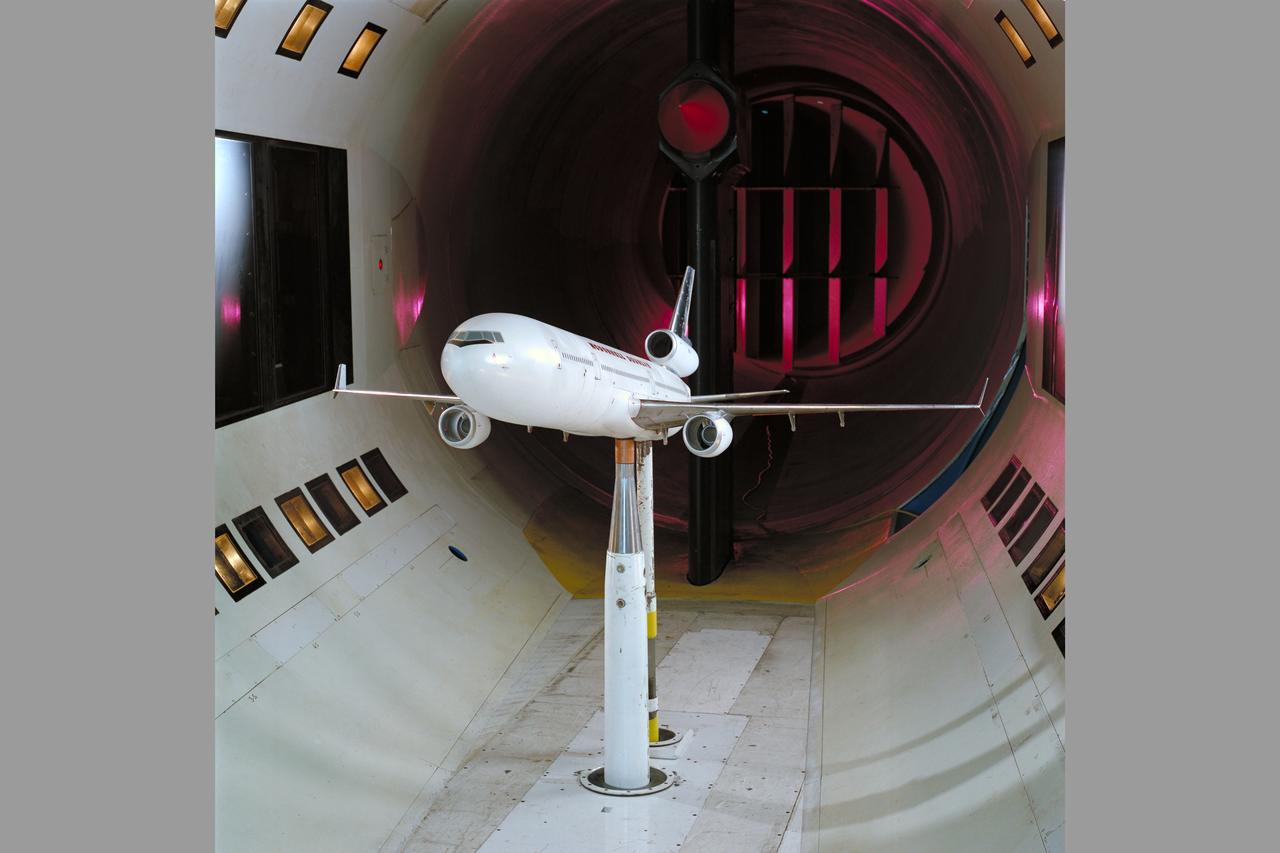
Mc Donnell Douglas MD-11 Model in Ames 12ft. W.T. (1st Non-NASA customer of the refurbished W.T.)
ARC-1969-AC96-0071-2
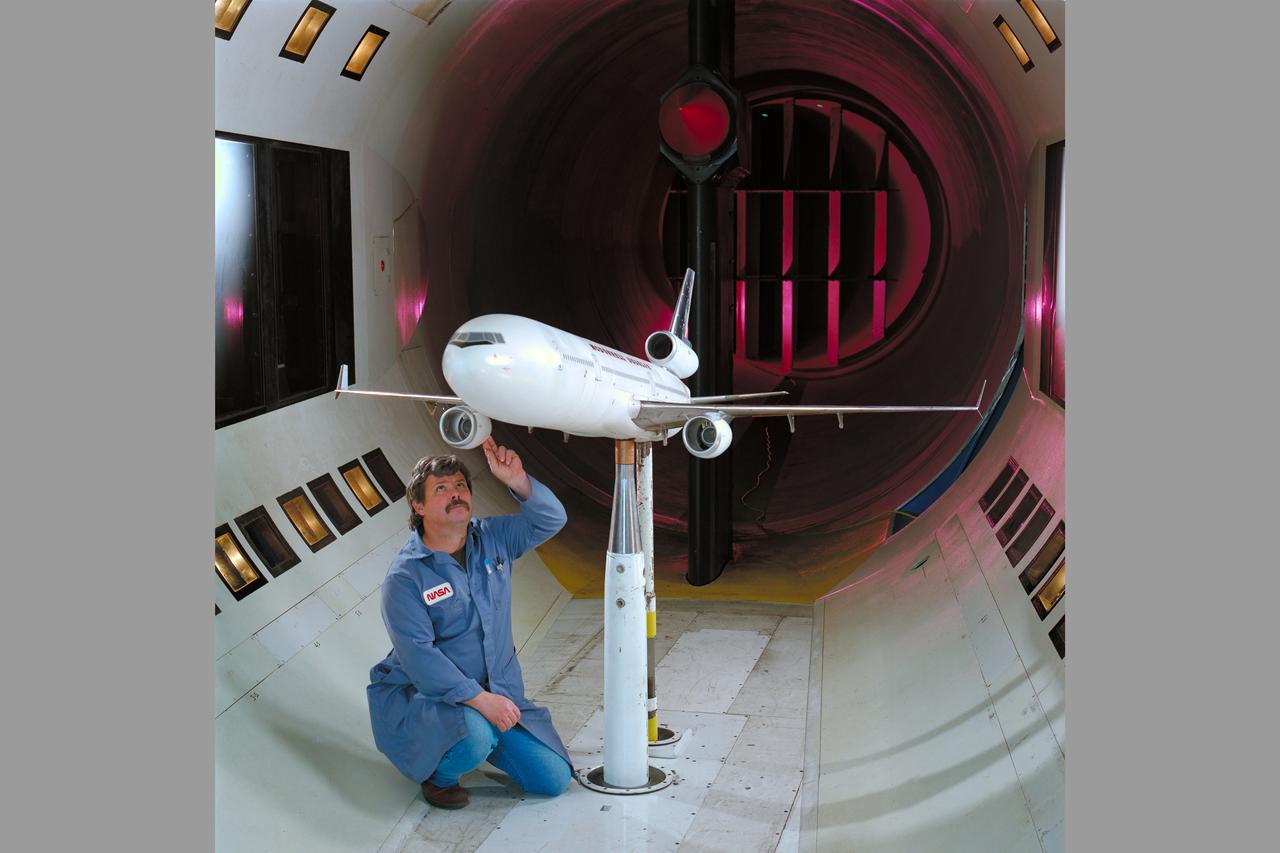
Mc Donnell Douglas MD-11 Model in Ames 12ft. W.T. (1st Non-NASA customer of the refurbished W.T.)
ARC-1969-AC96-0071-1
Mc Donnell Douglas MD-11 Model in Ames 12ft. W.T. (1st Non-NASA customer of the refurbished W.T.)
ARC-1969-AC96-0071-3
Mc Donnell Douglas MD-11 Model in Ames 12ft. W.T. (1st Non-NASA customer of the refurbished W.T.)
ARC-1969-AC96-0071-4
NASA Chief Technologist Douglas Terrier, center, and NASA Deputy Chief Technologist David Steitz, left, talk with a Harding University student researcher about LED technology being used to track atmospheric composition, while attending “NASA Day in Arkansas” hosted at the university in Searcy, Arkansas on Jan. 27, 2020.
NASA's Douglas Terrier and David Steitz Talk with a Student at NASA Day in Arkansas
  jsc2024e013682_alt (February 8, 2024) --- NASA astronaut Andre Douglas poses for a portrait at NASA’s Johnson Space Center in Houston, Texas. Credit: NASA/ Josh Valcarcel
NASA Astronaut Andre Douglas
jsc2024e013660 (February 8, 2024) --- NASA astronaut Andre Douglas poses for a portrait at NASA’s Johnson Space Center in Houston, Texas. Credit: NASA/ Josh Valcarcel
NASA Astronaut Andre Douglas
  jsc2024e013661 (February 8, 2024) --- NASA astronaut Andre Douglas poses for a portrait at NASA’s Johnson Space Center in Houston, Texas. Credit: NASA/ Josh Valcarcel
NASA Astronaut Andre Douglas
3/4 front view of Douglas F5D Skylancer modified to "ogee" platform inlet plug installed in Ames 40x80 foot wind tunnel.
F-5D Airplane modified to "ogee" platform inlet plug installed in Ames 40x80 foot wind tunnel.
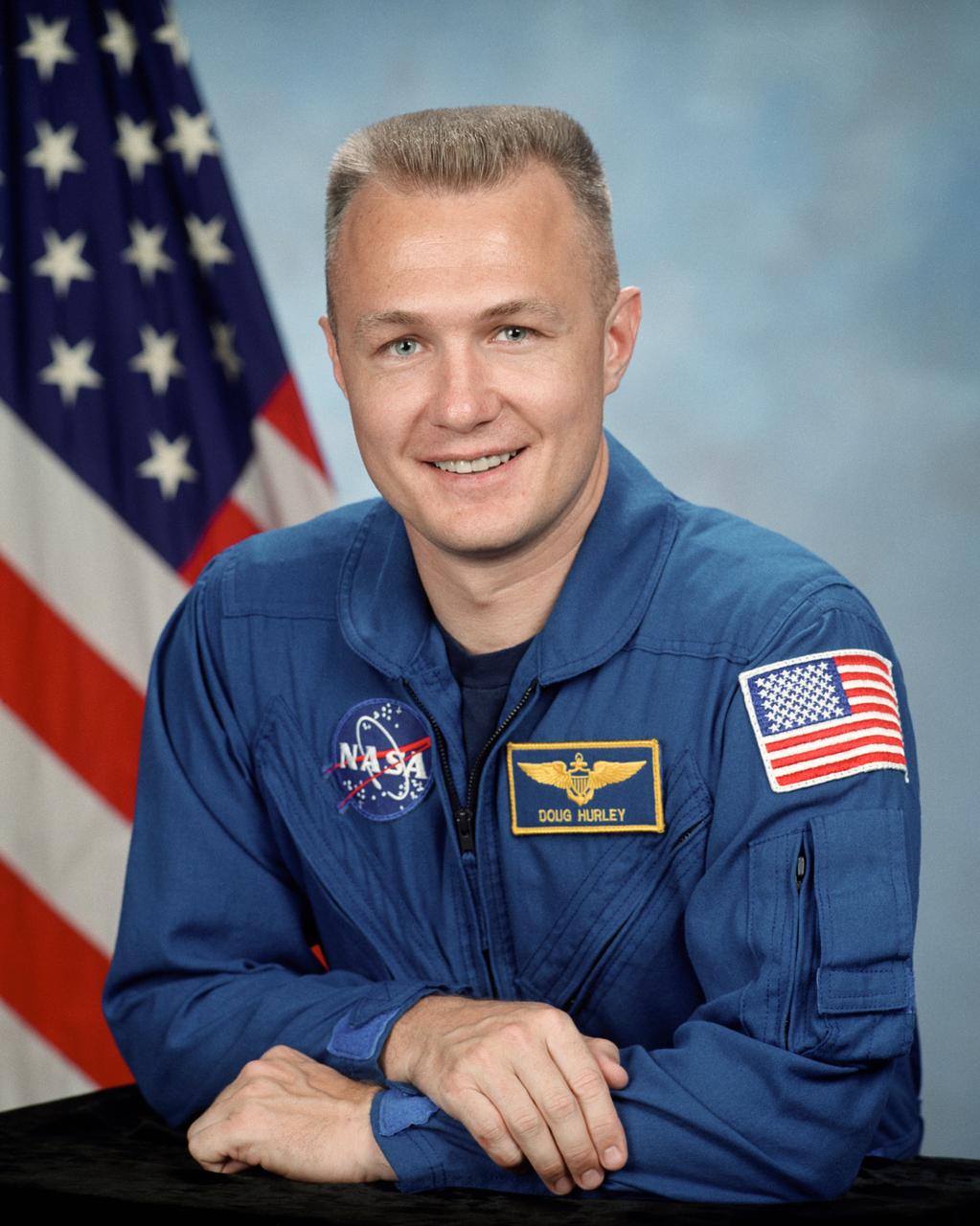
JSC2000-07599 (November 2000) --- Astronaut Douglas G. Hurley, pilot
Douglas G. Hurley - ASCAN portrait
McDonnell Douglas Hub (Ultra-High Bypass) Model and SAAB Wake Rake Test 14ft W.T. Test-060-1-14, Turbo Fan Configuration
ARC-1969-AC87-0097-5
McDonnell Douglas Hub (Ultra-High Bypass) Model and SAAB Wake Rake Test 14ft W.T. Test-060-1-14, Turbo Fan Configuration
ARC-1969-AC87-0097-2
Mc Donnell Douglas MD-11 Model in Ames 12ft. W.T. with Ron Strong  (1st Non-NASA customer of the refurbished W.T.)
ARC-1969-AC96-0071-6
McDonnell Douglas Hub (Ultra-High Bypass) Model and SAAB Wake Rake Test 14ft W.T. Test-060-1-14, Turbo Fan Configuration
ARC-1969-AC87-0097-1
McDonnell Douglas Hub (Ultra-High Bypass) Model and SAAB Wake Rake Test 14ft W.T. Test-060-1-14, Turbo Fan Configuration
ARC-1969-AC87-0097-6
3/4 front view of McDonnell-Douglas Large-Scale lift fan, vertical and/or short take-off and landing (V/STOL), transport model. Francis Malerick in photograph.  The McDonnell Douglas DC-9 (initially known as the Douglas DC-9) is a twin-engine, single-aisle jet airliner.
DC-9 V/STOL Transport Model in the 40x80 Foot Wind Tunnel.
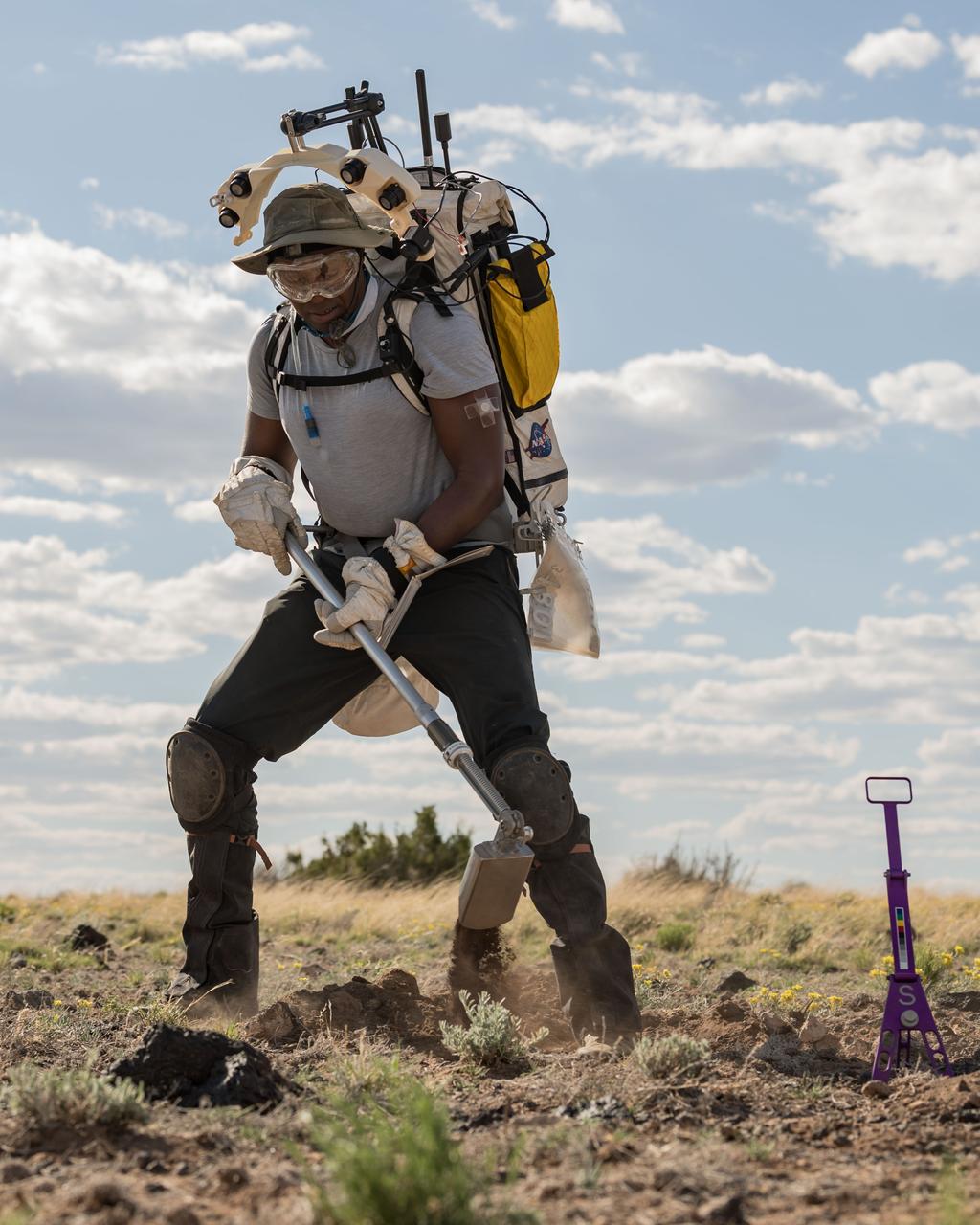
NASA astronaut Andre Douglas uses a scoop to dig into the ground to collect geologic samples during a simulated moonwalk in the San Francisco Volcanic Field in Northern Arizona on May 17, 2024. Credit: NASA/Josh Valcarcel
Andre Douglas - JETT5 - jsc2024e035686
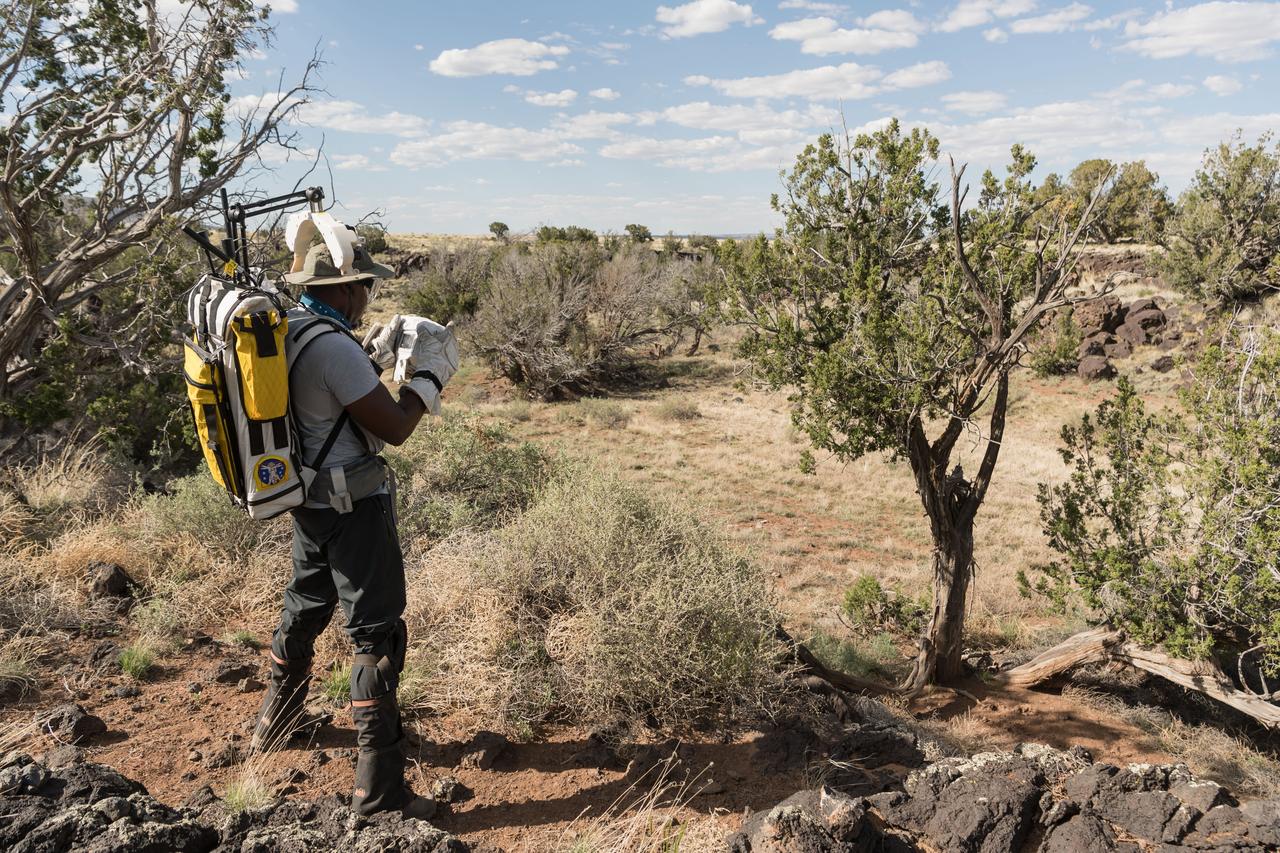
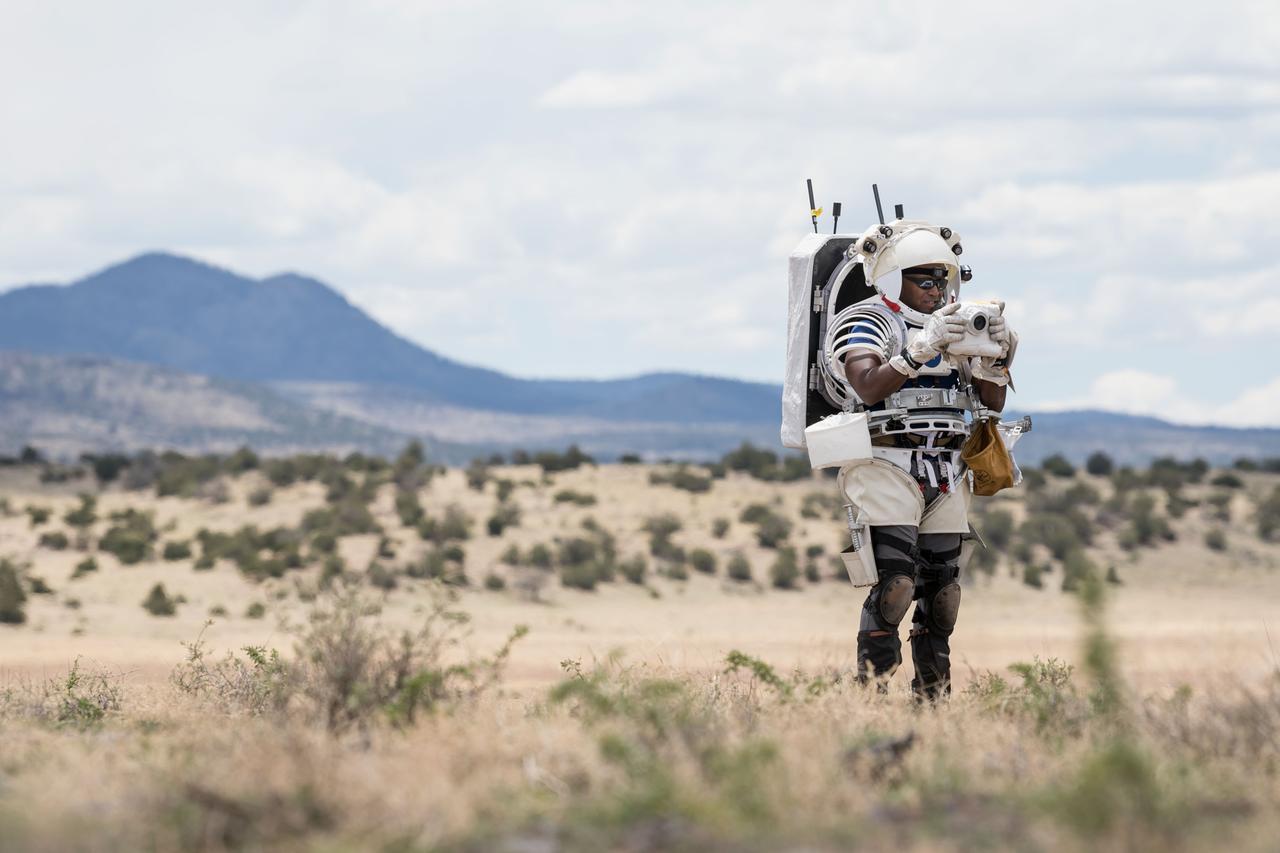
NASA astronaut Andre Douglas takes a picture of the surrounding lunar-like landscape during a simulated moonwalk in the San Francisco Volcanic Field in Northern Arizona on May 17, 2024. Credit: NASA/Josh Valcarcel
Andre Douglas - JETT5 - jsc2024e035682
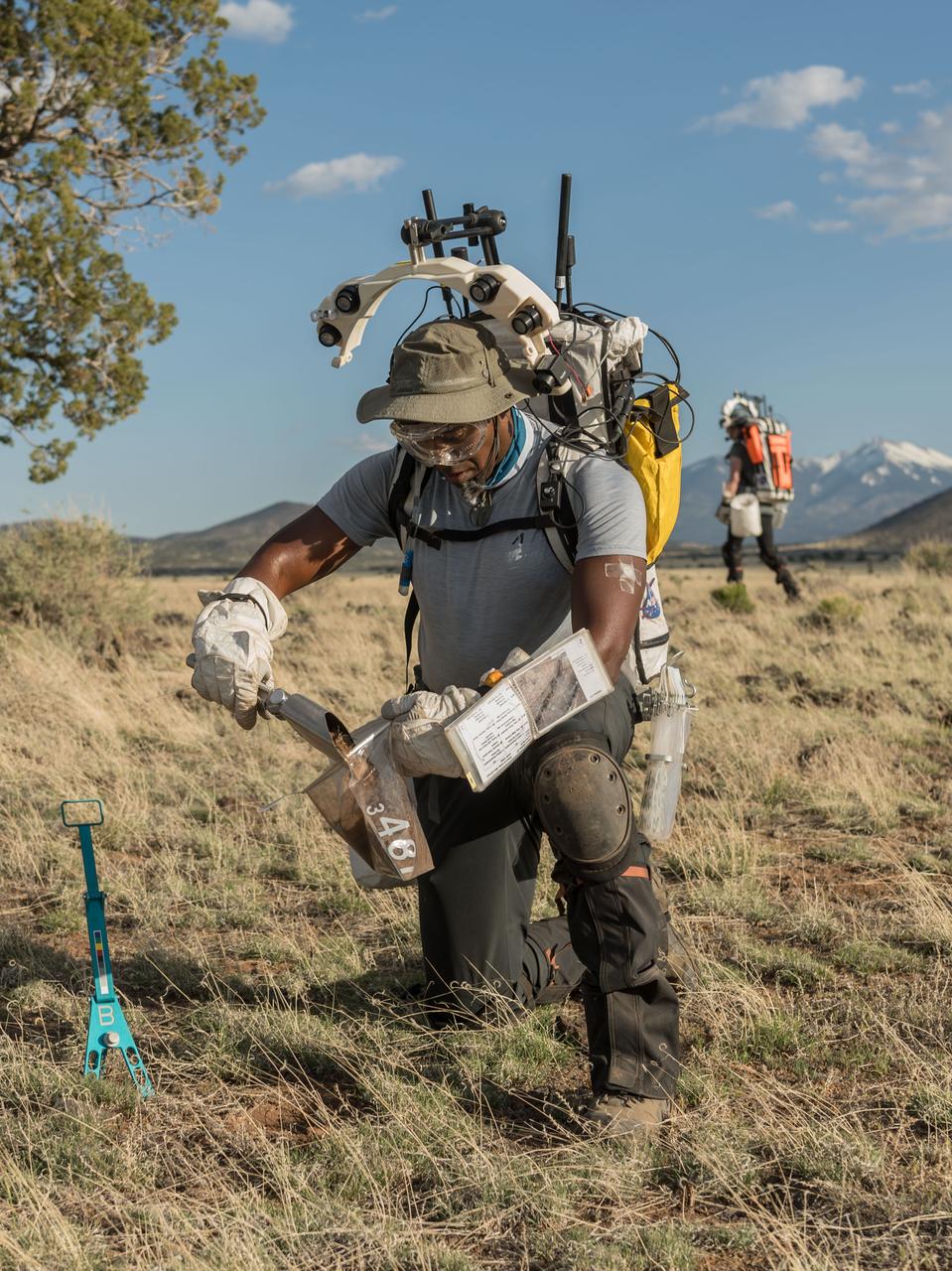
NASA astronaut Andre Douglas pours a scoopful of geologic samples into a sample bag during a simulated moonwalk in the San Francisco Volcanic Field in Northern Arizona on May 17, 2024. Credit: NASA/Josh Valcarcel
Andre Douglas - JETT5 - jsc2024e035690
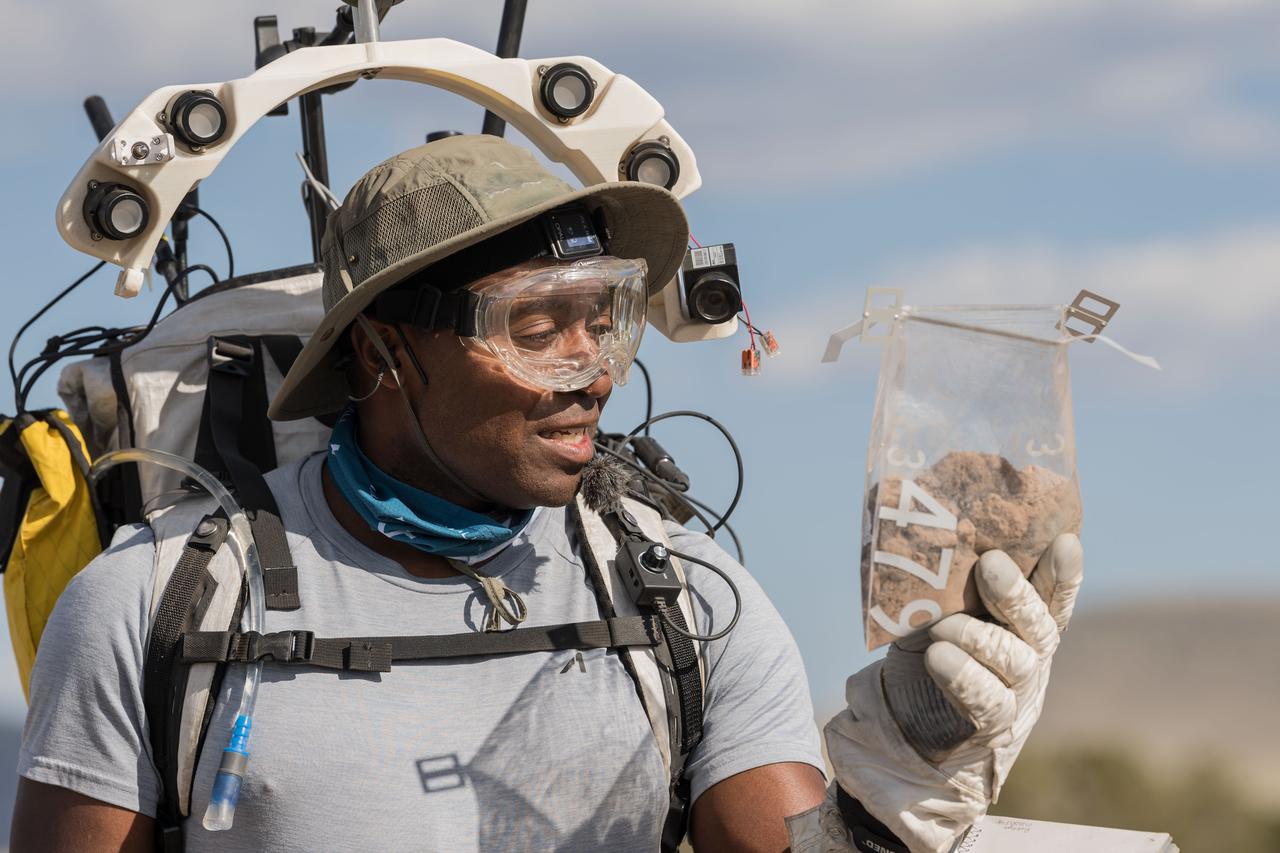
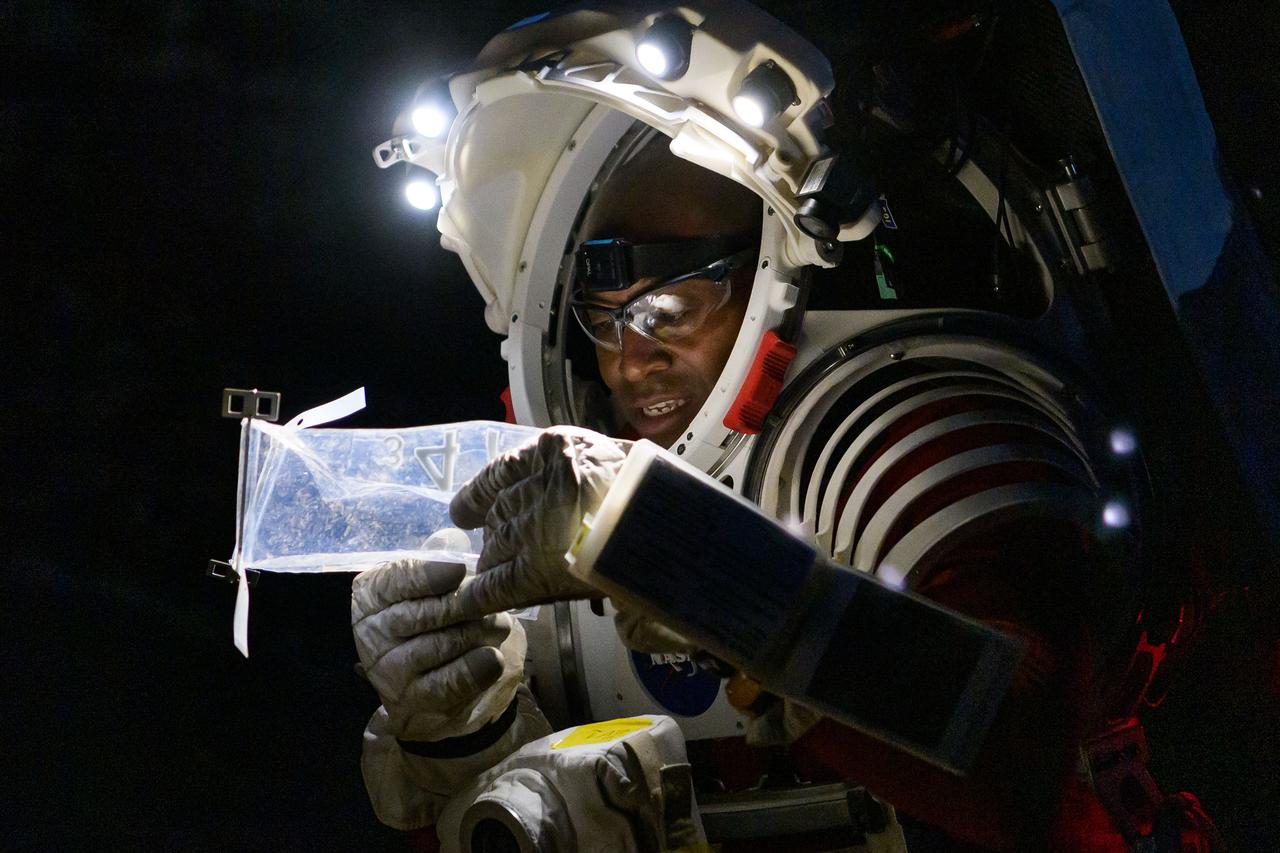
NASA astronaut Andre Douglas takes a closer look at the geologic samples he collected during a simulated moonwalk in the San Francisco Volcanic Field in Northern Arizona on May 17, 2024. Credit: NASA/Josh Valcarcel
Andre Douglas - JETT5 - jsc2024e035685
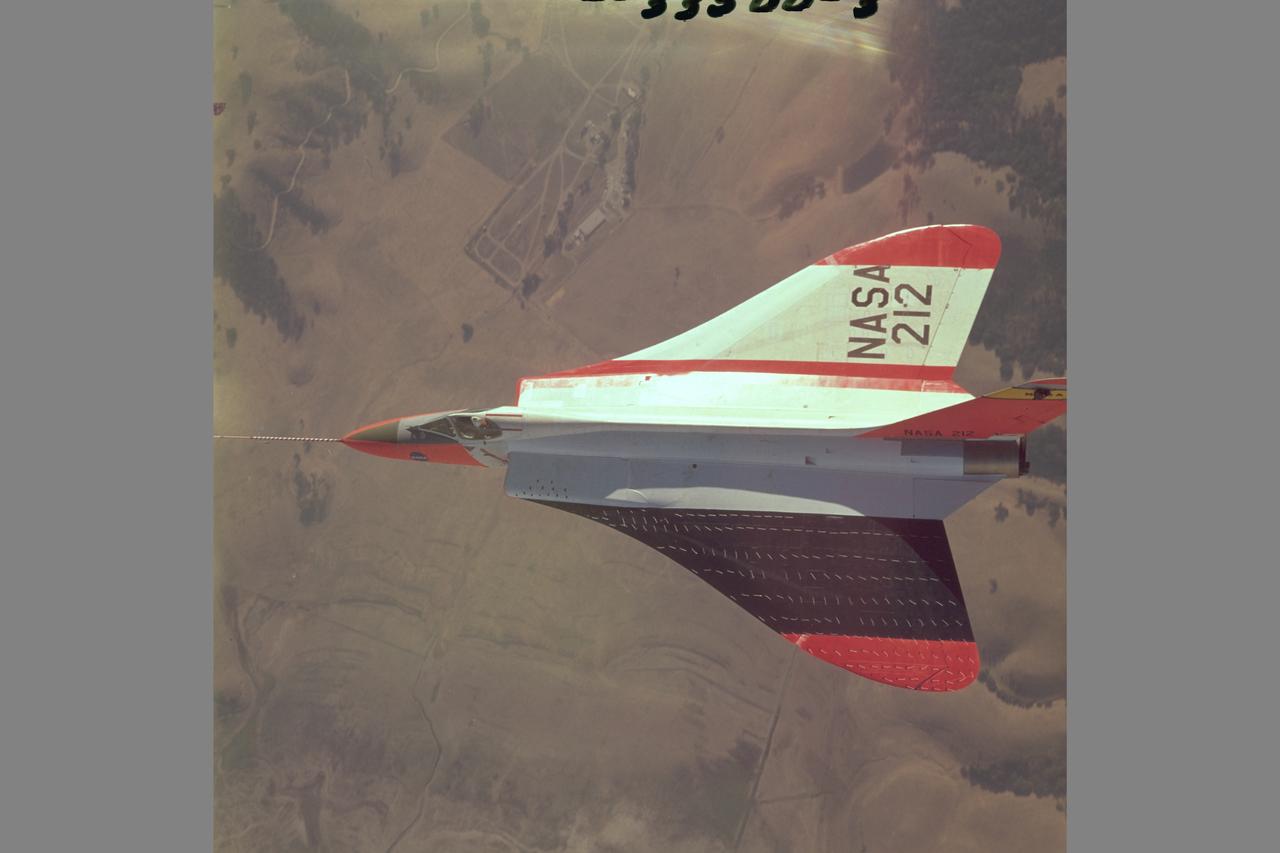
Douglas F5D Skylancer fighter modified with ogee wing planform designed for Mach 2 flight. Shown is the effect of vortex flow on wing tuft alignment in low-speed,  high angle-of-attack flight.
ARC-1964-AC-33500-3
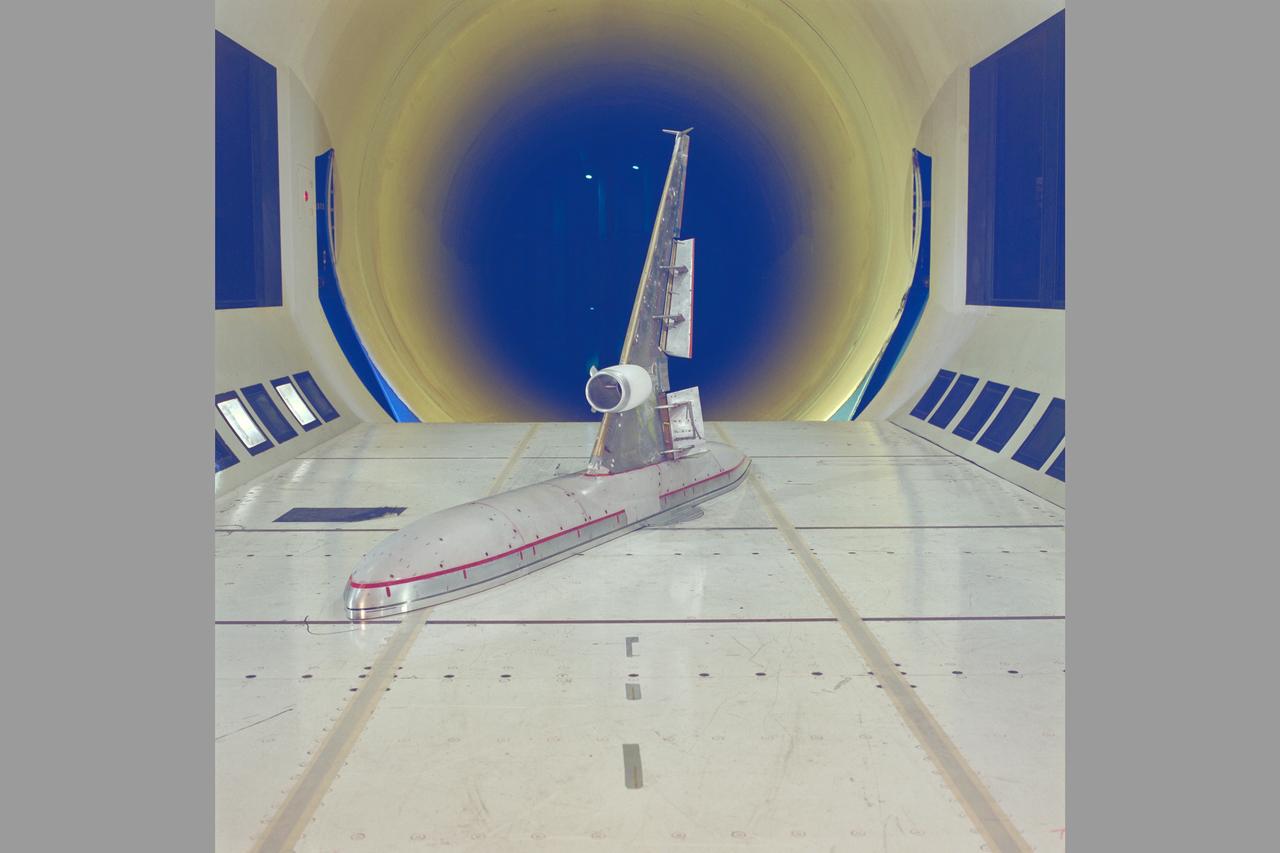
McDonnell-Douglas MD-11 Semi-span model test-12-0016 in 12ft WT
ARC-1996-AC96-0344-17
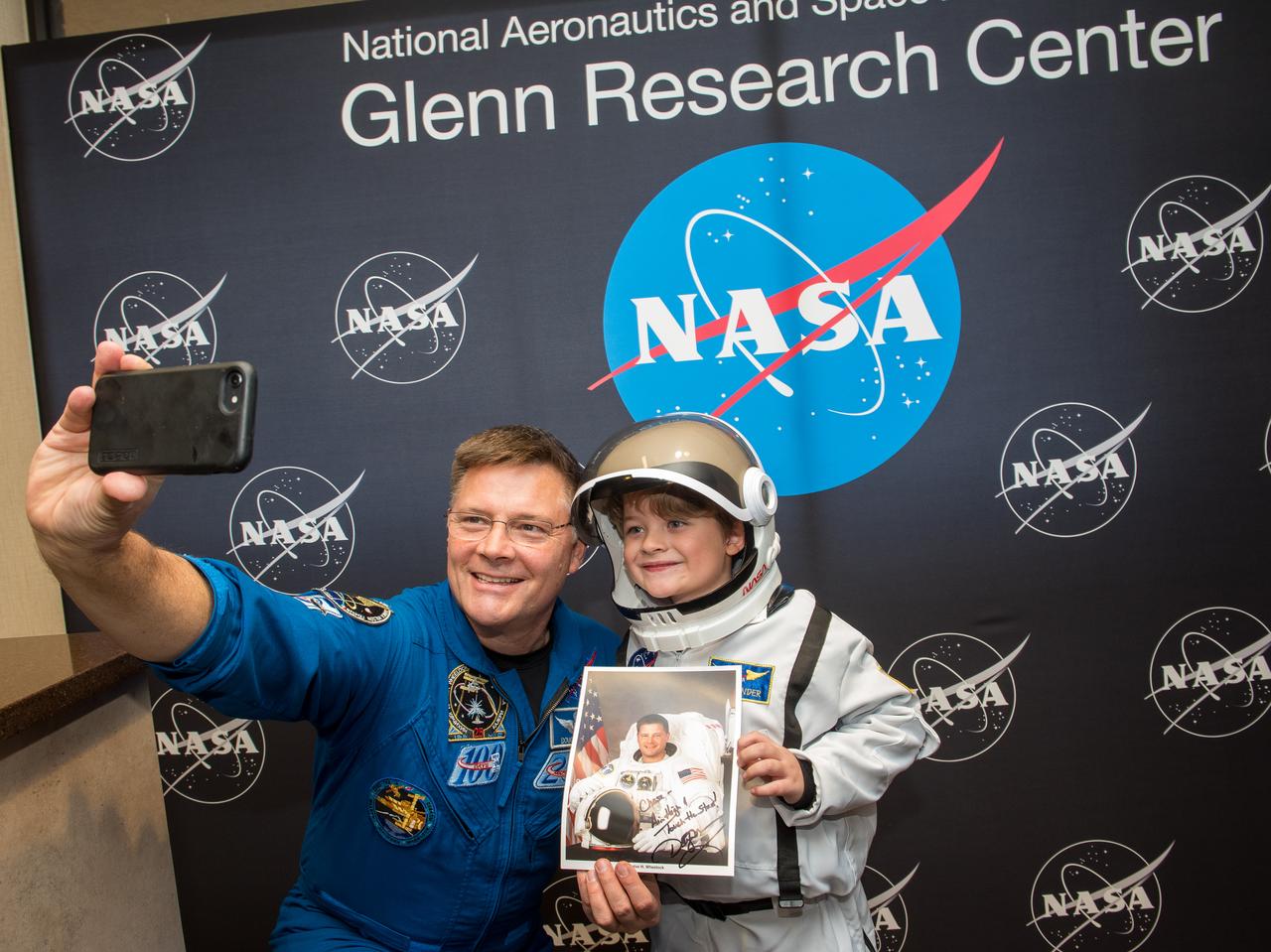
Orion Spacecraft Arrives in Ohio Aboard the Super Guppy at Mansfield Lahm Airport, Astronaut Douglas Wheelock
Astronaut Doug Wheelock poses with a visitor, Orion Spacecraft Arrives in Ohio Aboard the Super Guppy at Mansfield Lahm Airport
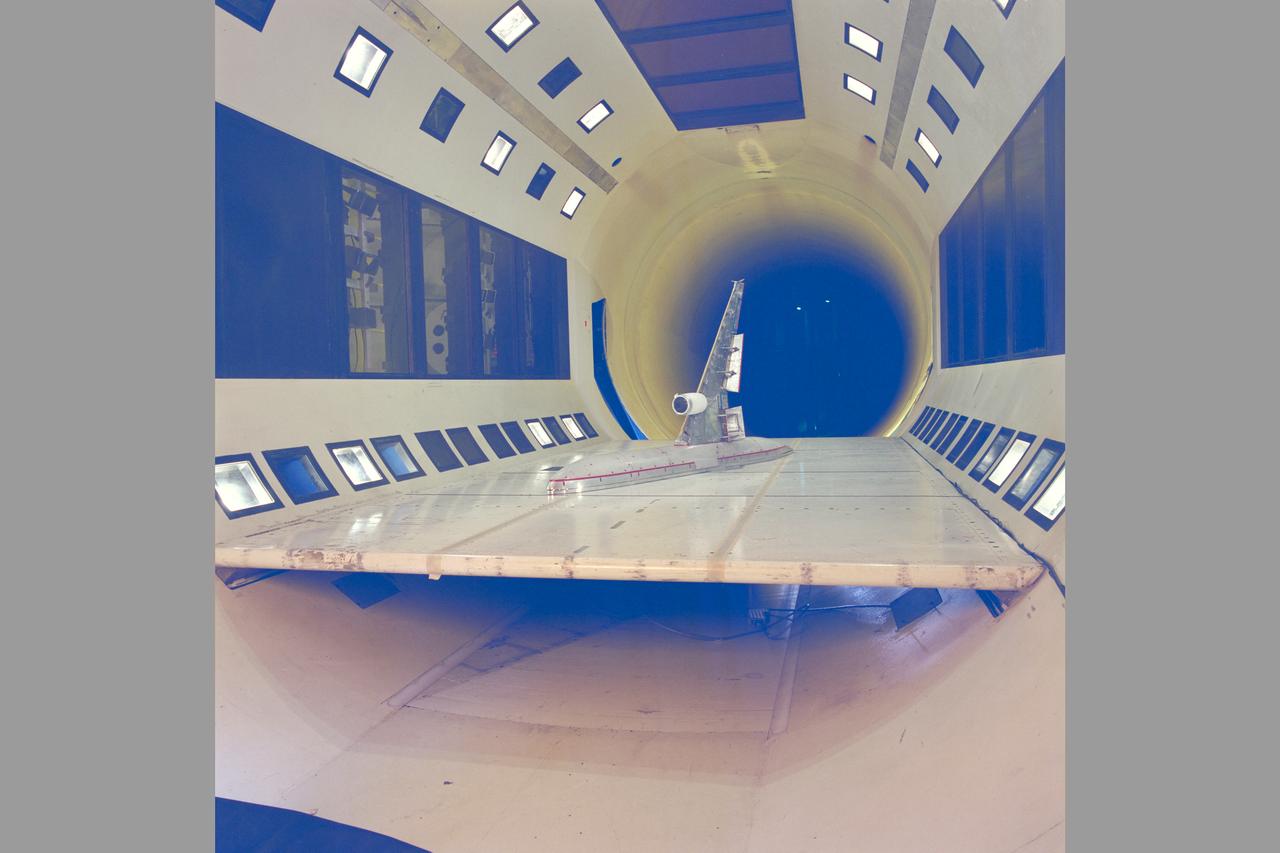
McDonnell-Douglas MD-11 Semi-span model test-12-0016 in 12ft WT
ARC-1996-AC96-0344-6
NASA Chief Technologist Douglas Terrier, right, and NASA Deputy Chief Technologist David Steitz, left, investigate a rover developed at Harding University in Searcy, Arkansas, in partnership with NASA’s Jet Propulsion Laboratory in Silicon Valley, California, and the University of Arkansas-Little Rock while attending “NASA Day in Arkansas” hosted at the university on Jan. 27, 2020.
NASA's Douglas Terrier and David Steitz Investigate a Rover at Arkansas' Harding University
NASA astronaut Andre Douglas collects soil samples during the first in a series of four simulated moonwalks in the San Francisco Volcanic Field in Norther Arizona on May 13, 2024.   Credit: NASA/Josh Valcarcel
Andre Douglas - JETT 5 - jsc2024e033758
NASA astronaut Andre Douglas uses a hammer and chisel to break off a small sample during a¬¬ nighttime simulated moonwalk in the San Francisco Volcanic Field in Northern Arizona on May 16, 2024.  Credit: NASA/Josh Valcarcel
Andre Douglas - JETT 5 - jsc2024e035652
NASA astronaut Andre Douglas examines a geologic sample collected during a nighttime simulated moonwalk in the San Francisco Volcanic Field in Northern Arizona on May 16, 2024.  Credit: NASA/Josh Valcarcel
Andre Douglas - JETT 5 - jsc2024e035653
NASA astronaut Andre Douglas takes a picture of the lunar-like landscape during a simulated moonwalk in the San Francisco Volcanic Field in Northern Arizona on May 13, 2024.   Credit: NASA/Josh Valcarcel
Andre Douglas - JETT 5 - jsc2024e033760
NASA Chief Technologist Douglas Terrier, left of center, meets with Dr. Ed Wilson, engineering professor emeritus and tours Wilson's atmospheric sciences laser lab during “NASA Day in Arkansas” at Harding University in Searcy, Arkansas, on Jan. 27, 2020.
NASA Chief Technologist Douglas Terrier Meets with Ed Wilson at NASA Day in Arkansas
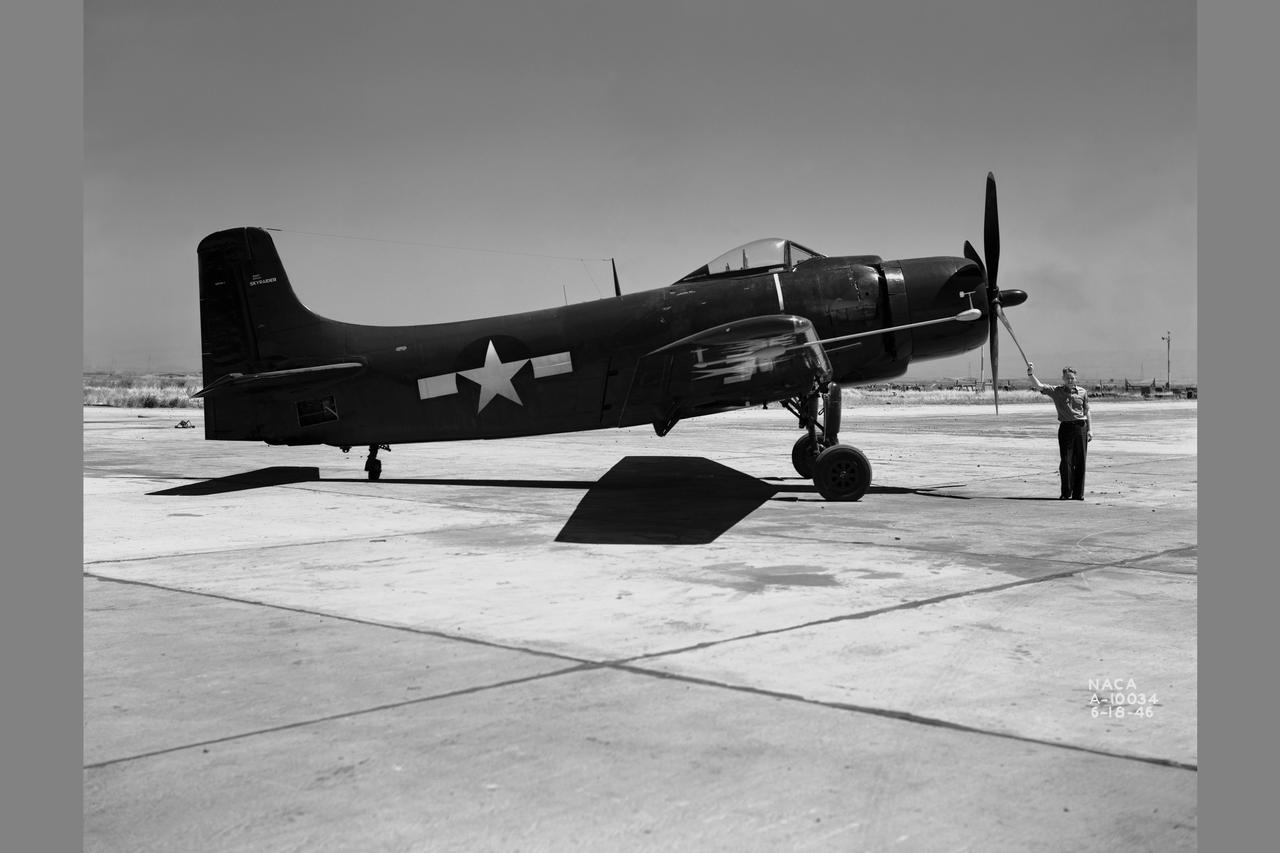
Douglas XBT2D-1 (Bu. No. 09086) Skyraider prototype  Note:  Used in publication Flight Research at Ames;  57 Years of Development and Validation of Aeronautical Technology NASA SP-1998-3300 fig 55
ARC-1946-A-10034
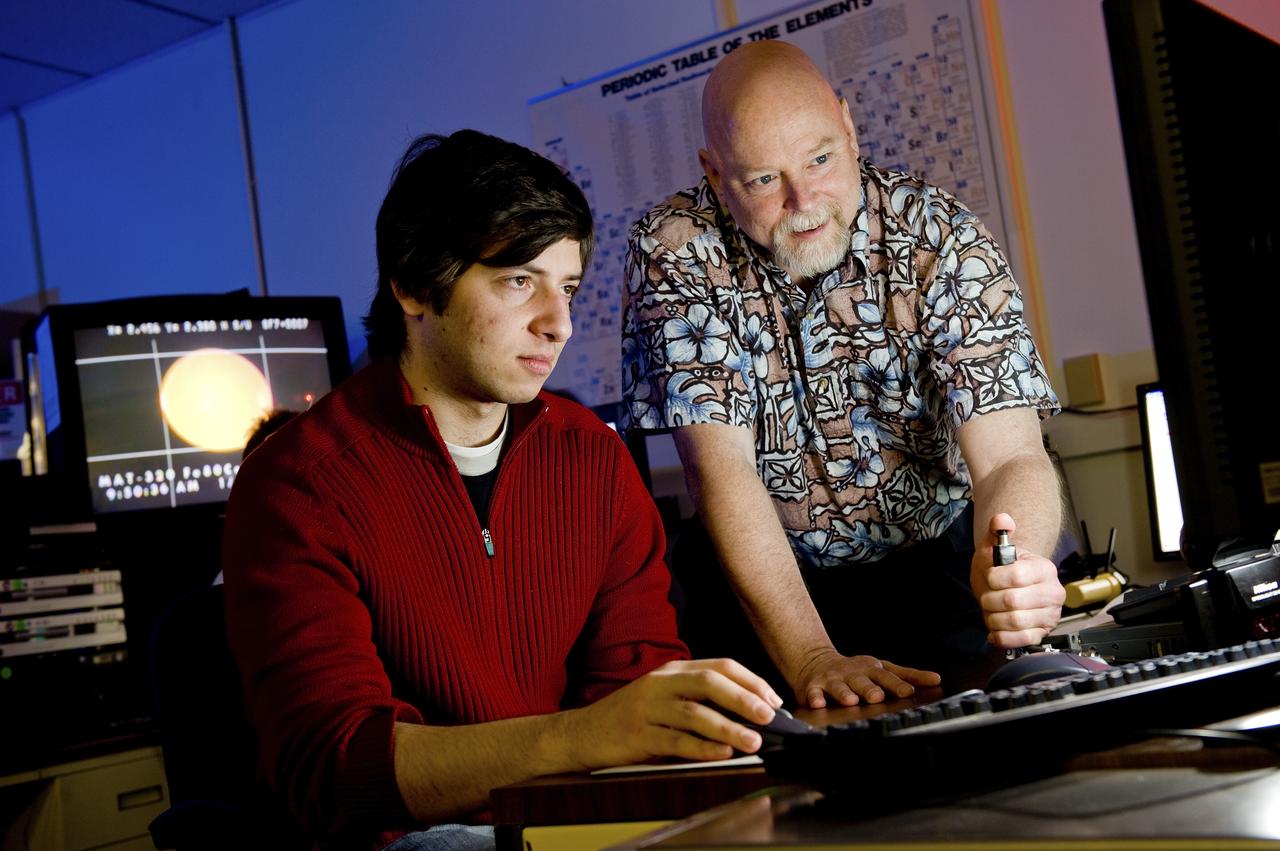
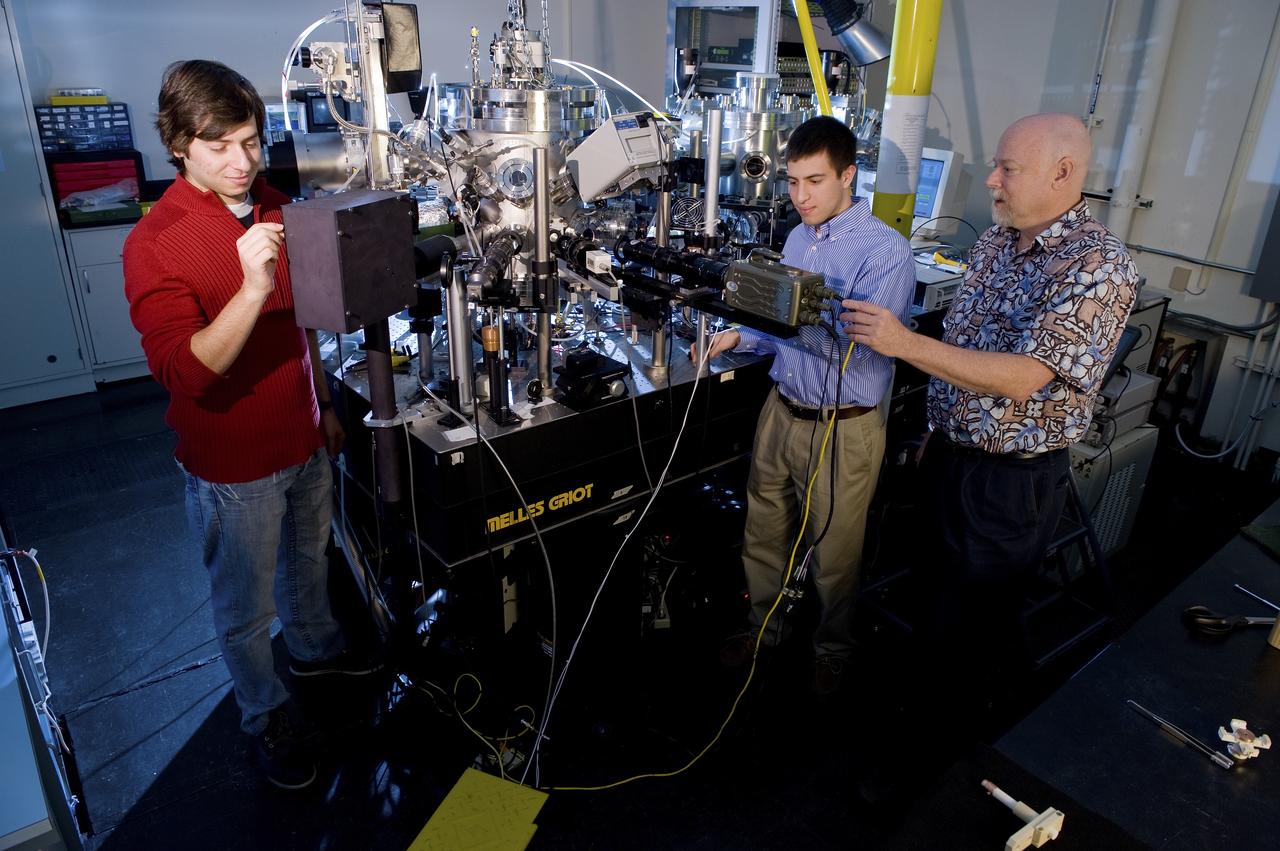
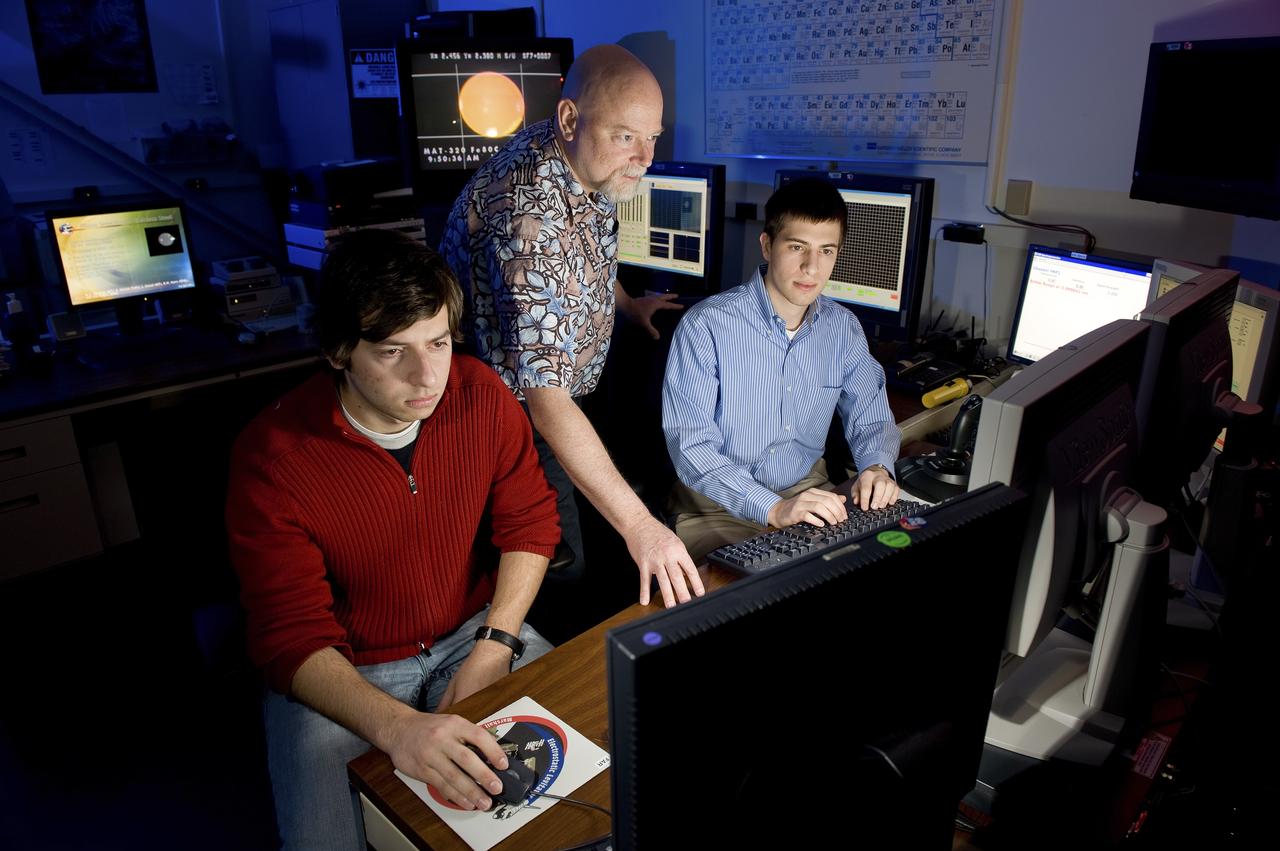
PAUL CHOUFANI AND PROFESSOR DOUGLAS MATSON AT THE CONTROLS OUTSIDE OF THE ELECTROSTATIC LEVITATOR
1000038
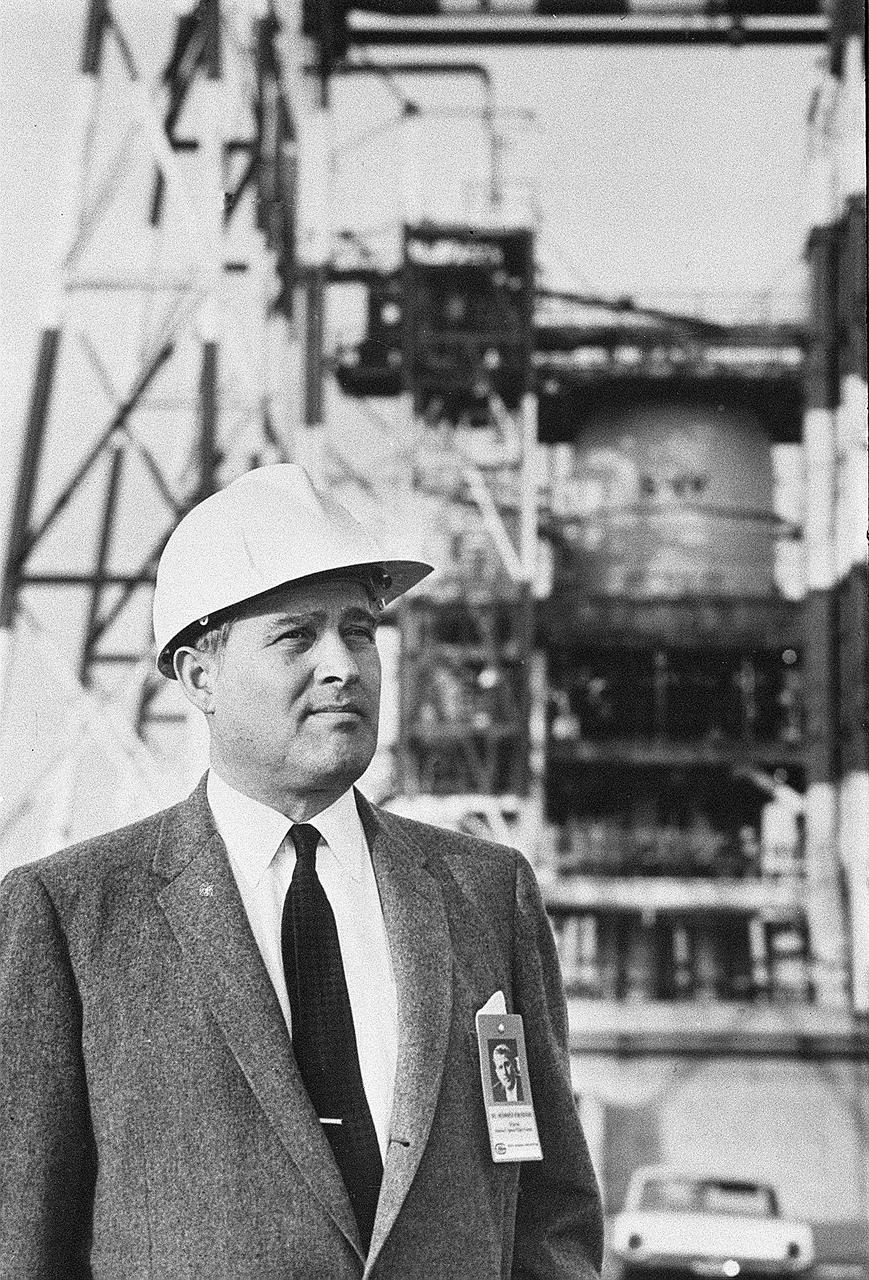
This photograph is believed to have been taken in the early 1960s and shows Dr. von Braun at the Douglas Aircraft Company's Missile Space Systems Division in Sacramento, California.
Wernher von Braun
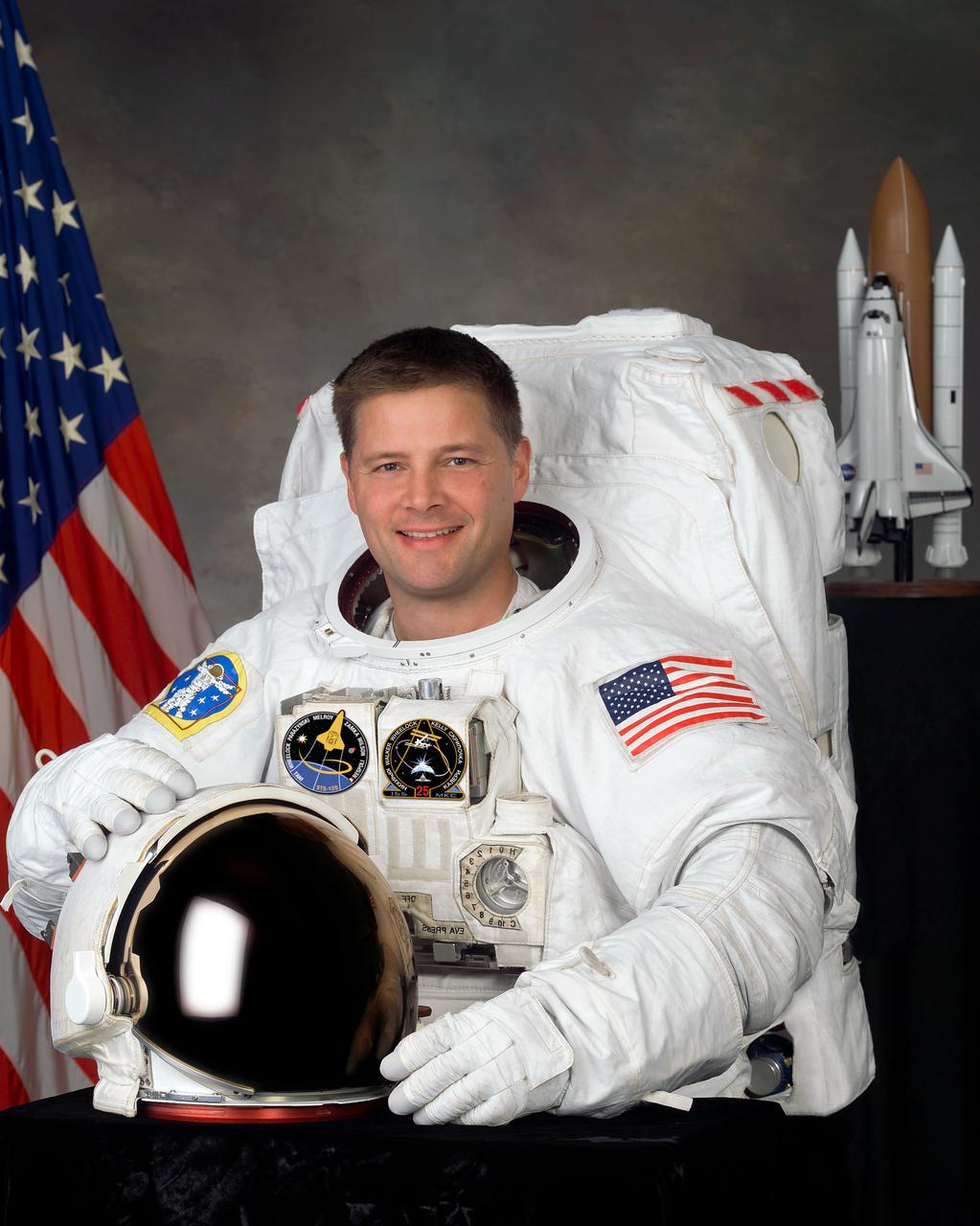
JSC2010-E-132513 (5 Dec. 2006) --- NASA astronaut Douglas H. Wheelock, ISS commander. Photo credit: NASA or National Aeronautics and Space Administration
Portrait of NASA astronaut Douglas H. Wheelock
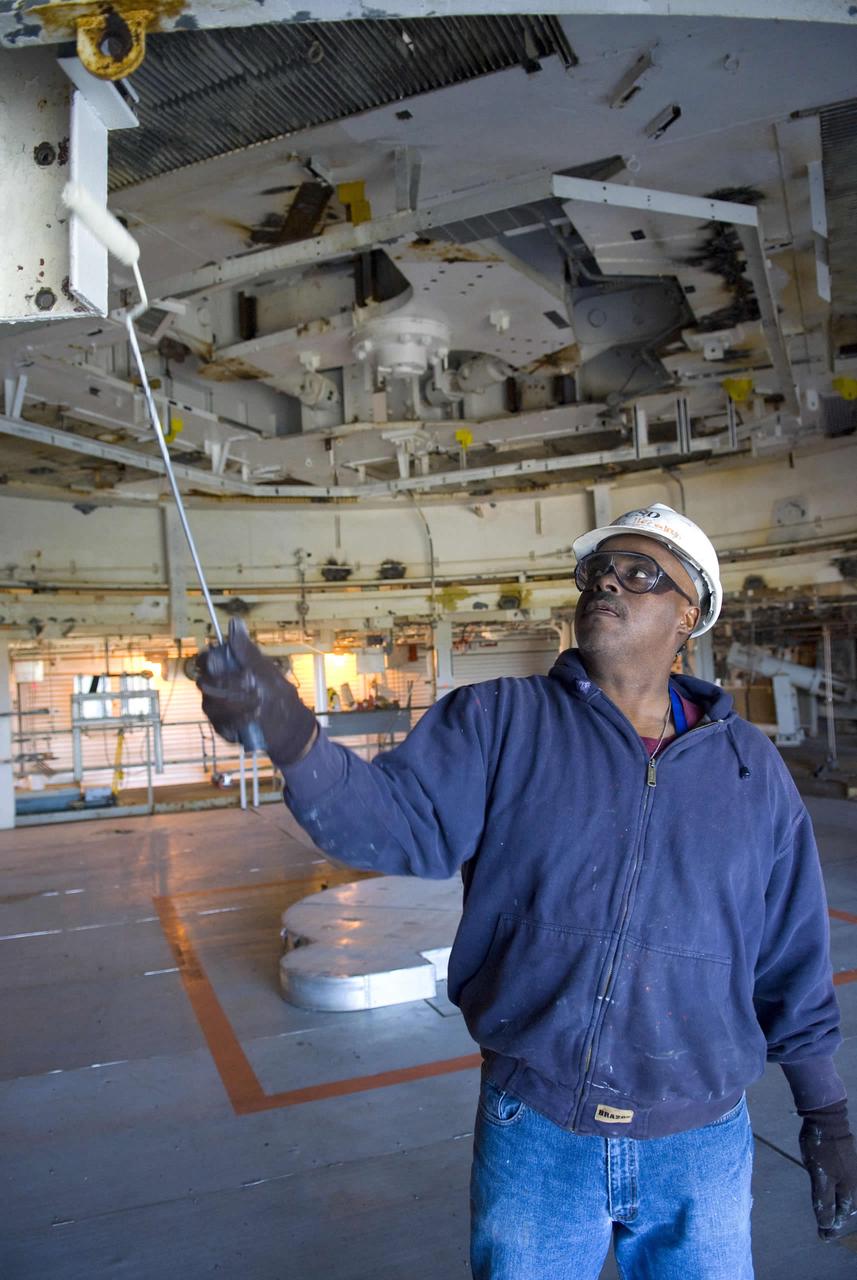
Douglas Haralson of Jacobs FOSC applies paint on the engine deck of the A-1 Test Stand.
Daily life at Stennis
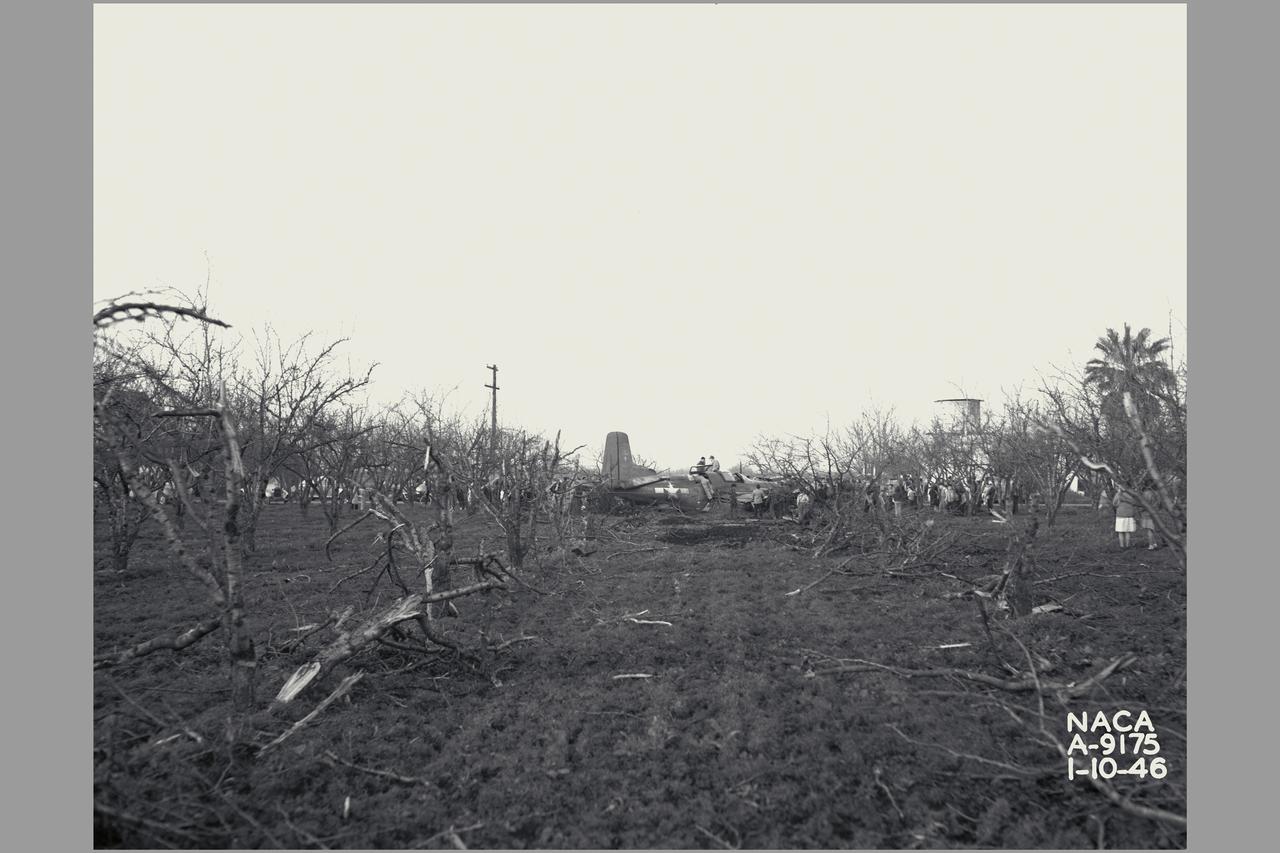
Crash of Douglas  XSB2D-1 (Bu. No. 03552) airplane in a Sunnyvale , CA prune orchard caused by engine failure. Note the spectator crawling into the rear cockpit to remove the clock .  Note:  Used in publication Flight Research at Ames;  57 Years of Development and Validation of Aeronautical Technology NASA SP-1998-3300 fig.19
ARC-1969-A-9175
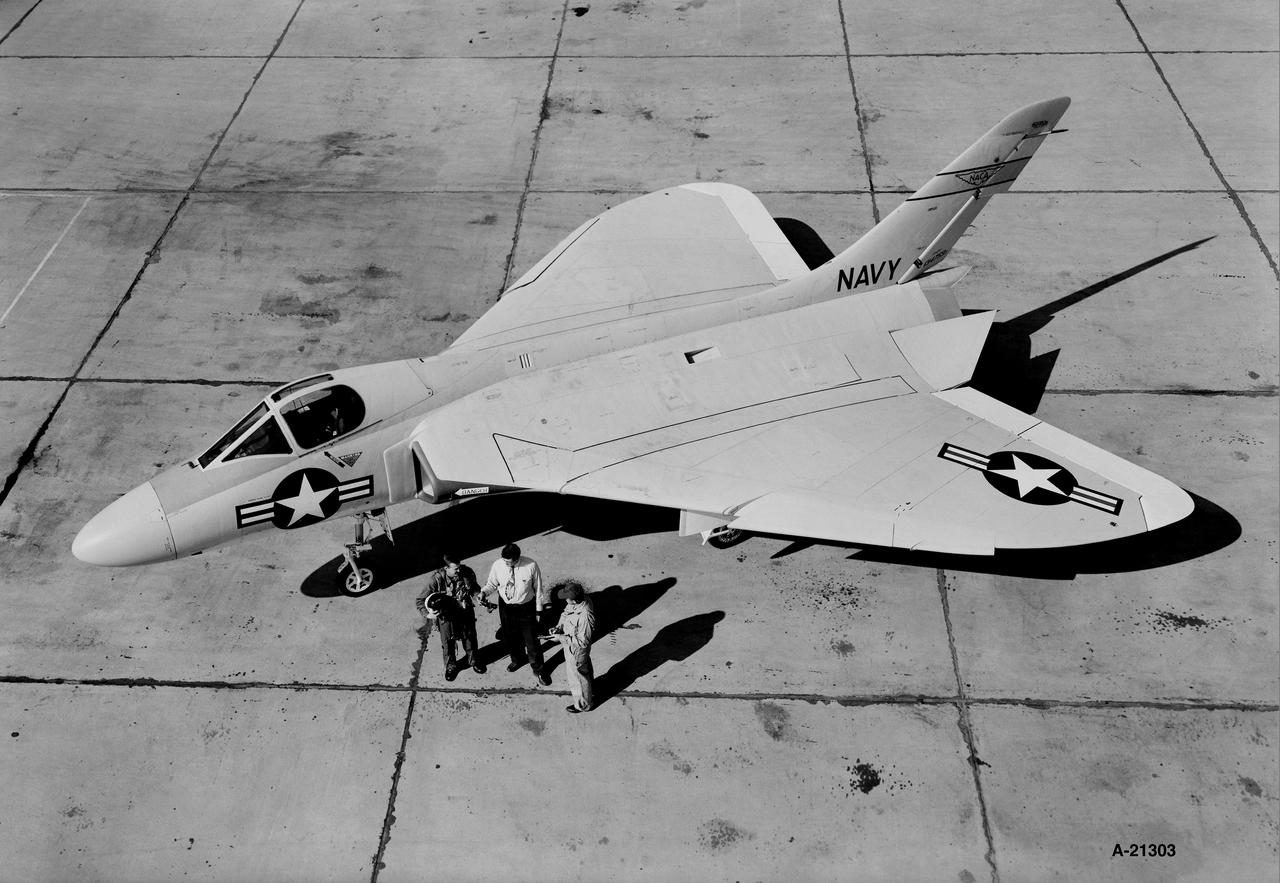
Douglas F4D-1 (Bu. No. 134759) Skyray  Plan view of airplane with Ames Pilot Don R. Heinle, Engineer L. Stewart Rolls and Crew Chief Walter Liewar. Note:  Used in Flight Research at Ames;  57 Years of Development and Validation of Aeronautical Technology  NASA SP-1998-3300 fig.28
ARC-1956-A-21303
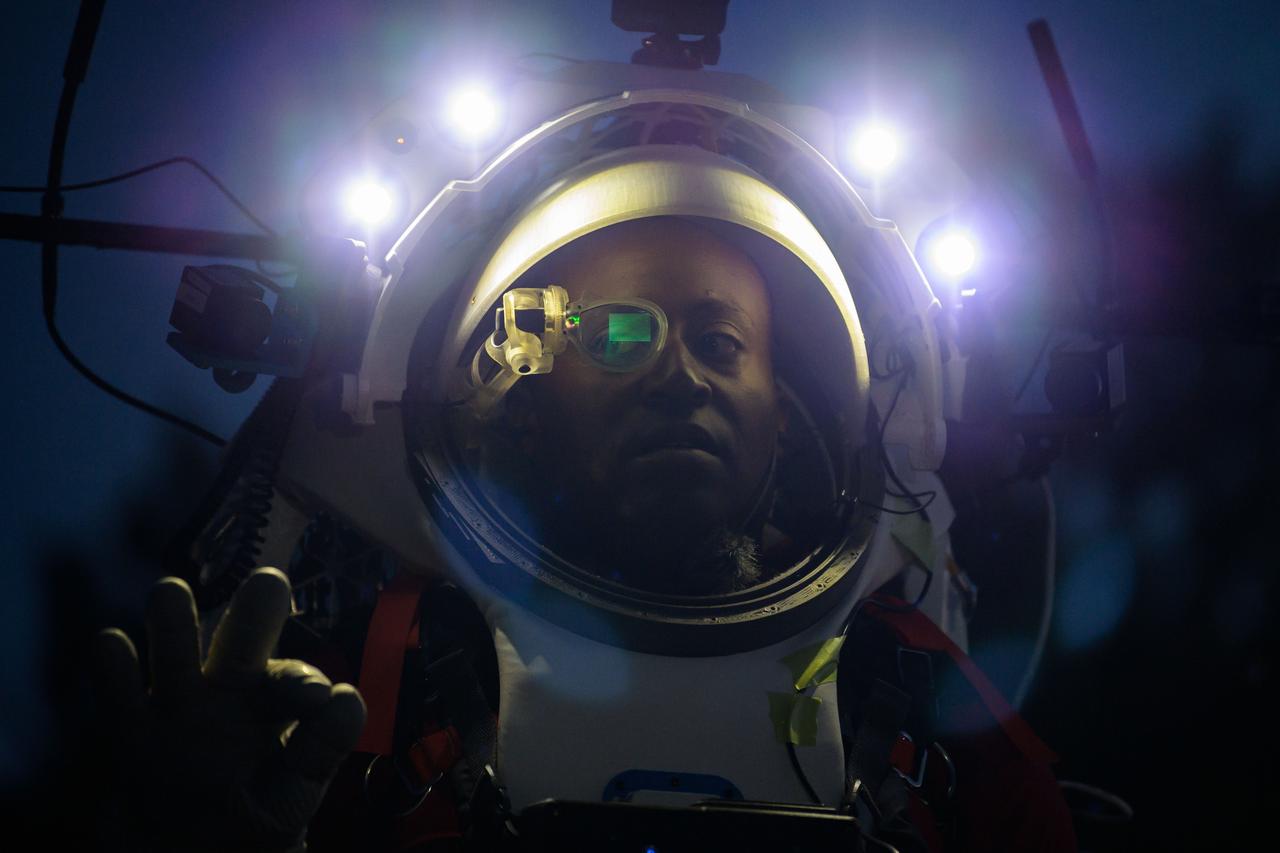
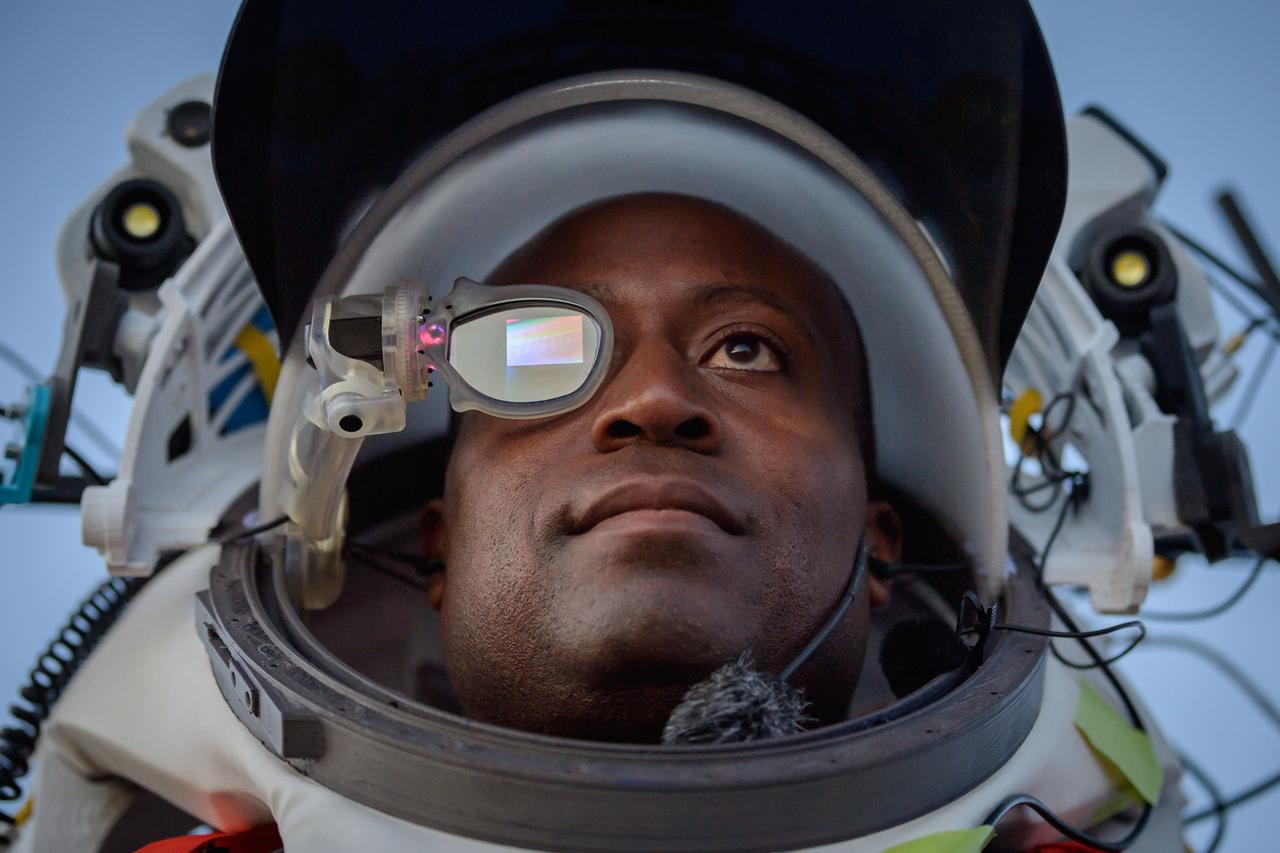
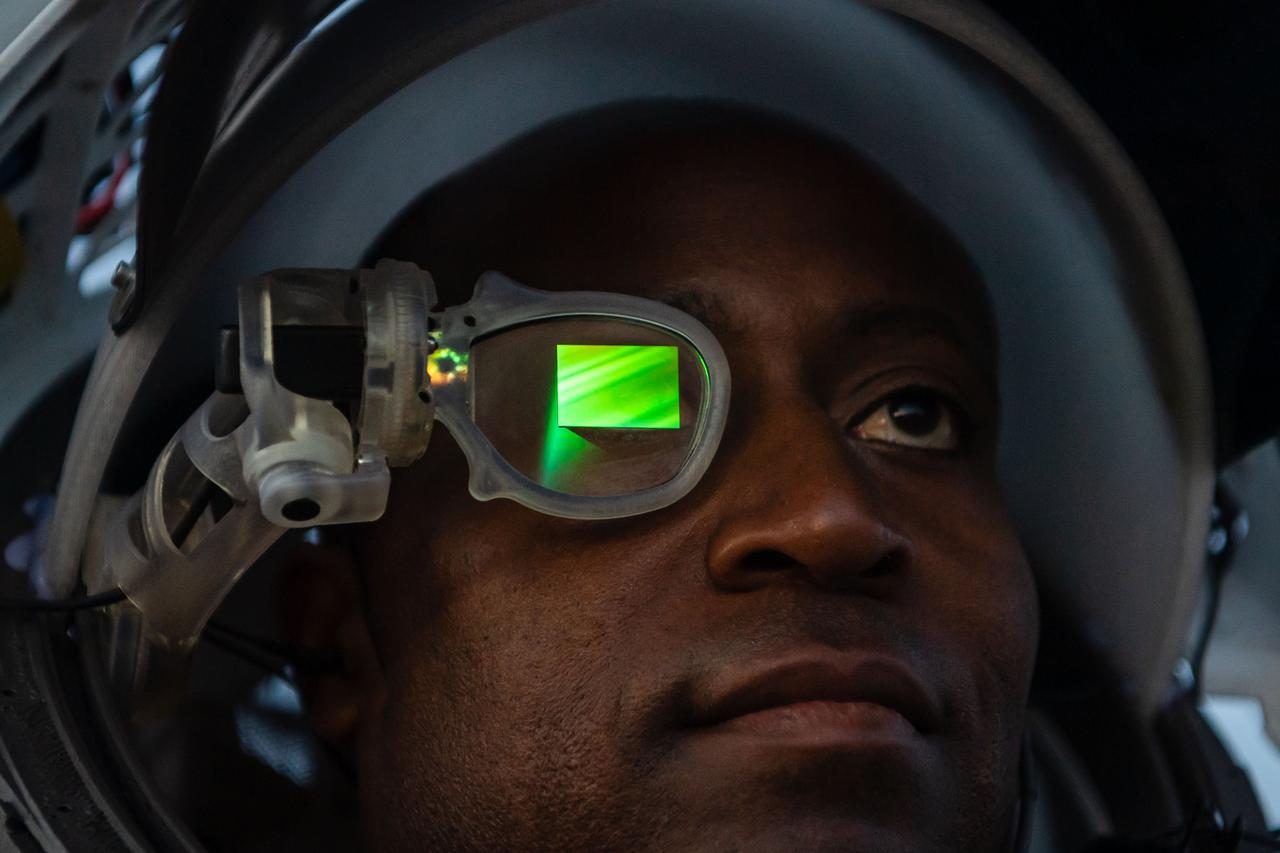
NASA astronaut Andre Douglas wears AR (Augmented Reality) display technology during an advanced technology run in the San Francisco Volcanic Field in Northern Arizona on May 21, 2024. The monocular lens consists of a pico-projector and waveguide optical element to focus an image for crew to see their real world overlaid with digital information. These unique near-eye form factors may be used to improve the usability and minimally impact the complex biomechanics of working in a pressurized suit environment. Credit: NASA/Josh Valcarcel
Andre Douglas - JETT5 - jsc2024e036523
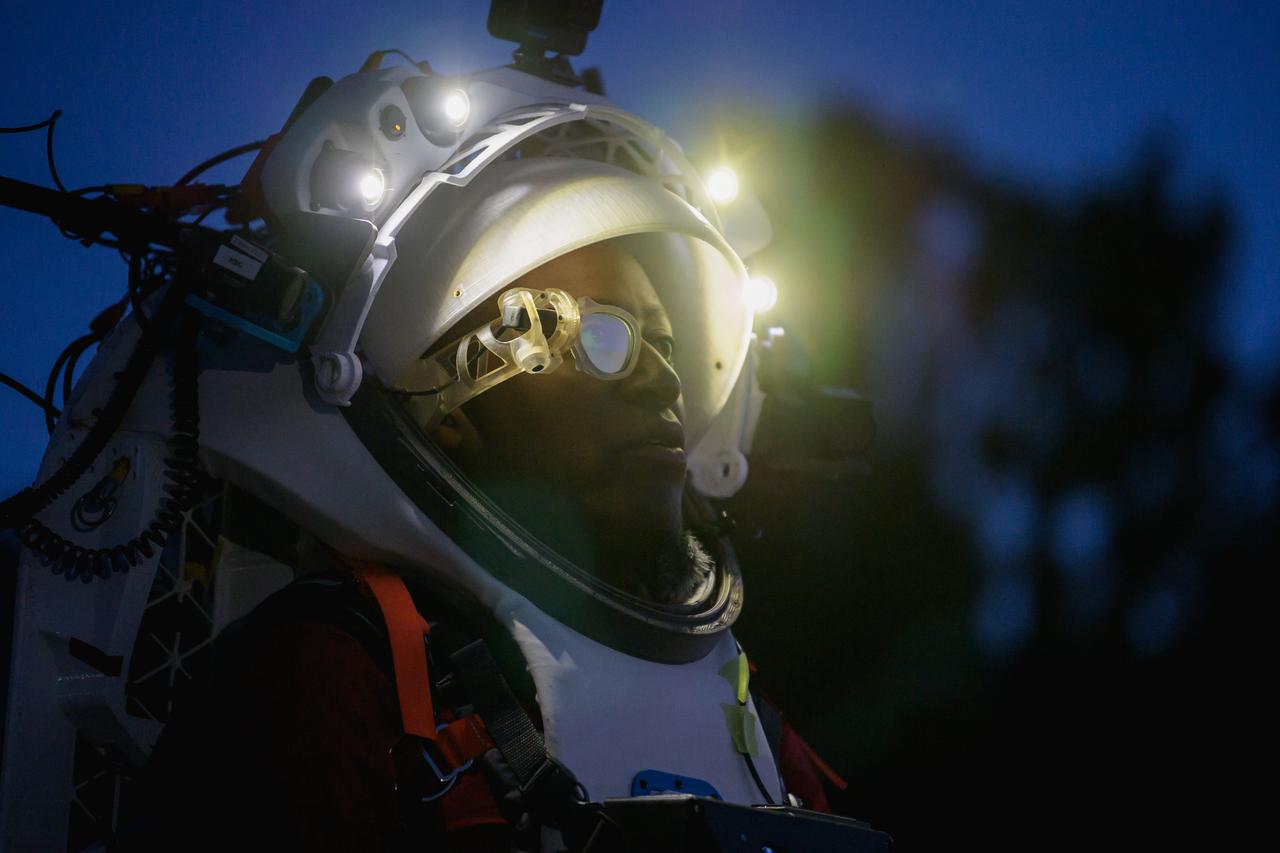
NASA astronaut Andre Douglas wears AR (Augmented Reality) display technology during a nighttime advanced technology run in the San Francisco Volcanic Field in Northern Arizona on May 21, 2024. The monocular lens consists of a pico-projector and waveguide optical element to focus an image for crew to see their real world overlaid with digital information. These unique near-eye form factors may be used to improve the usability and minimally impact the complex biomechanics of working in a pressurized suit environment. Credit: NASA/Josh Valcarcel
Andre Douglas - JETT5 - jsc2024e036526
NASA astronaut Andre Douglas wears AR (Augmented Reality) display technology during an advanced technology run in the San Francisco Volcanic Field in Northern Arizona on May 21, 2024. The monocular lens consists of a pico-projector and waveguide optical element to focus an image for crew to see their real world overlaid with digital information. These unique near-eye form factors may be used to improve the usability and minimally impact the complex biomechanics of working in a pressurized suit environment. Credit: NASA/Josh Valcarcel
Andre Douglas - JETT5 - jsc2024e036522
NASA astronaut Andre Douglas wears AR (Augmented Reality) display technology during a nighttime advanced technology run in the San Francisco Volcanic Field in Northern Arizona on May 21, 2024. The monocular lens consists of a pico-projector and waveguide optical element to focus an image for crew to see their real world overlaid with digital information. These unique near-eye form factors may be used to improve the usability and minimally impact the complex biomechanics of working in a pressurized suit environment. Credit: NASA/Josh Valcarcel
Andre Douglas - JETT5 - jsc2024e036527
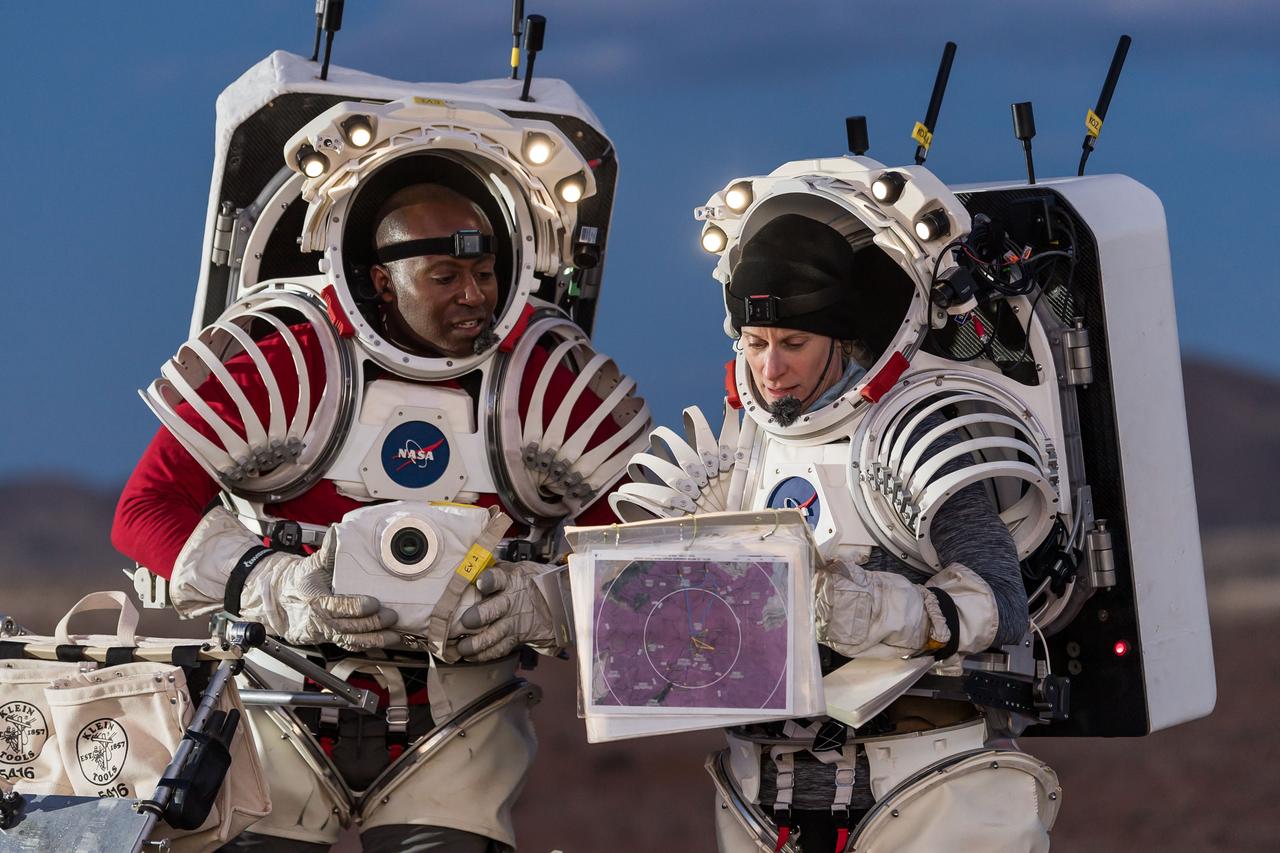
NASA astronauts Andre Douglas, left, and Kate Rubins review traverse plans during a¬¬ nighttime simulated moonwalk in the San Francisco Volcanic Field in Northern Arizona on May 16, 2024.  Credit: NASA/Josh Valcarcel
Andre Douglas and Kate Rubins - JETT 5 - jsc2024e035648
NASA astronauts Andre Douglas, left, and Kate Rubins review procedures during a nighttime simulated moonwalk in the San Francisco Volcanic Field in Northern Arizona on May 16, 2024.  Credit: NASA/Josh Valcarcel
Andre Douglas and Kate Rubins - JETT 5 - jsc2024e035647
XSB2D-1 First test (no number) Aerodynamic test to forecast the take off distance. George Cooper was the A1:H73 pilot.  Orchard ladders were used to access the ball socket attachments on the struts.
Mounting Douglas SB-2D Airplane in 40x80 foot Wind Tunnel at NACA Ames Research Center.
Testing the wing boundary layer control of the A3D in the 40 x 80 wind tunnel.  Boundary layer control was added to increase the lift of the wing for aircraft carrier take off and landing.
Douglas XA3D-1 #413 Airplane mounted in Ames 40x80 foot Wind Tunnel.
PAUL CHOUFANI, MATTHEW SHERMAN, AND PROFESSOR DOUGLAS MATSON WITH THE ELECTROSTATIC LEVITATOR.
1000037
NASA Acting Chief Technologist Douglas Terrier delivers the keynote address at the CodeX Technology Conference  in London on September 29, 2017.
NASA Acting Chief Technologist Delivers Keynote Address at the CodeX Technology Conference
PAUL CHOUFANI, PROFESSOR DOUGLAS MATSON, AND MATTHEW SHERMAN AT THE CONTROLS OUTSIDE OF THE ELECTROSTATIC LEVITATOR.
1000039
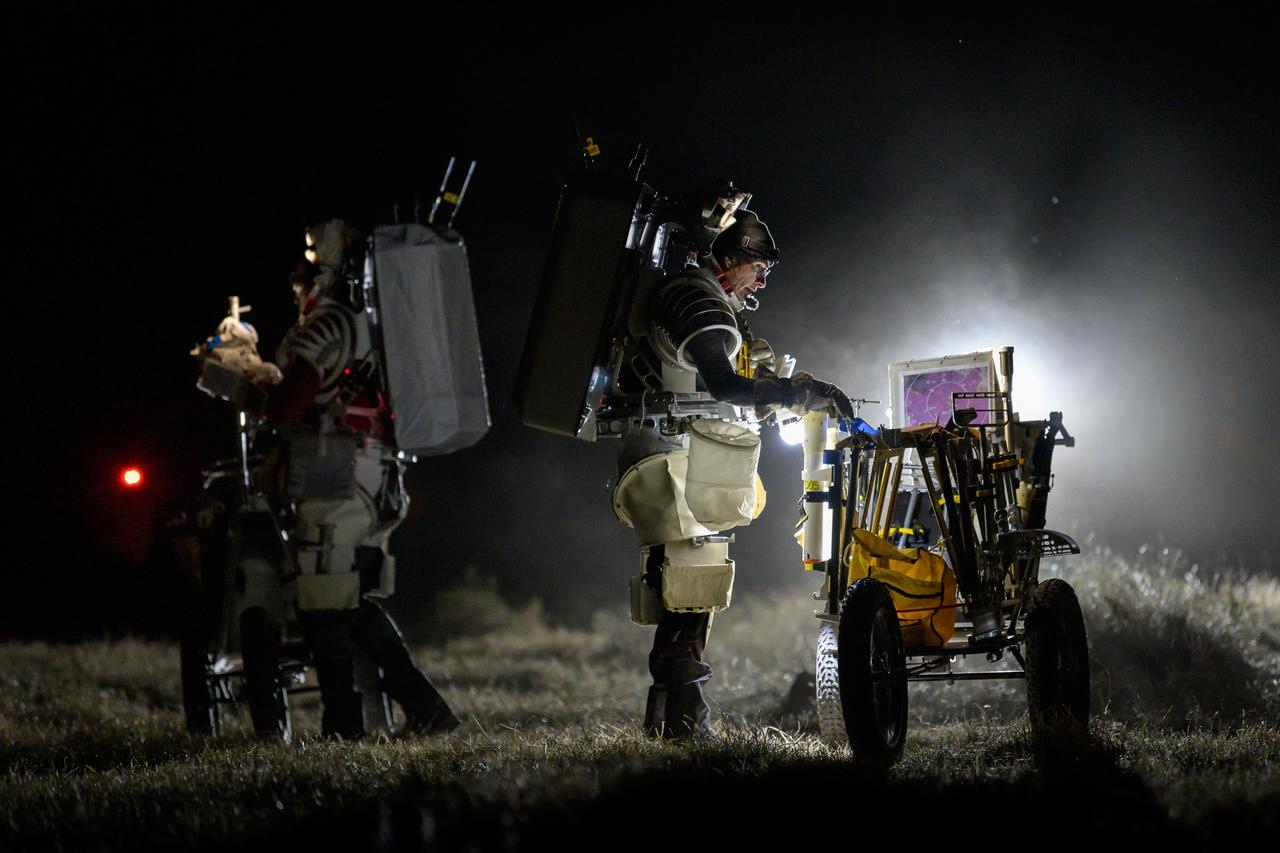
NASA astronaut Kate Rubins conducts a tool audit to ensure she has all of her tools while NASA astronaut Andre Douglas reviews procedures during a nighttime simulated moonwalk in the San Francisco Volcanic Field in Northern Arizona on May 16, 2024.  Credit: NASA/Josh Valcarcel
Andre Douglas and Kate Rubins - JETT 5 - jsc2024e035656
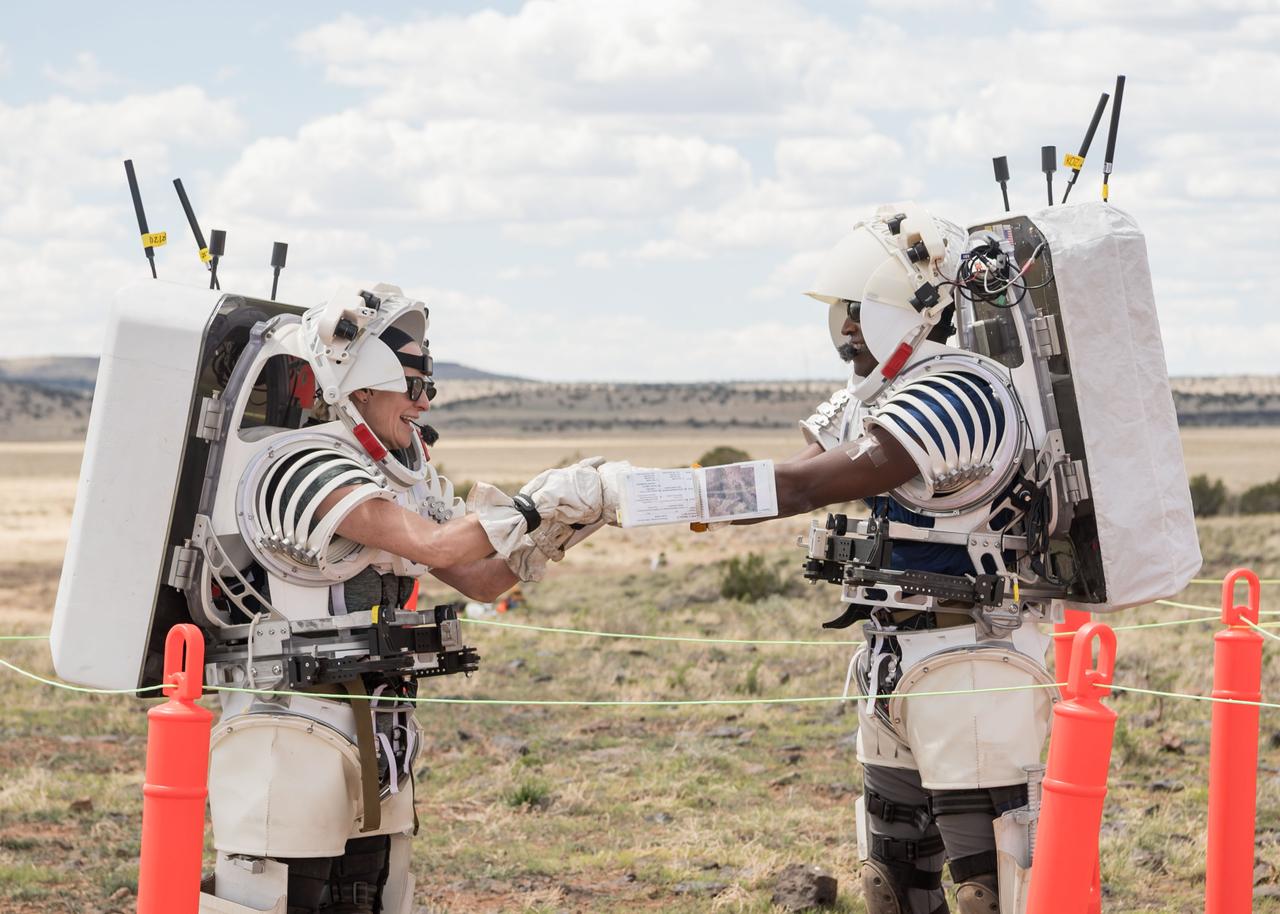
NASA astronauts Kate Rubins and Andre Douglas congratulate each other after the completion of the first simulated moonwalk in a week-long field test consisting of four simulated moonwalks and six advanced technology runs in the San Francisco Volcanic Field in Northern Arizona on May 13, 2024.   Credit: NASA/Josh Valcarcel
Kate Rubins, Andre Douglas - JETT 5 - jsc2024e033763
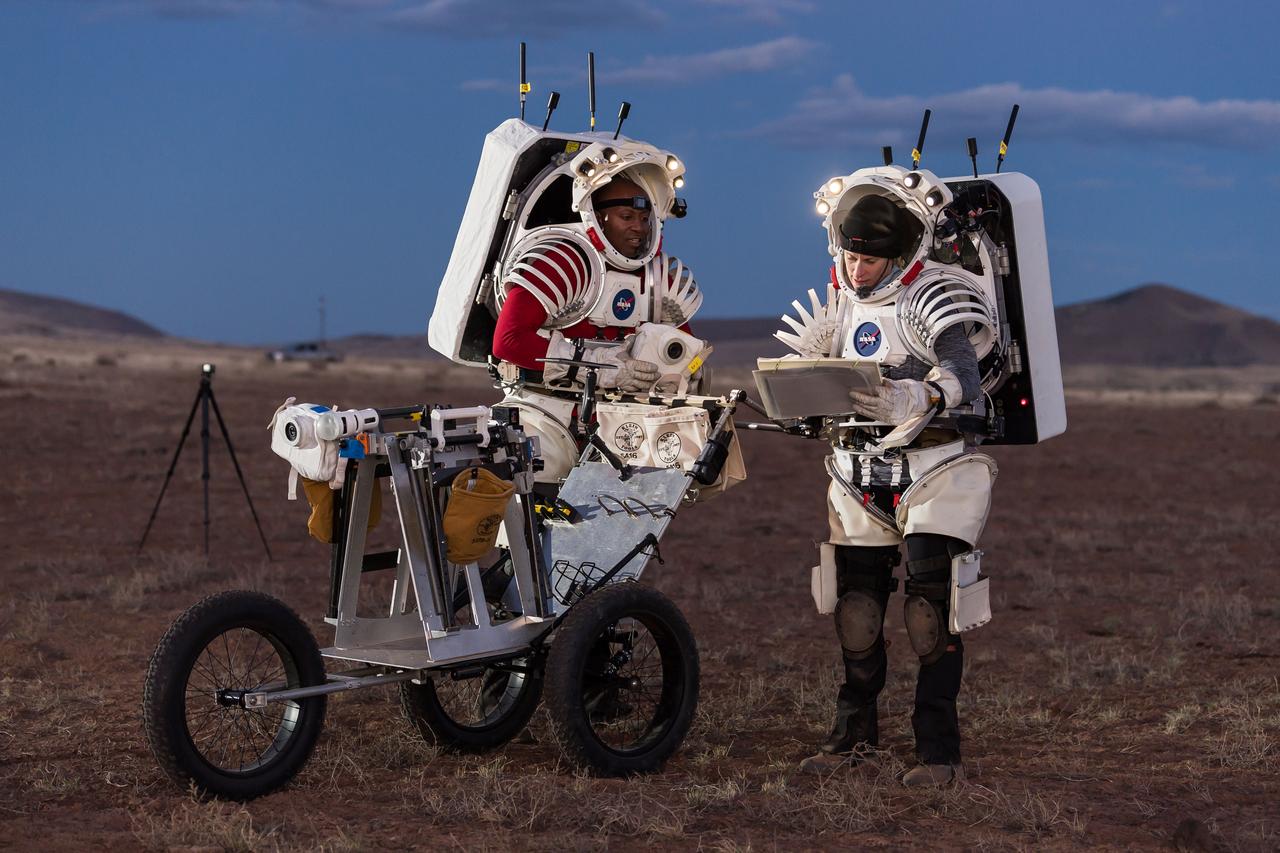
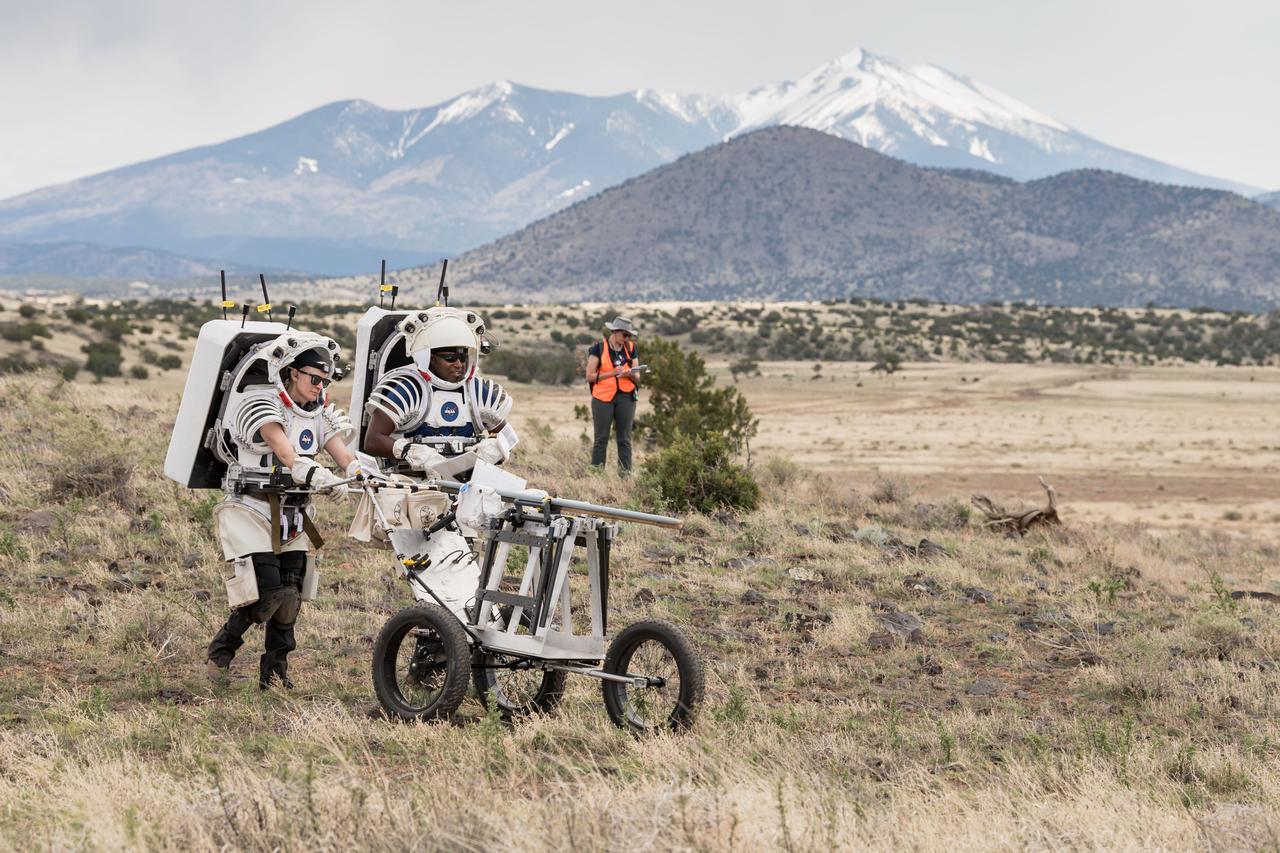
NASA astronauts Kate Rubins and Andre Douglas push a tool cart loaded with lunar tools through the San Francisco Volcanic Field north of Flagstaff, Arizona, as they practice moonwalking operations for Artemis III on May 13, 2024.   Credit: NASA/Josh Valcarcel
Kate Rubins, Andre Douglas JETT 5 - jsc2024e033761
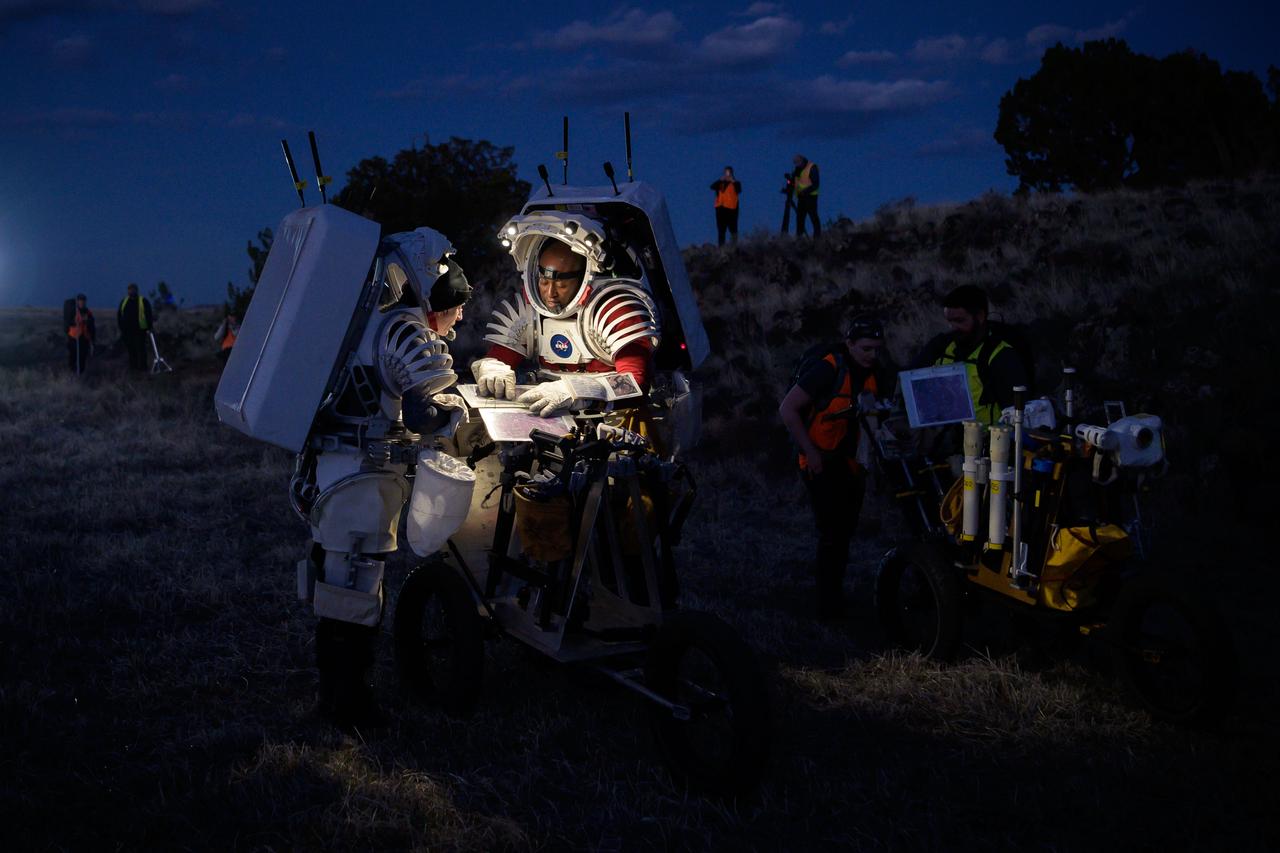
NASA astronauts Kate Rubins, left, and Andre Douglas look at a map that shows their traverse route during a nighttime simulated moonwalk in the San Francisco Volcanic Field in Northern Arizona on May 16, 2024.  Credit: NASA/Josh Valcarcel
Kate Rubins and Andre Douglas - JETT 5 - jsc2024e035650
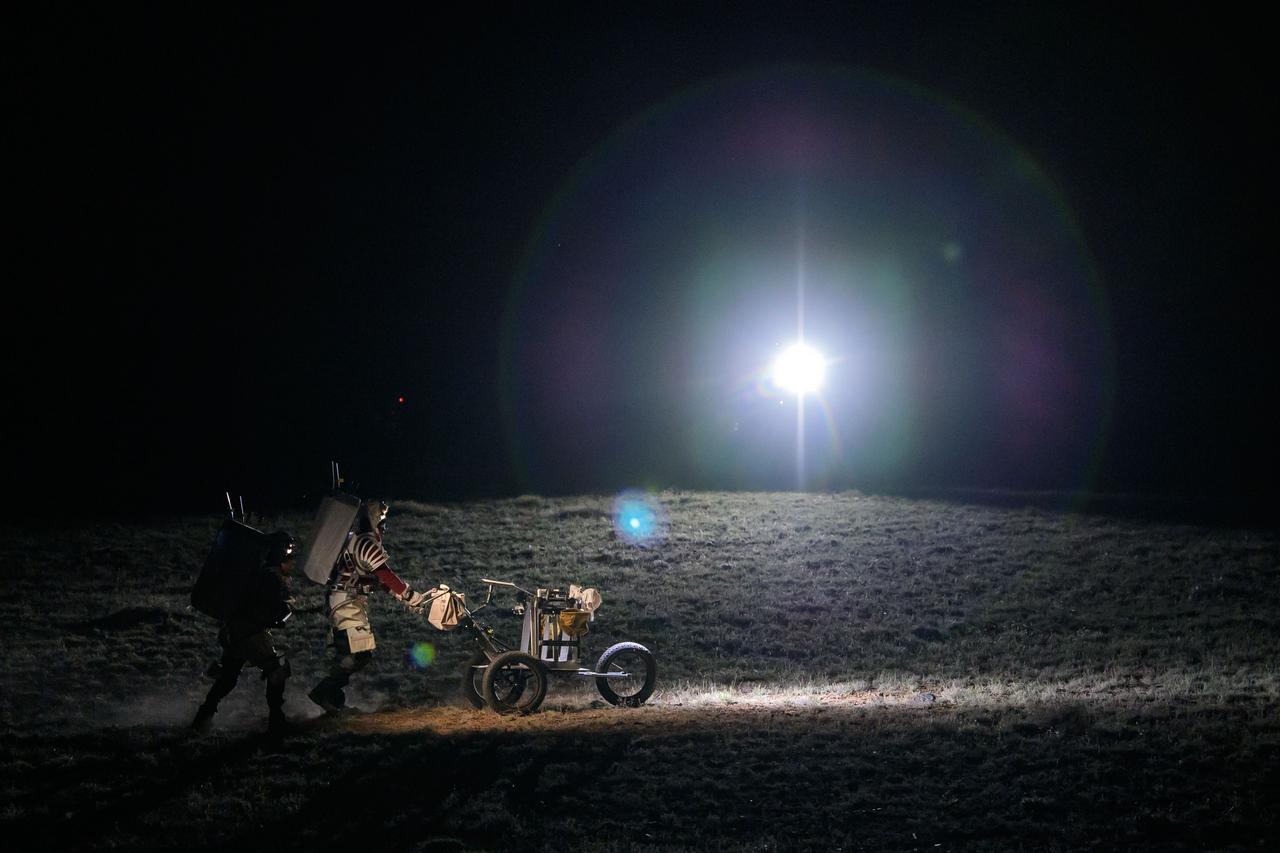
NASA astronaut Andre Douglas pushes a tool cart across the lunar-like landscape while NASA astronaut Kate Rubins follows close behind during a¬¬ nighttime simulated moonwalk in the San Francisco Volcanic Field in Northern Arizona on May 16, 2024.  Credit: NASA/Josh Valcarcel
Kate Rubins and Andre Douglas - JETT 5 - jsc2024e035657
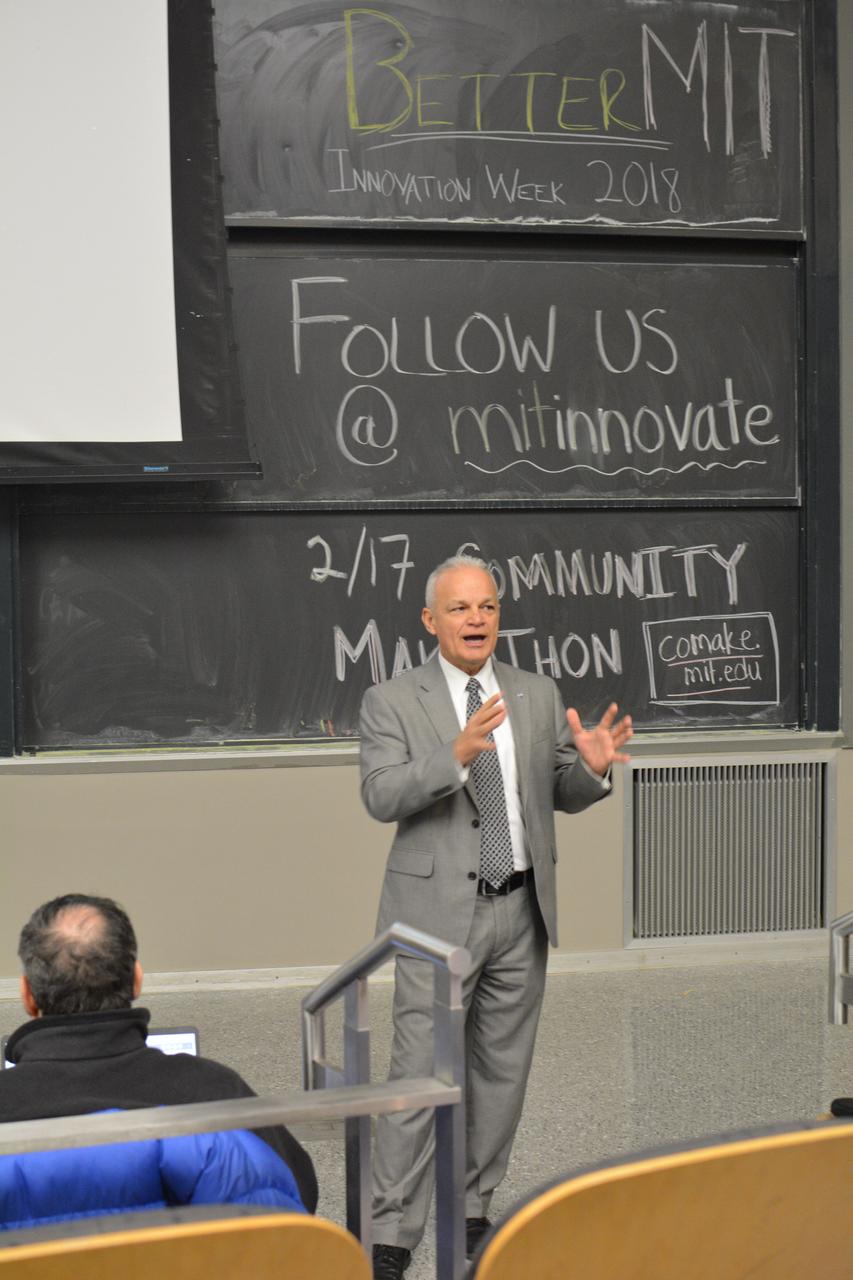
NASA Chief Technologist Douglas Terrier joined students, faculty and experts in Boston as part of MIT's "Better MIT Innovation Week 2018," a week-long program promoting leadership, entrepreneurship and action for a better future. During the February event, Terrier spoke about a culture of innovation at America's Space Program. (Photo: Damian Barabonkov/MIT Technique)
NASA Chief Technologist Speaks at Massachusetts Institute of Technology
NASA Chief Technologist Douglas Terrier joined Jacobs General Manager Lon Miller during a tour of the company's Engineering Development Facility in Houston. Jacobs provides advanced technologies used aboard the International Space Station and for deep space exploration.  Date: 08-10-2017 Location: B1 & Jacobs Engineering Subject: NASA Acting Chief Technology Officer Douglas Terrier Tours JSC and Jacobs Photographer: David DeHoyos
NASA Chief Technologist Tours Jacobs' Engineering Development Facility
NASA Chief Technologist Douglas Terrier inspects Jacobs’ mockup of the on-orbit Alpha Magnetic Spectrometer hardware. Astronauts use the mockup hardware to train on the ground to prepare to perform operations on the International Space Station. Jacobs provides advanced technologies used aboard the International Space Station and for deep space exploration.  Date: 08-10-2017 Location: B1 & Jacobs Engineering Subject: NASA Acting Chief Technology Officer Douglas Terrier Tours JSC and Jacobs Photographer: David DeHoyos
NASA Chief Technologist Inspects a Mock-Up of Hardware at Jacobs' Engineering Development Facility
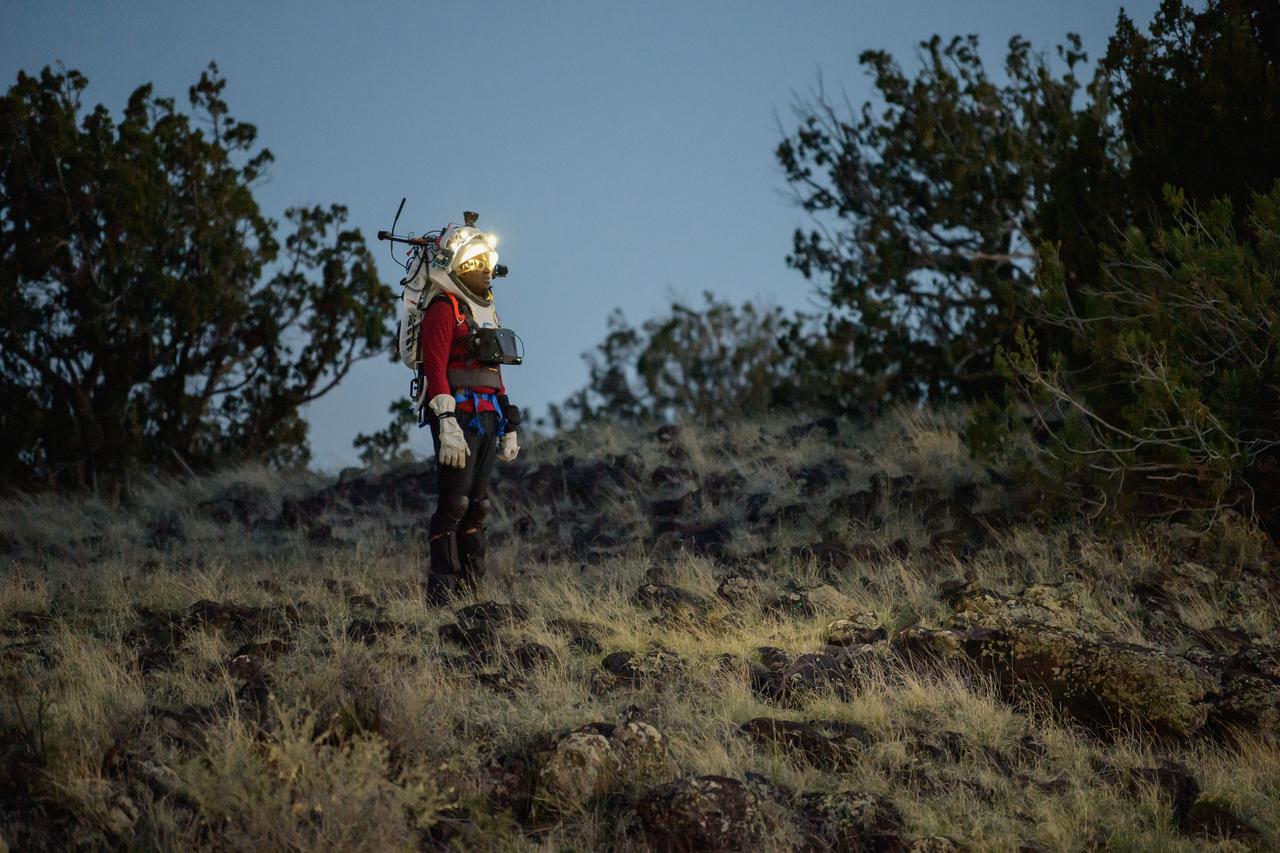
NASA astronaut Andre Douglas views the lunar-like landscape at dusk while wearing the Joint AR (Joint Augmented Reality Visual Informatics System) display during an advanced technology run in the San Francisco Volcanic Field in Northern Arizona on May 21, 2024. The suit display features include navigation, photo capture, graphical format of consumables, procedure viewing, mission control updates, and other augmented reality cues and graphics. The team successfully tested navigation displays using data from four different data streams: GPS (Global Positioning System)/IMU (Inertial Measurement Unit), camera/IMU, LiDAR (Light Detection and Ranging), and static maps. Technology like this may be used for future Artemis missions to augment mission control communication and help guide crew back to the lunar lander. Credit: NASA/Josh Valcarcel
Andre Douglas - JETT5 -jsc2024e036525
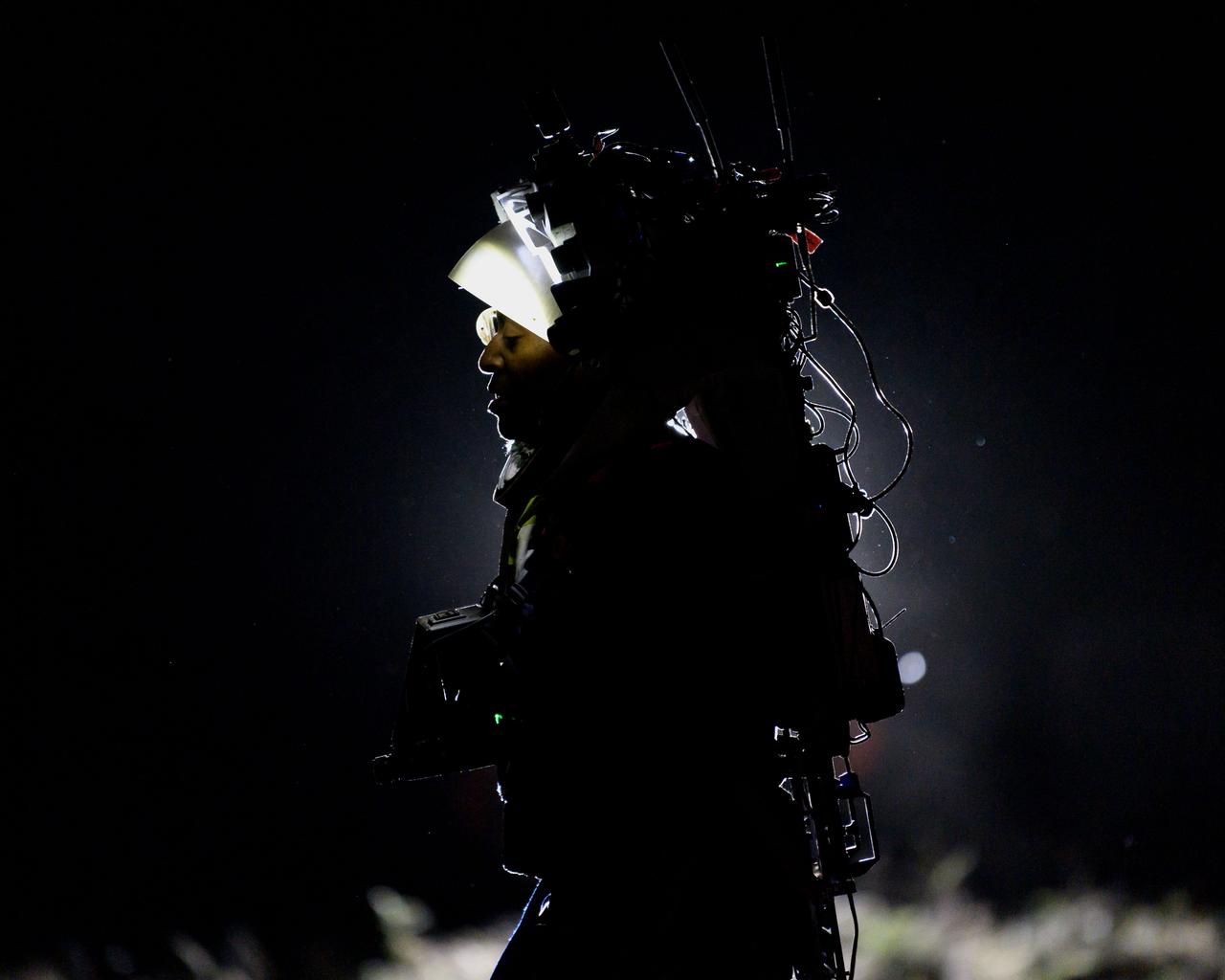
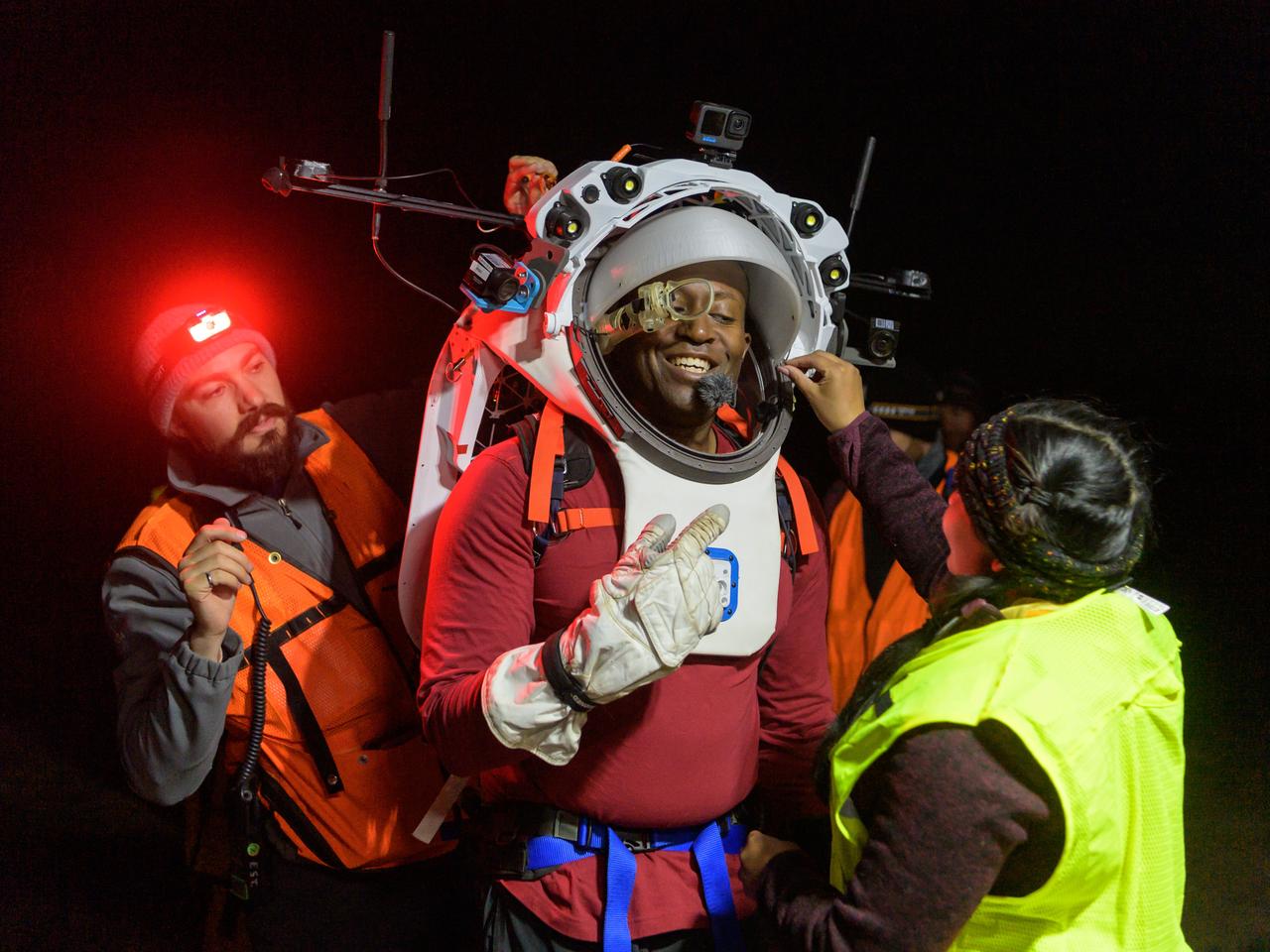
Engineers help NASA astronaut Andre Douglas adjust the Joint AR (Joint Augmented Reality Visual Informatics System) display he’s wearing during a nighttime advanced technology run in the San Francisco Volcanic Field in Northern Arizona on May 21, 2024. The suit display features include navigation, photo capture, graphical format of consumables, procedure viewing, mission control updates, and other augmented reality cues and graphics. The team successfully tested navigation displays using data from four different data streams: GPS (Global Positioning System)/IMU (Inertial Measurement Unit), camera/IMU, LiDAR (Light Detection and Ranging), and static maps. Technology like this may be used for future Artemis missions to augment mission control communication and help guide crew back to the lunar lander. Credit: NASA/Josh Valcarcel
Andre Douglas - JETT5 - jsc2024e036530
NASA astronaut Andre Douglas wears  the Joint AR (Joint Augmented Reality Visual Informatics System) display during a nighttime advanced technology run in the San Francisco Volcanic Field in Northern Arizona on May 21, 2024. The suit display features include navigation, photo capture, graphical format of consumables, procedure viewing, mission control updates, and other augmented reality cues and graphics. The team successfully tested navigation displays using data from four different data streams: GPS (Global Positioning System)/IMU (Inertial Measurement Unit), camera/IMU, LiDAR (Light Detection and Ranging), and static maps. Technology like this may be used for future Artemis missions to augment mission control communication and help guide crew back to the lunar lander. Credit: NASA/Josh Valcarcel
Andre Douglas - JETT5 - jsc2024e036529
Sangho Jeon (Tufts University), Thomas Leitner (Graz University of Technology), and Trudy Allen analyze data from Dr. Douglas Matson's aerodynamic levitator in support of his MaterialsLab experiments.
Data from Dr. Douglas Matson's aerodynamic levitator being analy