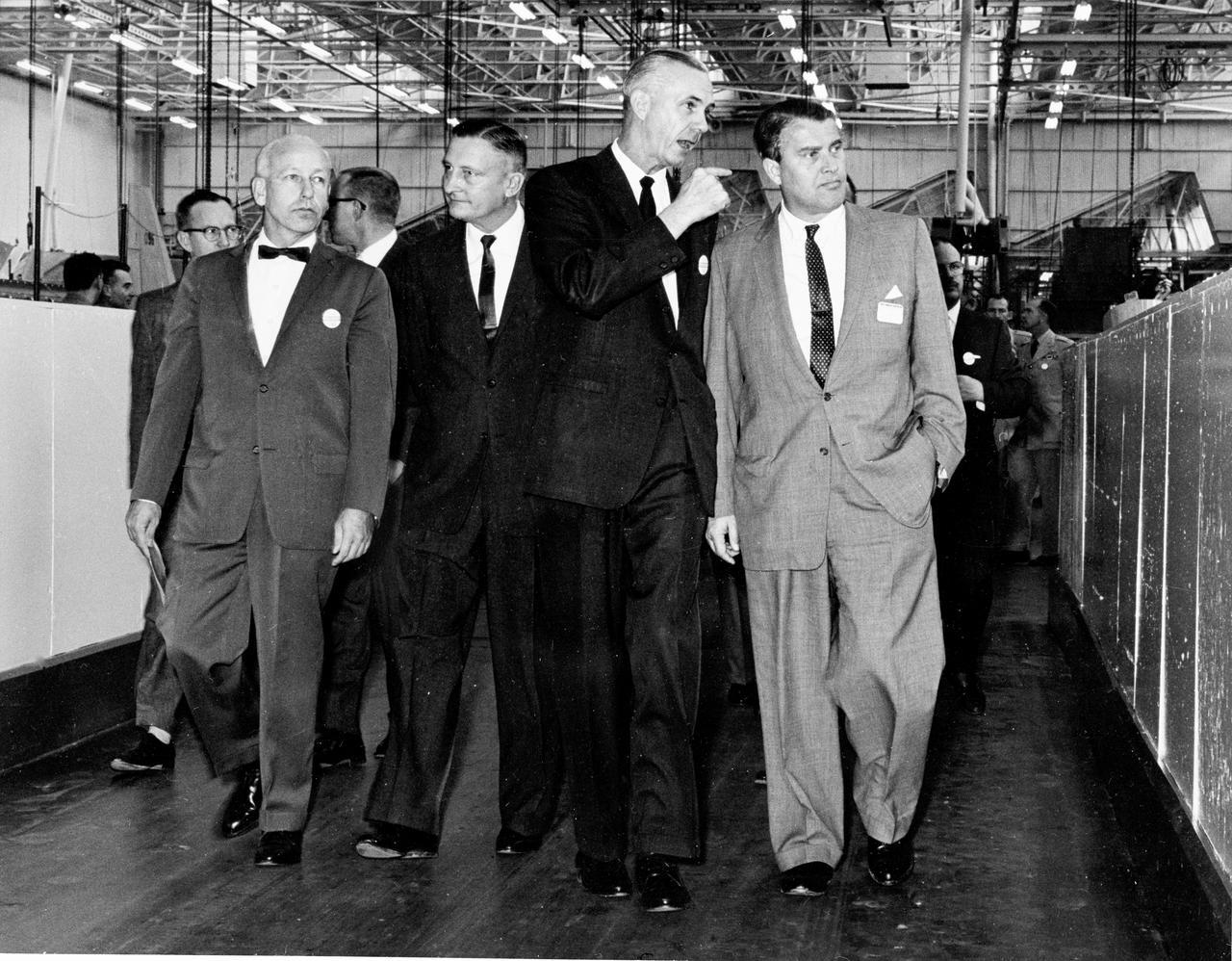
Dr. Wernher von Braun, Director of the Marshall Space Flight Center (MSFC), during his tour of the Space information Division of North American Aviation (NAA) in Downey, California, where the Saturn SII stage was developed.
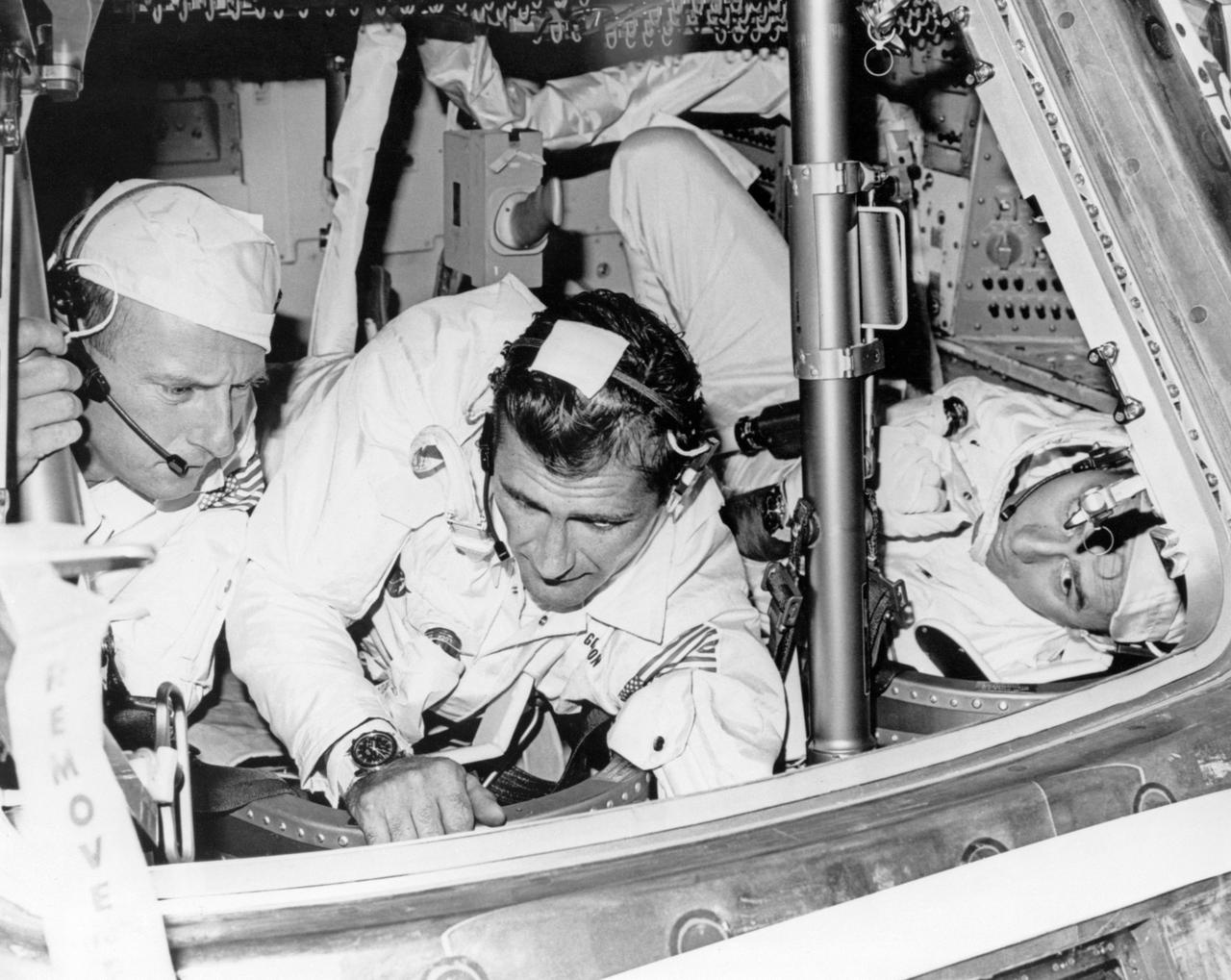
S69-53716 (1969) --- The prime crew of the Apollo 12 lunar landing mission is photographed during spacecraft checkout activity at North American Rockwell Space Division at Downey, California. Left to right, are astronauts Charles Conrad Jr., commander; Richard F. Gordon Jr., command module pilot; and Alan L. Bean, lunar module pilot.
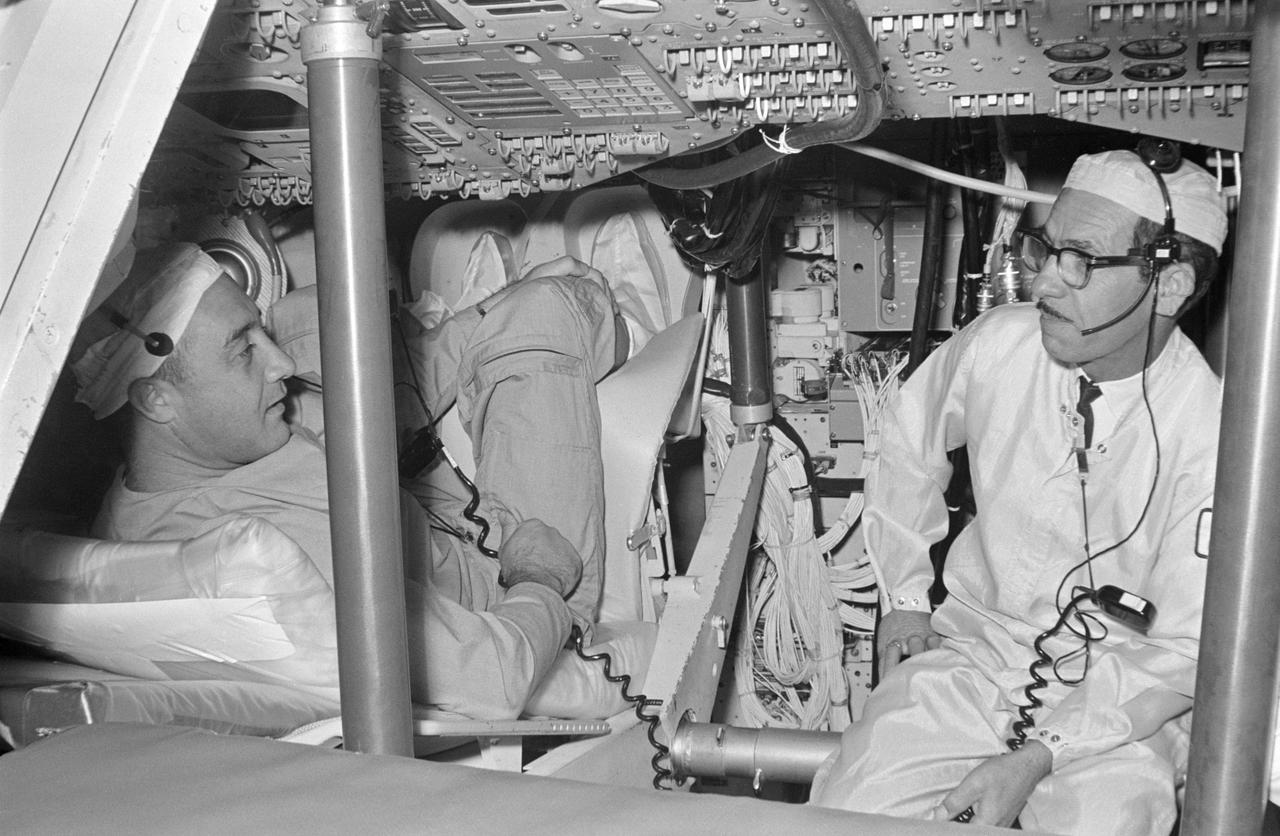
Astronaut Virgil I. Grissom and other members of the first Apollo Crew inspect spacecraft equipment during a visit to NAA. NAA, INC., DOWNEY, CA B&W
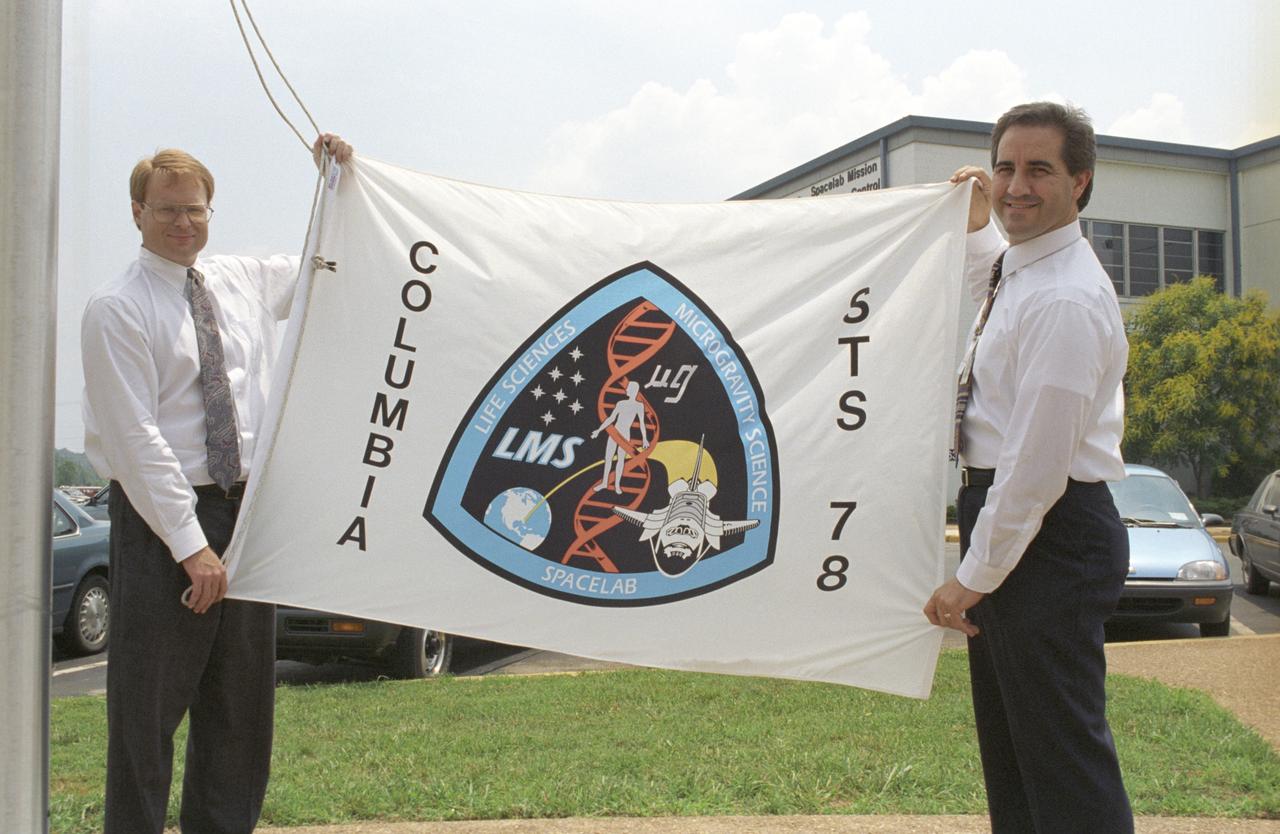
Launched on June 20, 1996, the STS-78 mission’s primary payload was the Life and Microgravity Spacelab (LMS), which was managed by the Marshall Space Flight Center (MSFC). During the 17 day space flight, the crew conducted a diverse slate of experiments divided into a mix of life science and microgravity investigations. In a manner very similar to future International Space Station operations, LMS researchers from the United States and their European counterparts shared resources such as crew time and equipment. Five space agencies (NASA/USA, European Space Agency/Europe (ESA), French Space Agency/France, Canadian Space Agency /Canada, and Italian Space Agency/Italy) along with research scientists from 10 countries worked together on the design, development and construction of the LMS. In this photo, LMS mission scientist Patton Downey and LMS mission manager Mark Boudreaux display the flag that was flown for the mission at MSFC.
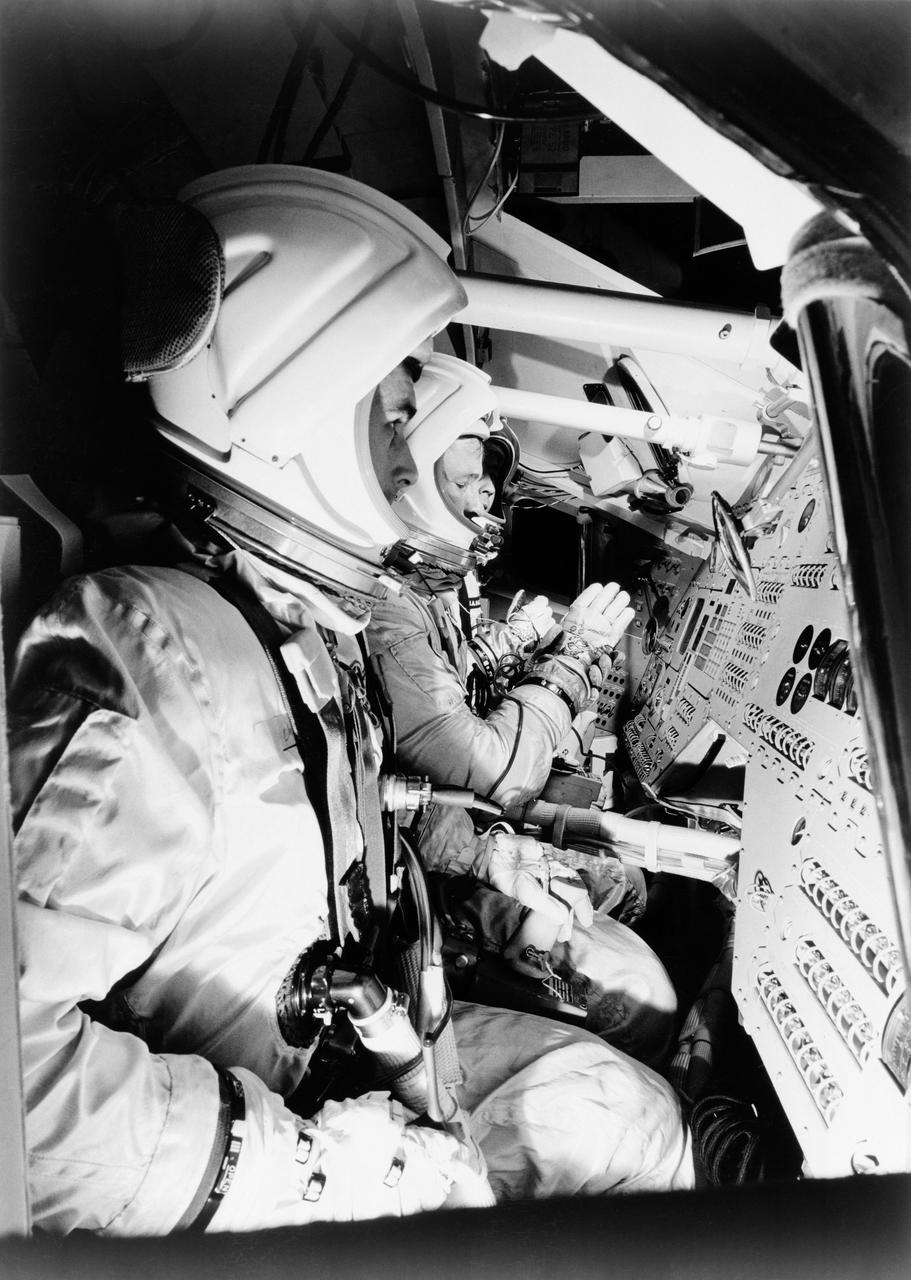
Astronauts McDivitt, Chaffee, White are shown in Spacecraft. NAA, INC., DOWNEY, CA B&W
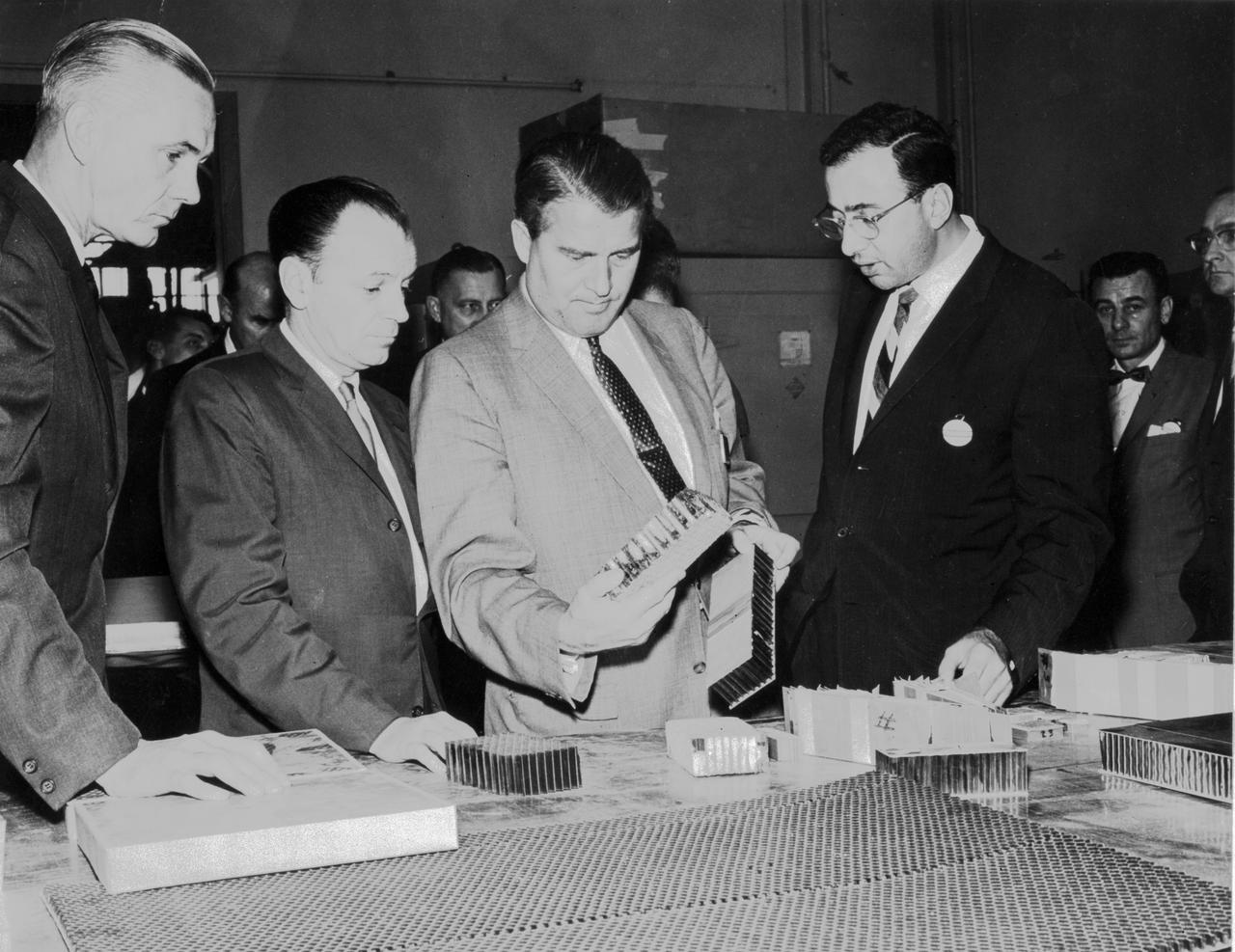
This is a photograph of Dr. von Braun, taken in 1961, visiting North American Aviation's Space and Information Systems Division in Downey, California.
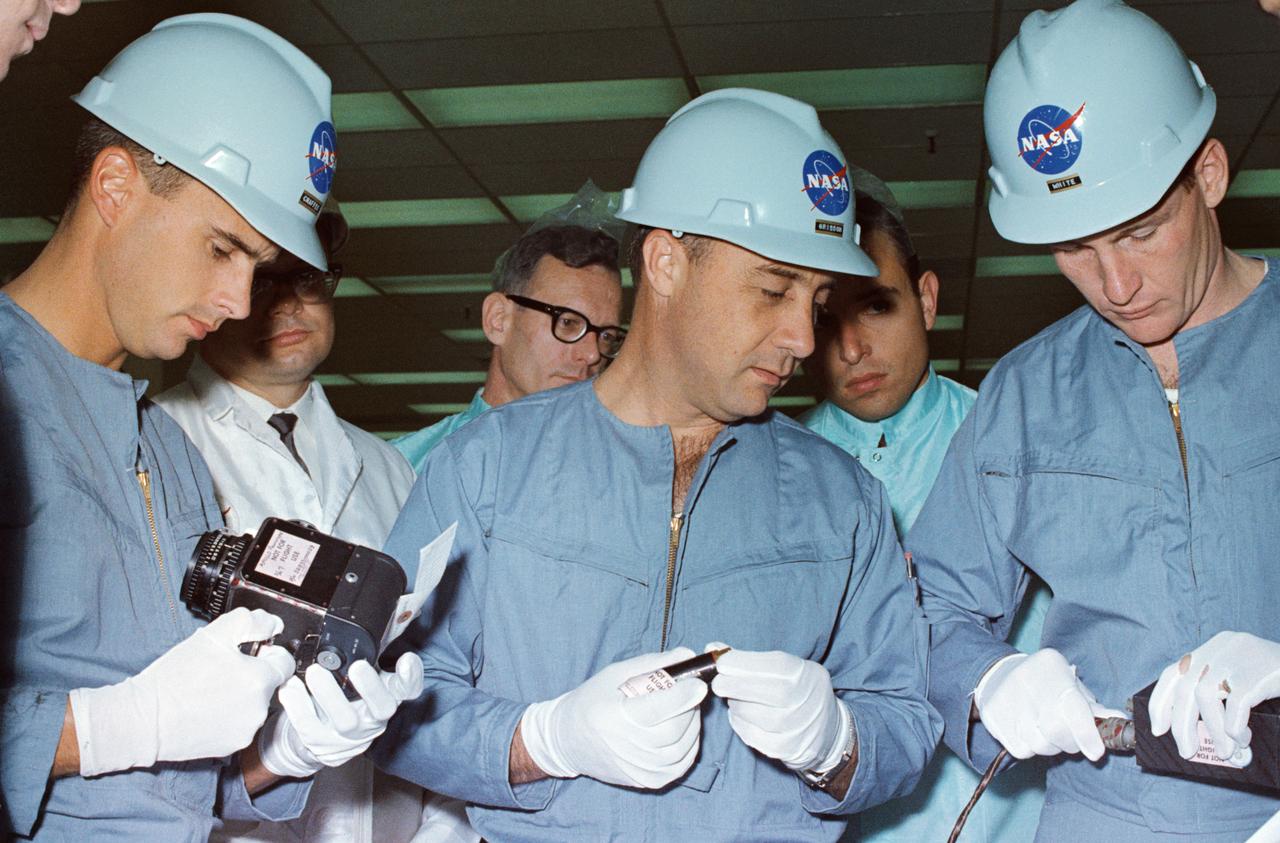
The members of the prime crew of the first manned Apollo space flight Apollo/Saturn 204 (AS-204) inspect spacecraft equipment during a tour of North American Aviation's (NAA) Downey facility. In the foreground, left to right, are astronauts Roger B. Chaffee, Virgil I. Grissom, and Edward H. White, II. NAA engineers and technicians are in the background. NORTH AMERICAN AVIATION, INC., DOWNEY, CA B&W
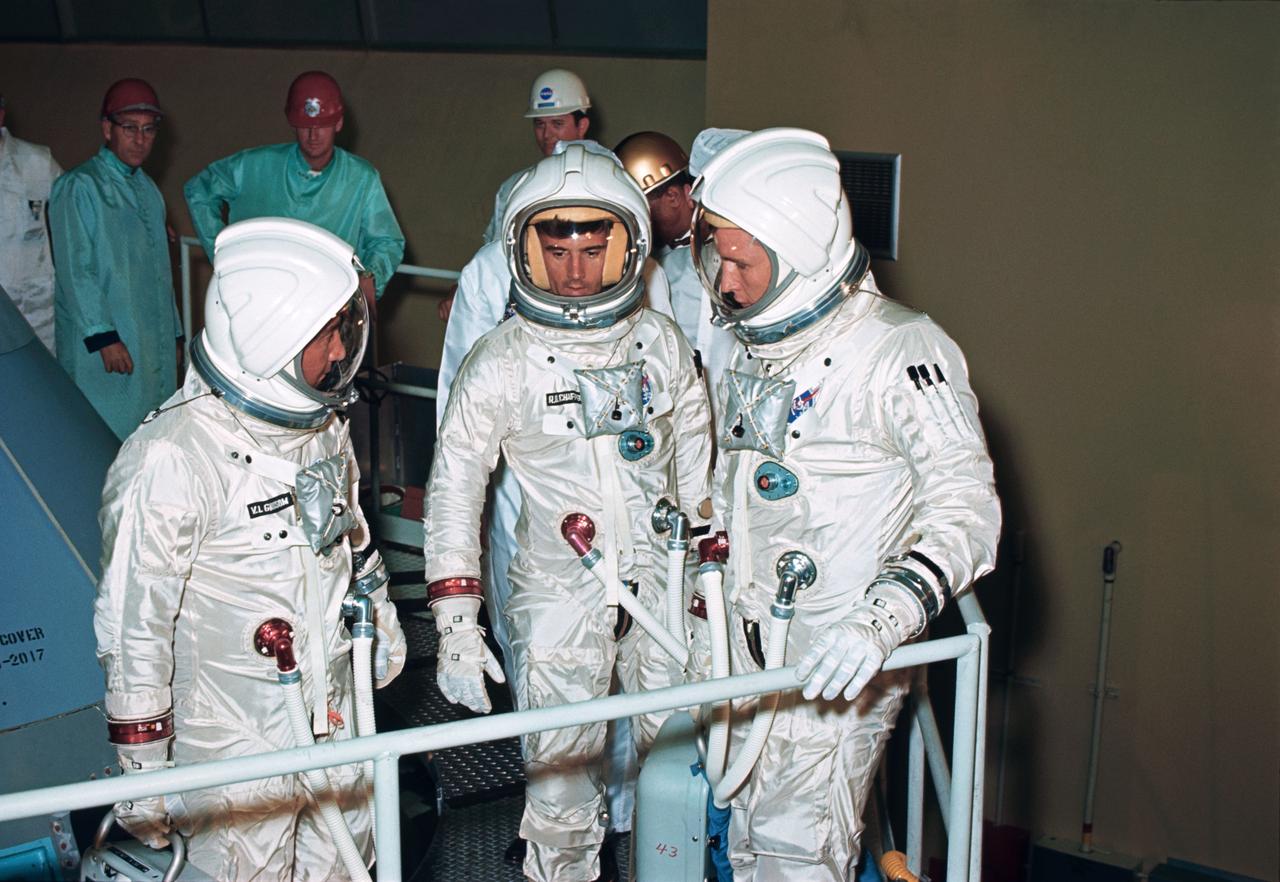
S66-49181 (August 1966) --- The three crew members for the Apollo-Saturn 204 (AS-204) mission check out the couch installation on the Apollo Command Module (CM) at North American's Downey facility. Left to right in their pressurized space suits are astronauts Virgil I. Grissom, Roger B. Chaffee and Edward H. White II. Editor's Note: The three astronauts died in a fire on the launch pad, Jan. 27, 1967.
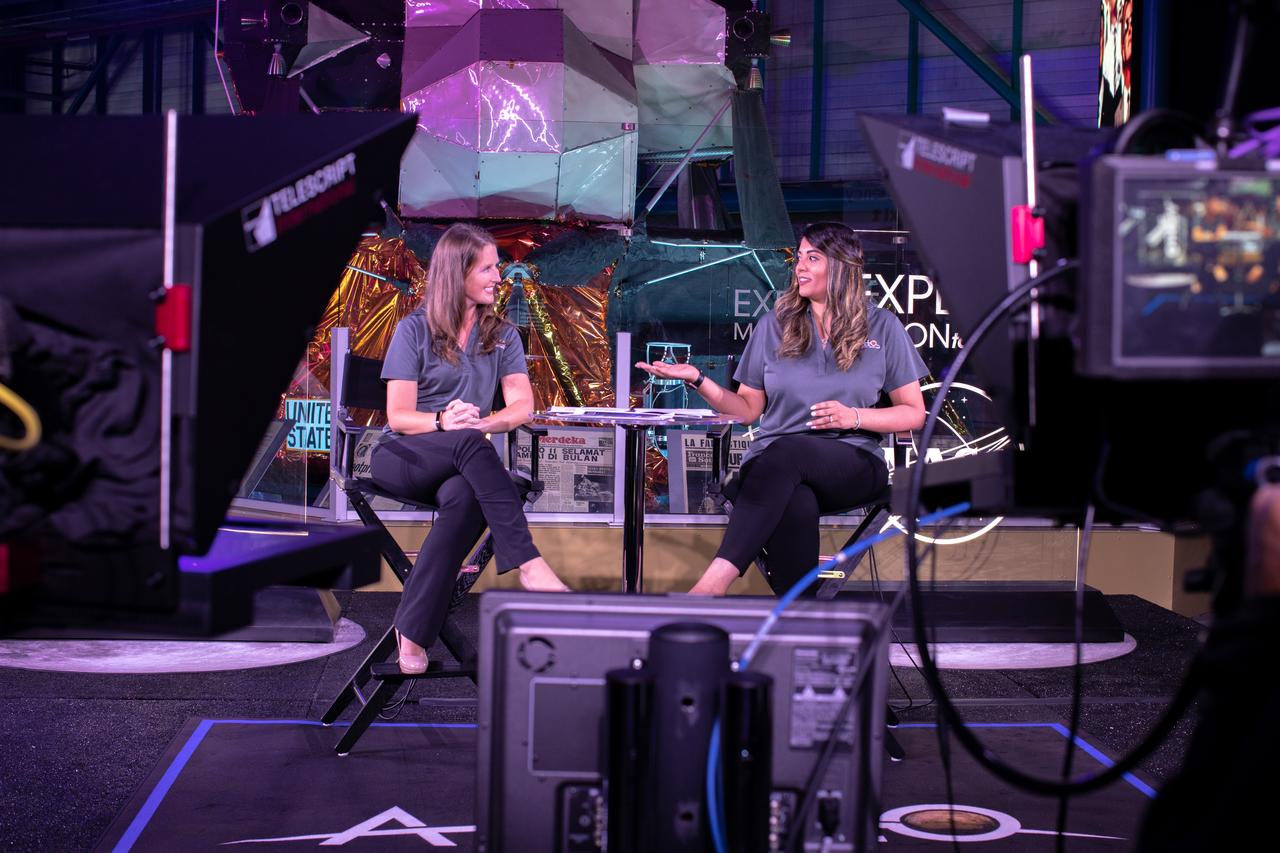
Stephanie Martin, left, NASA Office of Communications, and Nilufar Ramji, NASA Office of STEM Engagement, host a live broadcast of “STEM Forward to the Moon” on July 19, 2019 from Kennedy Space Center’s Apollo/Saturn V Center in Florida. The special program featured kids participating in Moon landing simulations at four museums throughout the country: Cosmosphere in Hutchinson, Kansas; Saint Louis Science Center; Columbia Memorial Space Center in Downey, California; and Arizona Science Center in Phoenix.
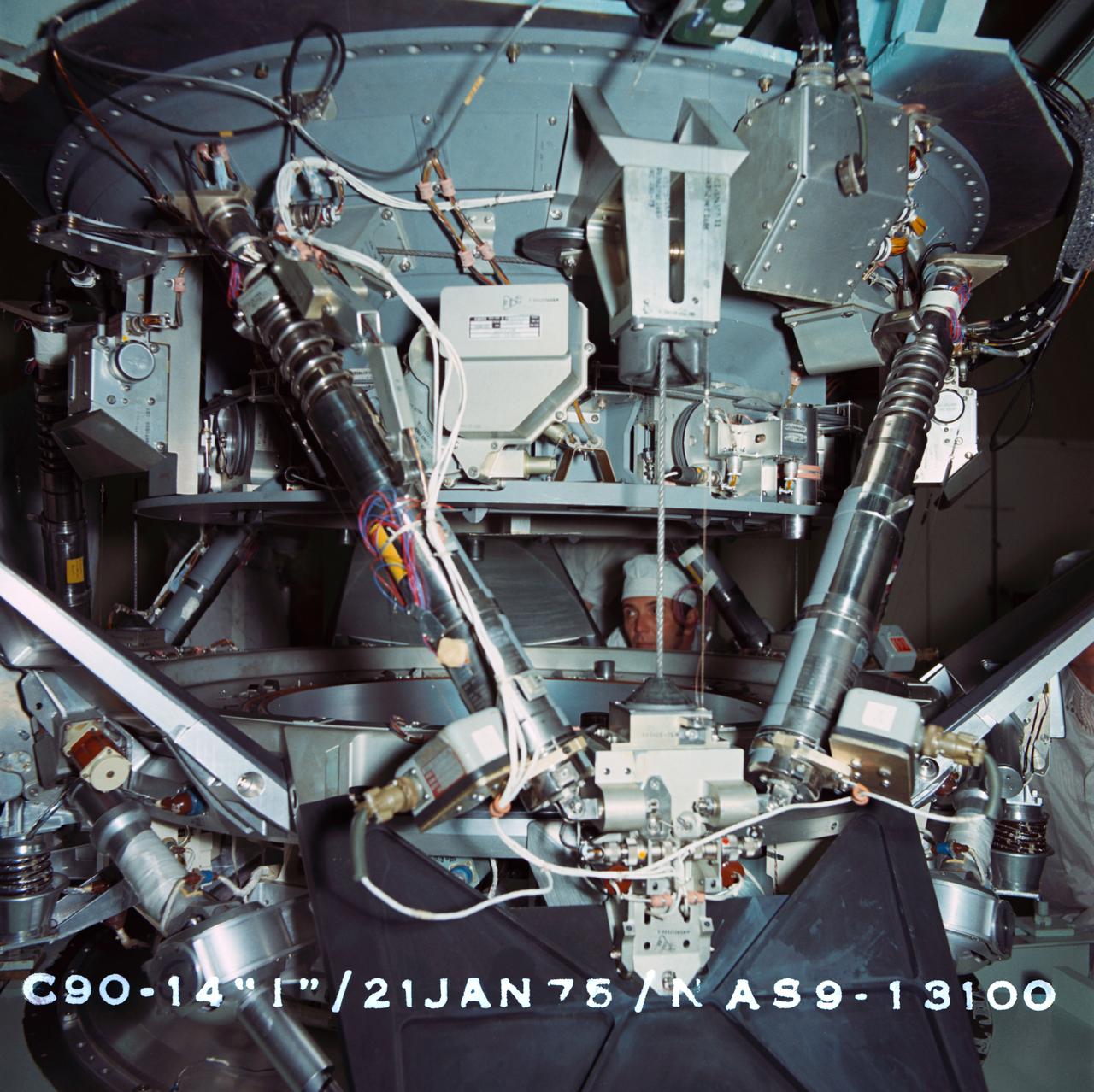
S95-02815 (21 Jan. 1975) --- Soviet junior researcher Y.G. Pobrov observes testing of the Apollo-Soyuz docking system at Rockwell International's plant in Downey, California. The United States' Docking System 3 (DS-3) here is being positioned onto the USSR's CA-4 system during a Pin and Socket Alignment Test. DS-5 has been designated as the prime flight article for the joint U.S.-USSR Apollo-Soyuz Test Project (ASTP) docking mission in Earth orbit, scheduled for July 1975.
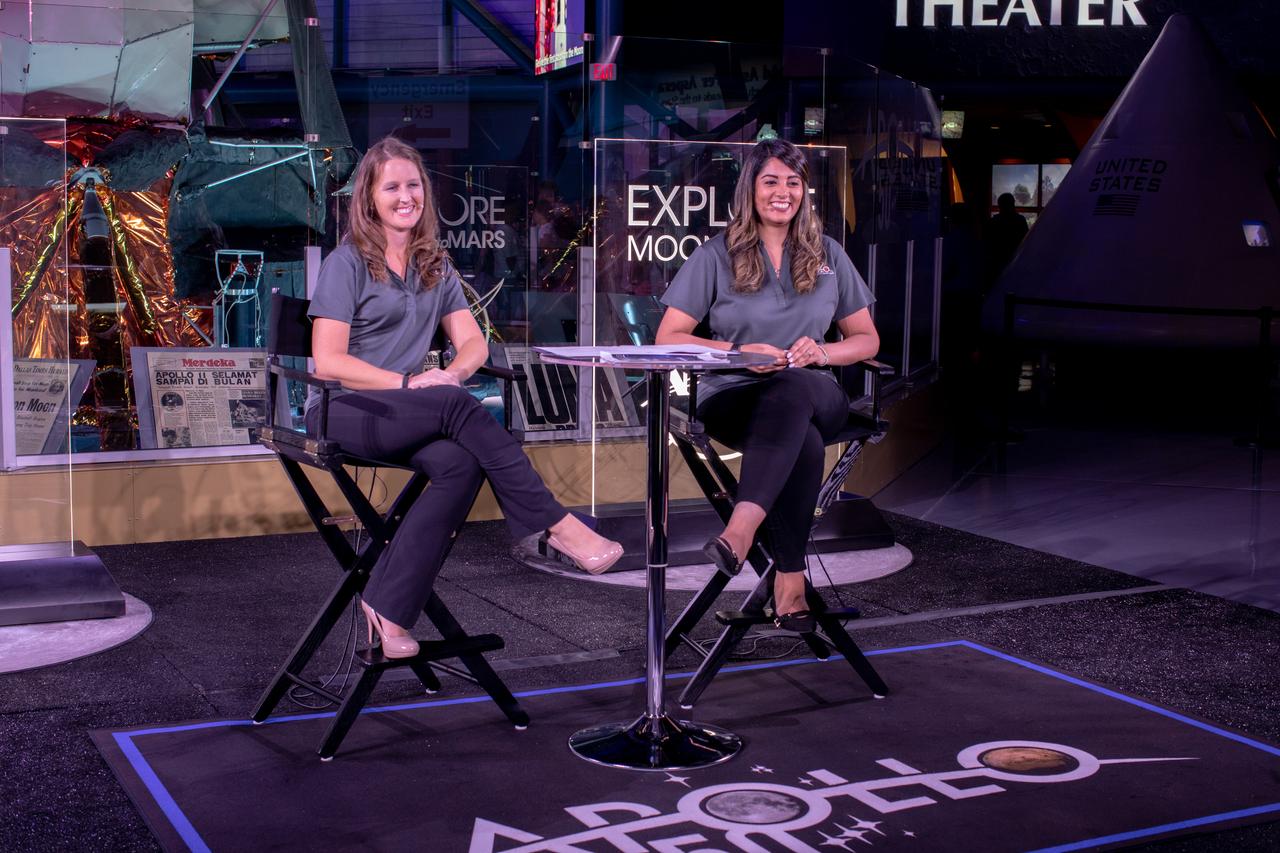
Stephanie Martin, left, NASA Office of Communications, and Nilufar Ramji, NASA Office of STEM Engagement, host a live broadcast of “STEM Forward to the Moon” on July 19, 2019 from Kennedy Space Center’s Apollo/Saturn V Center in Florida. The special program featured kids participating in Moon landing simulations at four museums throughout the country: Cosmosphere in Hutchinson, Kansas; Saint Louis Science Center; Columbia Memorial Space Center in Downey, California; and Arizona Science Center in Phoenix.
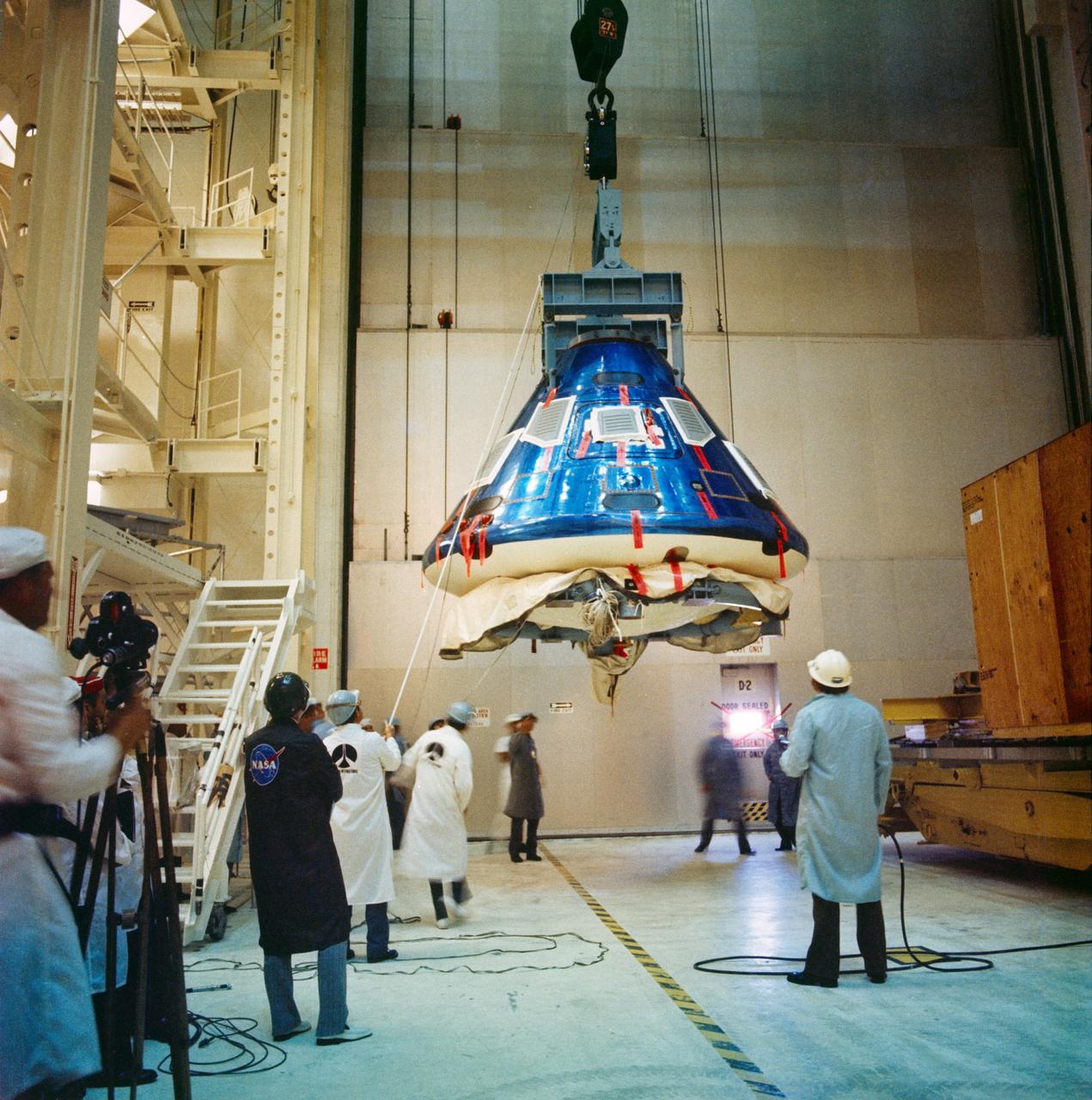
S74-32049 (8 Sept. 1974) --- The Apollo Command Module for the Apollo-Soyuz Test Project mission goes through receiving, inspection and checkout procedures in the Manned Spacecraft Operations Building at the Kennedy Space Center. The spacecraft had just arrived by air from the Rockwell International plant at Downey, California. The Apollo spacecraft (Command Module, Service Module and Docking Module), with astronauts Thomas P. Stafford, Vance D. Brand and Donald K. Slayton aboard, will dock in Earth orbit with a Soviet Soyuz spacecraft during the joint U.S.-USSR ASTP flight scheduled for July 1975. The Soviet and American crews will visit one another?s spacecraft.
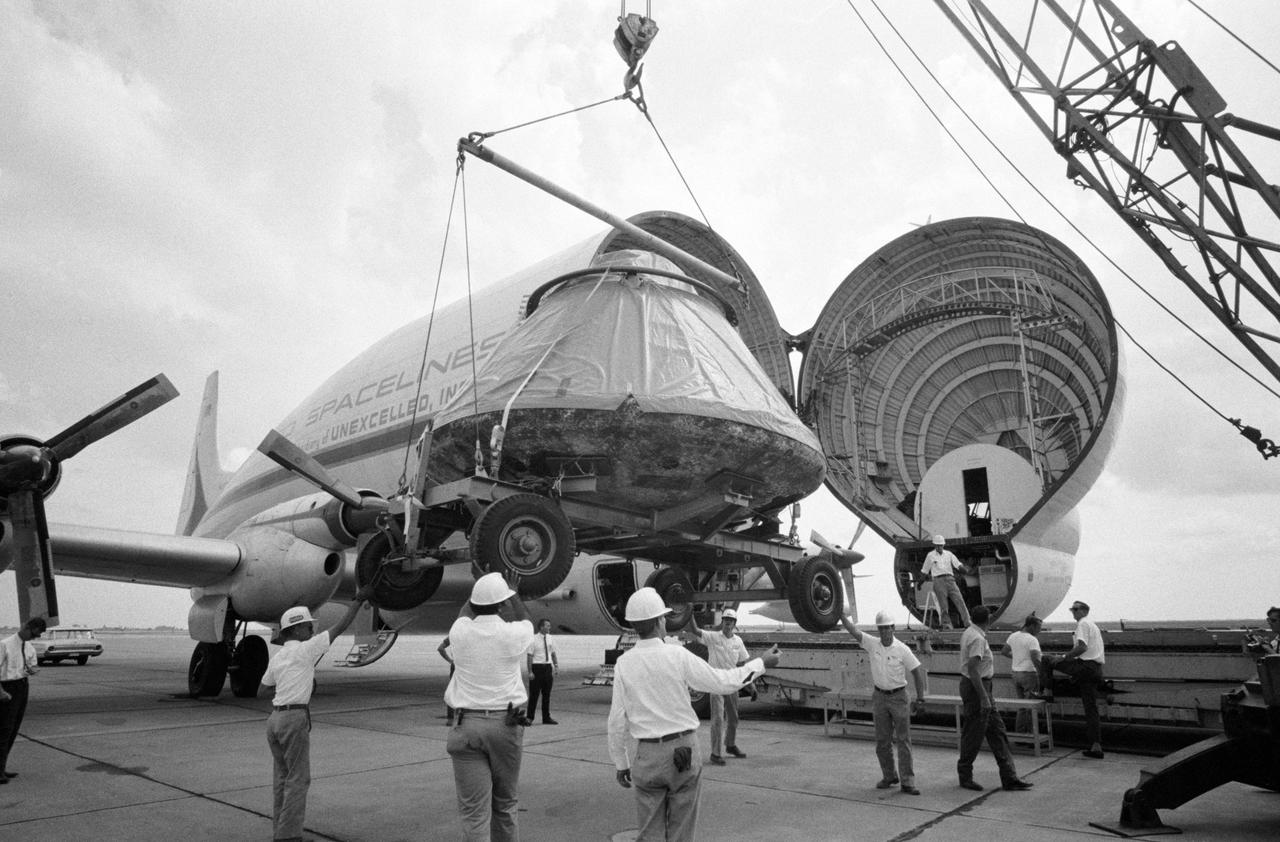
S69-41985 (14 Aug. 1969) --- The Apollo 11 spacecraft Command Module (CM) is loaded aboard a Super Guppy Aircraft at Ellington Air Force Base for shipment to the North American Rockwell Corporation at Downey, California. The CM was just released from its postflight quarantine at the Manned Spacecraft Center (MSC). The Apollo 11 spacecraft was flown by astronauts Neil A. Armstrong, commander; Michael Collins, command module pilot; and Edwin E. Aldrin Jr., lunar module pilot, during their lunar landing mission. Note damage to aft heat shield caused by extreme heat of Earth reentry. North American Rockwell is the prime contractor for the Apollo Command and Service Modules (CSM).
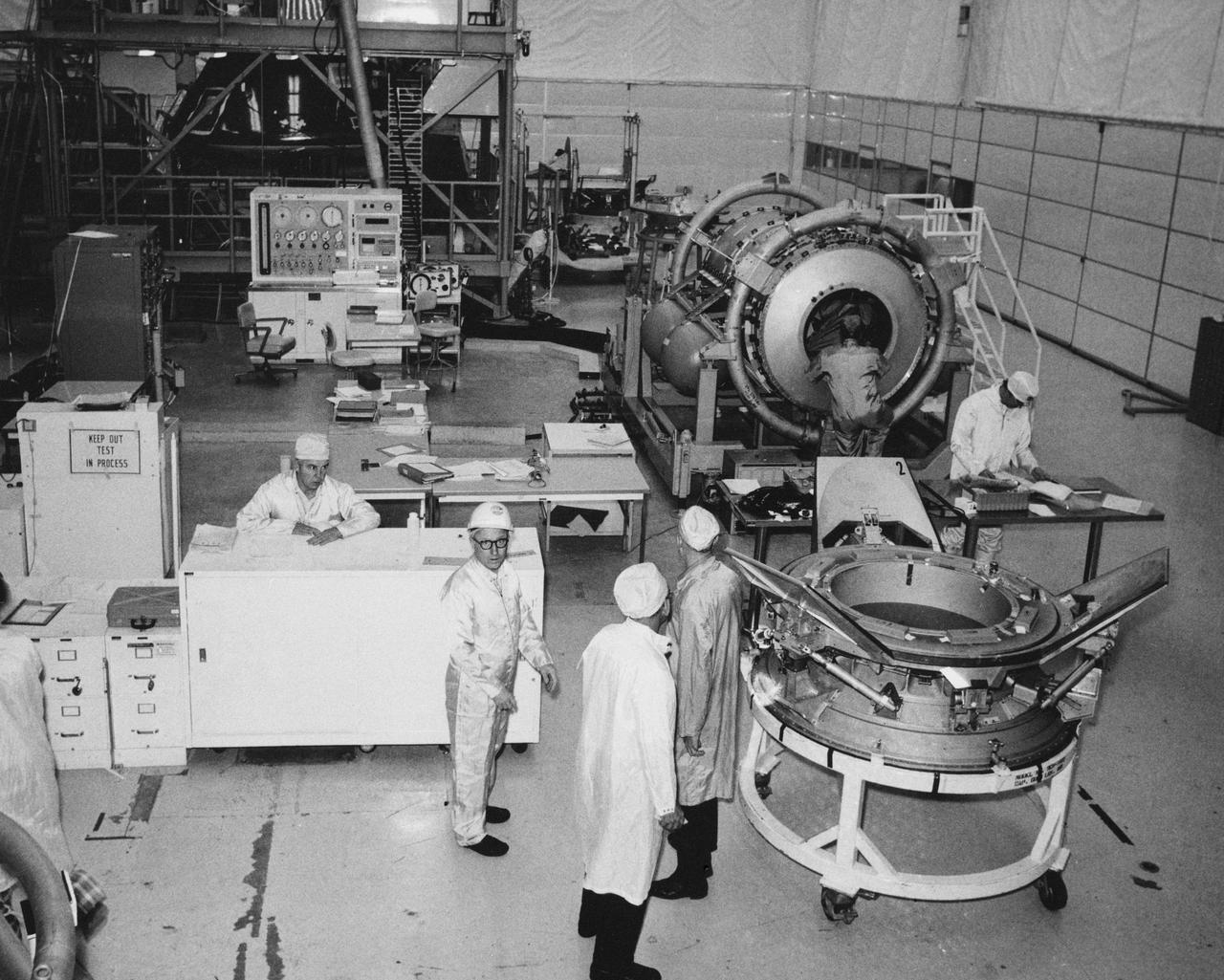
S74-28295 (September 1974) --- American-built hardware for the joint U.S.-USSR Apollo-Soyuz Test Project mission undergoes pre-delivery preparations in the giant clean room at Rockwell International Corporation?s Space Division at Downey, California. The U.S. portion of the ASTP docking system is in the right foreground. In the right background is the cylindrical-shaped docking module, which is designed to link the Apollo and Soyuz spacecraft when they dock in Earth orbit next summer. In the left background is the Apollo Command Module which they will carry the three American astronauts into Earth orbit. Photo credit: NASA
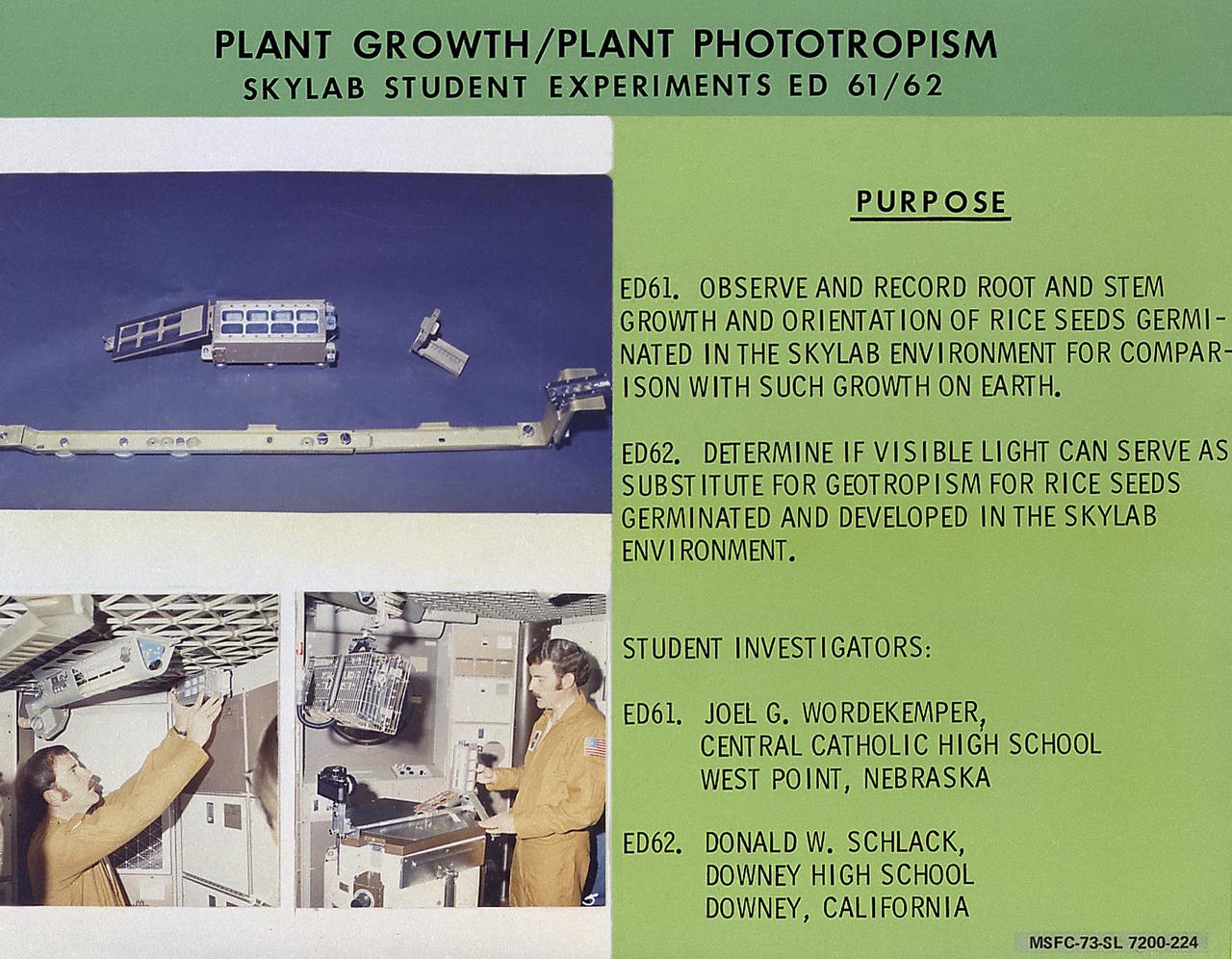
This chart describes the Skylab student experiment ED-61, Plant Growth, and experiment ED-62, Plant Phototropism. Two similar proposals were submitted by Joel G. Wordekemper of West Point, Nebraska, and Donald W. Schlack of Downey, California. Wordekemper's experiment (ED-61) was to see how the lack of gravity would affect the growth of roots and stems of plants. Schlack's experiment (ED-62) was to study the effect of light on a seed developing in zero gravity. The growth container of the rice seeds for their experiment consisted of eight compartments arranged in two parallel rows of four. Each had two windowed surfaces to allow periodic photography of the developing seedlings. In March 1972, NASA and the National Science Teachers Association selected 25 experiment proposals for flight on Skylab. Science advisors from the Marshall Space Flight Center aided and assisted the students in developing the proposals for flight on Skylab.
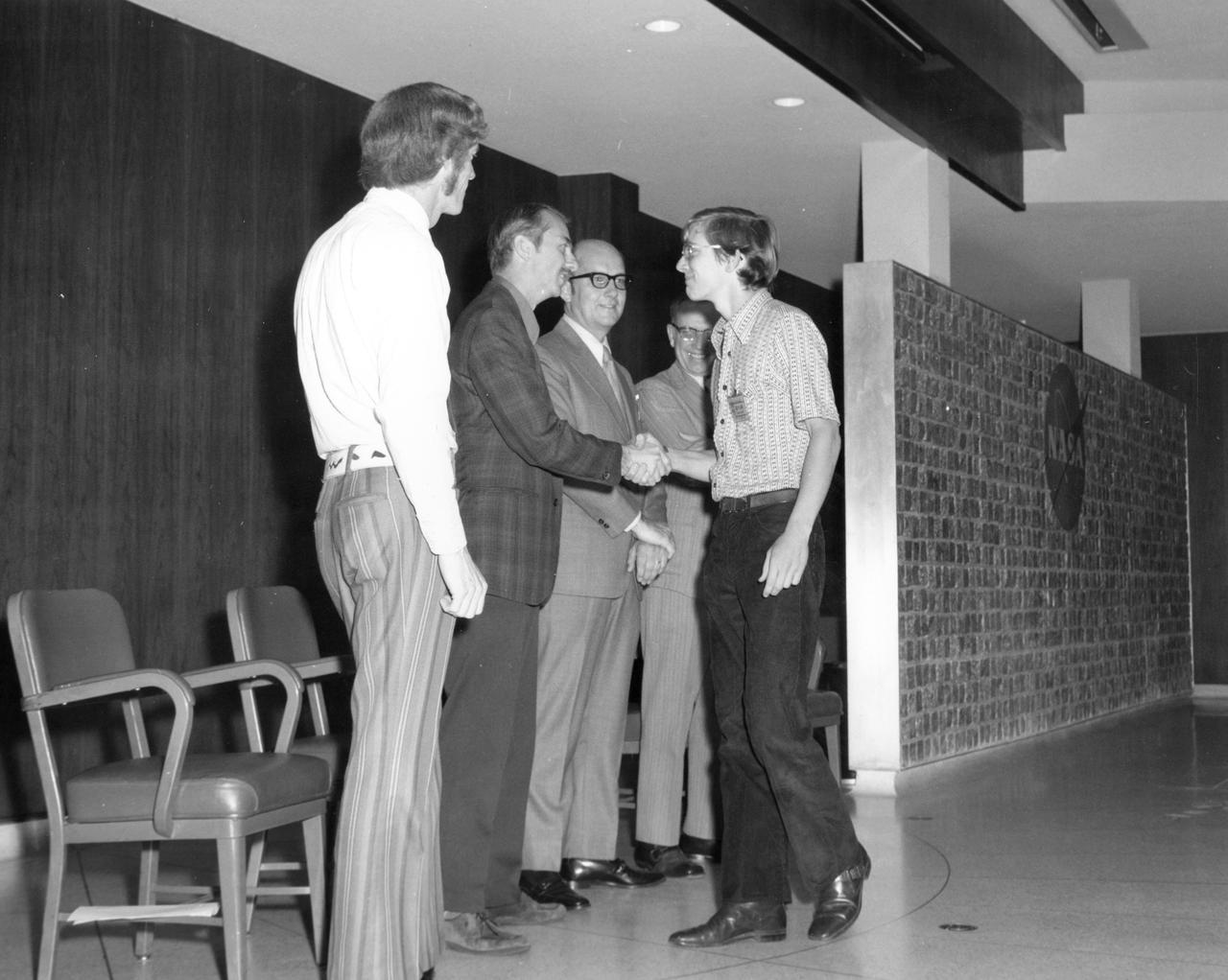
Downey, California high school student, Donald W. Shellack, is greeted by (left to right): Astronauts Russell L. Schweickart, and Owen K. Garriott; Marshall Space Flight Center (MSFC) Skylab Program Manager, Leland Belew; and MSFC Director of Administration and Technical Services, David Newby, during a tour of MSFC. Shellack was among 25 winners of a contest in which some 3,500 high school students proposed experiments for the following year’s Skylab mission. The nationwide scientific competition was sponsored by the National Science Teachers Association and the National Aeronautics and Space Administration (NASA). The winning students, along with their parents and sponsor teachers, visited MSFC where they met with scientists and engineers, participated in design reviews for their experiments, and toured MSFC facilities. Of the 25 students, 6 did not see their experiments conducted on Skylab because the experiments were not compatible with Skylab hardware and timelines. Of the 19 remaining, 11 experiments required the manufacture of additional equipment.
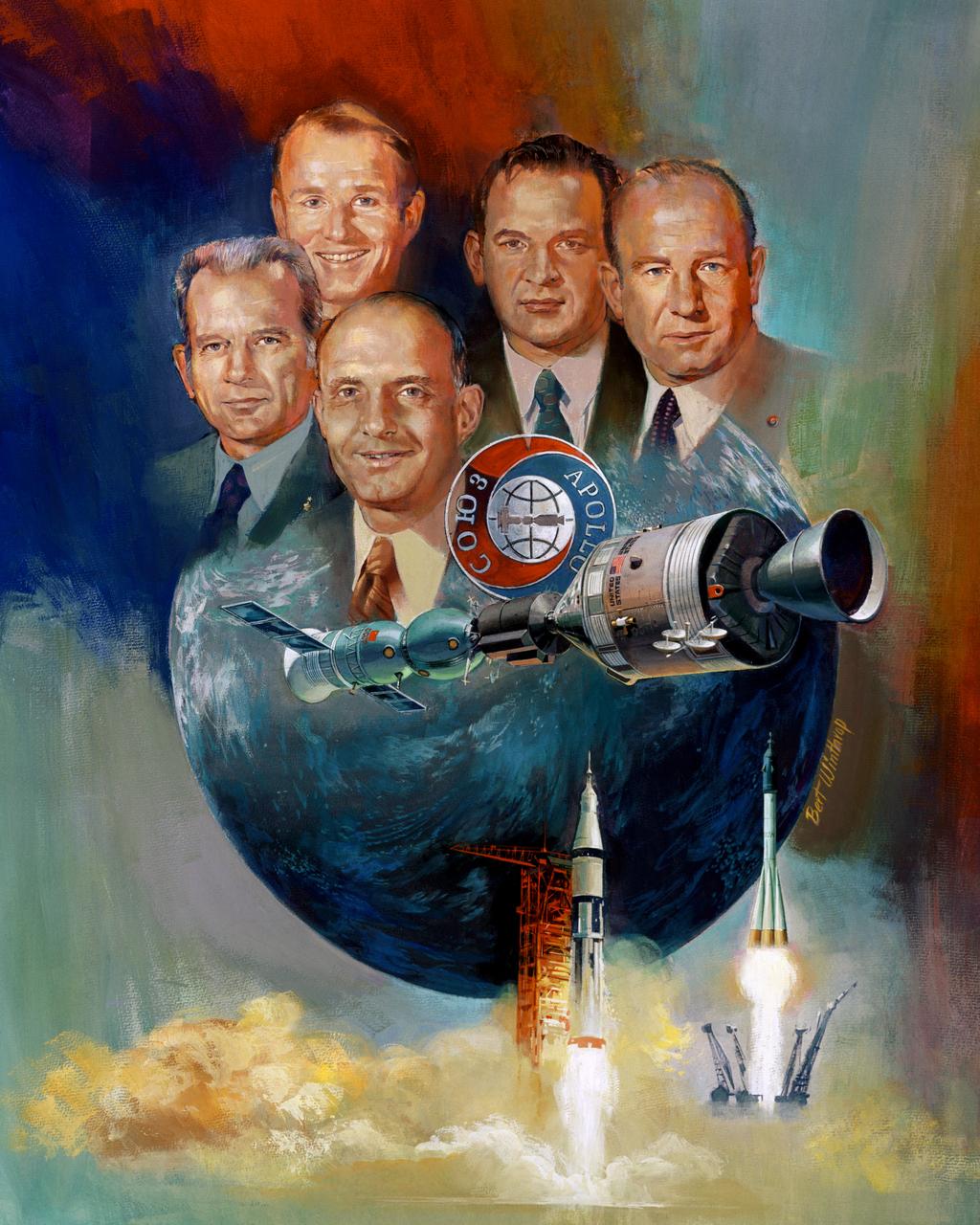
S75-25941 (April 1975) --- An Apollo-Soyuz Test Project (ASTP) symbolic painting by artist Bert Winthrop of Rockwell International Space Division, Downey, California. The artwork is composed of the ASTP mission insignia, the docked Apollo-Soyuz spacecraft, and portraits of the five ASTP prime crewmen, all superimposed against Earth's sphere in the center of the picture. The launches of both the American ASTP space vehicle (on left) and the Soviet ASTP space vehicle are depicted in the lower right corner. The five crewmen are, clockwise from the ASTP emblem, astronaut Thomas P. Stafford, commander of the American crew; astronaut Donald K. Slayton, docking module pilot of the American crew; astronaut Vance D. Brand, command module pilot of the American crew; cosmonaut Valeriy N. Kubasov, engineer on the Soviet crew; and cosmonaut Aleksey A. Leonov, commander of the Soviet crew. The joint U.S.-USSR ASTP docking mission in Earth orbit is scheduled for July 1975.
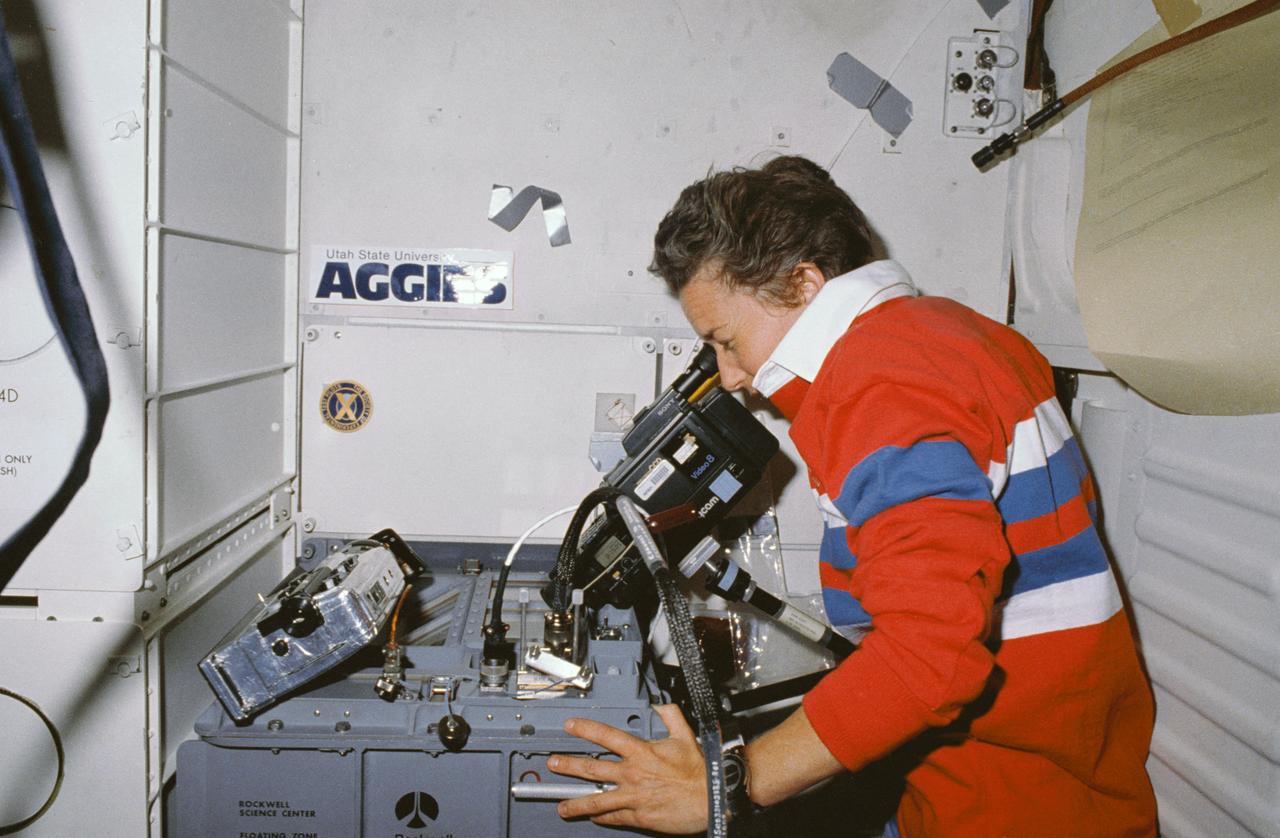
STS030-10-002 (8 May 1989) --- STS-30 Mission Specialist Mary L. Cleave operates 8mm video camcorder at Fluids Experiment Apparatus 2 (FEA-2) (SK73-000102) unit located in aft middeck locker onboard Atlantis, Orbiter Vehicle (OV) 103. Two 8mm video camcorders are positioned above FEA-2 unit to record experiment titled "Floating Zone Crystal Growth and Purification". Rockwell International (RI) through its Space Transportation Systems Division, Downey, California, is engaged in a joint endeavor agreement (JEA) with NASA's Office of Commercial Programs in the field for floating zone crystal growth research. Utah State University Aggies decal appears on aft bulkhead above FEA-2 unit.
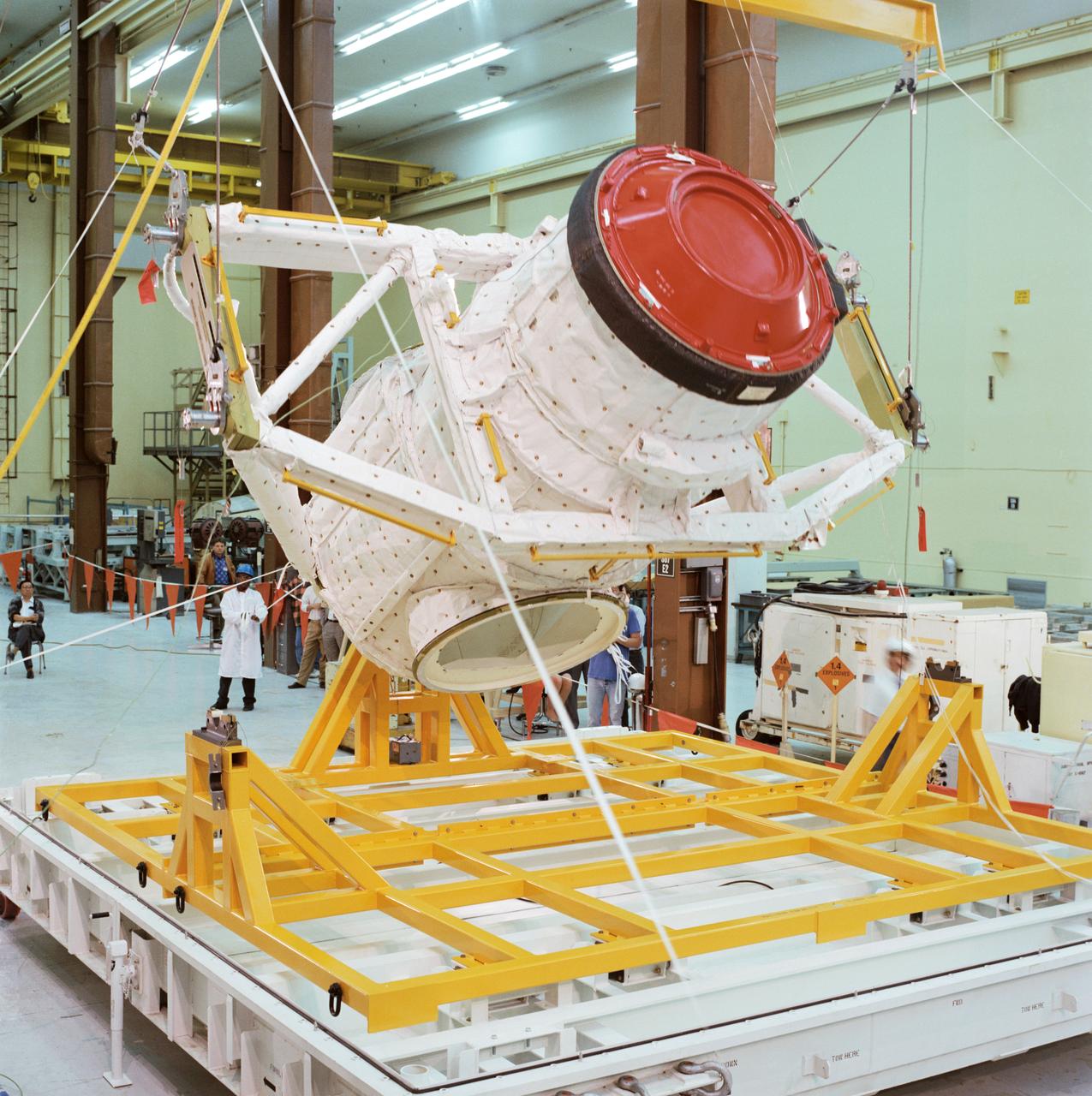
S95-00057 (15 Nov 1994) --- In Rockwell's Building 290 at Downey, California, the external airlock assembly/Mir docking system is rotated into position for crating up for shipment to the Kennedy Space Center (KSC) in Florida. Jointly developed by Rockwell and RSC Energia, the external airlock assembly and Mir docking system will be mounted in the cargo bay of the Space Shuttle Atlantis to enable the shuttle to link up to Russia's Mir space station. The docking system contains hooks and latches compatible with the system currently housed on the Mir's Krystall module, to which Atlantis will attach for the first time next spring. STS-71 will carry two Russian cosmonauts, who will replace a three-man crew aboard Mir including Norman E. Thagard, a NASA astronaut. The combined 10-person crew will conduct almost five days of joint life sciences investigations both aboard Mir and in the Space Shuttle Atlantis's Spacelab module.
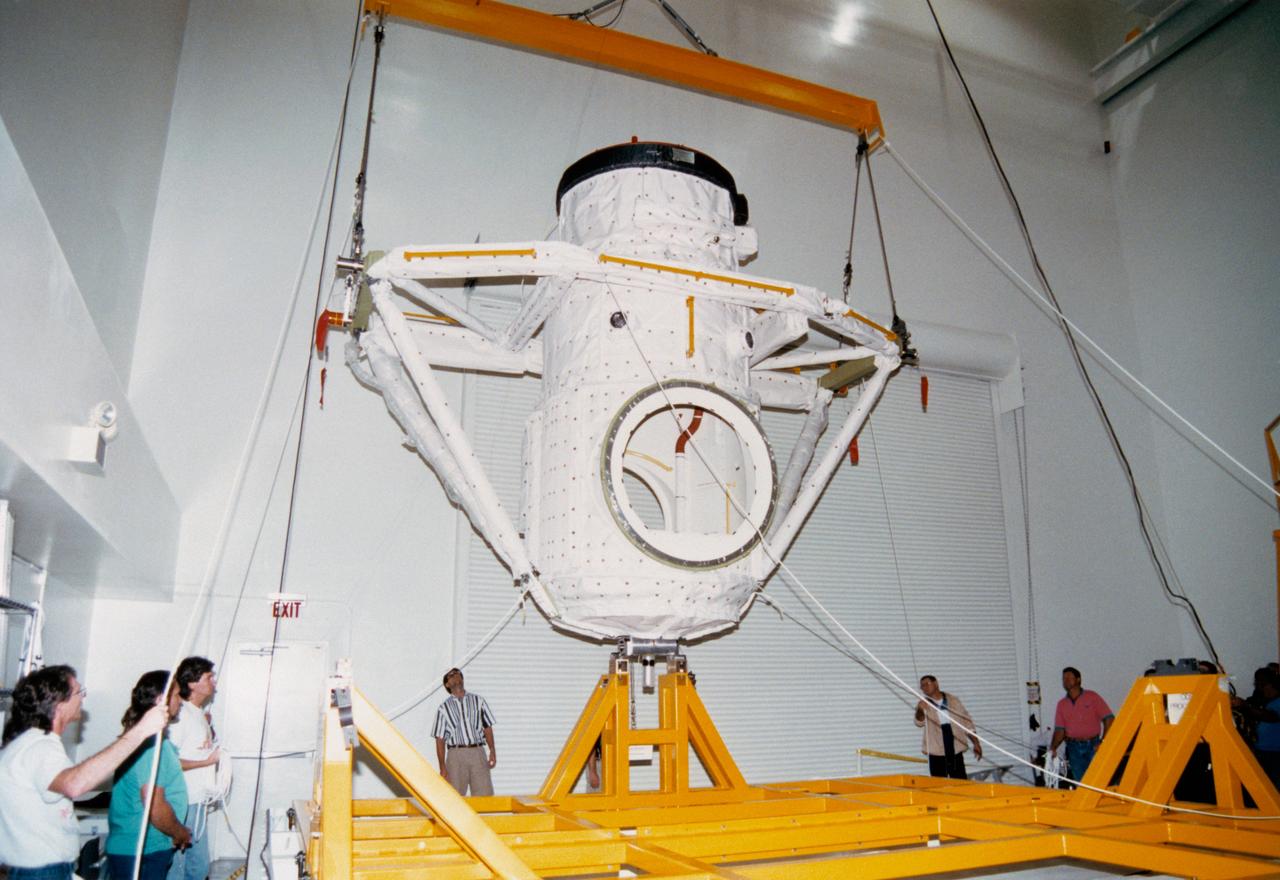
S94-47810 (2 Dec. 1994) --- Lockheed Space Operations Company workers in the Extended Duration Orbiter (EDO) Facility, located inside the Vehicle Assembly Building (VAB), carefully hoist the Orbiter Docking System (ODS) from its shipping container into a test stand. The ODS was shipped in a horizontal position to the Kennedy Space Center (KSC) from contractor Rockwell Aerospace's Downey plant. Once the ODS is upright, work can continue to prepare the hardware for the first docking of the United States Space Shuttle and Russian Space Station MIR in 1995. The ODS contains both United States-made and Russian-made hardware. The black band is Russian-made thermal insulation protecting part of the docking mechanism, also Russian-made, called the Androgynous Peripheral Docking System (APDS). A red protective cap covers the APDS itself. Other elements of the ODS, most of it protected by white United States-made thermal insulation, were developed by Rockwell, which also integrated and checked out the assembled Russian-United States system.
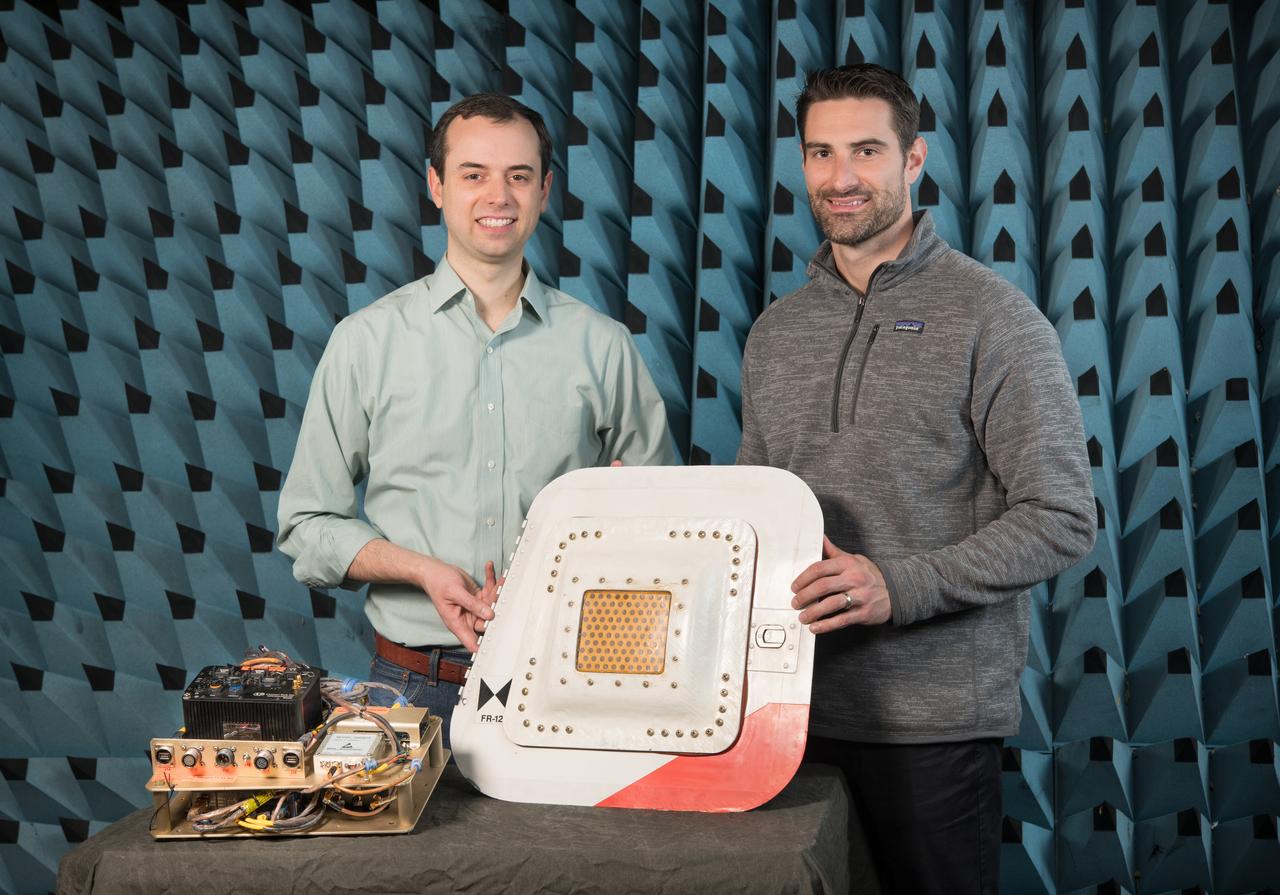
Flight Electronics Payload for Curved Confocal Lightweight Antenna Structures for Aeronautical Communications Technologies, CLAS-ACT, Phased Array Antenna on T-34-C Aircraft Door Flight Curved Confocal Lightweight Antenna Structures for Aeronautical Communications Technologies, CLAS-ACT, Phased Array Antenna Control / Flight Testing