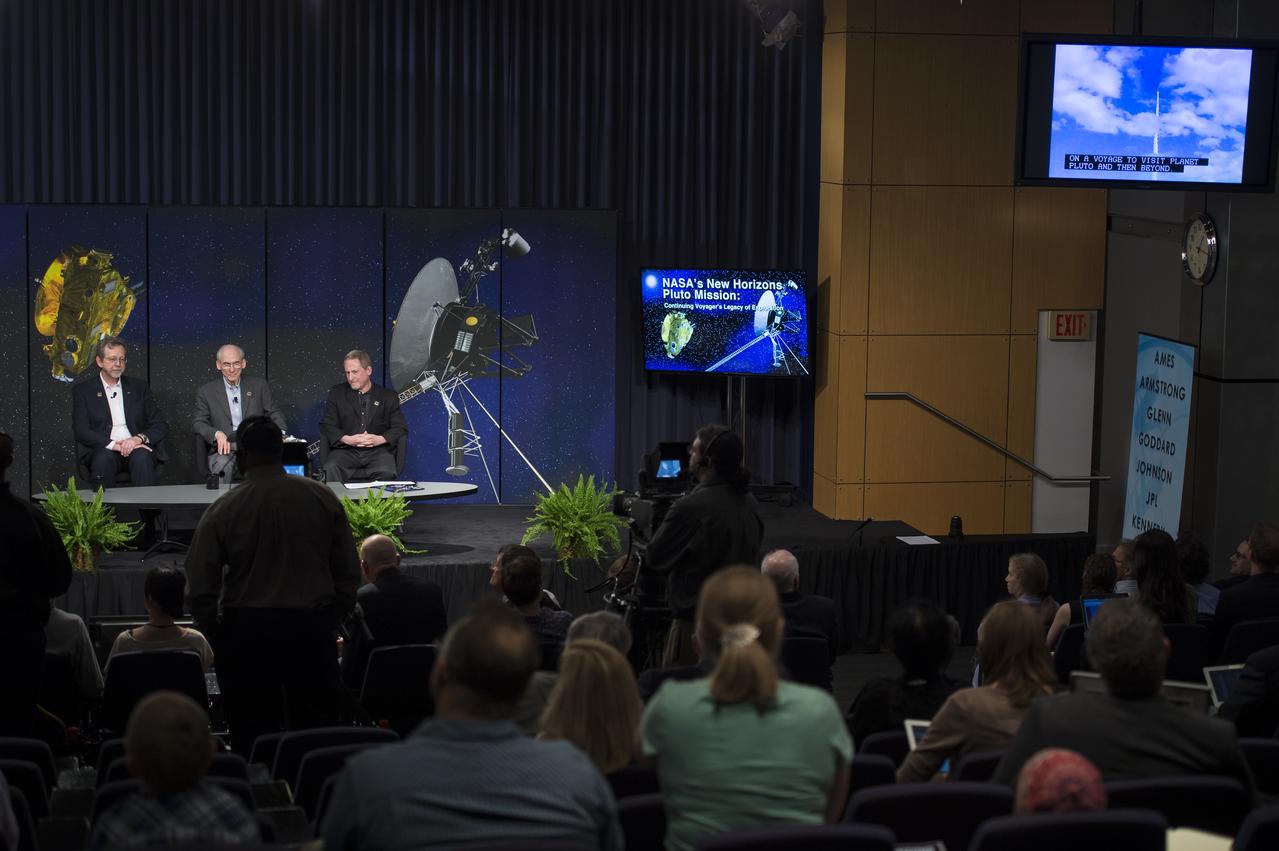
Dr. Jim Green, Dr. Ed Stone, and Dr. Alan Stern speak on a panel at the "New Horizons: The First Mission to the Pluto System and the Kuiper Belt" Event at NASA Headquarters in Washington, DC Monday, August 25, 2014. They discussed how the first images of Pluto and its moons would be captured by the New Horizons spacecraft during a five month long reconnaissance flyby study starting in the summer of 2015. New Horizons launched on January 19, 2006 and is scheduled to make its closest approach to Pluto on July 14, 2015. Photo Credit: (NASA/Aubrey Gemignani)
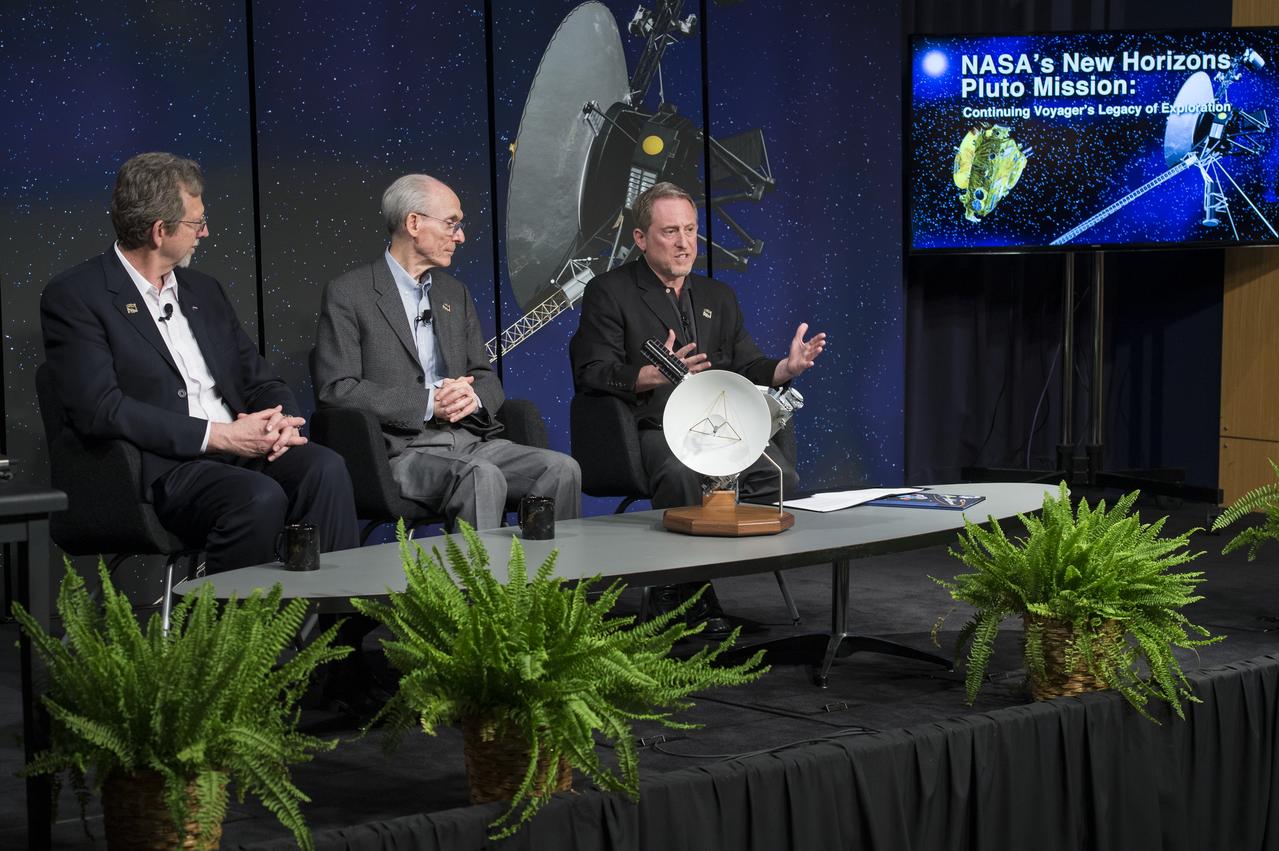
Dr. Jim Green, Dr. Ed Stone, and Dr. Alan Stern speak on a panel at the "New Horizons: The First Mission to the Pluto System and the Kuiper Belt" Event at NASA Headquarters in Washington, DC Monday, August 25, 2014. They discussed how the first images of Pluto and its moons would be captured by the New Horizons spacecraft during a five month long reconnaissance flyby study starting in the summer of 2015. New Horizons launched on January 19, 2006 and is scheduled to make its closest approach to Pluto on July 14, 2015. Photo Credit: (NASA/Aubrey Gemignani)

Dr. Jim Green, Director of NASA’s Planetary Division, speaks on a panel at the "New Horizons: The First Mission to the Pluto System and the Kuiper Belt" Event at NASA Headquarters in Washington, DC Monday, August 25, 2014. Scientists discussed how the first images of Pluto and its moons would be captured by the New Horizons spacecraft during a five month long reconnaissance flyby study starting in the summer of 2015. New Horizons launched on January 19, 2006 and is scheduled to make its closest approach to Pluto on July 14, 2015. Photo Credit: (NASA/Aubrey Gemignani)

Dr. Jim Green, NASA‘s Planetary Science Division Director and Head of Mars Program, discusses what we’ve learned from Curiosity and the other Mars rovers during a “Mars Up Close” panel discussion, Tuesday, August 5, 2014, at the National Geographic Society headquarters in Washington. Photo Credit: (NASA/Bill Ingalls)

Audience members view slides from a presentation by Dr. Jim Green, Dr. Ed Stone, and Dr. Alan Stern at the "New Horizons: The First Mission to the Pluto System and the Kuiper Belt" Event at NASA Headquarters in Washington, DC Monday, August 25, 2014. They discussed how the first images of Pluto and its moons would be captured by the New Horizons spacecraft during a five month long reconnaissance flyby study starting in the summer of 2015. New Horizons launched on January 19, 2006 and is scheduled to make its closest approach to Pluto on July 14, 2015. Photo Credit: (NASA/Aubrey Gemignani)
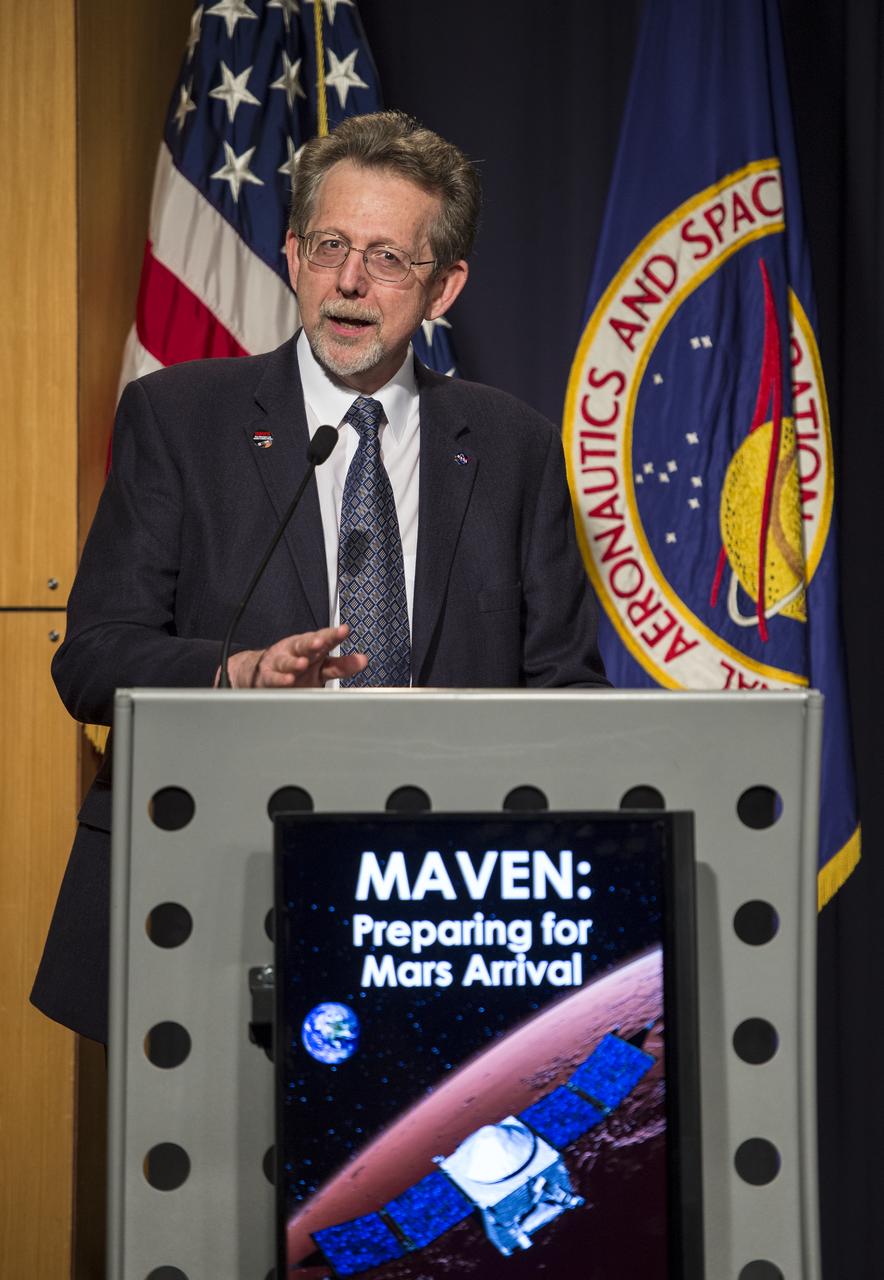
Dr. Jim Green, NASA‘s Planetary Science Division Director and Head of Mars Program, gives opening remarks at a media briefing where panelist outlined activities around the Sunday, Sept. 21 orbital insertion at Mars of the agency’s Mars Atmosphere and Volatile EvolutioN (MAVEN) spacecraft, Wednesday, Sept. 17, 2014 at NASA Headquarters in Washington. (Photo credit: NASA/Bill Ingalls)
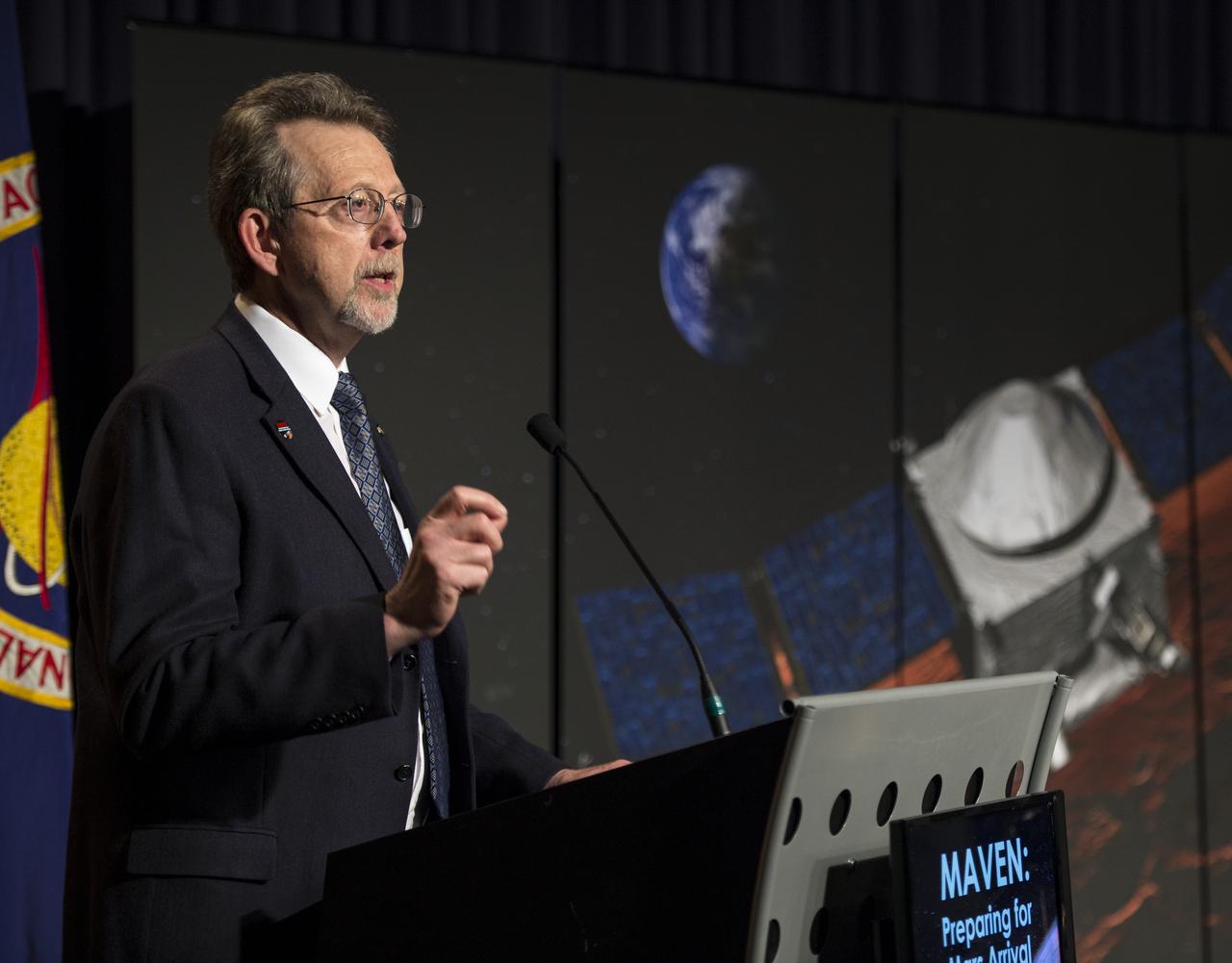
Dr. Jim Green, NASA‘s Planetary Science Division Director and Head of Mars Program, gives opening remarks at a media briefing where panelist outlined activities around the Sunday, Sept. 21 orbital insertion at Mars of the agency’s Mars Atmosphere and Volatile EvolutioN (MAVEN) spacecraft, Wednesday, Sept. 17, 2014 at NASA Headquarters in Washington. (Photo credit: NASA/Bill Ingalls)
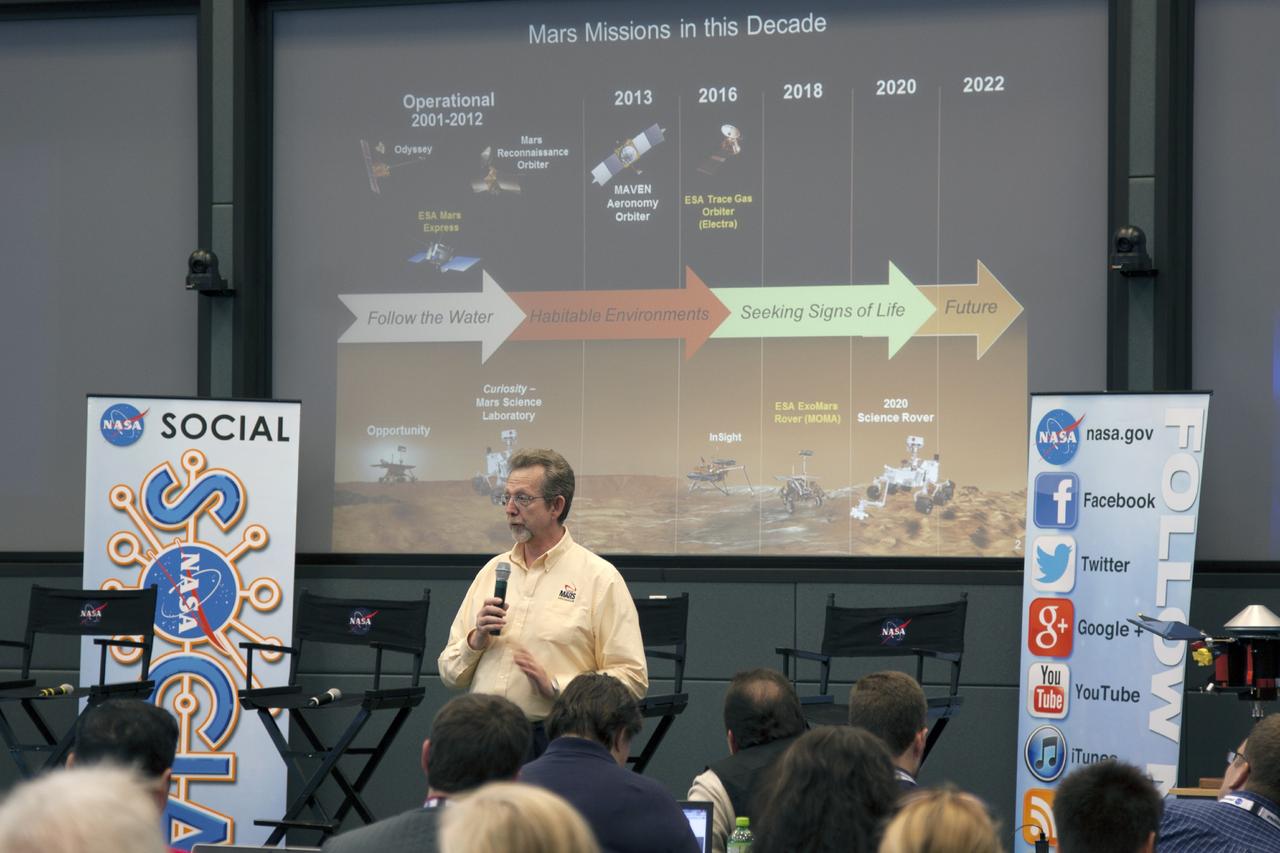
CAPE CANAVERAL, Fla. -- In the conference room of Operations Support Building II at NASA's Kennedy Space Center in Florida, social media participants listen to a briefing on the Mars Atmosphere and Volatile Evolution, or MAVEN, mission by Dr. Jim Green, the agency's Planetary Science director. The social media participants gathered at the Florida spaceport for the launch of the Mars Atmosphere and Volatile Evolution, or MAVEN, spacecraft. Their visit included tours of key facilities and participating in presentations by key NASA leaders who updated the space agency's current efforts. Photo credit: NASA/Jim Grossman

VANDENBERG AFB, Calif. -- During a news conference at Vandenberg Air Force Base, Calif. prior to the launch of NASA's Landsat Data Continuity Mission, or LDCM, media representative heard from Rani Gran of NASA Public Affairs, Dr. Jim Irons, LDCM project scientist from NASA's Goddard Space Flight Center, Dr. Thomas Loveland, senior scientist and co-chair of the Landsat Science Team U.S. Geological Survey Earth Resources Observation and Science Center, Kass Green, Landsat scientist and president of Kass Green and Associates, and Dr. Mike Wulder, senior research scientist of the Landsat Science Team Canadian Forest Service, Natural Resources Canada. The Landsat Data Continuity Mission LDCM is the future of Landsat satellites. It will continue to obtain valuable data and imagery to be used in agriculture, education, business, science, and government. The Landsat Program provides repetitive acquisition of high resolution multispectral data of the Earth's surface on a global basis. The data from the Landsat spacecraft constitute the longest record of the Earth's continental surfaces as seen from space. It is a record unmatched in quality, detail, coverage, and value. Liftoff is planned for Feb. 11, 2013 aboard a United Launch Alliance Atlas V rocket. For more information, visit: http:__www.nasa.gov_mission_pages_landsat_main_index.html Photo credit: NASA_Kim Shiflett

VANDENBERG AFB, Calif. -- During a news conference at Vandenberg Air Force Base, Calif. prior to the launch of NASA's Landsat Data Continuity Mission, or LDCM, media representative heard from Dr. Jim Irons, LDCM project scientist from NASA's Goddard Space Flight Center, Dr. Thomas Loveland, senior scientist and co-chair of the Landsat Science Team U.S. Geological Survey Earth Resources Observation and Science Center, and Kass Green, Landsat scientist and president of Kass Green and Associates. The Landsat Data Continuity Mission LDCM is the future of Landsat satellites. It will continue to obtain valuable data and imagery to be used in agriculture, education, business, science, and government. The Landsat Program provides repetitive acquisition of high resolution multispectral data of the Earth's surface on a global basis. The data from the Landsat spacecraft constitute the longest record of the Earth's continental surfaces as seen from space. It is a record unmatched in quality, detail, coverage, and value. Liftoff is planned for Feb. 11, 2013 aboard a United Launch Alliance Atlas V rocket. For more information, visit: http:__www.nasa.gov_mission_pages_landsat_main_index.html Photo credit: NASA_Kim Shiflett

CAPE CANAVERAL, Fla. -- Dr. Jim Green, director of the Planetary Science Division at NASA Headquarters, participates in a post-launch news conference in NASA's Press Site TV auditorium following the successful launch of NASA’s Mars Atmosphere and Volatile EvolutioN, or MAVEN, spacecraft. Launch was on schedule at 1:28 p.m. EST Nov. 18 at the opening of a two-hour launch window. After a 10-month journey to the Red Planet, MAVEN will study its upper atmosphere in unprecedented detail from orbit above the planet. Built by Lockheed Martin in Littleton, Colo., MAVEN will arrive at Mars in September 2014 and will be inserted into an elliptical orbit with a high point of 3,900 miles, swooping down to as close as 93 miles above the planet's surface. For more information, visit: http://www.nasa.gov/mission_pages/maven/main/index.html. Photo credit: NASA/Kim Shiflett
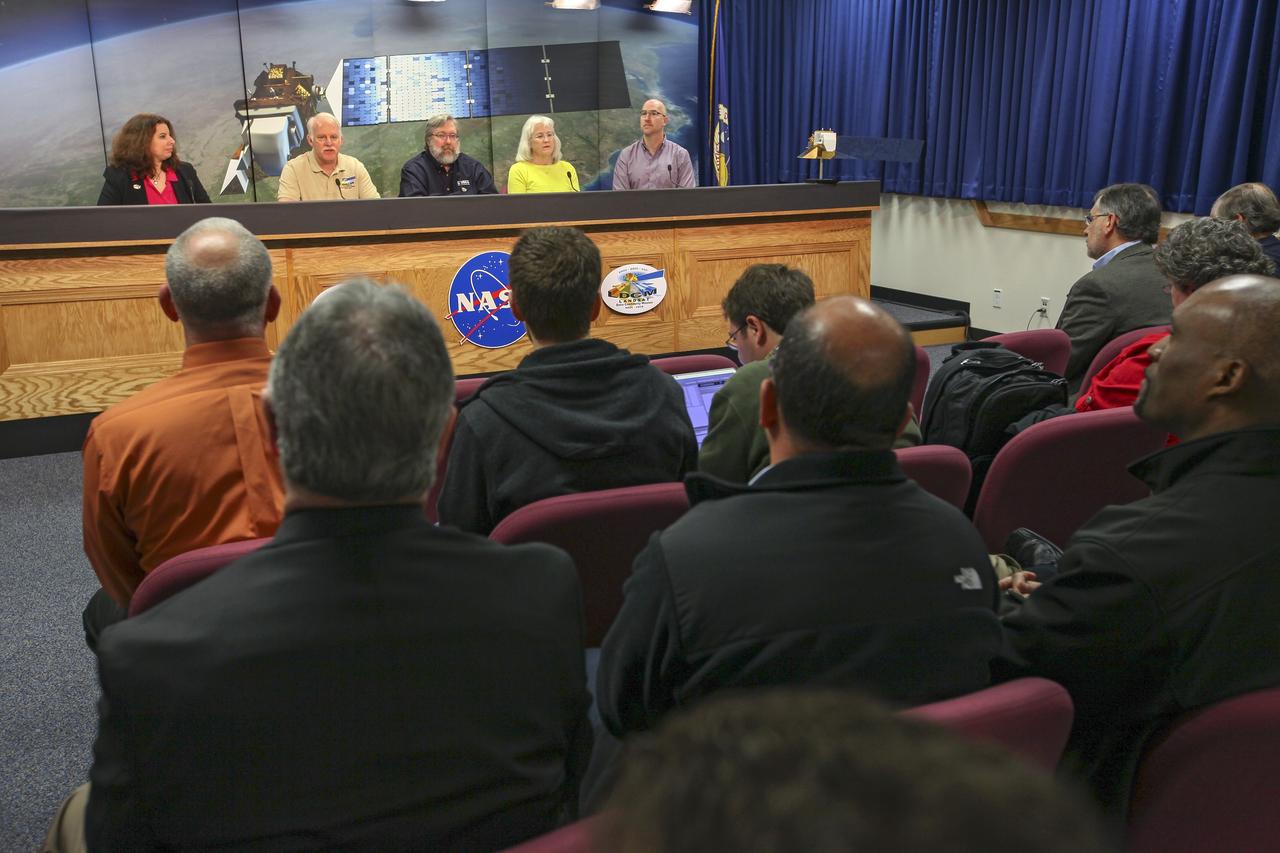
VANDENBERG AIR FORCE BASE, Calif. -- Media attend a mission science briefing at Vandenberg Air Force Base in California in preparation for the launch of the Landsat Data Continuity Mission LDCM. From left are Rani Gran of NASA Public Affairs, LDCM project scientist Dr. Jim Irons from NASA's Goddard Space Flight Center, senior scientist and co-chair of the Landsat Science Team U.S. Geological Survey Earth Resources Observation and Science EROS Center Dr. Thomas Loveland, Landsat scientist and president of Kass Green and Associates Kass Green, and senior research scientist Dr. Mike Wulder of the Landsat Science Team Canadian Forest Service, Natural Resources Canada. Launch of LDCM aboard a United Launch Alliance Atlas V rocket from Vandenberg's Space Launch Complex-3E is planned for Feb. 11 during a 48-minute launch window that opens at 10:02 a.m. PST, or 1:02 p.m. EST. LDCM is the eighth satellite in the Landsat Program series of Earth-observing missions and will continue the program’s critical role in monitoring, understanding and managing the resources needed for human sustainment, such as food, water and forests. NASA's Goddard Space Flight Center in Greenbelt, Md., is responsible for LDCM project management. Orbital Sciences Corp. built the LDCM satellite. NASA's Launch Services Program at the Kennedy Space Center in Florida provides launch management. After launch and the initial checkout phase, the U. S. Geological Survey will take operational control of LDCM, and it will be renamed Landsat 8. Photo credit: NASA/Kim Shiflett

CAPE CANAVERAL, Fla. -- A post-launch news conference is held in NASA's Press Site TV auditorium following the successful launch of NASA’s Mars Atmosphere and Volatile EvolutioN, or MAVEN, spacecraft. Participating from left are David Mitchell, NASA MAVEN project manager at the Goddard Space Flight Center in Greenbelt, Md., Bruce Jakosky, MAVEN principal investigator from the Laboratory for Atmospheric and Space Physics at the University of Colorado at Boulder, and Dr. Jim Green, director of the Planetary Science Division at NASA Headquarters. Launch was on schedule at 1:28 p.m. EST Nov. 18 at the opening of a two-hour launch window. After a 10-month journey to the Red Planet, MAVEN will study its upper atmosphere in unprecedented detail from orbit above the planet. Built by Lockheed Martin in Littleton, Colo., MAVEN will arrive at Mars in September 2014 and will be inserted into an elliptical orbit with a high point of 3,900 miles, swooping down to as close as 93 miles above the planet's surface. For more information, visit: http://www.nasa.gov/mission_pages/maven/main/index.html. Photo credit: NASA/Kim Shiflett
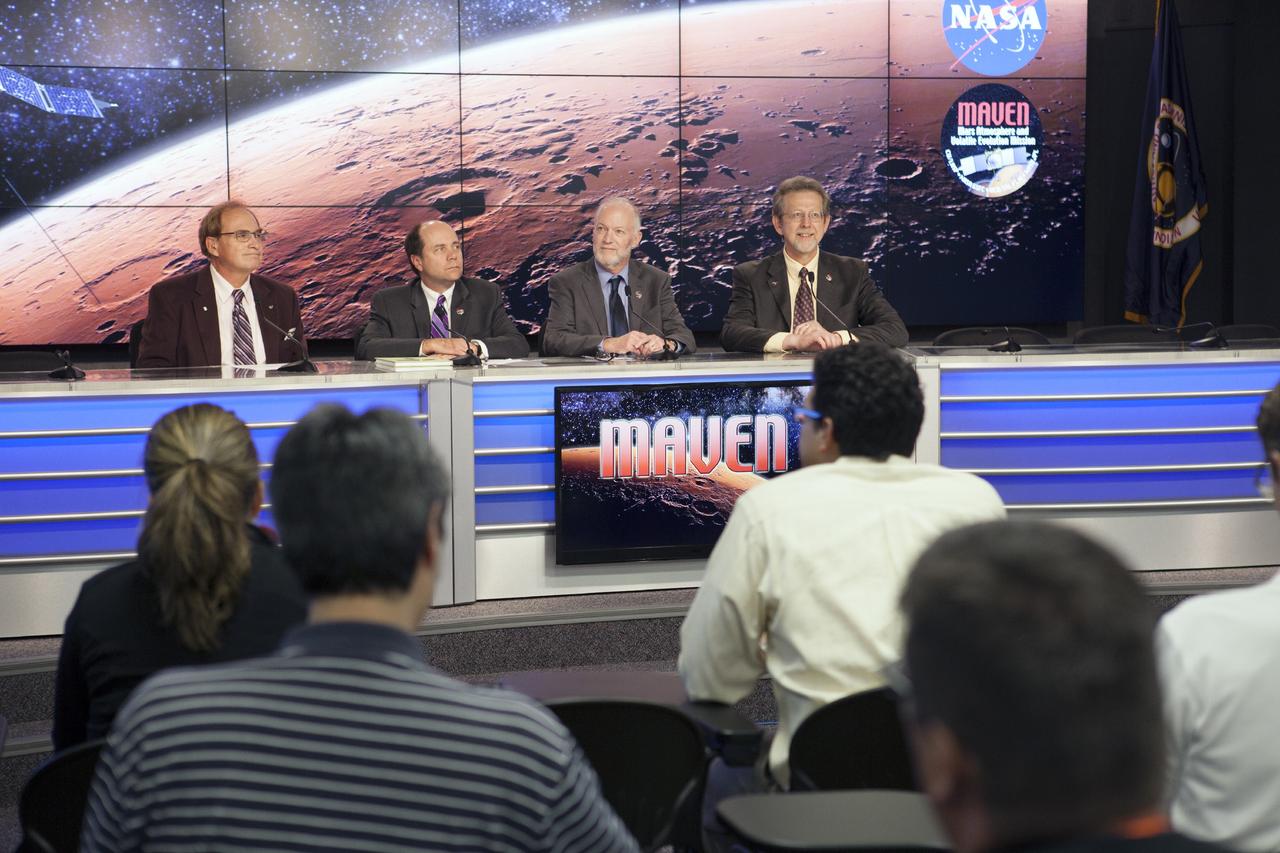
CAPE CANAVERAL, Fla. -- A post-launch news conference is held in NASA's Press Site TV auditorium following the successful launch of NASA’s Mars Atmosphere and Volatile EvolutioN, or MAVEN, spacecraft. Participating from left are moderator George Diller, NASA Public Affairs, David Mitchell, NASA MAVEN project manager at the Goddard Space Flight Center in Greenbelt, Md., Bruce Jakosky, MAVEN principal investigator from the Laboratory for Atmospheric and Space Physics at the University of Colorado at Boulder, and Dr. Jim Green, director of the Planetary Science Division at NASA Headquarters. Launch was on schedule at 1:28 p.m. EST Nov. 18 at the opening of a two-hour launch window. After a 10-month journey to the Red Planet, MAVEN will study its upper atmosphere in unprecedented detail from orbit above the planet. Built by Lockheed Martin in Littleton, Colo., MAVEN will arrive at Mars in September 2014 and will be inserted into an elliptical orbit with a high point of 3,900 miles, swooping down to as close as 93 miles above the planet's surface. For more information, visit: http://www.nasa.gov/mission_pages/maven/main/index.html. Photo credit: NASA/Kim Shiflett

DAVINCI VADIX team members discuss observations at Crater Island, Utah, June 23, 2026. NASA/Mike Guinto