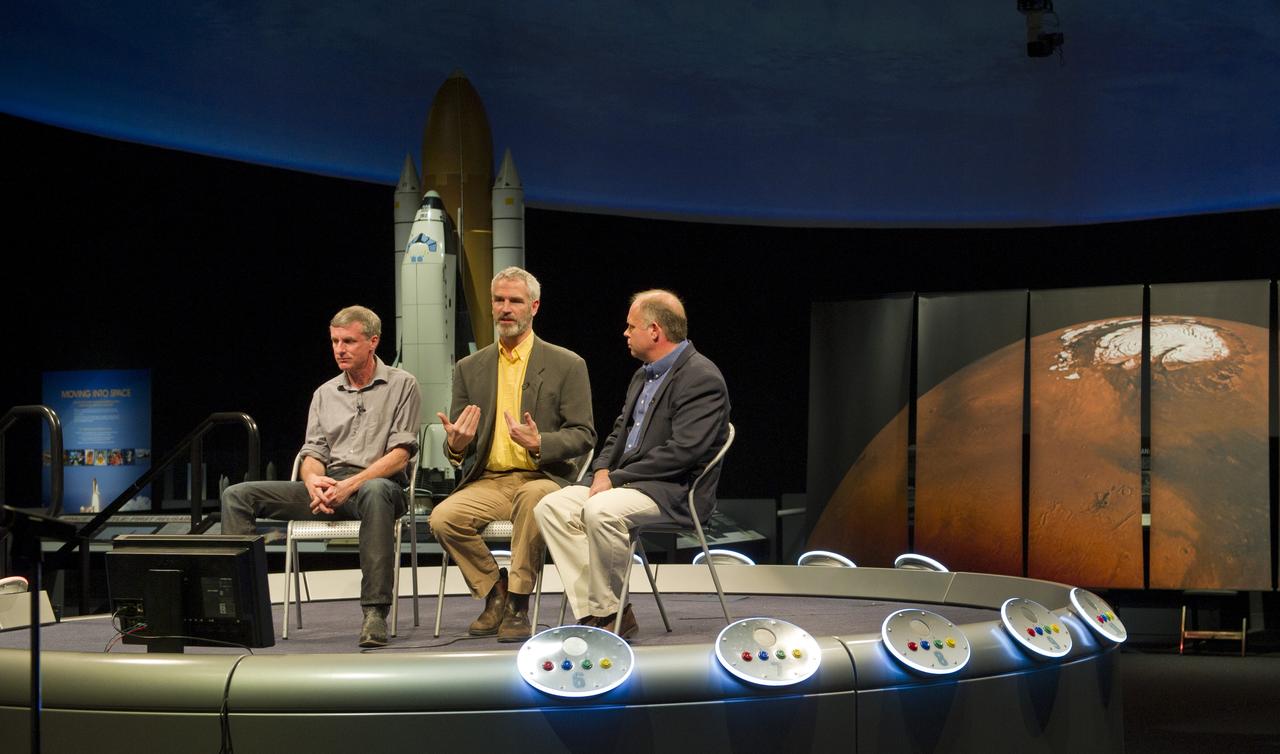
Dr. John Grant, seated right, moderates a discussion with Dr. Jack Mustard, from Brown University, and Dr. Steve Squyres, from Cornell University, seated left, during a Mars Program Update, Thursday, Jan. 13, 2011, at the Smithsonian National Air and Space Museum in Washington. Prominent scientists discussed evidence of water on Mars, current Program status, including the 7th Anniversary of the Mars rovers and the upcoming Mars Science Laboratory mission and previewed exciting discoveries to come. Photo Credit: (NASA/Paul E. Alers)
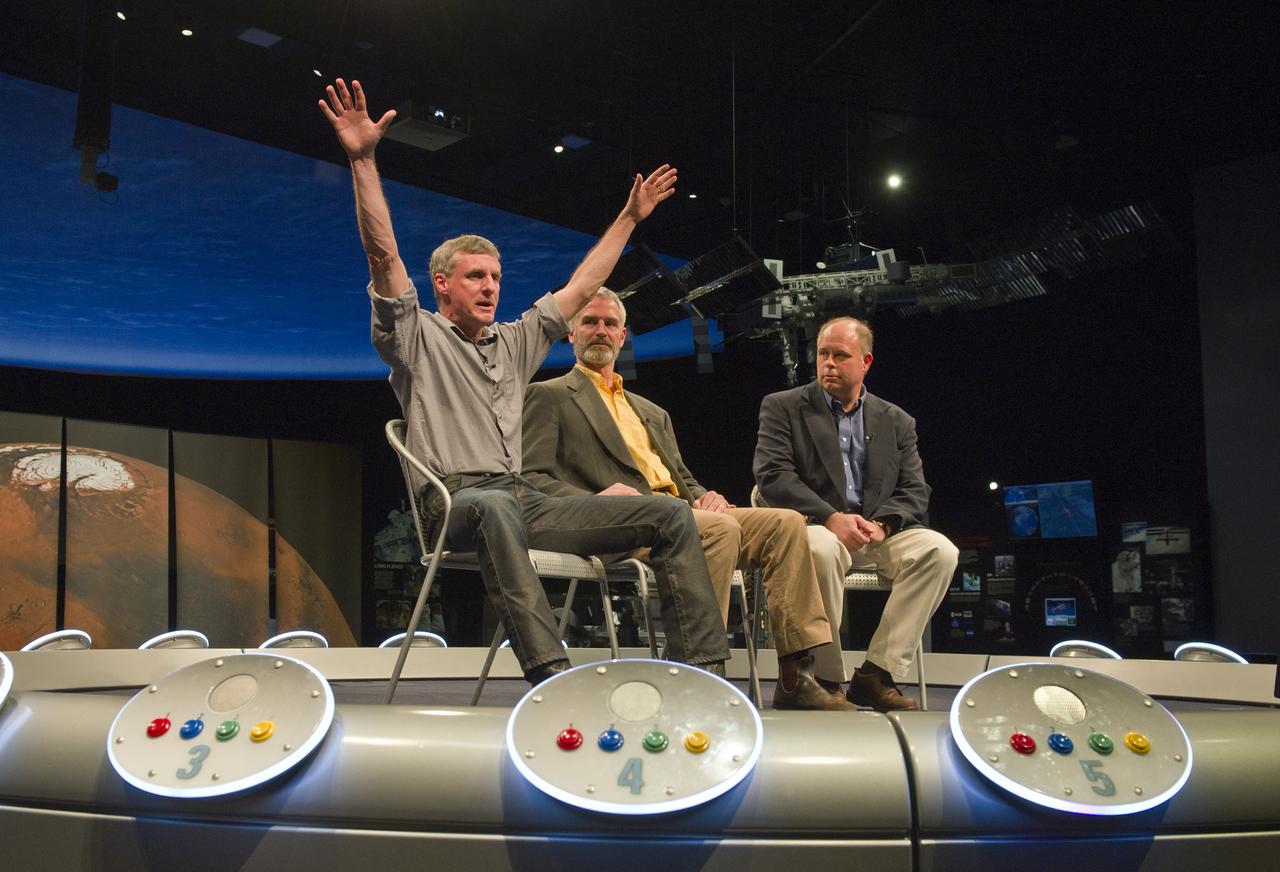
Dr. Steve Squyres, from Cornell University, left, talks during a panel discussion on the Mars Program, Thursday, Jan. 13, 2011, at the Smithsonian National Air and Space Museum in Washington as Dr. Jack Mustard, from Brown University and Dr. John Grant, moderator, right, look on. Prominent scientists and the head of the Mars Exploration Program gathered at the Smithsonian to discuss evidence of water on Mars; current Program status, including the 7th Anniversary of the Mars rovers and the upcoming Mars Science Laboratory mission also giving previews of the exciting discoveries to come. Photo Credit: (NASA/Paul E. Alers)

Dr. Steve Squyres, from Cornell University, talks during a Mars Program Update where prominent scientists discussed evidence of water on Mars, current Program status, including the 7th Anniversary of the Mars rovers and the upcoming Mars Science Laboratory mission and previewing exciting discoveries to come, Thursday, Jan. 13, 2011, at the Smithsonian National Air and Space Museum in Washington. Photo Credit: (NASA/Paul E. Alers)
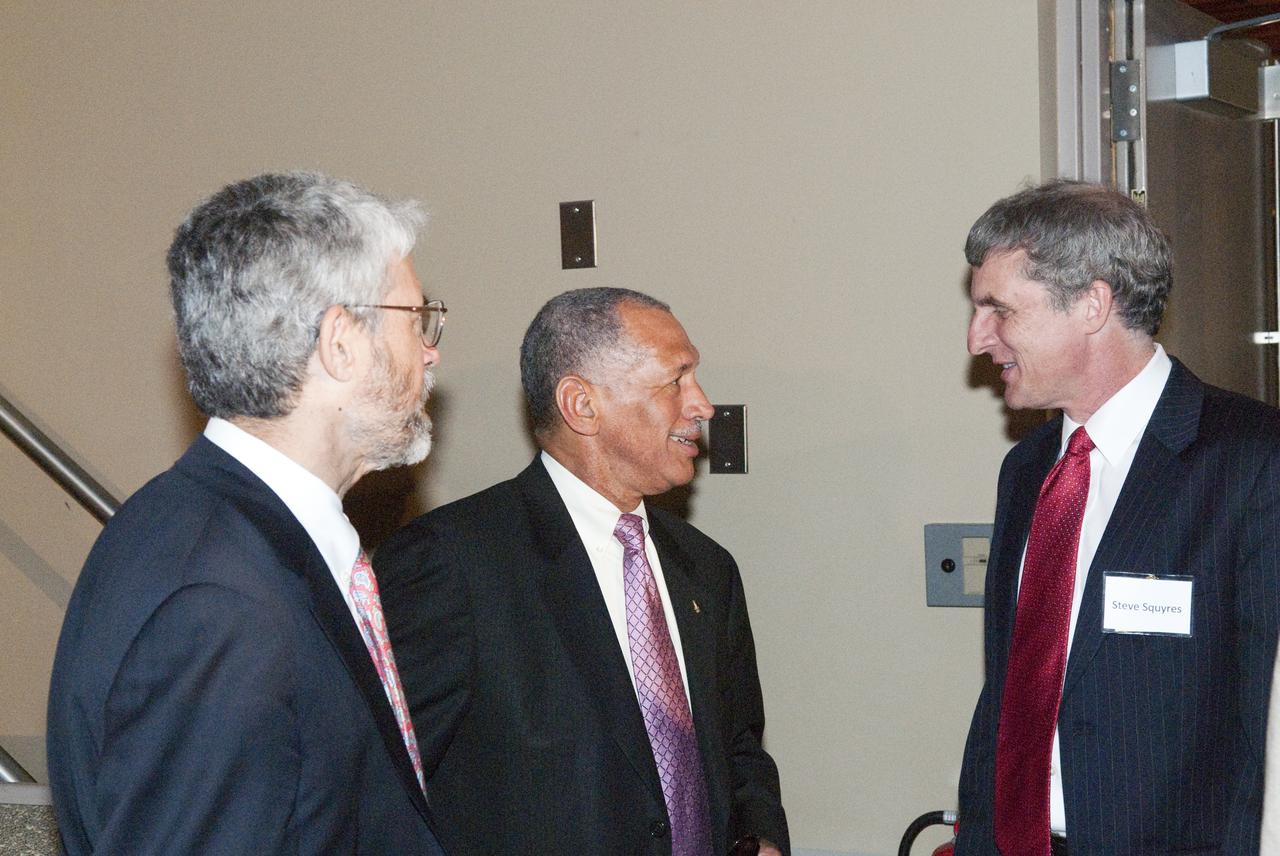
CAPE CANAVERAL, Fla. - In the Astronaut Encounter Theater at the NASA Kennedy Space Center Visitor Complex in Florida, John Holdren, assistant to the President for science and technology and director of the White House Office of Science and Technology Policy, NASA Administrator Charles Bolden and Dr. Steve Squyres, Astronomy Professor at Cornell University took a few moments to talk prior to the wrap up of the Conference on the American Space Program for the 21st Century. Photo Credit: NASA_Jim Grossmann
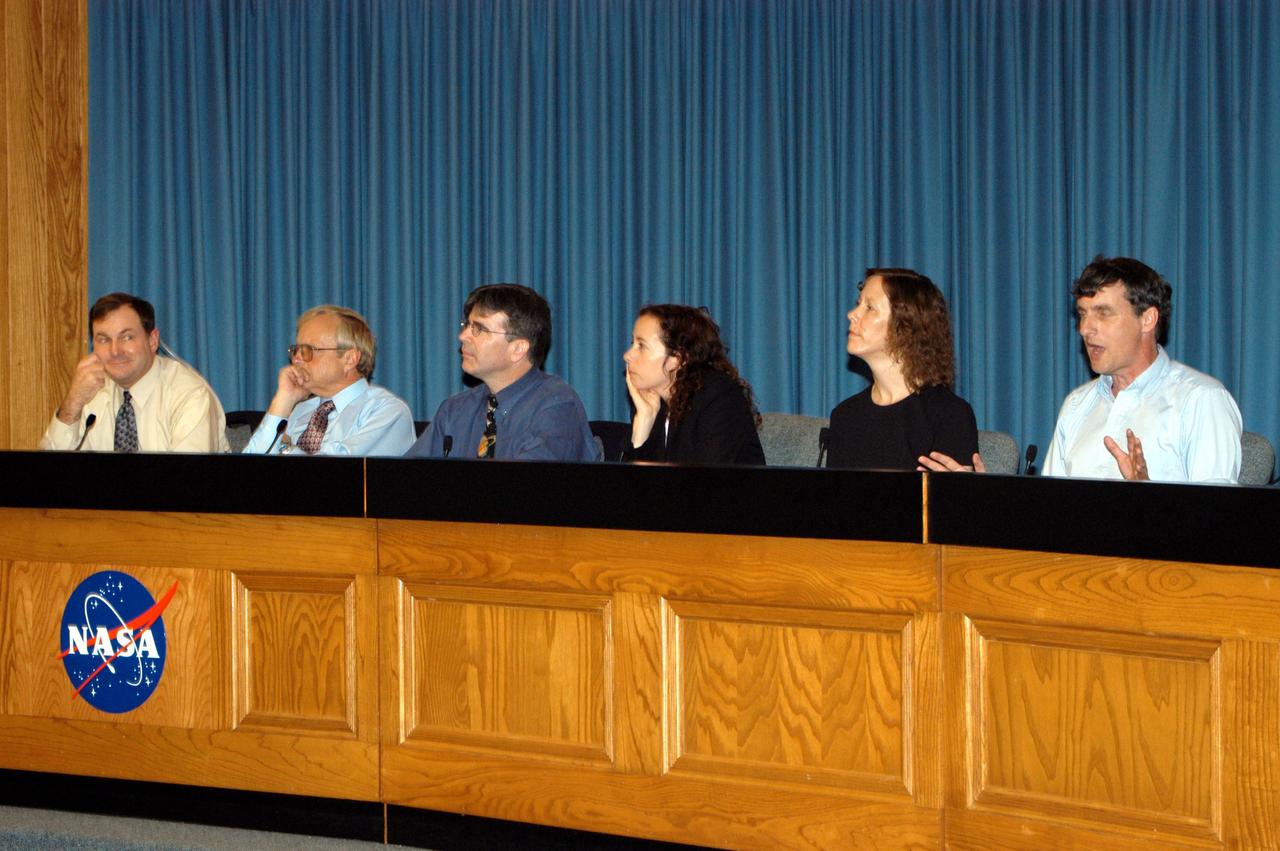
KENNEDY SPACE CENTER, FLA. - A science briefing on the Mars Exploration Rover (MER) missions is held for the media at Kennedy Space Center. From left, the participants are Donald Savage, NASA Public Information Officer; Dr. Ed Weiler, Associate Administrator for Space Science, NASA Headquarters; Dr. Jim Garvin, Mars lead scientist, NASA Headquarters; Dr. Cathy Weitz, MER program scientist, NASA Headquarters; Dr. Joy Crisp, MER project scientist, Jet Propulsion Laboratory; and Dr. Steve Squyres, Mer principal investigator, Cornell Univeristy, Ithaca, N.Y. NASA's twin Mars Exploration Rovers are designed to study the history of water on Mars. These robotic geologists are equipped with a robotic arm, a drilling tool, three spectrometers, and four pairs of cameras that allow them to have a human-like, 3D view of the terrain. Each rover could travel as far as 100 meters in one day to act as Mars scientists' eyes and hands, exploring an environment where humans are not yet able to go. MER-A is scheduled to launch on June 8 at 2:06 p.m. EDT, with two launch opportunities each day during a launch period that closes on June 24.
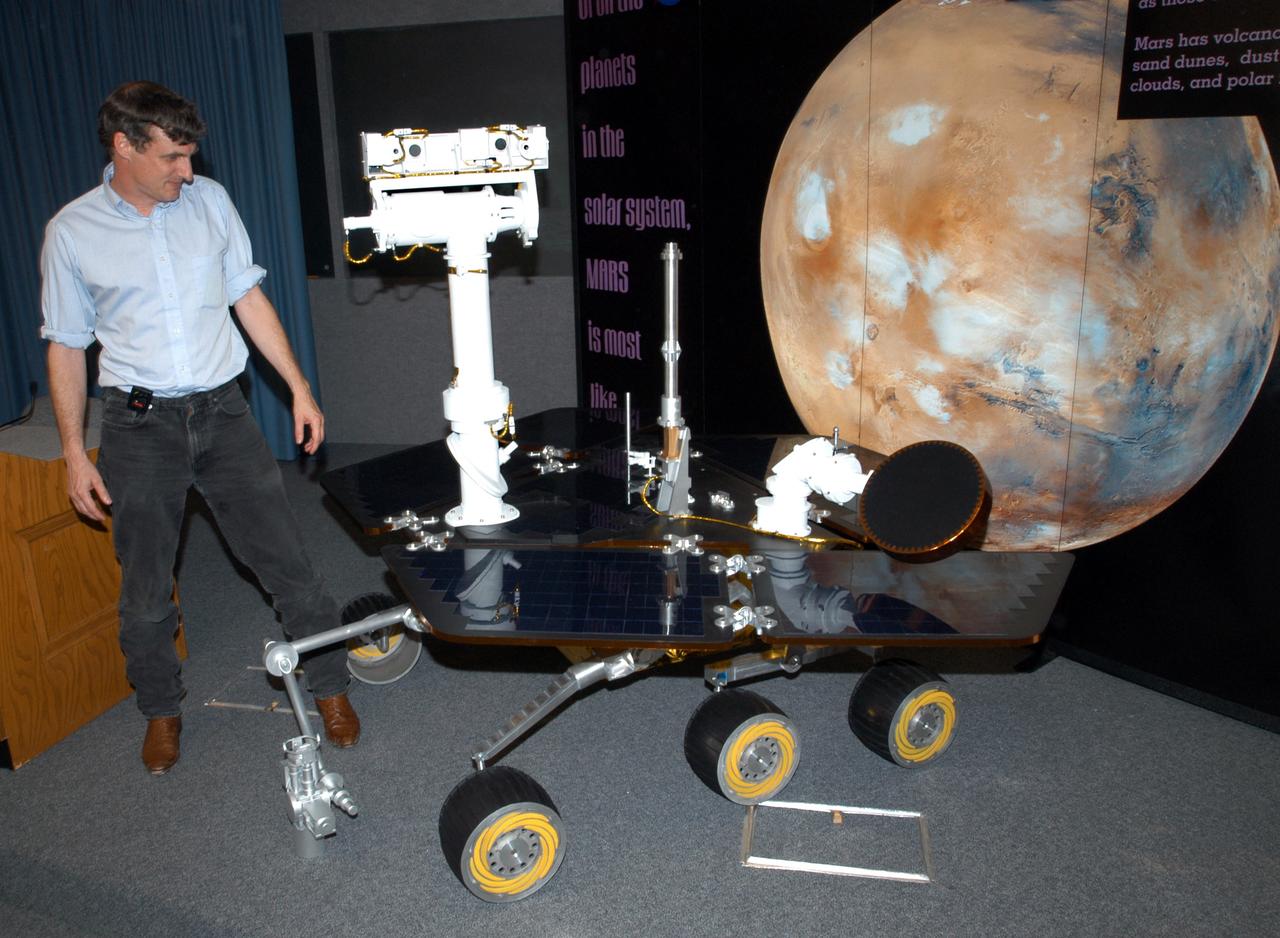
KENNEDY SPACE CENTER, FLA. - Dr. Steve Squyres, of Cornell Univeristy, Ithaca, N.Y., principal investigator for the Mars Exploration Rover (MER) suite of science instruments, uses a model of a Mars rover to illustrate a point during a science briefing for the media. NASA's twin Mars Exploration Rovers are designed to study the history of water on Mars. These robotic geologists are equipped with a robotic arm, a drilling tool, three spectrometers, and four pairs of cameras that allow them to have a human-like, 3D view of the terrain. Each rover could travel as far as 100 meters in one day to act as Mars scientists' eyes and hands, exploring an environment where humans are not yet able to go. MER-A is scheduled to launch on June 8 at 2:06 p.m. EDT, with two launch opportunities each day during a launch period that closes on June 24.
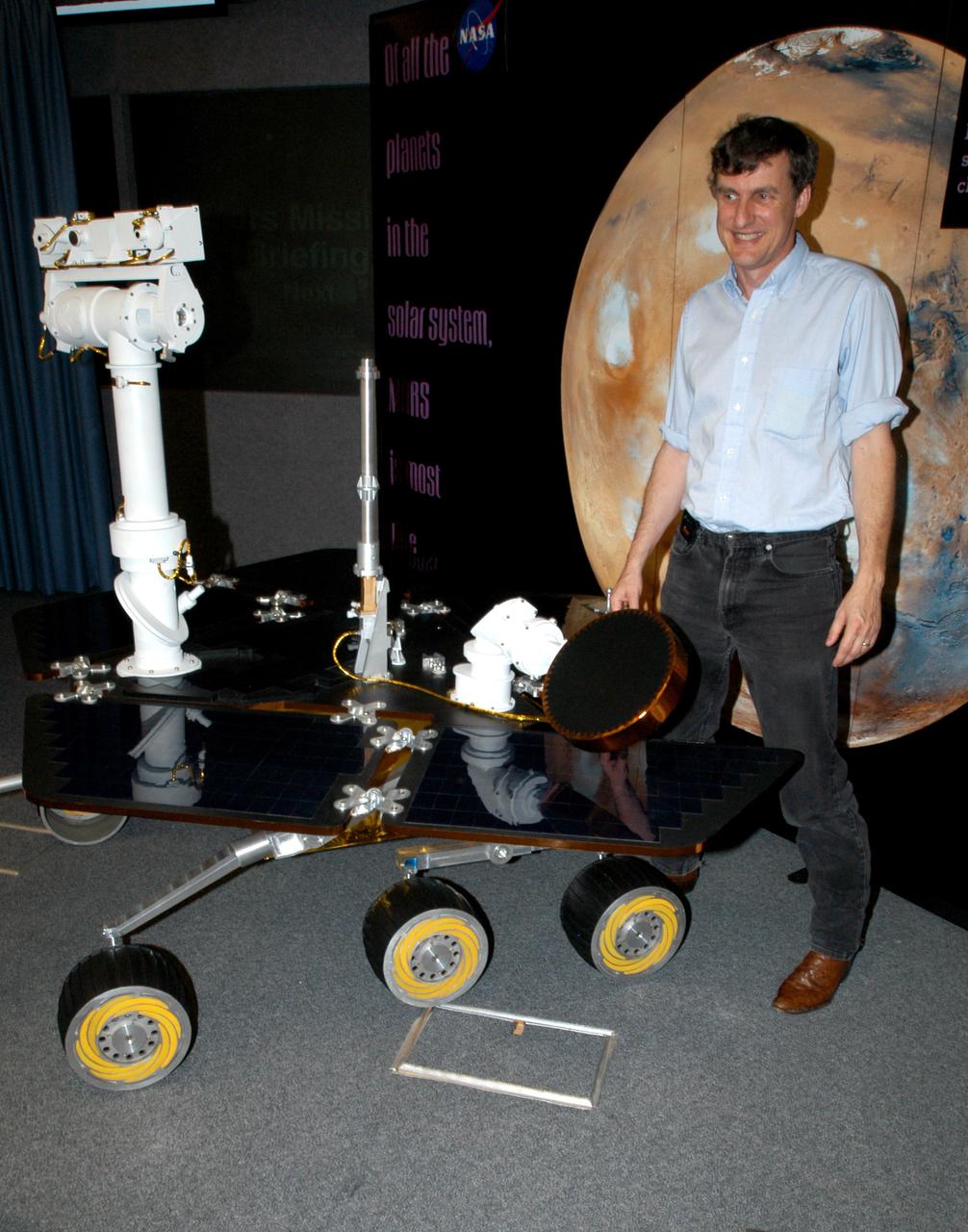
KENNEDY SPACE CENTER, FLA. - Dr. Steve Squyres, of Cornell Univeristy, Ithaca, N.Y., principal investigator for the Mars Exploration Rover (MER) suite of science instruments, uses a model of a Mars rover to illustrate a point during a science briefing for the media. NASA's twin Mars Exploration Rovers are designed to study the history of water on Mars. These robotic geologists are equipped with a robotic arm, a drilling tool, three spectrometers, and four pairs of cameras that allow them to have a human-like, 3D view of the terrain. Each rover could travel as far as 100 meters in one day to act as Mars scientists' eyes and hands, exploring an environment where humans are not yet able to go. MER-A is scheduled to launch on June 8 at 2:06 p.m. EDT, with two launch opportunities each day during a launch period that closes on June 24.

KENNEDY SPACE CENTER, FLA. - Dr. Steve Squyres, of Cornell Univeristy, Ithaca, N.Y., principal investigator for the Mars Exploration Rover (MER) suite of science instruments, takes part in a science briefing for the media. NASA's twin Mars Exploration Rovers are designed to study the history of water on Mars. These robotic geologists are equipped with a robotic arm, a drilling tool, three spectrometers, and four pairs of cameras that allow them to have a human-like, 3D view of the terrain. Each rover could travel as far as 100 meters in one day to act as Mars scientists' eyes and hands, exploring an environment where humans are not yet able to go. MER-A is scheduled to launch on June 8 at 2:06 p.m. EDT, with two launch opportunities each day during a launch period that closes on June 24.