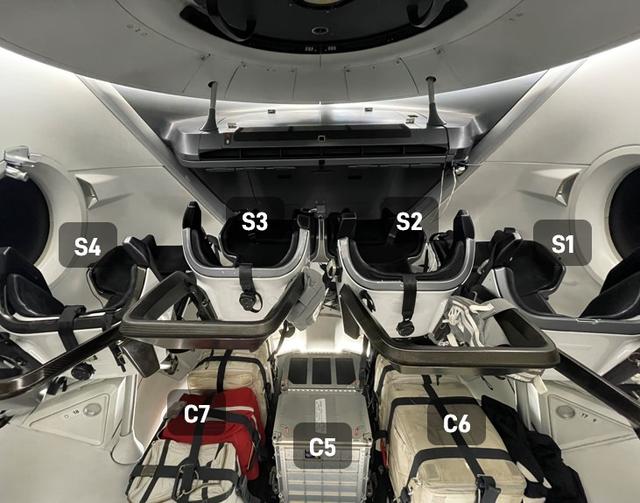
This is an interior image of a Dragon spacecraft representative of the Crew-8 spacecraft configuration ahead of launch. It shows four standard crew seats and three cargo locations below upon which the crew has the capability to build temporary seat structures for returning additional crew from station as needed. Since docking, the Crew-8 Dragon’s interior has been reconfigured to provide an emergency return capability for Expedition 72 crewmembers Butch Wilmore and Suni Williams in locations C7 and C5 until the Crew-9 Dragon arrives.
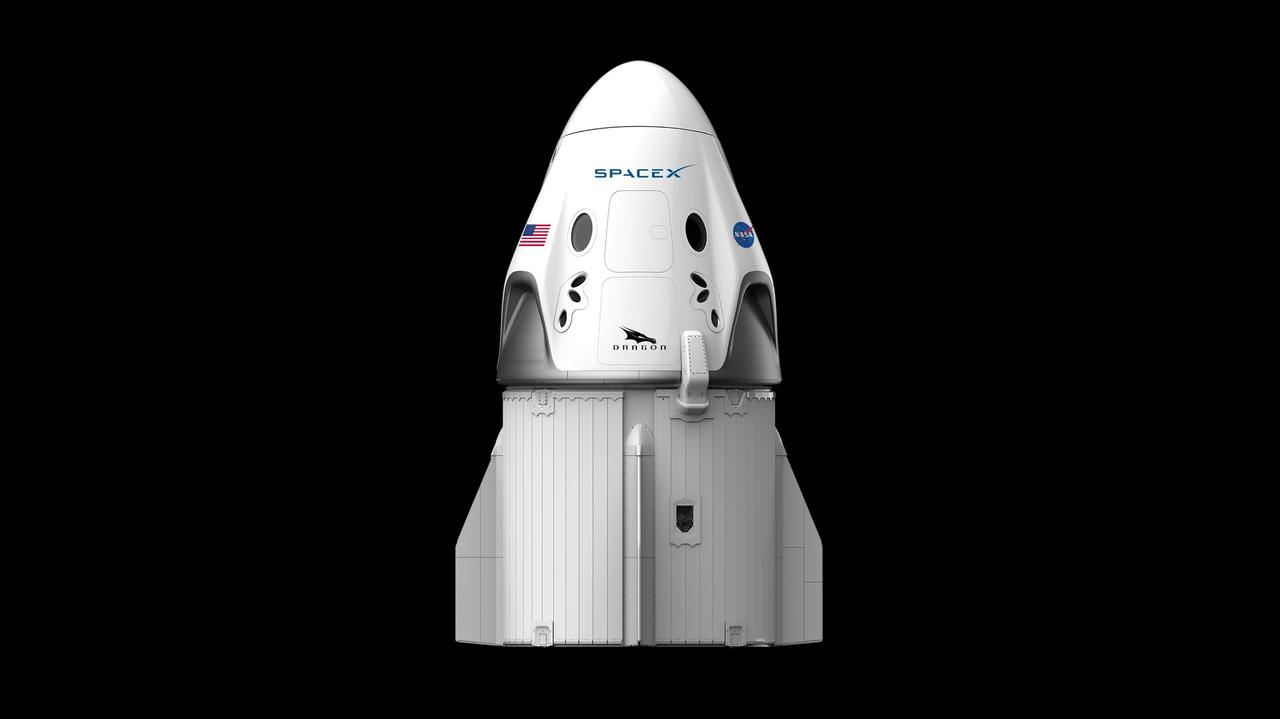
An illustration of the SpaceX Crew Dragon.
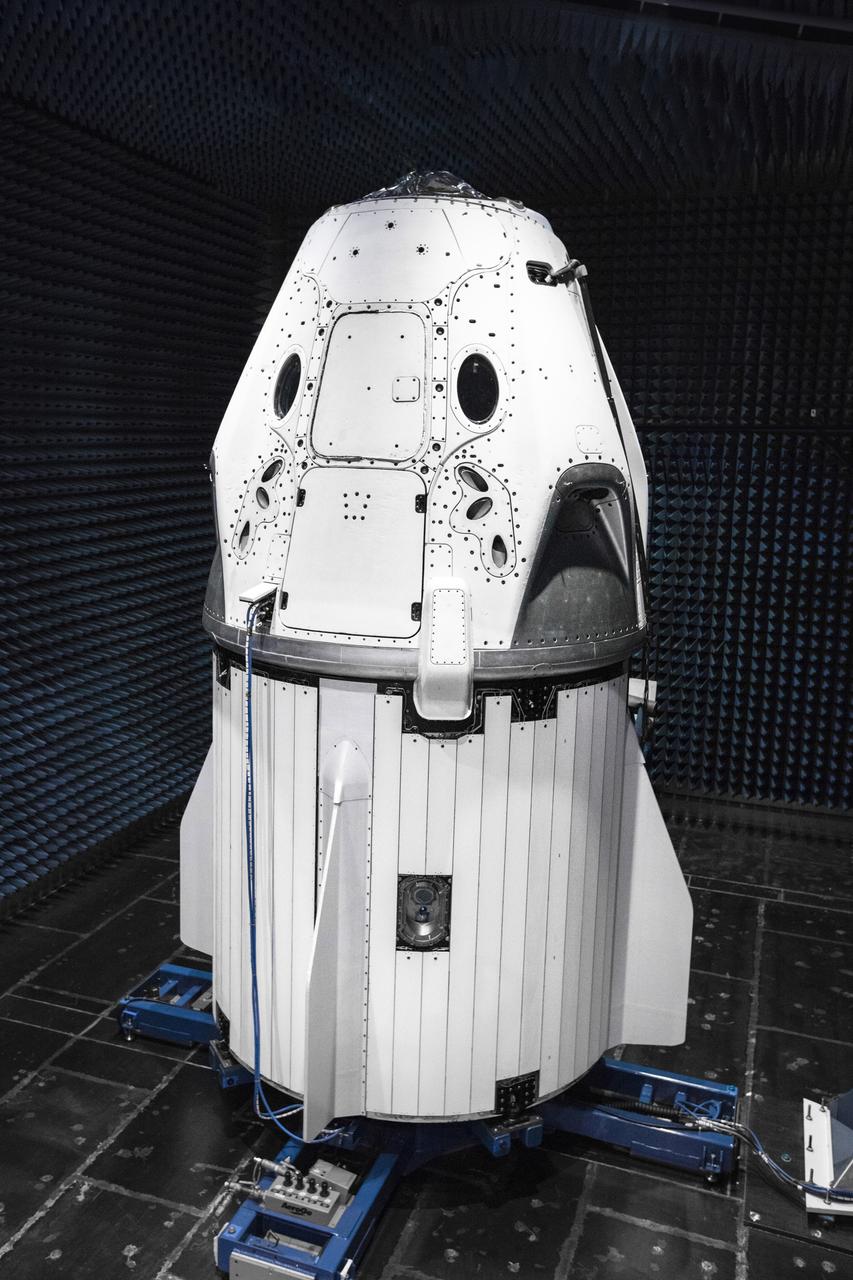
The SpaceX Crew Dragon spacecraft is in the anechoic chamber for electromagnetic interference testing on May 20, 2018, at NASA's Kennedy Space Center in Florida. The Crew Dragon will be shipped to the agency's Plum Brook Station test facility at Glenn Research City in Cleveland, Ohio, for testing in the Reverberant Acoustic Test Facility, the world's most powerful acoustic test chamber. Crew Dragon is being prepared for its first uncrewed test flight, targeted for August 2018.
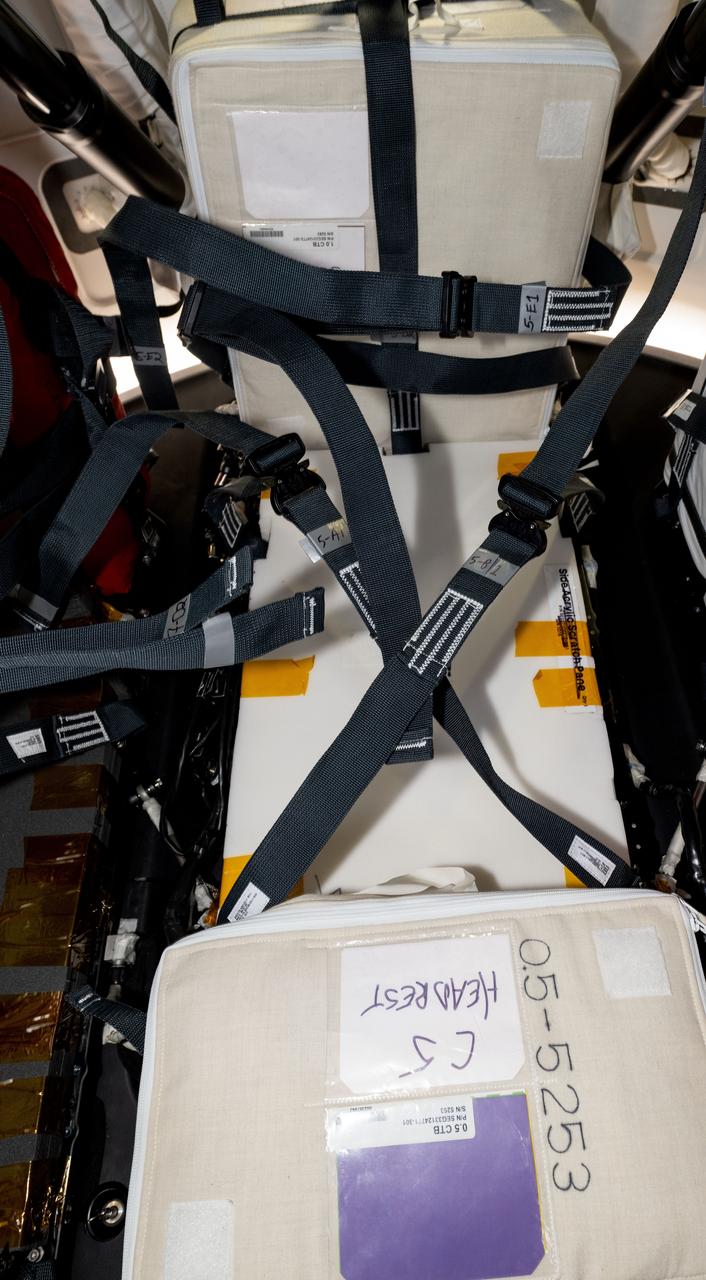
This image shows one of the temporary seat structures built and installed on the Crew-8 Dragon in cargo pallet locations C7 and C5 using foam, straps, and other station soft goods such as cushions.
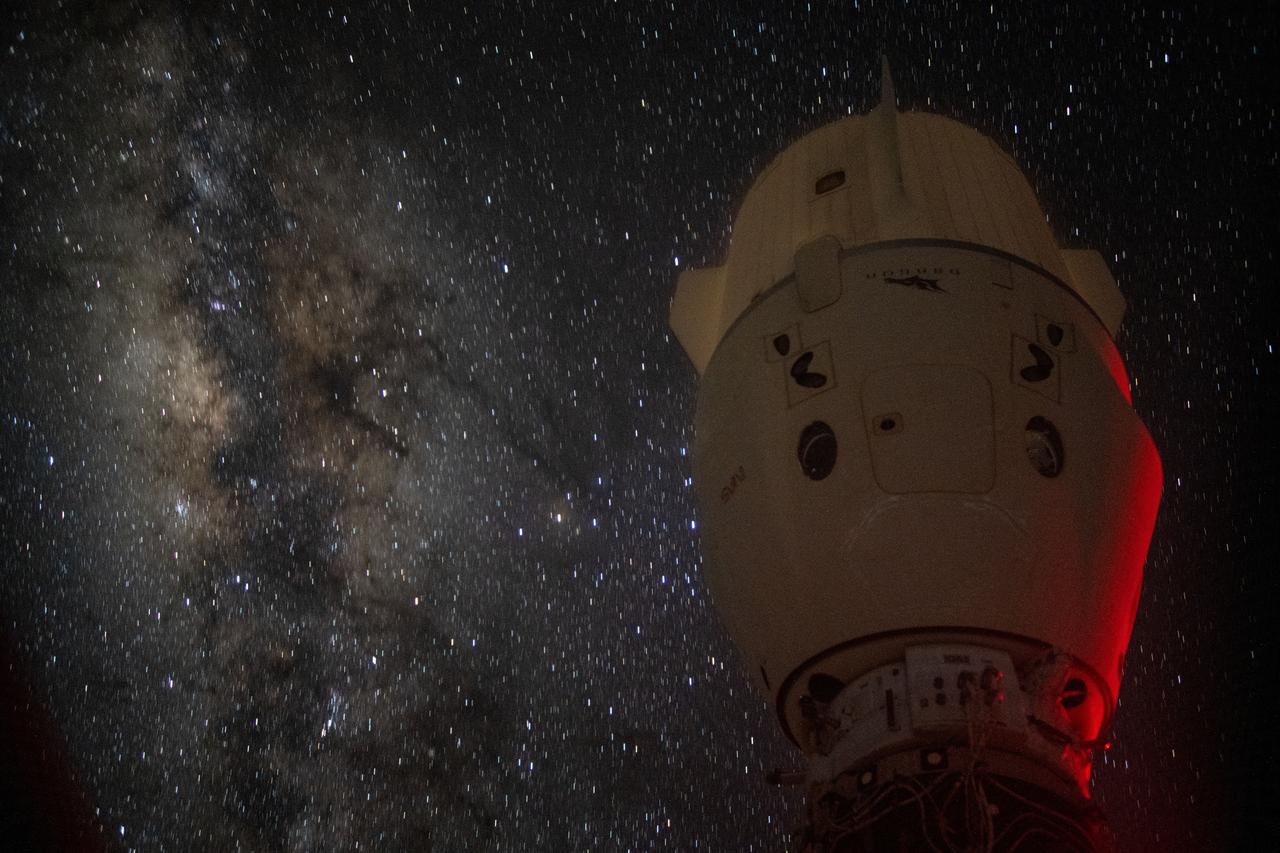
iss071e256593 (July 1, 2024) --- The Milky Way appears in the vastness of space behind the dimly lit SpaceX Dragon Endeavour spacecraft docked to the Harmony module's space-facing port on the International Space Station.
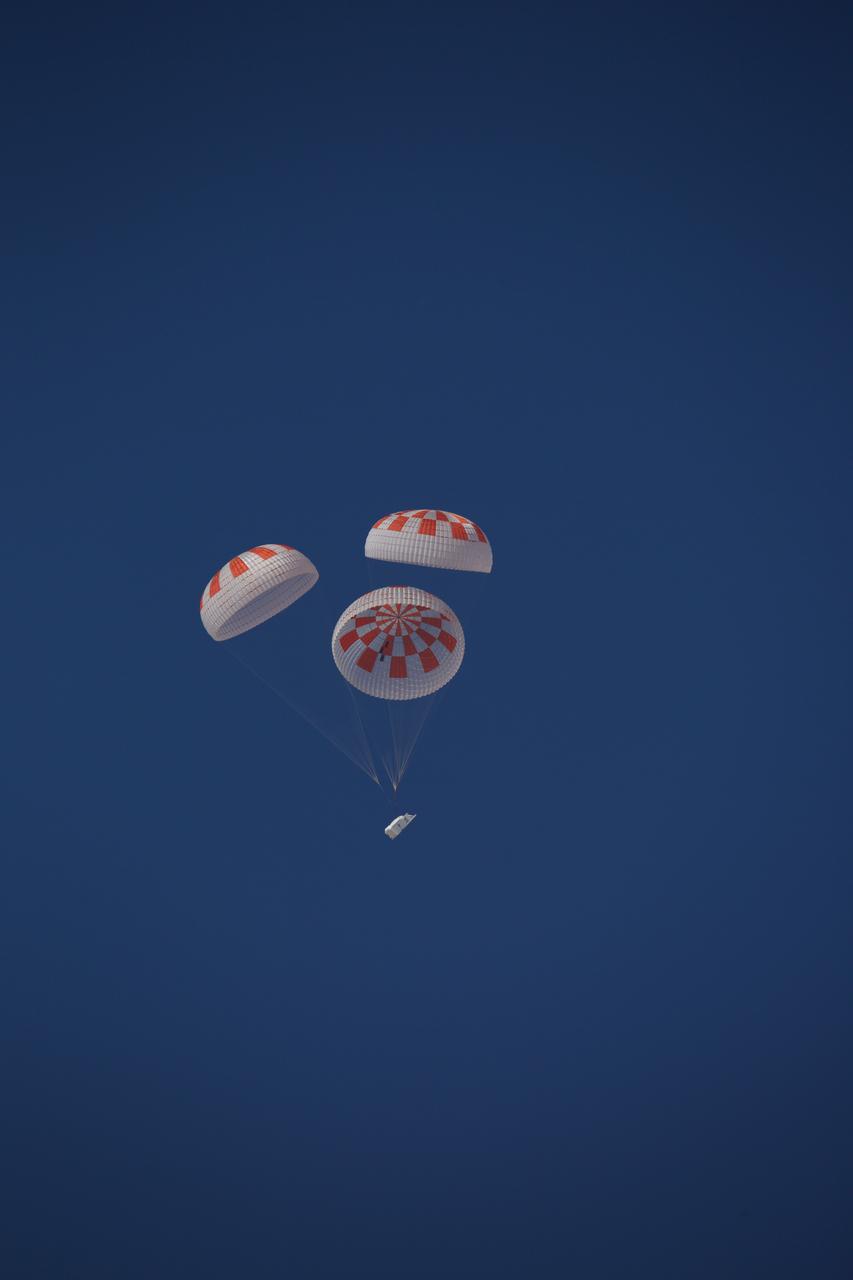
SpaceX performed its fourteenth overall parachute test supporting Crew Dragon development. This most recent exercise was the first of several planned parachute system qualification tests ahead of the spacecraft’s first crewed flight and resulted in the successful touchdown of Crew Dragon’s parachute system. During this test, a C-130 aircraft transported the parachute test vehicle, designed to achieve the maximum speeds that Crew Dragon could experience on re-entry, over the Mojave Desert in Southern California and dropped the vehicle from an altitude of 25,000 feet. The test demonstrated an off-nominal situation, deploying only one of the two drogue chutes and intentionally skipping a reefing stage on one of the four main parachutes, proving a safe landing in such a contingency scenario.
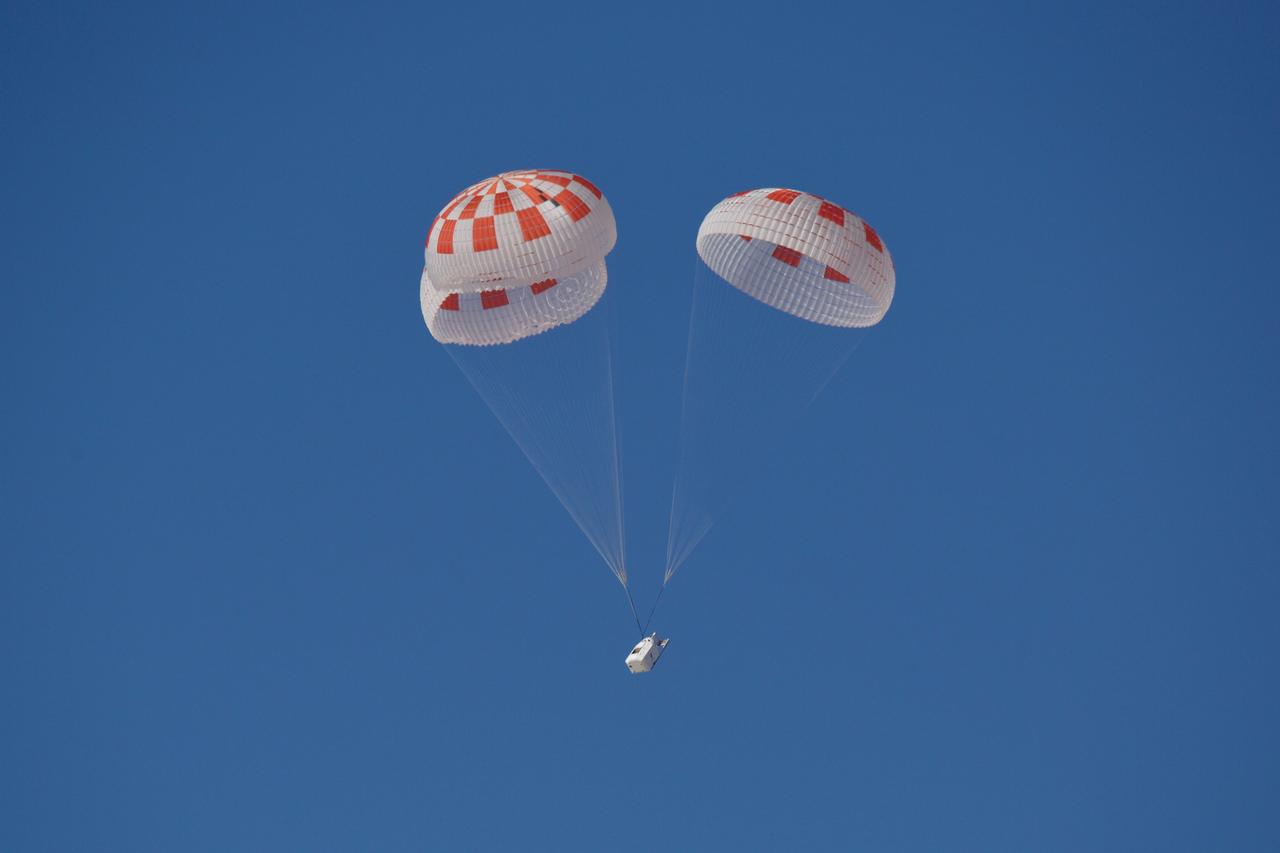
SpaceX performed its fourteenth overall parachute test supporting Crew Dragon development. This most recent exercise was the first of several planned parachute system qualification tests ahead of the spacecraft’s first crewed flight and resulted in the successful touchdown of Crew Dragon’s parachute system. During this test, a C-130 aircraft transported the parachute test vehicle, designed to achieve the maximum speeds that Crew Dragon could experience on re-entry, over the Mojave Desert in Southern California and dropped the vehicle from an altitude of 25,000 feet. The test demonstrated an off-nominal situation, deploying only one of the two drogue chutes and intentionally skipping a reefing stage on one of the four main parachutes, proving a safe landing in such a contingency scenario.
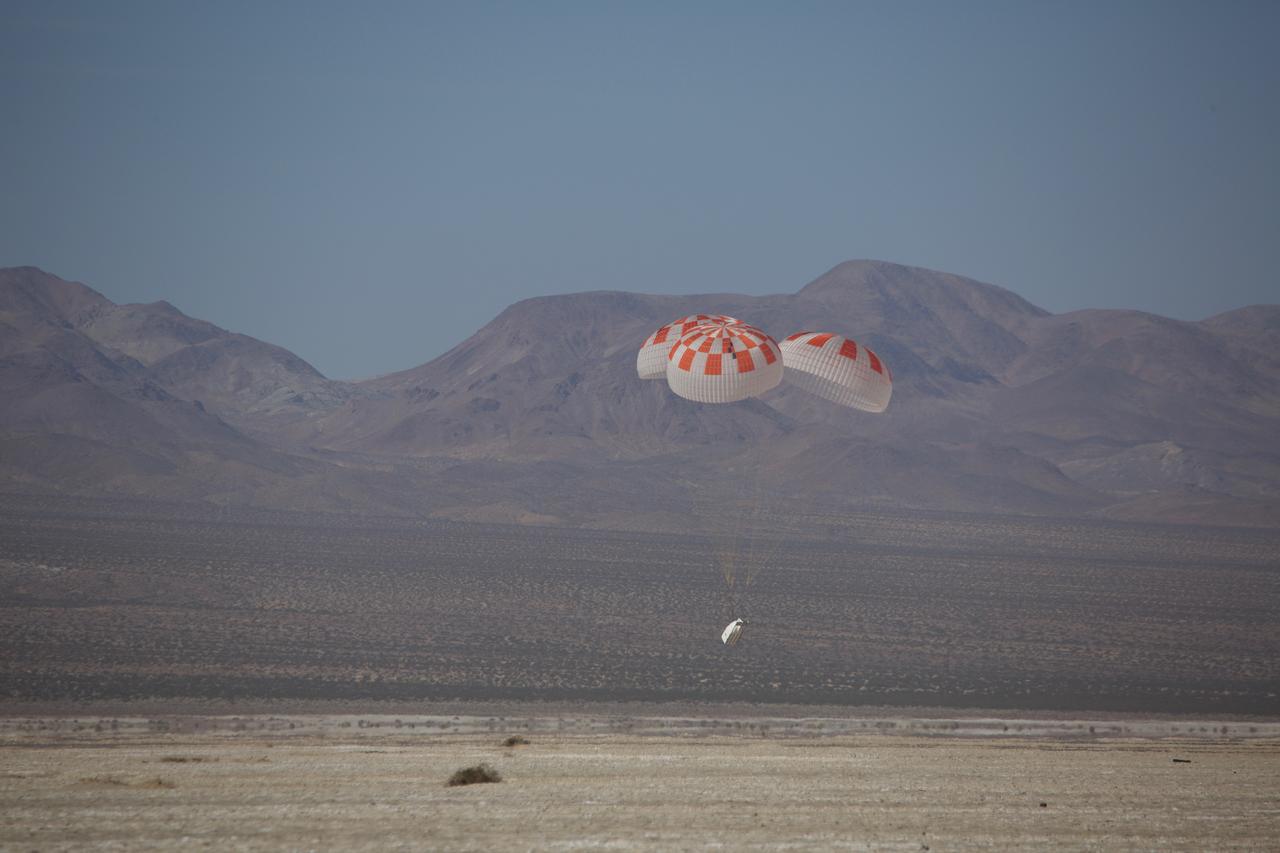
SpaceX performed its fourteenth overall parachute test supporting Crew Dragon development. This most recent exercise was the first of several planned parachute system qualification tests ahead of the spacecraft’s first crewed flight and resulted in the successful touchdown of Crew Dragon’s parachute system. During this test, a C-130 aircraft transported the parachute test vehicle, designed to achieve the maximum speeds that Crew Dragon could experience on re-entry, over the Mojave Desert in Southern California and dropped the vehicle from an altitude of 25,000 feet. The test demonstrated an off-nominal situation, deploying only one of the two drogue chutes and intentionally skipping a reefing stage on one of the four main parachutes, proving a safe landing in such a contingency scenario.
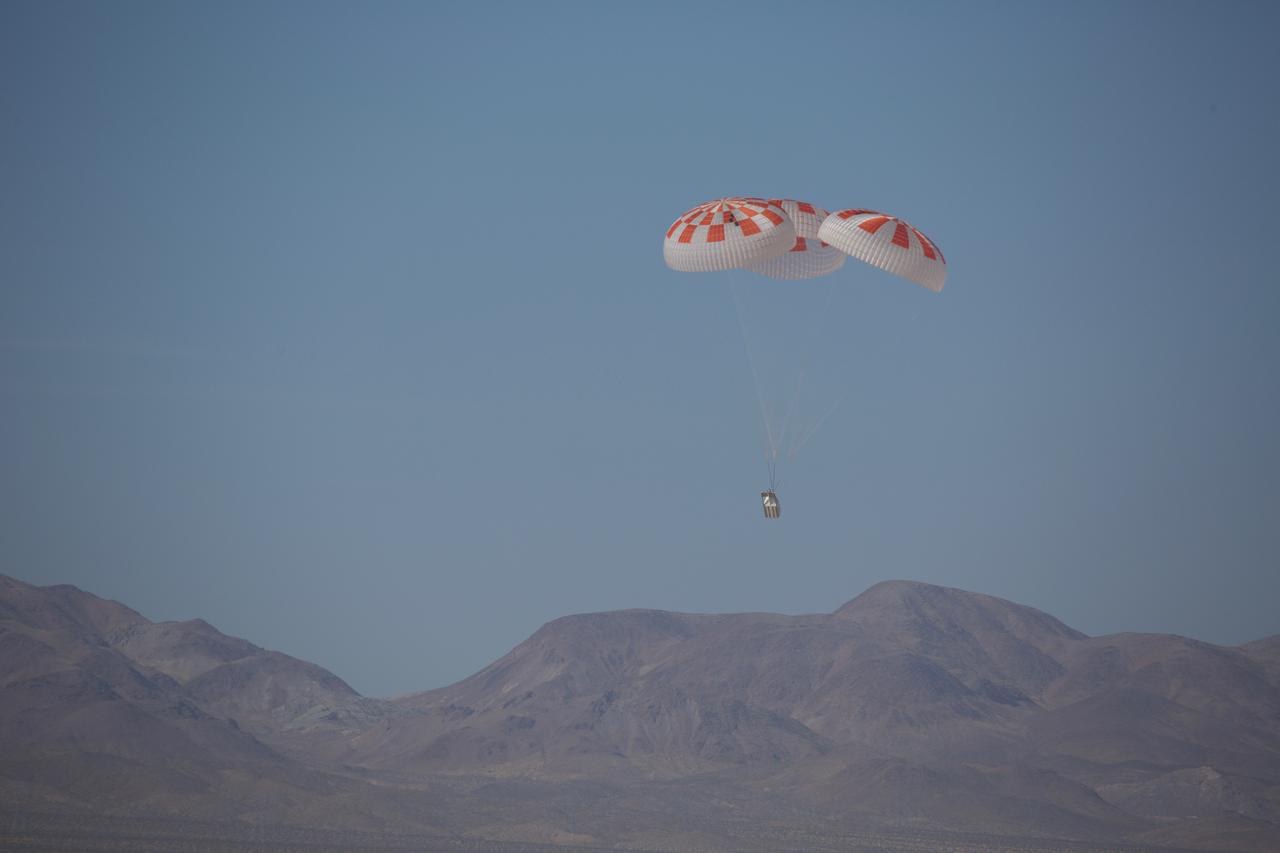
SpaceX performed its fourteenth overall parachute test supporting Crew Dragon development. This most recent exercise was the first of several planned parachute system qualification tests ahead of the spacecraft’s first crewed flight and resulted in the successful touchdown of Crew Dragon’s parachute system. During this test, a C-130 aircraft transported the parachute test vehicle, designed to achieve the maximum speeds that Crew Dragon could experience on re-entry, over the Mojave Desert in Southern California and dropped the vehicle from an altitude of 25,000 feet. The test demonstrated an off-nominal situation, deploying only one of the two drogue chutes and intentionally skipping a reefing stage on one of the four main parachutes, proving a safe landing in such a contingency scenario.
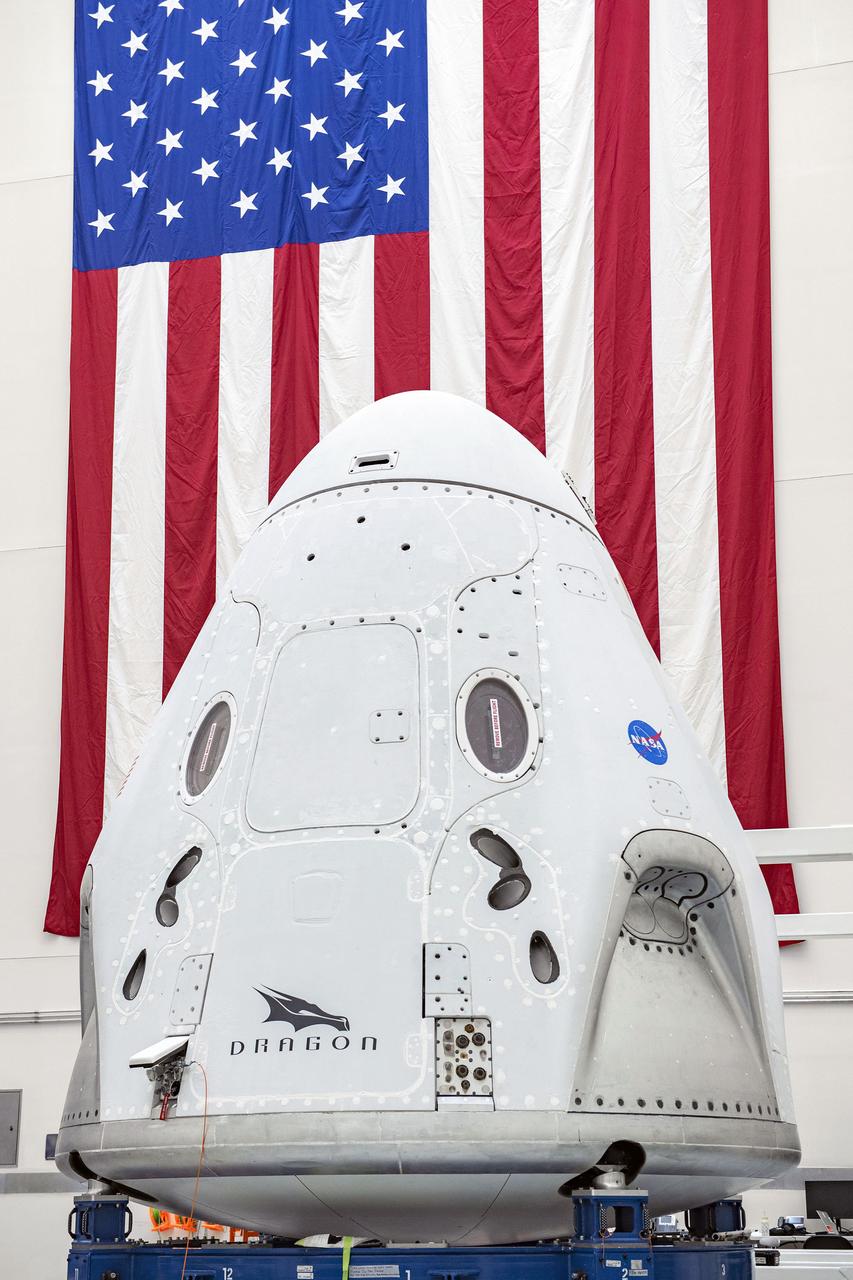
The SpaceX Crew Dragon spacecraft undergoes final processing at Cape Canaveral Air Force Station, Florida, in preparation for the Demo-2 launch with NASA astronauts Bob Behnken and Doug Hurley to the International Space Station for NASA’s Commercial Crew Program. Crew Dragon will carry Behnken and Hurley atop a Falcon 9 rocket, returning crew launches to the space station from U.S. soil for the first time since the Space Shuttle Program ended in 2011.
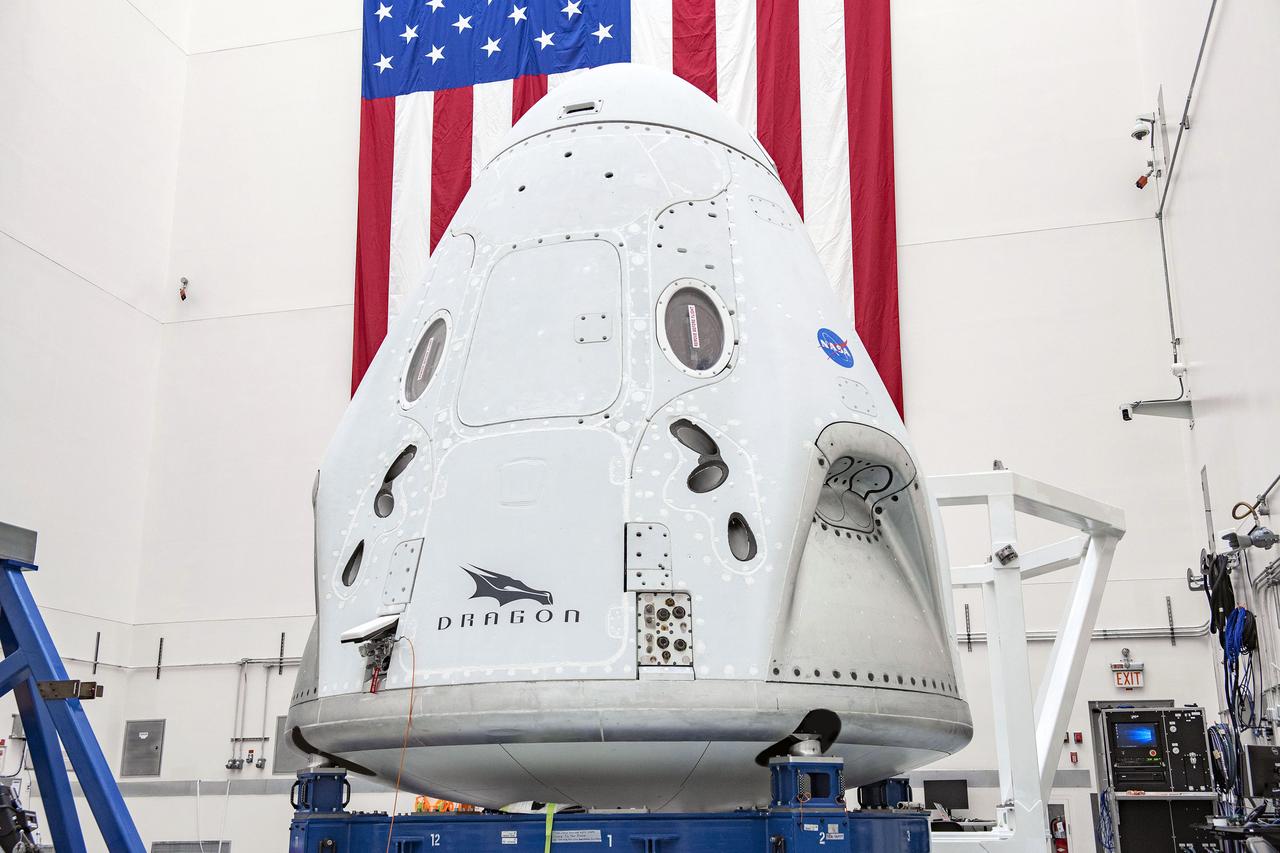
The SpaceX Crew Dragon spacecraft undergoes final processing at Cape Canaveral Air Force Station, Florida, in preparation for the Demo-2 launch with NASA astronauts Bob Behnken and Doug Hurley to the International Space Station for NASA’s Commercial Crew Program. Crew Dragon will carry Behnken and Hurley atop a Falcon 9 rocket, returning crew launches to the space station from U.S. soil for the first time since the Space Shuttle Program ended in 2011.
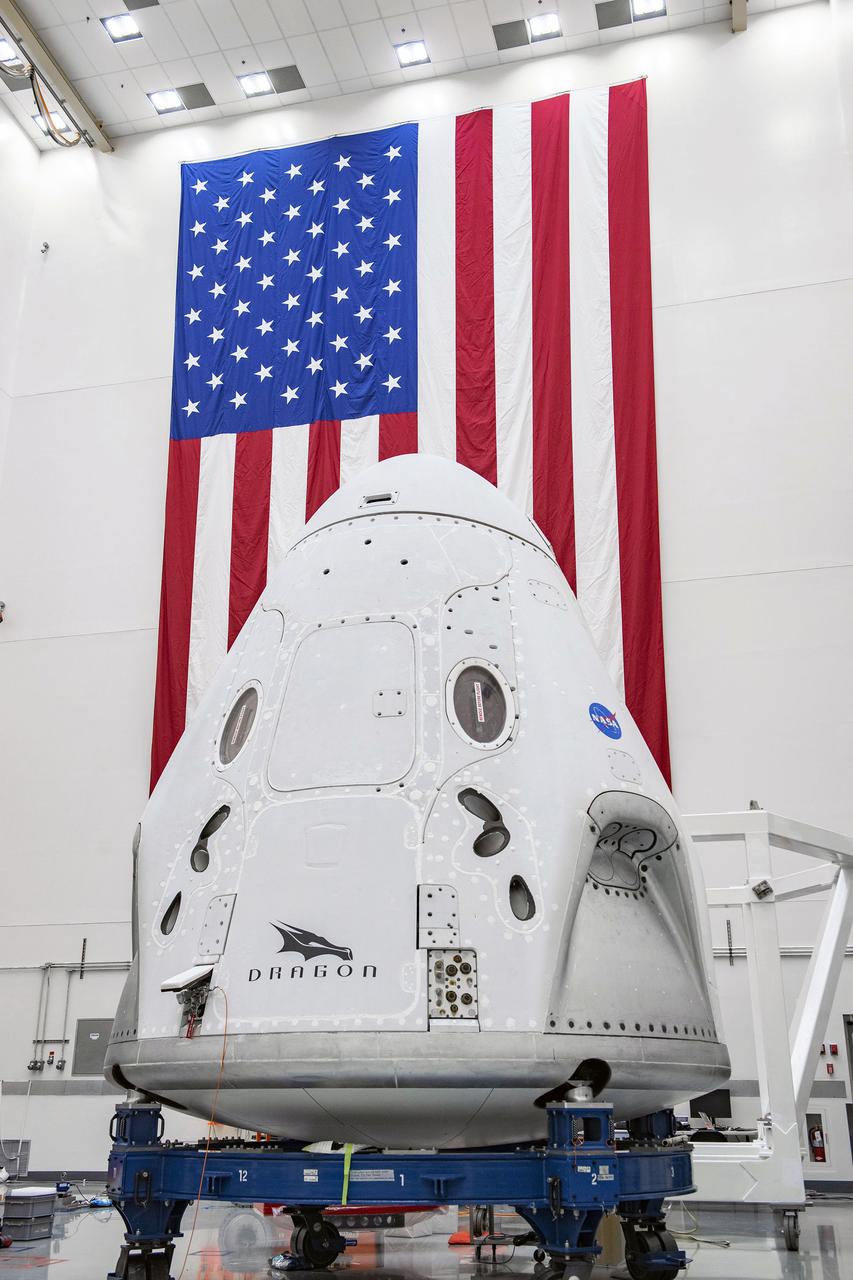
The SpaceX Crew Dragon spacecraft undergoes final processing at Cape Canaveral Air Force Station, Florida, in preparation for the Demo-2 launch with NASA astronauts Bob Behnken and Doug Hurley to the International Space Station for NASA’s Commercial Crew Program. Crew Dragon will carry Behnken and Hurley atop a Falcon 9 rocket, returning crew launches to the space station from U.S. soil for the first time since the Space Shuttle Program ended in 2011. Photo credit: SpaceX
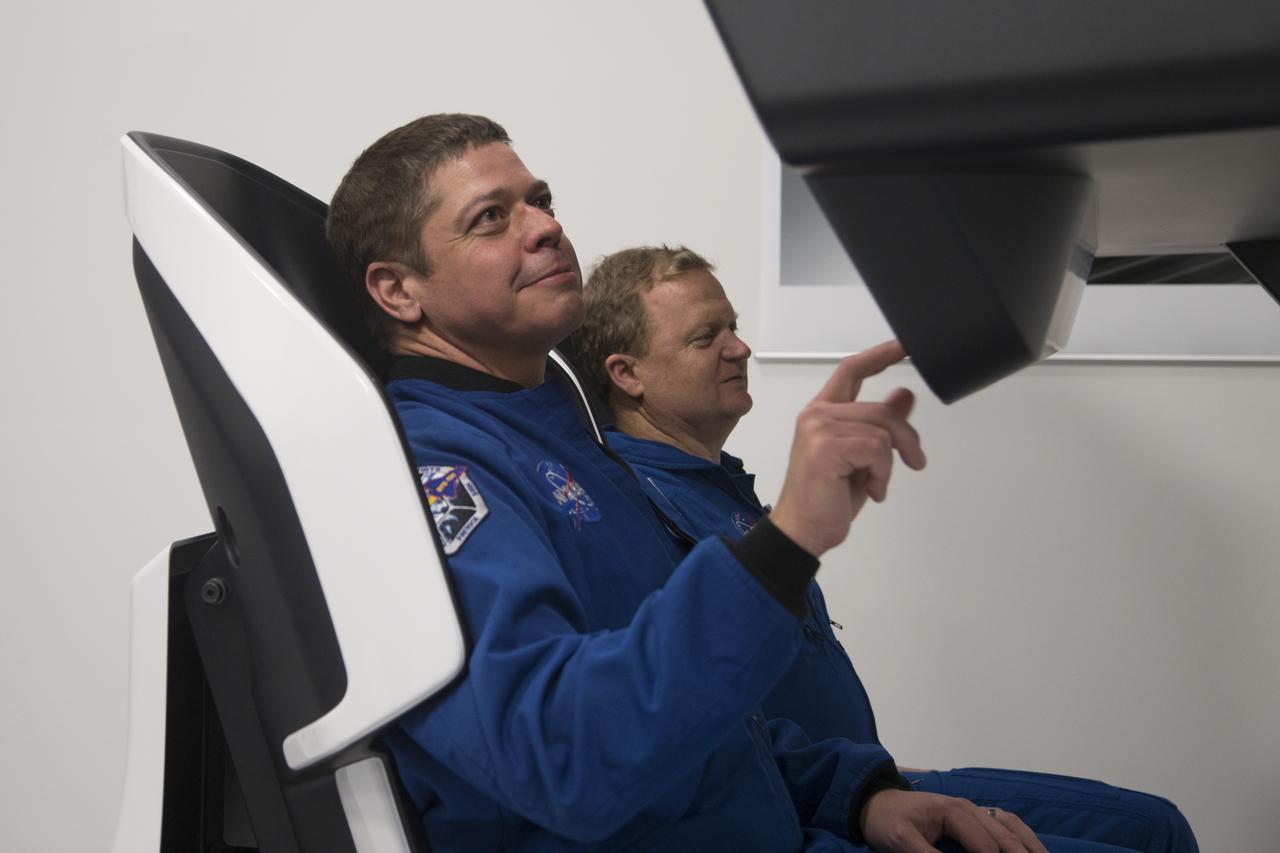
Astronauts Bob Behnken, left, and Eric Boe work in a mock-up of the SpaceX Crew Dragon flight deck at the company's Hawthorne, California, headquarters as development of the crew systems continues for eventual missions to the International Space Station.
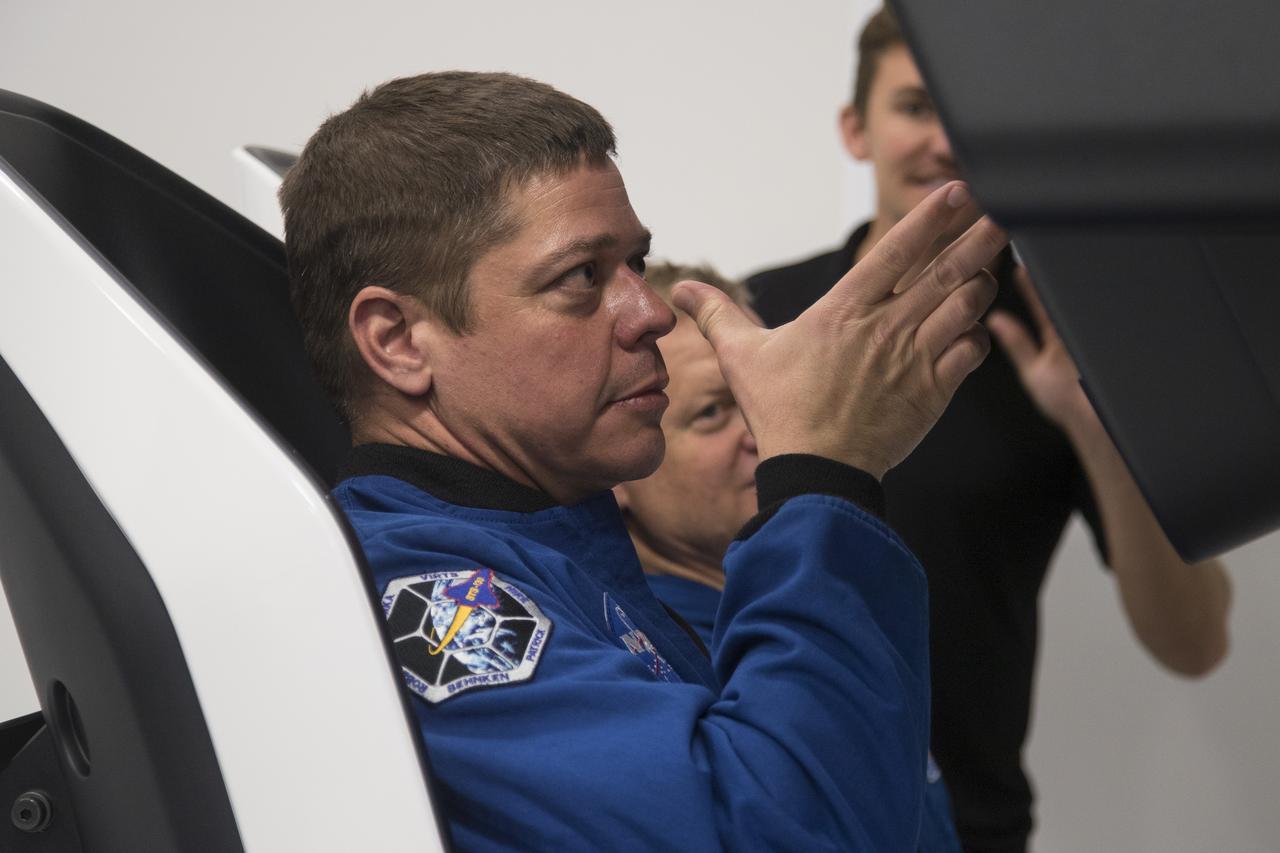
Astronaut Bob Behnken, work in a mock-up of the SpaceX Crew Dragon flight deck at the company's Hawthorne, California, headquarters as development of the crew systems continues for eventual missions to the International Space Station.
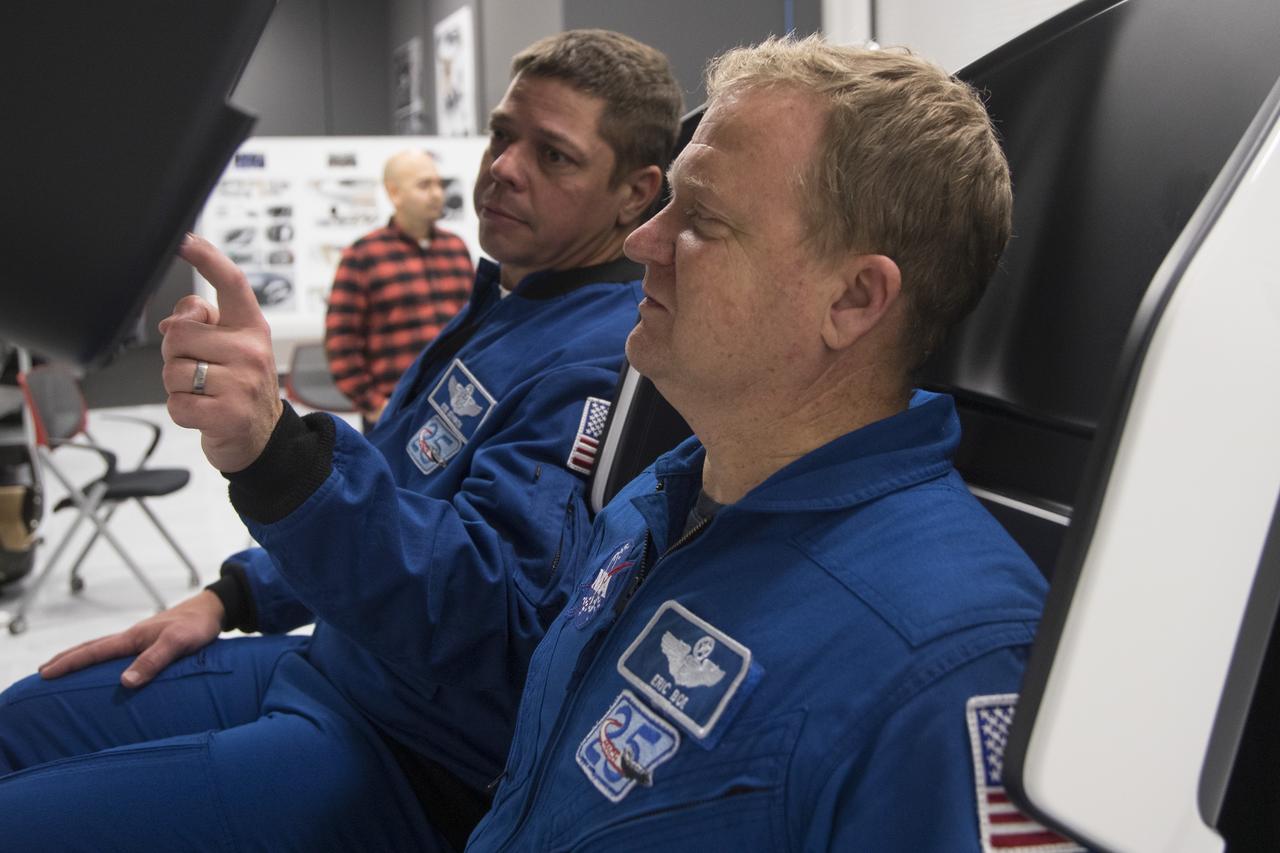
Astronauts Bob Behnken, left, and Eric Boe work in a mock-up of the SpaceX Crew Dragon flight deck at the company's Hawthorne, California, headquarters as development of the crew systems continues for eventual missions to the International Space Station.
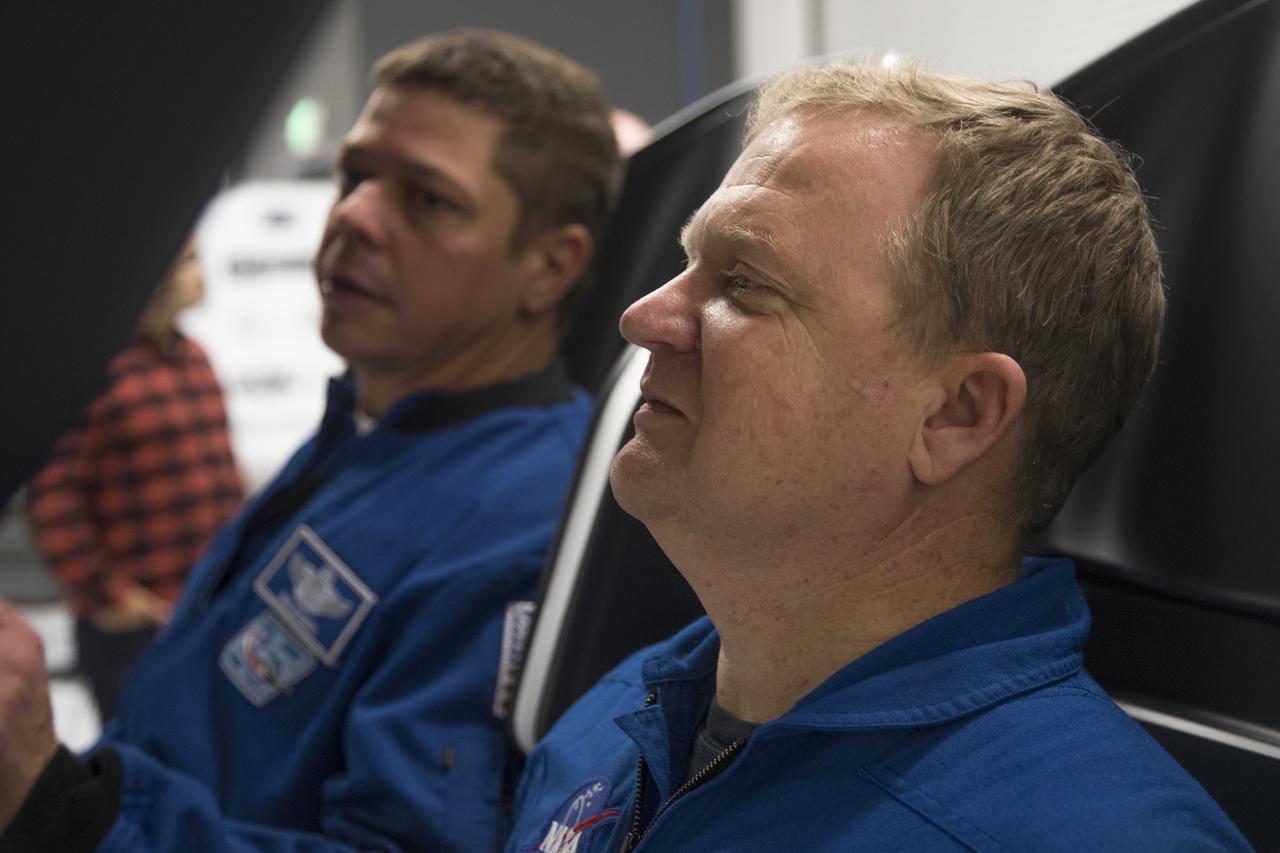
Astronauts Eric Boe, right, and Bob Behnken work in a mock-up of the SpaceX Crew Dragon flight deck at the company's Hawthorne, California, headquarters as development of the crew systems continues for eventual missions to the International Space Station.
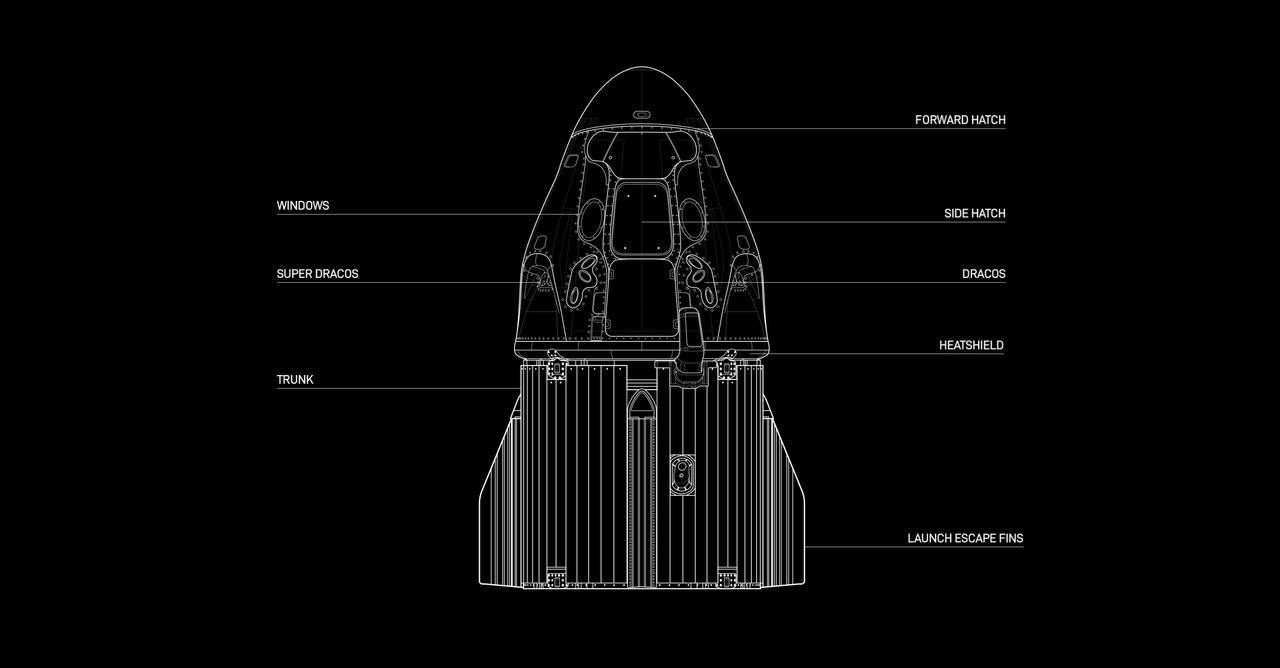
This graphic details the makeup of SpaceX’s Crew Dragon spacecraft. Crew Dragon is used for all crewed SpaceX missions to the International Space Station as part of NASA’s Commercial Crew Program.
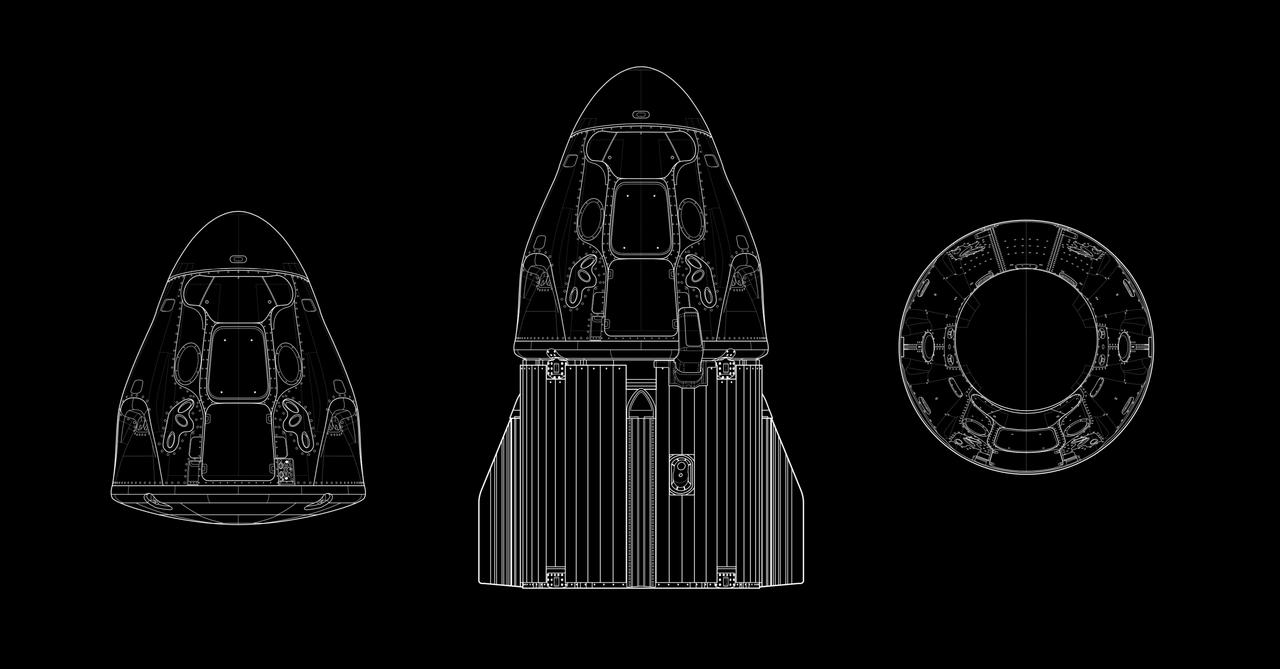
This graphic details the makeup of SpaceX’s Crew Dragon spacecraft. Crew Dragon is used for all crewed SpaceX missions to the International Space Station as part of NASA’s Commercial Crew Program.
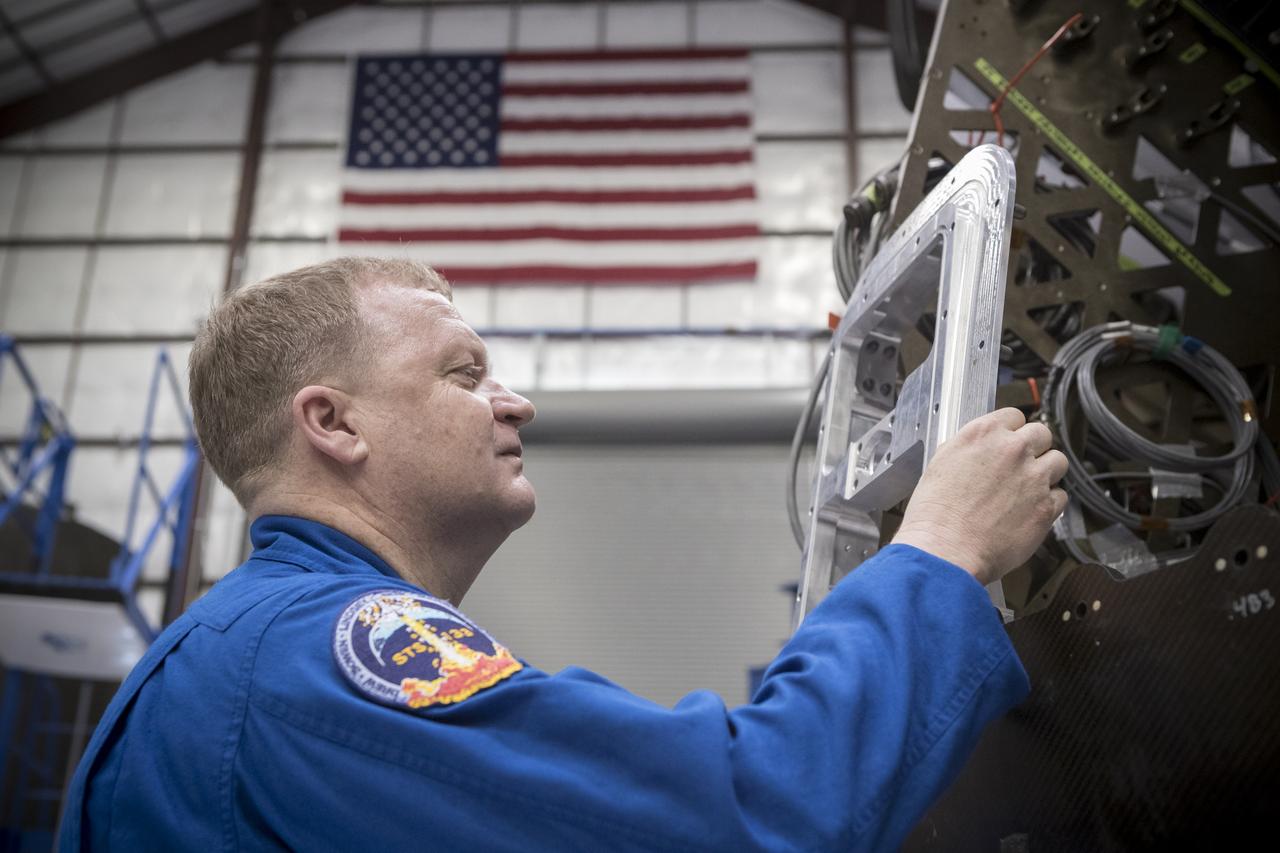
Astronaut Eric Boe examines hardware during a tour of the SpaceX facility in Hawthorne, California. SpaceX is developing its Crew Dragon spacecraft and Falcon 9 rocket in partnership with NASA’s Commercial Crew Program to carry astronauts to and from the International Space Station.
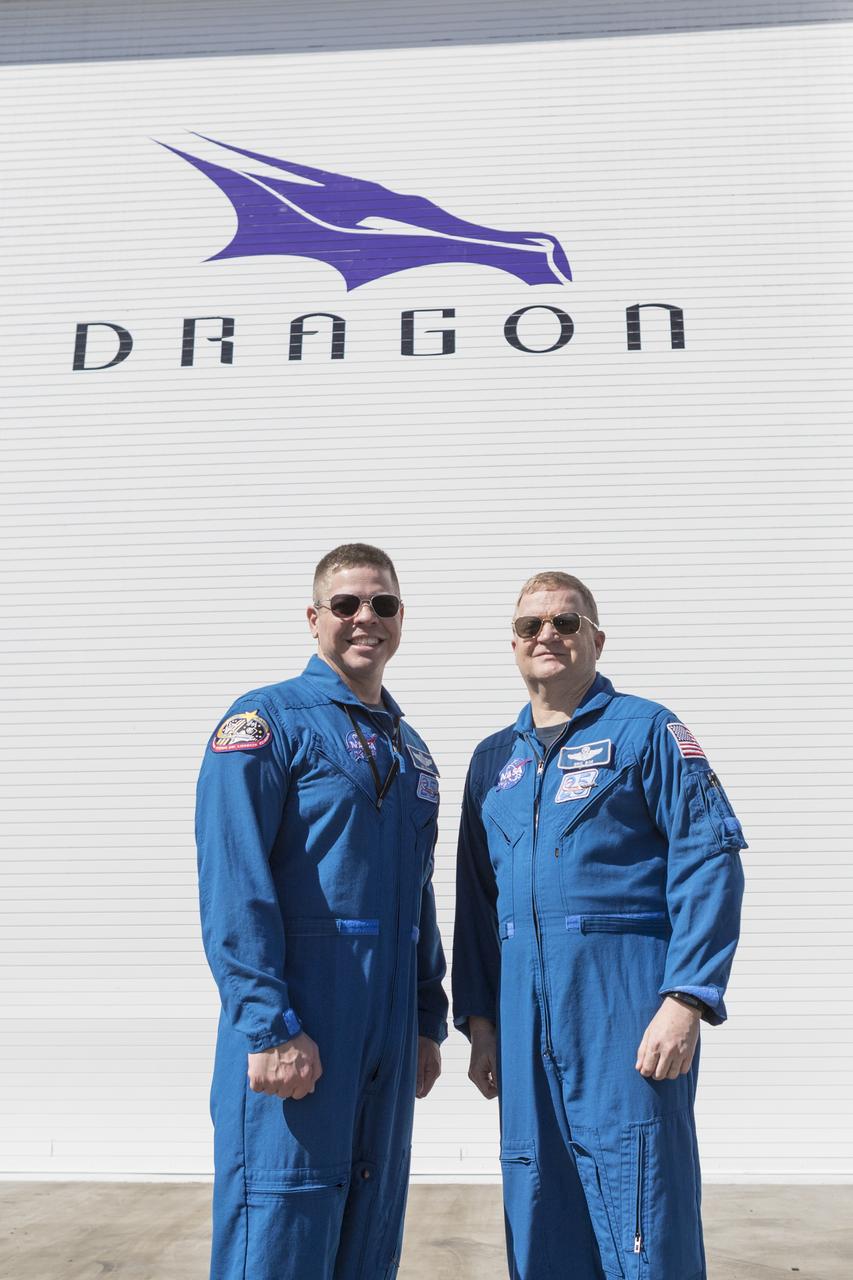
Astronauts Bob Behnken, left, and Eric Boe are outside the SpaceX facility in Hawthorne, California. SpaceX is developing its Crew Dragon spacecraft and Falcon 9 rocket in partnership with NASA’s Commercial Crew Program to carry astronauts to and from the International Space Station.
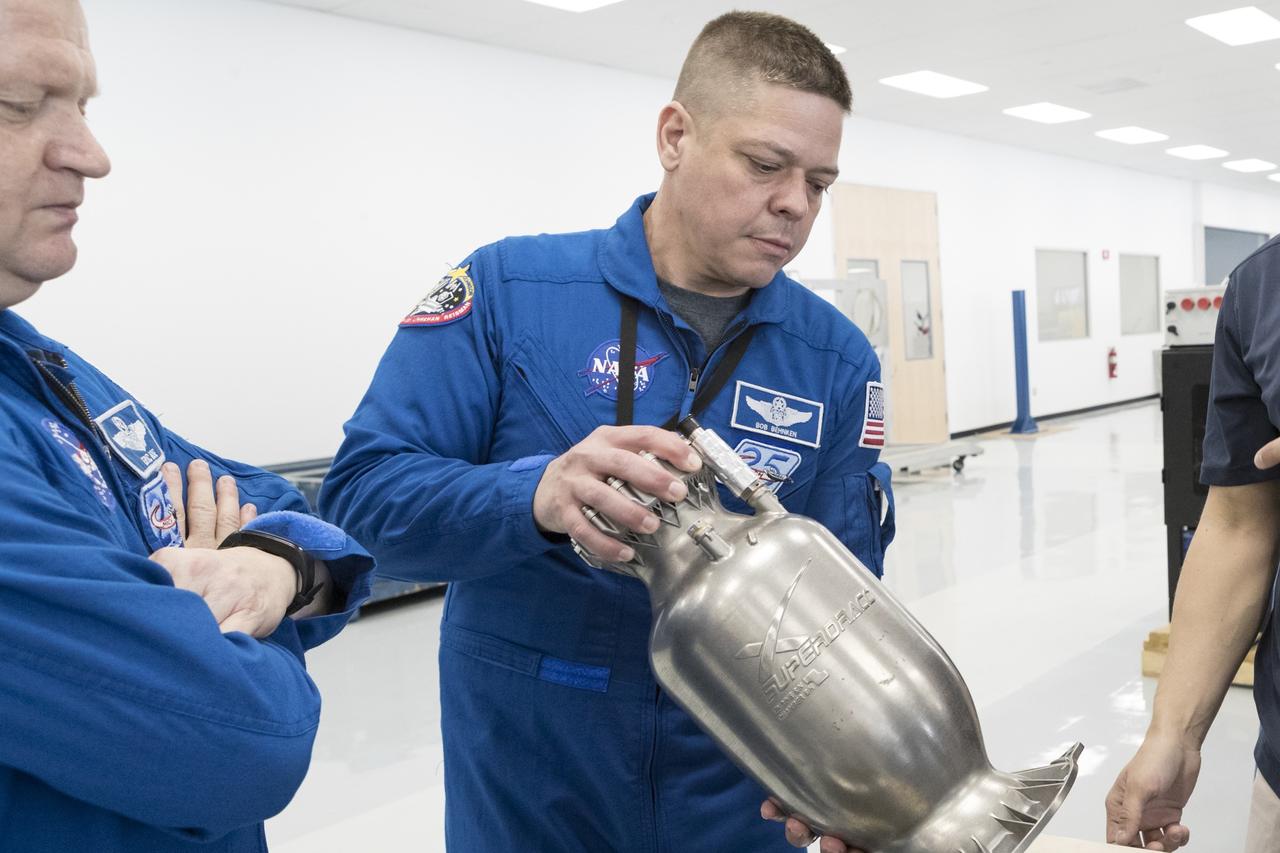
Astronaut Bob Behnken examines a SuperDraco engine during a tour of the SpaceX facility in Hawthorne, California. SpaceX is developing its Crew Dragon spacecraft and Falcon 9 rocket in partnership with NASA’s Commercial Crew Program to carry astronauts to and from the International Space Station.

NASA Administrator Charles Bolden, left, and SpaceX CEO and Chief Designer Elon Musk, view the historic Dragon capsule, right, that returned to Earth on May 31 following the first successful mission by a private company to carry supplies to the International Space Station on Wednesday, June 13, 2012 at the SpaceX facility in McGregor, Texas. Bolden and Musk also thanked the more than 150 SpaceX employees working at the McGregor facility for their role in the historic mission. Some of the 1,367 pounds of cargo the SpaceX Dragon spacecraft returned to Earth from the space station are seen in a clean room to the left. Photo Credit: (NASA/Bill Ingalls)
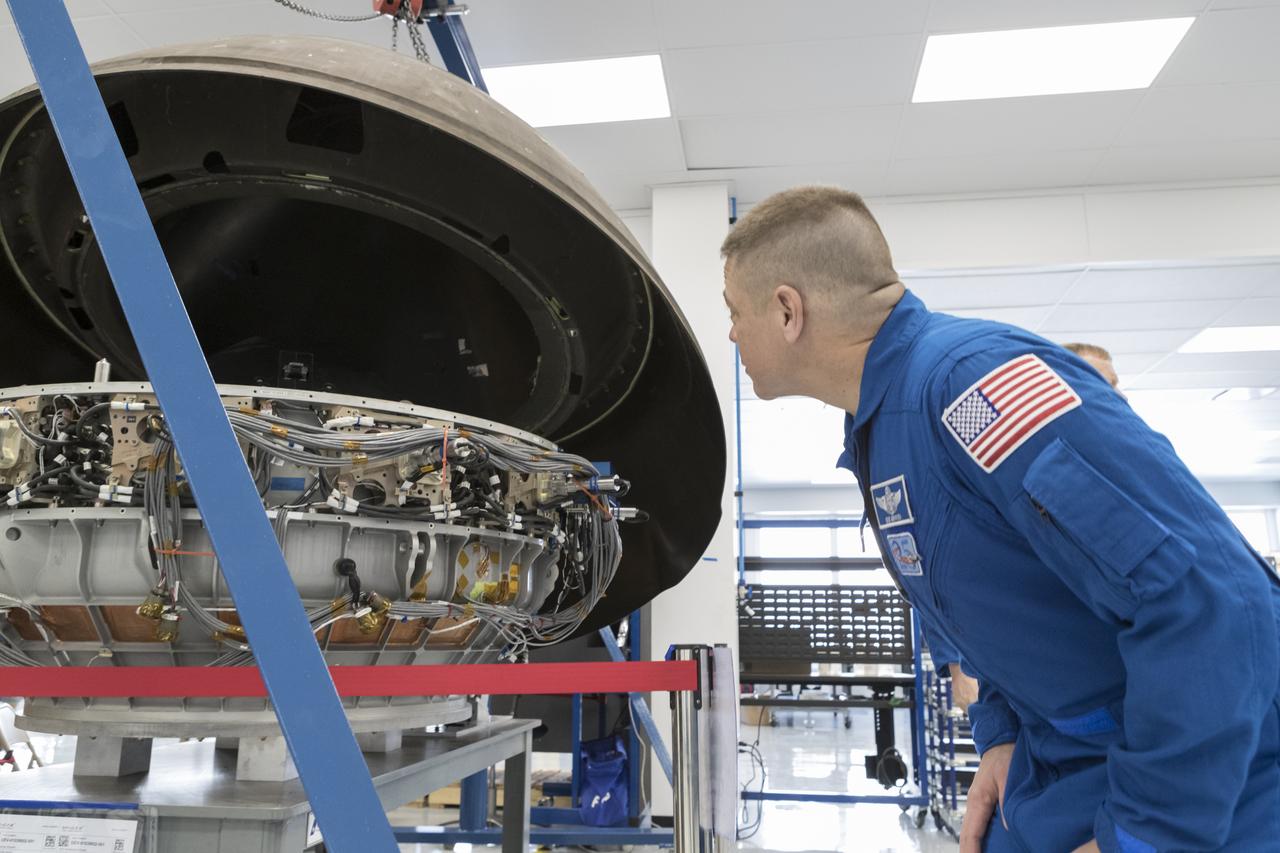
During a tour of SpaceX headquarters in Hawthorne, California, commercial crew astronaut Bob Behnken views the Crew Dragon on March 8, 2017. Crew Dragon is being developed and manufactured in partnership with NASA's Commercial Crew Program to return human spaceflight capabilities to the U.S.
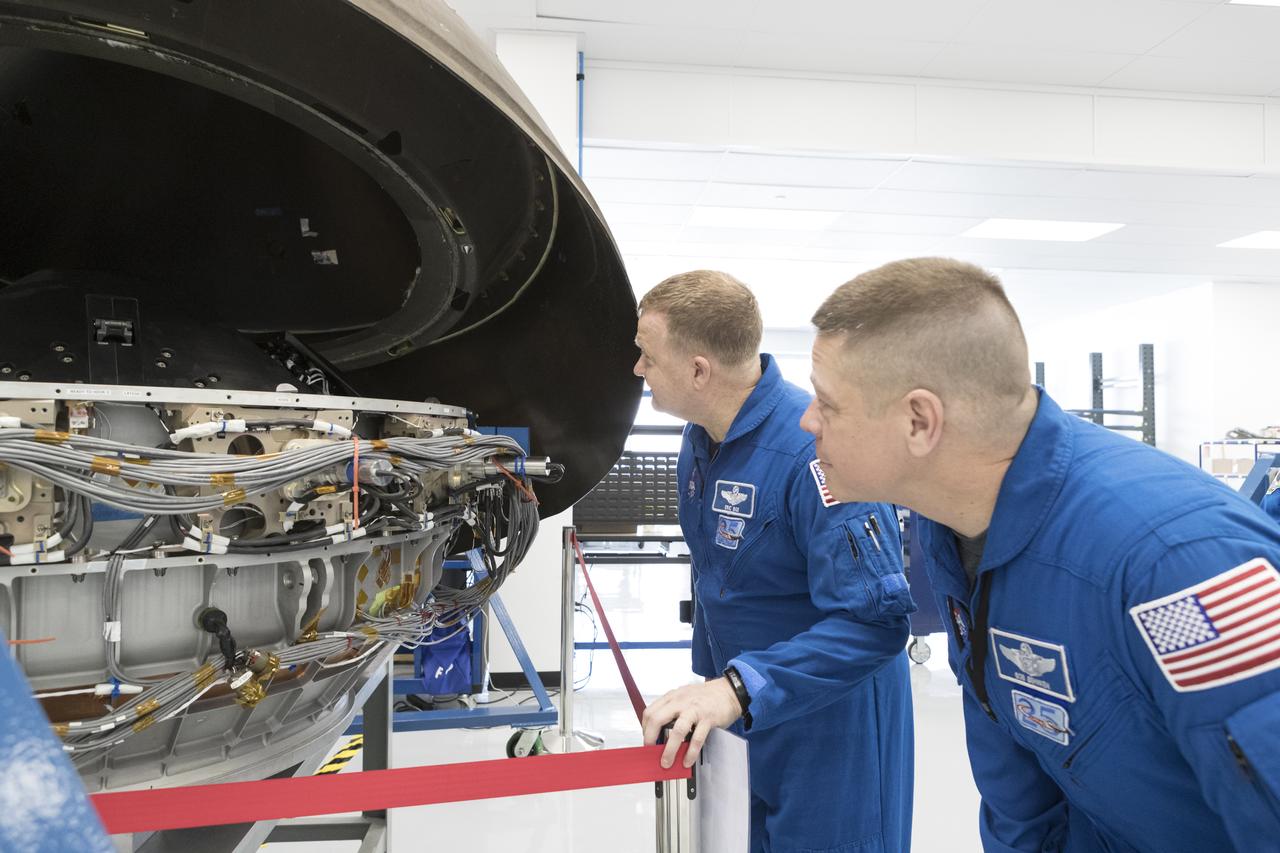
During a tour of SpaceX headquarters in Hawthorne, California, commercial crew astronauts Eric Boe, left, and Bob Behnken view the Crew Dragon on March 8, 2017. Crew Dragon is being developed and manufactured in partnership with NASA's Commercial Crew Program to return human spaceflight capabilities to the U.S.
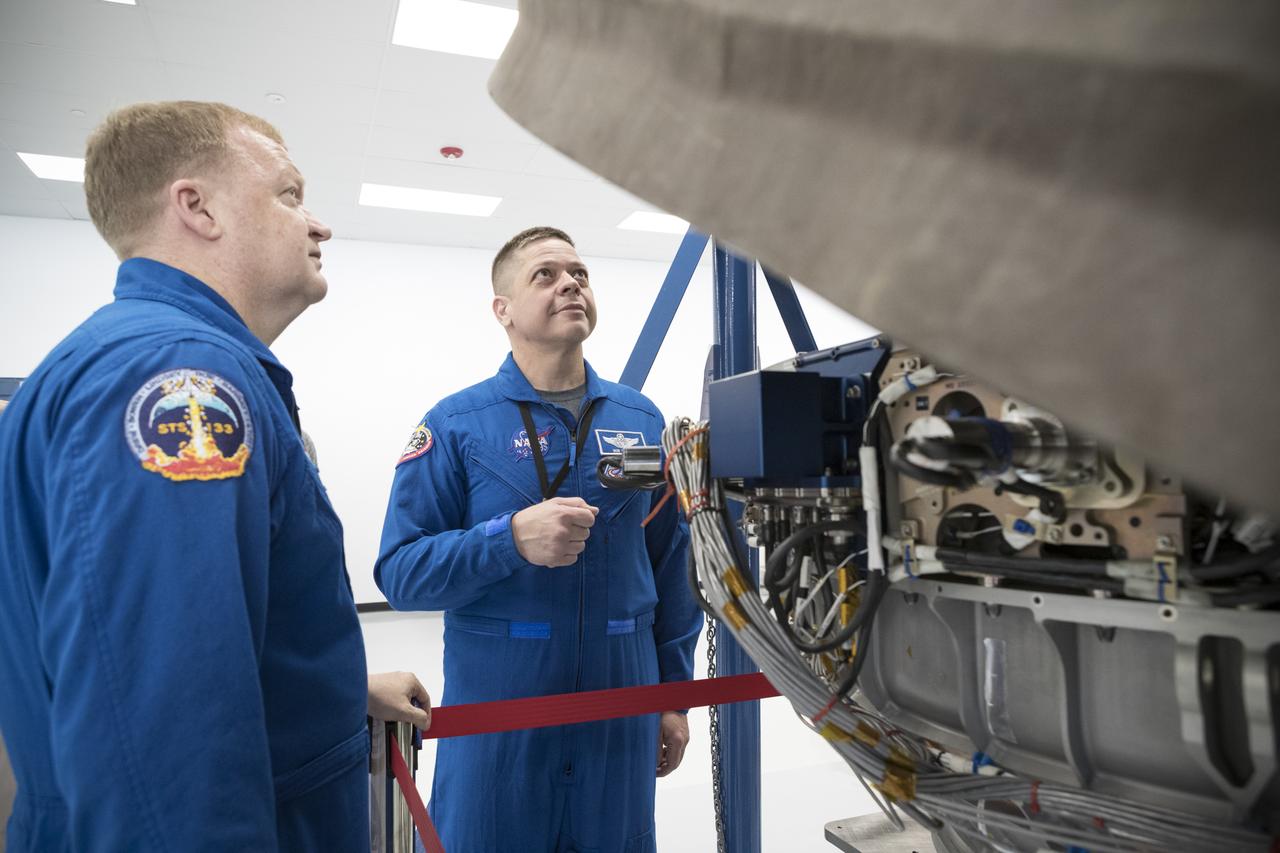
During a tour of SpaceX headquarters in Hawthorne, California, commercial crew astronauts Eric Boe, left, and Bob Behnken view the Crew Dragon on March 8, 2017. Crew Dragon is being developed and manufactured in partnership with NASA's Commercial Crew Program to return human spaceflight capabilities to the U.S.
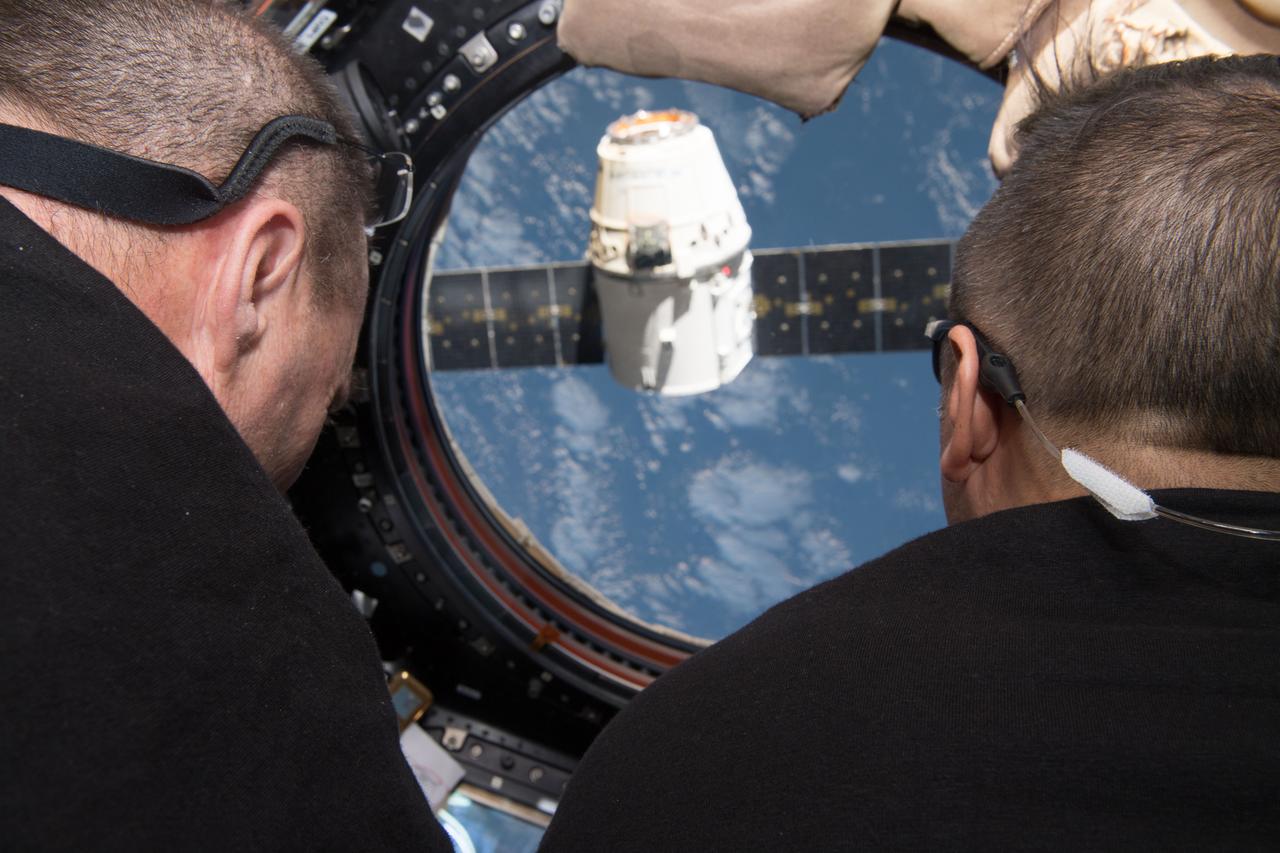
iss054e022060 (Jan. 13, 2018) --- Flight Engineers Scott Tingle (left) and Joe Acaba monitor the departure of the SpaceX Dragon resupply spacecraft through windows in the Cupola module.
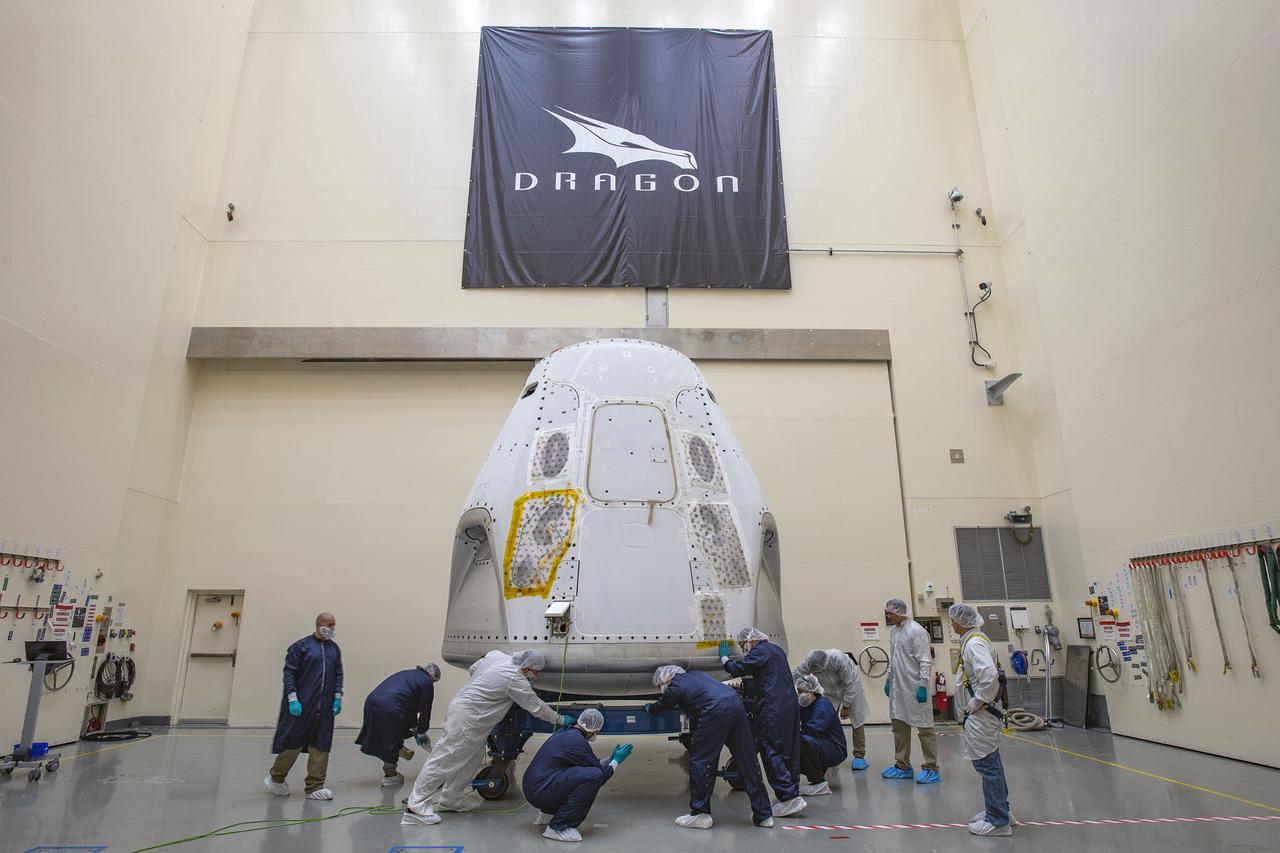
The SpaceX Crew Dragon spacecraft for its first crew launch from American soil arrived at the launch site on Feb. 13, 2020. NASA and SpaceX are preparing for the company’s first flight test with astronauts to the International Space Station as part of the agency’s Commercial Crew Program. The SpaceX Crew Dragon will launch atop a Falcon 9 rocket with NASA astronauts Bob Behnken and Doug Hurley from historic Launch Complex 39A from NASA’s Kennedy Space Center in Florida. The spacecraft now will undergo final testing and prelaunch processing in a SpaceX facility on nearby Cape Canaveral Air Force Station.
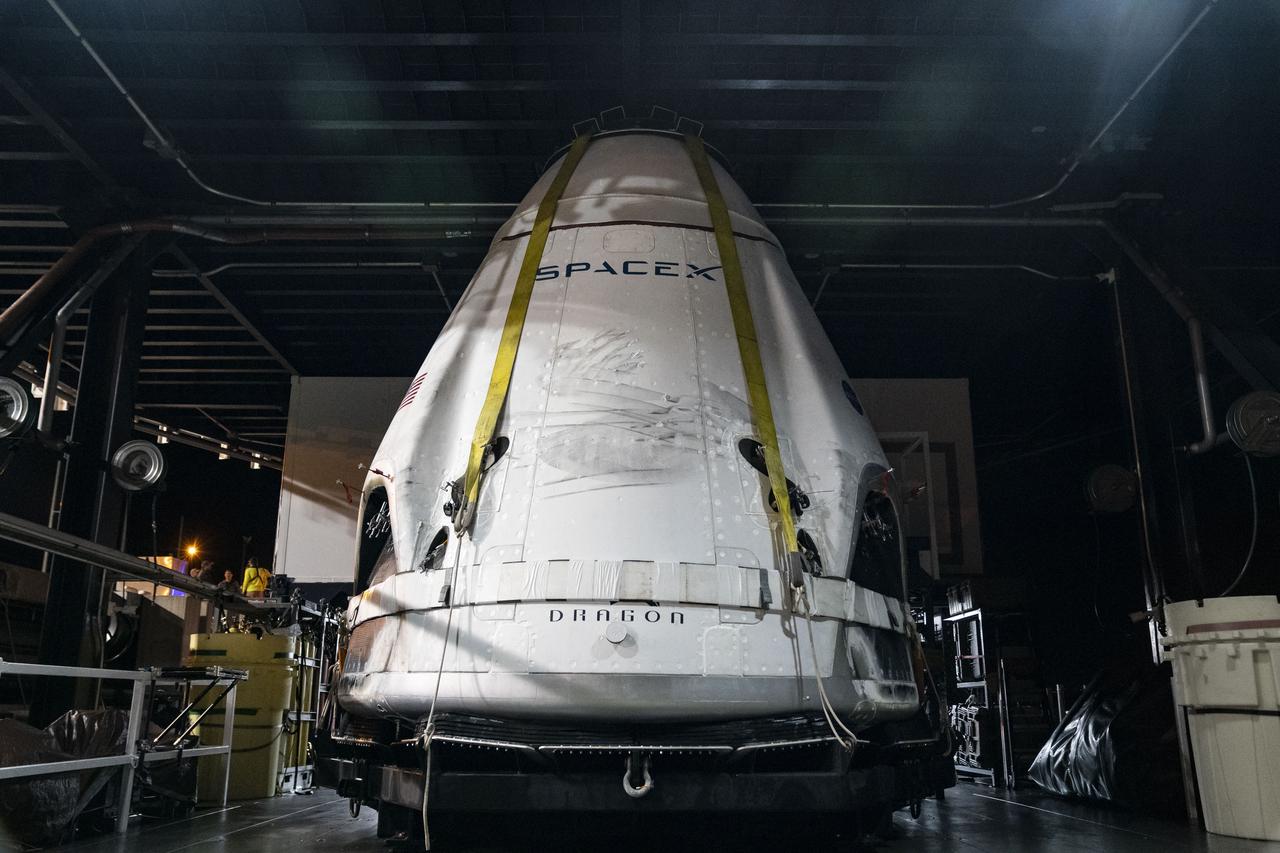
The SpaceX Crew Dragon spacecraft is offloaded from the company’s recovery ship, Go Searcher, at the Port Canaveral Army wharf in Florida carrying the company’s Crew Dragon spacecraft following the uncrewed In-Flight Abort Test, Jan. 19, 2020. The spacecraft lifted off atop a SpaceX Falcon 9 rocket at 10:30 a.m. EST from Launch Complex 39A at NASA’s Kennedy Space Center. The flight test, which concluded with the Crew Dragon’s planned splashdown in the Atlantic Ocean, demonstrated the spacecraft’s escape capabilities in preparation for crewed flights to the International Space Station as part of the agency’s Commercial Crew Program.
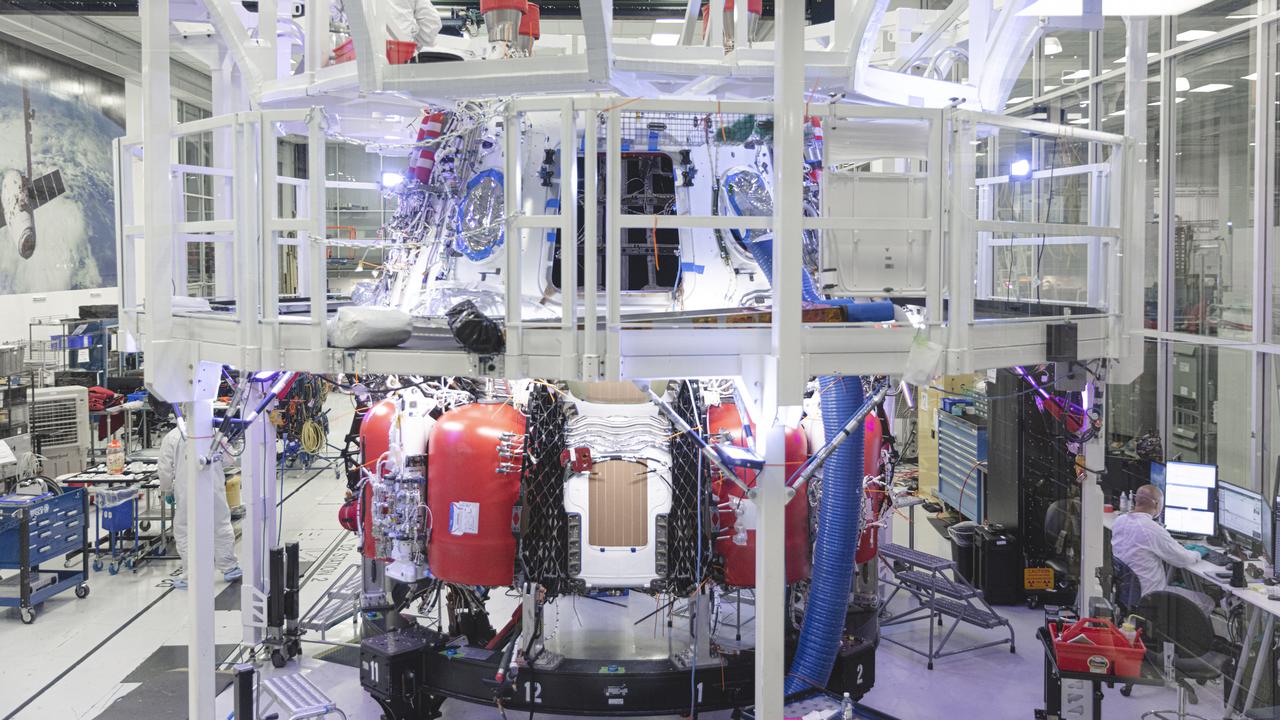
The Crew Dragon spacecraft that will be used for the Crew-1 mission for NASA’s Commercial Crew Program undergoes processing inside the clean room at SpaceX headquarters in Hawthorne, California. The Crew-1 mission to the International Space Station is targeted for later in 2020 with NASA Astronauts Victor Glover, Mike Hopkins, Shannon Walker and JAXA astronaut Soichi Noguchi.
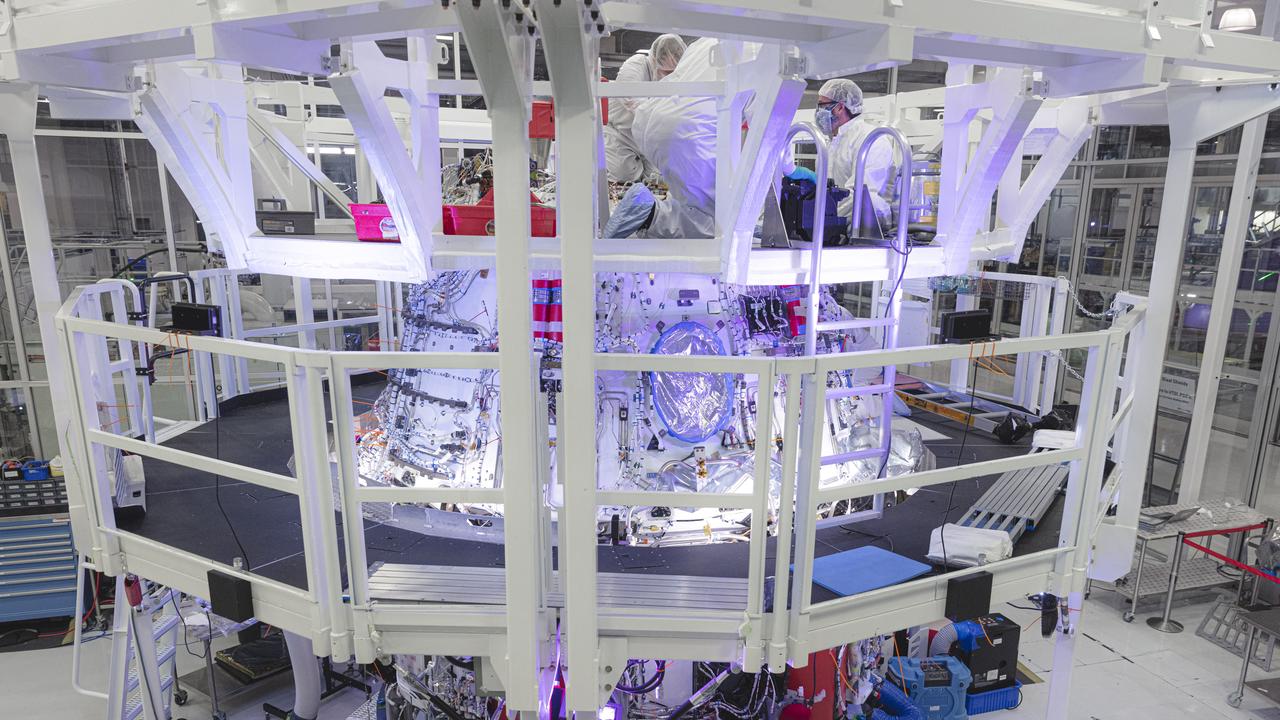
The Crew Dragon spacecraft that will be used for the Crew-1 mission for NASA’s Commercial Crew Program undergoes processing inside the clean room at SpaceX headquarters in Hawthorne, California. The Crew-1 mission to the International Space Station is targeted for later in 2020 with NASA Astronauts Victor Glover, Mike Hopkins, Shannon Walker and JAXA astronaut Soichi Noguchi.
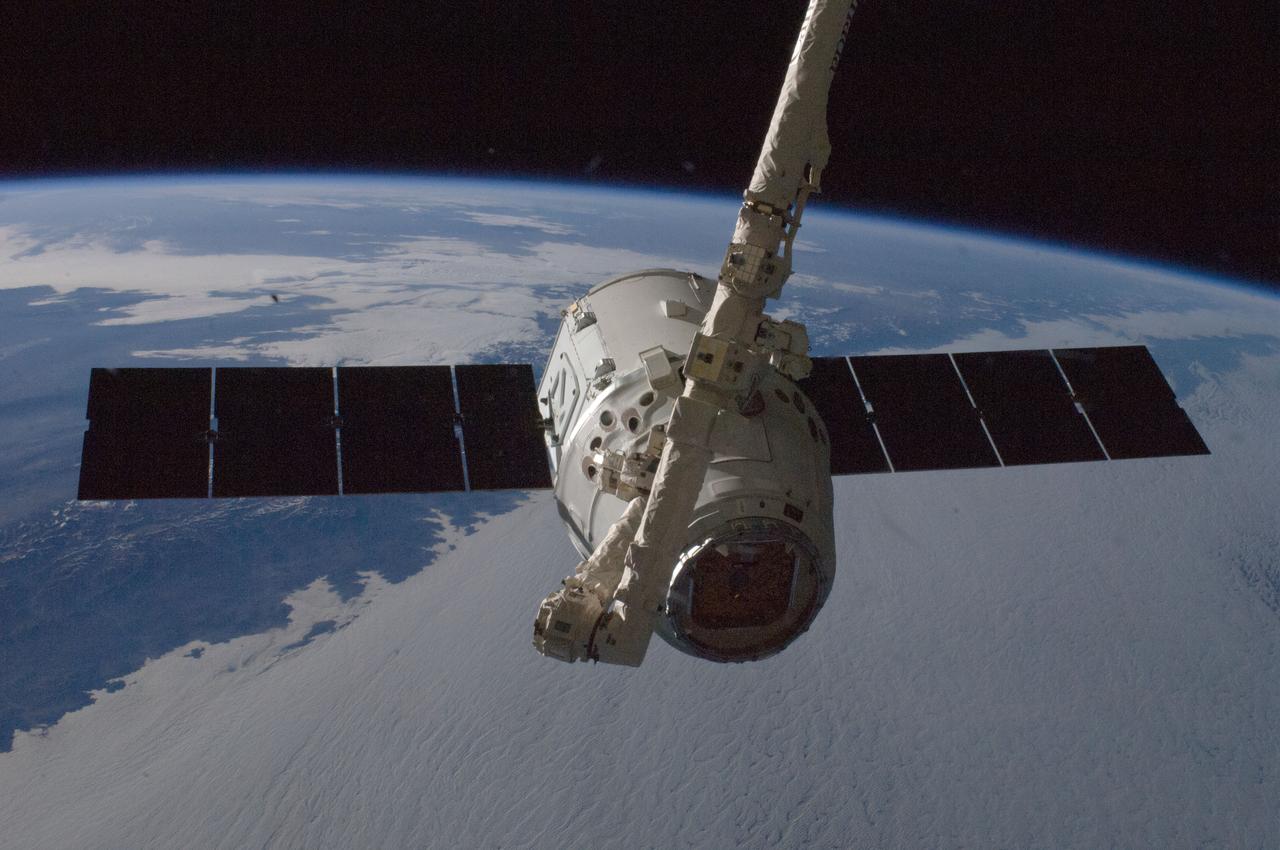
ISS033-E-011151 (10 Oct. 2012) --- The SpaceX Dragon commercial cargo craft is grappled by the International Space Station’s Canadarm2 robotic arm. Working from the robotics workstation inside the seven-windowed Cupola, Japan Aerospace Exploration Agency astronaut Aki Hoshide, Expedition 33 flight engineer, with the assistance of NASA astronaut Sunita Williams, commander, captured Dragon at 6:56 a.m. (EDT) and used the robotic arm to berth Dragon to the Earth-facing port of the Harmony node Oct. 10, 2012. Dragon is scheduled to spend 18 days attached to the station. During that time, the crew will unload 882 pounds of crew supplies, science research and hardware from the cargo craft and reload it with 1,673 pounds of cargo for return to Earth. After Dragon’s mission at the station is completed, the crew will use Canadarm2 to detach Dragon from Harmony and release it for a splashdown about six hours later in the Pacific Ocean, 250 miles off the coast of southern California. Dragon launched atop a Falcon 9 rocket at 8:35 p.m. Oct. 7 from Cape Canaveral Air Force Station in Florida, beginning NASA's first contracted cargo delivery flight, designated SpaceX CRS-1, to the station.
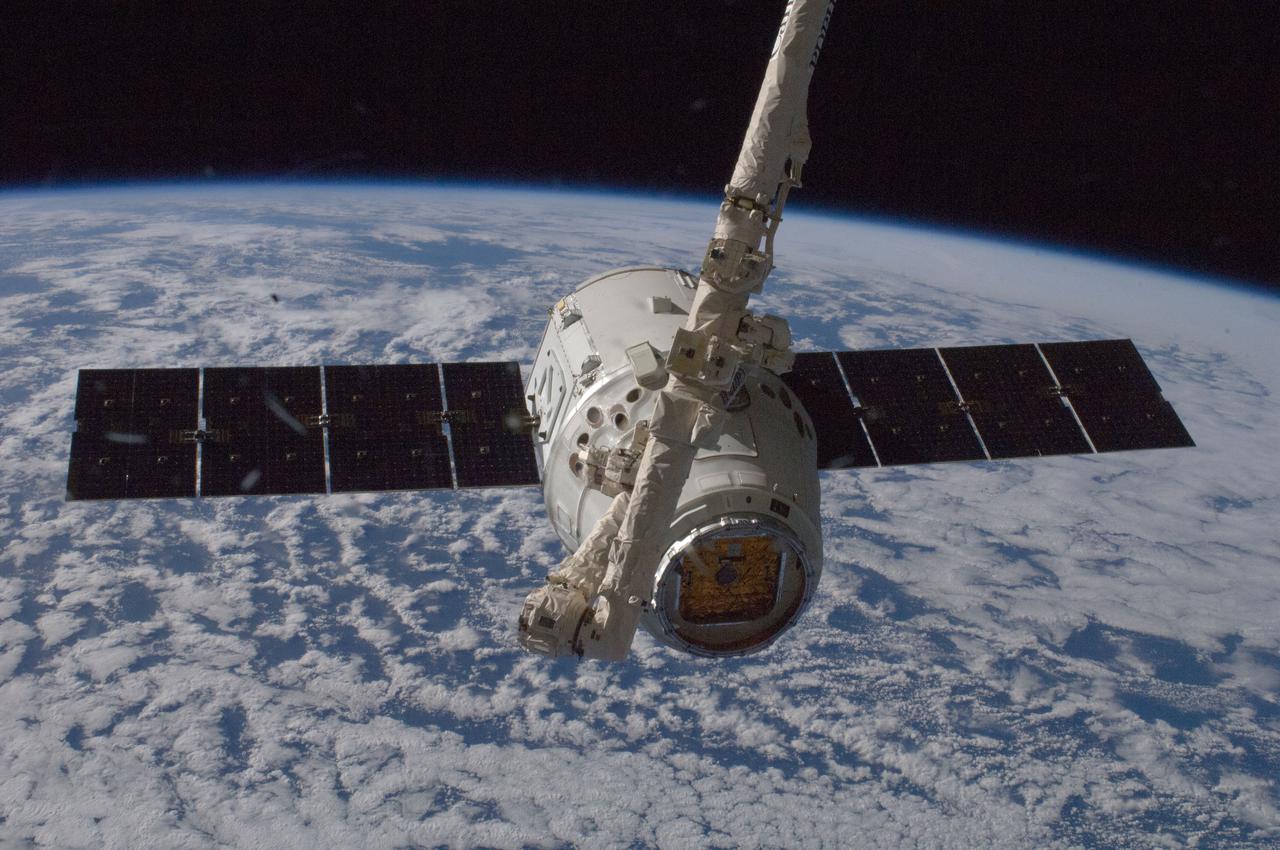
ISS033-E-011160 (10 Oct. 2012) --- The SpaceX Dragon commercial cargo craft is grappled by the International Space Station’s Canadarm2 robotic arm. Working from the robotics workstation inside the seven-windowed Cupola, Japan Aerospace Exploration Agency astronaut Aki Hoshide, Expedition 33 flight engineer, with the assistance of NASA astronaut Sunita Williams, commander, captured Dragon at 6:56 a.m. (EDT) and used the robotic arm to berth Dragon to the Earth-facing port of the Harmony node Oct. 10, 2012. Dragon is scheduled to spend 18 days attached to the station. During that time, the crew will unload 882 pounds of crew supplies, science research and hardware from the cargo craft and reload it with 1,673 pounds of cargo for return to Earth. After Dragon’s mission at the station is completed, the crew will use Canadarm2 to detach Dragon from Harmony and release it for a splashdown about six hours later in the Pacific Ocean, 250 miles off the coast of southern California. Dragon launched atop a Falcon 9 rocket at 8:35 p.m. Oct. 7 from Cape Canaveral Air Force Station in Florida, beginning NASA's first contracted cargo delivery flight, designated SpaceX CRS-1, to the station.
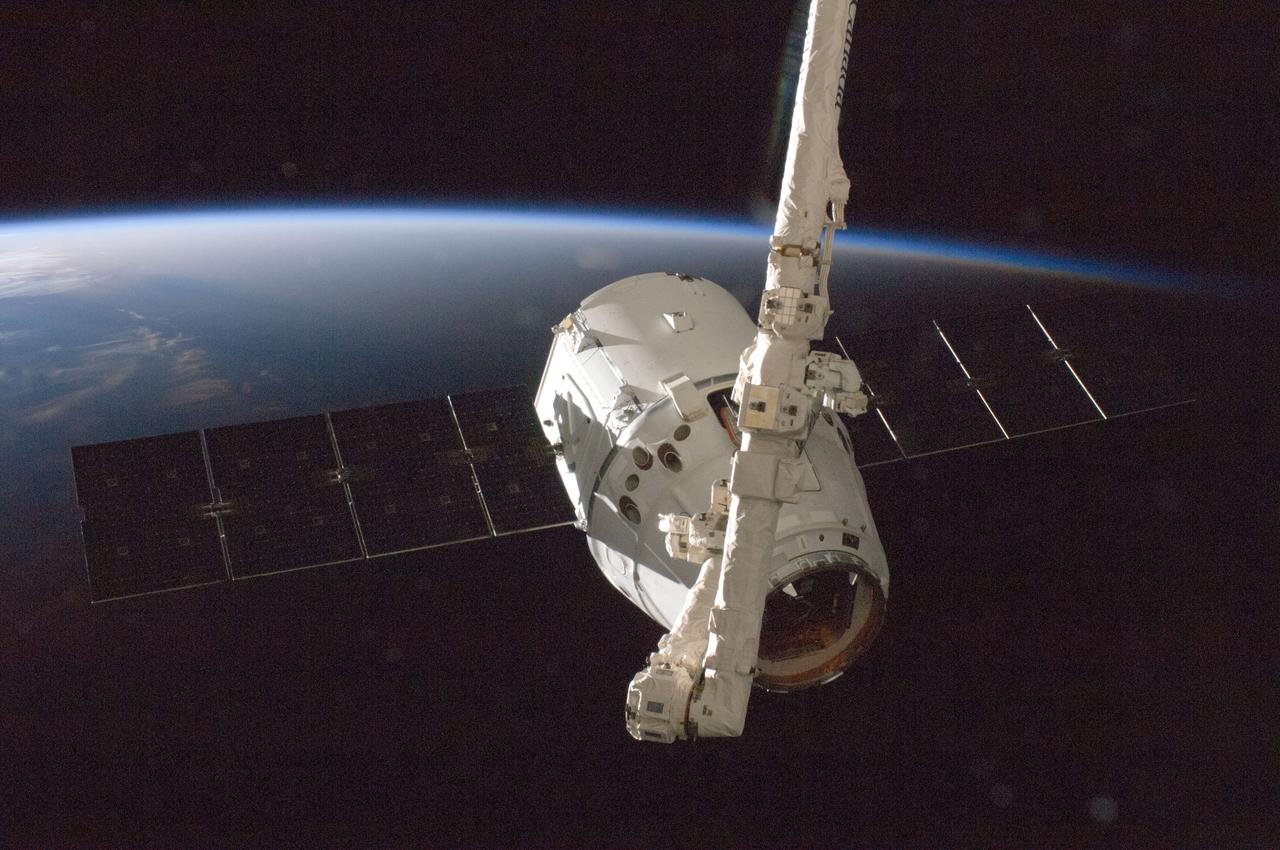
ISS033-E-011146 (10 Oct. 2012) --- The SpaceX Dragon commercial cargo craft is grappled by the International Space Station’s Canadarm2 robotic arm. Working from the robotics workstation inside the seven-windowed Cupola, Japan Aerospace Exploration Agency astronaut Aki Hoshide, Expedition 33 flight engineer, with the assistance of NASA astronaut Sunita Williams, commander, captured Dragon at 6:56 a.m. (EDT) and used the robotic arm to berth Dragon to the Earth-facing port of the Harmony node Oct. 10, 2012. Dragon is scheduled to spend 18 days attached to the station. During that time, the crew will unload 882 pounds of crew supplies, science research and hardware from the cargo craft and reload it with 1,673 pounds of cargo for return to Earth. After Dragon’s mission at the station is completed, the crew will use Canadarm2 to detach Dragon from Harmony and release it for a splashdown about six hours later in the Pacific Ocean, 250 miles off the coast of southern California. Dragon launched atop a Falcon 9 rocket at 8:35 p.m. Oct. 7 from Cape Canaveral Air Force Station in Florida, beginning NASA's first contracted cargo delivery flight, designated SpaceX CRS-1, to the station.

In this illustration, a SpaceX Crew Dragon spacecraft is shown in low-Earth orbit. NASA is partnering with Boeing and SpaceX to build a new generation of human-rated spacecraft capable of taking astronauts to the International Space Station and expanding research opportunities in orbit. SpaceX's upcoming Demo-1 flight test is part of NASA’s Commercial Crew Transportation Capability contract with the goal of returning human spaceflight launch capabilities to the United States.
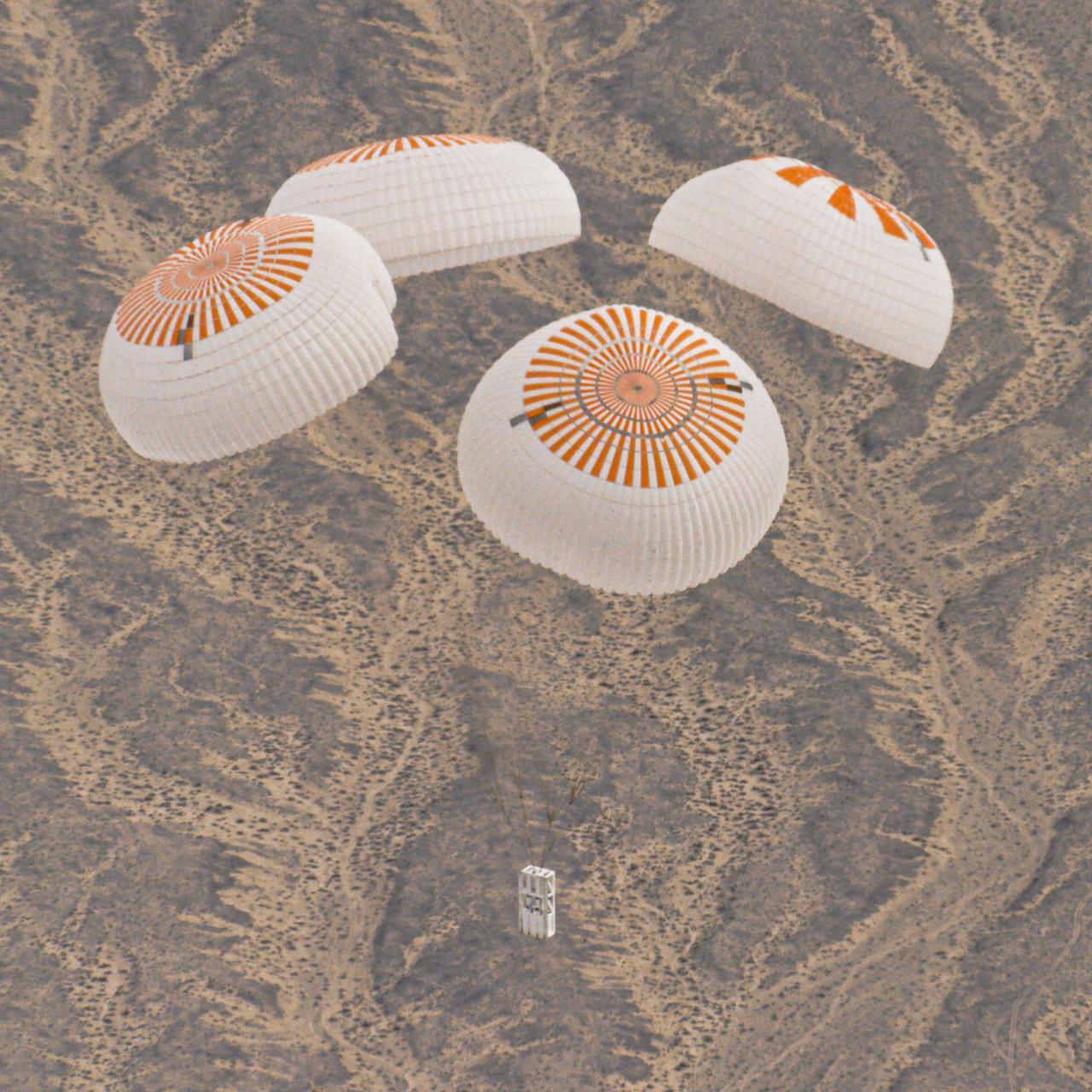
SpaceX completed the 7th successful system test of the Crew Dragon spacecraft’s upgraded Mark 3 parachutes in the western U.S. in December 2019. The parachutes will provide a safe landing on Earth for astronauts returning from the International Space Station in partnership with NASA’s Commercial Crew Program.
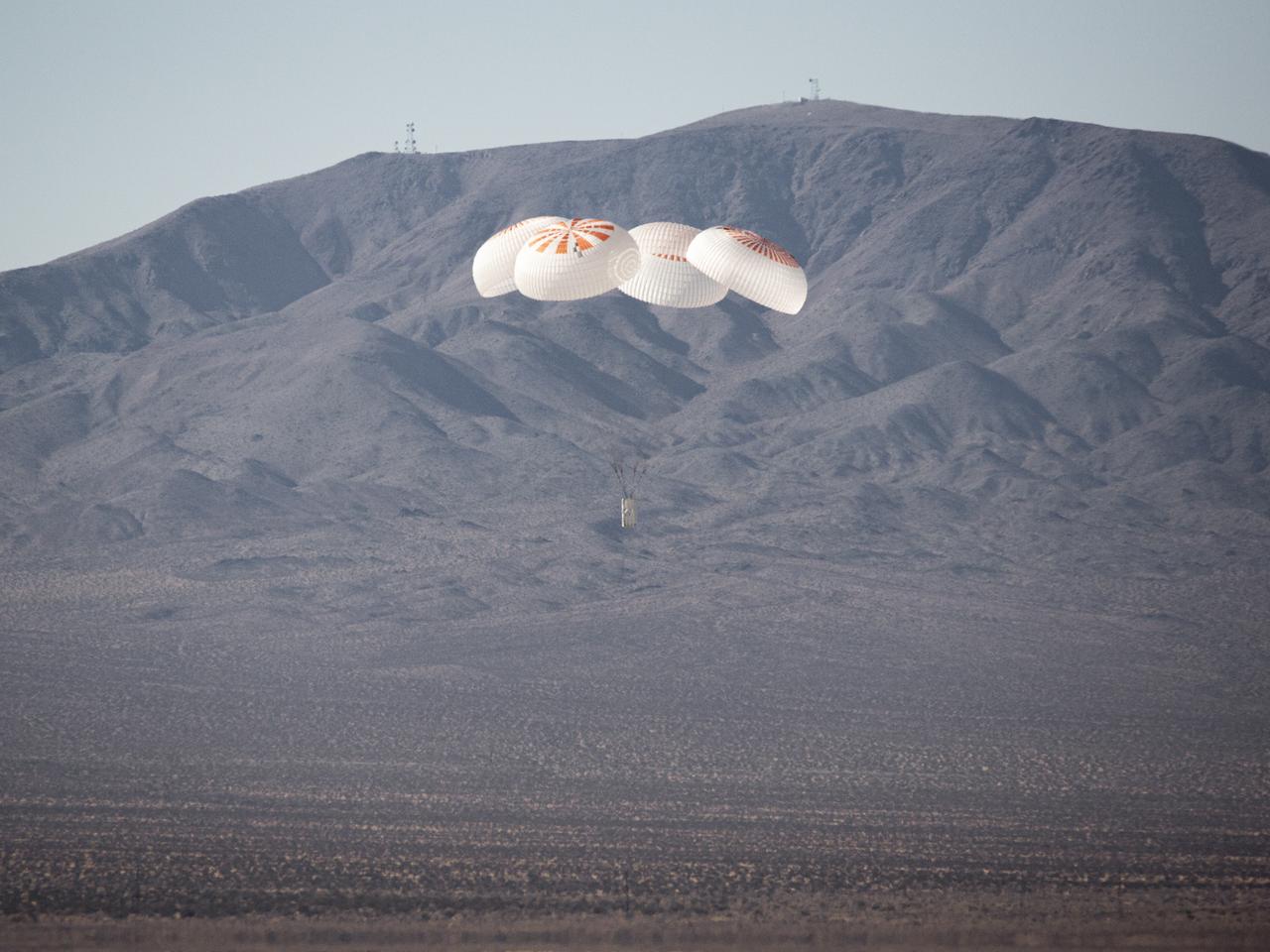
SpaceX completed the 7th successful system test of the Crew Dragon spacecraft’s upgraded Mark 3 parachutes in the western U.S. in December 2019. The parachutes will provide a safe landing on Earth for astronauts returning from the International Space Station in partnership with NASA’s Commercial Crew Program.
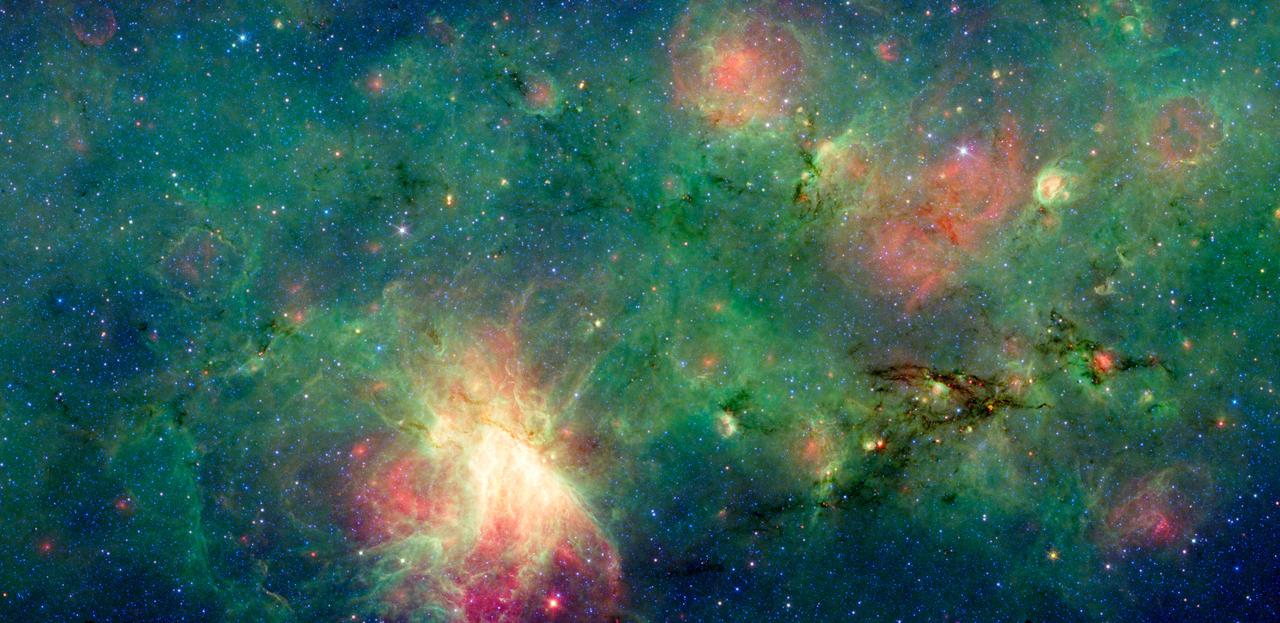
A dragon-shaped cloud of dust seems to fly out from a bright explosion in this infrared light image from NASA Spitzer Space Telescope. These views have revealed that this dark cloud, called M17 SWex, is forming stars at a furious rate.
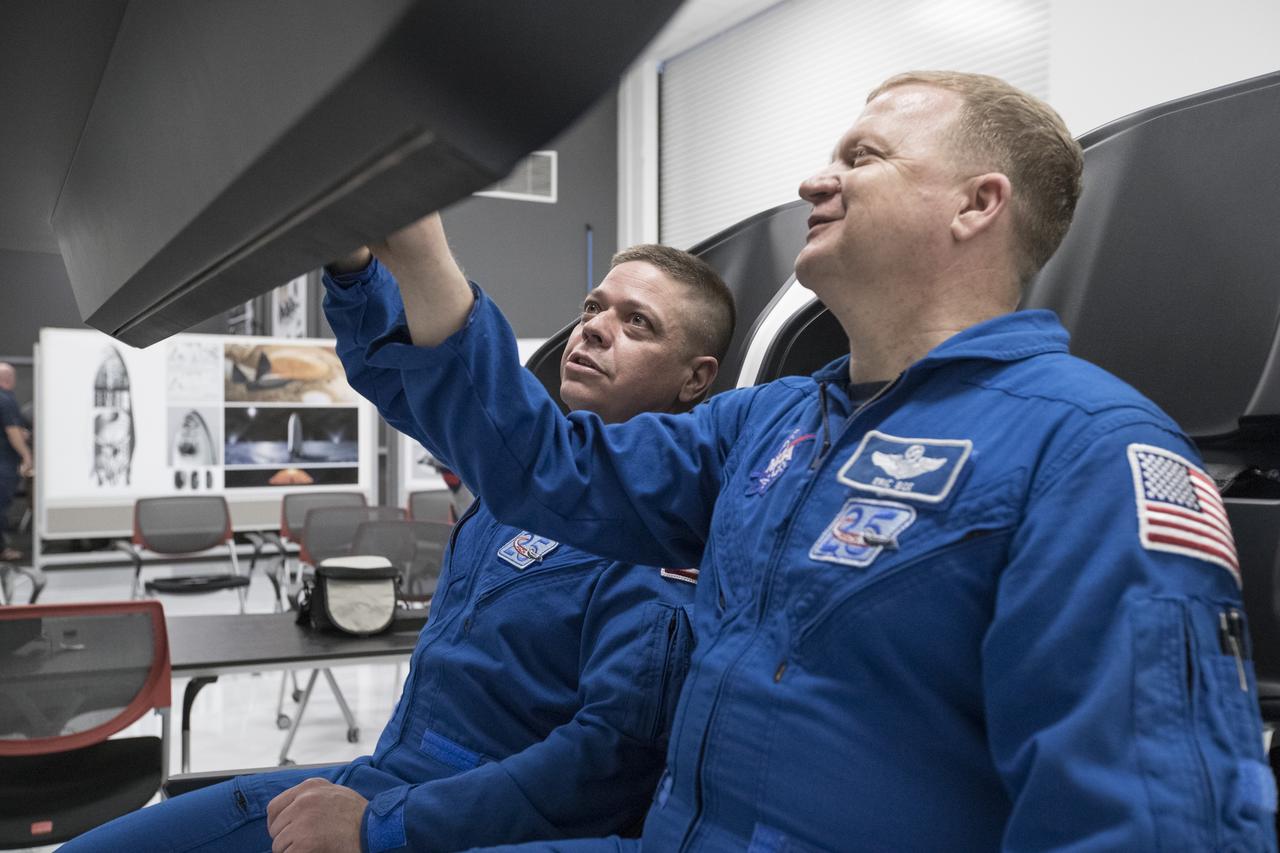
During a tour of SpaceX headquarters in Hawthorne, California, commercial crew astronauts Bob Behnken, left, and Eric Boe participate in joint test team training using mockup components of the Crew Dragon on March 8, 2017. Crew Dragon is being developed and manufactured in partnership with NASA's Commercial Crew Program to return human spaceflight capabilities to the U.S.
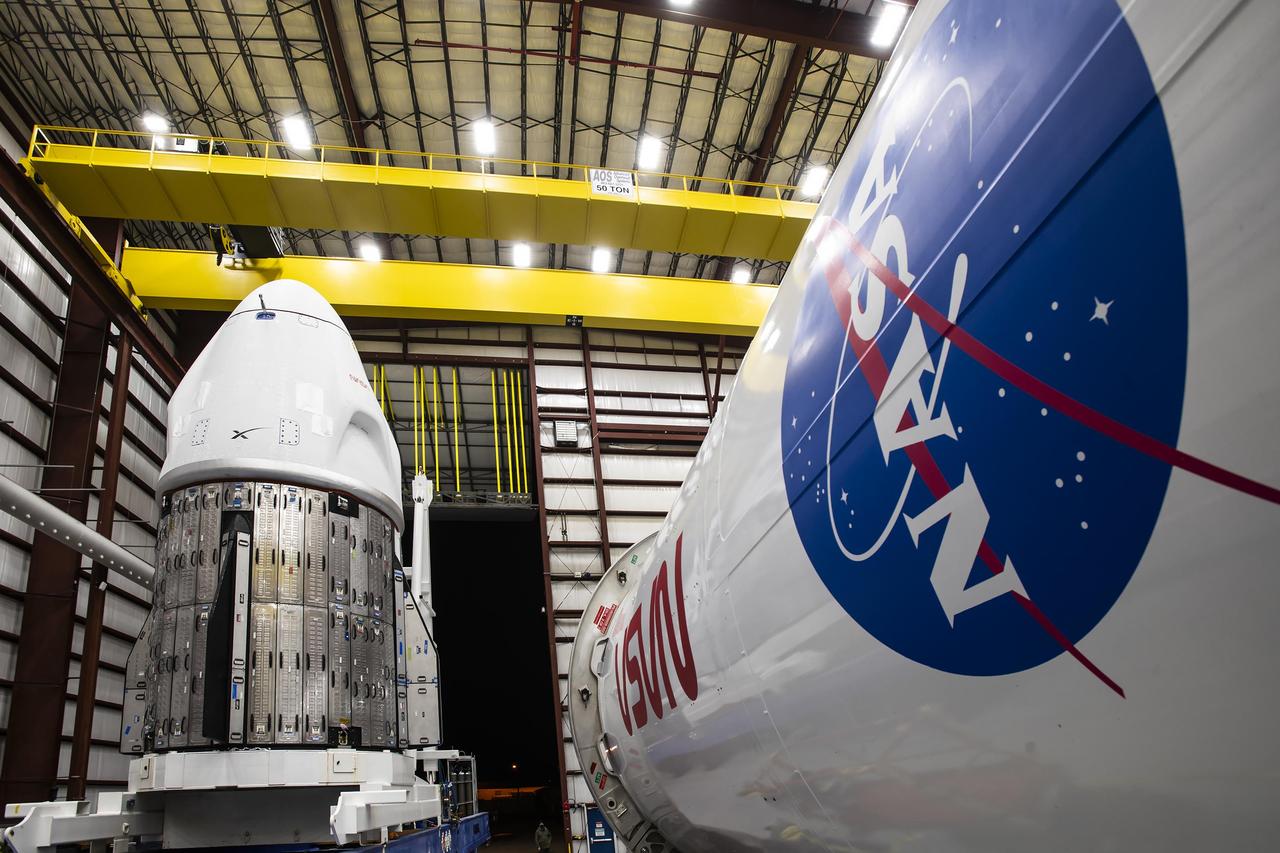
Inside the SpaceX horizontal processing facility at Launch Complex 39A at NASA’s Kennedy Space Center in Florida, the company's Dragon spacecraft is pictured next to a Falcon 9 rocket on Monday, Feb. 19, 2024, prior to integration for NASA’s SpaceX Crew-8 mission to the International Space Station. Liftoff of the eighth crew rotation mission with SpaceX to the station, and the ninth flight of Dragon with people as part of the agency’s Commercial Crew Program is slated for no earlier than 12:04 a.m. EST on Friday, March 1.
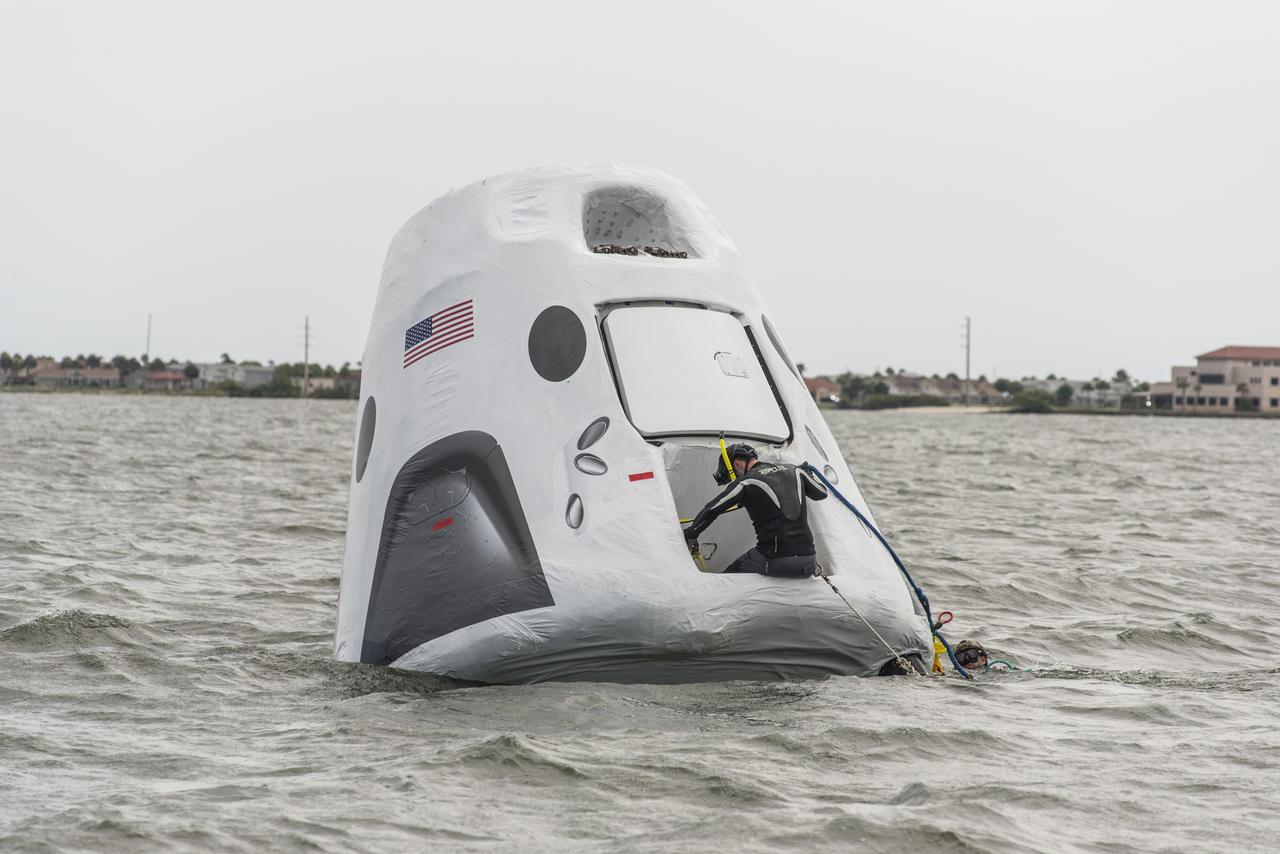
Personnel from NASA, SpaceX and the U.S. Air Force have begun practicing recovery operations for the SpaceX Crew Dragon. Using a full-size model of the spacecraft that will take astronauts to the International Space Station, Air Force parajumpers practice helping astronauts out of the SpaceX Crew Dragon following a mission. In certain unusual recovery situations, SpaceX may need to work with Air Force for parajumpers to recover astronauts from the capsule following a water landing. The recovery trainer was recently lowered into the Indian River Lagoon near NASA’s Kennedy Space Center allowing Air Force pararescue and others to refine recovery procedures. SpaceX is developing the Crew Dragon in partnership with NASA’s Commercial Crew Program to carry astronauts to and from the International Space Station.

NASA Administrator Charles Bolden, left, and SpaceX CEO and Chief Designer Elon Musk, view the historic Dragon capsule that returned to Earth on May 31 following the first successful mission by a private company to carry supplies to the International Space Station on Wednesday, June 13, 2012 at the SpaceX facility in McGregor, Texas. Bolden and Musk also thanked the more than 150 SpaceX employees working at the McGregor facility for their role in the historic mission. Photo Credit: (NASA/Bill Ingalls)

NASA Administrator Charles Bolden, left, and SpaceX CEO and Chief Designer Elon Musk, view the historic Dragon capsule that returned to Earth on May 31 following the first successful mission by a private company to carry supplies to the International Space Station on Wednesday, June 13, 2012 at the SpaceX facility in McGregor, Texas. Bolden and Musk also thanked the more than 150 SpaceX employees working at the McGregor facility for their role in the historic mission. Photo Credit: (NASA/Bill Ingalls)

NASA Administrator Charles Bolden, left, and SpaceX CEO and Chief Designer Elon Musk, view the historic Dragon capsule that returned to Earth on May 31 following the first successful mission by a private company to carry supplies to the International Space Station on Wednesday, June 13, 2012 at the SpaceX facility in McGregor, Texas. Bolden and Musk also thanked the more than 150 SpaceX employees working at the McGregor facility for their role in the historic mission. Photo Credit: (NASA/Bill Ingalls)

NASA Administrator Charles Bolden, left, and SpaceX CEO and Chief Designer Elon Musk, view the historic Dragon capsule that returned to Earth on May 31 following the first successful mission by a private company to carry supplies to the International Space Station on Wednesday, June 13, 2012 at the SpaceX facility in McGregor, Texas. Bolden and Musk also thanked the more than 150 SpaceX employees working at the McGregor facility for their role in the historic mission. Photo Credit: (NASA/Bill Ingalls)

NASA Administrator Charles Bolden, left, congratulates SpaceX CEO and Chief Designer Elon Musk in front of the historic Dragon capsule that returned to Earth on May 31 following the first successful mission by a private company to carry supplies to the International Space Station on Wednesday, June 13, 2012 at the SpaceX facility in McGregor, Texas. Bolden and Musk also thanked the more than 150 SpaceX employees working at the McGregor facility for their role in the historic mission. Photo Credit: (NASA/Bill Ingalls)
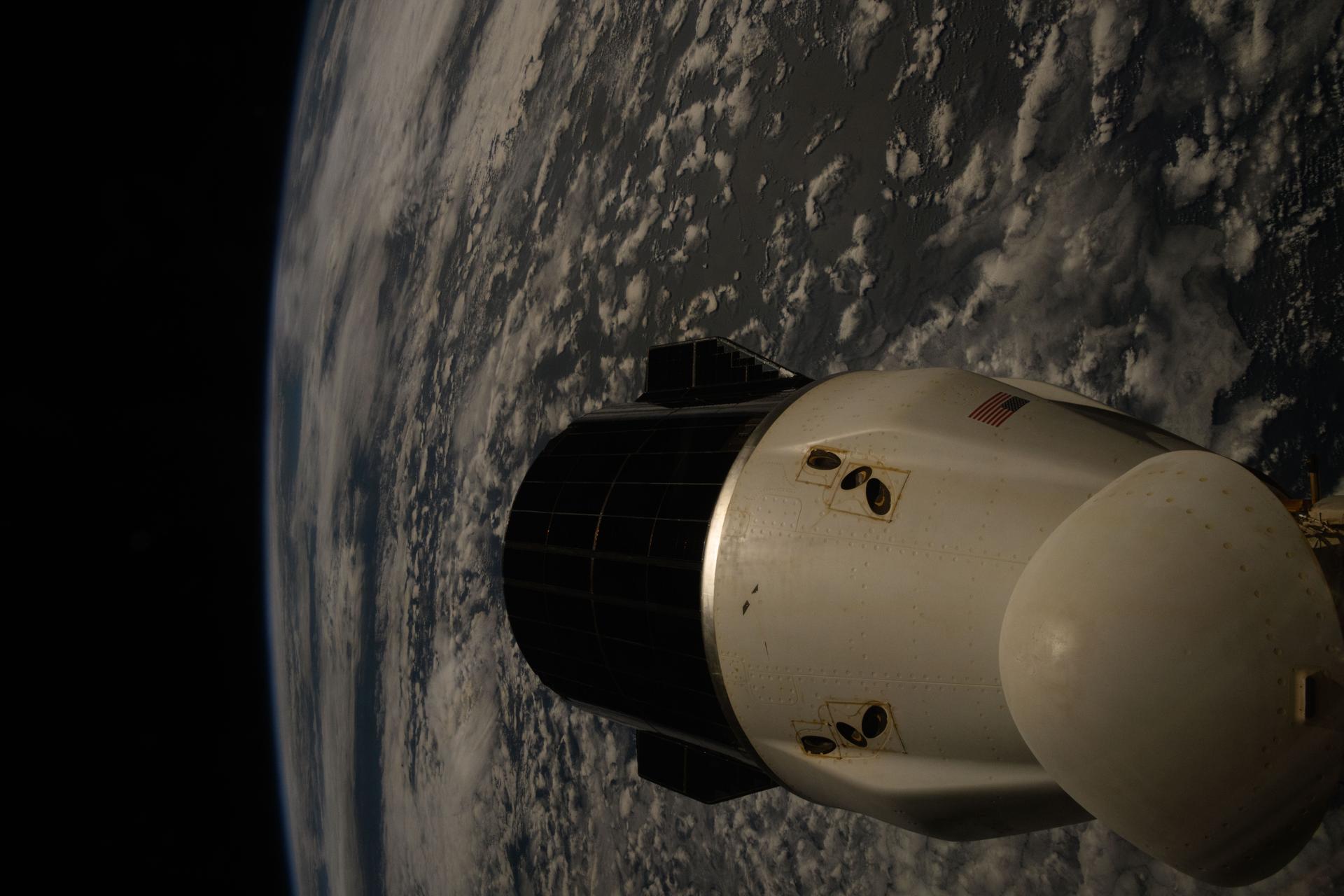
iss074e0100627 (Dec. 29, 2025) --- A SpaceX Dragon spacecraft is pictured docked to the International Space Station as the orbital outpost soared 269 miles above the Atlantic Ocean northwest of the South Georgia and the South Sandwich Islands.
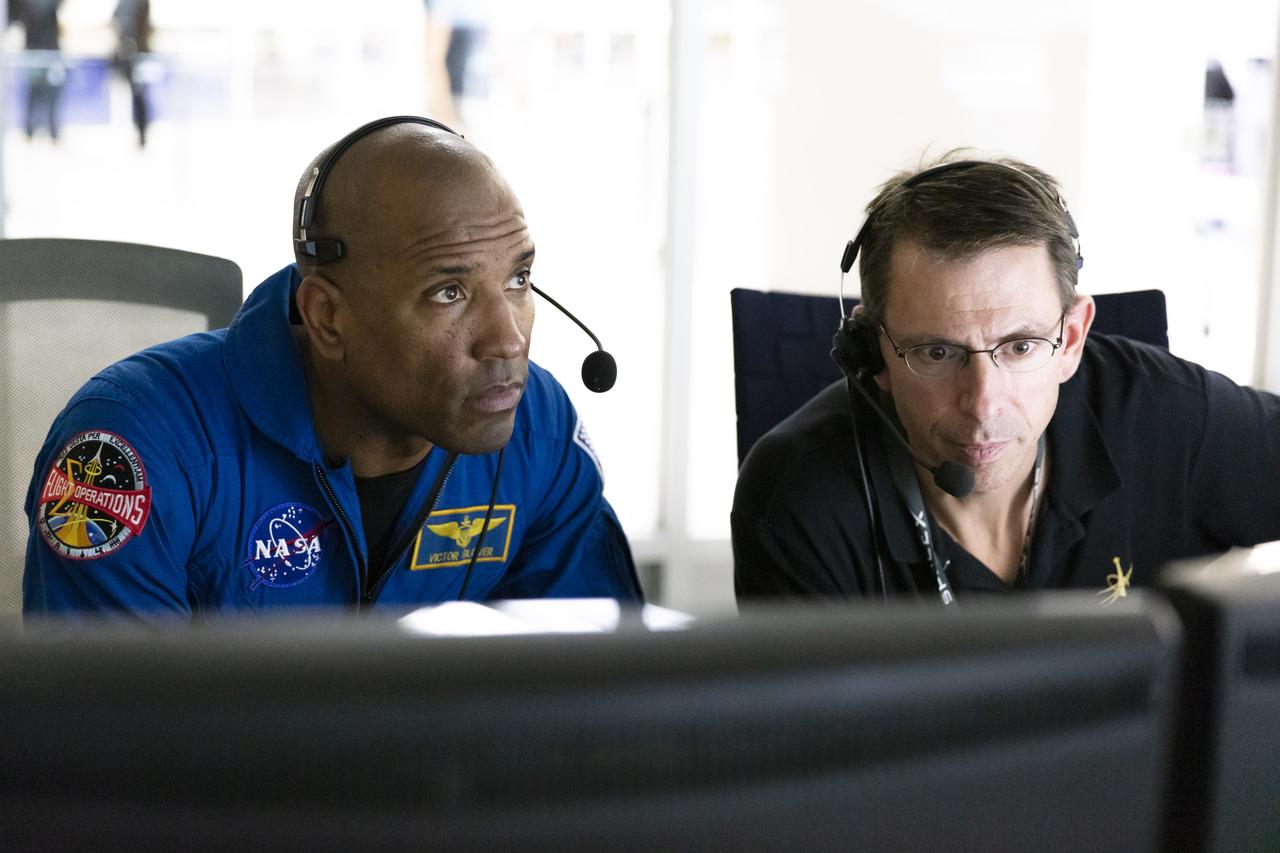
NASA astronaut Victor Glover, left, and a SpaceX employee, seated at consoles inside SpaceX Mission Control in Hawthorne, California, monitor the Crew Dragon spacecraft static fire engine tests taking place at Cape Canaveral Air Force Station in Florida on Nov. 13, 2019. The tests will help validate the Crew Dragon’s launch escape system ahead of the upcoming in-flight abort demonstration as part of NASA’s Commercial Crew Program. Glover will fly to the International Space Station on the second crewed flight of Crew Dragon.
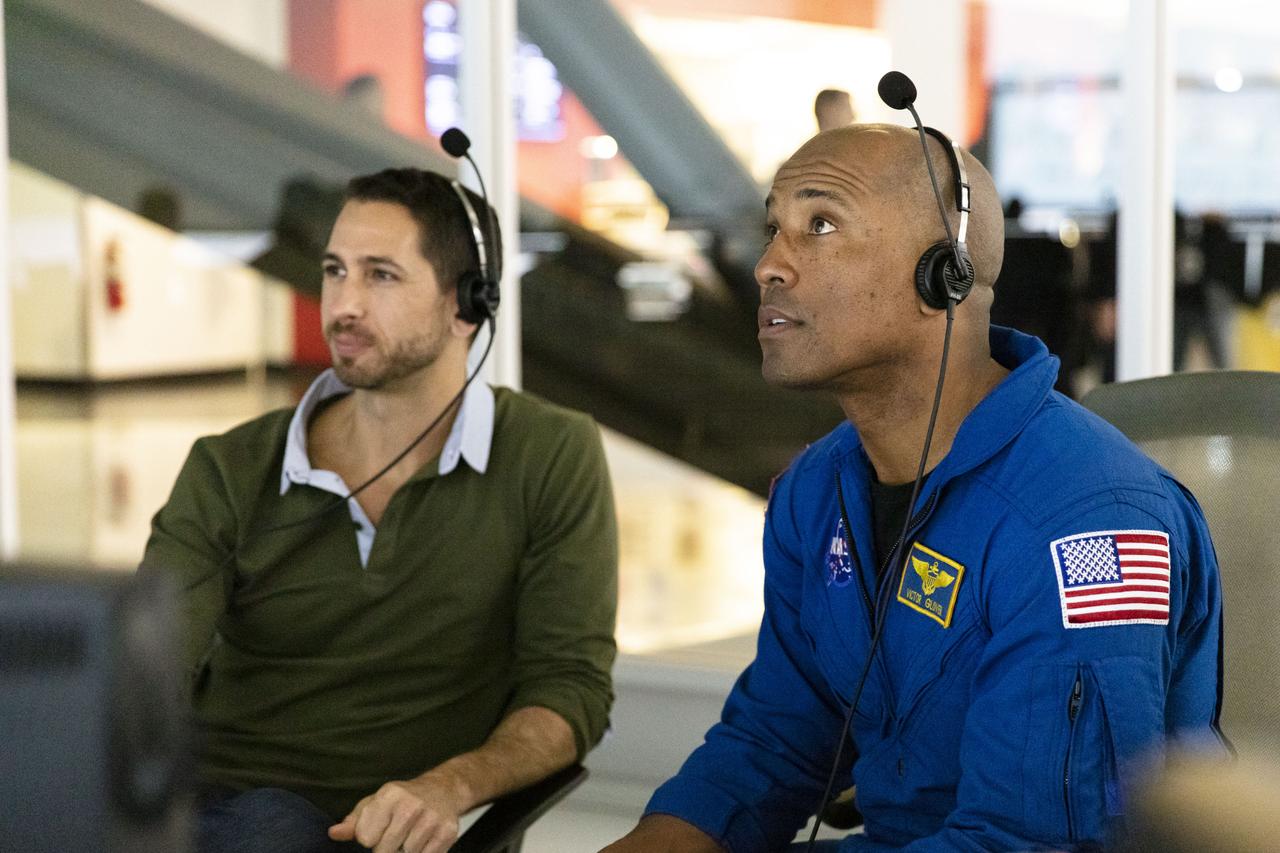
NASA astronaut Victor Glover, right, and a SpaceX employee, seated at consoles inside SpaceX Mission Control in Hawthorne, California, monitor the Crew Dragon spacecraft static fire engine tests taking place at Cape Canaveral Air Force Station in Florida on Nov. 13, 2019. The tests will help validate the Crew Dragon’s launch escape system ahead of the upcoming in-flight abort demonstration as part of NASA’s Commercial Crew Program. Glover will fly to the International Space Station on the second crewed flight of Crew Dragon.
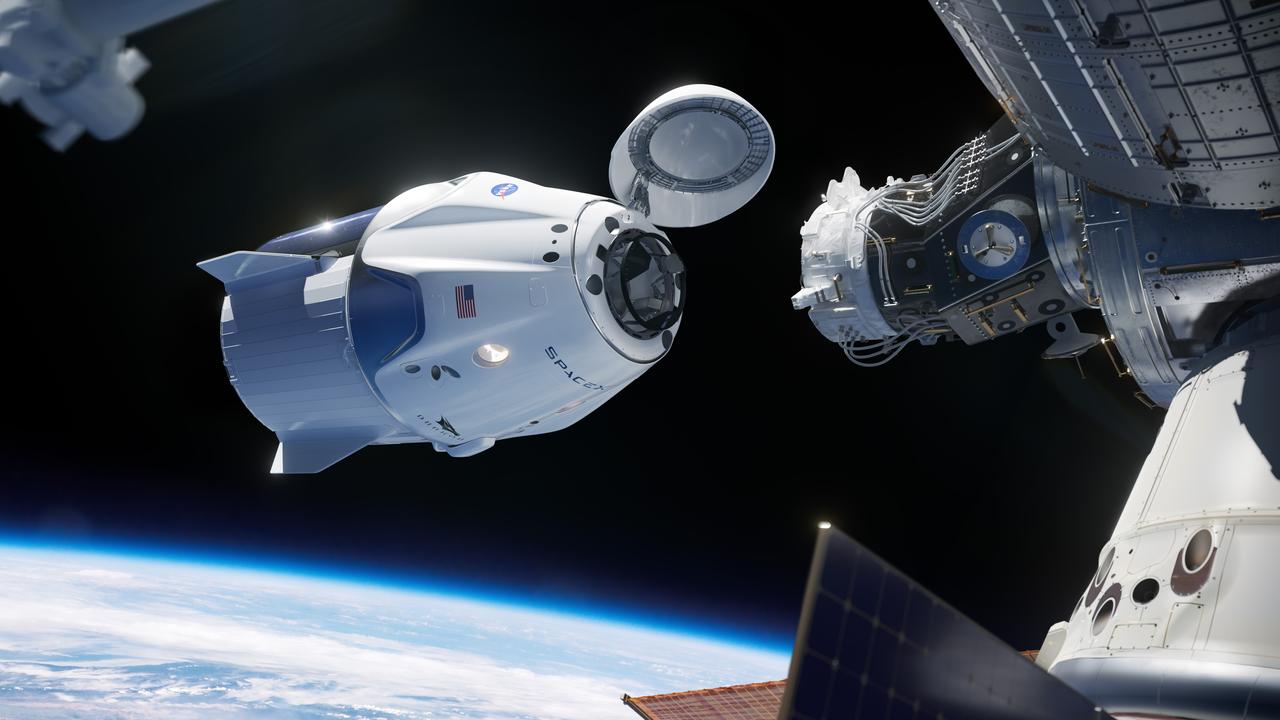
This artist illustration shows the SpaceX Crew Dragon spacecraft docking to the International Space Station. SpaceX is one of two American companies working with NASA to design, build, test and operate safe, reliable and cost-effective human transportation systems, restoring the nation’s human launch capability to and from the station.
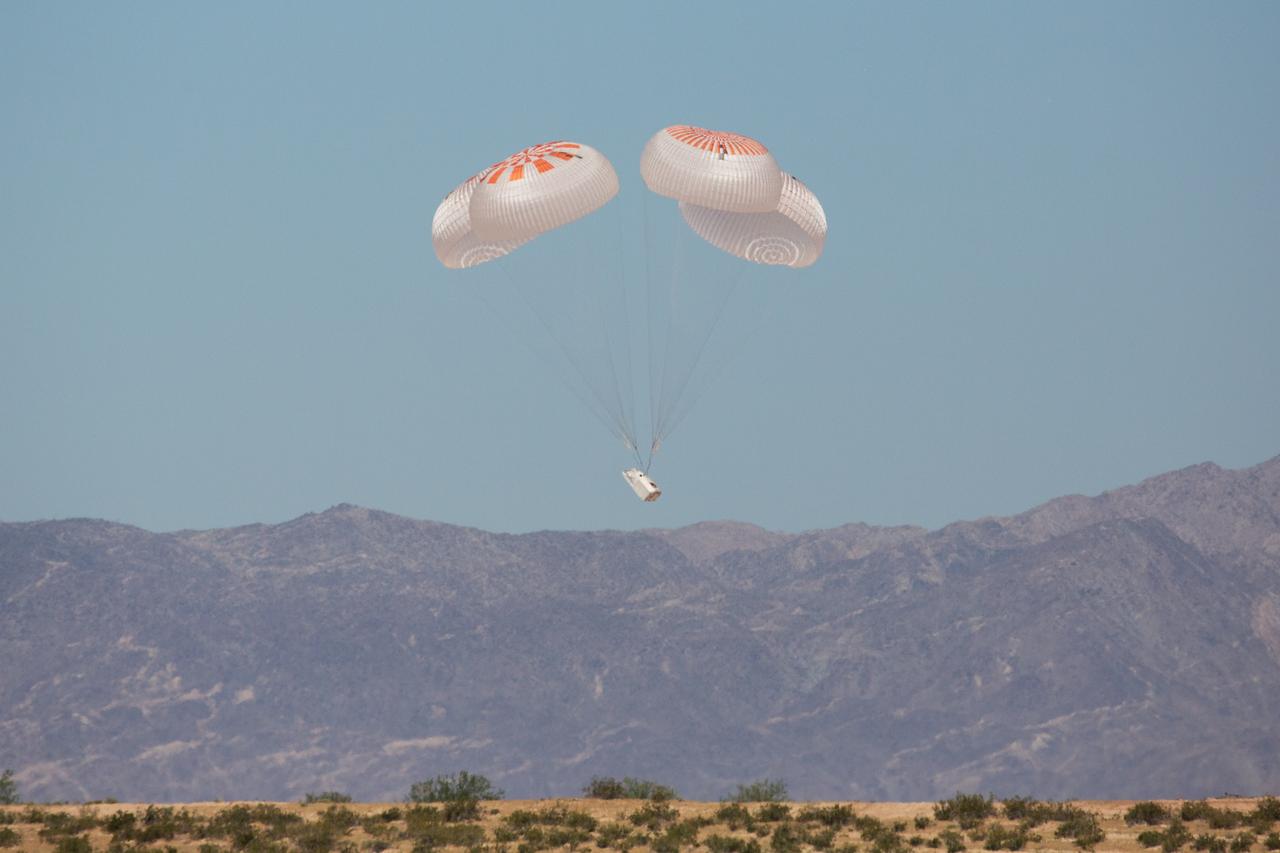
SpaceX completed its 27th and final test of Crew Dragon’s Mark 3 parachute system on Friday, May 1, 2020, that will be used during the Demo-2 mission to safely land the spacecraft carrying NASA astronauts Robert Behnken and Douglas Hurley back from the International Space Station for NASA’s Commercial Crew Program. Crew Dragon will carry Behnken and Hurley atop a Falcon 9 rocket, returning crew launches to the space station from U.S. soil for the first time since the Space Shuttle Program ended in 2011.
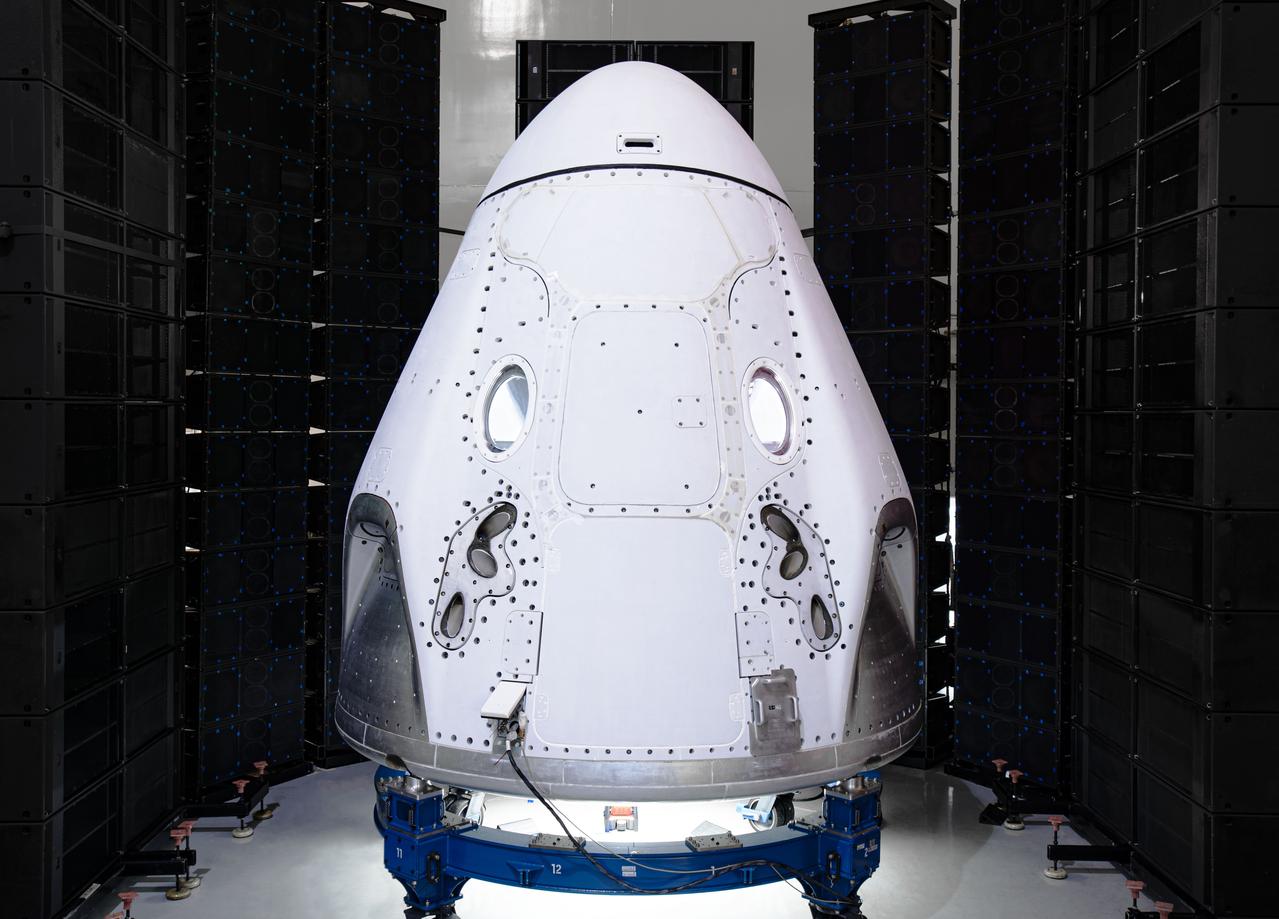
The SpaceX Crew Dragon spacecraft for its first crew launch from American soil arrived at the launch site on Feb. 13, 2020. NASA and SpaceX are preparing for the company’s first flight test with astronauts to the International Space Station as part of the agency’s Commercial Crew Program. The SpaceX Crew Dragon will launch atop a Falcon 9 rocket with NASA astronauts Bob Behnken and Doug Hurley from historic Launch Complex 39A from NASA’s Kennedy Space Center in Florida. The team completed acoustic testing of the spacecraft as part of its final testing and prelaunch processing in a SpaceX facility on nearby Cape Canaveral Air Force Station. Photo credit: SpaceX
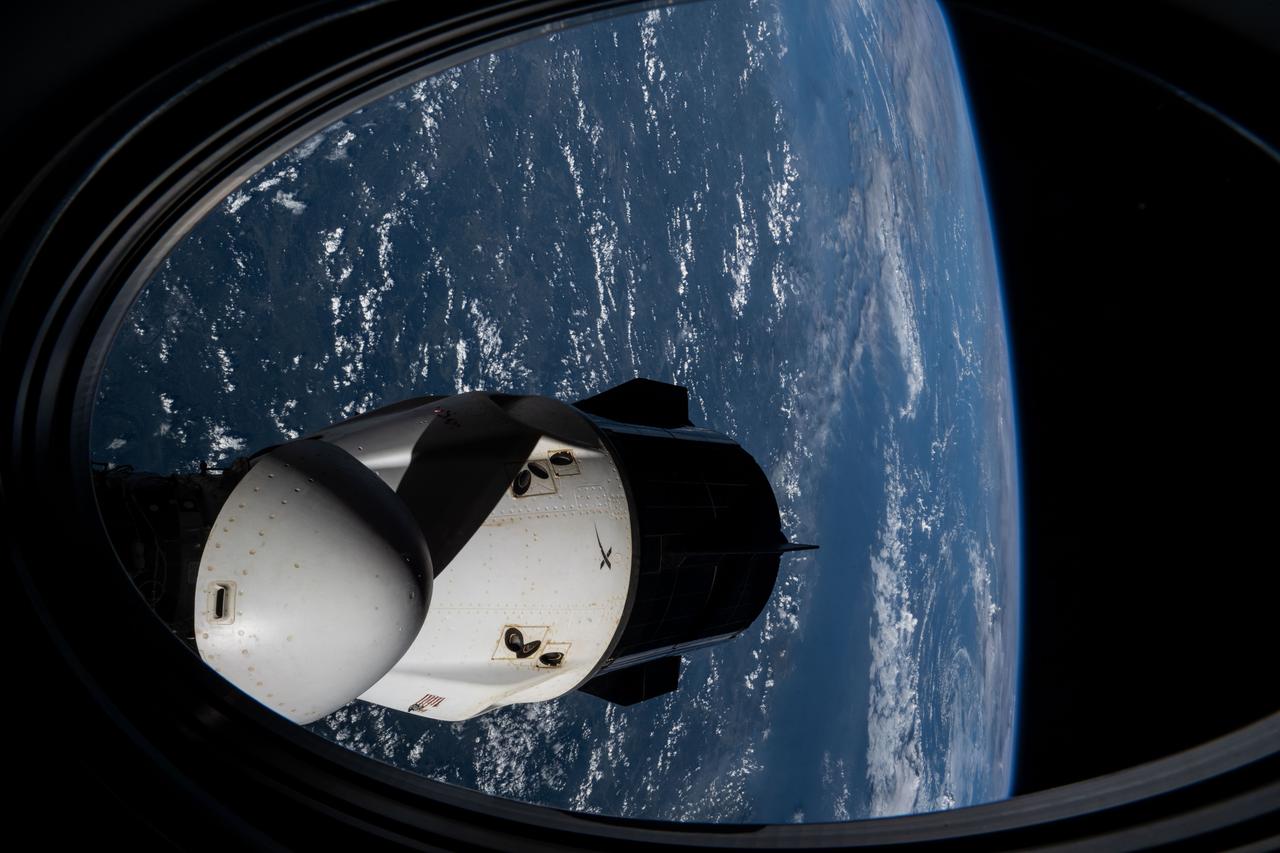
iss073e0427628 (Aug. 8, 2025) --- From one Dragon to another: A view of the SpaceX Dragon crew spacecraft docked to the forward port of the International Space Station's Harmony module, captured from a window aboard another Dragon spacecraft docked to Harmony’s space-facing port.

iss058e001781 (Dec. 31, 2018) --- The SpaceX Dragon cargo craft is pictured attached to the International Space Station almost 257 miles above Quebec on New Year's Eve. The complex was flying into an orbital sunrise on a northwest to southeast track about to cross the Atlantic Ocean.

Astronaut Bob Behnken emerges from the hatch of a SpaceX Crew Dragon spacecraft in manufacturing at SpaceX's headquarters and factory in Hawthorne, California. Behnken is one of four NASA astronauts selected to train with Boeing and SpaceX ahead of flight tests for NASA's Commercial Crew Program. Along with Behnken, Eric Boe, Doug Hurley and Suni Williams are working with the companies on their independent spacecraft and launch vehicles being developed to take astronauts to the International Space Station. Photo credit: SpaceX
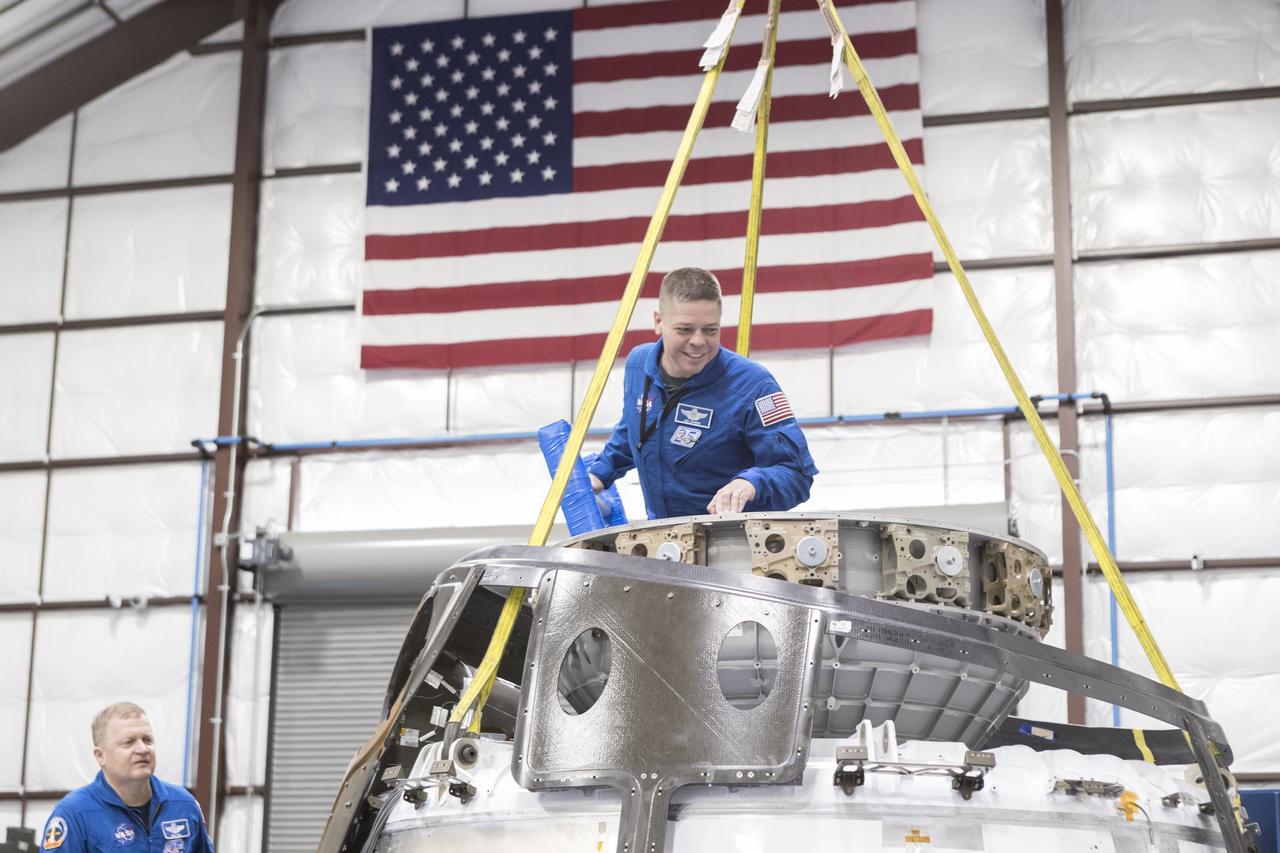
Astronaut Bob Behnken emerges from the top hatch of a SpaceX Crew Dragon spacecraft in manufacturing at SpaceX's headquarters and factory in Hawthorne, California, as astronaut Eri Boe looks on. Behnken and Boe are two of four NASA astronauts selected to train with Boeing and SpaceX ahead of flight tests for NASA's Commercial Crew Program. Along with Behnken and Boe, Doug Hurley and Suni Williams are working with the companies on their independent spacecraft and launch vehicles being developed to take astronauts to the International Space Station. Photo credit: SpaceX
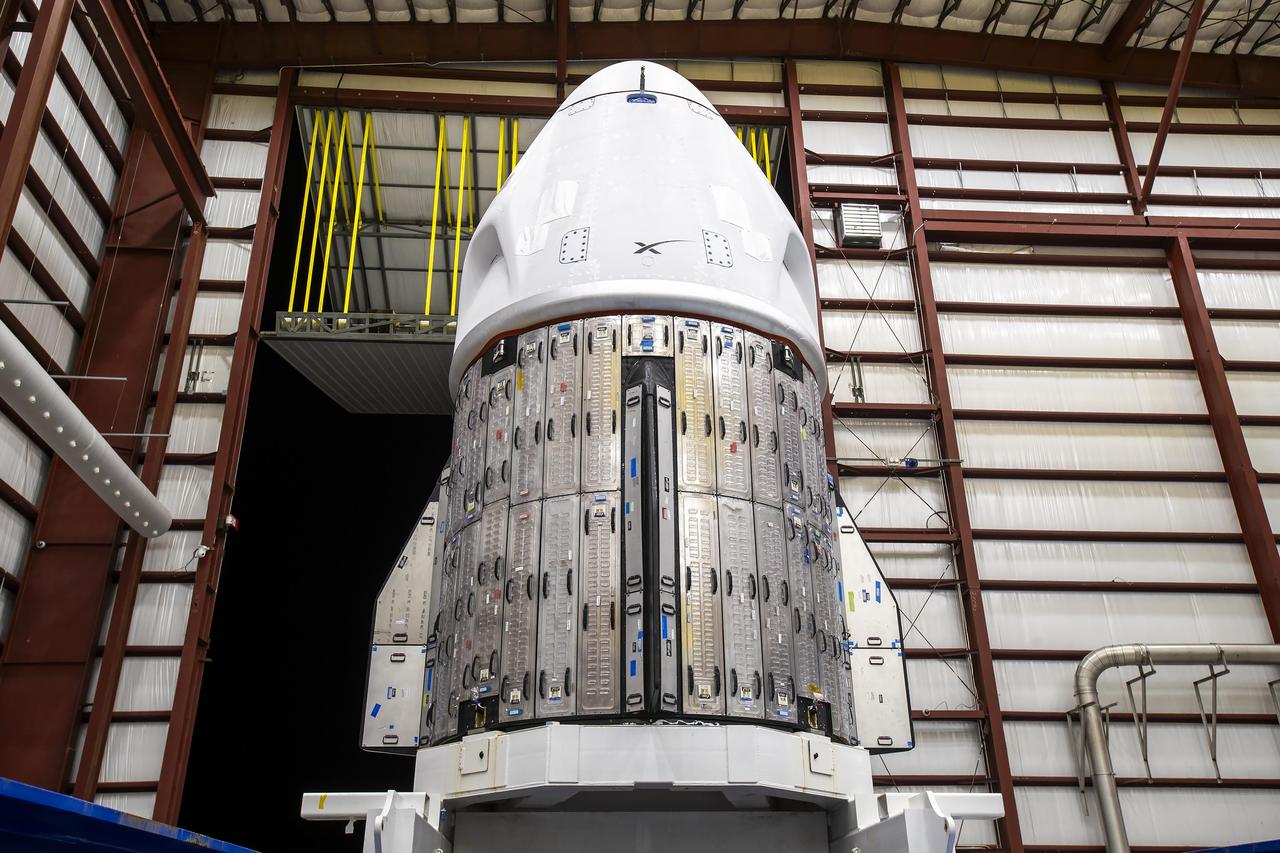
SpaceX’s Dragon spacecraft for NASA’s SpaceX Crew-8 mission arrives at SpaceX’s hangar at Kennedy Space Center’s Launch Complex 39A in Florida on Monday, Feb. 19, 2024, after a short journey from a nearby processing facility at Cape Canaveral Space Force Station. NASA astronauts Matthew Dominick, Michael Barratt, and Jeanette Epps, and Roscosmos cosmonaut Alexander Grebenkin are slated to launch to the International Space Station aboard SpaceX’s Dragon spacecraft, powered by the company’s Falcon 9 rocket from Launch Complex 39A no earlier than 12:04 a.m. EST on Friday, March 1.

SpaceX’s Crew Dragon is at NASA’s Glenn Research Center, Plum Brook Station in Ohio, ready to undergo testing in the In-Space Propulsion Facility — the world’s only facility capable of testing full-scale upper-stage launch vehicles and rocket engines under simulated high-altitude conditions. The chamber will allow SpaceX and NASA to verify Crew Dragon’s ability to withstand the extreme temperatures and vacuum of space. This is the spacecraft that SpaceX will fly during its Demonstration Mission 1 flight test under NASA’s Commercial Crew Transportation Capability contract with the goal of returning human spaceflight launch capabilities to the U.S.
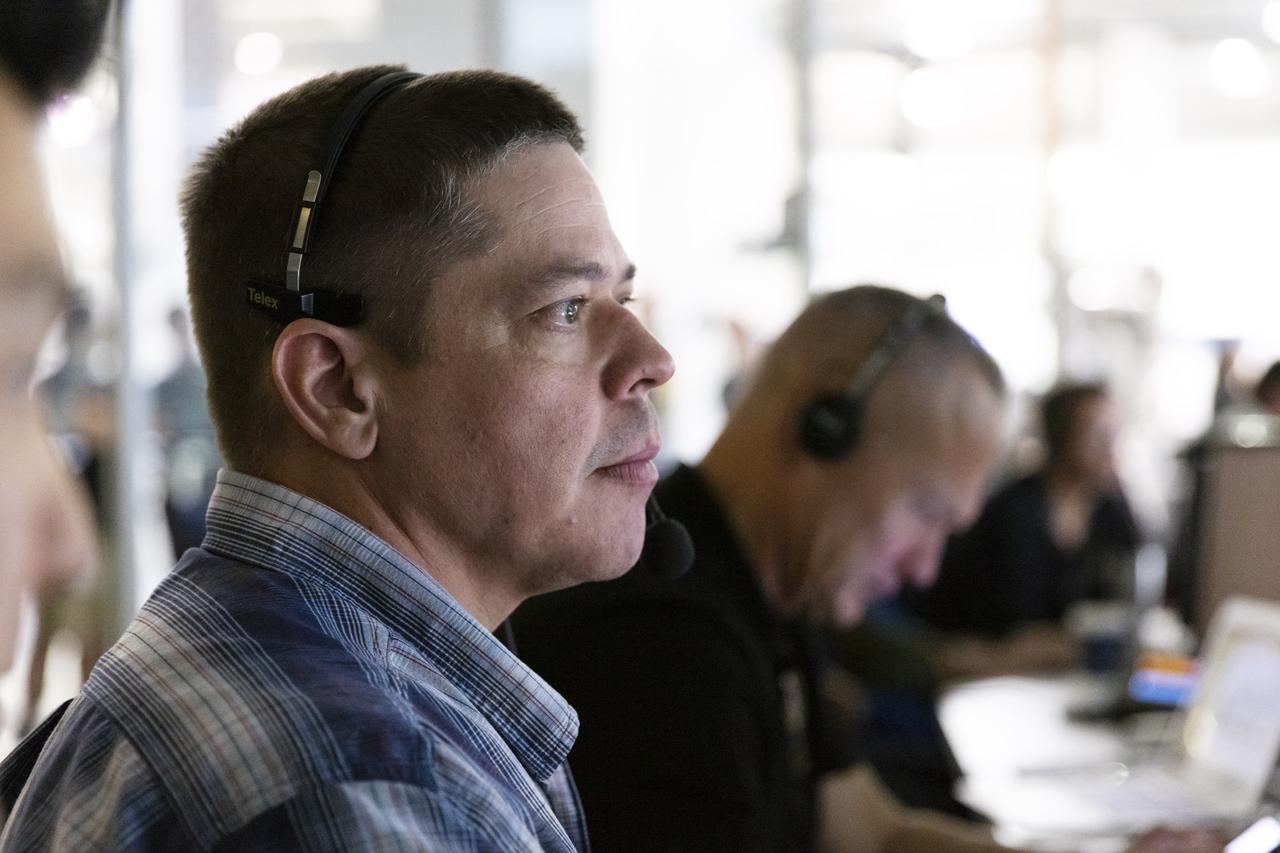
NASA astronauts Doug Hurley, left, and Bob Behnken, seated at consoles inside SpaceX Mission Control in Hawthorne, California, monitor the Crew Dragon spacecraft static fire engine tests taking place at Cape Canaveral Air Force Station in Florida on Nov. 13, 2019. The tests will help validate the Crew Dragon’s launch escape system ahead of the upcoming in-flight abort demonstration as part of NASA’s Commercial Crew Program. Behnken and Hurley will be the first astronauts to fly aboard Crew Dragon in SpaceX’s Demo-2 mission to the International Space Station.
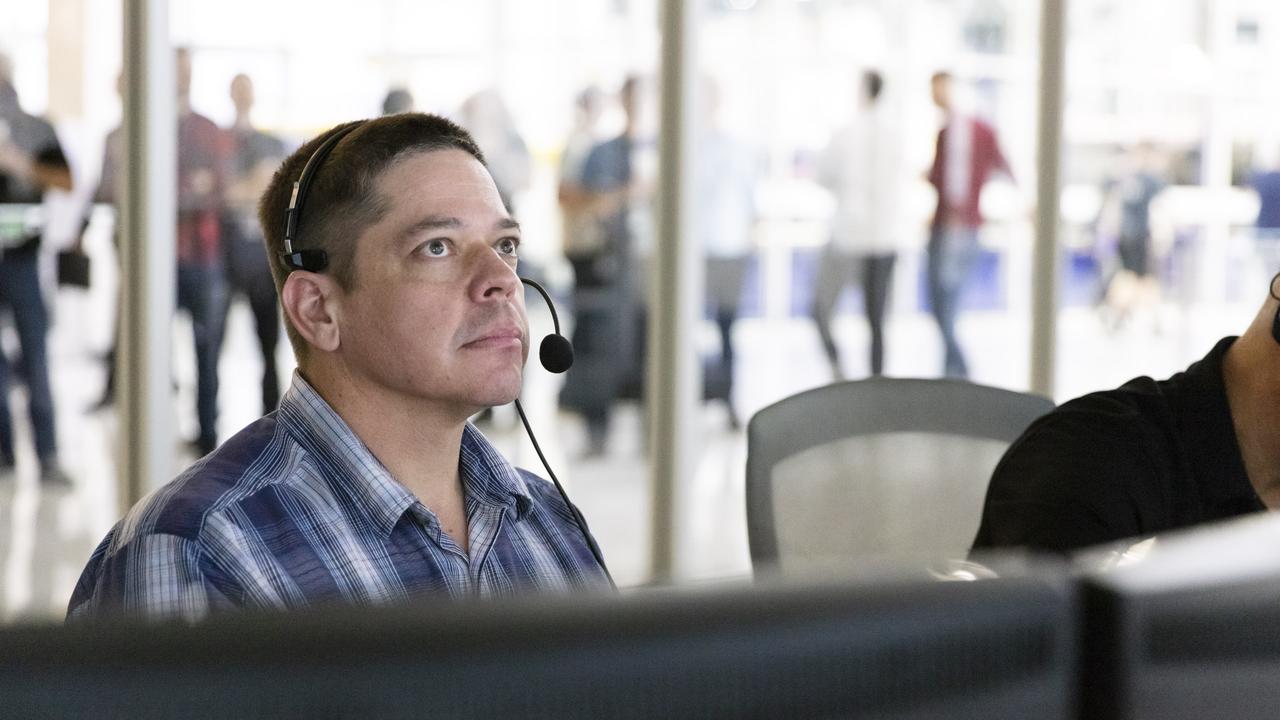
NASA astronaut Bob Behnken, seated at a console inside SpaceX Mission Control in Hawthorne, California, monitors the Crew Dragon spacecraft static fire engine tests taking place at Cape Canaveral Air Force Station in Florida on Nov. 13, 2019. The tests will help validate the Crew Dragon’s launch escape system ahead of the upcoming in-flight abort demonstration as part of NASA’s Commercial Crew Program. Behnken and NASA astronaut Doug Hurley will be the first people to fly aboard Crew Dragon in SpaceX’s Demo-2 mission to the International Space Station.
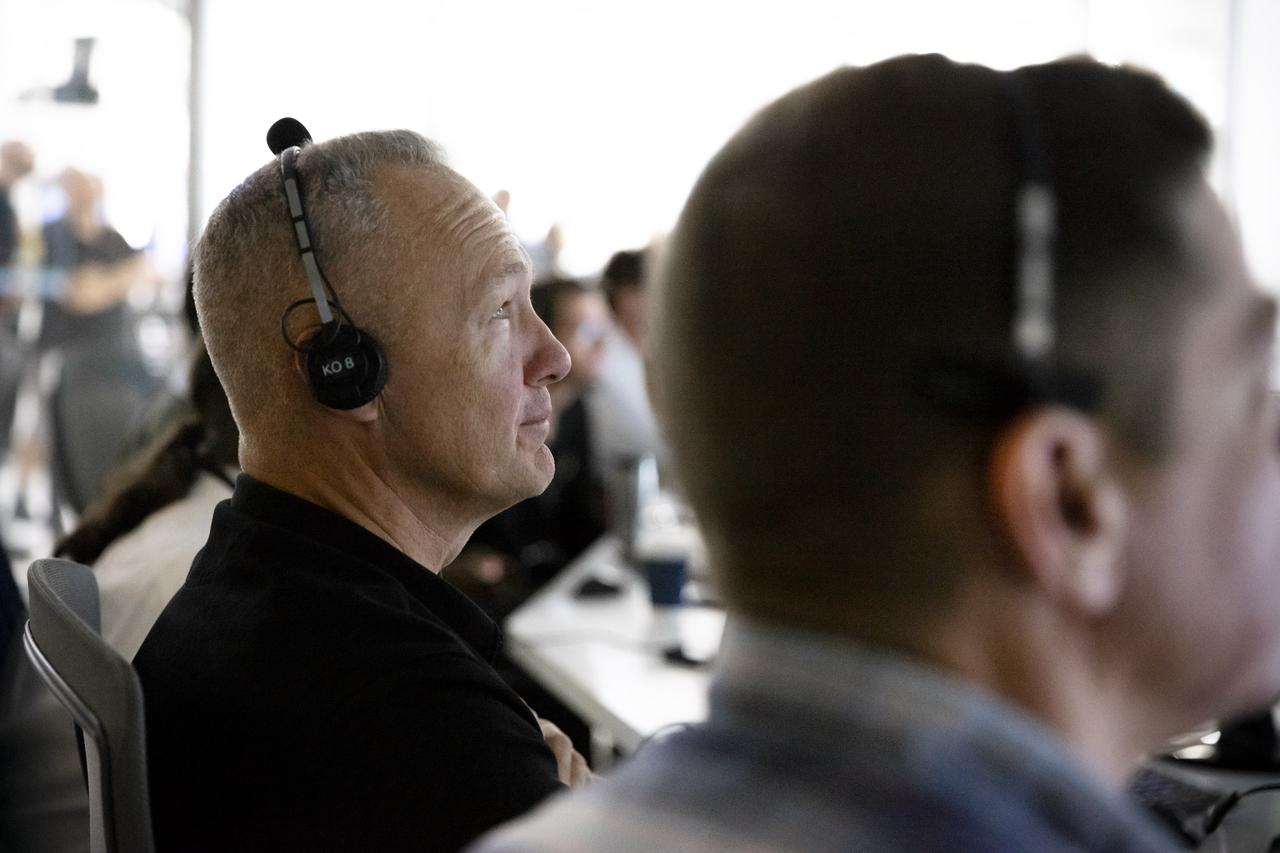
NASA astronauts Doug Hurley, left, and Bob Behnken, seated at consoles inside SpaceX Mission Control in Hawthorne, California, monitor the Crew Dragon spacecraft static fire engine tests taking place at Cape Canaveral Air Force Station in Florida on Nov. 13, 2019. The tests will help validate the Crew Dragon’s launch escape system ahead of the upcoming in-flight abort demonstration as part of NASA’s Commercial Crew Program. Behnken and Hurley will be the first astronauts to fly aboard Crew Dragon in SpaceX’s Demo-2 mission to the International Space Station.
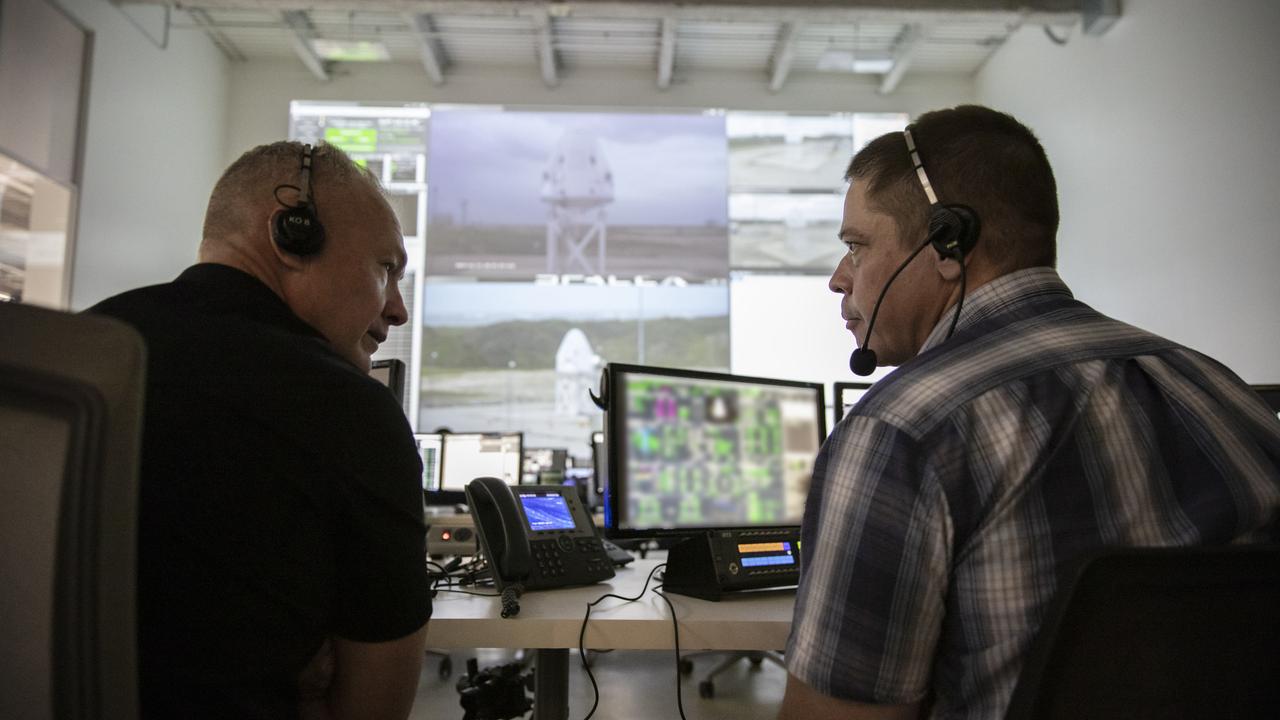
NASA astronauts Doug Hurley, left, and Bob Behnken, seated at consoles inside SpaceX Mission Control in Hawthorne, California, monitor the Crew Dragon spacecraft static fire engine tests taking place at Cape Canaveral Air Force Station in Florida on Nov. 13, 2019. The tests will help validate the Crew Dragon’s launch escape system ahead of the upcoming in-flight abort demonstration as part of NASA’s Commercial Crew Program. Behnken and Hurley will be the first astronauts to fly aboard Crew Dragon in SpaceX’s Demo-2 mission to the International Space Station.
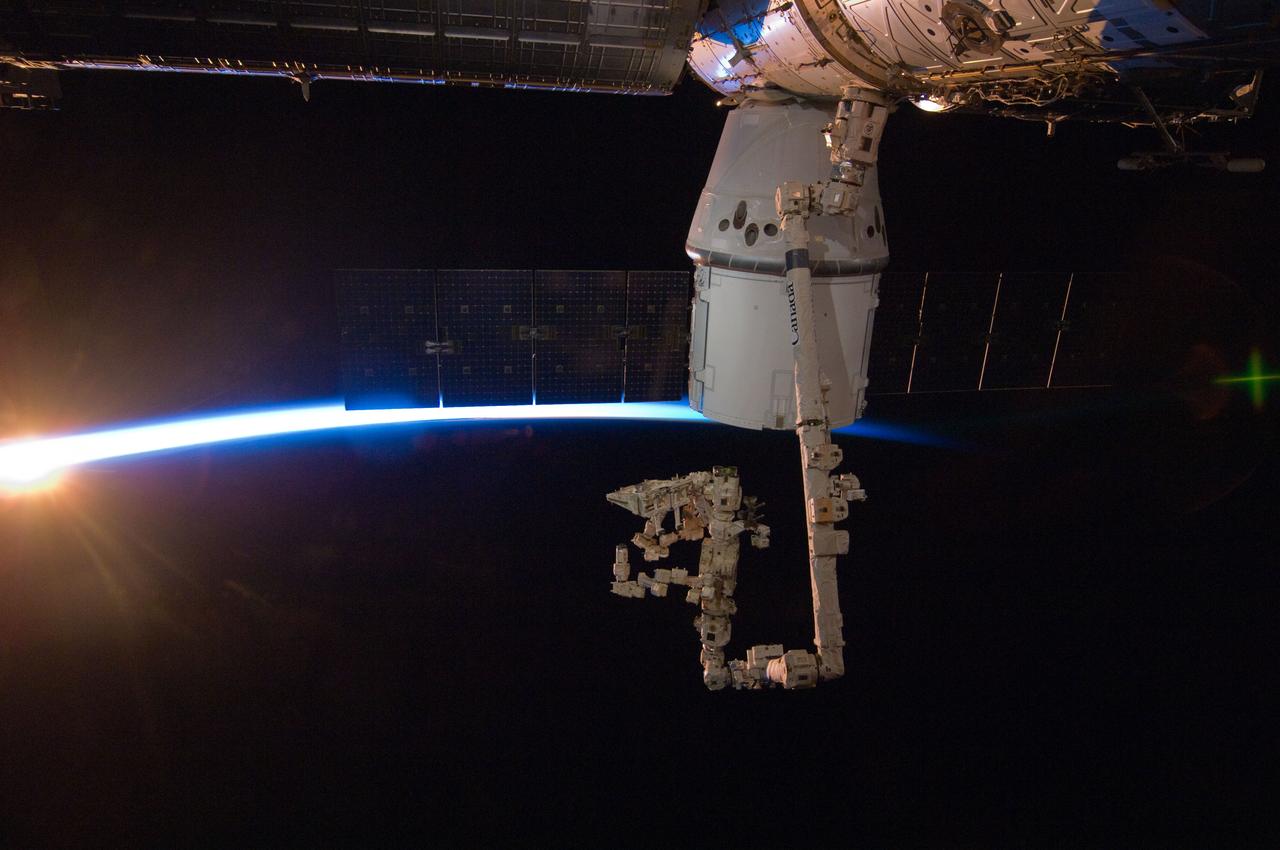
ISS031-E-077670 (25 May 2012) --- With rays of sunshine and the thin blue atmosphere of Earth serving as a backdrop, the SpaceX Dragon commercial cargo craft is berthed to the Earth-facing side of the International Space Station’s Harmony node. Expedition 31 Flight Engineers Don Pettit and Andre Kuipers grappled Dragon at 9:56 a.m. (EDT) with the Canadarm2 robotic arm and used it to berth Dragon to the at 12:02 p.m. May 25, 2012. Dragon became the first commercially developed space vehicle to be launched to the station to join Russian, European and Japanese resupply craft that service the complex while restoring a U.S. capability to deliver cargo to the orbital laboratory. Dragon is scheduled to spend about a week docked with the station before returning to Earth on May 31 for retrieval
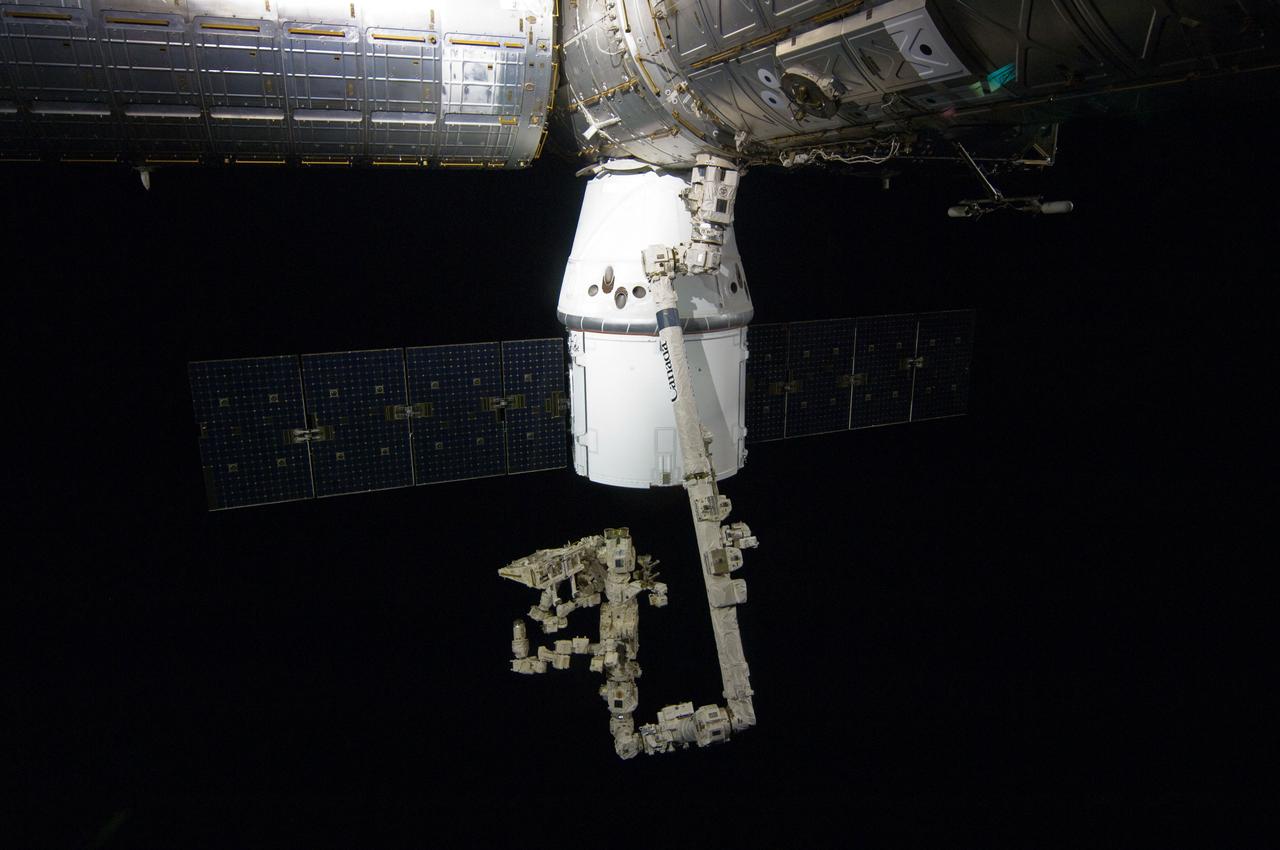
ISS031-E-077666 (25 May 2012) --- The SpaceX Dragon commercial cargo craft is berthed to the Earth-facing side of the International Space Station’s Harmony node. Expedition 31 Flight Engineers Don Pettit and Andre Kuipers grappled Dragon at 9:56 a.m. (EDT) with the Canadarm2 robotic arm and used it to berth Dragon to the at 12:02 p.m. May 25, 2012. Dragon became the first commercially developed space vehicle to be launched to the station to join Russian, European and Japanese resupply craft that service the complex while restoring a U.S. capability to deliver cargo to the orbital laboratory. Dragon is scheduled to spend about a week docked with the station before returning to Earth on May 31 for retrieval.
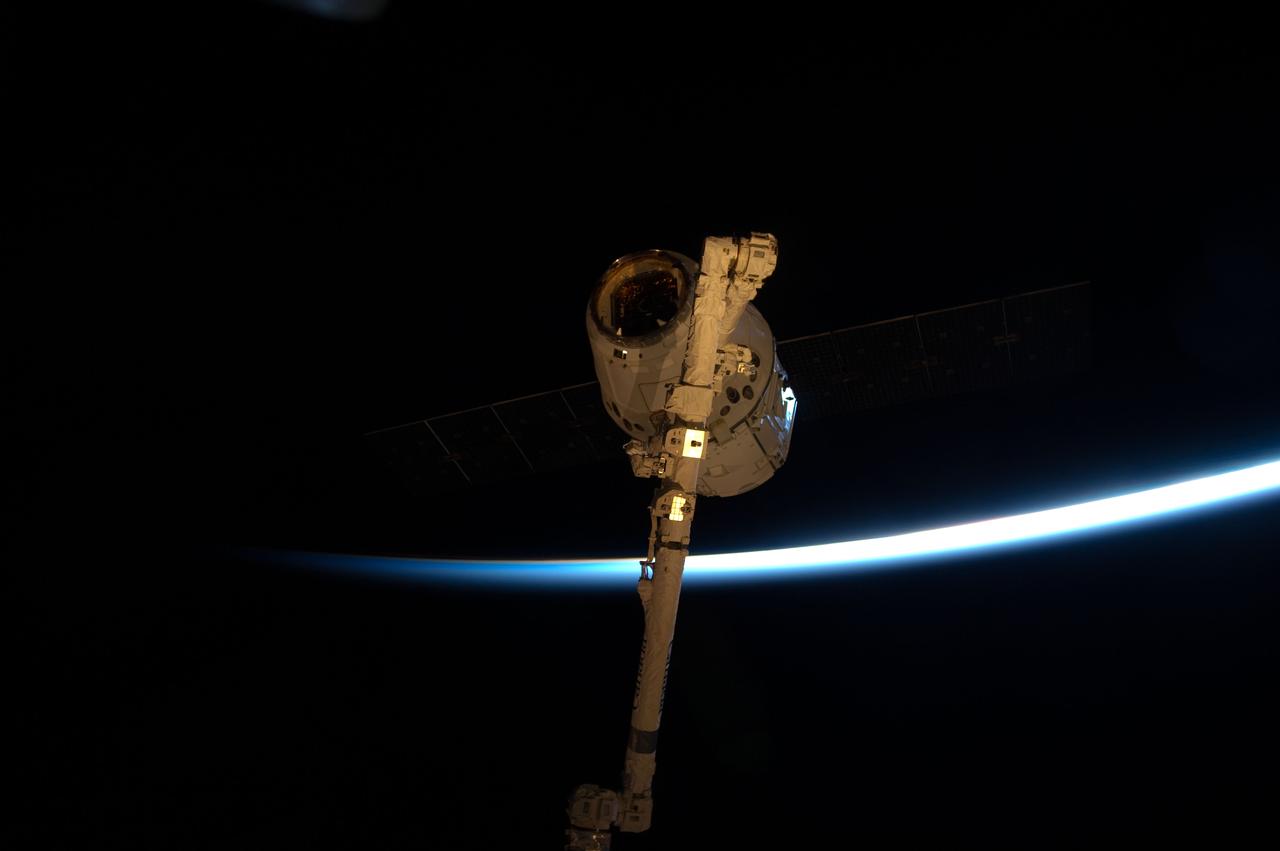
ISS031-E-070774 (25 May 2012) --- With darkness, Earth's horizon and thin line of atmosphere forming a backdrop, the SpaceX Dragon commercial cargo craft is grappled by the Canadarm2 robotic arm at the International Space Station. Expedition 31 Flight Engineers Don Pettit and Andre Kuipers grappled Dragon at 9:56 a.m. (EDT) and used the robotic arm to berth Dragon to the Earth-facing side of the station’s Harmony node at 12:02 p.m. May 25, 2012. Dragon became the first commercially developed space vehicle to be launched to the station to join Russian, European and Japanese resupply craft that service the complex while restoring a U.S. capability to deliver cargo to the orbital laboratory. Dragon is scheduled to spend about a week docked with the station before returning to Earth on May 31 for retrieval.
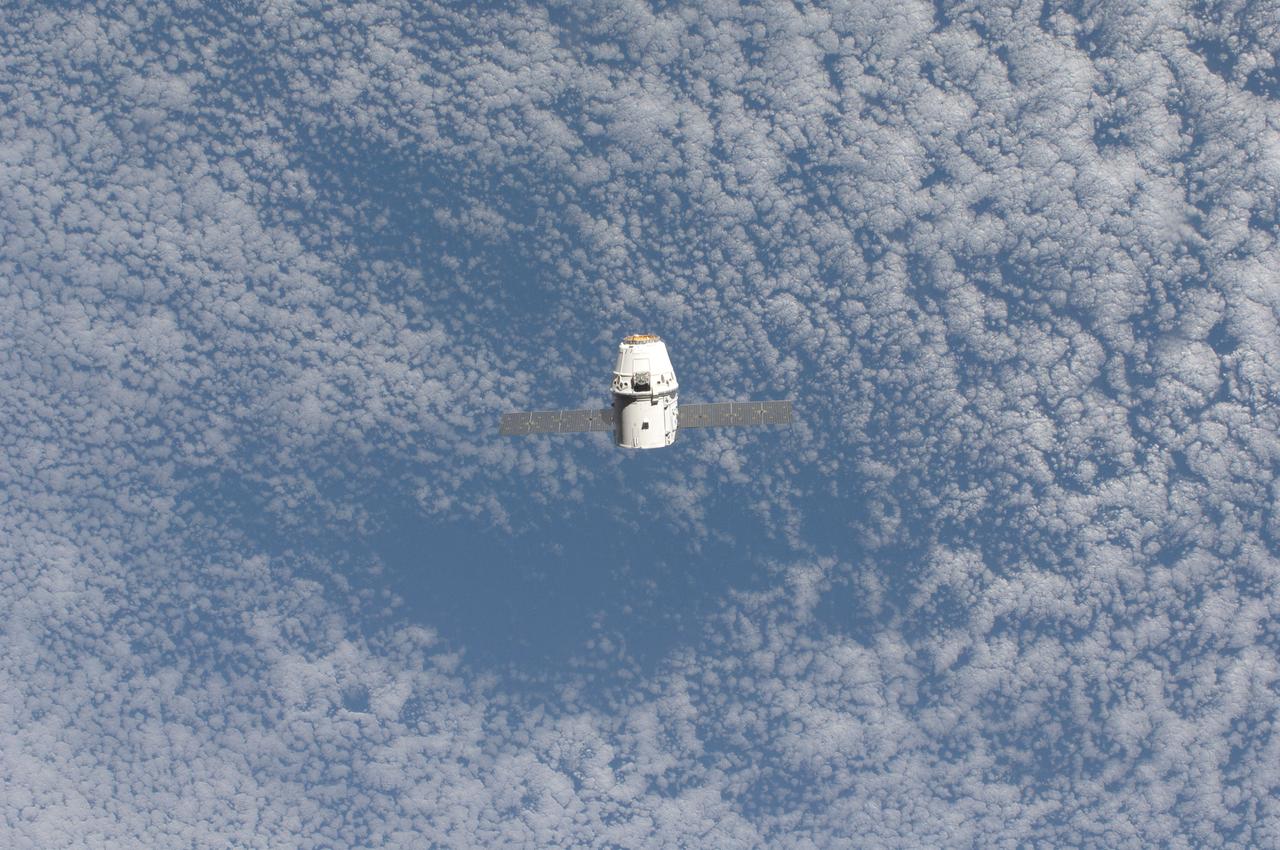
ISS031-E-071075 (25 May 2012) --- The SpaceX Dragon commercial cargo craft approaches the International Space Station on May 25, 2012 for grapple and berthing. Expedition 31 Flight Engineers Don Pettit and Andre Kuipers grappled Dragon at 9:56 a.m. (EDT) with the Canadarm2 robotic arm and used the robotic arm to berth Dragon to the Earth-facing side of the station’s Harmony node at 12:02 p.m. May 25, 2012. Dragon became the first commercially developed space vehicle to be launched to the station to join Russian, European and Japanese resupply craft that service the complex while restoring a U.S. capability to deliver cargo to the orbital laboratory. Dragon is scheduled to spend about a week docked with the station before returning to Earth on May 31 for retrieval.
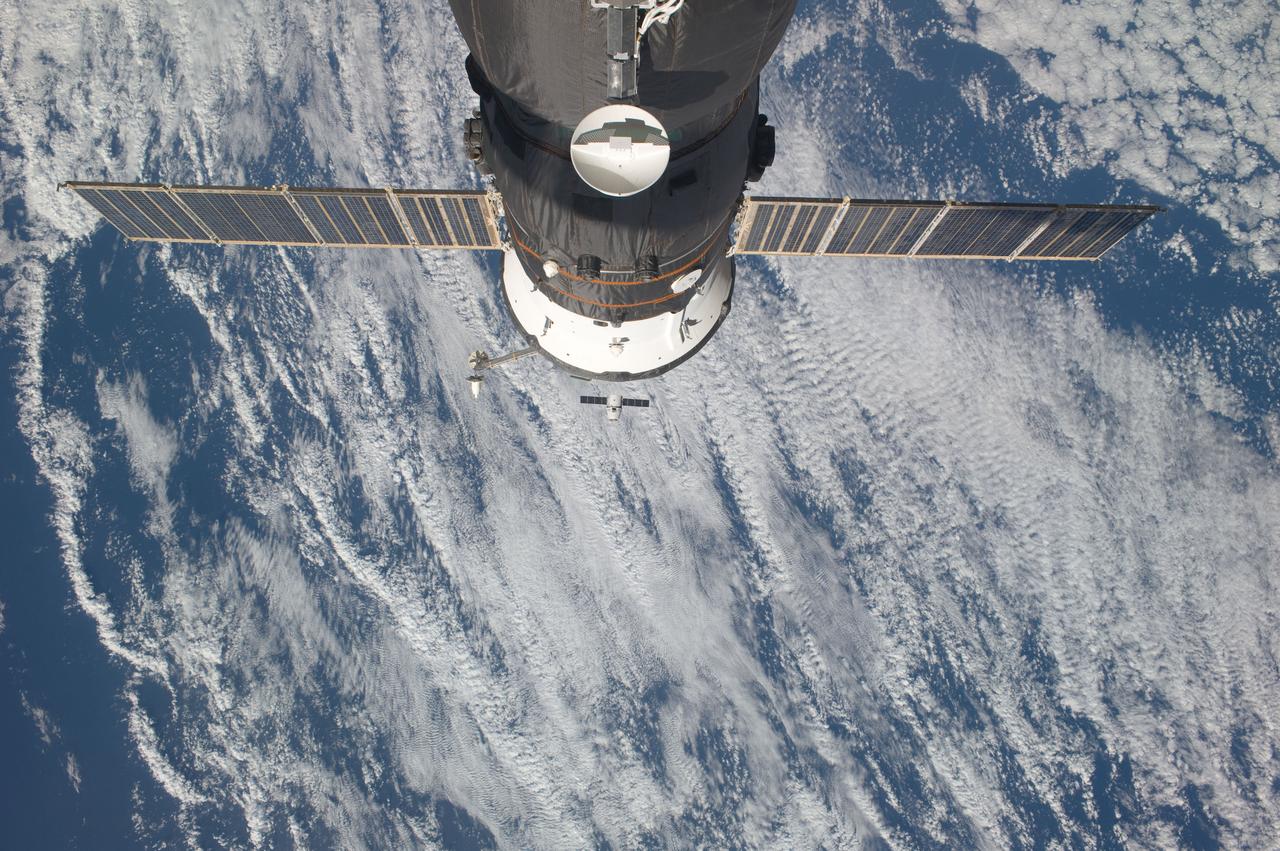
ISS031-E-070730 (25 May 2012) --- The SpaceX Dragon commercial cargo craft approaches the International Space Station on May 25, 2012 for grapple and berthing. Expedition 31 Flight Engineers Don Pettit and Andre Kuipers grappled Dragon at 9:56 a.m. (EDT) with the Canadarm2 robotic arm and used the robotic arm to berth Dragon to the Earth-facing side of the station’s Harmony node at 12:02 p.m. May 25, 2012. Dragon became the first commercially developed space vehicle to be launched to the station to join Russian, European and Japanese resupply craft that service the complex while restoring a U.S. capability to deliver cargo to the orbital laboratory. Dragon is scheduled to spend about a week docked with the station before returning to Earth on May 31 for retrieval.
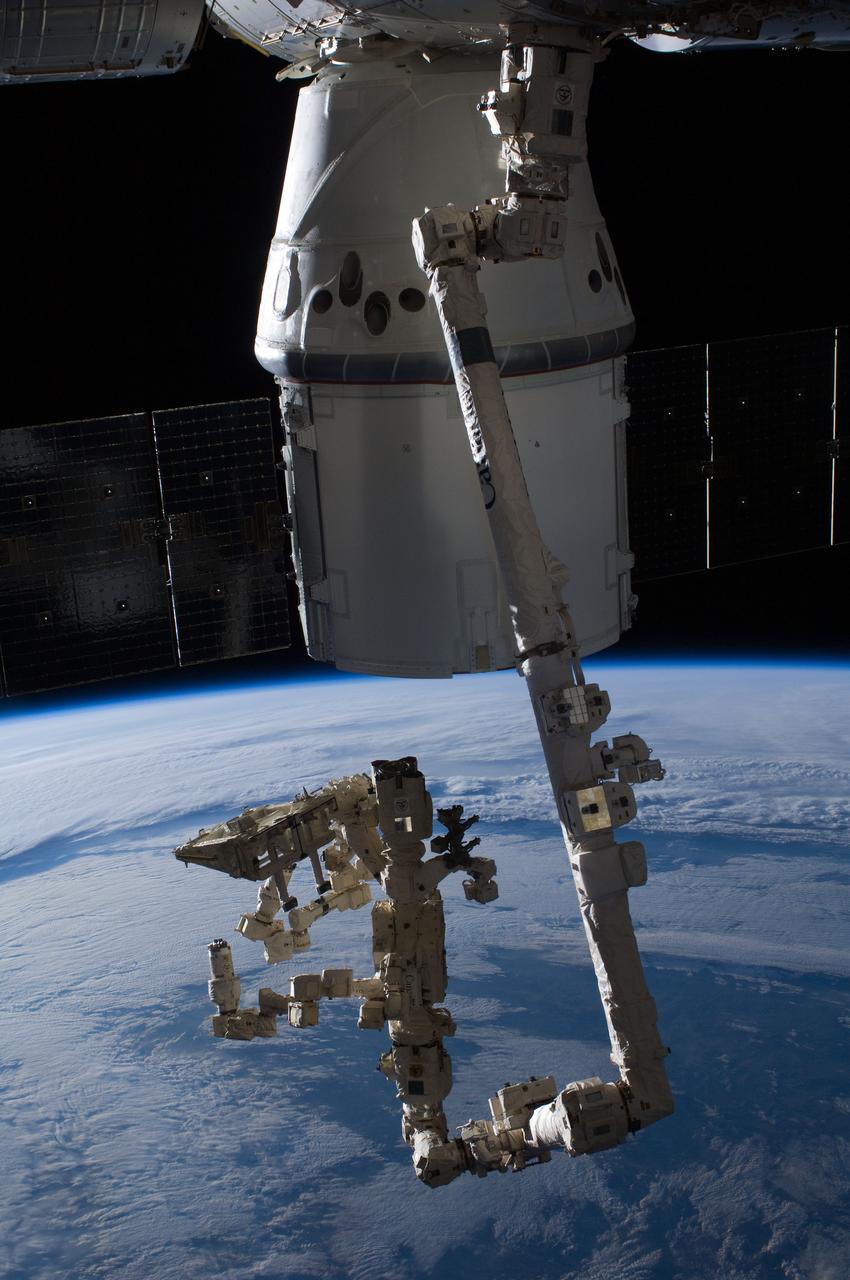
ISS031-E-077562 (25 May 2012) --- The SpaceX Dragon commercial cargo craft is berthed to the Earth-facing side of the International Space Station’s Harmony node. Expedition 31 Flight Engineers Don Pettit and Andre Kuipers grappled Dragon at 9:56 a.m. (EDT) with the Canadarm2 robotic arm and used it to berth Dragon to the at 12:02 p.m. May 25, 2012. Dragon became the first commercially developed space vehicle to be launched to the station to join Russian, European and Japanese resupply craft that service the complex while restoring a U.S. capability to deliver cargo to the orbital laboratory. Dragon is scheduled to spend about a week docked with the station before returning to Earth on May 31 for retrieval.
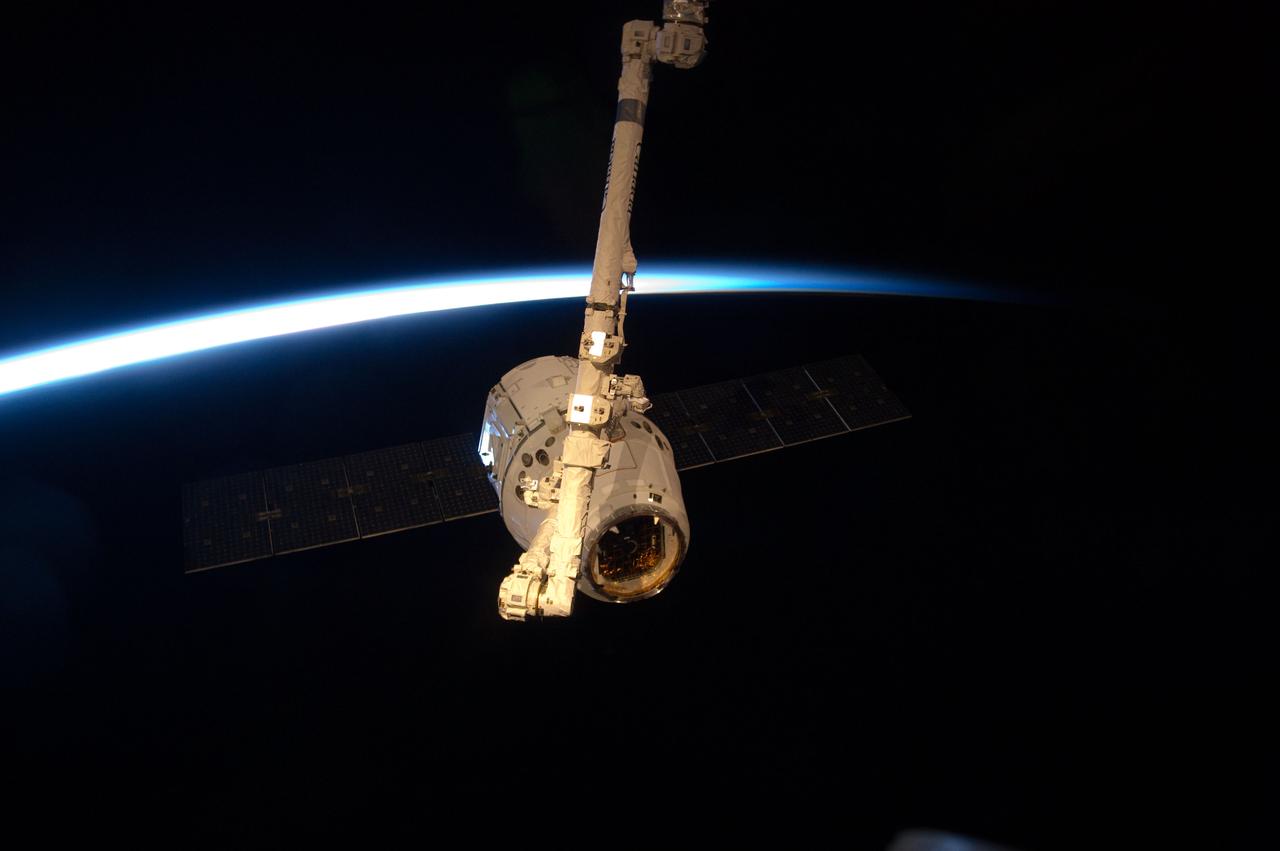
ISS031-E-070772 (25 May 2012) --- With darkness, Earth's horizon and thin line of atmosphere forming a backdrop, the SpaceX Dragon commercial cargo craft is grappled by the Canadarm2 robotic arm at the International Space Station. Expedition 31 Flight Engineers Don Pettit and Andre Kuipers grappled Dragon at 9:56 a.m. (EDT) and used the robotic arm to berth Dragon to the Earth-facing side of the station’s Harmony node at 12:02 p.m. May 25, 2012. Dragon became the first commercially developed space vehicle to be launched to the station to join Russian, European and Japanese resupply craft that service the complex while restoring a U.S. capability to deliver cargo to the orbital laboratory. Dragon is scheduled to spend about a week docked with the station before returning to Earth on May 31 for retrieval.

ISS031-E-070799 (25 May 2012) --- The SpaceX Dragon commercial cargo craft is grappled by the Canadarm2 robotic arm at the International Space Station. Expedition 31 Flight Engineers Don Pettit and Andre Kuipers grappled Dragon at 9:56 a.m. (EDT) and used the robotic arm to berth Dragon to the Earth-facing side of the station’s Harmony node at 12:02 p.m. May 25, 2012. Dragon became the first commercially developed space vehicle to be launched to the station to join Russian, European and Japanese resupply craft that service the complex while restoring a U.S. capability to deliver cargo to the orbital laboratory. Dragon is scheduled to spend about a week docked with the station before returning to Earth on May 31 for retrieval.
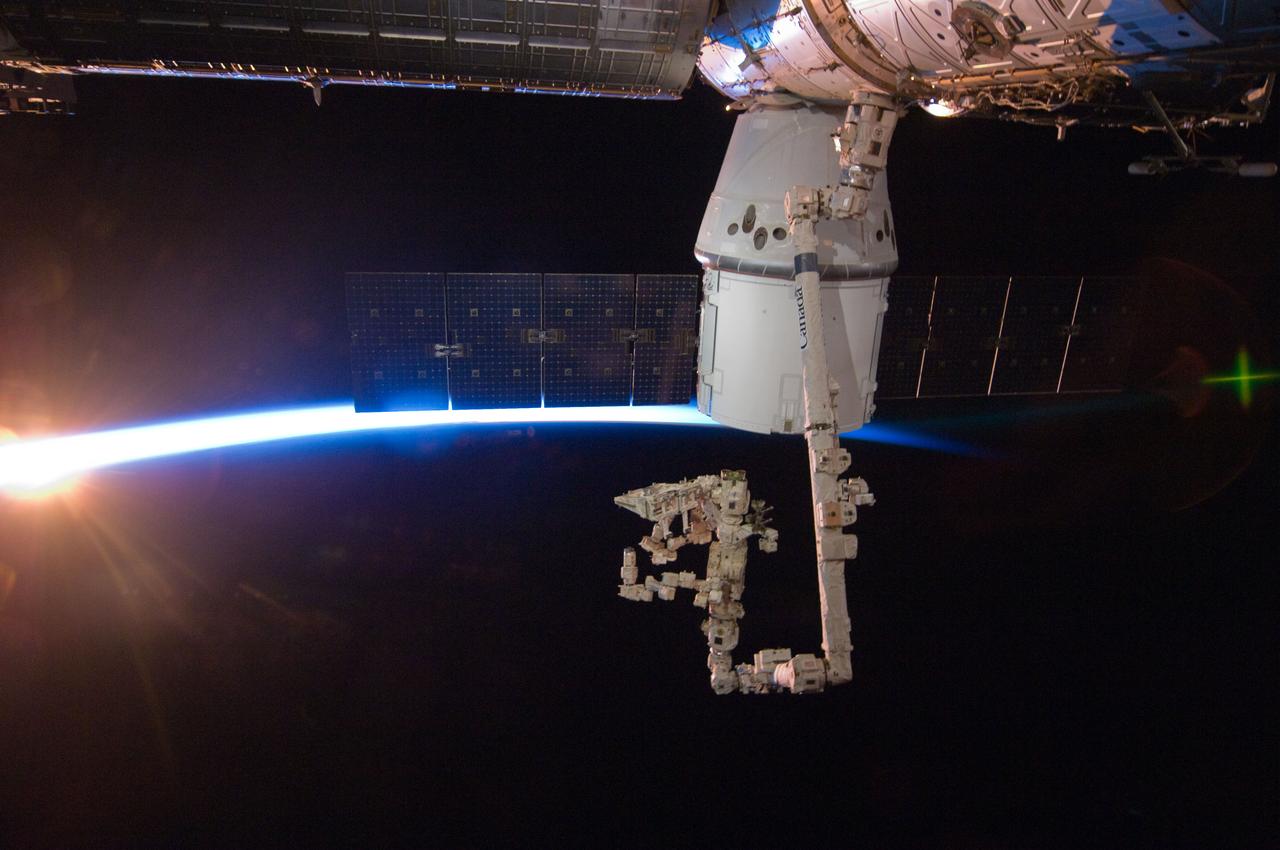
ISS031-E-077669 (25 May 2012) --- With rays of sunshine and the thin blue atmosphere of Earth serving as a backdrop, the SpaceX Dragon commercial cargo craft is berthed to the Earth-facing side of the International Space Station’s Harmony node. Expedition 31 Flight Engineers Don Pettit and Andre Kuipers grappled Dragon at 9:56 a.m. (EDT) with the Canadarm2 robotic arm and used it to berth Dragon to the at 12:02 p.m. May 25, 2012. Dragon became the first commercially developed space vehicle to be launched to the station to join Russian, European and Japanese resupply craft that service the complex while restoring a U.S. capability to deliver cargo to the orbital laboratory. Dragon is scheduled to spend about a week docked with the station before returning to Earth on May 31 for retrieval
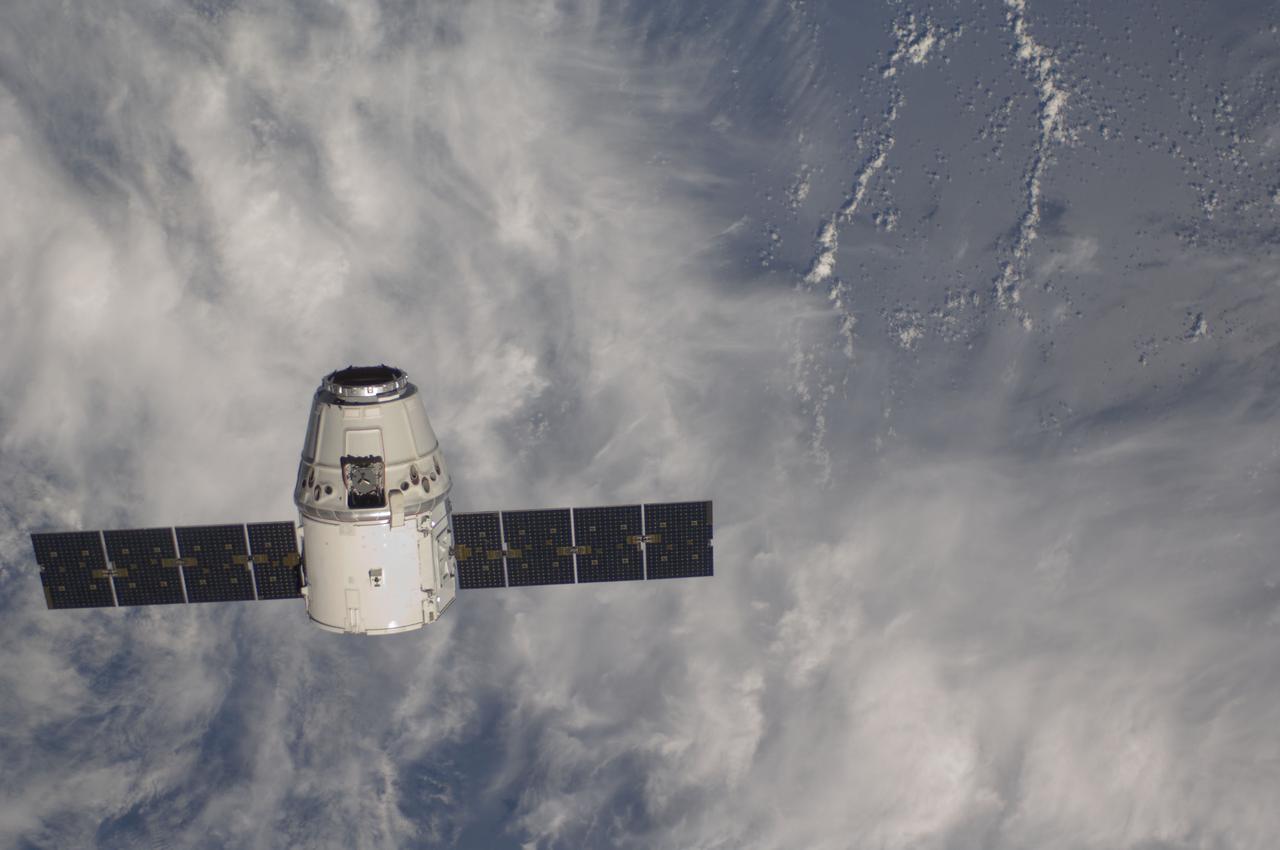
ISS031-E-071134 (25 May 2012) --- The SpaceX Dragon commercial cargo craft approaches the International Space Station on May 25, 2012 for grapple and berthing. Expedition 31 Flight Engineers Don Pettit and Andre Kuipers grappled Dragon at 9:56 a.m. (EDT) with the Canadarm2 robotic arm and used the robotic arm to berth Dragon to the Earth-facing side of the station’s Harmony node at 12:02 p.m. May 25, 2012. Dragon became the first commercially developed space vehicle to be launched to the station to join Russian, European and Japanese resupply craft that service the complex while restoring a U.S. capability to deliver cargo to the orbital laboratory. Dragon is scheduled to spend about a week docked with the station before returning to Earth on May 31 for retrieval.
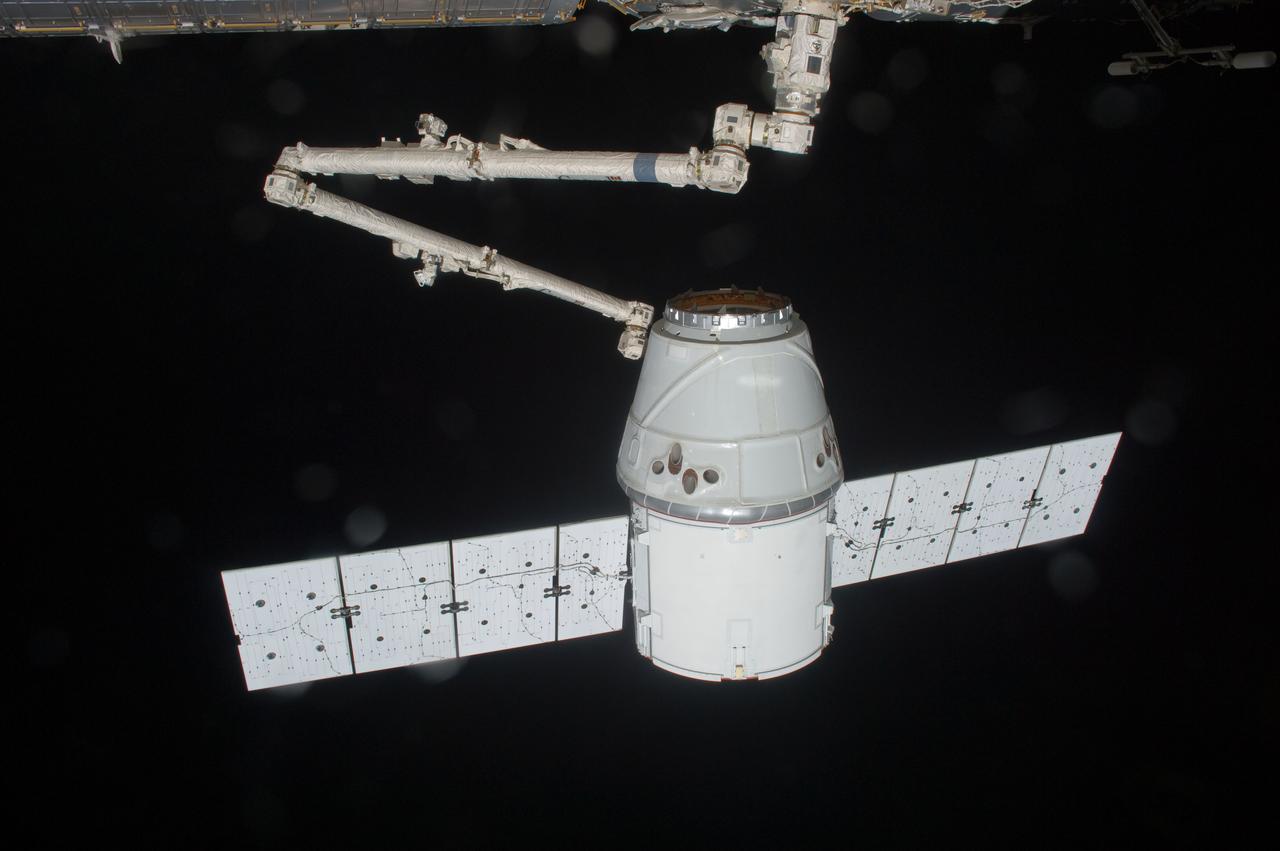
ISS031-E-070798 (25 May 2012) --- The SpaceX Dragon commercial cargo craft is grappled by the Canadarm2 robotic arm at the International Space Station. Expedition 31 Flight Engineers Don Pettit and Andre Kuipers grappled Dragon at 9:56 a.m. (EDT) and used the robotic arm to berth Dragon to the Earth-facing side of the station’s Harmony node at 12:02 p.m. May 25, 2012. Dragon became the first commercially developed space vehicle to be launched to the station to join Russian, European and Japanese resupply craft that service the complex while restoring a U.S. capability to deliver cargo to the orbital laboratory. Dragon is scheduled to spend about a week docked with the station before returning to Earth on May 31 for retrieval.
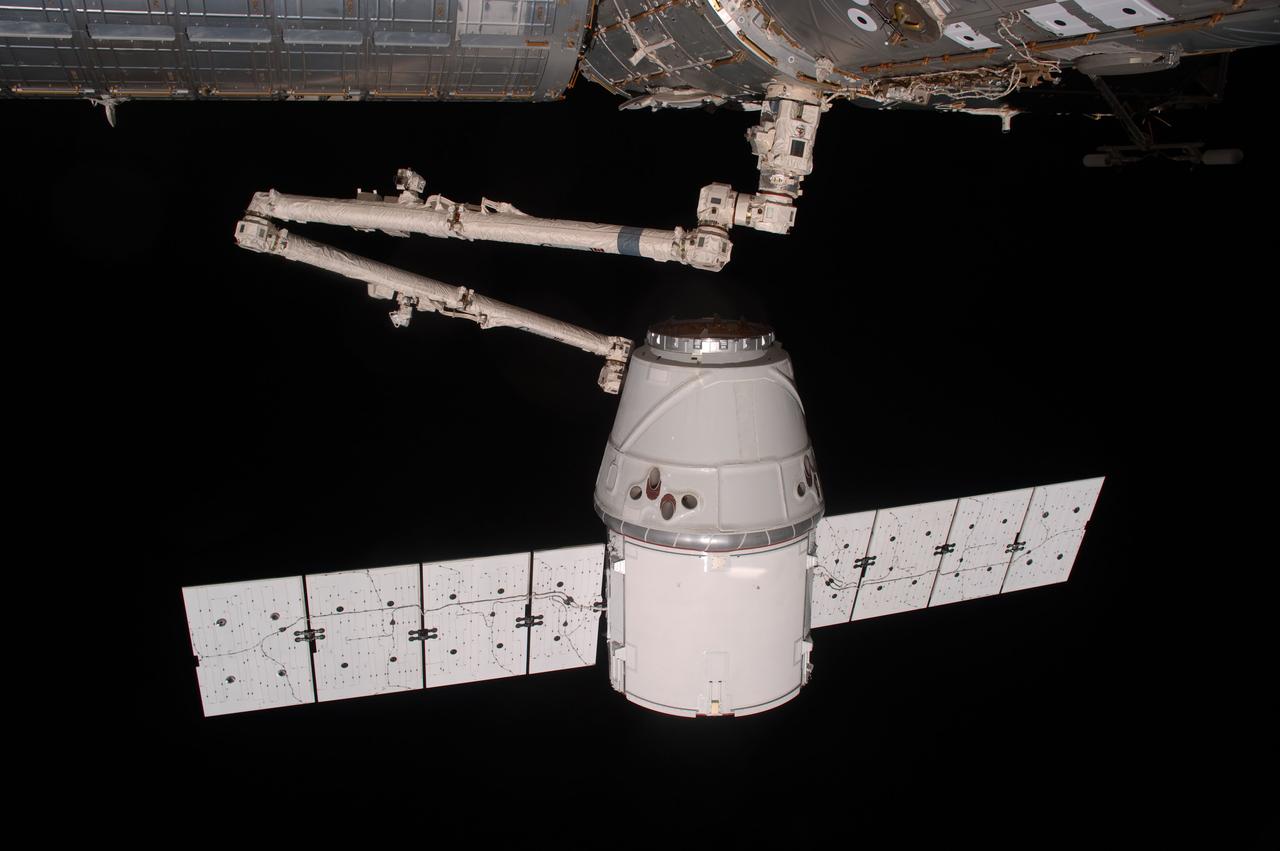
ISS031-E-070804 (25 May 2012) --- The SpaceX Dragon commercial cargo craft is grappled by the Canadarm2 robotic arm at the International Space Station. Expedition 31 Flight Engineers Don Pettit and Andre Kuipers grappled Dragon at 9:56 a.m. (EDT) and used the robotic arm to berth Dragon to the Earth-facing side of the station’s Harmony node at 12:02 p.m. May 25, 2012. Dragon became the first commercially developed space vehicle to be launched to the station to join Russian, European and Japanese resupply craft that service the complex while restoring a U.S. capability to deliver cargo to the orbital laboratory. Dragon is scheduled to spend about a week docked with the station before returning to Earth on May 31 for retrieval.
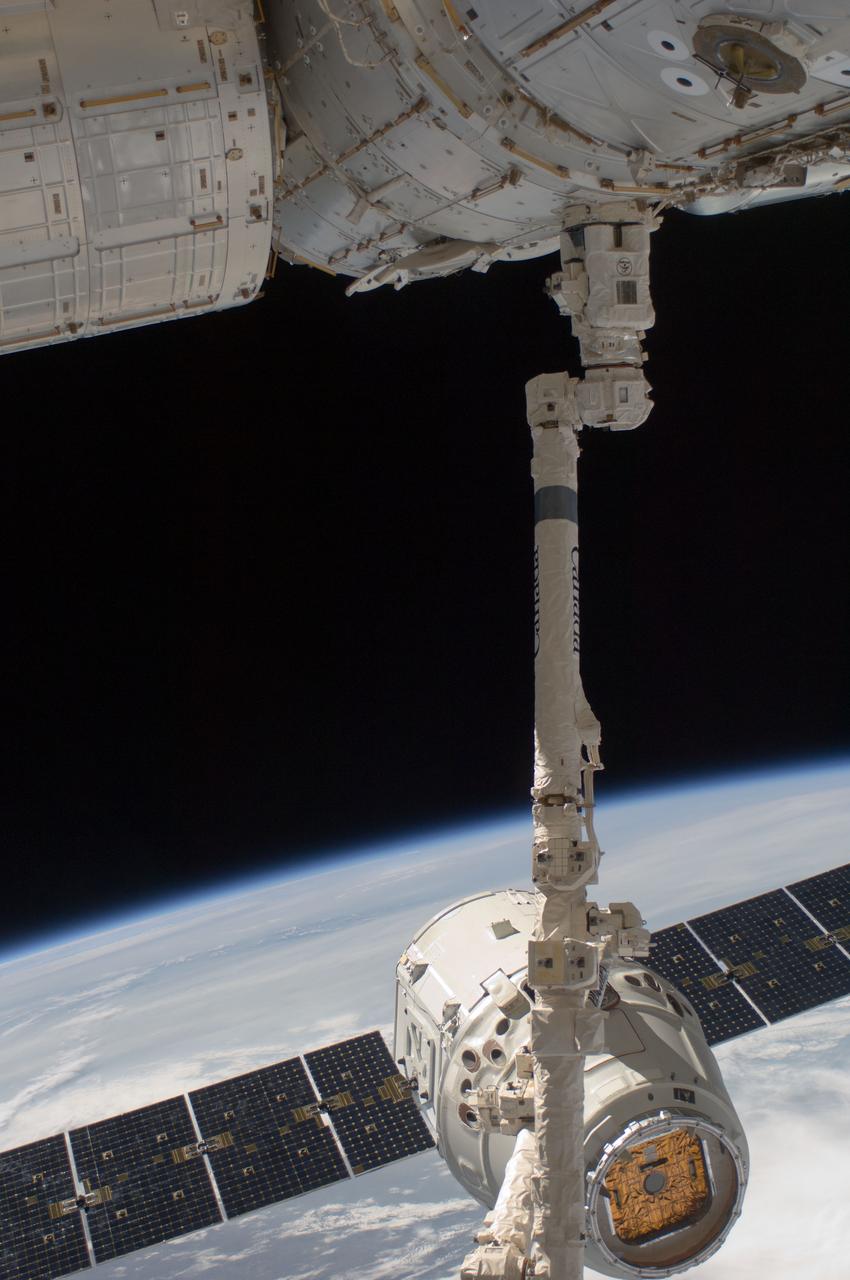
ISS031-E-071203 (25 May 2012) --- With the blackness of space and clouds over Earth forming a backdrop, the SpaceX Dragon commercial cargo craft is grappled by the Canadarm2 robotic arm at the International Space Station. Expedition 31 Flight Engineers Don Pettit and Andre Kuipers grappled Dragon at 9:56 a.m. (EDT) and used the robotic arm to berth Dragon to the Earth-facing side of the station's Harmony node at 12:02 p.m. May 25, 2012. Dragon became the first commercially developed space vehicle to be launched to the station to join Russian, European and Japanese resupply craft that service the complex while restoring a U.S. capability to deliver cargo to the orbital laboratory. Dragon is scheduled to spend about a week docked with the station before returning to Earth on May 31 for retrieval.
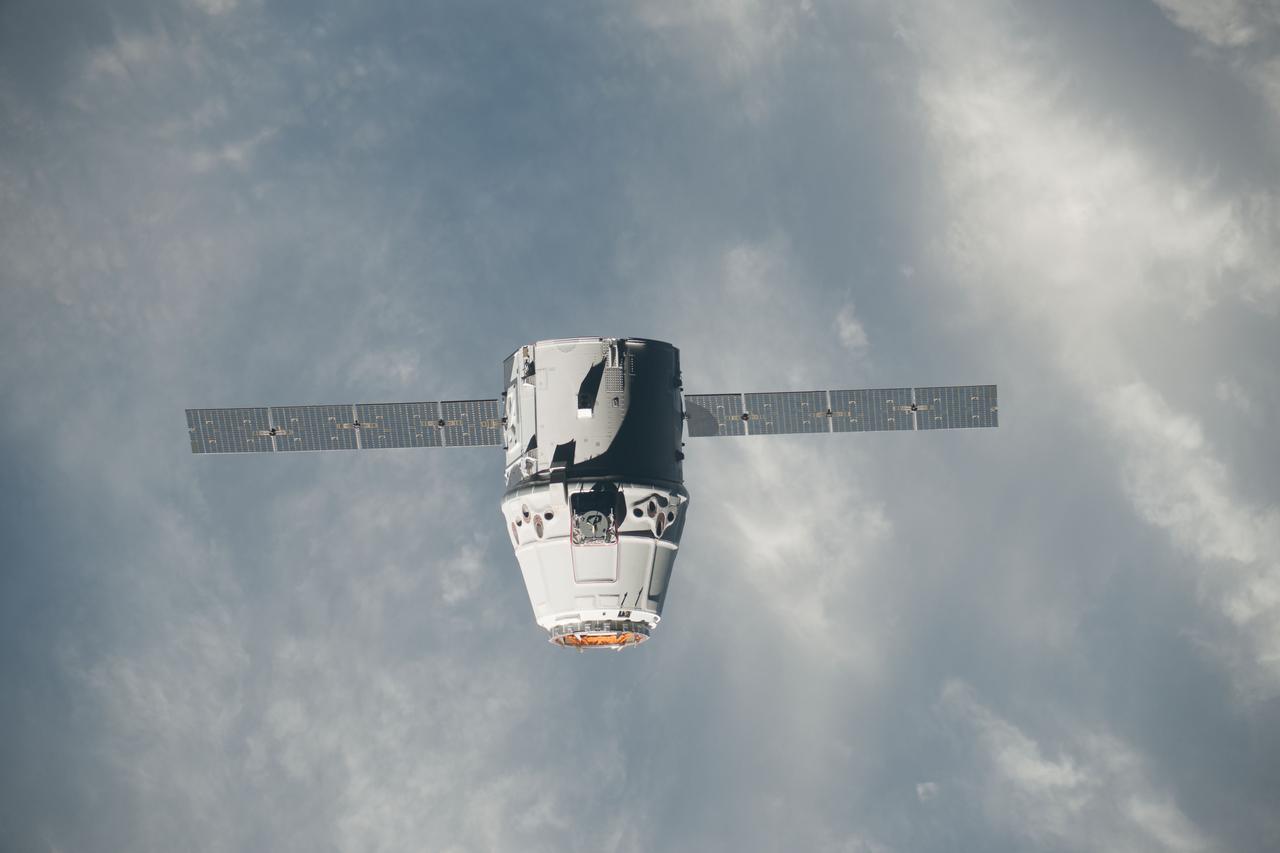
ISS031-E-070663 (25 May 2012) --- The SpaceX Dragon commercial cargo craft approaches the International Space Station on May 25, 2012 for grapple and berthing. Expedition 31 Flight Engineers Don Pettit and Andre Kuipers grappled Dragon at 9:56 a.m. (EDT) with the Canadarm2 robotic arm and used the robotic arm to berth Dragon to the Earth-facing side of the station’s Harmony node at 12:02 p.m. May 25, 2012. Dragon became the first commercially developed space vehicle to be launched to the station to join Russian, European and Japanese resupply craft that service the complex while restoring a U.S. capability to deliver cargo to the orbital laboratory. Dragon is scheduled to spend about a week docked with the station before returning to Earth on May 31 for retrieval.
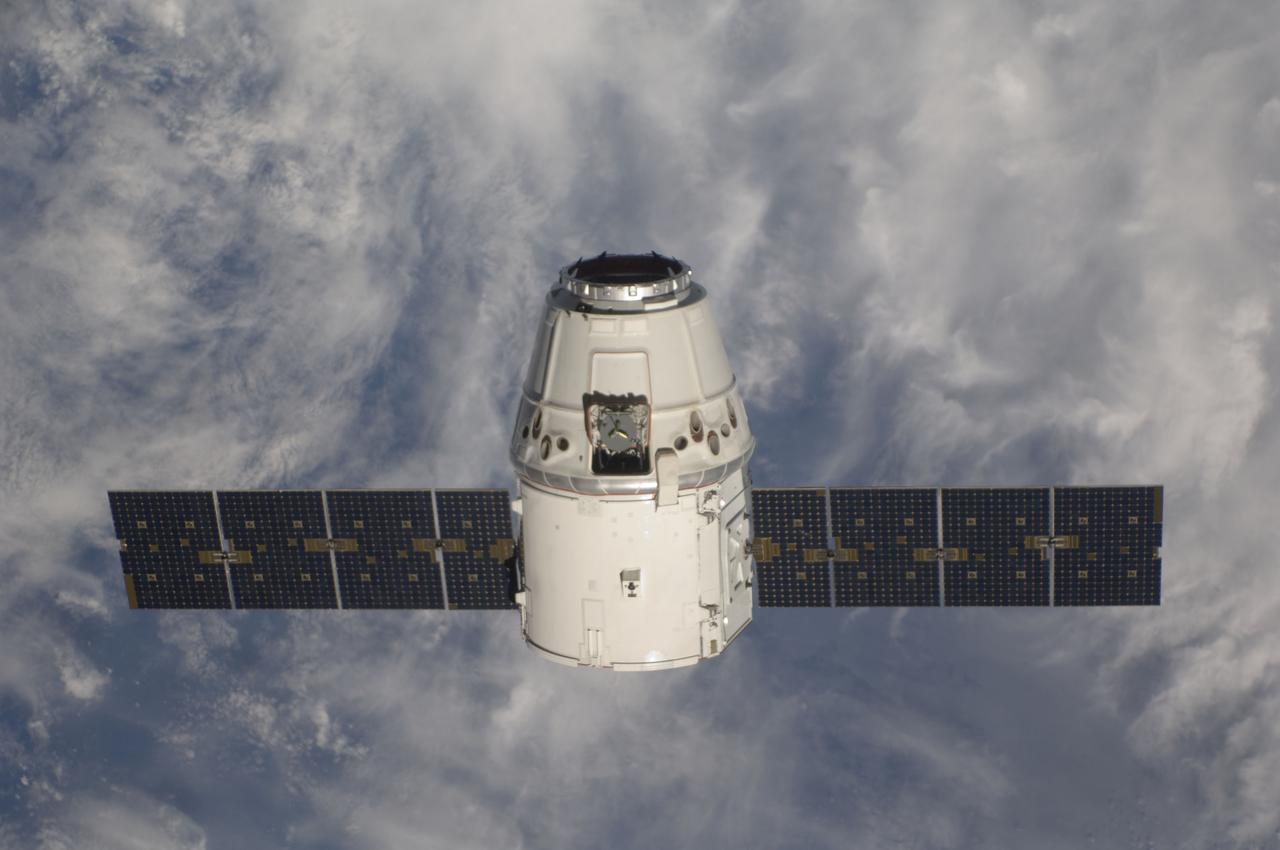
ISS031-E-071135 (25 May 2012) --- The SpaceX Dragon commercial cargo craft approaches the International Space Station on May 25, 2012 for grapple and berthing. Expedition 31 Flight Engineers Don Pettit and Andre Kuipers grappled Dragon at 9:56 a.m. (EDT) with the Canadarm2 robotic arm and used the robotic arm to berth Dragon to the Earth-facing side of the station’s Harmony node at 12:02 p.m. May 25, 2012. Dragon became the first commercially developed space vehicle to be launched to the station to join Russian, European and Japanese resupply craft that service the complex while restoring a U.S. capability to deliver cargo to the orbital laboratory. Dragon is scheduled to spend about a week docked with the station before returning to Earth on May 31 for retrieval.
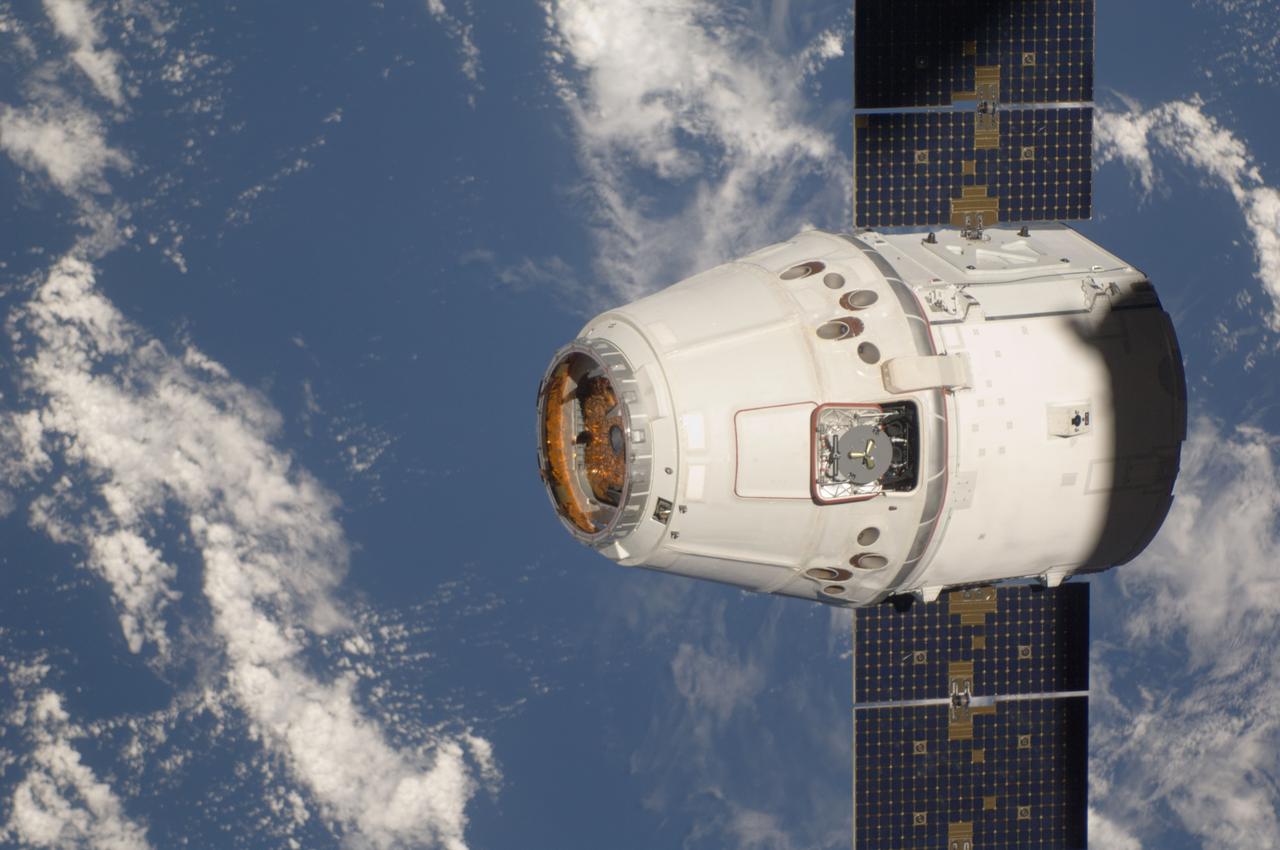
ISS031-E-071140 (25 May 2012) --- The SpaceX Dragon commercial cargo craft approaches the International Space Station on May 25, 2012 for grapple and berthing. Expedition 31 Flight Engineers Don Pettit and Andre Kuipers grappled Dragon at 9:56 a.m. (EDT) with the Canadarm2 robotic arm and used the robotic arm to berth Dragon to the Earth-facing side of the station’s Harmony node at 12:02 p.m. May 25, 2012. Dragon became the first commercially developed space vehicle to be launched to the station to join Russian, European and Japanese resupply craft that service the complex while restoring a U.S. capability to deliver cargo to the orbital laboratory. Dragon is scheduled to spend about a week docked with the station before returning to Earth on May 31 for retrieval.
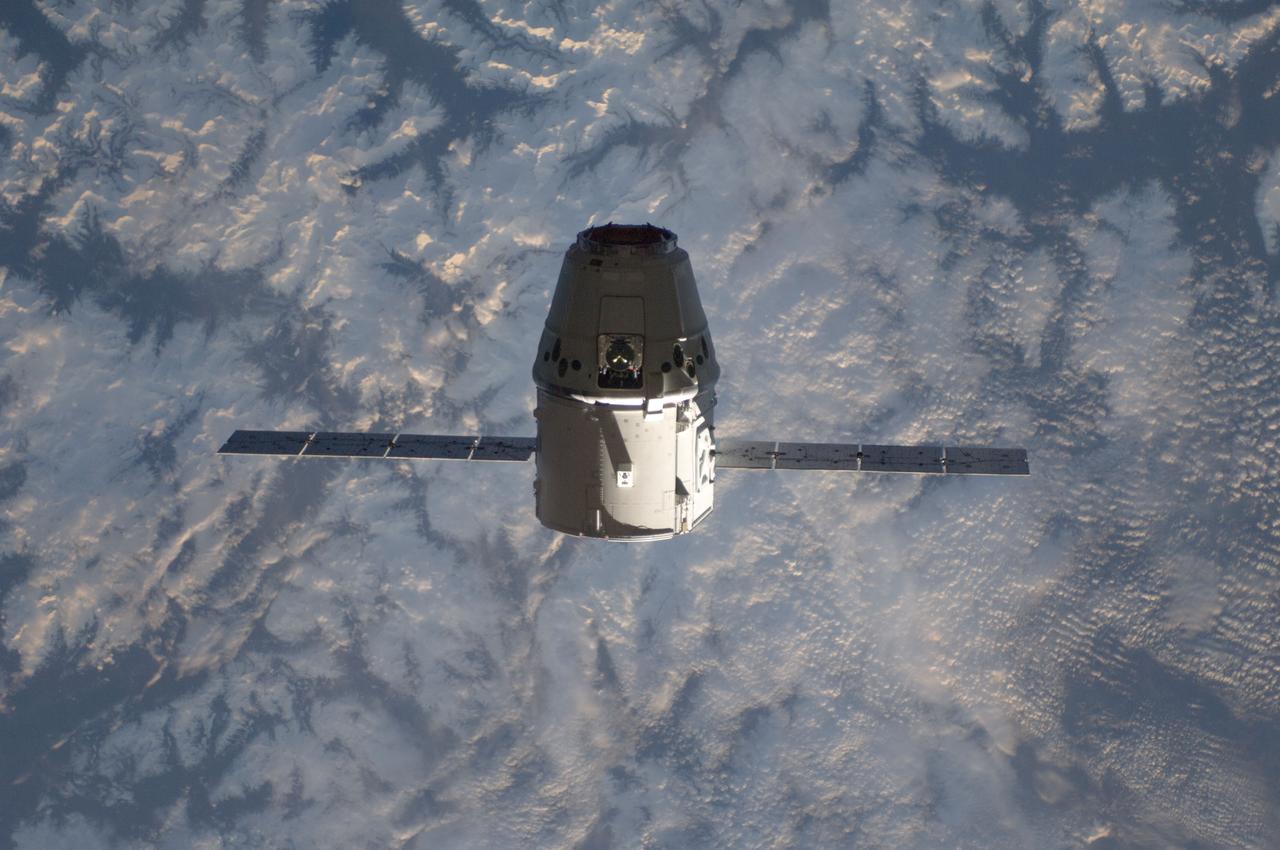
ISS031-E-071121 (25 May 2012) --- The SpaceX Dragon commercial cargo craft approaches the International Space Station on May 25, 2012 for grapple and berthing. Expedition 31 Flight Engineers Don Pettit and Andre Kuipers grappled Dragon at 9:56 a.m. (EDT) with the Canadarm2 robotic arm and used the robotic arm to berth Dragon to the Earth-facing side of the station’s Harmony node at 12:02 p.m. May 25, 2012. Dragon became the first commercially developed space vehicle to be launched to the station to join Russian, European and Japanese resupply craft that service the complex while restoring a U.S. capability to deliver cargo to the orbital laboratory. Dragon is scheduled to spend about a week docked with the station before returning to Earth on May 31 for retrieval.
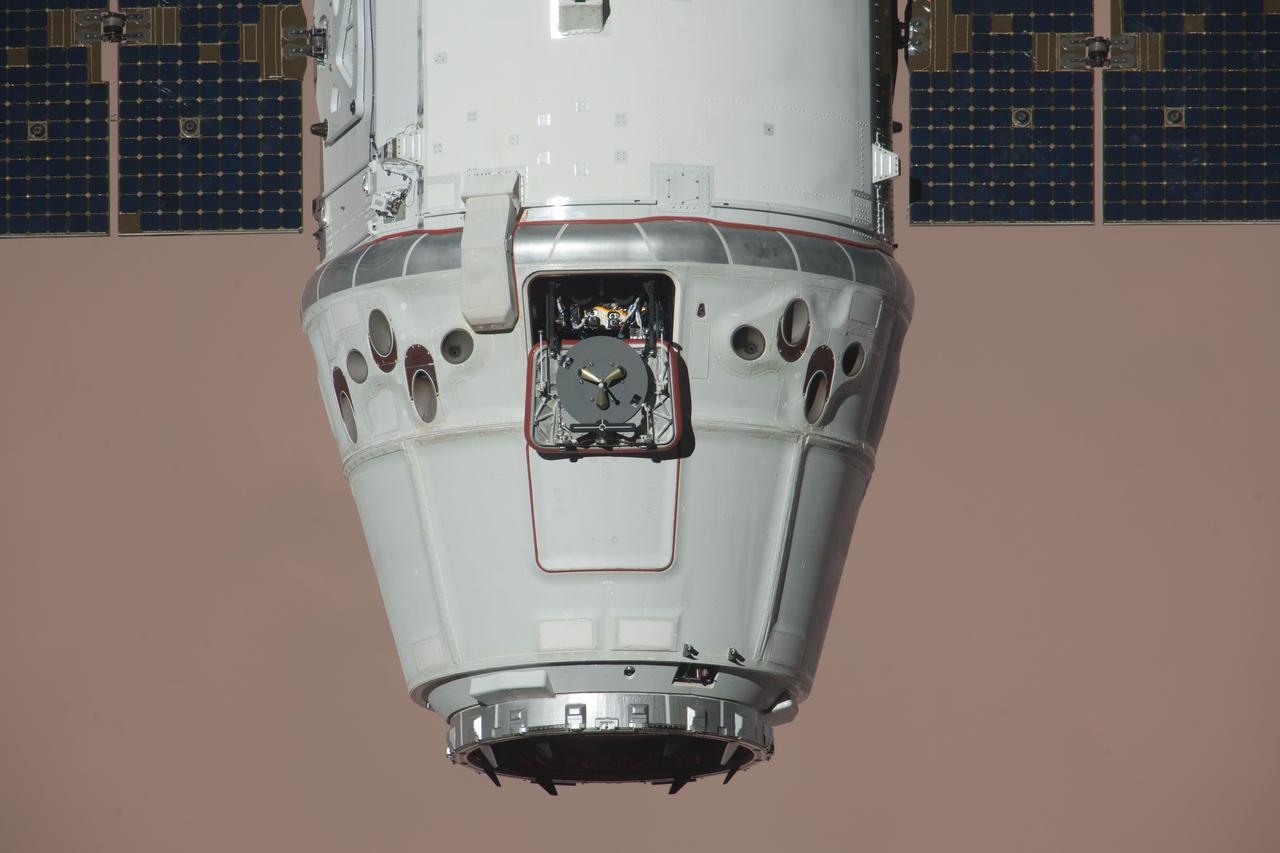
ISS031-E-070745 (25 May 2012) --- The SpaceX Dragon commercial cargo craft approaches the International Space Station on May 25, 2012 for grapple and berthing. Expedition 31 Flight Engineers Don Pettit and Andre Kuipers grappled Dragon at 9:56 a.m. (EDT) with the Canadarm2 robotic arm and used the robotic arm to berth Dragon to the Earth-facing side of the station’s Harmony node at 12:02 p.m. May 25, 2012. Dragon became the first commercially developed space vehicle to be launched to the station to join Russian, European and Japanese resupply craft that service the complex while restoring a U.S. capability to deliver cargo to the orbital laboratory. Dragon is scheduled to spend about a week docked with the station before returning to Earth on May 31 for retrieval.
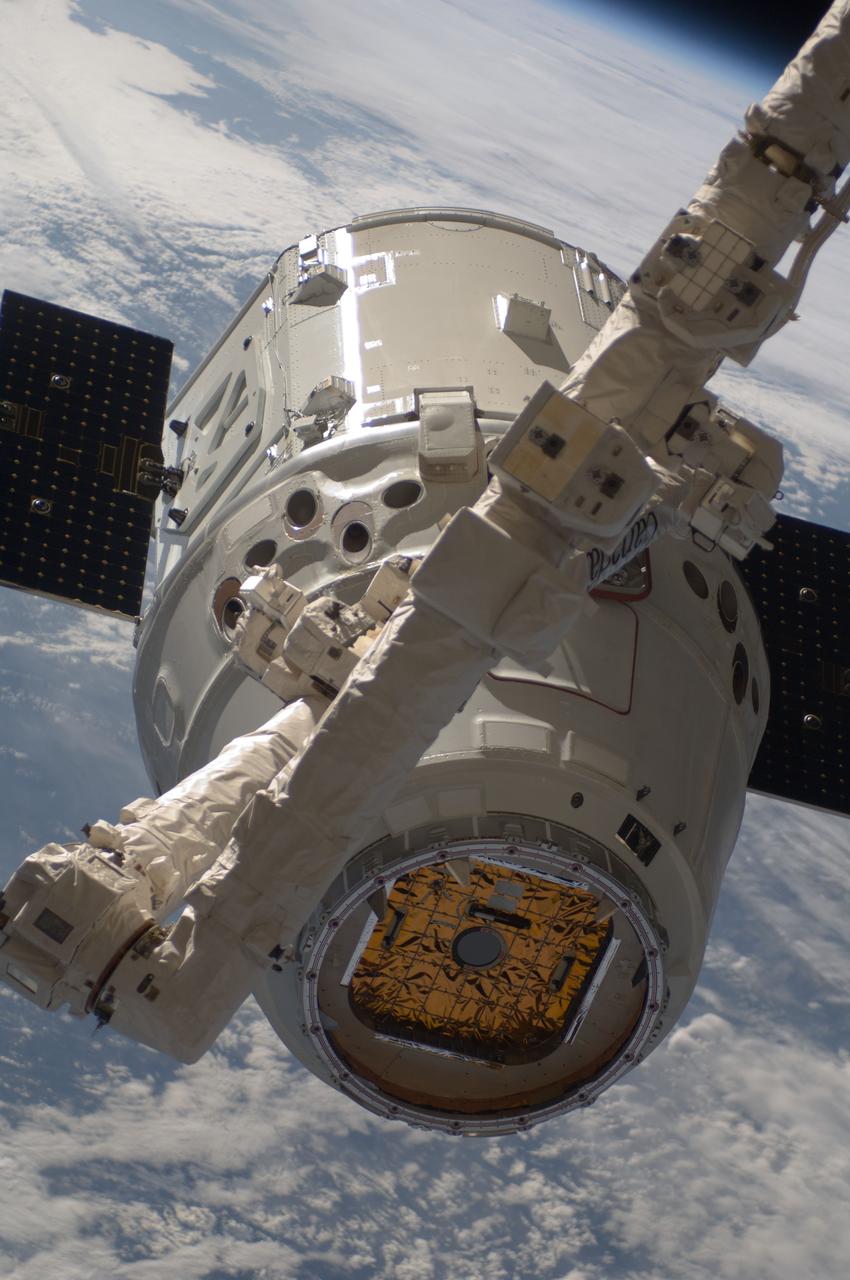
ISS031-E-071199 (25 May 2012) --- With clouds over Earth forming a backdrop, the SpaceX Dragon commercial cargo craft is photographed during grappling operations with the Canadarm2 robotic arm at the International Space Station. Expedition 31 Flight Engineers Don Pettit and Andre Kuipers grappled Dragon at 9:56 a.m. (EDT) and used the robotic arm to berth Dragon to the Earth-facing side of the station's Harmony node at 12:02 p.m. May 25, 2012. Dragon became the first commercially developed space vehicle to be launched to the station to join Russian, European and Japanese resupply craft that service the complex while restoring a U.S. capability to deliver cargo to the orbital laboratory. Dragon is scheduled to spend about a week docked with the station before returning to Earth on May 31 for retrieval.
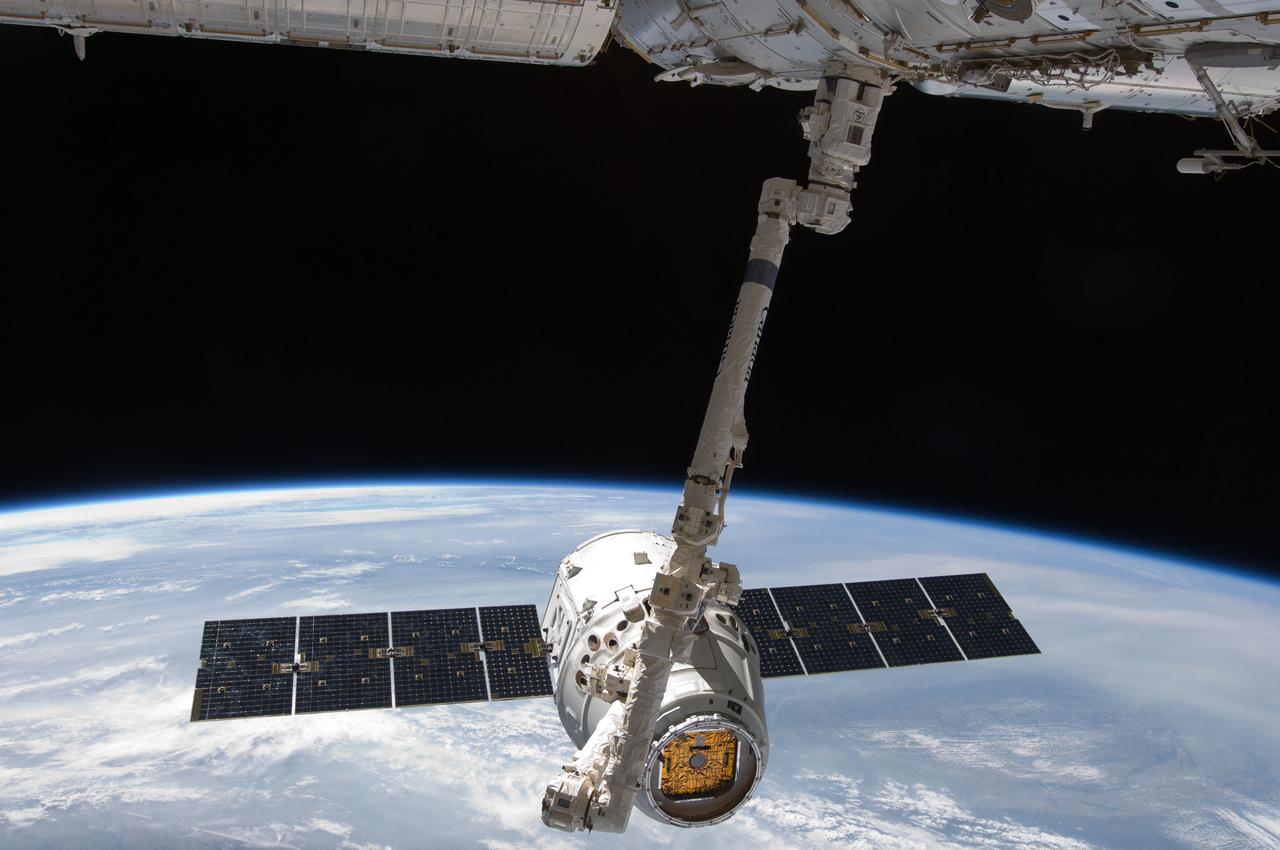
ISS031-E-071534 (25 May 2012) --- With clouds over Earth forming a backdrop, the SpaceX Dragon commercial cargo craft is grappled by the Canadarm2 robotic arm at the International Space Station. Expedition 31 Flight Engineers Don Pettit and Andre Kuipers grappled Dragon at 9:56 a.m. (EDT) and used the robotic arm to berth Dragon to the Earth-facing side of the station's Harmony node at 12:02 p.m. May 25, 2012. Dragon became the first commercially developed space vehicle to be launched to the station to join Russian, European and Japanese resupply craft that service the complex while restoring a U.S. capability to deliver cargo to the orbital laboratory. Dragon is scheduled to spend about a week docked with the station before returning to Earth on May 31 for retrieval.
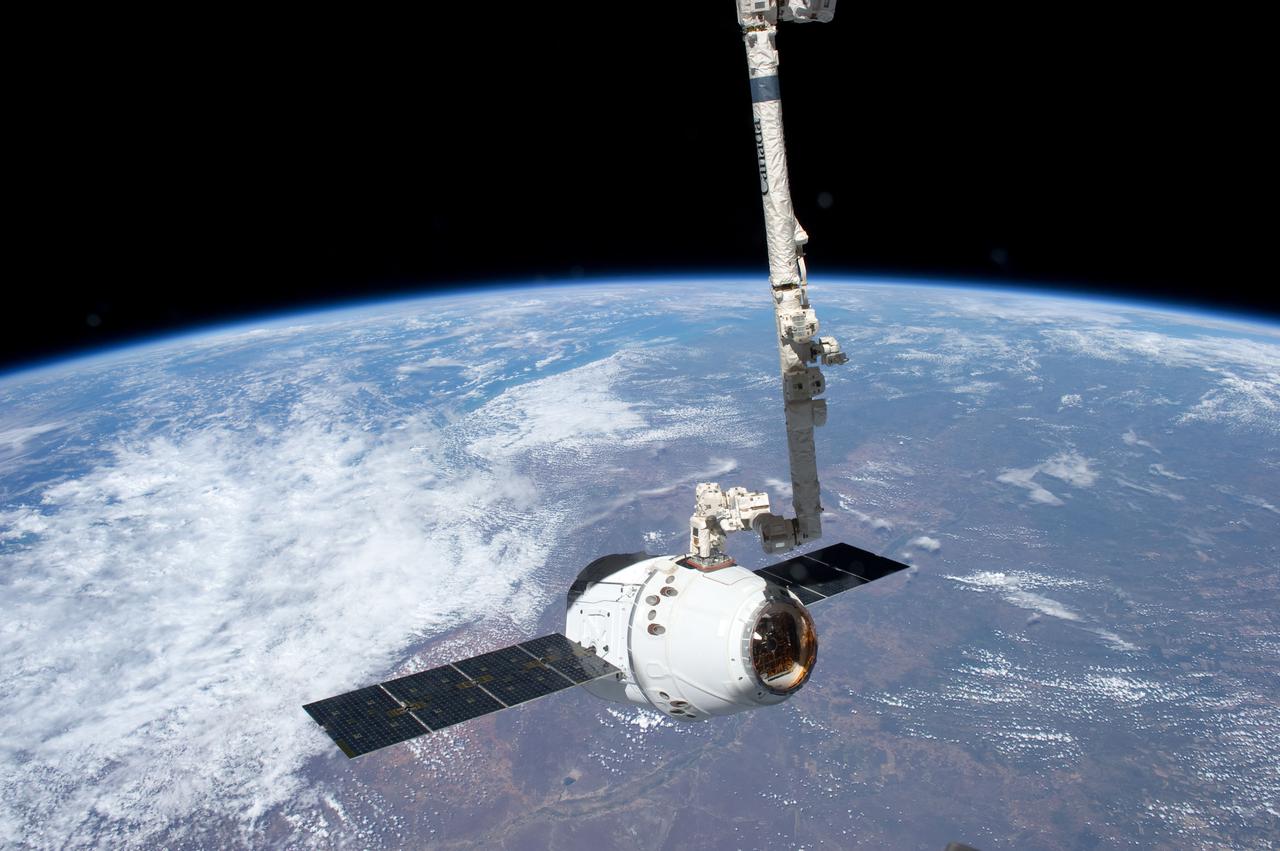
ISS031-E-070790 (25 May 2012) --- With clouds and land forming a backdrop, the SpaceX Dragon commercial cargo craft is grappled by the Canadarm2 robotic arm at the International Space Station. Expedition 31 Flight Engineers Don Pettit and Andre Kuipers grappled Dragon at 9:56 a.m. (EDT) and used the robotic arm to berth Dragon to the Earth-facing side of the station’s Harmony node at 12:02 p.m. May 25, 2012. Dragon became the first commercially developed space vehicle to be launched to the station to join Russian, European and Japanese resupply craft that service the complex while restoring a U.S. capability to deliver cargo to the orbital laboratory. Dragon is scheduled to spend about a week docked with the station before returning to Earth on May 31 for retrieval.
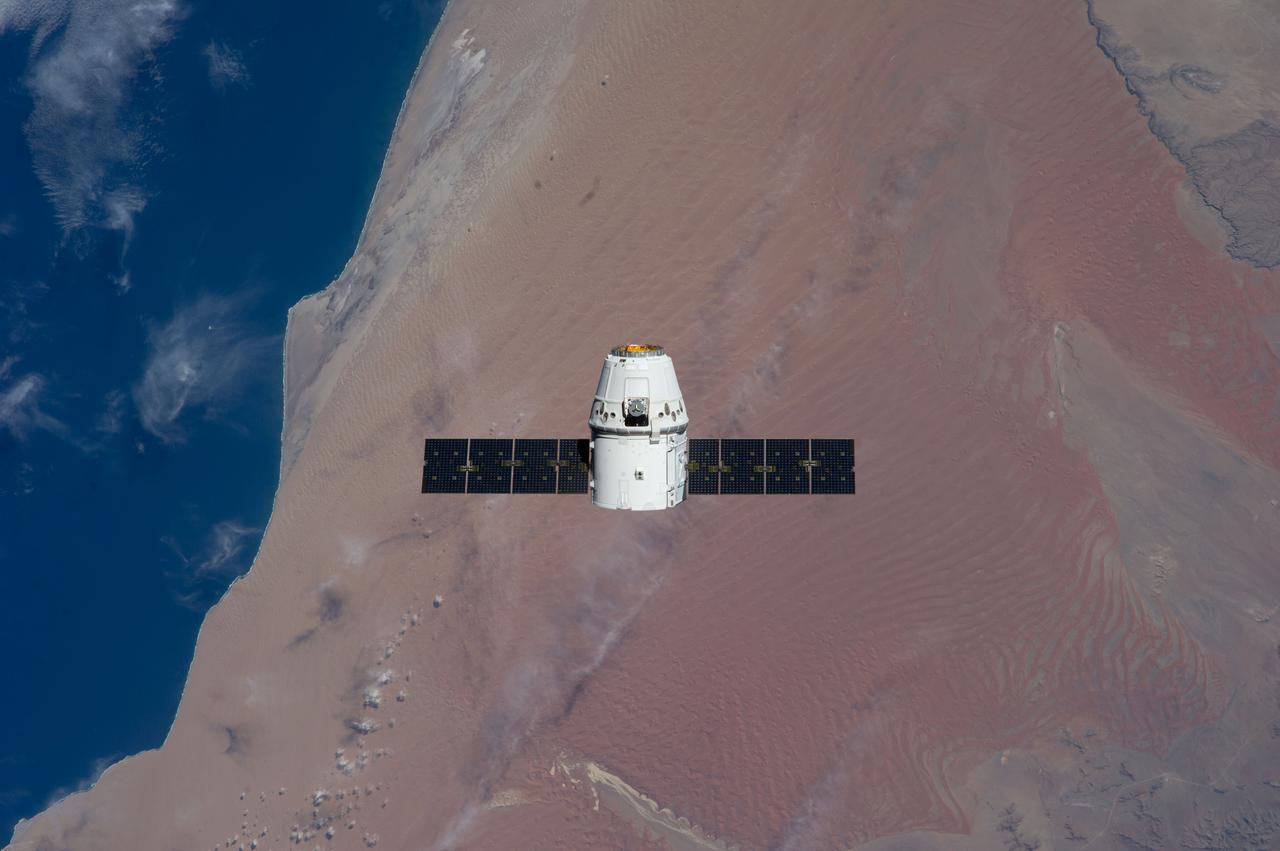
ISS031-E-070943 (25 May 2012) --- Backdropped against the Namib Desert on the Atlantic coast of Namibia, the SpaceX Dragon commercial cargo craft approaches the International Space Station on May 25, 2012 for grapple and berthing. Expedition 31 Flight Engineers Don Pettit and Andre Kuipers grappled Dragon at 9:56 a.m. (EDT) with the Canadarm2 robotic arm and used the robotic arm to berth Dragon to the Earth-facing side of the station's Harmony node at 12:02 p.m.
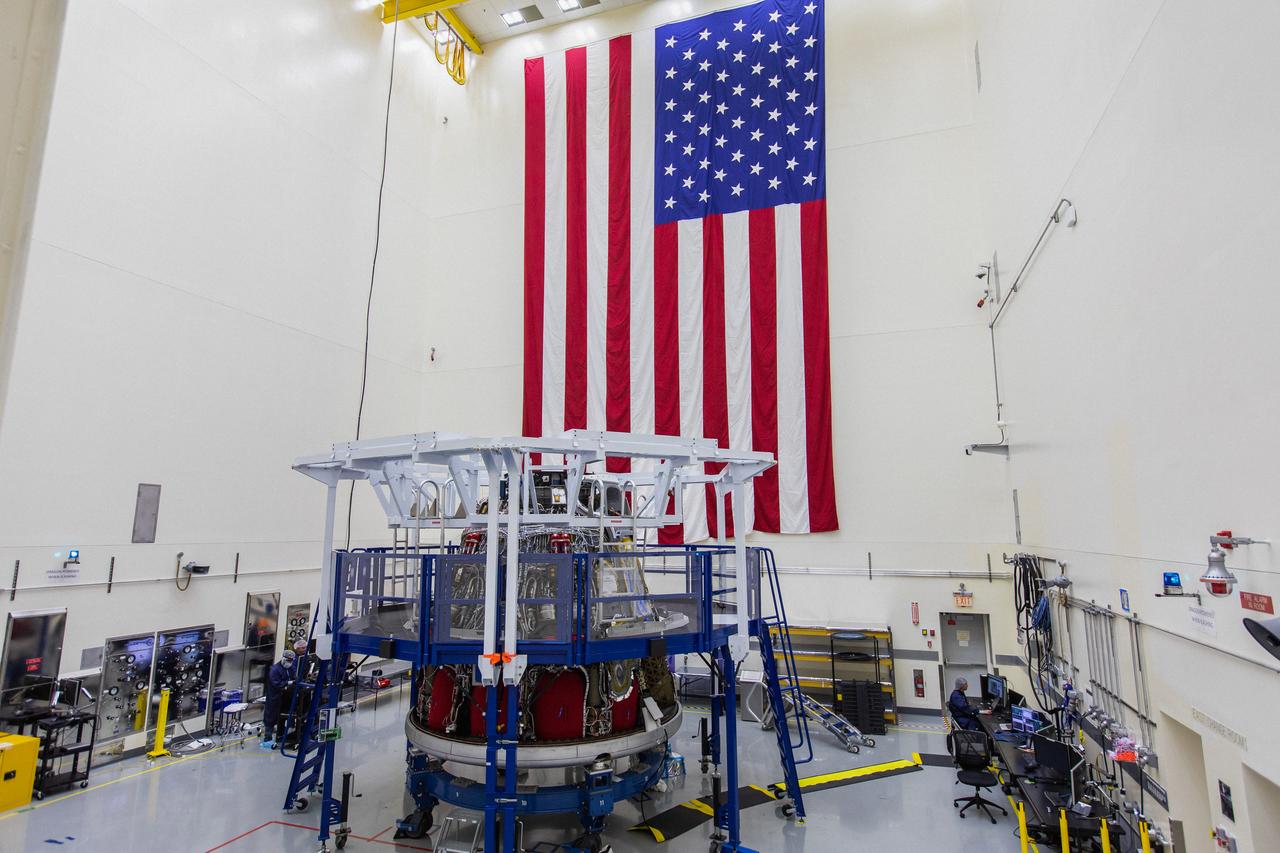
The SpaceX Crew Dragon spacecraft that will be used for the company’s In-Flight Abort Test arrives at SpaceX’s hangar at Launch Complex 39 at NASA’s Kennedy Space Center in Florida. The test will demonstrate the spacecraft and launch system’s ability to abort in the unlikely case of an emergency after liftoff. It is an important step before NASA astronauts Bob Behnken and Doug Hurley are transported to the International Space Station aboard Crew Dragon as part of NASA’s Commercial Crew Program.
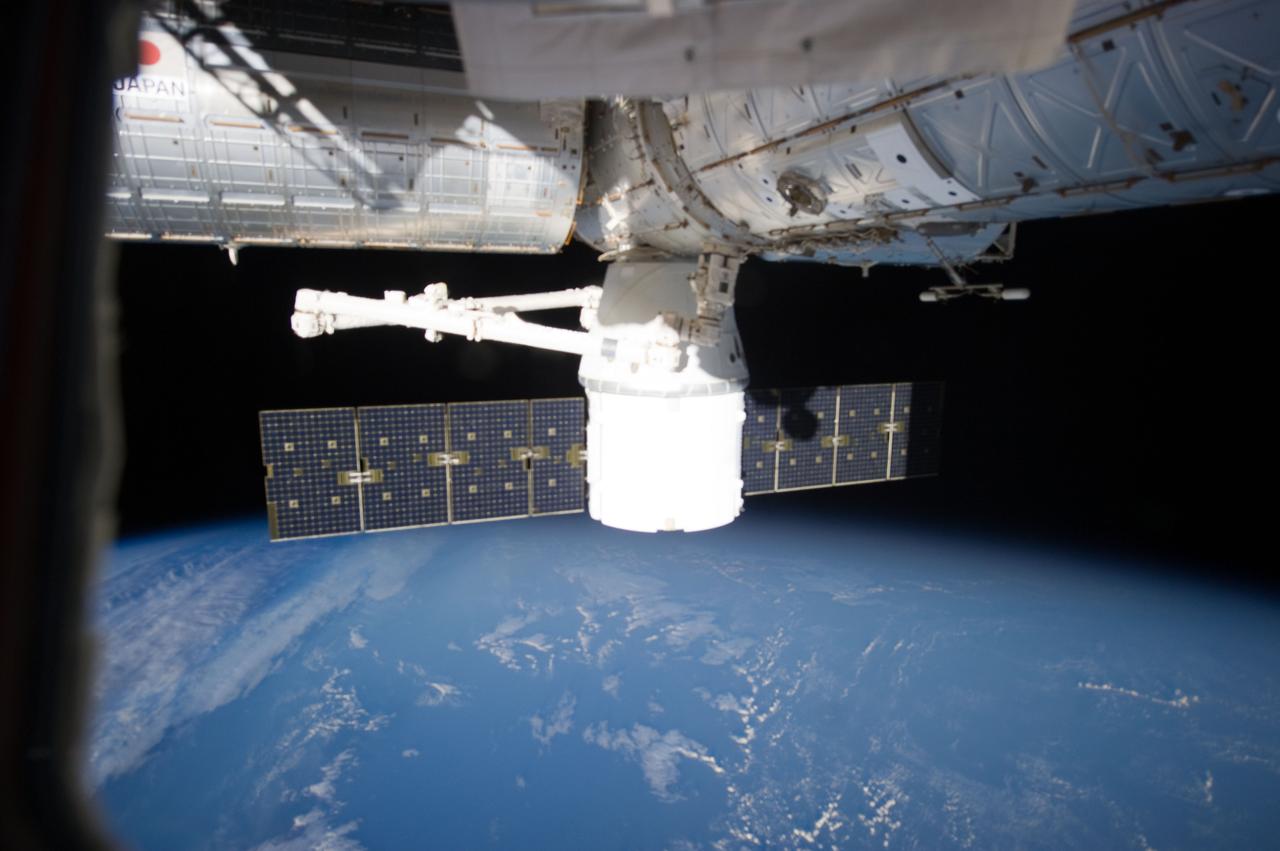
ISS033-E-012424 (14 Oct. 2012) --- Attached to the Earth-facing side of the Harmony node, the SpaceX Dragon commercial cargo craft is featured in this image photographed by an Expedition 33 crew member on the International Space Station. Dragon was berthed to Harmony on Oct. 10 and is scheduled to spend 18 days attached to the station.
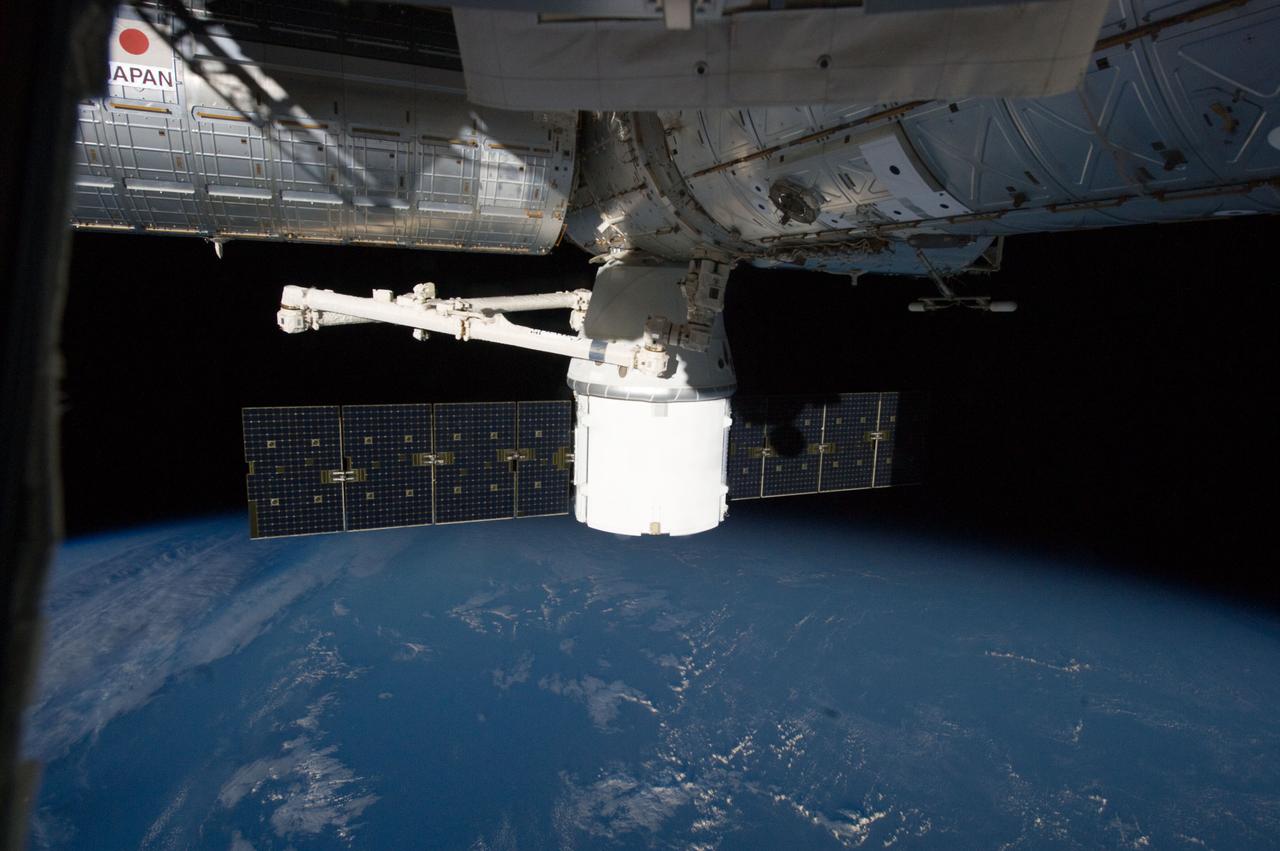
ISS033-E-012422 (14 Oct. 2012) --- Attached to the Earth-facing side of the Harmony node, the SpaceX Dragon commercial cargo craft is featured in this image photographed by an Expedition 33 crew member on the International Space Station. Dragon was berthed to Harmony on Oct. 10 and is scheduled to spend 18 days attached to the station.
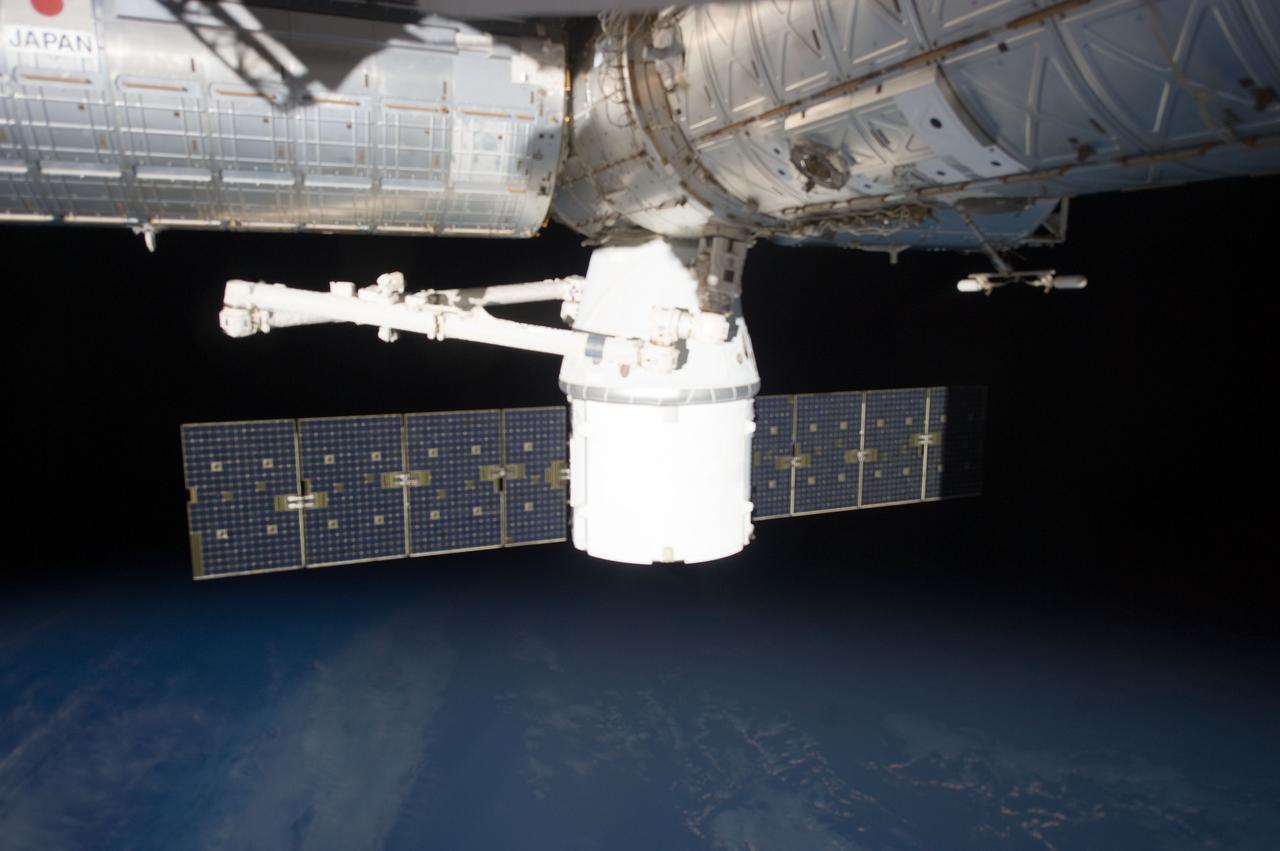
ISS033-E-012429 (14 Oct. 2012) --- Attached to the Earth-facing side of the Harmony node, the SpaceX Dragon commercial cargo craft is featured in this image photographed by an Expedition 33 crew member on the International Space Station. Dragon was berthed to Harmony on Oct. 10 and is scheduled to spend 18 days attached to the station.
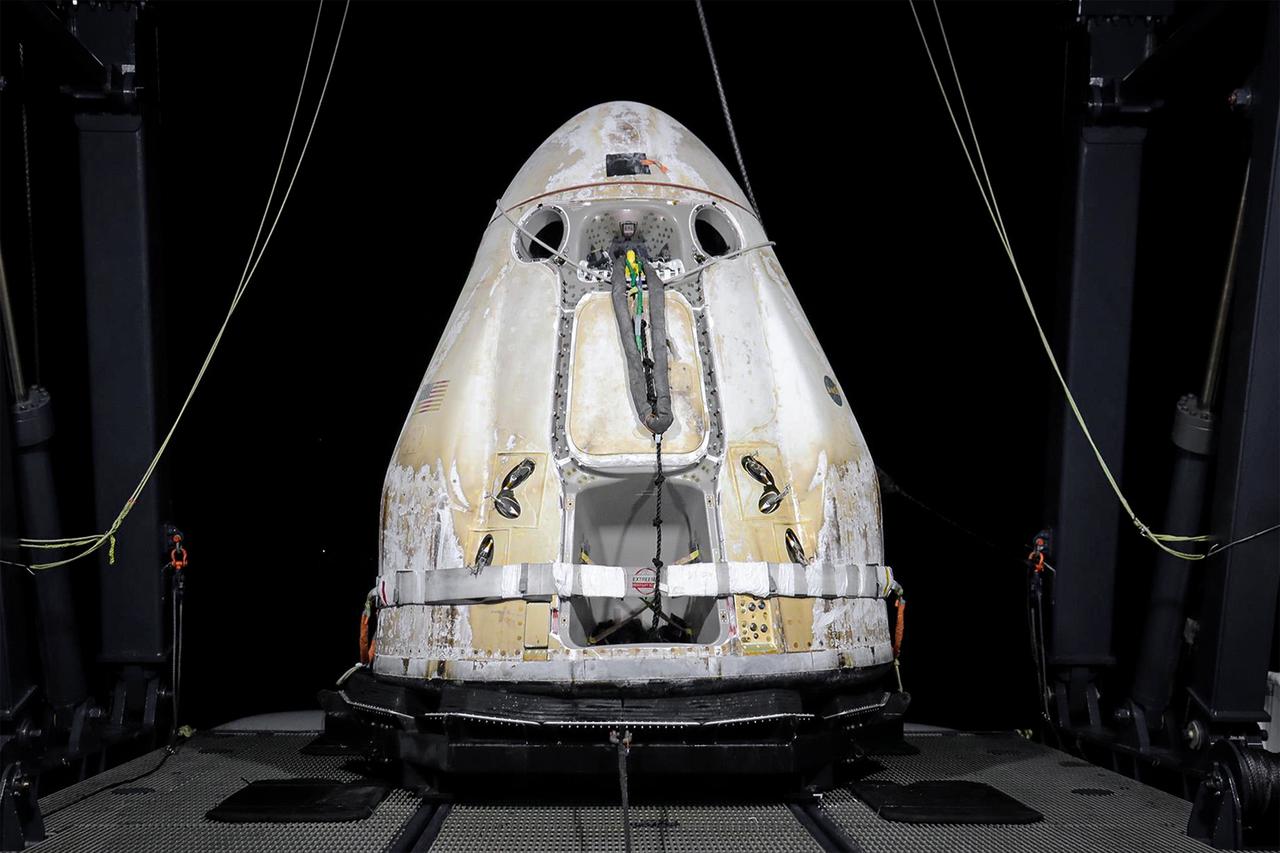
Shown here is the SpaceX Cargo Dragon spacecraft on board the company's Go Navigator recovery ship after making its successful parachute-assisted splashdown west of Tampa off the Florida coast on Jan. 13, 2020, at 8:26 p.m. EST. Just after loading Dragon onto Go Navigator, SpaceX packed an Airbus H225 helicopter with the time-sensitive research cargo for delivery to NASA’s Kennedy Space Center. Dragon returned more than 4,400 pounds of scientific experiments and other cargo from the International Space Station. The upgraded cargo Dragon capsule boasts double the powered locker capacity to preserve science samples, allowing for a significant increase in the research that can be carried back to Earth. Photo credit: SpaceX
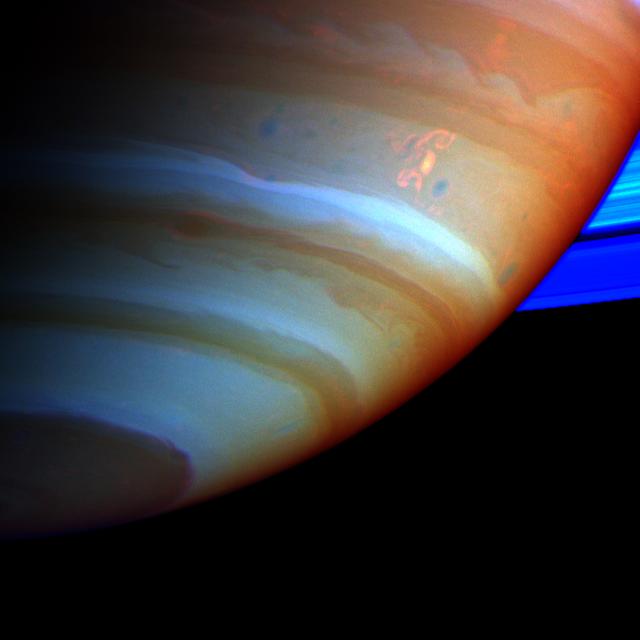
A large, bright and complex convective storm that appeared in Saturn's southern hemisphere in mid-September 2004 was the key in solving a long-standing mystery about the ringed planet. Saturn's atmosphere and its rings are shown here in a false color composite made from Cassini images taken in near infrared light through filters that sense different amounts of methane gas. Portions of the atmosphere with a large abundance of methane above the clouds are red, indicating clouds that are deep in the atmosphere. Grey indicates high clouds, and brown indicates clouds at intermediate altitudes. The rings are bright blue because there is no methane gas between the ring particles and the camera. The complex feature with arms and secondary extensions just above and to the right of center is called the Dragon Storm. It lies in a region of the southern hemisphere referred to as "storm alley" by imaging scientists because of the high level of storm activity observed there by Cassini in the last year. The Dragon Storm was a powerful source of radio emissions during July and September of 2004. The radio waves from the storm resemble the short bursts of static generated by lightning on Earth. Cassini detected the bursts only when the storm was rising over the horizon on the night side of the planet as seen from the spacecraft; the bursts stopped when the storm moved into sunlight. This on/off pattern repeated for many Saturn rotations over a period of several weeks, and it was the clock-like repeatability that indicated the storm and the radio bursts are related. Scientists have concluded that the Dragon Storm is a giant thunderstorm whose precipitation generates electricity as it does on Earth. The storm may be deriving its energy from Saturn's deep atmosphere. One mystery is why the radio bursts start while the Dragon Storm is below the horizon on the night side and end when the storm is on the day side, still in full view of the Cassini spacecraft. A possible explanation is that the lightning source lies to the east of the visible cloud, perhaps because it is deeper where the currents are eastward relative to those at cloud top levels. If this were the case, the lightning source would come up over the night side horizon and would sink down below the day side horizon before the visible cloud. This would explain the timing of the visible storm relative to the radio bursts. The Dragon Storm is of great interest for another reason. In examining images taken of Saturn's atmosphere over many months, imaging scientists found that the Dragon Storm arose in the same part of Saturn's atmosphere that had earlier produced large bright convective storms. In other words, the Dragon Storm appears to be a long-lived storm deep in the atmosphere that periodically flares up to produce dramatic bright white plumes which subside over time. One earlier sighting, in July 2004, was also associated with strong radio bursts. And another, observed in March 2004 and captured in a movie created from images of the atmosphere (PIA06082 and PIA06083) spawned three little dark oval storms that broke off from the arms of the main storm. Two of these subsequently merged with each other; the current to the north carried the third one off to the west, and Cassini lost track of it. Small dark storms like these generally get stretched out until they merge with the opposing currents to the north and south. These little storms are the food that sustains the larger atmospheric features, including the larger ovals and the eastward and westward currents. If the little storms come from the giant thunderstorms, then together they form a food chain that harvests the energy of the deep atmosphere and helps maintain the powerful currents. Cassini has many more chances to observe future flare-ups of the Dragon Storm, and others like it over the course of the mission. It is likely that scientists will come to solve the mystery of the radio bursts and observe storm creation and merging in the next 2 or 3 years. http://photojournal.jpl.nasa.gov/catalog/PIA06197
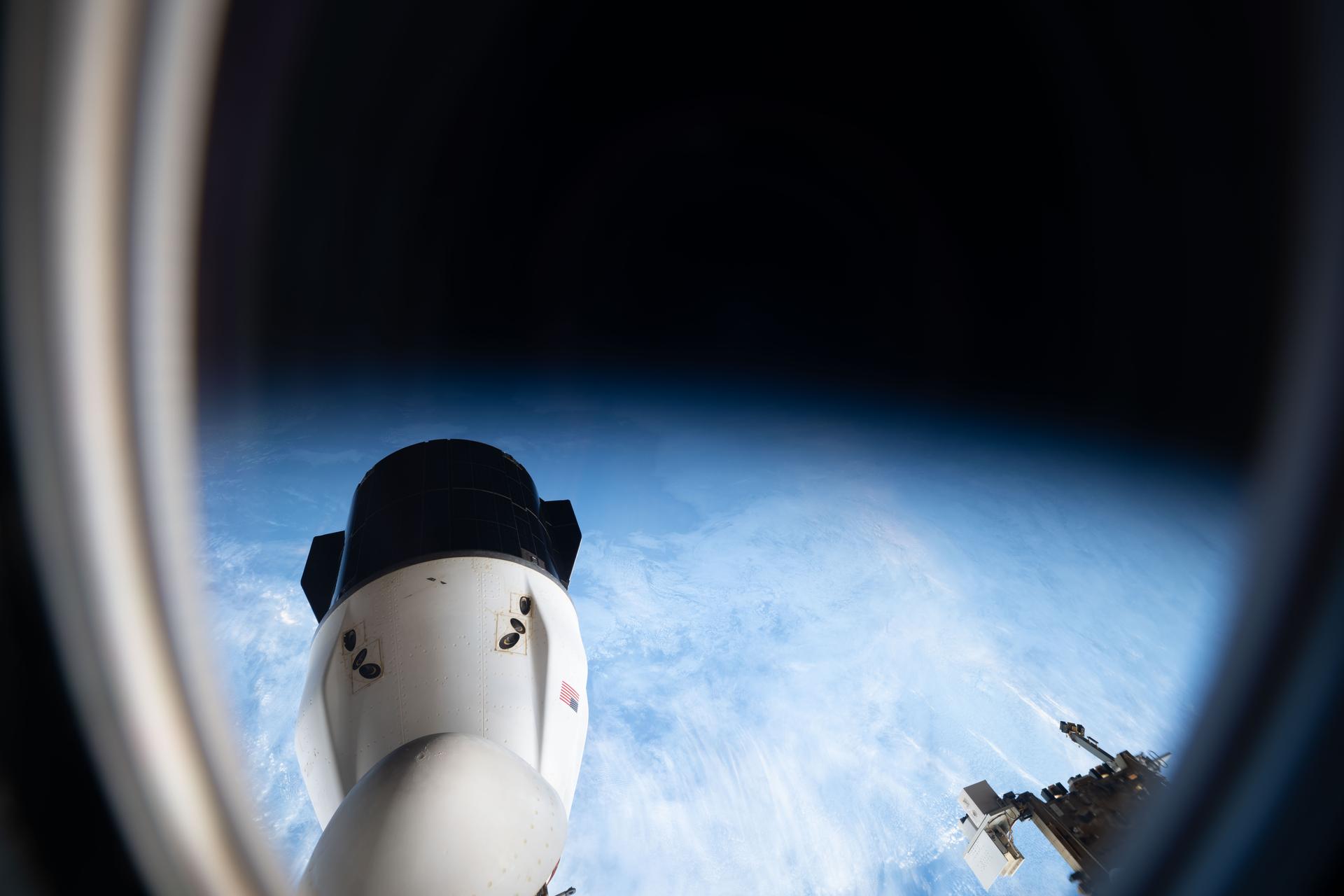
iss074e0345431 (Feb. 25, 2026) --- Peering out a window of a SpaceX Dragon spacecraft toward another Dragon spacecraft, the International Space Station soars into an orbital sunset 274 miles above the South Atlantic Ocean. Credit: NASA/Chris Williams
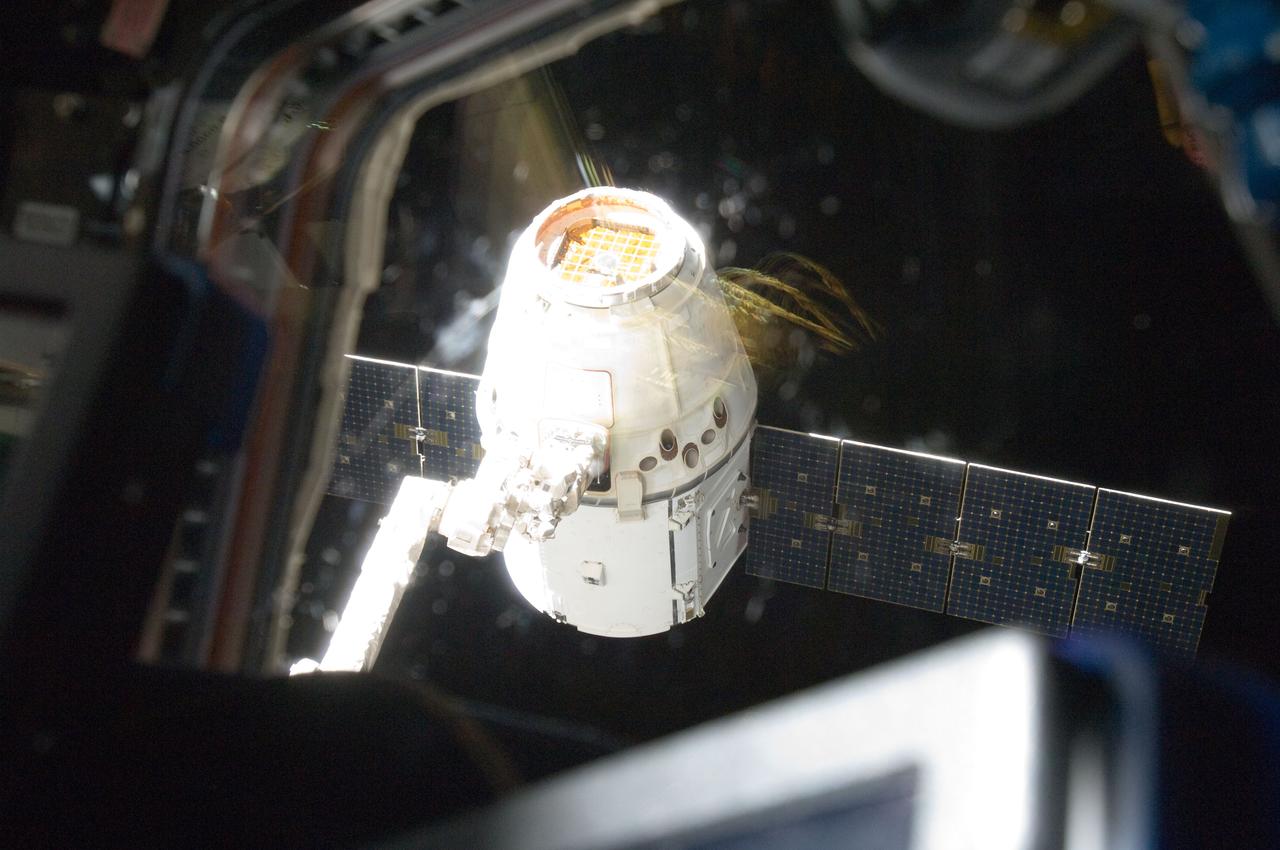
ISS033-E-016529 (28 Oct. 2012) --- The SpaceX Dragon commercial cargo craft is pictured just prior to being released by the International Space Station's Canadarm2 robotic arm on Oct. 28 to allow it to head toward a splashdown in the Pacific Ocean.
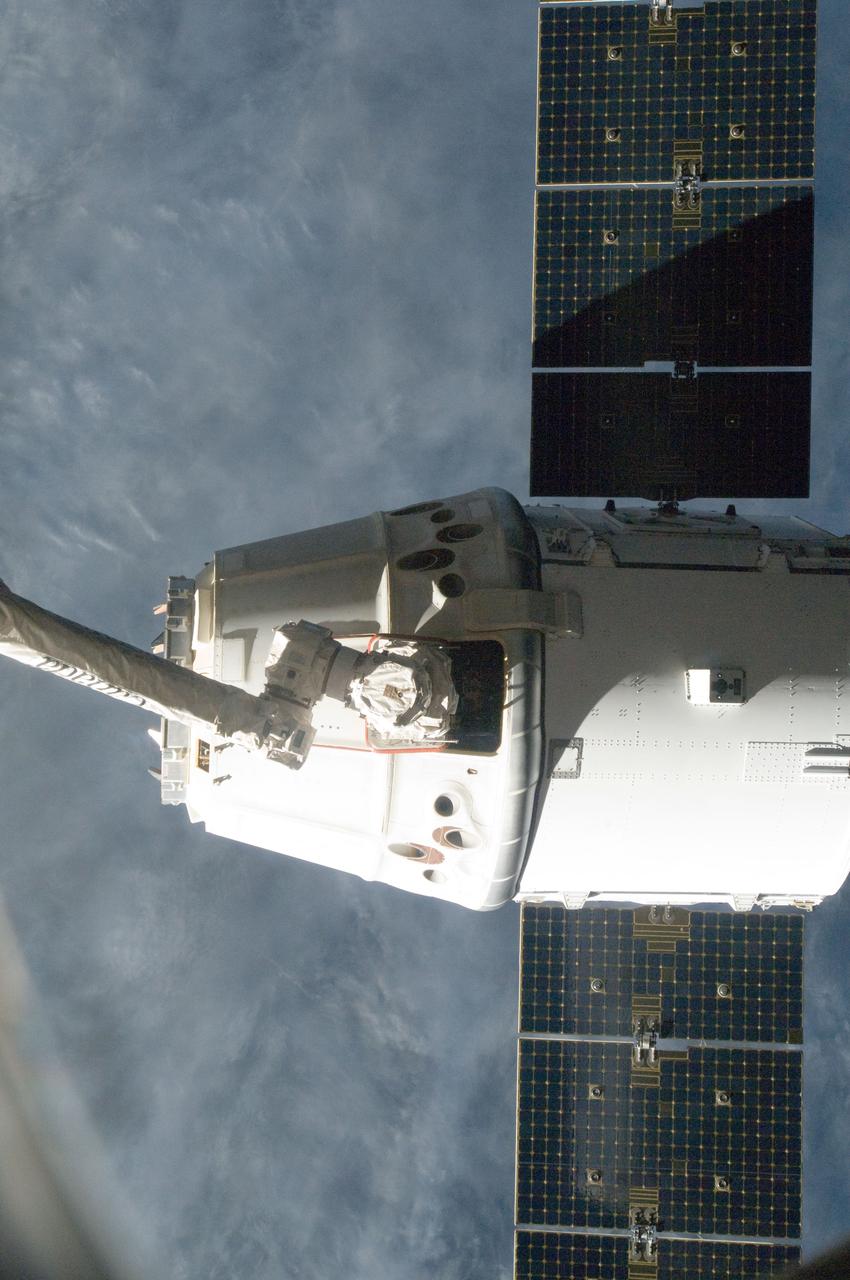
ISS033-E-016526 (28 Oct. 2012) --- The SpaceX Dragon commercial cargo craft is pictured just prior to being released by the International Space Station's Canadarm2 robotic arm on Oct. 28 to allow it to head toward a splashdown in the Pacific Ocean.
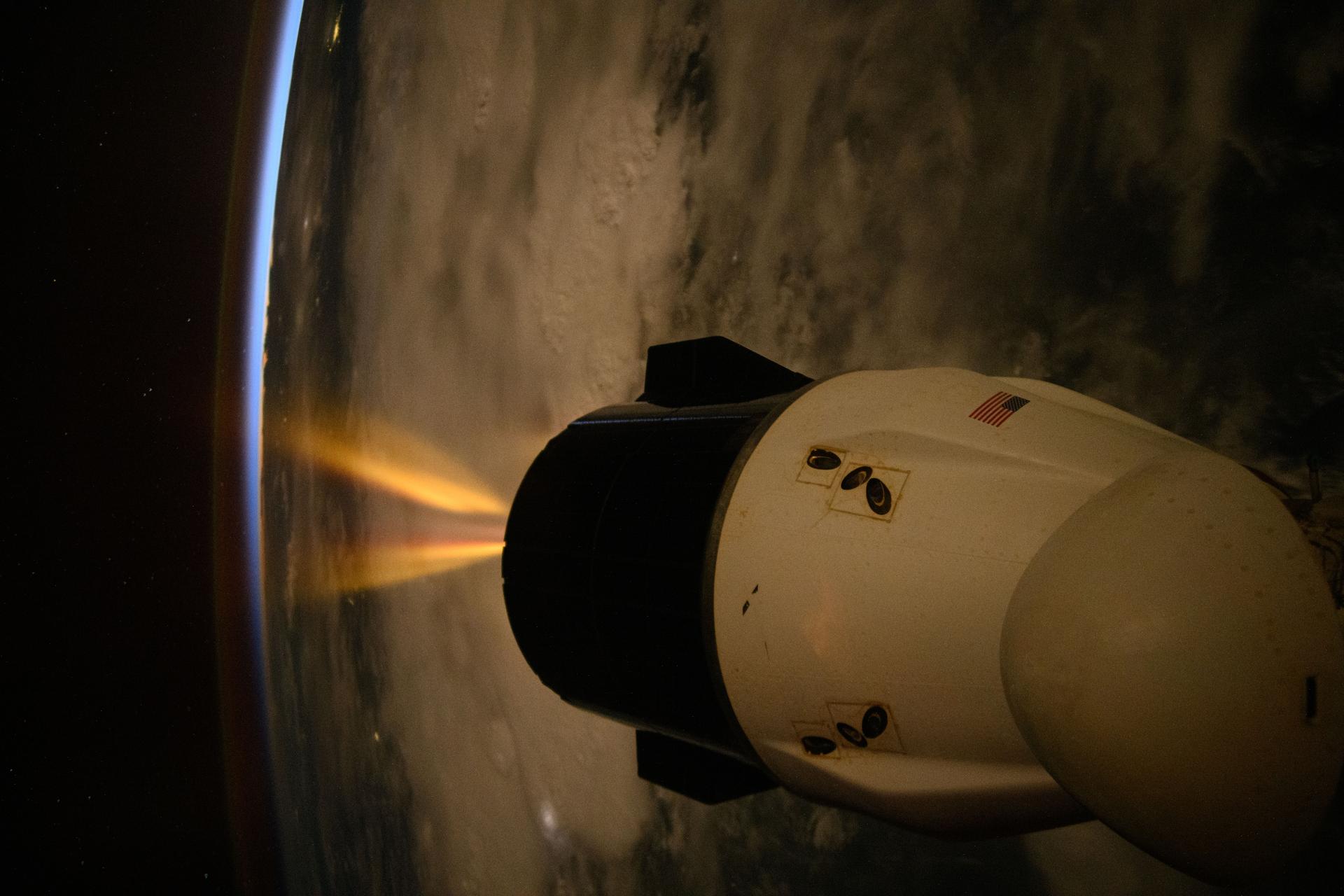
iss074e0103137 (Dec. 29, 2025) --- A SpaceX Dragon spacecraft fires its Draco engines, an independent propellant system located in the spacecraft’s trunk, for a regularly scheduled orbital reboost of the International Space Station. The orbital outpost was soaring into a sunset 259 miles above the Indian Ocean off the coast of Tanzania on the African continent at approximately 9:09 p.m. local time.
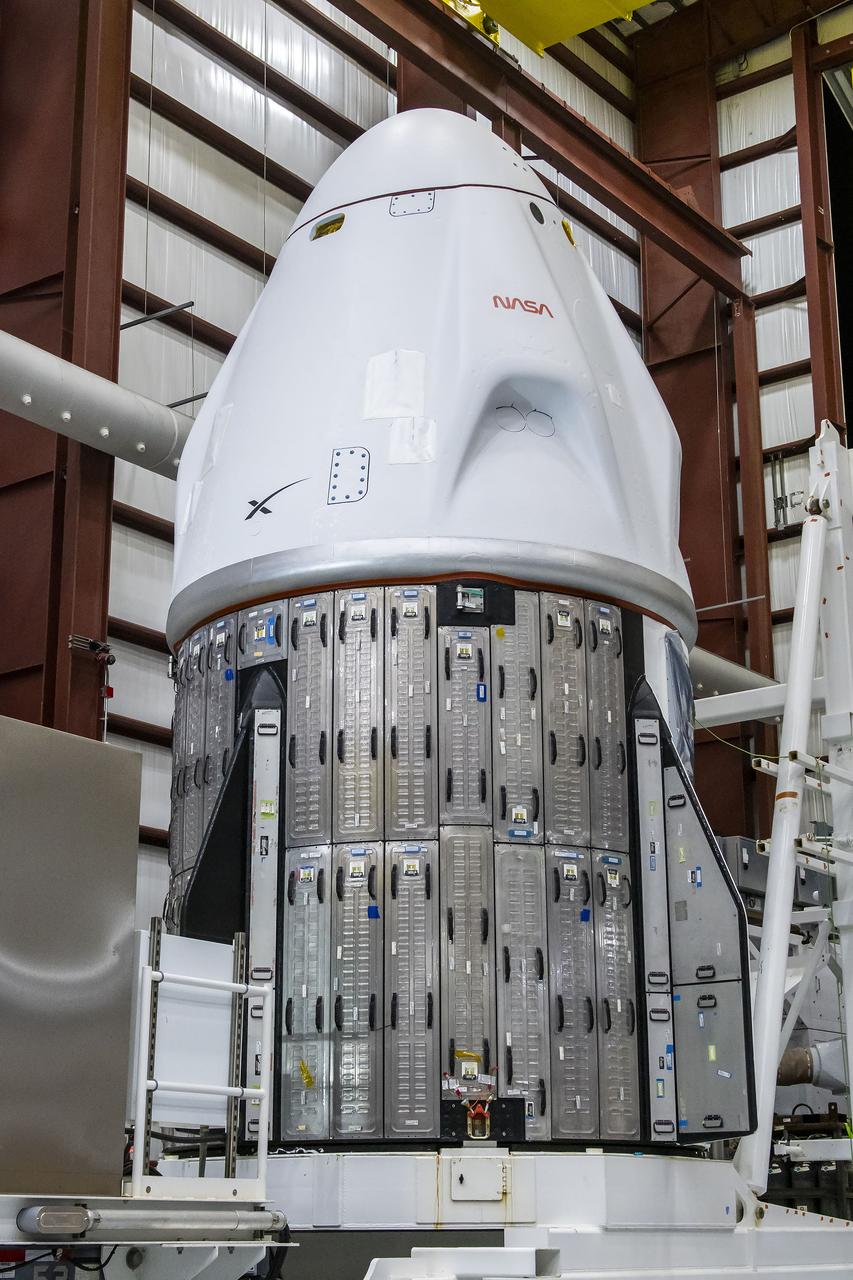
SpaceX’s Dragon spacecraft for NASA’s SpaceX Crew-10 mission arrives at the company’s hangar at Kennedy Space Center’s Launch Complex 39A in Florida on Tuesday, March 4, after a short journey from a nearby processing facility at Cape Canaveral Space Force Station. NASA astronauts Anne McClain and Nichole Ayers, along with JAXA (Japan Aerospace Exploration Agency) astronaut Takuya Onishi and Roscosmos cosmonaut Kirill Peskov are slated to launch to the International Space Station aboard SpaceX’s Dragon spacecraft, powered by the company’s Falcon 9 rocket no earlier than 7:48 p.m. EDT on Wednesday, March 12, 2025.
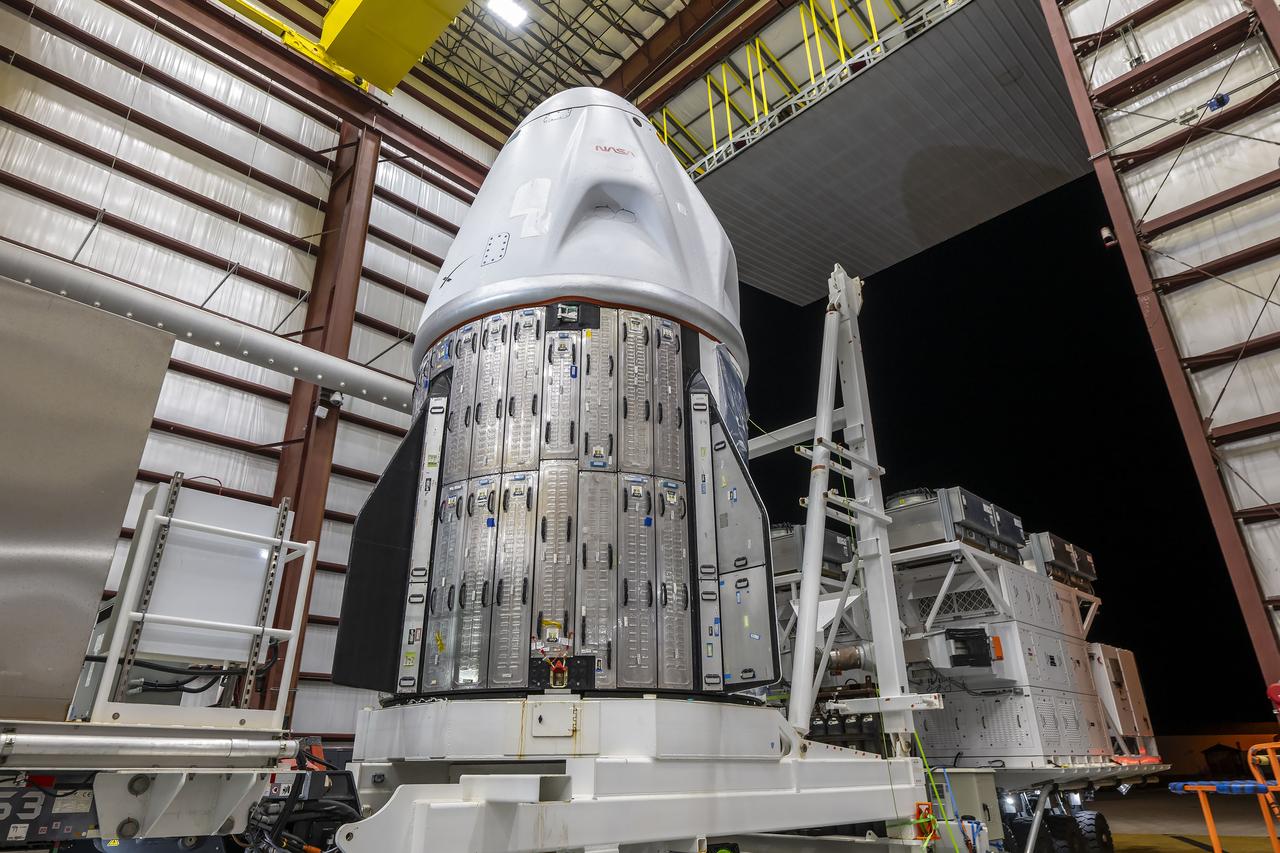
SpaceX’s Dragon spacecraft for NASA’s SpaceX Crew-10 mission arrives at the company’s hangar at Kennedy Space Center’s Launch Complex 39A in Florida on Tuesday, March 4, after a short journey from a nearby processing facility at Cape Canaveral Space Force Station. NASA astronauts Anne McClain and Nichole Ayers, along with JAXA (Japan Aerospace Exploration Agency) astronaut Takuya Onishi and Roscosmos cosmonaut Kirill Peskov are slated to launch to the International Space Station aboard SpaceX’s Dragon spacecraft, powered by the company’s Falcon 9 rocket no earlier than 7:48 p.m. EDT on Wednesday, March 12, 2025.
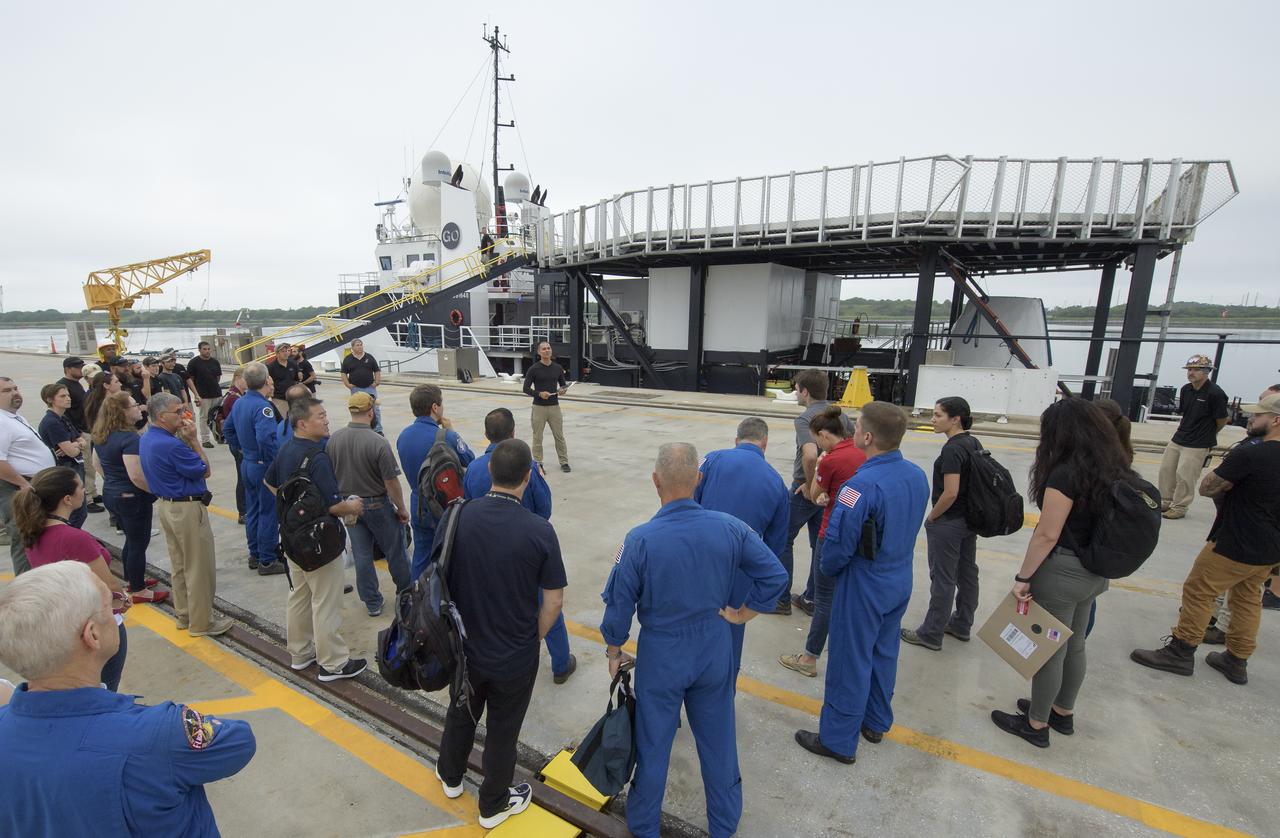
Teams from NASA and SpaceX gather at the Trident Basin in Cape Canaveral, Florida, on August 13, 2019 to rehearse extracting astronauts from SpaceX’s Crew Dragon, which will be used to carry humans to the International Space Station. Using the Go Searcher ship SpaceX uses to recover their spacecraft after splashdown and a mock-up of the Crew Dragon, the teams worked through the steps necessary to get NASA astronauts Doug Hurley and Bob Behnken out of the Dragon and back to dry land. Hurley and Behnken will fly to the space station aboard the Crew Dragon for the SpaceX Demo-2 mission. Photo Credit: (NASA/Bill Ingalls)
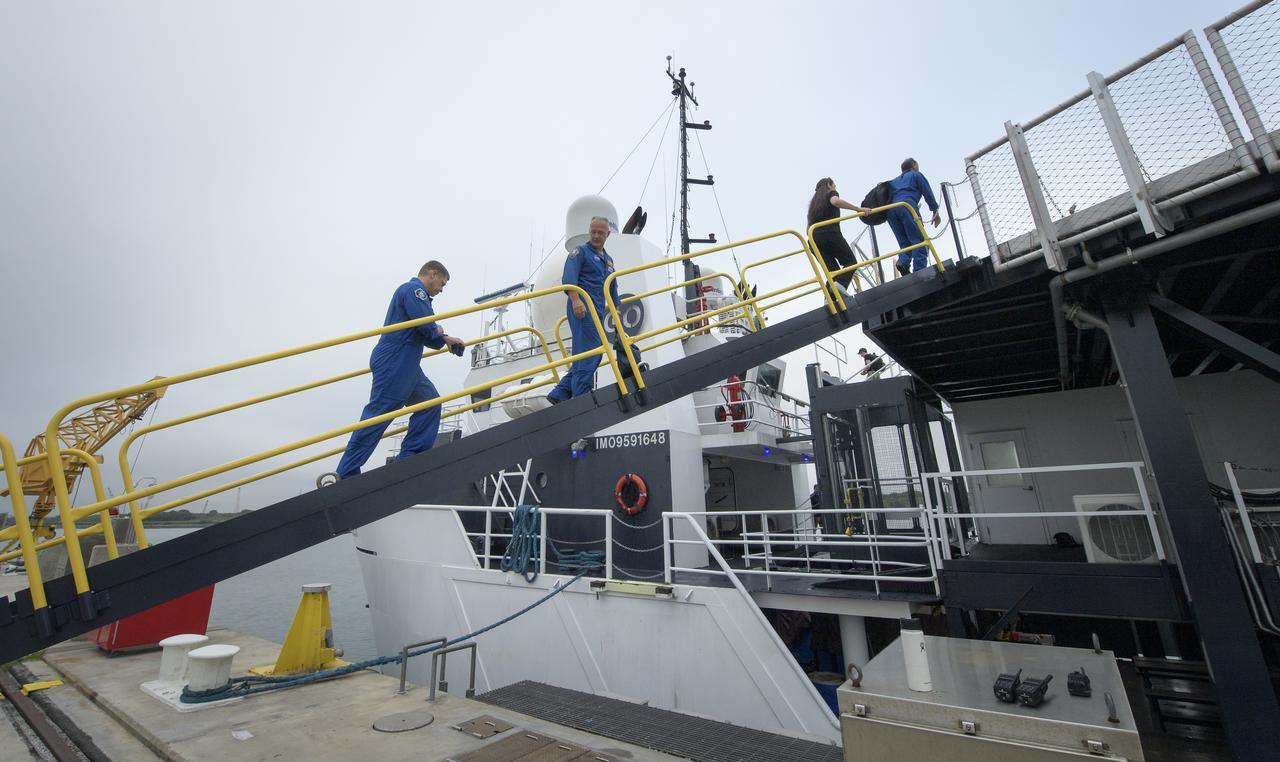
NASA astronauts Bob Behnken, left, and Doug Hurley board the SpaceX GO Searcher ship at the Trident Basin in Cape Canaveral, Florida, on August 13, 2019 to rehearse extracting astronauts from SpaceX’s Crew Dragon, which will be used to carry humans to the International Space Station. Using the Go Searcher ship SpaceX uses to recover their spacecraft after splashdown and a mock-up of the Crew Dragon, the teams worked through the steps necessary to get NASA astronauts Doug Hurley and Bob Behnken out of the Dragon and back to dry land. Hurley and Behnken will fly to the space station aboard the Crew Dragon for the SpaceX Demo-2 mission. Photo Credit: (NASA/Bill Ingalls)
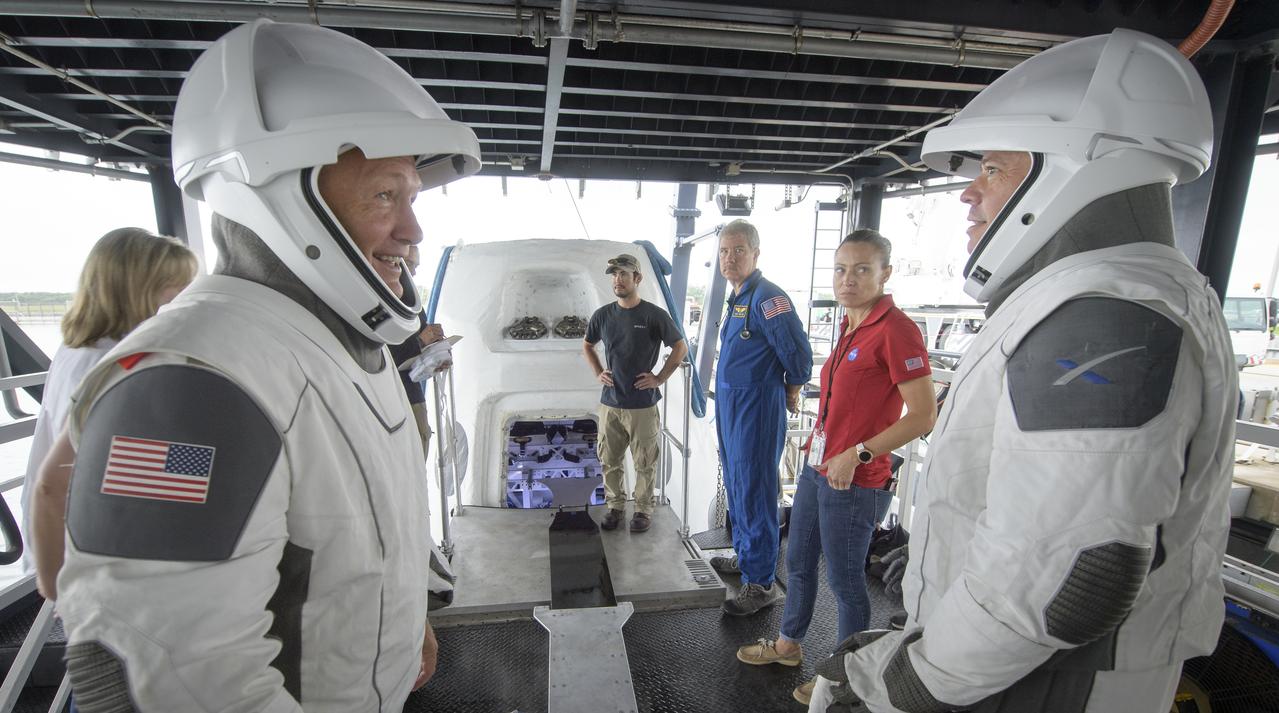
NASA astronauts Doug Hurley, left, and Bob Behnken work with teams from NASA and SpaceX to rehearse crew extraction from SpaceX’s Crew Dragon, which will be used to carry humans to the International Space Station, on August 13, 2019 at the Trident Basin in Cape Canaveral, Florida. Using the Go Searcher ship SpaceX uses to recover their spacecraft after splashdown and a mock-up of the Crew Dragon, the teams worked through the steps necessary to get NASA astronauts Doug Hurley and Bob Behnken out of the Dragon and back to dry land. Hurley and Behnken will fly to the space station aboard the Crew Dragon for the SpaceX Demo-2 mission. Photo Credit: (NASA/Bill Ingalls)
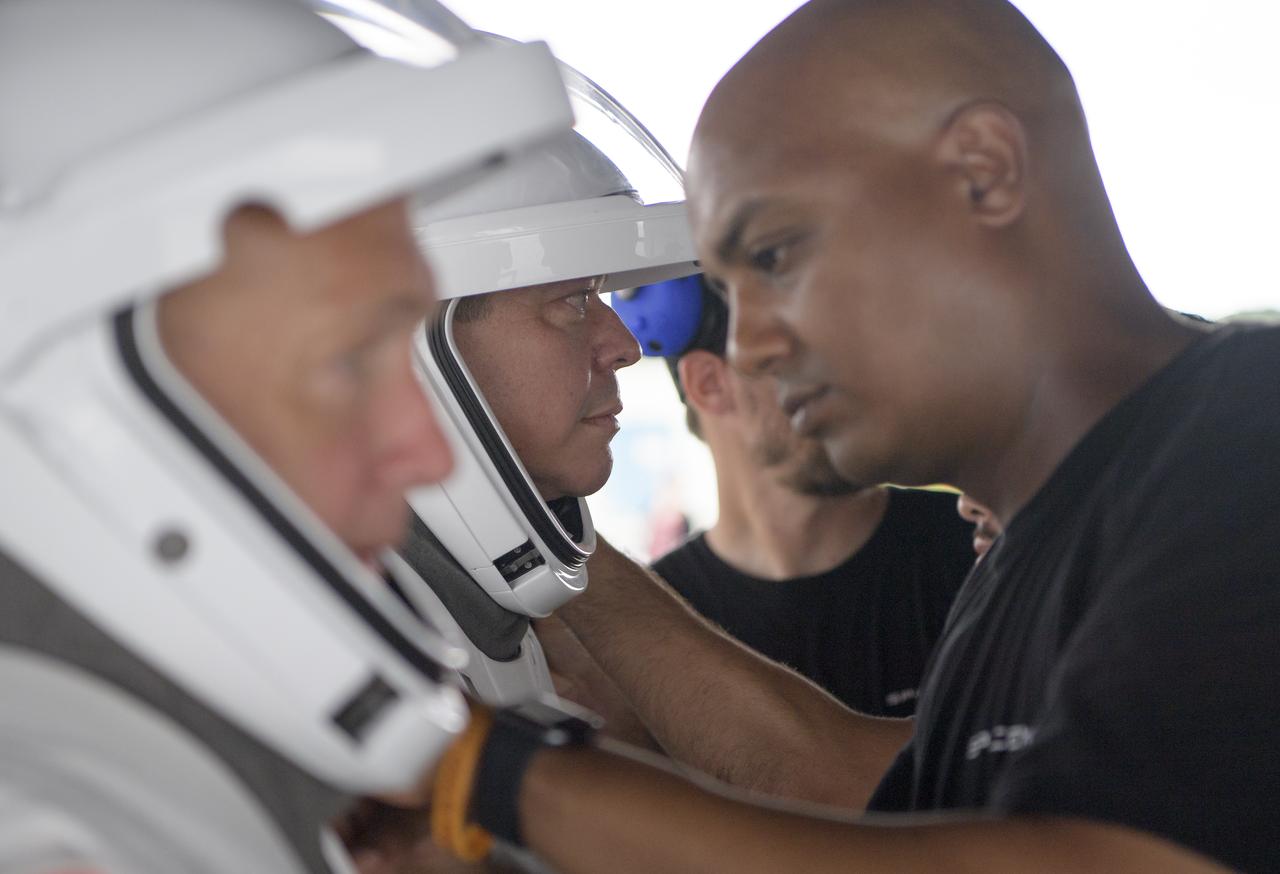
NASA astronauts Doug Hurley, left, and Bob Behnken work with teams from NASA and SpaceX to rehearse crew extraction from SpaceX’s Crew Dragon, which will be used to carry humans to the International Space Station, on August 13, 2019 at the Trident Basin in Cape Canaveral, Florida. Using the Go Searcher ship SpaceX uses to recover their spacecraft after splashdown and a mock-up of the Crew Dragon, the teams worked through the steps necessary to get NASA astronauts Doug Hurley and Bob Behnken out of the Dragon and back to dry land. Hurley and Behnken will fly to the space station aboard the Crew Dragon for the SpaceX Demo-2 mission. Photo Credit: (NASA/Bill Ingalls)
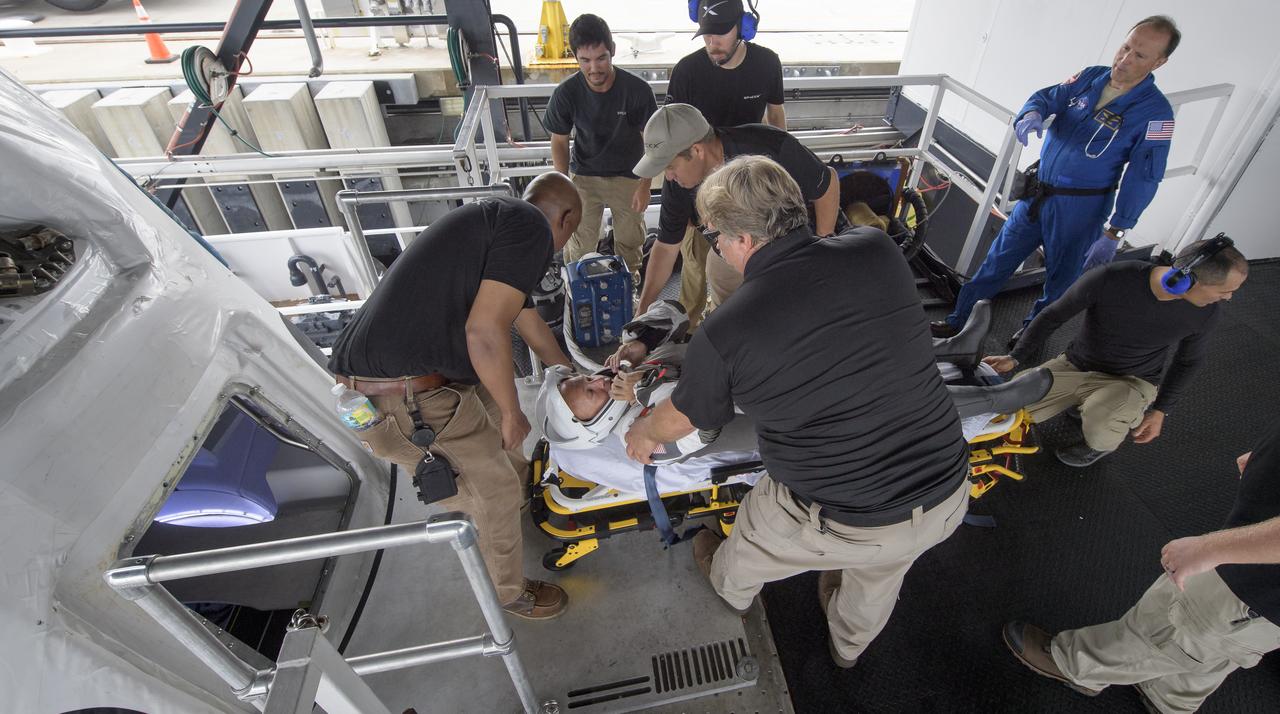
NASA astronaut Doug Hurley, along with teams from NASA and SpaceX, rehearse crew extraction from SpaceX’s Crew Dragon, which will be used to carry humans to the International Space Station, on August 13, 2019 at the Trident Basin in Cape Canaveral, Florida. Using the Go Searcher ship SpaceX uses to recover their spacecraft after splashdown and a mock-up of the Crew Dragon, the teams worked through the steps necessary to get NASA astronauts Doug Hurley and Bob Behnken out of the Dragon and back to dry land. Hurley and Behnken will fly to the space station aboard the Crew Dragon for the SpaceX Demo-2 mission. Photo Credit: (NASA/Bill Ingalls)