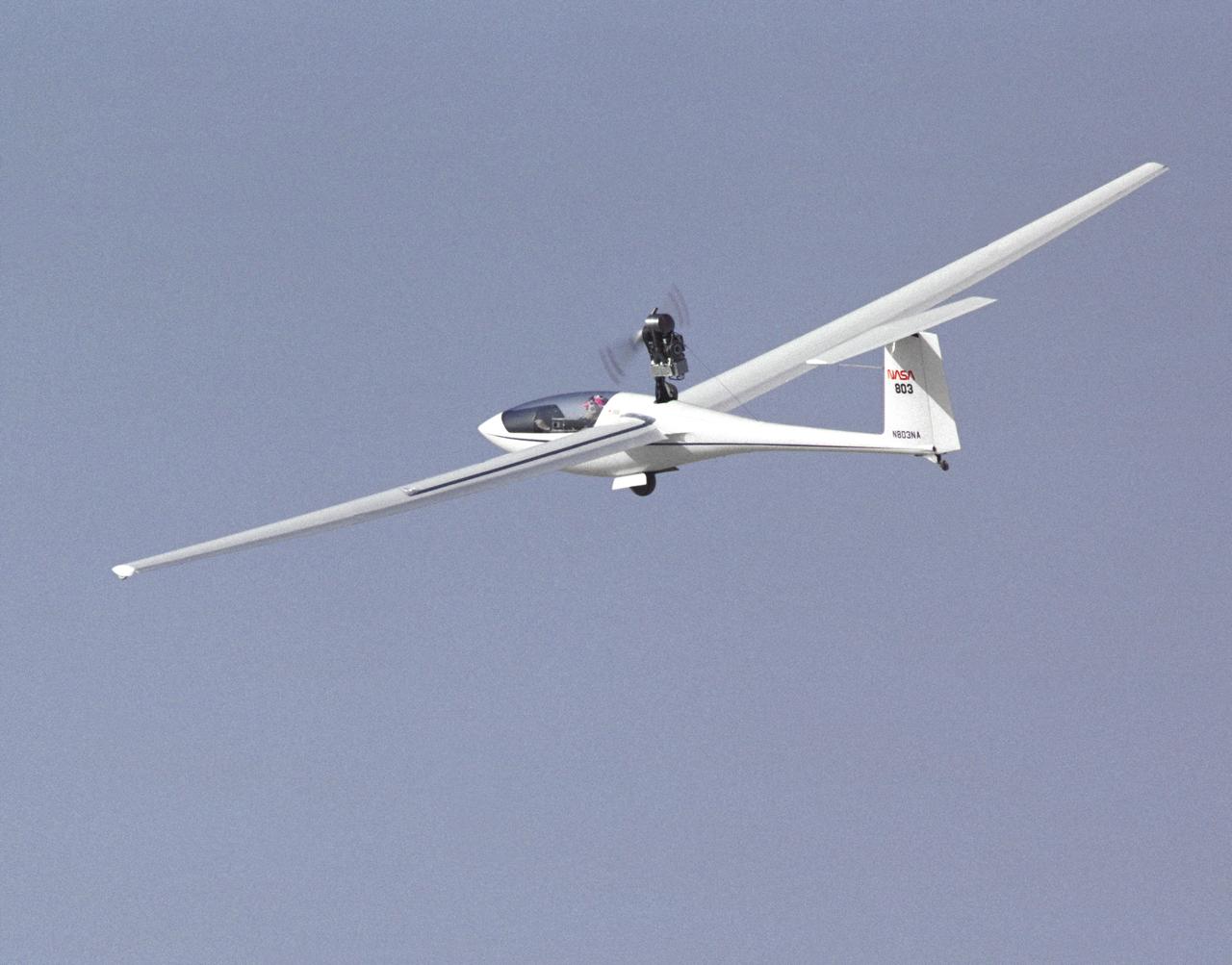
This photo shows NASA's PIK-20E motor-glider sailplane during a research flight from the Ames-Dryden Flight Research Facility (later, the Dryden Flight Research Center), Edwards, California, in 1991.

The X-1E research aircraft provides a striking view at the entrance of NASA's Dryden Flight Research Center, Edwards, California. The X-1E, one of the three original X-1 aircraft modified with a raised cockpit canopy and an ejection seat, was flown at the facility between 1953 and 1958 to investigate speeds at twice that of sound, and also to evaluate a thin wing designed for high-speed flight. The Dryden complex was originally established in 1946 as a small high-speed flight station to support the X-1 program. The X-1 was the first aircraft to fly at supersonic speeds. The main administrative building is to the rear of the X-1E and is the center of a research installation that has grown to more than 450 government employees and nearly 400 civilian contractors. Located on the northwest "shore" of Rogers Dry Lake, the Dryden Center was built around the original administrative-hangar building constructed in 1954 at a cost of $3.8 million. Since then many additional support and operational facilities have been built including a number of unique test facilities such as the Thermalstructures Research Facility, Flow Visualization Facility, and the newest addition, the Integrated Test Facility.
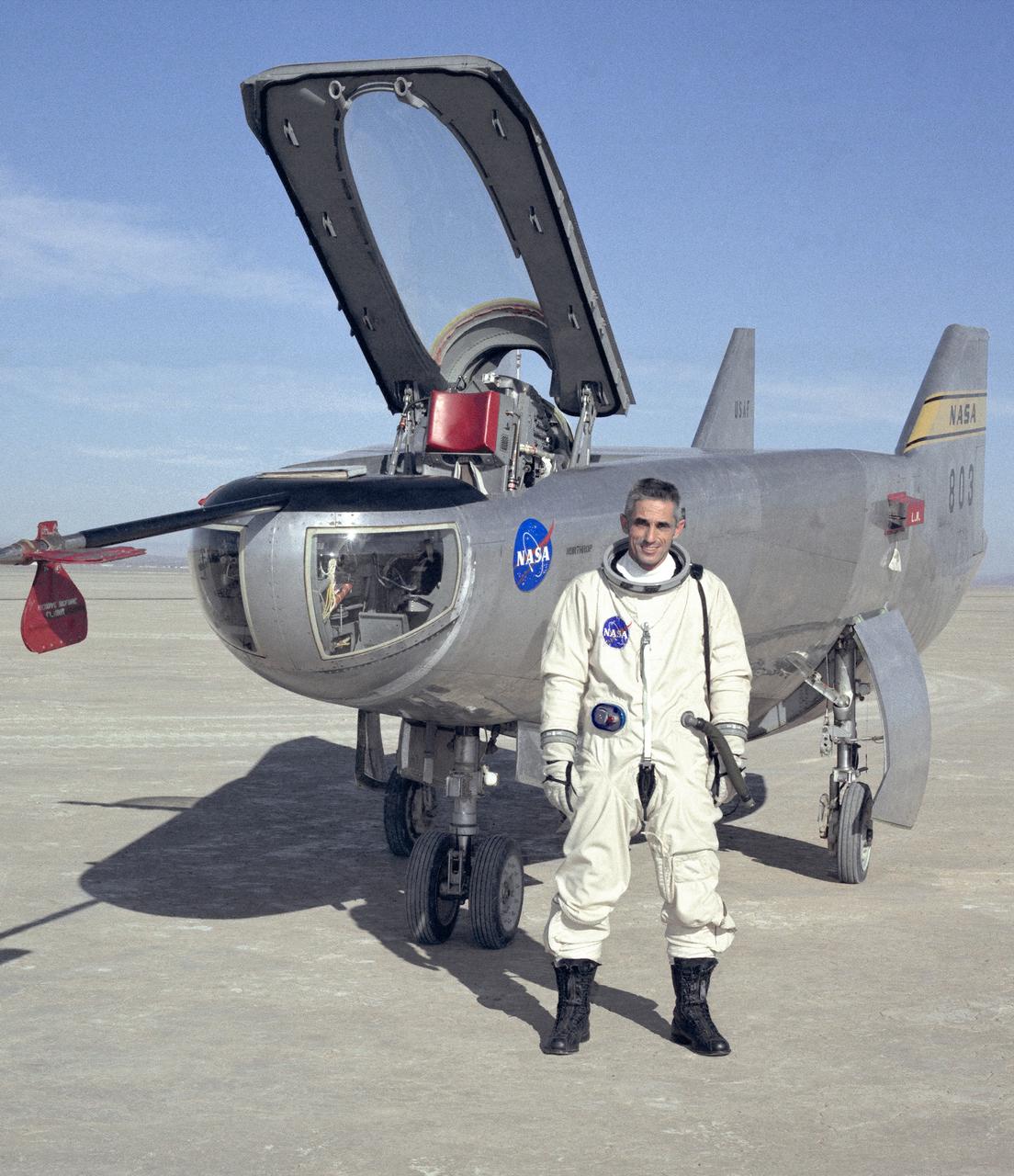
NASA research pilot John A. Manke is seen here in front of the M2-F3 Lifting Body. Manke was hired by NASA on May 25, 1962, as a flight research engineer. He was later assigned to the pilot's office and flew various support aircraft including the F-104, F5D, F-111 and C-47. After leaving the Marine Corps in 1960, Manke worked for Honeywell Corporation as a test engineer for two years before coming to NASA. He was project pilot on the X-24B and also flew the HL-10, M2-F3, and X-24A lifting bodies. John made the first supersonic flight of a lifting body and the first landing of a lifting body on a hard surface runway. Manke served as Director of the Flight Operations and Support Directorate at the Dryden Flight Research Center prior to its integration with Ames Research Center in October 1981. After this date John was named to head the joint Ames-Dryden Directorate of Flight Operations. He also served as site manager of the NASA Ames-Dryden Flight Research Facility. John is a member of the Society of Experimental Test Pilots. He retired on April 27, 1984.
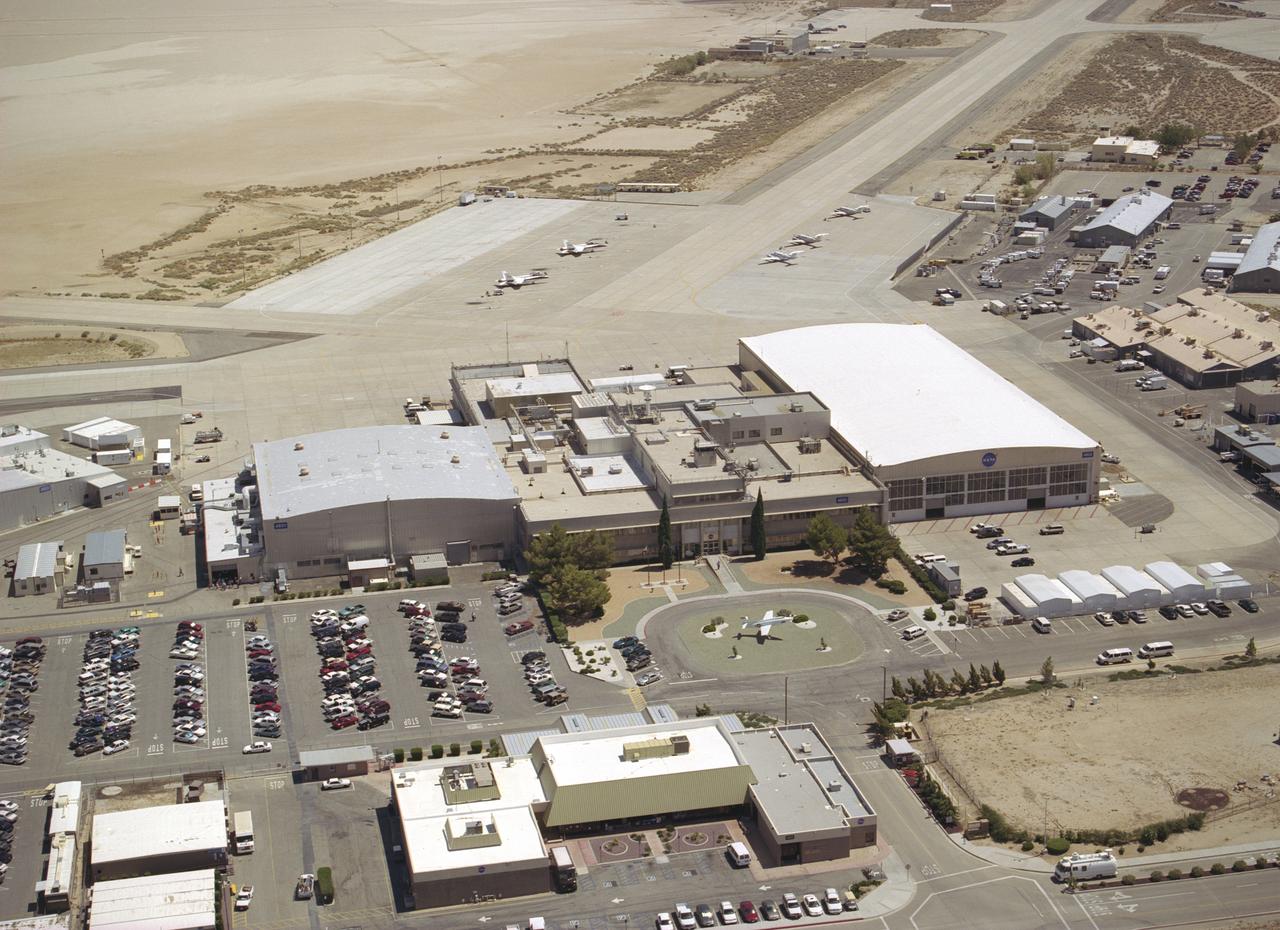
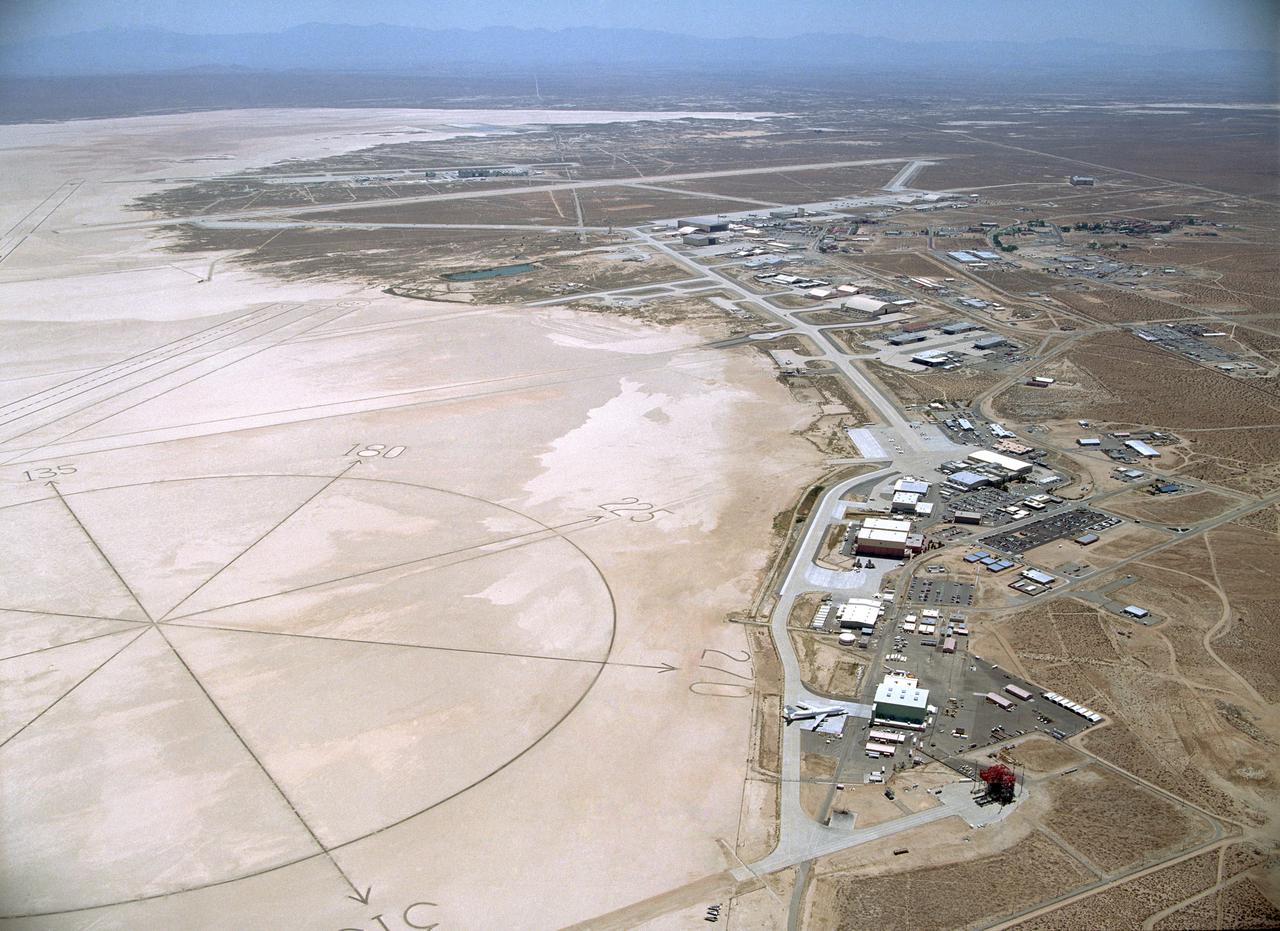
Since the 1940s the Dryden Flight Research Center, Edwards, California, has developed a unique and highly specialized capability for conducting flight research programs. The organization, made up of pilots, scientists, engineers, technicians, and mechanics, has been and will continue to be leaders in the field of advanced aeronautics. Located on the northwest "shore" of Rogers Dry Lake, the complex was built around the original administrative-hangar building constructed in 1954. Since then many additional support and operational facilities have been built including a number of unique test facilities such as the Thermalstructures Research Facility, Flow Visualization Facility, and the Integrated Test Facility. One of the most prominent structures is the space shuttle program's Mate-Demate Device and hangar in Area A to the north of the main complex. On the lakebed surface is a Compass Rose that gives pilots an instant compass heading. The Dryden complex originated at Edwards Air Force Base in support of the X-1 supersonic flight program. As other high-speed aircraft entered research programs, the facility became permanent and grew from a staff of five engineers in 1947 to a population in 2006 of nearly 1100 full-time government and contractor employees.
Since the 1940s the Dryden Flight Research Center, Edwards, California, has developed a unique and highly specialized capability for conducting flight research programs. The organization, made up of pilots, scientists, engineers, technicians, and mechanics, has been and will continue to be leaders in the field of advanced aeronautics. Located on the northwest "shore" of Rogers Dry Lake, the complex was built around the original administrative-hangar building constructed in 1954. Since then many additional support and operational facilities have been built including a number of unique test facilities such as the Thermalstructures Research Facility, Flow Visualization Facility, and the Integrated Test Facility. One of the most prominent structures is the space shuttle program's Mate-Demate Device and hangar in Area A to the north of the main complex. On the lakebed surface is a Compass Rose that gives pilots an instant compass heading. The Dryden complex originated at Edwards Air Force Base in support of the X-1 supersonic flight program. As other high-speed aircraft entered research programs, the facility became permanent and grew from a staff of five engineers in 1947 to a population in 2006 of nearly 1100 full-time government and contractor employees.
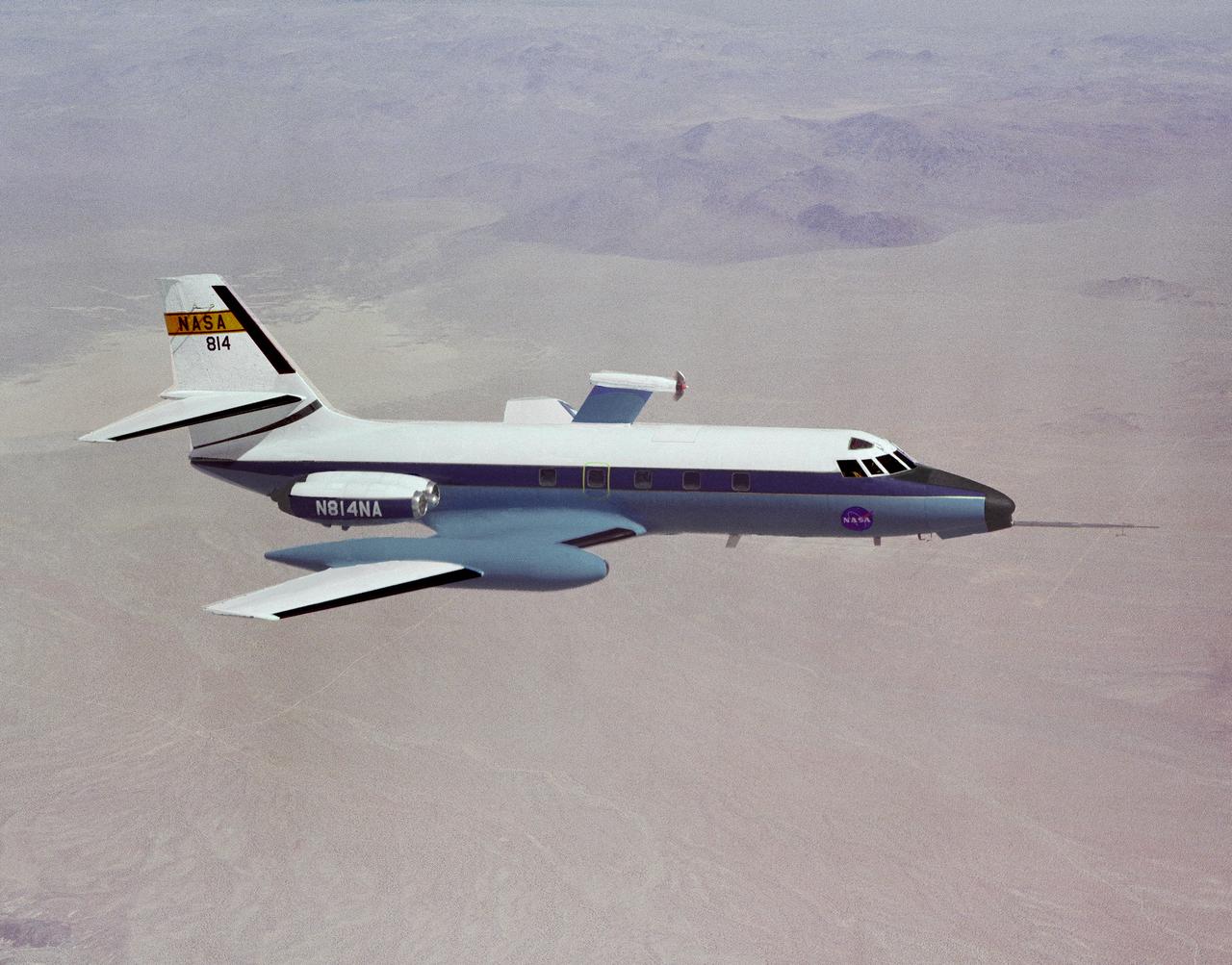
In this photograph, the C-140 JetStar is fitted with a model of a high-speed propeller. Three different designs were tested at NASA's Dryden Flight Research Facility in 1981-1982. Their swept-back blades were intended to increase the speed and fuel efficiency of turboprop aircraft. Speeds of Mach 0.8 were thought possible, while using 20 to 30 percent less fuel than standard jet engines.
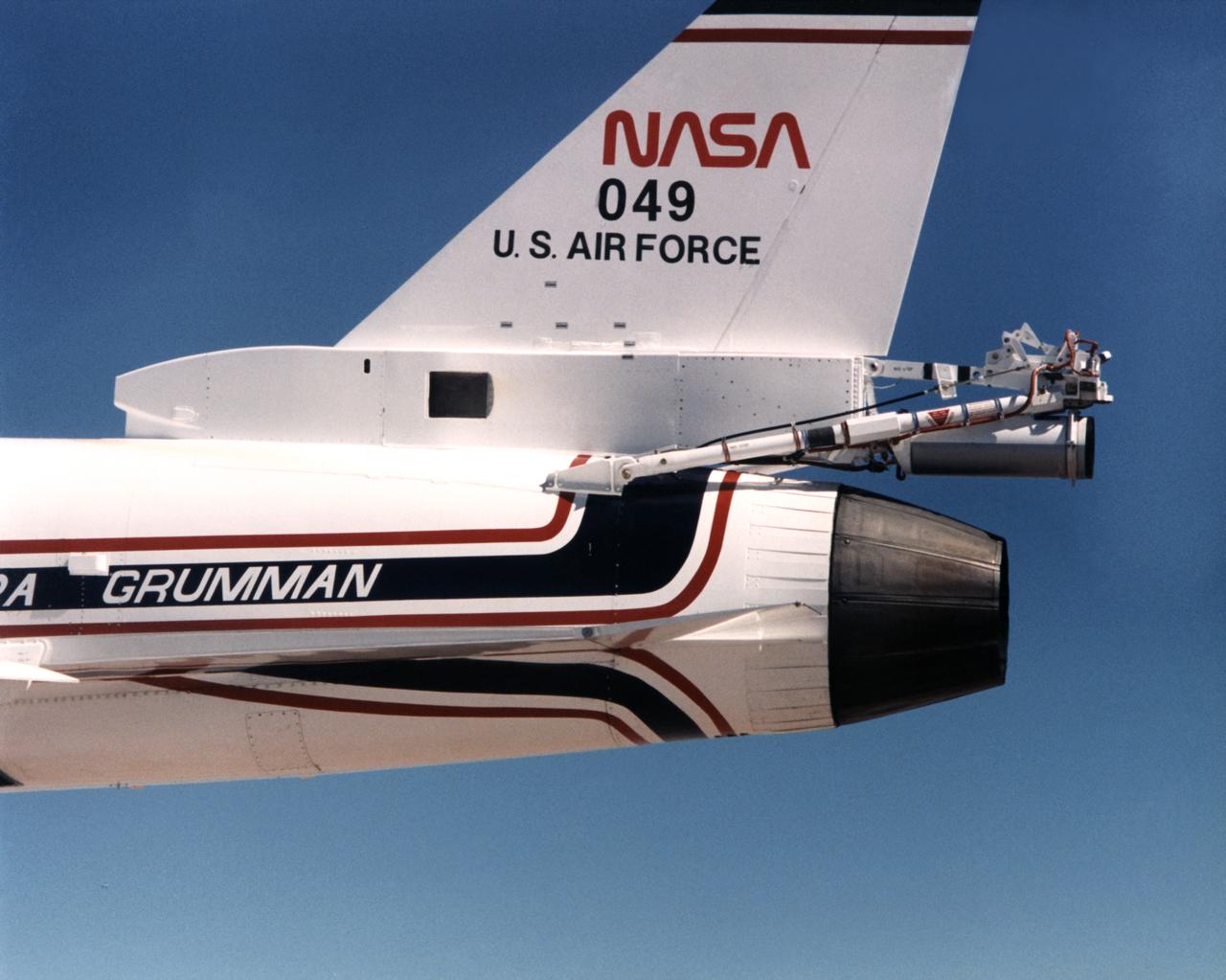
Because the number two X-29 at NASA's Ames-Dryden Flight Research Facility (later the Dryden Flight Research Center) flew at higher angles of attack than the number one aircraft, it required a spin chute system for safety. The system deployed a parachute for recovery of the aircraft if it inadvertently entered an uncontrolled spin. Most of the components of the spin chute system were located on a truss at the aft end of the aircraft. In addition, there were several cockpit modifications to facilitate use of the chute. The parachute was made of nylon and was of the conical ribbon type.
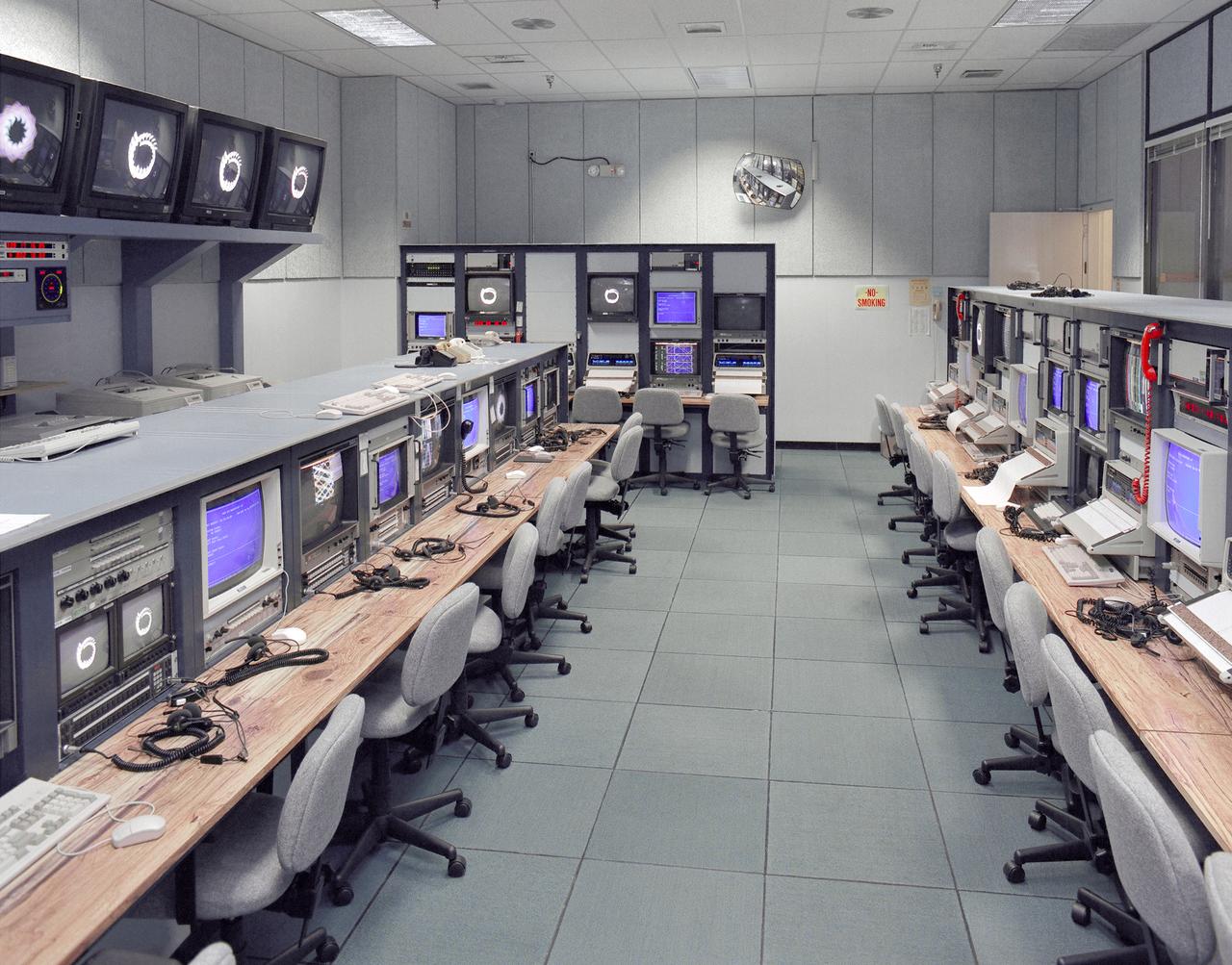
Mission control Blue Room, seen here, in building 4800 at NASA's Dryden Flight Research Center, is part of the Western Aeronautical Test Range (WATR). All aspects of a research mission are monitored from one of two of these control rooms at Dryden. The WATR consists of a highly automated complex of computer controlled tracking, telemetry, and communications systems and control room complexes that are capable of supporting any type of mission ranging from system and component testing, to sub-scale and full-scale flight tests of new aircraft and reentry systems. Designated areas are assigned for spin/dive tests, corridors are provided for low, medium, and high-altitude supersonic flight, and special STOL/VSTOL facilities are available at Ames Moffett and Crows Landing. Special use airspace, available at Edwards, covers approximately twelve thousand square miles of mostly desert area. The southern boundary lies to the south of Rogers Dry Lake, the western boundary lies midway between Mojave and Bakersfield, the northern boundary passes just south of Bishop, and the eastern boundary follows about 25 miles west of the Nevada border except in the northern areas where it crosses into Nevada.
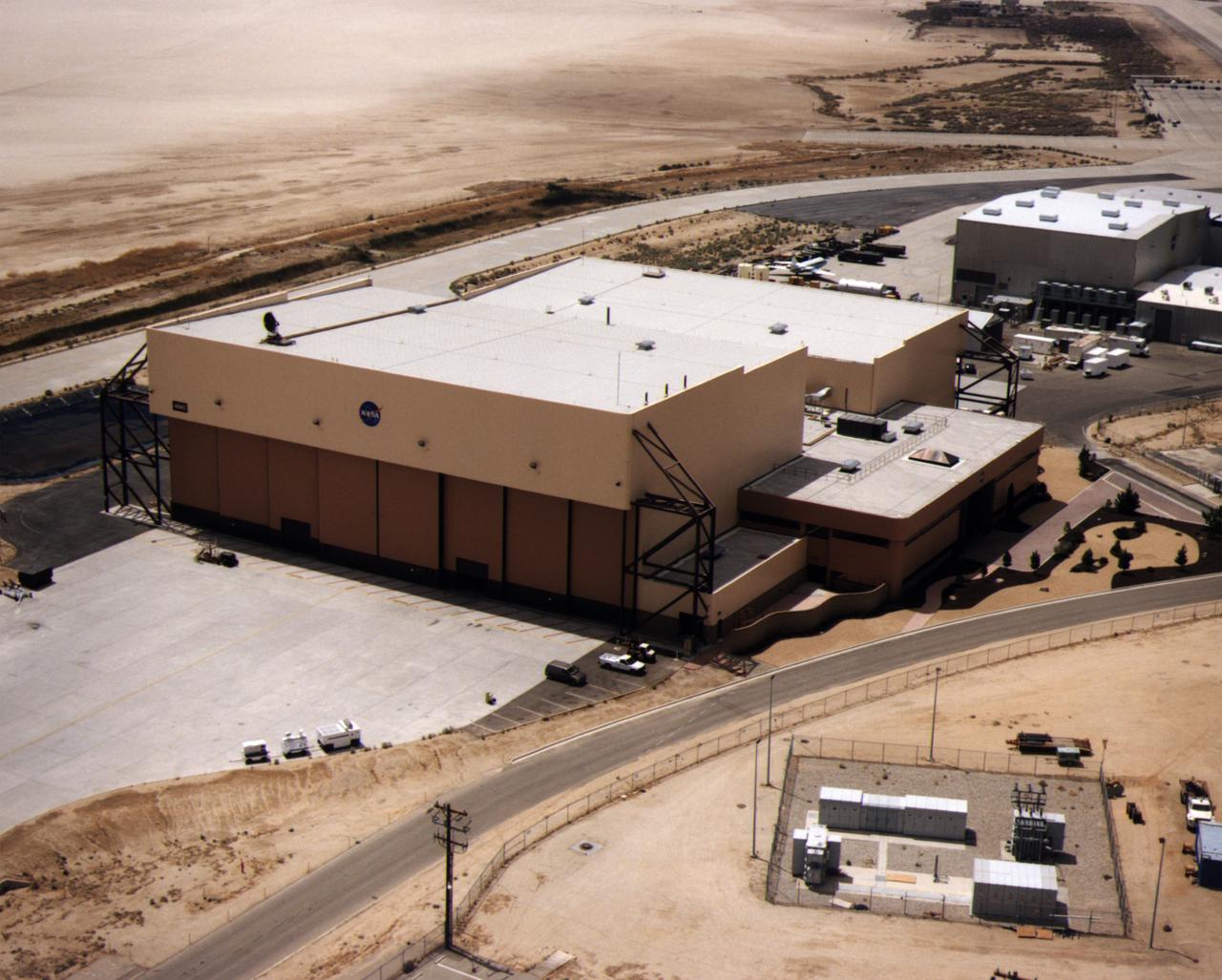
Walter C. Williams Research Aircraft Integration Facility (RAIF)
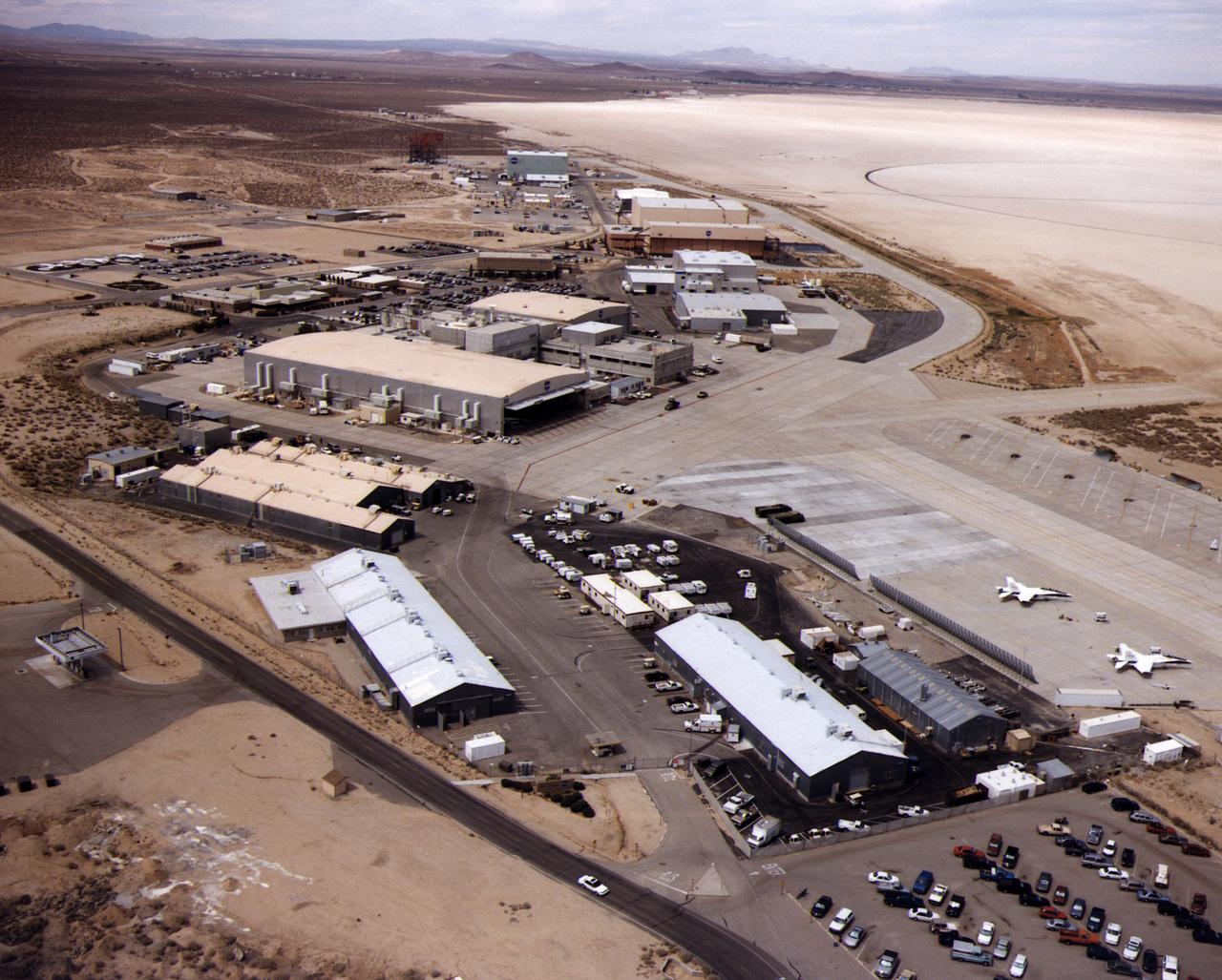
Aerial photo looking north over NASA Dryden Flight Research Center

S85-41802 (7 Sept 1985) --- Wheels of the Space Shuttle Atlantis touch down on the dry lakebed at Edwards Air Force Base to mark successful completion of the STS 51-J mission. Crewmembers onboard for the flight were Astronauts Karol J. Bobko, Ronald J. Grabe, David C. Hilmers, and Robert L. Stewart; and USAF Maj. William A. Pailes.
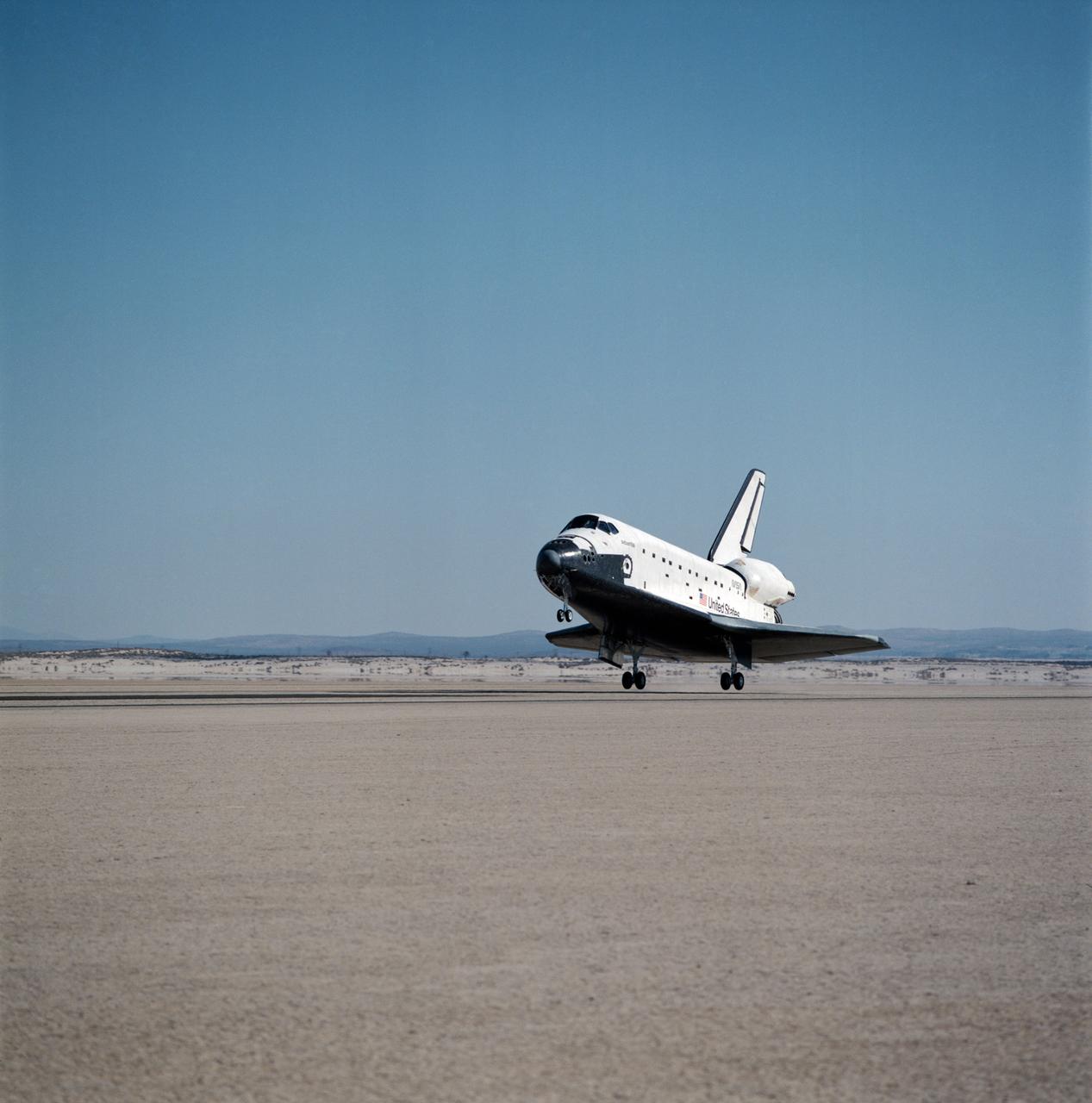
DFRF views of "Atlantis" Touchdown, Landing and Egress at the end of the STS-28/51J Mission, 10/07/1985.

The F-18 simulator at NASA's Dryden Flight Research Center, Edwards, California. Simulators offer a safe and economical alternative to actual flights to gather data, as well as being excellent facilities for pilot practice and training. The F-18 Hornet is used primarily as a safety chase and mission support aircraft at NASA's Dryden Flight Research Center, Edwards, California. As support aircraft, the F-18's are used for safety chase, pilot proficiency, aerial photography and other mission support functions.
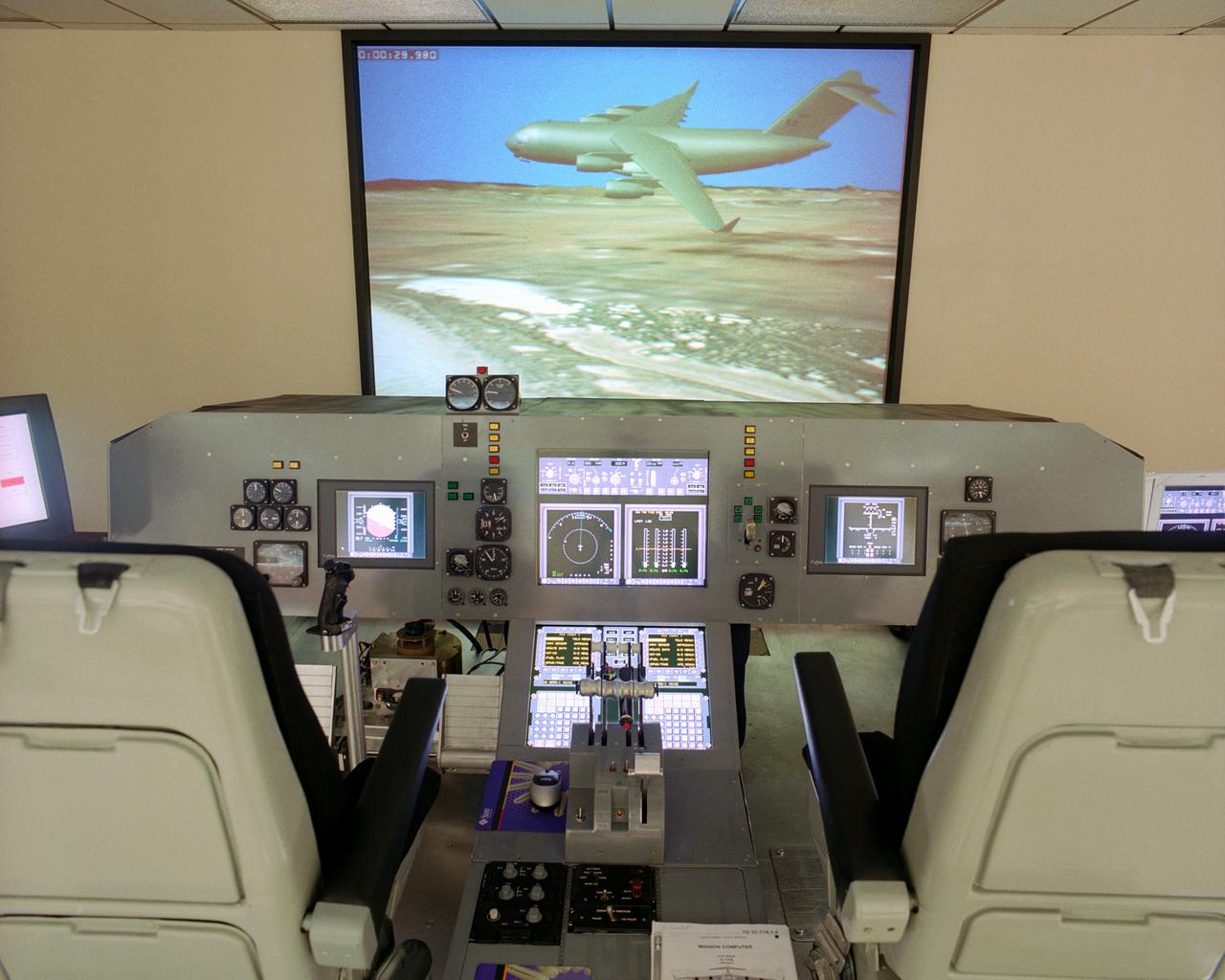
The C-17 simulator at NASA's Dryden Flight Research Center, Edwards, California. Simulators offer a safe and economical alternative to actual flights to gather data, as well as being excellent facilities for pilot practice and training.
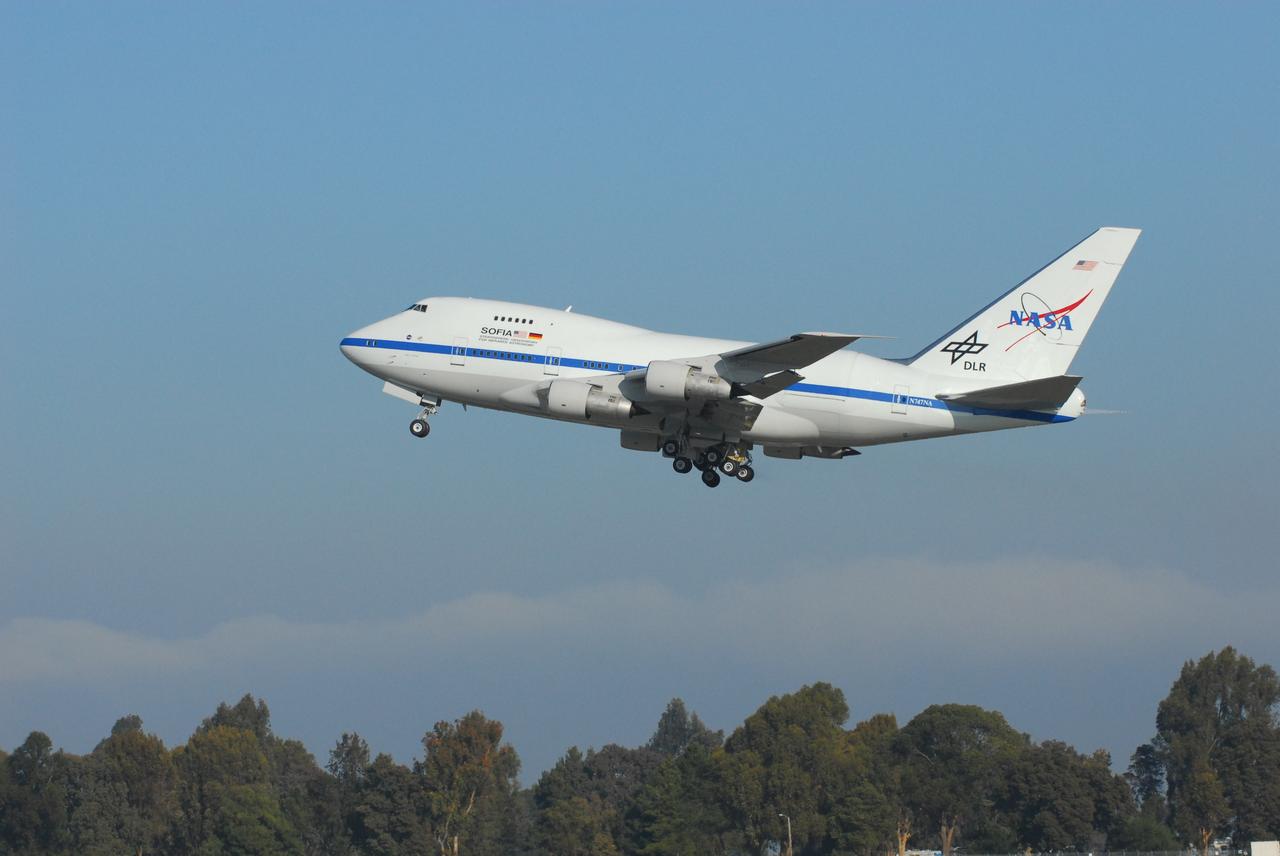
SOFIA (Stratospheric Ovservatory for Infrared Astronomy) taking off from Ames Research Center, Moffett Field, CA to return to Dryden Flight Reseach Facility, CA when the aircraft is stationed.
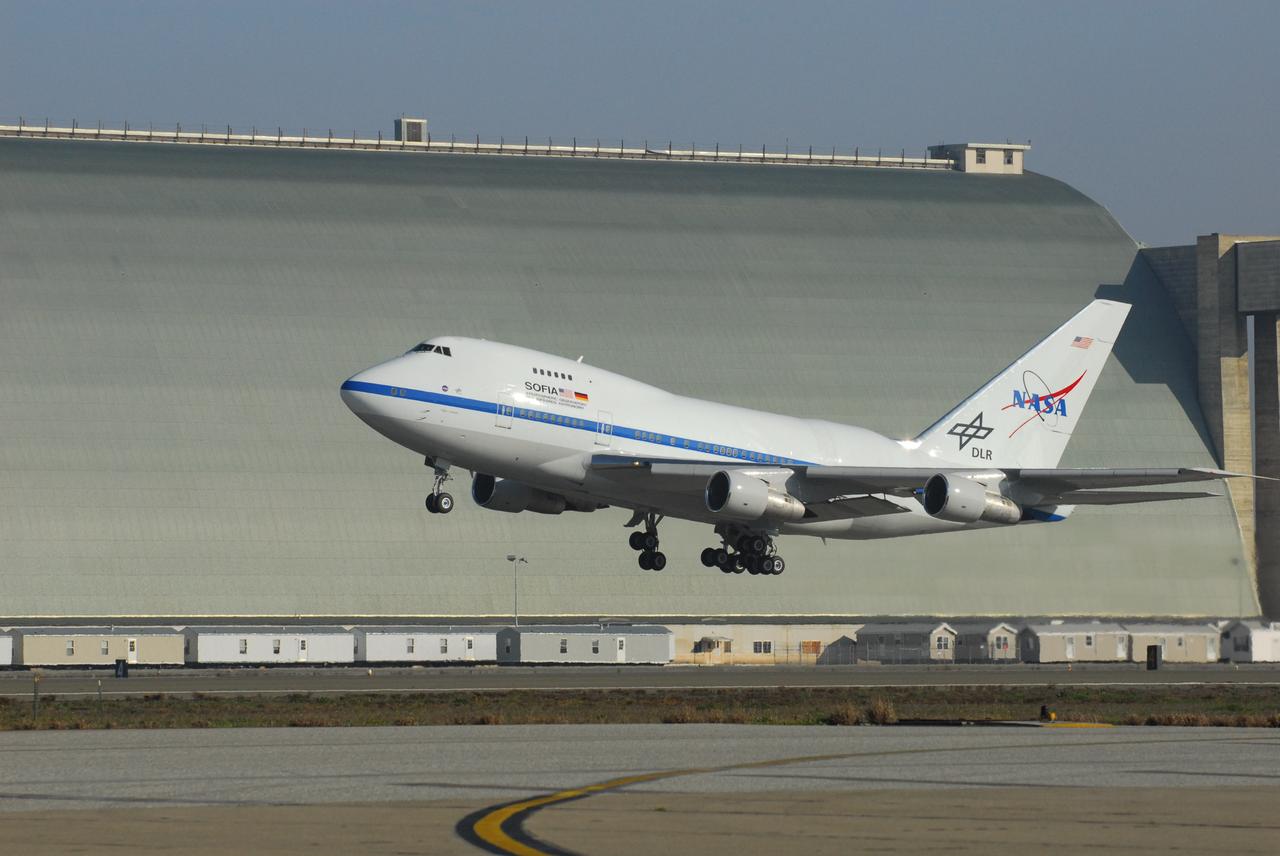
SOFIA (Stratospheric Ovservatory for Infrared Astronomy) taking off from Ames Research Center, Moffett Field, CA to return to Dryden Flight Reseach Facility, CA when the aircraft is stationed.
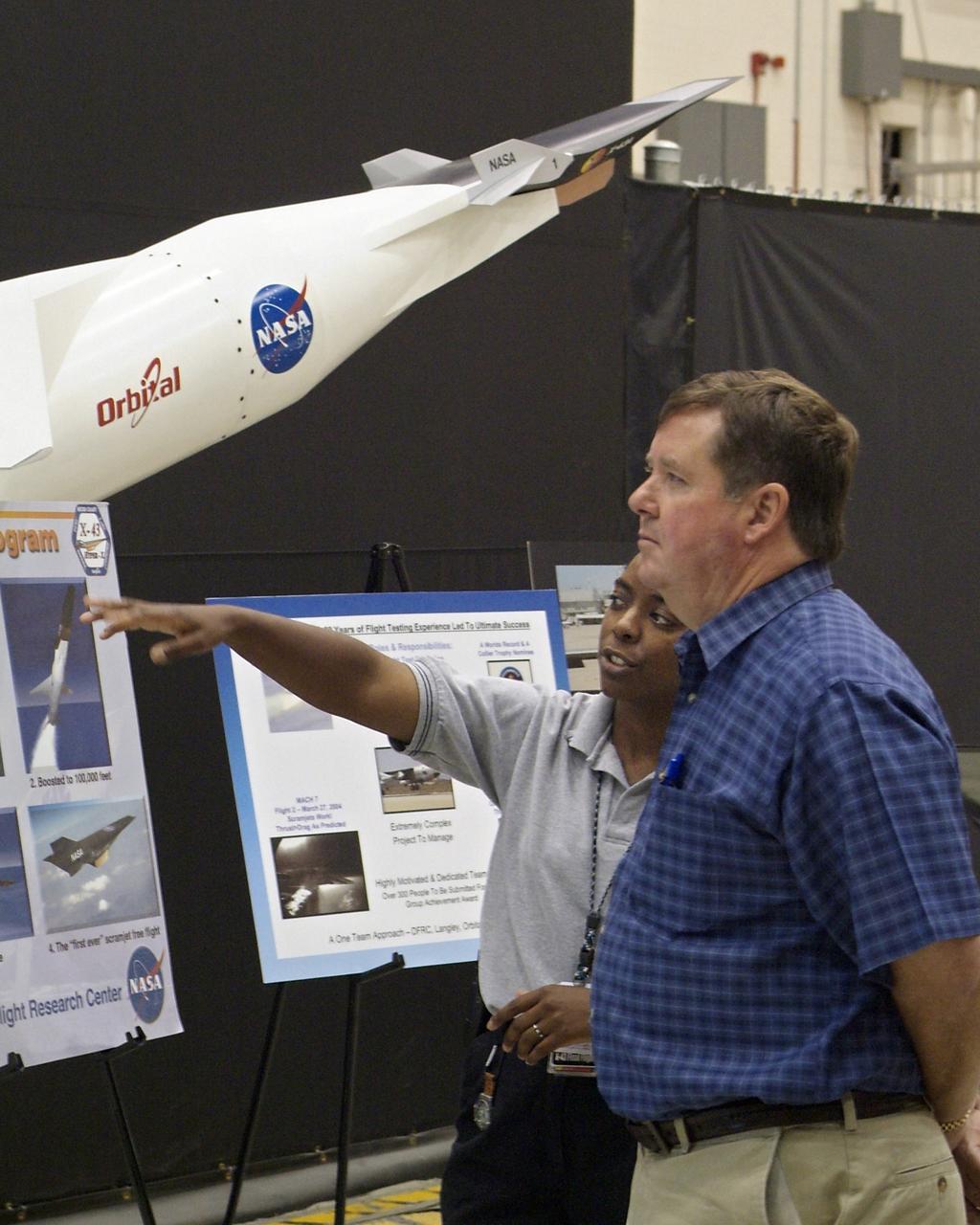
Rep. Ken Calvert, (R-Calif.), chairman of the House Subcommittee on Space and Aeronautics, received an update on the mission of NASA's Dryden Flight Research Center during a visit on June 2, 2005. Rep. Calvert, accompanied by several staff members, was briefed by center management on the Dryden's role as a flight research institution, and then reviewed some of the center's recent, current and upcoming flight research projects during a tour of the facility. During the afternoon, Rep. Calvert received similar briefings on a variety of projects at several aerospace development firms at the Civilian Flight Test Center in Mojave. Rep. Calvert's tour of NASA Dryden was the second in a series of visits to all 10 NASA field centers to better acquaint him with the roles and responsibilities of each center.
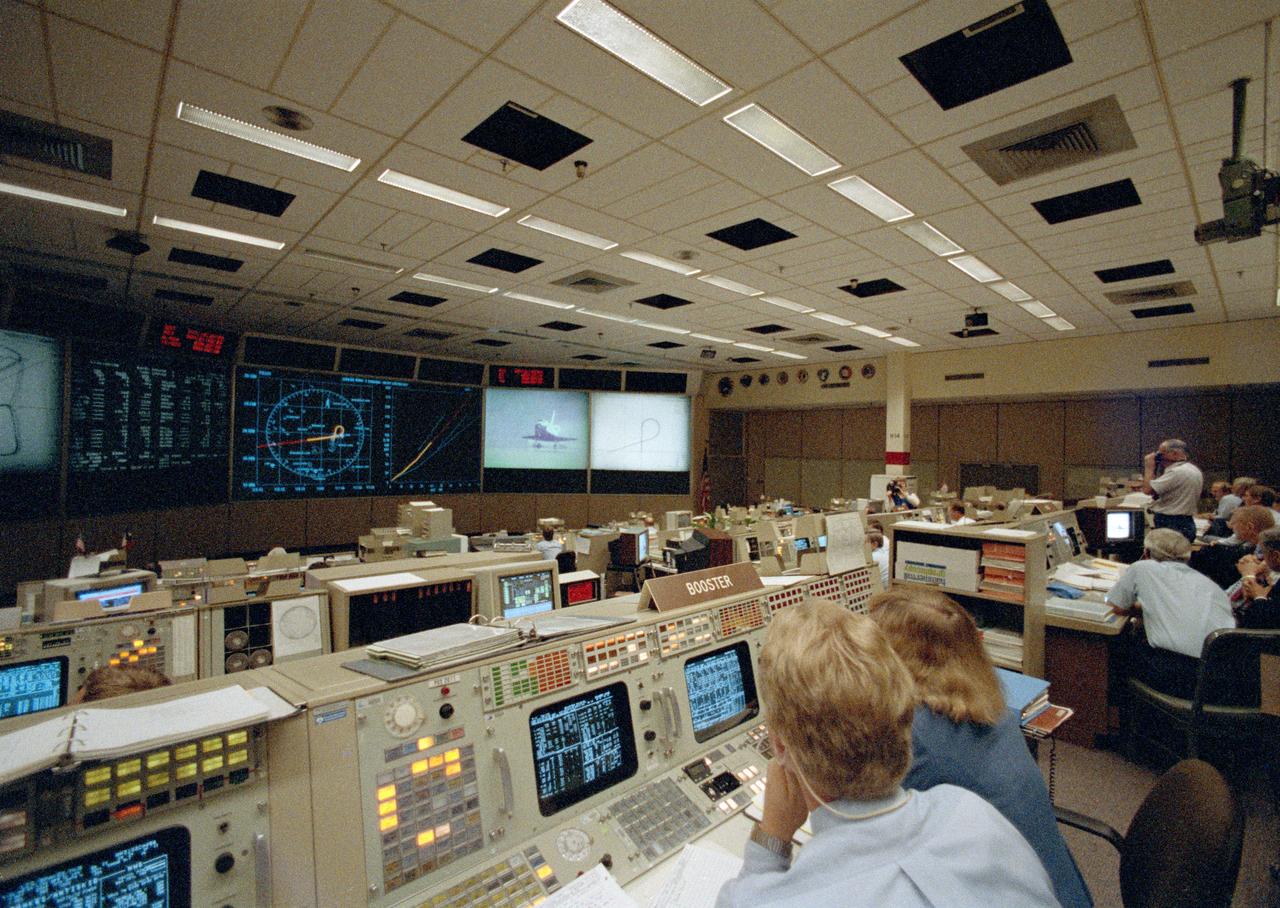
STS026-S-117 (3 Oct 1988) --- Flight controllers in Houston witness the landing of the Space Shuttle Discovery on a dry lake bed at NASA?s Dryden Flight Research Facility. The orbiter is seen on the giant screen in front of the flight control room just as the landing gear touches down.
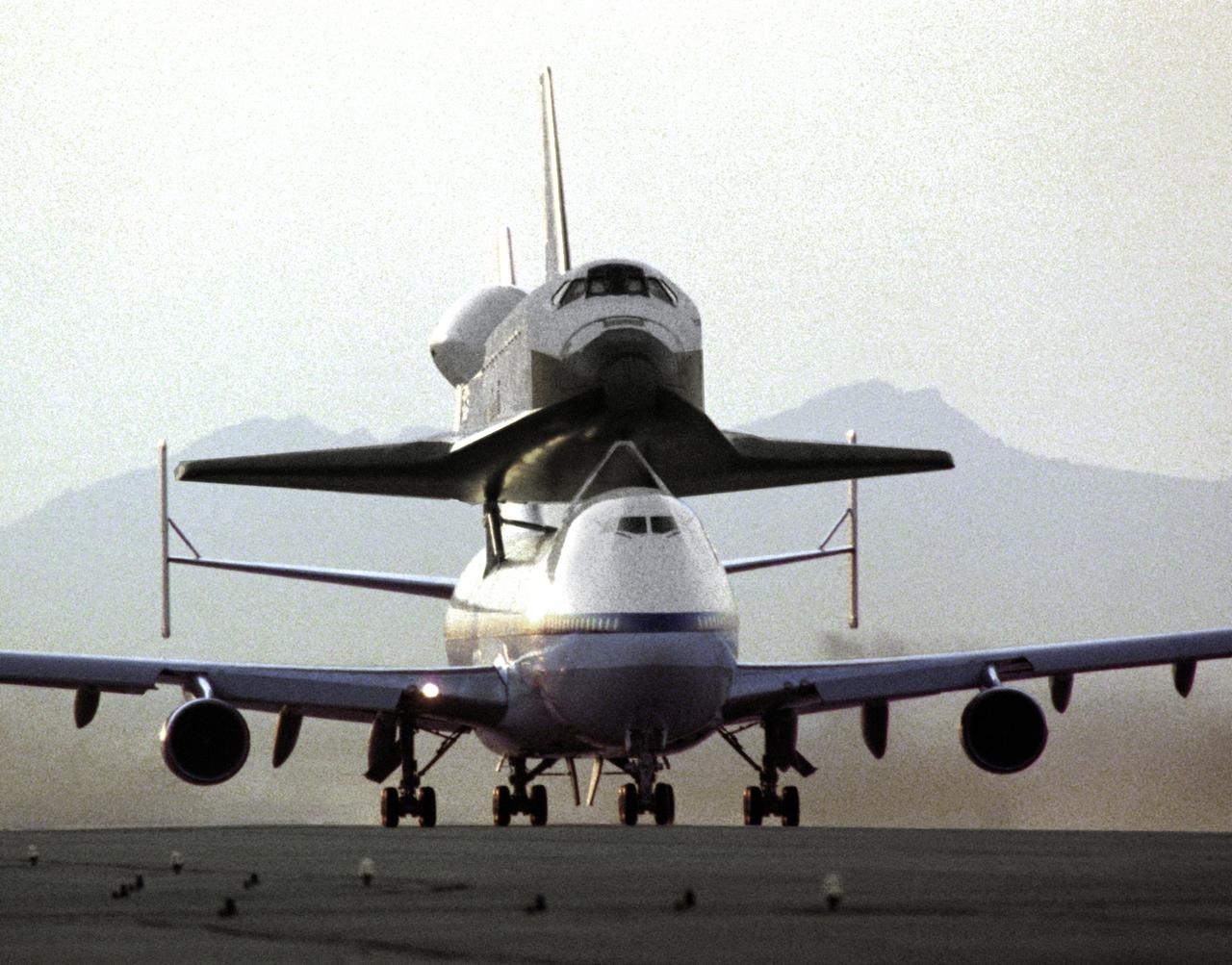
NASA's 747 Shuttle Carrier Aircraft No. 911, with the space shuttle orbiter Endeavour securely mounted atop its fuselage, taxies to the runway to begin the ferry flight from Rockwell's Plant 42 at Palmdale, California, where the orbiter was built, to the Kennedy Space Center, Florida. At Kennedy, the space vehicle was processed and launched on orbital mission STS-49, which landed at NASA's Ames-Dryden Flight Research Facility (later redesignated Dryden Flight Research Center), Edwards, California, 16 May 1992. NASA 911, the second modified 747 that went into service in November 1990, has special support struts atop the fuselage and internal strengthening to accommodate the added weight of the orbiters.
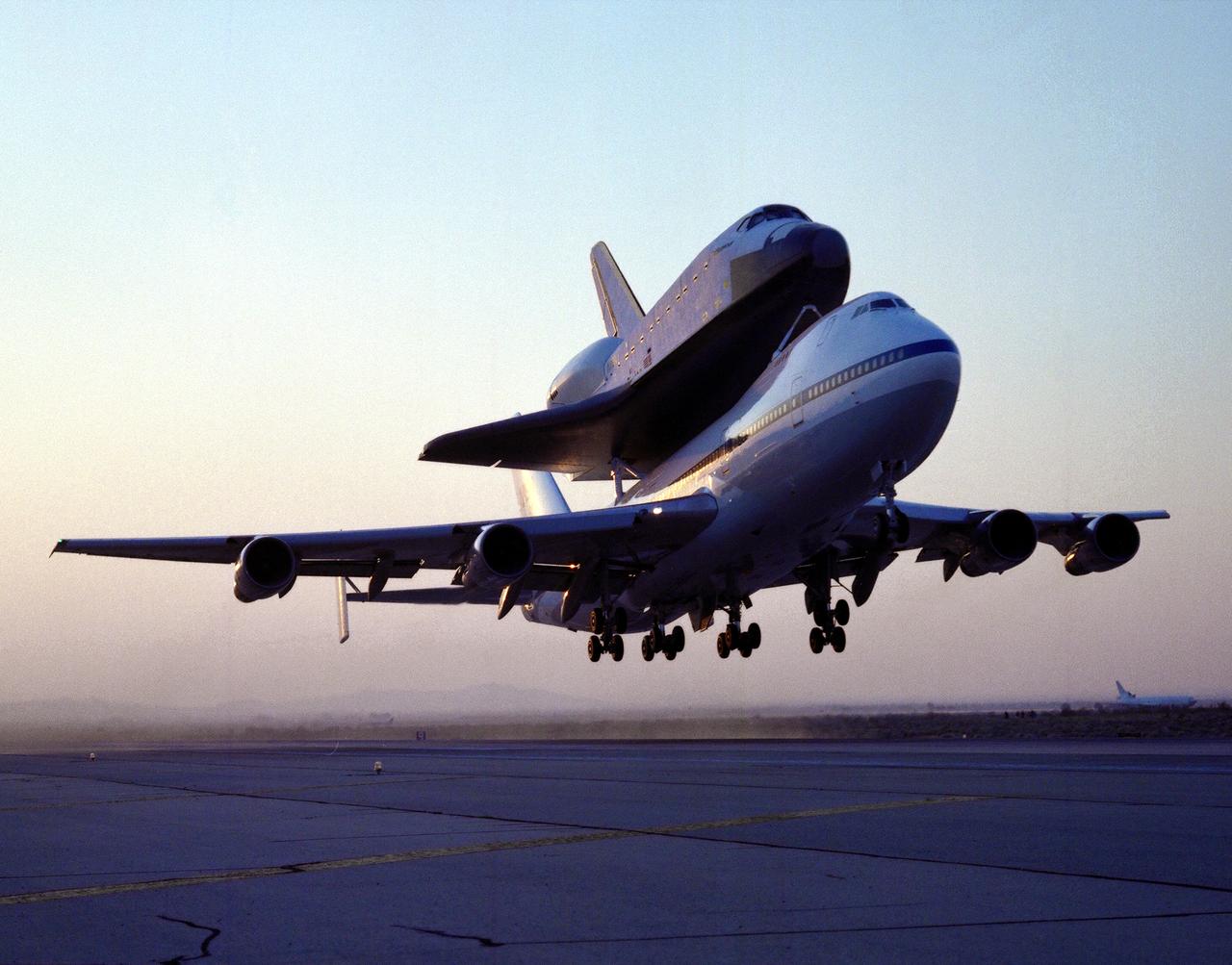
NASA's 747 Shuttle Carrier Aircraft No. 911, with the space shuttle orbiter Endeavour securely mounted atop its fuselage, begins the ferry flight from Rockwell's Plant 42 at Palmdale, California, where the orbiter was built, to the Kennedy Space Center, Florida. At Kennedy, the space vehicle was processed and launched on orbital mission STS-49, which landed at NASA's Ames-Dryden Flight Research Facility (later redesignated Dryden Flight Research Center), Edwards, California, 16 May 1992. NASA 911, the second modified 747 that went into service in November 1990, has special support struts atop the fuselage and internal strengthening to accommodate the added weight of the orbiters.
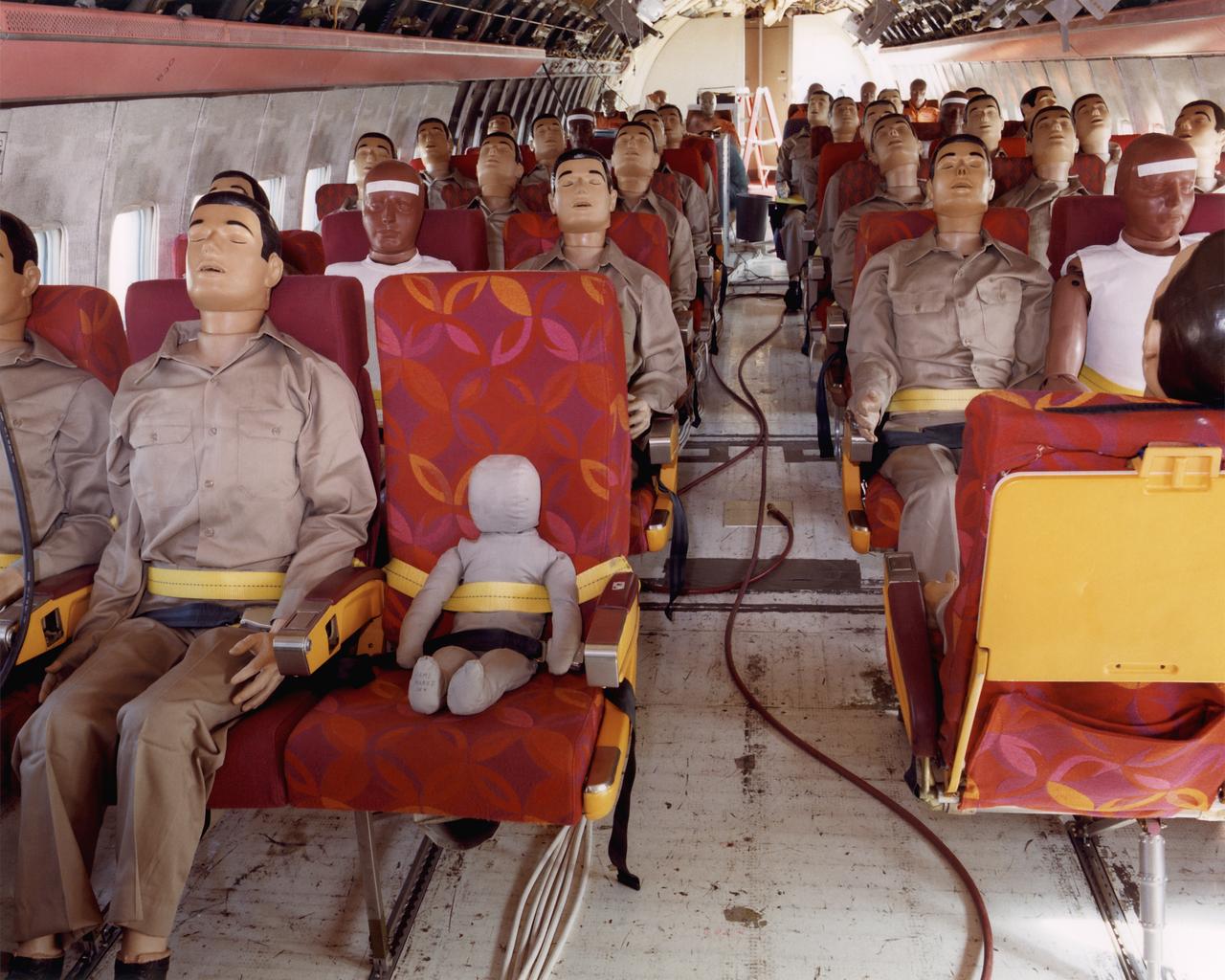
Controlled Impact Demonstration instrumented test dummies installed in plane.
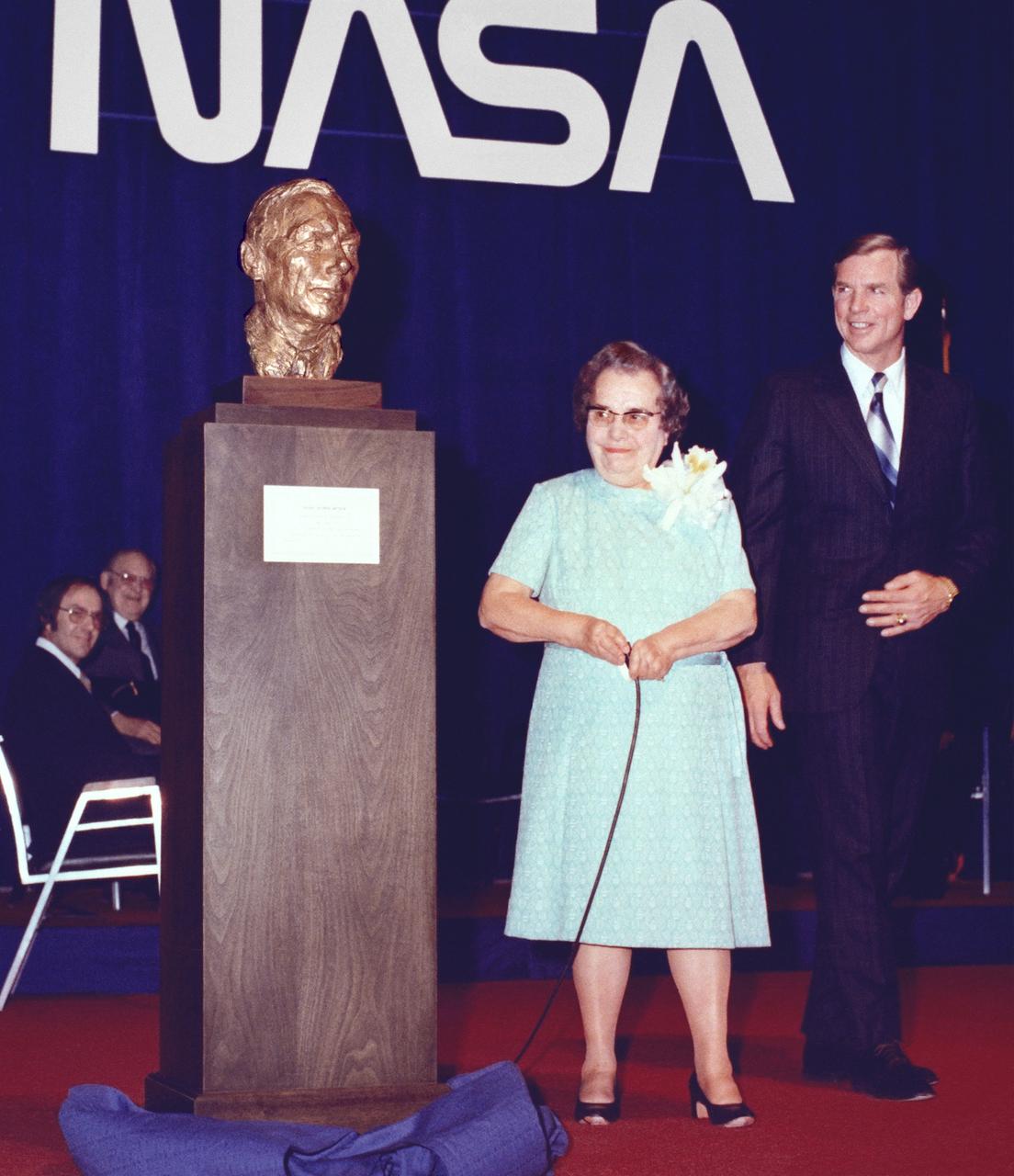
On March 26, 1976, the NASA Flight Research Center opened its doors to hundreds of guests for the dedication of the center in honor of Hugh Latimer Dryden. The dedication was very much a local event; following Center Director David Scott’s opening remarks, the Antelope Valley High School’s symphonic band played the national anthem. Invocation was given followed by recognition of the invited guests. Dr. Hugh Dryden, a man of total humility, received praise from all those present. Dryden, who died in 1965, had been a pioneering aeronautical scientist who became director of the National Advisory Committee for Aeronautics (NACA) in 1949 and then deputy administrator of the NACA’s successor, NASA, in 1958. Very much interested in flight research, he had been responsible for establishing a permanent facility at the location later named in his honor. As Center Director David Scott looks on, Mrs. Hugh L. Dryden (Mary Libbie Travers) unveils the memorial to her husband at the dedication ceremony.On March 26, 1976, the NASA Flight Research Center opened its doors to hundreds of guests for the dedication of the center in honor of Hugh Latimer Dryden.
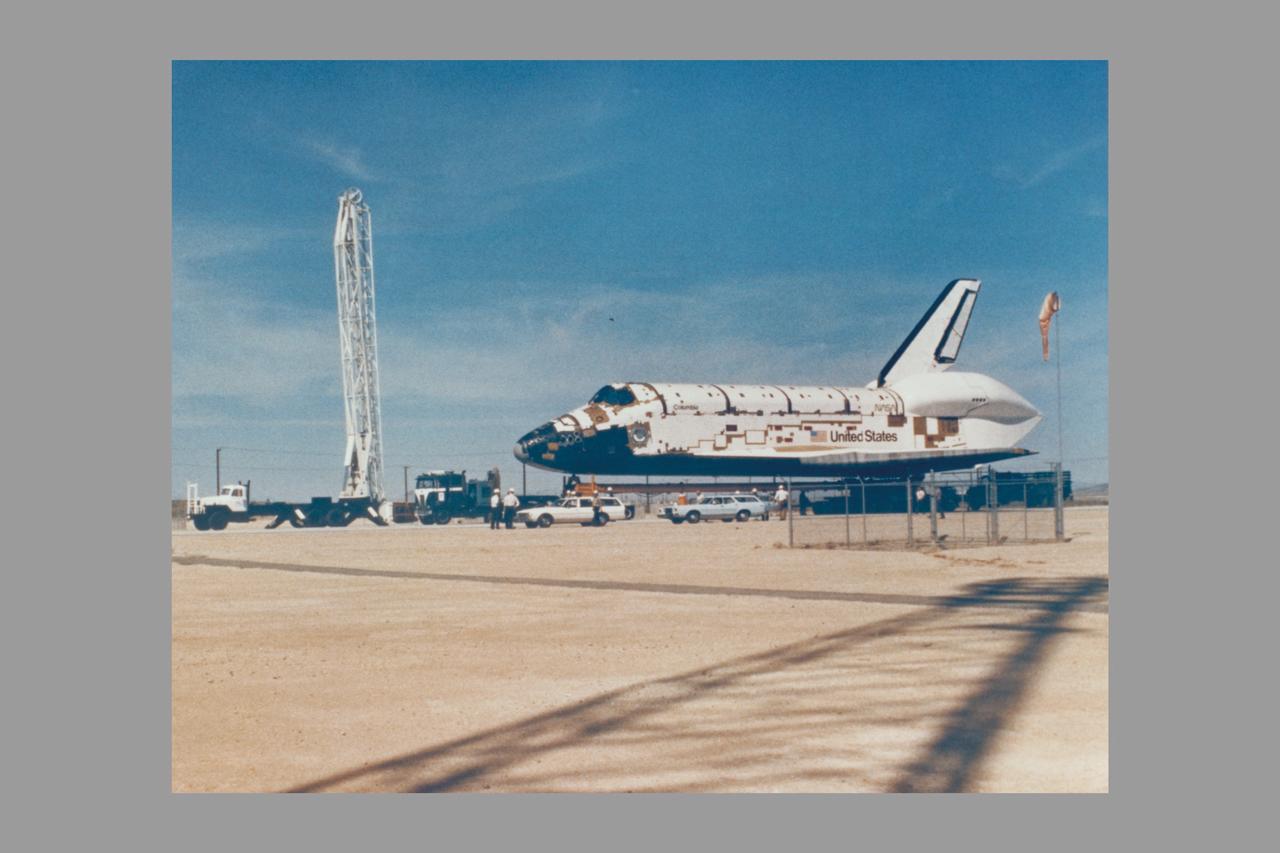
SPACE SHUTTLE ORBITER COLUMBIA 102 IS SHOWN BACKING OUT OF ITS MANUFACTURING FACILITY AT PALMDALE, CA THE ROCKWELL INTERNATIONAL SPACE DIVISION PLANT, ENROUTE TO DRYDEN FLIGHT RESEARCH CENTER. THIS ORBITER WILL BE THE FIRST SHUTTLE SPACECRAFT THAT WILL CARRY TWO ASTRONAUTS, JOHN YOUNG AND RICHARD CRIPPEN, INTO EARTH ORBITAL TEST FLIGHT IN LATE 1979.
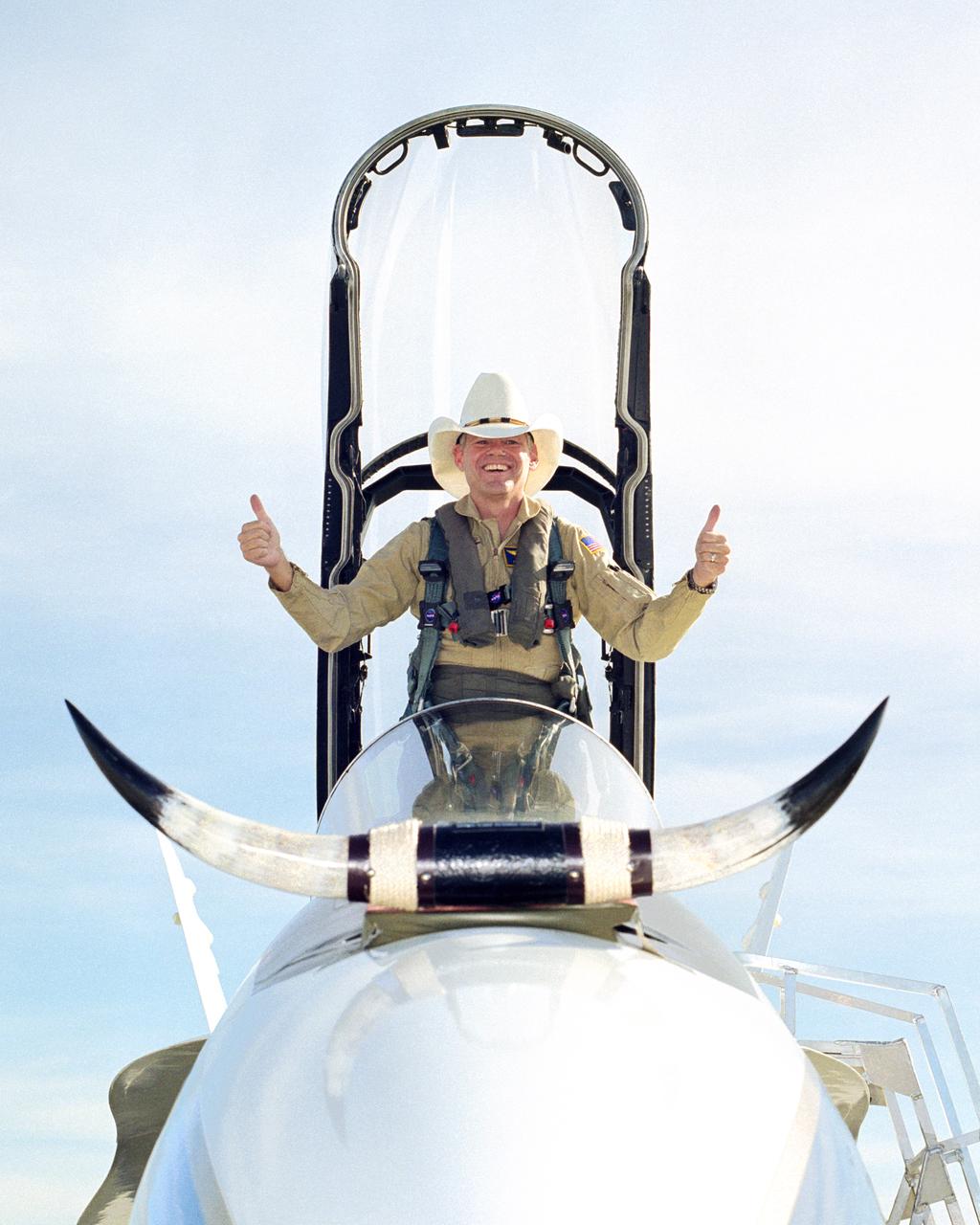
In a lighter mood, Ed Schneider gives a "thumbs-up" after his last flight at the Dryden Flight Research Center on September 19, 2000. Schneider arrived at the NASA Ames-Dryden Flight Research Facility on July 5, 1982, as a Navy Liaison Officer, becoming a NASA research pilot one year later. He has been project pilot for the F-18 High Angle-of-Attack program (HARV), the F-15 aeronautical research aircraft, the NASA B-52 launch aircraft, and the SR-71 "Blackbird" aircraft. He also participated in such programs as the F-8 Digital Fly-By-Wire, the FAA/NASA 720 Controlled Impact Demonstration, the F-14 Automatic Rudder Interconnect and Laminar Flow, and the F-104 Aeronautical Research and Microgravity projects.
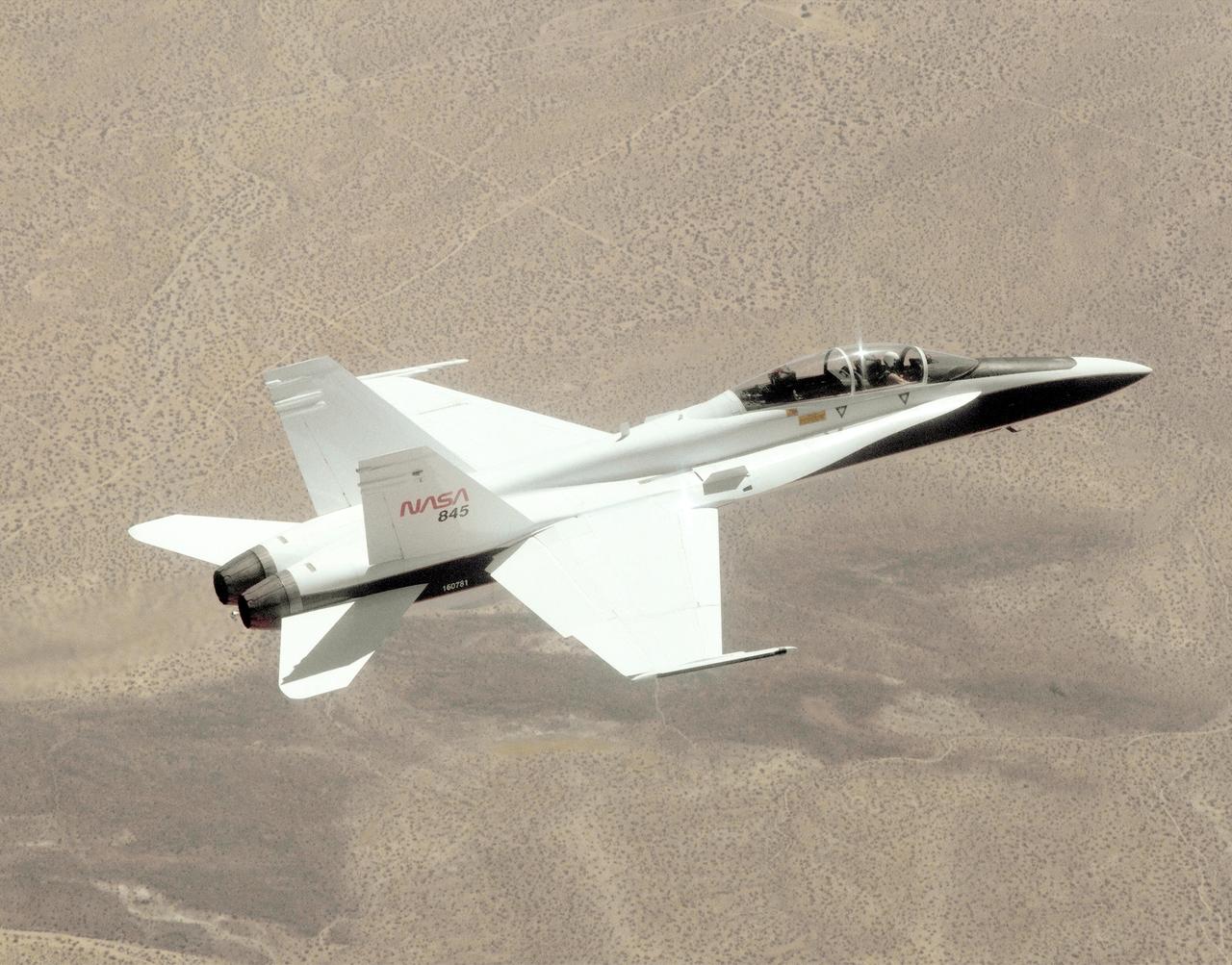
A NASA F/A-18, specially modified to test the newest and most advanced system technologies, on its first research flight on May 21, 1993, at NASA's Dryden Flight Research Facility, Edwards, California. Flown by Dryden in a multi-year, joint NASA/DOD/industry program, the F/A-18 former Navy fighter was modified into a unique Systems Research Aircraft (SRA) to investigate a host of new technologies in the areas of flight controls, airdata sensing and advanced computing. The primary goal of the SRA program was to validate through flight research cutting-edge technologies which could benefit future aircraft and spacecraft by improving efficiency and performance, reducing weight and complexity, with a resultant reduction on development and operational costs.
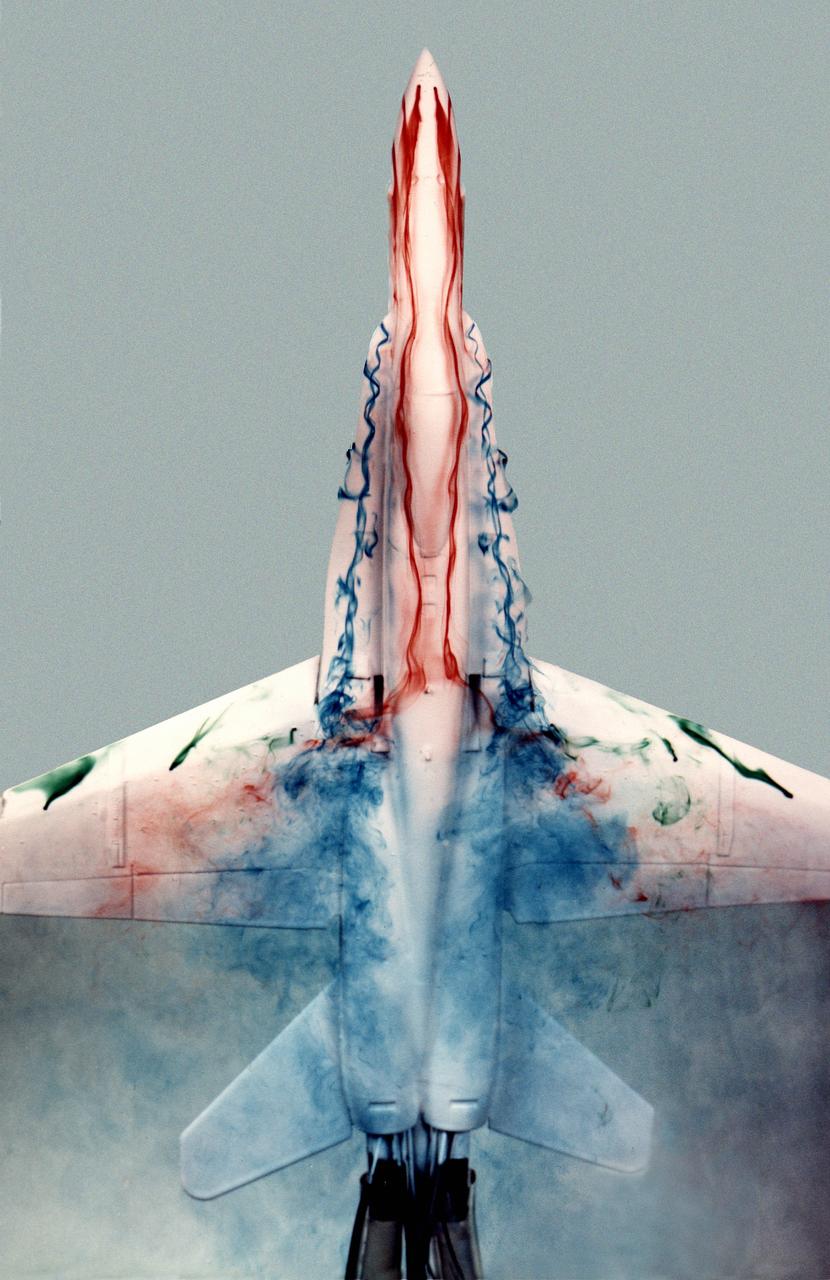
This image shows a plastic 1/48-scale model of an F-18 aircraft inside the "Water Tunnel" more formally known as the NASA Dryden Flow Visualization Facility. Water is pumped through the tunnel in the direction of normal airflow over the aircraft; then, colored dyes are pumped through tubes with needle valves. The dyes flow back along the airframe and over the airfoils highlighting their aerodynamic characteristics. The aircraft can also be moved through its pitch axis to observe airflow disruptions while simulating actual flight at high angles of attack. The Water Tunnel at NASA's Dryden Flight Research Center, Edwards, CA, became operational in 1983 when Dryden was a Flight Research Facility under the management of the Ames Research Center in Mountain View, CA. As a medium for visualizing fluid flow, water has played a significant role. Its use dates back to Leonardo da Vinci (1452-1519), the Renaissance Italian engineer, architect, painter, and sculptor. In more recent times, water tunnels have assisted the study of complex flows and flow-field interactions on aircraft shapes that generate strong vortex flows. Flow visualization in water tunnels assists in determining the strength of vortices, their location, and possible methods of controlling them. The design of the Dryden Water Tunnel imitated that of the Northrop Corporation's tunnel in Hawthorne, CA. Called the Flow Visualization Facility, the Dryden tunnel was built to assist researchers in understanding the aerodynamics of aircraft configured in such a way that they create strong vortex flows, particularly at high angles of attack. The tunnel provides results that compare well with data from aircraft in actual flight in another fluid-air. Other uses of the tunnel have included study of how such flight hardware as antennas, probes, pylons, parachutes, and experimental fixtures affect airflow. The facility has also been helpful in finding the best locations for emitting smoke from flight vehicles for flow vi
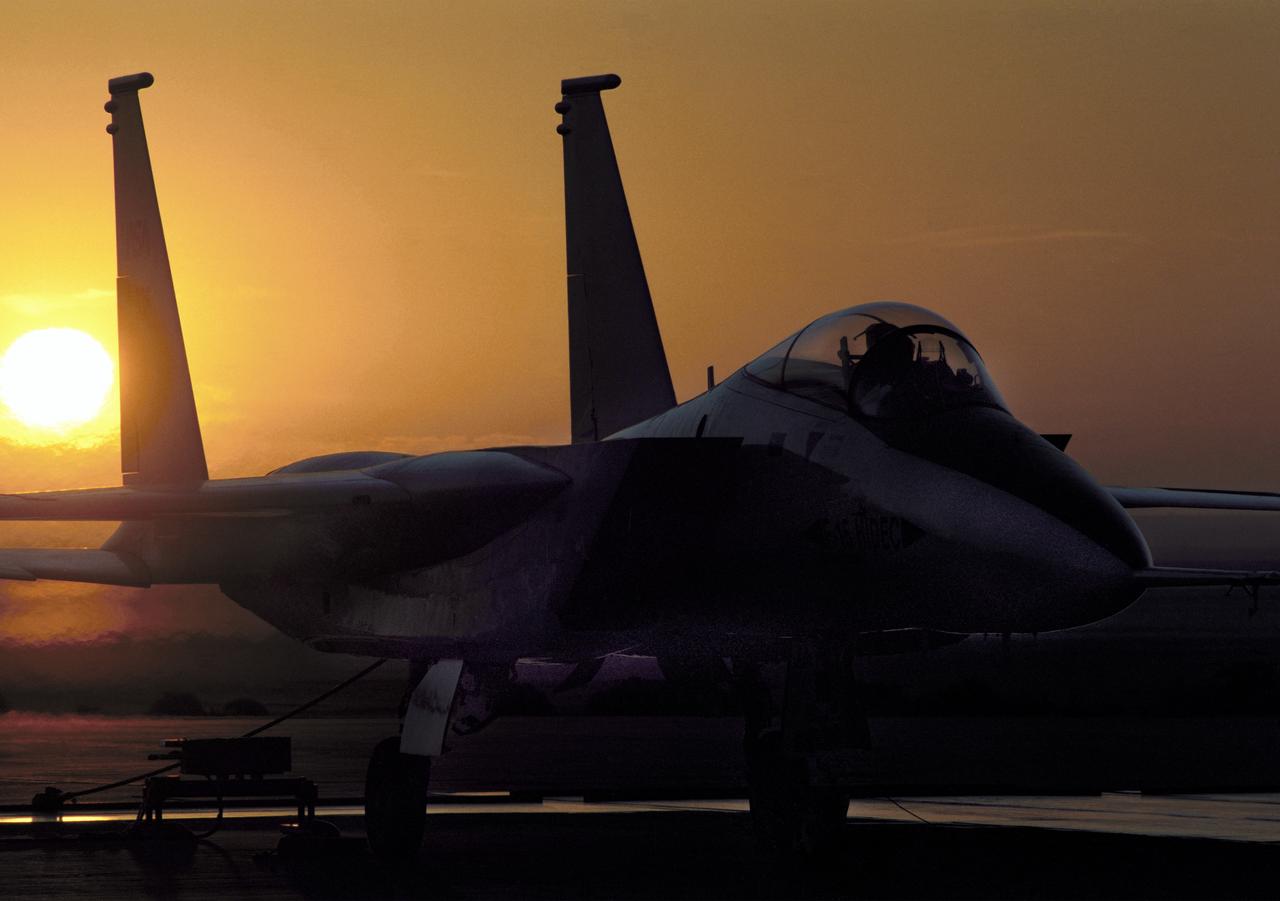
NASA's highly modified F-15A (Serial #71-0287) used for digital electronic flight and engine control systems research, at sunrise on the ramp at the Dryden Flight Research Facility, Edwards, California. The F-15 was called the HIDEC (Highly Integrated Digital Electronic Control) flight facility. Research programs flown on the testbed vehicle have demonstrated improved rates of climb, fuel savings, and engine thrust by optimizing systems performance. The aircraft also tested and evaluated a computerized self-repairing flight control system for the Air Force that detects damaged or failed flight control surfaces. The system then reconfigures undamaged control surfaces so the mission can continue or the aircraft is landed safely.
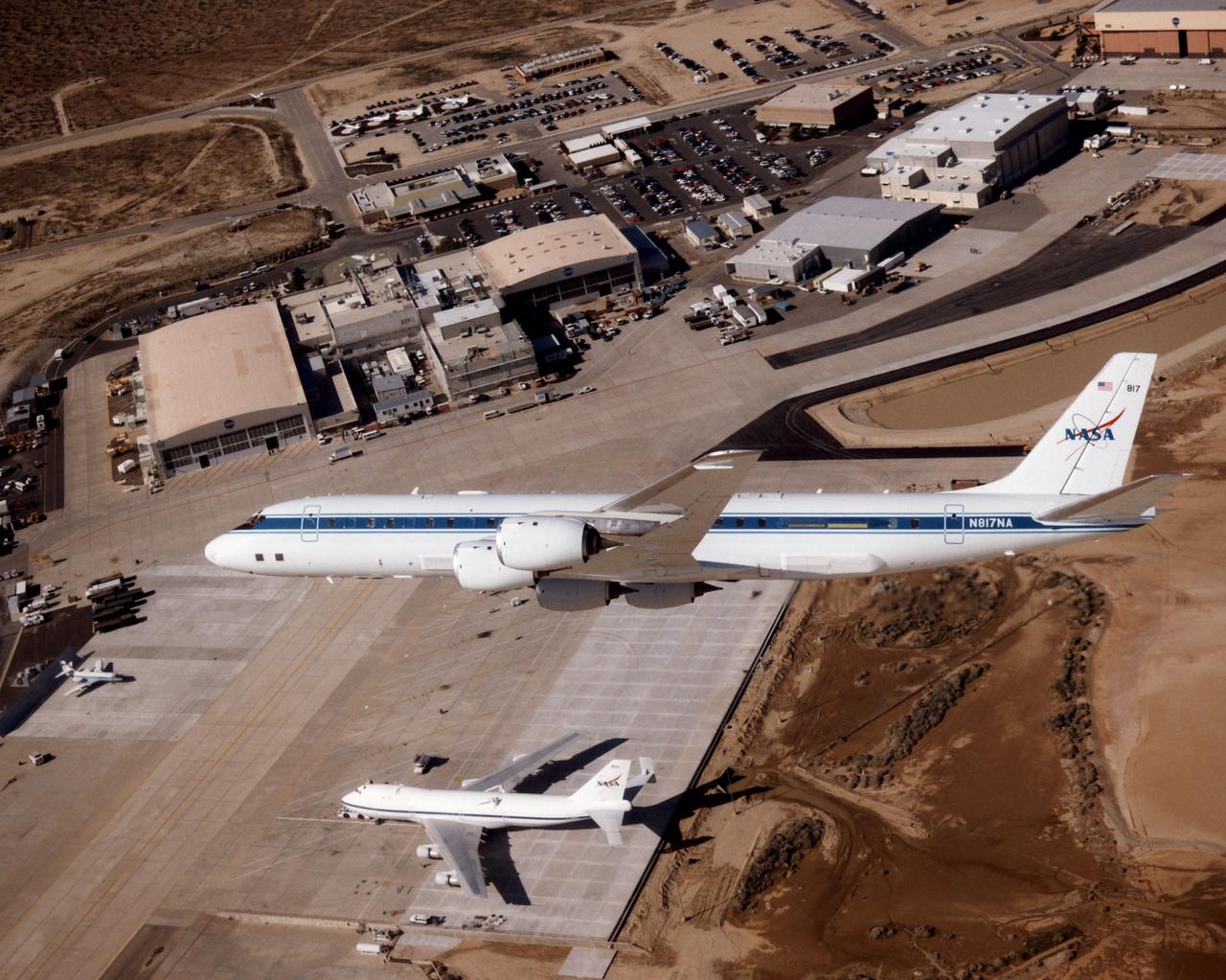
The DC-8 aircraft is seen making a banking turn high above the NASA Dryden ramp. This view of the DC-8's left side reveals some of the modifications necessary for particular on-board experiments. To the right of the DC-8 is the edge of Rogers Dry Lake. Above the aircraft's forward fuselage is the Dryden Flight Research Center headquarters building, while other NASA facilities extend down the flightline to the right. Below the DC-8 is the Shuttle Carrier Aircraft (SCA), on which are visible attachment points for the Shuttle Orbiter.
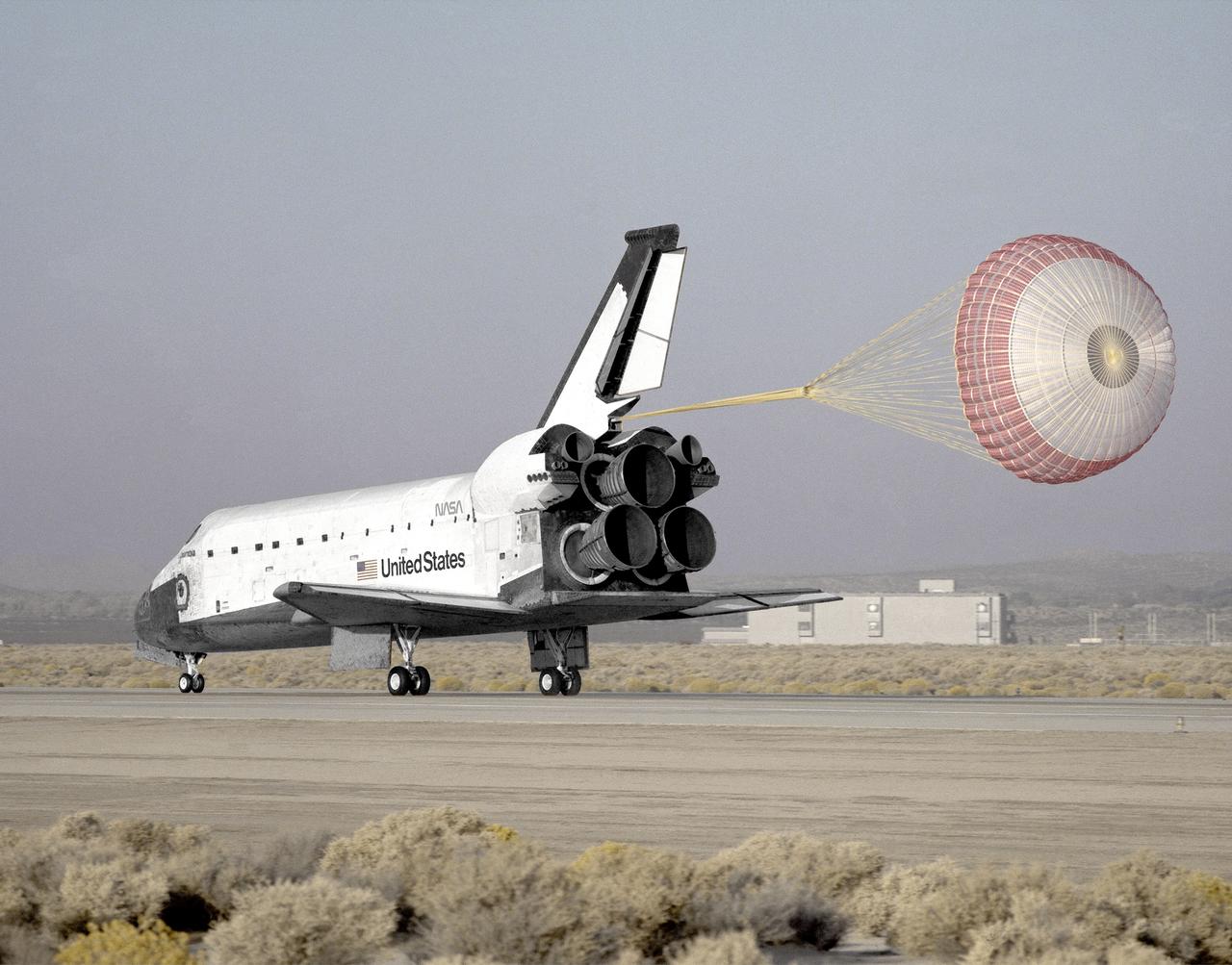
A drag chute slows the space shuttle Columbia as it rolls to a perfect landing concluding NASA's longest mission at that time, STS-58, at the Ames-Dryden Flight Research Facility (later redesignated the Dryden Flight Research Center), Edwards, California, with a 8:06 a.m. (PST) touchdown 1 November 1993 on Edward's concrete runway 22. The planned 14 day mission, which began with a launch from Kennedy Space Center, Florida, at 7:53 a.m. (PDT), October 18, was the second spacelab flight dedicated to life sciences research. Seven Columbia crewmembers performed a series of experiments to gain more knowledge on how the human body adapts to the weightless environment of space. Crewmembers on this flight included: John Blaha, commander; Rick Searfoss, pilot; payload commander Rhea Seddon; mission specialists Bill MacArthur, David Wolf, and Shannon Lucid; and payload specialist Martin Fettman.
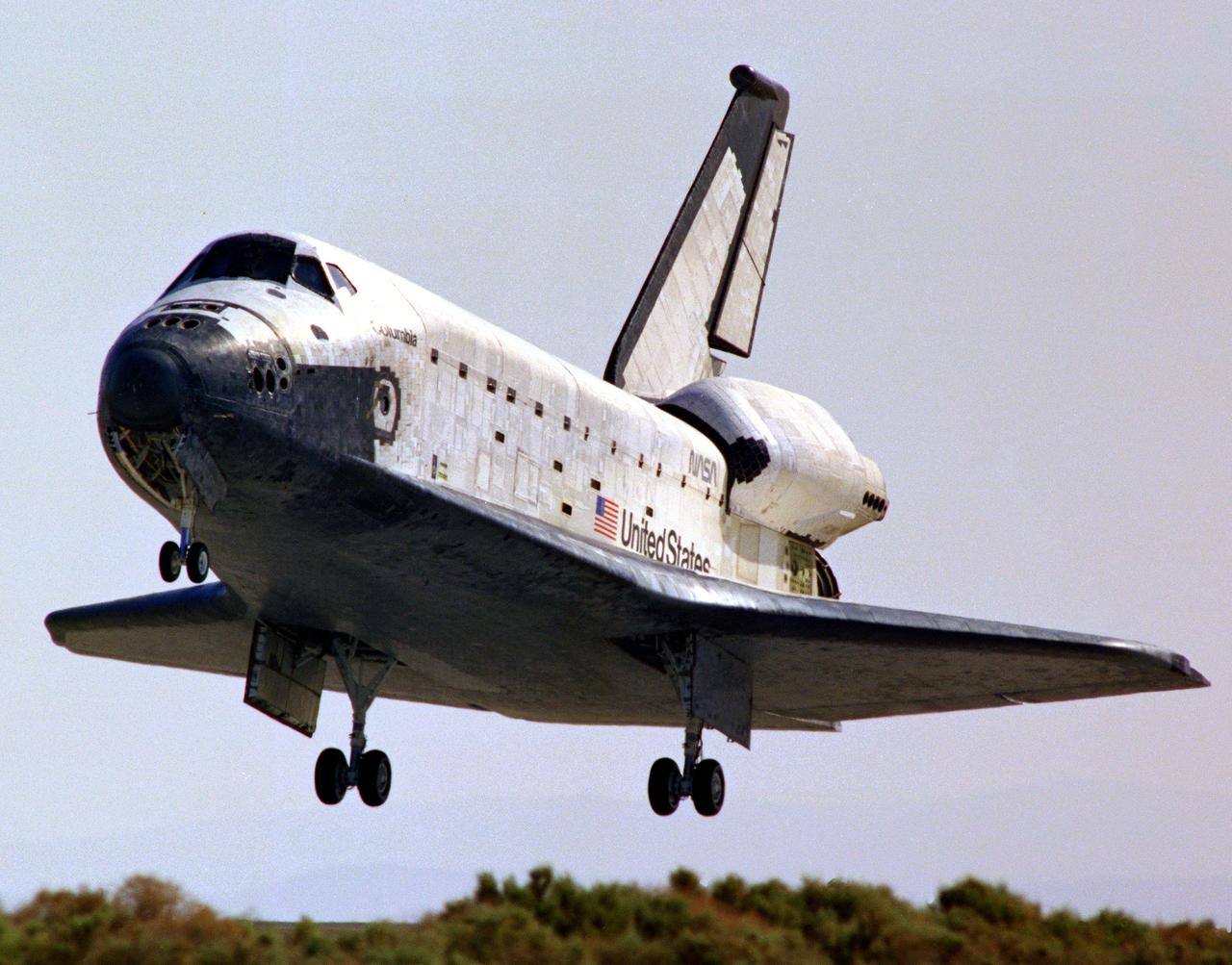
Space Shuttle Columbia nears its touchdown on Runway 22 at Edwards, California, at 8:39 a.m., 14 June 1991, as the STS-40 life sciences mission comes to an end at NASA's Ames-Dryden Flight Research Facility (later redesignated Dryden Flight Research Center) after nine days of orbital flight. Aboard Columbia during the extended mission were Bryan D. O'Connor, mission commander; Sidney M. Gutierrez, pilot; mission specialists James P. Bagian, Tamara E. Jernigan, and Margaret Rhea Seddon; and payload specialists Francis Andrew Gaffney and Millie Hughes-Fulford. STS-40 was the first space shuttle mission dedicated to life sciences research to explore how the body reacts to a weightless environment and how it readjusts to gravity on return to earth. Columbia was launched on the STS-40 mission 5 June 1991, from Kennedy Space Center in Florida.
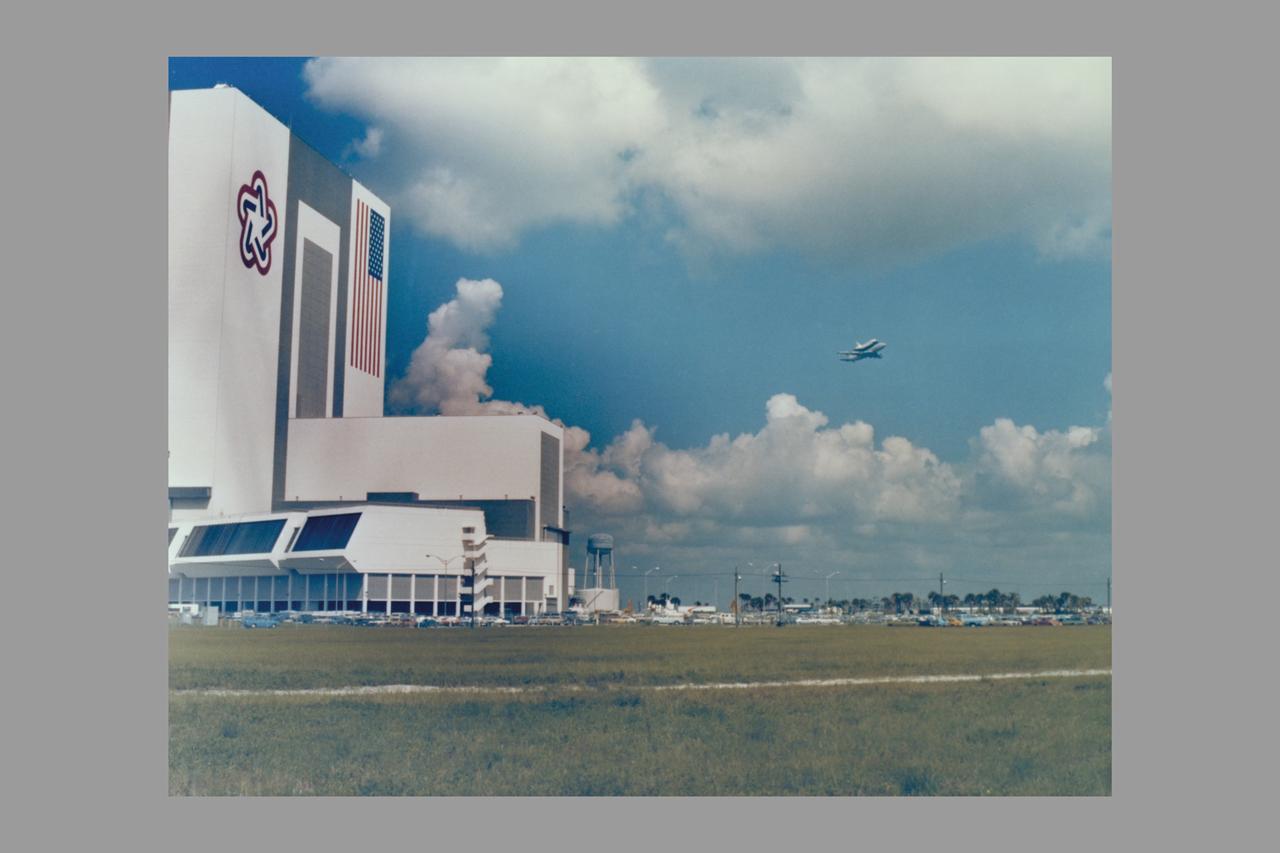
The 747 Shuttle Carrier Aircraft, carrying the Space Shuttle Orbiter Enterprise piggyback, lifts off from the Shuttle Landing Facility's 15,000-foot-long runway at 11:03, August 10. Enterprise flown to KSC on April 10 for use in checking out assembly, test and launch facilities which will be used for the launch of its sister ship Columbia on the first Space Shuttle flight, will make a five-stop flight to NASA's Dryden Flight Research Center in California.
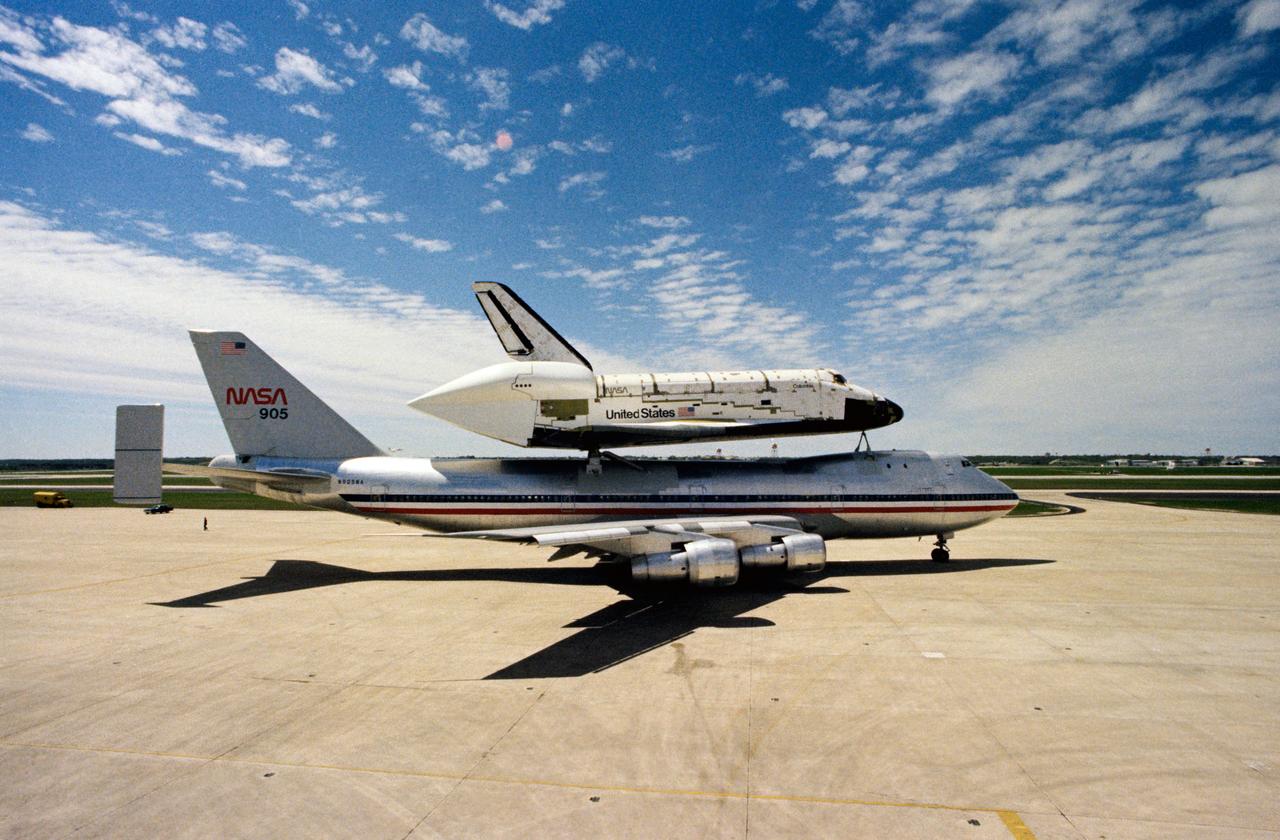
S79-30103 (23 March 1978) --- A side view of the huge space shuttle orbiter 102 Columbia mated atop its 747 carrier aircraft--NASA 905?in ?piggyback? mode, ready for takeoff from Kelly Air Force Base. Kelly AFB was one of the scheduled stops enroute to the Kennedy Space Center from the Dryden Flight Research Center in southern California. The ferry flight covered about 2,400 miles. Columbia reached Dryden Flight Research Center from its Palmdale manufacturing facility, some 35 miles away, via powerful transport vehicle. At DFRC, the Columbia and 747 were mated for the flight to Florida. Orbiter 102 will be the first shuttle vehicle in space when the orbital flight test (OFT) series begins next year. Photo credit: NASA
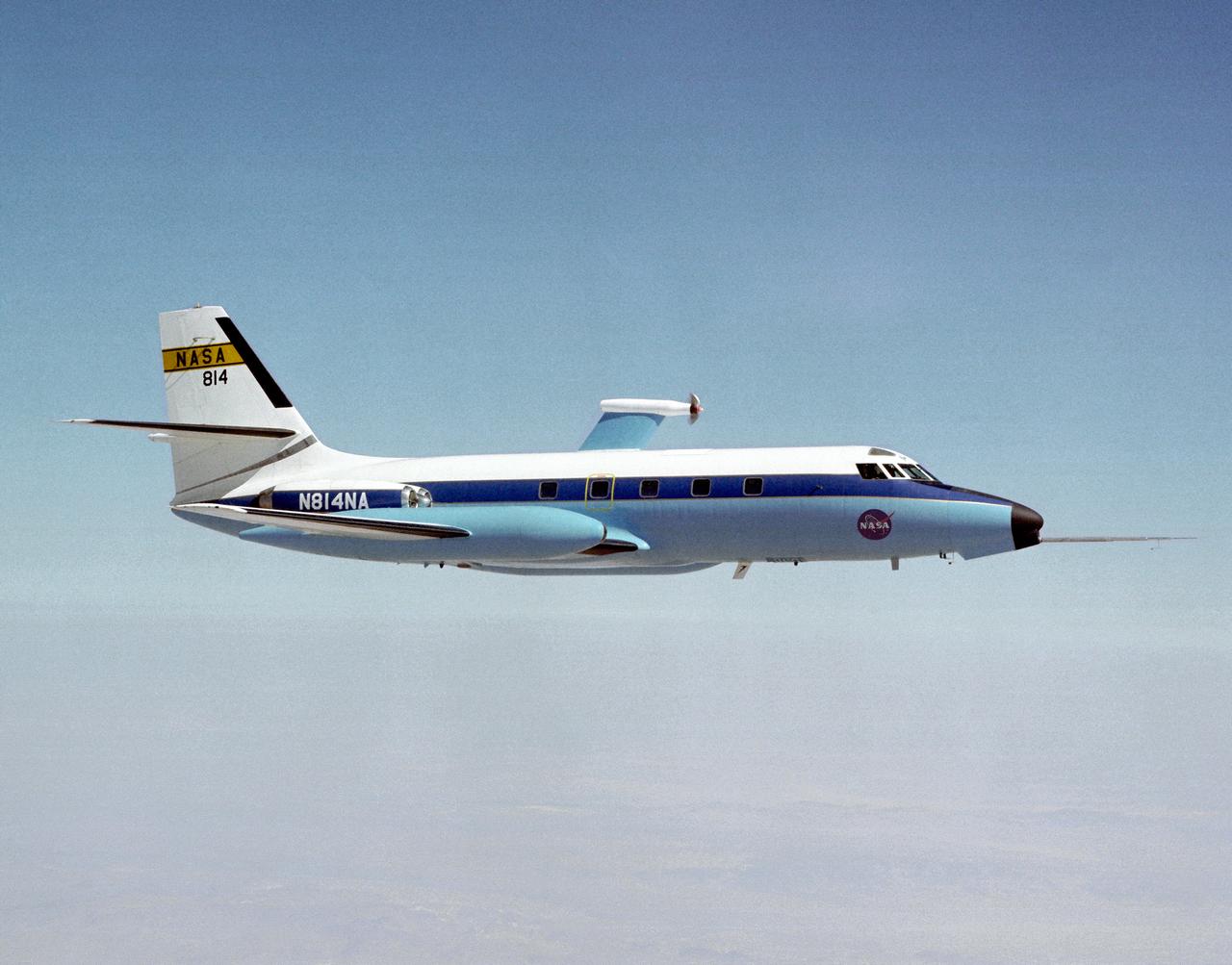
The Dryden C-140 JetStar during testing of advanced propfan designs. Dryden conducted flight research in 1981-1982 on several designs. The technology was developed under the direction of the Lewis Research Center (today the Glenn Research Center, Cleveland, OH) under the Advanced Turboprop Program. Under that program, Langley Research Center in Virginia oversaw work on accoustics and noise reduction. These efforts were intended to develop a high-speed and fuel-efficient turboprop system.
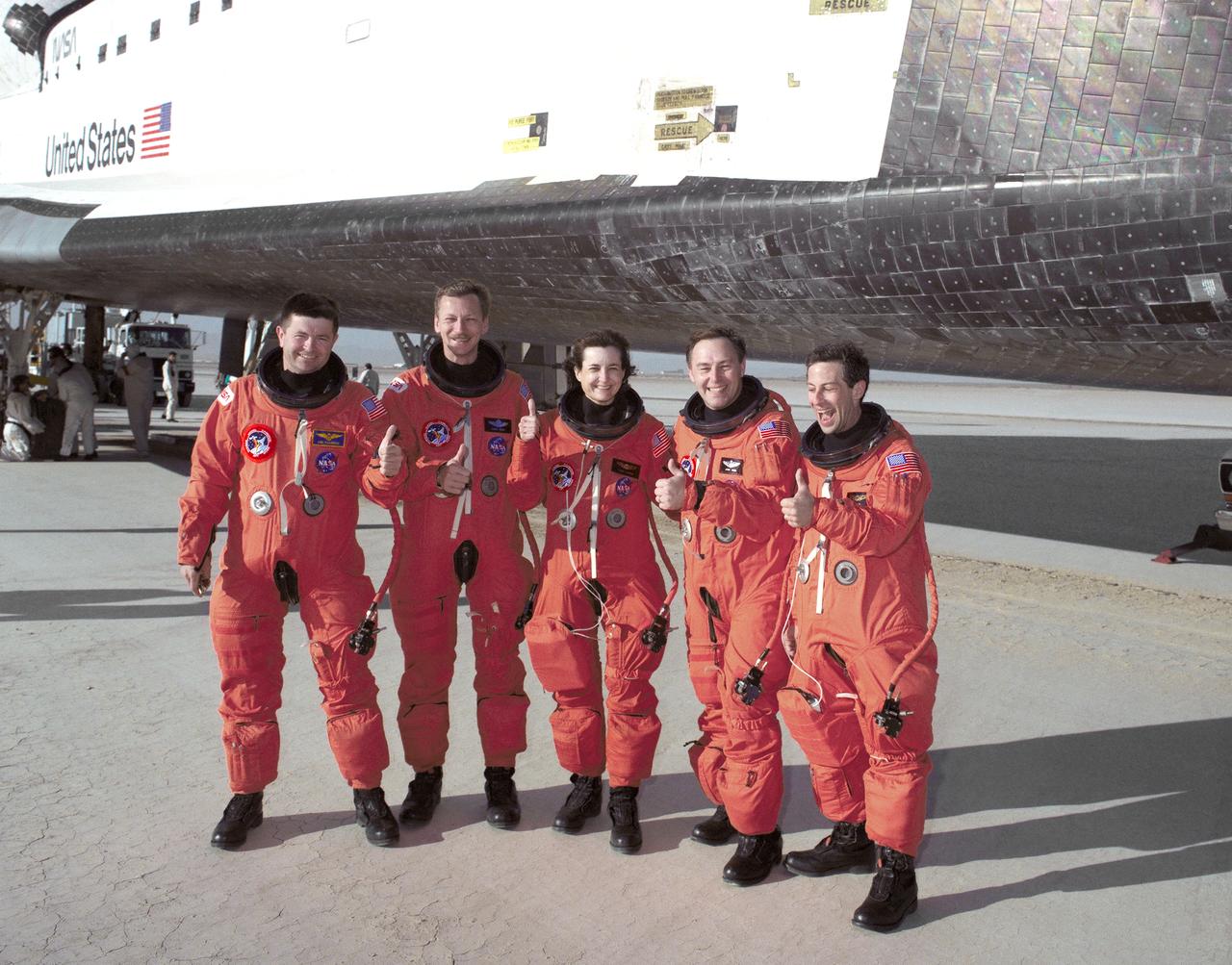
The crew of the Space Shuttle Atlantis gives the "all's well" thumb's-up sign after leaving the 100-ton orbiter following their landing at 6:55 a.m. (PDT), 11 April 1991, at NASA's Ames Dryden Flight Research Facility (later redesignated Dryden Flight Research Center), Edwards, California, to conclude mission STS-37. They are, from left, Kenneth D. Cameron, pilot; Steven R. Nagel, mission commander; and mission specialists Linda M. Godwin, Jerry L. Ross, and Jay Apt. During the mission,which began with launch April 5 at Kennedy Space Center, Florida, the crew deployed the Gamma Ray Observatory. Ross and Jay also carried out two spacewalks, one to deploy an antenna on the Gamma Ray Observatory and the other to test equipment and mobility techniques for the construction of the future Space Station. The planned five-day mission was extended one day because of high winds at Edwards.
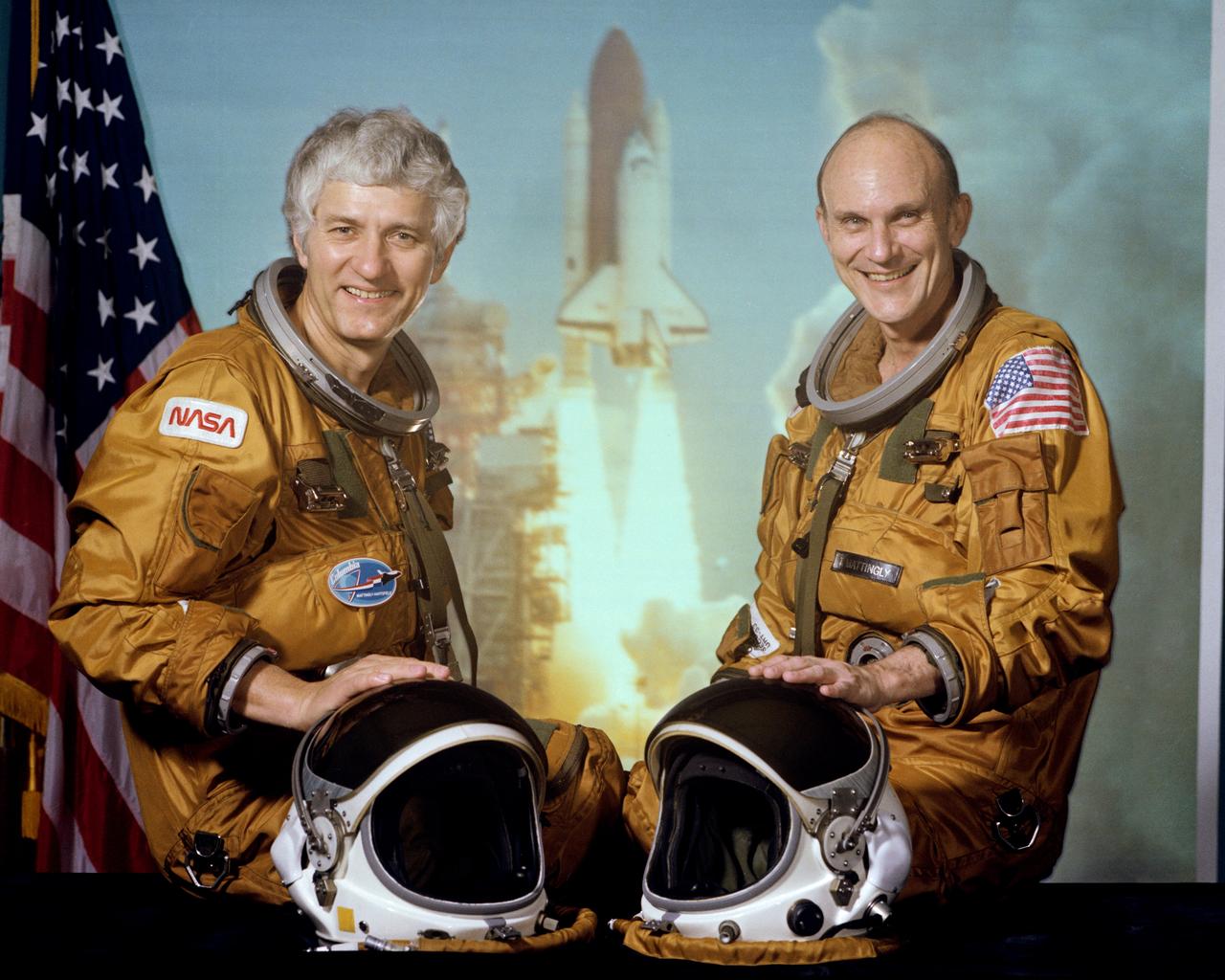
S82-31207 (1 May 1982) --- These two astronauts will man the space shuttle Columbia for NASA's fourth and final (STS-4) orbital flight test. Thomas K. (Ken) Mattingly II, right, is crew commander. Henry W. Hartsfield Jr., is pilot. Their flight is scheduled for launch in late June 1982, and is to last approximately one week, with launch to take place form KSC and landing to be on the dry lake beds of Edwards Air Force Base and Dryden Flight Research Facility (DFRC) in California. Photo credit: NASA
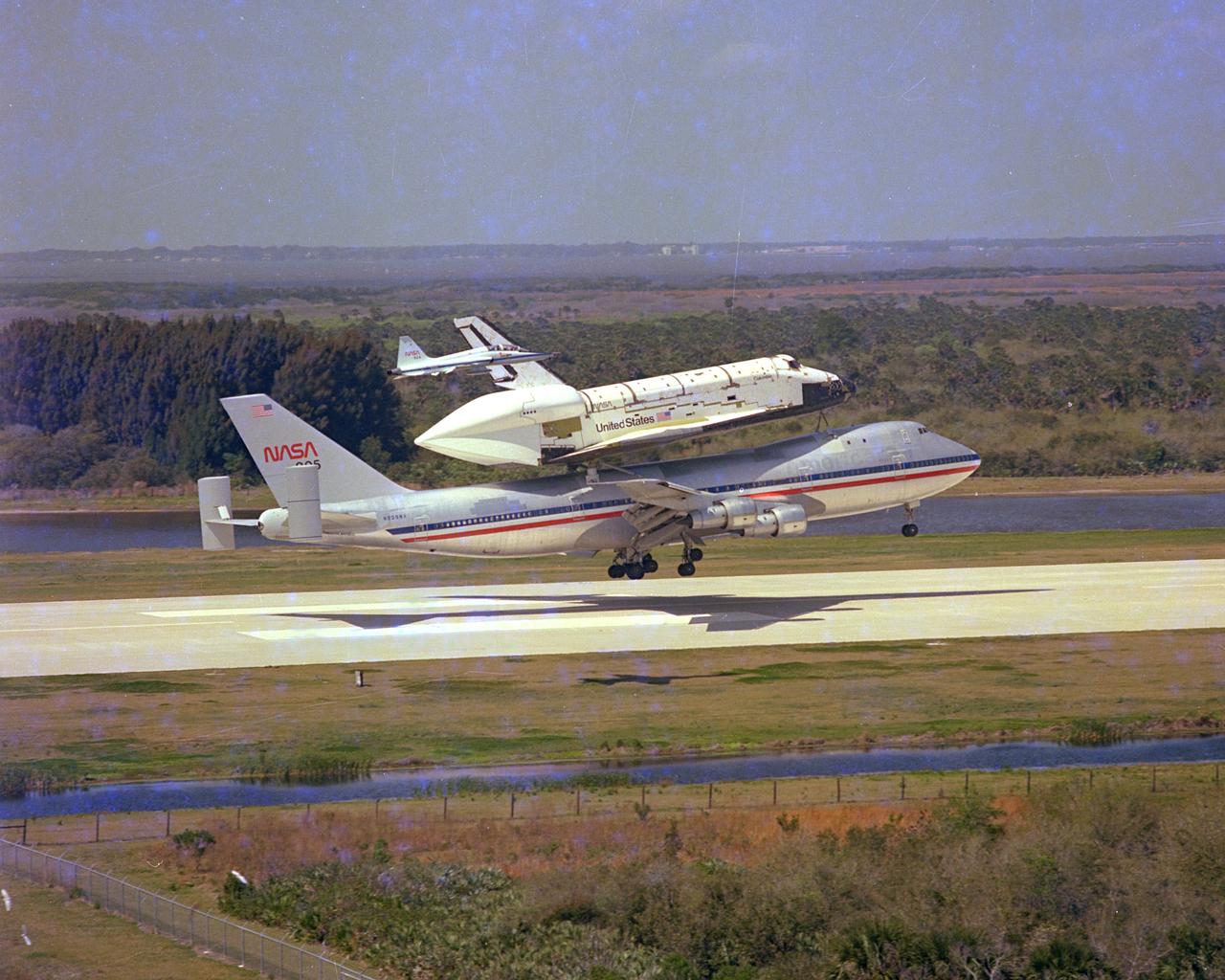
KENNEDY SPACE CENTER, FLA. - The Space Shuttle Columbia, piggy-back on its 747 carrier aircraft, is only seconds away from a touchdown at Kennedy Space Center’s Shuttle Landing Facility (SLF), completing its 2,400 mile ferry flight from Dryden Flight Research Center in California. Columbia, the first of the fleet of Space Shuttles, is scheduled for the first Space Shuttle flight in 1981.
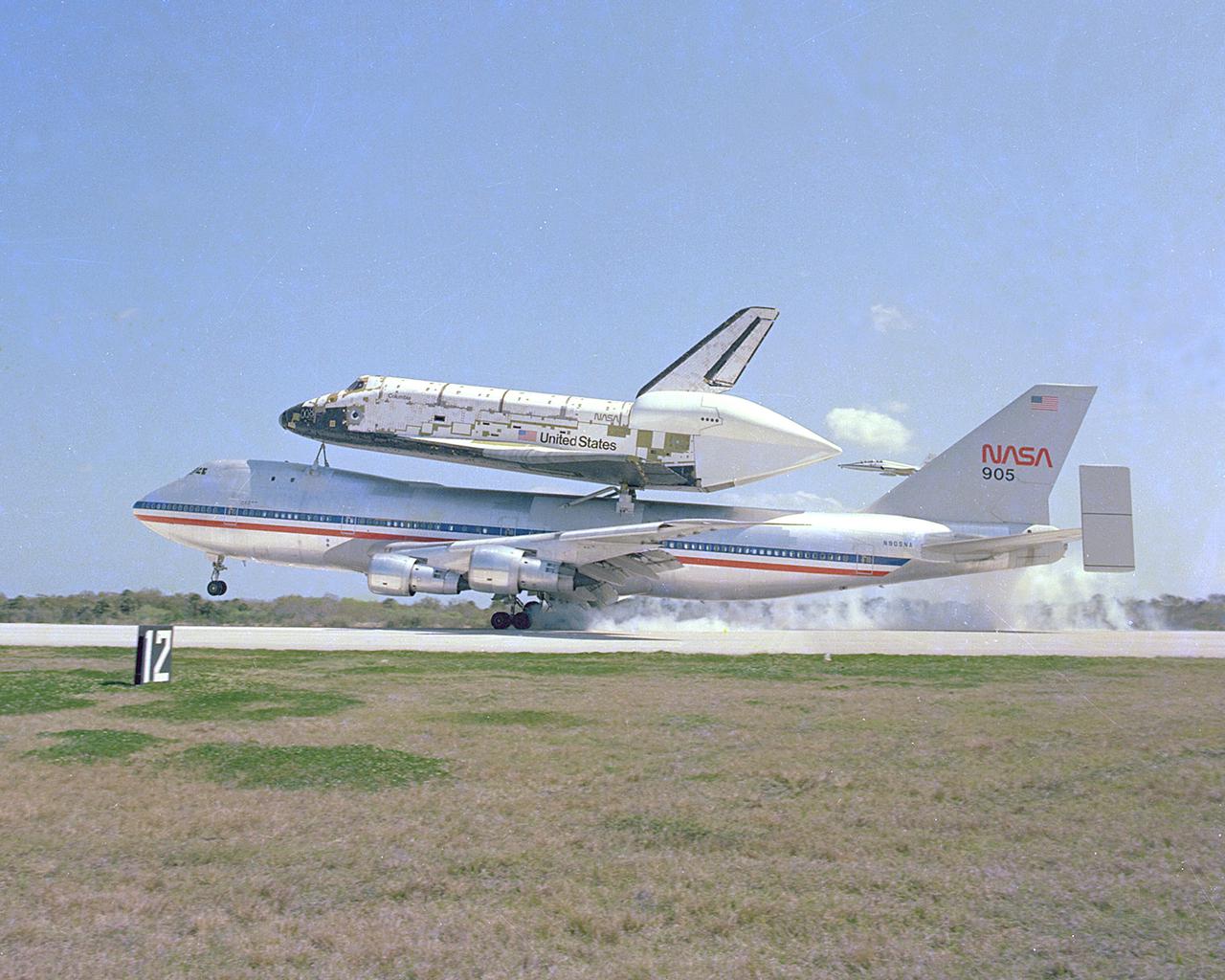
KENNEDY SPACE CENTER, FLA. - The Space Shuttle Columbia, piggy-back on its 747 carrier aircraft, is only seconds away from a touchdown at Kennedy Space Center's Shuttle Landing Facility (SLF), completing its 2,400-mile ferry flight from Dryden Flight Research Center in California. Columbia, the first of the fleet of Space Shuttles, is scheduled for the first Space Shuttle flight n 1981.
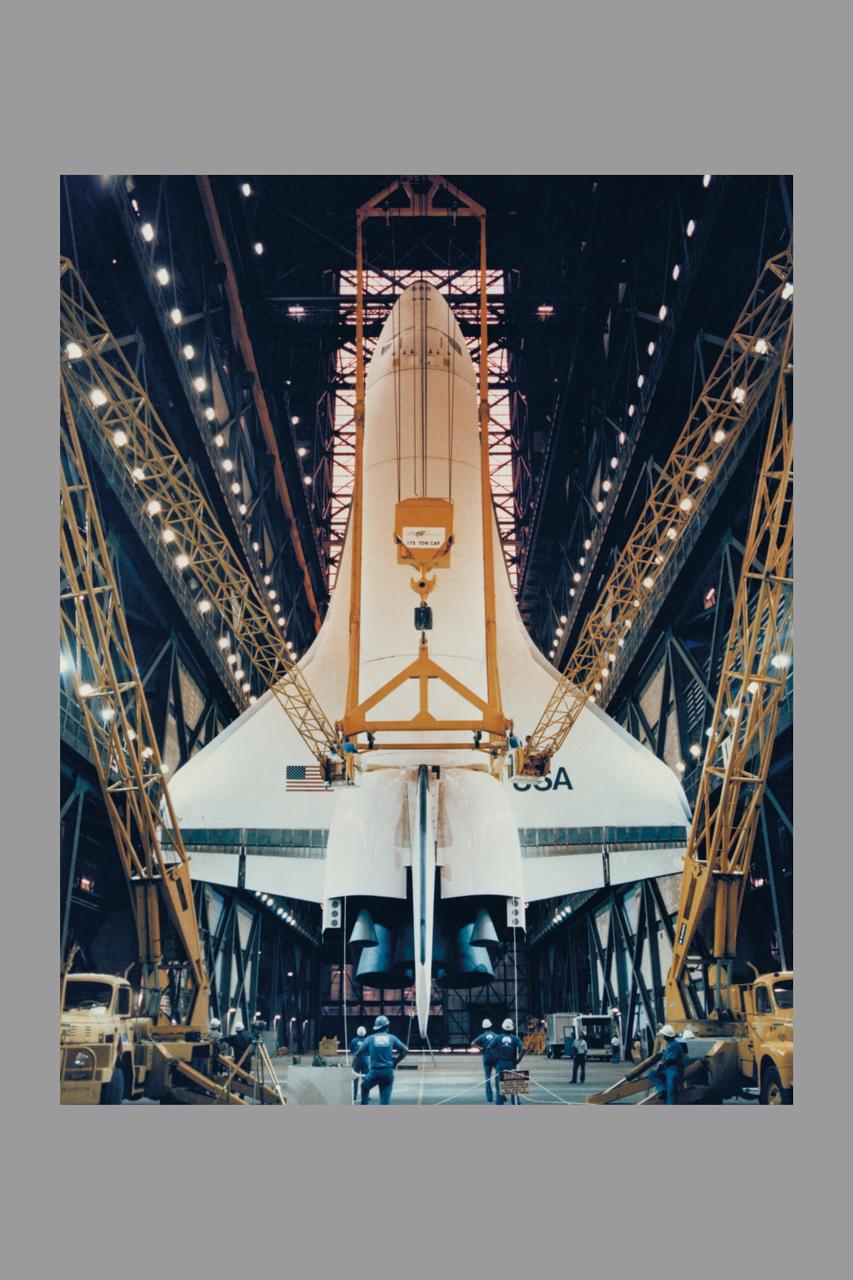
The Space Shuttle Orbiter Enterprise is lowered to the floor of the transfer aisle in the Vehicle Assembly Building during destacking operations. The Enterprise, mated to an external tank and twin inert solid rocket boosters, formed a nonlaunchable Space Shuttle which was used for fit and fuction checks of assembly, test and launch facilities at the nation's Spaceport. Enterprise will be transported to the Shuttle Landing Facility, mounted piggyback on its 747 Shuttle Carrier Aircraft, and flown to NASA's Dryden Flight Research Center, CA.
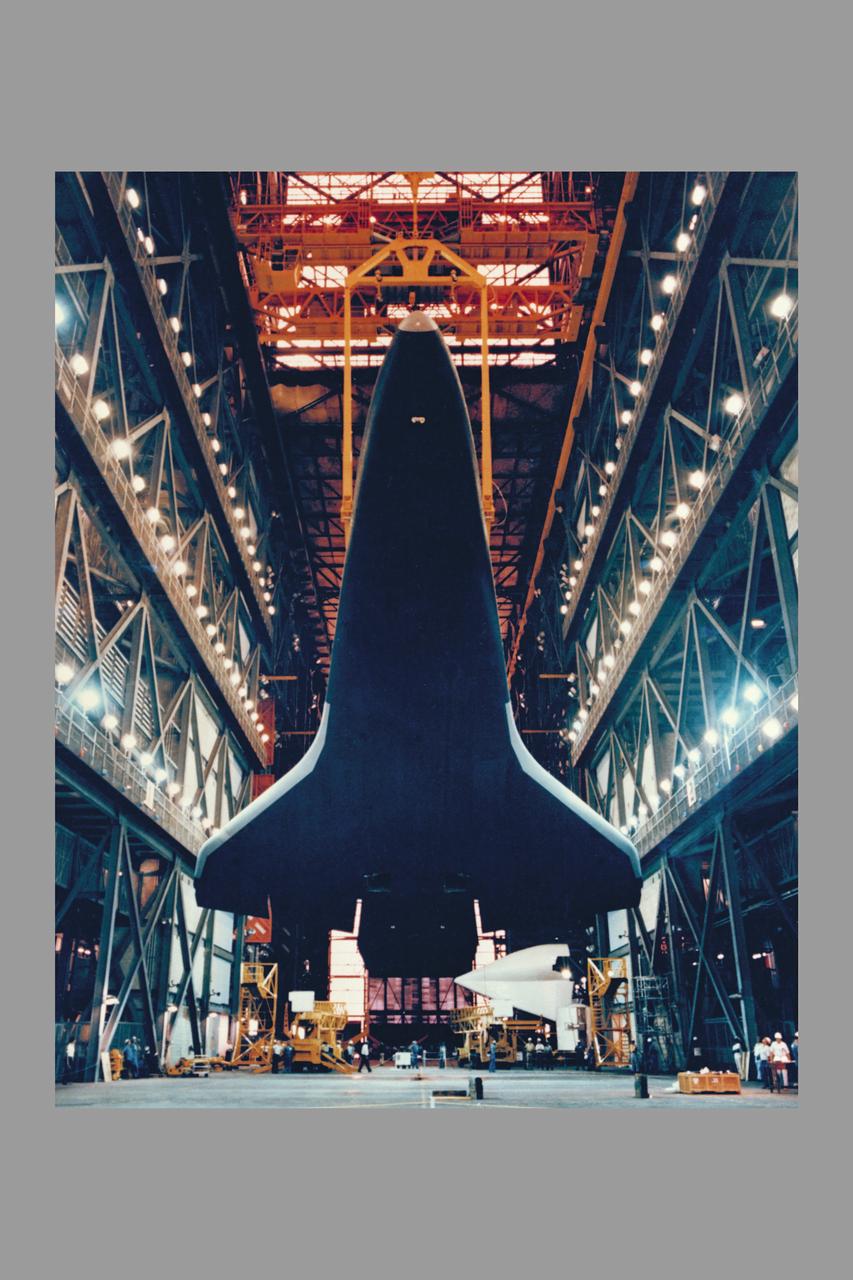
Space Shuttle Orbiter Enterprise is lowered to the floor of the transfer aisle in the Vehicle Assembly Building during destacking operations. The Enterprise, mated to an external tank and twin inert solid rocket boosters, formed a nonlaunchable Space Shuttle which was used for fit and function checks of assembly, test and launch facilities at the nation's Spaceport. Enterprise will be tansported to the Shuttle Landing Facility, mounted piggyback on its 747 Shuttle Carrier Aircraft, and flown to NASA's Dryden Flight Research Center, California.
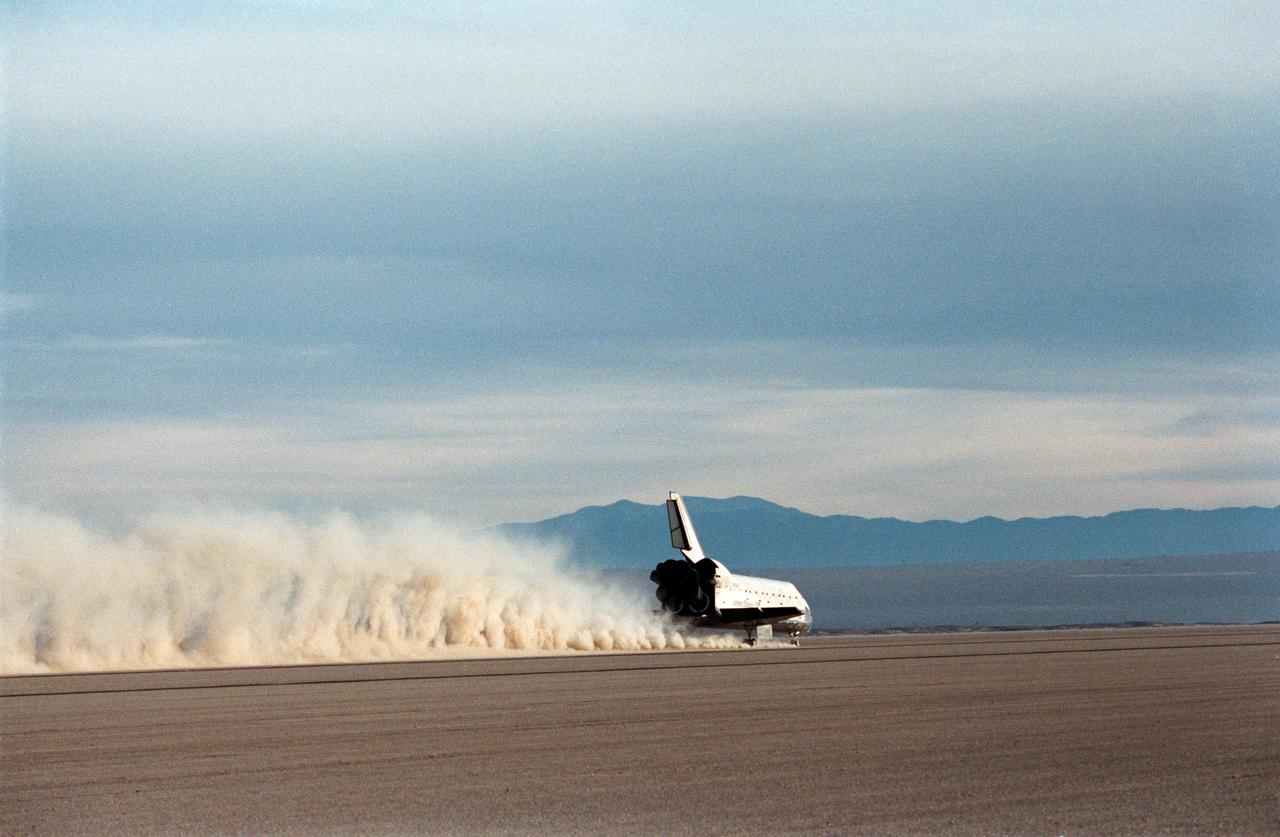
STS027-S-012 (6 Dec. 1988) --- A 70mm camera records the landing of the Space Shuttle Atlantis on Rogers Dry Lake Bed near the Dryden Flight Research Facility in California. The wheels of the vehicle came to a stop at 3:36:53 p.m. (PST), marking the completion of a successful mission which involved five veteran NASA astronauts. Onboard for the four-day flight were astronauts Robert L. Gibson, Guy S. Gardner, Jerry L. Ross, Richard M. (Mike) Mullane and William M. Shepherd.
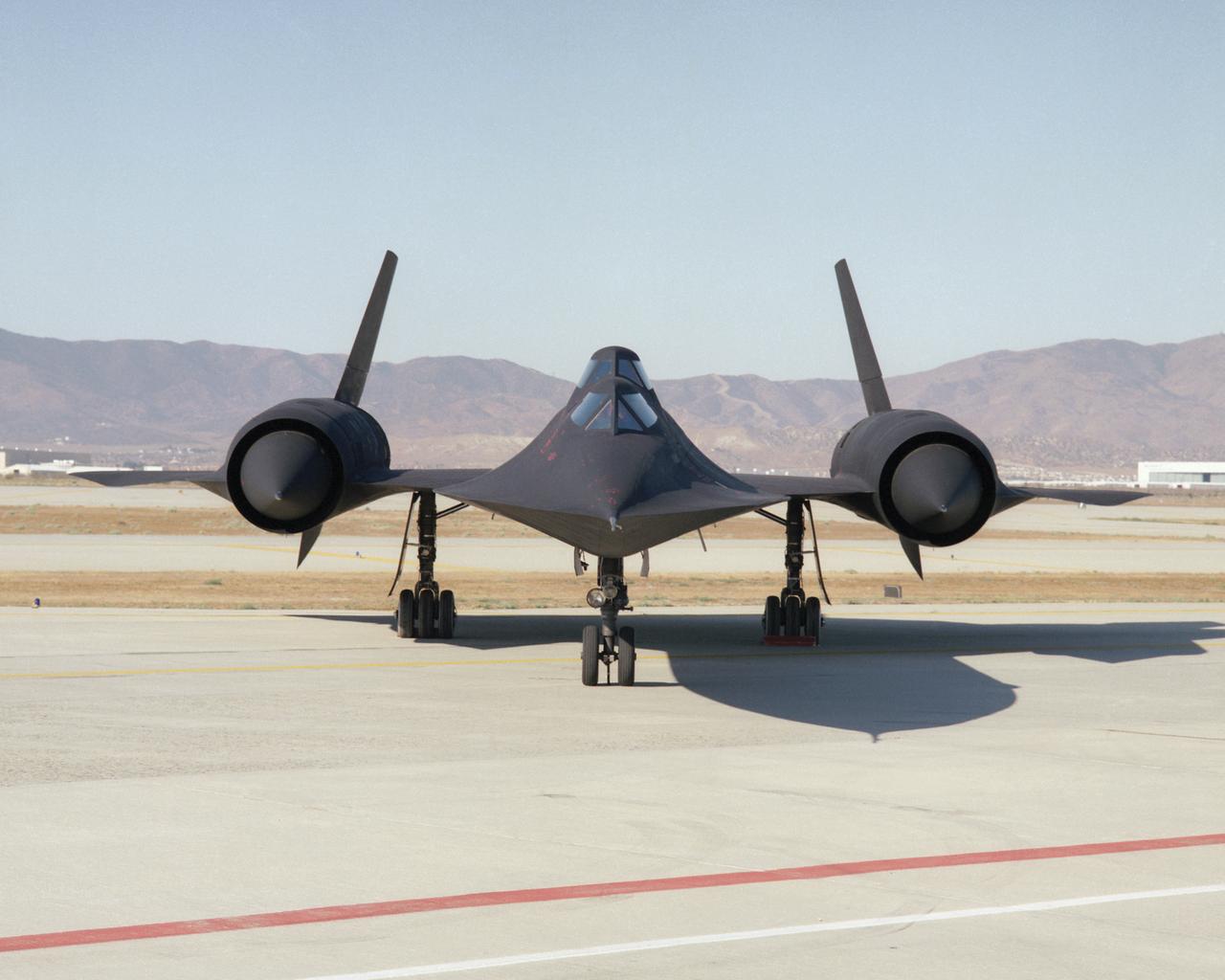
This photo shows a head-on view of NASA's SR-71B, used for pilot proficiency and training, on the ramp at the Air Force's Plant 42 in Palmdale, California, shortly before delivery to the Ames-Dryden Flight Research Facility (later, Dryden Flight Research Center) at Edwards, California. NASA operated two of these unique aircraft, an SR-71A, for high-speed, high altitude research, and this SR- 71B pilot trainer for most of the decade of the 1990s. The "B" model is special because of its raised rear cockpit, which provided a second pilot position so a trainer and an experienced pilot could both see what was going on during flights. The SR-71 was designed and built by the Lockheed Skunk Works, now the Lockheed Martin Skunk Works. Studies have shown that less than 20 percent of the total thrust used to fly at Mach 3 is produced by the basic engine itself. The balance of the total thrust is produced by the unique design of the engine inlet and "moveable spike" system at the front of the engine nacelles, and by the ejector nozzles at the exhaust which burn air compressed in the engine bypass system. Data from the SR-71 high speed research program will be used to aid designers of future supersonic/hypersonic aircraft and propulsion systems, including a high speed civil transport.
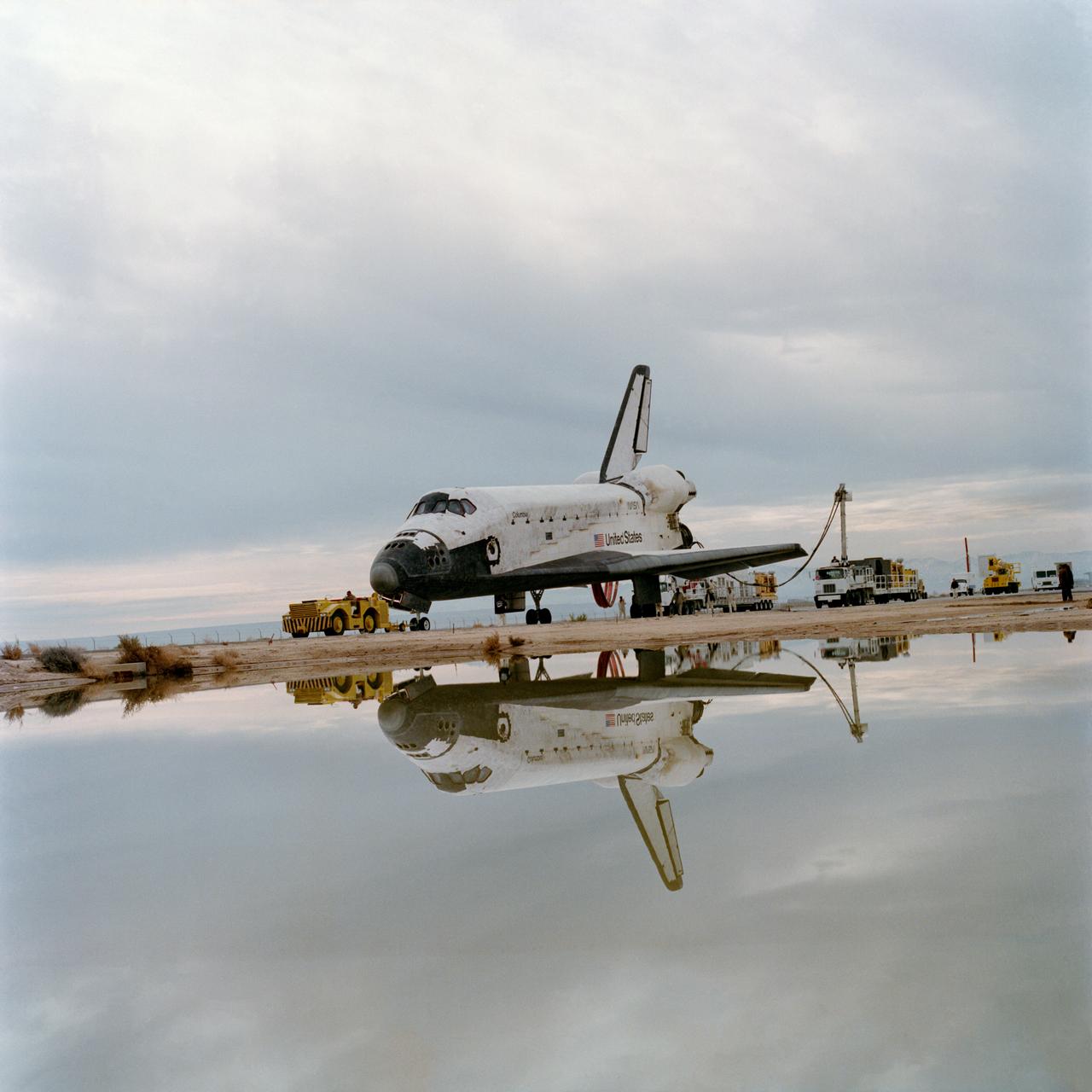
S82-39888 (16 Nov. 1982) --- Post-landing processing of the space shuttle Columbia is seen in double in this rare scene at the Dryden Flight Research Facility (DFRF) in southern California. Uncommon rainwater has given a mirror effect to the normally dry lakebed. Columbia, with its first four-member crew aboard, touched down earlier today to complete a successful five-day, two-hour mission. The runway used was Number 22 at Edwards Air Force Base. Photo credit: NASA
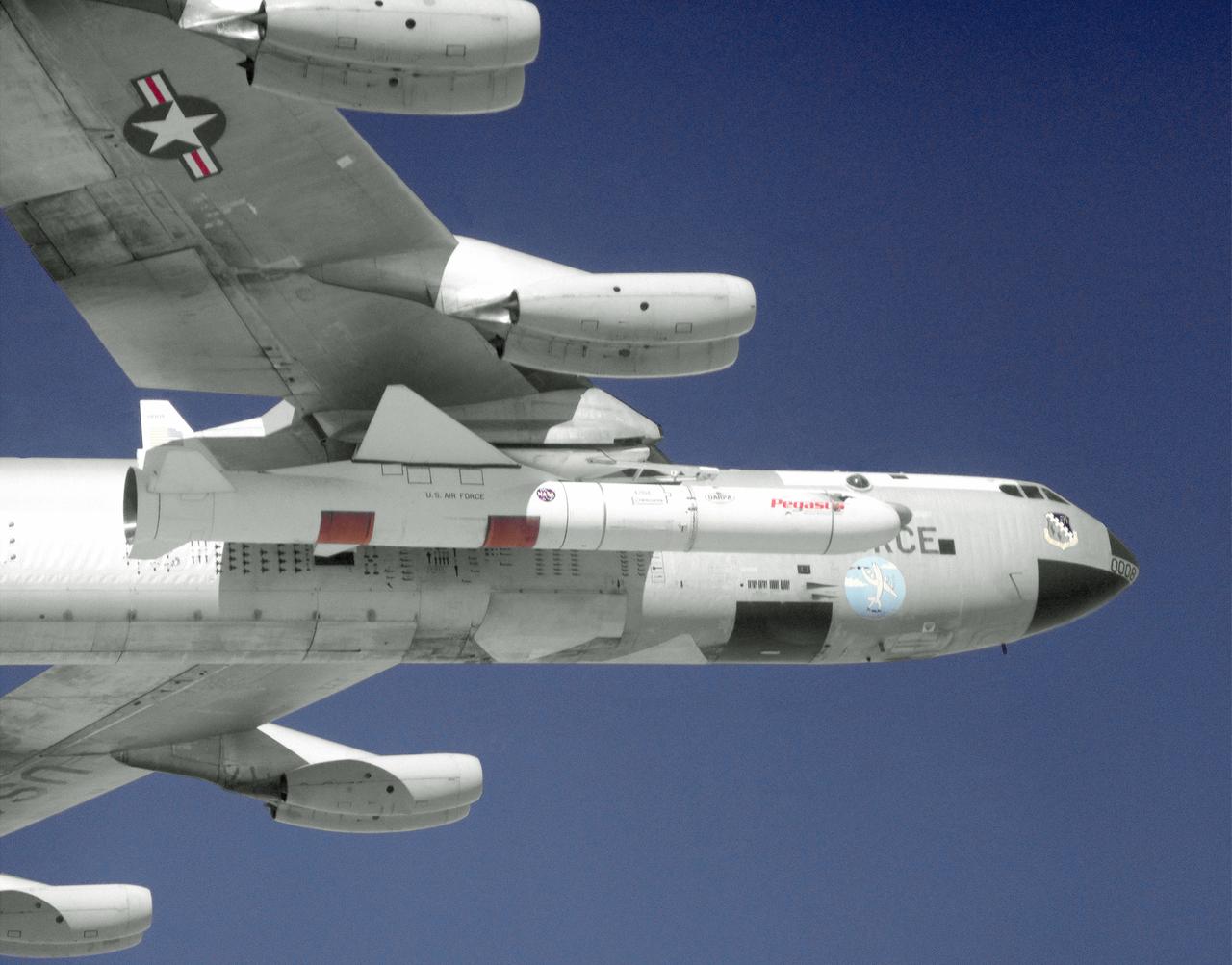
The Pegasus air-launched space booster is carried aloft under the right wing of NASA's B-52 carrier aircraft on its first captive flight from the Dryden Flight Research Center, Edwards, California. The first of two scheduled captive flights was completed on November 9, 1989. Pegasus is used to launch satellites into low-earth orbits cheaply. In 1997, a Pegasus rocket booster was also modified to test a hypersonic experiment (PHYSX). An experimental "glove," installed on a section of its wing, housed hundreds of temperature and pressure sensors that sent hypersonic flight data to ground tracking facilities during the experiment’s flight.
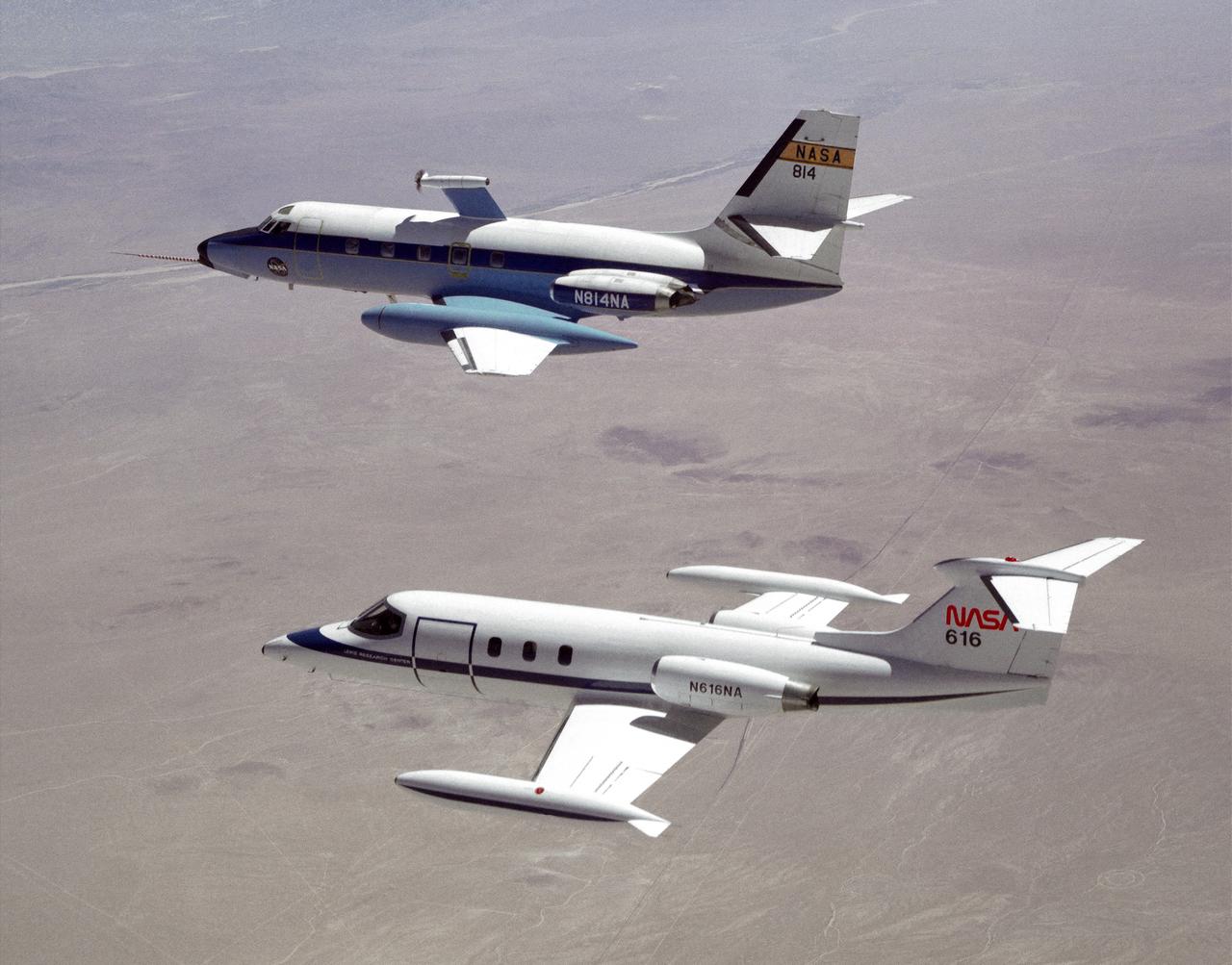
The NASA C-140 JetStar research aircraft (top) is followed by a NASA Learjet equipped with acoustic sensors during one of several tests of advanced propellors mounted on the vertical pylon atop the JetStar's fuselage. Several advanced prop designs were tested on the JetStar in 1982 by NASA's Dryden Flight Research Facility (DFRF), Edwards, California, to study the effects of noise created by propellors on aircraft structures and cabin interiors. To assess possible noise problems with the subscale turbofan, DFRF technicians mounted microphones on both the JetStar and the Learjet chase plane. DFRF then made measurements at close range and at longer distances. The data enabled structural changes and flightpath modifications.
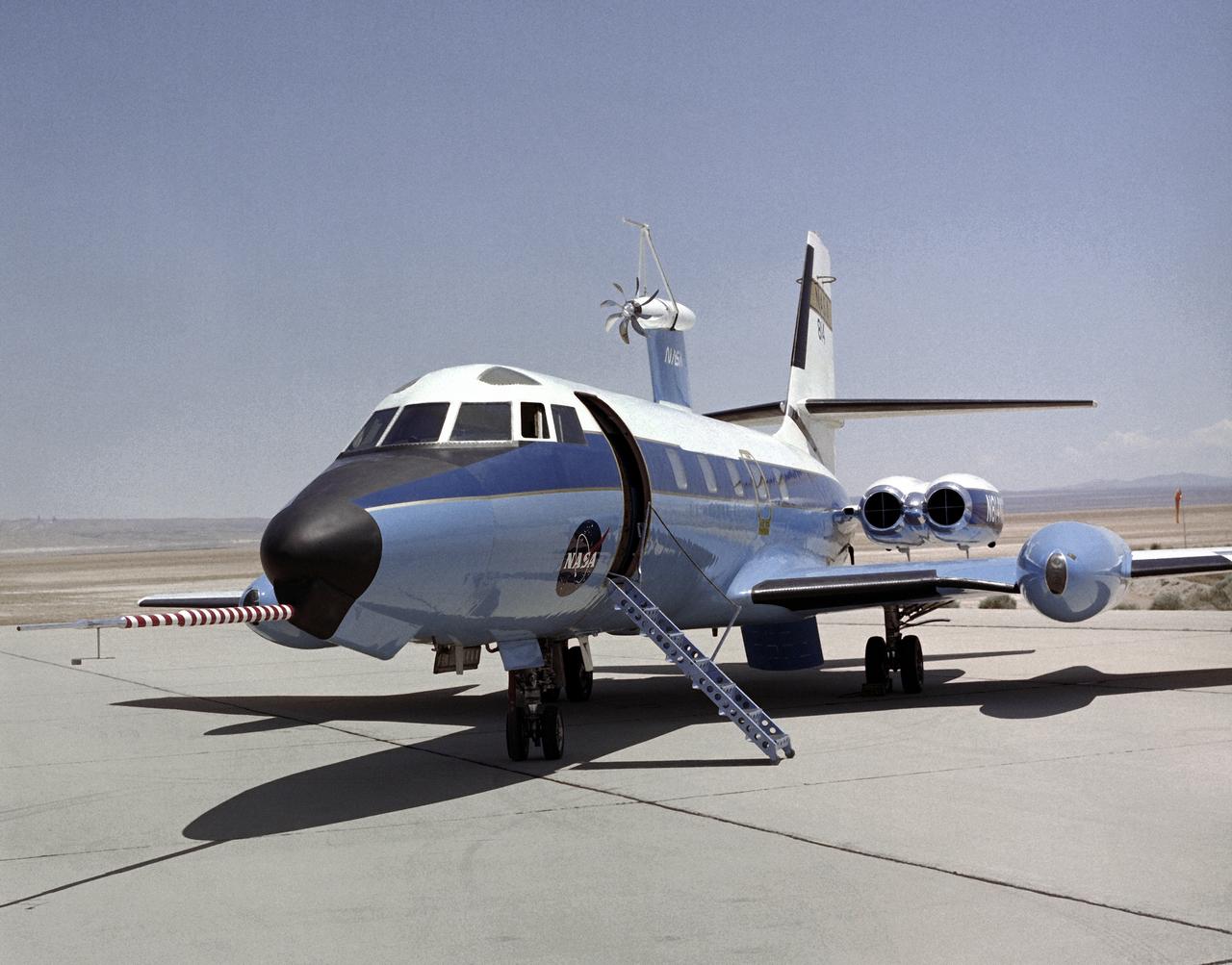
In this photo of the C-140 JetStar on the Dryden Ramp, a subscale propeller has been fitted to the upper fuselage of the aircraft.
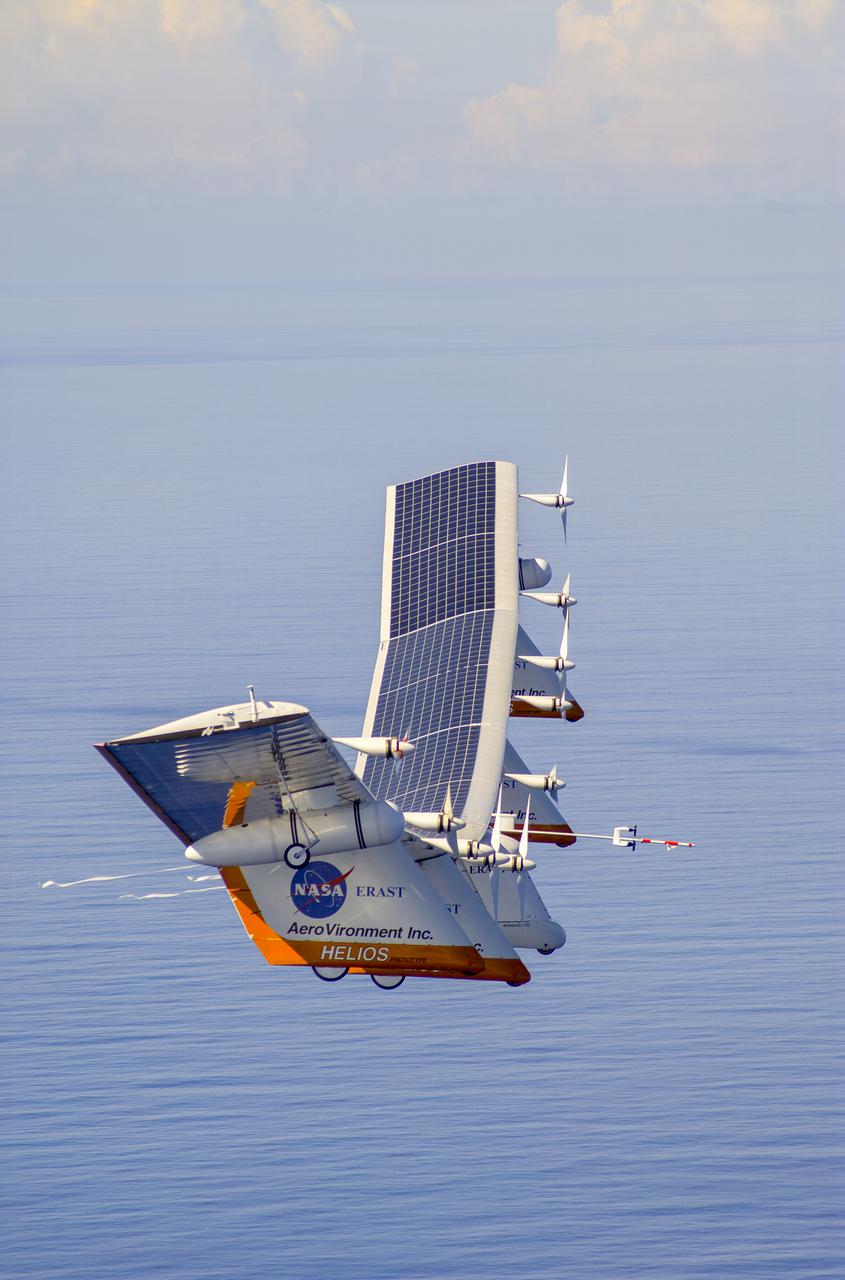
The first flight of a large aircraft to be powered by electric fuel cells began with a takeoff at 8:43 a.m. HST today from the Hawaiian island of Kauai. The Helios Prototype flying wing, built by AeroVironment, Inc., of Monrovia, Calif., as part of NASA's Environmental Research Aircraft and Sensor Technology (ERAST) program, used solar panels to power its 10 electric motors for takeoff and during daylight portions of its planned 20-hour shakedown flight. As sunlight diminishes, Helios will switch to a fuel cell system to continue flight into the night. The takeoff set the stage for a two-day Helios endurance flight in the stratosphere planned for mid-July. The Helios wing, spanning 247 feet and weighing about 2,400 pounds, is giving NASA and industry engineers confidence that remotely piloted aircraft will be able to stay aloft for weeks at a time, providing environmental monitoring capabilities and telecommunications relay services. Helios is an all-electric airplane. In addition to being non-polluting, Helios can fly above storms, and use the power of the sun to stay aloft during daylight. Key to the success of this type of aircraft is the ability to fly in darkness, using fuel cells when sunlight cannot furnish energy. Helios flew over the Navy's Pacific Missile Range Facility where favorable sun exposure and test ranges closed to other air traffic benefited the NASA research effort. In 2003 the aircraft was lost to a crash.
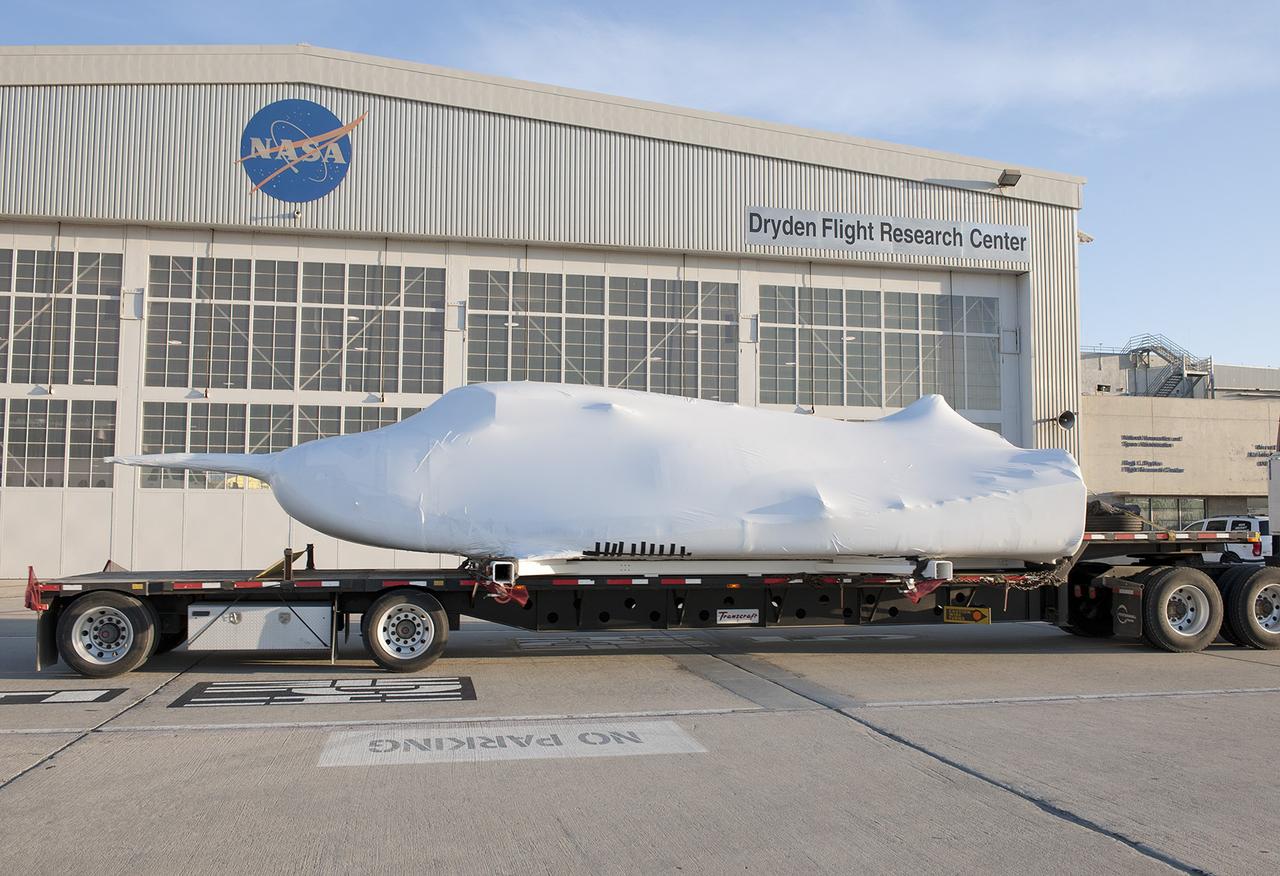
EDWARDS, Calif. – ED13-0142-08: The flatbed truck and trailer that transported Sierra Nevada Corporation, or SNC, Space Systems' Dream Chaser engineering test article pauses behind Hangar 4802 on the aircraft ramp at NASA's Dryden Flight Research Center on Edwards Air Force Base, Calif., upon arrival at the center. The vehicle was shrouded in protective plastic wrap with its wings and tail structure removed for its four-day overland transport from Sierra Nevada's facility in Louisville, Colo., to NASA Dryden. SNC is one of three companies working with NASA's Commercial Crew Program, or CCP, during the agency's Commercial Crew Integrated Capability, or CCiCap, initiative, which is intended to lead to the availability of commercial human spaceflight services for government and commercial customers. To learn more about CCP and its industry partners, visit www.nasa.gov/commercialcrew. Image credit: NASA/Tom Tschida
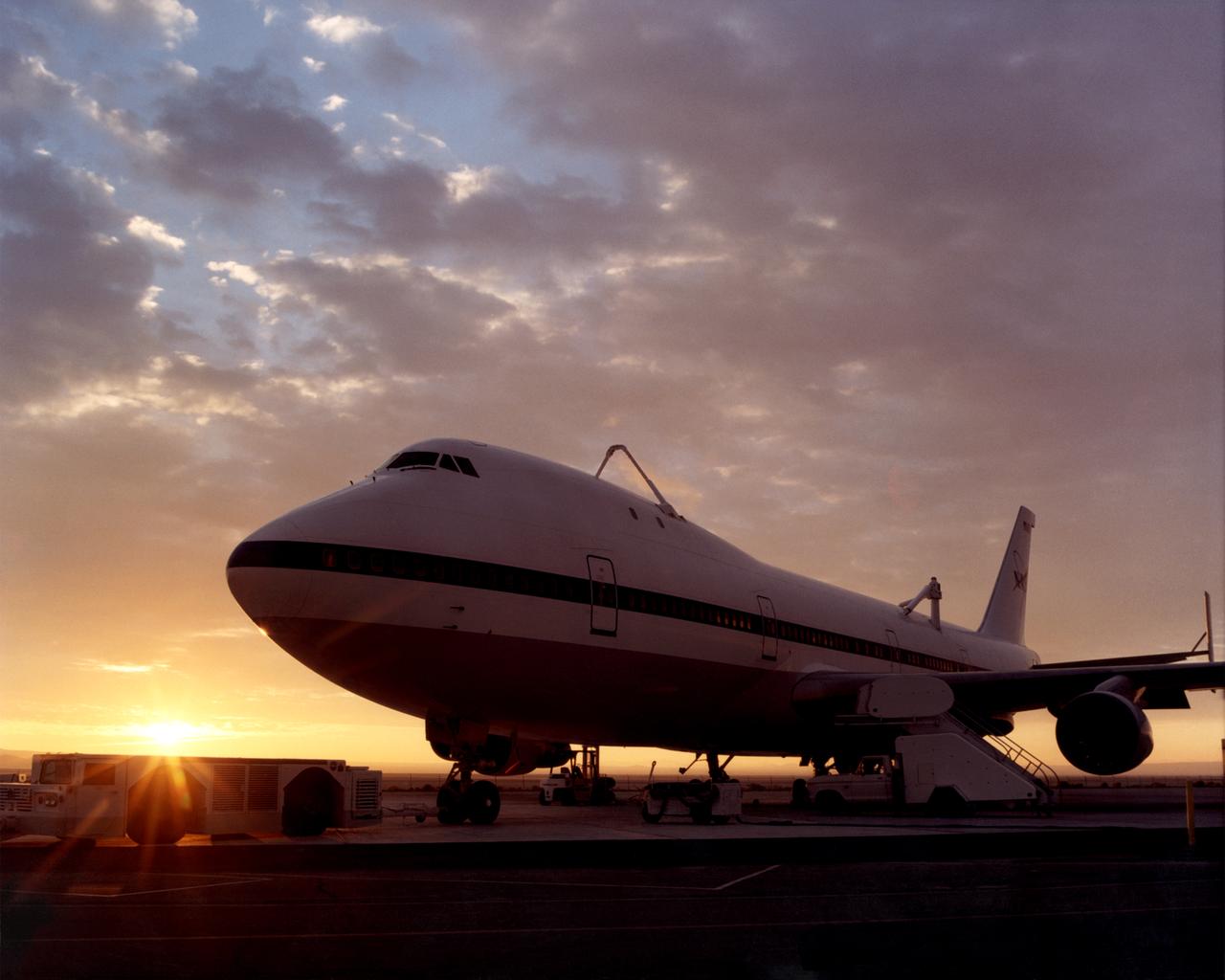
One of NASA’s two modified Boeing 747 Shuttle Carrier Aircraft is bathed in the morning Sun at NASA’s Dryden Flight Research Center at Edwards, California. The modified jumbo jetliners are used to ferry the Space Shuttle orbiters between Dryden and the Kennedy Space Center in Florida and Boeing’s Reusable Space Systems modification facility at Palmdale, California. Features which distinguish the two SCAs from standard 747 jetliners are three struts, with associated interior structural strengthening, which protrude from the top of the fuselage (two aft, one forward) on which the orbiter is attached, and two additional vertical stabilizers, one on each end of the standard horizontal stabilizer, to enhance directional stability. All interior furnishings and equipment aft of the forward No. 1 doors have also been removed to reduce weight. The two SCAs are under the operational control of NASA's Johnson Space Center, Houston, Texas.
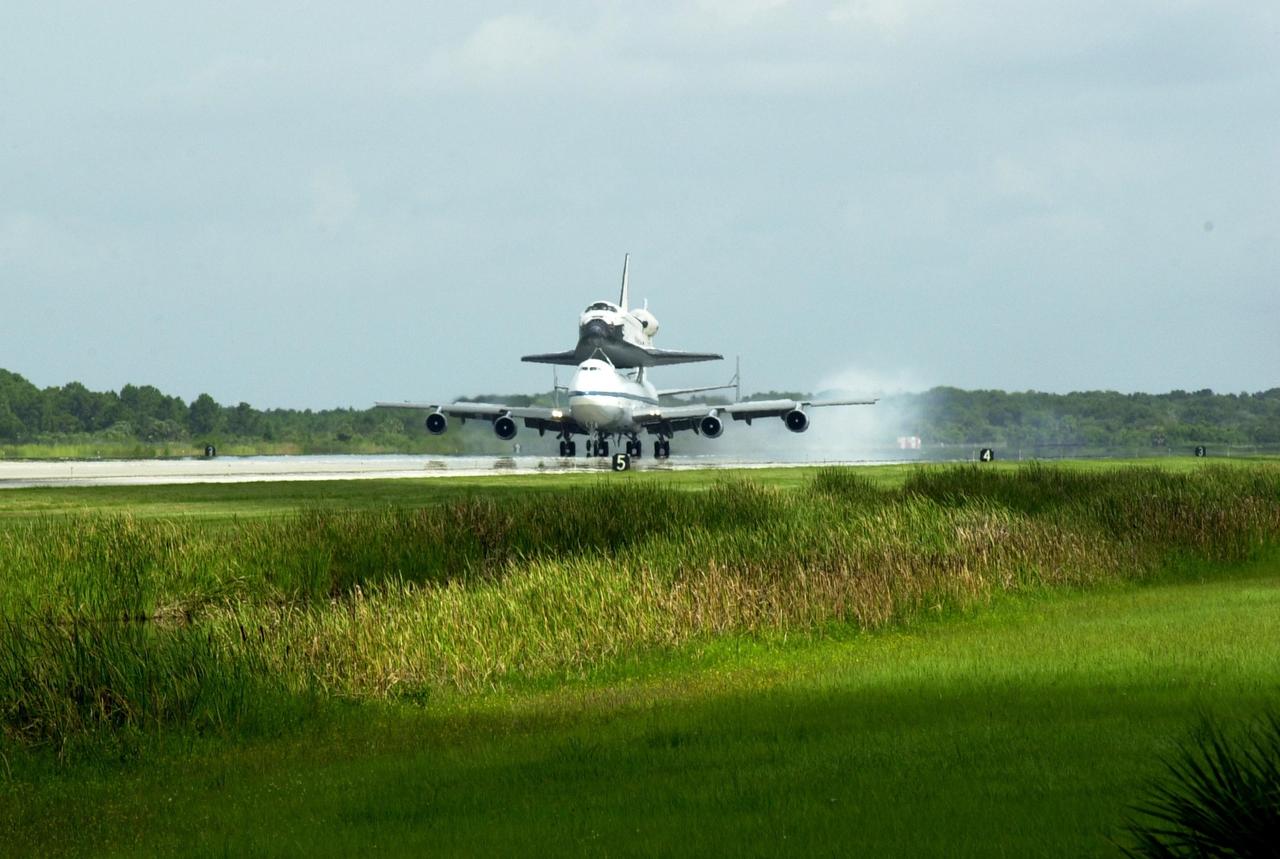
KENNEDY SPACE CENTER, FLA. - Space Shuttle Endeavour lands on runway 15 at KSC's Shuttle Landing Facility at 10:58 a.m. EDT atop a modified Boeing 747 Shuttle Carrier Aircraft. The cross-country ferry flight became necessary when three days of unfavorable weather conditions at KSC forced Endeavour to land on runway 22 at Dryden Flight Research Center, Edwards Air Force Base, Calif., on June 19 following mission STS-111. Processing of Endeavour will now begin for the launch of mission STS-113 targeted for October 2002
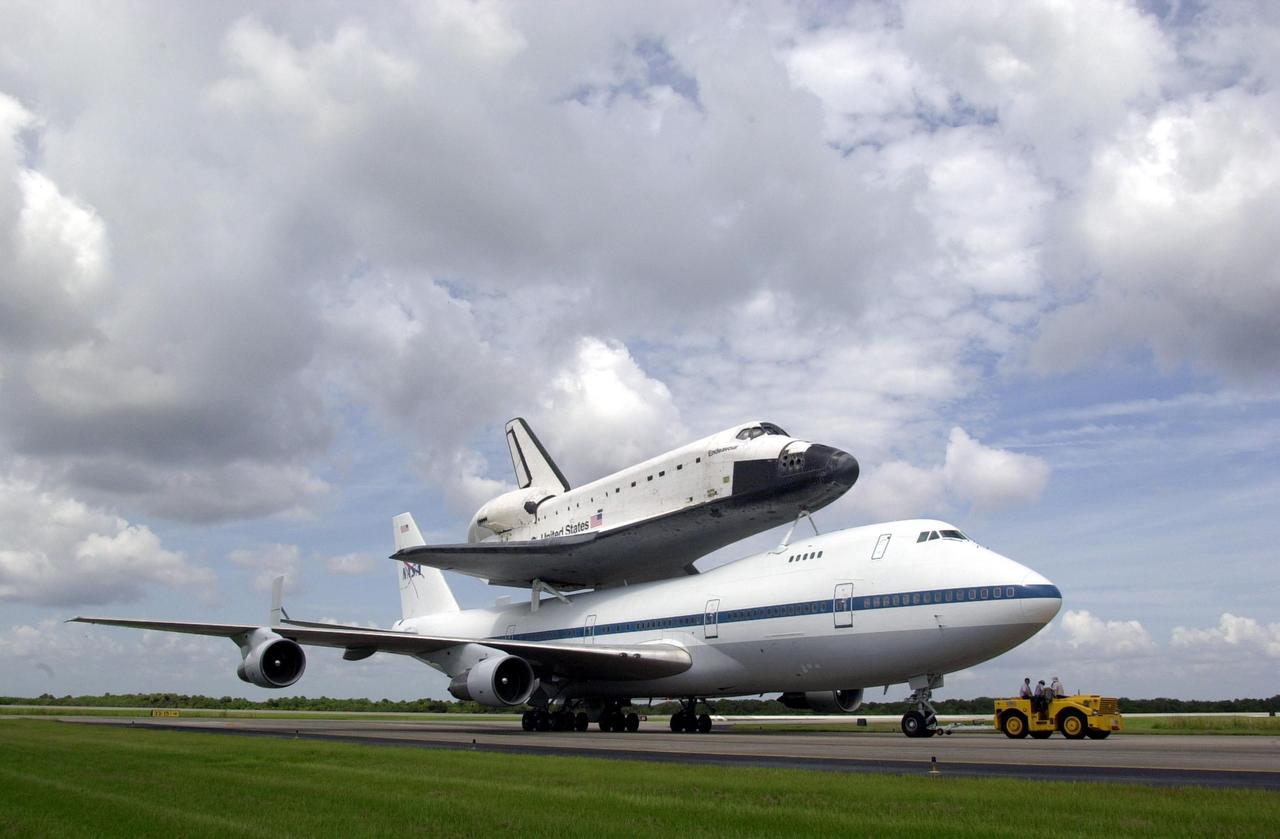
KENNEDY SPACE CENTER, FLA. - Space Shuttle Endeavour is towed toward the Mate-Demate Device following landing on runway 15 at KSC's Shuttle Landing Facility at 10:58 a.m. EDT atop a modified Boeing 747 Shuttle Carrier Aircraft. The cross-country ferry flight became necessary when three days of unfavorable weather conditions at KSC forced Endeavour to land on runway 22 at Dryden Flight Research Center, Edwards Air Force Base, Calif., on June 19 following mission STS-111. Processing of Endeavour will now begin for the launch of mission STS-113 targeted for October 2002
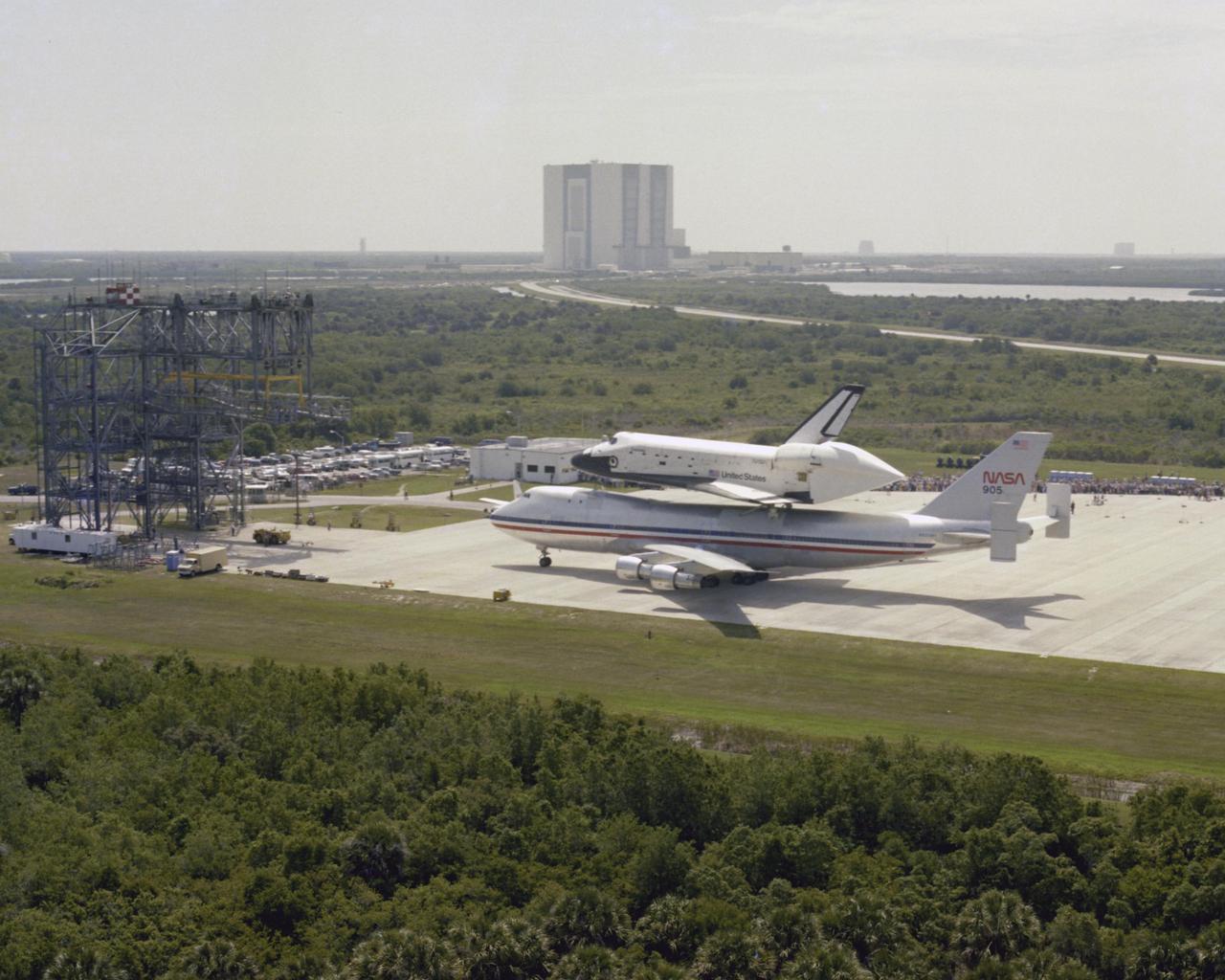
KENNEDY SPACE CENTER, FLA. - The Space Shuttle Orbiter Columbia - riding piggy back atop a modified 747 jet called the Shuttle Carrier Aircraft - arrives at Kennedy Space Center after a two-day journey from the Dryden Flight Research Center in California. Welcomed home by a crowd of KSC employees and their families and guests, Columbia touched down on the Shuttle Landing Facility at 11:23 a.m. Tuesday, two weeks after its return to Earth from the first Space Shuttle flight into space. The orbiter and SCA are seen here parked in front of the Mate_Demate Device, where the orbiter will be hoisted off the 747.
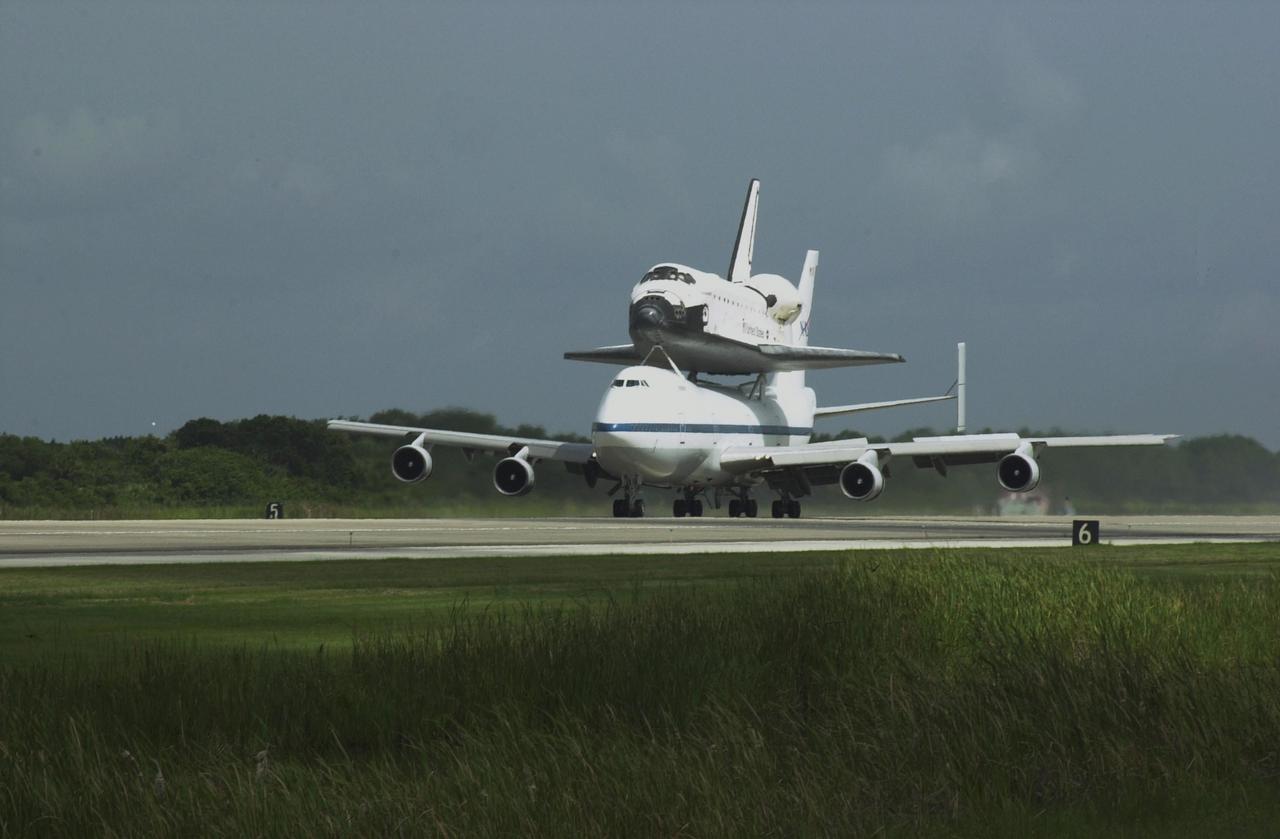
KENNEDY SPACE CENTER, FLA. - Space Shuttle Endeavour lands on runway 15 at KSC's Shuttle Landing Facility at 10:58 a.m. EDT atop a modified Boeing 747 Shuttle Carrier Aircraft. The cross-country ferry flight became necessary when three days of unfavorable weather conditions at KSC forced Endeavour to land on runway 22 at Dryden Flight Research Center, Edwards Air Force Base, Calif., on June 19 following mission STS-111. Processing of Endeavour will now begin for the launch of mission STS-113 targeted for October 2002
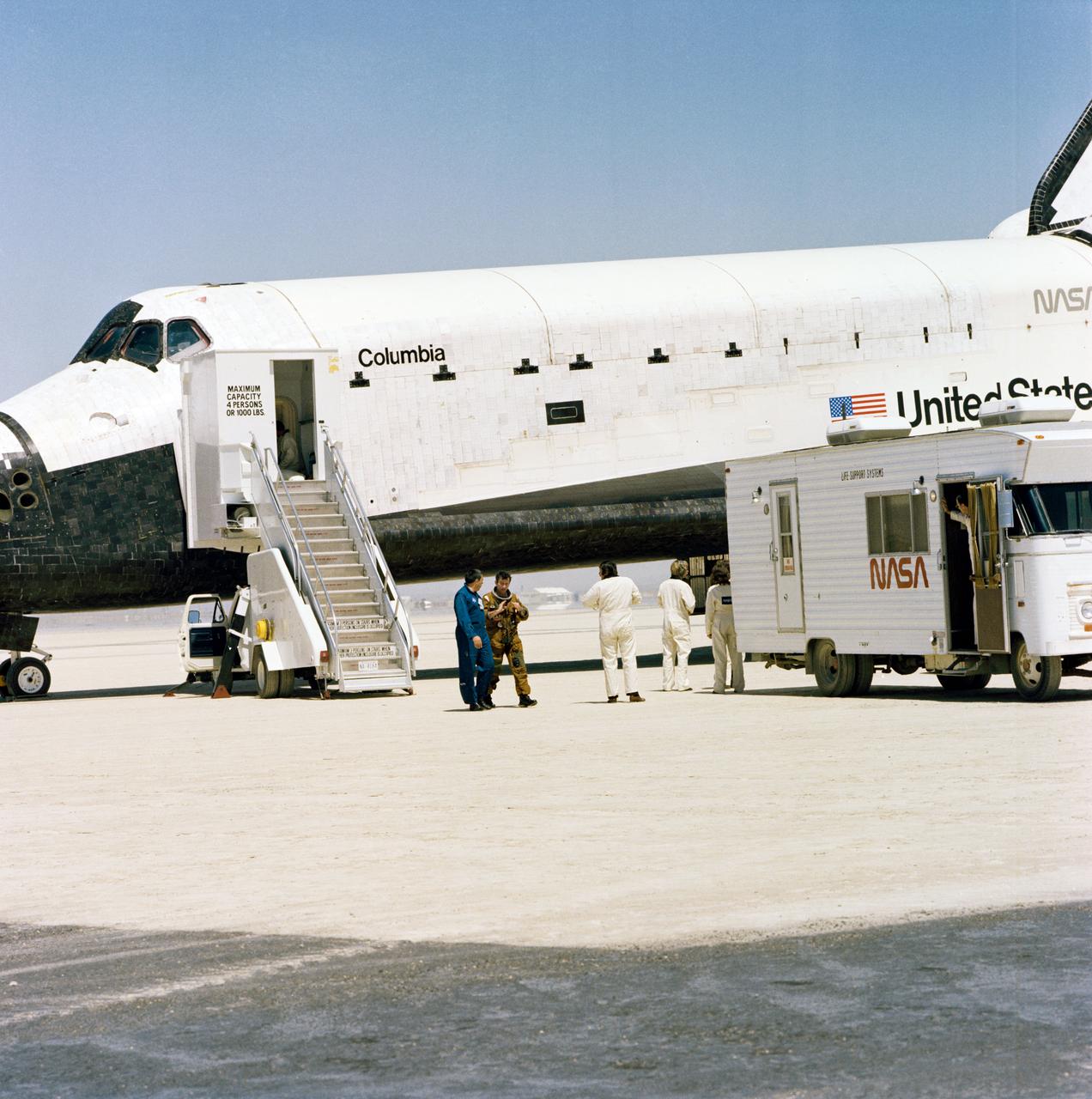
S81-30853 (14 April 1981) --- Astronaut John W. Young, left center talks with George W.S. Abbey, director of flight operations at Johnson Space Center, following egress from the STS-1 Columbia, which forms the backdrop for this postflight scene. Young is en route to the van at right which will take him and fellow crew member Robert L. Crippen (STS-1 pilot still inside Columbia) to facilities at nearby Dryden Flight Research Center. Columbia will be mated to a 747 carrier craft and flown to Florida, where it will be refurbished to accommodate STS-2, scheduled for a Sept. 30 launch date. Photo credit: NASA
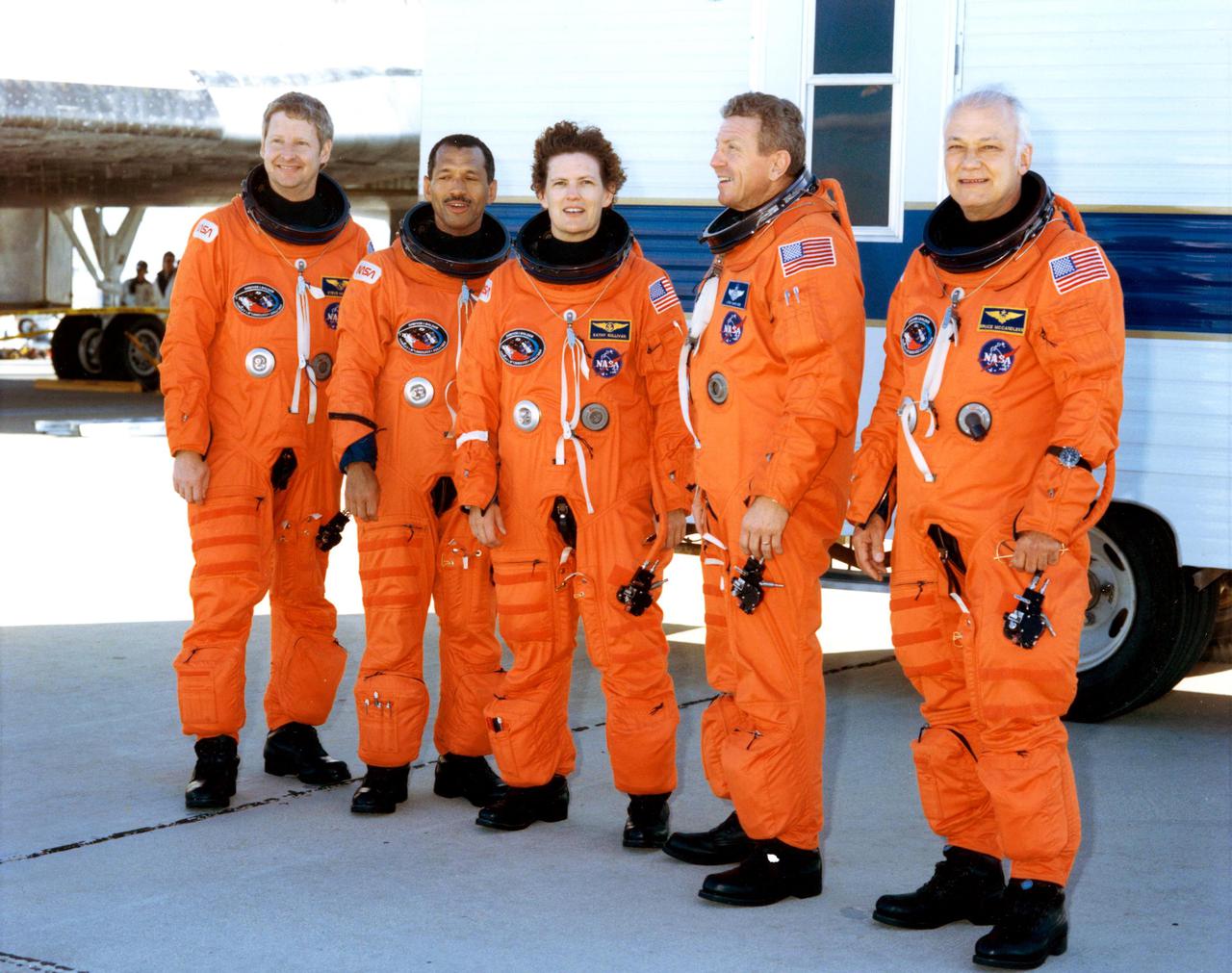
DRYDEN FLIGHT RESEARCH FACILITY, EDWARDS, CALIF. -- STS-31 POST-LANDING CREW PORTRAIT -- The astronauts of STS-31 pose for a quick photo near the Space Shuttle Discovery following a smooth landing on the runway at Edwards Air Force Base to complete a highly successful five day mission. Picture, left to right, are Astronauts Steven A. Hawley, Charles F. Bolden Jr., Kathryn D. Sullivan, Loren J. Shriver, and Bruce McCandless II. Theirs was an Earth-orbital flight during which the Hubble Space Telescope was sent toward its 15-year mission. Landing was completed at 6:51 a.m. (PDT), April 29, 1990.
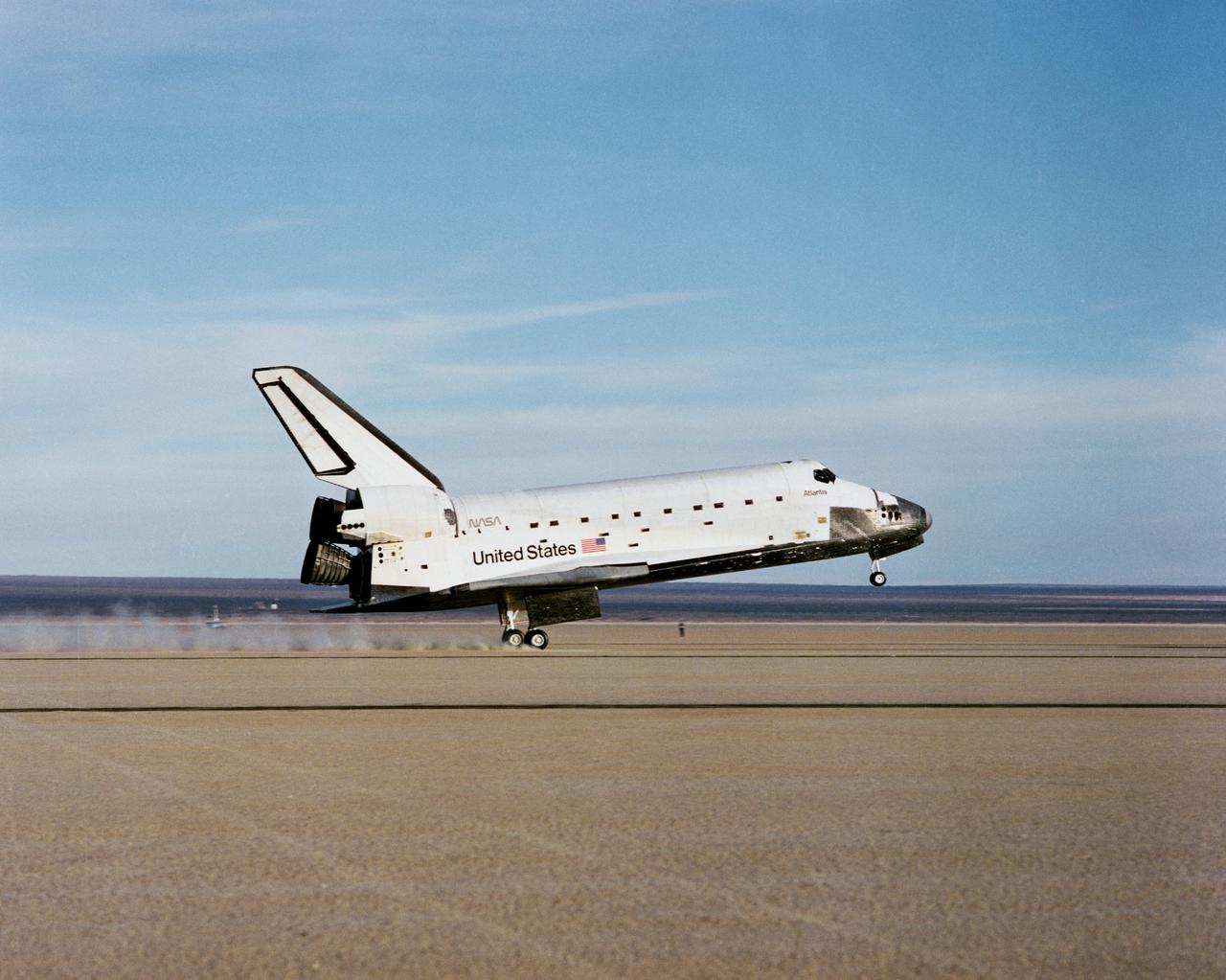
STS027-S-014 (6 Dec. 1988) --- A 70mm camera records the landing of the space shuttle Atlantis on Rogers Dry Lake Bed near the Dryden Flight Research Facility in California. The wheels of the vehicle came to a stop at 3:36:53 p.m. (PST), marking the completion of a successful mission which involved five veteran NASA astronauts. Onboard for the four-day flight were astronauts Robert L. Gibson, Guy S. Gardner, Jerry L. Ross, Richard M. (Mike) Mullane and William M. Shepherd. Photo credit: NASA
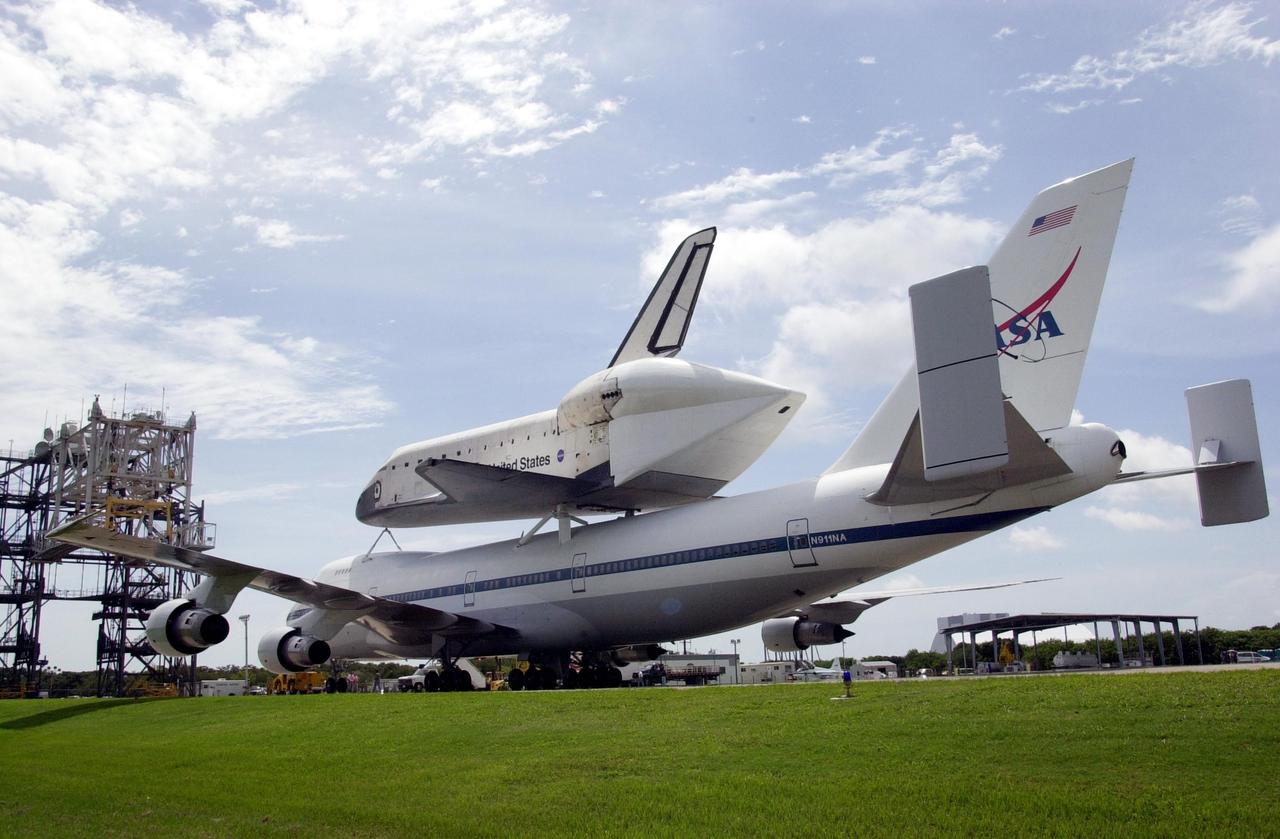
KENNEDY SPACE CENTER, FLA. - Space Shuttle Endeavour approaches the Mate-Demate Device (left) following landing on runway 15 at KSC's Shuttle Landing Facility at 10:58 a.m. EDT atop a modified Boeing 747 Shuttle Carrier Aircraft. The cross-country ferry flight became necessary when three days of unfavorable weather conditions at KSC forced Endeavour to land on runway 22 at Dryden Flight Research Center, Edwards Air Force Base, Calif., on June 19 following mission STS-111. Processing of Endeavour will now begin for the launch of mission STS-113 targeted for October 2002
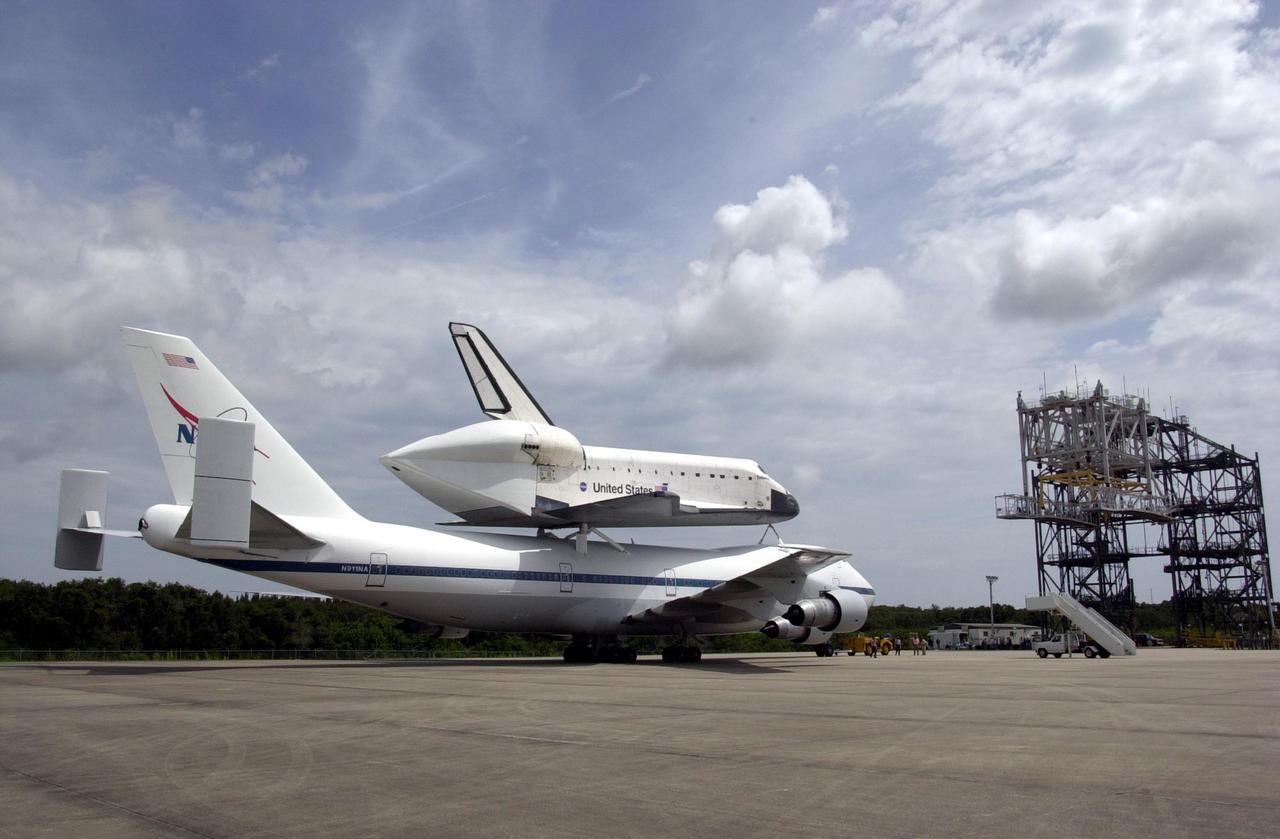
KENNEDY SPACE CENTER, FLA. - Space Shuttle Endeavour is towed toward the Mate-Demate Device (right) following landing on runway 15 at KSC's Shuttle Landing Facility at 10:58 a.m. EDT atop a modified Boeing 747 Shuttle Carrier Aircraft. The cross-country ferry flight became necessary when three days of unfavorable weather conditions at KSC forced Endeavour to land on runway 22 at Dryden Flight Research Center, Edwards Air Force Base, Calif., on June 19 following mission STS-111. Processing of Endeavour will now begin for the launch of mission STS-113 targeted for October 2002
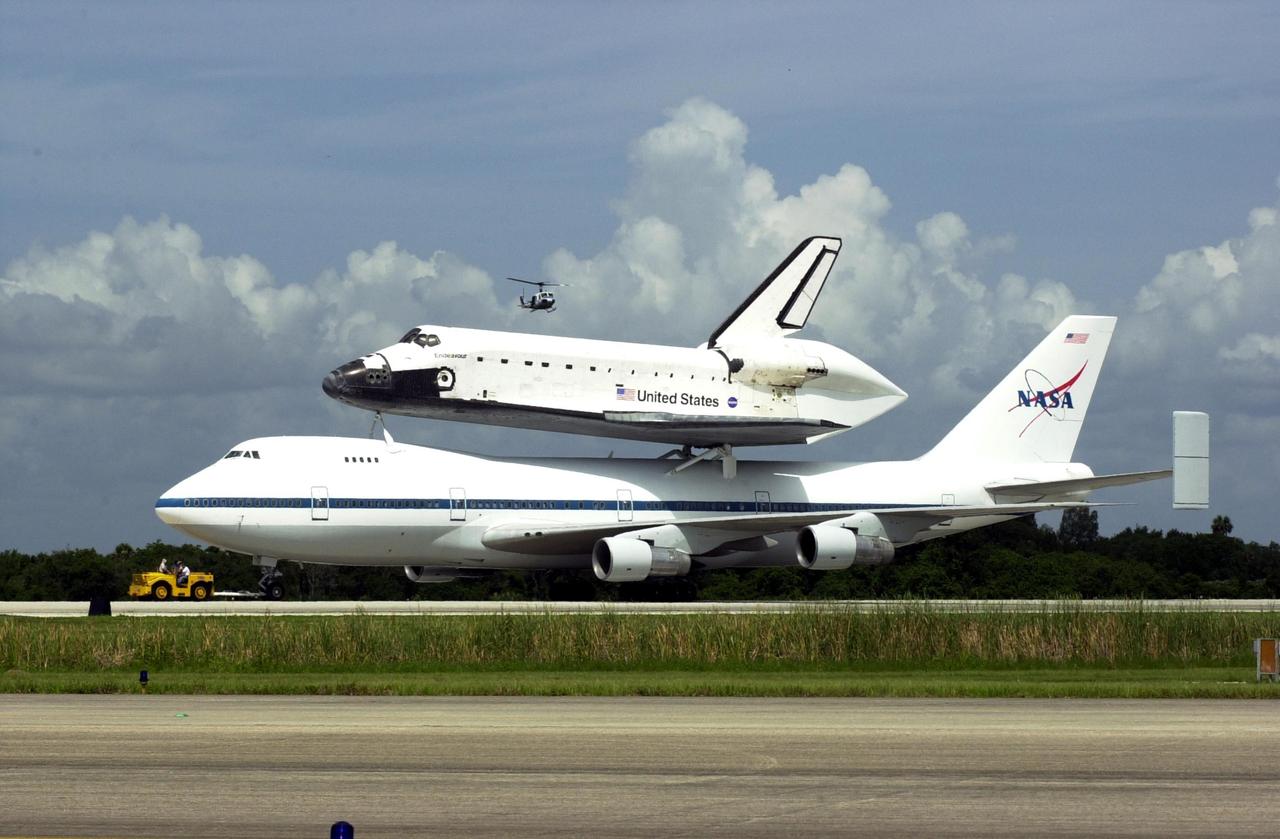
KENNEDY SPACE CENTER, FLA. - Space Shuttle Endeavour is towed toward the Mate-Demate Device following landing on runway 15 at KSC's Shuttle Landing Facility at 10:58 a.m. EDT atop a modified Boeing 747 Shuttle Carrier Aircraft. The cross-country ferry flight became necessary when three days of unfavorable weather conditions at KSC forced Endeavour to land on runway 22 at Dryden Flight Research Center, Edwards Air Force Base, Calif., on June 19 following mission STS-111. Processing of Endeavour will now begin for the launch of mission STS-113 targeted for October 2002
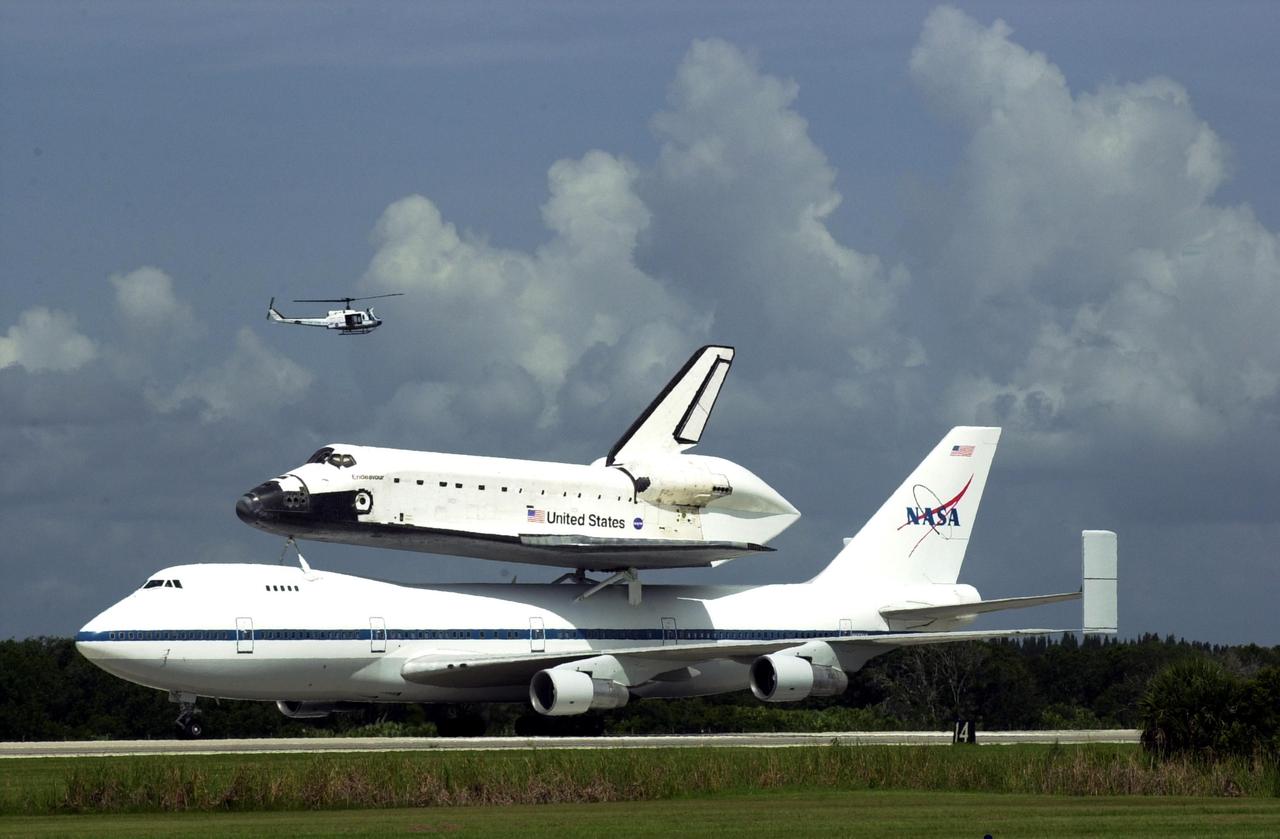
KENNEDY SPACE CENTER, FLA. - Space Shuttle Endeavour lands on runway 15 at KSC's Shuttle Landing Facility at 10:58 a.m. EDT atop a modified Boeing 747 Shuttle Carrier Aircraft. The cross-country ferry flight became necessary when three days of unfavorable weather conditions at KSC forced Endeavour to land on runway 22 at Dryden Flight Research Center, Edwards Air Force Base, Calif., on June 19 following mission STS-111. Processing of Endeavour will now begin for the launch of mission STS-113 targeted for October 2002
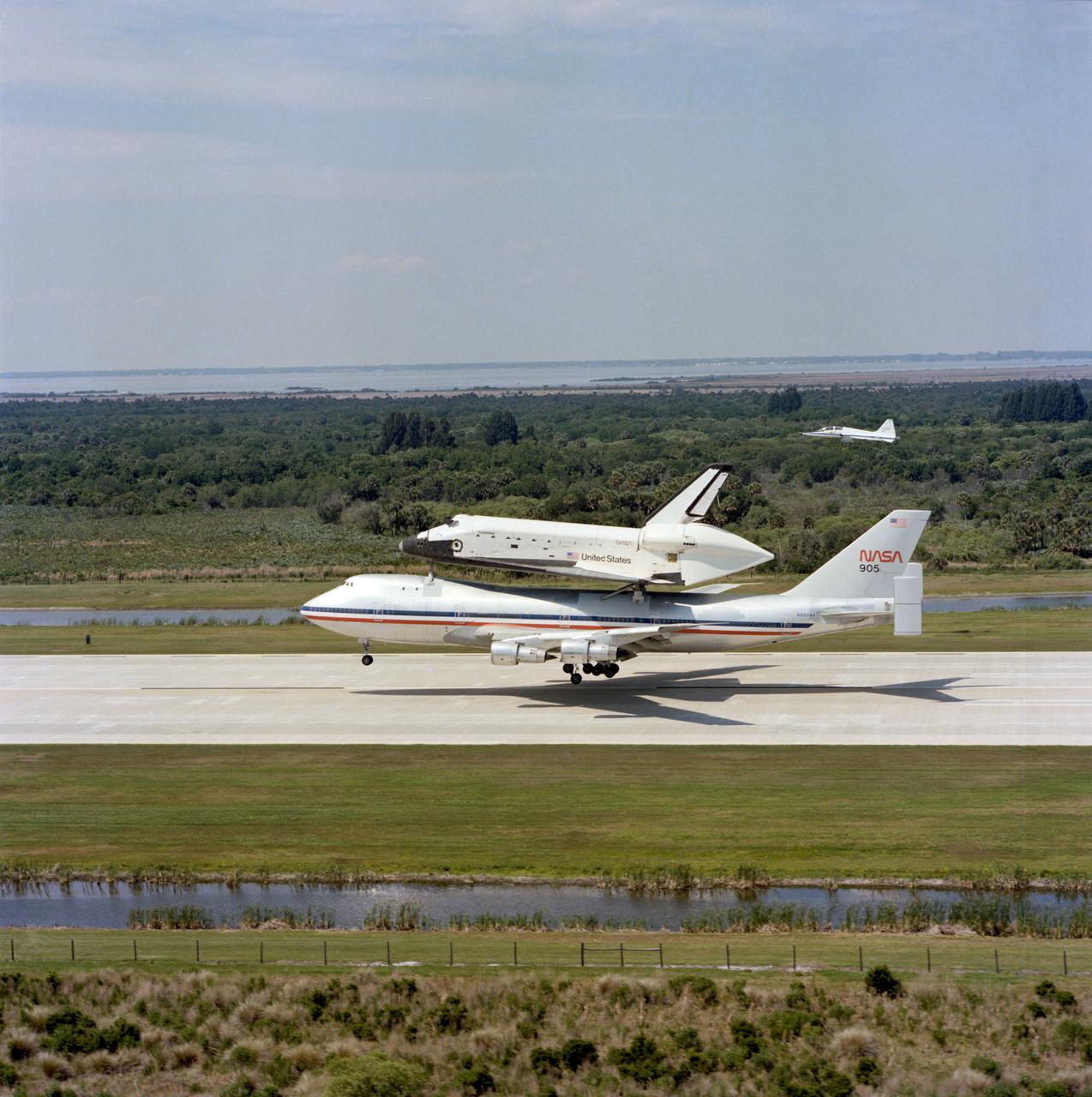
S81-32625 (April 1981) --- This scene represents the end of NASA's STS-1 mission and the beginning of STS-2 in that the orbiter Columbia is arriving at Kennedy Space Center in Florida to begin the lengthy process of preparing it for STS-2. The vehicle landed at Dryden Flight Research Center on April 14 after an historic 2 1/3 day flight in Earth orbit. It was mated to this 747 aircraft, titled NASA 905, and flown over the USA to its Florida destination. It was later removed from atop NASA 905 and moved to the orbiter processing facility for the beginning of refurbishment. Photo credit: NASA
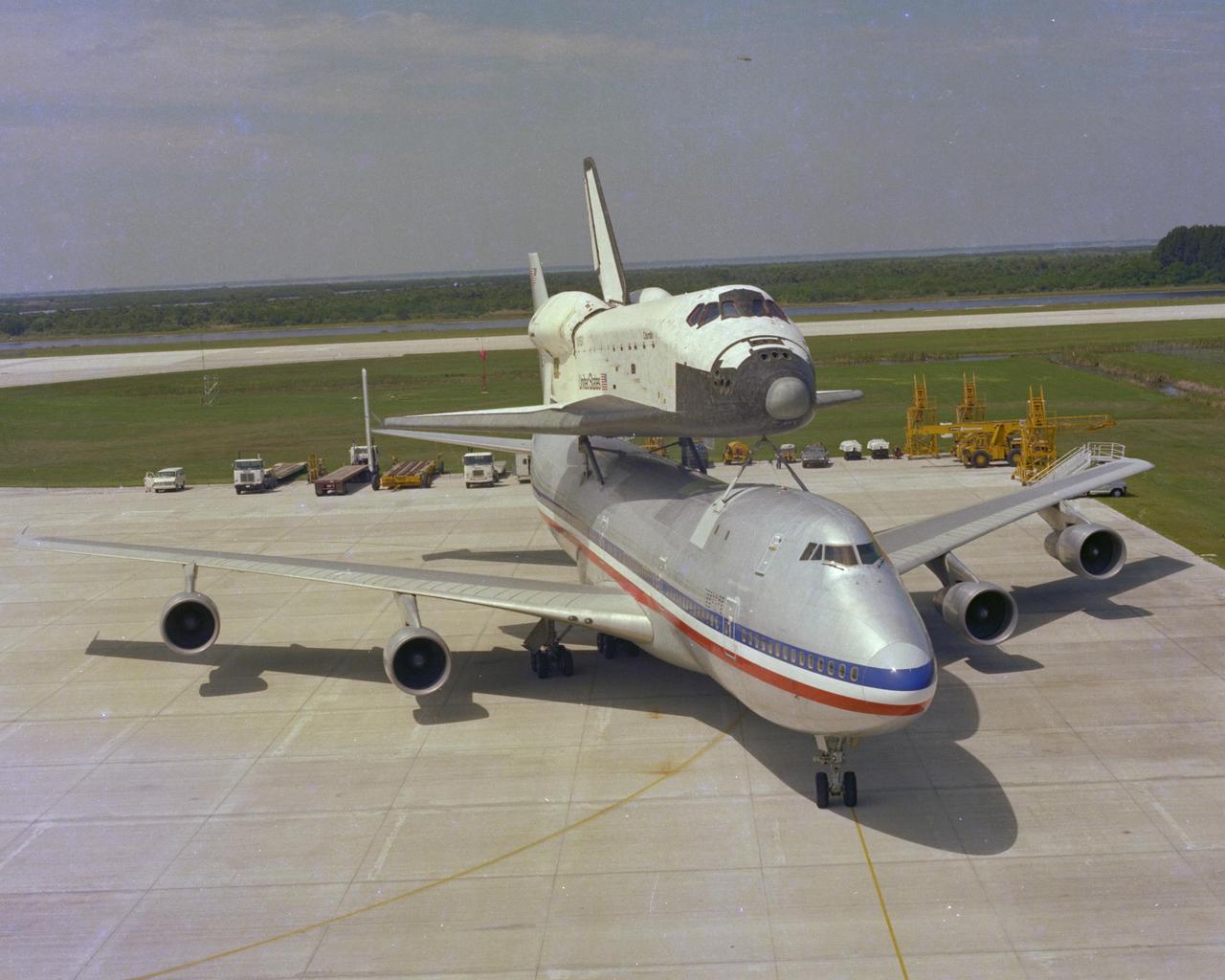
KENNEDY SPACE CENTER, FLA. - The Space Shuttle Orbiter Columbia - riding piggyback atop a modified 747 jet called the Shuttle Carrier Aircraft - arrives at Kennedy Space Center after a two-day journey from the Dryden Flight Research Center in California. Welcomed home by a crowd of KSC employees and their families and guests, Columbia touched down on the Shuttle Landing Facility at 11:23 a.m. Tuesday, two weeks after its return to Earth from the first Space Shuttle flight into space. The orbiter and SCA are seen here parked in front of the Mate_Demate Device, where the orbiter will be hoisted off the 747.
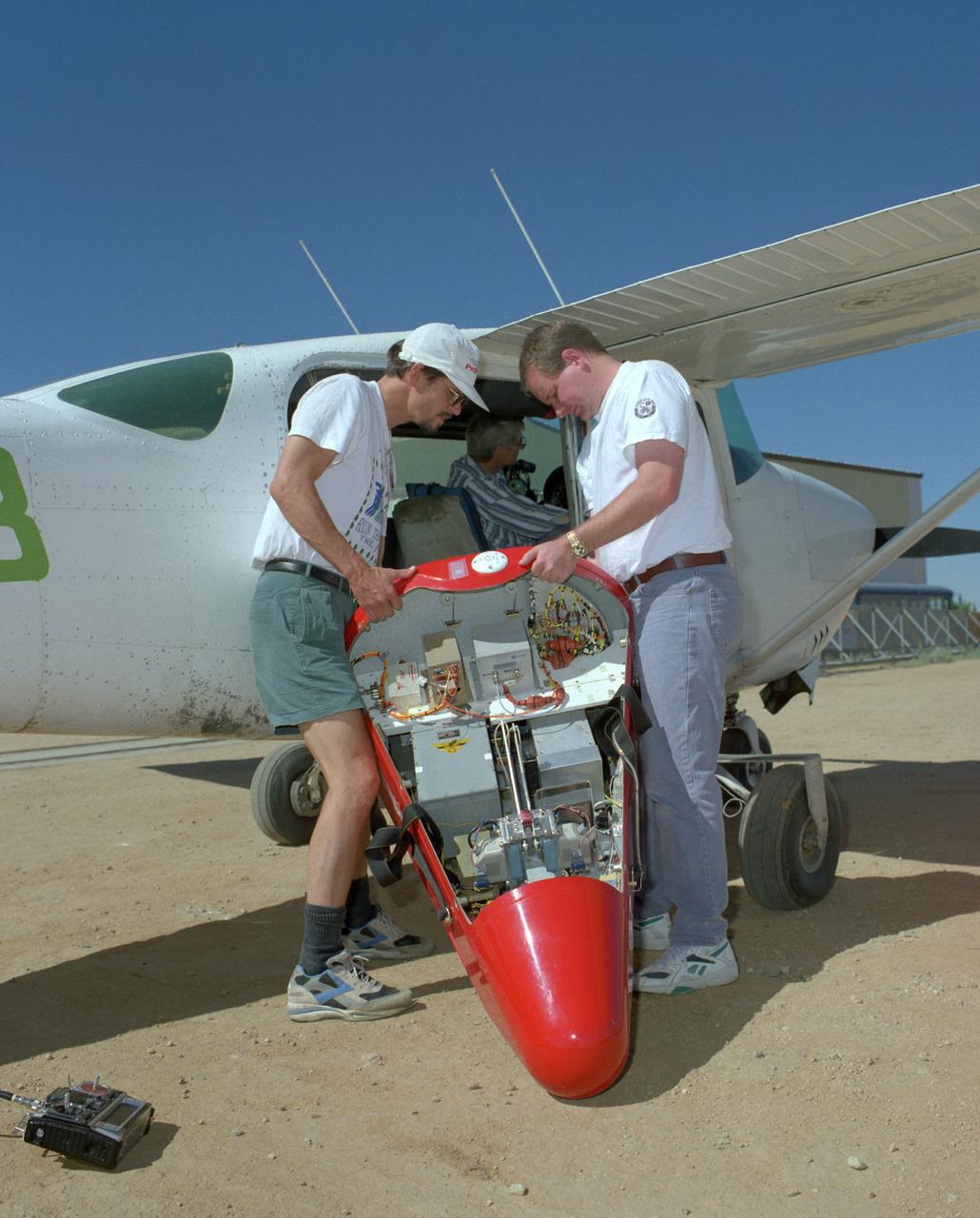
Crew members load a Spacewedge subscale research model into a Cessna aircraft for flight testing in 1996. The Spacewedge was drop-launched from the Cessna and then glided back to a soft landing under a steerable parafoil.
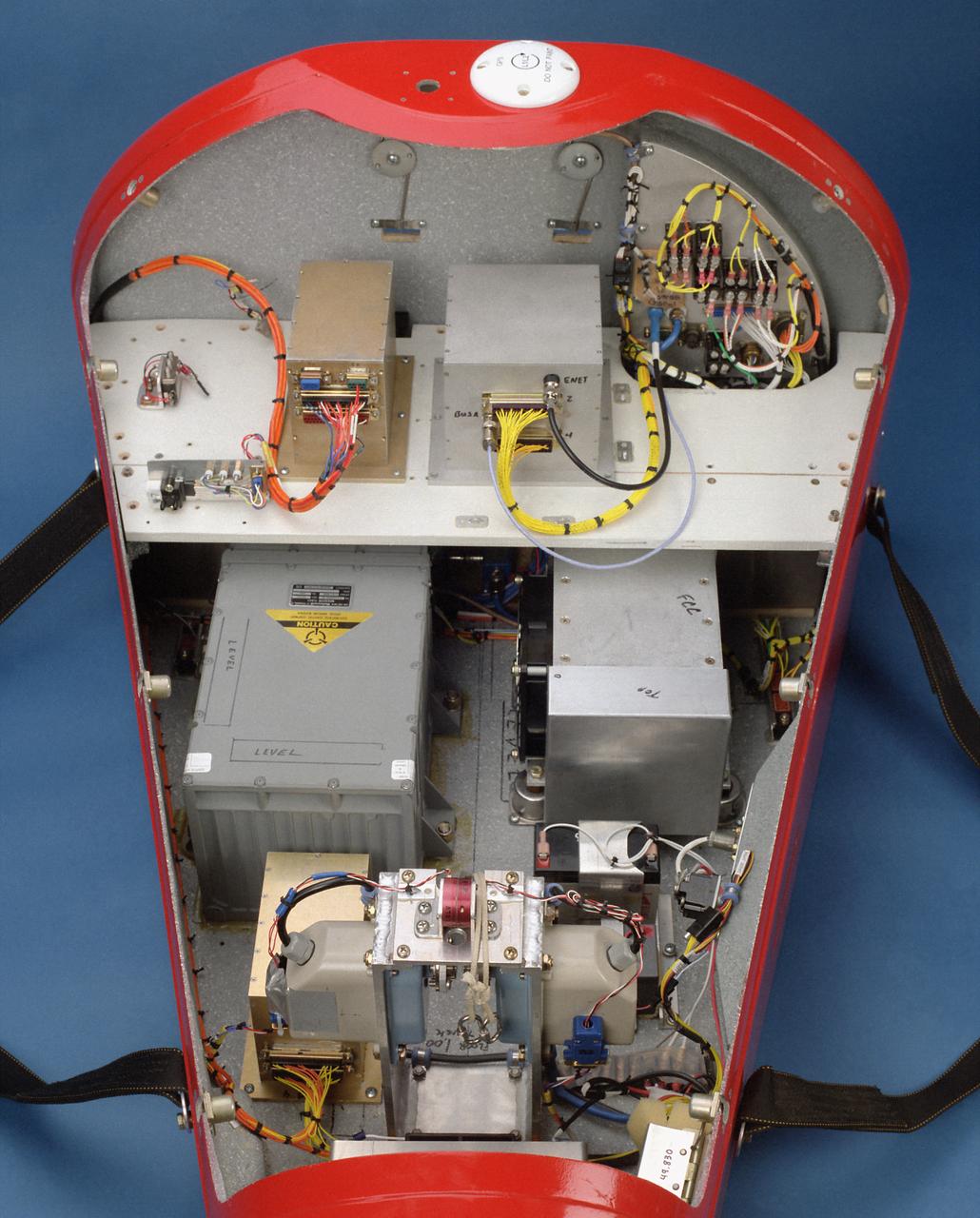
This photo shows the instrumentation and equipment inside the Spacewedge #3, a remotely-piloted research vehicle flown at the Dryden Flight Research Center, Edwards, California, to help develop technology for autonomous return systems for spacecraft as well as methods to deliver large Army cargo payloads to precise landings.
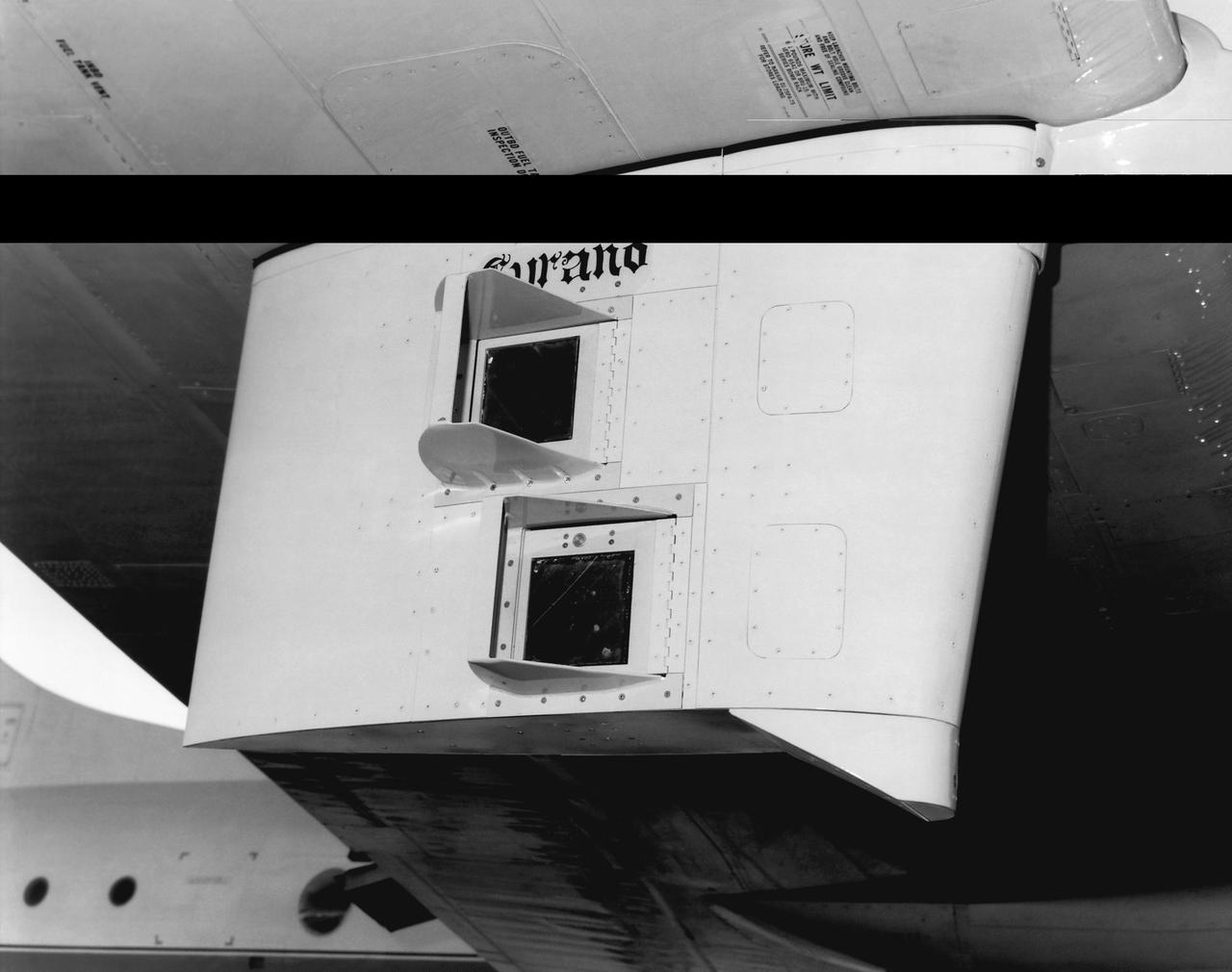
This photo shows the Shuttle tile flight test fixture under the wing of a National Oceanographic and Atmospheric Administration WP-3D aircraft.
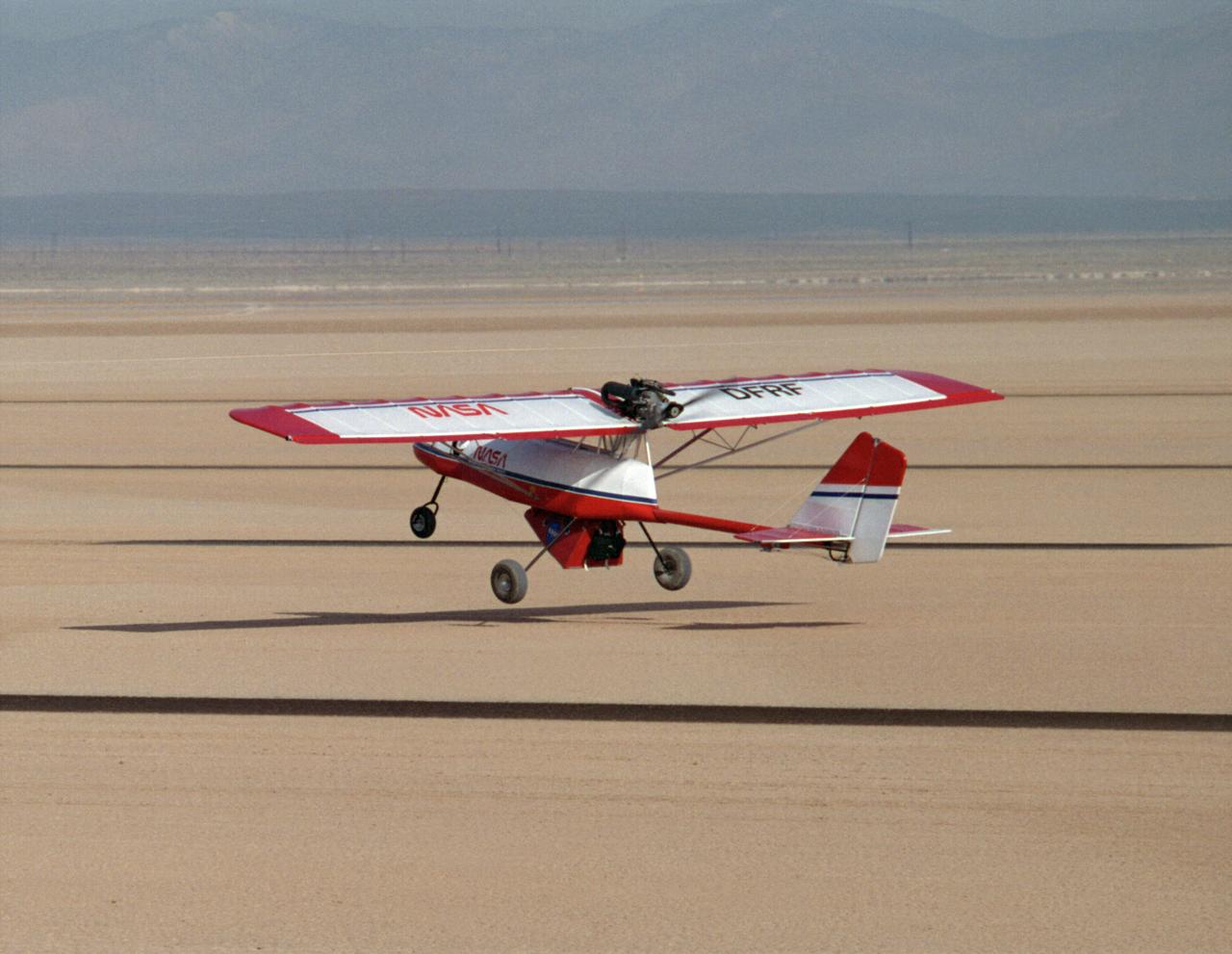
A Rans S-12 remotely piloted "mothership" takes off from a lakebed runway carrying a Spacewedge research model during 1992 flight tests. The Spacewedge was lauched in flight from the Rans S-12 aircraft and then glided back to a landing under a steerable parafoil. Technology tested in the Spacewedge program was used in developing the X-38 research vehicle.
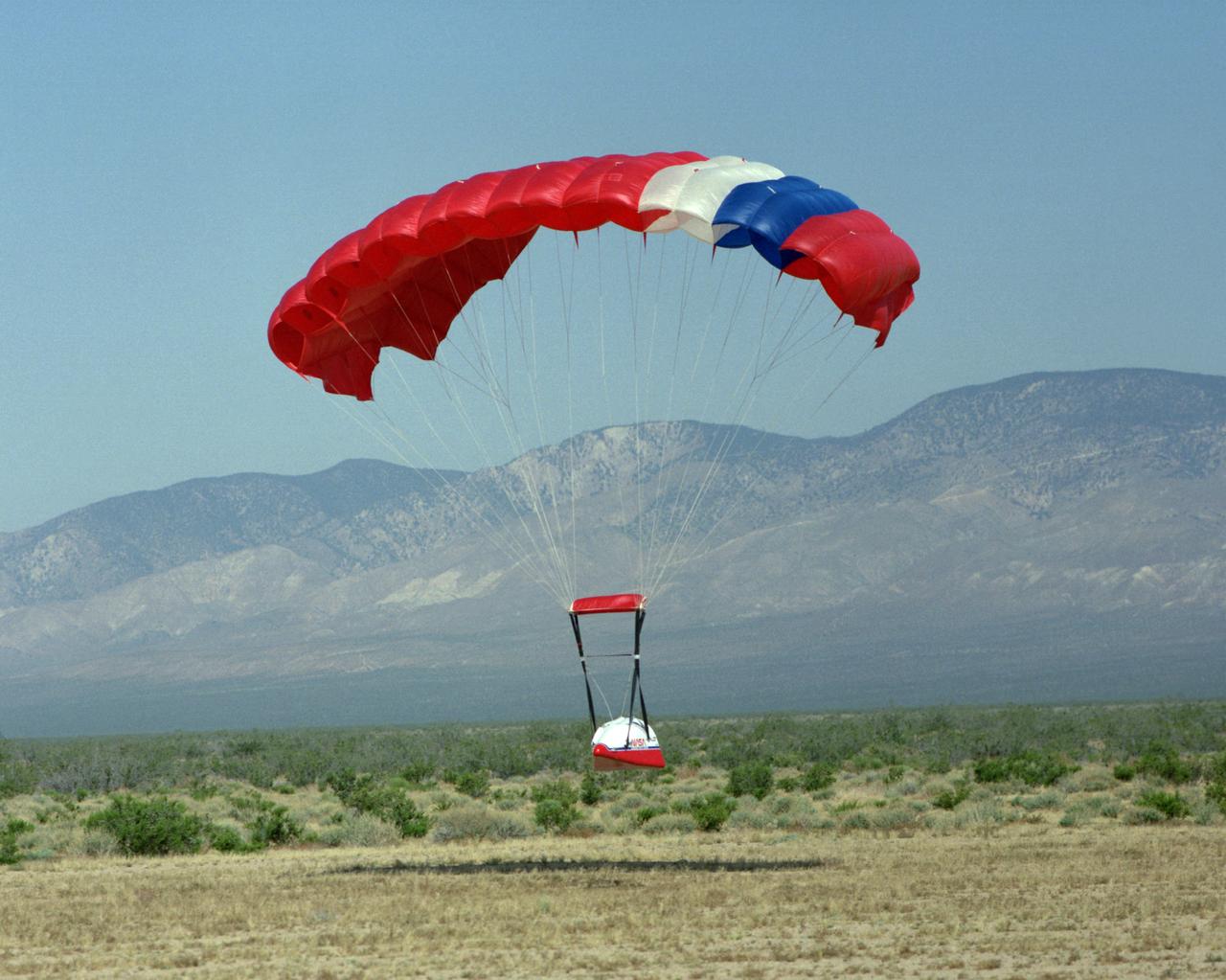
The Spacewedge subscale research model glides in toward a touchdown at a California City landing zone during 1992 flight tests of the vehicle.
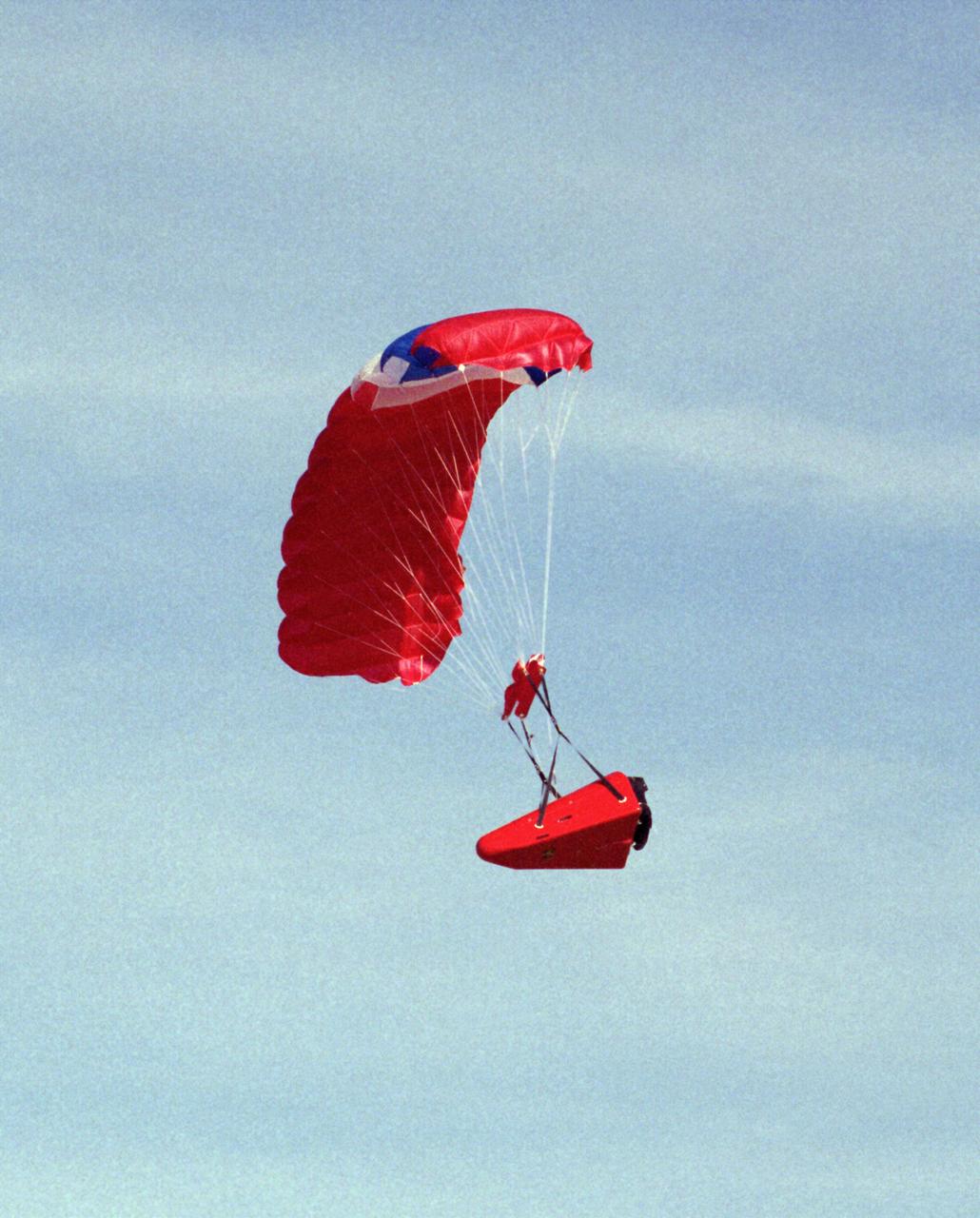
One of the Spacewedge remotely-piloted research vehicles in flight under a steerable parafoil during 1995 research flights conducted by NASA’s Dryden Flight Research Center.
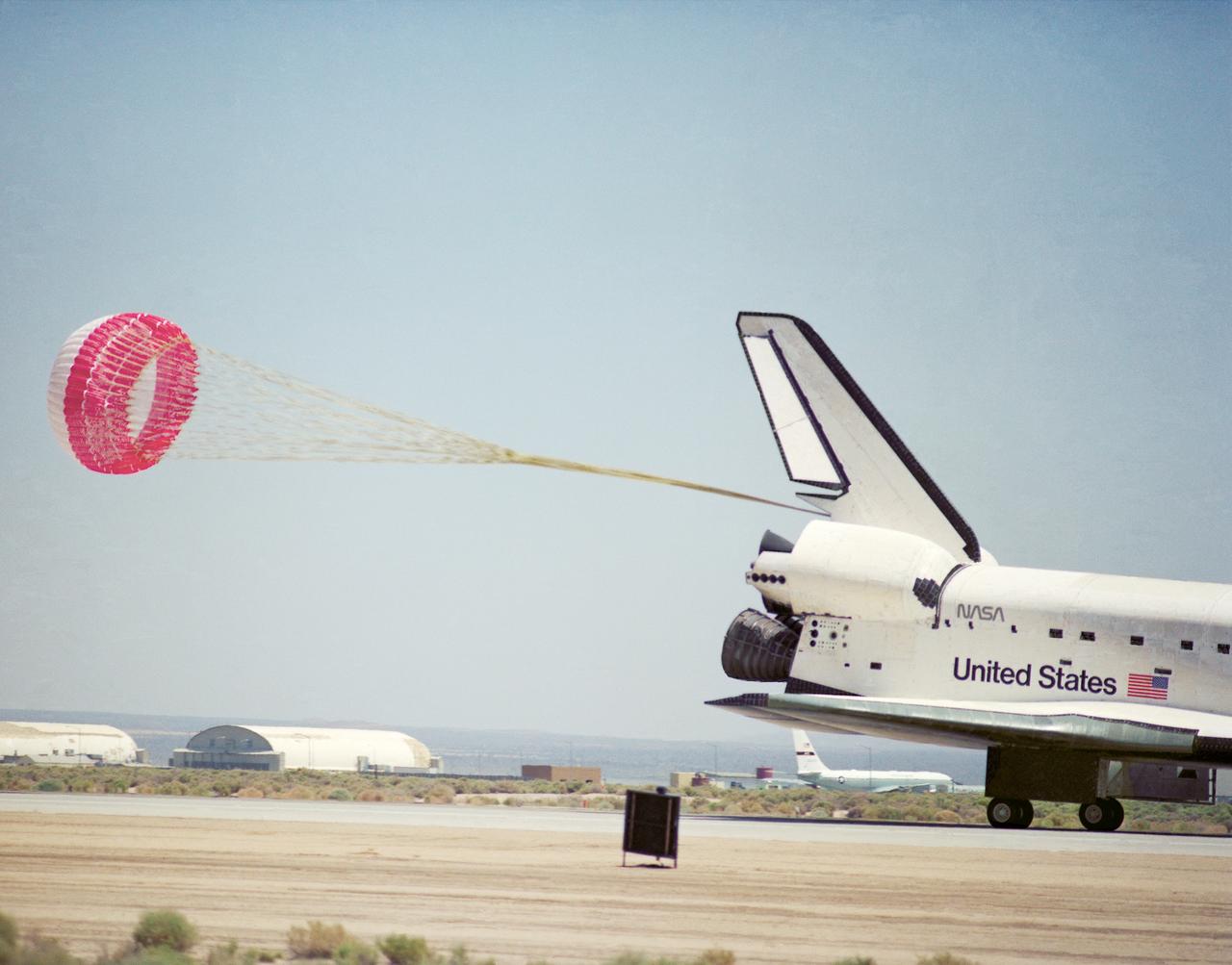
The Space Shuttle Endeavour concludes mission STS-49 at NASA's Ames-Dryden Flight Research Facility (later redesignated Dryden Flight Research Center), Edwards, California, with a 1:57 p.m. (PDT) landing 16 May on Edward's concrete runway 22. The planned 7-day mission, which began with a launch from Kennedy Space Center, Florida, at 4:41 p.m. (PFT), 7 May, was extended two days to allow extra time to rescue the Intelsat VI satellite and complete Space Station assembly techniques originally planned. After a perfect rendezvous in orbit and numerous attempts to grab the satellite, space walking astronauts Pierre Thuot, Rick Hieb and Tom Akers successfully rescued it by hand on the third space walk with the support of mission specialists Kathy Thornton and Bruce Melnick. The three astronauts, on a record space walk, took hold of the satellite and directed it to the shuttle where a booster motor was attached to launch it to its proper orbit. Commander Dan Brandenstein and Pilot Kevin Chilton brought Endeavours's record setting maiden voyage to a perfect landing at Edwards AFB with the first deployment of a drag chute on a shuttle mission.
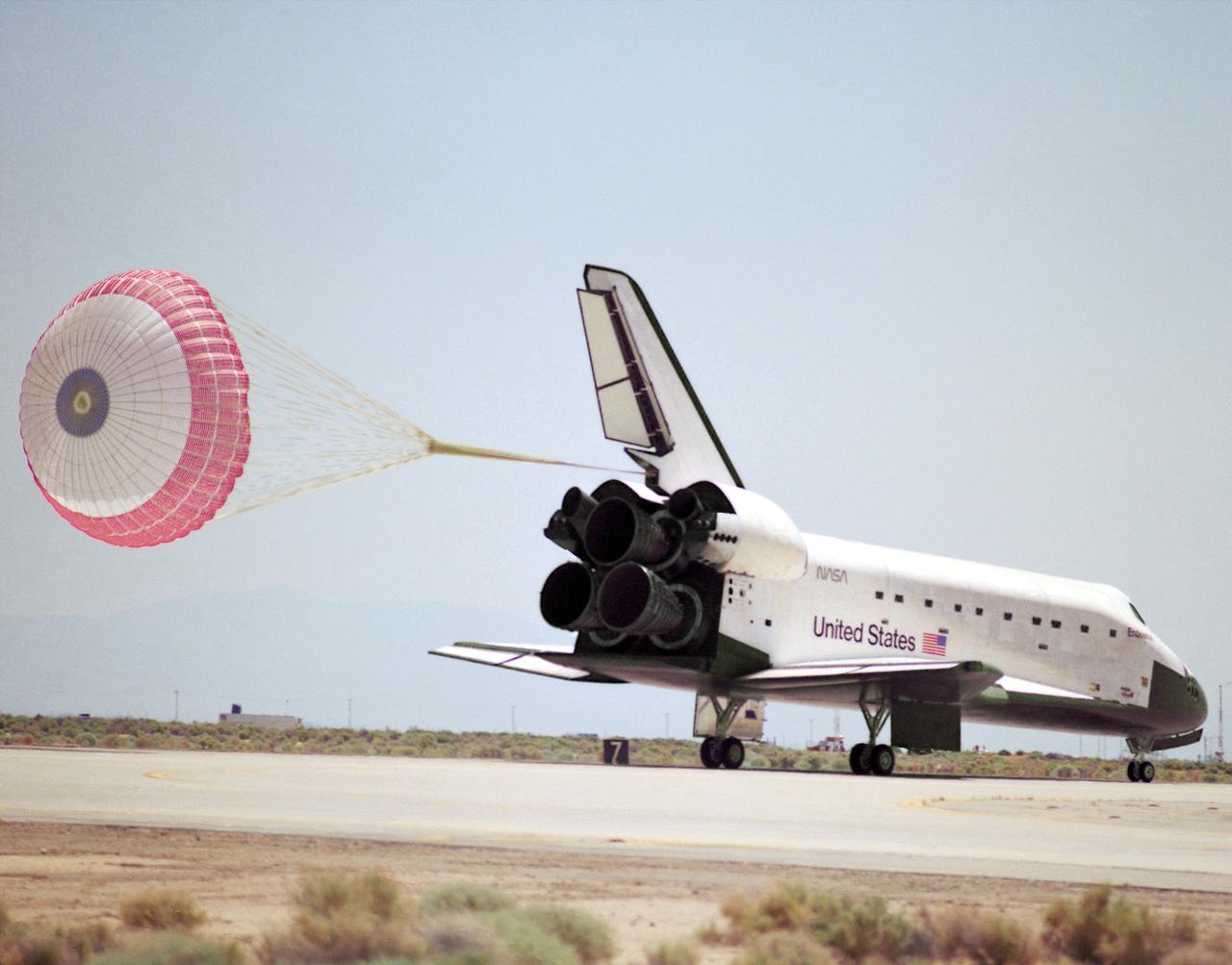
The Space Shuttle Endeavour concludes mission STS-49 at NASA's Ames-Dryden Flight Research Facility (later redesignated Dryden Flight Research Center), Edwards, California, with a 1:57 p.m. (PDT) landing May 16 on Edward's concrete runway 22. The planned 7-day mission, which began with a launch from Kennedy Space Center, Florida, at 4:41 p.m. (PFT), 7 May, was extended two days to allow extra time to rescue the Intelsat VI satellite and complete Space Station assembly techniques originally planned. After a perfect rendezvous in orbit and numerous attempts to grab the satellite, space walking astronauts Pierre Thuot, Rick Hieb and Tom Akers successfully rescued it by hand on the third space walk with the support of mission specialists Kathy Thornton and Bruce Melnick. The three astronauts, on a record space walk, took hold of the satellite and directed it to the shuttle where a booster motor was attached to launch it to its proper orbit. Commander Dan Brandenstein and Pilot Kevin Chilton brought Endeavours's record setting maiden voyage to a perfect landing at Edwards with the first deployment of a drag chute on a shuttle mission.
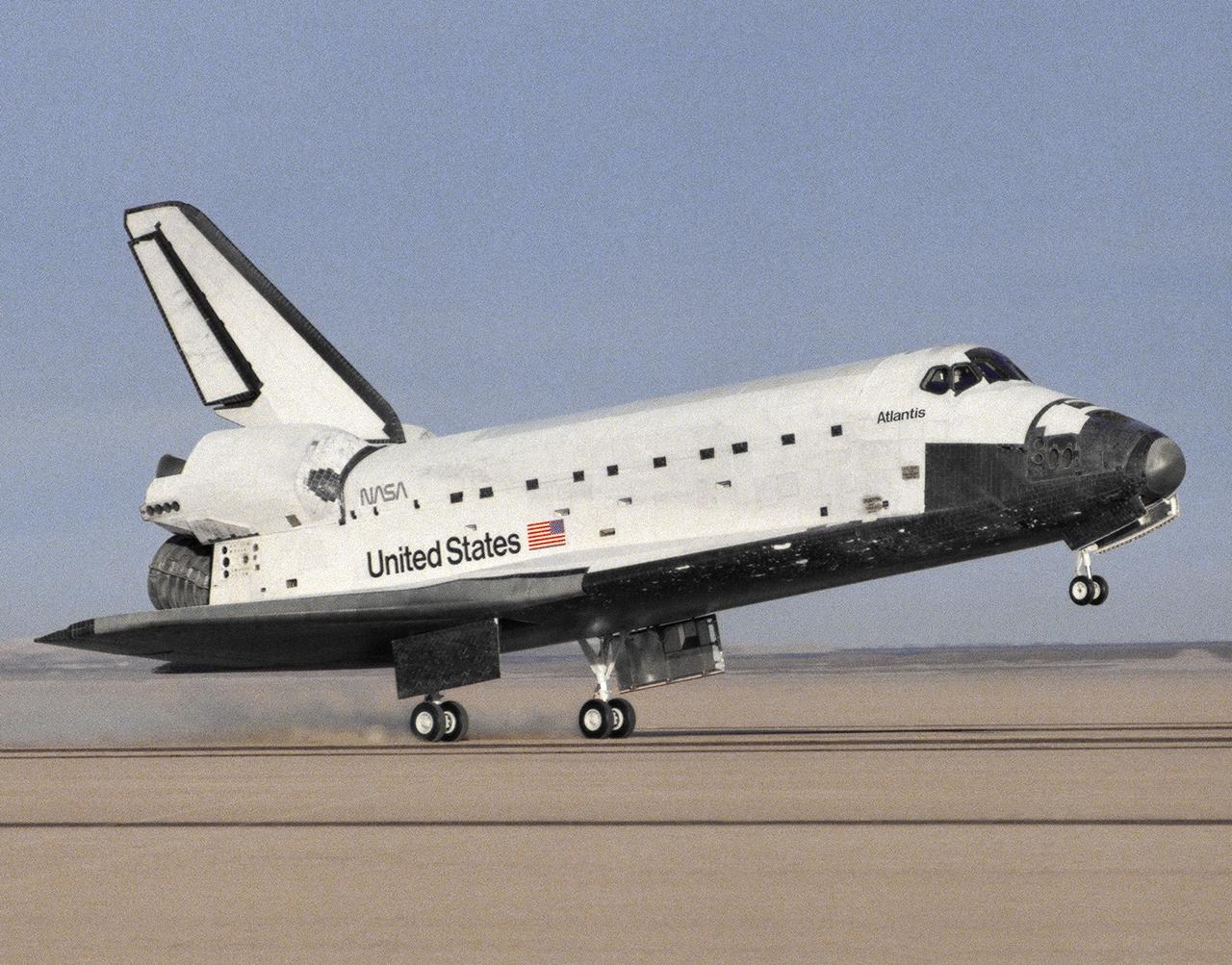
The Space Shuttle Atlantis touches down at 3:35 p.m. PST on 6 December 1988 at NASA's then Ames-Dryden Flight Research Facility at the conclusion of the STS-27 Department of Defense mission. Landing took place on runway 17 of the Rogers Dry Lake, concluding the 4-day, 9-hour, 6-minute mission. The five-man crew was led by Commander Robert L. Gibson and included Pilot Guy S. Gardner; Mission Specialists Jerry L. Ross, William M. Sheperd, and Richard M. Mullane. Atlantis was launched on December 2 from NASA's Kennedy Space Center.

B-57B on ramp
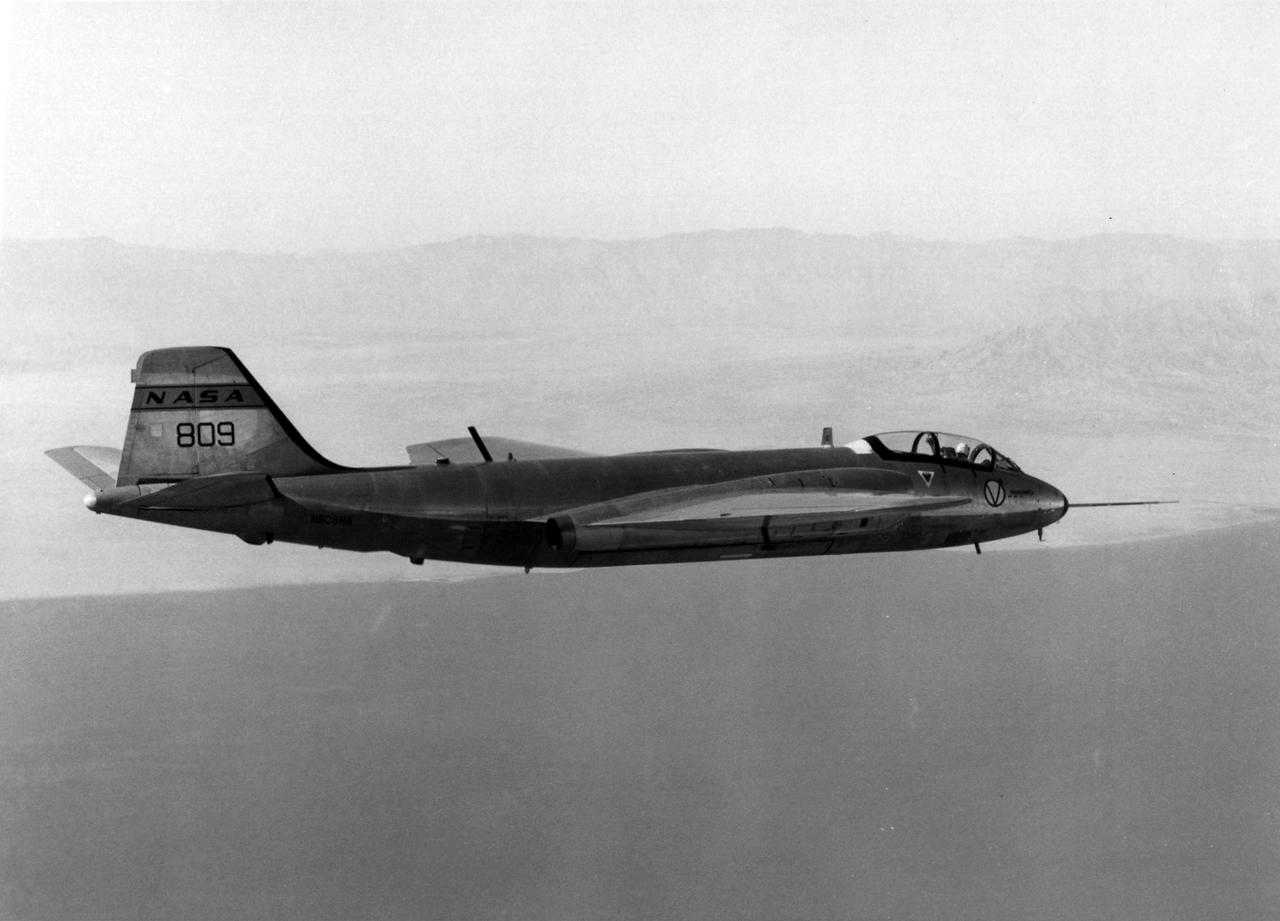
B-57B in flight
The three thrust-vectoring aircraft at Edwards, California, each capable of flying at extreme angles of attack, cruise over the California desert in formation during flight in March 1994. They are, from left, NASA's F-18 High Alpha Research Vehicle (HARV), flown by the NASA Dryden Flight Research Center; the X-31, flown by the X-31 International Test Organization (ITO) at Dryden; and the Air Force F-16 Multi-Axis Thrust Vectoring (MATV) aircraft.
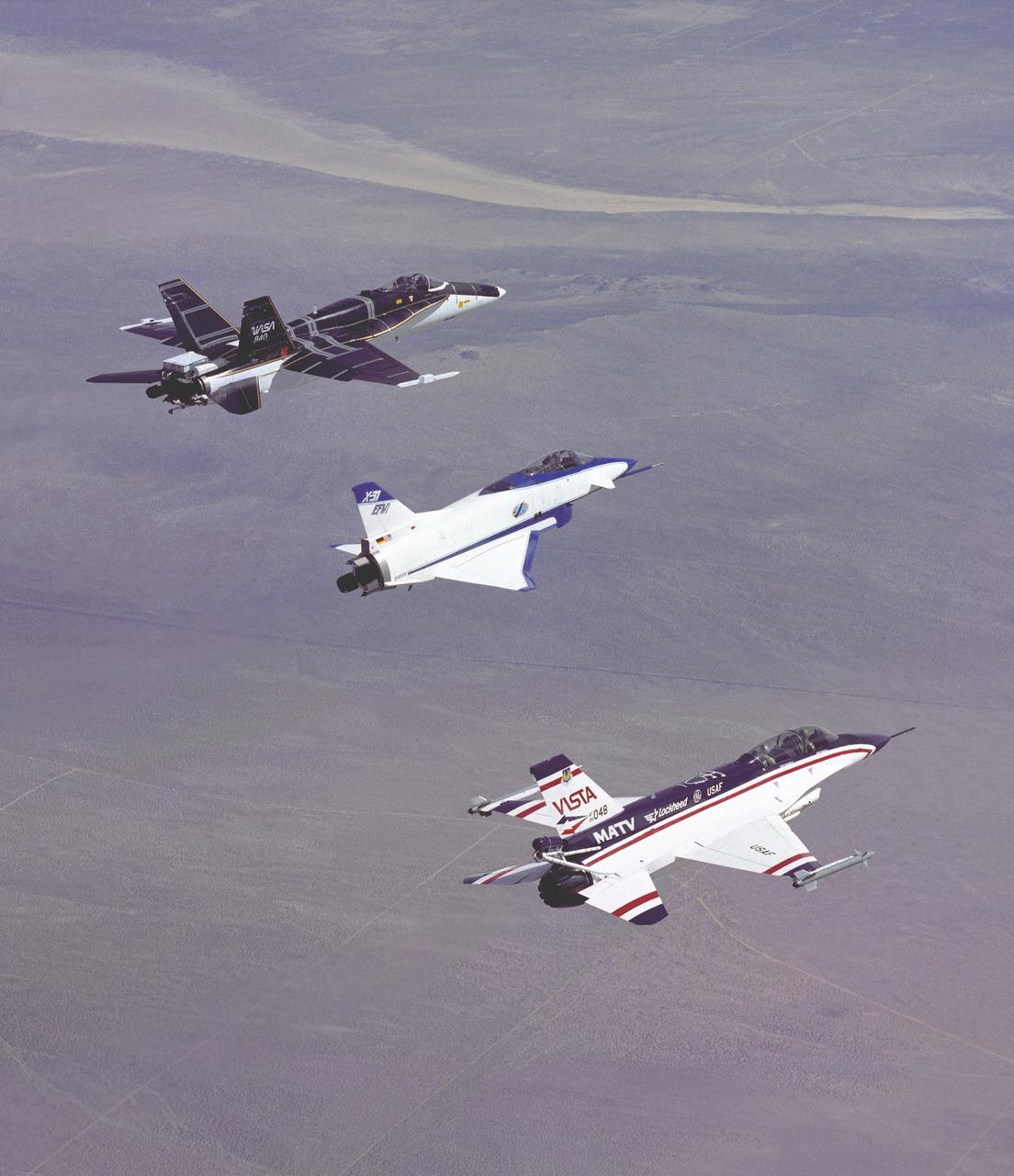
The three thrust-vectoring aircraft at Edwards, California, each capable of flying at extreme angles of attack, cruise over the California desert in formation during flight in March 1994. They are, from left, NASA's F-18 High Alpha Research Vehicle (HARV), flown by the NASA Dryden Flight Research Center; the X-31, flown by the X-31 International Test Organization (ITO) at Dryden; and the Air Force F-16 Multi-Axis Thrust Vectoring (MATV) aircraft.
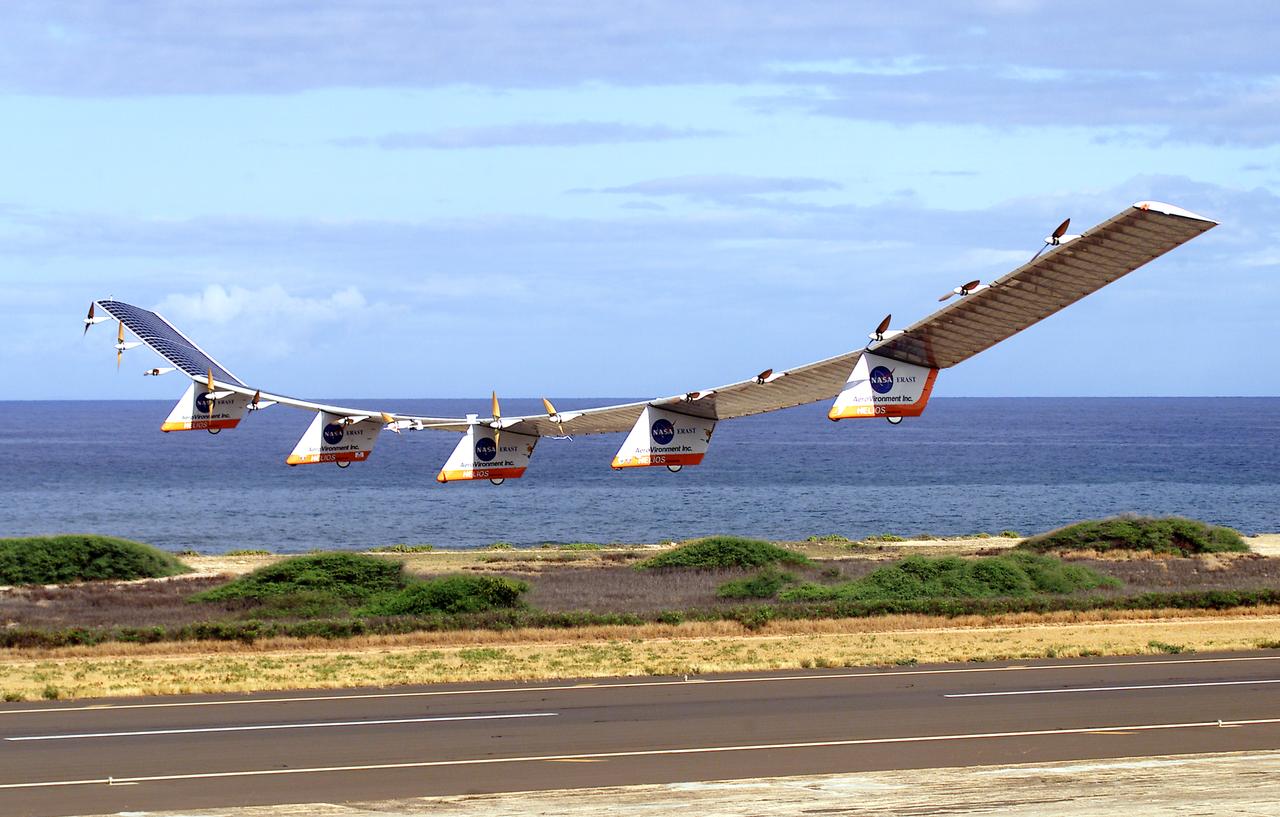
NASA's Helios Prototype aircraft taking off from the Pacific Missile Range Facility, Kauai, Hawaii, for the record flight. As a follow-on to the Centurion (and earlier Pathfinder and Pathfinder-Plus) aircraft, the solar-powered Helios Prototype is the latest and largest example of a slow-flying ultralight flying wing designed for long-duration, high-altitude Earth science or telecommunications relay missions in the stratosphere. Developed by AeroVironment, Inc., of Monrovia, California, under NASA's Environmental Research Aircraft and Sensor Technology (ERAST) project, the unique craft is intended to demonstrate two key missions: the ability to reach and sustain horizontal flight at 100,000 feet altitude on a single-day flight in 2001, and to maintain flight above 50,000 feet altitude for at least four days in 2003, with the aid of a regenerative fuel cell-based energy storage system now in development. Both of these missions will be powered by electricity derived from non-polluting solar energy. The Helios Prototype is an enlarged version of the Centurion flying wing, which flew a series of test flights at NASA's Dryden Flight Research Center in late 1998. The craft has a wingspan of 247 feet, 41 feet greater than the Centurion, 2 1/2 times that of its solar-powered Pathfinder flying wing, and longer than the wingspans of either the Boeing 747 jetliner or Lockheed C-5 transport aircraft. The remotely piloted, electrically powered Helios Prototype went aloft on its maiden low-altitude checkout flight Sept. 8, 1999, over Rogers Dry Lake adjacent to NASA's Dryden Flight Research Center in the Southern California desert. The initial flight series was flown on battery power as a risk-reduction measure. In all, six flights were flown in the Helios Protoype's initial development series. In upgrading the Centurion to the Helios Prototype configuration, AeroVironment added a sixth wing section and a fifth landing gear pod, among other improvements. The additional wingsp
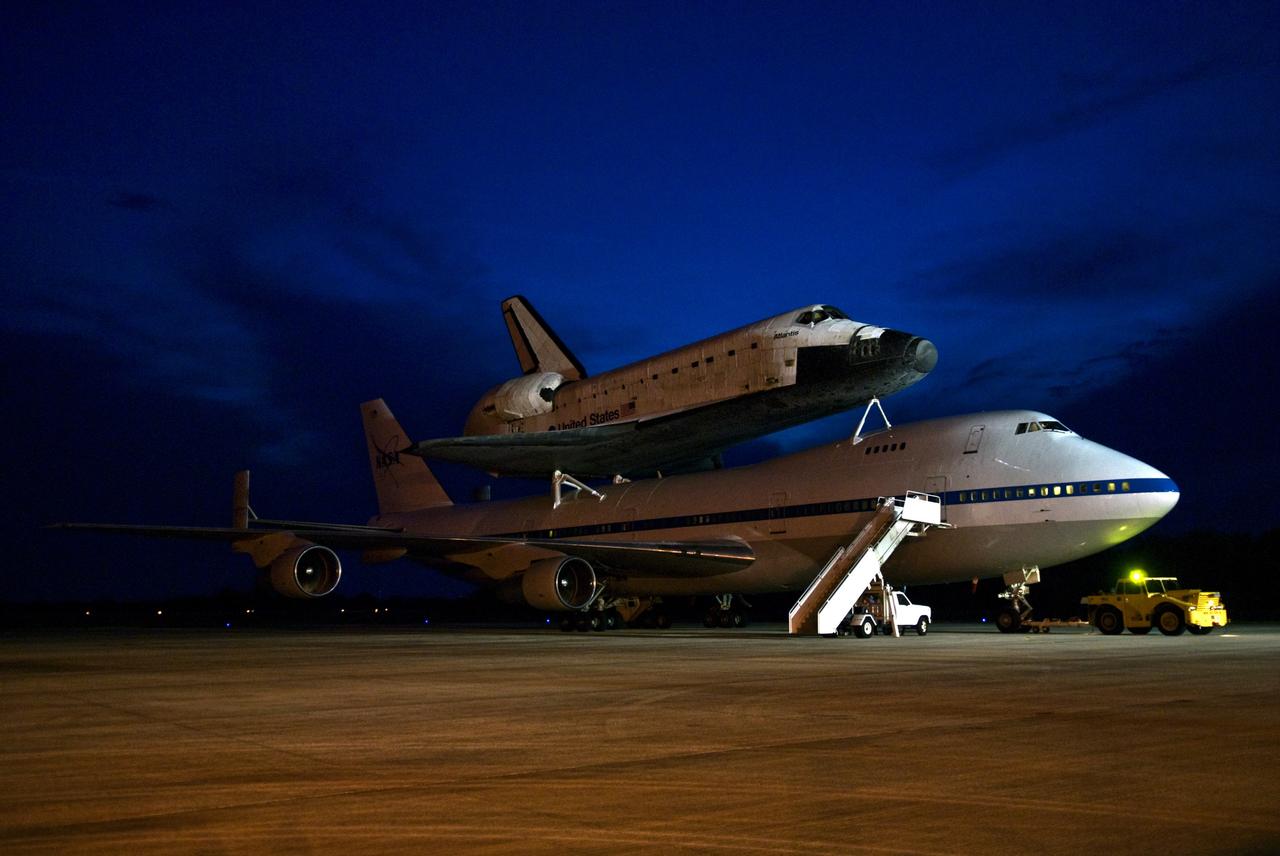
CAPE CANAVERAL, Fla. – Space shuttle Atlantis on top of the Shuttle Carrier Aircraft, or SCA, is parked on the tarmac of NASA Kennedy Space Center's Shuttle Landing Facility. The SCA landed at Kennedy after a more than 2,500-mile cross-country ferry flight from NASA's Dryden Flight Research Center at Edwards Air Force Base in Southern California. The SCA is a modified Boeing 747 jetliner. Atlantis returned from California atop the SCA after its May 24 landing at Edwards Air Force Base, concluding mission STS-125. The ferry flight from Edwards began June 1. Atlantis' next assignment is the STS-129 mission, targeted to launch in November 2009. Photo credit: NASA/Kim Shiflett
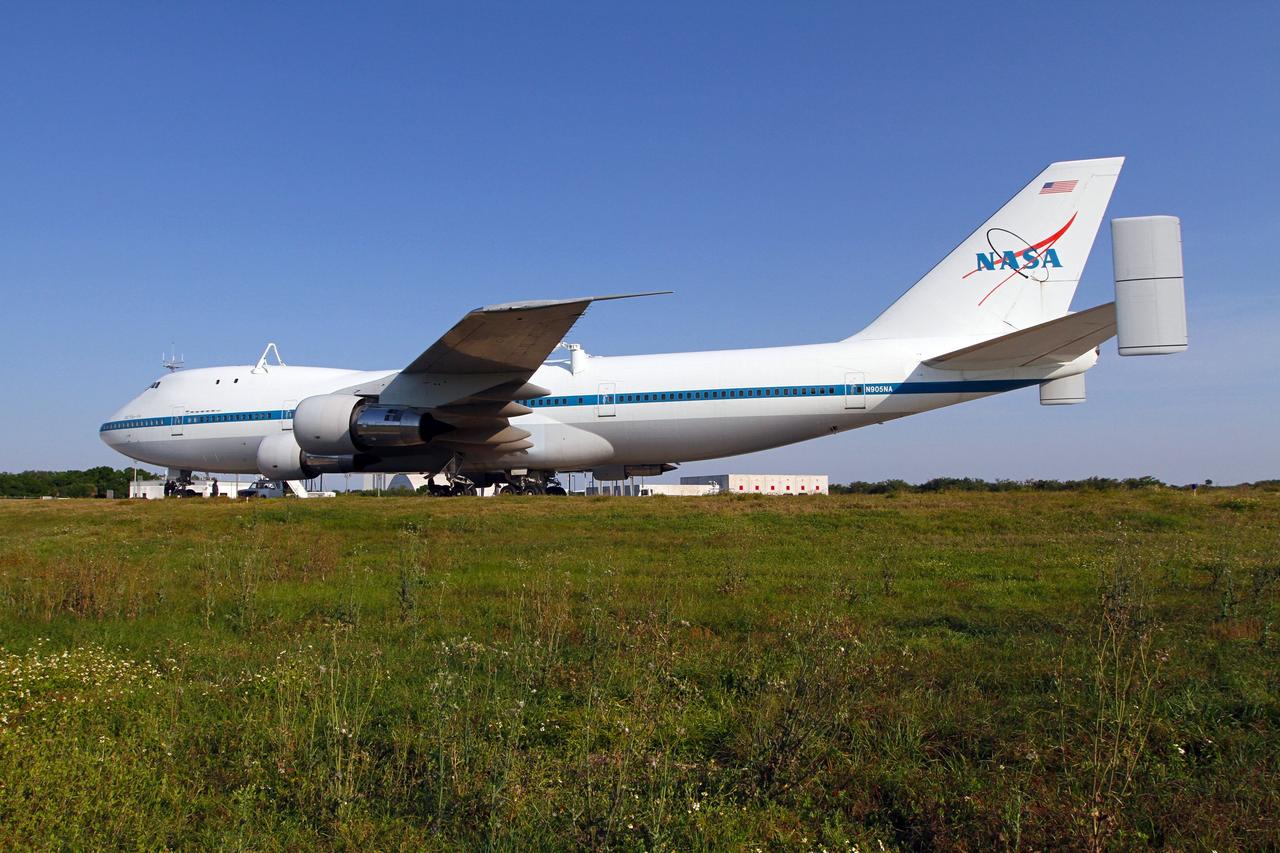
CAPE CANAVERAL, Fla. – The Shuttle Carrier Aircraft comes to a stop on the apron of the runway at the Shuttle Landing Facility at NASA’s Kennedy Space Center in Florida. The aircraft, known as an SCA, arrived at 5:35 p.m. EDT to prepare for shuttle Discovery’s ferry flight to the Washington Dulles International Airport in Sterling, Va., on April 17. This SCA, designated NASA 905, is a modified Boeing 747 jet airliner, originally manufactured for commercial use. One of two SCAs employed over the course of the Space Shuttle Program, NASA 905 is assigned to the remaining ferry missions, delivering the shuttles to their permanent public display sites. NASA 911 was decommissioned at the NASA Dryden Flight Research Center in California in February. Discovery will be placed on permanent public display in the Smithsonian's National Air and Space Museum Steven F. Udvar-Hazy Center in Chantilly, Va. For more information on the SCA, visit http://www.nasa.gov/centers/dryden/news/FactSheets/FS-013-DFRC.html. For more information on shuttle transition and retirement activities, visit http://www.nasa.gov/shuttle. Photo credit: NASA/Kim Shiflett
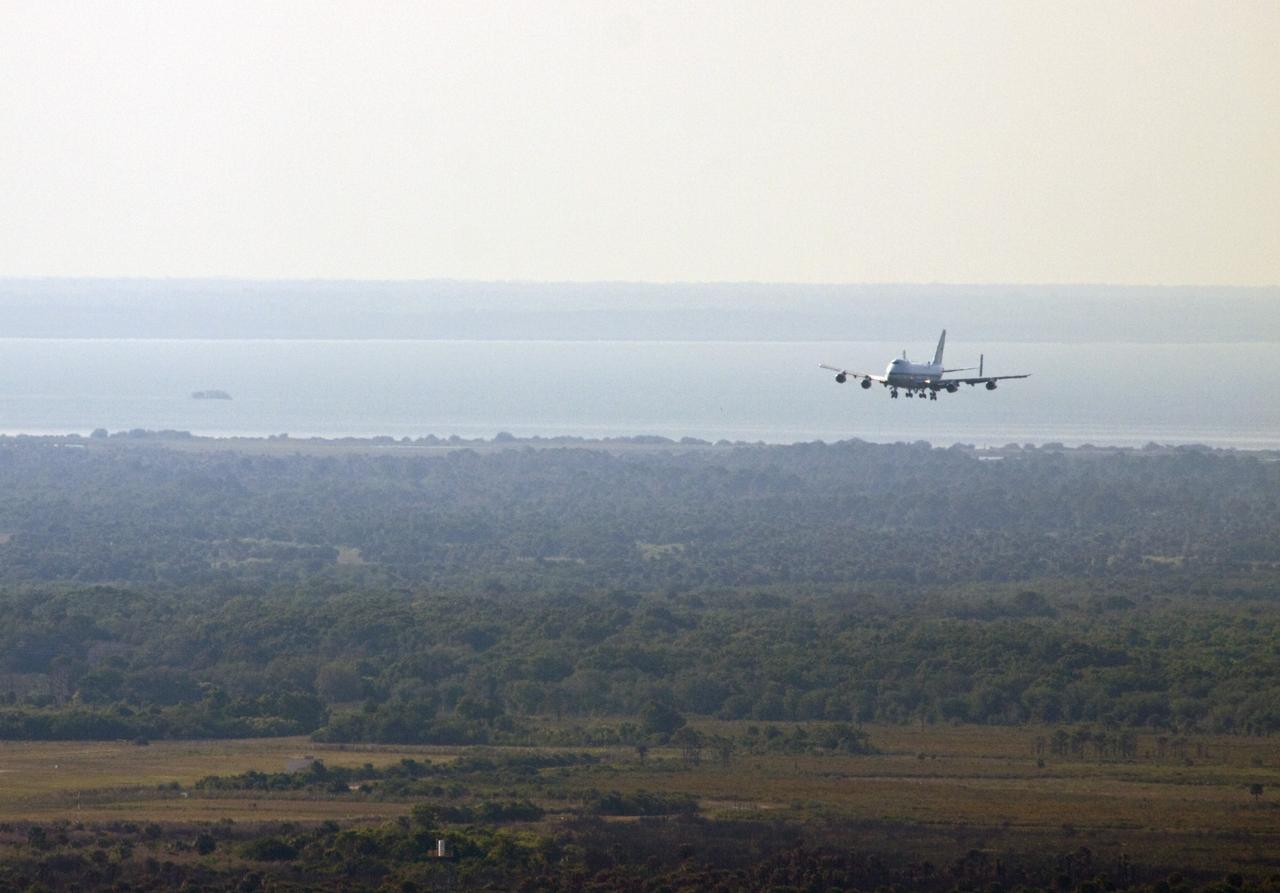
CAPE CANAVERAL, Fla. – The Shuttle Carrier Aircraft approaches the runway of the Shuttle Landing Facility at NASA’s Kennedy Space Center in Florida. The aircraft, known as an SCA, arrived at 5:35 p.m. EDT to prepare for shuttle Discovery’s ferry flight to the Washington Dulles International Airport in Sterling, Va., on April 17. This SCA, designated NASA 905, is a modified Boeing 747 jet airliner, originally manufactured for commercial use. One of two SCAs employed over the course of the Space Shuttle Program, NASA 905 is assigned to the remaining ferry missions, delivering the shuttles to their permanent public display sites. NASA 911 was decommissioned at the NASA Dryden Flight Research Center in California in February. Discovery will be placed on permanent public display in the Smithsonian's National Air and Space Museum Steven F. Udvar-Hazy Center in Chantilly, Va. For more information on the SCA, visit http://www.nasa.gov/centers/dryden/news/FactSheets/FS-013-DFRC.html. For more information on shuttle transition and retirement activities, visit http://www.nasa.gov/shuttle. Photo credit: NASA/Jim Grossmann
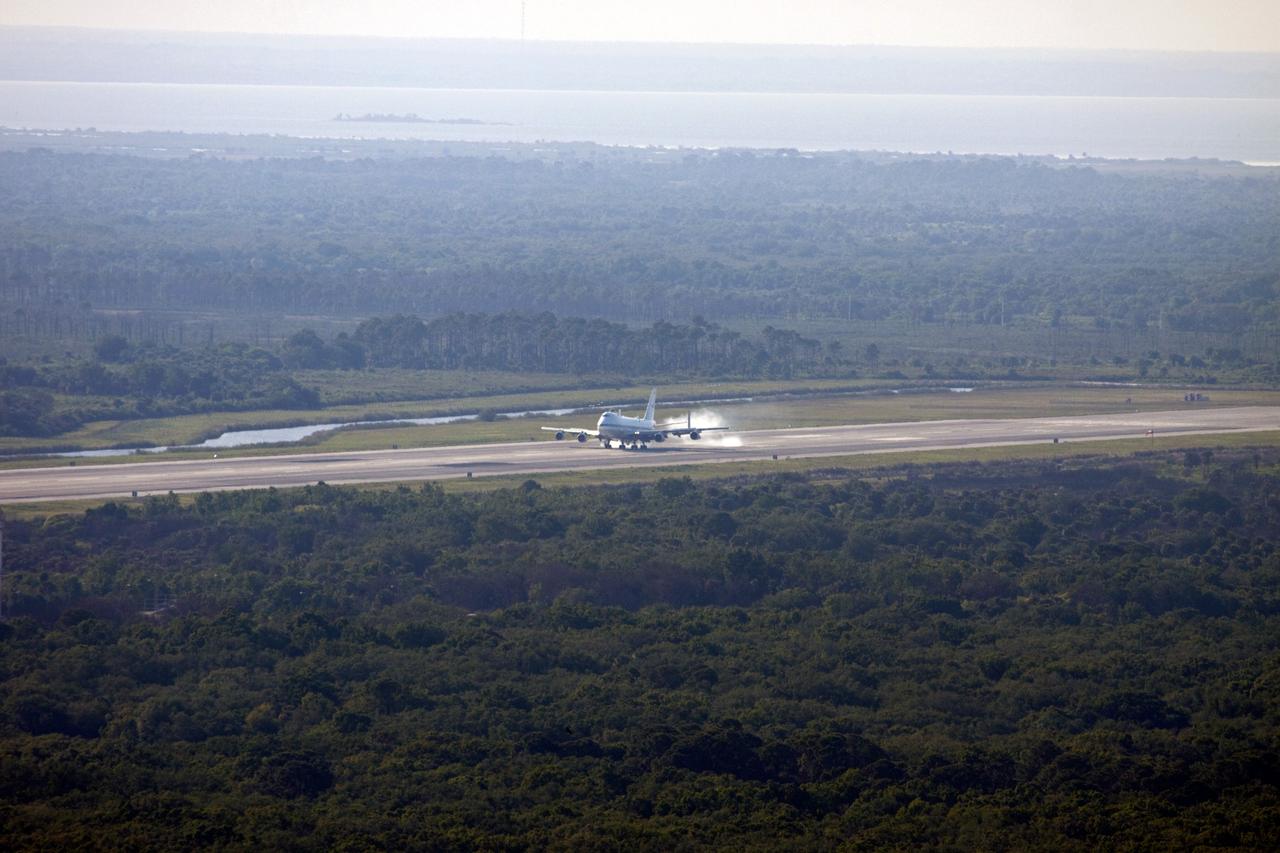
CAPE CANAVERAL, Fla. – The Shuttle Carrier Aircraft makes contact with the runway at the Shuttle Landing Facility at NASA’s Kennedy Space Center in Florida. The aircraft, known as an SCA, arrived at 5:35 p.m. EDT to prepare for shuttle Discovery’s ferry flight to the Washington Dulles International Airport in Sterling, Va., on April 17. This SCA, designated NASA 905, is a modified Boeing 747 jet airliner, originally manufactured for commercial use. One of two SCAs employed over the course of the Space Shuttle Program, NASA 905 is assigned to the remaining ferry missions, delivering the shuttles to their permanent public display sites. NASA 911 was decommissioned at the NASA Dryden Flight Research Center in California in February. Discovery will be placed on permanent public display in the Smithsonian's National Air and Space Museum Steven F. Udvar-Hazy Center in Chantilly, Va. For more information on the SCA, visit http://www.nasa.gov/centers/dryden/news/FactSheets/FS-013-DFRC.html. For more information on shuttle transition and retirement activities, visit http://www.nasa.gov/shuttle. Photo credit: NASA/Jim Grossmann

CAPE CANAVERAL, Fla. – The Shuttle Carrier Aircraft touches down at the Shuttle Landing Facility at NASA’s Kennedy Space Center in Florida. The aircraft, known as an SCA, arrived at 5:35 p.m. EDT to prepare for shuttle Discovery’s ferry flight to the Washington Dulles International Airport in Sterling, Va., on April 17. This SCA, designated NASA 905, is a modified Boeing 747 jet airliner, originally manufactured for commercial use. One of two SCAs employed over the course of the Space Shuttle Program, NASA 905 is assigned to the remaining ferry missions, delivering the shuttles to their permanent public display sites. NASA 911 was decommissioned at the NASA Dryden Flight Research Center in California in February. Discovery will be placed on permanent public display in the Smithsonian's National Air and Space Museum Steven F. Udvar-Hazy Center in Chantilly, Va. For more information on the SCA, visit http://www.nasa.gov/centers/dryden/news/FactSheets/FS-013-DFRC.html. For more information on shuttle transition and retirement activities, visit http://www.nasa.gov/shuttle. Photo credit: NASA/Frankie Martin
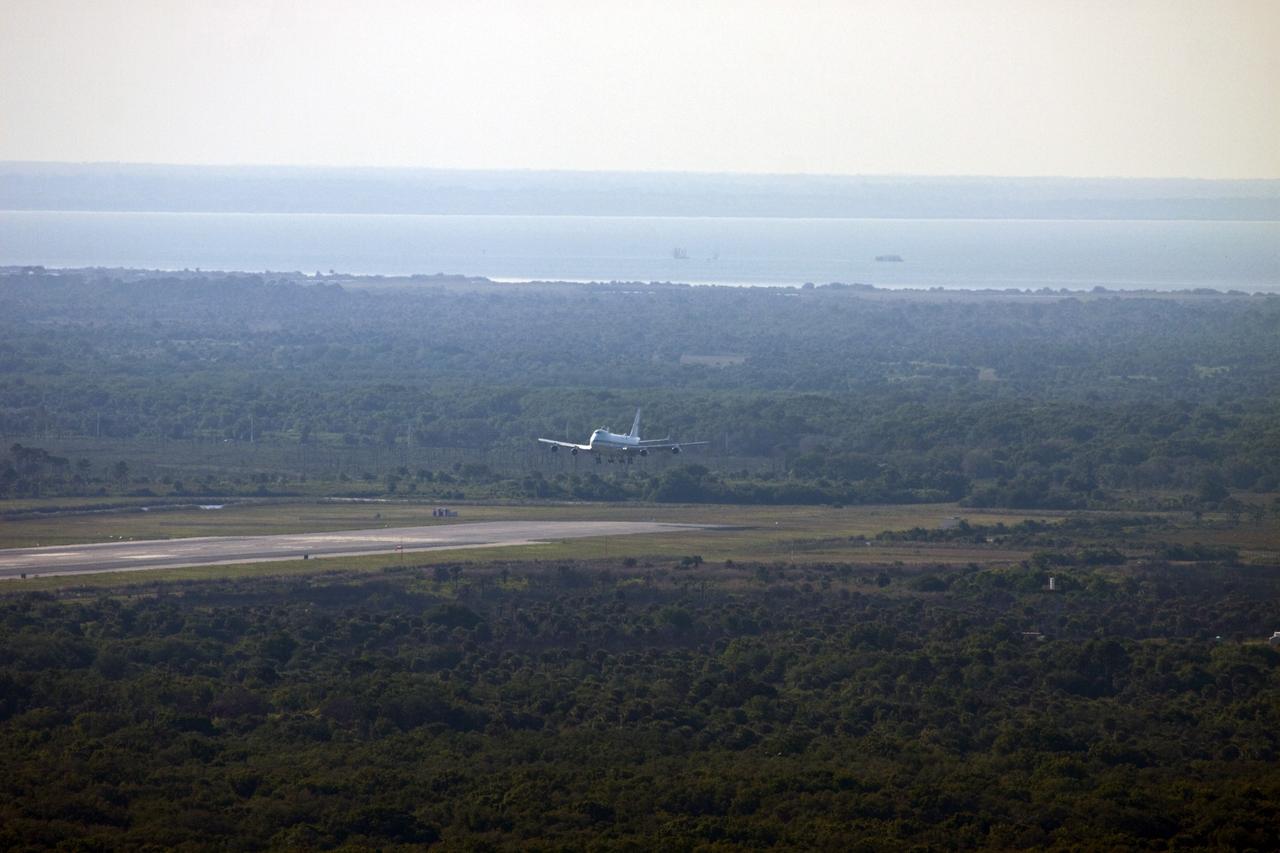
CAPE CANAVERAL, Fla. – The Shuttle Carrier Aircraft prepares to touch down on the runway at the Shuttle Landing Facility at NASA’s Kennedy Space Center in Florida. The aircraft, known as an SCA, arrived at 5:35 p.m. EDT to prepare for shuttle Discovery’s ferry flight to the Washington Dulles International Airport in Sterling, Va., on April 17. This SCA, designated NASA 905, is a modified Boeing 747 jet airliner, originally manufactured for commercial use. One of two SCAs employed over the course of the Space Shuttle Program, NASA 905 is assigned to the remaining ferry missions, delivering the shuttles to their permanent public display sites. NASA 911 was decommissioned at the NASA Dryden Flight Research Center in California in February. Discovery will be placed on permanent public display in the Smithsonian's National Air and Space Museum Steven F. Udvar-Hazy Center in Chantilly, Va. For more information on the SCA, visit http://www.nasa.gov/centers/dryden/news/FactSheets/FS-013-DFRC.html. For more information on shuttle transition and retirement activities, visit http://www.nasa.gov/shuttle. Photo credit: NASA/Jim Grossmann
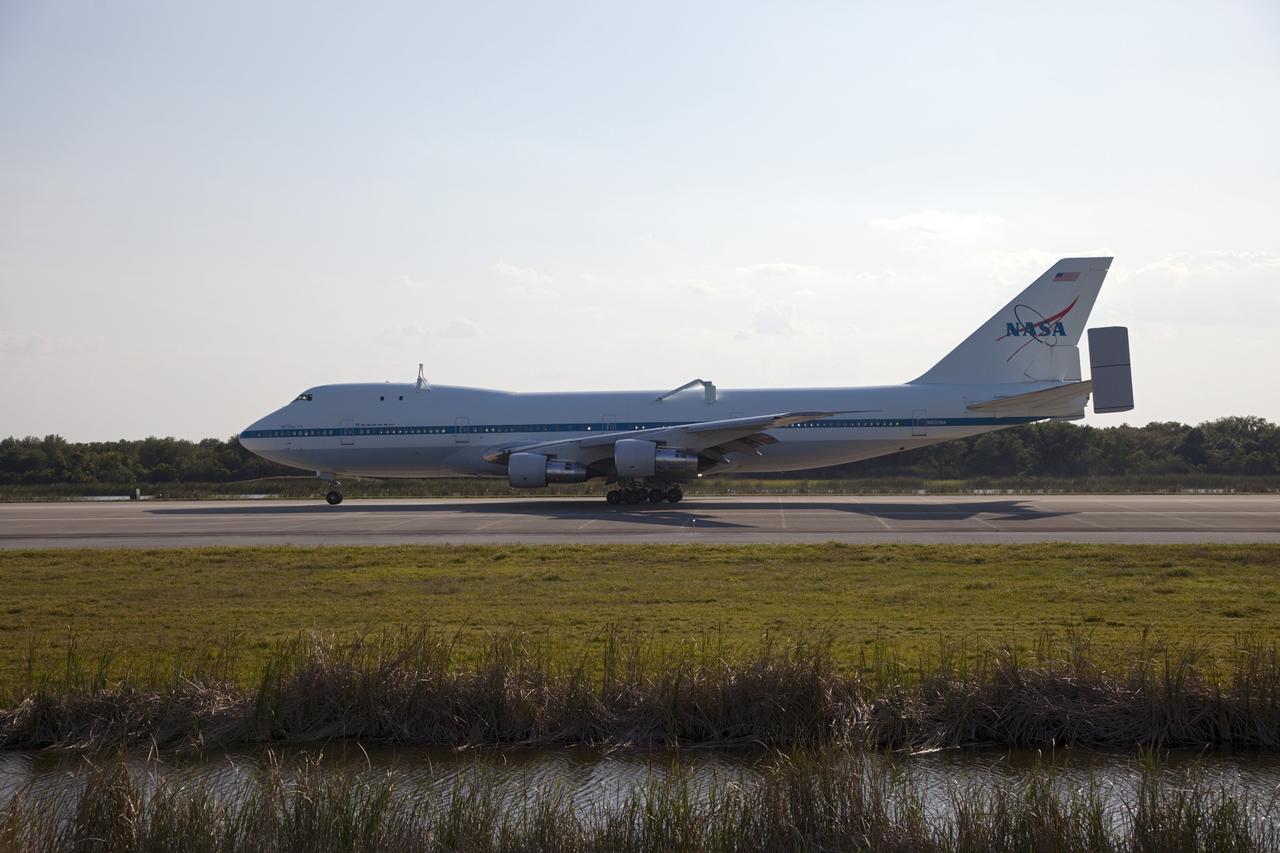
CAPE CANAVERAL, Fla. – NASA pilot Jeff Moultrie guides the Shuttle Carrier Aircraft to a picture-perfect touchdown at the Shuttle Landing Facility at NASA’s Kennedy Space Center in Florida with NASA co-pilot Bill Rieke at his side. The aircraft, known as an SCA, arrived at 5:35 p.m. EDT to prepare for shuttle Discovery’s ferry flight to the Washington Dulles International Airport in Sterling, Va., on April 17. This SCA, designated NASA 905, is a modified Boeing 747 jet airliner, originally manufactured for commercial use. One of two SCAs employed over the course of the Space Shuttle Program, NASA 905 is assigned to the remaining ferry missions, delivering the shuttles to their permanent public display sites. NASA 911 was decommissioned at the NASA Dryden Flight Research Center in California in February. Discovery will be placed on permanent public display in the Smithsonian's National Air and Space Museum Steven F. Udvar-Hazy Center in Chantilly, Va. For more information on the SCA, visit http://www.nasa.gov/centers/dryden/news/FactSheets/FS-013-DFRC.html. For more information on shuttle transition and retirement activities, visit http://www.nasa.gov/shuttle. Photo credit: NASA/Frankie Martin
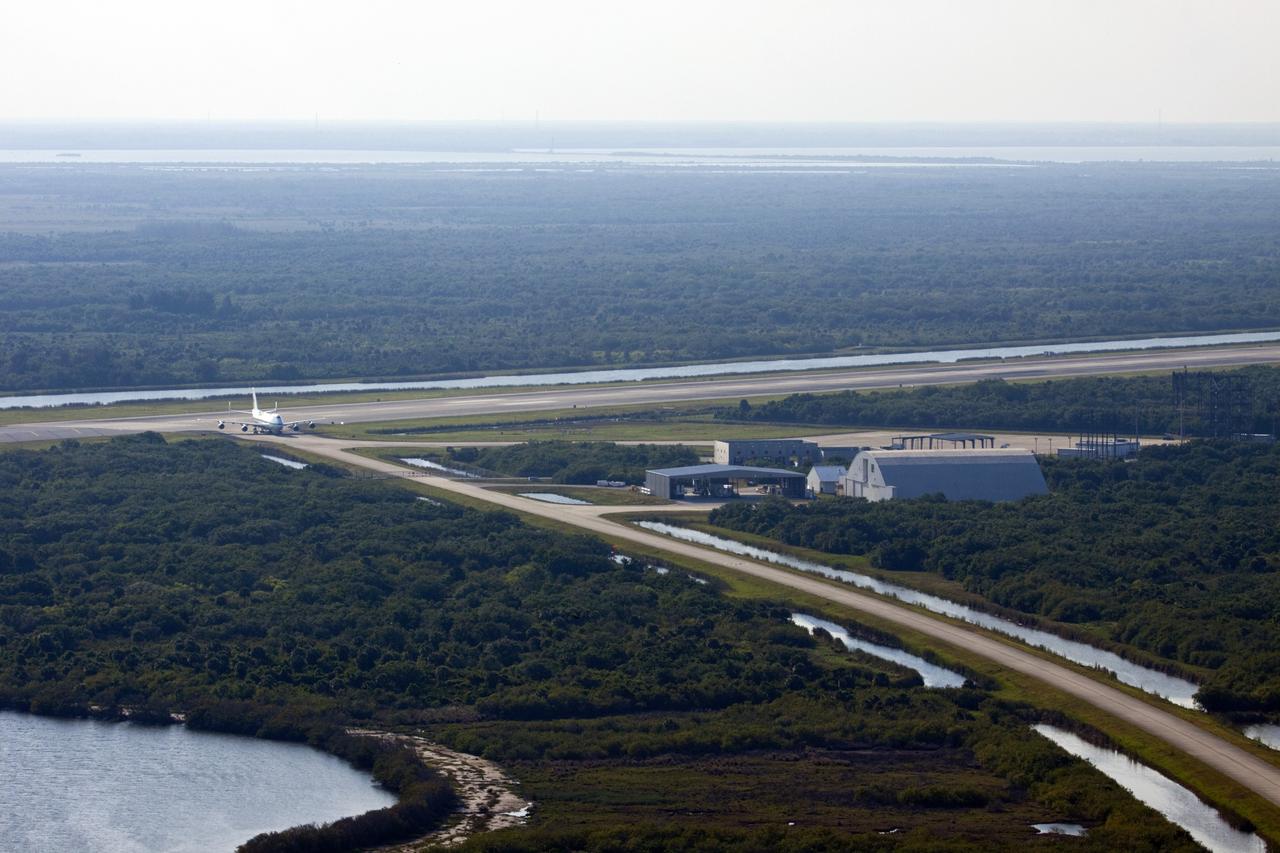
CAPE CANAVERAL, Fla. – NASA pilot Jeff Moultrie guides the Shuttle Carrier Aircraft toward the apron of the runway at the Shuttle Landing Facility at NASA’s Kennedy Space Center in Florida. The aircraft, known as an SCA, arrived at 5:35 p.m. EDT to prepare for shuttle Discovery’s ferry flight to the Washington Dulles International Airport in Sterling, Va., on April 17. This SCA, designated NASA 905, is a modified Boeing 747 jet airliner, originally manufactured for commercial use. One of two SCAs employed over the course of the Space Shuttle Program, NASA 905 is assigned to the remaining ferry missions, delivering the shuttles to their permanent public display sites. NASA 911 was decommissioned at the NASA Dryden Flight Research Center in California in February. Discovery will be placed on permanent public display in the Smithsonian's National Air and Space Museum Steven F. Udvar-Hazy Center in Chantilly, Va. For more information on the SCA, visit http://www.nasa.gov/centers/dryden/news/FactSheets/FS-013-DFRC.html. For more information on shuttle transition and retirement activities, visit http://www.nasa.gov/shuttle. Photo credit: NASA/Jim Grossmann
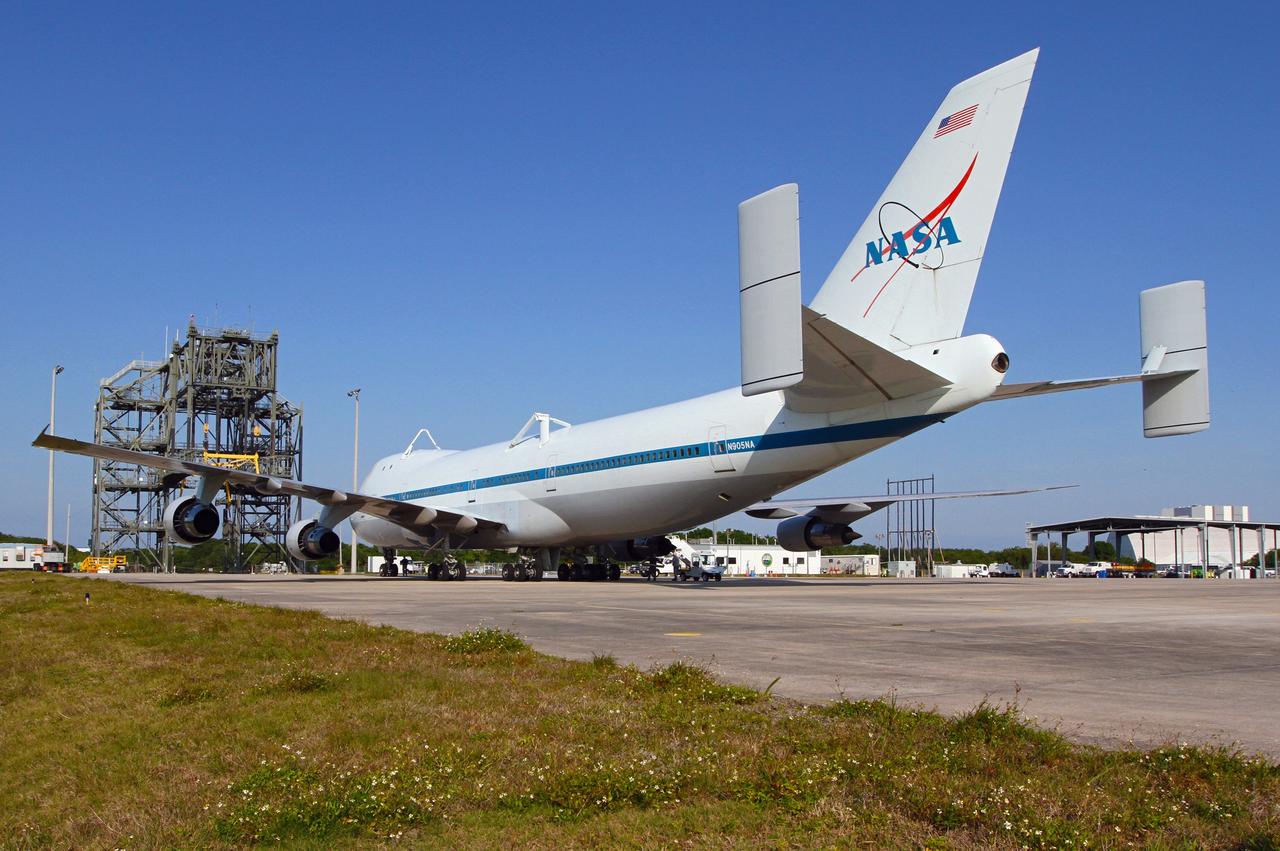
CAPE CANAVERAL, Fla. – The Shuttle Carrier Aircraft parks near the mate/demate device at the Shuttle Landing Facility at NASA’s Kennedy Space Center in Florida. The aircraft, known as an SCA, arrived at 5:35 p.m. EDT to prepare for shuttle Discovery’s ferry flight to the Washington Dulles International Airport in Sterling, Va., on April 17. This SCA, designated NASA 905, is a modified Boeing 747 jet airliner, originally manufactured for commercial use. One of two SCAs employed over the course of the Space Shuttle Program, NASA 905 is assigned to the remaining ferry missions, delivering the shuttles to their permanent public display sites. NASA 911 was decommissioned at the NASA Dryden Flight Research Center in California in February. Discovery will be placed on permanent public display in the Smithsonian's National Air and Space Museum Steven F. Udvar-Hazy Center in Chantilly, Va. For more information on the SCA, visit http://www.nasa.gov/centers/dryden/news/FactSheets/FS-013-DFRC.html. For more information on shuttle transition and retirement activities, visit http://www.nasa.gov/shuttle. Photo credit: NASA/Kim Shiflett
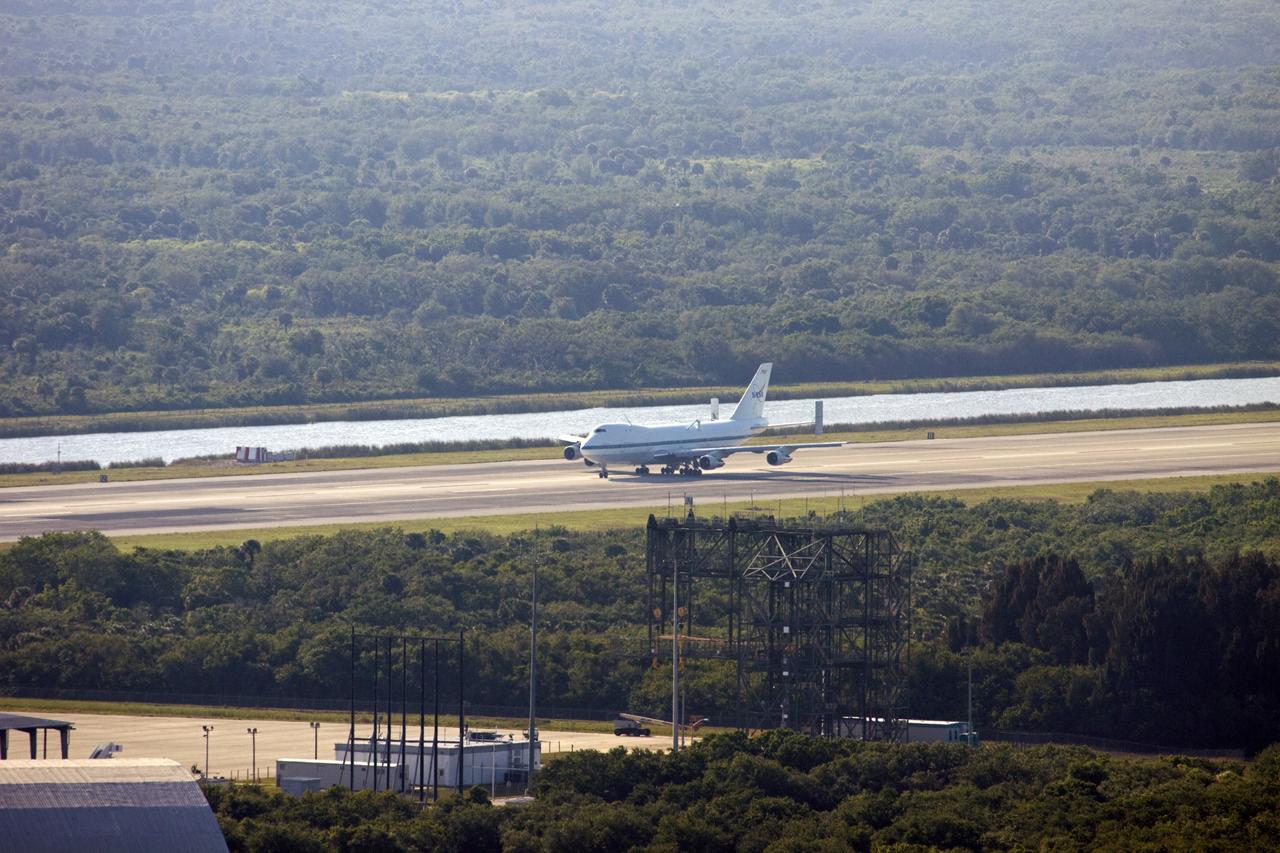
CAPE CANAVERAL, Fla. – The Shuttle Carrier Aircraft coasts down the runway at the Shuttle Landing Facility at NASA’s Kennedy Space Center in Florida. The aircraft, known as an SCA, arrived at 5:35 p.m. EDT to prepare for shuttle Discovery’s ferry flight to the Washington Dulles International Airport in Sterling, Va., on April 17. This SCA, designated NASA 905, is a modified Boeing 747 jet airliner, originally manufactured for commercial use. One of two SCAs employed over the course of the Space Shuttle Program, NASA 905 is assigned to the remaining ferry missions, delivering the shuttles to their permanent public display sites. NASA 911 was decommissioned at the NASA Dryden Flight Research Center in California in February. Discovery will be placed on permanent public display in the Smithsonian's National Air and Space Museum Steven F. Udvar-Hazy Center in Chantilly, Va. For more information on the SCA, visit http://www.nasa.gov/centers/dryden/news/FactSheets/FS-013-DFRC.html. For more information on shuttle transition and retirement activities, visit http://www.nasa.gov/shuttle. Photo credit: NASA/Jim Grossmann
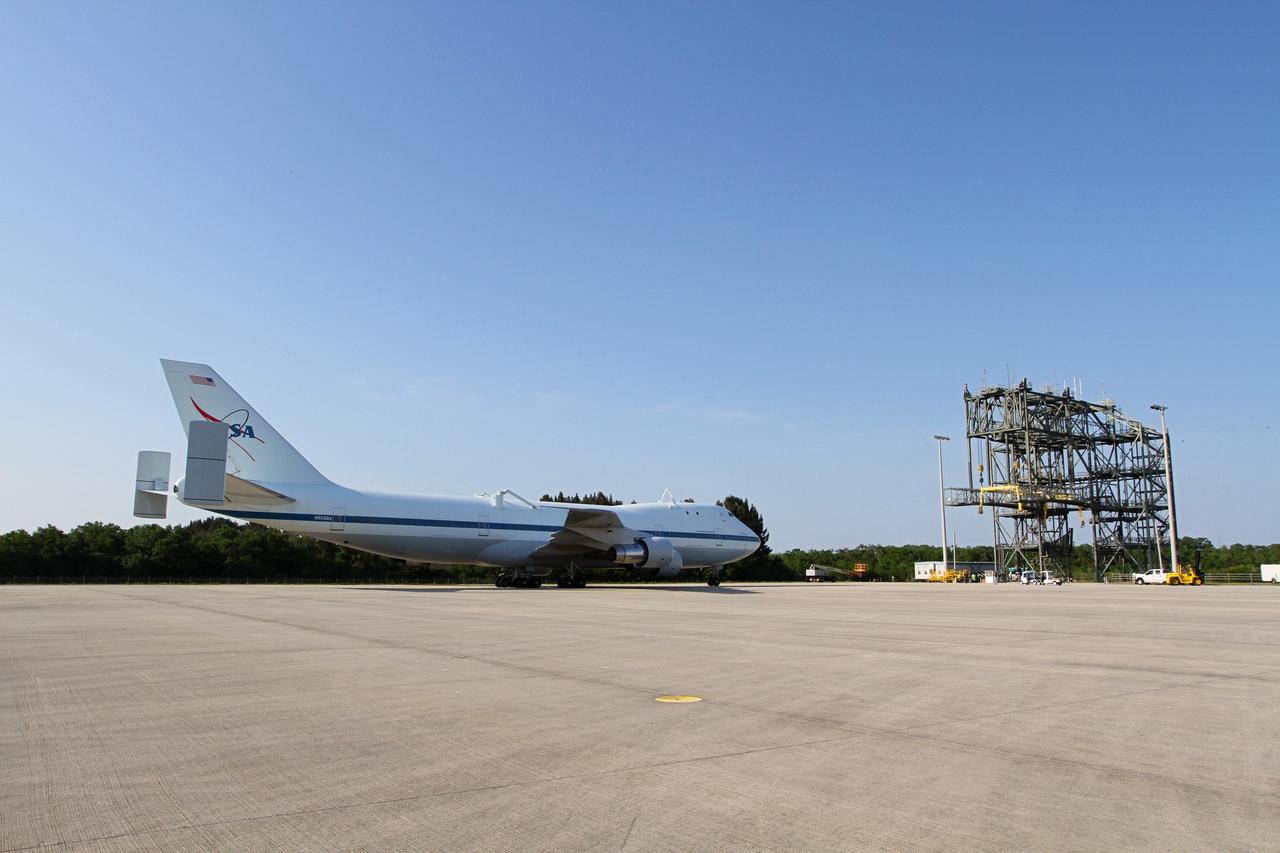
CAPE CANAVERAL, Fla. – The Shuttle Carrier Aircraft approaches the mate/demate device at the Shuttle Landing Facility at NASA’s Kennedy Space Center in Florida. The aircraft, known as an SCA, arrived at 5:35 p.m. EDT to prepare for shuttle Discovery’s ferry flight to the Washington Dulles International Airport in Sterling, Va., on April 17. This SCA, designated NASA 905, is a modified Boeing 747 jet airliner, originally manufactured for commercial use. One of two SCAs employed over the course of the Space Shuttle Program, NASA 905 is assigned to the remaining ferry missions, delivering the shuttles to their permanent public display sites. NASA 911 was decommissioned at the NASA Dryden Flight Research Center in California in February. Discovery will be placed on permanent public display in the Smithsonian's National Air and Space Museum Steven F. Udvar-Hazy Center in Chantilly, Va. For more information on the SCA, visit http://www.nasa.gov/centers/dryden/news/FactSheets/FS-013-DFRC.html. For more information on shuttle transition and retirement activities, visit http://www.nasa.gov/shuttle. Photo credit: NASA/Kim Shiflett
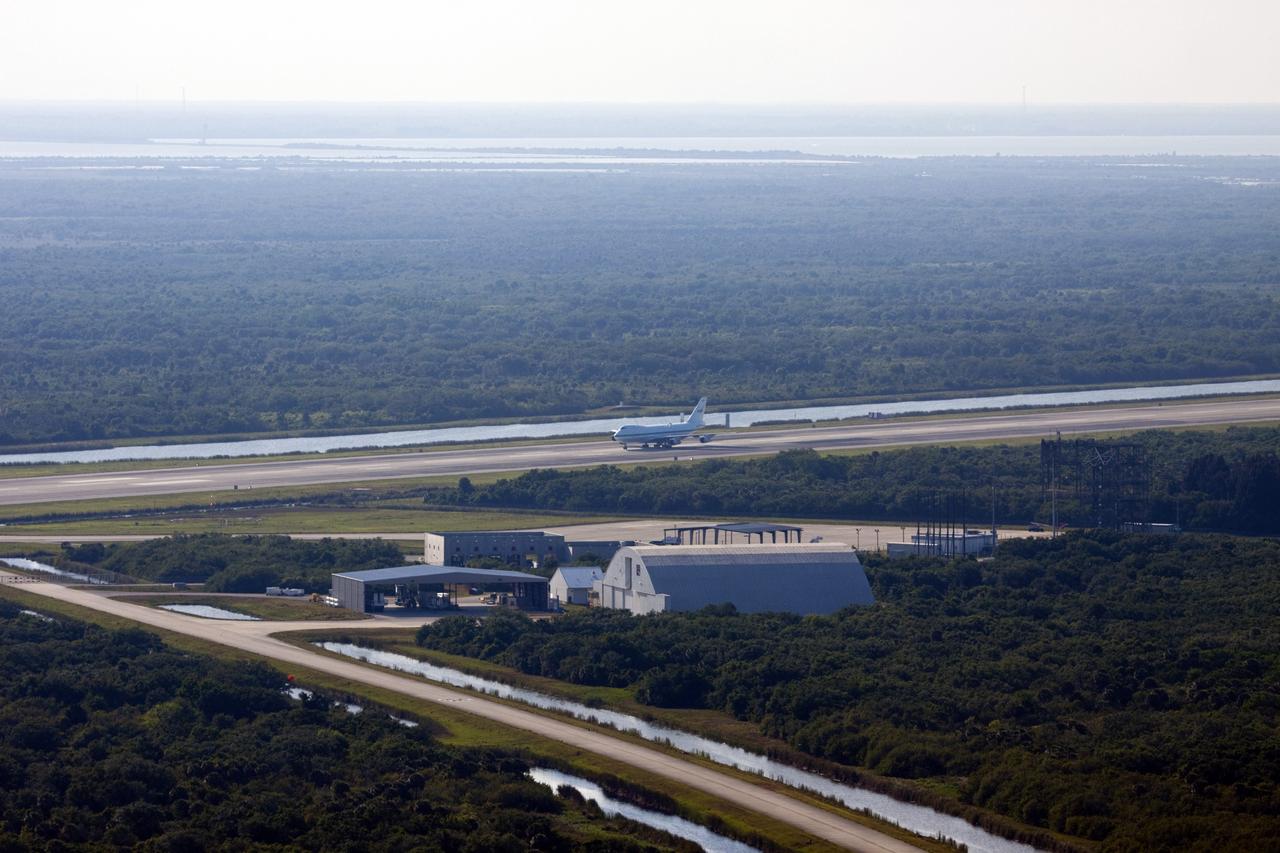
CAPE CANAVERAL, Fla. – NASA pilot Jeff Moultrie guides the Shuttle Carrier Aircraft along the runway at the Shuttle Landing Facility at NASA’s Kennedy Space Center in Florida. The aircraft, known as an SCA, arrived at 5:35 p.m. EDT to prepare for shuttle Discovery’s ferry flight to the Washington Dulles International Airport in Sterling, Va., on April 17. This SCA, designated NASA 905, is a modified Boeing 747 jet airliner, originally manufactured for commercial use. One of two SCAs employed over the course of the Space Shuttle Program, NASA 905 is assigned to the remaining ferry missions, delivering the shuttles to their permanent public display sites. NASA 911 was decommissioned at the NASA Dryden Flight Research Center in California in February. Discovery will be placed on permanent public display in the Smithsonian's National Air and Space Museum Steven F. Udvar-Hazy Center in Chantilly, Va. For more information on the SCA, visit http://www.nasa.gov/centers/dryden/news/FactSheets/FS-013-DFRC.html. For more information on shuttle transition and retirement activities, visit http://www.nasa.gov/shuttle. Photo credit: NASA/Jim Grossmann
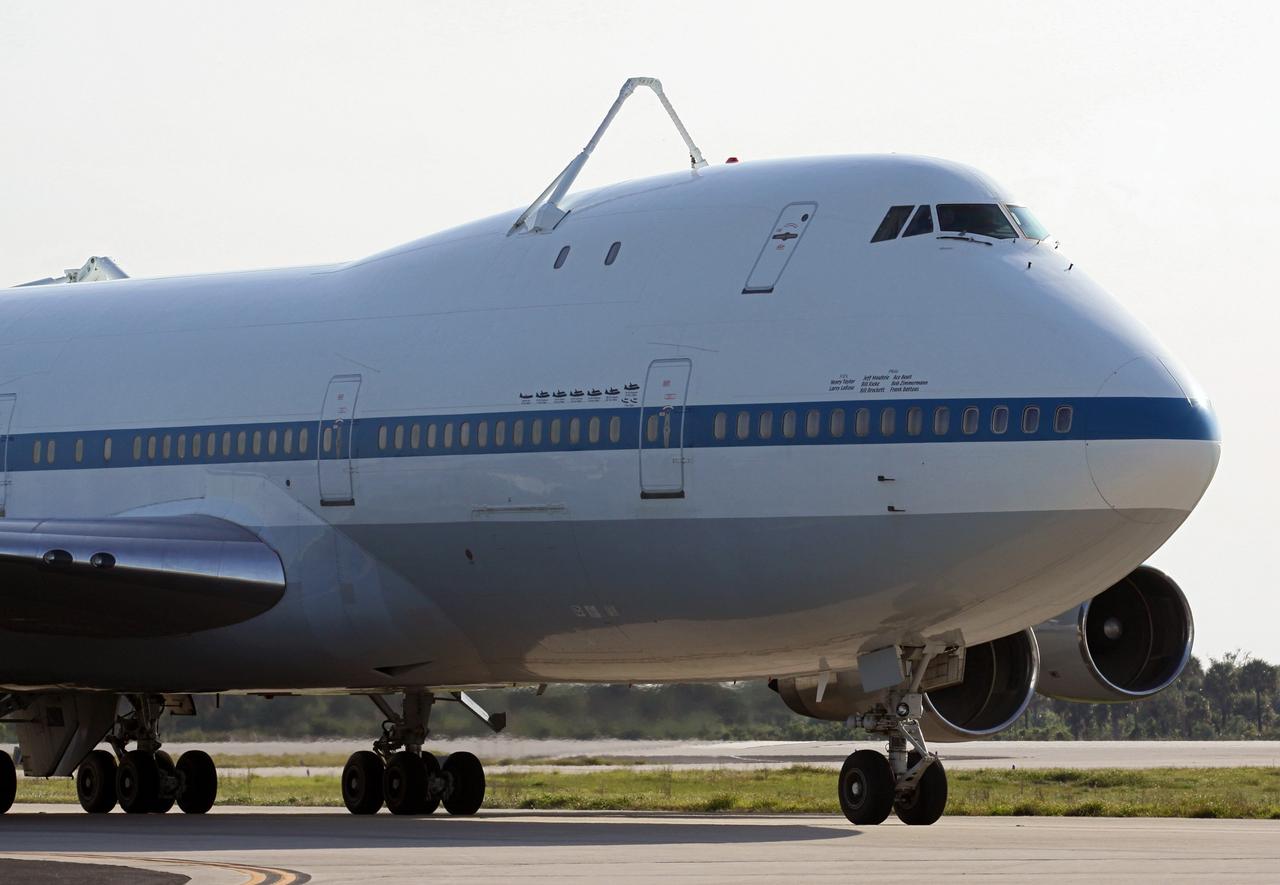
CAPE CANAVERAL, Fla. – NASA pilot Jeff Moultrie guides the Shuttle Carrier Aircraft along the apron of the runway at the Shuttle Landing Facility at NASA’s Kennedy Space Center in Florida. The aircraft, known as an SCA, arrived at 5:35 p.m. EDT to prepare for shuttle Discovery’s ferry flight to the Washington Dulles International Airport in Sterling, Va., on April 17. This SCA, designated NASA 905, is a modified Boeing 747 jet airliner, originally manufactured for commercial use. One of two SCAs employed over the course of the Space Shuttle Program, NASA 905 is assigned to the remaining ferry missions, delivering the shuttles to their permanent public display sites. NASA 911 was decommissioned at the NASA Dryden Flight Research Center in California in February. Discovery will be placed on permanent public display in the Smithsonian's National Air and Space Museum Steven F. Udvar-Hazy Center in Chantilly, Va. For more information on the SCA, visit http://www.nasa.gov/centers/dryden/news/FactSheets/FS-013-DFRC.html. For more information on shuttle transition and retirement activities, visit http://www.nasa.gov/shuttle. Photo credit: NASA/Kim Shiflett
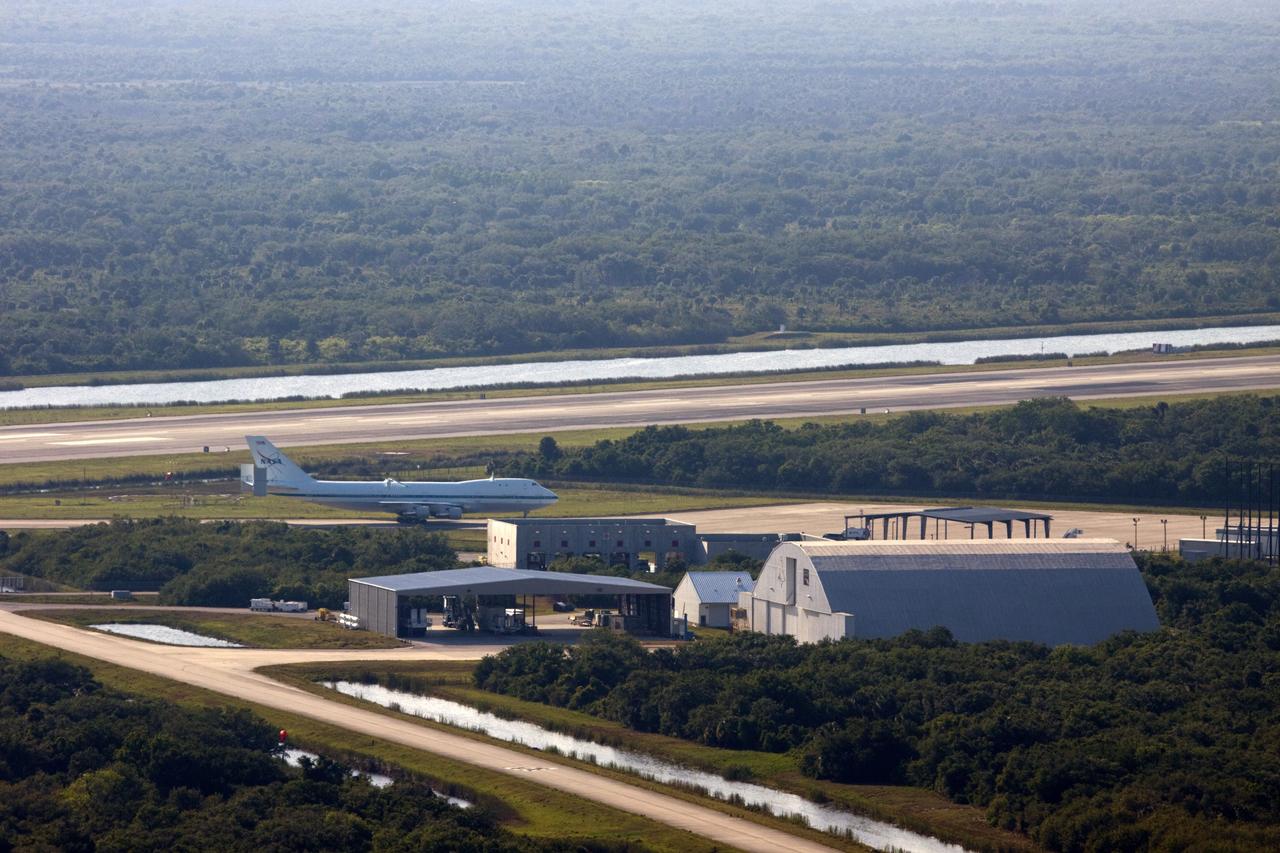
CAPE CANAVERAL, Fla. – The Shuttle Carrier Aircraft glides onto the apron of the runway at the Shuttle Landing Facility at NASA’s Kennedy Space Center in Florida. The aircraft, known as an SCA, arrived at 5:35 p.m. EDT to prepare for shuttle Discovery’s ferry flight to the Washington Dulles International Airport in Sterling, Va., on April 17. This SCA, designated NASA 905, is a modified Boeing 747 jet airliner, originally manufactured for commercial use. One of two SCAs employed over the course of the Space Shuttle Program, NASA 905 is assigned to the remaining ferry missions, delivering the shuttles to their permanent public display sites. NASA 911 was decommissioned at the NASA Dryden Flight Research Center in California in February. Discovery will be placed on permanent public display in the Smithsonian's National Air and Space Museum Steven F. Udvar-Hazy Center in Chantilly, Va. For more information on the SCA, visit http://www.nasa.gov/centers/dryden/news/FactSheets/FS-013-DFRC.html. For more information on shuttle transition and retirement activities, visit http://www.nasa.gov/shuttle. Photo credit: NASA/Jim Grossmann
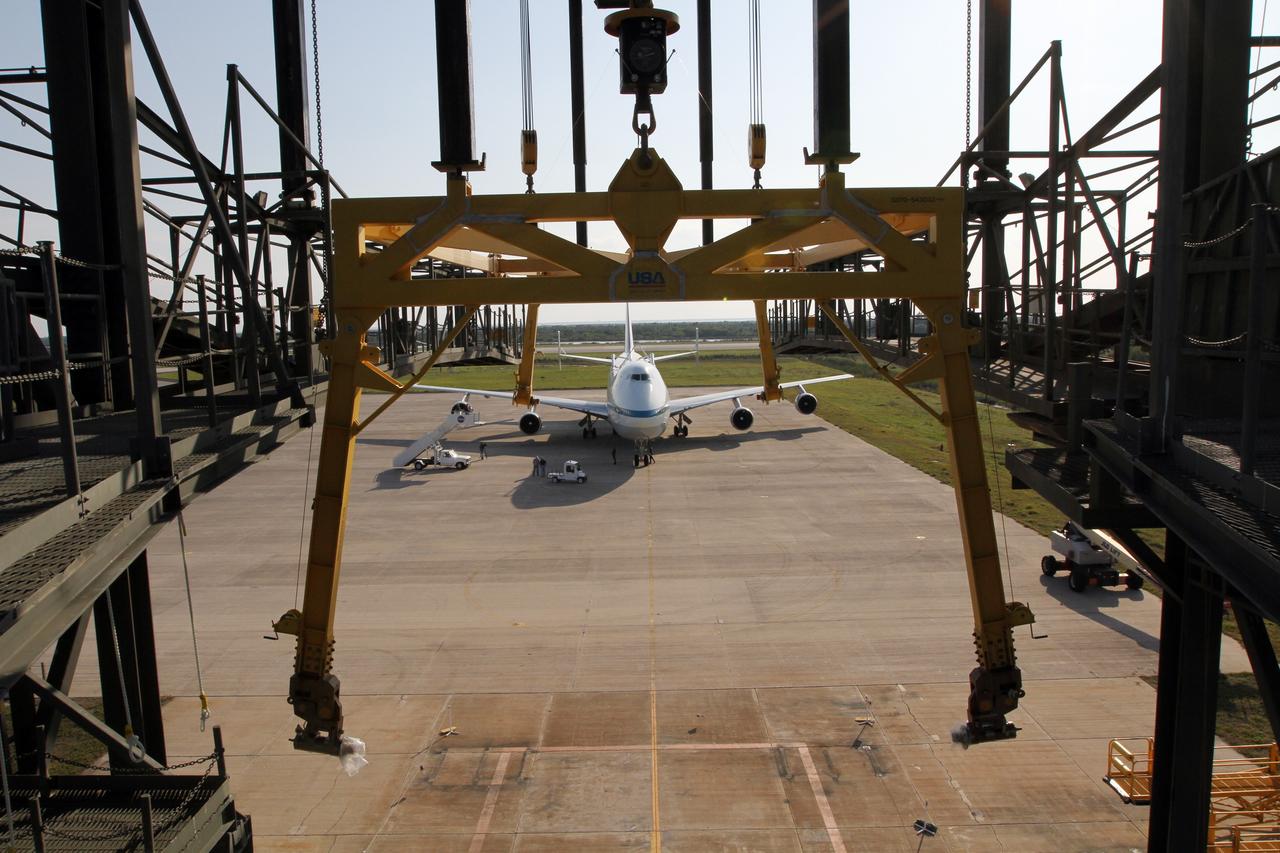
CAPE CANAVERAL, Fla. – The newly arrived Shuttle Carrier Aircraft is framed by a grappling fixture on the mate-demate device at the Shuttle Landing Facility at NASA’s Kennedy Space Center in Florida. The aircraft, known as an SCA, arrived at 5:35 p.m. EDT to prepare for shuttle Discovery’s ferry flight to the Washington Dulles International Airport in Sterling, Va., on April 17. This SCA, designated NASA 905, is a modified Boeing 747 jet airliner, originally manufactured for commercial use. One of two SCAs employed over the course of the Space Shuttle Program, NASA 905 is assigned to the remaining ferry missions, delivering the shuttles to their permanent public display sites. NASA 911 was decommissioned at the NASA Dryden Flight Research Center in California in February. Discovery will be placed on permanent public display in the Smithsonian's National Air and Space Museum Steven F. Udvar-Hazy Center in Chantilly, Va. For more information on the SCA, visit http://www.nasa.gov/centers/dryden/news/FactSheets/FS-013-DFRC.html. For more information on shuttle transition and retirement activities, visit http://www.nasa.gov/shuttle. Photo credit: NASA/Kim Shiflett
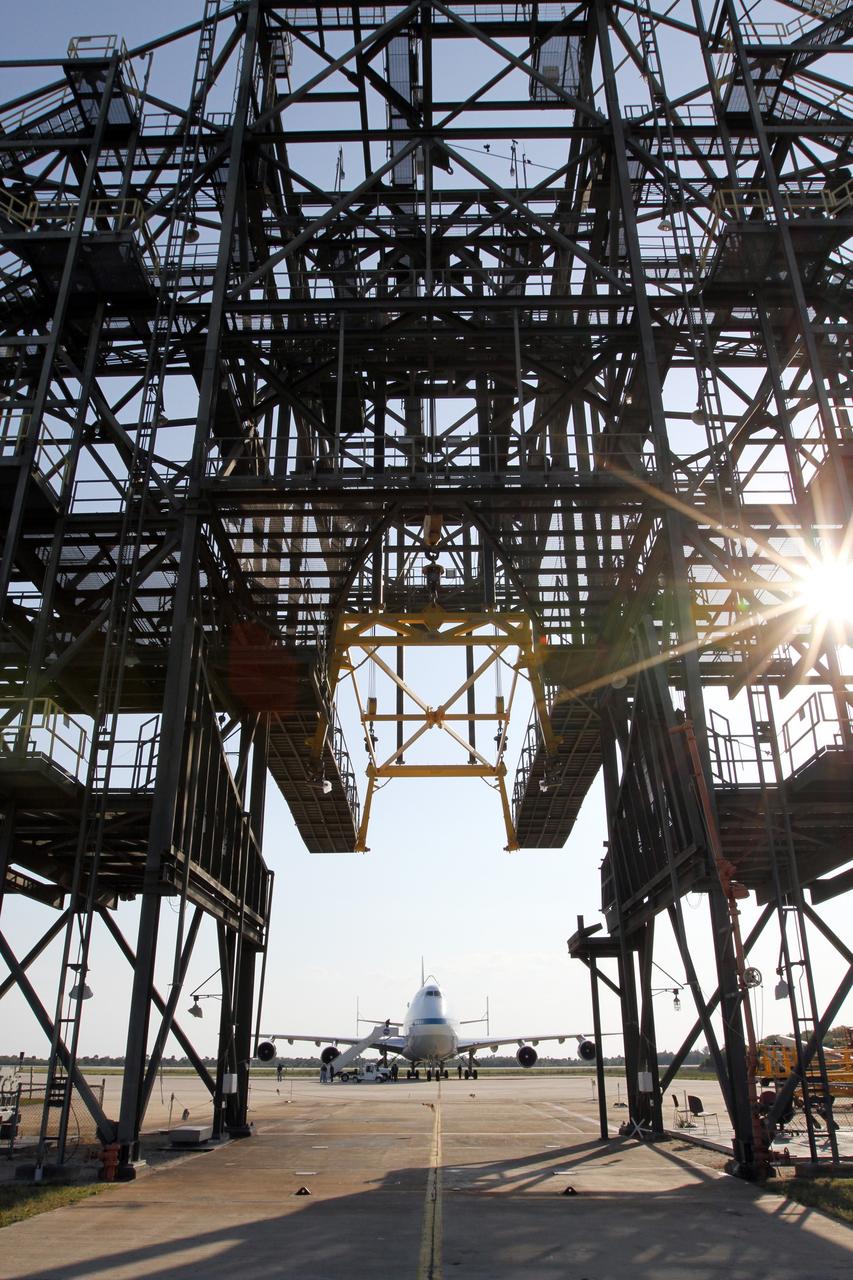
CAPE CANAVERAL, Fla. – The newly arrived Shuttle Carrier Aircraft is seen through the platforms of the mate-demate device at the Shuttle Landing Facility at NASA’s Kennedy Space Center in Florida. The aircraft, known as an SCA, arrived at 5:35 p.m. EDT to prepare for shuttle Discovery’s ferry flight to the Washington Dulles International Airport in Sterling, Va., on April 17. This SCA, designated NASA 905, is a modified Boeing 747 jet airliner, originally manufactured for commercial use. One of two SCAs employed over the course of the Space Shuttle Program, NASA 905 is assigned to the remaining ferry missions, delivering the shuttles to their permanent public display sites. NASA 911 was decommissioned at the NASA Dryden Flight Research Center in California in February. Discovery will be placed on permanent public display in the Smithsonian's National Air and Space Museum Steven F. Udvar-Hazy Center in Chantilly, Va. For more information on the SCA, visit http://www.nasa.gov/centers/dryden/news/FactSheets/FS-013-DFRC.html. For more information on shuttle transition and retirement activities, visit http://www.nasa.gov/shuttle. Photo credit: NASA/Kim Shiflett
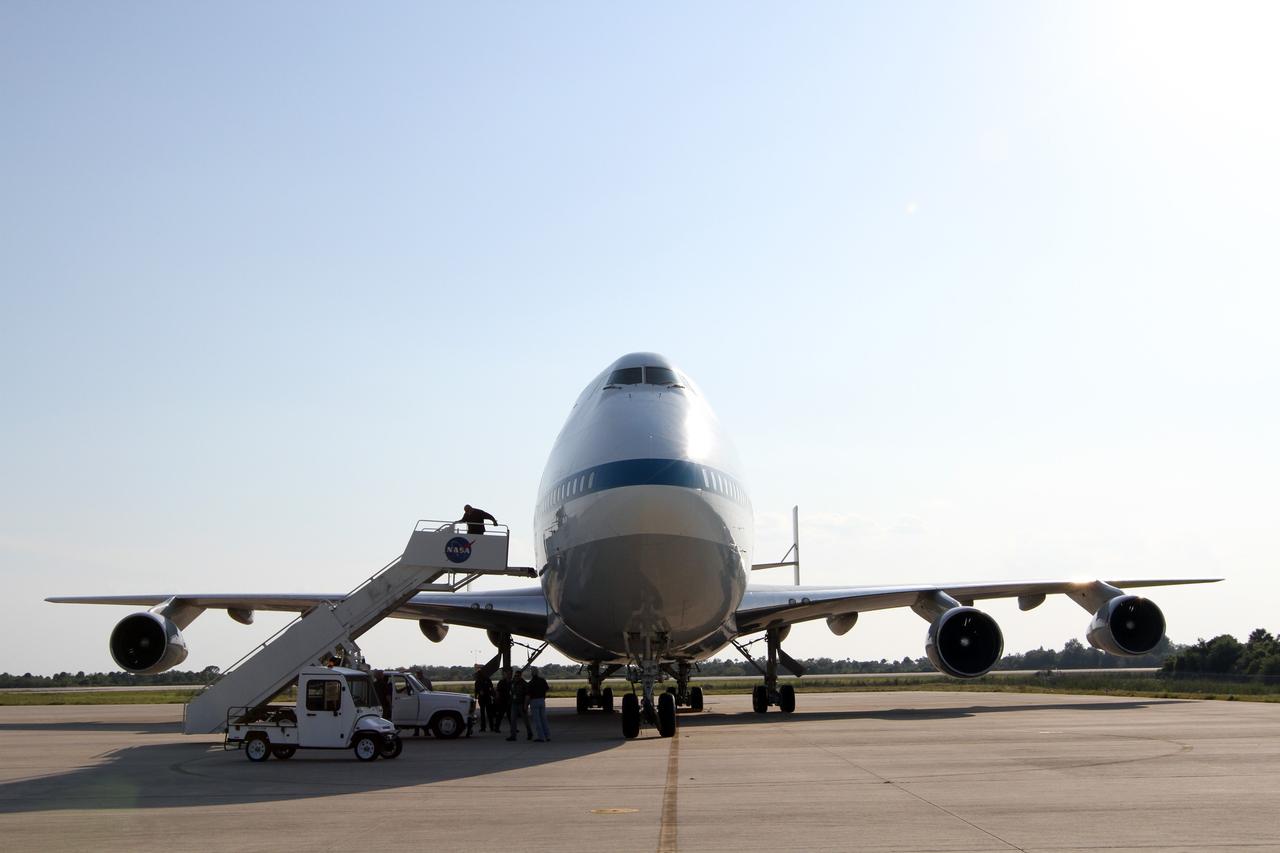
CAPE CANAVERAL, Fla. – Preparations are under way at the Shuttle Landing Facility at NASA’s Kennedy Space Center in Florida for the pilots of the newly arrived Shuttle Carrier Aircraft to disembark. The aircraft, known as an SCA, arrived at 5:35 p.m. EDT to prepare for shuttle Discovery’s ferry flight to the Washington Dulles International Airport in Sterling, Va., on April 17. This SCA, designated NASA 905, is a modified Boeing 747 jet airliner, originally manufactured for commercial use. One of two SCAs employed over the course of the Space Shuttle Program, NASA 905 is assigned to the remaining ferry missions, delivering the shuttles to their permanent public display sites. NASA 911 was decommissioned at the NASA Dryden Flight Research Center in California in February. Discovery will be placed on permanent public display in the Smithsonian's National Air and Space Museum Steven F. Udvar-Hazy Center in Chantilly, Va. For more information on the SCA, visit http://www.nasa.gov/centers/dryden/news/FactSheets/FS-013-DFRC.html. For more information on shuttle transition and retirement activities, visit http://www.nasa.gov/shuttle. Photo credit: NASA/Kim Shiflett
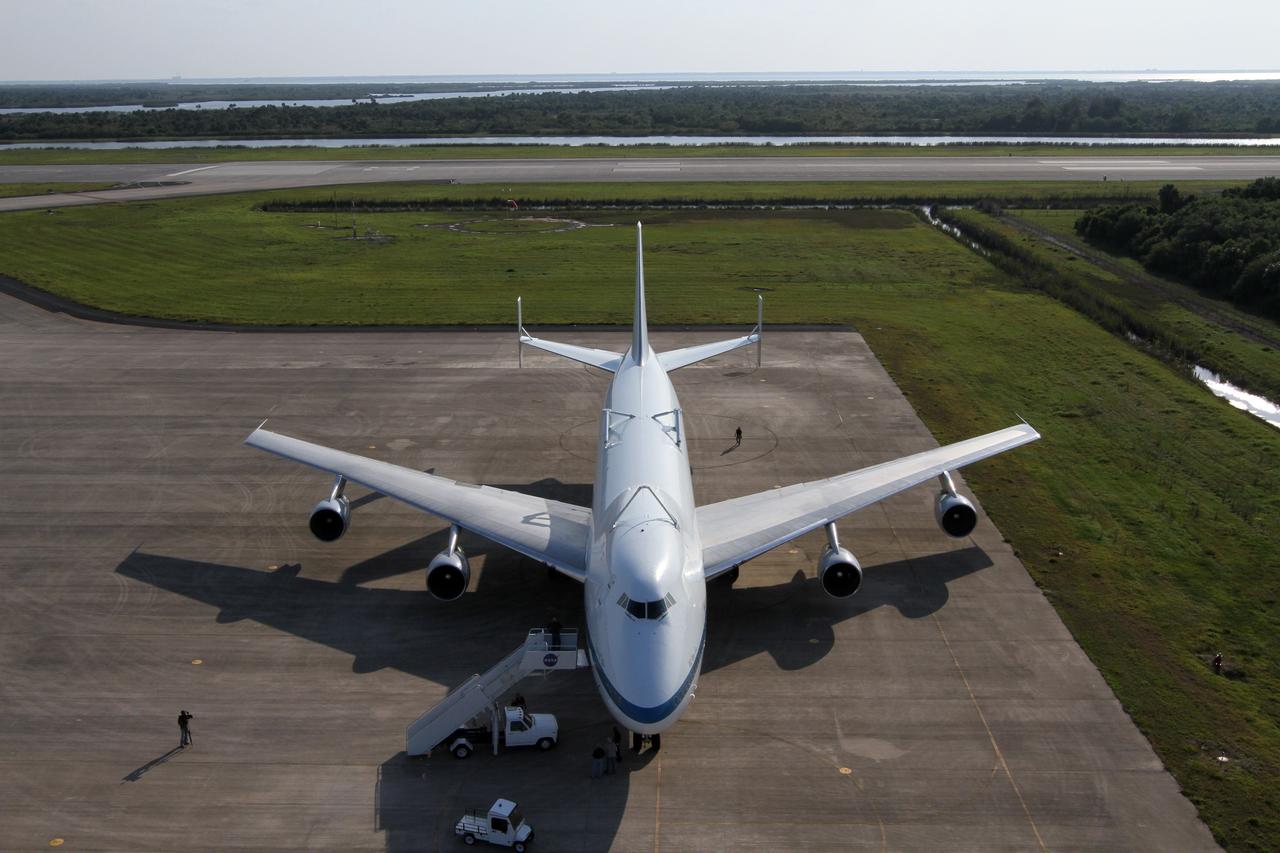
CAPE CANAVERAL, Fla. – This overhead view shows Shuttle Carrier Aircraft parked on the apron of the runway at the Shuttle Landing Facility at NASA’s Kennedy Space Center in Florida. The aircraft, known as an SCA, arrived at 5:35 p.m. EDT to prepare for shuttle Discovery’s ferry flight to the Washington Dulles International Airport in Sterling, Va., on April 17. This SCA, designated NASA 905, is a modified Boeing 747 jet airliner, originally manufactured for commercial use. One of two SCAs employed over the course of the Space Shuttle Program, NASA 905 is assigned to the remaining ferry missions, delivering the shuttles to their permanent public display sites. NASA 911 was decommissioned at the NASA Dryden Flight Research Center in California in February. Discovery will be placed on permanent public display in the Smithsonian's National Air and Space Museum Steven F. Udvar-Hazy Center in Chantilly, Va. For more information on the SCA, visit http://www.nasa.gov/centers/dryden/news/FactSheets/FS-013-DFRC.html. For more information on shuttle transition and retirement activities, visit http://www.nasa.gov/shuttle. Photo credit: NASA/Kim Shiflett
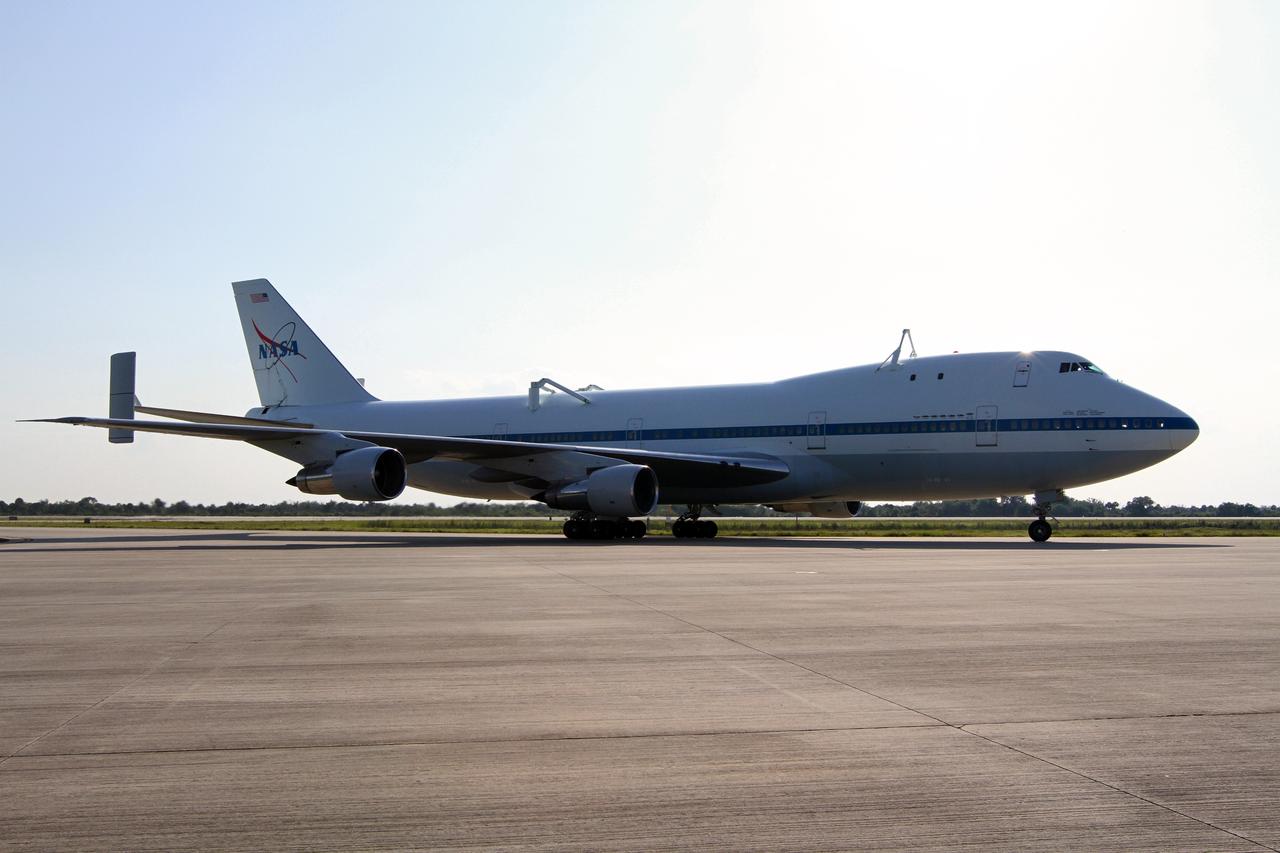
CAPE CANAVERAL, Fla. – NASA pilot Jeff Moultrie guides the Shuttle Carrier Aircraft onto the apron of the runway at the Shuttle Landing Facility at NASA’s Kennedy Space Center in Florida. The aircraft, known as an SCA, arrived at 5:35 p.m. EDT to prepare for shuttle Discovery’s ferry flight to the Washington Dulles International Airport in Sterling, Va., on April 17. This SCA, designated NASA 905, is a modified Boeing 747 jet airliner, originally manufactured for commercial use. One of two SCAs employed over the course of the Space Shuttle Program, NASA 905 is assigned to the remaining ferry missions, delivering the shuttles to their permanent public display sites. NASA 911 was decommissioned at the NASA Dryden Flight Research Center in California in February. Discovery will be placed on permanent public display in the Smithsonian's National Air and Space Museum Steven F. Udvar-Hazy Center in Chantilly, Va. For more information on the SCA, visit http://www.nasa.gov/centers/dryden/news/FactSheets/FS-013-DFRC.html. For more information on shuttle transition and retirement activities, visit http://www.nasa.gov/shuttle. Photo credit: NASA/Kim Shiflett
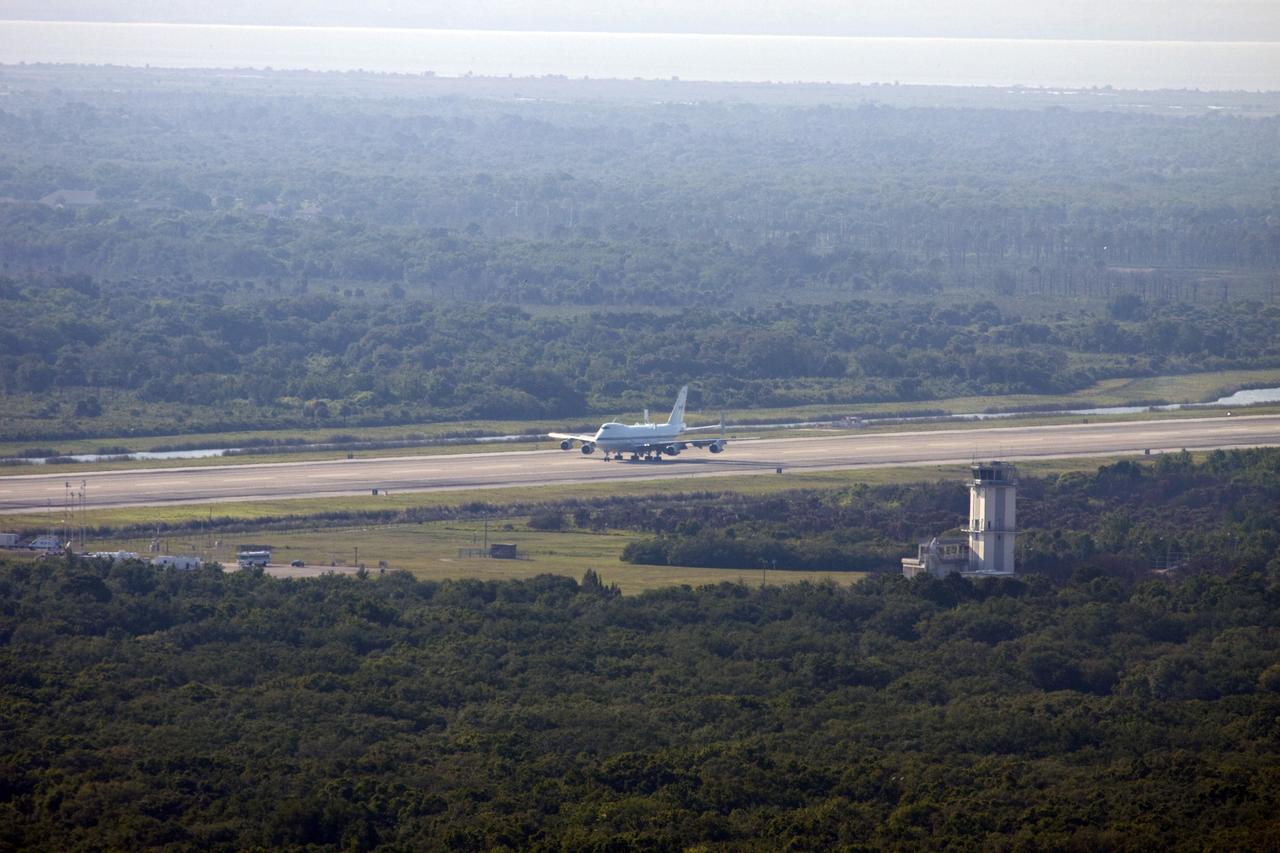
CAPE CANAVERAL, Fla. – The Shuttle Carrier Aircraft glides down the runway at the Shuttle Landing Facility at NASA’s Kennedy Space Center in Florida. The aircraft, known as an SCA, arrived at 5:35 p.m. EDT to prepare for shuttle Discovery’s ferry flight to the Washington Dulles International Airport in Sterling, Va., on April 17. This SCA, designated NASA 905, is a modified Boeing 747 jet airliner, originally manufactured for commercial use. One of two SCAs employed over the course of the Space Shuttle Program, NASA 905 is assigned to the remaining ferry missions, delivering the shuttles to their permanent public display sites. NASA 911 was decommissioned at the NASA Dryden Flight Research Center in California in February. Discovery will be placed on permanent public display in the Smithsonian's National Air and Space Museum Steven F. Udvar-Hazy Center in Chantilly, Va. For more information on the SCA, visit http://www.nasa.gov/centers/dryden/news/FactSheets/FS-013-DFRC.html. For more information on shuttle transition and retirement activities, visit http://www.nasa.gov/shuttle. Photo credit: NASA/Jim Grossmann
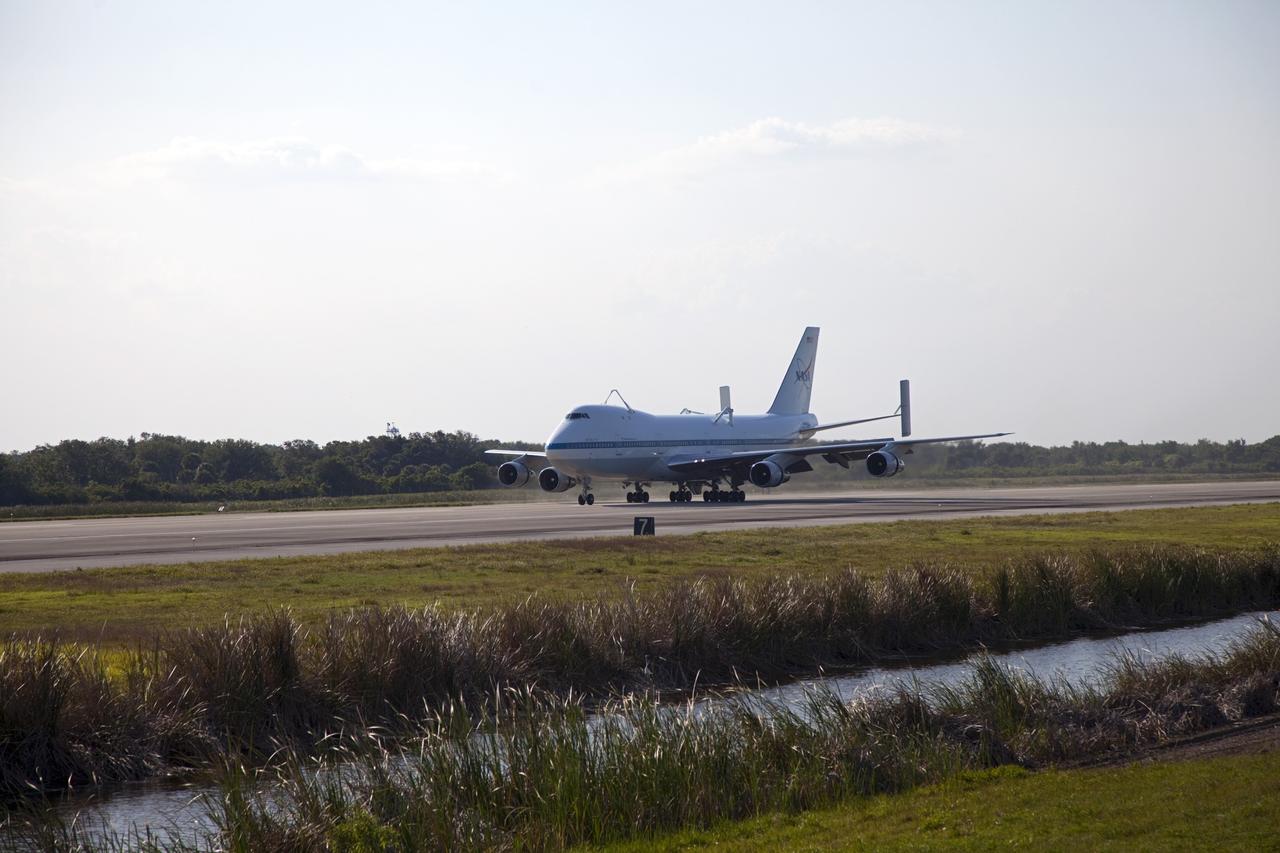
CAPE CANAVERAL, Fla. – The Shuttle Carrier Aircraft glides down the runway of the Shuttle Landing Facility at NASA’s Kennedy Space Center in Florida. The aircraft, known as an SCA, arrived at 5:35 p.m. EDT to prepare for shuttle Discovery’s ferry flight to the Washington Dulles International Airport in Sterling, Va., on April 17. This SCA, designated NASA 905, is a modified Boeing 747 jet airliner, originally manufactured for commercial use. One of two SCAs employed over the course of the Space Shuttle Program, NASA 905 is assigned to the remaining ferry missions, delivering the shuttles to their permanent public display sites. NASA 911 was decommissioned at the NASA Dryden Flight Research Center in California in February. Discovery will be placed on permanent public display in the Smithsonian's National Air and Space Museum Steven F. Udvar-Hazy Center in Chantilly, Va. For more information on the SCA, visit http://www.nasa.gov/centers/dryden/news/FactSheets/FS-013-DFRC.html. For more information on shuttle transition and retirement activities, visit http://www.nasa.gov/shuttle. Photo credit: NASA/Frankie Martin
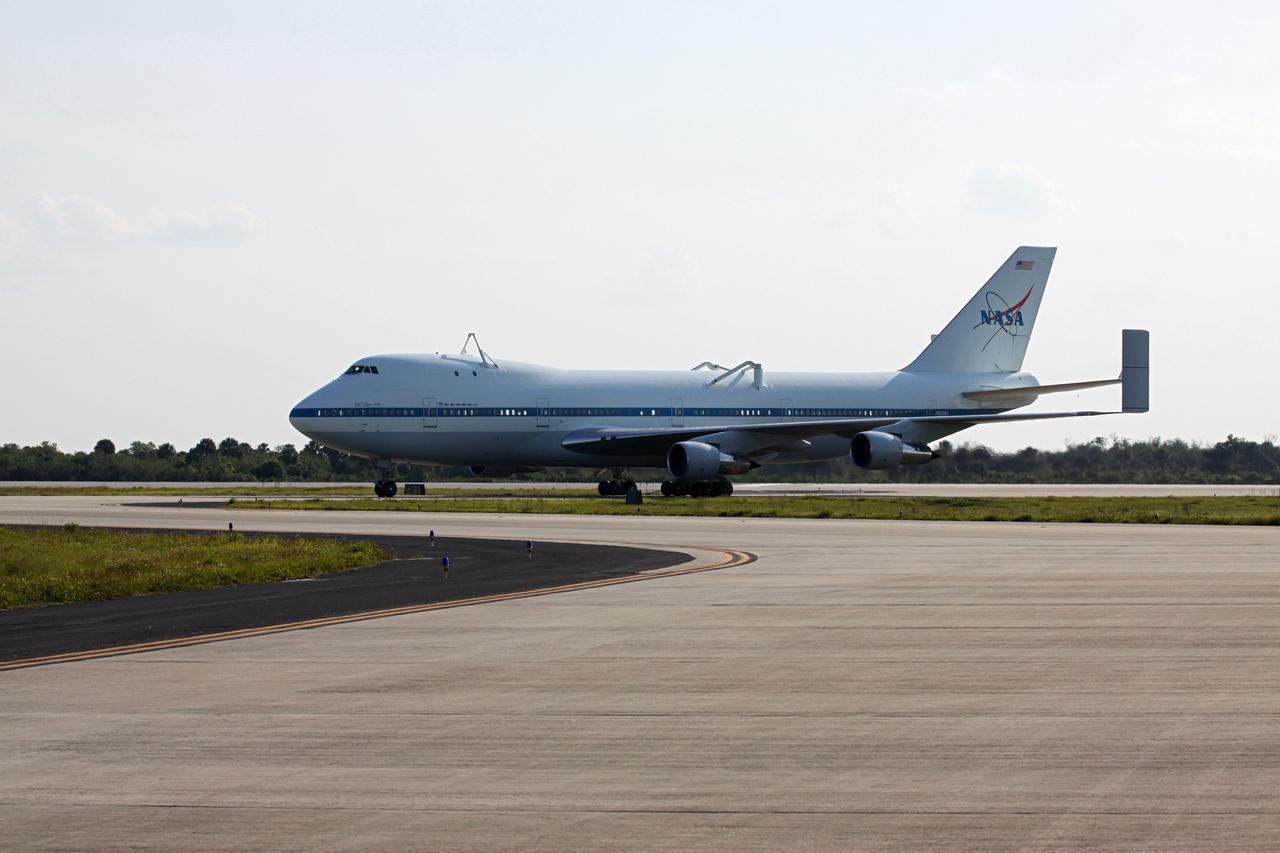
CAPE CANAVERAL, Fla. – The Shuttle Carrier Aircraft approaches the apron of the runway at the Shuttle Landing Facility at NASA’s Kennedy Space Center in Florida. The aircraft, known as an SCA, arrived at 5:35 p.m. EDT to prepare for shuttle Discovery’s ferry flight to the Washington Dulles International Airport in Sterling, Va., on April 17. This SCA, designated NASA 905, is a modified Boeing 747 jet airliner, originally manufactured for commercial use. One of two SCAs employed over the course of the Space Shuttle Program, NASA 905 is assigned to the remaining ferry missions, delivering the shuttles to their permanent public display sites. NASA 911 was decommissioned at the NASA Dryden Flight Research Center in California in February. Discovery will be placed on permanent public display in the Smithsonian's National Air and Space Museum Steven F. Udvar-Hazy Center in Chantilly, Va. For more information on the SCA, visit http://www.nasa.gov/centers/dryden/news/FactSheets/FS-013-DFRC.html. For more information on shuttle transition and retirement activities, visit http://www.nasa.gov/shuttle. Photo credit: NASA/Kim Shiflett
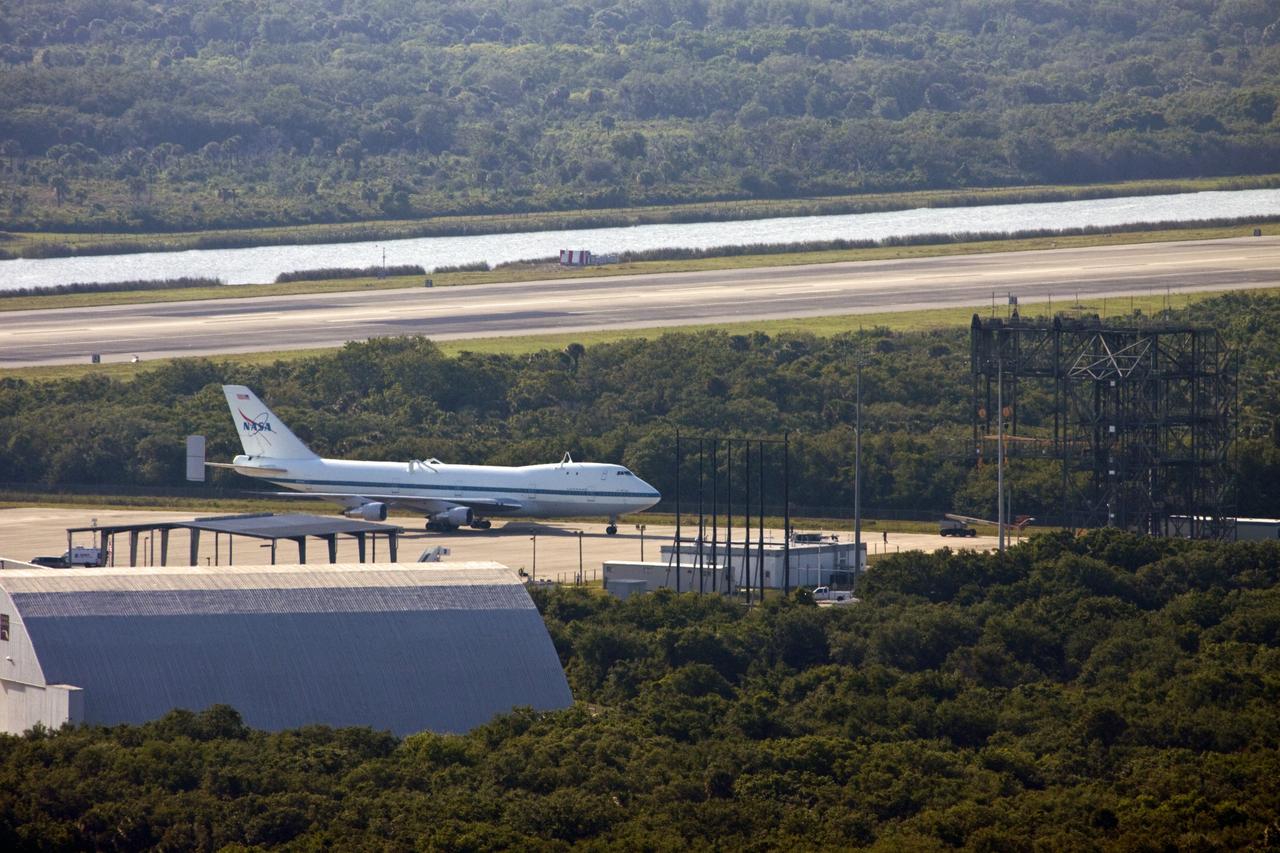
CAPE CANAVERAL, Fla. – The Shuttle Carrier Aircraft approaches the mate/demate device at the Shuttle Landing Facility at NASA’s Kennedy Space Center in Florida. The aircraft, known as an SCA, arrived at 5:35 p.m. EDT to prepare for shuttle Discovery’s ferry flight to the Washington Dulles International Airport in Sterling, Va., on April 17. This SCA, designated NASA 905, is a modified Boeing 747 jet airliner, originally manufactured for commercial use. One of two SCAs employed over the course of the Space Shuttle Program, NASA 905 is assigned to the remaining ferry missions, delivering the shuttles to their permanent public display sites. NASA 911 was decommissioned at the NASA Dryden Flight Research Center in California in February. Discovery will be placed on permanent public display in the Smithsonian's National Air and Space Museum Steven F. Udvar-Hazy Center in Chantilly, Va. For more information on the SCA, visit http://www.nasa.gov/centers/dryden/news/FactSheets/FS-013-DFRC.html. For more information on shuttle transition and retirement activities, visit http://www.nasa.gov/shuttle. Photo credit: NASA/Jim Grossmann
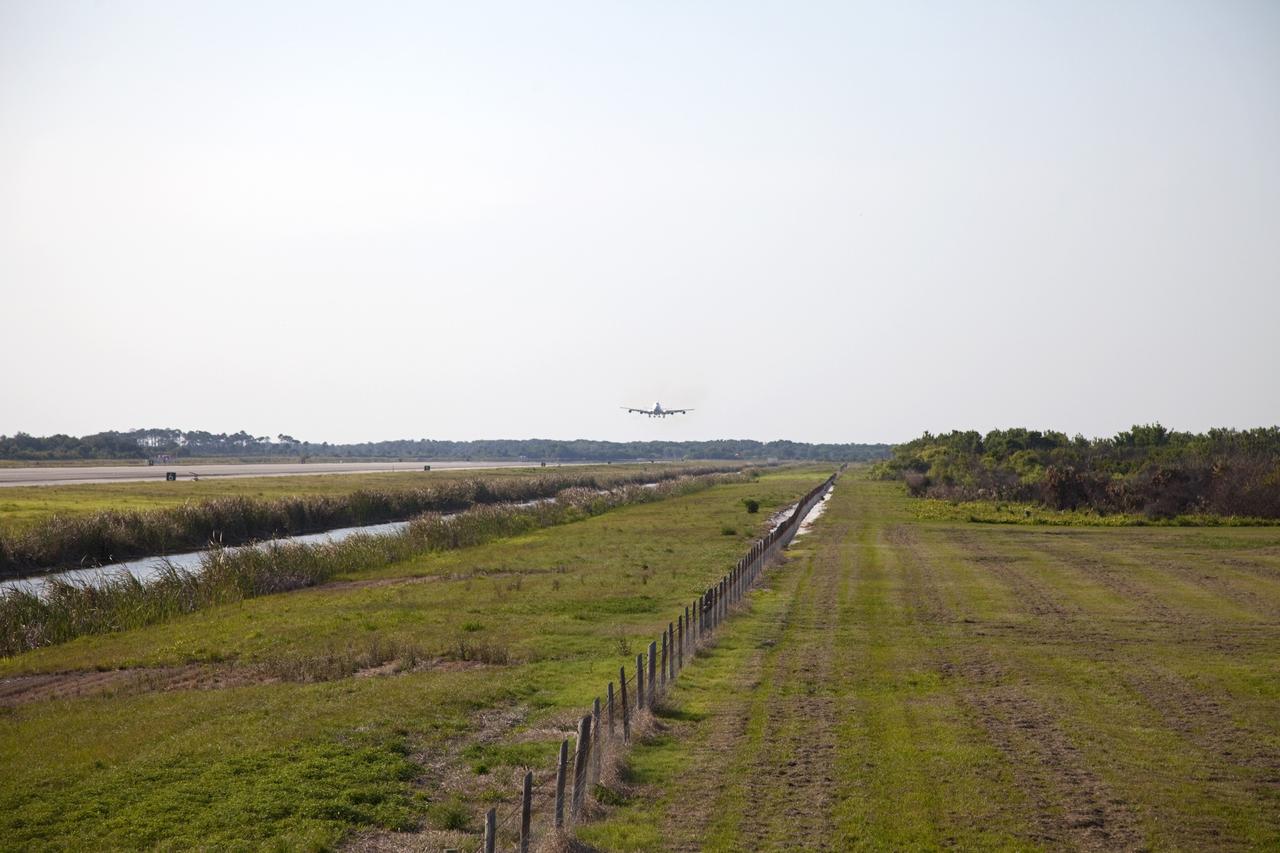
CAPE CANAVERAL, Fla. – The Shuttle Carrier Aircraft approaches the Shuttle Landing Facility at NASA’s Kennedy Space Center in Florida. The aircraft, known as an SCA, arrived at 5:35 p.m. EDT to prepare for shuttle Discovery’s ferry flight to the Washington Dulles International Airport in Sterling, Va., on April 17. This SCA, designated NASA 905, is a modified Boeing 747 jet airliner, originally manufactured for commercial use. One of two SCAs employed over the course of the Space Shuttle Program, NASA 905 is assigned to the remaining ferry missions, delivering the shuttles to their permanent public display sites. NASA 911 was decommissioned at the NASA Dryden Flight Research Center in California in February. Discovery will be placed on permanent public display in the Smithsonian's National Air and Space Museum Steven F. Udvar-Hazy Center in Chantilly, Va. For more information on the SCA, visit http://www.nasa.gov/centers/dryden/news/FactSheets/FS-013-DFRC.html. For more information on shuttle transition and retirement activities, visit http://www.nasa.gov/shuttle. Photo credit: NASA/Frankie Martin
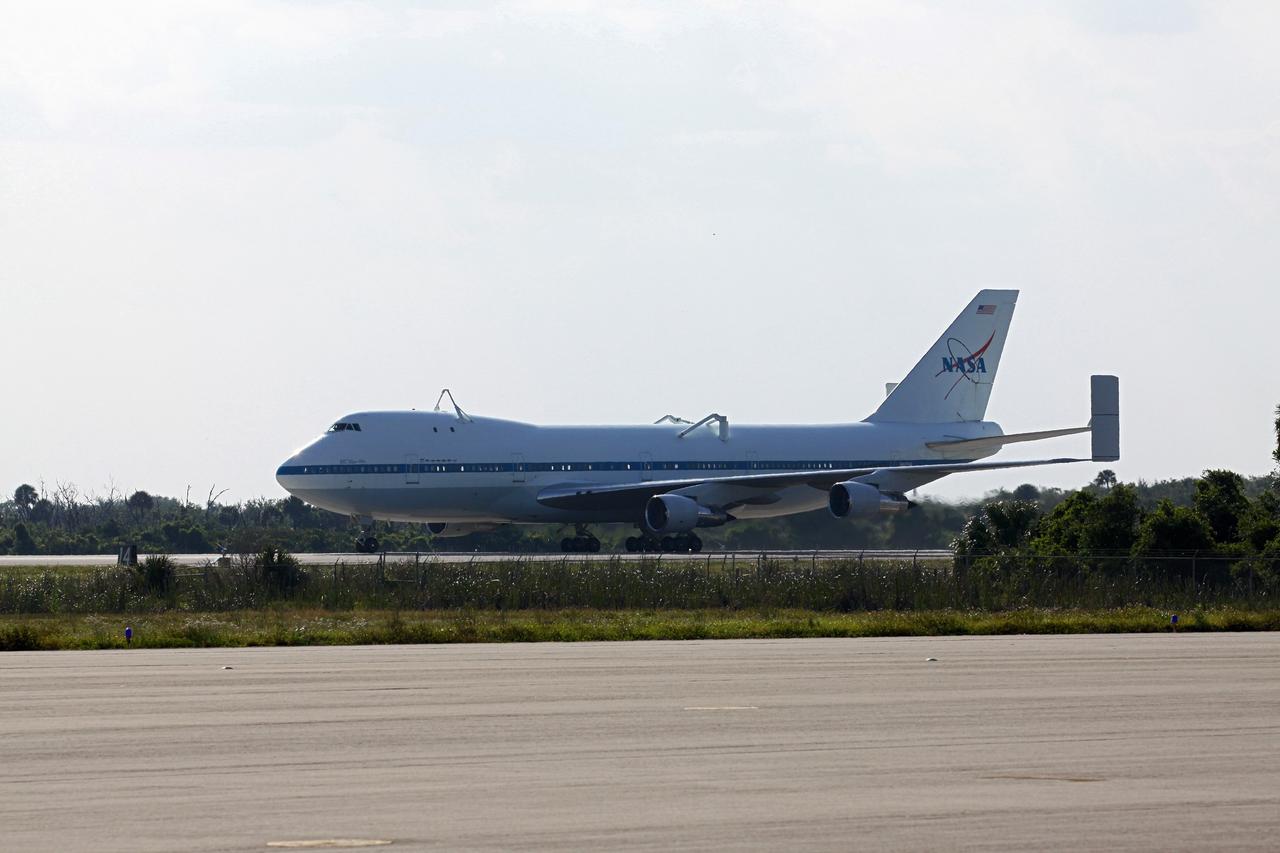
CAPE CANAVERAL, Fla. – The Shuttle Carrier Aircraft glides down the runway of the Shuttle Landing Facility at NASA’s Kennedy Space Center in Florida. The aircraft, known as an SCA, arrived at 5:35 p.m. EDT to prepare for shuttle Discovery’s ferry flight to the Washington Dulles International Airport in Sterling, Va., on April 17. This SCA, designated NASA 905, is a modified Boeing 747 jet airliner, originally manufactured for commercial use. One of two SCAs employed over the course of the Space Shuttle Program, NASA 905 is assigned to the remaining ferry missions, delivering the shuttles to their permanent public display sites. NASA 911 was decommissioned at the NASA Dryden Flight Research Center in California in February. Discovery will be placed on permanent public display in the Smithsonian's National Air and Space Museum Steven F. Udvar-Hazy Center in Chantilly, Va. For more information on the SCA, visit http://www.nasa.gov/centers/dryden/news/FactSheets/FS-013-DFRC.html. For more information on shuttle transition and retirement activities, visit http://www.nasa.gov/shuttle. Photo credit: NASA/Kim Shiflett