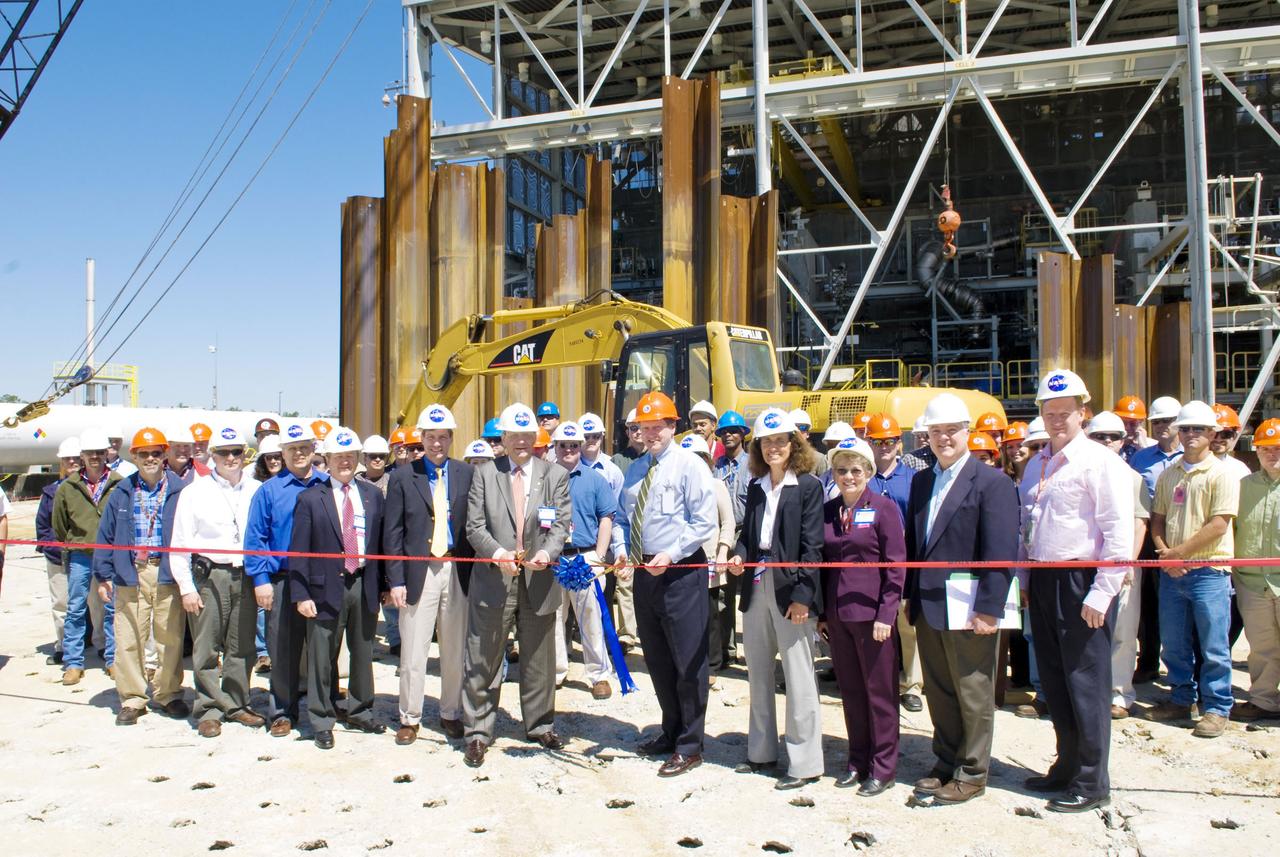
Representatives from NASA, Orbital Sciences Corp. and Aerojet participate in a ribbon-cutting ceremony for construction of a flame deflector trench at Stennis Space Center's E Test Complex. Participants included Orbital CEO J.R. Thompson (center, left) and Stennis Space Center Director Gene Goldman (center, right).
E Complex groundbreaking
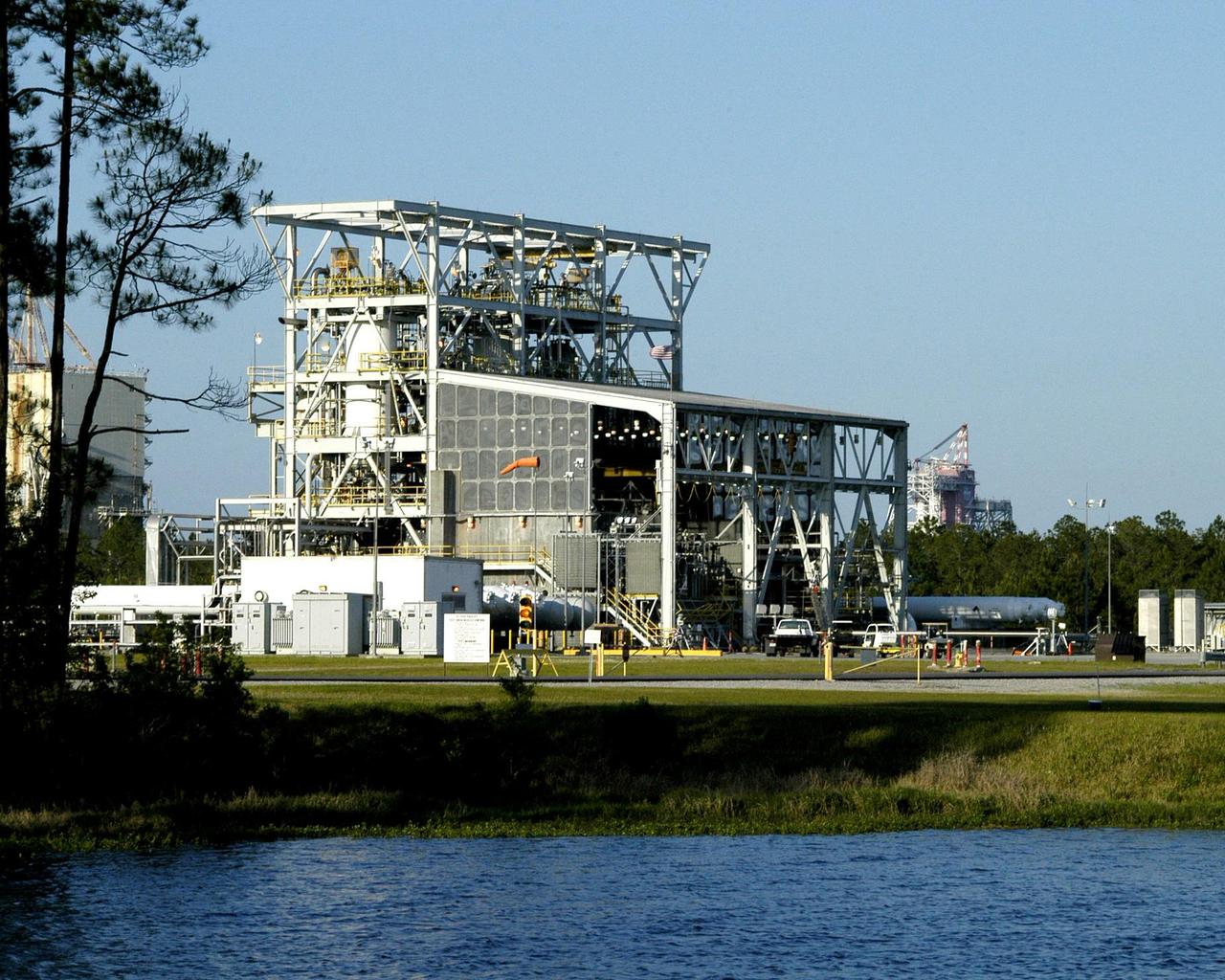
The E Test Complex is SSC's versatile, three-stand complex that includes seven separate test cells capable of testing that involves ultra high-pressure gases and cryogenic fluids.
E Test Stand
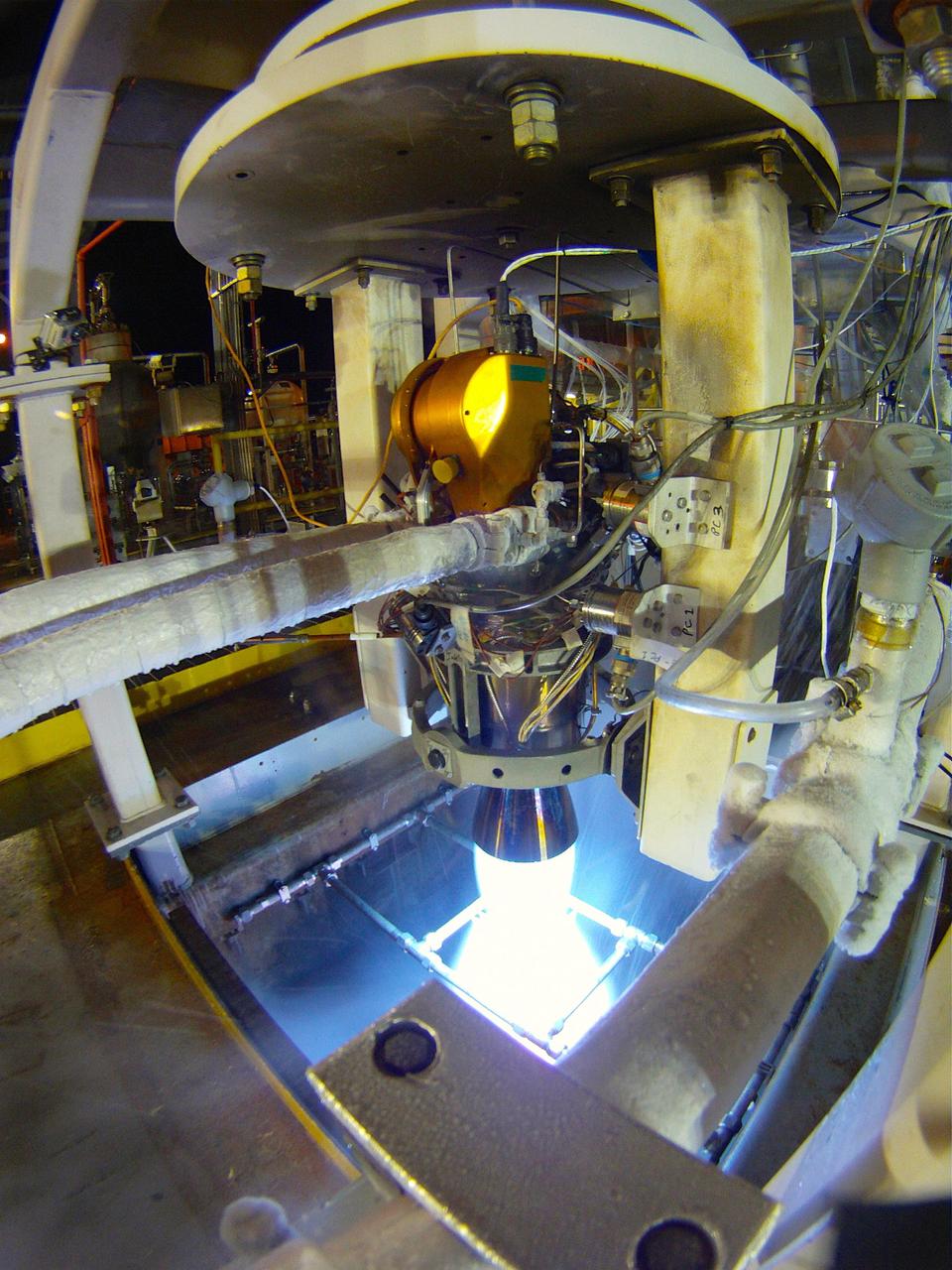
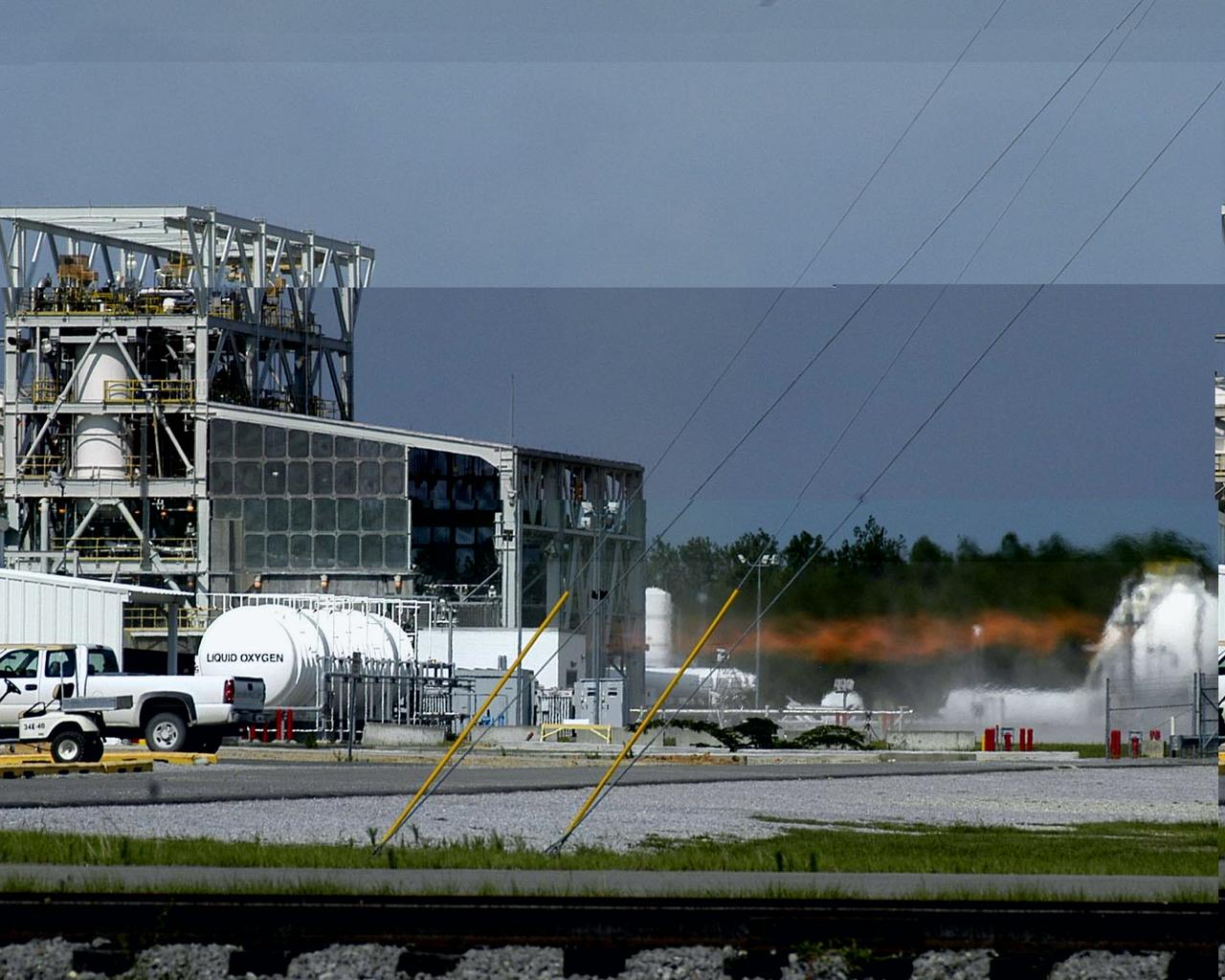
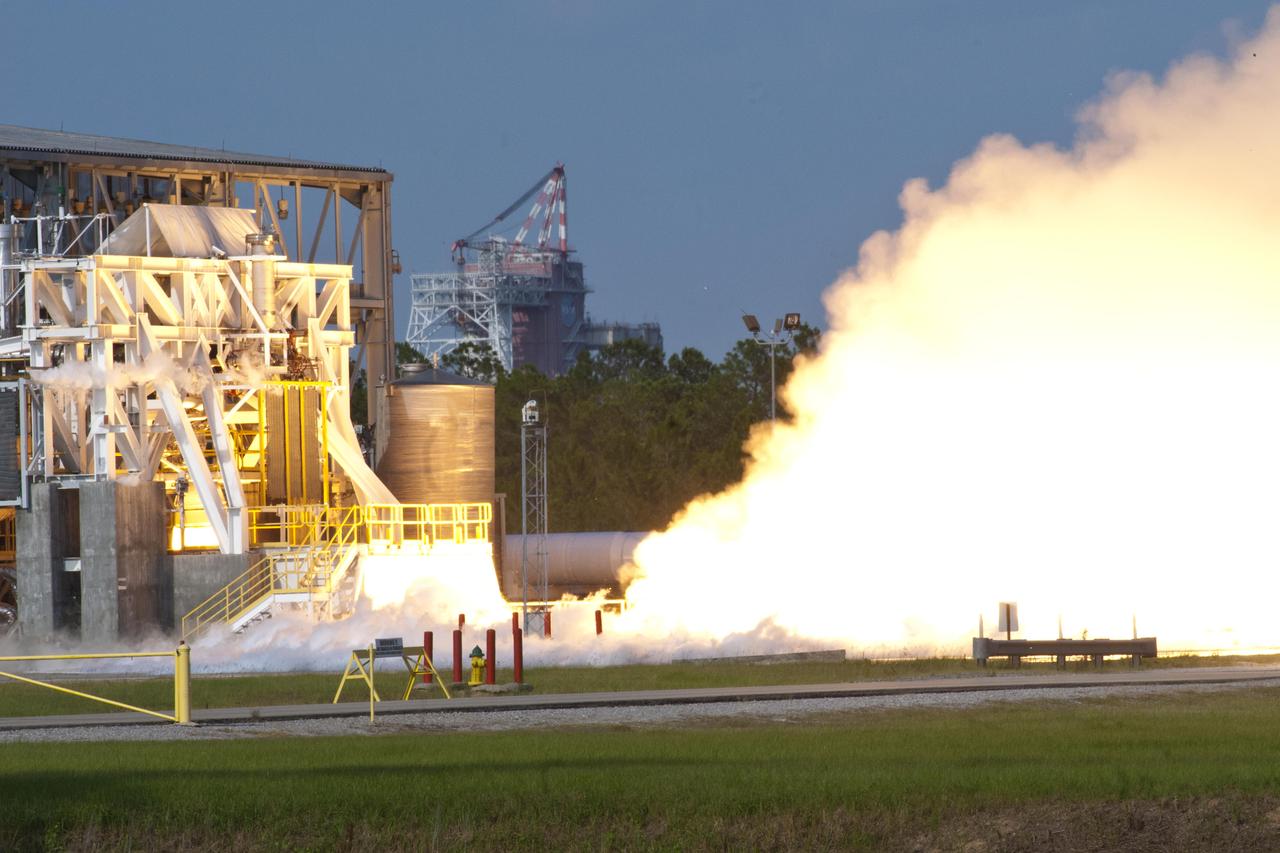
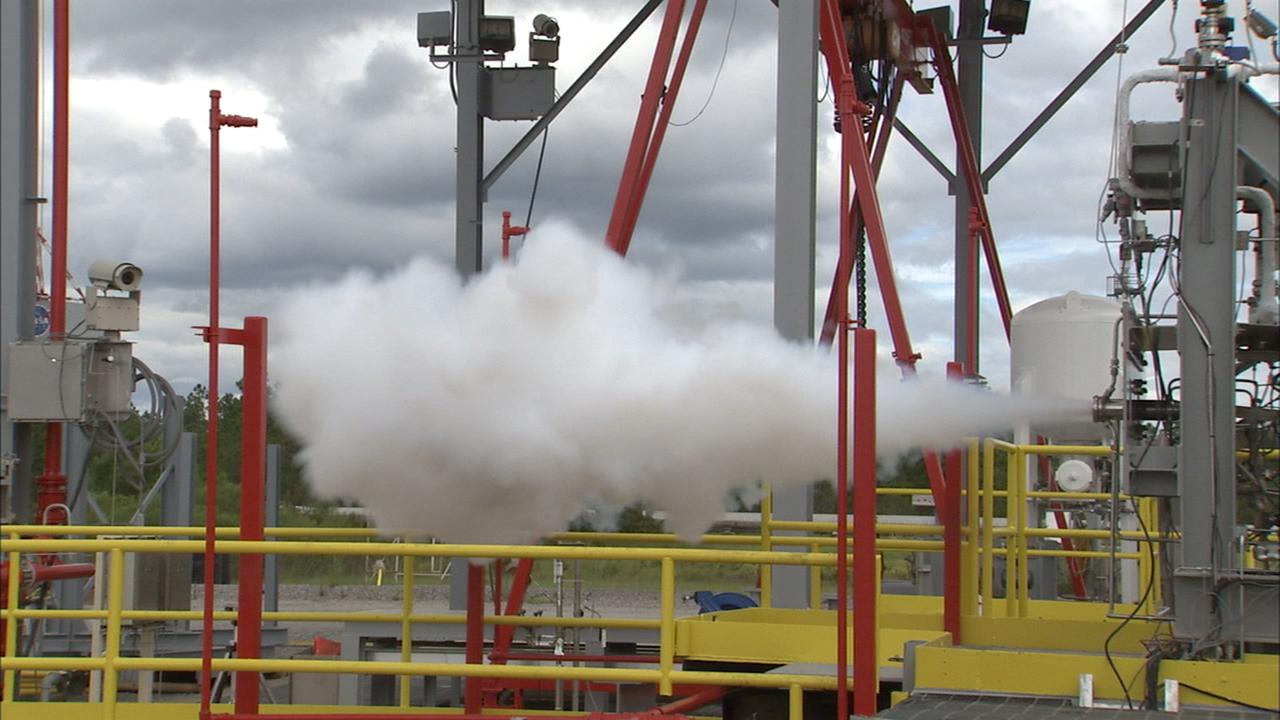
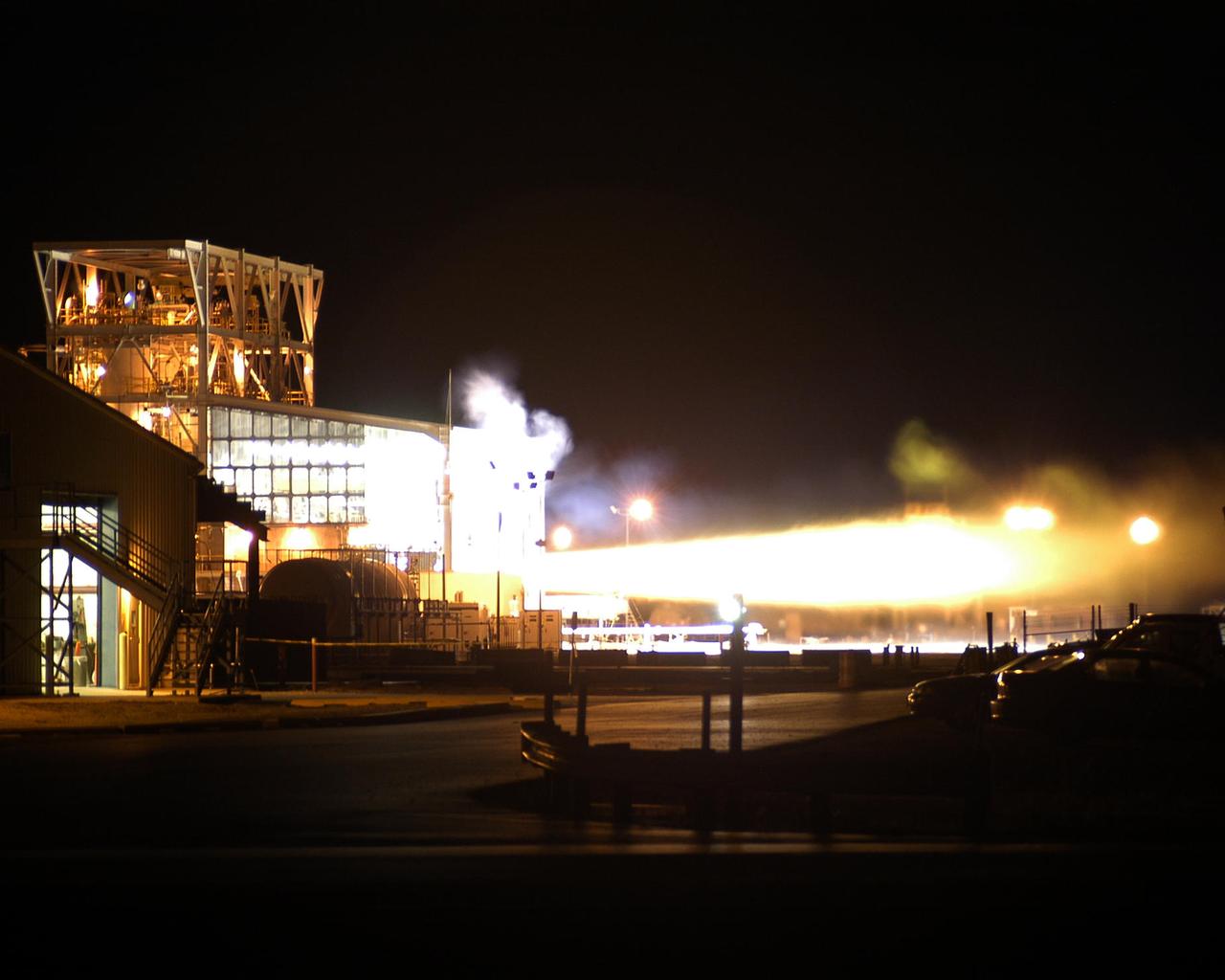
A test of NASA's liquid oxygen, liquid methane Project Morpheus engine is conducted Nov. 8 on the E-3 Test Stand at John C. Stennis Space Center. The test was one of 27 conducted in Stennis' E Test Complex the week of Nov. 5. Twenty-seven tests were conducted in a three-day period during the week, on three different rocket engines/components and on three E Complex test stands.
Busy test week
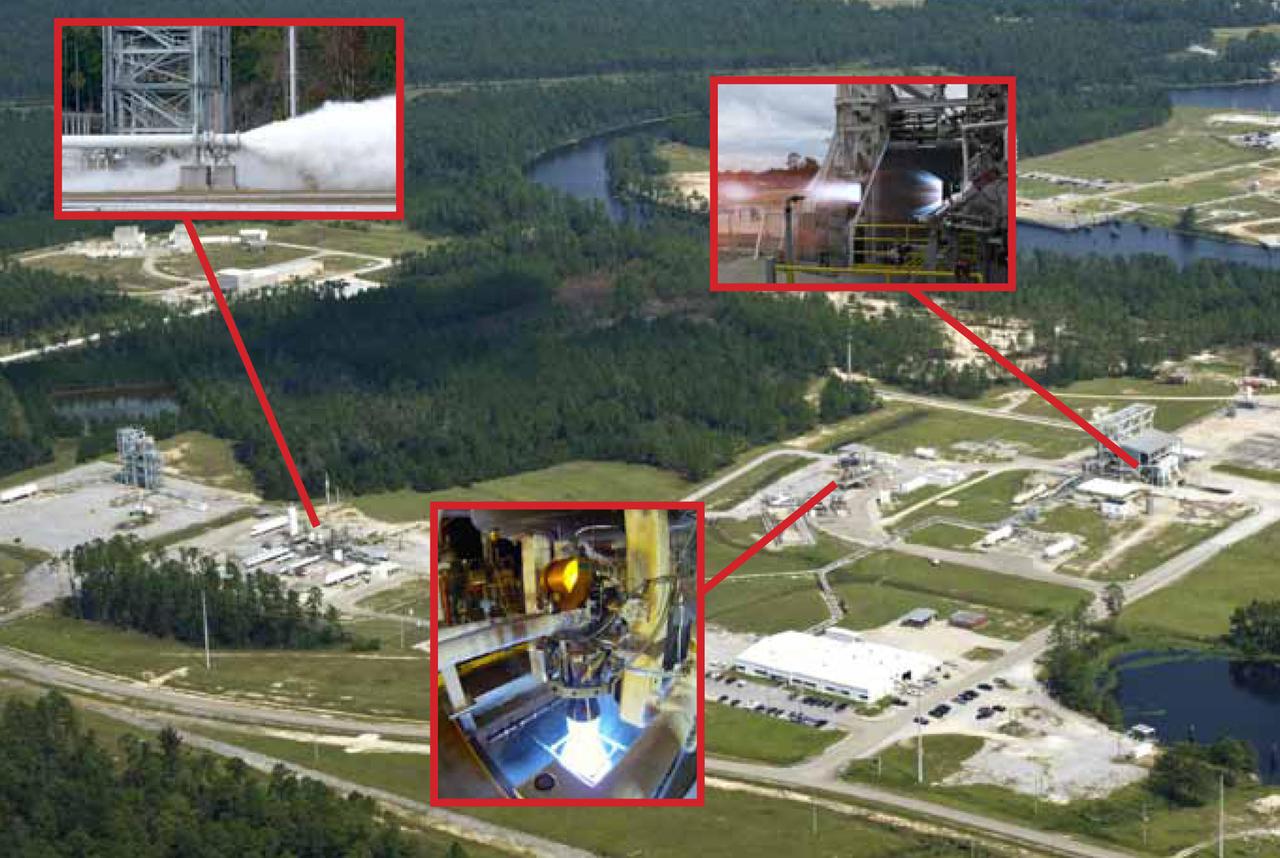
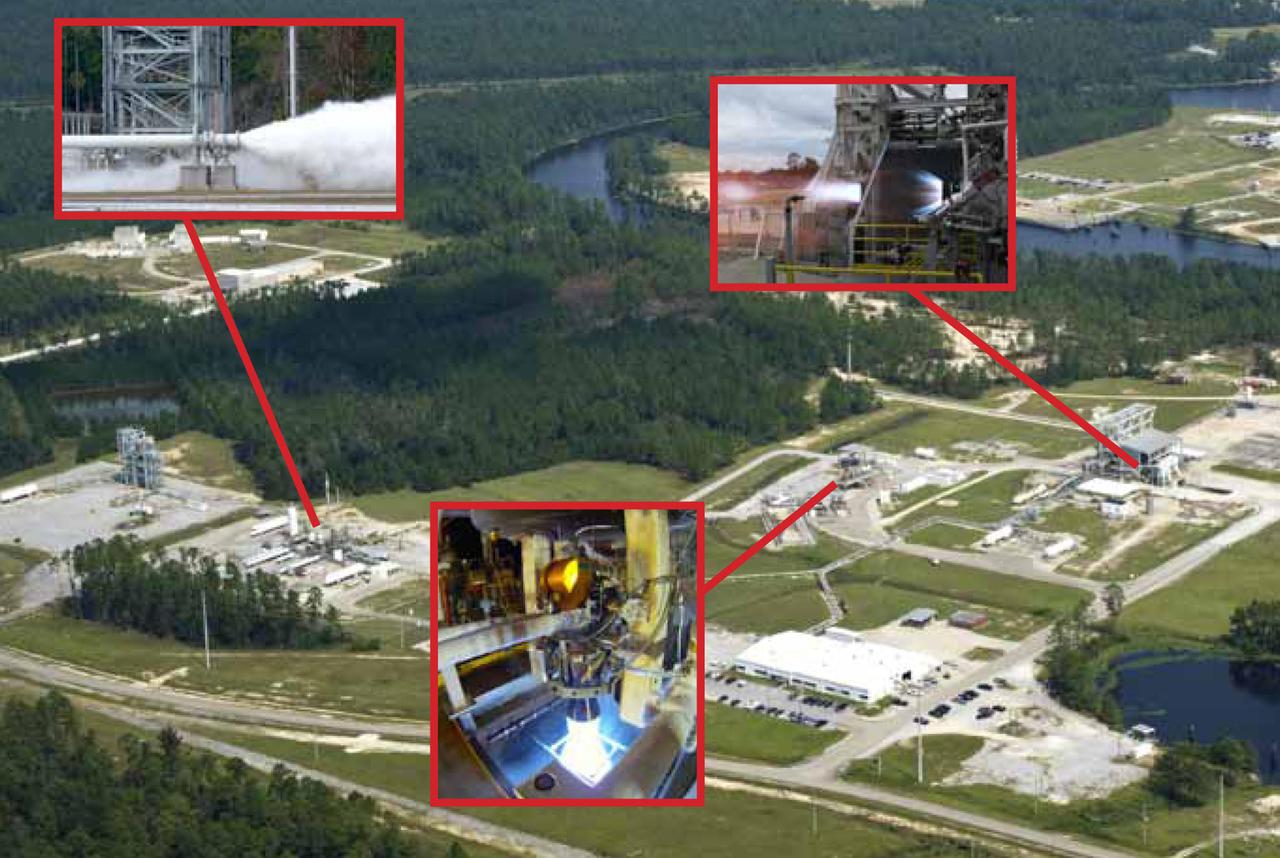
NASA recorded a historic week Nov. 5-9, conducting tests on all three stands in the E Test Complex at John C. Stennis Space Center. Inset images show the types of tests conducted on the E-1 Test Stand (right), the E-2 Test Stand (left) and the E-3 Test Stand (center). The E-1 photo is from an early October test and is provided courtesy of Blue Origin. Other photos are from tests conducted the week of Nov. 5.
Busy test week
NASA recorded a historic week Nov. 5-9, conducting tests on all three stands in the E Test Complex at John C. Stennis Space Center. Inset images show the types of tests conducted on the E-1 Test Stand (right), the E-2 Test Stand (left) and the E-3 Test Stand (center). The E-1 photo is from an early October test and is provided courtesy of Blue Origin. Other photos are from tests conducted the week of Nov. 5.
Busy test week
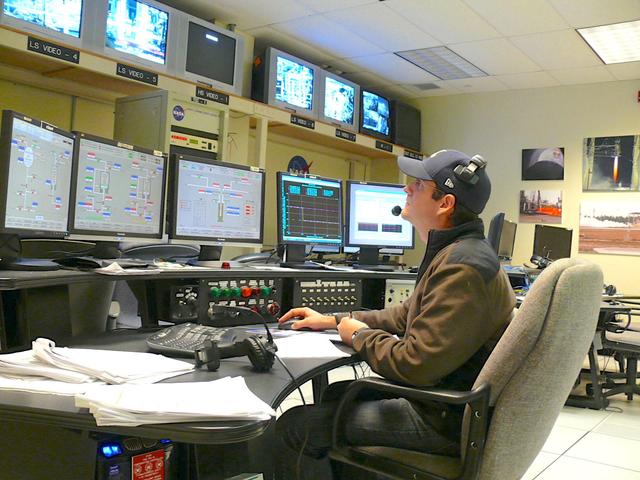
NASA engineer Andy Guymon studies data in the E-3 Test Stand Control Center at John C. Stennis Space Center during testing of NASA's Project Morpheus engine. Nov. 8. The test of the liquid oxygen, liquid methane engine was one of 27 conducted in Stennis' E Test Complex the week of Nov. 5.
Busy test week
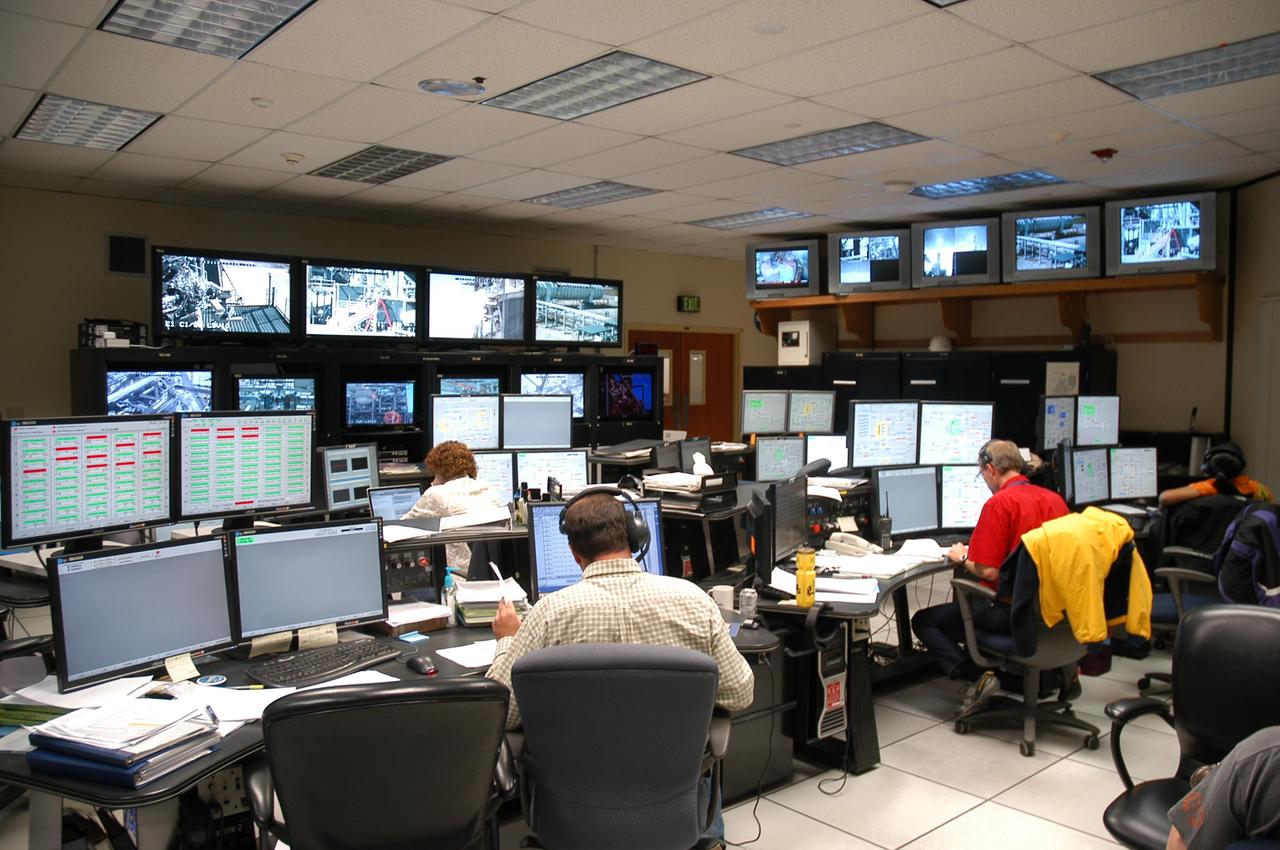
Jason Hopper of NASA (front row), Jody Ladner of Lockheed Martin (back row, left) and Chris Mulkey of NASA prepare to test the Blue Origin BE-3 engine thrust chamber in the E-1 Test Stand Control Center at John C. Stennis Space Center on Nov. 8. The test was one of 27 conducted in Stennis' E Test Complex the week of Nov. 5.
Busy test week
The Integrated Powerhead Demonstration engine was fired at 100 percent power for the first time July 12, 2006 at NASA Stennis Space Center's E Test Complex. The IPD, which can generate about 250,000 pounds of thrust, is a reusable engine system whose technologies could one day help Americans return to the moon, and travel to Mars and beyond. The IPD engine has been designed, developed and tested through the combined efforts of Pratt & Whitney Rocketdyne and Aerojet, under the direction of the Air Force Research Laboratory and NASA's Marshall Space Flight Center.
IPD 100% Power Test
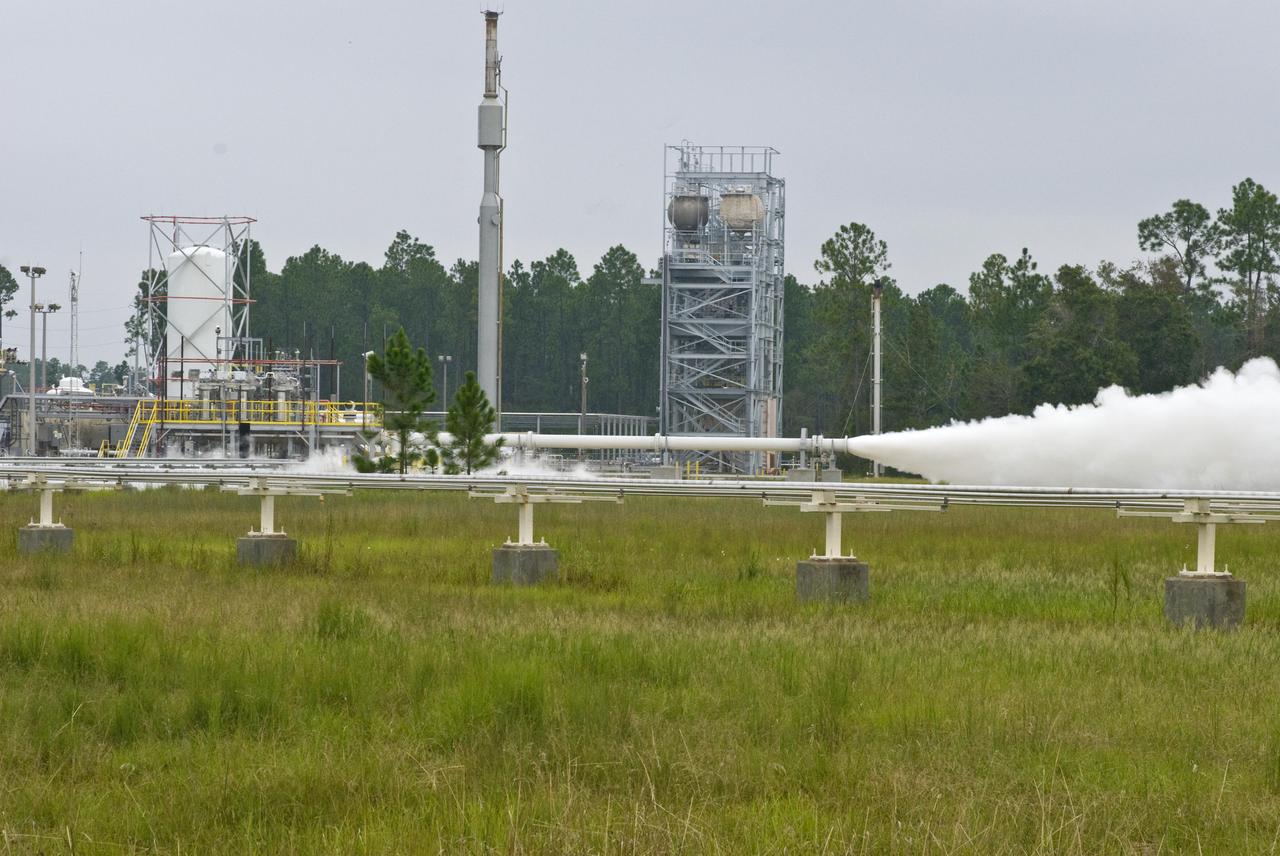
NASA engineers test a chemical steam generator (CSG) unit on the E-2 Test Stand at John C. Stennis Space Center on Nov. 6. The test was one of 27 conducted in Stennis' E Test Complex the week of Nov. 5. Twenty-seven CSG units will be used on the new A-3 Test Stand at Stennis to produce a vacuum that allows testing of engines at simulated altitudes up to 100,000 feet.
Busy test week
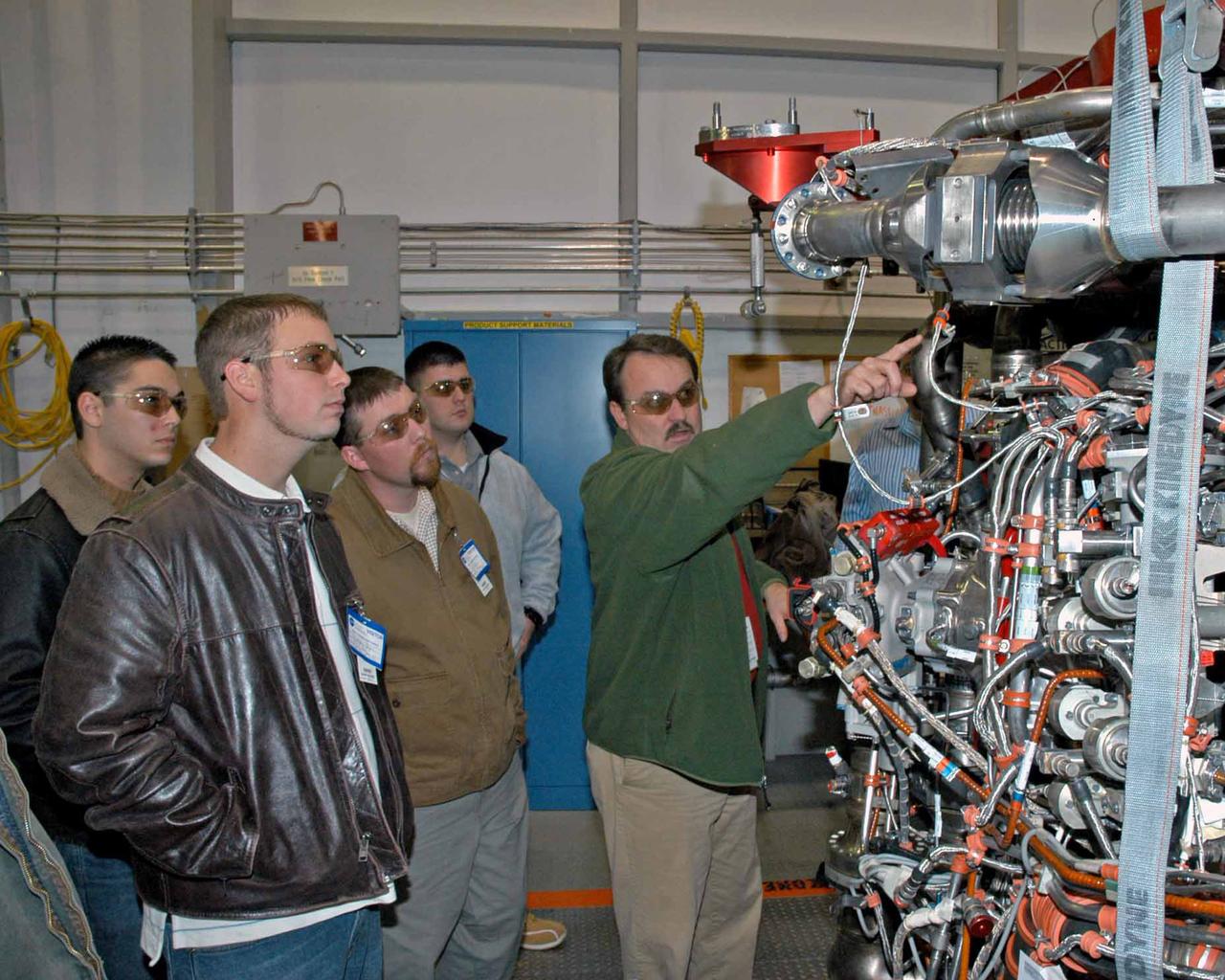
Pratt & Whitney Rocketdyne's Jeff Hansell, right, explains functions of a space shuttle main engine to Pearl River Community College Aviation Maintenance Technology Program students. Christopher Bryon, left, of Bay St. Louis, Ret Tolar of Kiln, Dan Holston of Baxterville and Billy Zugg of Long Beach took a recent tour of the SSME Processing Facility and the E-1 Test Complex at Stennis Space Center in South Mississippi. The students attend class adjacent to the Stennis International Airport tarmac in Kiln, where they get hands-on experience. PRCC's program prepares students to be responsible for the inspection, repair and maintenance of technologically advanced aircraft. A contractor to NASA, Pratt & Whitney Rocketdyne in Canoga Park, Calif., manufactures the space shuttle main engine and its high-pressure turbo pumps. SSC was established in the 1960s to test the huge engines for the Saturn V moon rockets. Now 40 years later, the center tests every main engine for the space shuttle, and is America's largest rocket engine test complex. SSC will soon begin testing the rocket engines that will power spacecraft carrying Americans back to the moon and on to Mars.
PRCC Aviation Students
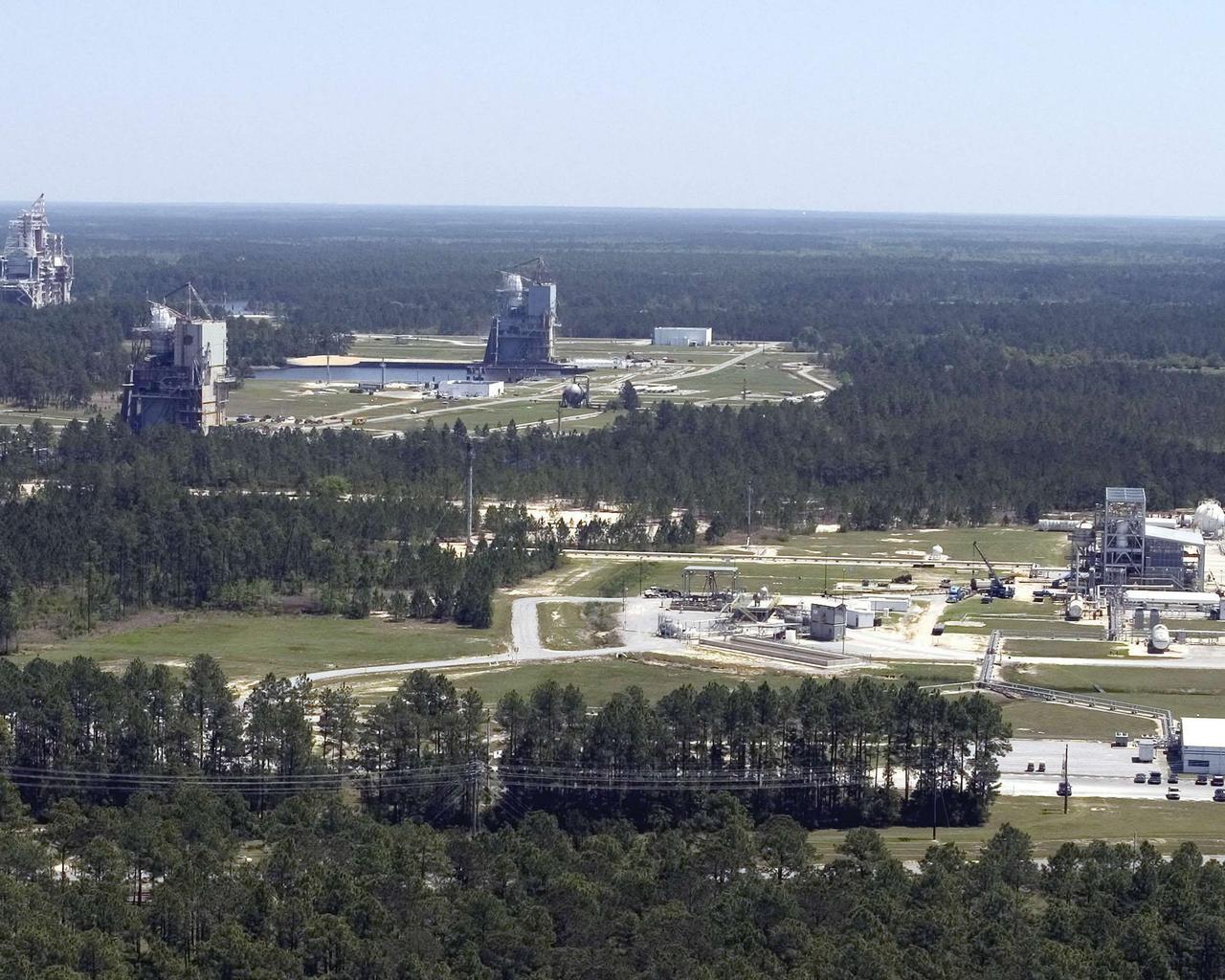
SSC's rocket engine test complex and its four unique test stands provide test operations for the development and certification of propulsion systems, subsystems and components.
Aerial Test Stands
NASA engineers tested an Aerojet AJ26 rocket engine on the E-1 Test Stand at Stennis Space Center on June 25, 2012, against the backdrop of the B-1/B-2 Test Stand. The engine will be used by Orbital Sciences Corporation to power commercial cargo flights to the International Space Station.
AJ26 engine test
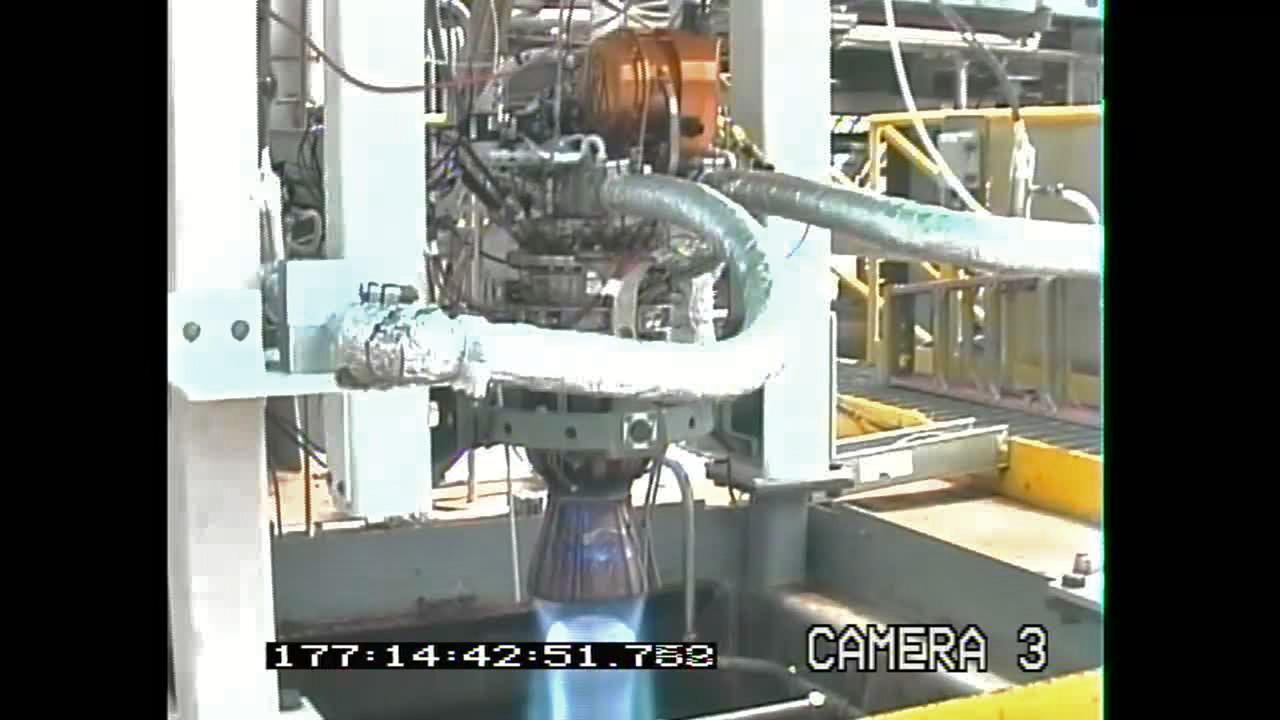
A frame grab from a mounted video camera on the E-3 Test Stand at Stennis Space Center documents testing of the new Project Morpheus engine. The new liquid methane, liquid oxygen engine will power the Morpheus prototype lander, which could one day evolve to carry cargo safely to the moon, asteroids or Mars surfaces.
Project Morpheus testing
E-2 Test Stand team members at Stennis Space Center conducted their first series of tests on a three-module chemical steam generator unit Sept. 15. All three modules successfully fired during the tests. The chemical steam generator is a critical component for the A-3 Test Stand under construction at Stennis.
CSG test
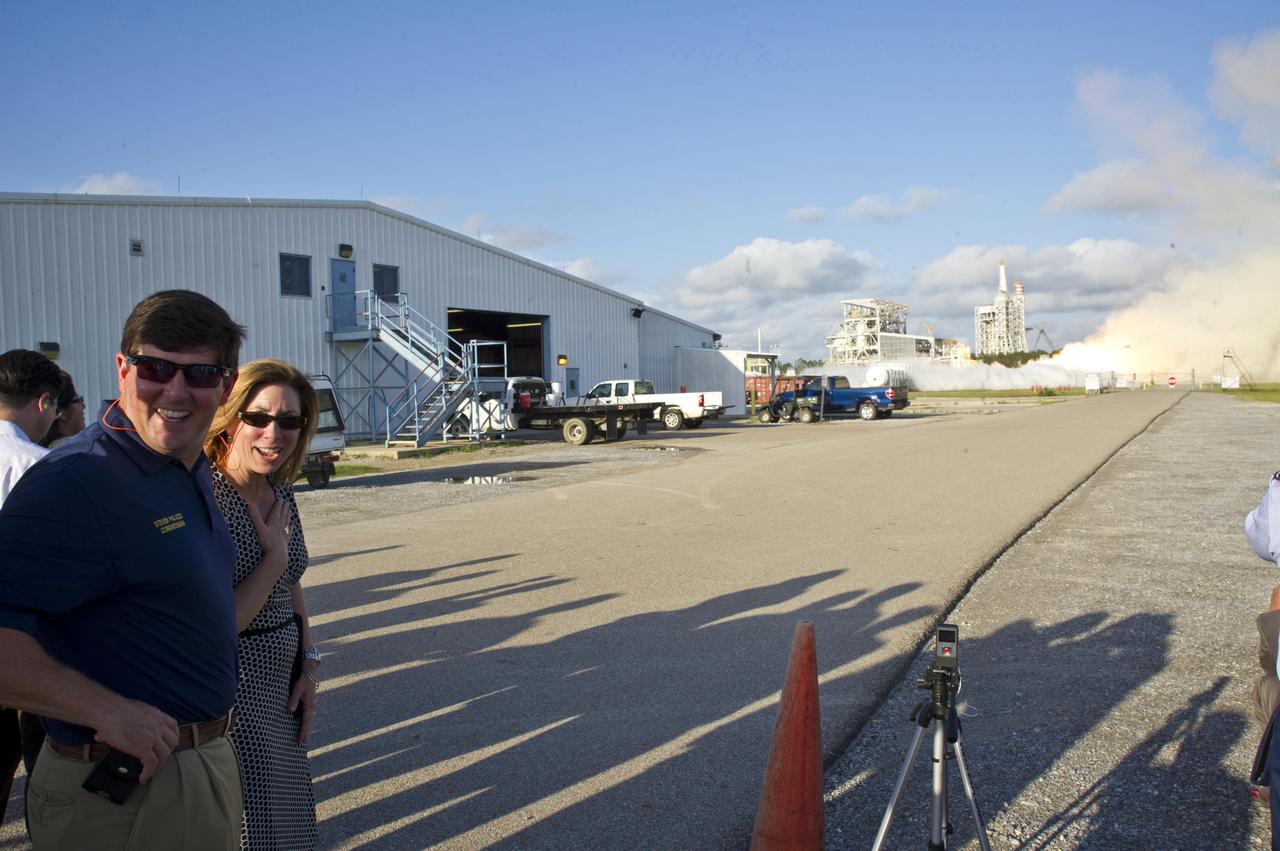
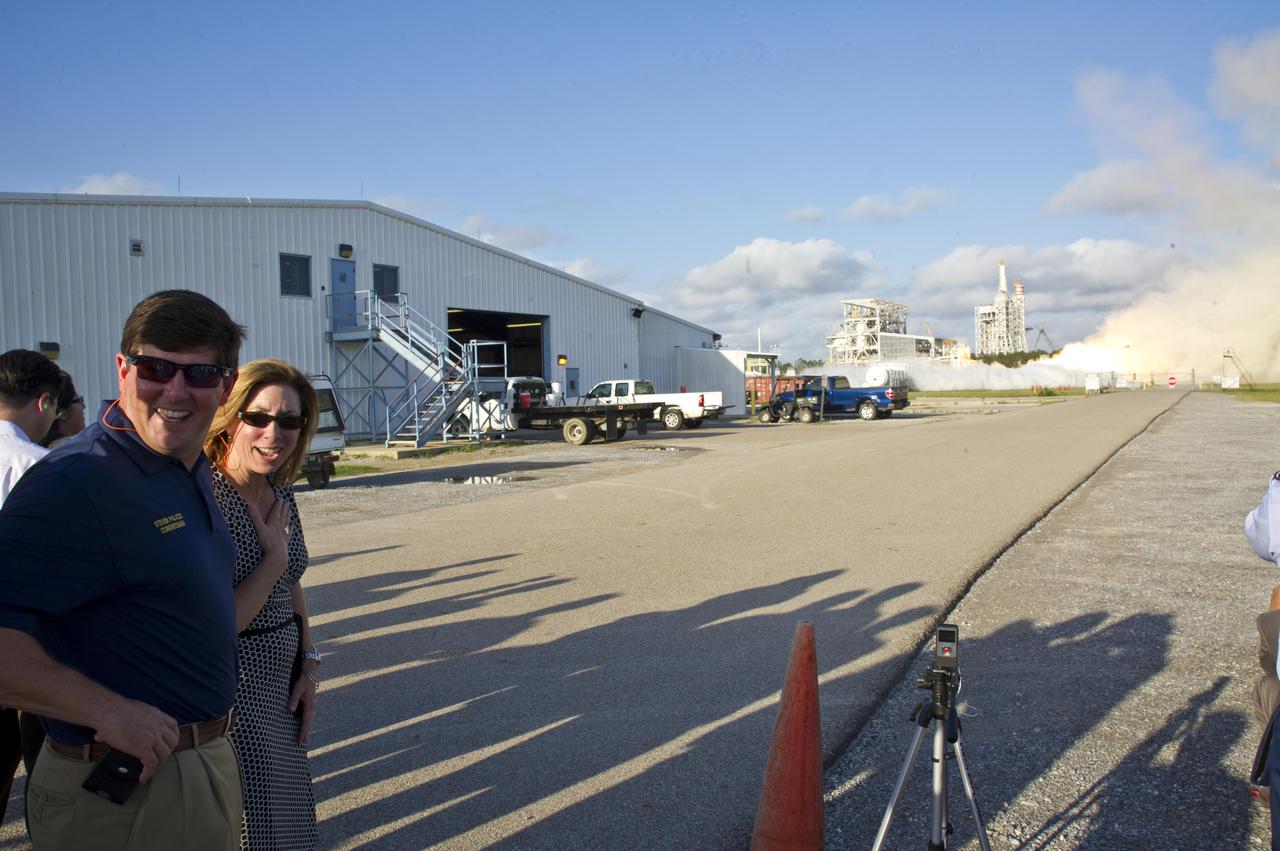
NASA Deputy Administrator Lori Garver and U.S. Rep. Steven Palazzo, R-Miss., view a May 3, 2012, test of the Aerojet AJ26 rocket engine on the E-1 Test Stand at Stennis Space Center. The AJ26 engine is being tested for Orbital Sciences Corporation to power commercial cargo flights to the International Space Station.
AJ26 engine test
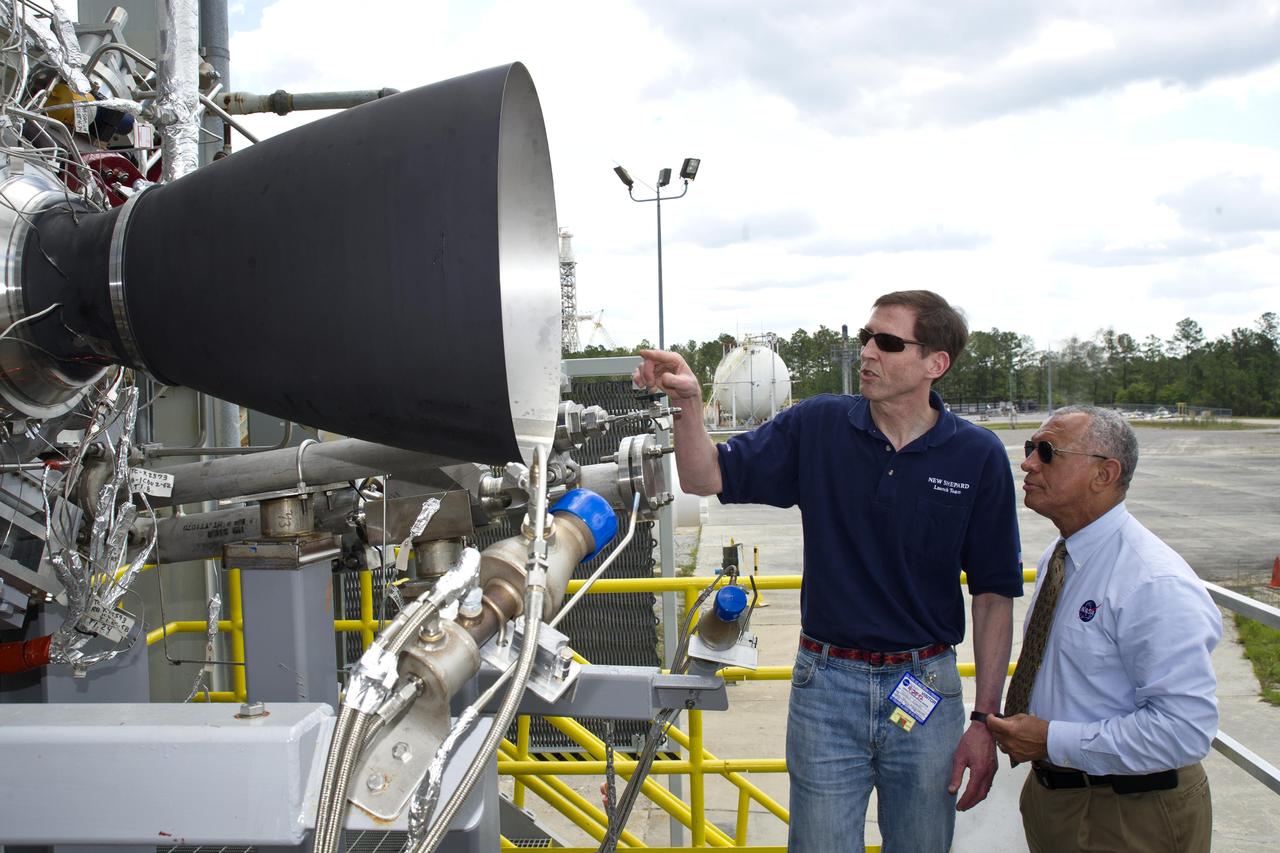
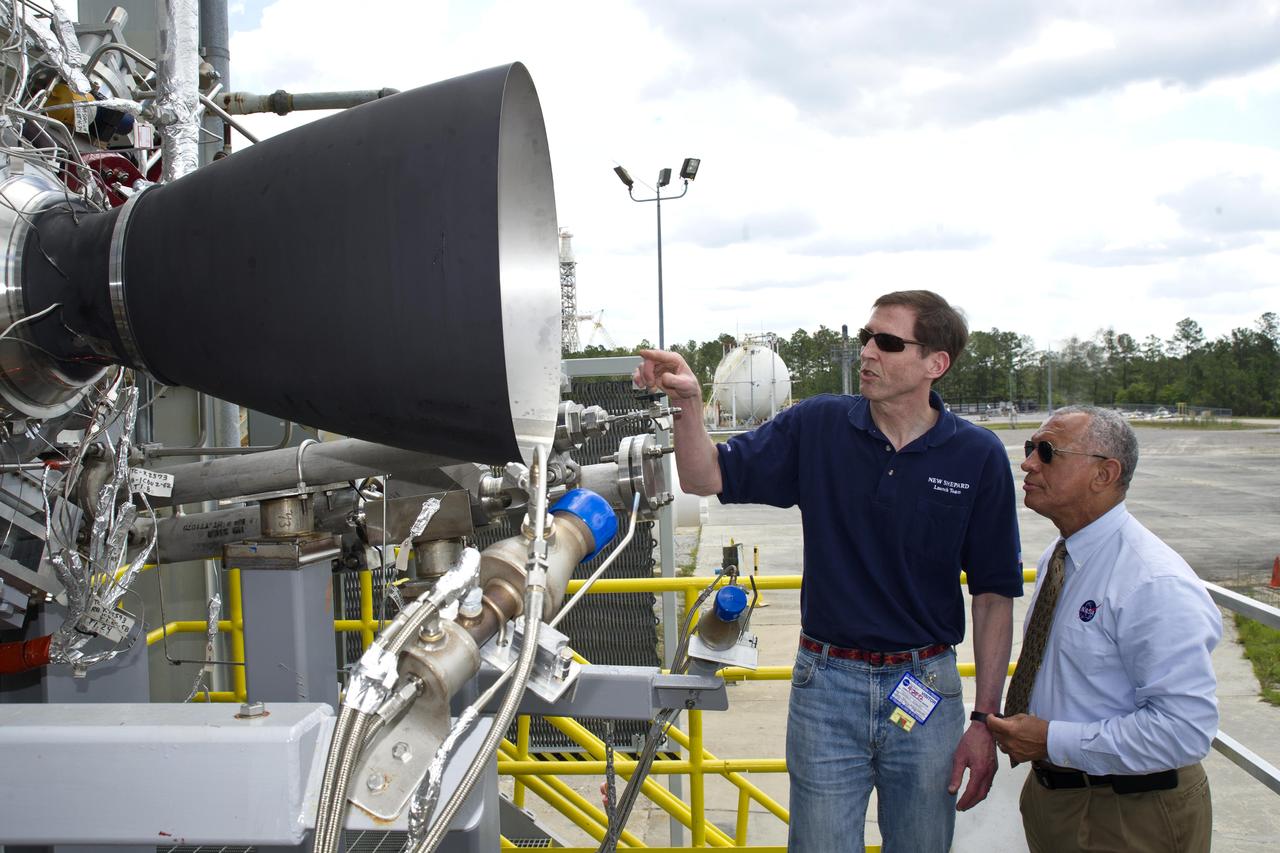
NASA Administrator Charles Bolden (r) discusses the upcoming testing of Blue Origin's BE-3 engine thrust chamber assembly with Steve Knowles, Blue Origin project manager, at the E-1 Test Stand during an April 20, 2012, visit to Stennis Space Center. Blue Origin is one of NASA's partners developing innovative systems to reach low-Earth orbit.
Blue Origin testing
NASA Deputy Administrator Lori Garver and U.S. Rep. Steven Palazzo, R-Miss., view a May 3, 2012, test of the Aerojet AJ26 rocket engine on the E-1 Test Stand at Stennis Space Center. The AJ26 engine is being tested for Orbital Sciences Corporation to power commercial cargo flights to the International Space Station.
AJ26 engine test
NASA Administrator Charles Bolden (r) discusses the upcoming testing of Blue Origin's BE-3 engine thrust chamber assembly with Steve Knowles, Blue Origin project manager, at the E-1 Test Stand during an April 20, 2012, visit to Stennis Space Center. Blue Origin is one of NASA's partners developing innovative systems to reach low-Earth orbit.
Blue Origin testing
Tests begun at Stennis Space Center's E Complex Sept. 13 evaluated a liquid oxygen lead for engine start performance, part of the A-3 Test Facility Subscale Diffuser Risk Mitigation Project at SSC's E-3 Test Facility. Phase 1 of the subscale diffuser project, completed Sept. 24, was a series of 18 hot-fire tests using a 1,000-pound liquid oxygen and gaseous hydrogen thruster to verify maximum duration and repeatability for steam generation supporting the A-3 Test Stand project. The thruster is a stand-in for NASA's developing J-2X engine, to validate a 6 percent scale version of A-3's exhaust diffuser. Testing the J-2X at altitude conditions requires an enormous diffuser. Engineers will generate nearly 4,600 pounds per second of steam to reduce pressure inside A-3's test cell to simulate altitude conditions. A-3's exhaust diffuser has to be able to withstand regulated pressure, temperatures and the safe discharge of the steam produced during those tests. Before the real thing is built, engineers hope to work out any issues on the miniature version. Phase 2 testing is scheduled to begin this month.
Diffuser Test
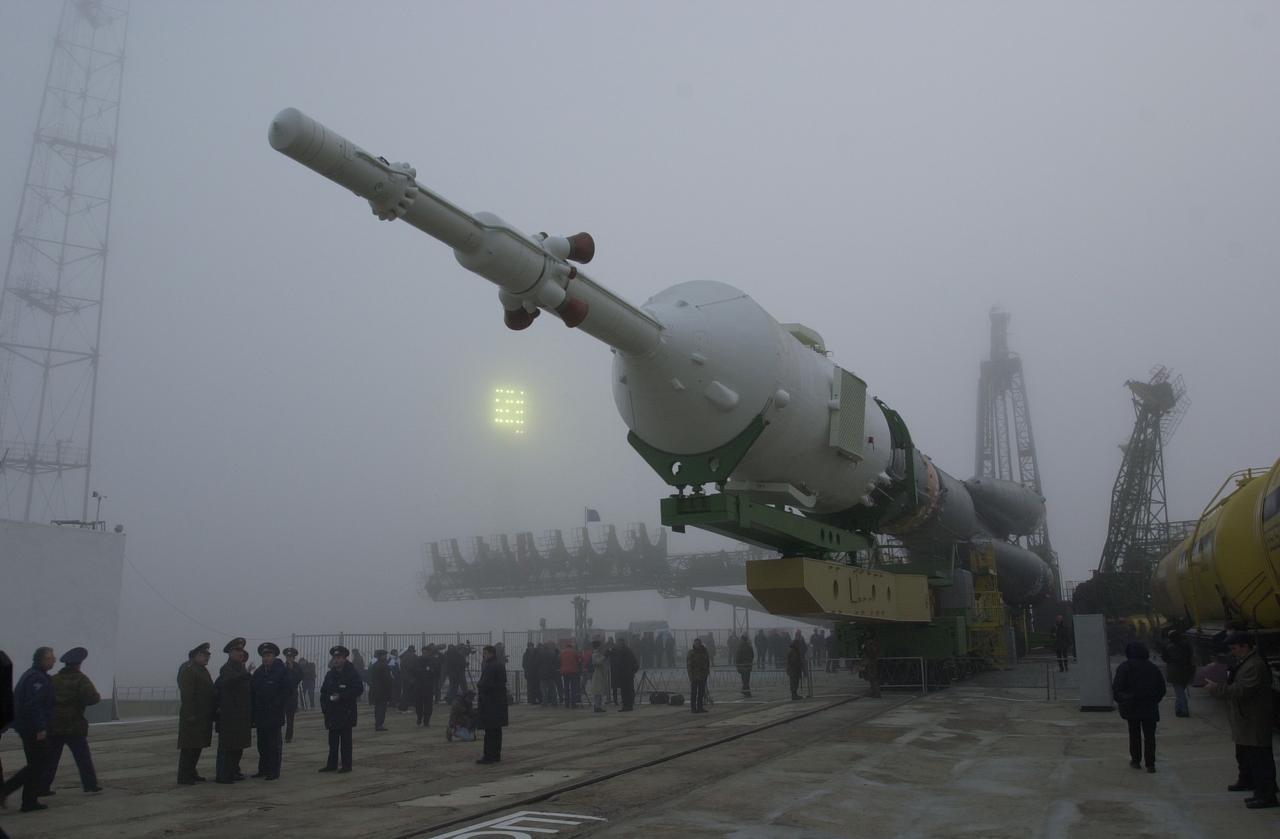
JSC2000-E-28201 (29 October 2000) ---  The Soyuz rocket moves toward the launch pad at the Baikonur complex in Kazakhstan.
Various views of the Expedition One mission preparation
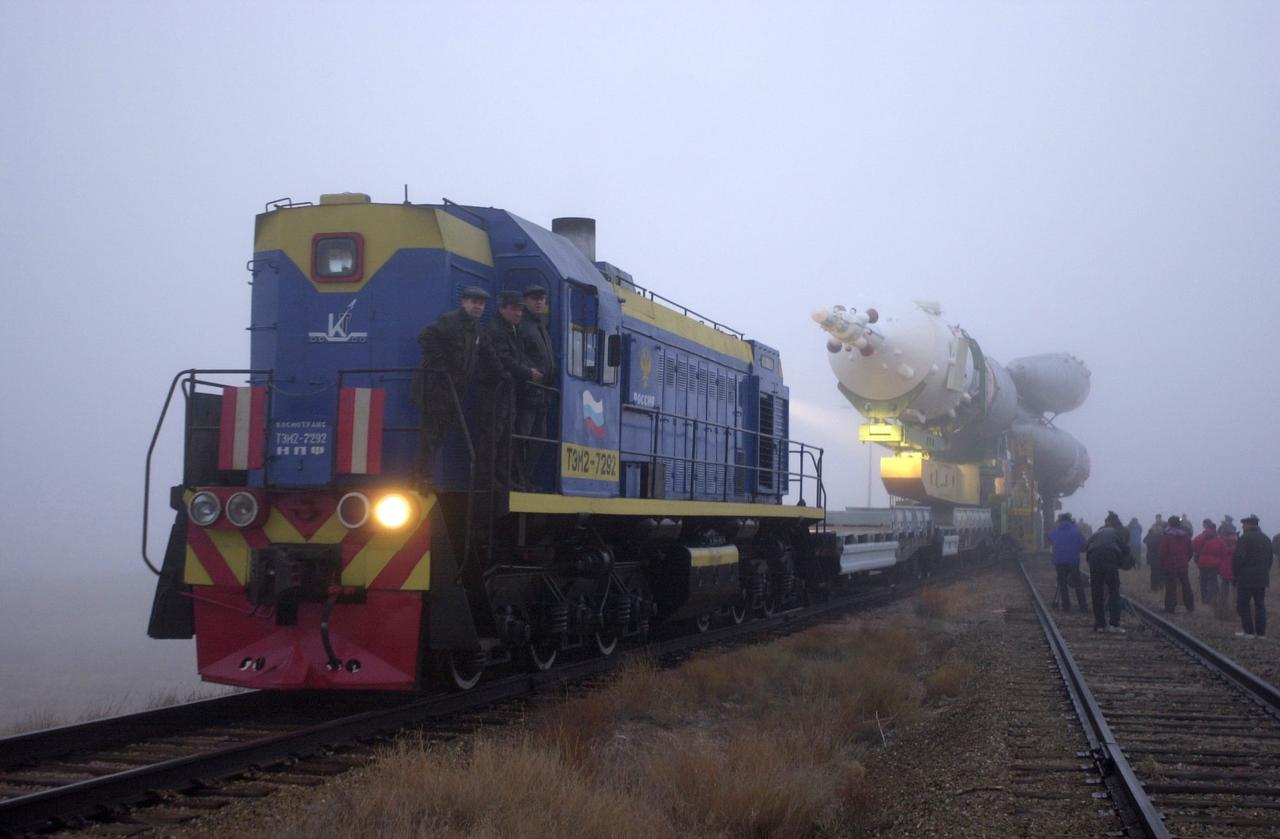
JSC2000-E-28199 (29 October 2000) ---  A train engine transports the Soyuz rocket from the assembly building toward the launch pad at the Baikonur complex in Kazakhstan.
Various views of the Expedition One mission preparation
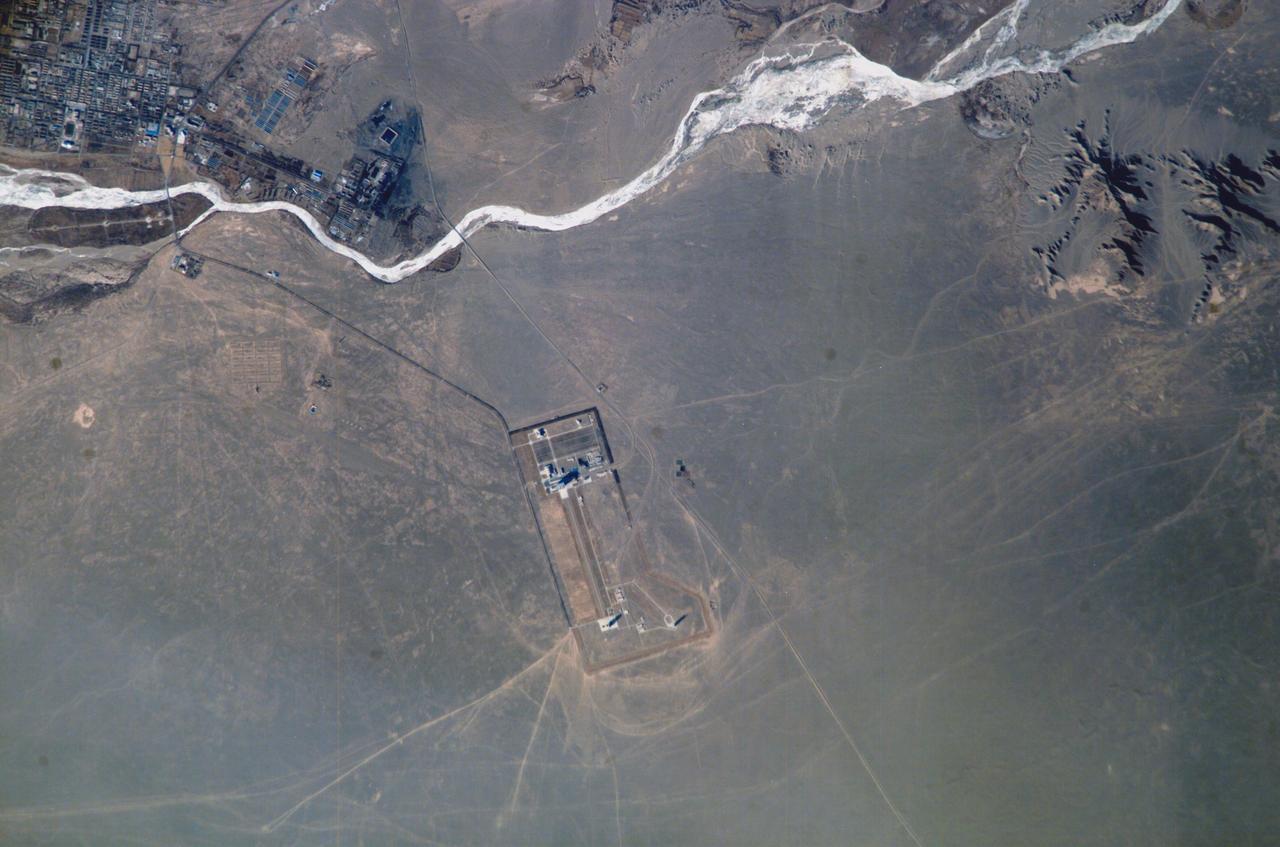
ISS010-E-14586 (23 January 2005) --- Chinese Launch Complex at Jiuquan is featured in this image photographed by an Expedition 10 crewmember on the International Space Station.
Earth Observations taken by the Expedition 10 crew
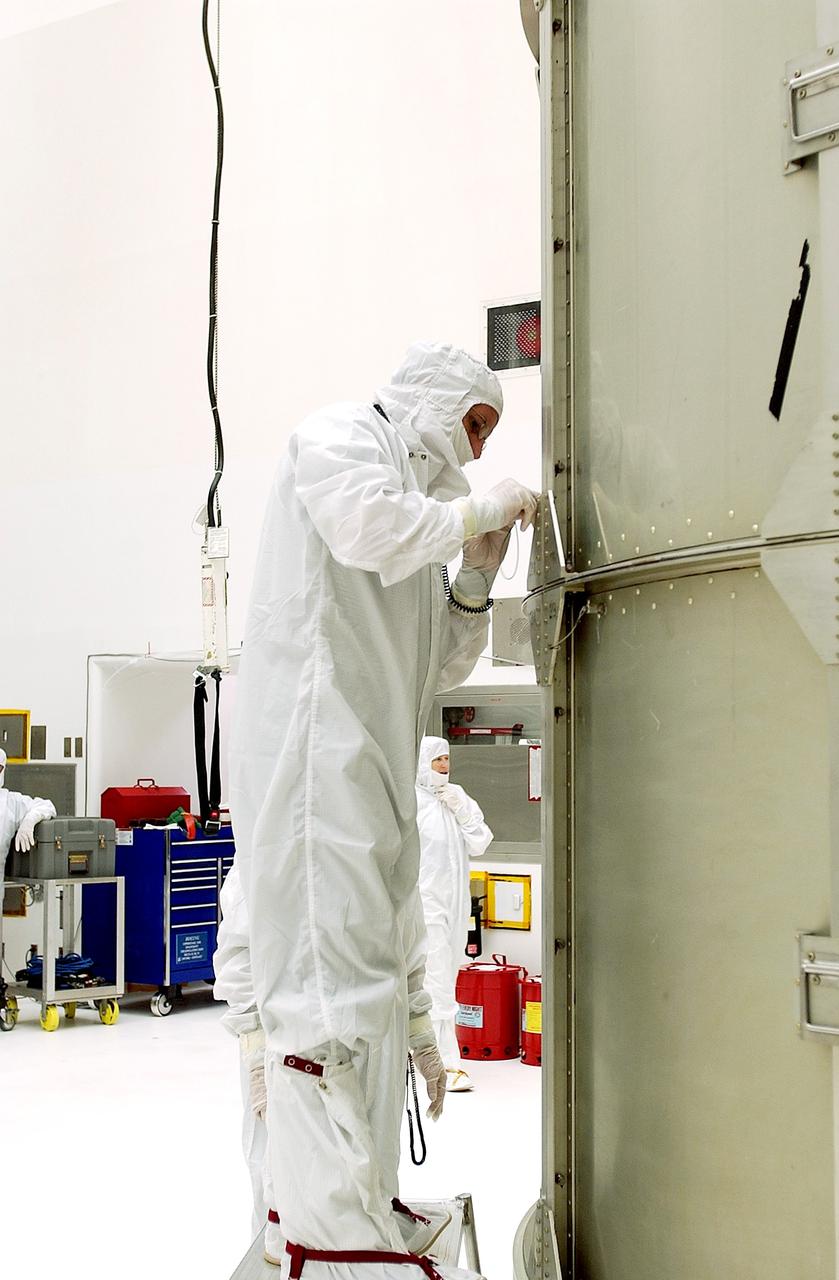
VANDENBERG AIR FORCE BASE, Calif. --  Space Launch Complex 576-E, Vandenberg Air Force Base in California, a worker checks the integration of the Taurus XL Stages 1 and 2.  The Taurus is the launch vehicle for NASA's Orbiting Carbon Observatory, called OCO, a new Earth-orbiting mission sponsored by NASA's Earth System Science Pathfinder Program. The observatory is targeted to launch Feb. 23 from Space Launch Complex 576-E at Vandenberg. Photo credit: NASA/VAFB
KSC-2009-1552
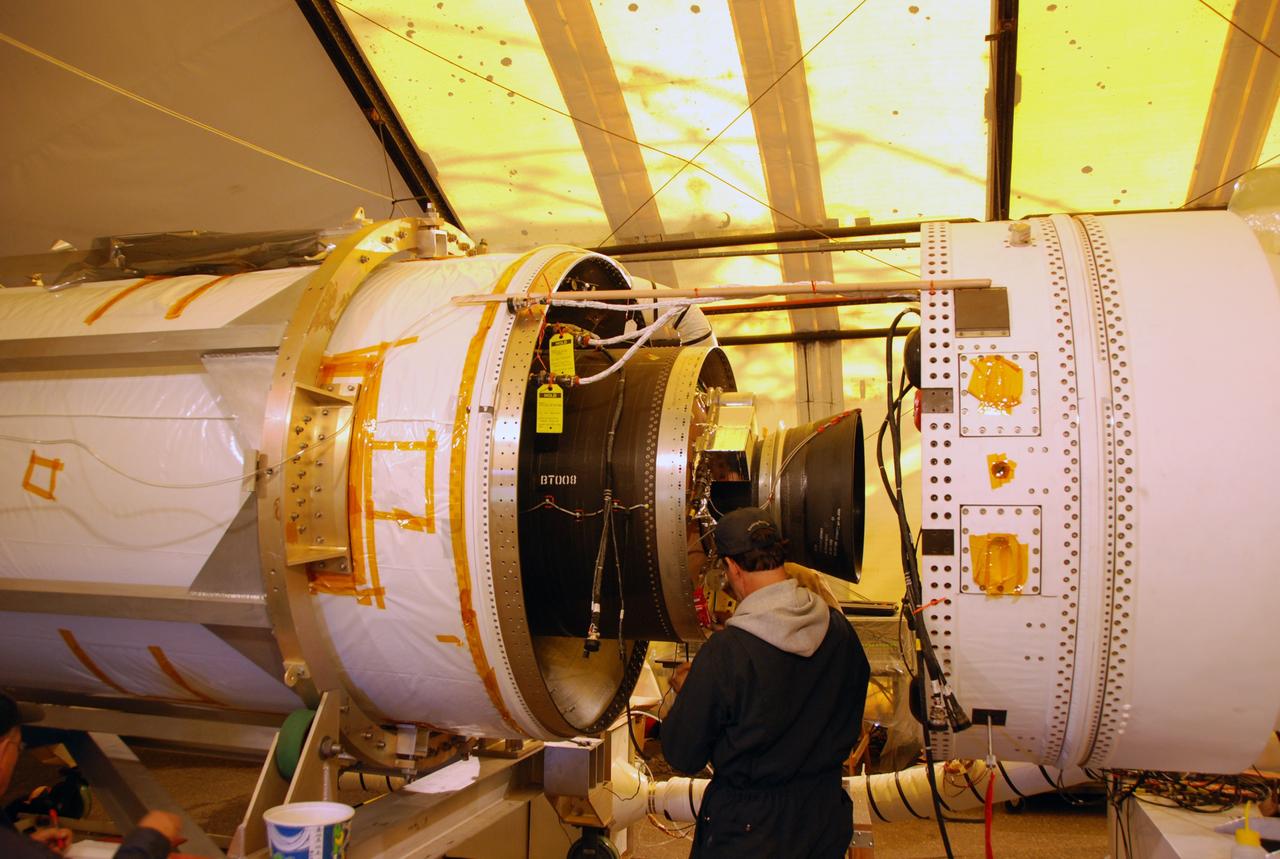
VANDENBERG AIR FORCE BASE, Calif. --In Space Launch Complex 576-E, Vandenberg Air Force Base in California, Stages 1 and 2 of the Taurus XL launch vehicle are being integrated for NASA's Orbiting Carbon Observatory, called OCO. OCO is a new Earth-orbiting mission sponsored by NASA's Earth System Science Pathfinder Program. The observatory is targeted to launch Feb. 23 from Space Launch Complex 576-E at Vandenberg. Photo credit: NASA/VAFB
KSC-2009-1548
VANDENBERG AIR FORCE BASE, Calif. --In Space Launch Complex 576-E, Vandenberg Air Force Base in California, Stages 1 and 2 of the Taurus XL launch vehicle are being integrated for NASA's Orbiting Carbon Observatory, called OCO. OCO is a new Earth-orbiting mission sponsored by NASA's Earth System Science Pathfinder Program. The observatory is targeted to launch Feb. 23 from Space Launch Complex 576-E at Vandenberg. Photo credit: NASA/VAFB
KSC-2009-1549
VANDENBERG AIR FORCE BASE, Calif. --  Space Launch Complex 576-E, Vandenberg Air Force Base in California, a worker checks the integration of the Taurus XL Stages 1 and 2.  The Taurus is the launch vehicle for NASA's Orbiting Carbon Observatory, called OCO, a new Earth-orbiting mission sponsored by NASA's Earth System Science Pathfinder Program. The observatory is targeted to launch Feb. 23 from Space Launch Complex 576-E at Vandenberg. Photo credit: NASA/VAFB
KSC-2009-1551
VANDENBERG AIR FORCE BASE, Calif. --In Space Launch Complex 576-E, Vandenberg Air Force Base in California, Stages 1 and 2 of the Taurus XL launch vehicle are being integrated for NASA's Orbiting Carbon Observatory, called OCO. OCO is a new Earth-orbiting mission sponsored by NASA's Earth System Science Pathfinder Program. The observatory is targeted to launch Feb. 23 from Space Launch Complex 576-E at Vandenberg. Photo credit: NASA/VAFB
KSC-2009-1547
VANDENBERG AIR FORCE BASE, Calif. --In Space Launch Complex 576-E, Vandenberg Air Force Base in California, Stages 1 and 2 of the Taurus XL launch vehicle are being integrated for NASA's Orbiting Carbon Observatory, called OCO. OCO is a new Earth-orbiting mission sponsored by NASA's Earth System Science Pathfinder Program. The observatory is targeted to launch Feb. 23 from Space Launch Complex 576-E at Vandenberg. Photo credit: NASA/VAFB
KSC-2009-1550
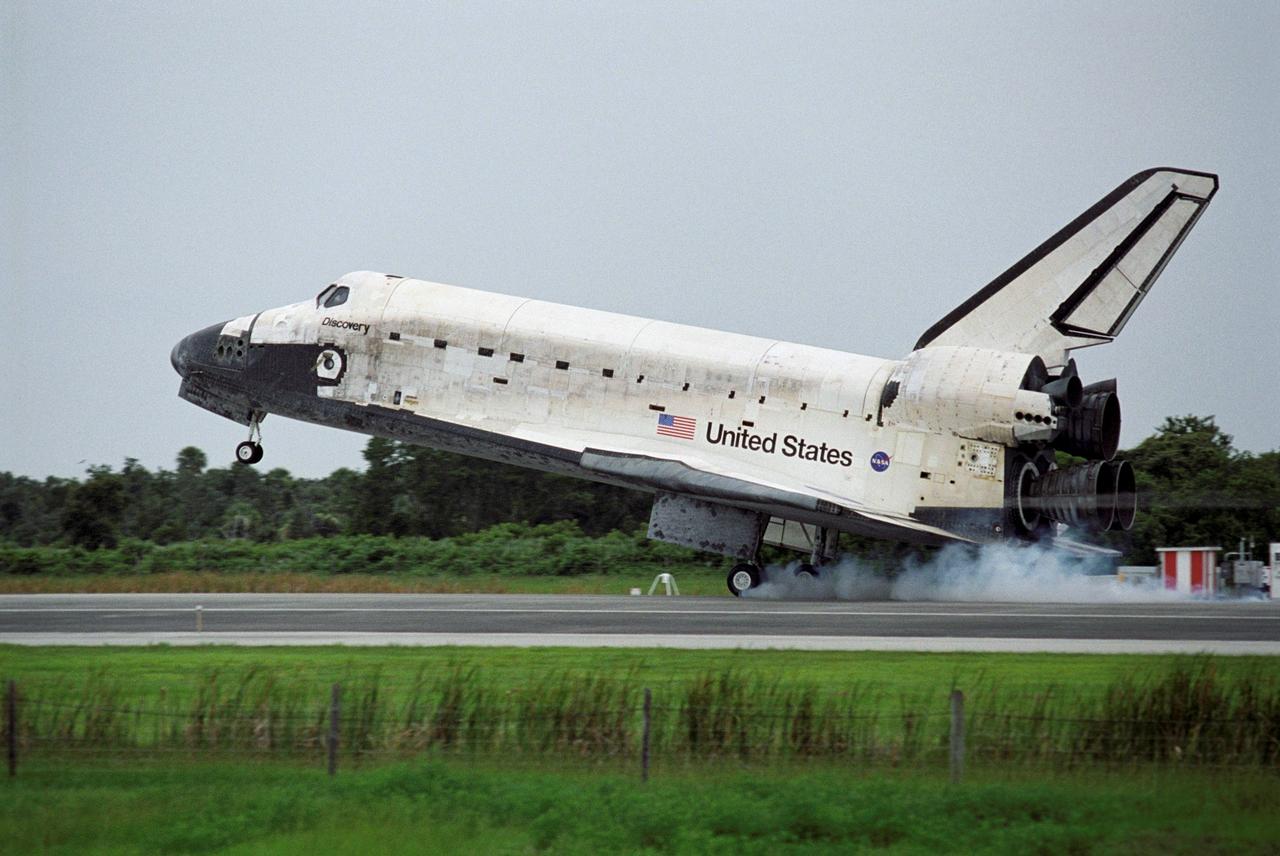
STS121-E-079 (17 July 2006) --- The main landing gear of the Space Shuttle Discovery touches down on the KSC landing facility. Onboard are  six of the seven astronauts who nearly two weeks earlier had lifted off from the nearby launch complex--astronauts Steven W. Lindsey, Piers J. Sellers, Mark E. Kelly, Michael E. Fossum, Stephanie D. Wilson and Lisa M. Nowak. European Space Agency astronaut Thomas Reiter remained aboard the International Space Station.
STS-121 Landing of the orbiter Discovery
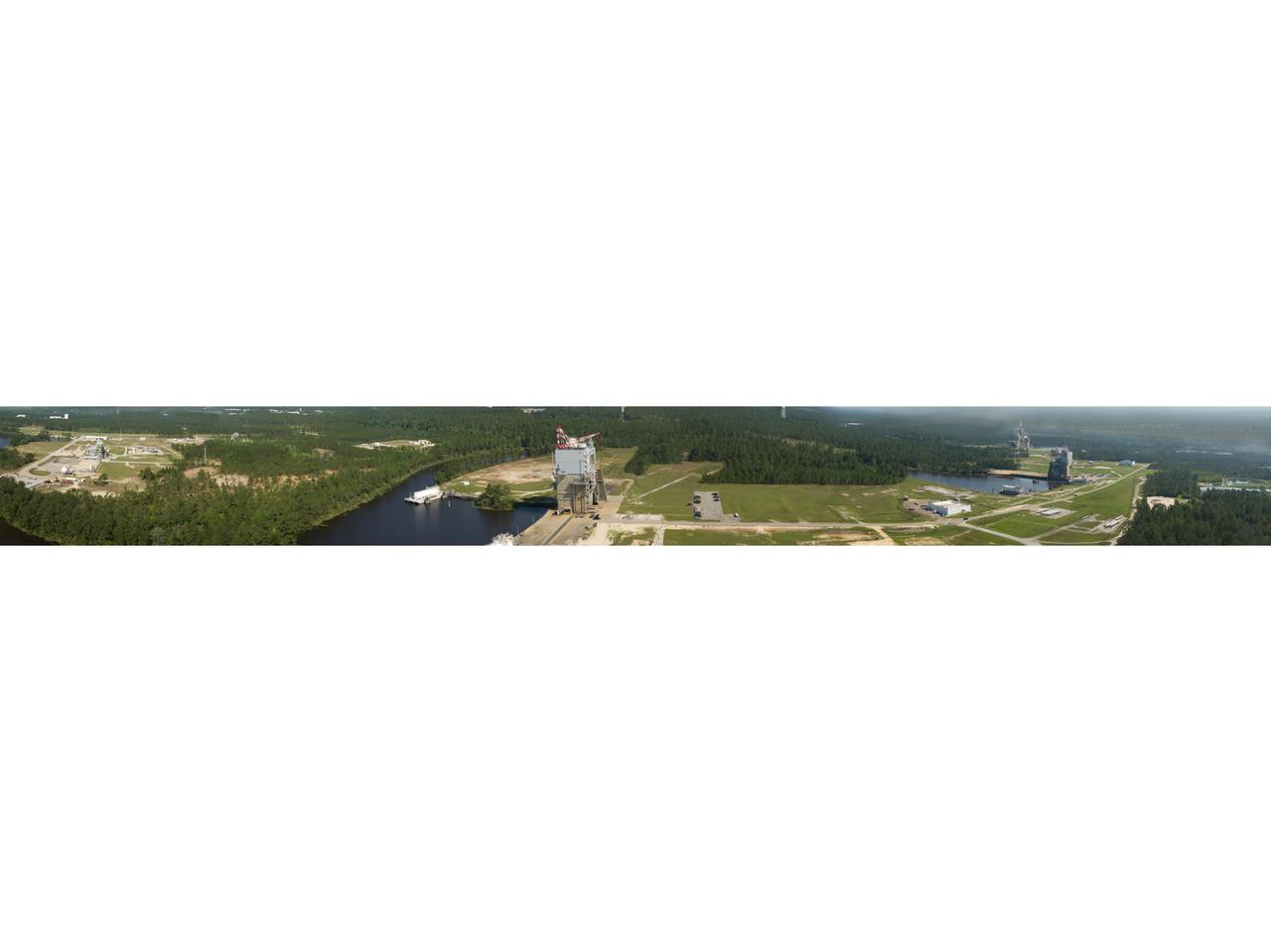
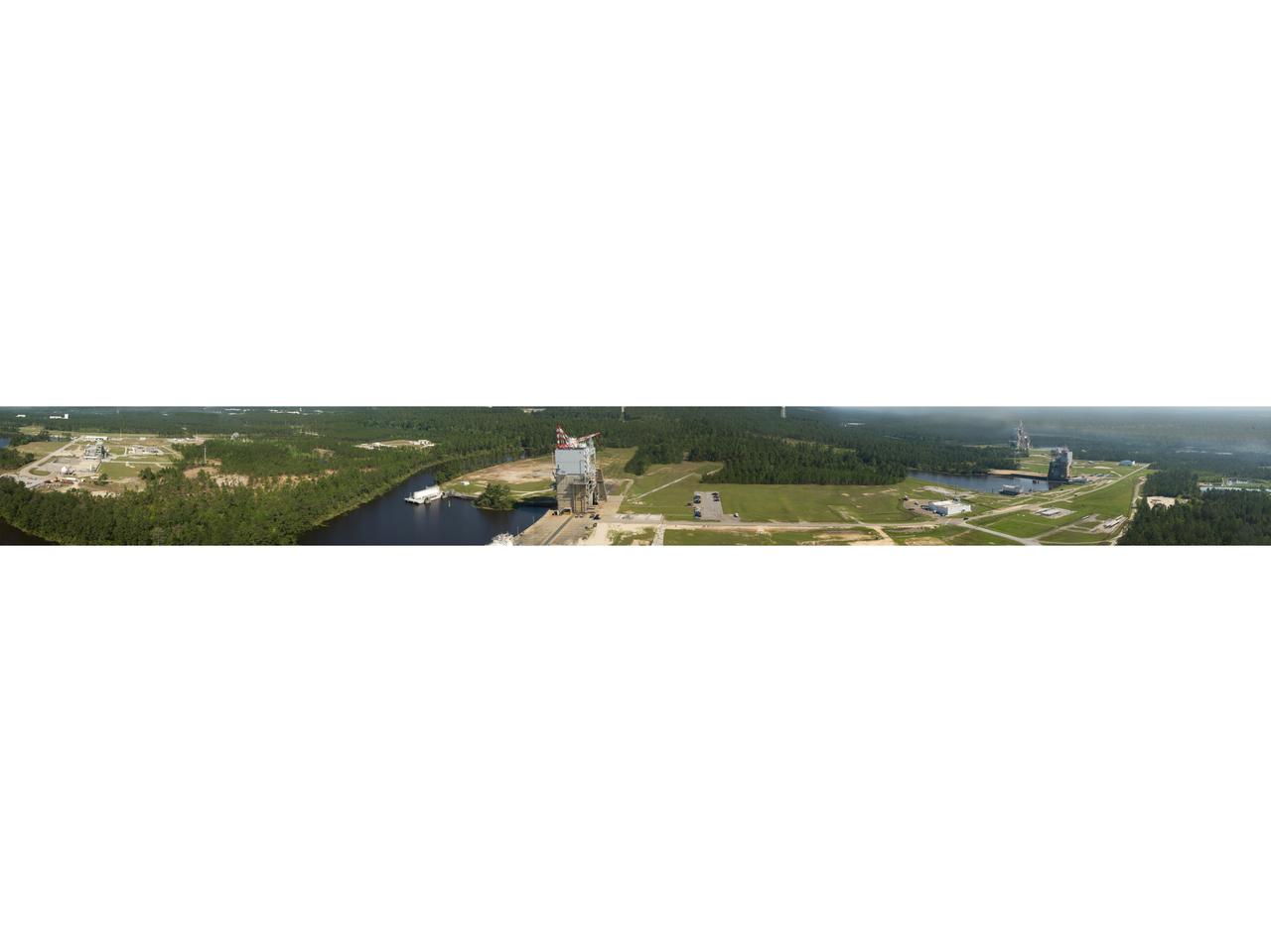
A photo taken from the top of the new A-3 Test Stand at Stennis Space Center offers a panoramic view of the A, B and E test complexes at the south Mississippi facility.
Test complex panorama
The Integrated Powerhead Demonstrator test fires with Wayne North as test conductor. The engine was tested at the E Complex of NASA's Stennis Space Center near Bay St. Louis, Miss. on Dec. 8, 2005.
1st IPD Test since Katrina
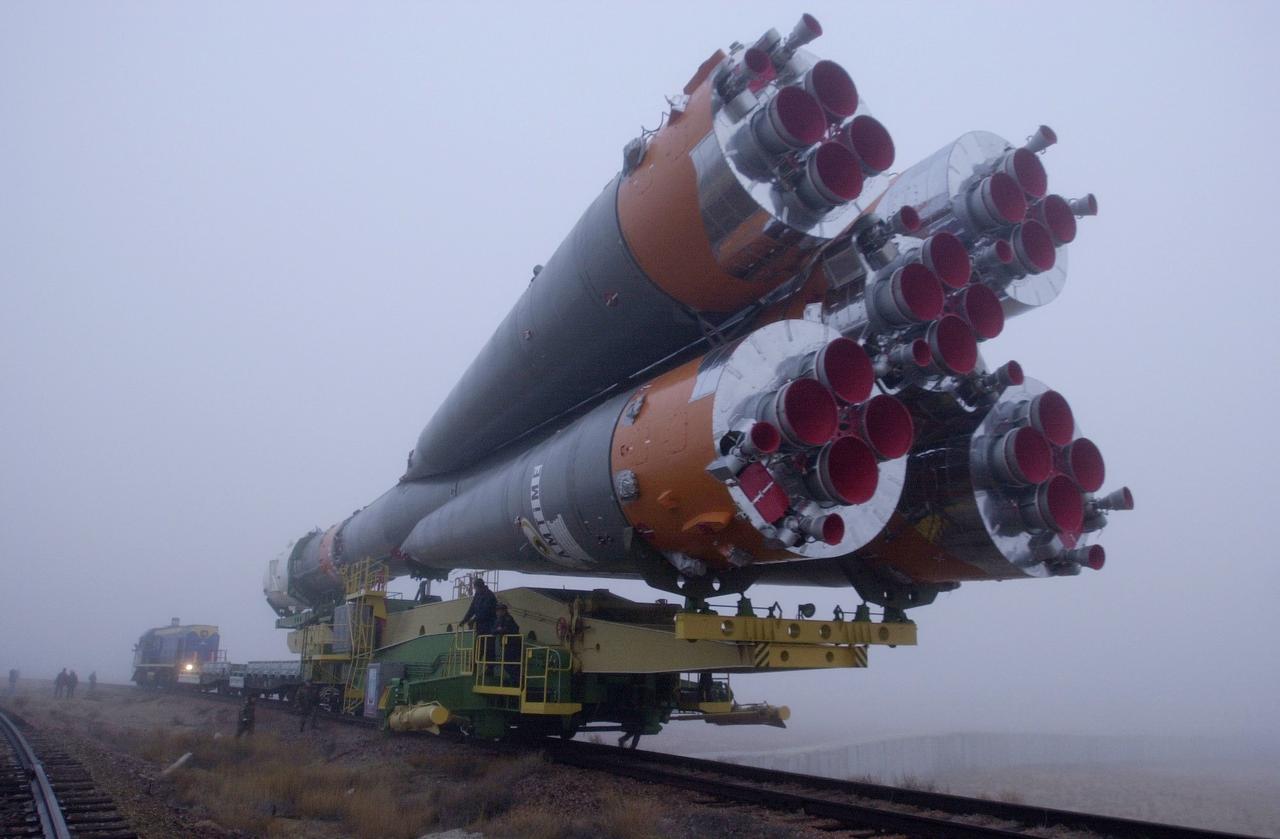
JSC2000-E-28200 (29 October 2000) ---  An aft view of the Soyuz rocket affords an excellent look at the rocket's engine area as a train transports it from the assembly building toward the launch pad at the Baikonur complex in Kazakhstan.
Various views of the Expedition One mission preparation
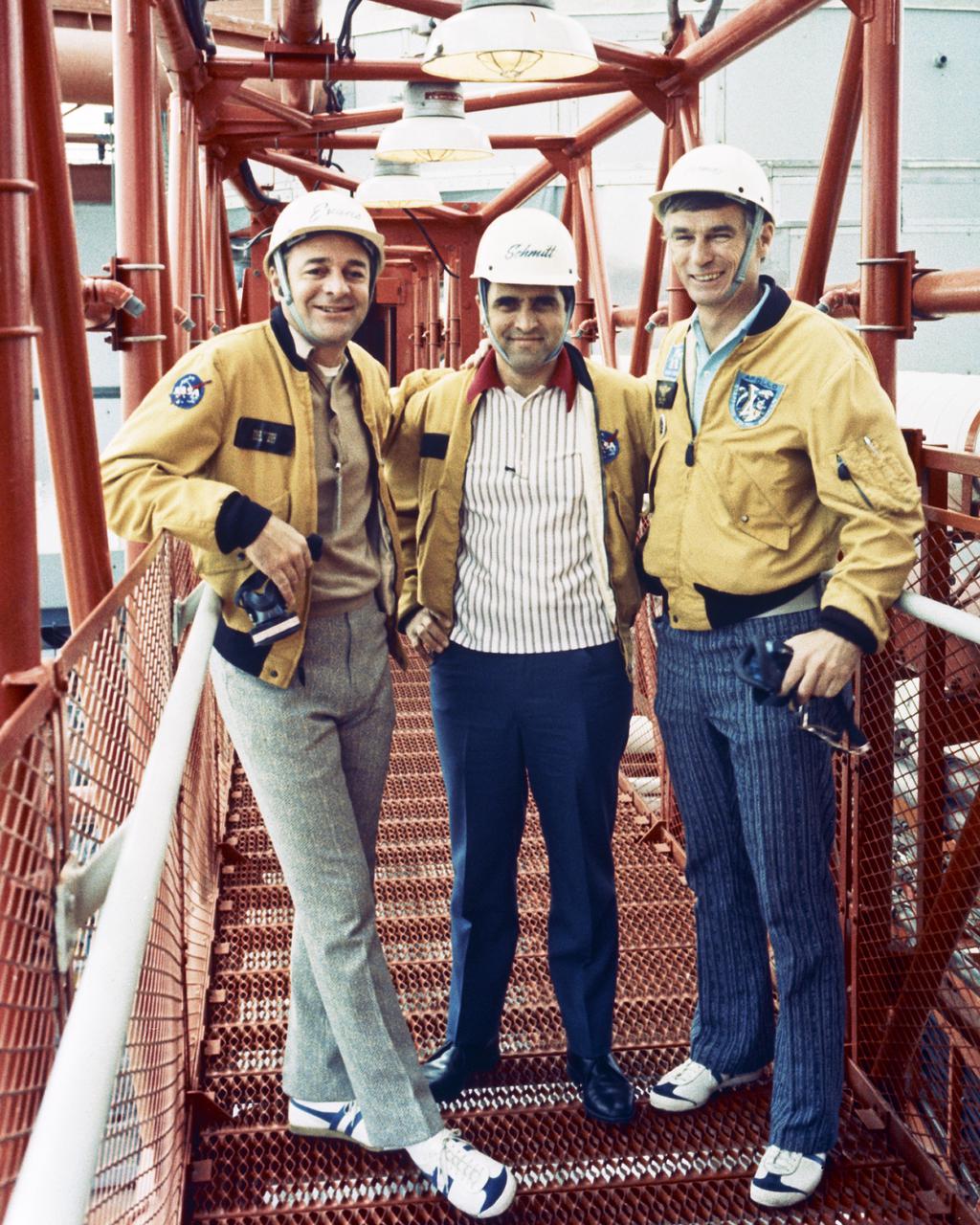
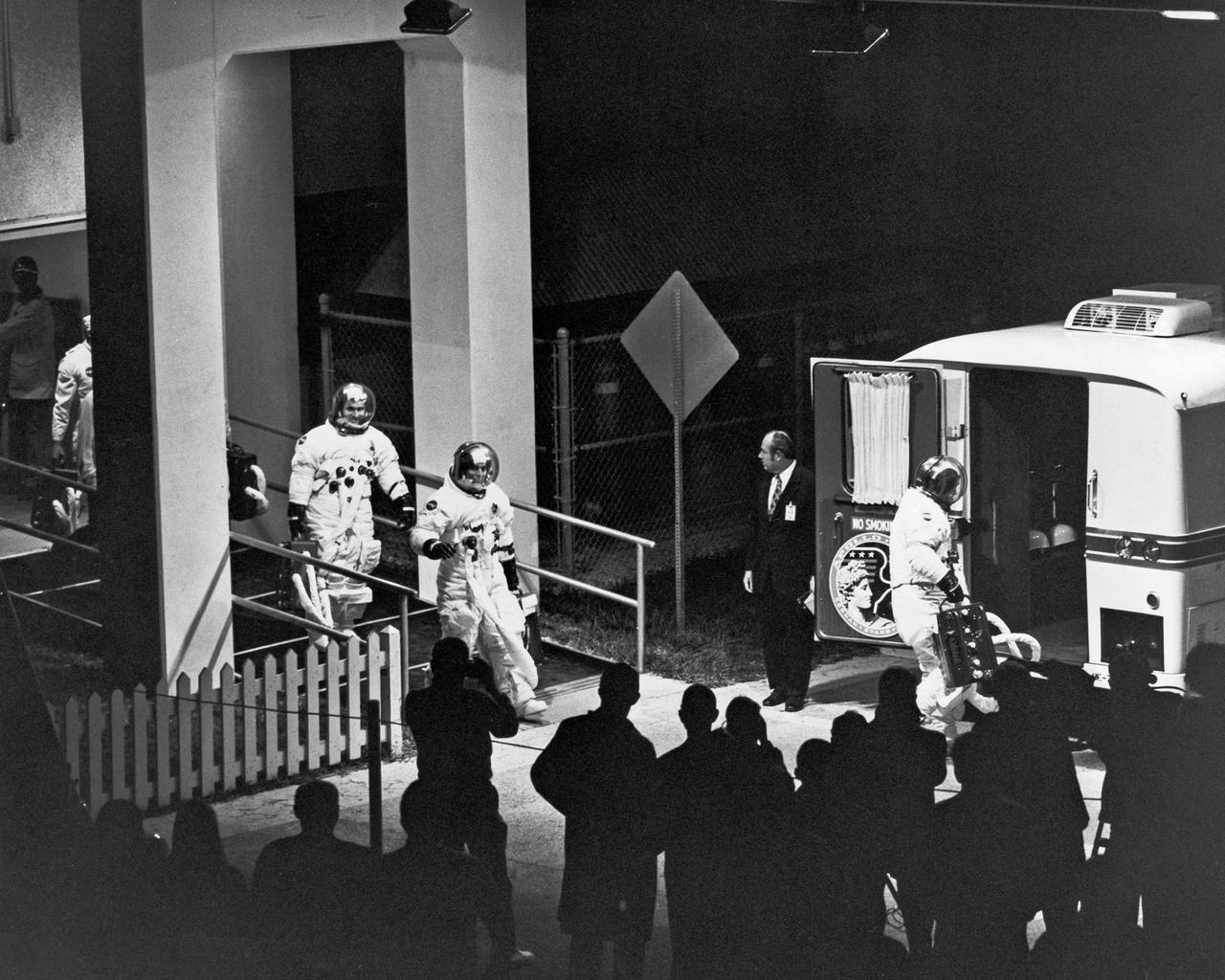
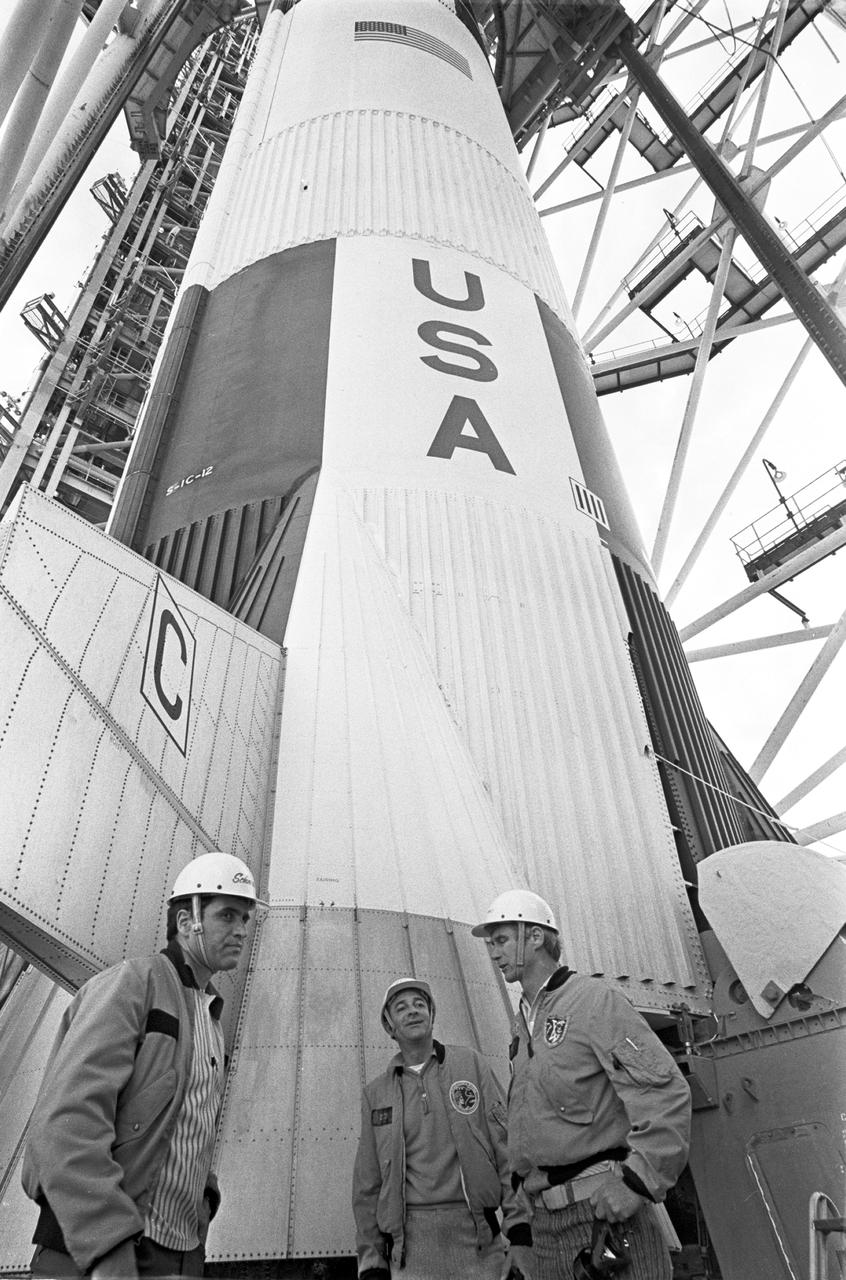
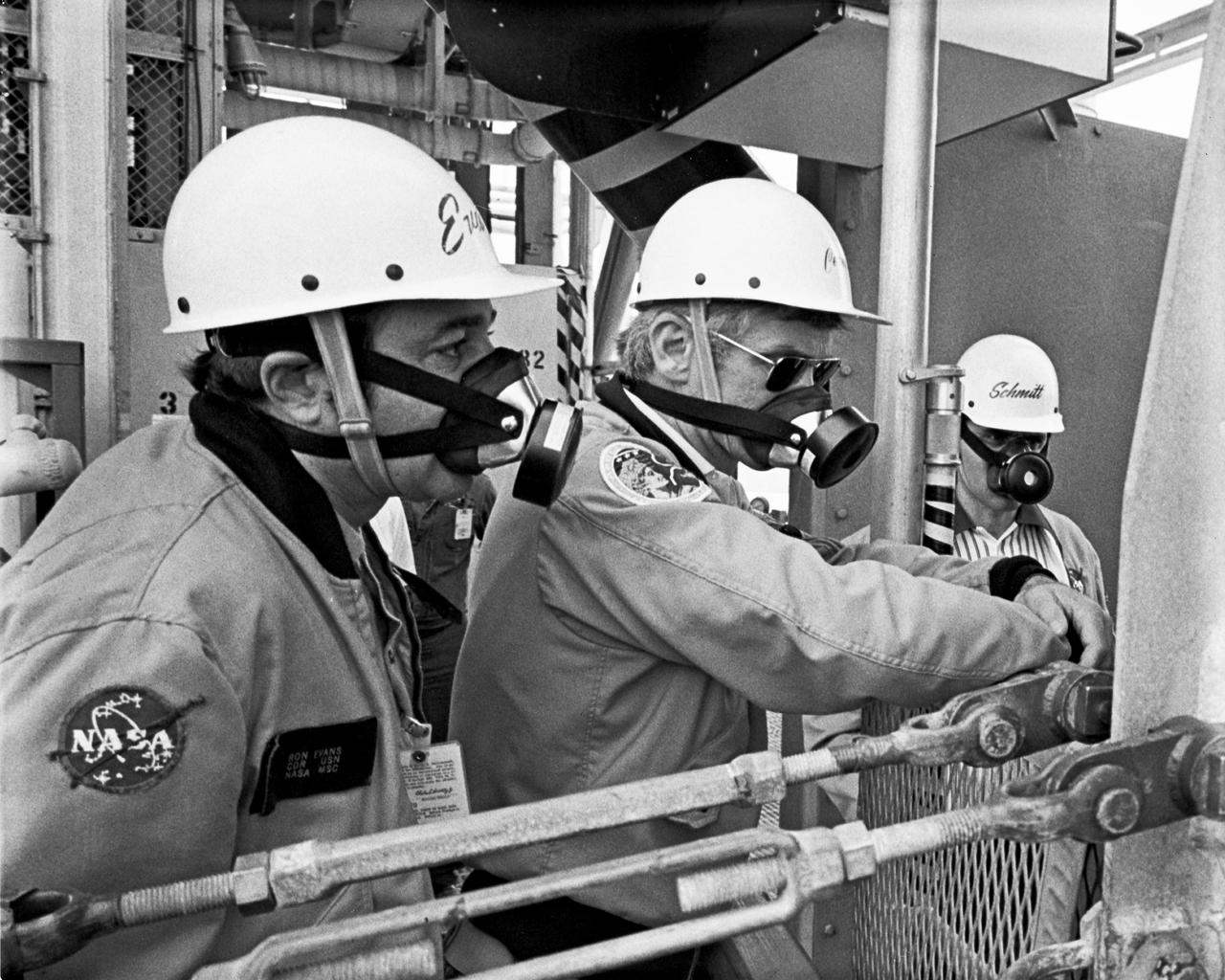
The Apollo 17 prime astronaut crew observes pre-launch activity at Complex 39A while participating in Emergency Egress Test. They are, left to right, Ronald E. Evans, Harrison H. Schmitt, and Eugene A. Cernan.
KSC-72PC-0609
photo taken from the top of the new A-3 Test Stand at Stennis Space Center offers a panoramic view of the A, B and E test complexes at the south Mississippi faci
Test complex panorama
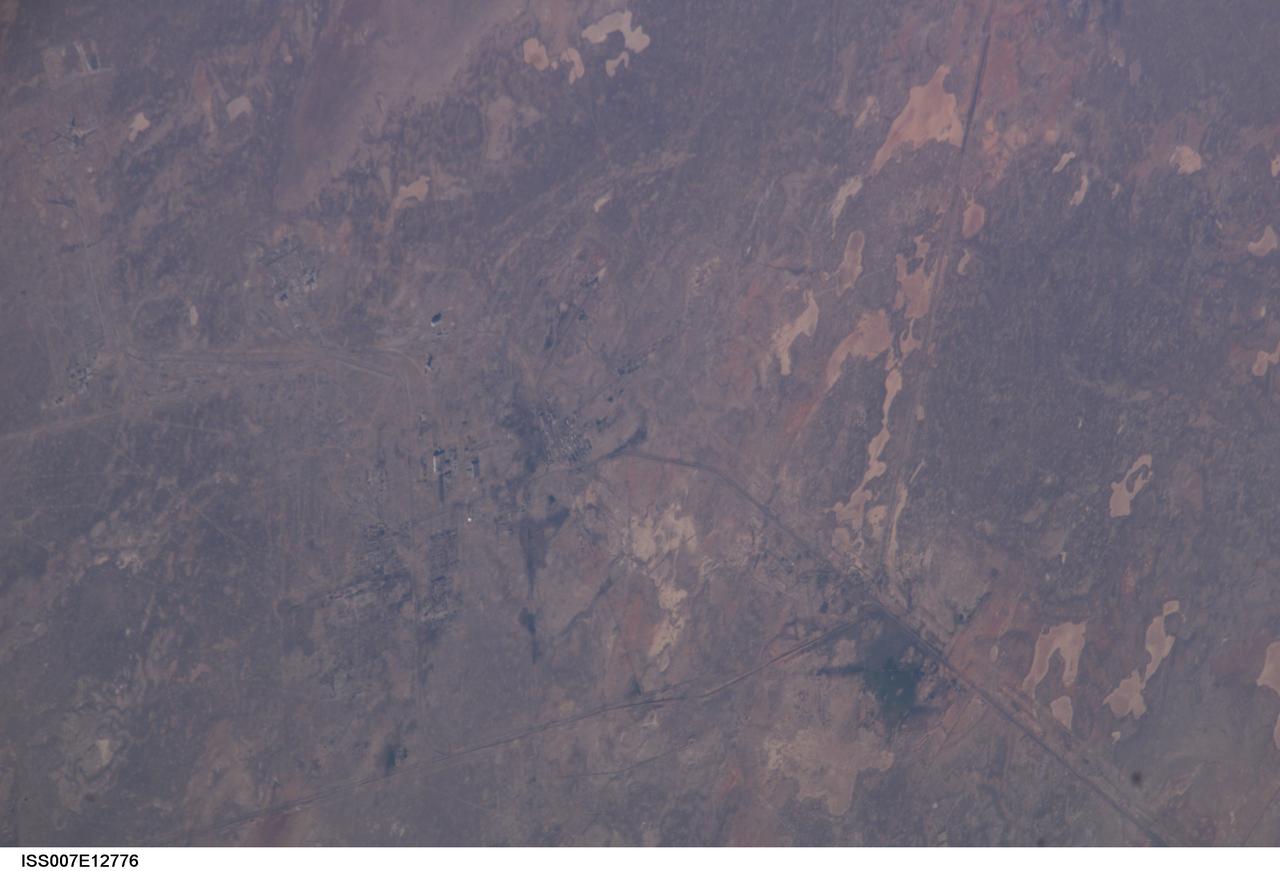
ISS007-E-12776 (15 August 2003) --- This digital still camera's image, recorded by one of the crewmembers on the International Space Station, shows the Baikonur Launch Complex in Kazakhstan.
Earth observations taken by the Expedition Seven crew
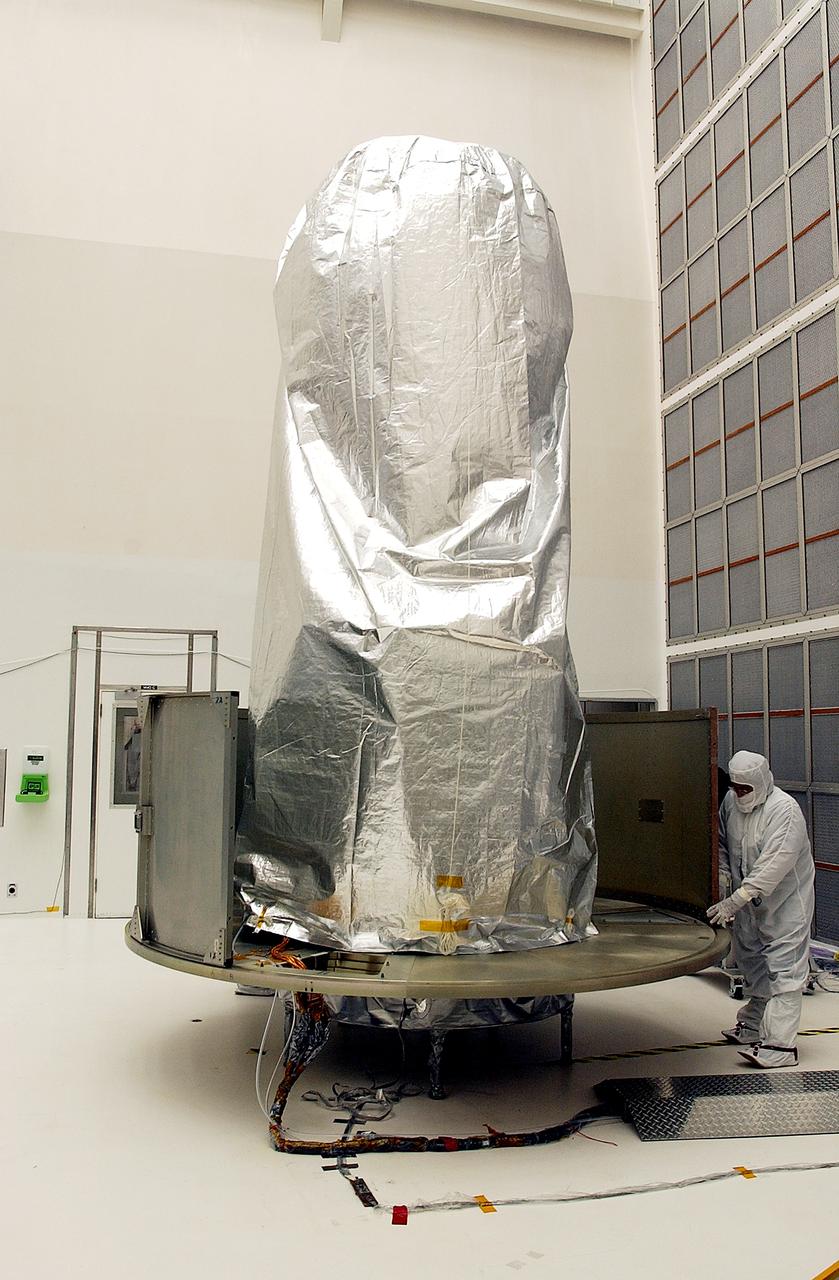
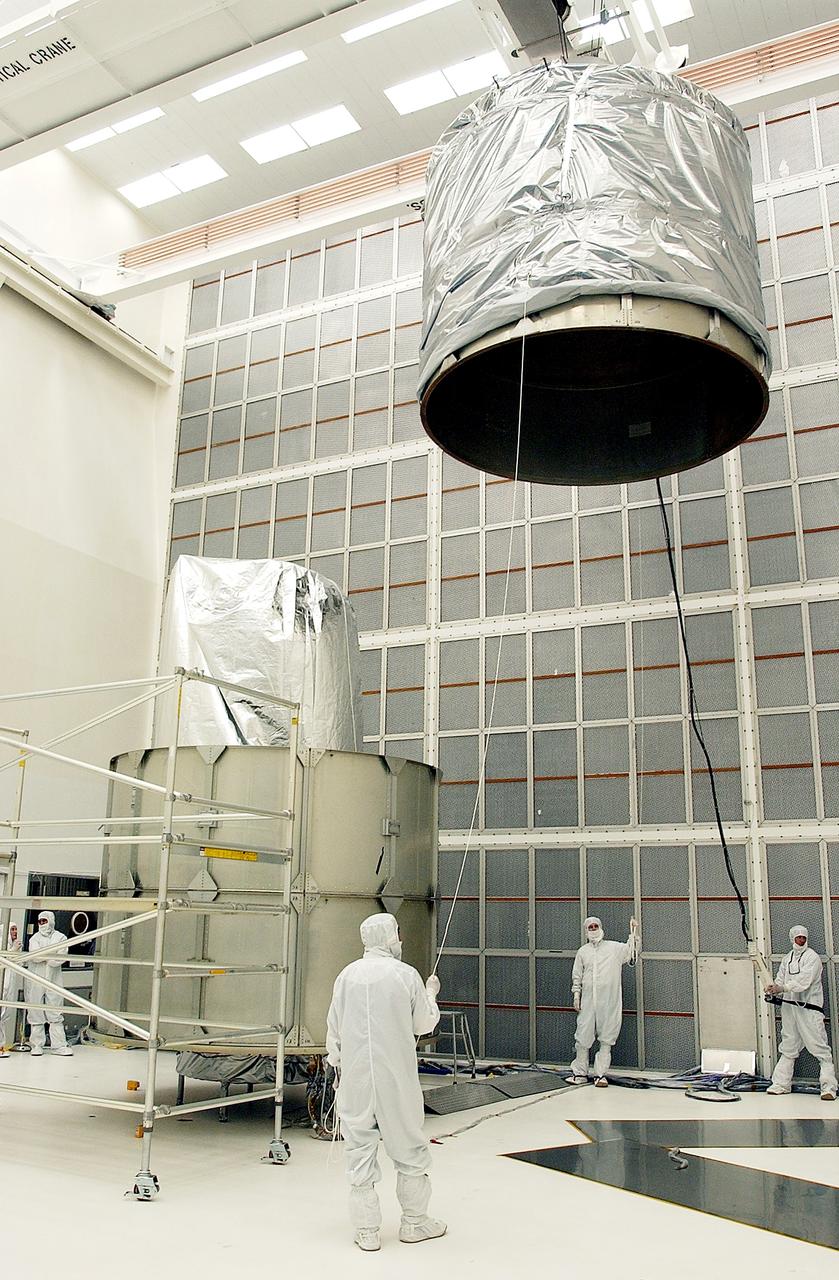
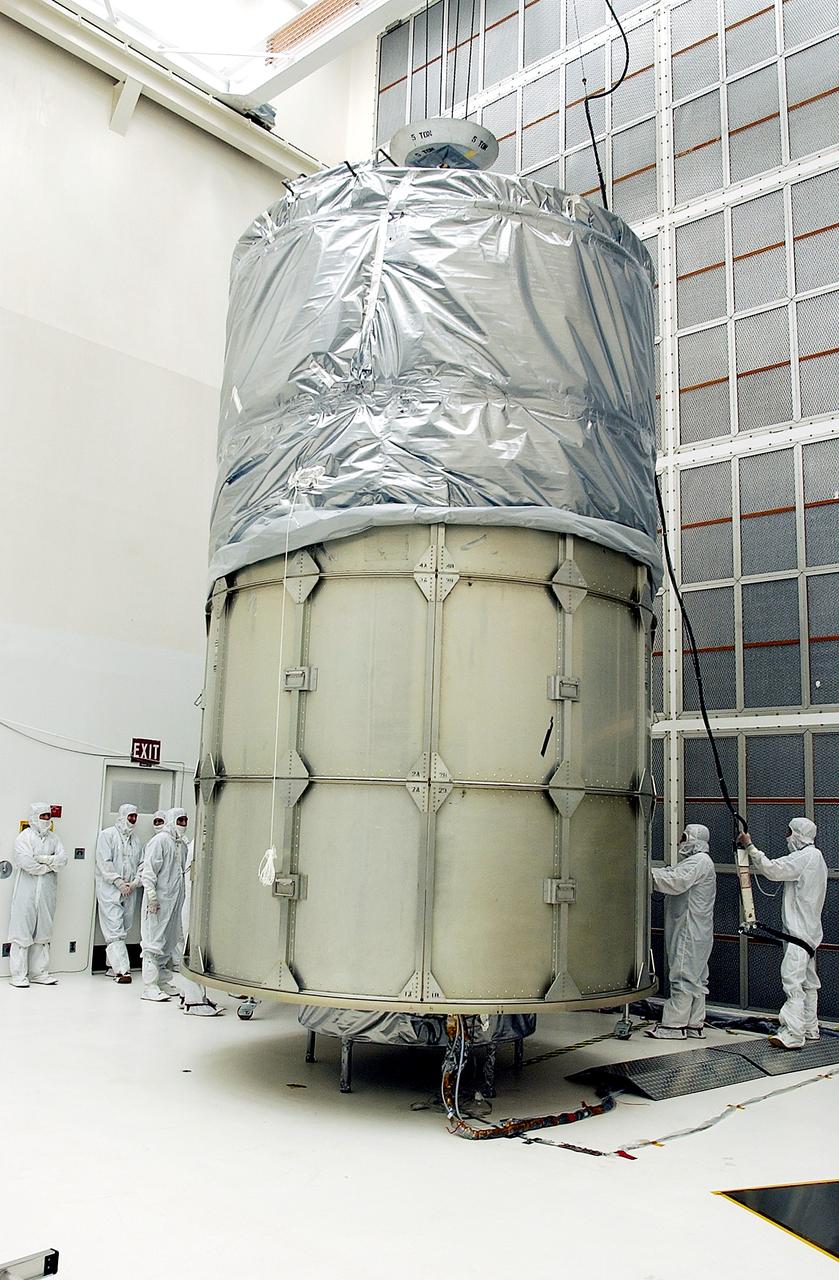
KENNEDY SPACE CENTER, FLA.  - Workers at Hangar A&E, Cape Canaveral Air Force Station, lift the upper canister to move it to the Space Infrared Telescope Facility (SIRTF) at right.  After encapsulation, the spacecraft will be transported to Launch Complex 17-B for mating with its launch vehicle, the Delta II rocket.   SIRTF consists of three cryogenically cooled science instruments and an 0.85-meter telescope, and is one of NASA's largest infrared telescopes to be launched.  SIRTF will obtain images and spectra by detecting the infrared energy, or heat, radiated by objects in space. Most of this infrared radiation is blocked by the Earth's atmosphere and cannot be observed from the ground.
KENNEDY SPACE CENTER, FLA. - Workers at Hangar A&E, Cape Canaveral Air Force Station, lift the upper canister to move it to the Space Infrared Telescope Facility (SIRTF) at right. After encapsulation, the spacecraft will be transported to Launch Complex 17-B for mating with its launch vehicle, the Delta II rocket. SIRTF consists of three cryogenically cooled science instruments and an 0.85-meter telescope, and is one of NASA's largest infrared telescopes to be launched. SIRTF will obtain images and spectra by detecting the infrared energy, or heat, radiated by objects in space. Most of this infrared radiation is blocked by the Earth's atmosphere and cannot be observed from the ground.
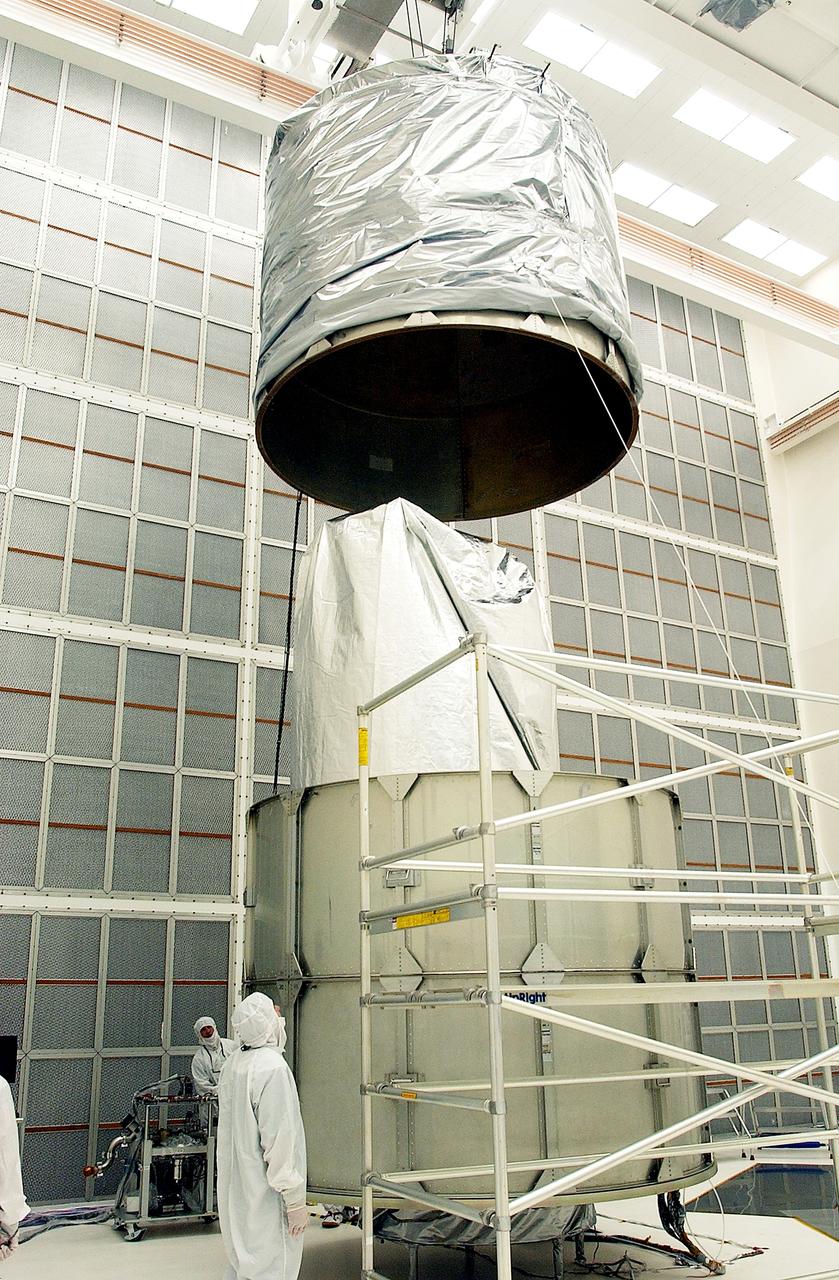
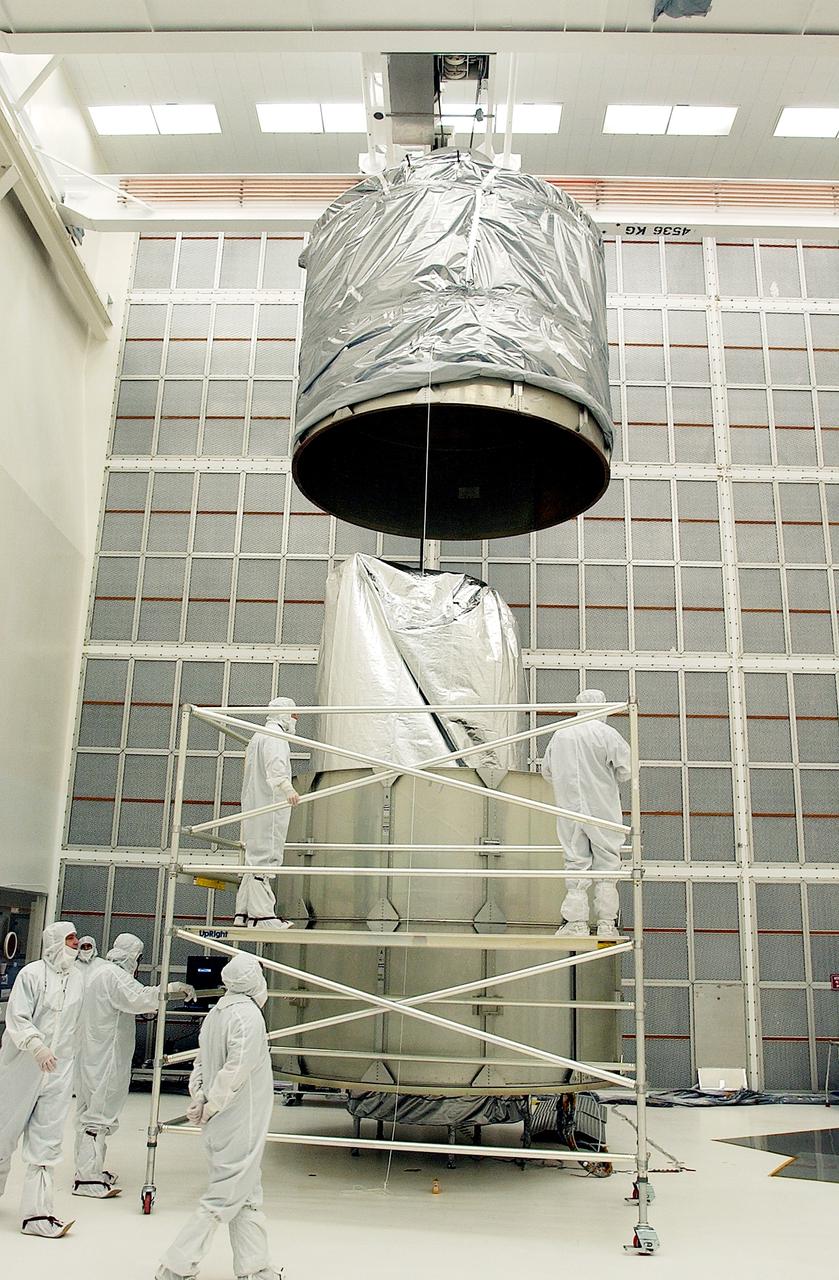
KENNEDY SPACE CENTER, FLA.  -  In Hangar A&E, Cape Canaveral Air Force Station, the upper canister is lowered toward the Space Infrared Telescope Facility (SIRTF) below.  After encapsulation is complete, the spacecraft will be transported to Launch Complex 17-B for mating with its launch vehicle, the Delta II rocket.   SIRTF consists of three cryogenically cooled science instruments and an 0.85-meter telescope, and is one of NASA's largest infrared telescopes to be launched.  SIRTF will obtain images and spectra by detecting the infrared energy, or heat, radiated by objects in space. Most of this infrared radiation is blocked by the Earth's atmosphere and cannot be observed from the ground.
KENNEDY SPACE CENTER, FLA. - In Hangar A&E, Cape Canaveral Air Force Station, the upper canister is lowered toward the Space Infrared Telescope Facility (SIRTF) below. After encapsulation is complete, the spacecraft will be transported to Launch Complex 17-B for mating with its launch vehicle, the Delta II rocket. SIRTF consists of three cryogenically cooled science instruments and an 0.85-meter telescope, and is one of NASA's largest infrared telescopes to be launched. SIRTF will obtain images and spectra by detecting the infrared energy, or heat, radiated by objects in space. Most of this infrared radiation is blocked by the Earth's atmosphere and cannot be observed from the ground.
KENNEDY SPACE CENTER, FLA.  - Workers at Hangar A&E, Cape Canaveral Air Force Station, help guide the upper canister toward the Space Infrared Telescope Facility (SIRTF) at left.  After encapsulation is complete, the spacecraft will be transported to Launch Complex 17-B for mating with its launch vehicle, the Delta II rocket.   SIRTF consists of three cryogenically cooled science instruments and an 0.85-meter telescope, and is one of NASA's largest infrared telescopes to be launched.  SIRTF will obtain images and spectra by detecting the infrared energy, or heat, radiated by objects in space. Most of this infrared radiation is blocked by the Earth's atmosphere and cannot be observed from the ground.
KENNEDY SPACE CENTER, FLA. - Workers at Hangar A&E, Cape Canaveral Air Force Station, help guide the upper canister toward the Space Infrared Telescope Facility (SIRTF) at left. After encapsulation is complete, the spacecraft will be transported to Launch Complex 17-B for mating with its launch vehicle, the Delta II rocket. SIRTF consists of three cryogenically cooled science instruments and an 0.85-meter telescope, and is one of NASA's largest infrared telescopes to be launched. SIRTF will obtain images and spectra by detecting the infrared energy, or heat, radiated by objects in space. Most of this infrared radiation is blocked by the Earth's atmosphere and cannot be observed from the ground.
KENNEDY SPACE CENTER, FLA.  -  A worker at Hangar A&E, Cape Canaveral Air Force Station, place the lower panels of the canister around the Space Infrared Telescope Facility (SIRTF).  The spacecraft will be transported to Launch Complex 17-B for mating with its launch vehicle, the Delta II rocket.   SIRTF consists of three cryogenically cooled science instruments and an 0.85-meter telescope, and is one of NASA's largest infrared telescopes to be launched.  SIRTF will obtain images and spectra by detecting the infrared energy, or heat, radiated by objects in space. Most of this infrared radiation is blocked by the Earth's atmosphere and cannot be observed from the ground.
KENNEDY SPACE CENTER, FLA. - A worker at Hangar A&E, Cape Canaveral Air Force Station, place the lower panels of the canister around the Space Infrared Telescope Facility (SIRTF). The spacecraft will be transported to Launch Complex 17-B for mating with its launch vehicle, the Delta II rocket. SIRTF consists of three cryogenically cooled science instruments and an 0.85-meter telescope, and is one of NASA's largest infrared telescopes to be launched. SIRTF will obtain images and spectra by detecting the infrared energy, or heat, radiated by objects in space. Most of this infrared radiation is blocked by the Earth's atmosphere and cannot be observed from the ground.
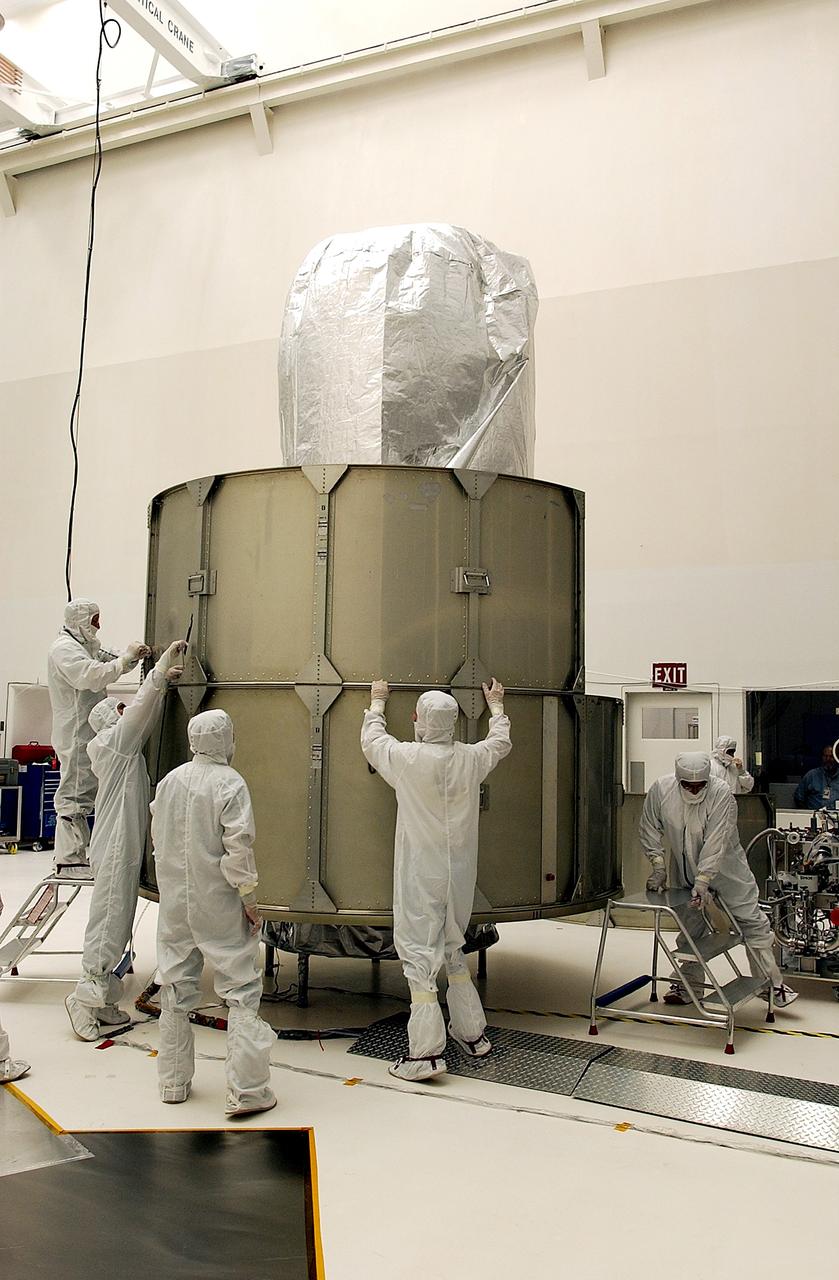
KENNEDY SPACE CENTER, FLA.  - Workers at Hangar A&E, Cape Canaveral Air Force Station, place the middle row of panels to encapsulate the Space Infrared Telescope Facility (SIRTF).  The spacecraft will be transported to Launch Complex 17-B for mating with its launch vehicle, the Delta II rocket.   SIRTF consists of three cryogenically cooled science instruments and an 0.85-meter telescope, and is one of NASA's largest infrared telescopes to be launched.  SIRTF will obtain images and spectra by detecting the infrared energy, or heat, radiated by objects in space. Most of this infrared radiation is blocked by the Earth's atmosphere and cannot be observed from the ground.
KENNEDY SPACE CENTER, FLA. - Workers at Hangar A&E, Cape Canaveral Air Force Station, place the middle row of panels to encapsulate the Space Infrared Telescope Facility (SIRTF). The spacecraft will be transported to Launch Complex 17-B for mating with its launch vehicle, the Delta II rocket. SIRTF consists of three cryogenically cooled science instruments and an 0.85-meter telescope, and is one of NASA's largest infrared telescopes to be launched. SIRTF will obtain images and spectra by detecting the infrared energy, or heat, radiated by objects in space. Most of this infrared radiation is blocked by the Earth's atmosphere and cannot be observed from the ground.
KENNEDY SPACE CENTER, FLA.  - A worker at Hangar A&E, Cape Canaveral Air Force Station, tightens the canister around the Space Infrared Telescope Facility (SIRTF).  The spacecraft will be transported to Launch Complex 17-B for mating with its launch vehicle, the Delta II rocket.   SIRTF consists of three cryogenically cooled science instruments and an 0.85-meter telescope, and is one of NASA's largest infrared telescopes to be launched.  SIRTF will obtain images and spectra by detecting the infrared energy, or heat, radiated by objects in space. Most of this infrared radiation is blocked by the Earth's atmosphere and cannot be observed from the ground.
KENNEDY SPACE CENTER, FLA. - A worker at Hangar A&E, Cape Canaveral Air Force Station, tightens the canister around the Space Infrared Telescope Facility (SIRTF). The spacecraft will be transported to Launch Complex 17-B for mating with its launch vehicle, the Delta II rocket. SIRTF consists of three cryogenically cooled science instruments and an 0.85-meter telescope, and is one of NASA's largest infrared telescopes to be launched. SIRTF will obtain images and spectra by detecting the infrared energy, or heat, radiated by objects in space. Most of this infrared radiation is blocked by the Earth's atmosphere and cannot be observed from the ground.
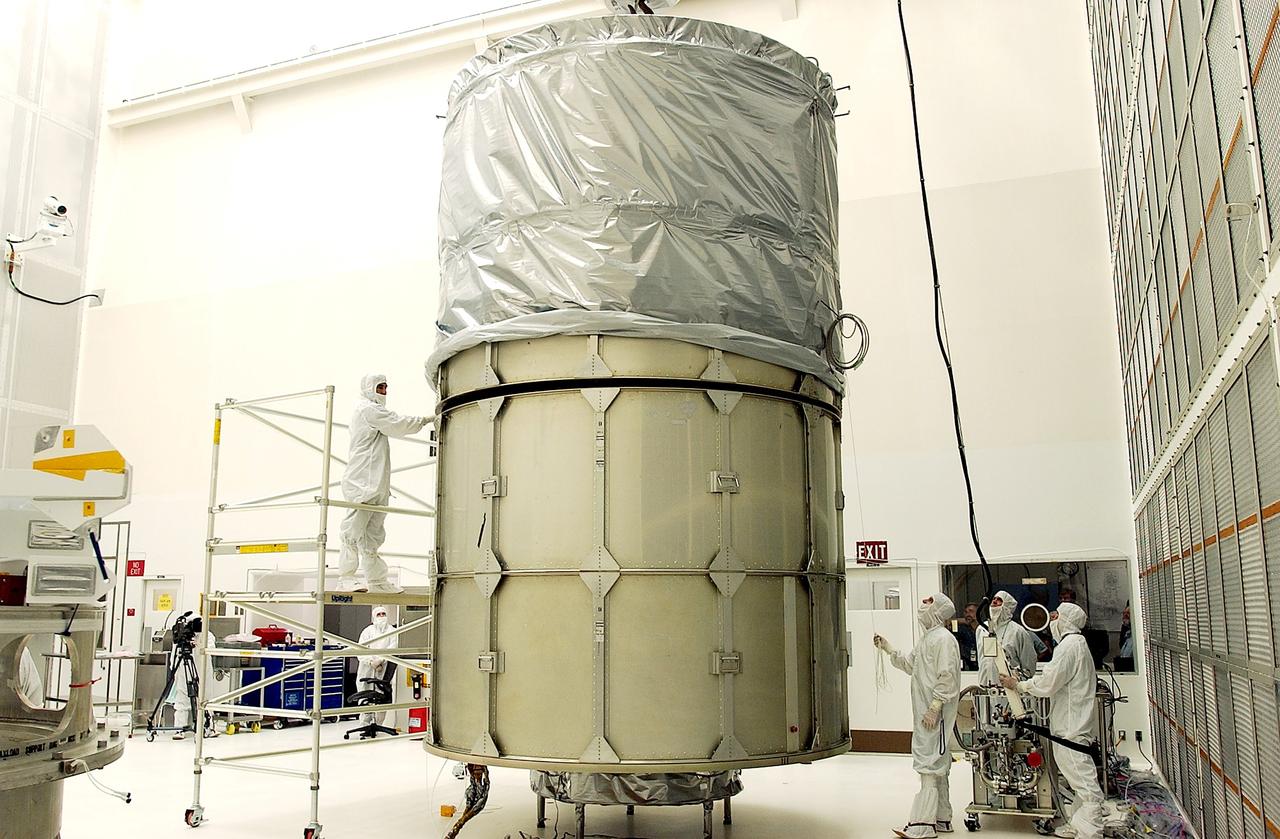
KENNEDY SPACE CENTER, FLA.  -  In Hangar A&E, Cape Canaveral Air Force Station, the upper canister is mated to the middle panels around the Space Infrared Telescope Facility (SIRTF).  The spacecraft will be transported to Launch Complex 17-B for mating with its launch vehicle, the Delta II rocket.   SIRTF consists of three cryogenically cooled science instruments and an 0.85-meter telescope, and is one of NASA's largest infrared telescopes to be launched.  SIRTF will obtain images and spectra by detecting the infrared energy, or heat, radiated by objects in space. Most of this infrared radiation is blocked by the Earth's atmosphere and cannot be observed from the ground.
KENNEDY SPACE CENTER, FLA. - In Hangar A&E, Cape Canaveral Air Force Station, the upper canister is mated to the middle panels around the Space Infrared Telescope Facility (SIRTF). The spacecraft will be transported to Launch Complex 17-B for mating with its launch vehicle, the Delta II rocket. SIRTF consists of three cryogenically cooled science instruments and an 0.85-meter telescope, and is one of NASA's largest infrared telescopes to be launched. SIRTF will obtain images and spectra by detecting the infrared energy, or heat, radiated by objects in space. Most of this infrared radiation is blocked by the Earth's atmosphere and cannot be observed from the ground.
KENNEDY SPACE CENTER, FLA.  -  In Hangar A&E, Cape Canaveral Air Force Station, encapsulation of the Space Infrared Telescope Facility (SIRTF) is complete.  The spacecraft will be transported to Launch Complex 17-B for mating with its launch vehicle, the Delta II rocket.   SIRTF consists of three cryogenically cooled science instruments and an 0.85-meter telescope, and is one of NASA's largest infrared telescopes to be launched.  SIRTF will obtain images and spectra by detecting the infrared energy, or heat, radiated by objects in space. Most of this infrared radiation is blocked by the Earth's atmosphere and cannot be observed from the ground.
KENNEDY SPACE CENTER, FLA. - In Hangar A&E, Cape Canaveral Air Force Station, encapsulation of the Space Infrared Telescope Facility (SIRTF) is complete. The spacecraft will be transported to Launch Complex 17-B for mating with its launch vehicle, the Delta II rocket. SIRTF consists of three cryogenically cooled science instruments and an 0.85-meter telescope, and is one of NASA's largest infrared telescopes to be launched. SIRTF will obtain images and spectra by detecting the infrared energy, or heat, radiated by objects in space. Most of this infrared radiation is blocked by the Earth's atmosphere and cannot be observed from the ground.
KENNEDY SPACE CENTER, FLA.  - Workers at Hangar A&E, Cape Canaveral Air Force Station, lower the upper canister toward the Space Infrared Telescope Facility (SIRTF) below.  After encapsulation is complete, the spacecraft will be transported to Launch Complex 17-B for mating with its launch vehicle, the Delta II rocket.   SIRTF consists of three cryogenically cooled science instruments and an 0.85-meter telescope, and is one of NASA's largest infrared telescopes to be launched.  SIRTF will obtain images and spectra by detecting the infrared energy, or heat, radiated by objects in space. Most of this infrared radiation is blocked by the Earth's atmosphere and cannot be observed from the ground.
KENNEDY SPACE CENTER, FLA. - Workers at Hangar A&E, Cape Canaveral Air Force Station, lower the upper canister toward the Space Infrared Telescope Facility (SIRTF) below. After encapsulation is complete, the spacecraft will be transported to Launch Complex 17-B for mating with its launch vehicle, the Delta II rocket. SIRTF consists of three cryogenically cooled science instruments and an 0.85-meter telescope, and is one of NASA's largest infrared telescopes to be launched. SIRTF will obtain images and spectra by detecting the infrared energy, or heat, radiated by objects in space. Most of this infrared radiation is blocked by the Earth's atmosphere and cannot be observed from the ground.
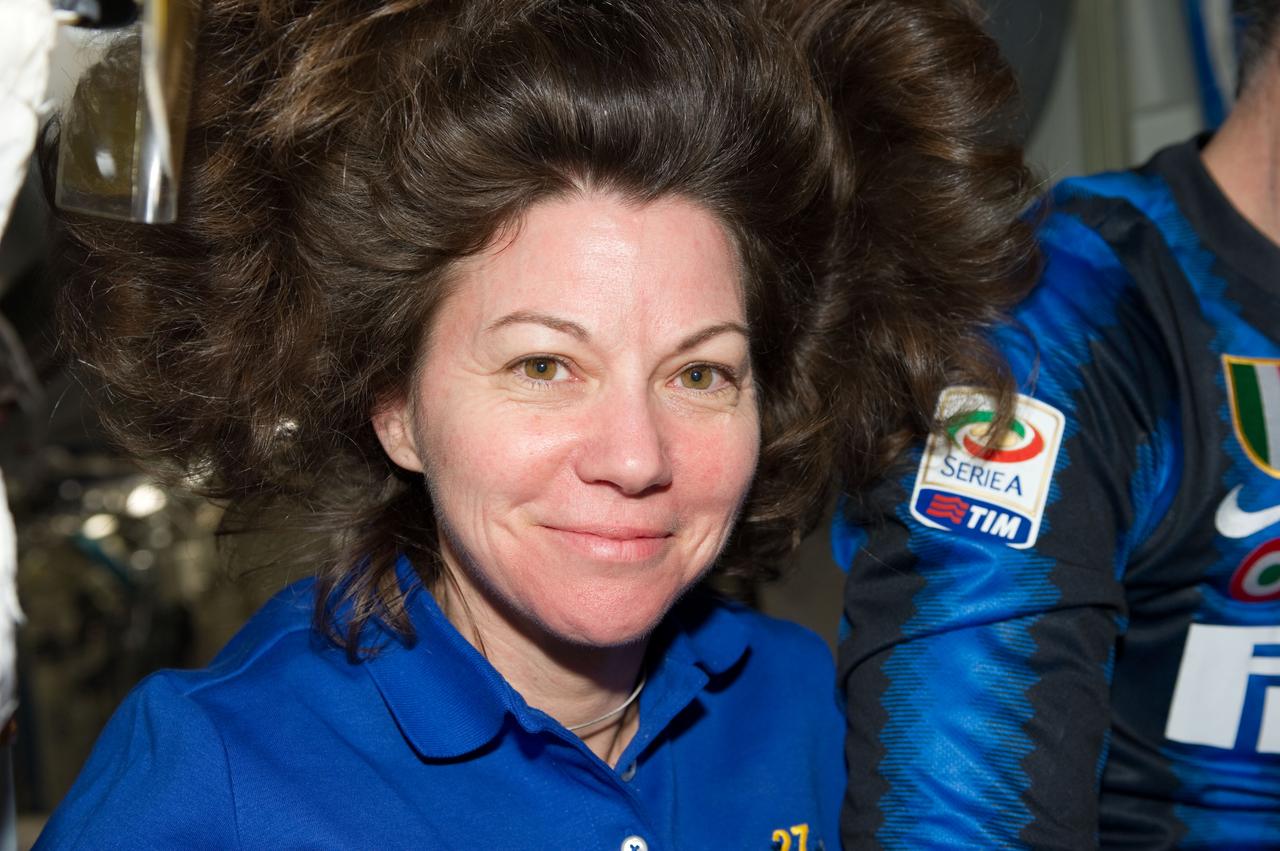
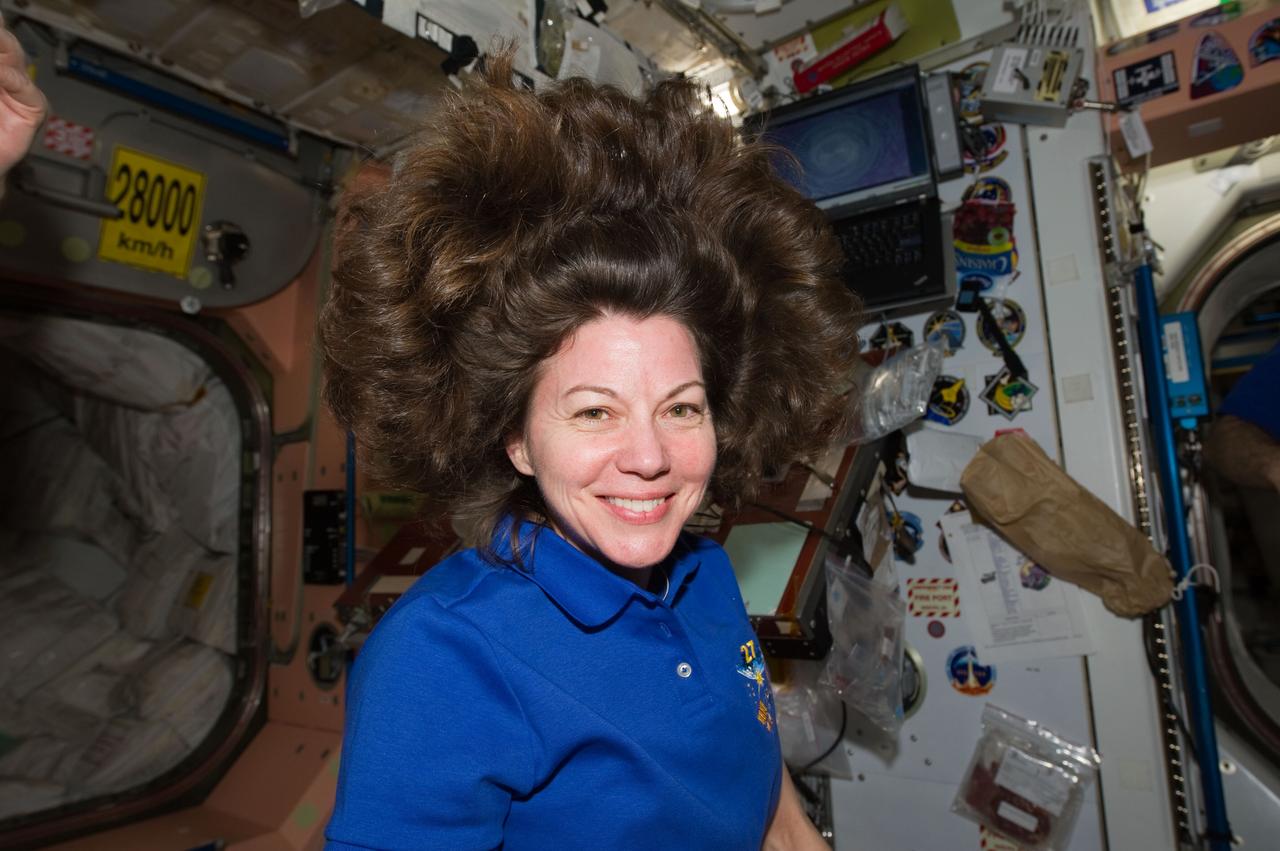
S134-E-008390 (21 May 2011)--- After more than five months of serving as a flight engineer on back-to-back International Space Station Expedition crews, NASA astronaut Cady Coleman (seen aboard the orbiting complex) is only 48 hours away from returning to Earth. She and two Expedition 27 crewmates will lessen the current population of twelve on the joint Endeavour/ISS complex to nine when they undock on May 23 in a Soyuz spacecraft and return to Earth. Photo credit: NASA
View of Expedition 27 FE Coleman posing for a photo
S134-E-008356 (21 May 2011)--- After more than five months of serving as a flight engineer on back-to-back International Space Station Expedition crews, NASA astronaut Cady Coleman (seen aboard the orbiting complex) is only 48 hours away from returning to Earth. She and two Expedition 27 crewmates will lessen the current population of twelve on the joint Endeavour/ISS complex to nine when they undock on May 23 in a Soyuz spacecraft and return to Earth. Photo credit: NASA
View of Expedition 27 FE Coleman in the Node 1
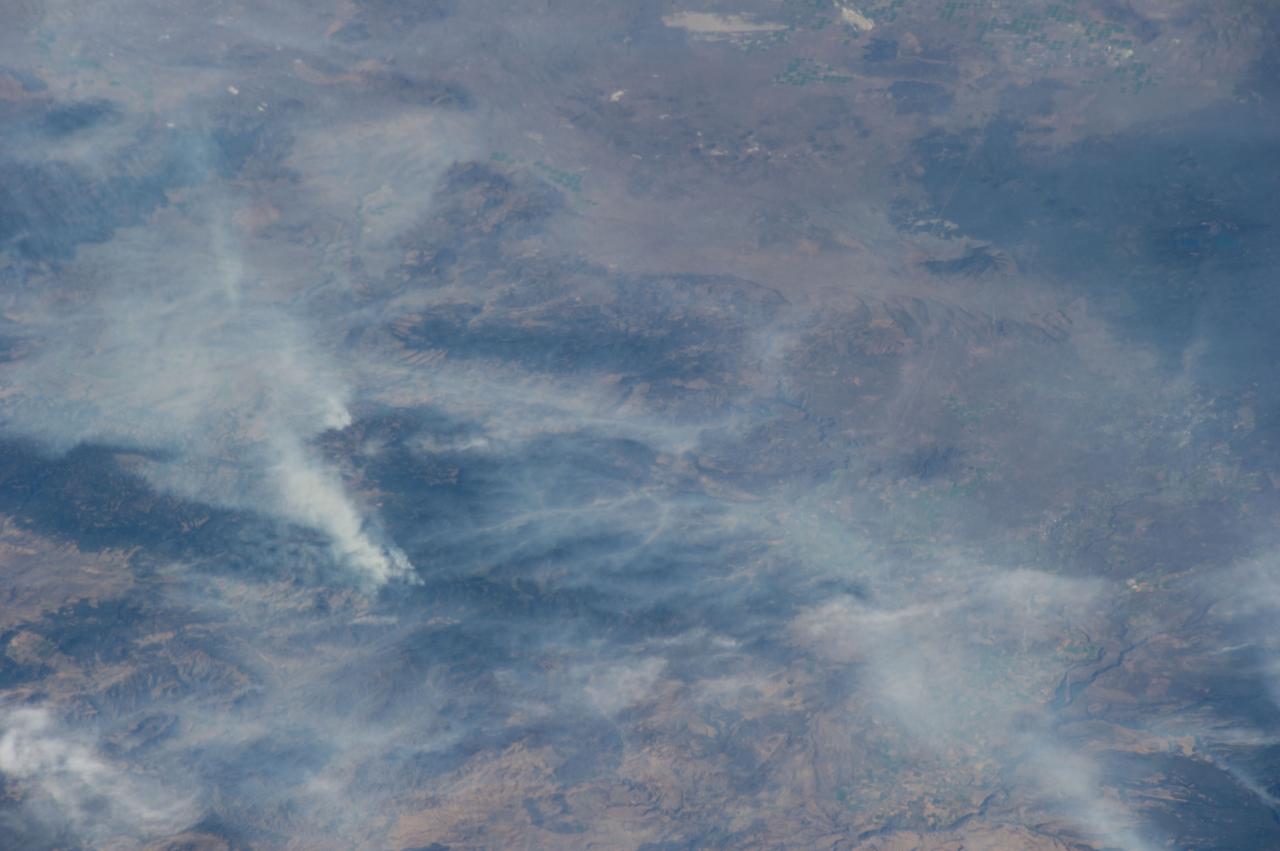
ISS040-E-070424 (19 July 2014) --- One of the Expedition 40 crew members aboard the Earth-orbiting International Space Station recorded this July 19 image of wildfires which are plaguing the Northwest and causing widespread destruction. The orbital outpost was flying 223 nautical miles above Earth at the time of the photo. Lightning has been given as the cause of the Ochoco Complex fires in the Ochoco National Forest in central Oregon. The complex has gotten larger since this photo was taken.
Earth Observation
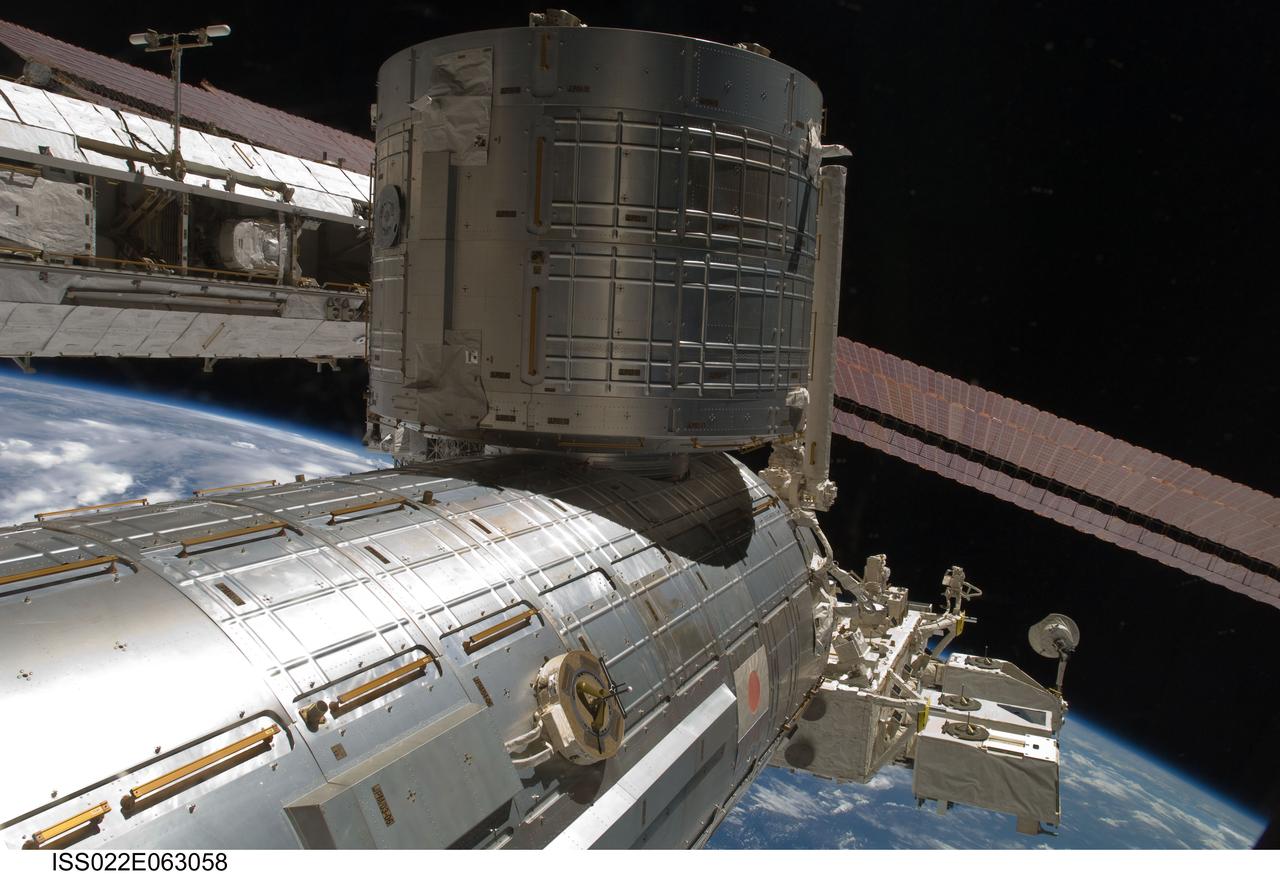
ISS022-E-063058 (11 Feb. 2010) --- Backdropped by the blackness of space, the Japanese Kibo complex of the International Space Station is featured in this image photographed by an Expedition 22 crew member while space shuttle Endeavour (STS-130) remains docked with the station.
Survey view of ISS
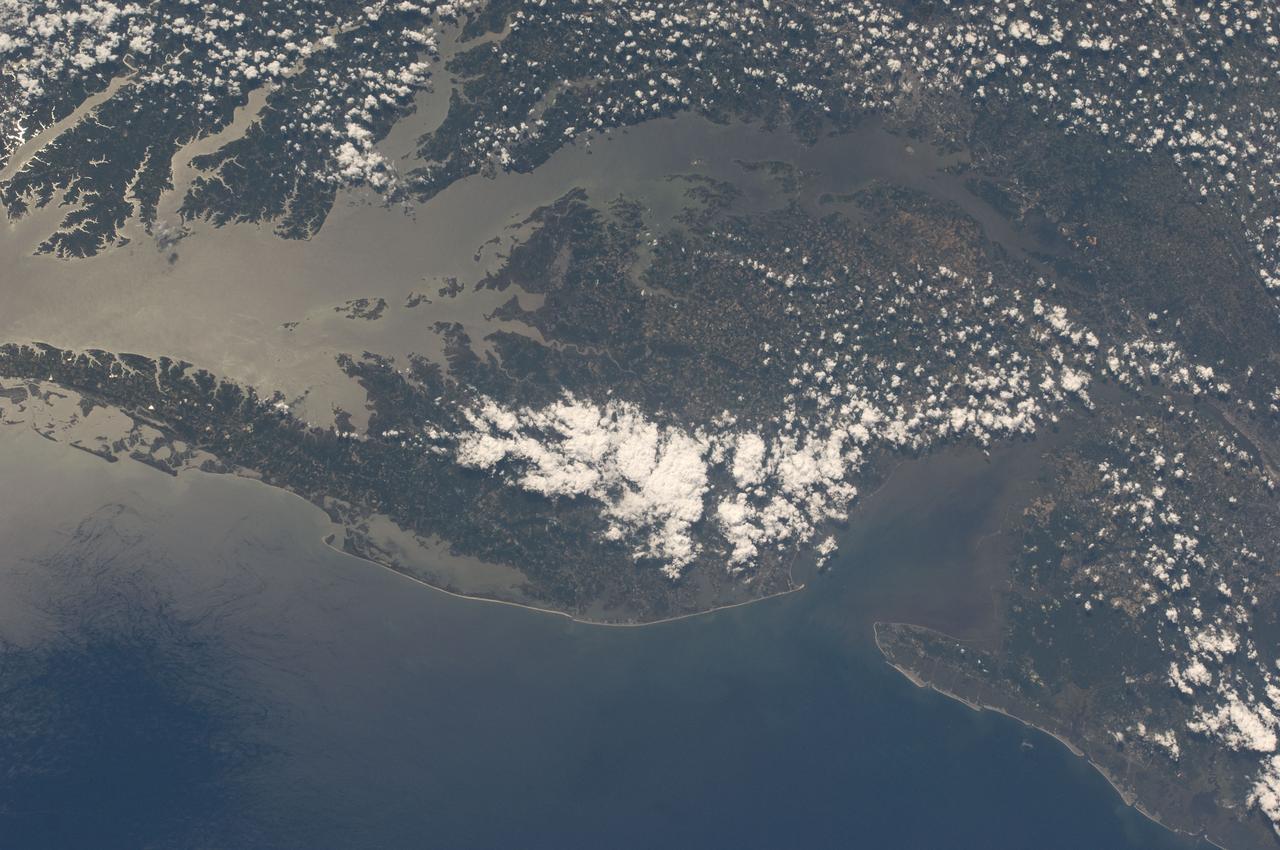
S135-E-008791 (16 July 2011) --- While flying above the Atlantic Ocean, one of the members of the joint Atlantis-International Space Station crews took this photo of the Delmarva Peninsula from the orbiting complex on July 16, 2011. Photo credit: NASA
Earth Observations taken by the STS-135 Crew
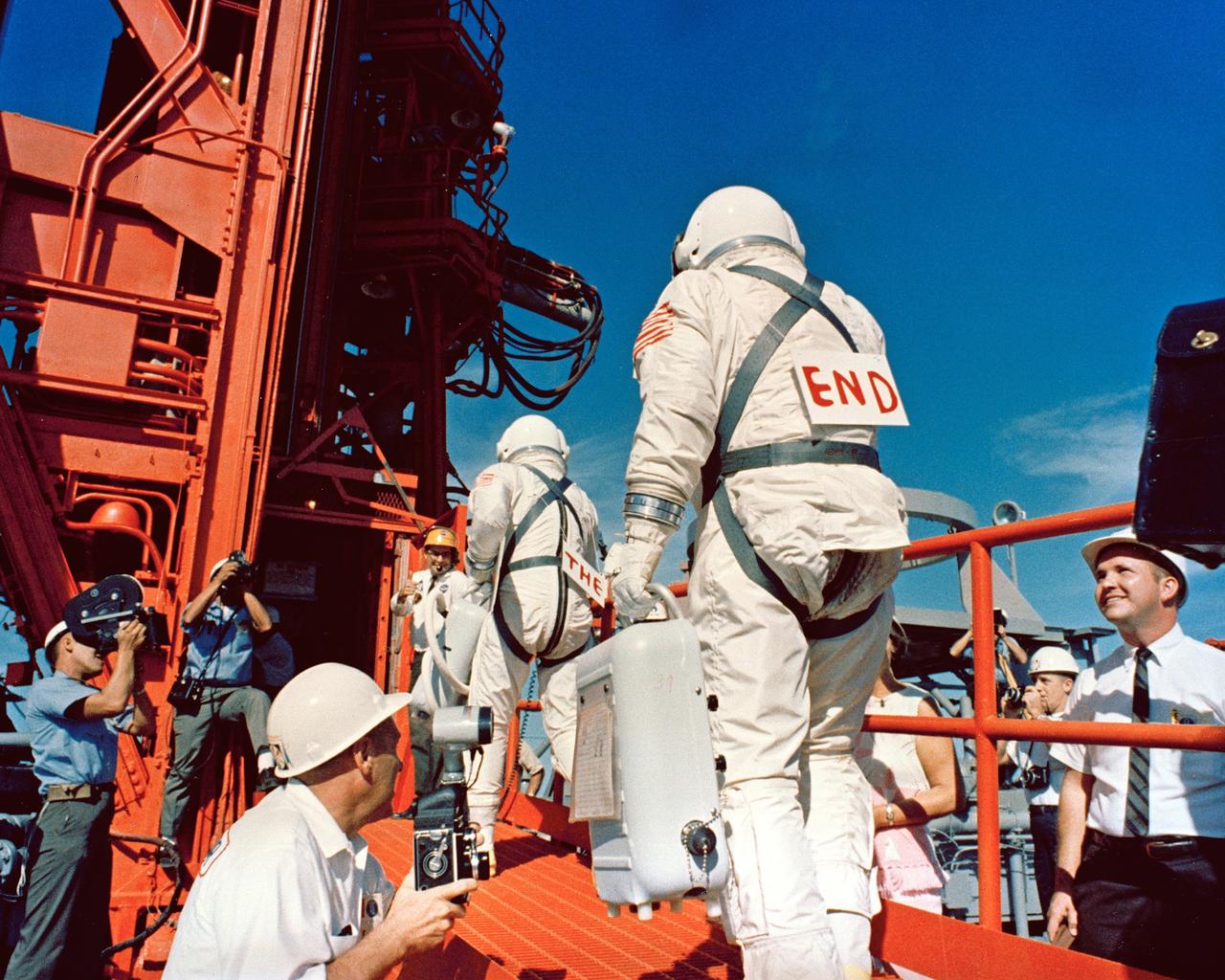
CAPE KENNEDY, Fla. -- At Cape Kennedy Air Force Station in Florida, the crew for Gemini 12 arrives at Launch Complex 19. Command pilot James A. Lovell is followed by pilot Edwin E. Buzz Aldrin Jr. The signs on their backs note that this mission is the final flight of the Gemini Program. Photo Credit: NASA
KSC-66C-9220
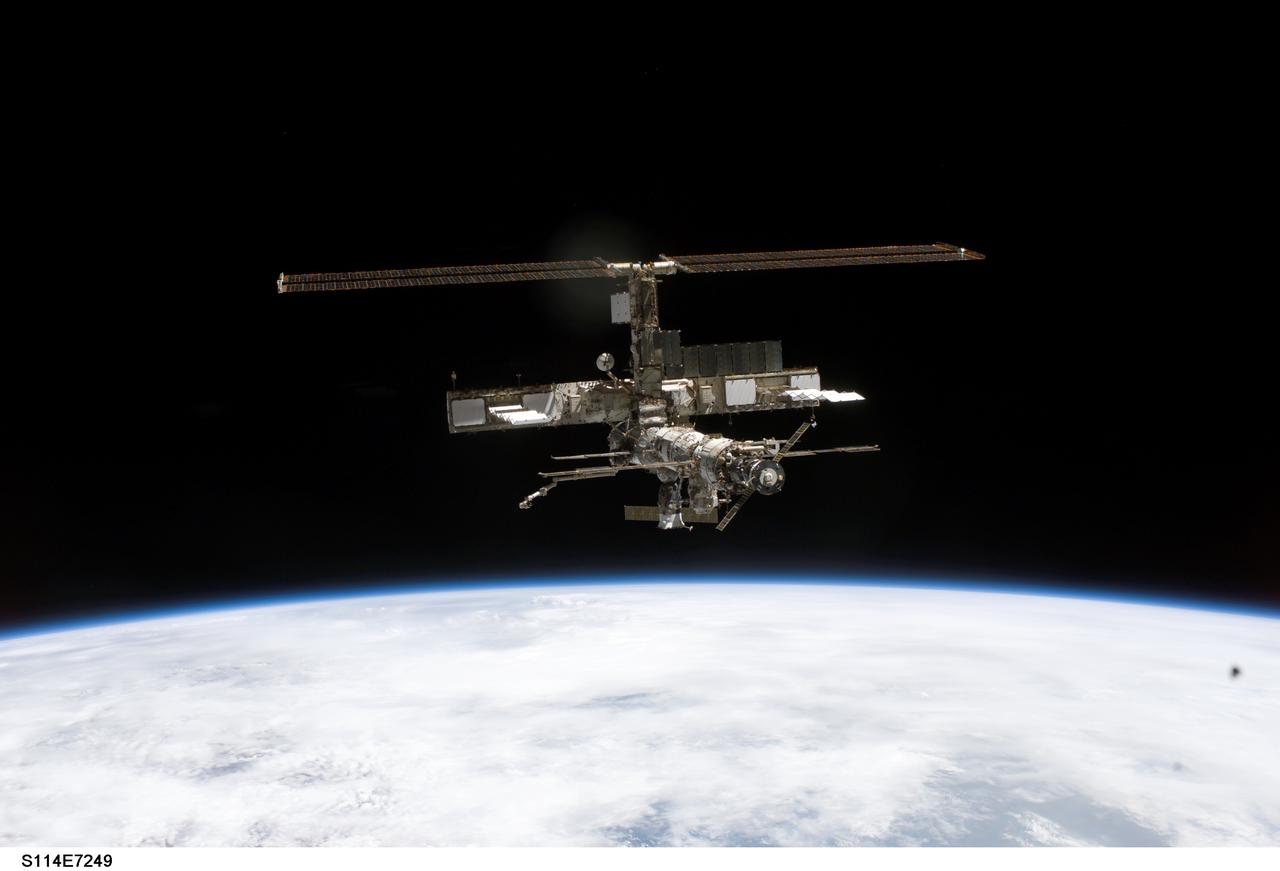
S114-E-7249 (6 August 2005) --- Backdropped by the blackness of space and Earth’s horizon, this view of the International Space Station was photographed by a crewmember onboard the Space Shuttle Discovery following the undocking of the two spacecraft. Discovery pulled away from the complex at 2:24 a.m. (CDT) on August 6, 2005.
View of the ISS taken during flyaround by STS-114 crew
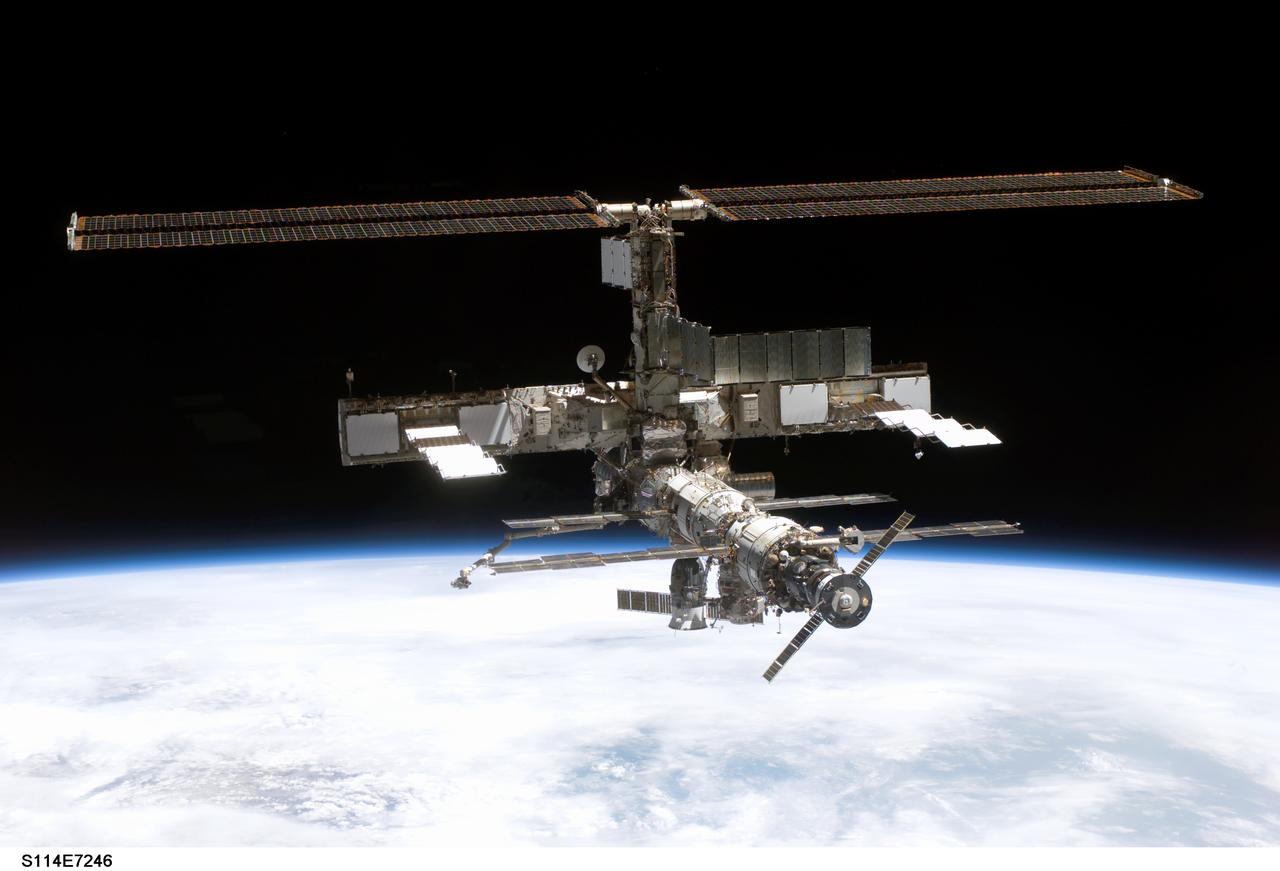
S114-E-7246 (6 August 2005) --- Backdropped by the blackness of space and Earth’s horizon, this full view of the International Space Station was photographed by a crewmember onboard the Space Shuttle Discovery following the undocking of the two spacecraft. Discovery pulled away from the complex at 2:24 a.m. (CDT) on August 6, 2005.
View of the ISS taken during flyaround by STS-114 crew
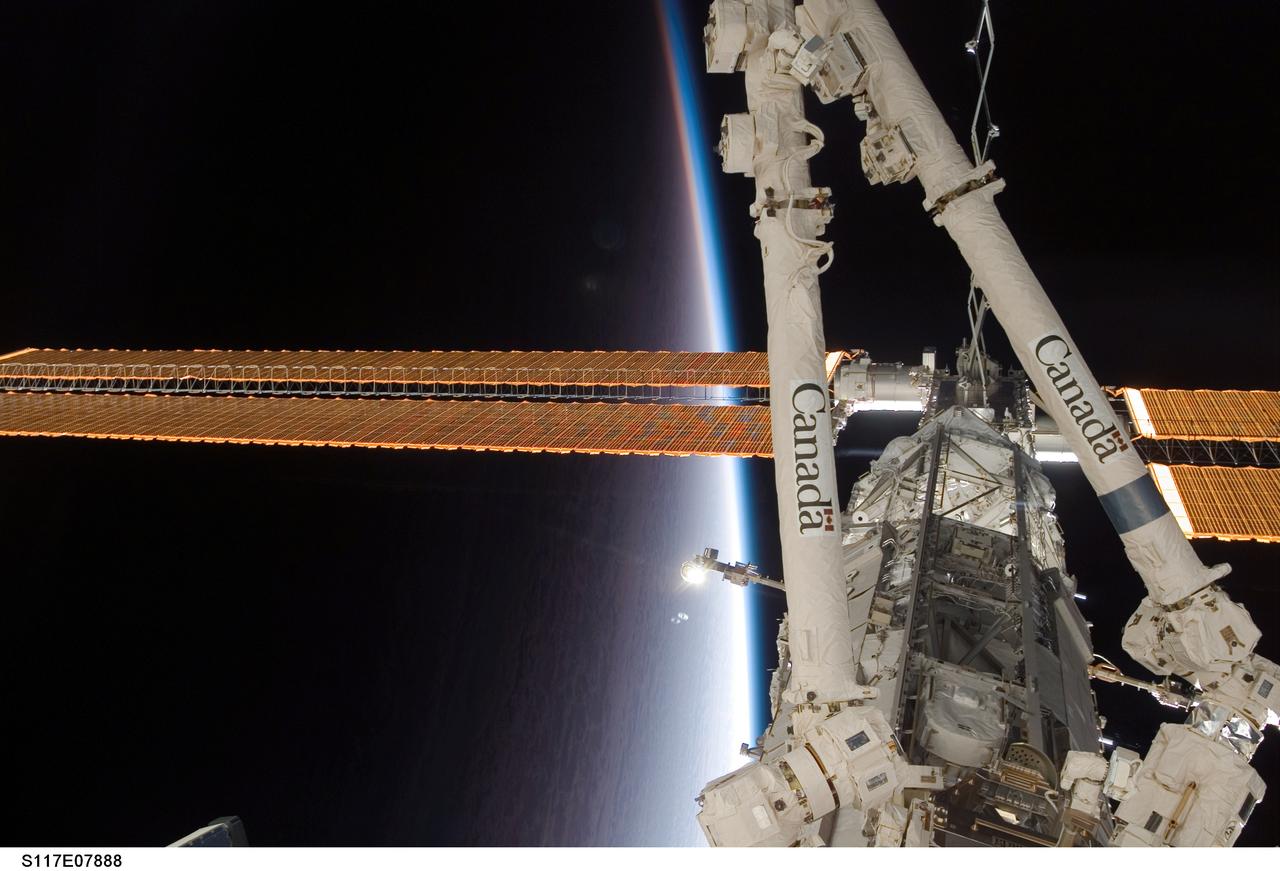
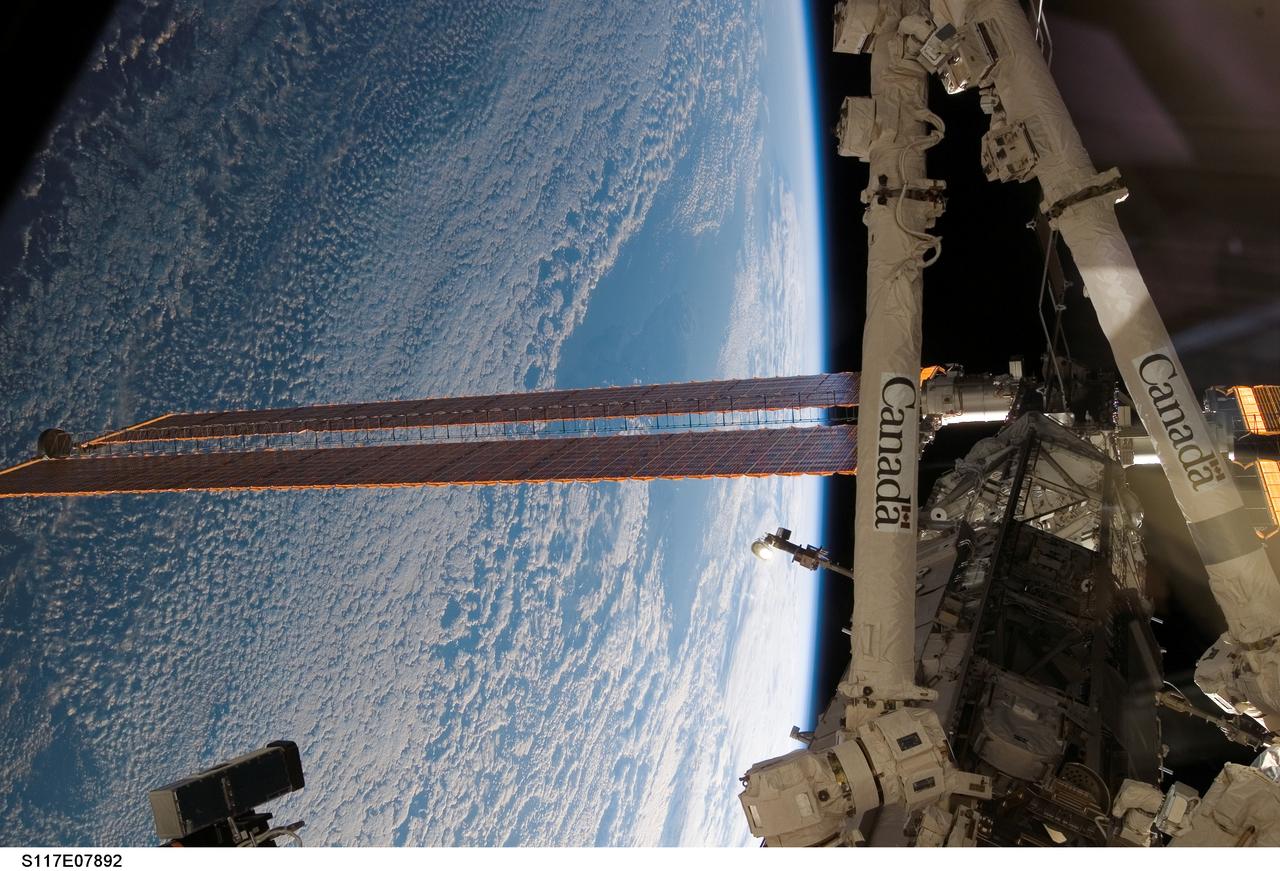
S117-E-07892 (18 June 2007) --- The International Space Station's Canadarm2, or Space Station Remote Manipulator System (SSRMS) and solar array wings are featured in this image photographed by a crewmember on the station while Space Shuttle Atlantis was docked with the orbital complex. The blackness of space and Earth's horizon provides the backdrop for the scene.
S1 and S3 Trusses taken during Joint Operations
ISS023-E-020654 (7 April 2010) --- Japan Aerospace Exploration Agency astronaut Naoko Yamazaki, STS-131 mission specialist, enjoys her first in-space experience of weightlessness as she floats in the Kibo laboratory aboard the International Space Station shortly after arriving at the orbital complex on April 7.
Yamazaki in Kibo
The Apollo 17 space vehicle towers over the astronauts it will launch to the moon on December 6, 1972 from KSC.  The astronauts, L-R, Harrison H. Schmitt, Ronald E. Evans and Eugene A. Cernan participated in a walkdown of the emergency route at Launch complex 39A.
KSC-72P-0535
S133-E-006731 (26 Feb. 2011) --- Backdropped by the blackness of space and Earth's horizon, the Japanese Kibo complex of the International Space Station is featured in this image photographed by an STS-133 crew member while space shuttle Discovery remains docked with the station. Photo credit: NASA or National Aeronautics and Space Administration
Kibo
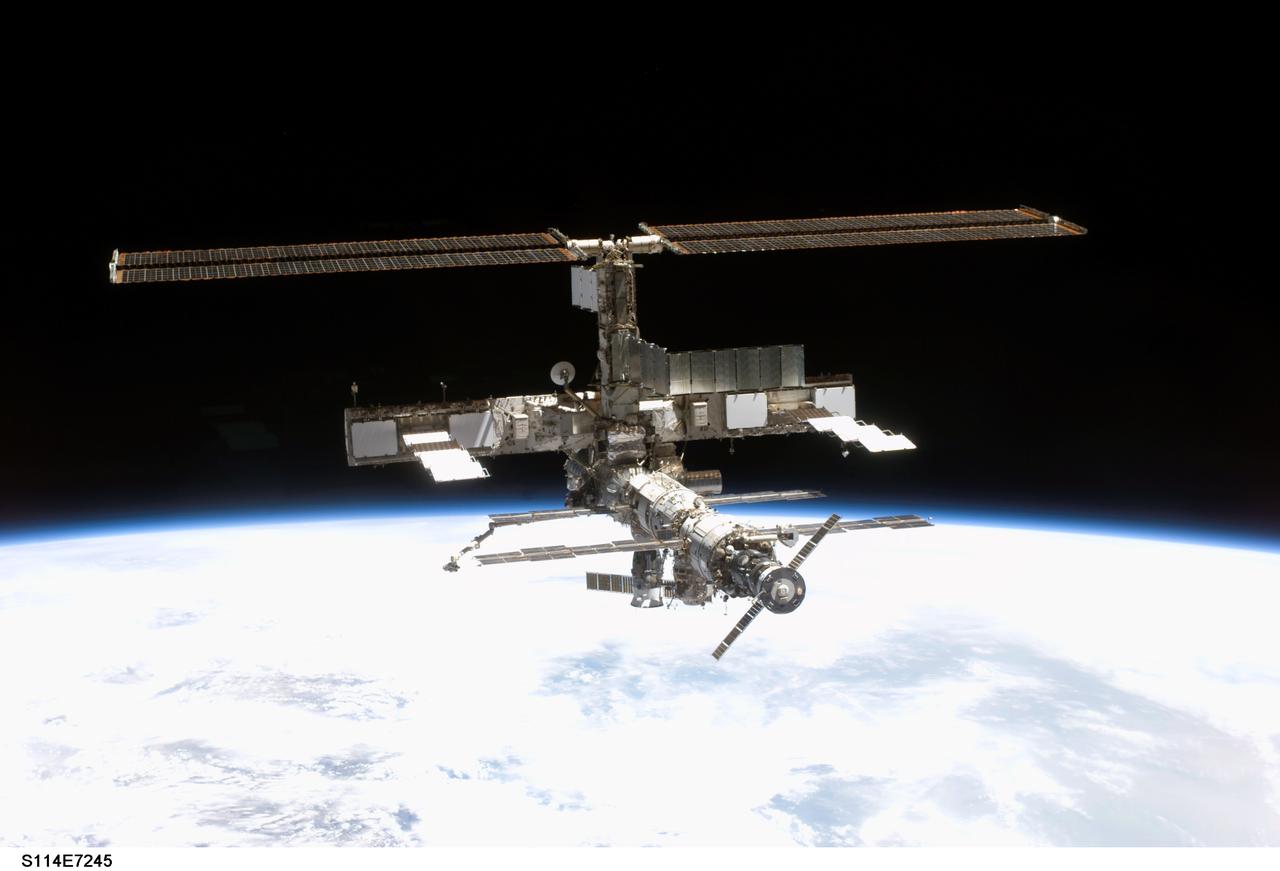
S114-E-7245 (6 August 2005) --- Backdropped by the blackness of space and Earth’s horizon, this full view of the International Space Station was photographed by a crewmember onboard the Space Shuttle Discovery following the undocking of the two spacecraft. Discovery pulled away from the complex at 2:24 a.m. (CDT) on August 6, 2005.
View of the ISS taken during flyaround by STS-114 crew
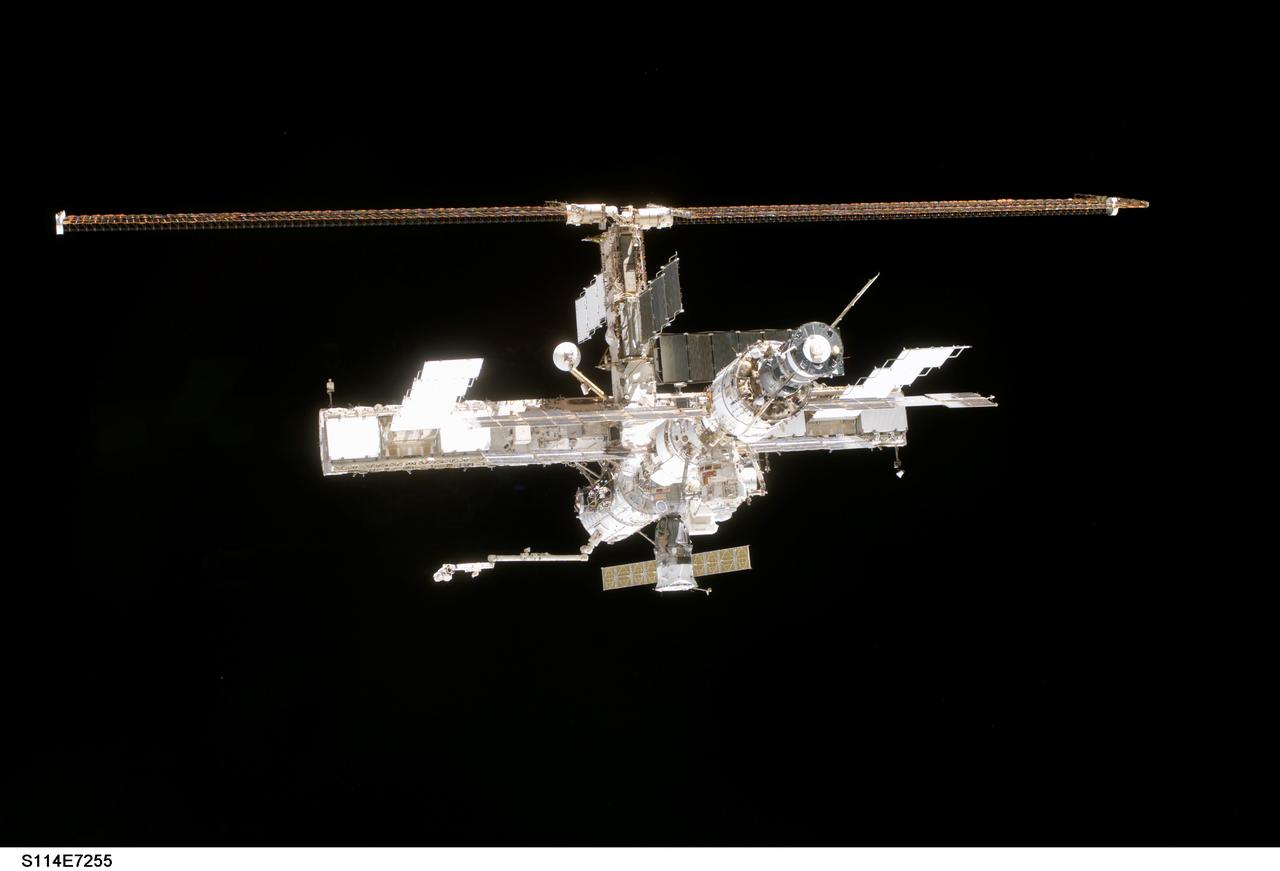
S114-E-7255 (6 August 2005) --- Backdropped by the blackness of space, this view of the International Space Station was photographed by a crewmember onboard the Space Shuttle Discovery following the undocking of the two spacecraft. Discovery pulled away from the complex at 2:24 a.m. (CDT) on August 6, 2005.
View of the ISS taken during flyaround by STS-114 crew
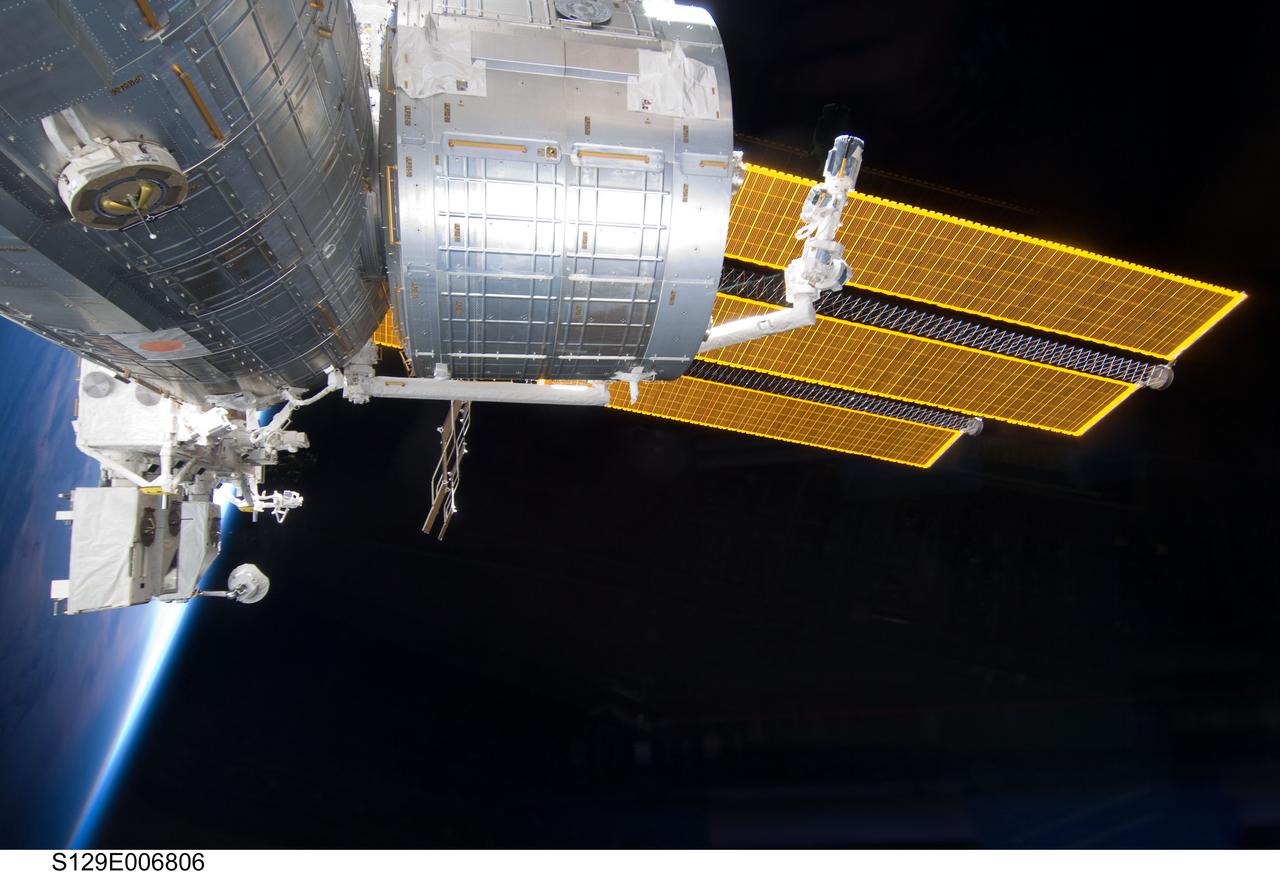
S129-E-006806 (19 Nov. 2009) --- Backdropped by Earth?s horizon and the blackness of space, the Japanese Kibo complex of the International Space Station is featured in this image photographed by an STS-129 crew member while Space Shuttle Atlantis remains docked with the station.
Exterior view of ISS taken during STS-129/ Expedition 21 Joint Operations
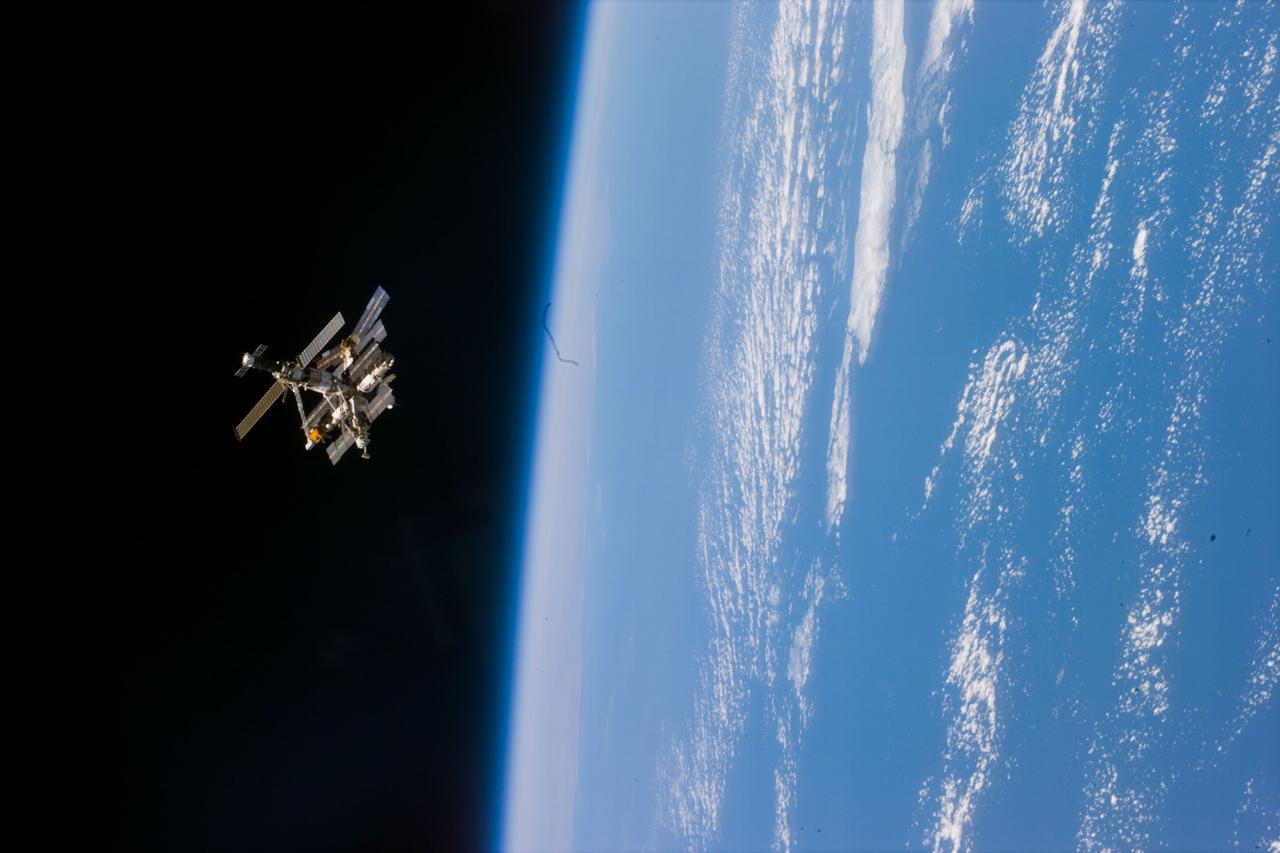
STS79-E-5355 (16-26 September 1996) --- Several minutes later, the STS-79 astronauts enjoyed this view of the Russia's Mir Space Station complex backdropped against the blackness of space over Earth's horizon.  A thin blue line of airglow runs parallel with Earth's horizon.
Mir space station as seen after undocking from the shuttle Atlantis
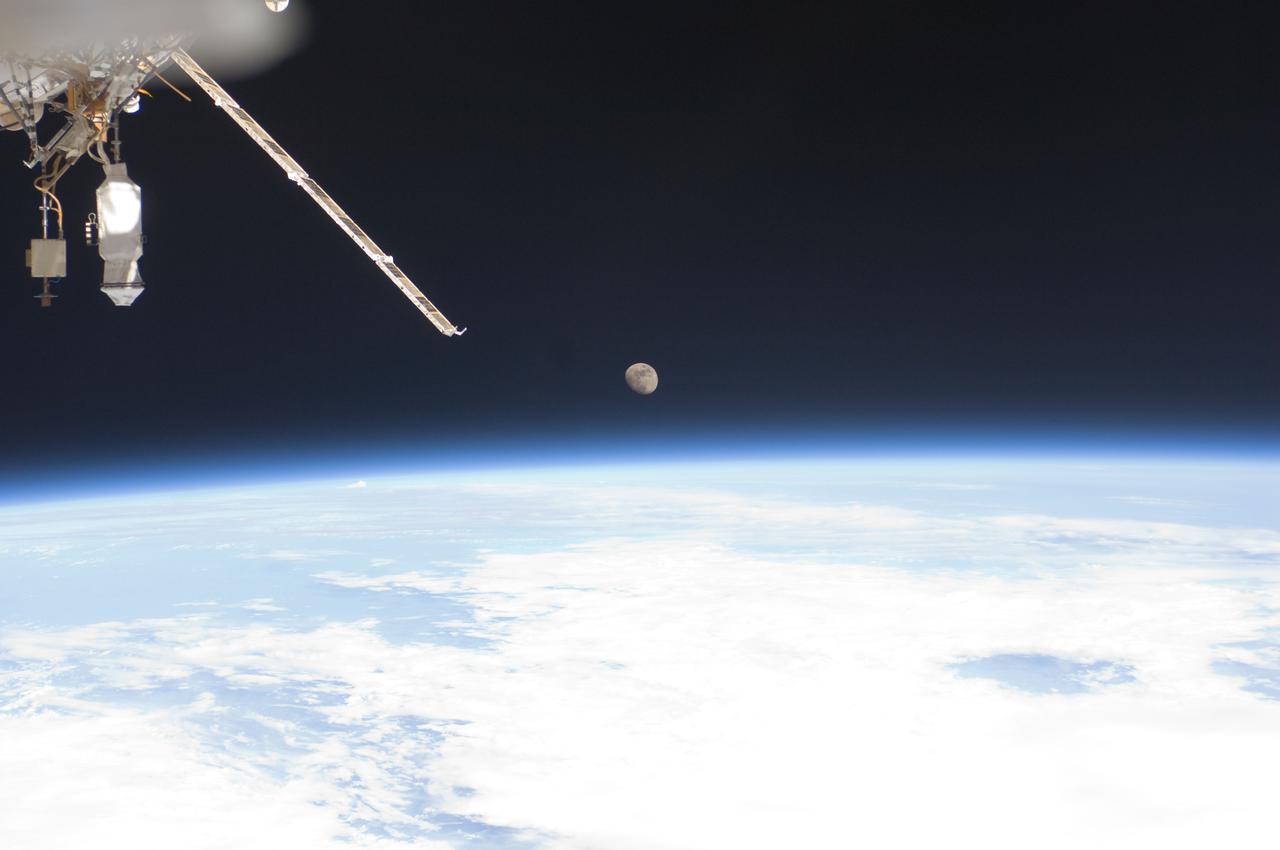
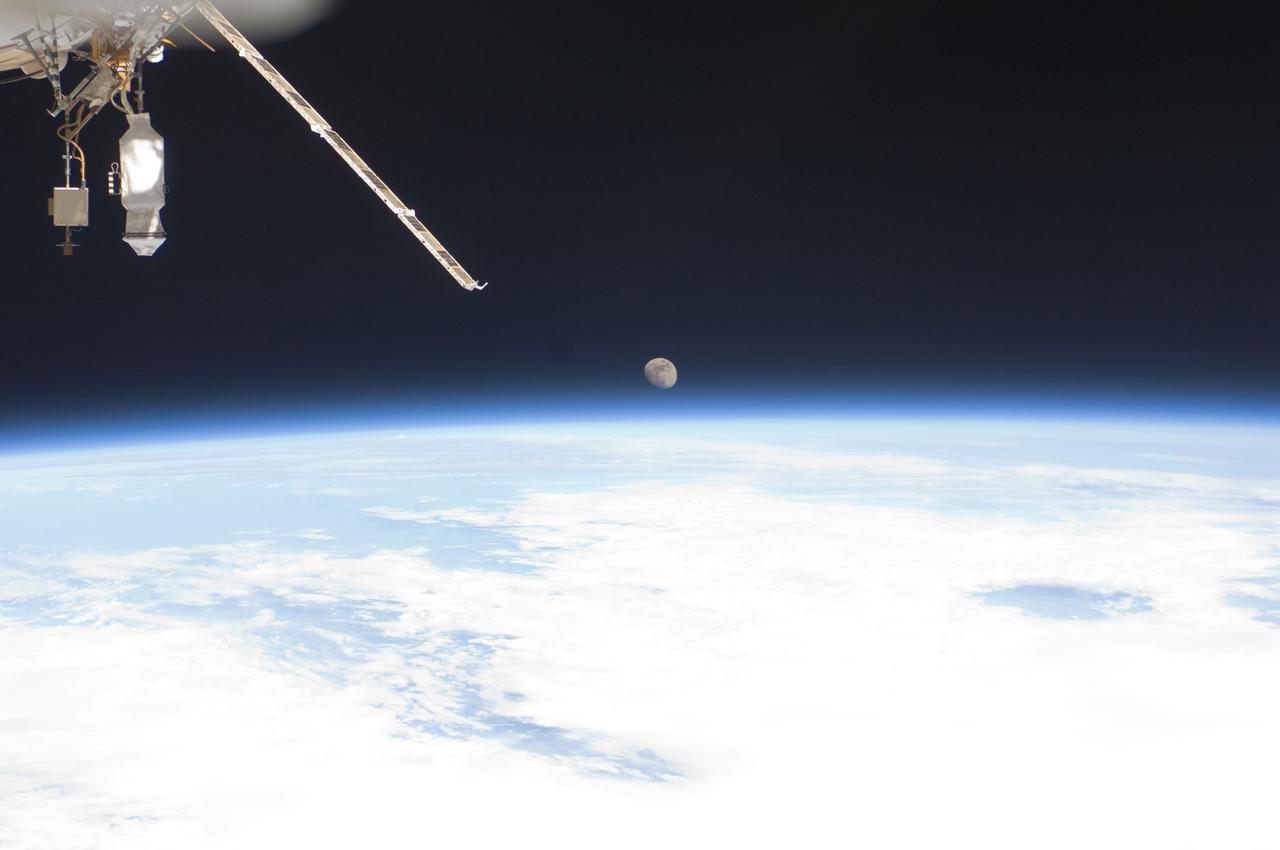
ISS028-E-016056 (12 July 2011) --- One of the Expedition 28 crewmembers aboard the International Space Station recorded this image of Earth's horizon and the moon during the week and a half period that the orbiting complex was hosting Atlantis and its crew for the final Space Shuttle Program mission.
Earth Observations
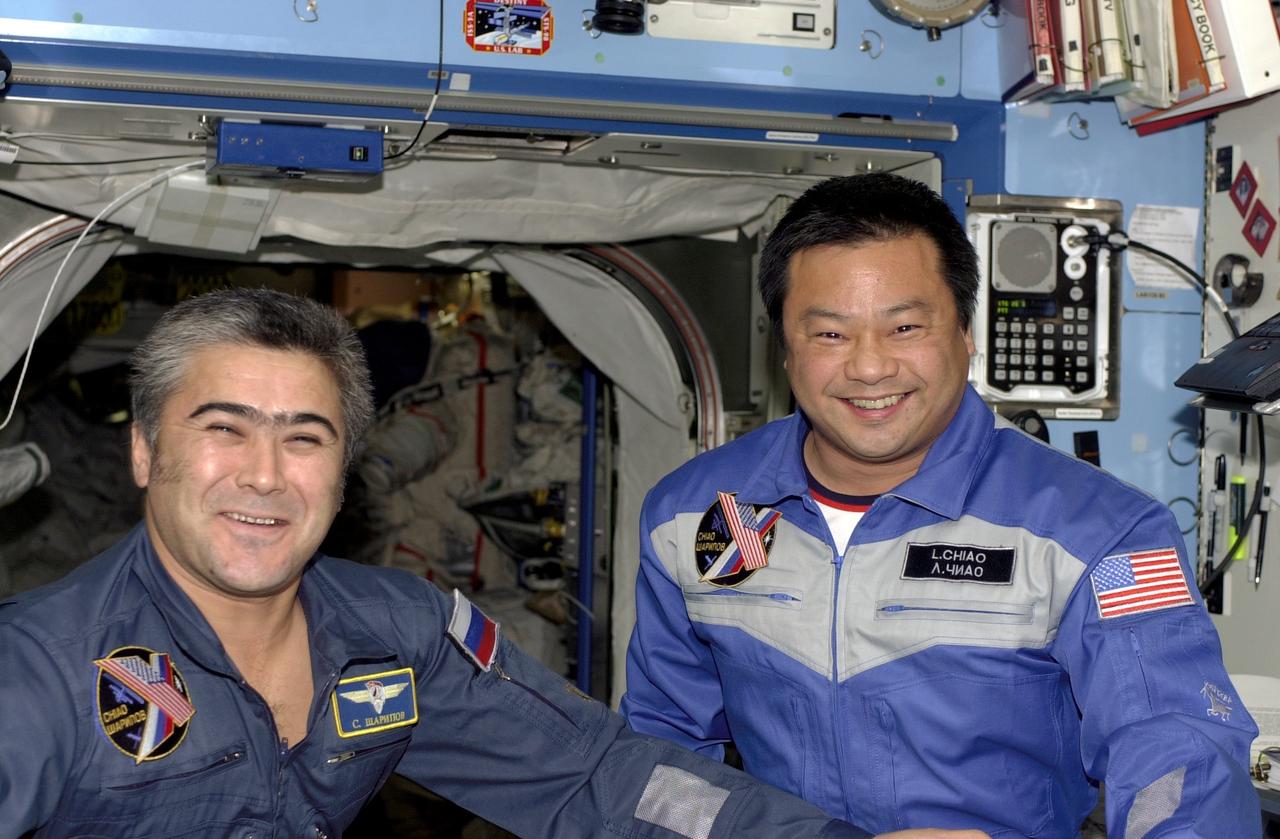
ISS010-E-18943 (23 November 2004) --- Cosmonaut Salizhan S. Sharipov (left), Expedition 10 flight engineer, and astronaut Leroy Chiao,  commander and NASA Space Station science officer, appear to be enjoying their work in the early stages of their tenure aboard the orbiting complex. They stand near the hatchway for the Destiny Laboratory.
Sharipov and Chiao pose at the hatch area in the U.S. Laboratory during Expedition 10
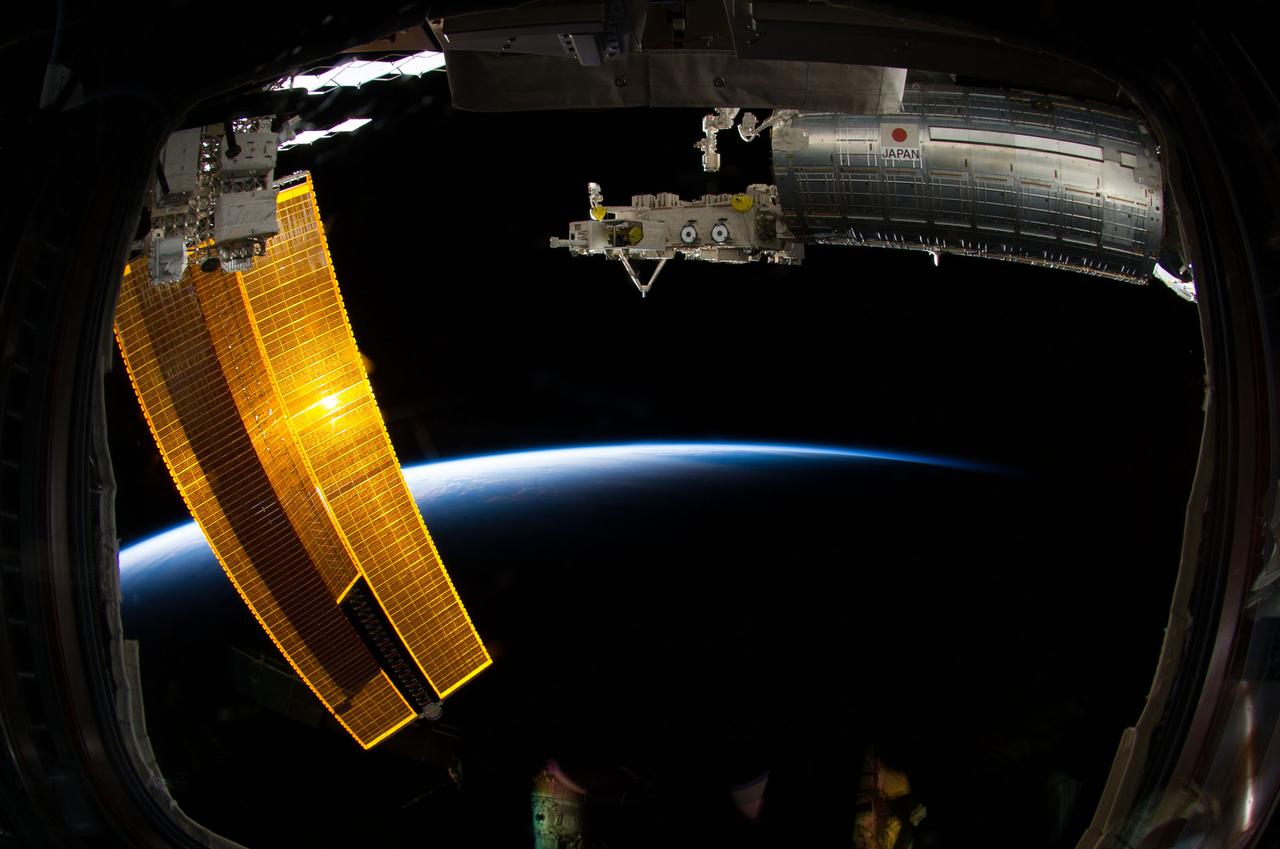
ISS040-E-006510 (1 June 2014) --- Backdropped by the thin line of Earth's atmosphere and the blackness of space, the Japanese Kibo complex of the International Space Station and station solar array wings are featured in this image photographed by an Expedition 40 crew member from a window in the station’s Cupola.
Cupola Sunsets
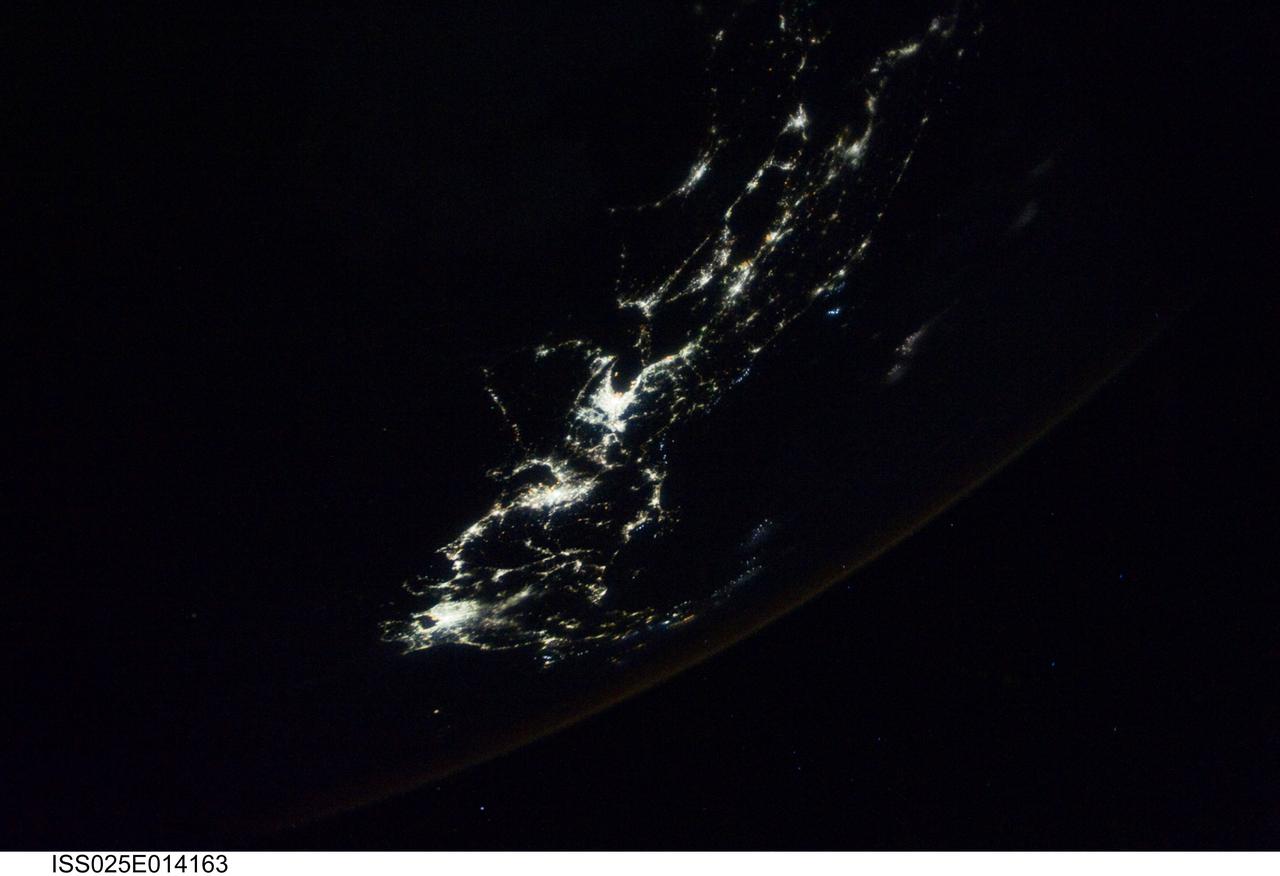
ISS025-E-014163 (11 Nov. 2010) --- From 220 miles above Earth, one of the Expedition 25 crew members exposed this night time image of part of Japan on Nov. 11, 2010, as three members of the six person crew began their final fortnight aboard the orbiting complex.
Night time city lights taken by the Expedition 25 crew
S117-E-07888 (18 June 2007) --- The International Space Station's Canadarm2, or Space Station Remote Manipulator System (SSRMS) and solar array wings are featured in this image photographed by a crewmember on the station while Space Shuttle Atlantis was docked with the orbital complex. The blackness of space and Earth's horizon provides the backdrop for the scene.
S1 and S3 Trusses taken during Joint Operations
ISS028-E-016058 (12 July 2011) --- One of the Expedition 28 crewmembers aboard the International Space Center recorded this image of Earth's horizon and the moon during the week and a half period that the orbiting complex was hosting the Atlantis and its crew for the final Space Shuttle Program mission.
Earth Observations
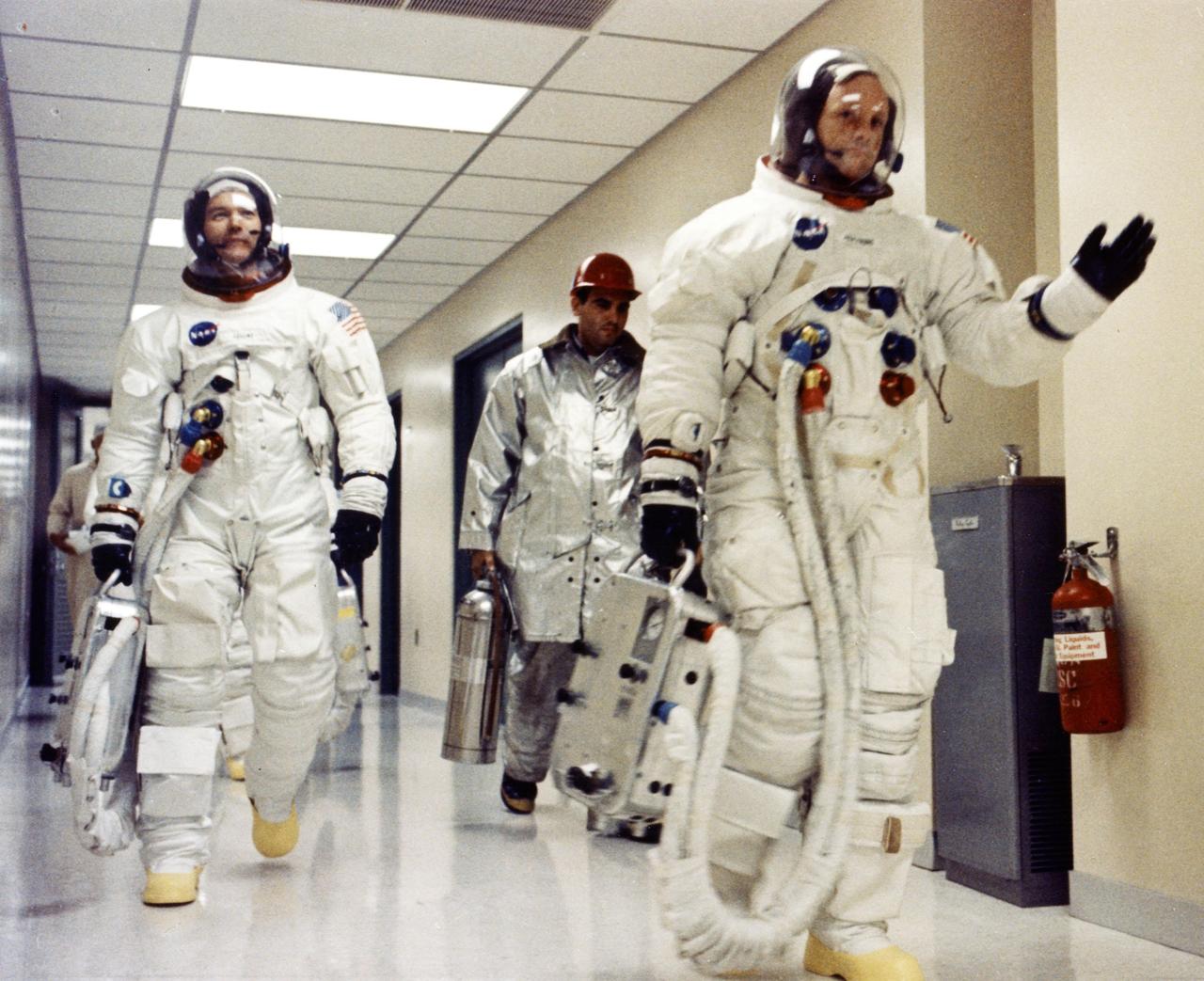
KENNEDY SPACE CENTER, FLA. --  Apollo 11 Commander Neil A. Armstrong waves to well-wishers in the hallway of the Manned Spacecraft Operations Building as he and Michael Collins and Edwin E. Aldrin Jr. prepare to be transported to Launch Complex 39A for the first manned lunar landing mission
ksc-69pc-342
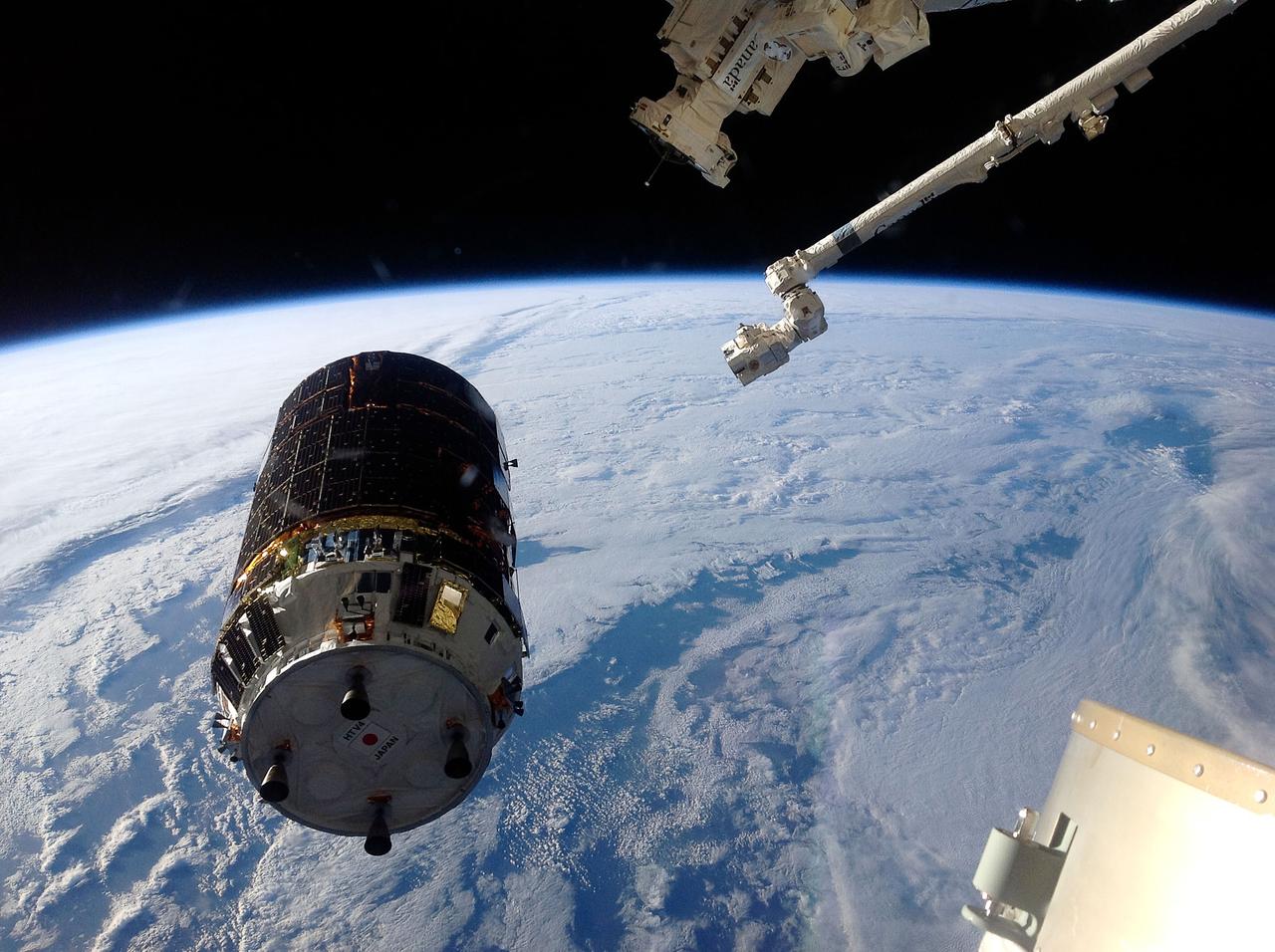
ISS036-E-029800 (9 Aug. 2013) --- The Canadarm2 moves toward the unpiloted Japanese "Kounotori" H2 Transfer Vehicle-4 (HTV-4) as it approaches the International Space Station. The HTV-4 is delivering 3.6 tons of science experiments, equipment and supplies to the orbiting complex. Earth’s horizon and the blackness of space provide the backdrop for the scene.
HTV-4 approach
S123-E-008274 (21 March 2008) --- Framed by components of the International Space Station, a full moon is visible in this view above Earth's horizon and airglow, photographed by a STS-123 crewmember on the station while Space Shuttle Endeavour is docked with the orbital complex.
Earth Observation taken by STS-123 Crewmember during Joint Operations
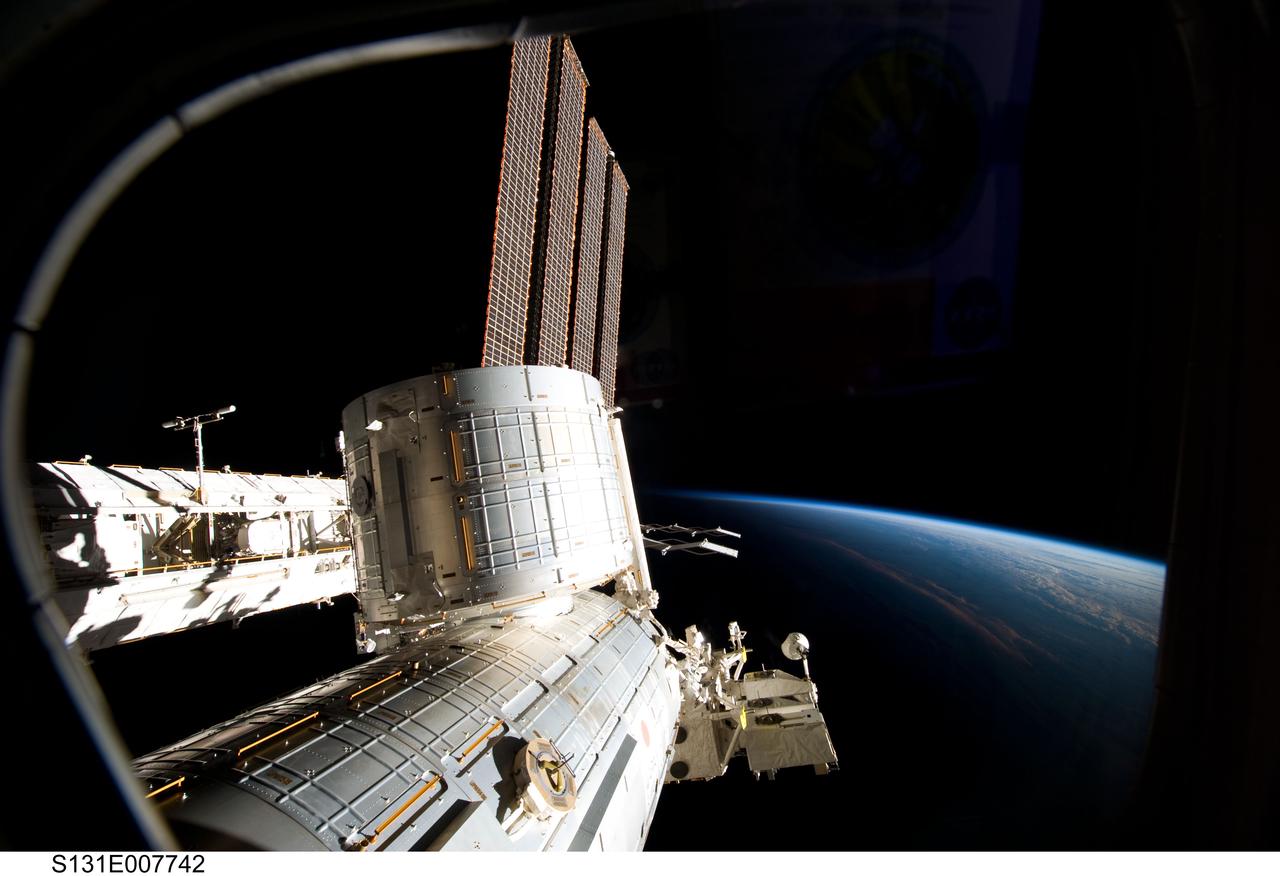
S131-E-007742 (7 April 2010) --- Backdropped by the blackness of space and Earth?s horizon, the Japanese Kibo complex of the International Space Station is featured in this image photographed by an STS-131 crew member while space shuttle Discovery remains docked with the station.
JPM and Port Truss
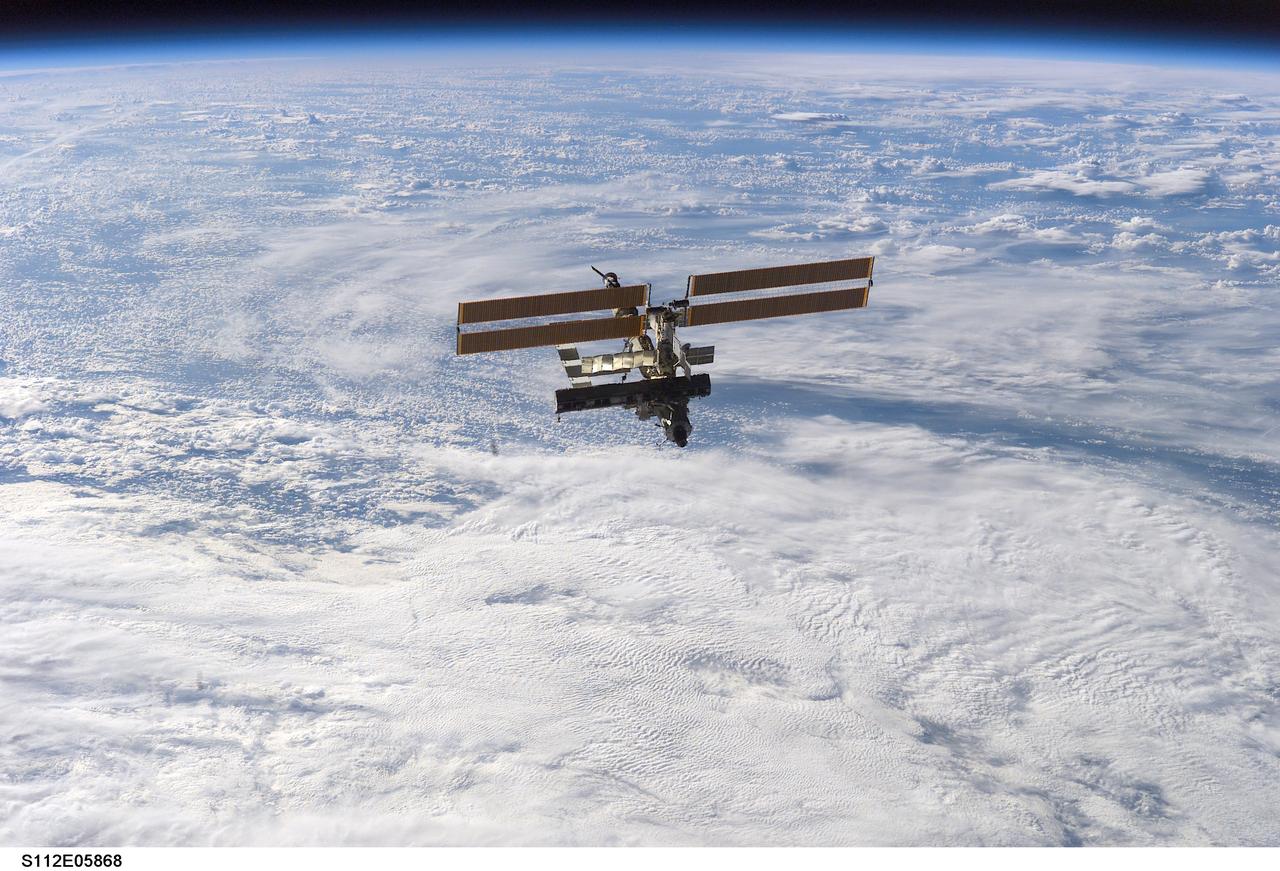
STS112-E-05868 (16 October 2002) --- Backdropped by a blanket of clouds, the International Space Station (ISS) was photographed by a crewmember on board the Space Shuttle Atlantis following the undocking of the two spacecraft. Atlantis pulled away from the complex at 8:13 a.m. (CDT) on October 16, 2002.
Flyaround view of ISS zenith aft and port sides
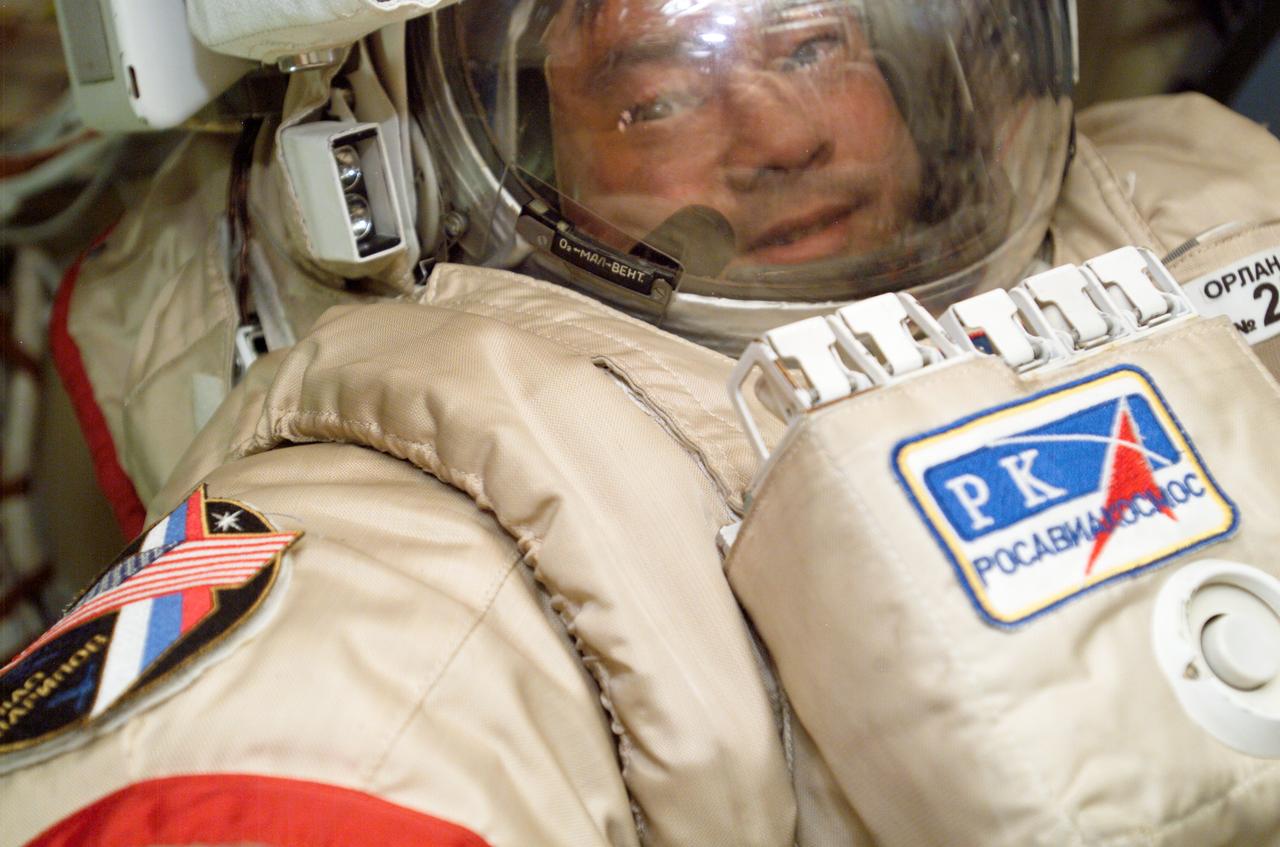
ISS010-E-14778 (24 January 2005) --- Astronaut Leroy Chiao, Expedition 10 commander and NASA Space Station science officer, prepares for January 26 extravehicular activity -- one of two planned Expedition 10 spacewalks. He is in the Pirs Docking Compartment on the orbiting complex.
Sharipov wearing an EMU in the Airlock during Expedition 10
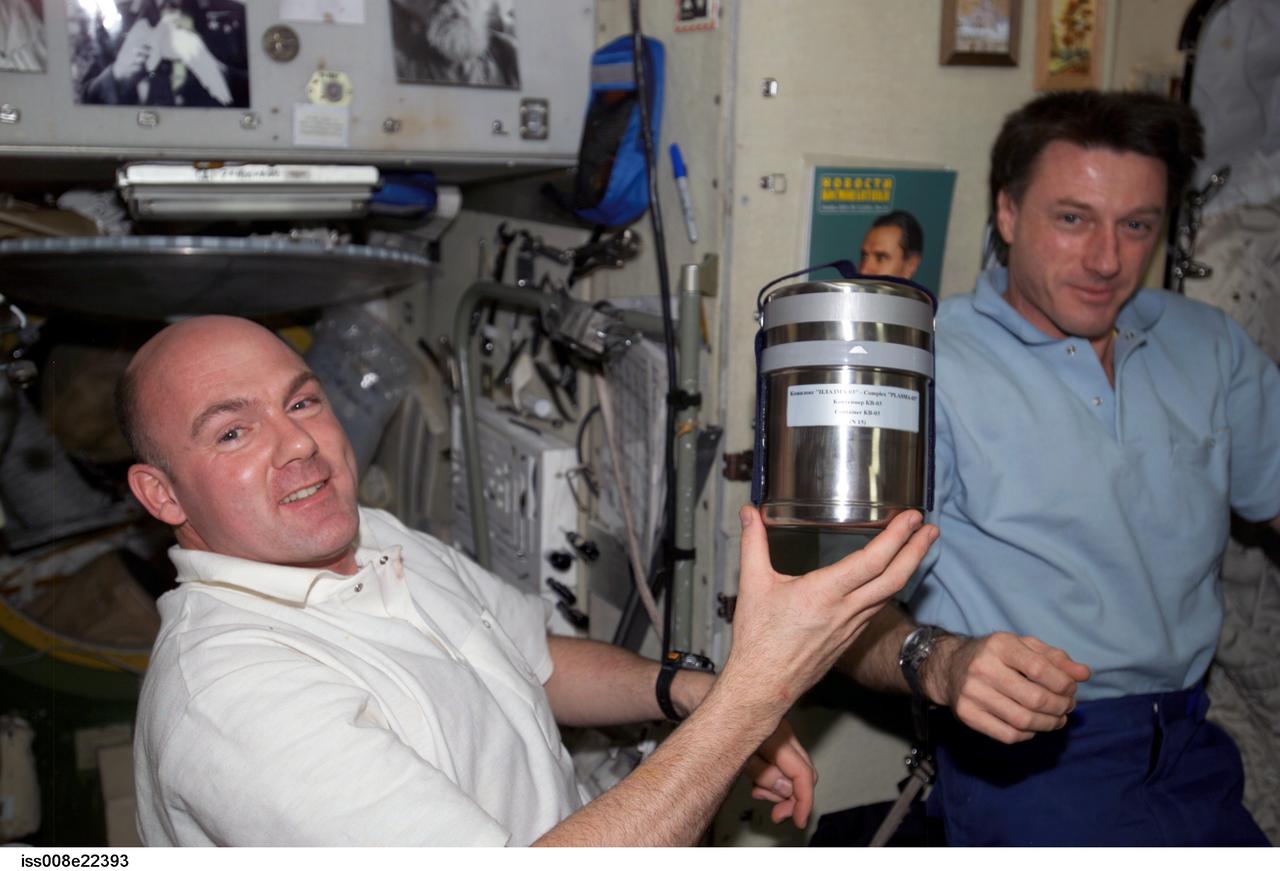
ISS008-E-22393 (29 April 2004) --- European Space Agency (ESA) astronaut Andre Kuipers of the Netherlands, holds a Complex “Plasma-03” canister in the Zvezda Service Module of the International Space Station (ISS). Astronaut C. Michael Foale, Expedition 8 commander and NASA ISS science officer, is at right.
Kuipers holds the Plasma-03 experiment container as Foale looks on during Expedition 9 / Expedition 8
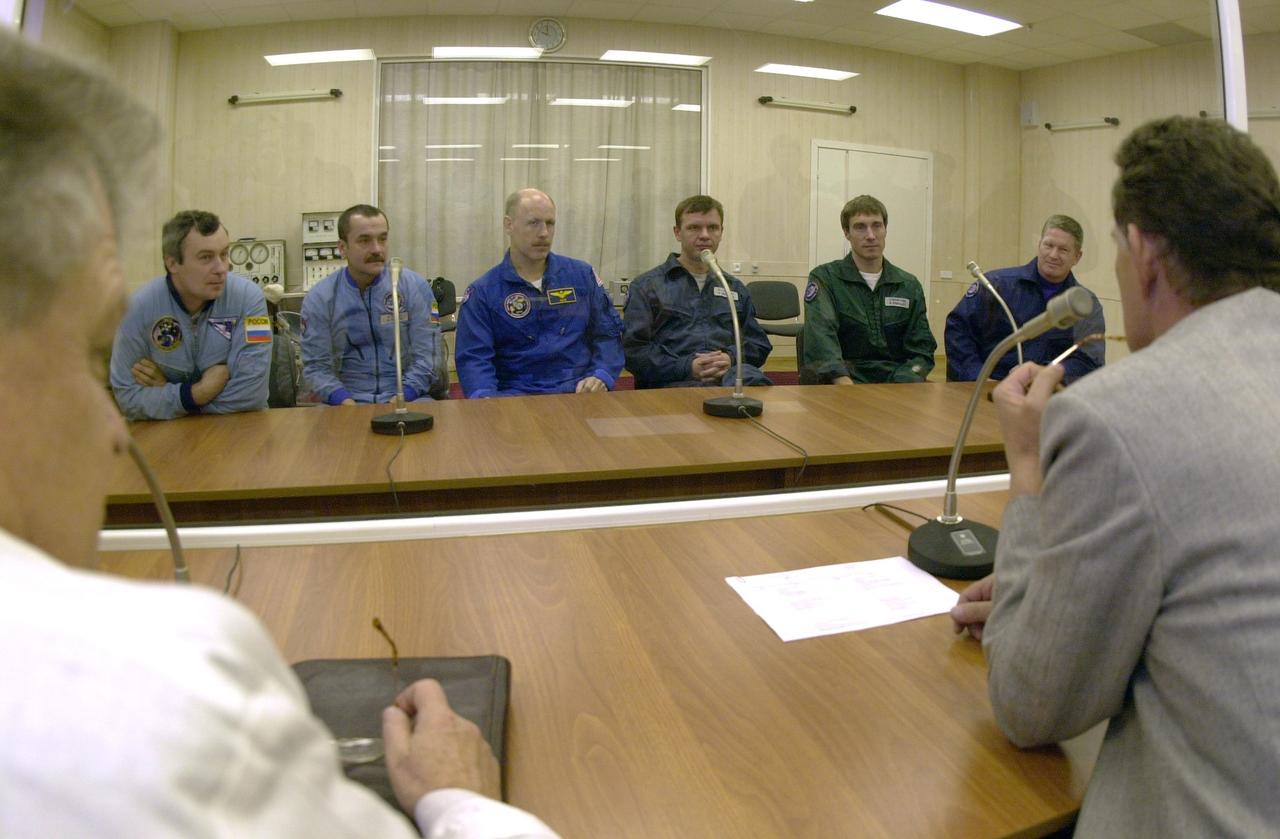
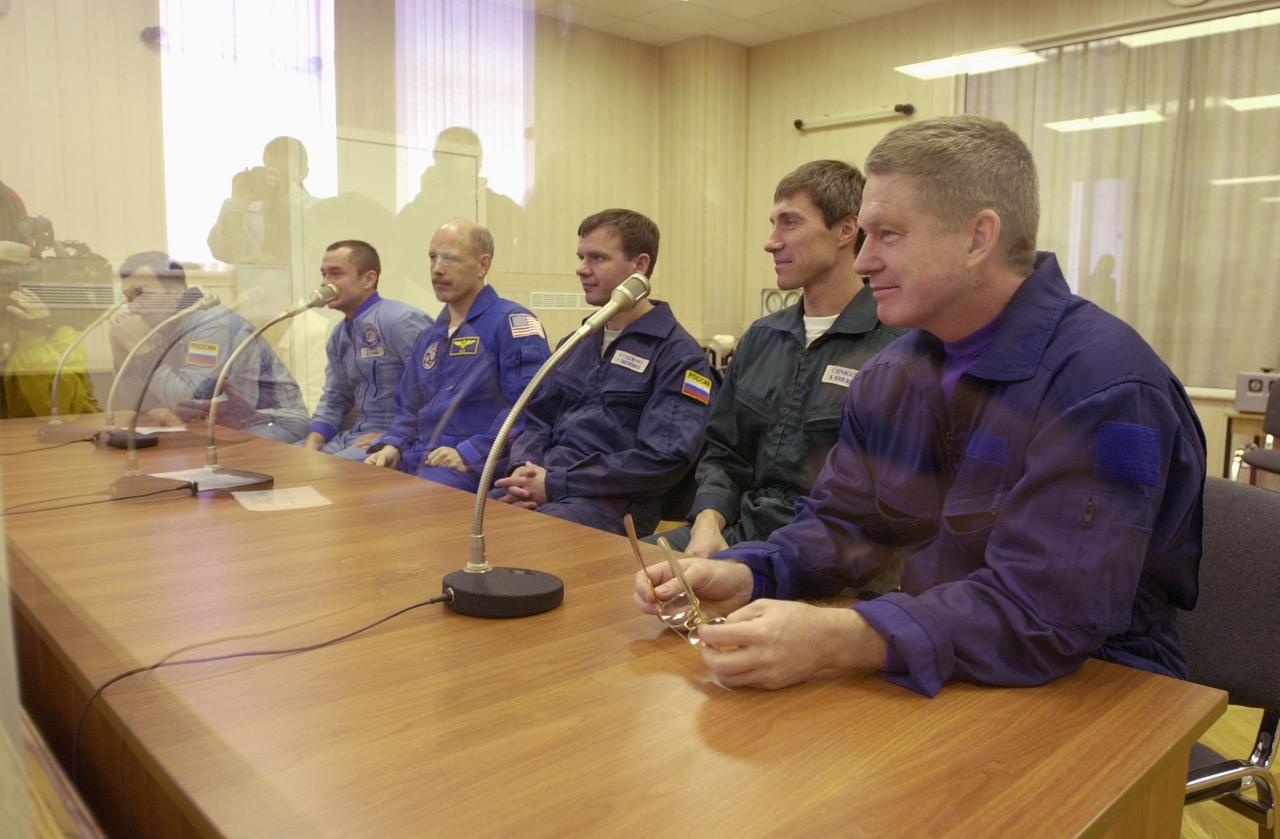
JSC2000-E-27079 (20 October 2000) ---  From left, Vladimir N. Dezhurov, Mikhail Turin, Kenneth D. Bowersox, Yuri P. Gidzenko, Sergei K. Krikalev and William M. (Bill) Shepherd, the backup and prime crew members for Expedition One, during  conference prior to simulation at Baikonur complex in Kazakhstan.
Various views of Expedition One crewmembers in Russia
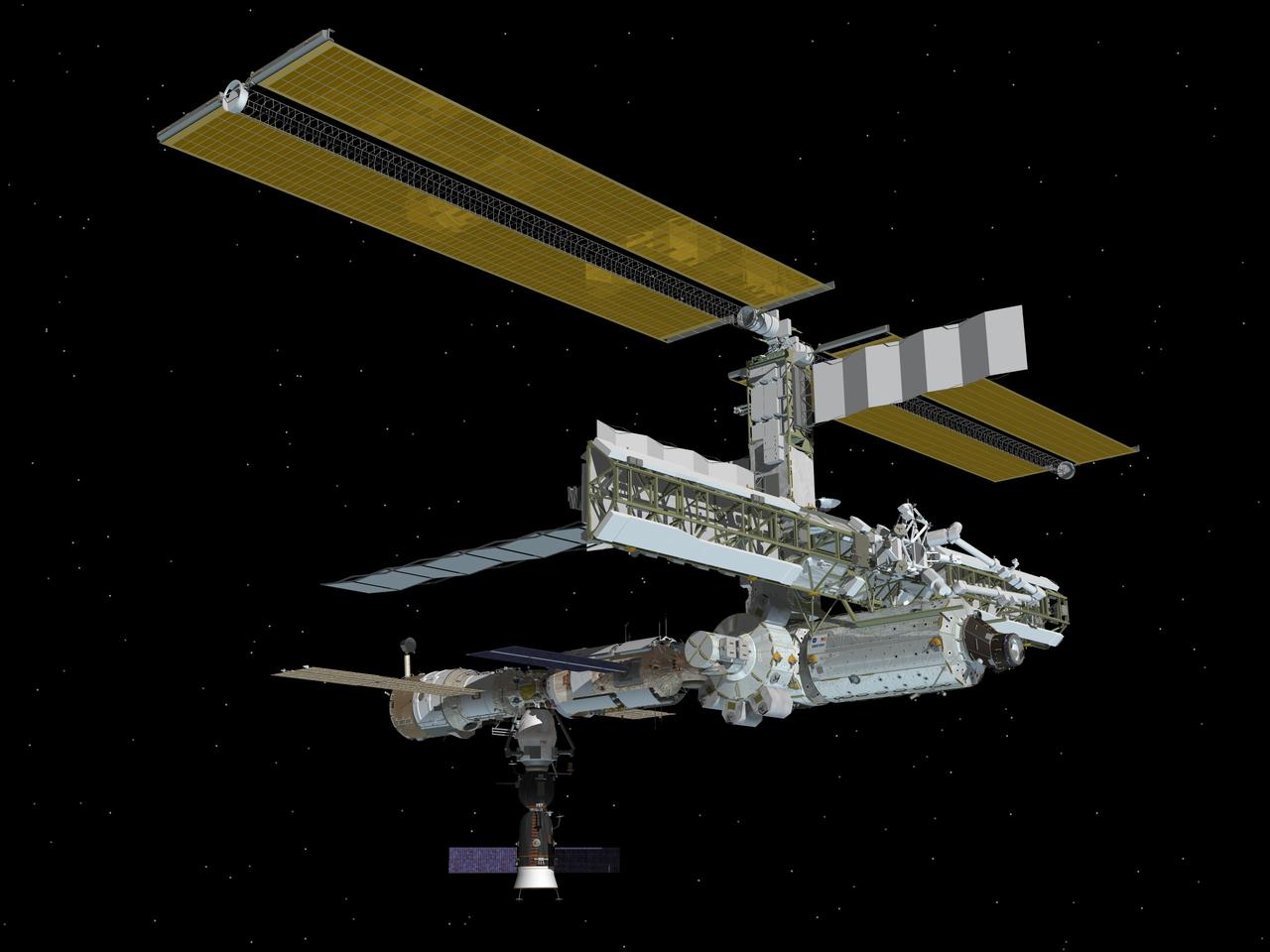
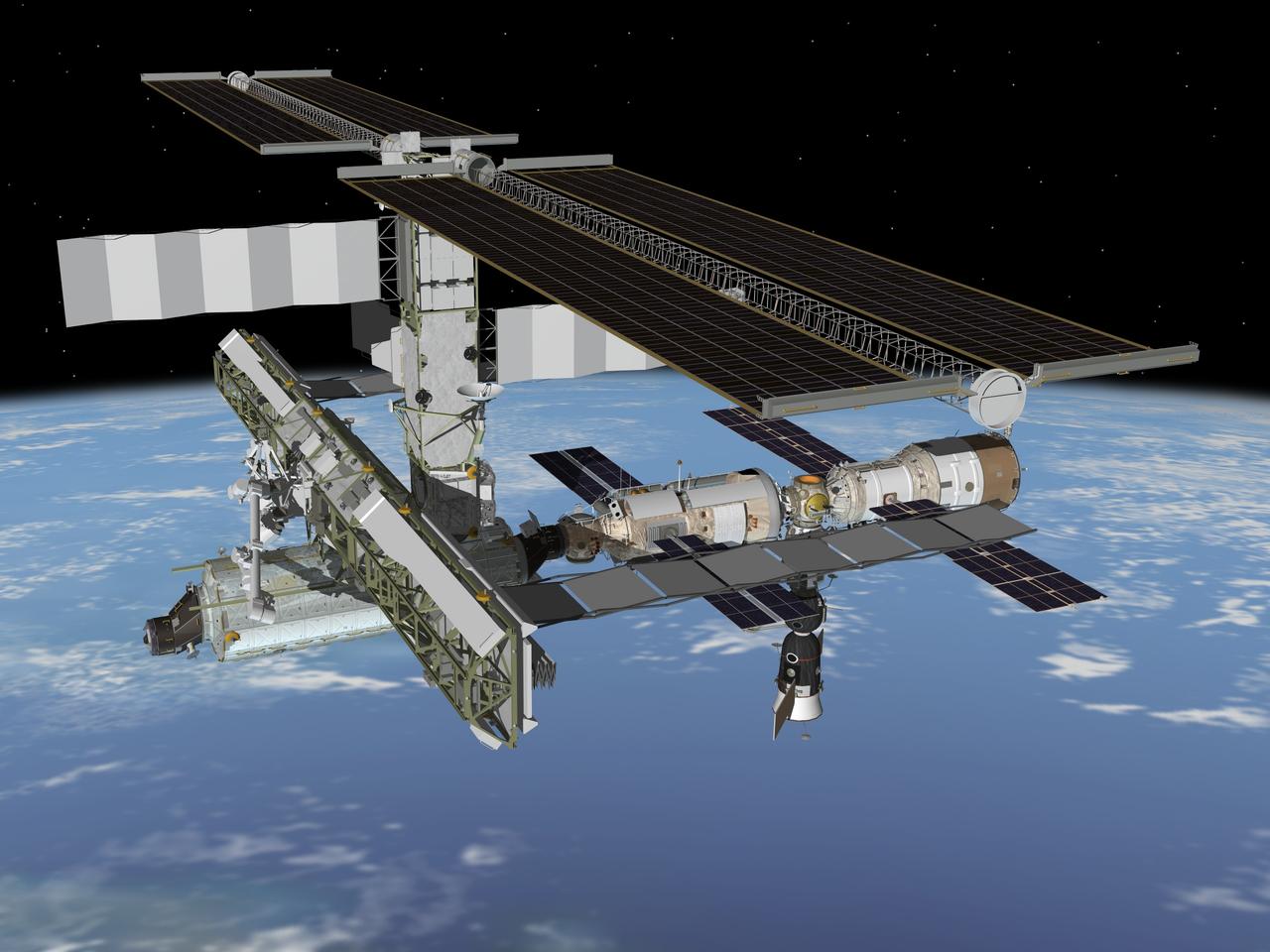
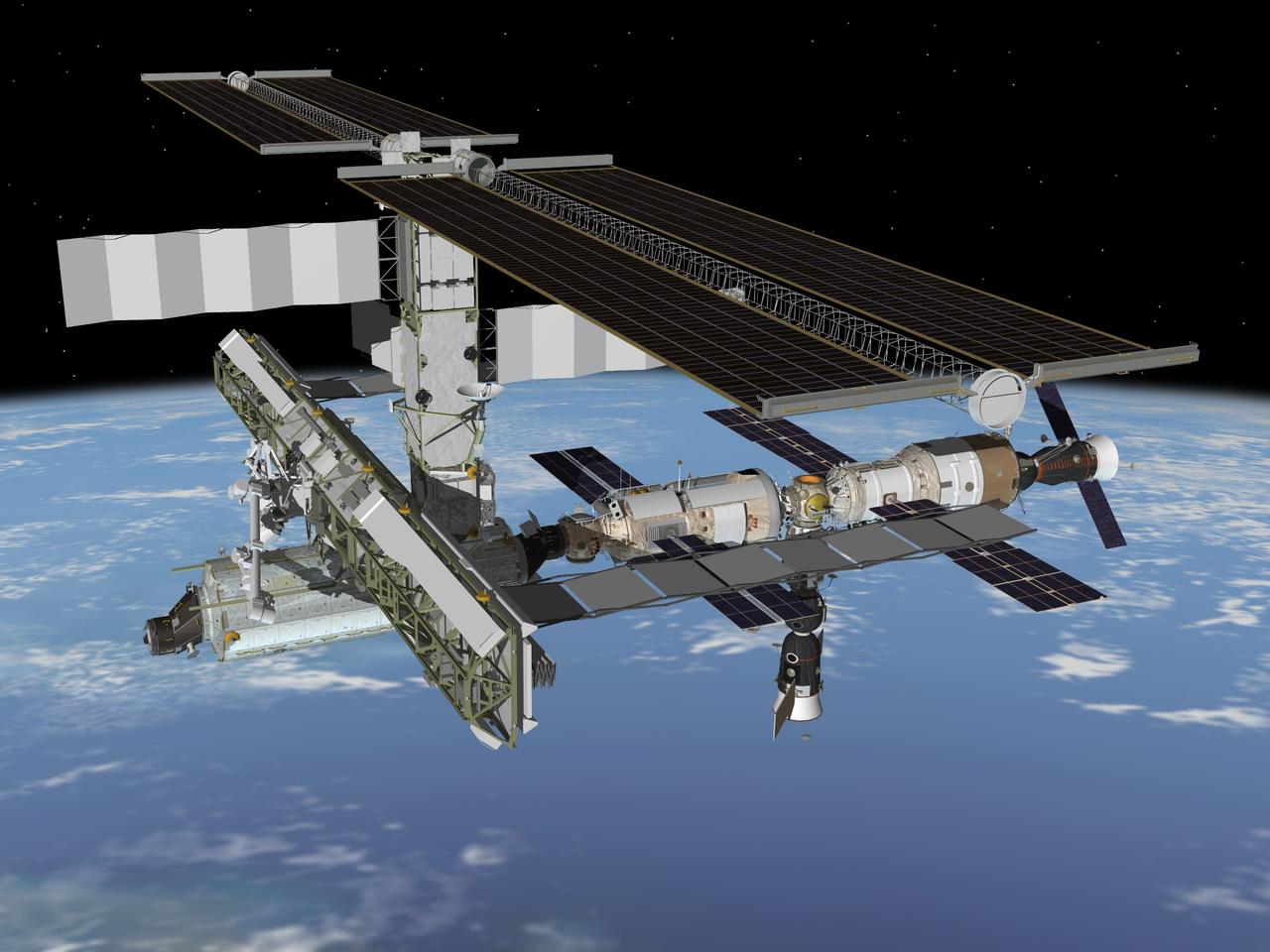
JSC2005-E-21684 (June 2005) --- Computer-generated artist's rendering of the International Space Station following scheduled activities of June 19, 2005. This angle shows the starboard side of the orbiting complex.  Progress 18 resupply vehicle docks to the aft end of the Zvezda Service Module. Soyuz 10 remains docked to Pirs.
Current Configurations of ISS for use on HSF web
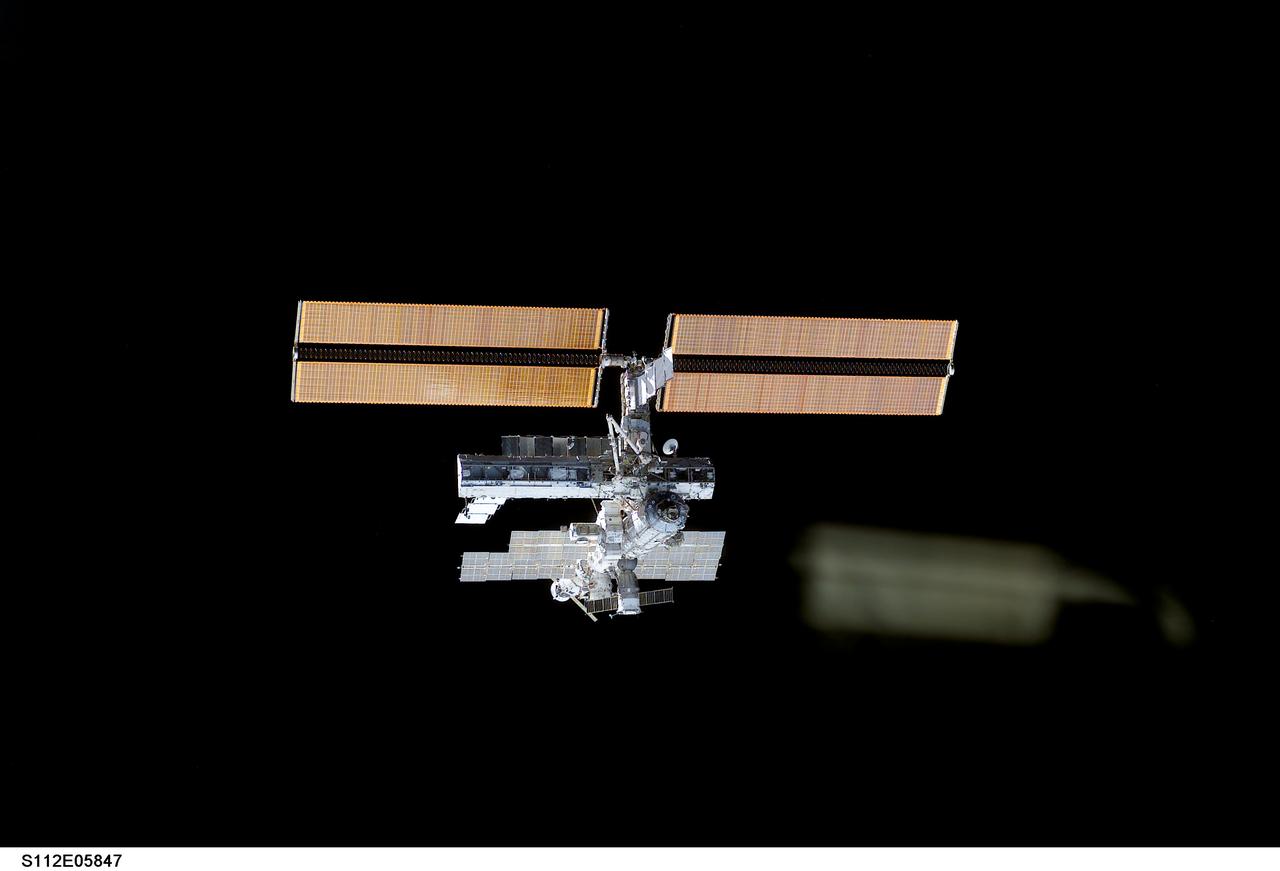
STS112-E-05847 (16 October 2002) --- Backdropped by the blackness of space, the International Space Station (ISS) was photographed by a crewmember on board the Space Shuttle Atlantis following the undocking of the two spacecraft. Atlantis pulled away from the complex at 8:13 a.m. (CDT) on October 16, 2002.
Flyaround view of ISS aft and port sides
Apollo 17 Mission commander, Eugene A. Cernan, in center is flanked by Command Module Pilot Ronald E. Evans and lunar Module Pilot Harrison H. Schmitt as they participate in emergency egress test on the mobile launcher at Complex 39A. They will be launched to the Moon December 6, 1972 on NASA's last manned lunar landing scheduled for this decade.
KSC-72P-0533
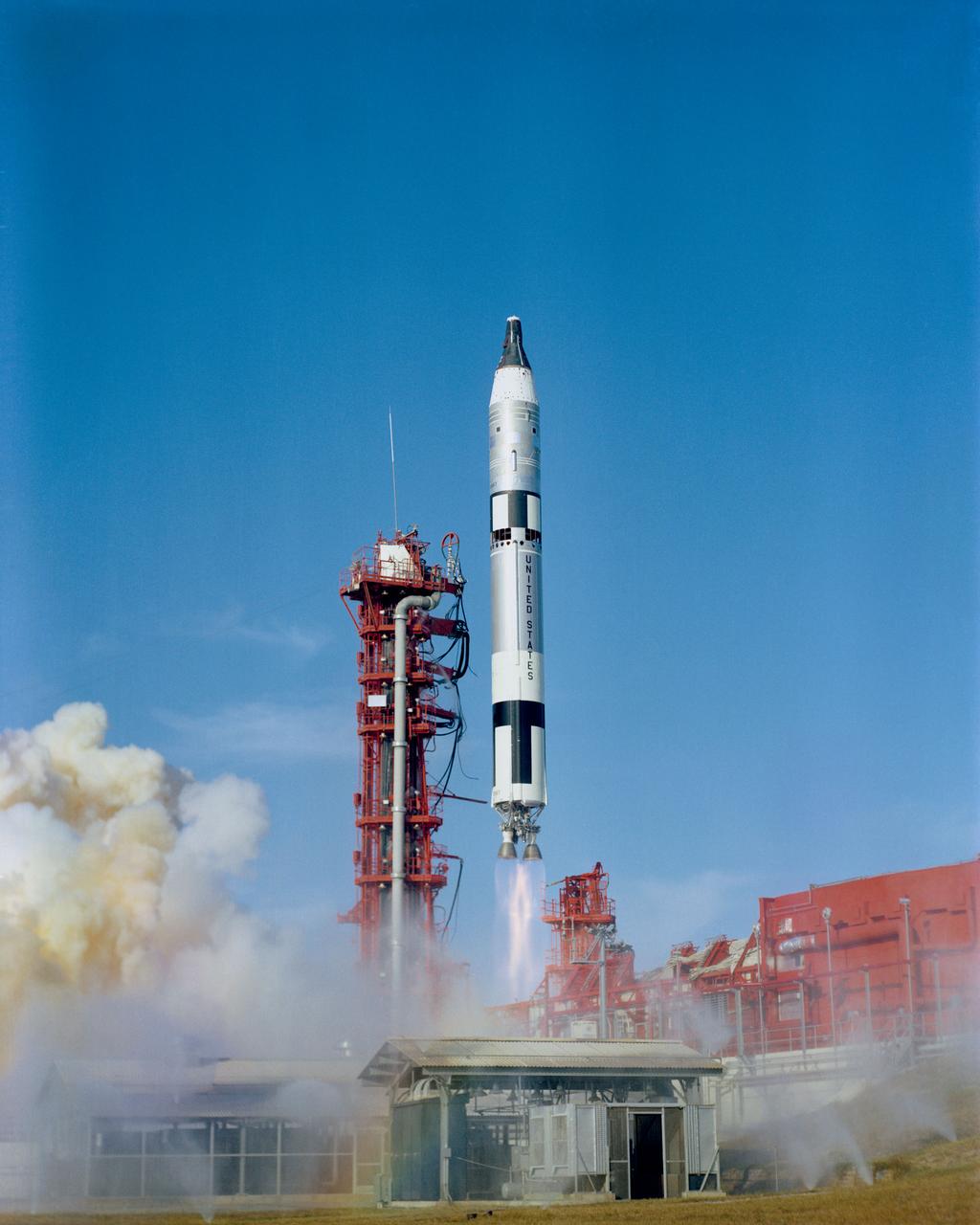
S66-59975 (11 Nov. 1966) --- Gemini-12 spacecraft, carrying astronauts James A. Lovell Jr., command pilot, and Edwin E. Aldrin Jr., pilot, was launched from the Kennedy Space Center's Launch Complex 19 at 3:46 p.m. (EST), Nov. 11, 1966. Photo credit: NASA
GEMINI-TITAN (GT)-12 - LIFTOFF - OFFICIAL - CAPE
JSC2005-E-21681 (June 2005) --- Computer-generated artist's rendering of the International Space Station following scheduled activities of June 15, 2005. This angle shows the port side of the orbiting complex.  Progress 17 resupply vehicle undocks from the aft end of the Zvezda Service Module. Soyuz 10 remains docked to Pirs.
Current Configurations of ISS for use on HSF web
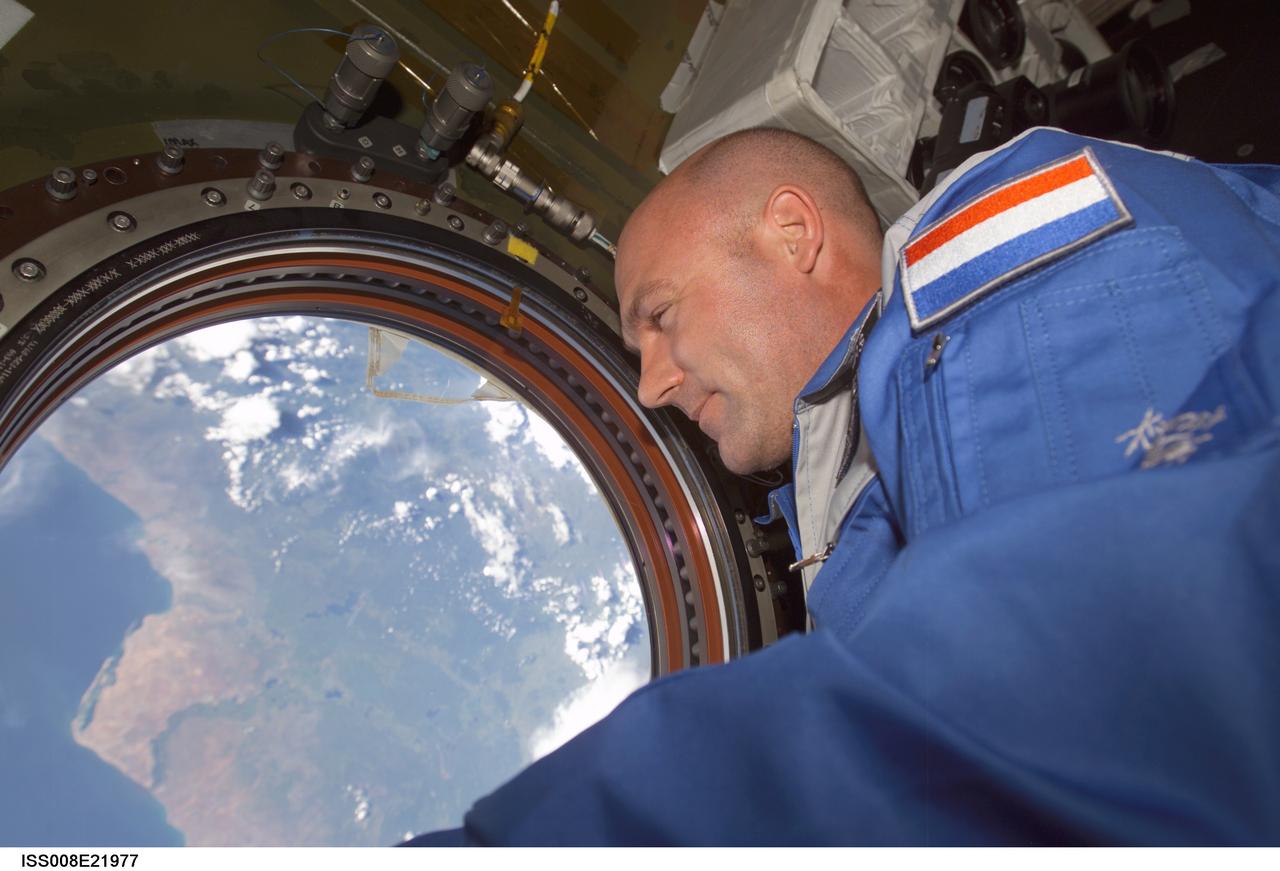
ISS008-E-21977 (21 April 2004) --- European Space Agency (ESA) astronaut Andre Kuipers of the Netherlands looks through the Earth observation window in the Destiny laboratory on the International Space Station soon after arriving in a Soyuz spacecraft for several days' stay onboard the Earth-orbiting complex.
Kuipers poses beside the photo quality window in the U.S. Lab during EXP 9 / EXP 8
ISS027-E-035354(20 May 2011) --- NASA astronaut Michael Fincke, STS-134 mission specialist, appears to be on the verge of some sort of in-flight maintenance in the Kibo lab aboard the International Space Station (ISS). While the space shuttle Endeavour is docked with the ISS, Fincke is one of a dozen crew members on the joint complex.
Fincke conducts OGS Jumper Modification
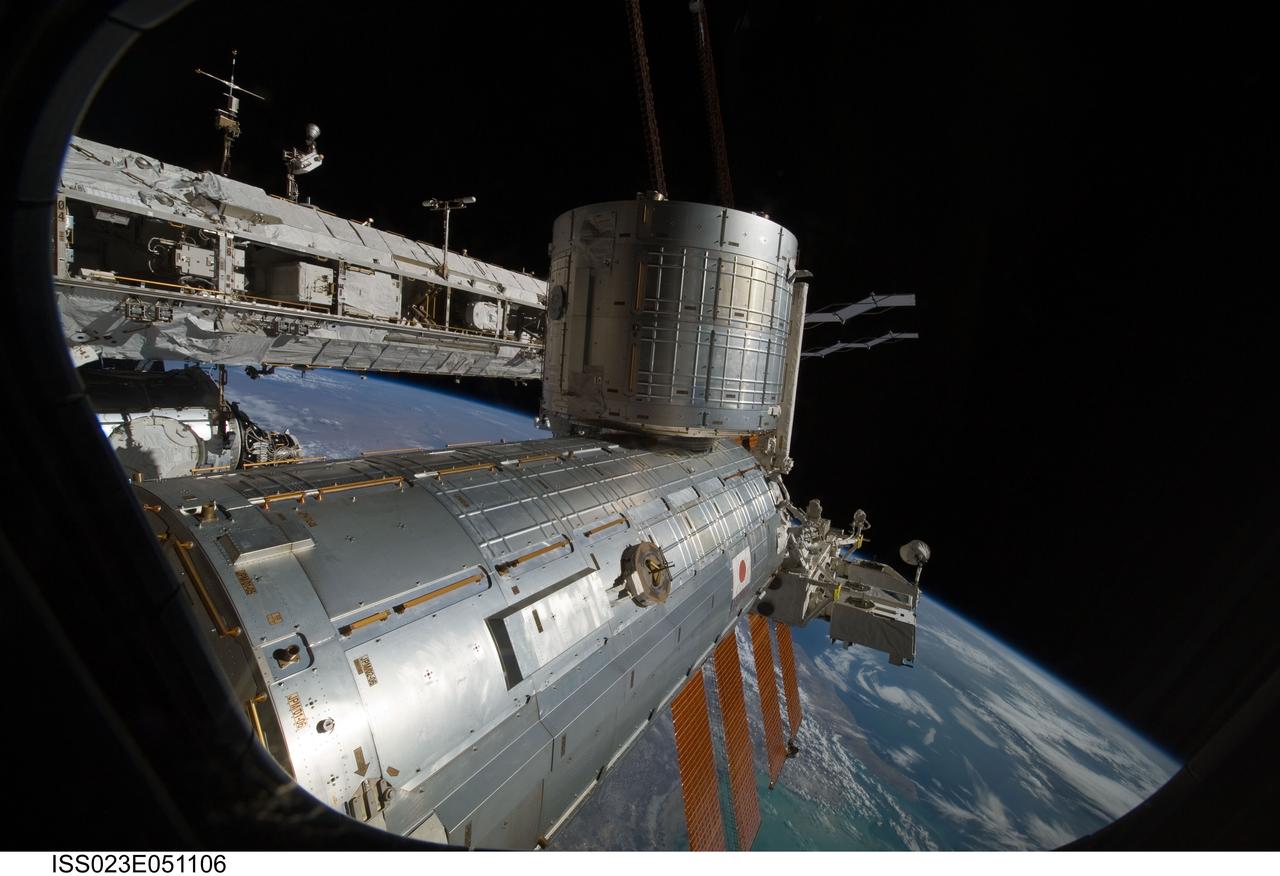
ISS023-E-051106 (23 May 2010) --- Backdropped by Earth's horizon and the blackness of space, the Japanese Kibo complex of the International Space Station is featured in this image photographed by an Expedition 23 crew member while space shuttle Atlantis (STS-132) remains docked with the station.
View of Kibo and Port Trusses
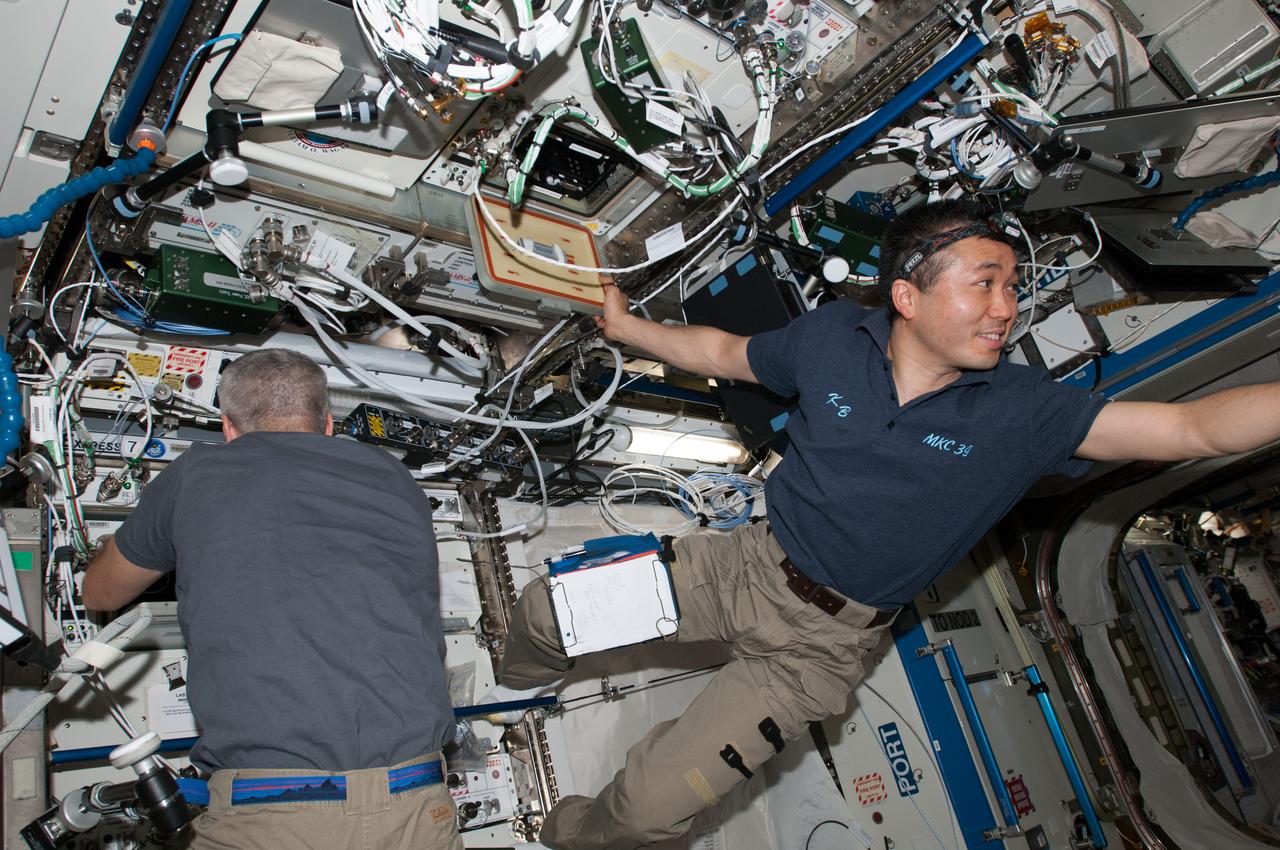
ISS039-E-014393 (21 April 2014) --- Expedition 39 Flight Engineer Steve Swanson, left, and Japan Aerospace Exploration Agency astronaut Koichi Wakata, Expedition 39 commander, participate in the transfer of supplies from the SpaceX Dragon spacecraft, which recently arrived at the orbital complex.
Wakata conducts CPCG-HM Unit Installation and Activatation
S114-E-7285 (6 August 2005) --- Backdropped by the blackness of space, this full view of the international space station was photographed by an STS-114 crewmember onboard the Space Shuttle Discovery following the undocking of the two spacecraft. Discovery pulled away from the complex at 2:24 a.m. (CDT) on Aug. 6, 2005.
Survey of the ISS during flyaround
JSC2005-E-21682 (June 2005) --- Computer-generated artist's rendering  of the International Space Station following scheduled activities of  June 15, 2005. This angle shows the starboard side of the orbiting complex.  Progress 17 resupply vehicle undocks from the aft end of the Zvezda Service Module. Soyuz 10 remains docked to Pirs.
Current Configurations of ISS for use on HSF web
ISS036-E-030715 (9 Aug. 2013) --- The Canadarm2 moves toward the unpiloted Japanese "Kounotori" H2 Transfer Vehicle-4 (HTV-4) as it approaches the International Space Station. The HTV-4 is delivering 3.6 tons of science experiments, equipment and supplies to the orbiting complex. A cloud-covered part of Earth provides the backdrop for the scene.
H-II Transfer Vehicle (HTV)-4
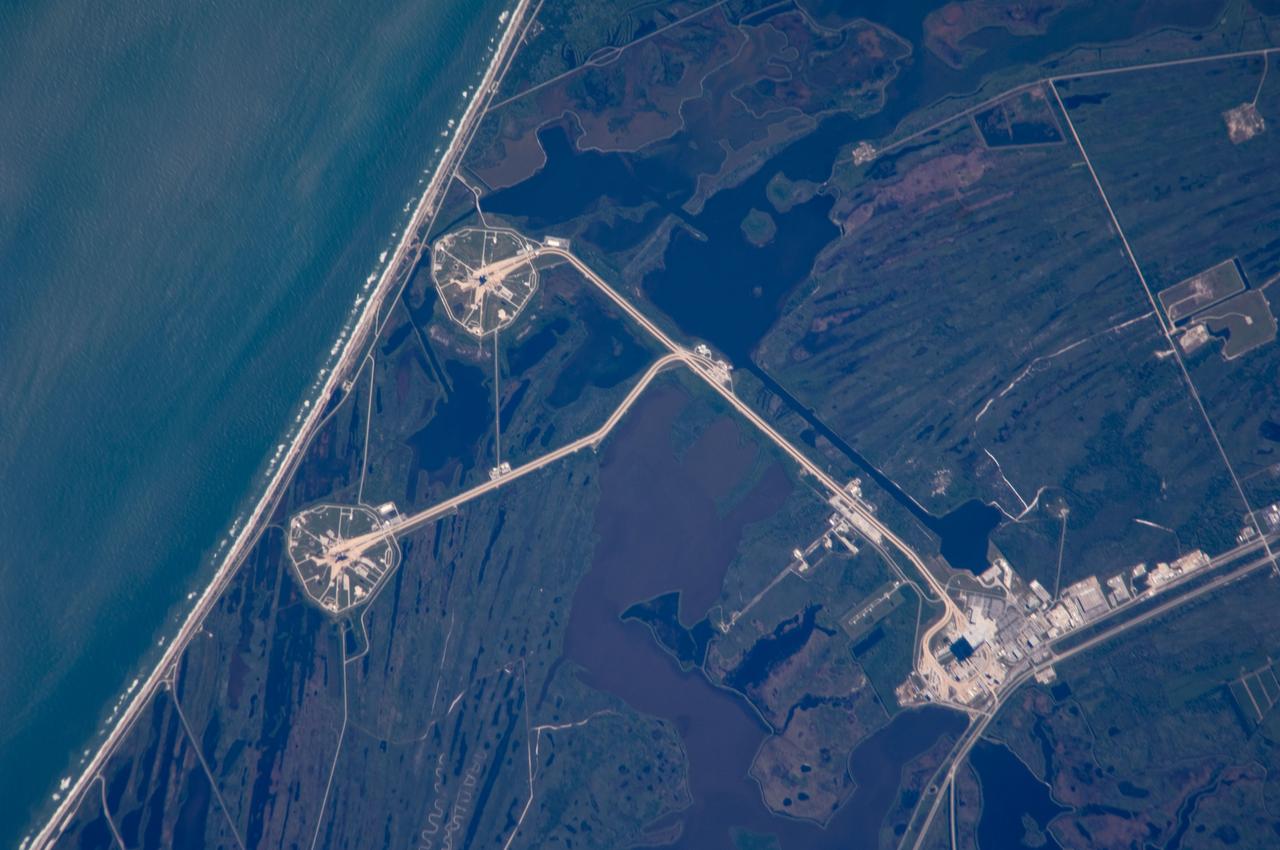
ISS018-E-006077 (29 Oct. 2008) --- Kennedy Space Center and Cape Canaveral, Florida are featured in this image photographed by an Expedition 18 crewmember on the International Space Station. Launch complex 39, with pads A and B, is visible at center left. The Vehicle Assembly Building (VAB) is visible at lower right.
Earth Observations taken by the Expedition 18 Crew
JSC2000-E-27080 (20 October 2000) ---  In background, from left, Vladimir N. Dezhurov, Mikhail Turin, Kenneth D. Bowersox, Yuri P. Gidzenko, Sergei K. Krikalev and William M. (Bill) Shepherd, the backup and prime crew members for Expedition One, during conference prior to simulation at Baikonur complex in Kazakhstan.
Various views of Expedition One crewmembers in Russia
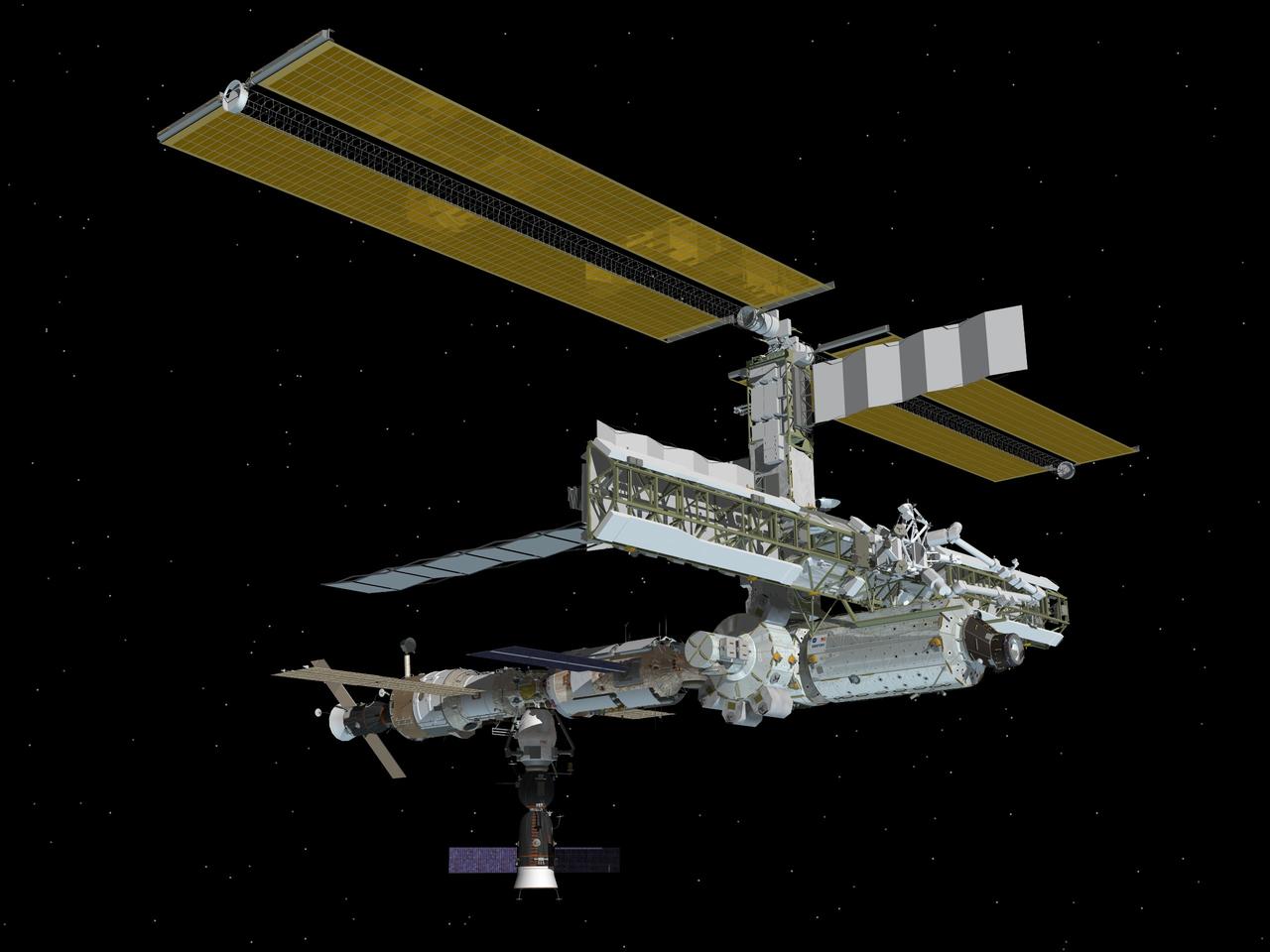
JSC2005-E-21683 (June 2005) --- Computer-generated artist's rendering of the International Space Station following scheduled activities of June 19, 2005. This angle shows the port side of the orbiting complex.  Progress 18 resupply vehicle docks to the aft end of the Zvezda Service Module. Soyuz 10 remains docked to Pirs.
Current Configurations of ISS for use on HSF web
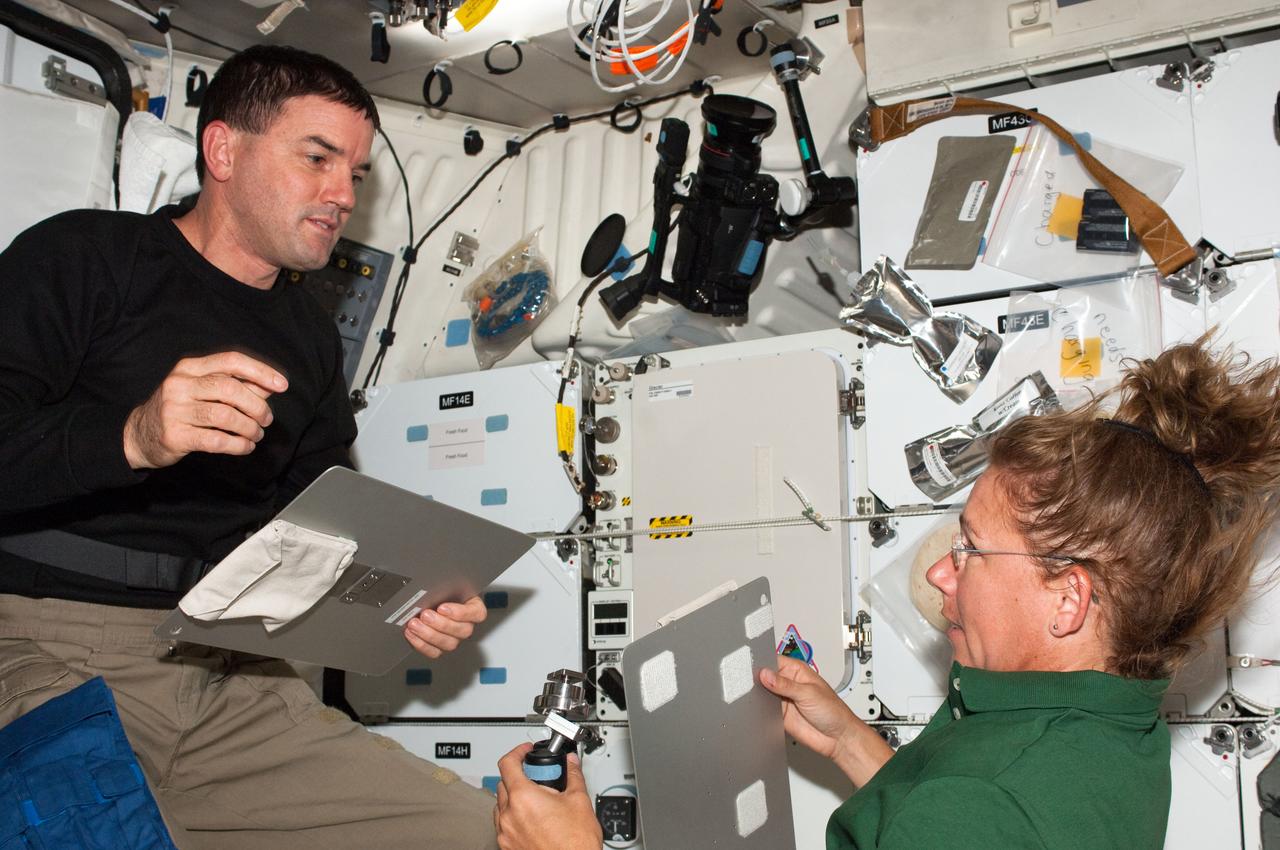
S135-E-007696 (13 July 2011) --- On Atlantis' middeck, NASA astronauts Rex Walheim and Sandy Magnus, STS-135 mission specialists, discuss the large tasks of moving supplies on the joint shuttle/International Space Station complex during the sixth day in space for the four shuttle crewmembers.  Photo credit:  NASA
Walheim and Magnus on Atlantis Middeck
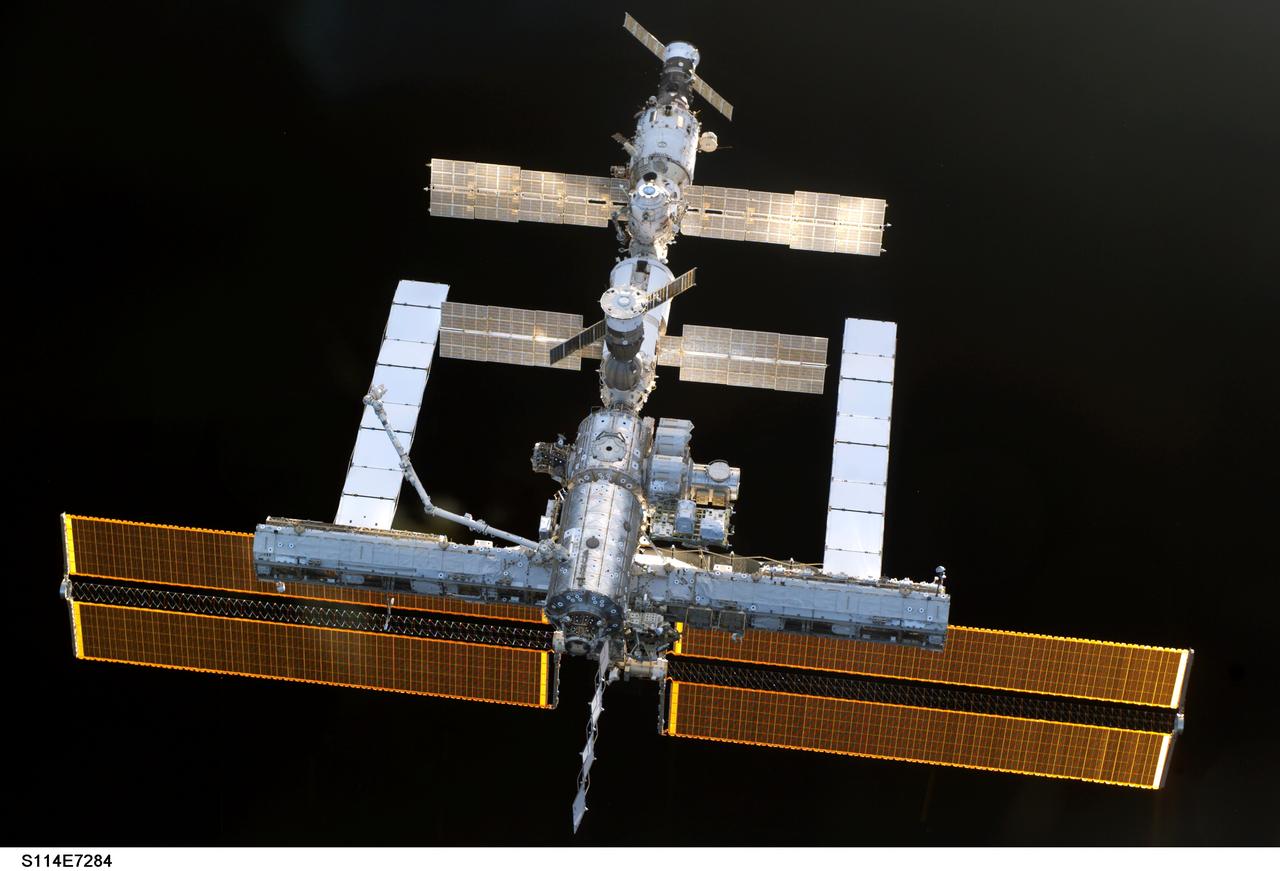
S114-E-7284 (6 August 2005) --- Backdropped by the blackness of space, this full view of the International Space Station was photographed by a crewmember onboard the Space Shuttle Discovery following the undocking of the two spacecraft. Discovery pulled away from the complex at 2:24 a.m. (CDT) on August 6, 2005.
Survey of the ISS during flyaround
The Apollo 17 prime crew leaves the Manned Spaceflight Operations Building to enter the transfer van which will carry them to Complex 39's Pad A to participate in the CDDT. From right are Eugene A. Cernan, Commander Ronald E. Evans, Command Module Pilot, and Harrison H. Schmitt, Lunar Module Pilot.
KSC-72P-0512
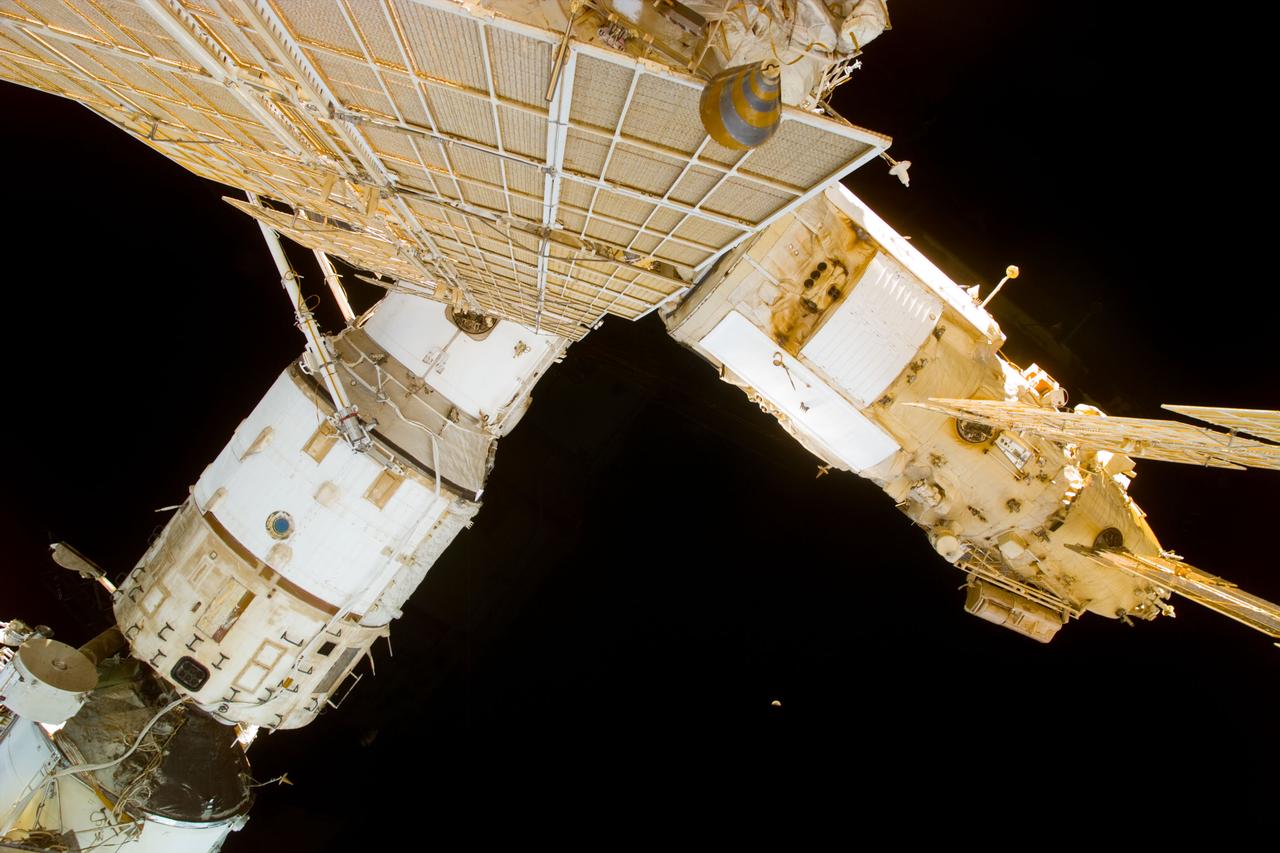
STS081-E-05501 (16 Jan. 1997) --- A view of several elements of the Russia's Mir Space Station complex as seen from the Space Shuttle Atlantis, to which it is docked for several days. The scene was recorded with an Electronic Still Camera (ESC) by one of the STS-81 crewmembers.
Mir Base Block and Spektr modules
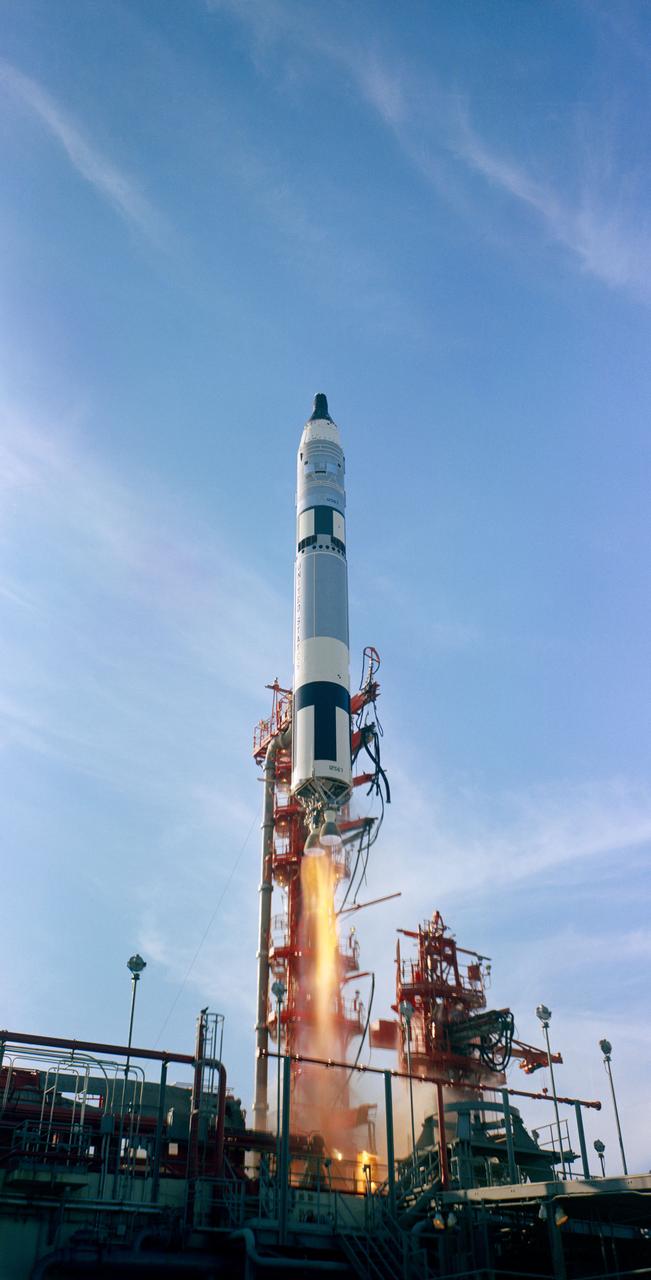
S66-59970 (11 Nov. 1966) --- Gemini-12 spacecraft, carrying astronauts James A. Lovell Jr., command pilot, and Edwin E. Aldrin Jr., pilot, was launched from the Kennedy Space Center's Launch Complex 19 at 3:46 p.m. (EST), Nov. 11, 1966. Photo credit: NASA
GEMINI-TITAN (GT)-12 - LIFTOFF - CAPE
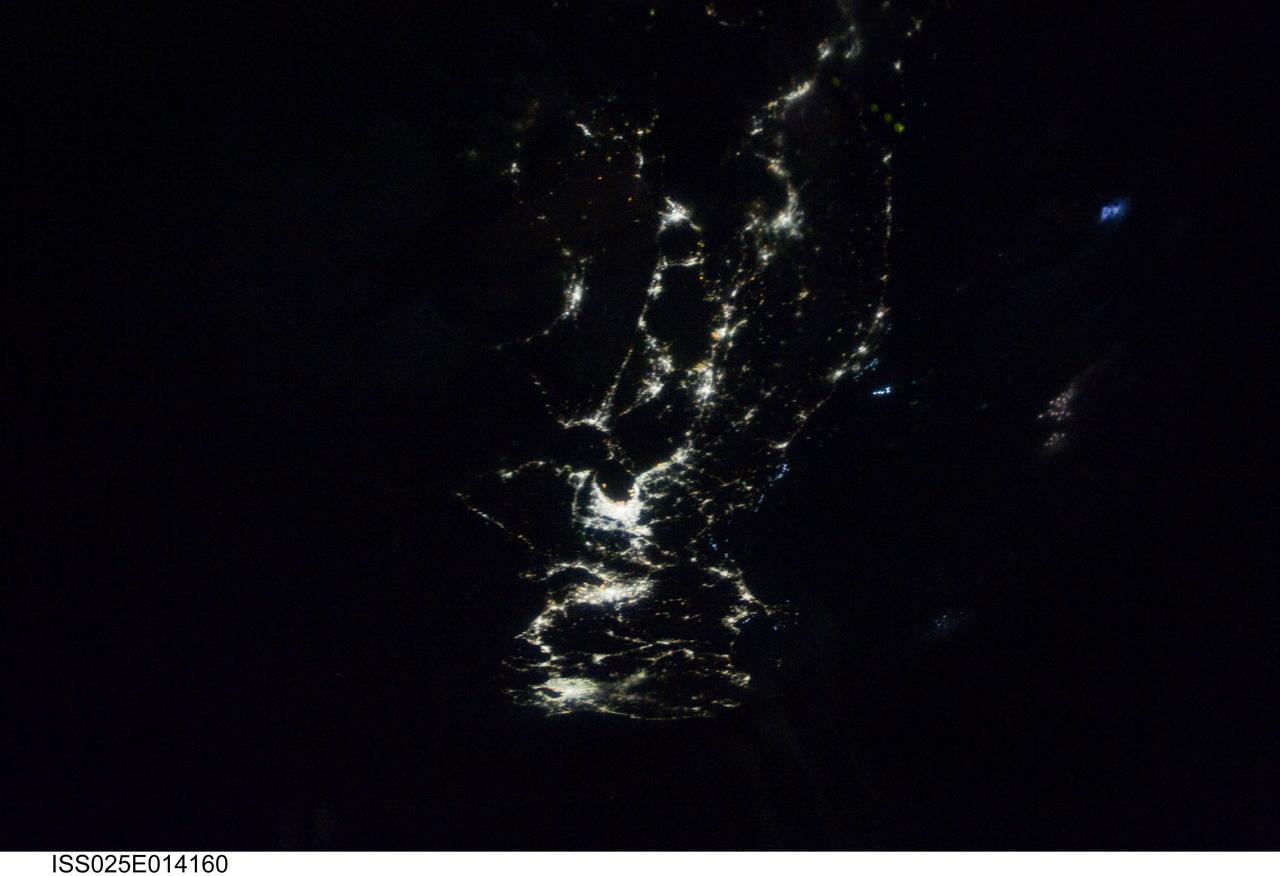
ISS025-E-014160 (11 Nov. 2010) --- From 220 miles above Earth, one of the Expedition 25 crew members exposed this night time image of part of Japan on Nov. 11, 2010, as three members of the six person crew began their final fortnight aboard the orbiting complex.
Night time city lights taken by the Expedition 25 crew
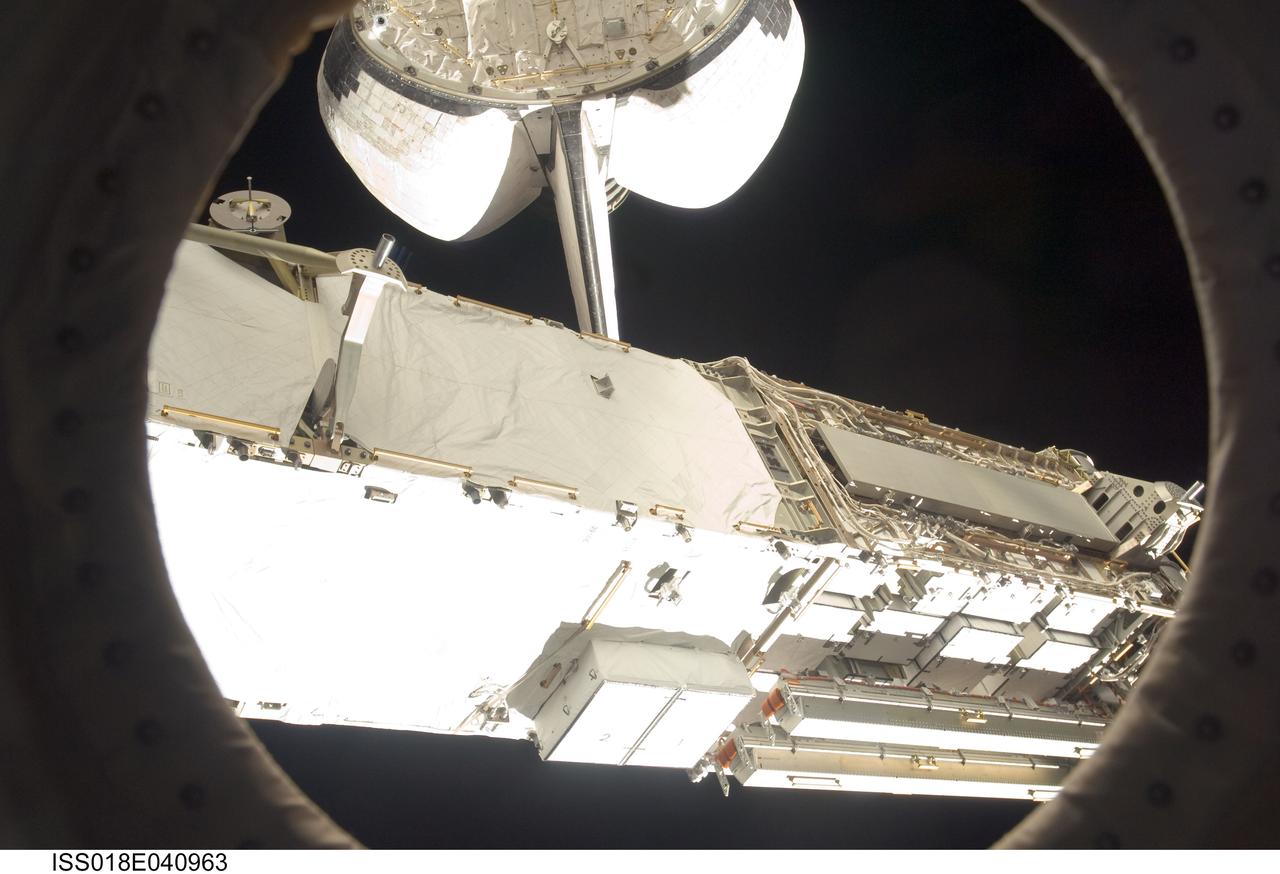
ISS018-E-040963 (18 March 2009) --- This scene of the Space Shuttle Discovery parked at the International Space Station and the presence of the S6 truss are a sign that the home improvement project is being renewed aboard the orbital outpost. The photo was taken by one of the station crewmembers inside the complex.
AFT Shuttle and S6 Truss Segment
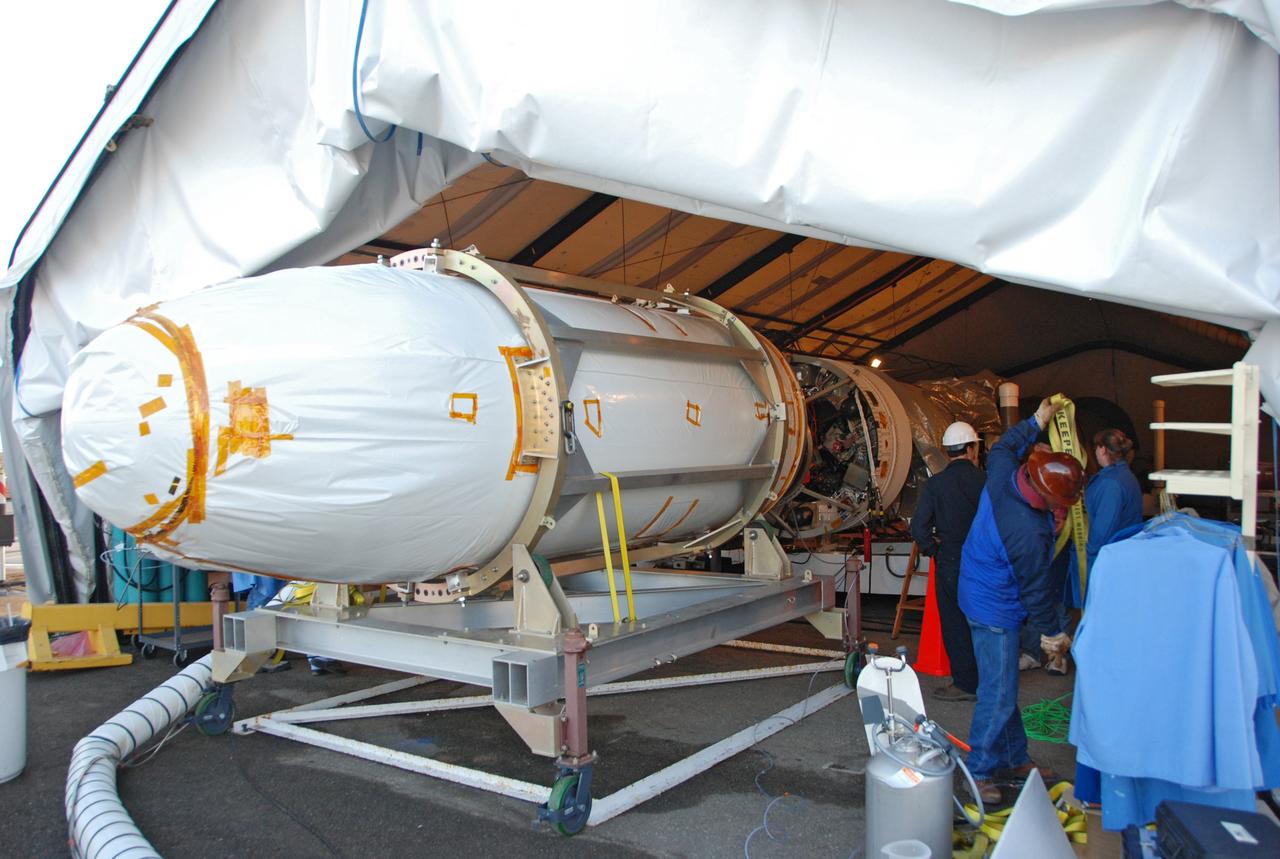
VANDENBERG AIR FORCE BASE, Calif. -- On Space Launch Complex 576-E at Vandenberg Air Force Base in California, the encapsulated cargo element containing NASA’s Orbiting Carbon Observatory, or OCO, enters the tent for integration with Orbital Sciences’ Taurus XL launch vehicle, at right.   The OCO is an Earth-orbiting mission sponsored by NASA's Earth System Science Pathfinder Program. The observatory will collect precise global measurements of carbon dioxide in the Earth's atmosphere. Scientists will analyze the data returned to better understand the natural processes and human activities that regulate the abundance and distribution of this important greenhouse gas.  Launch is targeted for Feb. 24 from Space Launch Complex 576-E at Vandenberg.  Photo credit: VAFB/Wayne North
KSC-2009-1625
VANDENBERG AIR FORCE BASE, Calif. -- On Space Launch Complex 576-E at Vandenberg Air Force Base in California, scaffolding is built around Stage 0 of the Taurus XL launch vehicle for NASA’s Orbiting Carbon Observatory, or OCO, stacked on the launch mount. An umbilical tower is being erected on the pad using the portable crane.  Stage 0 utilizes a Castor 120 Motor.   The OCO is an Earth-orbiting mission sponsored by NASA's Earth System Science Pathfinder Program. The observatory will collect precise global measurements of carbon dioxide in the Earth's atmosphere. Scientists will analyze the data returned to better understand the natural processes and human activities that regulate the abundance and distribution of this important greenhouse gas.  Launch is targeted for Feb. 24 from Space Launch Complex 576-E at Vandenberg.  Photo credit: VAFB/Wayne North
KSC-2009-1626
VANDENBERG AIR FORCE BASE, Calif. -- On Space Launch Complex 576-E at Vandenberg Air Force Base in California, an Orbital Sciences technician connects ground wires to the Stage 3 motor of the Taurus XL launch vehicle for NASA’s Orbiting Carbon Observatory, or OCO. The encapsulated cargo element containing the observatory is integrated with the vehicle.   The OCO is an Earth-orbiting mission sponsored by NASA's Earth System Science Pathfinder Program. The observatory will collect precise global measurements of carbon dioxide in the Earth's atmosphere. Scientists will analyze the data returned to better understand the natural processes and human activities that regulate the abundance and distribution of this important greenhouse gas.  Launch is targeted for Feb. 24 from Space Launch Complex 576-E at Vandenberg.  Photo credit: VAFB/Wayne North
KSC-2009-1627
STS081-E-05504 (16 Jan. 1997) --- Astronaut John E. Blaha re-unites with the familiar surroundings of the Space Shuttle Atlantis' aft flight deck, which he has not seen since September 1996, when he went aboard the Russian Mir Space Station complex. After the January 15, 1997 docking of Mir and Atlantis, Blaha assumed the status of a STS-81 mission specialist. Here, he checks small items against a check list.  The photograph was recorded with an Electronic Still Camera (ESC) and later was downlinked to flight controllers in Houston, Texas.
STS-81 crewmembers on the orbiter's flight deck