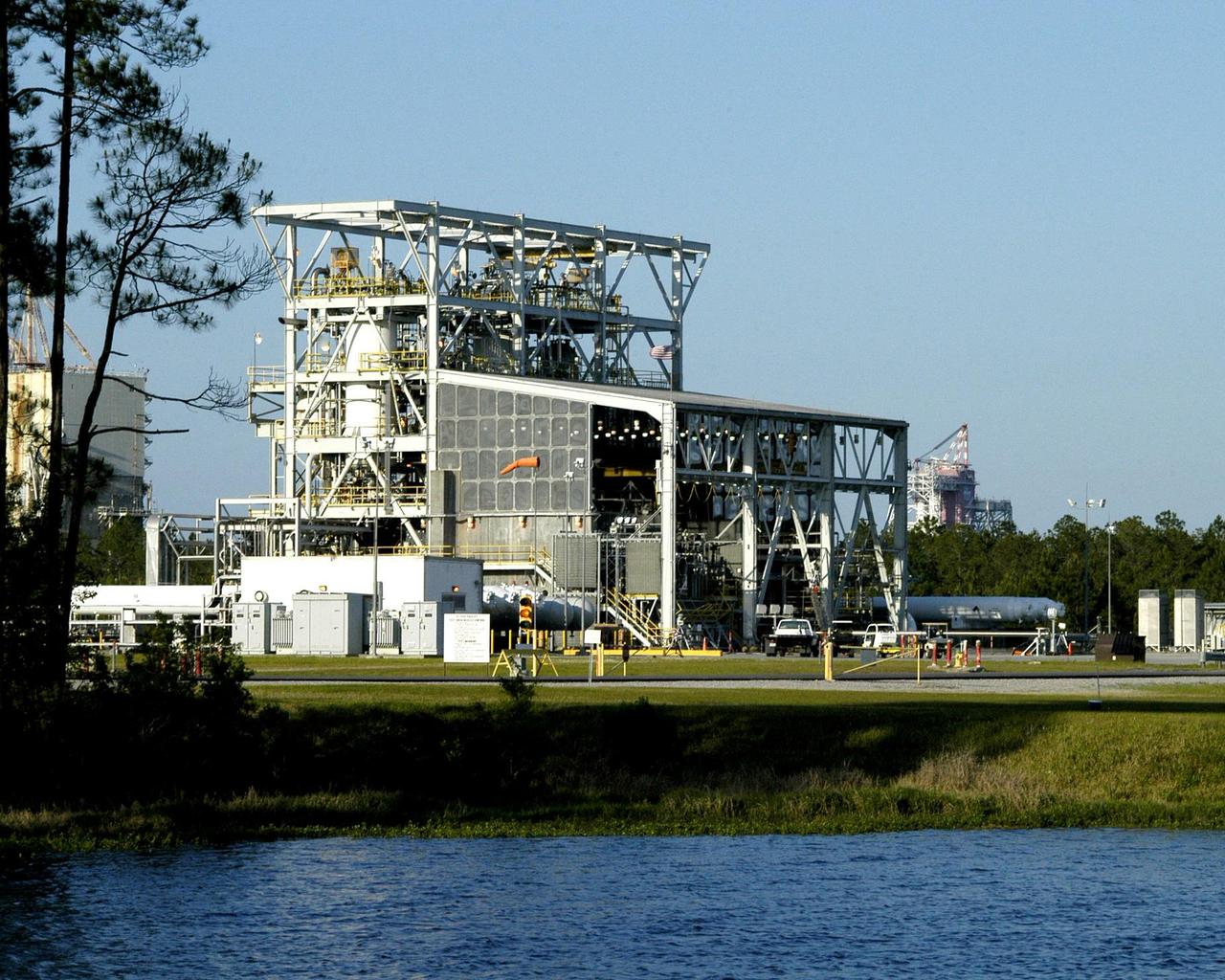
The E Test Complex is SSC's versatile, three-stand complex that includes seven separate test cells capable of testing that involves ultra high-pressure gases and cryogenic fluids.
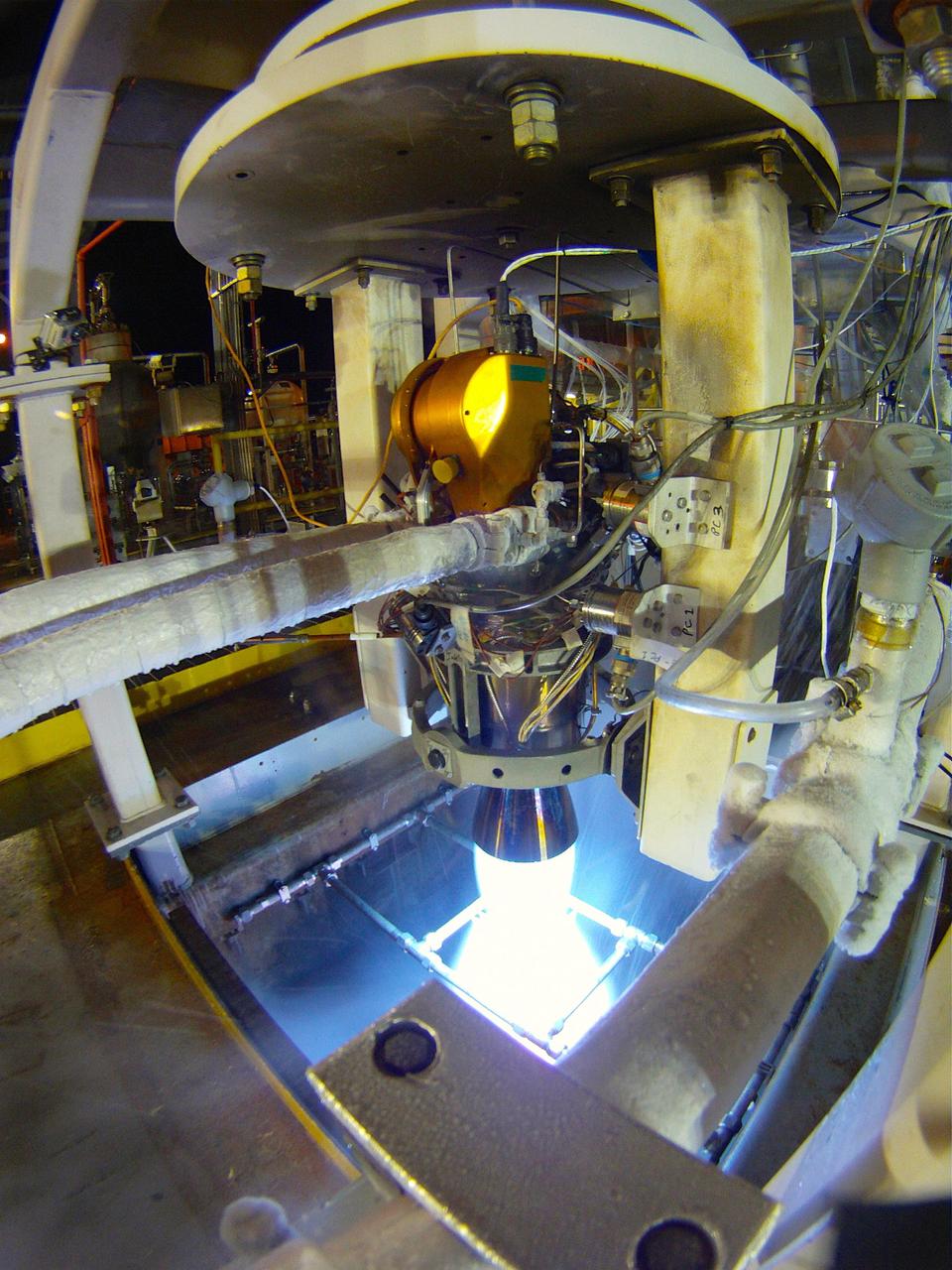
A test of NASA's liquid oxygen, liquid methane Project Morpheus engine is conducted Nov. 8 on the E-3 Test Stand at John C. Stennis Space Center. The test was one of 27 conducted in Stennis' E Test Complex the week of Nov. 5. Twenty-seven tests were conducted in a three-day period during the week, on three different rocket engines/components and on three E Complex test stands.
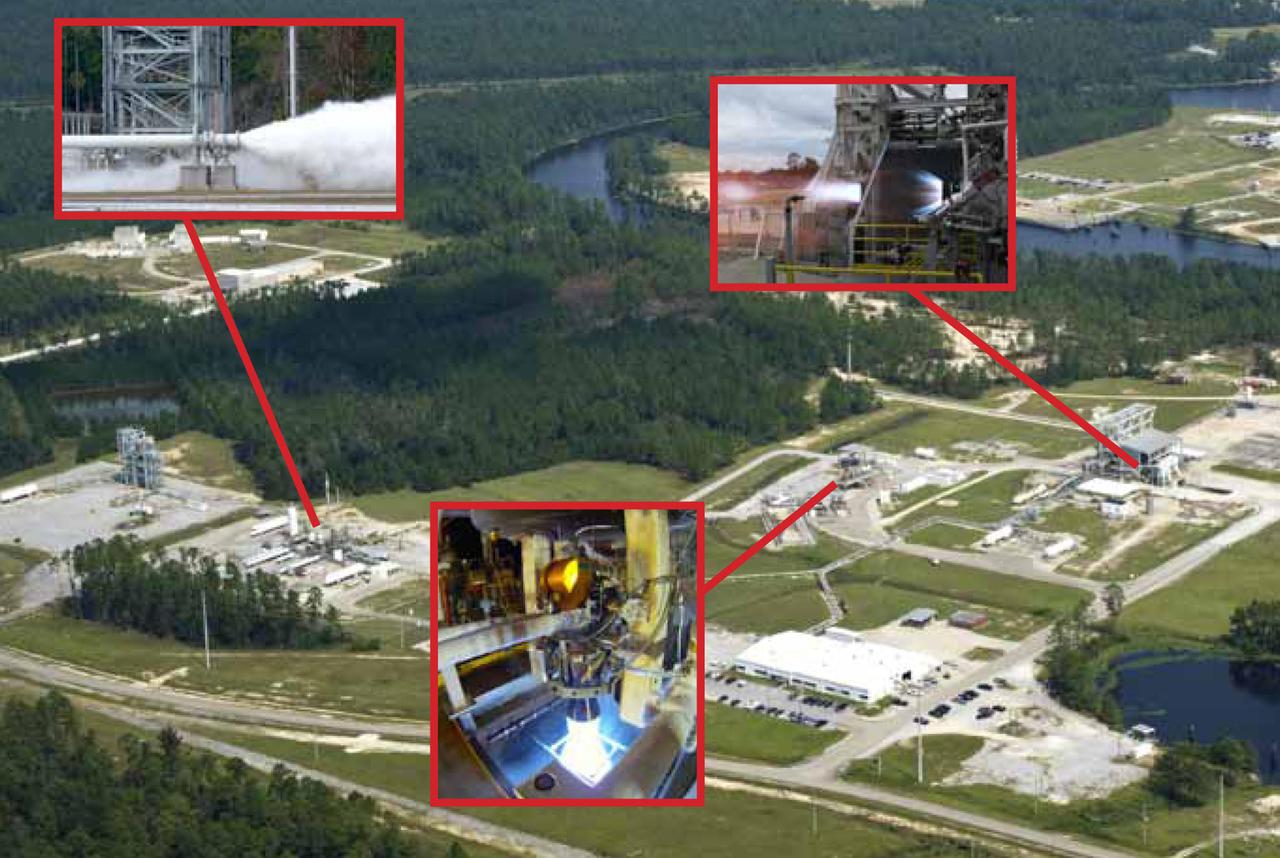
NASA recorded a historic week Nov. 5-9, conducting tests on all three stands in the E Test Complex at John C. Stennis Space Center. Inset images show the types of tests conducted on the E-1 Test Stand (right), the E-2 Test Stand (left) and the E-3 Test Stand (center). The E-1 photo is from an early October test and is provided courtesy of Blue Origin. Other photos are from tests conducted the week of Nov. 5.
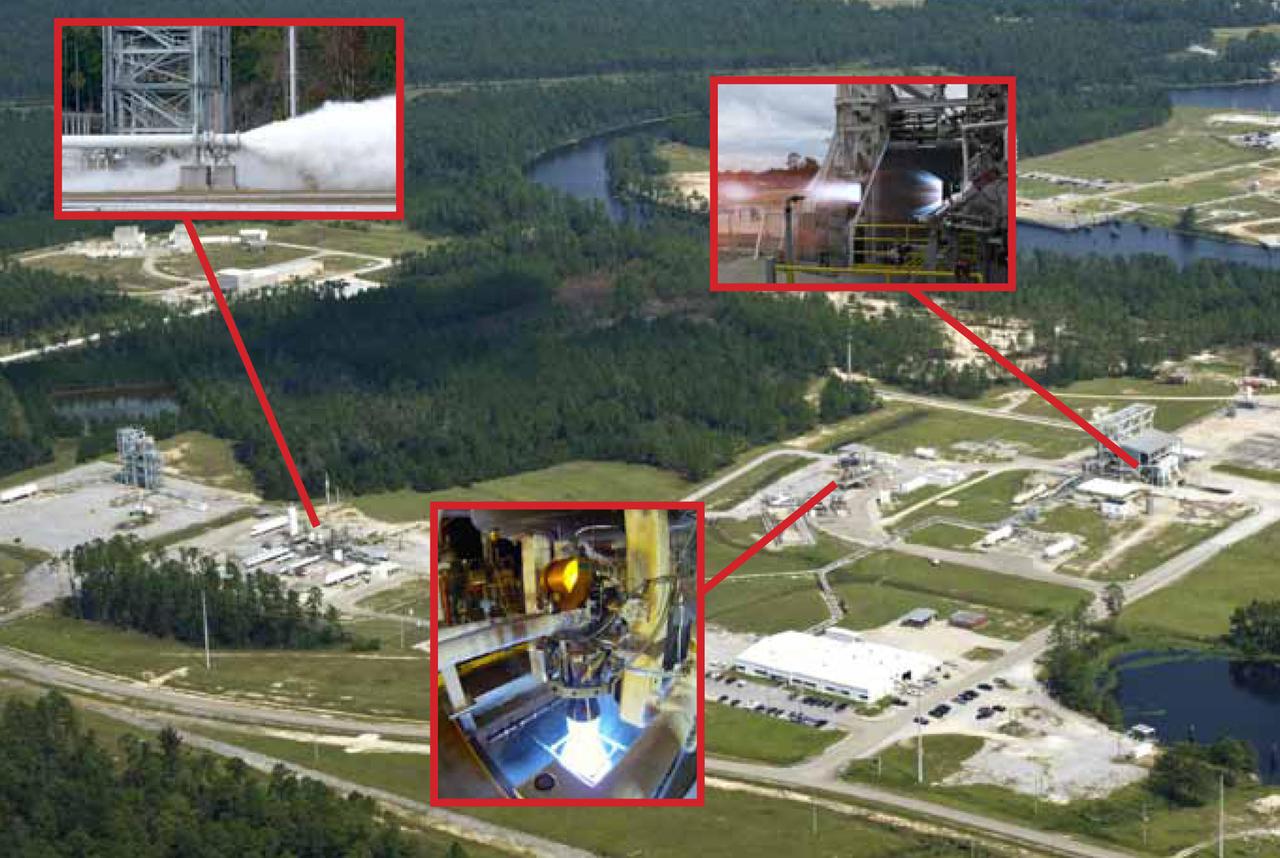
NASA recorded a historic week Nov. 5-9, conducting tests on all three stands in the E Test Complex at John C. Stennis Space Center. Inset images show the types of tests conducted on the E-1 Test Stand (right), the E-2 Test Stand (left) and the E-3 Test Stand (center). The E-1 photo is from an early October test and is provided courtesy of Blue Origin. Other photos are from tests conducted the week of Nov. 5.
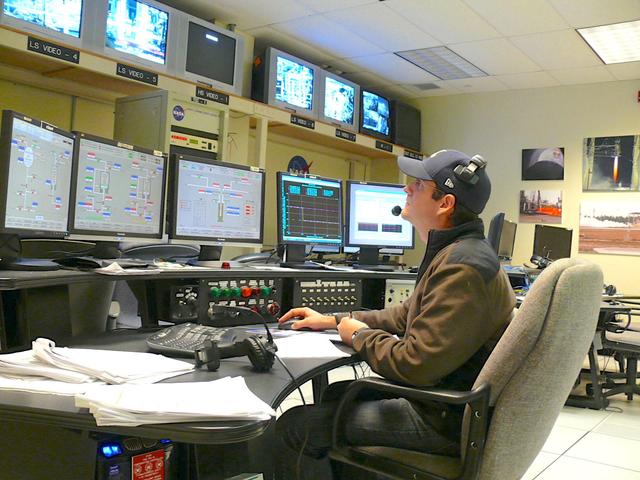
NASA engineer Andy Guymon studies data in the E-3 Test Stand Control Center at John C. Stennis Space Center during testing of NASA's Project Morpheus engine. Nov. 8. The test of the liquid oxygen, liquid methane engine was one of 27 conducted in Stennis' E Test Complex the week of Nov. 5.
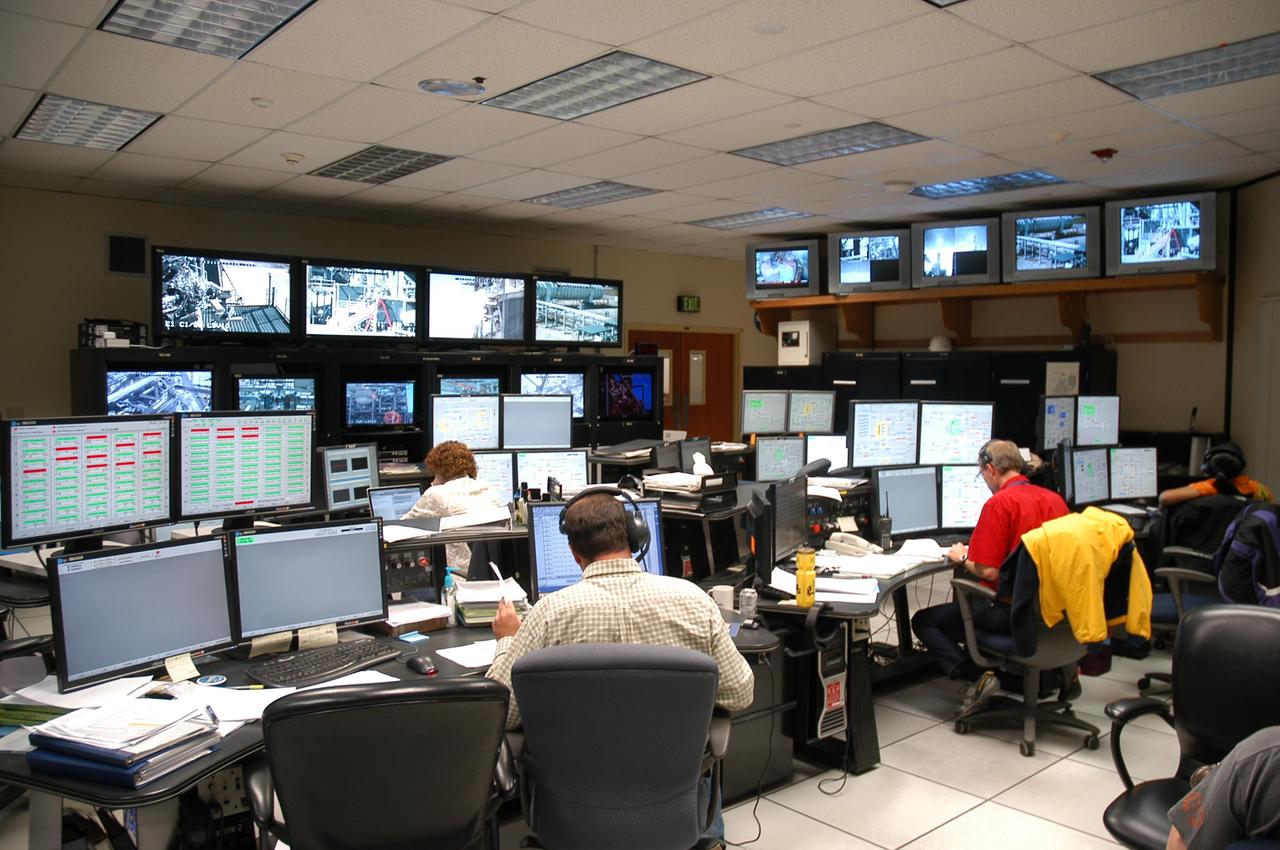
Jason Hopper of NASA (front row), Jody Ladner of Lockheed Martin (back row, left) and Chris Mulkey of NASA prepare to test the Blue Origin BE-3 engine thrust chamber in the E-1 Test Stand Control Center at John C. Stennis Space Center on Nov. 8. The test was one of 27 conducted in Stennis' E Test Complex the week of Nov. 5.

NASA engineers test a chemical steam generator (CSG) unit on the E-2 Test Stand at John C. Stennis Space Center on Nov. 6. The test was one of 27 conducted in Stennis' E Test Complex the week of Nov. 5. Twenty-seven CSG units will be used on the new A-3 Test Stand at Stennis to produce a vacuum that allows testing of engines at simulated altitudes up to 100,000 feet.
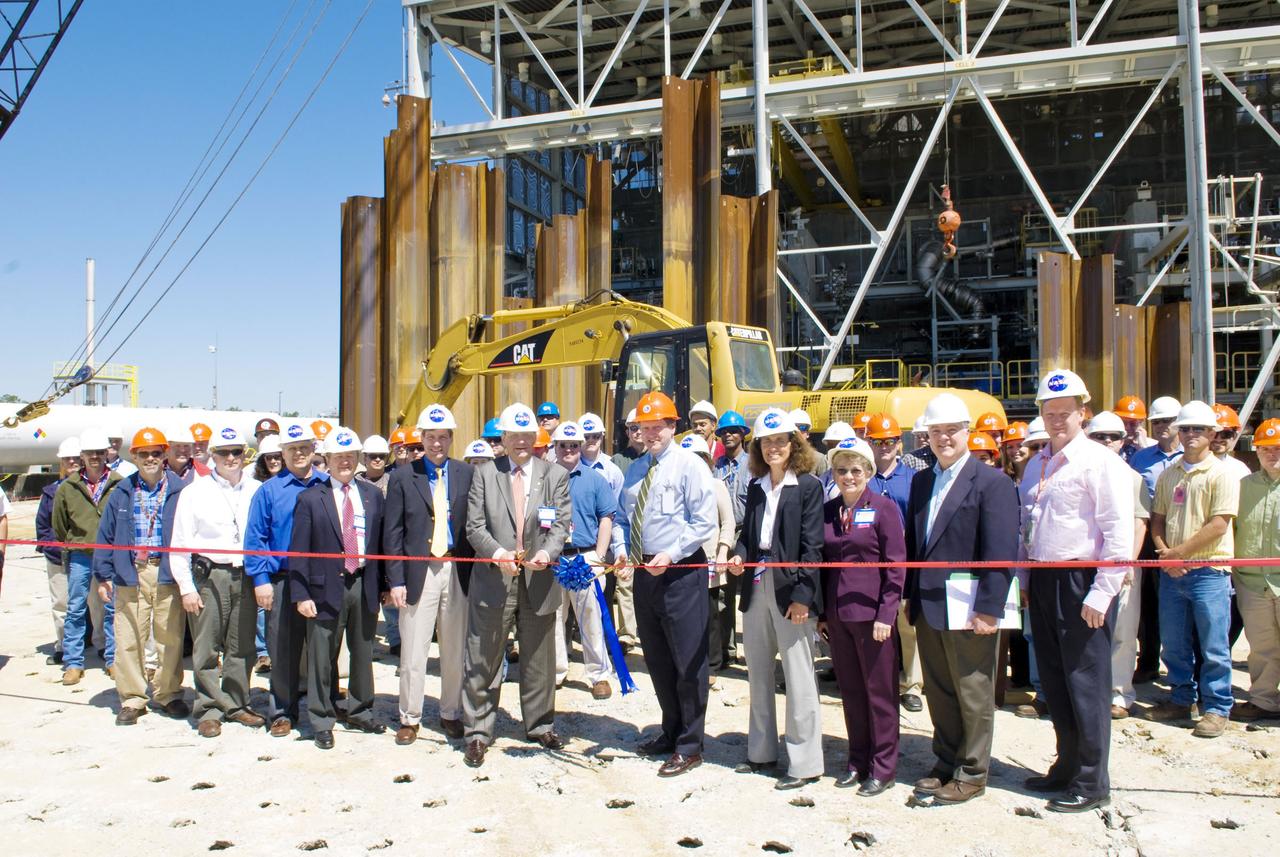
Representatives from NASA, Orbital Sciences Corp. and Aerojet participate in a ribbon-cutting ceremony for construction of a flame deflector trench at Stennis Space Center's E Test Complex. Participants included Orbital CEO J.R. Thompson (center, left) and Stennis Space Center Director Gene Goldman (center, right).
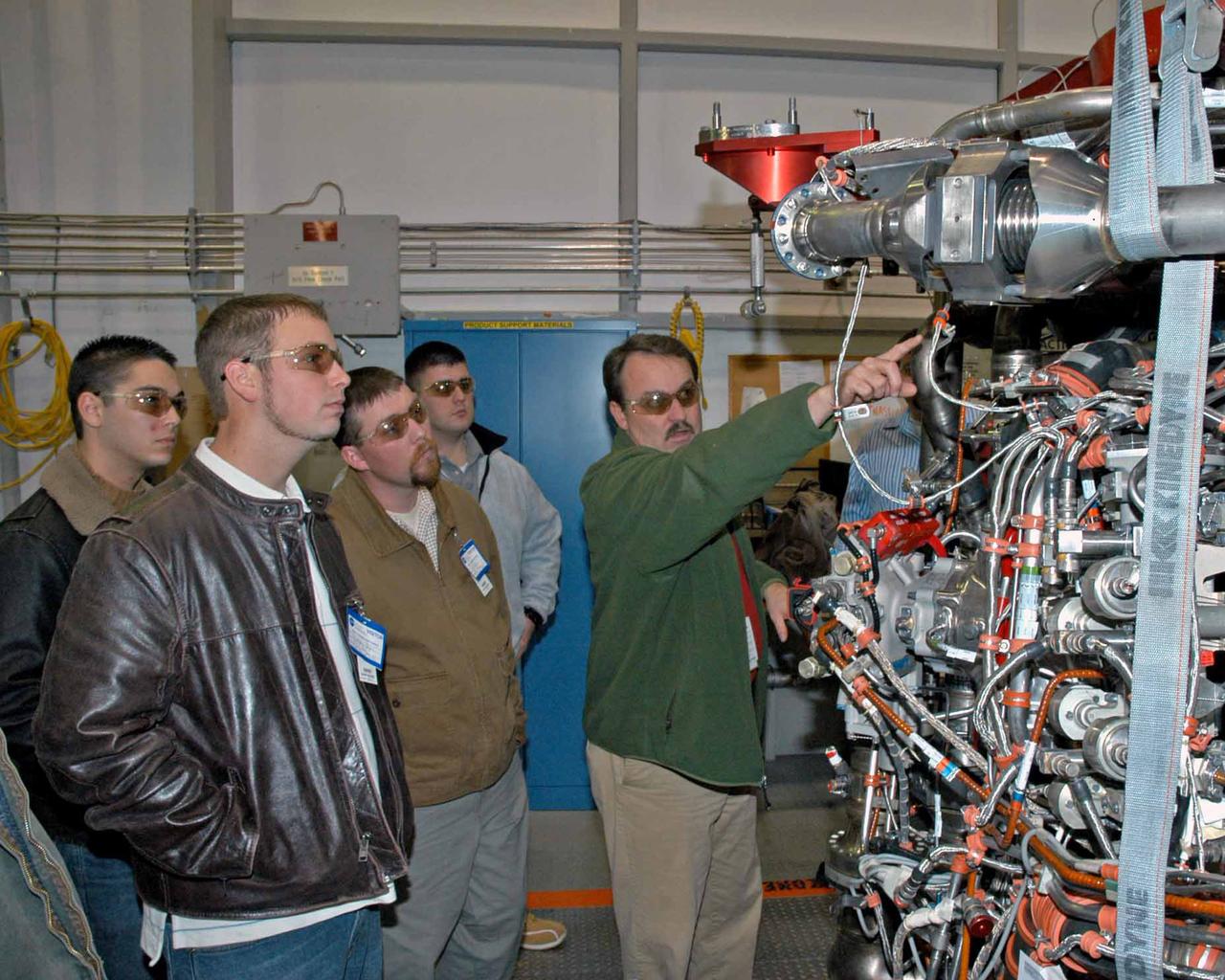
Pratt & Whitney Rocketdyne's Jeff Hansell, right, explains functions of a space shuttle main engine to Pearl River Community College Aviation Maintenance Technology Program students. Christopher Bryon, left, of Bay St. Louis, Ret Tolar of Kiln, Dan Holston of Baxterville and Billy Zugg of Long Beach took a recent tour of the SSME Processing Facility and the E-1 Test Complex at Stennis Space Center in South Mississippi. The students attend class adjacent to the Stennis International Airport tarmac in Kiln, where they get hands-on experience. PRCC's program prepares students to be responsible for the inspection, repair and maintenance of technologically advanced aircraft. A contractor to NASA, Pratt & Whitney Rocketdyne in Canoga Park, Calif., manufactures the space shuttle main engine and its high-pressure turbo pumps. SSC was established in the 1960s to test the huge engines for the Saturn V moon rockets. Now 40 years later, the center tests every main engine for the space shuttle, and is America's largest rocket engine test complex. SSC will soon begin testing the rocket engines that will power spacecraft carrying Americans back to the moon and on to Mars.
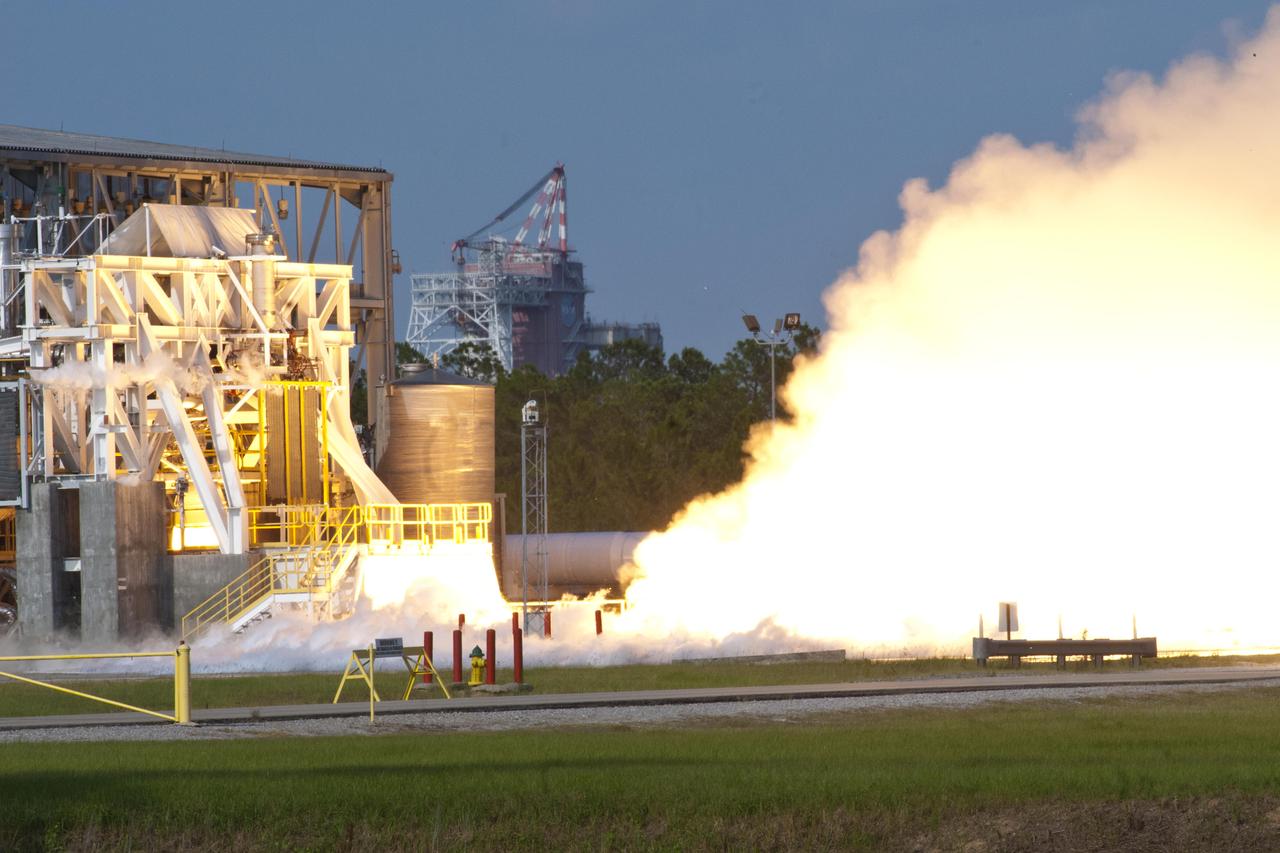
NASA engineers tested an Aerojet AJ26 rocket engine on the E-1 Test Stand at Stennis Space Center on June 25, 2012, against the backdrop of the B-1/B-2 Test Stand. The engine will be used by Orbital Sciences Corporation to power commercial cargo flights to the International Space Station.
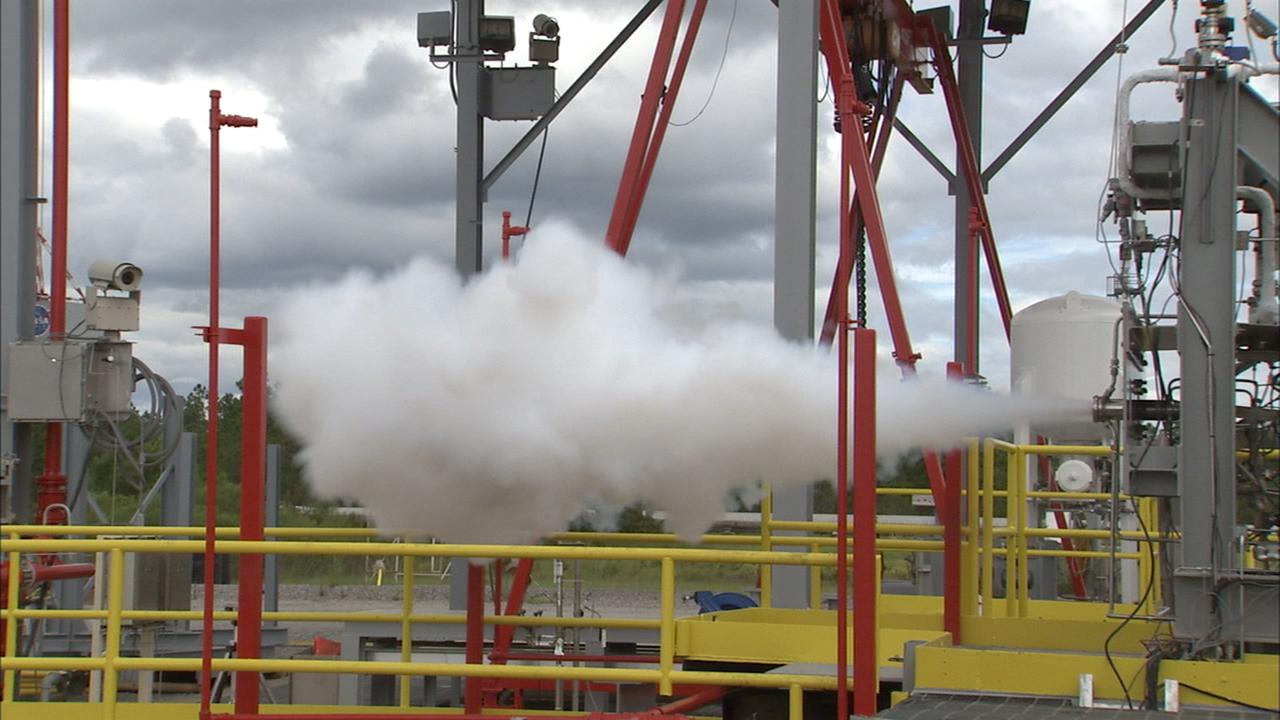
Tests begun at Stennis Space Center's E Complex Sept. 13 evaluated a liquid oxygen lead for engine start performance, part of the A-3 Test Facility Subscale Diffuser Risk Mitigation Project at SSC's E-3 Test Facility. Phase 1 of the subscale diffuser project, completed Sept. 24, was a series of 18 hot-fire tests using a 1,000-pound liquid oxygen and gaseous hydrogen thruster to verify maximum duration and repeatability for steam generation supporting the A-3 Test Stand project. The thruster is a stand-in for NASA's developing J-2X engine, to validate a 6 percent scale version of A-3's exhaust diffuser. Testing the J-2X at altitude conditions requires an enormous diffuser. Engineers will generate nearly 4,600 pounds per second of steam to reduce pressure inside A-3's test cell to simulate altitude conditions. A-3's exhaust diffuser has to be able to withstand regulated pressure, temperatures and the safe discharge of the steam produced during those tests. Before the real thing is built, engineers hope to work out any issues on the miniature version. Phase 2 testing is scheduled to begin this month.
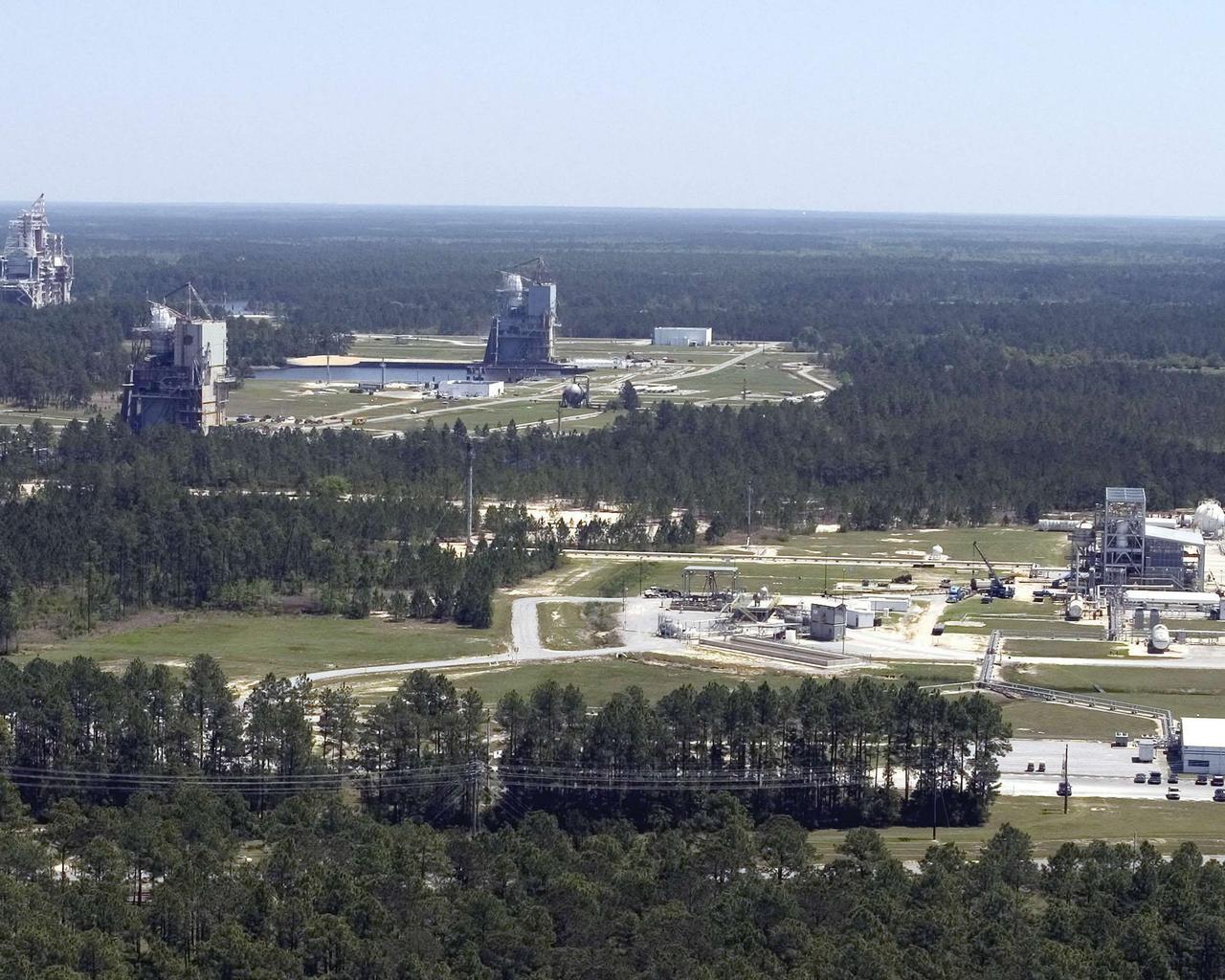
SSC's rocket engine test complex and its four unique test stands provide test operations for the development and certification of propulsion systems, subsystems and components.
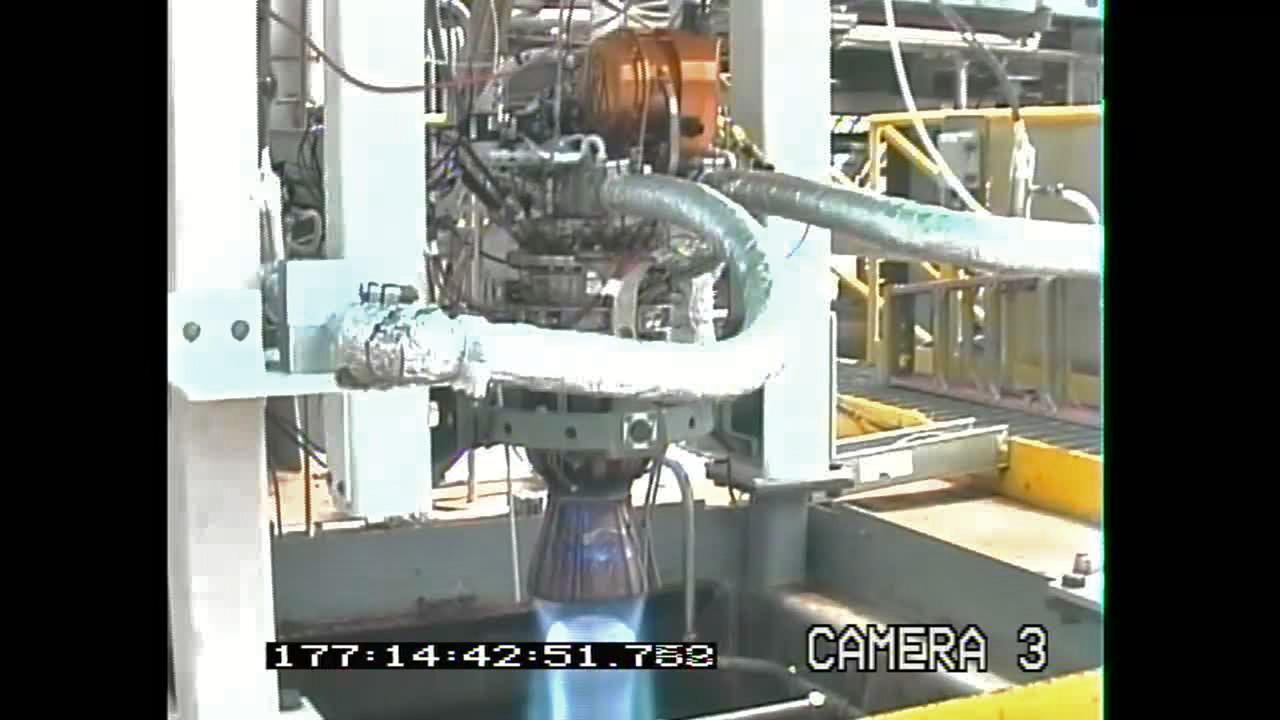
A frame grab from a mounted video camera on the E-3 Test Stand at Stennis Space Center documents testing of the new Project Morpheus engine. The new liquid methane, liquid oxygen engine will power the Morpheus prototype lander, which could one day evolve to carry cargo safely to the moon, asteroids or Mars surfaces.
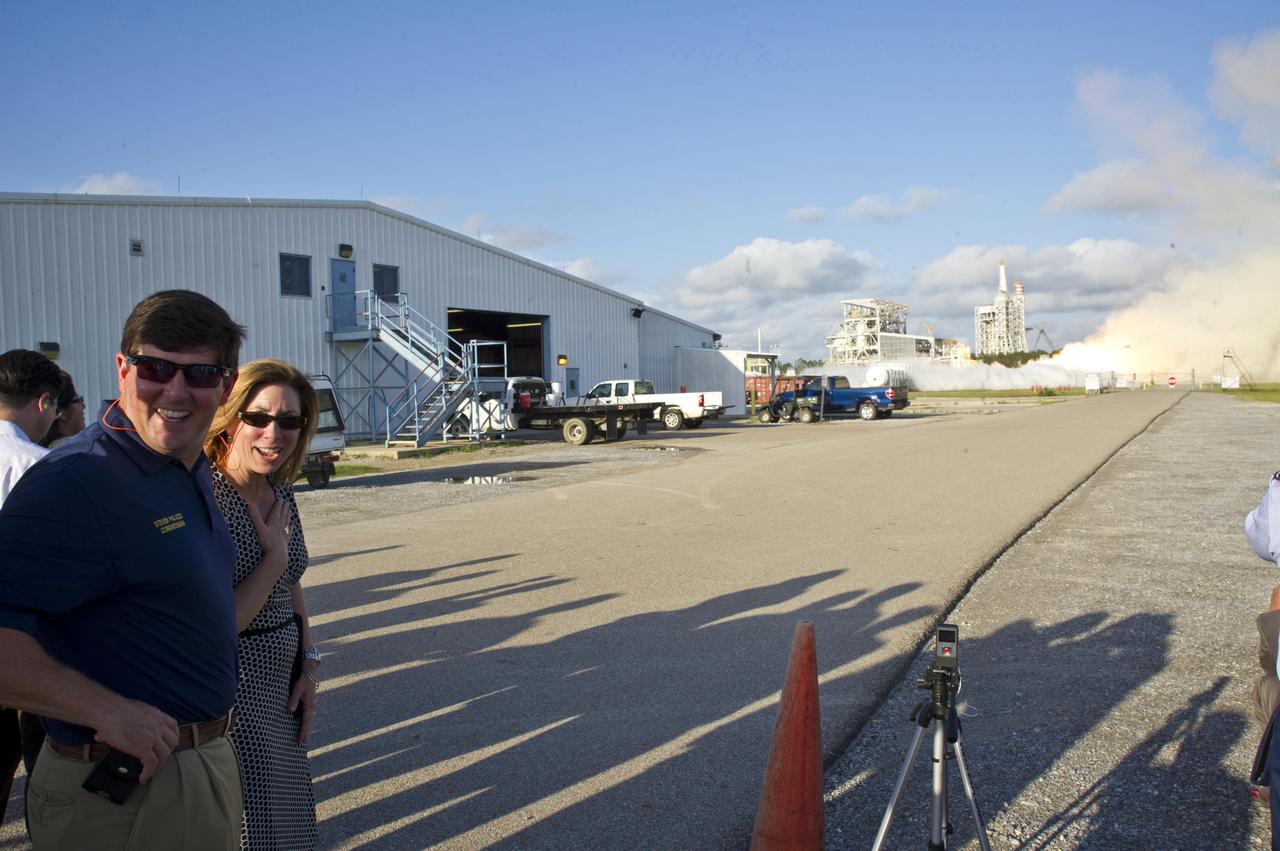
NASA Deputy Administrator Lori Garver and U.S. Rep. Steven Palazzo, R-Miss., view a May 3, 2012, test of the Aerojet AJ26 rocket engine on the E-1 Test Stand at Stennis Space Center. The AJ26 engine is being tested for Orbital Sciences Corporation to power commercial cargo flights to the International Space Station.
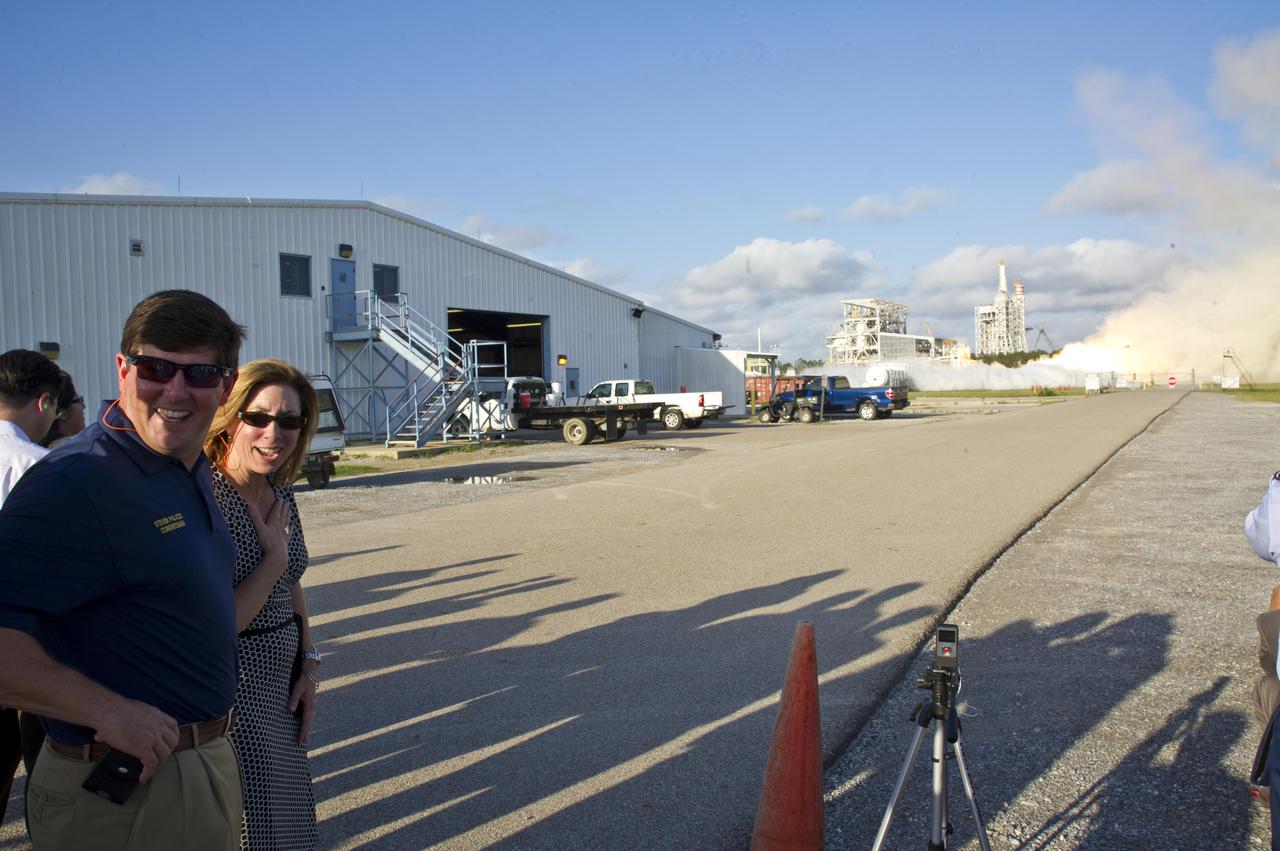
NASA Deputy Administrator Lori Garver and U.S. Rep. Steven Palazzo, R-Miss., view a May 3, 2012, test of the Aerojet AJ26 rocket engine on the E-1 Test Stand at Stennis Space Center. The AJ26 engine is being tested for Orbital Sciences Corporation to power commercial cargo flights to the International Space Station.
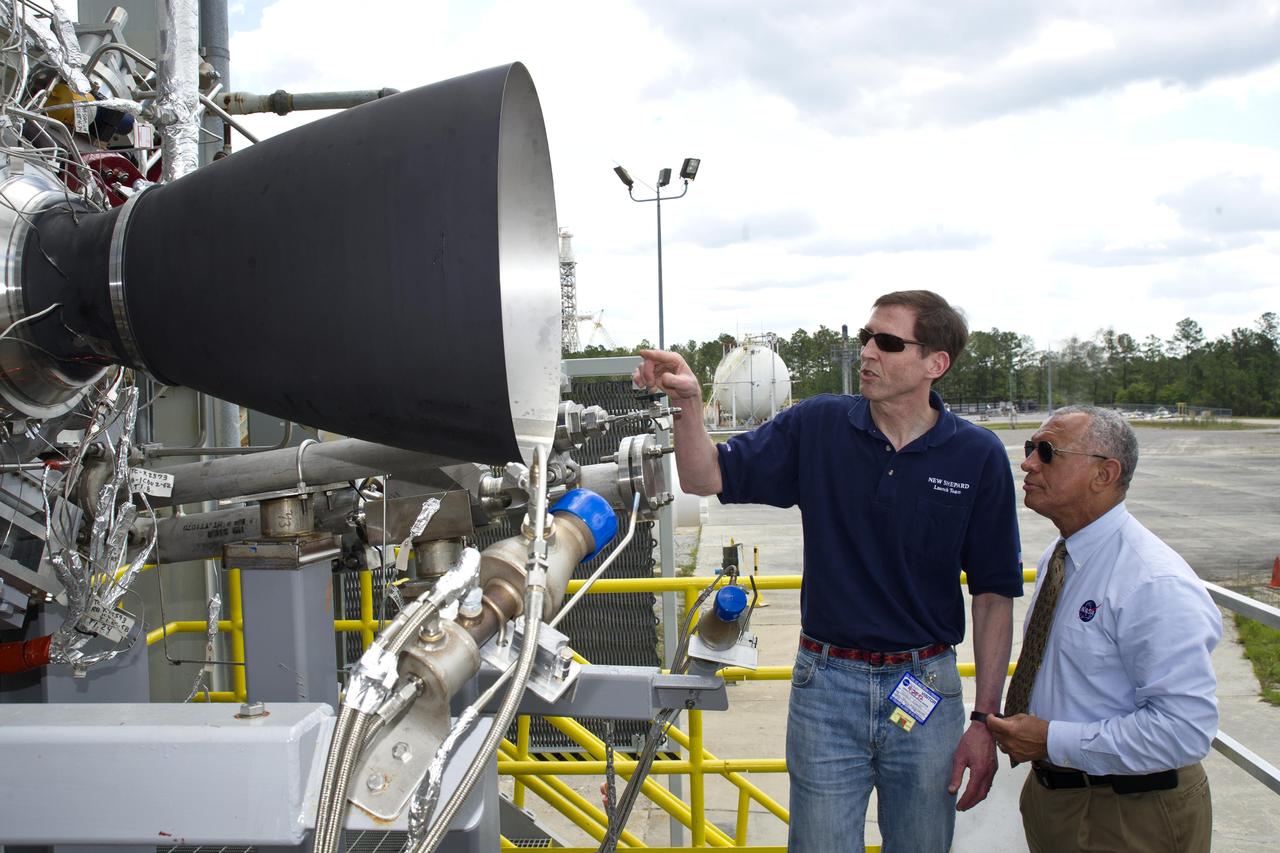
NASA Administrator Charles Bolden (r) discusses the upcoming testing of Blue Origin's BE-3 engine thrust chamber assembly with Steve Knowles, Blue Origin project manager, at the E-1 Test Stand during an April 20, 2012, visit to Stennis Space Center. Blue Origin is one of NASA's partners developing innovative systems to reach low-Earth orbit.
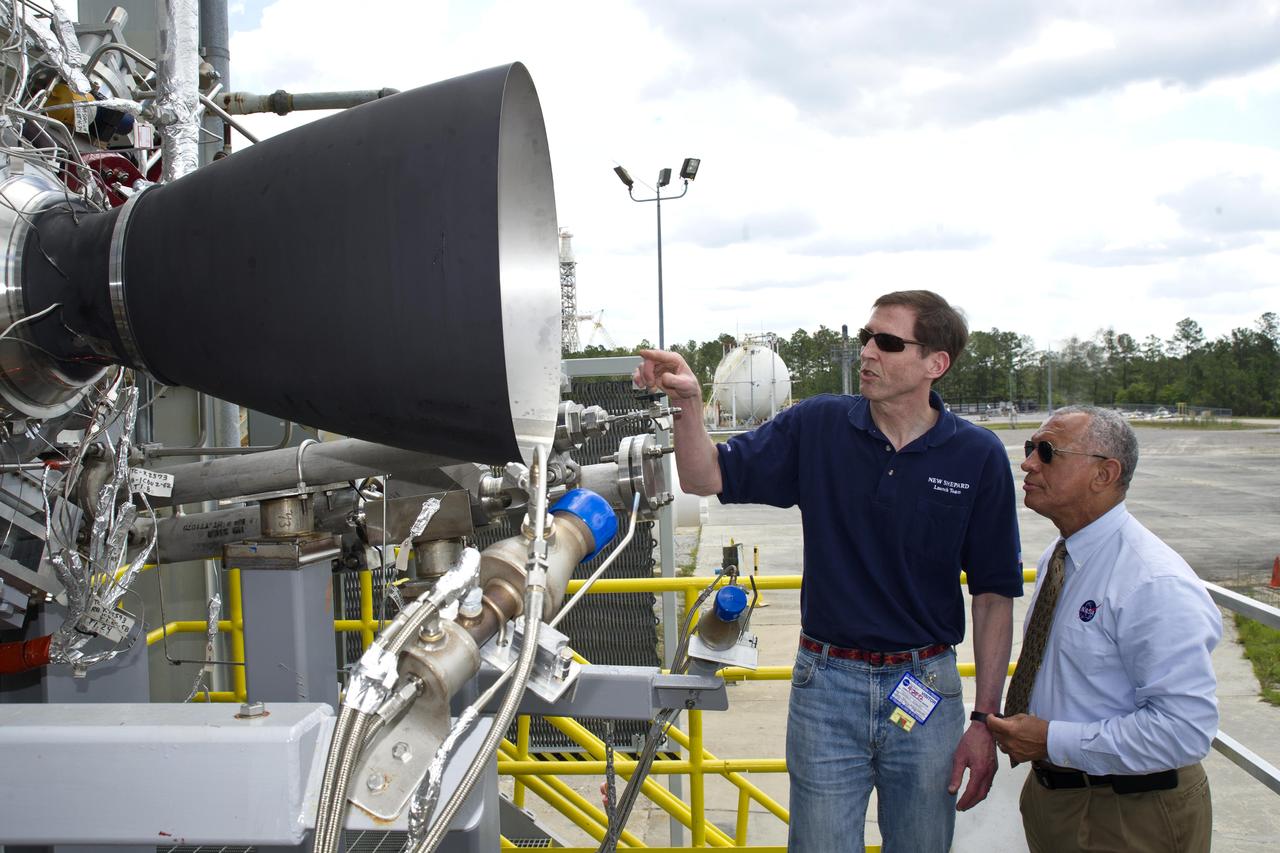
NASA Administrator Charles Bolden (r) discusses the upcoming testing of Blue Origin's BE-3 engine thrust chamber assembly with Steve Knowles, Blue Origin project manager, at the E-1 Test Stand during an April 20, 2012, visit to Stennis Space Center. Blue Origin is one of NASA's partners developing innovative systems to reach low-Earth orbit.
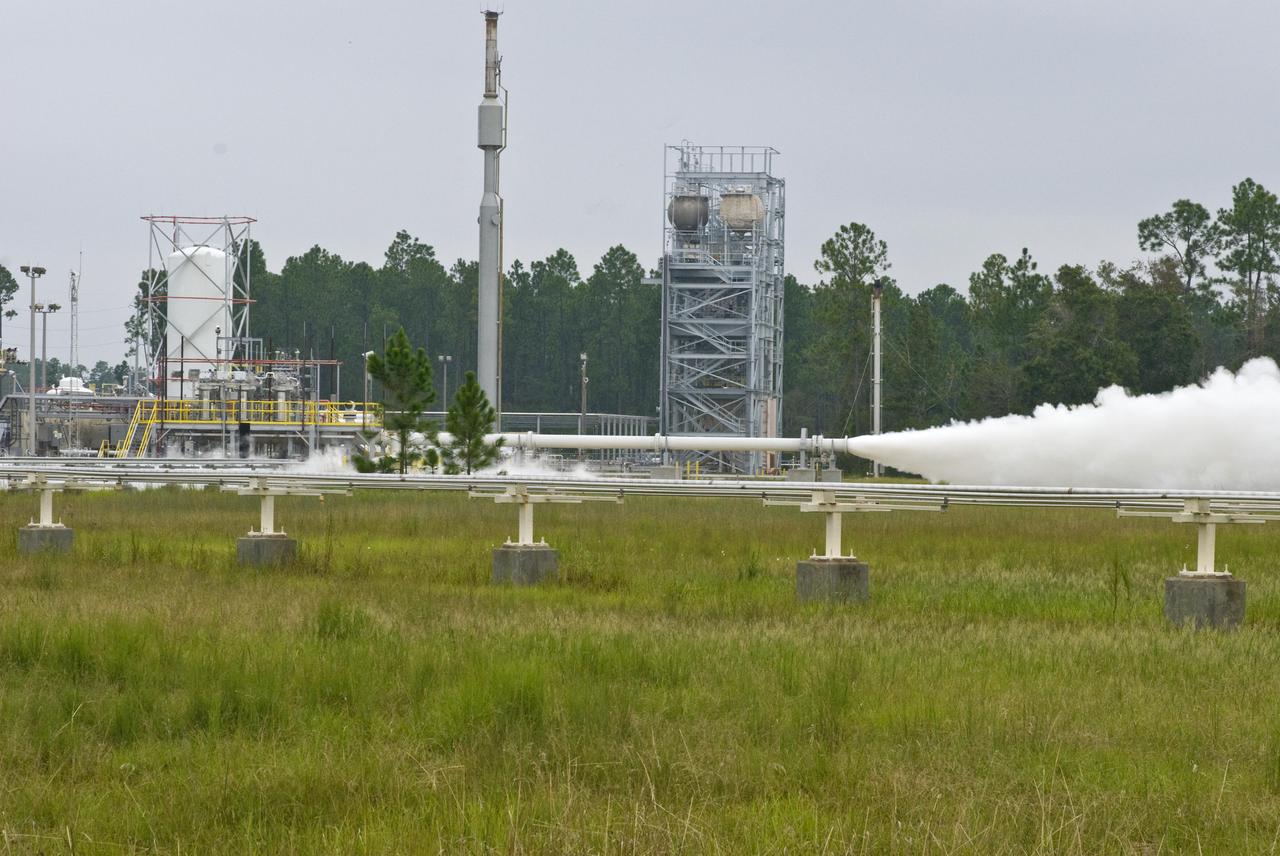
E-2 Test Stand team members at Stennis Space Center conducted their first series of tests on a three-module chemical steam generator unit Sept. 15. All three modules successfully fired during the tests. The chemical steam generator is a critical component for the A-3 Test Stand under construction at Stennis.
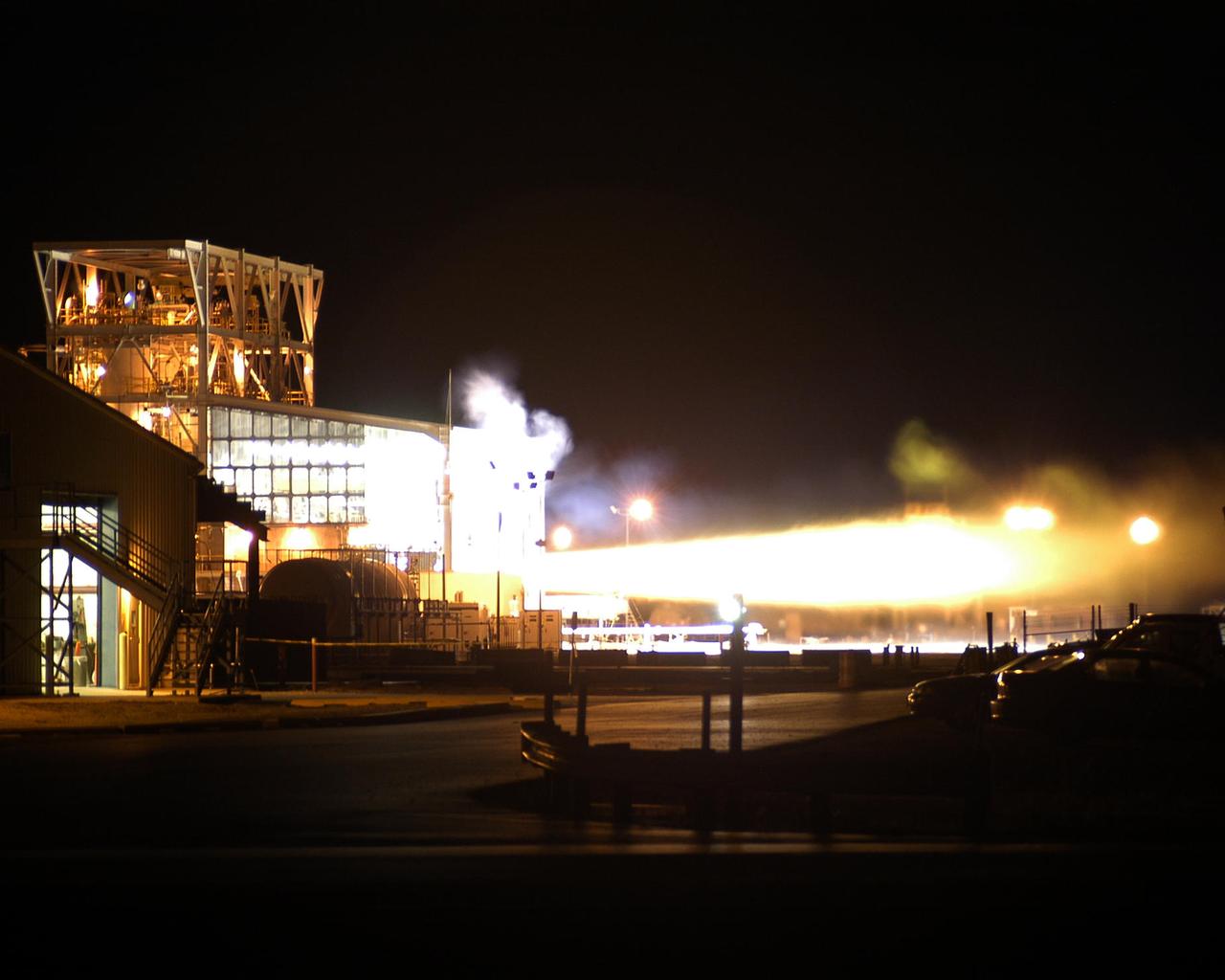
The Integrated Powerhead Demonstrator test fires with Wayne North as test conductor. The engine was tested at the E Complex of NASA's Stennis Space Center near Bay St. Louis, Miss. on Dec. 8, 2005.
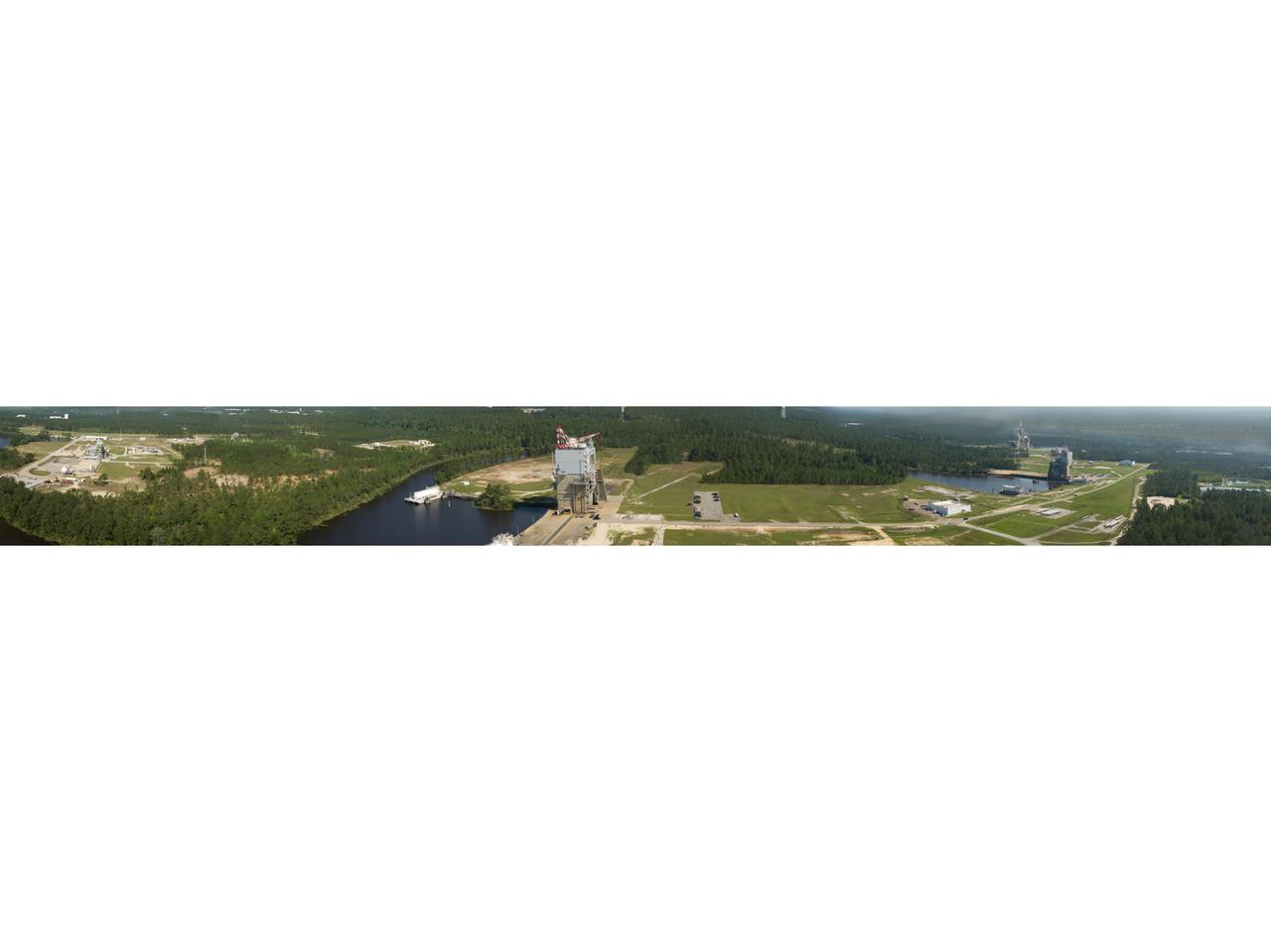
photo taken from the top of the new A-3 Test Stand at Stennis Space Center offers a panoramic view of the A, B and E test complexes at the south Mississippi faci
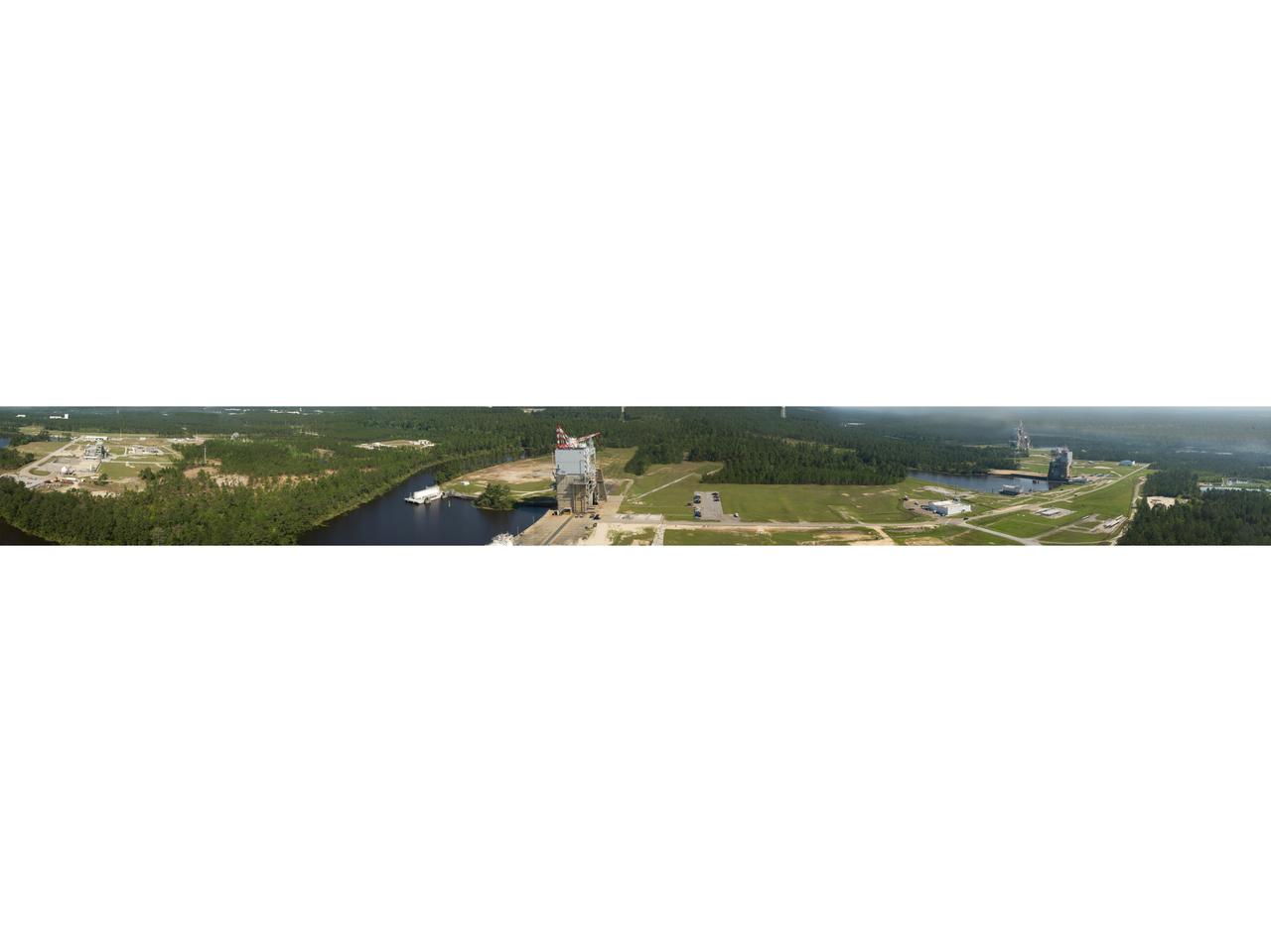
A photo taken from the top of the new A-3 Test Stand at Stennis Space Center offers a panoramic view of the A, B and E test complexes at the south Mississippi facility.
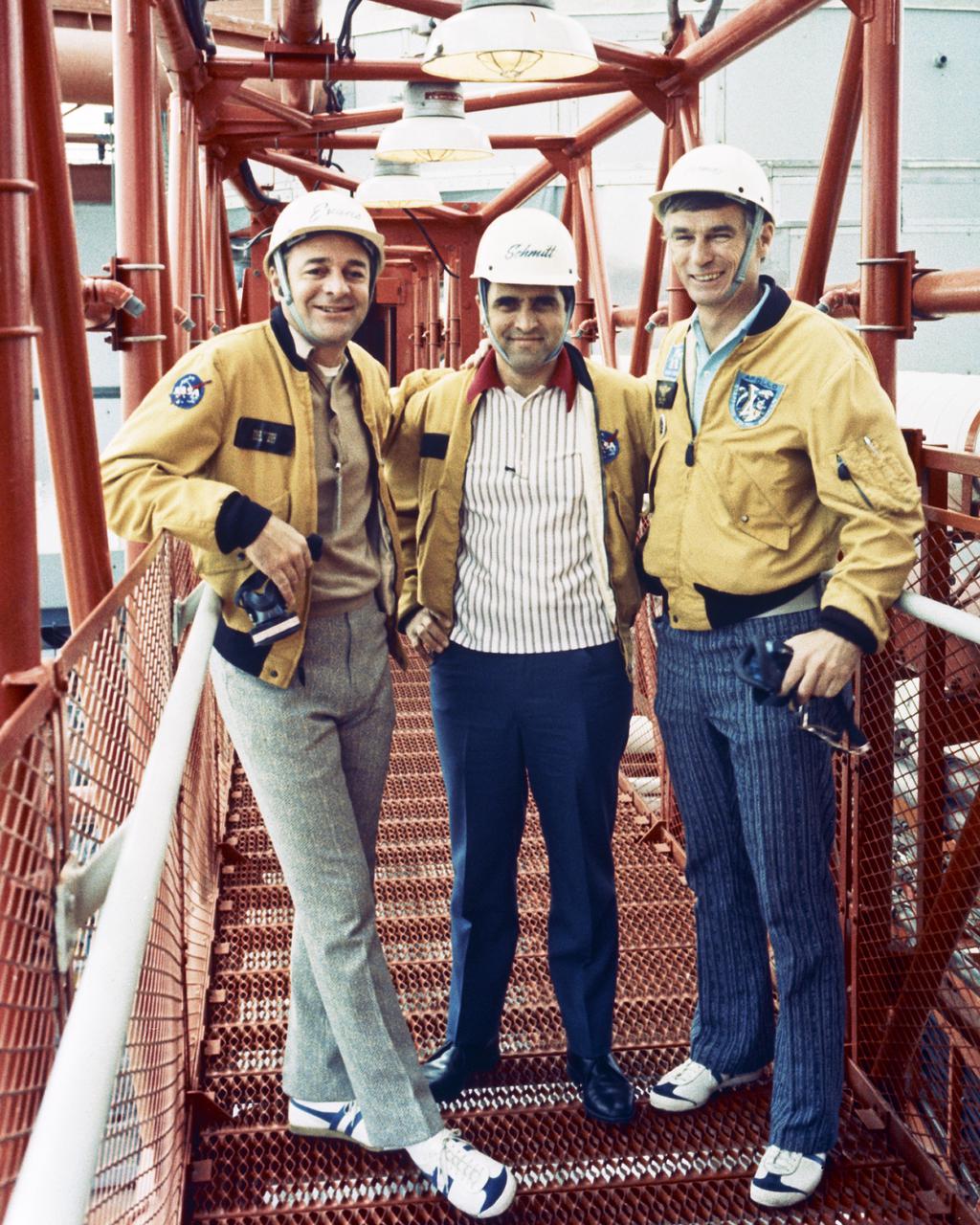
The Apollo 17 prime astronaut crew observes pre-launch activity at Complex 39A while participating in Emergency Egress Test. They are, left to right, Ronald E. Evans, Harrison H. Schmitt, and Eugene A. Cernan.
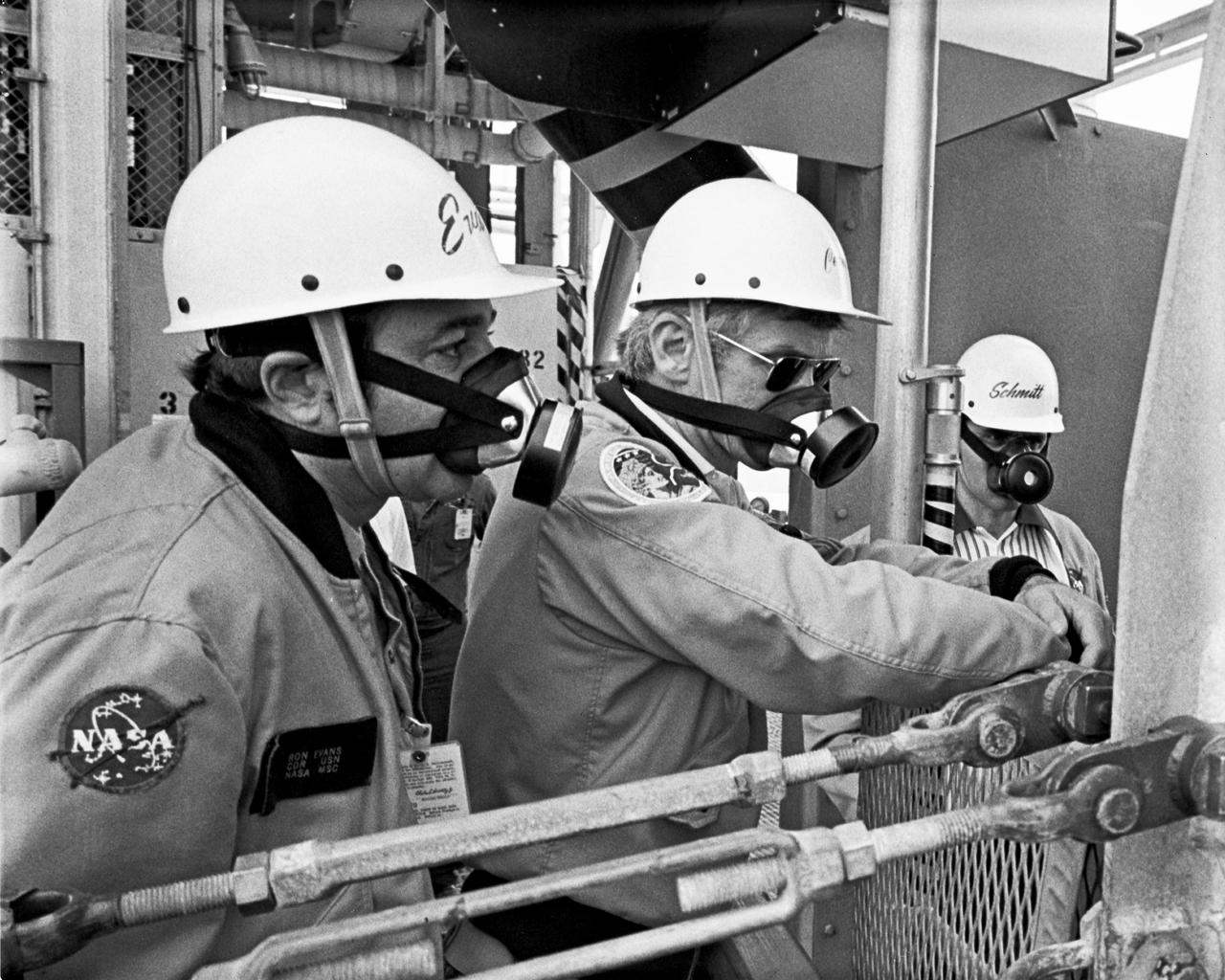
Apollo 17 Mission commander, Eugene A. Cernan, in center is flanked by Command Module Pilot Ronald E. Evans and lunar Module Pilot Harrison H. Schmitt as they participate in emergency egress test on the mobile launcher at Complex 39A. They will be launched to the Moon December 6, 1972 on NASA's last manned lunar landing scheduled for this decade.
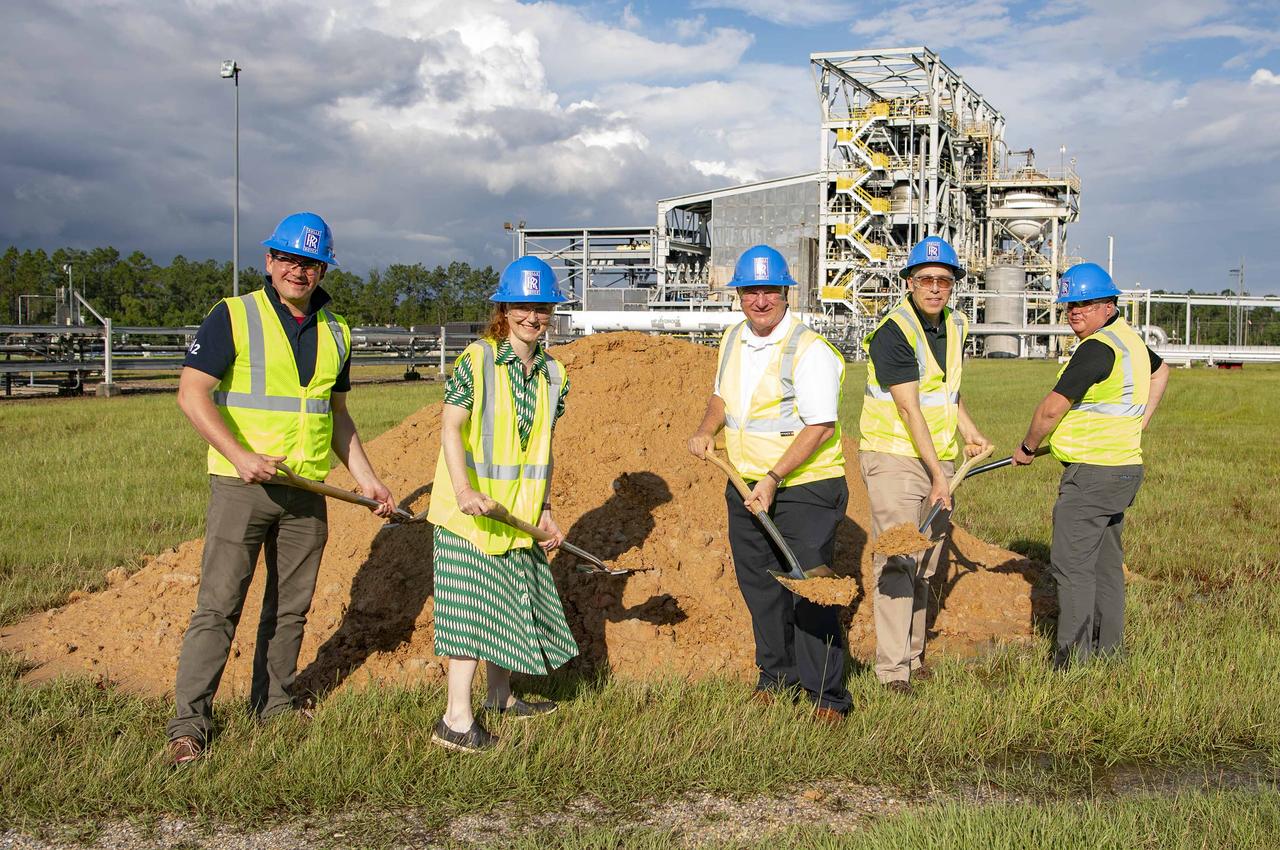
: NASA’s Stennis Space Center continues to support commercial companies and benefit the aerospace industry. The latest example comes as officials from NASA Stennis and Rolls-Royce break ground for the E-1 Hydrogen Test Pad, located at the NASA Stennis E-Complex Test Facility, during a June 27 ceremony. The site will be where Rolls-Royce conducts hydrogen testing for the Pearl 15 engine. The Pearl 15 engine helps power the Bombardier Global 5500 & 6500 aircraft and enables top speeds of Mach 0.90. Groundbreaking participants include (left to right): Adam Newman, Rolls-Royce chief engineer of hydrogen technology; Deborah Robinson, Rolls-Royce director of test and experimental engineering; Troy Frisbie, NASA Stennis legislative affairs specialist and chief of staff; Dan Lyon, Rolls-Royce North America general manager; and Steven Blake, Rolls-Royce North America indirect purchasing, global commodity manager.
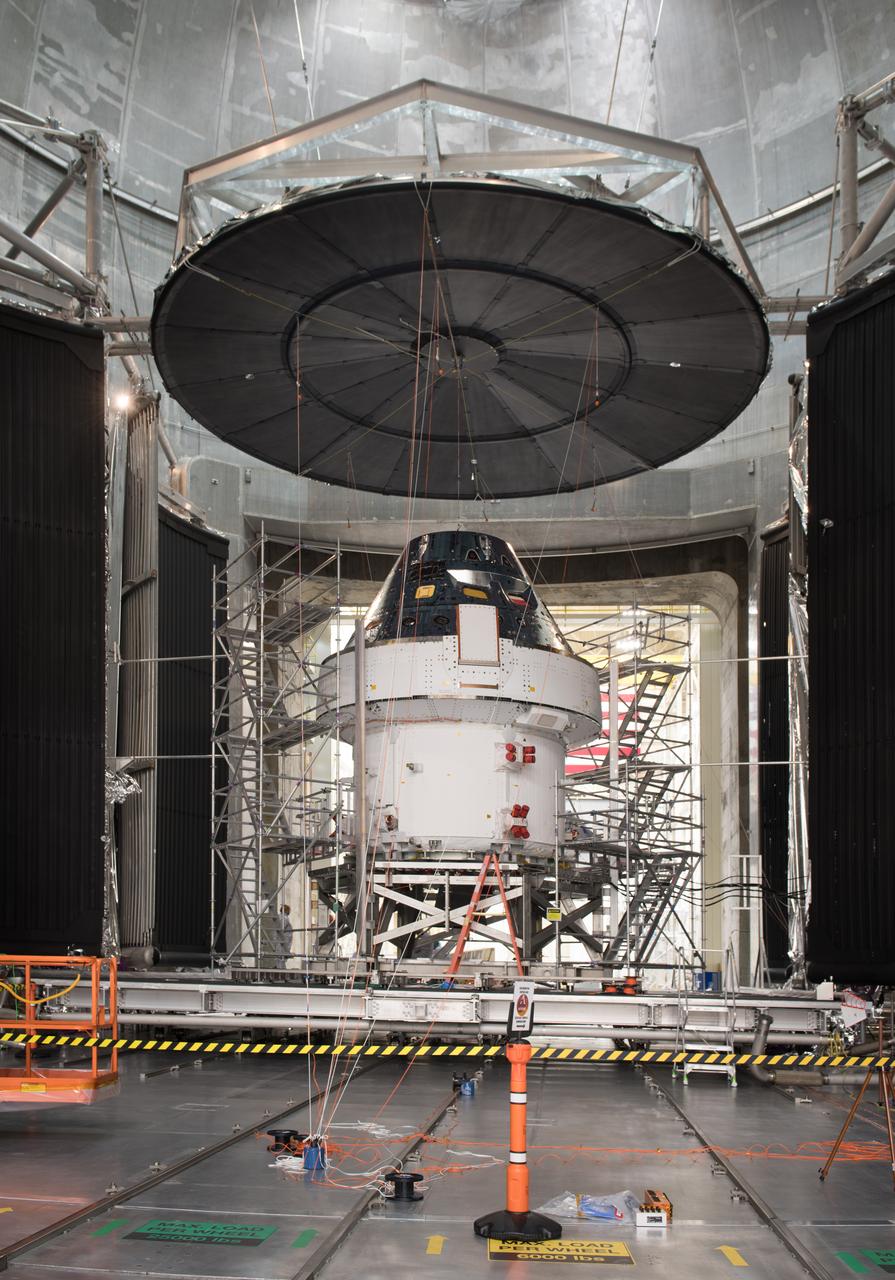
The Orion Spacecraft Crew and Service Module is being prepared for Electromagnetic Interference. EMI testing as part of testing to be certified for launch for the first Artemis mission
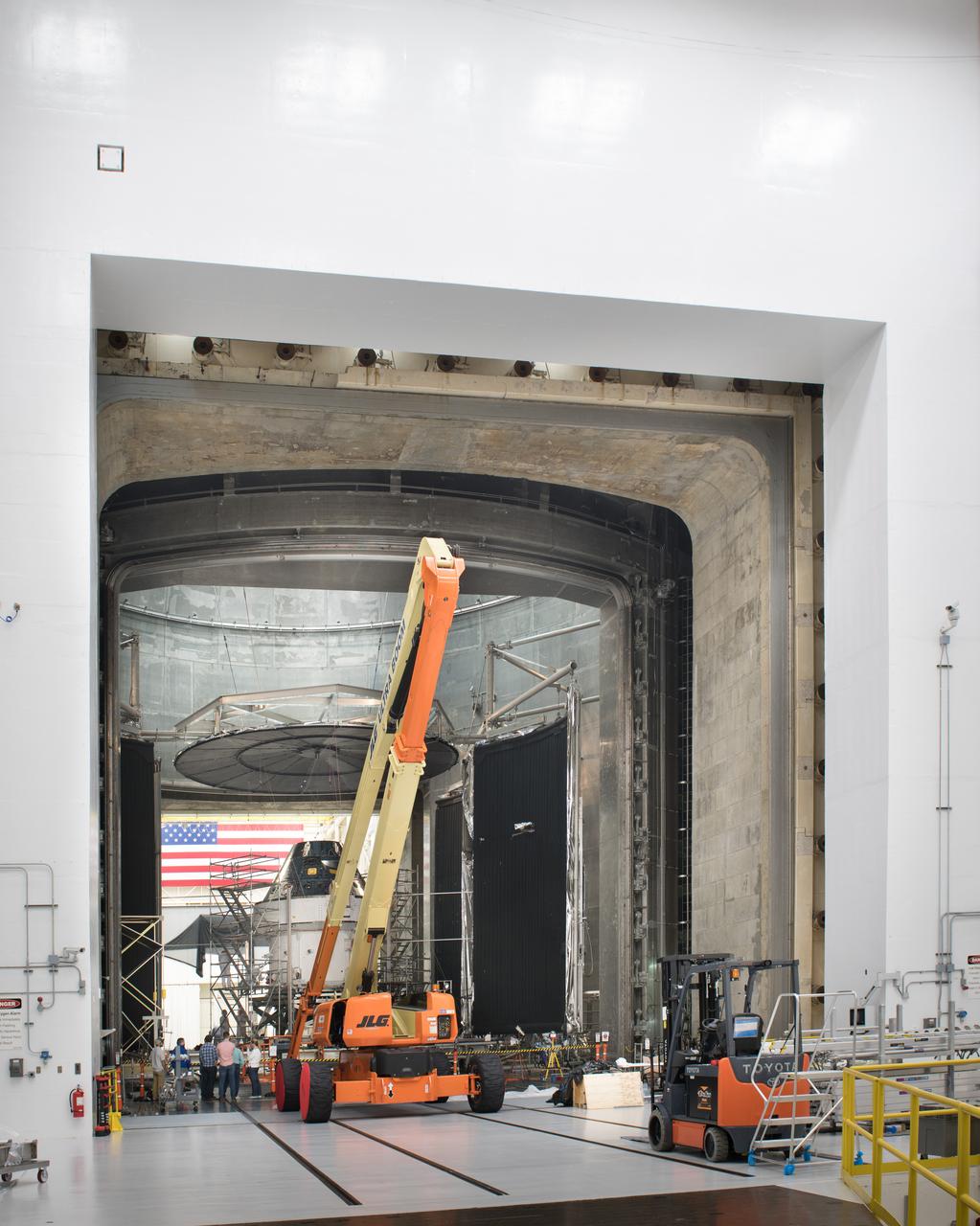
The Orion Spacecraft Crew and Service Module is being prepared for Electromagnetic Interference. EMI testing as part of testing to be certified for launch for the first Artemis mission
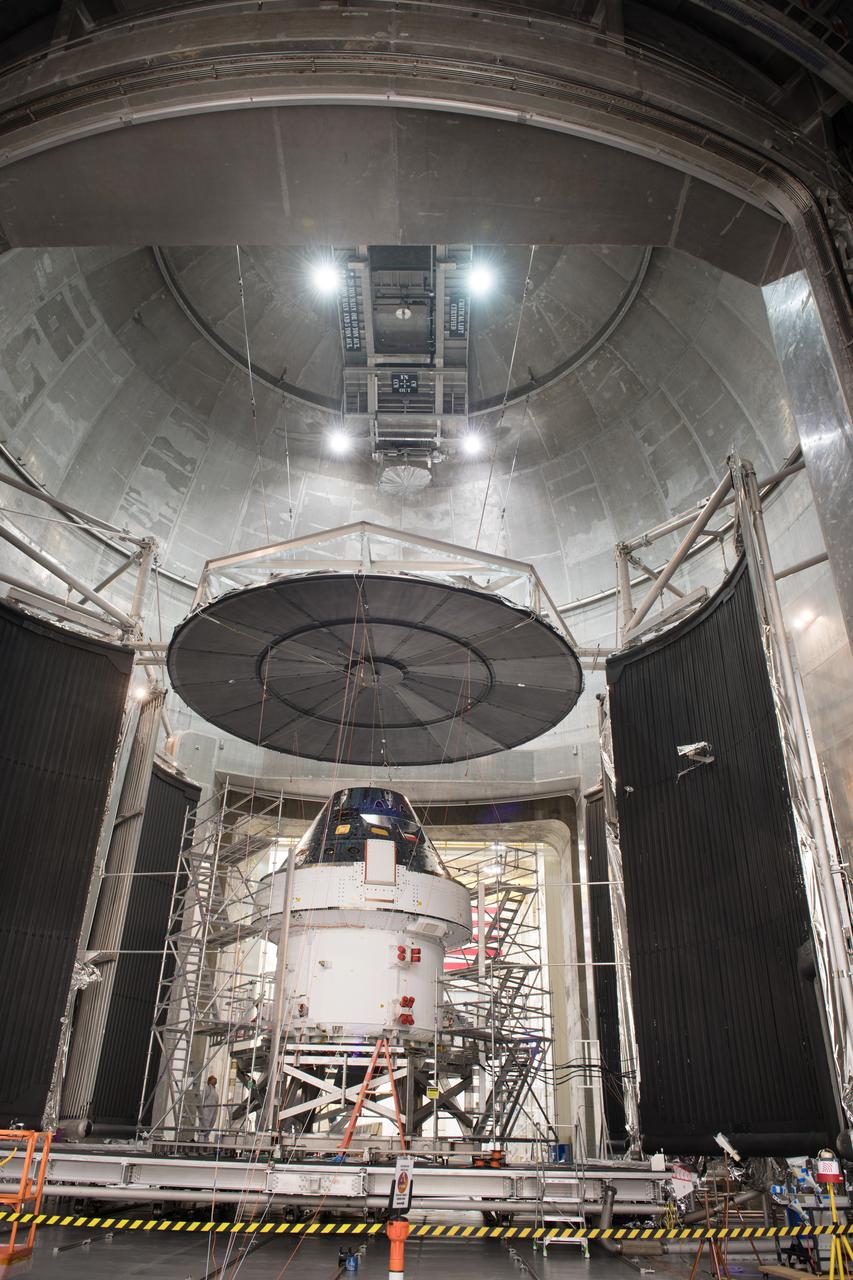
The Orion Spacecraft Crew and Service Module is being prepared for Electromagnetic Interference. EMI testing as part of testing to be certified for launch for the first Artemis mission
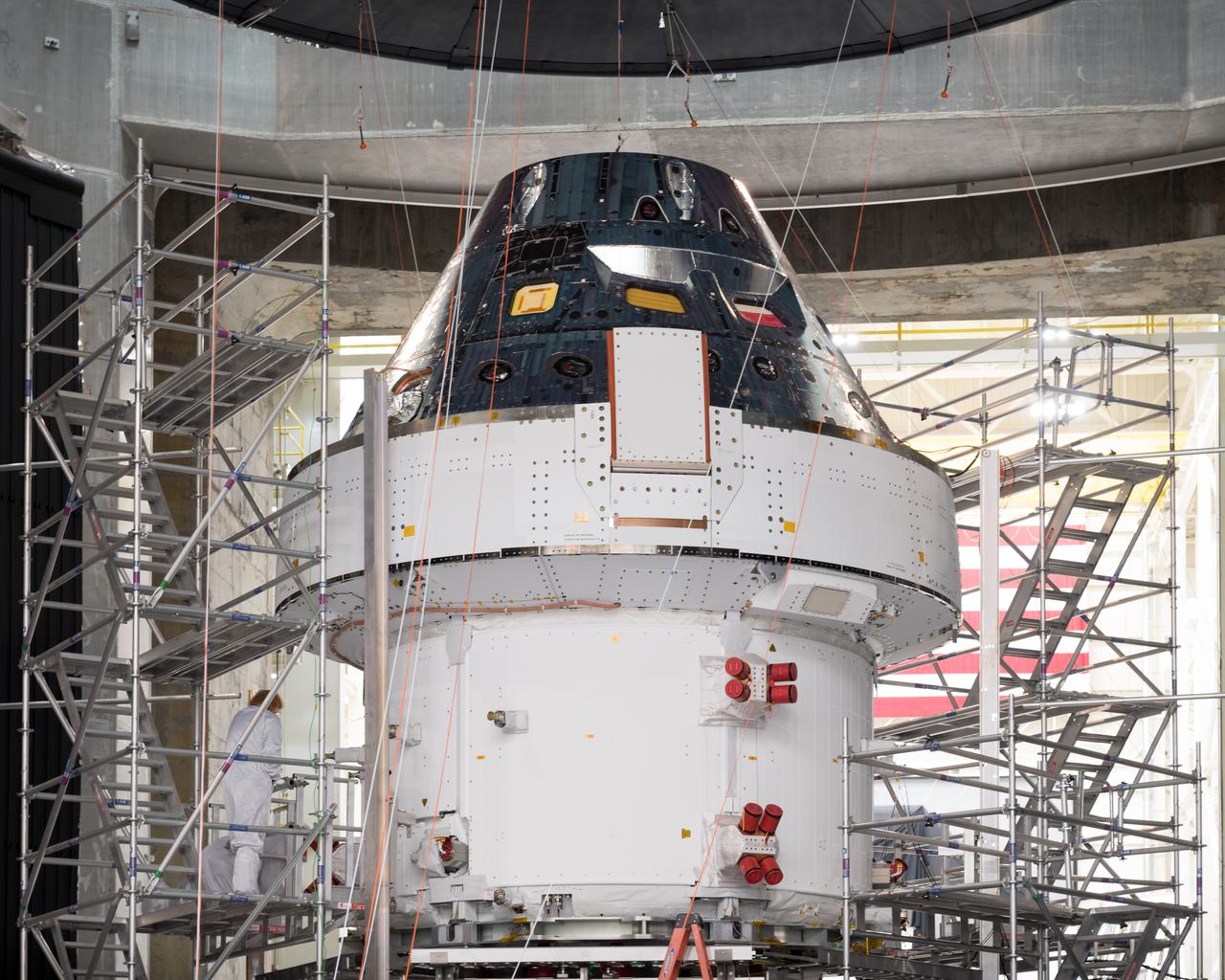
The Orion Spacecraft Crew and Service Module is being prepared for Electromagnetic Interference. EMI testing as part of testing to be certified for launch for the first Artemis mission
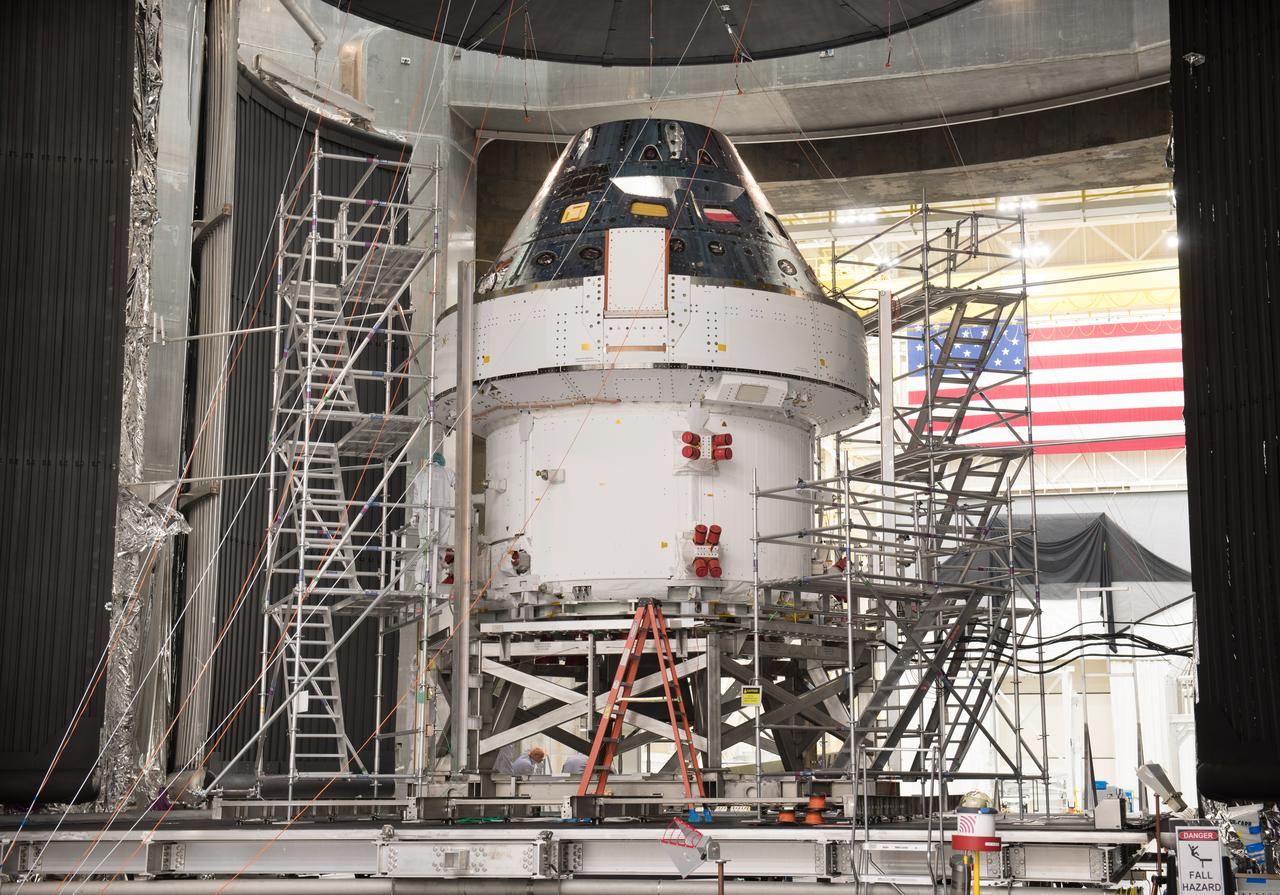
The Orion Spacecraft Crew and Service Module is being prepared for Electromagnetic Interference. EMI testing as part of testing to be certified for launch for the first Artemis mission
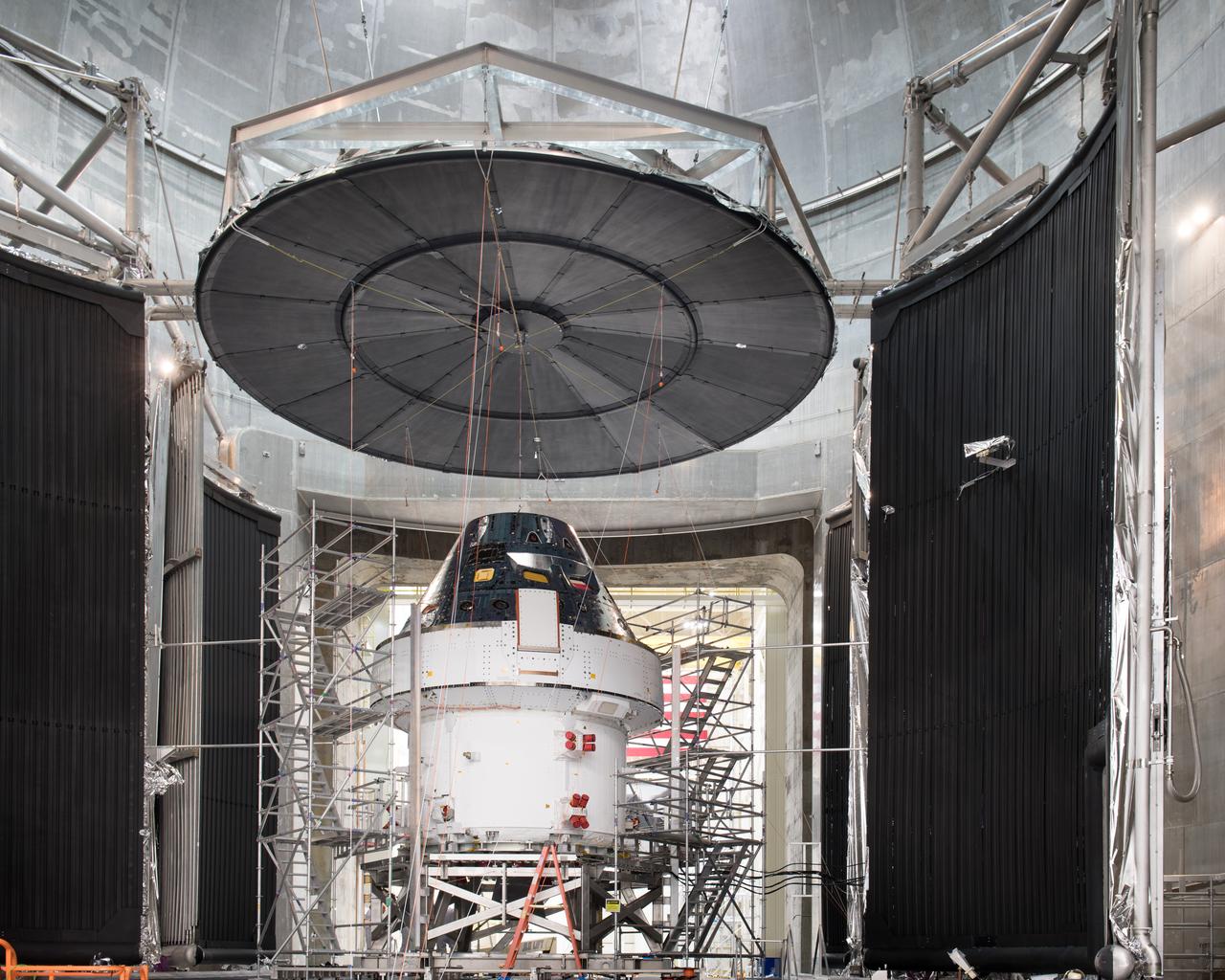
The Orion Spacecraft Crew and Service Module is being prepared for Electromagnetic Interference. EMI testing as part of testing to be certified for launch for the first Artemis mission
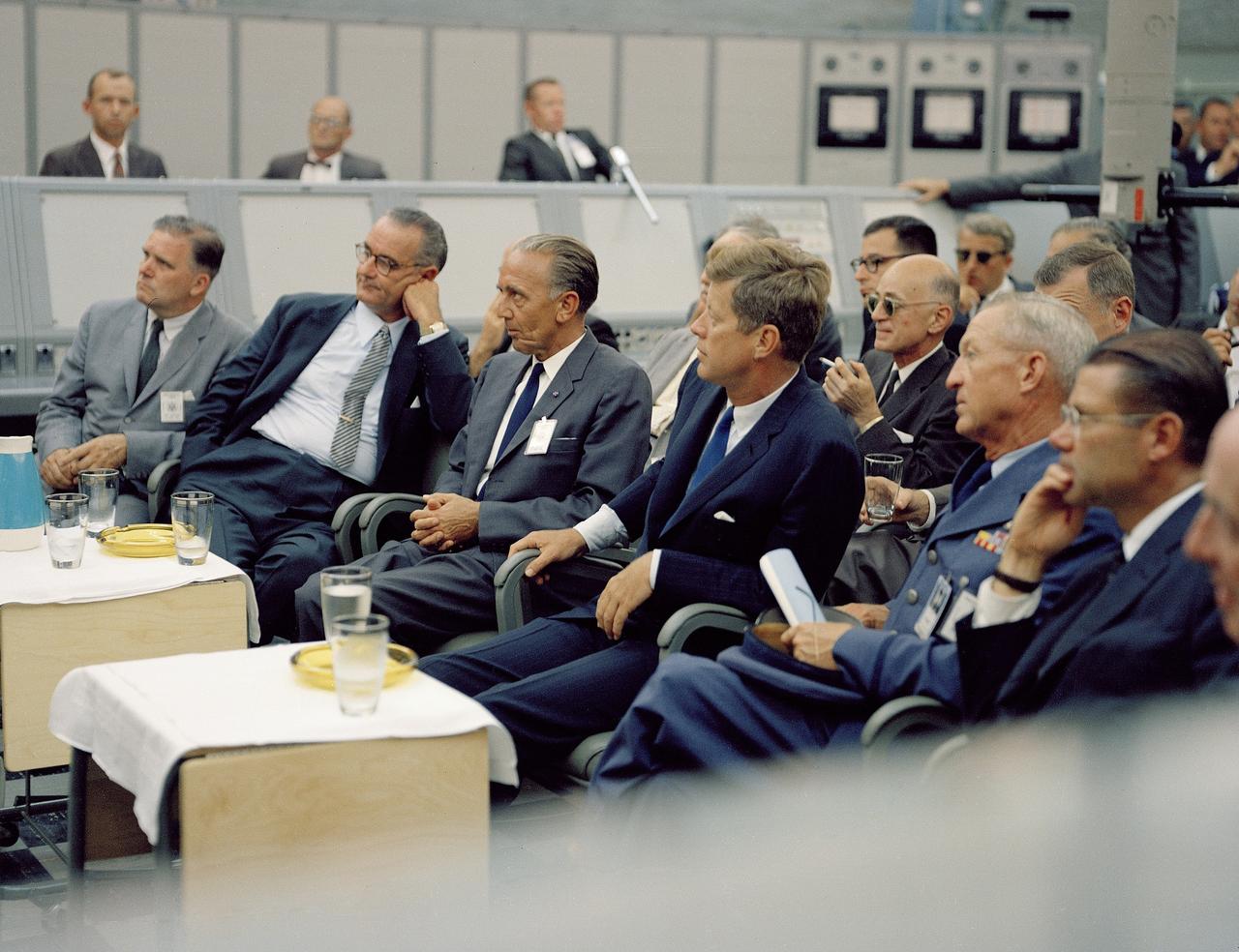
CAPE CANAVERAL, Fla. -- In the blockhouse of Launch Complex 34 at the Cape Canaveral Missile Test Annex in Florida, President John F. Kennedy is briefed on NASA's future plans. Seated, from the left, are NASA Administrator James E. Webb, Vice President Lyndon B. Johnson, Launch Operations Center Director Kurt H. Debus and Kennedy. Photo Credit: NASA
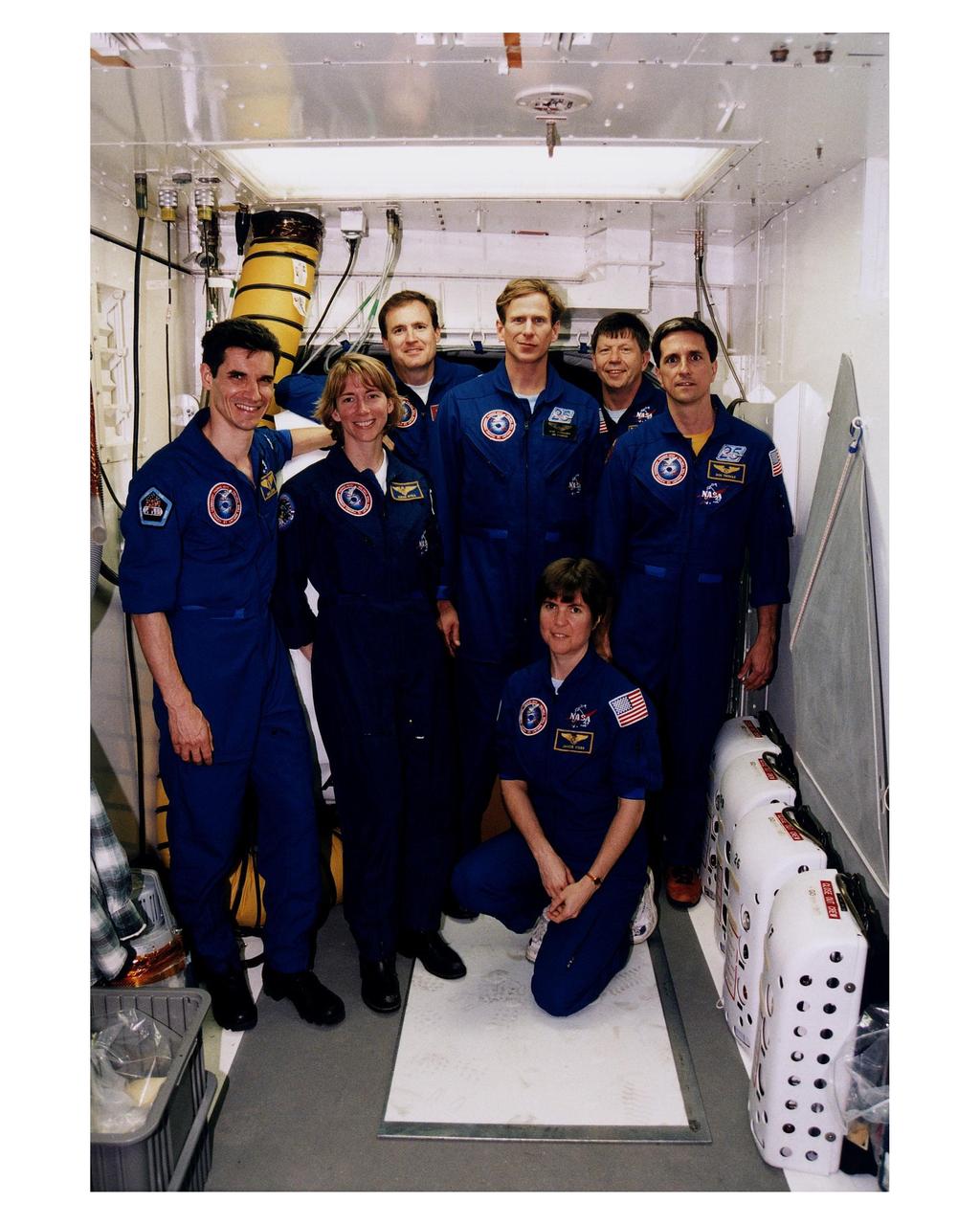
The STS-83 crew poses in the White Room at Launch Complex 39A during the crew's <a href="http://www-pao.ksc.nasa.gov/kscpao/release/1997/40-97.htm">Terminal Countdown Demonstration Test (TCDT).</a> From left to right, standing, they are Payload Specialist Gregory T. Linteris, Pilot Susan L. Still, Mission Commander James D. Halsell, Mission Specialist Michael L. Gernhardt, Payload Specialist Roger K. Crouch, and Mission Specialist Donald Thomas. Mission Specialist Janice E. Voss is kneeling
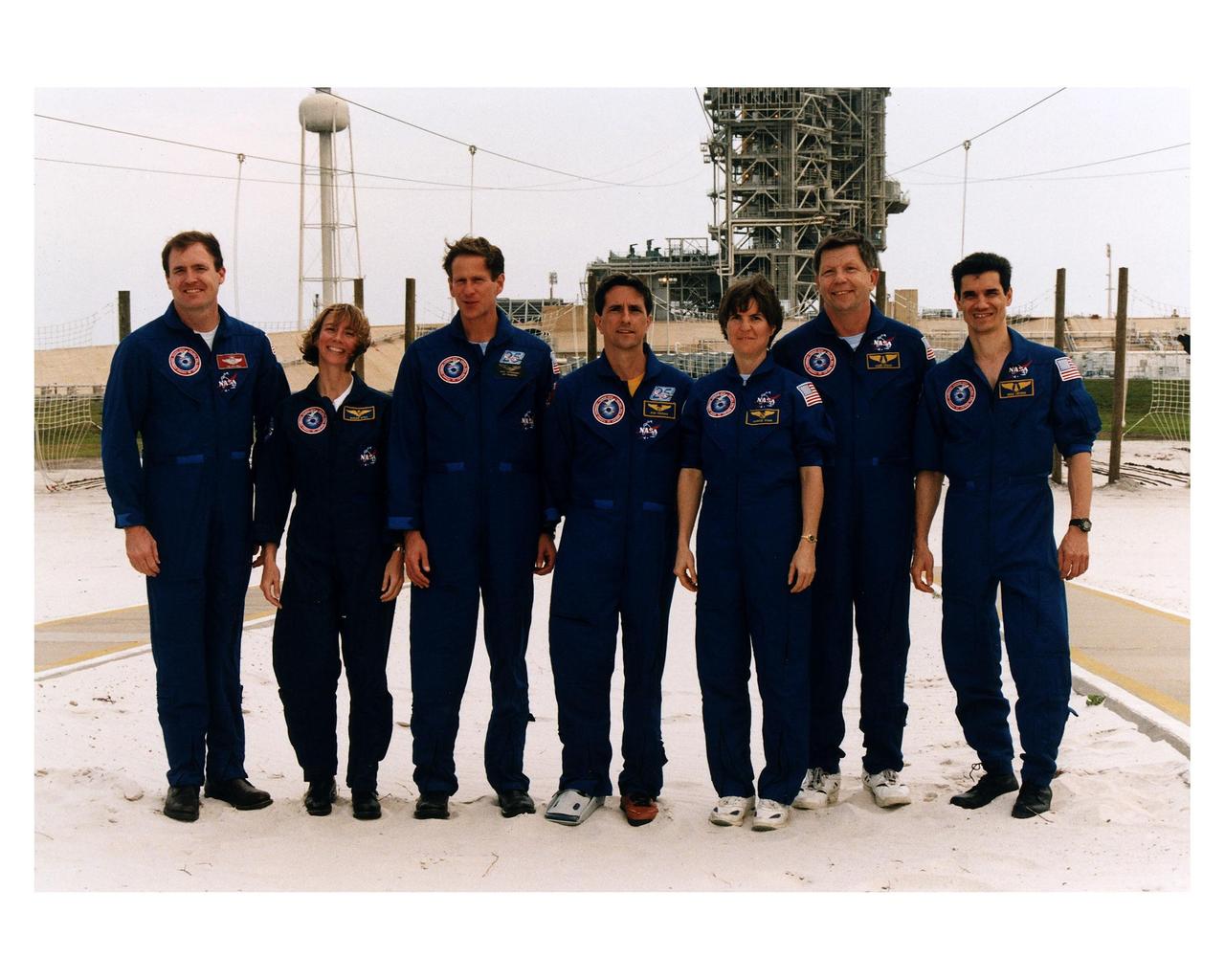
The STS-83 crew poses for the media at Launch Complex 39A during the crew's <a href="http://www-pao.ksc.nasa.gov/kscpao/release/1997/40-97.htm">Terminal Countdown Demonstration Test (TCDT).</a> From left to right, they are Mission Commander James D. Halsell; Pilot Susan L. Still; Mission Specialists Michael L. Gernhardt, Donald Thomas, and Janice E. Voss; and Payload Specialists Roger K. Crouch and Gregory T. Linteris

STS-83 Payload Specialist Gregory T. Linteris, Mission Specialist Janice E. Voss, and Payload Specialist Roger K. Crouch participate in emergency egress training at Launch Complex 39A during the crew's <a href="http://www-pao.ksc.nasa.gov/kscpao/release/1997/40-97.htm">Terminal Countdown Demonstration Test (TCDT).</a> They are seen here in one of the pads' seven <a href="http://www-pao.ksc.nasa.gov/kscpao/nasafact/pads.htm#emergenc">slidewire baskets.</a
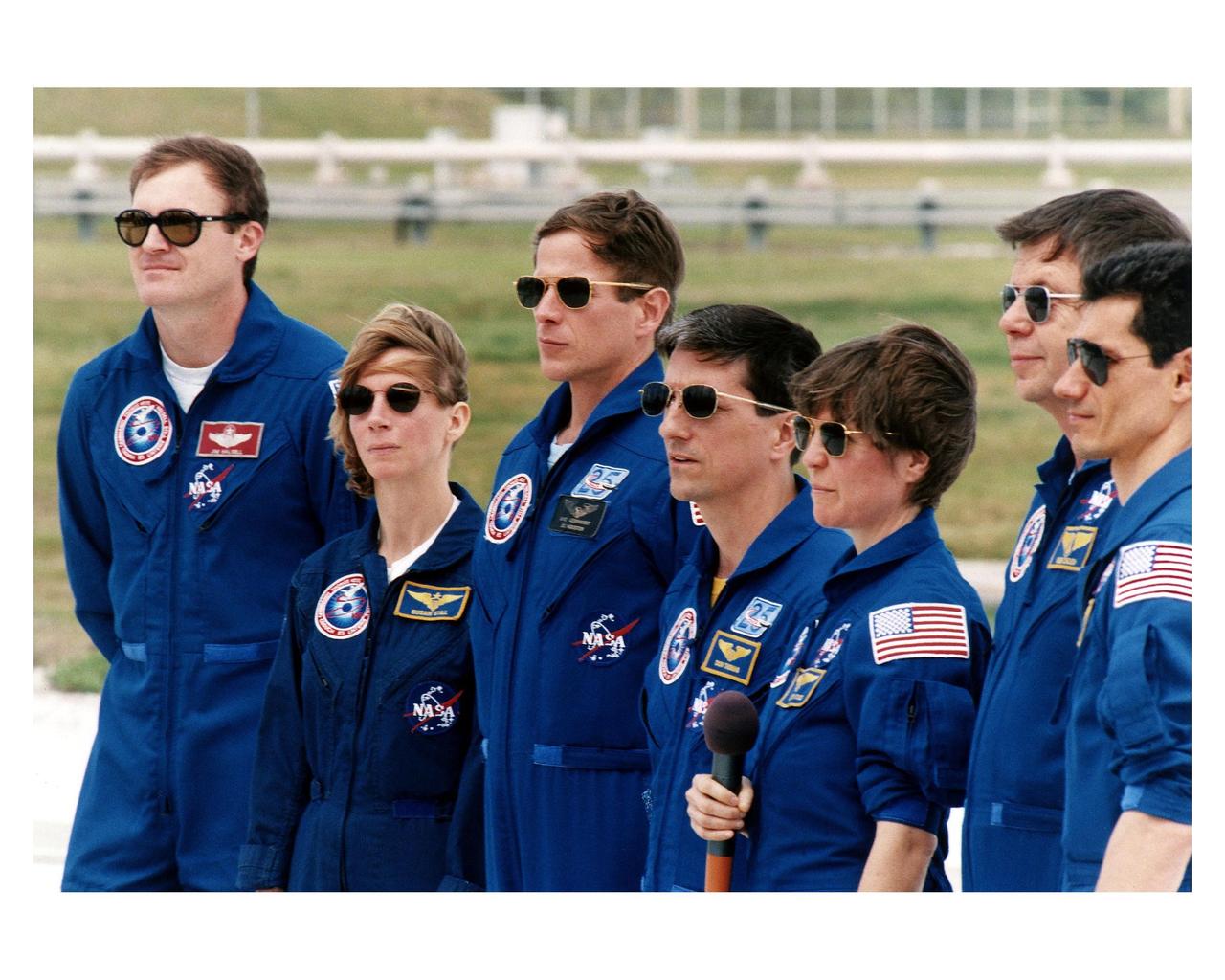
The Space Shuttle Mission STS-83 crew talks to the media at Launch Complex 39A during the crew's <a href="http://www-pao.ksc.nasa.gov/kscpao/release/1997/40-97.htm">Terminal Countdown Demonstration Test (TCDT).</a> From left to right, they are Mission Commander James D. Halsell; Pilot Susan L. Still; Mission Specialists Michael L. Gernhardt, Donald Thomas, and Janice E. Voss (holding microphone); and Payload Specialists Roger K. Crouch and Gregory T. Linteris
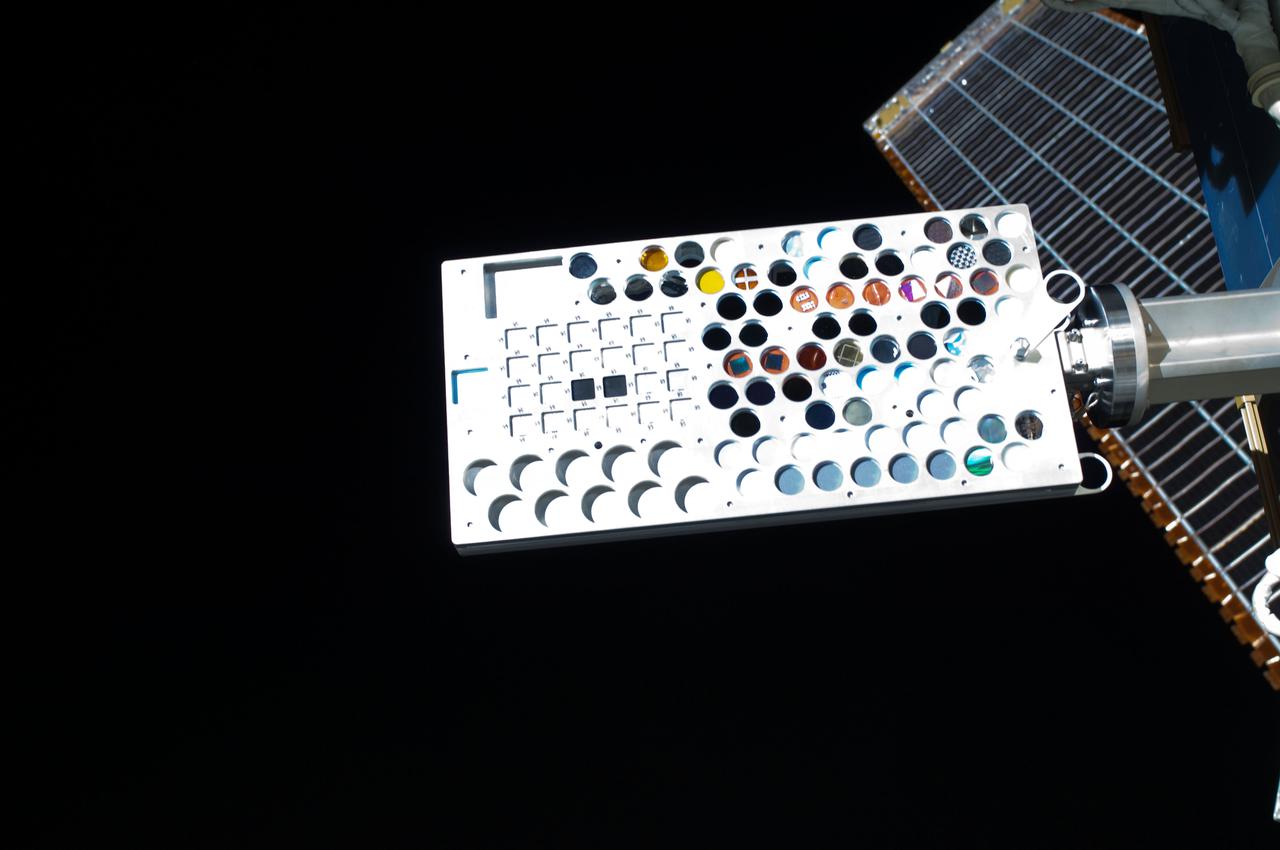
ISS028-E-016111 (12 July 2011) --- This close-up image, recorded during a July 12 spacewalk, shows the Materials on International Space Station Experiment - 8 (MISSE-8). The experiment package is a test bed for materials and computing elements attached to the outside of the orbiting complex. These materials and computing elements are being evaluated for the effects of atomic oxygen, ultraviolet, direct sunlight, radiation, and extremes of heat and cold. This experiment allows the development and testing of new materials and computing elements that can better withstand the rigors of space environments. Results will provide a better understanding of the durability of various materials and computing elements when they are exposed to the space environment, with applications in the design of future spacecraft.
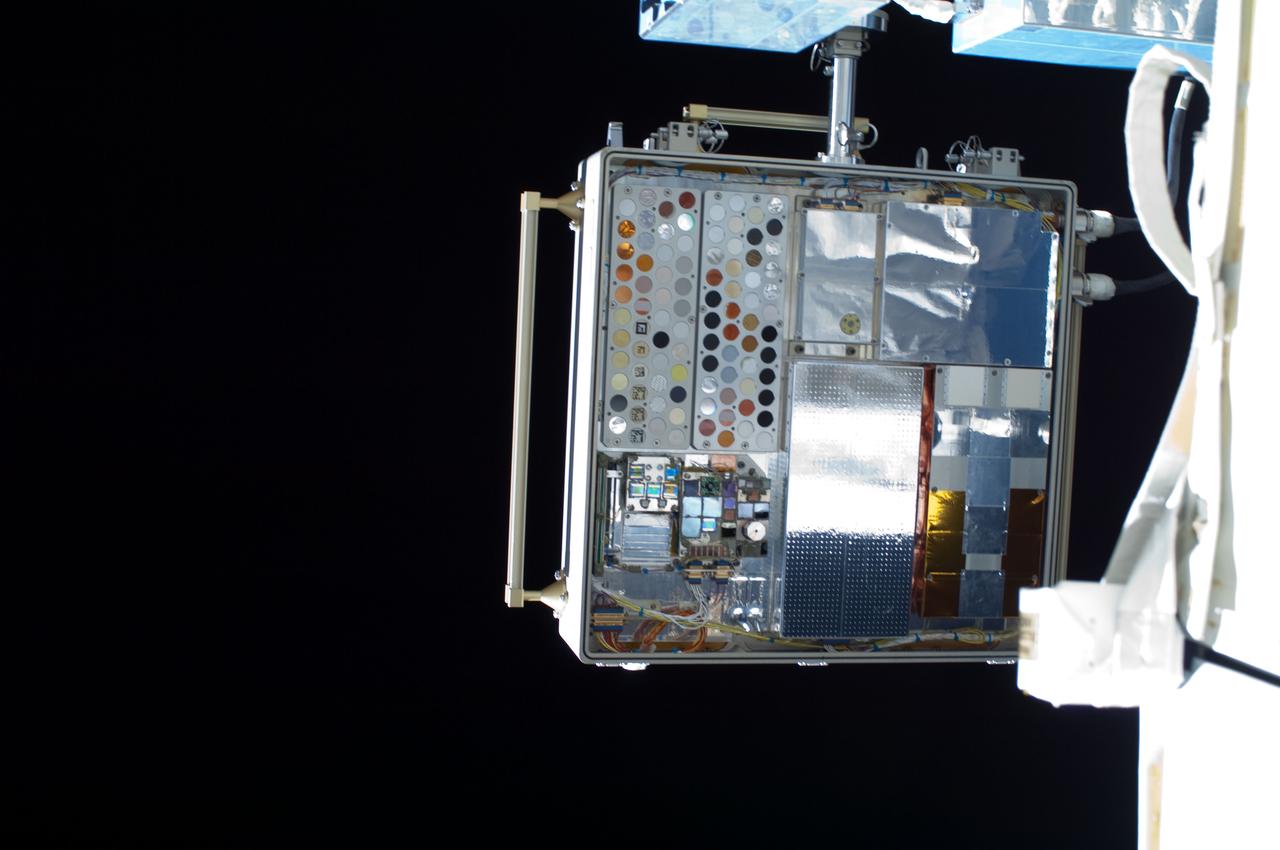
ISS028-E-016107 (12 July 2011) --- This medium close-up image, recorded during a July 12 spacewalk, shows the Materials on International Space Station Experiment - 8 (MISSE-8). The experiment package is a test bed for materials and computing elements attached to the outside of the orbiting complex. These materials and computing elements are being evaluated for the effects of atomic oxygen, ultraviolet, direct sunlight, radiation, and extremes of heat and cold. This experiment allows the development and testing of new materials and computing elements that can better withstand the rigors of space environments. Results will provide a better understanding of the durability of various materials and computing elements when they are exposed to the space environment, with applications in the design of future spacecraft.
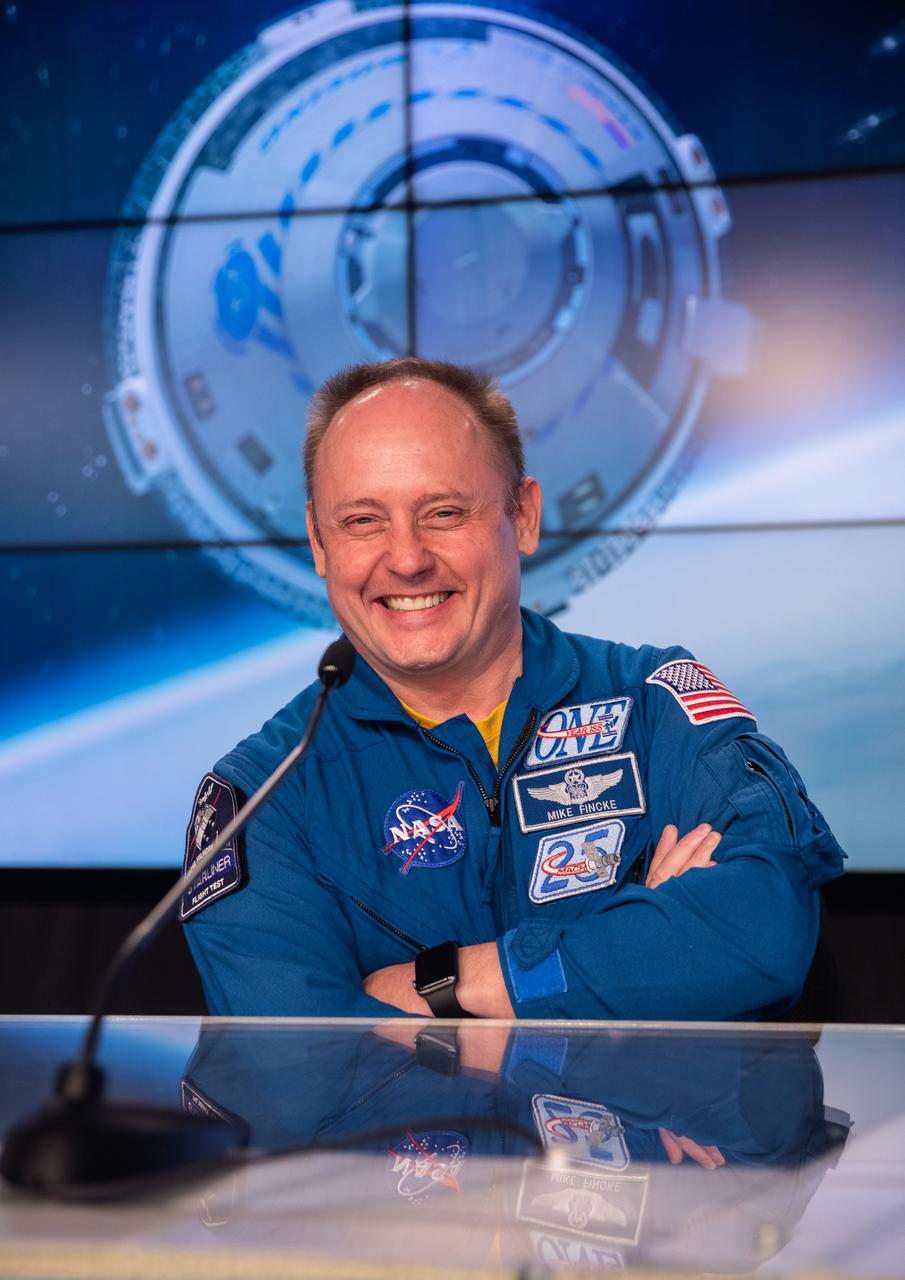
E. Michael “Mike” Fincke, NASA astronaut, Crew Flight Test, participates in a crew and science media briefing ahead of Boeing’s Orbital Flight Test-2 (OFT-2) during a crew and science briefing at the agency’s Kennedy Space Center in Florida, July 29, 2021. Boeing’s CST-100 Starliner spacecraft will launch atop a United Launch Alliance Atlas V rocket from Space Launch Complex-41 at Cape Canaveral Space Force Station. The uncrewed OFT-2 will be the Starliner’s second flight for NASA’s Commercial Crew Program.
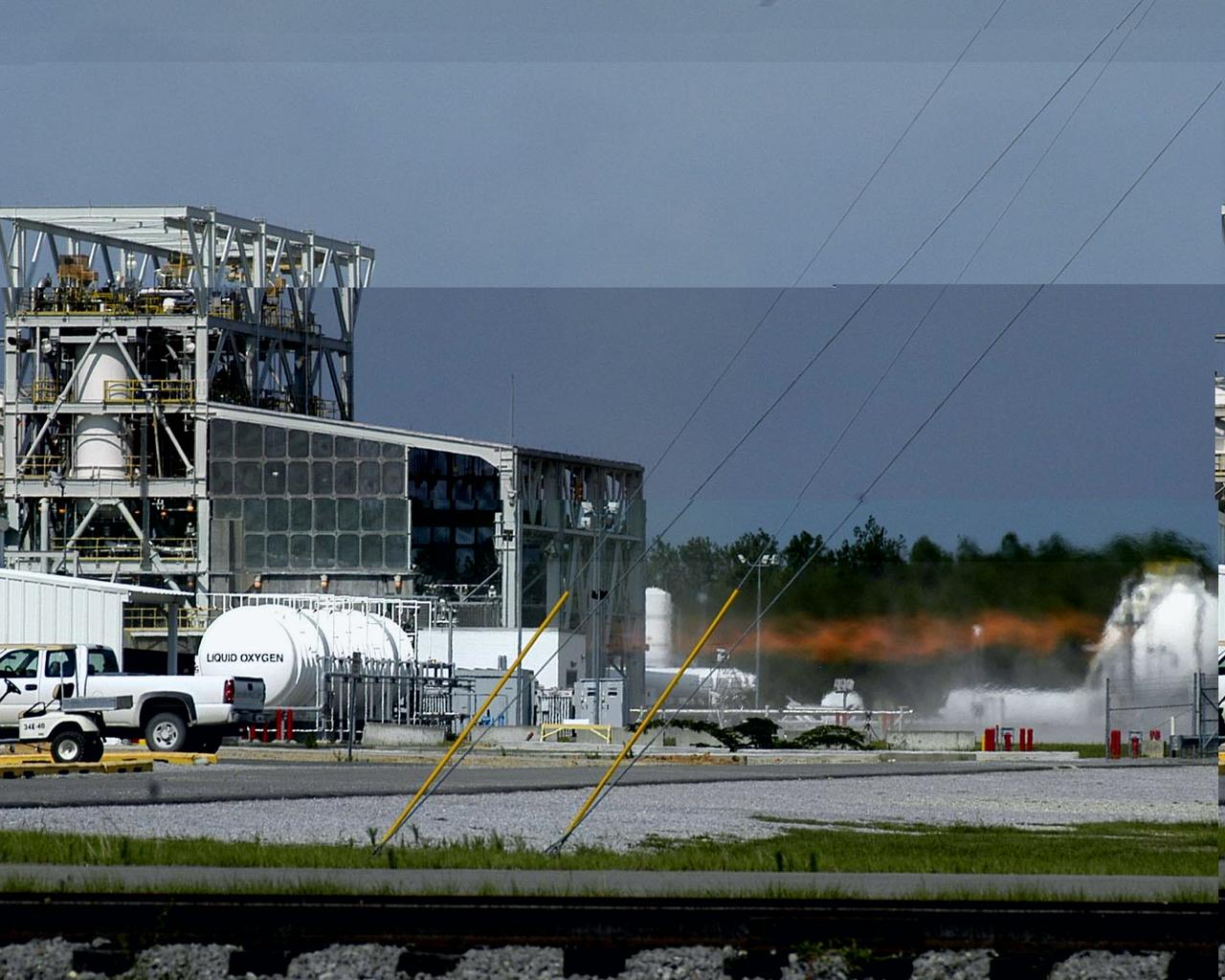
The Integrated Powerhead Demonstration engine was fired at 100 percent power for the first time July 12, 2006 at NASA Stennis Space Center's E Test Complex. The IPD, which can generate about 250,000 pounds of thrust, is a reusable engine system whose technologies could one day help Americans return to the moon, and travel to Mars and beyond. The IPD engine has been designed, developed and tested through the combined efforts of Pratt & Whitney Rocketdyne and Aerojet, under the direction of the Air Force Research Laboratory and NASA's Marshall Space Flight Center.
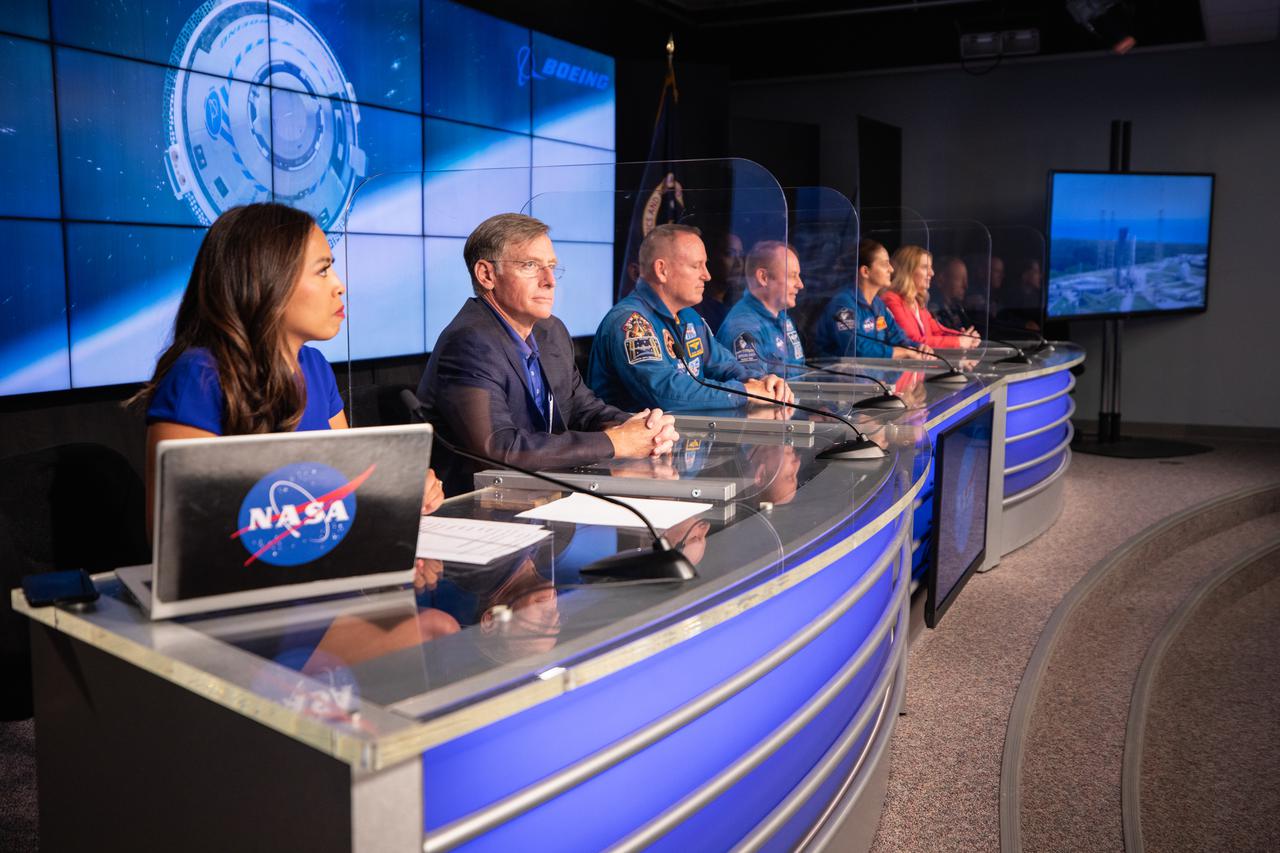
Officials from NASA participate in a crew and science media briefing ahead or Boeing’s Orbital Flight Test-2 (OFT-2) at the agency’s Kennedy Space Center in Florida, July 29, 2021. From left to right are Megan Cruz, NASA Communications; Chris Ferguson, director, Starliner Mission Operations and Integration/Crew Systems; Barry “Butch” Wilmore, NASA astronaut, Crew Flight Test; E. Michael “Mike” Fincke, NASA astronaut, Crew Flight Test; Nicole Mann, NASA astronaut, Crew Flight Test; Jennifer Buchli, deputy chief scientist, NASA’s International Space Station Program. Boeing’s CST-100 Starliner spacecraft will launch atop a ULA Atlas V rocket from Space Launch Complex-41 at Cape Canaveral Space Force Station on a mission to dock with the space station. The uncrewed OFT-2 will be the Starliner’s second flight for NASA’s Commercial Crew Program.
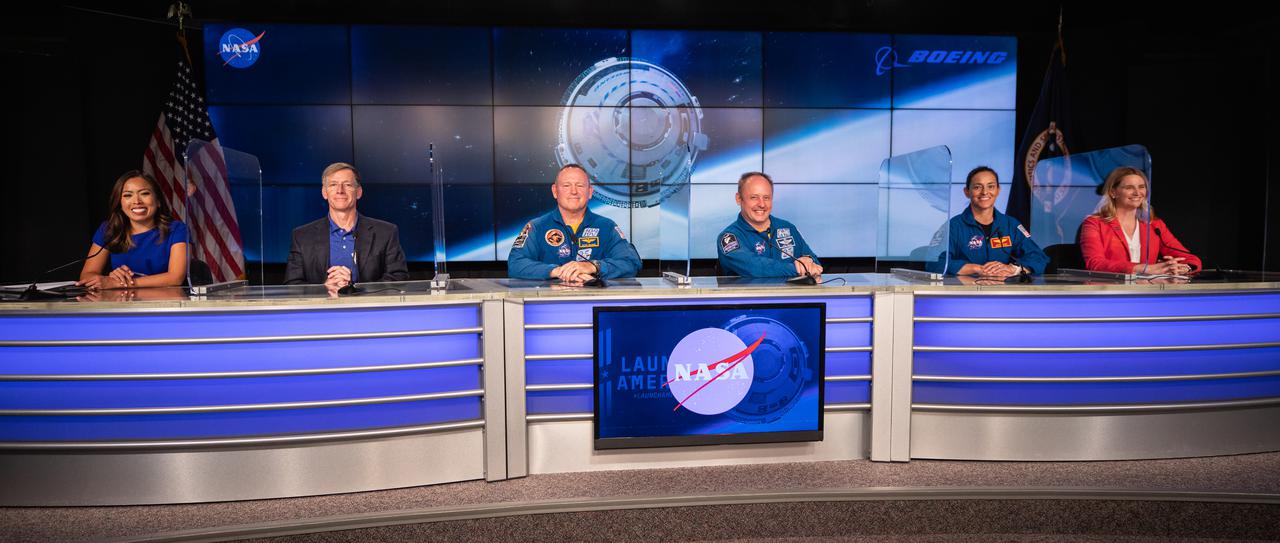
Officials from NASA participate in a crew and science media briefing ahead or Boeing’s Orbital Flight Test-2 (OFT-2) at the agency’s Kennedy Space Center in Florida, July 29, 2021. From left to right are Megan Cruz, NASA Communications; Chris Ferguson, director, Starliner Mission Operations and Integration/Crew Systems; Barry “Butch” Wilmore, NASA astronaut, Crew Flight Test; E. Michael “Mike” Fincke, NASA astronaut, Crew Flight Test; Nicole Mann, NASA astronaut, Crew Flight Test; Jennifer Buchli, deputy chief scientist, NASA’s International Space Station Program. Boeing’s CST-100 Starliner spacecraft will launch atop a ULA Atlas V rocket from Space Launch Complex-41 at Cape Canaveral Space Force Station on a mission to dock with the space station. The uncrewed OFT-2 will be the Starliner’s second flight for NASA’s Commercial Crew Program.
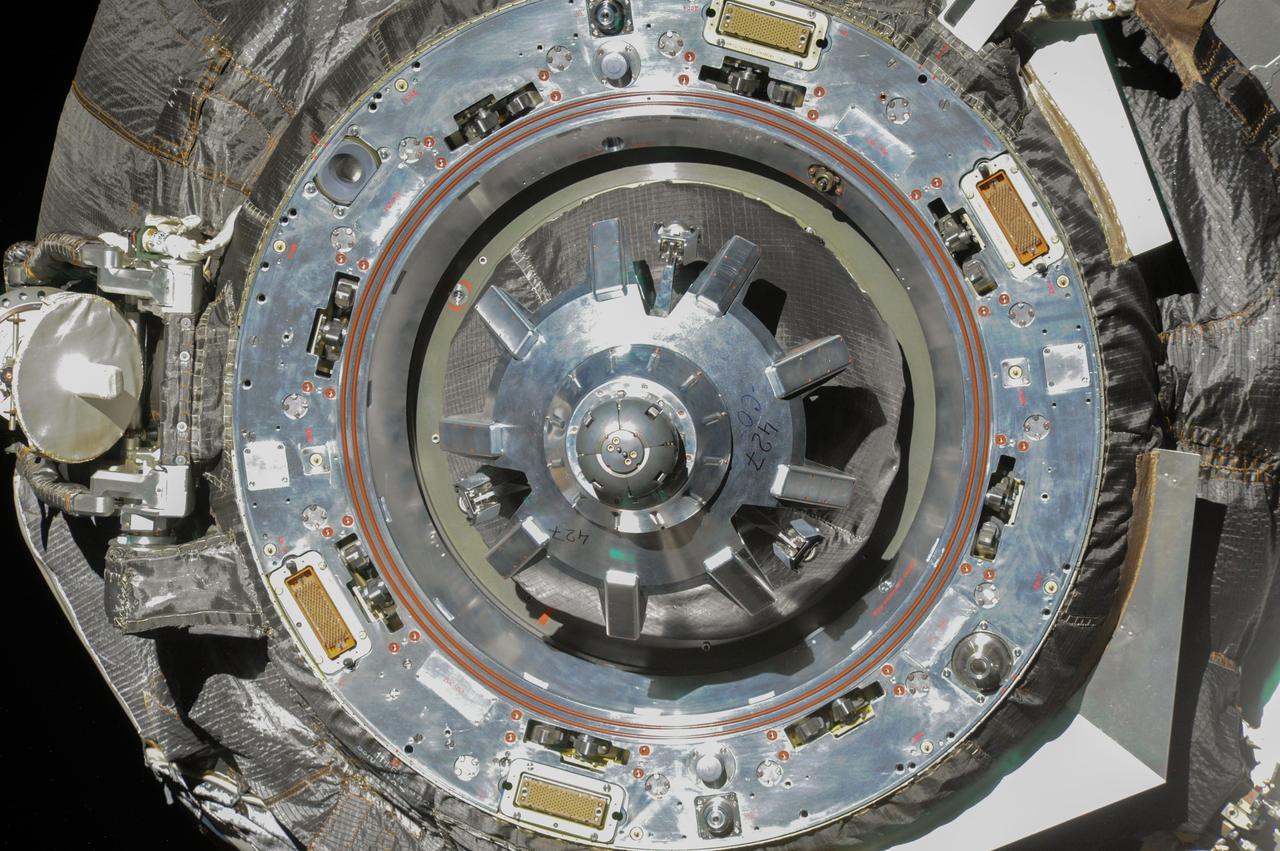
ISS040-E-070868 (21 July 2014) --- This close-up view shows the docking mechanism of the unpiloted Russian ISS Progress 55 resupply ship as it undocks from the International Space Station's Pirs Docking Compartment at 5:44 p.m. (EDT) on July 21, 2014 after spending more than three months at the orbiting complex. After undocking, the Progress moved to a safe distance away from the station for 10 days of engineering tests before it is deorbited on July 31. Filled with trash and station discards, Progress 55 will burn up as it re-enters Earth?s atmosphere over the Pacific Ocean.

In the White Room, Mission Specialists Scott E. Parazynski (left) and Umberto Guidoni (right) help Yuri V. Lonchakov exit Endeavour. They and the rest of the crew are taking part in Terminal Countdown Demonstration Test activities that include emergency escape training at the pad and the simulated launch countdown. The mission is carrying the Multi-Purpose Logistics Module Raffaello and the SSRMS, to the International Space Station. Raffaello carries six system racks and two storage racks for the U.S. Lab. The SSRMS is crucial to the continued assembly of the orbiting complex. Launch of mission STS-100 is scheduled for April 19 at 2:41 p.m. EDT from Launch Pad 39A
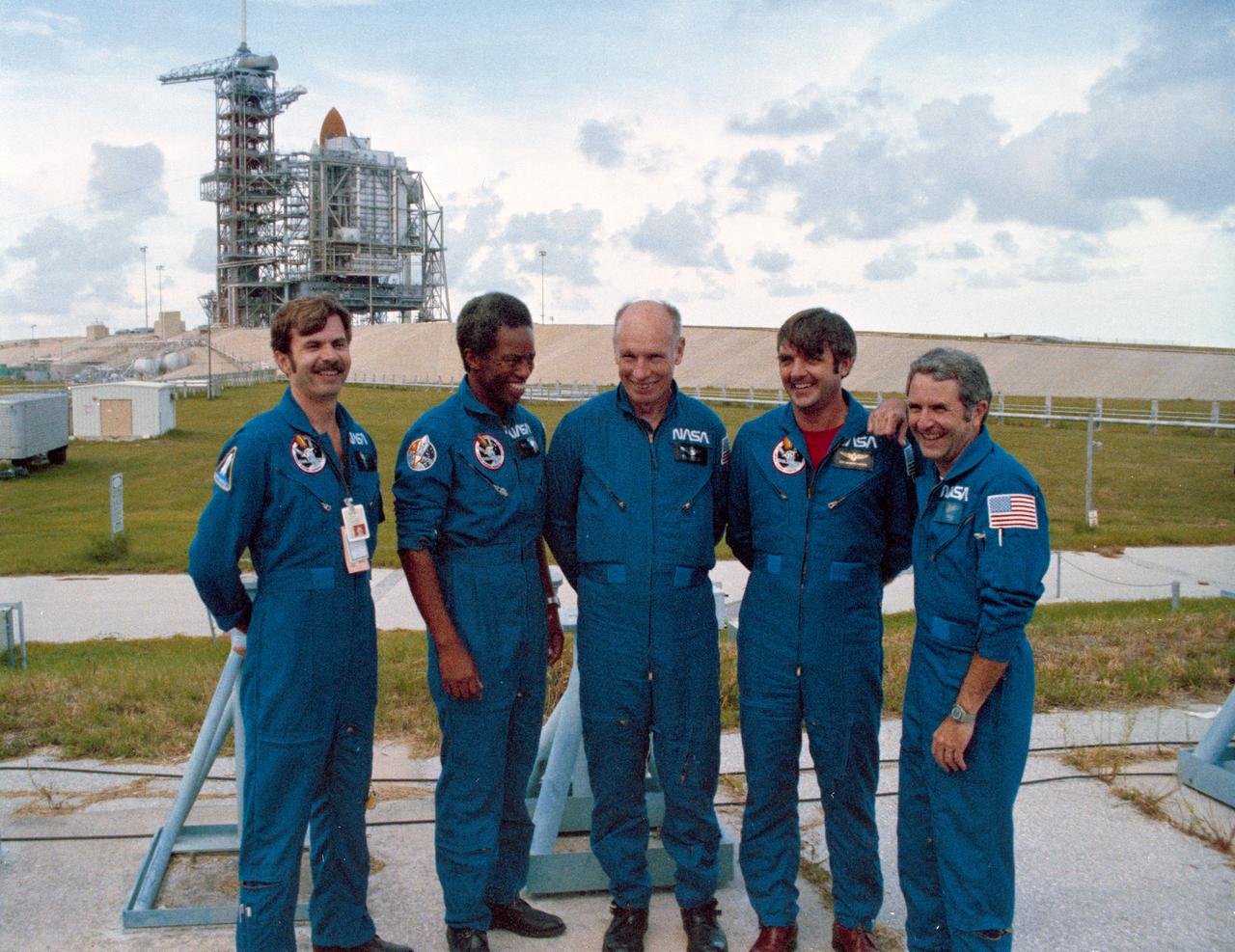
S83-38389 (6 Aug. 1983) --- The STS-8 crew members pause for a crew photo at Pad 39A after a question and answer session with the press. They were about to participate in the STS-8 countdown demonstration test. They will repeat many of their measures on Aug. 30 when they are scheduled to lift off aboard the space shuttle Challenger. From left to right are astronauts Dale A. Gardner, Guion S. Bluford, Dr. William E. Thornton, all mission specialists; Daniel C. Brandenstein, pilot; and Richard F. Truly, commander. The Challenger is in the background at complex 39.
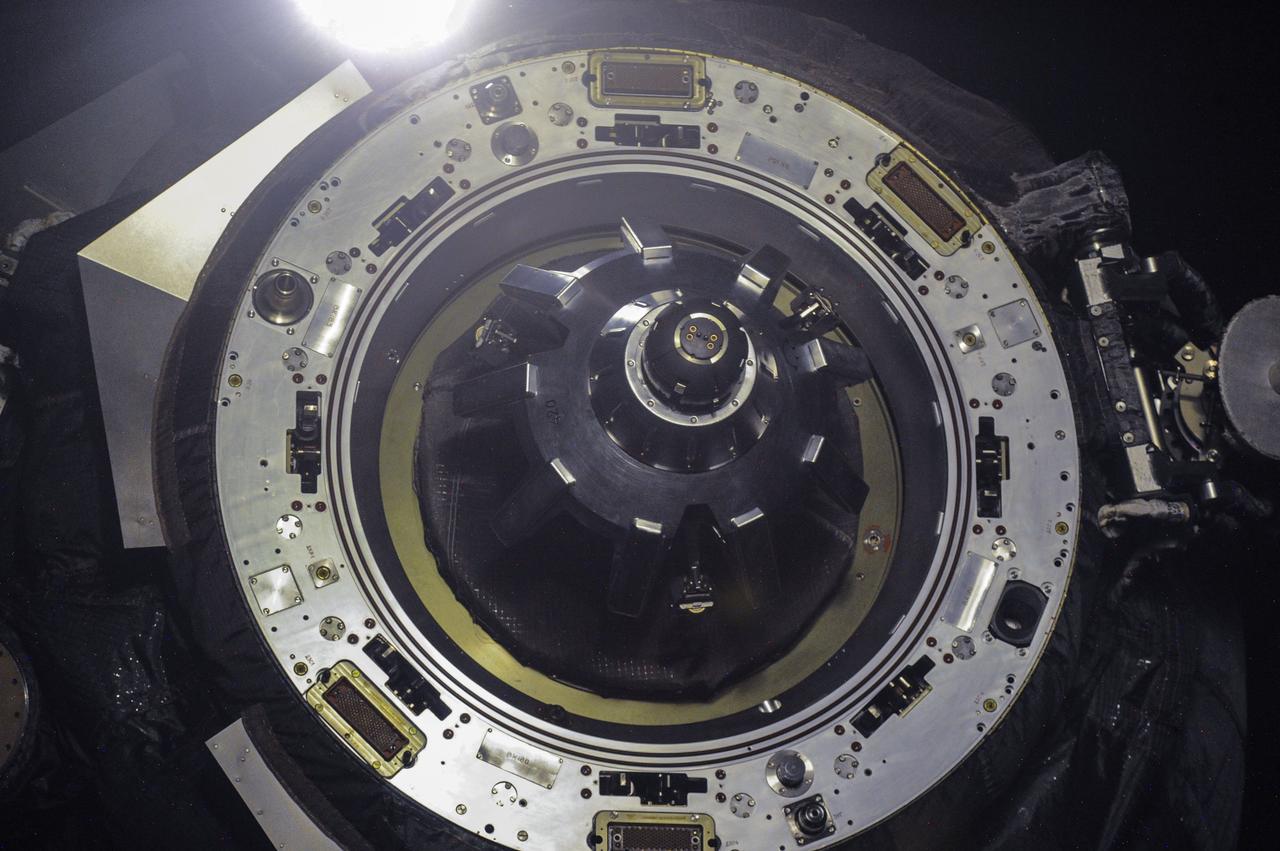
ISS038-E-041175 (3 Feb. 2014) --- This close-up view shows the docking mechanism of the unpiloted Russian ISS Progress 52 resupply ship as it undocks from the International Space Station's Pirs Docking Compartment at 11:21 a.m. (EST) on Feb. 3, 2014. The Progress backed away to a safe distance from the orbital complex to begin several days of tests to study thermal effects of space on its attitude control system. Filled with trash and other unneeded items, the Russian resupply ship will be commanded to re-enter Earth's atmosphere Feb. 11 and disintegrate harmlessly over the Pacific Ocean.
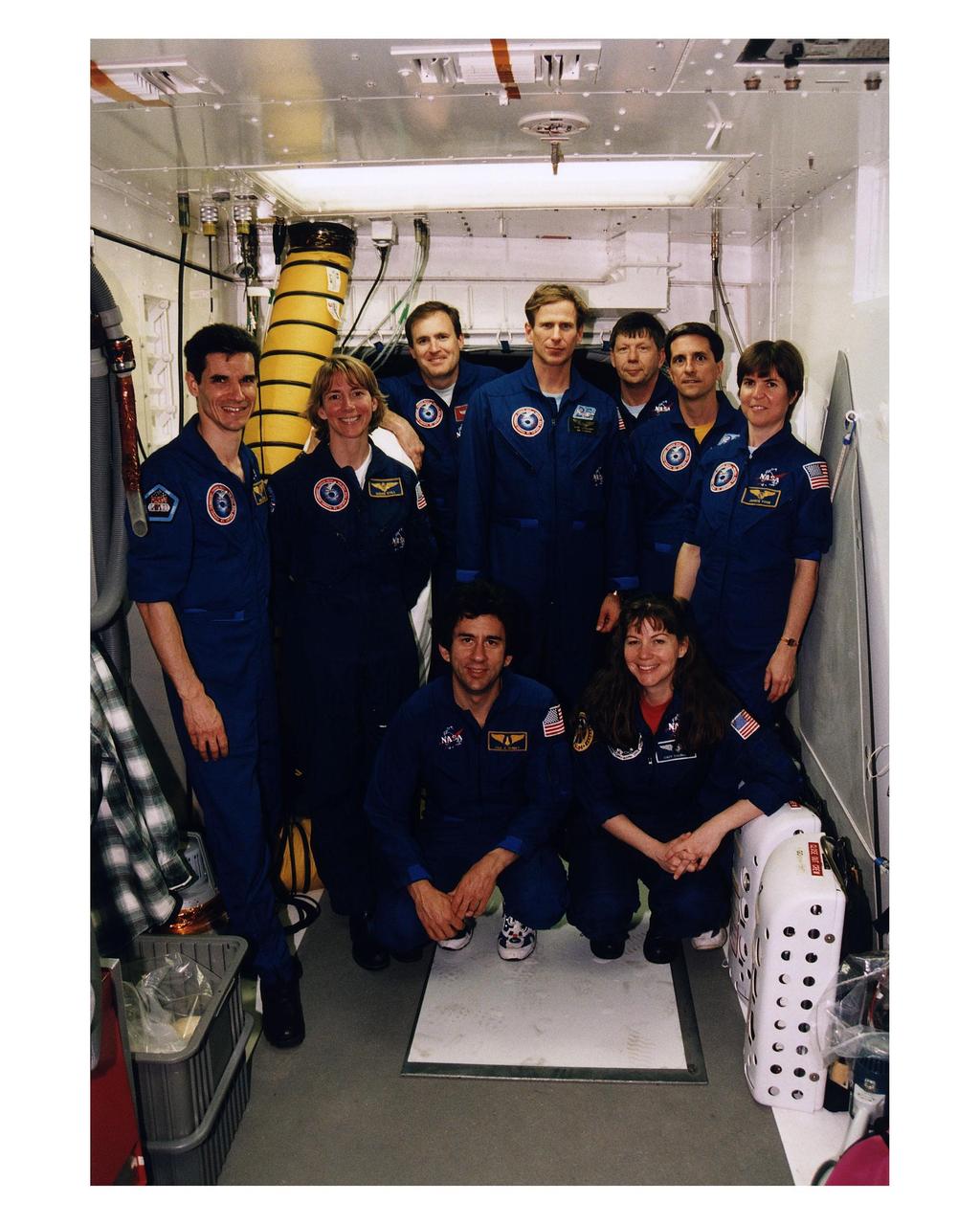
The STS-83 crew poses in the White Room at Launch Complex 39A during the crew's <a href="http://www-pao.ksc.nasa.gov/kscpao/release/1997/40-97.htm">Terminal Countdown Demonstration Test (TCDT).</a> From left to right, standing, they are Payload Specialist Gregory T. Linteris, Pilot Susan L. Still, Mission Commander James D. Halsell, Mission Specialist Michael L. Gernhardt, Payload Specialist Roger K. Crouch, and Mission Specialists Donald Thomas and Janice E. Voss. Cady Coleman, the backup Mission Specialist for Donald Thomas, is kneeling on the right
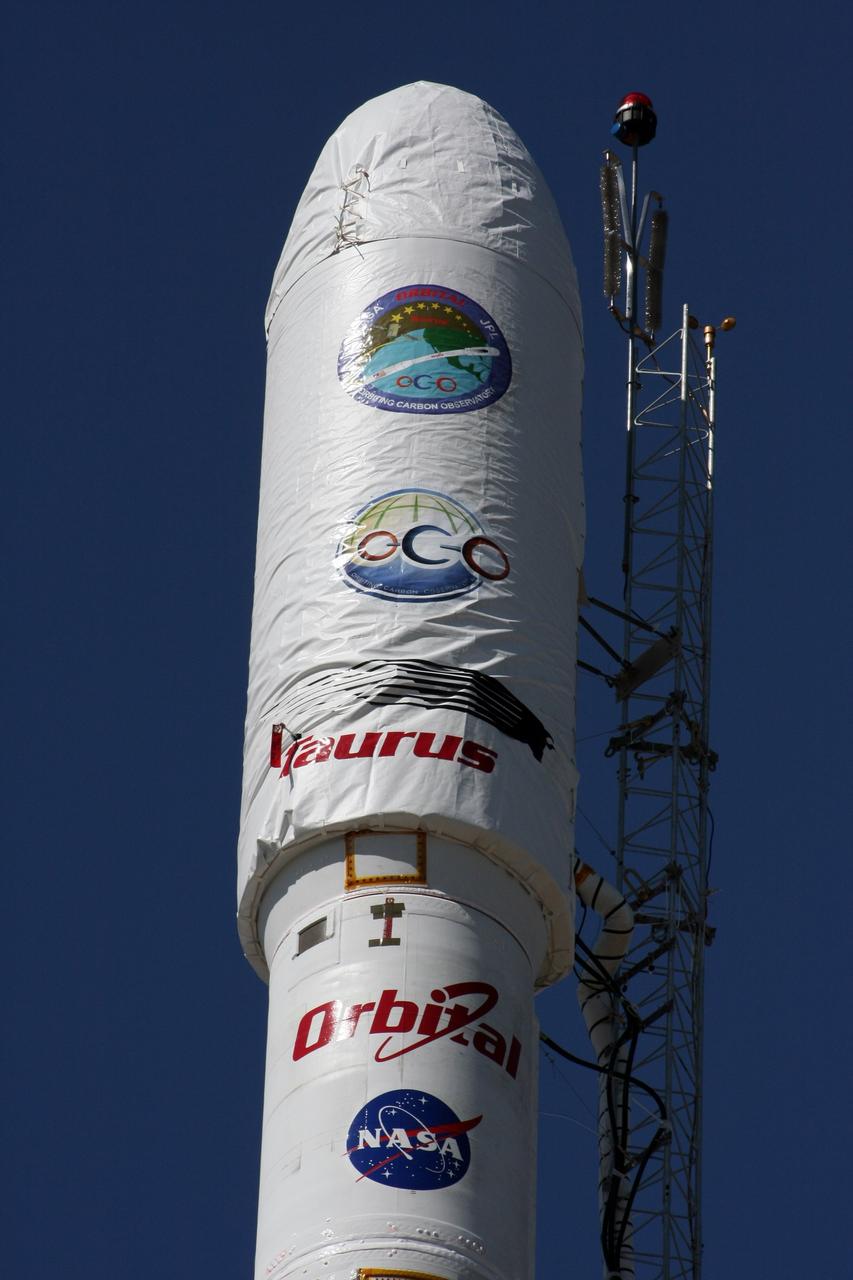
VANDENBERG AIR FORCE BASE, Calif. -- On Launch Complex 576-E at Vandenberg Air Force Base in California, NASA's Orbiting Carbon Observatory, or OCO, spacecraft awaits a GN2 instrument purge flow test in preparation for launch Feb. 24. The spacecraft sits atop Orbital Sciences' Taurus XL rocket. At right is a portion of the umbilical tower attached to the upper stack. The spacecraft will collect precise global measurements of carbon dioxide (CO2) in the Earth's atmosphere. Scientists will analyze OCO data to improve our understanding of the natural processes and human activities that regulate the abundance and distribution of this important greenhouse gas. Photo courtesy of Jim Stowers, Orbital Sciences
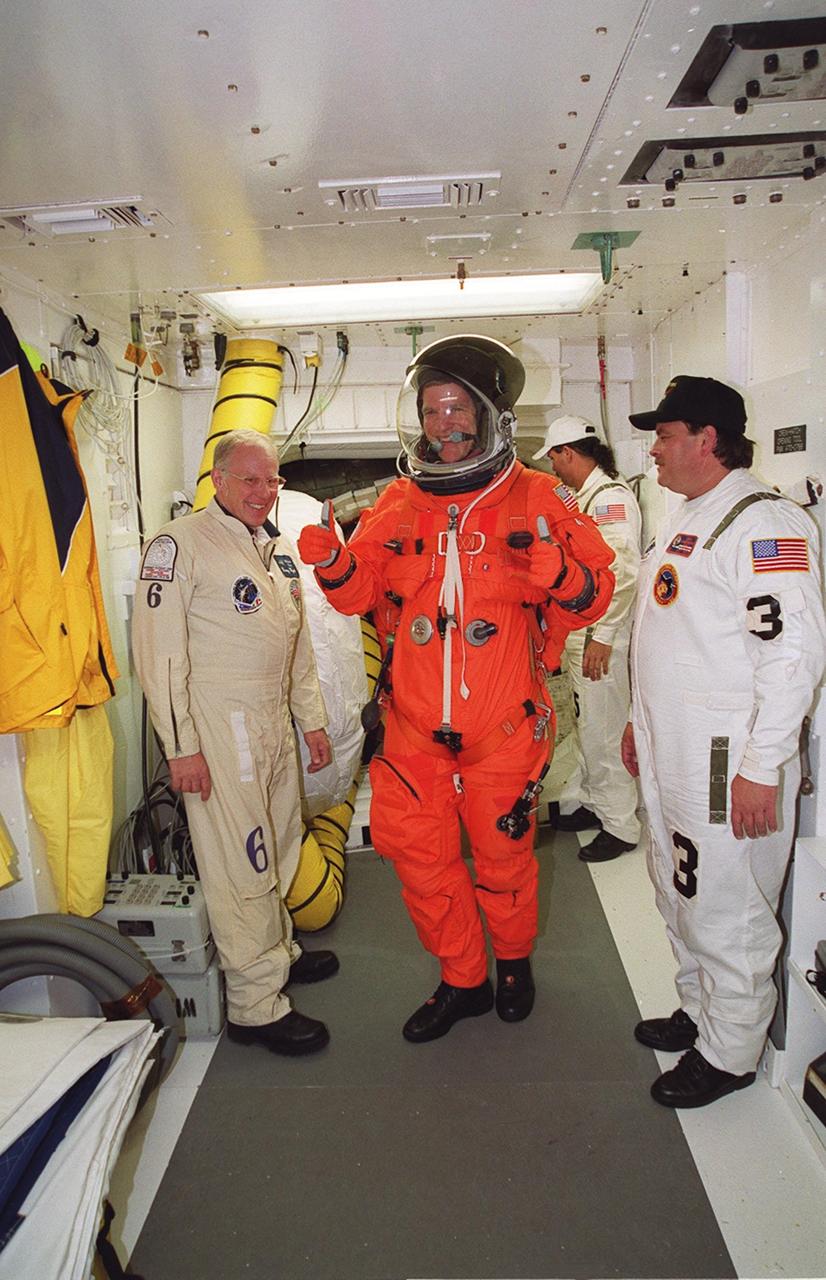
STS-100 Mission Specialist Scott E. Parazynski walks through the White Room after exiting Endeavour. He and the rest of the crew are taking part in Terminal Countdown Demonstration Test activities that include emergency escape training at the pad and the simulated launch countdown. The mission is carrying the Multi-Purpose Logistics Module Raffaello and the SSRMS, to the International Space Station. Raffaello carries six system racks and two storage racks for the U.S. Lab. The SSRMS is crucial to the continued assembly of the orbiting complex. Launch of mission STS-100 is scheduled for April 19 at 2:41 p.m. EDT from Launch Pad 39A
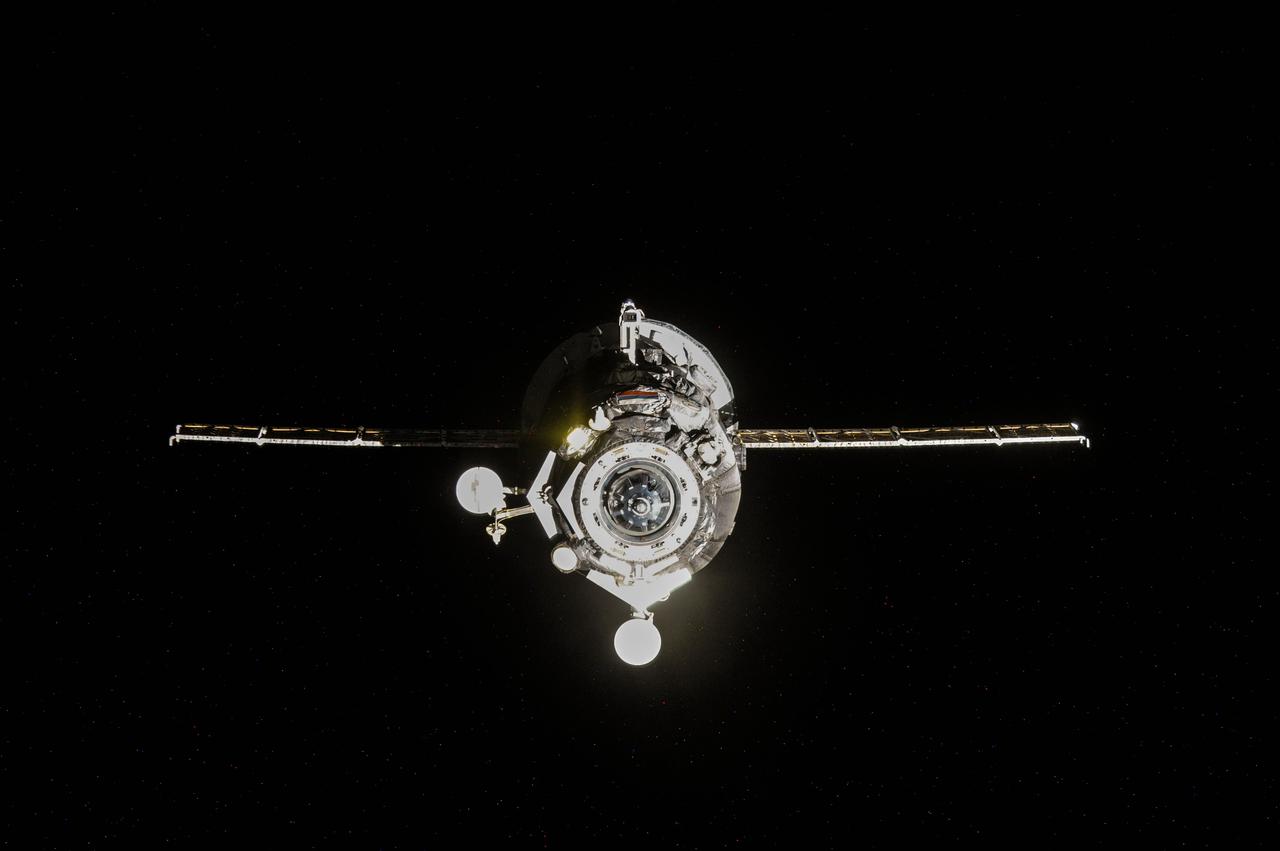
ISS040-E-070870 (21 July 2014) --- The unpiloted Russian ISS Progress 55 resupply ship undocks from the International Space Station's Pirs Docking Compartment at 5:44 p.m. (EDT) on July 21, 2014 after spending more than three months at the orbiting complex. After undocking, the Progress moved to a safe distance away from the station for 10 days of engineering tests before it is deorbited on July 31. Filled with trash and station discards, Progress 55 will burn up as it re-enters Earth?s atmosphere over the Pacific Ocean.
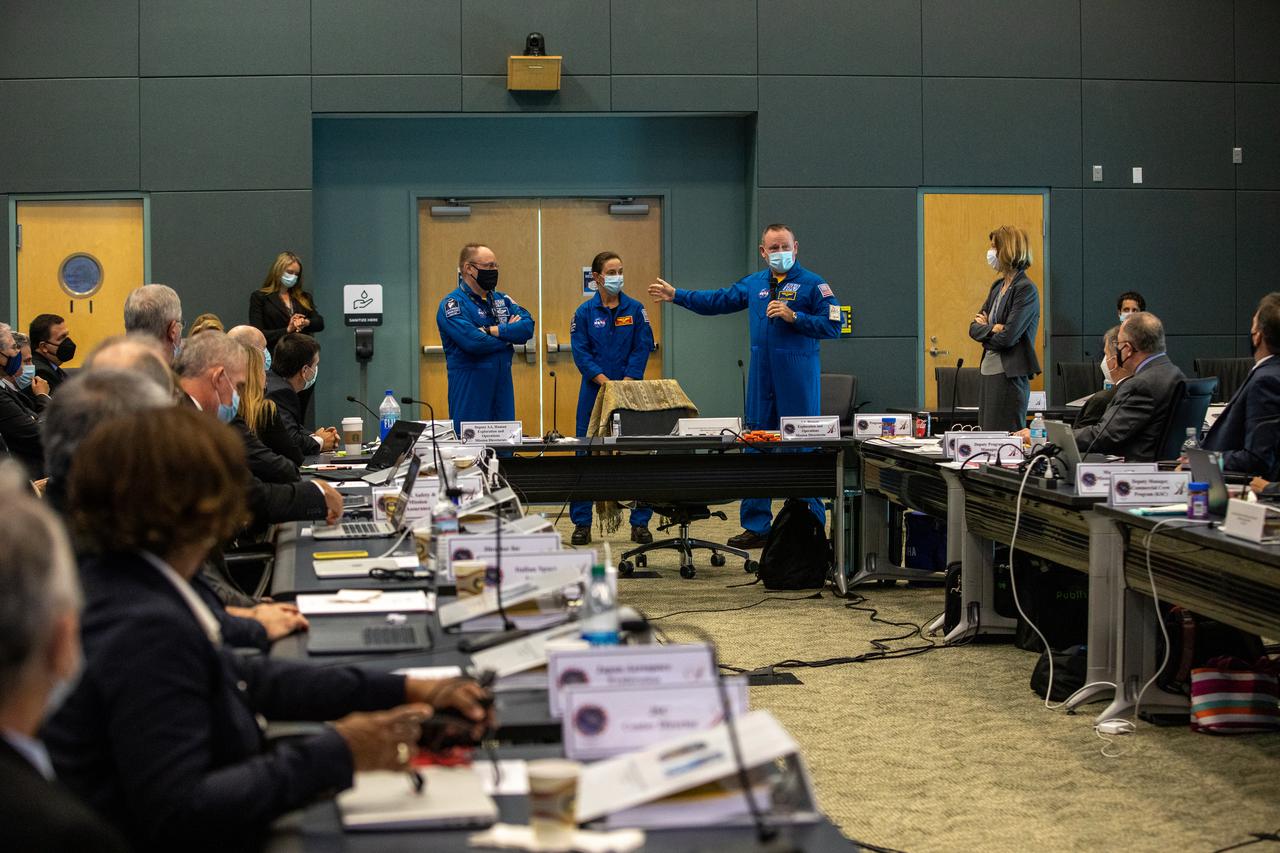
As part of the Flight Readiness Review for Boeing's uncrewed Orbital Flight Test-2 (OFT-2), NASA astronauts for Boeing’s Crew Flight Test (CFT), Commander Barry “Butch” Wilmore, Pilot Nicole Mann, and Joint Ops Commander E. Michael “Mike” Fincke address NASA and Boeing managers in Operations Support Building 2 at NASA's Kennedy Space Center in Florida, July 22, 2021. Boeing's CST-100 Starliner spacecraft will launch atop a United Launch Alliance Atlas V rocket from Space Launch Complex 41 at Cape Canaveral Space Force Station at 2:53 p.m. EDT Friday, July 30. The uncrewed OFT-2 will be the Starliner's second flight to the International Space Station for NASA's Commercial Crew Program. CFT is currently targeted for late 2021.
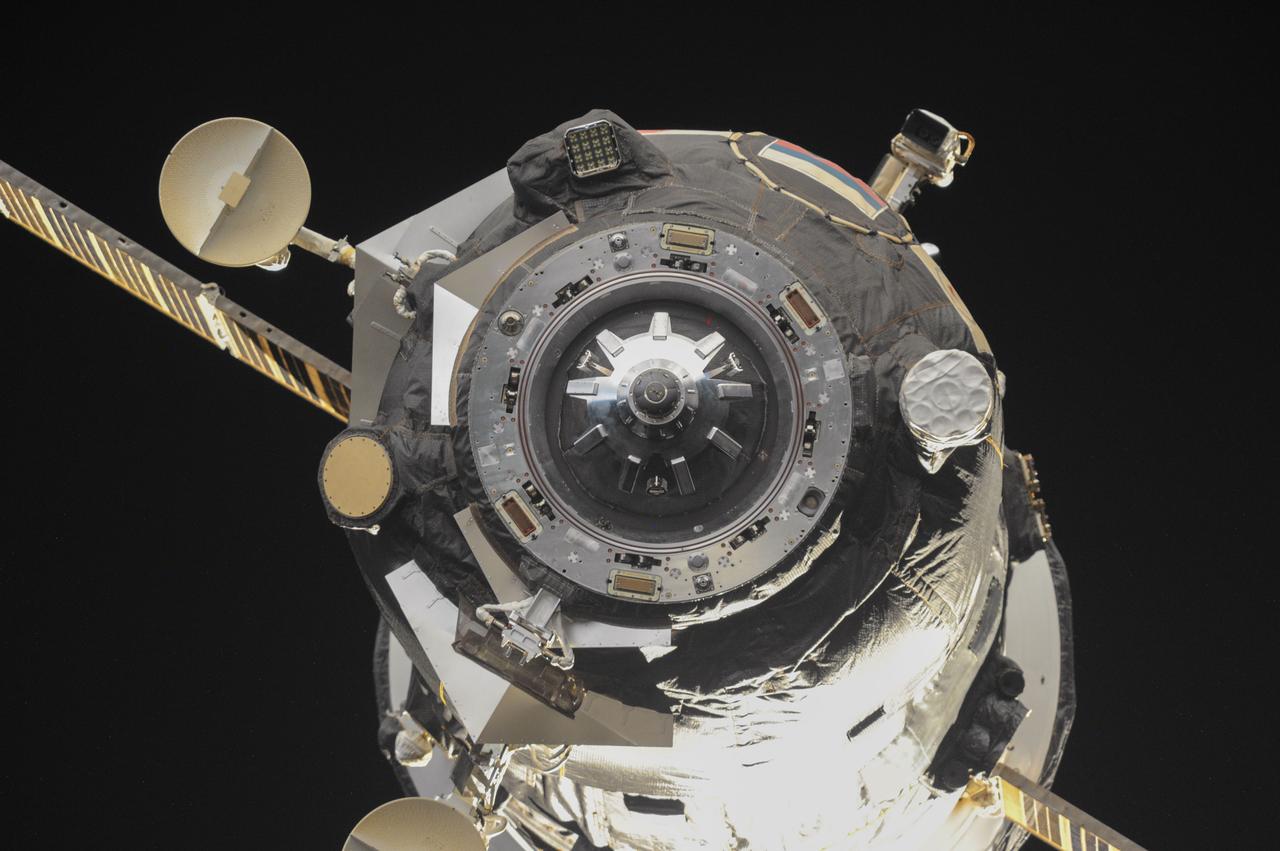
ISS039-E-014672 (23 April 2014) --- The unpiloted Progress 53 cargo ship undocks from the aft port of the Zvezda service module at 3:58 a.m. (CDT) on April 23 and begins its relative separation from the International Space Station for tests on its upgraded Kurs automated rendezvous system that were delayed from last November. The Russian resupply vehicle will move to a distance of some 300 miles from the complex before it begins to phase back in, testing the Kurs-NA rendezvous hardware and its associated software. The enhanced Kurs system will be incorporated into future Progress vehicles to reduce weight by eliminating several navigational antennas, thus enabling the Progress to carry additional supplies to the station. The Progress is scheduled to redock to Zvezda around 7:15 a.m. (CDT) April 25.
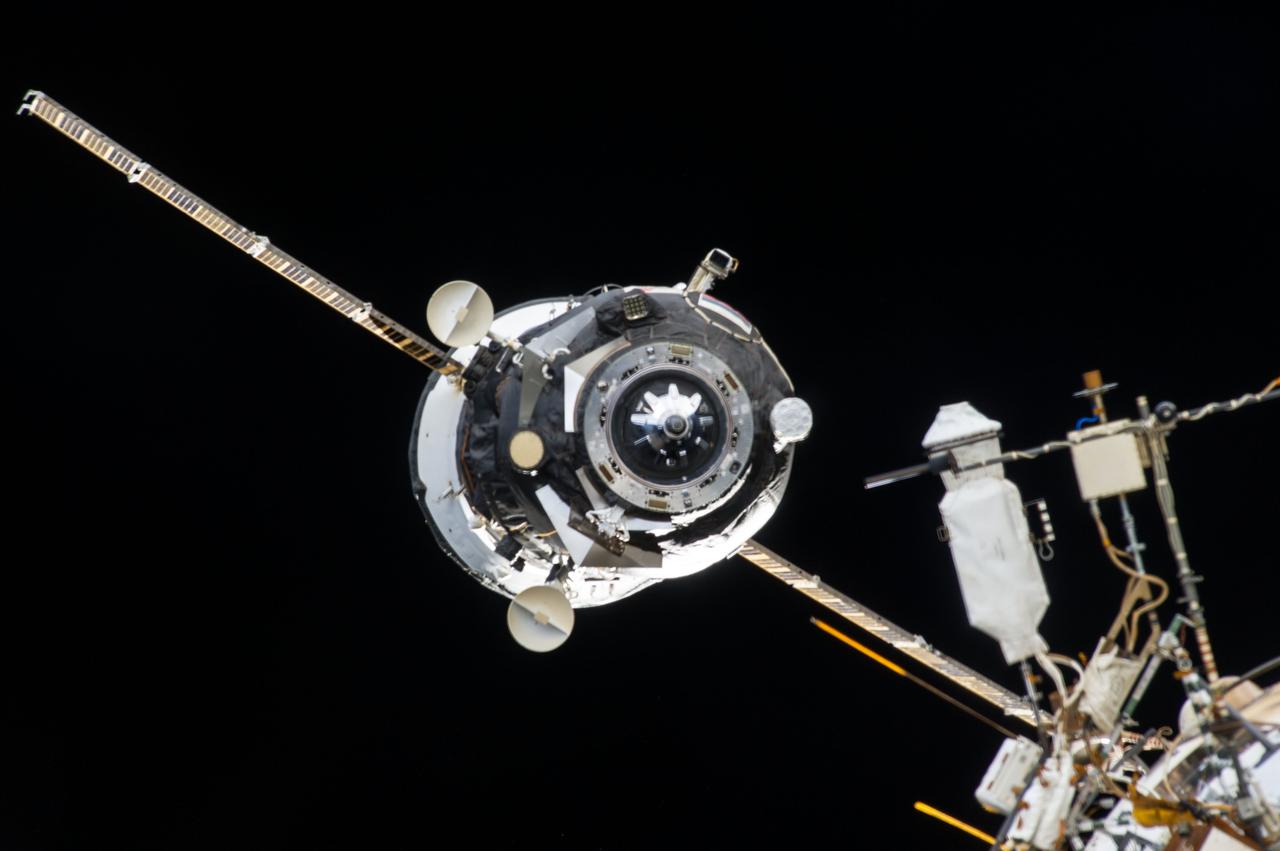
ISS039-E-016869 (23 April 2014) --- The unpiloted Progress 53 cargo ship undocks from the aft port of the Zvezda service module at 3:58 a.m. (CDT) on April 23 and begins its relative separation from the International Space Station for tests on its upgraded Kurs automated rendezvous system that were delayed from last November. The Russian resupply vehicle will move to a distance of some 300 miles from the complex before it begins to phase back in, testing the Kurs-NA rendezvous hardware and its associated software. The enhanced Kurs system will be incorporated into future Progress vehicles to reduce weight by eliminating several navigational antennas, thus enabling the Progress to carry additional supplies to the station. The Progress is scheduled to redock to Zvezda around 7:15 a.m. (CDT) April 25.

The STS-100 crew gathers with the Space Station Processing Facility people who worked on the Canadian robotic arm, SSRMS. Kneeling at left is Commander Kent V. Rominger; front and ceneter, from left, Mission Specialist Chris Hadfield, Pilot Jeffrey S. Ashby and Mission Specialists Yuri V. Lonchakov and John L. Phillips; behind Hadfield (a head above the others) is Mission Specialist Scott E. Parazynski. The crew is at KSC for Terminal Countdown Demonstration Test activities that include emergency escape training at the pad and a simulated launch countdown. The mission is carrying the Multi-Purpose Logistics Module Raffaello and the SSRMS, to the International Space Station. Raffaello carries six system racks and two storage racks for the U.S. Lab. The SSRMS is crucial to the continued assembly of the orbiting complex. Launch of mission STS-100 is scheduled for April 19 at 2:41 p.m. EDT from Launch Pad 39A
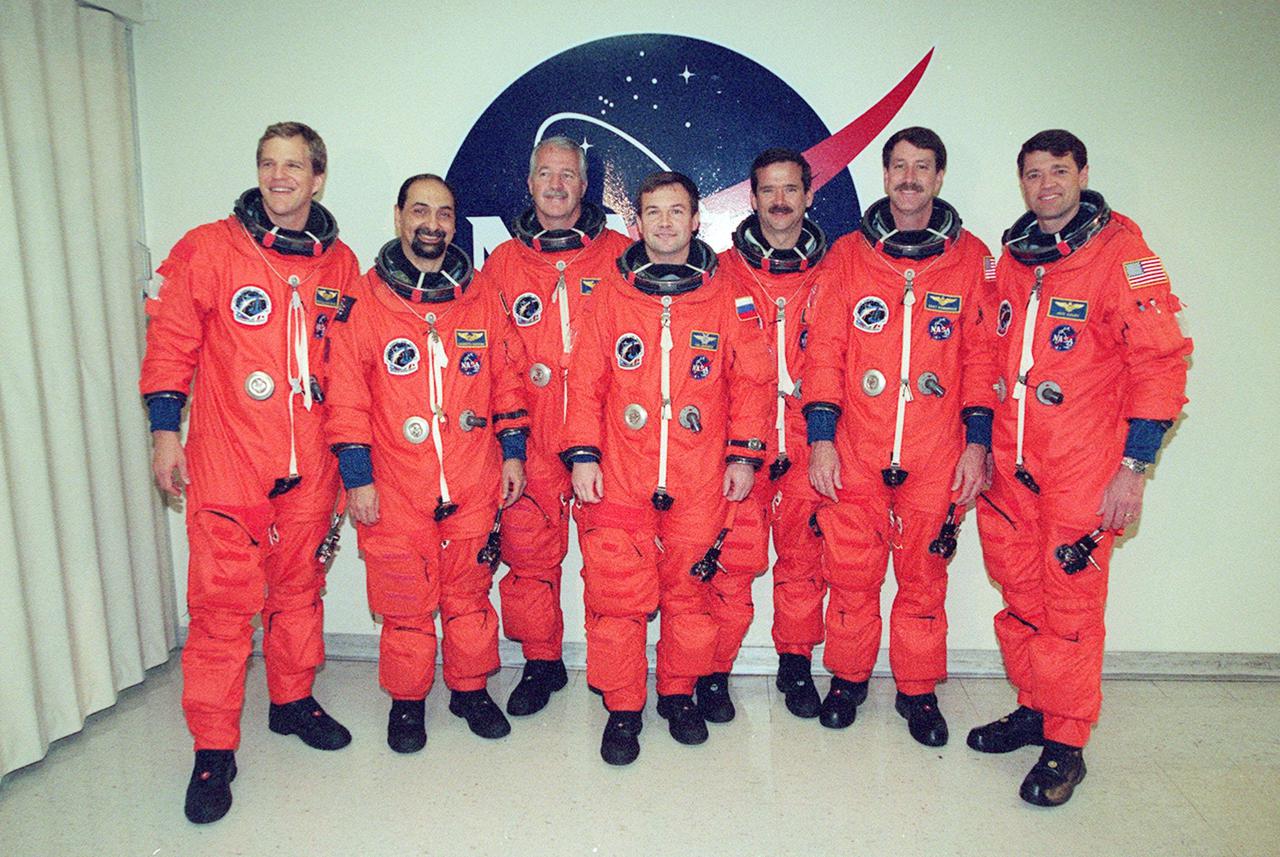
The STS-100 crew pauses for a photo before walkout and the ride to Launch Pad 39A for a simulated countdown. Standing, from left, are Mission Specialists Scott E. Parazynski, Umberto Guidoni, John L. Phillips, Yuri V. Lonchakov and Chris A. Hadfield; Commander Kent V. Rominger; and Pilot Jeffrey S. Ashby. The STS-100 crew is at KSC for Terminal Countdown Demonstration Test activities that include emergency escape training at the pad and the simulated launch countdown. The mission is carrying the Multi-Purpose Logistics Module Raffaello and the SSRMS, to the International Space Station. Raffaello carries six system racks and two storage racks for the U.S. Lab. The SSRMS is crucial to the continued assembly of the orbiting complex. Launch of mission STS-100 is scheduled for April 19 at 2:41 p.m. EDT from Launch Pad 39A
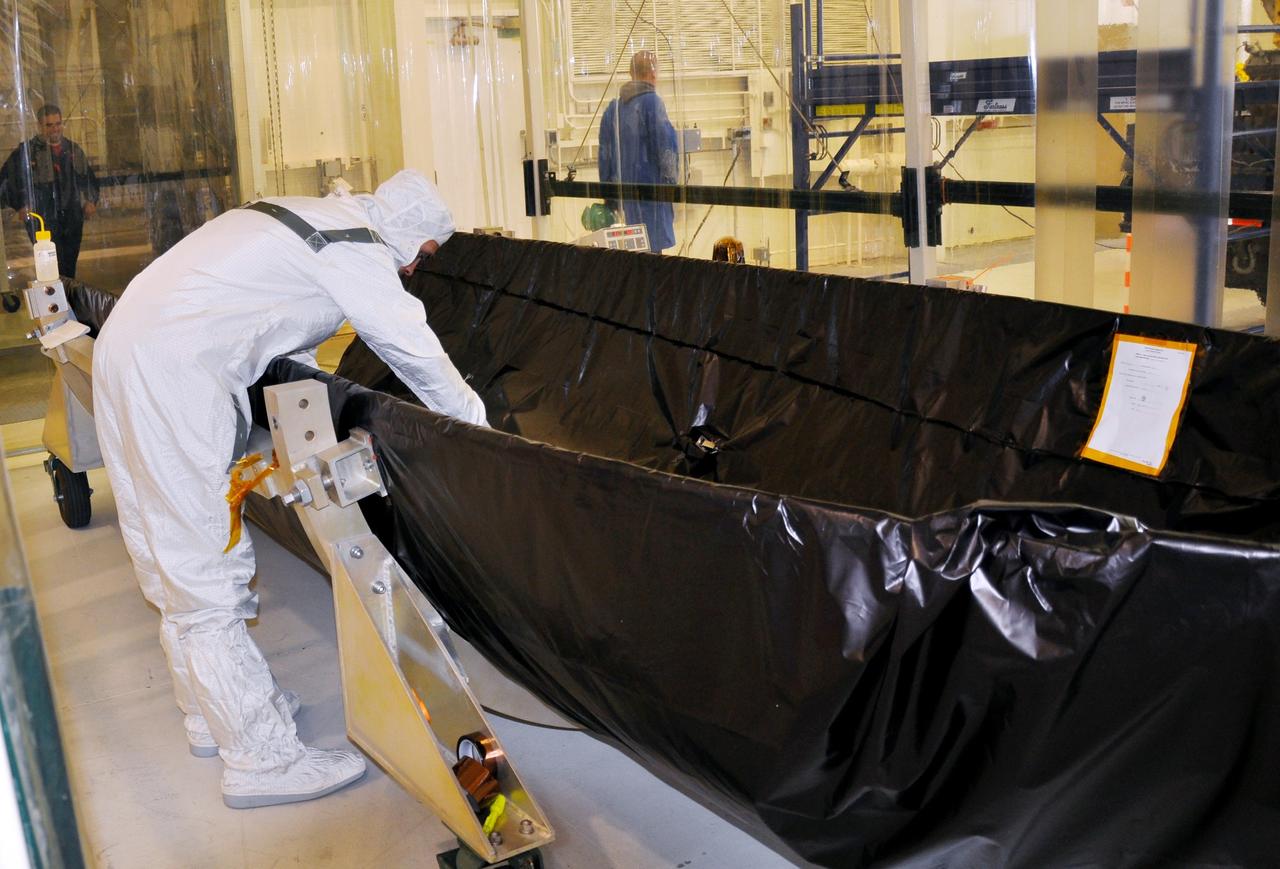
VANDENBERG AIR FORCE BASE, Calif. – At Vandenberg Air Force Base in California, a technician performs a wide-band instrumentation system test on half of the fairing that will encapsulate NASA's Glory satellite during launch aboard a Taurus XL rocket. The black protective covering will be removed so that the fairing half can be thoroughly cleaned before it is installed around the spacecraft. The four-stage rocket and satellite are being prepared for a launch to low Earth orbit from Vandenberg's Space Launch Complex 576-E. Once Glory reaches orbit, it will collect data on the properties of aerosols and black carbon. It also will help scientists understand how the sun's irradiance affects Earth's climate. Photo credit: NASA/Randy Beaudoin, VAFB
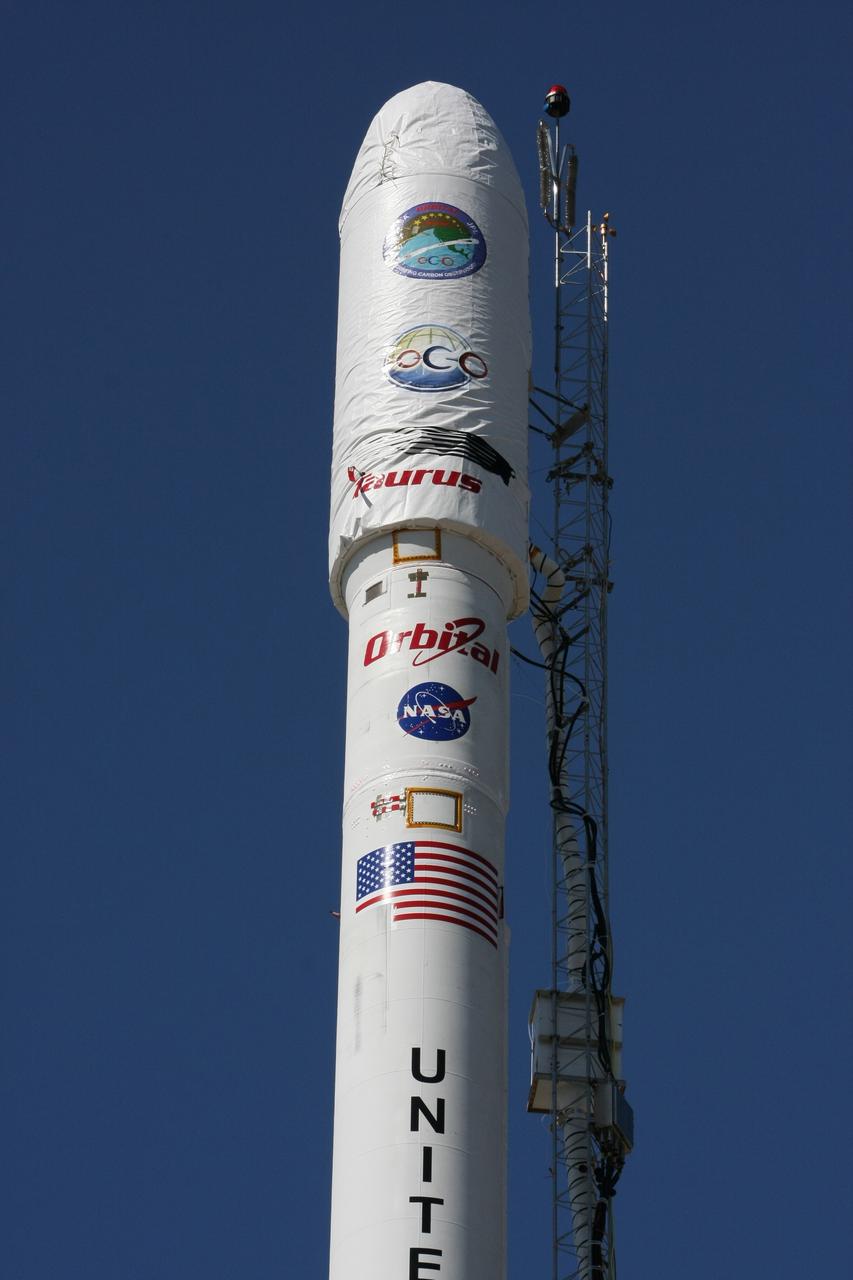
VANDENBERG AIR FORCE BASE, Calif. -- On Launch Complex 576-E at Vandenberg Air Force Base in California, NASA's Orbiting Carbon Observatory, or OCO, spacecraft awaits a GN2 instrument purge flow test in preparation for launch Feb. 24. The spacecraft sits atop Orbital Sciences' Taurus XL rocket. At right is a portion of the umbilical tower attached to the upper stack. The spacecraft sits atop Orbital Sciences' Taurus XL rocket. At right is a portion of the umbilical tower attached to the upper stack. The spacecraft will collect precise global measurements of carbon dioxide (CO2) in the Earth's atmosphere. Scientists will analyze OCO data to improve our understanding of the natural processes and human activities that regulate the abundance and distribution of this important greenhouse gas. Photo courtesy of Jim Stowers, Orbital Sciences
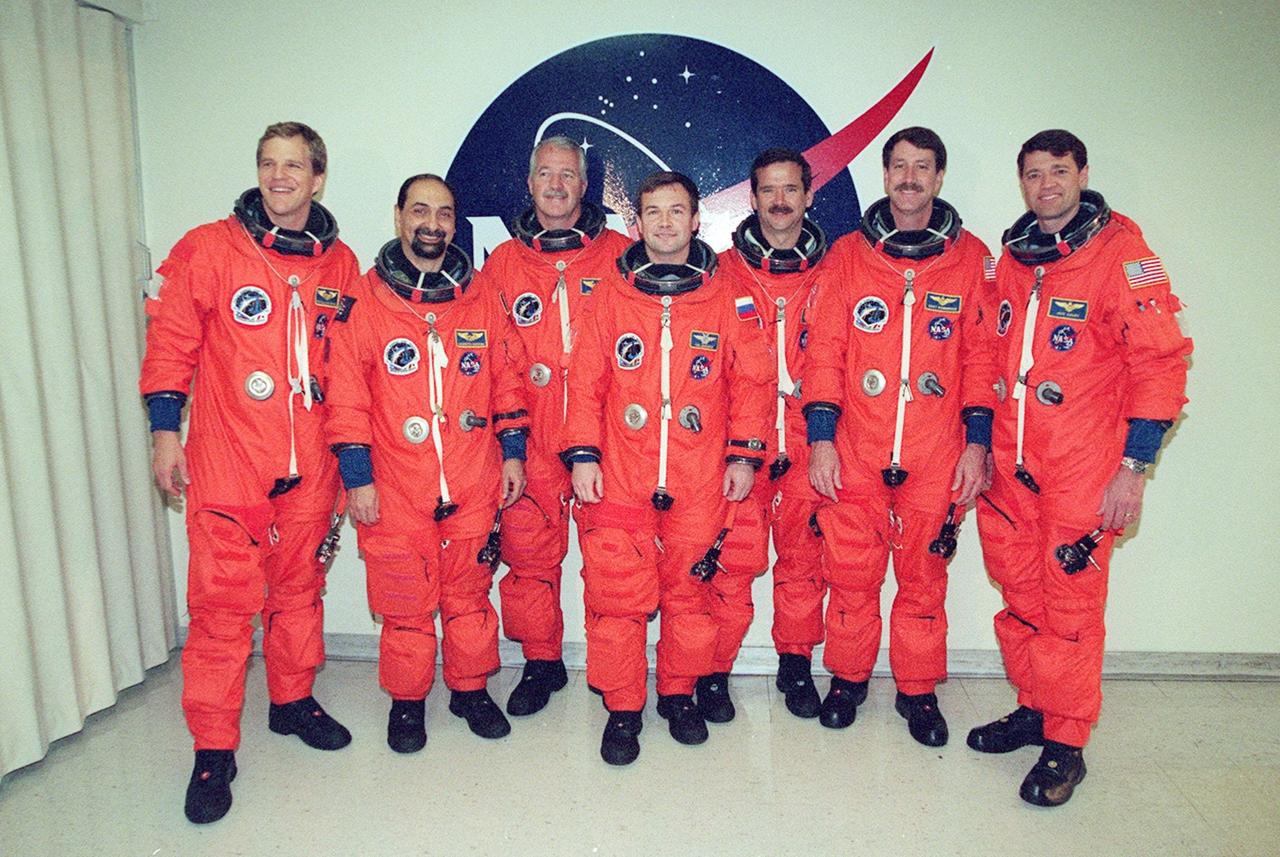
The STS-100 crew pauses for a photo before walkout and the ride to Launch Pad 39A for a simulated countdown. Standing, from left, are Mission Specialists Scott E. Parazynski, Umberto Guidoni, John L. Phillips, Yuri V. Lonchakov and Chris A. Hadfield; Commander Kent V. Rominger; and Pilot Jeffrey S. Ashby. The STS-100 crew is at KSC for Terminal Countdown Demonstration Test activities that include emergency escape training at the pad and the simulated launch countdown. The mission is carrying the Multi-Purpose Logistics Module Raffaello and the SSRMS, to the International Space Station. Raffaello carries six system racks and two storage racks for the U.S. Lab. The SSRMS is crucial to the continued assembly of the orbiting complex. Launch of mission STS-100 is scheduled for April 19 at 2:41 p.m. EDT from Launch Pad 39A
![The STS-100 crew gathers at the bus when Terminal Countdown Demonstration Test activities are hampered by the rain. Standing with the bus driver, from left, are Mission Specialist John L. Phillips, Commander Kent V. Rominger, Mission Specialists Umberto Guidoni, Chris Hadfield, [driver], and Scott E. Parazynski, Pilot Jeffrey S. Ashby and Mission Specialist Yuri V. Lonchakov. TCDT includes emergency escape training at the pad and a simulated launch countdown. The mission is carrying the Multi-Purpose Logistics Module Raffaello and the Canadian robotic arm, SSRMS, to the International Space Station. Raffaello carries six system racks and two storage racks for the U.S. Lab. The SSRMS is crucial to the continued assembly of the orbiting complex. Launch of mission STS-100 is scheduled for April 19 at 2:41 p.m. EDT from Launch Pad 39A](https://images-assets.nasa.gov/image/KSC-01pp0614/KSC-01pp0614~medium.jpg)
The STS-100 crew gathers at the bus when Terminal Countdown Demonstration Test activities are hampered by the rain. Standing with the bus driver, from left, are Mission Specialist John L. Phillips, Commander Kent V. Rominger, Mission Specialists Umberto Guidoni, Chris Hadfield, [driver], and Scott E. Parazynski, Pilot Jeffrey S. Ashby and Mission Specialist Yuri V. Lonchakov. TCDT includes emergency escape training at the pad and a simulated launch countdown. The mission is carrying the Multi-Purpose Logistics Module Raffaello and the Canadian robotic arm, SSRMS, to the International Space Station. Raffaello carries six system racks and two storage racks for the U.S. Lab. The SSRMS is crucial to the continued assembly of the orbiting complex. Launch of mission STS-100 is scheduled for April 19 at 2:41 p.m. EDT from Launch Pad 39A
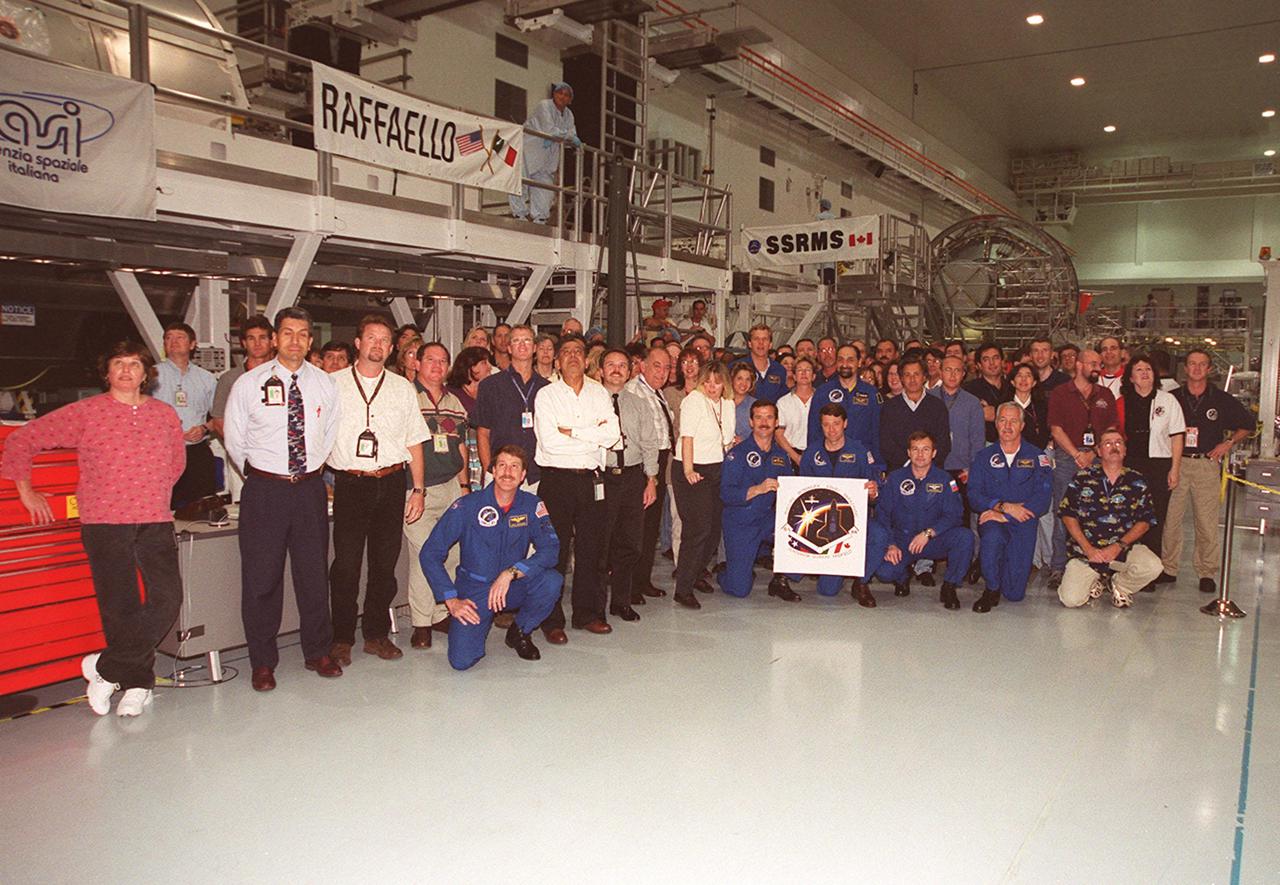
The STS-100 crew gathers with the Space Station Processing Facility people who worked on the Canadian robotic arm, SSRMS. Kneeling at left is Commander Kent V. Rominger; front and ceneter, from left, Mission Specialist Chris Hadfield, Pilot Jeffrey S. Ashby and Mission Specialists Yuri V. Lonchakov and John L. Phillips; behind Hadfield (a head above the others) is Mission Specialist Scott E. Parazynski. The crew is at KSC for Terminal Countdown Demonstration Test activities that include emergency escape training at the pad and a simulated launch countdown. The mission is carrying the Multi-Purpose Logistics Module Raffaello and the SSRMS, to the International Space Station. Raffaello carries six system racks and two storage racks for the U.S. Lab. The SSRMS is crucial to the continued assembly of the orbiting complex. Launch of mission STS-100 is scheduled for April 19 at 2:41 p.m. EDT from Launch Pad 39A
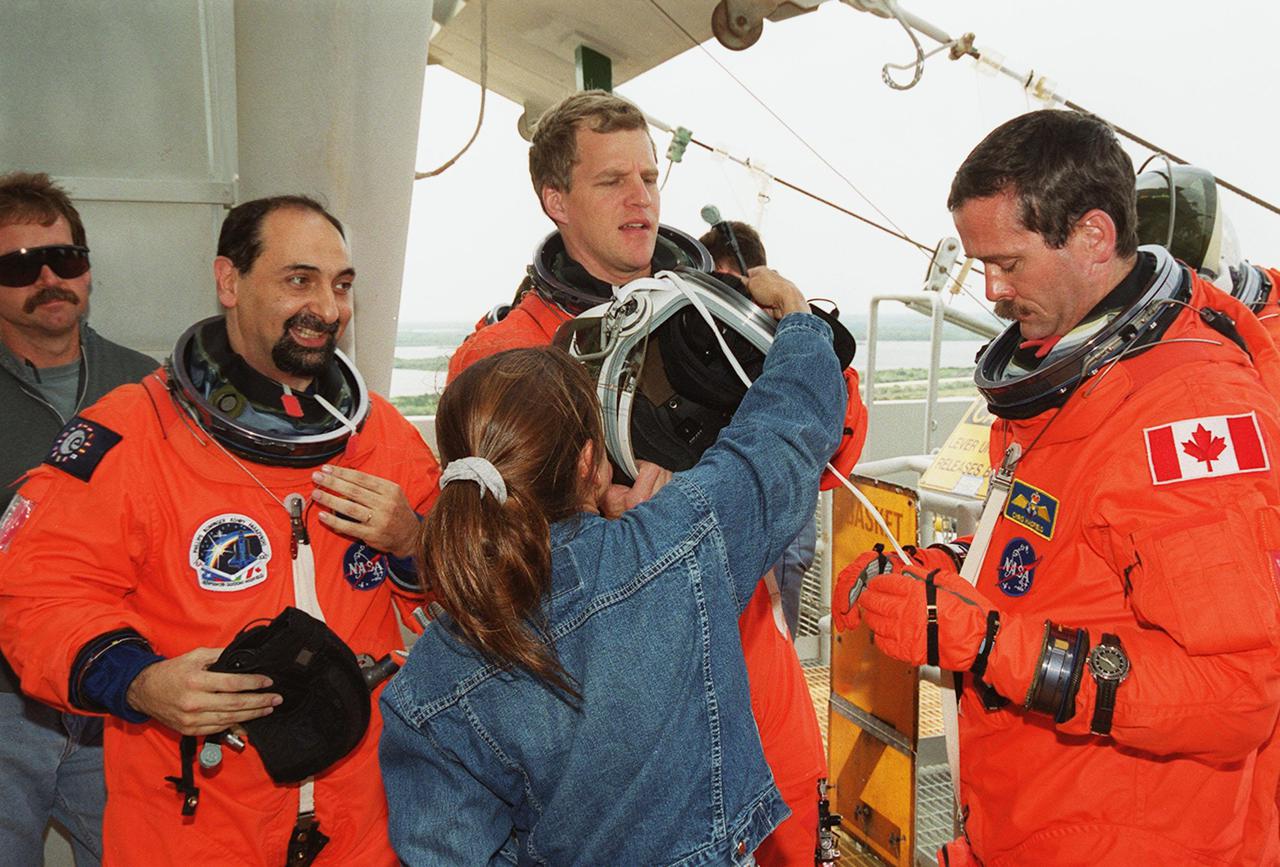
KENNEDY SPACE CENTER, FLA. -- STS-100 Mission Specialists Umberto Guidoni (left), Scott E. Parazynski (center) and Chris A. Hadfield (right) conclude emergency escape training at Launch Pad 39A. Parazynski gets help with his helmet. The crew is taking part in Terminal Countdown Demonstration Test activities that also include a simulated launch countdown. The mission is carrying the Multi-Purpose Logistics Module Raffaello and the SSRMS, to the International Space Station. Raffaello carries six system racks and two storage racks for the U.S. Lab. The SSRMS is crucial to the continued assembly of the orbiting complex. Launch of mission STS-100 is scheduled for April 19 at 2:41 p.m. EDT from Launch Pad 39A
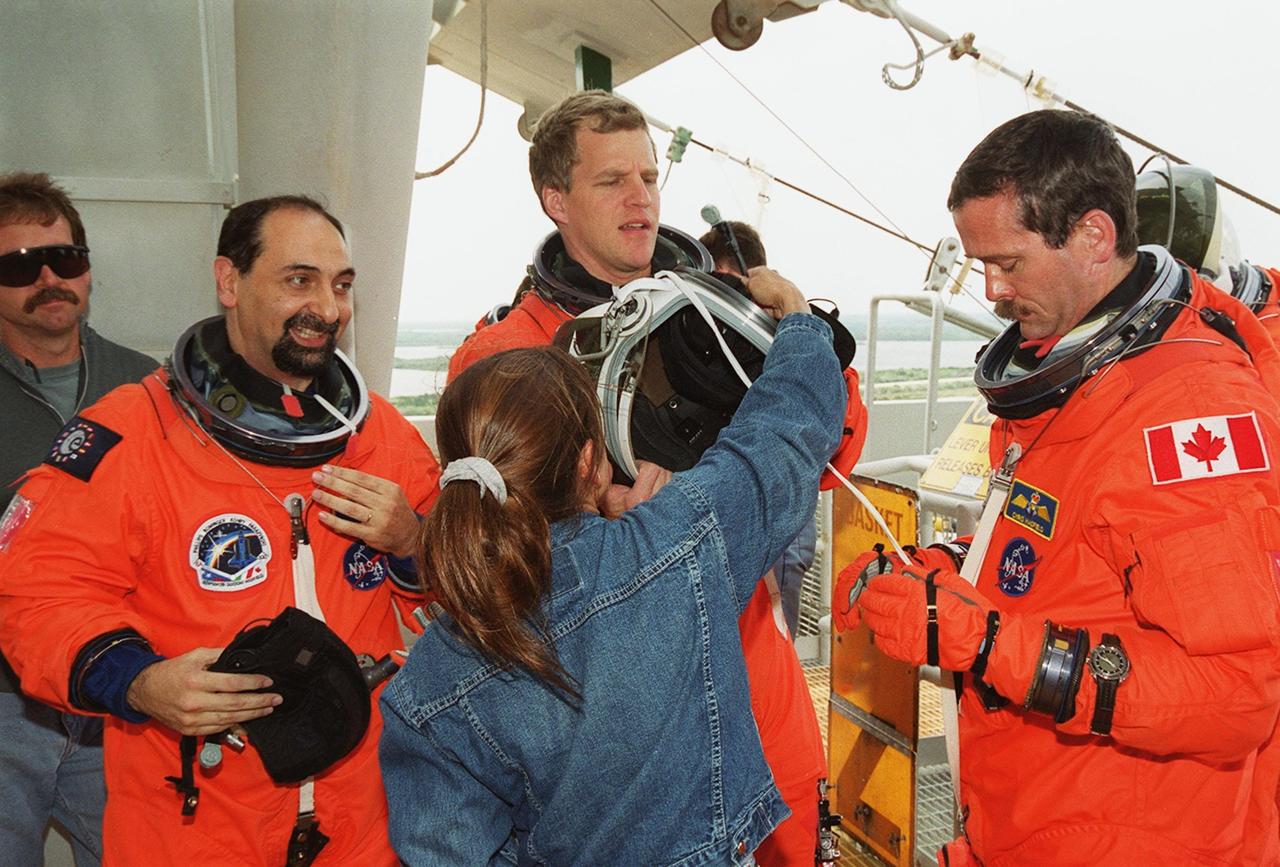
KENNEDY SPACE CENTER, FLA. -- STS-100 Mission Specialists Umberto Guidoni (left), Scott E. Parazynski (center) and Chris A. Hadfield (right) conclude emergency escape training at Launch Pad 39A. Parazynski gets help with his helmet. The crew is taking part in Terminal Countdown Demonstration Test activities that also include a simulated launch countdown. The mission is carrying the Multi-Purpose Logistics Module Raffaello and the SSRMS, to the International Space Station. Raffaello carries six system racks and two storage racks for the U.S. Lab. The SSRMS is crucial to the continued assembly of the orbiting complex. Launch of mission STS-100 is scheduled for April 19 at 2:41 p.m. EDT from Launch Pad 39A
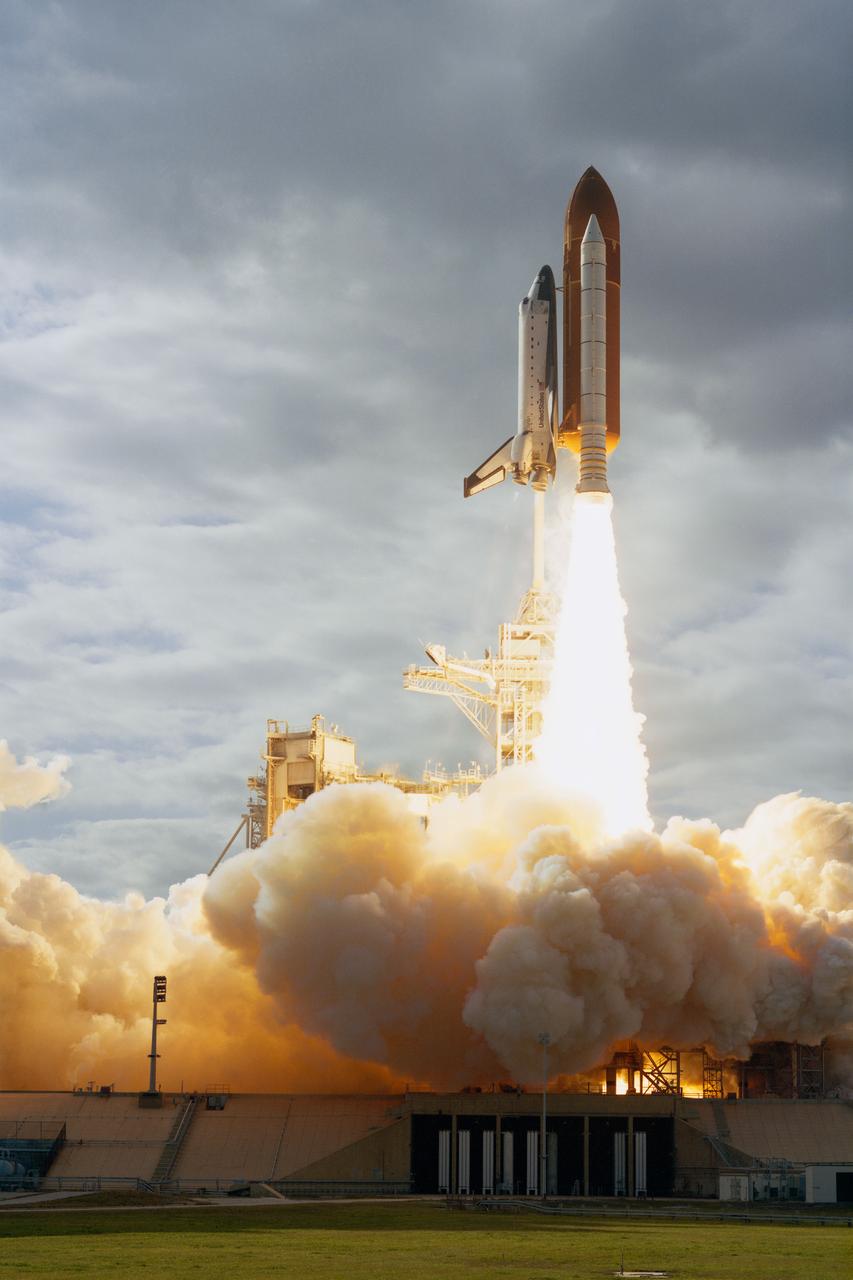
STS080-S-007 (19 Nov. 1996) --- One of the nearest remote camera stations to Launch Pad B captured this profile image of space shuttle Columbia's liftoff from the Kennedy Space Center's (KSC) Launch Complex 39 at 2:55:47 p.m. (EST), November 19, 1996. Onboard are astronauts Kenneth D. Cockrell, mission commander; Kent V. Rominger, pilot; along with Story Musgrave, Tamara E. Jernigan and Thomas D. Jones, all mission specialists. The two primary payloads for STS-80 stowed in Columbia?s cargo bay for later deployment and testing are the Wake Shield Facility (WSF-3) and the Orbiting and Retrievable Far and Extreme Ultraviolet Spectrometer (ORFEUS) with its associated Shuttle Pallet Satellite (SPAS).
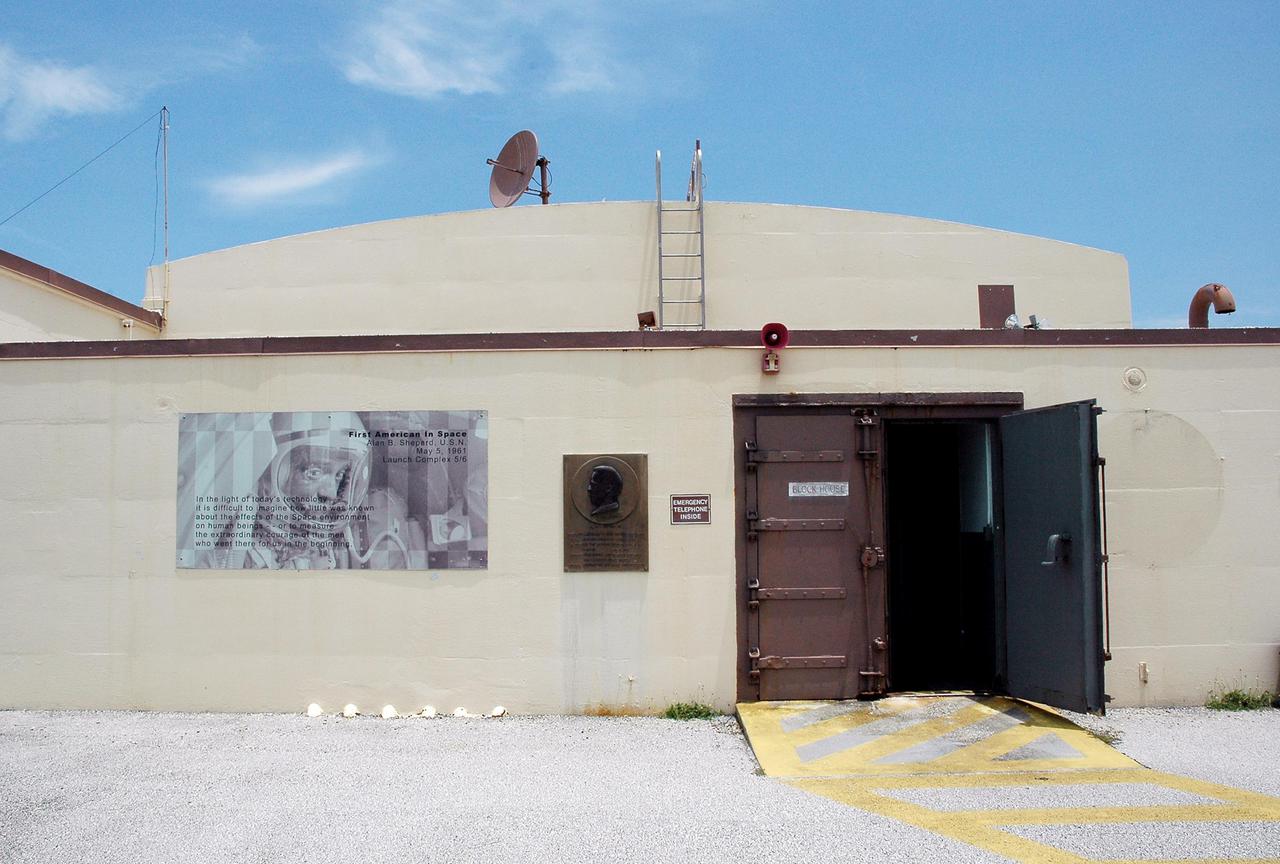
KENNEDY SPACE CENTER, FLA. - This is Launch Complex 5_6 blockhouse, now a museum at the Cape Canaveral Air Force Station (CCAFS) in Florida, where long-lost space suits were found. A recent venture into a long-locked room at CCAFS uncovered interesting artifacts of a bygone era: retired space suits from Americans who trained in the 1960s to be astronauts aboard an Air Force orbiting reconnaissance laboratory. Two security officers were doing a check of a facility at Launch Complex 5_6 blockhouse. NASA Special Agent Dan E. Oakland and Security Manager Henry Butler, who is with Delaware North Parks and Resorts, the company that oversees the museum, discovered a locked room. Space suits from the Air Force’s planned Manned Orbiting Laboratory (MOL) program were found in the room Begun in 1964, the MOL program was an Air Force initiative that would have sent Air Force astronauts to a space station in a Gemini capsule. After spending a few weeks in orbit, the crew would undock and return to Earth. A test launch from Complex 40 on Nov. 30, 1966, of a MOL was conducted with an unmanned Gemini capsule. The MOL was constructed from tankage of a Titan II rocket. The operational MOL was planned to be launched into a polar orbit from Vandenberg Air Force Base in California. The Air Force abandoned the program in 1969, but the program produced a great deal of technological development, and three groups of military officers trained to be MOL astronauts. When the program was cancelled, seven of the younger astronauts were transferred to the agency’s human space flight program and went on to have standout careers. Among them were Robert Crippen, pilot of the first Space Shuttle mission, and Richard H. 'Dick' Truly, who later became NASA Administrator.
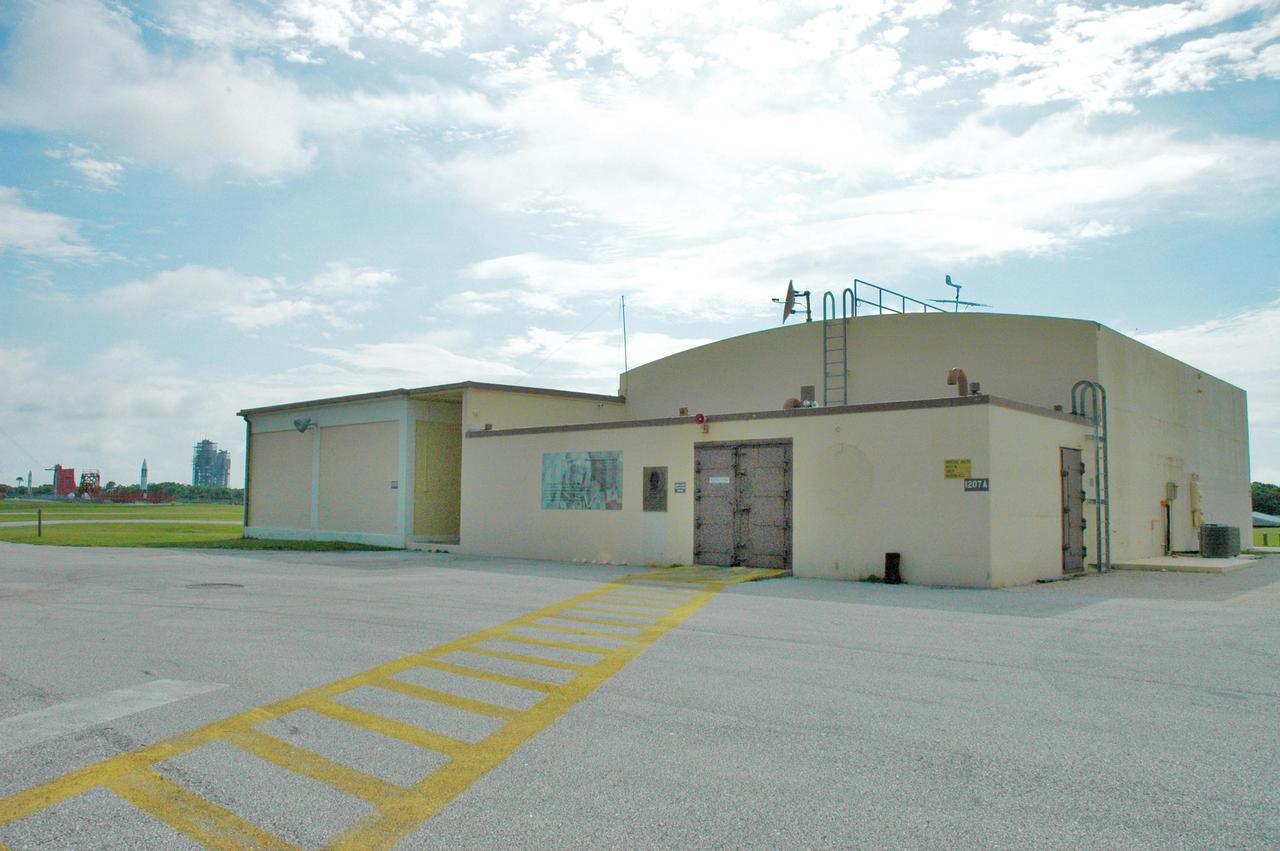
KENNEDY SPACE CENTER, FLA. - This is Launch Complex 5_6 blockhouse, now a museum at the Cape Canaveral Air Force Station (CCAFS) in Florida, where long-lost spacesuits were found. A recent venture into a long-locked room at CCAFS uncovered interesting artifacts of a bygone era: retired space suits from Americans who trained in the 1960s to be astronauts aboard an Air Force orbiting reconnaissance laboratory. Two security officers were doing a check of a facility at Launch Complex 5_6 blockhouse. NASA Special Agent Dan E. Oakland and Security Manager Henry Butler, with Delaware North Parks and Resorts, which oversees the museum, discovered a locked room. Space suits from the Air Force’s planned Manned Orbiting Laboratory (MOL) program were found in the room Begun in 1964, the MOL program was an Air Force initiative that would have sent Air Force astronauts to a space station in a Gemini capsule. After spending a few weeks in orbit, the crew would undock and return to Earth. A test launch from Complex 40 on Nov. 30, 1966, of a MOL was conducted with an unmanned Gemini capsule. The MOL was constructed from tankage of a Titan II rocket. The operational MOL was planned to be launched into a polar orbit from Vandenberg Air Force Base in California. The Air Force abandoned the program in 1969, but the program produced a great deal of technological development, and three groups of military officers trained to be MOL astronauts. When the program was cancelled, seven of the younger astronauts were transferred to the agency’s human space flight program and went on to have standout careers. Among them were Robert Crippen, pilot of the first Space Shuttle mission, and Richard H. 'Dick' Truly, who later became NASA Administrator.
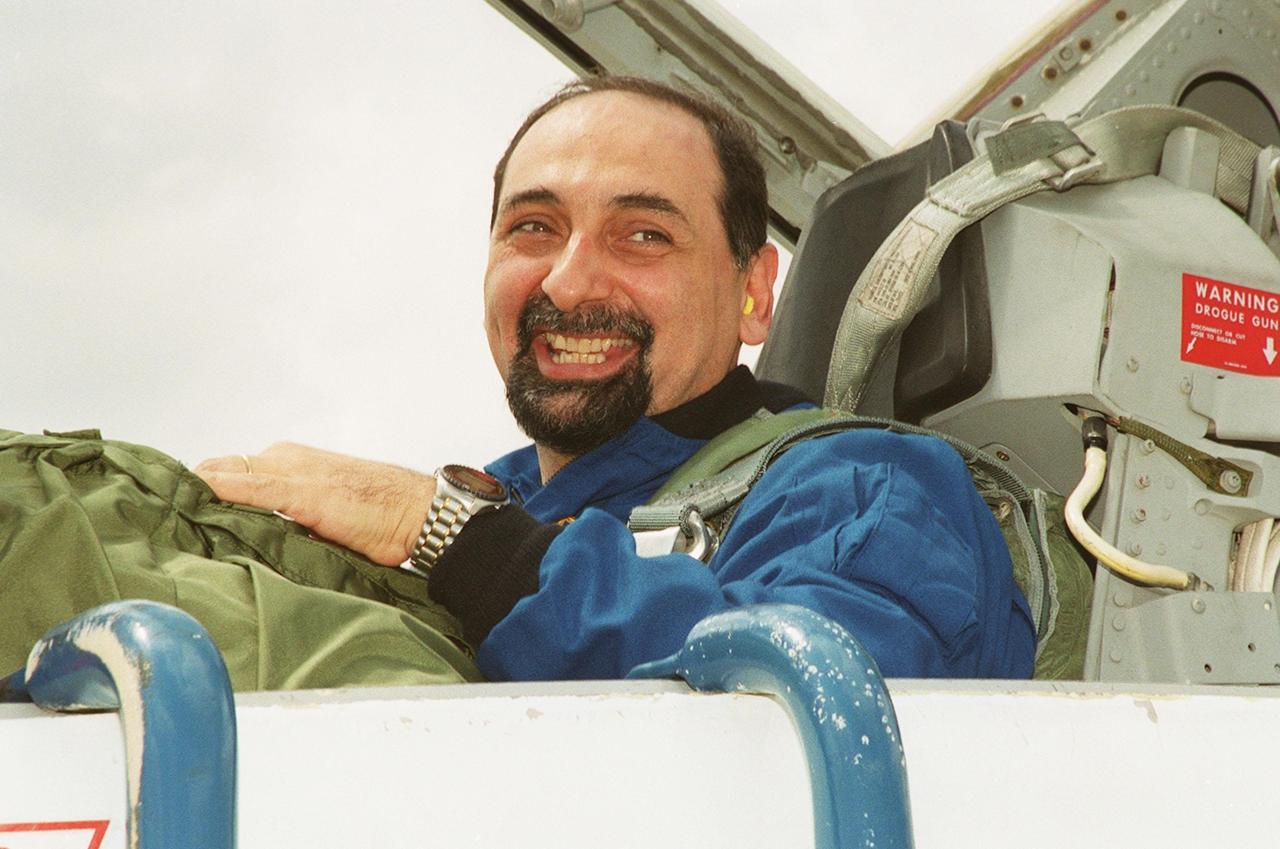
STS-100 Mission Specialist Umberto Guidoni arrives at KSC for Terminal Countdown Demonstration Test activities. He and the rest of the crew Commander Kent V. Rominger, Pilot Jeffrey S. Ashby and Mission Specialists Chris Hadfield, Scott E. Parazynski, John L. Phillips, and Yuri Lonchakov are going to be taking part in emergency escape training at the pad, equipment familiarization and a simulated launch countdown. An international crew, Hadfield is with the Canadian Space Agency, Guidoni the European Space Agency and Lonchakov the Russian Aviation and Space Agency. The mission is carrying the Multi-Purpose Logistics Module Raffaello and the Canadian robotic arm, SSRMS, to the International Space Station. Raffaello carries six system racks and two storage racks for the U.S. Lab. The SSRMS is crucial to the continued assembly of the orbiting complex and has a unique ability to switch ends as it works, “inchworming” along the Station’s exterior. Launch of mission STS-100 is scheduled for April 19 at 2:41 p.m. EDT from Launch Pad 39A
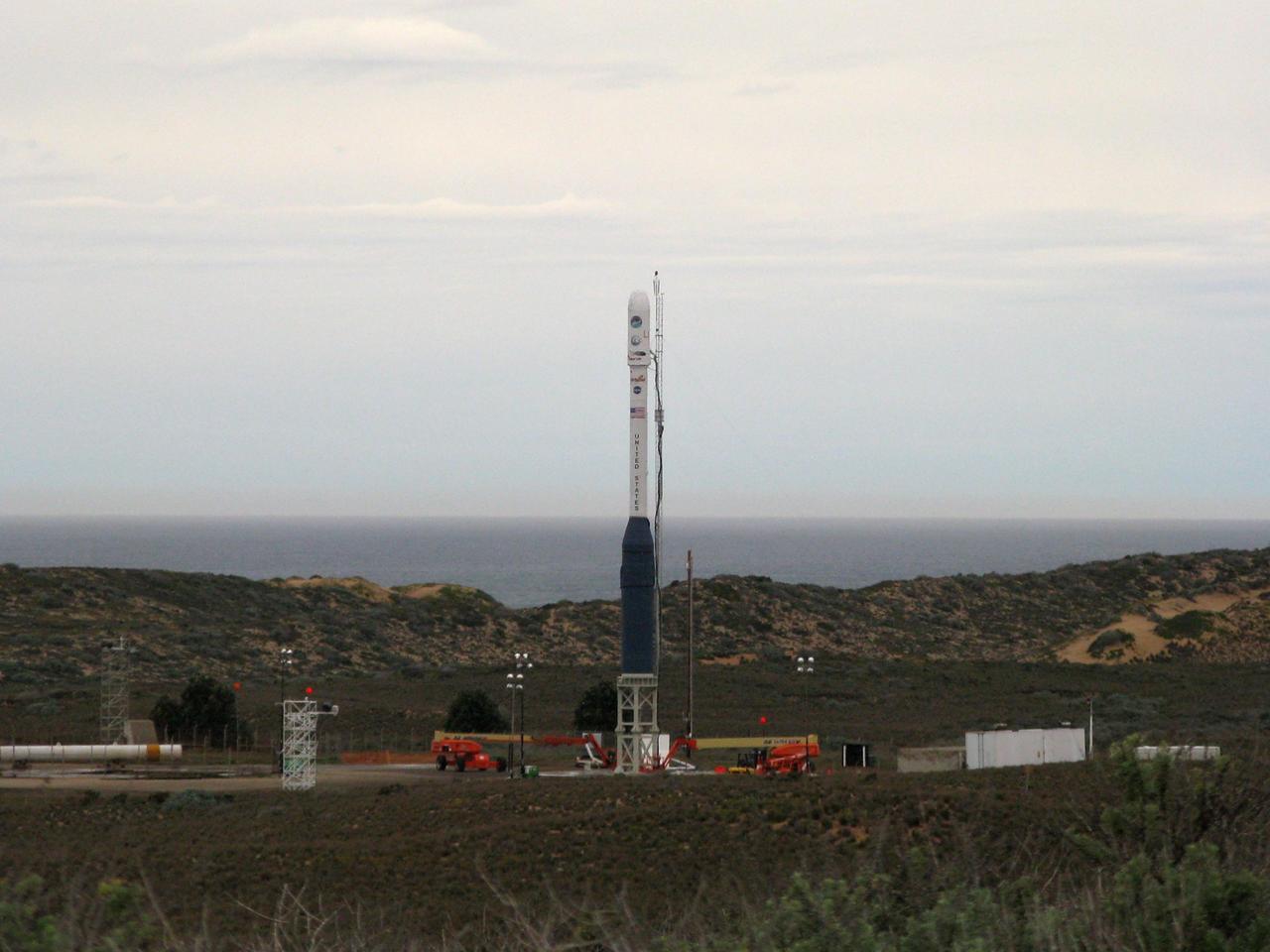
VANDENBERG AIR FORCE BASE, Calif. -- On Launch Complex 576-E at Vandenberg Air Force Base in California, NASA's Orbiting Carbon Observatory, or OCO, atop Orbital Sciences' Taurus XL rocket has been erected for launch. Around the spacecraft's fairing, at top, is the non-flight environmental shield that will be removed before launch. OCO is scheduled for launch the Taurus rocket Feb. 24 from Vandenberg. The spacecraft will collect precise global measurements of carbon dioxide (CO2) in the Earth's atmosphere. Scientists will analyze OCO data to improve our understanding of the natural processes and human activities that regulate the abundance and distribution of this important greenhouse gas. Photo courtesy of Brett Gladish, Orbital Sciences The two spacecraft will be integrated with the Atlas V and tested for final flight worthiness. Launch is scheduled for the spring. LCROSS and LRO are the first missions in NASA's plan to return humans to the moon and begin establishing a lunar outpost by 2020. Photo courtesy of Brett Gladish, Orbital Sciences
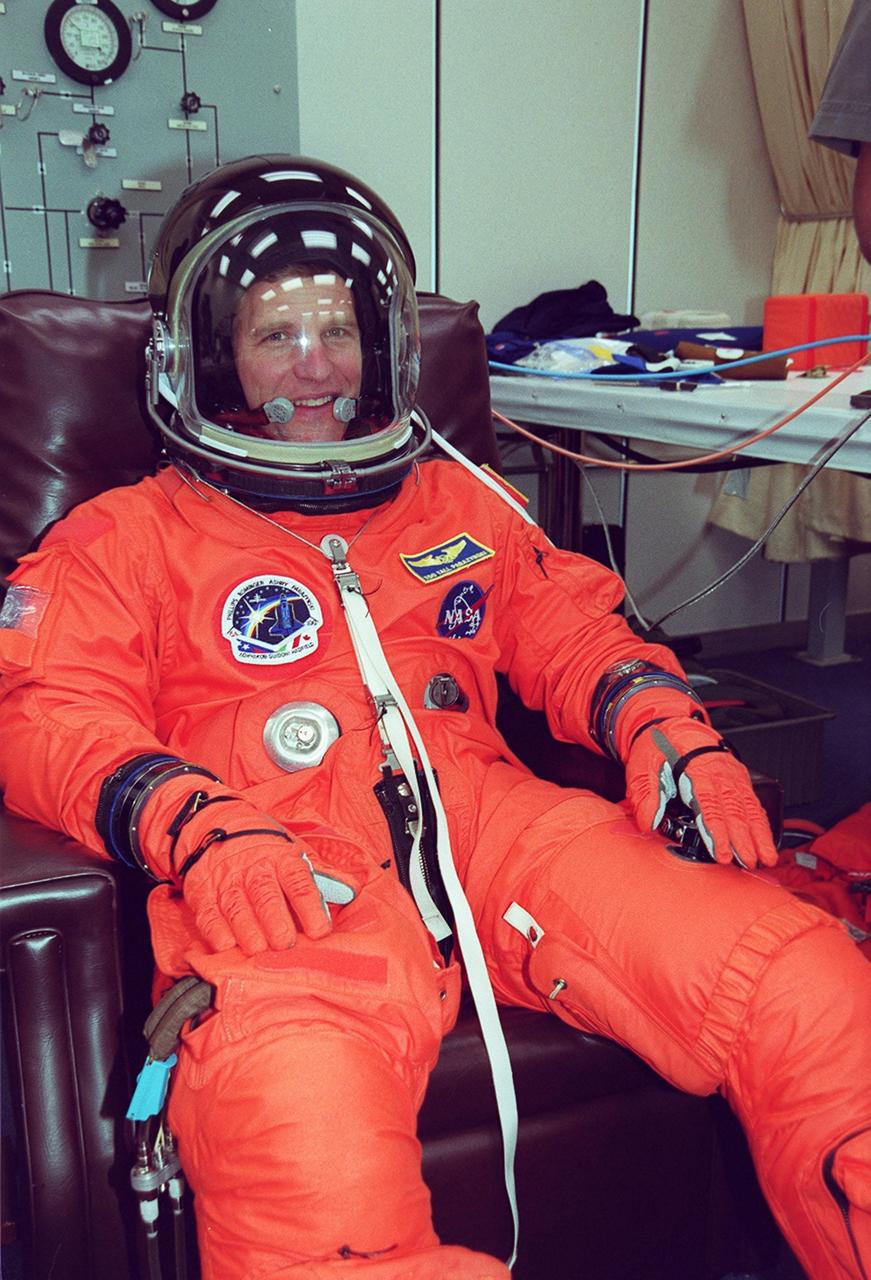
In the Operations and Checkout Building, STS-100 Mission Specialist Scott E. Parazynski smiles for the camera during suit fit and check. Parazynski and the rest of the crew Commander Kent V. Rominger, Pilot Jeffrey S. Ashby and Mission Specialists Chris A. Hadfield, John L. Phillips, Umberto Guidoni and Yuri V. Lonchakov are taking part in Terminal Countdown Demonstration Test activities, from emergency escape training at the pad to a simulated launch countdown. An international crew, Hadfield is with the Canadian Space Agency, Guidoni the European Space Agency and Lonchakov the Russian Aviation and Space Agency. The mission is carrying the Multi-Purpose Logistics Module Raffaello and the Canadian robotic arm, SSRMS, to the International Space Station. Raffaello carries six system racks and two storage racks for the U.S. Lab. The SSRMS is crucial to the continued assembly of the orbiting complex and has a unique ability to switch ends as it works, “inchworming” along the Station’s exterior. Launch of mission STS-100 is scheduled for April 19 at 2:41 p.m. EDT from Launch Pad 39A
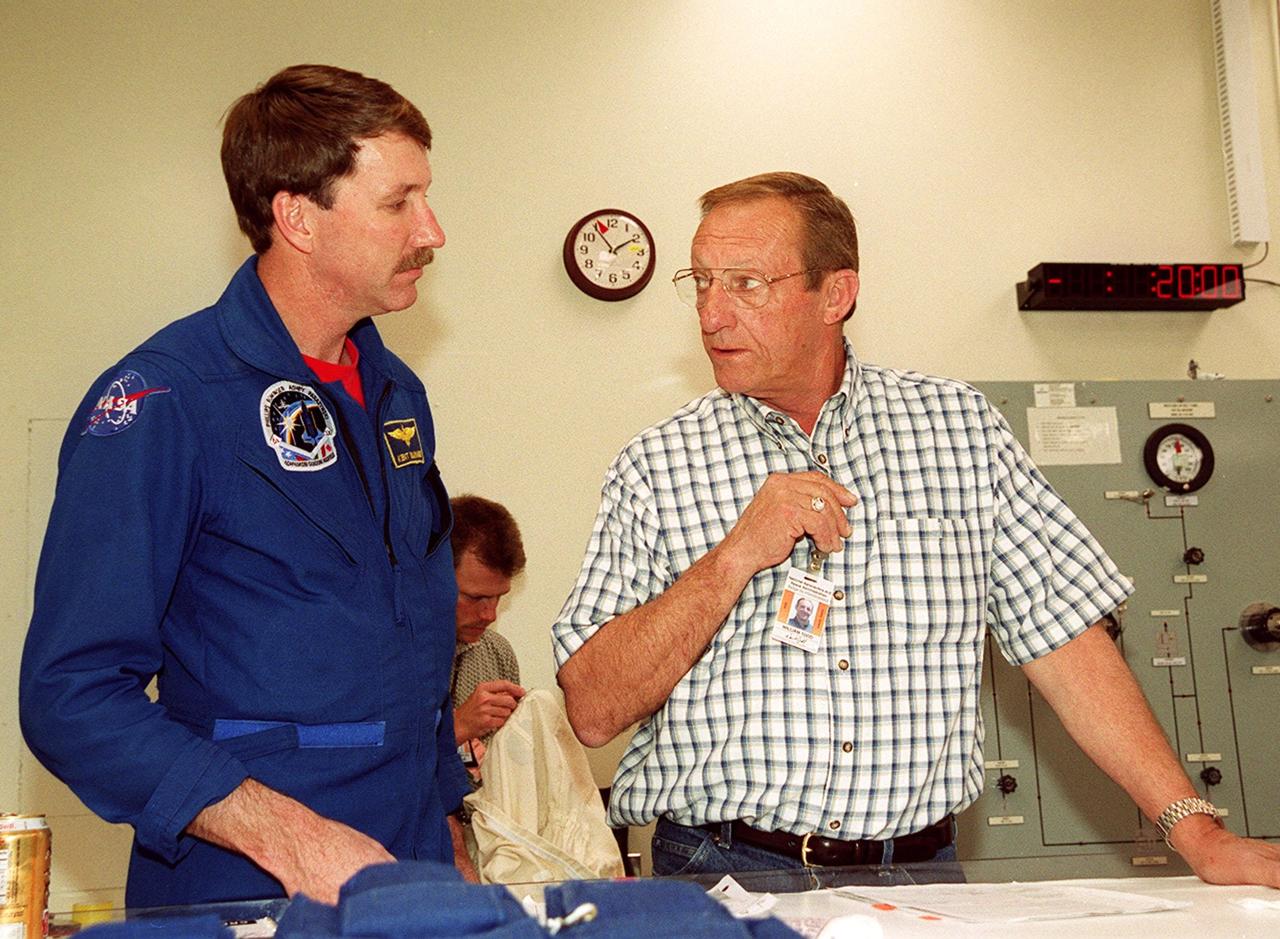
STS-100 Commander Kent V. Rominger (left) gets a review of equipment during suitup in the Operations and Checkout Building. He and the rest of the crew Pilot Jeff Ashby and Mission Specialists Chris Hadfield, Scott E. Parazynski, John L. Phillips, Umberto Guidoni and Yuri Lonchakov are taking part in Terminal Countdown Demonstration Test activities, from emergency escape training at the pad to a simulated launch countdown. An international crew, Hadfield is with the Canadian Space Agency, Guidoni the European Space Agency and Lonchakov the Russian Aviation and Space Agency. The mission is carrying the Multi-Purpose Logistics Module Raffaello and the Canadian robotic arm, SSRMS, to the International Space Station. Raffaello carries six system racks and two storage racks for the U.S. Lab. The SSRMS is crucial to the continued assembly of the orbiting complex and has a unique ability to switch ends as it works, “inchworming” along the Station’s exterior. Launch of mission STS-100 is scheduled for April 19 at 2:41 p.m. EDT from Launch Pad 39A

STS-100 Commander Kent V. Rominger climbs out of the T-38 jet aircraft on his arrival at KSC. He and the rest of the crew Pilot Jeff Ashby and Mission Specialists Chris Hadfield, Scott E. Parazynski, John L. Phillips, Umberto Guidoni and Yuri Lonchakov are going to take part in Terminal Countdown Demonstration Test activities, from emergency escape training at the pad to a simulated launch countdown. An international crew, Hadfield is with the Canadian Space Agency, Guidoni the European Space Agency and Lonchakov the Russian Aviation and Space Agency. The mission is carrying the Multi-Purpose Logistics Module Raffaello and the Canadian robotic arm, SSRMS, to the International Space Station. Raffaello carries six system racks and two storage racks for the U.S. Lab. The SSRMS is crucial to the continued assembly of the orbiting complex and has a unique ability to switch ends as it works, “inchworming” along the Station’s exterior. Launch of mission STS-100 is scheduled for April 19 at 2:41 p.m. EDT from Launch Pad 39A
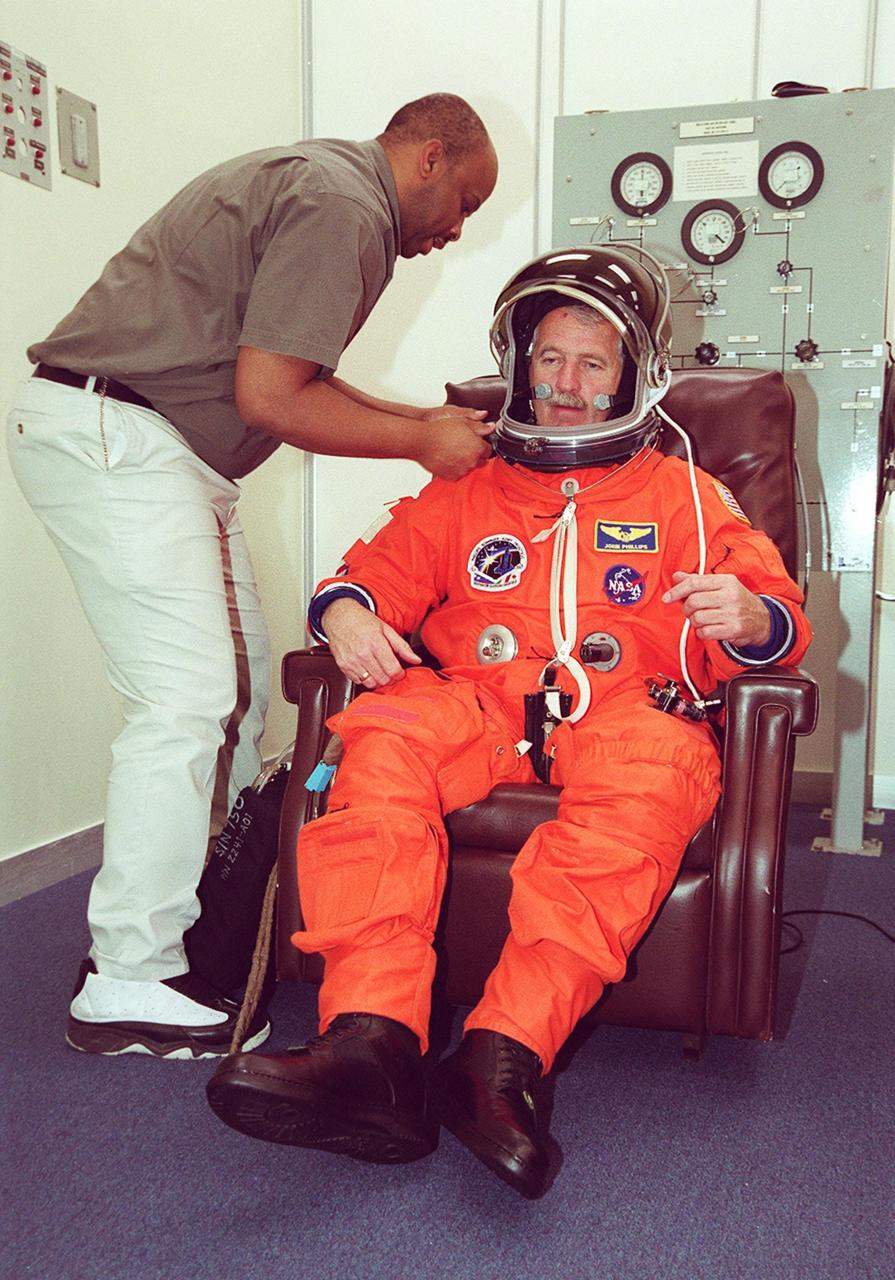
In the Operations and Checkout Building, a suit technician adjusts the helmet of STS-100 Mission Specialist John L. Phillips. He and the rest of the crew Commander Kent V. Rominger, Pilot Jeffrey S. Ashby and Mission Specialists Chris A. Hadfield, Scott E. Parazynski, Umberto Guidoni and Yuri V. Lonchakovare taking part in Terminal Countdown Demonstration Test activities, from emergency escape training at the pad to a simulated launch countdown. An international crew, Hadfield is with the Canadian Space Agency, Guidoni the European Space Agency and Lonchakov the Russian Aviation and Space Agency. The mission is carrying the Multi-Purpose Logistics Module Raffaello and the Canadian robotic arm, SSRMS, to the International Space Station. Raffaello carries six system racks and two storage racks for the U.S. Lab. The SSRMS is crucial to the continued assembly of the orbiting complex and has a unique ability to switch ends as it works, “inchworming” along the Station’s exterior. Launch of mission STS-100 is scheduled for April 19 at 2:41 p.m. EDT from Launch Pad 39A
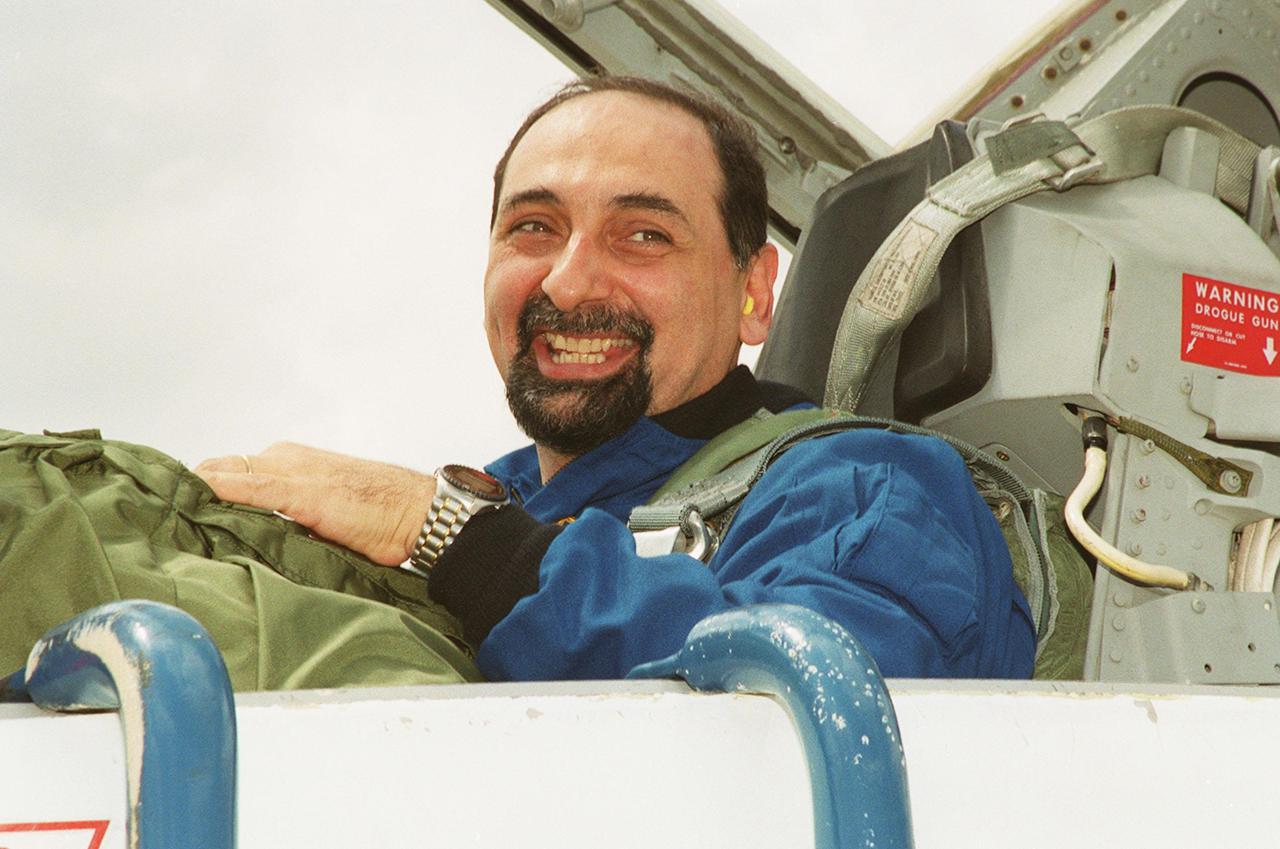
STS-100 Mission Specialist Umberto Guidoni arrives at KSC for Terminal Countdown Demonstration Test activities. He and the rest of the crew Commander Kent V. Rominger, Pilot Jeffrey S. Ashby and Mission Specialists Chris Hadfield, Scott E. Parazynski, John L. Phillips, and Yuri Lonchakov are going to be taking part in emergency escape training at the pad, equipment familiarization and a simulated launch countdown. An international crew, Hadfield is with the Canadian Space Agency, Guidoni the European Space Agency and Lonchakov the Russian Aviation and Space Agency. The mission is carrying the Multi-Purpose Logistics Module Raffaello and the Canadian robotic arm, SSRMS, to the International Space Station. Raffaello carries six system racks and two storage racks for the U.S. Lab. The SSRMS is crucial to the continued assembly of the orbiting complex and has a unique ability to switch ends as it works, “inchworming” along the Station’s exterior. Launch of mission STS-100 is scheduled for April 19 at 2:41 p.m. EDT from Launch Pad 39A
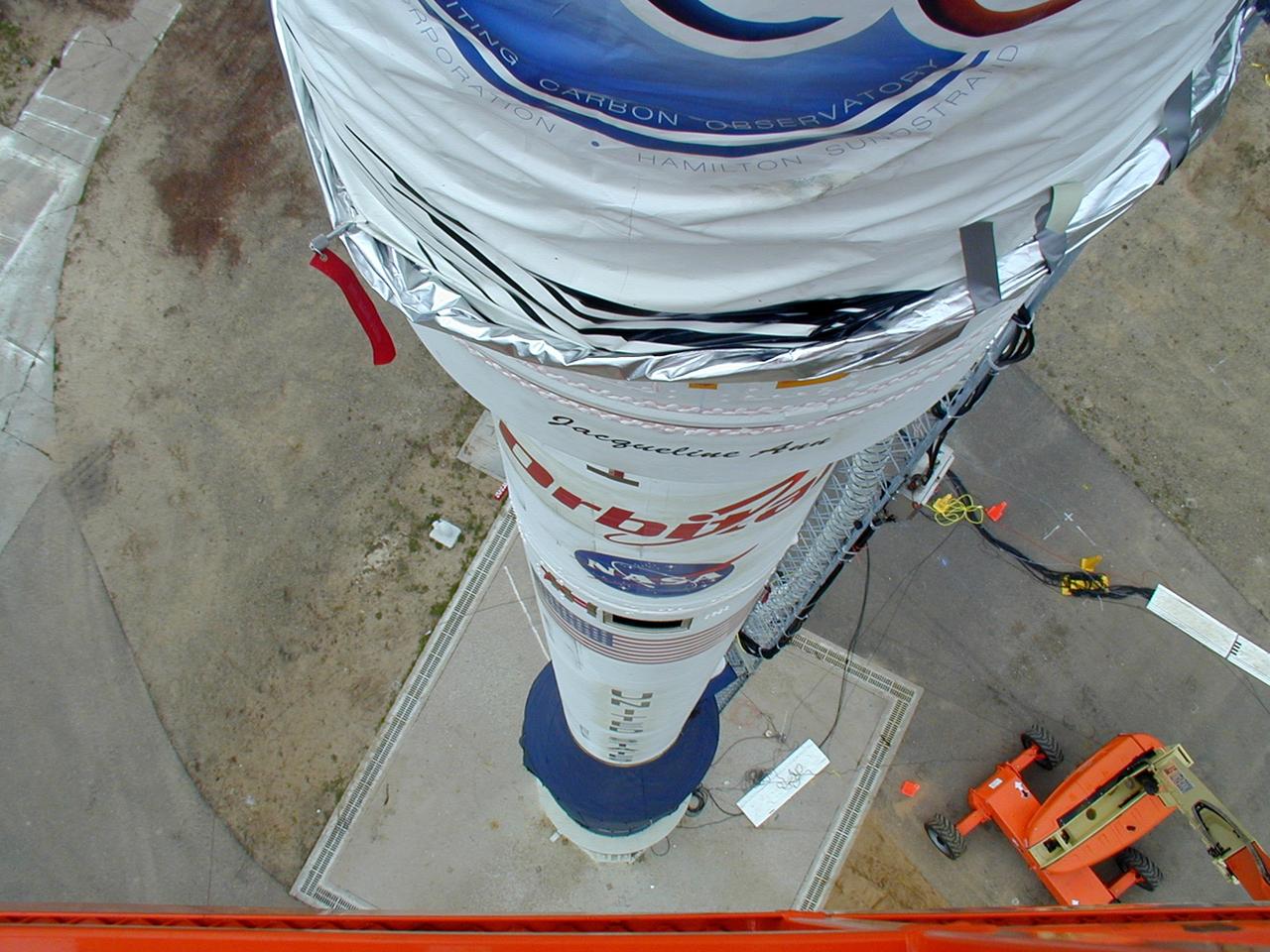
VANDENBERG AIR FORCE BASE, Calif. -- On Launch Complex 576-E at Vandenberg Air Force Base in California, NASA's Orbiting Carbon Observatory, or OCO, atop Orbital Sciences' Taurus XL rocket has been erected for launch. Around the spacecraft's fairing, at top, is the non-flight environmental shield that will be removed before launch. OCO is scheduled for launch the Taurus rocket Feb. 24 from Vandenberg. The spacecraft will collect precise global measurements of carbon dioxide (CO2) in the Earth's atmosphere. Scientists will analyze OCO data to improve our understanding of the natural processes and human activities that regulate the abundance and distribution of this important greenhouse gas. Photo courtesy of Brett Gladish, Orbital Sciences The two spacecraft will be integrated with the Atlas V and tested for final flight worthiness. Launch is scheduled for the spring. LCROSS and LRO are the first missions in NASA's plan to return humans to the moon and begin establishing a lunar outpost by 2020. Photo courtesy of Glenn Weigle, Orbital Sciences

In the Operations and Checkout Building, STS-100 Mission Specialist Yuri V. Lonchakov okays the adjustment of his launch suit. He and the rest of the crew Commander Kent V. Rominger, Pilot Jeffrey S. Ashby and Mission Specialists Chris A. Hadfield, Scott E. Parazynski, John L. Phillips and Umberto Guidoni are taking part in Terminal Countdown Demonstration Test activities, from emergency escape training at the pad to a simulated launch countdown. An international crew, Hadfield is with the Canadian Space Agency, Guidoni the European Space Agency and Lonchakov the Russian Aviation and Space Agency. The mission is carrying the Multi-Purpose Logistics Module Raffaello and the Canadian robotic arm, SSRMS, to the International Space Station. Raffaello carries six system racks and two storage racks for the U.S. Lab. The SSRMS is crucial to the continued assembly of the orbiting complex and has a unique ability to switch ends as it works, “inchworming” along the Station’s exterior. Launch of mission STS-100 is scheduled for April 19 at 2:41 p.m. EDT from Launch Pad 39A
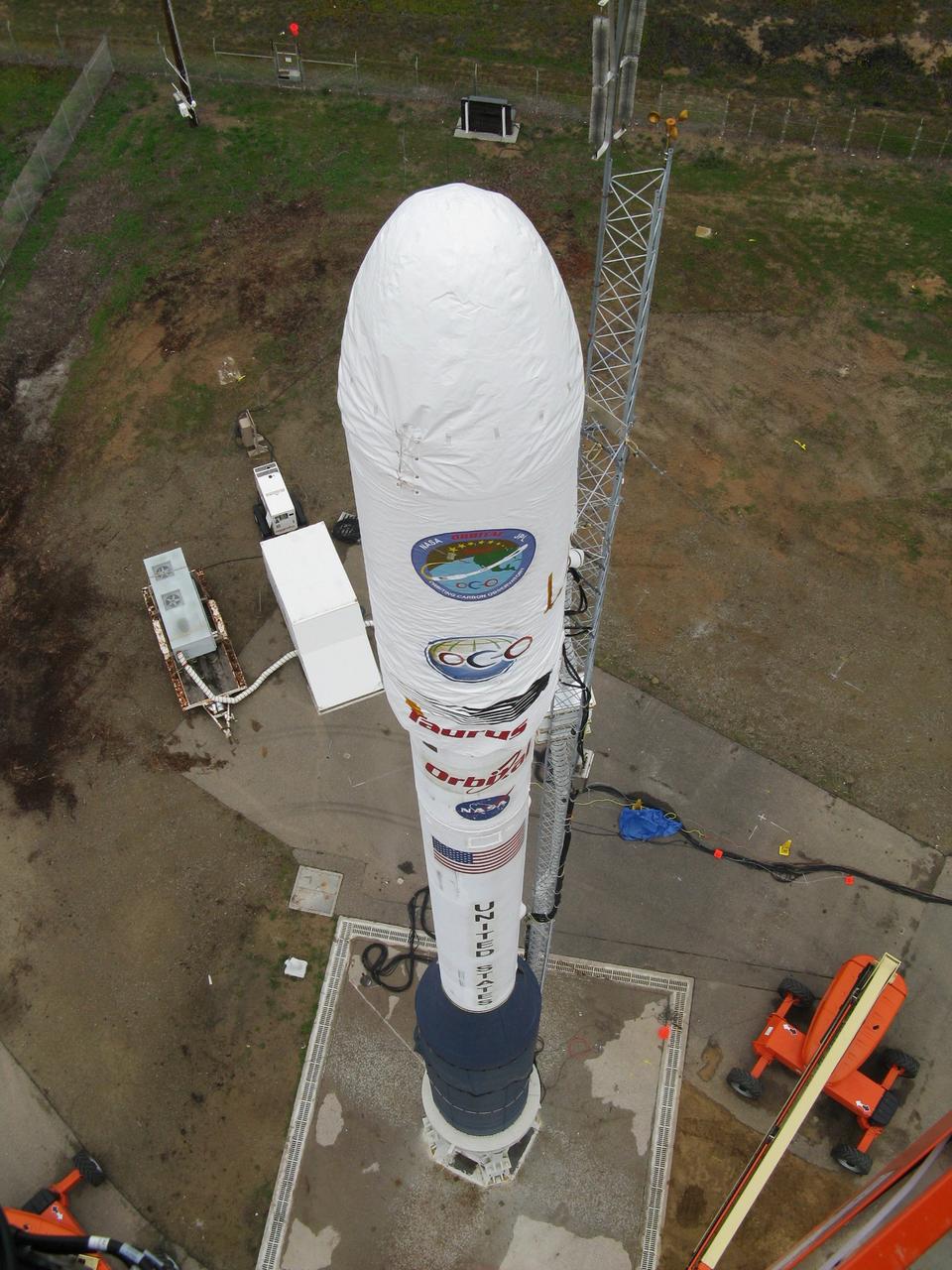
VANDENBERG AIR FORCE BASE, Calif. -- On Launch Complex 576-E at Vandenberg Air Force Base in California, NASA's Orbiting Carbon Observatory, or OCO, atop Orbital Sciences' Taurus XL rocket has been erected for launch. Around the spacecraft's fairing, at top, is the non-flight environmental shield that will be removed before launch. OCO is scheduled for launch the Taurus rocket Feb. 24 from Vandenberg. The spacecraft will collect precise global measurements of carbon dioxide (CO2) in the Earth's atmosphere. Scientists will analyze OCO data to improve our understanding of the natural processes and human activities that regulate the abundance and distribution of this important greenhouse gas. Photo courtesy of Brett Gladish, Orbital Sciences The two spacecraft will be integrated with the Atlas V and tested for final flight worthiness. Launch is scheduled for the spring. LCROSS and LRO are the first missions in NASA's plan to return humans to the moon and begin establishing a lunar outpost by 2020. Photo courtesy of Brett Gladish, Orbital Sciences
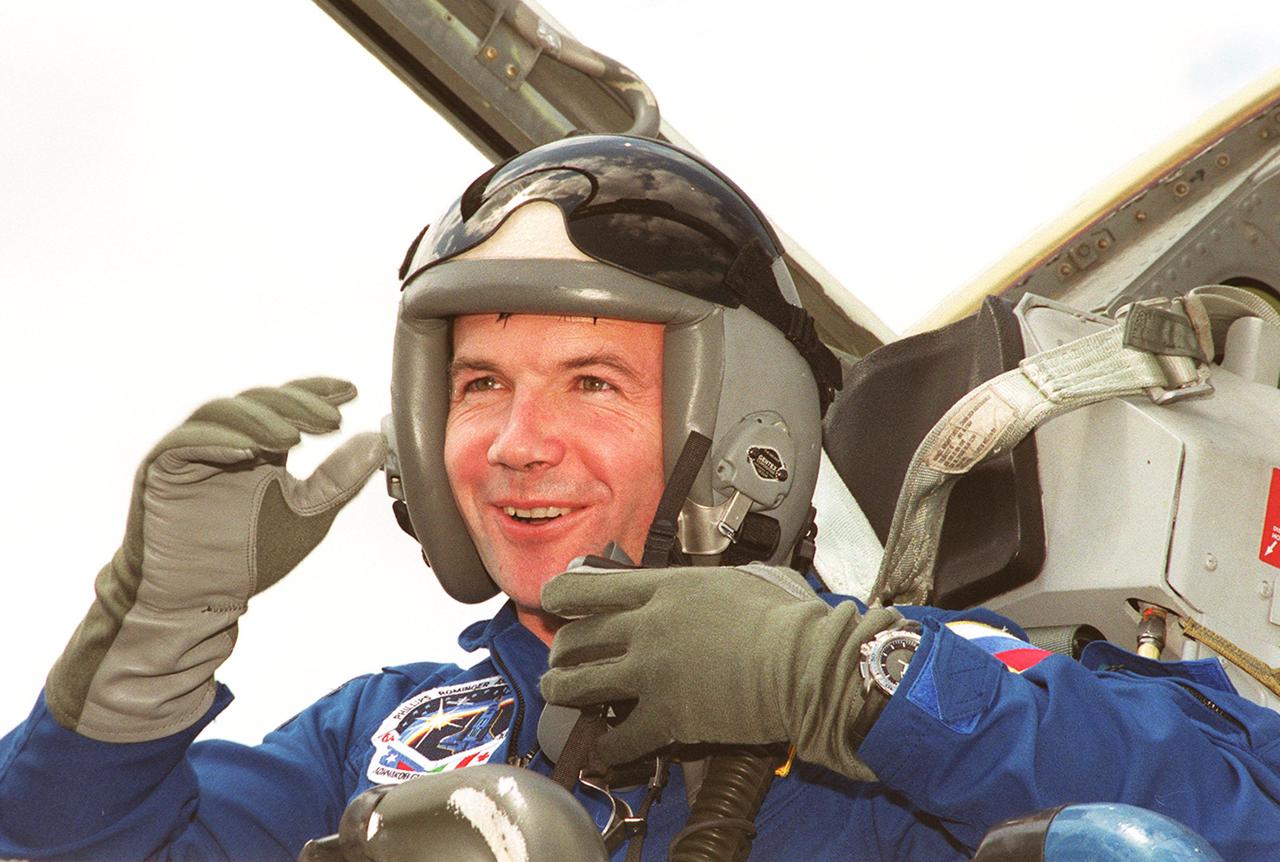
STS-100 Mission Specialist Yuri Lonchakov arrives at KSC for Terminal Countdown Demonstration Test activities. He and the rest of the crew Commander Kent V. Rominger, Pilot Jeffrey S. Ashby and Mission Specialists Chris Hadfield, Scott E. Parazynski, John L. Phillips, and Umberto Guidoni are going to be taking part in emergency escape training at the pad, equipment familiarization and a simulated launch countdown. An international crew, Hadfield is with the Canadian Space Agency, Guidoni the European Space Agency and Lonchakov the Russian Aviation and Space Agency. The mission is carrying the Multi-Purpose Logistics Module Raffaello and the Canadian robotic arm, SSRMS, to the International Space Station. Raffaello carries six system racks and two storage racks for the U.S. Lab. The SSRMS is crucial to the continued assembly of the orbiting complex and has a unique ability to switch ends as it works, “inchworming” along the Station’s exterior. Launch of mission STS-100 is scheduled for April 19 at 2:41 p.m. EDT from Launch Pad 39A

In the Operations and Checkout Building, STS-100 Mission Specialist Umberto Guidoni has his launch suit adjusted. He and the rest of the crew Commander Kent V. Rominger, Pilot Jeffrey S. Ashby and Mission Specialists Chris A. Hadfield, Scott E. Parazynski, John L. Phillips and Yuri V. Lonchakov are taking part in Terminal Countdown Demonstration Test activities, from emergency escape training at the pad to a simulated launch countdown. An international crew, Hadfield is with the Canadian Space Agency, Guidoni the European Space Agency and Lonchakov the Russian Aviation and Space Agency. The mission is carrying the Multi-Purpose Logistics Module Raffaello and the Canadian robotic arm, SSRMS, to the International Space Station. Raffaello carries six system racks and two storage racks for the U.S. Lab. The SSRMS is crucial to the continued assembly of the orbiting complex and has a unique ability to switch ends as it works, “inchworming” along the Station’s exterior. Launch of mission STS-100 is scheduled for April 19 at 2:41 p.m. EDT from Launch Pad 39A
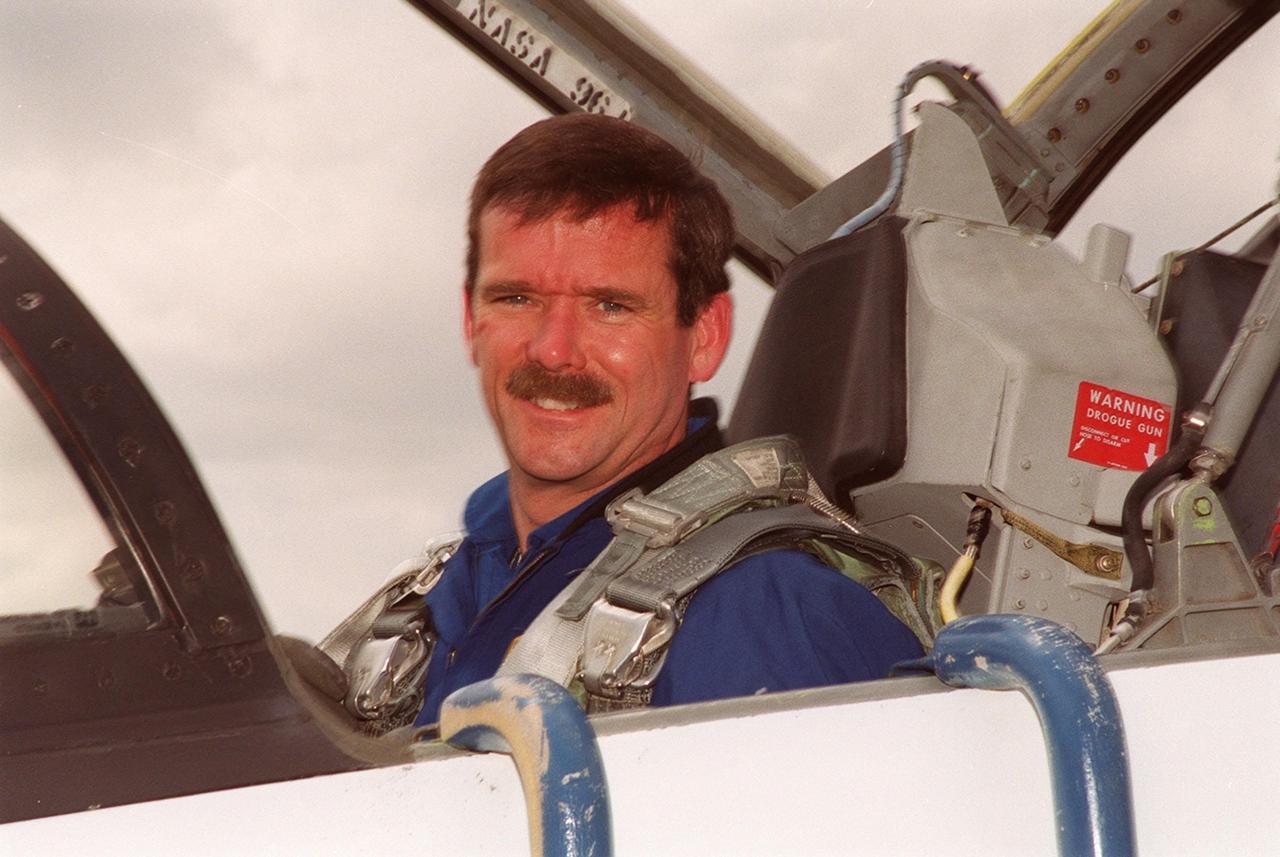
STS-100 Mission Specialist Chris Hadfield arrives at KSC for Terminal Countdown Demonstration Test activities. He and the rest of the crew Commander Kent V. Rominger, Pilot Jeffrey S. Ashby and Mission Specialists Scott E. Parazynski, John L. Phillips, Umberto Guidoni and Yuri Lonchakov are going to be taking part in emergency escape training at the pad, equipment familiarization and a simulated launch countdown. An international crew, Hadfield is with the Canadian Space Agency, Guidoni the European Space Agency and Lonchakov the Russian Aviation and Space Agency. The mission is carrying the Multi-Purpose Logistics Module Raffaello and the Canadian robotic arm, SSRMS, to the International Space Station. Raffaello carries six system racks and two storage racks for the U.S. Lab. The SSRMS is crucial to the continued assembly of the orbiting complex and has a unique ability to switch ends as it works, “inchworming” along the Station’s exterior. Launch of mission STS-100 is scheduled for April 19 at 2:41 p.m. EDT from Launch Pad 39A
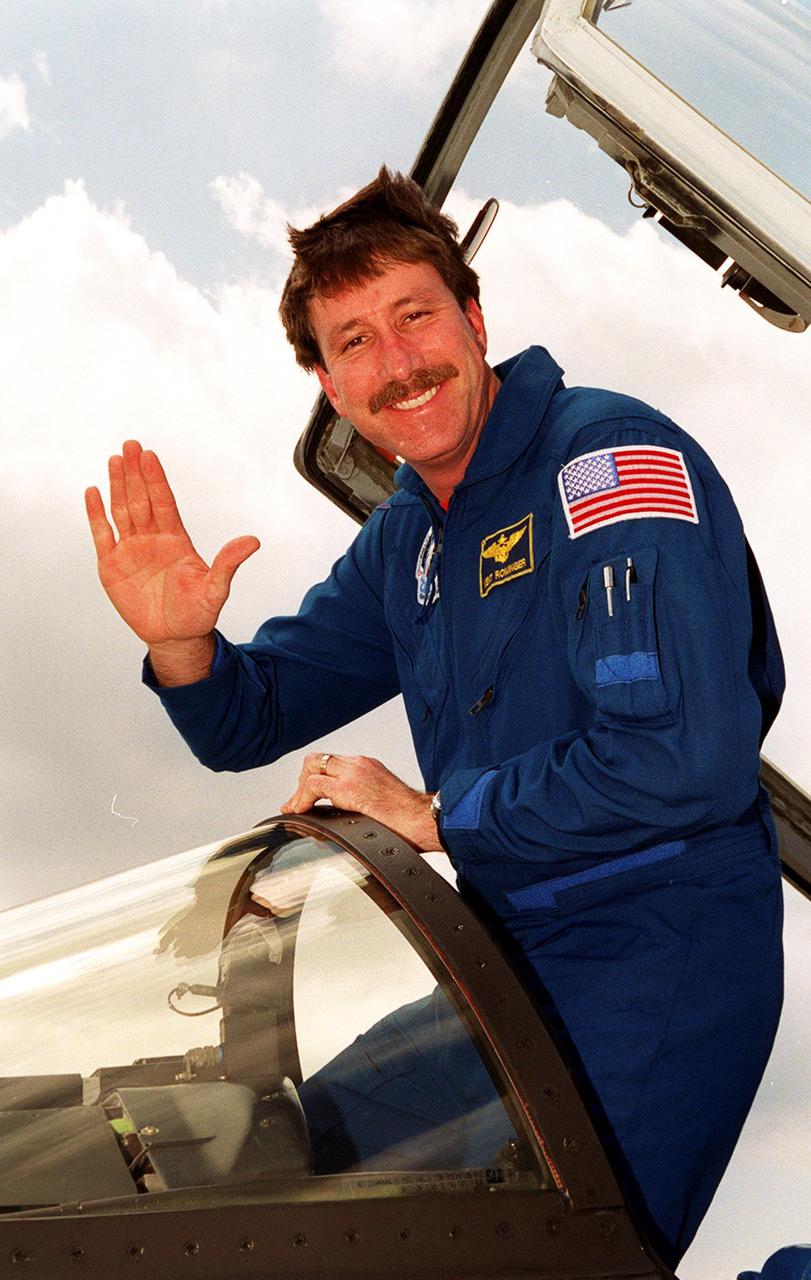
STS-100 Commander Kent V. Rominger climbs out of the T-38 jet aircraft on his arrival at KSC. He and the rest of the crew Pilot Jeff Ashby and Mission Specialists Chris Hadfield, Scott E. Parazynski, John L. Phillips, Umberto Guidoni and Yuri Lonchakov are going to take part in Terminal Countdown Demonstration Test activities, from emergency escape training at the pad to a simulated launch countdown. An international crew, Hadfield is with the Canadian Space Agency, Guidoni the European Space Agency and Lonchakov the Russian Aviation and Space Agency. The mission is carrying the Multi-Purpose Logistics Module Raffaello and the Canadian robotic arm, SSRMS, to the International Space Station. Raffaello carries six system racks and two storage racks for the U.S. Lab. The SSRMS is crucial to the continued assembly of the orbiting complex and has a unique ability to switch ends as it works, “inchworming” along the Station’s exterior. Launch of mission STS-100 is scheduled for April 19 at 2:41 p.m. EDT from Launch Pad 39A
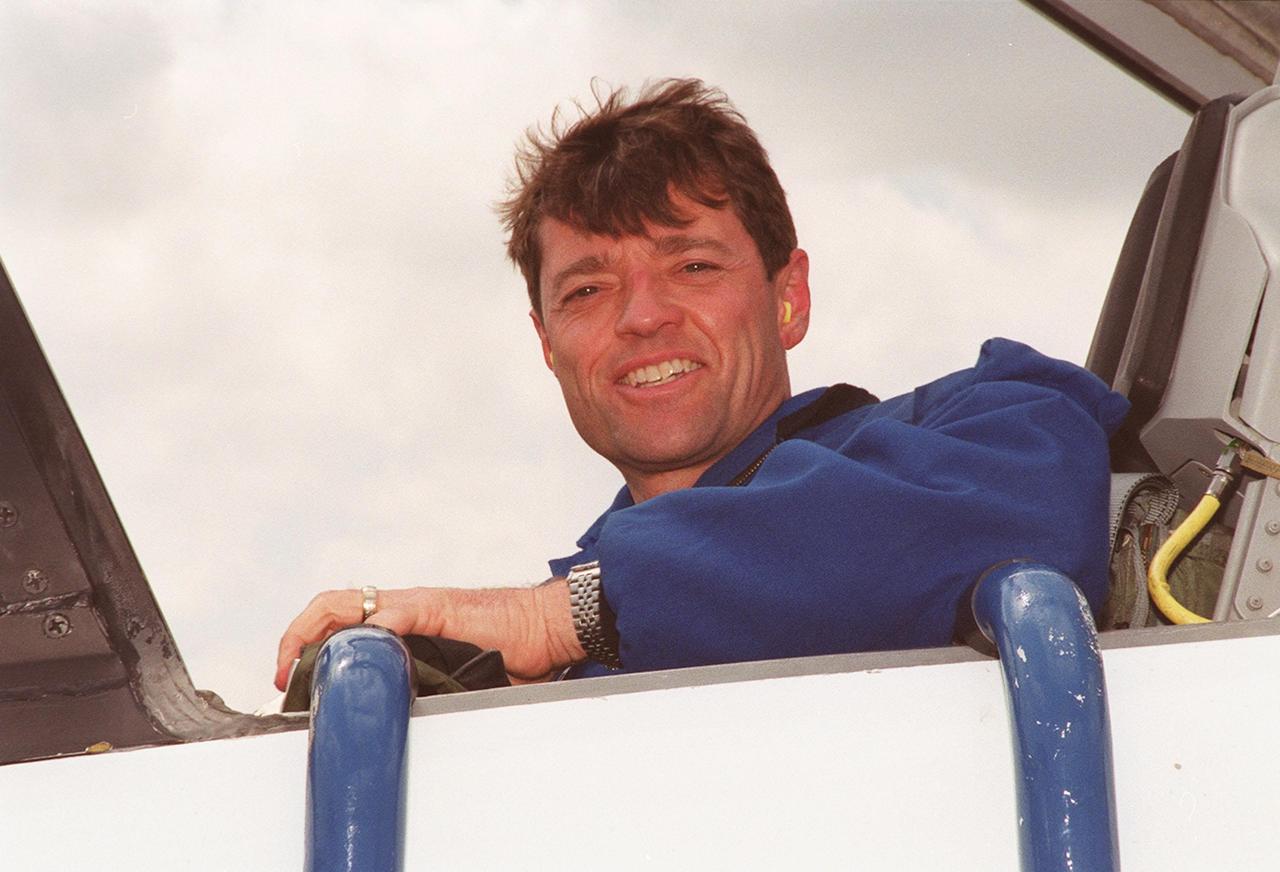
STS-100 Pilot Jeffrey S. Ashby arrives at KSC for Terminal Countdown Demonstration Test activities. He and the rest of the crew Commander Kent V. Rominger and Mission Specialists Chris Hadfield, Scott E. Parazynski, John L. Phillips, Umberto Guidoni and Yuri Lonchakov are going to be taking part in emergency escape training at the pad, equipment familiarization and a simulated launch countdown. An international crew, Hadfield is with the Canadian Space Agency, Guidoni the European Space Agency and Lonchakov the Russian Aviation and Space Agency. The mission is carrying the Multi-Purpose Logistics Module Raffaello and the Canadian robotic arm, SSRMS, to the International Space Station. Raffaello carries six system racks and two storage racks for the U.S. Lab. The SSRMS is crucial to the continued assembly of the orbiting complex and has a unique ability to switch ends as it works, “inchworming” along the Station’s exterior. Launch of mission STS-100 is scheduled for April 19 at 2:41 p.m. EDT from Launch Pad 39A
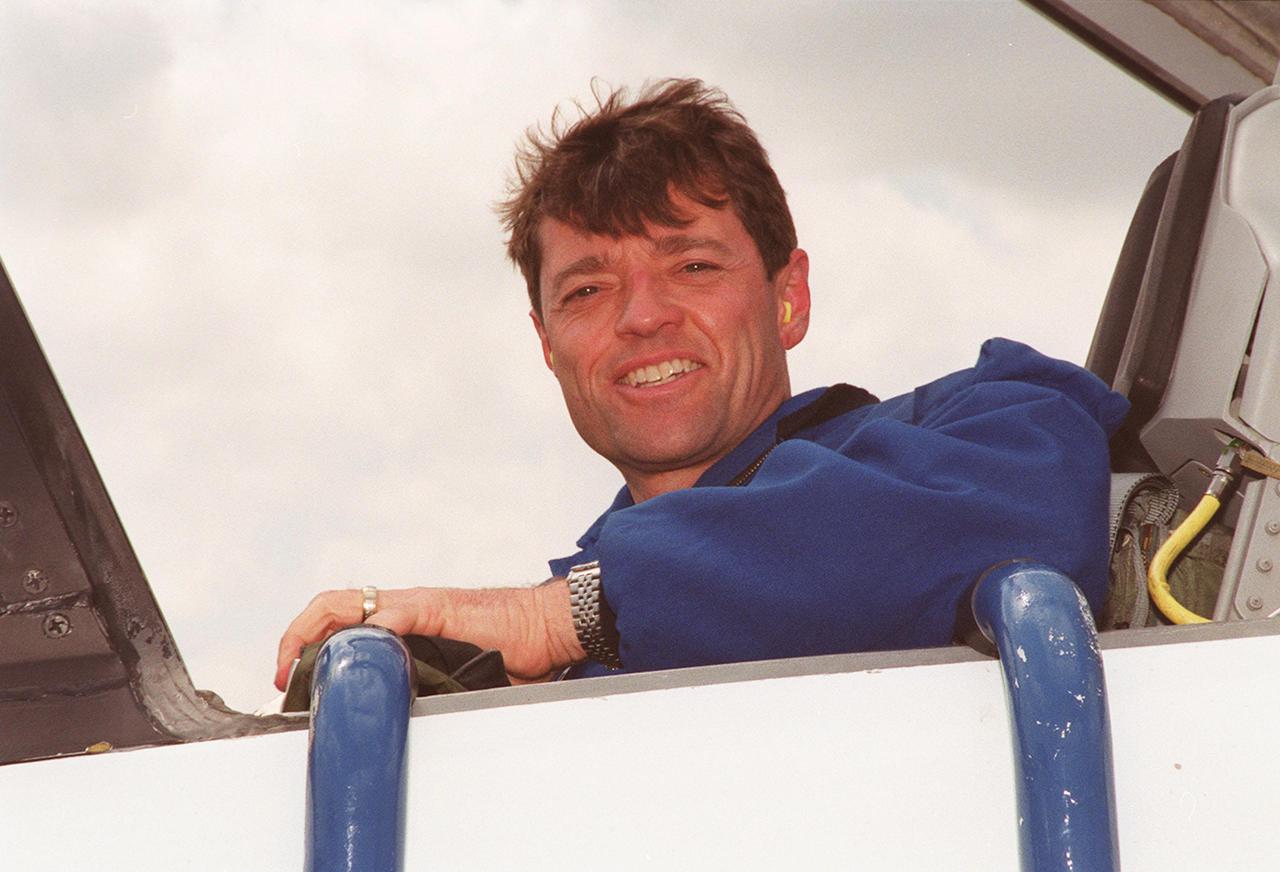
STS-100 Pilot Jeffrey S. Ashby arrives at KSC for Terminal Countdown Demonstration Test activities. He and the rest of the crew Commander Kent V. Rominger and Mission Specialists Chris Hadfield, Scott E. Parazynski, John L. Phillips, Umberto Guidoni and Yuri Lonchakov are going to be taking part in emergency escape training at the pad, equipment familiarization and a simulated launch countdown. An international crew, Hadfield is with the Canadian Space Agency, Guidoni the European Space Agency and Lonchakov the Russian Aviation and Space Agency. The mission is carrying the Multi-Purpose Logistics Module Raffaello and the Canadian robotic arm, SSRMS, to the International Space Station. Raffaello carries six system racks and two storage racks for the U.S. Lab. The SSRMS is crucial to the continued assembly of the orbiting complex and has a unique ability to switch ends as it works, “inchworming” along the Station’s exterior. Launch of mission STS-100 is scheduled for April 19 at 2:41 p.m. EDT from Launch Pad 39A
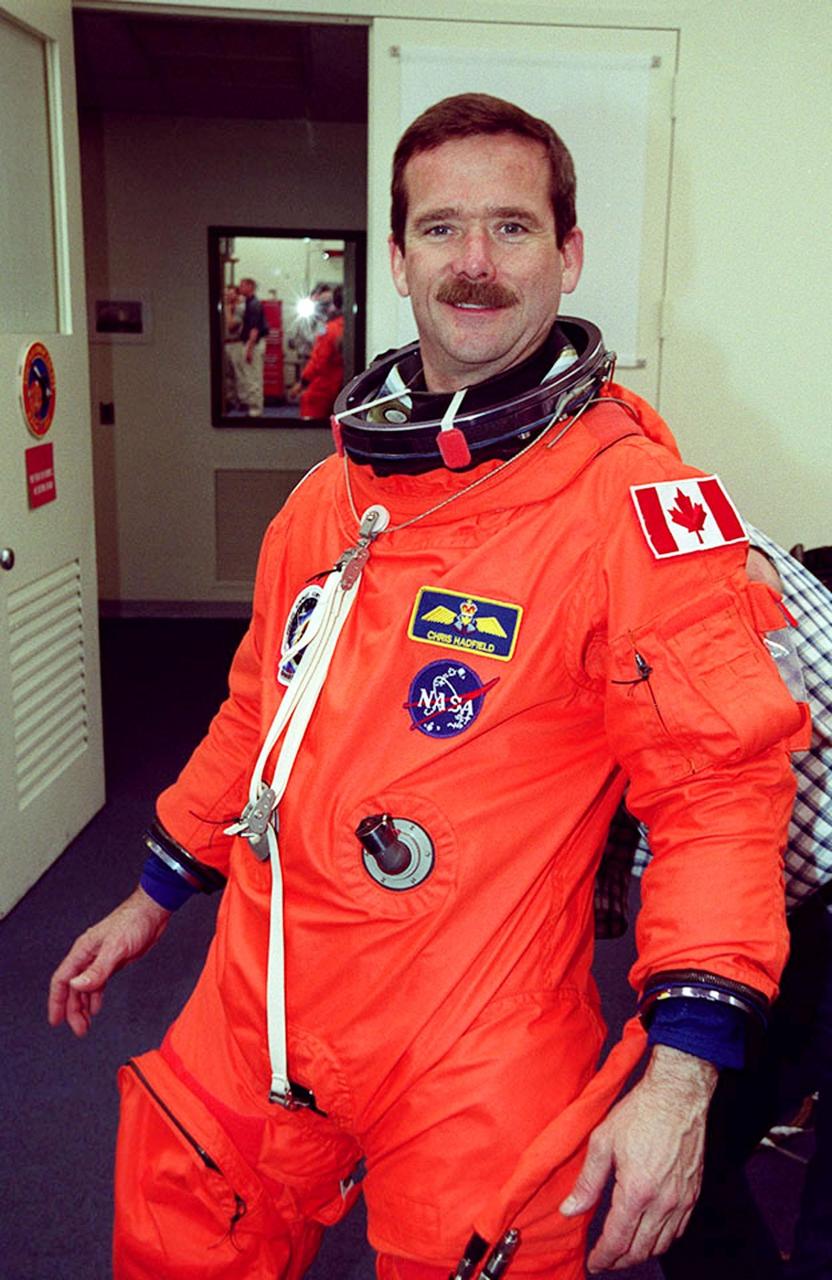
STS-100 Mission Specialist Chris Hadfield smiles for the camera during suitup in the Operations and Checkout Building. He and the rest of the crew Commander Kent V. Rominger, Pilot Jeffrey S. Ashby and Mission Specialists Scott E. Parazynski, John L. Phillips, Umberto Guidoni and Yuri Lonchakov are taking part in Terminal Countdown Demonstration Test activities, from emergency escape training at the pad to a simulated launch countdown. An international crew, Hadfield is with the Canadian Space Agency, Guidoni the European Space Agency and Lonchakov the Russian Aviation and Space Agency. The mission is carrying the Multi-Purpose Logistics Module Raffaello and the Canadian robotic arm, SSRMS, to the International Space Station. Raffaello carries six system racks and two storage racks for the U.S. Lab. The SSRMS is crucial to the continued assembly of the orbiting complex and has a unique ability to switch ends as it works, “inchworming” along the Station’s exterior. Launch of mission STS-100 is scheduled for April 19 at 2:41 p.m. EDT from Launch Pad 39A
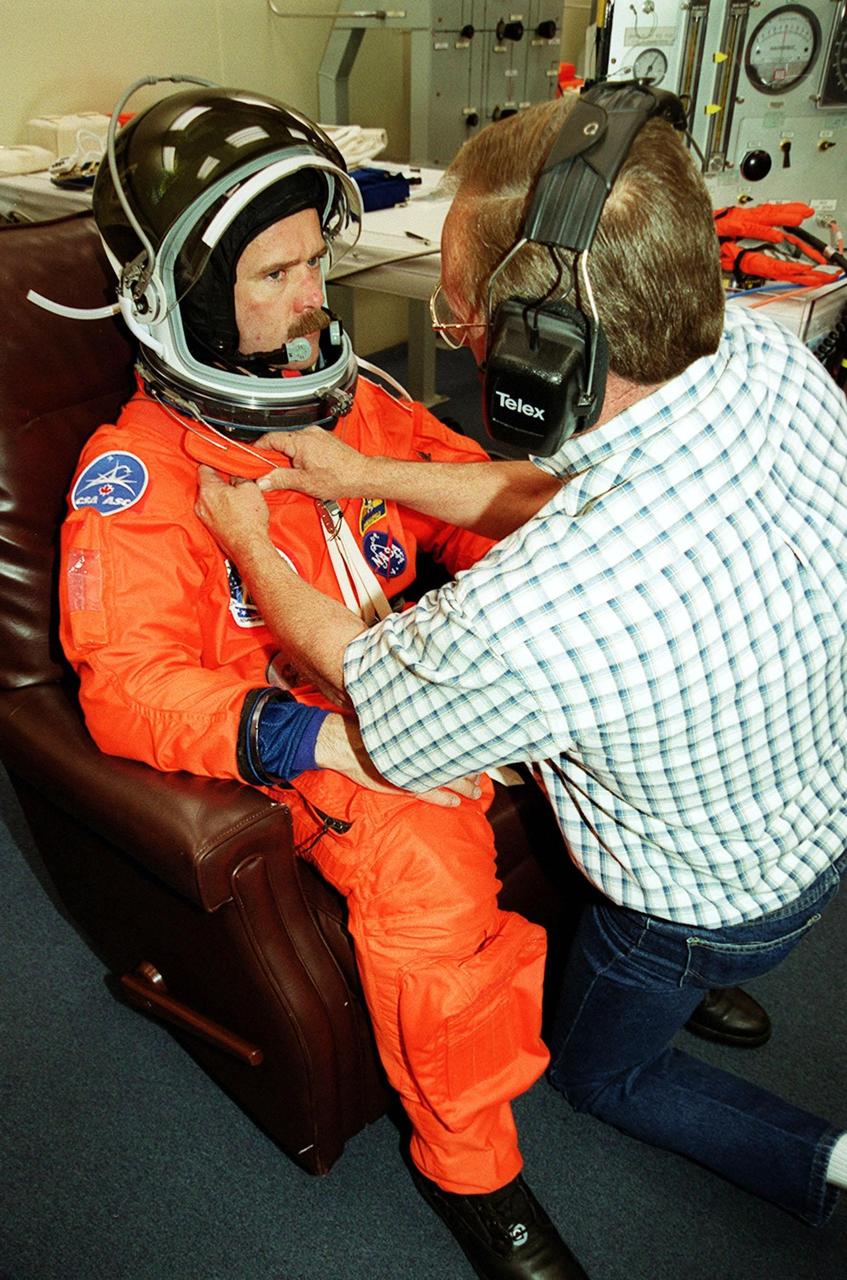
In the Operations and Checkout Building, STS-100 Mission Specialist Chris Hadfield gets his launch suit adjusted by a suit technician. Hadfield and the rest of the crew Commander Kent V. Rominger, Pilot Jeffrey S. Ashby and Mission Specialists Scott E. Parazynski, John L. Phillips, Umberto Guidoni and Yuri Lonchakov are taking part in Terminal Countdown Demonstration Test activities, from emergency escape training at the pad to a simulated launch countdown. An international crew, Hadfield is with the Canadian Space Agency, Guidoni the European Space Agency and Lonchakov the Russian Aviation and Space Agency. The mission is carrying the Multi-Purpose Logistics Module Raffaello and the Canadian robotic arm, SSRMS, to the International Space Station. Raffaello carries six system racks and two storage racks for the U.S. Lab. The SSRMS is crucial to the continued assembly of the orbiting complex and has a unique ability to switch ends as it works, “inchworming” along the Station’s exterior. Launch of mission STS-100 is scheduled for April 19 at 2:41 p.m. EDT from Launch Pad 39A
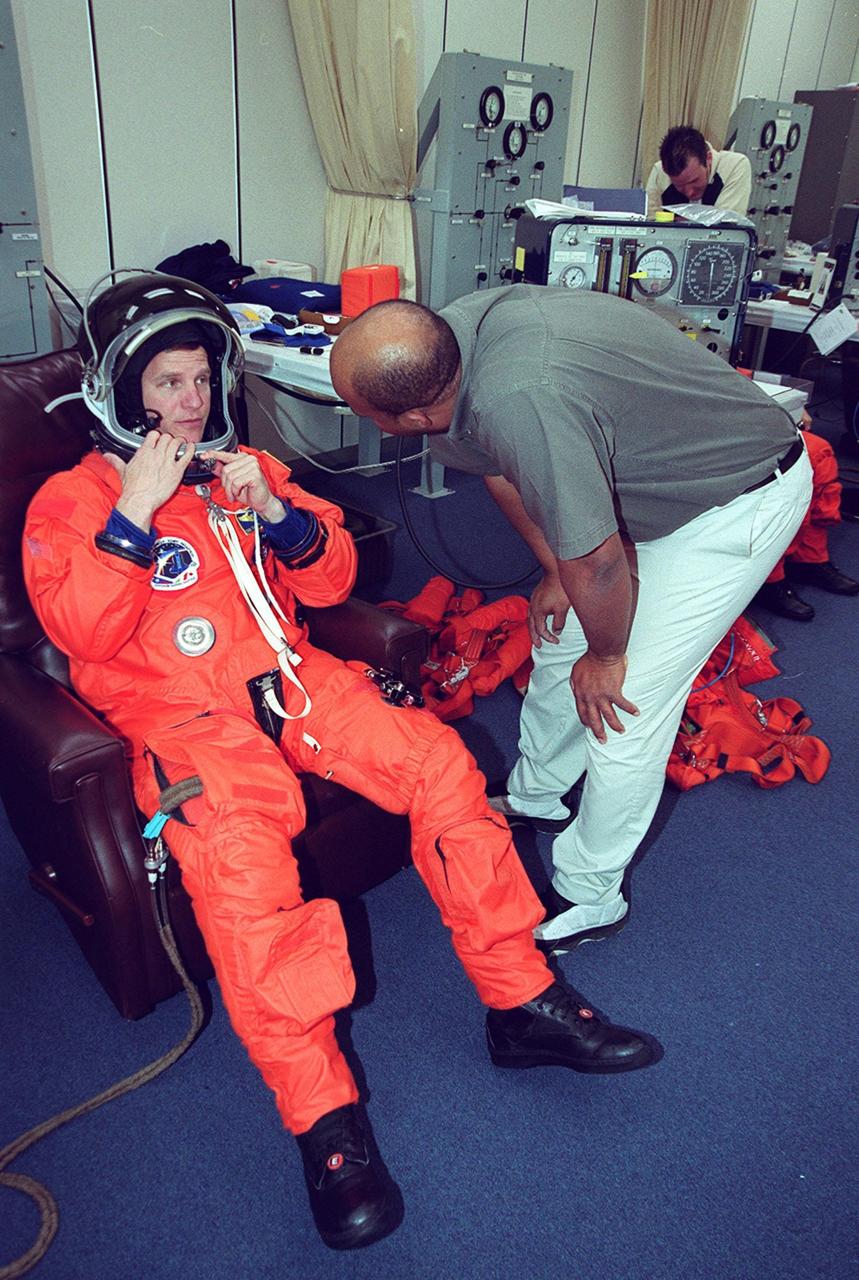
STS-100 Mission Specialist Scott E. Parazynski is questioned by a suit technician about the fit of his helmet and suit. Parazynski and the rest of the crew Commander Kent V. Rominger, Pilot Jeffrey S. Ashby and Mission Specialists Chris Hadfield, John L. Phillips, Umberto Guidoni and Yuri Lonchakov are taking part in Terminal Countdown Demonstration Test activities, from emergency escape training at the pad to a simulated launch countdown. An international crew, Hadfield is with the Canadian Space Agency, Guidoni the European Space Agency and Lonchakov the Russian Aviation and Space Agency. The mission is carrying the Multi-Purpose Logistics Module Raffaello and the Canadian robotic arm, SSRMS, to the International Space Station. Raffaello carries six system racks and two storage racks for the U.S. Lab. The SSRMS is crucial to the continued assembly of the orbiting complex and has a unique ability to switch ends as it works, “inchworming” along the Station’s exterior. Launch of mission STS-100 is scheduled for April 19 at 2:41 p.m. EDT from Launch Pad 39A
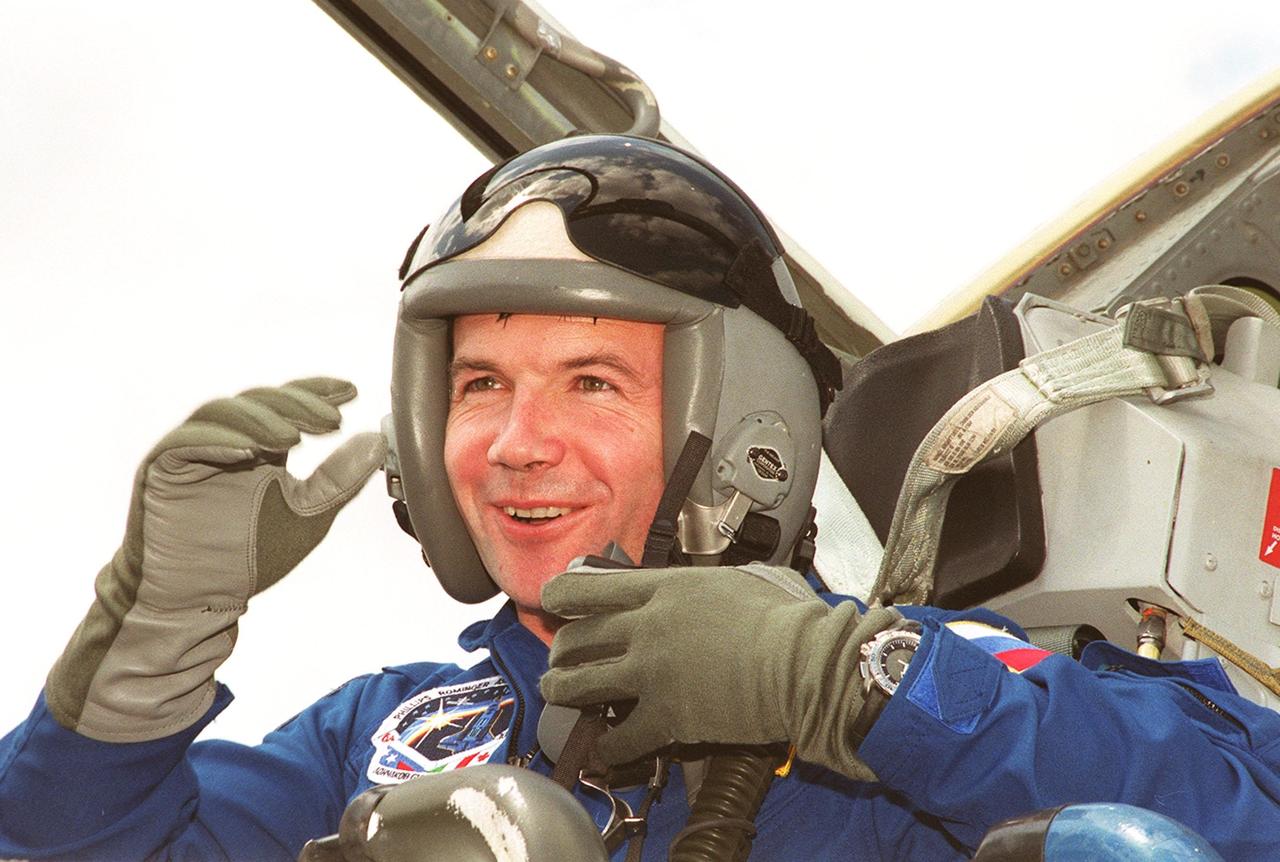
STS-100 Mission Specialist Yuri Lonchakov arrives at KSC for Terminal Countdown Demonstration Test activities. He and the rest of the crew Commander Kent V. Rominger, Pilot Jeffrey S. Ashby and Mission Specialists Chris Hadfield, Scott E. Parazynski, John L. Phillips, and Umberto Guidoni are going to be taking part in emergency escape training at the pad, equipment familiarization and a simulated launch countdown. An international crew, Hadfield is with the Canadian Space Agency, Guidoni the European Space Agency and Lonchakov the Russian Aviation and Space Agency. The mission is carrying the Multi-Purpose Logistics Module Raffaello and the Canadian robotic arm, SSRMS, to the International Space Station. Raffaello carries six system racks and two storage racks for the U.S. Lab. The SSRMS is crucial to the continued assembly of the orbiting complex and has a unique ability to switch ends as it works, “inchworming” along the Station’s exterior. Launch of mission STS-100 is scheduled for April 19 at 2:41 p.m. EDT from Launch Pad 39A
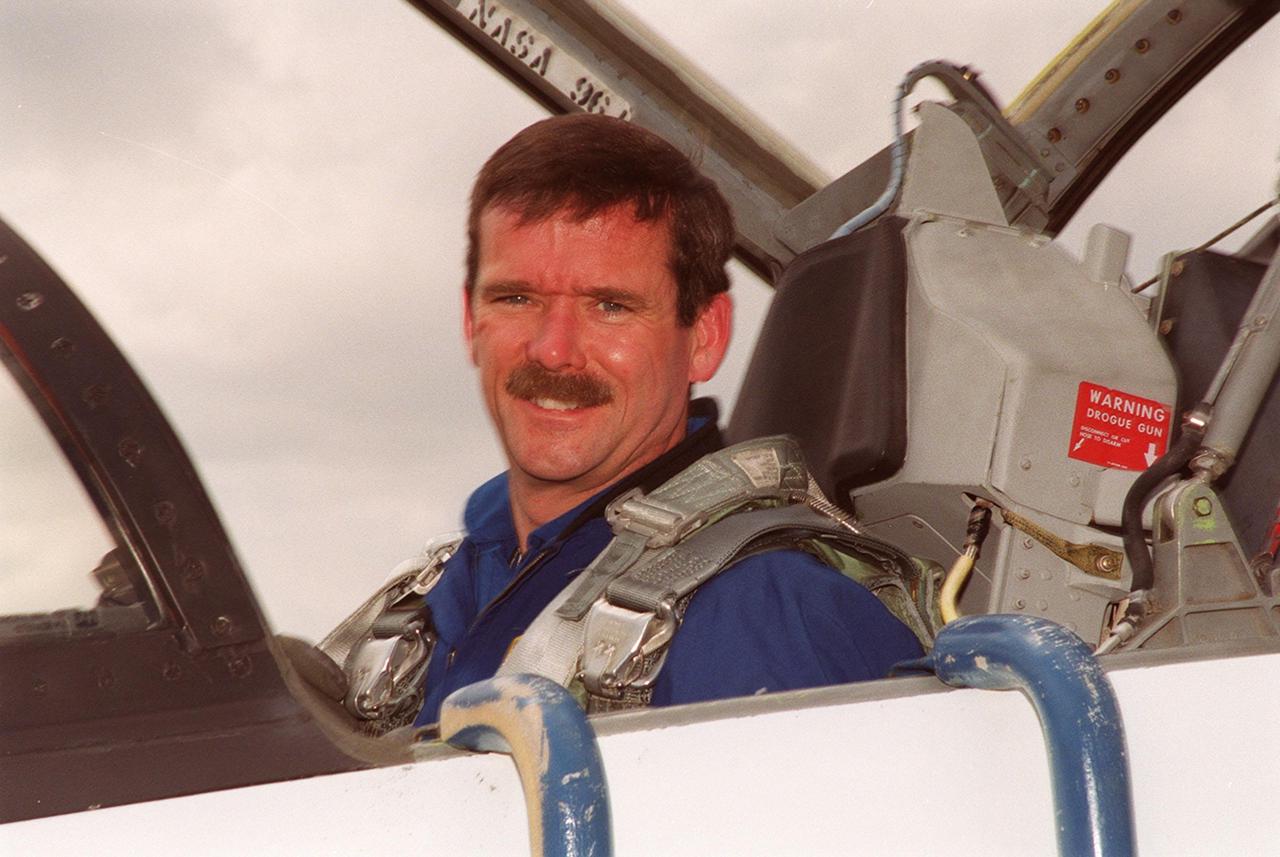
STS-100 Mission Specialist Chris Hadfield arrives at KSC for Terminal Countdown Demonstration Test activities. He and the rest of the crew Commander Kent V. Rominger, Pilot Jeffrey S. Ashby and Mission Specialists Scott E. Parazynski, John L. Phillips, Umberto Guidoni and Yuri Lonchakov are going to be taking part in emergency escape training at the pad, equipment familiarization and a simulated launch countdown. An international crew, Hadfield is with the Canadian Space Agency, Guidoni the European Space Agency and Lonchakov the Russian Aviation and Space Agency. The mission is carrying the Multi-Purpose Logistics Module Raffaello and the Canadian robotic arm, SSRMS, to the International Space Station. Raffaello carries six system racks and two storage racks for the U.S. Lab. The SSRMS is crucial to the continued assembly of the orbiting complex and has a unique ability to switch ends as it works, “inchworming” along the Station’s exterior. Launch of mission STS-100 is scheduled for April 19 at 2:41 p.m. EDT from Launch Pad 39A
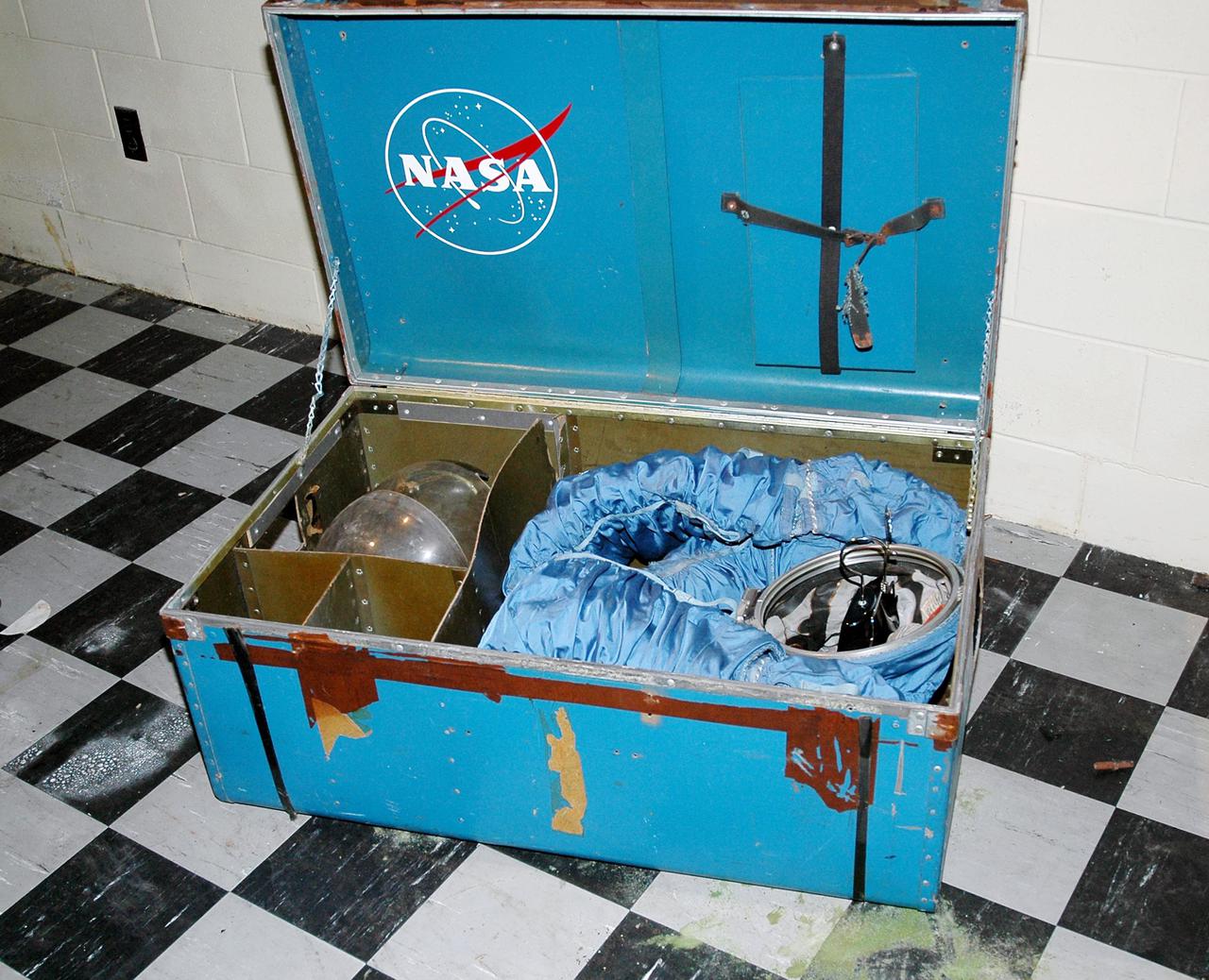
KENNEDY SPACE CENTER, FLA. - This locker reveals a long-lost spacesuit recently uncovered at the Cape Canaveral Air Force Station (CCAFS) in Florida. A recent venture into a long-locked room at CCAFS uncovered interesting artifacts of a bygone era: retired space suits from Americans who trained in the 1960s to be astronauts aboard an Air Force orbiting reconnaissance laboratory. Two security officers were doing a check of a facility at Launch Complex 5_6 blockhouse. NASA Special Agent Dan E. Oakland and Security Manager Henry Butler, who is with Delaware North Parks and Resorts, the company that oversees the museum, discovered a locked room. Space suits from the Air Force’s planned Manned Orbiting Laboratory (MOL) program were found in the room Begun in 1964, the MOL program was an Air Force initiative that would have sent Air Force astronauts to a space station in a Gemini capsule. After spending a few weeks in orbit, the crew would undock and return to Earth. A test launch from Complex 40 on Nov. 30, 1966, of a MOL was conducted with an unmanned Gemini capsule. The MOL was constructed from tankage of a Titan II rocket. The operational MOL was planned to be launched into a polar orbit from Vandenberg Air Force Base in California. The Air Force abandoned the program in 1969, but the program produced a great deal of technological development, and three groups of military officers trained to be MOL astronauts. When the program was cancelled, seven of the younger astronauts were transferred to the agency’s human space flight program and went on to have standout careers. Among them were Robert Crippen, pilot of the first Space Shuttle mission, and Richard H. 'Dick' Truly, who later became NASA Administrator.