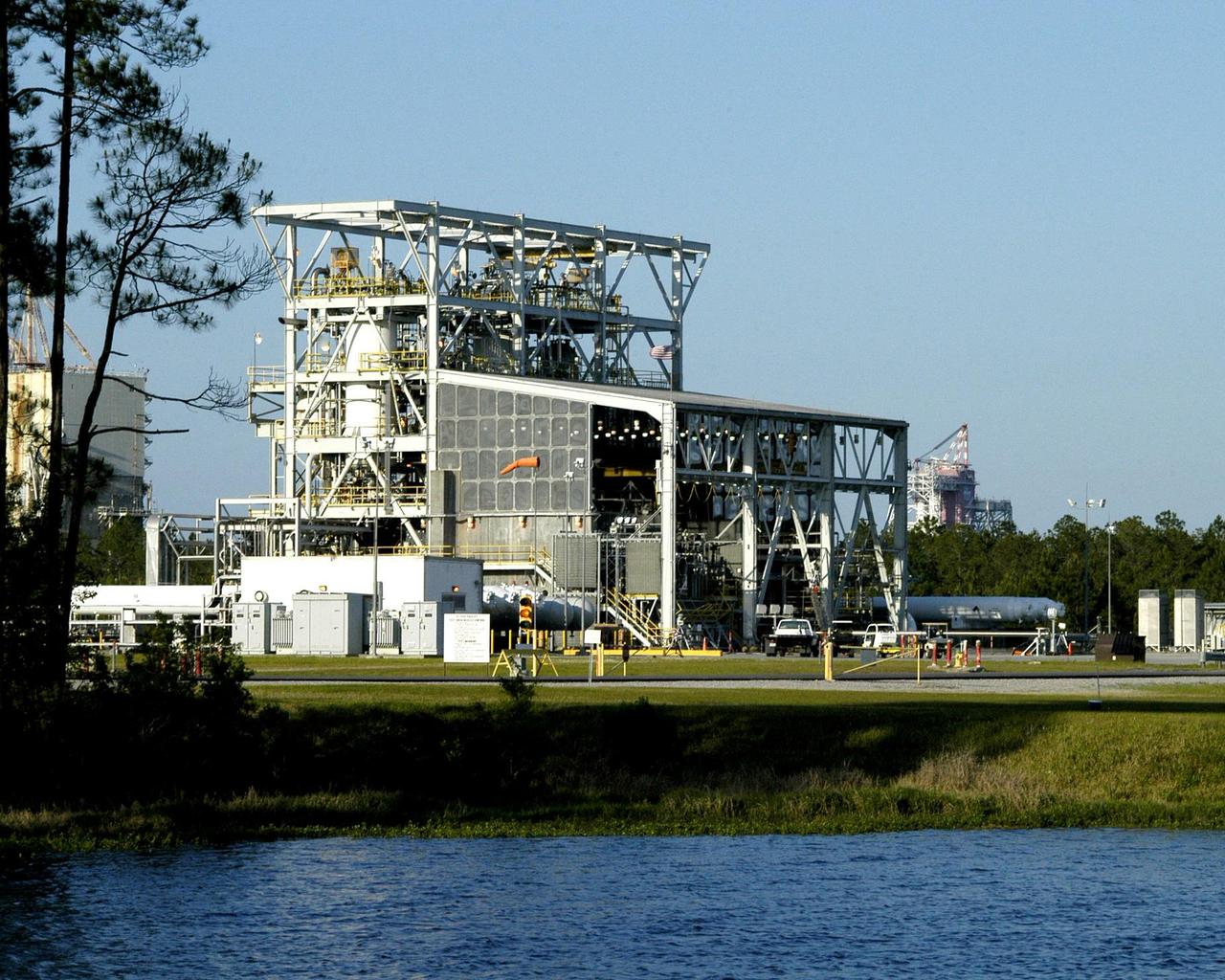
The E Test Complex is SSC's versatile, three-stand complex that includes seven separate test cells capable of testing that involves ultra high-pressure gases and cryogenic fluids.

NASA John C. Stennis Space Center employee Dustan Ladner (left) assists tanker driver David Velasco in transferring RP-1 fuel to a 20,000-gallon underground tank at the E-1 Test Stand during a March 30 delivery. The rocket propellant will be used for testing Aerojet AJ26 rocket engines beginning this summer. Stennis is testing the engines for Orbital Sciences Corporation, which has partnered with NASA to provide eight supply missions to the International Space Station through 2015. The partnership is part of NASA's Commercial Orbital Transportation Services initiative to work closer with companies to provide commercial space transport once the space shuttle is retired later this year.
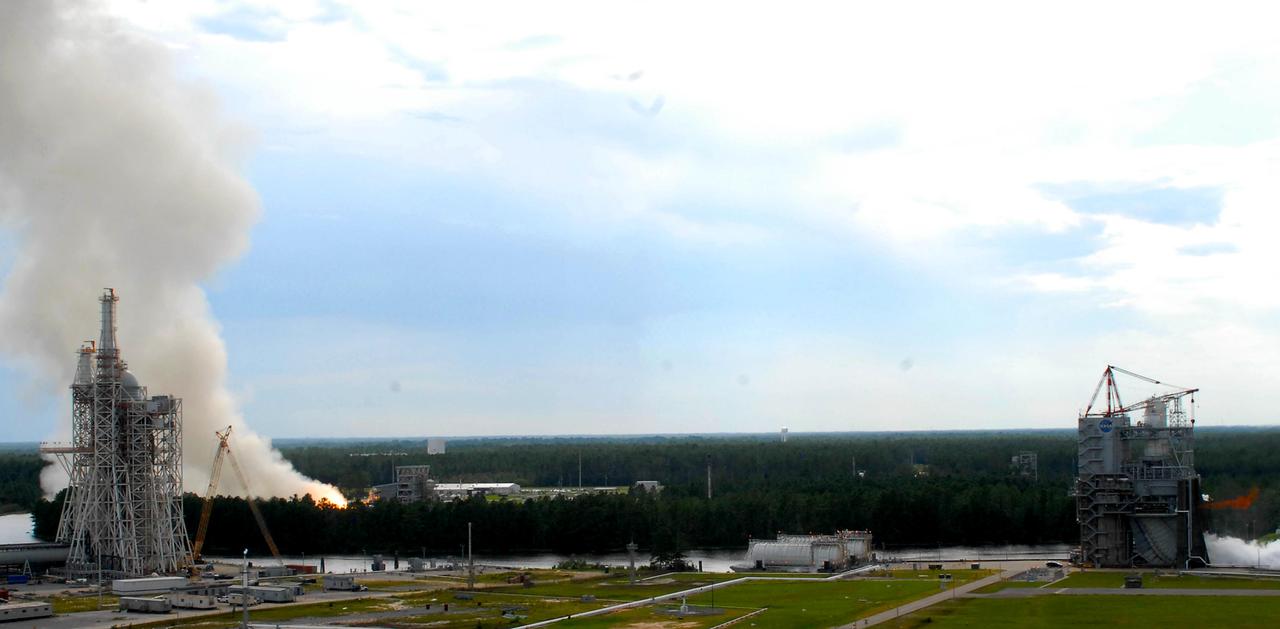
Two large-engine tests were conducted simultaneously for the first time at Stennis Space Center on Aug. 16. A plume on the left indicates a test on the facility's E-1 Test Stand. On the right, a finger of fire indicates a test under way on the A-1 Test Stand. In another first, both tests were conducted by female engineers. The image was taken from atop the facility's A-2 Test Stand, offering a panoramic view that includes the new A-3 Test Stand under construction to the left.
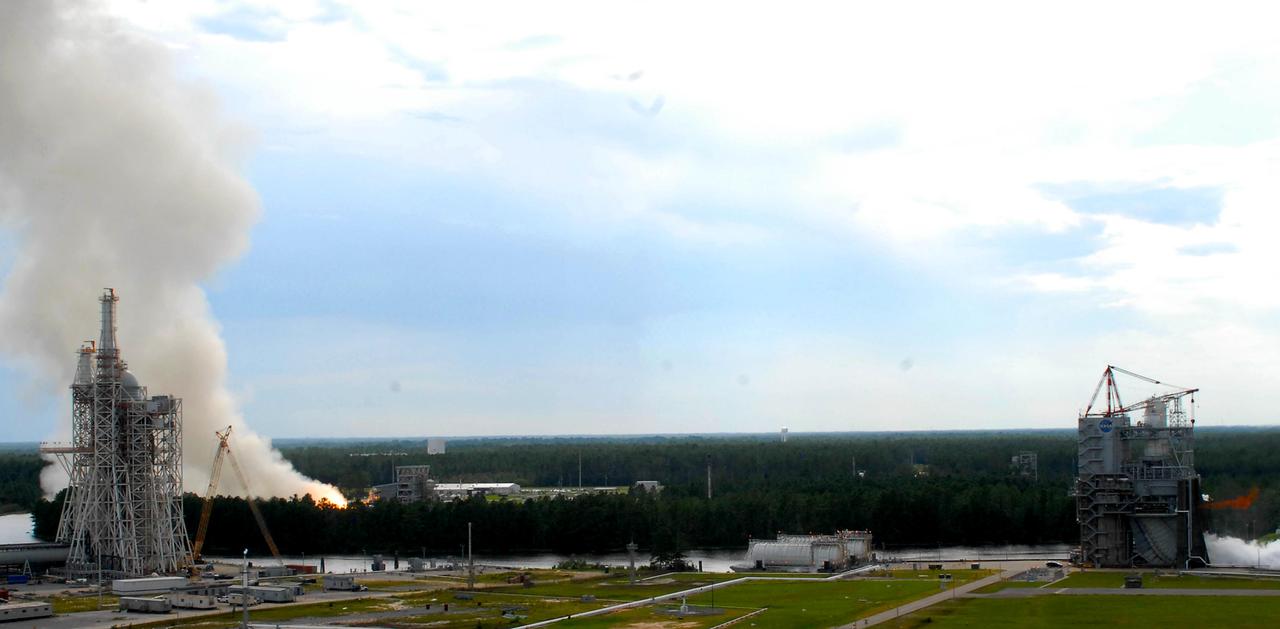
Two large-engine tests were conducted simultaneously for the first time at Stennis Space Center on Aug. 16. A plume on the left indicates a test on the facility's E-1 Test Stand. On the right, a finger of fire indicates a test under way on the A-1 Test Stand. In another first, both tests were conducted by female engineers. The image was taken from atop the facility's A-2 Test Stand, offering a panoramic view that includes the new A-3 Test Stand under construction to the left.
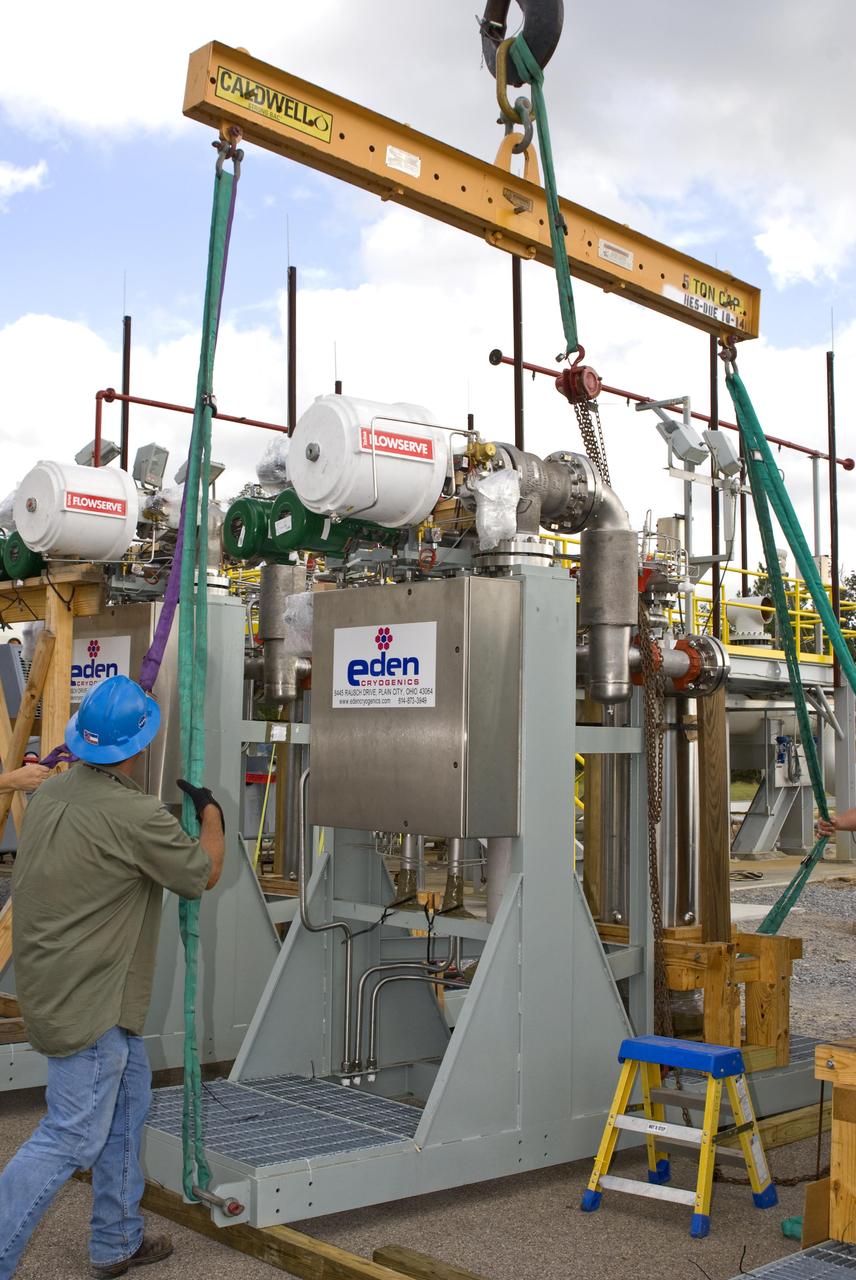
The first of nine chemical steam generator (CSG) units that will be used on the A-3 Test Stand is prepared for installation Oct. 24, 2010, at John C. Stennis Space Center. The unit was installed at the E-2 Test Stand for verification and validation testing before it is moved to the A-3 stand. Steam generated by the nine CSG units that will be installed on the A-3 stand will create a vacuum that allows Stennis operators to test next-generation rocket engines at simulated altitudes up to 100,000 feet.
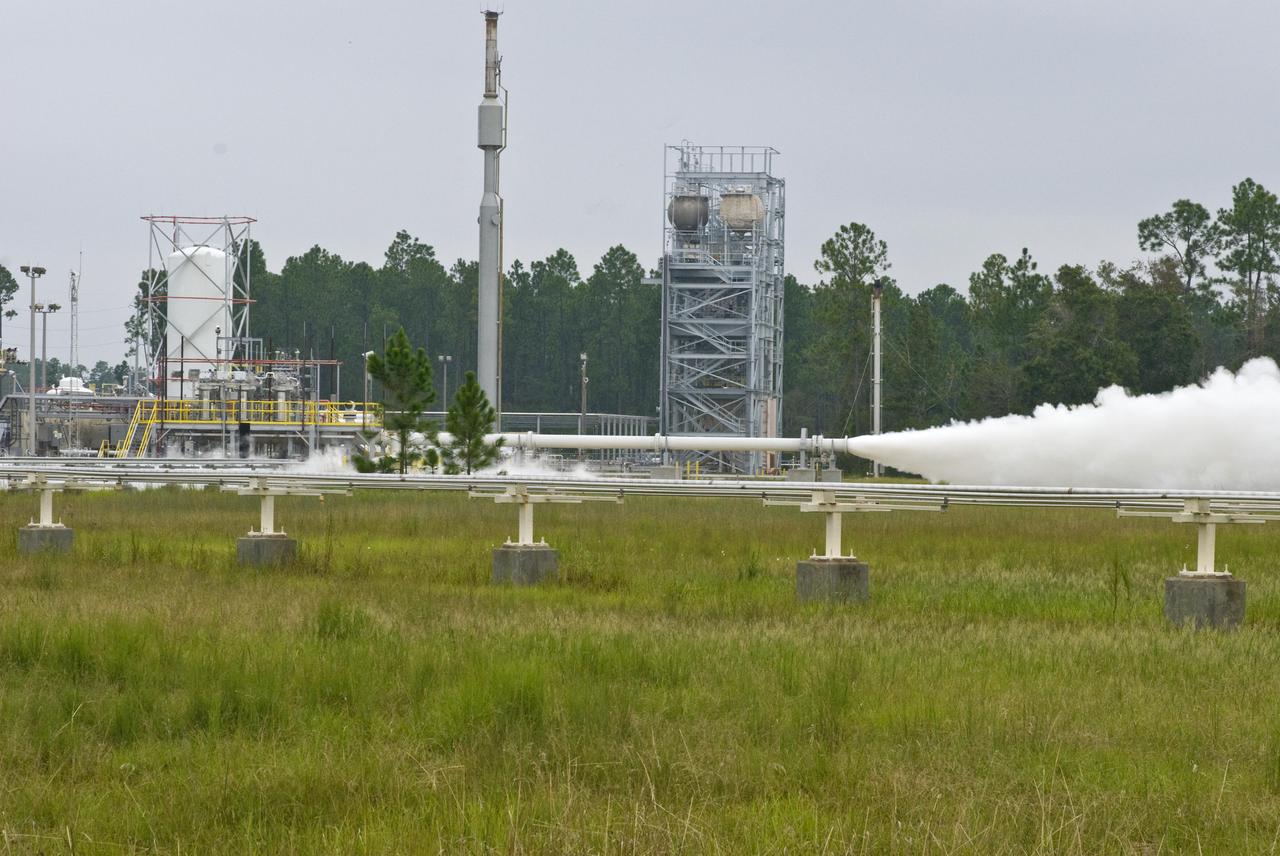
E-2 Test Stand team members at Stennis Space Center conducted their first series of tests on a three-module chemical steam generator unit Sept. 15. All three modules successfully fired during the tests. The chemical steam generator is a critical component for the A-3 Test Stand under construction at Stennis.
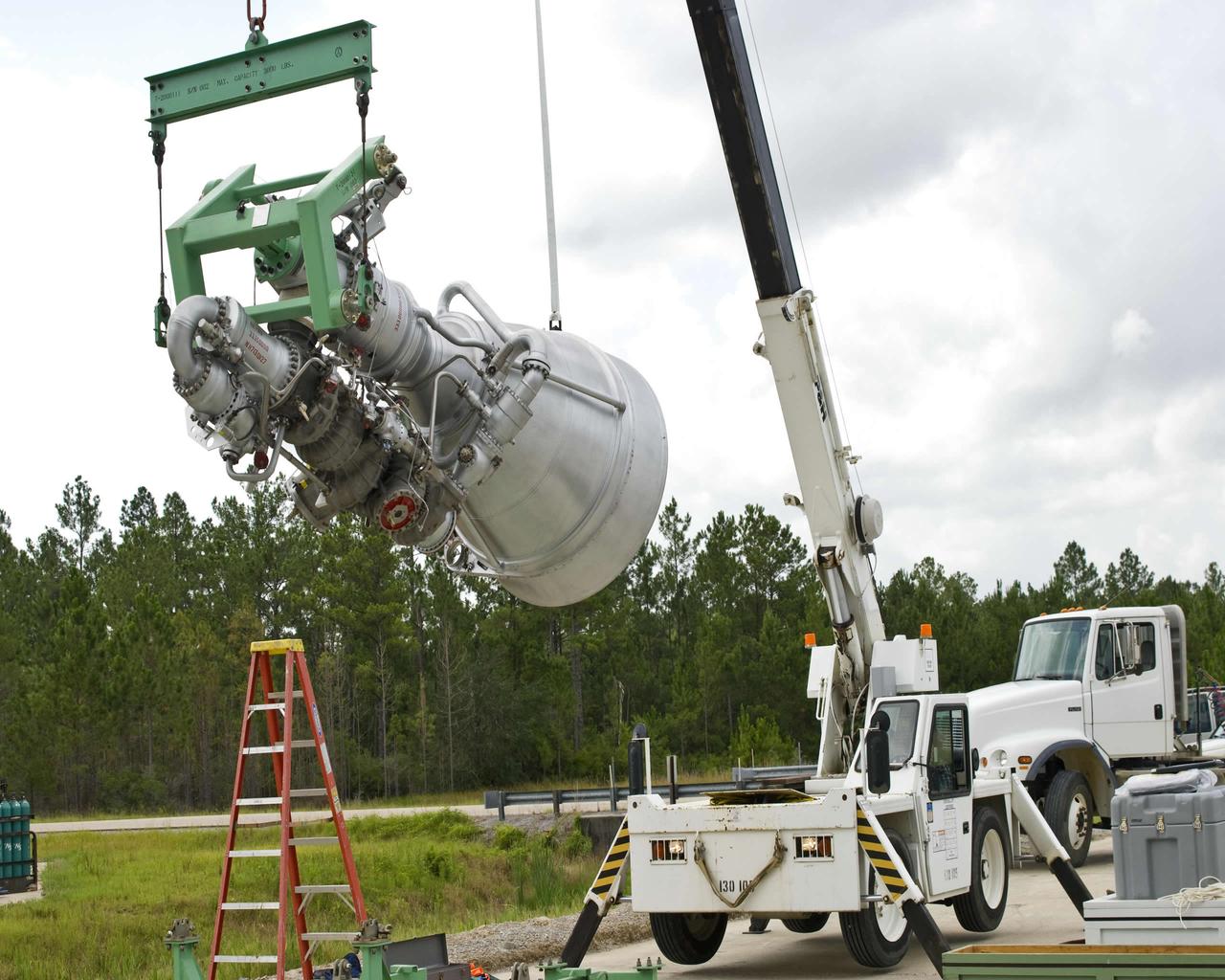
An Aerojet AJ26 rocket engine is hoisted for installation at Stennis Space Center's E-1 Test Stand on July 19. Stennis operators have been preparing the E-1 stand for testing AJ26 engines since April 2009. Modifications included construction of a 27-foot-deep flame deflection trench.
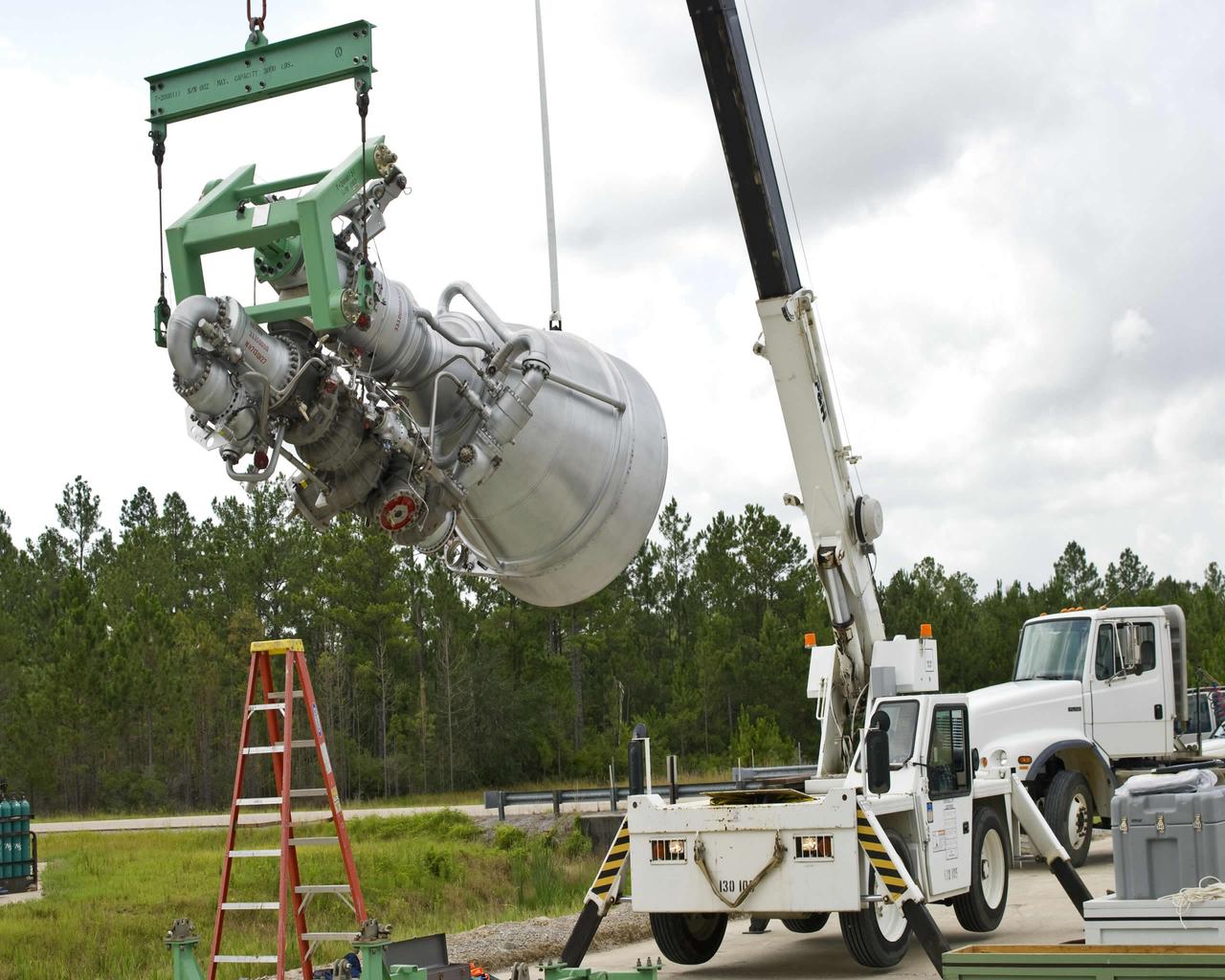
An Aerojet AJ26 rocket engine is hoisted for installation at Stennis Space Center's E-1 Test Stand on July 19. Stennis operators have been preparing the E-1 stand for testing AJ26 engines since April 2009. Modifications included construction of a 27-foot-deep flame deflection trench.
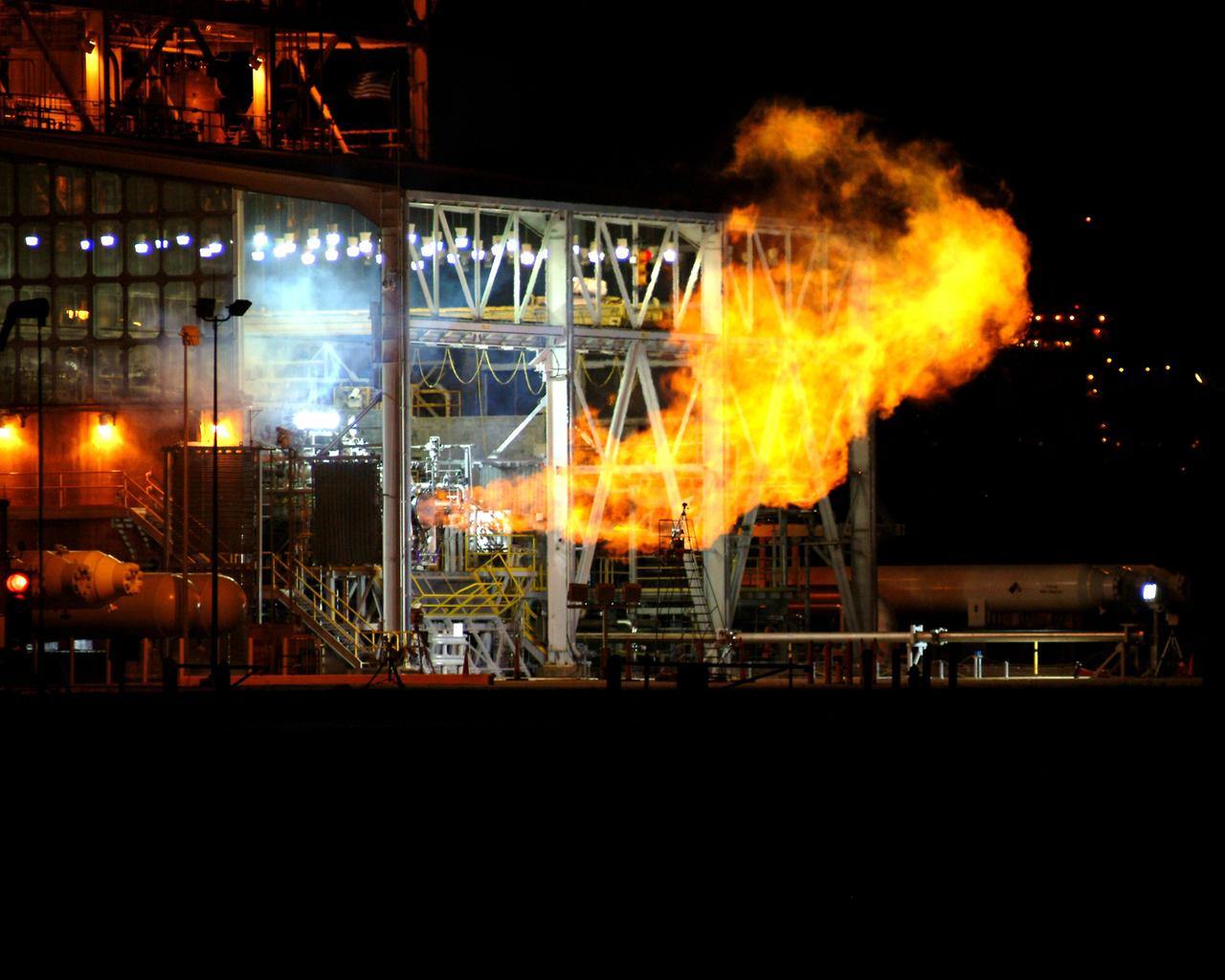
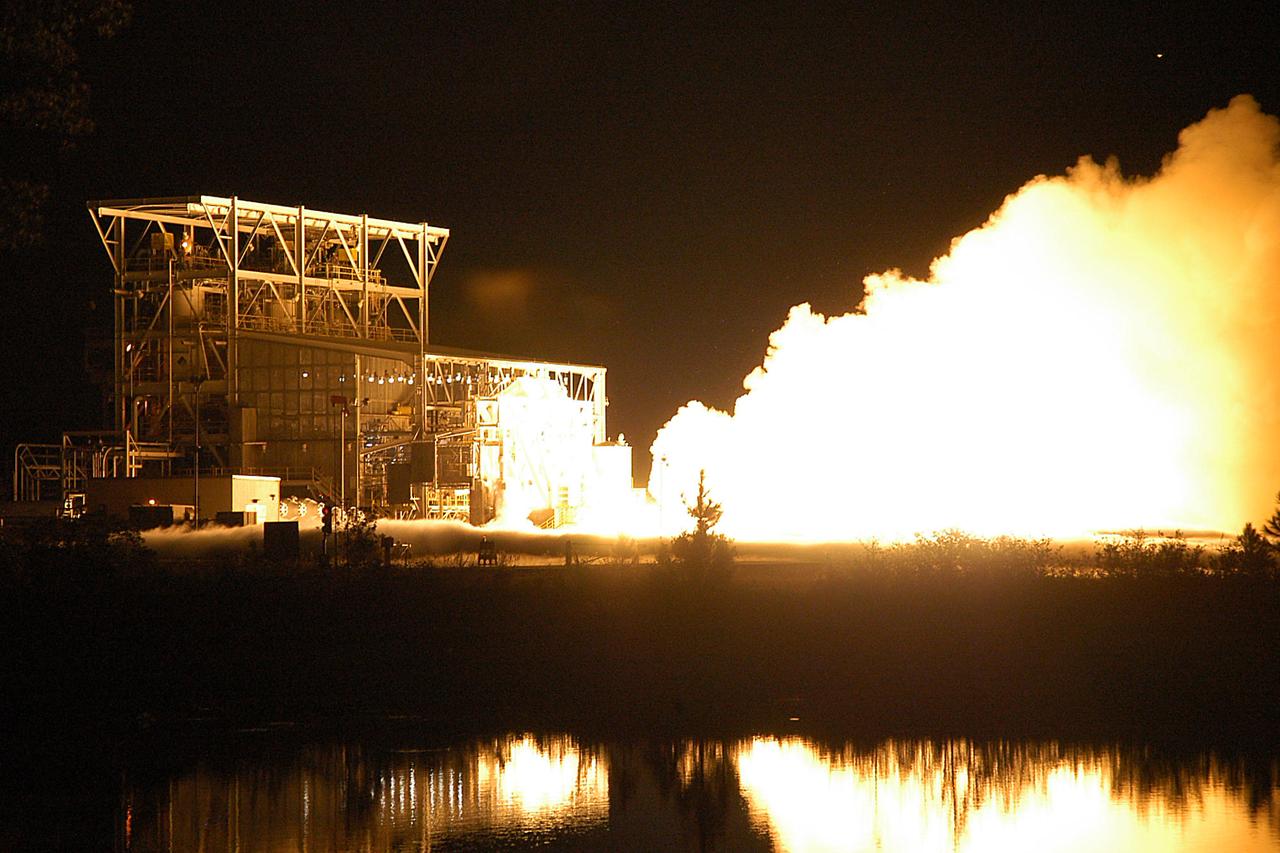
A plume of fire lights up the night during a test of the Integrated Powerhead Demonstrator at Stennis Space Center's E-1 Test Stand.
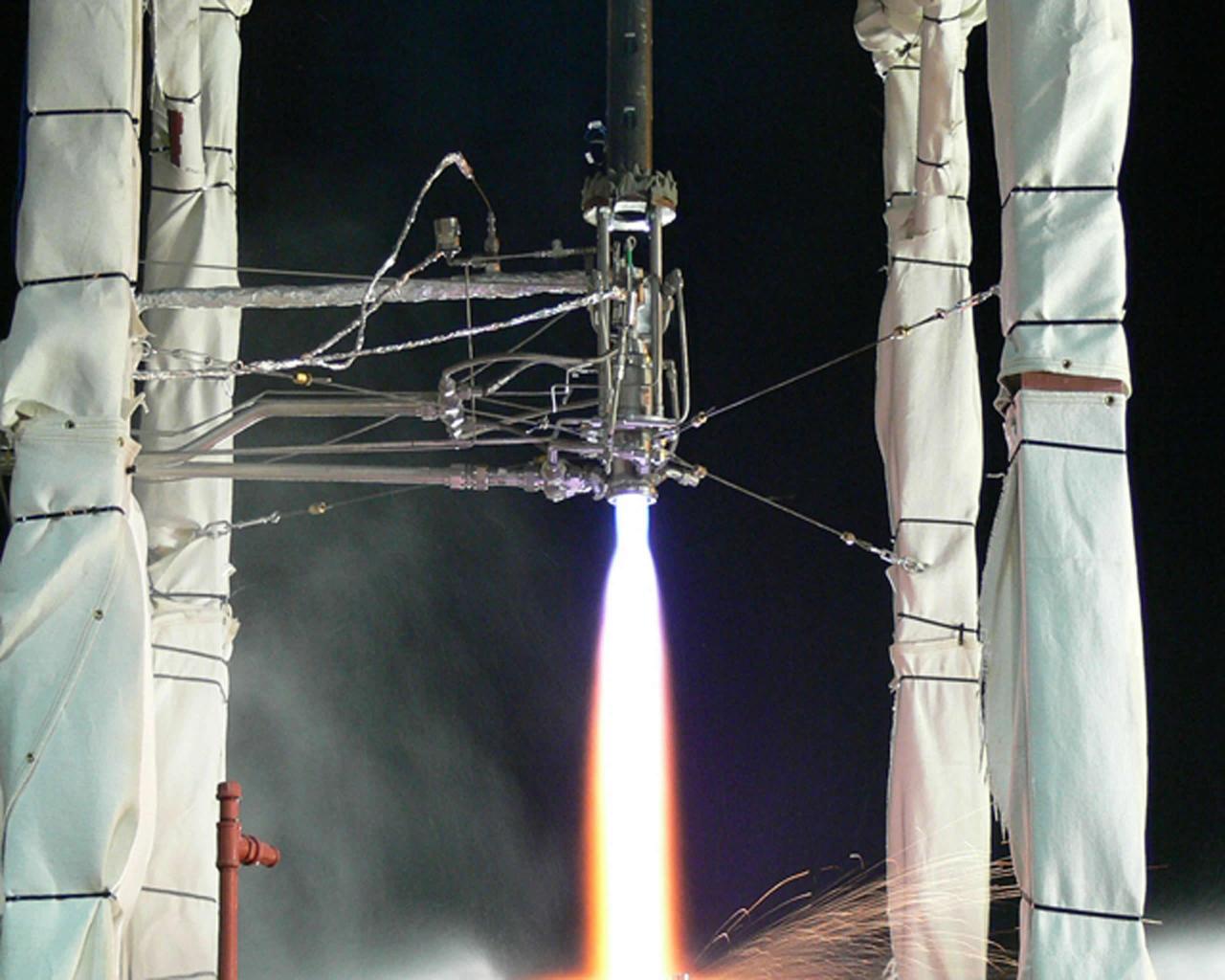
Operators at the E-3 Test Stand at NASA's John C. Stennis Space Center completed 32 acoustics tests April 16-28, designed to gather critical information for future space launches. Stennis operators investigated lift-off acoustics that can damage space vehicle components by testing the benefits of injecting water onto the upper surface of the launch pad to suppress sound. The Stennis tests provided critical data to determine what can be gained from this approach.
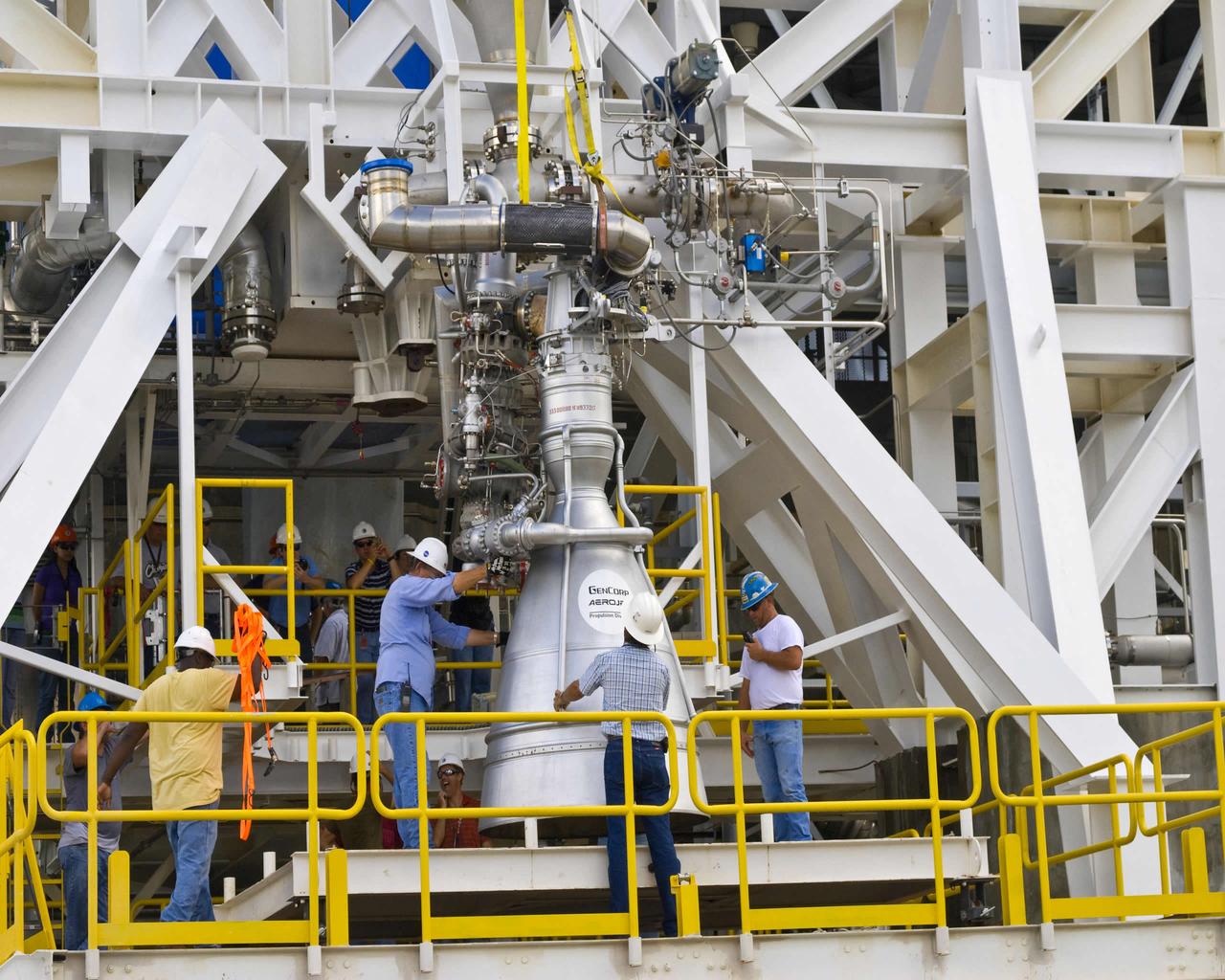
Stennis employees at the E-1 Test Stand position an Aerojet AJ26 rocket engine in preparation for a series of early tests. Stennis has partnered with Orbital Sciences Corporation to test the rocket engine for the company's commercial cargo flights to the International Space Station.
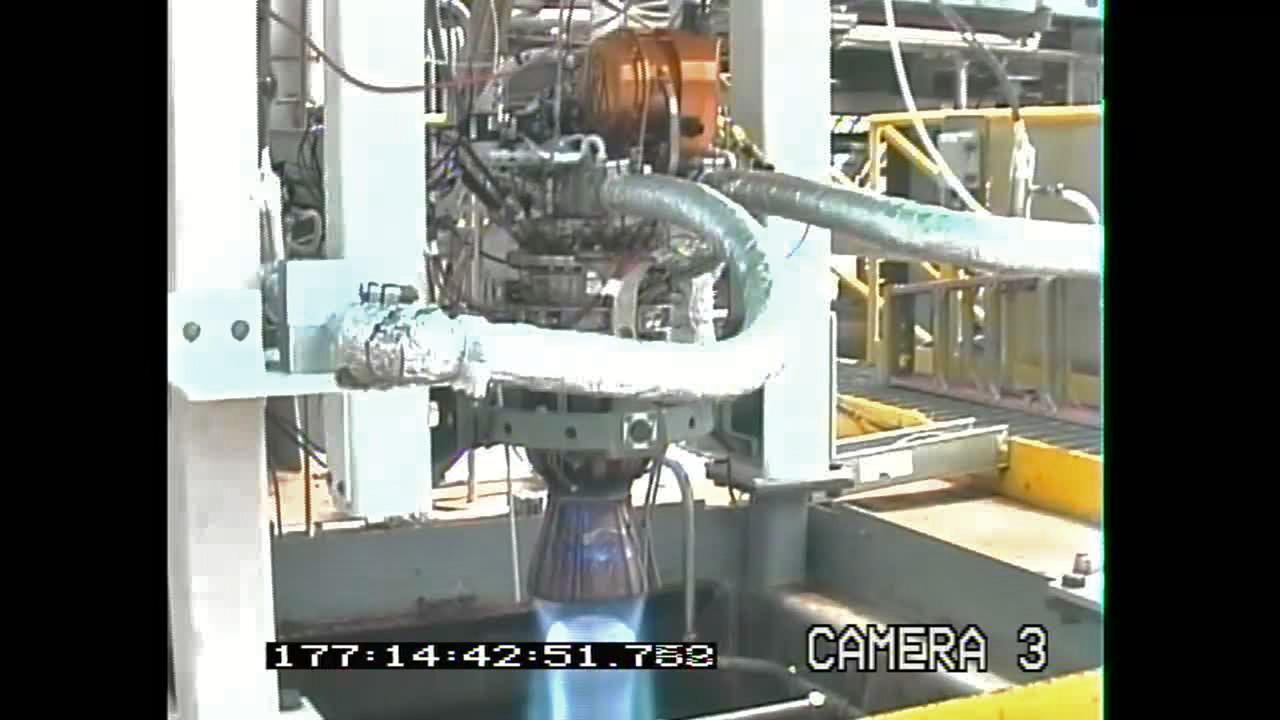
A frame grab from a mounted video camera on the E-3 Test Stand at Stennis Space Center documents testing of the new Project Morpheus engine. The new liquid methane, liquid oxygen engine will power the Morpheus prototype lander, which could one day evolve to carry cargo safely to the moon, asteroids or Mars surfaces.
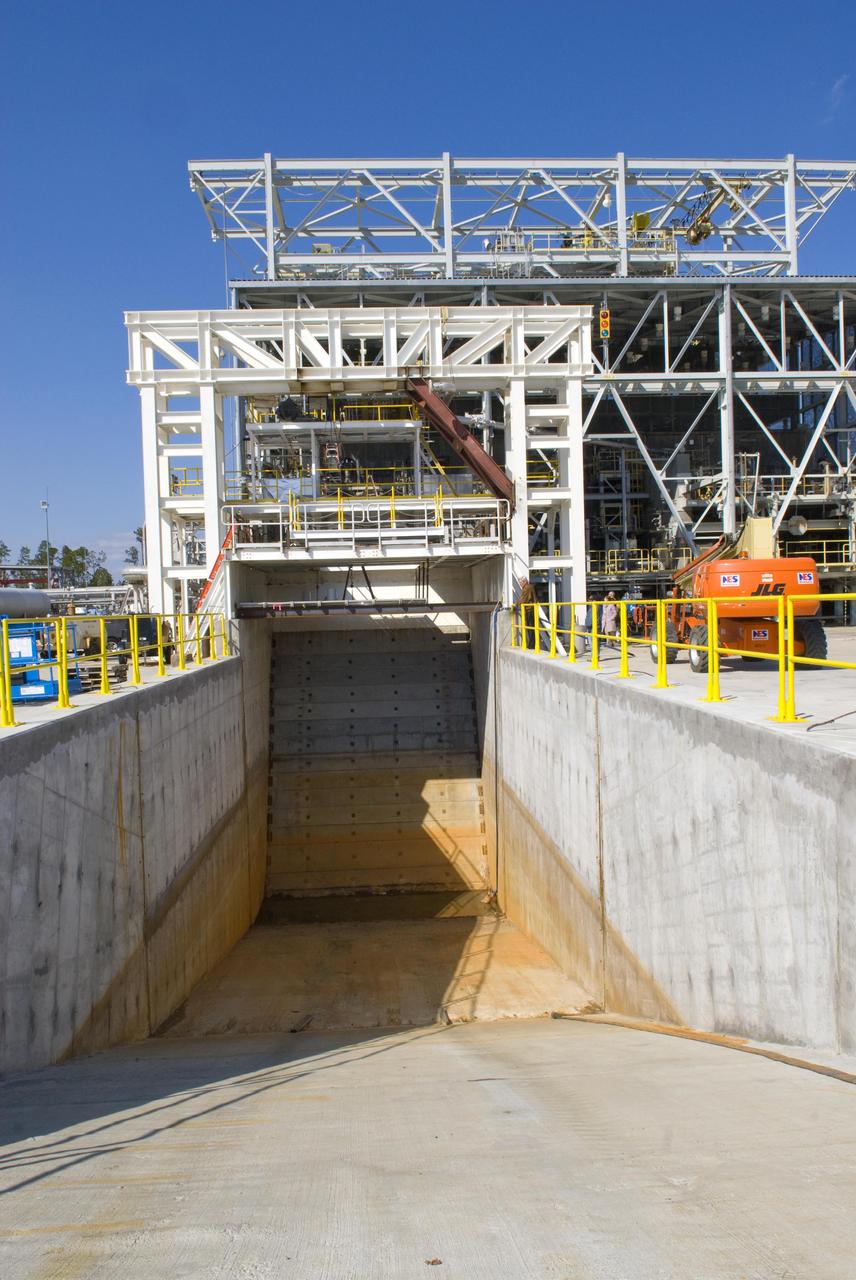
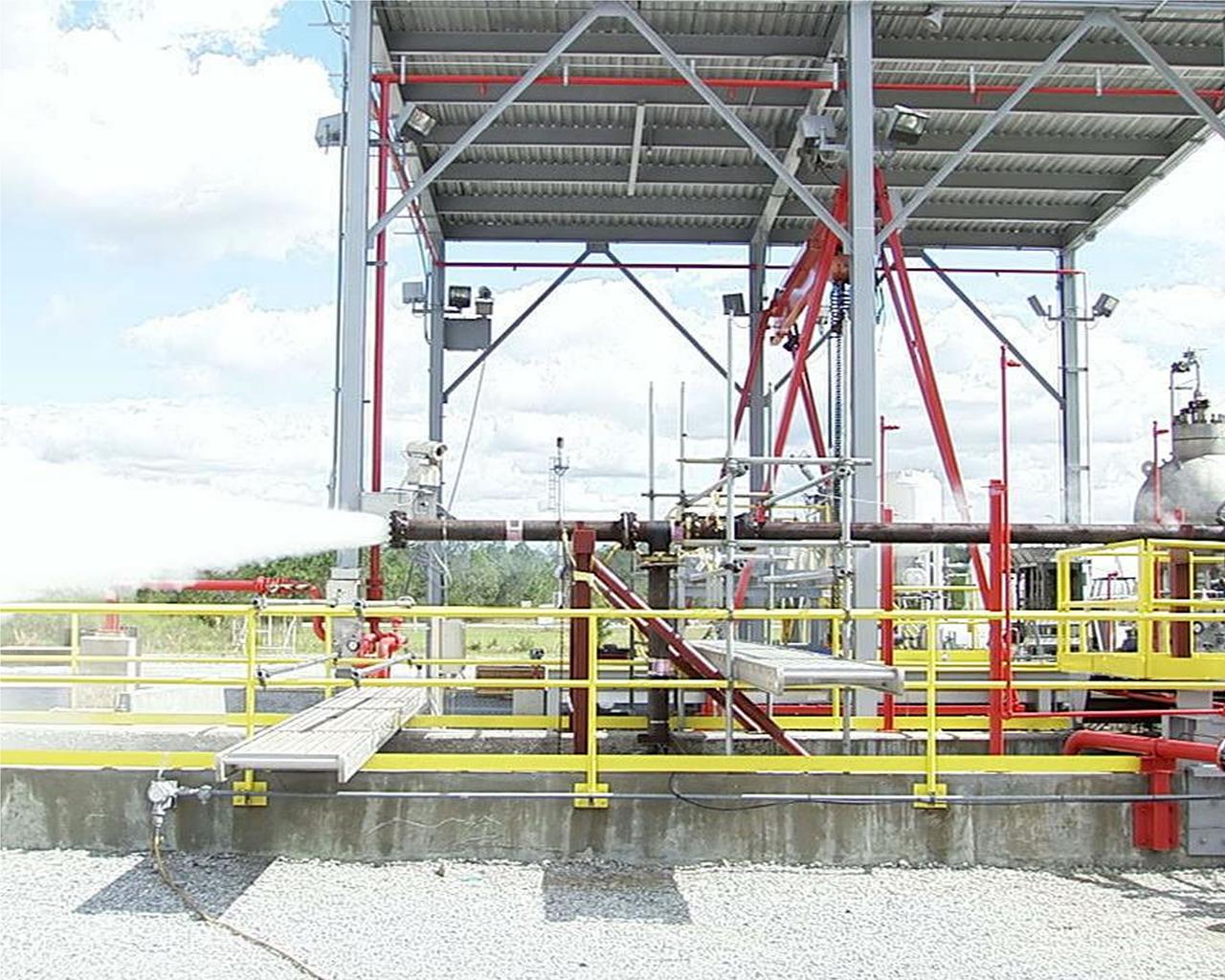
Operators at NASA's John C. Stennis Space Center are completing modifications to the E-1 Test Stand to begin testing Aerojet AJ26 rocket engines in early summer of 2010. Modifications include construction of a 27-foot-deep flame deflector trench. The AJ26 rocket engines will be used to power Orbital Sciences Corp.'s Taurus II space vehicles to provide commercial cargo transportation missions to the International Space Station for NASA. Stennis has partnered with Orbital to test all engines for the transport missions.
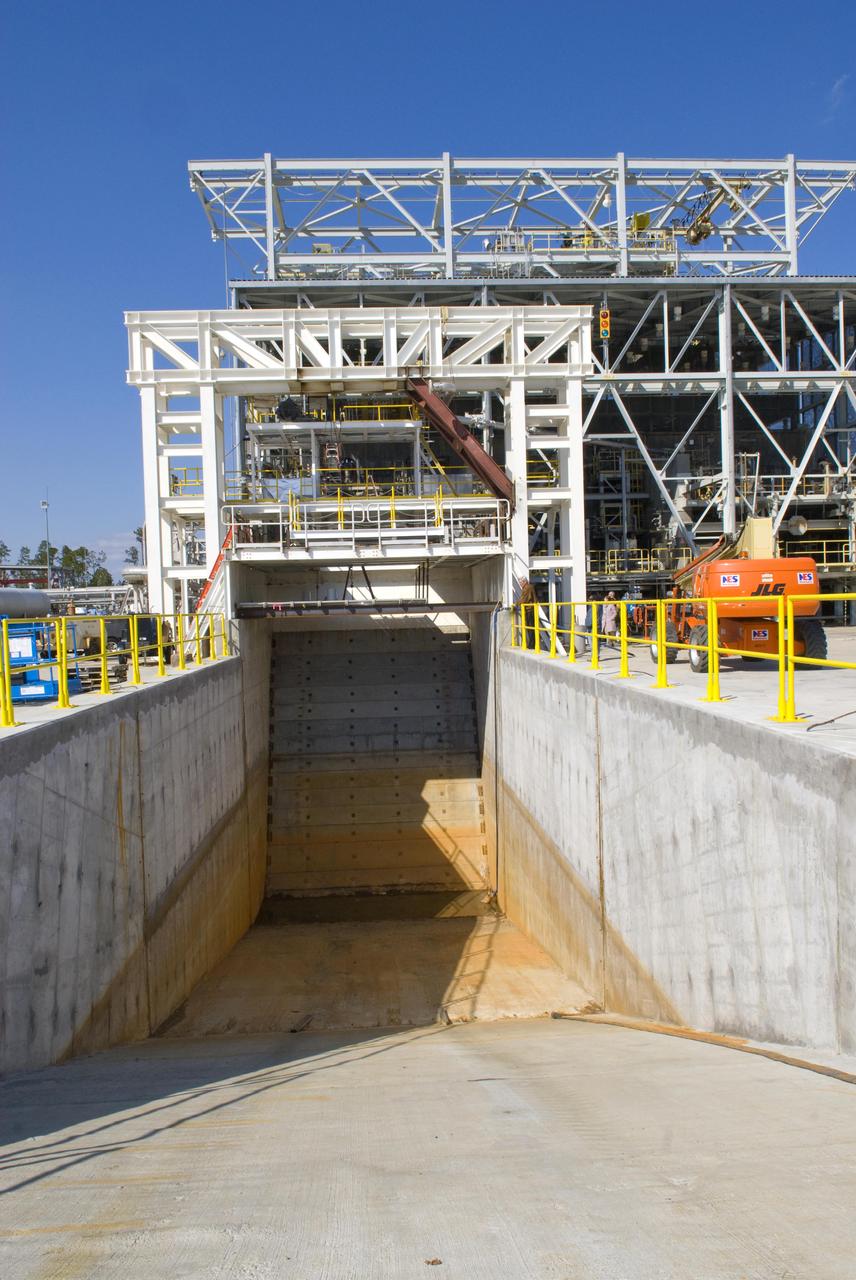
Operators at NASA's John C. Stennis Space Center are completing modifications to the E-1 Test Stand to begin testing Aerojet AJ26 rocket engines in early summer of 2010. Modifications include construction of a 27-foot-deep flame deflector trench. The AJ26 rocket engines will be used to power Orbital Sciences Corp.'s Taurus II space vehicles to provide commercial cargo transportation missions to the International Space Station for NASA. Stennis has partnered with Orbital to test all engines for the transport missions.
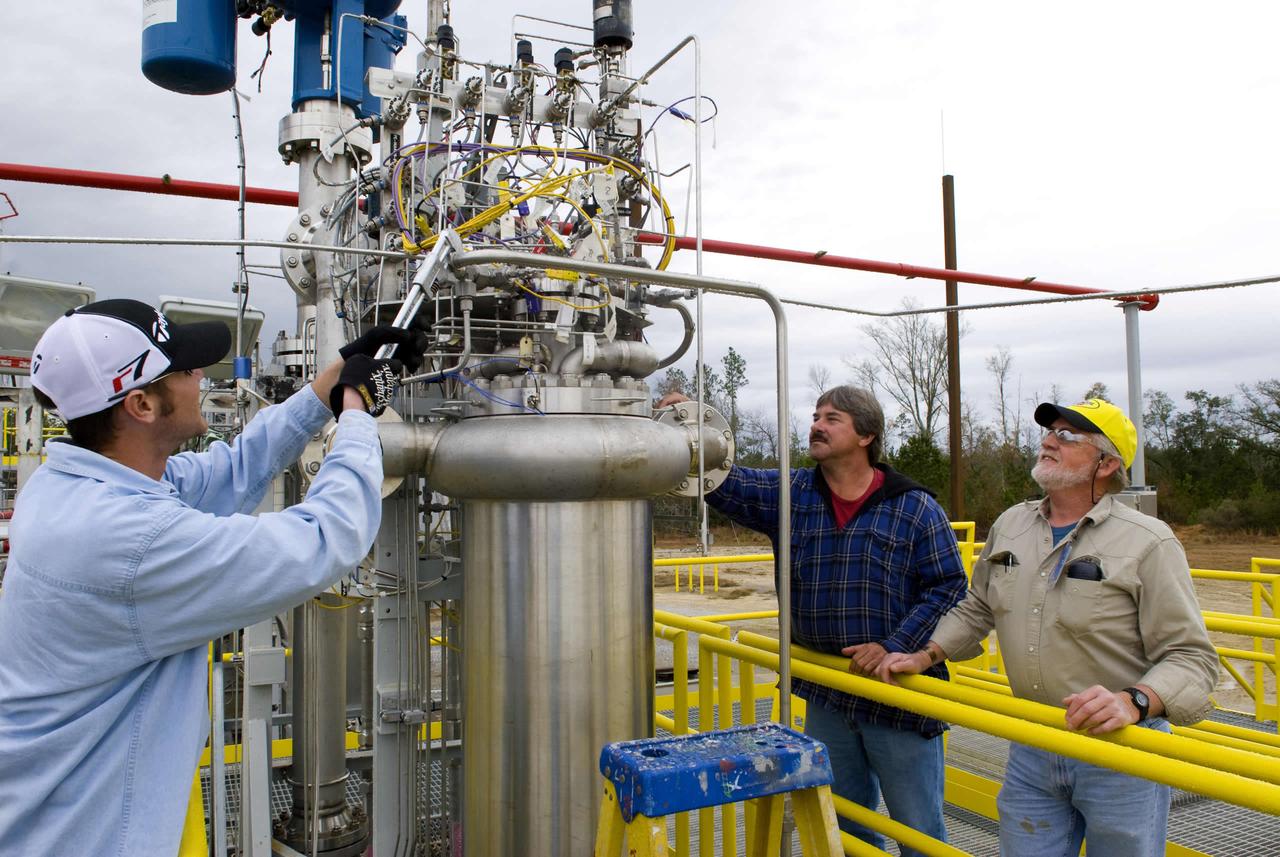
Kanaly Slade, Pat Guidry and Danny Tarter, all of Jacobs NTOG, make adjustments to the chemical steam generator installed on the E-2 Test Stand.
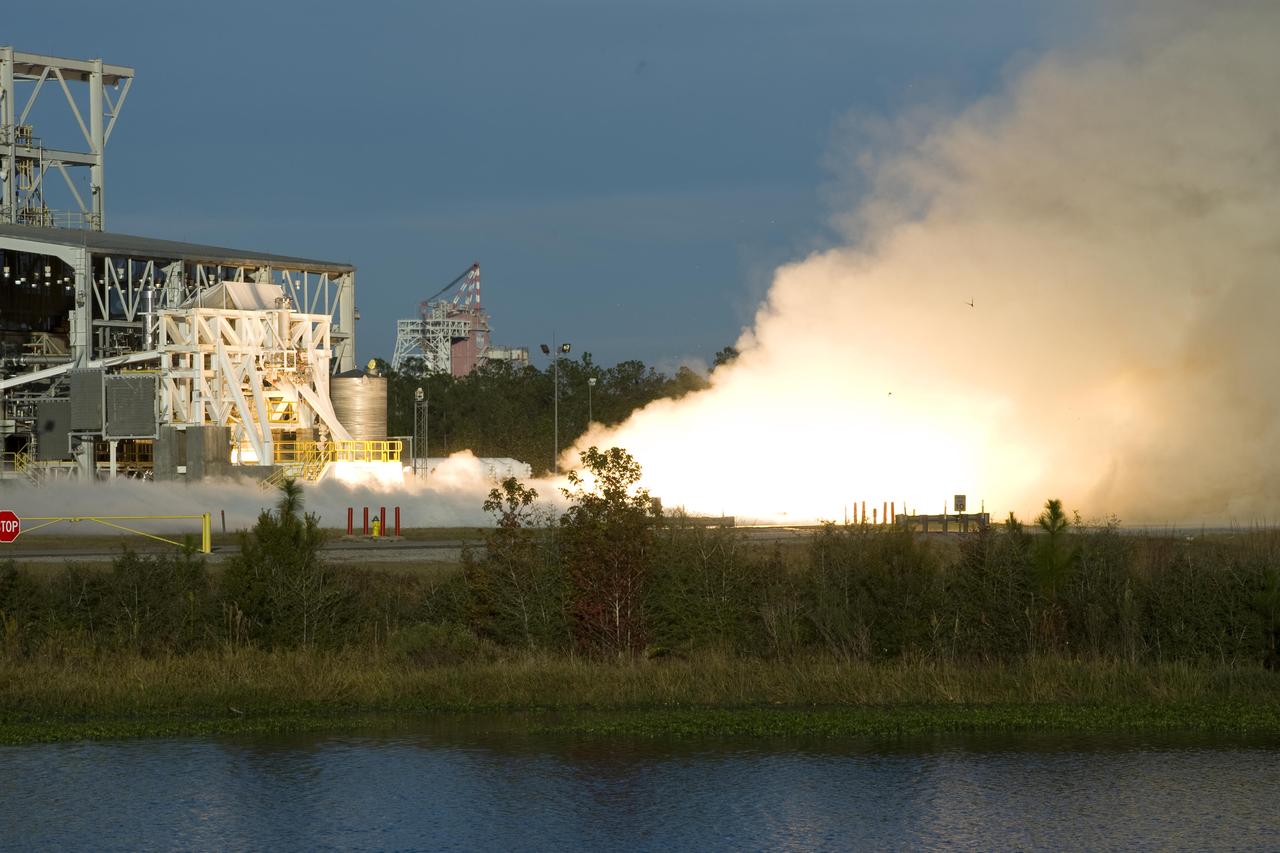
Fire and steam signal a successful test firing of Orbital Sciences Corporation's Aerojet AJ26 rocket engine at John C. Stennis Space Center. AJ26 engines will be used to power Orbital's Taurus II space vehicle on commercial cargo flights to the International Space Station. On Nov. 10, operators at Stennis' E-1 Test Stand conducted a 10-second test fire of the engine, the first of a series of three verification tests. Orbital has partnered with NASA to provide eight missions to the ISS by 2015.
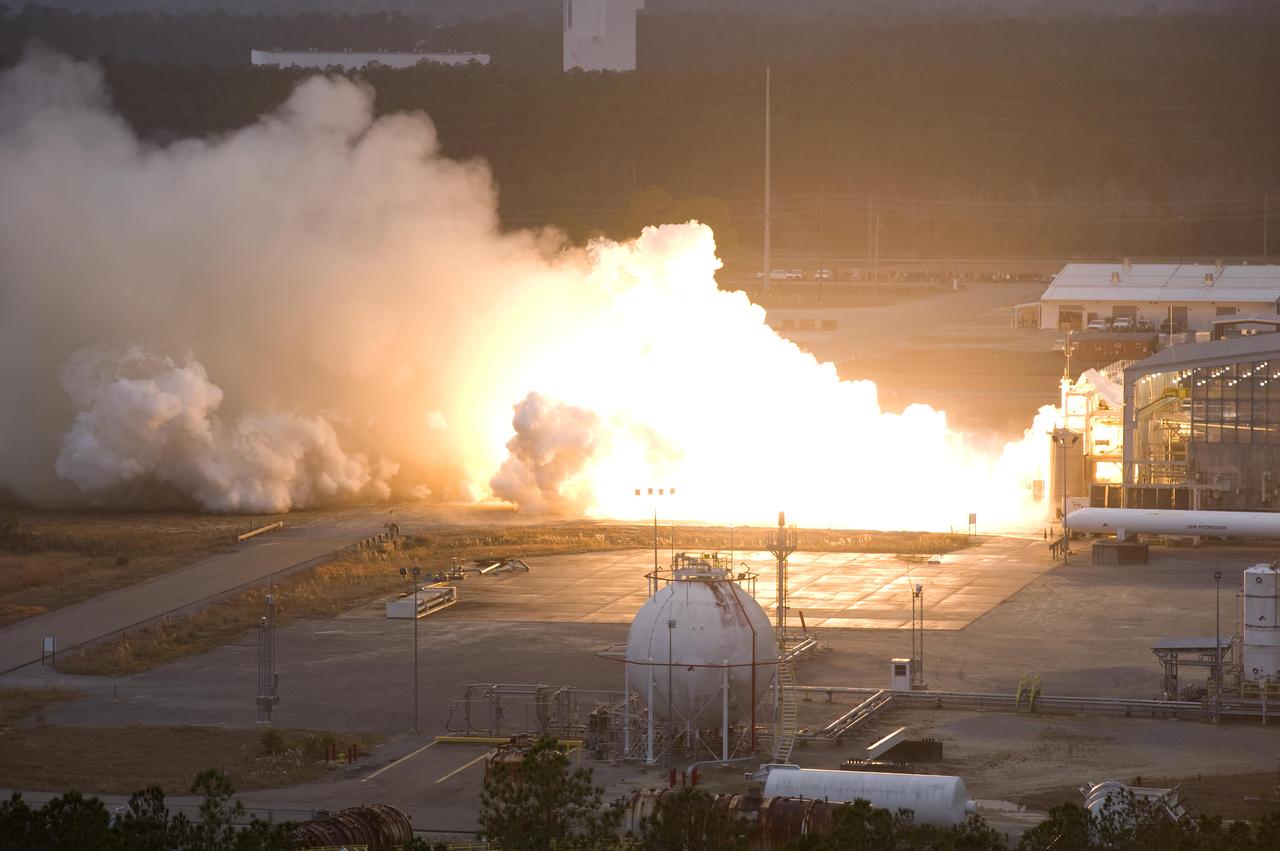
John C. Stennis Space Center engineers conduct a 55-second test fire of Aerojet's liquid-fuel AJ26 rocket engine that will power the first stage of Orbital Sciences Corporation's Taurus II space launch vehicle. The Dec. 17, 2010 test was conducted on the E-1 Test Stand at Stennis in support of NASA's Commercial Transportation Services partnerships to enable commercial cargo flights to the International Space Station. Orbital is under contract with NASA to provide eight cargo missions to the space station through 2015.
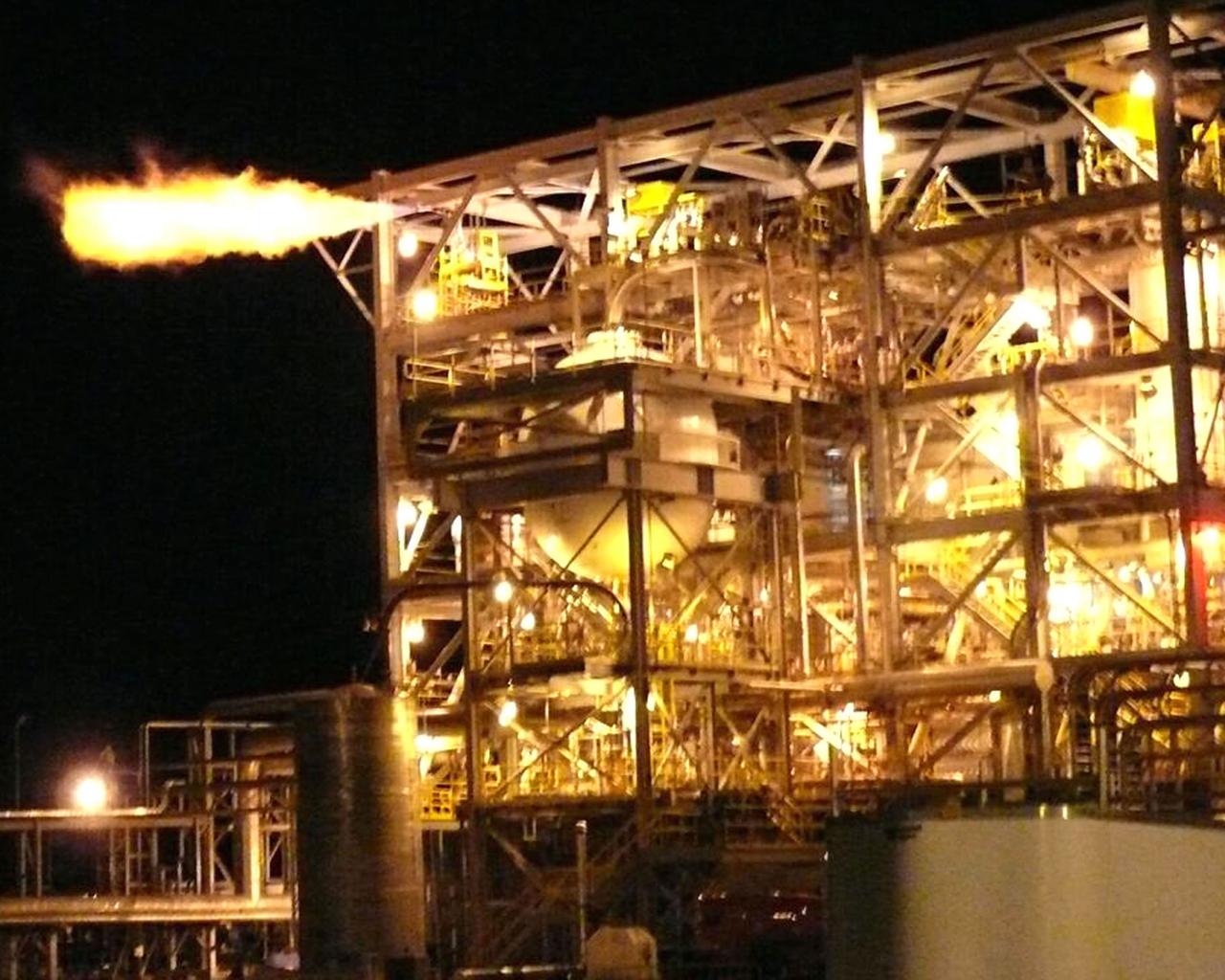
Flames burst from the E-1 Test Stand as Stennis Space Center engineers perform one of dozens of shuttle flow valve tests in early February. Stennis engineers teamed with Innovative Partnership Program partners to perform the tests after NASA officials delayed the launch of the STS-119 mission because of concerns with the shuttle part.
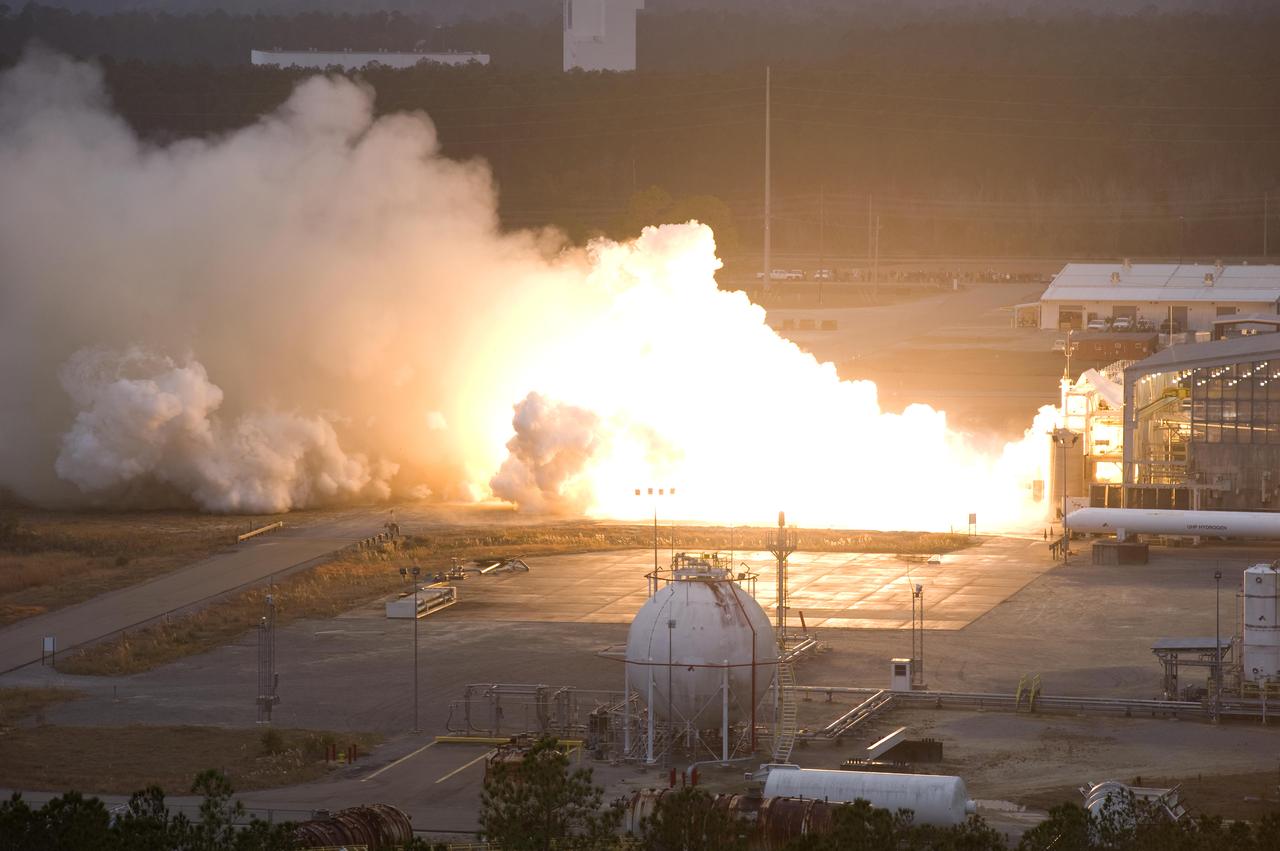
John C. Stennis Space Center engineers conduct a 55-second test fire of Aerojet's liquid-fuel AJ26 rocket engine that will power the first stage of Orbital Sciences Corporation's Taurus II space launch vehicle. The Dec. 17, 2010 test was conducted on the E-1 Test Stand at Stennis in support of NASA's Commercial Transportation Services partnerships to enable commercial cargo flights to the International Space Station. Orbital is under contract with NASA to provide eight cargo missions to the space station through 2015.
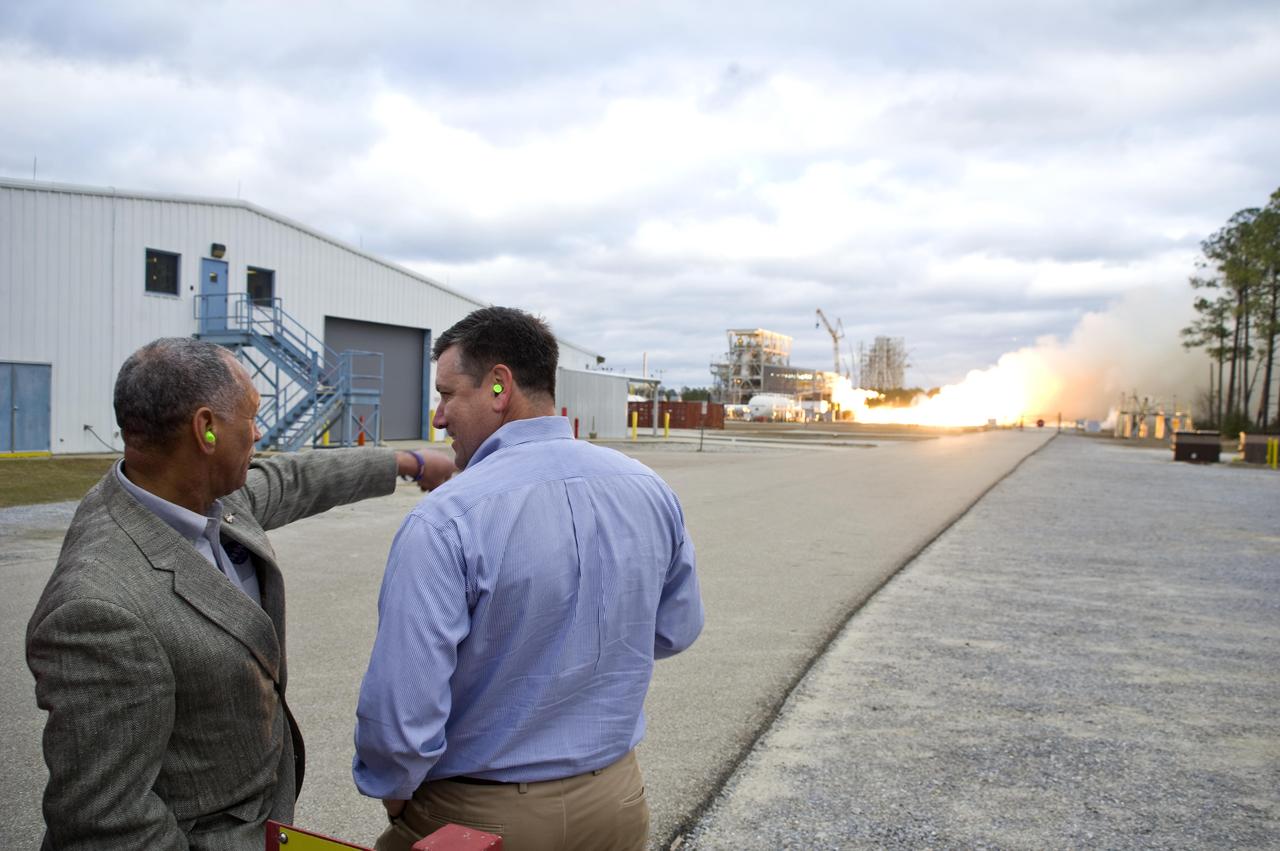
NASA Administrator Charles Bolden (l) and John C. Stennis Space Center Director Patrick Scheuermann watch the successful test of the first Aerojet AJ26 flight engine Feb. 7, 2011. The test was conducted on the E-1 Test Stand at Stennis. The engine now will be sent to Wallops Flight Facility in Virginia, where it will be used to power the first stage of Orbital Sciences Corporation's Taurus II space vehicle. The Feb. 7 test supports NASA's commitment to partner with companies to provide commercial cargo flights to the International Space Station. NASA has partnered with Orbital to carry out the first of eight cargo missions to the space station in early 2012.
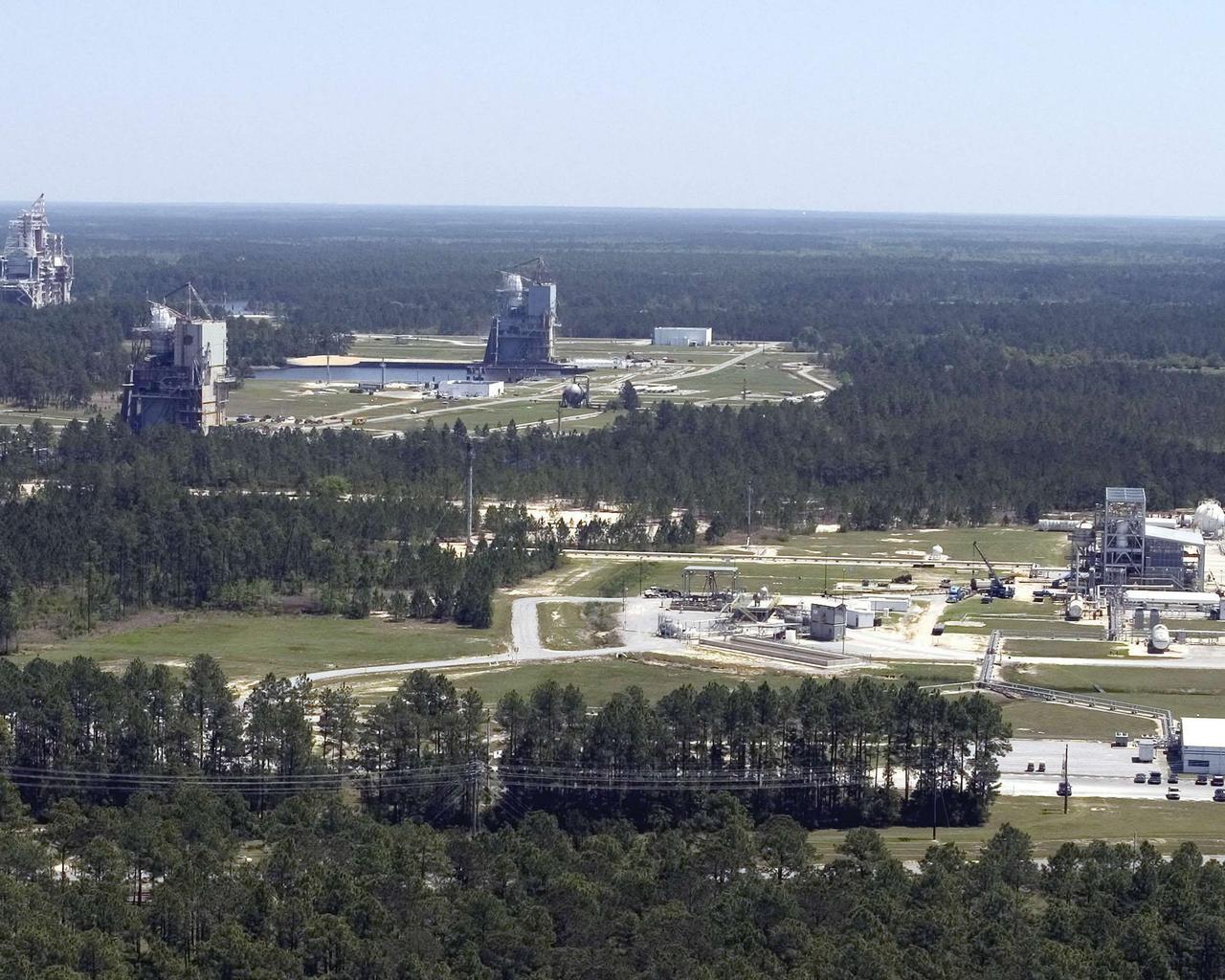
SSC's rocket engine test complex and its four unique test stands provide test operations for the development and certification of propulsion systems, subsystems and components.
Phase 2 of the A-3 Test Facility Subscale Diffuser Risk Mitigation Project at Stennis Space Center reached a milestone Oct. 25 when the E-3 Test Facility produced superheated (500+ degrees) steam for approximately 3 seconds at more than 400 psi. The test team, led by Barry Robinson of NASA's Test Projects Office, followed that success with further tests to lengthen the duration of steam production. On Nov. 1, they were able to maintain a consistent pressure and temperature of steam for 60 seconds. In December, the team began Phase 3 of the testing, providing data for the design and procurement to build the full-scale version of the steam diffuser for SSC's A-3 Test Stand.
Tests begun at Stennis Space Center's E Complex Sept. 13 evaluated a liquid oxygen lead for engine start performance, part of the A-3 Test Facility Subscale Diffuser Risk Mitigation Project at SSC's E-3 Test Facility. Phase 1 of the subscale diffuser project, completed Sept. 24, was a series of 18 hot-fire tests using a 1,000-pound liquid oxygen and gaseous hydrogen thruster to verify maximum duration and repeatability for steam generation supporting the A-3 Test Stand project. The thruster is a stand-in for NASA's developing J-2X engine, to validate a 6 percent scale version of A-3's exhaust diffuser. Testing the J-2X at altitude conditions requires an enormous diffuser. Engineers will generate nearly 4,600 pounds per second of steam to reduce pressure inside A-3's test cell to simulate altitude conditions. A-3's exhaust diffuser has to be able to withstand regulated pressure, temperatures and the safe discharge of the steam produced during those tests. Before the real thing is built, engineers hope to work out any issues on the miniature version. Phase 2 testing is scheduled to begin this month.
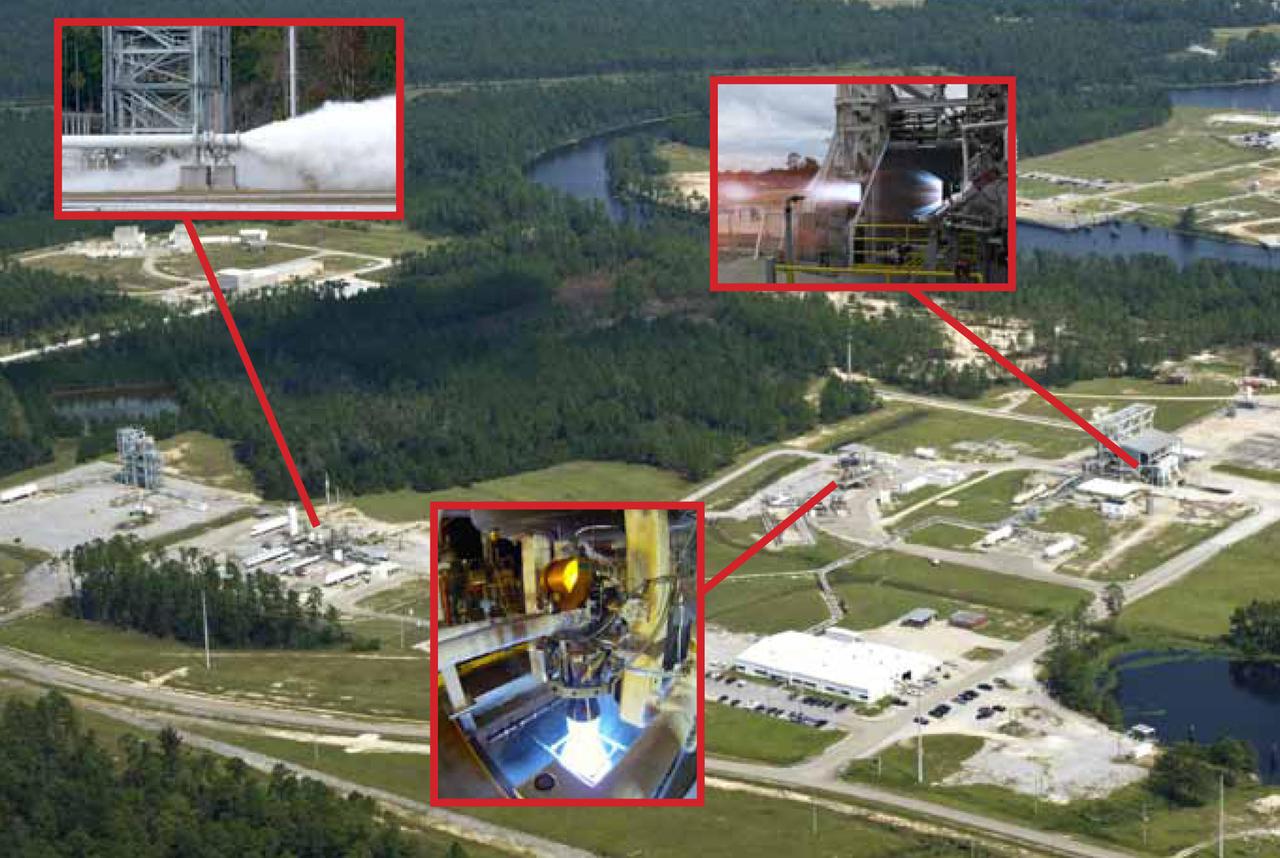
NASA recorded a historic week Nov. 5-9, conducting tests on all three stands in the E Test Complex at John C. Stennis Space Center. Inset images show the types of tests conducted on the E-1 Test Stand (right), the E-2 Test Stand (left) and the E-3 Test Stand (center). The E-1 photo is from an early October test and is provided courtesy of Blue Origin. Other photos are from tests conducted the week of Nov. 5.
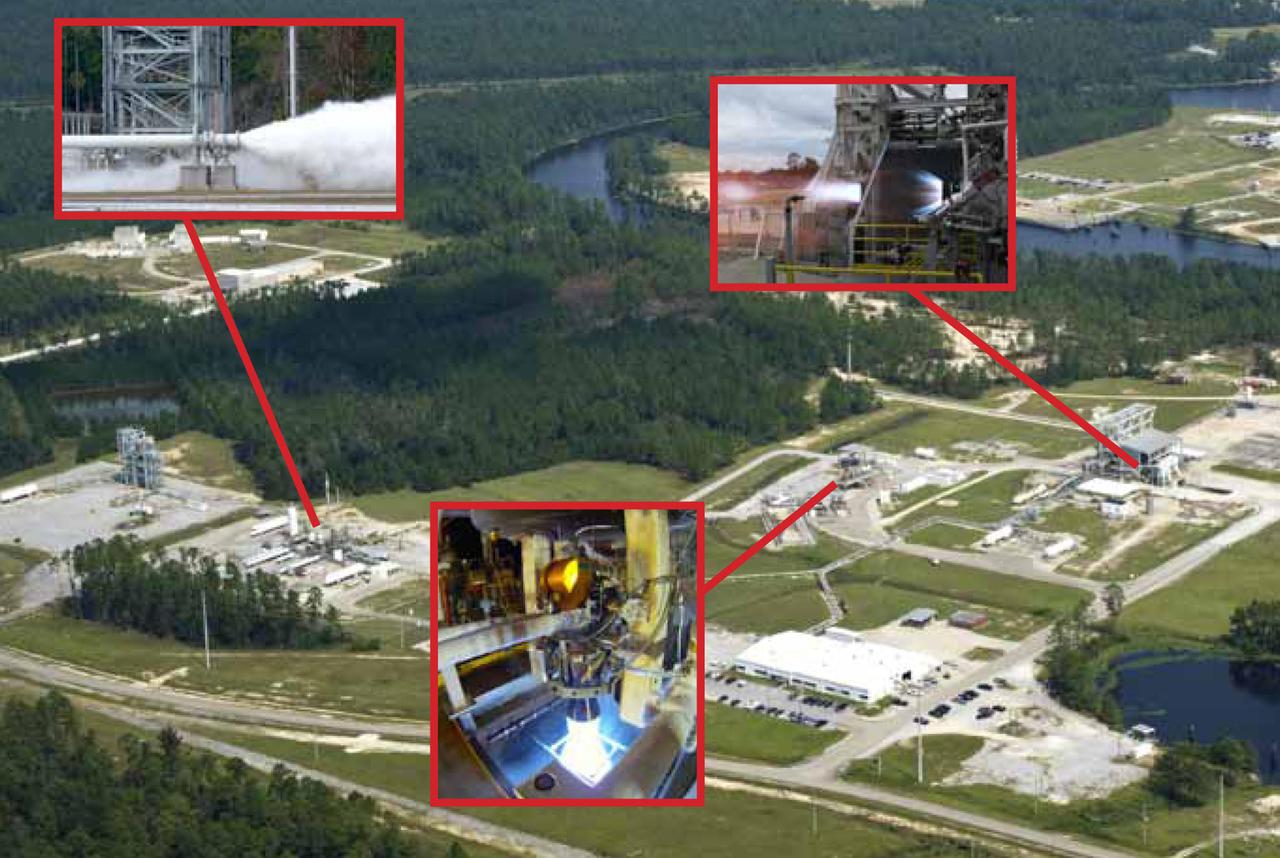
NASA recorded a historic week Nov. 5-9, conducting tests on all three stands in the E Test Complex at John C. Stennis Space Center. Inset images show the types of tests conducted on the E-1 Test Stand (right), the E-2 Test Stand (left) and the E-3 Test Stand (center). The E-1 photo is from an early October test and is provided courtesy of Blue Origin. Other photos are from tests conducted the week of Nov. 5.
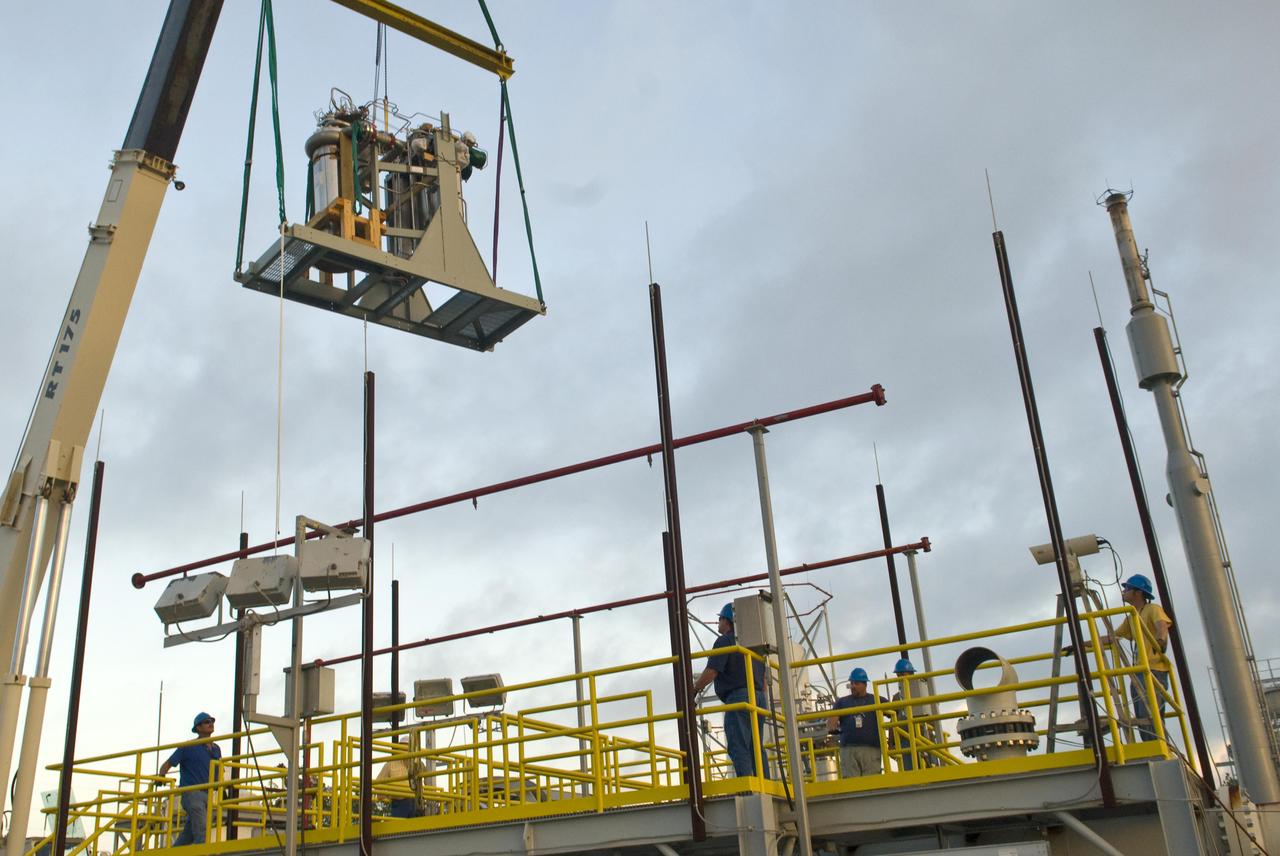
The first of nine chemical steam generator (CSG) units that will be used on the A-3 Test Stand is hoisted into place at the E-2 Test Stand at John C. Stennis Space Center on Oct. 24, 2010. The unit was installed at the E-2 stand for verification and validation testing before it is moved to the A-3 stand. Steam generated by the nine CSG units that will be installed on the A-3 stand will create a vacuum that allows Stennis operators to test next-generation rocket engines at simulated altitudes up to 100,000 feet.

A team of engineers from NASA's John C. Stennis Space Center, Orbital Sciences Corporation and Aerojet conduct a successful test of an Aerojet AJ26 rocket engine on March 19. Stennis is testing AJ26 engines for Orbital Sciences to power commercial cargo missions to the International Space Station. Orbital has partnered with NASA through the Commercial Orbital Transportation Services initiative to carry out eight cargo missions to the space station by 2015, using Taurus II rockets.
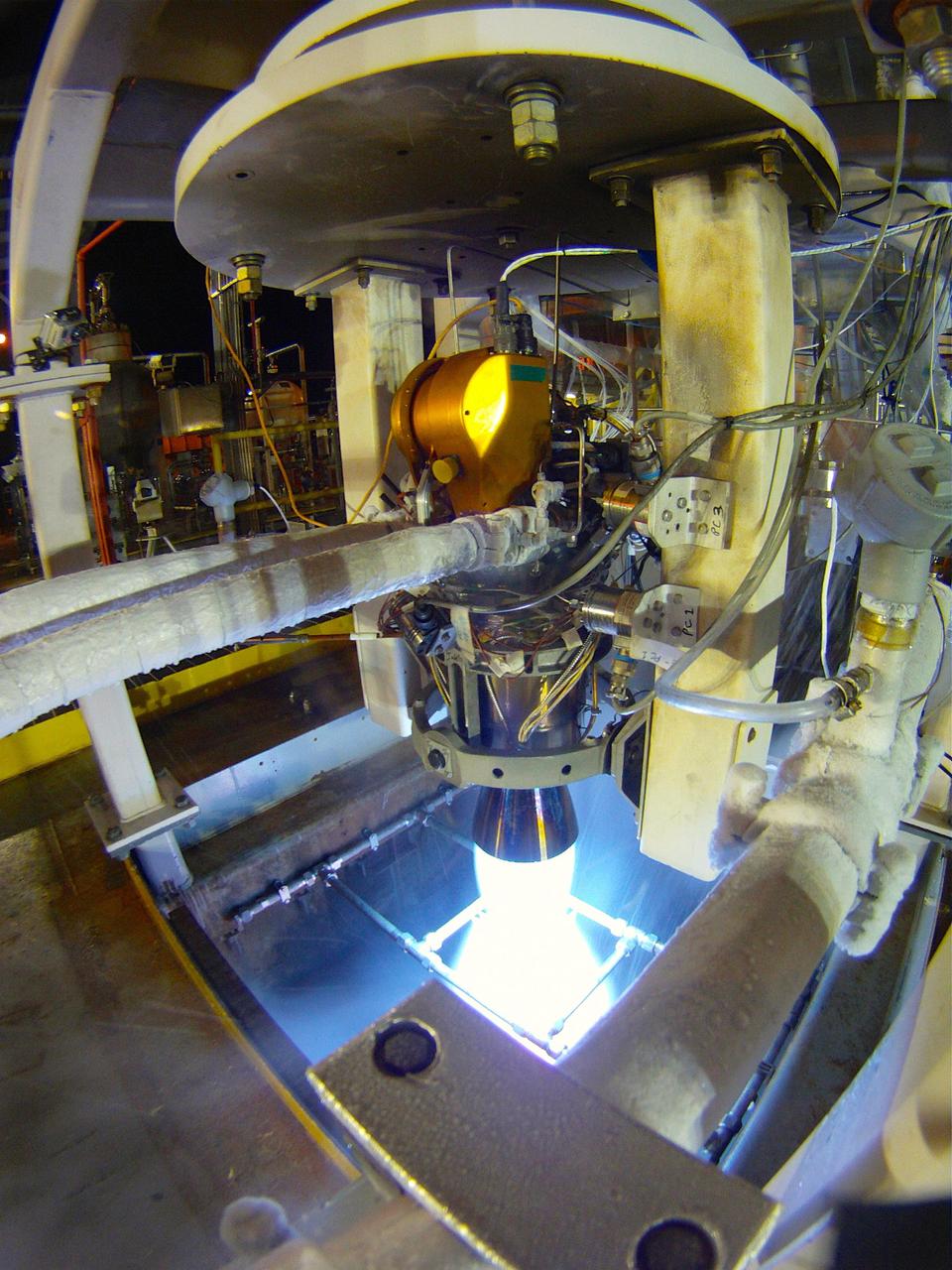
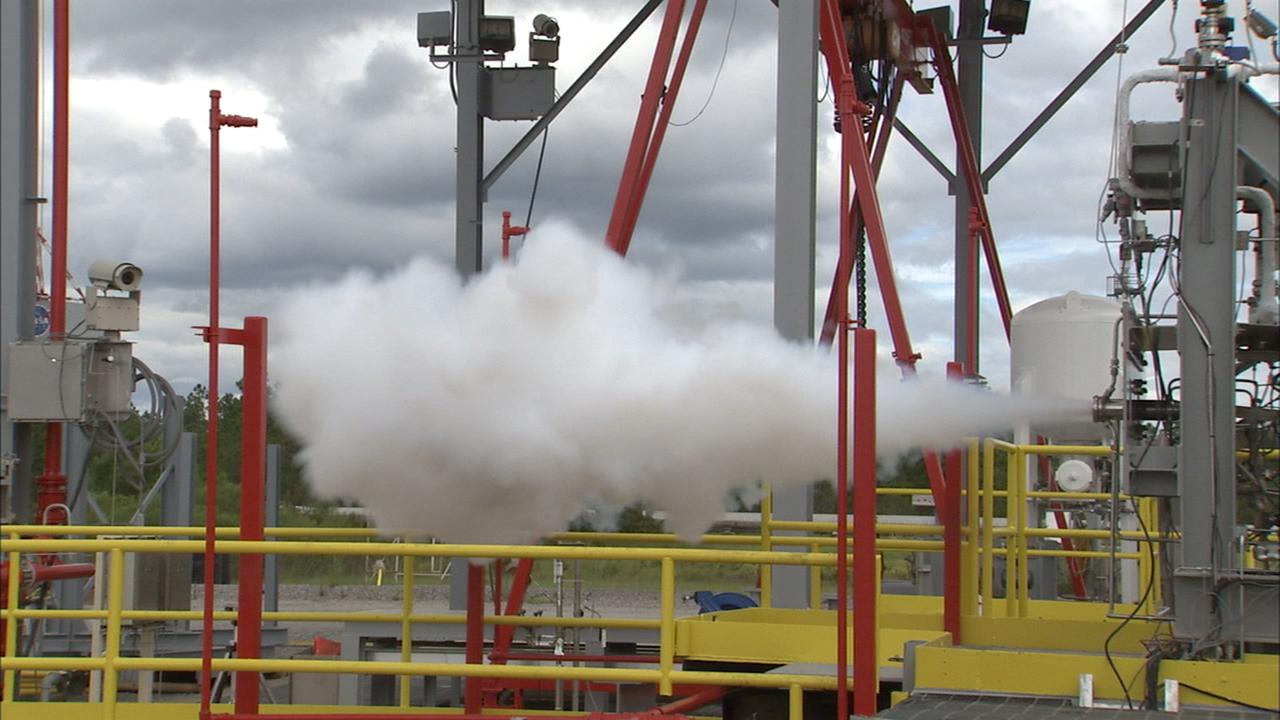
A test of NASA's liquid oxygen, liquid methane Project Morpheus engine is conducted Nov. 8 on the E-3 Test Stand at John C. Stennis Space Center. The test was one of 27 conducted in Stennis' E Test Complex the week of Nov. 5. Twenty-seven tests were conducted in a three-day period during the week, on three different rocket engines/components and on three E Complex test stands.

John C. Stennis Space Center employees complete installation of a chemical steam generator (CSG) unit at the site's E-2 Test Stand. On Oct. 24, 2010. The unit will undergo verification and validation testing on the E-2 stand before it is moved to the A-3 Test Stand under construction at Stennis. Each CSG unit includes three modules. Steam generated by the nine CSG units that will be installed on the A-3 stand will create a vacuum that allows Stennis operators to test next-generation rocket engines at simulated altitudes up to 100,000 feet.

NASA engineers test a chemical steam generator (CSG) unit on the E-2 Test Stand at John C. Stennis Space Center on Nov. 6. The test was one of 27 conducted in Stennis' E Test Complex the week of Nov. 5. Twenty-seven CSG units will be used on the new A-3 Test Stand at Stennis to produce a vacuum that allows testing of engines at simulated altitudes up to 100,000 feet.
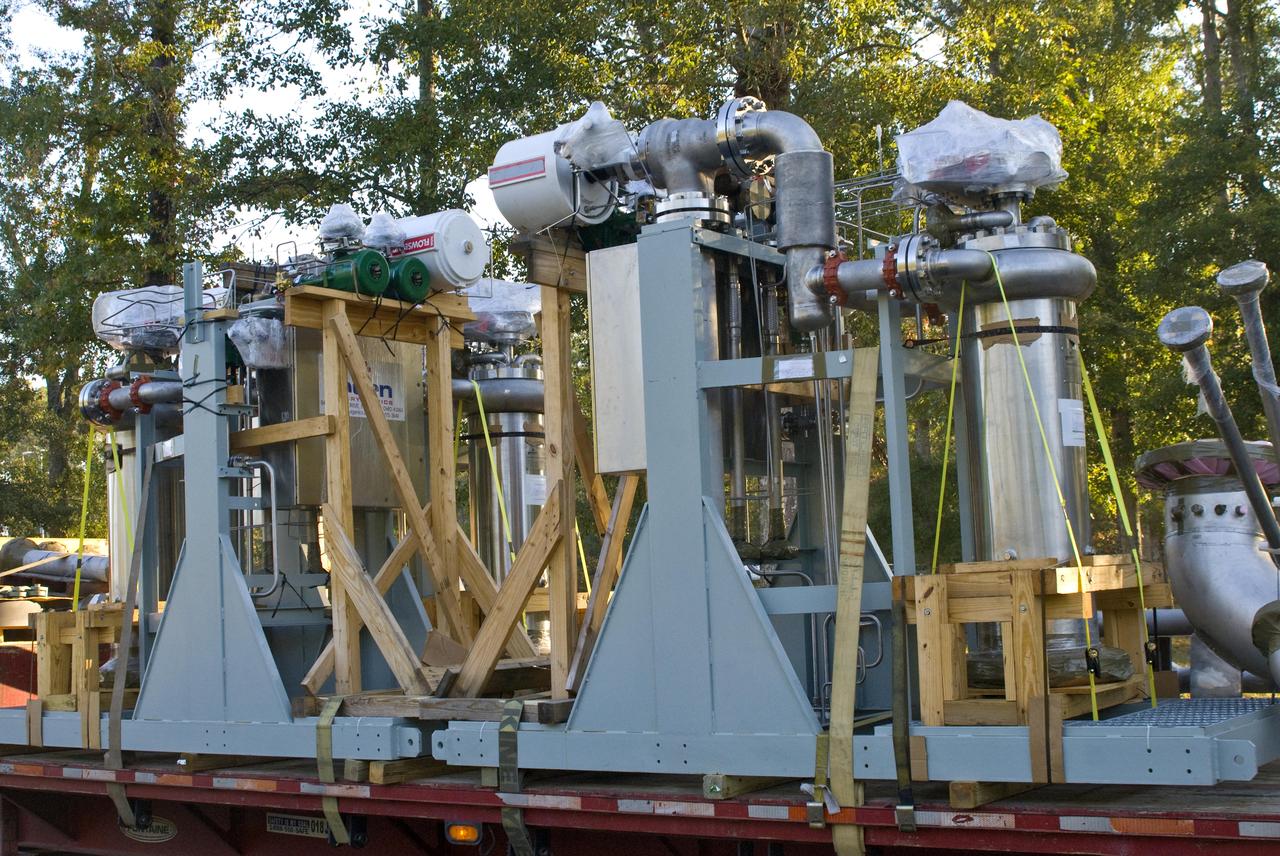
The first of nine chemical steam generator (CSG) units that will be used on the A-3 Test Stand arrived at John. C. Stennis Space Center on Oct. 22, 2010. The unit was installed at the E-2 Test Stand for verification and validation testing before it is moved to the A-3 stand. Steam generated by the nine CSG units that will be installed on the A-3 stand will create a vacuum that allows Stennis operators to test next-generation rocket engines at simulated altitudes up to 100,000 feet.
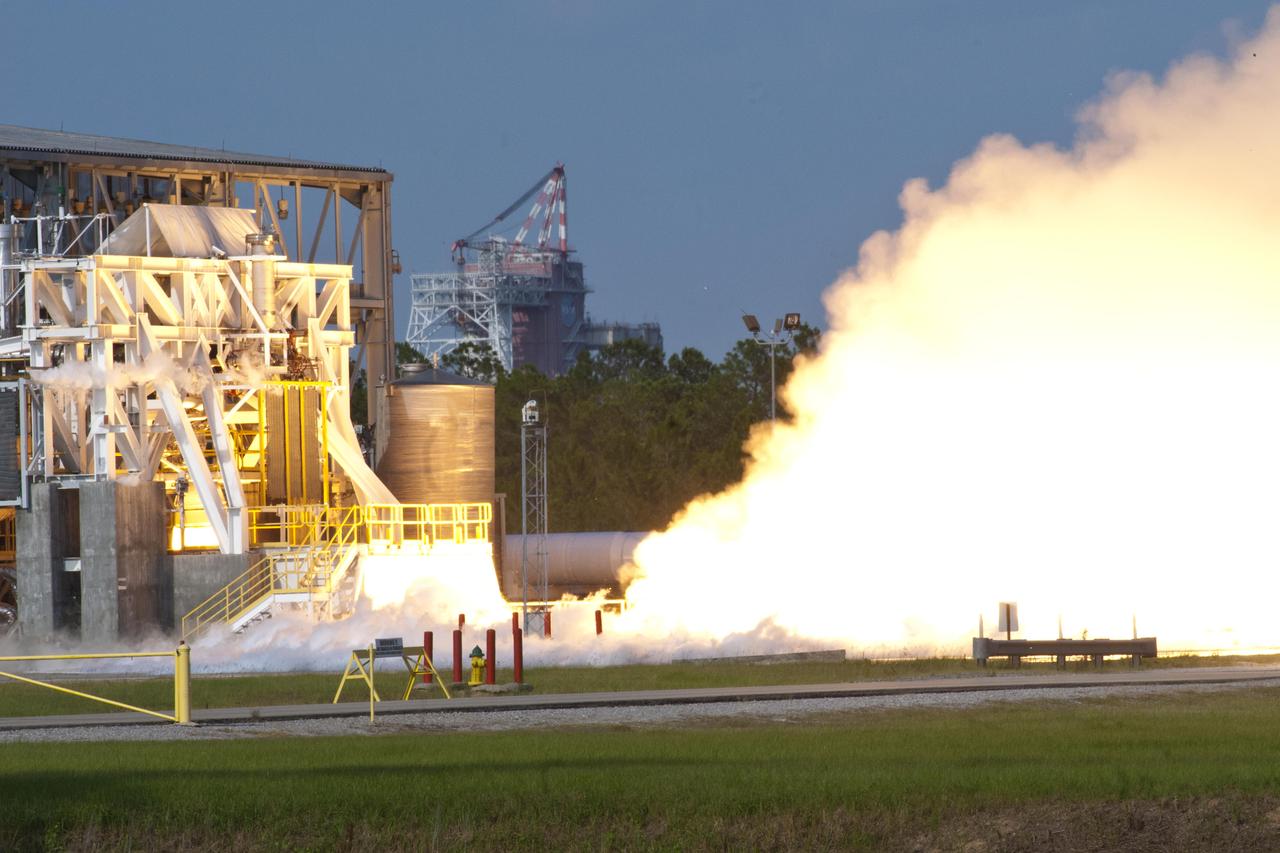
NASA engineers tested an Aerojet AJ26 rocket engine on the E-1 Test Stand at Stennis Space Center on June 25, 2012, against the backdrop of the B-1/B-2 Test Stand. The engine will be used by Orbital Sciences Corporation to power commercial cargo flights to the International Space Station.
A plume of fire lights up the night during a test of the Integrated Powerhead Demonstrator at Stennis Space Center's E-1 Test Stand.
A team of engineers at Stennis Space Center conducted a test firing of an Aerojet AJ26 flight engine Nov. 17, providing continued support to Orbital Sciences Corporation as it prepares to launch commercial cargo missions to the International Space Station. AJ26 engines will power Orbital's Taurus II rocket on the missions.
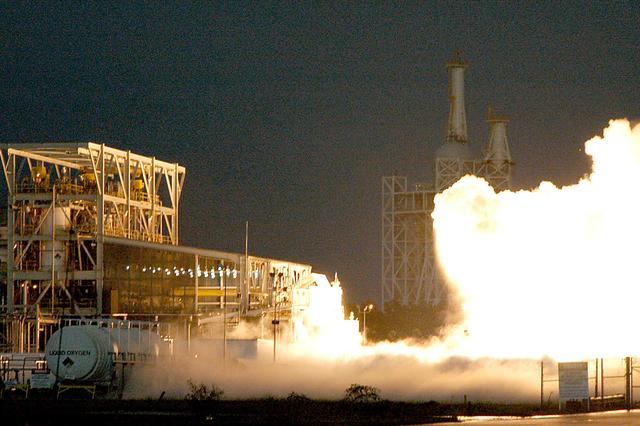
NASA conducted a Sept. 28 test of an Aerojet AJ26 flight engine that will power the first stage of Orbital Sciences Corporation's Taurus II space launch vehicle, continuing progress in a key commercial space transport partnership. Orbital is scheduled to begin commercial cargo flights to the International Space Station in 2012.
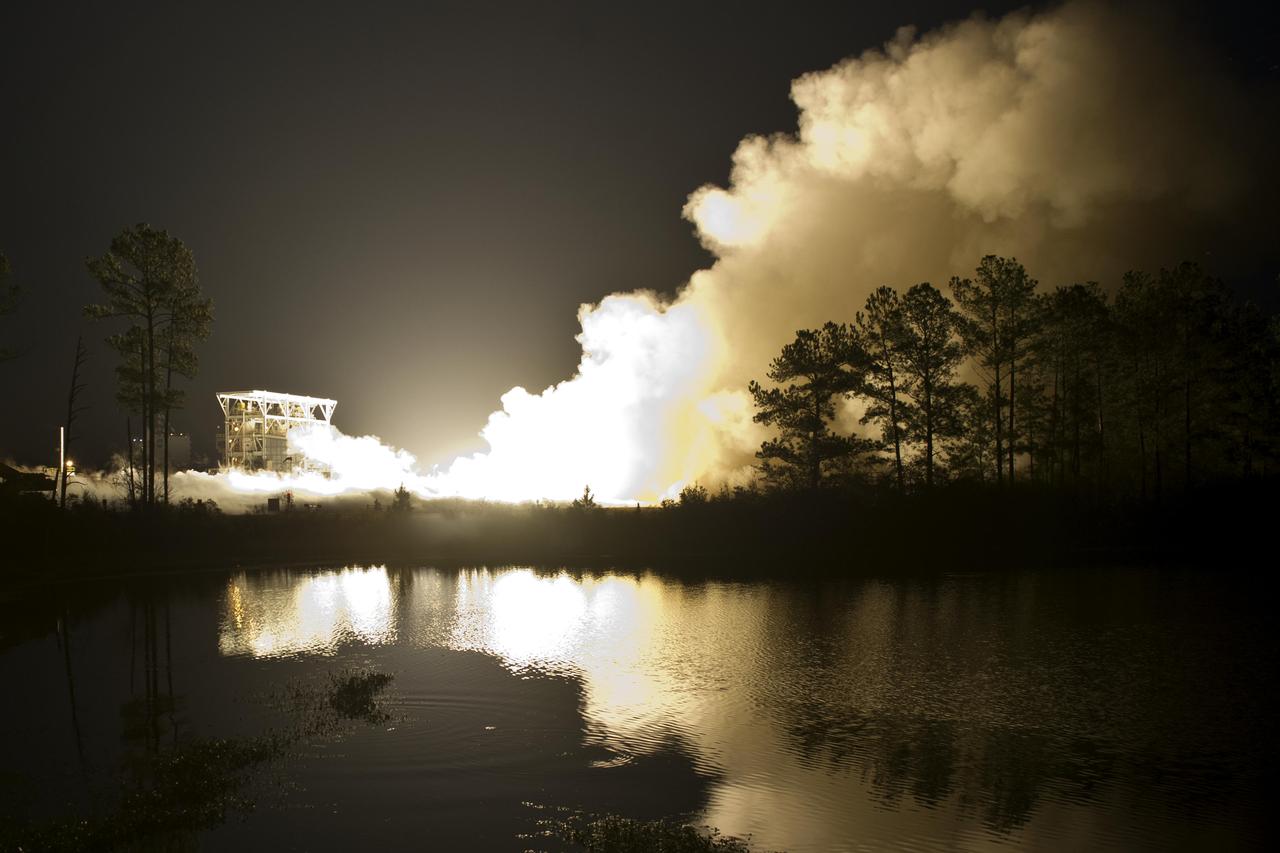
Stennis Space Center test-fired Aerojet AJ26 flight engine No. 8 on Dec. 15, continuing a commercial partnership with Orbital Services Corporation. Orbital has partnered with NASA to provide commercial cargo flights to the International Space Station. The AJ26 engines tested at Stennis will power the company's Taurus II space launch vehicle on the flights.
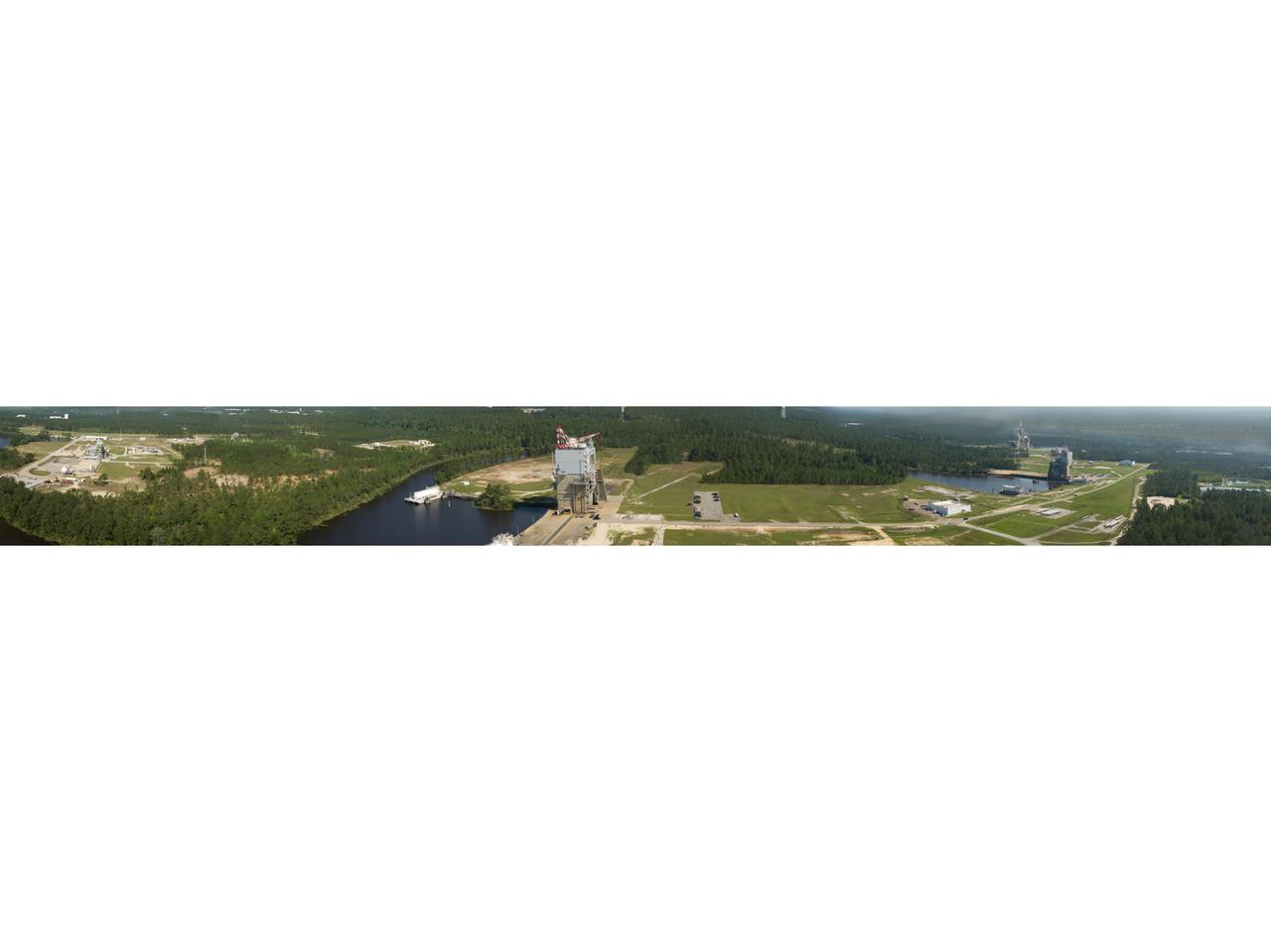
photo taken from the top of the new A-3 Test Stand at Stennis Space Center offers a panoramic view of the A, B and E test complexes at the south Mississippi faci
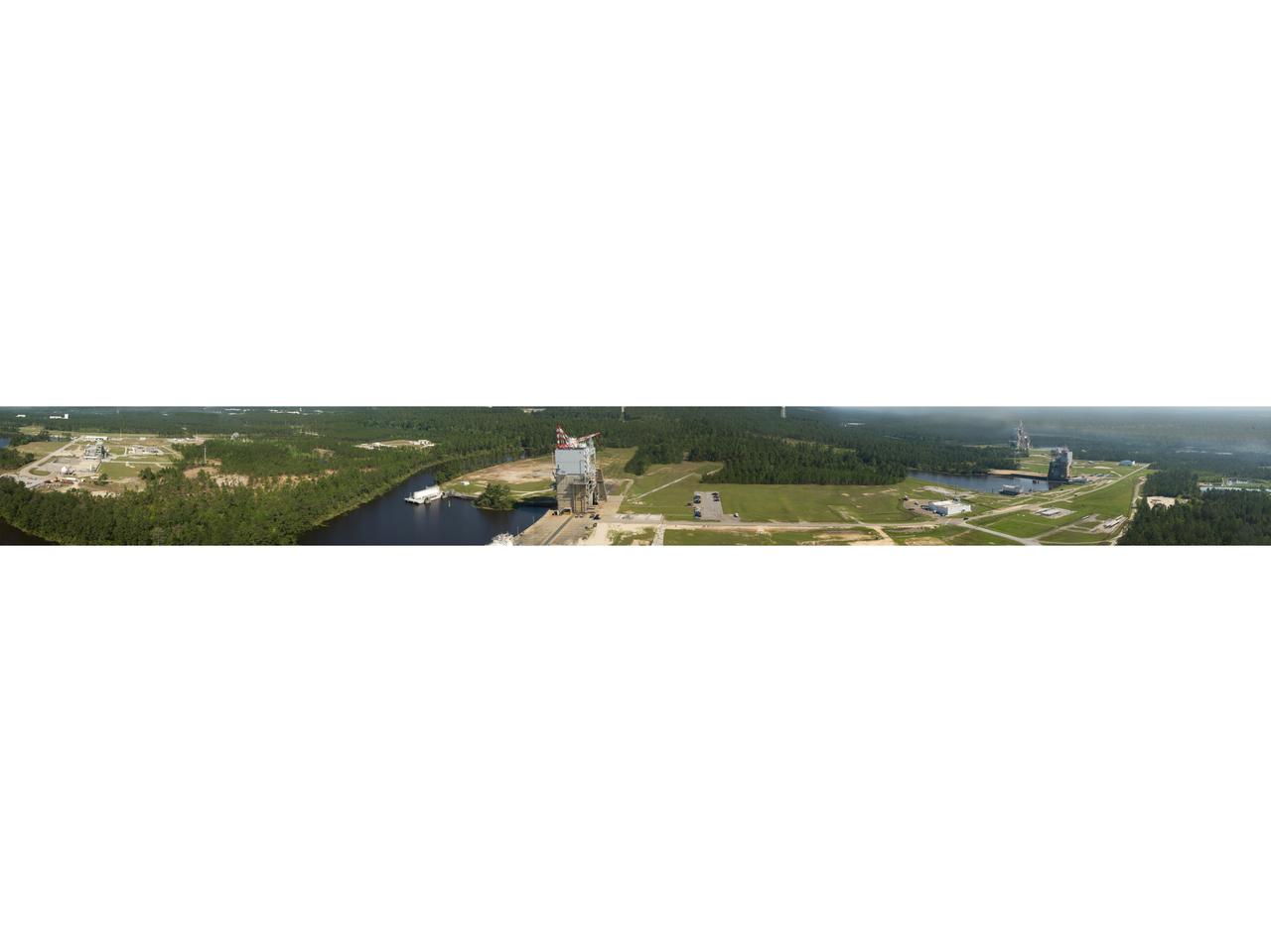
A photo taken from the top of the new A-3 Test Stand at Stennis Space Center offers a panoramic view of the A, B and E test complexes at the south Mississippi facility.
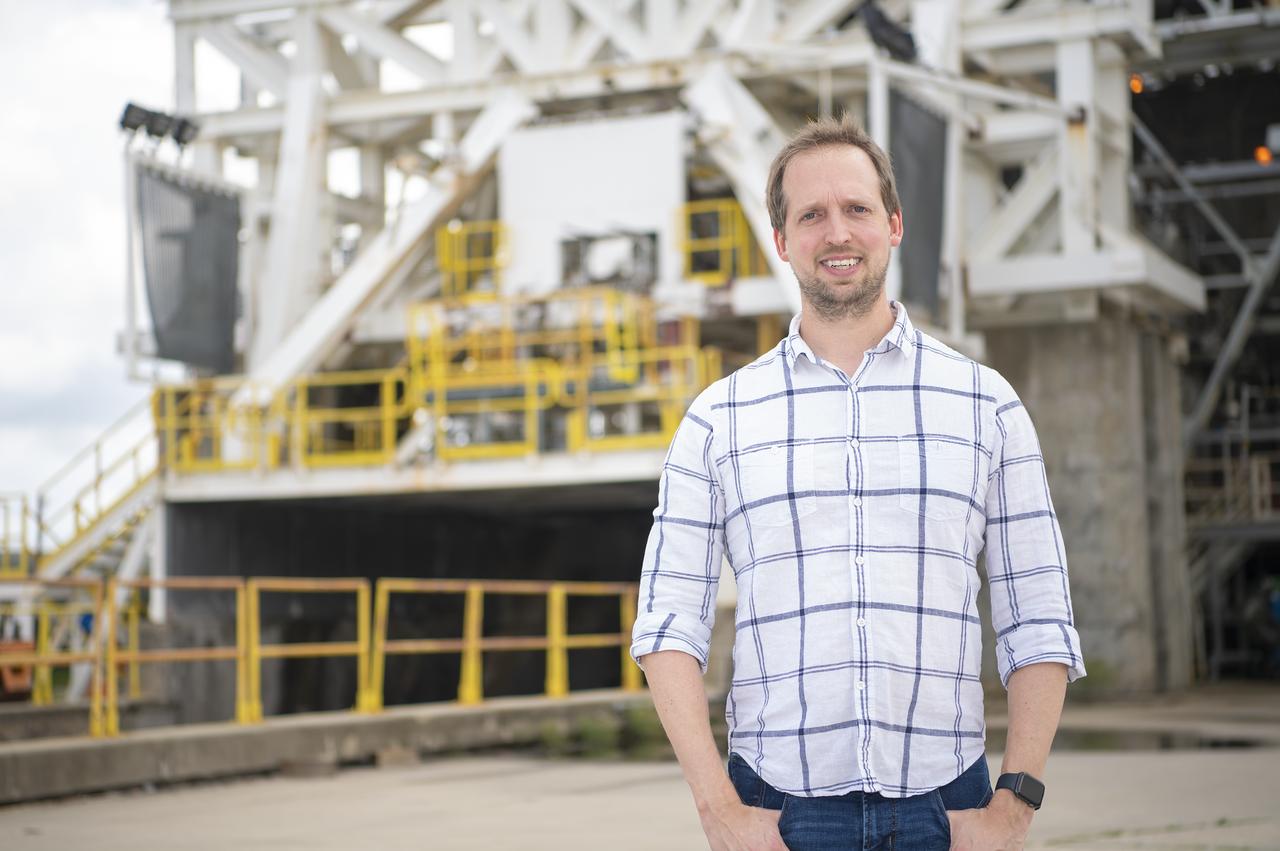
Chris Barnett-Woods is shown at the E-1 Test Stand at NASA’s Stennis Space Center near Bay St. Louis, Mississippi, where NASA Stennis accelerates the exploration and commercialization of space and innovates to benefit NASA and industry.
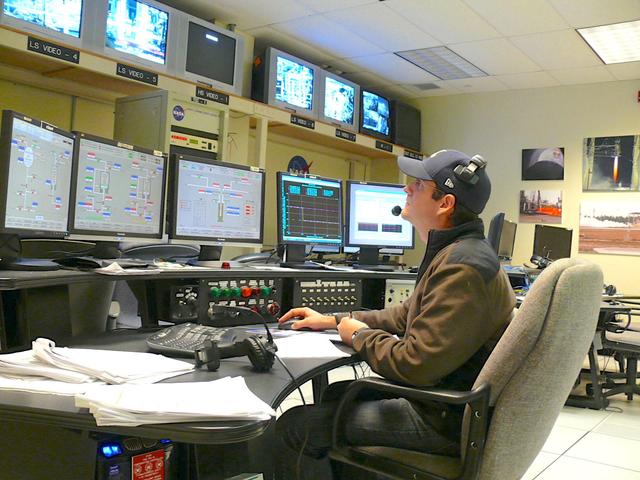
NASA engineer Andy Guymon studies data in the E-3 Test Stand Control Center at John C. Stennis Space Center during testing of NASA's Project Morpheus engine. Nov. 8. The test of the liquid oxygen, liquid methane engine was one of 27 conducted in Stennis' E Test Complex the week of Nov. 5.
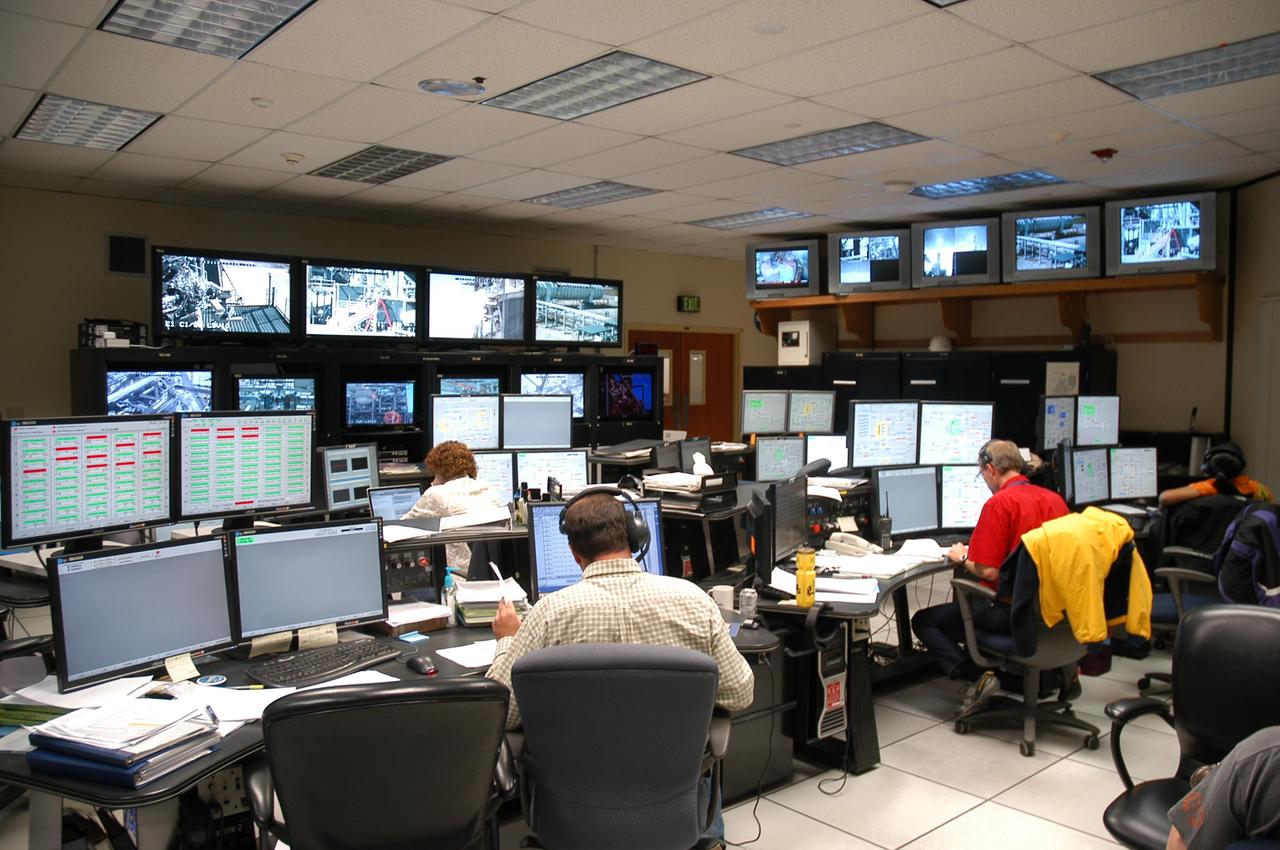
Jason Hopper of NASA (front row), Jody Ladner of Lockheed Martin (back row, left) and Chris Mulkey of NASA prepare to test the Blue Origin BE-3 engine thrust chamber in the E-1 Test Stand Control Center at John C. Stennis Space Center on Nov. 8. The test was one of 27 conducted in Stennis' E Test Complex the week of Nov. 5.
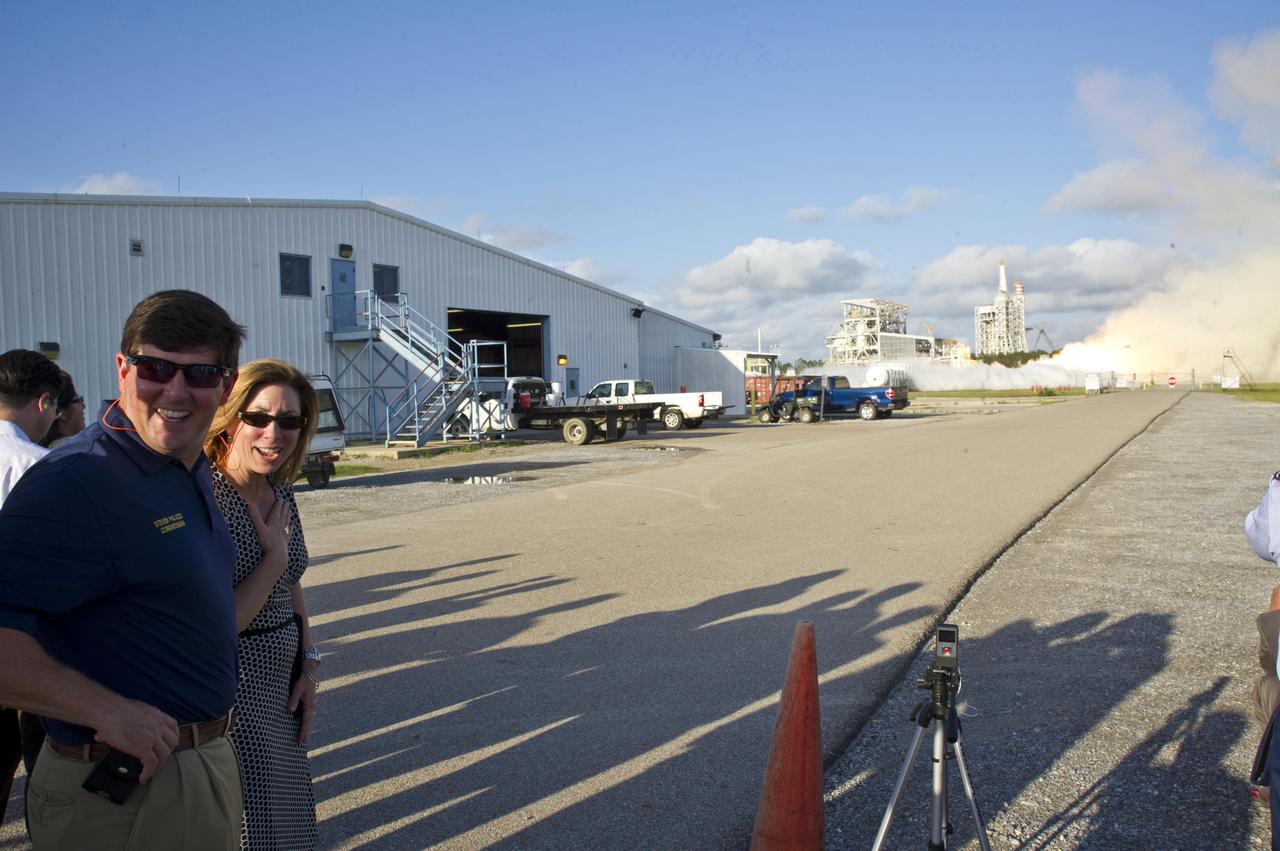
NASA Deputy Administrator Lori Garver and U.S. Rep. Steven Palazzo, R-Miss., view a May 3, 2012, test of the Aerojet AJ26 rocket engine on the E-1 Test Stand at Stennis Space Center. The AJ26 engine is being tested for Orbital Sciences Corporation to power commercial cargo flights to the International Space Station.
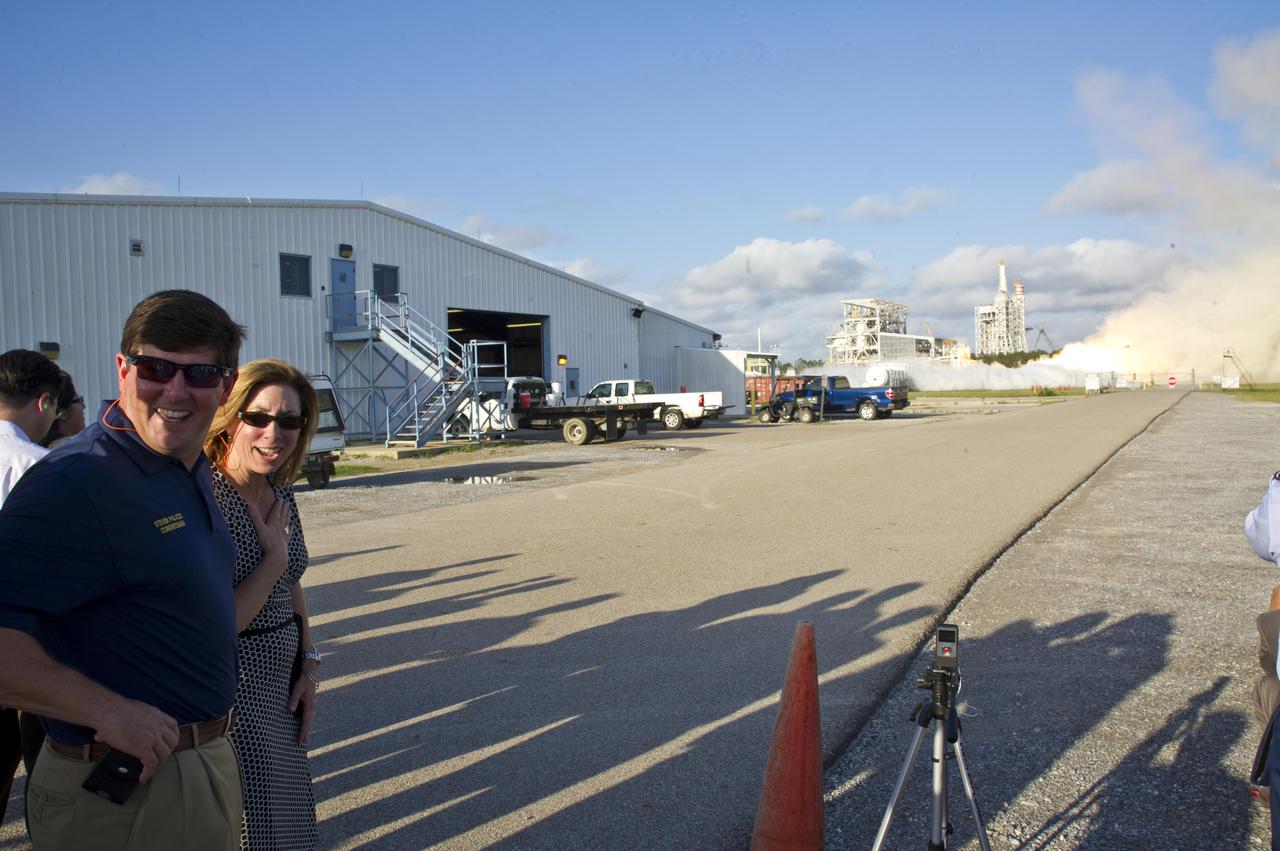
NASA Deputy Administrator Lori Garver and U.S. Rep. Steven Palazzo, R-Miss., view a May 3, 2012, test of the Aerojet AJ26 rocket engine on the E-1 Test Stand at Stennis Space Center. The AJ26 engine is being tested for Orbital Sciences Corporation to power commercial cargo flights to the International Space Station.
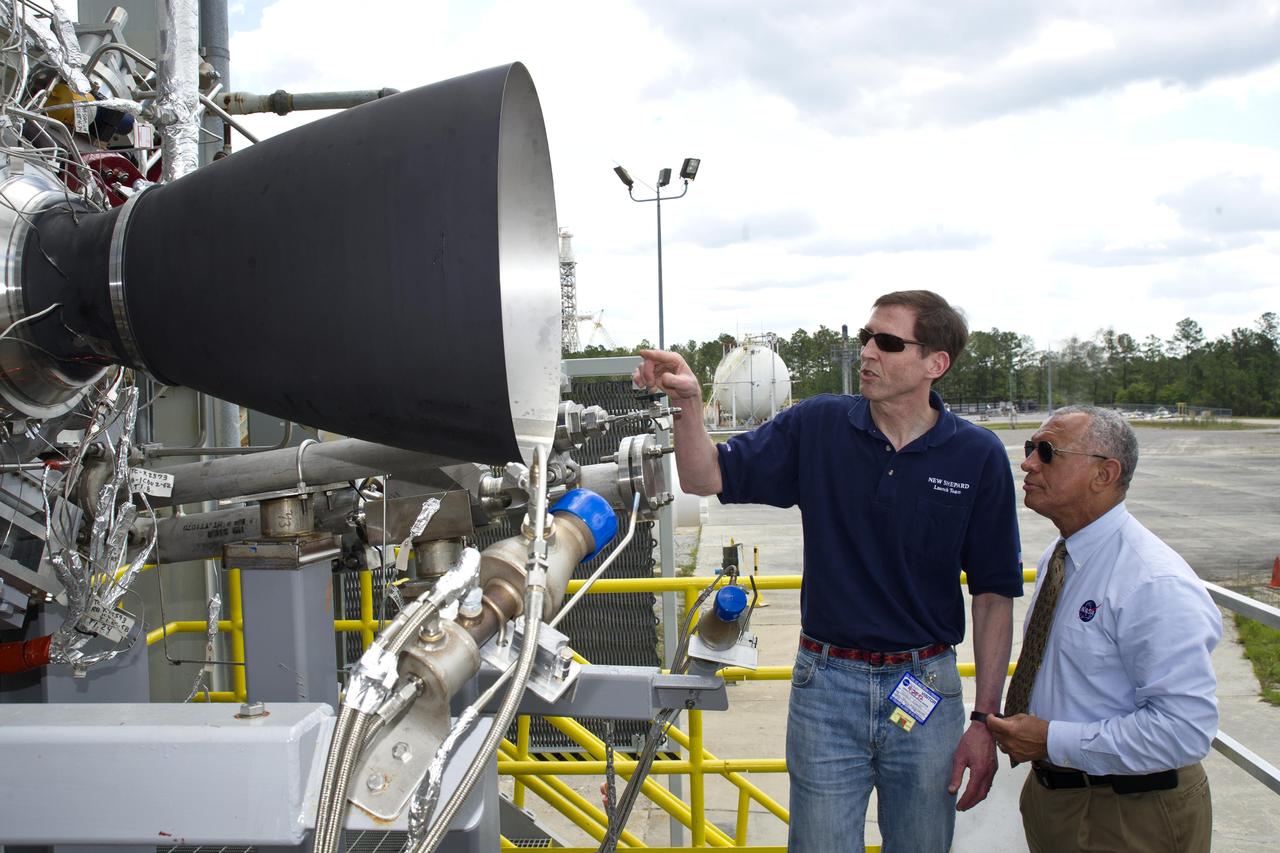
NASA Administrator Charles Bolden (r) discusses the upcoming testing of Blue Origin's BE-3 engine thrust chamber assembly with Steve Knowles, Blue Origin project manager, at the E-1 Test Stand during an April 20, 2012, visit to Stennis Space Center. Blue Origin is one of NASA's partners developing innovative systems to reach low-Earth orbit.
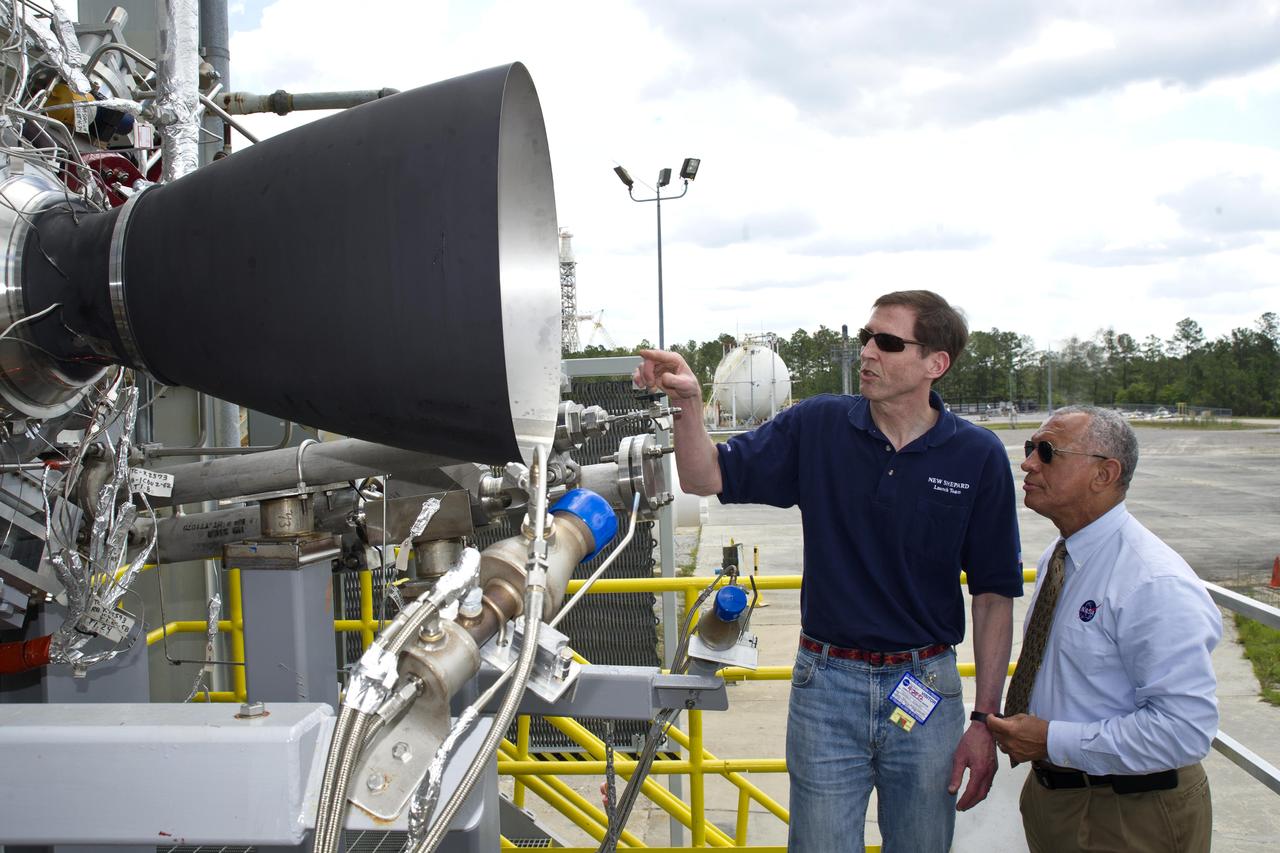
NASA Administrator Charles Bolden (r) discusses the upcoming testing of Blue Origin's BE-3 engine thrust chamber assembly with Steve Knowles, Blue Origin project manager, at the E-1 Test Stand during an April 20, 2012, visit to Stennis Space Center. Blue Origin is one of NASA's partners developing innovative systems to reach low-Earth orbit.
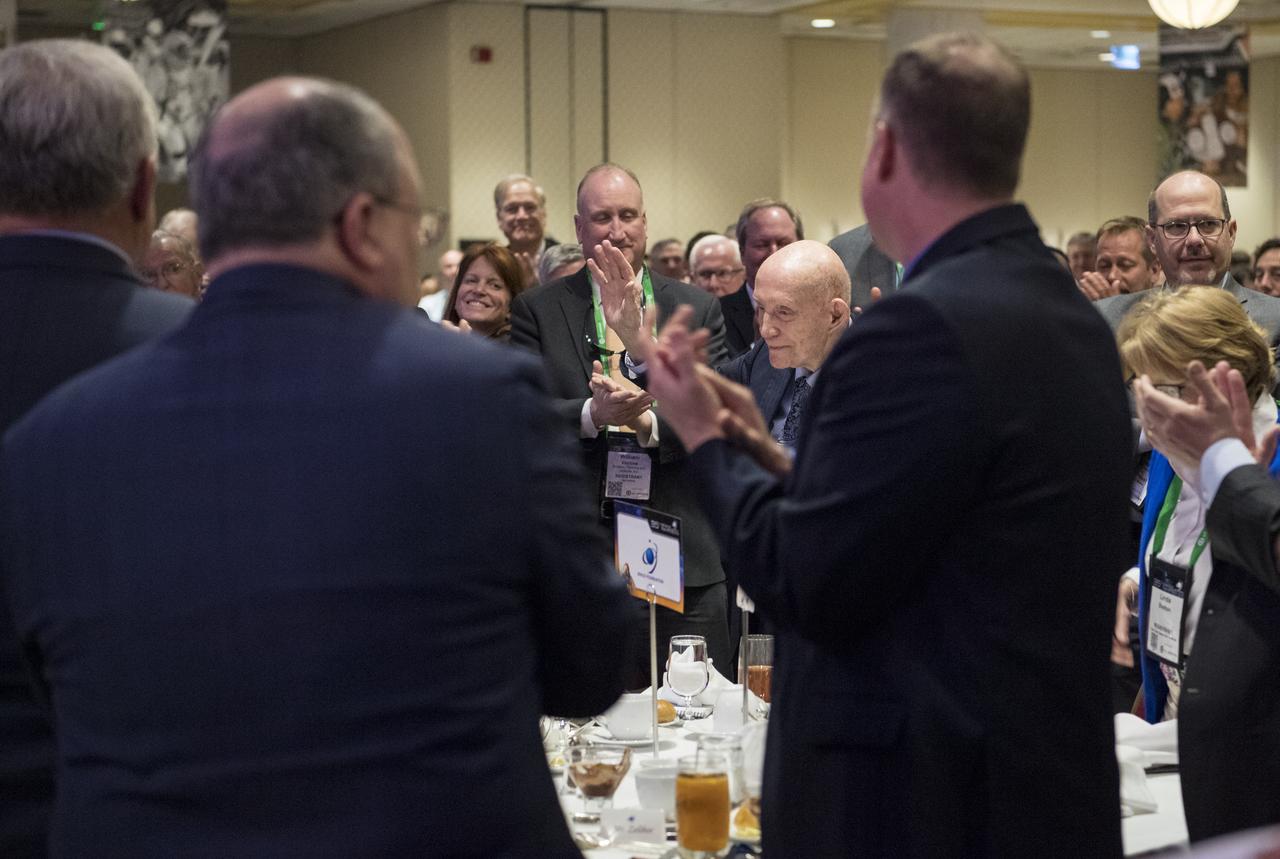
The audience stands and applauds for General Thomas Patten Stafford, former NASA astronaut, Air Force officer and test pilot after he received the General James E. Hill Lifetime Achievement Award, at the Space Symposium, Tuesday, April 9, 2019, at Broadmoor Hall in Colorado Springs, Colorado. Photo credit: (NASA/Aubrey Gemignani)
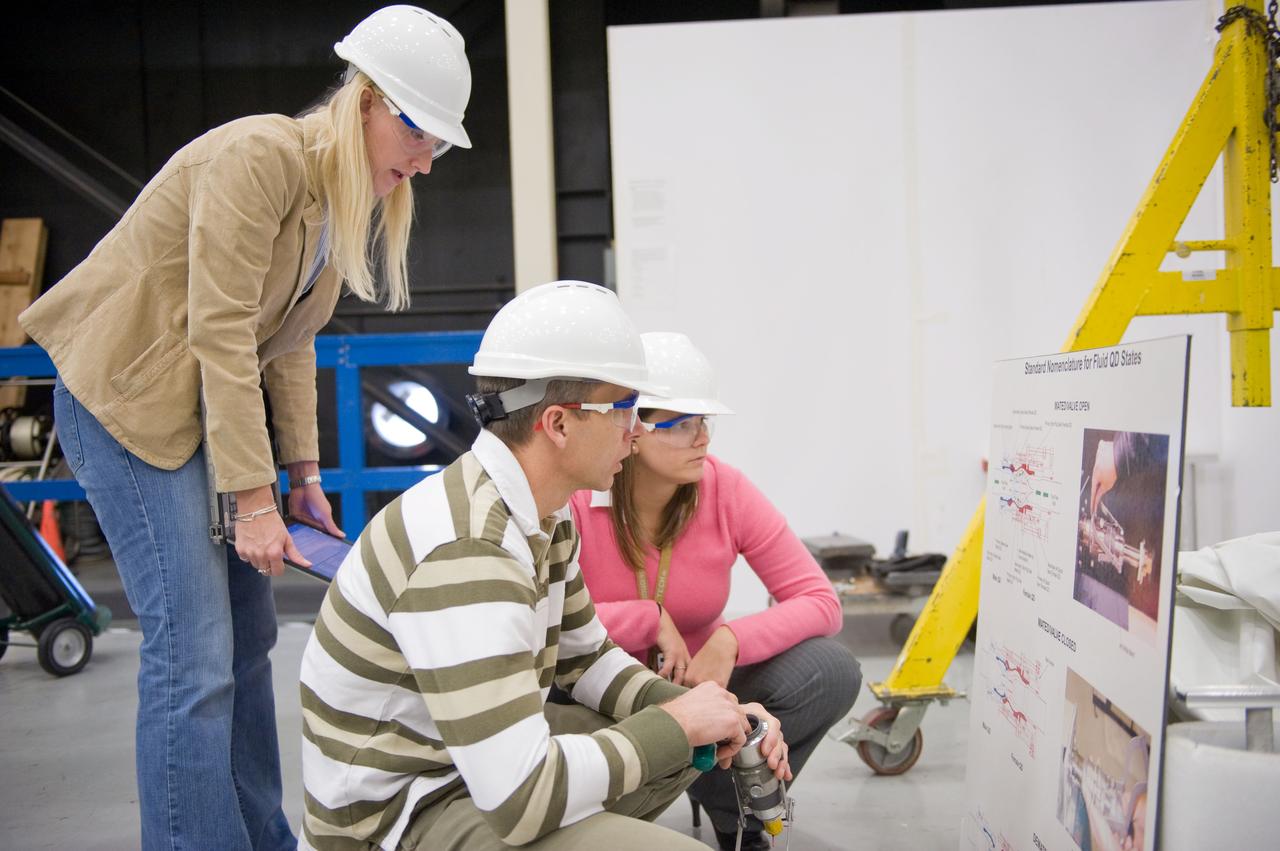
JSC2010-E-193913 (1 Dec. 2010) --- NASA astronaut Andrew Feustel, STS-134 mission specialist, participates in an extravehicular activity (EVA) training session in the Partial Gravity Simulator (POGO) test area in the Space Vehicle Mock-up Facility at NASA?s Johnson Space Center. Crew instructors Allison Bolinger (standing) and Vickie Otto assisted Feustel. Photo credit: NASA or National Aeronautics and Space Administration
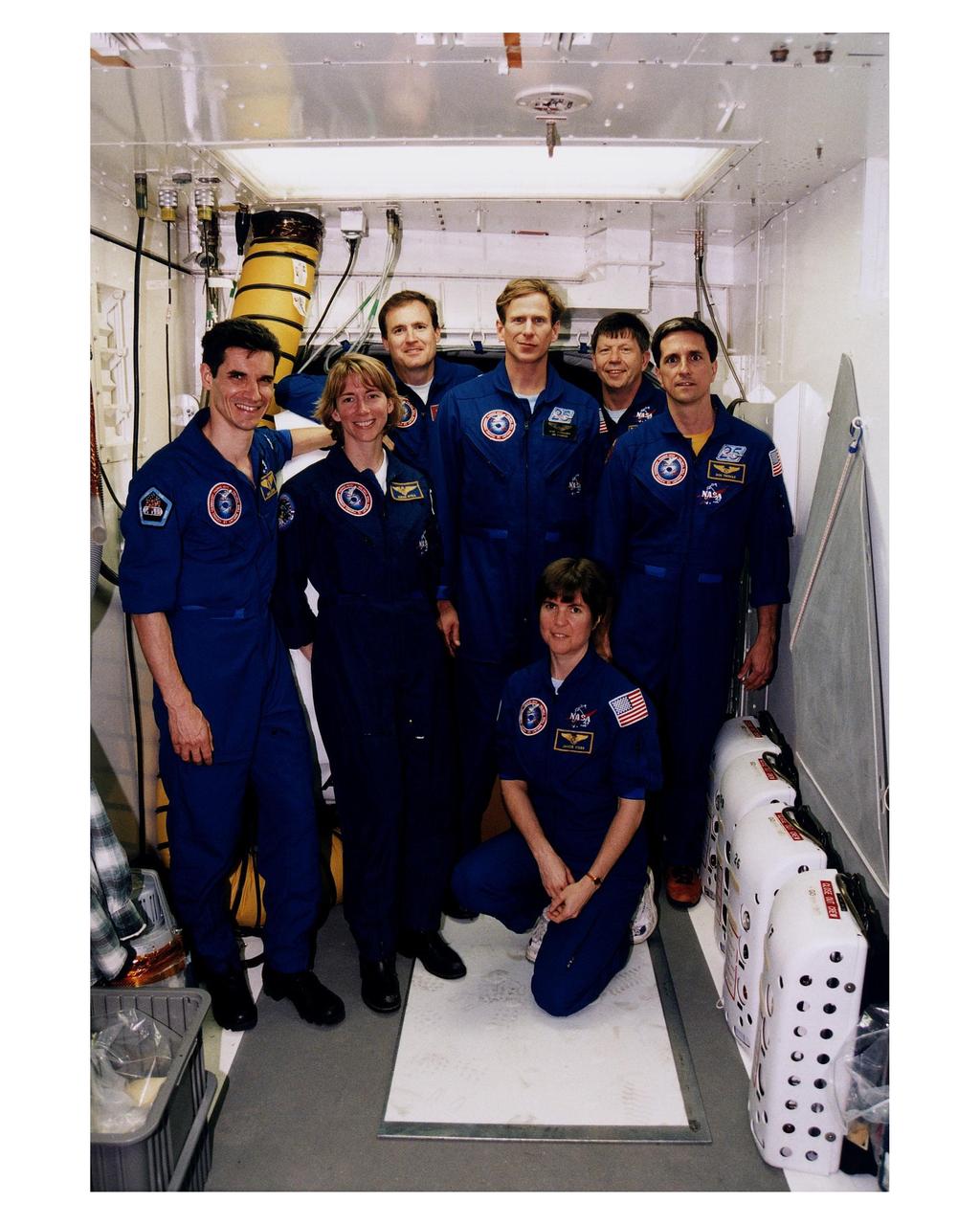
The STS-83 crew poses in the White Room at Launch Complex 39A during the crew's <a href="http://www-pao.ksc.nasa.gov/kscpao/release/1997/40-97.htm">Terminal Countdown Demonstration Test (TCDT).</a> From left to right, standing, they are Payload Specialist Gregory T. Linteris, Pilot Susan L. Still, Mission Commander James D. Halsell, Mission Specialist Michael L. Gernhardt, Payload Specialist Roger K. Crouch, and Mission Specialist Donald Thomas. Mission Specialist Janice E. Voss is kneeling
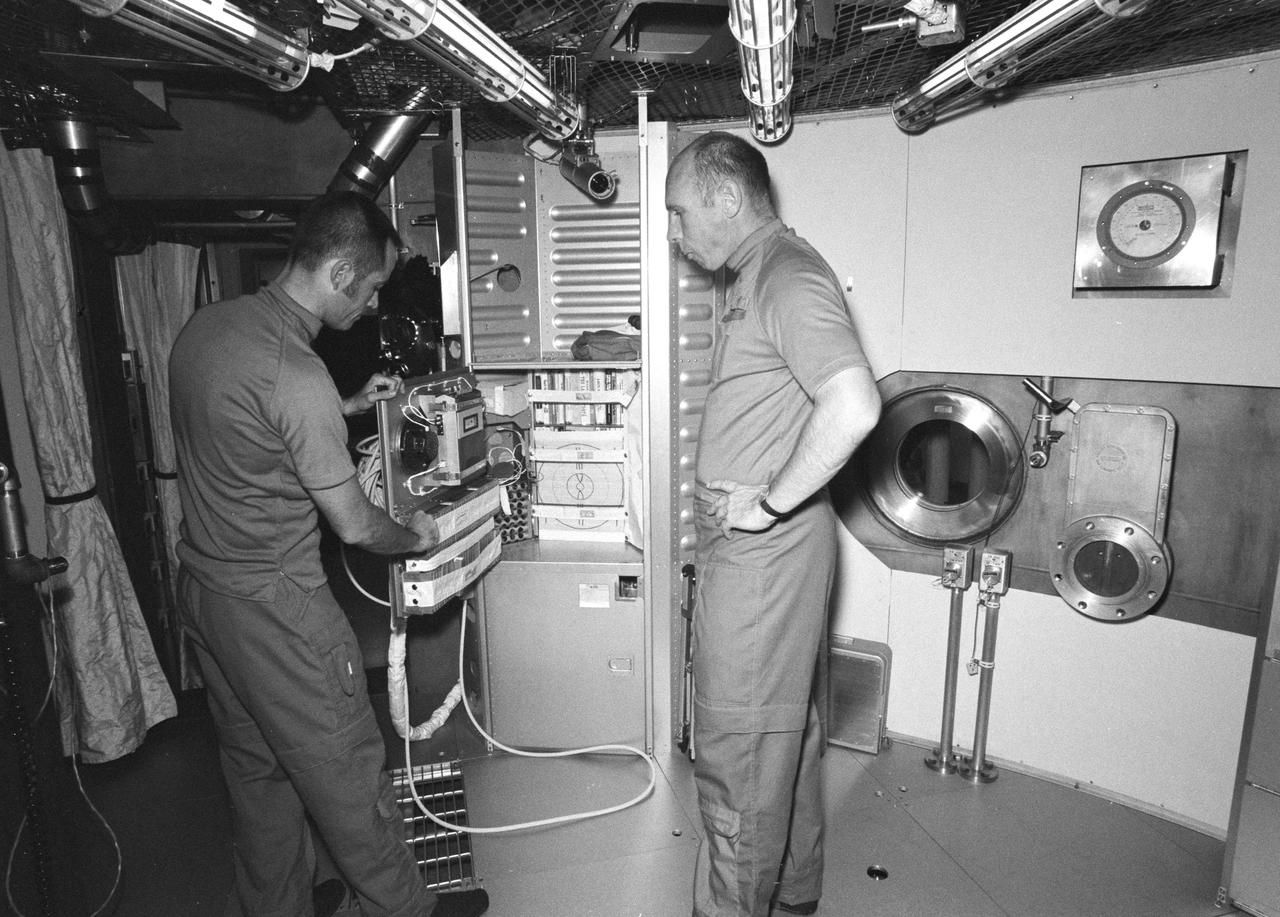
S72-41858 (15 June 1972) --- Astronauts Robert L. Crippen, left, Skylab Medical Experiment Altitude Test (SMEAT) crew commander, and Dr. William E. Thornton, SMEAT science pilot, stand at the cabinet containing off duty recreation equipment. They are two members of a three-man SMEAT crew who will spend up to 56 days in the Crew Systems Division's 20-foot altitude chamber at the NASA Manned Spacecraft Center (MSC) beginning in mid-July to obtain medical data and evaluate medical experiment equipment for Skylab. Astronaut Karol J. Bobko, SMEAT pilot, the third crew member is not shown in this view. Photo credit: NASA
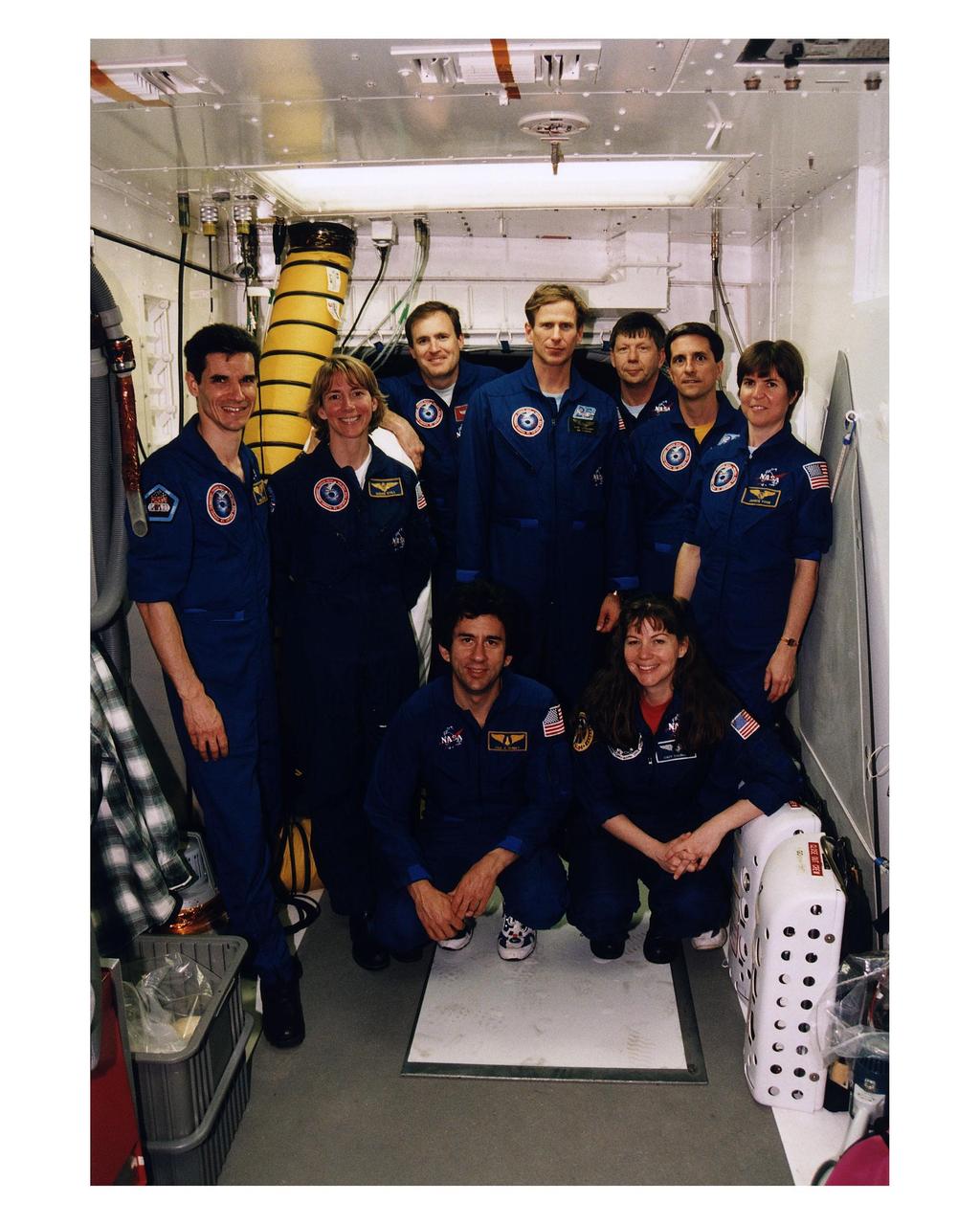
The STS-83 crew poses in the White Room at Launch Complex 39A during the crew's <a href="http://www-pao.ksc.nasa.gov/kscpao/release/1997/40-97.htm">Terminal Countdown Demonstration Test (TCDT).</a> From left to right, standing, they are Payload Specialist Gregory T. Linteris, Pilot Susan L. Still, Mission Commander James D. Halsell, Mission Specialist Michael L. Gernhardt, Payload Specialist Roger K. Crouch, and Mission Specialists Donald Thomas and Janice E. Voss. Cady Coleman, the backup Mission Specialist for Donald Thomas, is kneeling on the right
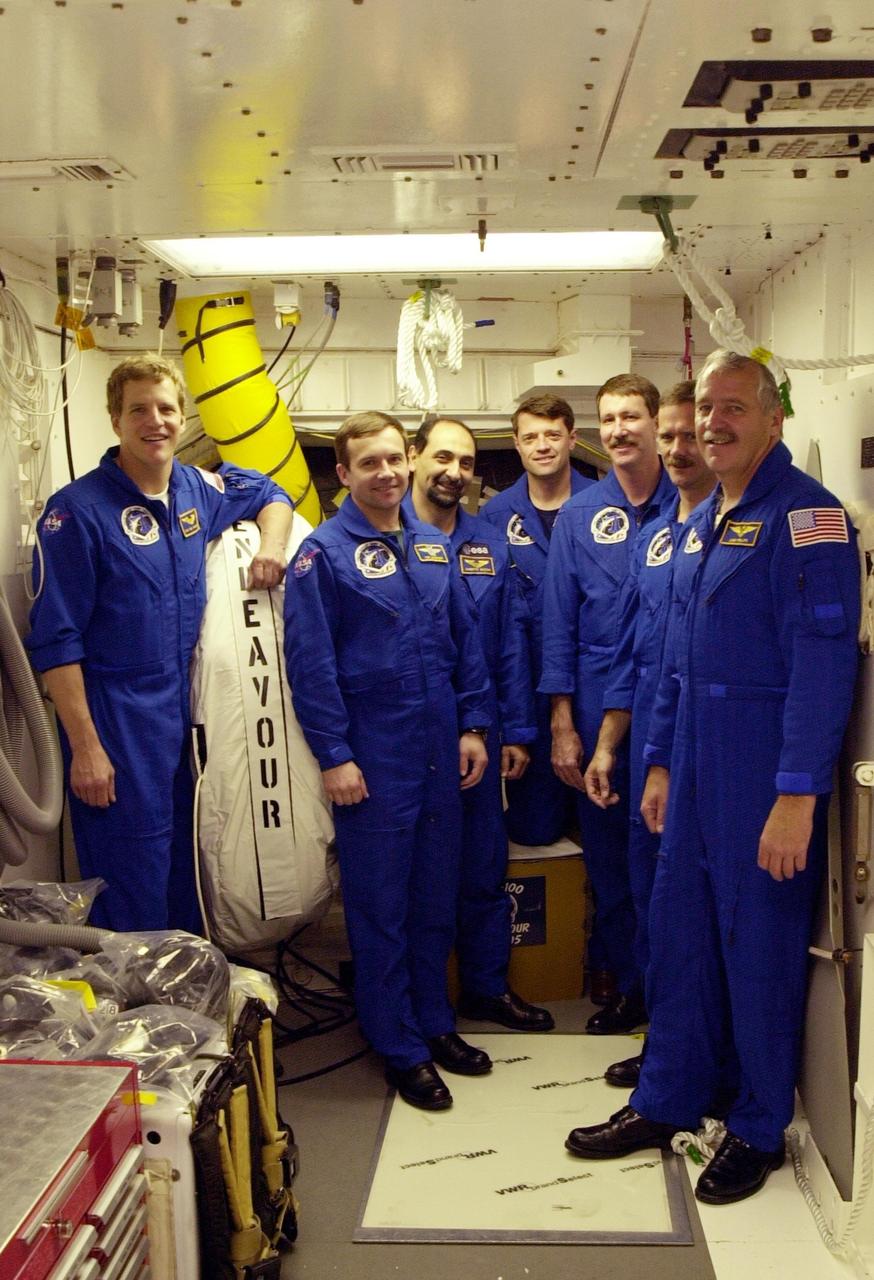
The crew on mission STS-100 poses in the White Room during Terminal Countdown Demonstration Test activities. Standing, from left, are Mission Specialists Scott E. Parazynski, Yuri Lonchakov, and Umberto Guidoni; Pilot Jeffrey S. Ashby; Commander Kent V. Rominger; Mission Specialist Chris A. Hadfield; and Mission Specialist John L. Phillips. The TCDT includes emergency escape training, payload bay walkdown, and a simulated launch countdown. Launch of Space Shuttle Endeavour on mission STS-100 is targeted for April 19 at 2:41 p.m. EDT from Launch Pad 39A
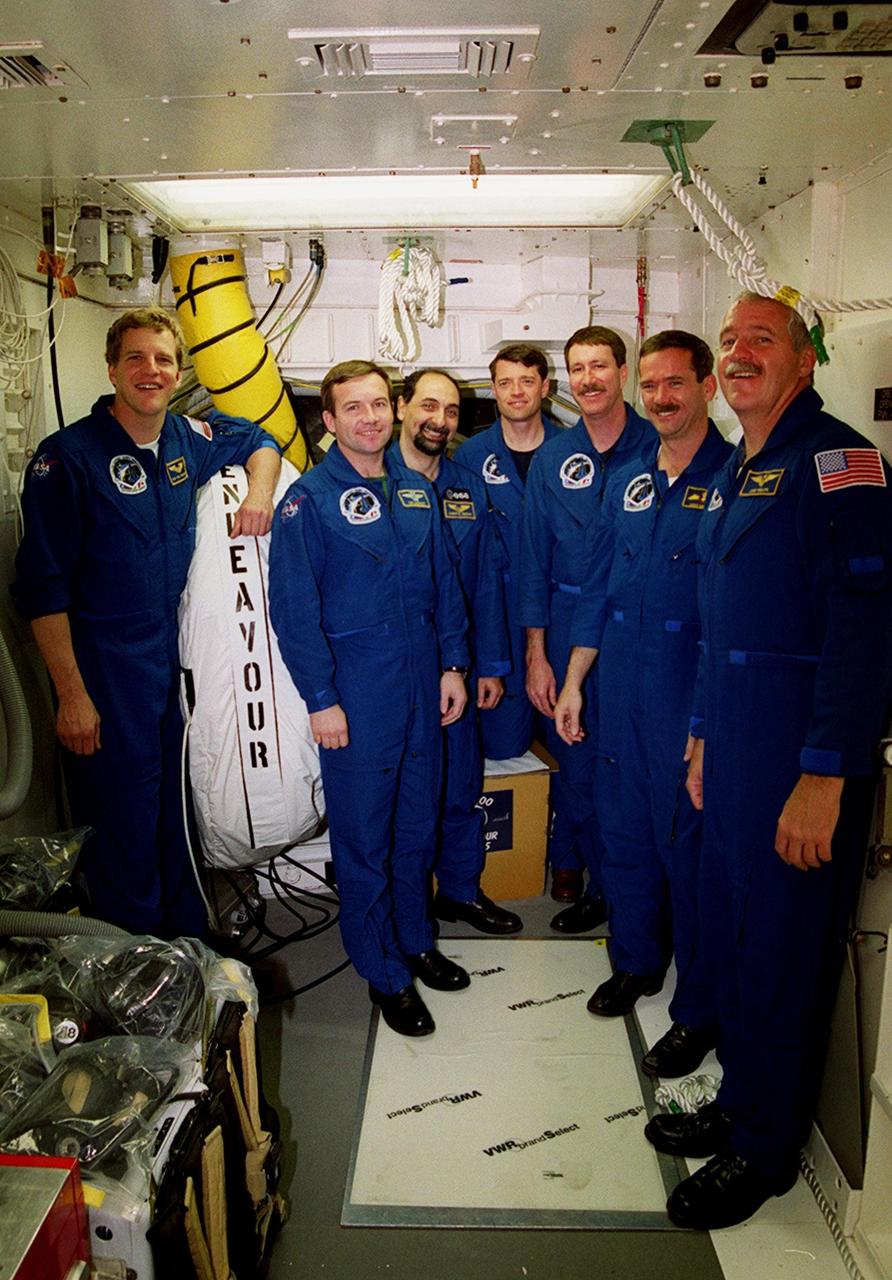
The crew on mission STS-100 poses in the White Room during Terminal Countdown Demonstration Test activities. Standing, from left, are Mission Specialists Scott E. Parazynski, Yuri Lonchakov, and Umberto Guidoni; Pilot Jeffrey S. Ashby; Commander Kent V. Rominger; and Mission Specialists Chris A. Hadfield and John L. Phillips. The TCDT includes emergency escape training, payload bay walkdown, and a simulated launch countdown. The primary payload comprises the Canadian robotic arm, SSRMS, and Multi-Purpose Logistics Module, Raffaello. Launch of Space Shuttle Endeavour on mission STS-100 is targeted for April 19 at 2:41 p.m. EDT from Launch Pad 39A
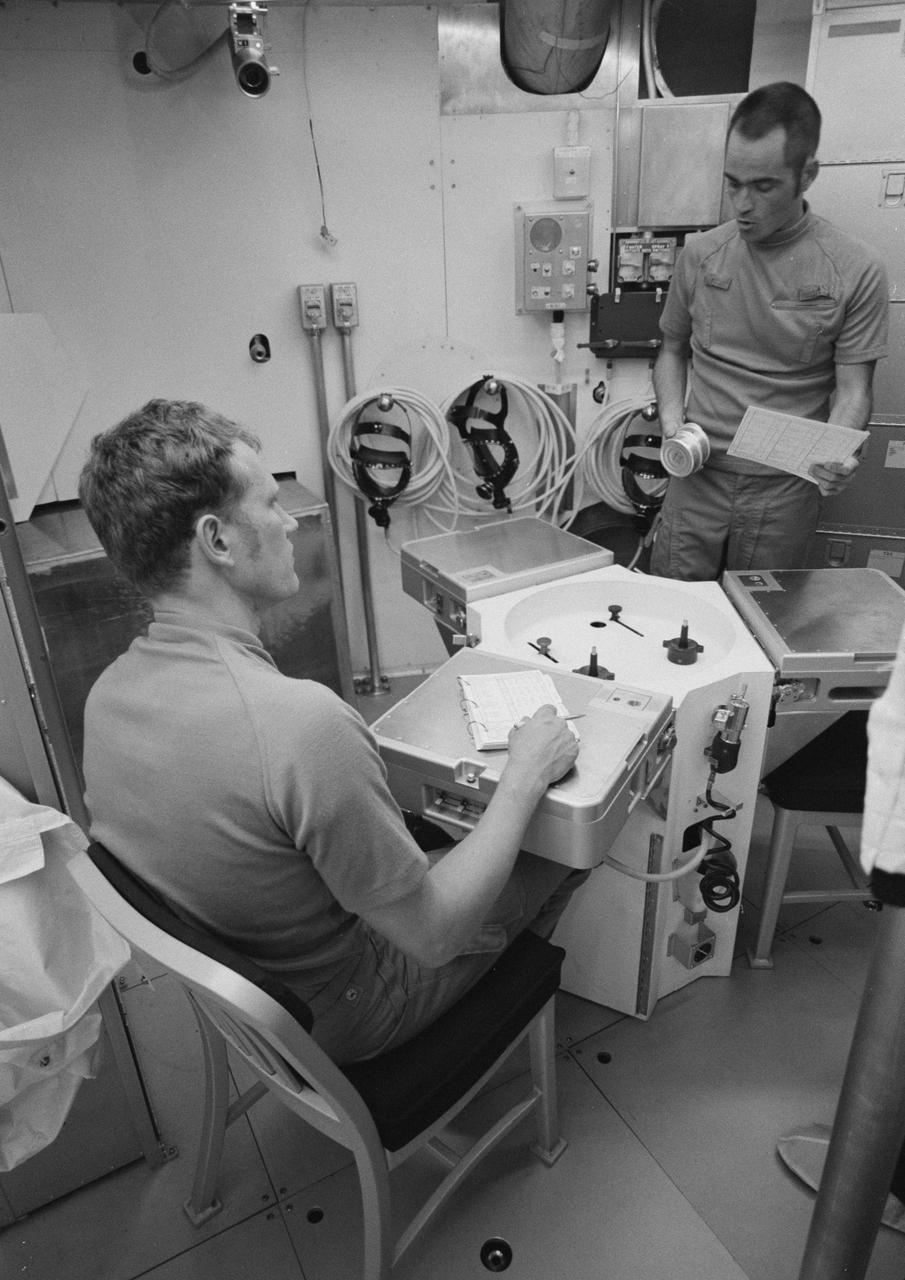
S72-41853 (15 June 1972) --- Two members of the three-man Skylab Medical Experiment Altitude Test (SMEAT) crew, that will spend up to 56 days in the Crew Systems Division's 20-foot altitude chamber at the Manned Spacecraft Center (MSC) beginning in mid-July, go over a menu in the food preparation area. Seated at the simulated wardroom food table is astronaut Karol J. Bobko, SMEAT pilot, and standing is astronaut Robert L. Crippen, SMEAT commander. Dr. William E. Thornton, SMEAT science pilot, the third crew member is not shown in this view. Photo credit: NASA
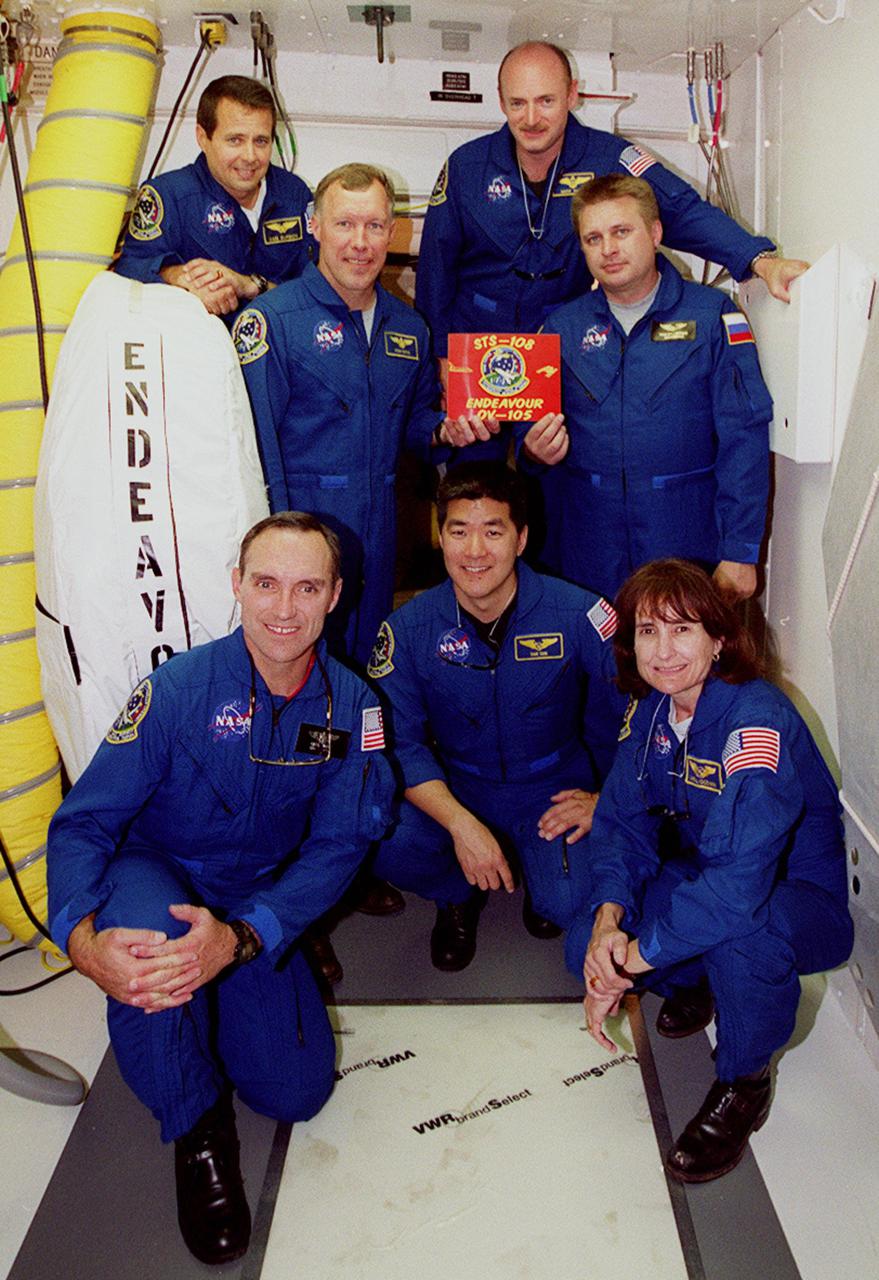
KENNEDY SPACE CENTER, Fla. - The STS-108 and Expedition 4 crews pose outside the hatch to Endeavour. Standing left to right are Daniel W. Bursch, Mission Commander Dominic L. Gorie, Pilot Mark E. Kelly and Expedition 4 Commander Yuri Onufrienko. Gorie and Onufrienko hold the patch for the mission. Kneeling in front are Expedition 4 member Carl E. Walz and Mission Specialists Daniel M. Tani and Linda A. Godwin. Crew members are at KSC for Terminal Countdown Demonstration Test activities that include a simulated launch countdown, plus the emergency exit training from the orbiter and launch pad. STS-108 is a Utilization Flight that will carry the replacement Expedition 4 crew to the International Space Station, as well as the Multi-Purpose Logistics Module Raffaello, filled with supplies and equipment. The l1-day mission is scheduled for launch Nov. 29 on Space Shuttle Endeavour
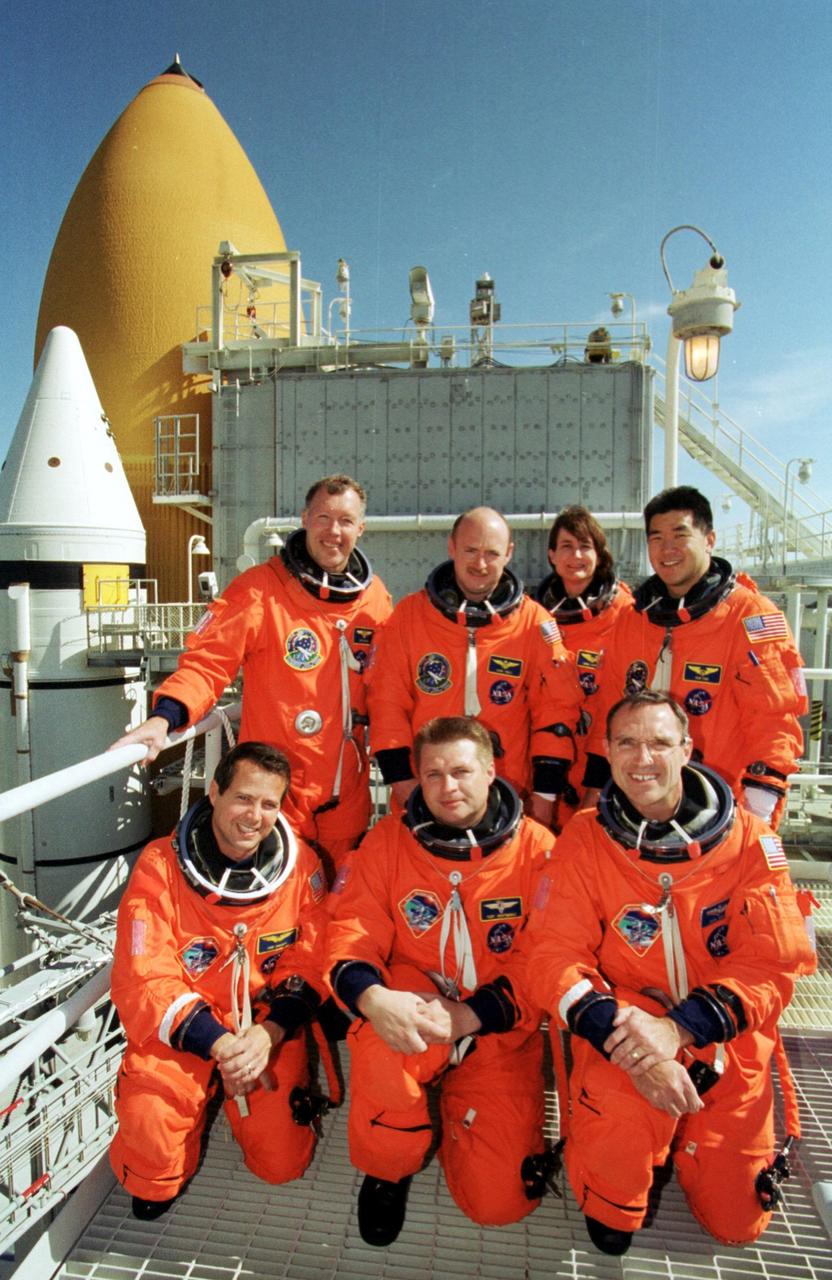
KENNEDY SPACE CENTER, Fla. -- The crews who will be aboard Space Shuttle Endeavour on mission STS-108 pose for a group photo on the 215-foot level of the Fixed Service Structure. In front is the Expedition 4 crew, astronaut Daniel W. Bursch, Commander Yuri Onufrienko and astronaut Carl E. Walz. Standing behind them are Mission STS-108 Commander Dominic L. Gorie, Pilot Mark E. Kelly and Mission Specialists Linda A. Godwin and Daniel M. Tani. Both crews have been taking part in Terminal Countdown Demonstration Test activities that include a simulated launch countdown and emergency egress training. Behind them can be seen one of the twin solid rocket boosters and the larger external tank. Launch of Space Shuttle Endeavour on mission STS-108 is scheduled for Nov. 29 at 7:44 p.m. EST
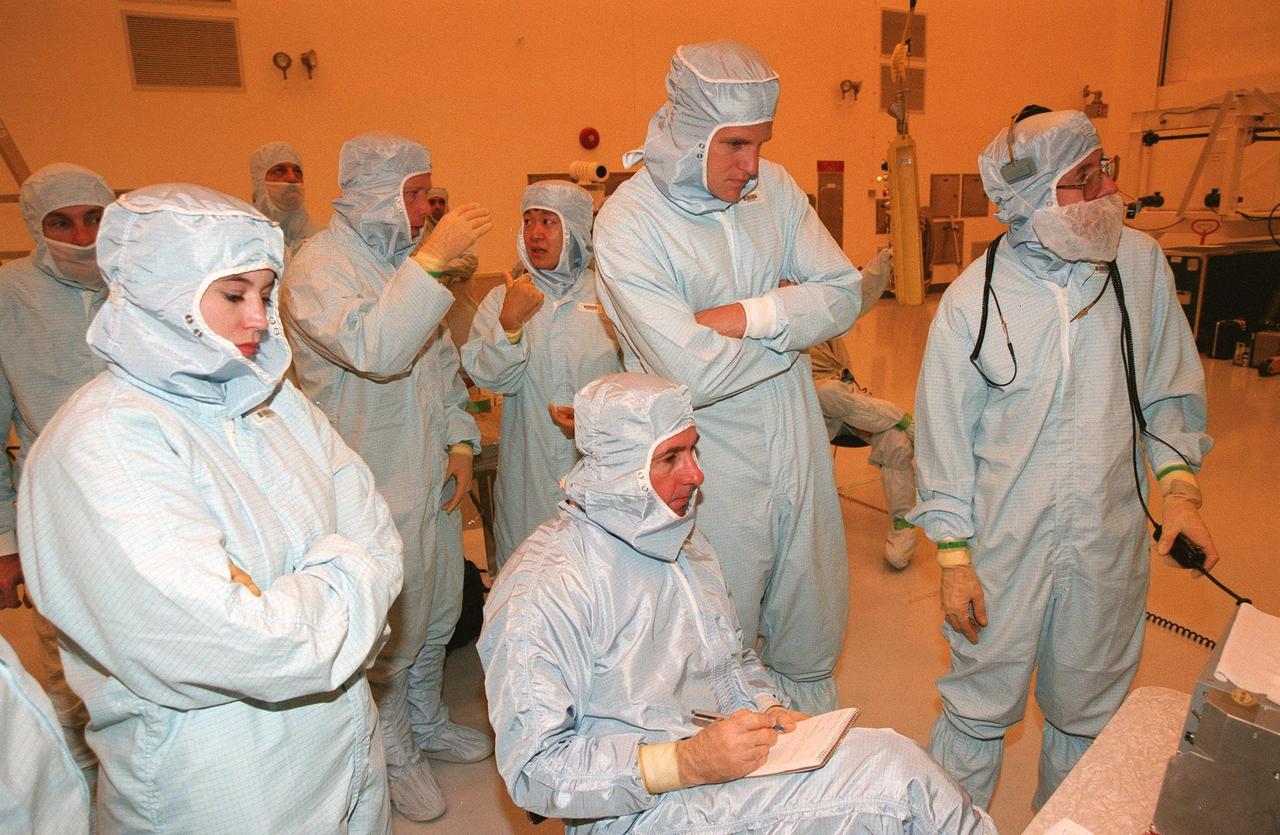
During Crew Equipment Interface Test (CEIT), STS-95 Mission Specialists Stephen K. Robinson (seated), and Scott E. Parazynski (standing behind him) look at a monitor displaying the Spartan payload that will be part of the mission. In the background (center) are Pilot Steven W. Lindsey and Payload Specialist Chiaki Mukai, with the National Space Development Agency of Japan (NASDA). Technicians are gathered around them. The CEIT gives astronauts an opportunity for a hands-on look at the payloads and equipment with which they will be working on orbit. The launch of the STS-95 mission is scheduled for Oct. 29, 1998. The mission includes research payloads such as the Spartan solar-observing deployable spacecraft, the Hubble Space Telescope Orbital Systems Test Platform, the International Extreme Ultraviolet Hitchhiker, as well as the SPACEHAB single module with experiments on space flight and the aging process
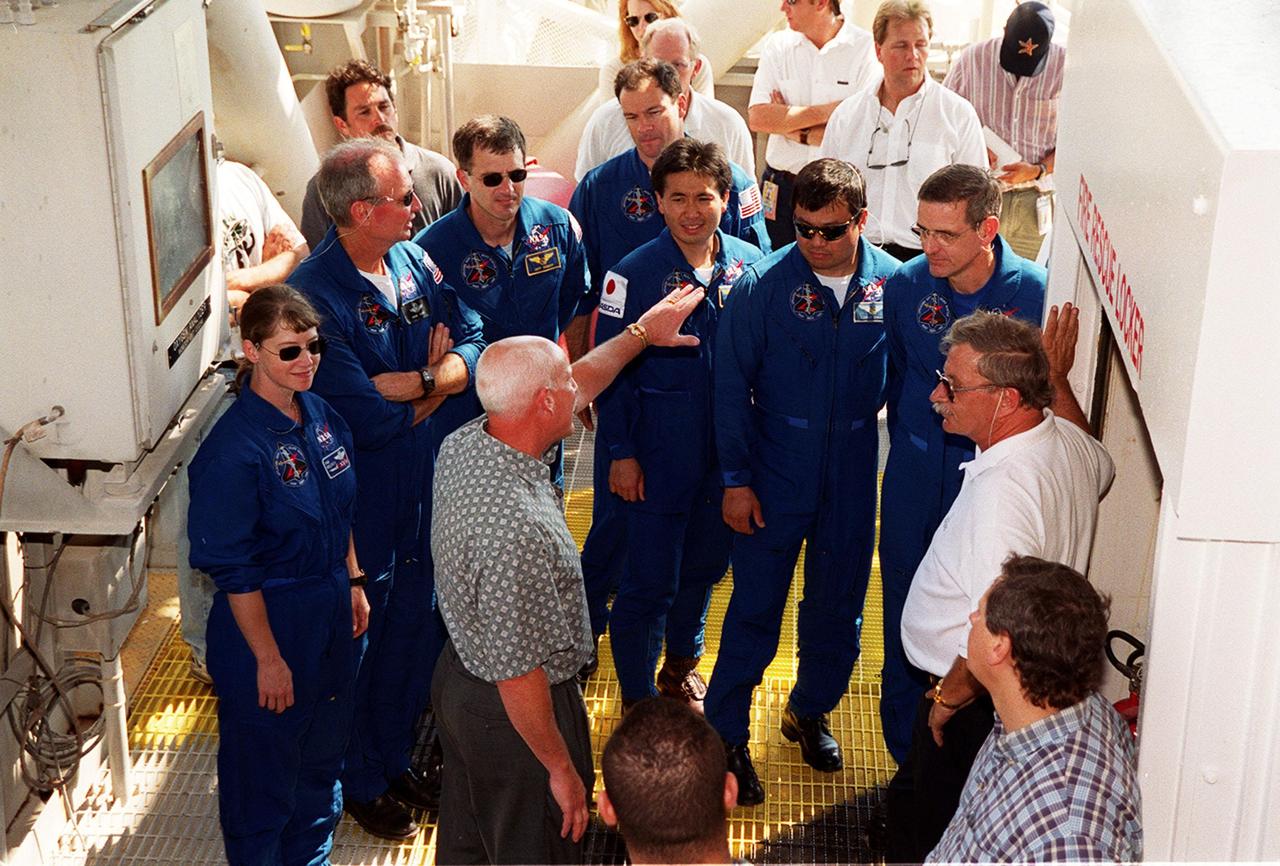
At the 195-foot level of the Fixed Service Structure on Launch Pad 39A, the STS-92 crew get instructions on using the emergency egress equipment. Standing left to right, in uniform, are Pilot Pamela Ann Melroy, Commander Brian Duffy and Mission Specialists Peter J.K. “Jeff” Wisoff, Michael E. Lopez-Alegria, Koichi Wakata of Japan, Leroy Chiao and William S. McArthur Jr. The training is part of Terminal Countdown Demonstration Test activities that also provide opportunities to inspect the mission payload and take part in a simulated countdown. STS-92 is scheduled to launch Oct. 5 at 9:38 p.m. EDT on the fifth flight to the International Space Station. It will carry two elements of the Space Station, the Integrated Truss Structure Z1 and the third Pressurized Mating Adapter. The mission is also the 100th flight in the Shuttle program
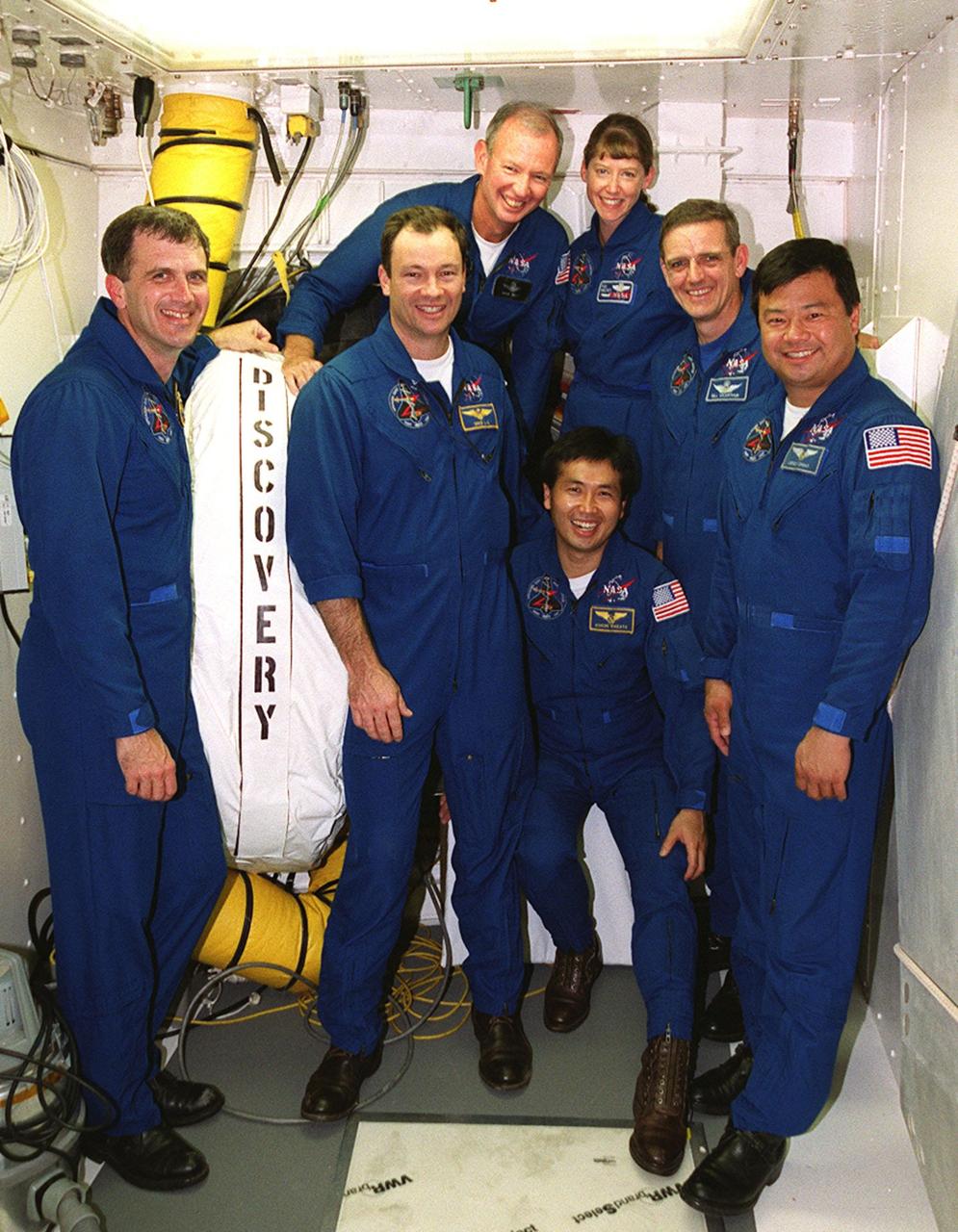
The STS-92 crew poses for a photograph in the White Room, the environmentally controlled chamber on the orbiter access arm that provides entry for the crew into the orbiter. Standing, left to right, are Mission Specialists Peter J.K. “Jeff” Wisoff and Michael E. Lopez-Alegria; Commander Brian Duffy; Pilot Pamela Ann Melroy; and Mission Specialists William S. McArthur Jr. and Leroy Chiao. Crouching in front is Mission Specialist Koichi Wakata of Japan. The crew is at KSC for Terminal Countdown Demonstration Test activities that provide emergency egress training, opportunities to inspect the mission payload, and take part in a simulated countdown. STS-92 is scheduled to launch Oct. 5 at 9:38 p.m. EDT on the fifth flight to the International Space Station. It will carry two elements of the Space Station, the Integrated Truss Structure Z1 and the third Pressurized Mating Adapter. The mission is also the 100th flight in the Shuttle program
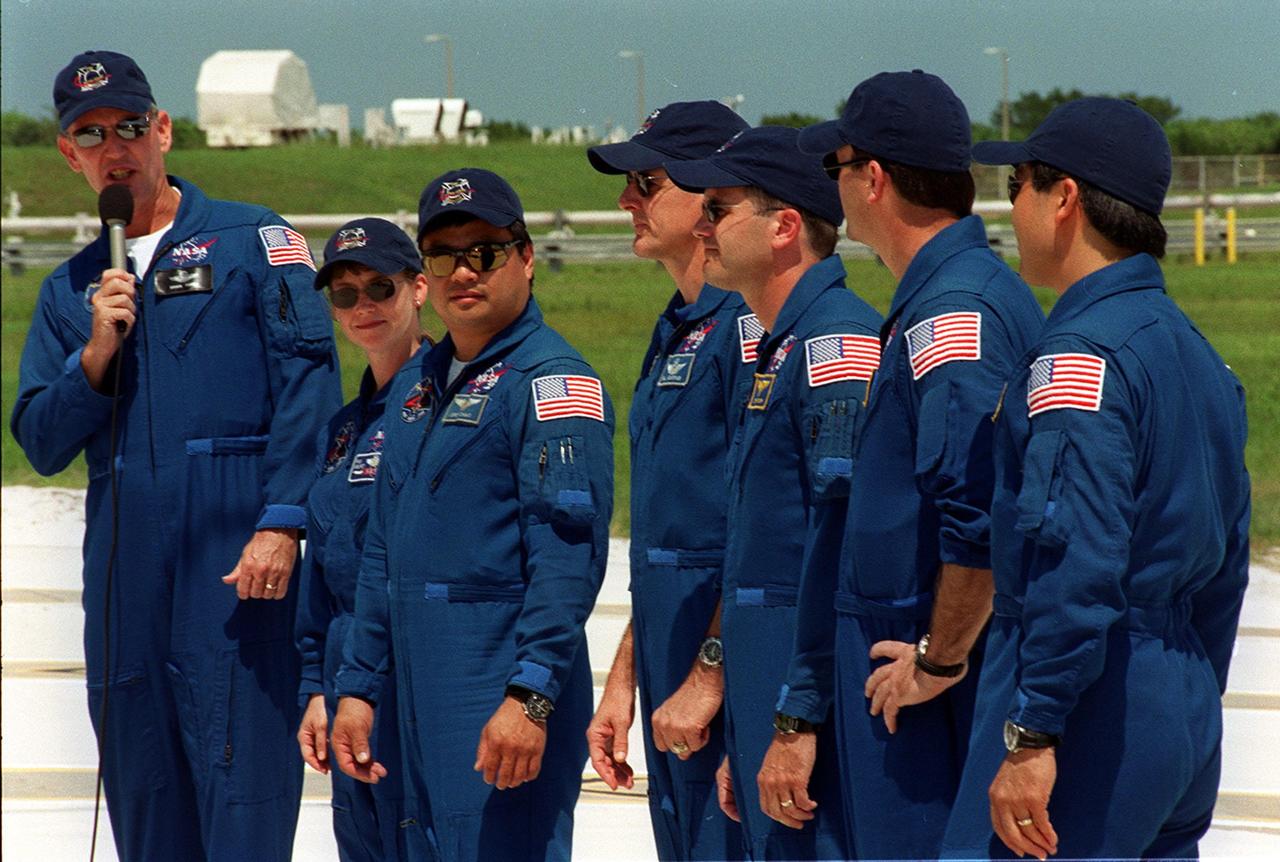
KENNEDY SPACE CENTER, FLA. -- At Launch Pad 39A during a question and answer session with the media, STS-92 Commander Brian Duffy talks about the mission. Standing next to him, left to right, are Pilot Pamela Ann Melroy and Mission Specialists Leroy Chiao, William S. McArthur Jr., Peter J.K. “Jeff” Wisoff, Michael E. Lopez-Alegria and Koichi Wakata of Japan. The crew is at KSC for Terminal Countdown Demonstration Test activities that provide emergency egress training, opportunities to inspect the mission payload, and a simulated countdown. The slidewire basket area is a landing site for the crew if they have to use the slidewire baskets to exit the orbiter on the pad in an emergency. STS-92 is scheduled to launch Oct. 5 at 9:38 p.m. EDT on the fifth flight to the International Space Station. It will carry two elements of the Space Station, the Integrated Truss Structure Z1 and the third Pressurized Mating Adapter. The mission is also the 100th flight in the Shuttle program
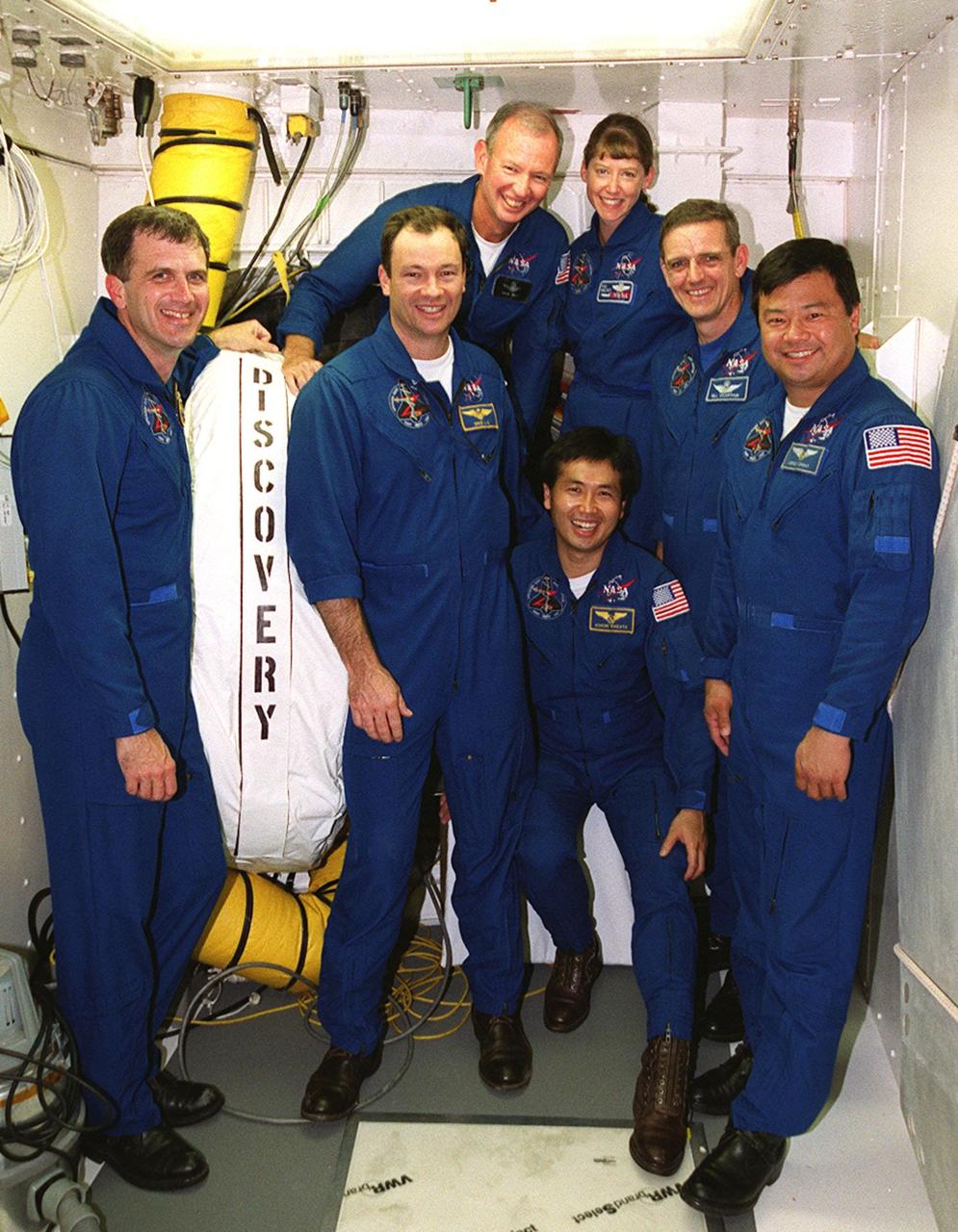
The STS-92 crew poses for a photograph in the White Room, the environmentally controlled chamber on the orbiter access arm that provides entry for the crew into the orbiter. Standing, left to right, are Mission Specialists Peter J.K. “Jeff” Wisoff and Michael E. Lopez-Alegria; Commander Brian Duffy; Pilot Pamela Ann Melroy; and Mission Specialists William S. McArthur Jr. and Leroy Chiao. Crouching in front is Mission Specialist Koichi Wakata of Japan. The crew is at KSC for Terminal Countdown Demonstration Test activities that provide emergency egress training, opportunities to inspect the mission payload, and take part in a simulated countdown. STS-92 is scheduled to launch Oct. 5 at 9:38 p.m. EDT on the fifth flight to the International Space Station. It will carry two elements of the Space Station, the Integrated Truss Structure Z1 and the third Pressurized Mating Adapter. The mission is also the 100th flight in the Shuttle program
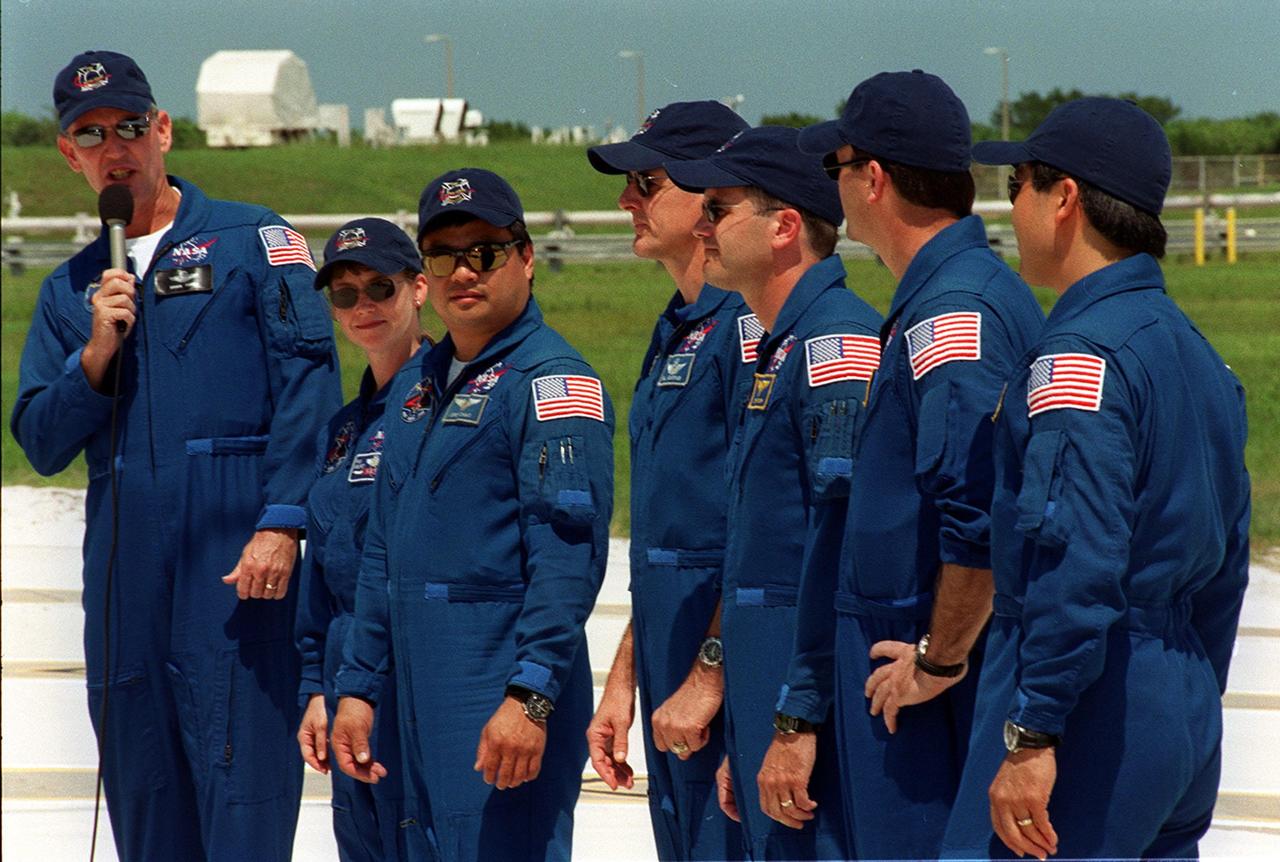
KENNEDY SPACE CENTER, FLA. -- At Launch Pad 39A during a question and answer session with the media, STS-92 Commander Brian Duffy talks about the mission. Standing next to him, left to right, are Pilot Pamela Ann Melroy and Mission Specialists Leroy Chiao, William S. McArthur Jr., Peter J.K. “Jeff” Wisoff, Michael E. Lopez-Alegria and Koichi Wakata of Japan. The crew is at KSC for Terminal Countdown Demonstration Test activities that provide emergency egress training, opportunities to inspect the mission payload, and a simulated countdown. The slidewire basket area is a landing site for the crew if they have to use the slidewire baskets to exit the orbiter on the pad in an emergency. STS-92 is scheduled to launch Oct. 5 at 9:38 p.m. EDT on the fifth flight to the International Space Station. It will carry two elements of the Space Station, the Integrated Truss Structure Z1 and the third Pressurized Mating Adapter. The mission is also the 100th flight in the Shuttle program

CAPE CANAVERAL, Fla. - Members of space shuttle Atlantis' STS-129 crew pose for a group portrait in the White Room at Launch Pad 39A at NASA's Kennedy Space Center in Florida. Kneeling from left are Mission Specialist Randy Bresnik and Commander Charles O. Hobaugh; standing from left are Mission Specialists Mike Foreman, Leland Melvin and Robert L. Satcher Jr.; and Pilot Barry E. Wilmore. The crew members of space shuttle Atlantis' STS-129 mission are at Kennedy for training related to their launch dress rehearsal, the Terminal Countdown Demonstration Test. Launch of Atlantis on its STS-129 mission to the International Space Station is targeted for Nov. 16. For information on the STS-129 mission objectives and crew, visit http://www.nasa.gov/mission_pages/shuttle/shuttlemissions/sts129/index.html. Photo credit: NASA/Jim Grossmann
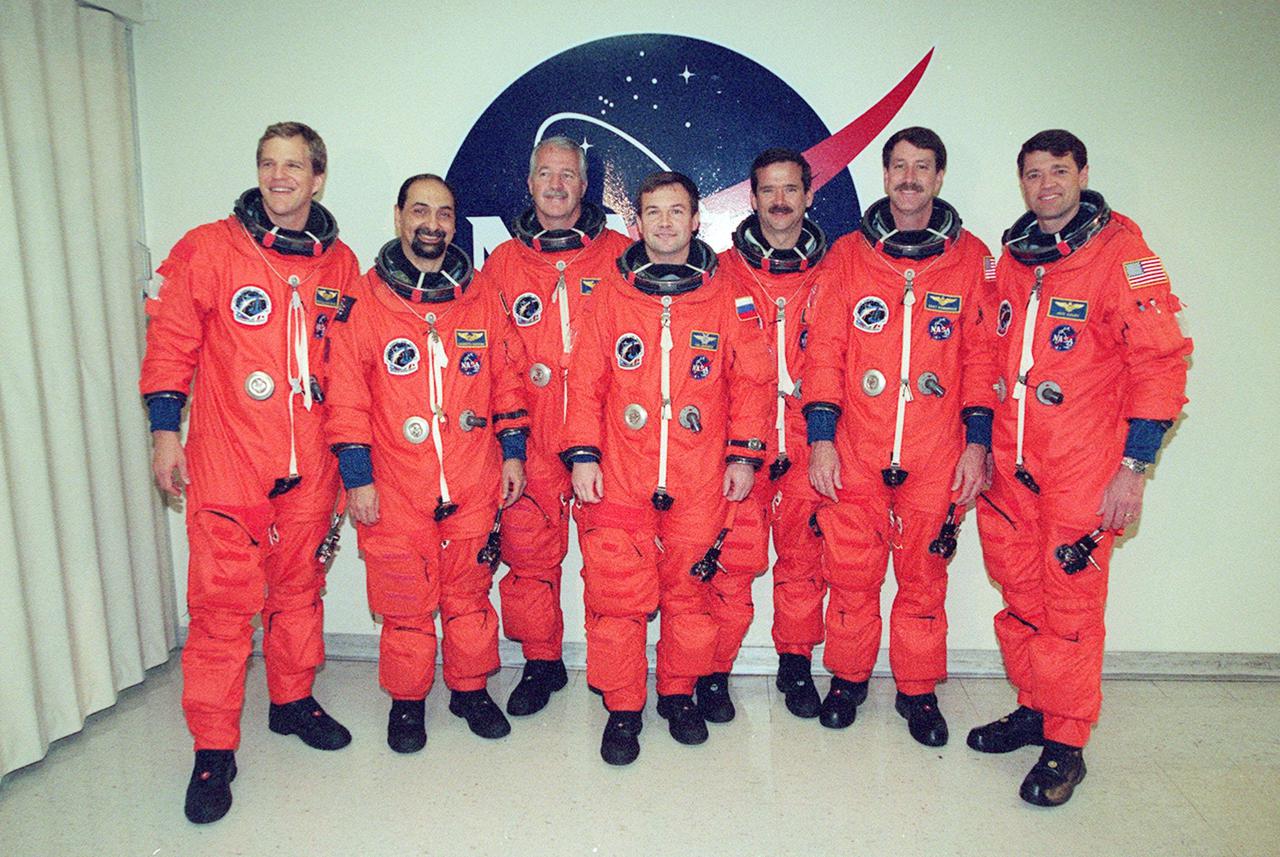
The STS-100 crew pauses for a photo before walkout and the ride to Launch Pad 39A for a simulated countdown. Standing, from left, are Mission Specialists Scott E. Parazynski, Umberto Guidoni, John L. Phillips, Yuri V. Lonchakov and Chris A. Hadfield; Commander Kent V. Rominger; and Pilot Jeffrey S. Ashby. The STS-100 crew is at KSC for Terminal Countdown Demonstration Test activities that include emergency escape training at the pad and the simulated launch countdown. The mission is carrying the Multi-Purpose Logistics Module Raffaello and the SSRMS, to the International Space Station. Raffaello carries six system racks and two storage racks for the U.S. Lab. The SSRMS is crucial to the continued assembly of the orbiting complex. Launch of mission STS-100 is scheduled for April 19 at 2:41 p.m. EDT from Launch Pad 39A
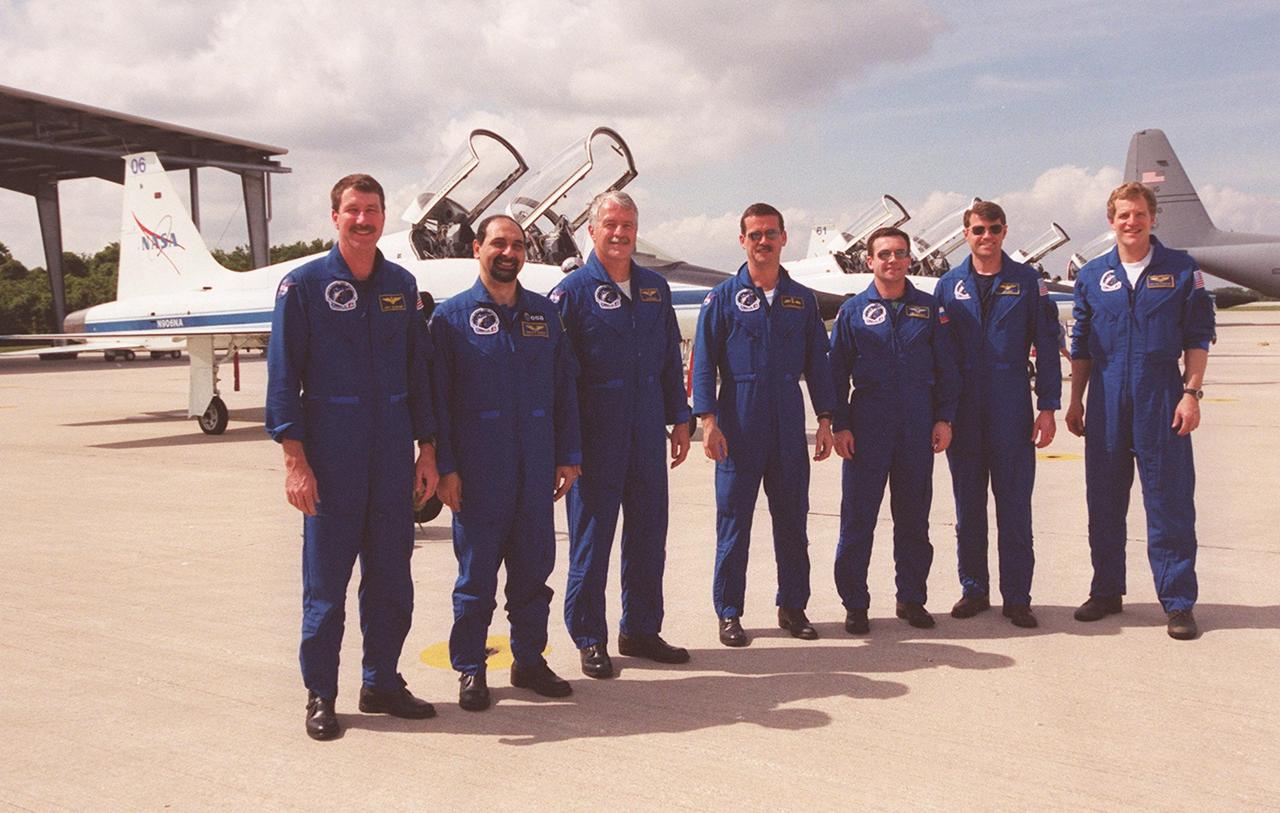
The STS-100 crew poses for a photo after their arrival at KSC to complete Terminal Countdown Demonstration Test activities that were postponed earlier. Standing, from left, are Commander Kent V. Rominger; Mission Specialists Umberto Guidoni, John L. Phillips, Chris A. Hadfield and Yuri V. Lonchakov; Pilot Jeffrey S. Ashby; and Mission Specialist Scott E. Parazynski. An international crew, Guidoni is with the European Space Agency, Hadfield the Canadian Space Agency, and Lonchakov the Russian Space and Aviation Agency. The TCDT includes emergency escape training, payload bay walkdown, and a simulated launch countdown. The primary payload comprises the Canadian robotic arm, SSRMS, and Multi-Purpose Logistics Module, Raffaello. Launch of Space Shuttle Endeavour on mission STS-100 is targeted for April 19 at 2:41 p.m. EDT from Launch Pad 39A
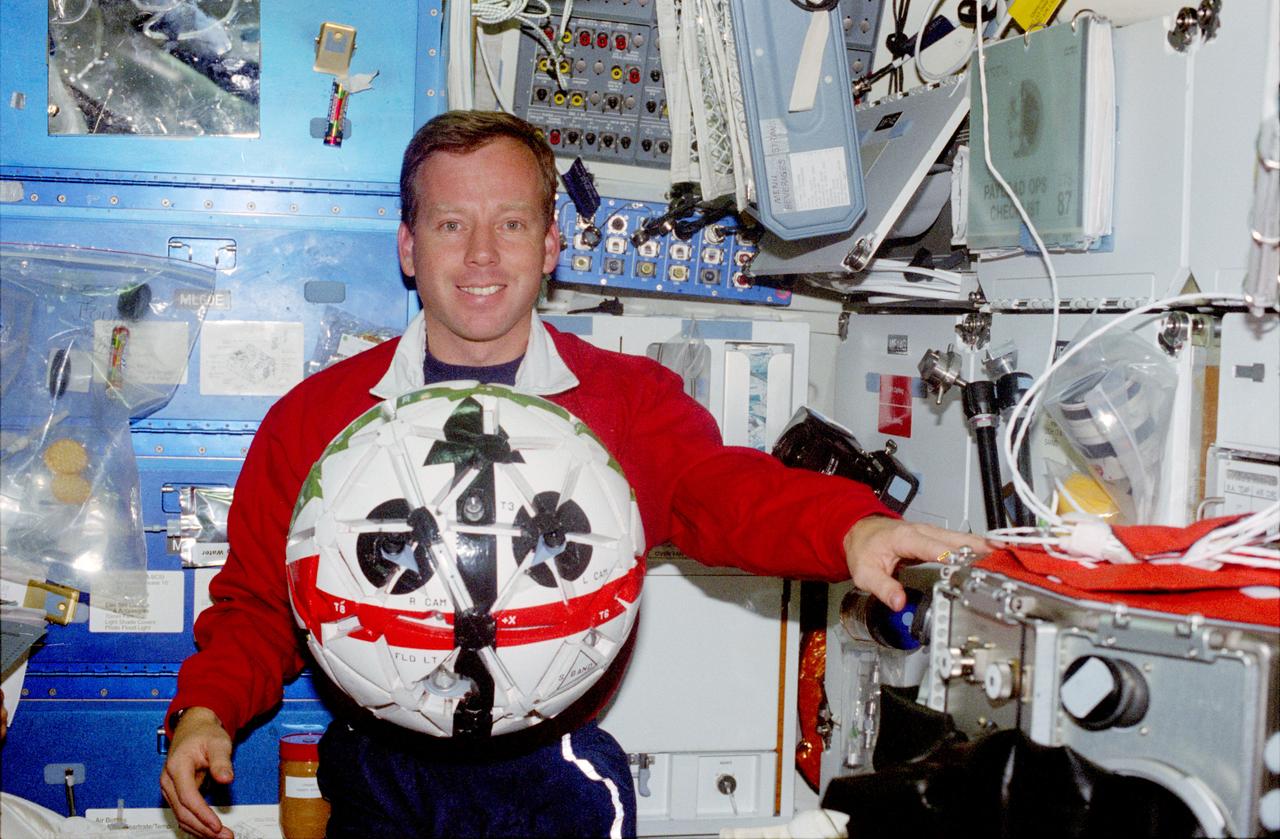
STS087-371-013 (19 November - 5 December 1997) --- On the Space Shuttle Columbia's mid-deck, astronaut Steven W. Lindsey proves that the Autonomous Extravehicular Activity Robotic Camera/Sprint (AERCam/Sprint) experiment is in fact bigger than a soccer ball, to which it is often erroneously compared for dimensional frame of reference, as he allows the Sprint to float near him. The AERCam is a prototype free-flying television camera that could be used for remote inspections of the exterior of the International Space Station (ISS). Later, astronauts Winston E. Scott and Takao Doi took the experiment outside for a brief test during the mission's second Extravehicular Activity (EVA). Lindsey, pilot, is standing with his back to the galley and his left hand on the microgravity glovebox, used extensively during the mission to support the United States Microgravity Payload (USMP-4) mission.
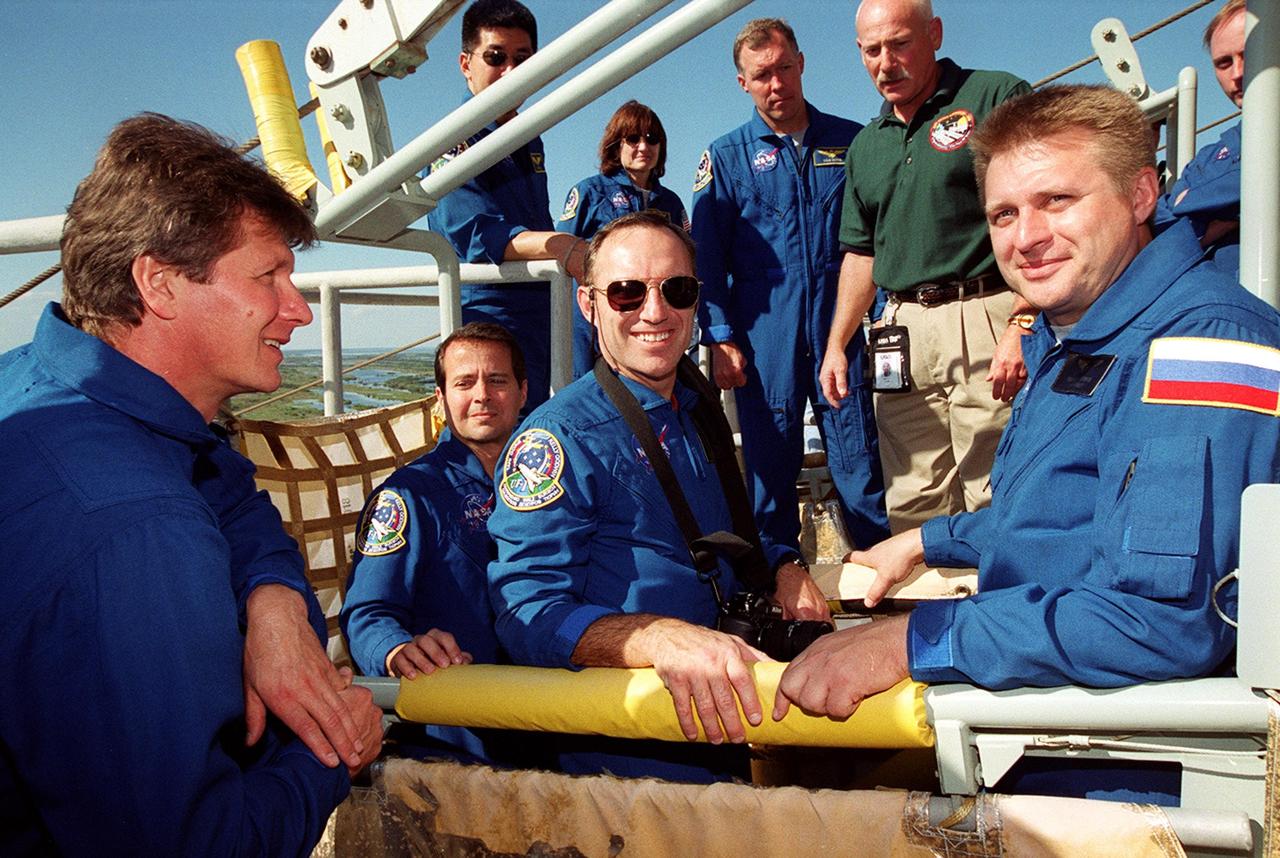
KENNEDY SPACE CENTER, Fla. -- The STS-108 and Expedition 4 crews get emergency egress training on Launch Pad 39B. Seated in the slidewire basket are astronauts Daniel W. Bursch and Carl E. Walz, with Expedition 4 Commander Yuri Onufrienko. Standing in the background are STS-108 Mission Specialists Daniel M. Tani and Linda A. Godwin, and Commander Dominic L. Gorie. At the far right is astronaut Michael Fincke, part of a backup crew for Expedition 4. Crew members are at KSC for Terminal Countdown Demonstration Test activities that include a simulated launch countdown, plus the emergency exit training from the orbiter and launch pad. STS-108 is a Utilization Flight that will carry the replacement Expedition 4 crew to the International Space Station, as well as the Multi-Purpose Logistics Module Raffaello, filled with supplies and equipment. The l1-day mission is scheduled for launch Nov. 29 on Space Shuttle Endeavour
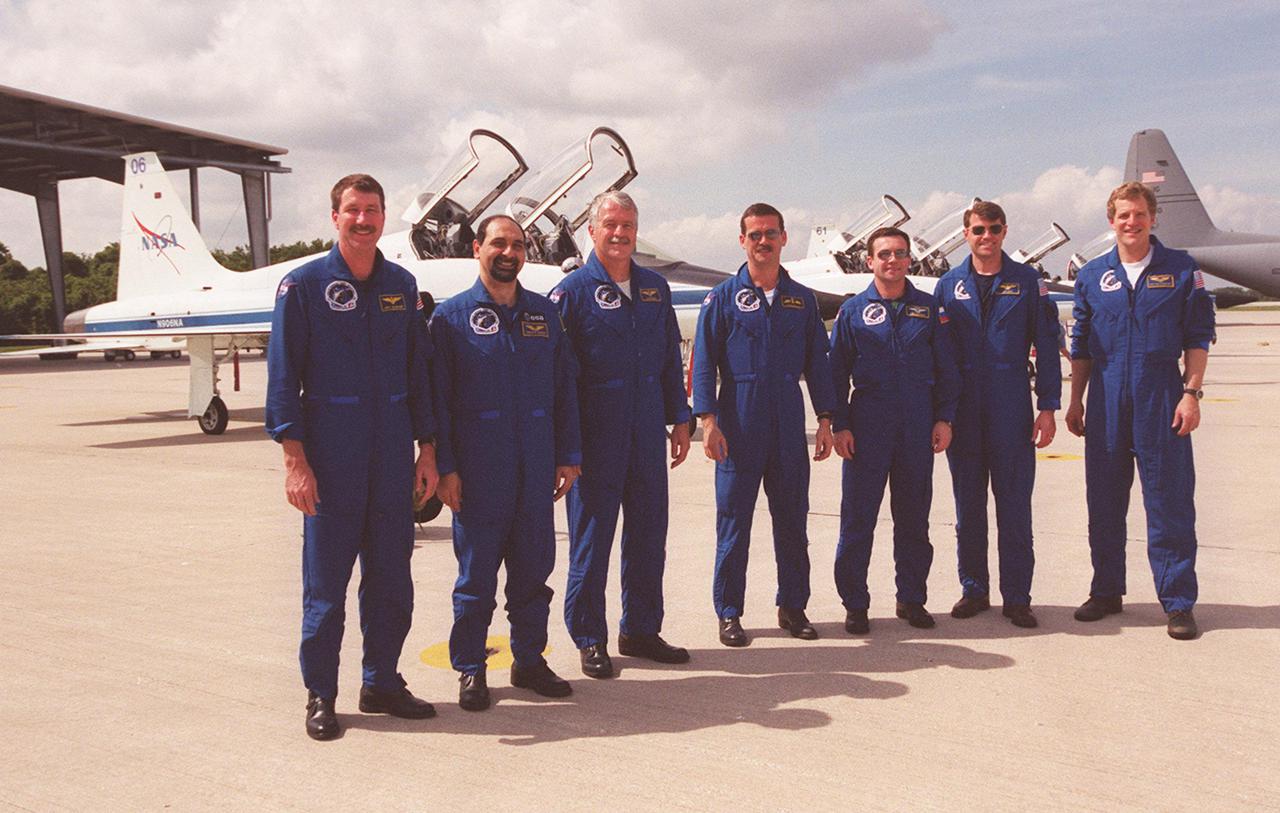
The STS-100 crew poses for a photo after their arrival at KSC to complete Terminal Countdown Demonstration Test activities that were postponed earlier. Standing, from left, are Commander Kent V. Rominger; Mission Specialists Umberto Guidoni, John L. Phillips, Chris A. Hadfield and Yuri V. Lonchakov; Pilot Jeffrey S. Ashby; and Mission Specialist Scott E. Parazynski. An international crew, Guidoni is with the European Space Agency, Hadfield the Canadian Space Agency, and Lonchakov the Russian Space and Aviation Agency. The TCDT includes emergency escape training, payload bay walkdown, and a simulated launch countdown. The primary payload comprises the Canadian robotic arm, SSRMS, and Multi-Purpose Logistics Module, Raffaello. Launch of Space Shuttle Endeavour on mission STS-100 is targeted for April 19 at 2:41 p.m. EDT from Launch Pad 39A
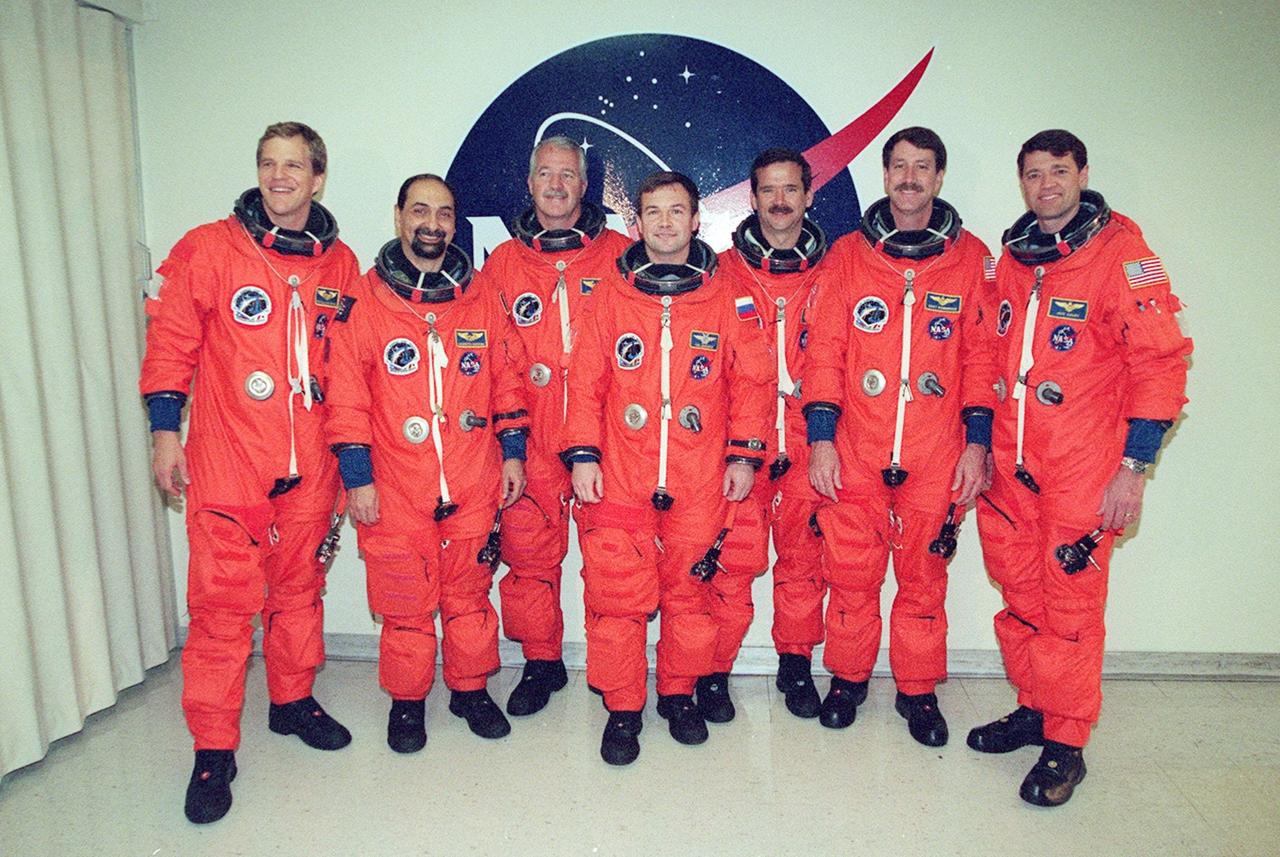
The STS-100 crew pauses for a photo before walkout and the ride to Launch Pad 39A for a simulated countdown. Standing, from left, are Mission Specialists Scott E. Parazynski, Umberto Guidoni, John L. Phillips, Yuri V. Lonchakov and Chris A. Hadfield; Commander Kent V. Rominger; and Pilot Jeffrey S. Ashby. The STS-100 crew is at KSC for Terminal Countdown Demonstration Test activities that include emergency escape training at the pad and the simulated launch countdown. The mission is carrying the Multi-Purpose Logistics Module Raffaello and the SSRMS, to the International Space Station. Raffaello carries six system racks and two storage racks for the U.S. Lab. The SSRMS is crucial to the continued assembly of the orbiting complex. Launch of mission STS-100 is scheduled for April 19 at 2:41 p.m. EDT from Launch Pad 39A
![The STS-100 crew gathers at the bus when Terminal Countdown Demonstration Test activities are hampered by the rain. Standing with the bus driver, from left, are Mission Specialist John L. Phillips, Commander Kent V. Rominger, Mission Specialists Umberto Guidoni, Chris Hadfield, [driver], and Scott E. Parazynski, Pilot Jeffrey S. Ashby and Mission Specialist Yuri V. Lonchakov. TCDT includes emergency escape training at the pad and a simulated launch countdown. The mission is carrying the Multi-Purpose Logistics Module Raffaello and the Canadian robotic arm, SSRMS, to the International Space Station. Raffaello carries six system racks and two storage racks for the U.S. Lab. The SSRMS is crucial to the continued assembly of the orbiting complex. Launch of mission STS-100 is scheduled for April 19 at 2:41 p.m. EDT from Launch Pad 39A](https://images-assets.nasa.gov/image/KSC-01pp0614/KSC-01pp0614~medium.jpg)
The STS-100 crew gathers at the bus when Terminal Countdown Demonstration Test activities are hampered by the rain. Standing with the bus driver, from left, are Mission Specialist John L. Phillips, Commander Kent V. Rominger, Mission Specialists Umberto Guidoni, Chris Hadfield, [driver], and Scott E. Parazynski, Pilot Jeffrey S. Ashby and Mission Specialist Yuri V. Lonchakov. TCDT includes emergency escape training at the pad and a simulated launch countdown. The mission is carrying the Multi-Purpose Logistics Module Raffaello and the Canadian robotic arm, SSRMS, to the International Space Station. Raffaello carries six system racks and two storage racks for the U.S. Lab. The SSRMS is crucial to the continued assembly of the orbiting complex. Launch of mission STS-100 is scheduled for April 19 at 2:41 p.m. EDT from Launch Pad 39A

On Launch Pad 39B, the STS-95 crew pose after successfully completing a pre-launch countdown exercise on Space Shuttle Discovery. Standing from left to right are Mission Specialist Scott E. Parazynski, Mission Specialist Stephen K. Robinson, Payload Specialist John H. Glenn Jr., senator from Ohio, Payload Specialist Chiaki Mukai (M.D., Ph.D.), representing the National Space Development Agency in Japan (NASDA), Mission Commander Curtis L. Brown, Pilot Steven W. Lindsey, and Mission Specialist Pedro Duque of Spain, representing the European Space Agency (ESA). In the background (left) can be seen one of the solid rocket boosters and the external tank. The STS-95 crew are at KSC to participate in the Terminal Countdown Demonstration Test (TCDT) which includes mission familiarization activities, emergency egress training, and a simulated main engine cutoff. The STS-95 mission, targeted for liftoff on Oct. 29, includes research payloads such as the Spartan solar-observing deployable spacecraft, the Hubble Space Telescope Orbital Systems Test Platform, the International Extreme Ultraviolet Hitchhiker, as well as the SPACEHAB single module with experiments on space flight and the aging process. Following the TCDT, the crew will be returning to Houston for final flight preparations
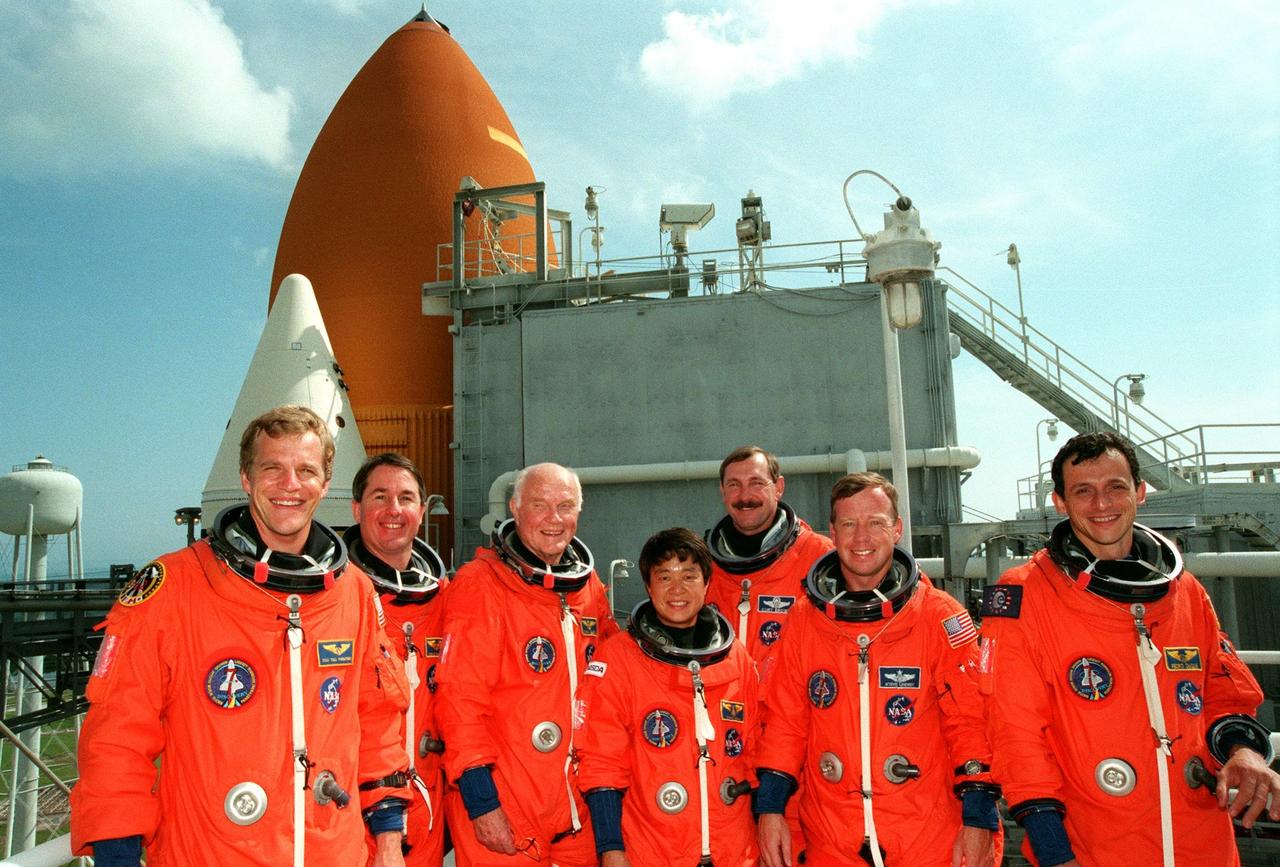
On Launch Pad 39B, the STS-95 crew pose after successfully completing a pre-launch countdown exercise on Space Shuttle Discovery. Standing from left to right are Mission Specialist Scott E. Parazynski, Mission Specialist Stephen K. Robinson, Payload Specialist John H. Glenn Jr., senator from Ohio, Payload Specialist Chiaki Mukai (M.D., Ph.D.), representing the National Space Development Agency in Japan (NASDA), Mission Commander Curtis L. Brown, Pilot Steven W. Lindsey, and Mission Specialist Pedro Duque of Spain, representing the European Space Agency (ESA). In the background can be seen one of the solid rocket boosters and the external tank. The STS-95 crew are at KSC to participate in the Terminal Countdown Demonstration Test (TCDT) which includes mission familiarization activities, emergency egress training, and a simulated main engine cutoff. The STS-95 mission, targeted for liftoff on Oct. 29, includes research payloads such as the Spartan solar-observing deployable spacecraft, the Hubble Space Telescope Orbital Systems Test Platform, the International Extreme Ultraviolet Hitchhiker, as well as the SPACEHAB single module with experiments on space flight and the aging process. Following the TCDT, the crew will be returning to Houston for final flight preparations
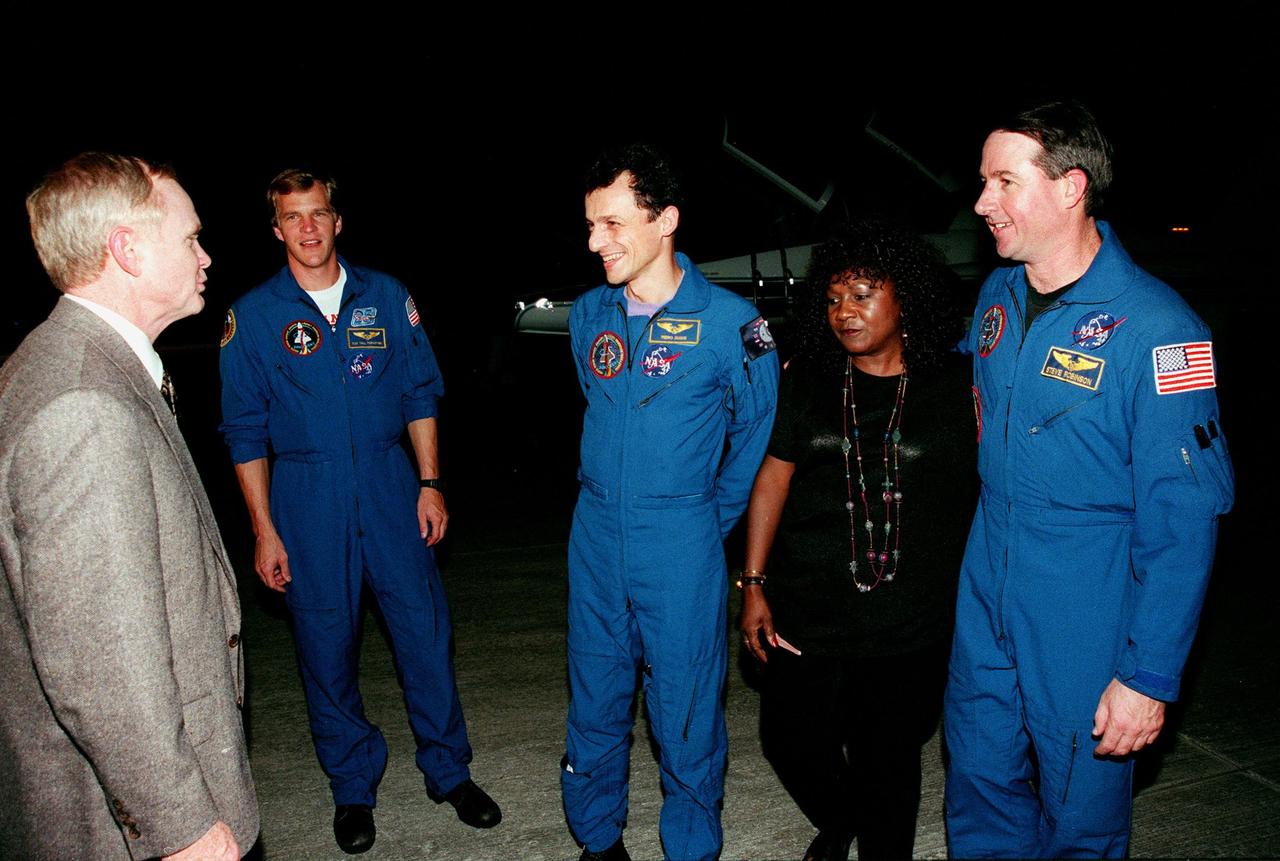
(Left to right) Center Director Roy Bridges welcomes STS-95 Mission Specialists Scott E. Parazynski, Pedro Duque of Spain, representing the European Space Agency (ESA), and Stephen K. Robinson (far right) after their arrival aboard T-38 jet aircraft at the Shuttle Landing Facility at KSC. Standing between Duque and Robinson is Dolores Green, NASA. The STS-95 crew are at KSC to participate in a Terminal Countdown Demonstration Test (TCDT). The TCDT includes mission familiarization activities, training in emergency exit from the orbiter and launch pad, and a simulated main engine cut-off exercise. The other members on the mission are Mission Commander Curtis L. Brown, Pilot Steven W. Lindsey; and Payload Specialists Chiaki Mukai, representing the National Space Development Agency of Japan (NASDA), and John H. Glenn Jr., senator from Ohio. The STS-95 mission, scheduled for liftoff on Oct. 29, includes research payloads such as the Spartan solar-observing deployable spacecraft, the Hubble Space Telescope Orbital Systems Test Platform, the International Extreme Ultraviolet Hitchhiker, as well as the SPACEHAB single module with experiments on space flight and the aging process

In the Orbiter Processing Facility bay 1, the STS-96 crew (foreground) looks into the payload bay of the orbiter Discovery. Standing in the bucket in the foreground are (left to right) Mission Specialists Daniel Barry (M.D., Ph.D.), Valery Ivanovich Tokarev, and Tamara E. Jernigan (Ph.D.), with a KSC worker at the controls of the bucket. In the background (center) pointing is Mission Specialist Julie Payette. Tokarev represents the Russian Space Agency and Payette the Canadian Space Agency. They are at KSC for a Crew Equipment Interface Test. The other crew members participating in the test are Commander Kent V. Rominger, Pilot Rick Douglas Husband and Mission Specialist Ellen Ochoa (Ph.D.). The primary payload of STS-96 is the SPACEHAB Double Module. In addition, the Space Shuttle will carry unpressurized cargo such as the external Russian cargo crane known as STRELA; the Spacehab Oceaneering Space System Box (SHOSS), which is a logistics items carrier; and an ORU Transfer Device (OTD), a U.S.-built crane that will be stowed on the station for use during future ISS assembly missions. These cargo items will be stowed on the International Cargo Carrier, fitted inside the payload bay behind the SPACEHAB module. STS-96 is targeted for launch on May 24 from Launch Pad 39B
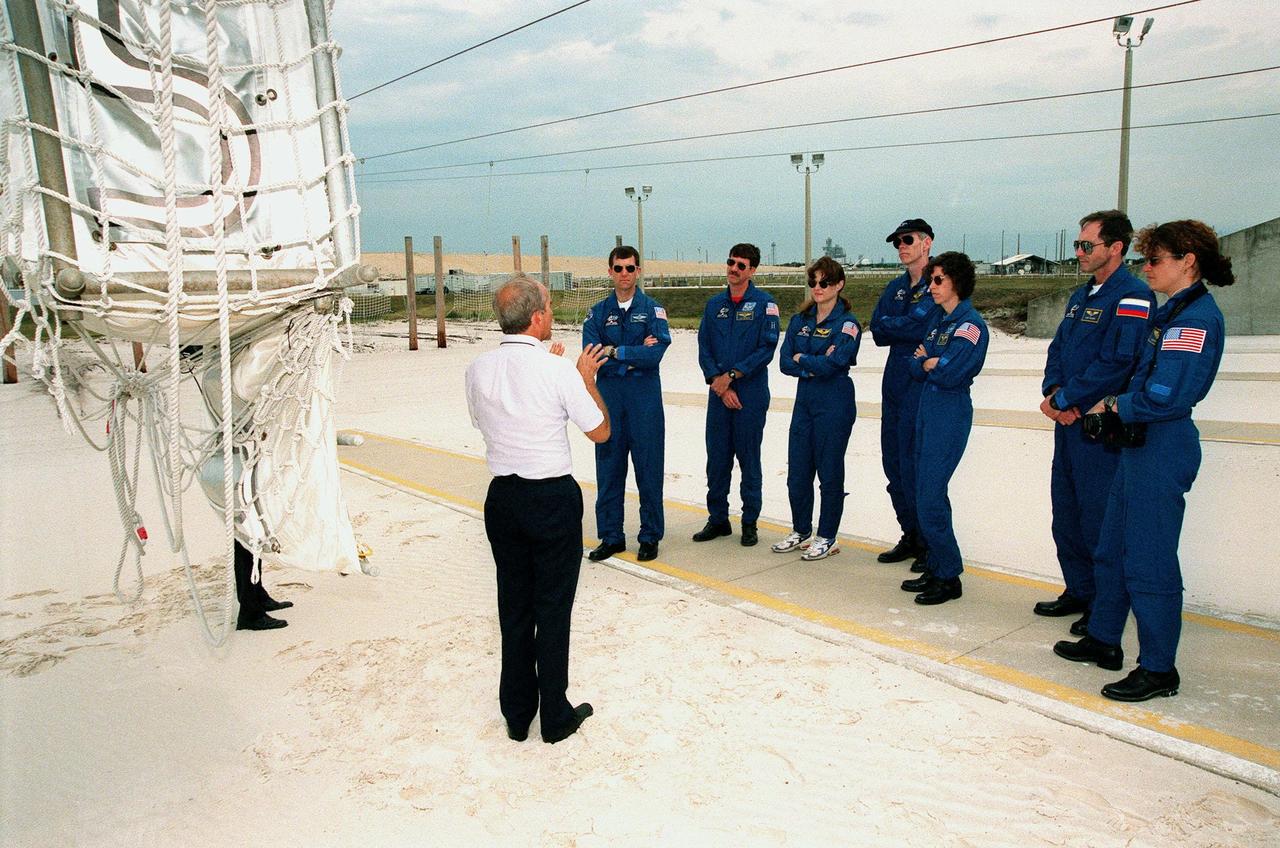
At Launch Pad 39B, the STS-96 crew listens to tech trainer Ken Clark, with United Space Alliance, about the use of the slidewire basket at left during emergency egress training. Standing left to right are Pilot Rick Douglas Husband, Commander Kent V. Rominger, and Mission Specialists Tamara E. Jernigan (Ph.D.), Daniel Barry (M.D., Ph.D.), Ellen Ochoa (Ph.D.), Valery Ivanovich Tokarev, with the Russian Space Agency, and Julie Payette, with the Canadian Space Agency. The STS-96 crew are taking part in Terminal Countdown Demonstration Test activities which also provide simulated countdown exercises and opportunities to inspect the mission payloads in the orbiter's payload bay. Scheduled for liftoff on May 20 at 9:32 a.m., STS-96 is a logistics and resupply mission for the International Space Station, carrying such payloads as a Russian crane, the Strela; a U.S.-built crane; the Spacehab Oceaneering Space System Box (SHOSS), a logistics items carrier; and STARSHINE, a student-led experiment

KENNEDY SPACE CENTER, FLA. - The STS-120 crew is at Kennedy for a crew equipment interface test, or CEIT. Inspecting the thermal protection system, or TPS, tiles under space shuttle Discovery in Orbiter Processing Facility bay 3 are, from left, Mission Specialist Douglas H. Wheelock (standing); Pilot George D. Zamka; Mission Specialist Paolo A. Nespoli, a European Space Agency astronaut from Italy; Allison Bolinger (pointing), an EVA technician with NASA; Commander Pamela A. Melroy; Mission Specialists Scott E. Parazynski and Stephanie D. Wilson; two support personnel and Erin Schlichenmaier, with United Space Alliance TPS Engineering. Among the activities standard to a CEIT are harness training, inspection of the thermal protection system and camera operation for planned extravehicular activities, or EVAs. The STS-120 mission will deliver the Harmony module, christened after a school contest, which will provide attachment points for European and Japanese laboratory modules on the International Space Station. Known in technical circles as Node 2, it is similar to the six-sided Unity module that links the U.S. and Russian sections of the station. Built in Italy for the United States, Harmony will be the first new U.S. pressurized component to be added. The STS-120 mission is targeted to launch on Oct. 20. Photo credit: NASA/George Shelton
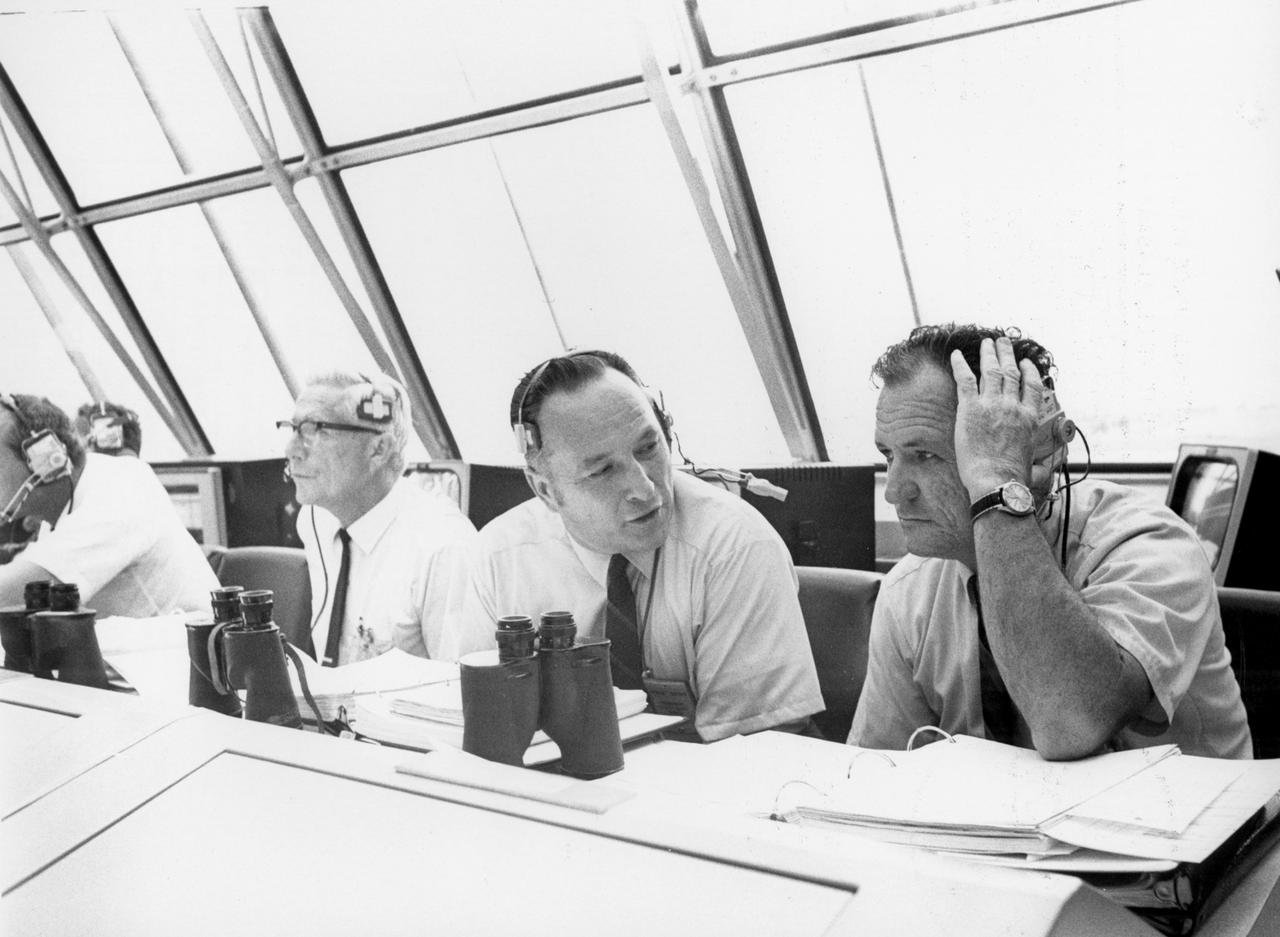
Lee B. James (left), manager of the Saturn Program at the Marshall Space flight Center (MSFC), talks with Isom Pigell in the firing room 1 of the Kennedy Space Center (KSC) control center during the countdown demonstration test for the Apollo 11 mission. At left is Dr. Hans C. Gruen of KSC. The Apollo 11 mission, the first lunar landing mission, launched from the KSC in Florida via the MSFC developed Saturn V launch vehicle on July 16, 1969 and safely returned to Earth on July 24, 1969. Aboard the space craft were astronauts Neil A. Armstrong, commander; Michael Collins, Command Module (CM) pilot; and Edwin E. (Buzz) Aldrin Jr., Lunar Module (LM) pilot. The CM, “Columbia”, piloted by Collins, remained in a parking orbit around the Moon while the LM, “Eagle’’, carrying astronauts Armstrong and Aldrin, landed on the Moon. On July 20, 1969, Armstrong was the first human to ever stand on the lunar surface, followed by Aldrin. During 2½ hours of surface exploration, the crew collected 47 pounds of lunar surface material for analysis back on Earth. With the success of Apollo 11, the national objective to land men on the Moon and return them safely to Earth had been accomplished.
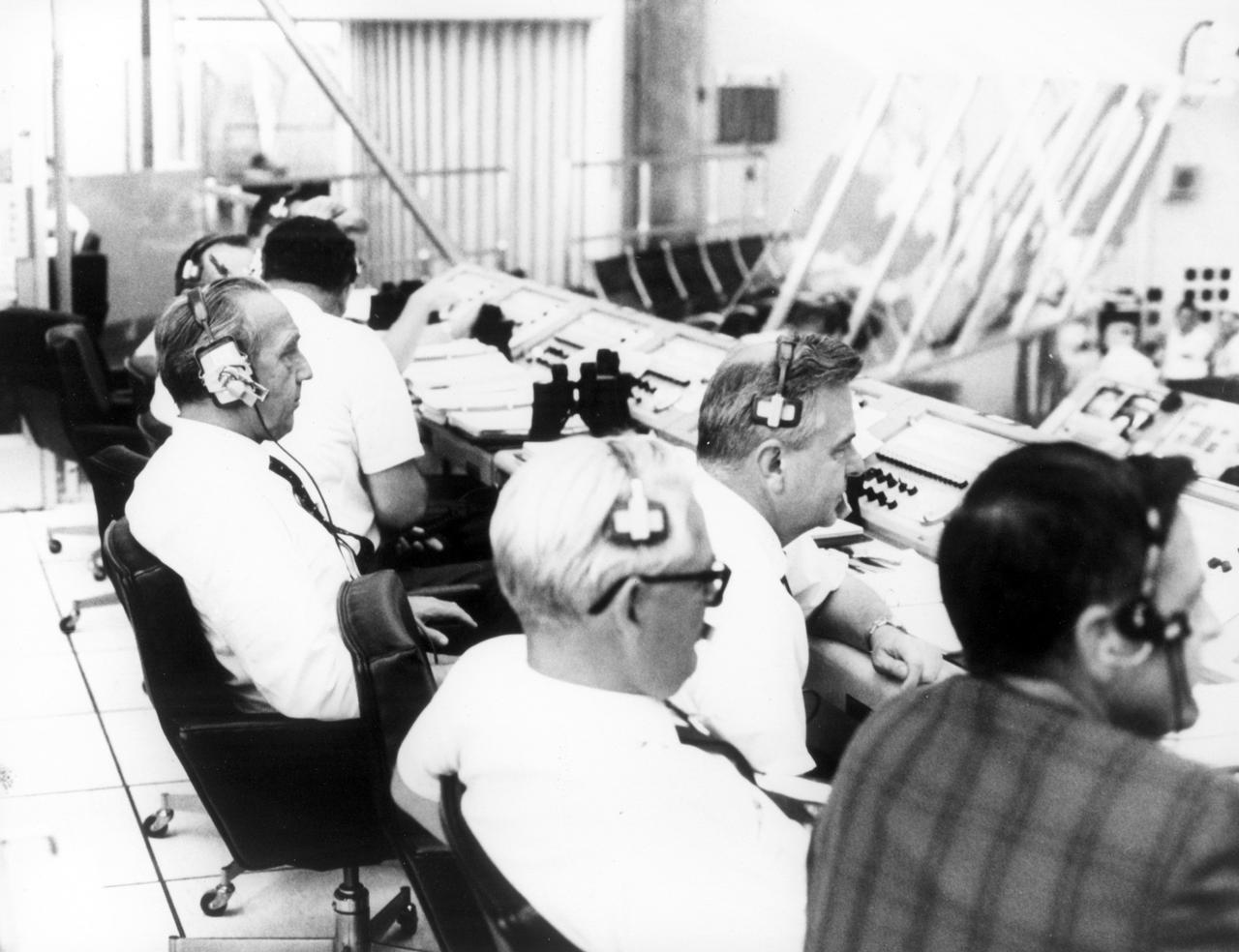
Dr. Kurt Debus, director of the Kennedy Space Flight Center (KSC), participated in the countdown demonstration test for the Apollo 11 mission in firing room 1 of the KSC control center. The Apollo 11 mission, the first lunar landing mission, launched from KSC in Florida via the Marshall Space Flight Center (MSFC) developed Saturn V launch vehicle on July 16, 1969 and safely returned to Earth on July 24, 1969. Aboard the space craft were astronauts Neil A. Armstrong, commander; Michael Collins, Command Module (CM) pilot; and Edwin E. (Buzz) Aldrin Jr., Lunar Module (LM) pilot. The CM, “Columbia”, piloted by Collins, remained in a parking orbit around the Moon while the LM, “Eagle’’, carrying astronauts Armstrong and Aldrin, landed on the Moon. On July 20, 1969, Armstrong was the first human to ever stand on the lunar surface, followed by Aldrin. During 2½ hours of surface exploration, the crew collected 47 pounds of lunar surface material for analysis back on Earth. With the success of Apollo 11, the national objective to land men on the Moon and return them safely to Earth had been accomplished.
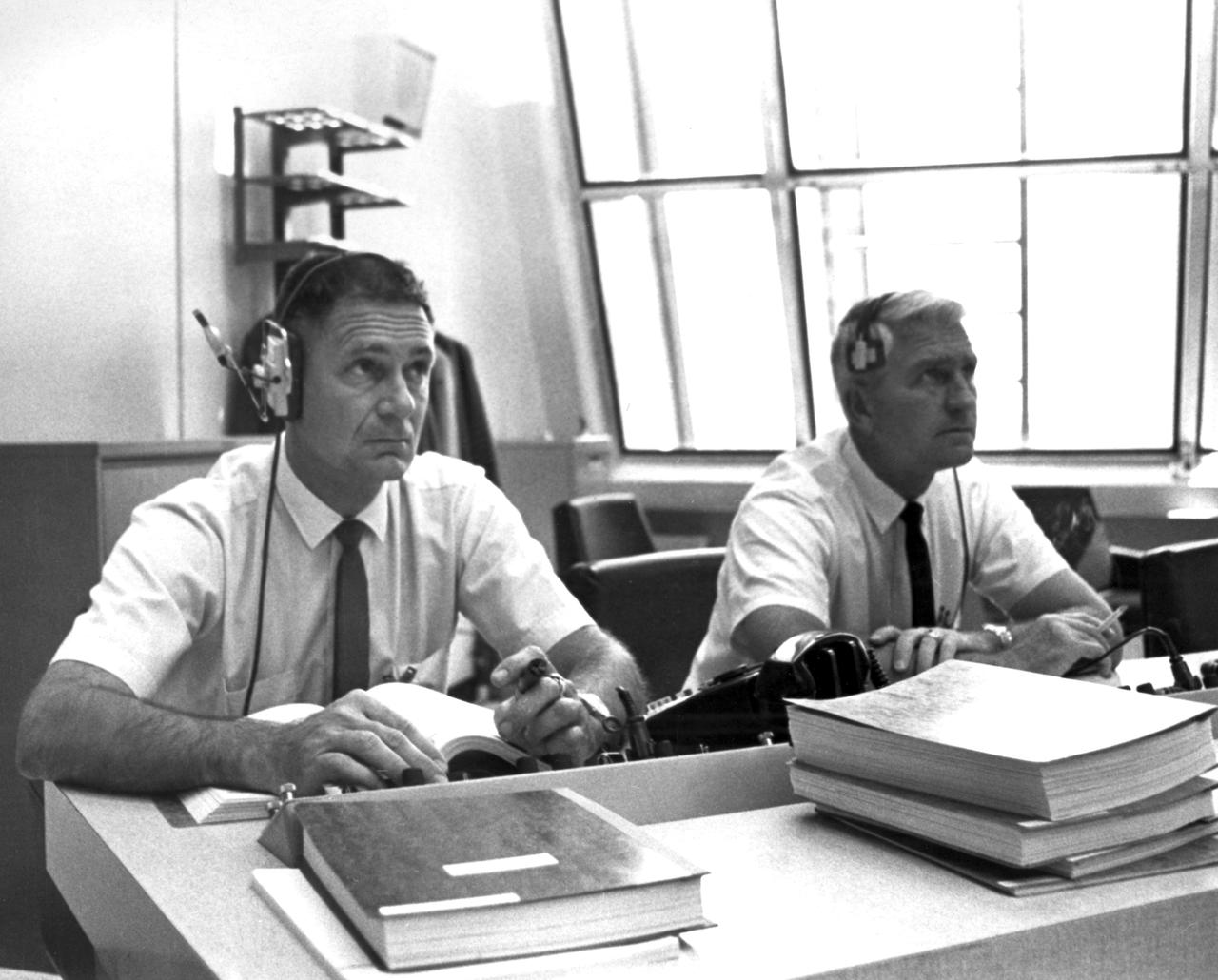
Lee B. James (left), manager of the Saturn Program at the Marshall Space flight Center (MSFC), talks with Isom Pigell in the firing room 1 of the Kennedy Space Center (KSC) control center during the countdown demonstration test for the Apollo 11 mission. The Apollo 11 mission, the first lunar landing mission, launched from the KSC in Florida via the MSFC developed Saturn V launch vehicle on July 16, 1969 and safely returned to Earth on July 24, 1969. Aboard the space craft were astronauts Neil A. Armstrong, commander; Michael Collins, Command Module (CM) pilot; and Edwin E. (Buzz) Aldrin Jr., Lunar Module (LM) pilot. The CM, “Columbia”, piloted by Collins, remained in a parking orbit around the Moon while the LM, “Eagle’’, carrying astronauts Armstrong and Aldrin, landed on the Moon. On July 20, 1969, Armstrong was the first human to ever stand on the lunar surface, followed by Aldrin. During 2½ hours of surface exploration, the crew collected 47 pounds of lunar surface material for analysis back on Earth. With the success of Apollo 11, the national objective to land men on the Moon and return them safely to Earth had been accomplished.
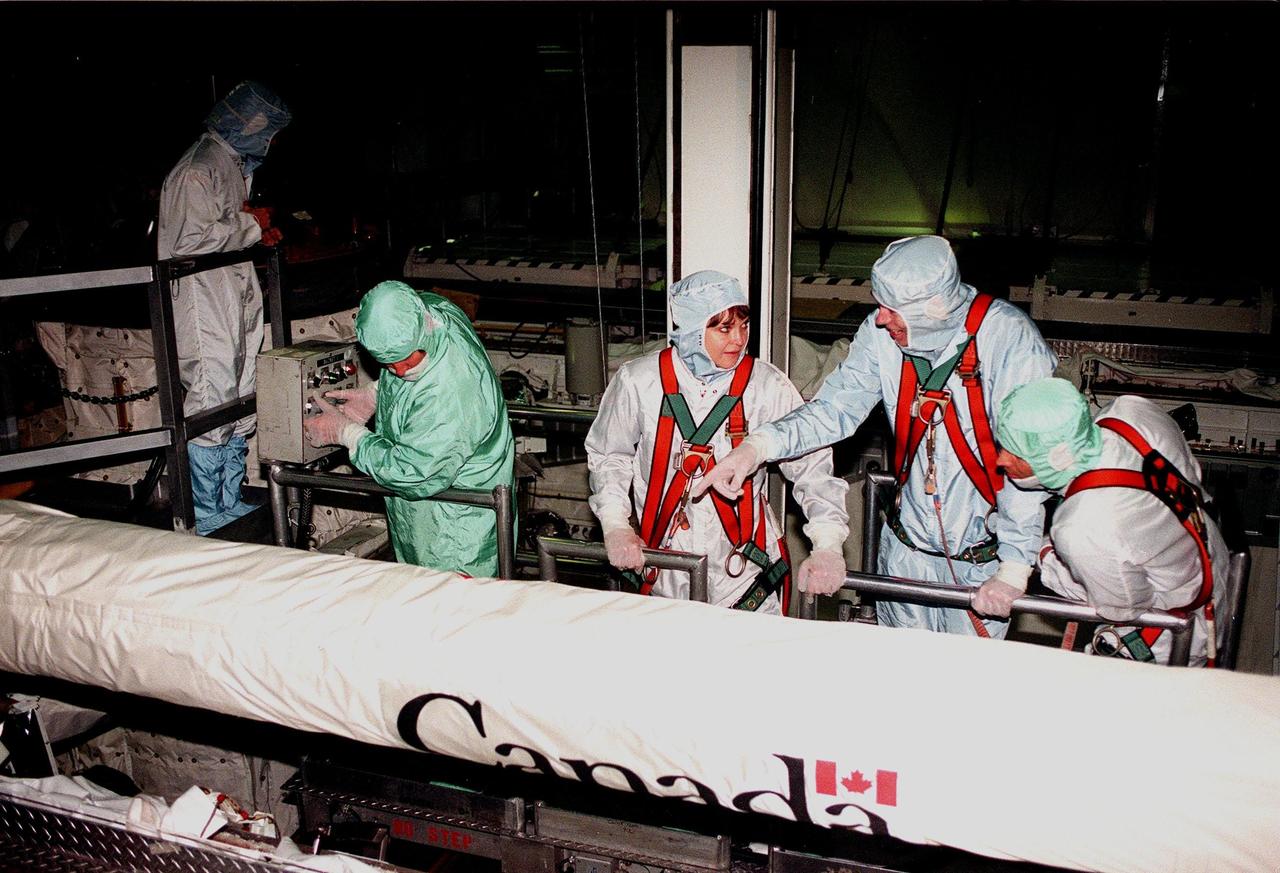
In the Orbiter Processing Facility bay 1, STS-96 crew members look at the Canadian arm in the payload bay of the orbiter Discovery. Standing in a bucket controlled by a KSC worker, are (from left) Mission Specialist Tamara E. Jernigan (Ph.D), Daniel Barry (M.D., Ph.D.), and Valery Ivanovich Tokarev, who represents the Russian Space Agency. The STS-96 crew is at KSC to take part in a Crew Equipment Interface Test. The other crew members are Commander Kent V. Rominger, Pilot Rick Douglas Husband and Mission Specialists Ellen Ochoa (Ph.D.) and Julie Payette, with the Canadian Space Agency. The primary payload of STS-96 is the SPACEHAB Double Module. In addition, the Space Shuttle will carry unpressurized cargo such as the external Russian cargo crane known as STRELA; the Spacehab Oceaneering Space System Box (SHOSS), which is a logistics items carrier; and an ORU Transfer Device (OTD), a U.S.-built crane that will be stowed on the station for use during future ISS assembly missions. These cargo items will be stowed on the International Cargo Carrier, fitted inside the payload bay behind the SPACEHAB module. STS-96 is targeted for launch on May 24 from Launch Pad 39B
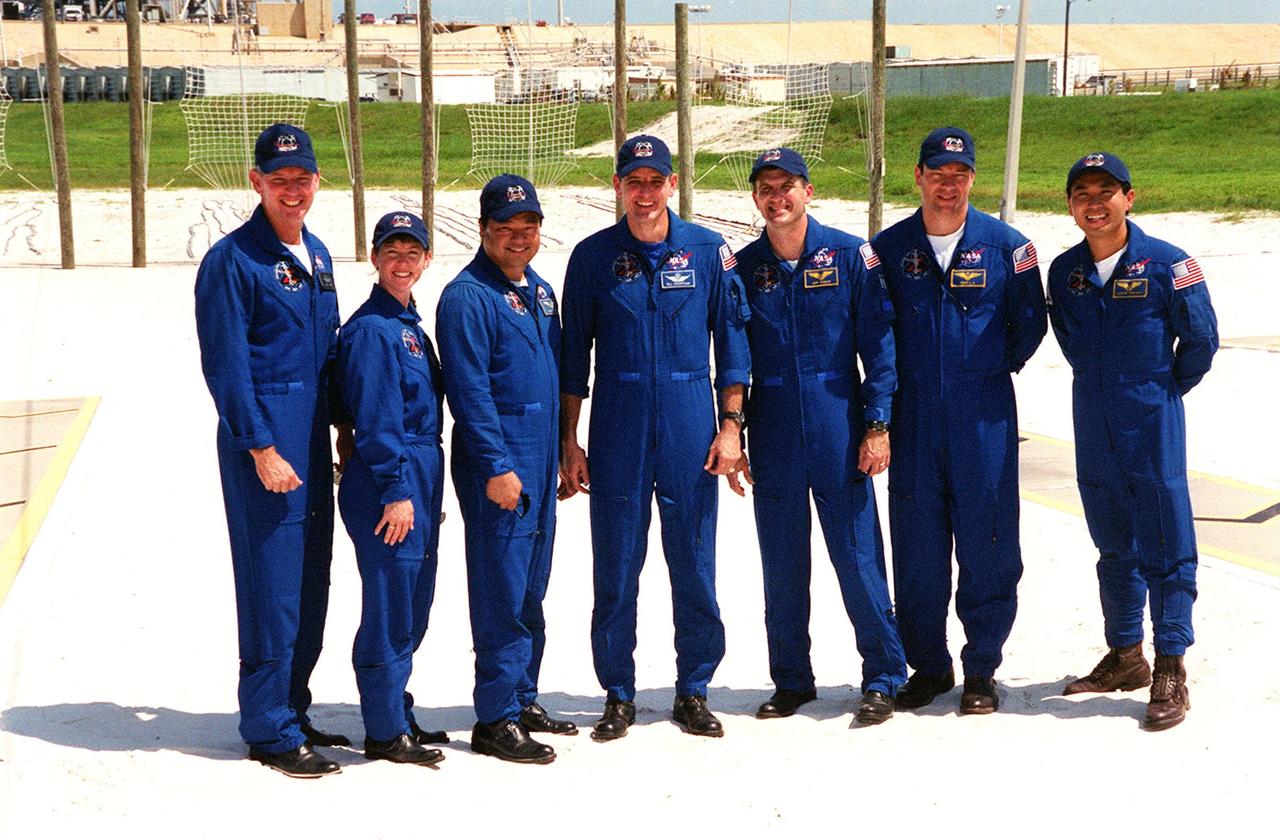
KENNEDY SPACE CENTER, FLA. -- At the slidewire basket area of Launch Pad 39A, the STS-92 crew poses for a group photograph after a question and answer session with the media. Standing left to right are Commander Brian Duffy, Pilot Pamela Ann Melroy and Mission Specialists Leroy Chiao, William S. McArthur Jr. (with microphone), Peter J.K. “Jeff” Wisoff, Michael E. Lopez-Alegria and Koichi Wakata of Japan. The crew is at KSC for Terminal Countdown Demonstration Test activities that provide emergency egress training, opportunities to inspect the mission payload, and take part in a simulated countdown. The slidewire basket area is a landing site for the crew if they have to use the slidewire baskets to exit the orbiter on the pad in an emergency. STS-92 is scheduled to launch Oct. 5 at 9:38 p.m. EDT on the fifth flight to the International Space Station. It will carry two elements of the Space Station, the Integrated Truss Structure Z1 and the third Pressurized Mating Adapter. The mission is also the 100th flight in the Shuttle program
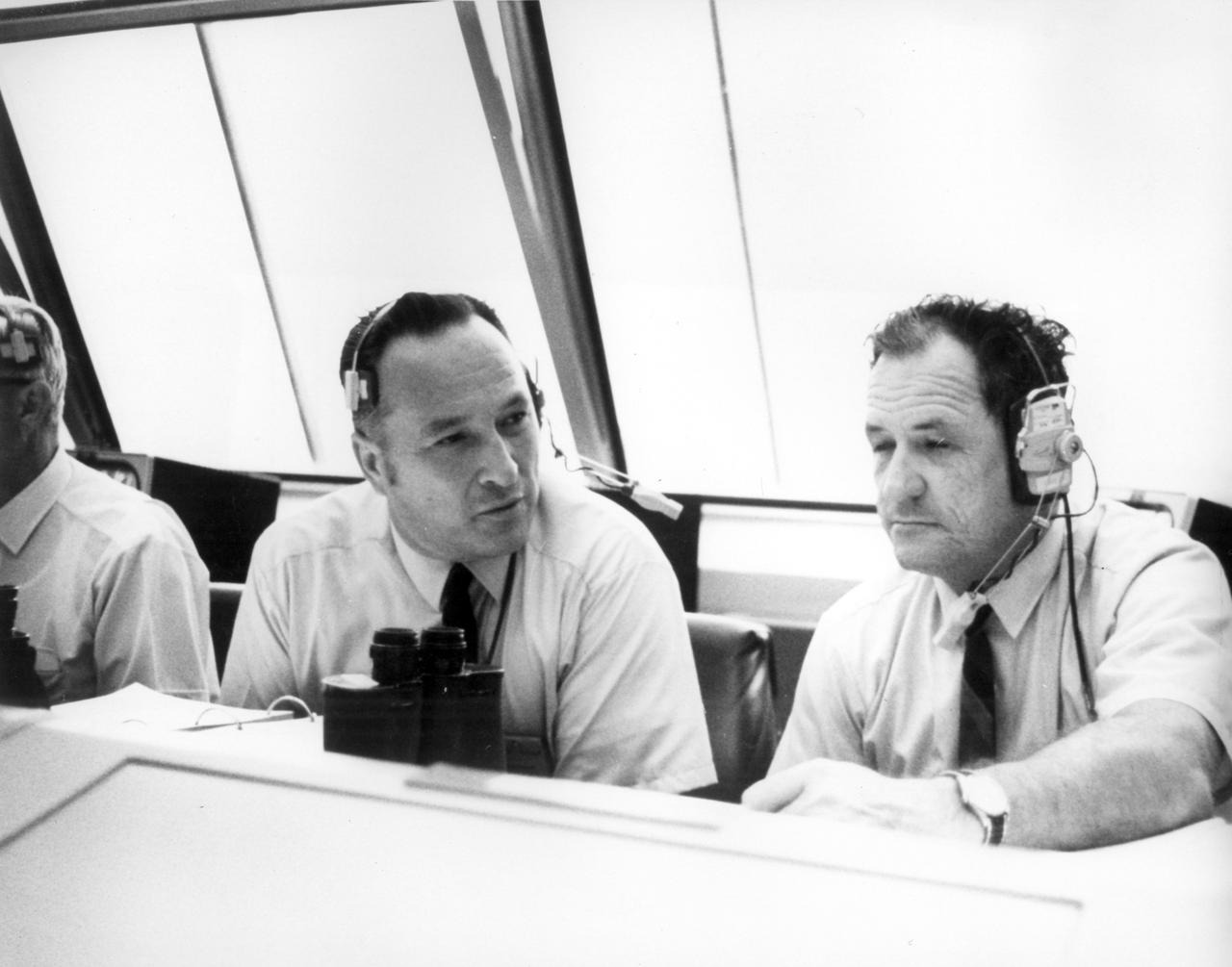
Seriousness exudes from launch official Miles Ross (left) of Kennedy Space Flight Center (KSC) and Major General E.F. O’Conner, director of program management of the Marshall Space Flight Center (MSFC), as they participate in the Apollo 11 countdown demonstration test. The Apollo 11 mission, the first lunar landing mission, launched from the KSC in Florida via the MSFC developed Saturn V launch vehicle on July 16, 1969 and safely returned to Earth on July 24, 1969. Aboard the space craft were astronauts Neil A. Armstrong, commander; Michael Collins, Command Module (CM) pilot; and Edwin E. (Buzz) Aldrin Jr., Lunar Module (LM) pilot. The CM, “Columbia”, piloted by Collins, remained in a parking orbit around the Moon while the LM, “Eagle’’, carrying astronauts Armstrong and Aldrin, landed on the Moon. On July 20, 1969, Armstrong was the first human to ever stand on the lunar surface, followed by Aldrin. During 2½ hours of surface exploration, the crew collected 47 pounds of lunar surface material for analysis back on Earth. With the success of Apollo 11, the national objective to land men on the Moon and return them safely to Earth had been accomplished.
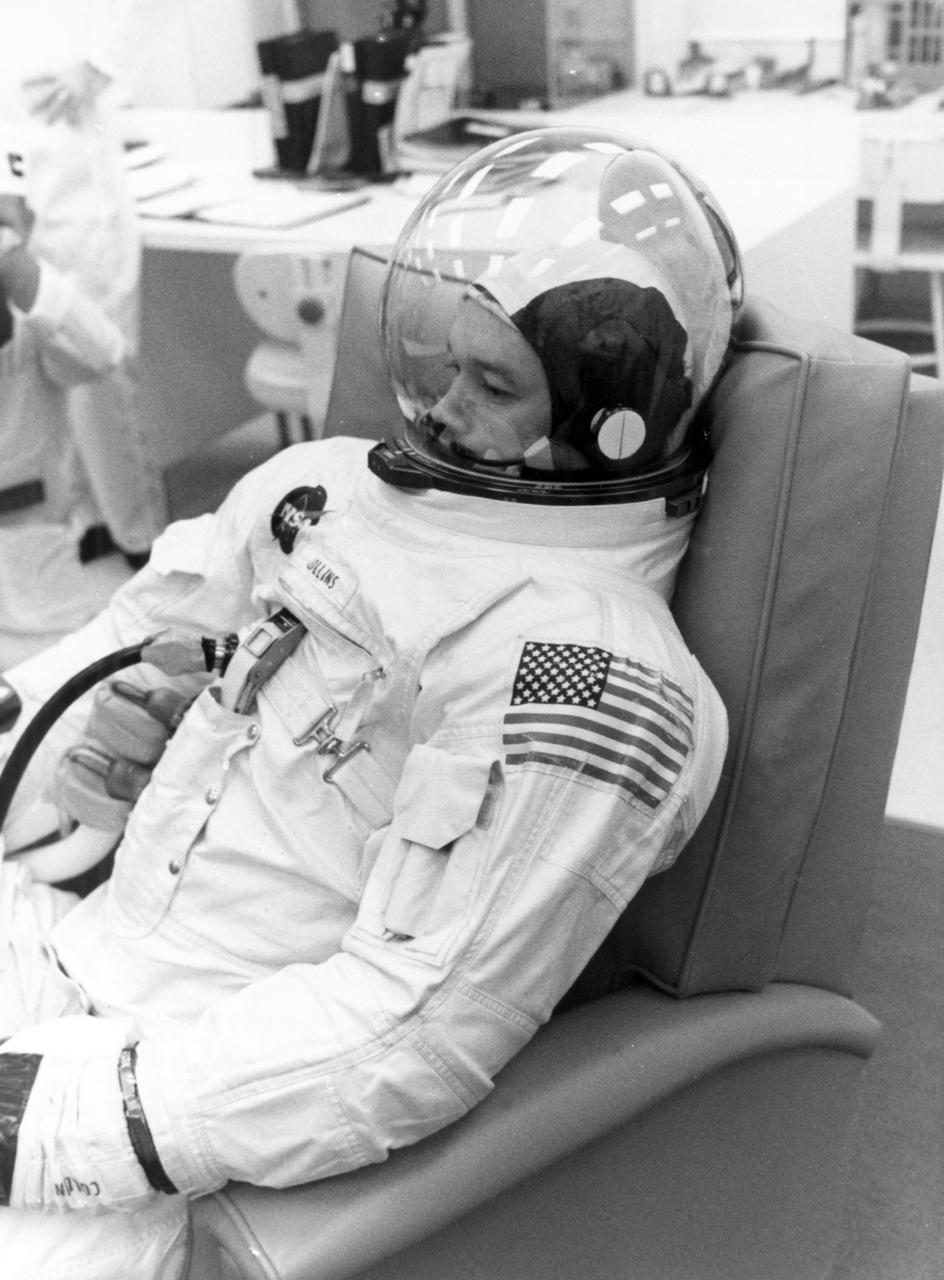
Apollo 11 crew member Michael Collins appears calm after suiting up activities for his participation in the countdown demonstration test aboard the Apollo 11 space craft along with astronauts Aldrin and Armstrong. The Apollo 11 mission, the first lunar landing mission, launched from the Kennedy Space Center (KSC) in Florida via the Marshall Space Flight Center (MSFC) developed Saturn V launch vehicle on July 16, 1969 and safely returned to Earth on July 24, 1969. Aboard the space craft were astronauts Neil A. Armstrong, commander; Michael Collins, Command Module (CM) pilot; and Edwin E. (Buzz) Aldrin Jr., Lunar Module (LM) pilot. The CM, “Columbia”, piloted by Collins, remained in a parking orbit around the Moon while the LM, “Eagle’’, carrying astronauts Armstrong and Aldrin, landed on the Moon. On July 20, 1969, Armstrong was the first human to ever stand on the lunar surface, followed by Aldrin. During 2½ hours of surface exploration, the crew collected 47 pounds of lunar surface material for analysis back on Earth. With the success of Apollo 11, the national objective to land men on the Moon and return them safely to Earth had been accomplished.
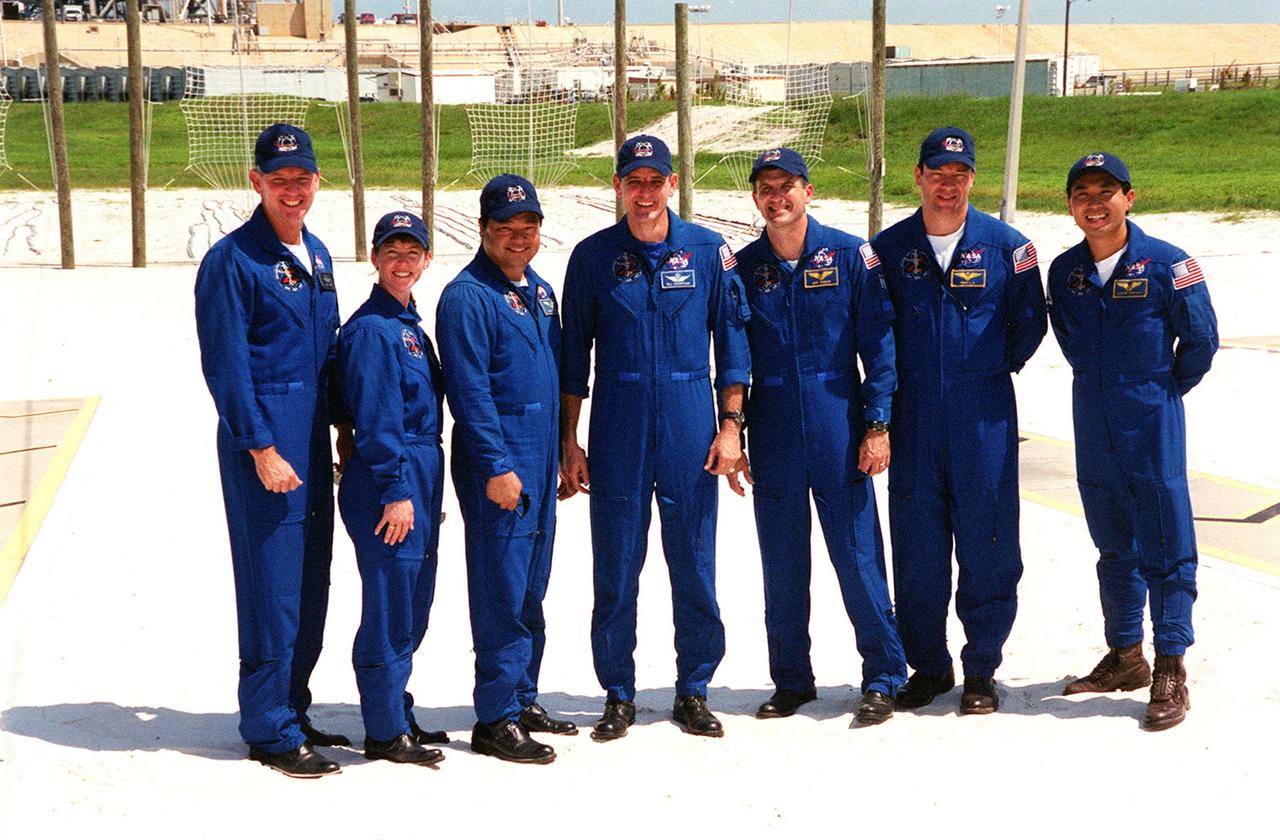
KENNEDY SPACE CENTER, FLA. -- At the slidewire basket area of Launch Pad 39A, the STS-92 crew poses for a group photograph after a question and answer session with the media. Standing left to right are Commander Brian Duffy, Pilot Pamela Ann Melroy and Mission Specialists Leroy Chiao, William S. McArthur Jr. (with microphone), Peter J.K. “Jeff” Wisoff, Michael E. Lopez-Alegria and Koichi Wakata of Japan. The crew is at KSC for Terminal Countdown Demonstration Test activities that provide emergency egress training, opportunities to inspect the mission payload, and take part in a simulated countdown. The slidewire basket area is a landing site for the crew if they have to use the slidewire baskets to exit the orbiter on the pad in an emergency. STS-92 is scheduled to launch Oct. 5 at 9:38 p.m. EDT on the fifth flight to the International Space Station. It will carry two elements of the Space Station, the Integrated Truss Structure Z1 and the third Pressurized Mating Adapter. The mission is also the 100th flight in the Shuttle program
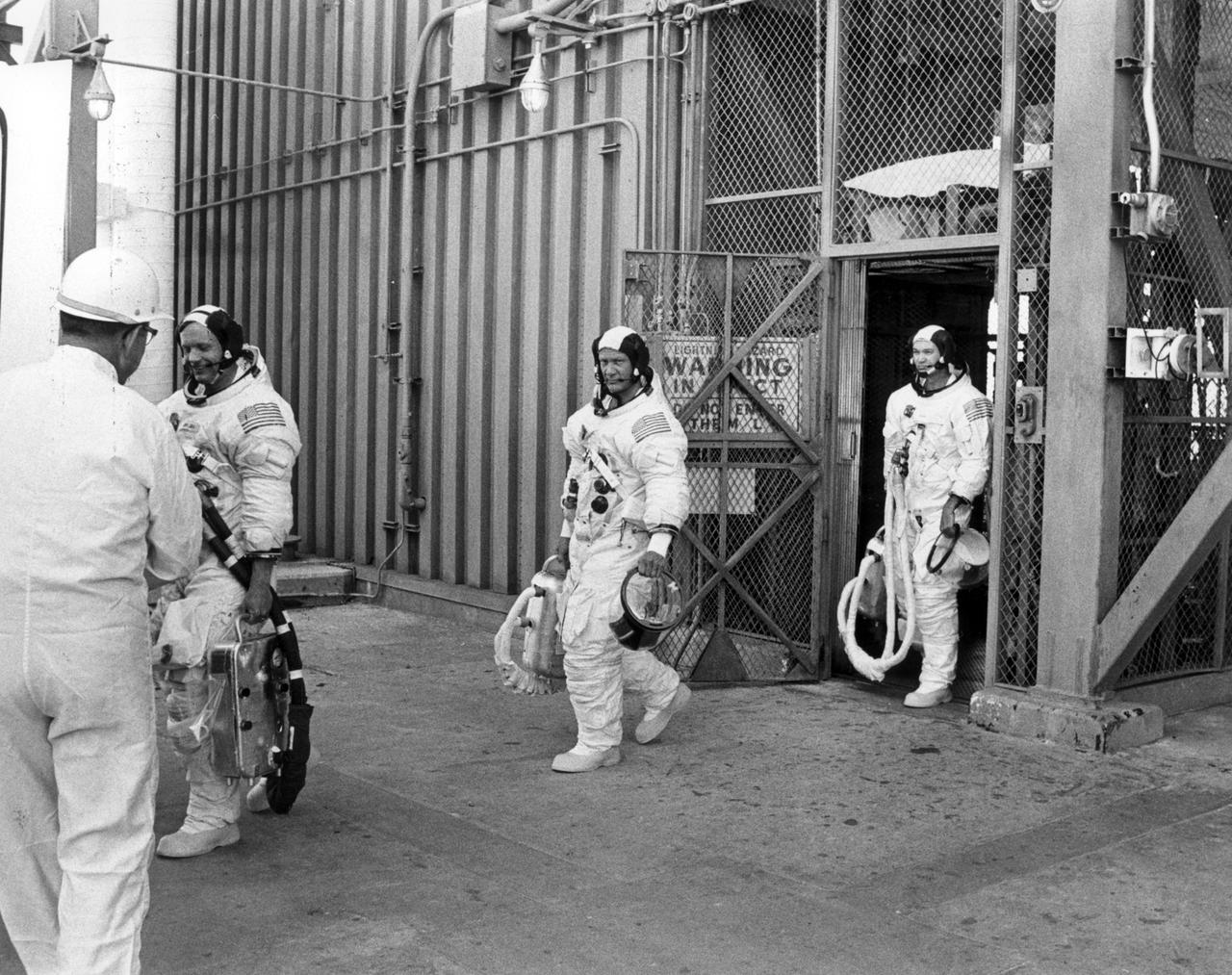
Apollo 11 crew members (left to right) Neil Armstrong, Edwin Aldrin, and Michael Collins, wearing space suits, leave the elevator after descending from the top of the launch tower. The three had just completed participation in the countdown demonstration test for the upcoming Apollo 11 mission. The Apollo 11 mission, the first lunar landing mission, launched from the Kennedy Space Center (KSC) in Florida via the Marshall Space Flight Center (MSFC) developed Saturn V launch vehicle on July 16, 1969 and safely returned to Earth on July 24, 1969. Aboard the space craft were astronauts Neil A. Armstrong, commander; Michael Collins, Command Module (CM) pilot; and Edwin E. (Buzz) Aldrin Jr., Lunar Module (LM) pilot. The CM, “Columbia”, piloted by Collins, remained in a parking orbit around the Moon while the LM, “Eagle’’, carrying astronauts Armstrong and Aldrin, landed on the Moon. On July 20, 1969, Armstrong was the first human to ever stand on the lunar surface, followed by Aldrin. During 2½ hours of surface exploration, the crew collected 47 pounds of lunar surface material for analysis back on Earth. With the success of Apollo 11, the national objective to land men on the Moon and return them safely to Earth had been accomplished.
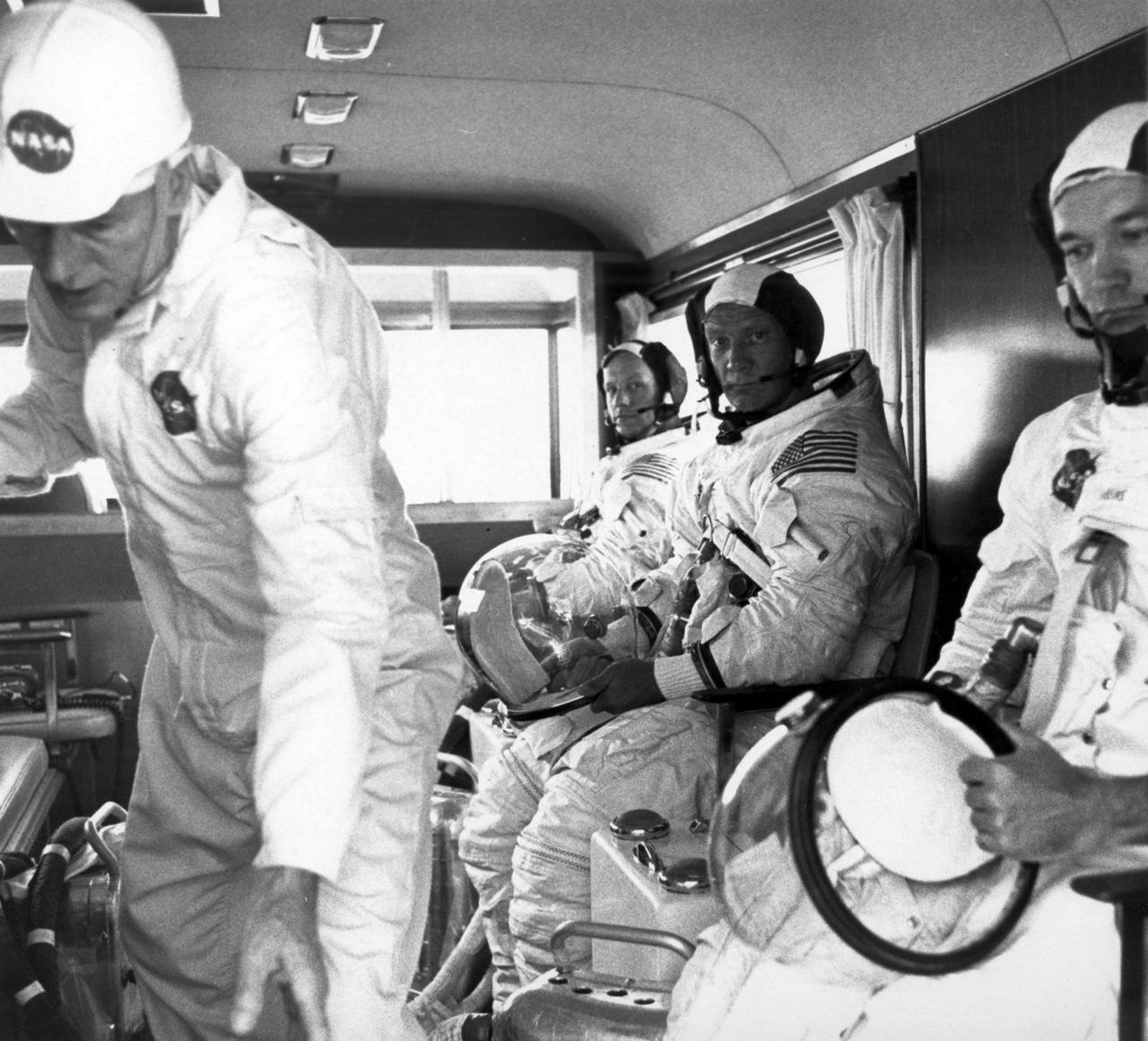
Apollo 11 crew members (rear to front) Neil Armstrong, Edwin Aldrin, and Michael Collins, wearing space suits, ride the van to the launch pad to participate in the countdown demonstration test for the upcoming Apollo 11 mission. The Apollo 11 mission, the first lunar landing mission, launched from the Kennedy Space Center (KSC) in Florida via the Marshall Space Flight Center (MSFC) developed Saturn V launch vehicle on July 16, 1969 and safely returned to Earth on July 24, 1969. Aboard the space craft were astronauts Neil A. Armstrong, commander; Michael Collins, Command Module (CM) pilot; and Edwin E. (Buzz) Aldrin Jr., Lunar Module (LM) pilot. The CM, “Columbia”, piloted by Collins, remained in a parking orbit around the Moon while the LM, “Eagle’’, carrying astronauts Armstrong and Aldrin, landed on the Moon. On July 20, 1969, Armstrong was the first human to ever stand on the lunar surface, followed by Aldrin. During 2½ hours of surface exploration, the crew collected 47 pounds of lunar surface material for analysis back on Earth. With the success of Apollo 11, the national objective to land men on the Moon and return them safely to Earth had been accomplished.
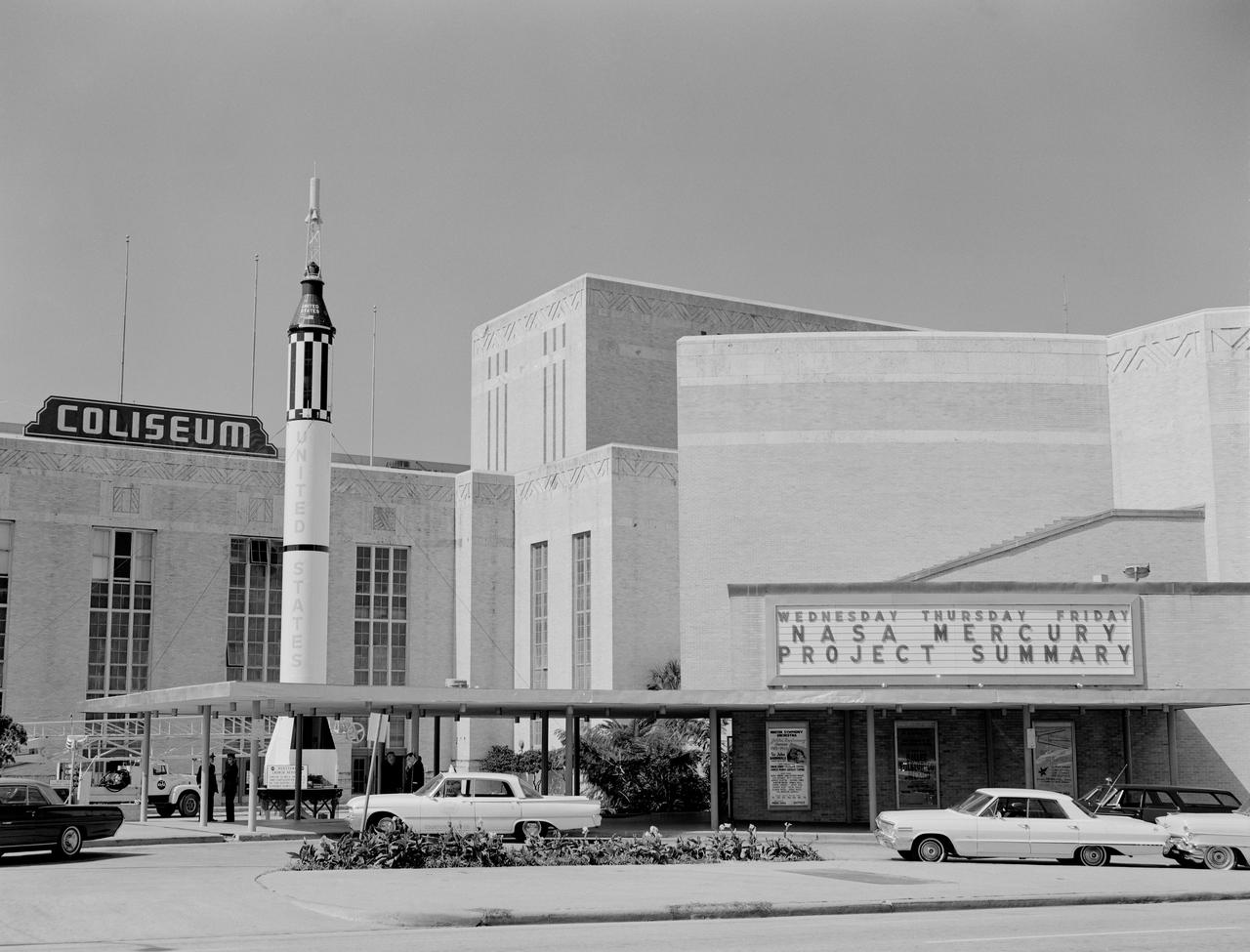
In October 1963, the Project Mercury Summary Conference was held in the Houston, TX, Coliseum. This series of 44 photos is documentation of that conference. A view of the Houston, TX, Coliseum, and parking area in front with a Mercury Redstone Rocket setup in the parking lot for display (S63-16451). A view of an Air Force Atlas Rocket, a Mercury Redstone Rocket, and a Mercury Spacecraft on a test booster on display in the front area of the Coliseum (S63-16452). A view an Air Force Atlas Rocket and a Mercury Redstone Rocket set up for display with the Houston City Hall in the background (S63- 16453). This view shows the Atlas Rocket, Mercury Redstone, and Mercury Test Rocket with the Houston, TX, Coliseum in the background (S63- 16454). A balcony view, from the audience right side, of the attendees looking at the stage (S63-16455). A view of the NASA Space Science Demonstration with equipment setup on a table, center stage and Space Science Specialist briefing the group as he pours Liquid Oxygen into a beaker (S63-16456). View of the audience from the balcony on the audience right showing the speakers lecturn on stage to the audience left (S63-16457). A view of attendees in the lobby. Bennet James, MSC Public Affairs Office is seen to the left of center (S63-16458). Another view of the attendees in the lobby (S63- 16459). In this view, Astronaut Neil Armstrong is seen writing as others look on (S63-16460). In this view of the attendees, Astronauts Buzz Aldrin and Walt Cunningham are seen in the center of the shot. The October Calendar of Events is visable in the background (S63-16461). Dr. Charles Berry is seen in this view to the right of center, seated in the audience (S63-16462). View of " Special Registration " and the five ladies working there (S63-16463). A view from behind the special registration table, of the attendees being registered (S63-16464). A view of a conference table with a panel seated. (R-L): Dr. Robert R. Gilruth, Hugh L. Dryden, Walter C. Williams, and an unidentified man (S63- 16465). A closeup of the panel at the table with Dr. Gilruth on the left (S63-16466). About the same shot as number S63-16462, Dr. Berry is seen in this shot as well (S63-16467). In this view the audio setup is seen. In the audience, (L-R): C. C. Kraft, Vernon E. (Buddy) Powell, Public Affairs Office (PAO); and, in the foreground mixing the audio is Art Tantillo; and, at the recorder is Doyle Hodges both of the audio people are contractors that work for PAO at MSC (S63-16468). In this view Maxime Faget is seen speaking at the lecturn (S63-16469). Unidentified person at the lecturn (S63-16470). In this view the motion picture cameras and personel are shown documenting the conference (S63-16471). A motion picture cameraman in the balcony is shown filming the audience during a break (S63- 16472). Family members enjoy an exhibit (S63-16473). A young person gets a boost to look in a Gemini Capsule on display (S63-16474). A young person looks at the Gemini Capsule on display (S63-16475). Dr. Robert R. Gilruth is seen at the conference table (S63-16476). Walt Williams is seen in this view at the conference table (S63-16477). Unidentified man sitting next to Walt Williams (S63-16478). (L-R): Seated at the conference table, Dr. Robert Gilruth, Hugh L. Dryden, and Walt Williams (S63- 16479). Group in lobby faces visable, (L-R): Walt Williams, unidentified person, Dr. Robert Gilruth, Congressman (S63-16480). Man in uniform at the lecturn (S63-16481). Astronaut Leroy Gordon Cooper at the lecturn (S63-16482). Astronaut Cooper at the lecturn with a picture on the screen with the title, " Astronaut Names for Spacecraft " (S63-16483). Dr. Gilruth at the lecturn (S63-16484). Walt Williams at the lecturn (S63-16485). Unidentified man at the lecturn (S63-16486). John H. Boynton addresses the Summary Conference (S63-16487). (L-R): Astronaut Leroy Gordon Cooper, Mrs. Cooper, Senator Cris Cole, and Mrs. Cole (S63- 16488). In this view in the lobby, Senator and Mrs. Cris Cole, with Astronaut Gordon Cooper standing near the heatshield, and Mrs. Cooper; next, on the right is a press photographer (S63-16489). (L-R): Astronaut L. Gordon Cooper and Mrs. Cooper, unidentified man, and Senator Walter Richter (S63-16490). (L-R): Eugene Horton, partially obscured, briefs a group on the Mercury Spacecraft, an unidentified person, Harold Ogden, a female senator, Senator Chris Cole, Mrs. Cole, an unidentified female, Senator Walter Richter, Jim Bower, and an unidentified female (S63-16491). In this view, Mrs. Jim Bates is seen in the center, and Senator Walter Richter to the right (S63- 16492). The next three (3) shots are 4X5 CN (S63-16493 - S63-16495). In this view a NASA Space Science Demonstration is seen (S63-16493). In this view a shot of the conference table is seen, and, (L-R): Dr. Robert R. Gilruth, Hugh L. Dryden, Mr. Walter Williams, and an unidentfied man (S63-16494 - S63-16495). HOUSTON, TX