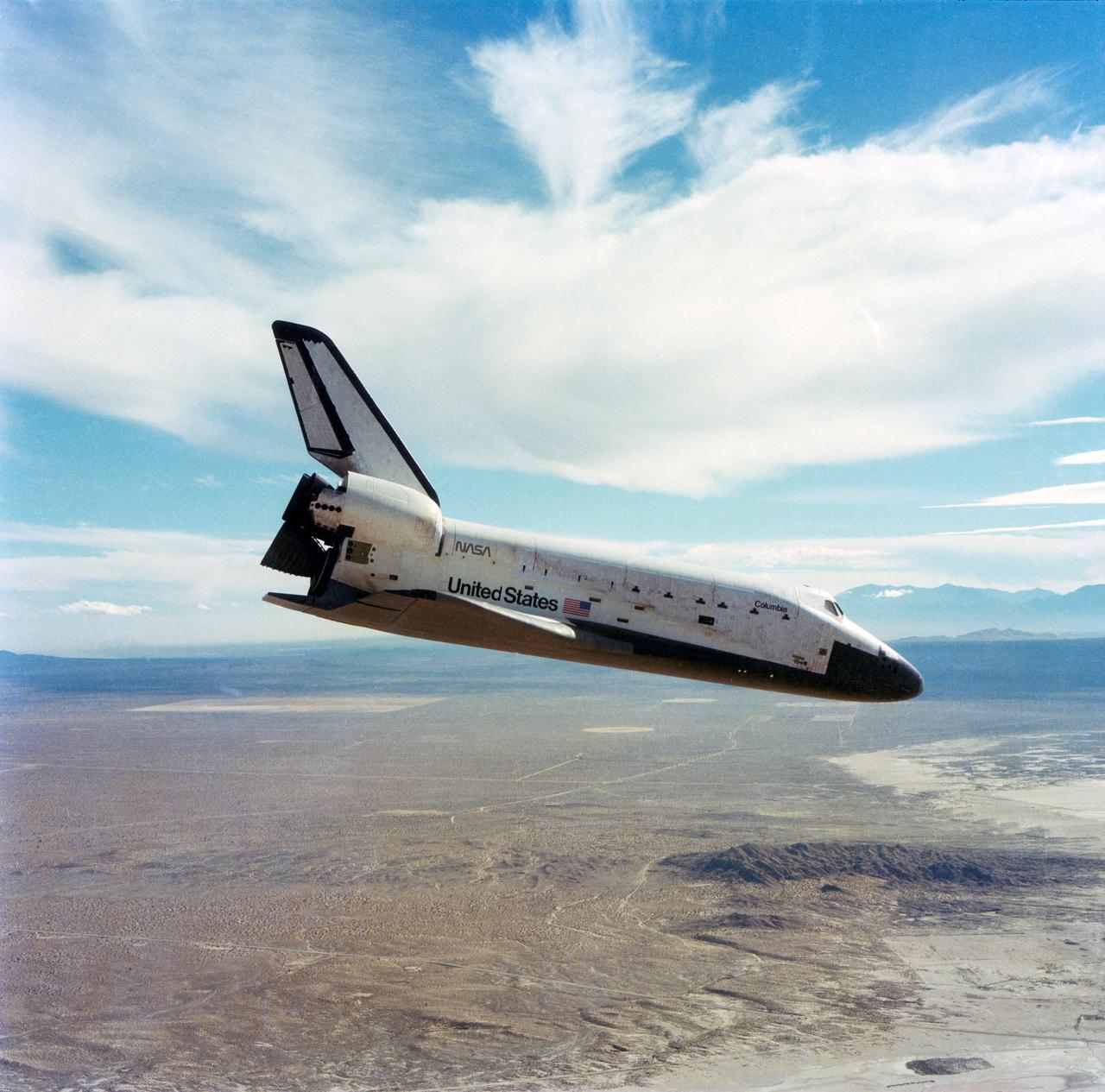
Several views of Columbia in the landing maneuver at the EAFB from T-38 Chase Aircraft and ground views. EAFB, CA
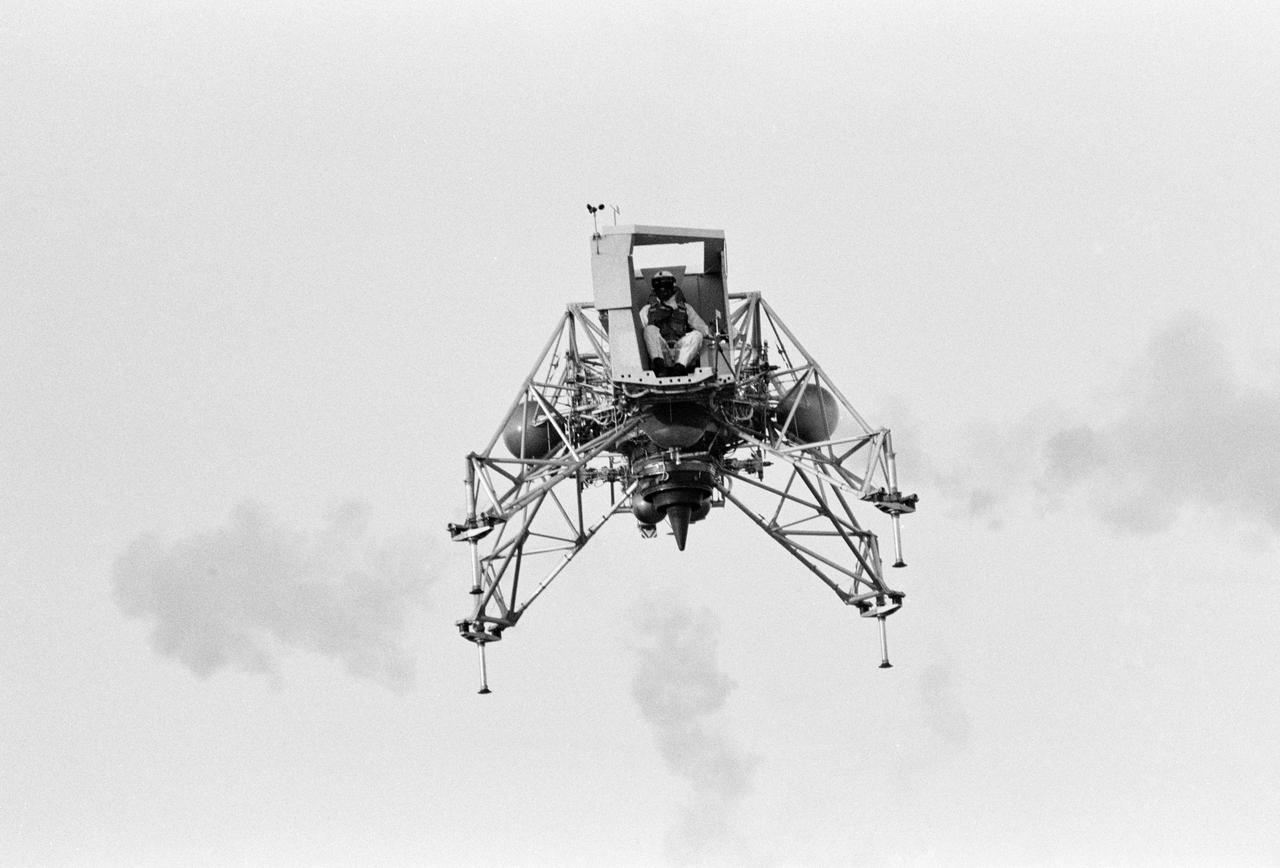
Inflight view of Astronaut Neil Armstrong flying the Lunar Landing Training Vehicle (LLTV) at EAFB. EAFB, Houston, TX

EDWARDS, Calif. - ED09-0127-06 (EAFB) -- The crew of space shuttle mission STS-125 gather on the runway at Edwards Air Force Base in California after space shuttle Atlantis landed to conclude the 13-day mission to upgrade the Hubble Space Telescope. From left are Mission Specialist Mike Massimino, Pilot Gregory C. Johnson, Commander Scott Altman and Mission Specialists Megan McArthur, John Grunsfeld, Andrew Feustel and Michael Good. Main gear touchdown was at 11:39:05 a.m. EDT. Nose gear touchdown was at 11:39:15 a.m. EDT. Wheel stop was at 11:40:15 a.m., bringing the mission’s elapsed time to 12 days, 21 hours, 37 minutes, 9 seconds. Landing opportunities on May 22, May 23 and May 24 were waved off due to weather concerns at NASA’s Kennedy Space Center in Florida, the shuttle’s primary landing site. Through five spacewalks, NASA's Hubble Space Telescope was refurbished and upgraded with state-of-the-art science instruments that will expand Hubble's capabilities and extend its operational lifespan through at least 2014. Photo credit: NASA/Carla Thomas, EAFB

LLTV on runway. EAFB, HOUSTON, TX
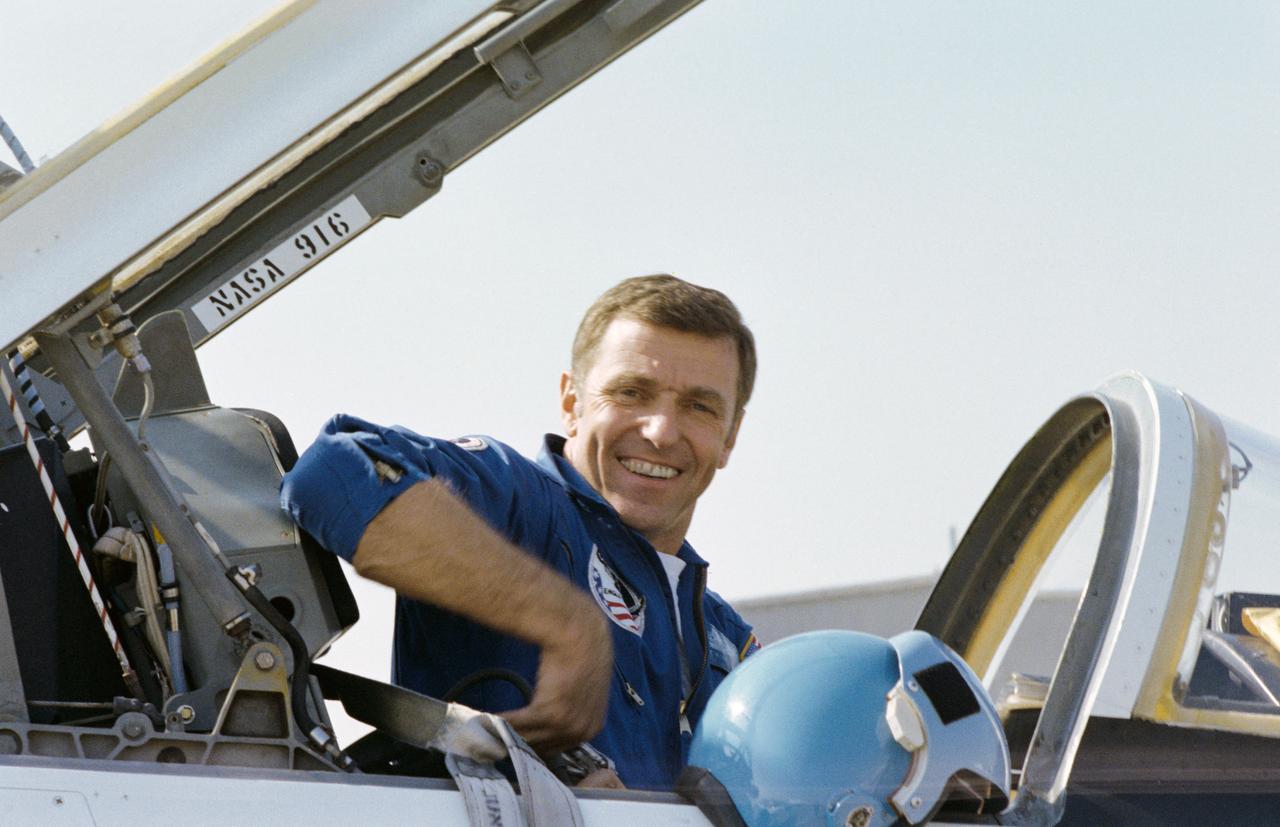
Views of STS-2 Crewmen Truly and Engle in T-38's for departure for KSC and the STS-2 Mission. 1. AIRCRAFT - T-38 EAFB, HOUSTON, TX
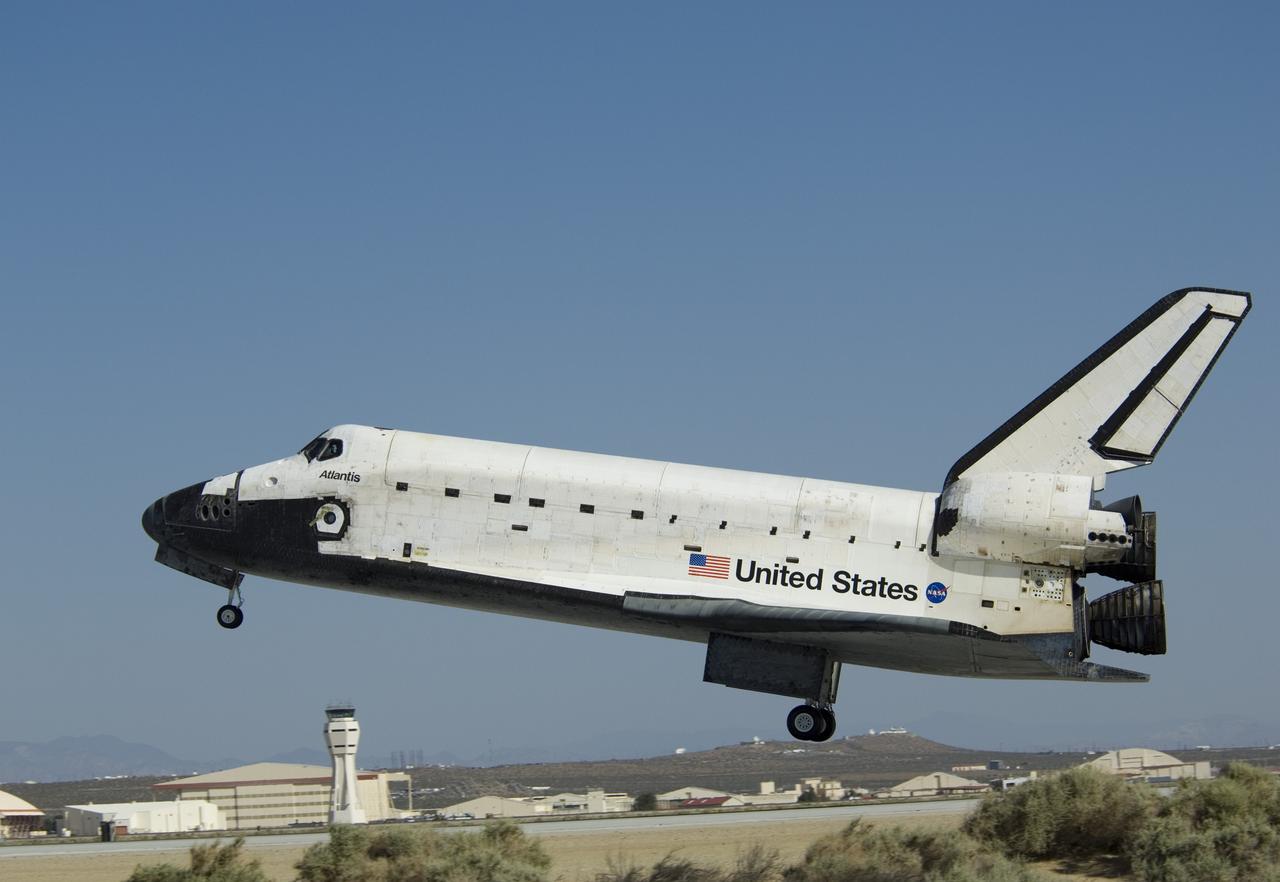
EDWARDS, Calif. - ED09-0127-02 - Space shuttle Atlantis and its seven-member crew approach Runway 22 at Edwards Air Force Base in California, ending a nearly 13-day journey of 5.3 million miles on the STS-125 mission to repair and upgrade NASA’s Hubble Space Telescope. Main gear touchdown was at 11:39:05 a.m. EDT. Nose gear touchdown was at 11:39:15 a.m. EDT. Wheel stop was at 11:40:15 a.m., bringing the mission’s elapsed time to 12 days, 21 hours, 37 minutes, 9 seconds. Landing opportunities on May 22, May 23 and May 24 were waved off due to weather concerns at NASA’s Kennedy Space Center in Florida, the shuttle’s primary landing site. Through five spacewalks, NASA's Hubble Space Telescope was refurbished and upgraded with state-of-the-art science instruments that will expand Hubble's capabilities and extend its operational lifespan through at least 2014. Photo credit: NASA/Jim Ross, EAFB
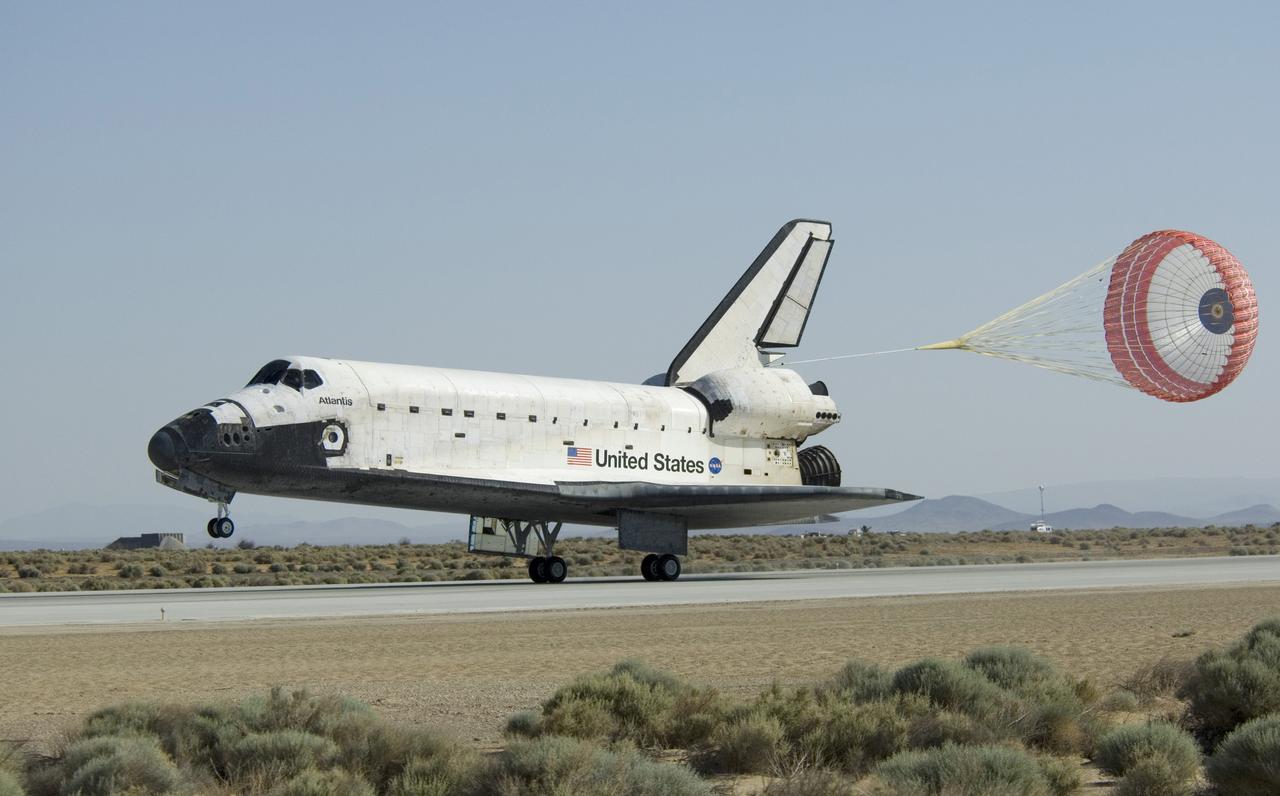
EDWARDS, Calif. - ED09-0127-04 - A drag chute slows the speed of space shuttle Atlantis as it touches down on Runway 22 at Edwards Air Force Base in California, ending a journey of 5.3 million miles on the STS-125 mission to repair and upgrade NASA’s Hubble Space Telescope. Main gear touchdown was at 11:39:05 a.m. EDT. Nose gear touchdown was at 11:39:15 a.m. EDT. Wheel stop was at 11:40:15 a.m., bringing the mission’s elapsed time to 12 days, 21 hours, 37 minutes, 9 seconds. Landing opportunities on May 22, May 23 and May 24 were waved off due to weather concerns at NASA’s Kennedy Space Center in Florida, the shuttle’s primary landing site. Through five spacewalks, NASA's Hubble Space Telescope was refurbished and upgraded with state-of-the-art science instruments that will expand Hubble's capabilities and extend its operational lifespan through at least 2014. Photo credit: NASA/Carla Thomas, EAFB
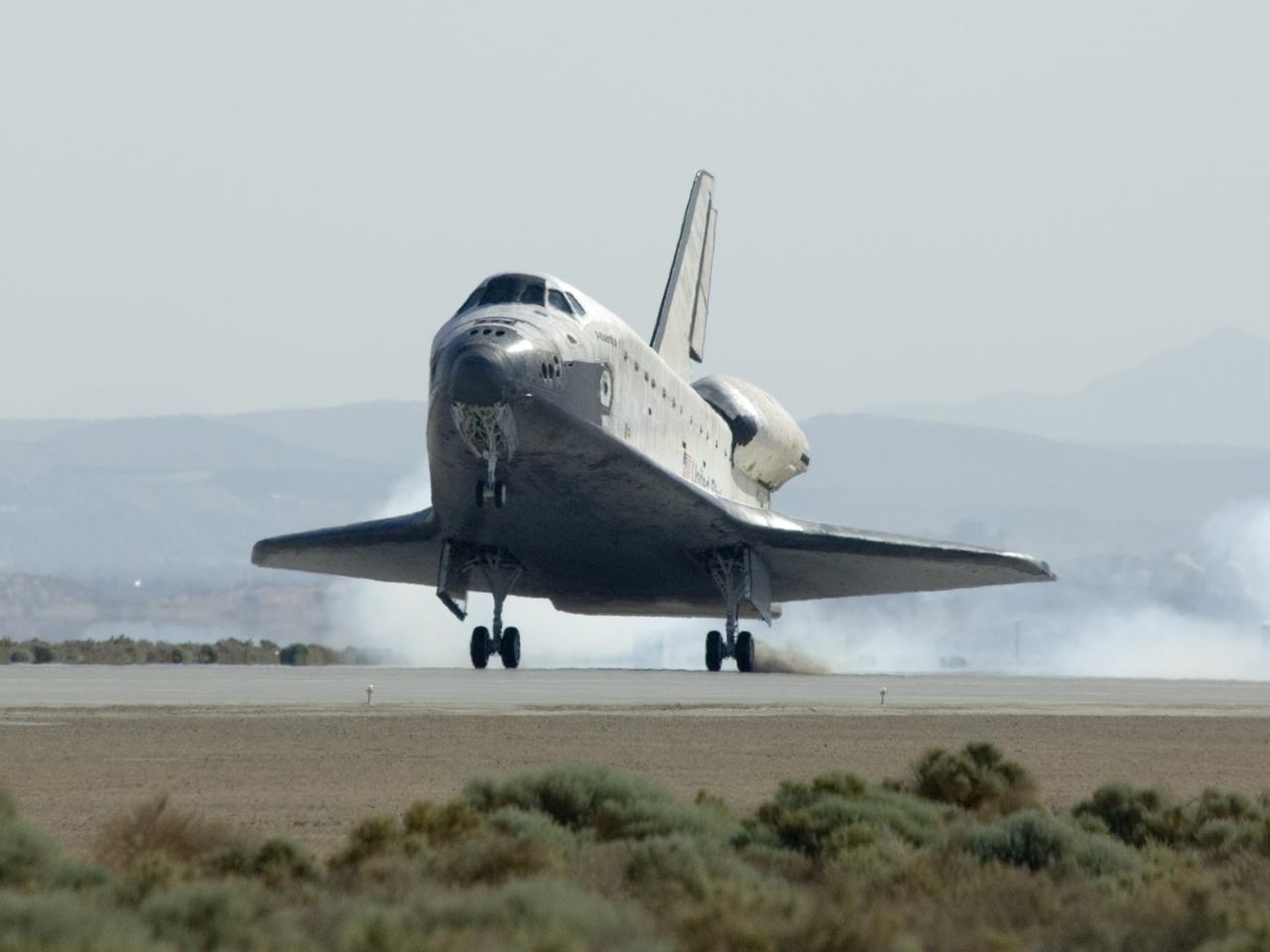
EDWARDS, Calif. - ED09-0127-01 - Space shuttle Atlantis touches down on Runway 22 at Edwards Air Force Base in California, ending a journey of 5.3 million miles on the STS-125 mission to repair and upgrade NASA’s Hubble Space Telescope. Main gear touchdown was at 11:39:05 a.m. EDT. Nose gear touchdown was at 11:39:15 a.m. EDT. Wheel stop was at 11:40:15 a.m., bringing the mission’s elapsed time to 12 days, 21 hours, 37 minutes, 9 seconds. Landing opportunities on May 22, May 23 and May 24 were waved off due to weather concerns at NASA’s Kennedy Space Center in Florida, the shuttle’s primary landing site. Through five spacewalks, NASA's Hubble Space Telescope was refurbished and upgraded with state-of-the-art science instruments that will expand Hubble's capabilities and extend its operational lifespan through at least 2014. Photo credit: NASA/Carla Thomas, EAFB
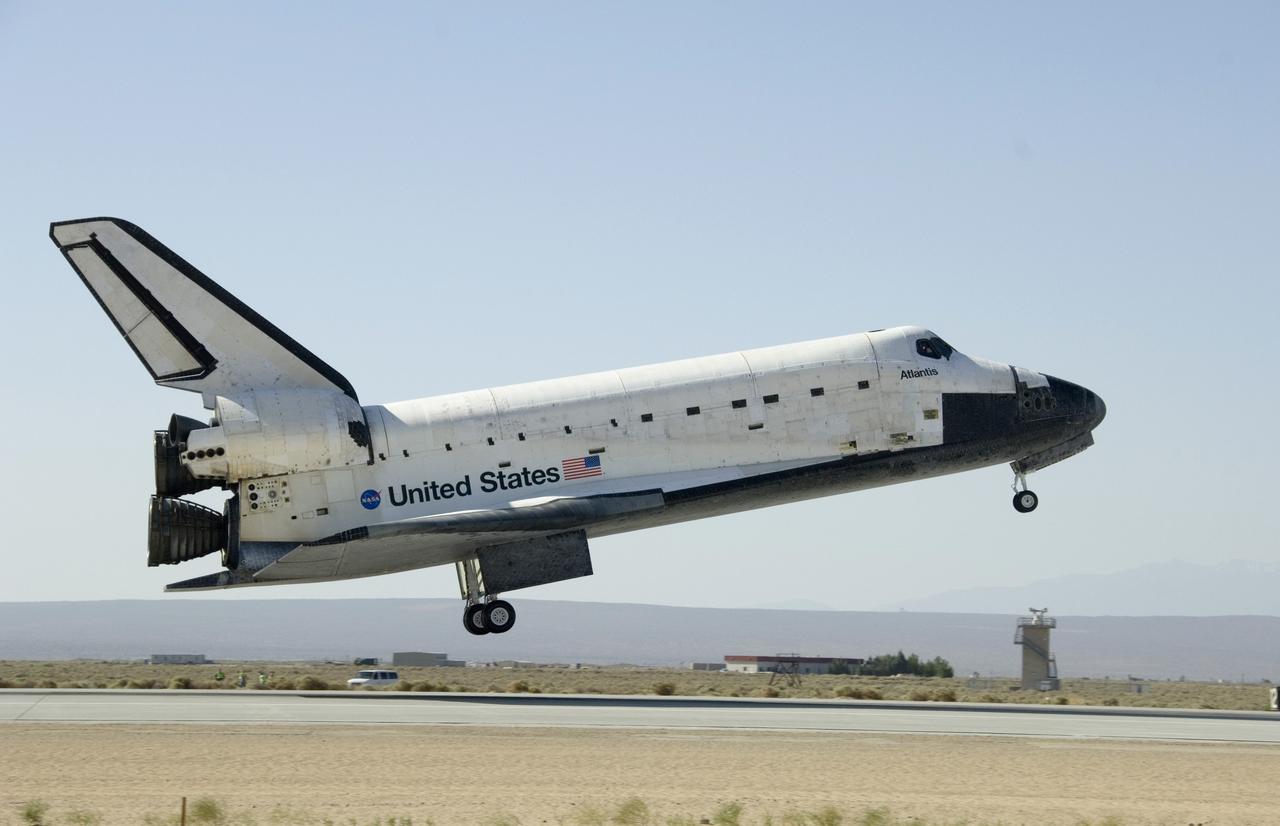
EDWARDS, Calif. - ED09-0127-03 - Space shuttle Atlantis and its seven-member crew near touchdown on Runway 22 at Edwards Air Force Base in California, ending a nearly 13-day journey of 5.3 million miles on the STS-125 mission to repair and upgrade NASA’s Hubble Space Telescope. Main gear touchdown was at 11:39:05 a.m. EDT. Nose gear touchdown was at 11:39:15 a.m. EDT. Wheel stop was at 11:40:15 a.m., bringing the mission’s elapsed time to 12 days, 21 hours, 37 minutes, 9 seconds. Landing opportunities on May 22, May 23 and May 24 were waved off due to weather concerns at NASA’s Kennedy Space Center in Florida, the shuttle’s primary landing site. Through five spacewalks, NASA's Hubble Space Telescope was refurbished and upgraded with state-of-the-art science instruments that will expand Hubble's capabilities and extend its operational lifespan through at least 2014. Photo credit: NASA/Tony Landis, EAFB
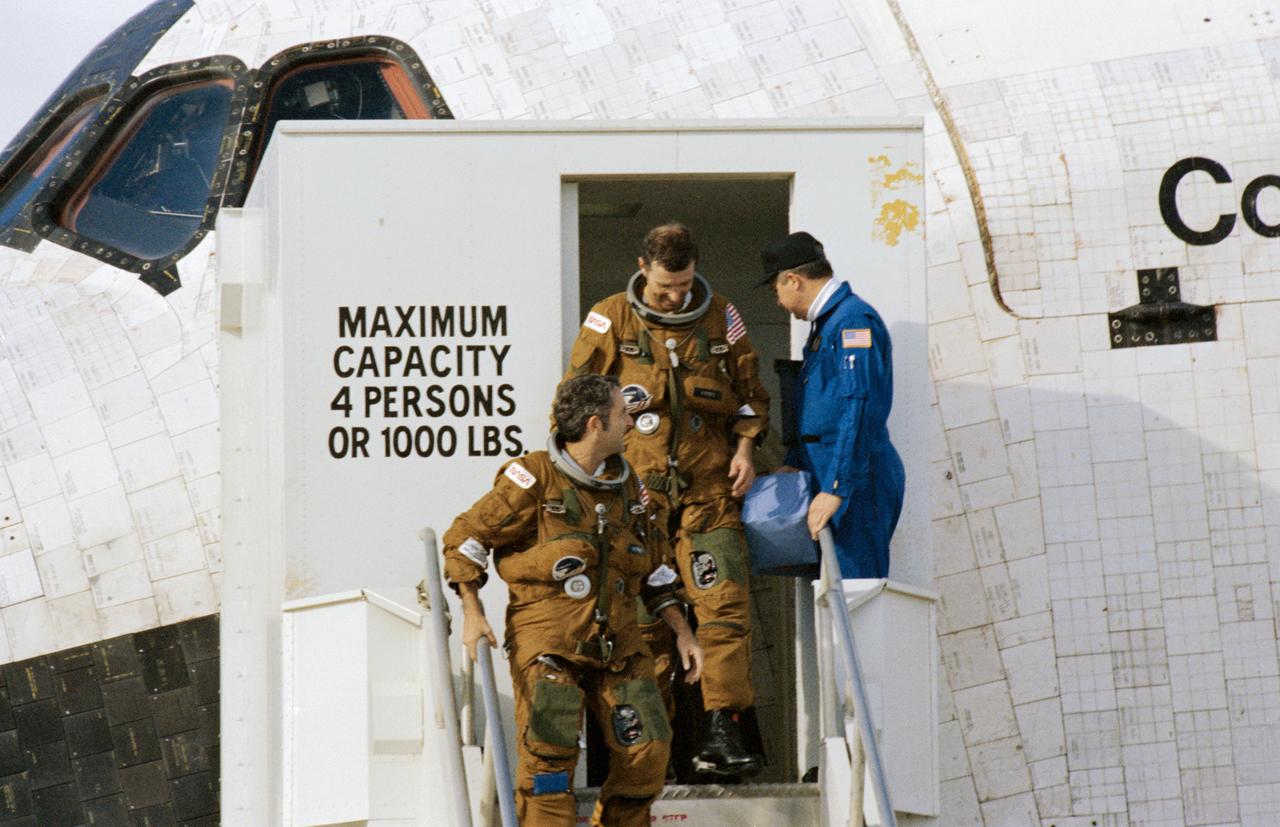
Documentary views of Space Shuttle Columbia on Lakebed Runway during De-Servicing, Crew Egress and departure from Orbiter at the end of STS-2 Mission. EAFB, CA Also available in 70 CN
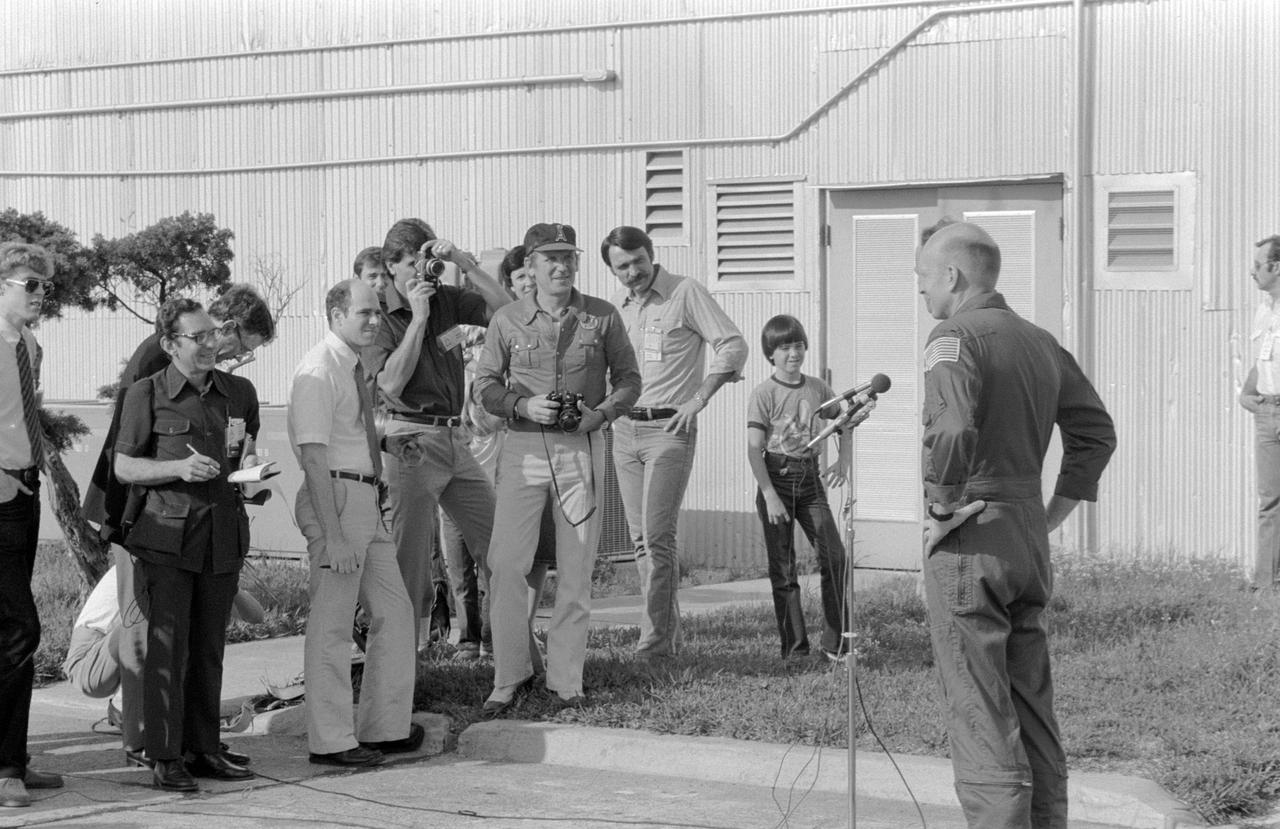
Views of the STS-3 Crew, Astronauts Lousma and Fullerton, during departure activities with family and friends to include Astronaut Brewster Shaw. 1. ASTRONAUT SHAW, BREWSTER - STS-3 EAFB, HOUSTON, TX
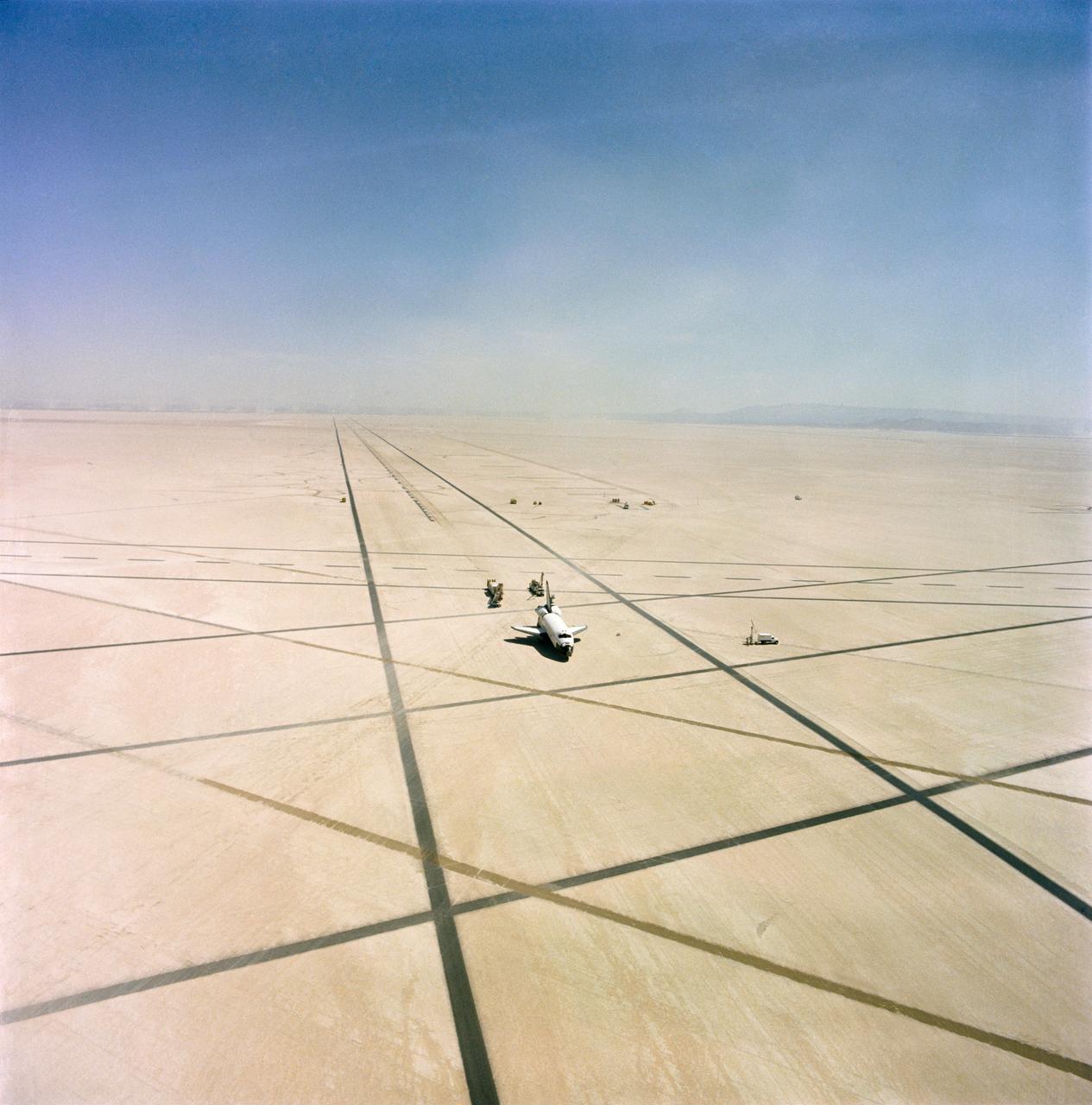
Documentary aerial and ground views of the Columbia sitting on the Lakebed Runway with the deservicing trucks following the STS-1 Mission, 04/14/1981. EAFB, CA Also available in 70 CN
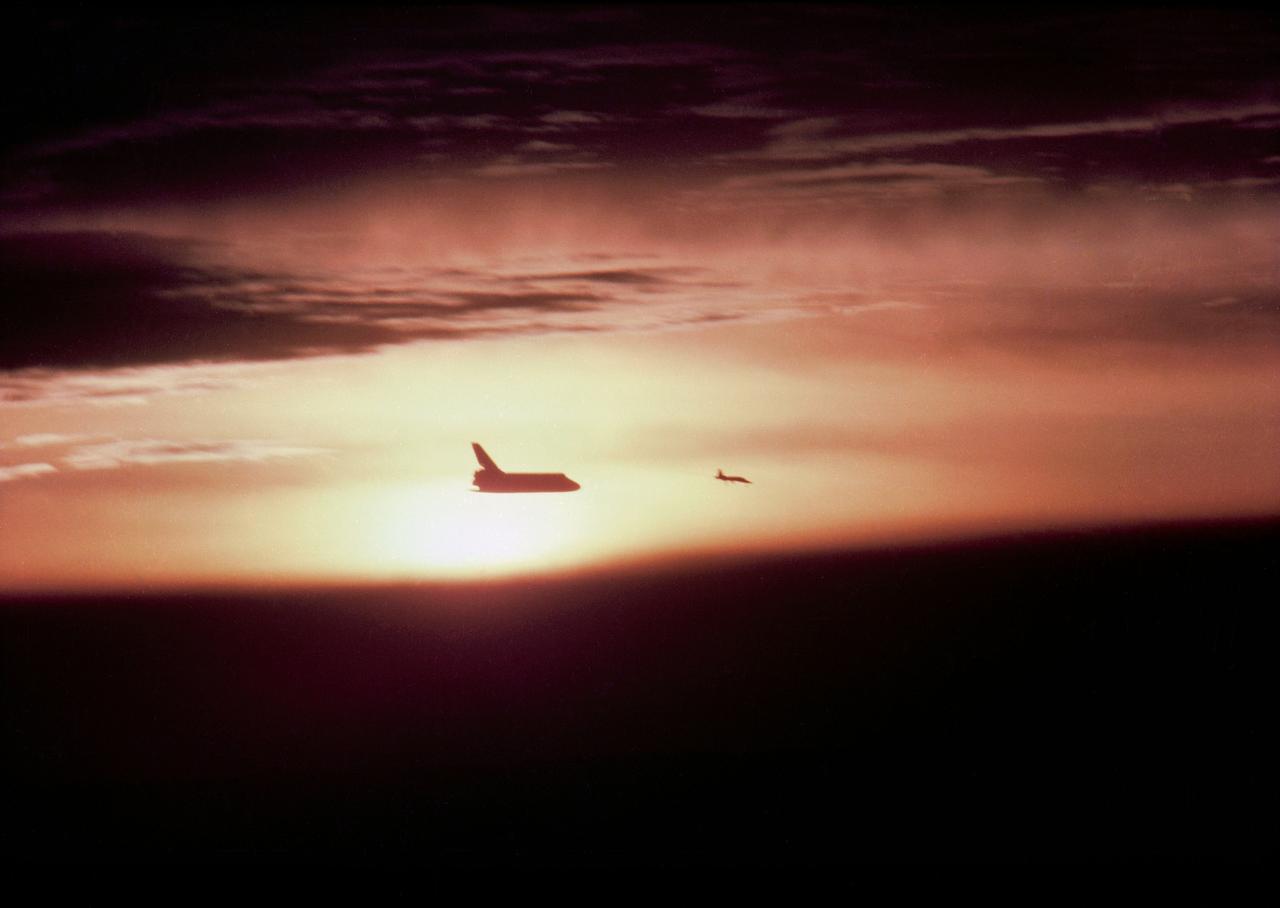
Aerial view of Orbiter "Columbia" as you look into the Sun, taken by Erik Simonsen, Rockwell International, 11/16/1982. 1. STS-5 - LANDING (INTO THE SUN) EAFB, CA
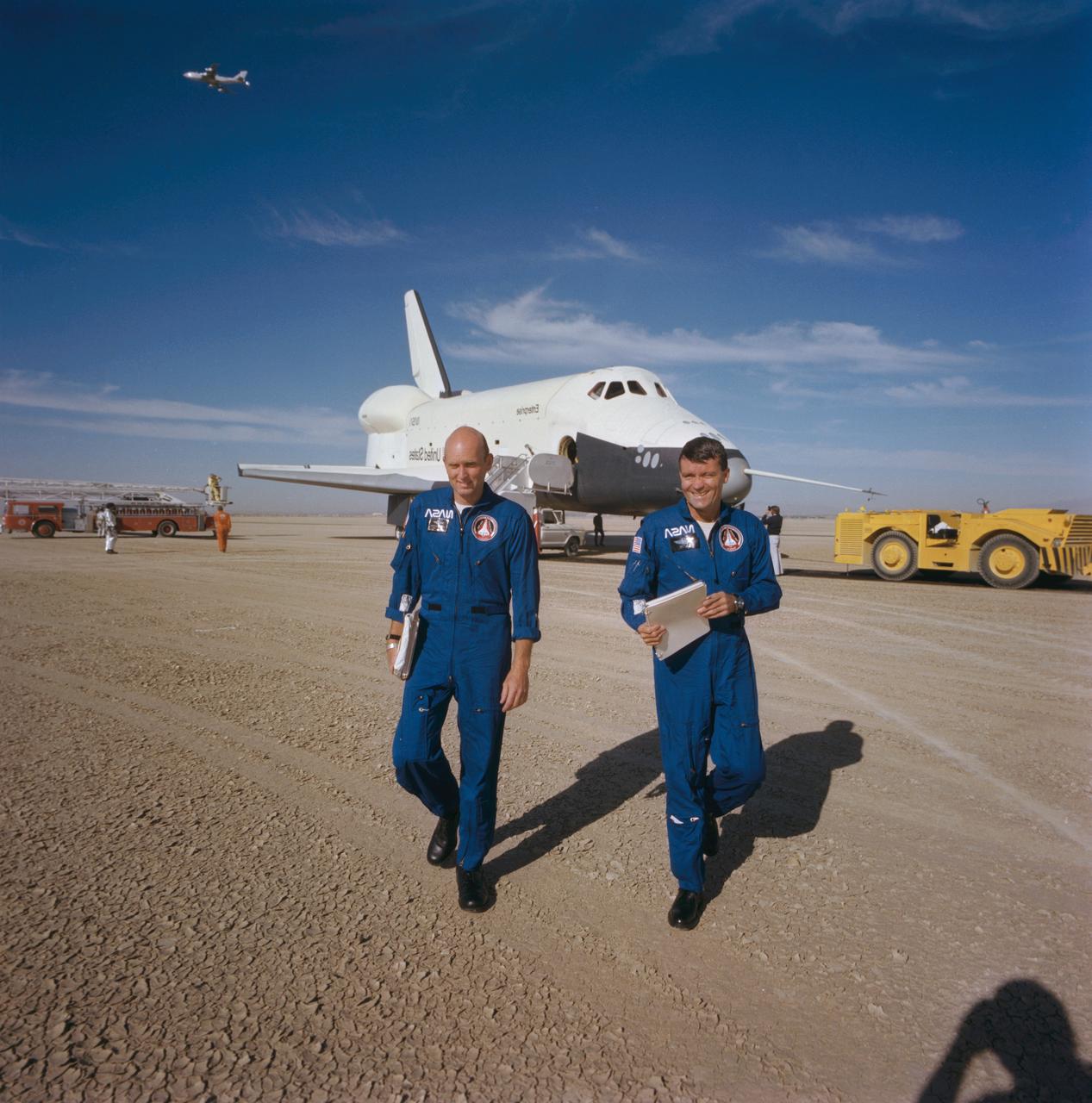
Public Affairs Office (PAO) release print of activity documenting third (3rd) "free flight" of Shuttle Orbiter 101 Spacecraft at DFRC, EAFB, CA. Astronauts Haise (left) and Fullerton in front of parking "Enterprise" just after egress. DFRC, EAFB, CA
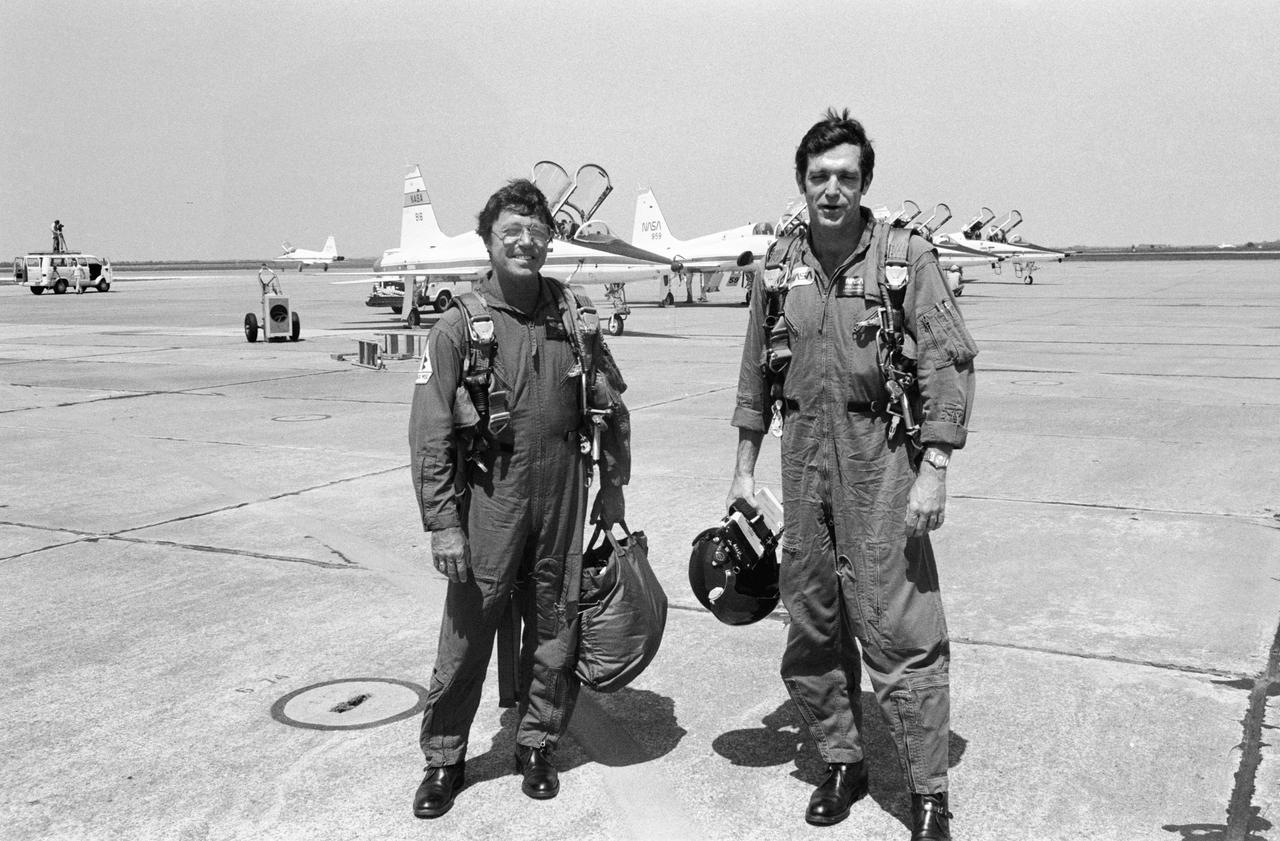
ASCAN Francis R. Scobee and T-38 Trainer on Ellington runway prior to leaving on training flight. EAFB, HOUSTON, TX
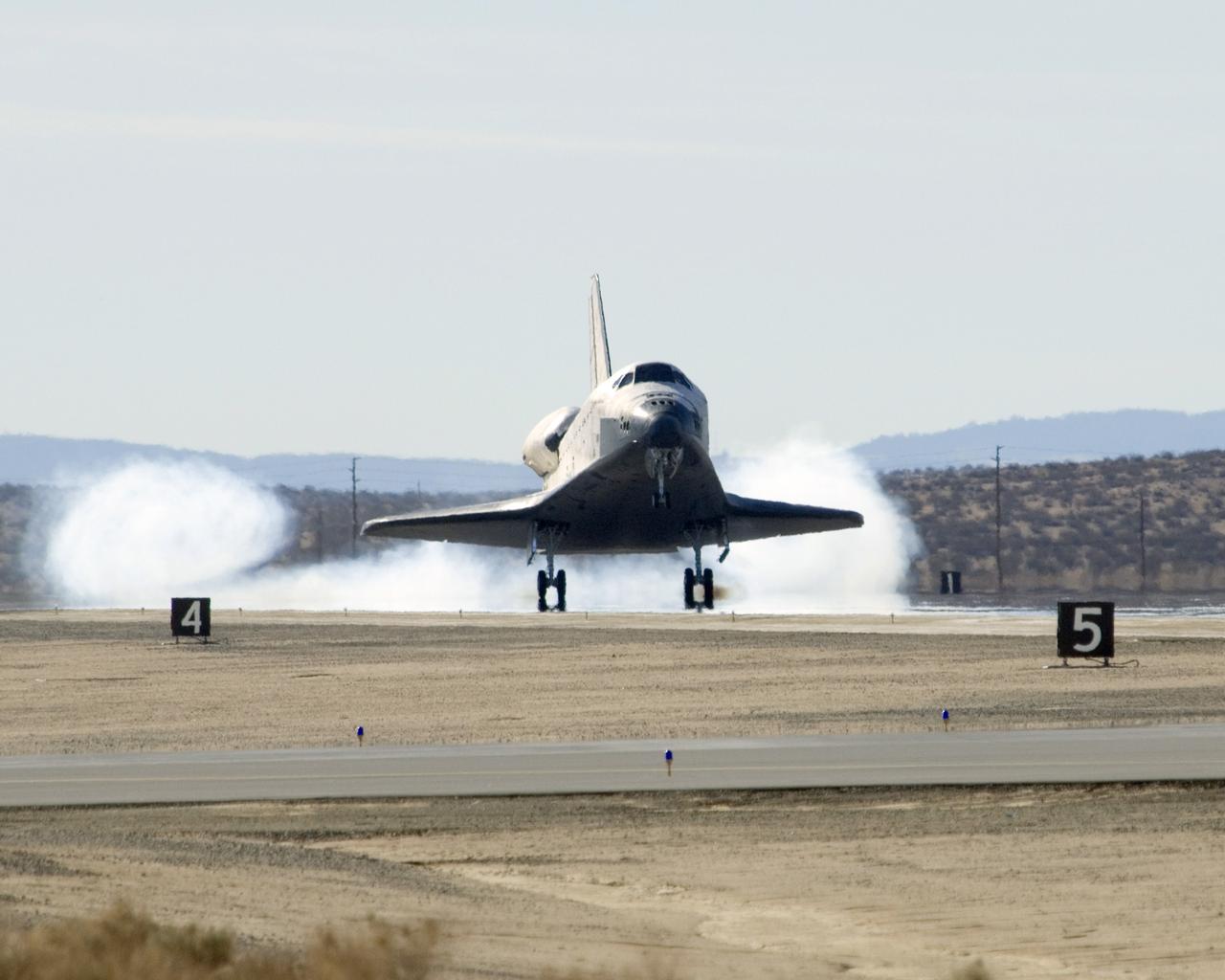
EDWARDS, Calif. –- Space shuttle Endeavour kicks up dust as it touches down at Edwards Air Force Base in California at 4:25 p.m. EST to end the STS-126 mission, completing its 16-day journey of over 6.6 million miles in space. The main landing gear touched down at 4:25:06 p.m. EST. The nose landing gear touched down at 4:25:21 p.m. and wheel stop was at 4:26:03 p.m. The STS-126 mission was the 27th flight to the International Space Station, carrying equipment and supplies in the Multi-Purpose Logistics Module Leonardo. The mission featured four spacewalks and work to prepare the space station to house six crew members for long-duration missions. Photo credit: NASA/ Tony Landis, EAFB

EDWARDS, Calif. –- Space shuttle Endeavour glides down the runway at Edwards Air Force Base in California after touching down at 4:25 p.m. EST to end the STS-126 mission, completing its 16-day journey of over 6.6 million miles in space. The main landing gear touched down at 4:25:06 p.m. EST. The nose landing gear touched down at 4:25:21 p.m. and wheel stop was at 4:26:03 p.m. The STS-126 mission was the 27th flight to the International Space Station, carrying equipment and supplies in the Multi-Purpose Logistics Module Leonardo. The mission featured four spacewalks and work to prepare the space station to house six crew members for long-duration missions. Photo credit: NASA/ Tom Tschida, EAFB
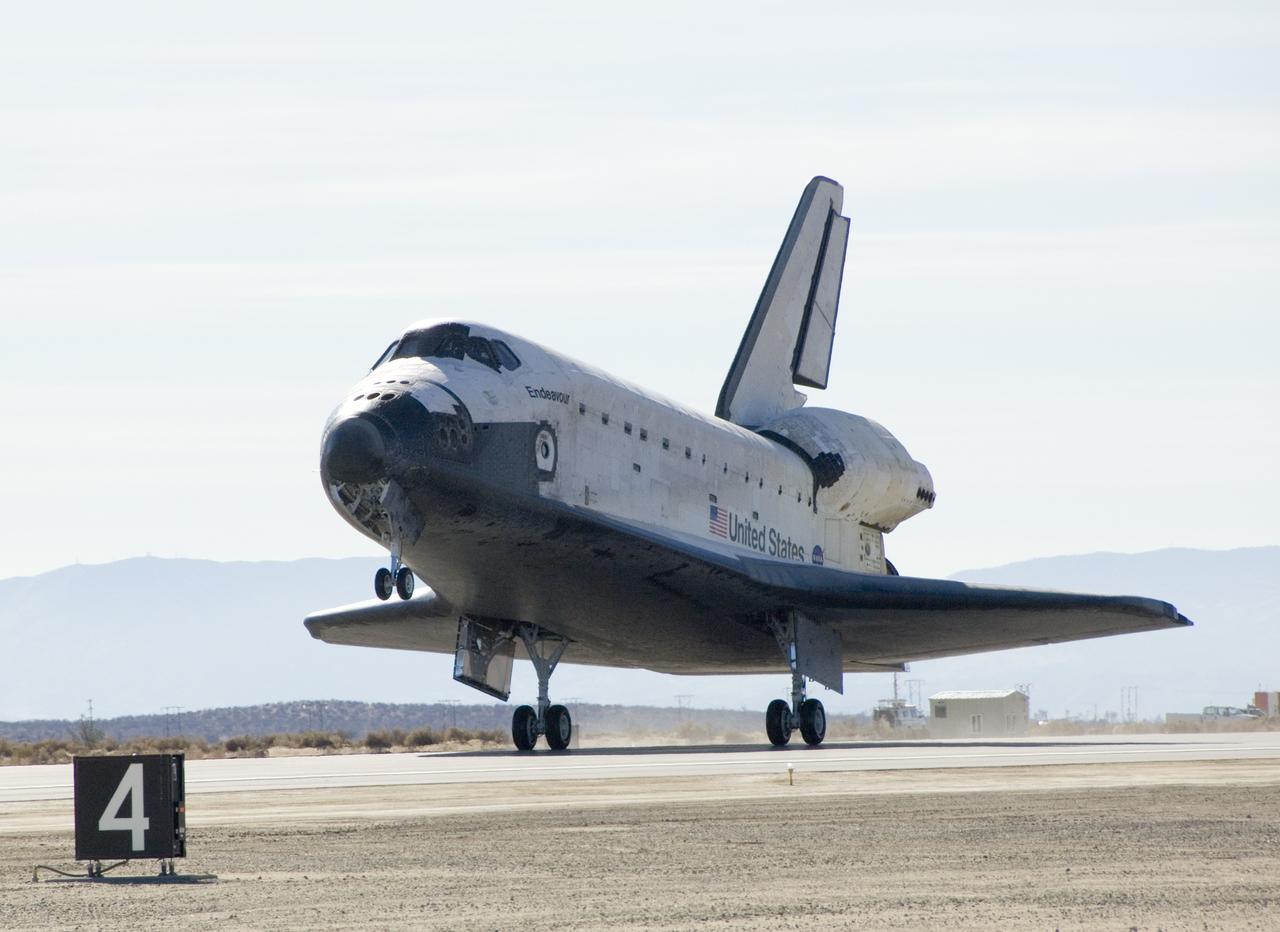
EDWARDS, Calif. –- Space shuttle Endeavour glides down the runway at Edwards Air Force Base in California after touching down at 4:25 p.m. EST to end the STS-126 mission, completing its 16-day journey of over 6.6 million miles in space. The main landing gear touched down at 4:25:06 p.m. EST. The nose landing gear touched down at 4:25:21 p.m. and wheel stop was at 4:26:03 p.m. The STS-126 mission was the 27th flight to the International Space Station, carrying equipment and supplies in the Multi-Purpose Logistics Module Leonardo. The mission featured four spacewalks and work to prepare the space station to house six crew members for long-duration missions. Photo credit: NASA/ Carla Thomas, EAFB
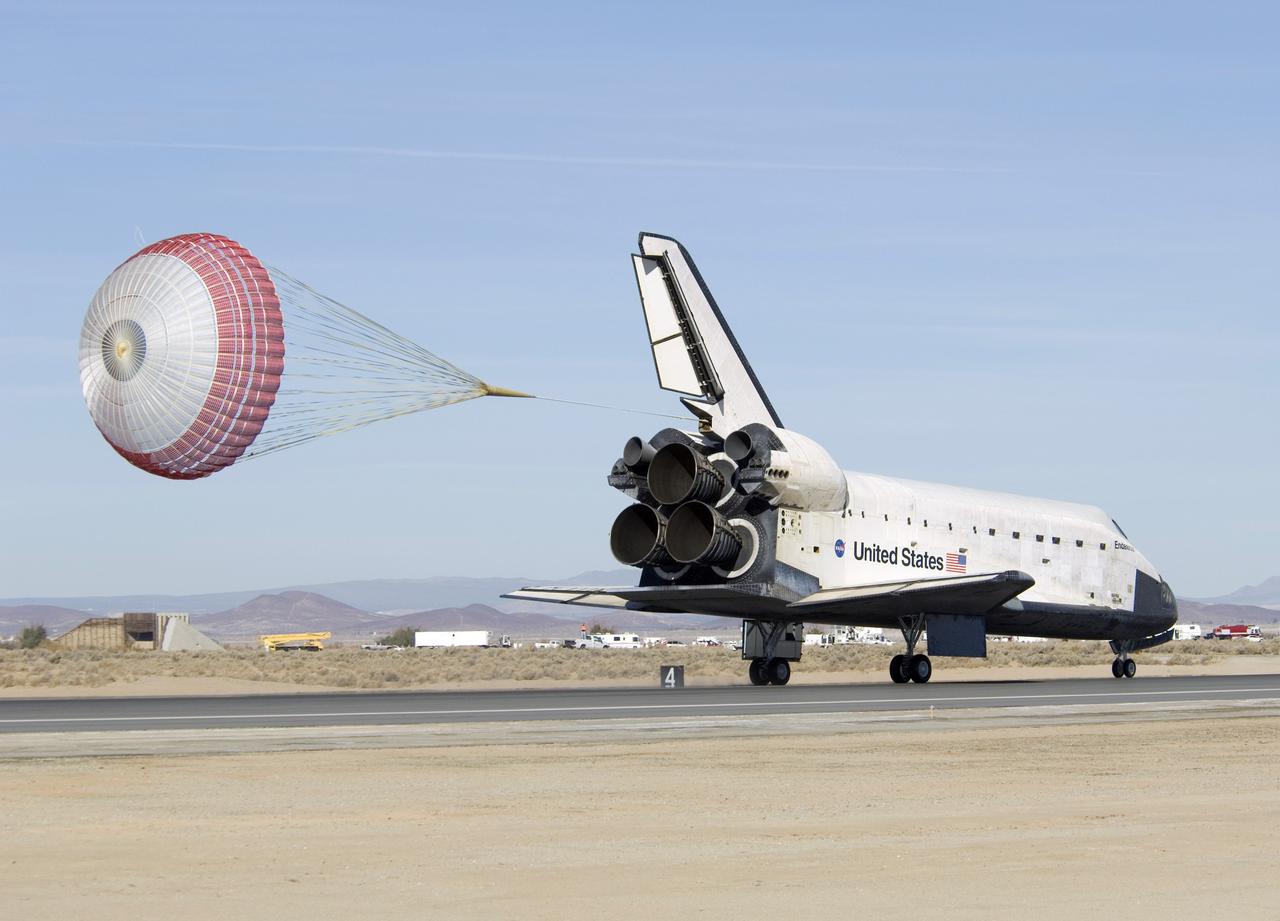
EDWARDS, Calif. –- A drag chute slows the speed of space shuttle Endeavour as it lands at Edwards Air Force Base in California after touching down at 4:25 p.m. EST to end the STS-126 mission, completing its 16-day journey of over 6.6 million miles in space. The main landing gear touched down at 4:25:06 p.m. EST. The nose landing gear touched down at 4:25:21 p.m. and wheel stop was at 4:26:03 p.m. The STS-126 mission was the 27th flight to the International Space Station, carrying equipment and supplies in the Multi-Purpose Logistics Module Leonardo. The mission featured four spacewalks and work to prepare the space station to house six crew members for long-duration missions. Photo credit: NASA/ Tony Landis, EAFB
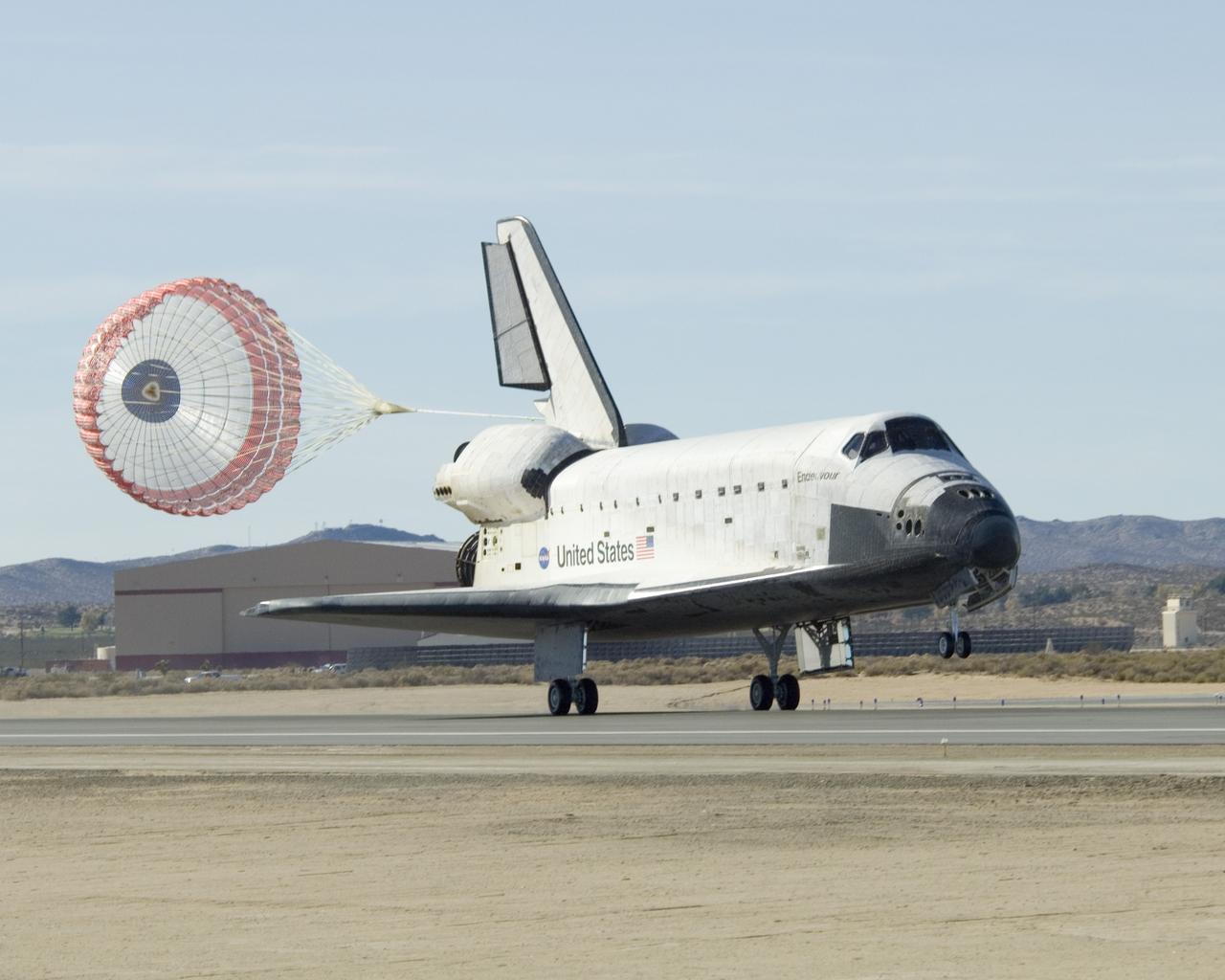
EDWARDS, Calif. –- A drag chute slows the speed of space shuttle Endeavour as it lands at Edwards Air Force Base in California after touching down at 4:25 p.m. EST to end the STS-126 mission, completing its 16-day journey of over 6.6 million miles in space.The main landing gear touched down at 4:25:06 p.m. EST. The nose landing gear touched down at 4:25:21 p.m. and wheel stop was at 4:26:03 p.m. The STS-126 mission was the 27th flight to the International Space Station, carrying equipment and supplies in the Multi-Purpose Logistics Module Leonardo. The mission featured four spacewalks and work to prepare the space station to house six crew members for long-duration missions. Photo credit: NASA/ Tony Landis, EAFB
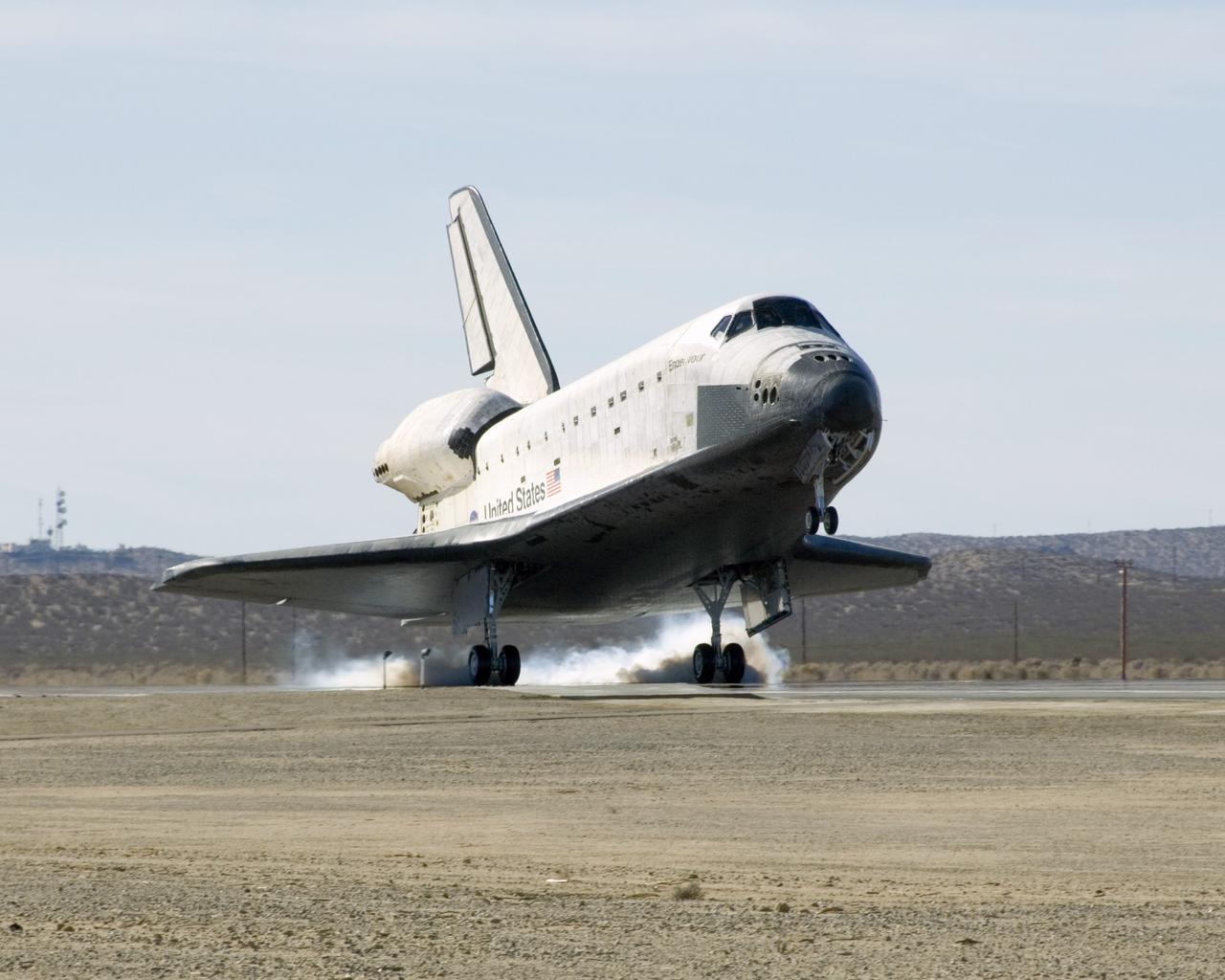
EDWARDS, Calif. –- In the 52nd landing at Edwards Air Force Base in California, space shuttle Endeavour touches down at 4:25 p.m. EST to end the STS-126 mission, completing its 16-day journey of over 6.6 million miles in space. The main landing gear touched down at 4:25:06 p.m. EST. The nose landing gear touched down at 4:25:21 p.m. and wheel stop was at 4:26:03 p.m. The STS-126 mission was the 27th flight to the International Space Station, carrying equipment and supplies in the Multi-Purpose Logistics Module Leonardo. The mission featured four spacewalks and work to prepare the space station to house six crew members for long-duration missions. Photo credit: NASA/ Tom Tschida, EAFB
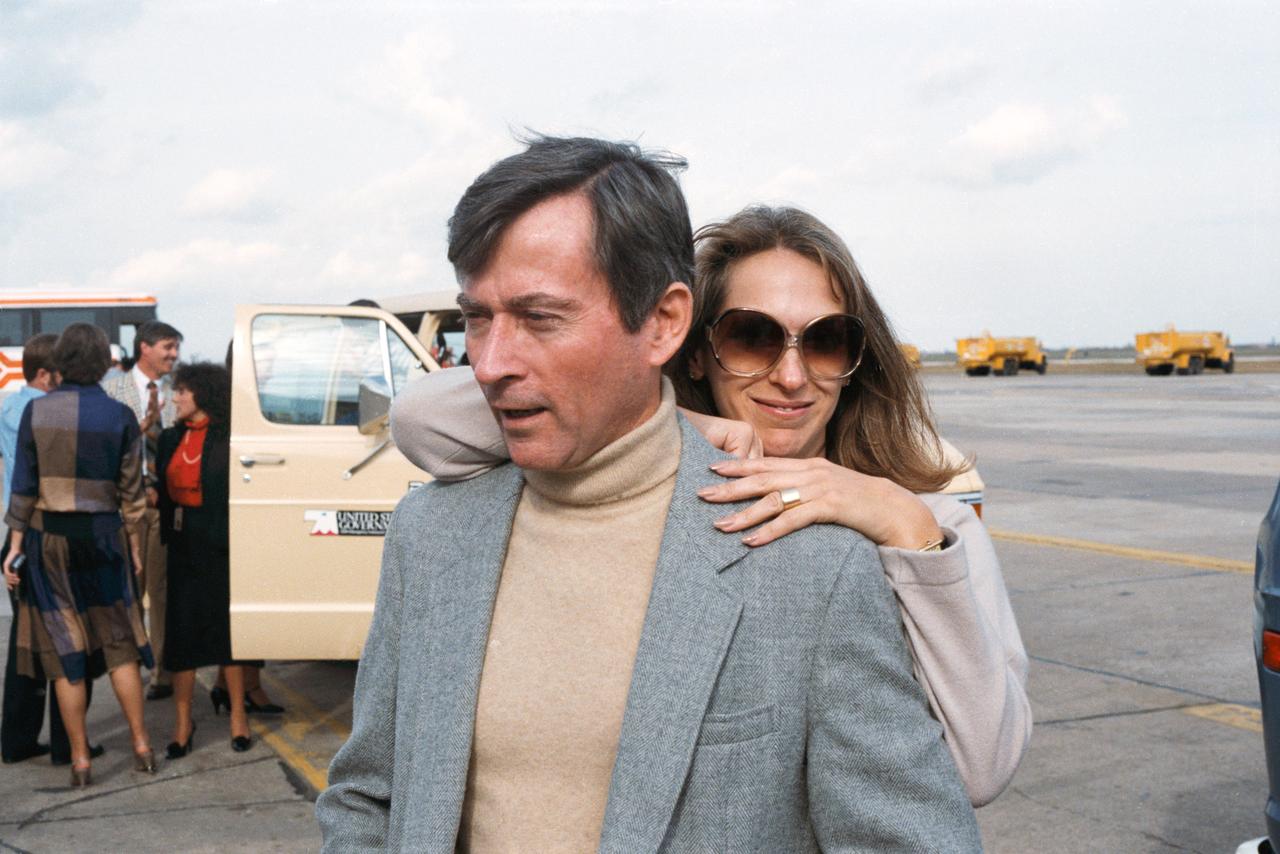
Views of STS-9/41A Crewmen John Young, with wife Susy, and Brewster Shaw with his family upn their return. EAFB, HOUSTON, TX

Photography from Shuttle ALT FF-5. S77-30393: ALT Fr. 3258, a higher-up shot of the Enterprise approaching runway for landing. EAFB, CA
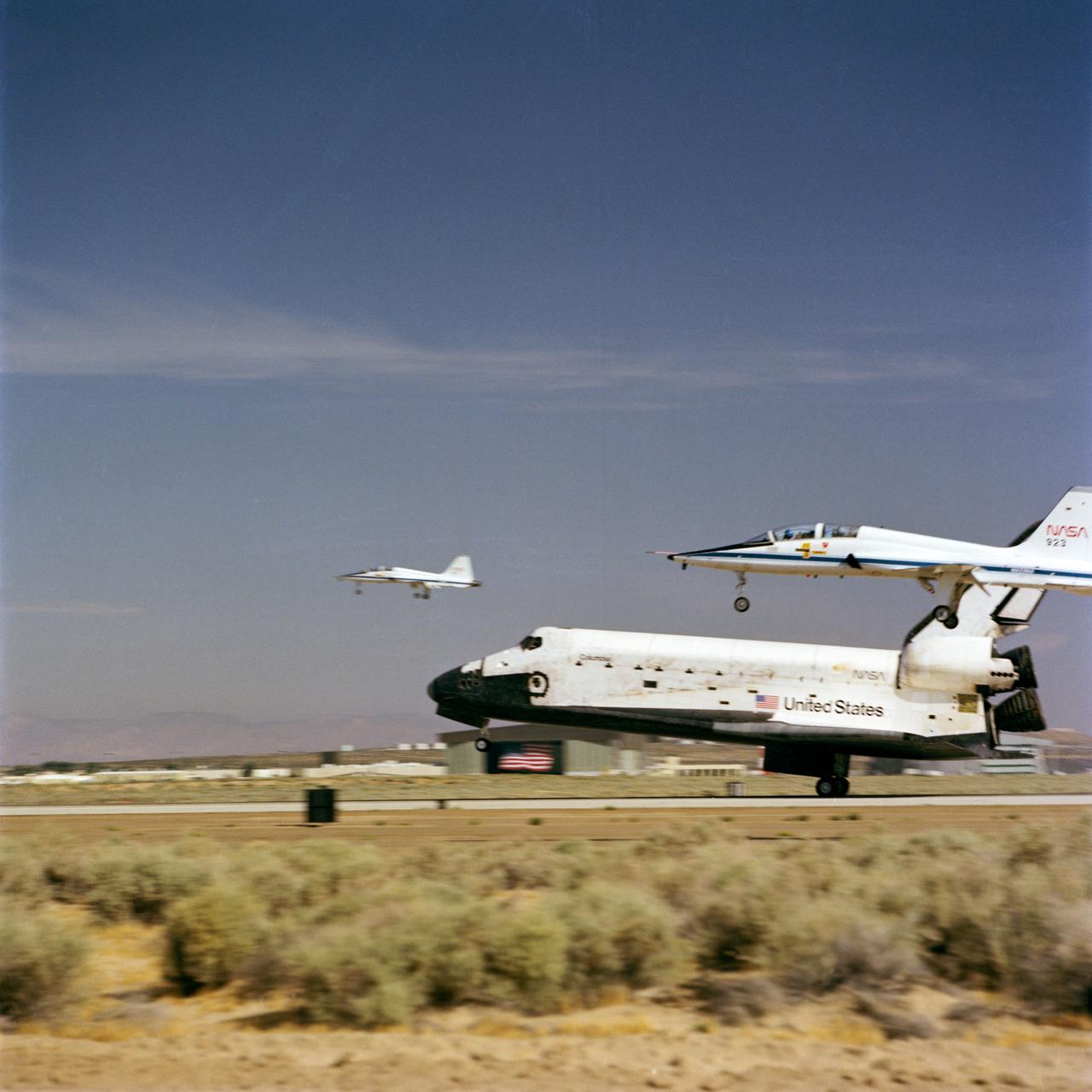
Views of the Columbia landing at EAFB ending the STS-4 Mission on 07/04/1982; of President and Mrs. Reagan greeting the crew out on the Lake bed Runway; and, the view of Roy Rogers with Astronauts Jerry Ross and Guy Gardner. 1. President Ronald Reagan & wife Nancy 2. Roy Rogers 3. Astronaut Jerry L. Ross 4. Astronaut Guy S. Gardner Edwards AFB, CA
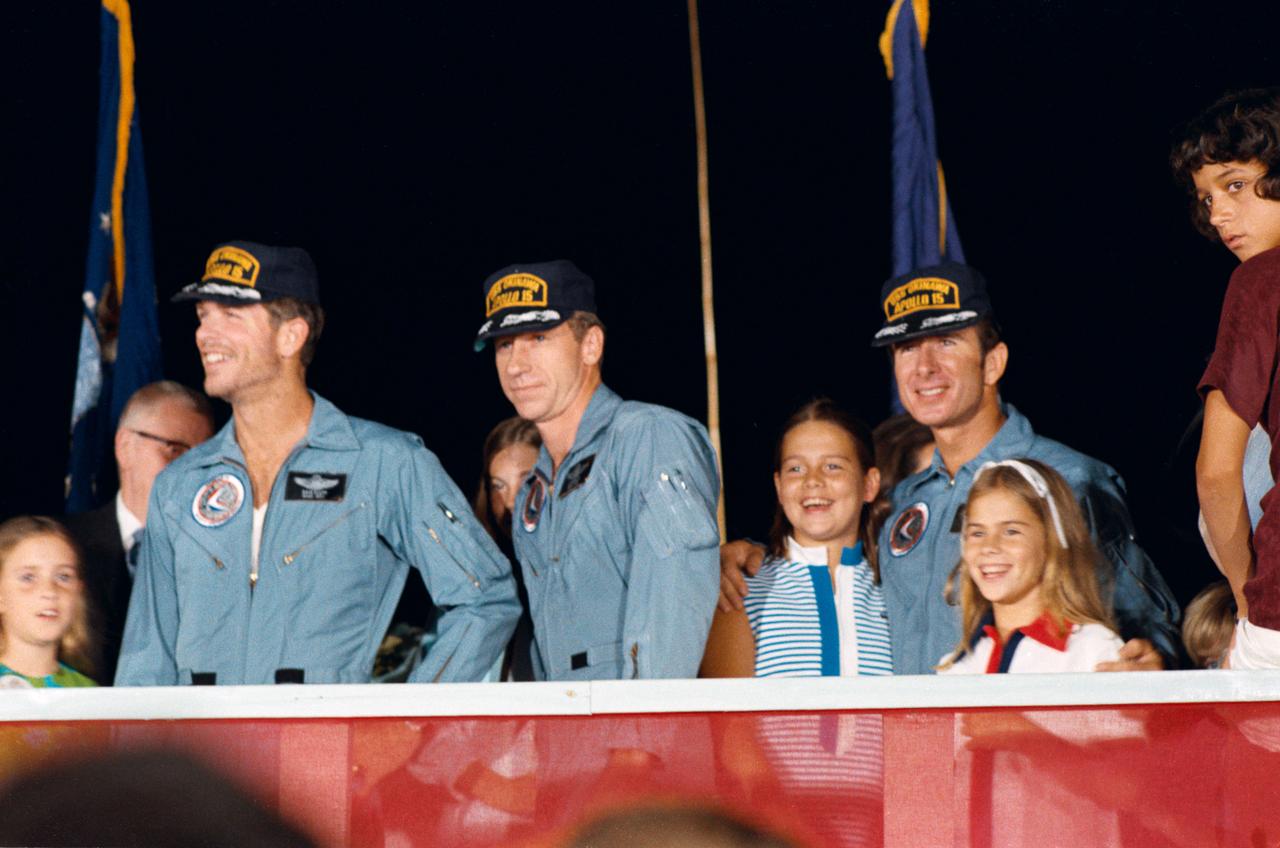
S71-43428 (8 Aug. 1971) --- The three crew men, of the highly successful Apollo 15 lunar landing mission, receive a warm welcome home at Ellington Air Force Base (EAFB), Houston, after an eight hour flight aboard a U.S. Air Force C-141 jet aircraft from Hawaii. Left to right, are astronauts David R. Scott, commander; Alfred M. Worden, command module pilot; and James B. Irwin, lunar module pilot. Apollo 15 splashdown in the mid-Pacific at 3:45 p.m. (CDT), Aug. 7, 1971, some 330 miles north of Honolulu. The C-141 landed at EAFB at 9 p.m. (CDT), Sunday, Aug. 8, 1971. Members of the astronauts' families identifiable in the picture are, left to right, Scott's daughter, Tracy; Worden's father, Merrill Worden; Worden's daughter, Merrill; and Irwin's two daughters, Joy and Jill.
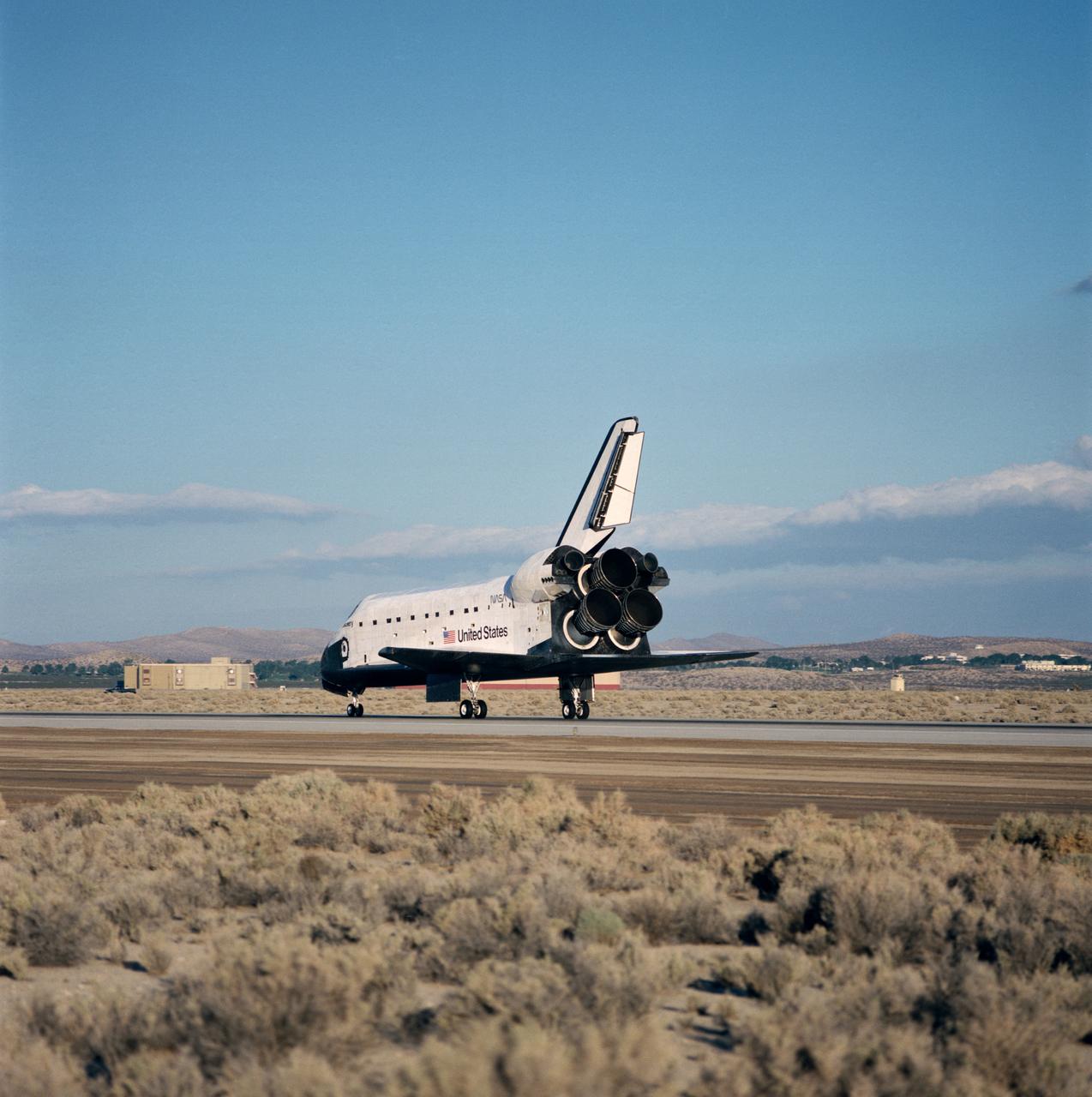
STS-31 Discovery, Orbiter Vehicle (OV) 103, rolls along concrete runway 22 at Edwards Air Force Base (EAFB), California, after nose landing gear (NLG) and main landing gear (MLG) touchdown. This view looks down OV-103's port side from the space shuttle main engines (SSMEs) to the nose section. The SSMEs are gimbaled to their descent position and the rudder/speedbrake is deployed on the vertical stabilizer. Wheel stop occurred at 6:51 am (Pacific Daylight Time (PDT)). In the distance EAFB facilities are visible.
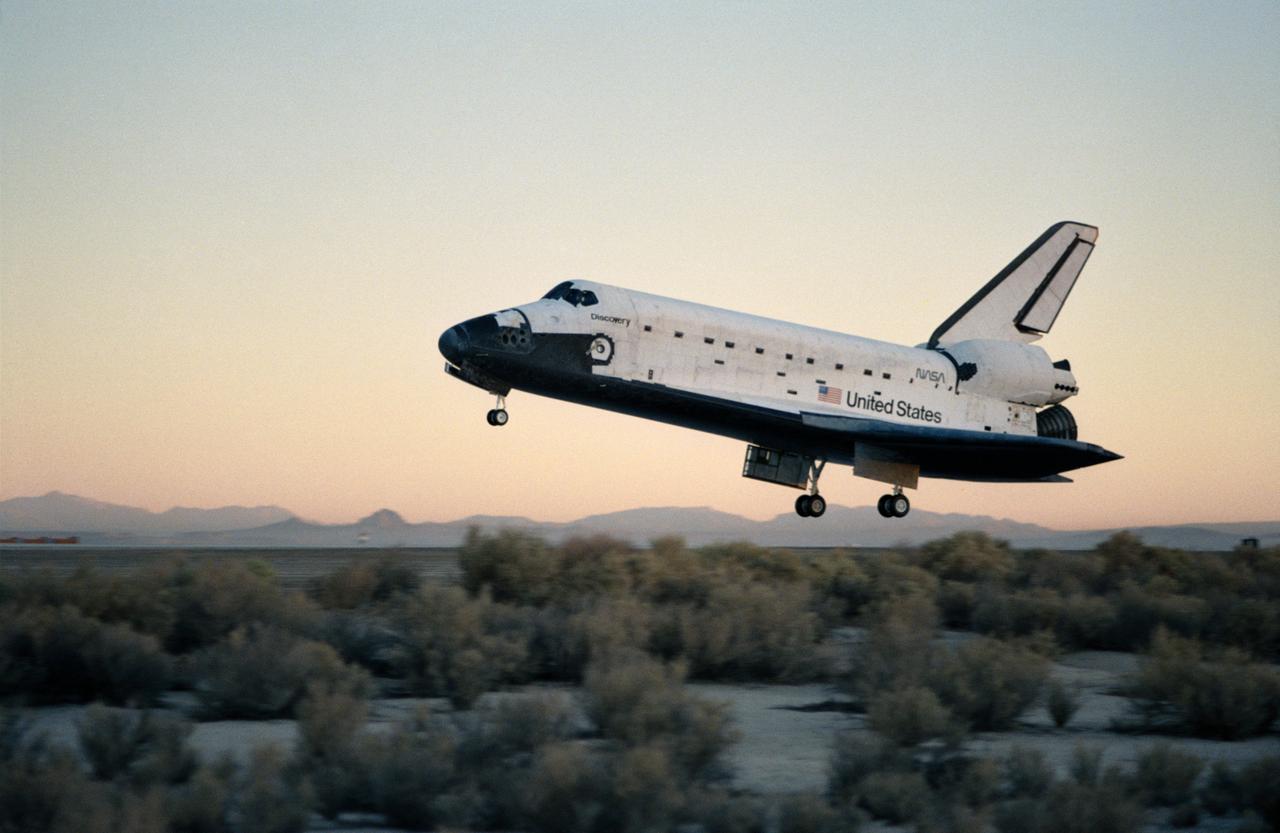
STS-41 Discovery, Orbiter Vehicle (OV) 103, with nose landing gear (NLG) and main landing gear (MLG) deployed, glides over concrete runway 22 at Edwards Air Force Base (EAFB), California, prior to touchdown.
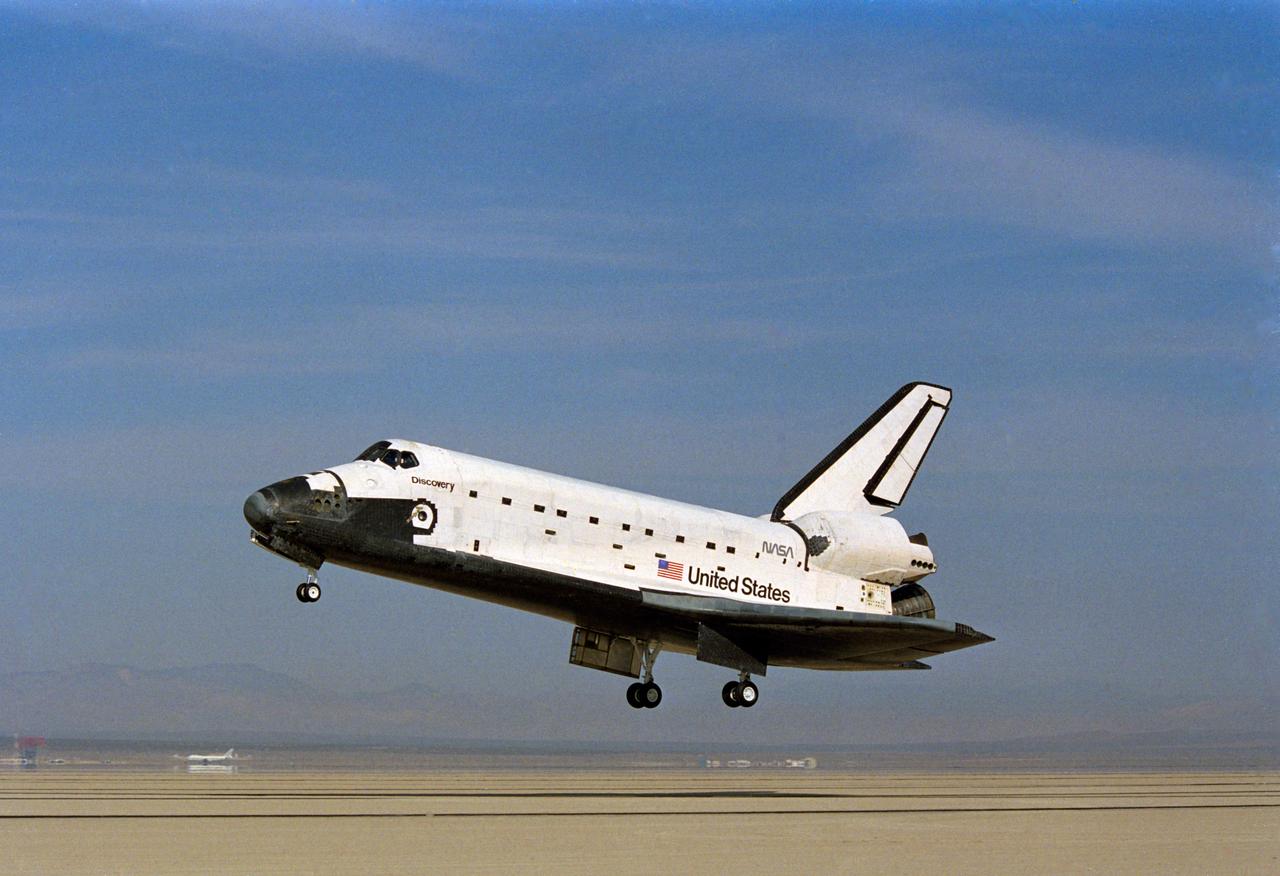
STS-26 Discovery, Orbiter Vehicle (OV) 103, with nose landing gear (NLG) and main landing gear (MLG) deployed glides above dry lakebed runway 17 at Edwards Air Force Base (EAFB), California. This profile view shows OV-103's port side just before MLG touchdown.

STS-41 Discovery, Orbiter Vehicle (OV) 103, with nose landing gear (NLG) and main landing gear (MLG) deployed, glides over concrete runway 22 at Edwards Air Force Base (EAFB), California, prior to touchdown.
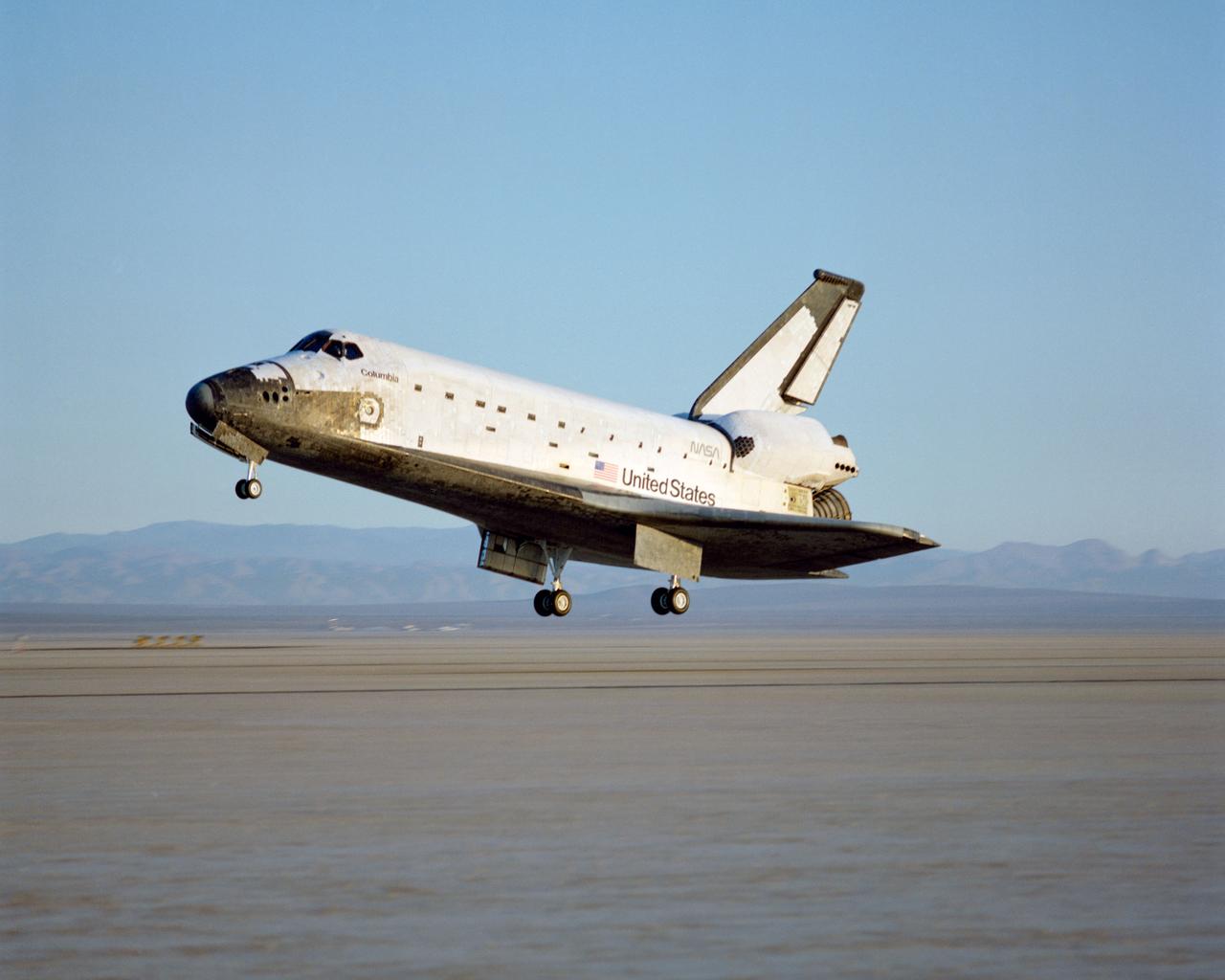
STS-28 Columbia, Orbiter Vehicle (OV) 102, approaches Runway 17 dry lake bed at Edwards Air Force Base (EAFB) California and is photographed just moments before main landing gear (MLG) touchdown. In the distance, are peaks of Southern California mountain range.
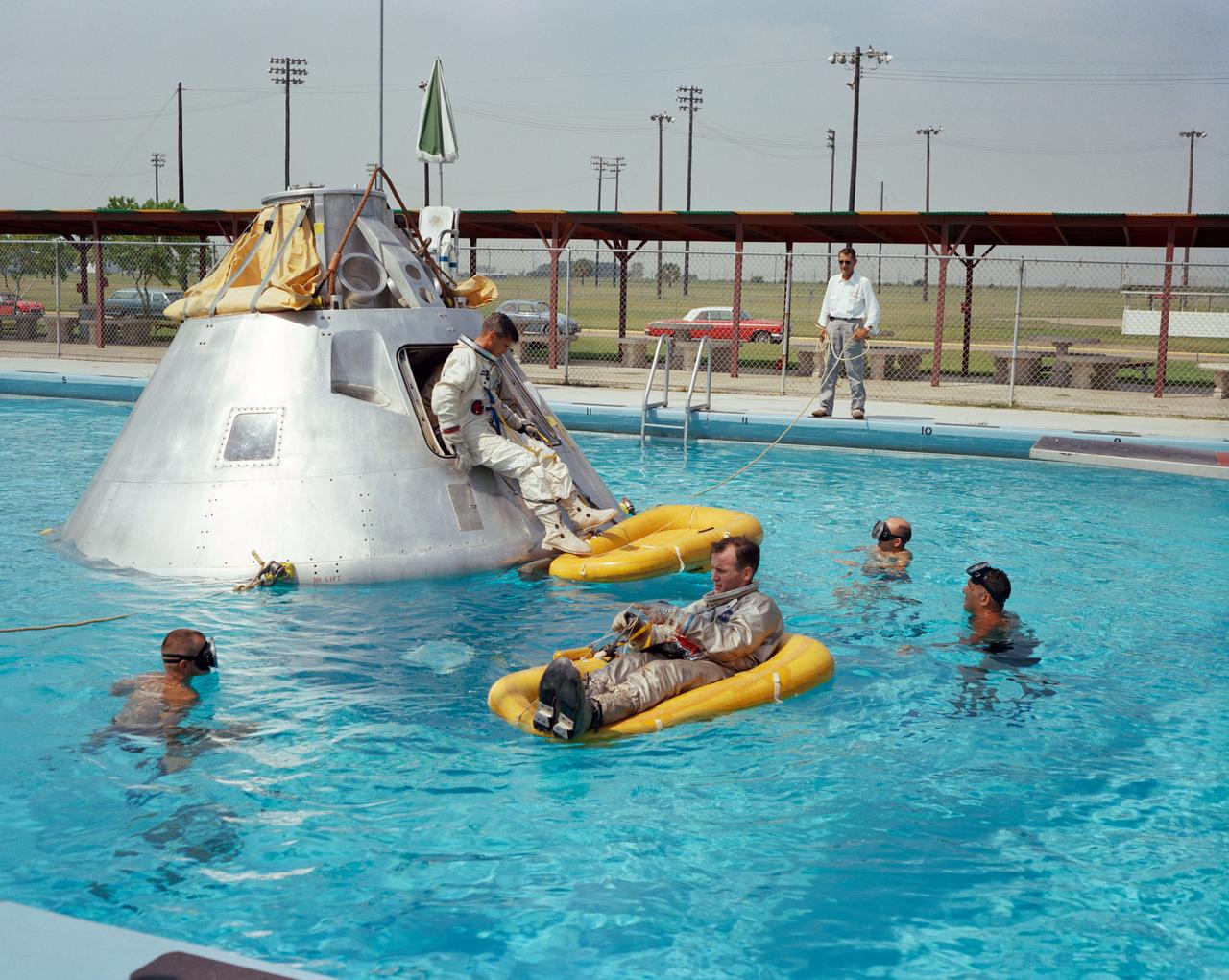
S66-51583 (June 1966)--- Prime crew members announced by the National Aeronautics and Space Administration (NASA) for the first manned Apollo 1 space flight practice water egress procedures in a swimming pool at Ellington Air Force Base (EAFB), Houston, Texas. Astronaut Edward H. White II rides life raft in the foreground. Astronaut Roger B. Chaffee sits in hatch of the boilerplate model of the spacecraft. Astronaut Virgil I. Grissom, third member of the crew, waits inside the spacecraft.
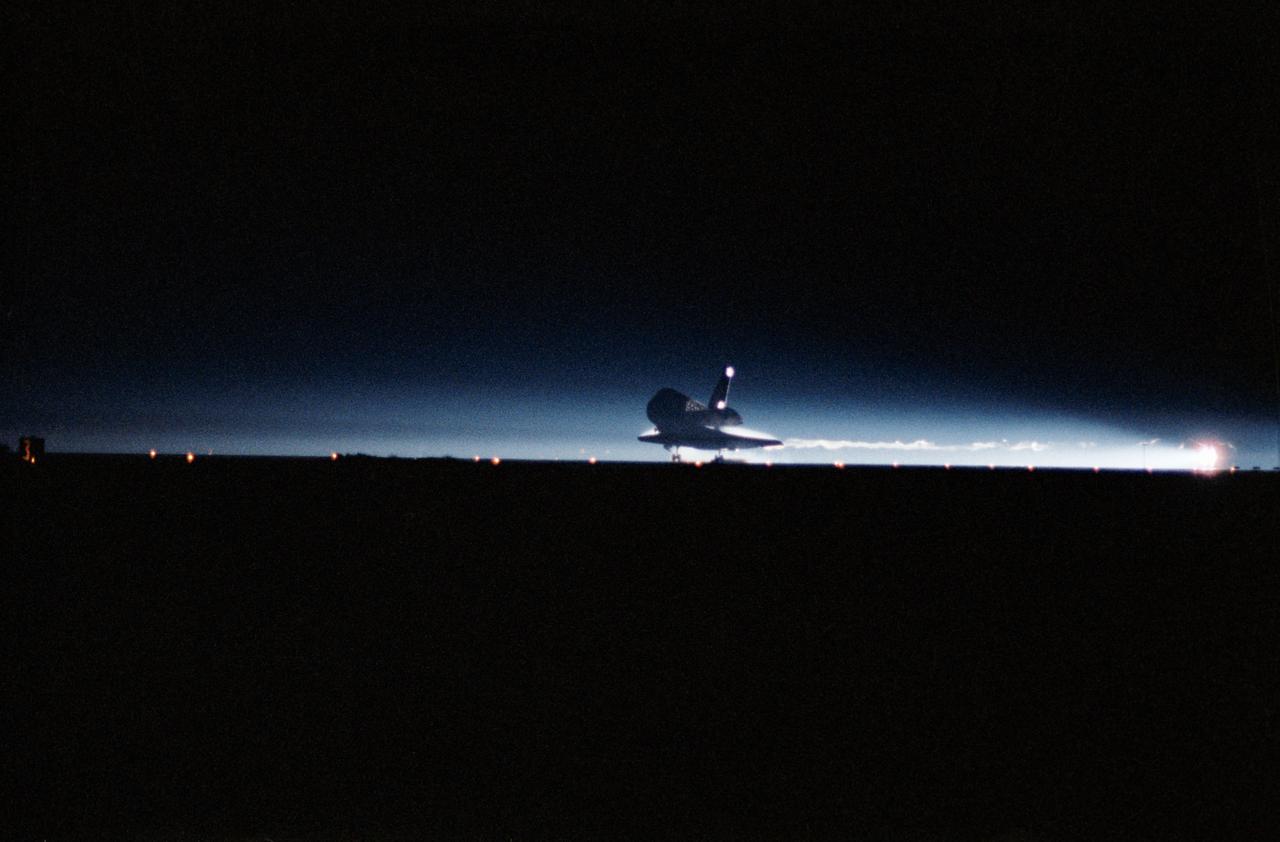
STS-32 Columbia, Orbiter Vehicle (OV) 102, is captured as its main landing gear (MLG) touches down on runway 22 at Edwards Air Force Base (EAFB), California, in the early morning darkness. The night landing ended a record 11-day mission in space. Moments later, at 1:36:38 am Pacific Standard Time (PST), OV-102 came to a complete stop, having logged 4,509,972 miles in flight.

STS-32 Columbia, Orbiter Vehicle (OV) 102, is captured as its main landing gear (MLG) touches down on runway 22 at Edwards Air Force Base (EAFB), California, in the early morning darkness. The night landing ended a record 11-day mission in space. Moments later, at 1:36:38 am Pacific Standard Time (PST), OV-102 came to a complete stop, having logged 4,509,972 miles in flight.
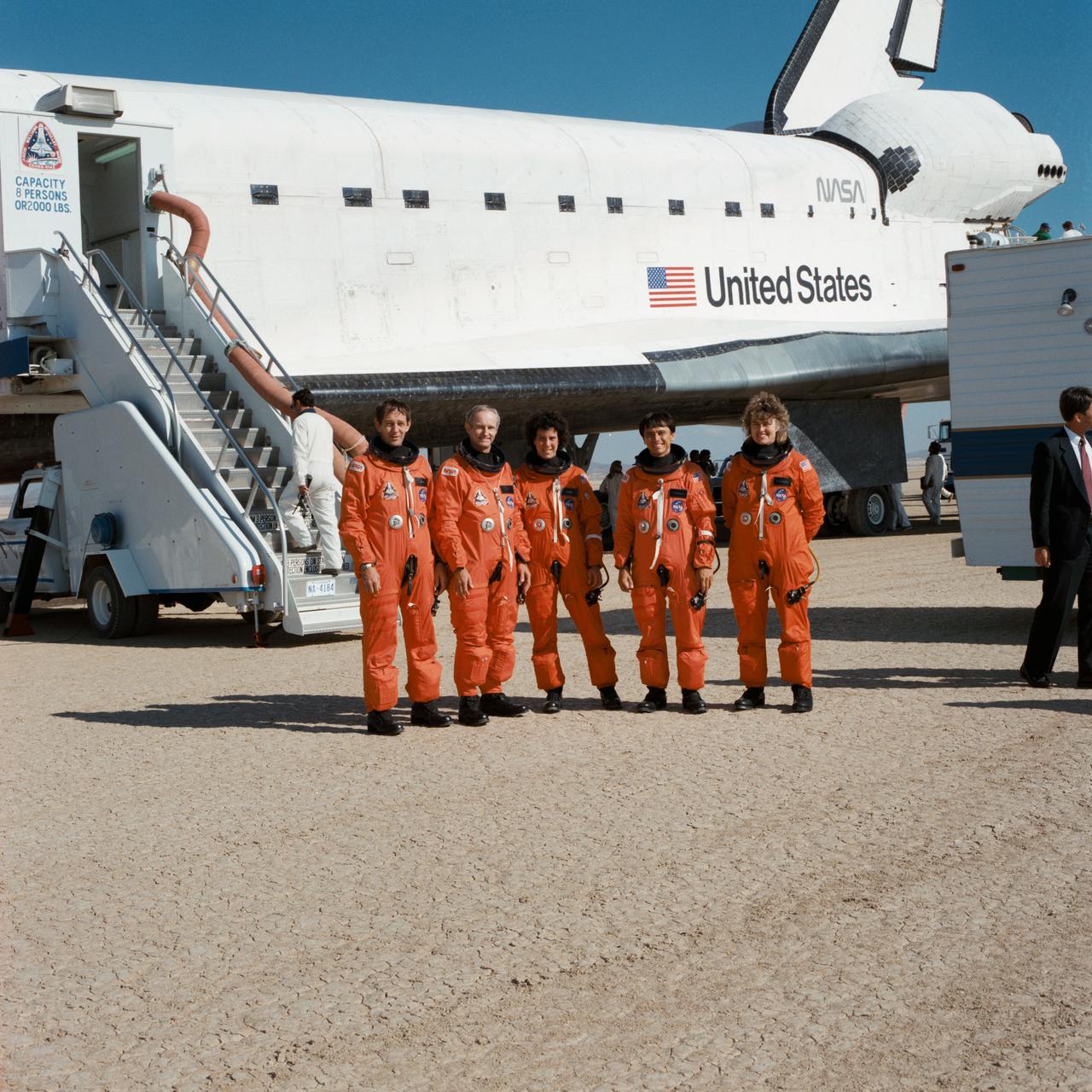
STS-34 crewmembers, wearing launch and entry suits (LESs), stand in front of Atlantis, Orbiter Vehicle (OV) 104, on Runway 23 dry lake bed at Edwards Air Force Base (EAFB), California. Left to right are Pilot Michael J. McCulley, Commander Donald E. Williams, Mission Specialist (MS) Ellen S. Baker, MS Franklin R. Chang-Diaz, and MS Shannon W. Lucid. Ground crews service OV-104 in the background.
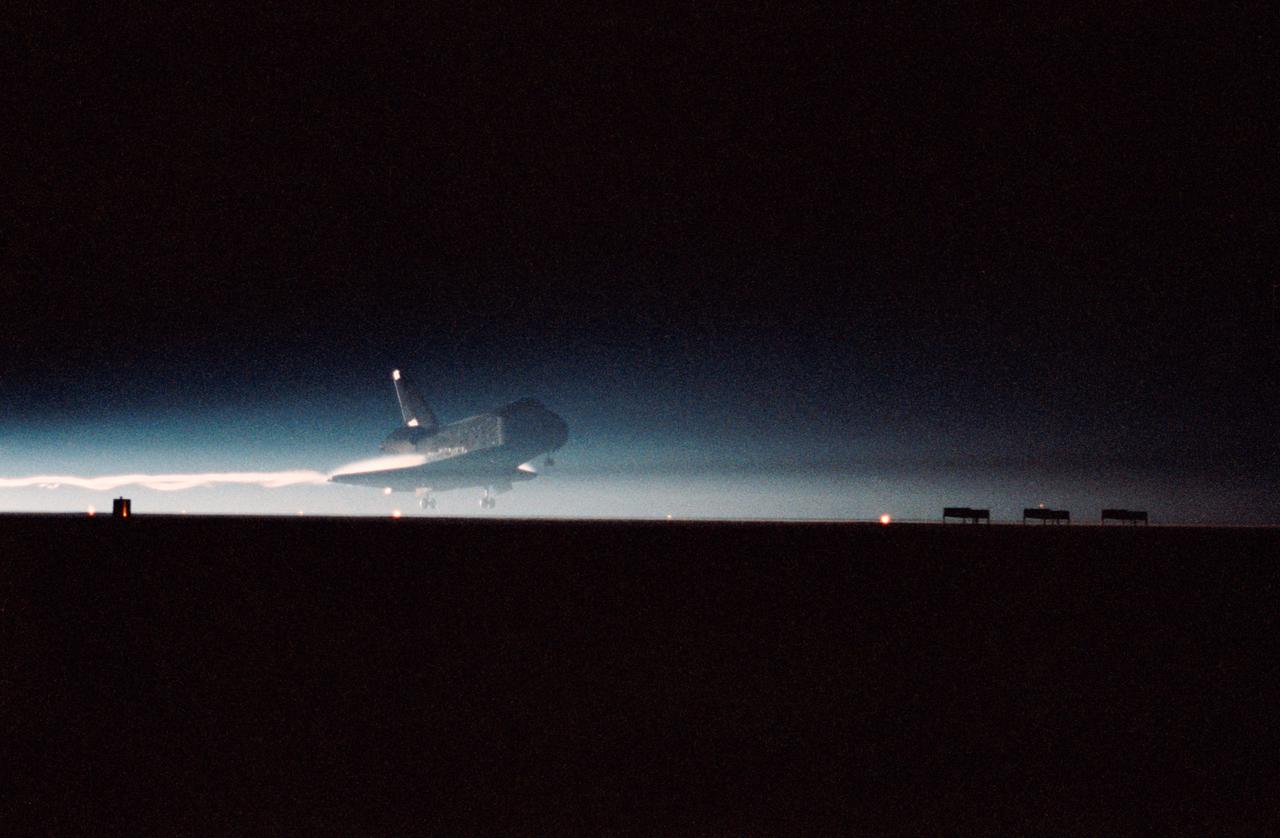
STS-32 Columbia, Orbiter Vehicle (OV) 102, is captured as its main landing gear (MLG) touches down on runway 22 at Edwards Air Force Base (EAFB), California, in the early morning darkness. The night landing ended a record 11-day mission in space. Moments later, at 1:36:38 am Pacific Standard Time (PST), OV-102 came to a complete stop, having logged 4,509,972 miles in flight.
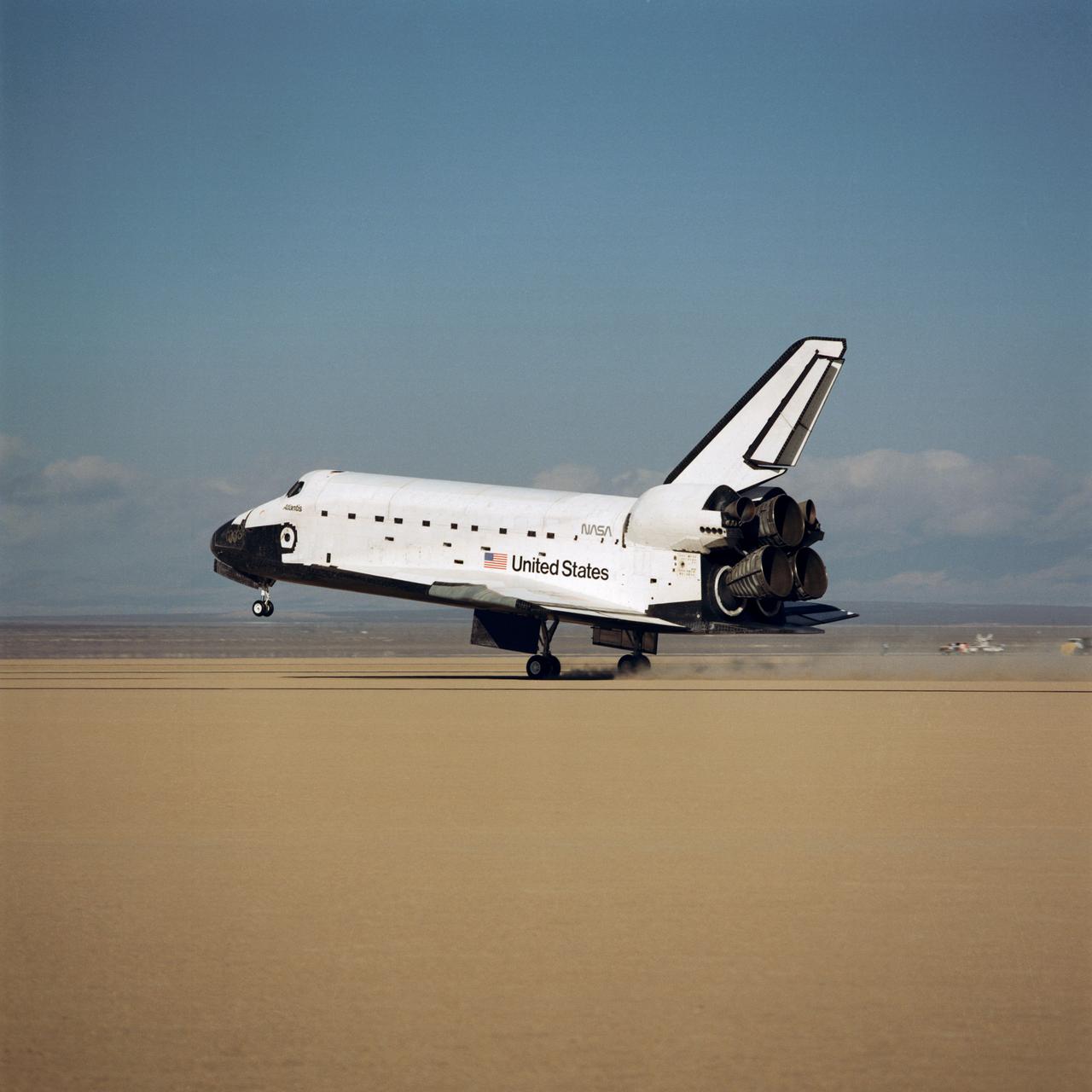
STS-34 Atlantis, Orbiter Vehicle (OV) 104, main landing gear (MLG) touches down on Runway 23 dry lake bed at Edwards Air Force Base (EAFB), California. The nose landing gear rides above runway before touchdown as the MLG wheels produce a cloud of dust. OV-104's port side profile is captured as it glides by at a speed of approximately 195 knots (224 miles per hour). The tail section with deployed speedbrake/rudder and space shuttle main engines (SSMEs) are visible.
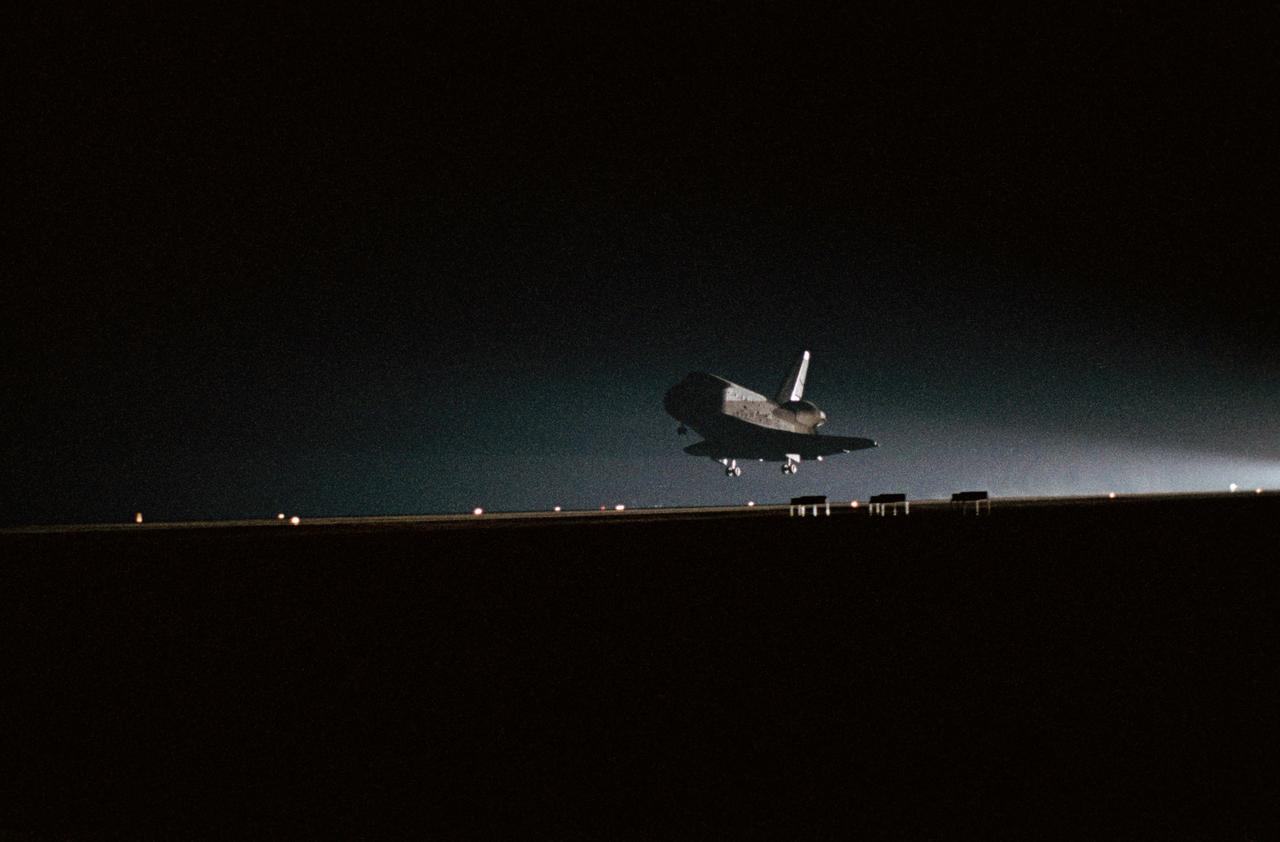
Night view, Challenger STS-8 as it is coming in for a landing. EDWARDS AFB (EAFB), CA
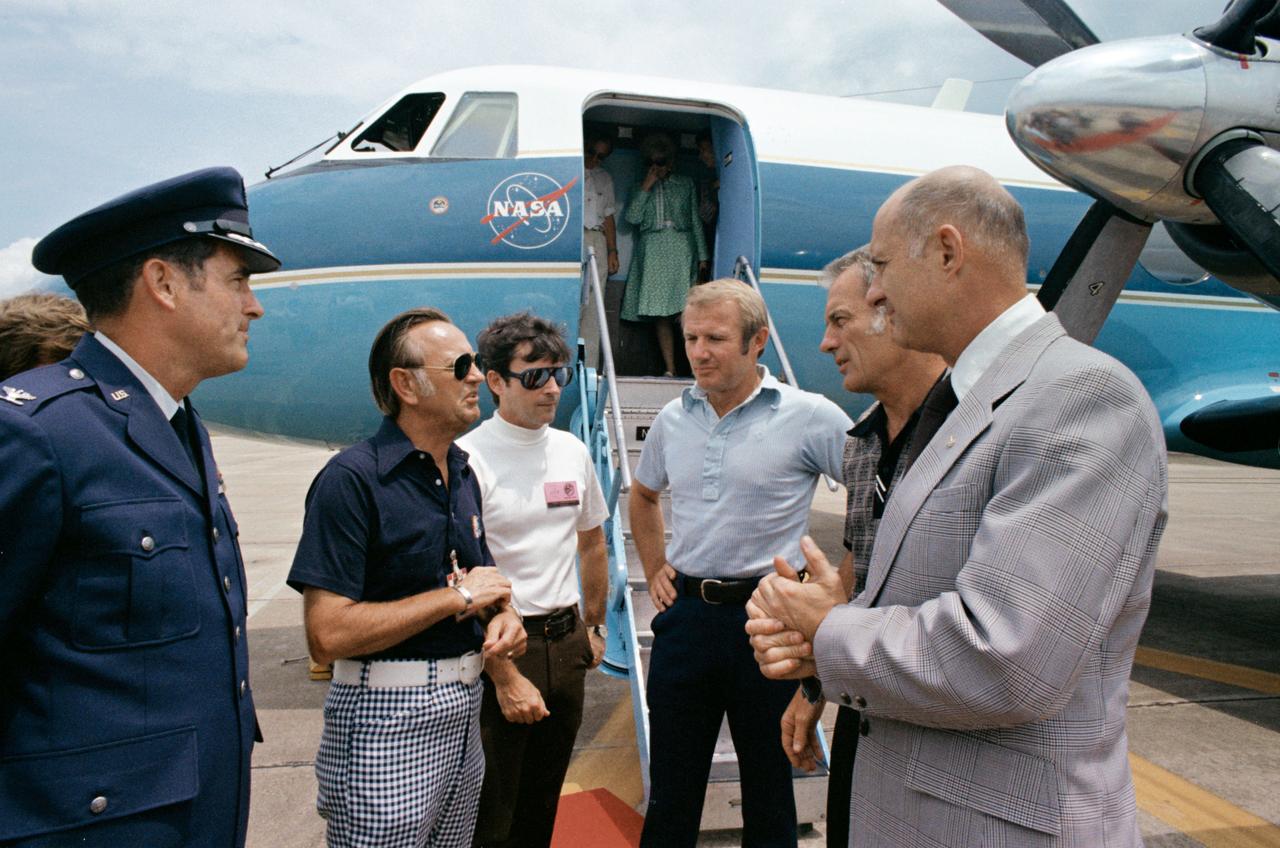
S75-30109 (10 Aug. 1975) --- Dr. Christopher C. Kraft Jr. (second from left), JSC Director, chats with the three ASTP crewmen on the runway at Ellington Air Force Base after their arrival home from the Pacific recovery area. The six men are, left to right, Col. Donald Robinson, EAFB commander; Dr. Kraft; astronaut John W. Young, Chief of the Astronaut Office at JSC; astronaut Vance D. Brand, command module pilot of the crew; astronaut Donald K. Slayton, docking module pilot of the crew; and astronaut Thomas P. Stafford, crew commander. This picture was taken prior to the official welcoming ceremonies. The crewmen?s wives are still aboard the plane. Medical treatment in Hawaii delayed the return of the crew to JSC. They suffered a pulmonary irritation from inhalation of a toxic gas minutes before splashdown on July 24, 1975.
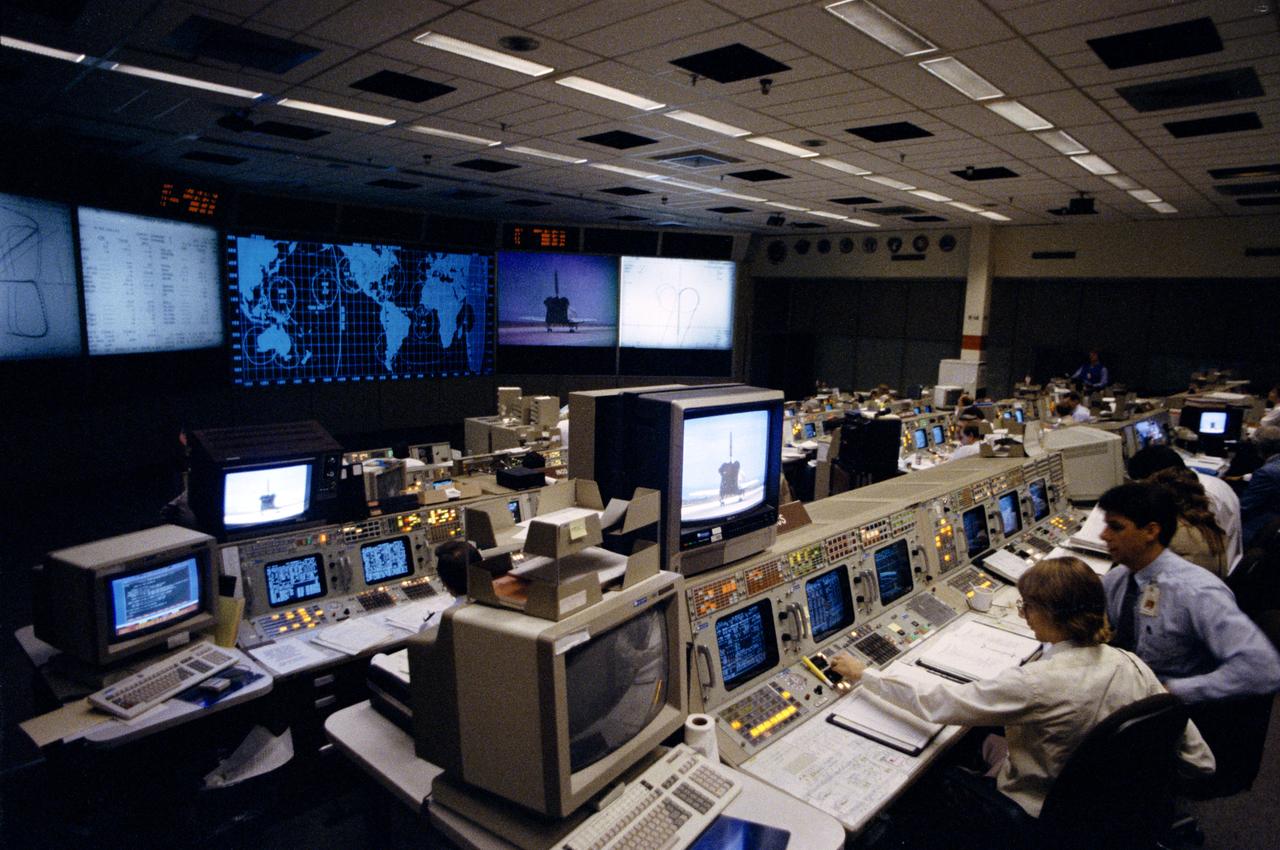
As STS-30 ends its mission with the landing of Atlantis, Orbiter Vehicle (OV) 104, at Edwards Air Force Base (EAFB), California, flight controllers monitor screens at their consoles in JSC Mission Control Center (MCC) Bldg 30. In the foreground is the Maintenance, Mechanical Arm, and Crew Systems Engineer (MMACS) console with R. Kevin McCluney studying data readouts. On the front visual displays are the tracking map and a tail view of OV-104 as it comes to a stop on EAFB concrete runway 22.
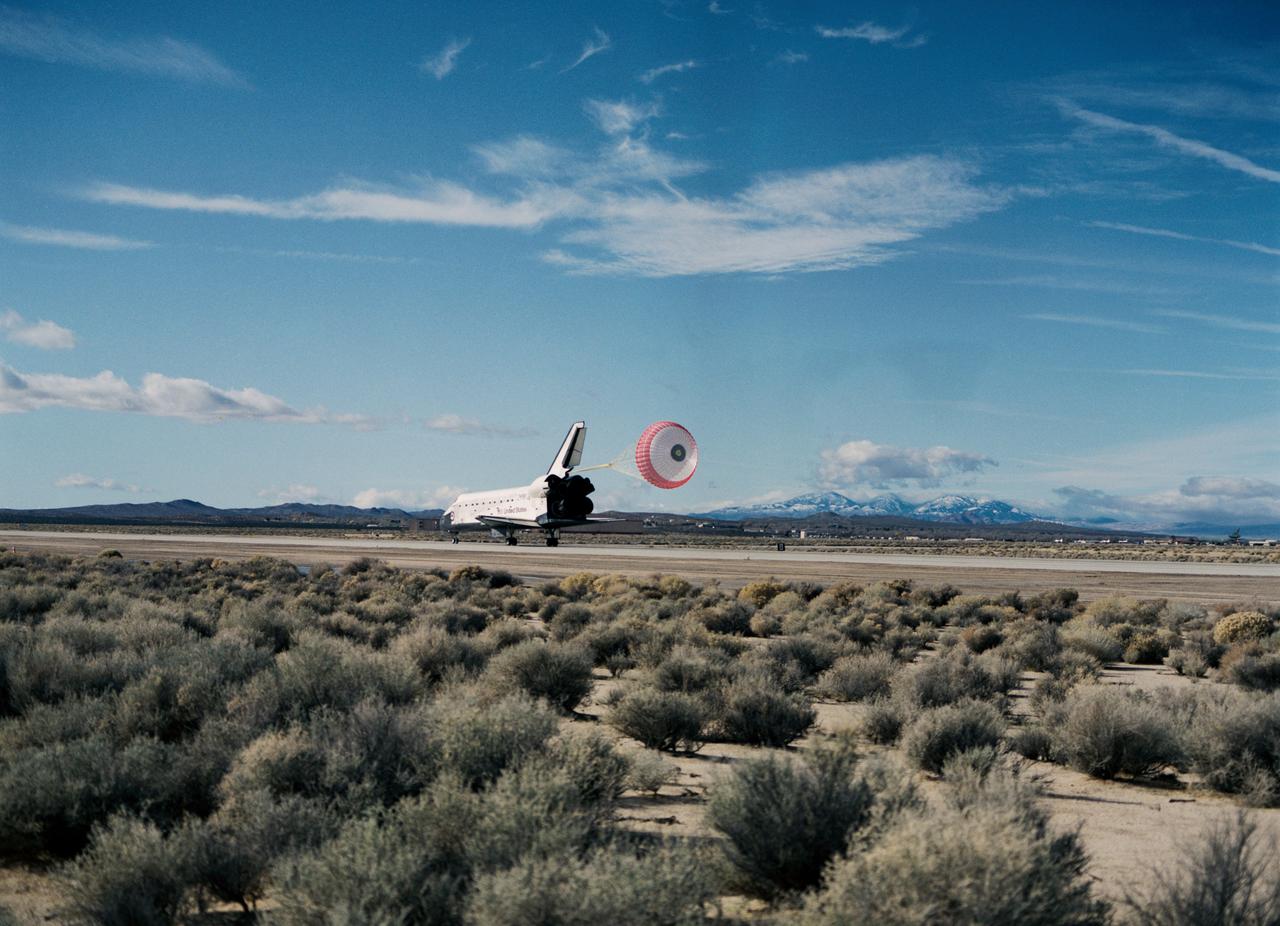
STS-53 Discovery, Orbiter Vehicle (OV) 103, is slowed by a red, white, and blue drag chute during its landing on concrete runway 22 at Edwards Air Force Base (EAFB), California. Main landing gear (MLG) touchdown occurred at 12:43:17 pm (Pacific Standard Time (PST)). This aft view of OV-103 shows the drag chute deployed from its compartment at the base of the vertical tail, the speedbrake/rudder flaps open, and the space shuttle main engines (SSMEs). Both MLG and nose landing gear (NLG) ride along the runway surface. Desert scrub brush appears in the foreground and mountains are seen in the background.
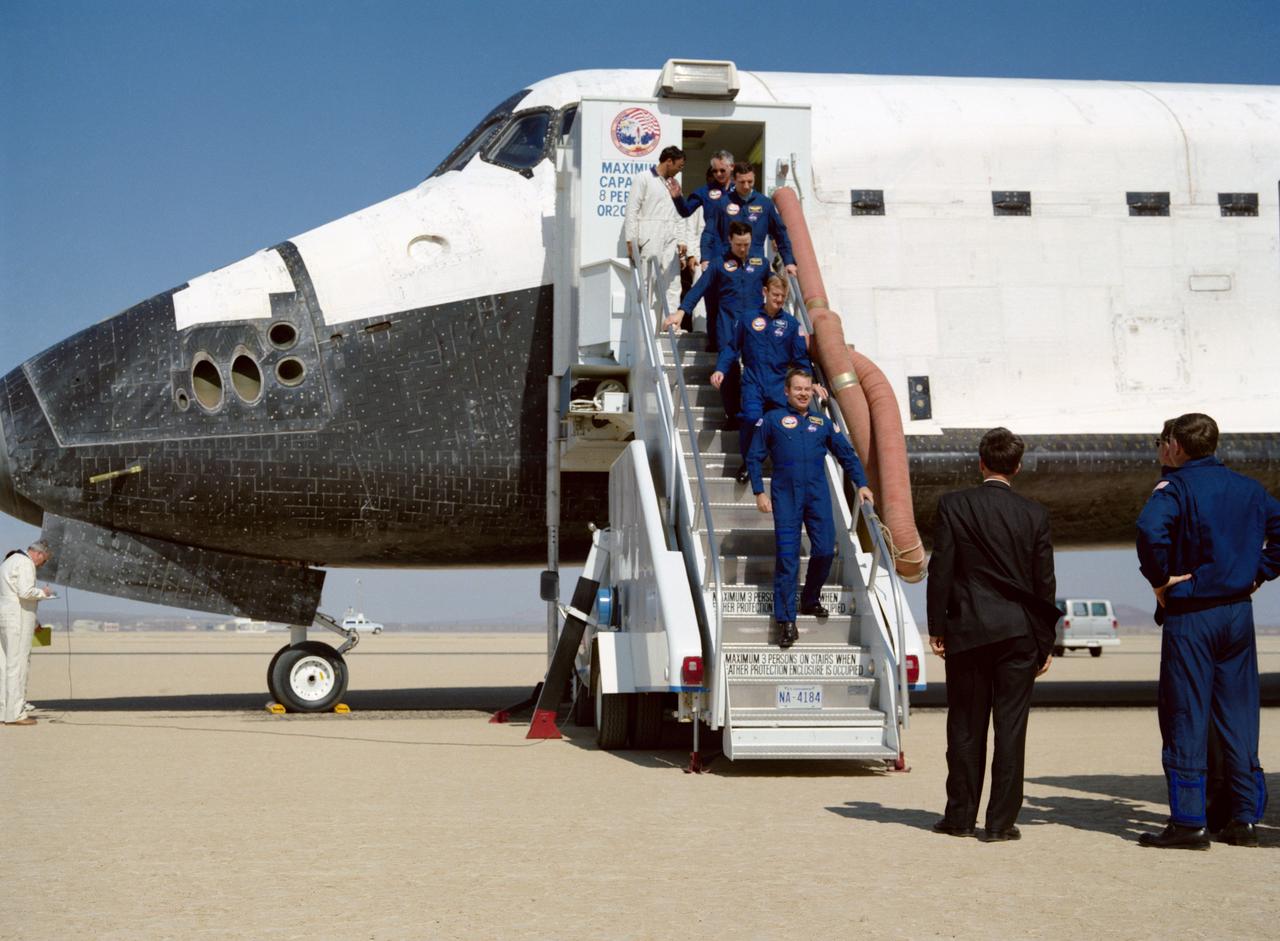
STS-36 crewmembers egress Atlantis, Orbiter Vehicle (OV) 104, via mobile stairway following touchdown on Runway 23 drylake bed at Edwards Air Force Base (EAFB), California. Commander John O. Creighton, leading crewmembers down the stairway, is followed by Pilot John H. Casper, Mission Specialist (MS) Pierre J. Thuot, MS David C. Hilmers, and MS Richard M. Mullane. On the runway, Acting NASA Associate Administrator for Space Flight Dr. William B. Lenoir, JSC Flight Crew Operations Directorate Director Donald R. Puddy, and JSC Astronaut Office Acting Chief Michael L. Coats wait to greet crewmembers.
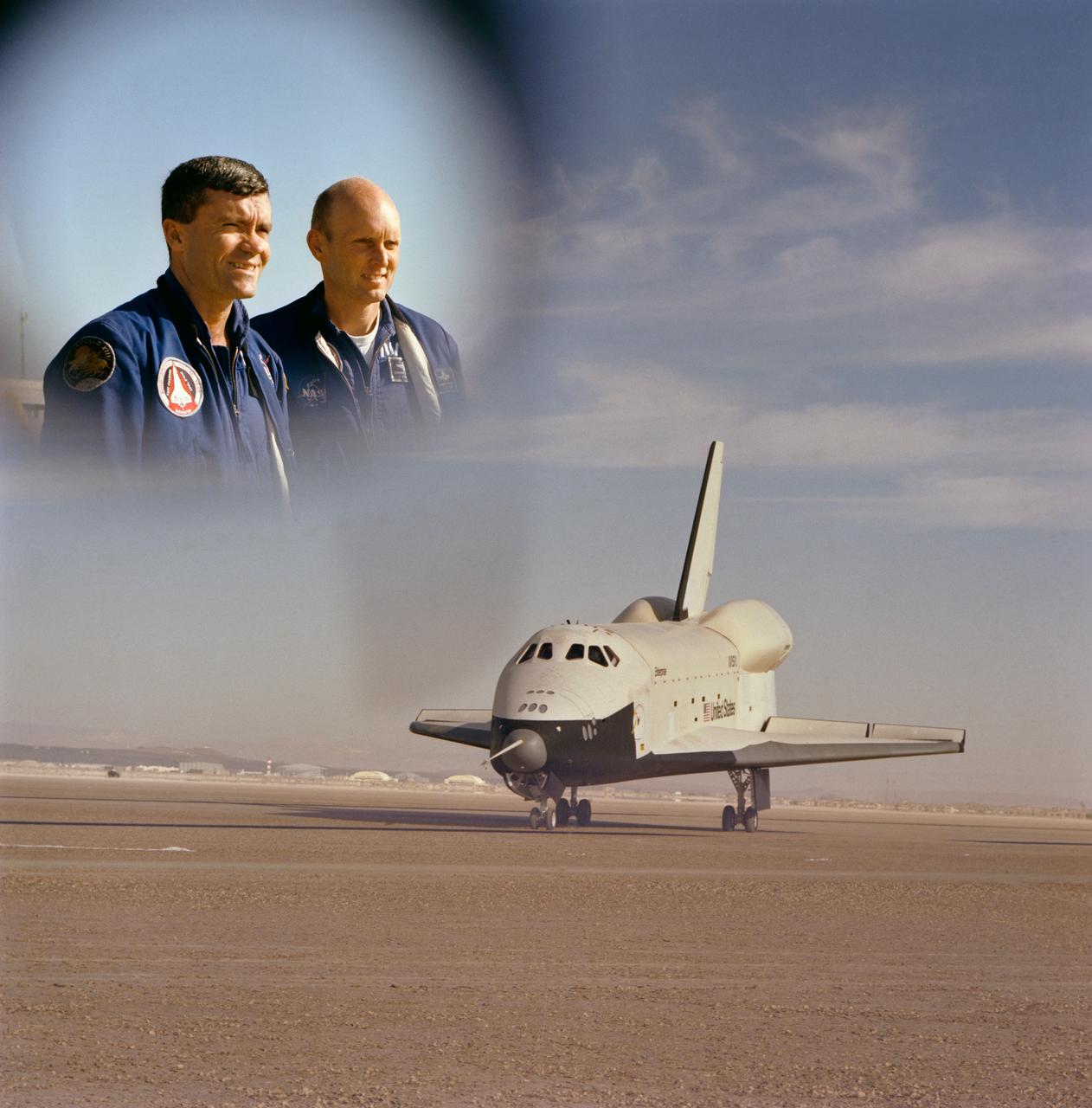
Public Affairs Office (PAO) release print of activity documenting third "free flight" of Shuttle Orbiter 101 Spacecraft at DFRC, Edwards Air Force Base (EAFB), CA. Enterprise is parked on the runway - Haise (left), Commander, and Fullerton, Pilot, are in the inset.
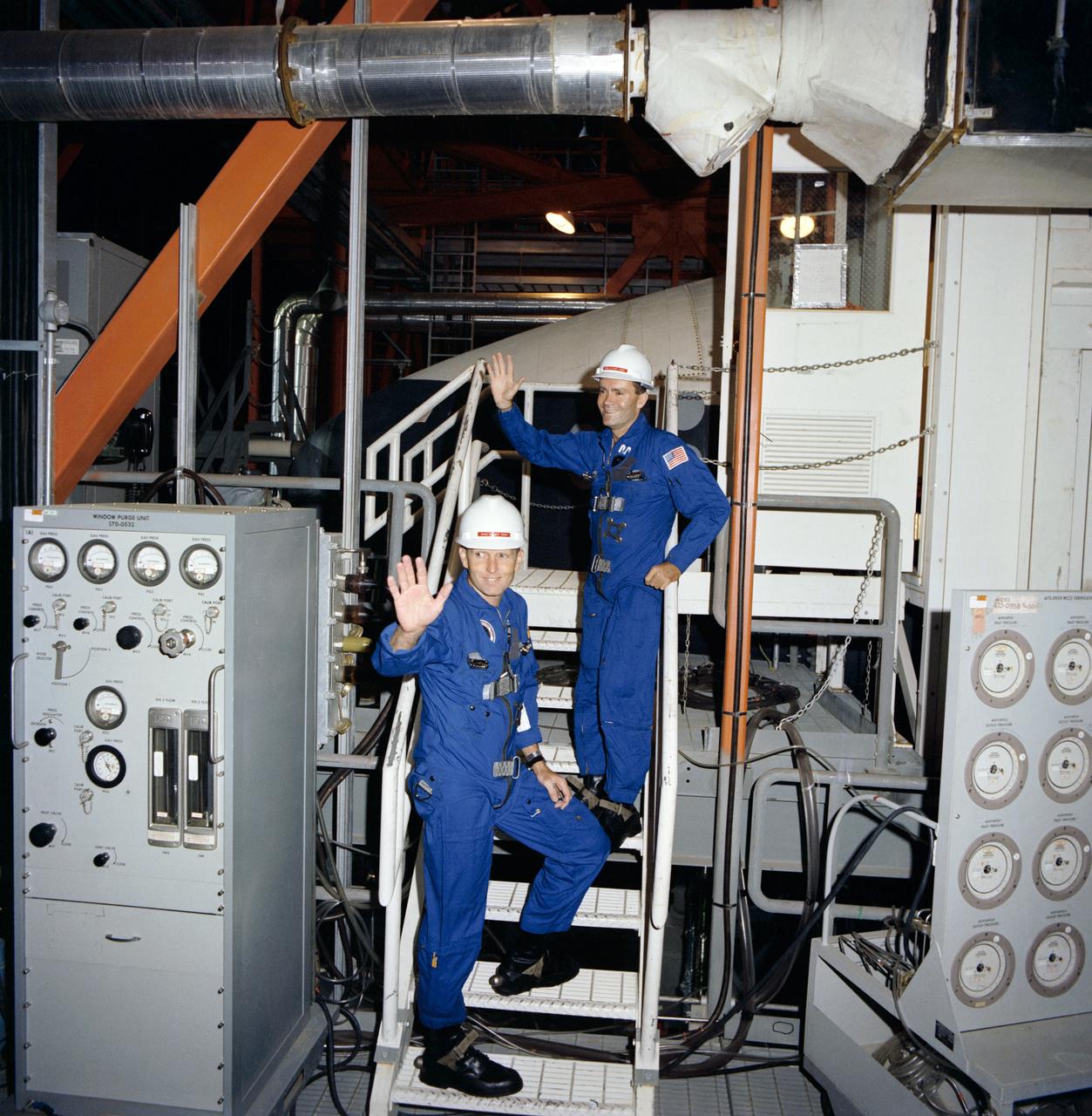
Public Affairs Office (PAO) release print of activity documenting third "free flight" of Shuttle Orbiter 101 Spacecraft at DFRC, Edwards Air Force Base (EAFB), CA. Astronauts Haise and Fullerton arrive at the Mate-Demate Device (MDD) and greet technicians prior to ingress.
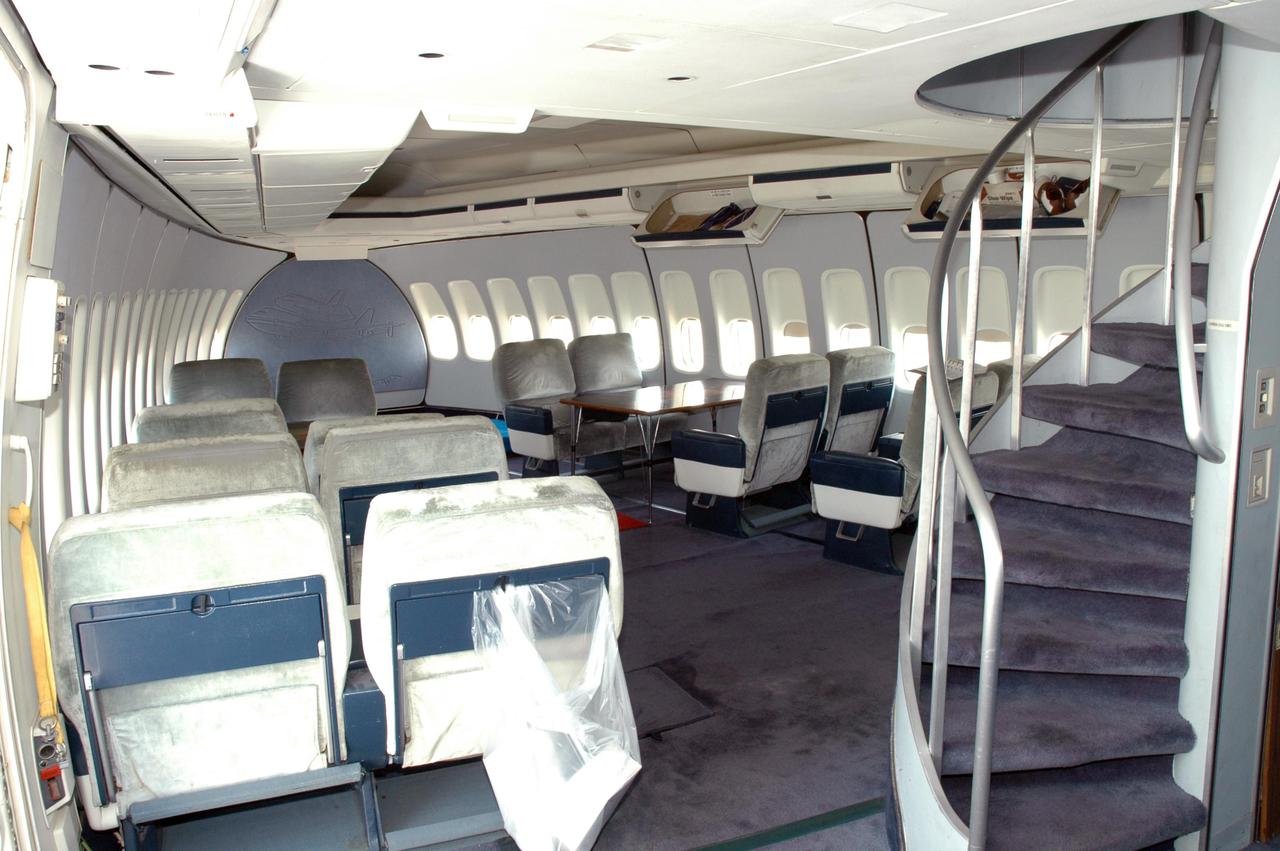
KENNEDY SPACE CENTER, FLA. - A view inside the Shuttle Carrier Aircraft, a modified Boeing 747. The plane carried the orbiter Discovery on a ferry flight to NASA Kennedy Space Center from Edwards Air Force Base in California, arriving Aug. 21. Returning to Earth from Return to Flight mission STS-114, Discovery landed at Edwards Aug. 9 after waive-off from KSC due to weather concerns.
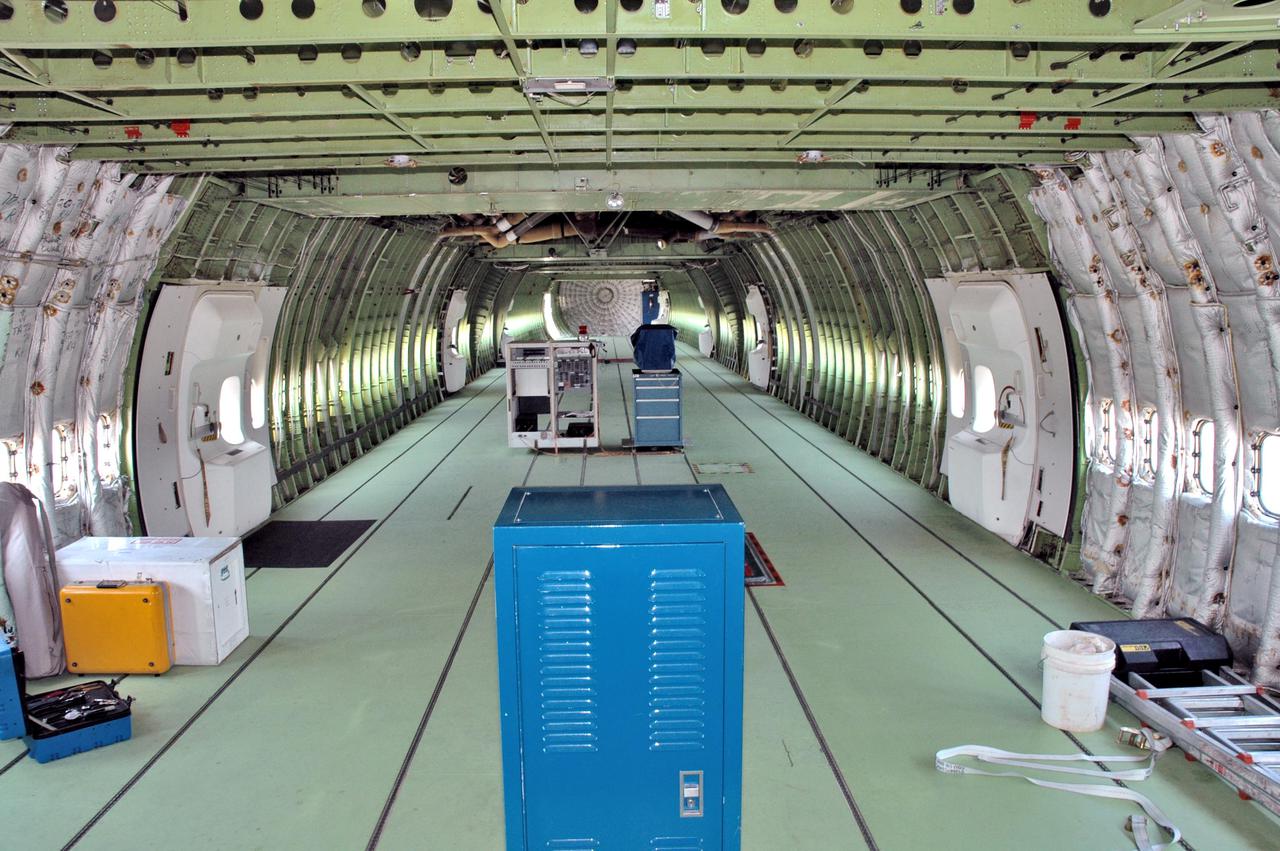
KENNEDY SPACE CENTER, FLA. - A view inside the Shuttle Carrier Aircraft, a modified Boeing 747. The plane carried the orbiter Discovery on a ferry flight to NASA Kennedy Space Center from Edwards Air Force Base in California, arriving Aug. 21. Returning to Earth from Return to Flight mission STS-114, Discovery landed at Edwards Aug. 9 after waive-off from KSC due to weather concerns.
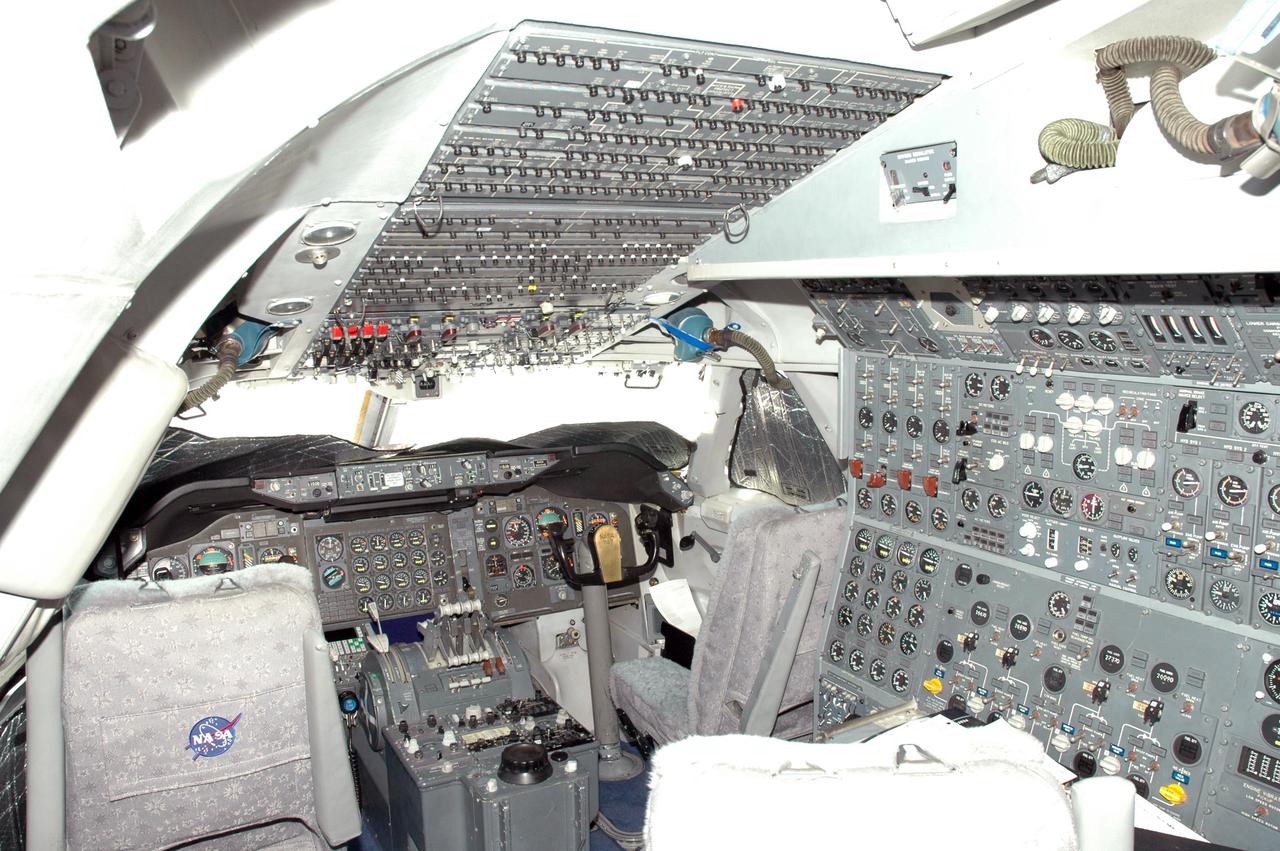
KENNEDY SPACE CENTER, FLA. - A view inside the Shuttle Carrier Aircraft, a modified Boeing 747. The plane carried the orbiter Discovery on a ferry flight to NASA Kennedy Space Center from Edwards Air Force Base in California, arriving Aug. 21. Returning to Earth from Return to Flight mission STS-114, Discovery landed at Edwards Aug. 9 after waive-off from KSC due to weather concerns.
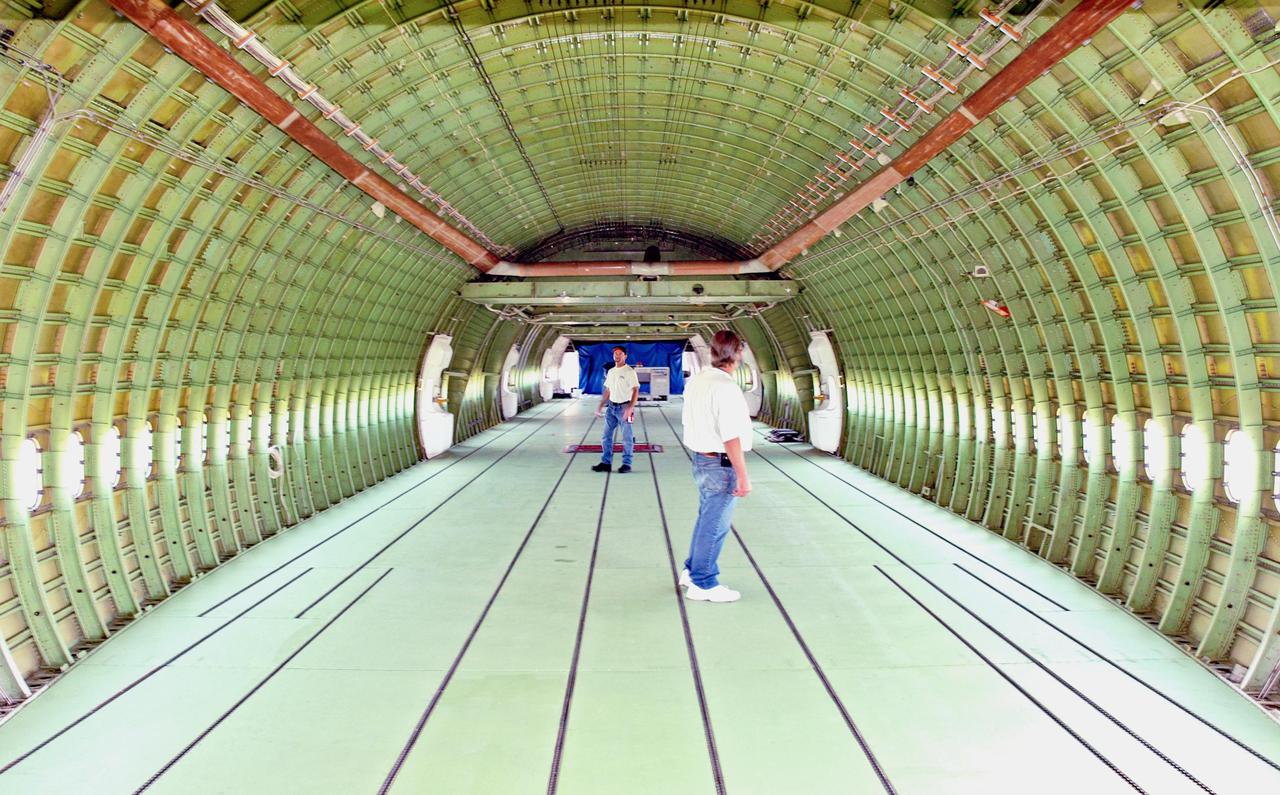
KENNEDY SPACE CENTER, FLA. - A view inside the Shuttle Carrier Aircraft, a modified Boeing 747. The plane carried the orbiter Discovery on a ferry flight to NASA Kennedy Space Center from Edwards Air Force Base in California, arriving Aug. 21. Returning to Earth from Return to Flight mission STS-114, Discovery landed at Edwards Aug. 9 after waive-off from KSC due to weather concerns.
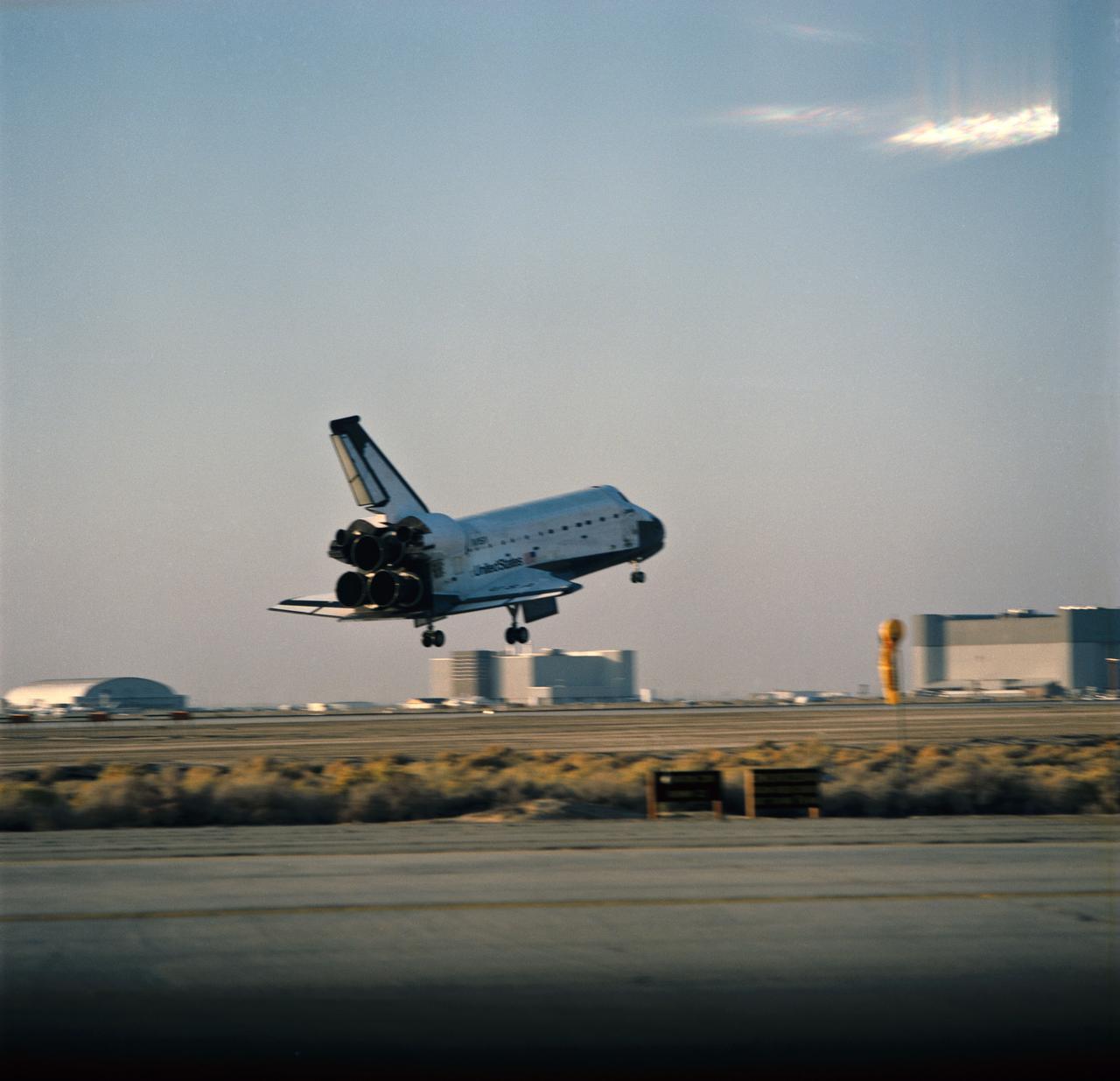
STS58-S-126 (1 Nov 1993) --- The Space Shuttle Columbia is about to touch down on the runway at Edwards Air Force Base (EAFB) in California. The landing, which occurred at 7:06 a.m. (PST), November 1, 1993, completed a two week mission in space devoted to medical research. Onboard the spacecraft were astronauts John E. Blaha, Richard A. Searfoss, Rhea Seddon, Shannon W. Lucid, David A. Wolf and William S. McArthur along with payload specialist Martin J. Fettman, DVM.
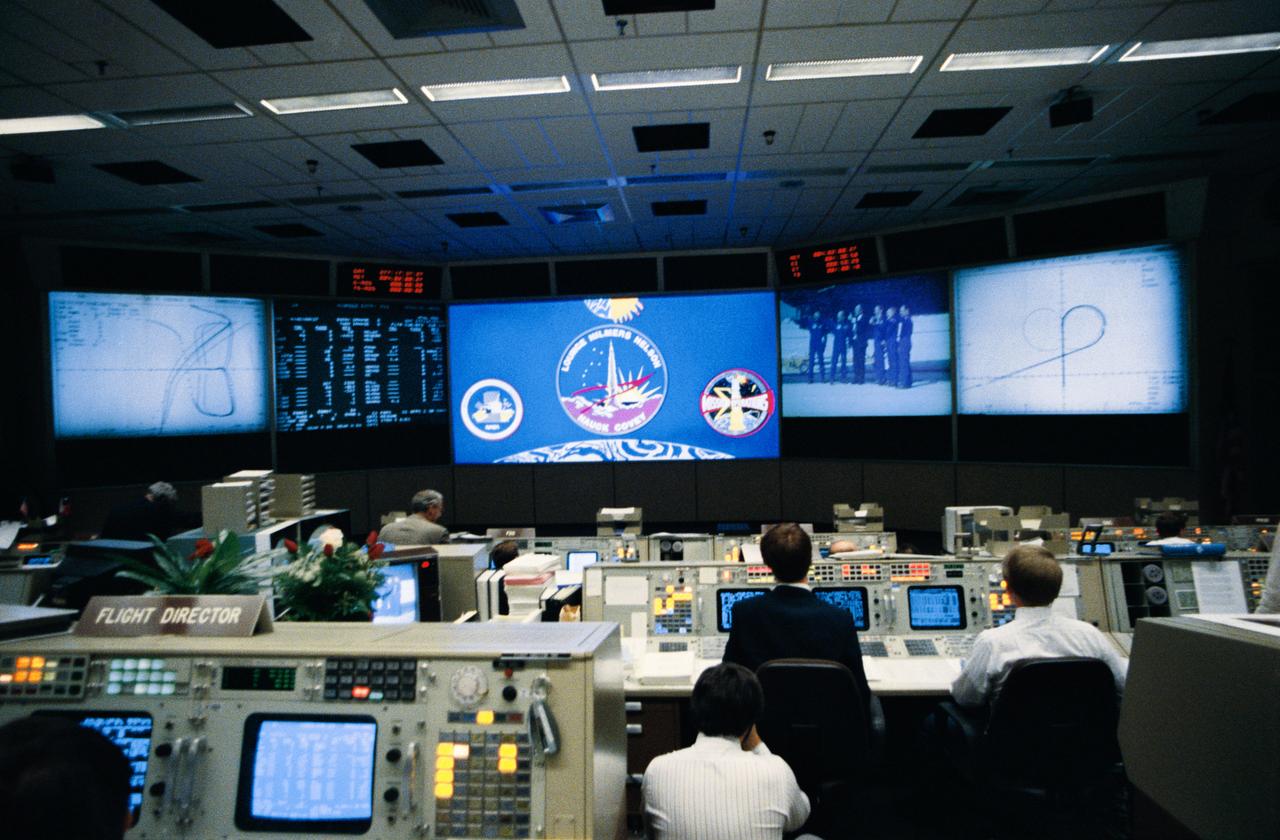
JSC Mission Control Center (MCC) Bldg 30 flight control room (FCR) personnel monitor STS-26 post landing activities and ceremonies at Edwards Air Force Base (EAFB) via their monitors. Displayed on front screens are approach and landing diagrams, data, the space shuttle program insignia, the STS-26 mission insignia, the Mission Operations Directorate insignia, and the STS-26 crew standing in front of Discovery, Orbiter Vehicle (OV) 103.
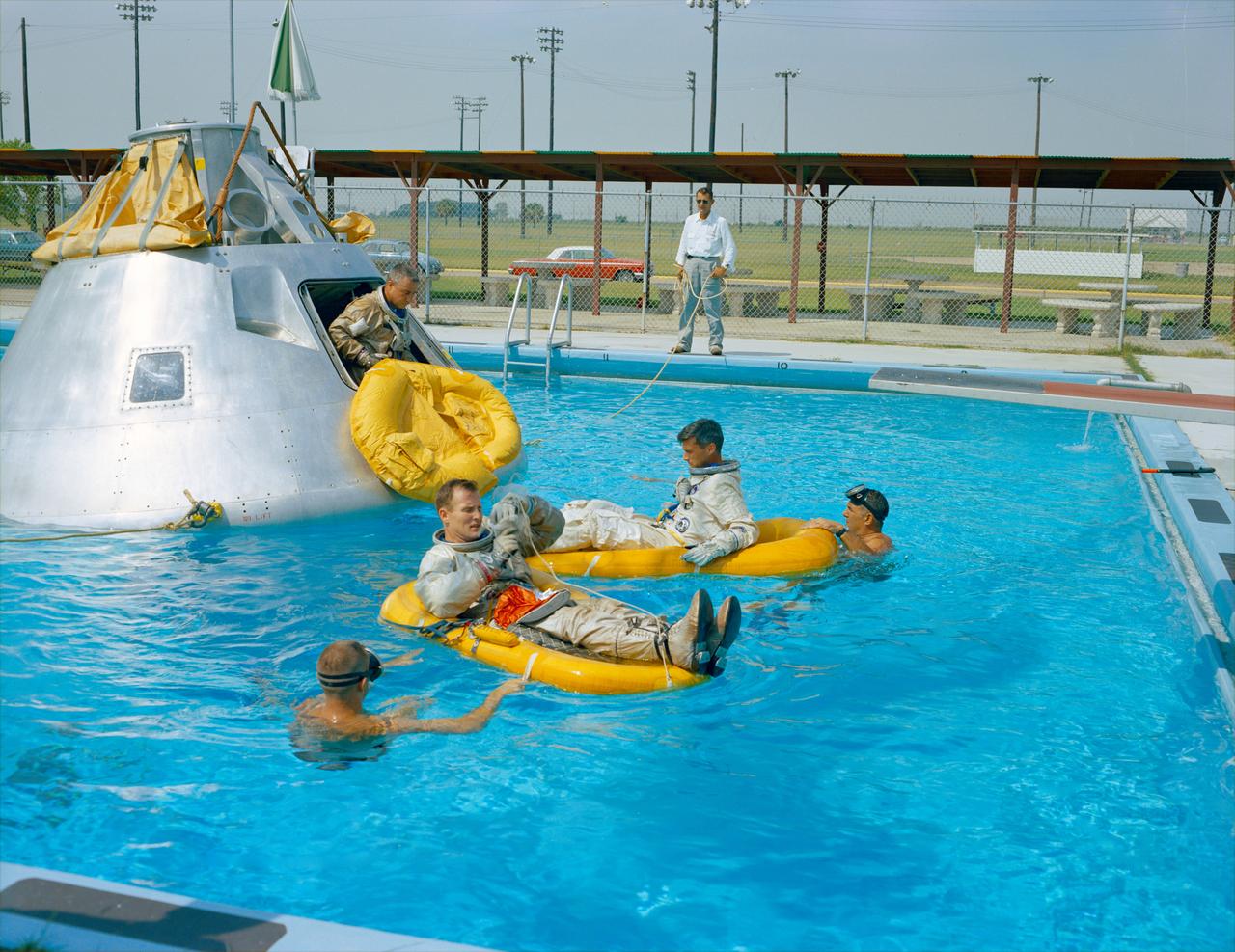
Boilerplate (B/P) model of the Apollo Spacecraft resting nose down in the swimming pool at EAFB during a training session with the first (1st) crew named by NASA. NASA swimmers are in the water to assist during the practice session. Inside the spacecraft are Astronauts Roger B. Chaffee, and Edward H. White II, members of the crew. Astronaut Virgial I. Grissom is visible in the entrance to the craft.
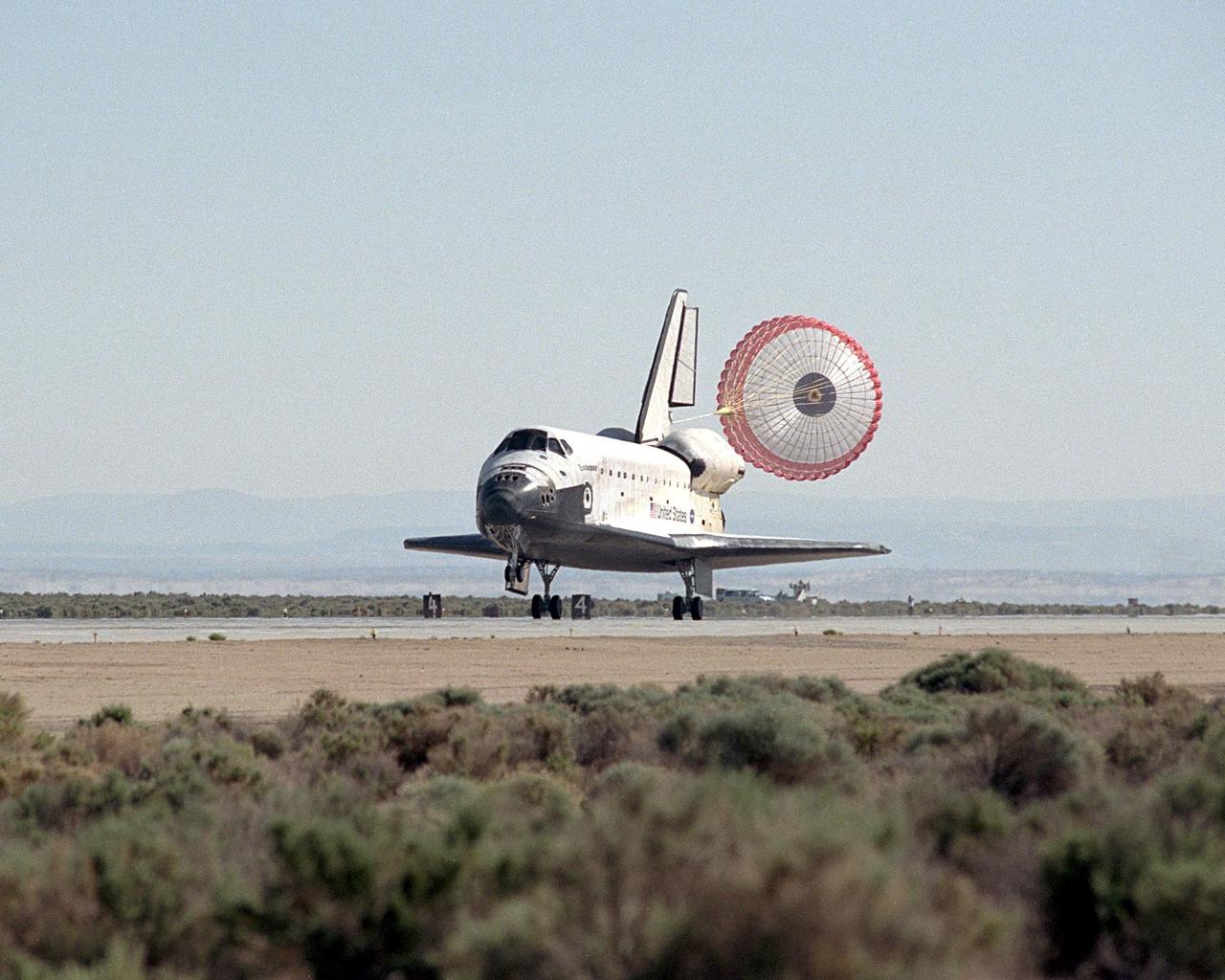
NASA/EDWARDS AFB, CALIF. -- With its drag chute deployed, Endeavour lands on runway 22 at Edwards Air Force Base, Calif., at 12:10:42 p.m. EDT after a mission of 11 days, 12 hours, 54 minutes to the International Space Station on mission STS-100. The orbiter and its crew of seven logged about 4.9 million statute miles in 186 orbits. Due to unfavorable weather conditions, landing at KSC was waved off. The landing marked the third consecutive landing at EAFB.
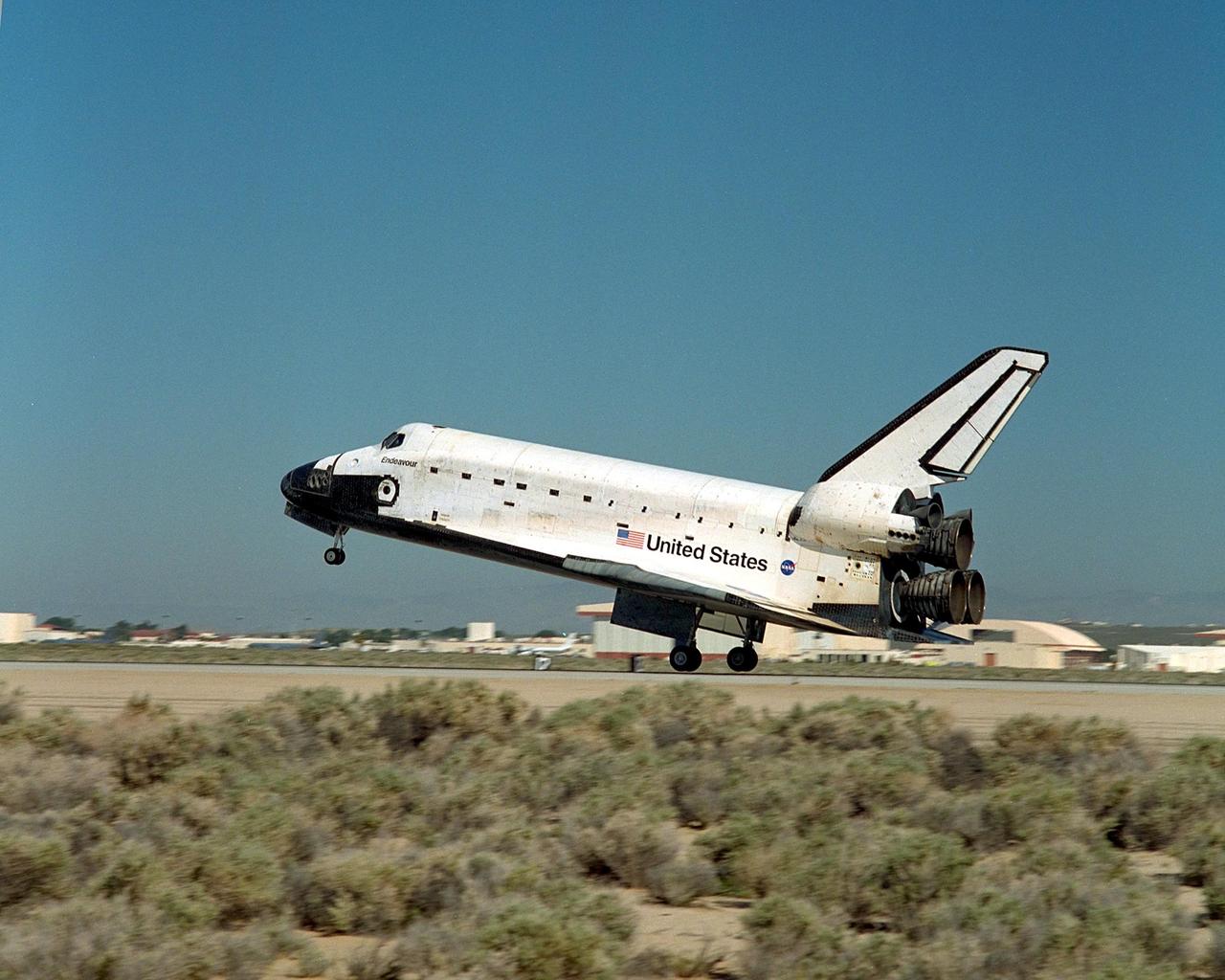
NASA/EDWARDS AFB, CALIF. -- Endeavour’s rear wheels touch down on runway 22 at Edwards Air Force Base, Calif., after the 11-day, 12-hour, 54-minute mission STS-100 to the International Space Station. Landing time was 12:10:42 p.m. EDT. The orbiter and its crew of seven logged about 4.9 million statute miles in 186 orbits. Due to unfavorable weather conditions, landing at KSC was waved off. The landing marked the third consecutive landing at EAFB.
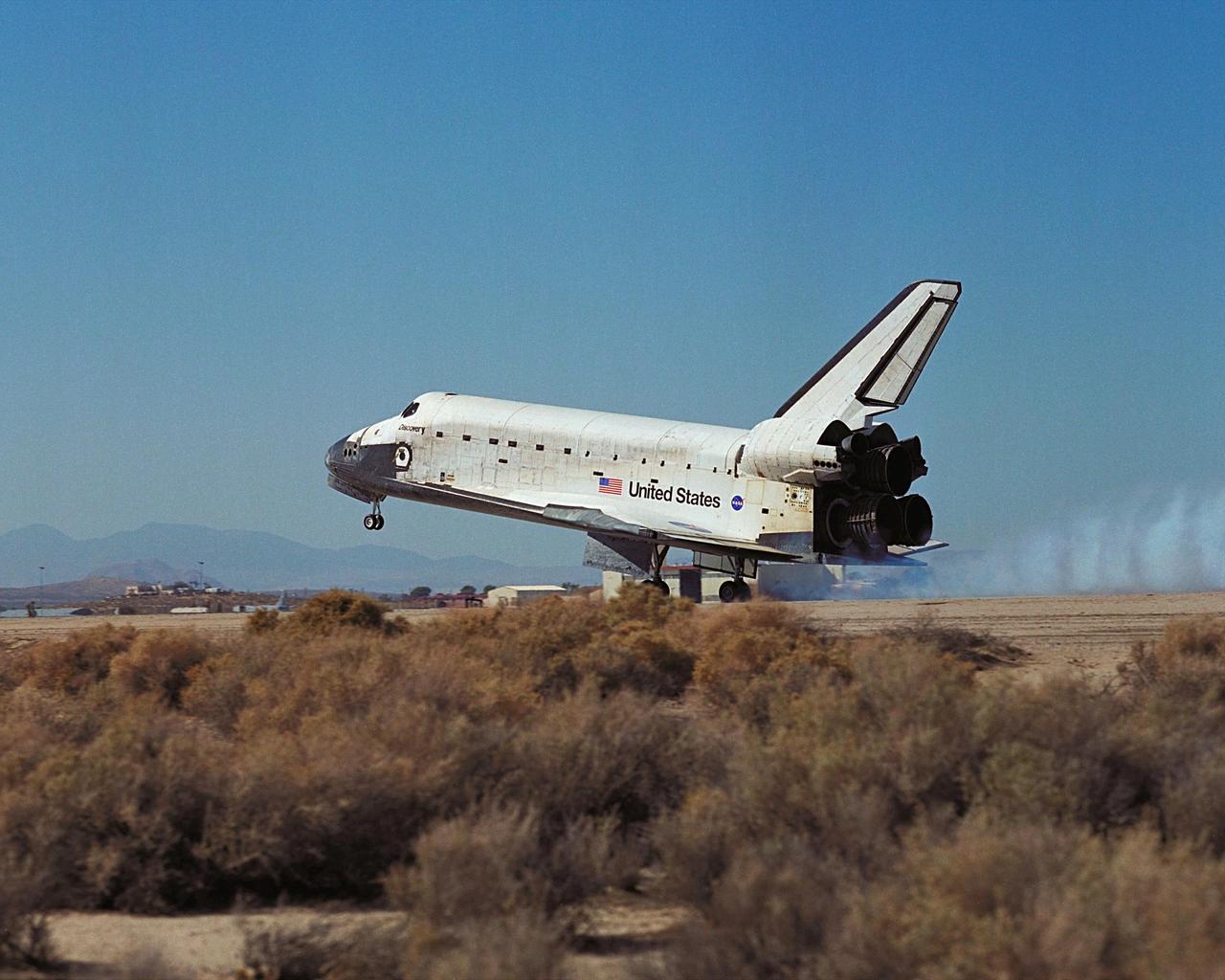
Viewed from the side, orbiter Discovery, with its seven-member crew, touches down on the landing strip at Edwards Air Force Base, Calif., after an 11-day mission to the International Space Station. The orbiter’s main landing gear touched down on EAFB runway 22 at 5 p.m. With the aid of its drag chute, Discovery came to a complete stop at 5:01 p.m. At the conclusion of mission STS-92, Discovery and crew had traveled about 5.3 million statute miles. Following vehicle safing and preliminary offloading efforts, workers will begin preparations for Discovery’s transcontinental ferry flight back to KSC on the back of NASA’s modified Boeing 747
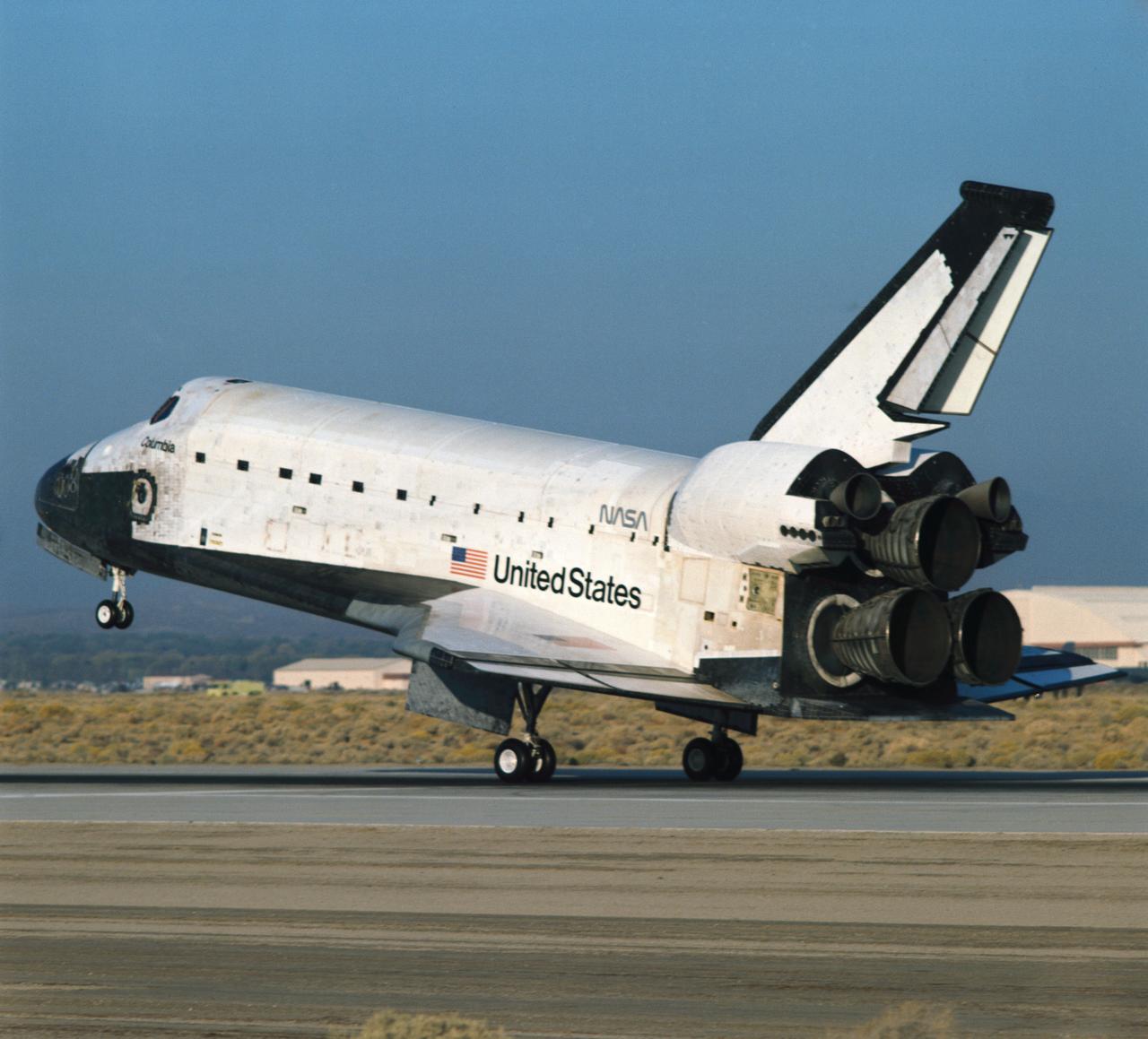
STS058-S-128 (1 Nov 1993) --- The nose gear of the Space Shuttle Columbia is about to touch down on the runway at Edwards Air Force Base (EAFB) in California. The landing, which occurred at 7:06 a.m. (PST), November 1, 1993, completed a two week mission in space devoted to medical research. Onboard the spacecraft were astronauts John E. Blaha, Richard A. Searfoss, Rhea Seddon, Shannon W. Lucid, David A. Wolf and William S. McArthur along with payload specialist Martin J. Fettman, DVM.
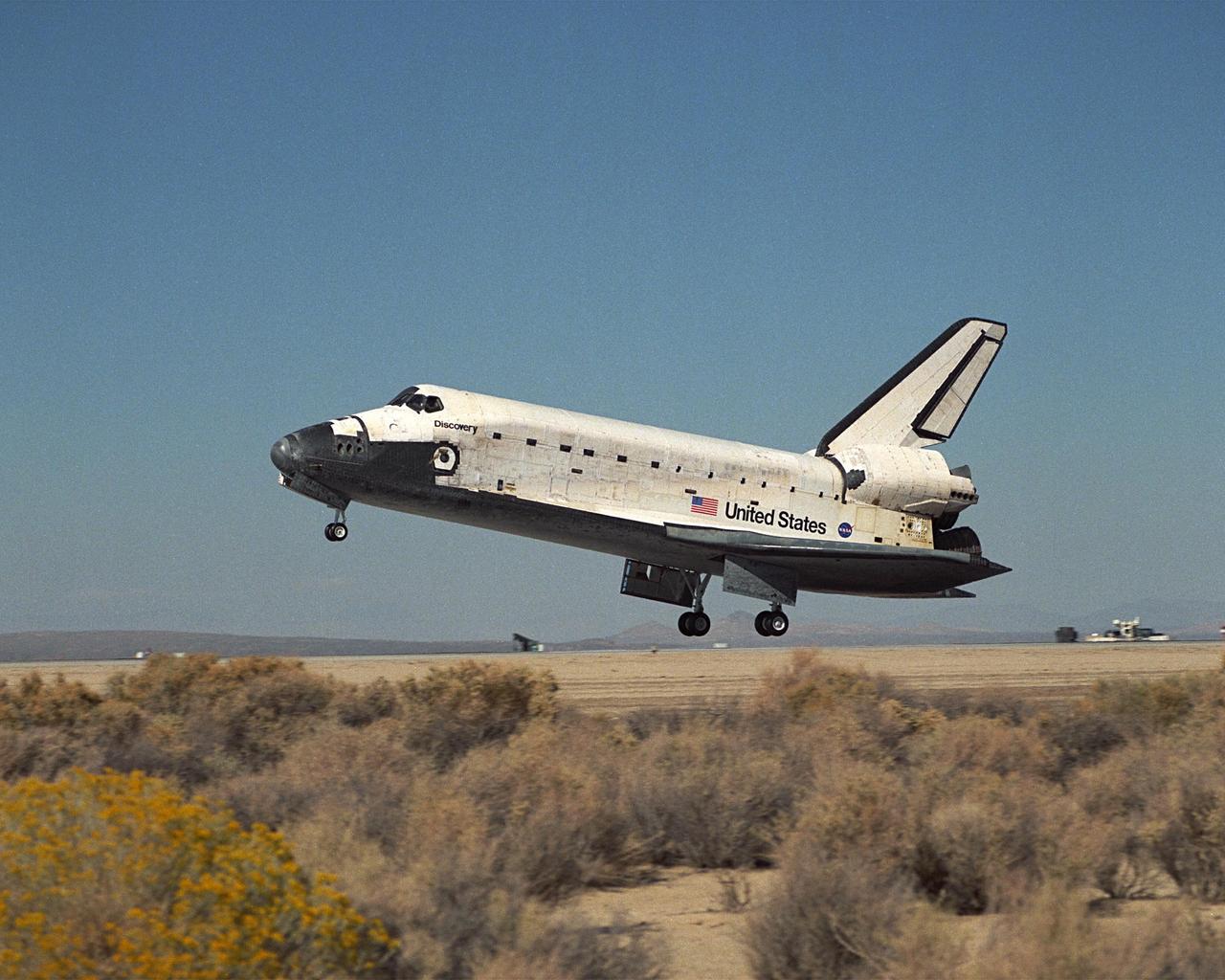
Viewed from the side, orbiter Discovery, with its seven-member crew, is about to touch down on the landing strip at Edwards Air Force Base, Calif., after an 11-day mission to the International Space Station. The orbiter’s main landing gear touched down on EAFB runway 22 at 5 p.m. With the aid of its drag chute, Discovery came to a complete stop at 5:01 p.m. At the conclusion of mission STS-92, Discovery and crew had traveled about 5.3 million statute miles. Following vehicle safing and preliminary offloading efforts, workers will begin preparations for Discovery’s transcontinental ferry flight back to KSC on the back of NASA’s modified Boeing 747
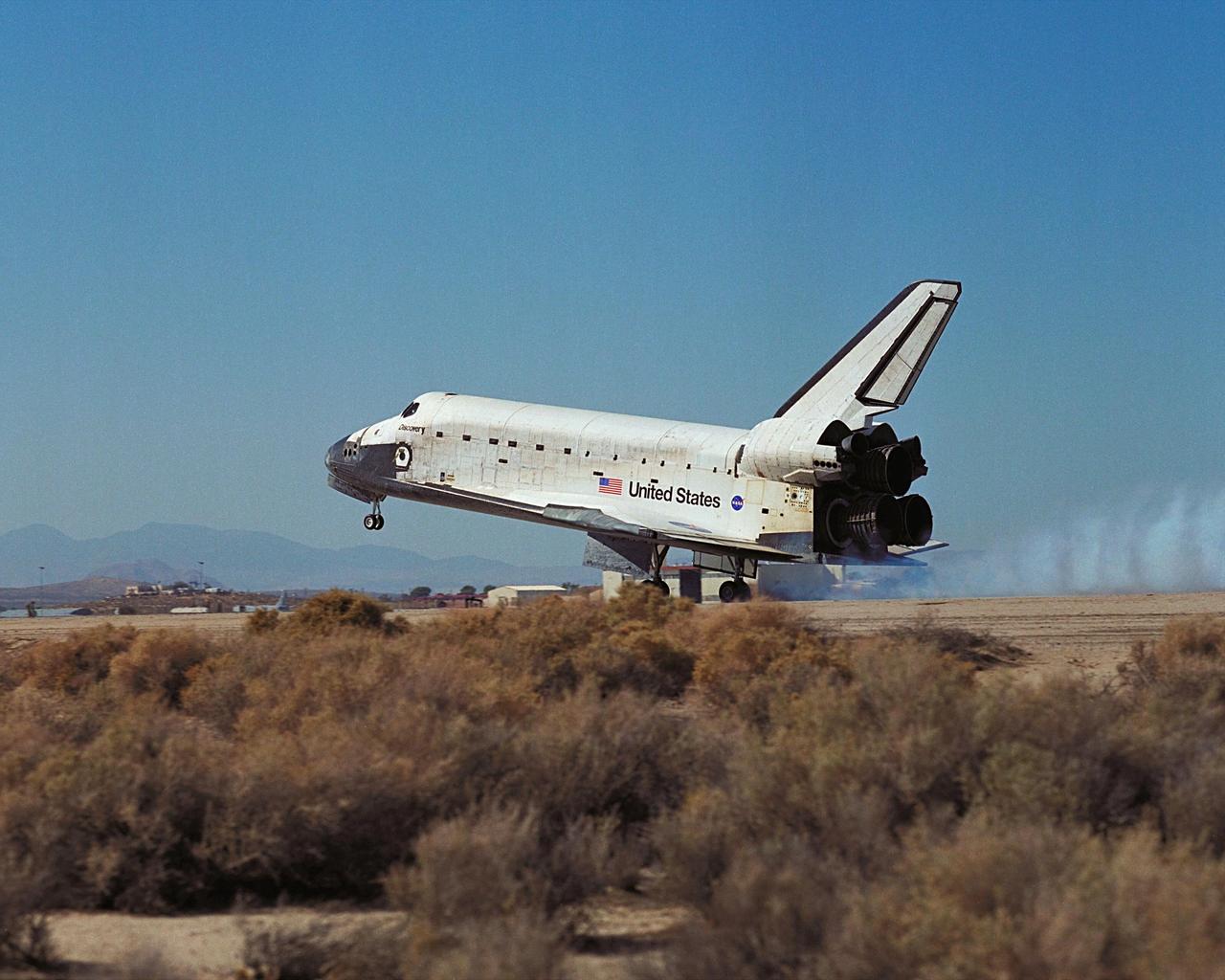
Viewed from the side, orbiter Discovery, with its seven-member crew, touches down on the landing strip at Edwards Air Force Base, Calif., after an 11-day mission to the International Space Station. The orbiter’s main landing gear touched down on EAFB runway 22 at 5 p.m. With the aid of its drag chute, Discovery came to a complete stop at 5:01 p.m. At the conclusion of mission STS-92, Discovery and crew had traveled about 5.3 million statute miles. Following vehicle safing and preliminary offloading efforts, workers will begin preparations for Discovery’s transcontinental ferry flight back to KSC on the back of NASA’s modified Boeing 747
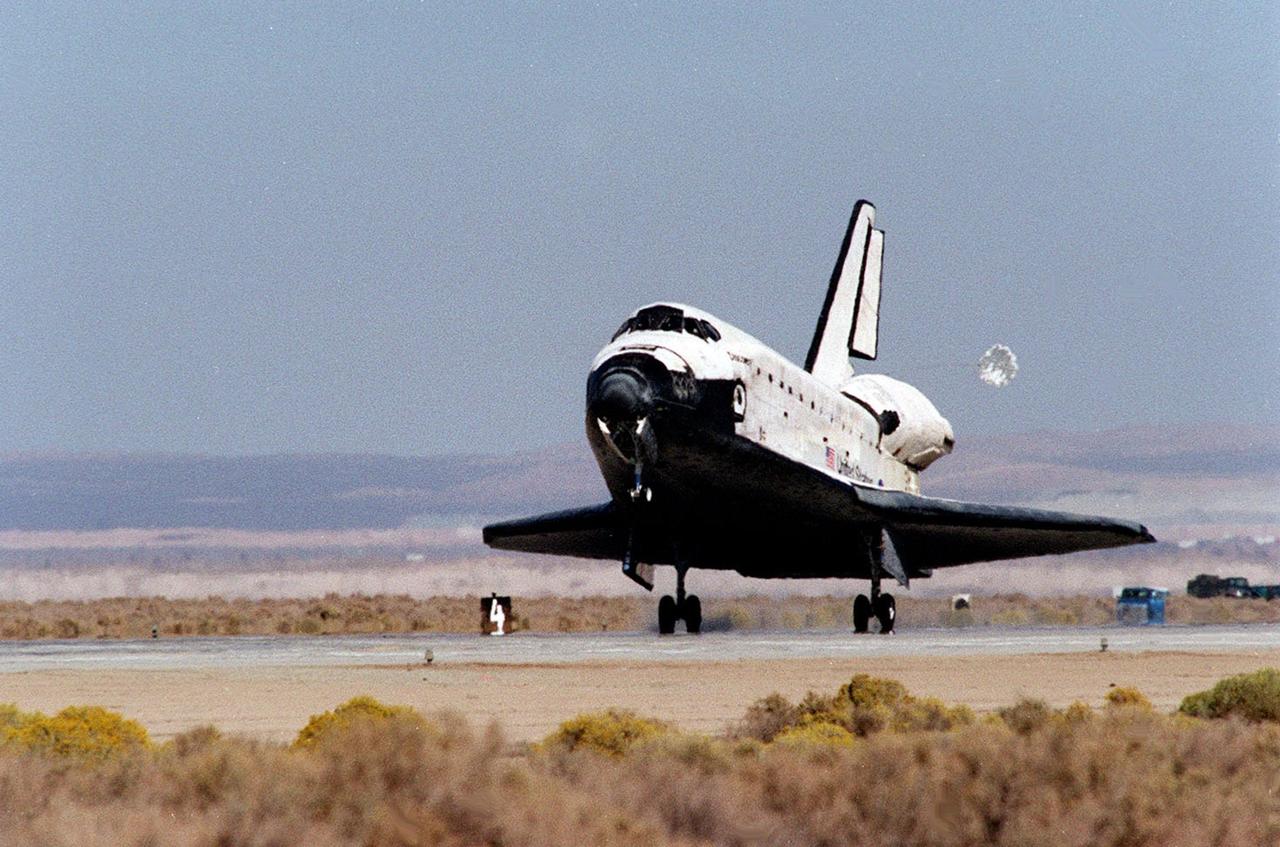
With its drag chute deployed, orbiter Discovery and its seven-member crew roll toward a stop at Edwards Air Force Base, Calif., after an 11-day mission to the International Space Station. The orbiter’s main landing gear touched down on EAFB runway 22 at 5 p.m. With the aid of its drag chute, Discovery came to a complete stop at 5:01 p.m. At the conclusion of mission STS-92, Discovery and crew had traveled about 5.3 million statute miles. Following vehicle safing and preliminary offloading efforts, workers will begin preparations for Discovery’s transcontinental ferry flight back to KSC on the back of NASA’s modified Boeing 747
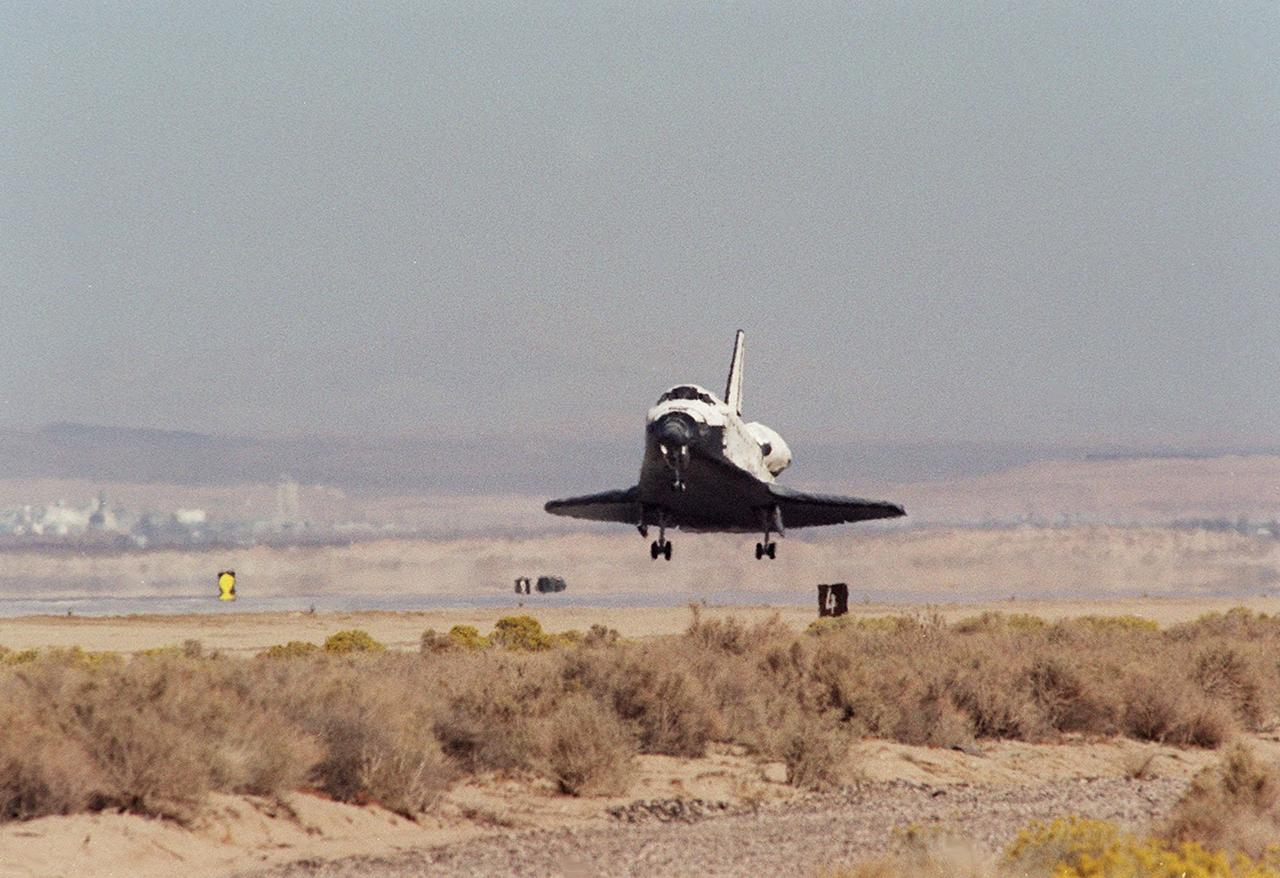
Orbiter Discovery, with its seven-member crew, approaches the landing strip at Edwards Air Force Base, Calif., after an 11-day mission to the International Space Station. The orbiter’s main landing gear touched down on EAFB runway 22 at 5 p.m. With the aid of its drag chute, Discovery came to a complete stop at 5:01 p.m. At the conclusion of mission STS-92, Discovery and crew had traveled about 5.3 million statute miles. Following vehicle safing and preliminary offloading efforts, workers will begin preparations for Discovery’s transcontinental ferry flight back to KSC on the back of NASA’s modified Boeing 747
Orbiter Discovery, with its seven-member crew, touches down on the landing strip at Edwards Air Force Base, Calif., after an 11-day mission to the International Space Station. The orbiter’s main landing gear touched down on EAFB runway 22 at 5 p.m. With the aid of its drag chute, Discovery came to a complete stop at 5:01 p.m. At the conclusion of mission STS-92, Discovery and crew had traveled about 5.3 million statute miles. Following vehicle safing and preliminary offloading efforts, workers will begin preparations for Discovery’s transcontinental ferry flight back to KSC on the back of NASA’s modified Boeing 747
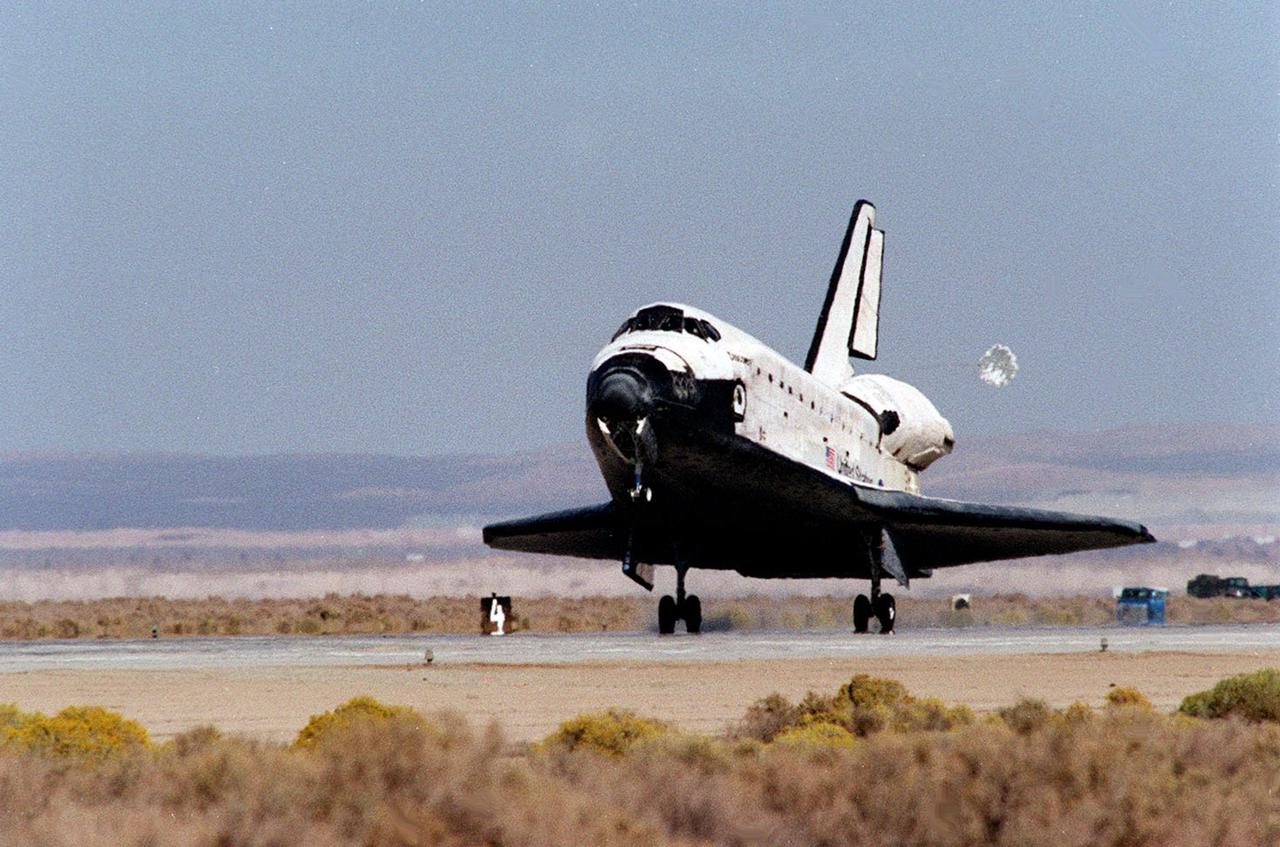
With its drag chute deployed, orbiter Discovery and its seven-member crew roll toward a stop at Edwards Air Force Base, Calif., after an 11-day mission to the International Space Station. The orbiter’s main landing gear touched down on EAFB runway 22 at 5 p.m. With the aid of its drag chute, Discovery came to a complete stop at 5:01 p.m. At the conclusion of mission STS-92, Discovery and crew had traveled about 5.3 million statute miles. Following vehicle safing and preliminary offloading efforts, workers will begin preparations for Discovery’s transcontinental ferry flight back to KSC on the back of NASA’s modified Boeing 747
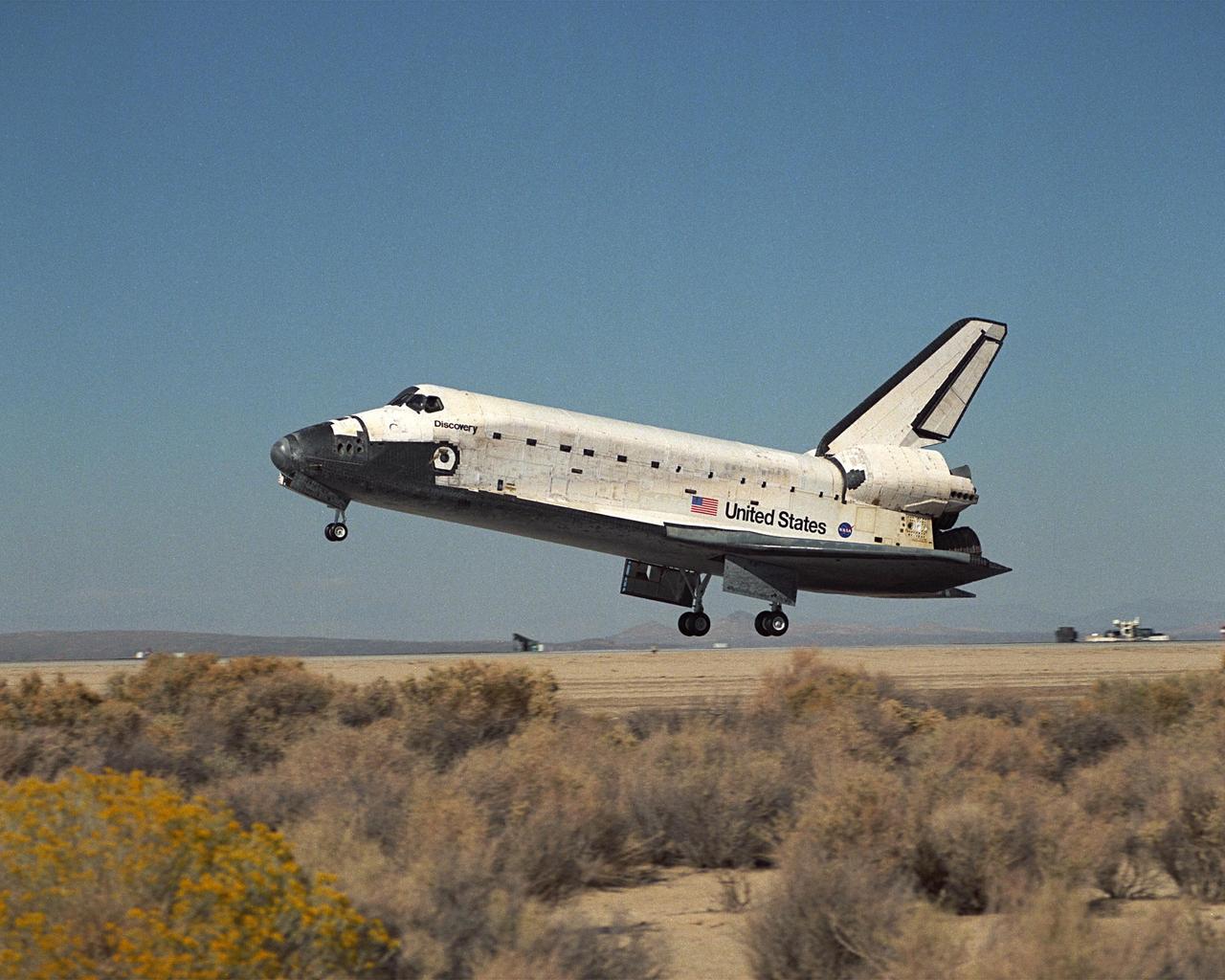
Viewed from the side, orbiter Discovery, with its seven-member crew, is about to touch down on the landing strip at Edwards Air Force Base, Calif., after an 11-day mission to the International Space Station. The orbiter’s main landing gear touched down on EAFB runway 22 at 5 p.m. With the aid of its drag chute, Discovery came to a complete stop at 5:01 p.m. At the conclusion of mission STS-92, Discovery and crew had traveled about 5.3 million statute miles. Following vehicle safing and preliminary offloading efforts, workers will begin preparations for Discovery’s transcontinental ferry flight back to KSC on the back of NASA’s modified Boeing 747
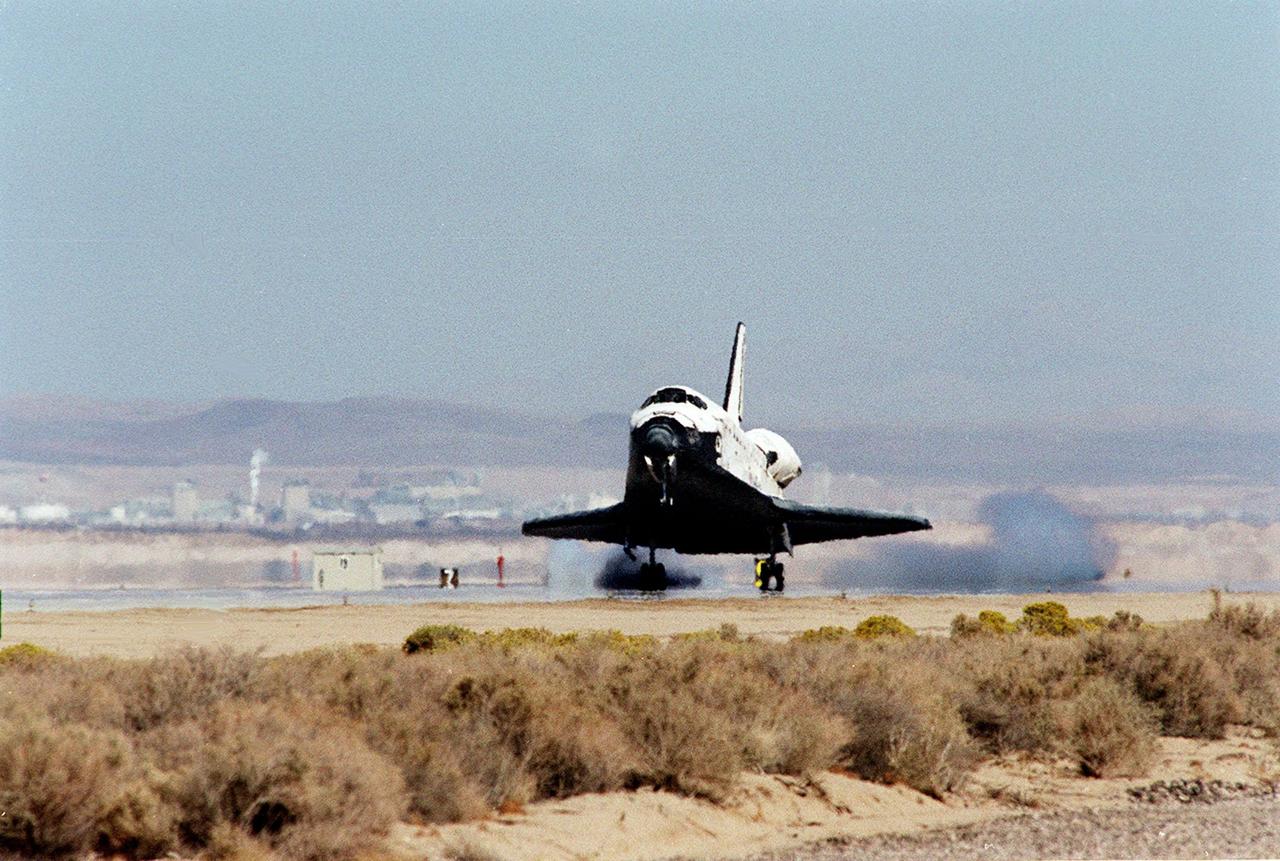
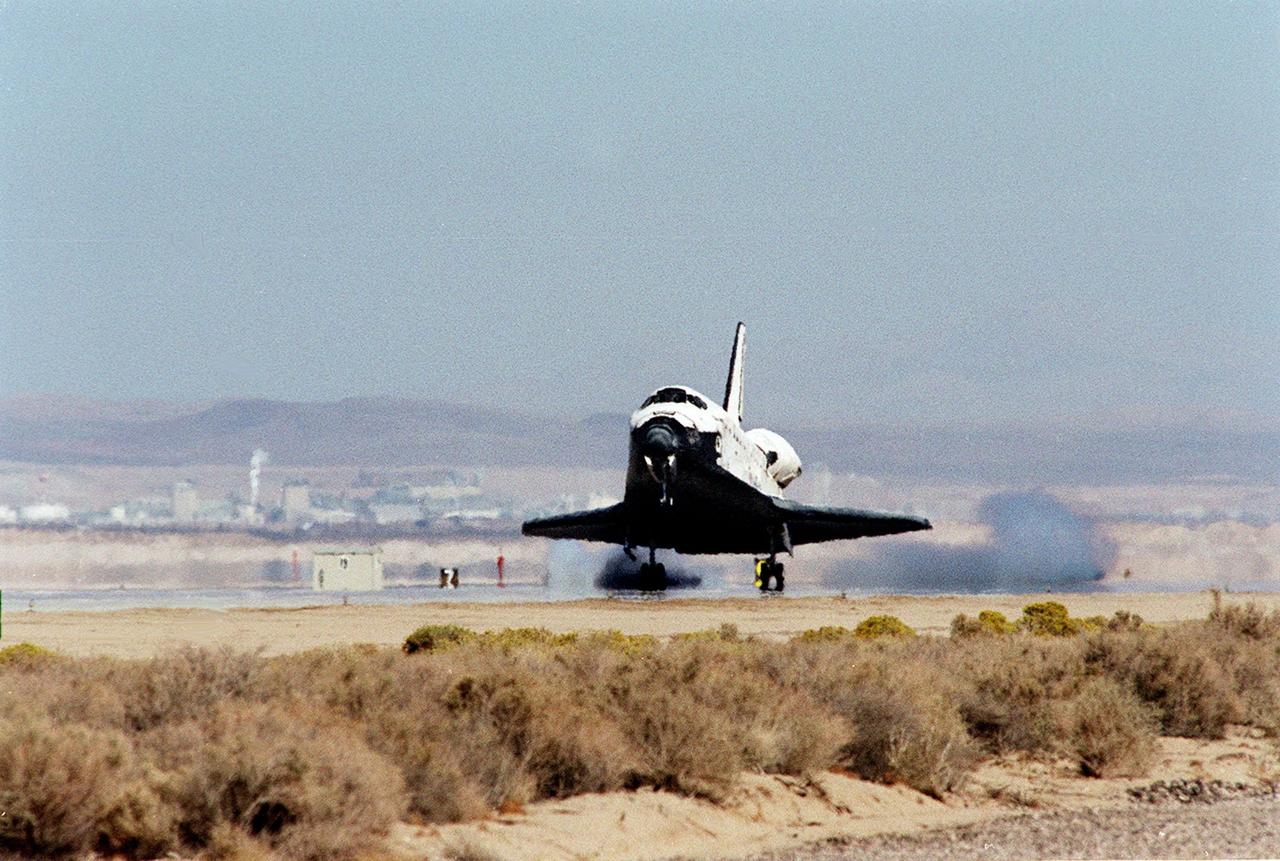
Orbiter Discovery, with its seven-member crew, touches down on the landing strip at Edwards Air Force Base, Calif., after an 11-day mission to the International Space Station. The orbiter’s main landing gear touched down on EAFB runway 22 at 5 p.m. With the aid of its drag chute, Discovery came to a complete stop at 5:01 p.m. At the conclusion of mission STS-92, Discovery and crew had traveled about 5.3 million statute miles. Following vehicle safing and preliminary offloading efforts, workers will begin preparations for Discovery’s transcontinental ferry flight back to KSC on the back of NASA’s modified Boeing 747
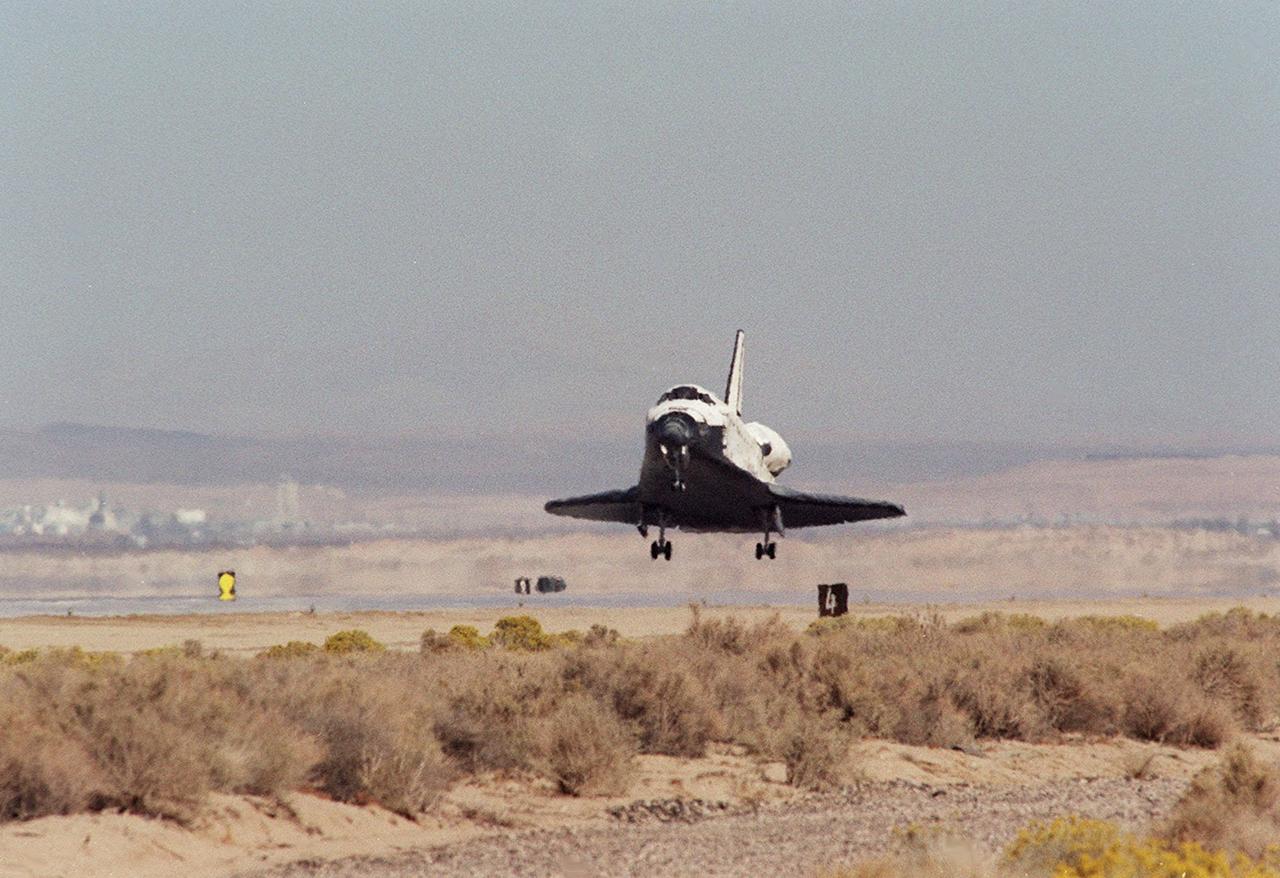
Orbiter Discovery, with its seven-member crew, approaches the landing strip at Edwards Air Force Base, Calif., after an 11-day mission to the International Space Station. The orbiter’s main landing gear touched down on EAFB runway 22 at 5 p.m. With the aid of its drag chute, Discovery came to a complete stop at 5:01 p.m. At the conclusion of mission STS-92, Discovery and crew had traveled about 5.3 million statute miles. Following vehicle safing and preliminary offloading efforts, workers will begin preparations for Discovery’s transcontinental ferry flight back to KSC on the back of NASA’s modified Boeing 747
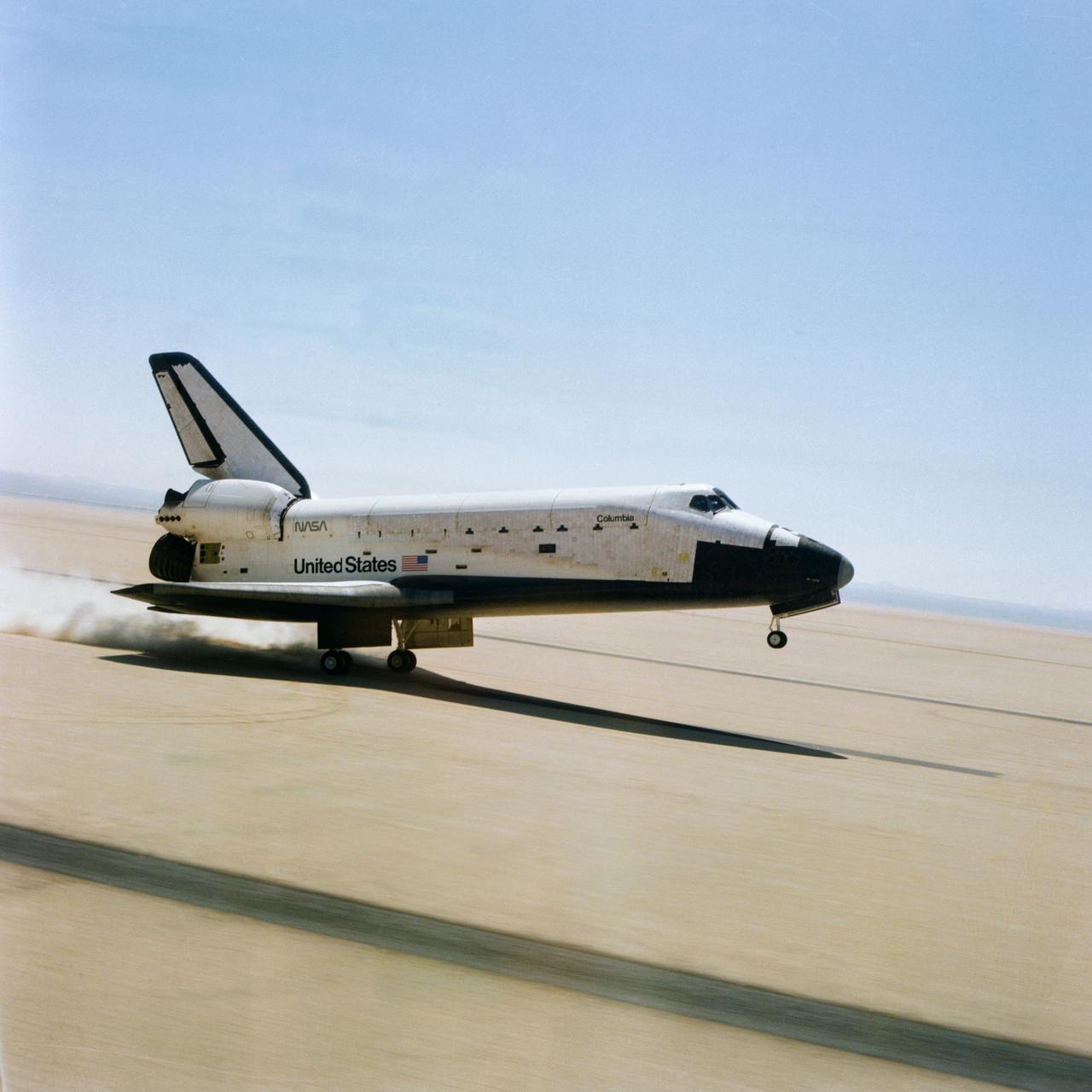
S81-30734 (14 April 1981) --- The rear wheels of the space shuttle orbiter Columbia (STS-1) touch down on Rogers dry lake at Edwards Air Force Base in southern California to successfully complete a stay in space of more than two days. Astronauts John W. Young, commander, and Robert L. Crippen, pilot, are aboard the vehicle. The mission marked the first NASA flight to end with a wheeled landing and represents the beginning of a new age of spaceflight that will employ the same hardware repeatedly. Photo credit: NASA
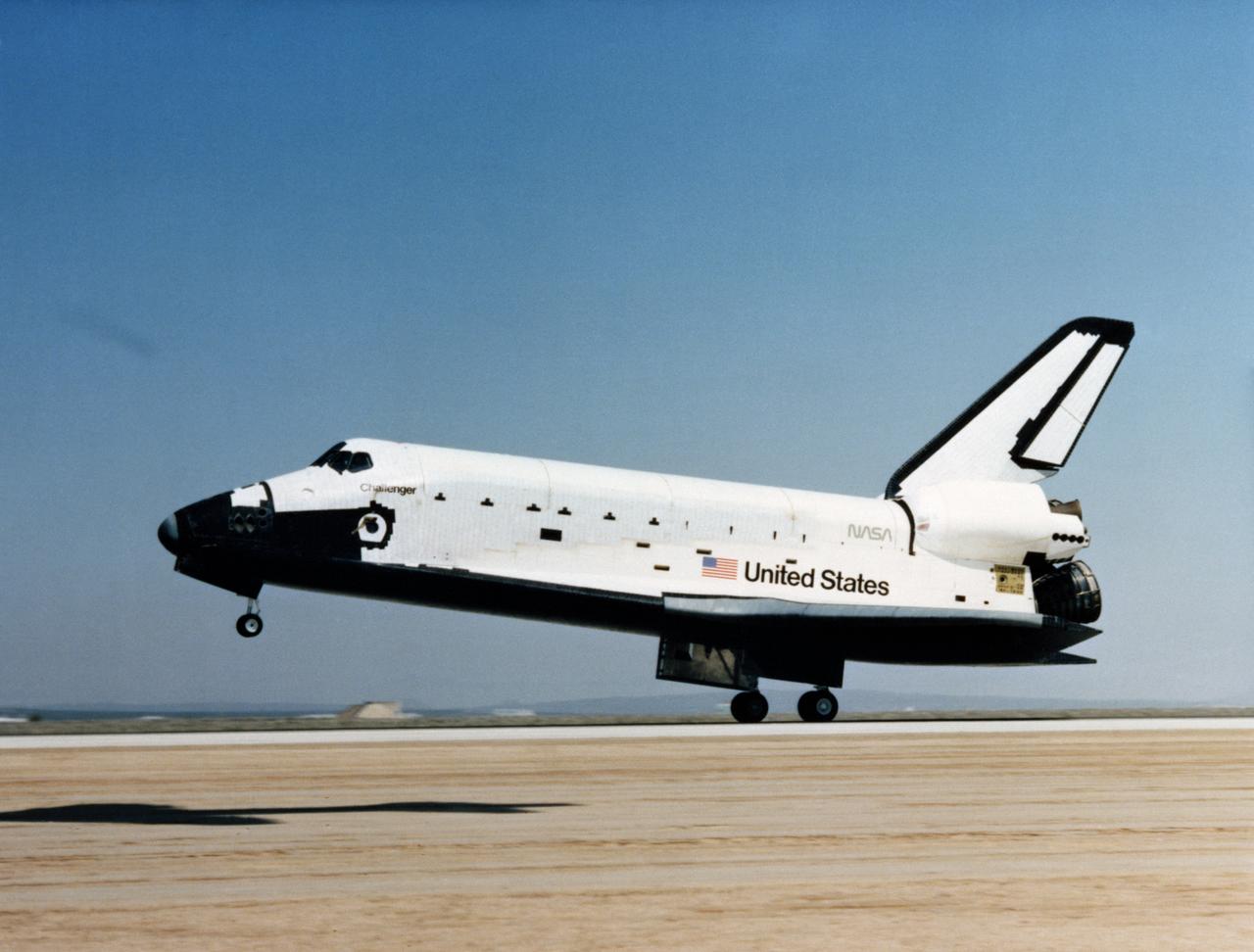
S83-30220 (9 April 1983) --- The space shuttle Challenger makes its first landing shortly before 11 a.m. (PST) on April 9, 1983, on Runway 22 at the Edwards Air Force Base in Southern California. Onboard the reusable spacecraft, having just completed a successful five-day mission, are astronauts Paul J. Weitz, Karol J. Bobko, F. Story Musgrave and Donald H. Peterson. Photo credit: NASA
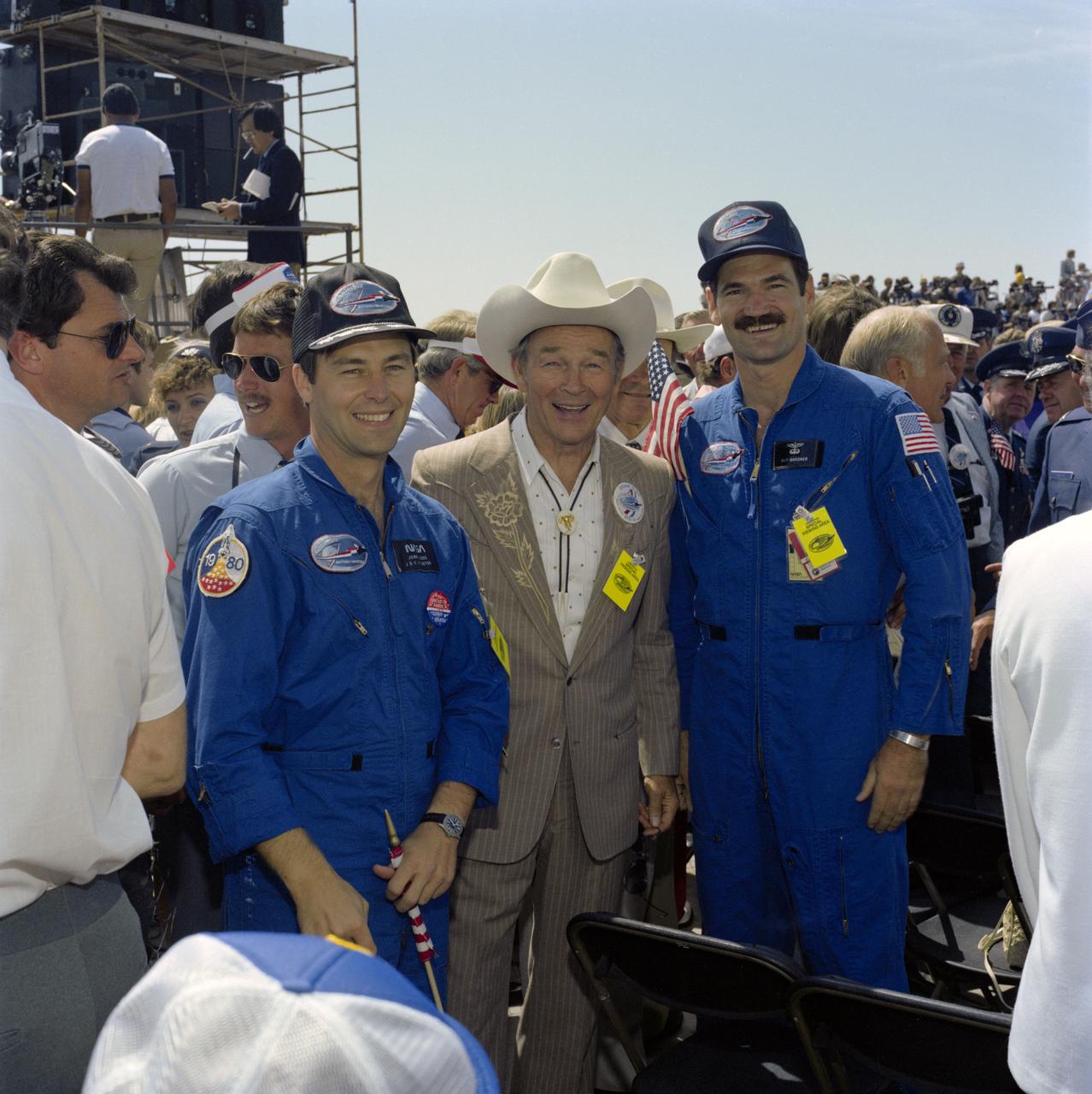
S82-33226 (4 July 1982) --- Inveterate space fan Roy Rogers with astronauts Jerry L. Ross, left, and Guy S. Gardner at Edwards Air Force Base for the landing of the space shuttle Columbia at the conclusion of the STS-4 mission on July 4, 1982. Ross and Gardner piloted chase planes involved in the approach and landing operations for the flight?s conclusion. Also present at the landing was (near far right) former astronaut Edwin E. Aldrin Jr., lunar module pilot for the historic first moon landing of almost 13 years ago. Photo credit: NASA
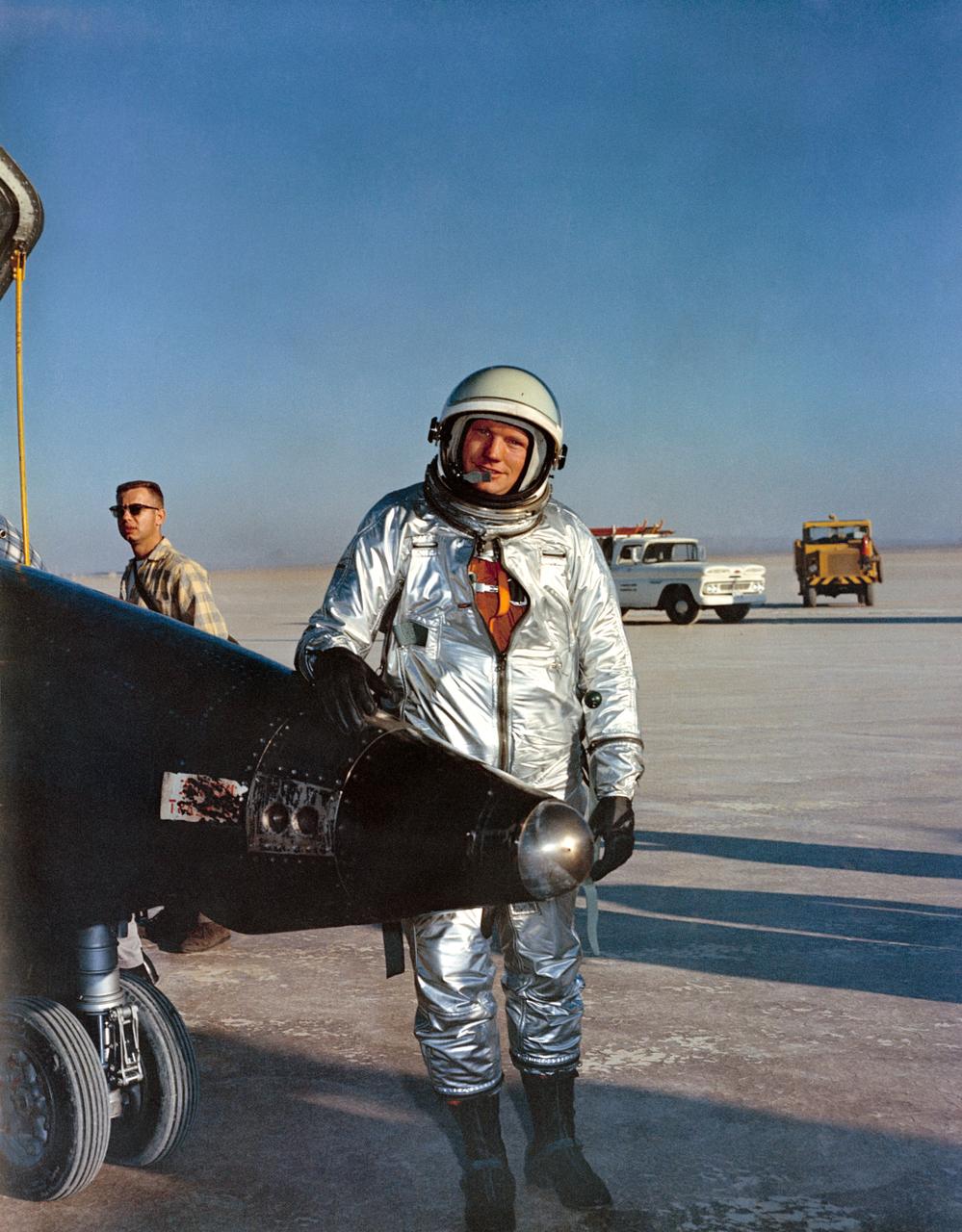
S63-19148 (1963) --- Neil A. Armstrong, a civilian, was a member of the second group of astronauts selected by the National Aeronautics and Space Administration. Armstrong was one of the nine picked in September, 1962. He was an aeronautical research pilot before becoming an astronaut.
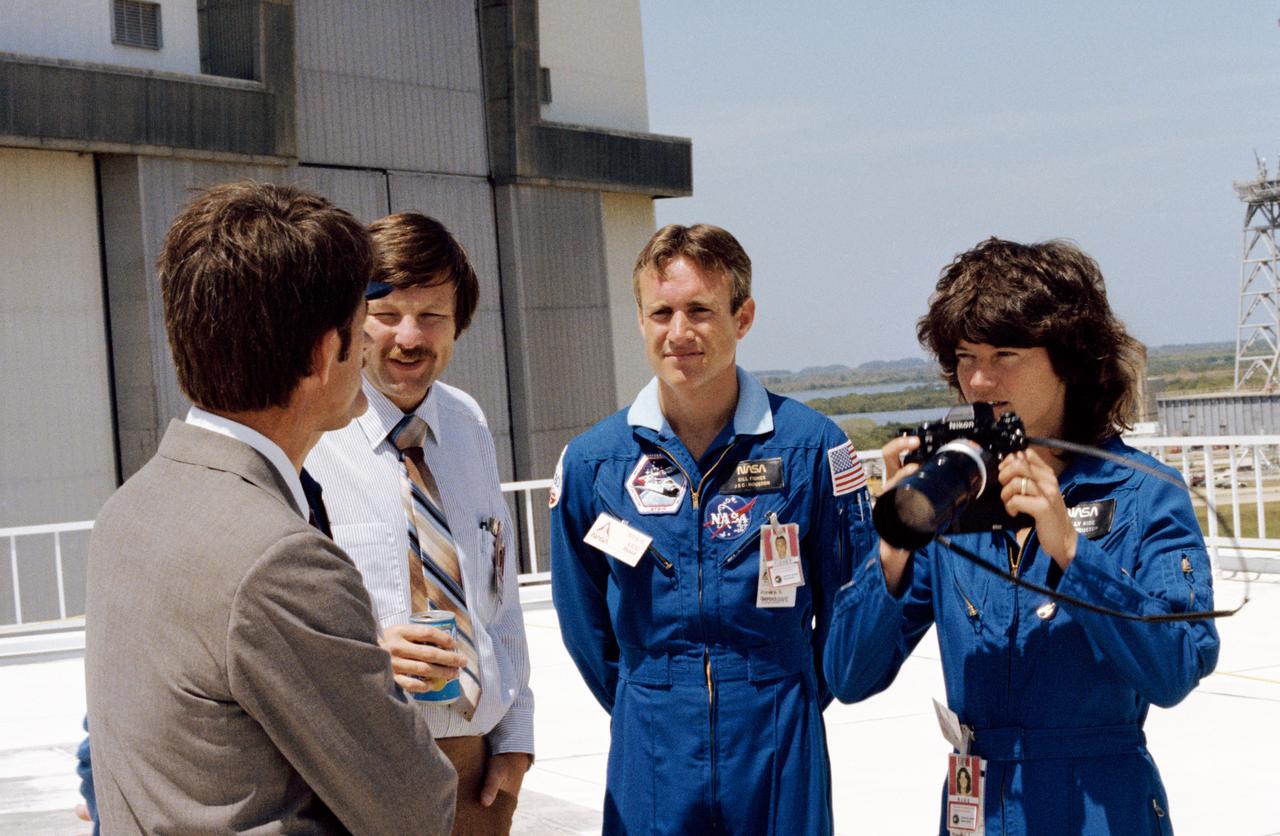
S83-31046 (4 April 1983) --- Astronaut Sally K. Ride, mission specialist for STS-7, scheduled for June 1983, records some of the prelaunch activity for STS-6 on 35mm film at the Kennedy Space Center (KSC). Astronaut William B. Lenoir, STS-5 mission specialist, is at left. Others pictured include Richard W. Nygren (center), chief of the vehicle integration section of the operations division at JSC; and astronaut William F. Fisher, second right. Photo credit: NASA
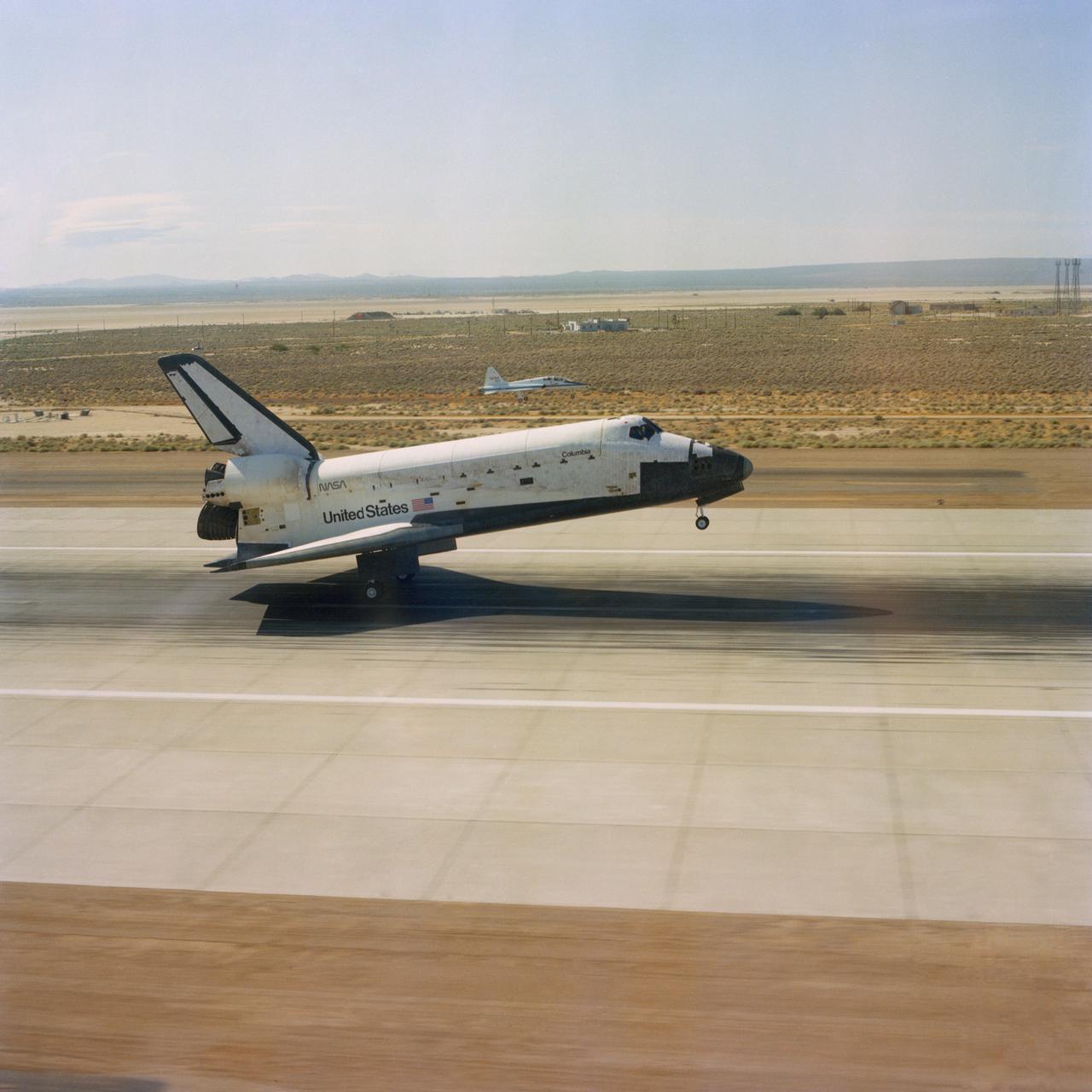
S82-33420 (4 July 1982) --- The aft wheels of the space shuttle Columbia ease down on the runway at Edwards Air Force Base (AFB) today to successfully complete a week-long spaceflight for astronauts Thomas K. Mattingly II, and Henry W. Hartsfield Jr. A T-38 aircraft serves as a chase plane (just above center of photo) in the background. Not long after this photograph was made and the crew had egressed their craft, President Ronald Reagan addressed a giant crowd on hand at Edwards AFB for a special kind of July 4 celebration. Photo credit: NASA
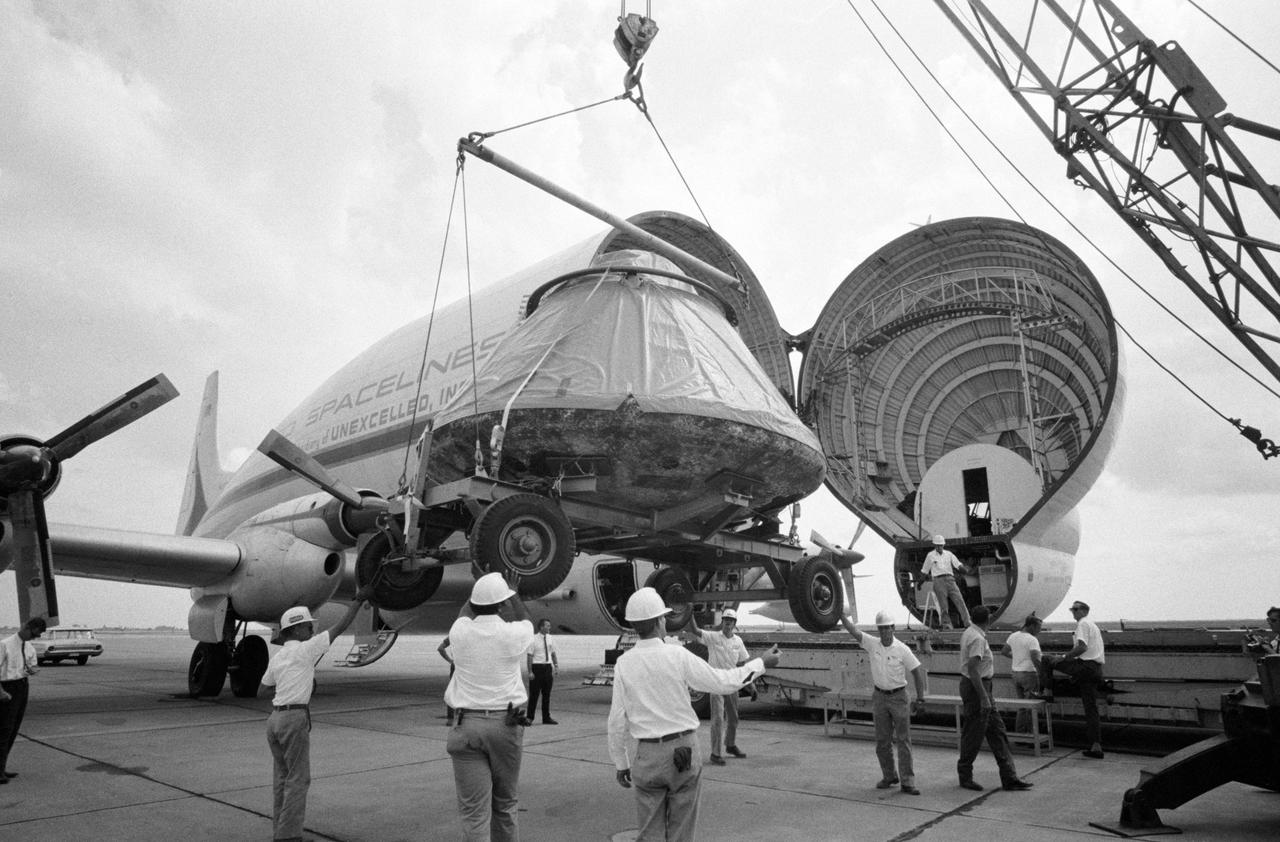
S69-41985 (14 Aug. 1969) --- The Apollo 11 spacecraft Command Module (CM) is loaded aboard a Super Guppy Aircraft at Ellington Air Force Base for shipment to the North American Rockwell Corporation at Downey, California. The CM was just released from its postflight quarantine at the Manned Spacecraft Center (MSC). The Apollo 11 spacecraft was flown by astronauts Neil A. Armstrong, commander; Michael Collins, command module pilot; and Edwin E. Aldrin Jr., lunar module pilot, during their lunar landing mission. Note damage to aft heat shield caused by extreme heat of Earth reentry. North American Rockwell is the prime contractor for the Apollo Command and Service Modules (CSM).
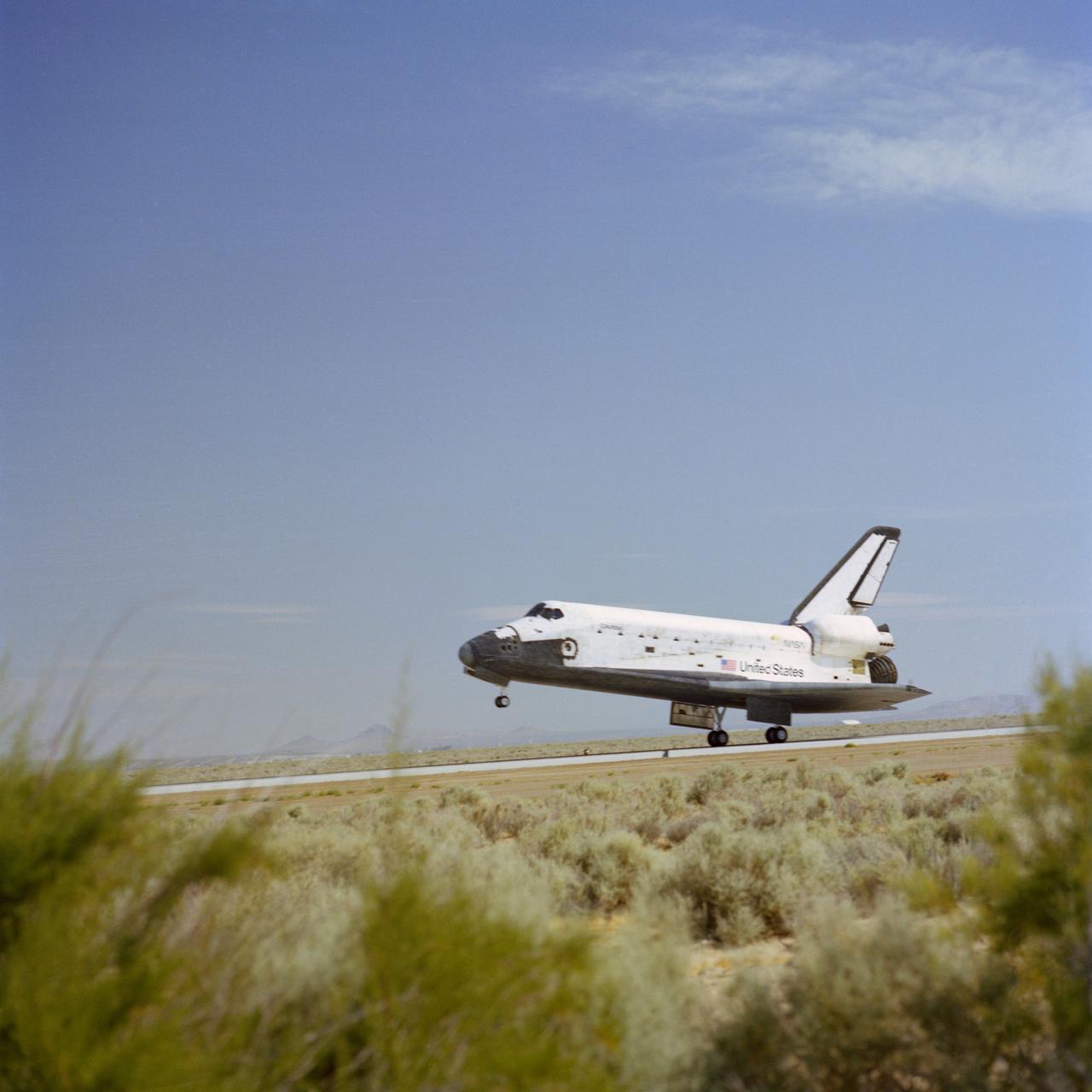
S82-33229 (4 July 1982) --- The space shuttle Columbia touches down on Runway 22 at Edwards Air Force Base in Southern California at the completion of a successful seven-day stay in Earth orbit. Inside are astronauts Thomas K. Mattingly II and Henry W. Hartsfield Jr., STS-4 commander and pilot, respectively. Though this closeup scene is devoid of visible people, hundreds of thousands weren?t far away for the unique July 4 celebration. Photo credit: NASA
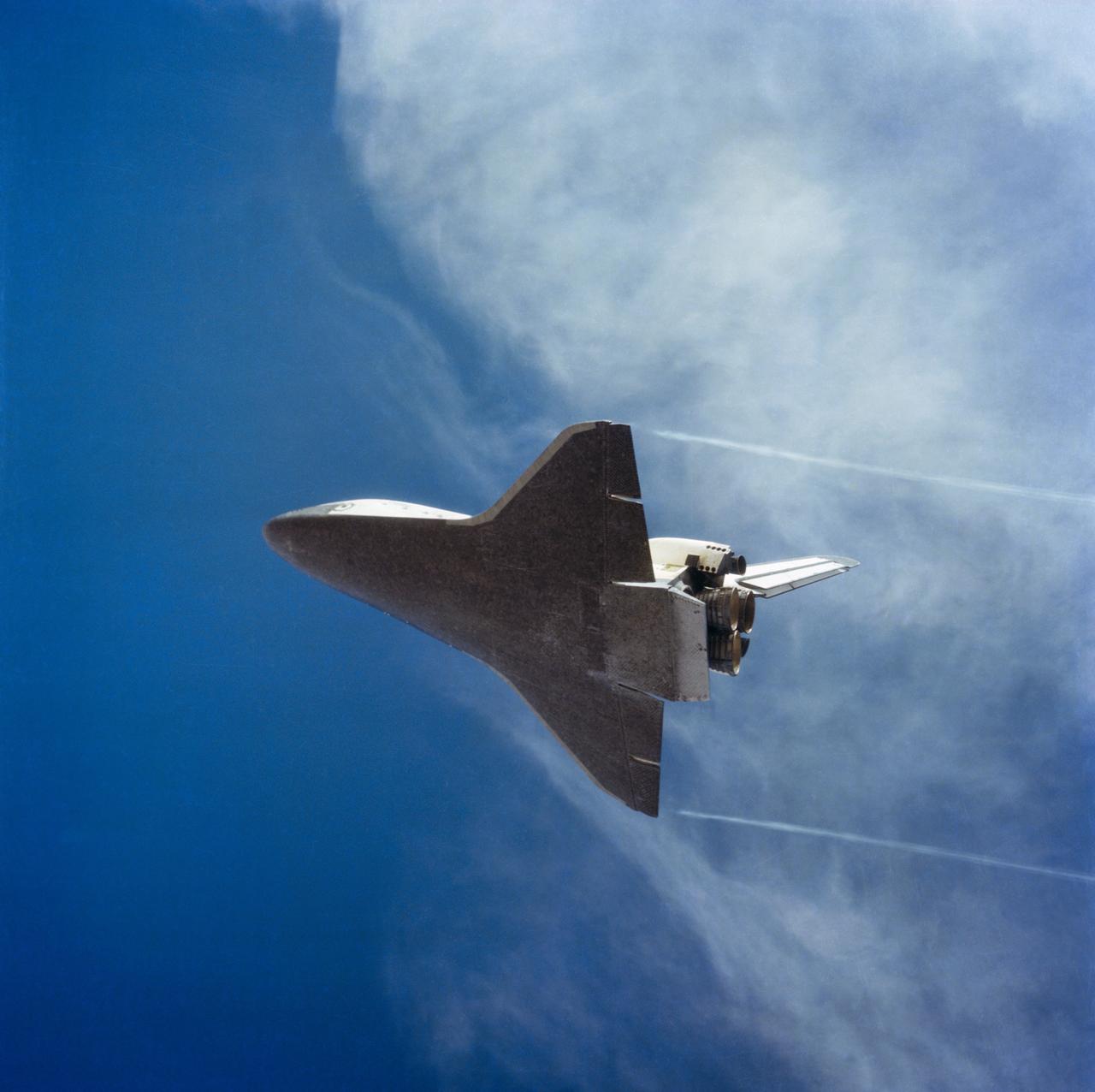
S81-39563 (14 Nov. 1981) --- This view of the space shuttle Columbia (STS-2) was made with a hand-held 70mm camera in the rear station of the T-38 chase plane. Mission specialist/astronaut Kathryn D. Sullivan exposed the frame as astronauts Joe N. Engle and Richard H. Truly aboard the Columbia guided the vehicle to an unpowered but smooth landing on the desert area of Edwards Air Force base in California. The view provides a good study of the high temperature protection material on the underside of the spacecraft which is exposed to the friction on the atmospheric entry on the return to Earth. Also note trails from the wing tips. Photo credit: NASA
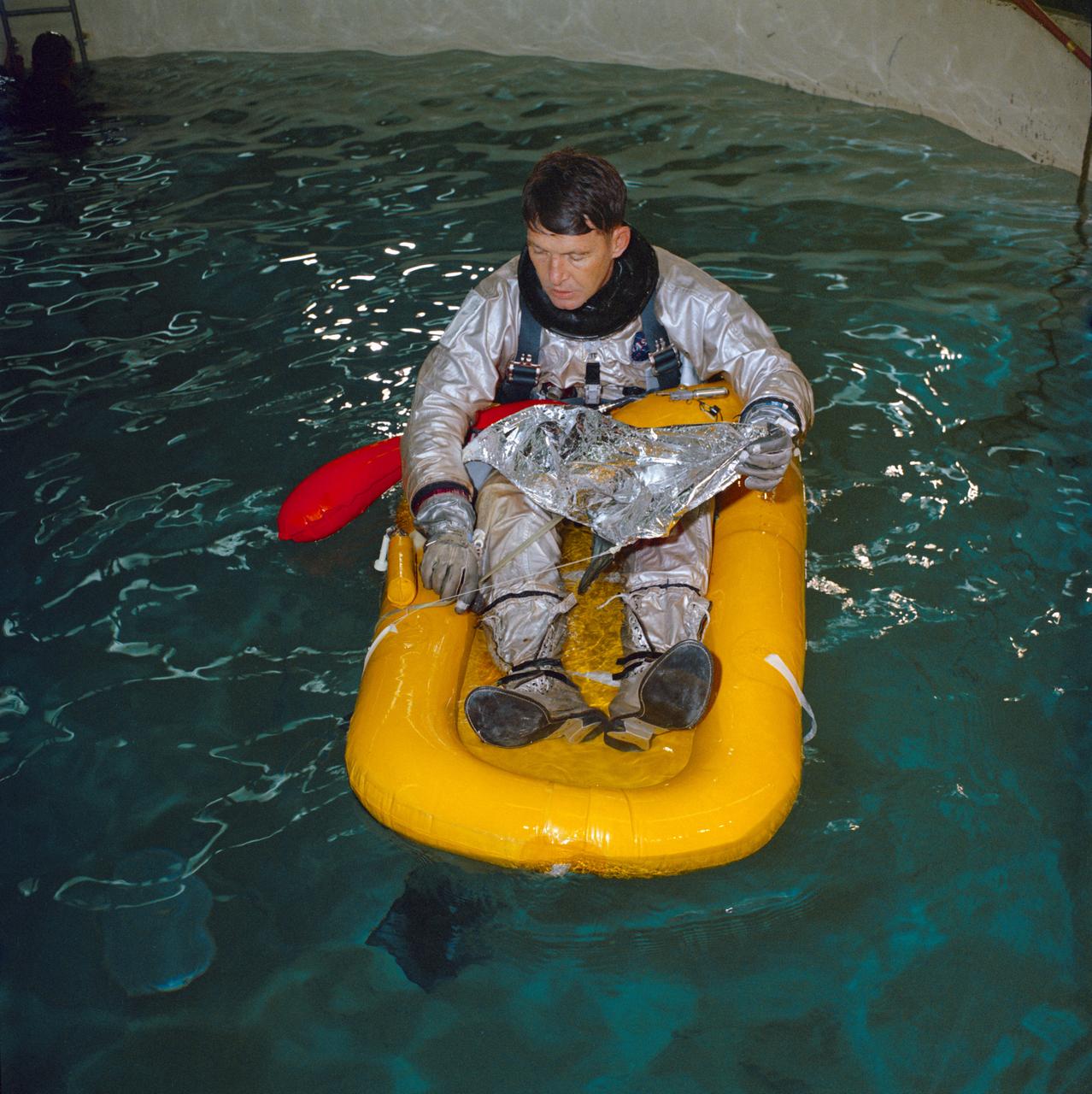
S65-10121 (1 Feb. 1965) --- Astronaut Walter M. Schirra Jr., the Gemini-6 command pilot for the prime crew, floats on a one-man life raft in a pool during water egress training at Ellington Air Force Base, Texas. Photo credit: NASA or National Aeronautics and Space Administration
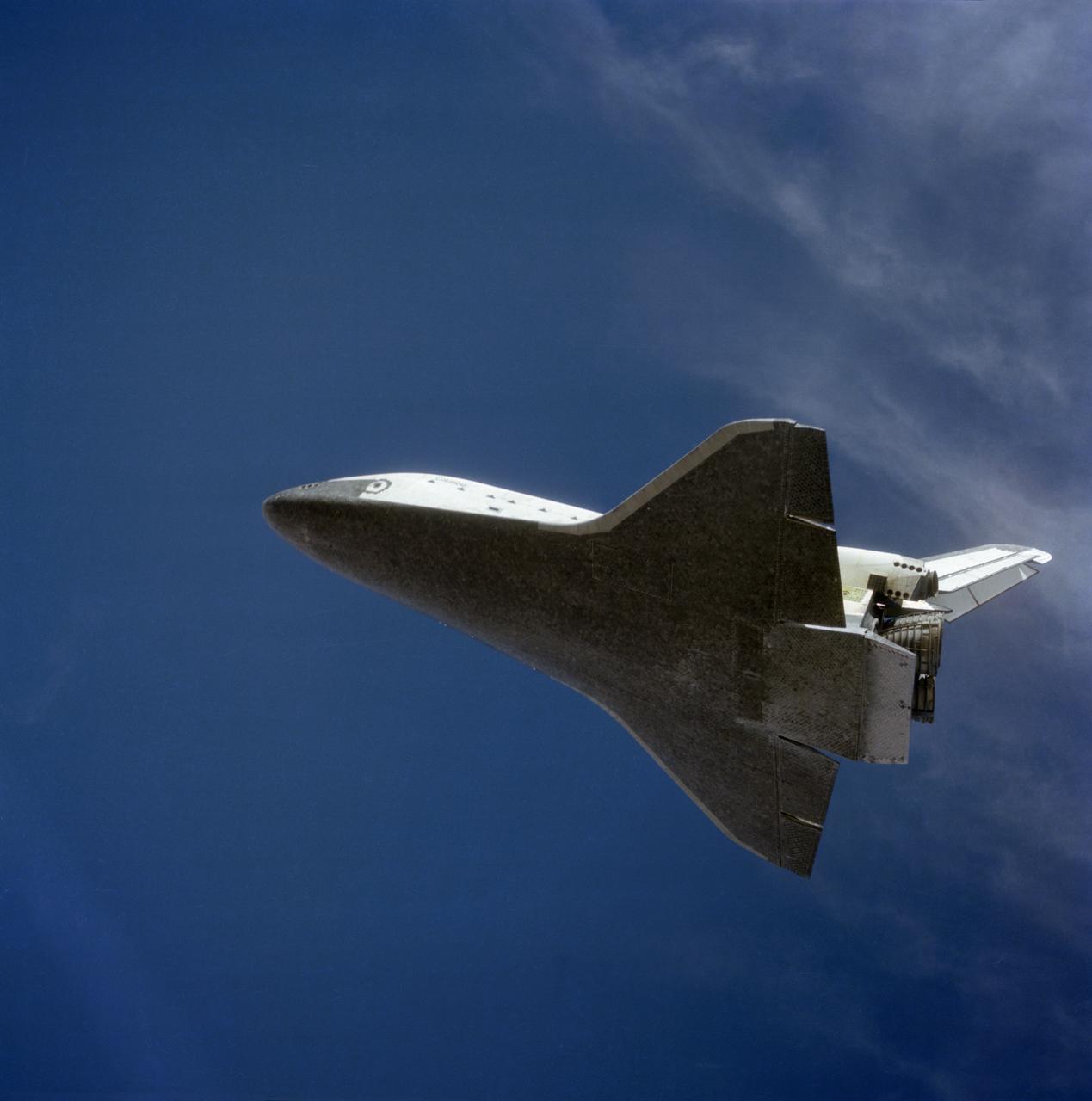
S81-39564 (14 Nov. 1981) --- This view of the space shuttle Columbia (STS-2) was made with a hand-held 70mm camera in the rear station of the T-38 chase plane. Mission specialist/astronaut Kathryn D. Sullivan exposed the frame as astronauts Joe N. Engle and Richard H. Truly aboard the Columbia guided the vehicle to an unpowered but smooth landing on the desert area of Edwards Air Force base in California. The picture provides a good view of the underside of the returning spacecraft. Photo credit: NASA
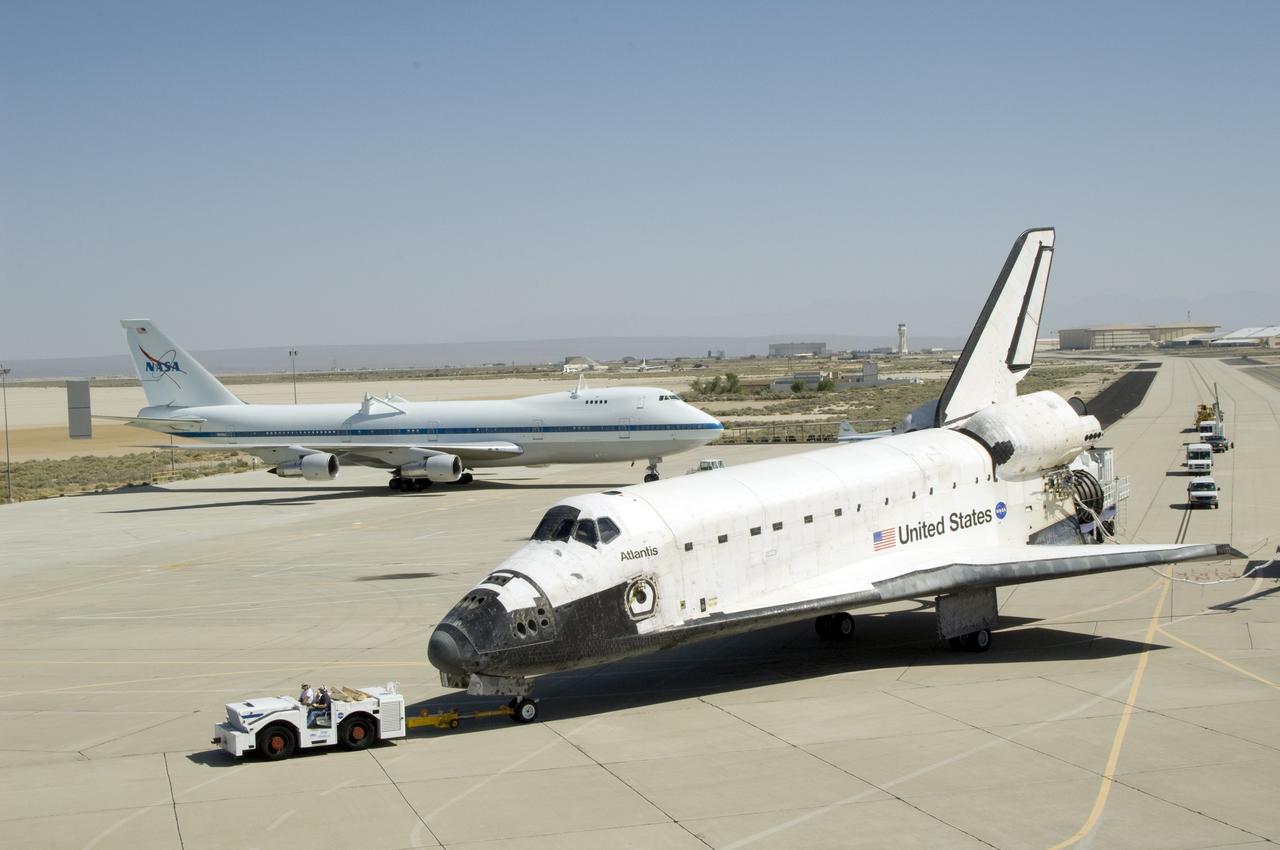
EDWARDS, Calif., -- ED09-0127-13 (EAFB) -- Space shuttle Atlantis is towed from the runway at Edwards Air Force Base in California after landing to conclude the 13-day mission to refurbish and upgrade the Hubble Space Telescope. Main gear touchdown was at 11:39:05 a.m. EDT. Nose gear touchdown was at 11:39:15 a.m. Wheel stop was at 11:40:15 a.m., bringing the mission’s elapsed time to 12 days, 21 hours, 37 minutes, 9 seconds. Landing opportunities on May 22, May 23 and May 24 were waved off due to weather concerns at NASA’s Kennedy Space Center in Florida, the shuttle’s primary landing site. Photo credit: NASA/Tony Landis
EDWARDS AIR FORCE BASE, CALIF. -- Viewed from the side, orbiter Discovery, with its seven-member crew, touches down on the landing strip at Edwards Air Force Base, Calif., after an 11-day mission to the International Space Station. The orbiter’s main landing gear touched down on EAFB runway 22 at 5 p.m. With the aid of its drag chute, Discovery came to a complete stop at 5:01 p.m. At the conclusion of mission STS-92, Discovery and crew had traveled about 5.3 million statute miles. Following vehicle safing and preliminary offloading efforts, workers will begin preparations for Discovery’s transcontinental ferry flight back to KSC on the back of NASA’s modified Boeing 747
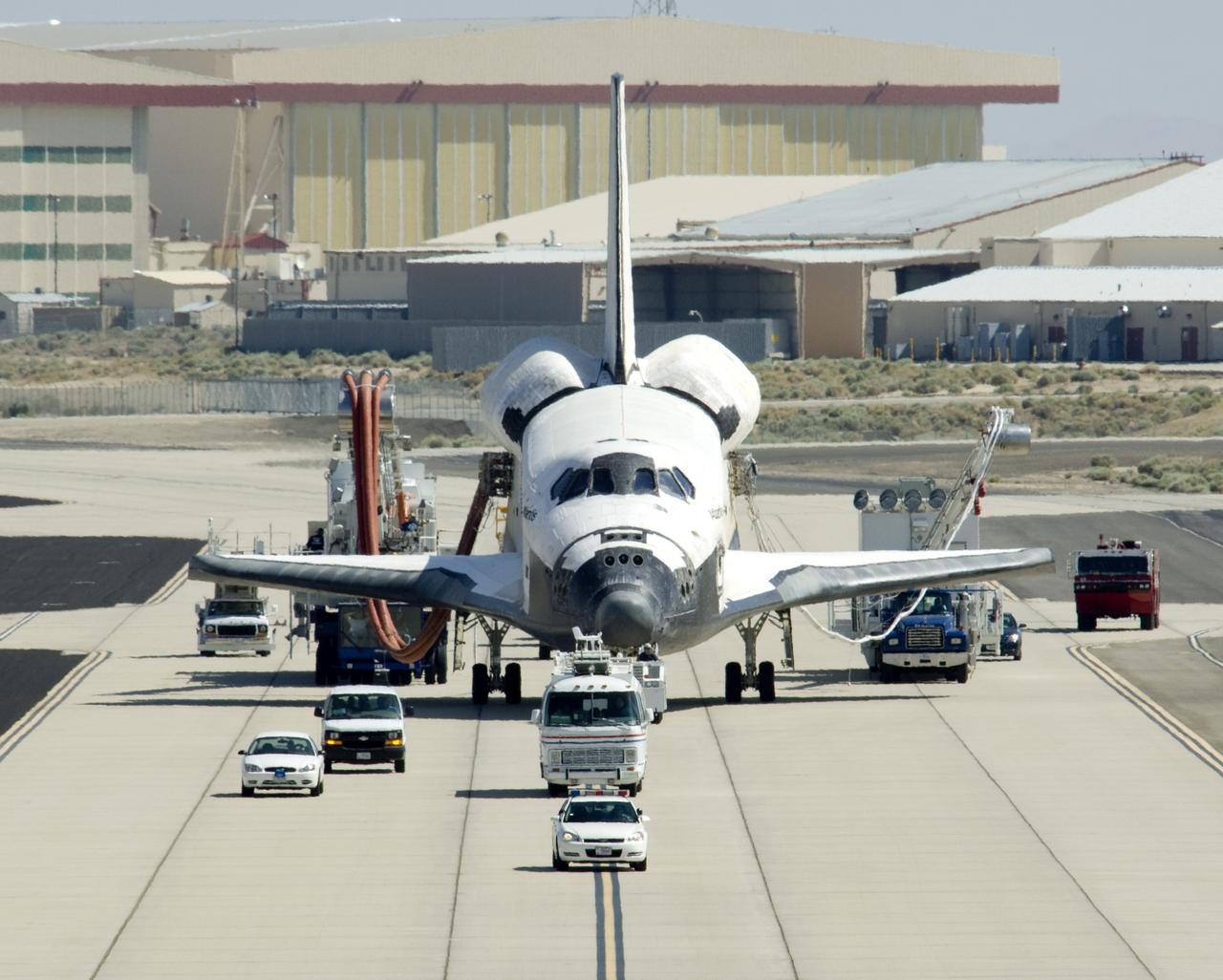
EDWARDS, Calif., -- ED09-0127-12 (EAFB) – Space shuttle Atlantis is towed from the runway at Edwards Air Force Base in California after landing to conclude the 13-day mission to refurbish and upgrade the Hubble Space Telescope. Main gear touchdown was at 11:39:05 a.m. EDT. Nose gear touchdown was at 11:39:15 a.m. Wheel stop was at 11:40:15 a.m., bringing the mission’s elapsed time to 12 days, 21 hours, 37 minutes, 9 seconds. Landing opportunities on May 22, May 23 and May 24 were waved off due to weather concerns at NASA’s Kennedy Space Center in Florida, the shuttle’s primary landing site. Photo credit: NASA/Tony Landis
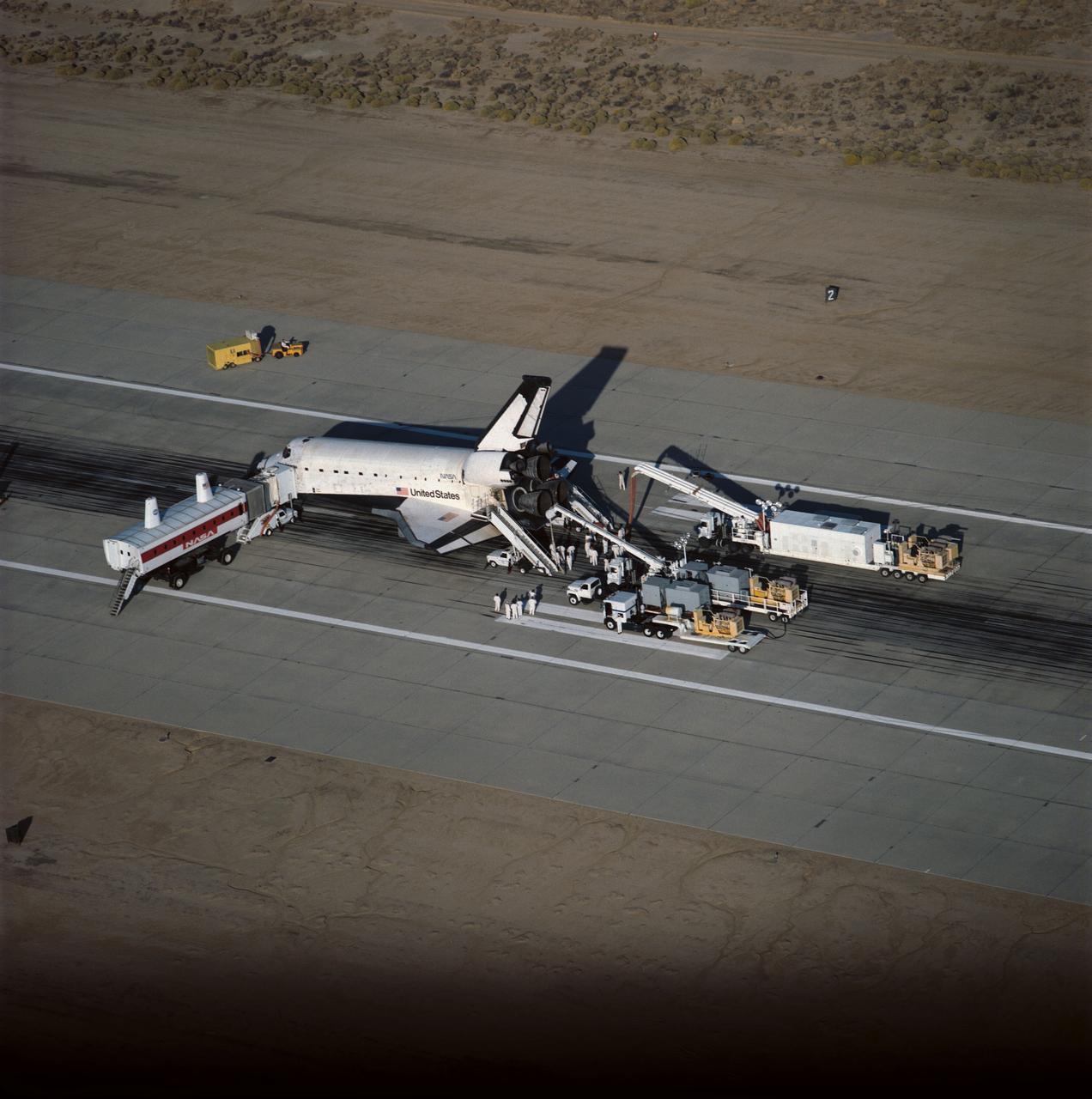
STS058-S-129 (1 Nov 1993) --- This busy scene on the runway at Edwards Air Force Base (EAFB) was taken less than an hour following the landing of the Space Shuttle Columbia. The touchdown, which had occurred at 7:06 a.m. (PST), November 1, 1993, completed a two week mission in space devoted to medical research. The array of hardware and workers includes personnel and equipment designed to make the area safe. At far left is the Crew Transport Vehicle (CTV). Still onboard the spacecraft were astronauts John E. Blaha, Richard A. Searfoss, Rhea Seddon, Shannon W. Lucid, David A. Wolf and William S. McArthur, along with payload specialist Martin J. Fettman, DVM.
EDWARDS AIR FORCE BASE, CALIF. -- Viewed from the side, orbiter Discovery, with its seven-member crew, touches down on the landing strip at Edwards Air Force Base, Calif., after an 11-day mission to the International Space Station. The orbiter’s main landing gear touched down on EAFB runway 22 at 5 p.m. With the aid of its drag chute, Discovery came to a complete stop at 5:01 p.m. At the conclusion of mission STS-92, Discovery and crew had traveled about 5.3 million statute miles. Following vehicle safing and preliminary offloading efforts, workers will begin preparations for Discovery’s transcontinental ferry flight back to KSC on the back of NASA’s modified Boeing 747
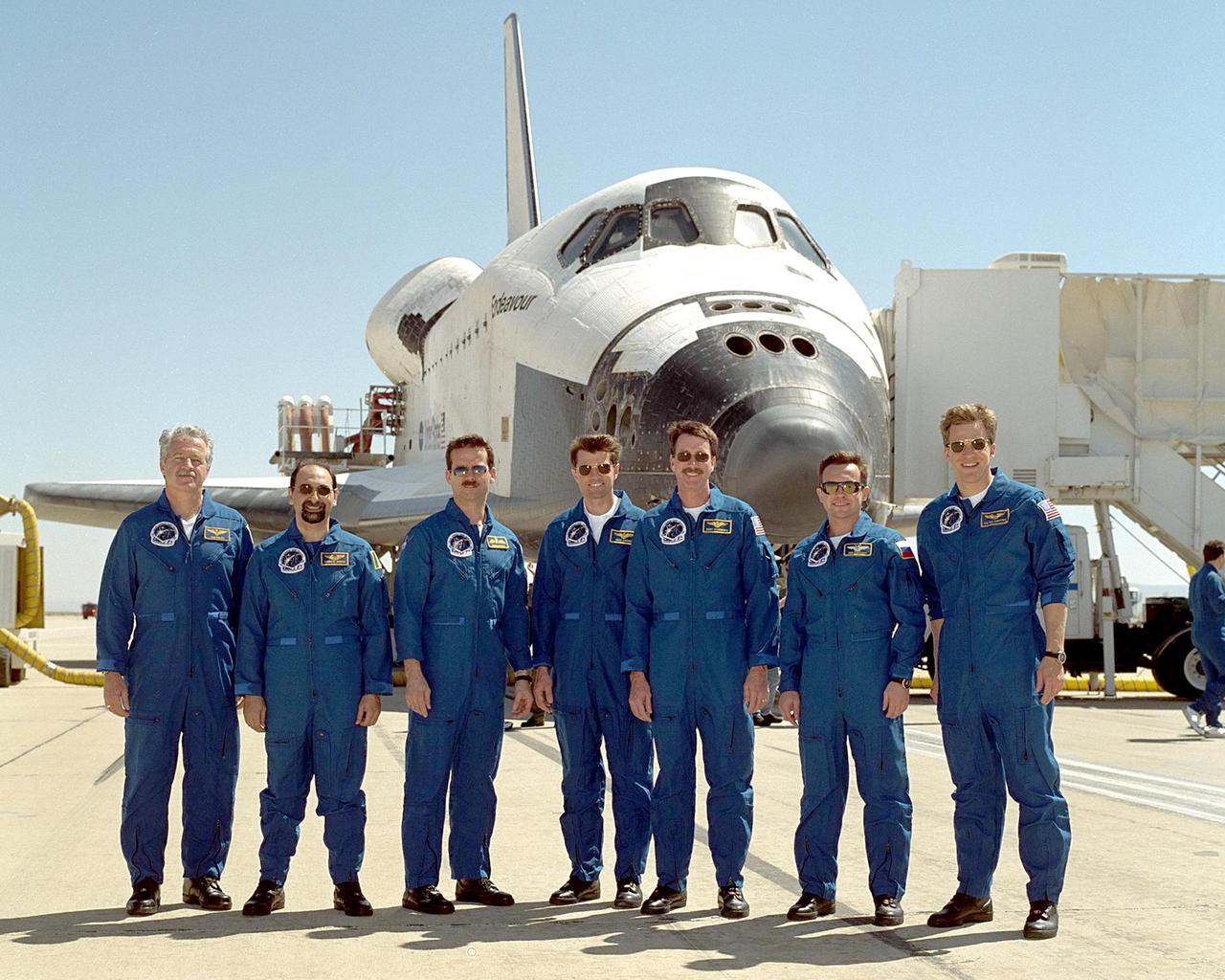
NASA_EDWARDS AFB, CALIF. -- After landing at Edwards Air Force Base, Calif., the STS-100 crew poses for a photograph in front of orbiter Endeavour, which successfully launched them to the International Space Station and returned them to Earth. They are (left to right) Mission Specialists John Phillips, Umberto Guidoni and Chris Hadfield; Pilot Jeffrey Ashby; Commander Kent Rominger; and Mission Specialists Yuri Lonchakov and Scott Parazynski. Guidoni is with the European Space Agency, Hadfield with the Canadian Space Agency and Lonchakov with the Russian Aviation and Space Agency. The orbiter and crew logged about 4.9 million statute miles in 186 orbits. Due to unfavorable weather conditions, landing at KSC was waved off. The landing marked the third consecutive landing at EAFB.
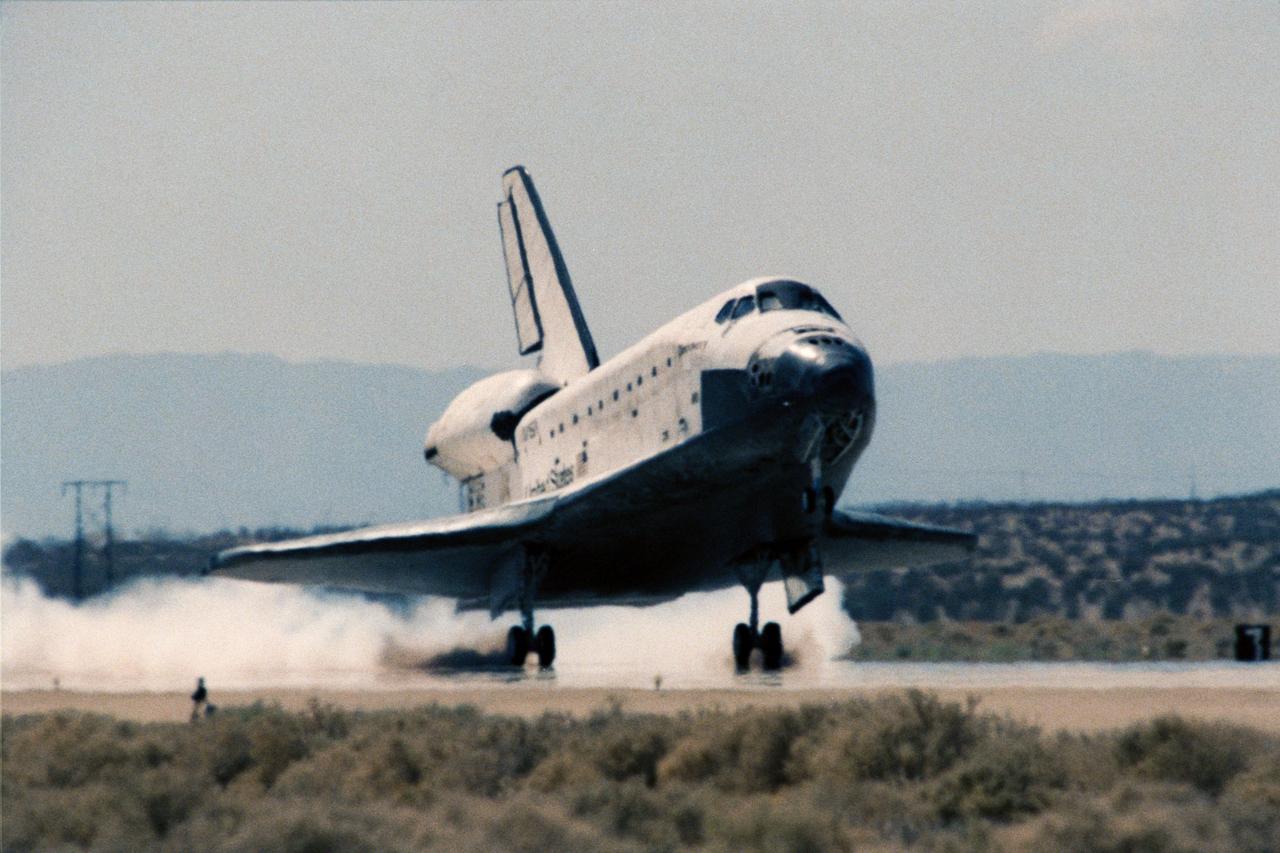
STS64-S-094 (20 Sept. 1994) --- The space shuttle Discovery, with a crew of six NASA astronauts aboard, touches down on Runway 04 at Edwards Air Force Base (EAFB), completing a 10-day, 22-hour and 50-minute mission. Following a de-orbit engine firing at 1:14 p.m. (PDT), Sept. 20, 1994. Touchdown was at 2:12:59 p.m., and the nose wheel touched down at 2:13:03 p.m., with wheel stop at 2:13:52 p.m. Bad weather in Florida called for an "eleventh hour" shift to the California landing site. Onboard for the flight, whose mission was to study Earth's atmosphere and to test tools and procedures for the International Space Station, were astronauts Richard N. Richards, L. Blaine Hammond Jr., Mark C. Lee, Carl J. Meade, Susan J. Helms and Jerry M. Linenger. Photo credit: NASA or National Aeronautics and Space Administration
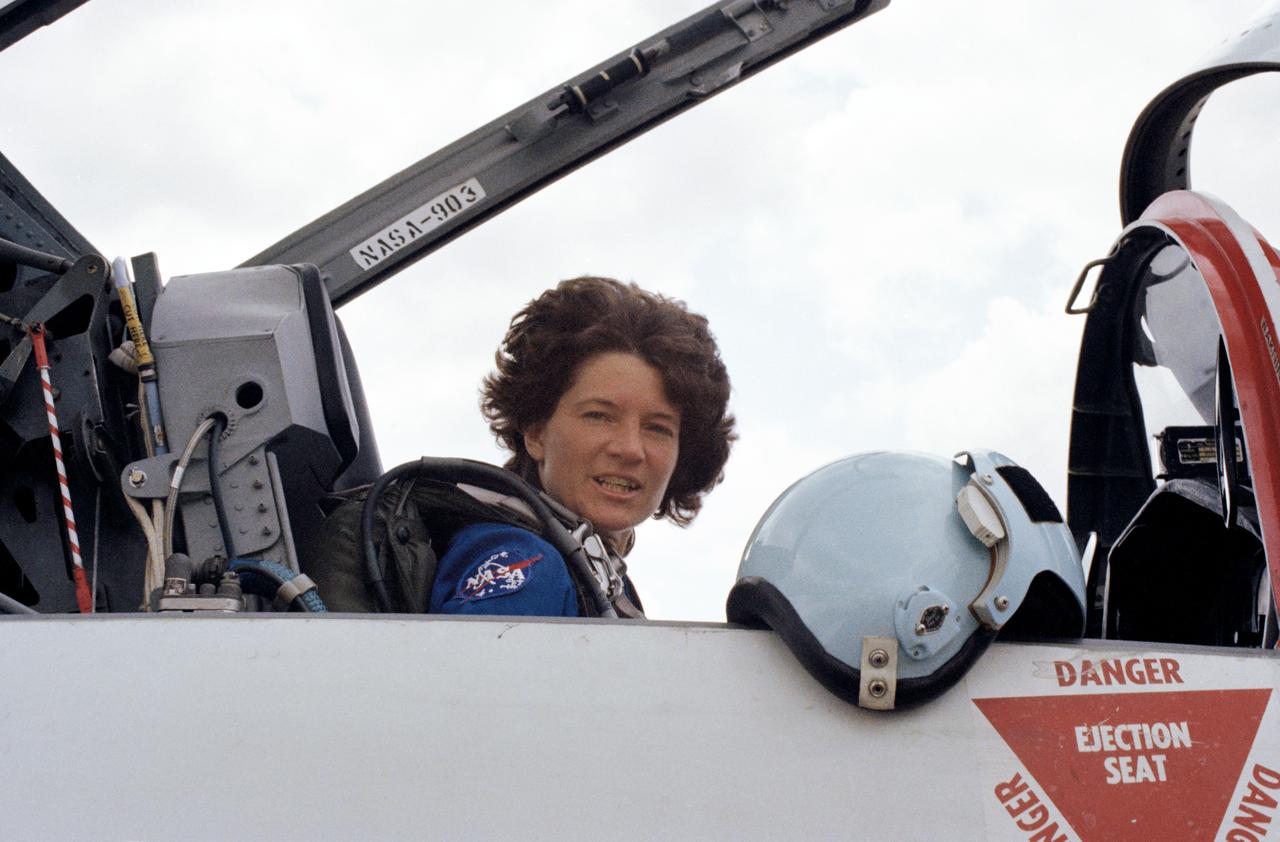
S83-34151 (15 June 1983) --- Astronaut Sally K. Ride, STS-7 mission specialist, takes one last look at familiar training environs before taking off from NASA’s Houston facility in a T-38 jet aircraft, destination: Florida and the Kennedy Space Center (KSC). After a few days of preparation at KSC, Dr. Ride and four other astronauts will be the first NASA five-member crew to fly in space as they liftoff in the Challenger from Launch Pad 39A. The mission specialist is positioned in the rear station of the jet, piloted by astronaut Robert L. Crippen, STS-7 commander. The T-38 fleet is kept at Ellington Base near the Johnson Space Center (JSC).
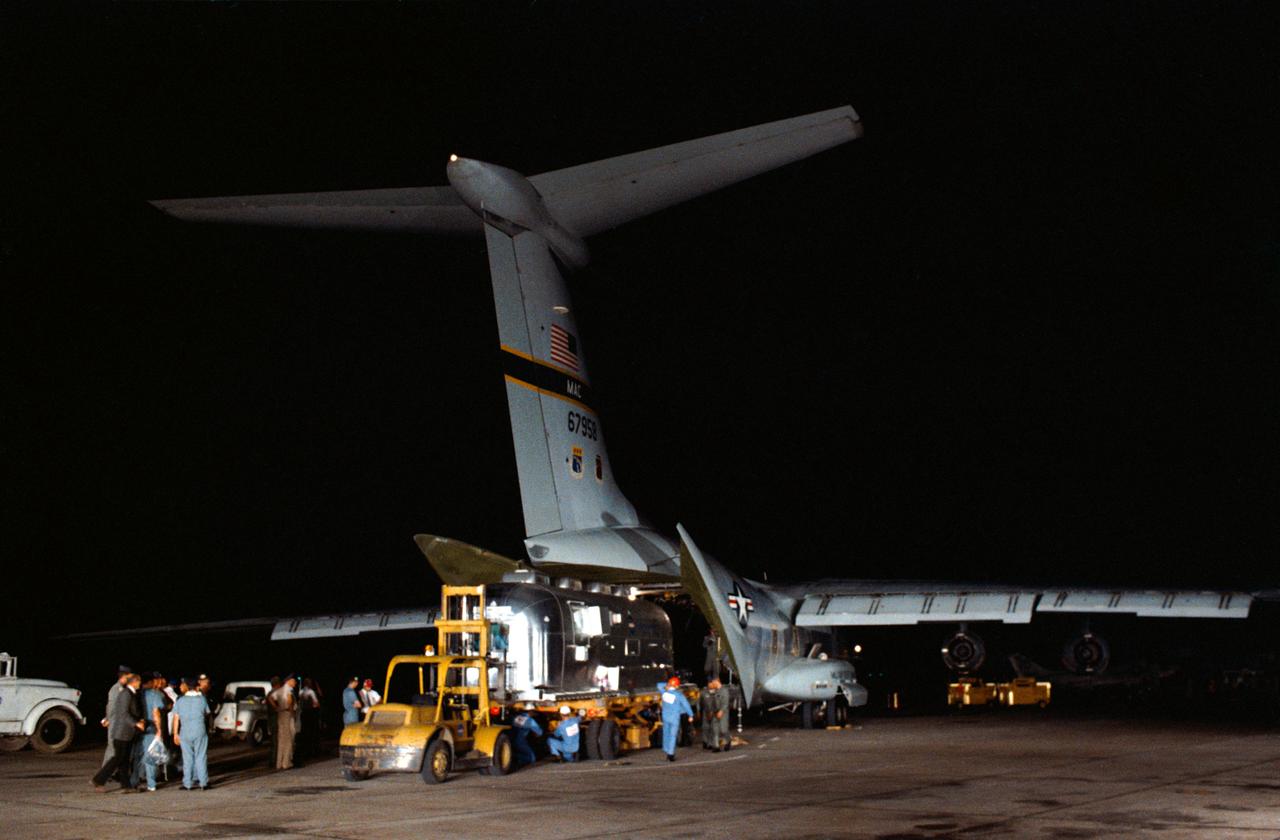
S69-40132 (27 July 1969) --- A Mobile Quarantine Facility (MQF), with the three Apollo 11 crewmembers inside, is unloaded from a United States Air Force C-141 transport at Ellington Air Force Base very early Sunday after a flight from Hawaii. A large crowd was present to welcome astronauts Neil A. Armstrong, Michael Collins, and Edwin E. Aldrin Jr. back to Houston following their historic lunar landing mission. The crew remained in the MQF until they arrived at the Crew Reception Area of the Lunar Receiving Laboratory (LRL) at the Manned Spacecraft Center (MSC). The crew will be released from quarantine on Aug. 11, 1969.
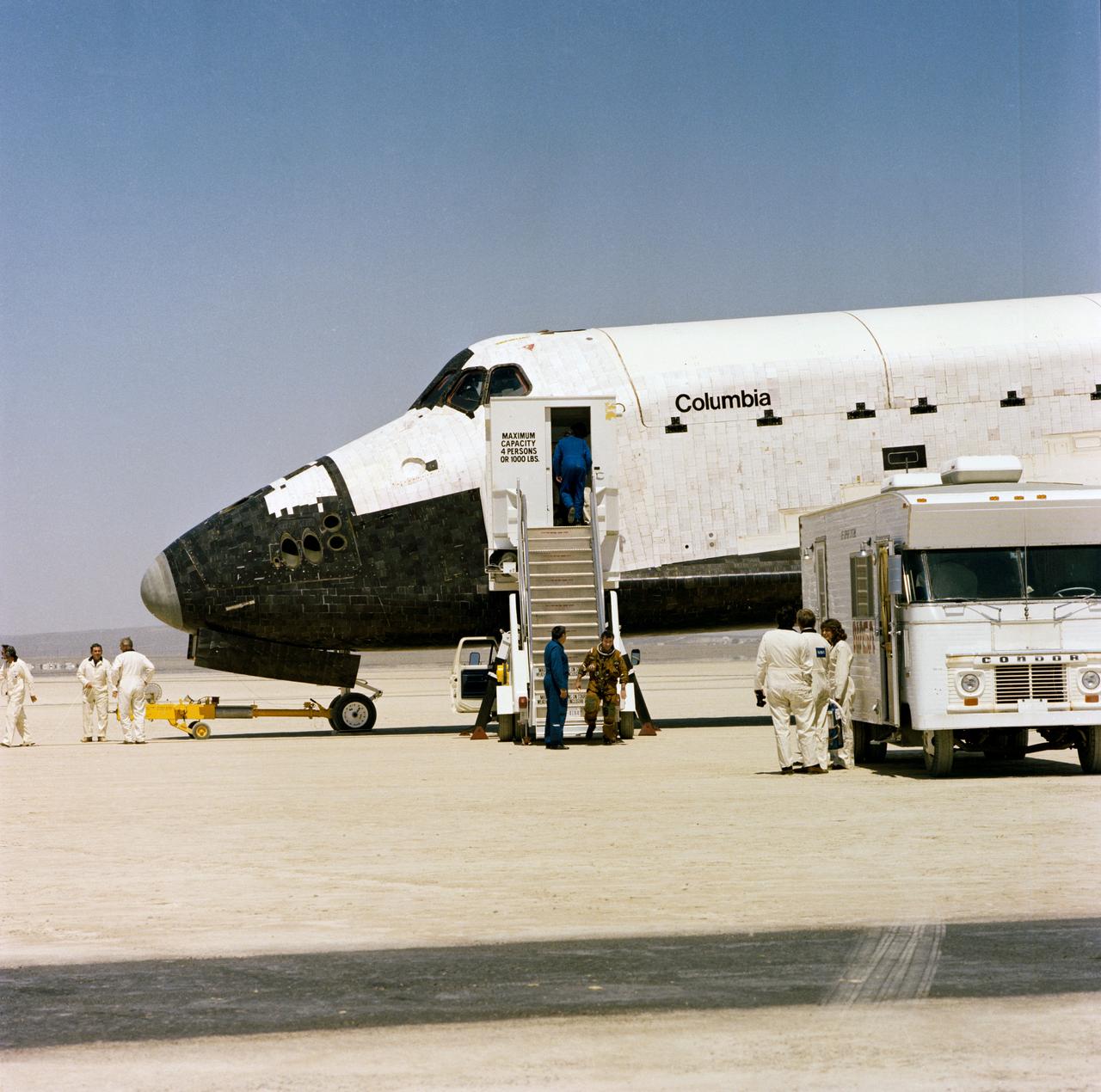
S81-30846 (14 April 1981) --- Astronaut John W. Young (near center of photo), STS-1 commander, egresses the space shuttle Columbia upon the completion of checklist activities following the successful landing of the spacecraft used on STS-1 space mission. George W.S. Abbey, director of flight operations at the Johnson Space Center (JSC), greets him at the bottom of the steps. Astronaut Robert L. Crippen, STS-1 pilot, is still inside Columbia. Dr. Craig L. Fischer, chief of the medical operations branch in the medical sciences division at JSC, ingresses the spacecraft at top of stairs. Photo credit: NASA
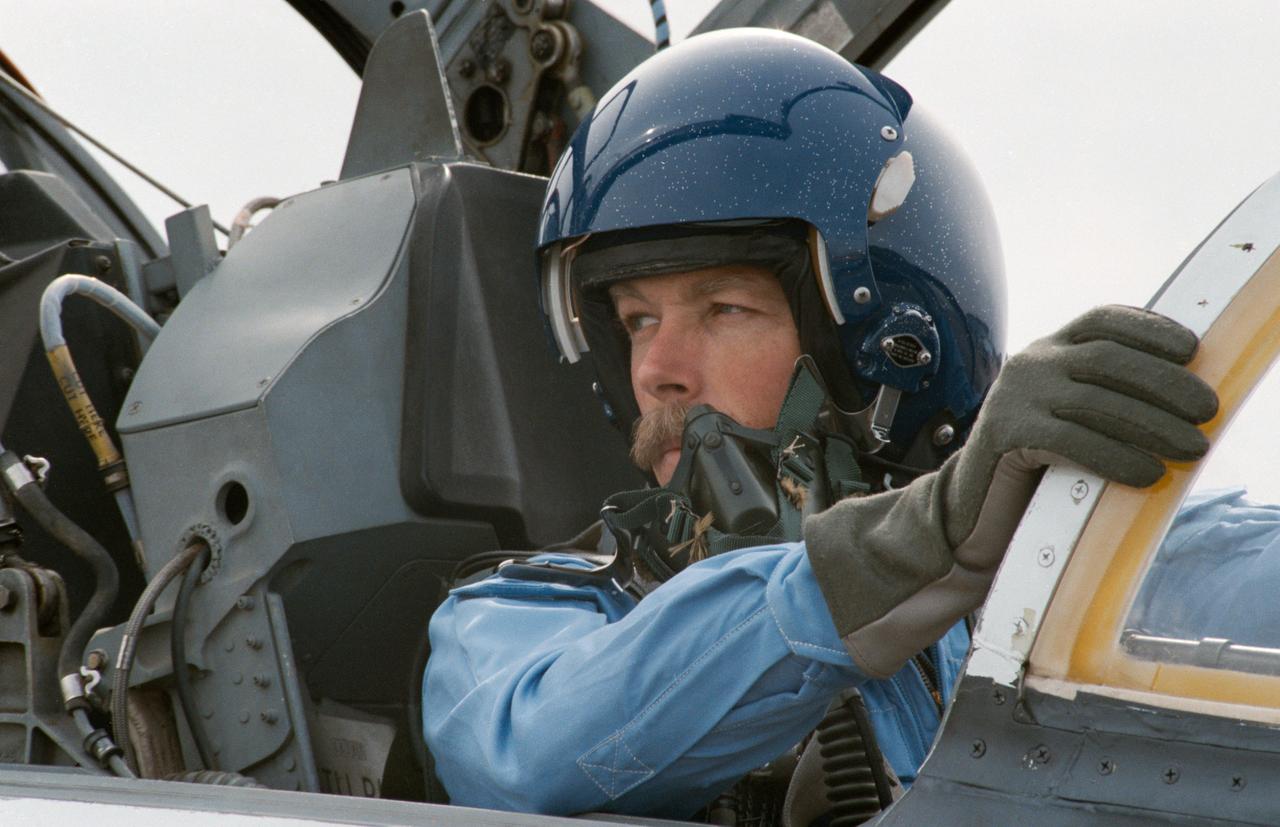
S84-26243 (31 Jan 1984) --- Astronaut Robert L. Gibson, one of five 41-B crewmembers, prepares to leave Houston?s Ellington Base in a T-38 jet aircraft en route to Florida and the Kennedy Space Center, site of February 3?s launch of the Challenger. Gibson, along with two other members of this crew, began training at JSC in July in 1978. He will be joined by Astronauts Vance D. Brand, commander; and Bruce McCandless II, Ronald E. McNair and Robert L. Stewart, all mission specialists. Brand and McCandless came aboard as NASA astronauts in April 1966.
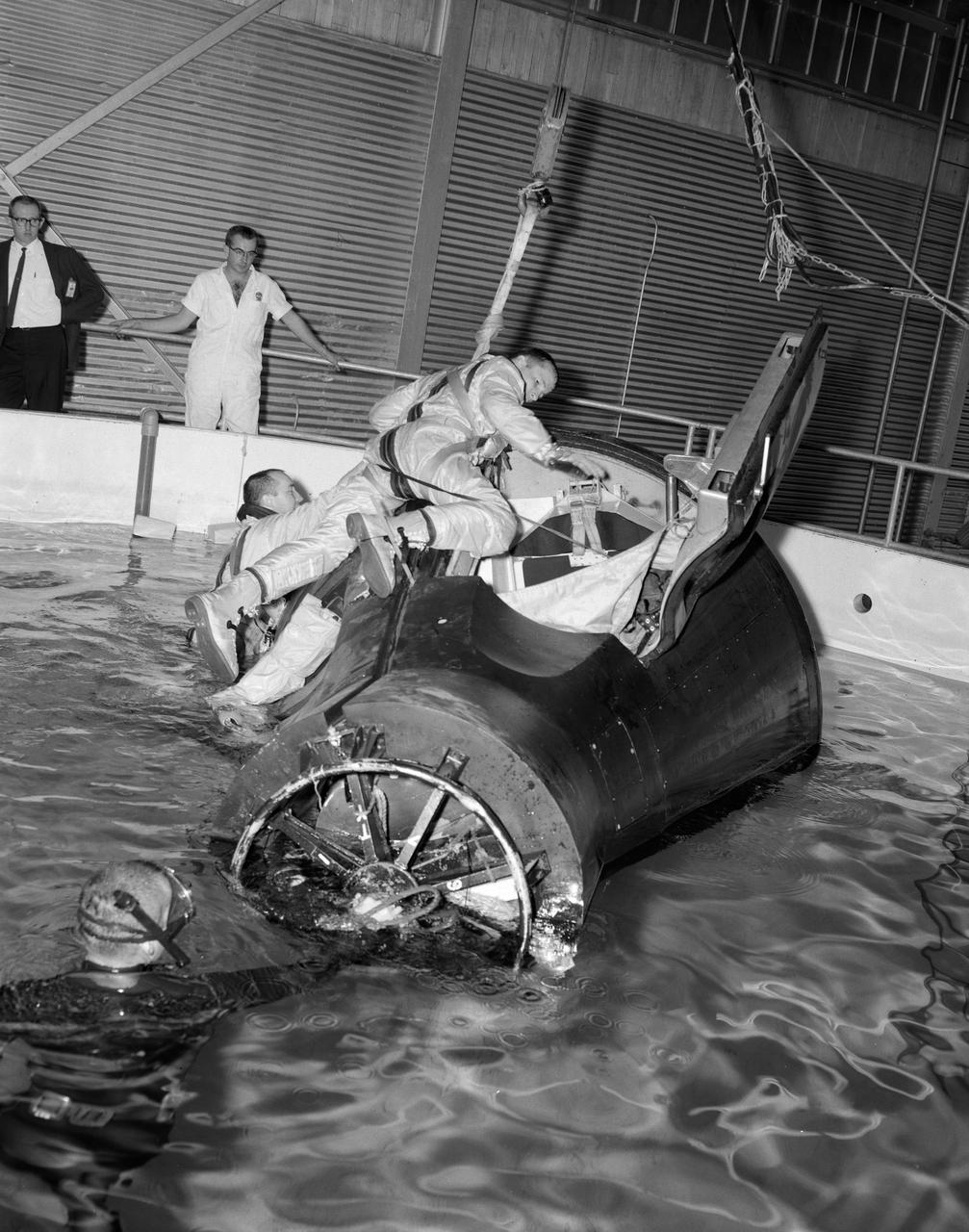
S65-19282 (29 March 1965) --- The Gemini-Titan 4 prime crew, astronauts James A. McDivitt (left), command pilot; and Edward H. White II, pilot, are pictured during water egress training at Ellington Air Force Base, Texas.
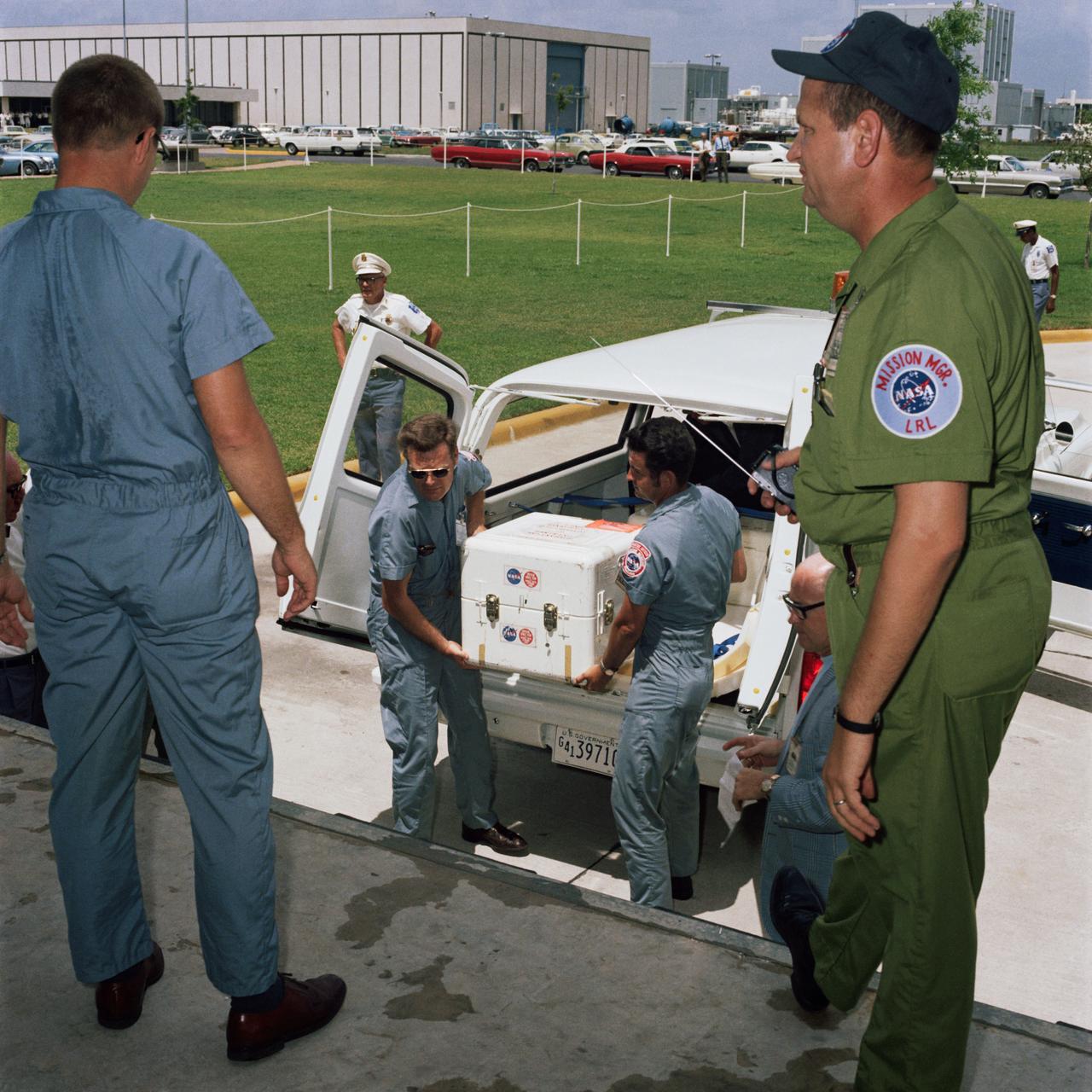
S69-39996 (25 July 1969) --- The first Apollo 11 sample return container, with lunar surface material inside, is unloaded at the Lunar Receiving Laboratory, Building 37, Manned Spacecraft Center (MSC). The rock box had arrived only minutes earlier at Ellington Air Force Base by air from the Pacific recovery area. The lunar samples were collected by astronauts Neil A. Armstrong and Edwin E. Aldrin Jr. during their lunar surface extravehicular activity.
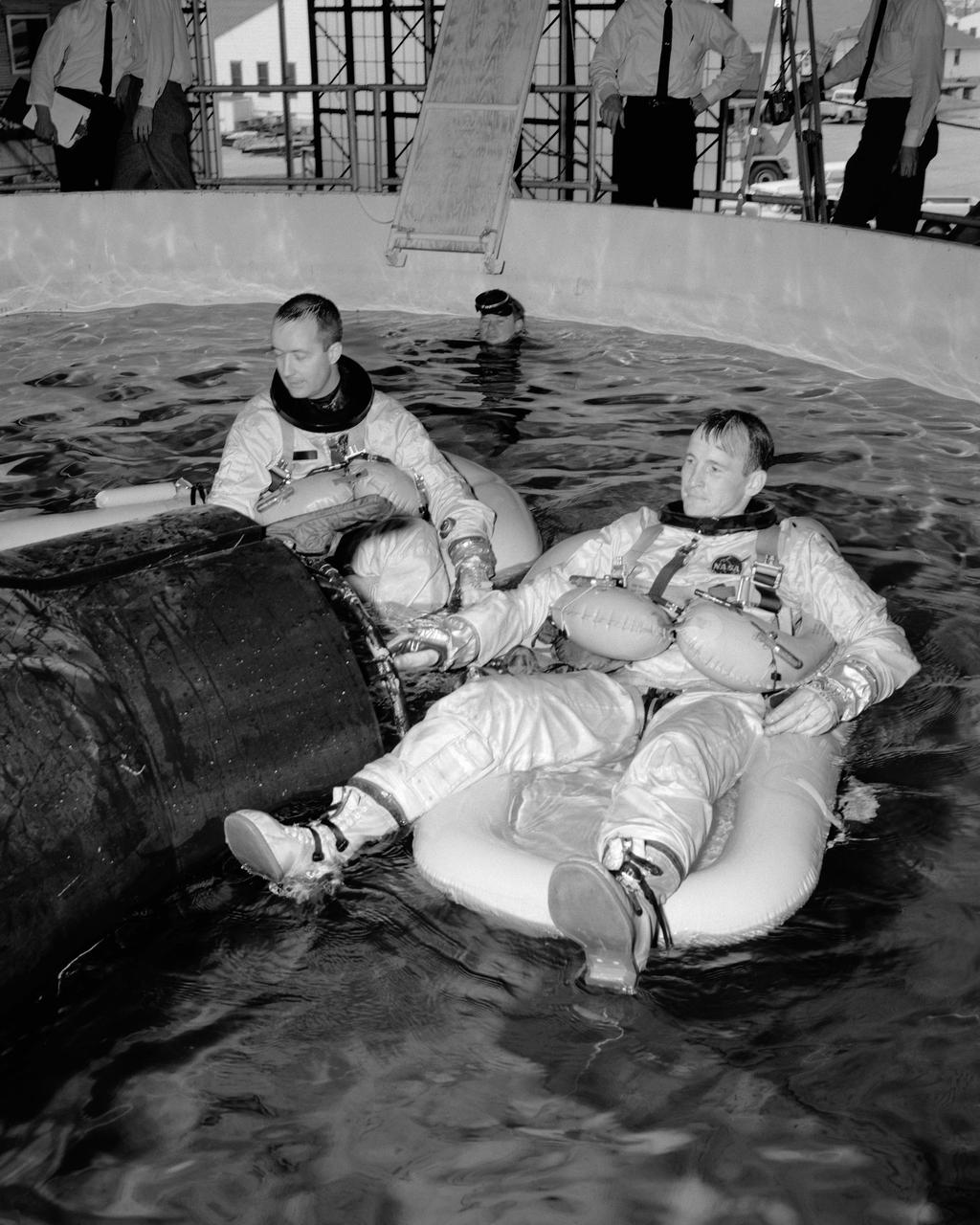
S65-19283 (29 March 1965) --- The Gemini-Titan 4 prime crew, astronauts James A. McDivitt (left), command pilot; and Edward H. White II, pilot, are pictured during water egress training at Ellington Air Force Base, Texas.

S69-60644 (29 Nov. 1969) --- A Mobile Quarantine Facility (MQF), with the crew men of the Apollo 12 lunar landing mission aboard, arrived at the Manned Spacecraft Center (MSC) Saturday morning, Nov. 29, 1969. Astronauts Charles Conrad Jr., Richard F. Gordon Jr., and Alan L. Bean were on their way to the Lunar Receiving Laboratory (LRL) where they will remain in quarantines until Dec. 10, 1969. Minutes earlier the three astronauts had arrived at Ellington Air Force Base from Hawaii aboard a U.S. Air Force C-141 transport. The crewmen were confined to the MQF from splashdown until they arrived at the LRL.

S69-60760 (29 Nov. 1969) --- Members of the Apollo 12 lunar landing mission's crew talk to their families from inside the Mobile Quarantine Facility (MQF) soon after their arrival at Ellington Air Force Base aboard a United States Air Force C-141 transport jet in the early morning hours of Nov. 29, 1969. The crew men, looking out the MQF window at the crowd, are from left to right, astronauts Charles Conrad Jr., Richard F. Gordon Jr., and Alan L. Bean. Some of the family members can be seen in lower right foreground. The crew members were taken to Hawaii from their Pacific Ocean recovery site aboard the USS Hornet, prime recovery vessel for the mission.
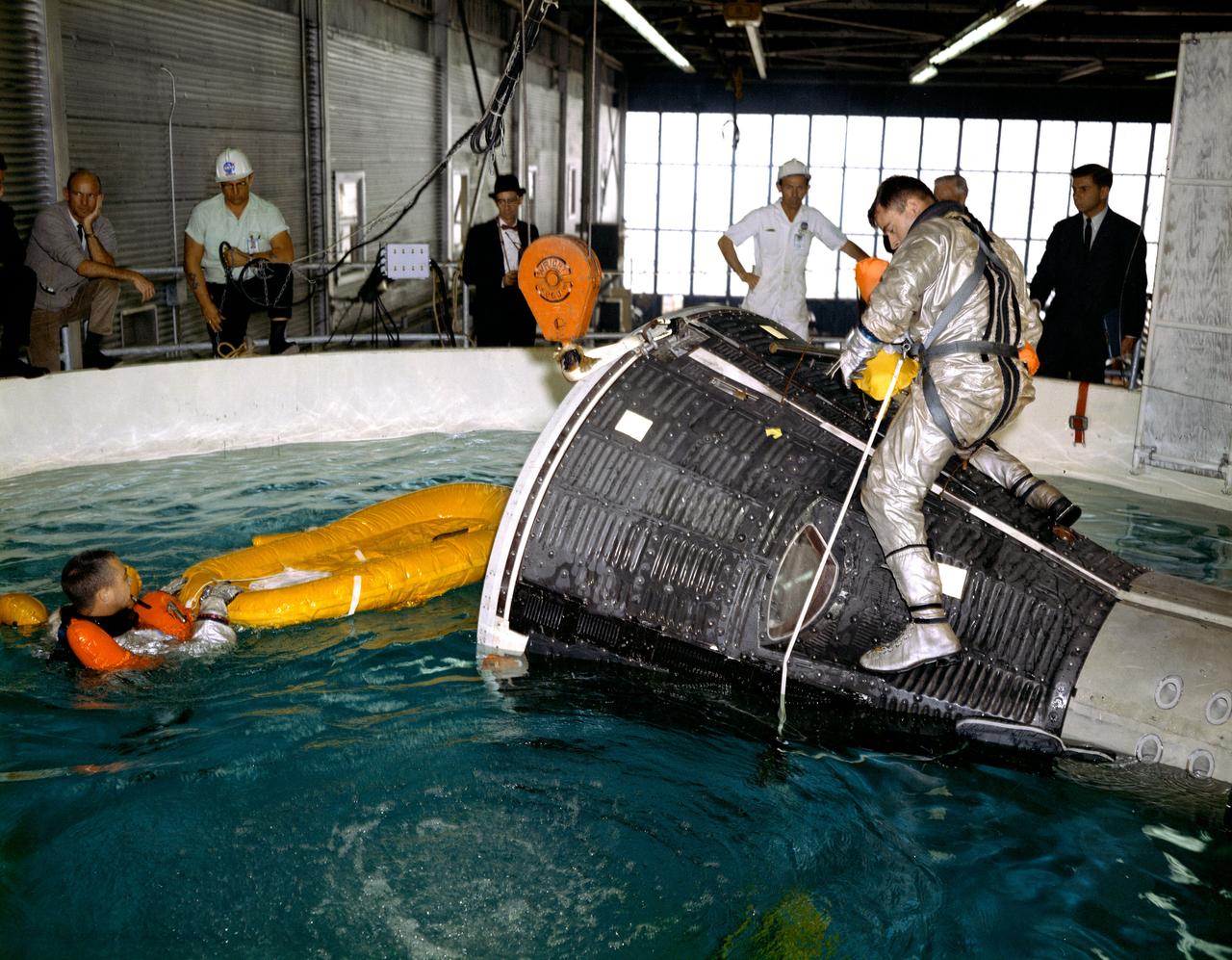
S65-10157 (5 Feb. 1965) --- Astronaut John W. Young, the Gemini-Titan 3 prime crew pilot, is shown atop a Gemini spacecraft at Ellington Air Force Base, Texas, during water egress training.
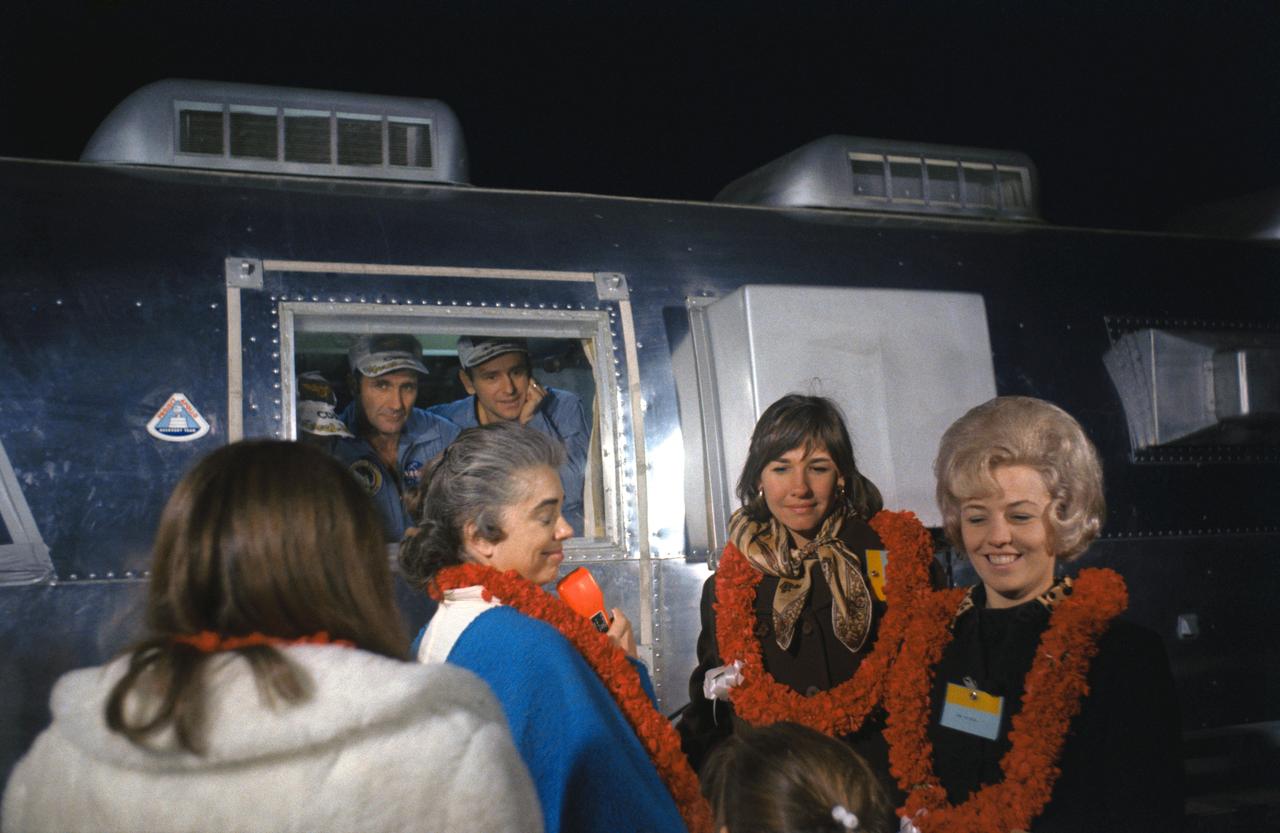
S69-60759 (29 Nov. 1969) --- Members of the Apollo 12 lunar landing mission's crew are greeted by their wives and children at the front of a large crowd on hand to welcome the three home. The Mobile Quarantine Facility (MQF), with the crew inside, arrived at Ellington Air Force Base aboard a United States Air Force C-141 transport jet in the early morning hours of Nov. 29, 1969. The crew men, looking out the MQF window at the crowd, are from left to right, astronauts Charles Conrad Jr., Richard F. Gordon Jr. and Alan L. Bean. Their wives are, from left to right, Mrs. Barbara Gordon, Mrs. Jane Conrad and Mrs. Sue Bean. The women are wearing lei's, an Hawaiian tradition. The crew members were taken to Hawaii from their Pacific Ocean recovery site aboard the USS Hornet, prime recovery vessel for the mission.
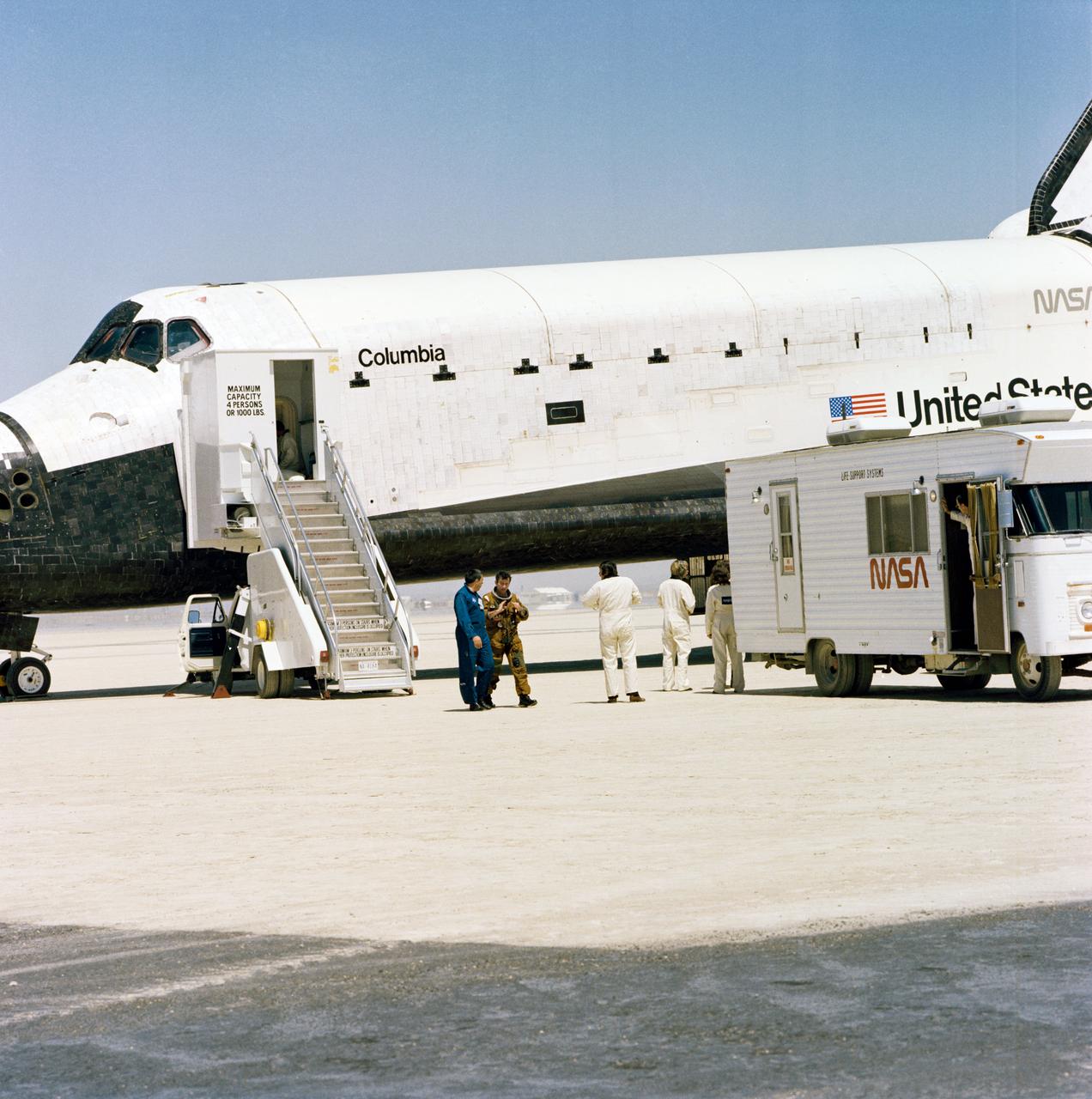
S81-30853 (14 April 1981) --- Astronaut John W. Young, left center talks with George W.S. Abbey, director of flight operations at Johnson Space Center, following egress from the STS-1 Columbia, which forms the backdrop for this postflight scene. Young is en route to the van at right which will take him and fellow crew member Robert L. Crippen (STS-1 pilot still inside Columbia) to facilities at nearby Dryden Flight Research Center. Columbia will be mated to a 747 carrier craft and flown to Florida, where it will be refurbished to accommodate STS-2, scheduled for a Sept. 30 launch date. Photo credit: NASA
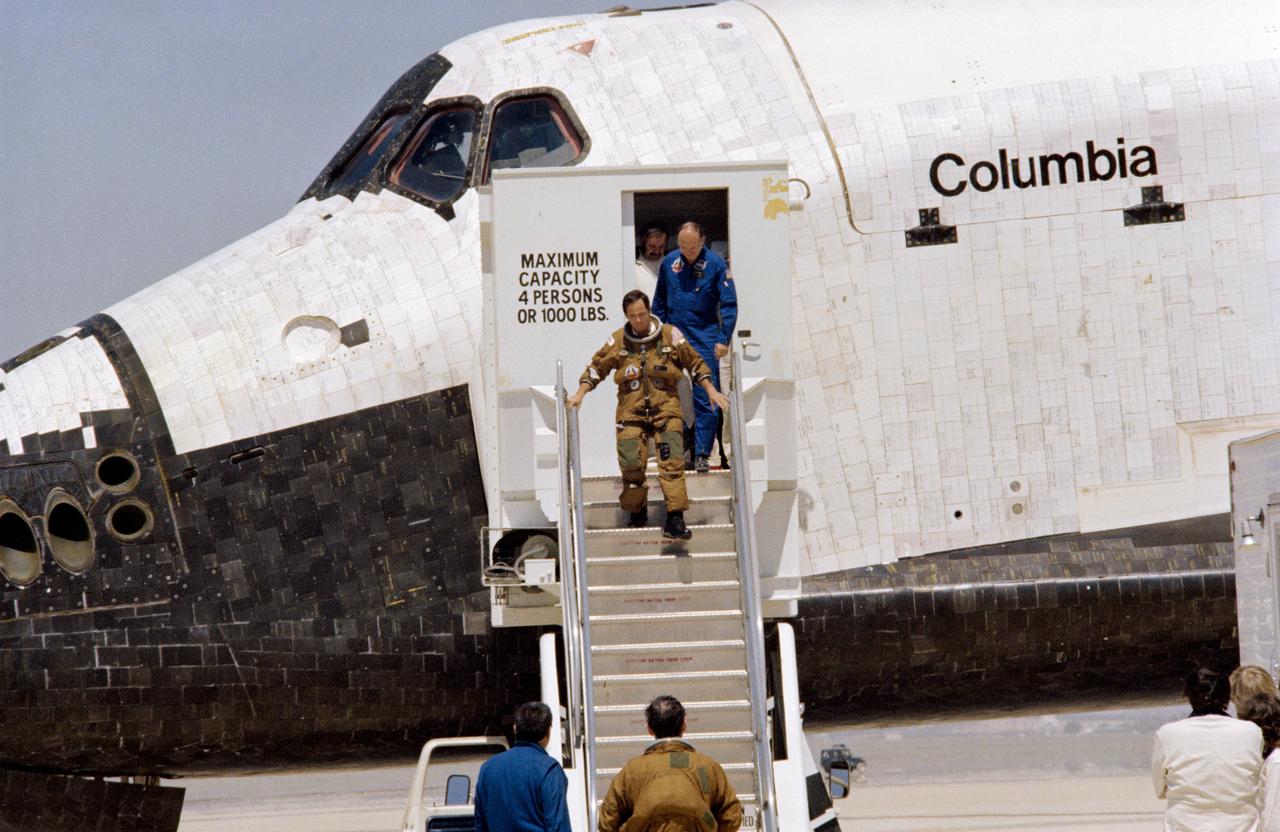
S81-30852 (14 April 1981) --- Astronaut Robert L. Crippen, pilot for the STS-1 flight, egresses the NASA space shuttle following touchdown of the Columbia on Rogers Dry Lake at Edwards Air Force Base, California. Astronaut John W. Young, crew commander, had earlier exited the craft and can be seen standing at the foot of the steps with George W.S. Abbey, director of flight operations at the Johnson Space Center (JSC). Dr. Craig L. Fischer, chief of the medical operations branch in JSC?s medical sciences division, follows Crippen down the steps. Photo credit: NASA

S69-40152 (27 July 1969) --- A Mobile Quarantine Facility (MQF), with the three Apollo 11 crewmen inside, is unloaded from a United States Air Force C-141 transport at Ellington Air Force Base very early Sunday after a flight from Hawaii. A large crowd was present to welcome astronauts Neil A. Armstrong, Michael Collins, and Edwin E. Aldrin Jr. back to Houston following their historic lunar landing mission. The crew remained in the MQF until they arrived at the Crew Reception Area of the Lunar Receiving Laboratory (LRL) at the Manned Spacecraft Center (MSC). The crew will be released from quarantine on Aug. 11, 1969.
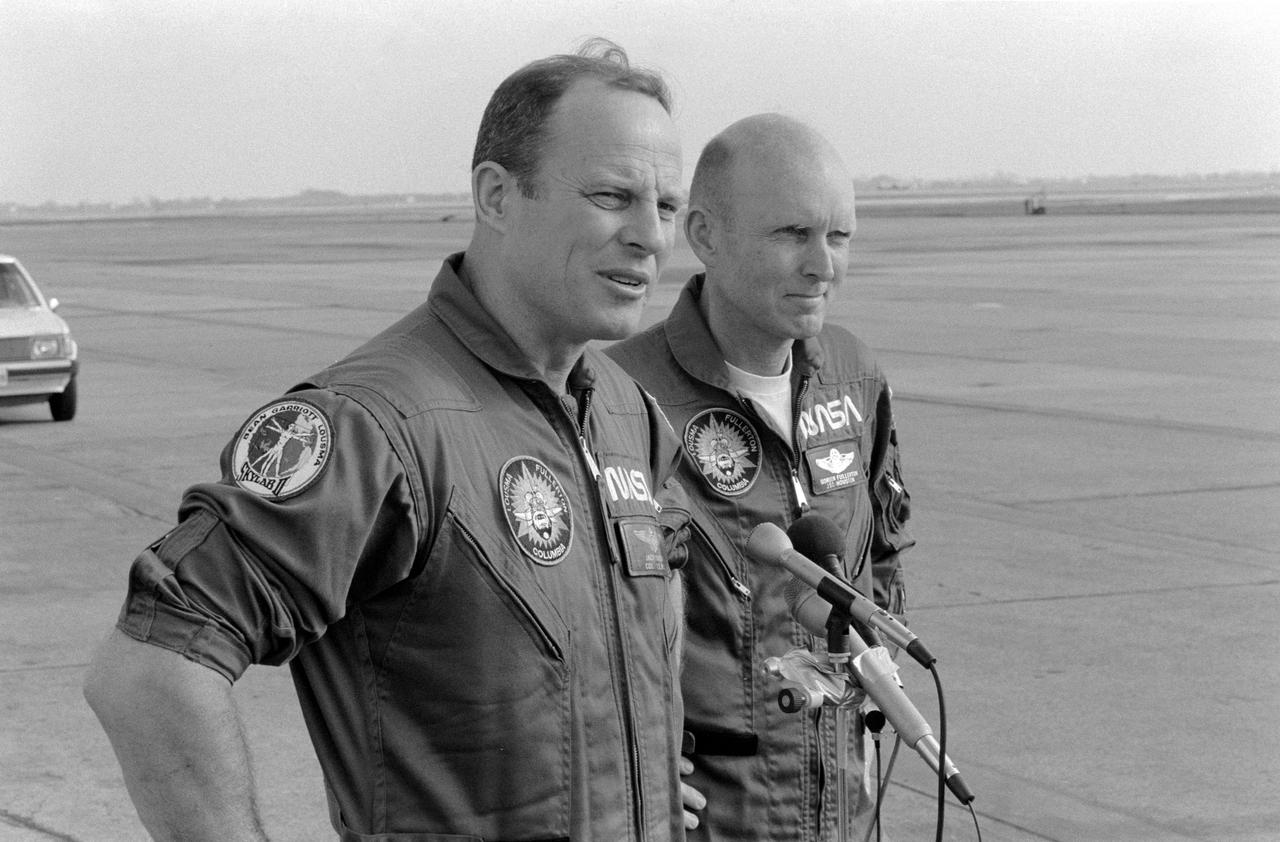
S82-28705 (20 March 1982) --- Astronaut Jack R. Lousma, left, and C. Gordon Fullerton pause for a moment at Ellington Air Force Base prior to their departure in T-38 aircraft to get to NASA?s Kennedy Space Center in time for last minute preparations for their Monday morning launch in the STS-3 space shuttle Columbia. Ellington Air Force Base is just a few miles north of the LBJ Space Center. Photo credit: NASA
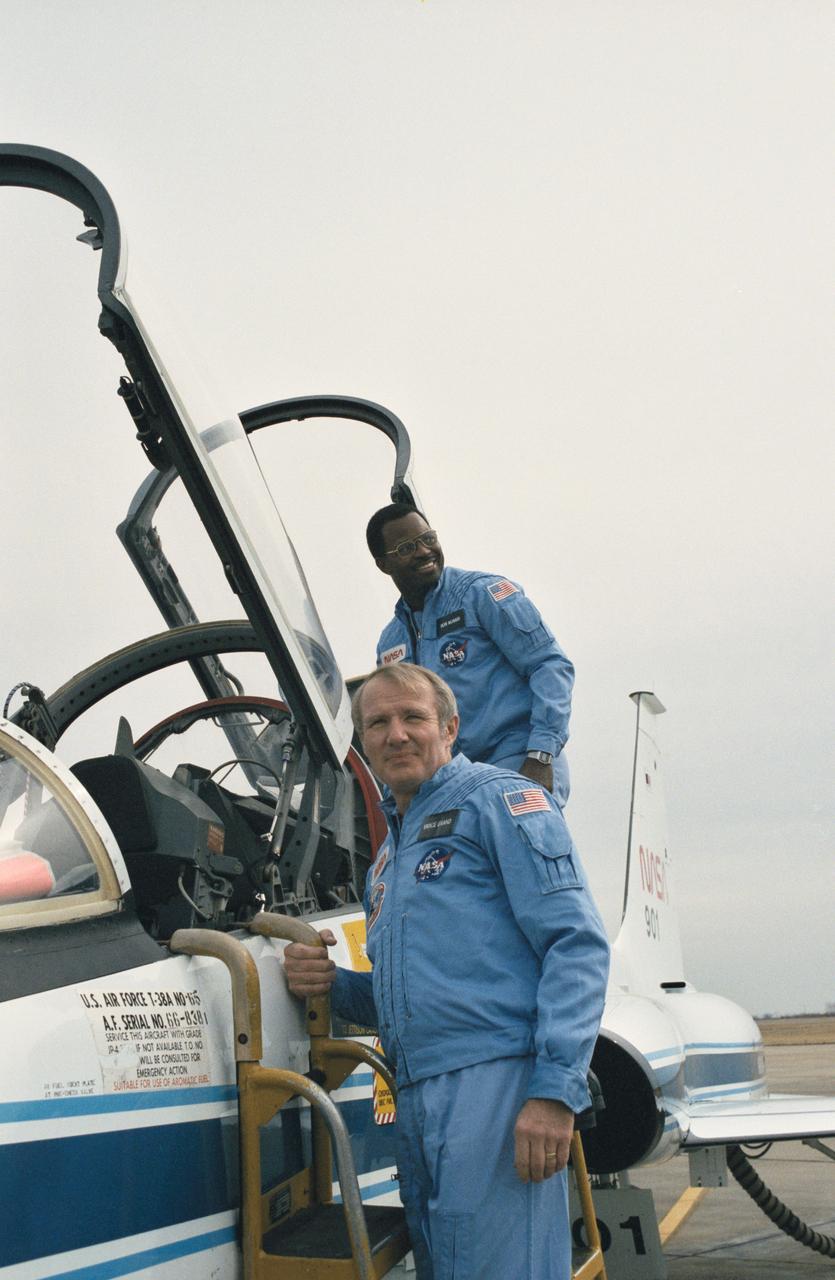
S84-26244 (31 Jan 1984) --- Astronauts Vance D. Brand, foreground, and Ronald E. McNair, of NASA's STS-41B Space Shuttle Challenger crew, prepare to climb into a T-38 jet aircraft readied for takeoff to Florida and the Kennedy Space Center (KSC). Brand is making his third Spaceflight, including his second as a Shuttle flight crew commander. McNair, mission specialist, will be making his first trip into space. Launch for STS-41B is scheduled for 8 a.m. (EST), February 3, 1984. This photo was taken by Otis Imboden.
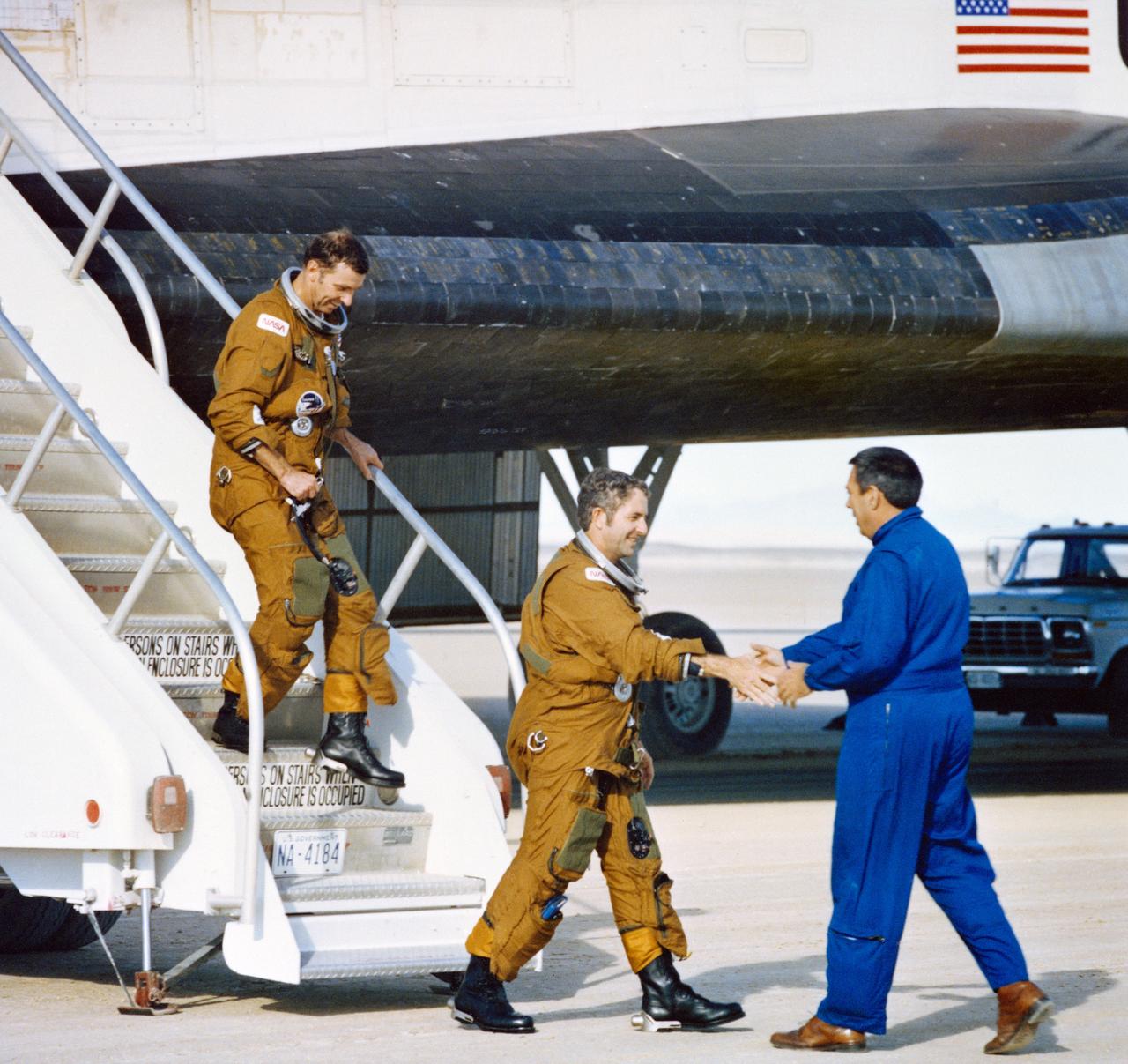
S81-39582 (14 Nov. 1981) --- Astronauts Joe H. Engle, rear, and Richard H. Truly are greeted by George W.S. Abbey, Director of Flight Operations at the Johnson Space Center, as they egress the space shuttle Columbia after spending two days, six hours and 13 minutes on NASA?s STS-2 mission. Photo credit: NASA
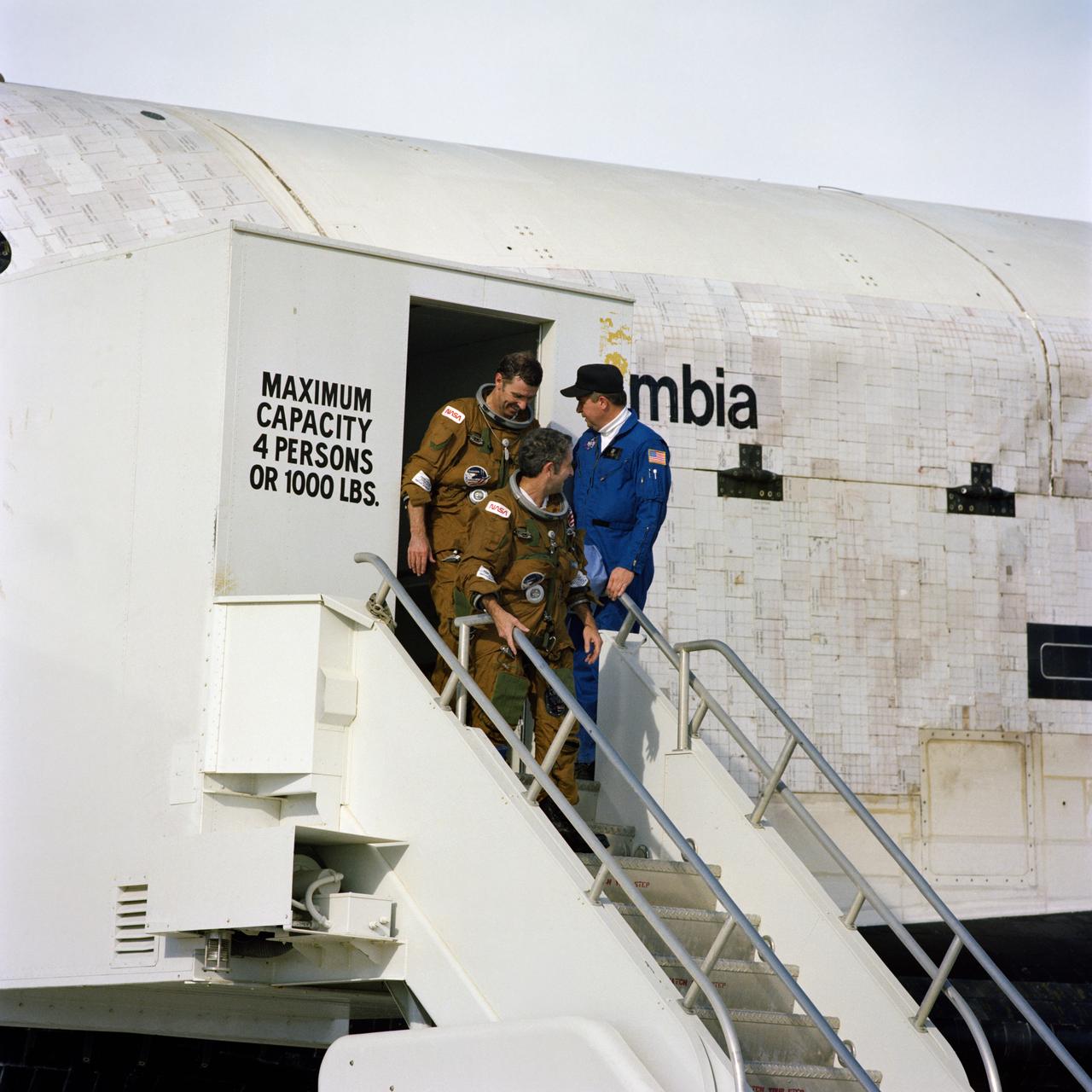
S81-39580 (14 Nov. 1981) --- Astronauts Joe H. Engle, rear, and Richard H. Truly egress the space shuttle Columbia after spending two days, six hours and 13 minutes on NASA?s STS-2 mission. At right is their physician, Dr. Charles La Pinta of the JSC Medical Sciences Division. Photo credit: NASA
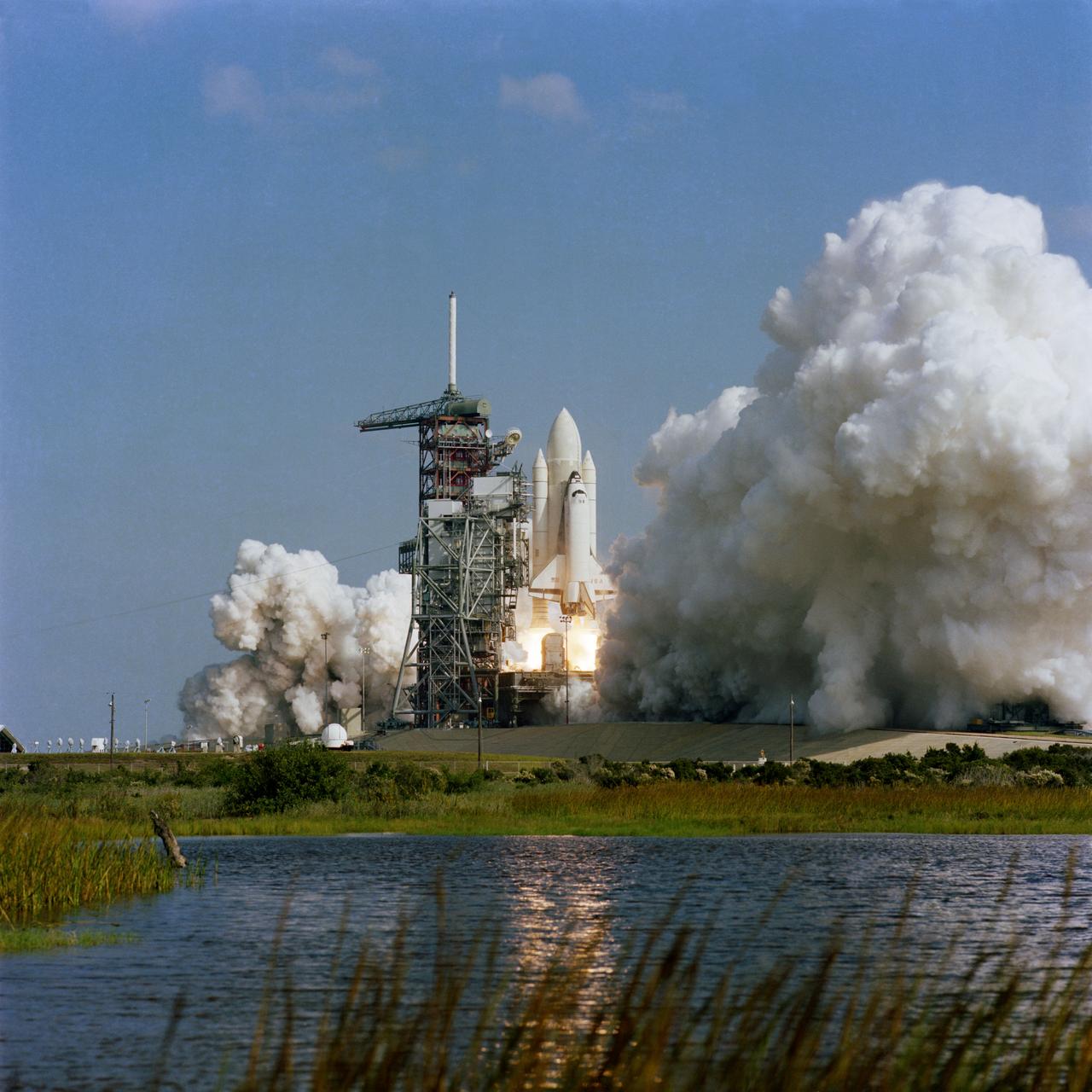
S81-39548 (12 Nov. 1981) --- NASA's space shuttle Columbia climbs toward space for a return visit after its 10:10 a.m. liftoff from Launch Pad 39A. Aboard the space shuttle, astronauts Joe H. Engle and Richard H. Truly man the flight deck. On its second mission (STS-2), Columbia carries a payload of science and applications experiments and an arm-like robot device named a remote manipulator system (RMS). Photo credit: NASA