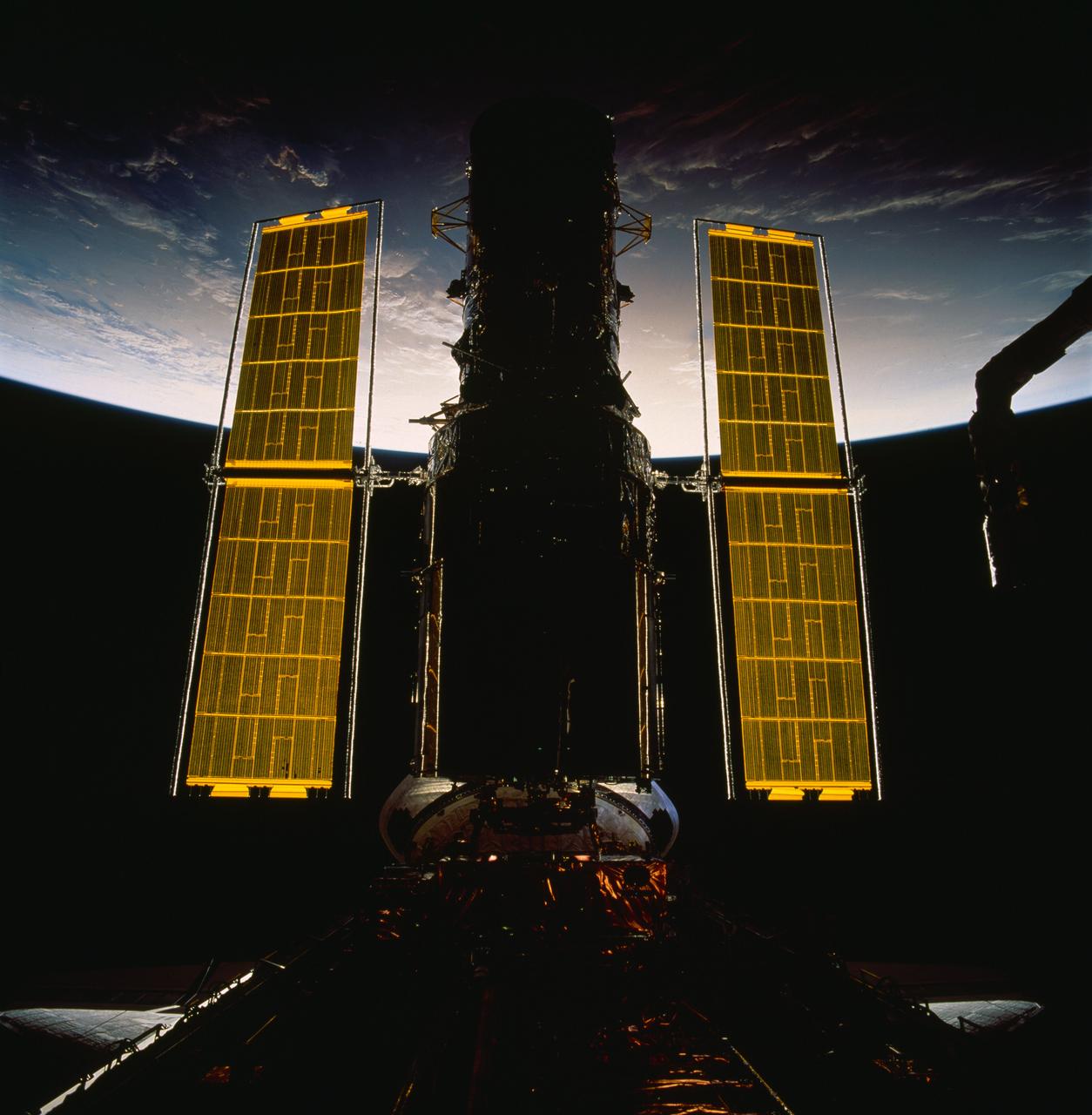
STS061-99-002 (2-13 Dec 1993) --- The new set of solar array panels deployed on the Hubble Space Telescope (HST) is backdropped against the blackness of space and a widely cloud-covered area on Earth. The 70mm frame was exposed by one of the Space Shuttle Endeavour's seven crew members on the aft flight deck.
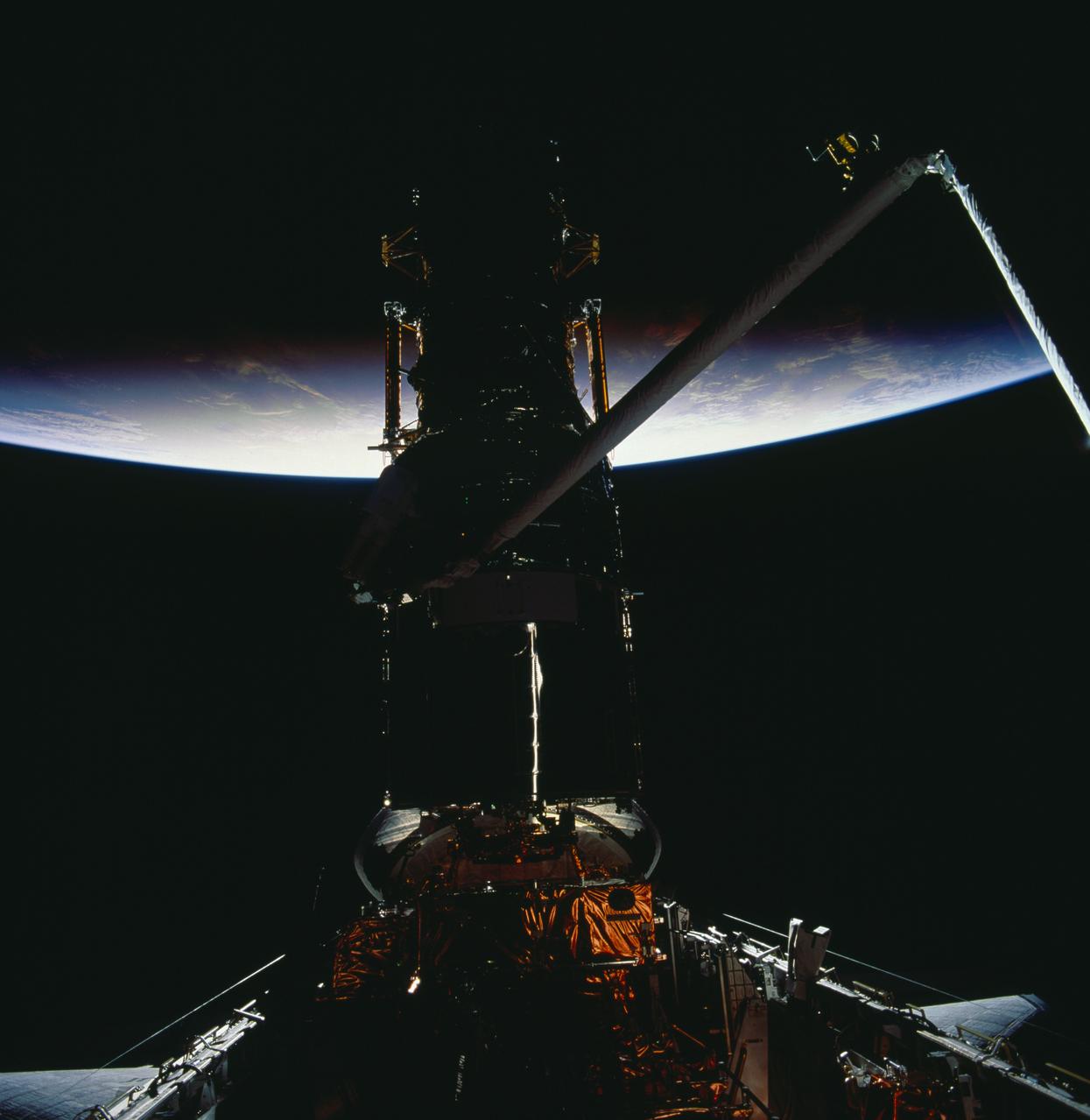
STS061-98-0AR (8 Dec 1993) --- Earth is partially illuminated but the Hubble Space Telescope (HST) and the Space Shuttle Endeavour are still mostly in darkness, in this 70mm frame photographed during the fourth of five space walks. Astronaut Kathryn C. Thornton, barely visible above left center in the frame, works to install the Corrective Optics Space Telescope Axial Replacement (COSTAR).
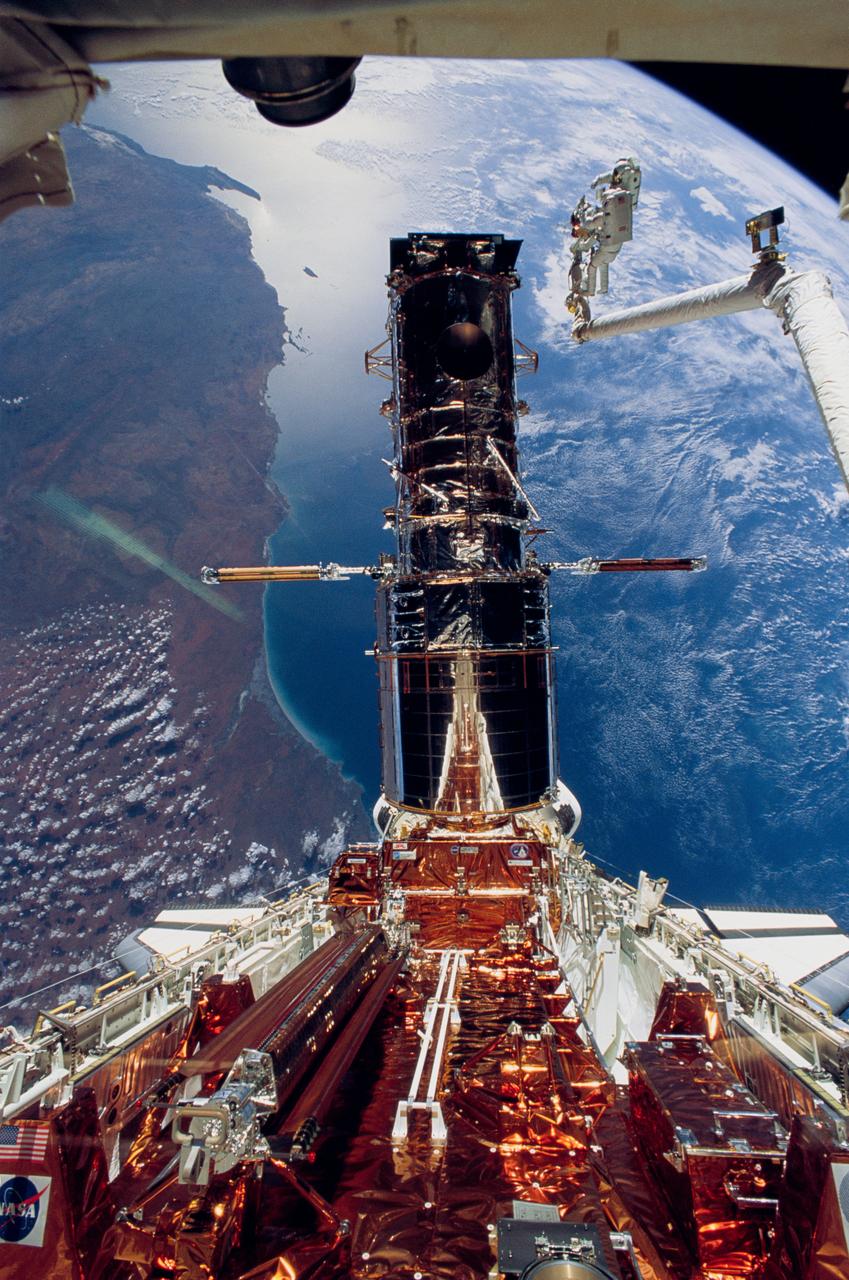
STS061-48-001 (9 Dec 1993) --- Orbiting Earth at an altitude of 356 nautical miles perched atop a foot restraint on the Space Shuttle Endeavour's Remote Manipulator System (RMS) arm, astronauts F. Story Musgrave (top) and Jeffrey A. Hoffman wrap up the final of five Extravehicular Activities (EVA). The west coast of Australia forms the backdrop for the 35mm frame.
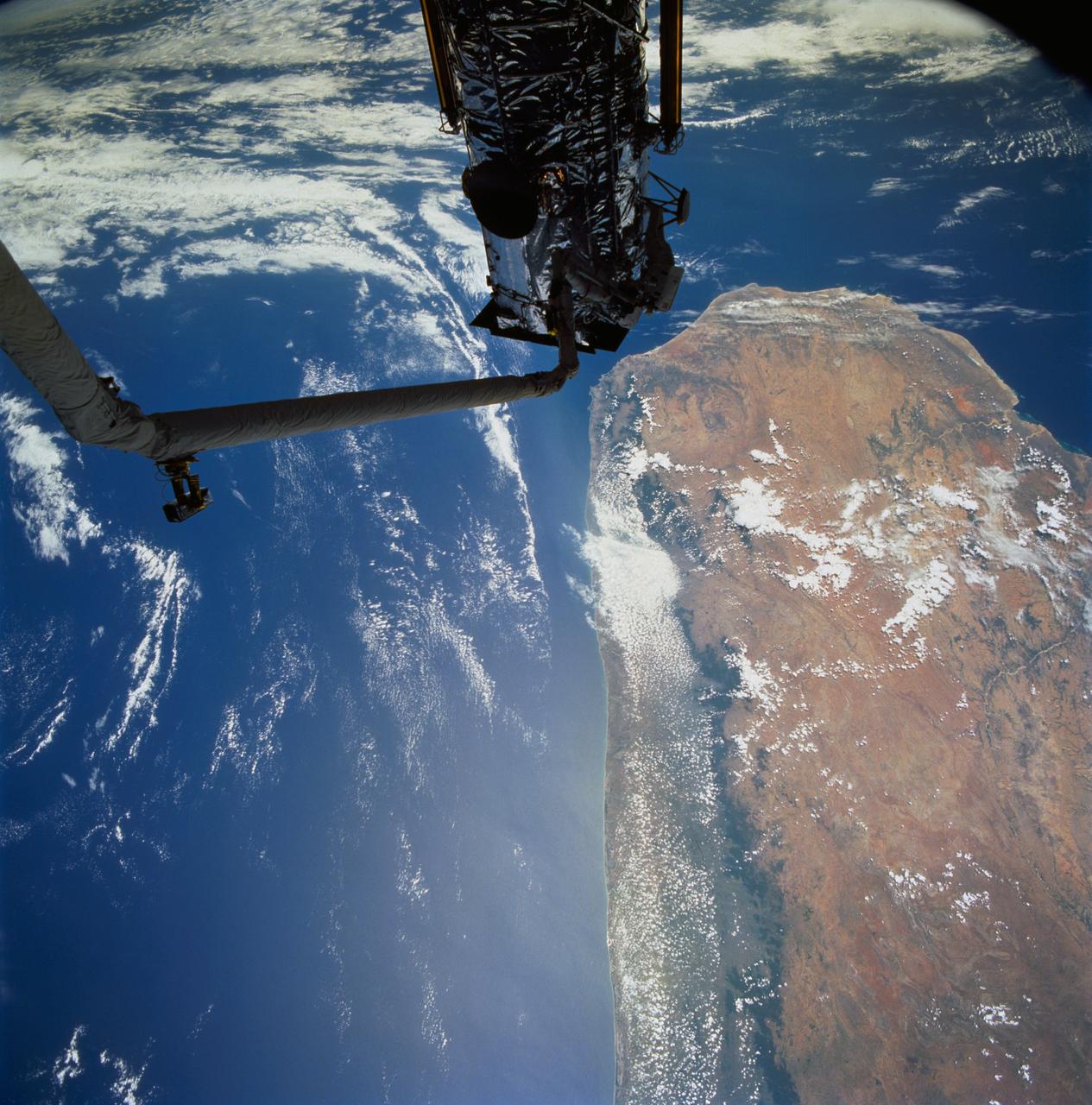
STS061-77-102 (7 Dec 1993) --- Astronauts Jeffrey A. Hoffman (left) and F. Story Musgrave are partially silhouetted against the Indian Ocean as they work to install the Magnetic Sensing System (MSS) on the Hubble Space Telescope (HST). Musgrave is anchored to the end of the Space Shuttle Endeavour's Remote Manipulator System (RMS) arm. The HST is positioned along the southern end of Madagascar, 325 nautical miles away. Visible on the western coast are the sediment laden Onilahy and Fiherenana Rivers which empty into Saint Augustin Bay. North of Fiherenana River is the Mangoky River. The circular feature on the southern end of Madagascar and to the right of HST is the L'ivakoany Mountains. The eastern coast is relatively straight compared to the western coast.
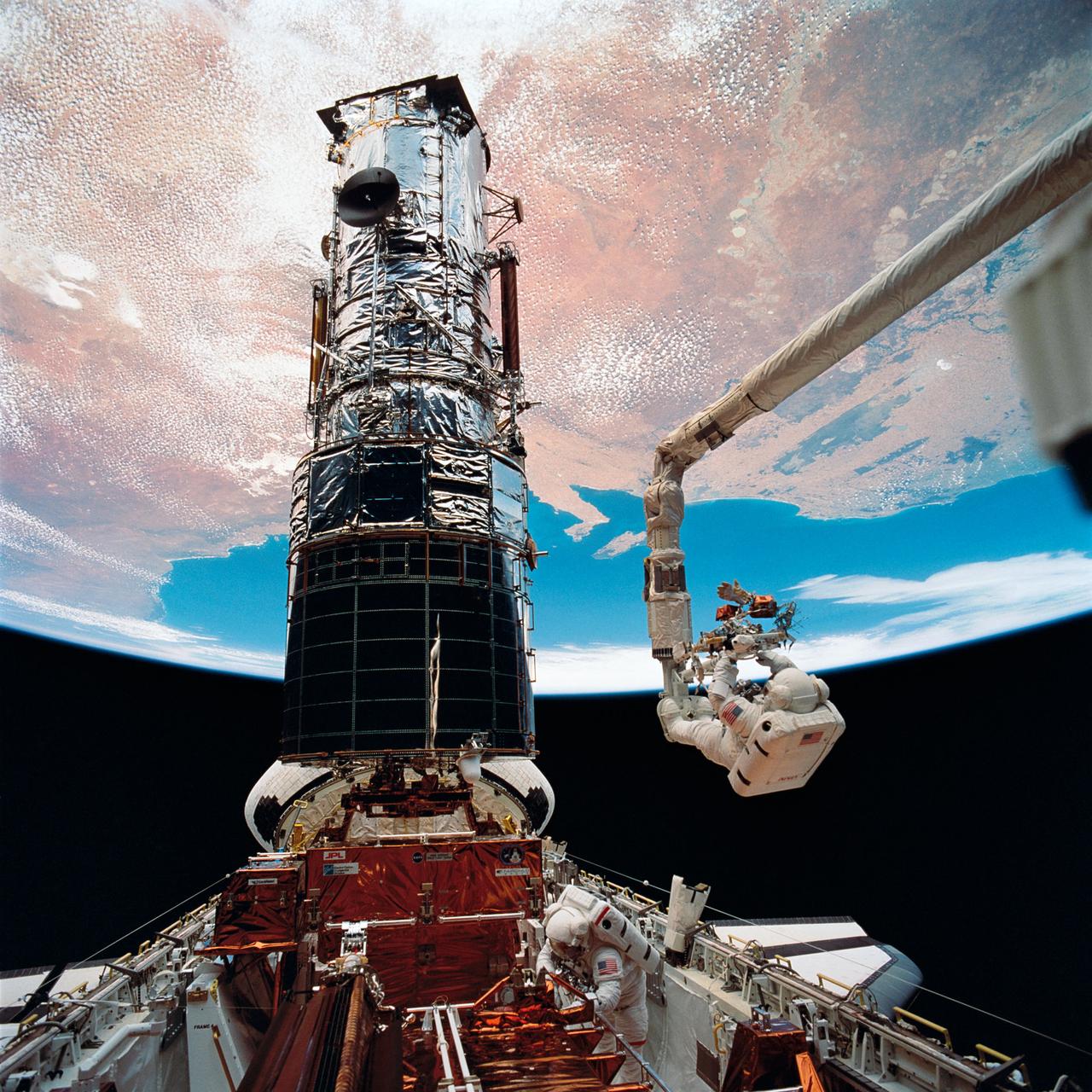
STS061-98-050 (9 Dec 1993) --- Astronaut F. Story Musgrave, anchored on the end of the Remote Manipulator System (RMS) arm, prepares to be elevated to the top of the towering Hubble Space Telescope (HST) to install protective covers on magnetometers. Astronaut Jeffrey A. Hoffman (bottom of frame) assisted Musgrave with final servicing tasks on the telescope, wrapping up five days of extravehicular activities (EVA).
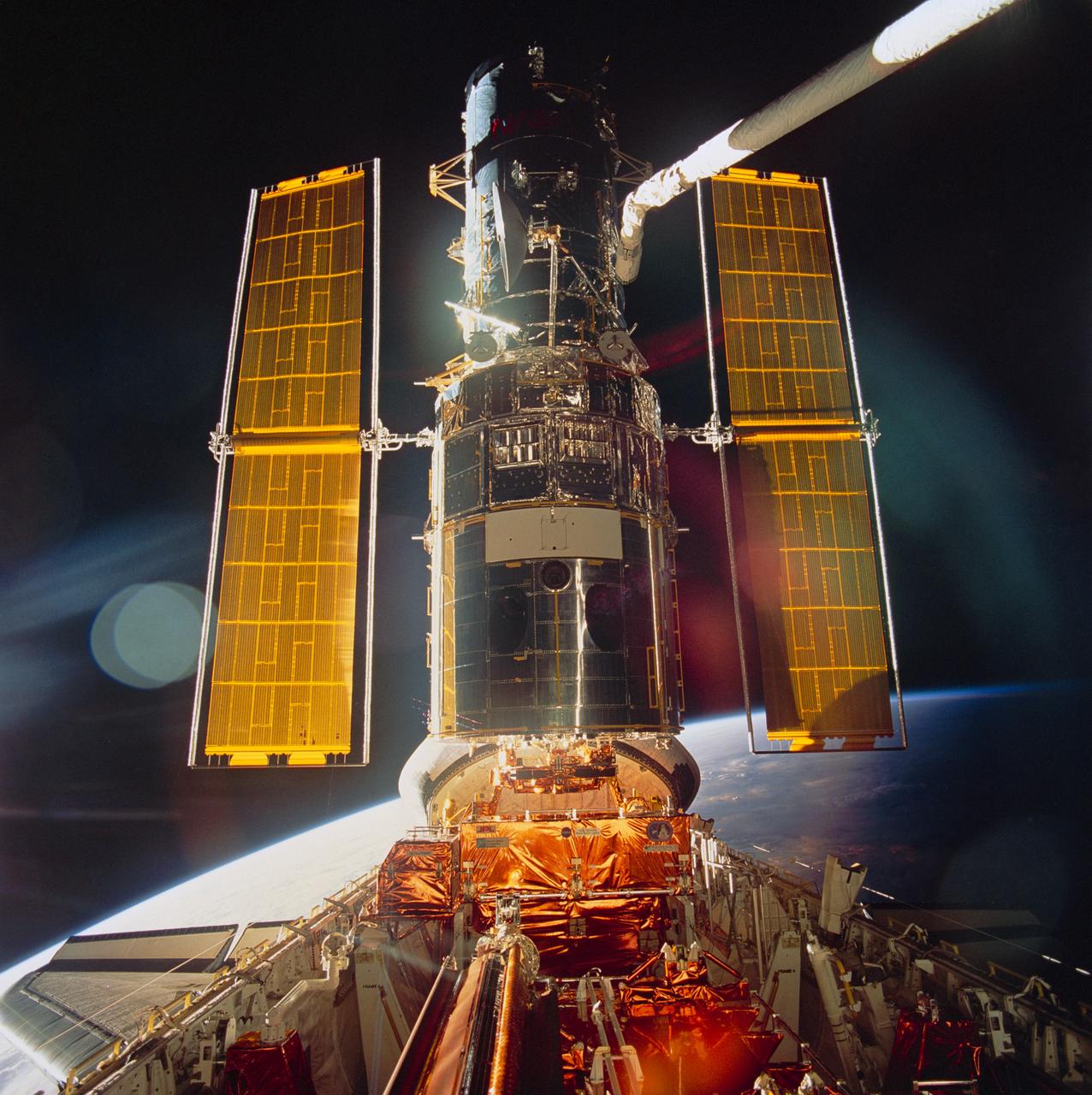
STS061-99-009 (9 Dec 1993) --- Sunlight reflects off the Space Shuttle Endeavour's aft windows and the shiny Hubble Space Telescope (HST) prior to its post-servicing deployment near the end of the eleven-day mission. A handheld Hasselblad camera was used inside Endeavour's cabin to record the image.
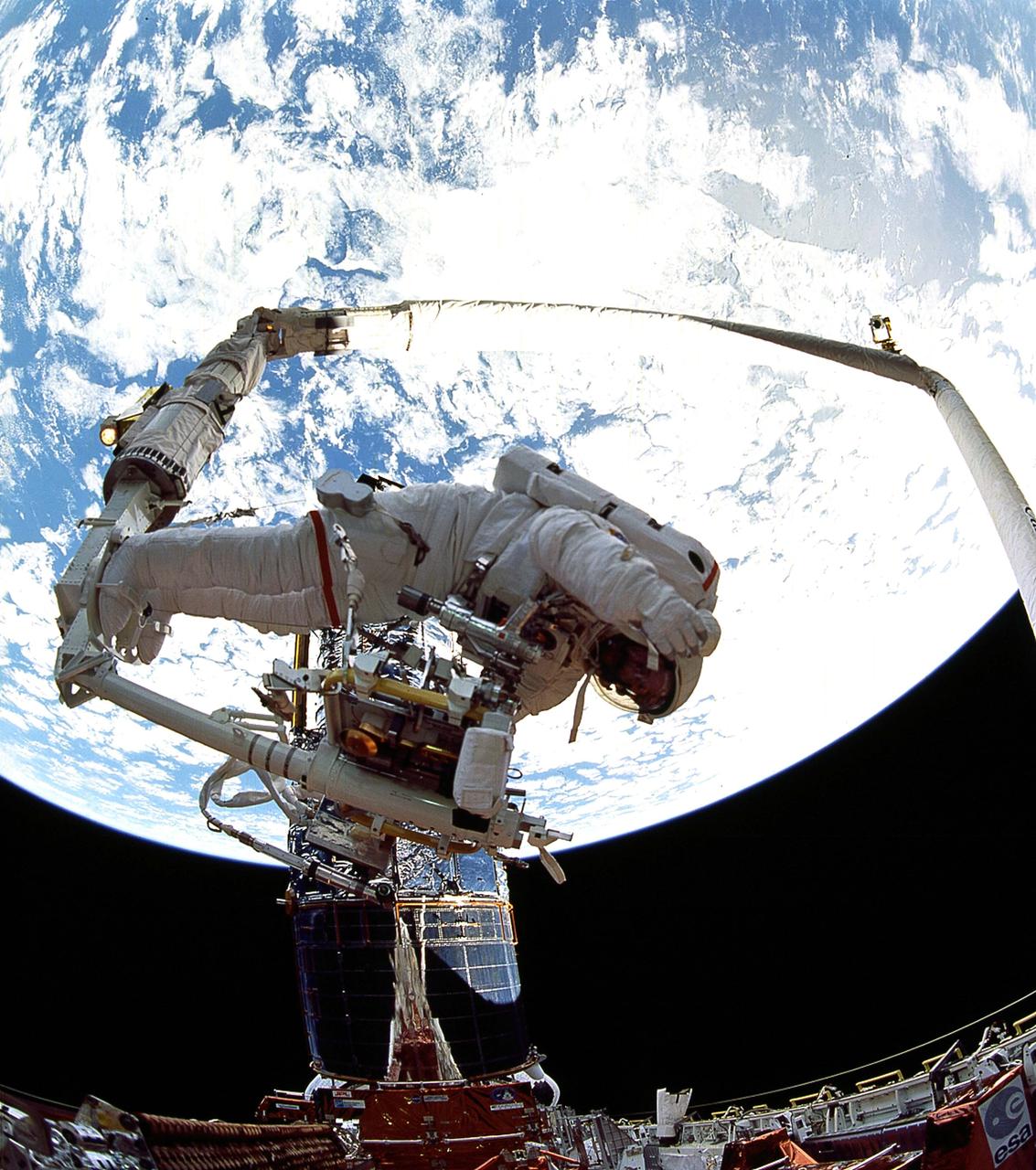
STS061-105-026 (7 Dec. 1993) --- Astronaut Jeffrey A. Hoffman signals directions to European Space Agency (ESA) astronaut Claude Nicollier, as the latter controls the Remote Manipulator System (RMS) arm during the third of five Extravehicular Activities (EVA) on the Hubble Space Telescope (HST) servicing mission. Astronauts Hoffman and F. Story Musgrave earlier changed out the Wide Field\Planetary Camera (WF\PC).
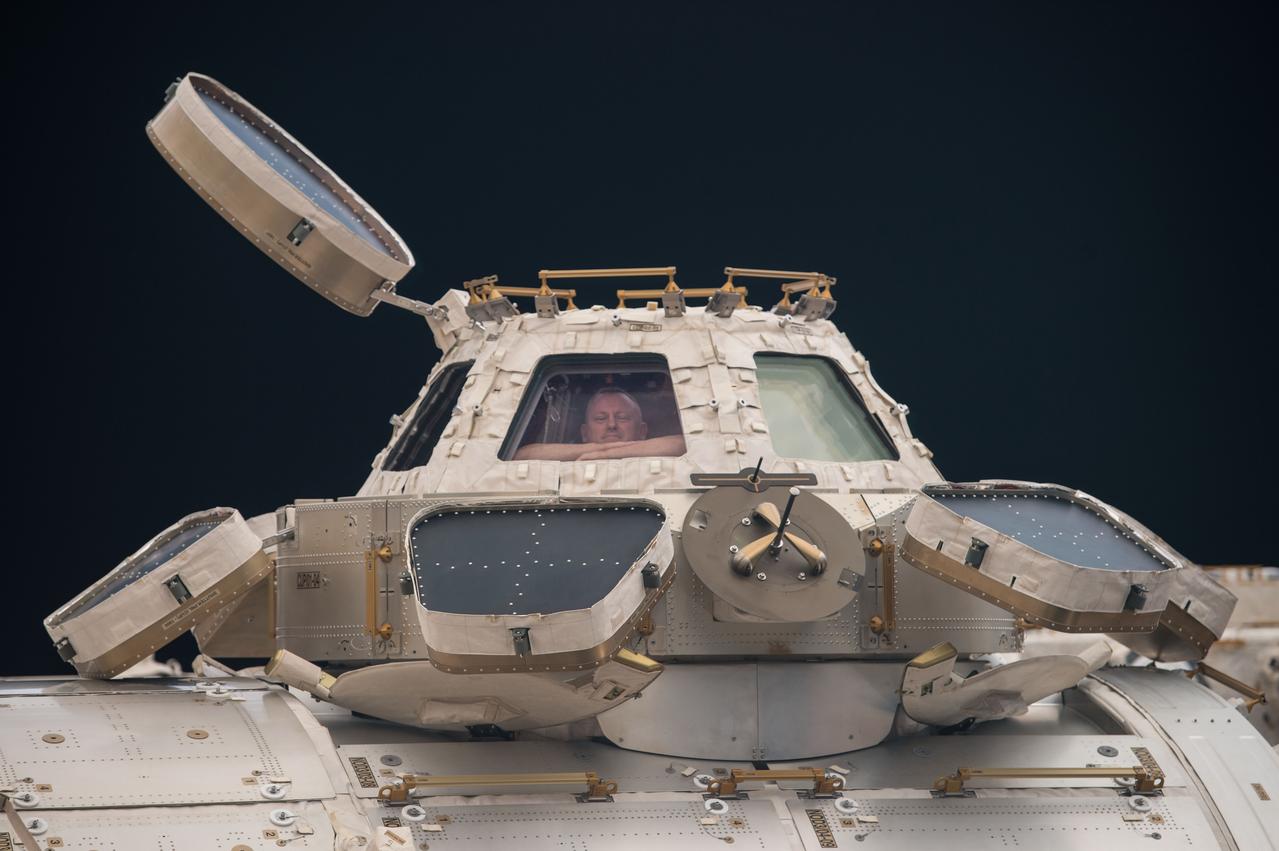
iss042e078481 (12/28/2014) --- US Astronaut Barry Wilmore, Commander of Expedition 42 aboard the International Space Station (ISS) looks out of the Cupola viewing station taking in the sights of the blue orb of Earth while on a break from science and maintenance duties. The Cupola is a panoramic control tower for the ISS with windows through which operations on the outside of the station can be observed and guided. Through the robotics workstation, astronauts are able to control the space station’s robotic arm, which helps with the attachment and assembly of various station elements, very much like the operator of a building crane. Spacewalking activities can also be observed from the Cupola along with visiting spacecraft and external areas of the station.
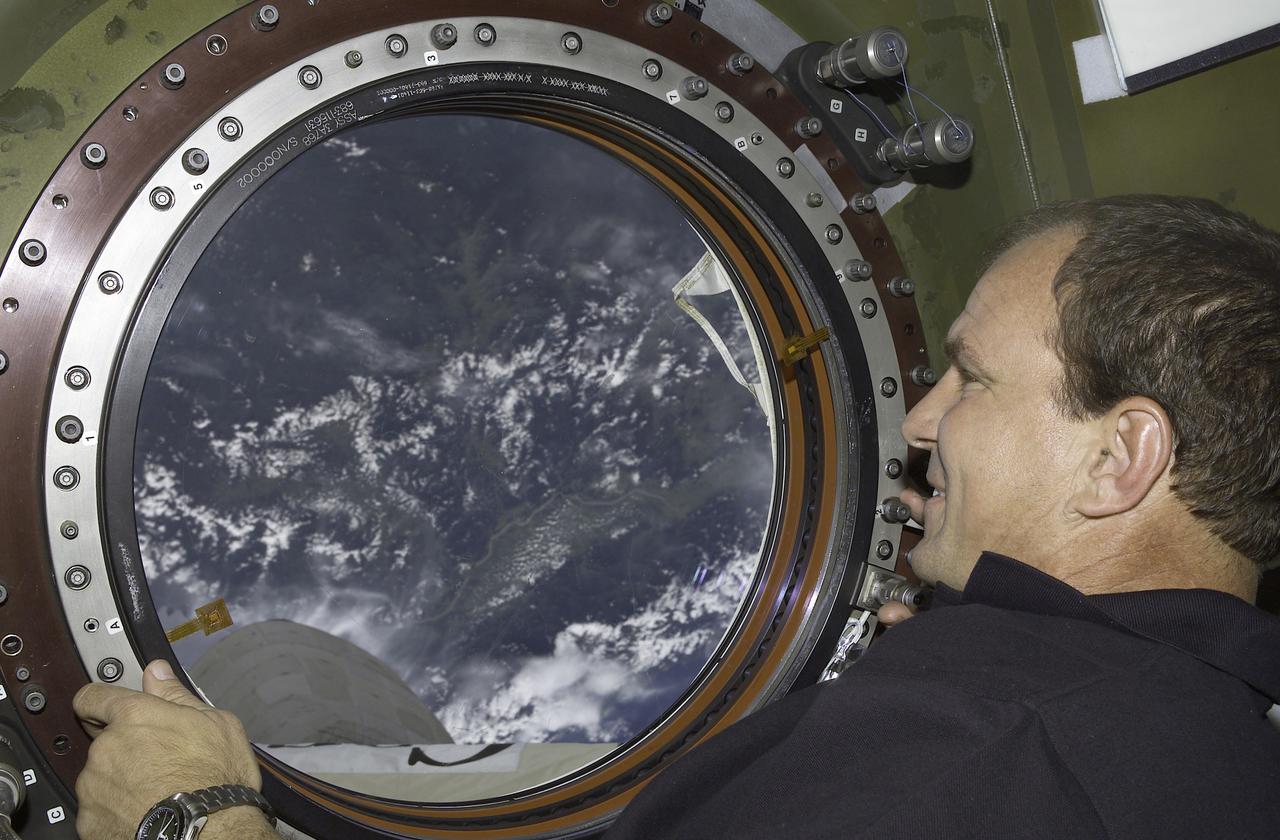
Astronaut Michael J. Bloomfield, STS-110 mission commander, looks through the Earth observation window in the Destiny laboratory aboard the International Space Station (ISS). The STS-110 mission prepared the ISS for future spacewalks by installing and outfitting the S0 (S-zero) truss and the Mobile Transporter. The 43-foot-long S0 Truss, weighing in at 27,000 pounds, was the first of 9 segments that will make up the Station's external framework that will eventually stretch 356 feet (109 meters), or approximately the length of a football field. This central truss segment also includes a flatcar called the Mobile Transporter and rails that will become the first "space railroad," which will allow the Station's robotic arm to travel up and down the finished truss for future assembly and maintenance. The completed truss structure will hold solar arrays and radiators to provide power and cooling for additional international research laboratories from Japan and Europe that will be attached to the Station. Milestones of the STS-110 mission included the first time the ISS robotic arm was used to maneuver spacewalkers around the Station and marked the first time all spacewalks were based out of the Station's Quest Airlock. It was also the first Shuttle to use three Block II Main Engines. The Space Shuttle Orbiter Atlantis, STS-110 mission, was launched April 8, 2002 and returned to Earth April 19, 2002.
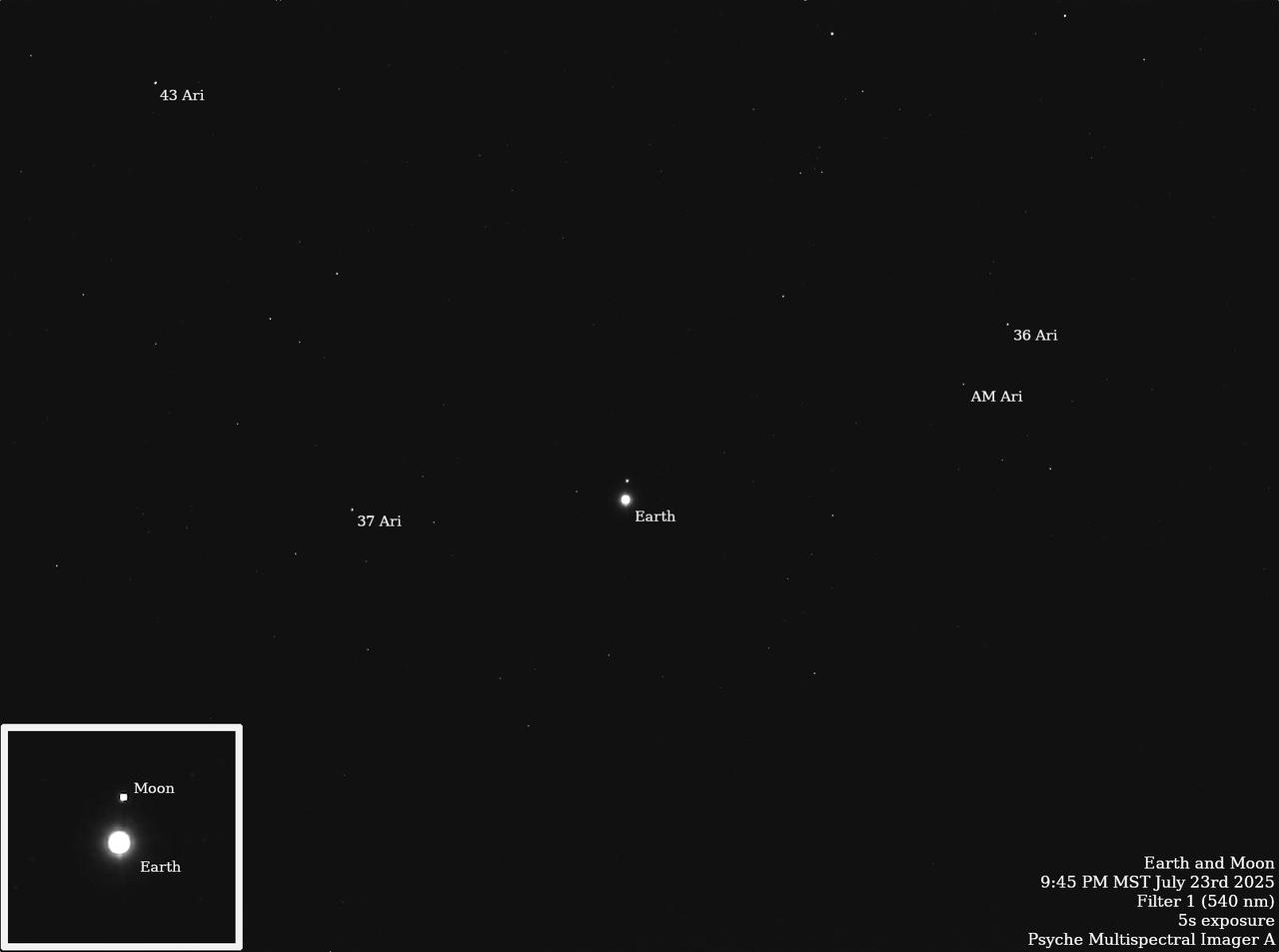
NASA's Psyche spacecraft captured images of Earth and our Moon from about 180 million miles (290 kilometers) away in July 2025. The images were obtained during one of the mission team's periodic maintenance and calibration tests for the twin cameras that make up the imager instrument. Scientists on the imaging team, led by Arizona State University, captured multiple long-exposure (up to 10-second) pictures of the two bodies, which appear as dots sparkling with reflected sunlight amid a starfield in the constellation Aries. The observations help the team determine how the cameras respond to solar system objects that shine by reflected sunlight, just like the Psyche asteroid. In January 2025, Psyche captured an image that included Mars, Jupiter, and the Jovian moons Io, Ganymede, Callisto, and Europa. The image here was captured by Psyche's primary camera, Imager A, on July 23. The Psyche mission is led by ASU. Lindy Elkins-Tanton of the University of California, Berkeley is the principal investigator. A division of Caltech in Pasadena, JPL is responsible for the mission's overall management, system engineering, integration and test, and mission operations. Maxar Technologies in Palo Alto, California, provided the high-power solar electric propulsion spacecraft chassis. ASU leads the operations of the imager instrument, working in collaboration with Malin Space Science Systems in San Diego on the design, fabrication, and testing of the cameras. https://photojournal.jpl.nasa.gov/catalog/PIA26569
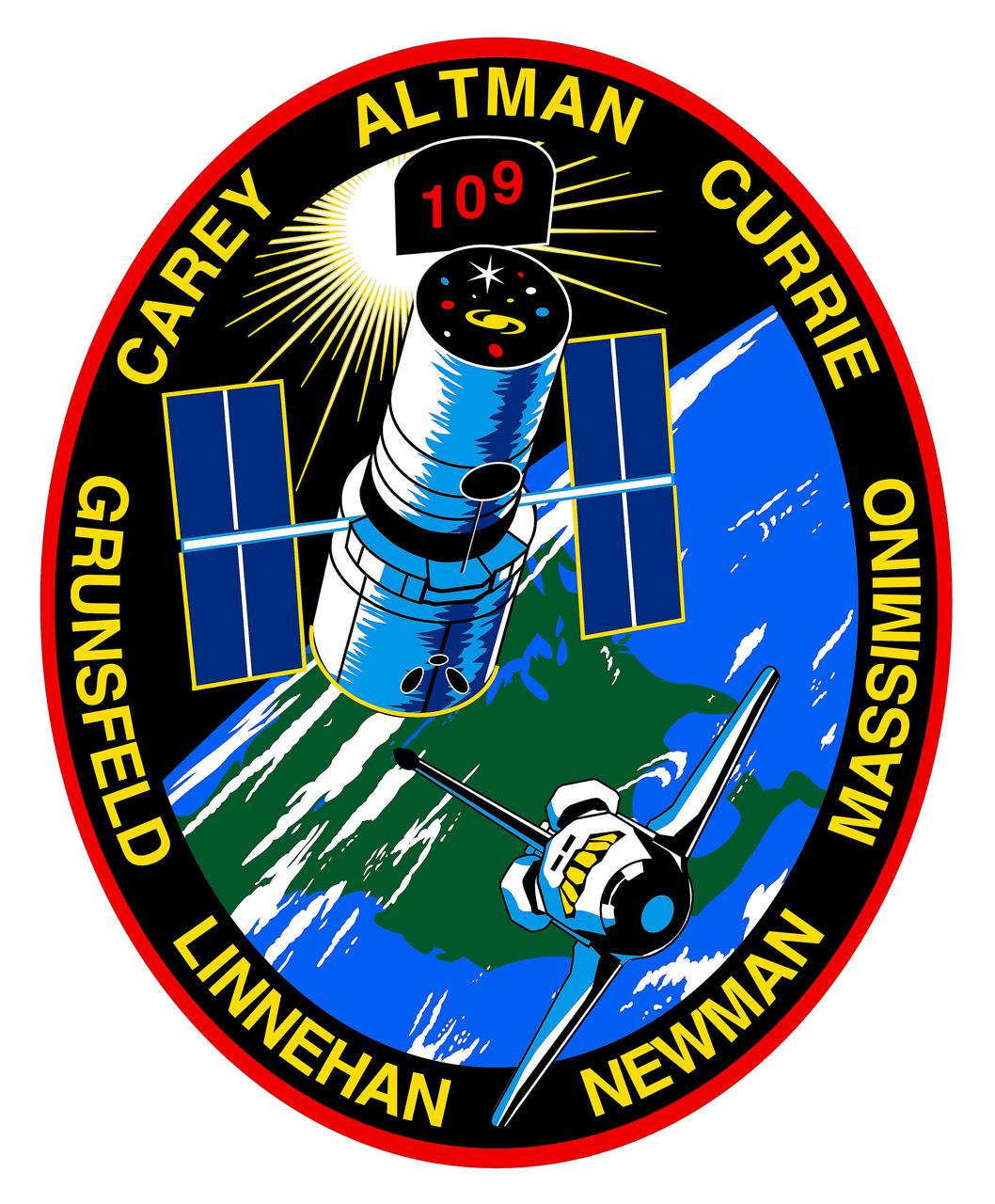
This is the insignia of the STS-109 Space Shuttle mission. Carrying a crew of seven, the Space Shuttle Orbiter Columbia was launched with goals of maintenance and upgrades to the Hubble Space Telescope (HST). The Marshall Space Flight Center had the responsibility for the design, development, and construction of the HST, which is the most complex and sensitive optical telescope ever made, to study the cosmos from a low-Earth orbit. The HST detects objects 25 times fainter than the dimmest objects seen from Earth and provides astronomers with an observable universe 250 times larger than is visible from ground-based telescopes, perhaps as far away as 14 billion light-years. The HST views galaxies, stars, planets, comets, possibly other solar systems, and even unusual phenomena such as quasars, with 10 times the clarity of ground-based telescopes. During the STS-109 mission, the telescope was captured and secured on a work stand in Columbia's payload bay using Columbia's robotic arm where four members of the crew performed five spacewalks completing system upgrades to the HST. Included in those upgrades were: The replacement of the solar array panels; replacement of the power control unit (PCU); replacement of the Faint Object Camera (FOC) with a new advanced camera for Surveys (ACS); and installation of the experimental cooling system for the Hubble's Near-Infrared Camera and Multi-object Spectrometer (NICMOS), which had been dormant since January 1999 when it original coolant ran out. Lasting 10 days, 22 hours, and 11 minutes, the STS-109 mission was the 27th flight of the Orbiter Columbia and the 108th flight overall in NASA's Space Shuttle Program.
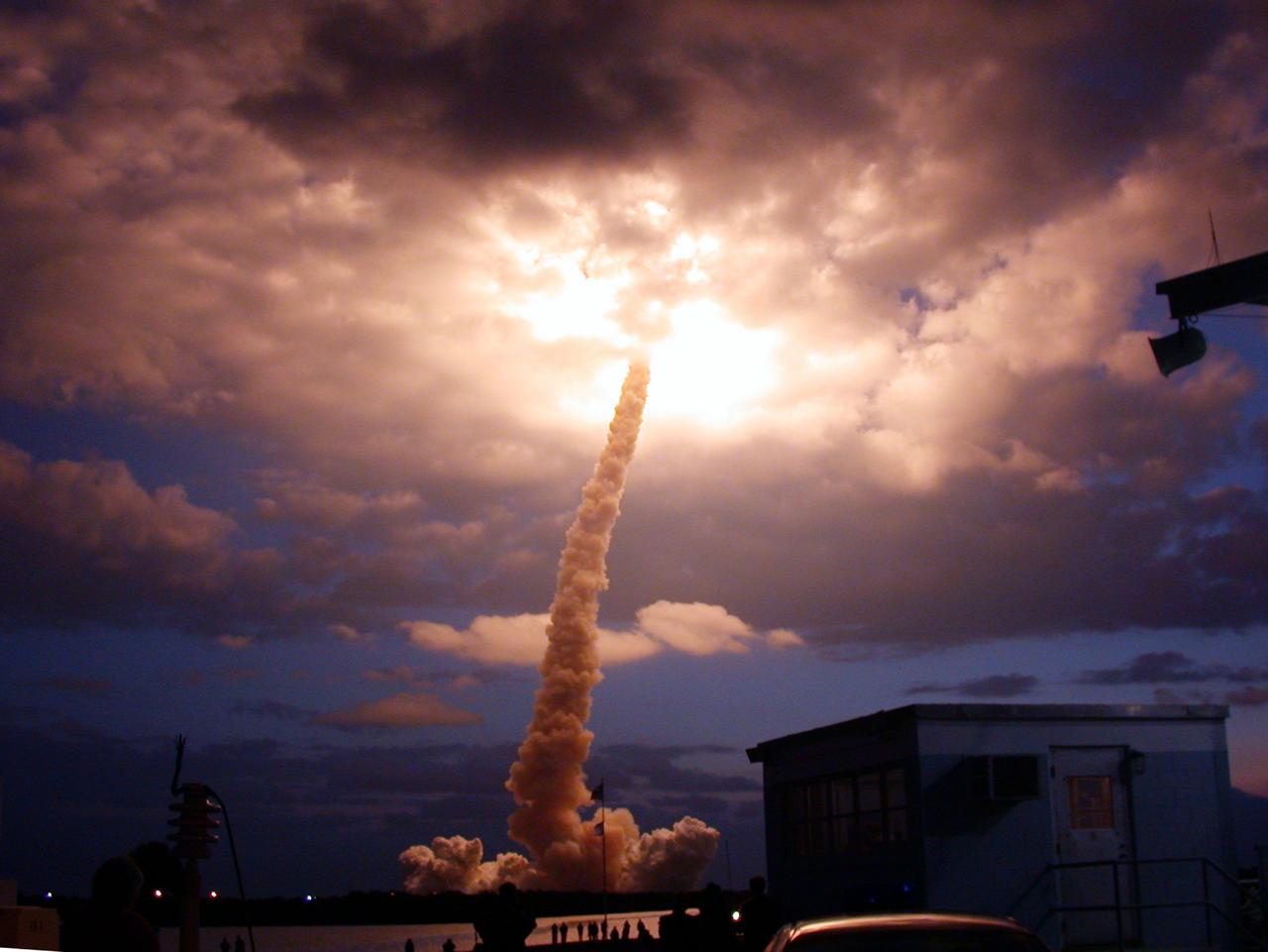
Carrying a crew of seven, the Space Shuttle Orbiter Columbia soared through some pre-dawn clouds into the sky as it began its 27th flight, STS-109. Launched March 1, 2002, the goal of the mission was the maintenance and upgrade of the Hubble Space Telescope (HST). The Marshall Space Flight Center had the responsibility for the design, development, and construction of the HST, which is the most complex and sensitive optical telescope ever made, to study the cosmos from a low-Earth orbit. The HST detects objects 25 times fainter than the dimmest objects seen from Earth and provides astronomers with an observable universe 250 times larger than is visible from ground-based telescopes, perhaps as far away as 14 billion light-years. The HST views galaxies, stars, planets, comets, possibly other solar systems, and even unusual phenomena such as quasars, with 10 times the clarity of ground-based telescopes. During the STS-109 mission, the telescope was captured and secured on a work stand in Columbia's payload bay using Columbia's robotic arm. Here four members of the crew performed five spacewalks completing system upgrades to the HST. Included in those upgrades were: replacement of the solar array panels; replacement of the power control unit (PCU); replacement of the Faint Object Camera (FOC) with a new advanced camera for Surveys (ACS); and installation of the experimental cooling system for the Hubble's Near-Infrared Camera and Multi-object Spectrometer (NICMOS), which had been dormant since January 1999 when it original coolant ran out. Lasting 10 days, 22 hours, and 11 minutes, the STS-109 mission was the 108th flight overall in NASA's Space Shuttle Program.