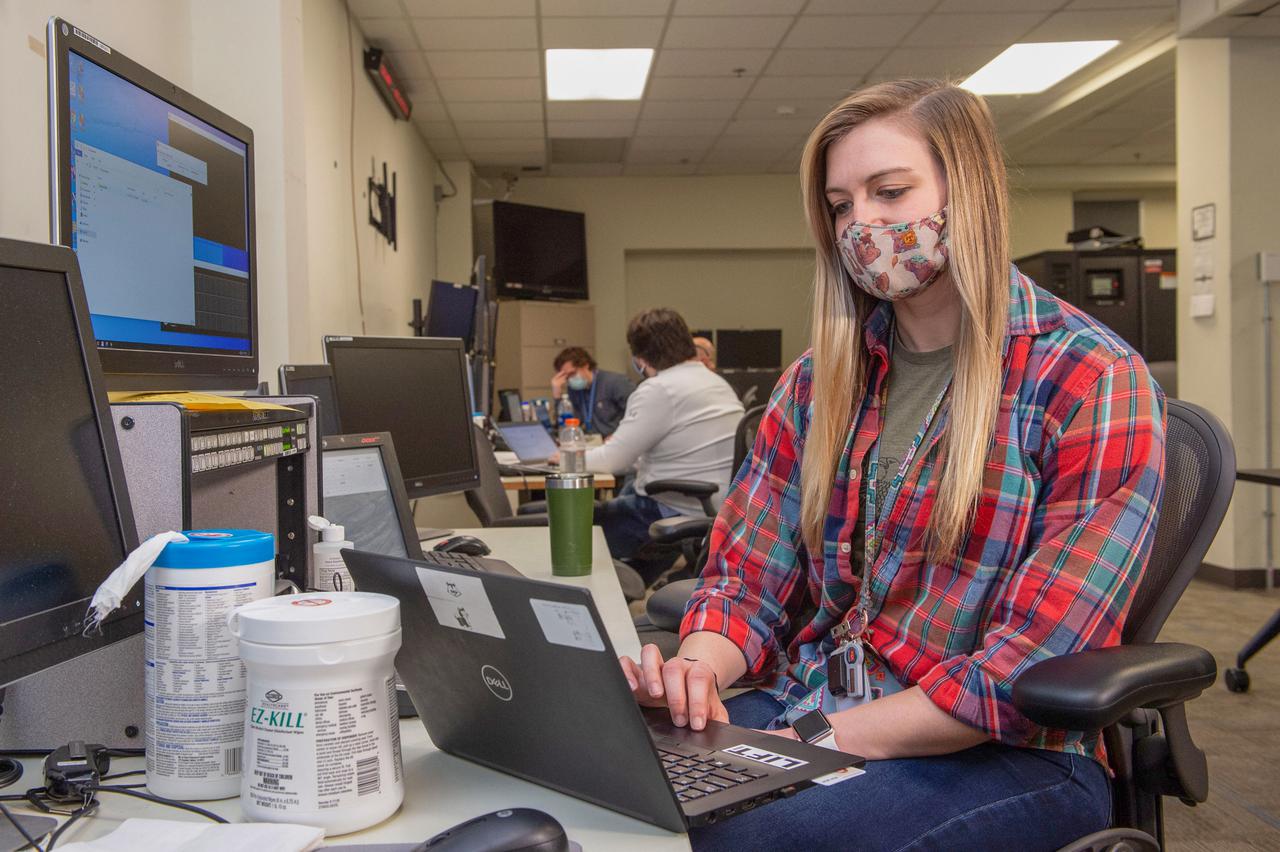
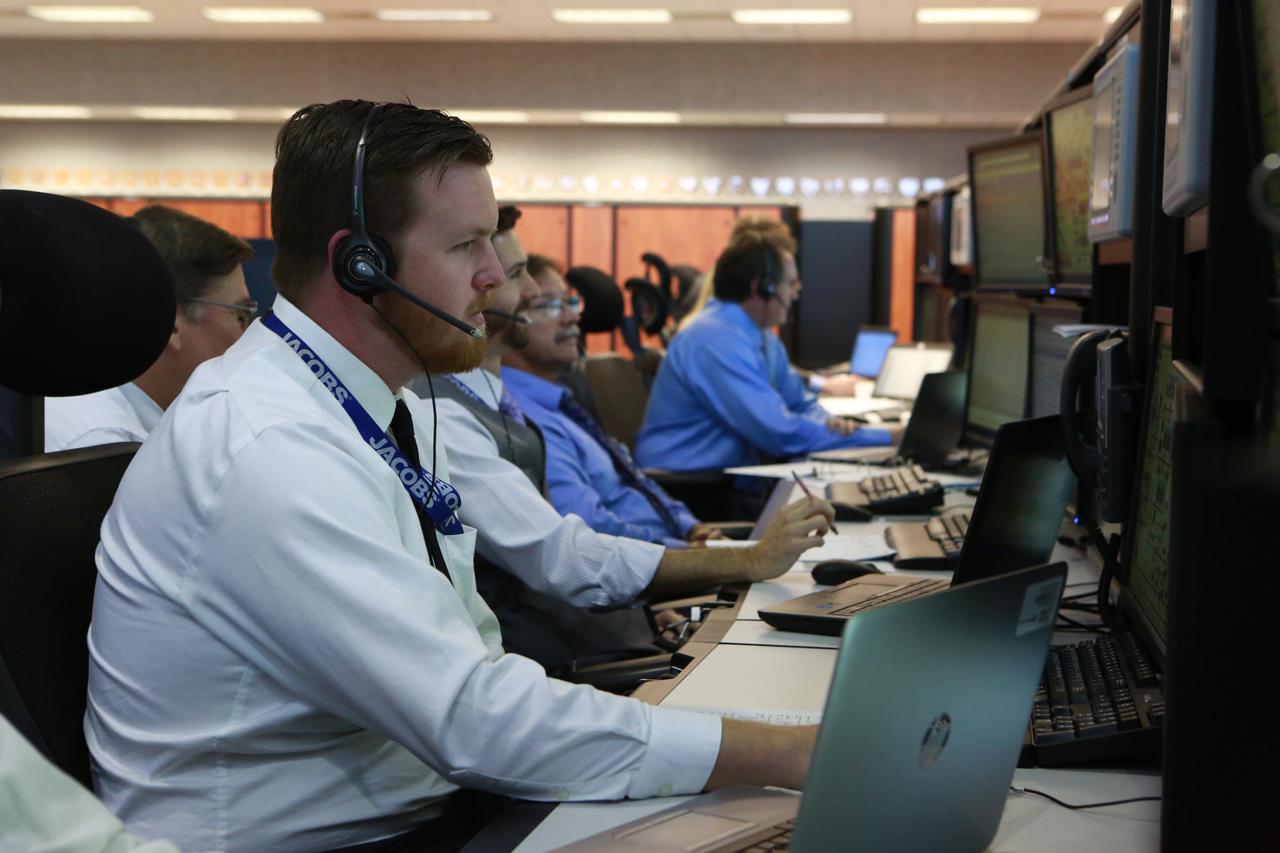
A look inside the International Space Station Payload Operations Integration Center at NASA’s Marshall Space Flight Center in Huntsville, AL. The POIC team supports science operations on the International Space Station 24 hours a day, 7 days a week. For more than 20 years the POIC team has worked with scientists from around the world to enable the space station crew to conduct experiments that improve life on Earth and enable future exploration.

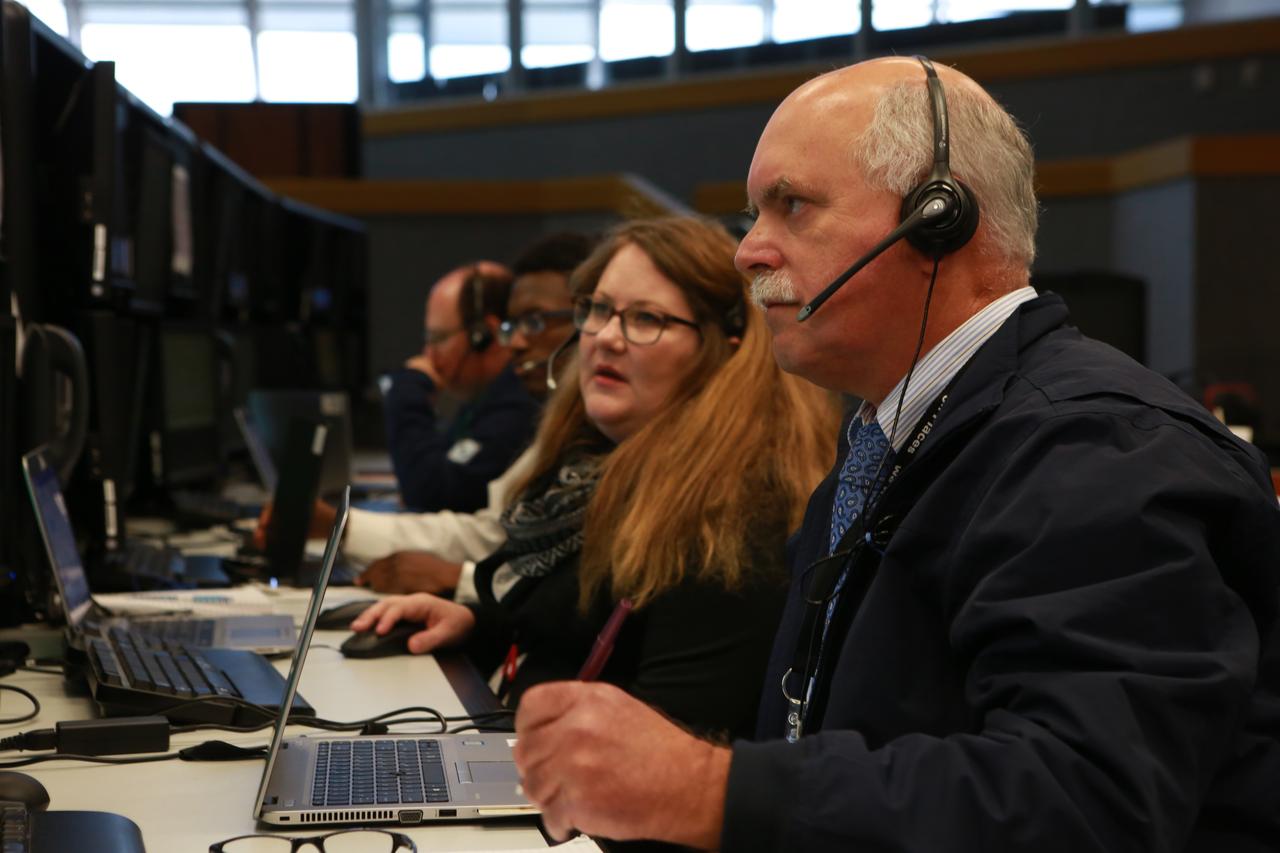
A look inside the International Space Station Payload Operations Integration Center at NASA’s Marshall Space Flight Center in Huntsville, AL. The POIC team supports science operations on the International Space Station 24 hours a day, 7 days a week. For more than 20 years the POIC team has worked with scientists from around the world to enable the space station crew to conduct experiments that improve life on Earth and enable future exploration.

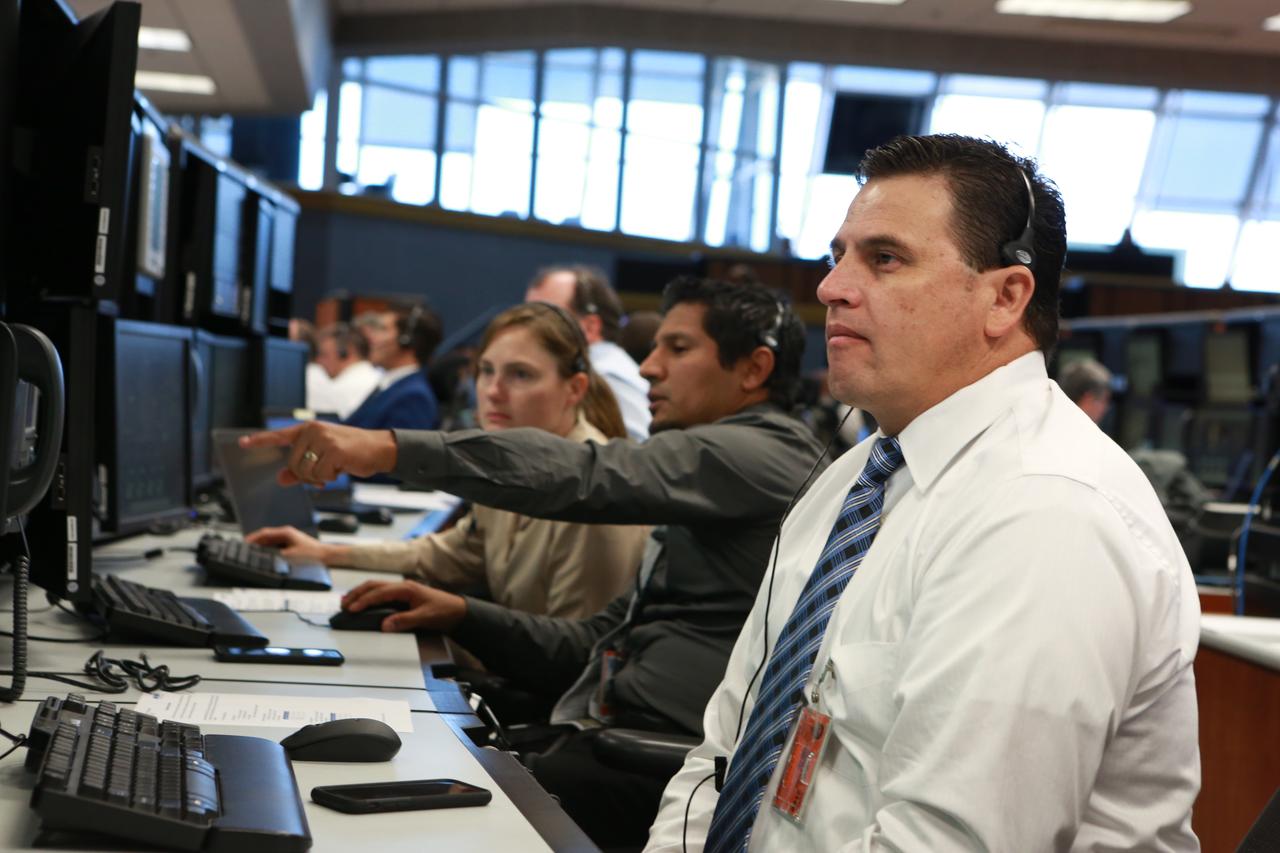
A look inside the International Space Station Payload Operations Integration Center at NASA’s Marshall Space Flight Center in Huntsville, AL. The POIC team supports science operations on the International Space Station 24 hours a day, 7 days a week. For more than 20 years the POIC team has worked with scientists from around the world to enable the space station crew to conduct experiments that improve life on Earth and enable future exploration.

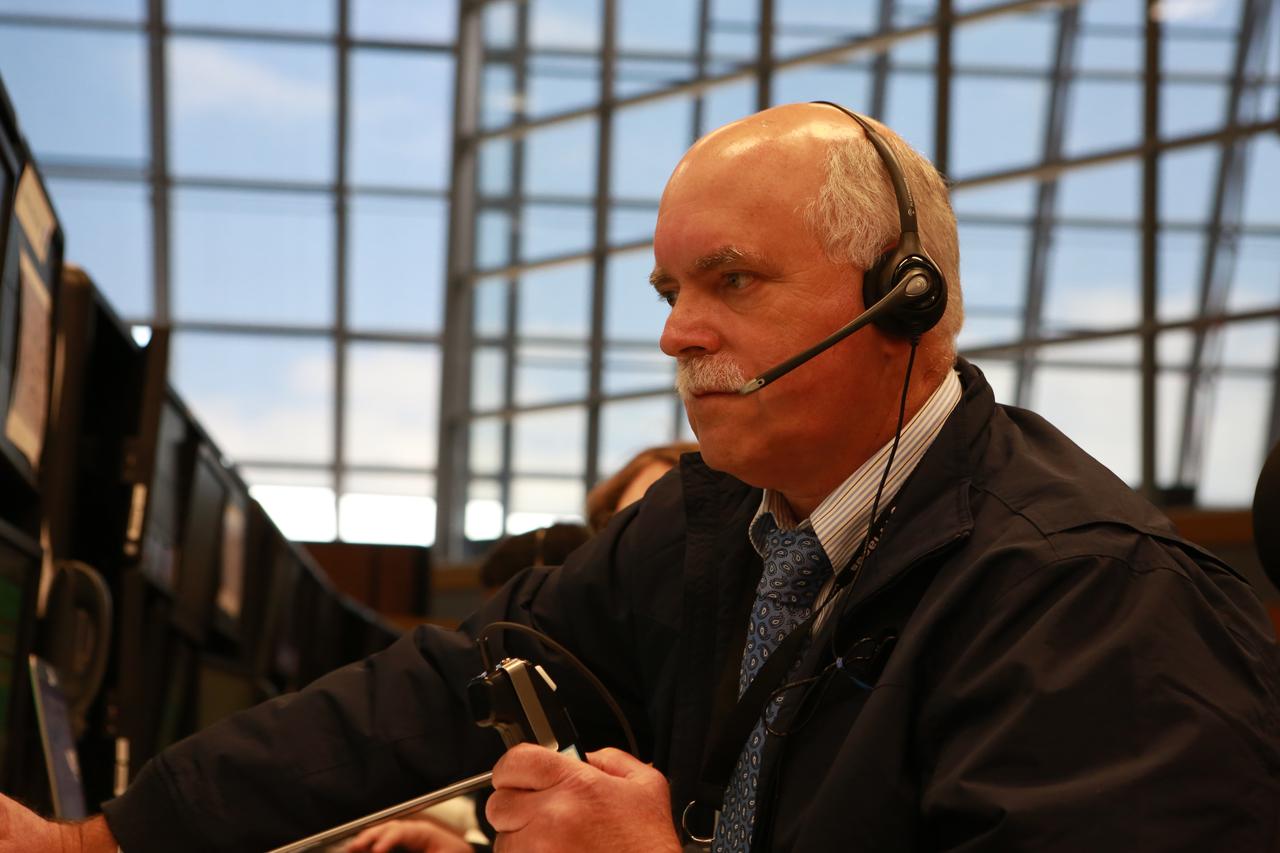
A look inside the International Space Station Payload Operations Integration Center at NASA’s Marshall Space Flight Center in Huntsville, AL. The POIC team supports science operations on the International Space Station 24 hours a day, 7 days a week. For more than 20 years the POIC team has worked with scientists from around the world to enable the space station crew to conduct experiments that improve life on Earth and enable future exploration.

A look inside the International Space Station Payload Operations Integration Center at NASA’s Marshall Space Flight Center in Huntsville, AL. The POIC team supports science operations on the International Space Station 24 hours a day, 7 days a week. For more than 20 years the POIC team has worked with scientists from around the world to enable the space station crew to conduct experiments that improve life on Earth and enable future exploration.

A look inside the International Space Station Payload Operations Integration Center at NASA’s Marshall Space Flight Center in Huntsville, AL. The POIC team supports science operations on the International Space Station 24 hours a day, 7 days a week. For more than 20 years the POIC team has worked with scientists from around the world to enable the space station crew to conduct experiments that improve life on Earth and enable future exploration.
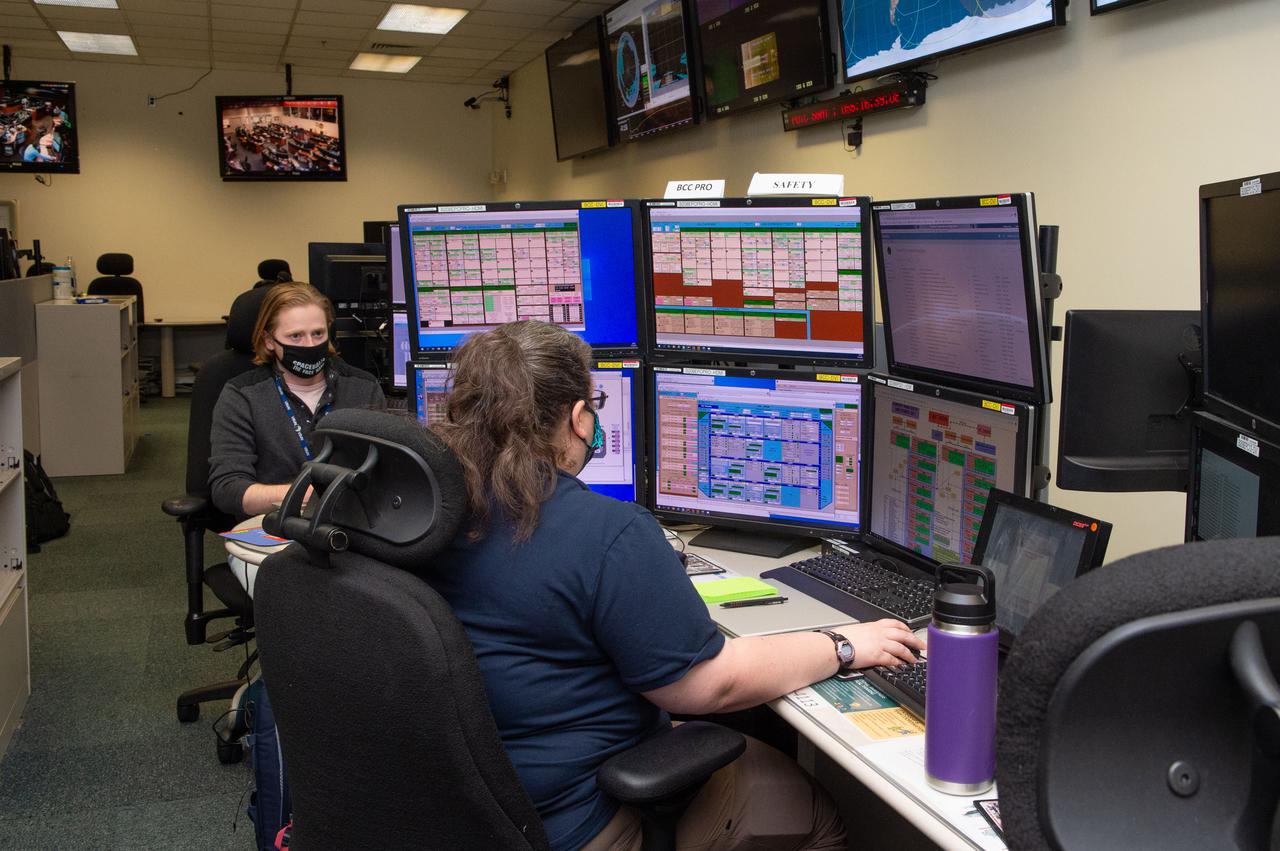
A look inside the International Space Station Payload Operations Integration Center at NASA’s Marshall Space Flight Center in Huntsville, AL. The POIC team supports science operations on the International Space Station 24 hours a day, 7 days a week. For more than 20 years the POIC team has worked with scientists from around the world to enable the space station crew to conduct experiments that improve life on Earth and enable future exploration.
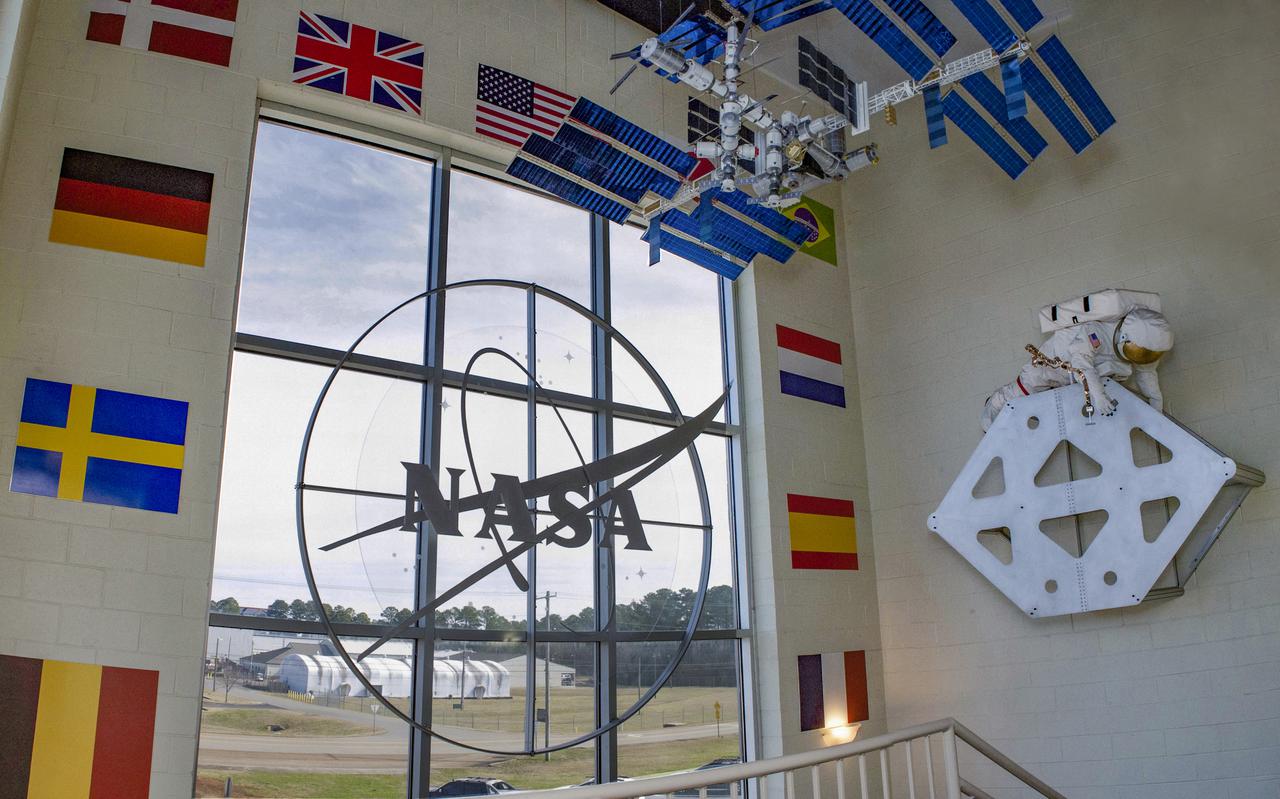
A look inside the International Space Station Payload Operations Integration Center at NASA’s Marshall Space Flight Center in Huntsville, AL. The POIC team supports science operations on the International Space Station 24 hours a day, 7 days a week. For more than 20 years the POIC team has worked with scientists from around the world to enable the space station crew to conduct experiments that improve life on Earth and enable future exploration.

A look inside the International Space Station Payload Operations Integration Center at NASA’s Marshall Space Flight Center in Huntsville, AL. The POIC team supports science operations on the International Space Station 24 hours a day, 7 days a week. For more than 20 years the POIC team has worked with scientists from around the world to enable the space station crew to conduct experiments that improve life on Earth and enable future exploration.
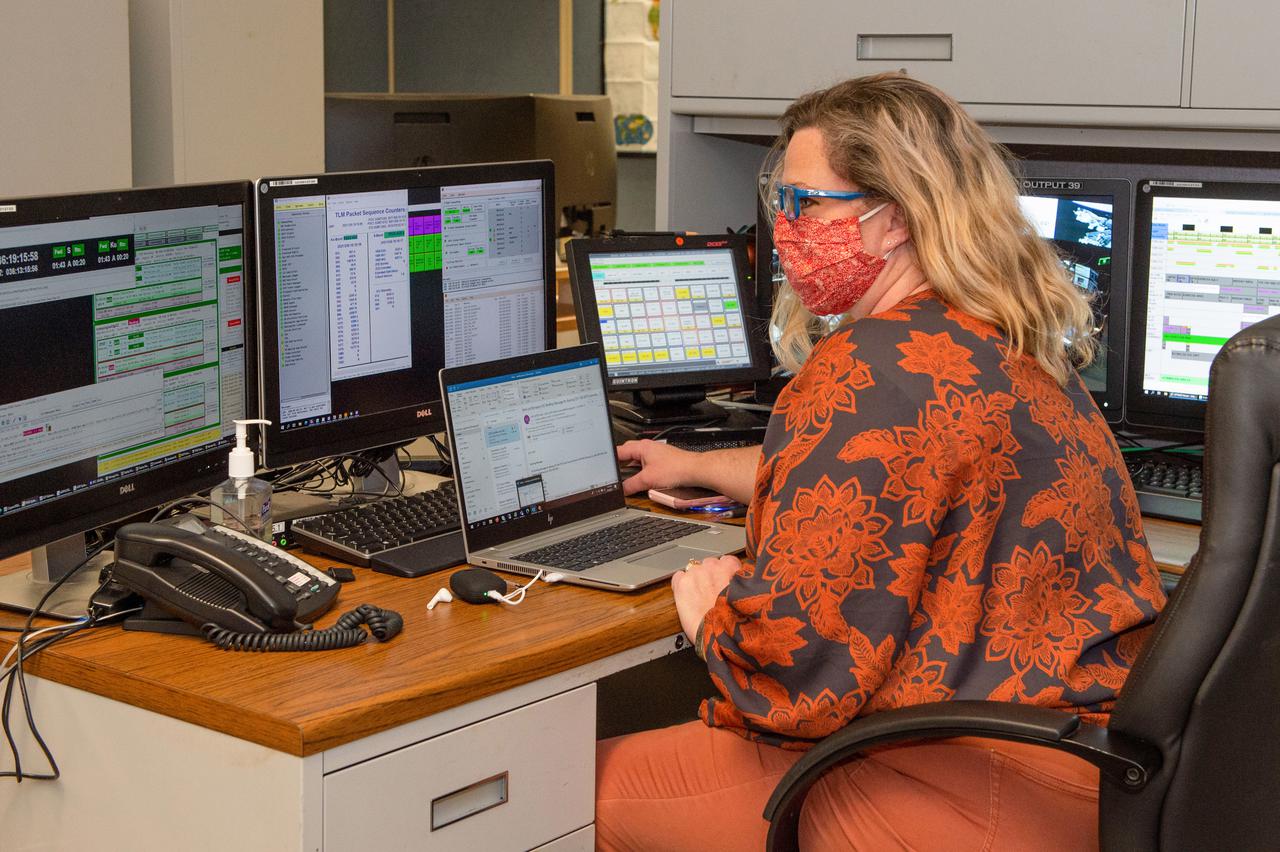
A look inside the International Space Station Payload Operations Integration Center at NASA’s Marshall Space Flight Center in Huntsville, AL. The POIC team supports science operations on the International Space Station 24 hours a day, 7 days a week. For more than 20 years the POIC team has worked with scientists from around the world to enable the space station crew to conduct experiments that improve life on Earth and enable future exploration.

A look inside the International Space Station Payload Operations Integration Center at NASA’s Marshall Space Flight Center in Huntsville, AL. The POIC team supports science operations on the International Space Station 24 hours a day, 7 days a week. For more than 20 years the POIC team has worked with scientists from around the world to enable the space station crew to conduct experiments that improve life on Earth and enable future exploration.

A look inside the International Space Station Payload Operations Integration Center at NASA’s Marshall Space Flight Center in Huntsville, AL. The POIC team supports science operations on the International Space Station 24 hours a day, 7 days a week. For more than 20 years the POIC team has worked with scientists from around the world to enable the space station crew to conduct experiments that improve life on Earth and enable future exploration.
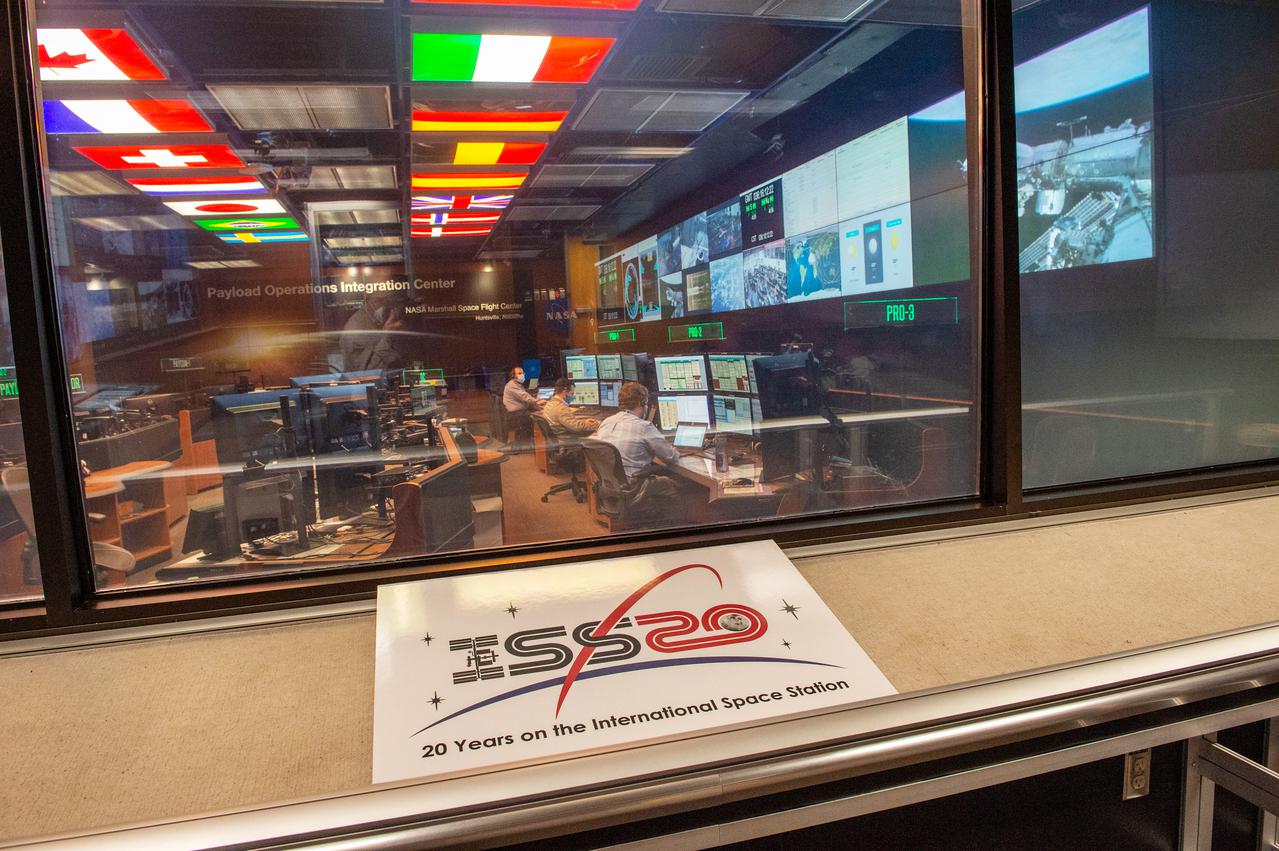
A look inside the International Space Station Payload Operations Integration Center at NASA’s Marshall Space Flight Center in Huntsville, AL. The POIC team supports science operations on the International Space Station 24 hours a day, 7 days a week. For more than 20 years the POIC team has worked with scientists from around the world to enable the space station crew to conduct experiments that improve life on Earth and enable future exploration.

A look inside the International Space Station Payload Operations Integration Center at NASA’s Marshall Space Flight Center in Huntsville, AL. The POIC team supports science operations on the International Space Station 24 hours a day, 7 days a week. For more than 20 years the POIC team has worked with scientists from around the world to enable the space station crew to conduct experiments that improve life on Earth and enable future exploration.

A look inside the International Space Station Payload Operations Integration Center at NASA’s Marshall Space Flight Center in Huntsville, AL. The POIC team supports science operations on the International Space Station 24 hours a day, 7 days a week. For more than 20 years the POIC team has worked with scientists from around the world to enable the space station crew to conduct experiments that improve life on Earth and enable future exploration.
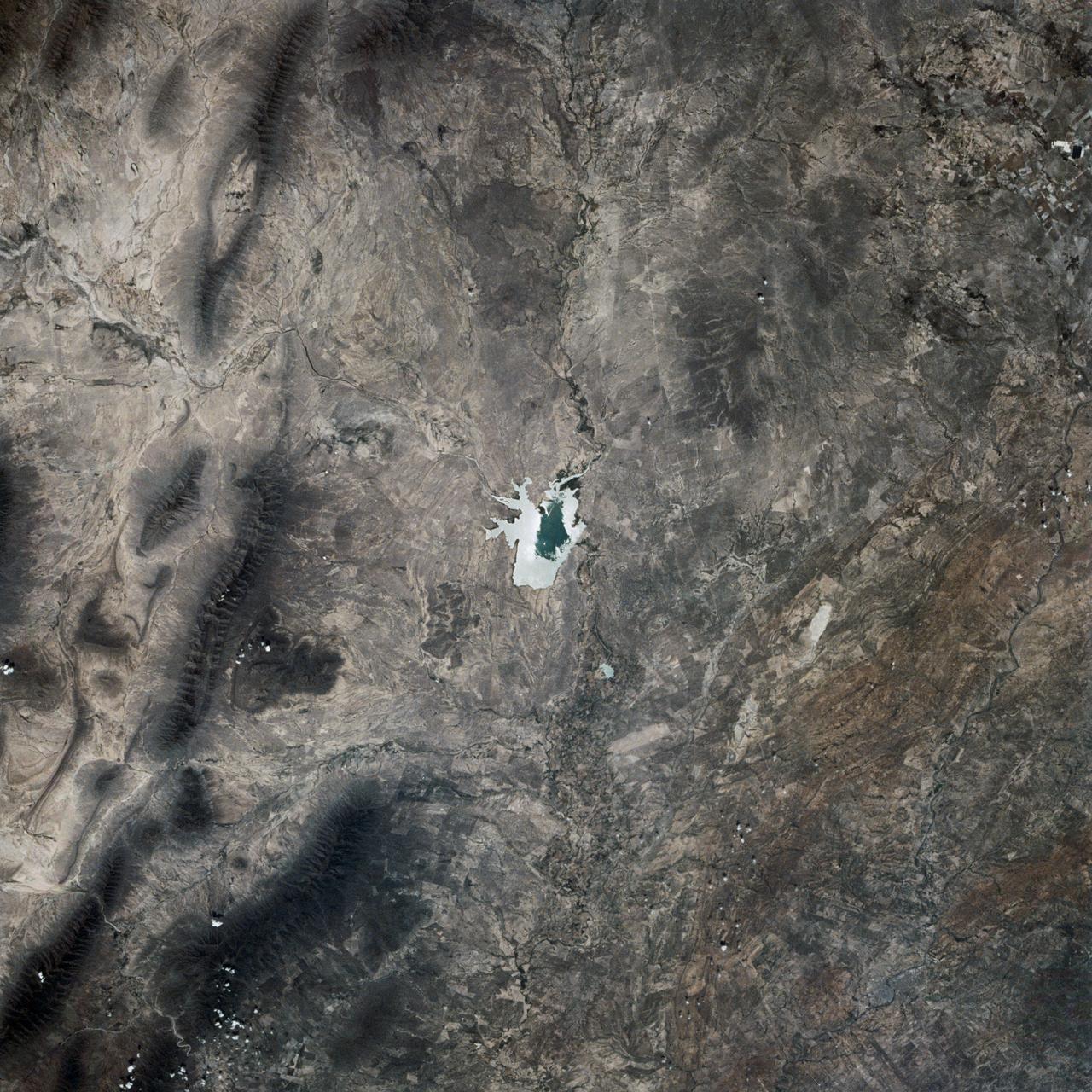
This is a single scene from a pair (frames 021 & 024) to study the effects of polarized light in Earth Observations. One scene was exposed with vertically polarized light, the other, horizontally. The subject in this study, is a lake behind Presa (dam) Don Martin (27.5N, 100.5W) on the edge of the Rio Grande Plain near it's boundry with the Sierra Madre Orientral in Coahuila, Mexico.
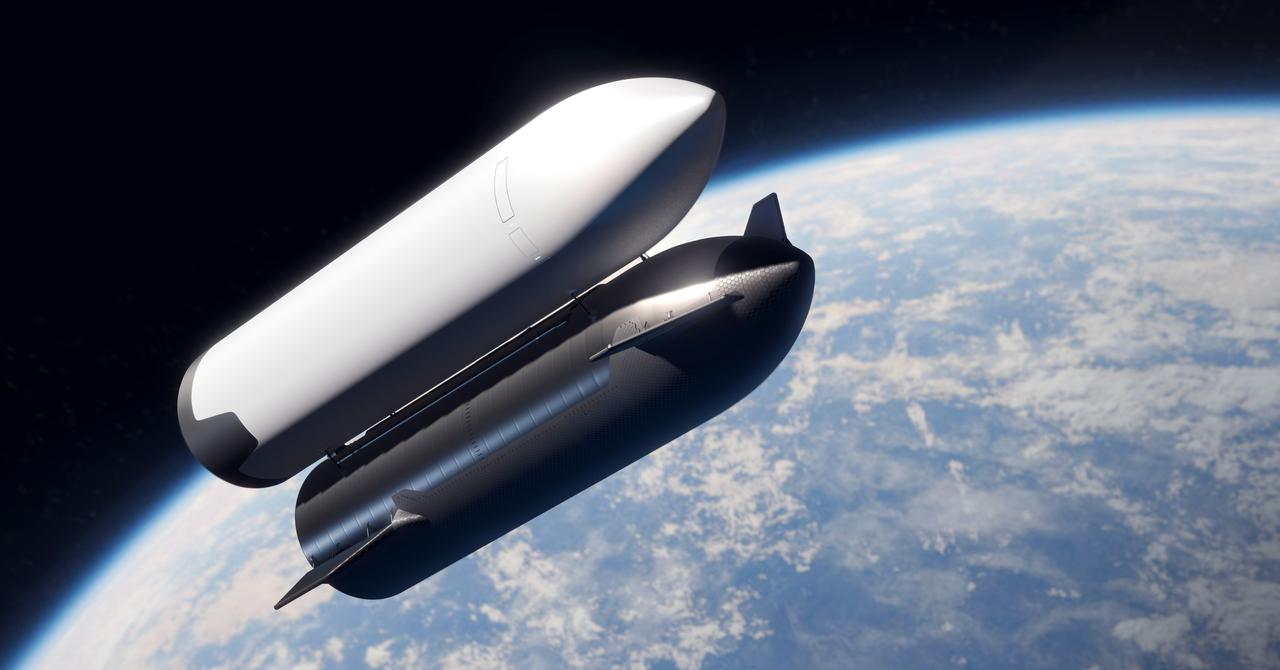
These artist’s concepts show SpaceX’s Starship Human Landing System (HLS) in operation on its journey to the Moon. Before astronauts launch in NASA’s Orion spacecraft atop the agency’s SLS (Space Launch System) rocket, SpaceX will launch a storage depot to Earth orbit. For Artemis III and Artemis IV, SpaceX plans to complete propellant loading operations in Earth orbit to send a fully fueled Starship HLS to the Moon. Starship HLS will then dock directly to Orion so that two astronauts can transfer from the spacecraft to the lander to descend to the Moon’s surface, while two others remain in Orion. Beginning with Artemis IV, NASA’s Gateway lunar space station will serve as the crew transfer point. NASA is working with SpaceX to develop Starship HLS to carry astronauts from lunar orbit to the Moon’s surface and back for Artemis III and Artemis IV as part of the agency’s Artemis campaign.

These artist’s concepts show SpaceX’s Starship Human Landing System (HLS) in operation on its journey to the Moon. Before astronauts launch in NASA’s Orion spacecraft atop the agency’s SLS (Space Launch System) rocket, SpaceX will launch a storage depot to Earth orbit. For Artemis III and Artemis IV, SpaceX plans to complete propellant loading operations in Earth orbit to send a fully fueled Starship HLS to the Moon. Starship HLS will then dock directly to Orion so that two astronauts can transfer from the spacecraft to the lander to descend to the Moon’s surface, while two others remain in Orion. Beginning with Artemis IV, NASA’s Gateway lunar space station will serve as the crew transfer point. NASA is working with SpaceX to develop Starship HLS to carry astronauts from lunar orbit to the Moon’s surface and back for Artemis III and Artemis IV as part of the agency’s Artemis campaign.
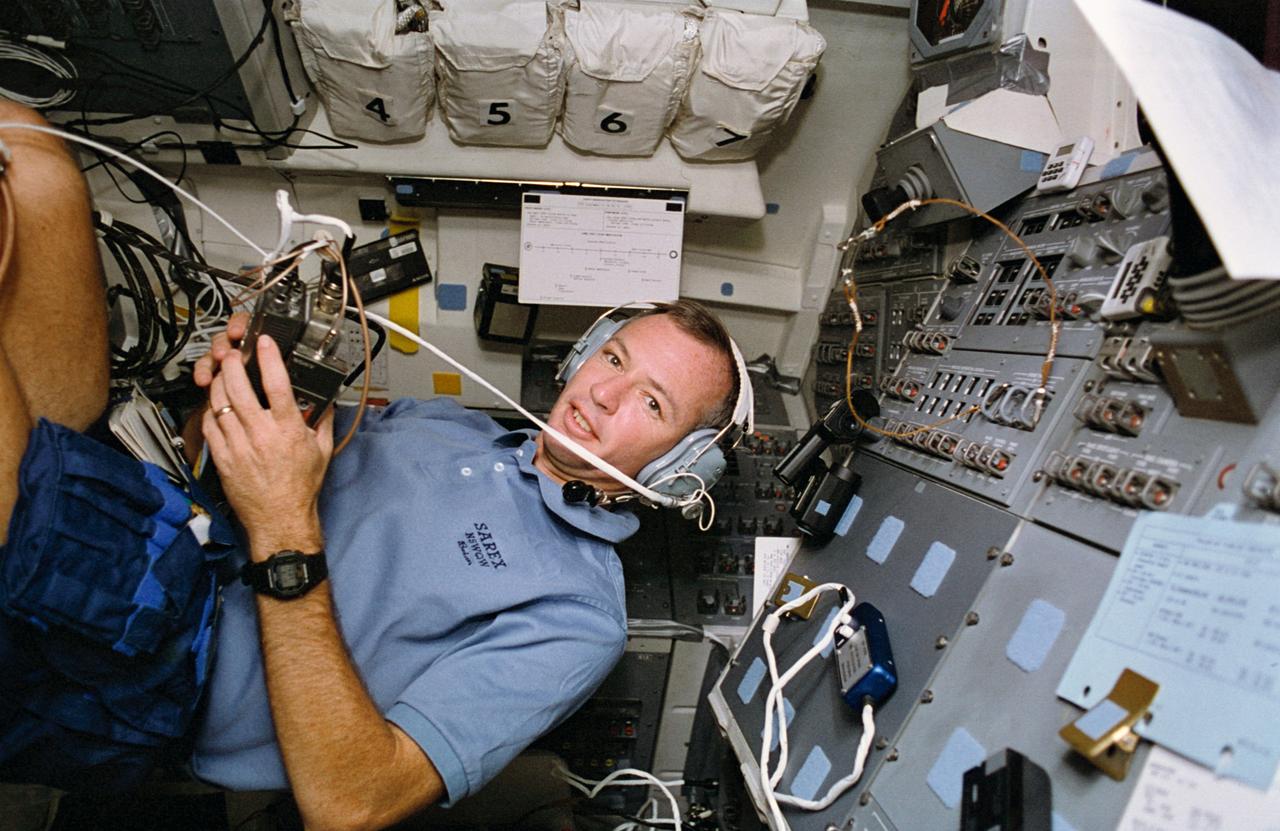
STS057-40-028 (21 June-1 July 1993) --- Astronaut Brian Duffy, pilot, talks to amateur radio operators on Earth from the flight deck of the Earth-orbiting Space Shuttle Endeavour. The space to Earth communications was part of the Shuttle amateur radio experiment (SAREX), which has been included on a number of Space Shuttle missions. Duffy, a licensed amateur radio operator using call letters N5WQW, was among crewmembers talking to students at various points on the ground.
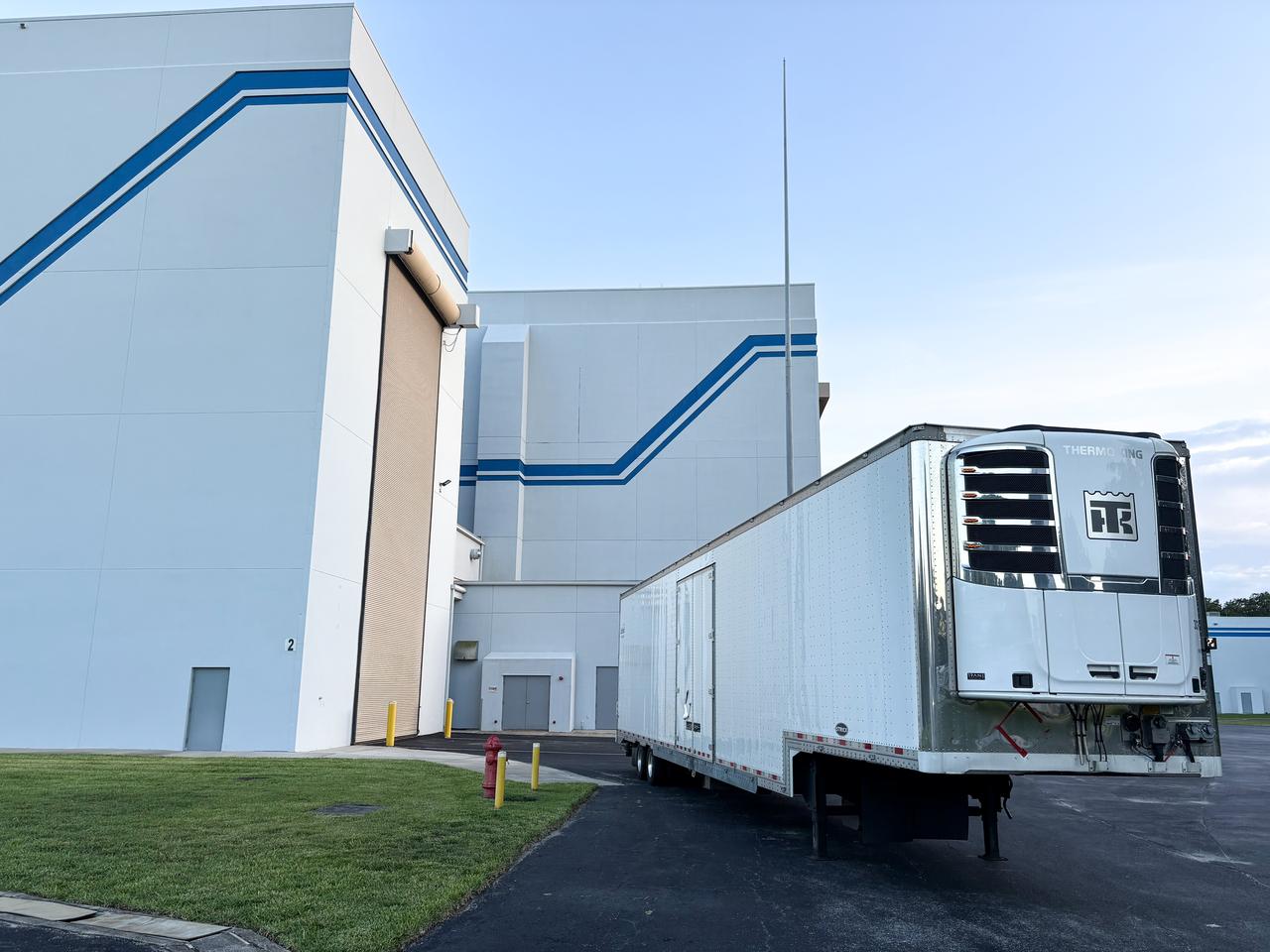
Technicians offloaded NASA’s Carruthers Geocorona Observatory following the spacecraft’s arrival on Sunday, July 20, 2025, at the Astrotech Space Operations Facility near the agency’s Kennedy Space Center in Florida. The Carruthers Geocorona Observatory is a small satellite set to operate at Lagrange Point 1 (L1), an orbit point between the Earth and Sun about one million miles away, to study the Earth’s exosphere, the outermost part of the atmosphere. Carruthers will use its ultraviolet cameras to monitor how space weather from the Sun impacts the exosphere.
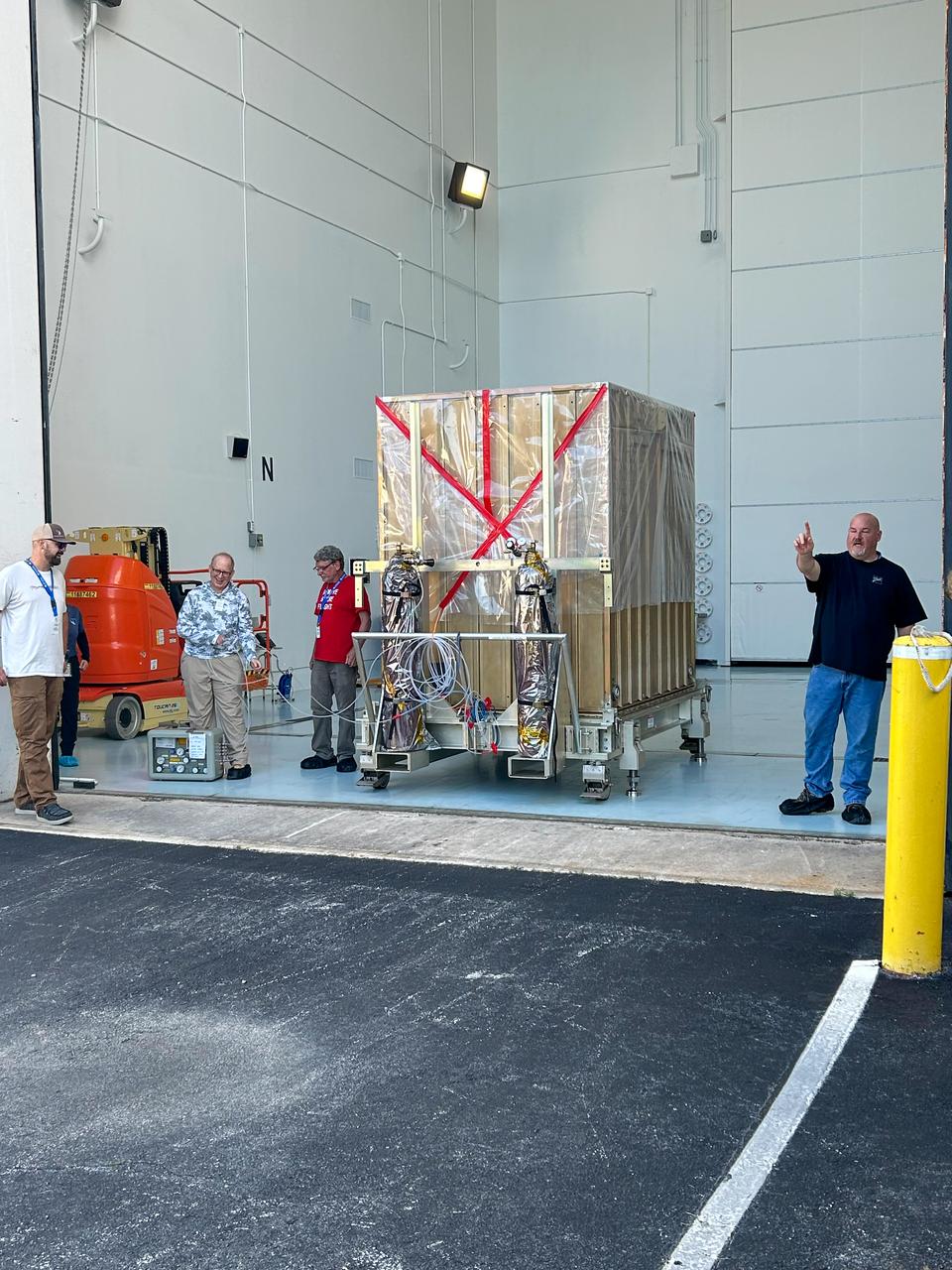
Technicians offloaded NASA’s Carruthers Geocorona Observatory following the spacecraft’s arrival on Monday, July 201, 2025, at the Astrotech Space Operations Facility near the agency’s Kennedy Space Center in Florida. The Carruthers Geocorona Observatory is a small satellite set to operate at Lagrange Point 1 (L1), an orbit point between the Earth and Sun about one million miles away, to study the Earth’s exosphere, the outermost part of the atmosphere. Carruthers will use its ultraviolet cameras to monitor how space weather from the Sun impacts the exosphere.
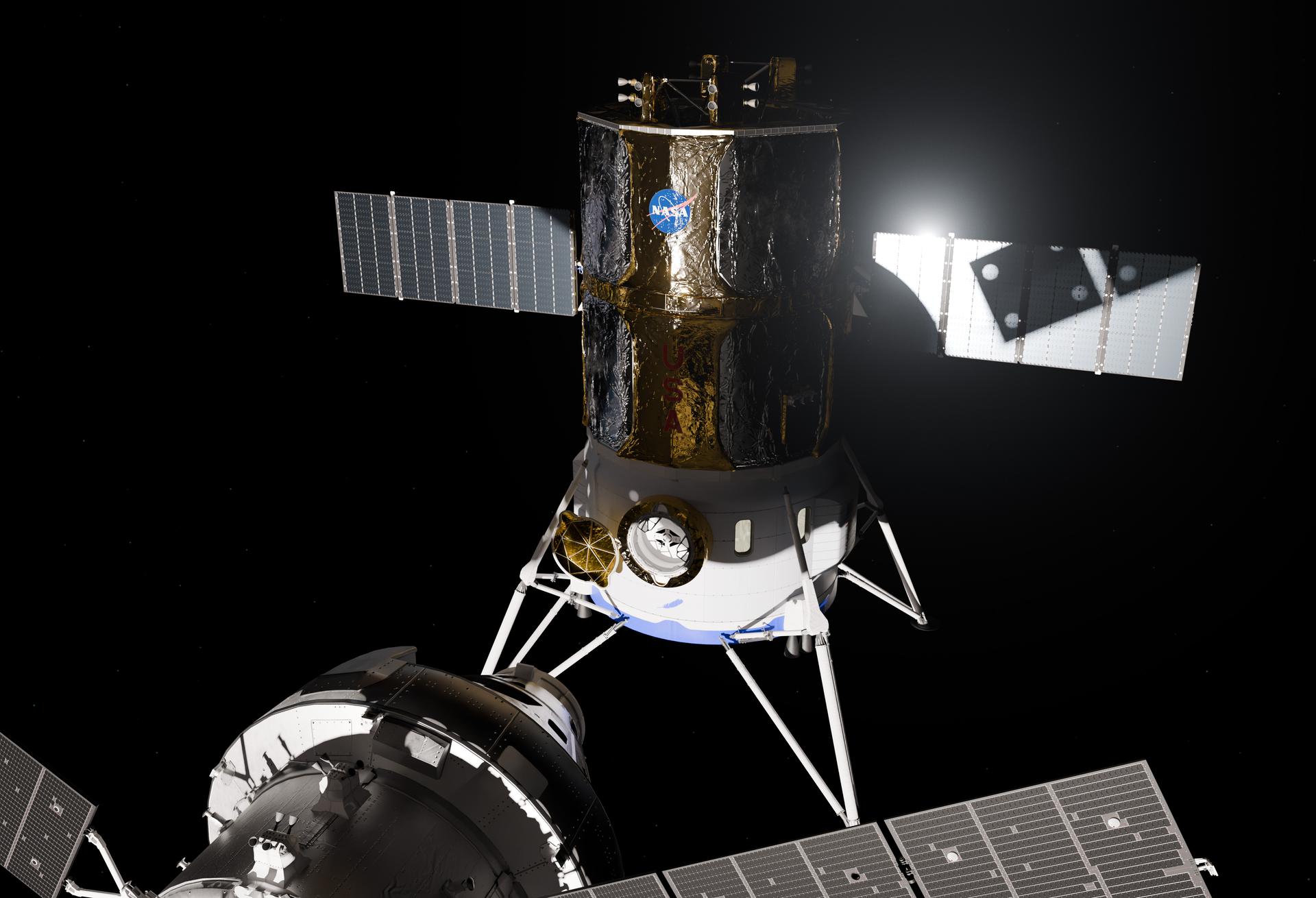
This artist’s concept depicts Blue Origin’s Blue Moon Mark 2 human landing system test article in Earth orbit with NASA’s Orion spacecraft during rendezvous and docking operations as part of NASA’s upcoming Artemis III demonstration mission in low Earth orbit. NASA is working with two American companies to develop the human landing systems that will safely transport astronauts from lunar orbit to the Moon’s surface and back for future Artemis missions. For Artemis III, both SpaceX and Blue Origin will fly test versions, or test articles, of the crewed landers that will be used for future Moon landings. The lander test articles will launch by commercial rockets, while the Artemis III crew will launch to low Earth orbit in Orion atop the agency’s SLS (Space Launch System) rocket.
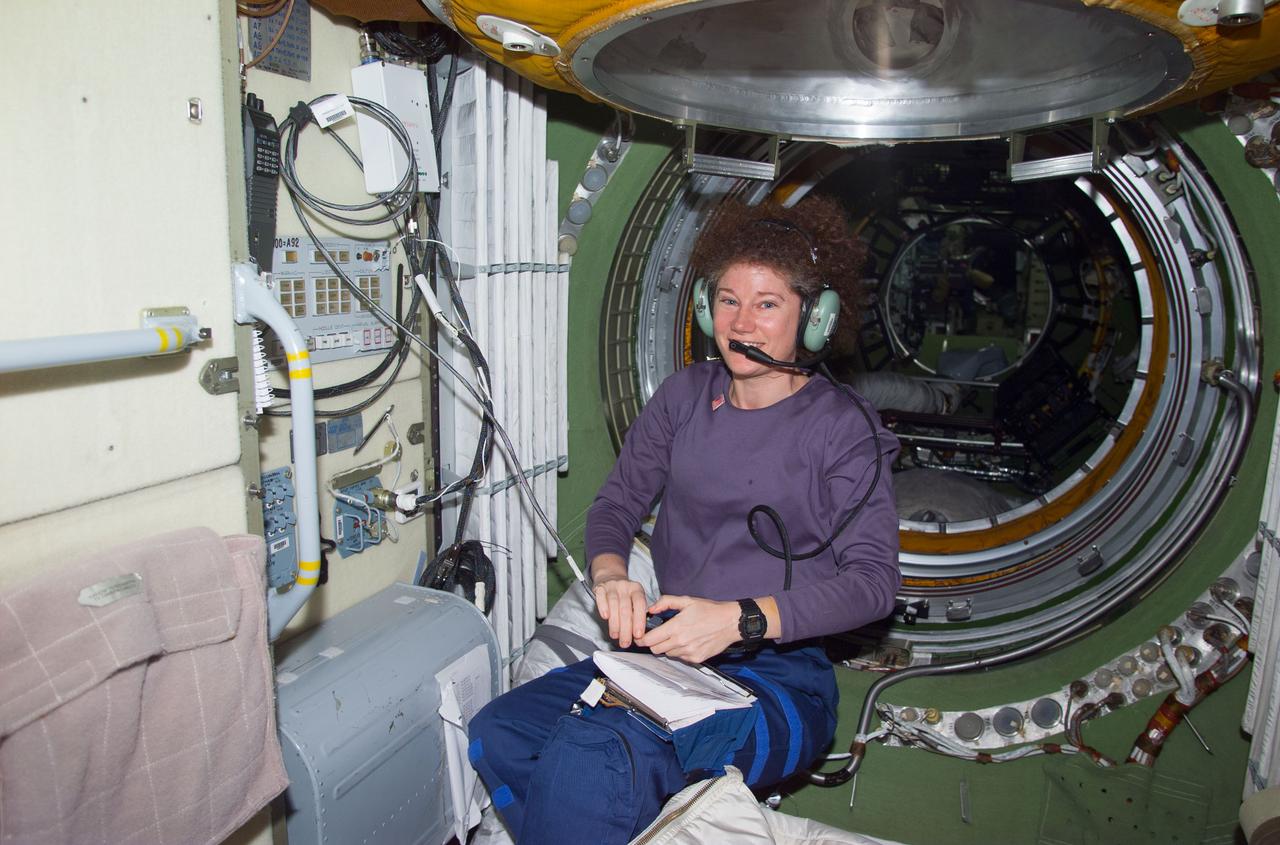
S104-E-5092 (16 July 2001) --- Susan J. Helms, Expedition Two flight engineer, talks to amateur radio operators on Earth from the HAM radio workstation in the Zarya module of the International Space Station (ISS).
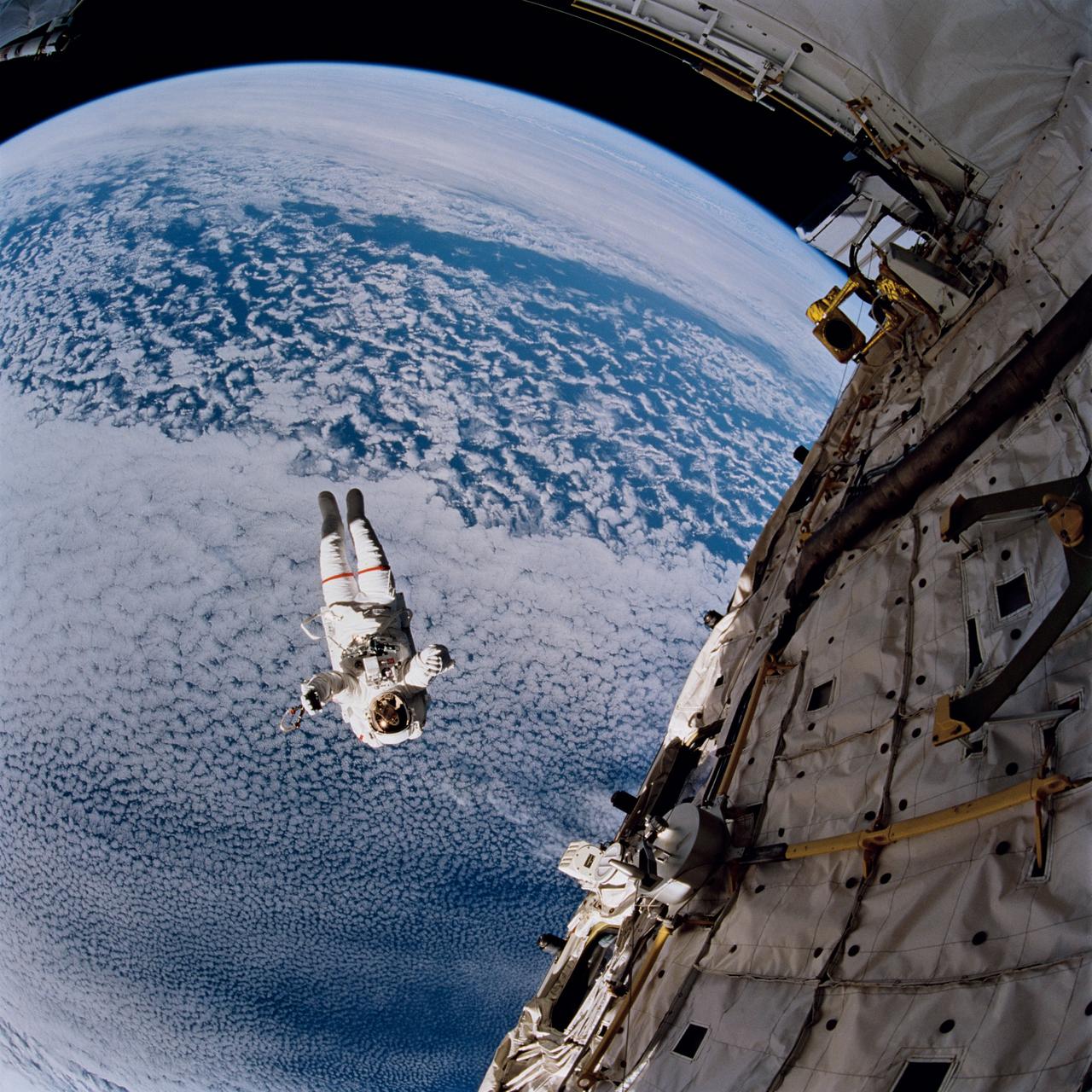
STS064-217-008 (16 Sept. 1994) --- Backdropped against the blue and white Earth, 130 nautical miles below, astronaut Mark C. Lee tests the new Simplified Aid for EVA Rescue (SAFER) system. The scene was captured with a 70mm handheld Hasselblad camera with a 30mm lens attached. Astronauts Lee and Carl J. Meade took turns using the SAFER hardware during their shared Extravehicular Activity (EVA) of Sept. 16, 1994. The test of SAFER is the first phase of a larger SAFER program whose objectives are to establish a common set of requirements for both space shuttle and space station program needs, develop a flight demonstration of SAFER, validate system performance and, finally, develop a production version of SAFER for the shuttle and station programs. Photo credit: NASA or National Aeronautics and Space Administration
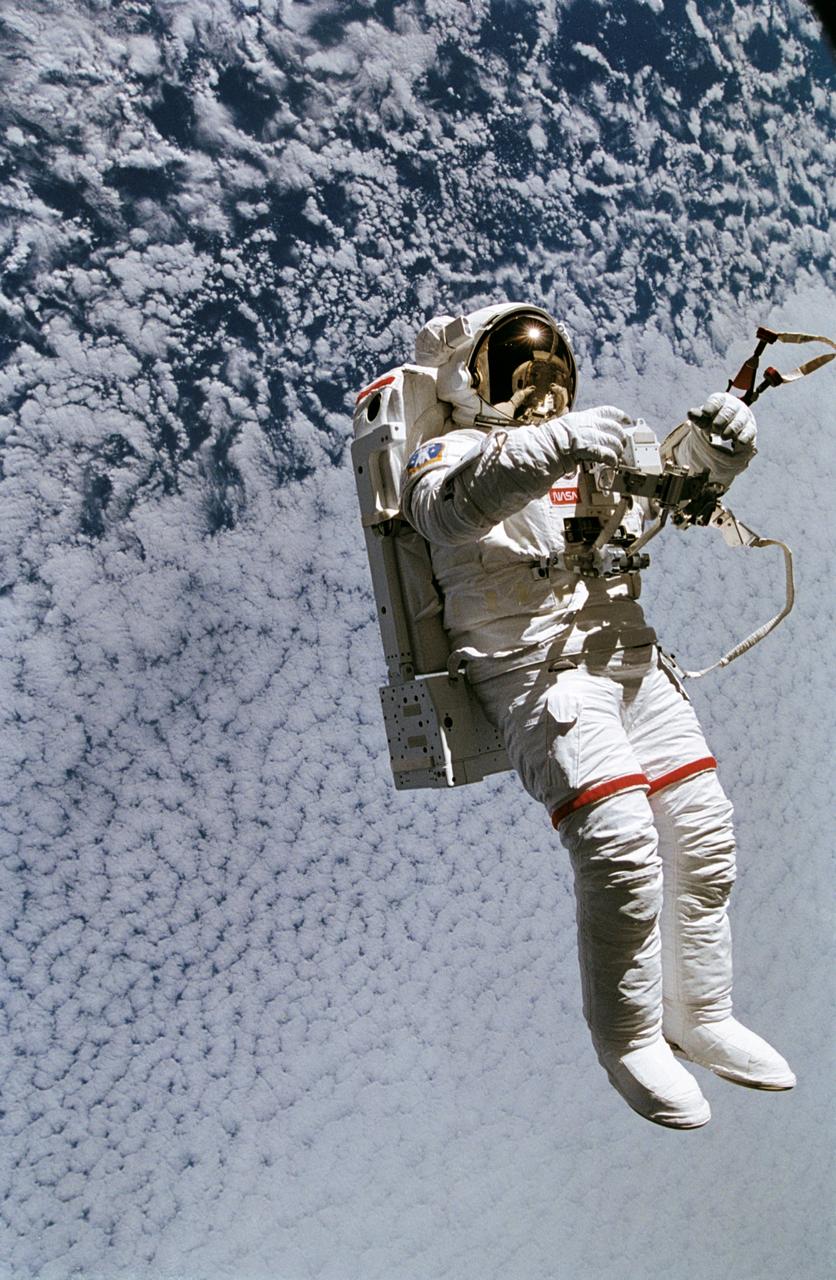
STS064-45-014 (16 Sept. 1994) --- Backdropped against a massive wall of white clouds 130 nautical miles below, astronaut Mark C. Lee floats freely as he tests the new Simplified Aid for EVA Rescue (SAFER) system. The image was exposed with a 35mm camera from the shirt-sleeve environment of the space shuttle Discovery. Astronauts Lee and Carl J. Meade took turns using the SAFER hardware during their shared Extravehicular Activity (EVA) on Sept. 16, 1994. The test of SAFER is the first phase of a larger SAFER program whose objectives are to establish a common set of requirements for both space shuttle and space station program needs, develop a flight demonstration of SAFER, validate system performance and, finally, develop a production version of SAFER for the shuttle and station programs. Photo credit: NASA or National Aeronautics and Space Administration
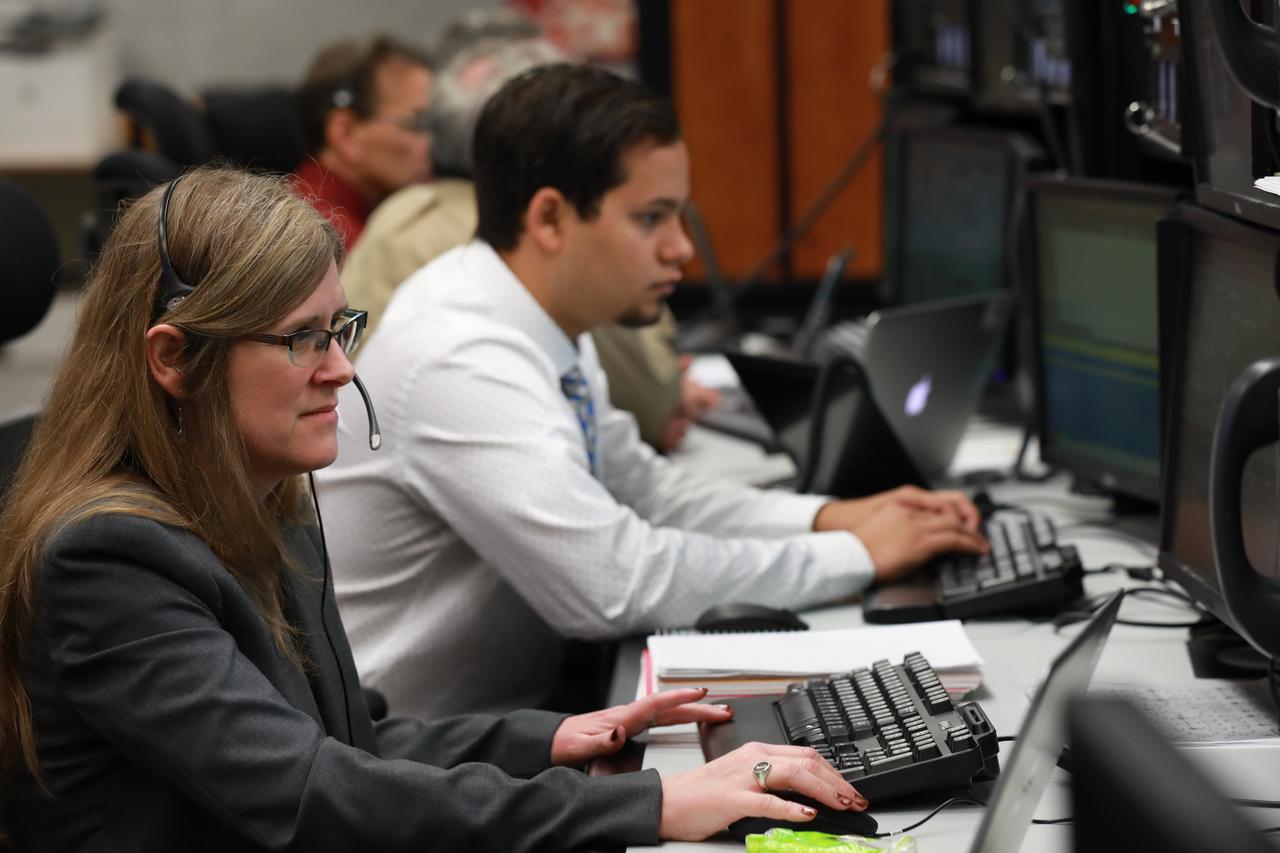
Master Console Operator Jennifer Tschanz, left, and Master Console Operator Diego Diaz, both of Jacobs, monitor operations from their consoles in Firing Room 1 at the Kennedy Space Center's Launch Control Center during a countdown simulation for Exploration Mission 1. It was the agency's first simulation of a portion of the countdown for the first launch of a Space Launch System rocket and Orion spacecraft that will eventually take astronauts beyond low-Earth orbit to destinations such as the Moon and Mars.
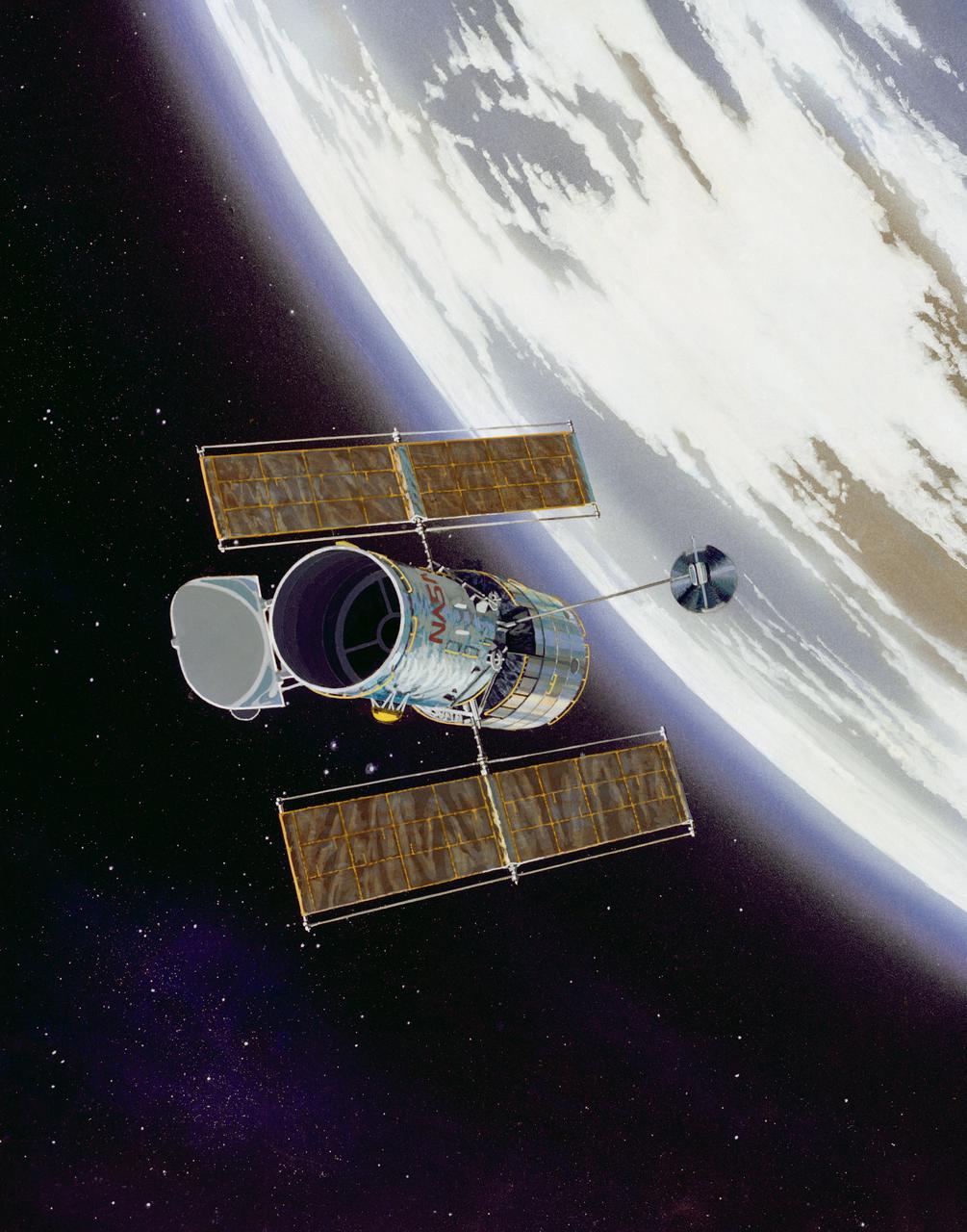
This artist concept shows the Hubble Space Telescope (HST) in operational configuration orbiting the Earth after its deploy from Discovery, Orbiter Vehicle (OV) 103 during STS-31. The high gain antennas (HGAs) and solar arrays (SAs) have been extended. HST's aperature door is open as it views the universe from a vantage point above the Earth's atmosphere. View provided by the Marshall Space Flight Center (MSFC).

ISS047e114046 (05/11/2016) --- The SpaceX Dragon is seen ready to be released from the International Space Station for its journey back to the Earth. The vehicle was ultimately released by Expedition 47 robotic arm operator Tim Peake of ESA (European Space Agency) on May 11, 2016. Dragon returned to Earth carrying more than 3,700 pounds of NASA cargo and science samples from human research, biology and biotechnology studies, physical science investigations and education activities sponsored by NASA and the U.S. national laboratory.
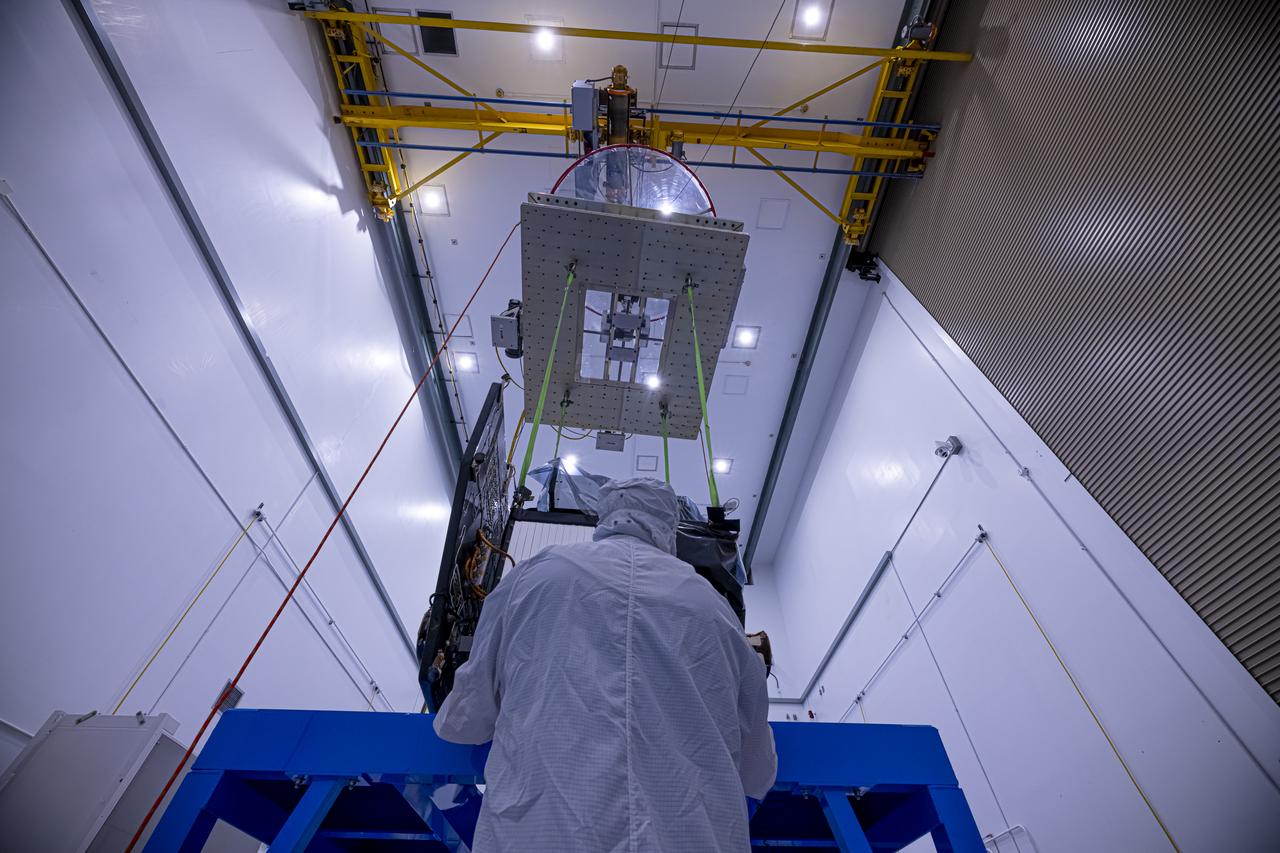
A crane lifts NASA’s Carruthers Geocorona Observatory on Thursday, July 24, 2025, at the Astrotech Space Operations Facility near the agency’s Kennedy Space Center in Florida. The Carruthers Geocorona Observatory is a small satellite set to operate at Lagrange Point 1 (L1), an orbit point between the Earth and Sun about one million miles away. Carruthers will use its ultraviolet cameras to monitor how space weather from the Sun impacts the exosphere, the outermost part of Earth’s atmosphere. The observatory will launch as a rideshare with NASA’s IMAP (Interstellar Mapping and Acceleration Probe) no earlier than September 2025.
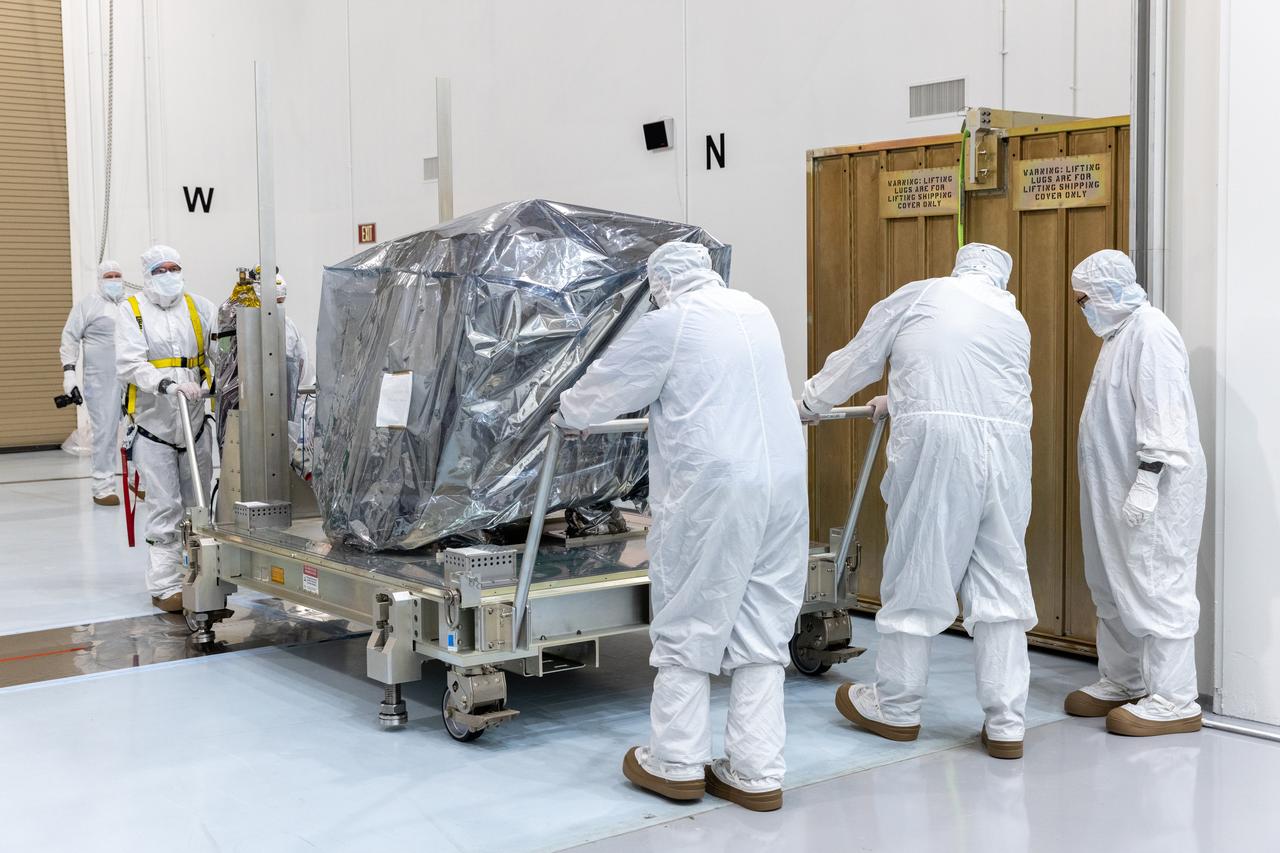
Technicians remove the protective casing covering NASA’s Carruthers Geocorona Observatory on Monday, July 21, 2025, at the Astrotech Space Operations Facility near the agency’s Kennedy Space Center in Florida. The Carruthers Geocorona Observatory is a small satellite set to operate at Lagrange Point 1 (L1), an orbit point between the Earth and Sun about one million miles away. Carruthers will use its ultraviolet cameras to monitor how space weather from the Sun impacts the exosphere, the outermost part of Earth’s atmosphere. The observatory will launch as a rideshare with NASA’s (Interstellar Mapping and Acceleration Probe) no earlier than September 2025.
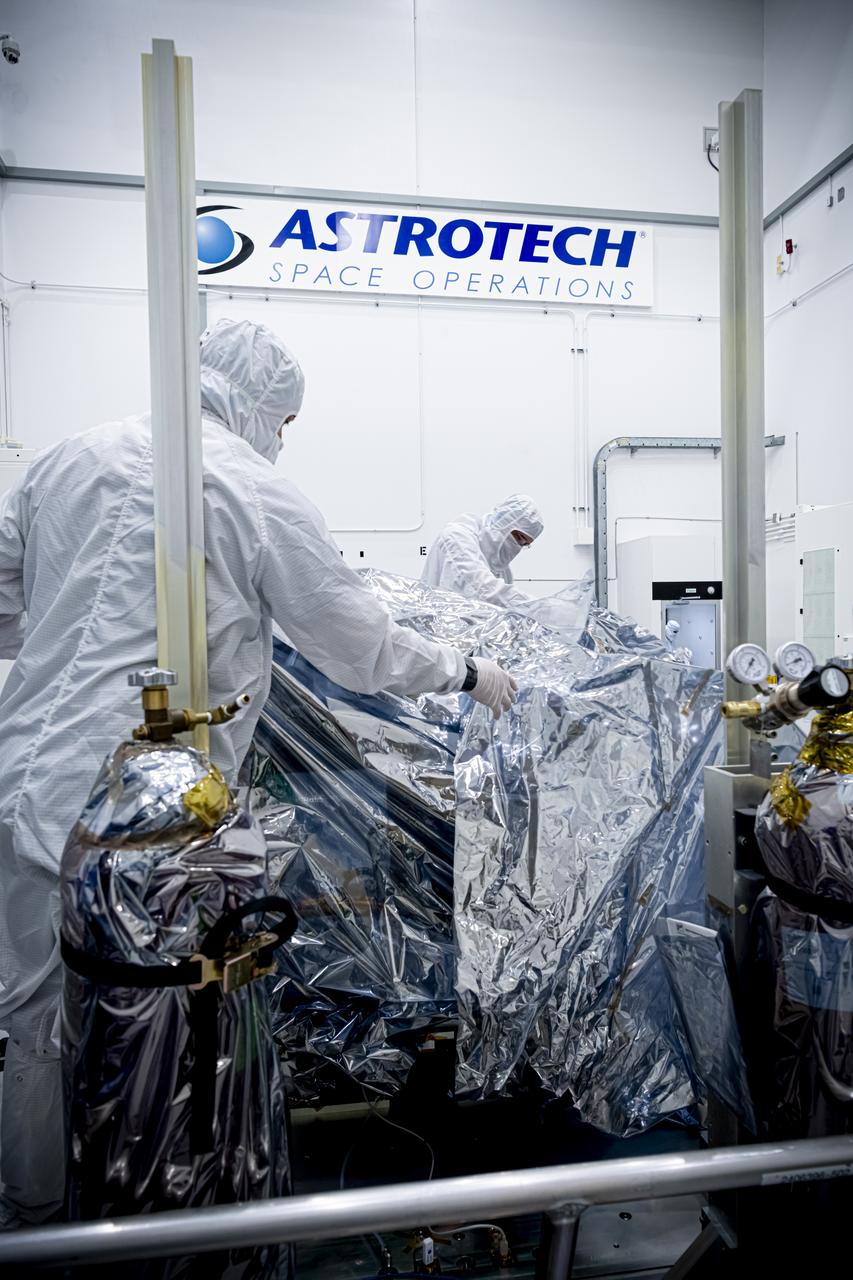
Technicians inspect NASA’s Carruthers Geocorona Observatory on Wednesday, July 23, 2025, following arrival and unboxing of the observatory at the Astrotech Space Operations Facility near the agency’s Kennedy Space Center in Florida. The Carruthers Geocorona Observatory is a small satellite set to operate at Lagrange Point 1 (L1), an orbit point between the Earth and Sun about one million miles away. Carruthers will use its ultraviolet cameras to monitor how space weather from the Sun impacts the exosphere, the outermost part of Earth’s atmosphere. The observatory will launch as a rideshare with NASA’s IMAP (Interstellar Mapping and Acceleration Probe) no earlier than September 2025.
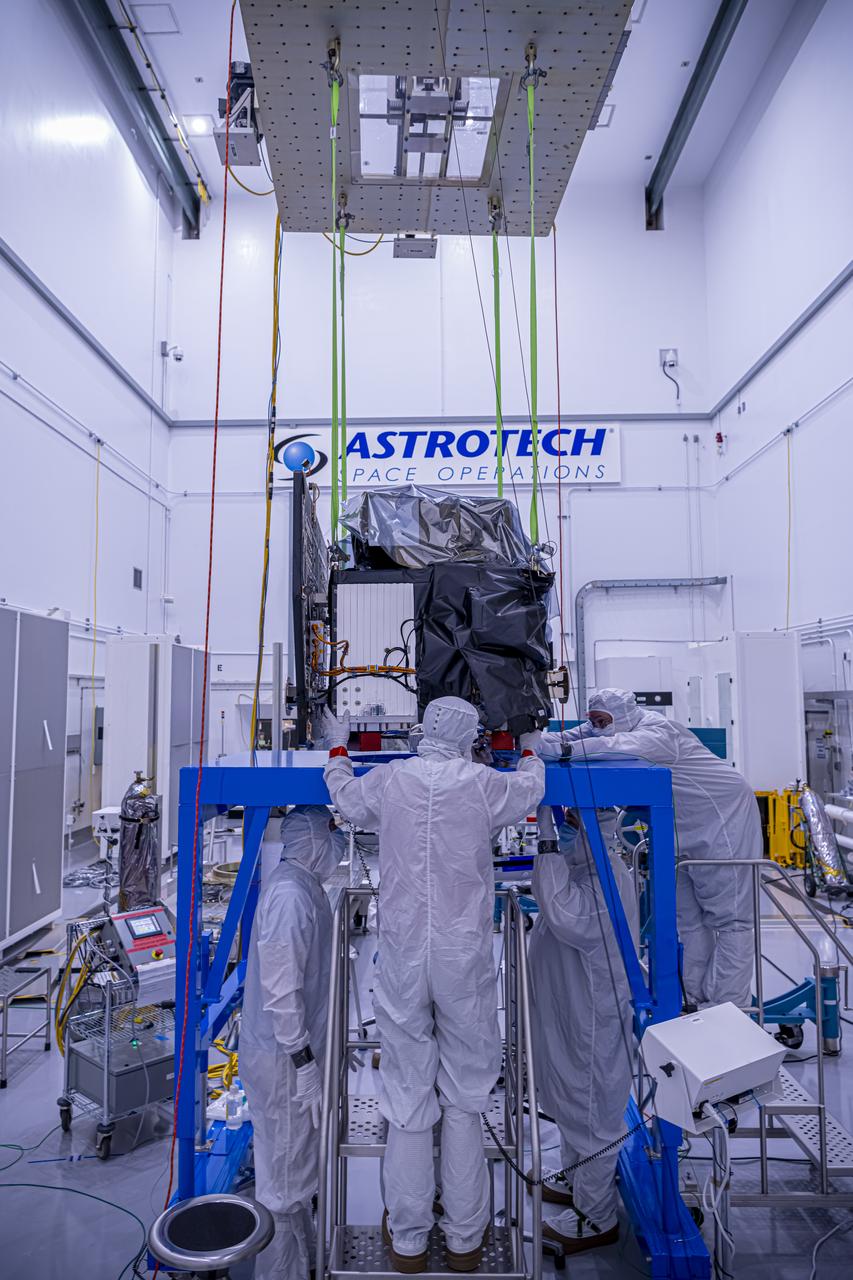
A crane lifts NASA’s Carruthers Geocorona Observatory on Thursday, July 24, 2025, at the Astrotech Space Operations Facility near the agency’s Kennedy Space Center in Florida. The Carruthers Geocorona Observatory is a small satellite set to operate at Lagrange Point 1 (L1), an orbit point between the Earth and Sun about one million miles away. Carruthers will use its ultraviolet cameras to monitor how space weather from the Sun impacts the exosphere, the outermost part of Earth’s atmosphere. The observatory will launch as a rideshare with NASA’s IMAP (Interstellar Mapping and Acceleration Probe) no earlier than September 2025.
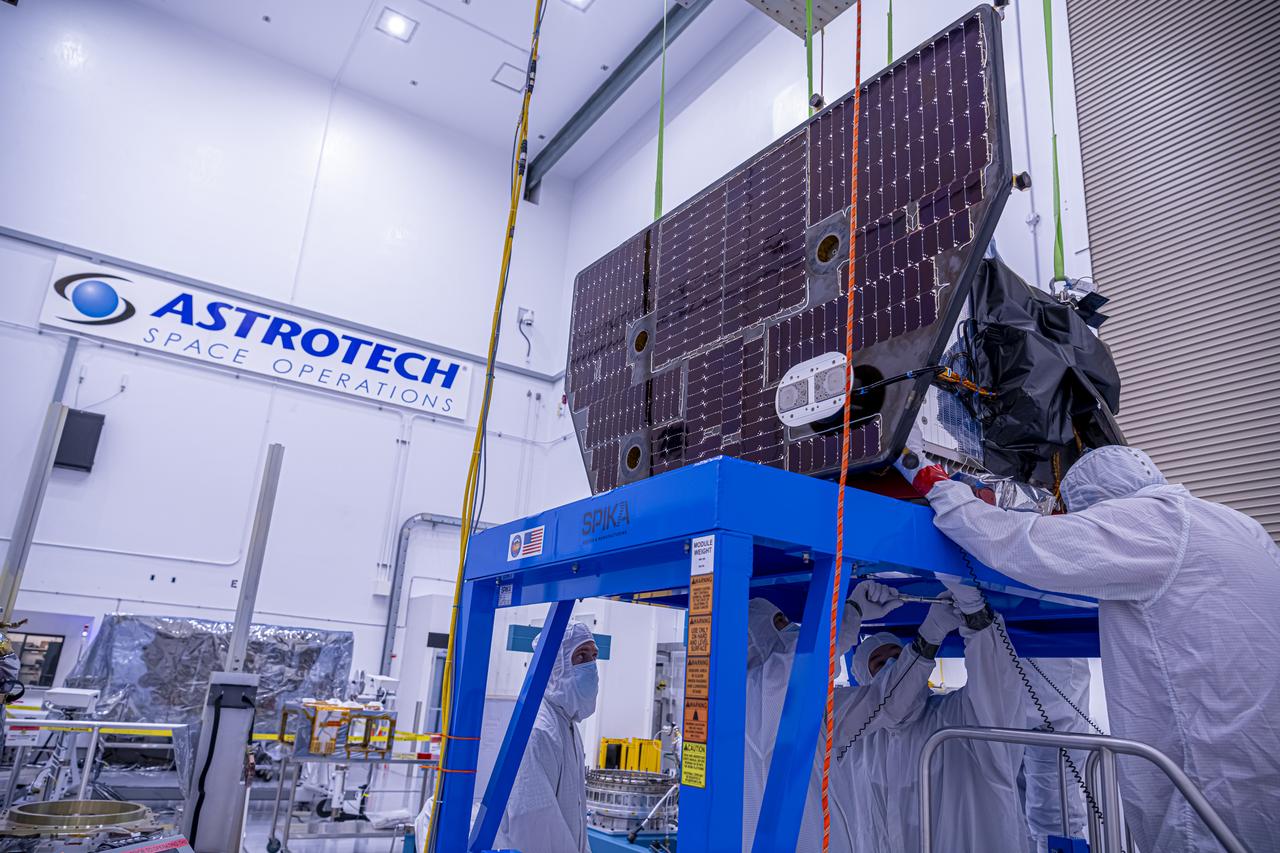
A crane lifts NASA’s Carruthers Geocorona Observatory on Thursday, July 24, 2025, at the Astrotech Space Operations Facility near the agency’s Kennedy Space Center in Florida. The Carruthers Geocorona Observatory is a small satellite set to operate at Lagrange Point 1 (L1), an orbit point between the Earth and Sun about one million miles away. Carruthers will use its ultraviolet cameras to monitor how space weather from the Sun impacts the exosphere, the outermost part of Earth’s atmosphere. The observatory will launch as a rideshare with NASA’s IMAP (Interstellar Mapping and Acceleration Probe) no earlier than September 2025.
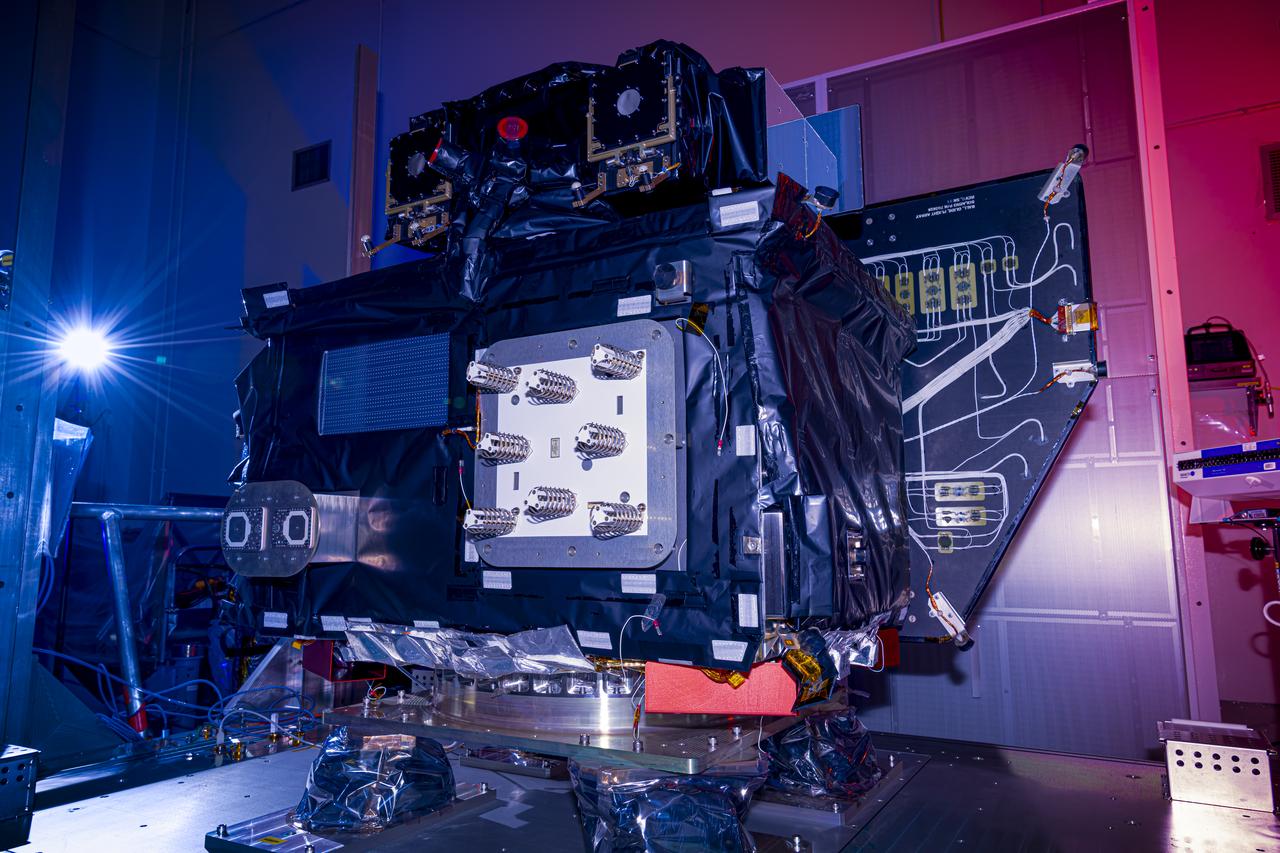
A photographer captures a photo of NASA’s Carruthers Geocorona Observatory on Wednesday, July 23, 2025, following arrival and unboxing of the observatory at the Astrotech Space Operations Facility near the agency’s Kennedy Space Center in Florida. The Carruthers Geocorona Observatory is a small satellite set to operate at Lagrange Point 1 (L1), an orbit point between the Earth and Sun about one million miles away. Carruthers will use its ultraviolet cameras to monitor how space weather from the Sun impacts the exosphere, the outermost part of Earth’s atmosphere. The observatory will launch as a rideshare with NASA’s (Interstellar Mapping and Acceleration Probe) no earlier than September 2025.
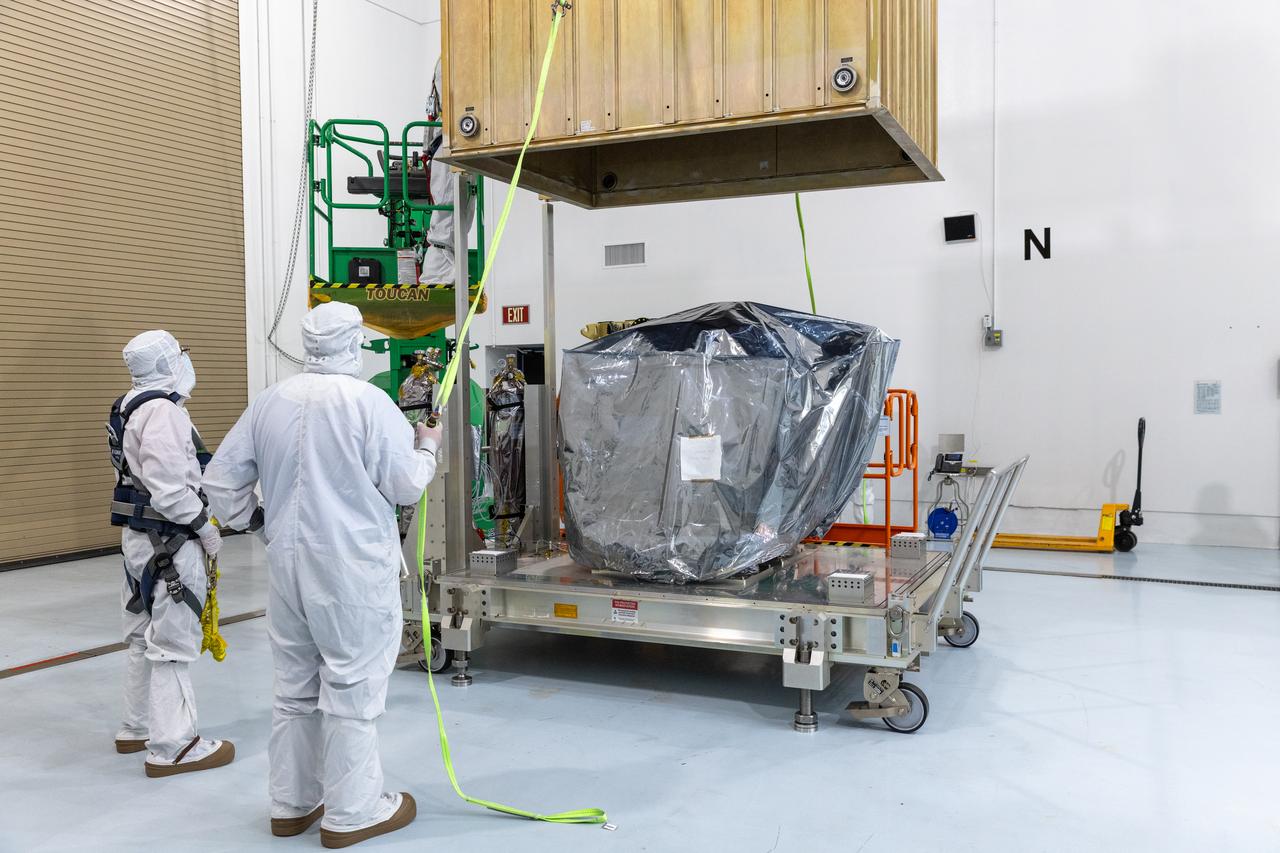
Technicians remove the protective casing covering NASA’s Carruthers Geocorona Observatory on Monday, July 21, 2025, at the Astrotech Space Operations Facility near the agency’s Kennedy Space Center in Florida. The Carruthers Geocorona Observatory is a small satellite set to operate at Lagrange Point 1 (L1), an orbit point between the Earth and Sun about one million miles away. Carruthers will use its ultraviolet cameras to monitor how space weather from the Sun impacts the exosphere, the outermost part of Earth’s atmosphere. The observatory will launch as a rideshare with NASA’s (Interstellar Mapping and Acceleration Probe) no earlier than September 2025.
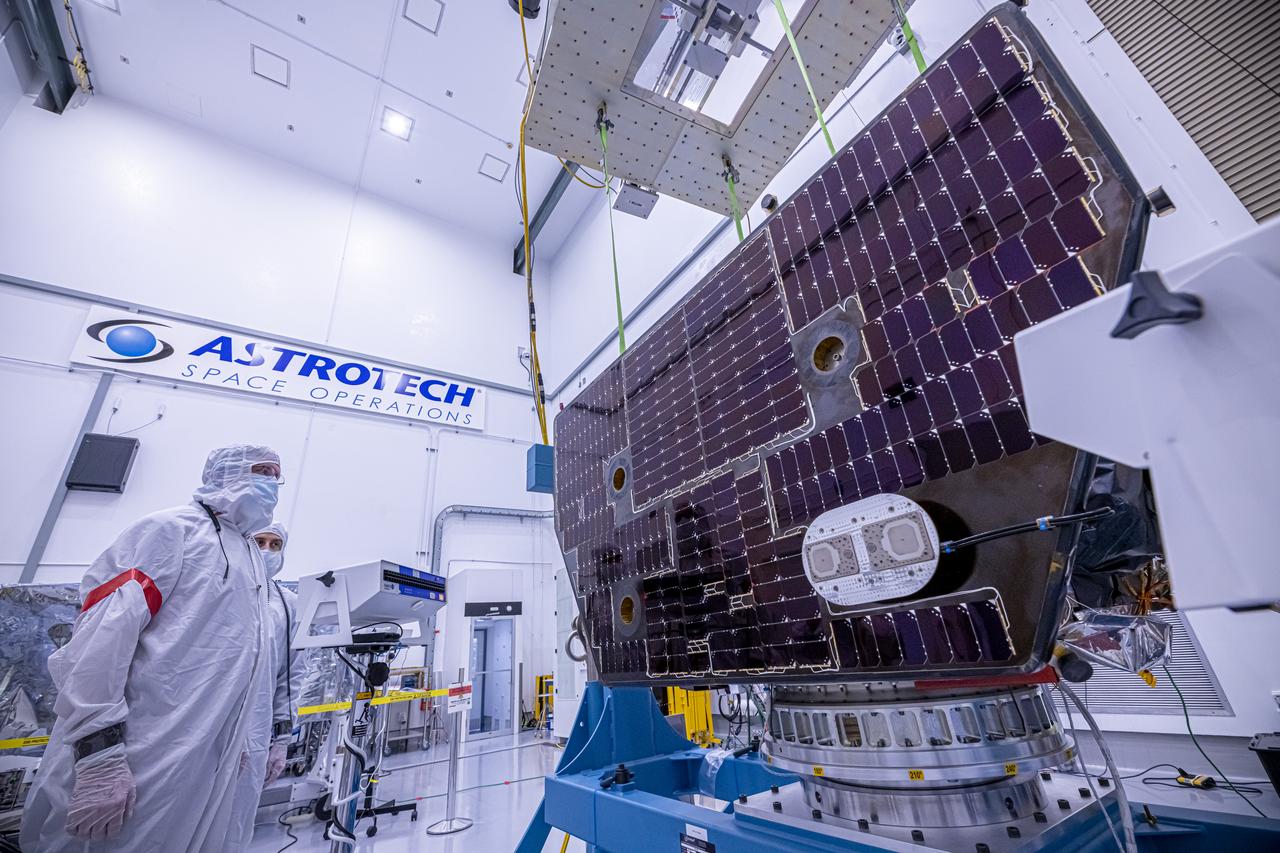
A crane lifts NASA’s Carruthers Geocorona Observatory on Thursday, July 24, 2025, at the Astrotech Space Operations Facility near the agency’s Kennedy Space Center in Florida. The Carruthers Geocorona Observatory is a small satellite set to operate at Lagrange Point 1 (L1), an orbit point between the Earth and Sun about one million miles away. Carruthers will use its ultraviolet cameras to monitor how space weather from the Sun impacts the exosphere, the outermost part of Earth’s atmosphere. The observatory will launch as a rideshare with NASA’s IMAP (Interstellar Mapping and Acceleration Probe) no earlier than September 2025.
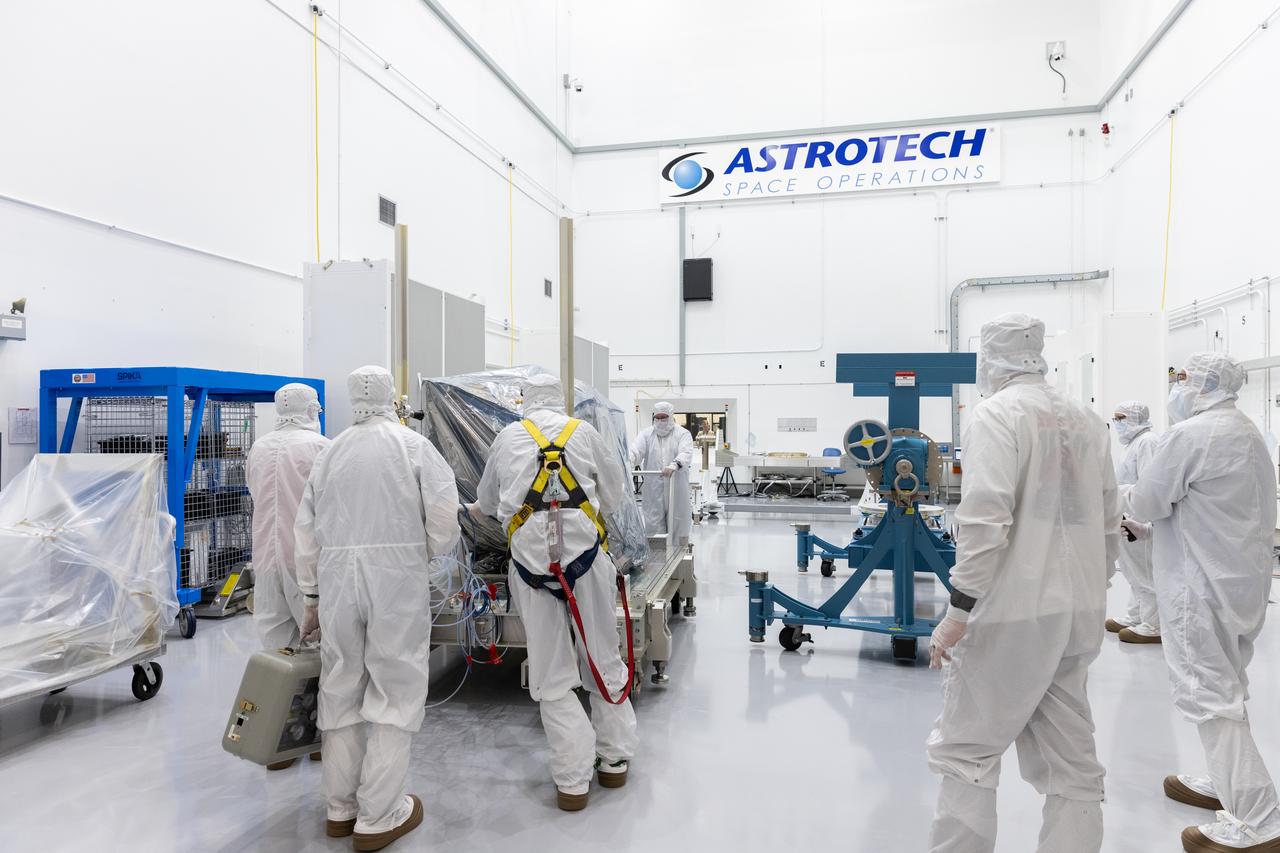
Technicians remove the protective casing covering NASA’s Carruthers Geocorona Observatory on Monday, July 21, 2025, at the Astrotech Space Operations Facility near the agency’s Kennedy Space Center in Florida. The Carruthers Geocorona Observatory is a small satellite set to operate at Lagrange Point 1 (L1), an orbit point between the Earth and Sun about one million miles away. Carruthers will use its ultraviolet cameras to monitor how space weather from the Sun impacts the exosphere, the outermost part of Earth’s atmosphere. The observatory will launch as a rideshare with NASA’s (Interstellar Mapping and Acceleration Probe) no earlier than September 2025.
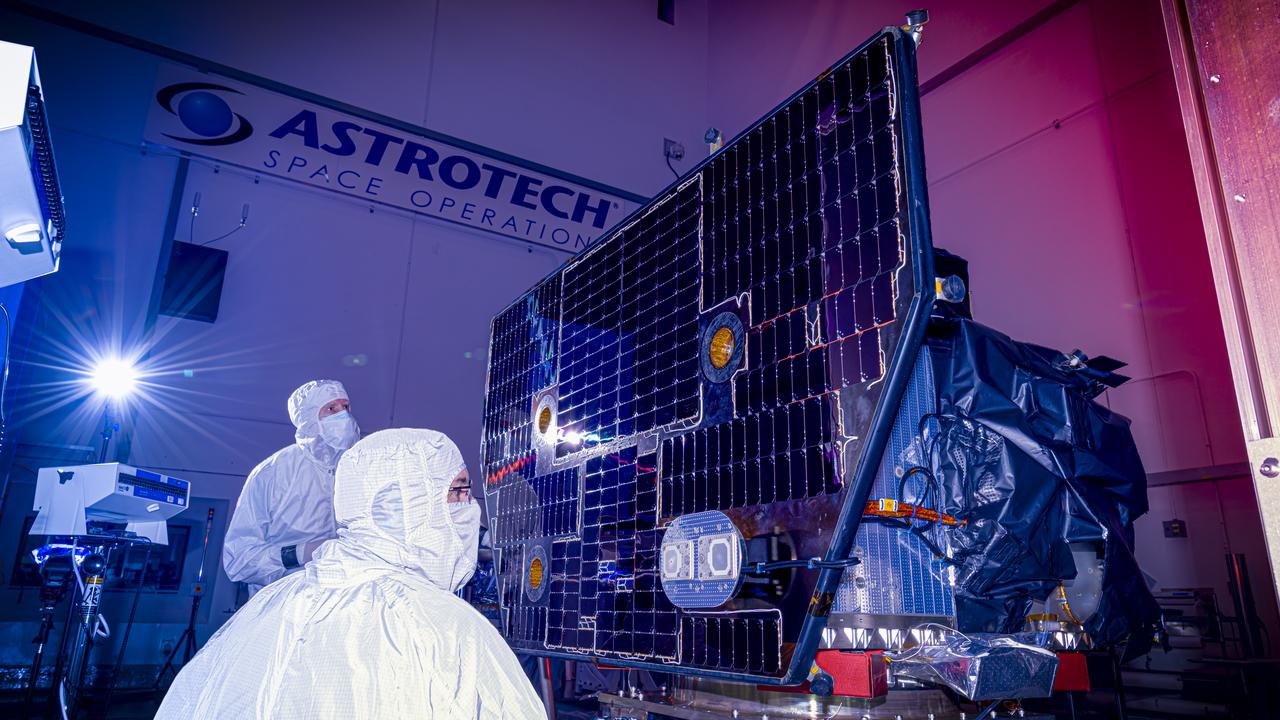
Technicians inspect the solar array panel attached to NASA’s Carruthers Geocorona Observatory on Wednesday, July 23, 2025, at the Astrotech Space Operations Facility near the agency’s Kennedy Space Center in Florida. The solar array will use the Sun to help power Carruthers Geocorona Observatory as it operates at Lagrange Point 1 (L1), an orbit point between the Earth and Sun about one million miles away. Carruthers will use its ultraviolet cameras to monitor how space weather from the Sun impacts the exosphere, the outermost part of Earth’s atmosphere. The observatory will launch as a rideshare with NASA’s IMAP (Interstellar Mapping and Acceleration Probe) no earlier than September 2025.
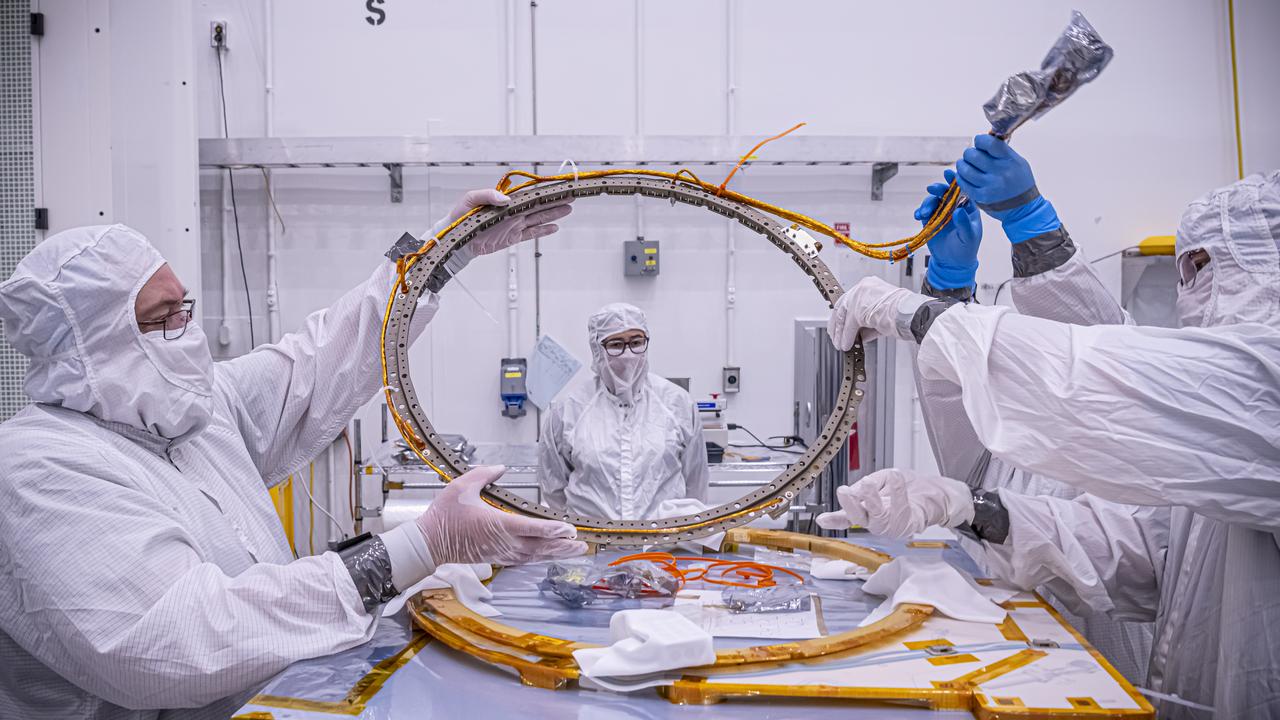
Technicians inspect a motorized light band for NASA’s Carruthers Geocorona Observatory on Tuesday, July 22, 2025, at the Astrotech Space Operations Facility near the agency’s Kennedy Space Center in Florida. The Carruthers Geocorona Observatory is a small satellite set to operate at Lagrange Point 1 (L1), an orbit point between the Earth and Sun about one million miles away. Carruthers will use its ultraviolet cameras to monitor how space weather from the Sun impacts the exosphere, the outermost part of Earth’s atmosphere. The observatory will launch as a rideshare with NASA’s IMAP (Interstellar Mapping and Acceleration Probe) no earlier than September 2025.

Technicians inspect NASA’s Carruthers Geocorona Observatory on Wednesday, July 23, 2025, following arrival and unboxing of the observatory at the Astrotech Space Operations Facility near the agency’s Kennedy Space Center in Florida. The Carruthers Geocorona Observatory is a small satellite set to operate at Lagrange Point 1 (L1), an orbit point between the Earth and Sun about one million miles away. Carruthers will use its ultraviolet cameras to monitor how space weather from the Sun impacts the exosphere, the outermost part of Earth’s atmosphere. The observatory will launch as a rideshare with NASA’s IMAP (Interstellar Mapping and Acceleration Probe) no earlier than September 2025.
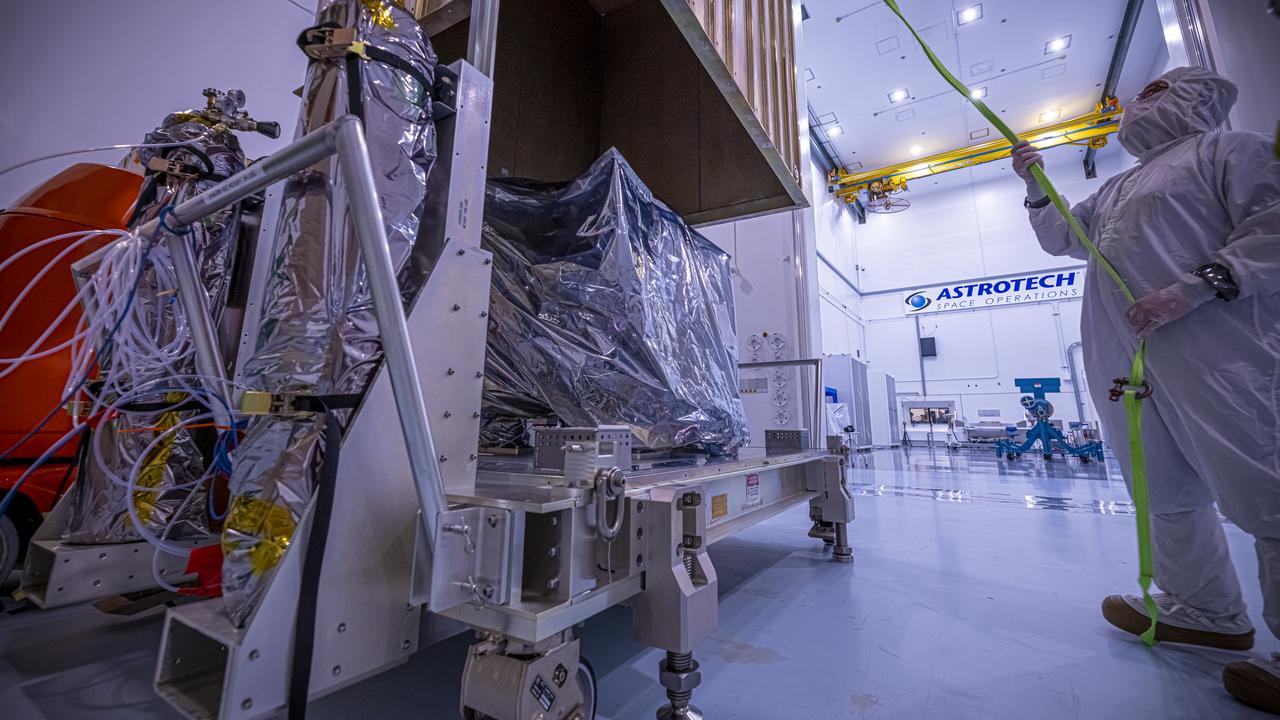
Technicians remove the transport container covering NASA’s Carruthers Geocorona Observatory on Monday, July 21, 2025, at the Astrotech Space Operations Facility near the agency’s Kennedy Space Center in Florida. The Carruthers Geocorona Observatory is a small satellite set to operate at Lagrange Point 1 (L1), an orbit point between the Earth and Sun about one million miles away. Carruthers will use its ultraviolet cameras to monitor how space weather from the Sun impacts the exosphere, the outermost part of Earth’s atmosphere. The observatory will launch as a rideshare with NASA’s IMAP (Interstellar Mapping and Acceleration Probe) no earlier than September 2025.
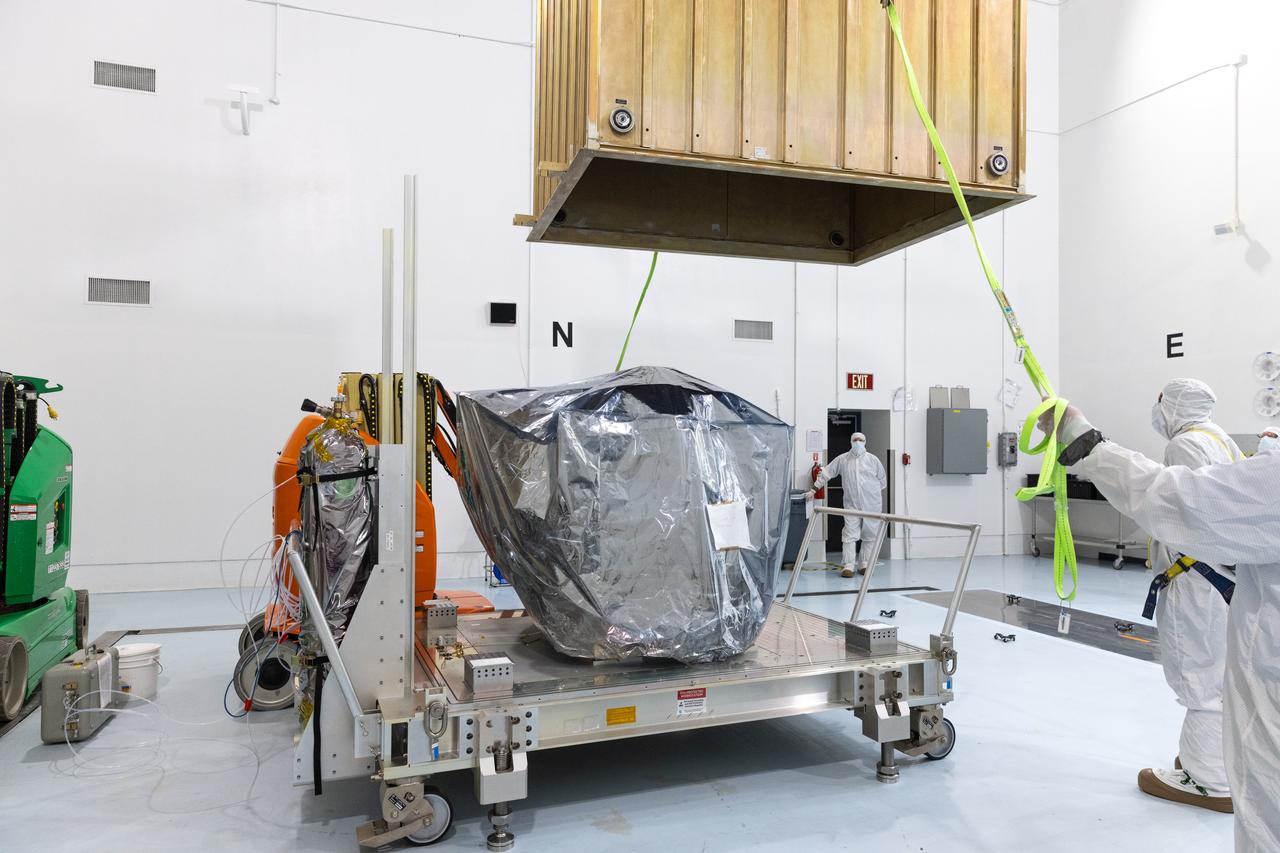
Technicians remove the protective casing covering NASA’s Carruthers Geocorona Observatory on Monday, July 21, 2025, at the Astrotech Space Operations Facility near the agency’s Kennedy Space Center in Florida. The Carruthers Geocorona Observatory is a small satellite set to operate at Lagrange Point 1 (L1), an orbit point between the Earth and Sun about one million miles away. Carruthers will use its ultraviolet cameras to monitor how space weather from the Sun impacts the exosphere, the outermost part of Earth’s atmosphere. The observatory will launch as a rideshare with NASA’s (Interstellar Mapping and Acceleration Probe) no earlier than September 2025.
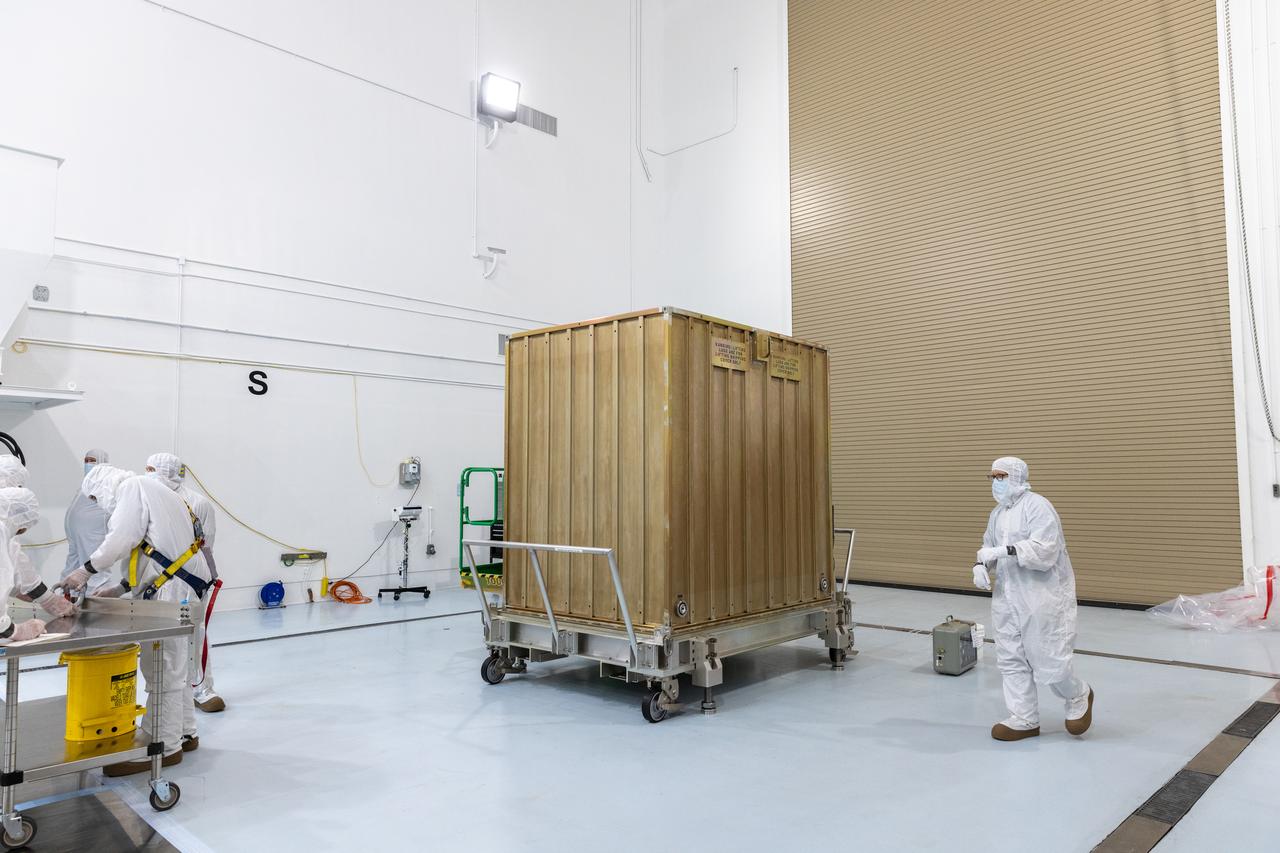
Technicians prepare to remove the protective casing covering NASA’s Carruthers Geocorona Observatory on Monday, July 21, 2025, at the Astrotech Space Operations Facility near the agency’s Kennedy Space Center in Florida. The Carruthers Geocorona Observatory is a small satellite set to operate at Lagrange Point 1 (L1), an orbit point between the Earth and Sun about one million miles away. Carruthers will use its ultraviolet cameras to monitor how space weather from the Sun impacts the exosphere, the outermost part of Earth’s atmosphere. The observatory will launch as a rideshare with NASA’s (Interstellar Mapping and Acceleration Probe) no earlier than September 2025.
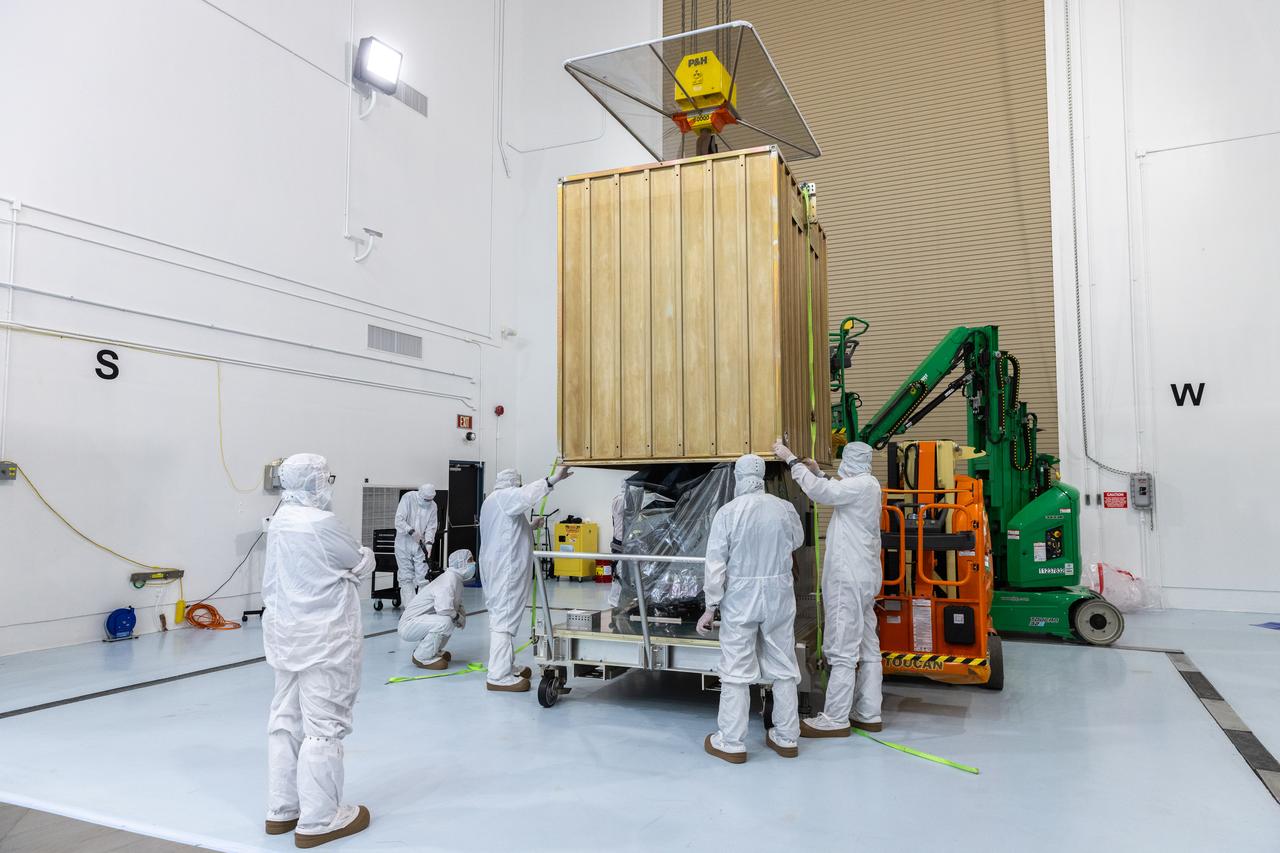
Technicians prepare to remove the protective casing covering NASA’s Carruthers Geocorona Observatory on Monday, July 21, 2025, at the Astrotech Space Operations Facility near the agency’s Kennedy Space Center in Florida. The Carruthers Geocorona Observatory is a small satellite set to operate at Lagrange Point 1 (L1), an orbit point between the Earth and Sun about one million miles away. Carruthers will use its ultraviolet cameras to monitor how space weather from the Sun impacts the exosphere, the outermost part of Earth’s atmosphere. The observatory will launch as a rideshare with NASA’s (Interstellar Mapping and Acceleration Probe) no earlier than September 2025.
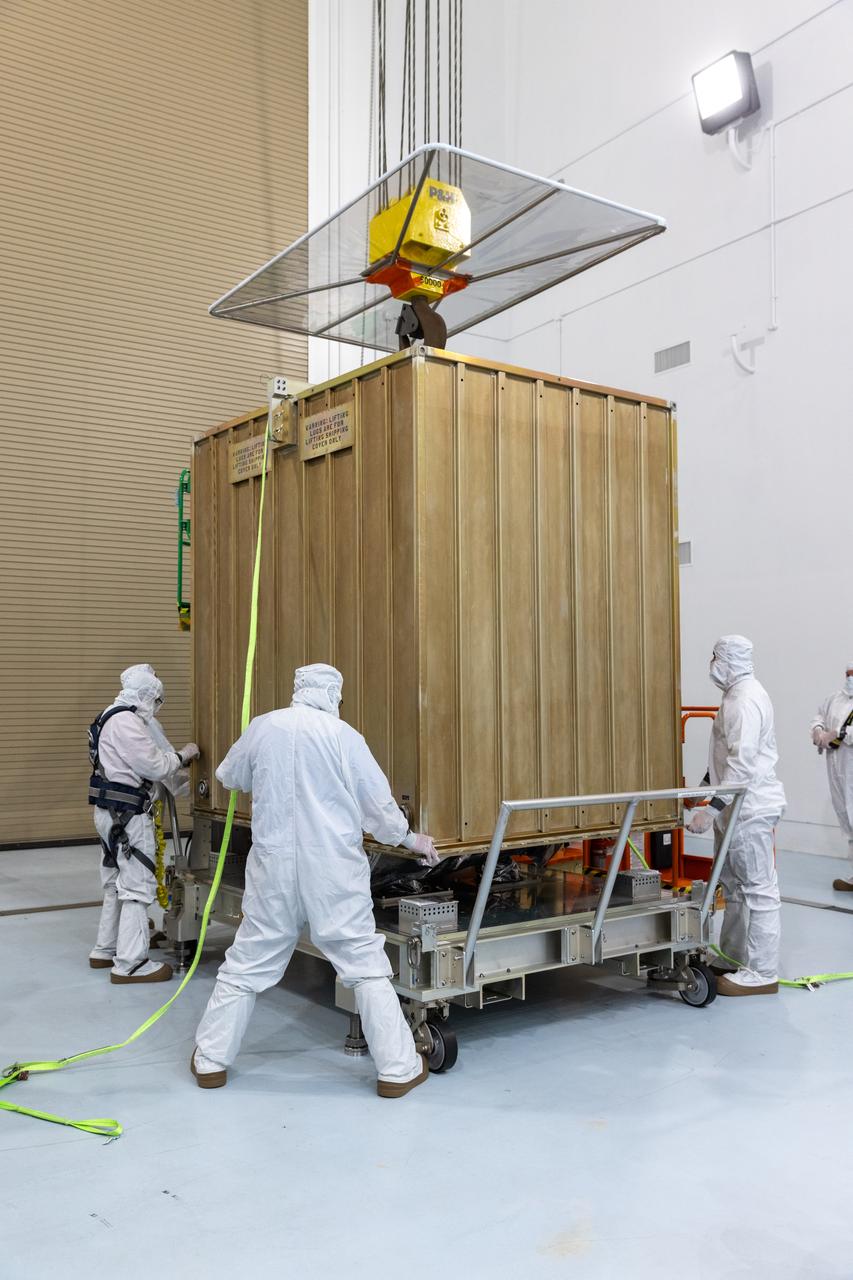
Technicians prepare to remove the protective casing covering NASA’s Carruthers Geocorona Observatory on Monday, July 21, 2025, at the Astrotech Space Operations Facility near the agency’s Kennedy Space Center in Florida. The Carruthers Geocorona Observatory is a small satellite set to operate at Lagrange Point 1 (L1), an orbit point between the Earth and Sun about one million miles away. Carruthers will use its ultraviolet cameras to monitor how space weather from the Sun impacts the exosphere, the outermost part of Earth’s atmosphere. The observatory will launch as a rideshare with NASA’s (Interstellar Mapping and Acceleration Probe) no earlier than September 2025.
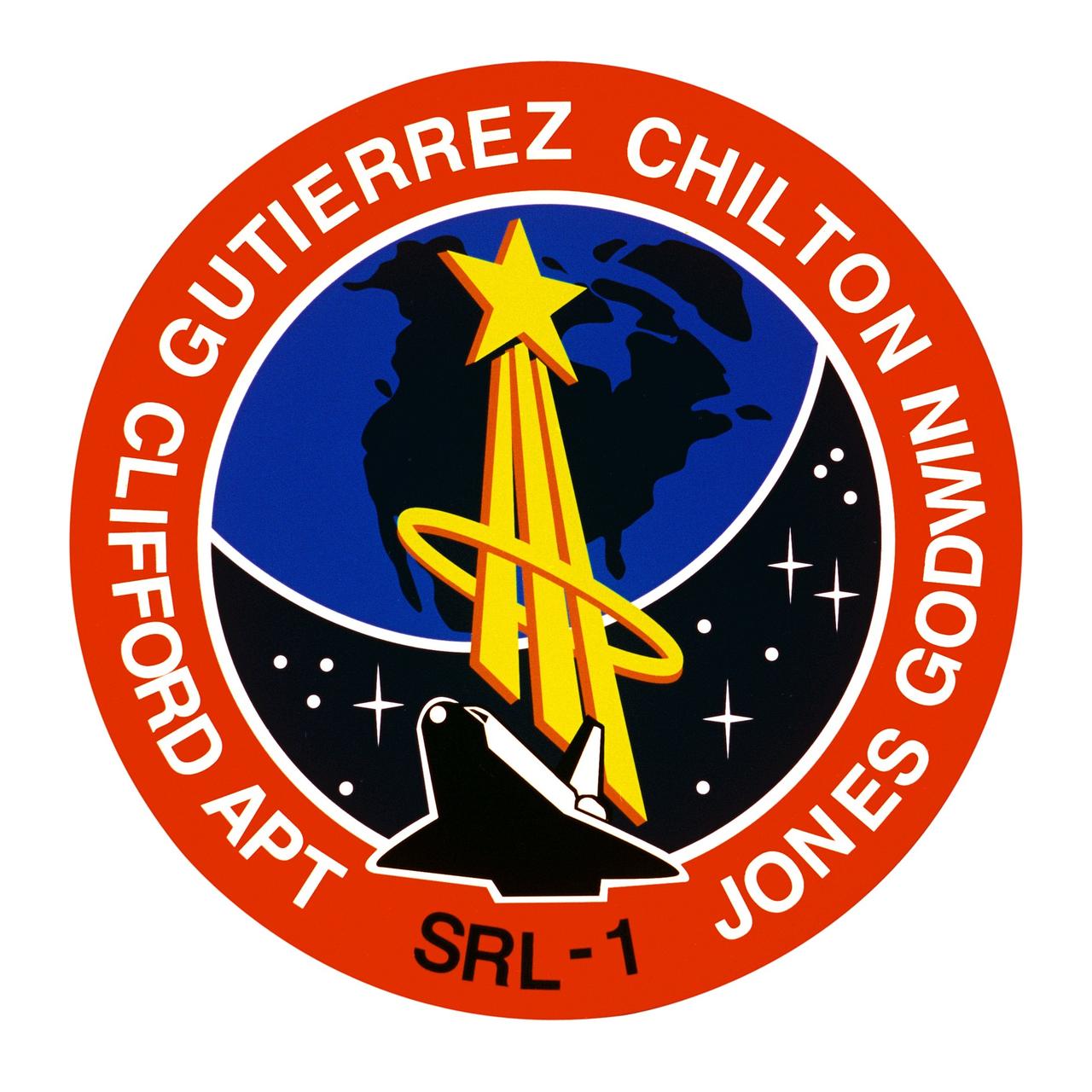
STS059-S-001 (November 1993) --- Designed by the crew members, the STS-59 insignia is dominated by Earth, reflecting the focus of the first Space Radar Laboratory (SRL-1) mission upon our planet's surface and atmosphere. The golden symbol of the astronaut corps emblem sweeps over Earth's surface from the space shuttle Endeavour, representing the operation of the SIR-C/Synthetic Aperture Radar (X-SAR) and the Measurement of Air Pollution from Space (MAPS) sensors. The astronaut emblem also signals the importance of the human element in space exploration and in the study of our planet. Using the unique vantage point of space, Endeavour and its crew -- along with scientists from around the world -- will study Earth and its environment. The starfield visible below Earth represents the many talents and skills of the international (SRL-1) team in working to make this "Mission to Planet Earth" (MTPE) a scientific and operational success. The NASA insignia design for space shuttle flights is reserved for use by the astronauts and for other official use as the NASA Administrator may authorize. Public availability has been approved only in the forms of illustrations by the various news media. When and if there is any change in this policy, which is not anticipated, the change will be publicly announced. Photo credit: NASA
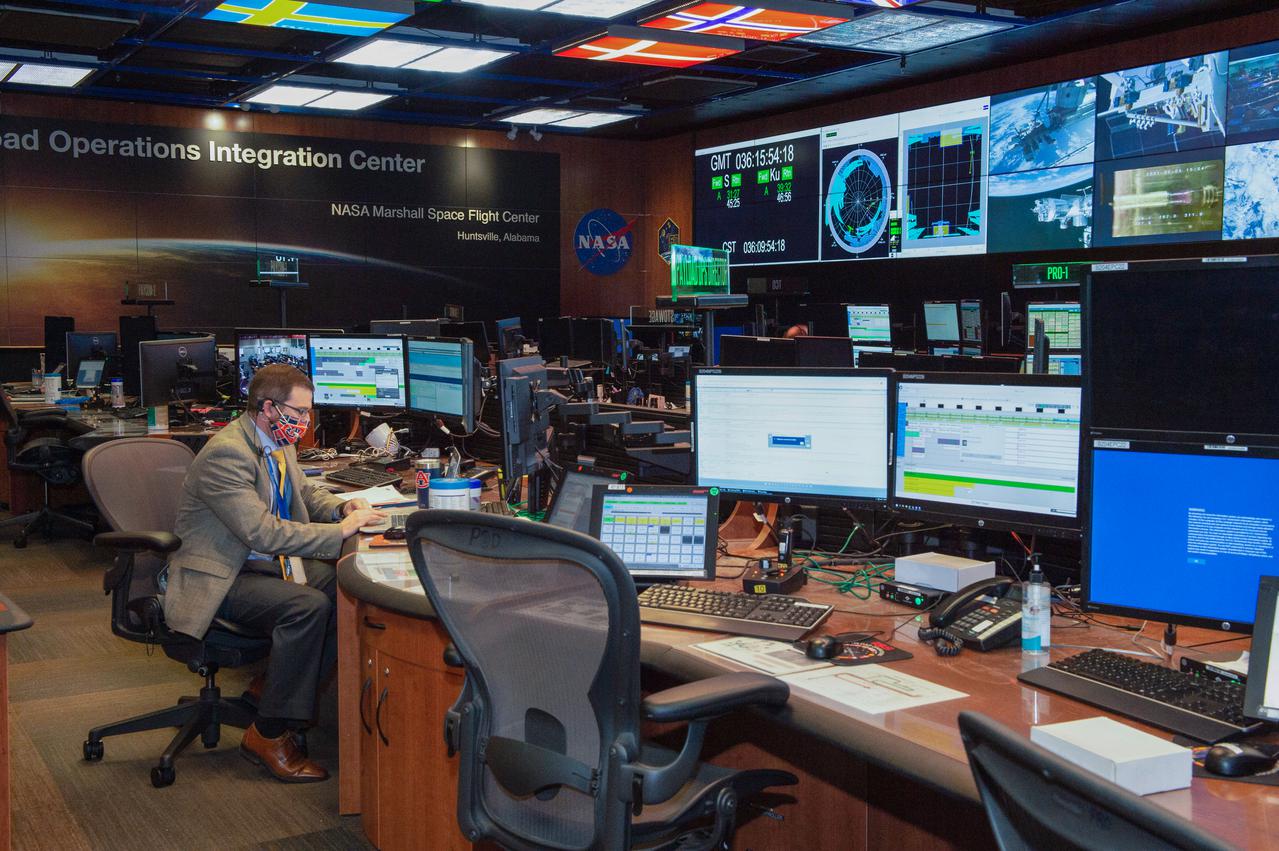
A look inside the International Space Station Payload Operations Integration Center at NASA’s Marshall Space Flight Center in Huntsville, AL. The POIC team supports science operations on the International Space Station 24 hours a day, 7 days a week. For more than 20 years the POIC team has worked with scientists from around the world to enable the space station crew to conduct experiments that improve life on Earth and enable future exploration.
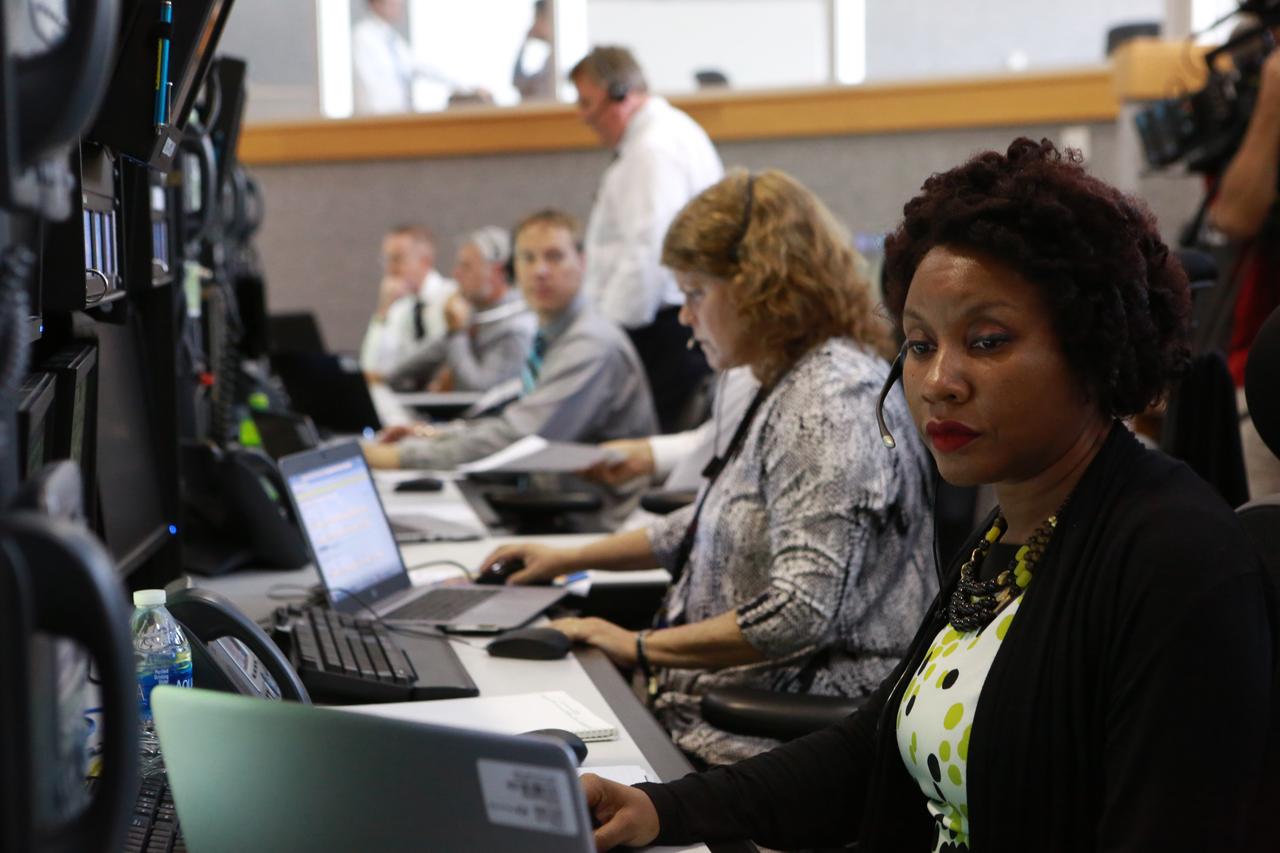
Space Launch System Test Conductors Roberta Wyrick, left, and Tracy Parks, both with Jacobs, NASA's Test and Operations Support Contractor, monitor operations from their consoles in Firing Room 1 at the Kennedy Space Center's Launch Control Center during a countdown simulation for Exploration Mission 1. It was the agency's first simulation of a portion of the countdown for the first launch of a Space Launch System rocket and Orion spacecraft that will eventually take astronauts beyond low-Earth orbit to destinations such as the Moon and Mars.
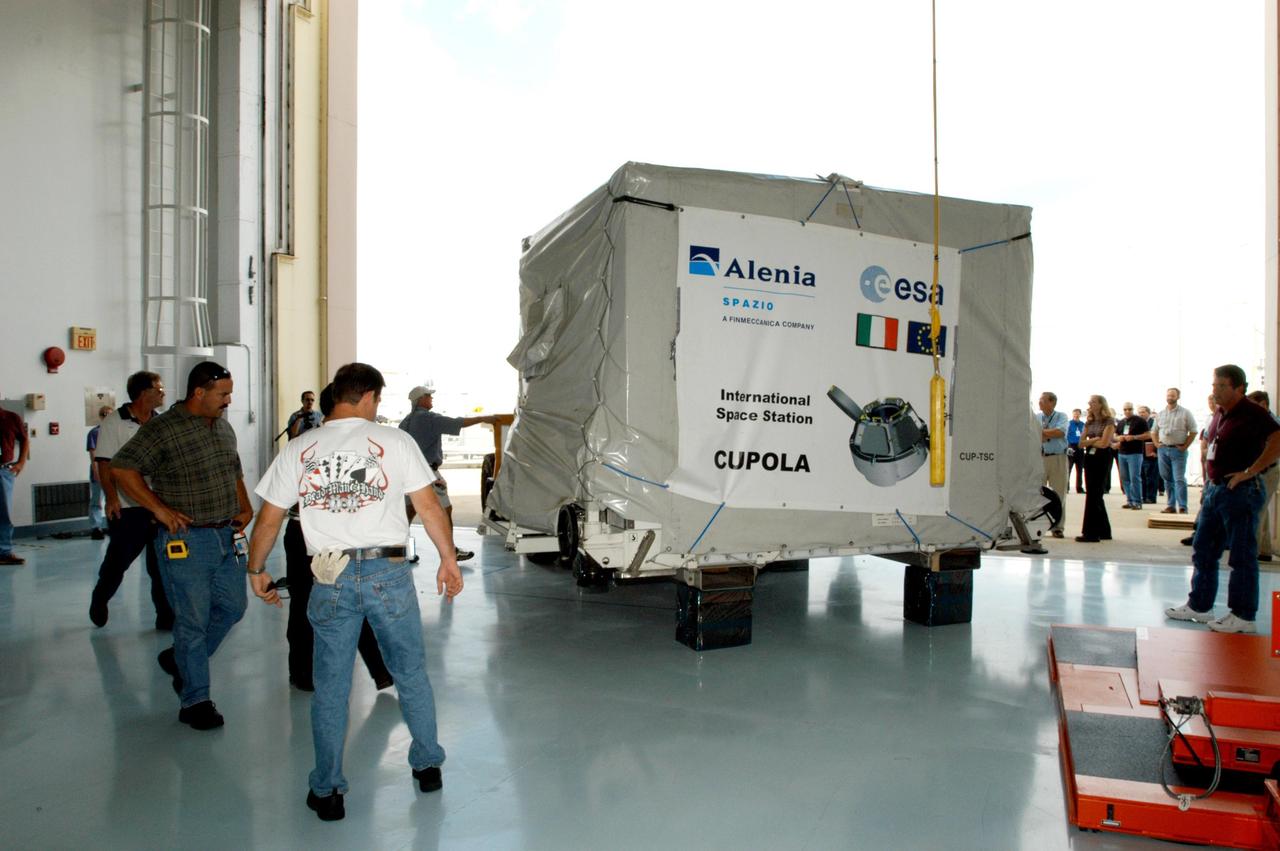
KENNEDY SPACE CENTER, FLA. - At the Space Station Processing Facility, a trailer delivers the Cupola, an element scheduled to be installed on the International Space Station in early 2009. It was shipped from Alenia Spazio in Turin, Italy, for the European Space Agency. A dome-shaped module with seven windows, the Cupola will give astronauts a panoramic view for observing many operations on the outside of the orbiting complex. The view out of the Cupola windows will enhance an arm operator's situational awareness, supplementing television camera views and graphics. It will provide external observation capabilities during spacewalks, docking operations and hardware surveys and for Earth and celestial studies. The Cupola is the final element of the Space Station core.
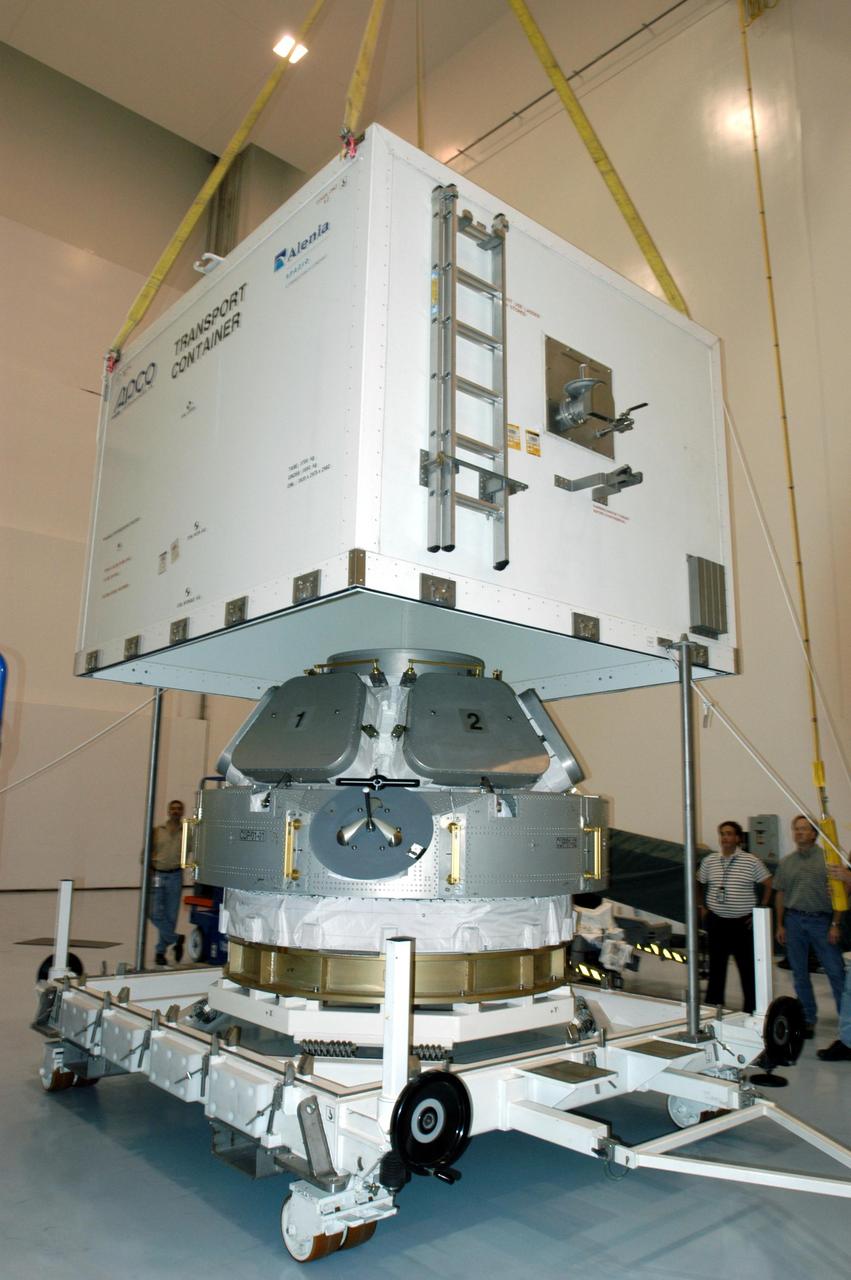
KENNEDY SPACE CENTER, FLA. - Inside the Space Station Processing Facility, the Cupola is uncrated. It was shipped from Alenia Spazio in Turin, Italy, for the European Space Agency. The Cupola is an element scheduled to be installed on the International Space Station in early 2009. A dome-shaped module with seven windows, the Cupola will give astronauts a panoramic view for observing many operations on the outside of the orbiting complex. The view out of the Cupola windows will enhance an arm operator's situational awareness, supplementing television camera views and graphics. It will provide external observation capabilities during spacewalks, docking operations and hardware surveys and for Earth and celestial studies. The Cupola is the final element of the Space Station core.
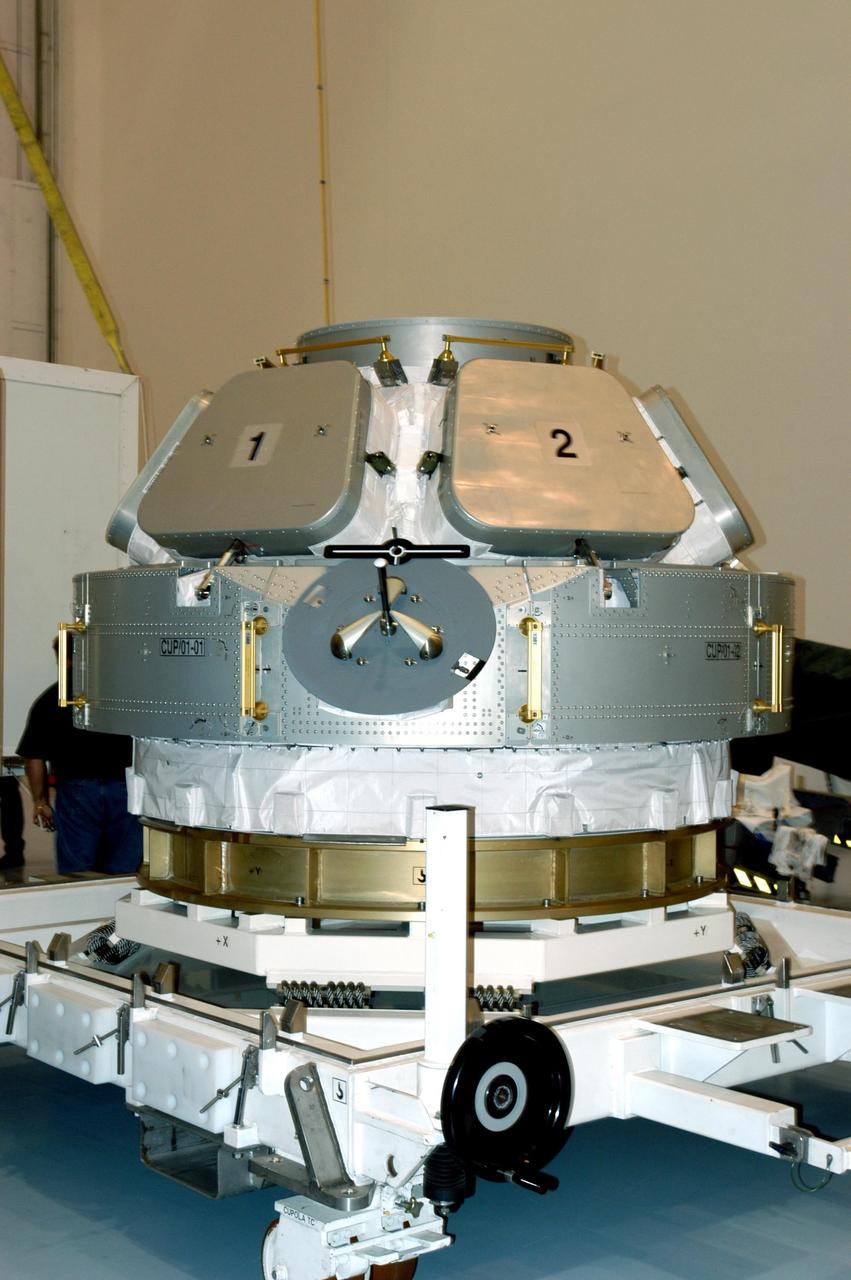
KENNEDY SPACE CENTER, FLA. - The Cupola, an element scheduled to be installed on the International Space Station in early 2009, sits uncrated inside the Space Station Processing Facility after its delivery from Turin, Italy. A dome-shaped module with seven windows, the Cupola will give astronauts a panoramic view for observing many operations on the outside of the orbiting complex. The view out of the Cupola windows will enhance an arm operator's situational awareness, supplementing television camera views and graphics. It will provide external observation capabilities during spacewalks, docking operations and hardware surveys and for Earth and celestial studies. The Cupola is the final element of the Space Station core.
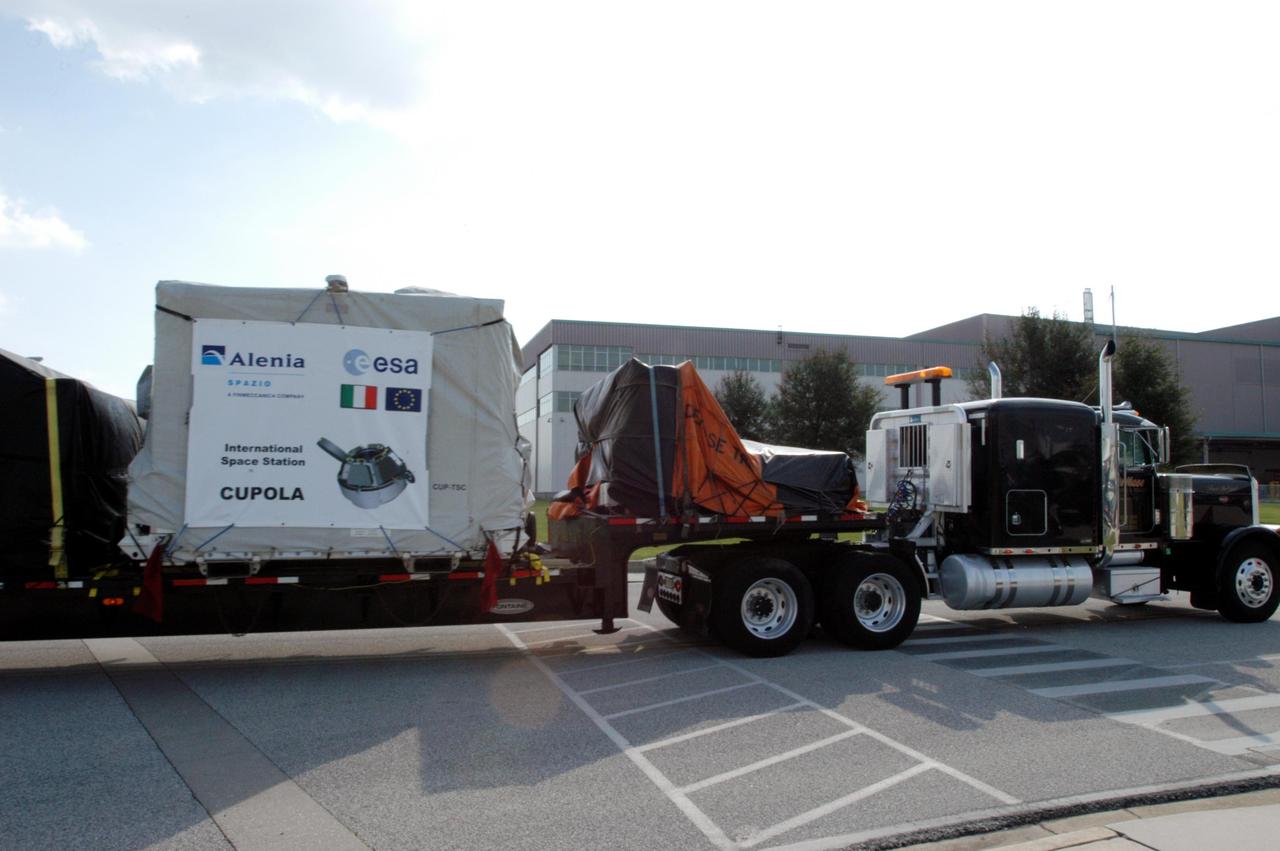
KENNEDY SPACE CENTER, FLA. - The Cupola, an element scheduled to be installed on the International Space Station in early 2009, arrives at KSC on the flatbed of a trailer. It was shipped from Alenia Spazio in Turin, Italy, for the European Space Agency. A dome-shaped module with seven windows, the Cupola will give astronauts a panoramic view for observing many operations on the outside of the orbiting complex. The view out of the Cupola windows will enhance an arm operator's situational awareness, supplementing television camera views and graphics. It will provide external observation capabilities during spacewalks, docking operations and hardware surveys and for Earth and celestial studies. The Cupola is the final element of the Space Station core.
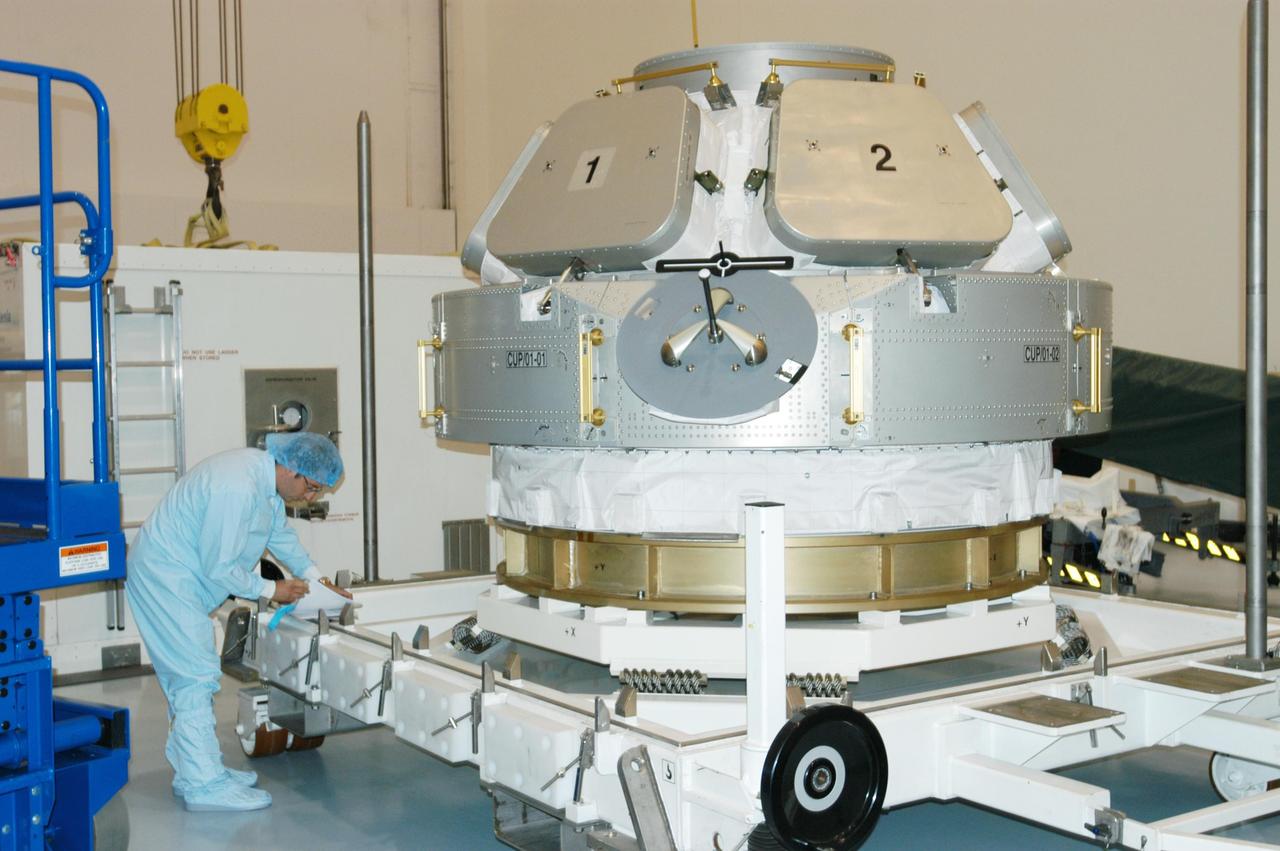
KENNEDY SPACE CENTER, FLA. - Inside the Space Station Processing Facility, a technician begins checking the Cupola after its delivery and uncrating. It was shipped from Alenia Spazio in Turin, Italy, for the European Space Agency. A dome-shaped module with seven windows, the Cupola will give astronauts a panoramic view for observing many operations on the outside of the orbiting complex. The view out of the Cupola windows will enhance an arm operator's situational awareness, supplementing television camera views and graphics. It will provide external observation capabilities during spacewalks, docking operations and hardware surveys and for Earth and celestial studies. The Cupola is the final element of the Space Station core.
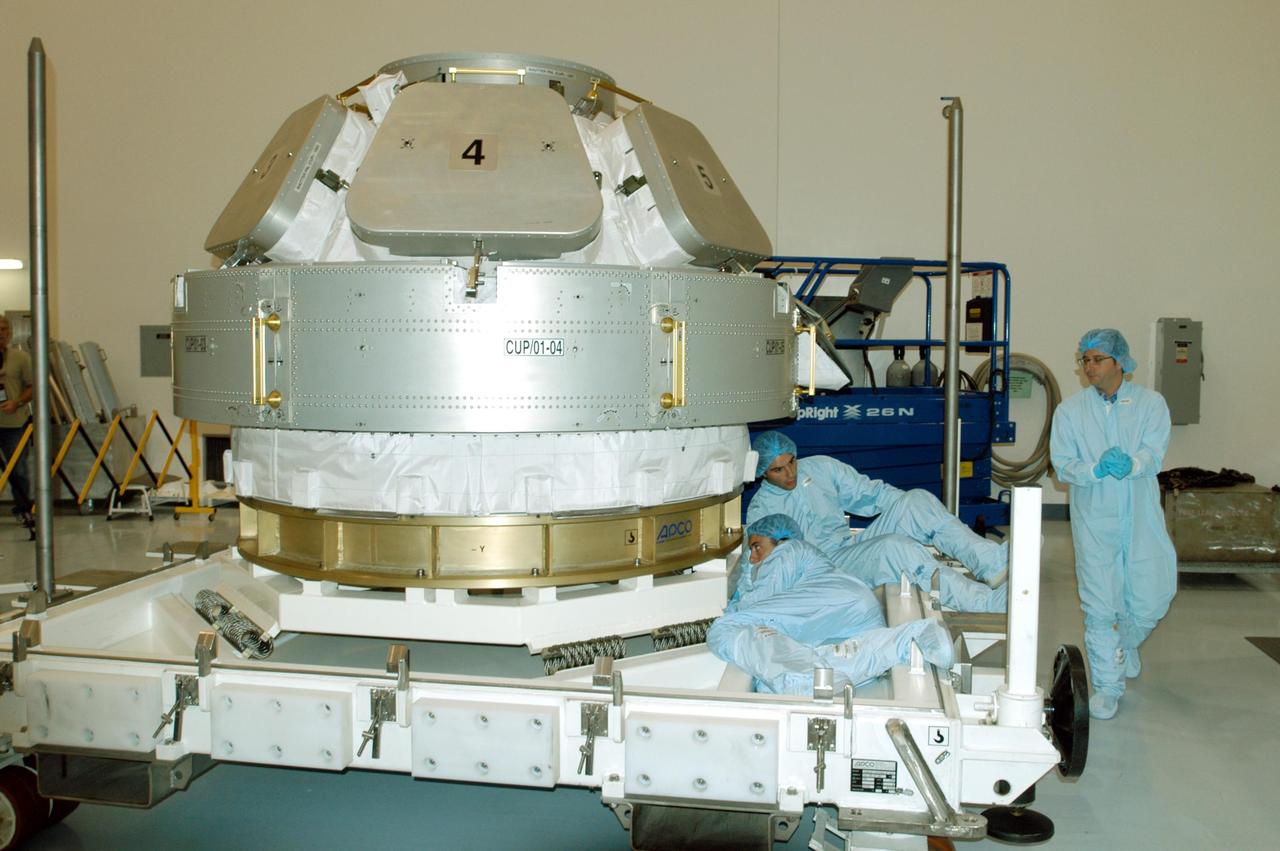
KENNEDY SPACE CENTER, FLA. - Inside the Space Station Processing Facility, technicians begin checking the Cupola after its delivery and uncrating. It was shipped from Alenia Spazio in Turin, Italy, for the European Space Agency. A dome-shaped module with seven windows, the Cupola will give astronauts a panoramic view for observing many operations on the outside of the orbiting complex. The view out of the Cupola windows will enhance an arm operator's situational awareness, supplementing television camera views and graphics. It will provide external observation capabilities during spacewalks, docking operations and hardware surveys, and for Earth and celestial studies. The Cupola is the final element of the Space Station core.
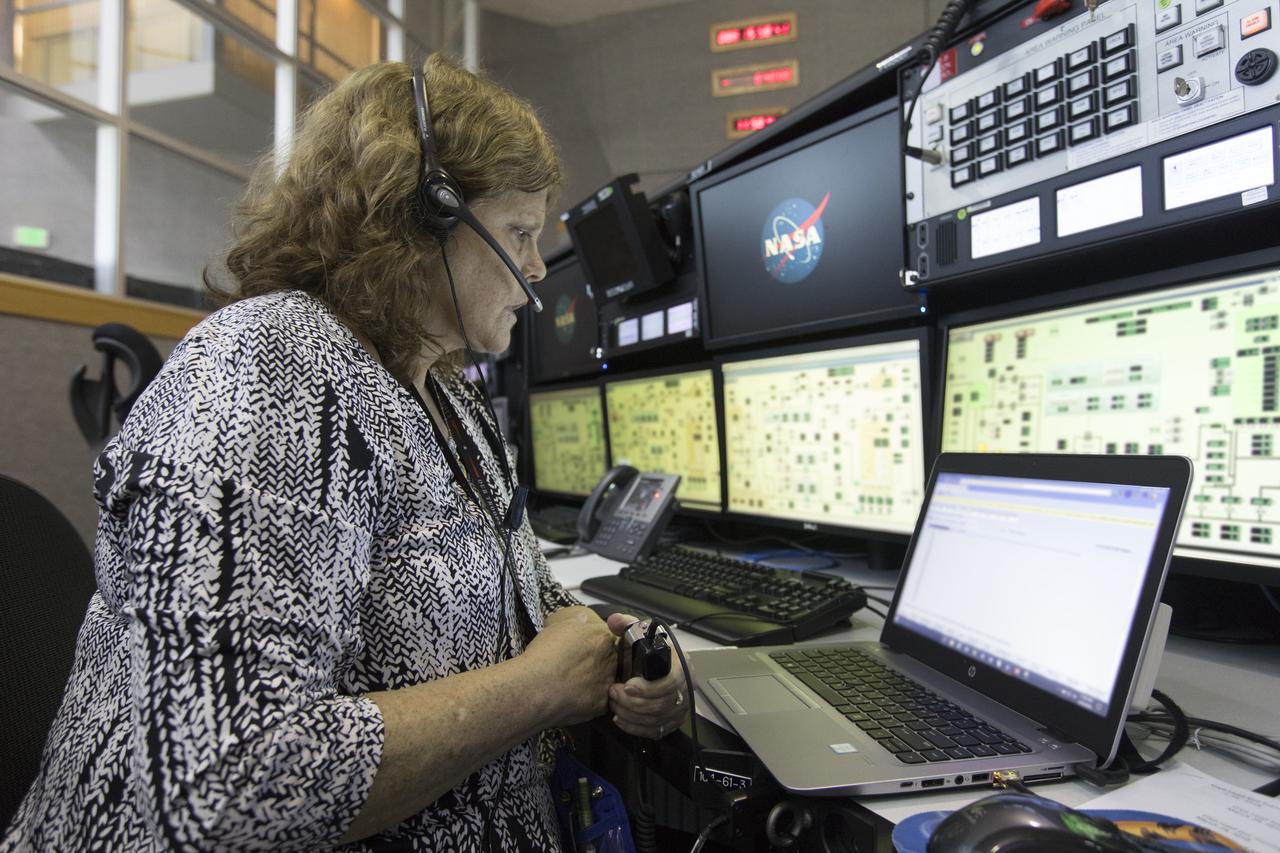
Roberta Wyrick, spacecraft test conductor with Jacobs, NASA's Test and Operations Support Contractor, monitors operations from her console in Firing Room 1 at the Kennedy Space Center's Launch Control Center during a countdown simulation for Exploration Mission 1. It was the agency's first simulation of a portion of the countdown for the first launch of a Space Launch System rocket and Orion spacecraft that will eventually take astronauts beyond low-Earth orbit to destinations such as the Moon and Mars.
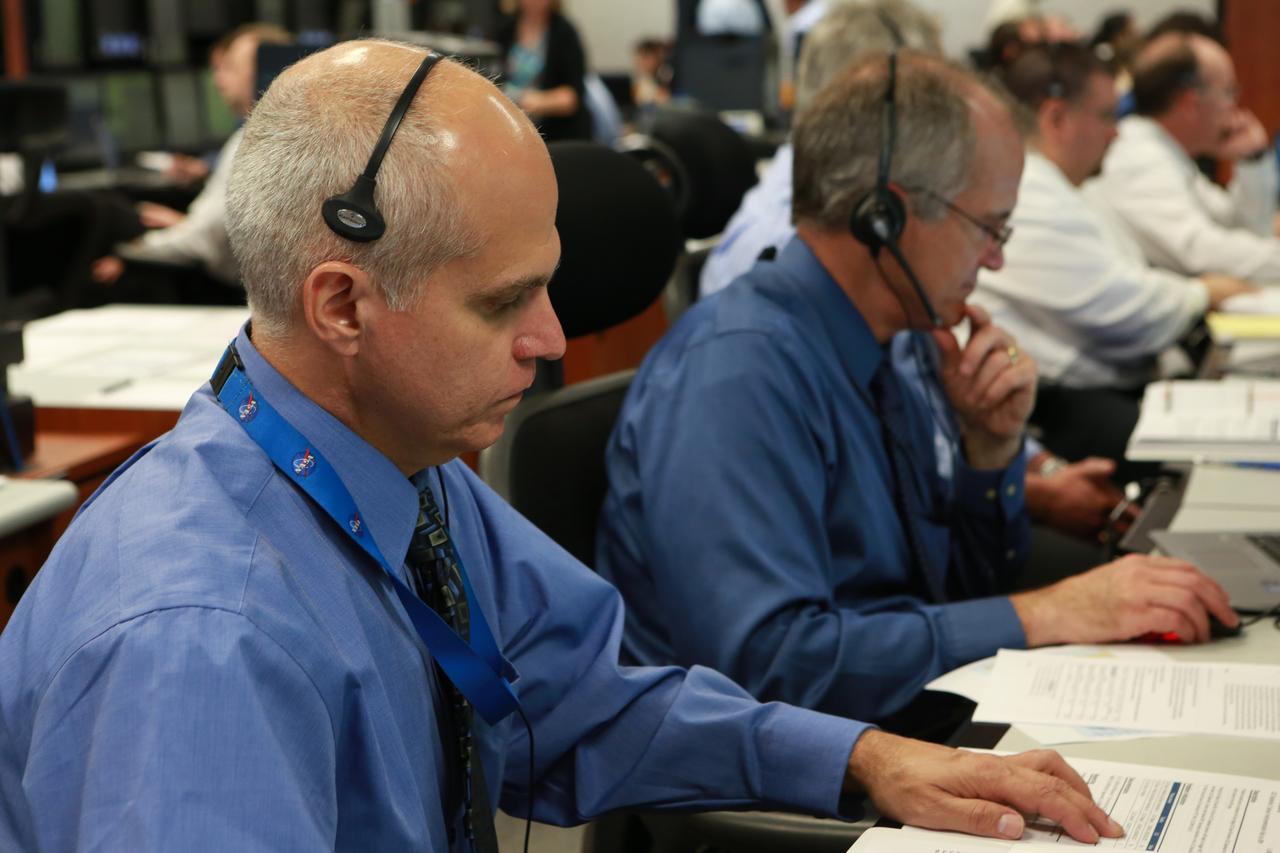
Jacobs Test Project Engineer Don Vinton, left and NASA Operations Project Engineer Doug Robertson, monitor operations from his position in Firing Room 1 at the Kennedy Space Center's Launch Control Center during a countdown simulation for Exploration Mission 1. It was the agency's first simulation of a portion of the countdown for the first launch of a Space Launch System rocket and Orion spacecraft that will eventually take astronauts beyond low-Earth orbit to destinations such as the Moon and Mars.
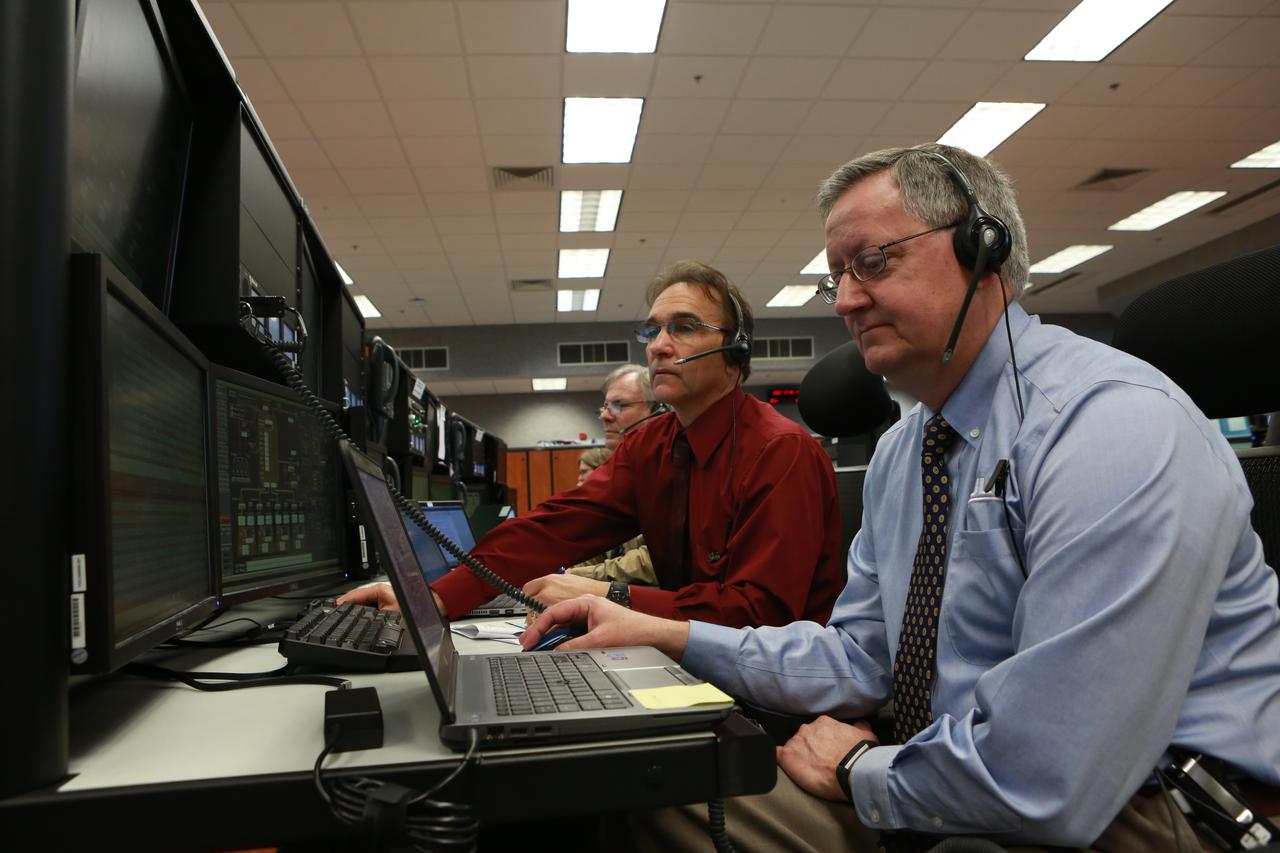
Test Project Engineer Rick Brown, left, and Master Console Operator Jason Robinson, both with Jacobs, monitor operations from their consoles in Firing Room 1 at the Kennedy Space Center's Launch Control Center during a countdown simulation for Exploration Mission 1. It was the agency's first simulation of a portion of the countdown for the first launch of a Space Launch System rocket and Orion spacecraft that will eventually take astronauts beyond low-Earth orbit to destinations such as the Moon and Mars.
Alex Higgins, a liquid hydrogen operations engineer with Jacobs, monitors operations from his position in Firing Room 1 at the Kennedy Space Center's Launch Control Center during a countdown simulation for Exploration Mission 1. It was the agency's first simulation of a portion of the countdown for the first launch of a Space Launch System rocket and Orion spacecraft that will eventually take astronauts beyond low-Earth orbit to destinations such as the Moon and Mars.
Master Console Operators Andrea Oneill, left and David Walsh, monitor operations from their positions in Firing Room 1 at the Kennedy Space Center's Launch Control Center during a countdown simulation for Exploration Mission 1. It was the agency's first simulation of a portion of the countdown for the first launch of a Space Launch System rocket and Orion spacecraft that will eventually take astronauts beyond low-Earth orbit to destinations such as the Moon and Mars.
NASA Operation Project Engineer Rommel Rubio monitors operations from his position in Firing Room 1 at the Kennedy Space Center's Launch Control Center during a countdown simulation for Exploration Mission 1. It was the agency's first simulation of a portion of the countdown for the first launch of a Space Launch System rocket and Orion spacecraft that will eventually take astronauts beyond low-Earth orbit to destinations such as the Moon and Mars.
Master console operator David Walsh monitors operations from his position in Firing Room 1 at the Kennedy Space Center's Launch Control Center during a countdown simulation for Exploration Mission 1. It was the agency's first simulation of a portion of the countdown for the first launch of a Space Launch System rocket and Orion spacecraft that will eventually take astronauts beyond low-Earth orbit to destinations such as the Moon and Mars.

The arrival of the Artemis II astronauts at the Launch and Landing Facility at NASA’s Kennedy Space Center in Florida on Friday, March 27, 2026. The crew members will quarantine at the Neil A. Armstrong Operations and Checkout Building and conduct final prelaunch operations. The Artemis II test flight will take Artemis II Comander, Reid Wiseman, Pilot Victor Glover, and Mission Specialist Christina Koch from NASA, and Mission Specialist Jeremy Hansen from the CSA (Canadian Space Agency), around the Moon and back to Earth from Launch Complex 39B at NASA Kennedy. (left to right, Jeremy Hansen, Christina Koch, Reid Wiseman, Victor Glover)

The arrival of the Artemis II astronauts at the Launch and Landing Facility at NASA’s Kennedy Space Center in Florida on Friday, March 27, 2026. The crew members will quarantine at the Neil A. Armstrong Operations and Checkout Building and conduct final prelaunch operations. The Artemis II test flight will take Artemis II Comander, Reid Wiseman, Pilot Victor Glover, and Mission Specialist Christina Koch from NASA, and Mission Specialist Jeremy Hansen from the CSA (Canadian Space Agency), around the Moon and back to Earth from Launch Complex 39B at NASA Kennedy. (left to right, Jeremy Hansen, Christina Koch, Reid Wiseman, Victor Glover)

The arrival of the Artemis II astronauts at the Launch and Landing Facility at NASA’s Kennedy Space Center in Florida on Friday, March 27, 2026. The crew members will quarantine at the Neil A. Armstrong Operations and Checkout Building and conduct final prelaunch operations. The Artemis II test flight will take Artemis II Comander, Reid Wiseman, Pilot Victor Glover, and Mission Specialist Christina Koch from NASA, and Mission Specialist Jeremy Hansen from the CSA (Canadian Space Agency), around the Moon and back to Earth from Launch Complex 39B at NASA Kennedy. (left to right, Jeremy Hansen, Christina Koch, Victor Glover, Reid Wiseman)
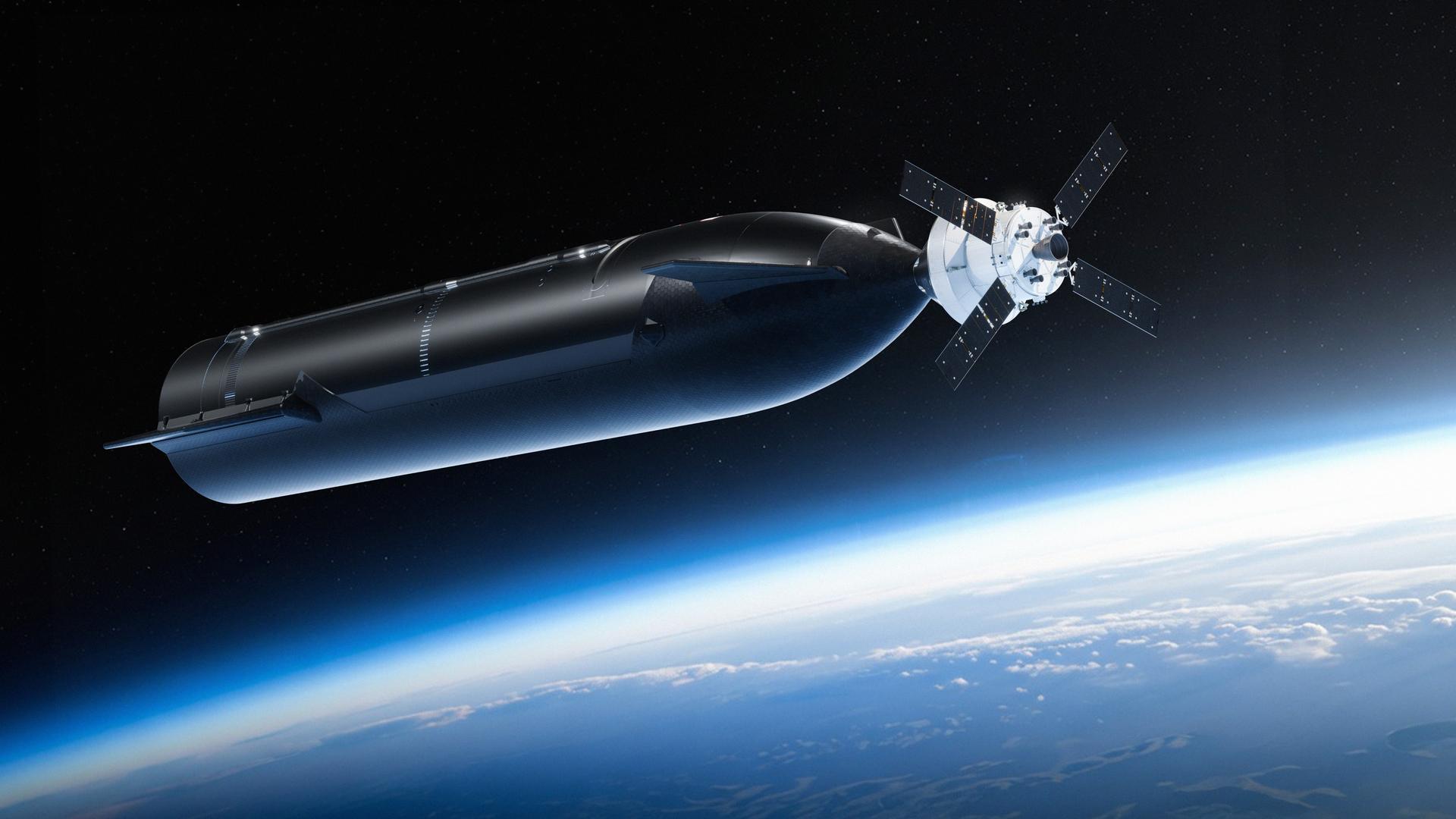
These artist’s concepts depict NASA’s Orion spacecraft and SpaceX’s Starship human landing system test article during rendezvous and docking operations as part of NASA’s upcoming Artemis III demonstration mission in low Earth orbit. NASA is working with two American companies to develop the human landing systems that will safely transport astronauts from lunar orbit to the Moon’s surface and back for future Artemis missions. For Artemis III, both SpaceX and Blue Origin will fly test versions, or test articles, of the crewed landers that will be used for future Moon landings. The lander test articles will launch by commercial rockets, while the Artemis III crew will launch to low Earth orbit in Orion atop the agency’s SLS (Space Launch System) rocket.
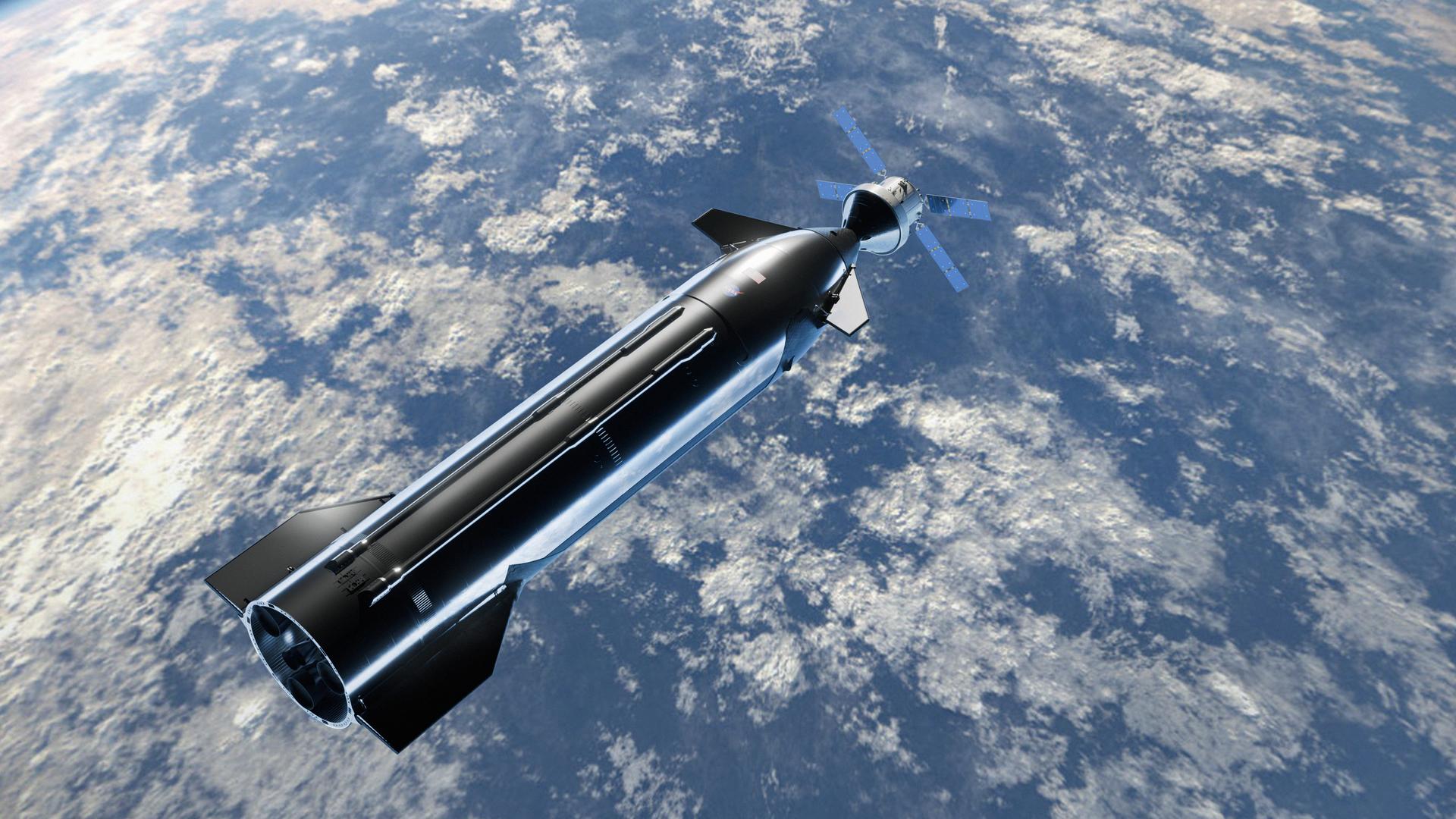
These artist’s concepts depict NASA’s Orion spacecraft and SpaceX’s Starship human landing system test article during rendezvous and docking operations as part of NASA’s upcoming Artemis III demonstration mission in low Earth orbit. NASA is working with two American companies to develop the human landing systems that will safely transport astronauts from lunar orbit to the Moon’s surface and back for future Artemis missions. For Artemis III, both SpaceX and Blue Origin will fly test versions, or test articles, of the crewed landers that will be used for future Moon landings. The lander test articles will launch by commercial rockets, while the Artemis III crew will launch to low Earth orbit in Orion atop the agency’s SLS (Space Launch System) rocket.
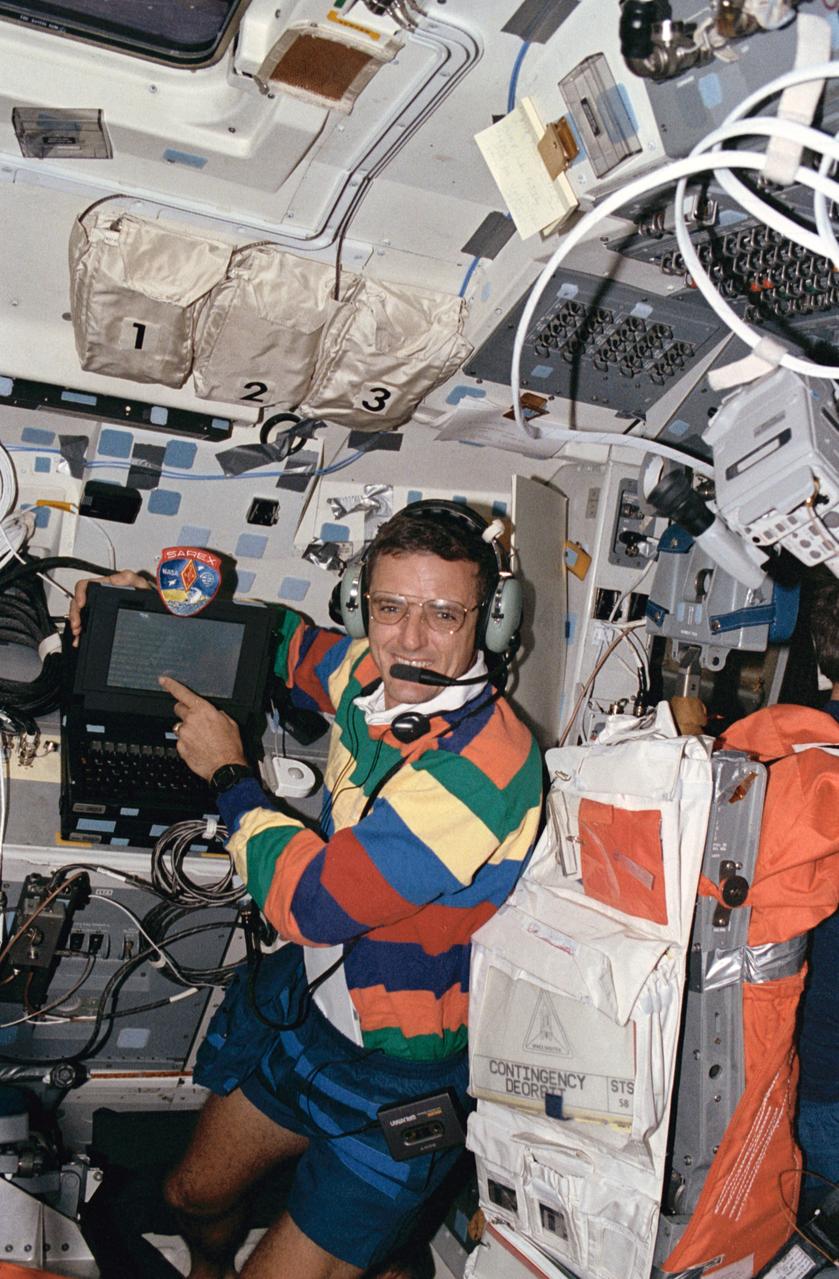
STS058-21-011 (24 Oct 1993) --- From the flight deck of the Earth-orbiting Space Shuttle Columbia, astronaut William S. McArthur talks to students on Earth. The mission specialist's activity was part of the Shuttle Amateur Radio Experiment (SAREX), a frequent payload on Shuttle missions which serves to enlighten students around the world on the topic of space travel. McArthur (call letters KC5ACR) is one of three licensed amateur radio operators on the seven-member flight.
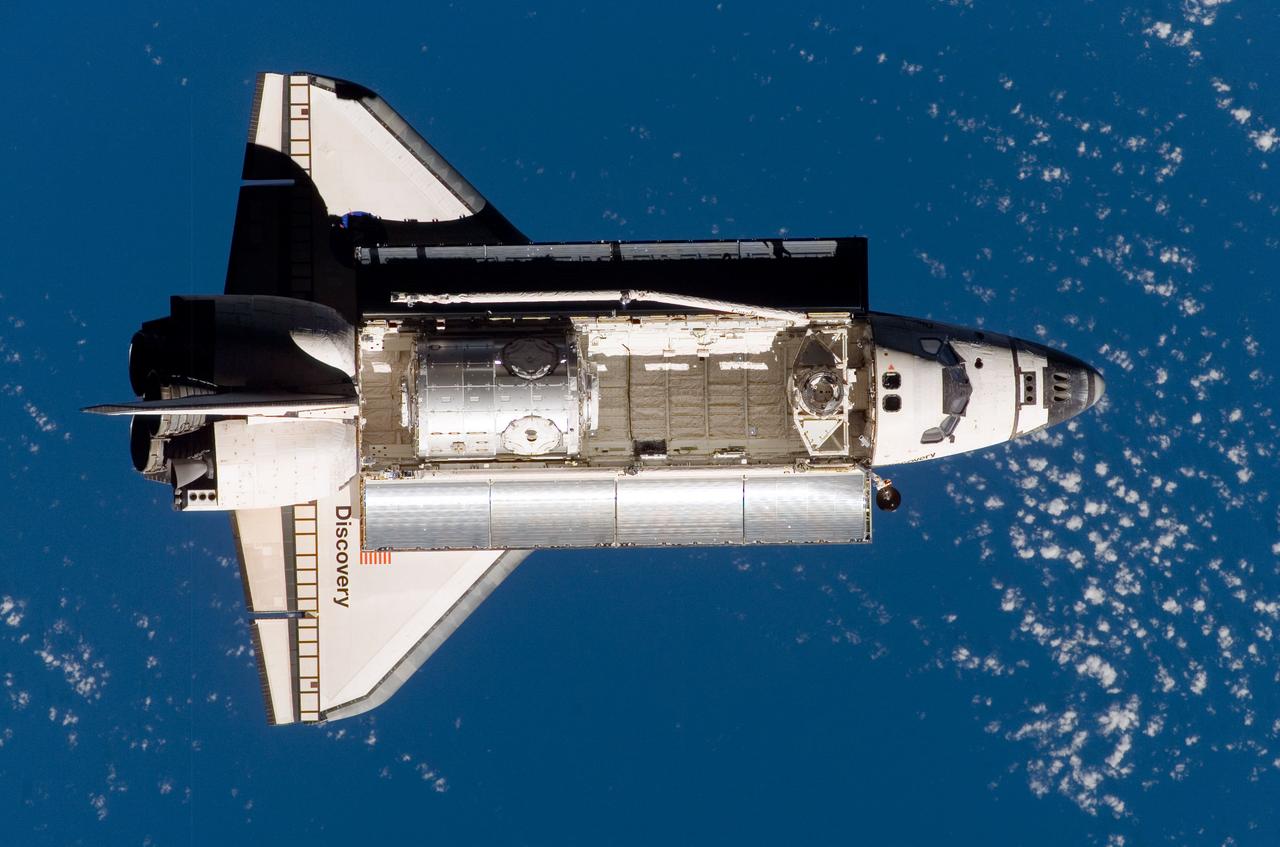
ISS016-E-006285 (25 Oct. 2007) --- Backdropped by a blue and white Earth, Space Shuttle Discovery is seen from the International Space Station as the two spacecraft perform rendezvous and docking operations in Earth orbit. Docking occurred at 7:40 a.m. (CDT) on Oct. 25, 2007. The Harmony node is visible in Discovery's cargo bay.
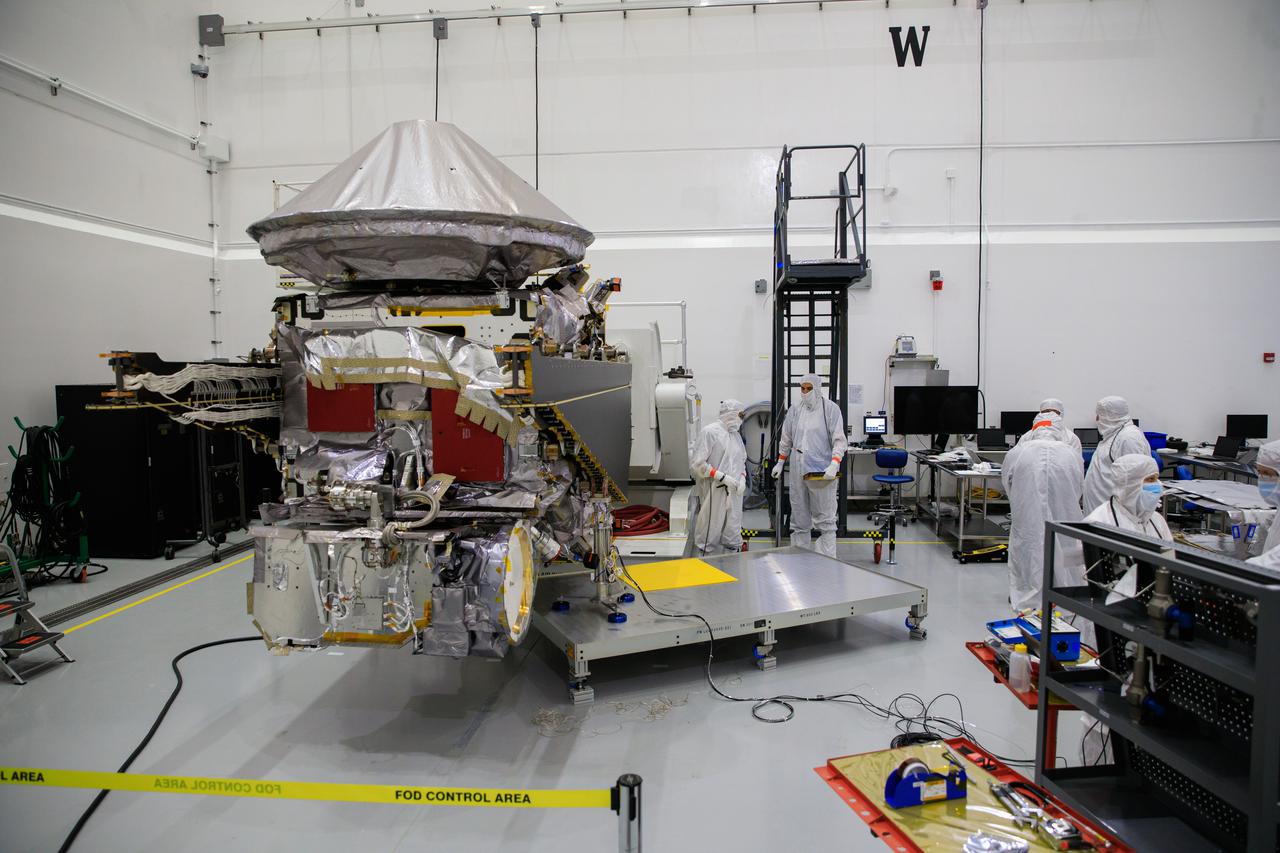
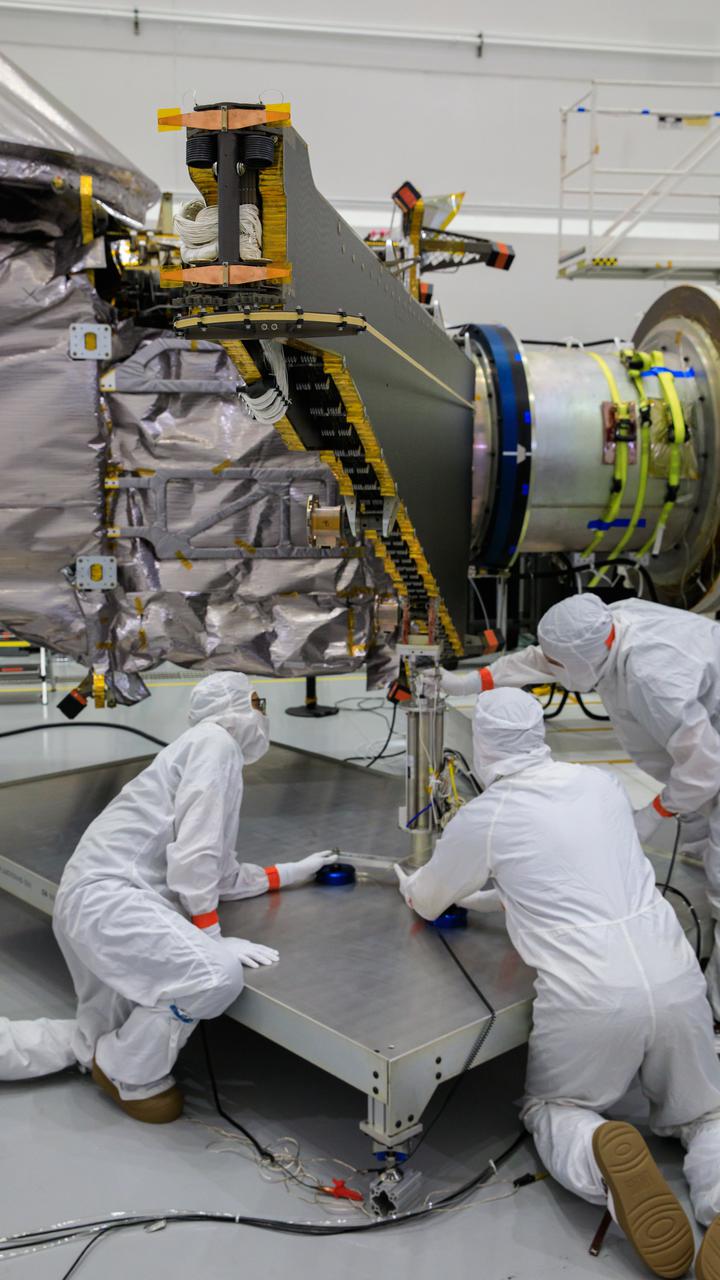
Workers inside the Astrotech Space Operations Facility in Titusville, Florida, begin to extend one of the solar arrays on NASA’s Lucy spacecraft on Aug. 19, 2021. Both solar arrays will be opened to make sure they operate correctly. In view installed on top of the spacecraft is the high gain antenna. Lucy is scheduled to launch no earlier than Saturday, Oct. 16, on a United Launch Alliance Atlas V 401 rocket from Space Launch Complex 41 at Cape Canaveral Space Force Station. NASA’s Launch Services Program based at Kennedy Space Center is managing the launch. Over its 12-year primary mission, Lucy will explore a record-breaking number of asteroids, flying by one asteroid in the solar system’s main belt and seven Trojan asteroids. Additionally, Lucy’s path will circle back to Earth three times for gravity assists, making it the first spacecraft ever to return to the vicinity of Earth from the outer solar system.
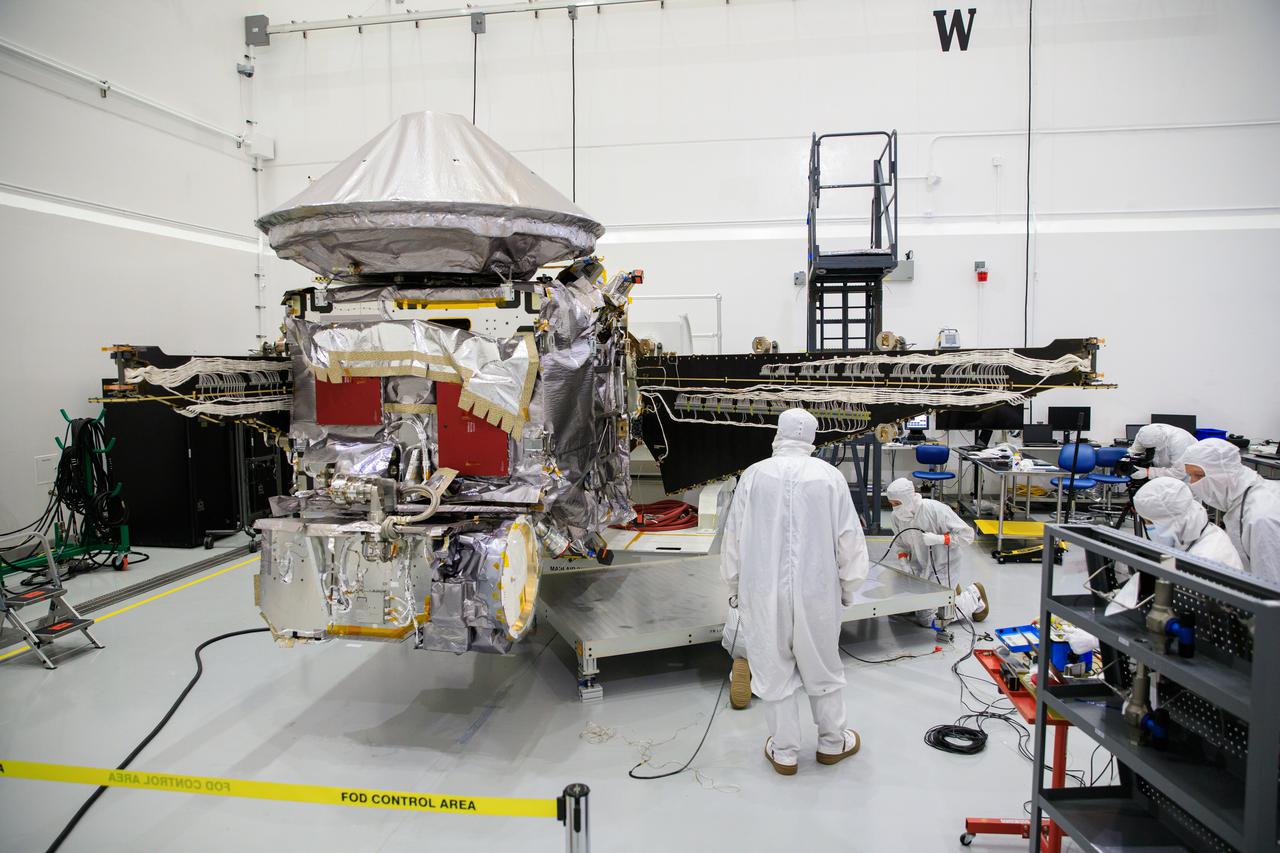
Workers inside the Astrotech Space Operations Facility in Titusville, Florida, work to open and extend one of the solar arrays on NASA’s Lucy spacecraft on Aug. 19, 2021. Both solar arrays will be opened to make sure they operate correctly. In view installed on top of the spacecraft is the high gain antenna. Lucy is scheduled to launch no earlier than Saturday, Oct. 16, on a United Launch Alliance Atlas V 401 rocket from Space Launch Complex 41 at Cape Canaveral Space Force Station. NASA’s Launch Services Program based at Kennedy Space Center is managing the launch. Over its 12-year primary mission, Lucy will explore a record-breaking number of asteroids, flying by one asteroid in the solar system’s main belt and seven Trojan asteroids. Additionally, Lucy’s path will circle back to Earth three times for gravity assists, making it the first spacecraft ever to return to the vicinity of Earth from the outer solar system.
Workers inside the Astrotech Space Operations Facility in Titusville, Florida, work to open and extend one of the solar arrays on NASA’s Lucy spacecraft on Aug. 19, 2021. Both solar arrays will be opened to make sure they operate correctly. In view installed on top of the spacecraft is the high gain antenna. Lucy is scheduled to launch no earlier than Saturday, Oct. 16, on a United Launch Alliance Atlas V 401 rocket from Space Launch Complex 41 at Cape Canaveral Space Force Station. NASA’s Launch Services Program based at Kennedy Space Center is managing the launch. Over its 12-year primary mission, Lucy will explore a record-breaking number of asteroids, flying by one asteroid in the solar system’s main belt and seven Trojan asteroids. Additionally, Lucy’s path will circle back to Earth three times for gravity assists, making it the first spacecraft ever to return to the vicinity of Earth from the outer solar system.
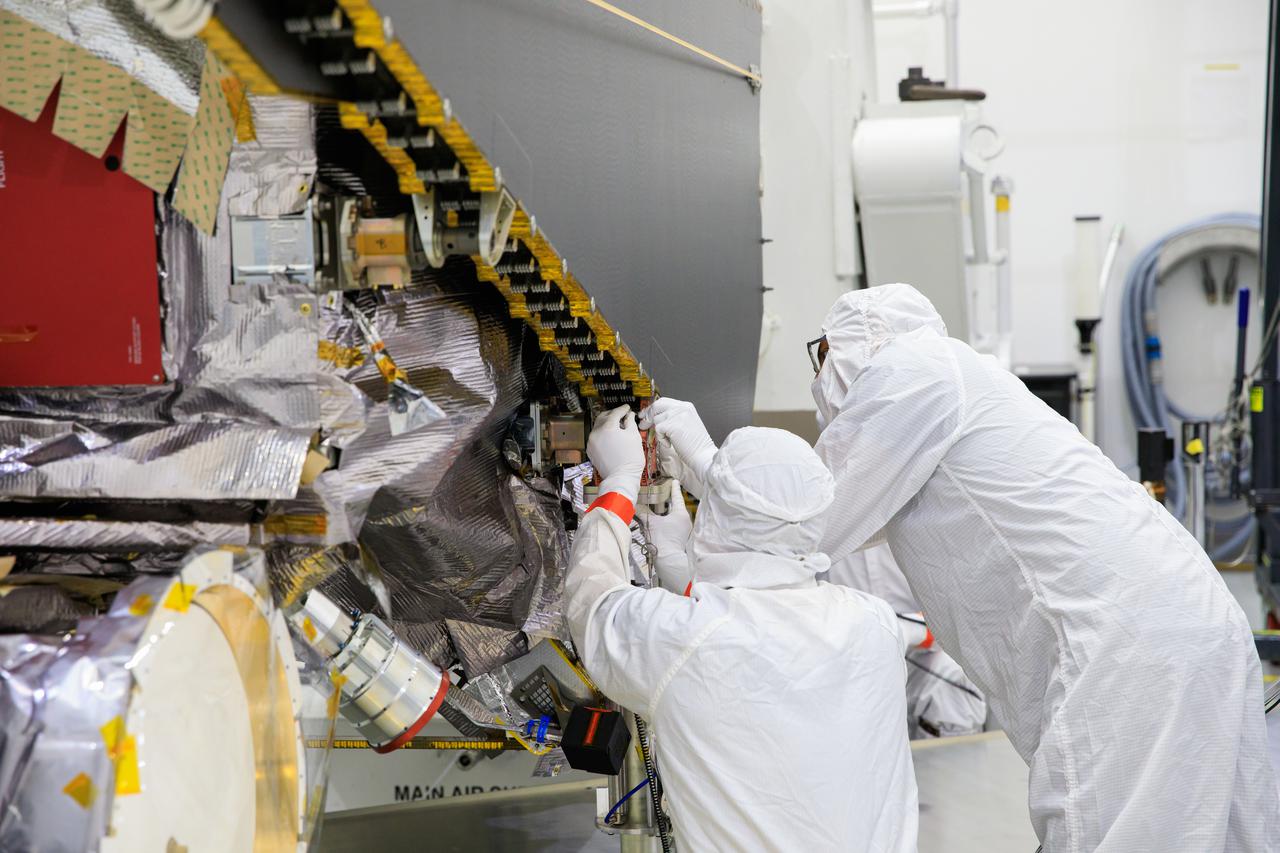
Workers inside the Astrotech Space Operations Facility in Titusville, Florida, begin to extend one of the solar arrays on NASA’s Lucy spacecraft on Aug. 19, 2021. Both solar arrays will be opened to make sure they operate correctly. Lucy is scheduled to launch no earlier than Saturday, Oct. 16, on a United Launch Alliance Atlas V 401 rocket from Space Launch Complex 41 at Cape Canaveral Space Force Station. NASA’s Launch Services Program based at Kennedy Space Center is managing the launch. Over its 12-year primary mission, Lucy will explore a record-breaking number of asteroids, flying by one asteroid in the solar system’s main belt and seven Trojan asteroids. Additionally, Lucy’s path will circle back to Earth three times for gravity assists, making it the first spacecraft ever to return to the vicinity of Earth from the outer solar system.
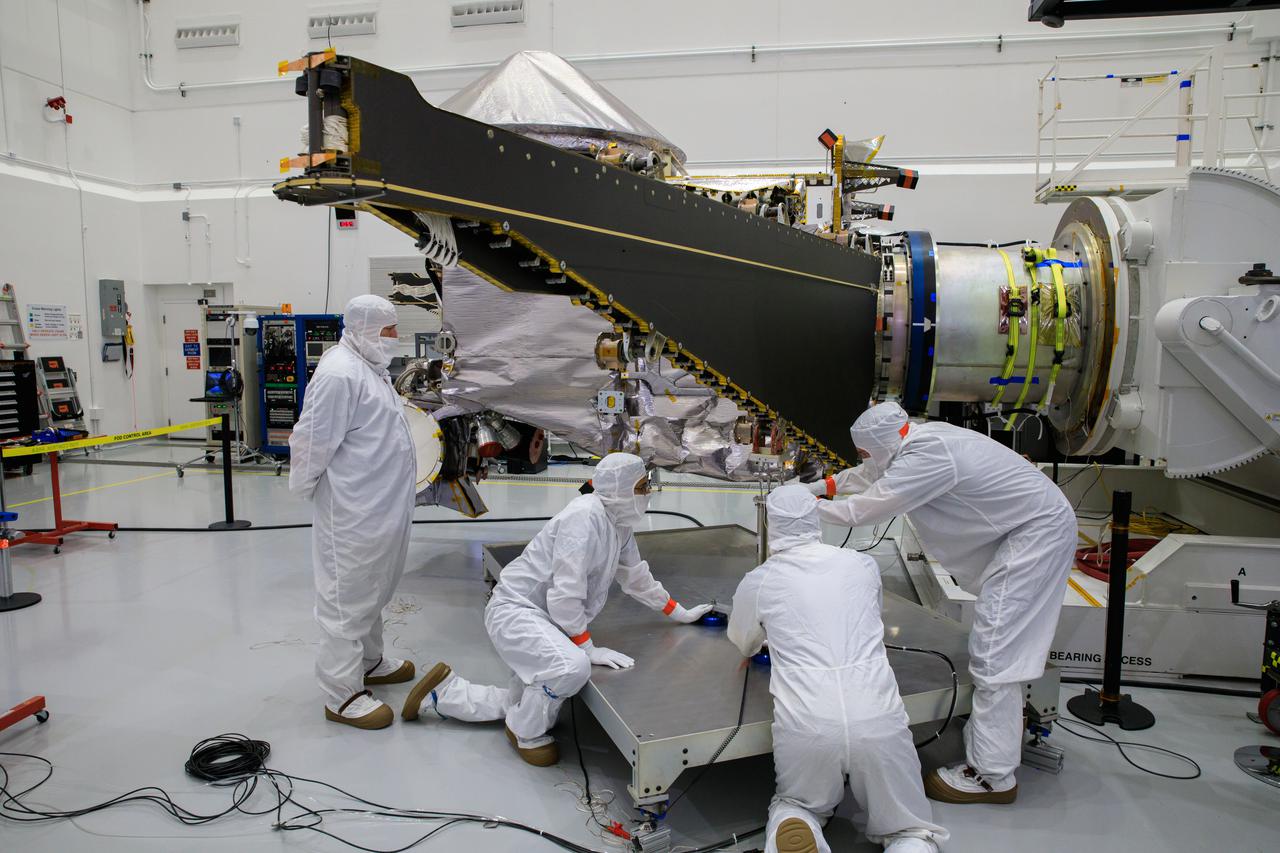
Workers inside the Astrotech Space Operations Facility in Titusville, Florida, work to open and extend one of the solar arrays on NASA’s Lucy spacecraft on Aug. 19, 2021. Both solar arrays will be opened to make sure they operate correctly. In view installed on top of the spacecraft is the high gain antenna. Lucy is scheduled to launch no earlier than Saturday, Oct. 16, on a United Launch Alliance Atlas V 401 rocket from Space Launch Complex 41 at Cape Canaveral Space Force Station. NASA’s Launch Services Program based at Kennedy Space Center is managing the launch. Over its 12-year primary mission, Lucy will explore a record-breaking number of asteroids, flying by one asteroid in the solar system’s main belt and seven Trojan asteroids. Additionally, Lucy’s path will circle back to Earth three times for gravity assists, making it the first spacecraft ever to return to the vicinity of Earth from the outer solar system.
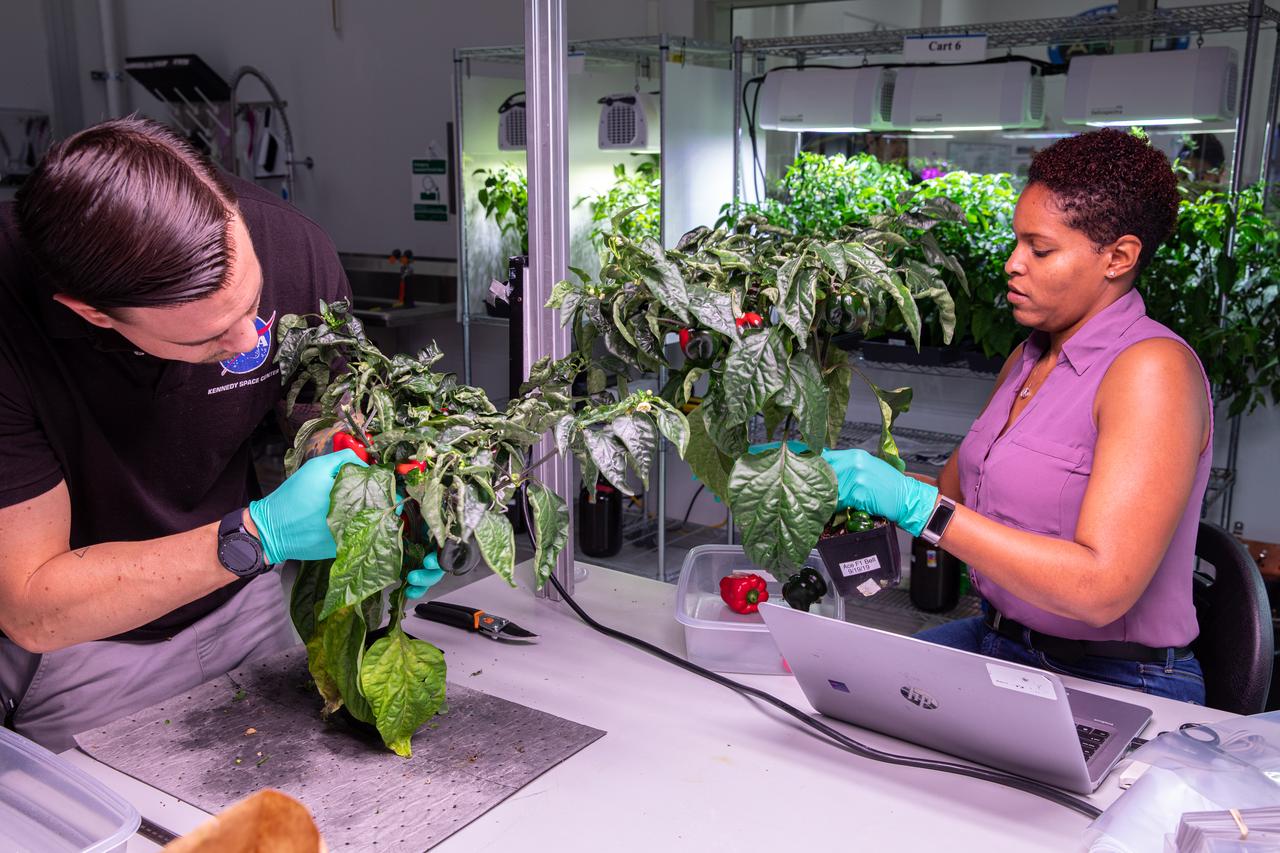
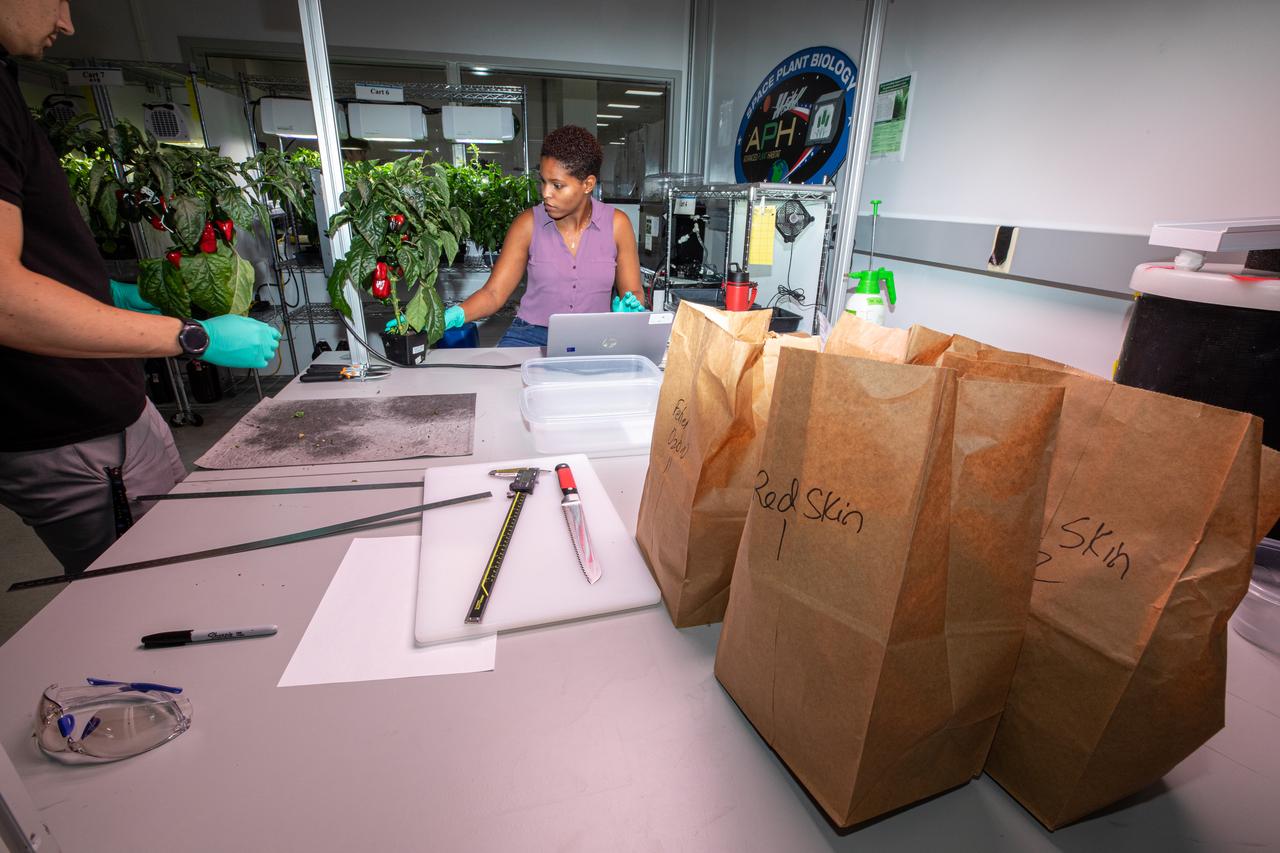
Jason Fischer (left), a research scientist, and Lashelle Spencer, a plant scientist, with the Laboratory Support Services and Operations contract at NASA’s Kennedy Space Center in Florida, harvest peppers from pepper plants on Jan. 15, 2020, that were grown in the Space Station Processing Facility for a growth assessment test in preparation for sending them to space. As NASA prepares to send humans beyond low-Earth orbit, the ability for astronauts to grow a variety of fresh fruits and vegetables in space will be critical. Fresh produce will be an essential supplement to the crew’s pre-packaged diet during long-duration space exploration when they are away from Earth for extended periods of time.
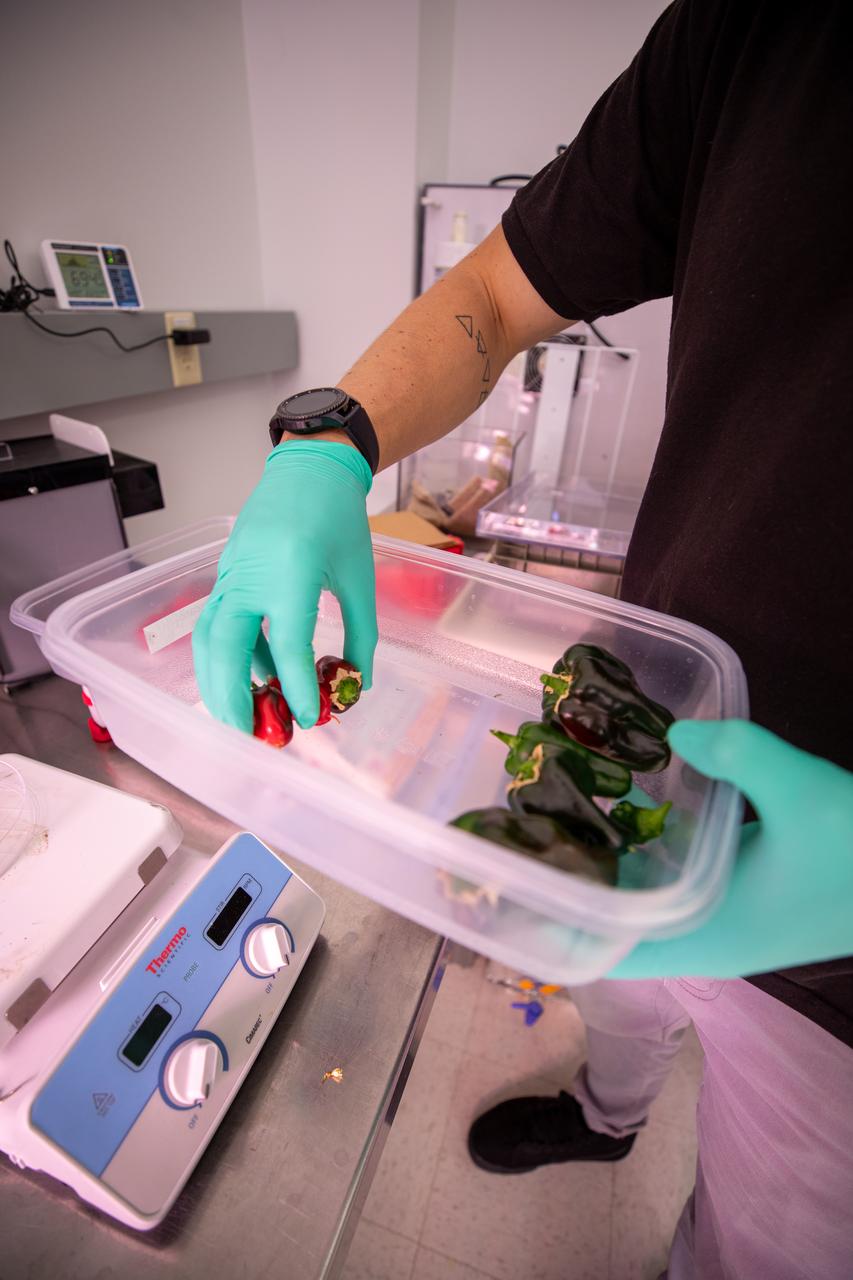
Jason Fischer, a research scientist with the Laboratory Support Services and Operations contract at NASA’s Kennedy Space Center in Florida, weighs peppers that were harvested from inside the Space Station Processing Facility on Jan. 15, 2020, prior to weighing them in preparation for sending them to space. As NASA prepares to send humans beyond low-Earth orbit, the ability for astronauts to grow a variety of fresh fruits and vegetables in space will be critical. Fresh produce will be an essential supplement to the crew’s pre-packaged diet during long-duration space exploration when they are away from Earth for extended periods of time.
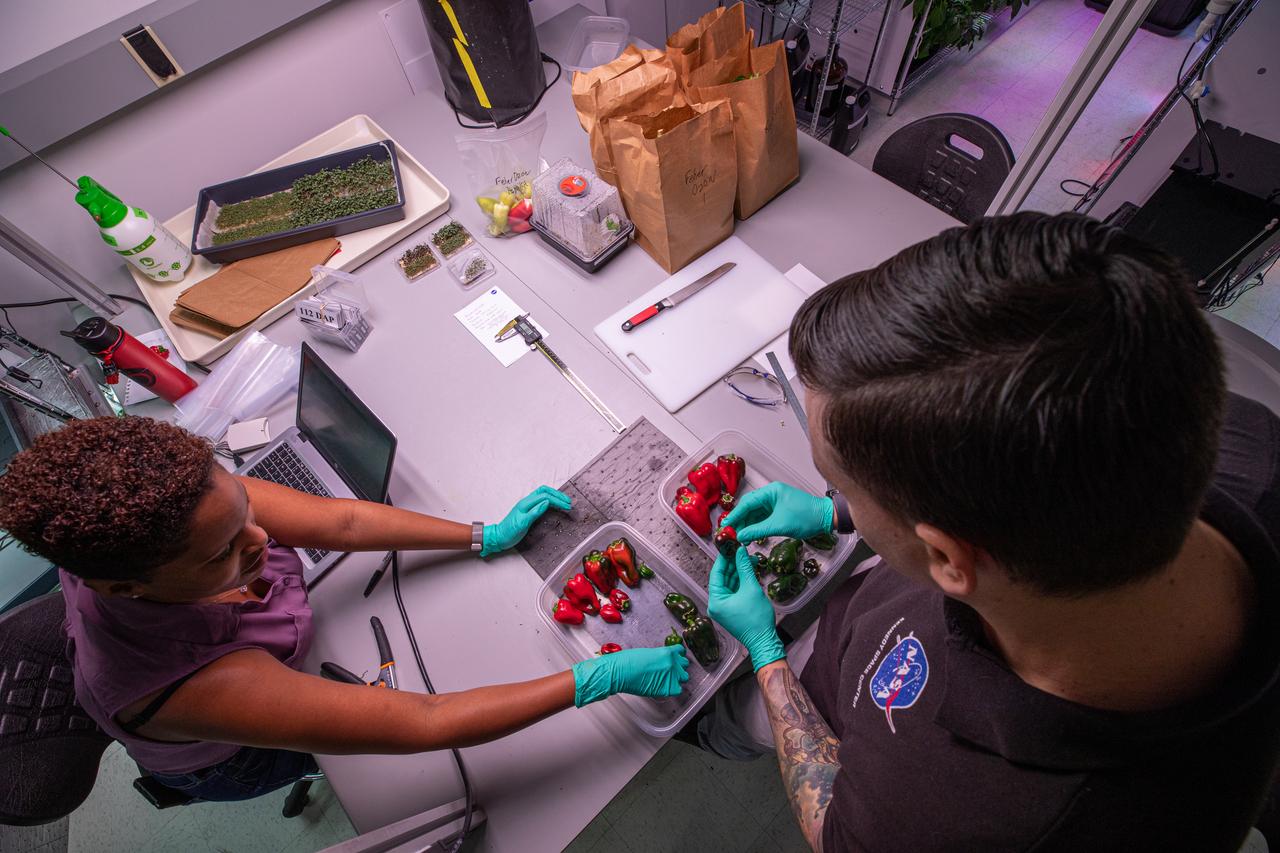
Plant Scientist Lashelle Spencer (left) and Research Scientist Jason Fischer with the Laboratory Support Services and Operations contract at NASA’s Kennedy Space Center in Florida remove the stems from peppers that were grown inside the Space Station Processing Facility on Jan. 15, 2020, prior to weighing them in preparation for sending them to space. As NASA prepares to send humans beyond low-Earth orbit, the ability for astronauts to grow a variety of fresh fruits and vegetables in space will be critical. Fresh produce will be an essential supplement to the crew’s pre-packaged diet during long-duration space exploration when they are away from Earth for extended periods of time.
Lashelle Spencer (center), a plant scientist with the Laboratory Support Services and Operations contract at NASA’s Kennedy Space Center in Florida, harvests peppers from a pepper plant on Jan. 15, 2020, that was grown in the Space Station Processing Facility in preparation for sending them to space. As NASA prepares to send humans beyond low-Earth orbit, the ability for astronauts to grow a variety of fresh fruits and vegetables in space will be critical. Fresh produce will be an essential supplement to the crew’s pre-packaged diet during long-duration space exploration when they are away from Earth for extended periods of time.
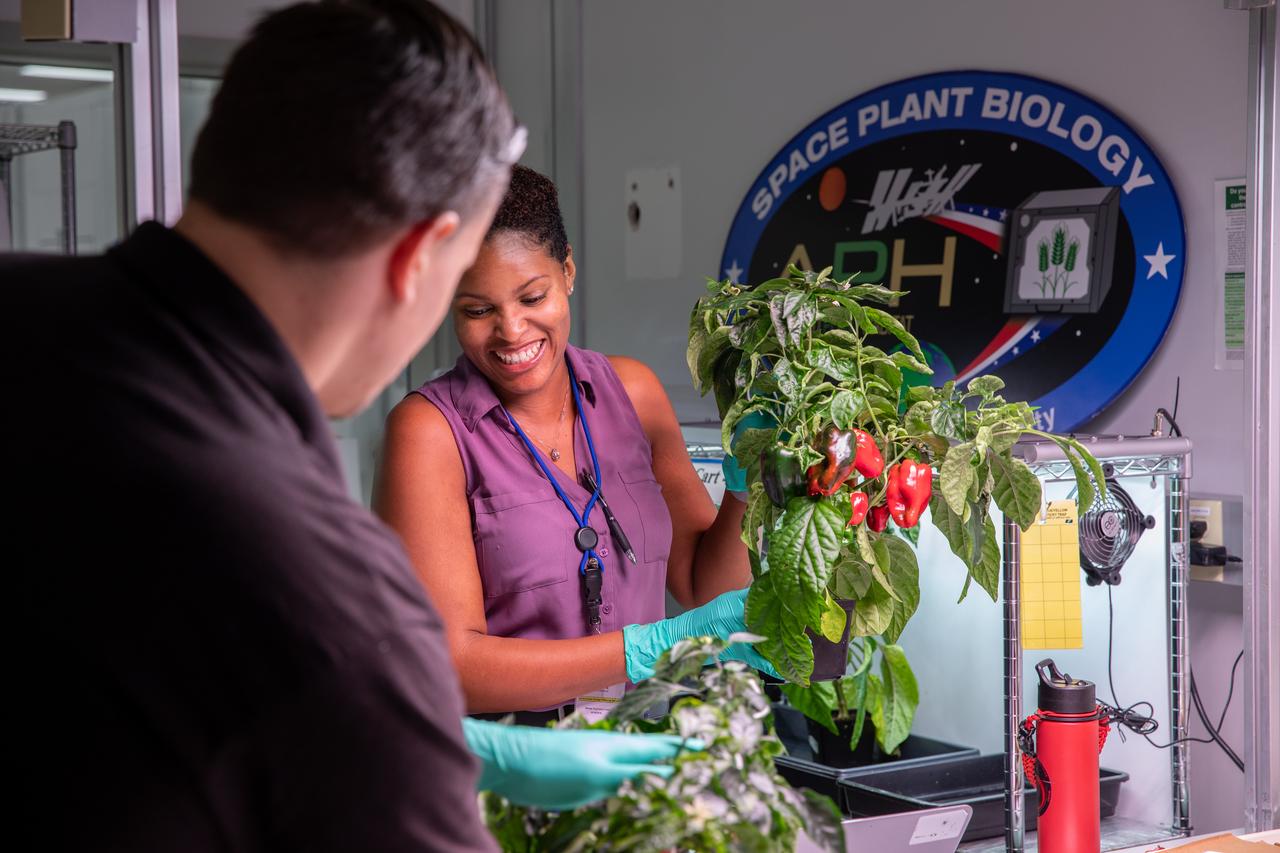
Jason Fischer (left), a research scientist, and Lashelle Spencer, a plant scientist, with the Laboratory Support Services and Operations contract at NASA’s Kennedy Space Center in Florida, harvest peppers from pepper plants on Jan. 15, 2020, that were grown in the Space Station Processing Facility for a growth assessment in preparation for sending them to space. As NASA prepares to send humans beyond low-Earth orbit, the ability for astronauts to grow a variety of fresh fruits and vegetables in space will be critical. Fresh produce will be an essential supplement to the crew’s pre-packaged diet during long-duration space exploration when they are away from Earth for extended periods of time.
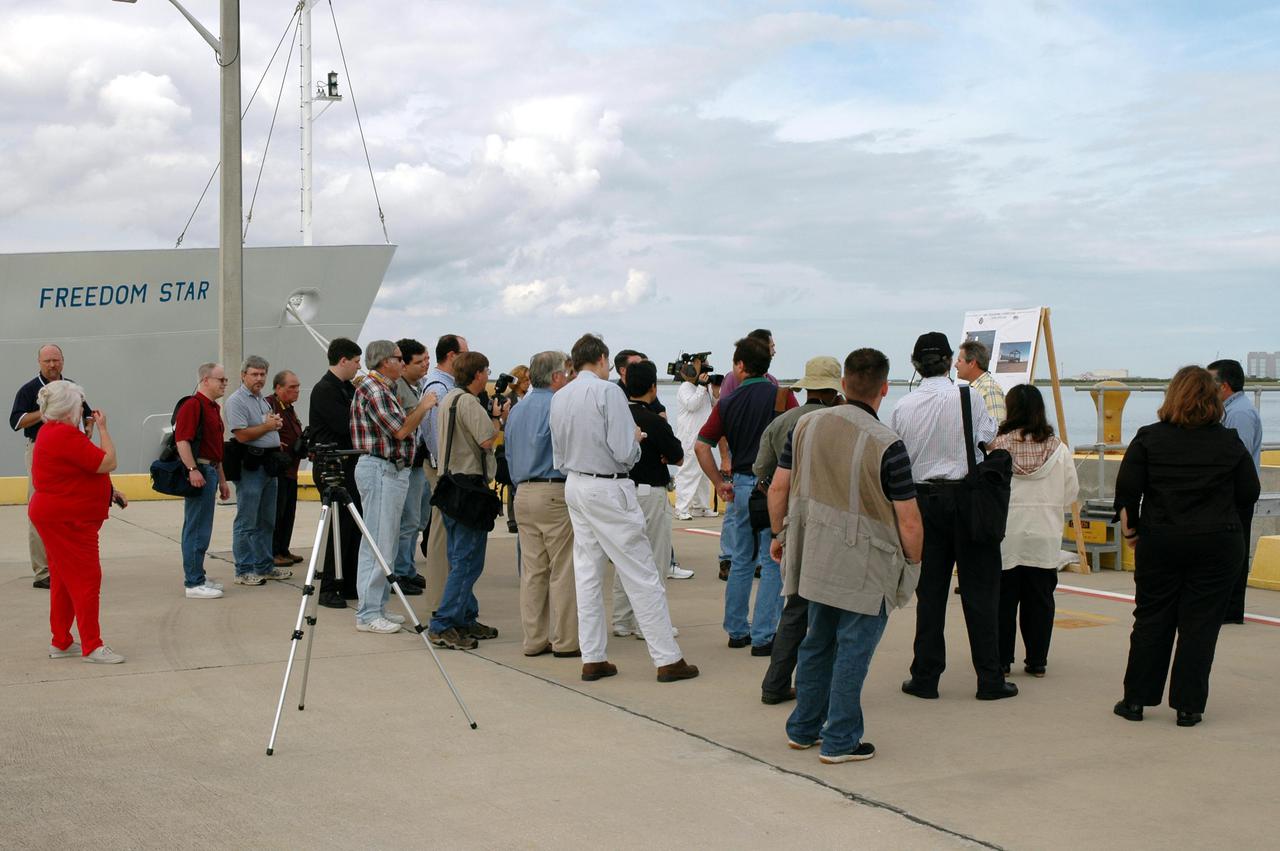
KENNEDY SPACE CENTER, FLA. - On the deck of the Freedom Star, one of the Solid Rocket Booster (SRB) retrieval ships, the media learn about retrieval operations. The stop was part of a day-long event that featured the movement of the first SRB segments to the Vehicle Assembly Building for stacking for Return to Flight mission STS-114. Two SRBs support the liftoff of the Space Shuttle on a launch. The twin 149-foot tall, 12-foot diameter SRBs provide the main propulsion system during launch to place the orbiters in the proper orbit around the Earth. They operate parallel with the Space Shuttle main engines for the first two minutes of flight and jettison away from the orbiter, with help from the Booster Separation Motors, about 26.3 nautical miles above the Earth’s surface.
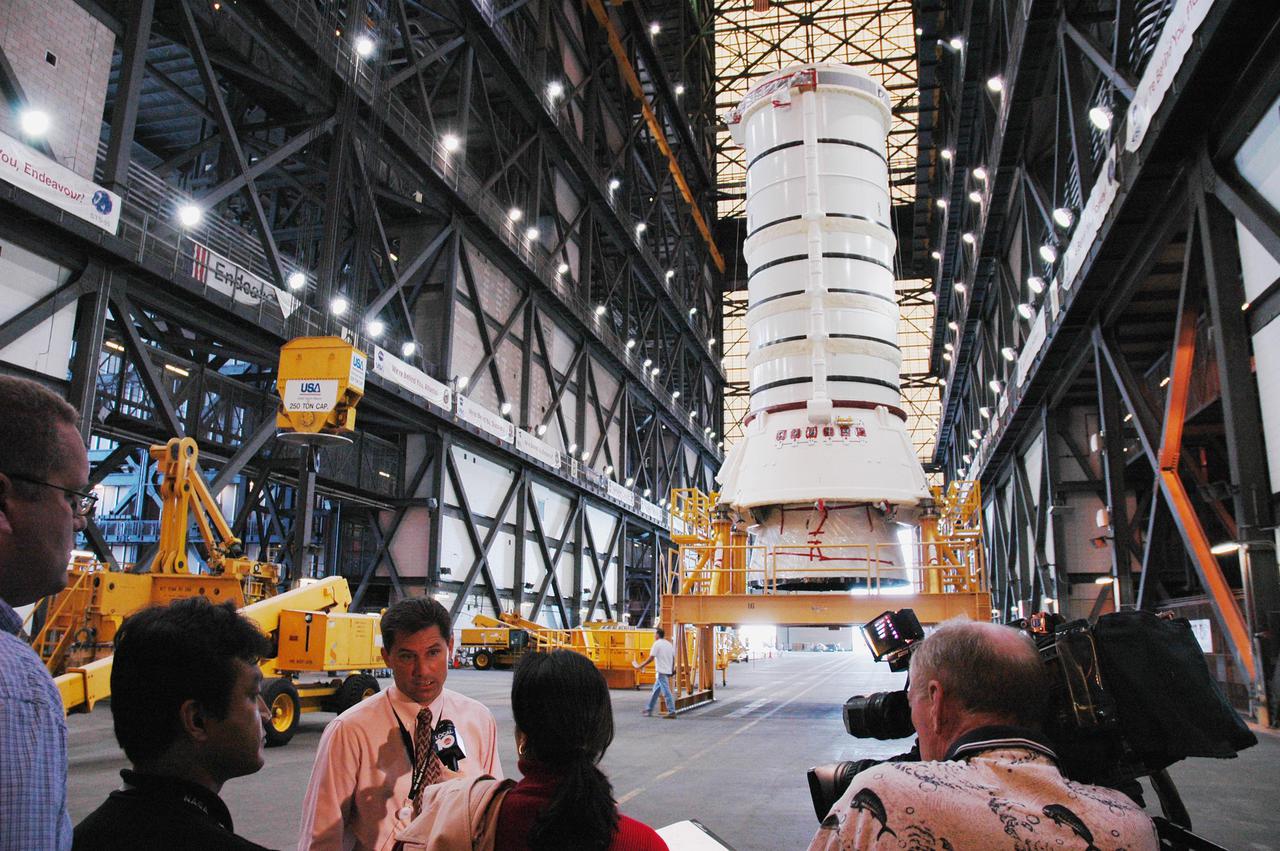
KENNEDY SPACE CENTER, FLA. - Inside the Vehicle Assembly Building, NASA ET_SRB Operations Manager Ken Tenbusch provides information for the media about the stacking of the aft skirt and lower segment of the Solid Rocket Booster in the background. These first segments are a significant milestone in the preparations for Return to Flight mission STS-114. Two SRBs support the liftoff of the Space Shuttle on a launch. The twin 149-foot tall, 12-foot diameter SRBs provide the main propulsion system during launch to place the 180,000-pound orbiters in the proper orbit around the Earth. They operate parallel with the Space Shuttle main engines for the first two minutes of flight and jettison away from the orbiter with help from the Booster Separation Motors, about 26.3 nautical miles above the Earth’s surface.
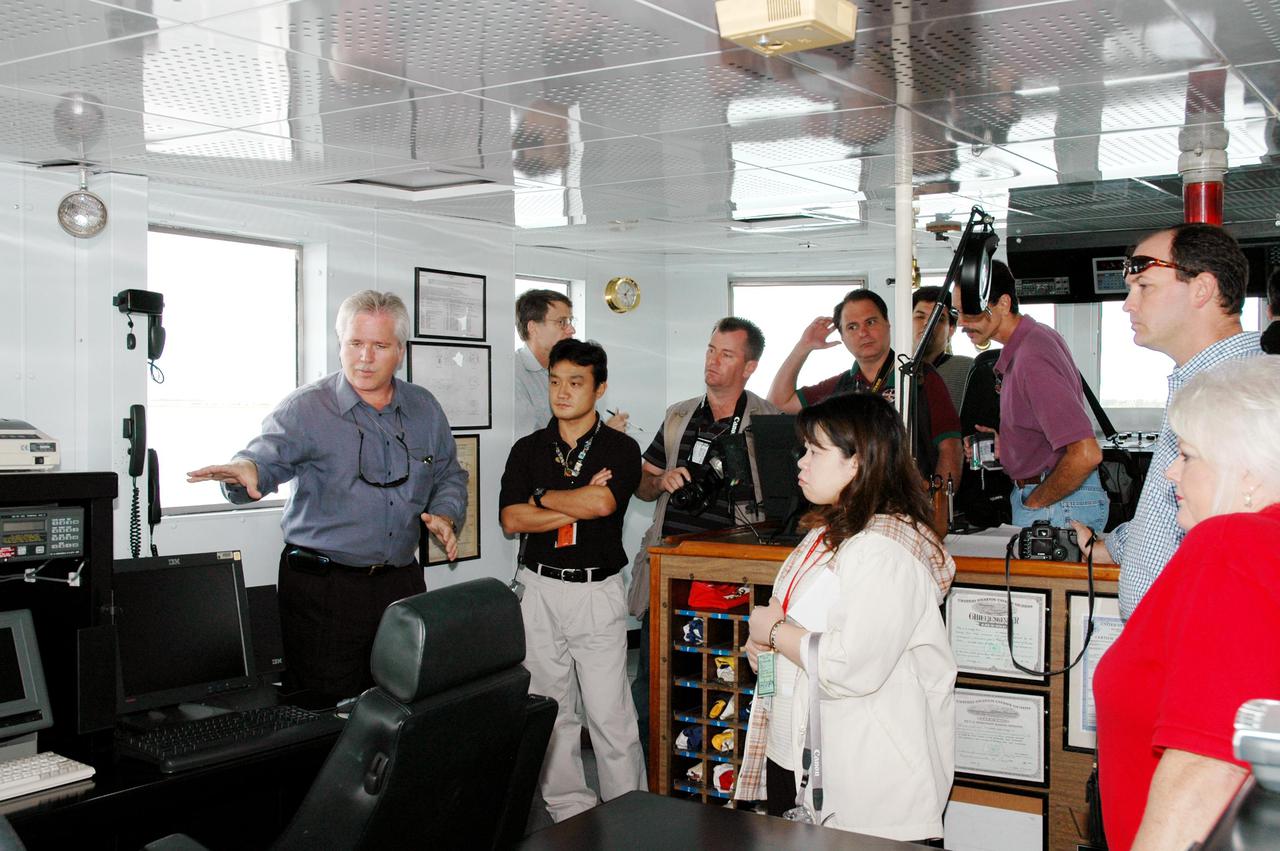
KENNEDY SPACE CENTER, FLA. - The media visit the operations center on board the Freedom Star, one of the Solid Rocket Booster (SRB) retrieval ships. The stop was part of a day-long event that featured the movement of the first SRB segments to the Vehicle Assembly Building for stacking for Return to Flight mission STS-114. Two SRBs support the liftoff of the Space Shuttle on a launch. The twin 149-foot tall, 12-foot diameter SRBs provide the main propulsion system during launch to place the orbiters in the proper orbit around the Earth. They operate parallel with the Space Shuttle main engines for the first two minutes of flight and jettison away from the orbiter, with help from the Booster Separation Motors, about 26.3 nautical miles above the Earth’s surface.
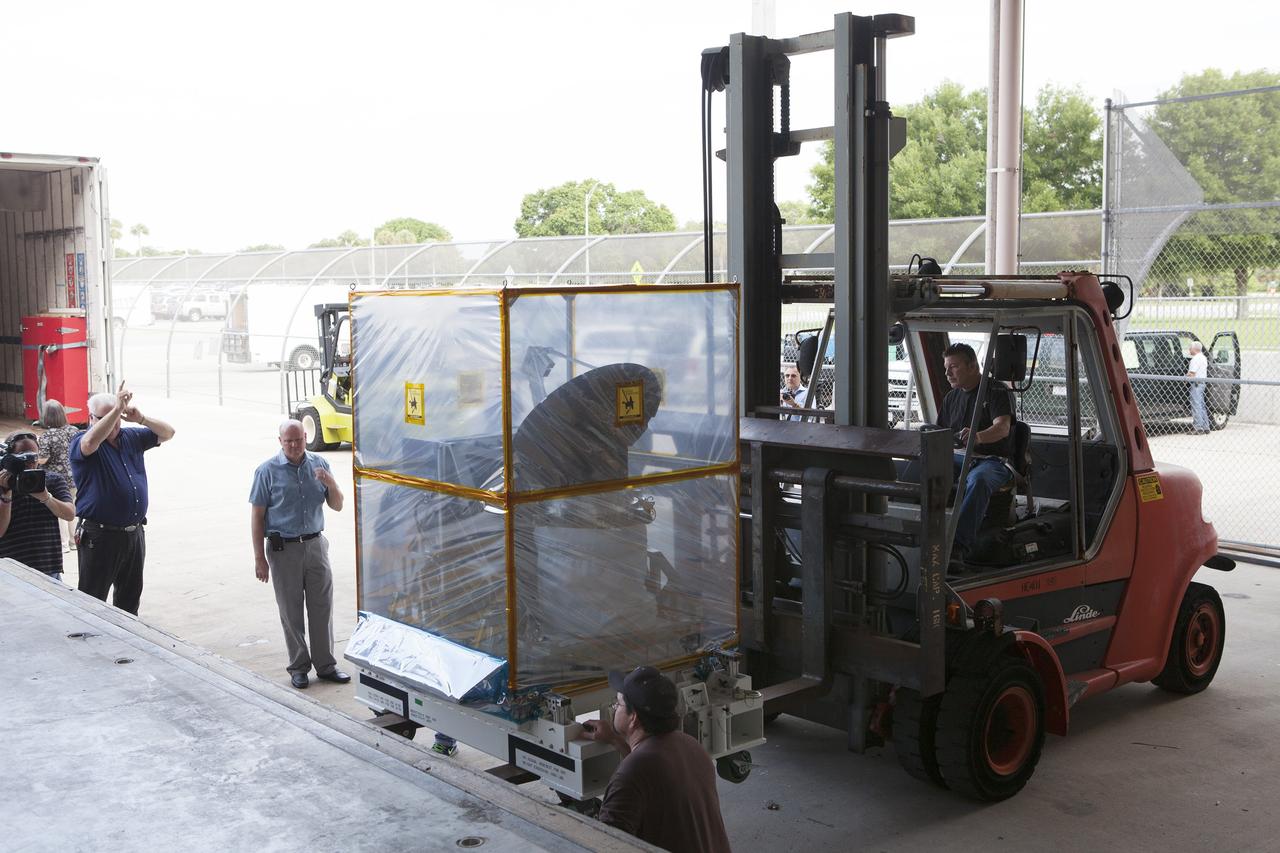
CAPE CANAVERAL, Fla. – A component of NASA's International Space Station-RapidScat scatterometer instrument is removed from a truck at the Space Station Processing Facility at Kennedy Space Center in Florida. ISS-RapidScat is the first scientific Earth-observing instrument designed to operate from the exterior of the space station. It will measure Earth's ocean surface wind speed and direction, providing data to be used in weather and marine forecasting. Built at NASA's Jet Propulsion Laboratory, ISS-RapidScat is slated to fly on the SpaceX-4 commercial cargo resupply flight in 2014. For more information, visit http://www.jpl.nasa.gov/missions/iss-rapidscat. Photo credit: NASA/Dimitri Gerondidakis
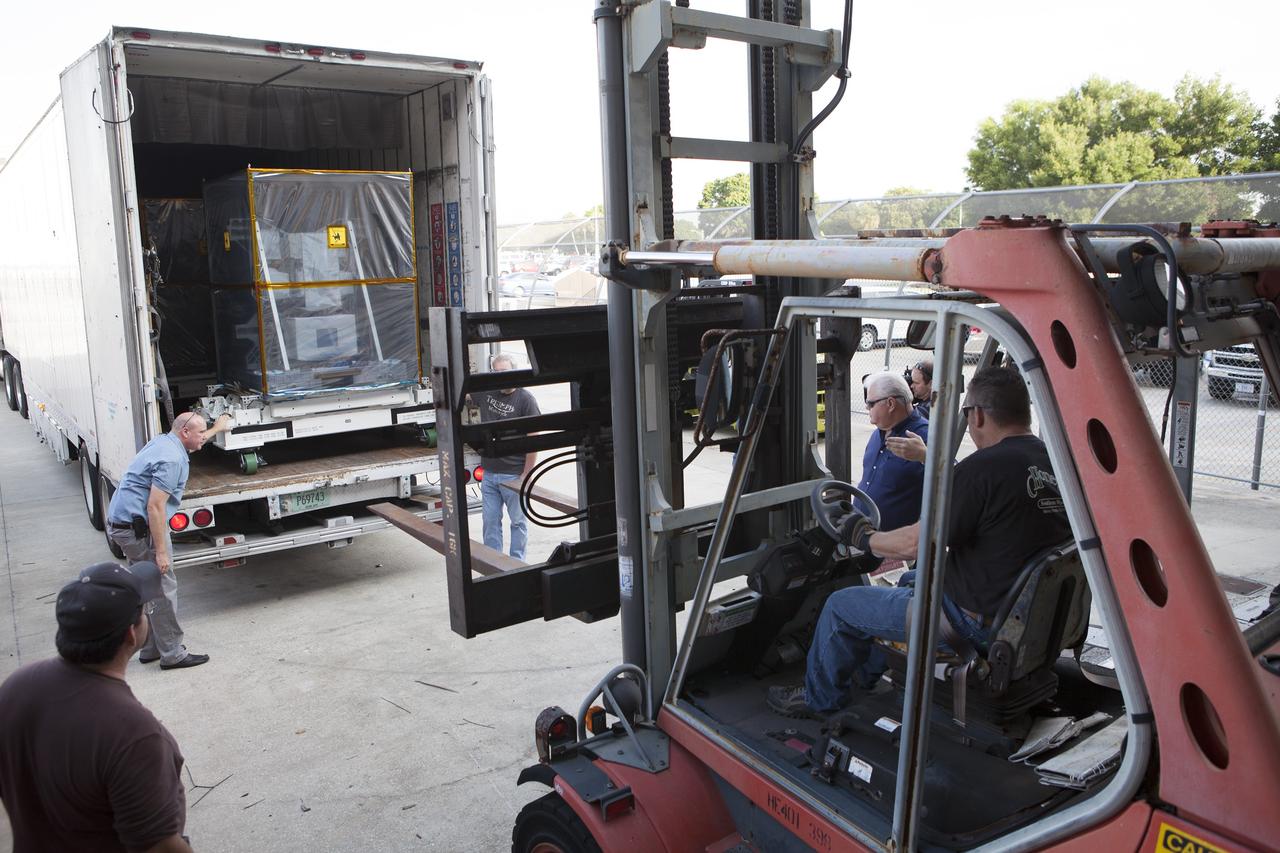
CAPE CANAVERAL, Fla. – NASA's International Space Station-RapidScat scatterometer instrument waits to be removed from the truck that delivered it to the Space Station Processing Facility at Kennedy Space Center in Florida. ISS-RapidScat is the first scientific Earth-observing instrument designed to operate from the exterior of the space station. It will measure Earth's ocean surface wind speed and direction, providing data to be used in weather and marine forecasting. Built at NASA's Jet Propulsion Laboratory, ISS-RapidScat is slated to fly on the SpaceX-4 commercial cargo resupply flight in 2014. For more information, visit http://www.jpl.nasa.gov/missions/iss-rapidscat. Photo credit: NASA/Dimitri Gerondidakis

CAPE CANAVERAL, Fla. – A component of NASA's International Space Station-RapidScat scatterometer instrument is removed from the truck that delivered it to the Space Station Processing Facility at Kennedy Space Center in Florida. ISS-RapidScat is the first scientific Earth-observing instrument designed to operate from the exterior of the space station. It will measure Earth's ocean surface wind speed and direction, providing data to be used in weather and marine forecasting. Built at NASA's Jet Propulsion Laboratory, ISS-RapidScat is slated to fly on the SpaceX-4 commercial cargo resupply flight in 2014. For more information, visit http://www.jpl.nasa.gov/missions/iss-rapidscat. Photo credit: NASA/Dimitri Gerondidakis
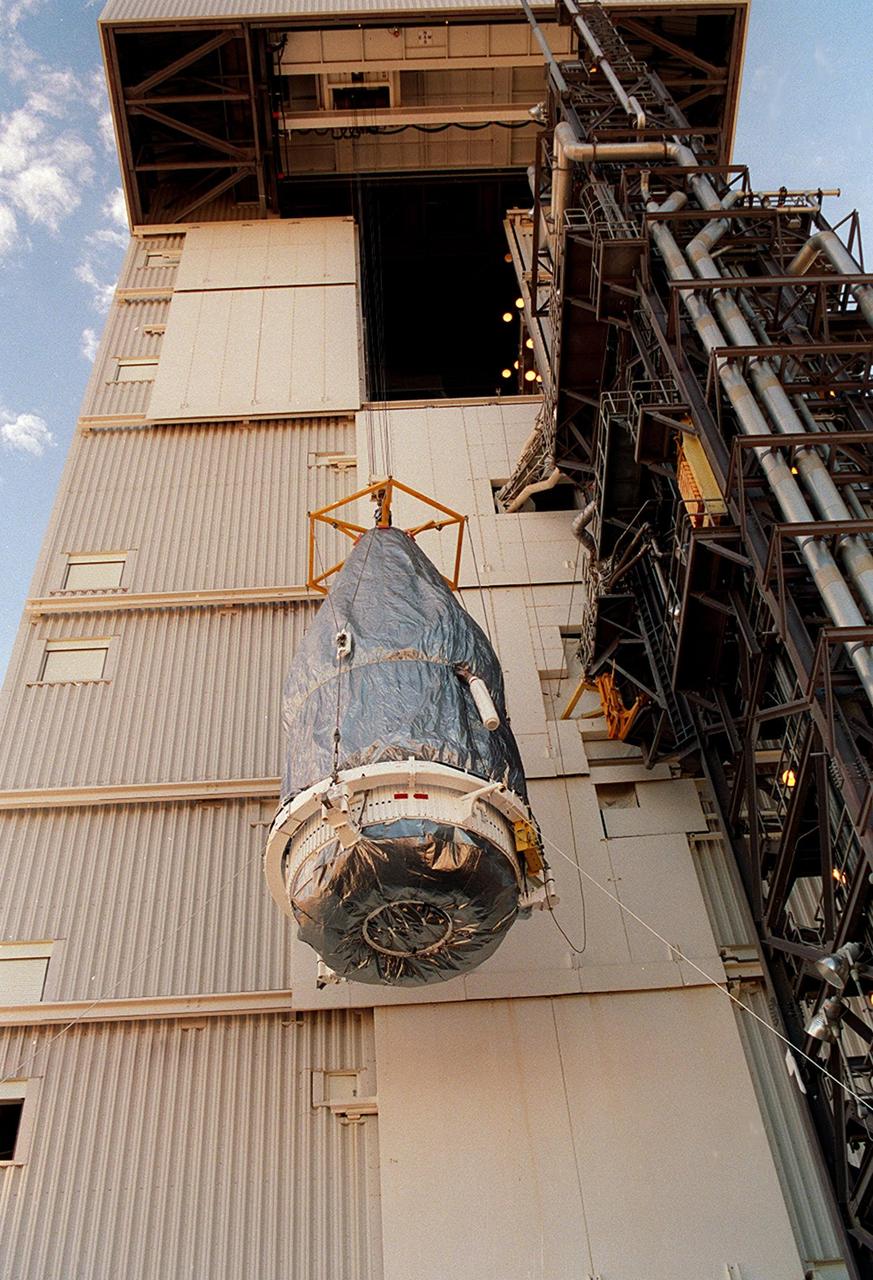
The rocket faring is lifted up the launch tower for mating with the Lockheed Martin Atlas IIAS rocket after encapsulation of Terra, formerly EOS AM-1. It is scheduled for launch Dec. 16 from Space Launch Complex 3 East at Vandenberg AFB, Calif. Terra comprises five state-of-the-art sets of instruments that will collect data for continuous, long-term records of the state of Earth's land, oceans and atmosphere. Together with data from other satellite systems launched by NASA and other countries, it will inaugurate a new self-consistent data record that will be gathered over the next 15 years. From an altitude of 438 miles, Terra will circle the Earth 16 times a day from pole to pole (98 degree inclination), crossing the equator at 10:30 a.m. The five Terra instruments will operate by measuring sunlight reflected by the Earth and heat emitted by the Earth

NASA's Terra spacecraft awaits installation of the instruments that will collect data for continuous, long-term records of the state of Earth's land, oceans and atmosphere. Terra is expected to be launched aboard a Lockheed Martin Atlas IIAS rocket Dec. 16 from Space Launch Complex 3 East at Vandenberg AFB, Calif. Terra comprises five state-of-the-art sets of instruments that, together with data from other satellite systems launched by NASA and other countries, will inaugurate a new self-consistent data record that will be gathered over the next 15 years. From an altitude of 438 miles, Terra will circle the Earth 16 times a day from pole to pole (98 degree inclination), crossing the equator at 10:30 a.m. The five Terra instruments will operate by measuring sunlight reflected by the Earth and heat emitted by the Earth
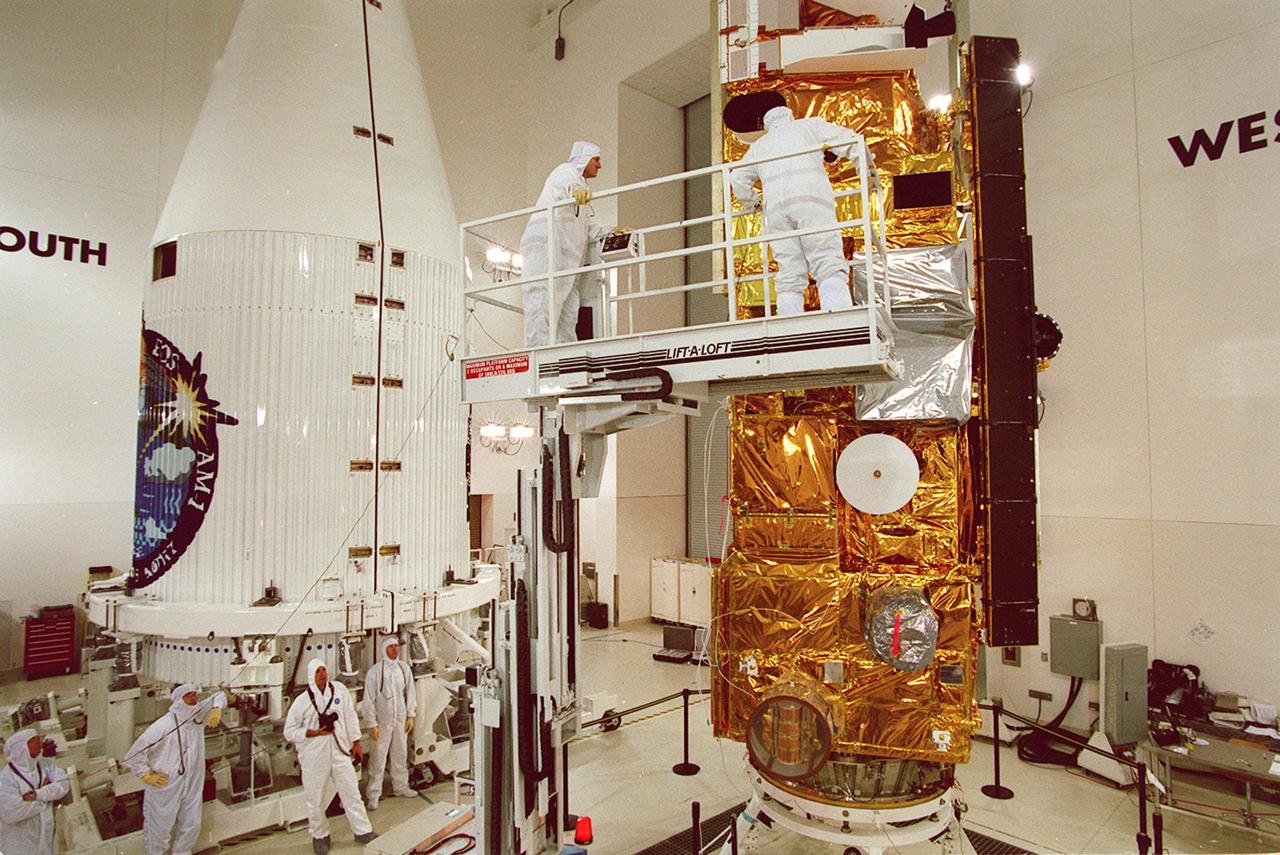
Workers at Vandenberg AFB, Calif., help prepare NASA's Terra spacecraft (right) for encapsulation in the rocket faring (left). Terra is expected to be launched aboard a Lockheed Martin Atlas IIAS rocket Dec. 16 from Space Launch Complex 3 East at Vandenberg. Terra comprises five state-of-the-art sets of instruments that will collect data for continuous, long-term records of the state of Earth's land, oceans and atmosphere. Together with data from other satellite systems launched by NASA and other countries, Terra will inaugurate a new self-consistent data record that will be gathered over the next 15 years. From an altitude of 438 miles, Terra will circle the Earth 16 times a day from pole to pole (98 degree inclination), crossing the equator at 10:30 a.m. The five Terra instruments will operate by measuring sunlight reflected by the Earth and heat emitted by the Earth
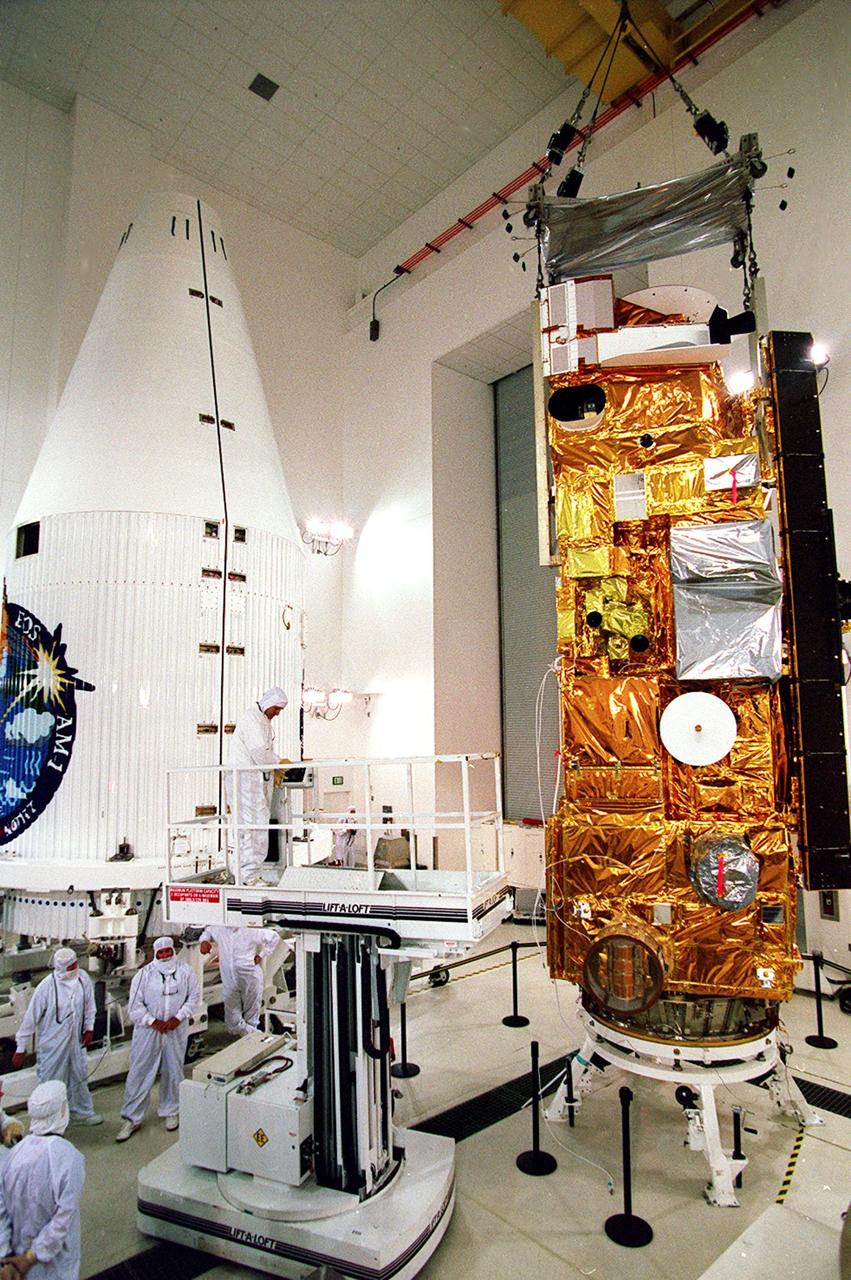
Workers (left) at Vandenberg AFB, Calif., get ready to prepare NASA's Terra spacecraft (right) for encapsulation in the rocket faring (left) before launch. The spacecraft is expected to be launched Dec. 16 aboard a Lockheed Martin Atlas IIAS rocket from the AFB's Space Launch Complex 3 East. Terra comprises five state-of-the-art sets of instruments that will collect data for continuous, long-term records of the state of Earth's land, oceans and atmosphere. Together with data from other satellite systems launched by NASA and other countries, Terra will inaugurate a new self-consistent data record that will be gathered over the next 15 years. From an altitude of 438 miles, Terra will circle the Earth 16 times a day from pole to pole (98 degree inclination), crossing the equator at 10:30 a.m. The five Terra instruments will operate by measuring sunlight reflected by the Earth and heat emitted by the Earth
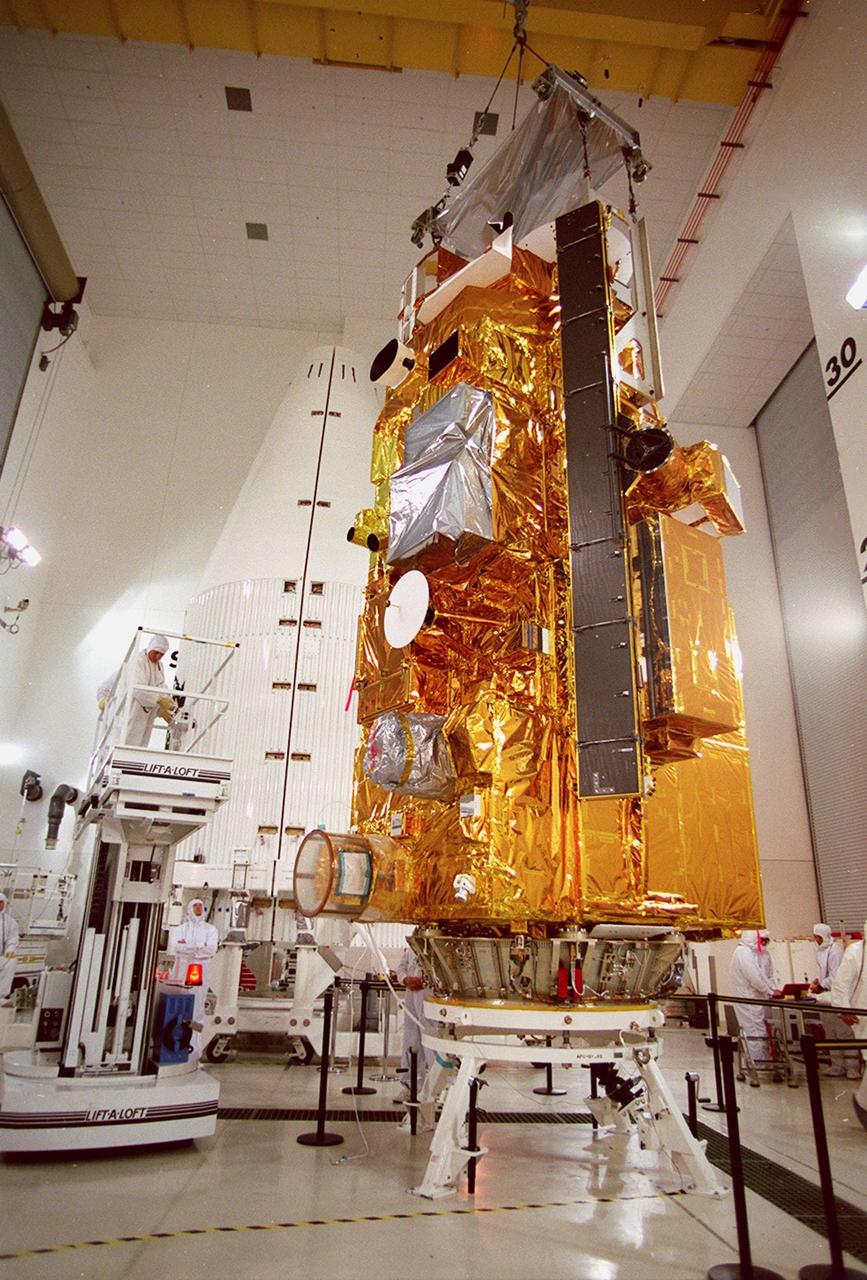
NASA's Terra spacecraft (foreground) is ready for encapsulation in the rocket faring behind it. Terra is expected to be launched aboard a Lockheed Martin Atlas IIAS rocket Dec. 16 from Space Launch Complex 3 East at Vandenberg AFB, Calif. Terra comprises five state-of-the-art sets of instruments that will collect data for continuous, long-term records of the state of Earth's land, oceans and atmosphere. Together with data from other satellite systems launched by NASA and other countries, Terra will inaugurate a new self-consistent data record that will be gathered over the next 15 years. From an altitude of 438 miles, Terra will circle the Earth 16 times a day from pole to pole (98 degree inclination), crossing the equator at 10:30 a.m. The five Terra instruments will operate by measuring sunlight reflected by the Earth and heat emitted by the Earth
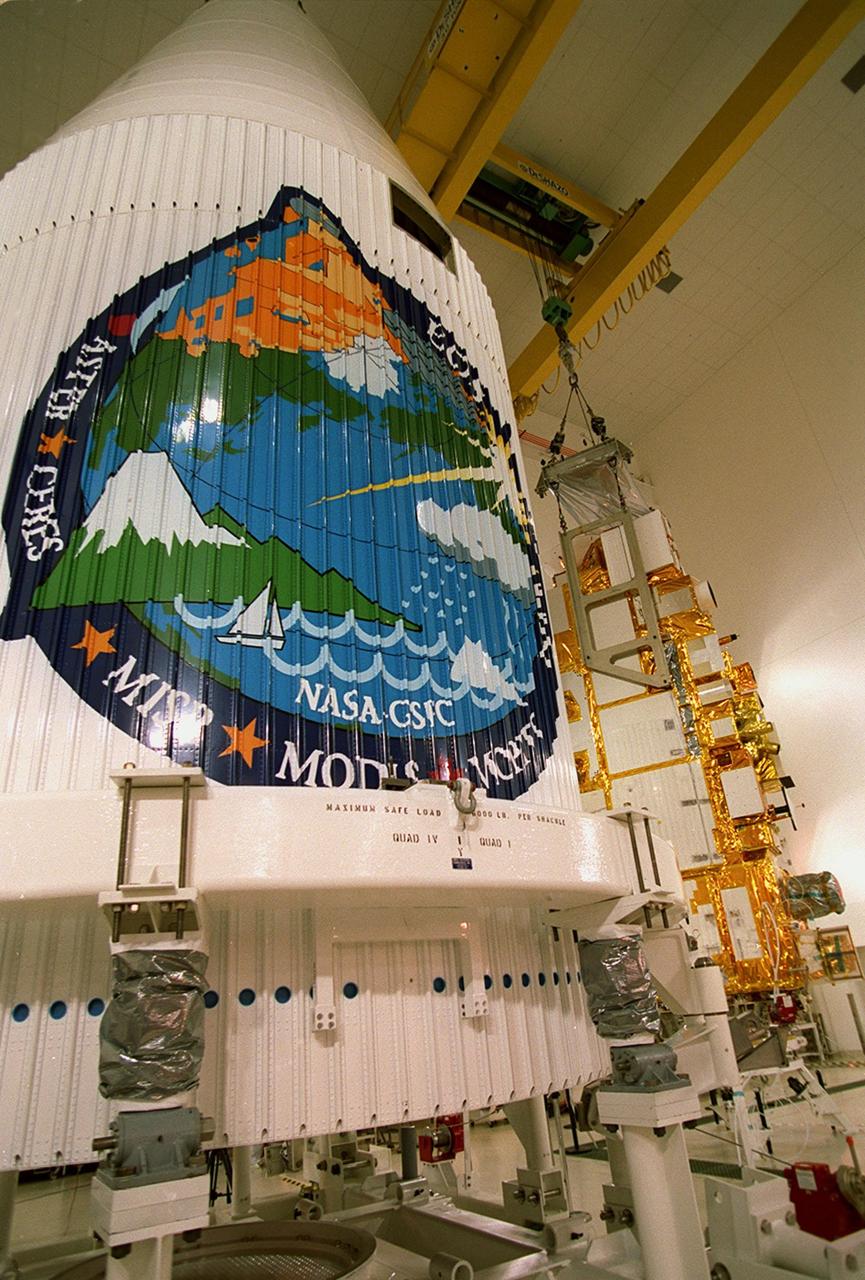
The rocket faring (left) displays a logo of the many science instruments that make up NASA's Terra spacecraft (background). When fully assembled, Terra will be encapsulated in the faring before launch, scheduled for Dec. 16 aboard a Lockheed Martin Atlas IIAS rocket from Space Launch Complex 3 East at Vandenberg AFB, Calif. Terra comprises five state-of-the-art sets of instruments that will collect data for continuous, long-term records of the state of Earth's land, oceans and atmosphere. Together with data from other satellite systems launched by NASA and other countries, it will inaugurate a new self-consistent data record that will be gathered over the next 15 years. From an altitude of 438 miles, Terra will circle the Earth 16 times a day from pole to pole (98 degree inclination), crossing the equator at 10:30 a.m. The five Terra instruments will operate by measuring sunlight reflected by the Earth and heat emitted by the Earth
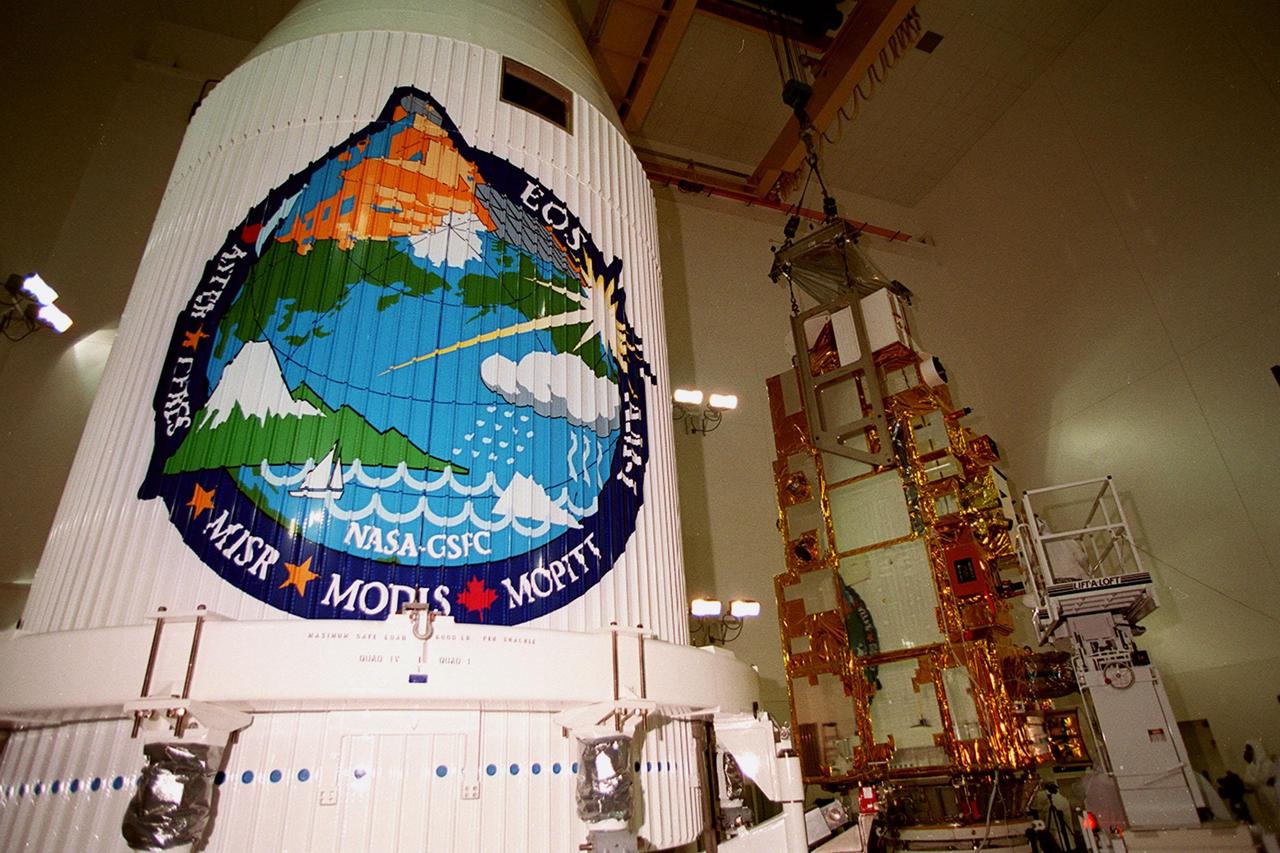
NASA's Terra spacecraft (right) is prepared for encapsulation in the rocket faring (left) before launch at Vandenberg AFB, Calif. The faring displays a logo of the many science instruments that make up Terra. The spacecraft's launch aboard a Lockheed Martin Atlas IIAS rocket is scheduled for Dec. 16 from Space Launch Complex 3 East at Vandenberg. Terra comprises five state-of-the-art sets of instruments that will collect data for continuous, long-term records of the state of Earth's land, oceans and atmosphere. Together with data from other satellite systems launched by NASA and other countries, Terra will inaugurate a new self-consistent data record that will be gathered over the next 15 years. From an altitude of 438 miles, Terra will circle the Earth 16 times a day from pole to pole (98 degree inclination), crossing the equator at 10:30 a.m. The five Terra instruments will operate by measuring sunlight reflected by the Earth and heat emitted by the Earth
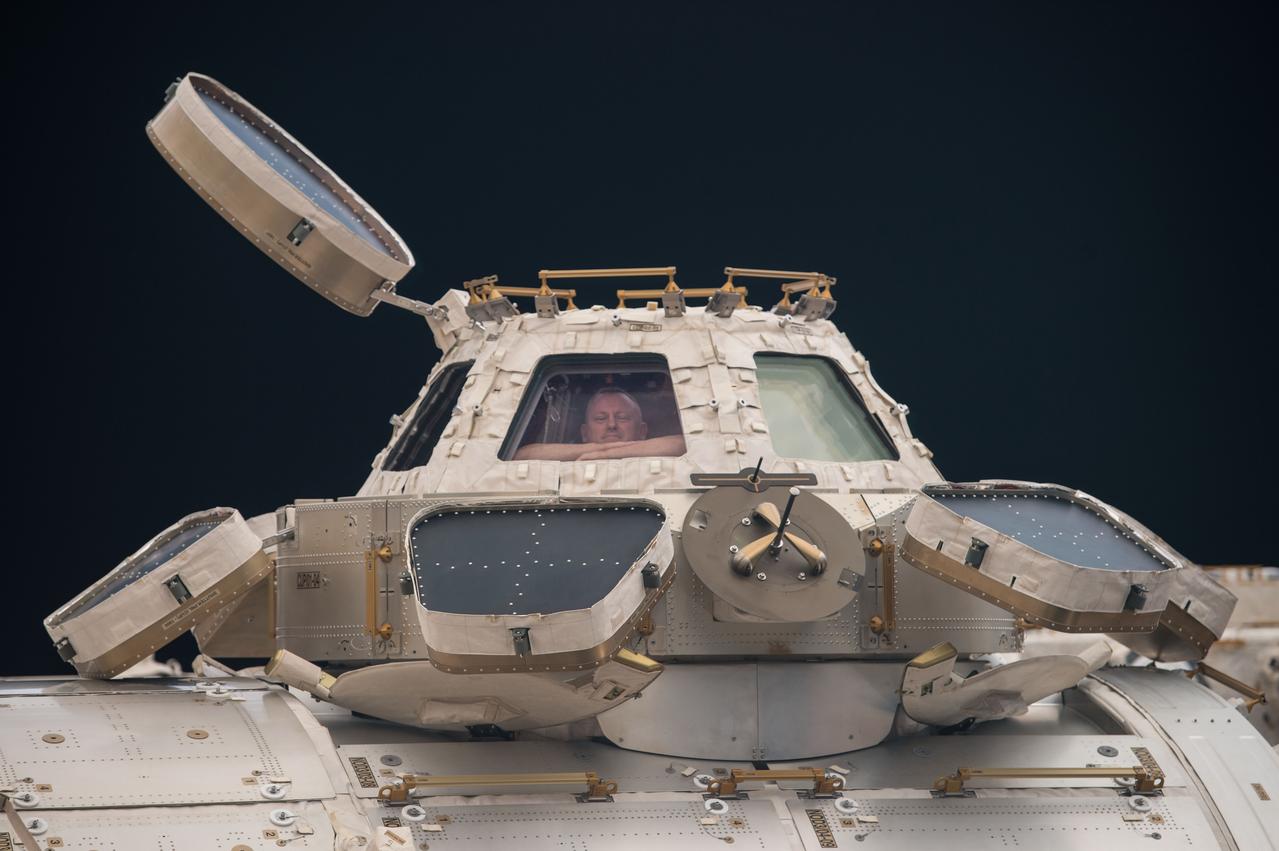
iss042e078481 (12/28/2014) --- US Astronaut Barry Wilmore, Commander of Expedition 42 aboard the International Space Station (ISS) looks out of the Cupola viewing station taking in the sights of the blue orb of Earth while on a break from science and maintenance duties. The Cupola is a panoramic control tower for the ISS with windows through which operations on the outside of the station can be observed and guided. Through the robotics workstation, astronauts are able to control the space station’s robotic arm, which helps with the attachment and assembly of various station elements, very much like the operator of a building crane. Spacewalking activities can also be observed from the Cupola along with visiting spacecraft and external areas of the station.
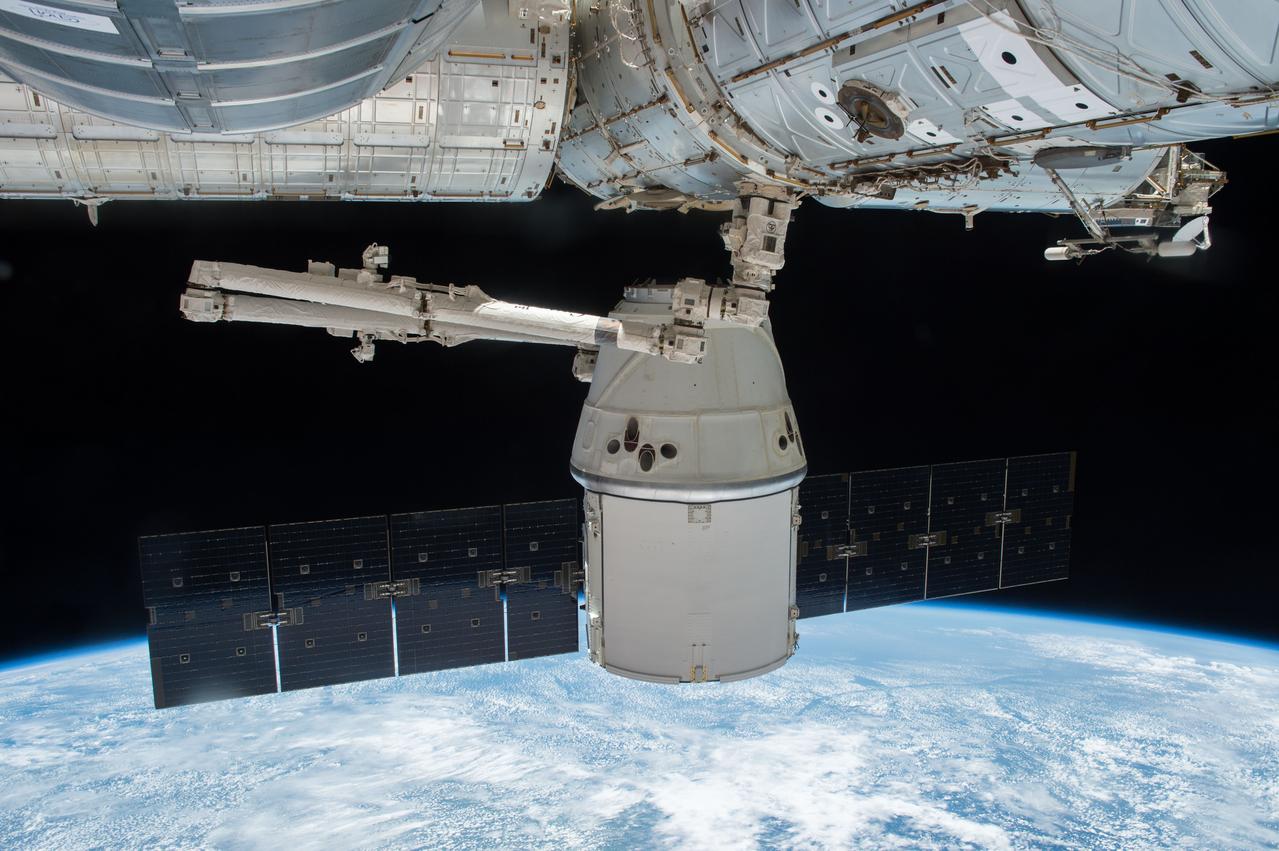
ISS047e109559 (05/11/2016) --- The SpaceX Dragon is seen berthed to the Earth-facing side of the station’s Harmony module shortly before departure. The vehicle was ultimately released by Expedition 47 robotic arm operator Tim Peake of ESA (European Space Agency) at 9:18 a.m. EDT. Dragon returned to Earth carrying more than 3,700 pounds of NASA cargo and science samples from human research, biology and biotechnology studies, physical science investigations and education activities sponsored by NASA and the U.S. national laboratory.
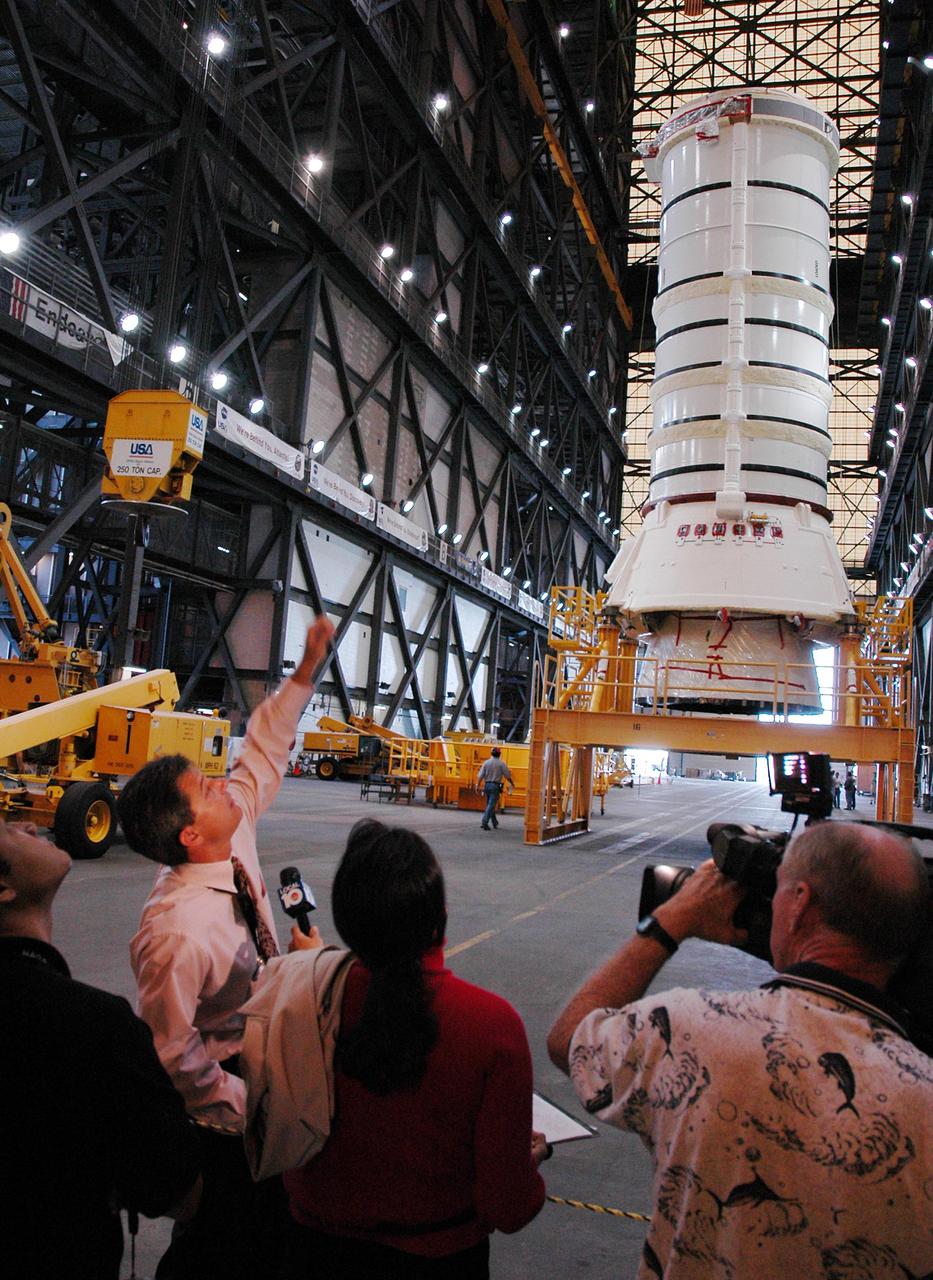
KENNEDY SPACE CENTER, FLA. - Inside the Vehicle Assembly Building, media are shown where the aft skirt and lower segment of the Solid Rocket Booster for the Return to Flight mission STS-114 will be stacked with other segments to follow. Two SRBs support the liftoff of the Space Shuttle on a launch. The twin 149-foot tall, 12-foot diameter SRBs provide the main propulsion system during launch to place the 180,000-pound orbiters in the proper orbit around the Earth. They operate parallel with the Space Shuttle main engines for the first two minutes of flight and jettison away from the orbiter with help from the Booster Separation Motors, about 26.3 nautical miles above the Earth’s surface.
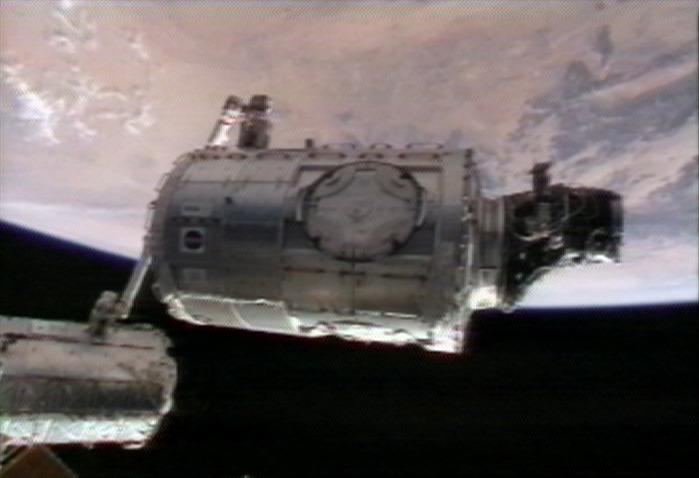
ISS016-E-011442 (14 Nov. 2007) --- In the grasp of the International Space Station's Canadarm2, the Harmony node with the Pressurized Mating Adapter (PMA-2) attached is moved from its temporary location on the left side of the Unity node to its new home on the front of the Destiny laboratory. Astronaut Daniel Tani, Expedition 16 flight engineer, operated the station's robotic arm from inside Destiny. The blackness of space and Earth's horizon provide the backdrop for the view, which was taken from NASA television.
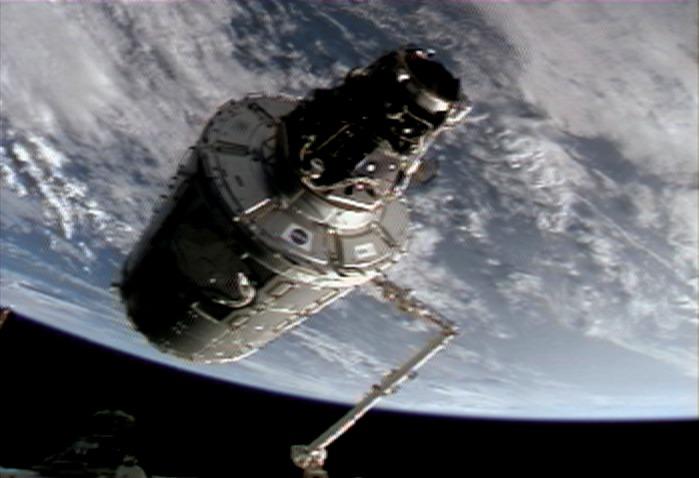
ISS016-E-011441 (14 Nov. 2007) --- In the grasp of the International Space Station's Canadarm2, the Harmony node with the Pressurized Mating Adapter (PMA-2) attached is moved from its temporary location on the left side of the Unity node to its new home on the front of the Destiny laboratory. Astronaut Daniel Tani, Expedition 16 flight engineer, operated the station's robotic arm from inside Destiny. The blackness of space and Earth's horizon provide the backdrop for the view, which was taken from NASA television.
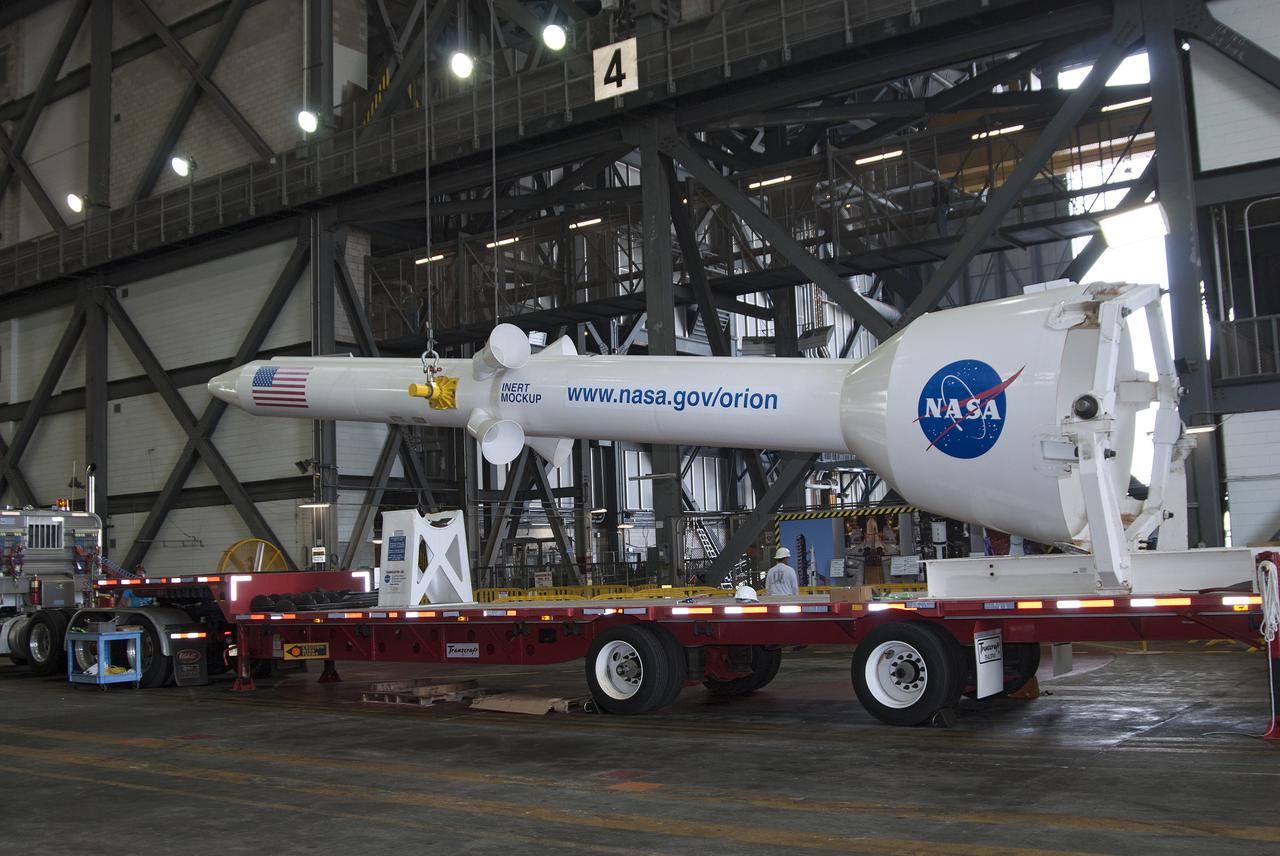
CAPE CANAVERAL, Fla. – A mockup of the Launch Abort System, or LAS, is lifted off a trailer inside the Vehicle Assembly Building at NASA's Kennedy Space Center in Florida so it can be positioned atop a boilerplate Orion capsule during test stacking operations. The Orion spacecraft is being designed to carry astronauts on missions beyond Earth orbit. It will have the LAS during the first part of launch in case an emergency develops that requires the spacecraft to be pulled away from the rocket to save the crew. NASA's Ground Services Development and Operations Program, or GSDO, performed the test operations. Photo credit: NASA_Charisse Nahser
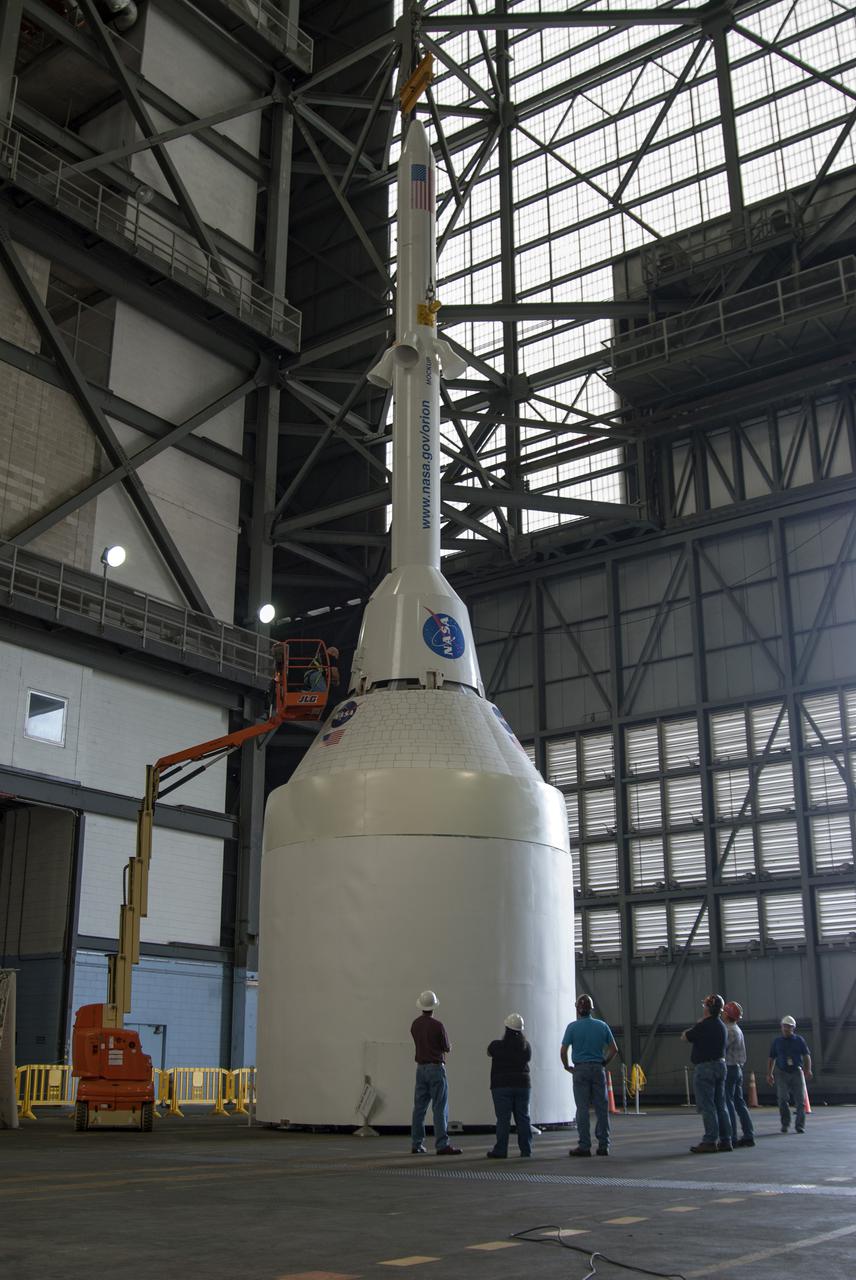
CAPE CANAVERAL, Fla. – A mockup of the Launch Abort System, or LAS, is positioned atop a boilerplate Orion capsule and replica service module during test stacking operations inside the Vehicle Assembly Building at NASA's Kennedy Space Center in Florida. The Orion spacecraft is being designed to carry astronauts on missions beyond Earth orbit. It will have the LAS during the first part of launch in case an emergency develops that requires the spacecraft to be pulled away from the rocket to save the crew. NASA's Ground Services Development and Operations Program, or GSDO, performed the test operations. Photo credit: NASA_Charisse Nahser
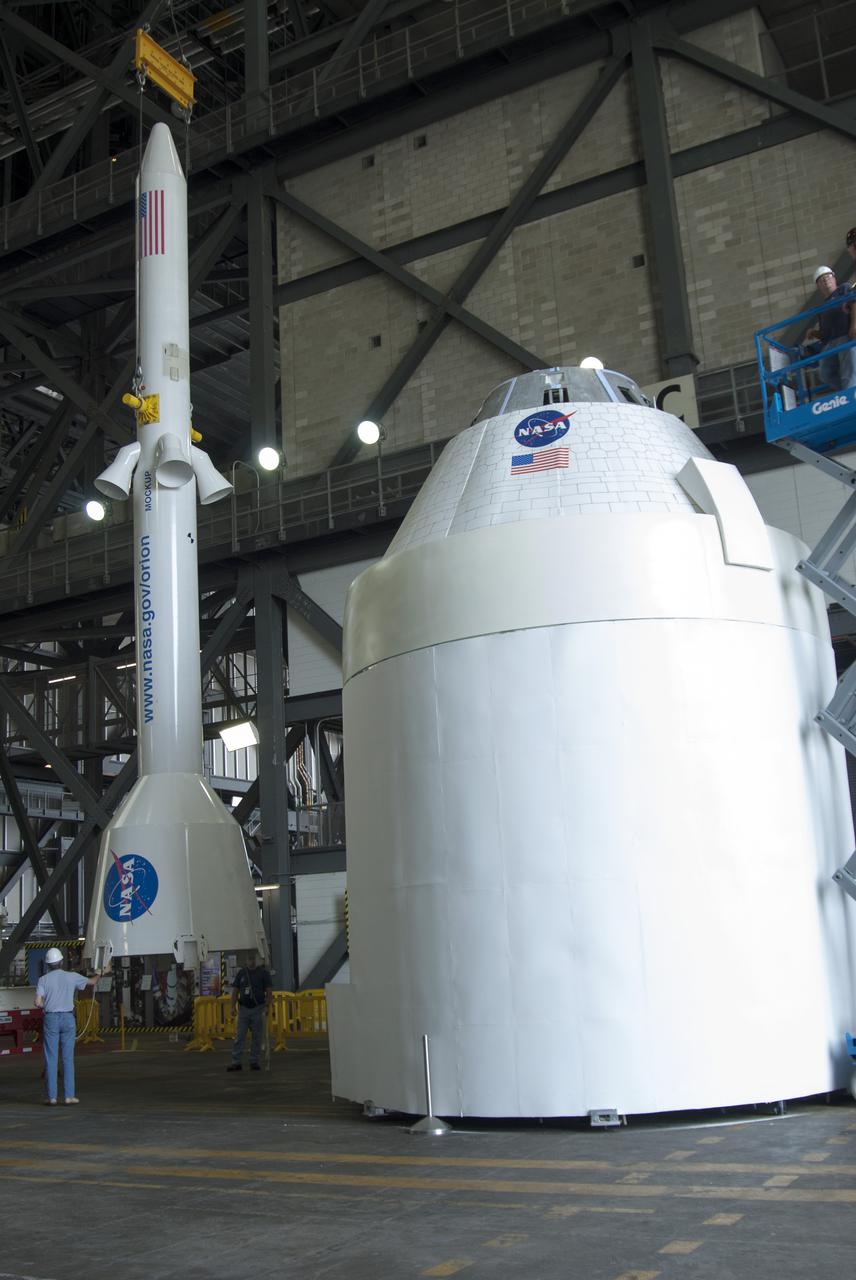
CAPE CANAVERAL, Fla. – A mockup of the Launch Abort System, or LAS, is lifted inside the Vehicle Assembly Building at NASA's Kennedy Space Center in Florida so it can be positioned atop a boilerplate Orion capsule and replica service module during test stacking operations. The Orion spacecraft is being designed to carry astronauts on missions beyond Earth orbit. It will have the LAS during the first part of launch in case an emergency develops that requires the spacecraft to be pulled away from the rocket to save the crew. NASA's Ground Services Development and Operations Program, or GSDO, performed the test operations. Photo credit: NASA_Charisse Nahser
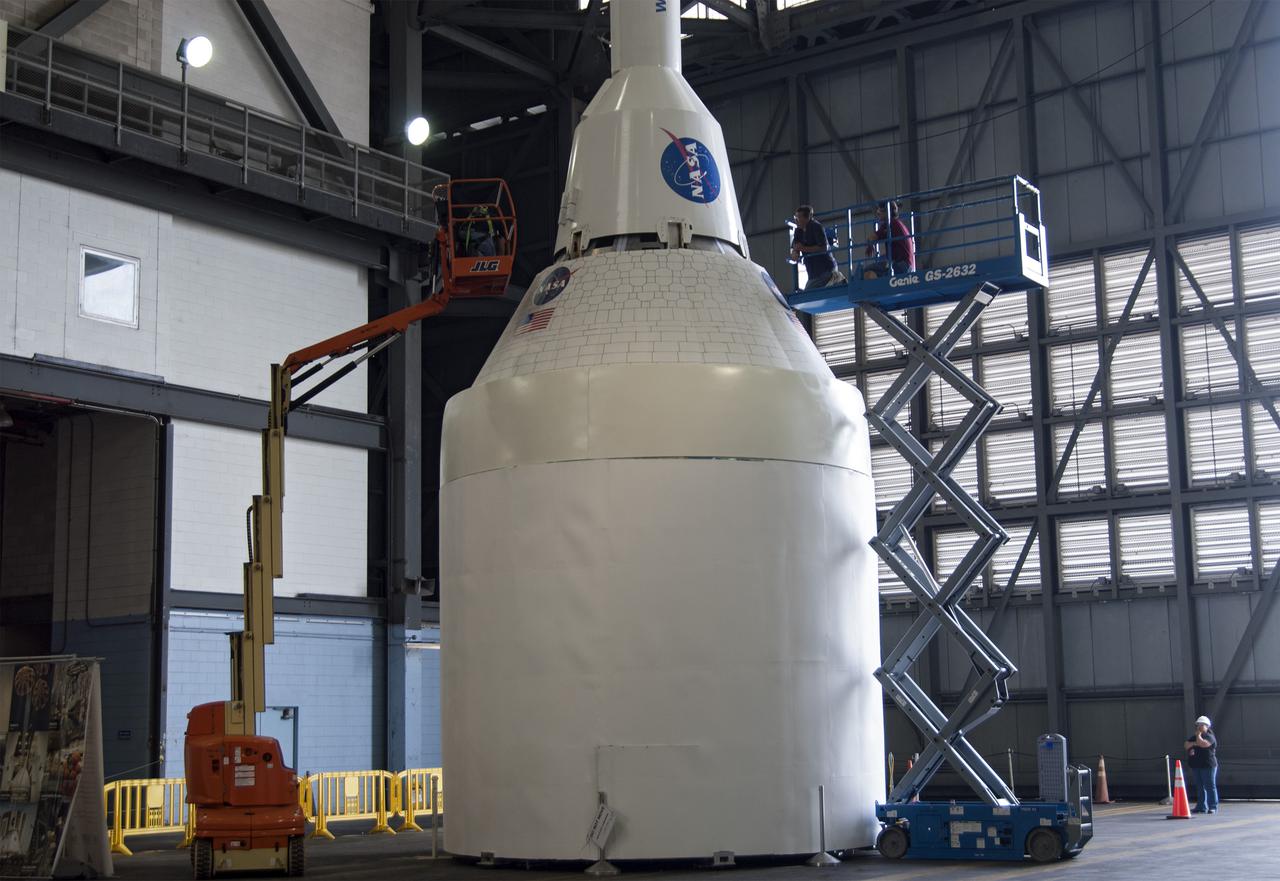
CAPE CANAVERAL, Fla. – A mockup of the Launch Abort System, or LAS, is positioned atop a boilerplate Orion capsule and replica service module during test stacking operations inside the Vehicle Assembly Building at NASA's Kennedy Space Center in Florida. The Orion spacecraft is being designed to carry astronauts on missions beyond Earth orbit. It will have the LAS during the first part of launch in case an emergency develops that requires the spacecraft to be pulled away from the rocket to save the crew. NASA's Ground Services Development and Operations Program, or GSDO, performed the test operations. Photo credit: NASA_Charisse Nahser