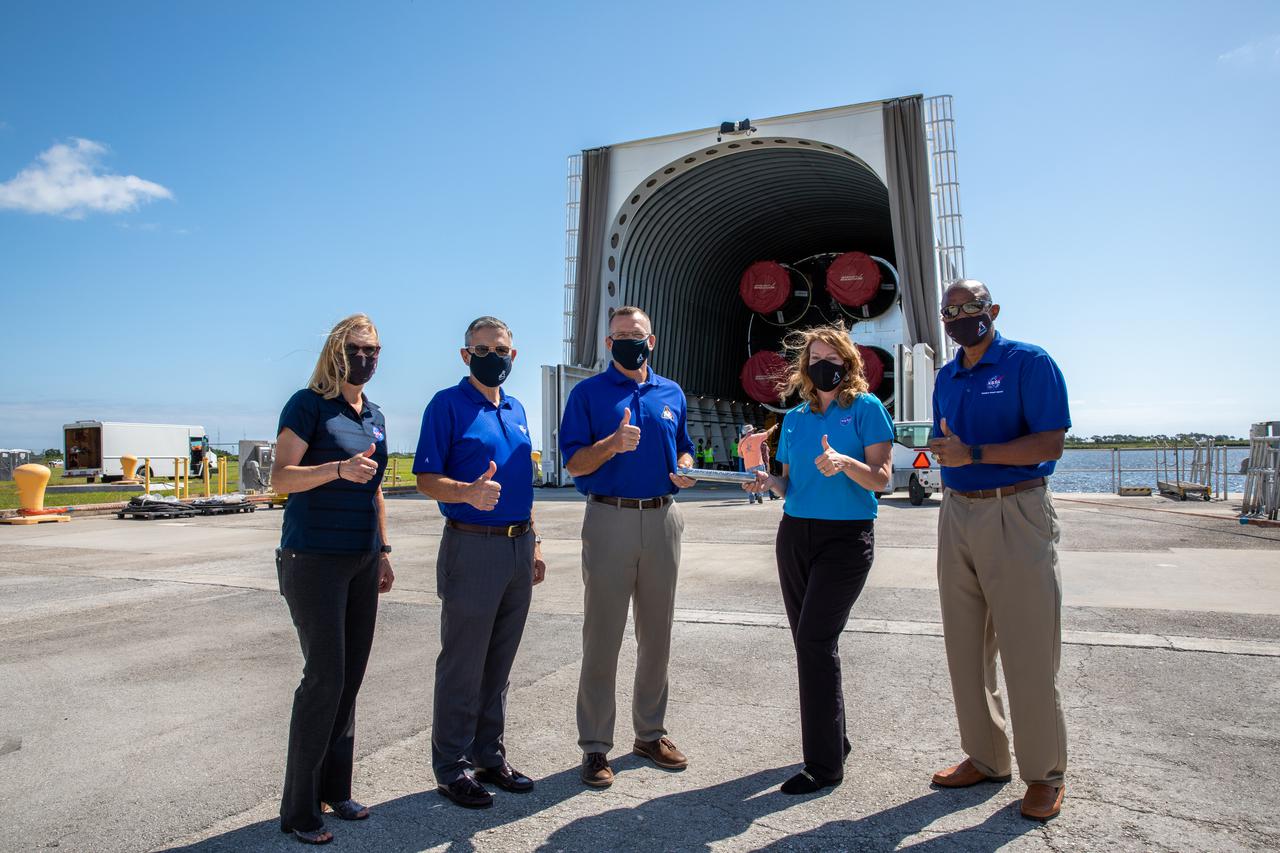
From left, Kennedy Space Center Deputy Director Janet Petro, Director Bob Cabana, Exploration Ground Systems’ (EGS) Senior Vehicle Operations Manager Cliff Lanham, Space Launch System (SLS) Stages Manager Julie Bassler, and Associate Director, Technical, Kelvin Manning celebrate the arrival of the SLS core stage on April 28, 2021, with a symbolic “passing of the baton” from the SLS program to EGS. Journeying from NASA’s Stennis Space Center in Mississippi aboard the Pegasus barge, the core stage arrived at the Florida spaceport on April 27 to be processed for flight by EGS. It is the final piece of Artemis hardware to arrive at Kennedy and will be offloaded and moved to the Vehicle Assembly Building, where it will be prepared for integration atop the mobile launcher with the completed stack of solid rocket boosters ahead of the Artemis I launch. The first in a series of increasingly complex missions, Artemis I will test SLS and Orion as an integrated system prior to crewed flights to the Moon.
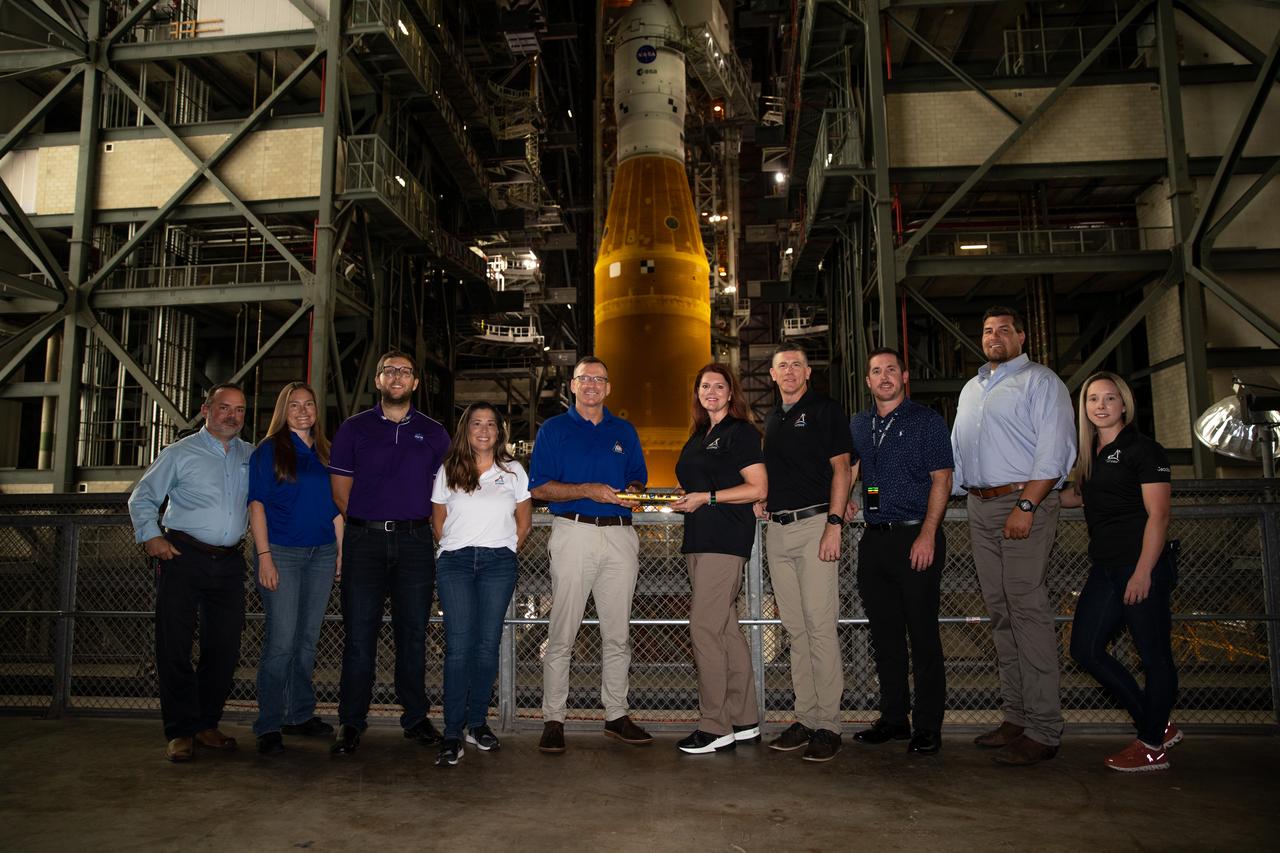
Cliff Lanham, fifth from the left, ground operations manager with NASA’s Exploration Ground Systems (EGS), hands off the baton to Charlie Blackwell-Thompson, Artemis I launch director, inside the Vehicle Assembly building at NASA’s Kennedy Space Center in Florida on Aug. 15, 2022. Also pictured are members of Kennedy’s EGS and Artemis launch teams. NASA’s Space Launch System (SLS) rocket, with the agency’s Orion spacecraft atop, is targeted to start its rollout to Launch Pad 39B on Aug. 16 at approximately 9 p.m., in preparation for the Artemis I launch – set for no earlier than Aug. 29. Artemis I will be the first integrated test of the SLS and Orion. In later missions, NASA will land the first woman and the first person of color on the Moon, paving the way for a long-term lunar presence and serving as a steppingstone on the way to Mars.
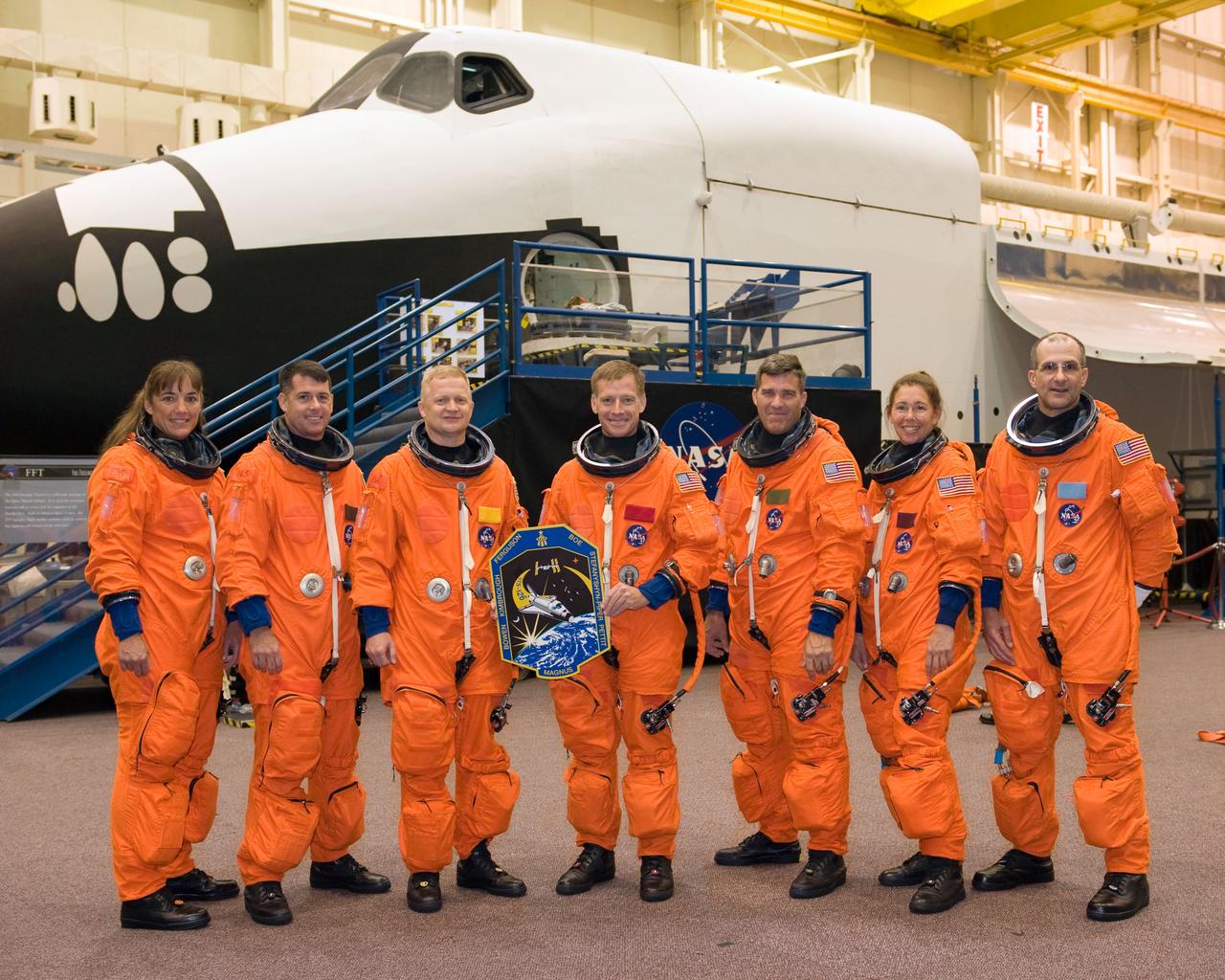
STS-126 Preflight Training IN/EG, Bldg 9NW FFT
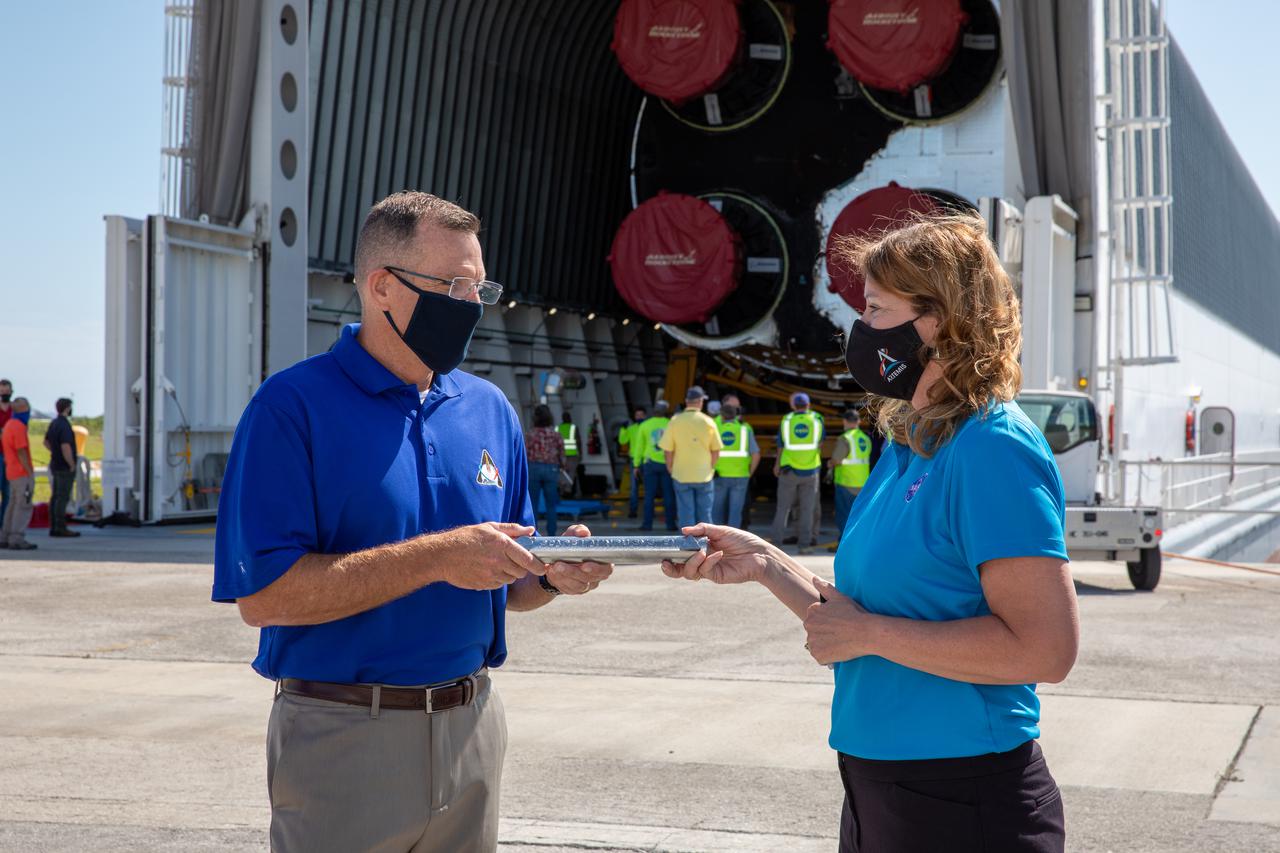
Space Launch System (SLS) Stages Manager Julie Bassler, right, celebrates the arrival of the SLS core stage by symbolically “passing the baton” to Exploration Ground Systems’ (EGS) Senior Vehicle Operations Manager Cliff Lanham on April 28, 2021, at NASA’s Kennedy Space Center in Florida. Journeying from the agency’s Stennis Space Center in Mississippi aboard the Pegasus barge, the core stage arrived at the Florida spaceport on April 27 to be processed for flight by EGS. It is the final piece of Artemis hardware to arrive at Kennedy and will be offloaded and moved to the Vehicle Assembly Building, where it will be prepared for integration atop the mobile launcher with the completed stack of solid rocket boosters ahead of the Artemis I launch. The first in a series of increasingly complex missions, Artemis I will test SLS and Orion as an integrated system prior to crewed flights to the Moon.

Space Launch System (SLS) Stages Manager Julie Bassler, right, celebrates the arrival of the SLS core stage by symbolically “passing the baton” to Exploration Ground Systems’ (EGS) Senior Vehicle Operations Manager Cliff Lanham on April 28, 2021, at NASA’s Kennedy Space Center in Florida. Journeying from the agency’s Stennis Space Center in Mississippi aboard the Pegasus barge, the core stage arrived at the Florida spaceport on April 27 to be processed for flight by EGS. It is the final piece of Artemis hardware to arrive at Kennedy and will be offloaded and moved to the Vehicle Assembly Building, where it will be prepared for integration atop the mobile launcher with the completed stack of solid rocket boosters ahead of the Artemis I launch. The first in a series of increasingly complex missions, Artemis I will test SLS and Orion as an integrated system prior to crewed flights to the Moon.
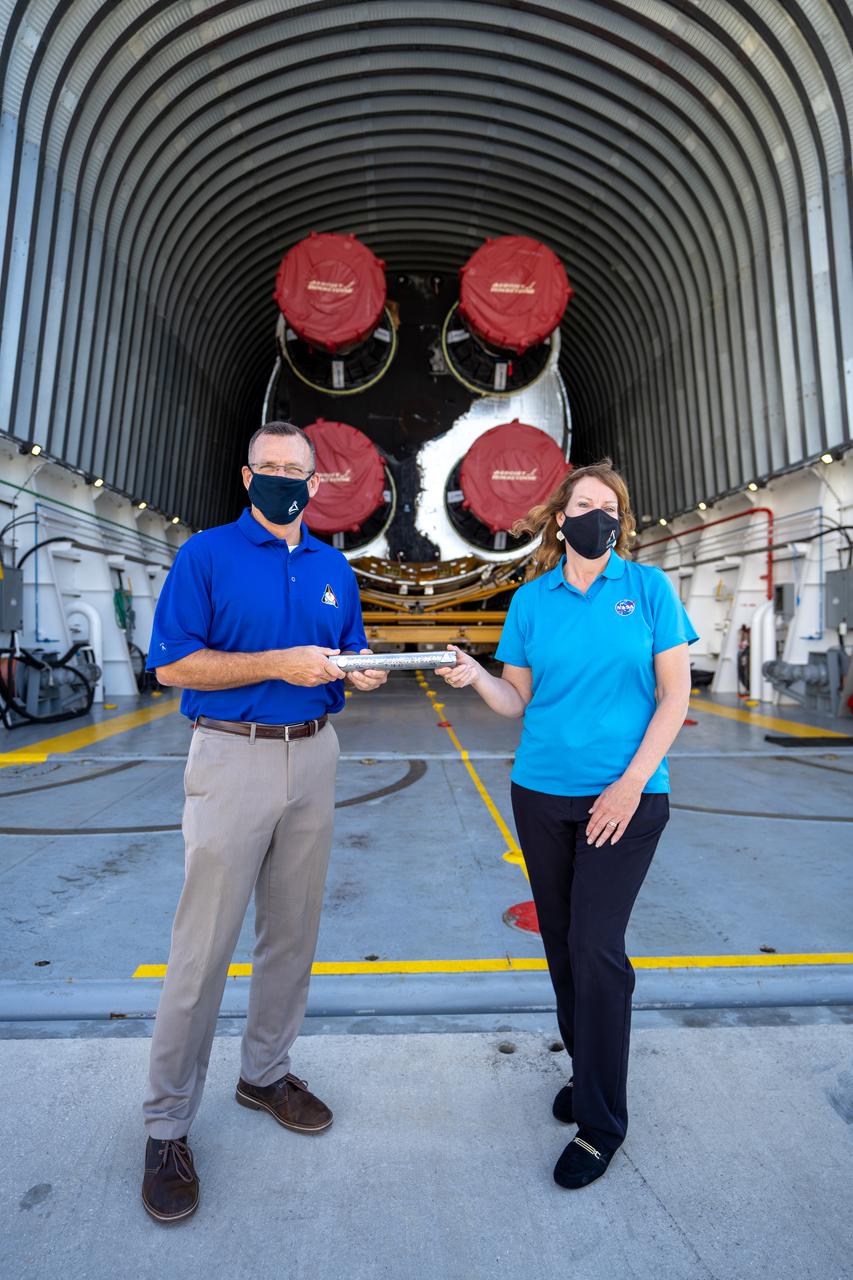
Space Launch System (SLS) Stages Manager Julie Bassler, right, celebrates the arrival of the SLS core stage by symbolically “passing the baton” to Exploration Ground Systems’ (EGS) Senior Vehicle Operations Manager Cliff Lanham on April 28, 2021, at NASA’s Kennedy Space Center in Florida. Journeying from the agency’s Stennis Space Center in Mississippi aboard the Pegasus barge, the core stage arrived at the Florida spaceport on April 27 to be processed for flight by EGS. It is the final piece of Artemis hardware to arrive at Kennedy and will be offloaded and moved to the Vehicle Assembly Building, where it will be prepared for integration atop the mobile launcher with the completed stack of solid rocket boosters ahead of the Artemis I launch. The first in a series of increasingly complex missions, Artemis I will test SLS and Orion as an integrated system prior to crewed flights to the Moon.
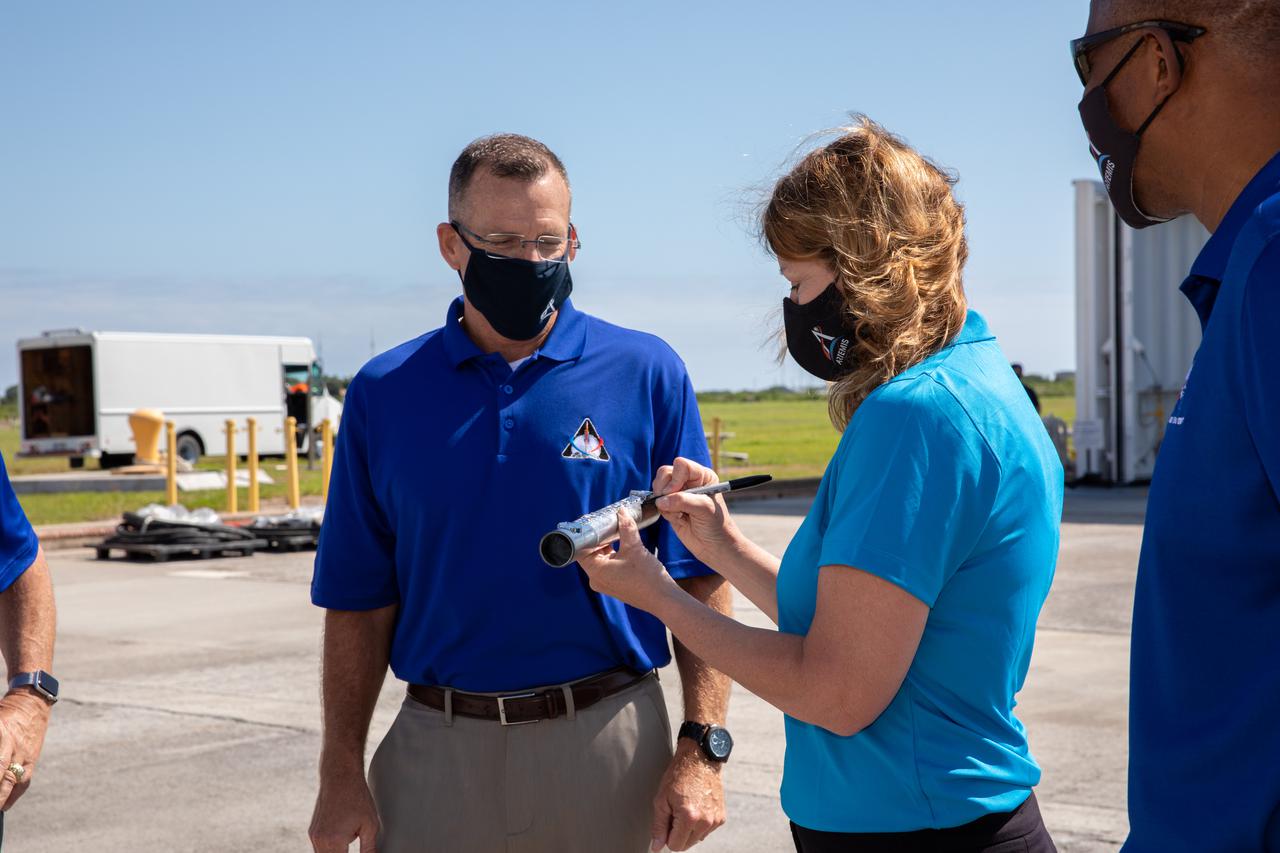
Space Launch System (SLS) Stages Manager Julie Bassler, right, celebrates the arrival of the SLS core stage by symbolically “passing the baton” to Exploration Ground Systems’ (EGS) Senior Vehicle Operations Manager Cliff Lanham on April 28, 2021, at NASA’s Kennedy Space Center in Florida. Journeying from the agency’s Stennis Space Center in Mississippi aboard the Pegasus barge, the core stage arrived at the Florida spaceport on April 27 to be processed for flight by EGS. It is the final piece of Artemis hardware to arrive at Kennedy and will be offloaded and moved to the Vehicle Assembly Building, where it will be prepared for integration atop the mobile launcher with the completed stack of solid rocket boosters ahead of the Artemis I launch. The first in a series of increasingly complex missions, Artemis I will test SLS and Orion as an integrated system prior to crewed flights to the Moon.

On Oct. 23, 2020, an engineer with Exploration Ground Systems (EGS) is at Launch Pad 39B at NASA’s Kennedy Space Center in Florida as a brilliant sunrise illuminates the sky. The mobile launcher for the Artemis I mission is at the pad to allow engineers with EGS and Jacobs to complete several tasks, including a timing test to validate the launch team’s countdown timeline, and a thorough, top-to-bottom wash down of the mobile launcher to remove any debris remaining from construction and installation of the umbilical arms. Artemis I will test the Orion spacecraft and Space Launch System as an integrated system ahead of crewed flights to the Moon. Under the Artemis program, NASA will land the first woman and the next man on the Moon in 2024.
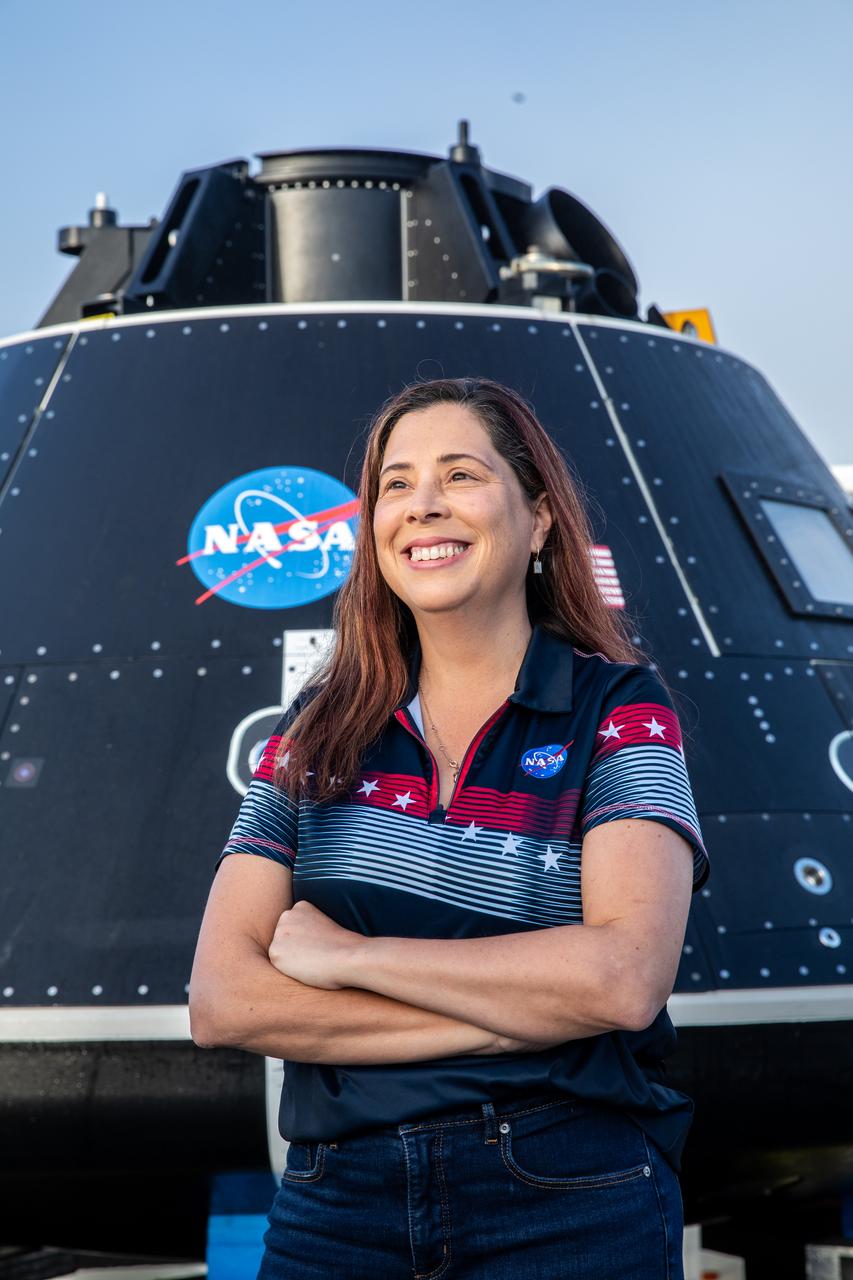
Liliana Villarreal, Artemis landing and recovery director with Exploration Ground Systems (EGS), stands in front of the Crew Module Test Article (CMTA) at the turn basin in the Launch Complex 39 area at NASA’s Kennedy Space Center in Florida on Feb. 1, 2023. The CMTA is being used to practice recovery after splashdown of the Orion spacecraft to prepare for the Artemis II crewed mission. EGS leads recovery efforts.

Liliana Villarreal, Artemis landing and recovery director with Exploration Ground Systems (EGS), stands in front of the Crew Module Test Article (CMTA) at the turn basin in the Launch Complex 39 area at NASA’s Kennedy Space Center in Florida on Feb. 1, 2023. The CMTA is being used to practice recovery after splashdown of the Orion spacecraft to prepare for the Artemis II crewed mission. EGS leads recovery efforts.
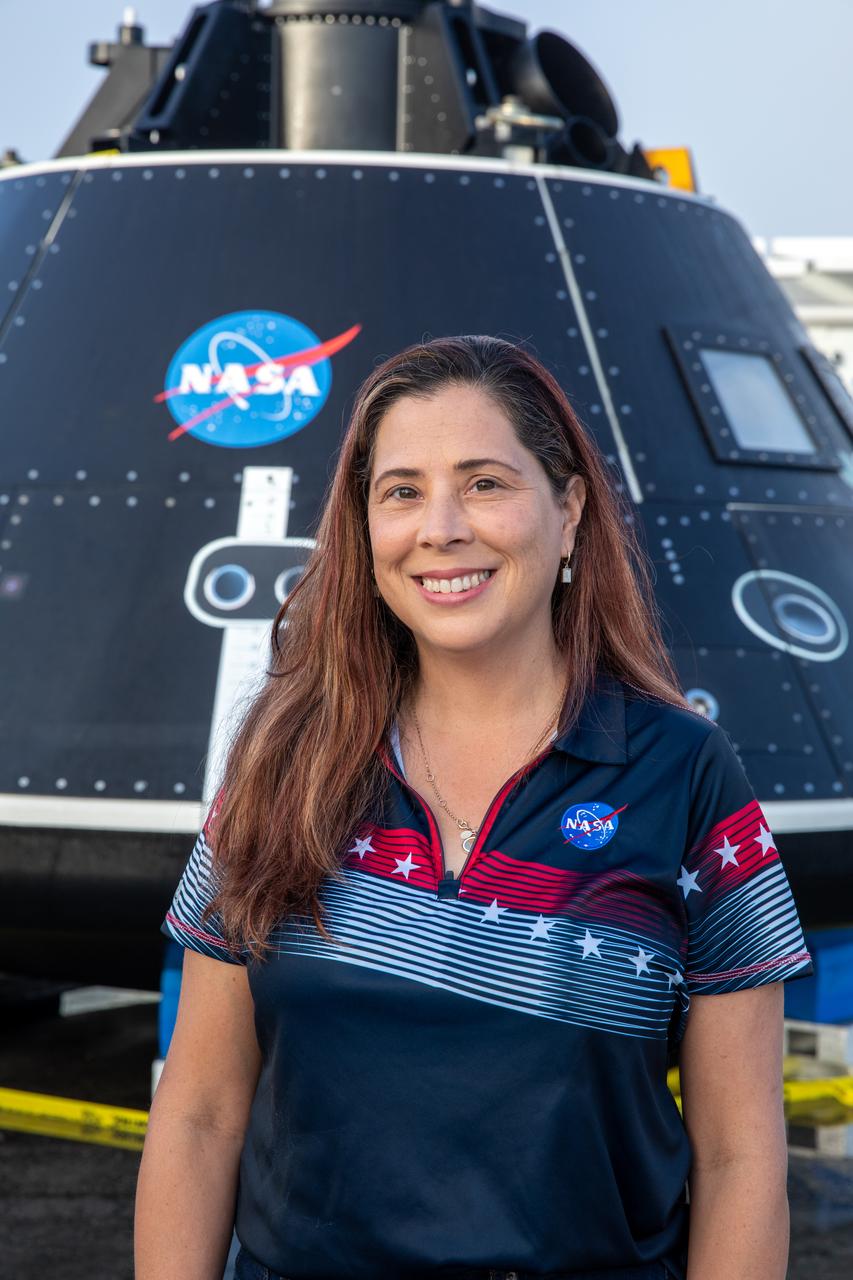
Liliana Villarreal, Artemis landing and recovery director with Exploration Ground Systems (EGS), stands in front of the Crew Module Test Article (CMTA) at the turn basin in the Launch Complex 39 area at NASA’s Kennedy Space Center in Florida on Feb. 1, 2023. The CMTA is being used to practice recovery after splashdown of the Orion spacecraft to prepare for the Artemis II crewed mission. EGS leads recovery efforts.
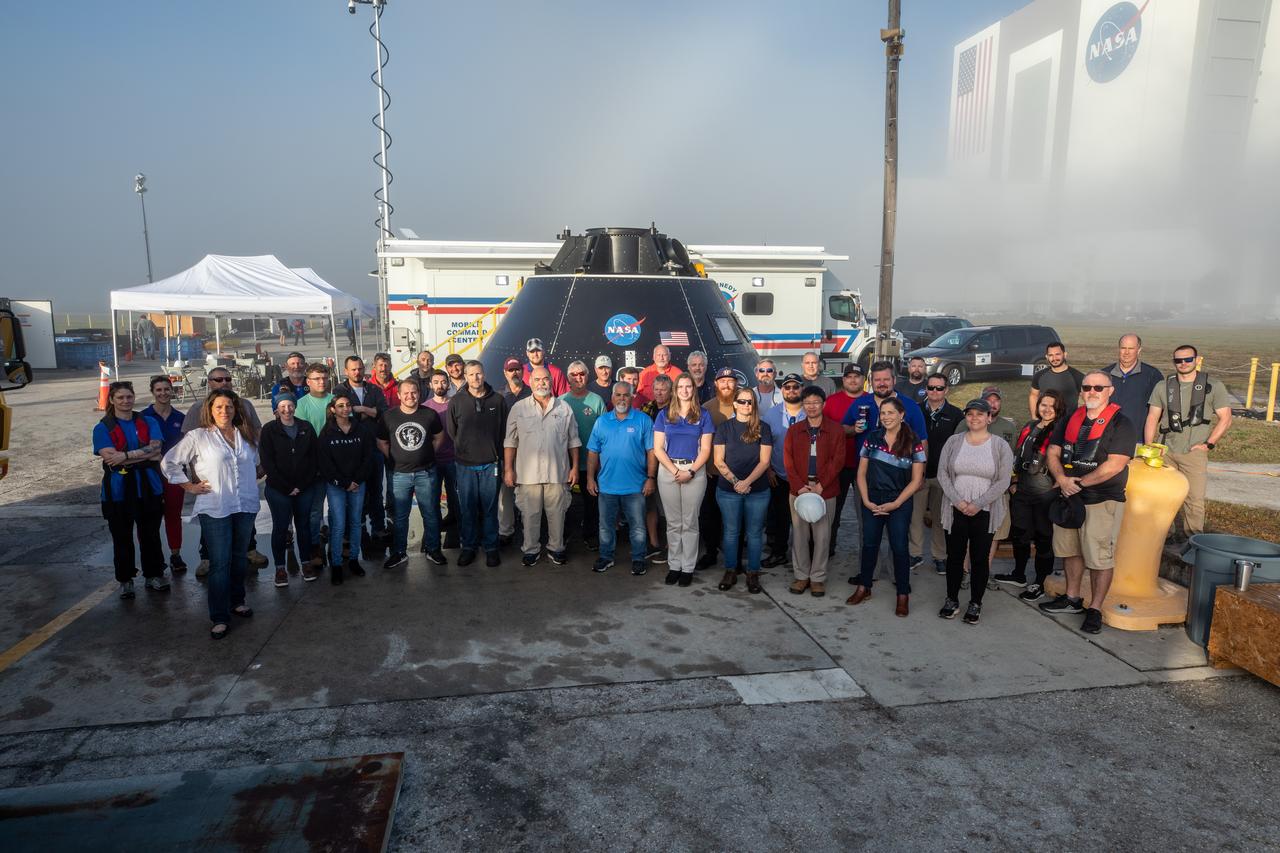
Members of the Exploration Ground Systems (EGS) landing and recovery team gather for a group photograph in front of the Crew Module Test Article (CMTA) at the turn basin in the Launch Complex 39 area at NASA’s Kennedy Space Center in Florida on Feb. 1, 2023. The CMTA is being used to practice recovery after splashdown of the Orion spacecraft to prepare for the Artemis II crewed mission. EGS leads recovery efforts.
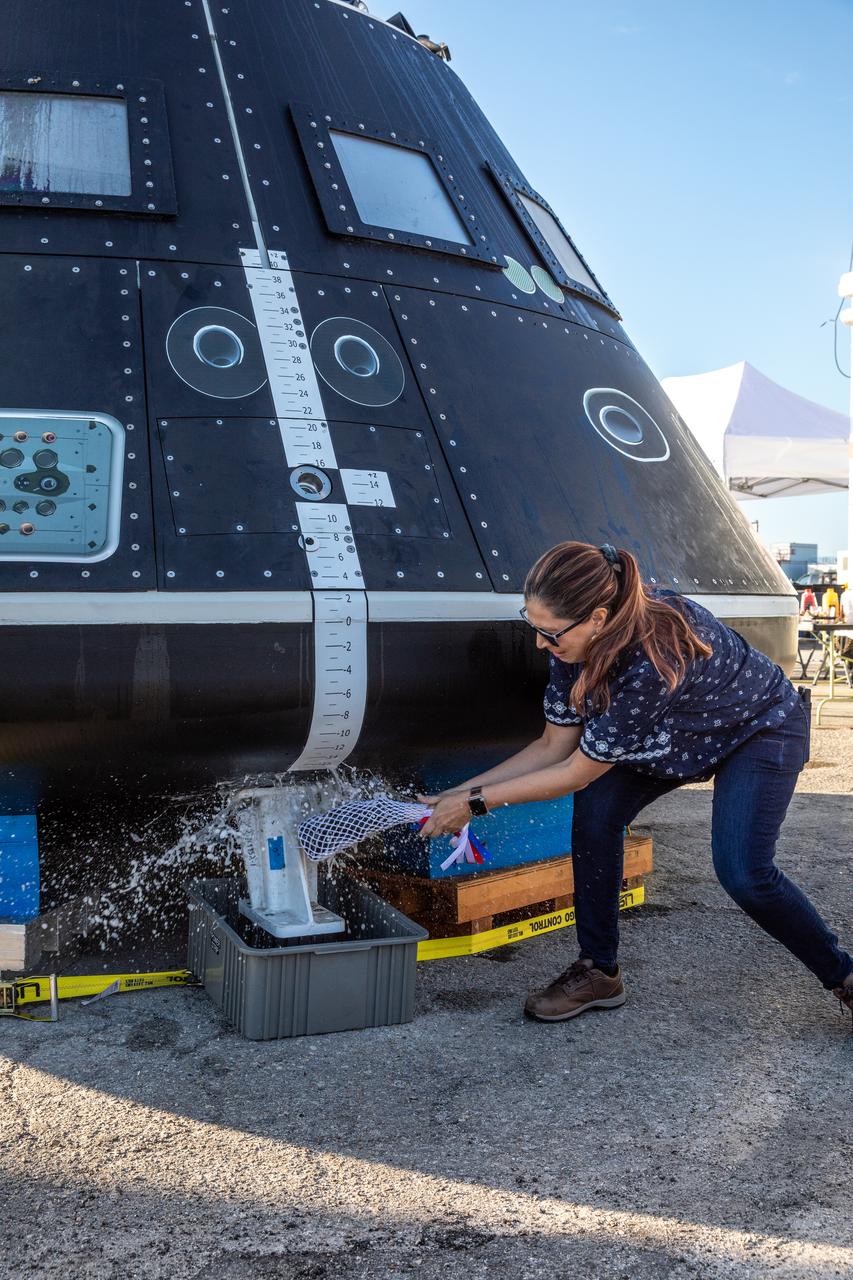
Liliana Villarreal, Artemis landing and recovery director with Exploration Ground Systems (EGS), christens the Crew Module Test Article (CMTA) with champagne during a naming ceremony at the turn basin in the Launch Complex 39 area at NASA’s Kennedy Space Center in Florida on Jan. 30, 2023. The CMTA is being used to practice recovery after splashdown of the Orion spacecraft to prepare for the Artemis II crewed mission. EGS leads recovery efforts.
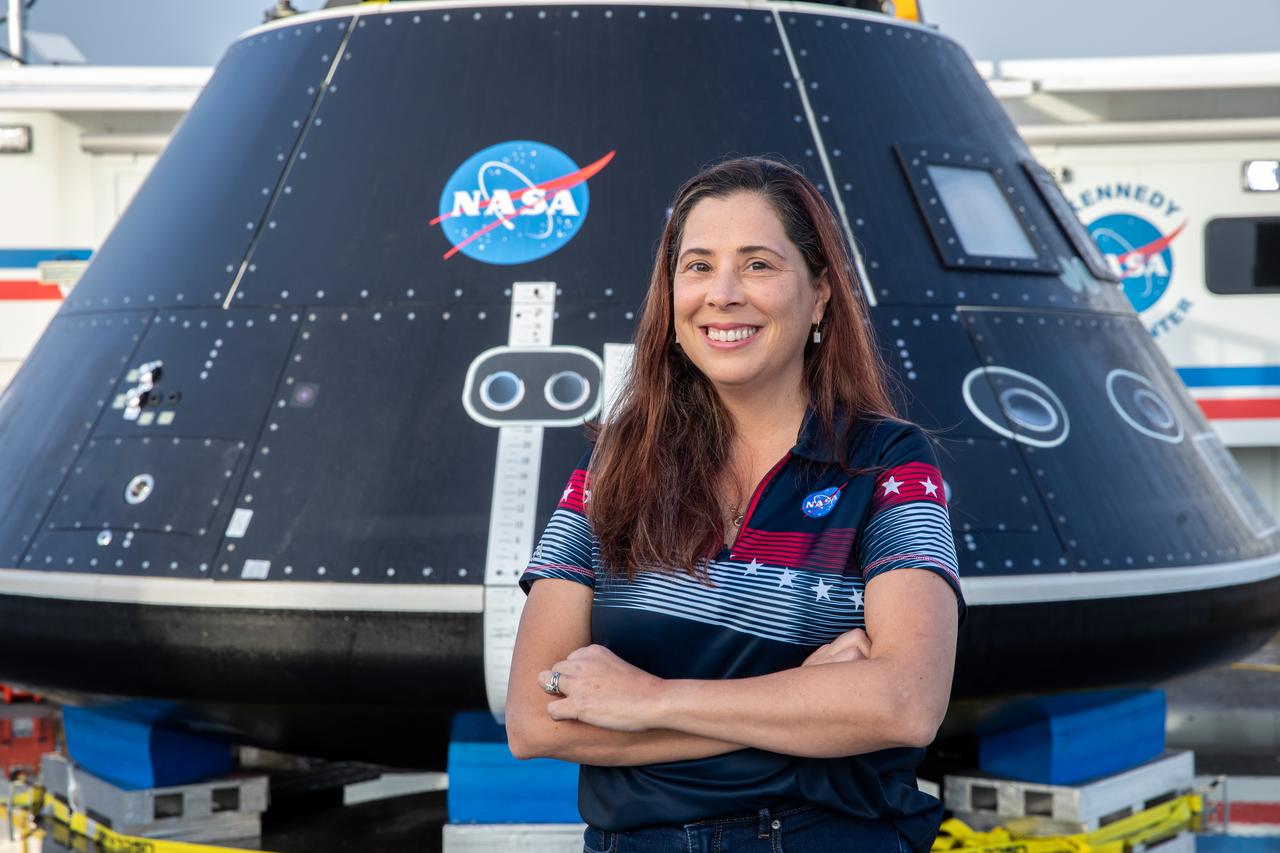
Liliana Villarreal, Artemis landing and recovery director with Exploration Ground Systems (EGS), stands in front of the Crew Module Test Article (CMTA) at the turn basin in the Launch Complex 39 area at NASA’s Kennedy Space Center in Florida on Feb. 1, 2023. The CMTA is being used to practice recovery after splashdown of the Orion spacecraft to prepare for the Artemis II crewed mission. EGS leads recovery efforts.
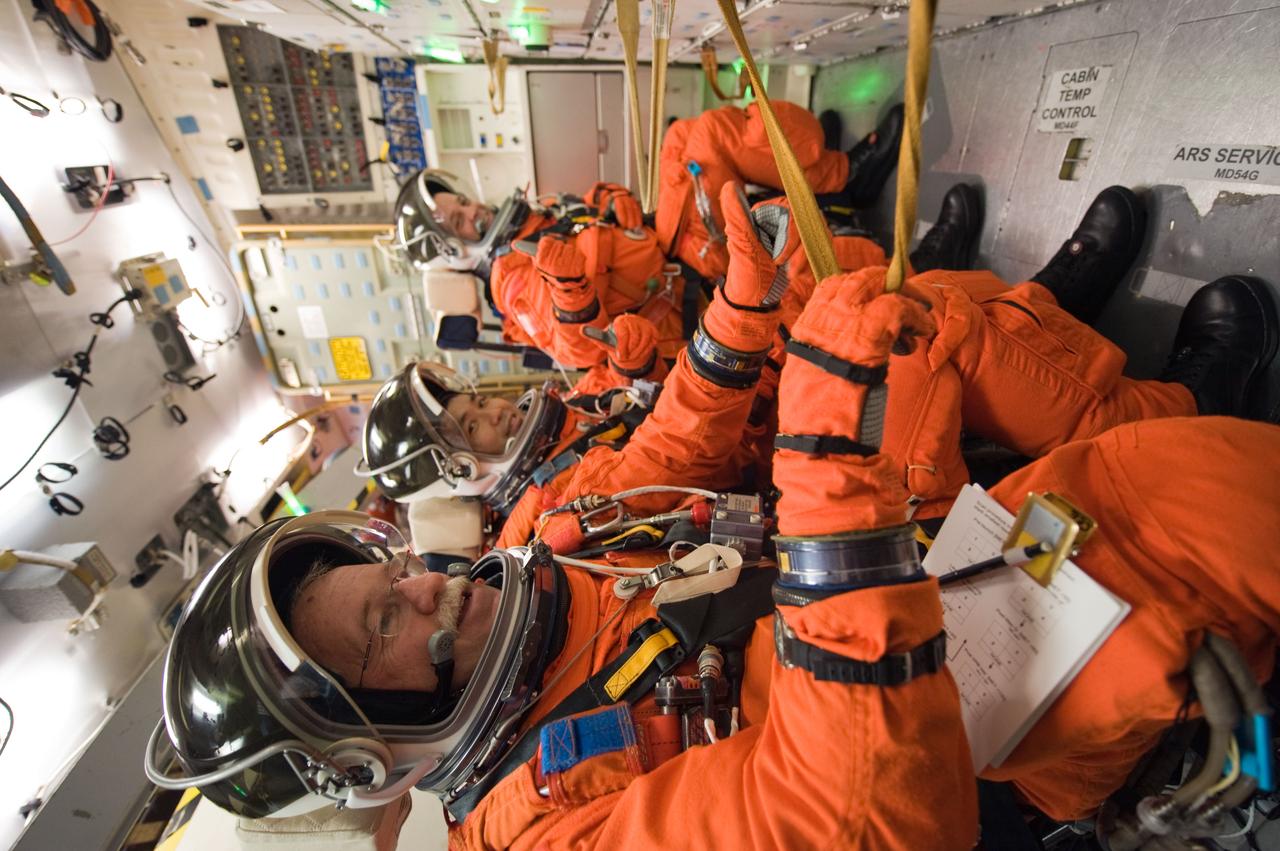
PHOTO DATE: 12-22-08 LOCATION: Bldg 9NW, CCTII SUBJECT: STS-119 crew and Koichi Wakata training during the PRL IN/EG suited training. PHOTOGRAPHER: JAMES BLAIR

Orion is revealed for one of the final times on Jan. 14, as it is readied atop its transport pallet from the Neil Armstrong Operations and Checkout Building at NASA’s Kennedy Space Center in Florida, along its path to the pad ahead of the Artemis I launch. Orion was officially transferred from the Orion Program to Exploration Ground Systems (EGS). Mike Bolger, EGS manager, stands inside the high bay with Orion in the background. Teams across the globe have worked tirelessly to assemble the spacecraft which, will receive a protective covering prior to departing for the Multi-Payload Processing Facility to begin ground processing by the EGS and Jacobs teams.
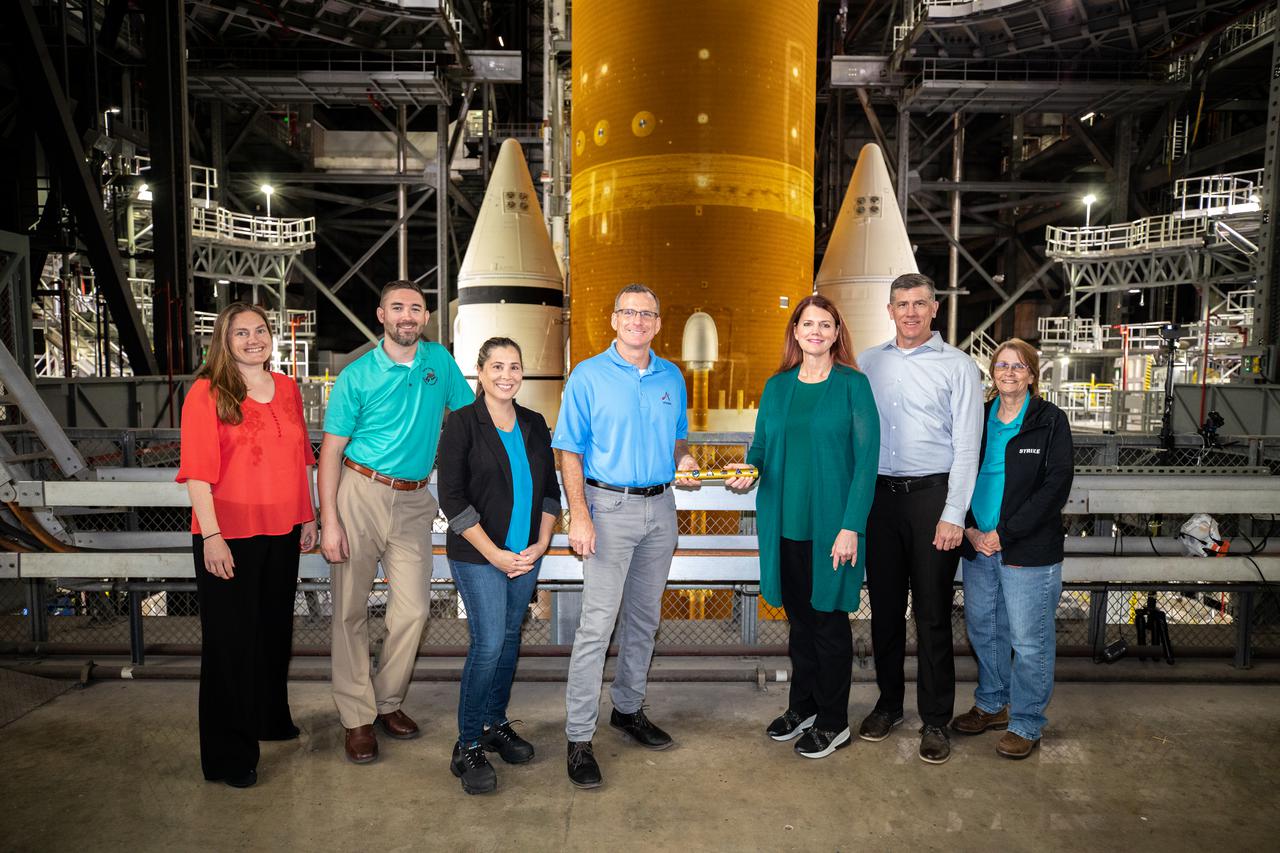
Cliff Lanham, fourth from left, ground operations manager with Exploration Ground Systems (EGS), passes the baton to Charlie Blackwell-Thompson, Artemis I launch director, inside the Vehicle Assembly Building at NASA’s Kennedy Space Center in Florida on March 16, 2022. Joining them from left, are Stacey Bagg, Matt Czech, and Liliana Villareal, with EGS. Next to Blackwell-Thomson are Jeremy Graeber, deputy launch director, and Teresa Annulis. The Space Launch System (SLS) and Orion will make the trek to Launch Complex 39B for a wet dress rehearsal ahead of launch atop the crawler-transporter 2. Artemis I will be the first integrated test of the SLS and Orion spacecraft. In later missions, NASA will land the first woman and the first person of color on the surface of the Moon, paving the way for a long-term lunar presence and serving as a steppingstone on the way to Mars.
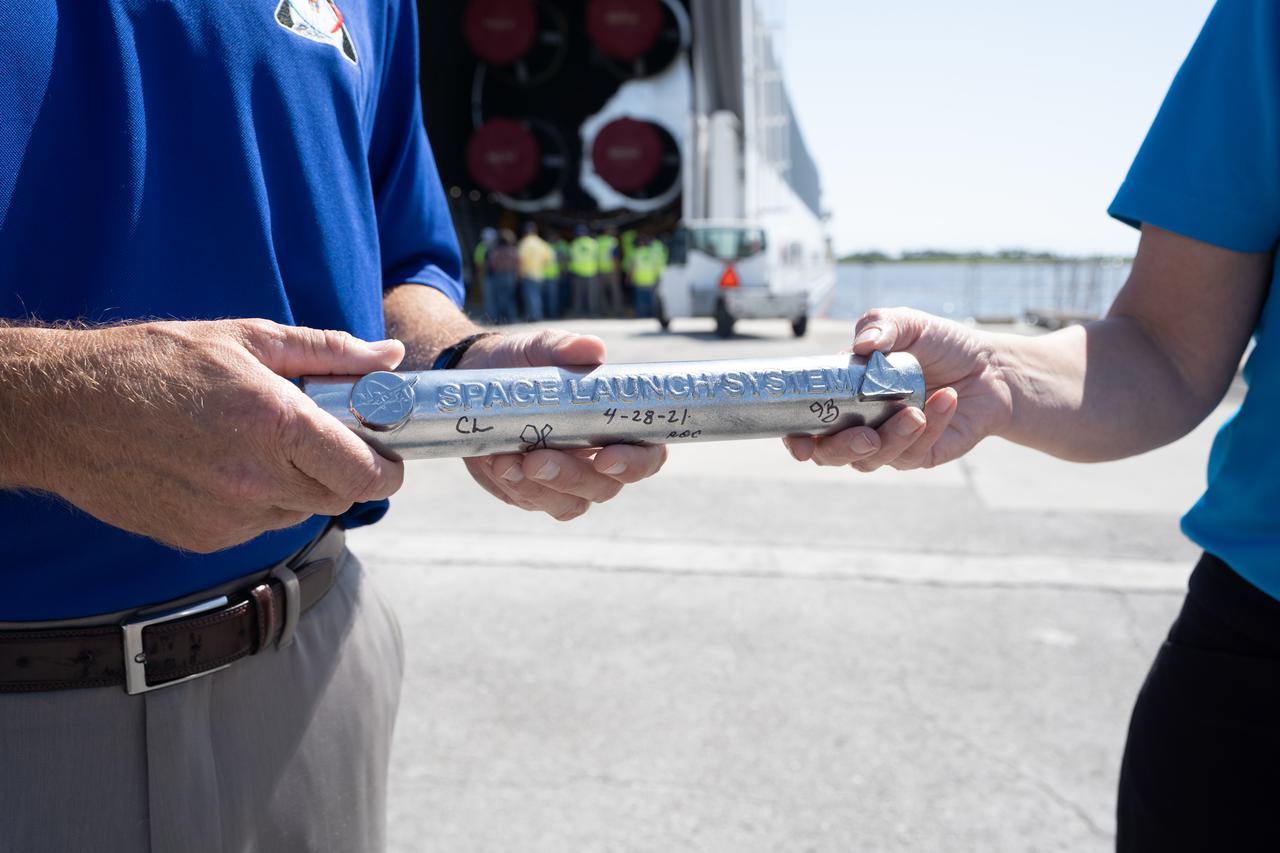
The Space Launch System (SLS) program heralds the arrival of the SLS core stage with a symbolic “passing of the baton” to NASA’s Exploration Ground Systems (EGS) on April 28, 2021, at the agency’s Kennedy Space Center in Florida, marking the transition into final preparations for flight. Journeying from NASA’s Stennis Space Center in Mississippi aboard the Pegasus barge, the core stage arrived at the Florida spaceport on April 27. It is the final piece of Artemis hardware to arrive at Kennedy and will be offloaded and moved to the Vehicle Assembly Building, where it will be prepared for integration atop the mobile launcher with the completed stack of solid rocket boosters ahead of the Artemis I launch. The first in a series of increasingly complex missions, Artemis I will test SLS and Orion as an integrated system prior to crewed flights to the Moon.
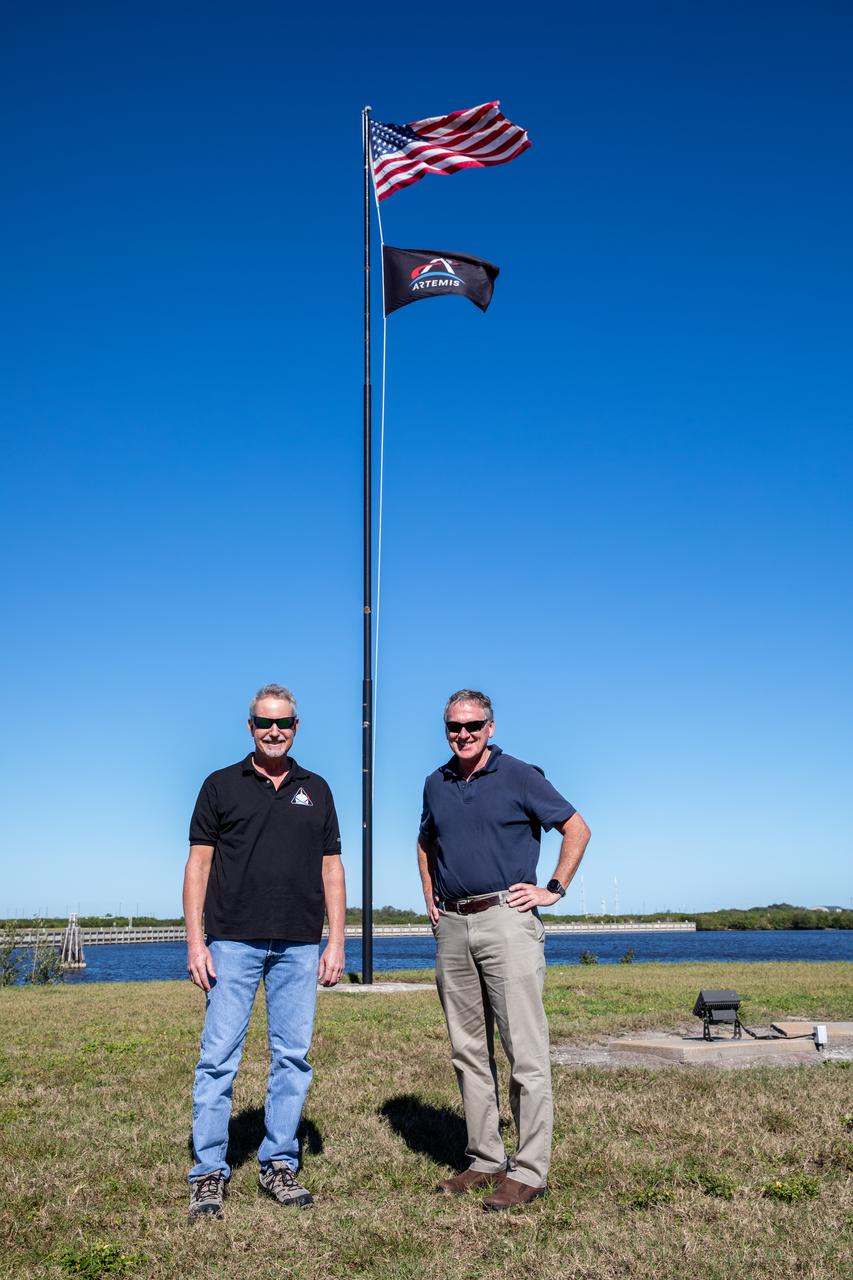
The Artemis flag is removed from NASA News Center property at the agency’s Kennedy Space Center in Florida on Jan. 6, 2023, following the successful Artemis I mission. At left is former Exploration Ground Systems (EGS) Senior Technical Integration Manager Phil Weber, joined by former EGS Manager Mike Bolger. Both men served in their respective roles during Artemis I, retiring at the end of 2022. NASA’s Space Launch System (SLS) rocket and Orion spacecraft lifted off from Kennedy’s Launch Complex 39B on Nov. 16, 2022. Orion splashed down in the Pacific Ocean on Dec. 11 and arrived back at Kennedy on Dec. 30. Artemis I sets the stage for the next mission of SLS and Orion to fly crew around the Moon on Artemis II.
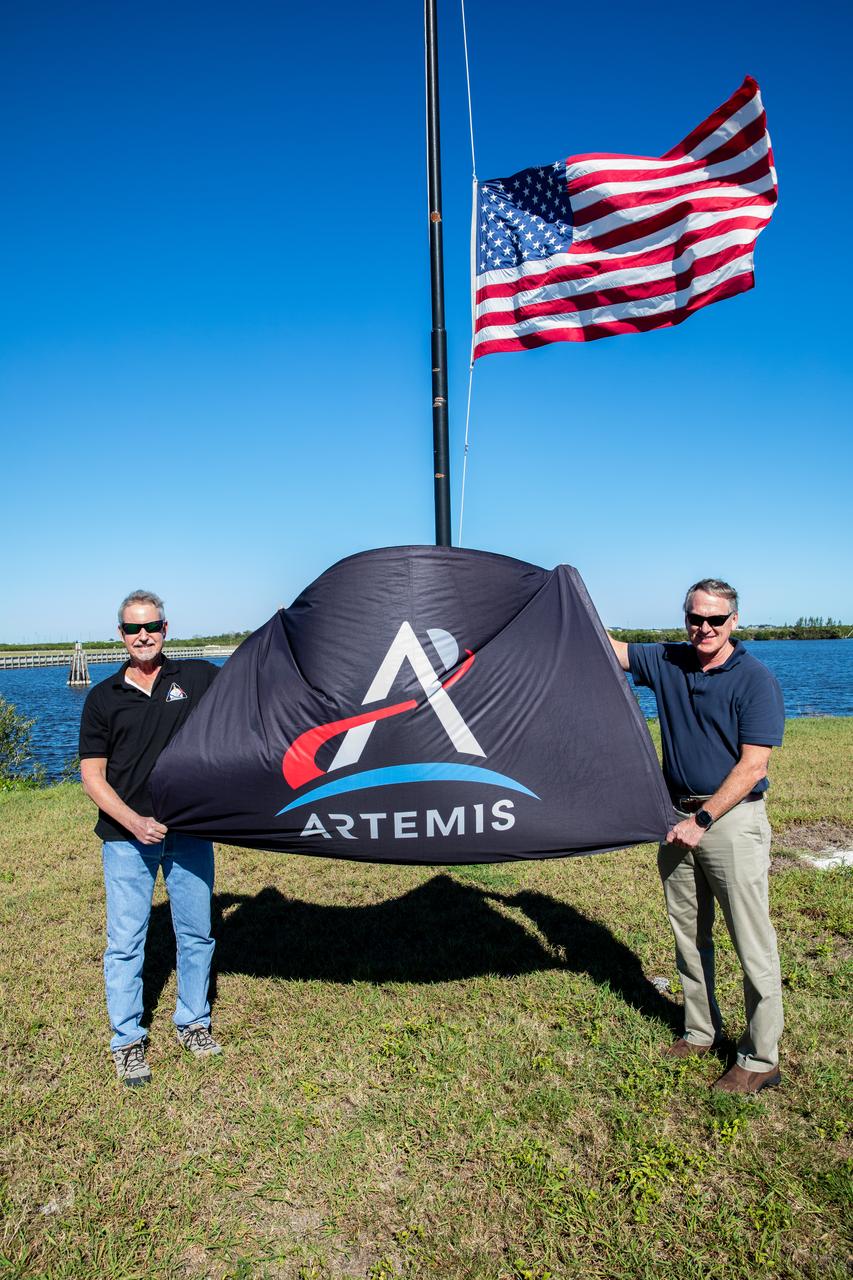
The Artemis flag is removed from NASA News Center property at the agency’s Kennedy Space Center in Florida on Jan. 6, 2023, following the successful Artemis I mission. At left is former Exploration Ground Systems (EGS) Senior Technical Integration Manager Phil Weber, joined by former EGS Manager Mike Bolger. Both men served in their respective roles during Artemis I, retiring at the end of 2022. NASA’s Space Launch System (SLS) rocket and Orion spacecraft lifted off from Kennedy’s Launch Complex 39B on Nov. 16, 2022. Orion splashed down in the Pacific Ocean on Dec. 11 and arrived back at Kennedy on Dec. 30. Artemis I sets the stage for the next mission of SLS and Orion to fly crew around the Moon on Artemis II.
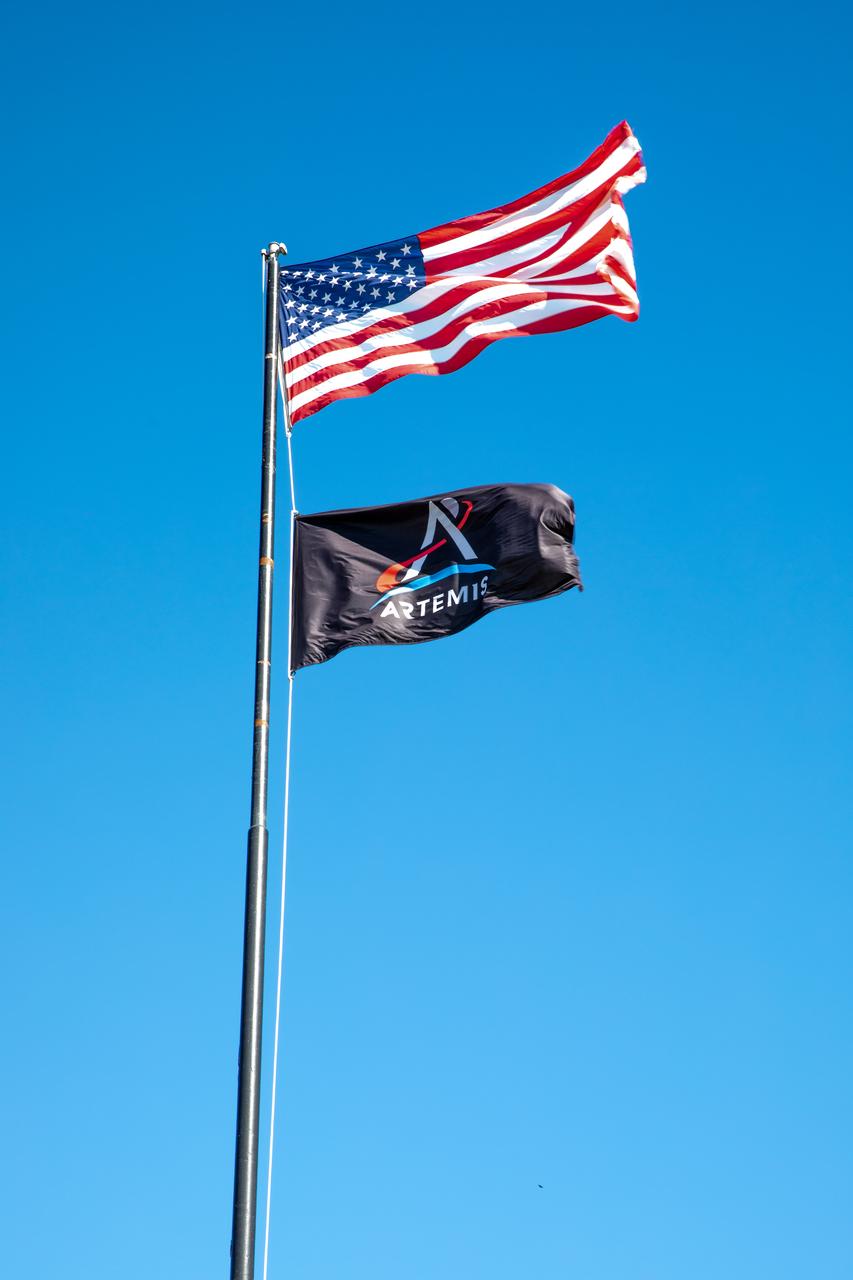
The Artemis flag is removed from NASA News Center property at the agency’s Kennedy Space Center in Florida on Jan. 6, 2023, following the successful Artemis I mission. At left is former Exploration Ground Systems (EGS) Senior Technical Integration Manager Phil Weber, joined by former EGS Manager Mike Bolger. Both men served in their respective roles during Artemis I, retiring at the end of 2022. NASA’s Space Launch System (SLS) rocket and Orion spacecraft lifted off from Kennedy’s Launch Complex 39B on Nov. 16, 2022. Orion splashed down in the Pacific Ocean on Dec. 11 and arrived back at Kennedy on Dec. 30. Artemis I sets the stage for the next mission of SLS and Orion to fly crew around the Moon on Artemis II.
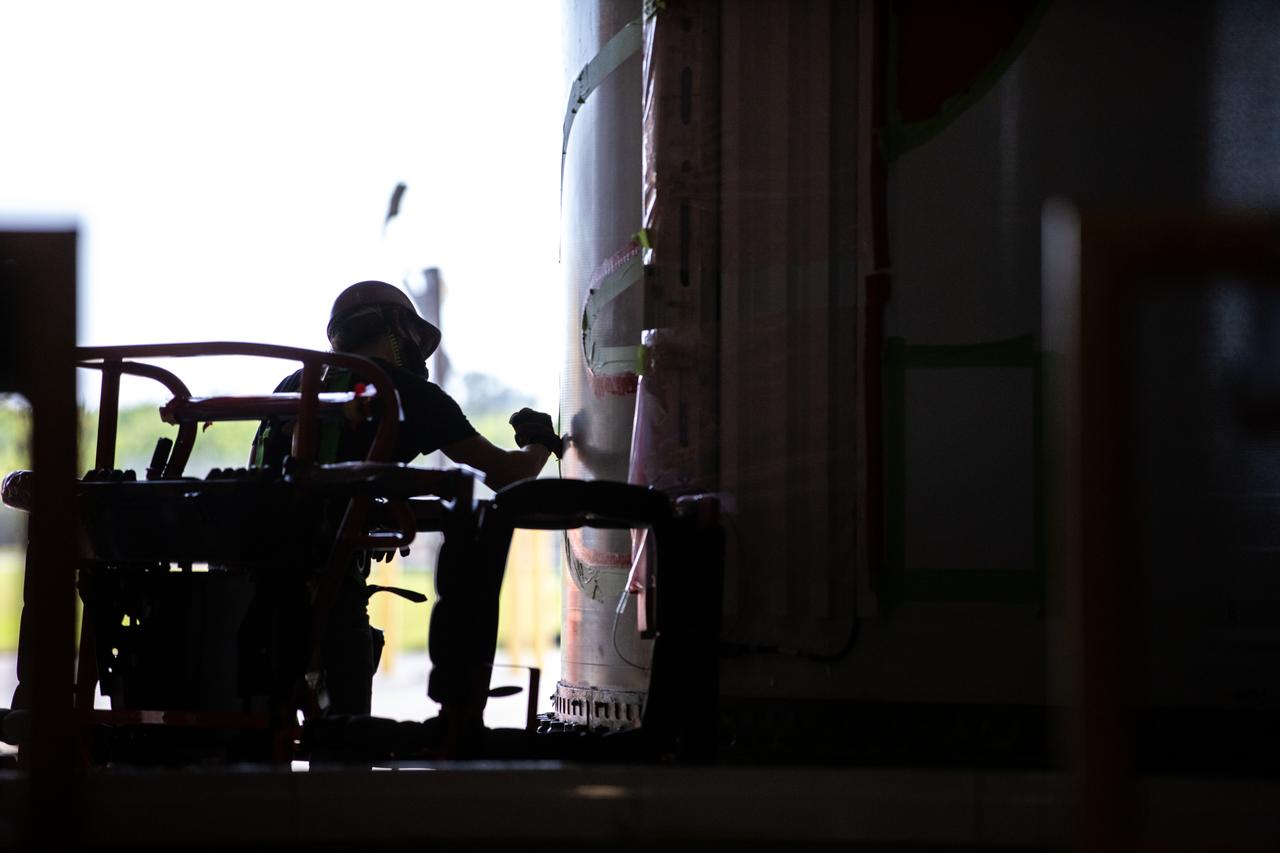
Silhouetted against the bright Florida sunlight outside, a worker with NASA’s Exploration Ground Systems (EGS) applies bright red paint to the agency’s “worm” logo taking shape on the side of an Artemis I solid rocket booster segment inside the Rotation, Processing and Surge Facility (RPSF) at Kennedy Space Center. The EGS team used a laser projector to mask off the logo with tape, then painted the first coat of the iconic design. The booster segments will help propel the Space Launch System (SLS) rocket on Artemis I, a test of the Orion spacecraft and SLS as an integrated system ahead of crewed flights to the Moon. Northrop Grumman, which built the booster segments, is covering the cost of the painting.
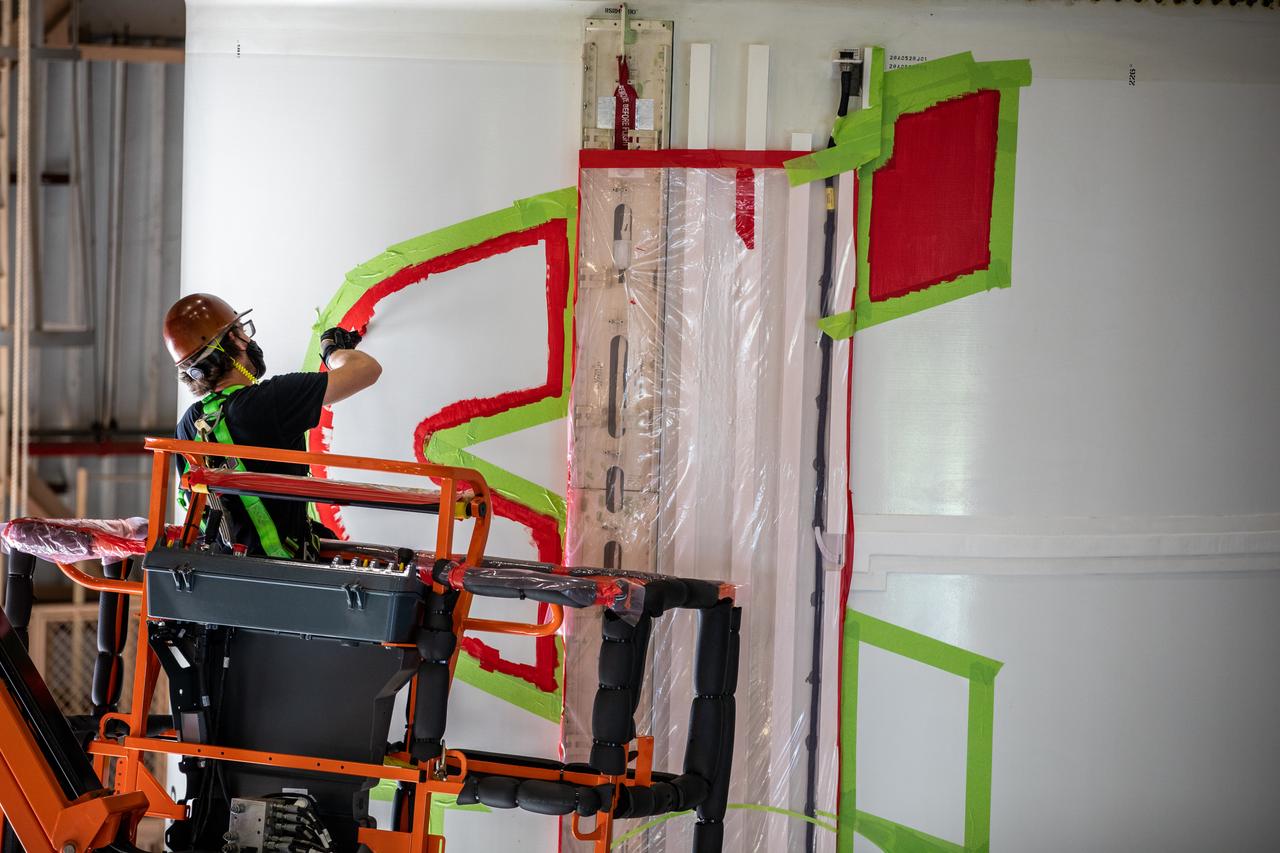
A worker with NASA’s Exploration Ground Systems (EGS) applies bright red paint to the agency’s “worm” logo taking shape on the side of an Artemis I solid rocket booster segment inside the Rotation, Processing and Surge Facility (RPSF) at Kennedy Space Center in Florida. The EGS team used a laser projector to mask off the logo with tape, then painted the first coat of the iconic design. The booster segments will help propel the Space Launch System (SLS) rocket on Artemis I, a test of the Orion spacecraft and SLS as an integrated system ahead of crewed flights to the Moon. Northrop Grumman, which built the booster segments, is covering the cost of the painting.
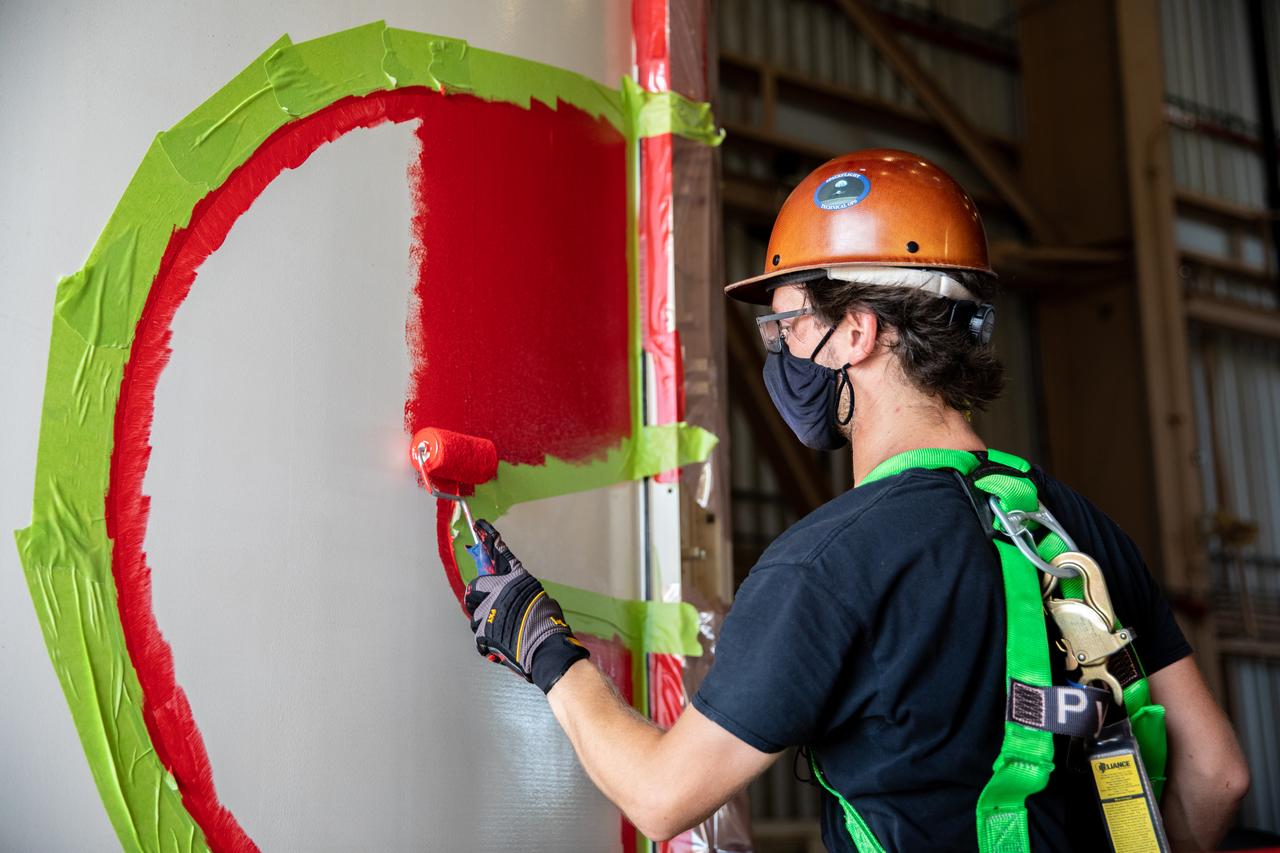
A worker with NASA’s Exploration Ground Systems (EGS) finishes the first coat of the bright red “worm” logo taking shape on the side of an Artemis I solid rocket booster segment inside the Rotation, Processing and Surge Facility (RPSF) at Kennedy Space Center in Florida. The EGS team used a laser projector to mask off the logo with tape, then painted the first coat of the iconic design. The booster segments will help propel the Space Launch System (SLS) rocket on Artemis I, a test of the Orion spacecraft and SLS as an integrated system ahead of crewed flights to the Moon. Northrop Grumman, which built the booster segments, is covering the cost of the painting.
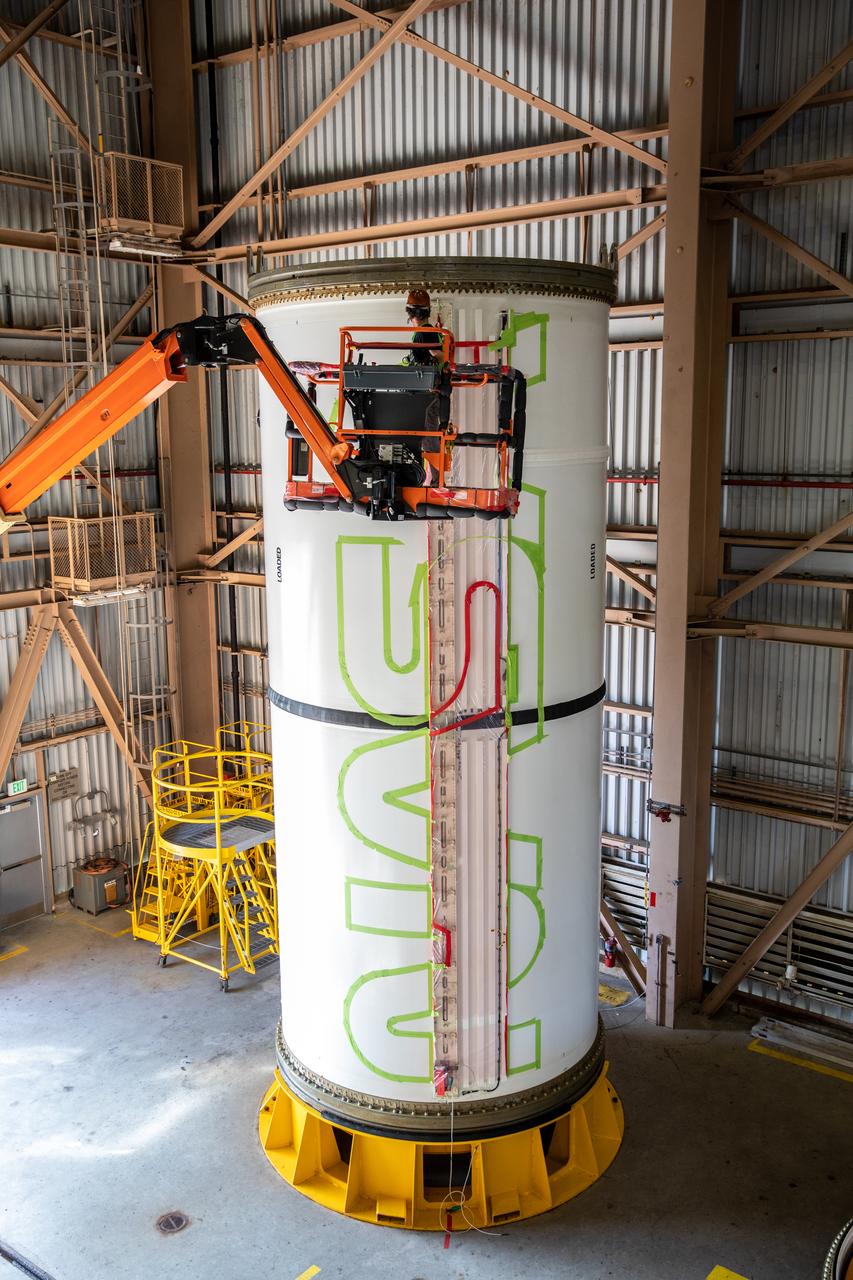
A worker with NASA’s Exploration Ground Systems (EGS) applies bright red paint to the agency’s “worm” logo taking shape on the side of an Artemis I solid rocket booster segment inside the Rotation, Processing and Surge Facility (RPSF) at Kennedy Space Center in Florida. The EGS team used a laser projector to mask off the logo with tape, then painted the first coat of the iconic design. The booster segments will help propel the Space Launch System (SLS) rocket on Artemis I, a test of the Orion spacecraft and SLS as an integrated system ahead of crewed flights to the Moon. Northrop Grumman, which built the booster segments, is covering the cost of the painting.
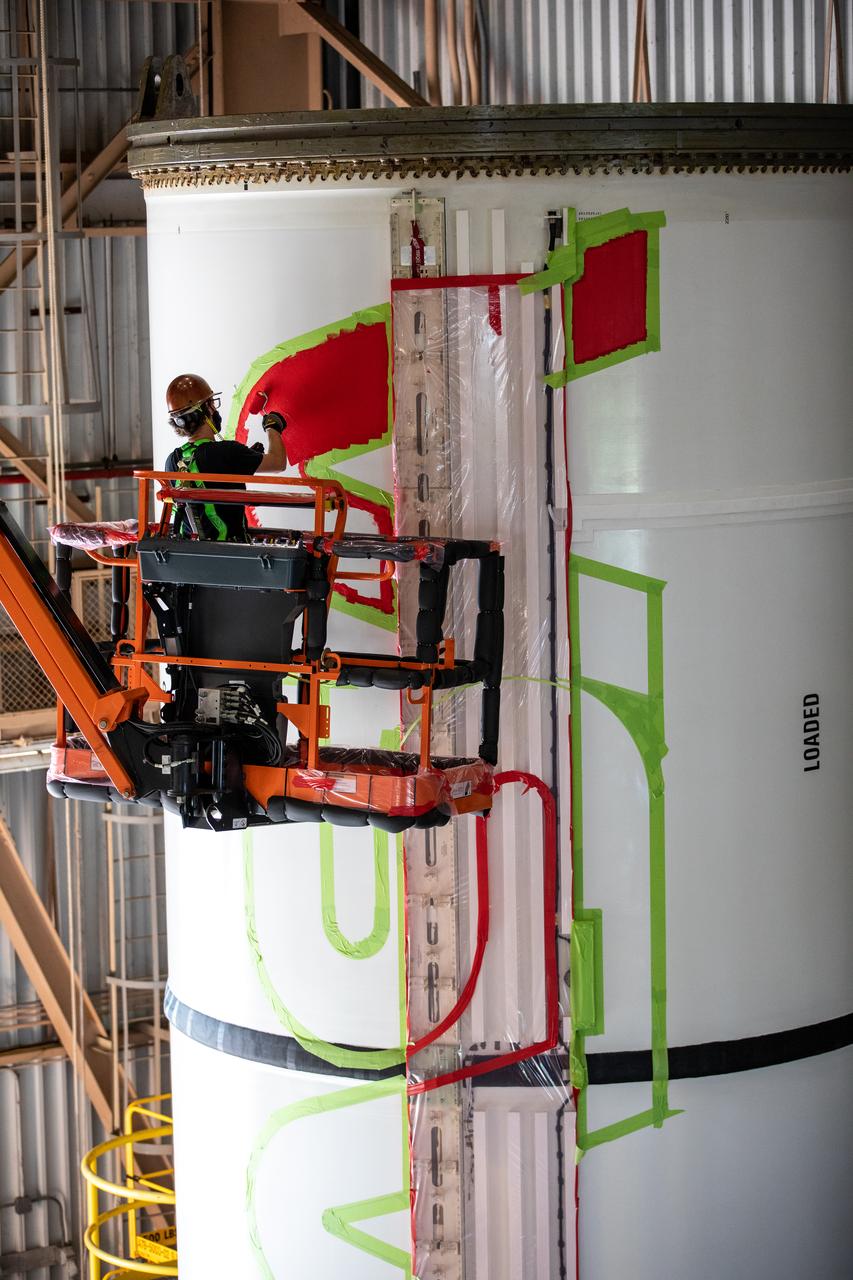
A worker with NASA’s Exploration Ground Systems (EGS) applies bright red paint to the agency’s “worm” logo taking shape on the side of an Artemis I solid rocket booster segment inside the Rotation, Processing and Surge Facility (RPSF) at Kennedy Space Center in Florida. The EGS team used a laser projector to mask off the logo with tape, then painted the first coat of the iconic design. The booster segments will help propel the Space Launch System (SLS) rocket on Artemis I, a test of the Orion spacecraft and SLS as an integrated system ahead of crewed flights to the Moon. Northrop Grumman, which built the booster segments, is covering the cost of the painting.
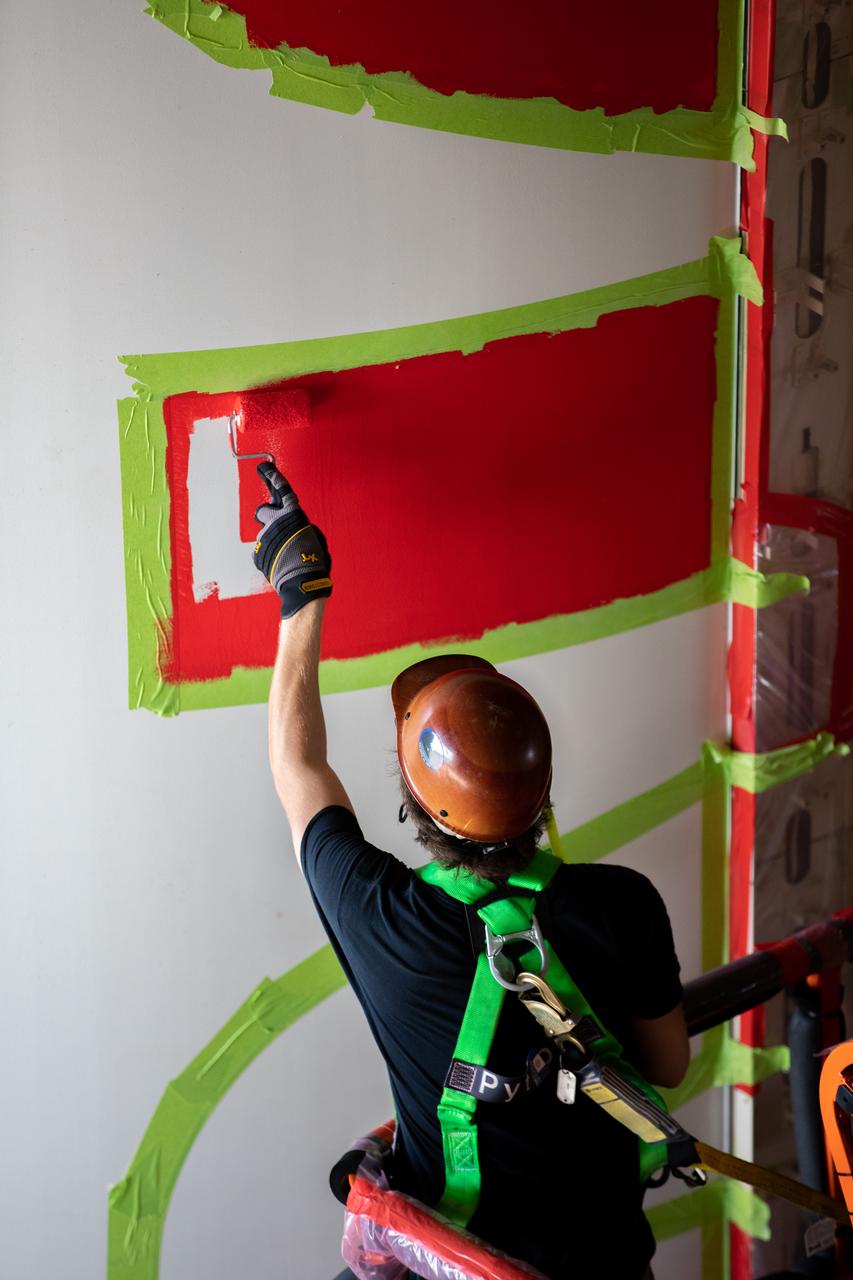
A worker with NASA’s Exploration Ground Systems (EGS) applies bright red paint to the agency’s “worm” logo taking shape on the side of an Artemis I solid rocket booster segment inside the Rotation, Processing and Surge Facility (RPSF) at Kennedy Space Center in Florida. The EGS team used a laser projector to mask off the logo with tape, then painted the first coat of the iconic design. The booster segments will help propel the Space Launch System (SLS) rocket on Artemis I, a test of the Orion spacecraft and SLS as an integrated system ahead of crewed flights to the Moon. Northrop Grumman, which built the booster segments, is covering the cost of the painting.
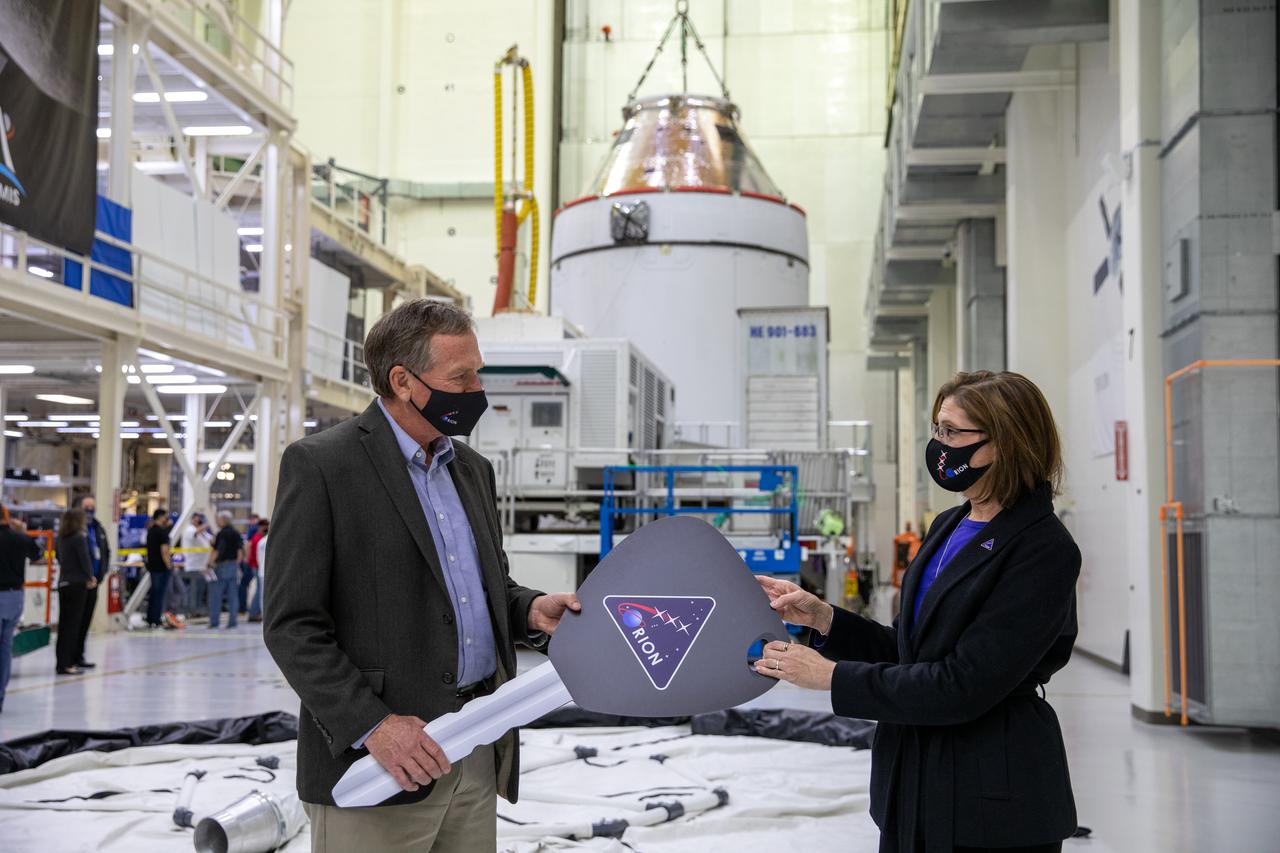
Orion is revealed for one of the final times on Jan. 14, as it is readied atop its transport pallet from the Neil Armstrong Operations and Checkout Building at NASA’s Kennedy Space Center in Florida, along its path to the pad ahead of the Artemis I launch. Mike Bolger, at left, manager of Exploration Ground Systems (EGS), receives the “key” to Orion from Cathy Koerner, Orion Program manager signifying the transfer of the spacecraft from the assembly to the ground system processing team. Teams across the globe have worked tirelessly to assemble the spacecraft, which will receive a protective covering prior to departing for the Multi-Payload Processing Facility to begin ground processing by the EGS and Jacobs teams.
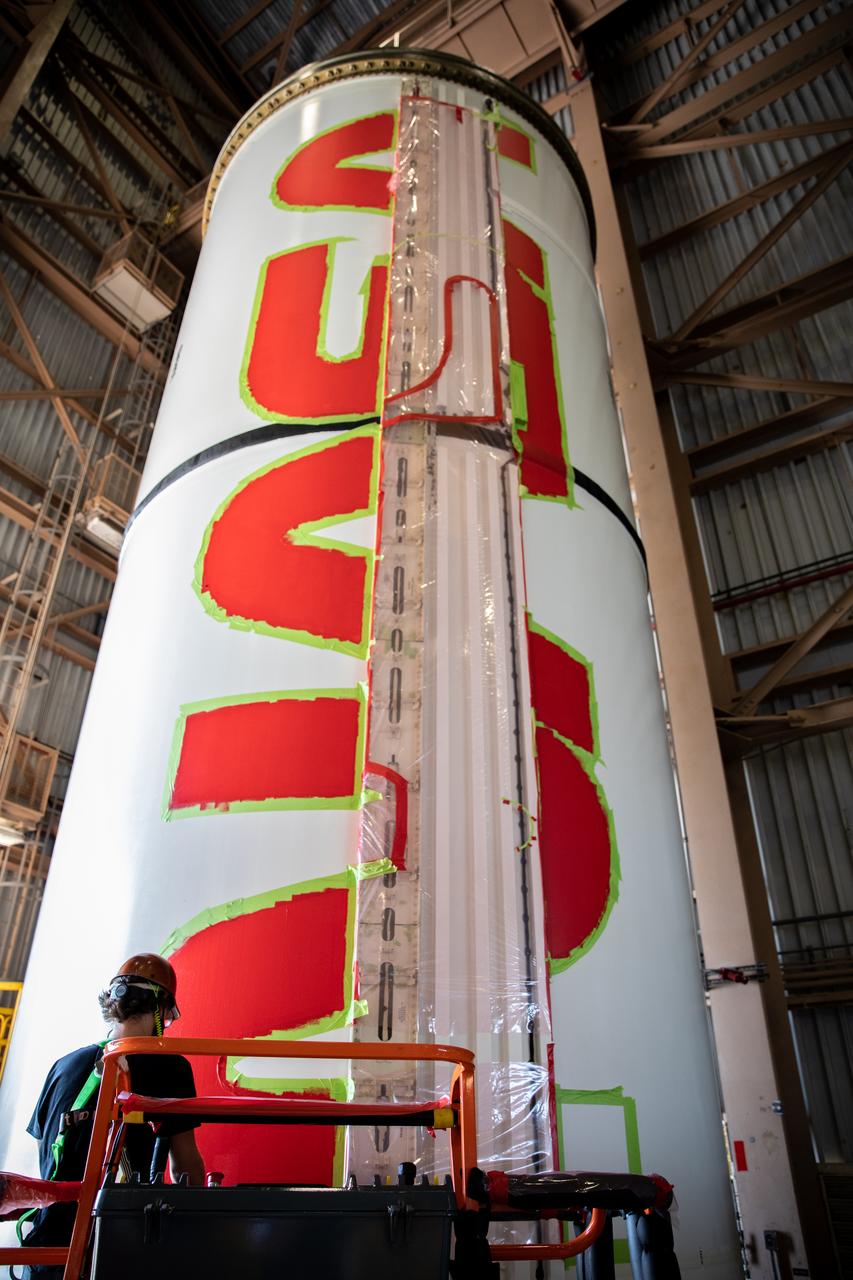
A worker with NASA’s Exploration Ground Systems (EGS) finishes the first coat of the bright red “worm” logo taking shape on the side of an Artemis I solid rocket booster segment inside the Rotation, Processing and Surge Facility (RPSF) at Kennedy Space Center in Florida. The EGS team used a laser projector to mask off the logo with tape, then painted the first coat of the iconic design. The booster segments will help propel the Space Launch System (SLS) rocket on Artemis I, a test of the Orion spacecraft and SLS as an integrated system ahead of crewed flights to the Moon. Northrop Grumman, which built the booster segments, is covering the cost of the painting.
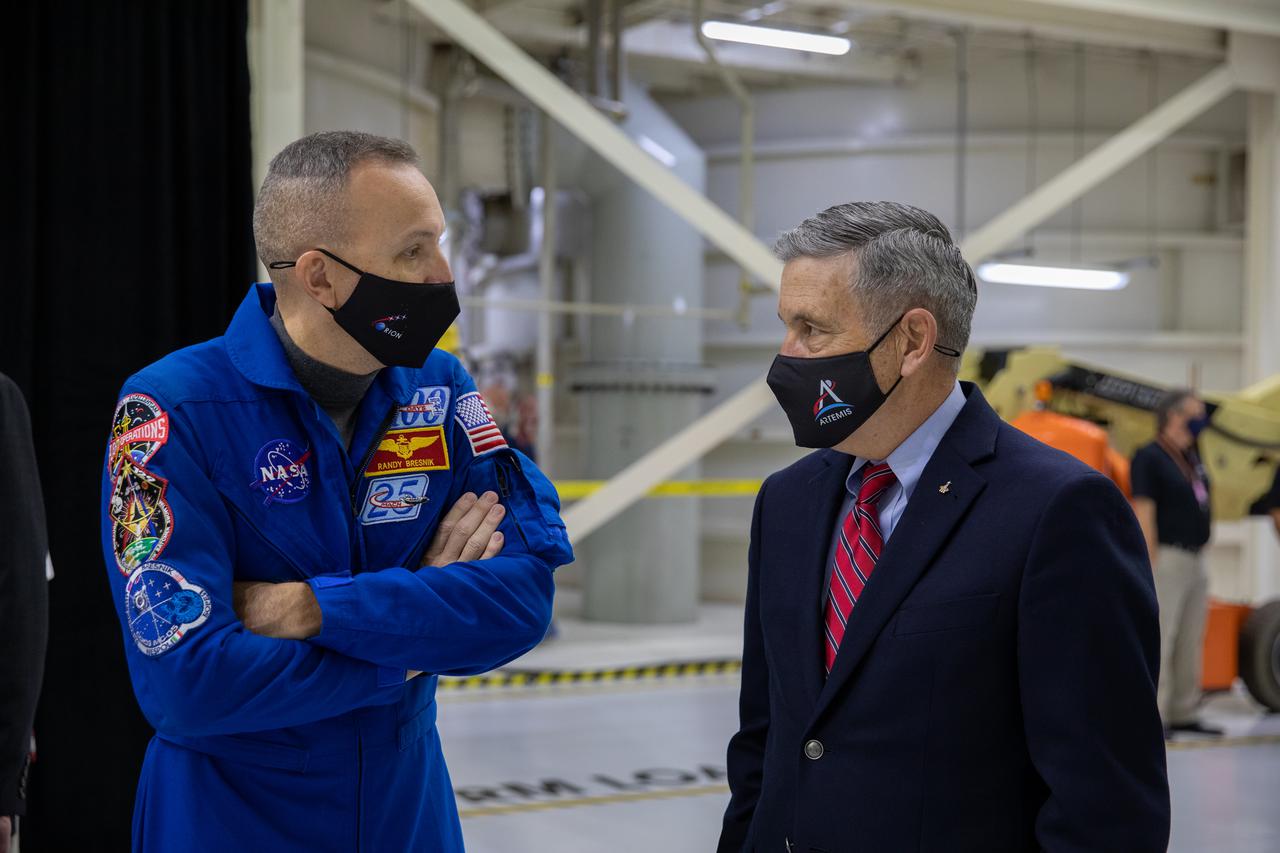
Orion is revealed for one of the final times on Jan. 14, as it is readied atop its transport pallet from the Neil Armstrong Operations and Checkout Building at NASA’s Kennedy Space Center in Florida, along its path to the pad ahead of the Artemis I launch. Orion was officially transferred from the Orion Program to Exploration Ground Systems (EGS) during a handover ceremony. NASA astronaut Randy Bresnik speaks with Kennedy Center Director Bob Cabana inside the high bay. Teams across the globe have worked tirelessly to assemble the spacecraft, which will receive a protective covering prior to departing for the Multi-Payload Processing Facility to begin ground processing by the EGS and Jacobs teams.
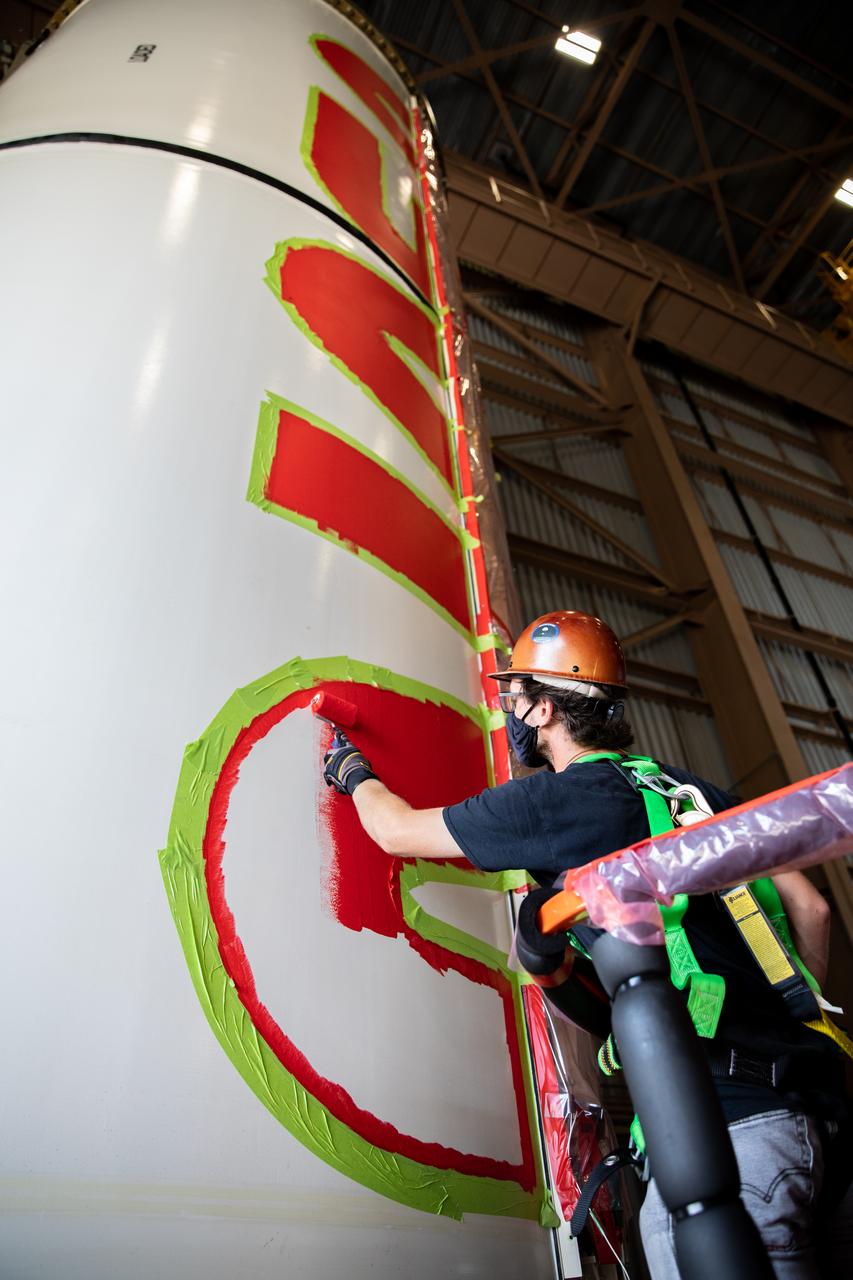
A worker with NASA’s Exploration Ground Systems (EGS) finishes the first coat of the bright red “worm” logo taking shape on the side of an Artemis I solid rocket booster segment inside the Rotation, Processing and Surge Facility (RPSF) at Kennedy Space Center in Florida. The EGS team used a laser projector to mask off the logo with tape, then painted the first coat of the iconic design. The booster segments will help propel the Space Launch System (SLS) rocket on Artemis I, a test of the Orion spacecraft and SLS as an integrated system ahead of crewed flights to the Moon. Northrop Grumman, which built the booster segments, is covering the cost of the painting.
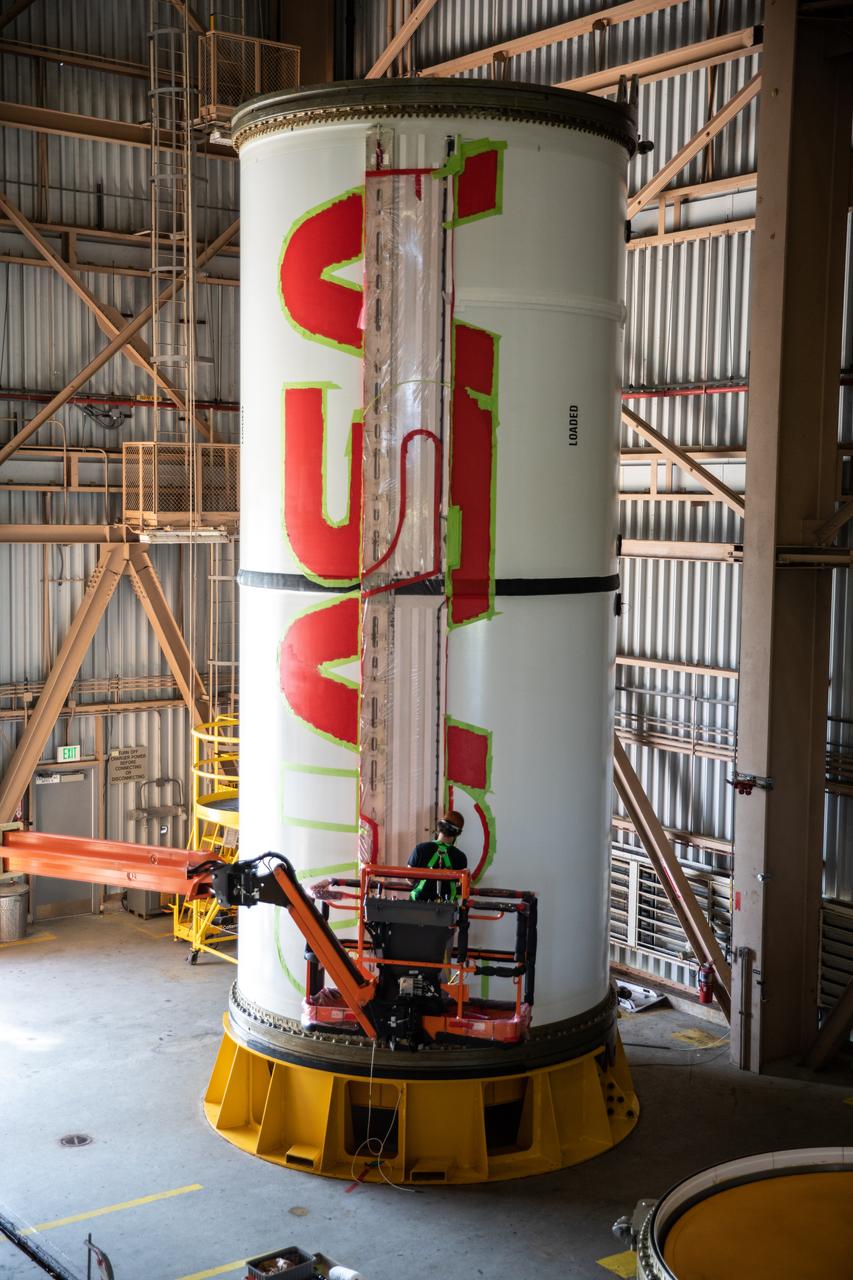
A worker with NASA’s Exploration Ground Systems (EGS) finishes the first coat of the bright red “worm” logo taking shape on the side of an Artemis I solid rocket booster segment inside the Rotation, Processing and Surge Facility (RPSF) at Kennedy Space Center in Florida. The EGS team used a laser projector to mask off the logo with tape, then painted the first coat of the iconic design. The booster segments will help propel the Space Launch System (SLS) rocket on Artemis I, a test of the Orion spacecraft and SLS as an integrated system ahead of crewed flights to the Moon. Northrop Grumman, which built the booster segments, is covering the cost of the painting.
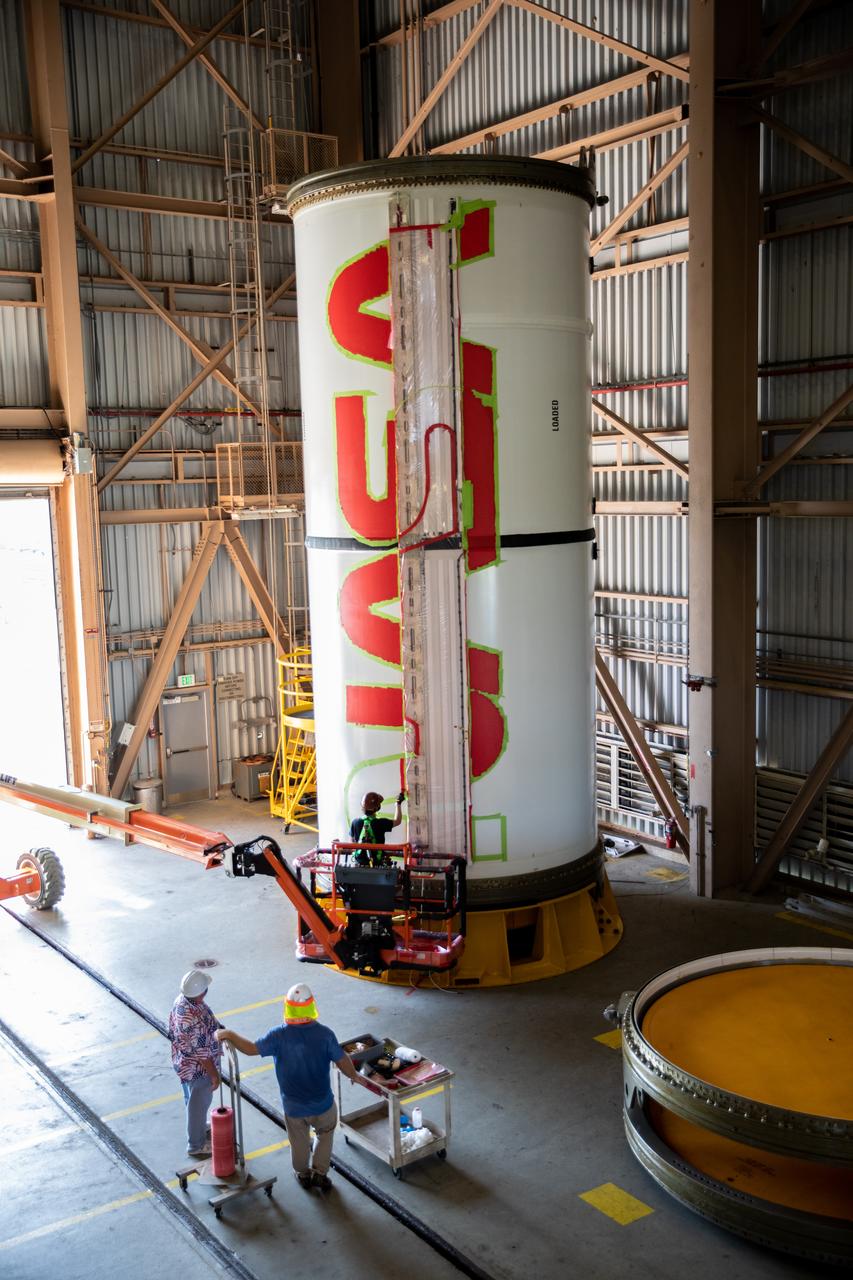
Workers with NASA’s Exploration Ground Systems (EGS) finishes the first coat of the bright red “worm” logo taking shape on the side of an Artemis I solid rocket booster segment inside the Rotation, Processing and Surge Facility (RPSF) at Kennedy Space Center in Florida. The EGS team used a laser projector to mask off the logo with tape, then painted the first coat of the iconic design. The booster segments will help propel the Space Launch System (SLS) rocket on Artemis I, a test of the Orion spacecraft and SLS as an integrated system ahead of crewed flights to the Moon. Northrop Grumman, which built the booster segments, is covering the cost of the painting.
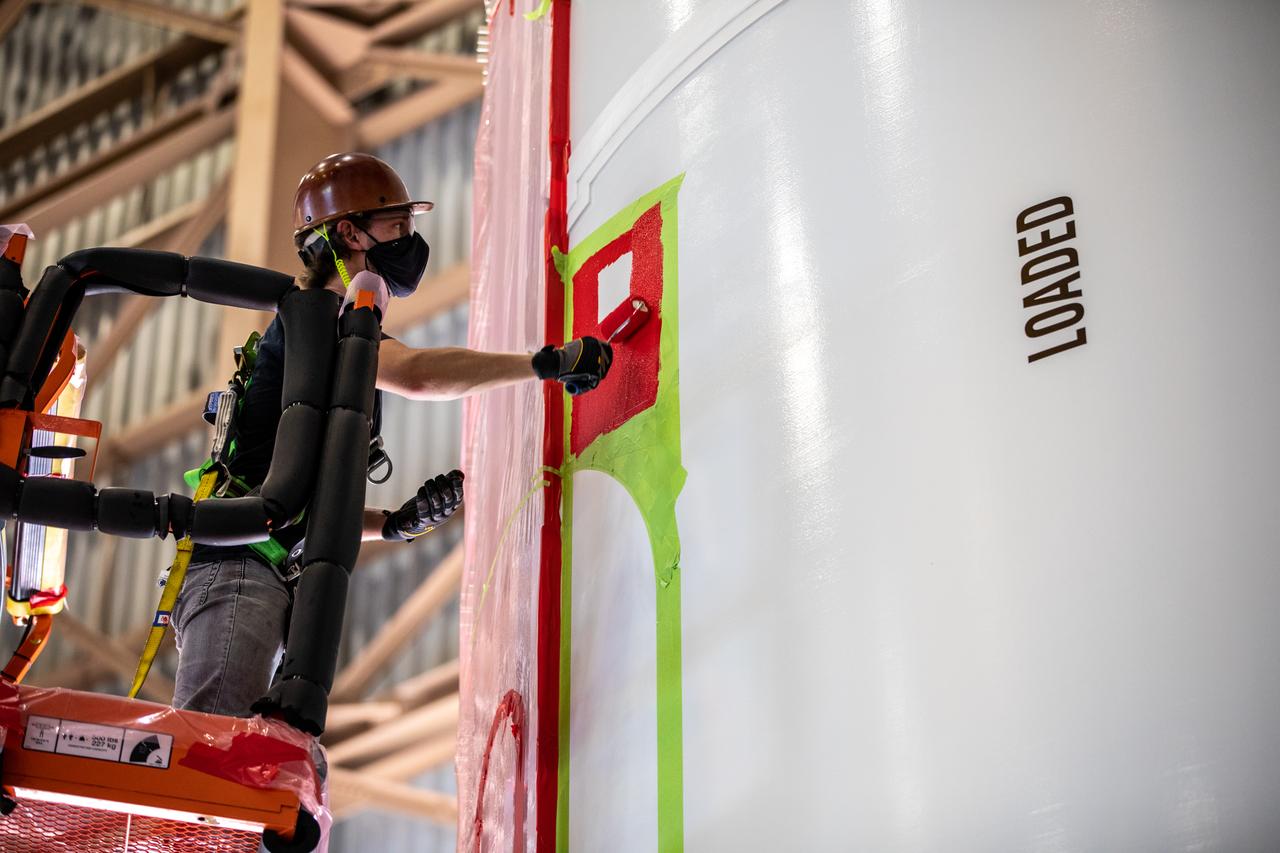
A worker with NASA’s Exploration Ground Systems (EGS) applies bright red paint to the agency’s “worm” logo taking shape on the side of an Artemis I solid rocket booster segment inside the Rotation, Processing and Surge Facility (RPSF) at Kennedy Space Center in Florida. The EGS team used a laser projector to mask off the logo with tape, then painted the first coat of the iconic design. The booster segments will help propel the Space Launch System (SLS) rocket on Artemis I, a test of the Orion spacecraft and SLS as an integrated system ahead of crewed flights to the Moon. Northrop Grumman, which built the booster segments, is covering the cost of the painting.
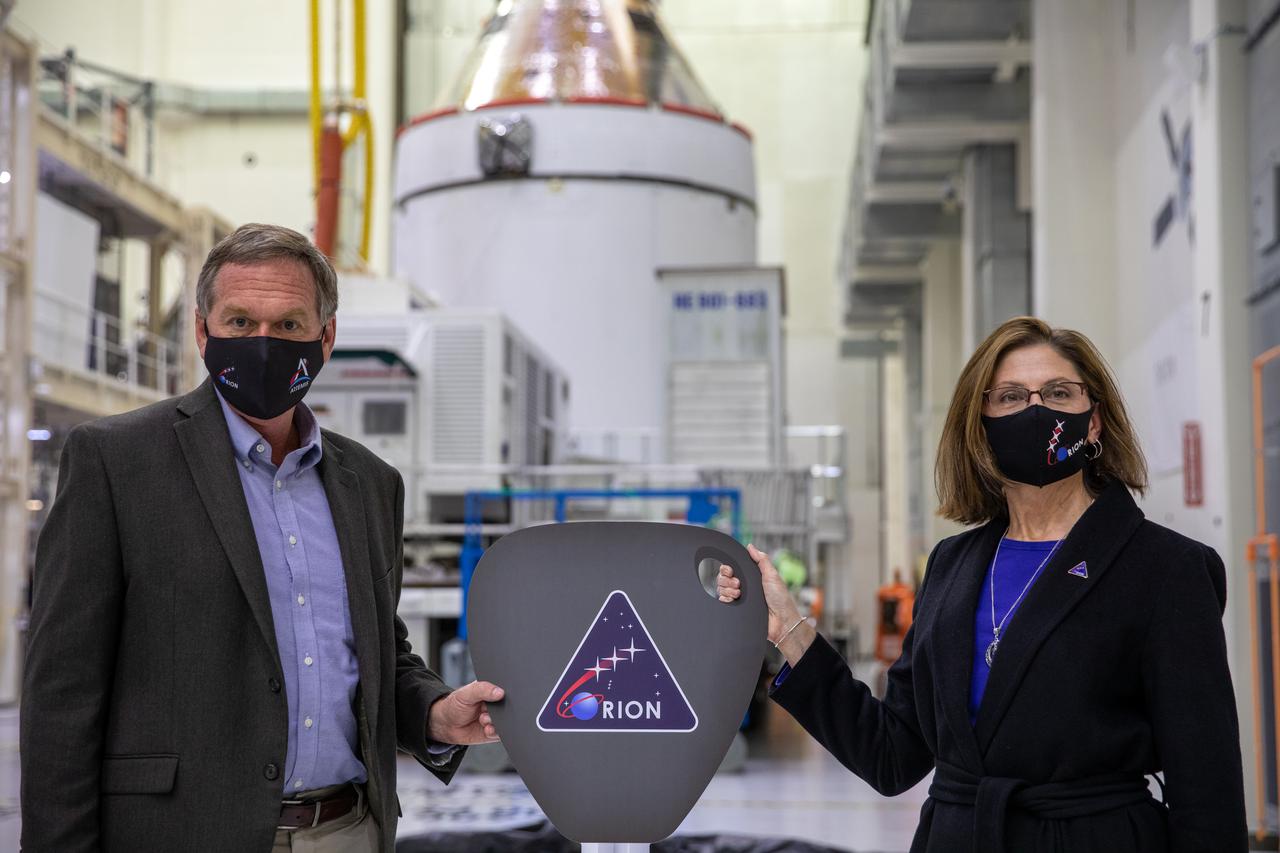
Orion is revealed for one of the final times on Jan. 14, as it is readied atop its transport pallet from the Neil Armstrong Operations and Checkout Building at NASA’s Kennedy Space Center in Florida, along its path to the pad ahead of the Artemis I launch. Mike Bolger, at left, manager of Exploration Ground Systems (EGS), receives the “key” to Orion from Cathy Koerner, Orion Program manager, signifying the transfer of the spacecraft from the assembly to the ground system processing team. Teams across the globe have worked tirelessly to assemble the spacecraft, which will receive a protective covering prior to departing for the Multi-Payload Processing Facility to begin ground processing by the EGS and Jacobs teams.
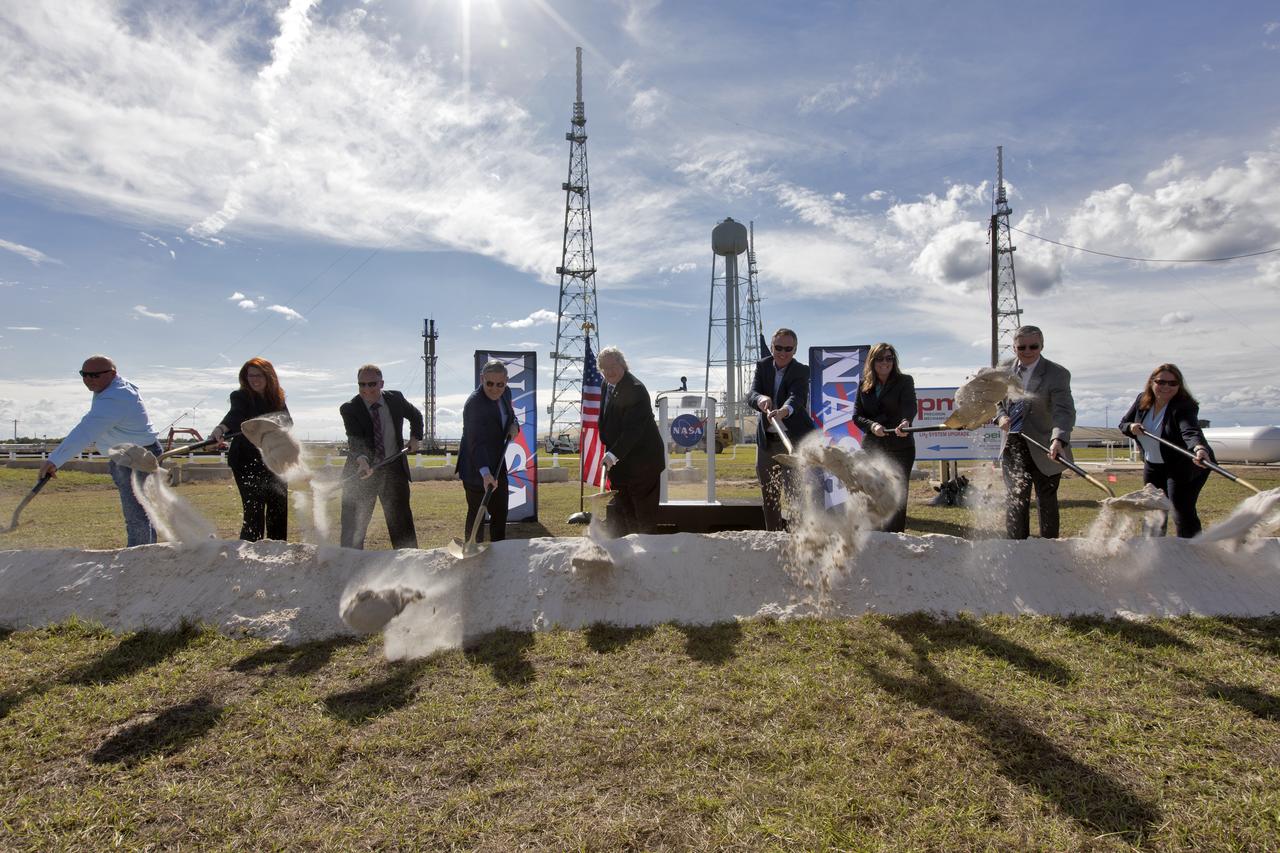
On Dec. 19, 2018, at NASA Kennedy Space Center's Launch Complex 39B, agency and contractor managers break ground for a new liquid hydrogen tank. Participating, from the left, are Todd Gray, president of Precision Mechanical, prime contractor for the project; Charlie Blackwell-Thompson, launch director; Shawn Quinn, director of Engineering; Bob Cabana, center director; Bill Hill, deputy associate administrator for Exploration Systems Development at NASA Headquarters in Washington; Mike Bolger, program manager for Exploration Ground Systems (EGS); Jennifer Kunz, deputy program manager for EGS, Andy Allen, general manager for Jacobs, NASA's Test and Operations Support Contractor; and Regina Spellman, launch pad senior project manager in EGS. The storage facility will hold 1.25 million gallons of the propellant for NASA's Space Launch System rocket designed to boost the agency's Orion spacecraft, sending humans to distant destinations such as the Moon and Mars.
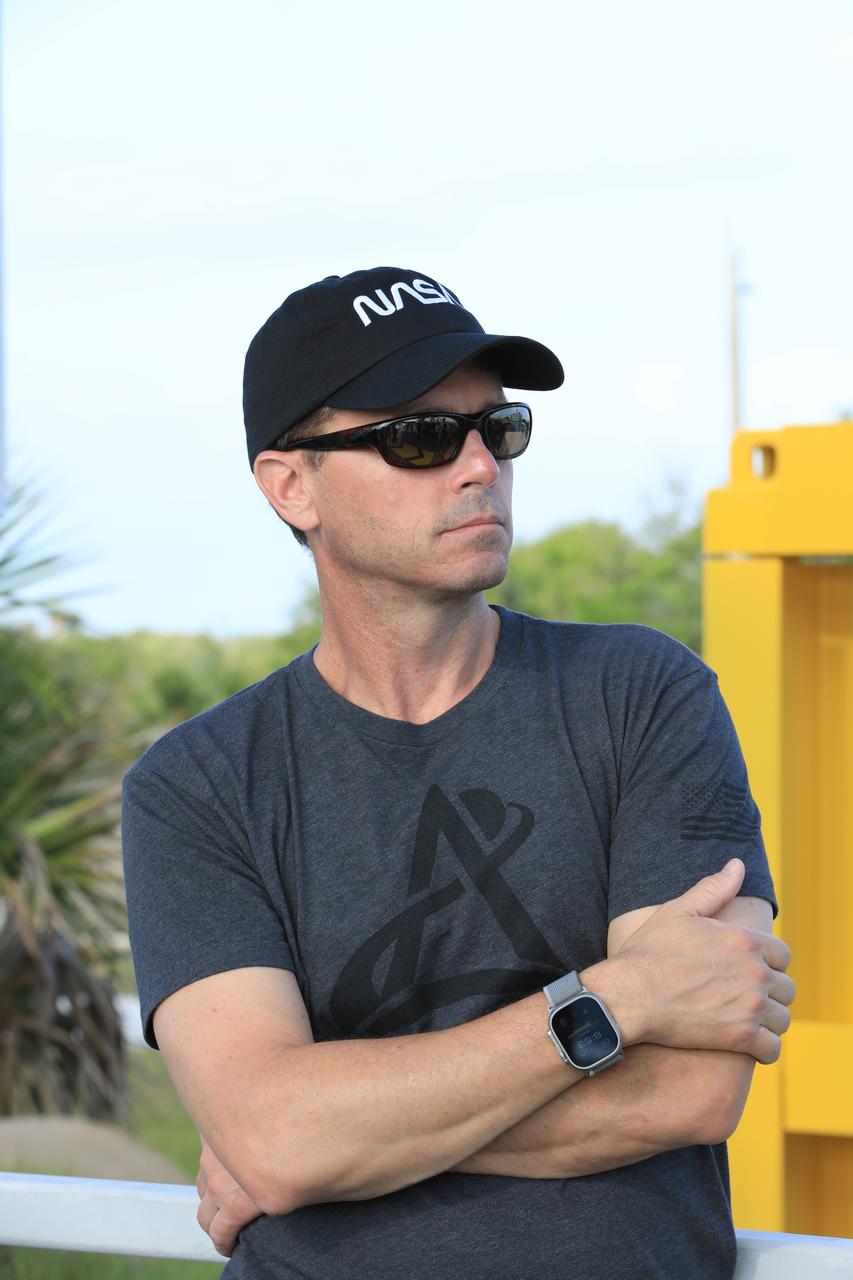
NASA astronaut Reid Wiseman participates in training with teams from NASA’s Exploration Ground Systems Program at Launch Complex 39B at the agency’s Kennedy Space Center in Florida on Tuesday, May 6, 2025. Wiseman and fellow Artemis II crew members and backup members trained with the mine-resistant ambush protected vehicles, or MRAPs, inside the launch pad area. Originally designed for military applications, the 45,000-pound MRAP offers a mobile bunker for astronauts and ground crews in the unlikely event they must get away from the launch pad quickly in an emergency.
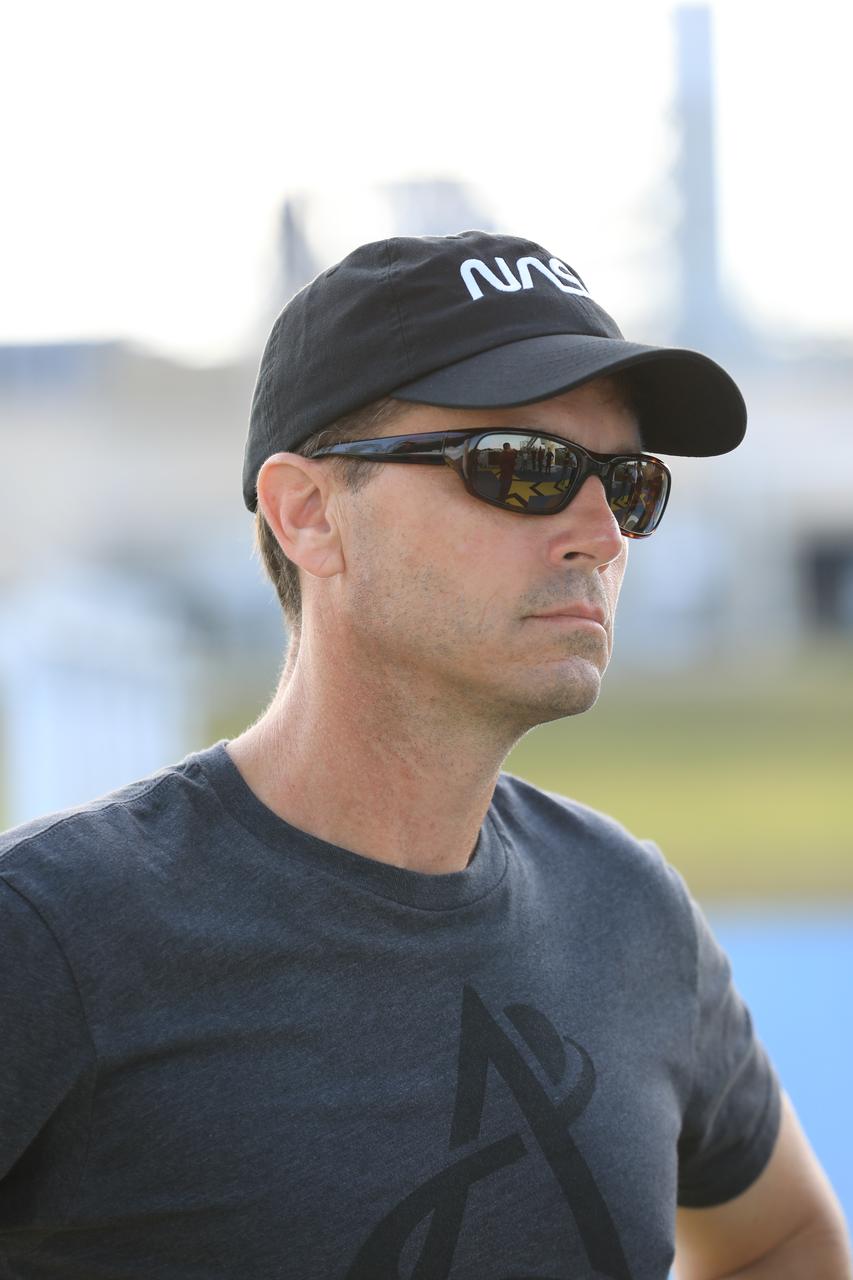
NASA astronaut Reid Wiseman participates in training with teams from NASA’s Exploration Ground Systems Program at Launch Complex 39B at the agency’s Kennedy Space Center in Florida on Tuesday, May 6, 2025. Wiseman and fellow Artemis II crew members and backup members trained with the mine-resistant ambush protected vehicles, or MRAPs, inside the launch pad area. Originally designed for military applications, the 45,000-pound MRAP offers a mobile bunker for astronauts and ground crews in the unlikely event they must get away from the launch pad quickly in an emergency.
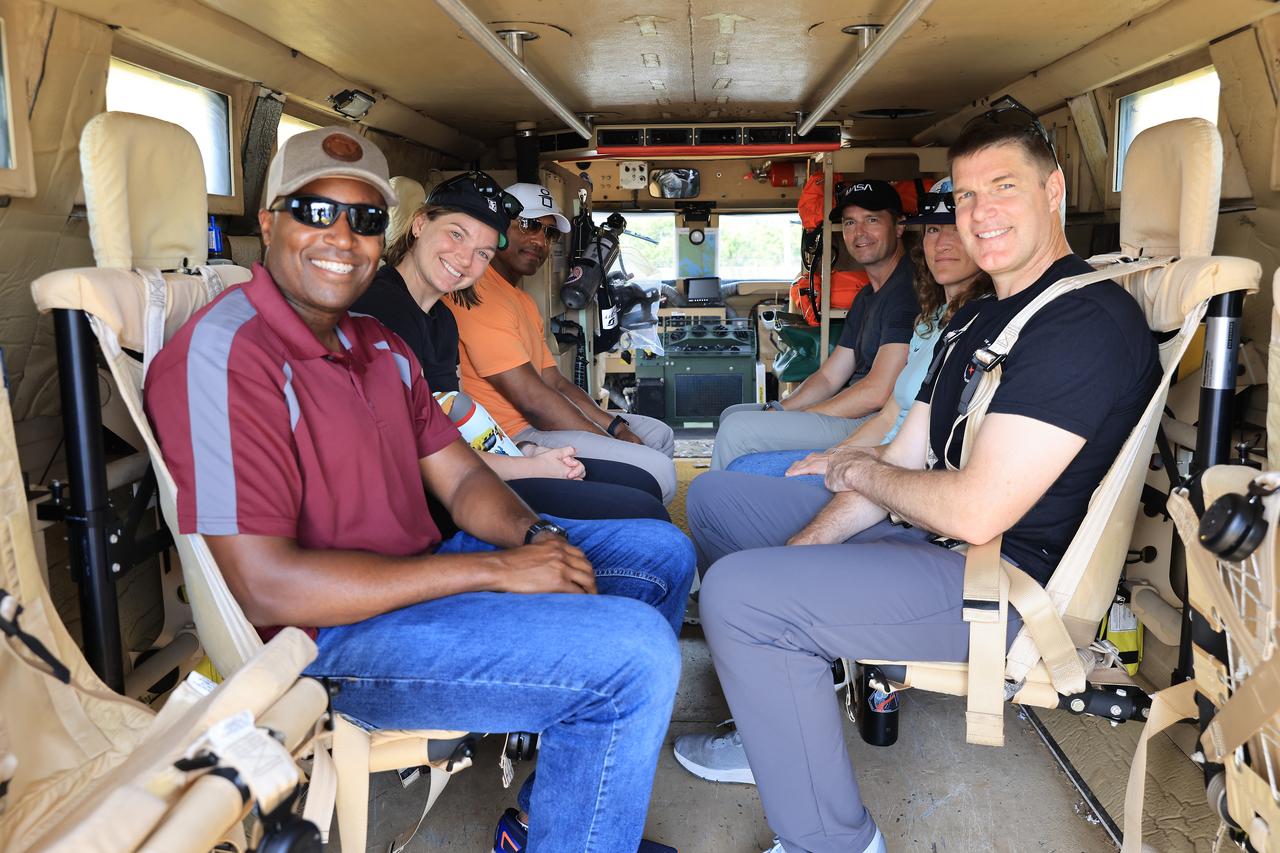
Crew members and backup members for NASA’s Artemis II mission and teams from the agency’s Exploration Ground Systems Program participate in emergency egress training at Launch Complex 39B at NASA’s Kennedy Space Center in Florida on Tuesday, May 6, 2025. From left, Andre Douglas, NASA’s Artemis II backup crew member; CSA (Canadian Space Agency) astronaut Jenni Gibbons, Artemis II backup crew member; NASA astronaut Victor Glover, Artemis II pilot; NASA astronaut Reid Wiseman, Artemis II commander; NASA astronaut Christina Koch, Artemis II mission specialist; and CSA astronaut Jeremy Hansen, Artemis II mission specialist sit in the back of a mine-resistant ambush protected vehicle, or MRAP. Originally designed for military applications, the 45,000-pound MRAP offers a mobile bunker for astronauts and ground crews in the unlikely event they must get away from the launch pad quickly in an emergency.
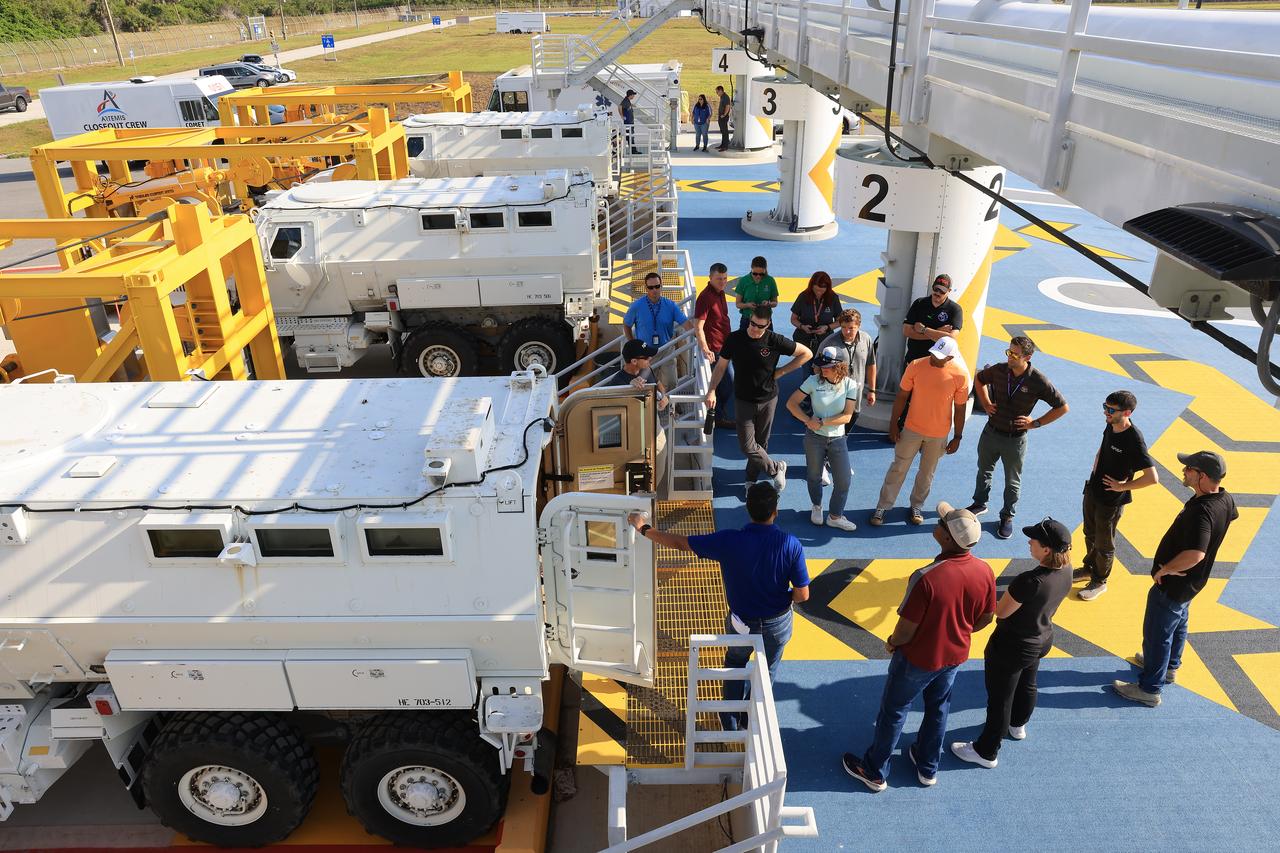
Crew members and backup members for NASA’s Artemis II mission and teams from the agency’s Exploration Ground Systems Program participate in emergency egress training at Launch Complex 39B at NASA’s Kennedy Space Center in Florida on Tuesday, May 6, 2025. Teams trained with the mine-resistant ambush protected vehicles, or MRAPs, inside the launch pad terminus area, where the emergency egress baskets carrying the astronauts and flight crew will arrive following their safe exit from the mobile launcher. Originally designed for military applications, the 45,000-pound MRAP offers a mobile bunker for astronauts and ground crews in the unlikely event they must get away from the launch pad quickly in an emergency.
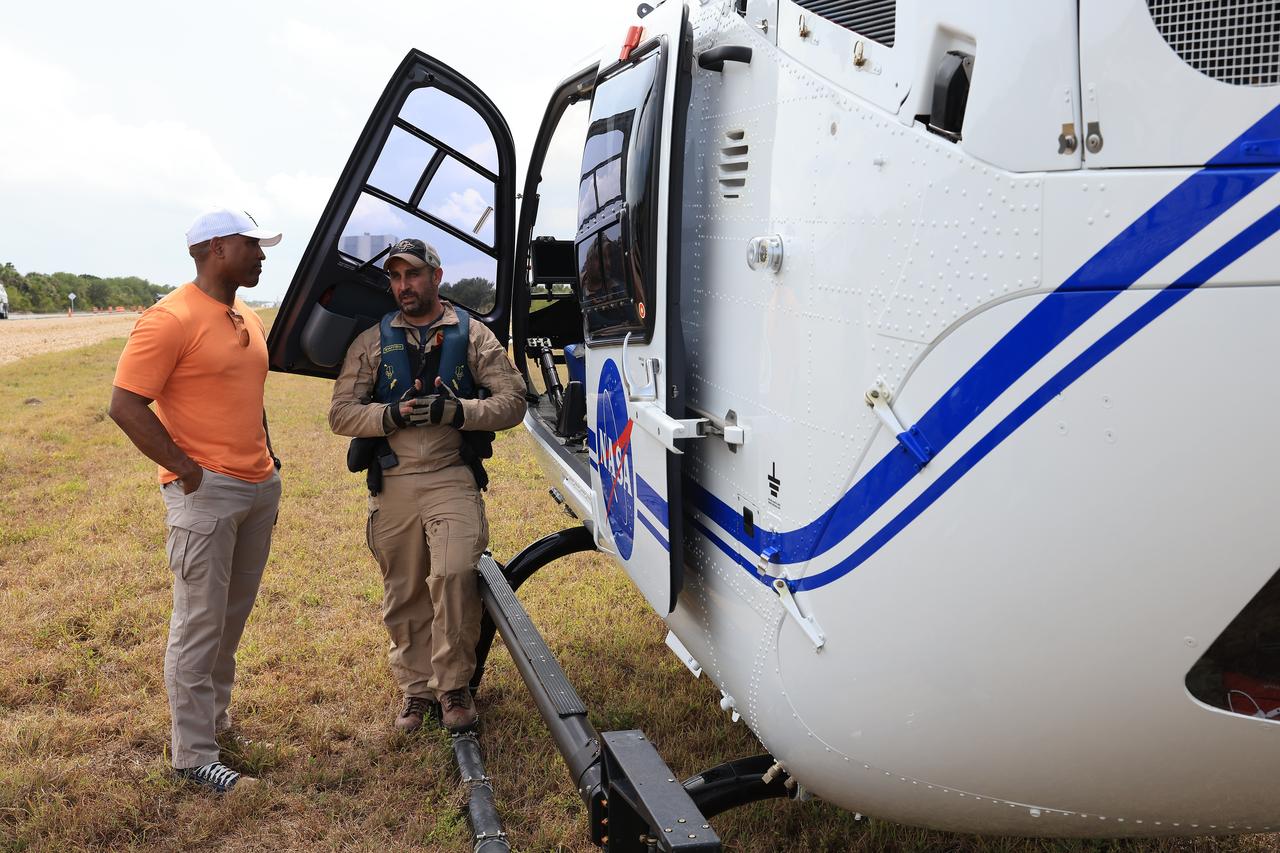
NASA astronaut Victor Glover (left) participates in emergency egress training with medical and fire-rescue personnel and teams near Launch Complex 39B at the agency’s Kennedy Space Center in Florida on Tuesday, May 6, 2025. During the training, Glover and fellow Artemis II crew members and backup members, along with members of the closeout crew, pad rescue team, and NASA’s Exploration Ground Systems Program practiced procedures in the event of an emergency at the launch pad.
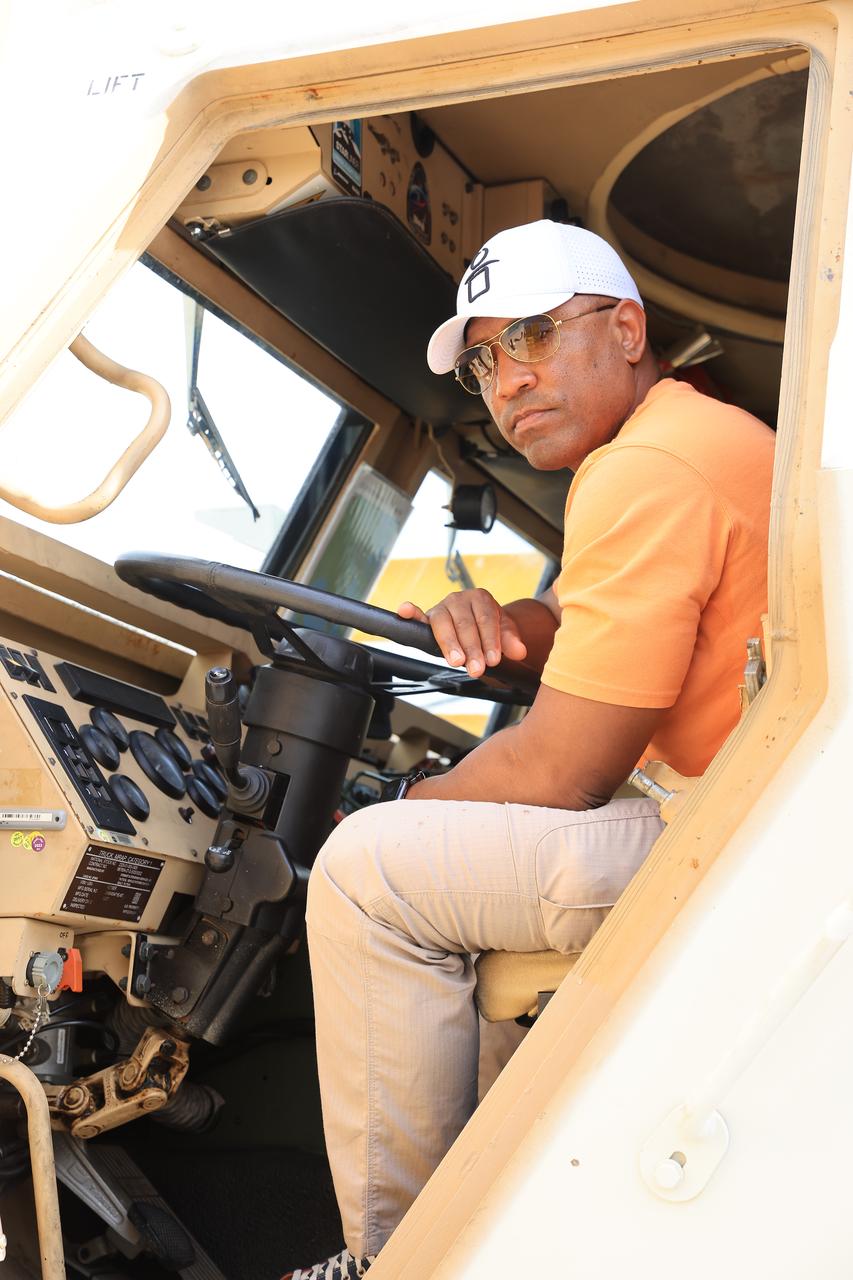
NASA astronaut Victor Glover participates in emergency egress training with teams from NASA’s Exploration Ground Systems Program at Launch Complex 39B at the agency’s Kennedy Space Center in Florida on Tuesday, May 6, 2025. Glover and fellow Artemis II crew members and backup members trained with the mine-resistant ambush protected vehicles, or MRAPs, inside the launch pad area. Originally designed for military applications, the 45,000-pound MRAP offers a mobile bunker for astronauts and ground crews in the unlikely event they must get away from the launch pad quickly in an emergency.
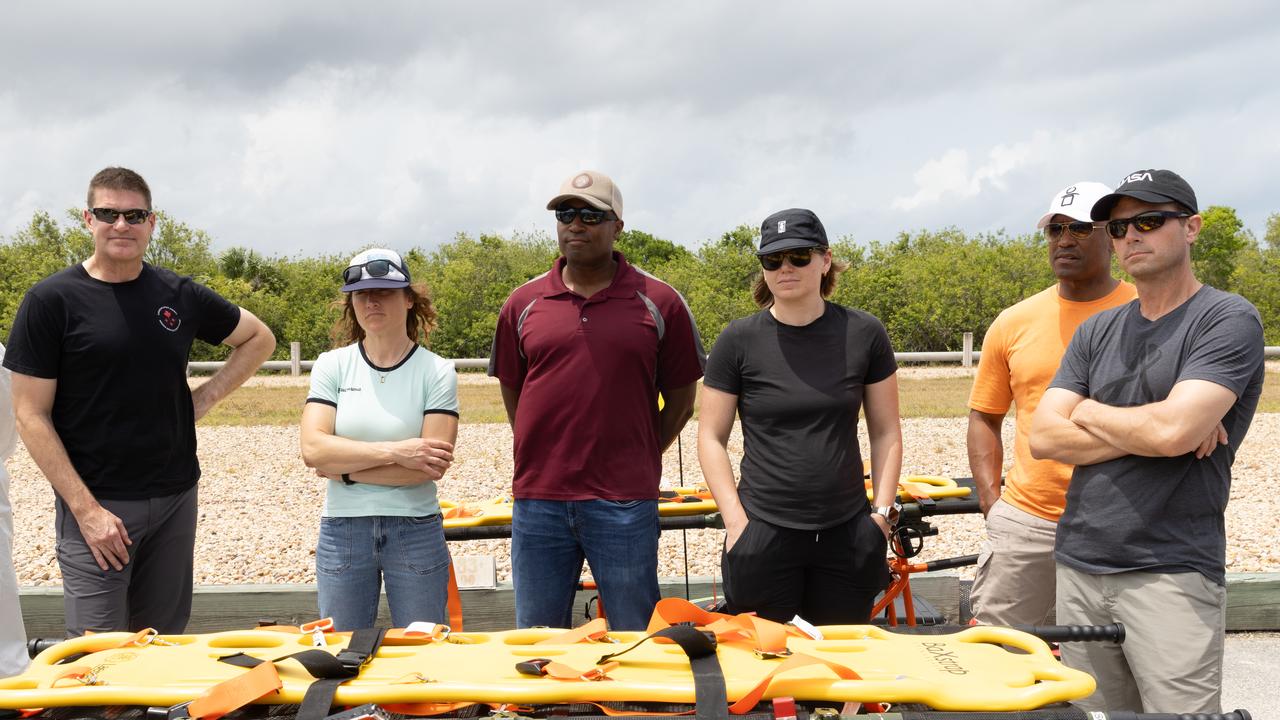
From left, CSA (Canadian Space Agency) astronaut Jeremy Hansen, Artemis II mission specialist; NASA astronaut Christina Koch, Artemis II mission specialist; NASA astronaut Andre Douglas, Artemis II backup crew member; CSA astronaut Jenni Gibbons, Artemis II backup crew member; NASA astronaut Victor Glover, Artemis II pilot; and NASA astronaut Reid Wiseman, Artemis II commander, participate in emergency egress training with teams from NASA’s Exploration Ground Systems Program near Launch Complex 39B at NASA’s Kennedy Space Center in Florida on Tuesday, May 6, 2025.
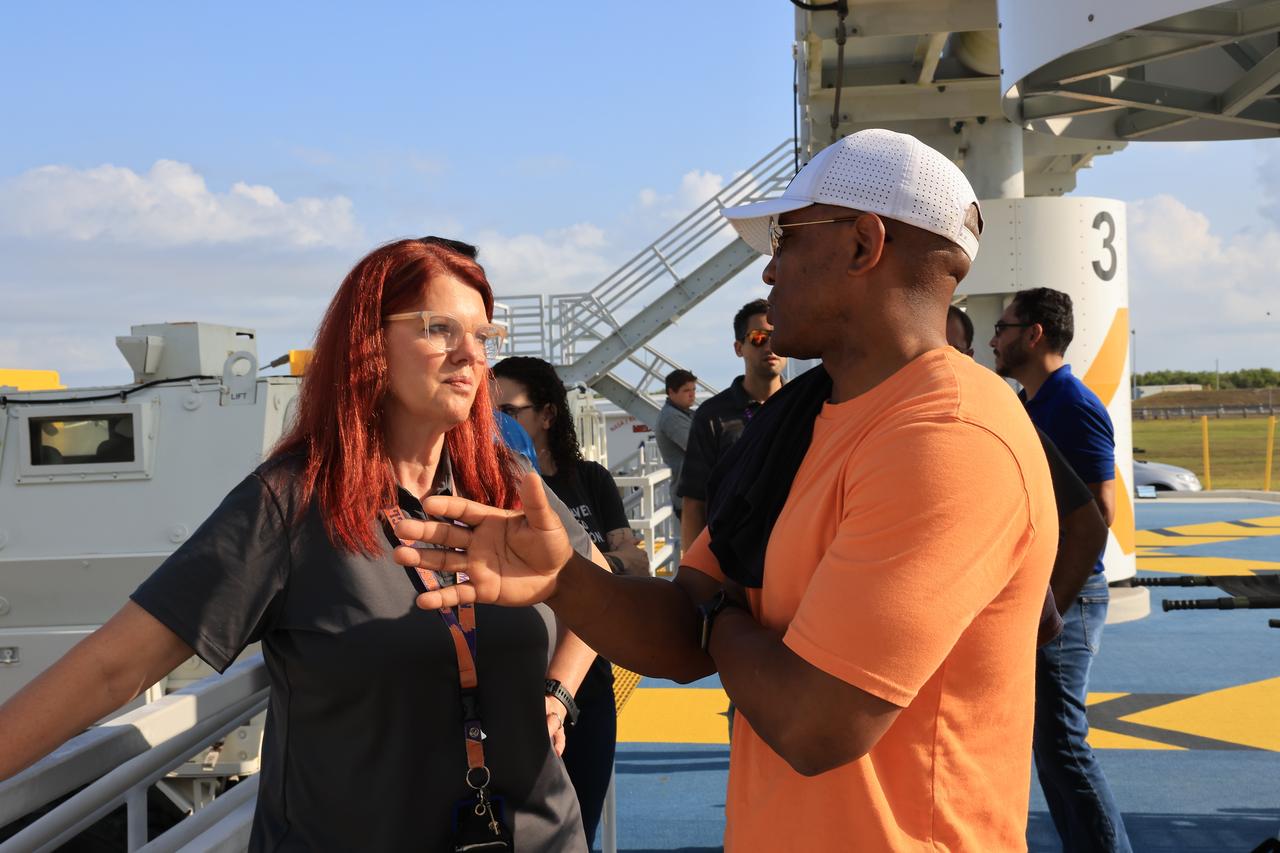
From left, Charlie Blackwell-Thompson, Artemis launch director with NASA’s Exploration Ground Systems Program, and Artemis II pilot Victor Glover participate in training at Launch Complex 39B at the agency’s Kennedy Space Center in Florida on Tuesday, May 6, 2025. Glover and fellow Artemis II crew members and backup members trained with the mine-resistant ambush protected vehicles, or MRAPs, inside the launch pad area. Originally designed for military applications, the 45,000-pound MRAP offers a mobile bunker for astronauts and ground crews in the unlikely event they must get away from the launch pad quickly in an emergency.
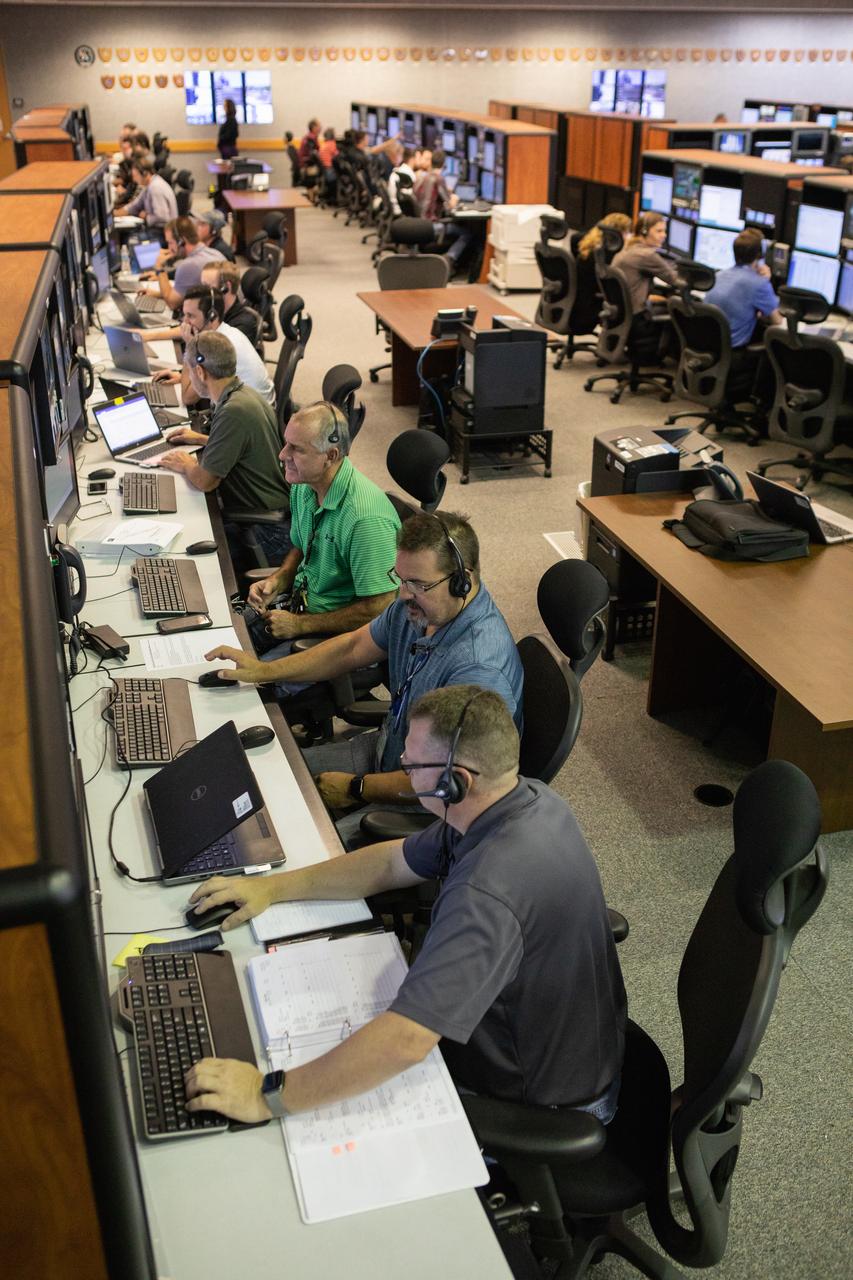
Members of the Artemis 1 launch team, including personnel with NASA’s Exploration Ground Systems (EGS) and Jacobs Test and Operations Contract (TOSC), participate in validation testing inside Firing Room 1 in the Launch Control Center at NASA’s Kennedy Space Center in Florida on July 11, 2019. The team includes personnel with NASA’s Exploration Ground Systems (EGS) and Jacobs Test and Operations Contract (TOSC). The simulation was designed to validate the firing room consoles and communications systems, as well as the new Spaceport Command and Control System (SCCS), which will operate, monitor and coordinate ground equipment in preparation for Artemis 1, the uncrewed first flight of the Space Launch System rocket and Orion spacecraft.
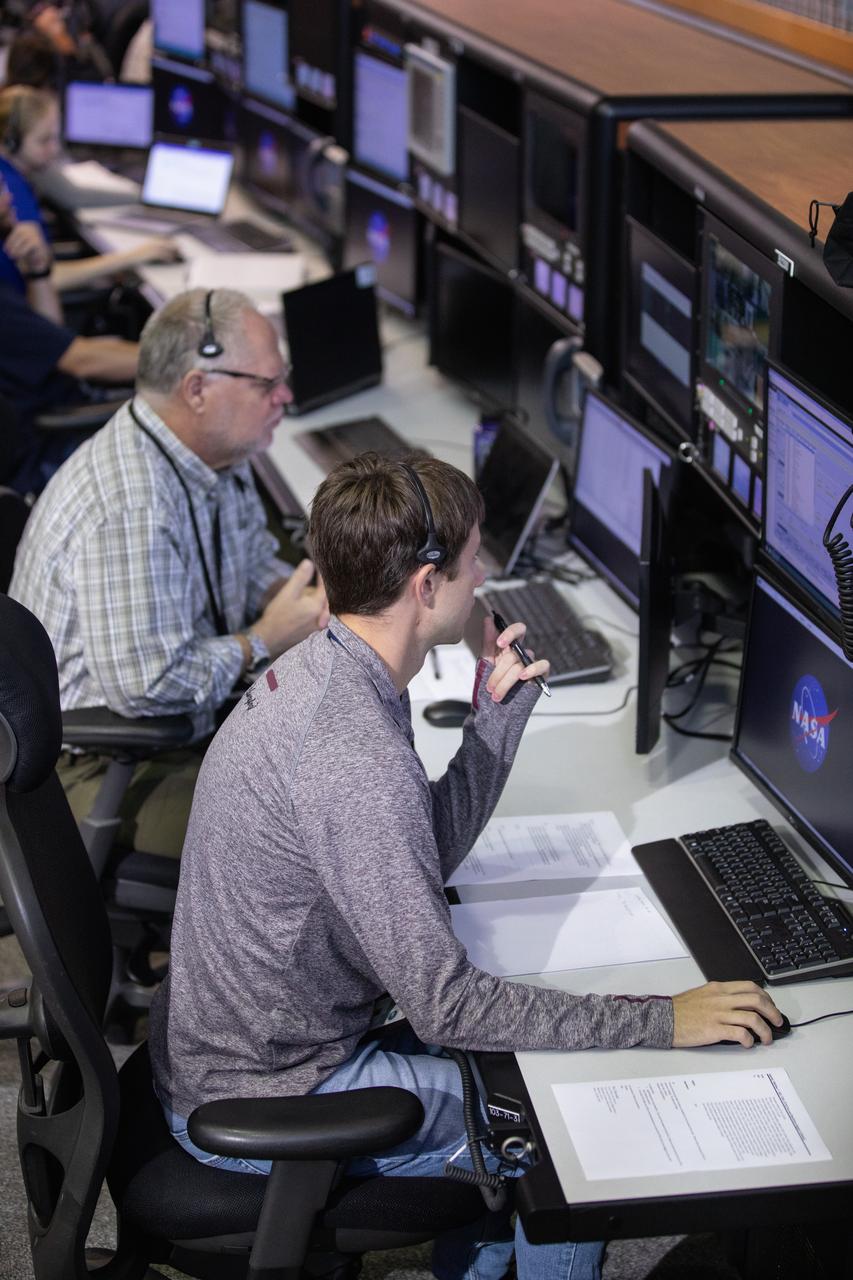
Members of the Artemis 1 launch team, including personnel with NASA’s Exploration Ground Systems (EGS) and Jacobs Test and Operations Contract (TOSC), participate in validation testing inside Firing Room 1 in the Launch Control Center at NASA’s Kennedy Space Center in Florida on July 11, 2019. The team includes personnel with NASA’s Exploration Ground Systems (EGS) and Jacobs Test and Operations Contract (TOSC). The simulation was designed to validate the new Spaceport Command and Control System (SCCS) which will operate, monitor and coordinate ground equipment in preparation for Artemis 1, the uncrewed first flight of the Space Launch System rocket and Orion spacecraft.
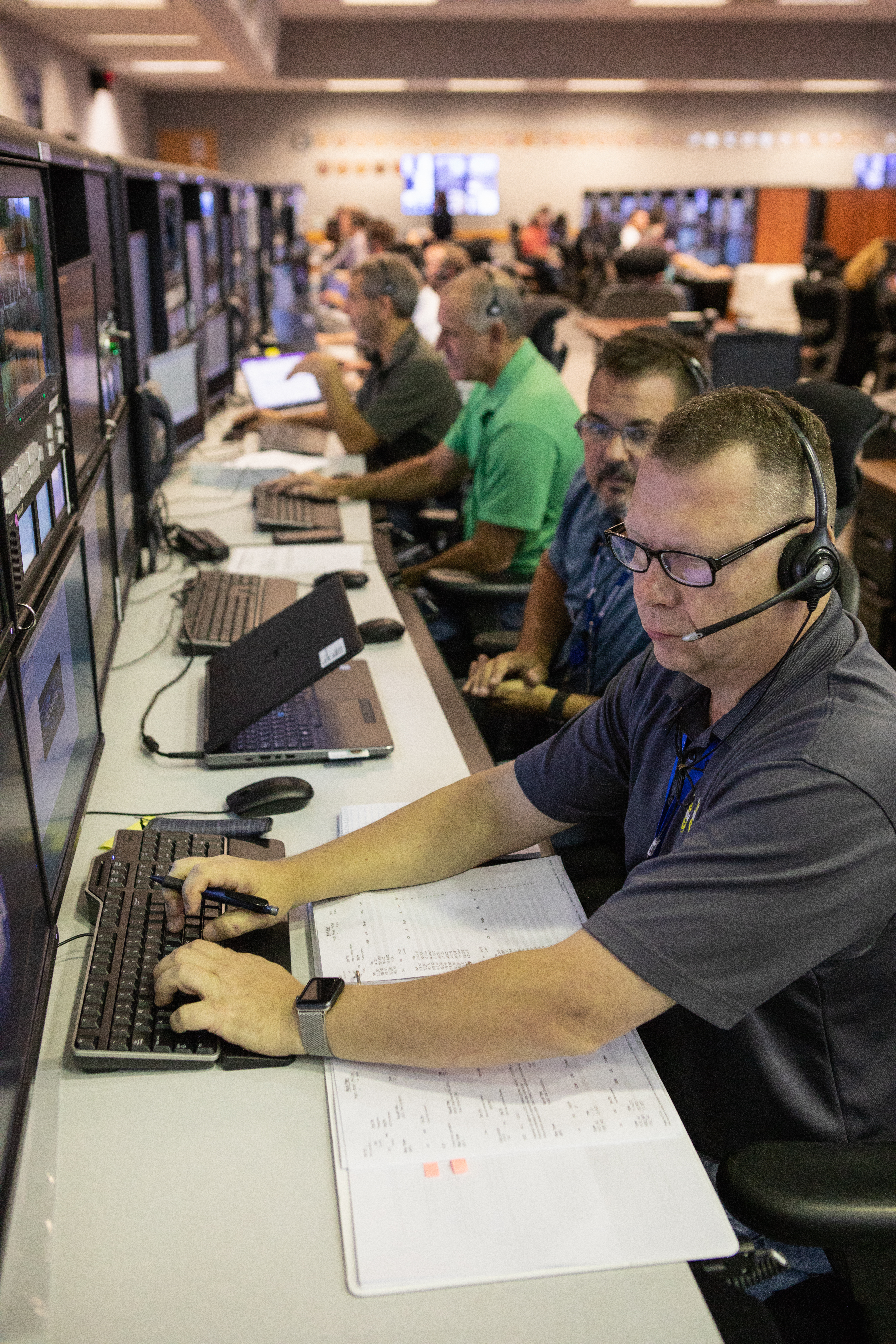
Members of the Artemis 1 launch team, including personnel with NASA’s Exploration Ground Systems (EGS) and Jacobs Test and Operations Contract (TOSC), participate in validation testing inside Firing Room 1 in the Launch Control Center at NASA’s Kennedy Space Center in Florida on July 11, 2019. The team includes personnel with NASA’s Exploration Ground Systems (EGS) and Jacobs Test and Operations Contract (TOSC). The simulation was designed to validate the firing room consoles and communications systems, as well as the new Spaceport Command and Control System (SCCS), which will operate, monitor and coordinate ground equipment in preparation for Artemis 1, the uncrewed first flight of the Space Launch System rocket and Orion spacecraft.
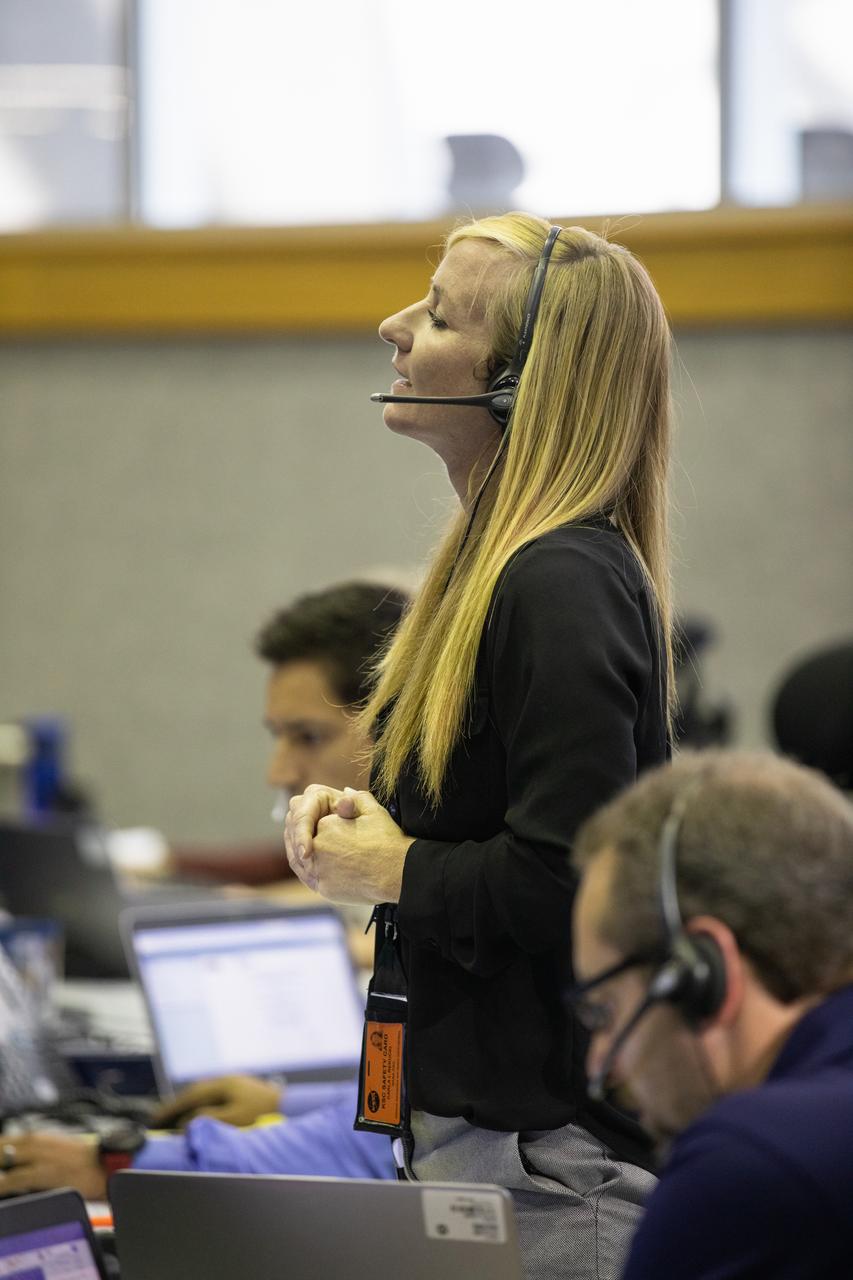
Carla Rekucki, lead NASA test director in NASA’s Exploration Ground Systems (EGS), center, and other launch team members participate in validation testing inside Firing Room 1 in the Launch Control Center at NASA’s Kennedy Space Center in Florida on July 11, 2019. The team includes personnel with NASA’s Exploration Ground Systems (EGS) and Jacobs Test and Operations Contract (TOSC). The simulation was designed to validate the firing room consoles and communications systems, as well as the new Spaceport Command and Control System (SCCS), which will operate, monitor and coordinate ground equipment in preparation for Artemis 1, the uncrewed first flight of the Space Launch System rocket and Orion spacecraft.
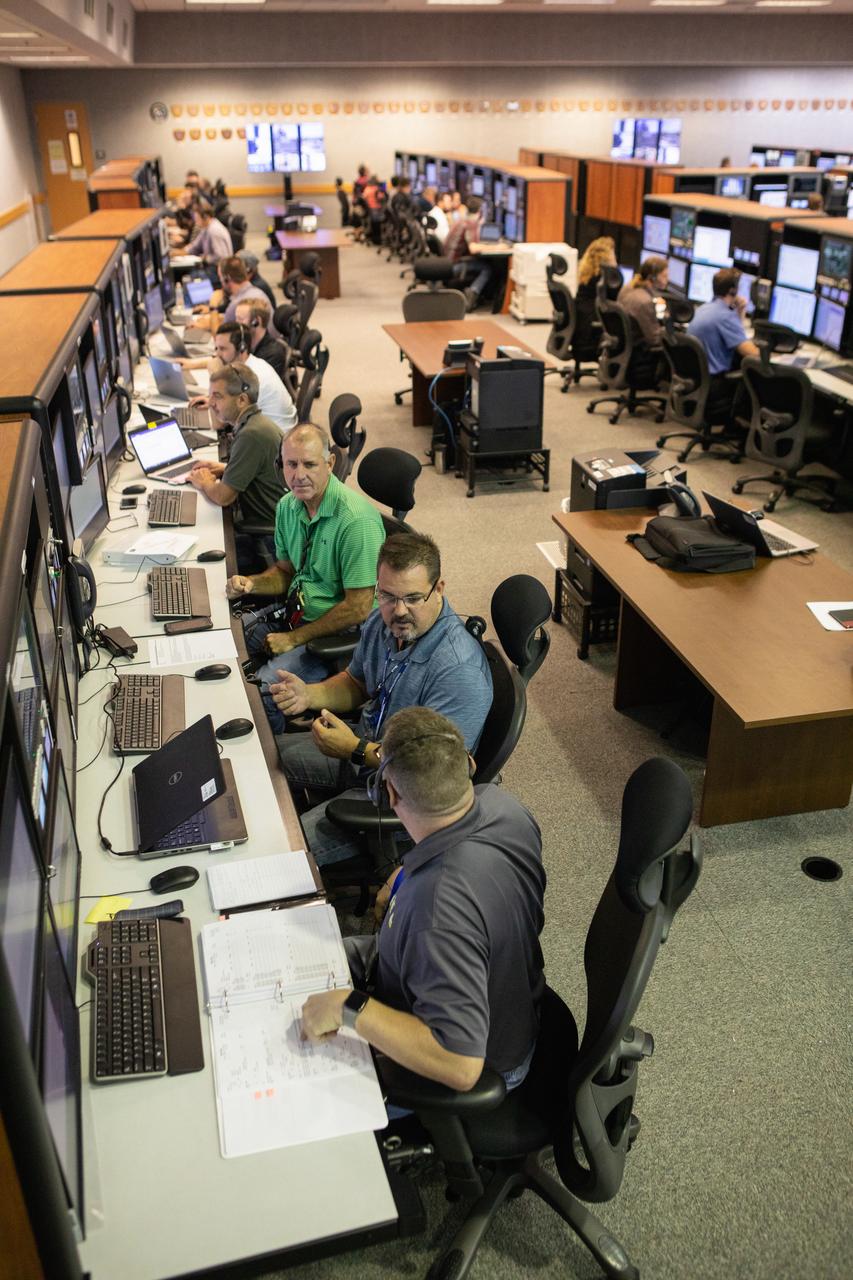
Members of the Artemis 1 launch team, including personnel with NASA’s Exploration Ground Systems (EGS) and Jacobs Test and Operations Contract (TOSC), participate in validation testing inside Firing Room 1 in the Launch Control Center at NASA’s Kennedy Space Center in Florida on July 11, 2019. The team includes personnel with NASA’s Exploration Ground Systems (EGS) and Jacobs Test and Operations Contract (TOSC). The simulation was designed to validate the firing room consoles and communications systems, as well as the new Spaceport Command and Control System (SCCS), which will operate, monitor and coordinate ground equipment in preparation for Artemis 1, the uncrewed first flight of the Space Launch System rocket and Orion spacecraft.
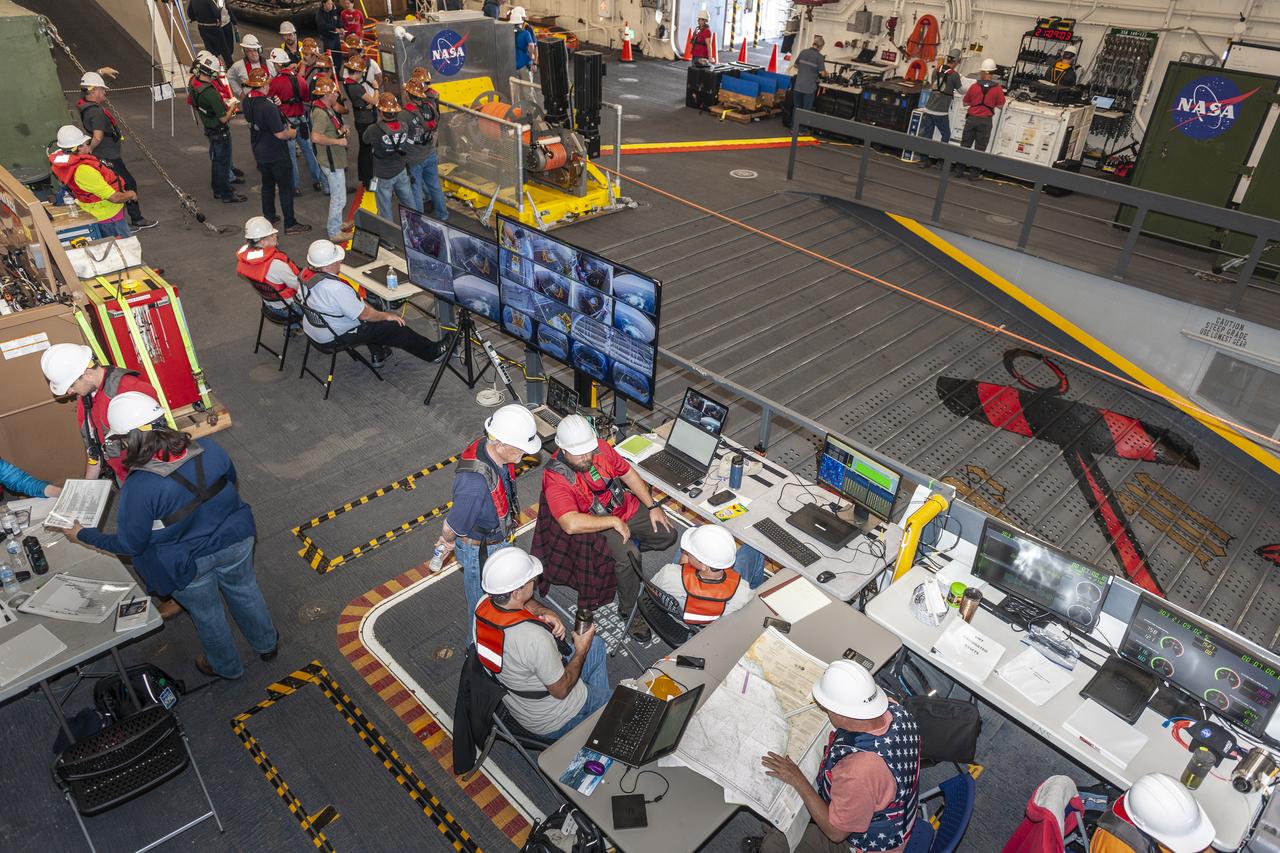
NASA Recovery Team members with Exploration Ground Systems (EGS) and the U.S. Navy prepare for Underway Recovery Test-7 (URT-7) on Oct. 30, 2018, in the well deck of the USS John P Murtha. URT-7 is one in a series of tests that the EGS Recovery Team, along with the U.S. Navy, are conducting to verify and validate procedures and hardware that will be used to recover the Orion spacecraft after it splashes down in the Pacific Ocean following deep space exploration missions. Orion will have emergency abort capability, sustain the crew during space travel and provide safe re-entry from deep space return velocities.
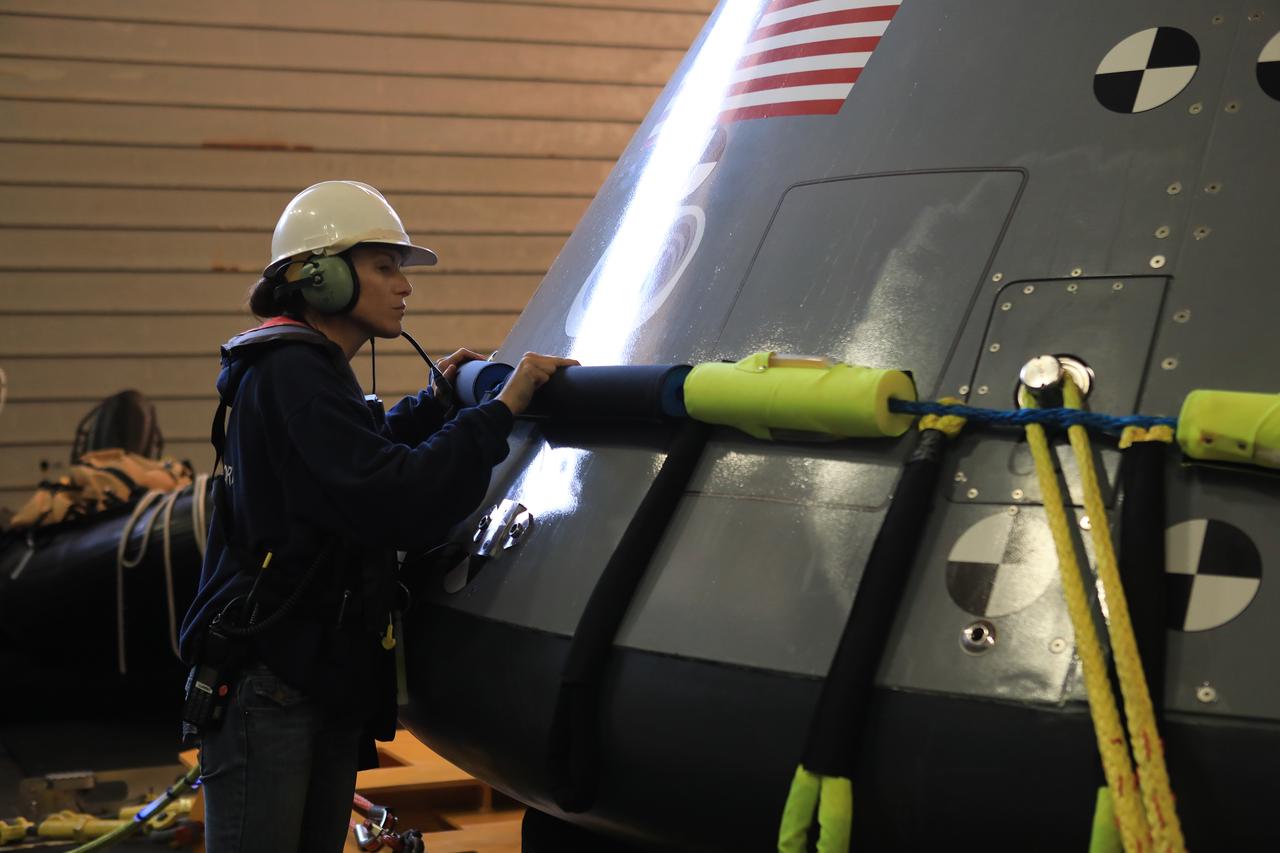
Lead NASA Operations Engineer Courtney Stern, with the Exploration Ground Systems (EGS) Recovery Team, inspects the pony collar on a test version of the Orion capsule in the well deck of the USS John P. Murtha before a night deployment on Nov. 3, 2018, during Underway Recovery Test-7 (URT-7). URT-7 is one in a series conducted by the EGS Recovery Team to verify and validate procedures and hardware that will be used to recover the Orion spacecraft after it splashes down in the Pacific Ocean following deep space exploration missions. Orion will have emergency abort capability, sustain the crew during space travel and provide safe re-entry from deep space return velocities.
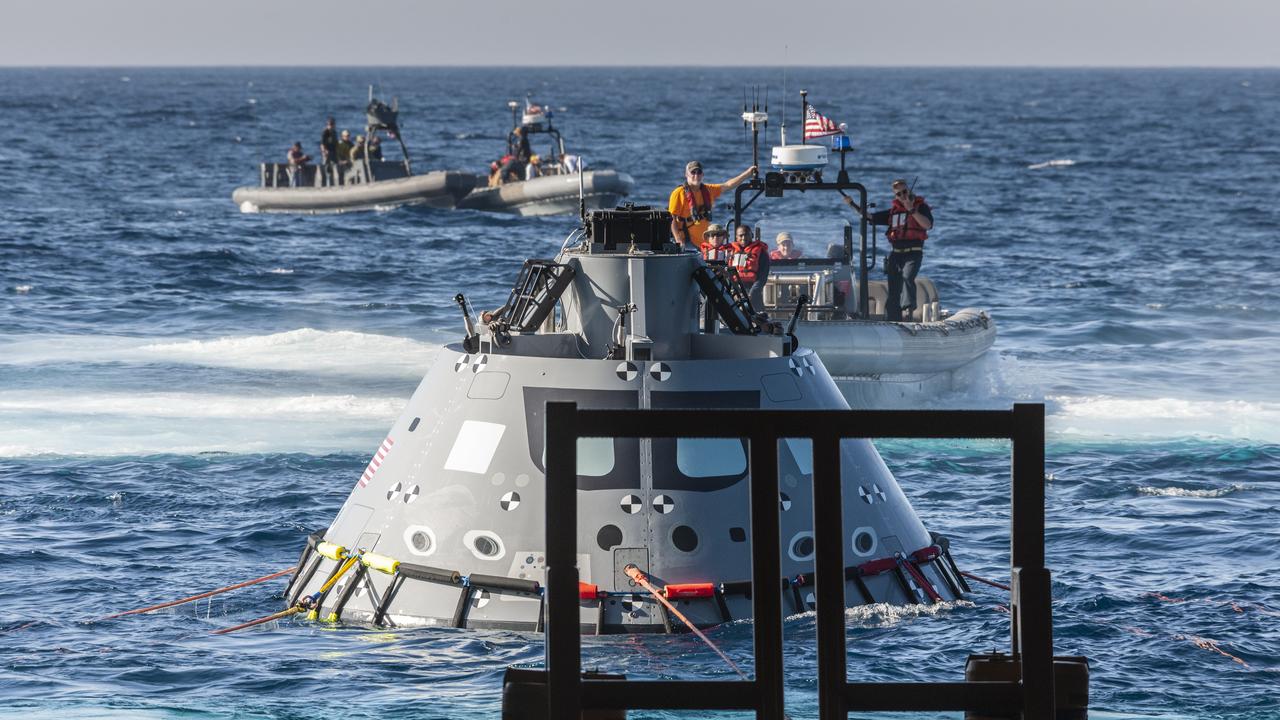
NASA Recovery Team members with Exploration Ground Systems (EGS) and the U.S. Navy practice recovering a test version of the Orion capsule on Oct. 31, 2018, during Underway Recovery Test-7 (URT-7) in the Pacific Ocean. URT-7 is one in a series of tests that the EGS Recovery Team, along with the U.S. Navy, are conducting to verify and validate procedures and hardware that will be used to recover the Orion spacecraft after it splashes down in the Pacific Ocean following deep space exploration missions. Orion will have emergency abort capability, sustain the crew during space travel and provide safe re-entry from deep space return velocities.
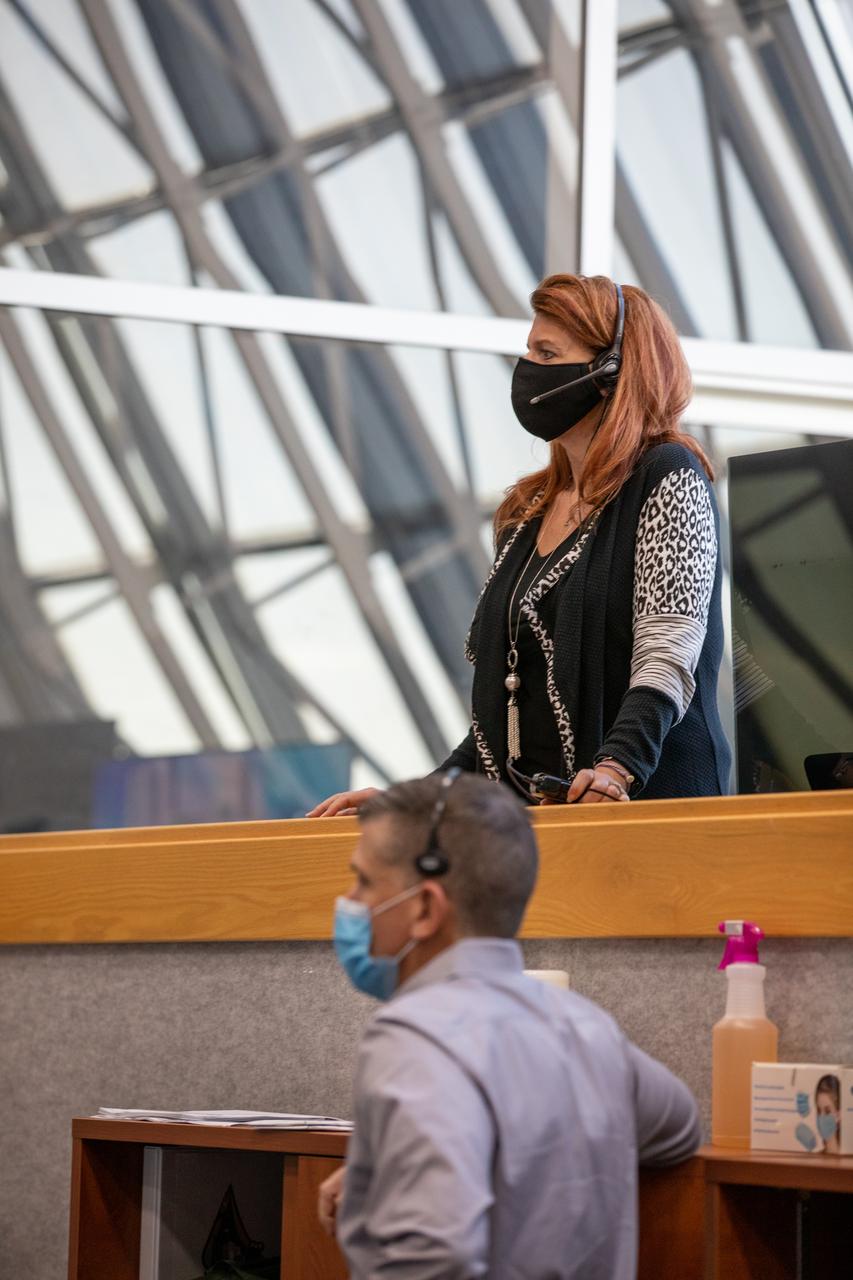
Charlie Blackwell-Thompson, standing, NASA Artemis launch director; and Jeremy Graeber, chief of the Test, Launch and Recovery Operations Branch within Exploration Ground Systems (EGS), monitor a cryogenic propellant loading simulation inside Firing Room 1 in the Launch Control Center on Nov. 2, 2020, at NASA’s Kennedy Space Center in Florida. A team of engineers with EGS and Jacobs, members of the cryogenics launch team, are rehearsing the steps to load the super-cooled liquid hydrogen and liquid oxygen into the Space Launch System’s (SLS) core and second stages to prepare for Artemis I. The first in a series of increasingly complex missions, Artemis I will test the Orion spacecraft and Space Launch System as an integrated system ahead of crewed flights to the Moon. NASA will land the first woman and the next man on the Moon in 2024.
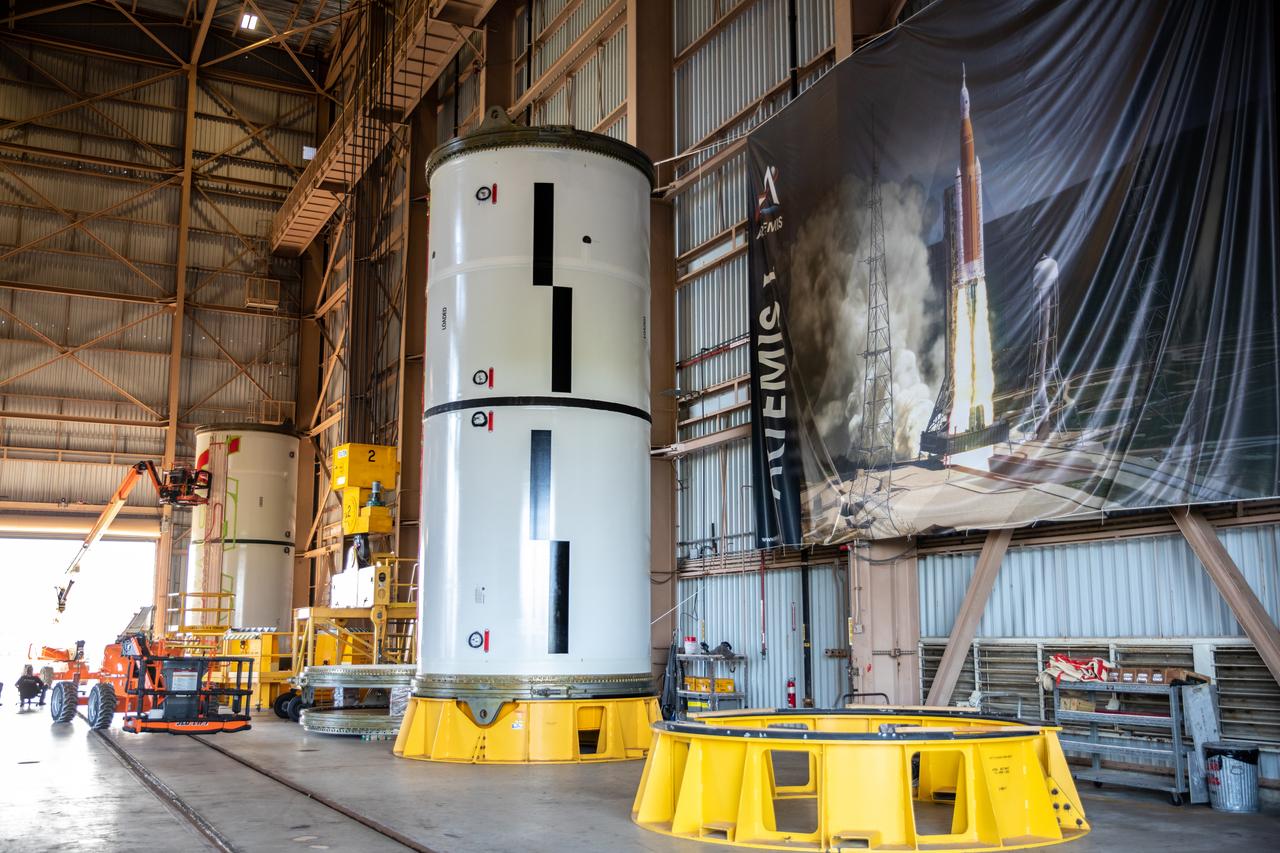
In this view inside the Rotation, Processing and Surge Facility (RPSF) at Kennedy Space Center in Florida, an Artemis I solid rocket booster center segment stands in the foreground; in the background, a worker with NASA’s Exploration Ground Systems (EGS) applies bright red paint to the agency’s “worm” logo taking shape on the side of the other center segment. The EGS team used a laser projector to mask off the logo with tape, then painted the first coat of the iconic design. The booster segments will help propel the Space Launch System (SLS) rocket on Artemis I, a test of the Orion spacecraft and SLS as an integrated system ahead of crewed flights to the Moon. Northrop Grumman, which built the booster segments, is covering the cost of the painting.

Dan Zapata is a crawler systems engineer for the Exploration Ground Systems Program at NASA’s Kennedy Space Center in Florida. One of seven certified drivers for the agency’s crawler transporters –six-million-pound platforms that carry rockets and spacecraft from Kennedy’s iconic Vehicle Assembly Building to the launch pad – Zapata is part of the team that will take NASA’s Space Launch System rocket and Orion spacecraft to Launch Complex 39B for the Artemis I launch. Artemis I is the first in an increasingly complex series of missions that will ultimately send the first woman and first person of color to the Moon, paving the way for long-term presence in lunar orbit and serving as a steppingstone for future missions to Mars.

Artemis II crew members inspect their Orion crew module inside the high bay of the Neil A. Armstrong Operations and Checkout Building at NASA’s Kennedy Space Center in Florida, on Aug. 7, 2023. Pictured from left are Christina Hammock Koch, mission specialist, and Victor Glover, pilot. The crew module is undergoing acoustic testing ahead of integration with the European Service Module. Artemis II is the first crewed mission on NASA’s path to establishing a long-term lunar presence for science and exploration under Artemis.
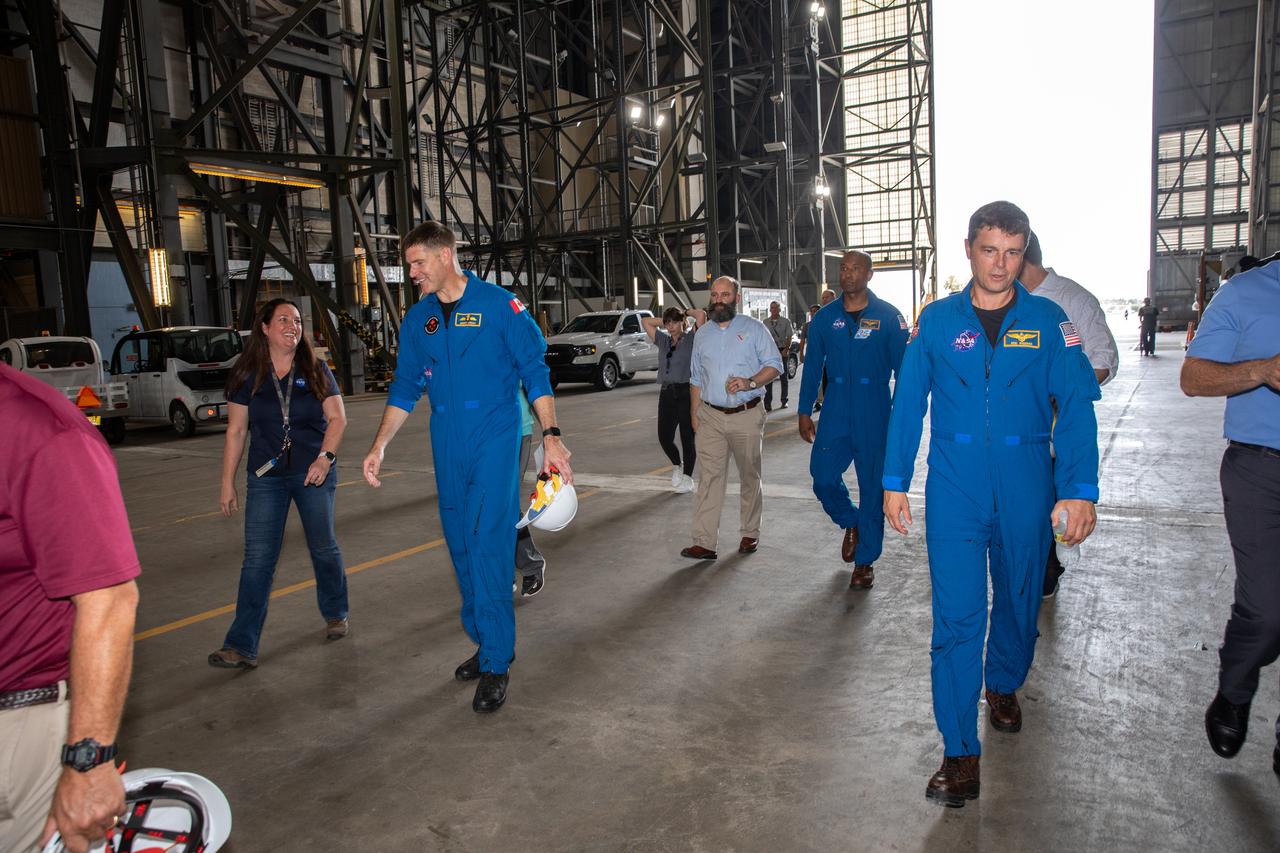
Artemis II astronauts visit NASA’s Kennedy Space Center in Florida on Aug. 7, 2023. From left, are CSA (Canadian Space Agency) astronaut Jeremy Hansen, and NASA astronaut Reid Wiseman. Behind them is NASA astronaut Victor Glover. They are with Exploration Ground Systems team members in the transfer aisle of the Vehicle Assembly Building. The approximately 10-day Artemis II flight will test NASA’s foundational human deep space exploration capabilities, the Space Launch System rocket and Orion spacecraft, for the first time with astronauts and will pave the way for lunar surface missions, including landing the first woman and the first person of color on the Moon.
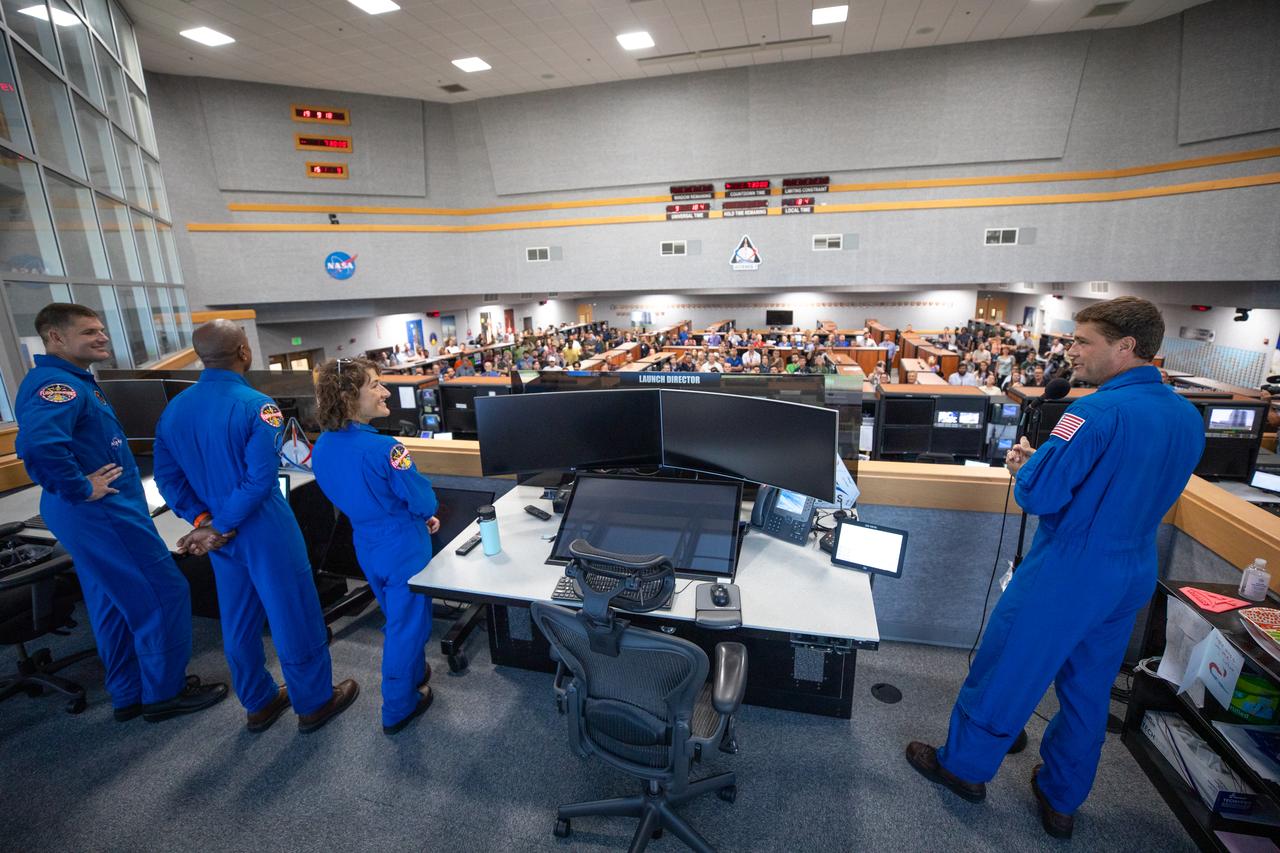
Artemis II astronauts visit the Artemis launch team inside Firing Room 1 in the Launch Control Center at NASA’s Kennedy Space Center in Florida on Aug. 7, 2023. In front, from left are CSA (Canadian Space Agency) astronaut Jeremy Hansen, and NASA astronauts Victor Glover, Christina Koch, and Reid Wiseman. The approximately 10-day Artemis II flight will test NASA’s foundational human deep space exploration capabilities, the Space Launch System rocket and Orion spacecraft, for the first time with astronauts and will pave the way for lunar surface missions, including landing the first woman and the first person of color on the Moon.
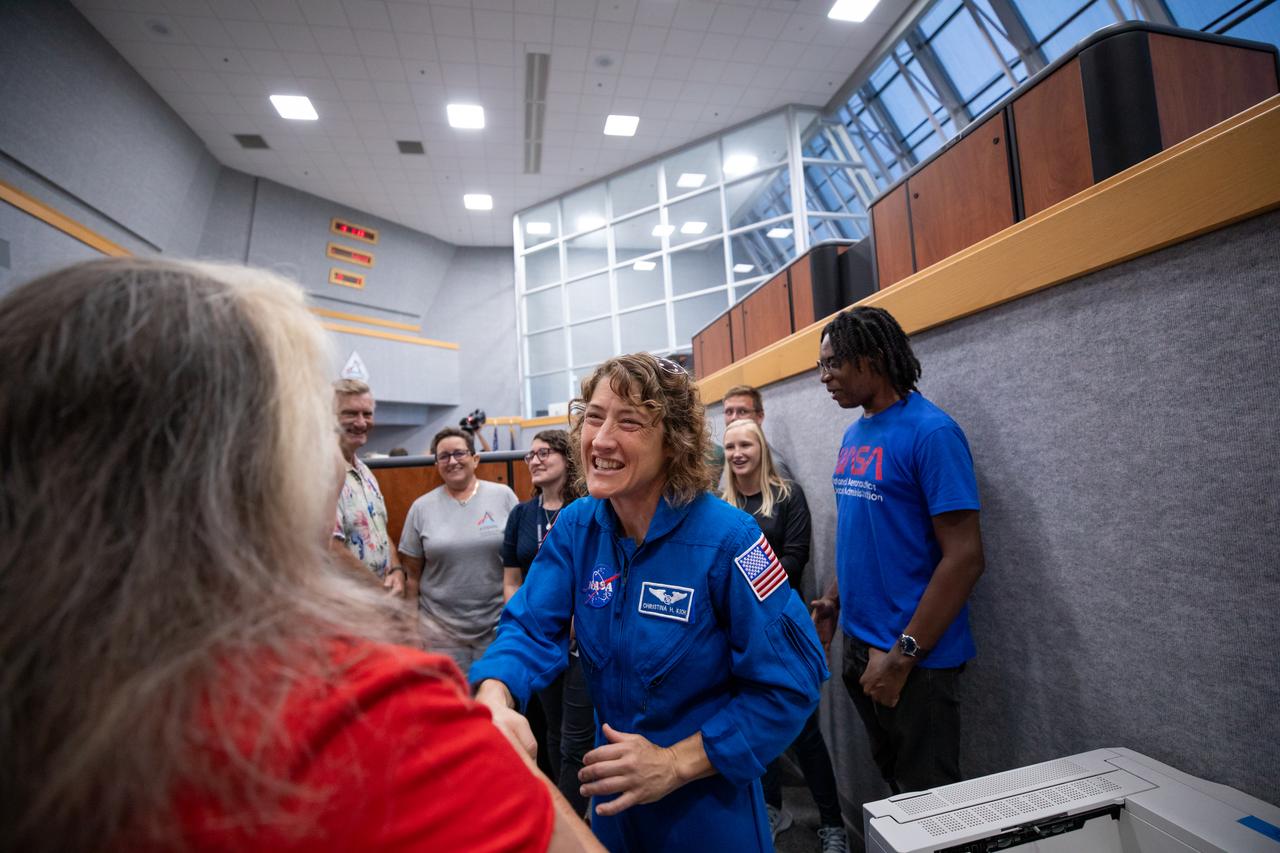
Artemis II NASA astronaut Christina Koch greets members of the Artemis launch team inside Firing Room 1 in the Launch Control at NASA’s Kennedy Space Center in Florida on Aug. 7, 2023. Koch and fellow Artemis II astronauts Victor Glover, Reid Wiseman, and CSA (Canadian Space Agency) astronaut Jeremy Hansen are at the center to meet workers and tour facilities. The approximately 10-day Artemis II flight will test NASA’s foundational human deep space exploration capabilities, the Space Launch System rocket and Orion spacecraft, for the first time with astronauts and will pave the way for lunar surface missions, including landing the first woman and the first person of color on the Moon.
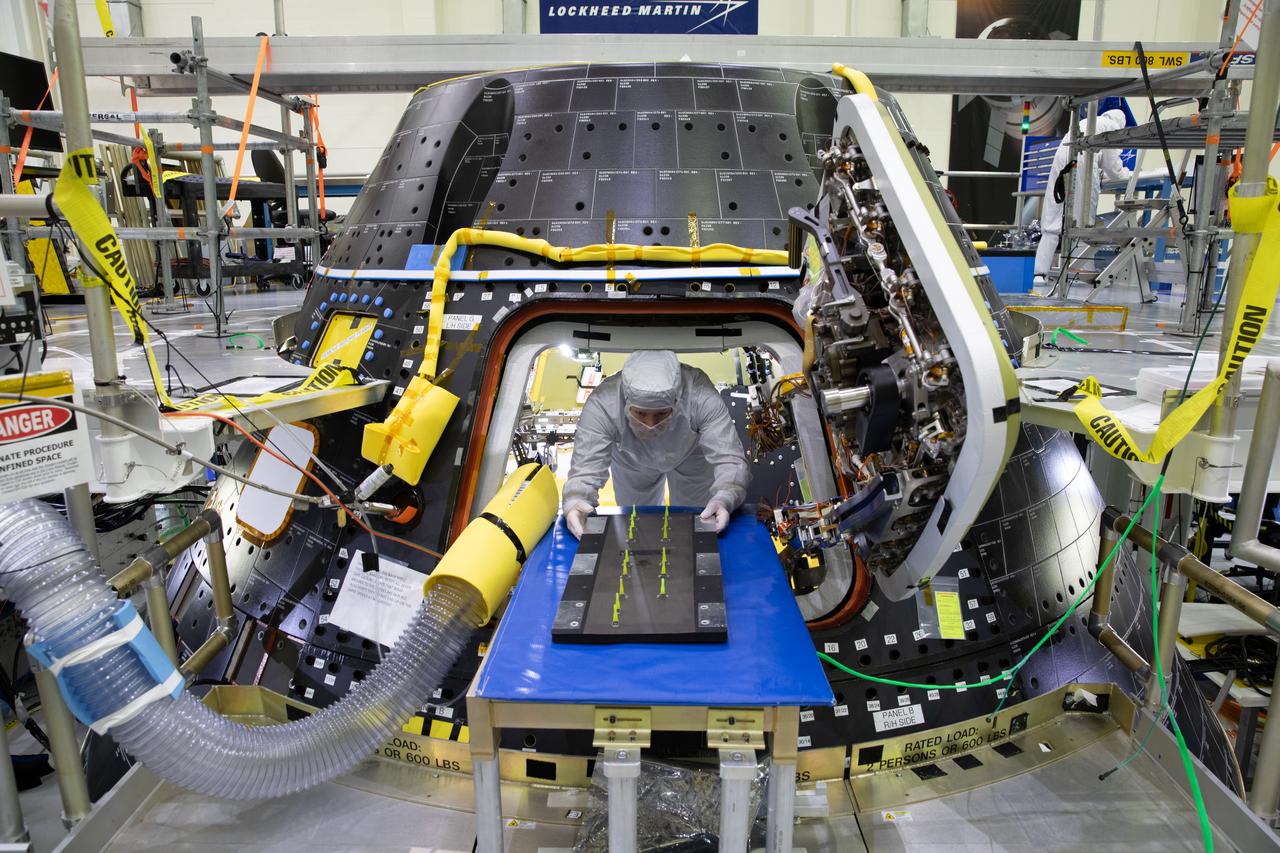
An Artemis II crew member exits the Artemis II Orion crew module inside the high bay of the Neil A. Armstrong Operations and Checkout Building at NASA’s Kennedy Space Center in Florida, on Aug. 7, 2023. The crew module is undergoing acoustic testing ahead of integration with the European Service Module. The Artemis II crew features Reid Wiseman, commander; Victor Glover, pilot; Christina Hammock Koch, mission specialist; and Jeremy Hansen, mission specialist. Artemis II is the first crewed mission on NASA’s path to establishing a long-term lunar presence for science and exploration under Artemis.
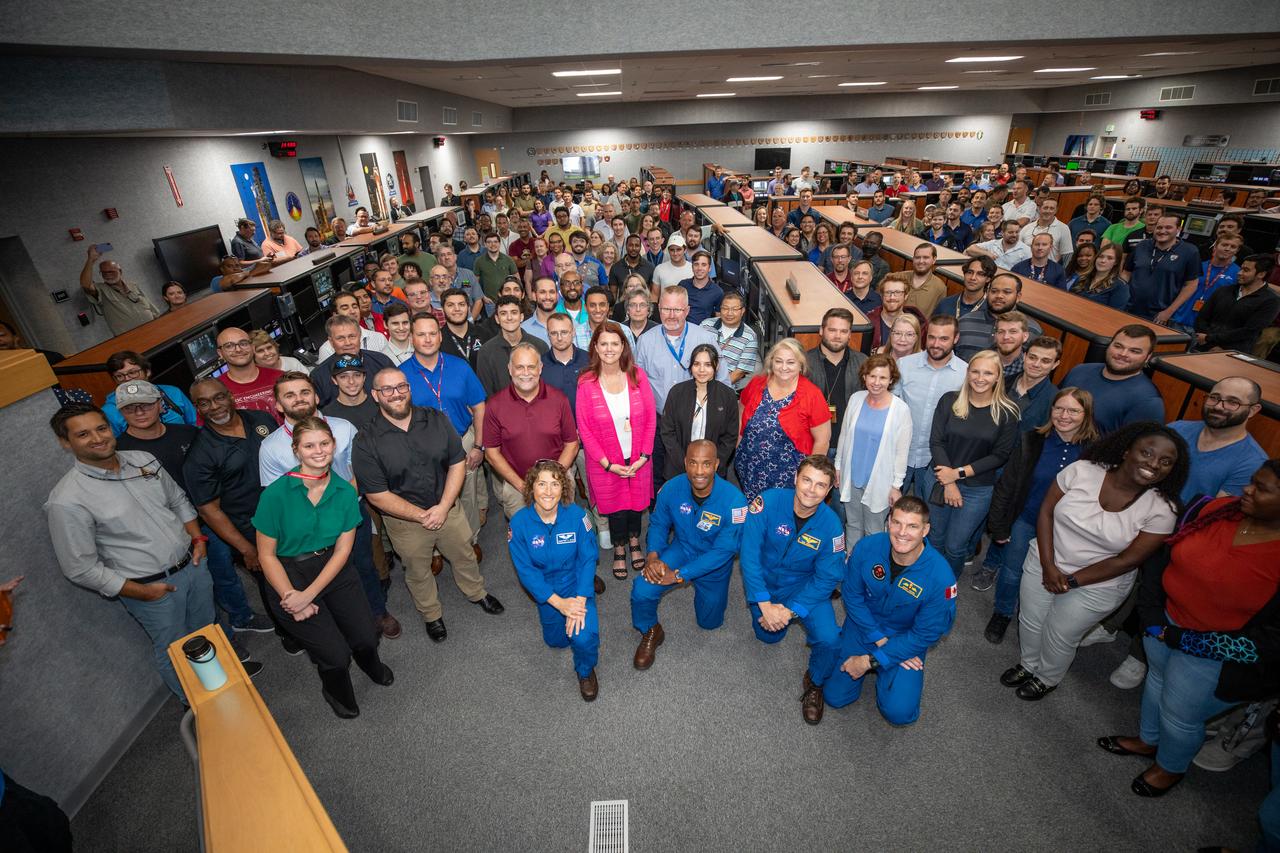
Artemis II astronauts pose for a photograph with members of the Artemis launch team inside Firing Room 1 in the Launch Control Center at NASA’s Kennedy Space Center in Florida on Aug. 7, 2023. In front, kneeling from left are NASA astronauts Christina Koch, Victor Glover, and Reid Wiseman, and CSA (Canadian Space Agency) astronaut Jeremy Hansen. The approximately 10-day Artemis II flight will test NASA’s foundational human deep space exploration capabilities, the Space Launch System rocket and Orion spacecraft, for the first time with astronauts and will pave the way for lunar surface missions, including landing the first woman and the first person of color on the Moon.
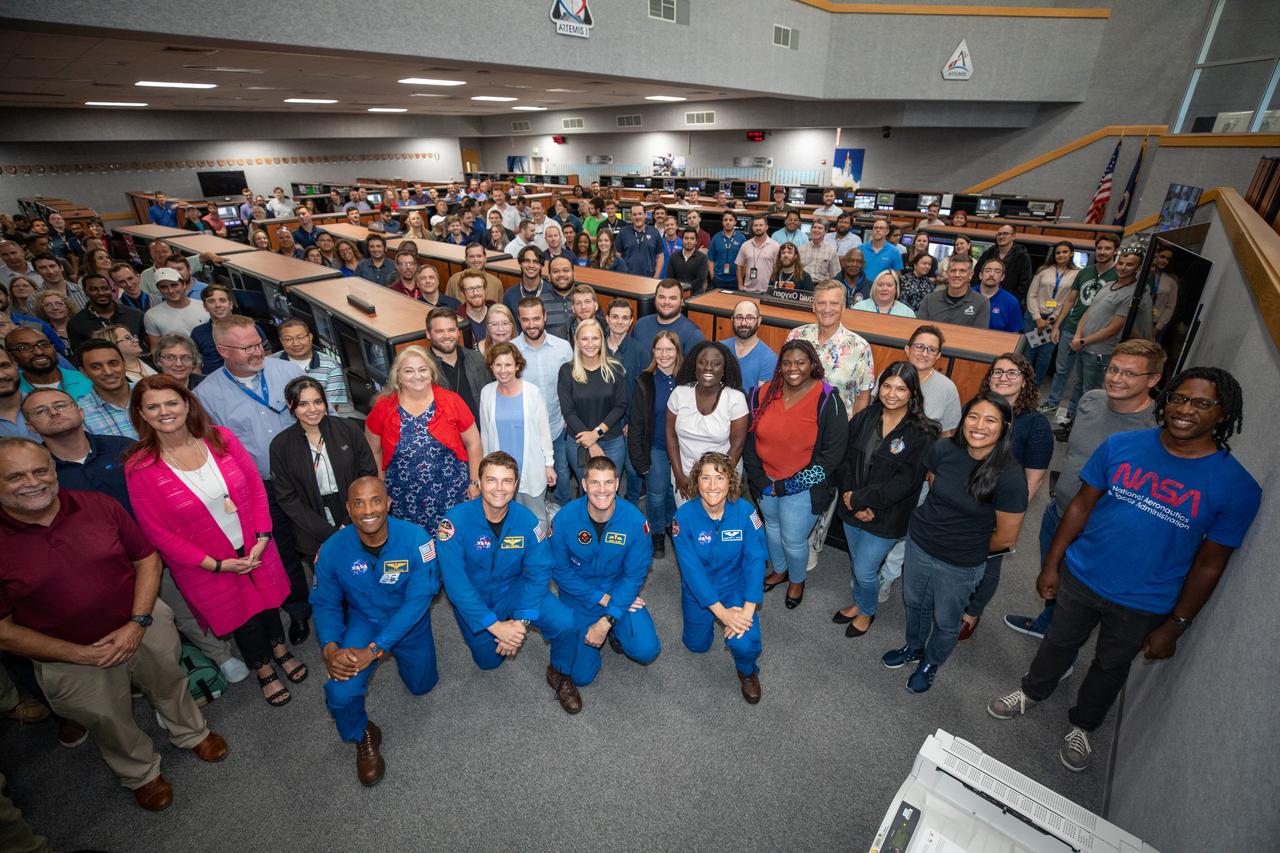
Artemis II astronauts pose for a photograph with members of the Artemis launch team inside Firing Room 1 in the Launch Control Center at NASA’s Kennedy Space Center in Florida on Aug. 7, 2023. In front, kneeling from left are NASA astronauts Victor Glover and Reid Wiseman, CSA (Canadian Space Agency) astronaut Jeremy Hansen, and NASA astronaut Christina Koch. Standing behind them, second from left is Artemis Launch Director Charlie Blackwell-Thompson. The approximately 10-day Artemis II flight will test NASA’s foundational human deep space exploration capabilities, the Space Launch System rocket and Orion spacecraft, for the first time with astronauts and will pave the way for lunar surface missions, including landing the first woman and the first person of color on the Moon.
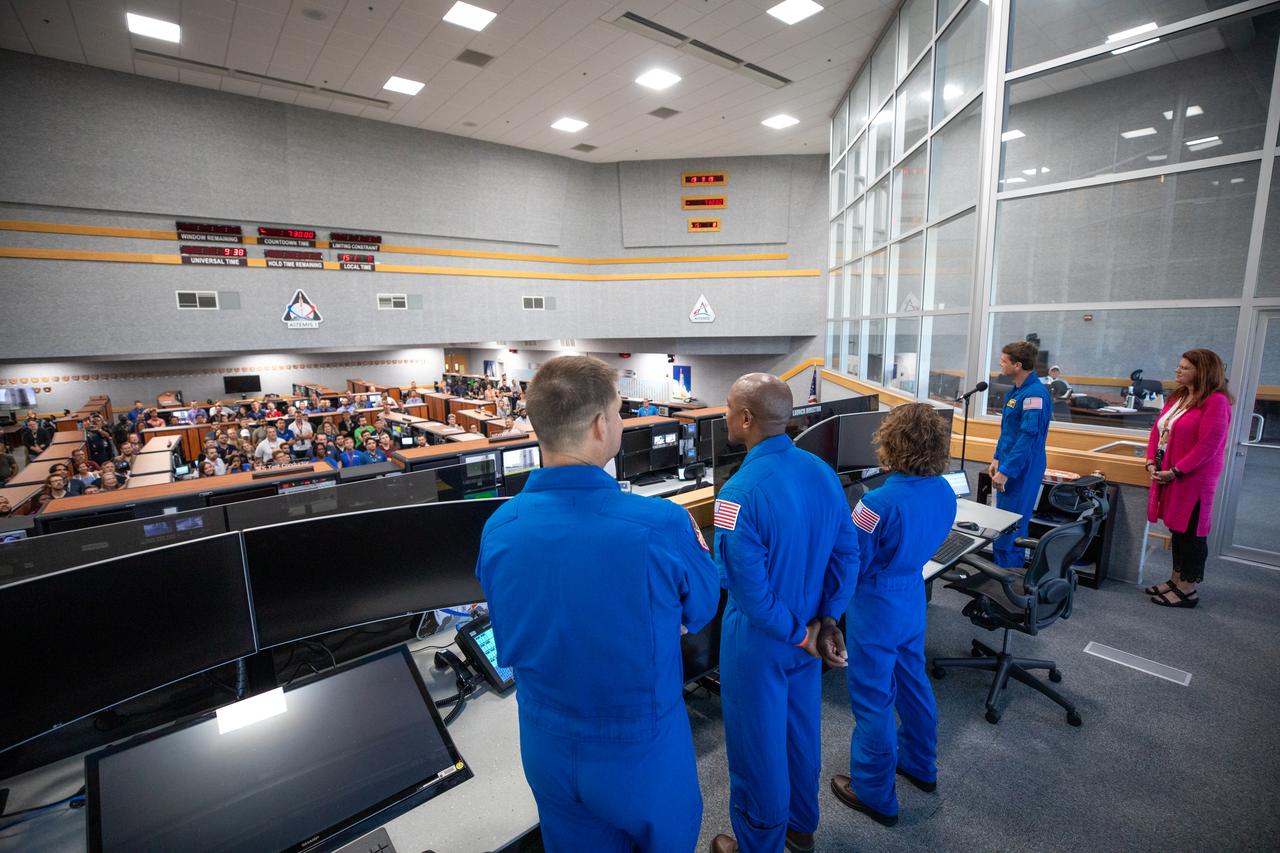
Artemis II astronauts visit the Artemis launch team inside Firing Room 1 in the Launch Control Center at NASA’s Kennedy Space Center in Florida on Aug. 7, 2023. In front, from left are CSA (Canadian Space Agency) astronaut Jeremy Hansen, and NASA astronauts Victor Glover, Christina Koch, and Reid Wiseman. At far right is Artemis Launch Director Charlie Blackwell-Thompson. The approximately 10-day Artemis II flight will test NASA’s foundational human deep space exploration capabilities, the Space Launch System rocket and Orion spacecraft, for the first time with astronauts and will pave the way for lunar surface missions, including landing the first woman and the first person of color on the Moon.
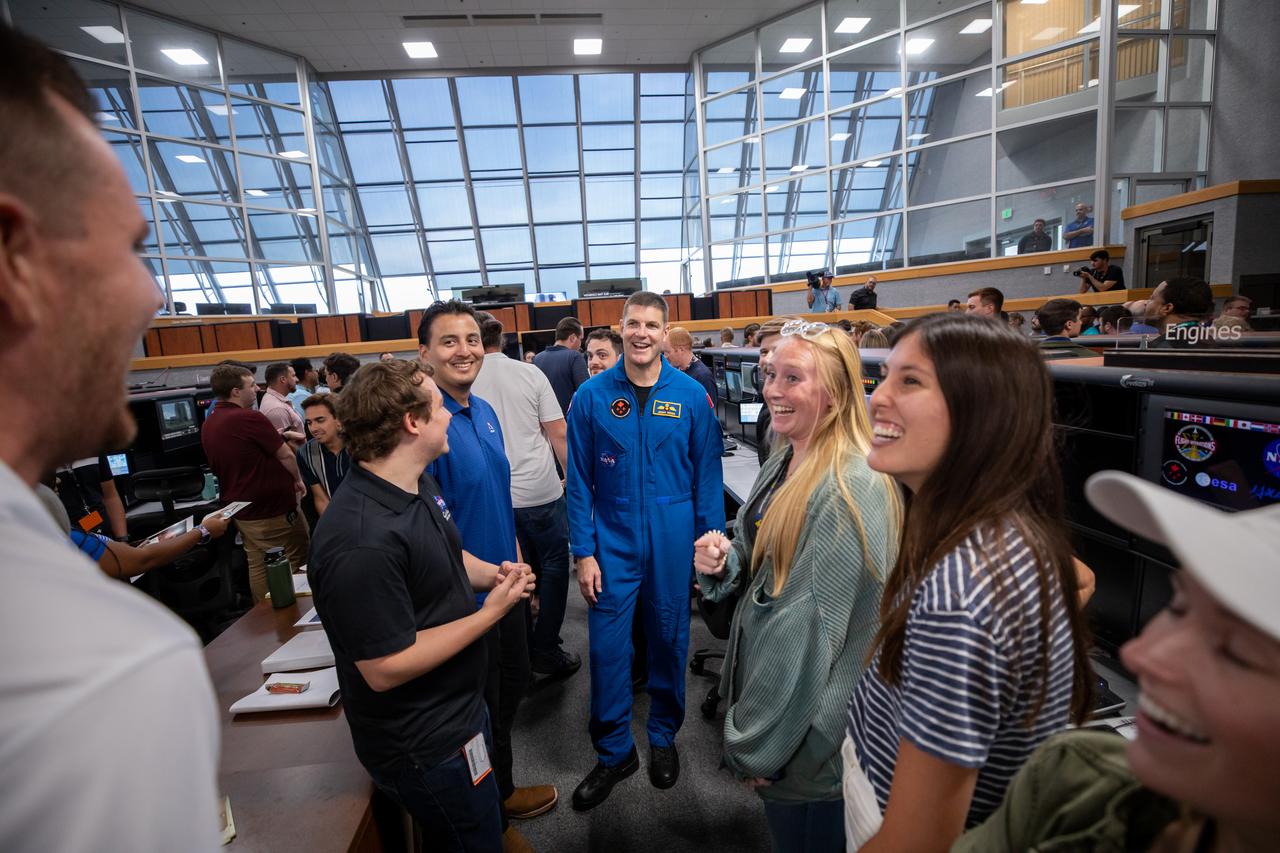
Artemis II NASA astronauts were at the agency’s Kennedy Space Center in Florida on Aug. 7, 2023. CSA (Canadian Space Agency) astronaut Jeremy Hansen talks with members of the Artemis launch team inside Firing Room 1 of the Launch Control Center. Hansen and fellow Artemis II astronauts Victor Glover, Christina Koch, and Reid Wiseman are at the center to meet workers and tour facilities. The approximately 10-day Artemis II flight will test NASA’s foundational human deep space exploration capabilities, the Space Launch System rocket and Orion spacecraft, for the first time with astronauts and will pave the way for lunar surface missions, including landing the first woman and the first person of color on the Moon.
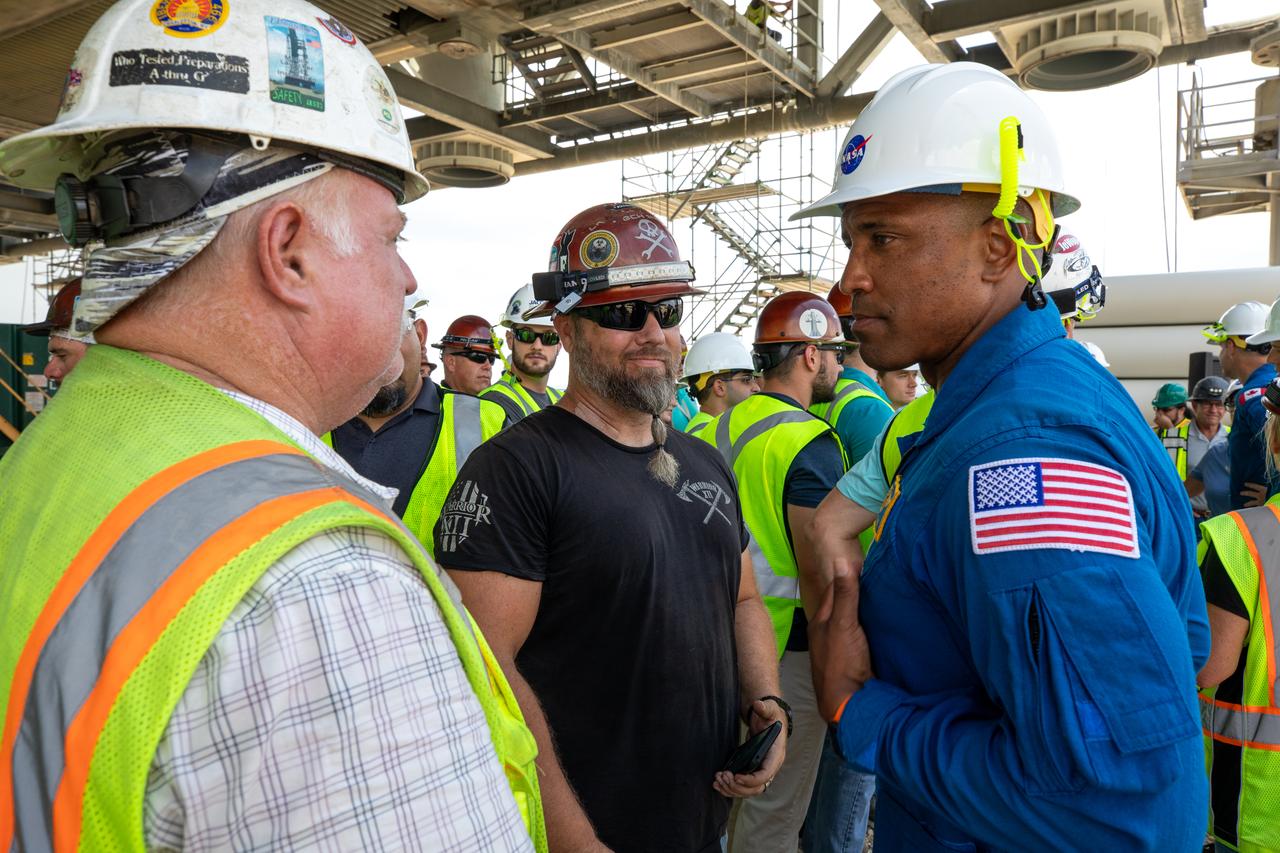
Artemis II NASA astronaut Victor Glover is seen with Exploration Ground Systems workers during a visit to the agency’s Kennedy Space Center in Florida on Aug. 7, 2023. The approximately 10-day Artemis II flight will test NASA’s foundational human deep space exploration capabilities, the Space Launch System rocket and Orion spacecraft, for the first time with astronauts and will pave the way for lunar surface missions, including landing the first woman and the first person of color on the Moon.
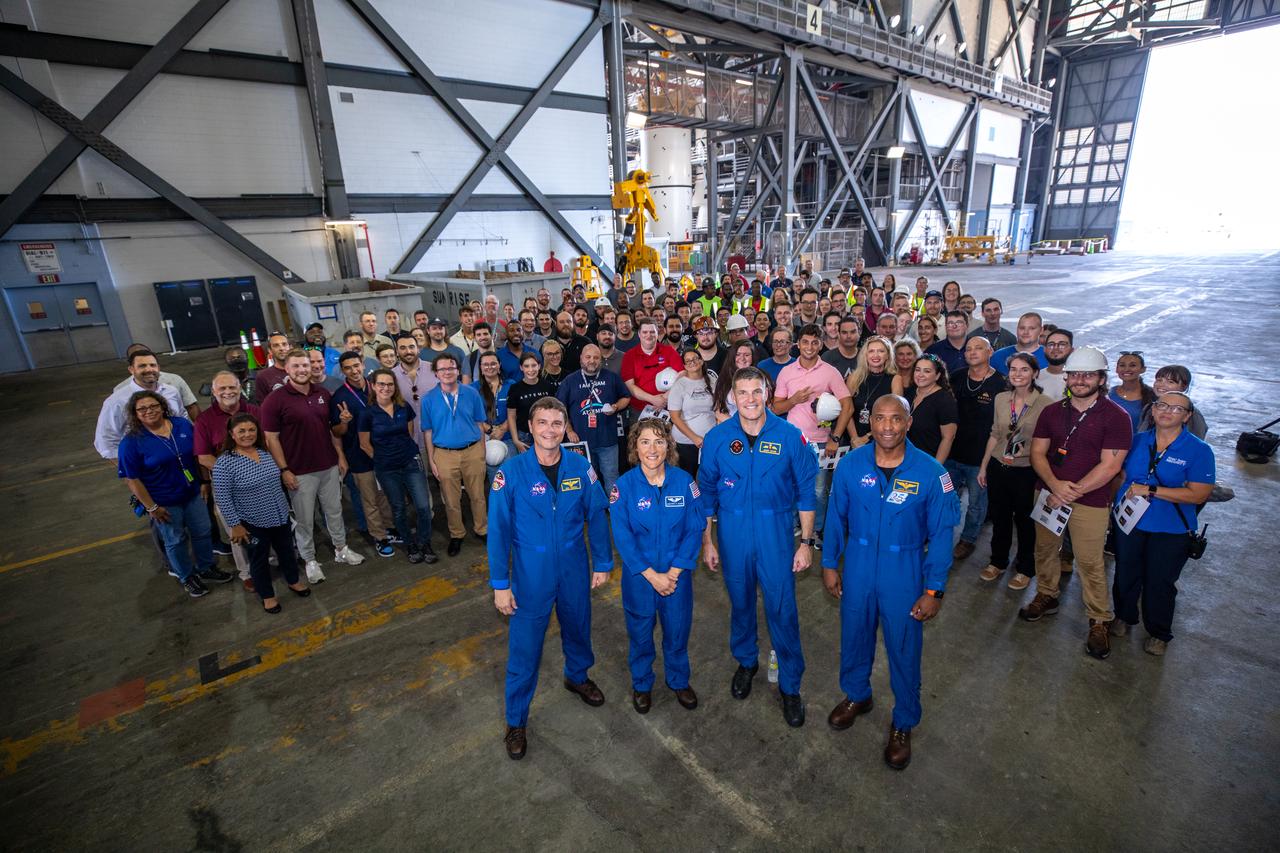
Artemis II astronauts visit NASA’s Kennedy Space Center in Florida on Aug. 7, 2023. In front, from left, are NASA astronauts Reid Wiseman and Christina Koch, CSA (Canadian Space Agency) astronaut Jeremy Hansen, and NASA astronaut Victor Glover in the transfer aisle of the Vehicle Assembly Building. Behind them are Exploration Ground Systems team members. The approximately 10-day Artemis II flight will test NASA’s foundational human deep space exploration capabilities, the Space Launch System rocket and Orion spacecraft, for the first time with astronauts and will pave the way for lunar surface missions, including landing the first woman and the first person of color on the Moon.
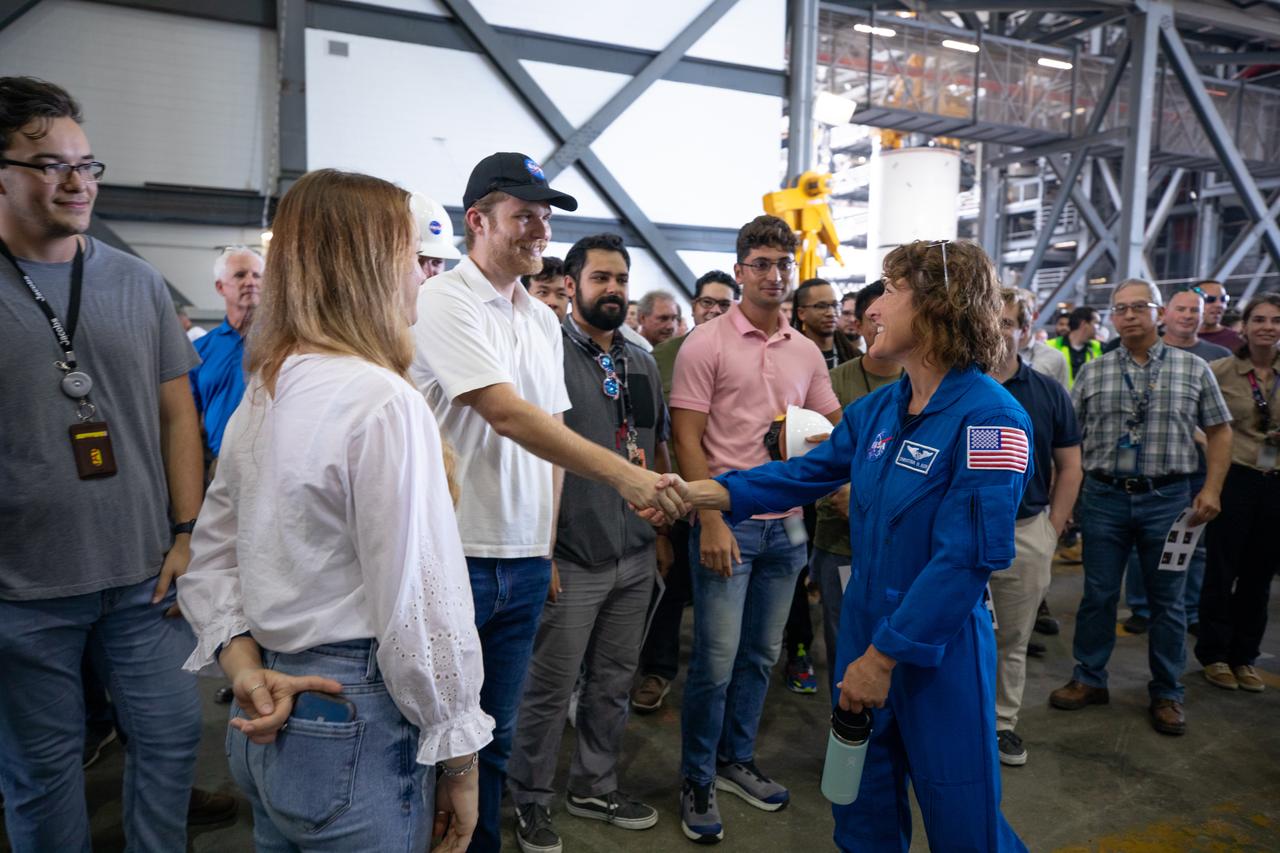
Artemis II NASA astronaut Christina Koch greets Exploration Ground Systems team members inside the transfer aisle of the Vehicle Assembly Building during a visit to the agency’s Kennedy Space Center in Florida on Aug. 7, 2023. The approximately 10-day Artemis II flight will test NASA’s foundational human deep space exploration capabilities, the Space Launch System rocket and Orion spacecraft, for the first time with astronauts and will pave the way for lunar surface missions, including landing the first woman and the first person of color on the Moon.
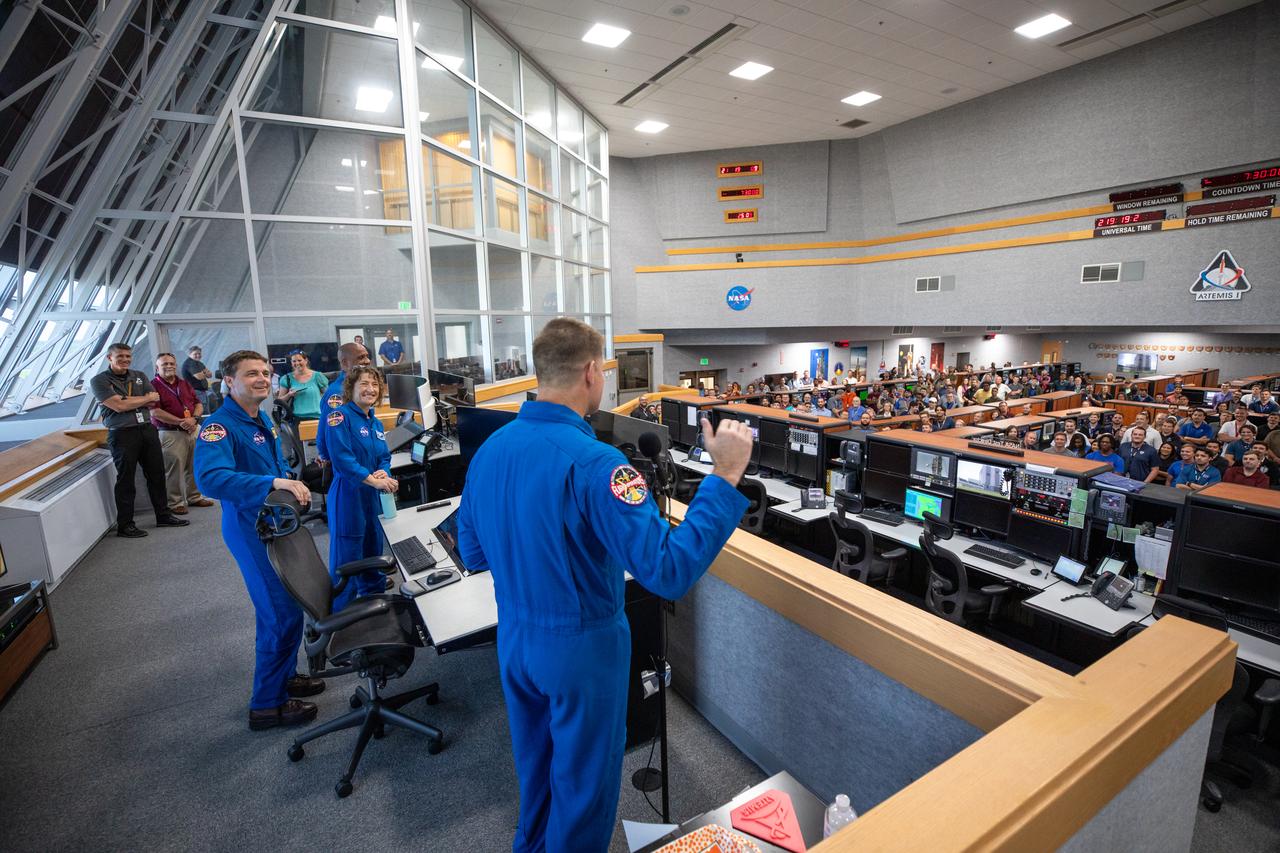
Artemis II astronauts visit the Artemis launch team inside Firing Room 1 in the Launch Control Center at NASA’s Kennedy Space Center in Florida on Aug. 7, 2023. In front, from left are NASA astronauts Victor Glover (partially hidden), Christina Koch, and Reid Wiseman, and CSA (Canadian Space Agency) astronaut Jeremy Hansen. The approximately 10-day Artemis II flight will test NASA’s foundational human deep space exploration capabilities, the Space Launch System rocket and Orion spacecraft, for the first time with astronauts and will pave the way for lunar surface missions, including landing the first woman and the first person of color on the Moon.

Shown inside the high bay of the Neil A. Armstrong Operations and Checkout Building at NASA’s Kennedy Space Center in Florida on Aug. 7, 2023, is the Orion crew module for NASA’s Artemis II mission. The crew module is undergoing acoustic testing ahead of integration with the European Service Module. The Artemis II crew features Reid Wiseman, commander; Victor Glover, pilot; Christina Hammock Koch, mission specialist; and Jeremy Hansen, mission specialist. Artemis II is the first crewed mission on NASA’s path to establishing a long-term lunar presence for science and exploration under Artemis.
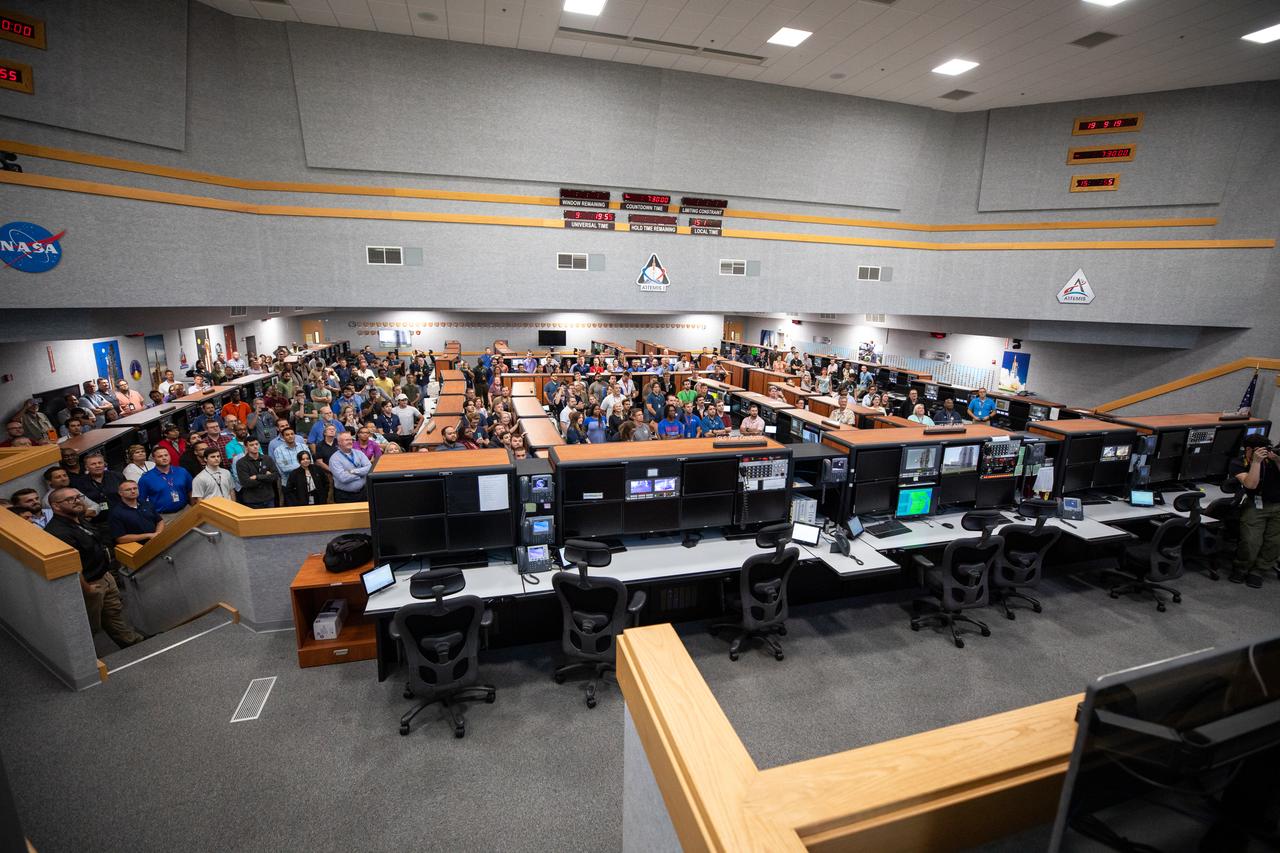
Artemis launch team members listen to Artemis II astronauts during their visit to Firing Room 1 in the Launch Control Center at NASA’s Kennedy Space Center in Florida on Aug. 7, 2023. Artemis II NASA astronauts Victor Glover, Christina Koch, and Reid Wiseman, and CSA (Canadian Space Agency) astronaut Jeremy Hansen are at the center to greet workers and tour facilities. The approximately 10-day Artemis II flight will test NASA’s foundational human deep space exploration capabilities, the Space Launch System rocket and Orion spacecraft, for the first time with astronauts and will pave the way for lunar surface missions, including landing the first woman and the first person of color on the Moon.
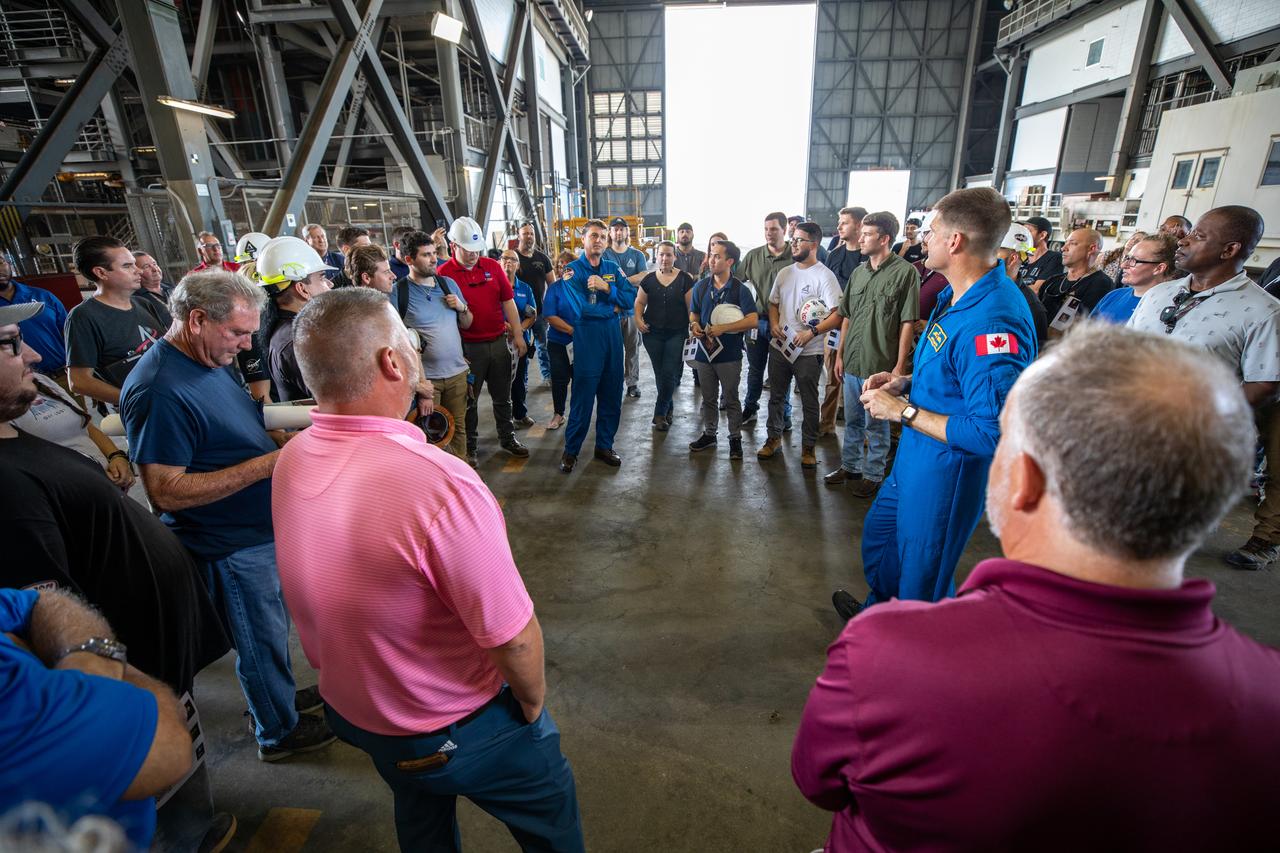
Artemis II NASA astronaut Reid Wiseman, in the center, and Jeremy Hansen, at right, CSA (Canadian Space Agency) Artemis II astronaut, talk with members of the Exploration Ground Systems team inside the transfer aisle of the Vehicle Assembly Building during a visit to the agency’s Kennedy Space Center in Florida on Aug. 7, 2023. The approximately 10-day Artemis II flight will test NASA’s foundational human deep space exploration capabilities, the Space Launch System rocket and Orion spacecraft, for the first time with astronauts and will pave the way for lunar surface missions, including landing the first woman and the first person of color on the Moon.
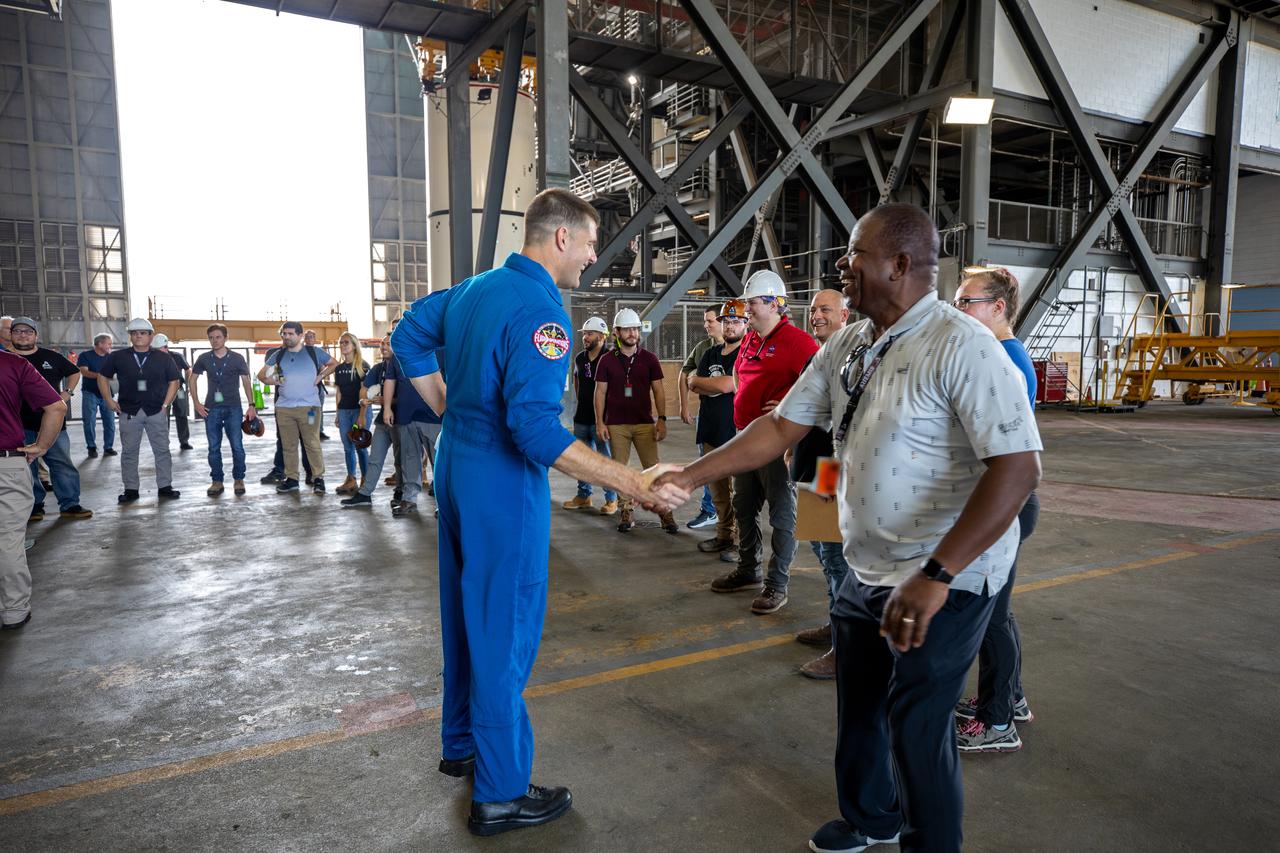
Jeremy Hansen, at left, CSA (Canadian Space Agency) Artemis II astronaut, greets members of the Exploration Ground Systems team inside the transfer aisle of the Vehicle Assembly Building during a visit at NASA’s Kennedy Space Center in Florida on Aug. 7, 2023. The approximately 10-day Artemis II flight will test NASA’s foundational human deep space exploration capabilities, the Space Launch System rocket and Orion spacecraft, for the first time with astronauts and will pave the way for lunar surface missions, including landing the first woman and the first person of color on the Moon.
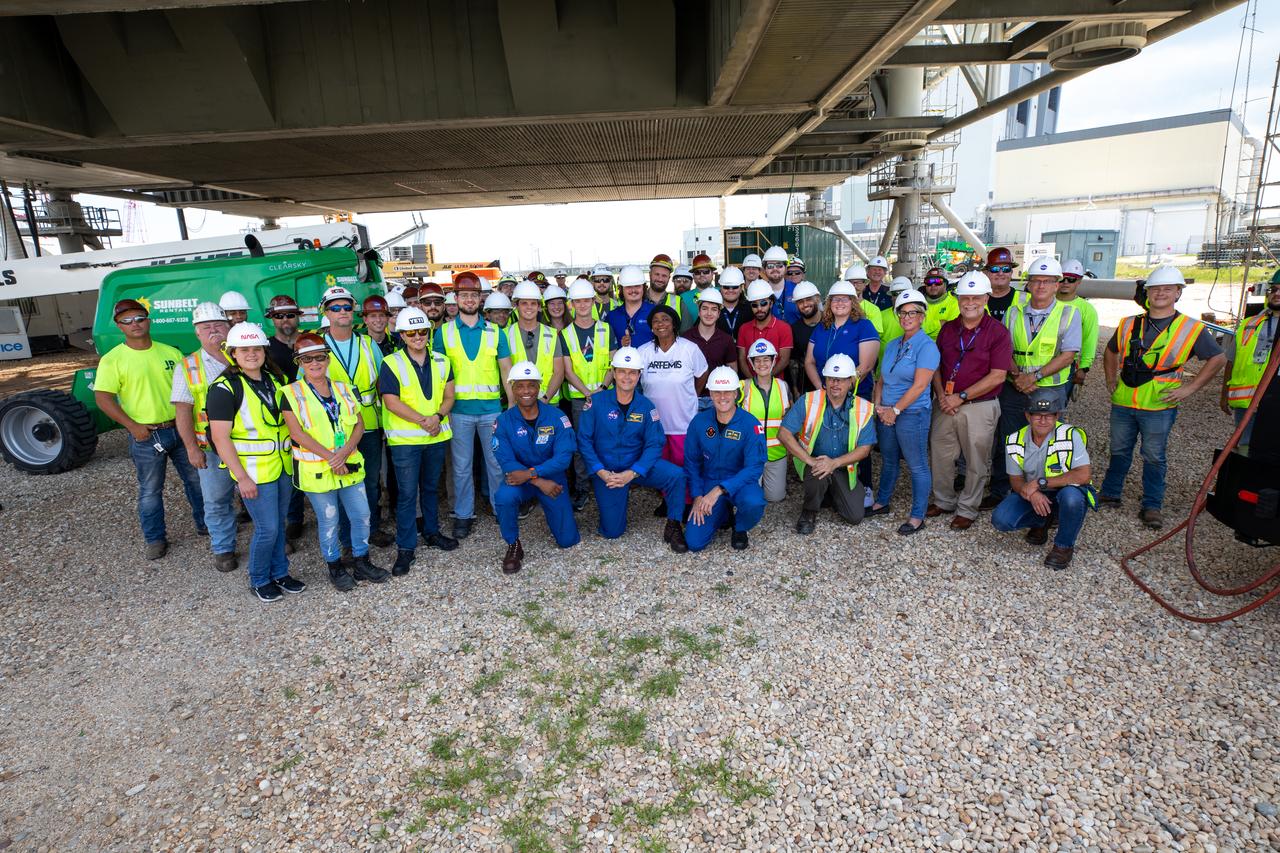
Artemis II astronauts visit NASA’s Kennedy Space Center in Florida on Aug. 7, 2023. In front, from left, are NASA astronauts Victor Glover and Reid Wiseman, and CSA (Canadian Space Agency) astronaut Jeremy Hansen with the Exploration Ground Systems team beneath the mobile launcher 1. The approximately 10-day Artemis II flight will test NASA’s foundational human deep space exploration capabilities, the Space Launch System rocket and Orion spacecraft, for the first time with astronauts and will pave the way for lunar surface missions, including landing the first woman and the first person of color on the Moon.
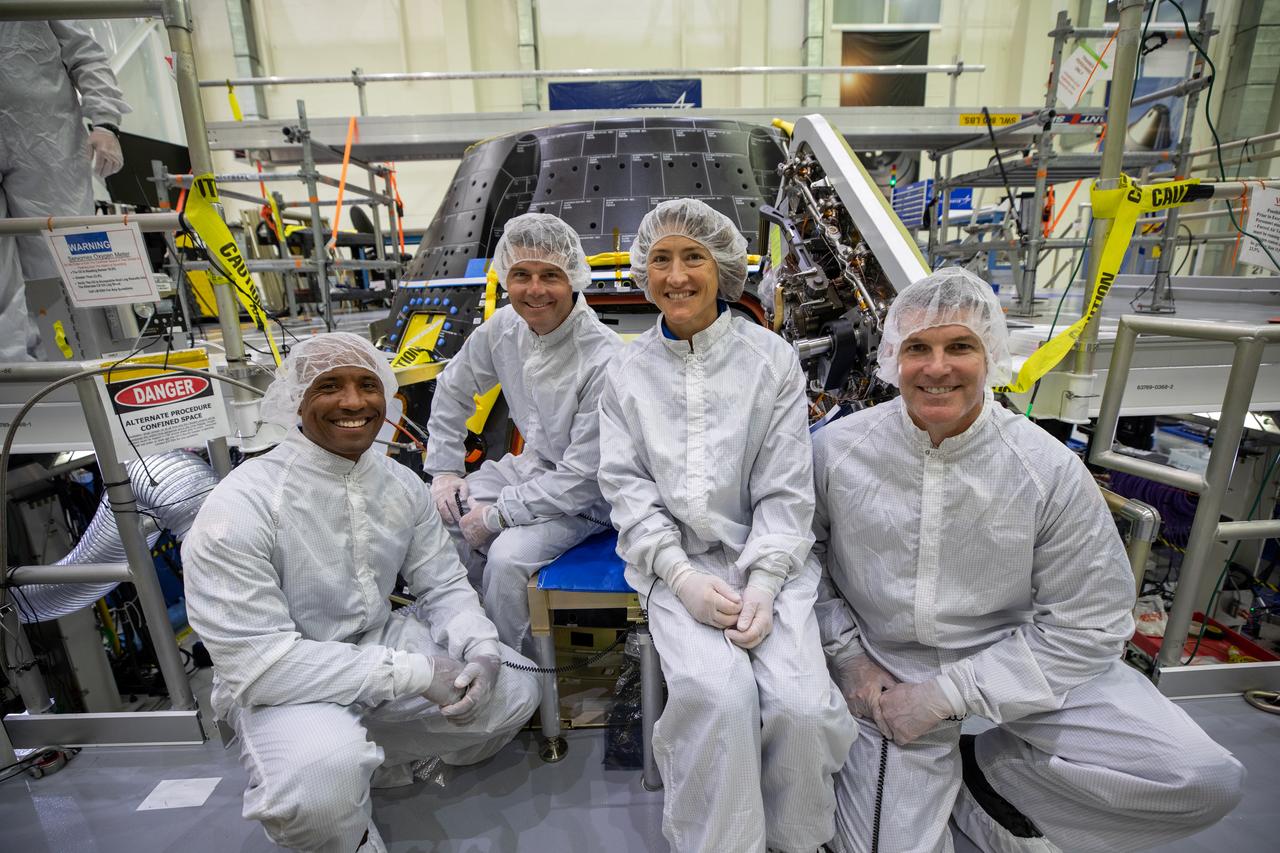
Artemis II crew members inspect their Orion crew module inside the high bay of the Neil A. Armstrong Operations and Checkout Building at NASA’s Kennedy Space Center in Florida, on Aug. 7, 2023. From left are: Victor Glover, pilot; Reid Wiseman, commander; Christina Hammock Koch, mission specialist; and Jeremy Hansen, mission specialist. The crew module is undergoing acoustic testing ahead of integration with the European Service Module. Artemis II is the first crewed mission on NASA’s path to establishing a long-term lunar presence for science and exploration under Artemis.

Artemis II NASA astronaut Reid Wiseman greets Exploration Ground Systems team members inside the transfer aisle of the Vehicle Assembly Building during a visit to the agency’s Kennedy Space Center in Florida on Aug. 7, 2023. The approximately 10-day Artemis II flight will test NASA’s foundational human deep space exploration capabilities, the Space Launch System rocket and Orion spacecraft, for the first time with astronauts and will pave the way for lunar surface missions, including landing the first woman and the first person of color on the Moon.
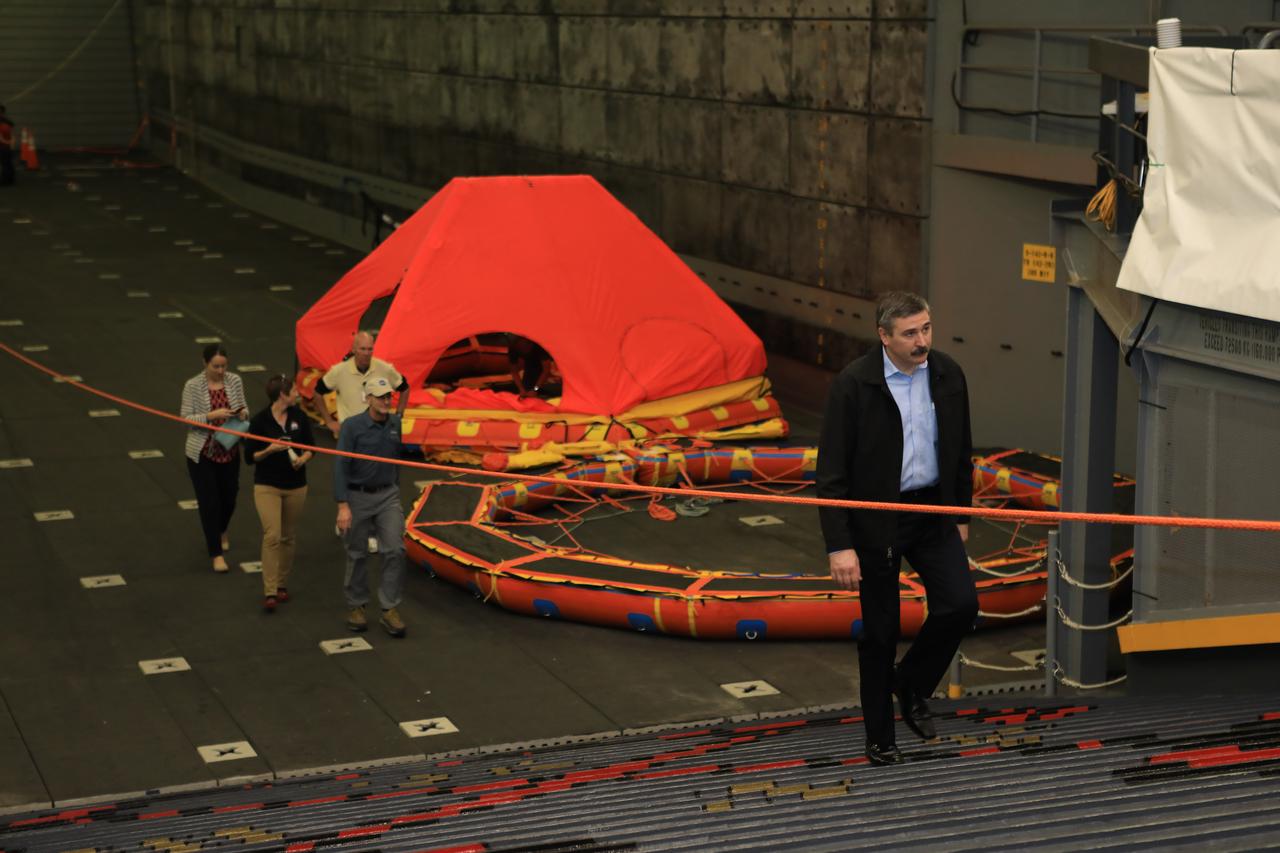
Exploration Mission-1 Mission Manager Mike Sarafin and other senior leaders from around NASA received a familiarization tour by the Exploration Ground Systems (EGS) recovery team on Oct. 29, 2018, as they prepare for Underway Recovery Test-7 (URT-7) on a U.S. Navy ship. EGS and the U.S. Navy will use a test version of the Orion crew module, several rigid hull inflatable boats and support equipment to verify and validate processes, procedures, hardware and personnel during recovery of Orion in open waters. URTs are a series of tests to ensure all systems are go when recovering the Orion crew capsule and astronauts onboard in the future. Orion will have emergency abort capability, sustain the crew during space travel and provide safe re-entry from deep space return velocities.
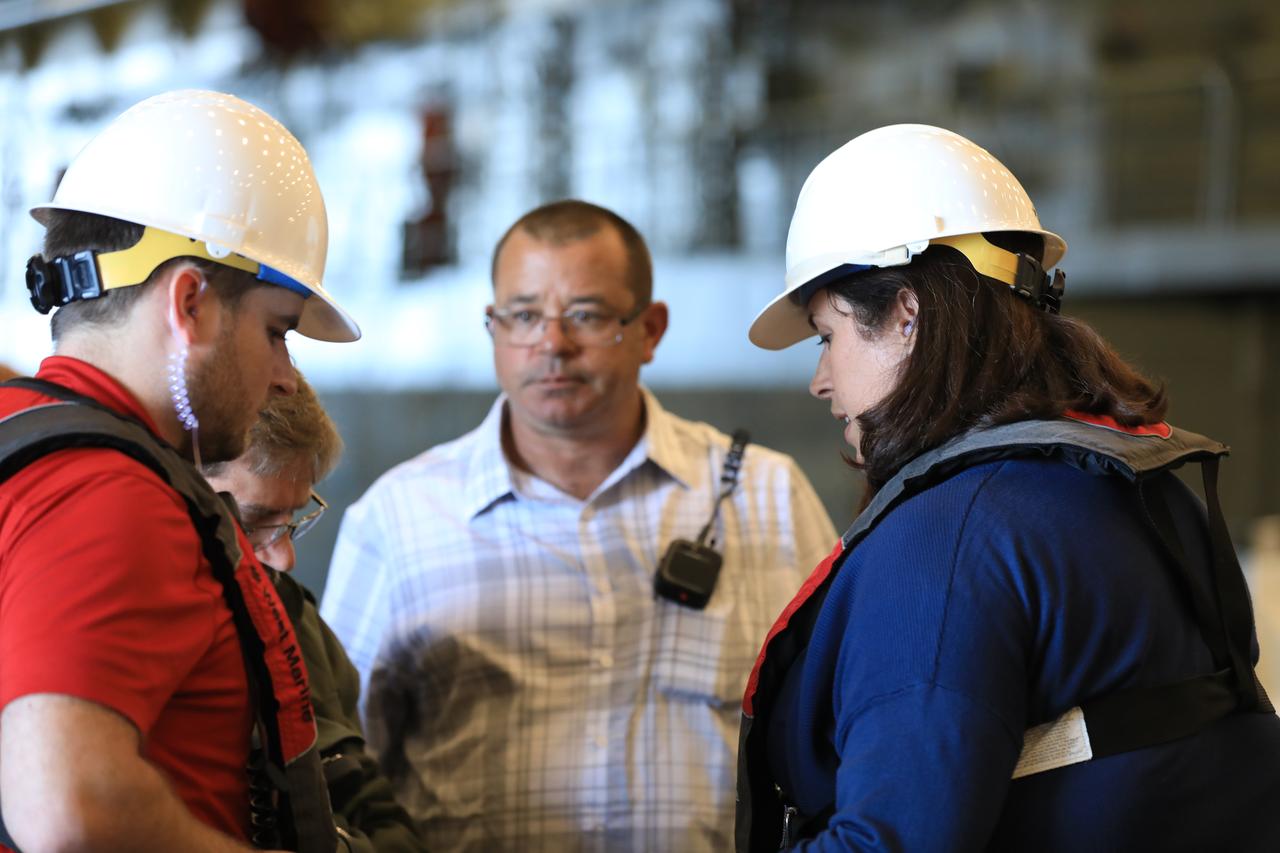
Inside a U.S. Navy ship, Exploration Ground Systems (EGS) Landing and Recovery Director Melissa Jones, at right, briefs her team on Oct. 30, 2018, before they begin Underway Recovery Test-7 (URT-7). EGS and the U.S. Navy will use a test version of the Orion crew module, several rigid hull inflatable boats and support equipment to verify and validate processes, procedures, hardware and personnel during recovery of Orion in open waters. URT-7 is one in a series of tests to verify and validate procedures and hardware that will be used to recover the Orion spacecraft after it splashes down in the Pacific Ocean following deep space exploration missions. Orion will have emergency abort capability, sustain the crew during space travel and provide safe re-entry from deep space return velocities.
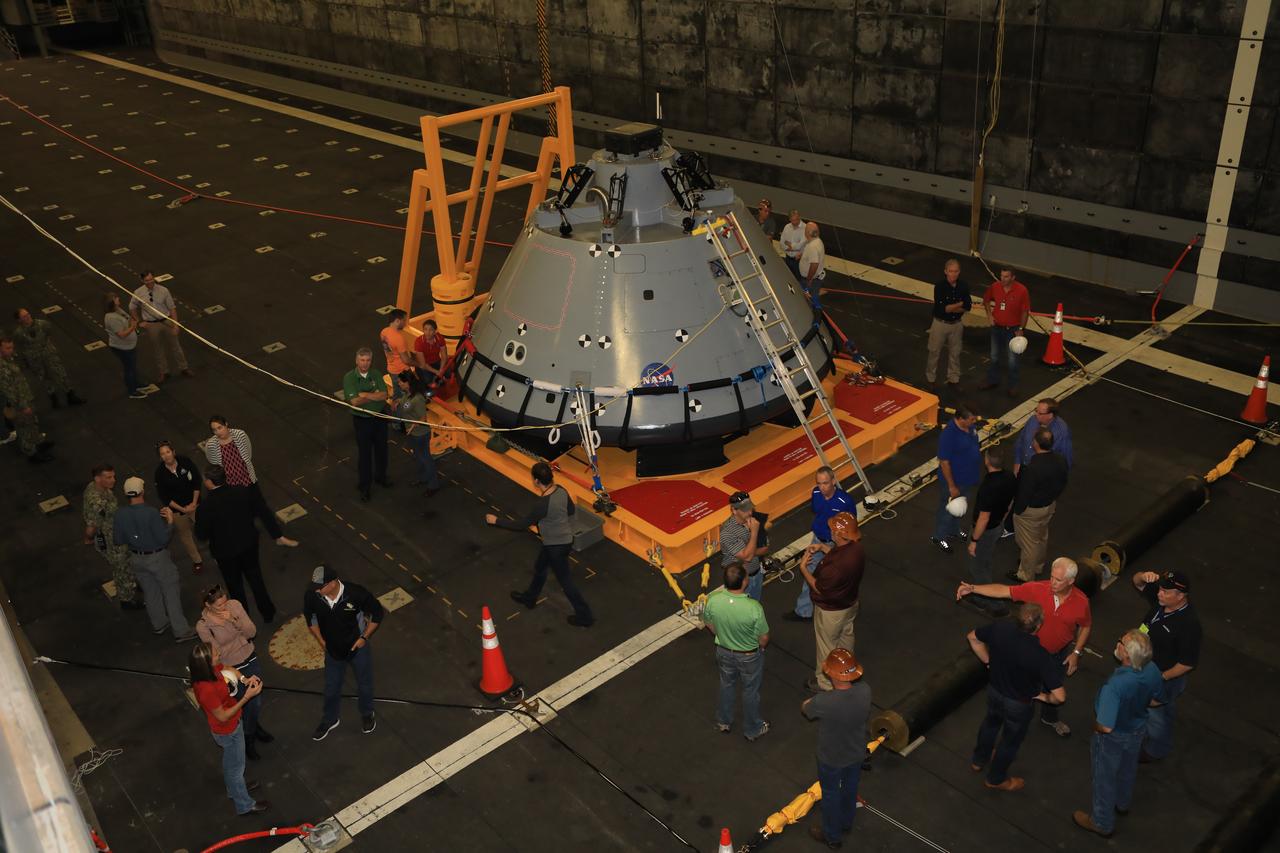
Senior leaders from around NASA receive a familiarization tour by the Exploration Ground Systems (EGS) recovery team on Oct. 29, 2018, as they prepare for Underway Recovery Test-7 (URT-7) aboard a U.S. Navy ship. EGS and the U.S. Navy will use a test version of the Orion crew module, several rigid hull inflatable boats and support equipment to verify and validate processes, procedures, hardware and personnel during recovery of Orion in open waters. URTs are a series of tests to ensure all systems are go when recovering the Orion crew capsule and astronauts onboard in the future. Orion will have emergency abort capability, sustain the crew during space travel and provide safe re-entry from deep space return velocities.
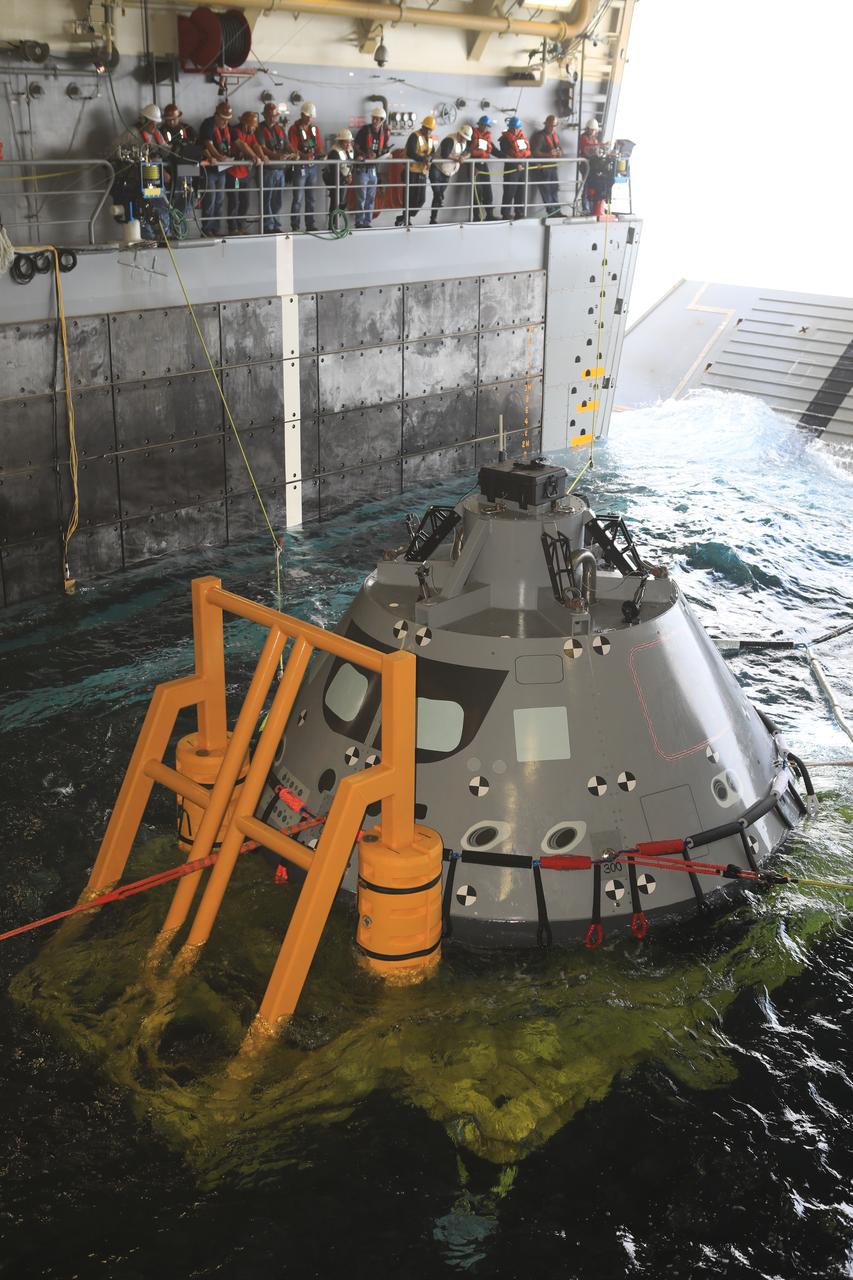
The Exploration Ground Systems (EGS) recovery team, along with the U.S. Navy, practice keeping an Orion test article under control in the well deck of a U.S. Navy ship as part of Underway Recovery Test-7 (URT-7) on Oct. 30, 2018, in the Pacific Ocean. EGS and the U.S. Navy will use a test version of the Orion crew module, several rigid hull inflatable boats and support equipment to verify and validate processes, procedures, hardware and personnel during recovery of Orion in open waters. The testing is one in a series of tests to verify and validate procedures and hardware that will be used to recover the Orion spacecraft after it splashes down in the Pacific Ocean following deep space exploration missions. Orion will have emergency abort capability, sustain the crew during space travel and provide safe re-entry from deep space return velocities.
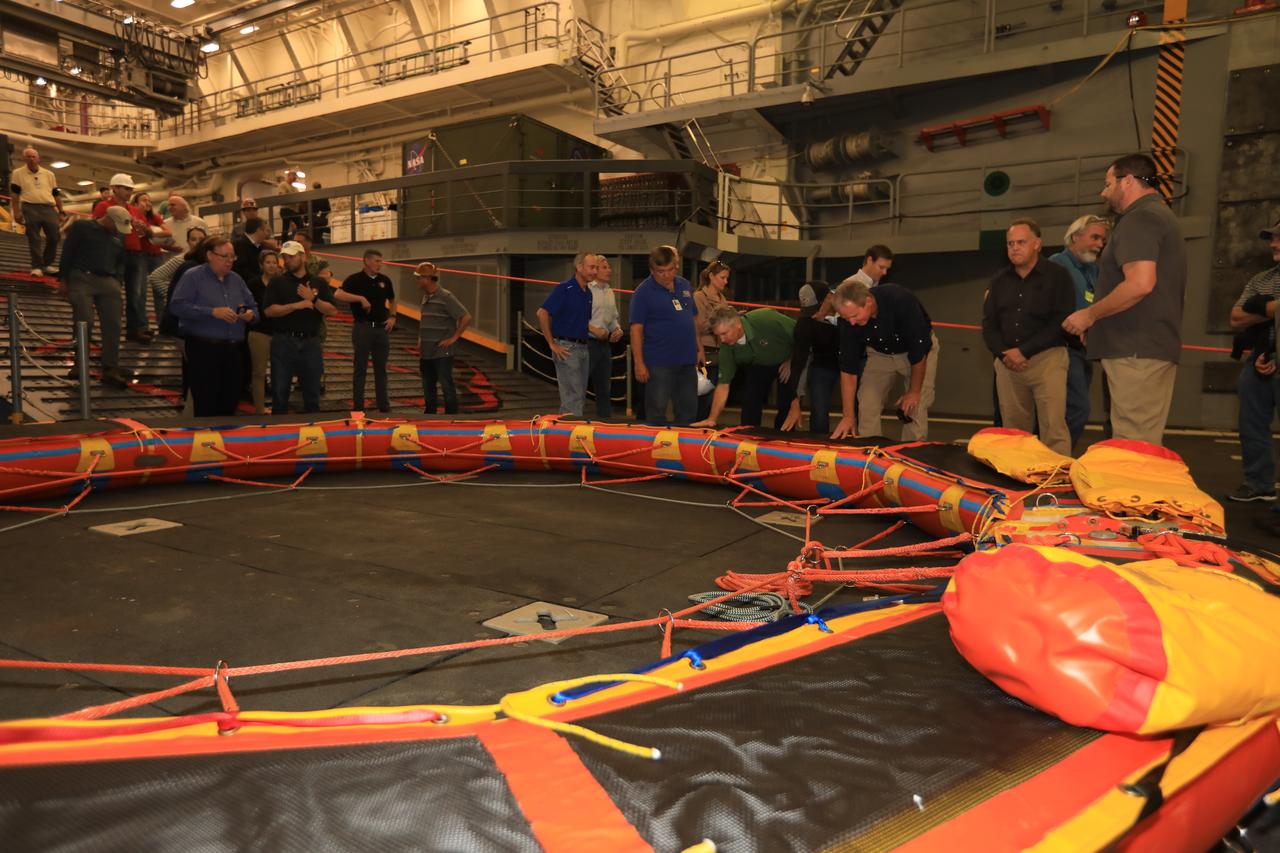
Landing and Recovery Director Melissa Jones gives senior leaders from around NASA a familiarization tour onboard a U.S. Navy ship on Oct. 29, 2018, as the Exploration Ground Systems (EGS) recovery team prepares for Underway Recovery Test-7 (URT-7). EGS and the U.S. Navy will use a test version of the Orion crew module, several rigid hull inflatable boats and support equipment to verify and validate processes, procedures, hardware and personnel during recovery of Orion in open waters. URTs are a series of tests to ensure all systems are go when recovering the Orion crew capsule and astronauts onboard in the future. Orion will have emergency abort capability, sustain the crew during space travel and provide safe re-entry from deep space return velocities.
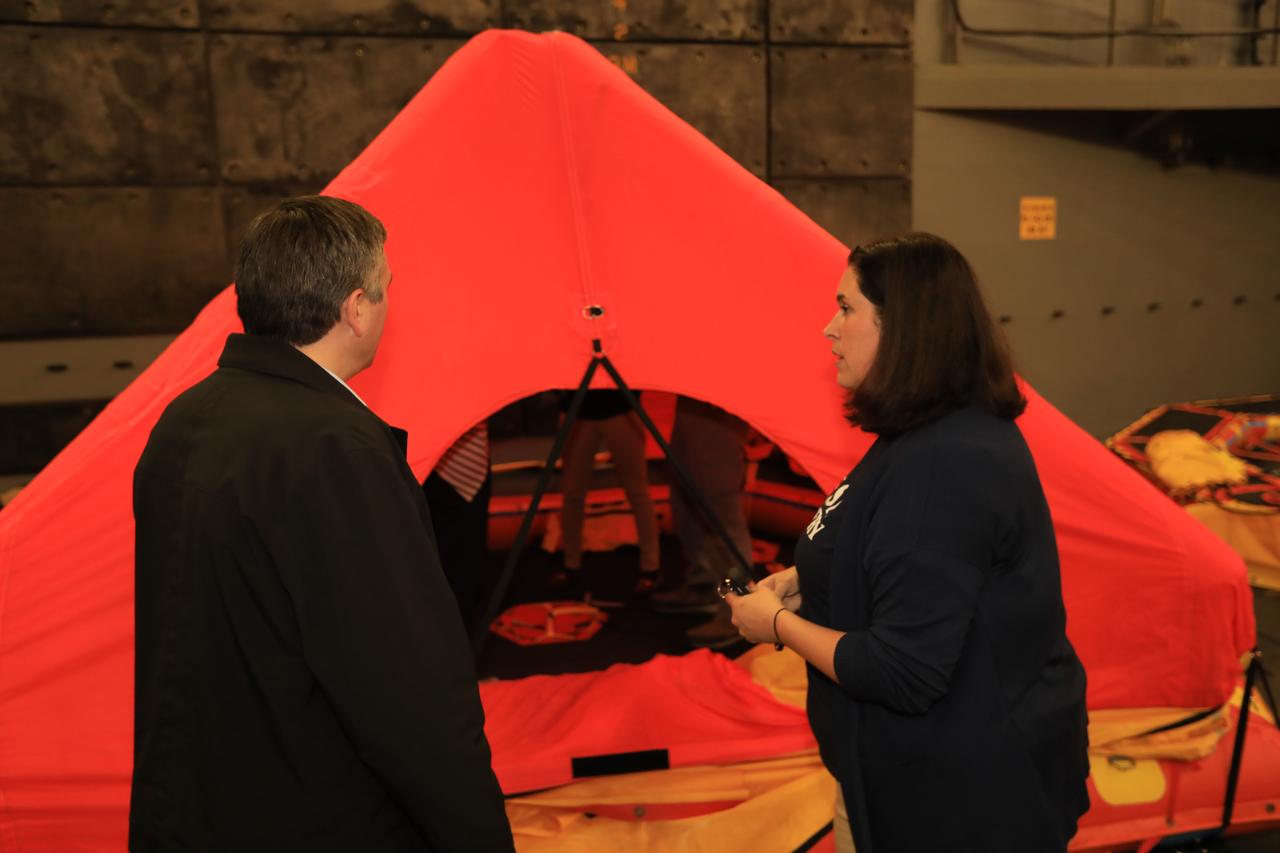
NASA Landing and Recovery Director Melissa Jones, at right, and Exploration Mission-1 Mission Manager Mike Sarafin discuss the benefits that the front porch will provide to astronauts after splashing down in the Orion crew capsule on future missions. Senior leaders from around NASA receive a familiarization tour by the Exploration Ground Systems (EGS) recovery team on Oct. 29, 2018, as they prepare for Underway Recovery Test-7 (URT-7). EGS and the U.S. Navy will use a test version of the Orion crew module, several rigid hull inflatable boats and support equipment to verify and validate processes, procedures, hardware and personnel during recovery of Orion in open waters. URTs are a series of tests to ensure all systems are go when recovering the Orion crew capsule and astronauts onboard in the future. Orion will have emergency abort capability, sustain the crew during space travel and provide safe re-entry from deep space return velocities.
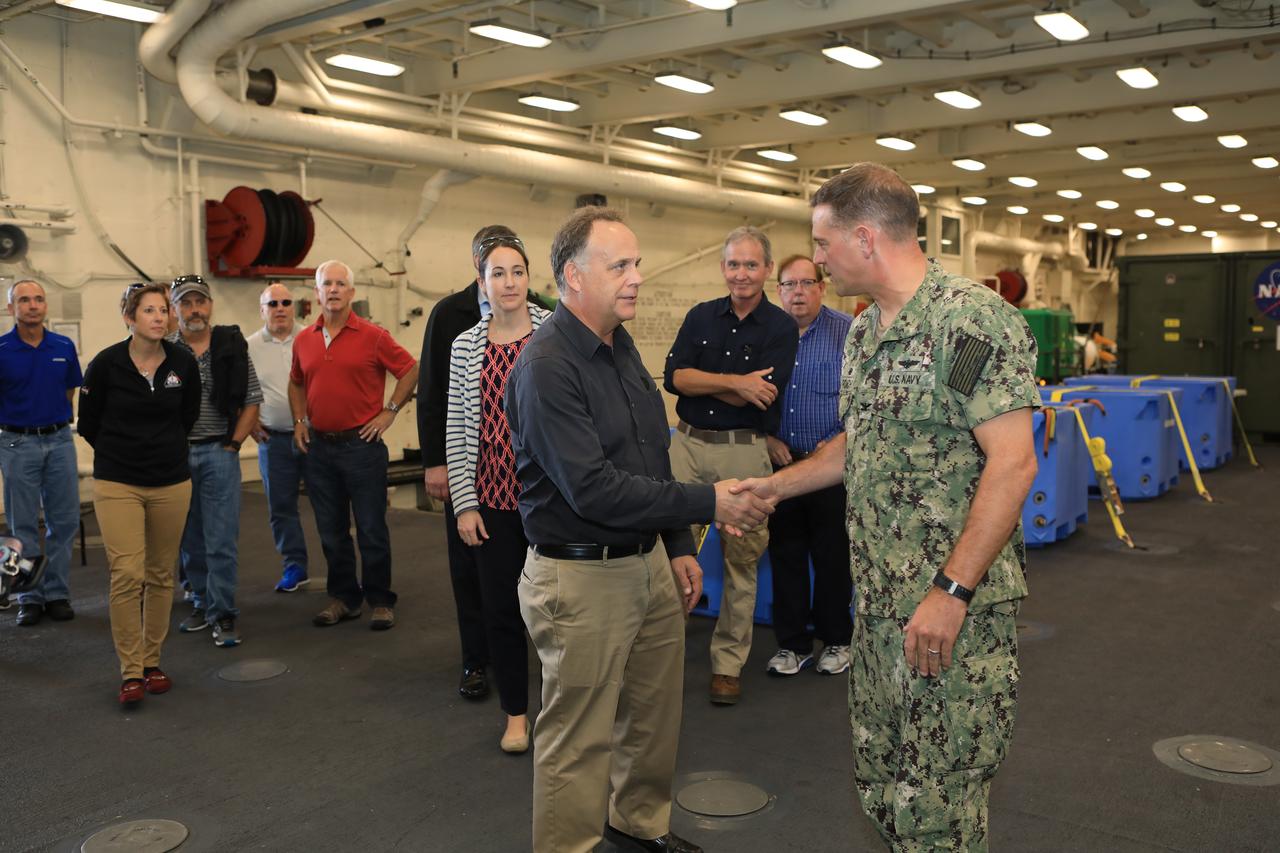
Captain Anthony Roach, at right, commanding officer in the U.S. Navy, welcomes Shawn Quinn and other senior leaders from around NASA onto his ship on Oct. 29, 2018. The visit is a familiarization tour coordinated by the Exploration Ground Systems (EGS) recovery team as they prepare for Underway Recovery Test-7 (URT-7). EGS and the U.S. Navy will use a test version of the Orion crew module, several rigid hull inflatable boats and support equipment to verify and validate processes, procedures, hardware and personnel during recovery of Orion in open waters. URTs are a series of tests to ensure all systems are go when recovering the Orion crew capsule and astronauts onboard in the future. Orion will have emergency abort capability, sustain the crew during space travel and provide safe re-entry from deep space return velocities.
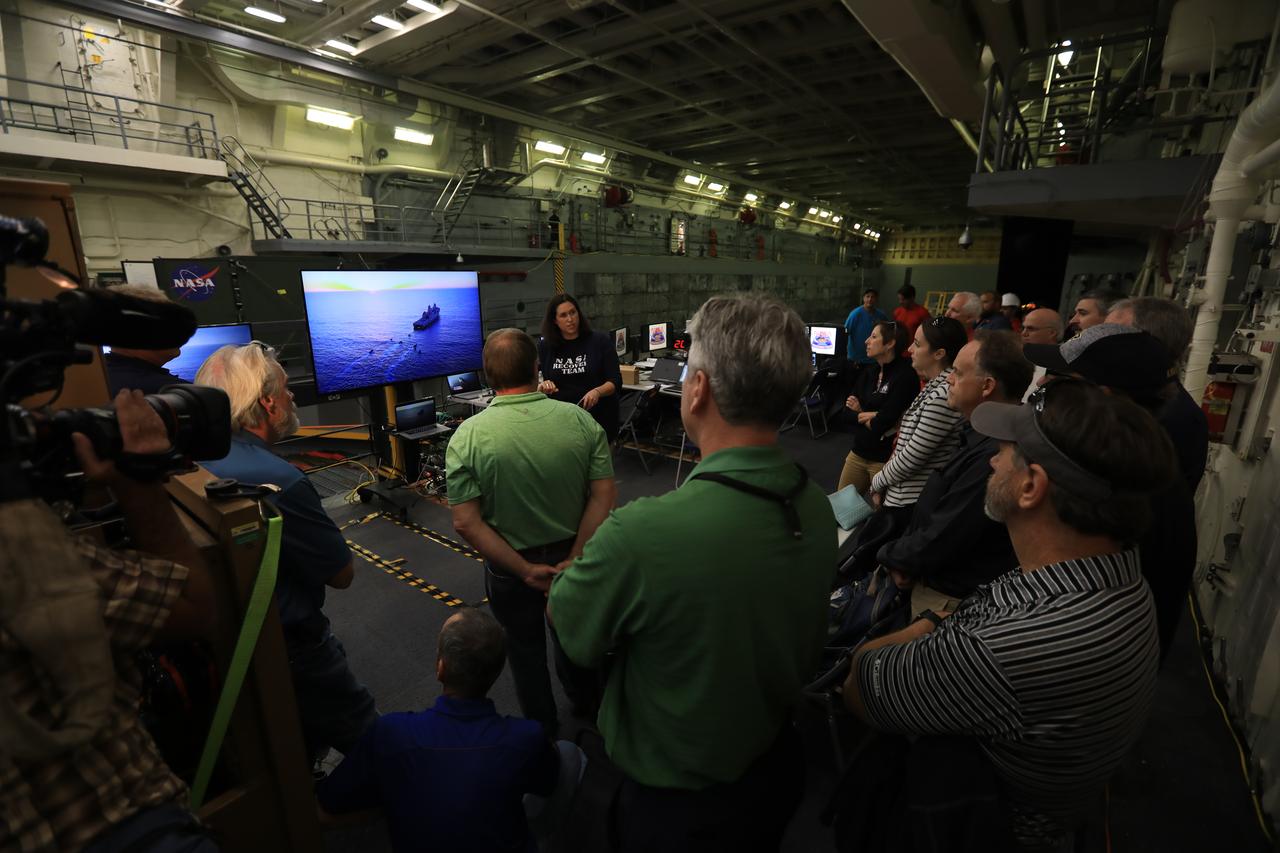
Landing and Recovery Director Melissa Jones, standing in center, gives senior leaders from around NASA a familiarization tour onboard a U.S. Navy ship on Oct. 29, 2018, as the Exploration Ground Systems (EGS) recovery team prepares for Underway Recovery Test-7 (URT-7). EGS and the U.S. Navy will use a test version of the Orion crew module, several rigid hull inflatable boats and support equipment to verify and validate processes, procedures, hardware and personnel during recovery of Orion in open waters. URTs are a series of tests to ensure all systems are go when recovering the Orion crew capsule and astronauts onboard in the future. Orion will have emergency abort capability, sustain the crew during space travel and provide safe re-entry from deep space return velocities.
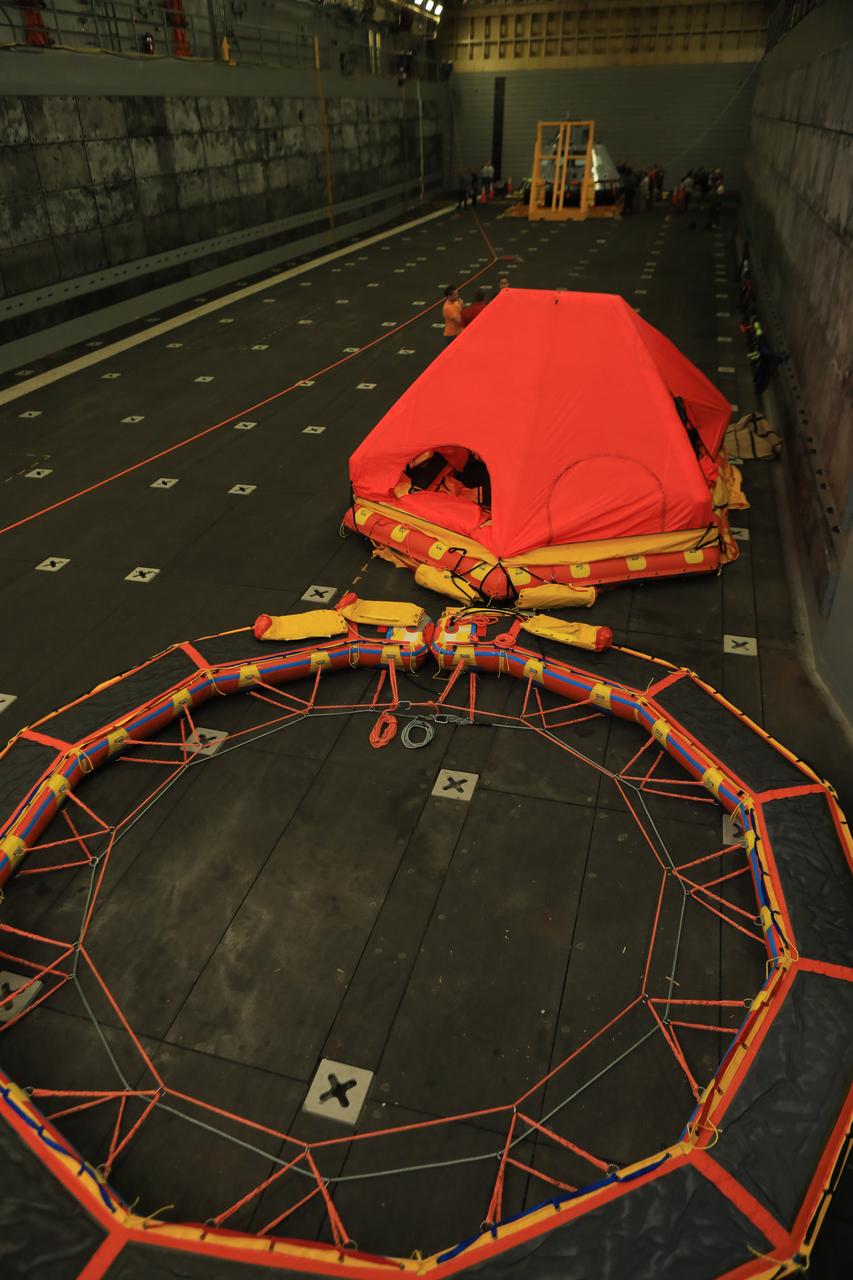
A stabilization collar and front porch are in the well deck of a U.S. Navy ship on Oct. 29, 2018. They will be used to stabilize and recover the Orion capsule and future crew onboard. The Exploration Ground Systems (EGS) recovery team are preparing for Underway Recovery Test-7 (URT-7). EGS and the U.S. Navy will use a test version of the Orion crew module, several rigid hull inflatable boats and support equipment to verify and validate processes, procedures, hardware and personnel during recovery of Orion in open waters. URTs are a series of tests to ensure all systems are go when recovering the Orion crew capsule and astronauts onboard in the future. Orion will have emergency abort capability, sustain the crew during space travel and provide safe re-entry from deep space return velocities.
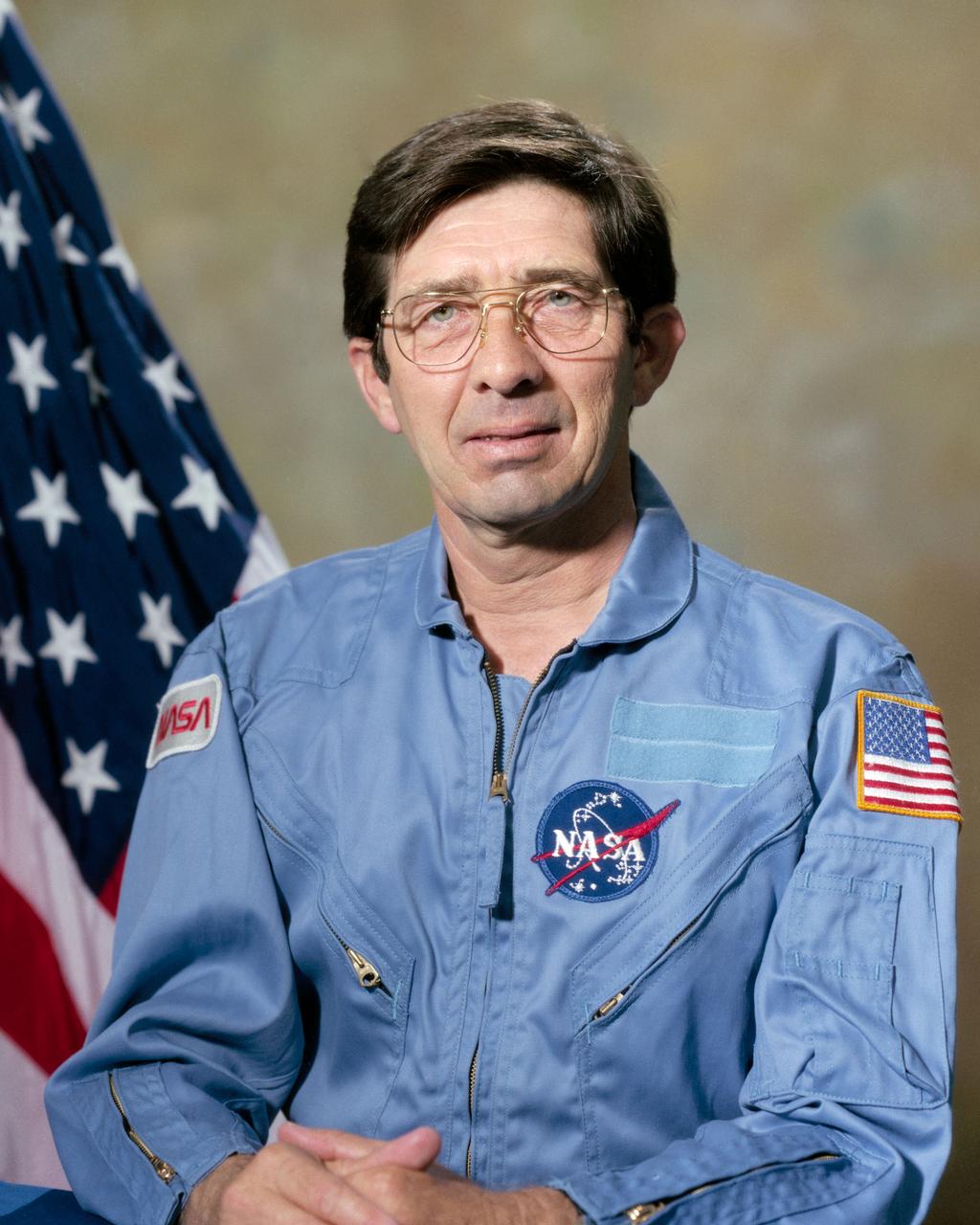
S84-36140 (16 June 1984) --- Lodewijk van den Berg, EG&G Corporation Spacelab 3 Payload Specialist.

A colorful sunrise serves as the backdrop in this view of the mobile launcher at NASA's Kennedy Space Center in Florida. The mobile launcher is equipped with a number of lines, called umbilicals, which will connect to NASA's Space Launch System (SLS) and Orion spacecraft. Exploration Ground Systems is preparing the mobile launcher and ground systems necessary to process and launch the SLS and Orion spacecraft on Exploration Mission-1 and deep space missions.
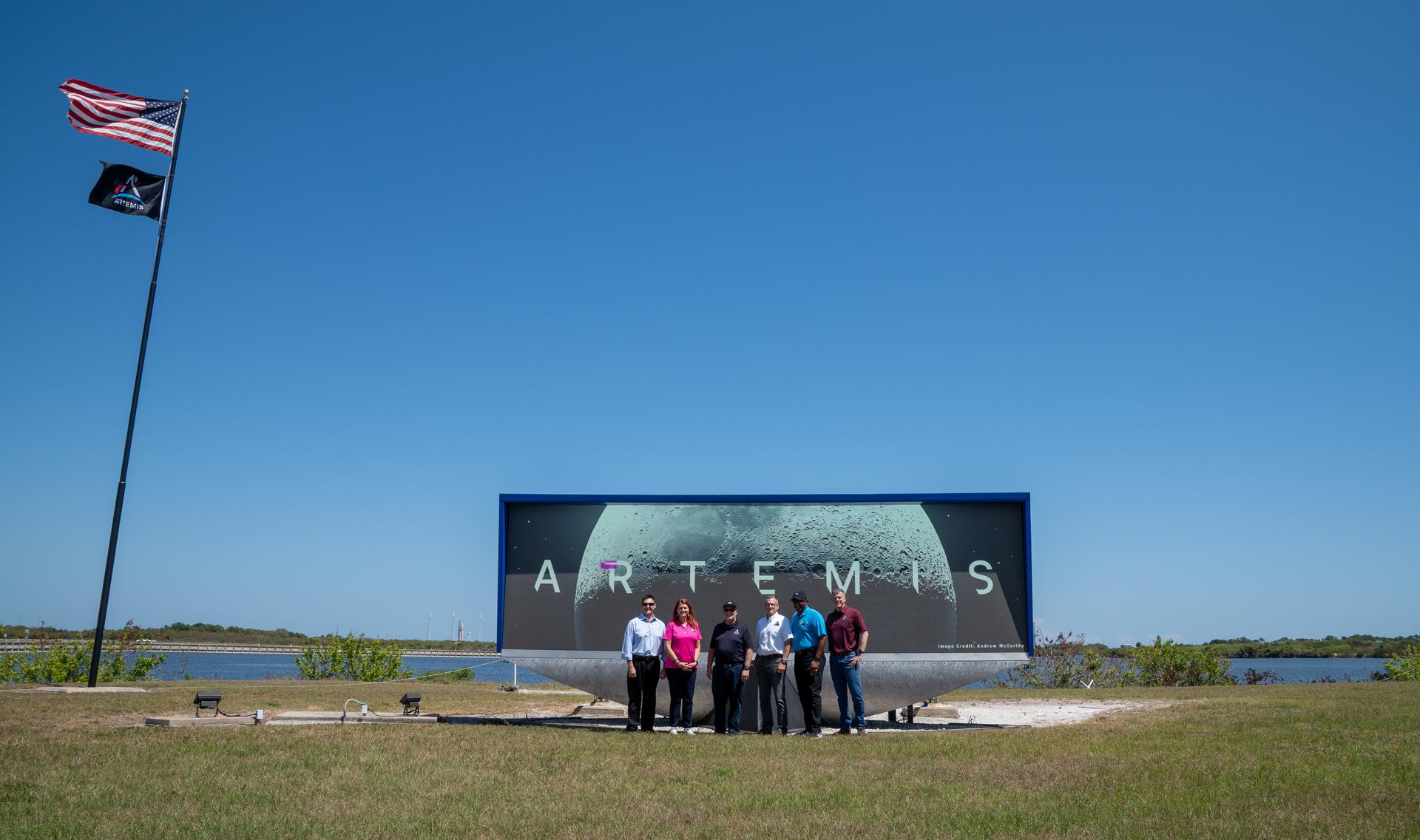
Robert Yaskovic, associate manager, Exploration Ground Systems Program; Charlie Blackwell-Thompson, Artemis II launch director; Shawn Quinn, manager, Exploration Ground Systems Program; Cliff Lanham, deputy manager, Exploration Ground Systems Program; NASA Kennedy Space Center Deputy Director Kelvin Manning; and Jeremy Graeber, assistant launch director, Exploration Ground Systems Program raise the Artemis flag near the countdown clock at the NASA News Center at NASA’s Kennedy Space Center in Florida on Friday, March 27, 2026. The Artemis II test flight mission will take Artemis II Commander Reid Wiseman, Pilot Victor Glover, and Mission Specialist Christina Koch from NASA, and Mission Specialist Jeremy Hansen from the CSA (Canadian Space Agency) on a 10-day journey around the Moon and back aboard NASA’s SLS (Space Launch System) rocket and Orion spacecraft from Launch Complex 39B no earlier than 6:24 p.m. EDT on Wednesday, April 1.
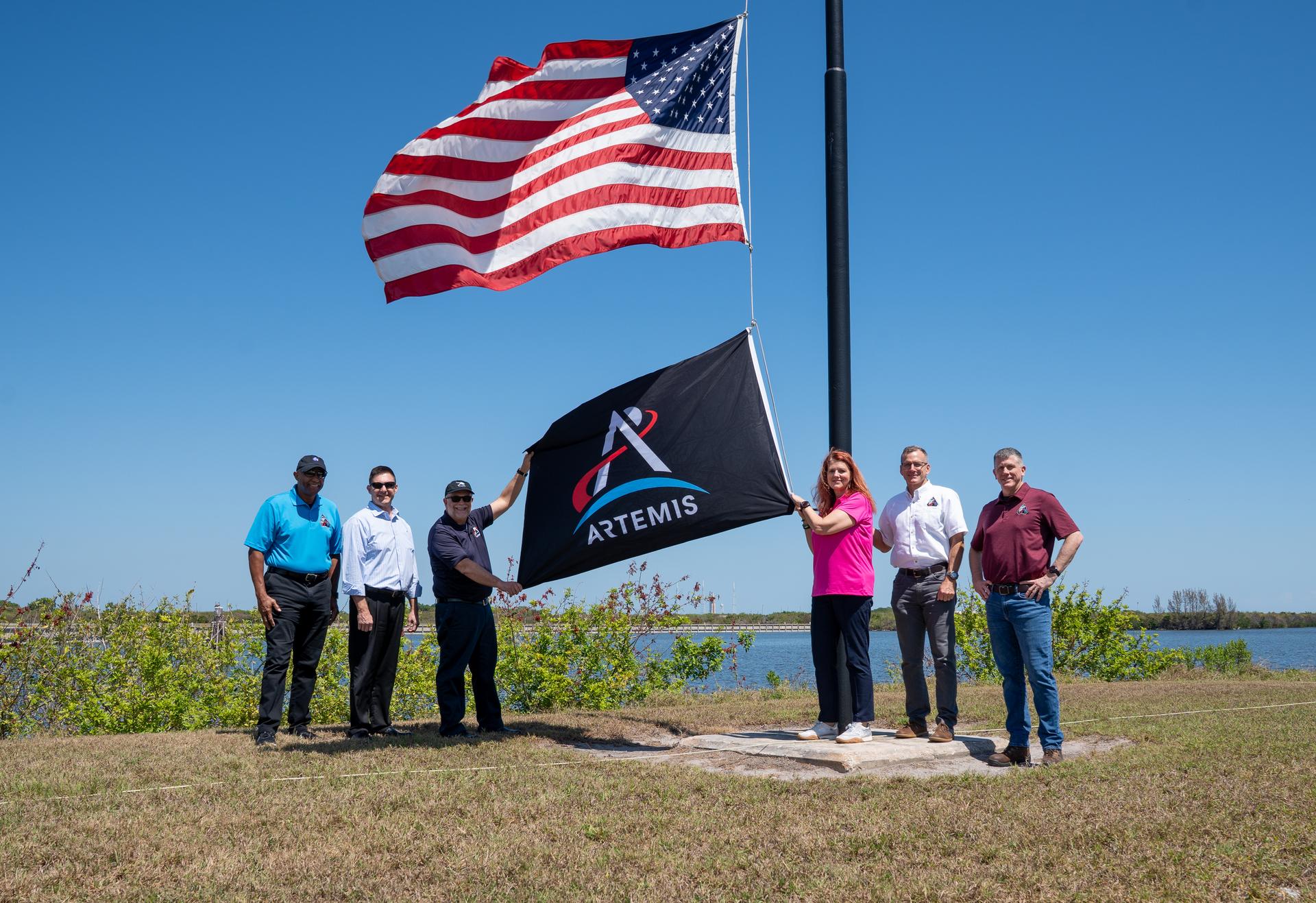
From left, NASA Kennedy Space Center Deputy Director Kelvin Manning; Robert Yaskovic, associate manager, Exploration Ground Systems Program; Shawn Quinn, manager, Exploration Ground Systems Program; Charlie Blackwell-Thompson, Artemis II launch director; Cliff Lanham, deputy manager, Exploration Ground Systems Program; and Jeremy Graeber, assistant launch director, Exploration Ground Systems Program raise the Artemis flag near the countdown clock at the NASA News Center at NASA’s Kennedy Space Center in Florida on Friday, March 27, 2026. The Artemis II test flight mission will take Artemis II Commander Reid Wiseman, Pilot Victor Glover, and Mission Specialist Christina Koch from NASA, and Mission Specialist Jeremy Hansen from the CSA (Canadian Space Agency) on a 10-day journey around the Moon and back aboard NASA’s SLS (Space Launch System) rocket and Orion spacecraft from Launch Complex 39B no earlier than 6:24 p.m. EDT on Wednesday, April 1.

A brilliant sunrise serves as the backdrop in this panoramic view of the mobile launcher at NASA's Kennedy Space Center in Florida. The mobile launcher is equipped with a number of lines, called umbilicals, which will connect to NASA's Space Launch System (SLS) and Orion spacecraft. Exploration Ground Systems is preparing the mobile launcher and ground systems necessary to process and launch the SLS and Orion spacecraft on Exploration Mission-1 and deep space missions.

The Artemis flag was raised with the American flag near the countdown clock at the NASA News Center at NASA’s Kennedy Space Center in Florida on Friday, March 27, 2026. The Artemis II test flight mission will take Artemis II Commander Reid Wiseman, Pilot Victor Glover, and Mission Specialist Christina Koch from NASA, and Mission Specialist Jeremy Hansen from the CSA (Canadian Space Agency) on a 10-day journey around the Moon and back aboard NASA’s SLS (Space Launch System) rocket and Orion spacecraft from Launch Complex 39B no earlier than 6:24 p.m. EDT on Wednesday, April 1.
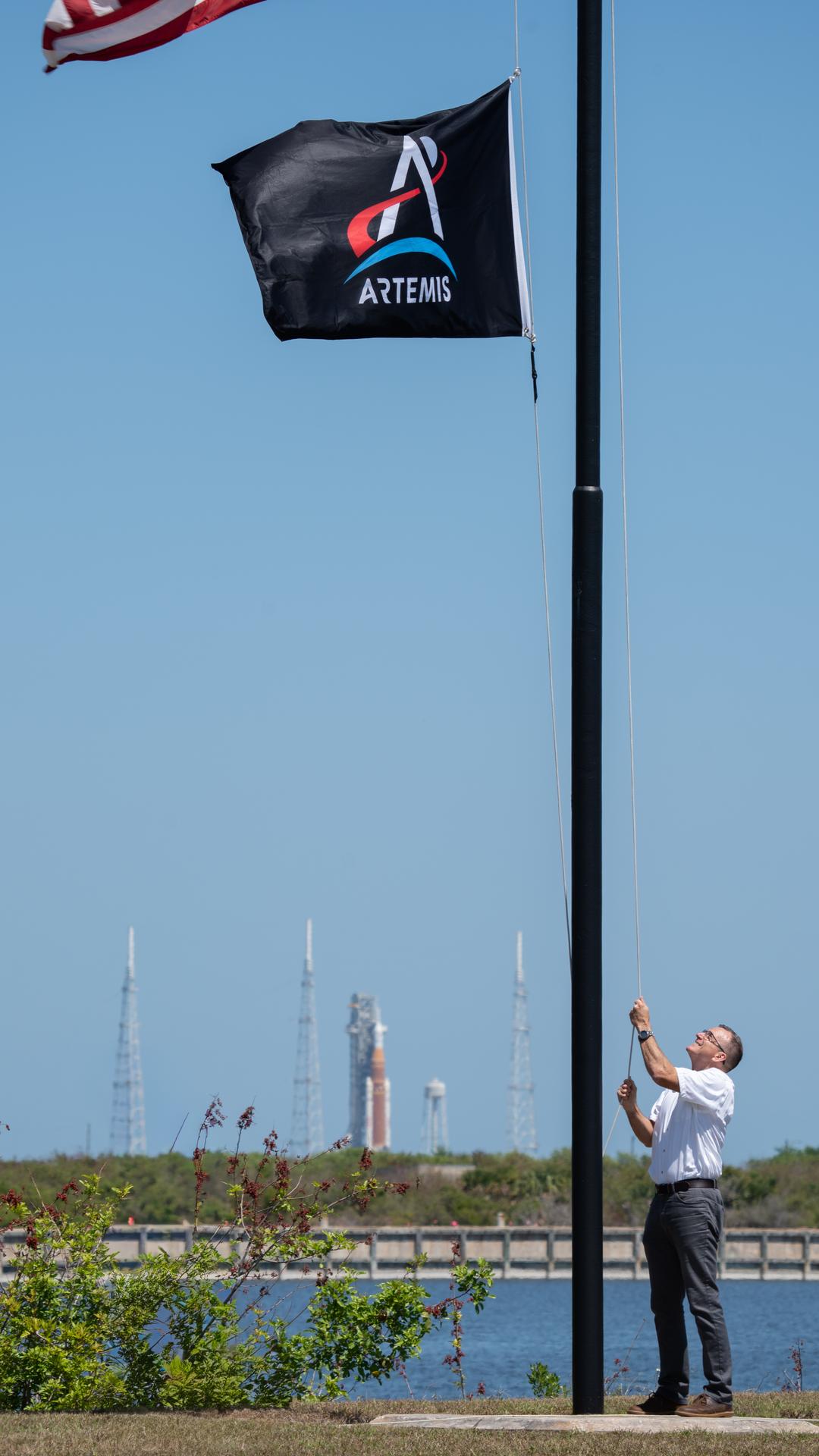
Cliff Lanham, deputy manager, Exploration Ground Systems Program raises the Artemis flag near the countdown clock at the NASA News Center at NASA’s Kennedy Space Center in Florida on Friday, March 27, 2026. The Artemis II test flight mission will take Artemis II Commander Reid Wiseman, Pilot Victor Glover, and Mission Specialist Christina Koch from NASA, and Mission Specialist Jeremy Hansen from the CSA (Canadian Space Agency) on a 10-day journey around the Moon and back aboard NASA’s SLS (Space Launch System) rocket and Orion spacecraft from Launch Complex 39B no earlier than 6:24 p.m. EDT on Wednesday, April 1.
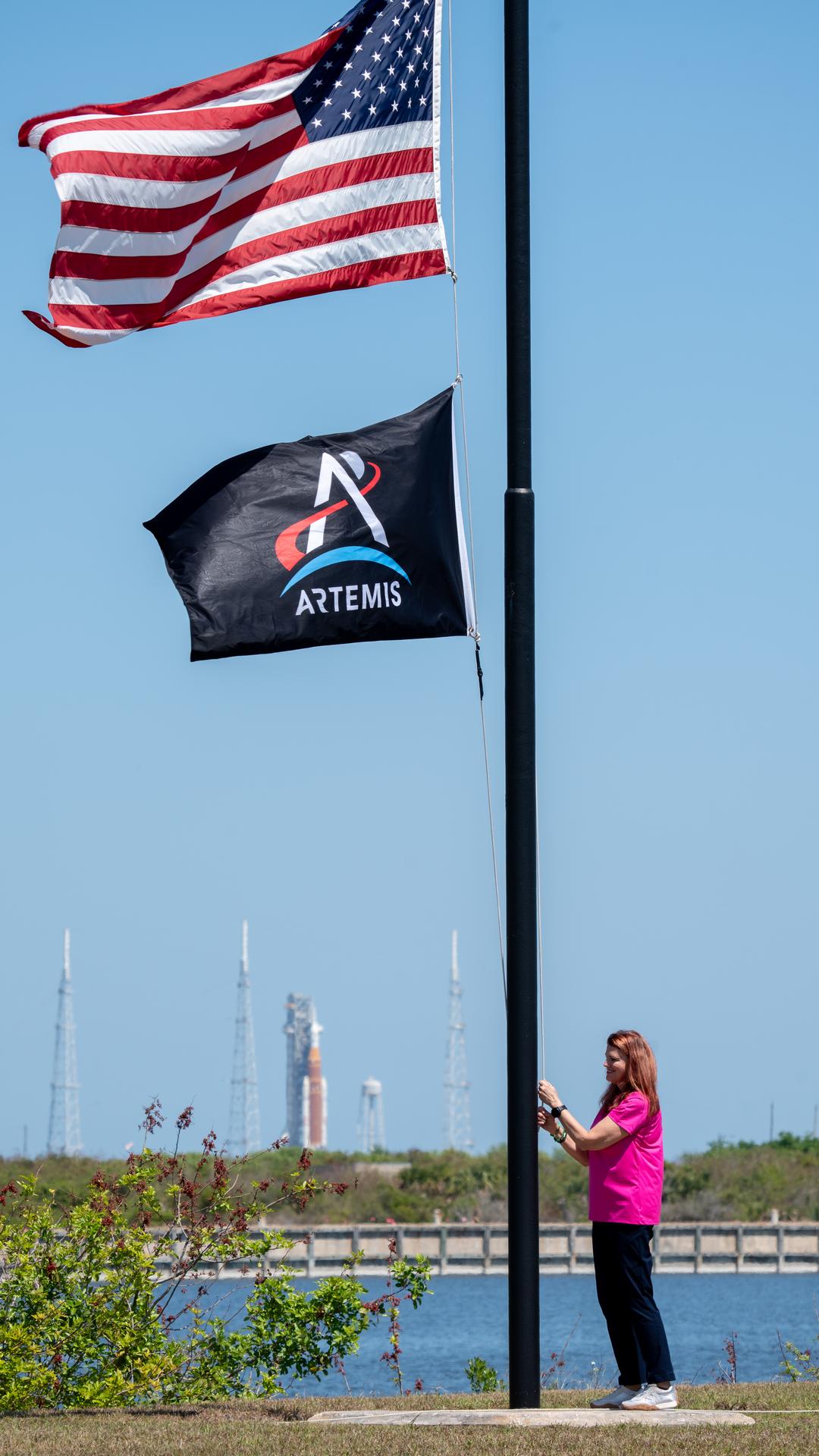
Charlie Blackwell-Thompson, Artemis II launch director raises the Artemis flag near the countdown clock at the NASA News Center at NASA’s Kennedy Space Center in Florida on Friday, March 27, 2026. The Artemis II test flight mission will take Artemis II Commander Reid Wiseman, Pilot Victor Glover, and Mission Specialist Christina Koch from NASA, and Mission Specialist Jeremy Hansen from the CSA (Canadian Space Agency) on a 10-day journey around the Moon and back aboard NASA’s SLS (Space Launch System) rocket and Orion spacecraft from Launch Complex 39B no earlier than 6:24 p.m. EDT on Wednesday, April 1.

From left, NASA Kennedy Space Center Deputy Director Kelvin Manning; Robert Yaskovic, associate manager, Exploration Ground Systems Program; Shawn Quinn, manager, Exploration Ground Systems Program; Charlie Blackwell-Thompson, Artemis II launch director; Cliff Lanham, deputy manager, Exploration Ground Systems Program; and Jeremy Graeber, assistant launch director, Exploration Ground Systems Program raise the Artemis flag near the countdown clock at the NASA News Center at NASA’s Kennedy Space Center in Florida on Friday, March 27, 2026. The Artemis II test flight mission will take Artemis II Commander Reid Wiseman, Pilot Victor Glover, and Mission Specialist Christina Koch from NASA, and Mission Specialist Jeremy Hansen from the CSA (Canadian Space Agency) on a 10-day journey around the Moon and back aboard NASA’s SLS (Space Launch System) rocket and Orion spacecraft from Launch Complex 39B no earlier than 6:24 p.m. EDT on Wednesday, April 1.
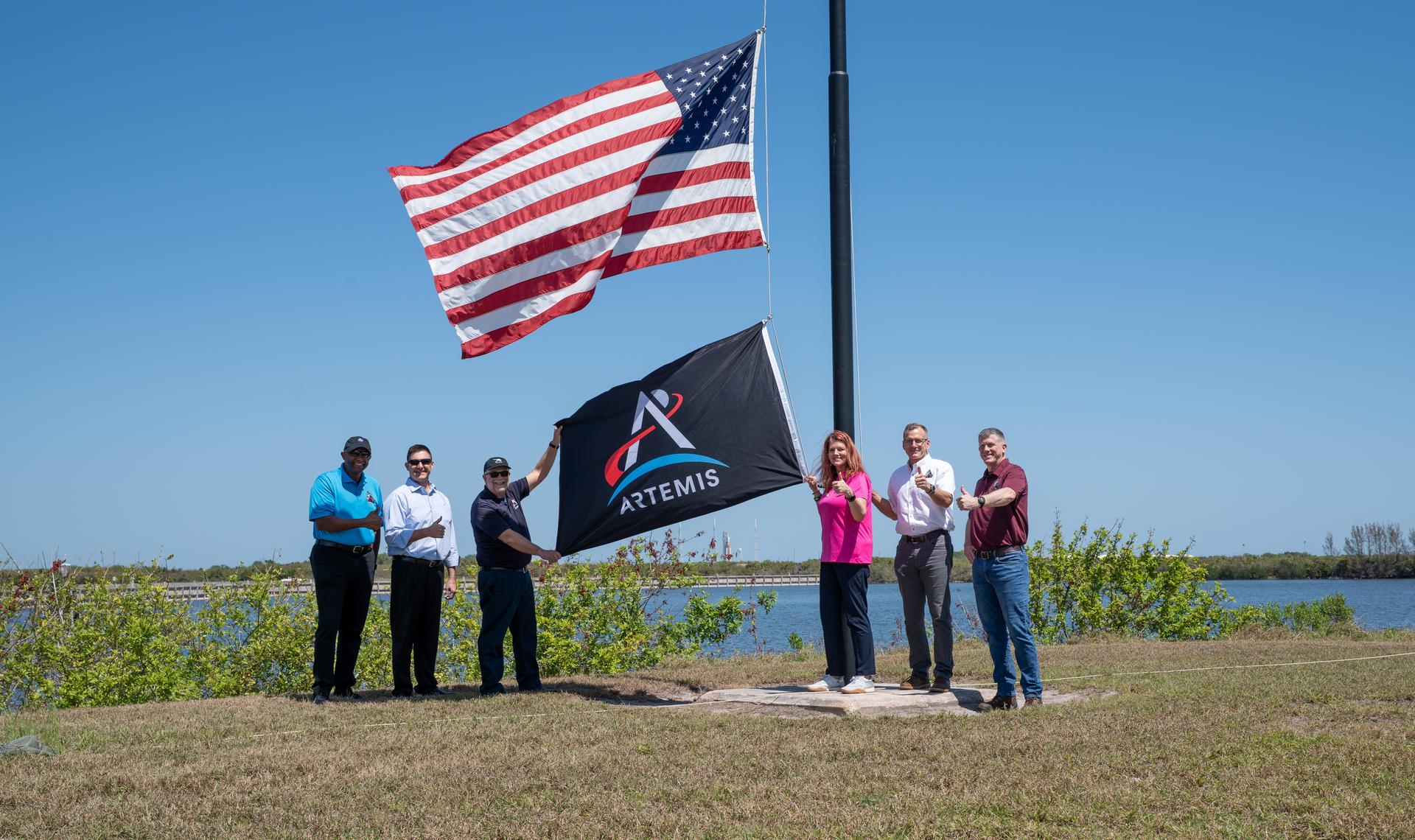
From left, NASA Kennedy Space Center Deputy Director Kelvin Manning; Robert Yaskovic, associate manager, Exploration Ground Systems Program; Shawn Quinn, manager, Exploration Ground Systems Program; Charlie Blackwell-Thompson, Artemis II launch director; Cliff Lanham, deputy manager, Exploration Ground Systems Program; and Jeremy Graeber, assistant launch director, Exploration Ground Systems Program raise the Artemis flag near the countdown clock at the NASA News Center at NASA’s Kennedy Space Center in Florida on Friday, March 27, 2026. The Artemis II test flight mission will take Artemis II Commander Reid Wiseman, Pilot Victor Glover, and Mission Specialist Christina Koch from NASA, and Mission Specialist Jeremy Hansen from the CSA (Canadian Space Agency) on a 10-day journey around the Moon and back aboard NASA’s SLS (Space Launch System) rocket and Orion spacecraft from Launch Complex 39B no earlier than 6:24 p.m. EDT on Wednesday, April 1.
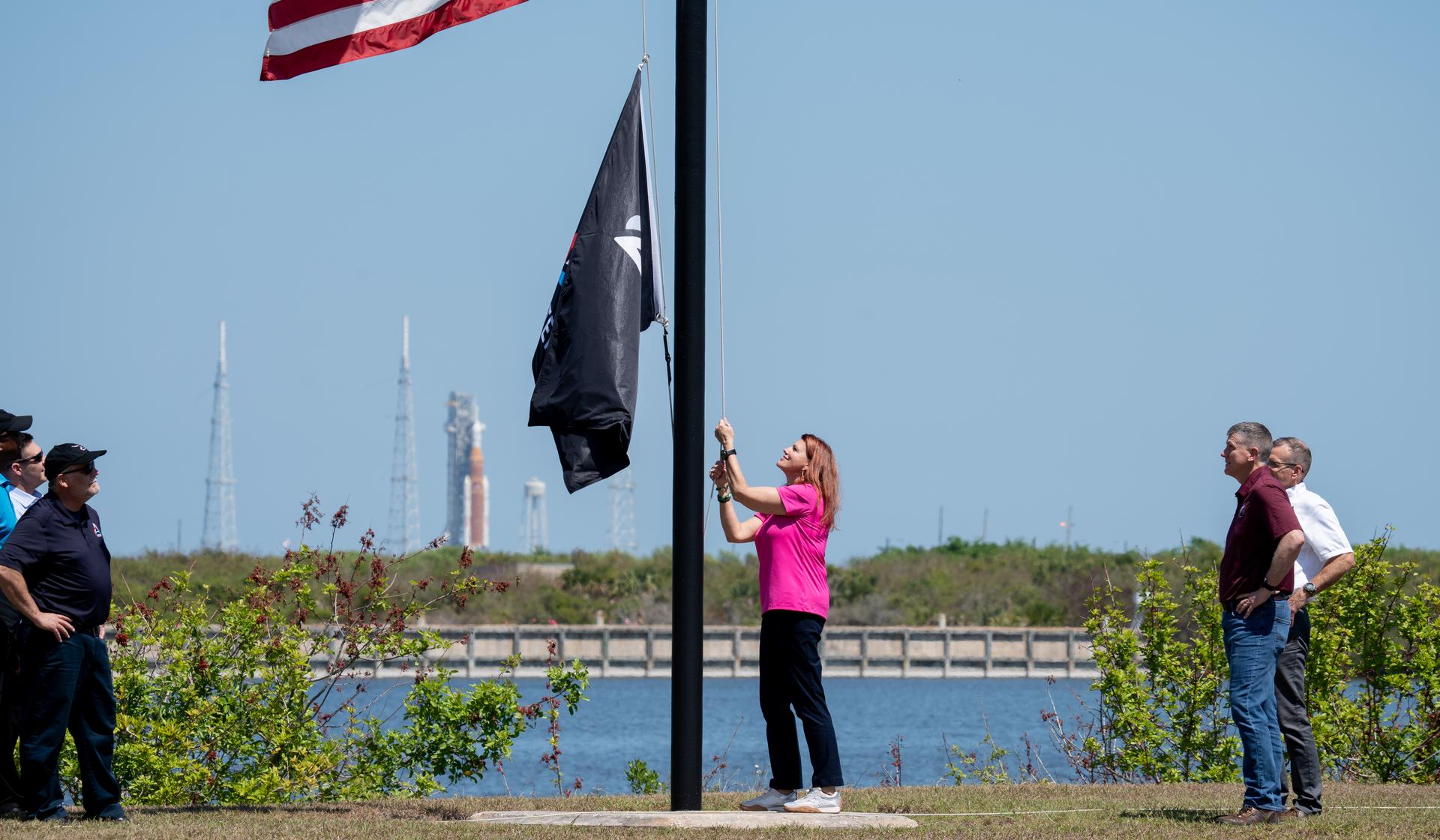
From left, NASA Kennedy Space Center Deputy Director Kelvin Manning; Robert Yaskovic, associate manager, Exploration Ground Systems Program; Shawn Quinn, manager, Exploration Ground Systems Program; Charlie Blackwell-Thompson, Artemis II launch director; Cliff Lanham, deputy manager, Exploration Ground Systems Program; and Jeremy Graeber, assistant launch director, Exploration Ground Systems Program raise the Artemis flag near the countdown clock at the NASA News Center at NASA’s Kennedy Space Center in Florida on Friday, March 27, 2026. The Artemis II test flight mission will take Artemis II Commander Reid Wiseman, Pilot Victor Glover, and Mission Specialist Christina Koch from NASA, and Mission Specialist Jeremy Hansen from the CSA (Canadian Space Agency) on a 10-day journey around the Moon and back aboard NASA’s SLS (Space Launch System) rocket and Orion spacecraft from Launch Complex 39B no earlier than 6:24 p.m. EDT on Wednesday, April 1.
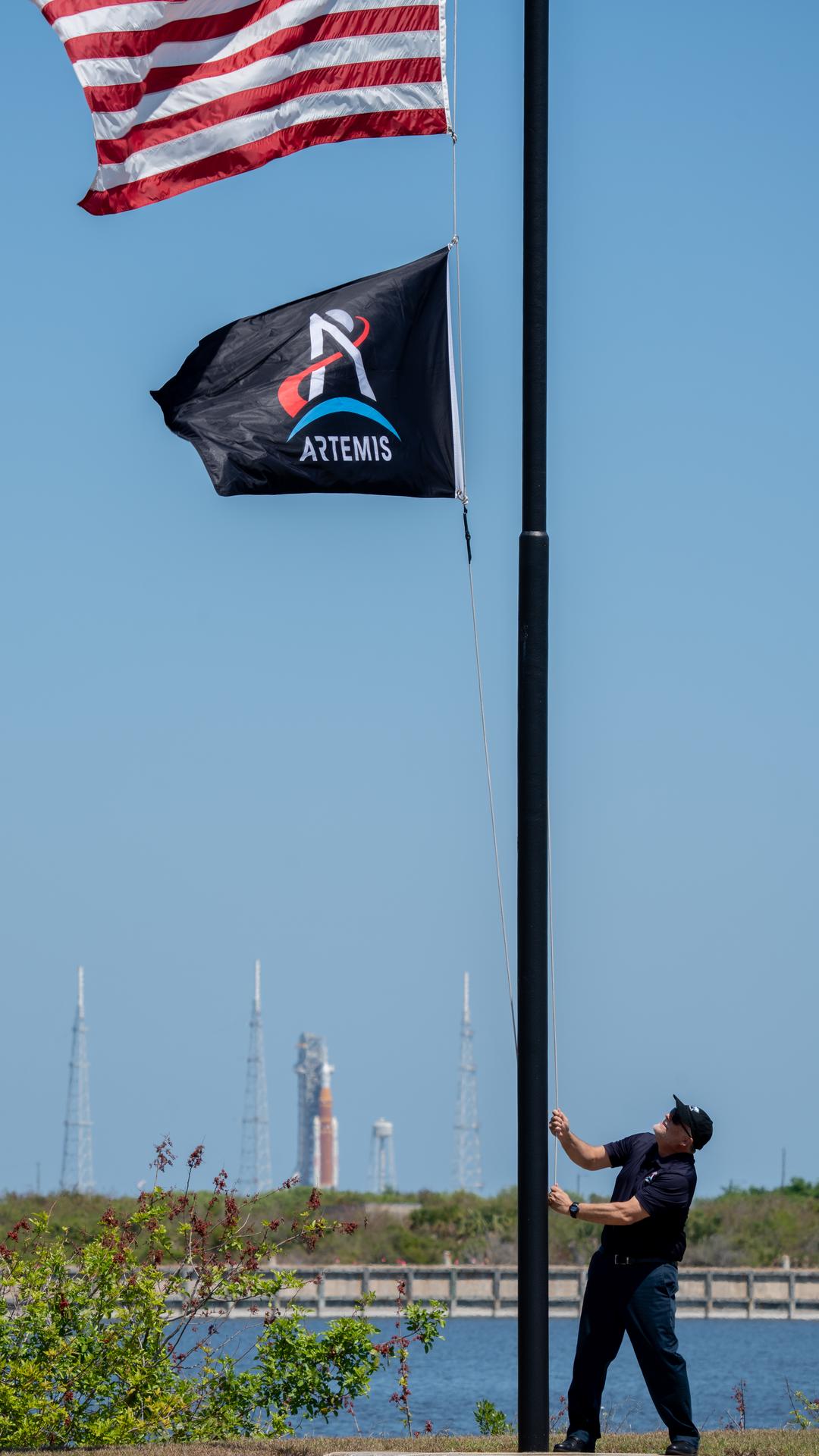
Shawn Quinn, manager, Exploration Ground Systems Program raises the Artemis flag near the countdown clock at the NASA News Center at NASA’s Kennedy Space Center in Florida on Friday, March 27, 2026. The Artemis II test flight mission will take Artemis II Commander Reid Wiseman, Pilot Victor Glover, and Mission Specialist Christina Koch from NASA, and Mission Specialist Jeremy Hansen from the CSA (Canadian Space Agency) on a 10-day journey around the Moon and back aboard NASA’s SLS (Space Launch System) rocket and Orion spacecraft from Launch Complex 39B no earlier than 6:24 p.m. EDT on Wednesday, April 1.
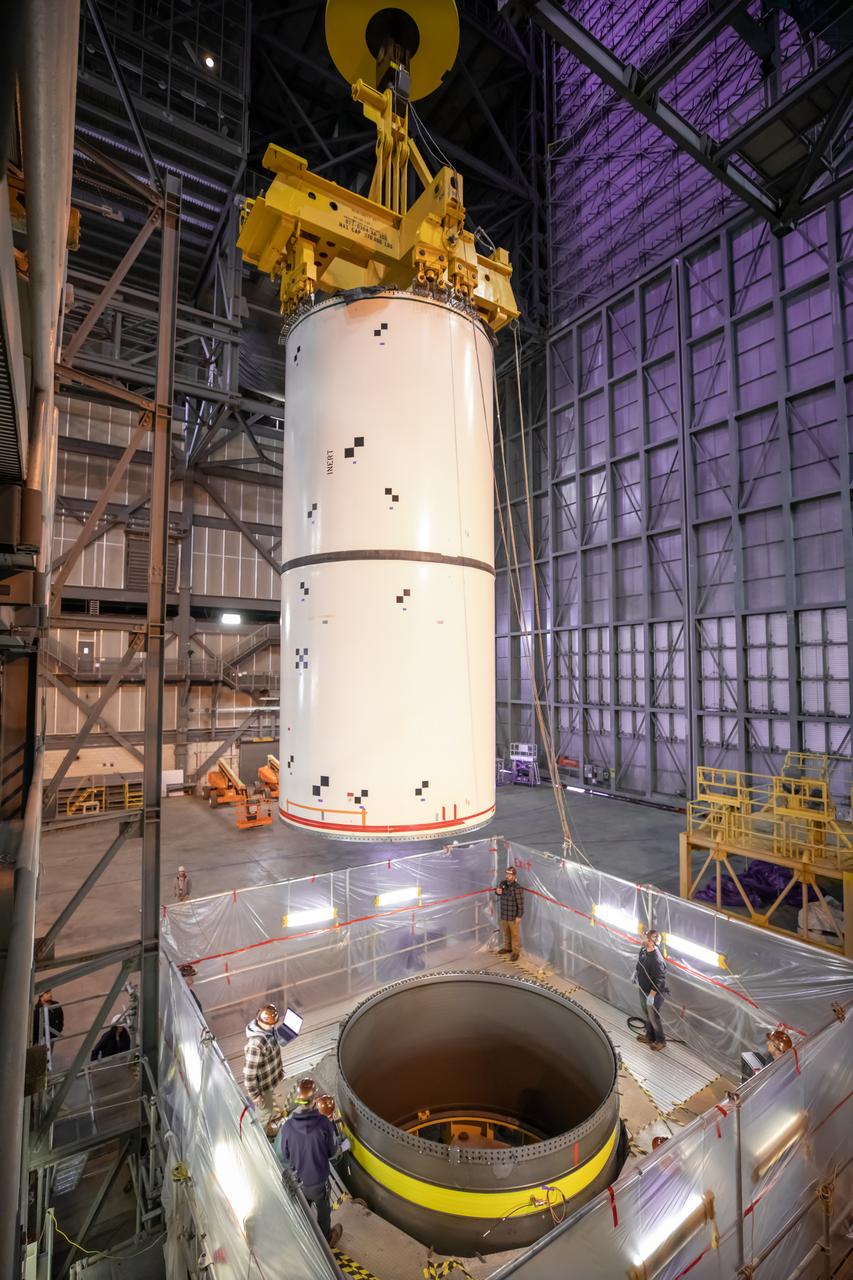
In High Bay 4 of the Vehicle Assembly Building at NASA’s Kennedy Space Center in Florida, pathfinders, or full-scale replicas of Space Launch System (SLS) solid rocket booster segments, are being stacked during a training exercise on Jan. 8, 2020. A team of engineers with Exploration Ground Systems and crane operators and technicians with contractor Jacobs are practicing lifting, moving and stacking maneuvers, using important ground support equipment to train employees and certify all the equipment works properly. The booster pathfinders are inert, full-scale replicas of the actual booster hardware that will be attached to the SLS rocket for Artemis missions. The five-segment, 17-story-tall twin boosters will provide 3.6 million pounds of thrust each at liftoff to help launch Orion on Artemis I, its first uncrewed mission beyond the Moon.
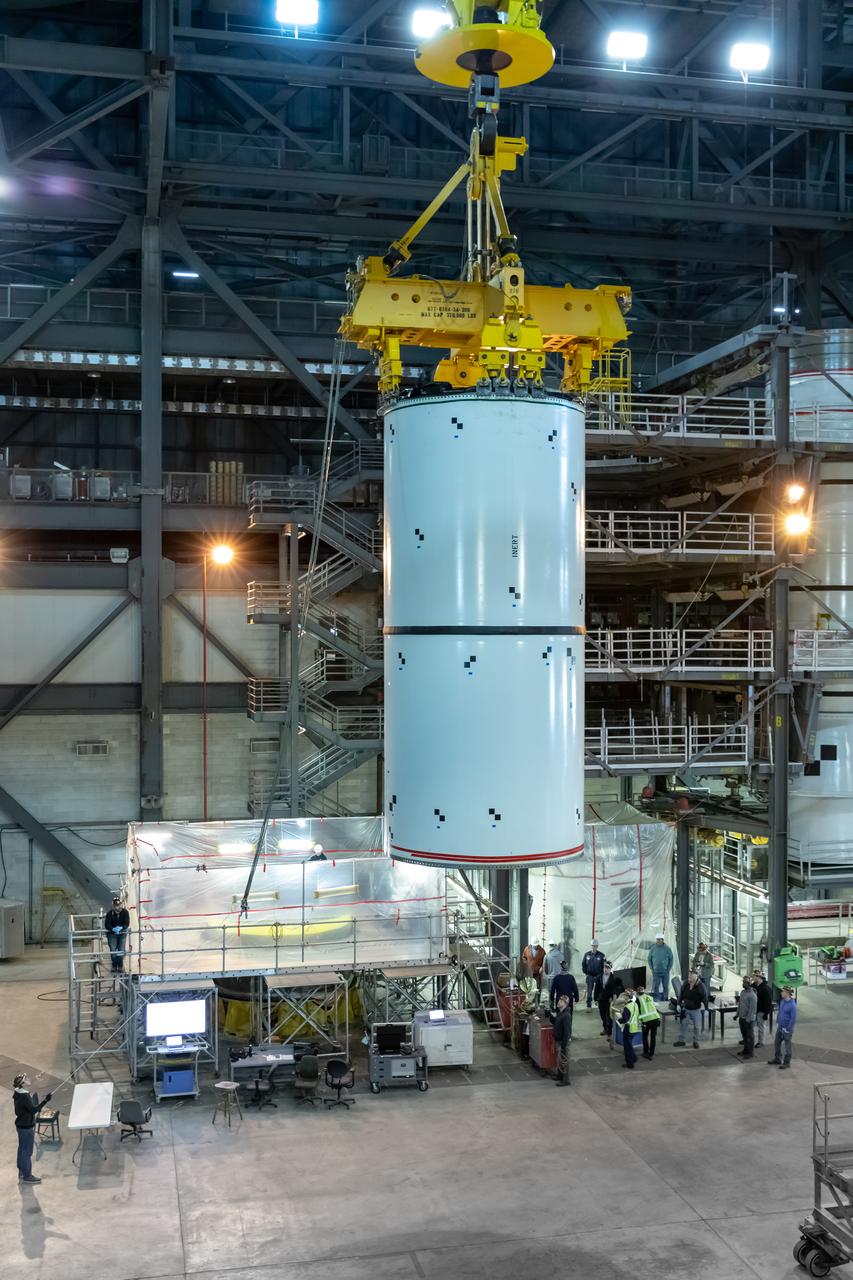
In High Bay 4 of the Vehicle Assembly Building at NASA’s Kennedy Space Center in Florida, a crane moves Space Launch System (SLS) solid rocket booster pathfinder segments toward a platform during a training exercise on Jan. 8, 2020. A team of engineers with Exploration Ground Systems and crane operators and technicians with contractor Jacobs are practicing lifting, moving and stacking maneuvers, using important ground support equipment to train employees and certify all the equipment works properly. The booster pathfinders are inert, full-scale replicas of the actual booster hardware that will be attached to the SLS rocket for Artemis missions. The five-segment, 17-story-tall twin boosters will provide 3.6 million pounds of thrust each at liftoff to help launch Orion on Artemis I, its first uncrewed mission beyond the Moon.
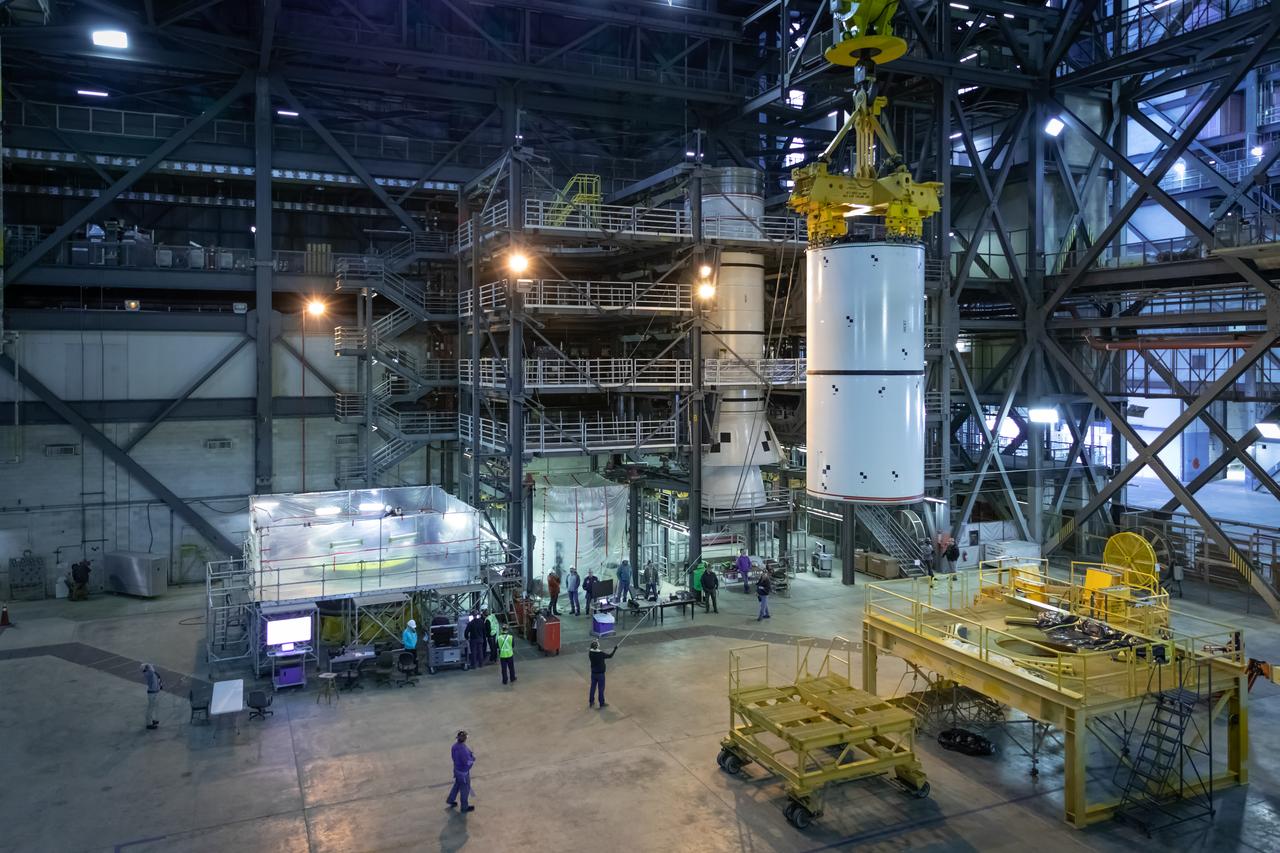
In High Bay 4 of the Vehicle Assembly Building at NASA’s Kennedy Space Center in Florida, a crane moves Space Launch System (SLS) solid rocket booster pathfinder segments to stack them atop other pathfinder segments during a training exercise on Jan. 8, 2020. A team of engineers with Exploration Ground Systems and crane operators and technicians with contractor Jacobs are practicing lifting, moving and stacking maneuvers, using important ground support equipment to train employees and certify all the equipment works properly. The booster pathfinders are inert, full-scale replicas of the actual booster hardware that will be attached to the SLS rocket for Artemis missions. The five-segment, 17-story-tall twin boosters will provide 3.6 million pounds of thrust each at liftoff to help launch Orion on Artemis I, its first uncrewed mission beyond the Moon.
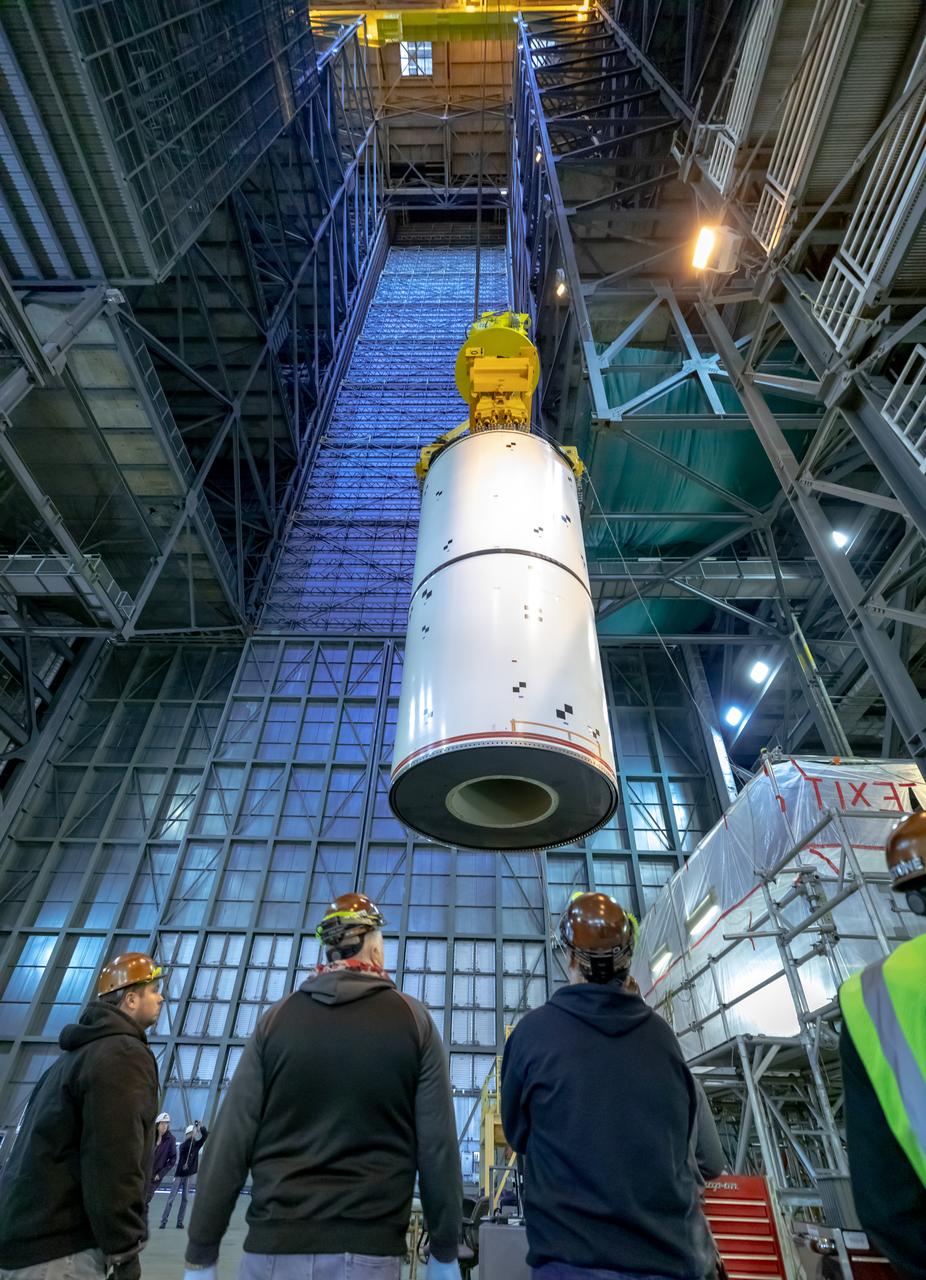
In High Bay 4 of the Vehicle Assembly Building at NASA’s Kennedy Space Center in Florida, a team of engineers with Exploration Ground Systems and contractor Jacobs participate in Space Launch System (SLS) solid rocket booster pathfinder stacking during a training exercise on Jan. 8, 2020. A crane is used to lift up two pathfinder segments and move them to a platform. The booster pathfinders are inert, full-scale replicas of the actual booster hardware that will be attached to the SLS rocket for Artemis missions. The team is practicing lifting, moving and stacking maneuvers, using important ground support equipment to train employees and certify all the equipment works properly. The five-segment, 17-story-tall twin boosters will provide 3.6 million pounds of thrust each at liftoff to help launch Orion on Artemis I, its first uncrewed mission beyond the Moon.