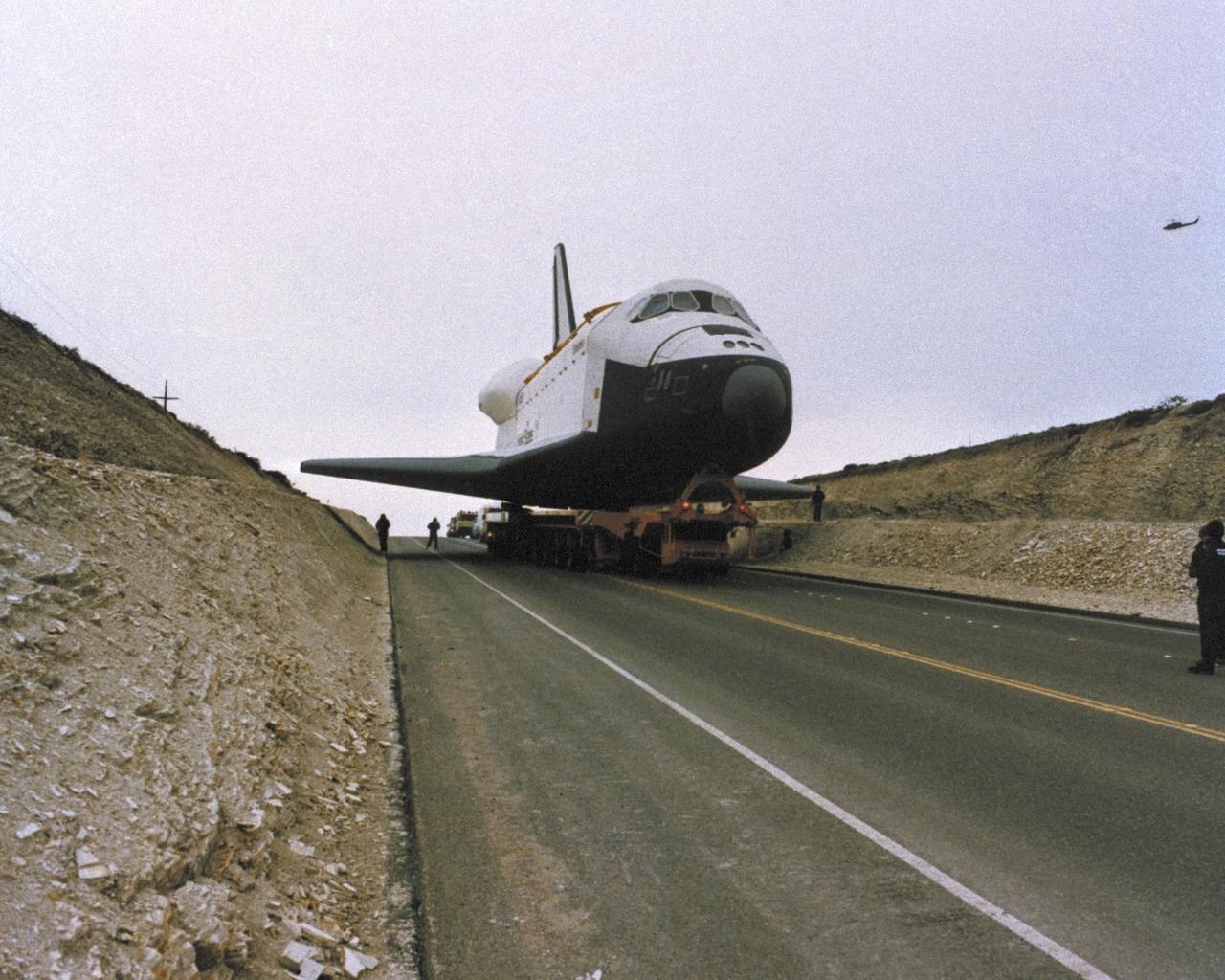
Space Shuttle Orbiter Enterprise - night lighting test
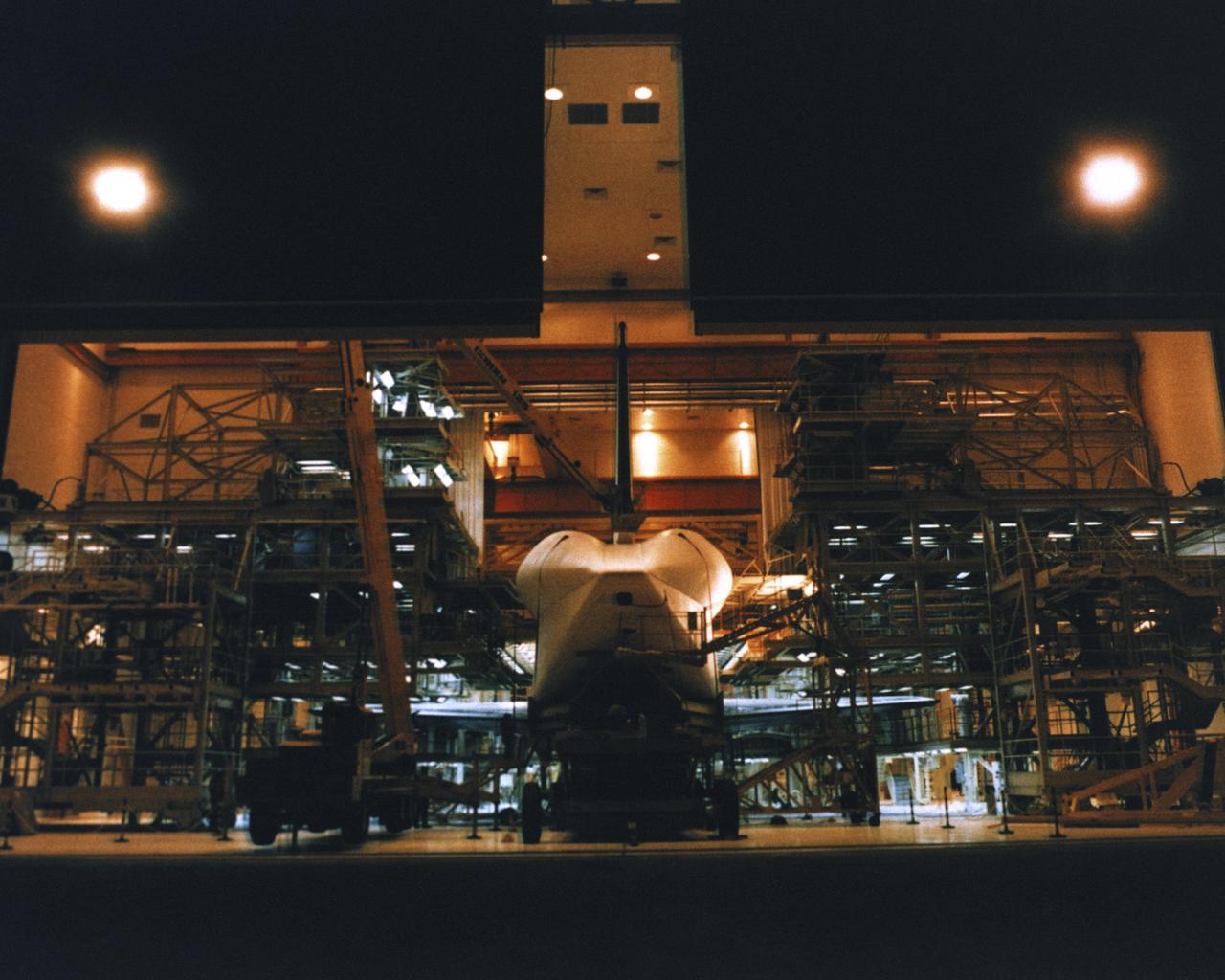
Enterprise inside the Orbiter Maintenance and Checkout Facility at Vandenberg, AFB, California
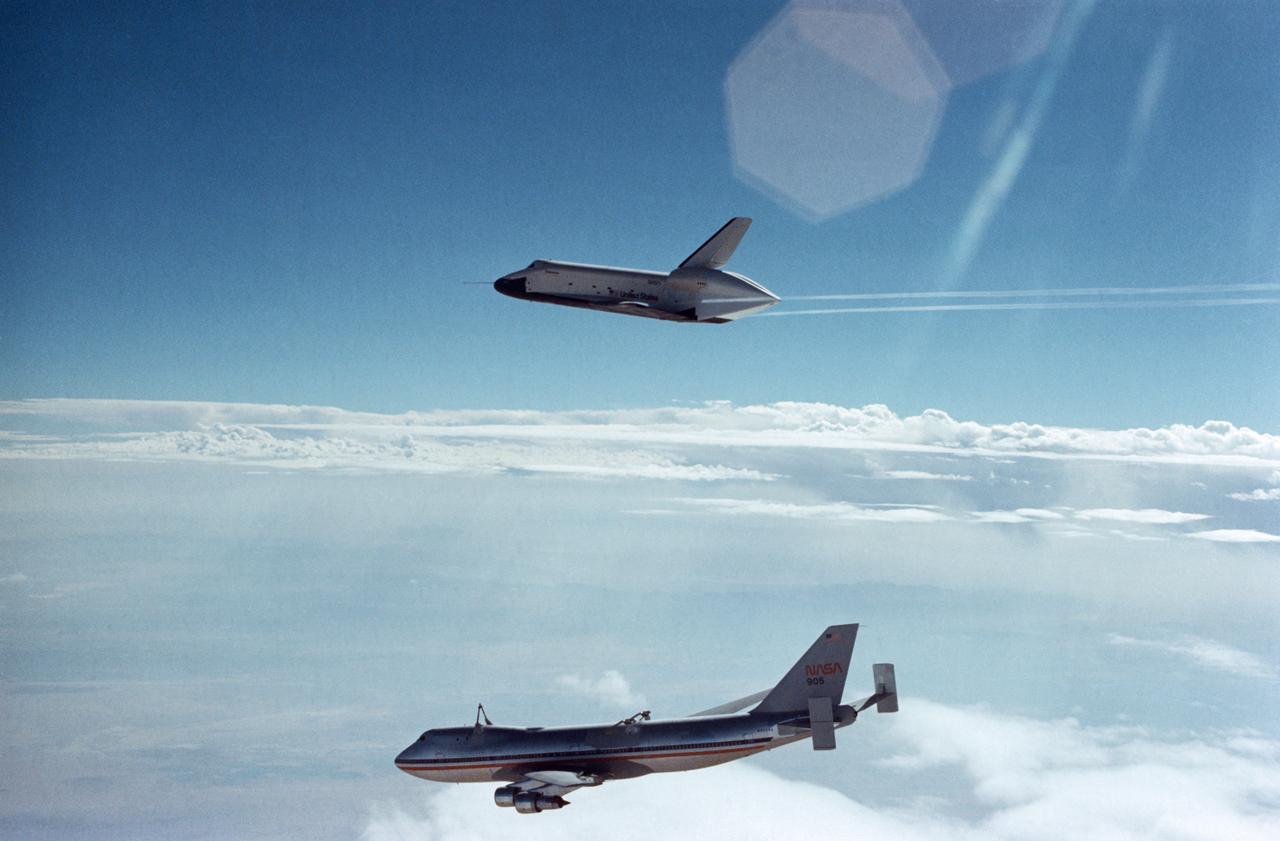
S77-27945 (12 Aug 1977) --- The space shuttle Orbiter 101 "Enterprise" soars above the NASA 747 carrier aircraft after separating during the first free flight of the Shuttle Approach and Landing Tests (ALTs) conducted on Aug. 12, 1977 at Dryden Flight Research Center in Southern California. Astronauts Fred W. Haise Jr., and C. Gordon Fullerton were the crew of the "Enterprise." The ALT free flights are designed to verify Orbiter subsonic airworthiness, integrated systems operations and pilot-guided approach and landing capability and satisfying prerequisites to automatic flight control and navigation mode. Photo credit: NASA
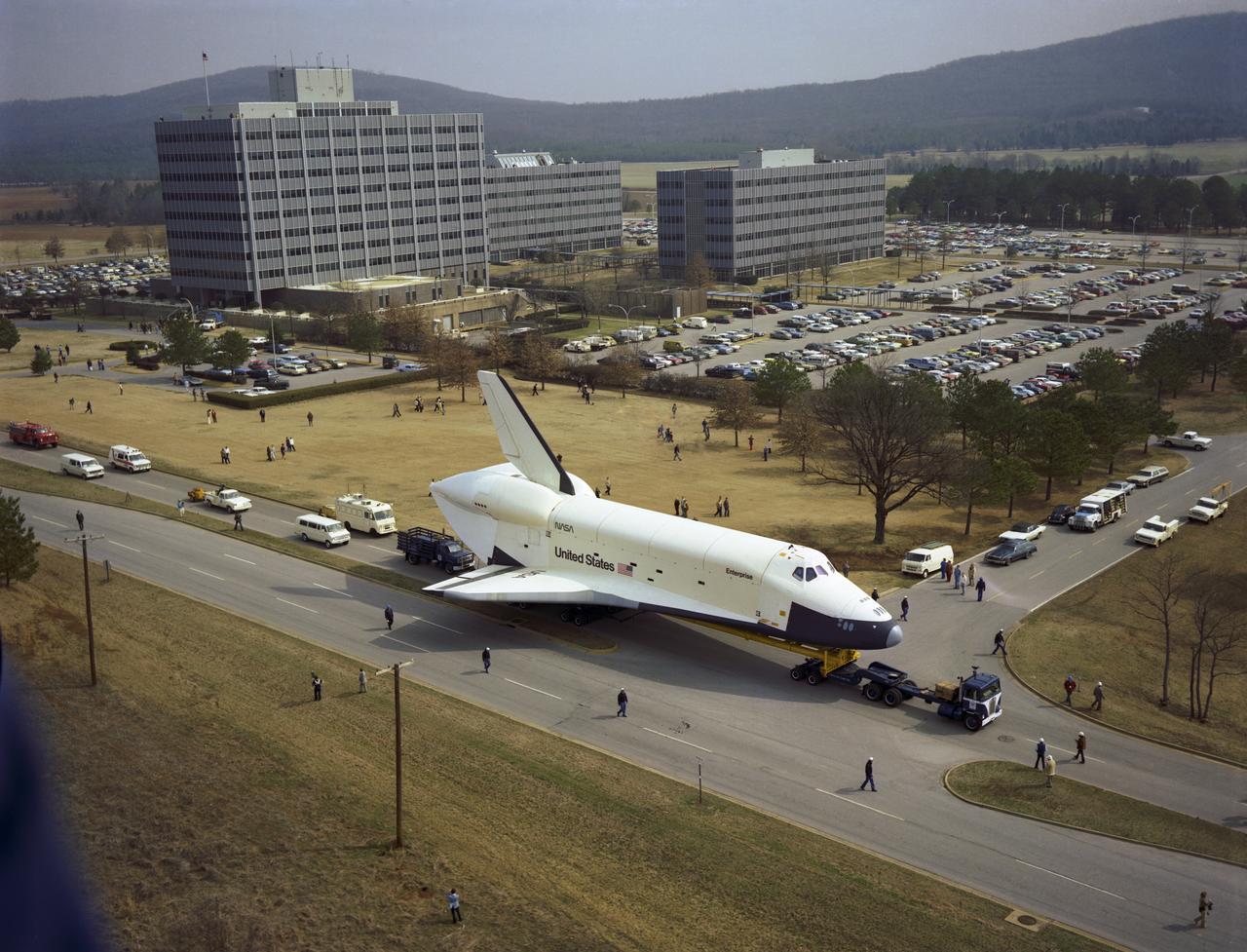
In this view, the Shuttle Orbiter Enterprise is seen heading South on Rideout Road with Marshall Space Flight Center's (MSFC'S) administrative 4200 Complex in the background, as it is being transported to MSFC's building 4755 for later Mated Vertical Ground Vibration tests (MVGVT) at MSFC's Dynamic Test Stand. The tests marked the first time ever that the entire shuttle complement (including Orbiter, external tank, and solid rocket boosters) were mated vertically.
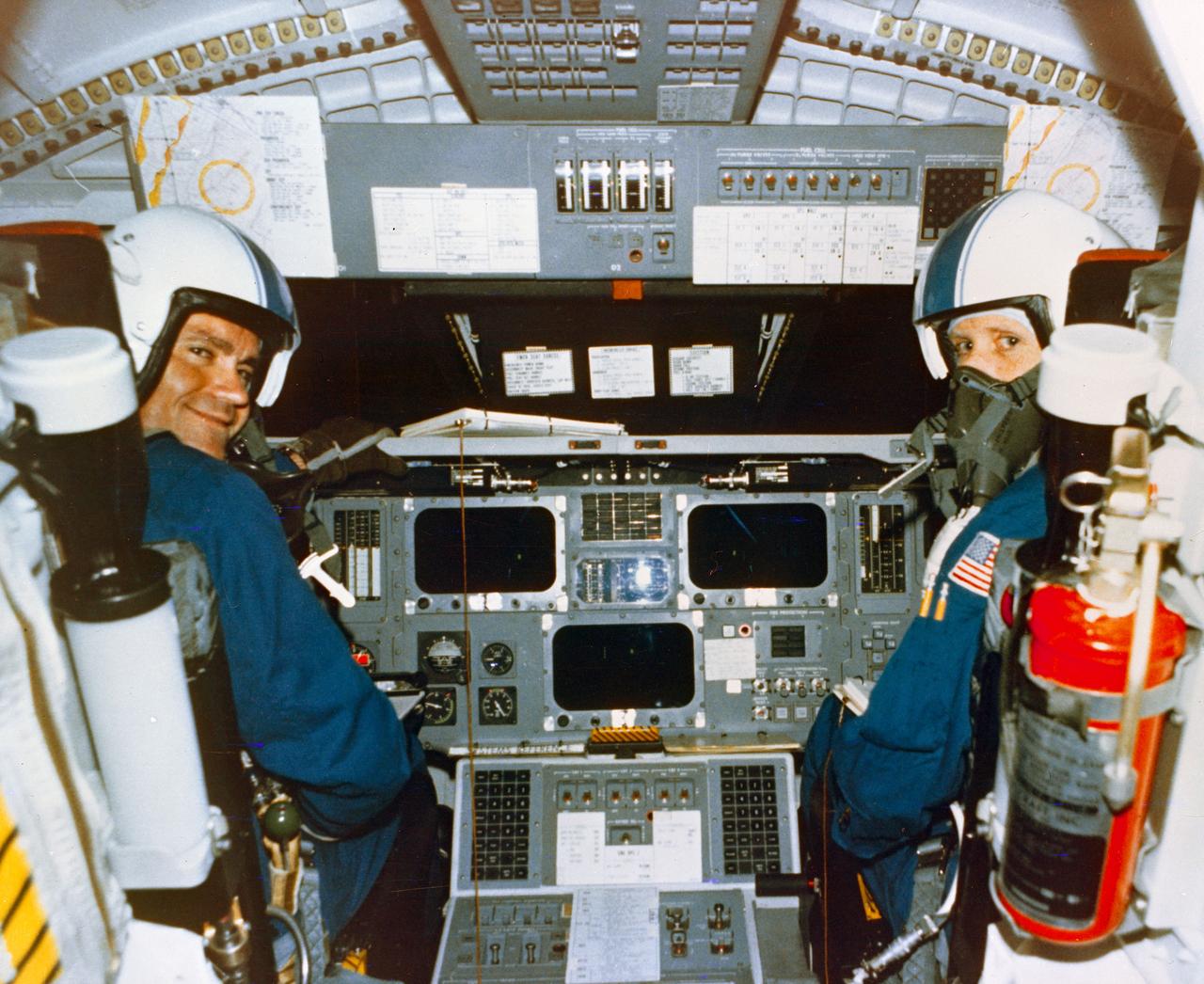
Astronauts Fred W. Haise, Jr., Commander, left, and C. Gordon Fullerton in the cockpit of the Space Shuttle Orbiter 101 "Enterprise" prior to the fifth and final FF in the Approach and Landing Test (ALT) series, from DFRC. Original photo number was 77-HC-446. DFRC, CA

S77-28210 (13 Sept 1977) --- Astronauts Joe H. Engle (face down), commander, and Richard H. Truly (face partially obscured by Engle), pilot, are greeted by Rockwell technicians following egress from the shuttle Orbiter 101 "Enterprise." They had just completed a five-minute, 31-second unpowered free flight in the "Enterprise," the second of a series of such flights, conducted on September 13, 1977, at the Dryden Flight Research Center (DFRC) and Edwards Air Force Base.
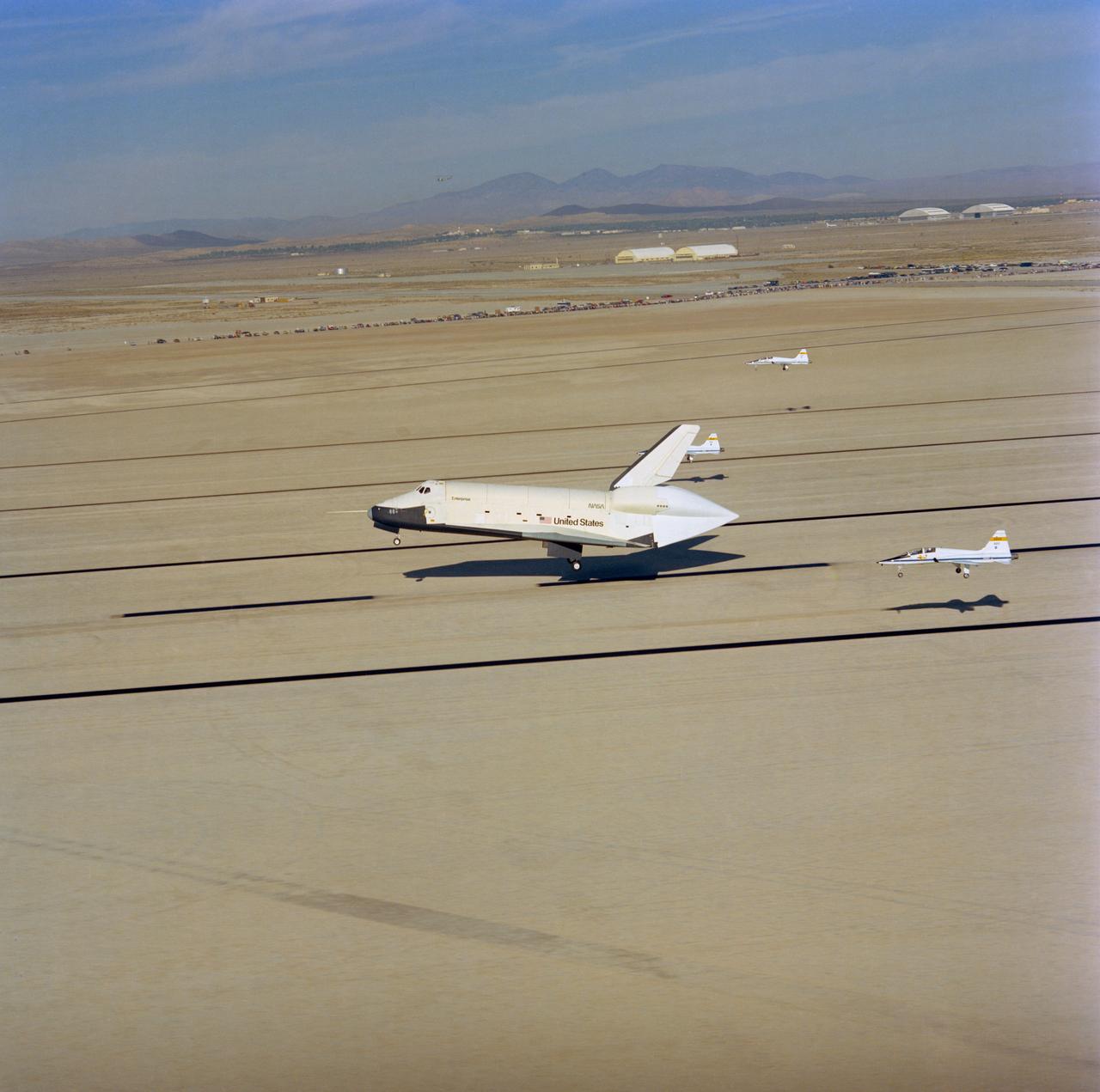
S77-28668 (23 Sept 1977) --- The shuttle Orbiter 101 "Enterprise" approaches touchdown on the runway at Edwards Air Force Base to conclude a five-minute, 34-second unpowered flight, the third of Shuttle Approach and Landing Tests (ALT) series, on September 23, 1977. Thress T-38 chase planes follow close by. Astronauts Fred W. Haise Jr., commander, and C. Gordon Fullerton, pilot, were the crew aboard the "Enterprise" for this flight.
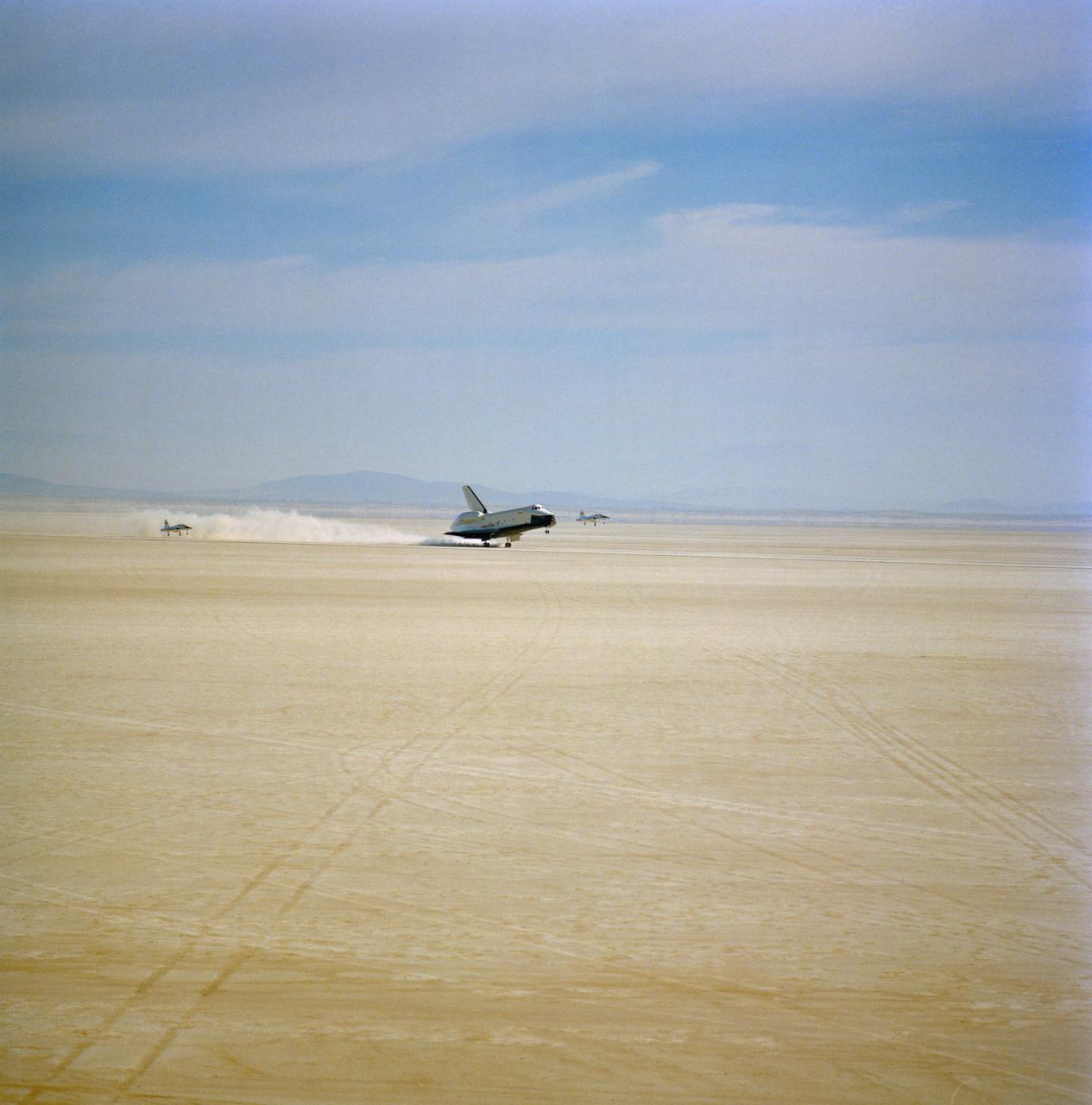
S77-28209 (13 Sept 1977) --- The shuttle orbiter 101 "Enterprise" lands on the desert at Edwards Air Force Base to conclude a five-minute, 31-second unpowered flight during the second free-flight of the Shuttle Approach and Landing Test (ALT) series, on September 13, 1977. Two T-38 chase planes remain with the "Enterprise" for the landing. Asstronauts Joe H. Engle, commander, and Richard H. Truly, pilot, were the crewmen for the flight.
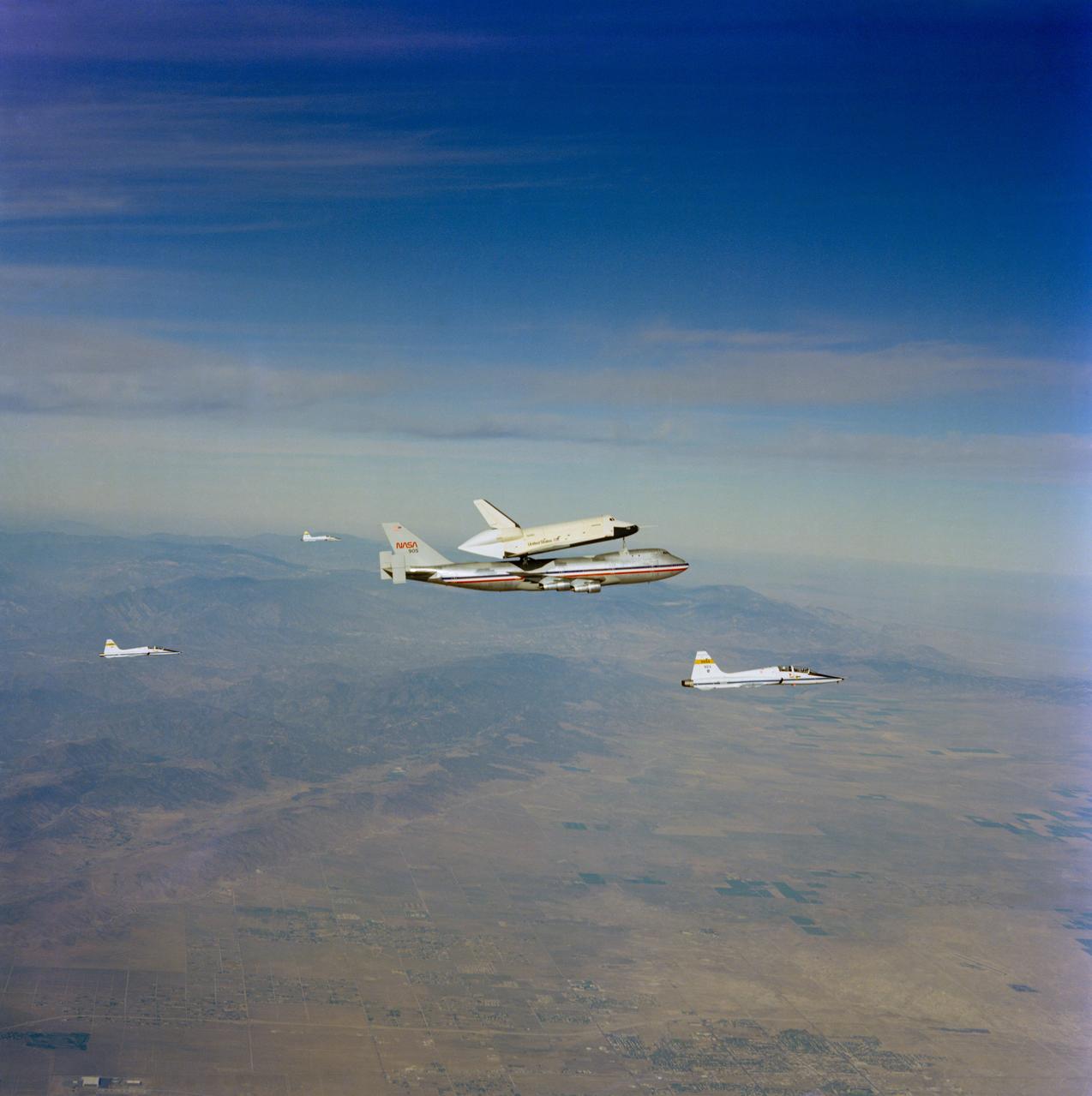
S77-28649 (23 Sept 1977) --- The shuttle Orbiter 101 "Enterprise" sits atop the NASA 747 carrier aircraft in a piggy-back configuration prior to separation for the third free flight of the Shuttle Approach and Landing Tests (ALT) conducted on September 23, 1977, at the Dryden Flight Research Center (DFRC) in Southern California. The crew of the "enterprise" consisted of astronauts Fred W. Haise Jr., commander, and C. Gordon Fullerton, pilot. This photo was shot from one of the T-38 chase planes accompanying the ALT craft. Three other T-38 chase planes are pictured.
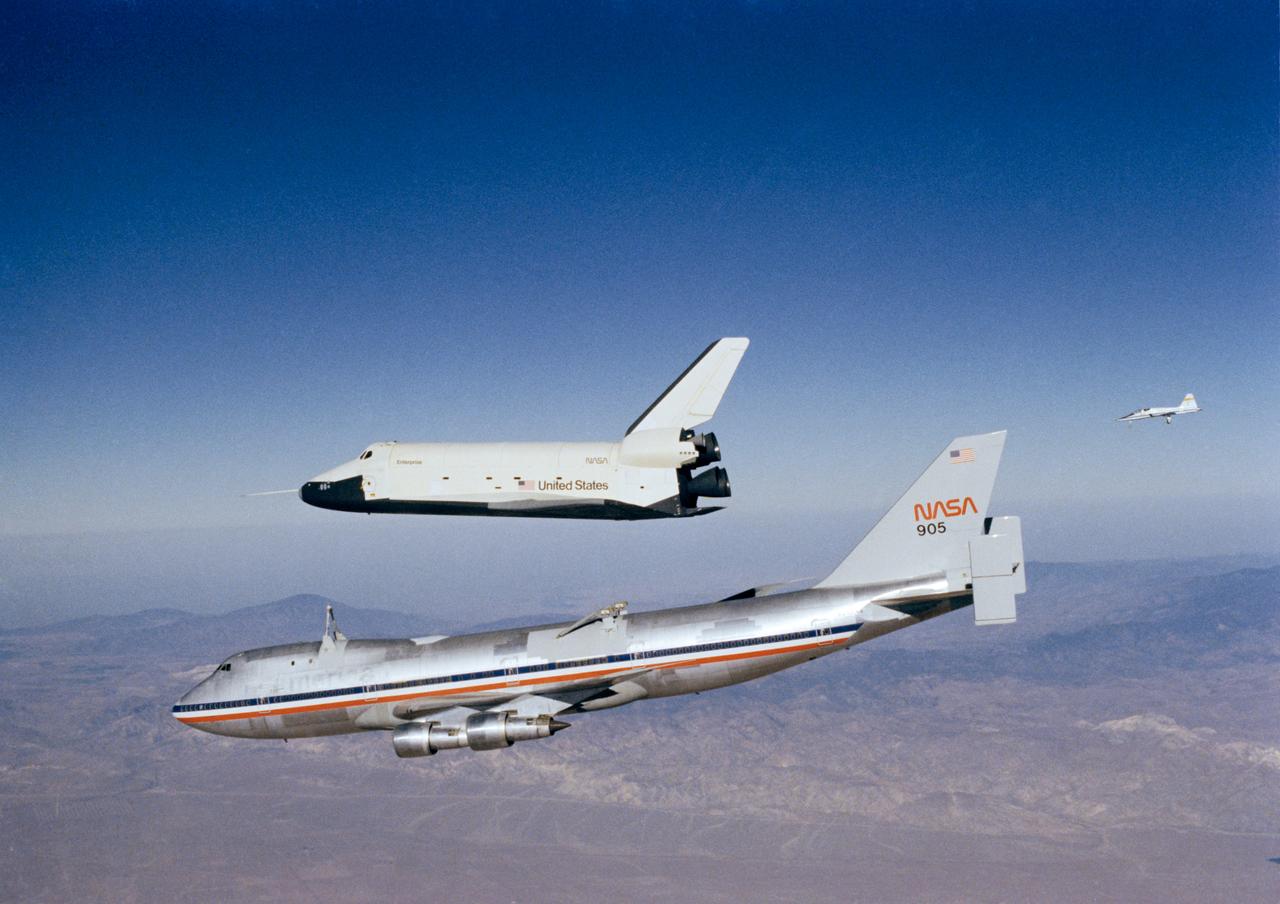
S77-28931 (12 Oct. 1977) --- The Orbiter 101 "Enterprise" separates from the NASA 747 carrier aircraft to begin its first "tailcone-off" unpowered flight over desert and mountains of Southern California. A T-38 chase plane follows in right background. This was the fourth in a series of five piloted free flights. Photo credit: NASA
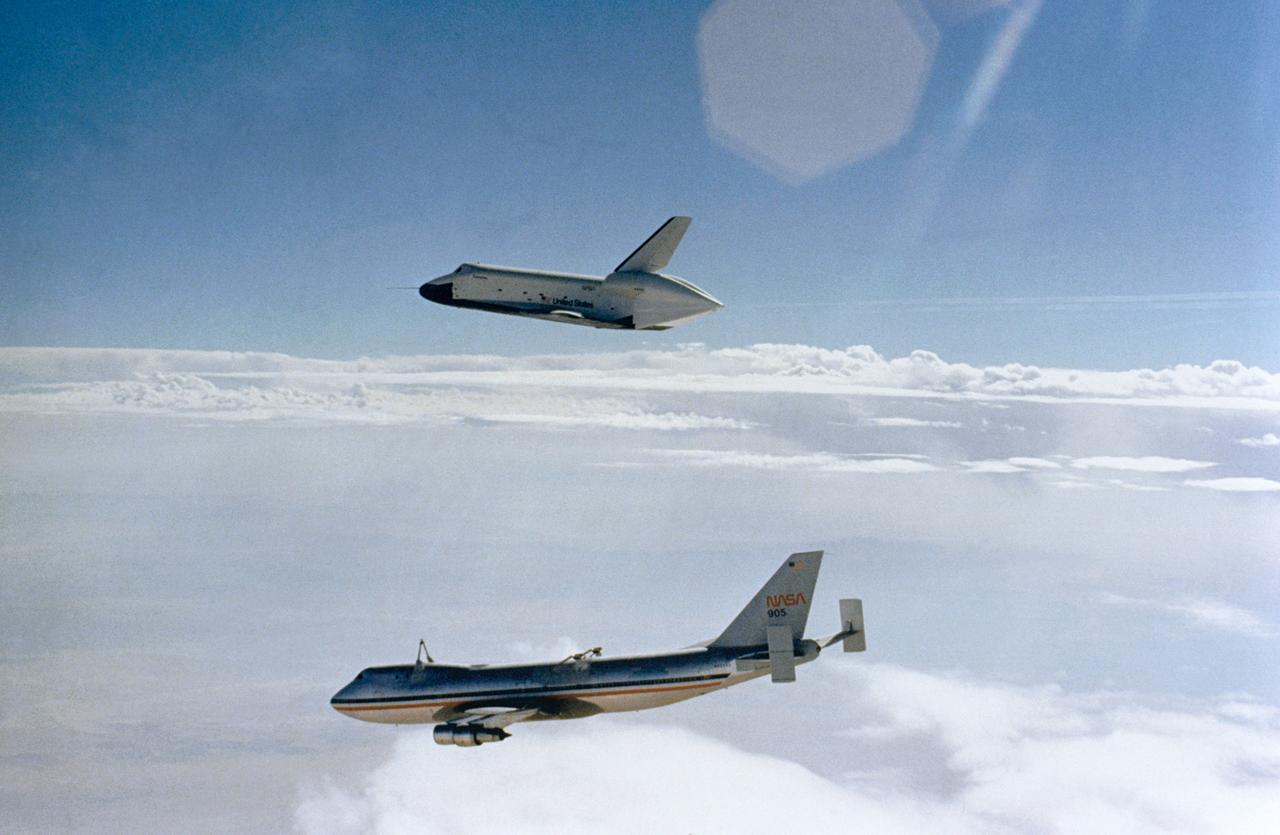
S77-27512 (12 Aug 1977) --- The Shuttle Orbiter 101 "Enterprise" soars above the NASA 747 carrier aircraft only seconds after separating during the first free flight of the Shuttle Approach and Landing Tests (ALTs) conducted on August 12, 1977 at Dryden Flight Research Center in Southern California. Astronauts Fred W. Haise Jr., and C. Gordon Fullerton were the crew of the "Enterprise." The ALT free flights are designed to verify Orbiter subsonic airworthiness, integrated systems operations and pilot-guided approach and landing capability and satisfying prerequisites to automatic flight control and navigation mode.
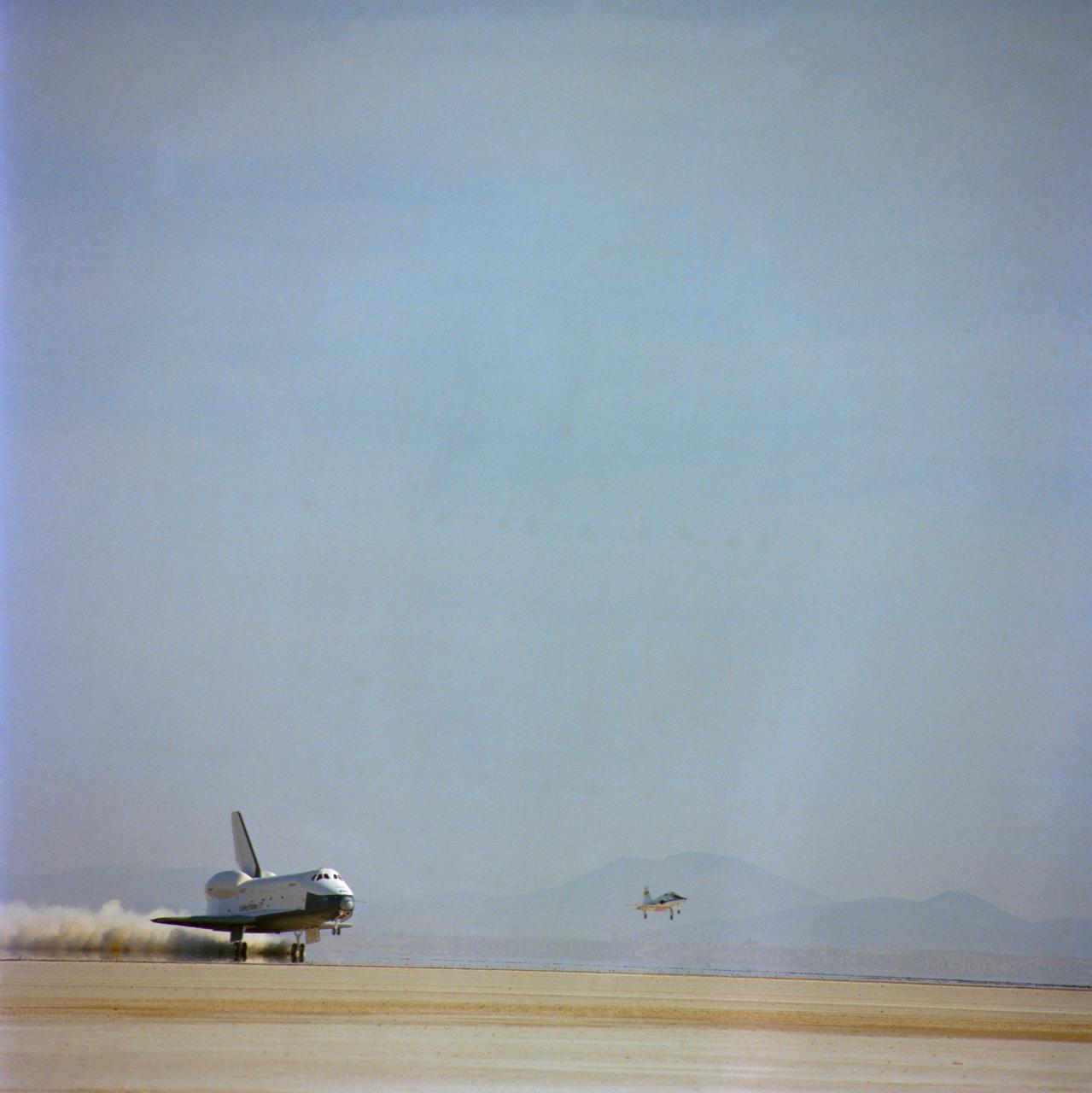
S77-28327 (13 Sept 1977) --- The shuttle orbiter 101 "Enterprise" stirs up a cloud of desert sand and dust as it lands to conclude a five-minute, 28-second unpowered flight during the second free flight of the Shuttle Approach and Landing Tests (ALT) conduced on September 13, 1977 at the Dryden Flight Research Center in Southern California. The Orbiter 101 crew astronauts Joe H. Engle, commander, and Richard H. Truly, pilot. The ALT free flights are designed to verify orbiter subsonic airworthiness, integrated systems operations and pilot-guided approach and landing capability and satisfy prerequisites to automatic flight control and navigation mode. On the right a T-38 chase plane comes in for a landing, also. This picture was taken with an Air Force Test Center 70mm Hasselblad camera installed on a tracking mount parked on the lake bed.
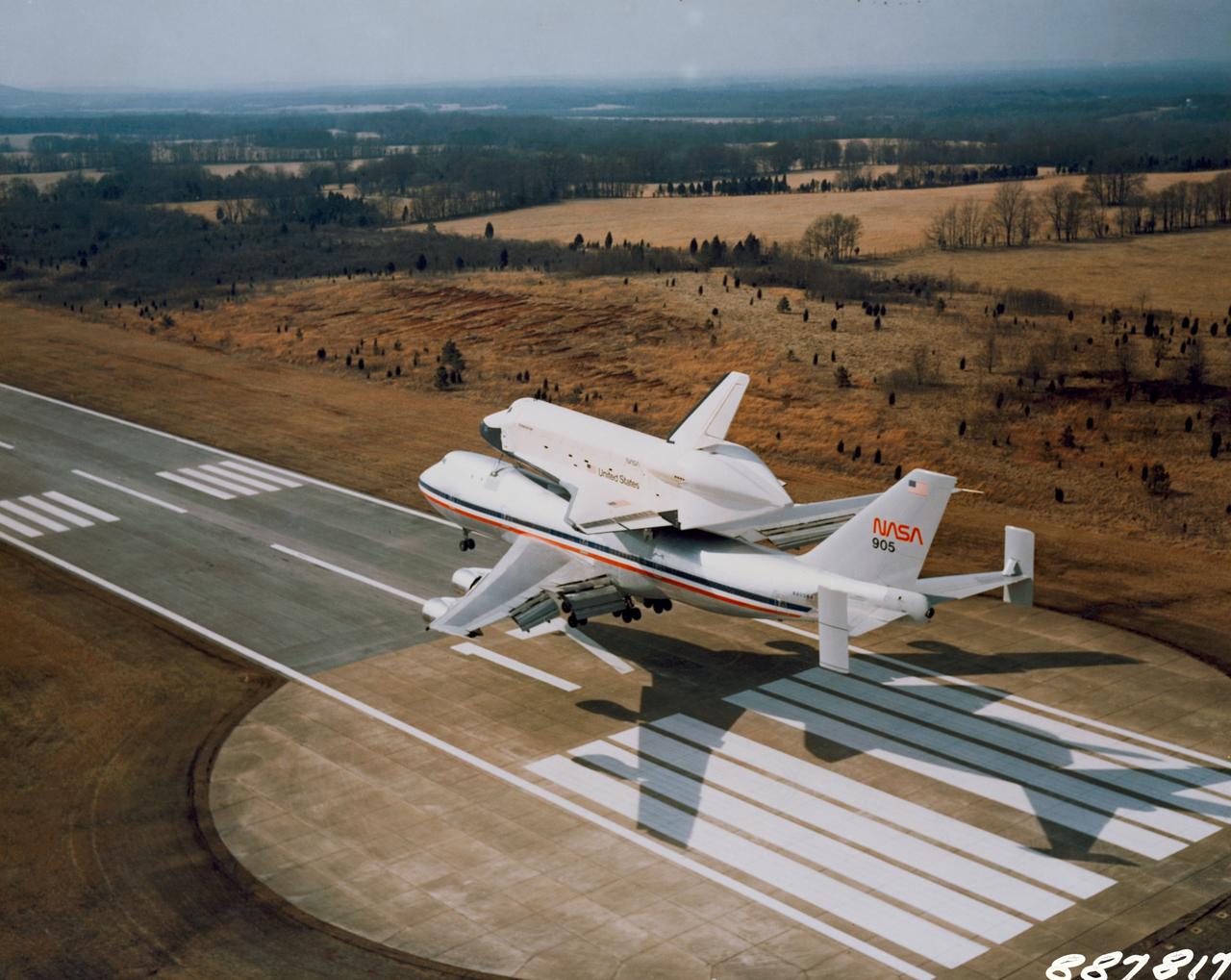
S78-27238 (13 March 1978) --- The space shuttle orbiter 101 Enterprise approaches riding atop its 747 carrier aircraft, arrives at the Redstone Arsenal airstrip near Marshall Space Flight Center (MSFC), Huntsville, Alabama, on March 13, 1978. It is to undergo ground vibration tests along with the external tank and solid rocket boosters, in preparation for Orbiter Flight Tests (OFT) in which its successor craft (Orbiter 102) will take several two-man crews into Earth orbit. Photo credit: NASA
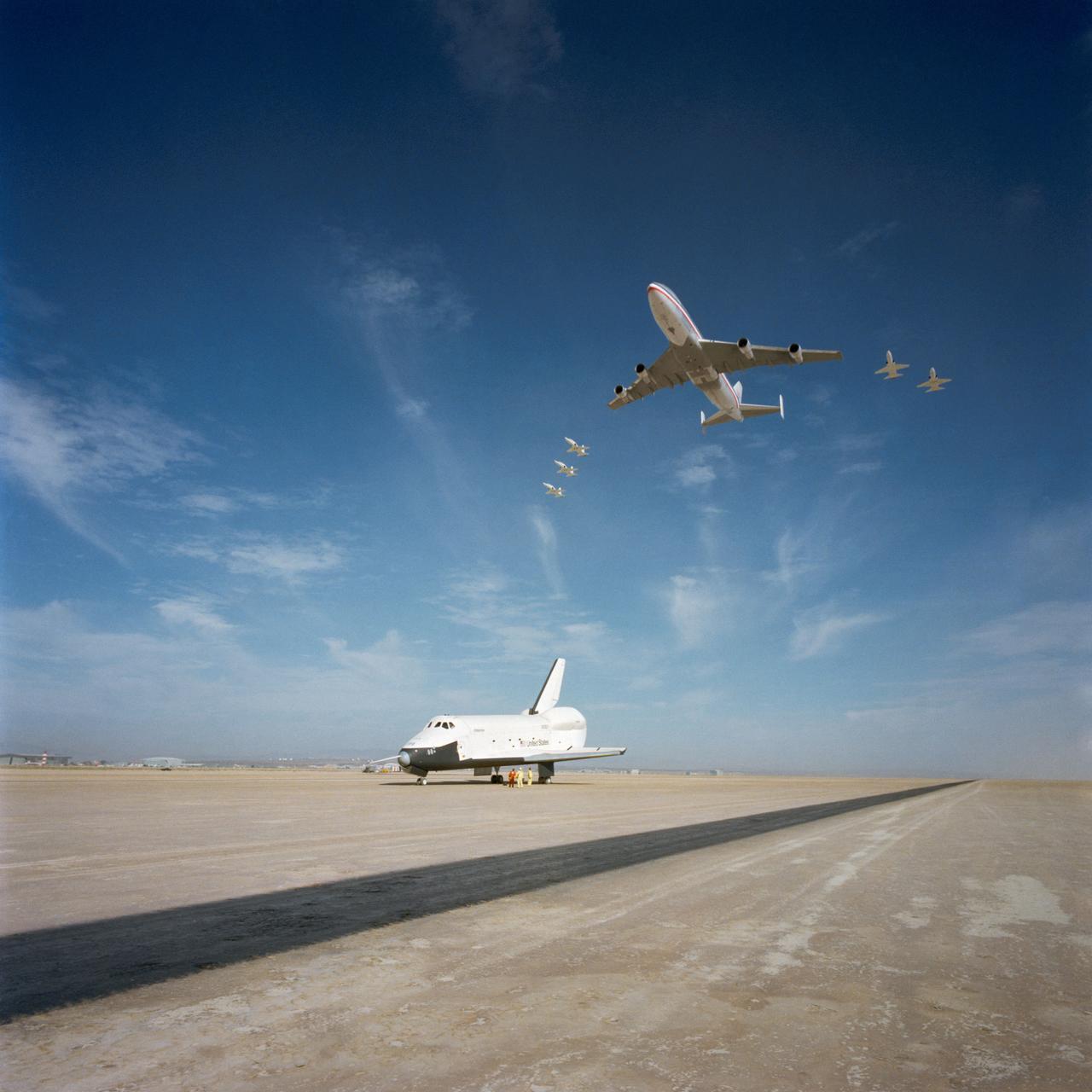
S77-28200 (13 Sept 1977) --- This impressive scene was photographed when the NASA 747 carrier aircraft and five T-38 aircraft flew over the shuttle Orbiter 101 "Enterprise" while it was parked on the runway at Edwards Air Force Base in Southern California. The Orbiter 101 had just completed a five-minute, 28-second unpowered mission during the second free flight of the Shuttle Approach and Landing Tests (ALT) conducted September 13, 1977, at the Dryden Flight Research Center.
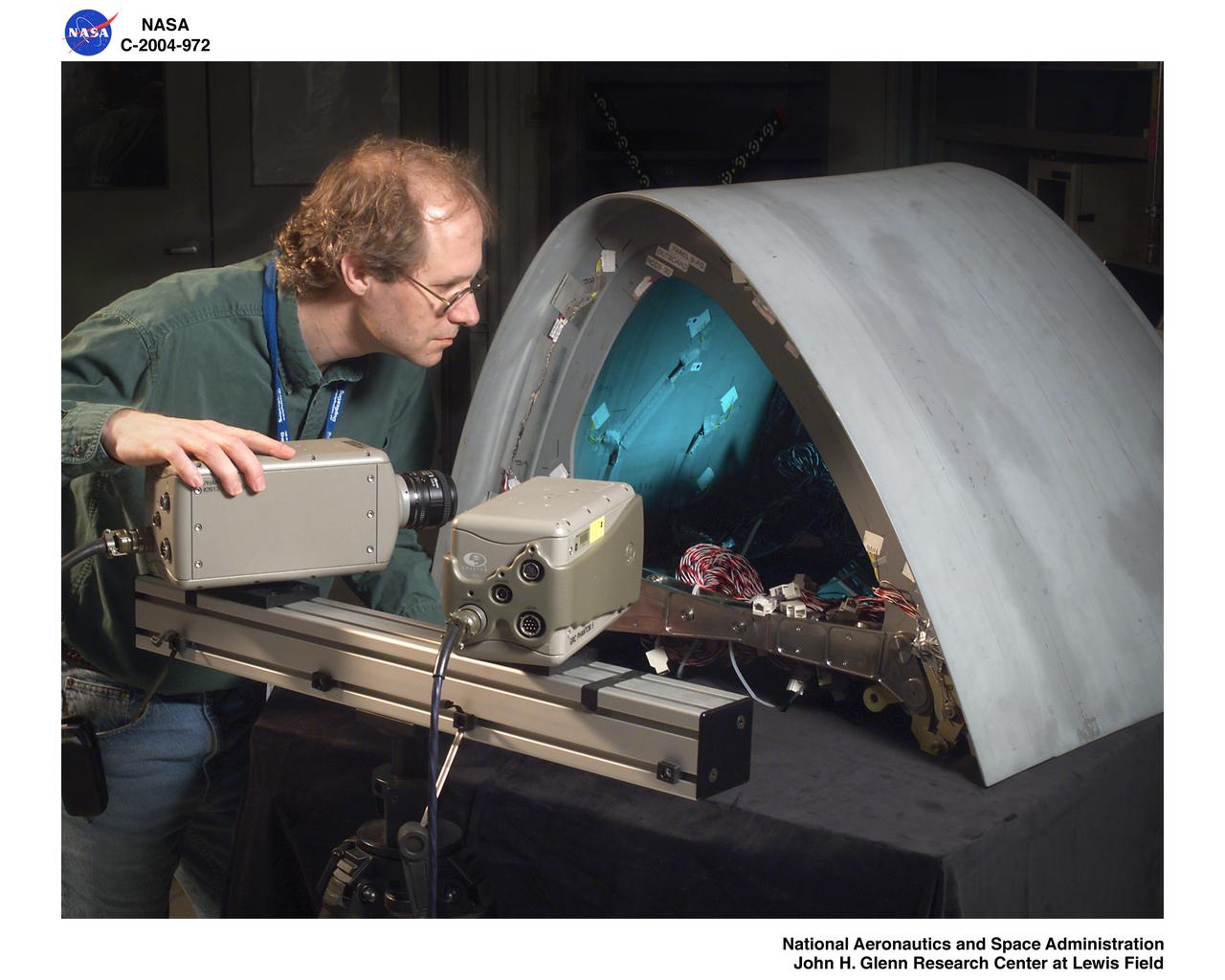
Aramis System setup with Orbiter Enterprise fiberglass leading edge Panel 9L
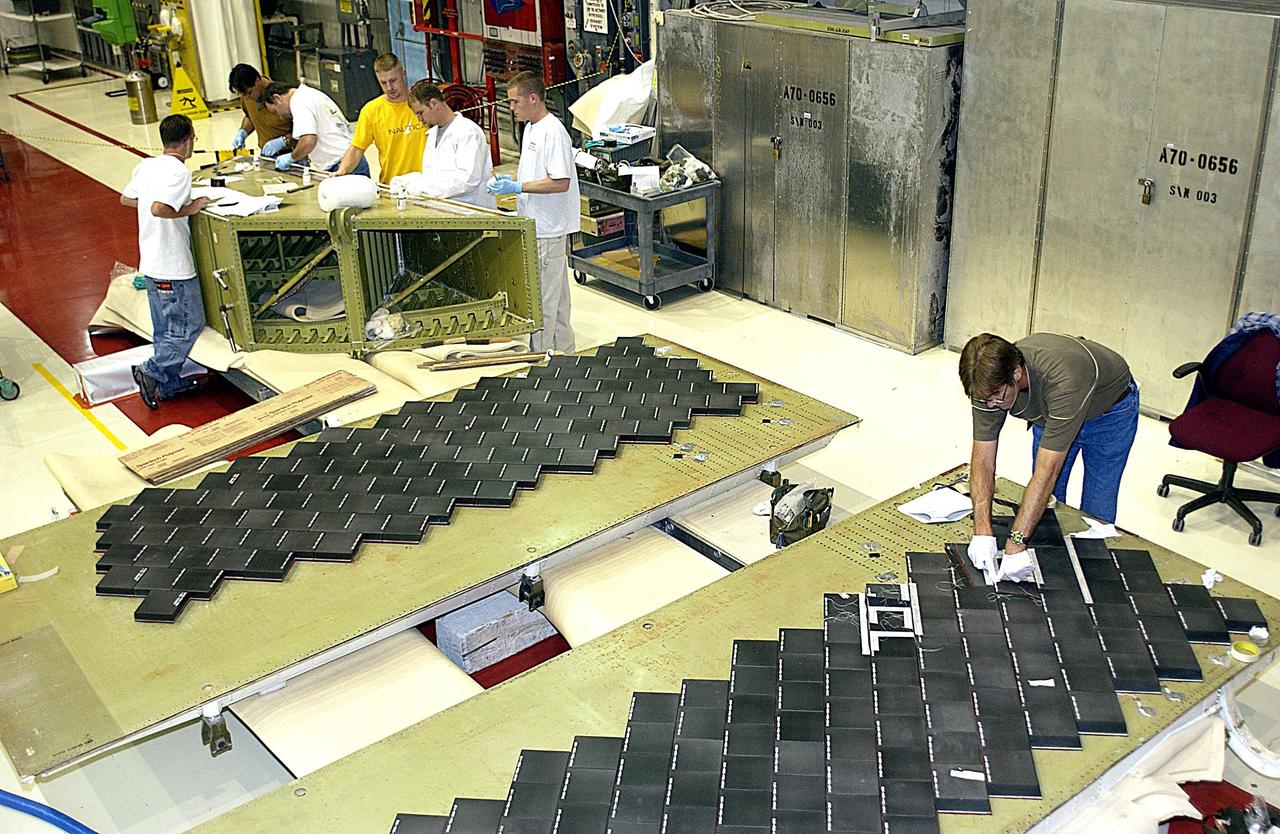
KENNEDY SPACE CENTER, FLA. -- In the Orbiter Processing Facility (OPF), United Space Alliance (USA) employee Harrell Watts (right) installs Thermal Protection System (TPS) tiles on a main landing gear door of Space Shuttle orbiter Enterprise (OV-101). In the background, other USA employees, members of the OPF midbody TPS crew, prepare to install TPS tile on a simulated orbiter wing. The wing and the sections of Enterprise will be transferred to the Southwest Research Institute for testing after the tile installation is complete. The testing has been requested by the Columbia Accident Investigation Board. Sections of Enterprise were borrowed from the Smithsonian Institution's Air and Space Museum where the orbiter is being stored at the Washington Dulles International Airport. Enterprise was the first orbiter built in the Shuttle fleet and was used to conduct the Approach and Landing Test Program before the first powered Shuttle flight.
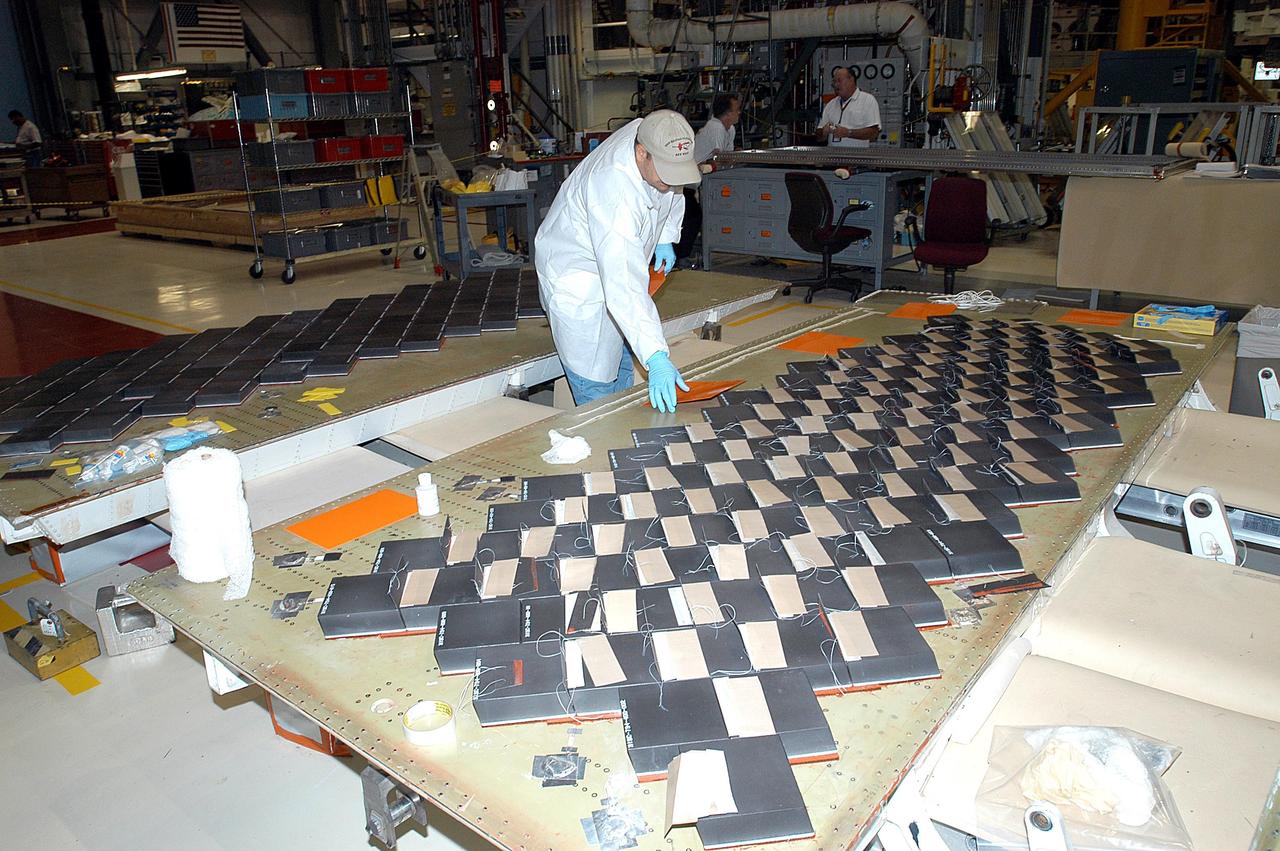
KENNEDY SPACE CENTER, FLA. -- In the Orbiter Processing Facility, United Space Alliance employee Mike Cote works on installing Thermal Protection System tiles on a main landing gear door of Space Shuttle orbiter Enterprise (OV-101). Sections of Enterprise were borrowed from the Smithsonian Institution's Air and Space Museum where the orbiter is being stored at the Washington Dulles International Airport. Enterprise was the first orbiter built in the Shuttle fleet and was used to conduct the Approach and Landing Test Program before the first powered Shuttle flight. After the tile installation is complete, the sections will be transferred to the Southwest Research Institute for testing requested by the Columbia Accident Investigation Board.
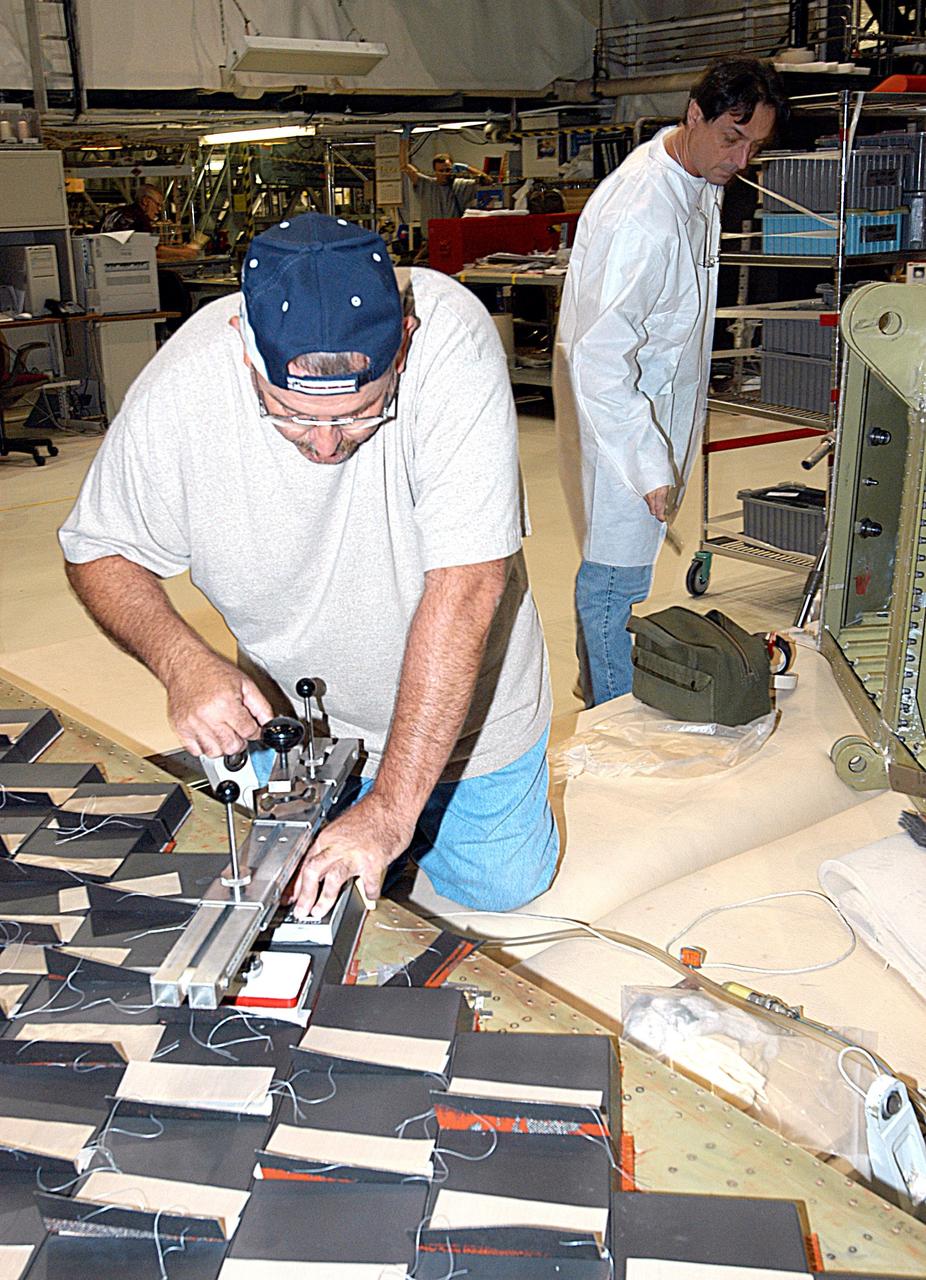
KENNEDY SPACE CENTER, FLA. -- In the Orbiter Processing Facility, United Space Alliance employee Dave Sanborn (left) conducts a bond verification test on Thermal Protection System tiles installed on a main landing gear door of Space Shuttle orbiter Enterprise (OV-101). Sections of Enterprise were borrowed from the Smithsonian Institution's Air and Space Museum where the orbiter is being stored at the Washington Dulles International Airport. Enterprise was the first orbiter built in the Shuttle fleet and was used to conduct the Approach and Landing Test Program before the first powered Shuttle flight. After the tile installation is complete, the sections will be transferred to the Southwest Research Institute for testing requested by the Columbia Accident Investigation Board.
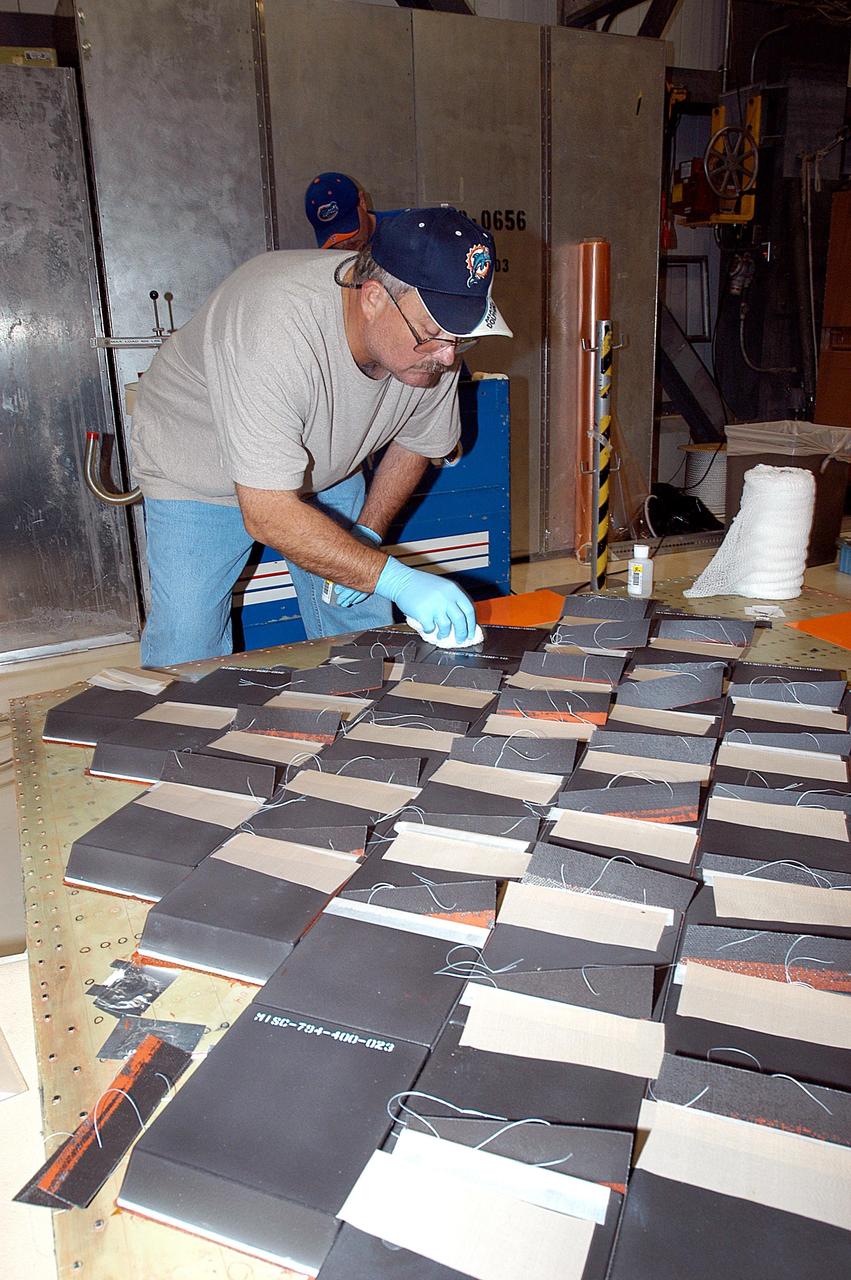
KENNEDY SPACE CENTER, FLA. -- In the Orbiter Processing Facility, United Space Alliance employee Dave Sanborn installs Thermal Protection System tiles on a main landing gear door of Space Shuttle orbiter Enterprise (OV-101). Sections of Enterprise were borrowed from the Smithsonian Institution's Air and Space Museum where the orbiter is being stored at the Washington Dulles International Airport. Enterprise was the first orbiter built in the Shuttle fleet and was used to conduct the Approach and Landing Test Program before the first powered Shuttle flight. After the tile installation is complete, the sections will be transferred to the Southwest Research Institute for testing requested by the Columbia Accident Investigation Board.

KENNEDY SPACE CENTER, FLA. -- In the Orbiter Processing Facility, United Space Alliance employee Harrell Watts installs Thermal Protection System tiles on a main landing gear door of Space Shuttle orbiter Enterprise (OV-101). Sections of Enterprise were borrowed from the Smithsonian Institution's Air and Space Museum where the orbiter is being stored at the Washington Dulles International Airport. Enterprise was the first orbiter built in the Shuttle fleet and was used to conduct the Approach and Landing Test Program before the first powered Shuttle flight. After the tile installation is complete, the sections will be transferred to the Southwest Research Institute for testing requested by the Columbia Accident Investigation Board.
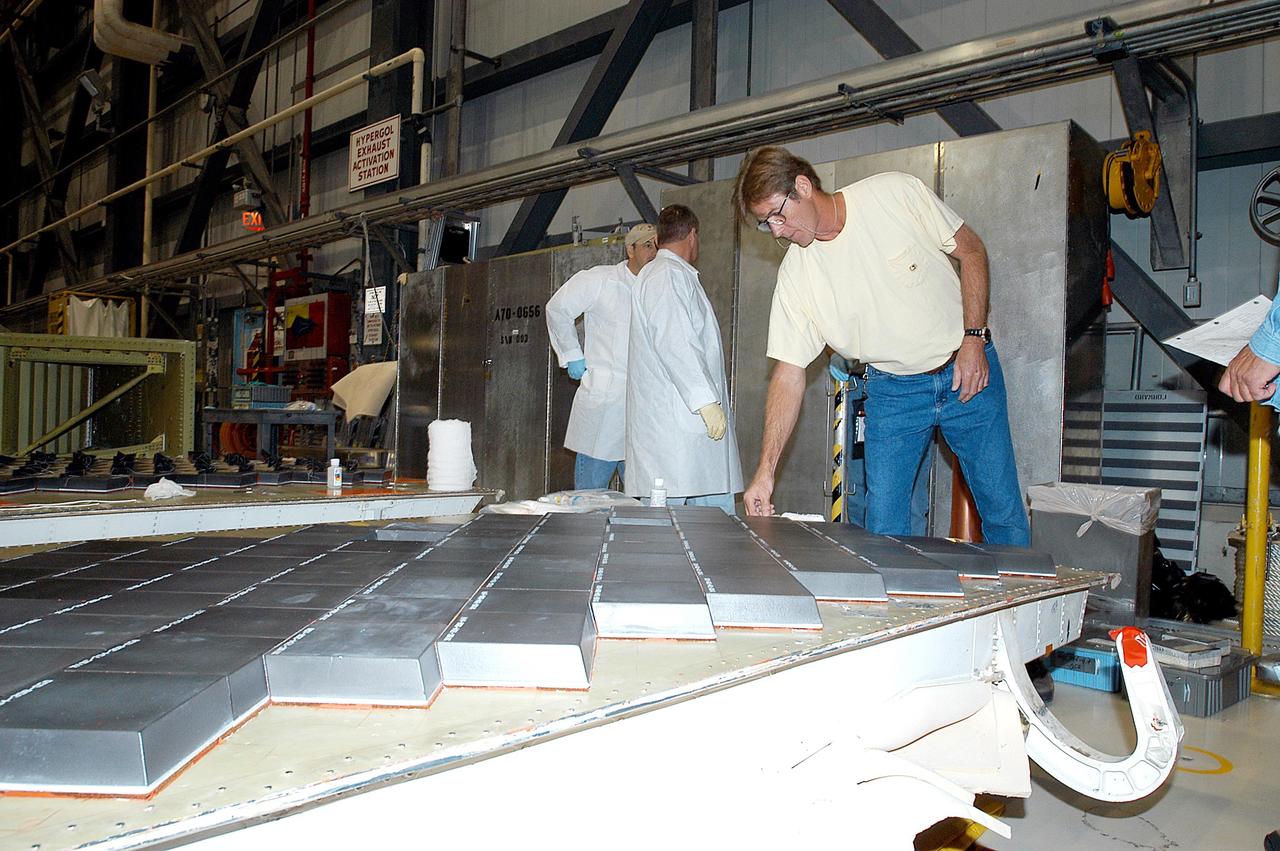
KENNEDY SPACE CENTER, FLA. -- In the Orbiter Processing Facility, United Space Alliance employee Harrell Watts (right) installs Thermal Protection System tiles on a main landing gear door of Space Shuttle orbiter Enterprise (OV-101). Sections of Enterprise were borrowed from the Smithsonian Institution's Air and Space Museum where the orbiter is being stored at the Washington Dulles International Airport. Enterprise was the first orbiter built in the Shuttle fleet and was used to conduct the Approach and Landing Test Program before the first powered Shuttle flight. After the tile installation is complete, the sections will be transferred to the Southwest Research Institute for testing requested by the Columbia Accident Investigation Board.
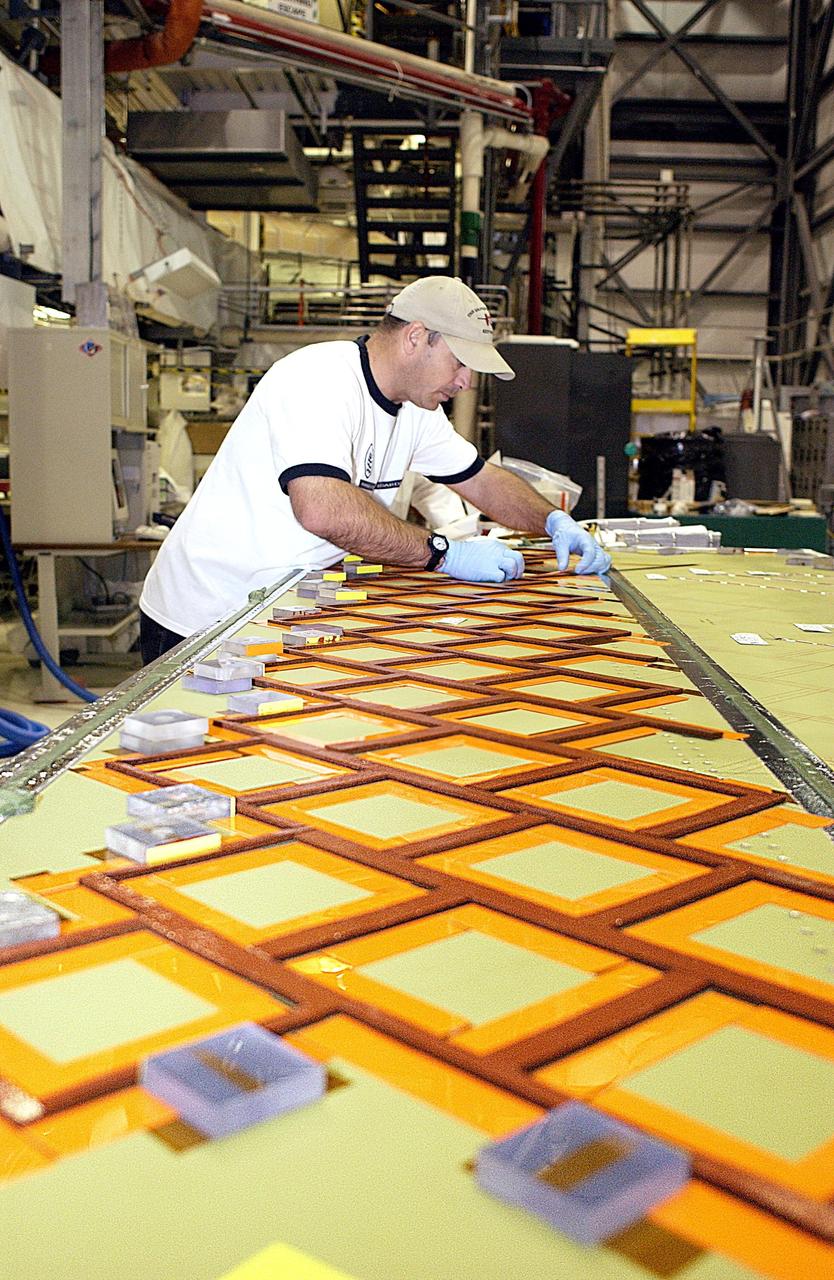
KENNEDY SPACE CENTER, FLA. -- In the Orbiter Processing Facility, United Space Alliance employee Mike Cote installs Thermal Protection System tiles on a test panel. The test panel and sections of Space Shuttle orbiter Enterprise (OV-101) will be transferred to the Southwest Research Institute for testing after the tile installation is complete. The testing has been requested by the Columbia Accident Investigation Board. Sections of Enterprise were borrowed from the Smithsonian Institution's Air and Space Museum where the orbiter is being stored at the Washington Dulles International Airport. Enterprise was the first orbiter built in the Shuttle fleet and was used to conduct the Approach and Landing Test Program before the first powered Shuttle flight.
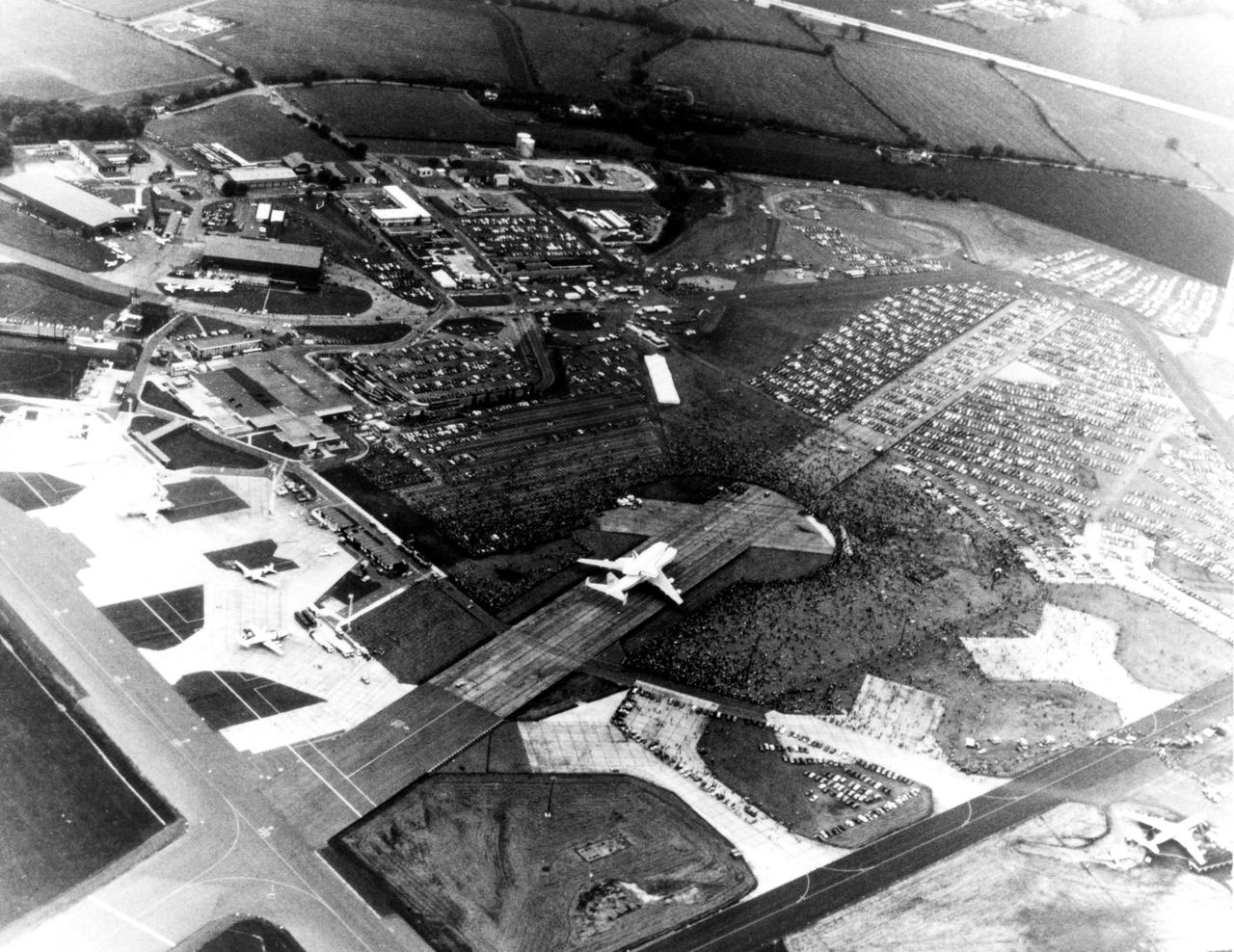
KENNEDY SPACE CENTER, FLA. -- Thousands of Britons surround the Space Shuttle Orbiter Enterprise at Stansted Airport, near London. The Enterprise atop its 747 carrier aircraft was viewed in London, Bonn-Cologne, West Germany, Rome and Ottawa, Canada, in addition to being shown at the Paris Air Show in June 1983.
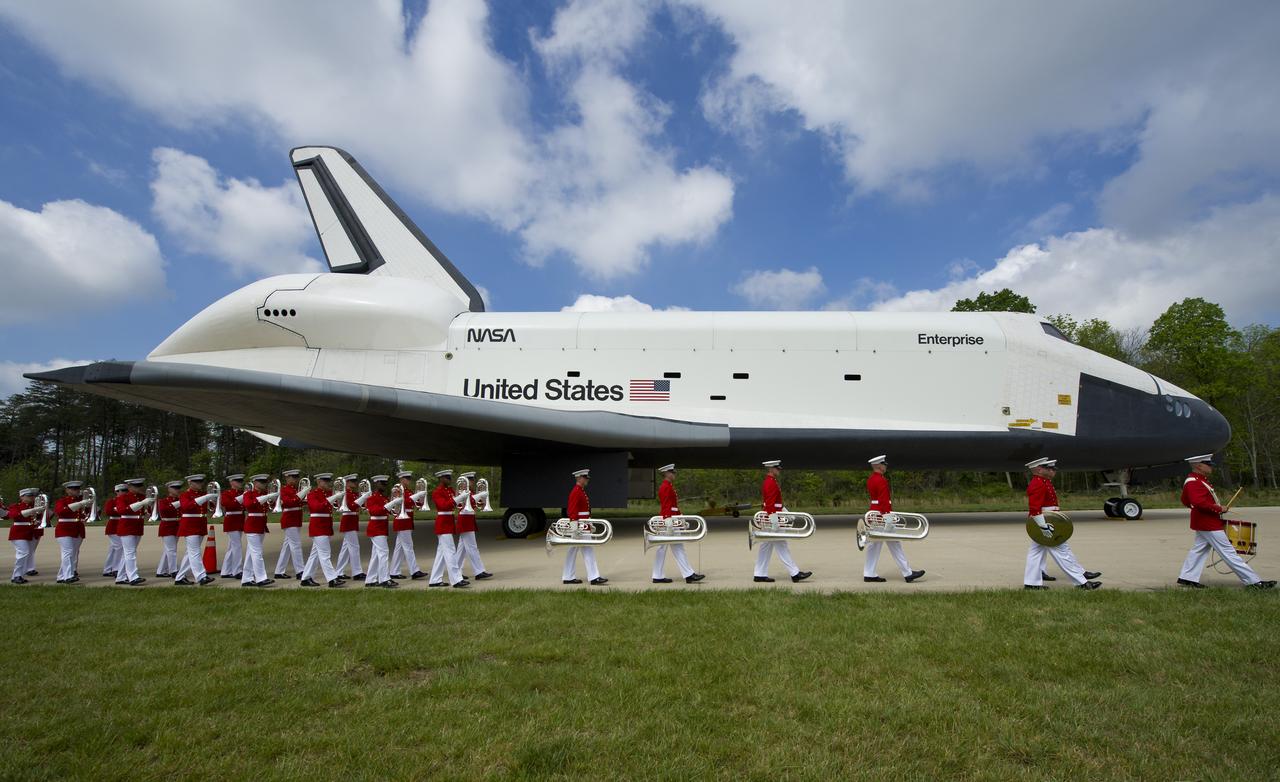
Space shuttle Enterprise is seen as the United States Marine Corp Drum and Bugle Corps and Color Guard march by at the Steven F. Udvar-Hazy Center Thursday, April 19, 2012 in Chantilly, Va. Enterprise was the first space shuttle orbiter, built for NASA to perform test flights in the atmosphere and was not capable of spaceflight. It has been on display at the Udvar-Hazy Center's Space Hangar since 2004. Enterprise will be transferred to the Intrepid Sea, Air and Space Museum in New York City. Photo Credit: (NASA/Carla Cioffi)
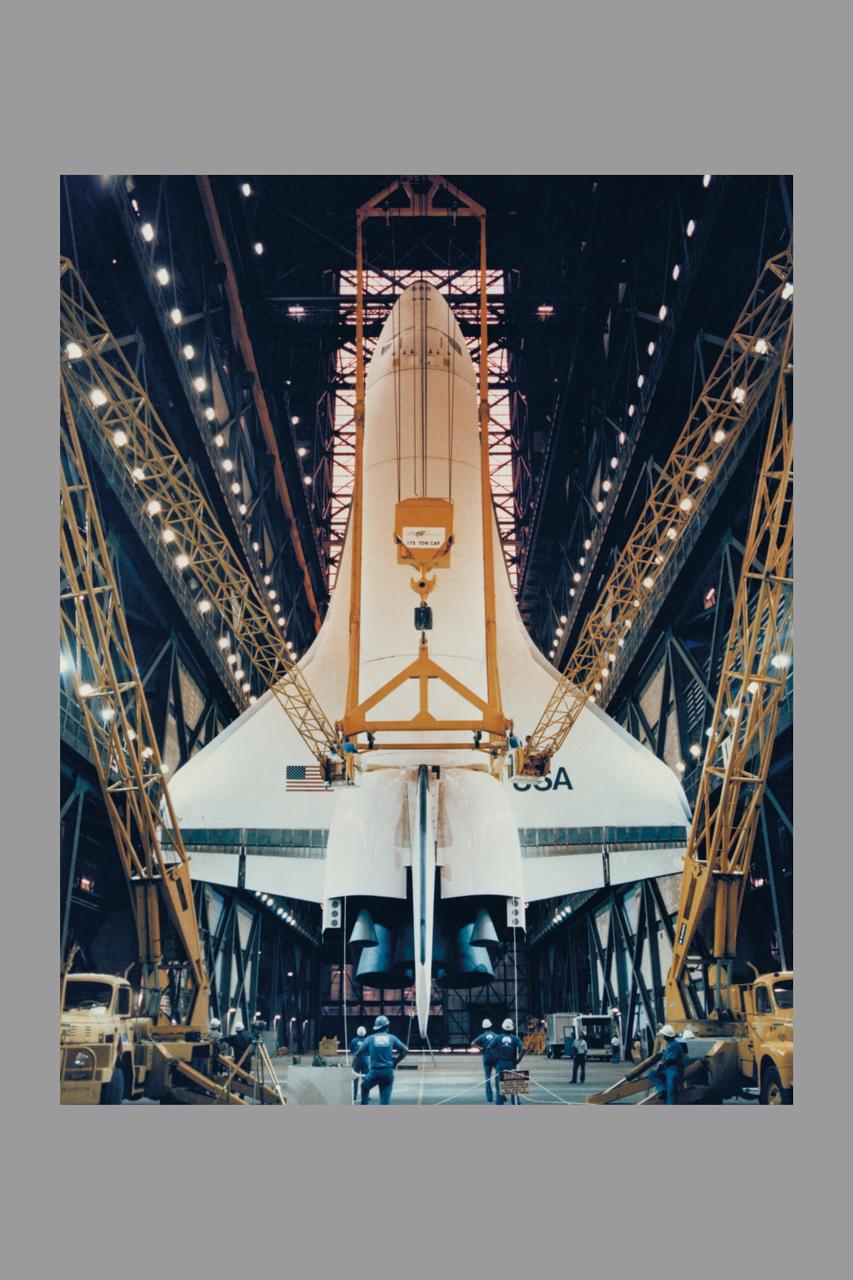
The Space Shuttle Orbiter Enterprise is lowered to the floor of the transfer aisle in the Vehicle Assembly Building during destacking operations. The Enterprise, mated to an external tank and twin inert solid rocket boosters, formed a nonlaunchable Space Shuttle which was used for fit and fuction checks of assembly, test and launch facilities at the nation's Spaceport. Enterprise will be transported to the Shuttle Landing Facility, mounted piggyback on its 747 Shuttle Carrier Aircraft, and flown to NASA's Dryden Flight Research Center, CA.
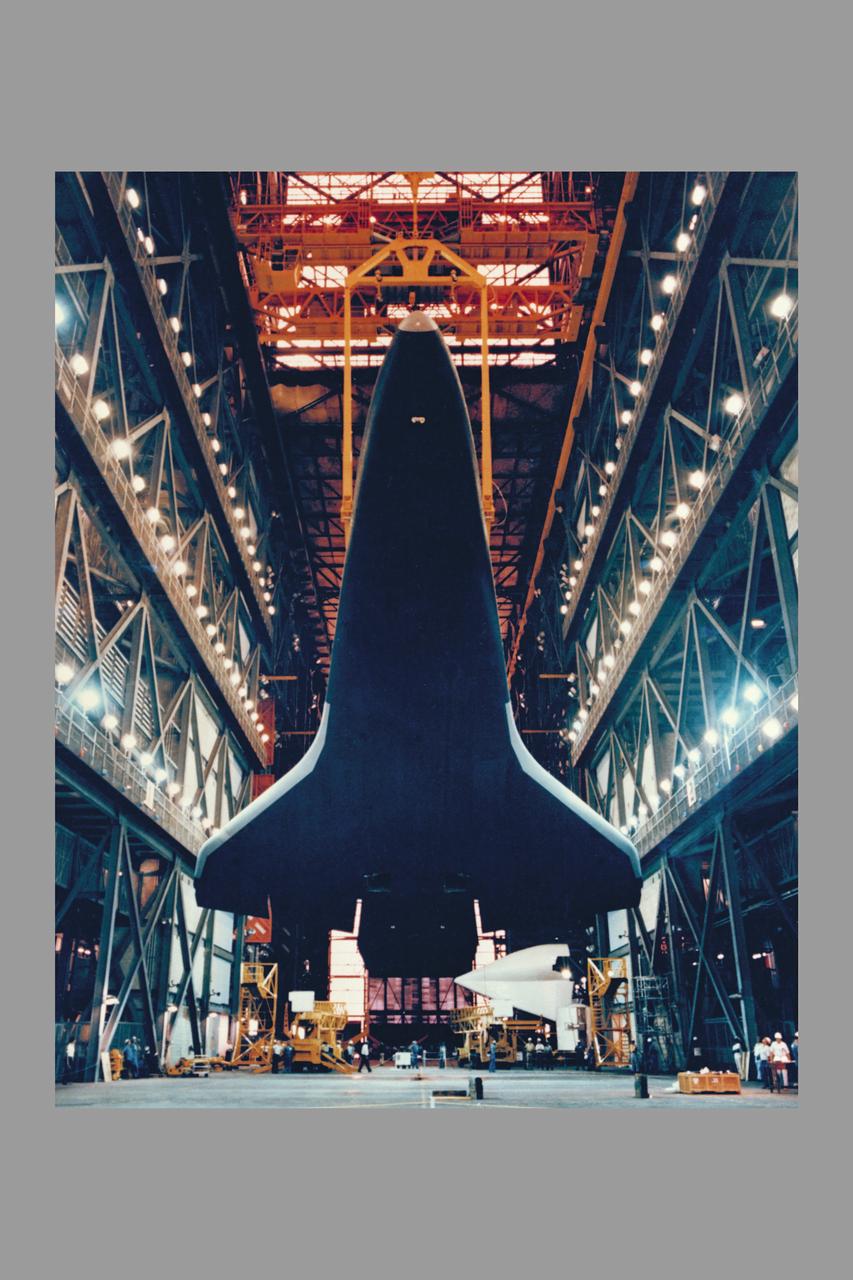
Space Shuttle Orbiter Enterprise is lowered to the floor of the transfer aisle in the Vehicle Assembly Building during destacking operations. The Enterprise, mated to an external tank and twin inert solid rocket boosters, formed a nonlaunchable Space Shuttle which was used for fit and function checks of assembly, test and launch facilities at the nation's Spaceport. Enterprise will be tansported to the Shuttle Landing Facility, mounted piggyback on its 747 Shuttle Carrier Aircraft, and flown to NASA's Dryden Flight Research Center, California.
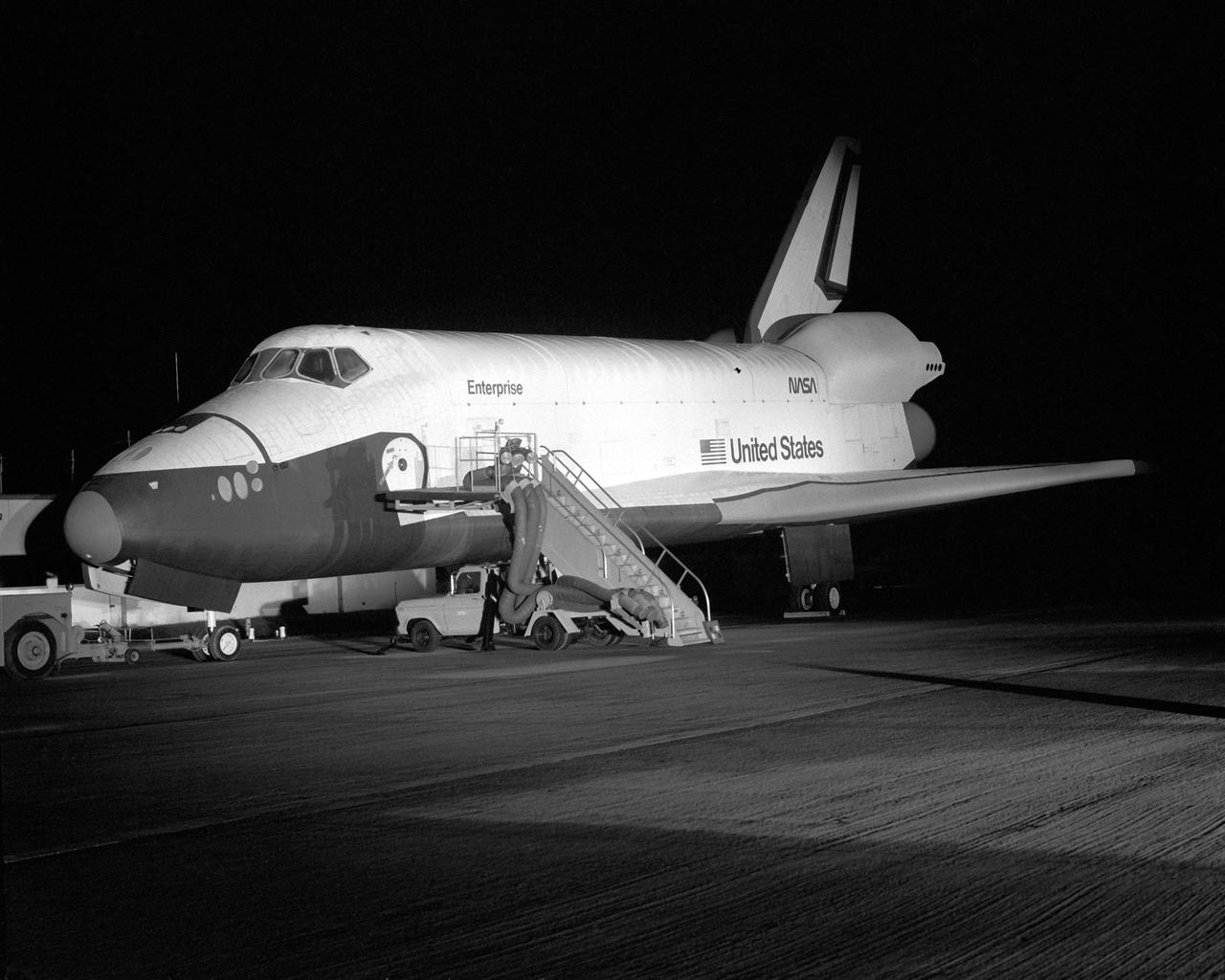
VANDENBERG AIR FORCE BASE, Calif. -- Space Shuttle Orbiter Enterprise – night landing test. Photo Credit: NASA
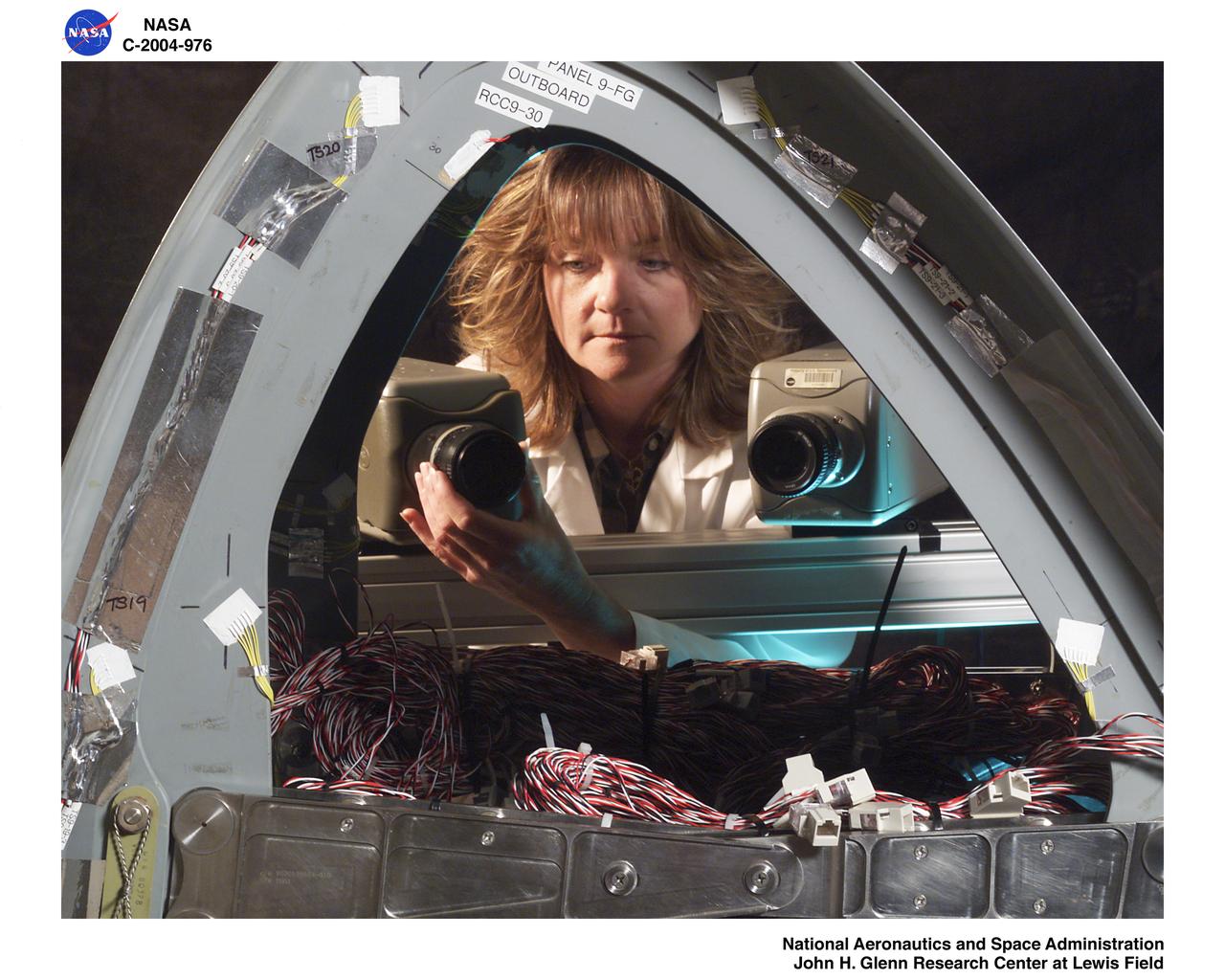
Adrienne Veverka performing Aramis System setup with Orbiter Enterprise fiberglass leading edge Panel 9L
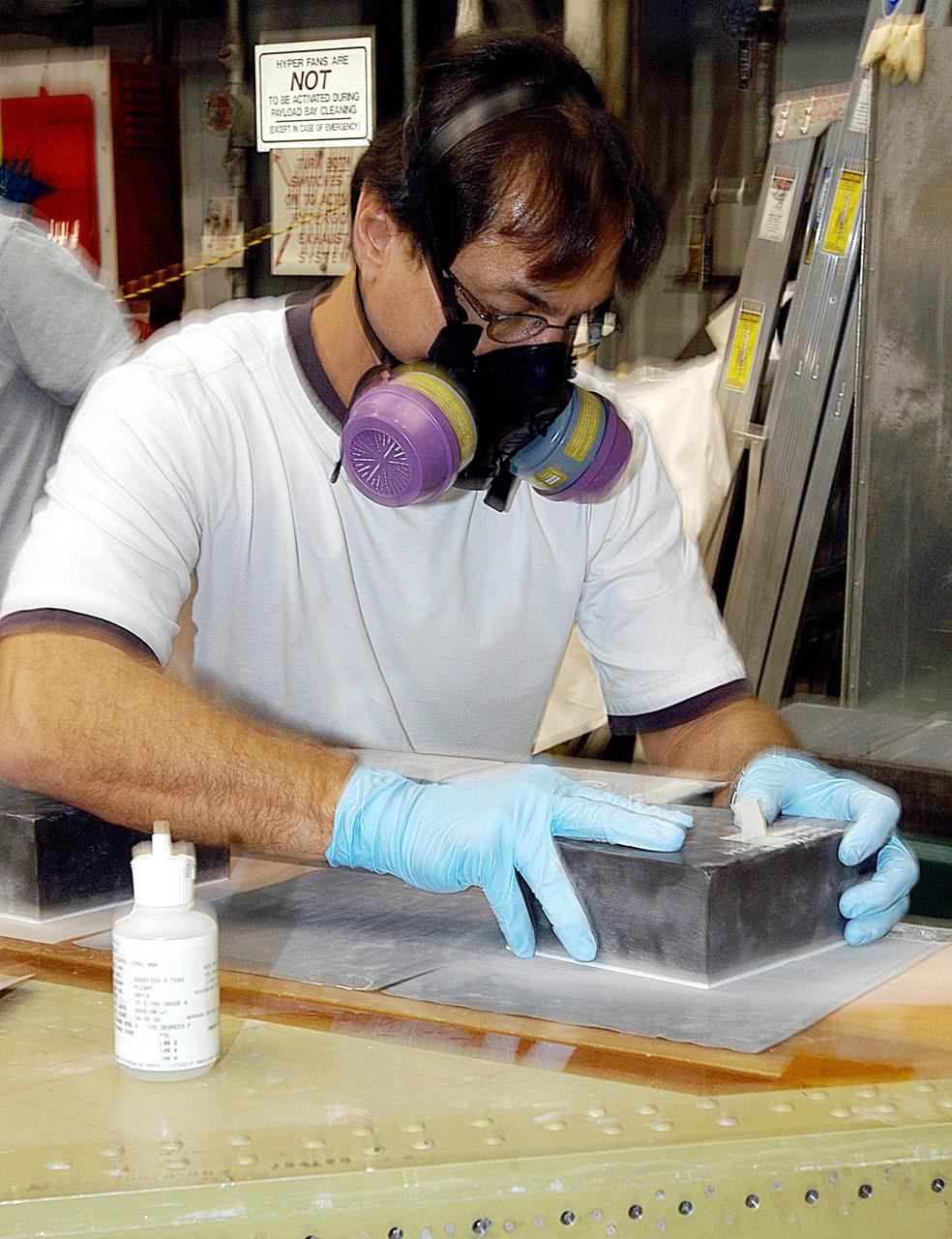
KENNEDY SPACE CENTER, FLA. -- In the Orbiter Processing Facility (OPF), United Space Alliance (USA) technician Mark Jetton installs Thermal Protection System (TPS) tile on a simulated orbiter wing. The wing, along with sections of Space Shuttle orbiter Enterprise (OV-101), will be transferred to the Southwest Research Institute for testing after the tile installation is complete. The testing has been requested by the Columbia Accident Investigation Board. For this initiative, sections of Enterprise were borrowed from the Smithsonian Institution's Air and Space Museum where the orbiter is being stored at the Washington Dulles International Airport. Enterprise was the first orbiter built in the Shuttle fleet and was used to conduct the Approach and Landing Test Program before the first powered Shuttle flight.
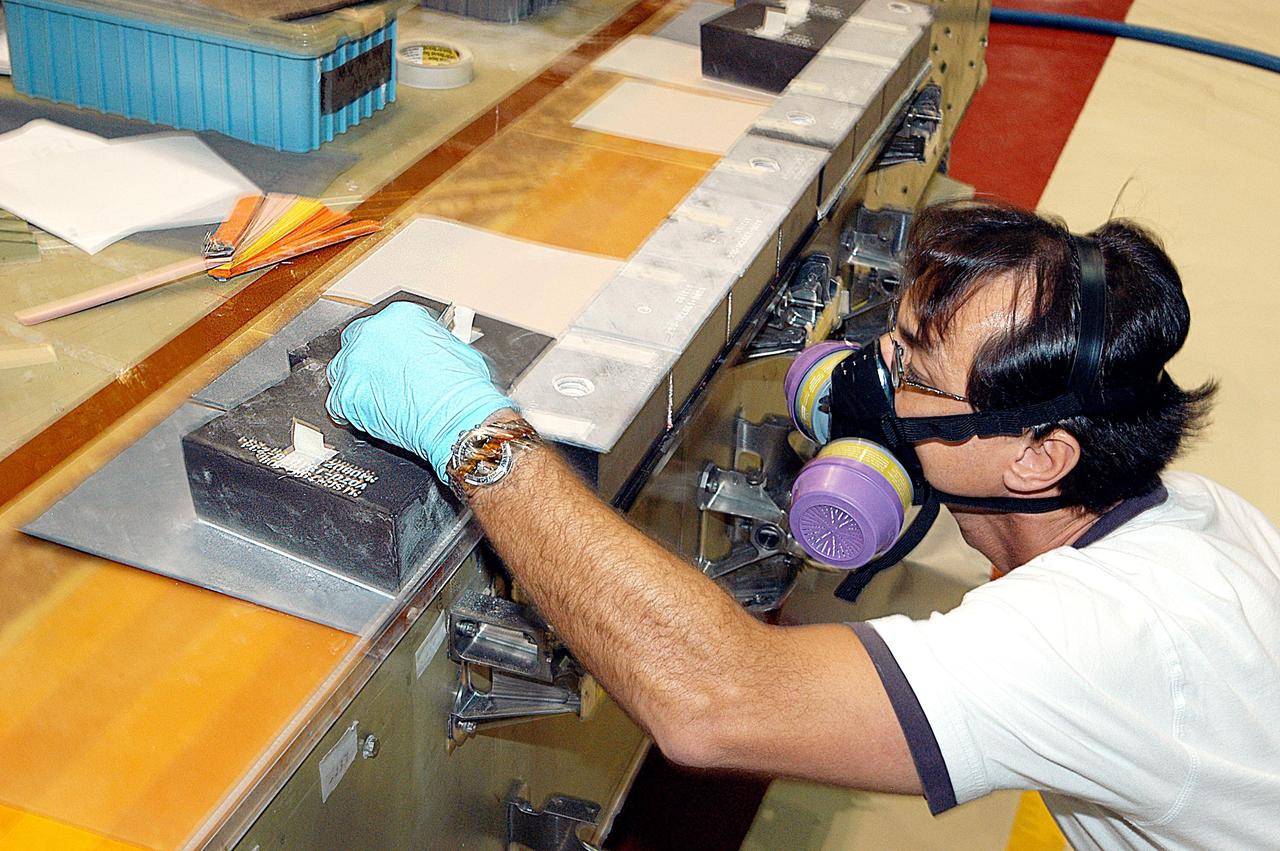
KENNEDY SPACE CENTER, FLA. -- In the Orbiter Processing Facility (OPF), United Space Alliance (USA) technician Mark Jetton installs Thermal Protection System (TPS) tile on a simulated orbiter wing. The wing, along with sections of Space Shuttle orbiter Enterprise (OV-101), will be transferred to the Southwest Research Institute for testing after the tile installation is complete. The testing has been requested by the Columbia Accident Investigation Board. For this initiative, sections of Enterprise were borrowed from the Smithsonian Institution's Air and Space Museum where the orbiter is being stored at the Washington Dulles International Airport. Enterprise was the first orbiter built in the Shuttle fleet and was used to conduct the Approach and Landing Test Program before the first powered Shuttle flight.
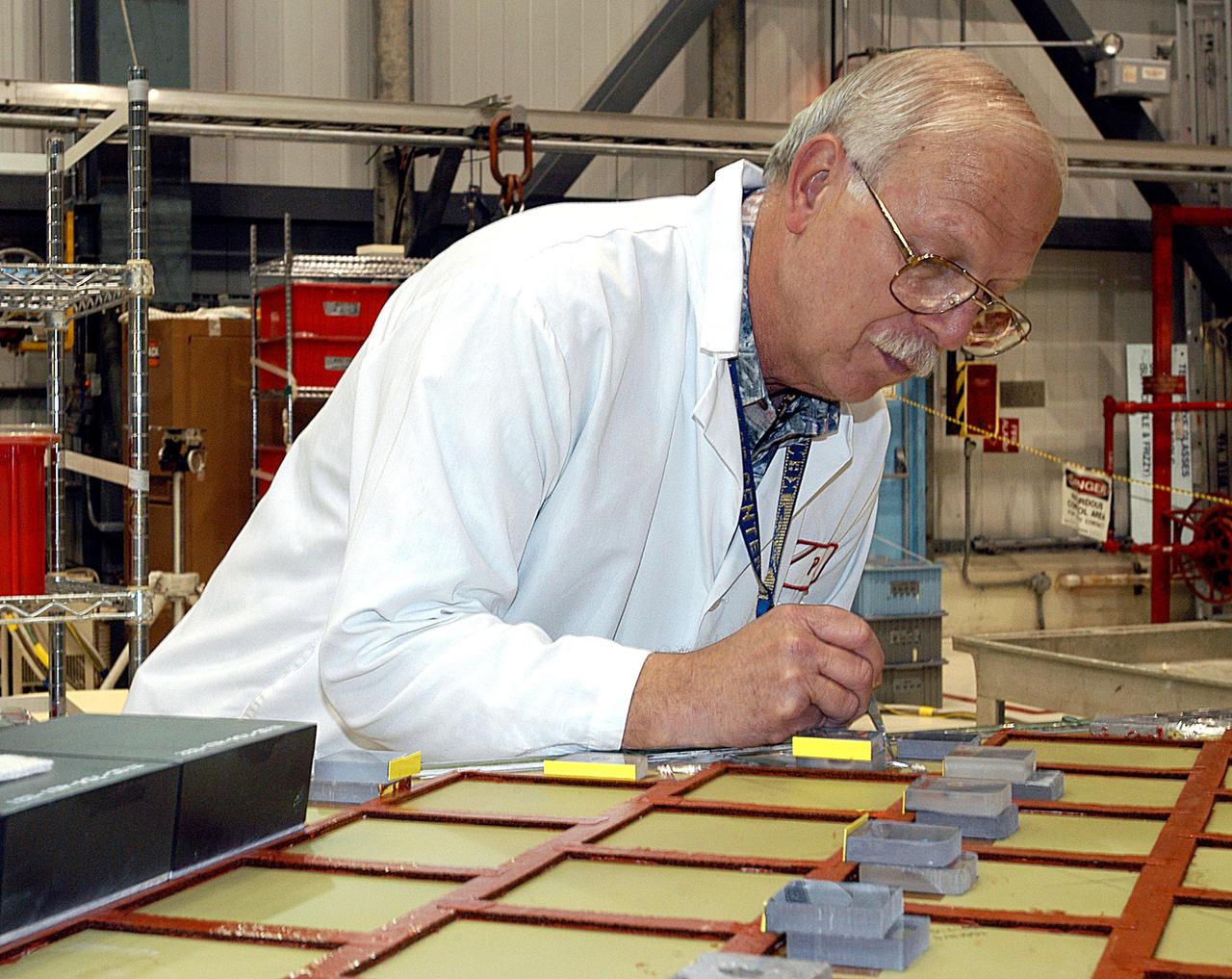
KENNEDY SPACE CENTER, FLA. -- In the Orbiter Processing Facility (OPF), Paul King, an employee of The Boeing Co., Huntington Beach, Calif., installs a strain gauge on a simulated orbiter wing in preparation for Thermal Protection System (TPS) tile installation. The wing, along with sections of Space Shuttle orbiter Enterprise (OV-101), will be transferred to the Southwest Research Institute for testing after the tile installation is complete. The testing has been requested by the Columbia Accident Investigation Board. For this initiative, sections of Enterprise were borrowed from the Smithsonian Institution's Air and Space Museum where the orbiter is being stored at the Washington Dulles International Airport. Enterprise was the first orbiter built in the Shuttle fleet and was used to conduct the Approach and Landing Test Program before the first powered Shuttle flight.
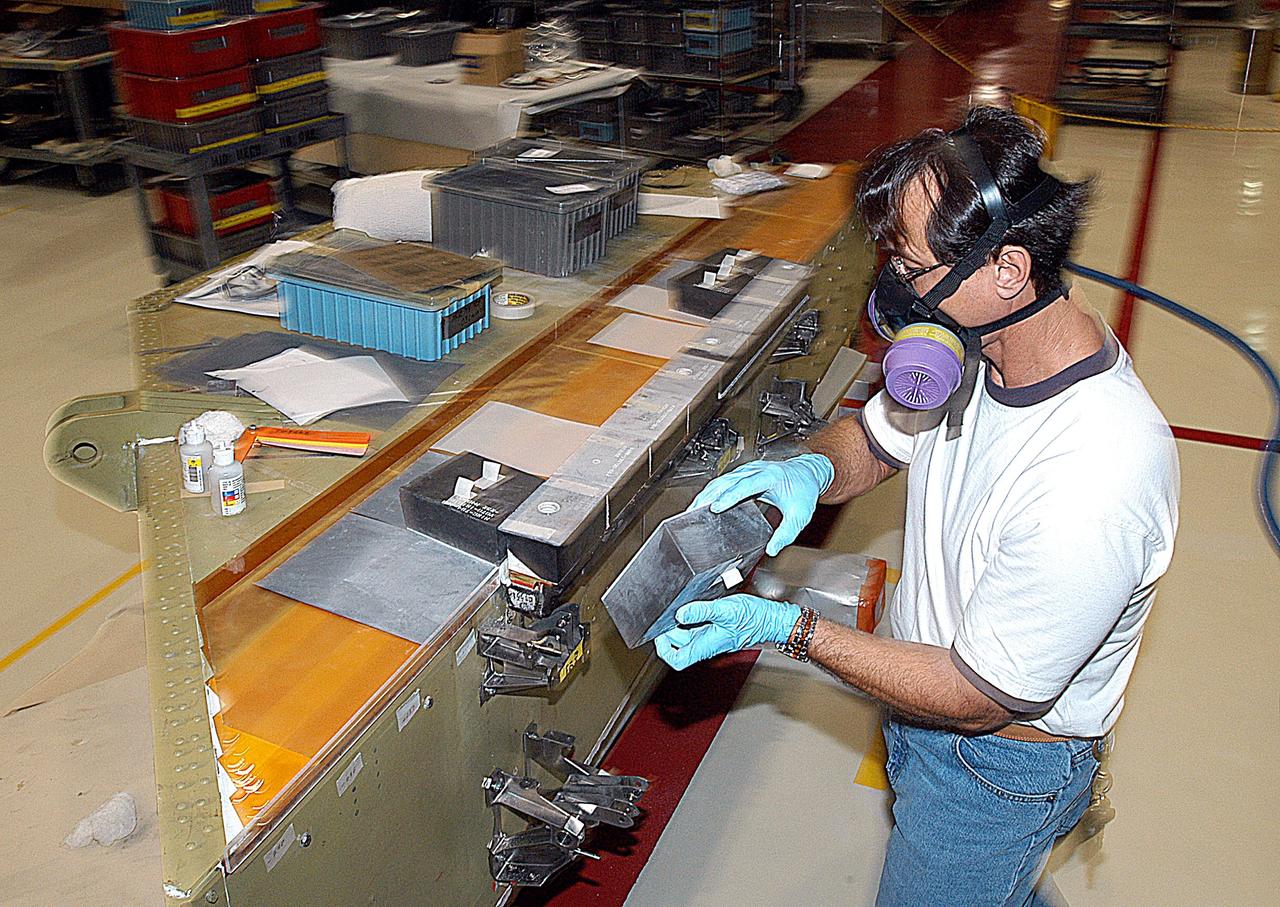
KENNEDY SPACE CENTER, FLA. -- In the Orbiter Processing Facility (OPF), United Space Alliance (USA) technician Mark Jetton installs Thermal Protection System (TPS) tile on a simulated orbiter wing. The wing, along with sections of Space Shuttle orbiter Enterprise (OV-101), will be transferred to the Southwest Research Institute for testing after the tile installation is complete. The testing has been requested by the Columbia Accident Investigation Board. For this initiative, sections of Enterprise were borrowed from the Smithsonian Institution's Air and Space Museum where the orbiter is being stored at the Washington Dulles International Airport. Enterprise was the first orbiter built in the Shuttle fleet and was used to conduct the Approach and Landing Test Program before the first powered Shuttle flight.
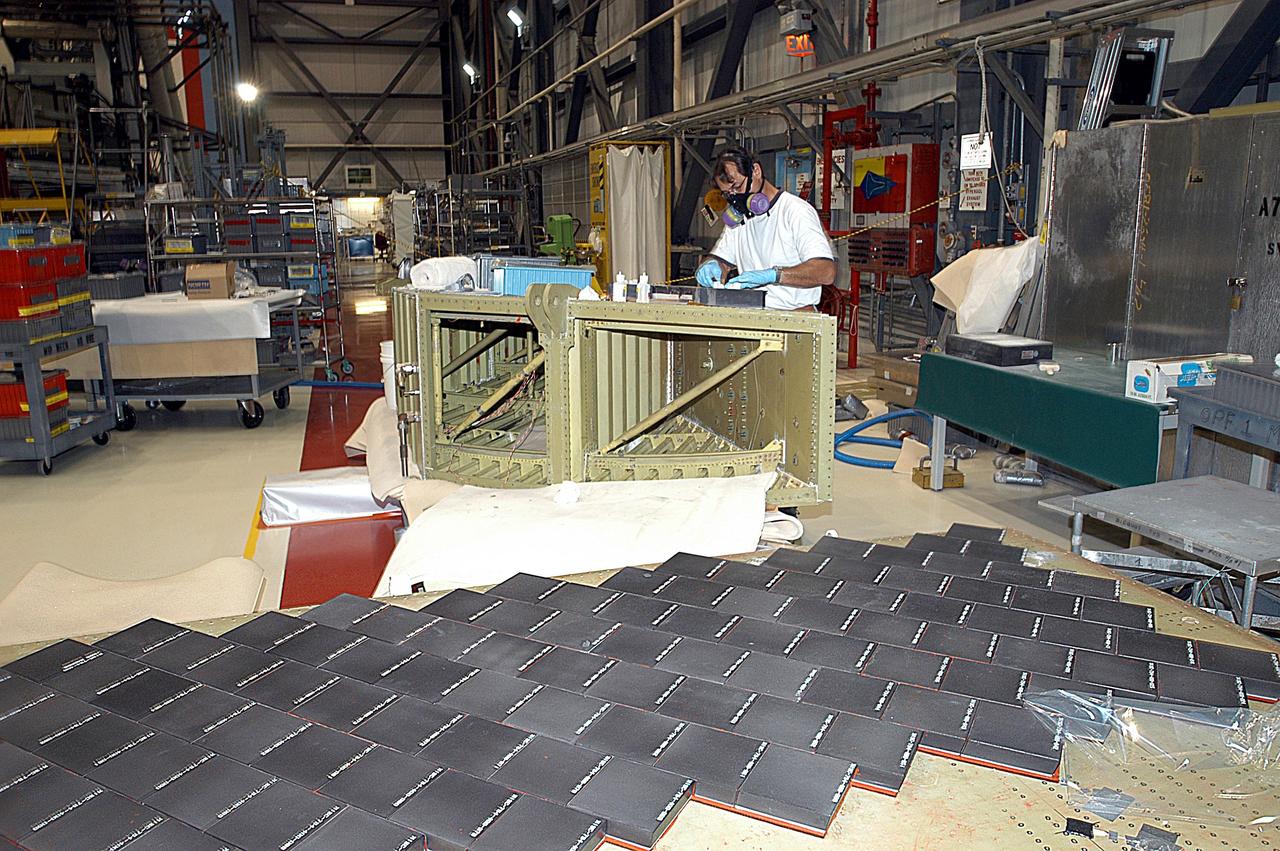
KENNEDY SPACE CENTER, FLA. -- In the Orbiter Processing Facility (OPF), United Space Alliance (USA) technician Mark Jetton installs Thermal Protection System (TPS) tile on a simulated orbiter wing. The wing, along with sections of Space Shuttle orbiter Enterprise (OV-101), will be transferred to the Southwest Research Institute for testing after the tile installation is complete. The testing has been requested by the Columbia Accident Investigation Board. For this initiative, sections of Enterprise were borrowed from the Smithsonian Institution's Air and Space Museum where the orbiter is being stored at the Washington Dulles International Airport. Enterprise was the first orbiter built in the Shuttle fleet and was used to conduct the Approach and Landing Test Program before the first powered Shuttle flight.
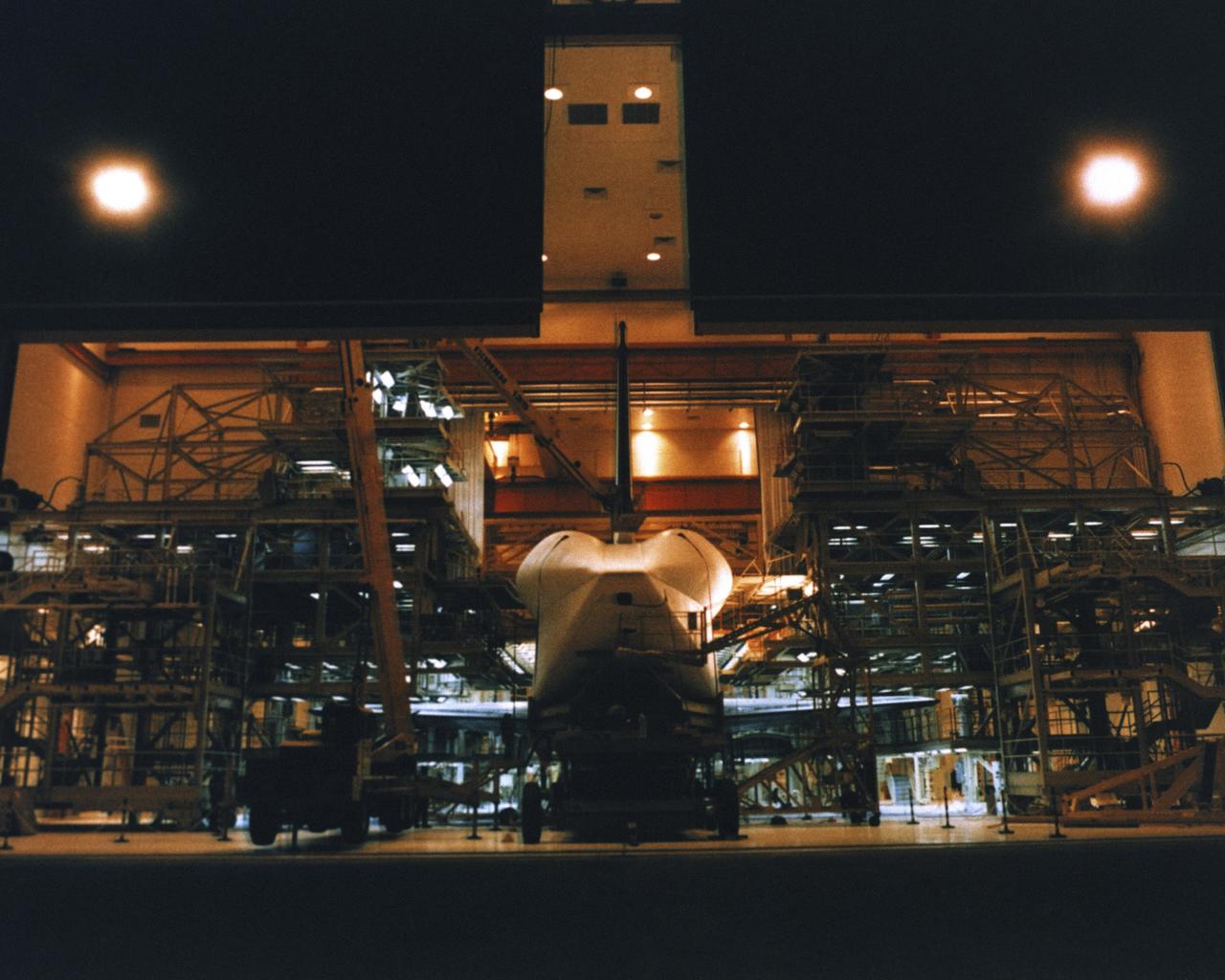
VANDENBERG AIR FORCE BASE, Calif. -- Enterprise inside the Orbiter Maintenance and Checkout Facility at Vandenberg AFB, California. Photo Credit: NASA

VANDENBERG AIR FORCE BASE, Calif. -- Enterprise inside the Orbiter Maintenance and Checkout Facility at Vandenberg AFB, California. Photo Credit: NASA
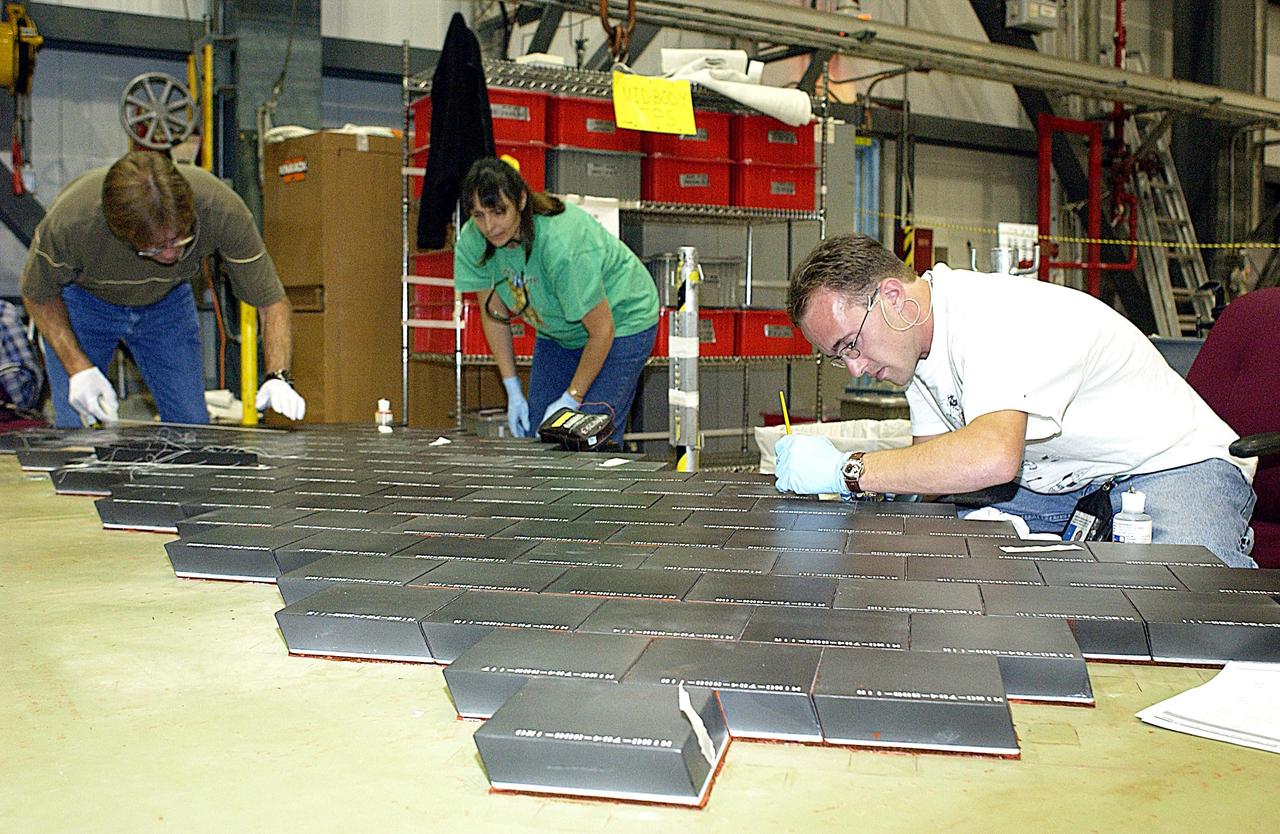
KENNEDY SPACE CENTER, FLA. -- In the Orbiter Processing Facility, United Space Alliance employees (from left) Harrell Watts, Lynn Wozniak, and Jason Levandusky install Thermal Protection System tiles on a main landing gear door of Space Shuttle orbiter Enterprise (OV-101). Sections of Enterprise were borrowed from the Smithsonian Institution's Air and Space Museum where the orbiter is being stored at the Washington Dulles International Airport. Enterprise was the first orbiter built in the Shuttle fleet and was used to conduct the Approach and Landing Test Program before the first powered Shuttle flight. After the tile installation is complete, the sections will be transferred to the Southwest Research Institute for testing requested by the Columbia Accident Investigation Board.
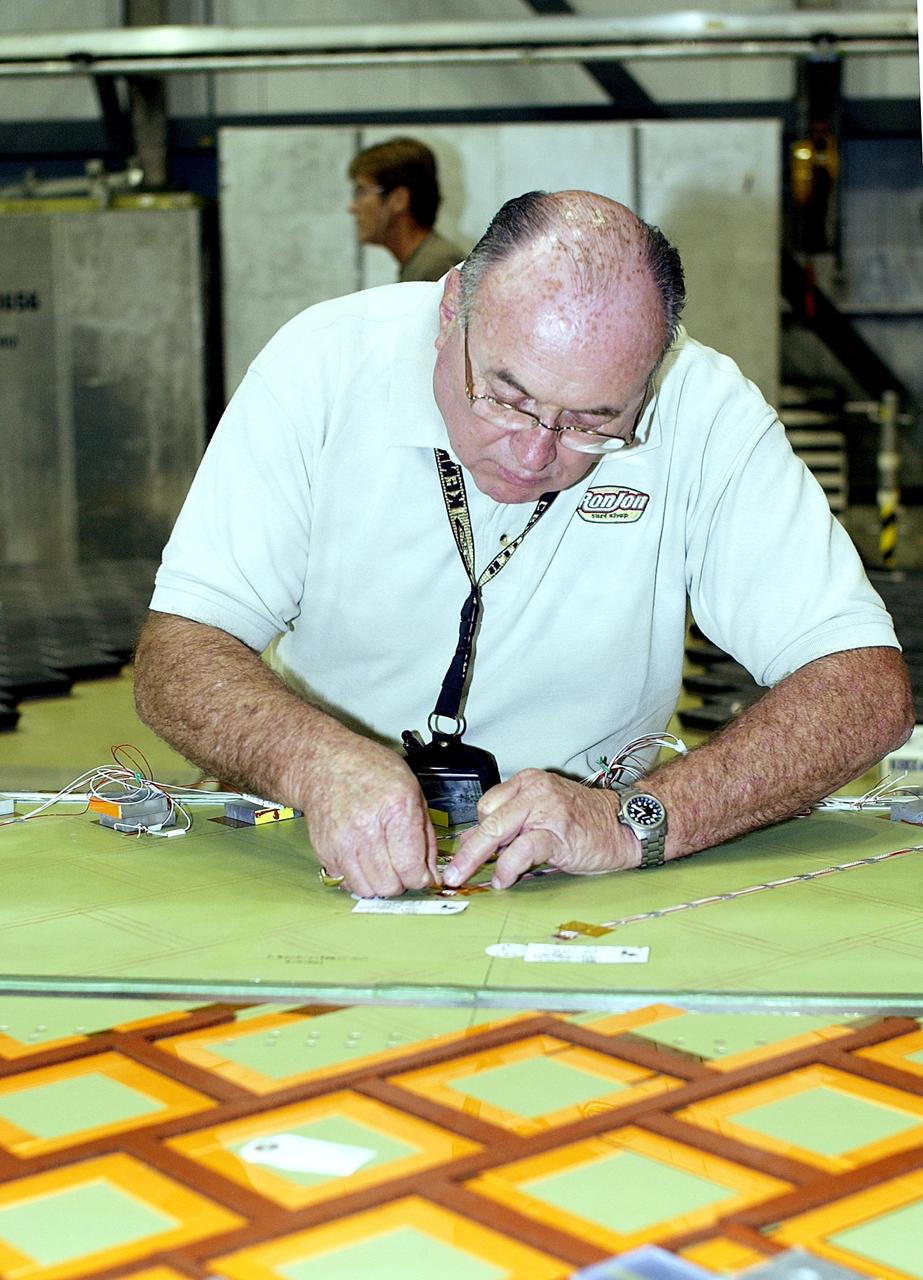
KENNEDY SPACE CENTER, FLA. -- In the Orbiter Processing Facility, an employee from The Boeing Co., Huntington Beach, Calif., installs a strain gauge on a test panel prior to installation of Thermal Protection System tile on the panel. The test panel and sections of Space Shuttle orbiter Enterprise (OV-101) will be transferred to the Southwest Research Institute for testing after the tile installation is complete. The testing has been requested by the Columbia Accident Investigation Board. Sections of Enterprise were borrowed from the Smithsonian Institution's Air and Space Museum where the orbiter is being stored at the Washington Dulles International Airport. Enterprise was the first orbiter built in the Shuttle fleet and was used to conduct the Approach and Landing Test Program before the first powered Shuttle flight.
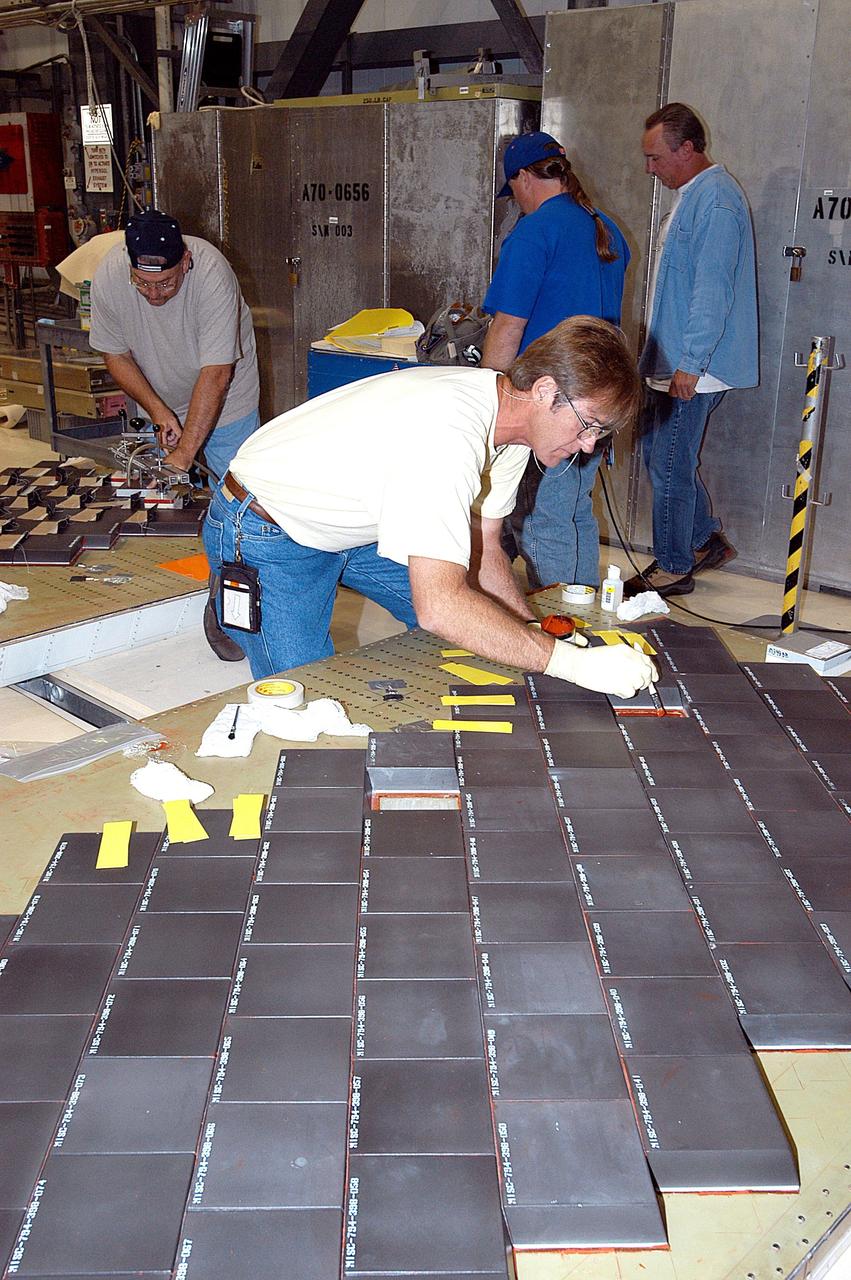
KENNEDY SPACE CENTER, FLA. -- In the Orbiter Processing Facility, United Space Alliance employee Harrell Watts applies RTV, a room-temperature vulcanizing silicone adhesive, to a main landing gear door of Space Shuttle orbiter Enterprise (OV-101) on which Thermal Protection System tiles are being installed. Sections of Enterprise were borrowed from the Smithsonian Institution's Air and Space Museum where the orbiter is being stored at the Washington Dulles International Airport. Enterprise was the first orbiter built in the Shuttle fleet and was used to conduct the Approach and Landing Test Program before the first powered Shuttle flight. After the tile installation is complete, the sections will be transferred to the Southwest Research Institute for testing requested by the Columbia Accident Investigation Board.
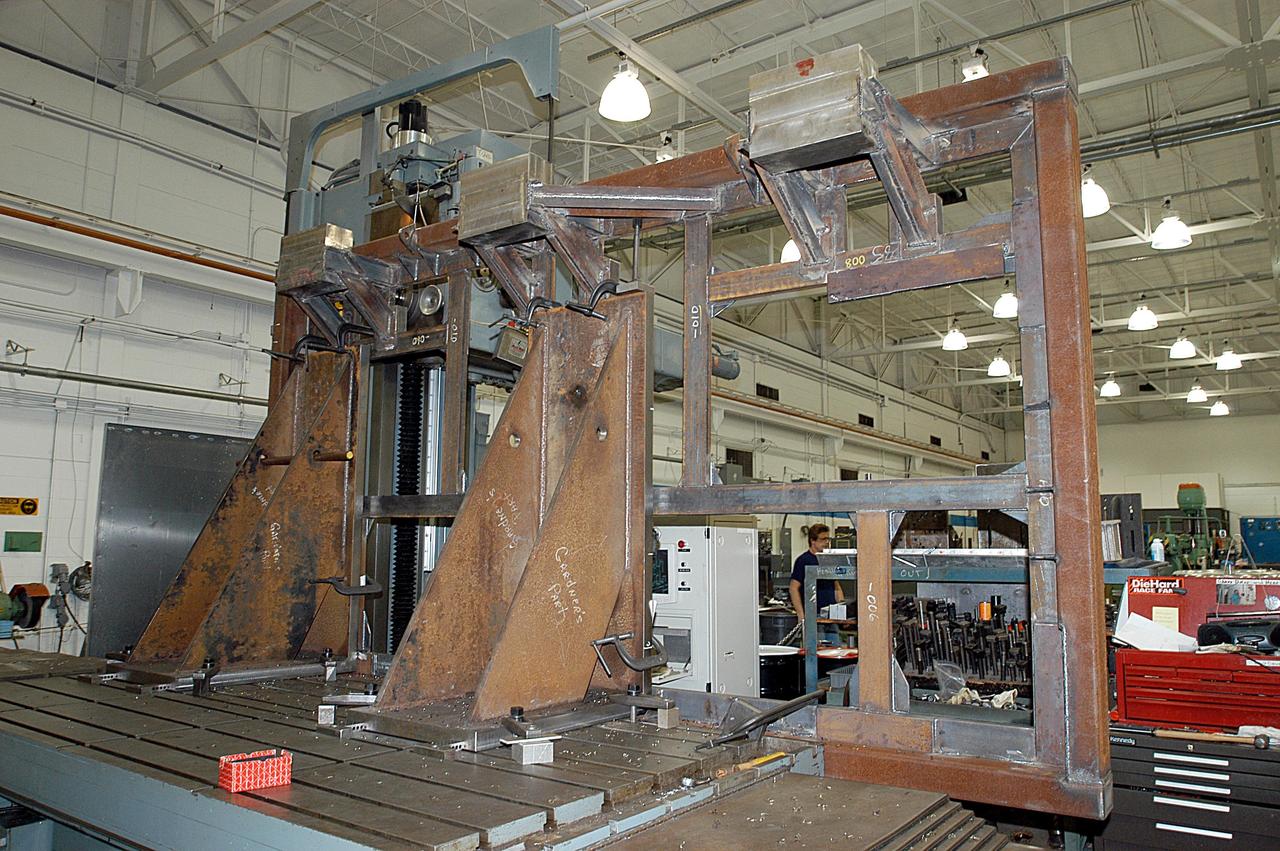
KENNEDY SPACE CENTER, FLA. -- A main landing gear door mounting fixture in the Launch Equipment Shop is being used to support the Columbia mishap investigation. A simulated orbiter wing and several test panels, along with sections of Space Shuttle orbiter Enterprise (OV-101), will be transferred to the Southwest Research Institute for testing after Thermal Protection System (TPS) tile installation is complete. The testing has been requested by the Columbia Accident Investigation Board. For this initiative, sections of Enterprise were borrowed from the Smithsonian Institution's Air and Space Museum where the orbiter is being stored at the Washington Dulles International Airport. Enterprise was the first orbiter built in the Shuttle fleet and was used to conduct the Approach and Landing Test Program before the first powered Shuttle flight.
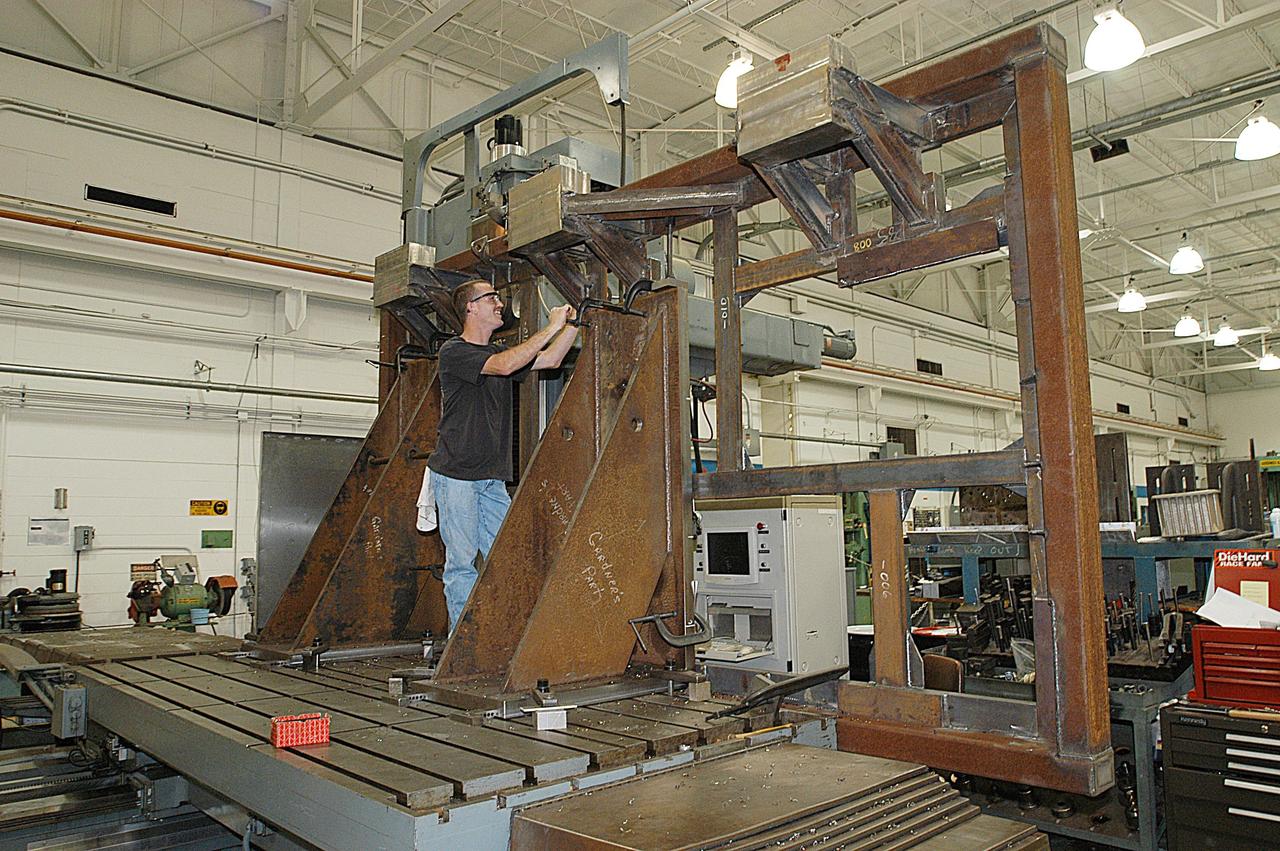
KENNEDY SPACE CENTER, FLA. -- United Space Alliance technician Matt Boonstra works on a main landing gear door mounting fixture in the Launch Equipment Shop. The fixture is being used to support the Columbia mishap investigation. A simulated orbiter wing and several test panels, along with sections of Space Shuttle orbiter Enterprise (OV-101), will be transferred to the Southwest Research Institute for testing after Thermal Protection System (TPS) tile installation on them is complete. The testing has been requested by the Columbia Accident Investigation Board. For this initiative, sections of Enterprise were borrowed from the Smithsonian Institution's Air and Space Museum where the orbiter is being stored at the Washington Dulles International Airport. Enterprise was the first orbiter built in the Shuttle fleet and was used to conduct the Approach and Landing Test Program before the first powered Shuttle flight.
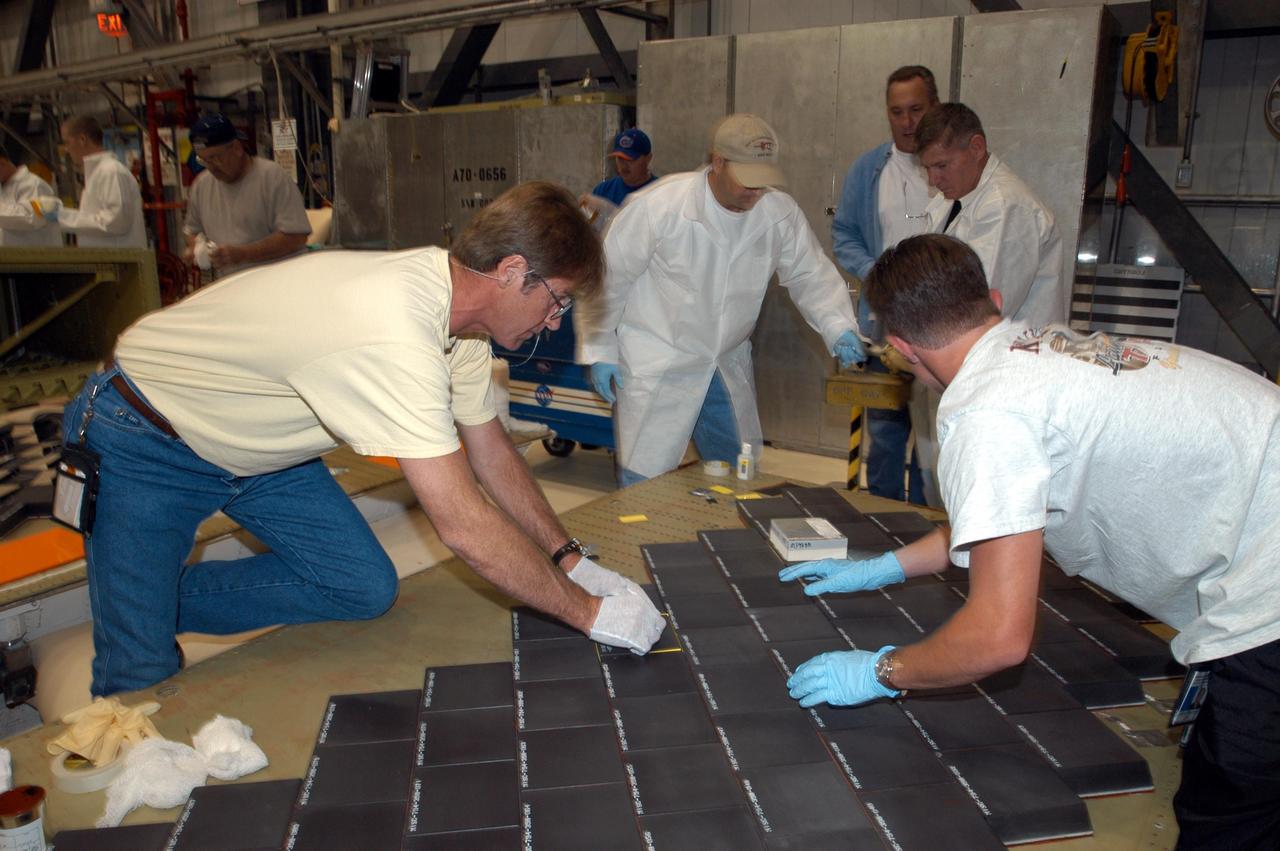
KENNEDY SPACE CENTER, FLA. -- In the Orbiter Processing Facility, United Space Alliance employees (from left) Harrell Watts, Mike Cote, and Jason Levandusky install Thermal Protection System tiles on a main landing gear door of Space Shuttle orbiter Enterprise (OV-101). Sections of Enterprise were borrowed from the Smithsonian Institution's Air and Space Museum where the orbiter is being stored at the Washington Dulles International Airport. Enterprise was the first orbiter built in the Shuttle fleet and was used to conduct the Approach and Landing Test Program before the first powered Shuttle flight. After the tile installation is complete, the sections will be transferred to the Southwest Research Institute for testing requested by the Columbia Accident Investigation Board.

KENNEDY SPACE CENTER, FLA. -- In the Orbiter Processing Facility, employees from The Boeing Co., Huntington Beach, Calif., install a strain gauge on a test panel prior to installation of Thermal Protection System tile on the panel. The test panel and sections of Space Shuttle orbiter Enterprise (OV-101) will be transferred to the Southwest Research Institute for testing after the tile installation is complete. The testing has been requested by the Columbia Accident Investigation Board. Sections of Enterprise were borrowed from the Smithsonian Institution's Air and Space Museum where the orbiter is being stored at the Washington Dulles International Airport. Enterprise was the first orbiter built in the Shuttle fleet and was used to conduct the Approach and Landing Test Program before the first powered Shuttle flight.
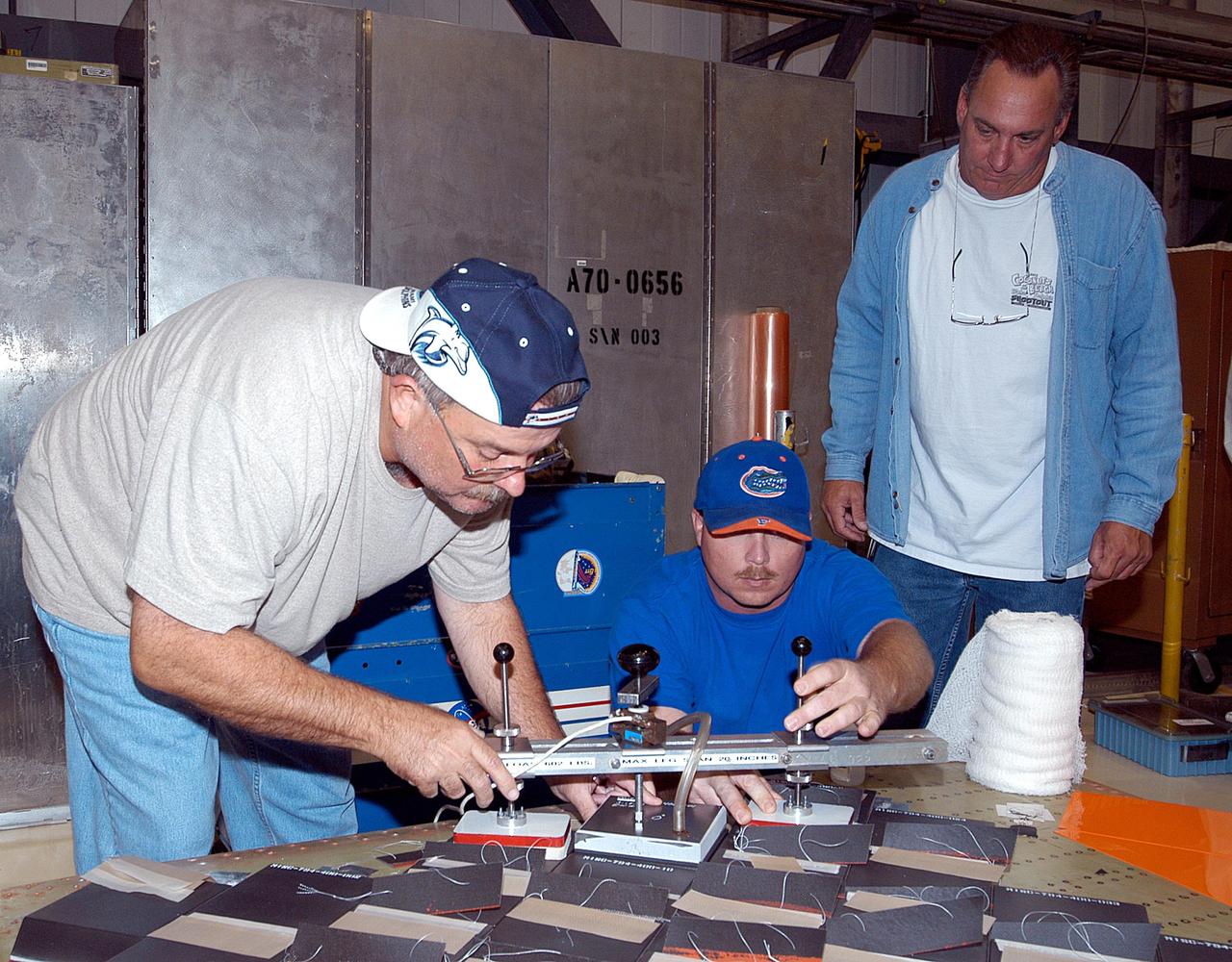
KENNEDY SPACE CENTER, FLA. -- In the Orbiter Processing Facility, United Space Alliance employees (from left) Dave Sanborn, Butch Lato, and Bill Brooks conduct a bond verification test on Thermal Protection System tiles newly installed on a main landing gear door of Space Shuttle orbiter Enterprise (OV-101). Sections of Enterprise were borrowed from the Smithsonian Institution's Air and Space Museum where the orbiter is being stored at the Washington Dulles International Airport. Enterprise was the first orbiter built in the Shuttle fleet and was used to conduct the Approach and Landing Test Program before the first powered Shuttle flight. After the tile installation is complete, the sections will be transferred to the Southwest Research Institute for testing requested by the Columbia Accident Investigation Board.
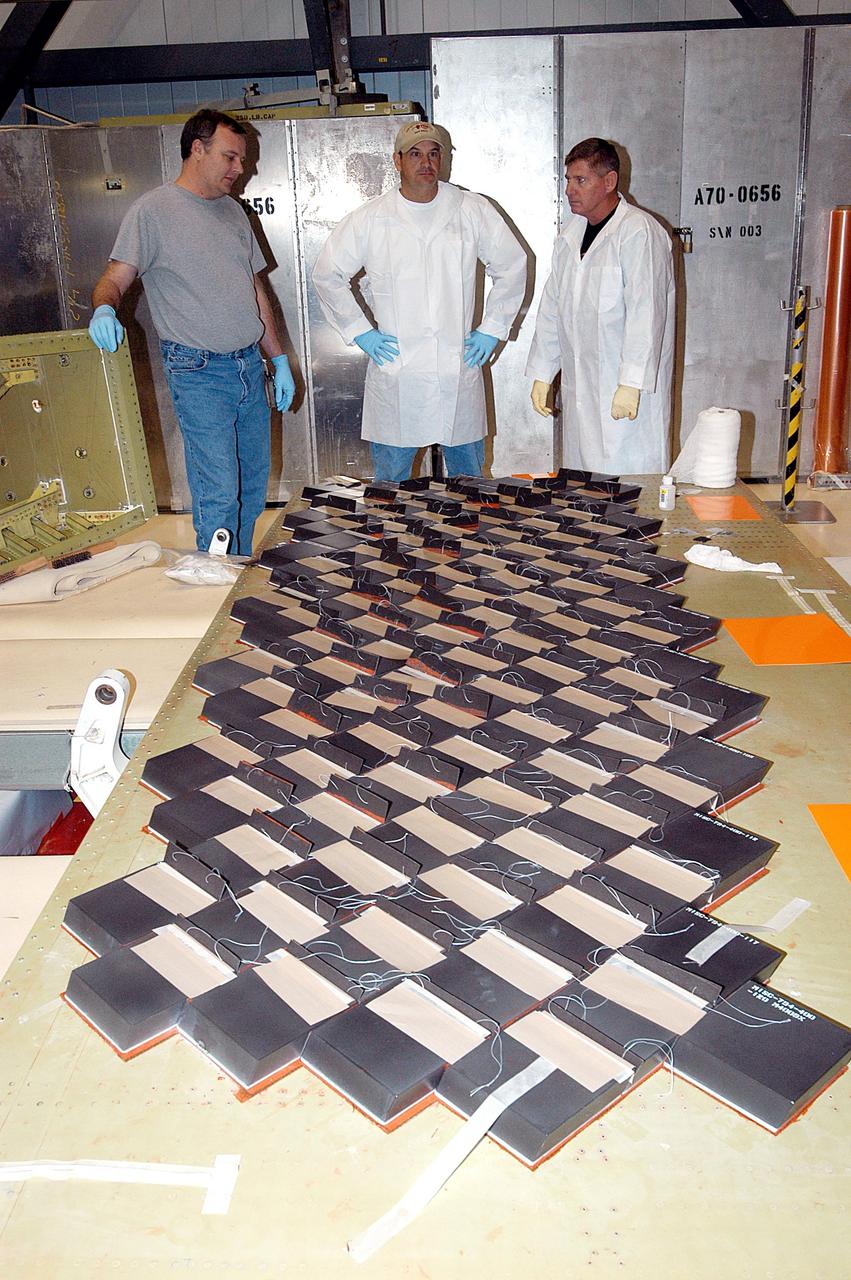
KENNEDY SPACE CENTER, FLA. -- In the Orbiter Processing Facility, United Space Alliance employees (from left) John Kuhn, Mike Cote, and Tom Baggitt discuss the installation of Thermal Protection System tiles on a main landing gear door of Space Shuttle orbiter Enterprise (OV-101). Sections of Enterprise were borrowed from the Smithsonian Institution's Air and Space Museum where the orbiter is being stored at the Washington Dulles International Airport. Enterprise was the first orbiter built in the Shuttle fleet and was used to conduct the Approach and Landing Test Program before the first powered Shuttle flight. After the tile installation is complete, the sections will be transferred to the Southwest Research Institute for testing requested by the Columbia Accident Investigation Board.
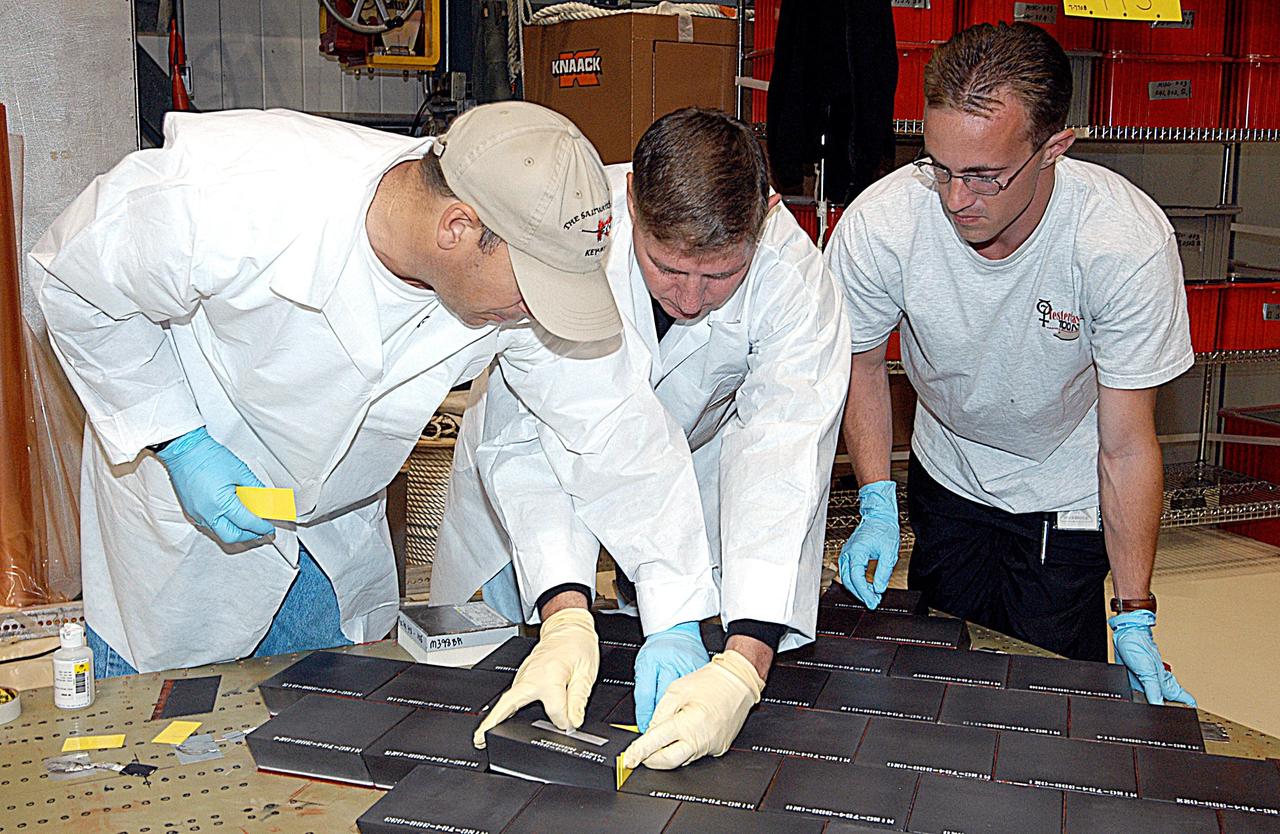
KENNEDY SPACE CENTER, FLA. -- In the Orbiter Processing Facility, United Space Alliance employees (from left) Mike Cote, Tom Baggitt, and Jason Levandusky install Thermal Protection System tiles on a main landing gear door of Space Shuttle orbiter Enterprise (OV-101). Sections of Enterprise were borrowed from the Smithsonian Institution's Air and Space Museum where the orbiter is being stored at the Washington Dulles International Airport. Enterprise was the first orbiter built in the Shuttle fleet and was used to conduct the Approach and Landing Test Program before the first powered Shuttle flight. After the tile installation is complete, the sections will be transferred to the Southwest Research Institute for testing requested by the Columbia Accident Investigation Board.
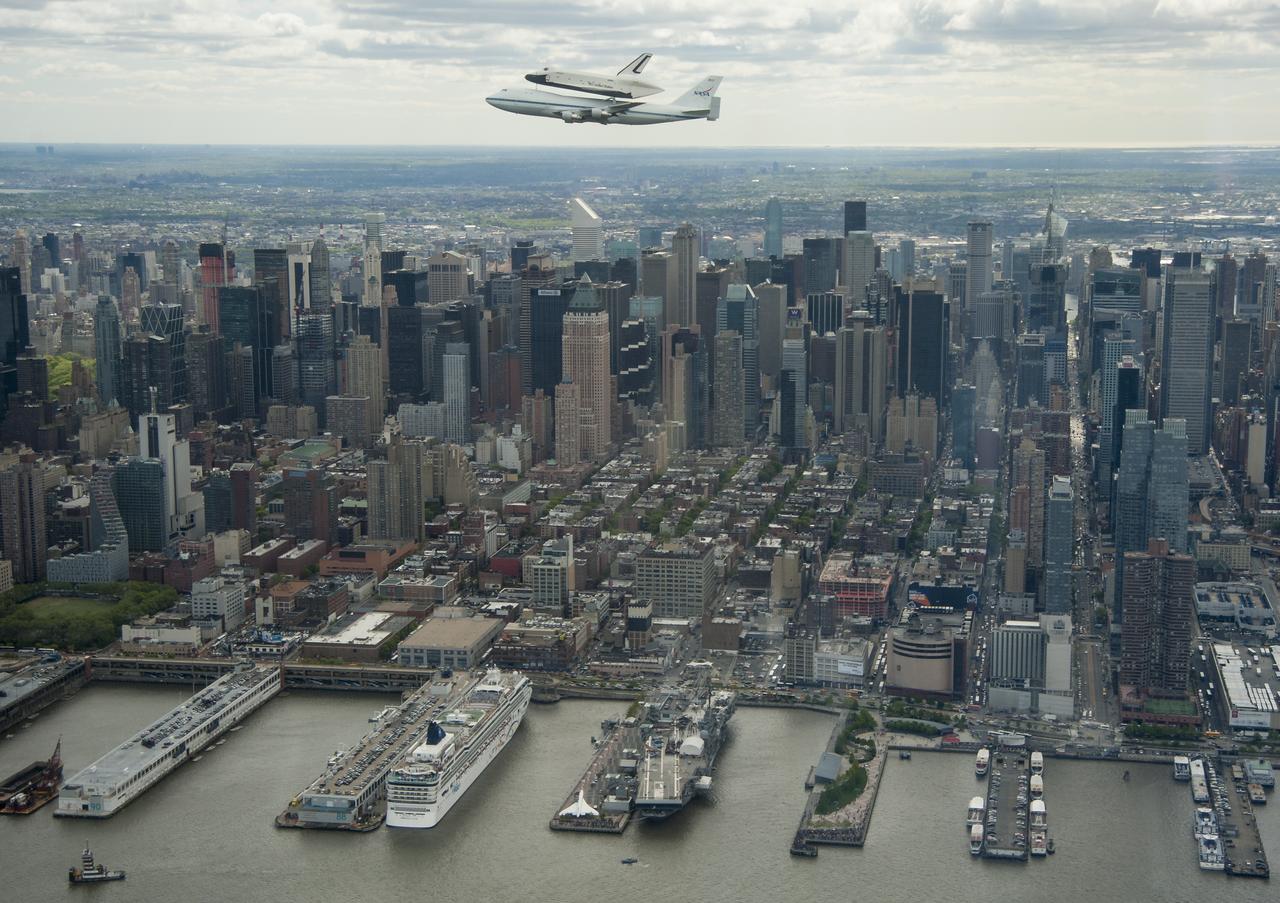
CAPTION: ---------------------------- Space shuttle Enterprise, mounted atop a NASA 747 Shuttle Carrier Aircraft (SCA), is seen as it flies near the Intrepid Sea, Air and Space Museum, Friday, April 27, 2012, in New York. Enterprise was the first shuttle orbiter built for NASA performing test flights in the atmosphere and was incapable of spaceflight. Originally housed at the Smithsonian's Steven F. Udvar-Hazy Center, Enterprise will be demated from the SCA and placed on a barge that will eventually be moved by tugboat up the Hudson River to the Intrepid Sea, Air & Space Museum in June. Photo Credit: (NASA/Robert Markowitz)

Space shuttle Enterprise, mounted atop a NASA 747 Shuttle Carrier Aircraft (SCA), is seen as it takes off for New York from Washington Dulles International Airport, Friday, April 27, 2012, in Sterling, VA. Enterprise was the first shuttle orbiter built for NASA performing test flights in the atmosphere and was incapable of spaceflight. Originally housed at the Smithsonian's Steven F. Udvar-Hazy Center, Enterprise will be demated from the SCA and placed on a barge that will eventually be moved by tugboat up the Hudson River to the Intrepid Sea, Air & Space Museum in June. Photo Credit: (NASA/Smithsonian Institution/Mark Avino)
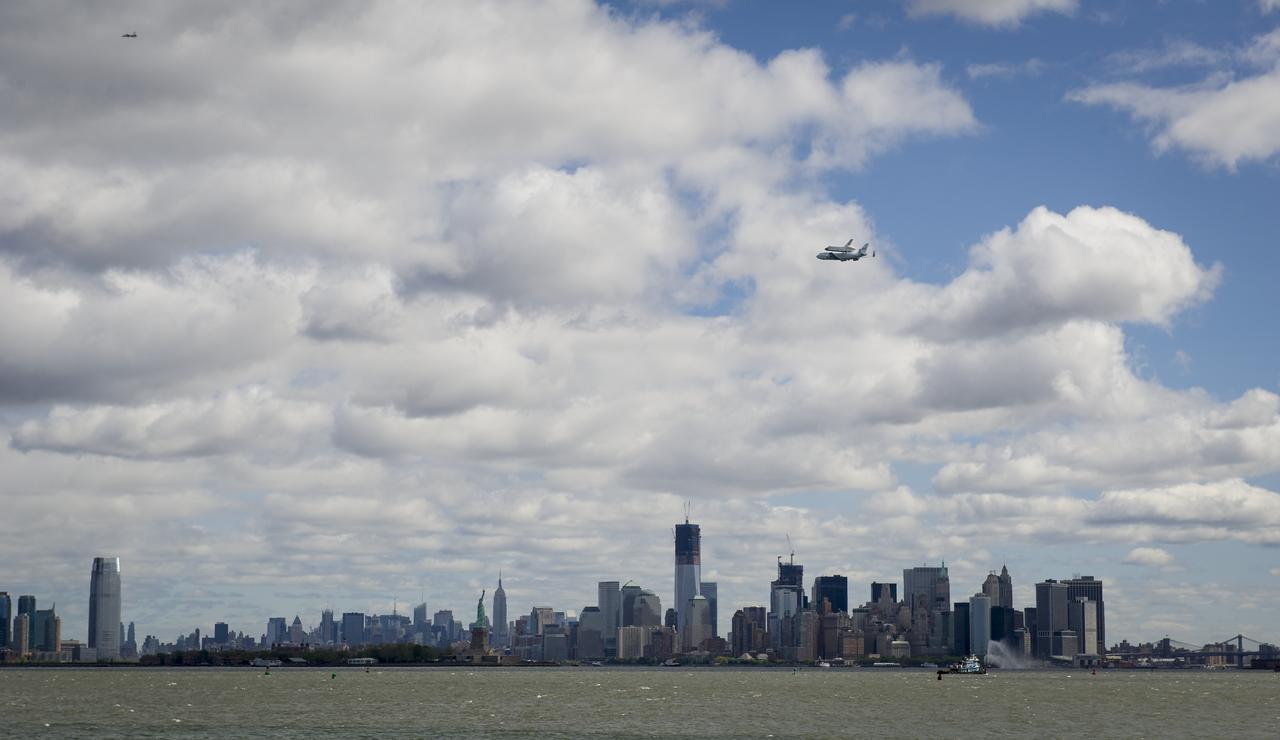
Space shuttle Enterprise, mounted atop a NASA 747 Shuttle Carrier Aircraft (SCA), is seen as it flies over the Hudson River, Friday, April 27, 2012, in New York. Enterprise was the first shuttle orbiter built for NASA performing test flights in the atmosphere and was incapable of spaceflight. Originally housed at the Smithsonian's Steven F. Udvar-Hazy Center, Enterprise will be demated from the SCA and placed on a barge that will eventually be moved by tugboat up the Hudson River to the Intrepid Sea, Air & Space Museum in June. Photo Credit: (NASA/Bill Ingalls)
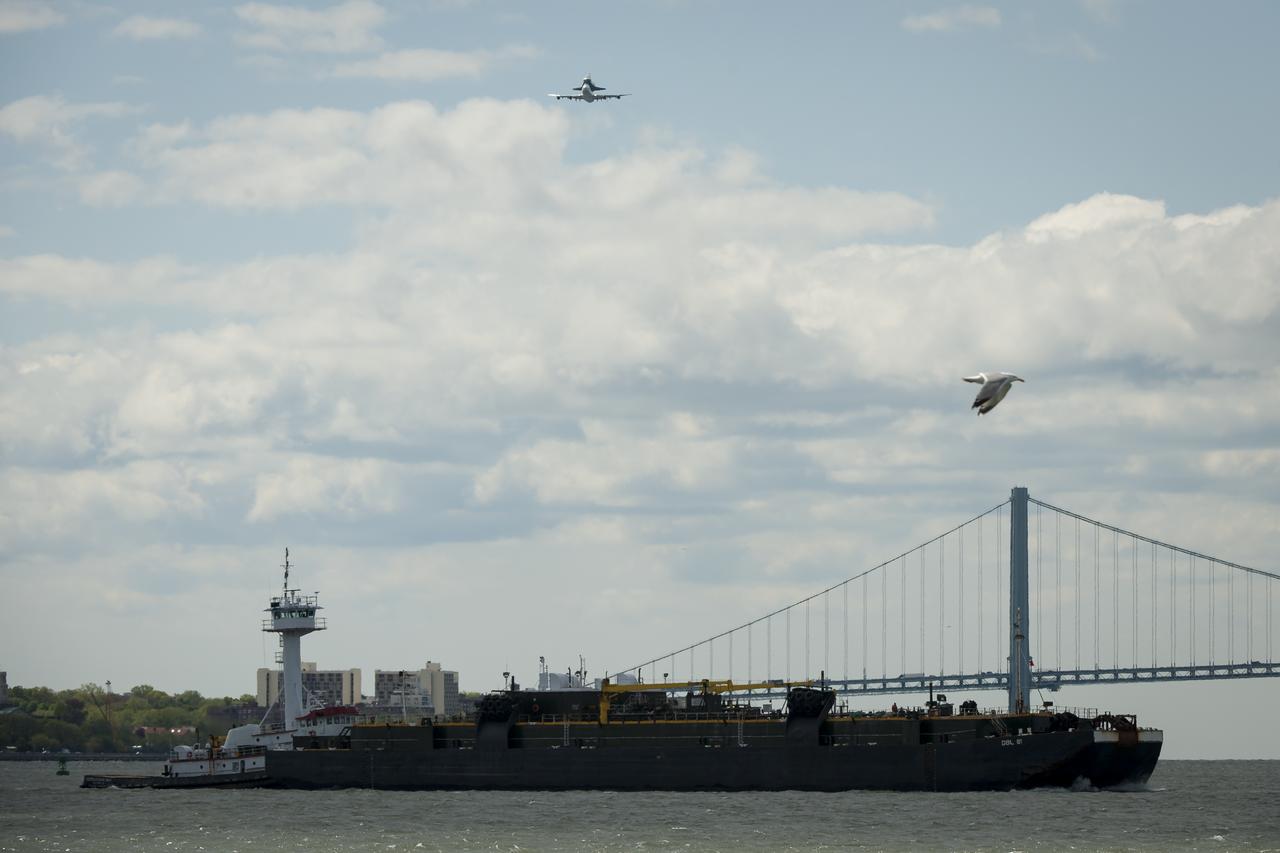
Space shuttle Enterprise, mounted atop a NASA 747 Shuttle Carrier Aircraft (SCA), is seen as it flies over the Verrazano Bridge, Friday, April 27, 2012, in New York. Enterprise was the first shuttle orbiter built for NASA performing test flights in the atmosphere and was incapable of spaceflight. Originally housed at the Smithsonian's Steven F. Udvar-Hazy Center, Enterprise will be demated from the SCA and placed on a barge that will eventually be moved by tugboat up the Hudson River to the Intrepid Sea, Air & Space Museum in June. Photo Credit: (NASA/Bill Ingalls)

Space shuttle Enterprise, mounted atop a NASA 747 Shuttle Carrier Aircraft (SCA), is seen as it flies over the Manhattan Skyline with Freedom Tower in the background, Friday, April 27, 2012, in New York. Enterprise was the first shuttle orbiter built for NASA performing test flights in the atmosphere and was incapable of spaceflight. Originally housed at the Smithsonian's Steven F. Udvar-Hazy Center, Enterprise will be demated from the SCA and placed on a barge that will eventually be moved by tugboat up the Hudson River to the Intrepid Sea, Air & Space Museum in June. Photo Credit: (NASA/Robert Markowitz)
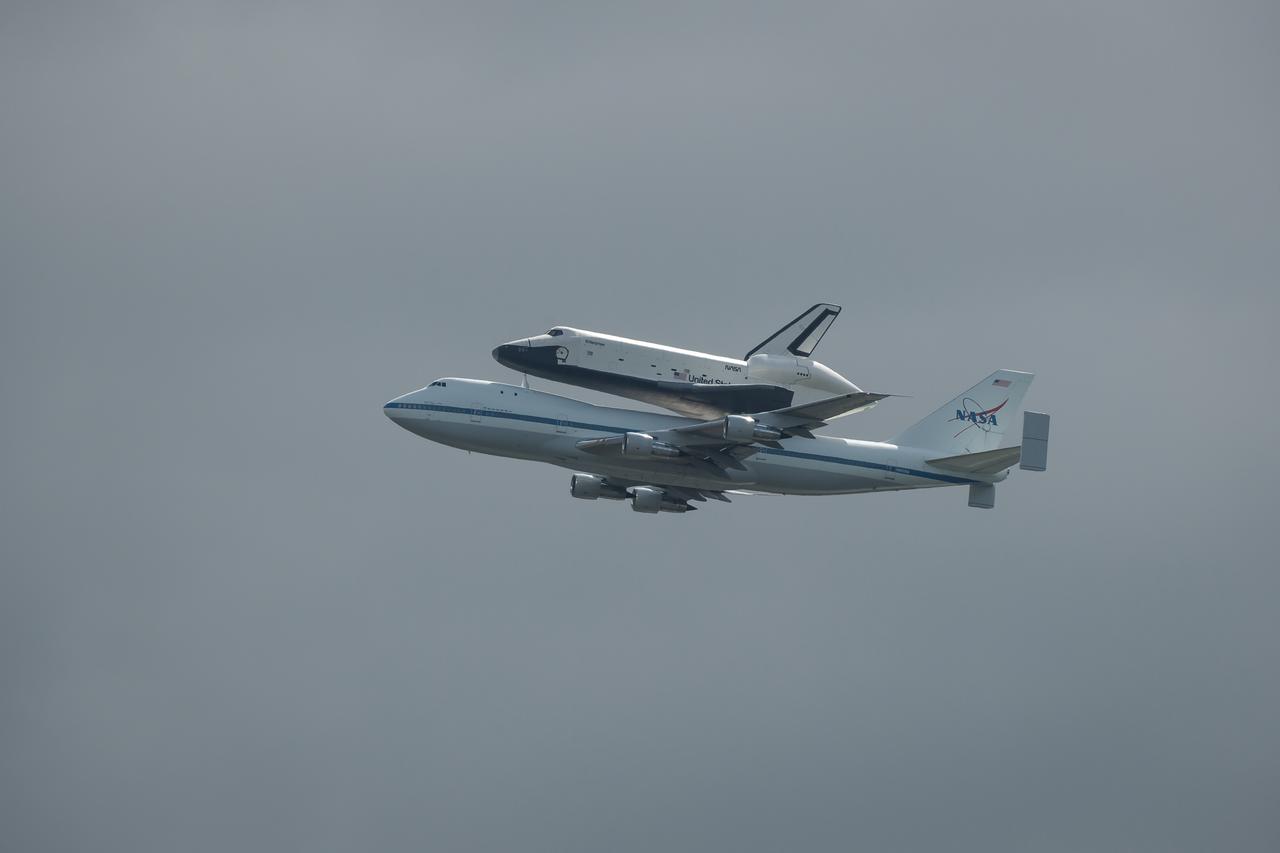
Space shuttle Enterprise, mounted atop a NASA 747 Shuttle Carrier Aircraft (SCA), is seen as it flies over the Hudson River, Friday, April 27, 2012, in New York. Enterprise was the first shuttle orbiter built for NASA performing test flights in the atmosphere and was incapable of spaceflight. Originally housed at the Smithsonian's Steven F. Udvar-Hazy Center, Enterprise will be demated from the SCA and placed on a barge that will eventually be moved by tugboat up the Hudson River to the Intrepid Sea, Air & Space Museum in June. Photo Credit: (NASA/Bill Ingalls)
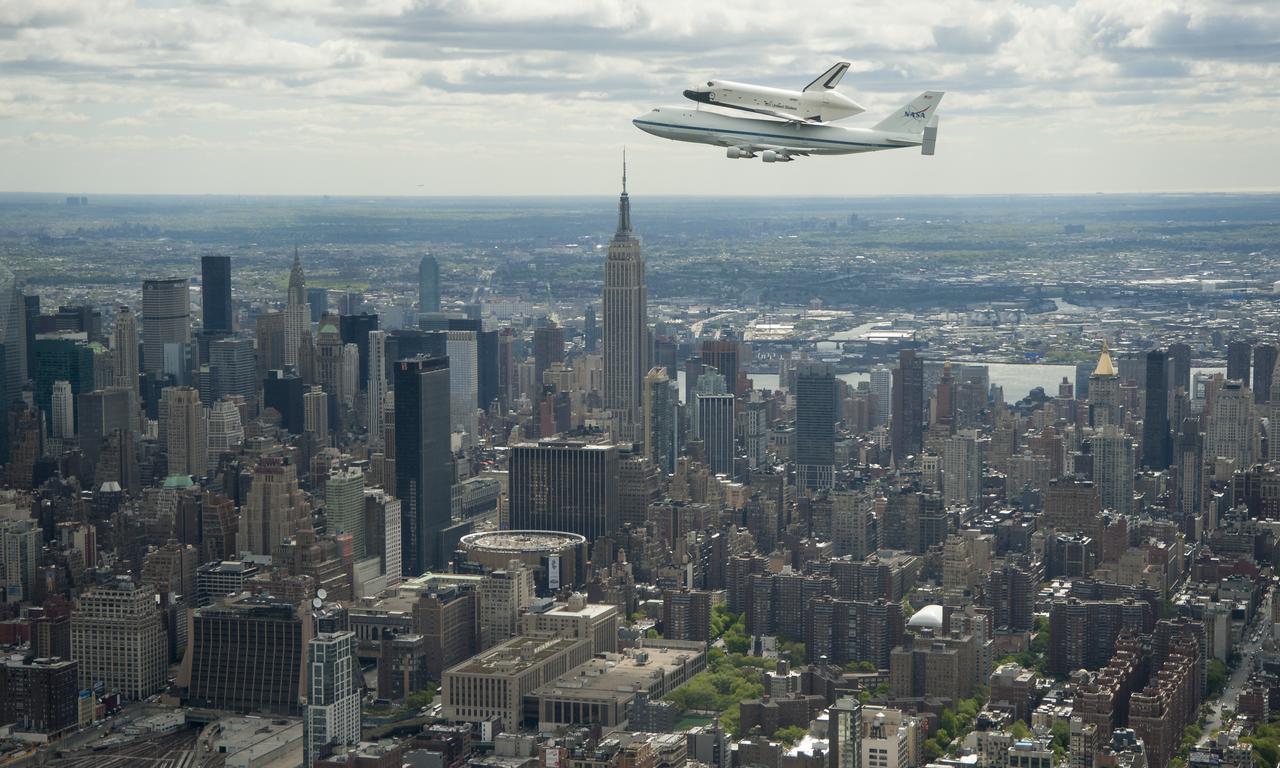
Space shuttle Enterprise, mounted atop a NASA 747 Shuttle Carrier Aircraft (SCA), is seen as it flies near the Empire State Building, Friday, April 27, 2012, in New York. Enterprise was the first shuttle orbiter built for NASA performing test flights in the atmosphere and was incapable of spaceflight. Originally housed at the Smithsonian's Steven F. Udvar-Hazy Center, Enterprise will be demated from the SCA and placed on a barge that will eventually be moved by tugboat up the Hudson River to the Intrepid Sea, Air & Space Museum in June. Photo Credit: (NASA/Robert Markowitz)
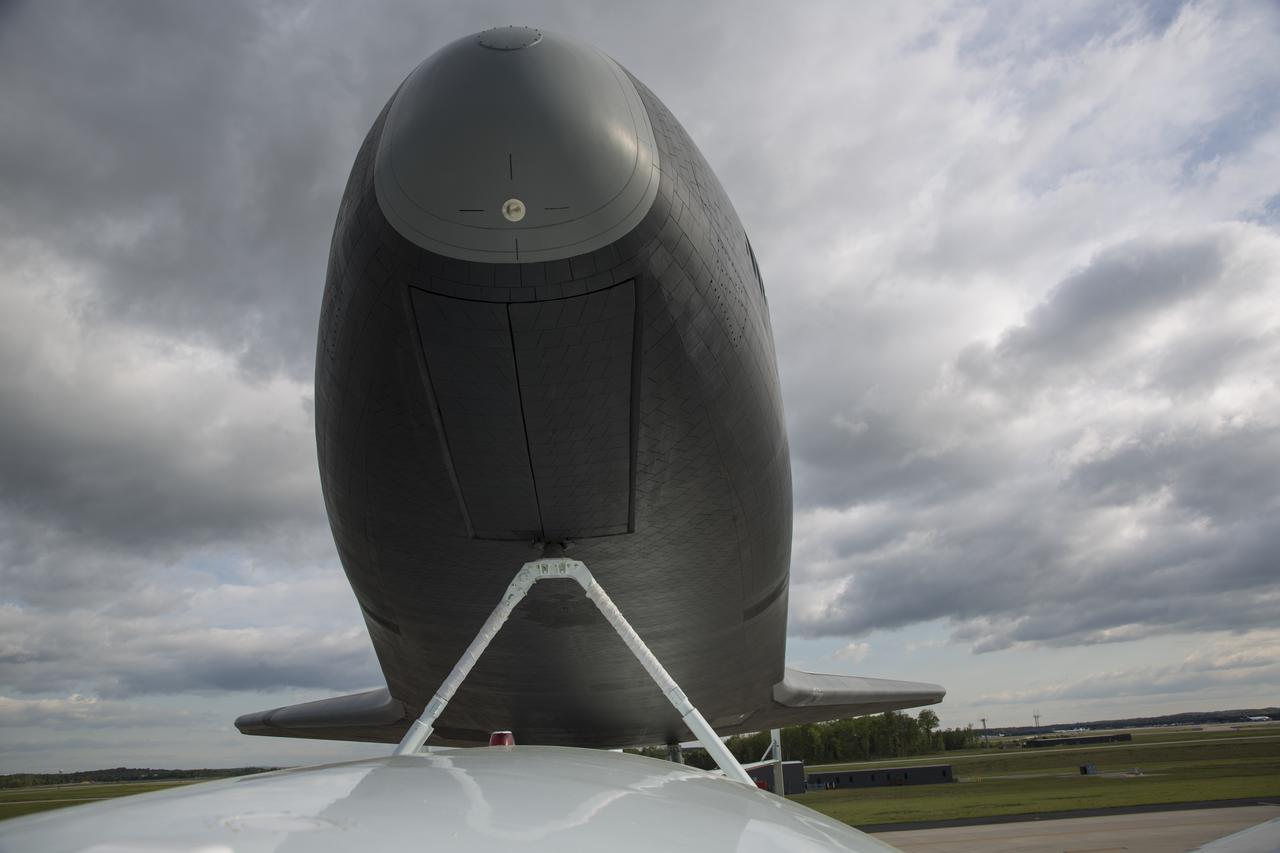
Space shuttle Enterprise, mounted atop a NASA 747 Shuttle Carrier Aircraft (SCA), is seen prior to taking off for New York from Washington Dulles International Airport, Friday, April 27, 2012, in Sterling, VA. Enterprise was the first shuttle orbiter built for NASA performing test flights in the atmosphere and was incapable of spaceflight. Originally housed at the Smithsonian's Steven F. Udvar-Hazy Center, Enterprise will be demated from the SCA and placed on a barge that will eventually be moved by tugboat up the Hudson River to the Intrepid Sea, Air & Space Museum in June. Photo Credit: (NASA/Scott Andrews)
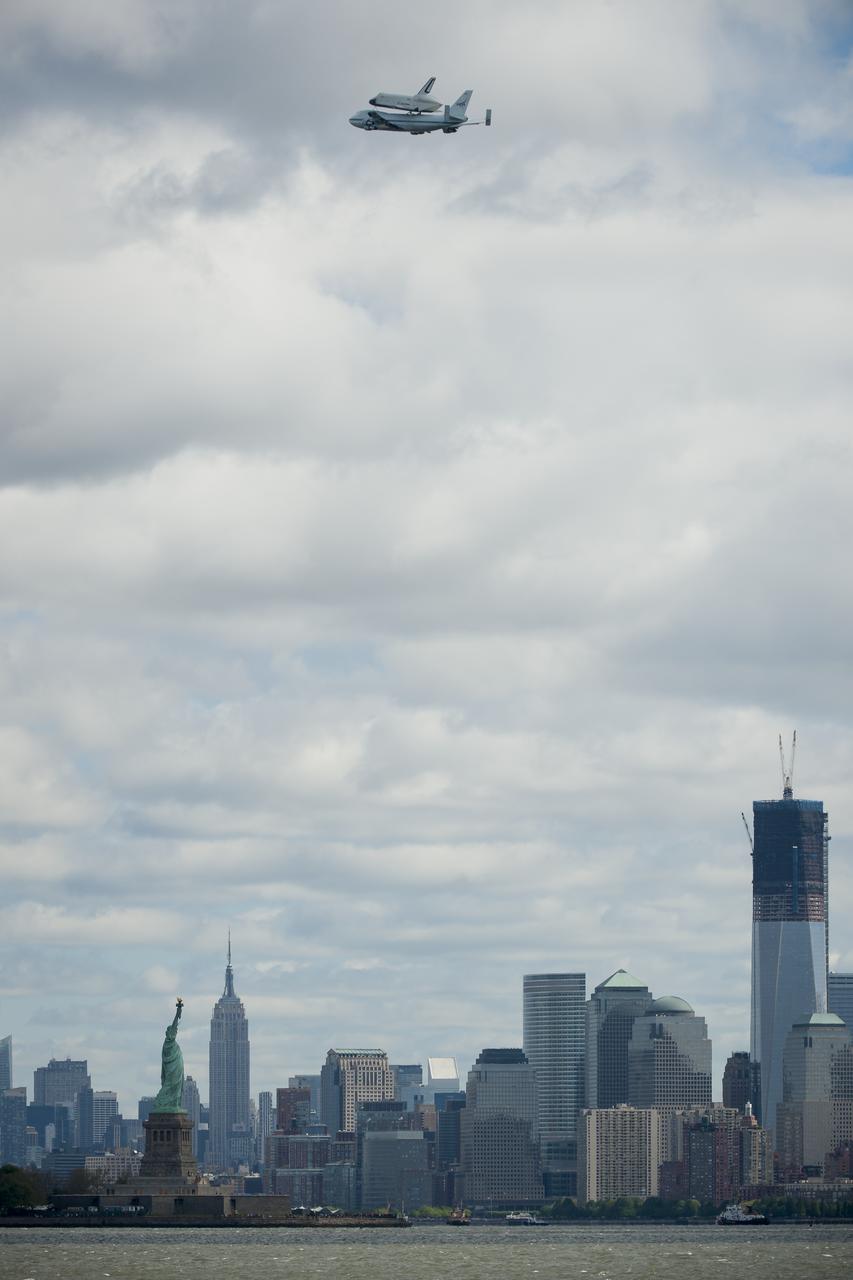
Space shuttle Enterprise, mounted atop a NASA 747 Shuttle Carrier Aircraft (SCA), is seen as it flies near the Statue of Liberty, Friday, April 27, 2012, in New York. Enterprise was the first shuttle orbiter built for NASA performing test flights in the atmosphere and was incapable of spaceflight. Originally housed at the Smithsonian's Steven F. Udvar-Hazy Center, Enterprise will be demated from the SCA and placed on a barge that will eventually be moved by tugboat up the Hudson River to the Intrepid Sea, Air & Space Museum in June. Photo Credit: (NASA/Bill Ingalls)

Space shuttle Enterprise, mounted atop a NASA 747 Shuttle Carrier Aircraft (SCA), is seen as it flies over the Hudson River, Friday, April 27, 2012, in New York. Enterprise was the first shuttle orbiter built for NASA performing test flights in the atmosphere and was incapable of spaceflight. Originally housed at the Smithsonian's Steven F. Udvar-Hazy Center, Enterprise will be demated from the SCA and placed on a barge that will eventually be moved by tugboat up the Hudson River to the Intrepid Sea, Air & Space Museum in June. Photo Credit: (NASA/Matt Hedges)

Space shuttle Enterprise, mounted atop a NASA 747 Shuttle Carrier Aircraft (SCA), is seen as it flies near the Statue of Liberty and the Manhattan skyline, Friday, April 27, 2012, in New York. Enterprise was the first shuttle orbiter built for NASA performing test flights in the atmosphere and was incapable of spaceflight. Originally housed at the Smithsonian's Steven F. Udvar-Hazy Center, Enterprise will be demated from the SCA and placed on a barge that will eventually be moved by tugboat up the Hudson River to the Intrepid Sea, Air & Space Museum in June. Photo Credit: (NASA/Robert Markowitz)
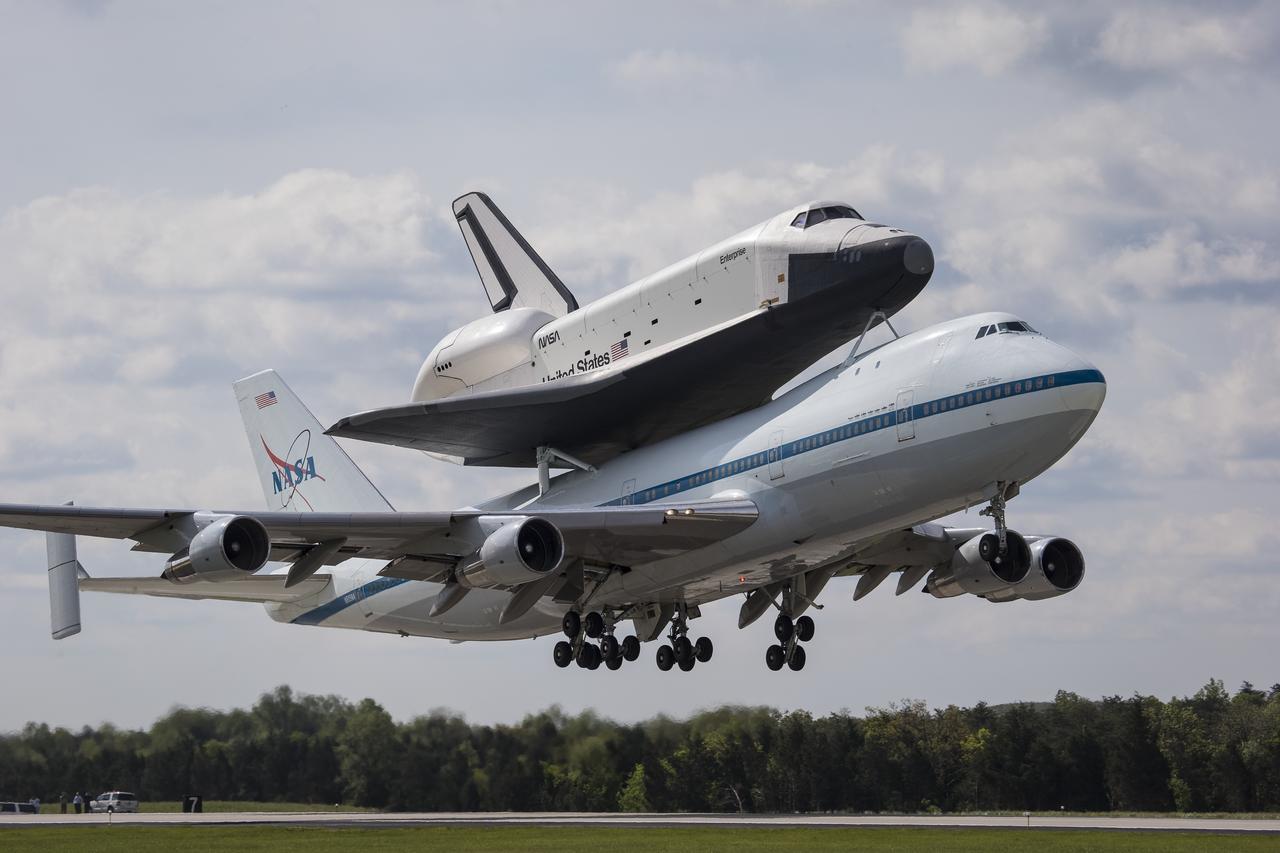
Space shuttle Enterprise, mounted atop a NASA 747 Shuttle Carrier Aircraft (SCA), is seen as it takes off for New York from Washington Dulles International Airport, Friday, April 27, 2012, in Sterling, VA. Enterprise was the first shuttle orbiter built for NASA performing test flights in the atmosphere and was incapable of spaceflight. Originally housed at the Smithsonian's Steven F. Udvar-Hazy Center, Enterprise will be demated from the SCA and placed on a barge that will eventually be moved by tugboat up the Hudson River to the Intrepid Sea, Air & Space Museum in June. Photo Credit: (NASA/Scott Andrews)
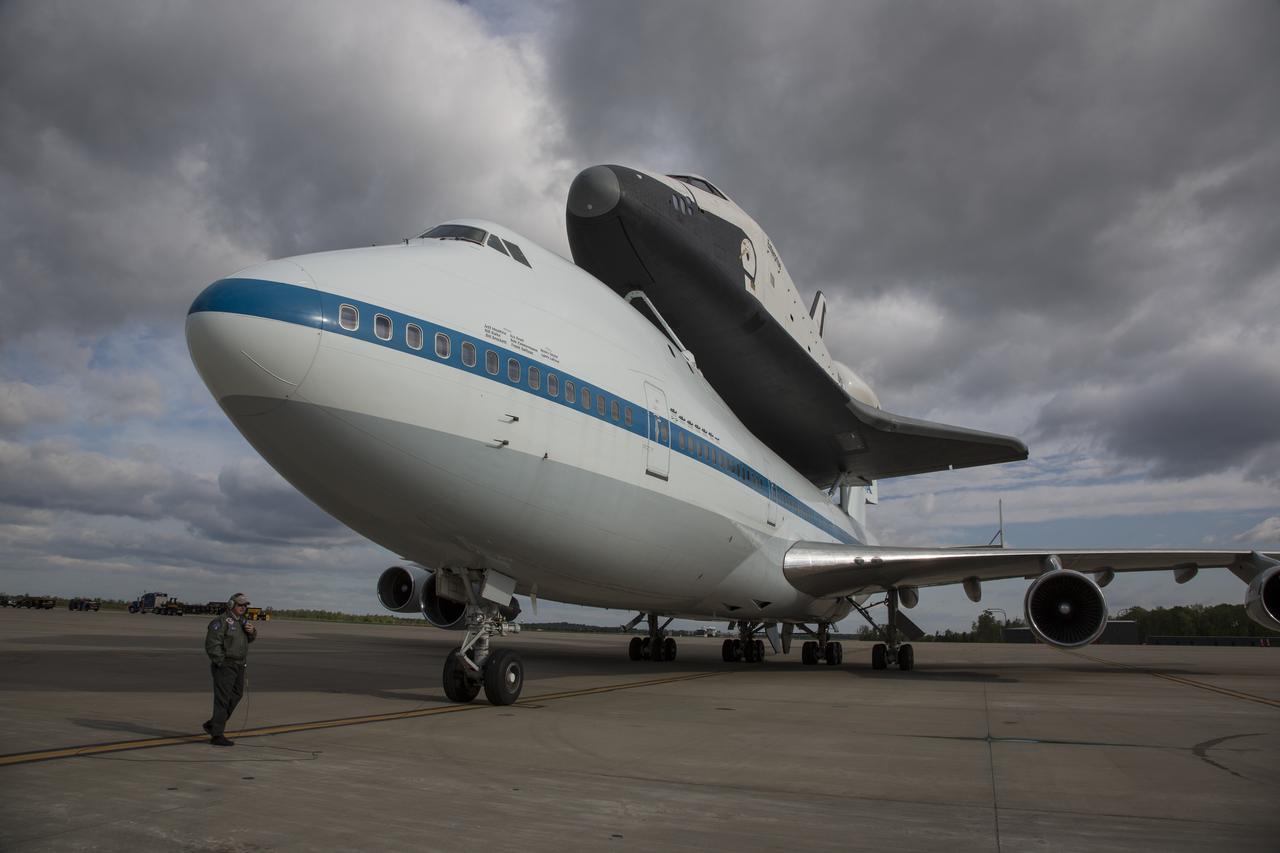
Space shuttle Enterprise, mounted atop a NASA 747 Shuttle Carrier Aircraft (SCA), is seen prior to taking off for New York from Washington Dulles International Airport, Friday, April 27, 2012, in Sterling, VA. Enterprise was the first shuttle orbiter built for NASA performing test flights in the atmosphere and was incapable of spaceflight. Originally housed at the Smithsonian's Steven F. Udvar-Hazy Center, Enterprise will be demated from the SCA and placed on a barge that will eventually be moved by tugboat up the Hudson River to the Intrepid Sea, Air & Space Museum in June. Photo Credit: (NASA/Scott Andrews)
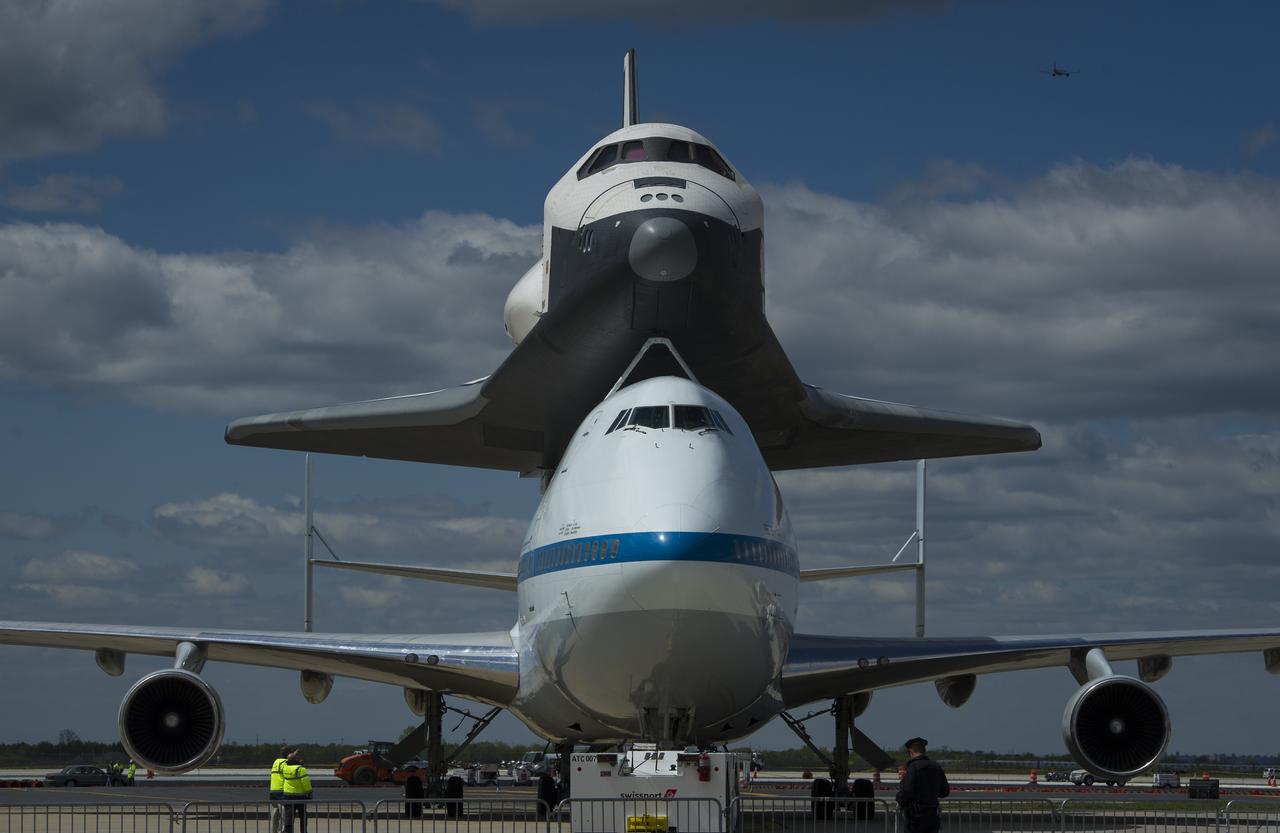
Space shuttle Enterprise, mounted atop a NASA 747 Shuttle Carrier Aircraft (SCA), is seen as it taxis at John F. Kennedy Airport, Friday, April 27, 2012, in New York. Enterprise was the first shuttle orbiter built for NASA performing test flights in the atmosphere and was incapable of spaceflight. Originally housed at the Smithsonian's Steven F. Udvar-Hazy Center, Enterprise will be demated from the SCA and placed on a barge that will eventually be moved by tugboat up the Hudson River to the Intrepid Sea, Air & Space Museum in June. Photo Credit: (NASA/Paul E. Alers)
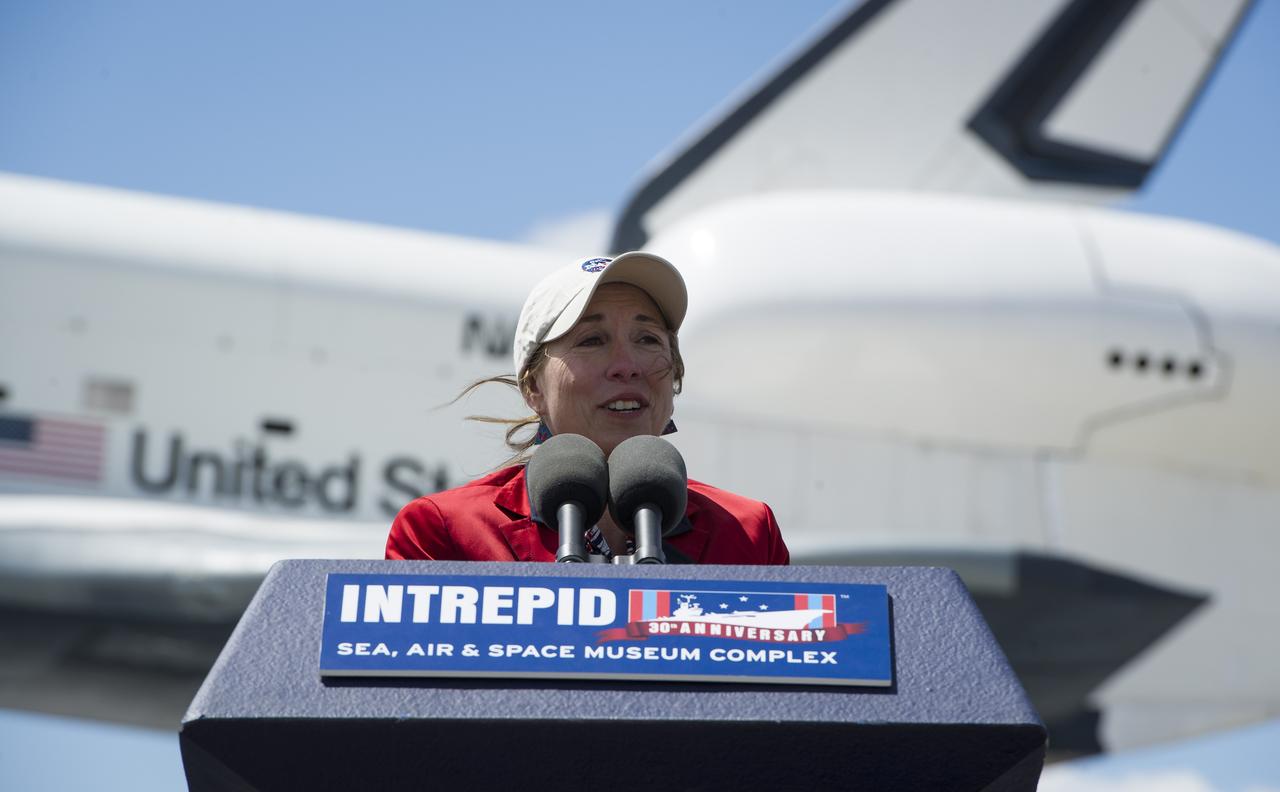
NASA Deputy Administrator Lori Garver speaks Friday, April 27, 2012, during the transfer ceremony for space shuttle Enterprise at John F. Kennedy Airport in New York. Enterprise was the first shuttle orbiter built for NASA performing test flights in the atmosphere and was incapable of spaceflight. Originally housed at the Smithsonian's Steven F. Udvar-Hazy Center, Enterprise will be demated from the SCA and placed on a barge that will eventually be moved by tugboat up the Hudson River to the Intrepid Sea, Air & Space Museum in June. Photo Credit: (NASA/Paul E. Alers)
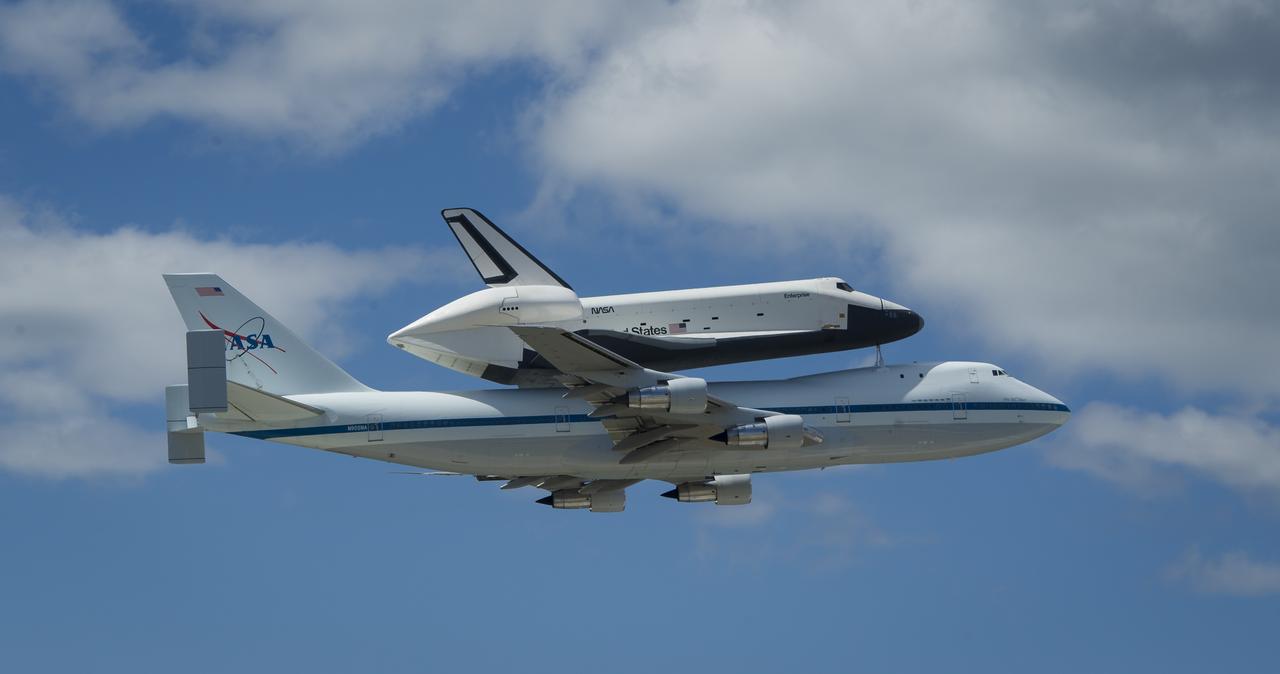
Space shuttle Enterprise, mounted atop a NASA 747 Shuttle Carrier Aircraft (SCA), is seen as it flies over John F. Kennedy Airport, Friday, April 27, 2012, in New York. Enterprise was the first shuttle orbiter built for NASA performing test flights in the atmosphere and was incapable of spaceflight. Originally housed at the Smithsonian's Steven F. Udvar-Hazy Center, Enterprise will be demated from the SCA and placed on a barge that will eventually be moved by tugboat up the Hudson River to the Intrepid Sea, Air & Space Museum in June. Photo Credit: (NASA/Paul E. Alers)
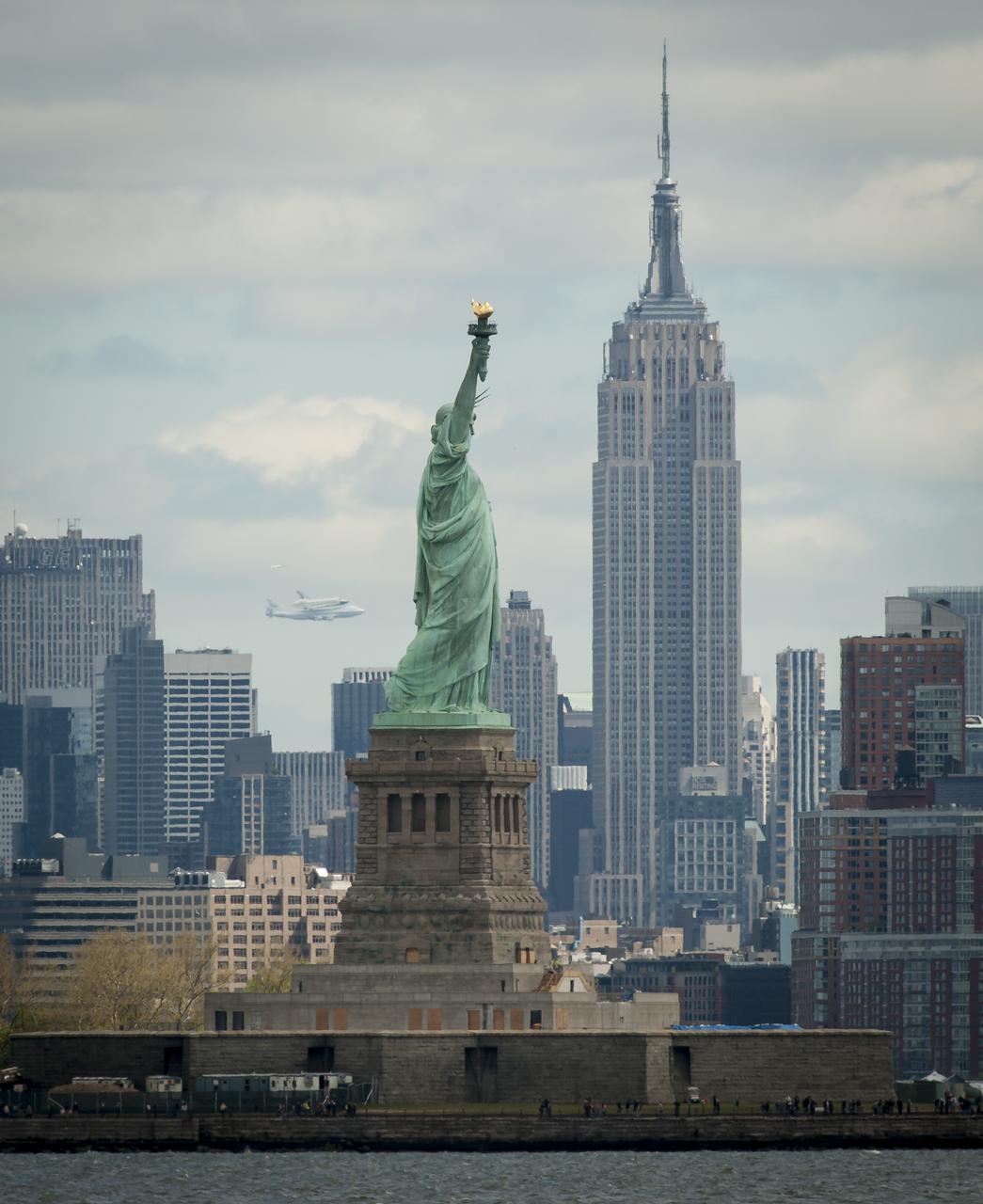
Space shuttle Enterprise, mounted atop a NASA 747 Shuttle Carrier Aircraft (SCA), is seen off in the distance behind the Statue of Liberty, Friday, April 27, 2012, in New York. Enterprise was the first shuttle orbiter built for NASA performing test flights in the atmosphere and was incapable of spaceflight. Originally housed at the Smithsonian's Steven F. Udvar-Hazy Center, Enterprise will be demated from the SCA and placed on a barge that will eventually be moved by tugboat up the Hudson River to the Intrepid Sea, Air & Space Museum in June. Photo Credit: (NASA/Bill Ingalls)
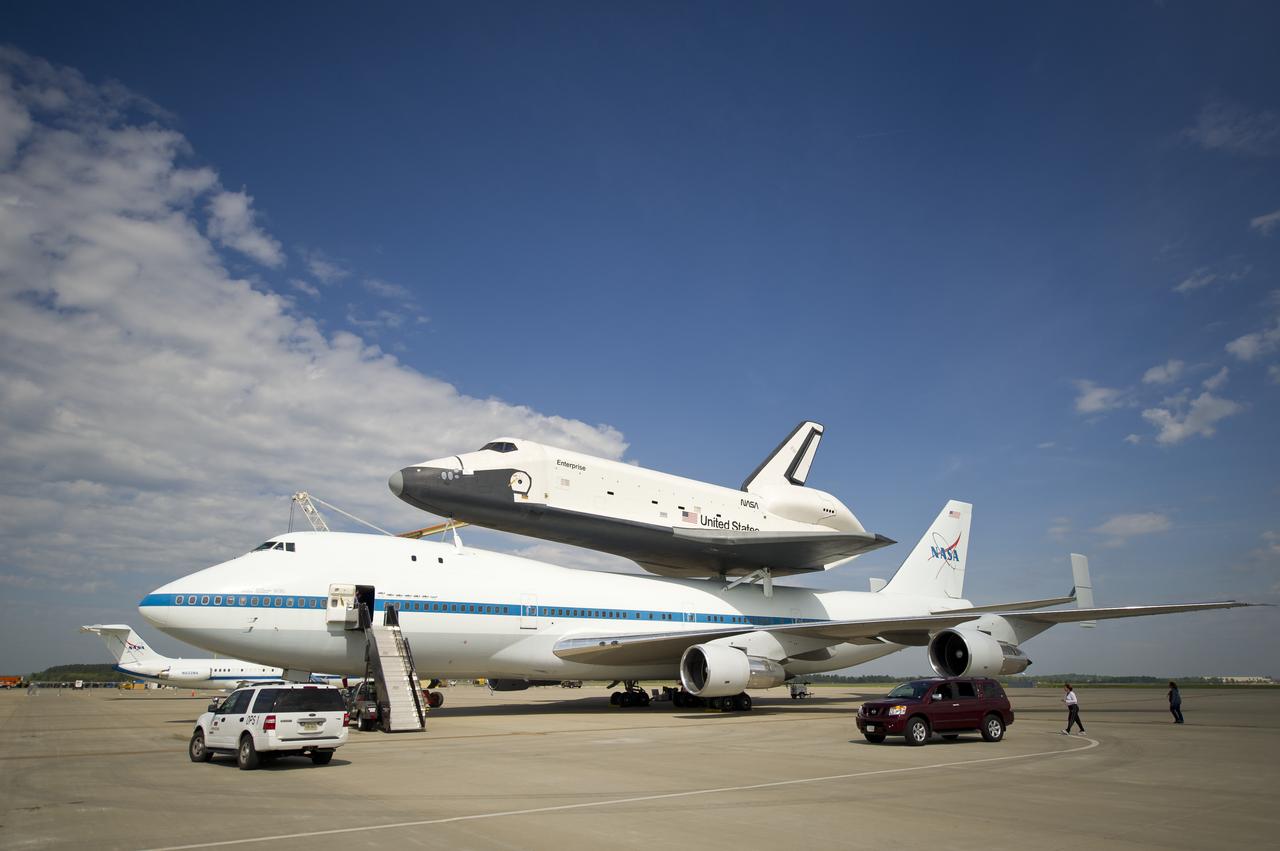
The space shuttle Enterprise is seen mated on top of the NASA 747 Shuttle Carrier Aircraft (SCA) at Washington Dulles International Airport, Saturday, April 21, 2012, in Sterling, Va. Space Shuttle Transition and Retirement engineers Saturday completed the final steps to ready Space Shuttle Enterprise for its flight to New York’s John F. Kennedy International Airport while managers continue to evaluate the expected weather that has postponed delivery past Monday. Enterprise, the first orbiter built for the Space Shuttle Program, was used primarily for ground and flight tests within the atmosphere. The initial testing period named Approach and Landing Test (ALT) included a flight on February 18, 1977 atop a Shuttle Carrier Aircraft (SCA) to measure structural loads and ground handling and braking characteristics of the mated system. Enterprise will go on permanent display at the Intrepid Sea Air and Space Museum in New York in June. Photo Credit: (NASA/Bill Ingalls)

NASA Orbiter Transition & Retirement team member Tom Goebel monitors the installation of "rain covers" over space shuttle Enterprise’s vent door openings ahead of the expected rain at Washington Dulles International Airport, Saturday, April 21, 2012, in Sterling, Va. Enterprise, the first orbiter built for the Space Shuttle Program, was used primarily for ground and flight tests within the atmosphere. The initial testing period named Approach and Landing Test (ALT) included a flight on February 18, 1977 atop a Shuttle Carrier Aircraft (SCA) to measure structural loads and ground handling and braking characteristics of the mated system. Enterprise will go on permanent display at the Intrepid Sea Air and Space Museum in New York in June. Photo Credit: (NASA/Bill Ingalls)
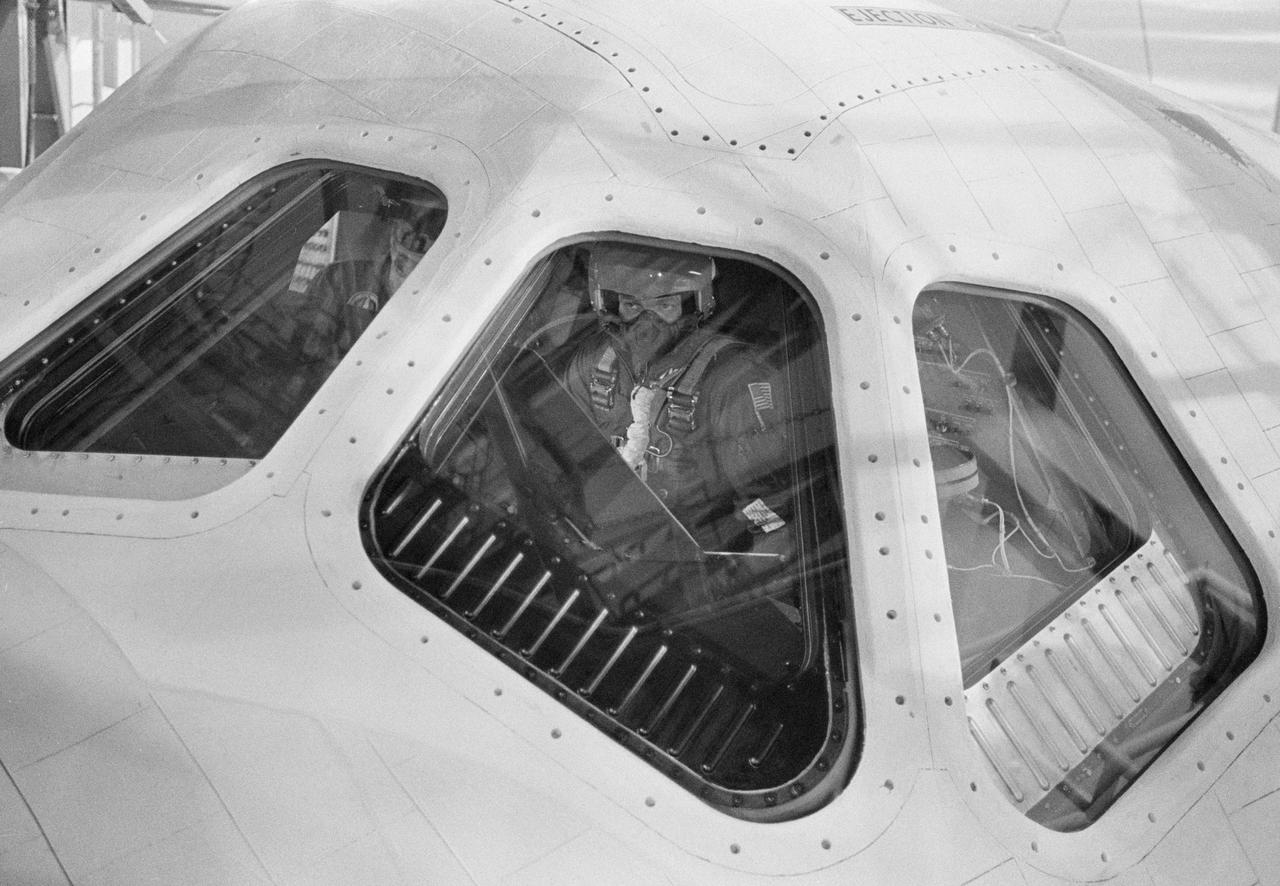
S77-28212 (13 Sept 1977) --- Astronauts Joe H. Engle (right), commander, and Richard H. Truly, pilot, sit in the cockpit of the shuttle Orbiter 101 "Enterprise" at the Dryden Flight Research Center (DFRC) prior to takeoff of the NASA 747 carrier aircraft to which the "Enterprise" was mated. The pair later made a five-minute, 31-second free-flight in the craft, the second in a series of such flights for the Shuttle Approach and Landing Tests (ALT) program. The photograph was made from the Mate-Demate Device (MDD).
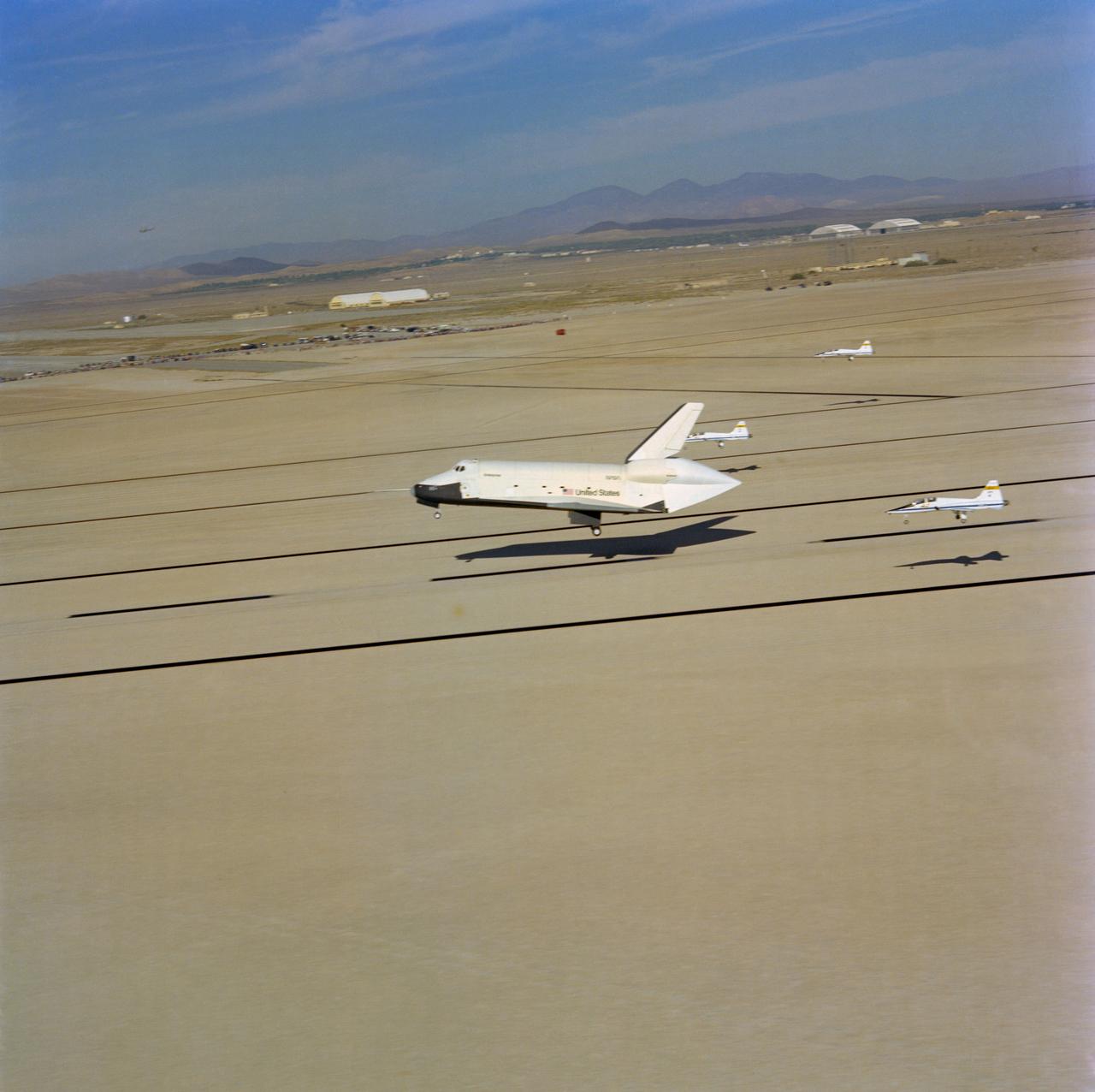
S77-28540 (23 Sept 1977) --- The shuttle Orbiter 101 "Enterprise" approaches touchdown on the runway at Edwards Air Force Base to conclude a five-minute, 34-second unpowered flight, the third of Shuttle Approach and Landing Tests (ALT) series, on September 23, 1977. Thress T-38 chase planes follow close by. Astronauts Fred W. Haise Jr., commander, and C. Gordon Fullerton, pilot, were the crew aboard the "Enterprise" for this flight.
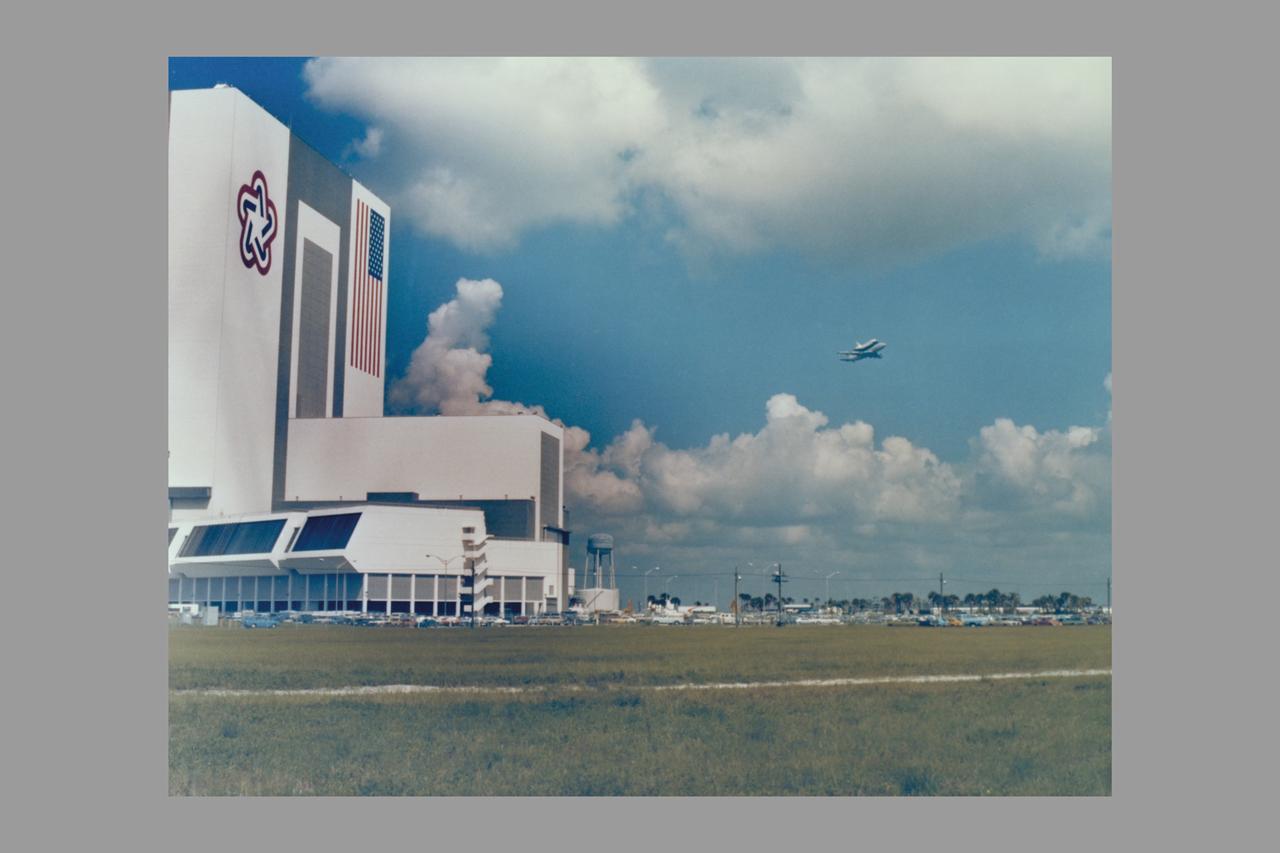
The 747 Shuttle Carrier Aircraft, carrying the Space Shuttle Orbiter Enterprise piggyback, lifts off from the Shuttle Landing Facility's 15,000-foot-long runway at 11:03, August 10. Enterprise flown to KSC on April 10 for use in checking out assembly, test and launch facilities which will be used for the launch of its sister ship Columbia on the first Space Shuttle flight, will make a five-stop flight to NASA's Dryden Flight Research Center in California.
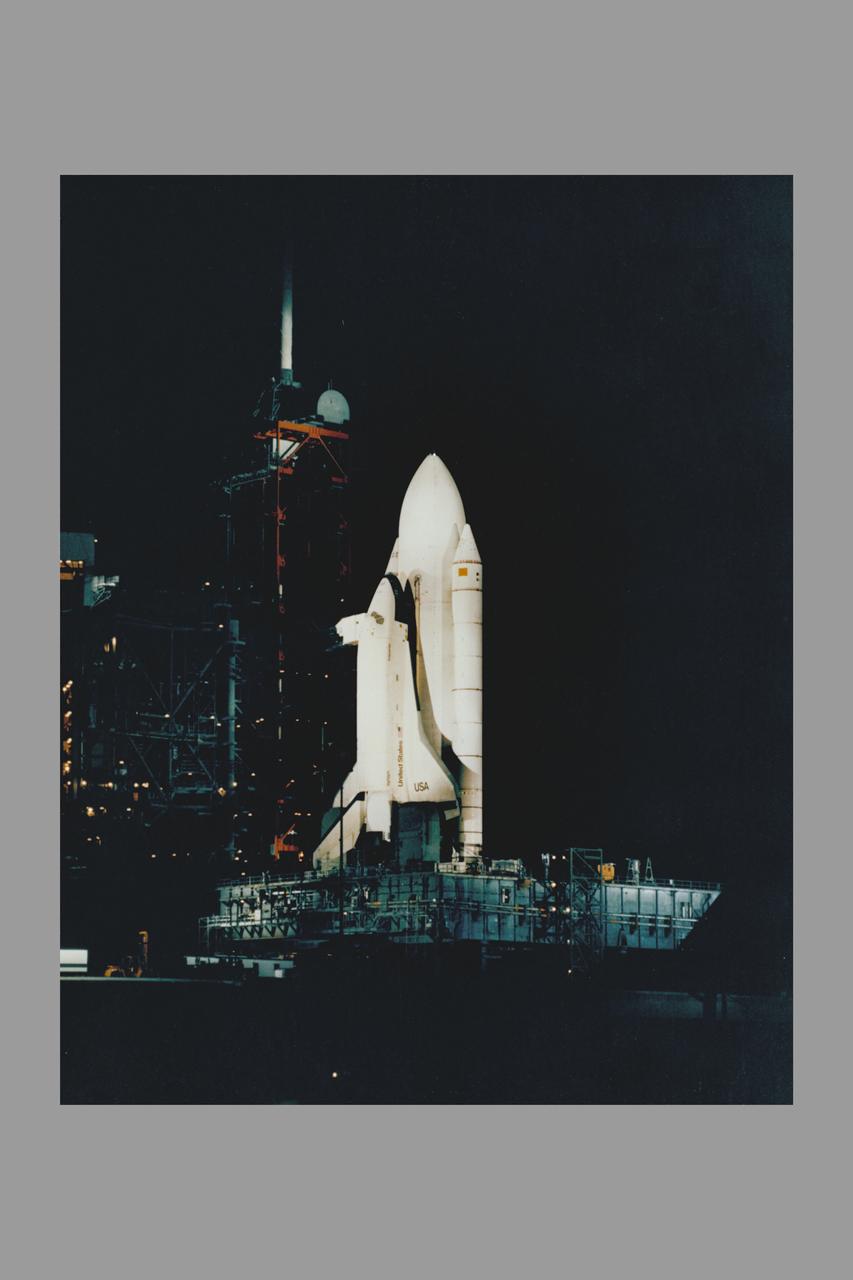
SPACE SHUTTLE ORBITER ENTERPRISE STANDS ON KSC'S PAD 39A HIGHLIGHTED AGAINST THE DARKENED FLORIDA SKY DURING TESTING OF THE HIGH-INTENSITY LIGHTING SYSTMES. THE BANKS OF XENON LIGHTS ARE USED DURING LAUCH PREPARATIONS.
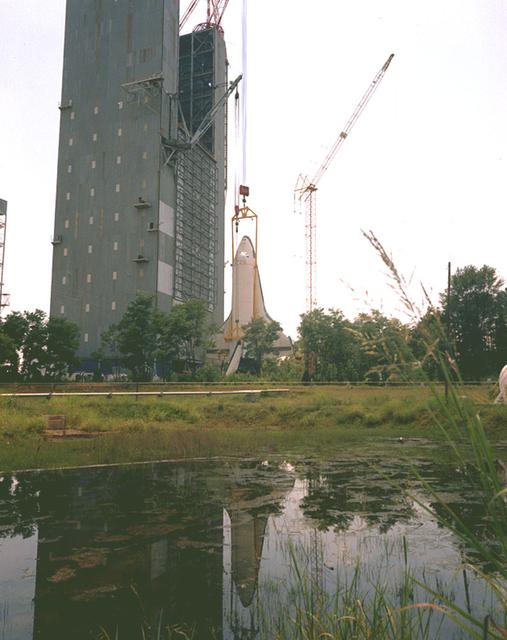
This photo is of the removal of the Orbiter Enterprise from the Marshall Space Flight Center's Dynamic Test Stand after its first Mated Vertical Ground Vibration Test (MVGVT).
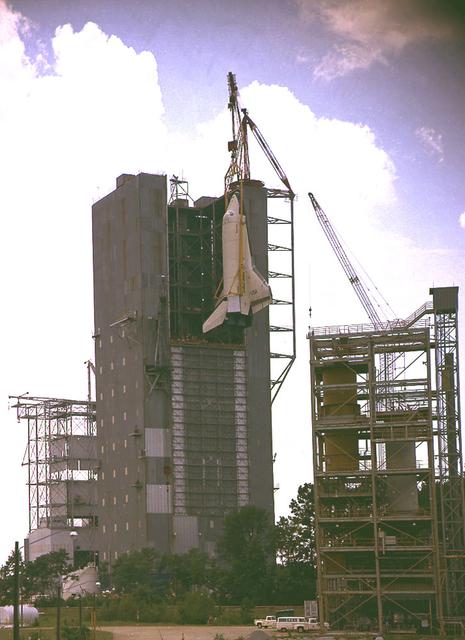
This is a photo of the removal of the Orbiter Enterprise from the Marshall Space Flight Center Dynamic Test Stand after its first Mated Vertical Ground Vibration Test (MVGVT).
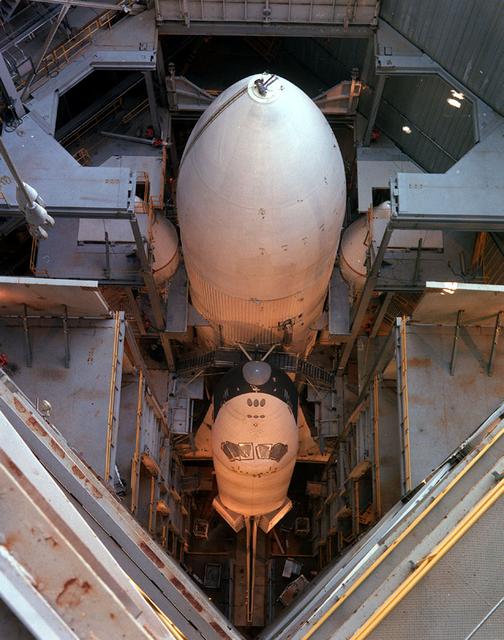
In its mated liftoff configuration of External Tank (ET) and Solid Rocket Boosters (SRB's), the Orbiter Enterprise (OV101) is pictured in the Marshall Space Flight Center Dynamic Test Stand for a Mated Vertical Ground Vibration Test (MVGVT).
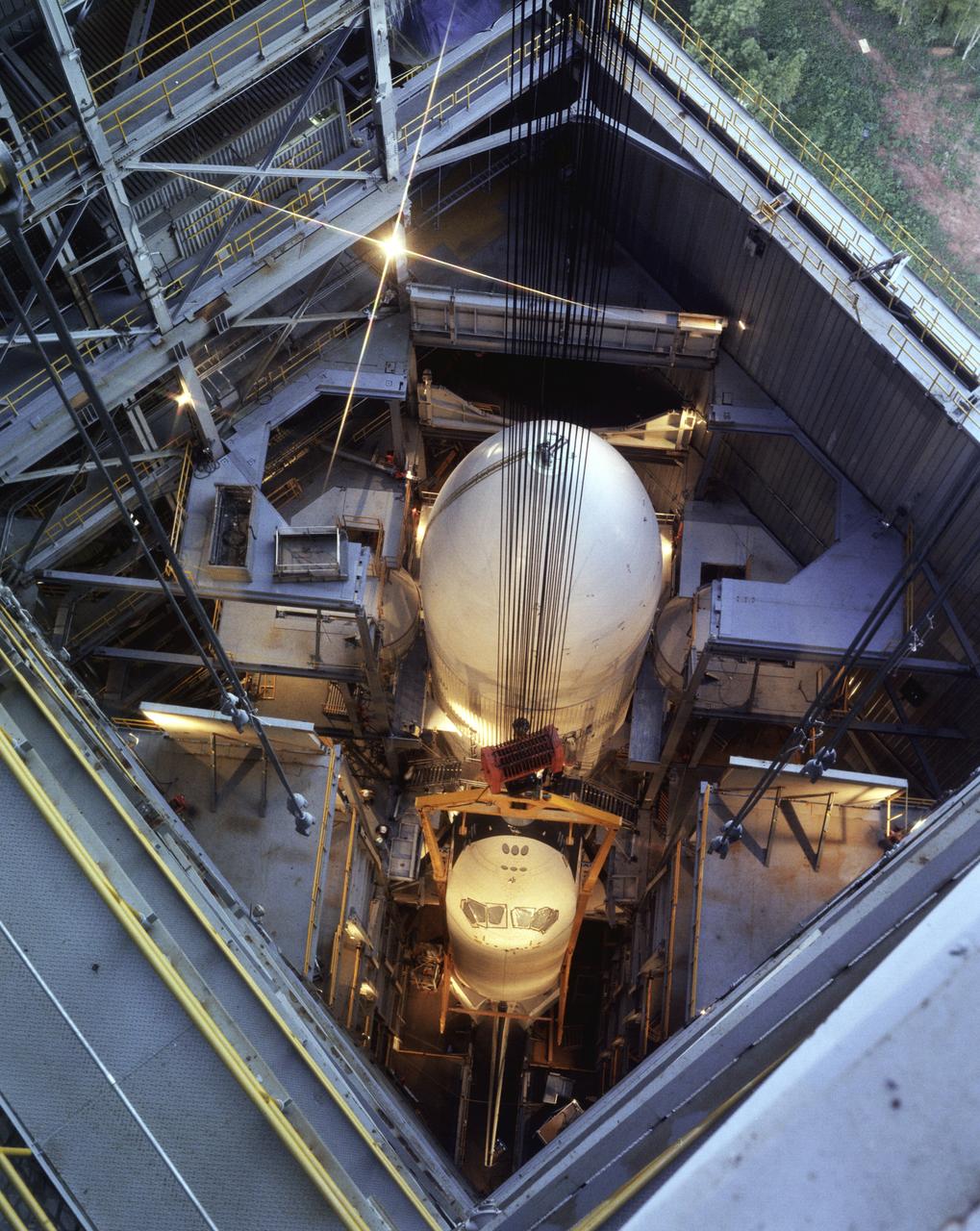
This photograph was taken of the Orbiter Enterprise installation, in its liftoff configuration, into the Marshall Space Flight Center Dynamic Test Stand for a Mated Vertical Ground Vibration Test (MVGVT).
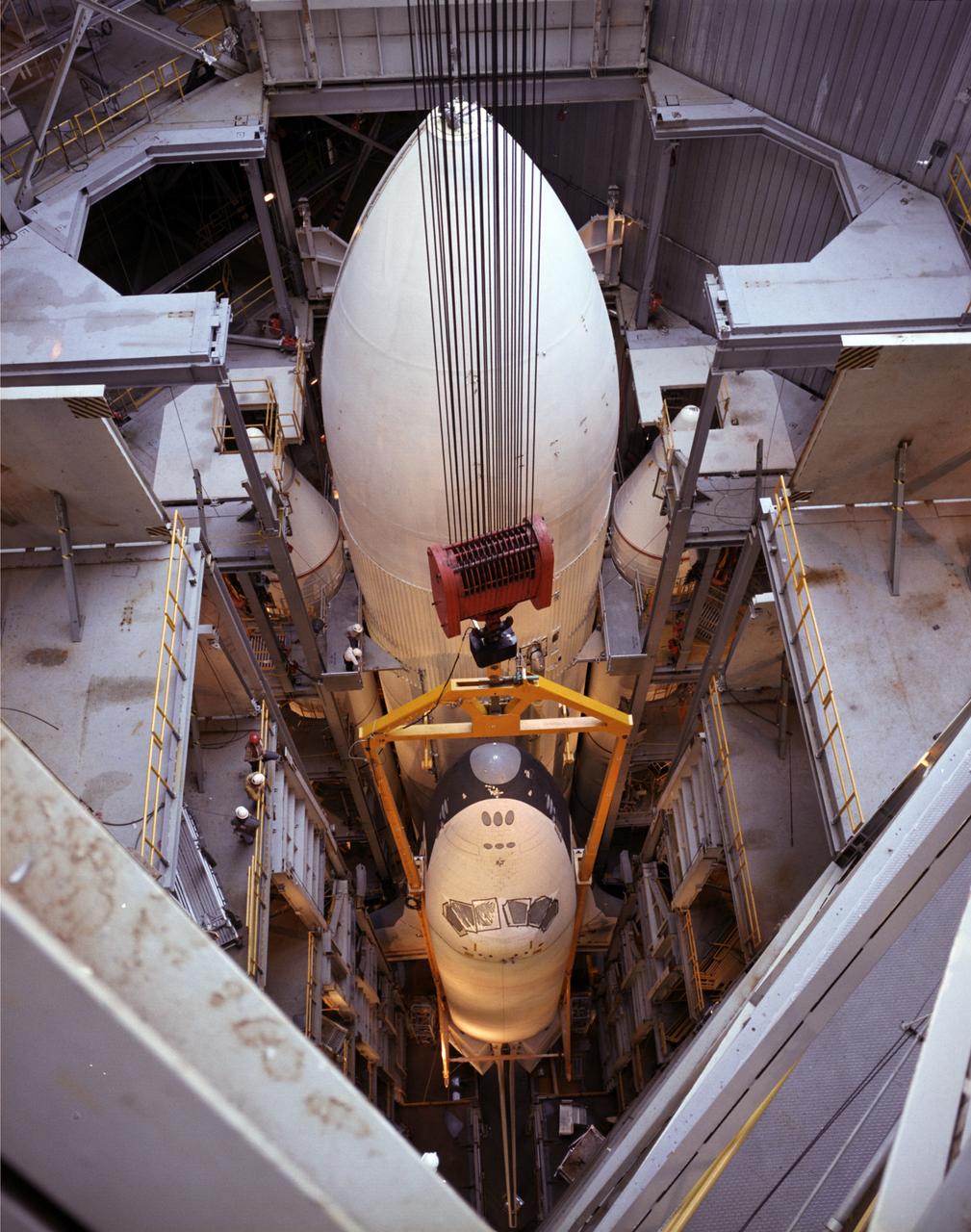
This photograph was taken at the Orbiter Enterprise installation, in its liftoff configuration, into the Marshall Space Flight Center Dynamic Test Stand for a Mated Vertical Ground Vibration Test (MVGVT).
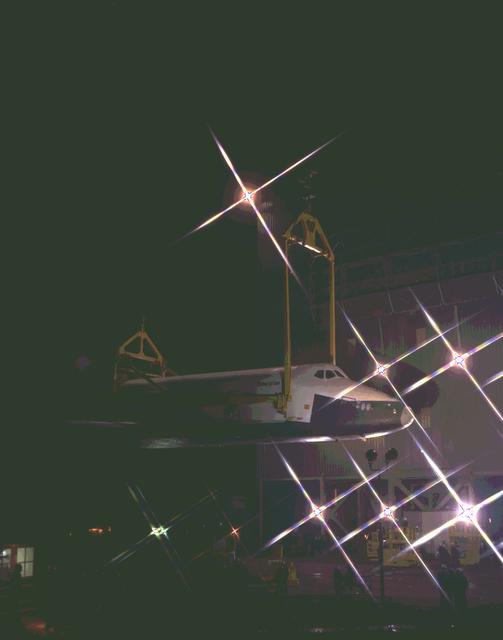
Shown here is the Shuttle Orbiter Enterprise being erected, just prior to installation into the Marshall Space Flight Center (MSFC) Dynamic Test Stand, for a Mated Vertical Ground Vibration Test (MVGVT).
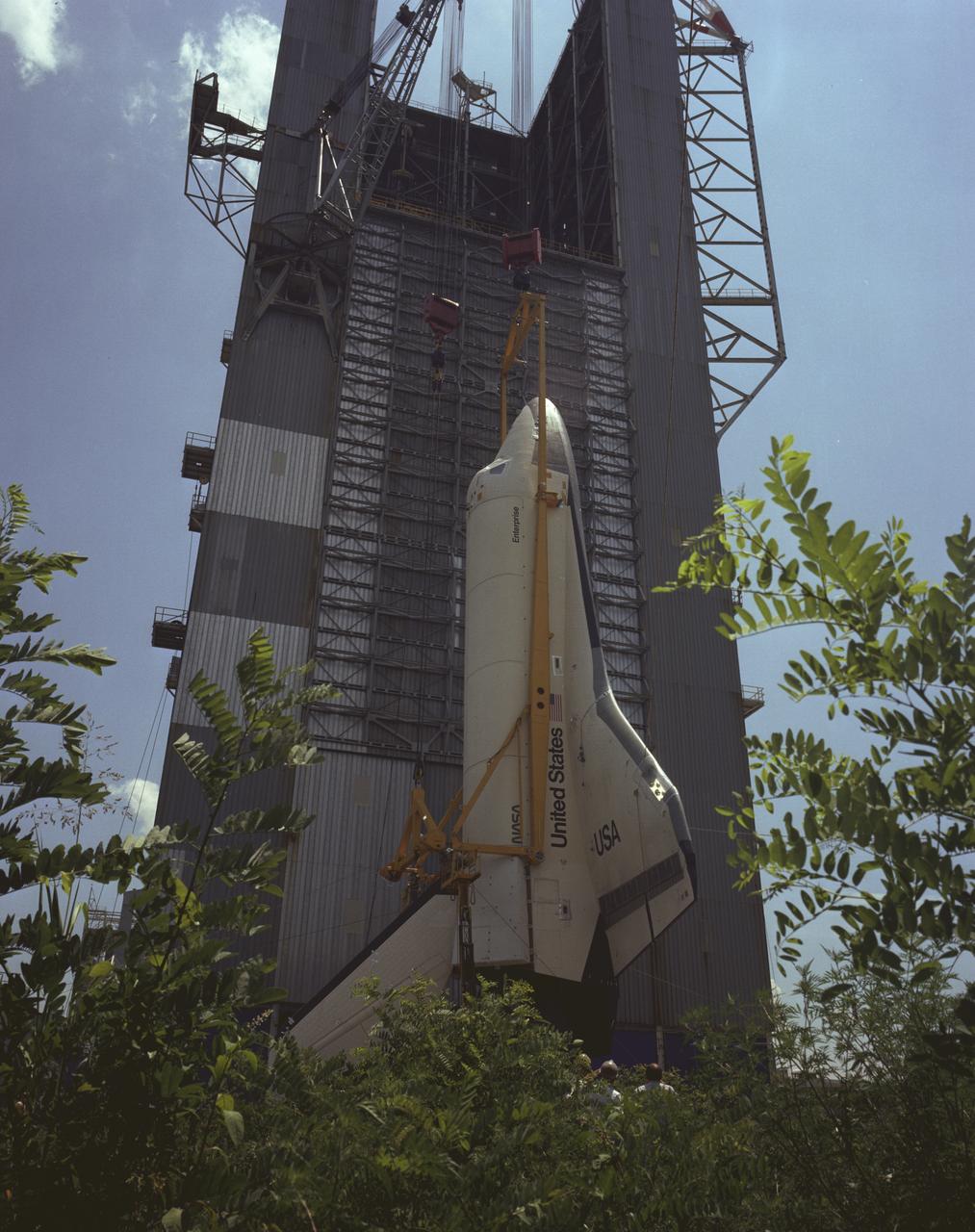
This photo depicts the removal of the Orbiter Enterprise from The Marshall Space Flight Center's Dynamic Test Stand after its first Mated Vertical Ground Vibration Test (MVGVT).
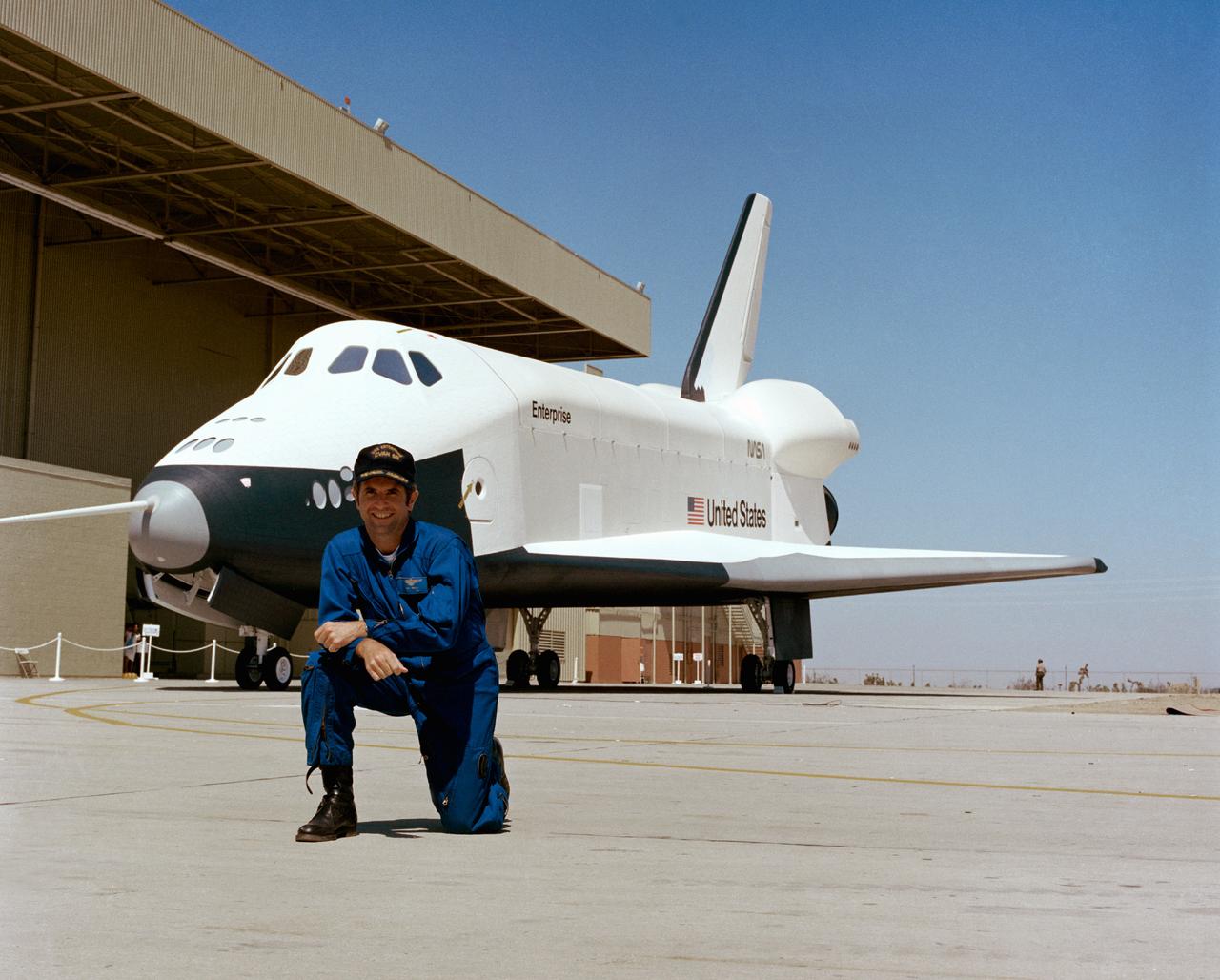
S76-29569 --- Astronaut Richard H. Truly, pilot of the second crew for the Space Shuttle Approach and Landing Tests (ALT), is photographed at the Rockwell International Space Division's Orbiter assembly facility at Palmdale, California on the day of the rollout of the Shuttle Orbiter 101 "Enterprise" spacecraft. The DC-9 size airplane-like Orbiter 101 is in the background.
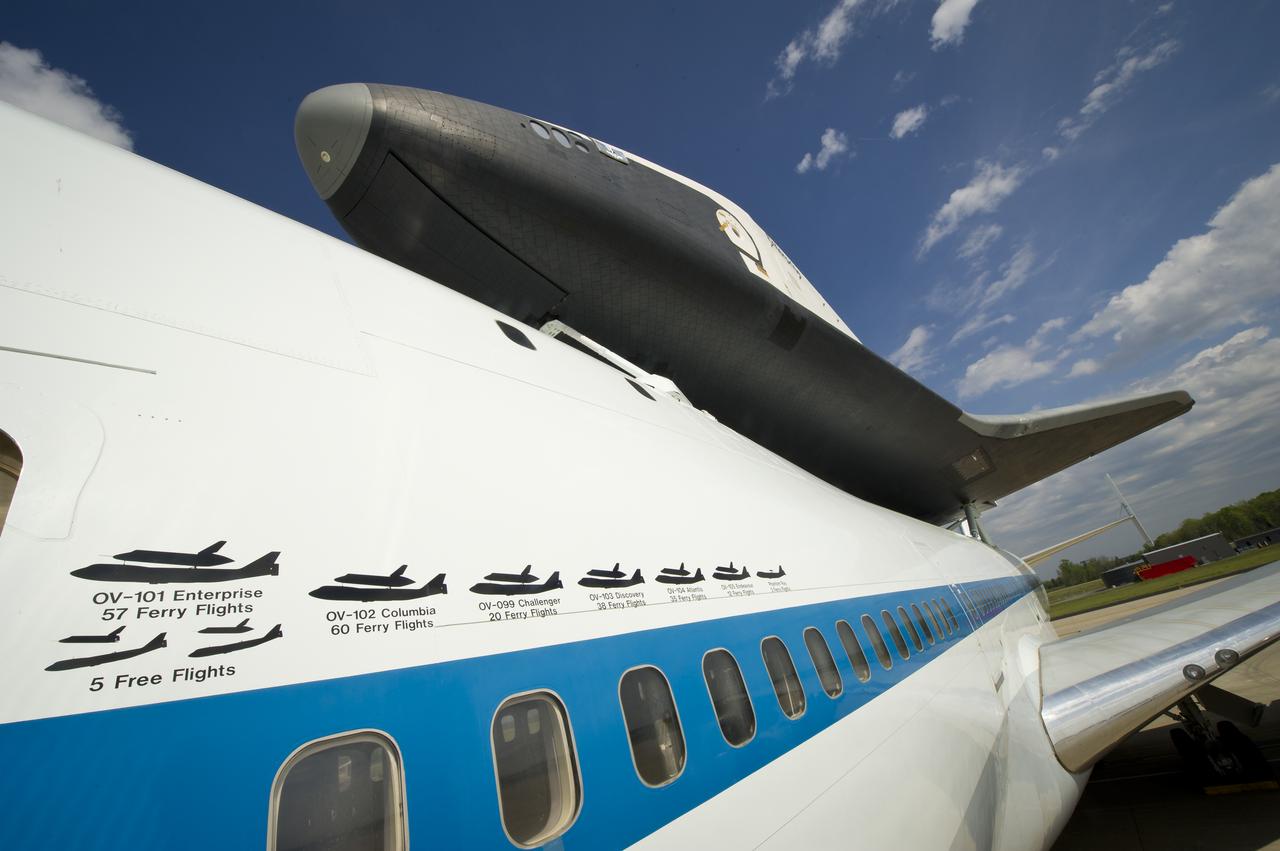
The space shuttle Enterprise is seen mated on top of the NASA 747 Shuttle Carrier Aircraft (SCA) at Washington Dulles International Airport, Saturday, April 21, 2012, in Sterling, Va. Painted graphics line the side of NASA 905 depicting the various ferry flights the Shuttle Carrier Aircraft has supported during the Space Shuttle Program, including the tests using the space shuttle prototype Enterprise. Space Shuttle Transition and Retirement engineers Saturday completed the final steps to ready Space Shuttle Enterprise for its flight to New York’s John F. Kennedy International Airport while managers continue to evaluate the expected weather that has postponed delivery past Monday. Enterprise, the first orbiter built for the Space Shuttle Program, was used primarily for ground and flight tests within the atmosphere. The initial testing period named Approach and Landing Test (ALT) included a flight on February 18, 1977 atop a Shuttle Carrier Aircraft (SCA) to measure structural loads and ground handling and braking characteristics of the mated system. Enterprise will go on permanent display at the Intrepid Sea Air and Space Museum in New York in June. Photo Credit: (NASA/Bill Ingalls)
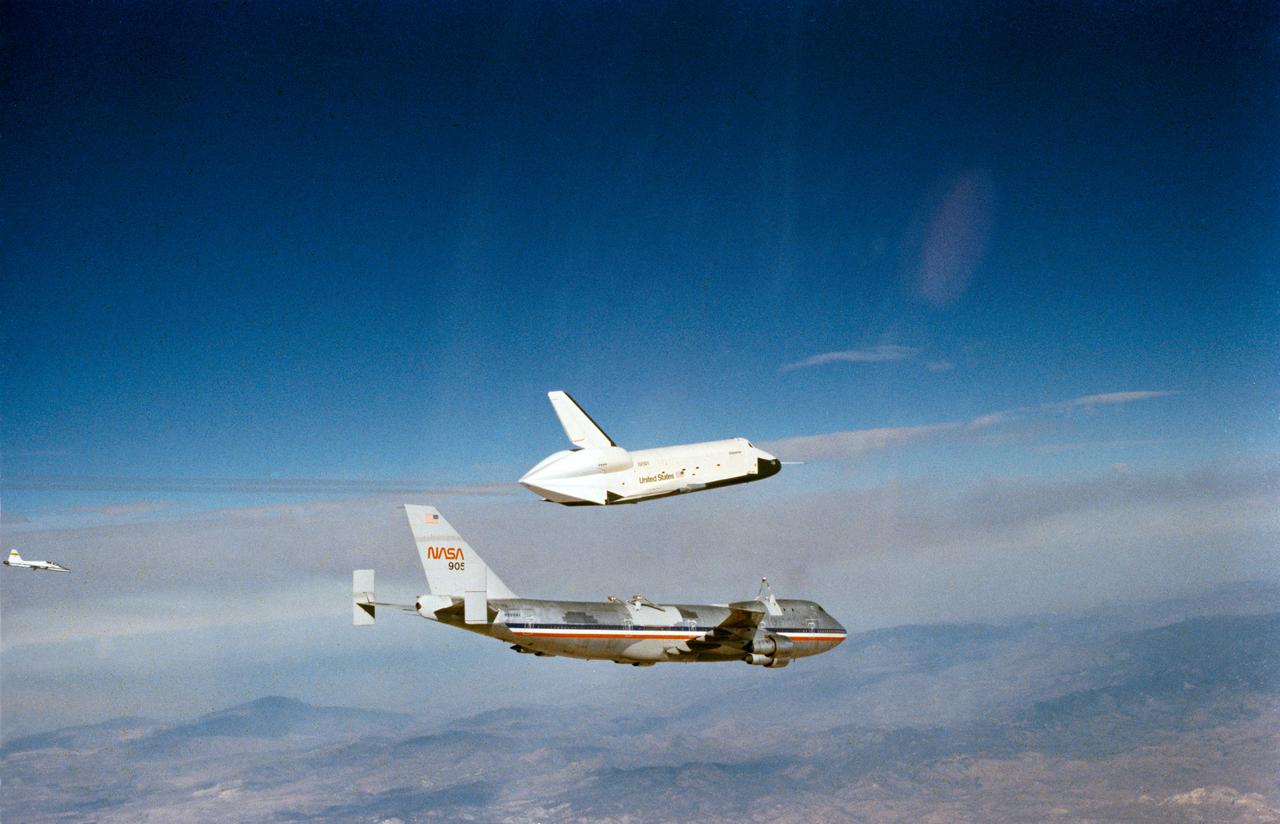
S77-28137 (13 Sept 1977) --- The Orbiter 101 "Enterprise" soars above the NASA 747 carrier aircraft during the second free flight of the Shuttle Approach and Landing Tests (ALTs) conducted on September 13, 1977 at Dryden Flight Research Center in Southern California. Astronauts Joe H. Engle, and Richard H. Truly were the crew of the "Enterprise." The ALT free flights are designed to verify Orbiter subsonic airworthiness, integrated systems operations and pilot-guided approach and landing capability and satisfying prerequisites to automatic flight control and navigation mode.
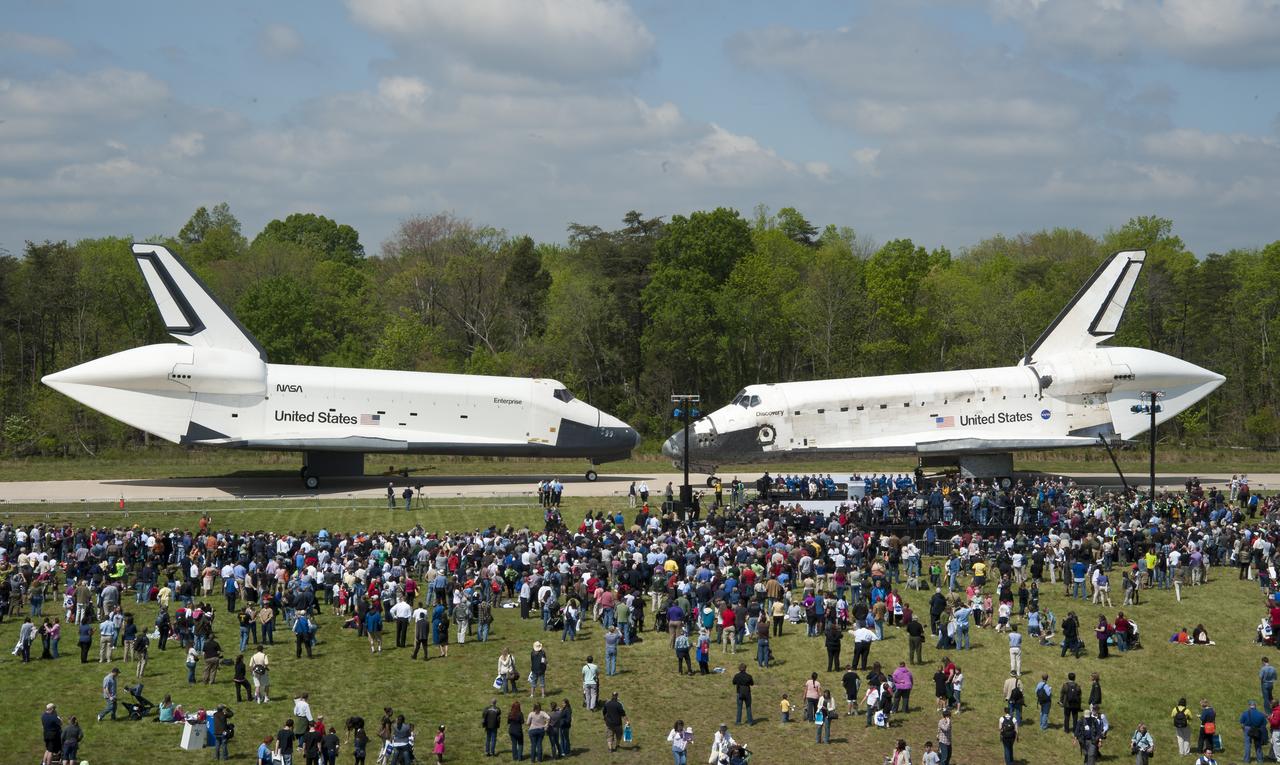
Space Shuttles Enterprise, left, and Discovery meet nose-to-nose at the beginning of a transfer ceremony at the Smithsonian's Steven F. Udvar-Hazy Center, Thursday, April 19, 2012, in Chantilly, Va. Space shuttle Discovery, the first orbiter retired from NASA’s shuttle fleet, completed 39 missions, spent 365 days in space, orbited the Earth 5,830 times, and traveled 148,221,675 miles will take the place of Enterprise at the center to commemorate past achievements in space and to educate and inspire future generations of explorers at the center. Photo Credit: (NASA/Smithsonian Institution/Carolyn Russo)
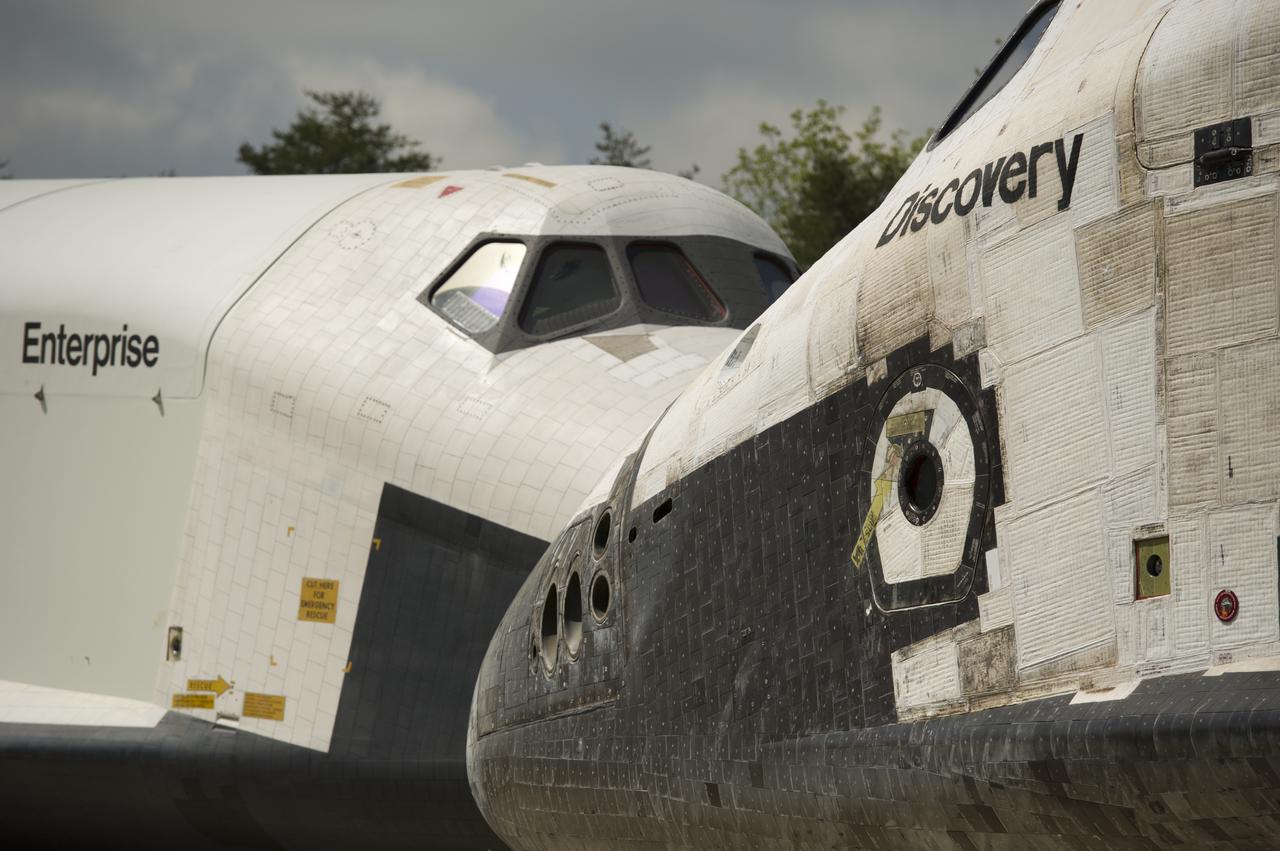
Space Shuttles Enterprise, left, and Discovery meet nose-to-nose during the a transfer ceremony at the Smithsonian's Steven F. Udvar-Hazy Center, Thursday, April 19, 2012, in Chantilly, Va. Space shuttle Discovery, the first orbiter retired from NASA’s shuttle fleet, completed 39 missions, spent 365 days in space, orbited the Earth 5,830 times, and traveled 148,221,675 miles will take the place of Enterprise at the center to commemorate past achievements in space and to educate and inspire future generations of explorers at the center. Photo Credit: (NASA/Carla Cioffi)
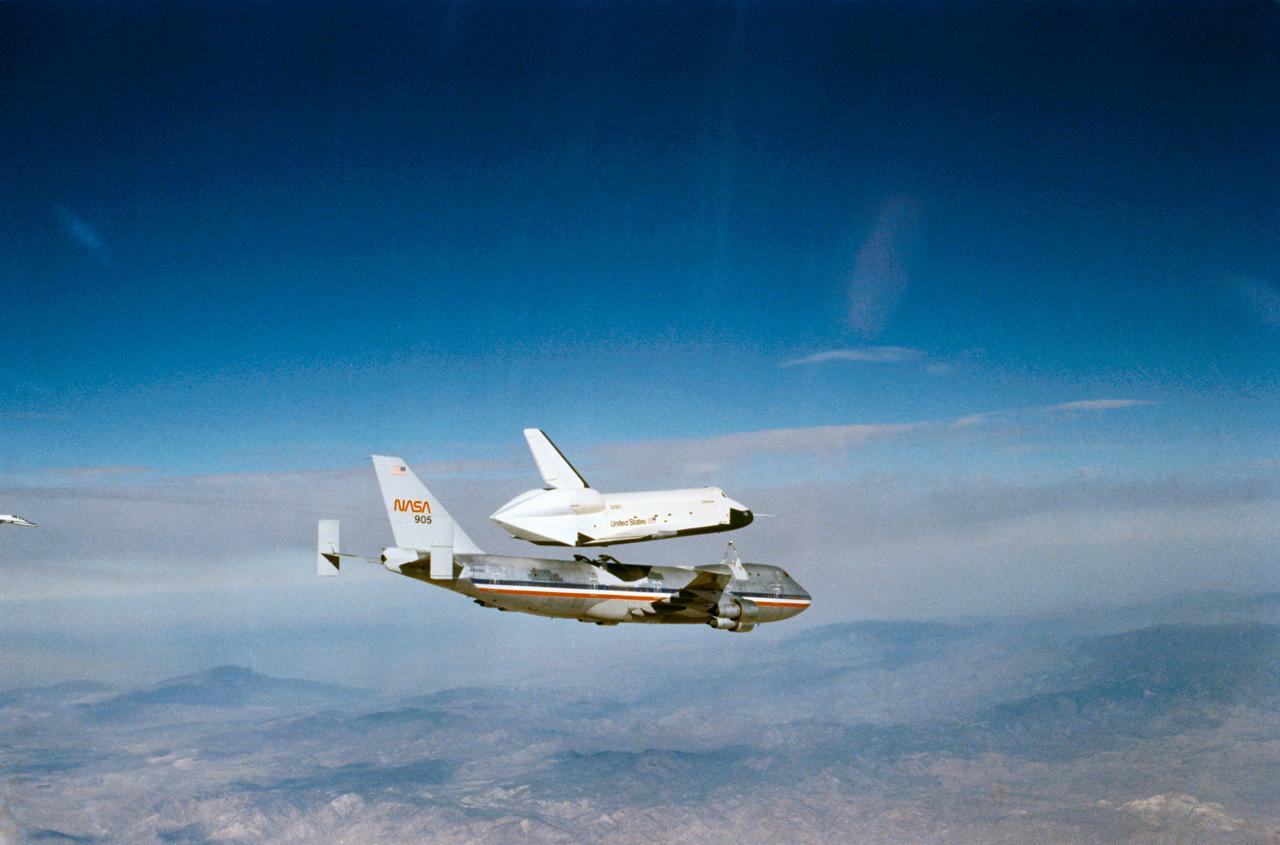
S77-28136 (13 Sept 1977) --- The Orbiter 101 "Enterprise" is seen separating from the NASA 747 carrier aircraft during the second free flight of the Shuttle Approach and Landing Tests (ALTs) conducted on September 13, 1977 at Dryden Flight Research Center in Southern California. Astronauts Joe H. Engle, and Richard H. Truly were the crew of the "Enterprise." The ALT free flights are designed to verify Orbiter subsonic airworthiness, integrated systems operations and pilot-guided approach and landing capability and satisfying prerequisites to automatic flight control and navigation mode.
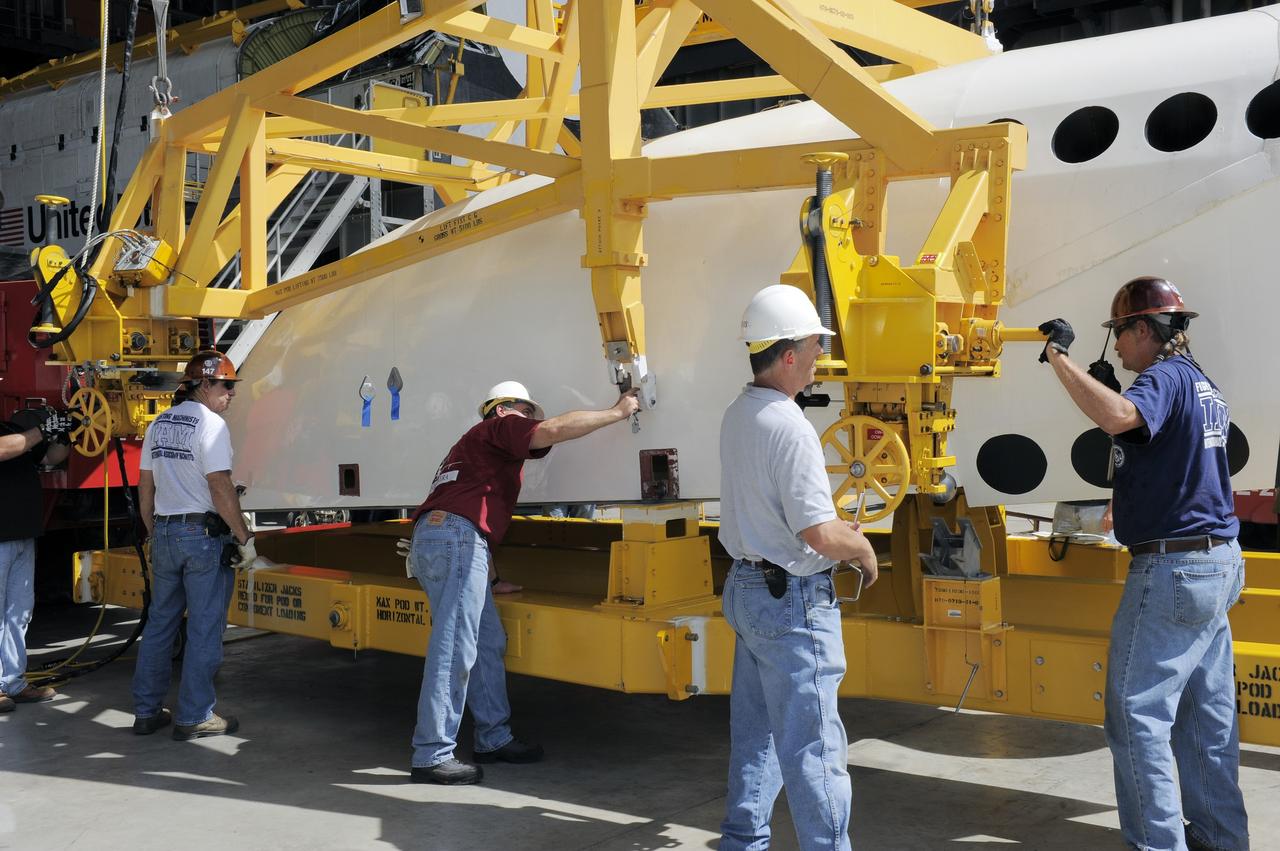
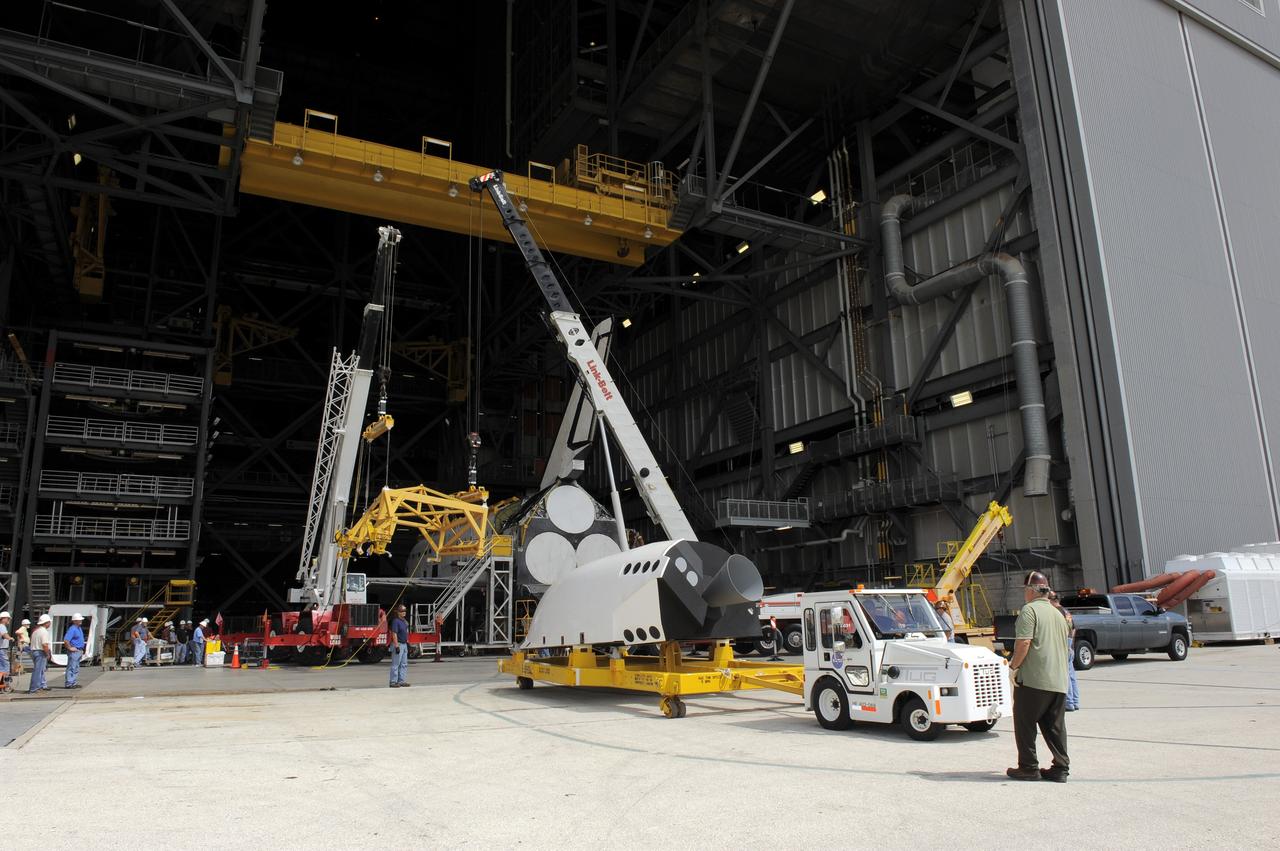
CAPE CANAVERAL, Fla. – In the Vehicle Assembly Building at NASA's Kennedy Space Center in Florida, workers, using overhead cranes, lower a cage over an Approach and Landing Test Assembly (ALTA) pod. The ALTA pod will be lifted for attachment to space shuttle Endeavour on the site once housing the orbital maneuvering system (OMS) pod. The demonstration test is being conducted to ensure the center’s equipment will fit into the hangar at the National Air and Space Museum when installing an ALTA pod on shuttle Enterprise. The pod must be reinstalled on a shuttle for transport on a 747 carrier aircraft. The simulation also tests procedures and timelines necessary to carry out the process. The work is part of the Space Shuttle Program’s transition and retirement processing. Enterprise, which was not equipped for space flight, was built as a test vehicle to demonstrate that the orbiter could fly in the atmosphere and land like an airplane. In 1985, Enterprise was ferried from the Kennedy Space Center to Dulles Airport, Washington, D.C., and became the property of the Smithsonian Institute. Enterprise will be moved from the Smithsonian Institution National Air and Space Museum's Steven F. Udvar-Hazy Center in Chantilly, Va., to the Intrepid Sea, Air and Space Museum in New York. For more information, visit http://www.nasa.gov/shuttle. Photo credit: NASA/Ken Shiflett
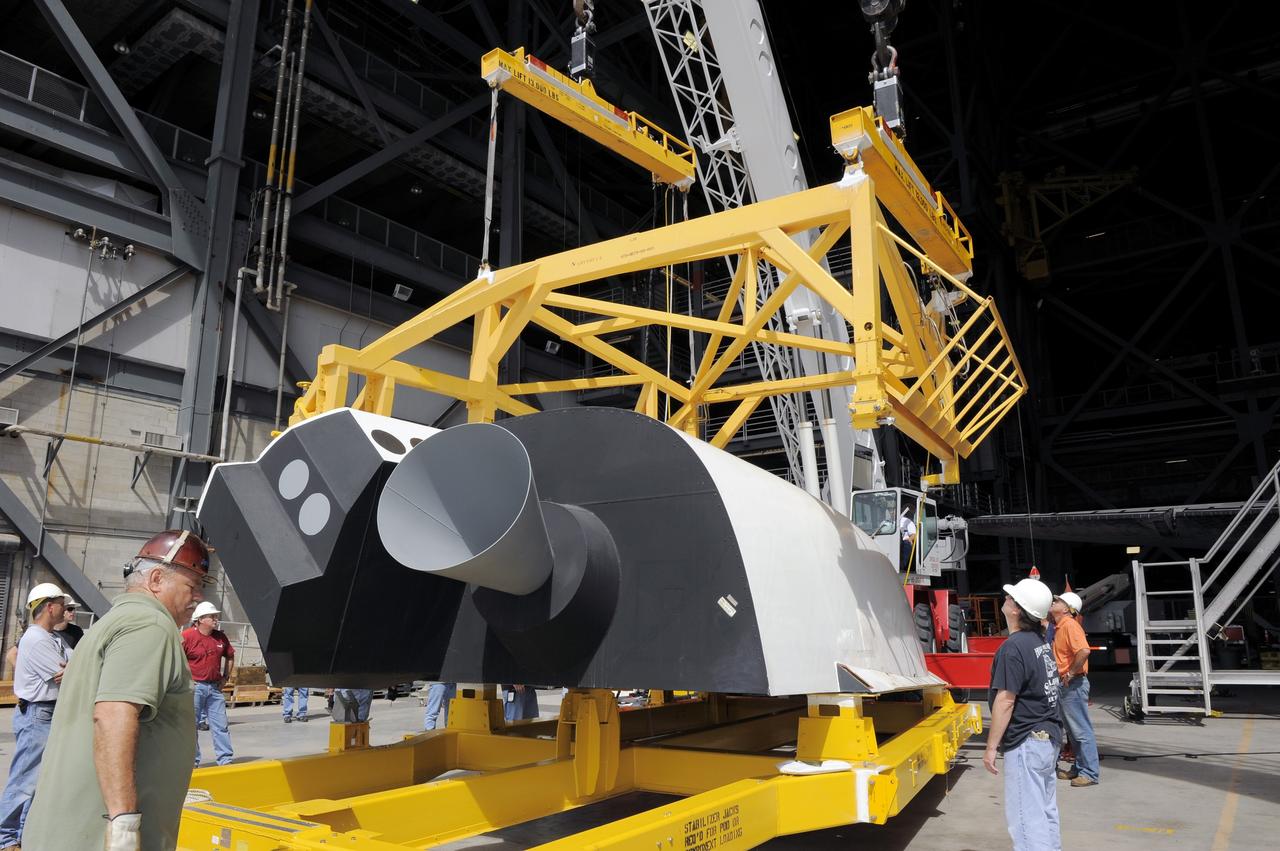
CAPE CANAVERAL, Fla. – In the Vehicle Assembly Building at NASA's Kennedy Space Center in Florida, workers, using overhead cranes, raise a cage over an Approach and Landing Test Assembly (ALTA) pod. The ALTA pod will be lifted for attachment to space shuttle Endeavour on the site once housing the orbital maneuvering system (OMS) pod. The demonstration test is being conducted to ensure the center’s equipment will fit into the hangar at the National Air and Space Museum when installing an ALTA pod on shuttle Enterprise. The pod must be reinstalled on a shuttle for transport on a 747 carrier aircraft. The simulation also tests procedures and timelines necessary to carry out the process. The work is part of the Space Shuttle Program’s transition and retirement processing. Enterprise, which was not equipped for space flight, was built as a test vehicle to demonstrate that the orbiter could fly in the atmosphere and land like an airplane. In 1985, Enterprise was ferried from the Kennedy Space Center to Dulles Airport, Washington, D.C., and became the property of the Smithsonian Institute. Enterprise will be moved from the Smithsonian Institution National Air and Space Museum's Steven F. Udvar-Hazy Center in Chantilly, Va., to the Intrepid Sea, Air and Space Museum in New York. For more information, visit http://www.nasa.gov/shuttle. Photo credit: NASA/Ken Shiflett
CAPE CANAVERAL, Fla. – In the Vehicle Assembly Building at NASA's Kennedy Space Center in Florida, workers, using overhead cranes, begin to raise a cage which will be placed over an Approach and Landing Test Assembly (ALTA) pod. The ALTA pod will be lifted for attachment to space shuttle Endeavour on the site once housing the orbital maneuvering system (OMS) pod. The demonstration test is being conducted to ensure the center’s equipment will fit into the hangar at the National Air and Space Museum when installing an ALTA pod on shuttle Enterprise. The pod must be reinstalled on a shuttle for transport on a 747 carrier aircraft. The simulation also tests procedures and timelines necessary to carry out the process. The work is part of the Space Shuttle Program’s transition and retirement processing. Enterprise, which was not equipped for space flight, was built as a test vehicle to demonstrate that the orbiter could fly in the atmosphere and land like an airplane. In 1985, Enterprise was ferried from the Kennedy Space Center to Dulles Airport, Washington, D.C., and became the property of the Smithsonian Institute. Enterprise will be moved from the Smithsonian Institution National Air and Space Museum's Steven F. Udvar-Hazy Center in Chantilly, Va., to the Intrepid Sea, Air and Space Museum in New York. For more information, visit http://www.nasa.gov/shuttle. Photo credit: NASA/Ken Shiflett
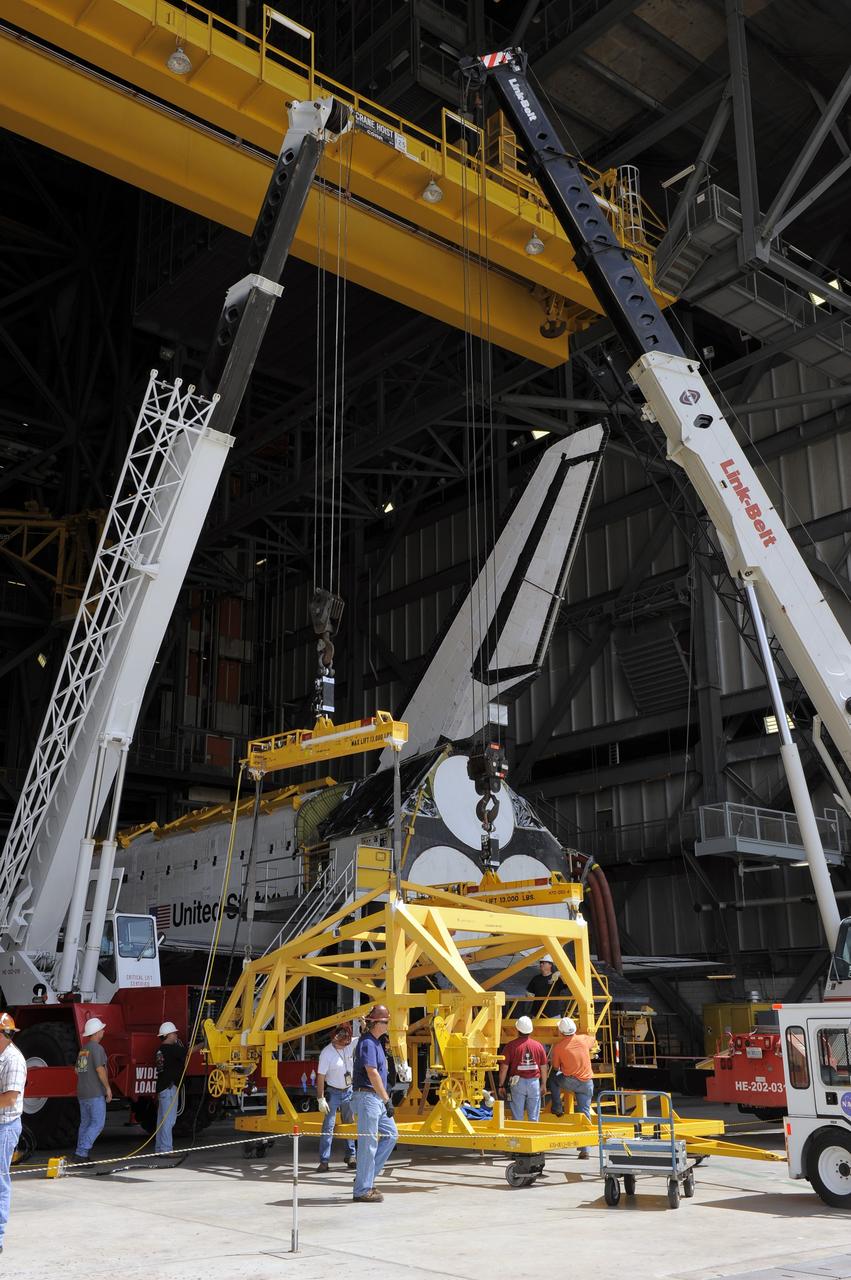
CAPE CANAVERAL, Fla. – In the Vehicle Assembly Building at NASA's Kennedy Space Center in Florida, space shuttle Endeavour sits surrounded by cranes and lifts. Workers are preparing to raise an Approach and Landing Test Assembly (ALTA) pod to the rear of the shuttle for attachment over the site once housing the orbital maneuvering system (OMS) pod. The demonstration test is being conducted to ensure the center’s equipment will fit into the hangar at the National Air and Space Museum when installing an ALTA pod on shuttle Enterprise. The pod must be reinstalled on a shuttle for transport on a 747 carrier aircraft. The simulation also tests procedures and timelines necessary to carry out the process. The work is part of the Space Shuttle Program’s transition and retirement processing. Enterprise, which was not equipped for space flight, was built as a test vehicle to demonstrate that the orbiter could fly in the atmosphere and land like an airplane. In 1985, Enterprise was ferried from the Kennedy Space Center to Dulles Airport, Washington, D.C., and became the property of the Smithsonian Institute. Enterprise will be moved from the Smithsonian Institution National Air and Space Museum's Steven F. Udvar-Hazy Center in Chantilly, Va., to the Intrepid Sea, Air and Space Museum in New York. For more information, visit http://www.nasa.gov/shuttle. Photo credit: NASA/Ken Shiflett
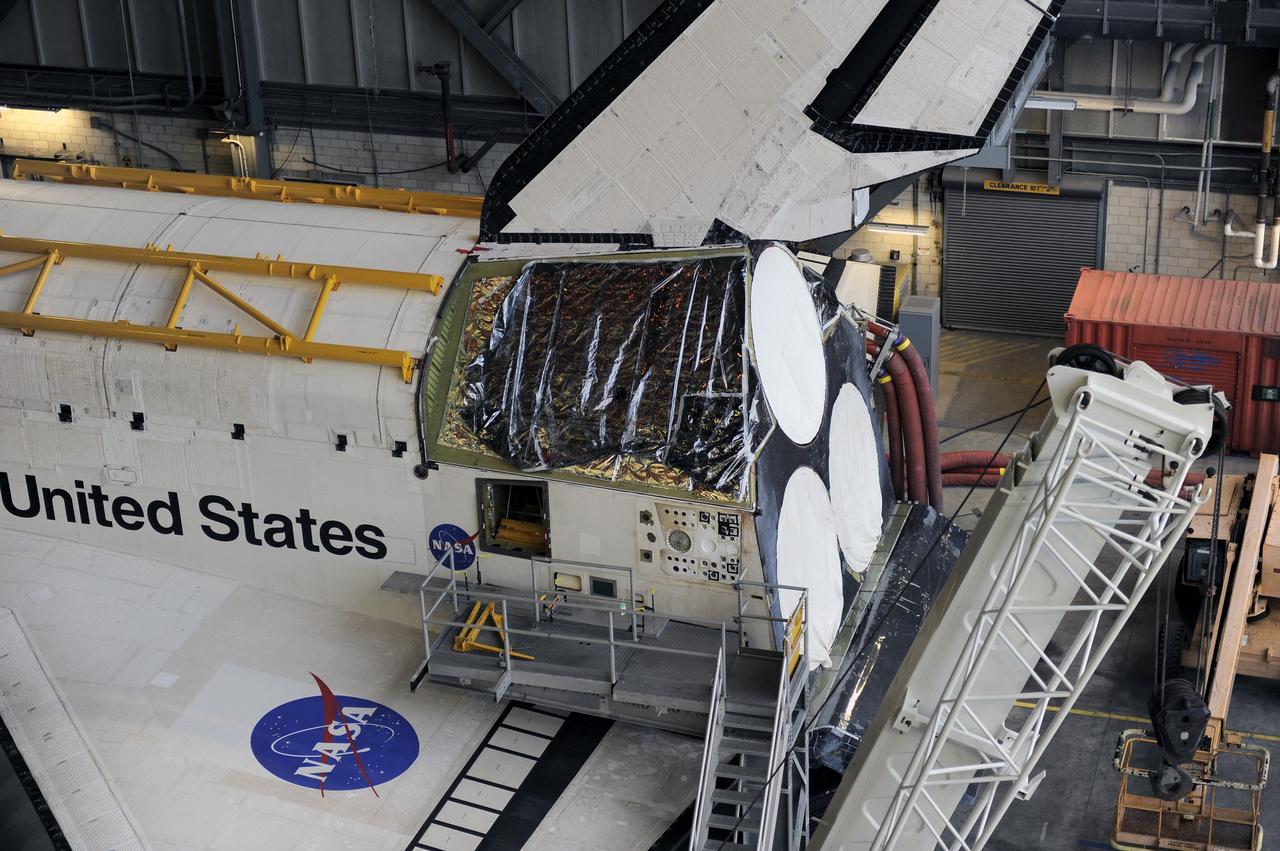
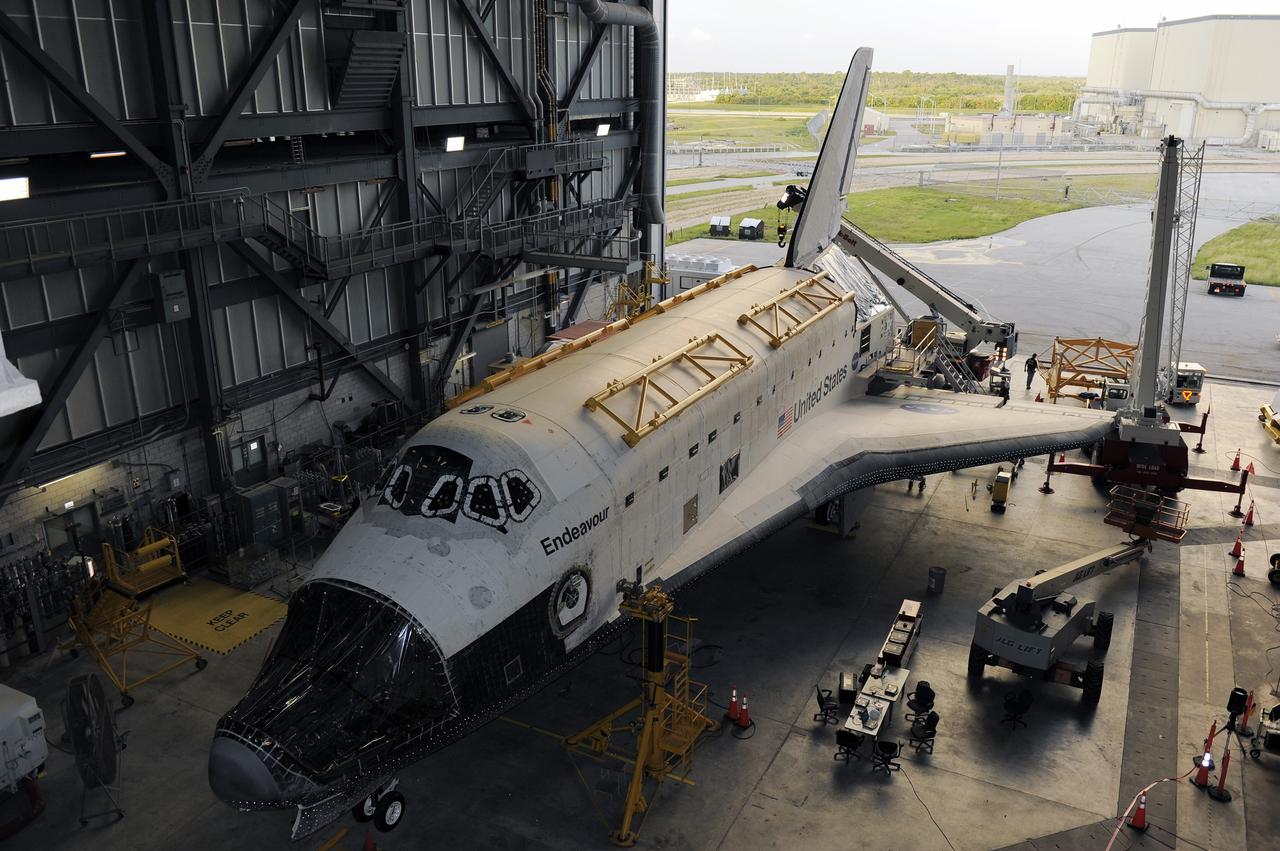
CAPE CANAVERAL, Fla. – In the Vehicle Assembly Building at NASA's Kennedy Space Center in Florida, a rear view of space shuttle Endeavour shows a protective plastic covering the area once housing the orbital maneuvering system (OMS) pod. An aerial lift will raise an Approach and Landing Test Assembly (ALTA) pod to fit over the OMS site. The demonstration test is being conducted to ensure the center’s equipment will fit into the hangar at the National Air and Space Museum when installing an ALTA pod on shuttle Enterprise. The pod must be reinstalled on a shuttle for transport on a 747 carrier aircraft. The simulation also tests procedures and timelines necessary to carry out the process. The work is part of the Space Shuttle Program’s transition and retirement processing. Enterprise, which was not equipped for space flight, was built as a test vehicle to demonstrate that the orbiter could fly in the atmosphere and land like an airplane. In 1985, Enterprise was ferried from the Kennedy Space Center to Dulles Airport, Washington, D.C., and became the property of the Smithsonian Institute. Enterprise will be moved from the Smithsonian Institution National Air and Space Museum's Steven F. Udvar-Hazy Center in Chantilly, Va., to the Intrepid Sea, Air and Space Museum in New York. For more information, visit http://www.nasa.gov/shuttle. Photo credit: NASA/Ken Shiflett
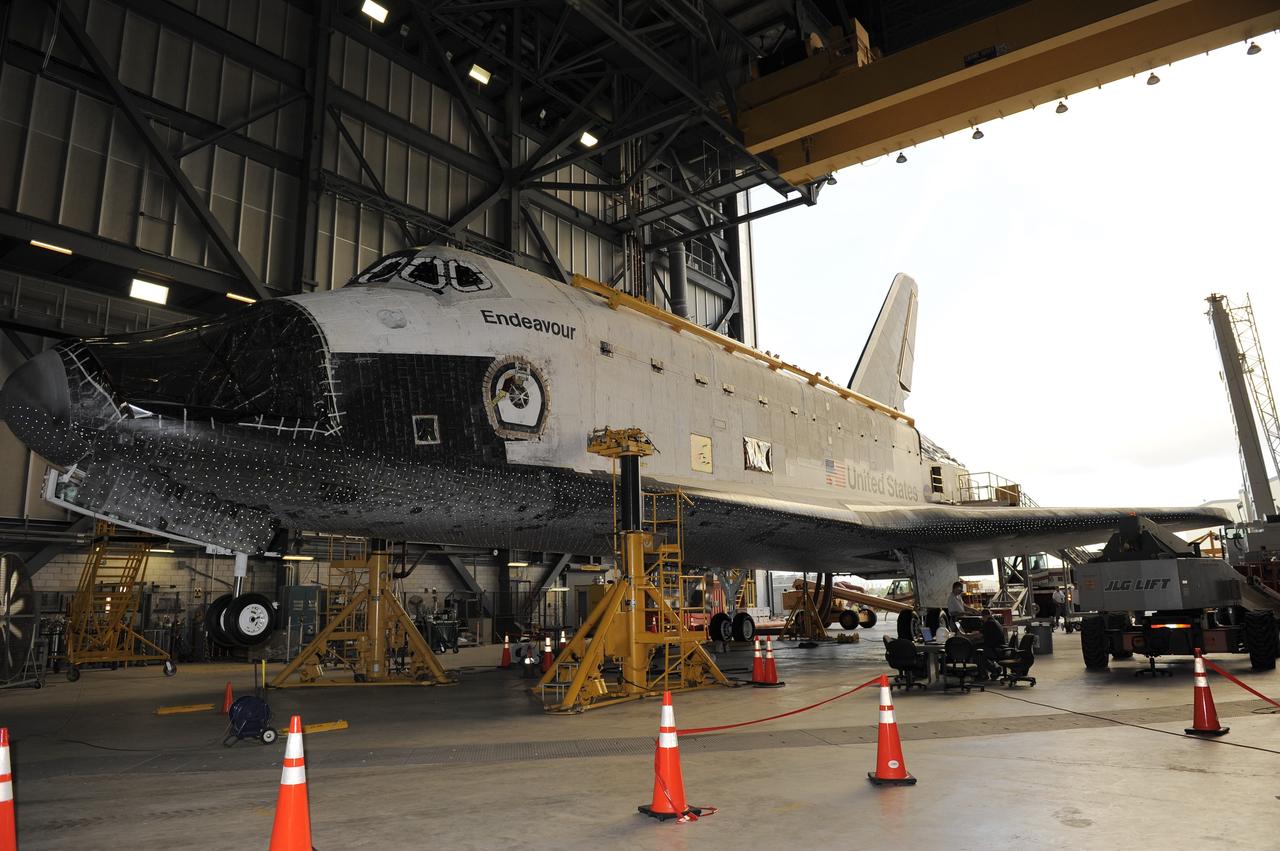
CAPE CANAVERAL, Fla. – In the Vehicle Assembly Building at NASA's Kennedy Space Center in Florida, the front end of space shuttle Endeavour is raised off the floor of the VAB by lifts, as workers prepare to attach an Approach and Landing Test Assembly (ALTA) pod to the back of the shuttle. The ALTA pod will be fitted over the area once housing the orbital maneuvering system (OMS) pod. The demonstration test is being conducted to ensure the center’s equipment will fit into the hangar at the National Air and Space Museum when installing an ALTA pod on shuttle Enterprise. The pod must be reinstalled on a shuttle for transport on a 747 carrier aircraft. The simulation also will test procedures and timelines necessary to carry out the process. The work is part of the Space Shuttle Program’s transition and retirement processing. Enterprise, which was not equipped for space flight, was built as a test vehicle to demonstrate that the orbiter could fly in the atmosphere and land like an airplane. In 1985, Enterprise was ferried from the Kennedy Space Center to Dulles Airport, Washington, D.C., and became the property of the Smithsonian Institute. Enterprise will be moved from the Smithsonian Institution National Air and Space Museum's Steven F. Udvar-Hazy Center in Chantilly, Va., to the Intrepid Sea, Air and Space Museum in New York. For more information, visit http://www.nasa.gov/shuttle. Photo credit: NASA/Ken Shiflett
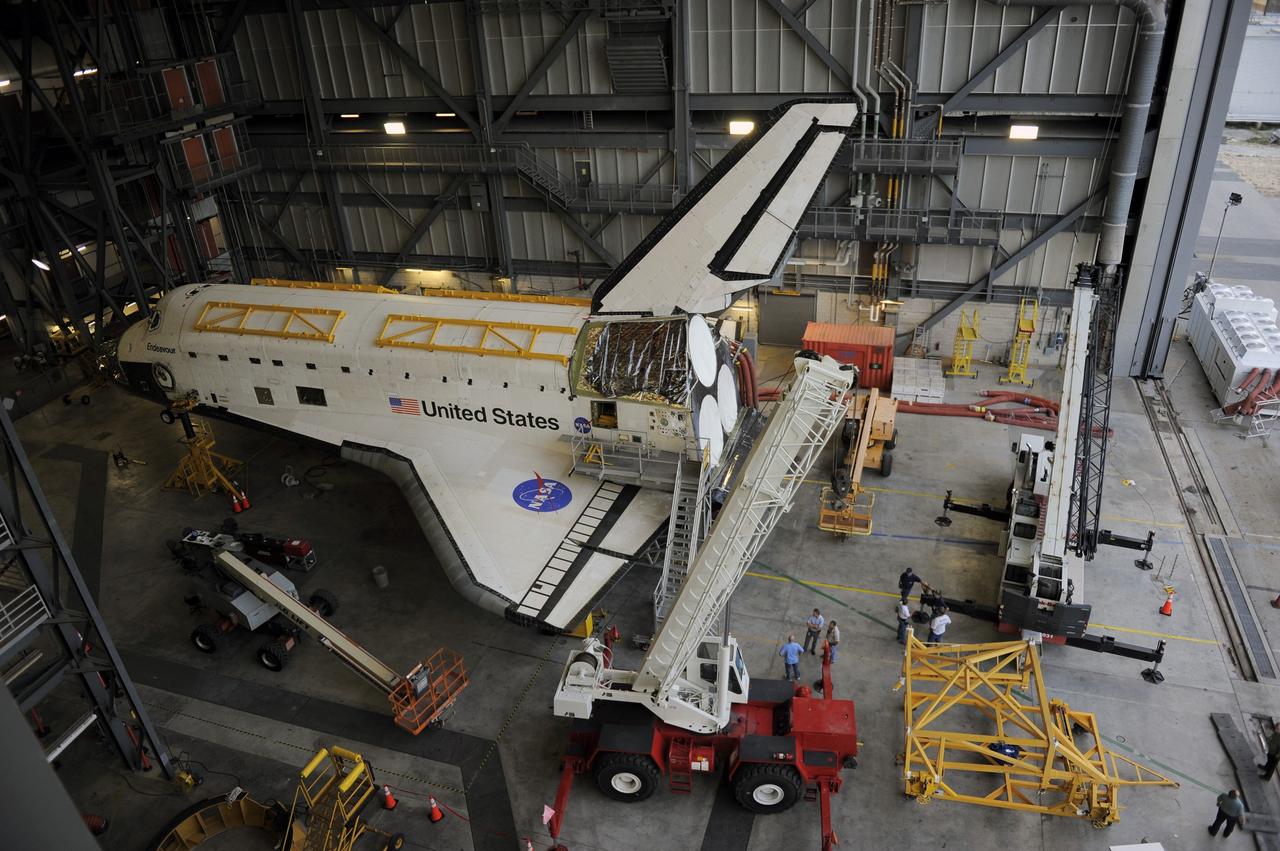
CAPE CANAVERAL, Fla. – In the Vehicle Assembly Building at NASA's Kennedy Space Center in Florida, workers lower the cage containing an Approach and Landing Test Assembly (ALTA) pod over the rear of space shuttle Endeavour. The ALTA pod is being attached to the site once housing the orbital maneuvering system (OMS) pod. The demonstration test is being conducted to ensure the center’s equipment will fit into the hangar at the National Air and Space Museum when installing an ALTA pod on shuttle Enterprise. The pod must be reinstalled on a shuttle for transport on a 747 carrier aircraft. The simulation also tests procedures and timelines necessary to carry out the process. The work is part of the Space Shuttle Program’s transition and retirement processing. Enterprise, which was not equipped for space flight, was built as a test vehicle to demonstrate that the orbiter could fly in the atmosphere and land like an airplane. In 1985, Enterprise was ferried from the Kennedy Space Center to Dulles Airport, Washington, D.C., and became the property of the Smithsonian Institute. Enterprise will be moved from the Smithsonian Institution National Air and Space Museum's Steven F. Udvar-Hazy Center in Chantilly, Va. to the Intrepid Sea, Air and Space Museum in New York. For more information, visit http:__www.nasa.gov_shuttle. Photo credit: NASA_Jim Grossmann
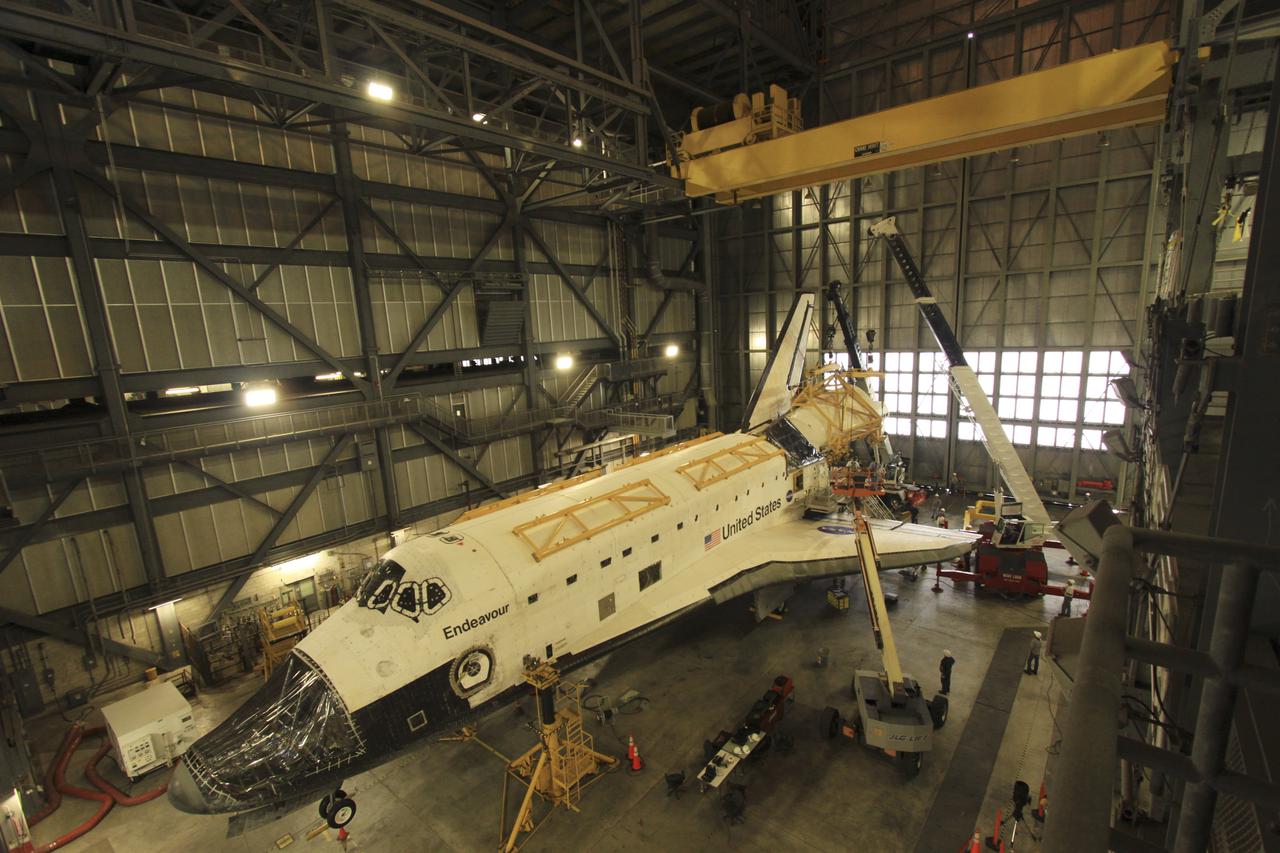
CAPE CANAVERAL, Fla. – In the Vehicle Assembly Building at NASA's Kennedy Space Center in Florida, space shuttle Endeavour sits surrounded by cranes and lifts. Workers are preparing to raise an Approach and Landing Test Assembly (ALTA) pod for attachment to the shuttle at the site once housing the orbital maneuvering system (OMS) pod. The demonstration test is being conducted to ensure the center’s equipment will fit into the hangar at the National Air and Space Museum when installing an ALTA pod on shuttle Enterprise. The pod must be reinstalled on a shuttle for transport on a 747 carrier aircraft. The simulation also tests procedures and timelines necessary to carry out the process. The work is part of the Space Shuttle Program’s transition and retirement processing. Enterprise, which was not equipped for space flight, was built as a test vehicle to demonstrate that the orbiter could fly in the atmosphere and land like an airplane. In 1985, Enterprise was ferried from the Kennedy Space Center to Dulles Airport, Washington, D.C., and became the property of the Smithsonian Institute. Enterprise will be moved from the Smithsonian Institution National Air and Space Museum's Steven F. Udvar-Hazy Center in Chantilly, Va., to the Intrepid Sea, Air and Space Museum in New York. For more information, visit http://www.nasa.gov/shuttle. Photo credit: NASA/Ken Shiflett
CAPE CANAVERAL, Fla. – In the Vehicle Assembly Building at NASA's Kennedy Space Center in Florida, workers, using overhead cranes, raise a cage which will be placed over an Approach and Landing Test Assembly (ALTA) pod (in the foreground). The ALTA pod will be lifted for attachment to space shuttle Endeavour on the site once housing the orbital maneuvering system (OMS) pod. The demonstration test is being conducted to ensure the center’s equipment will fit into the hangar at the National Air and Space Museum when installing an ALTA pod on shuttle Enterprise. The pod must be reinstalled on a shuttle for transport on a 747 carrier aircraft. The simulation also tests procedures and timelines necessary to carry out the process. The work is part of the Space Shuttle Program’s transition and retirement processing. Enterprise, which was not equipped for space flight, was built as a test vehicle to demonstrate that the orbiter could fly in the atmosphere and land like an airplane. In 1985, Enterprise was ferried from the Kennedy Space Center to Dulles Airport, Washington, D.C., and became the property of the Smithsonian Institute. Enterprise will be moved from the Smithsonian Institution National Air and Space Museum's Steven F. Udvar-Hazy Center in Chantilly, Va., to the Intrepid Sea, Air and Space Museum in New York. For more information, visit http://www.nasa.gov/shuttle. Photo credit: NASA/Ken Shiflett
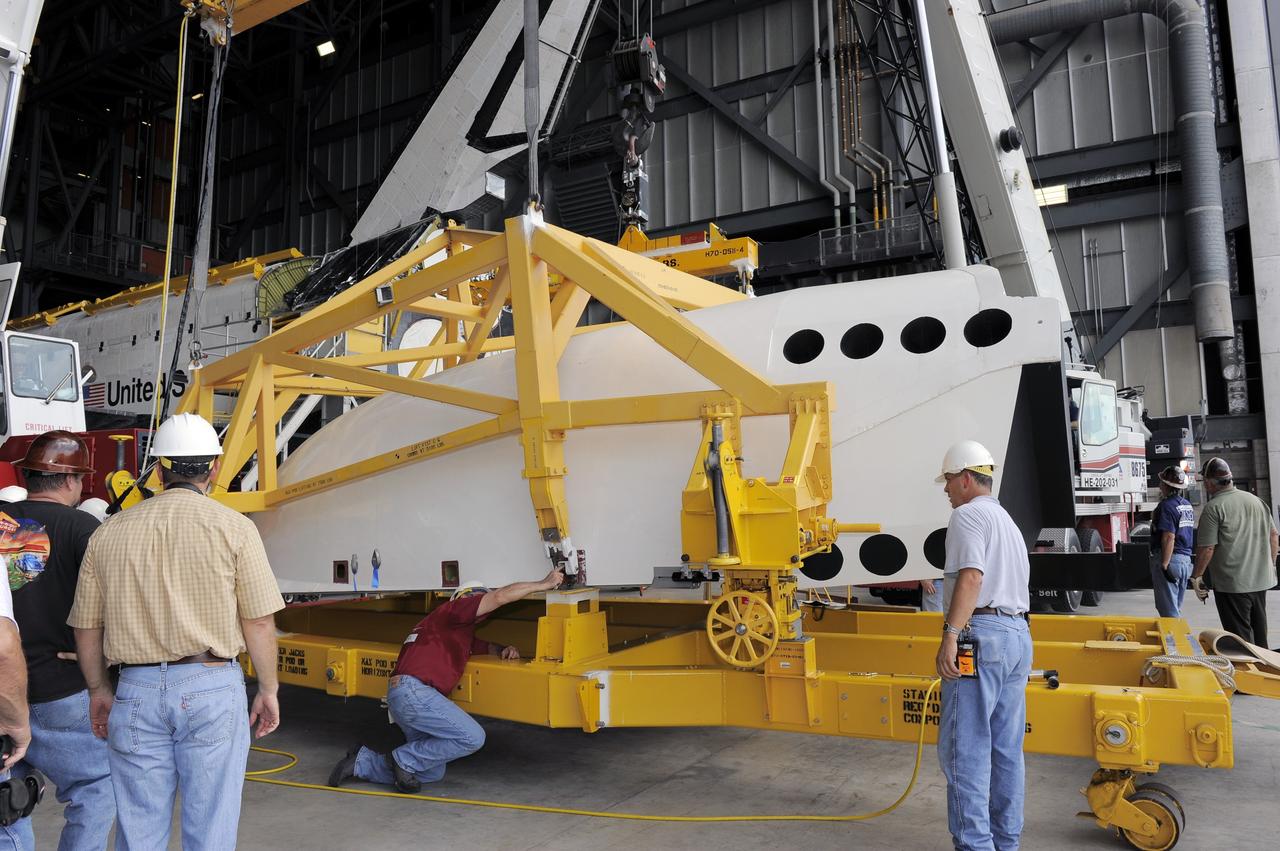
CAPE CANAVERAL, Fla. – In the Vehicle Assembly Building at NASA's Kennedy Space Center in Florida, workers affix a cage over an Approach and Landing Test Assembly (ALTA) pod. The ALTA pod will be lifted for attachment to space shuttle Endeavour on the site once housing the orbital maneuvering system (OMS) pod. The demonstration test is being conducted to ensure the center’s equipment will fit into the hangar at the National Air and Space Museum when installing an ALTA pod on shuttle Enterprise. The pod must be reinstalled on a shuttle for transport on a 747 carrier aircraft. The simulation also tests procedures and timelines necessary to carry out the process. The work is part of the Space Shuttle Program’s transition and retirement processing. Enterprise, which was not equipped for space flight, was built as a test vehicle to demonstrate that the orbiter could fly in the atmosphere and land like an airplane. In 1985, Enterprise was ferried from the Kennedy Space Center to Dulles Airport, Washington, D.C., and became the property of the Smithsonian Institute. Enterprise will be moved from the Smithsonian Institution National Air and Space Museum's Steven F. Udvar-Hazy Center in Chantilly, Va., to the Intrepid Sea, Air and Space Museum in New York. For more information, visit http://www.nasa.gov/shuttle. Photo credit: NASA/Ken Shiflett
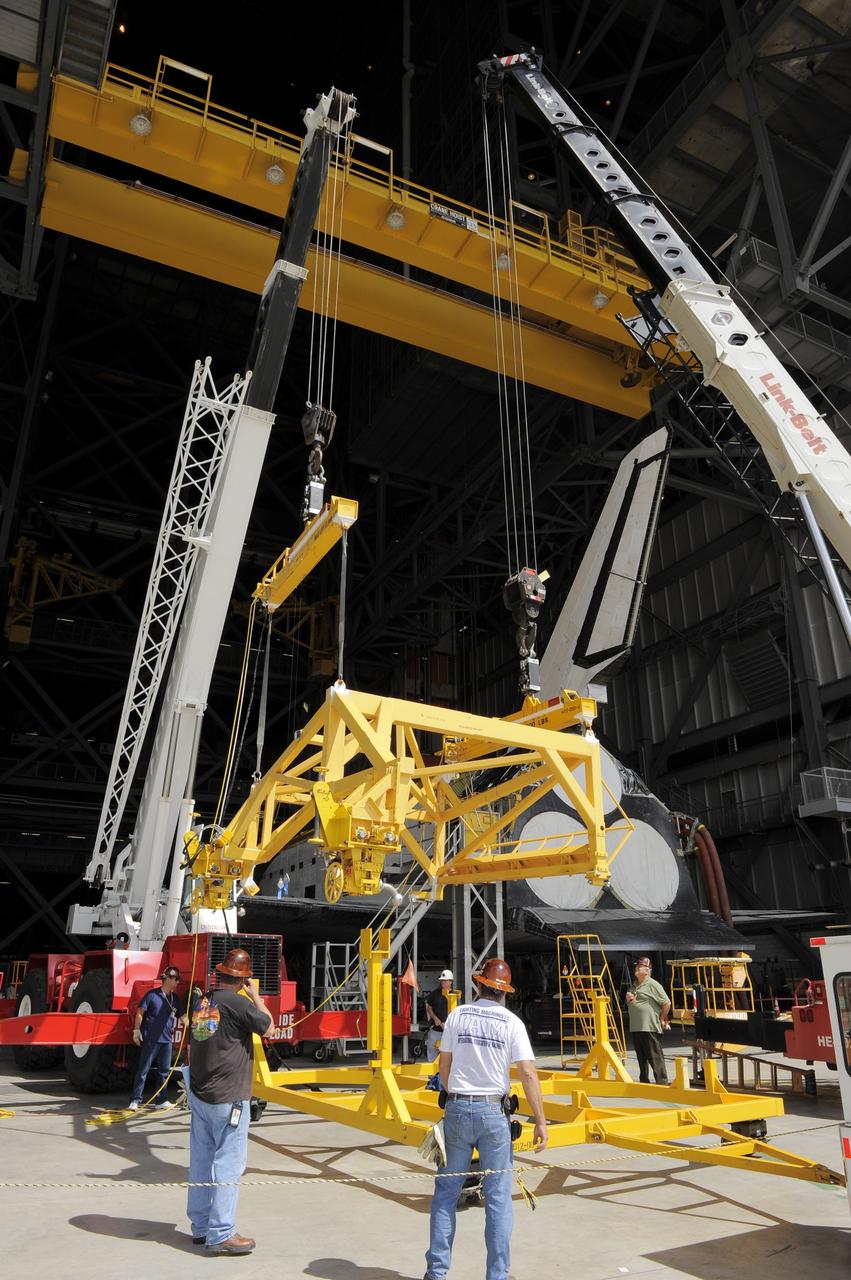
CAPE CANAVERAL, Fla. – In the Vehicle Assembly Building at NASA's Kennedy Space Center in Florida, workers, using overhead cranes, raise a cage which will be placed over an Approach and Landing Test Assembly (ALTA) pod. The ALTA pod will be lifted for attachment to space shuttle Endeavour on the site once housing the orbital maneuvering system (OMS) pod. The demonstration test is being conducted to ensure the center’s equipment will fit into the hangar at the National Air and Space Museum when installing an ALTA pod on shuttle Enterprise. The pod must be reinstalled on a shuttle for transport on a 747 carrier aircraft. The simulation also tests procedures and timelines necessary to carry out the process. The work is part of the Space Shuttle Program’s transition and retirement processing. Enterprise, which was not equipped for space flight, was built as a test vehicle to demonstrate that the orbiter could fly in the atmosphere and land like an airplane. In 1985, Enterprise was ferried from the Kennedy Space Center to Dulles Airport, Washington, D.C., and became the property of the Smithsonian Institute. Enterprise will be moved from the Smithsonian Institution National Air and Space Museum's Steven F. Udvar-Hazy Center in Chantilly, Va., to the Intrepid Sea, Air and Space Museum in New York. For more information, visit http://www.nasa.gov/shuttle. Photo credit: NASA/Ken Shiflett
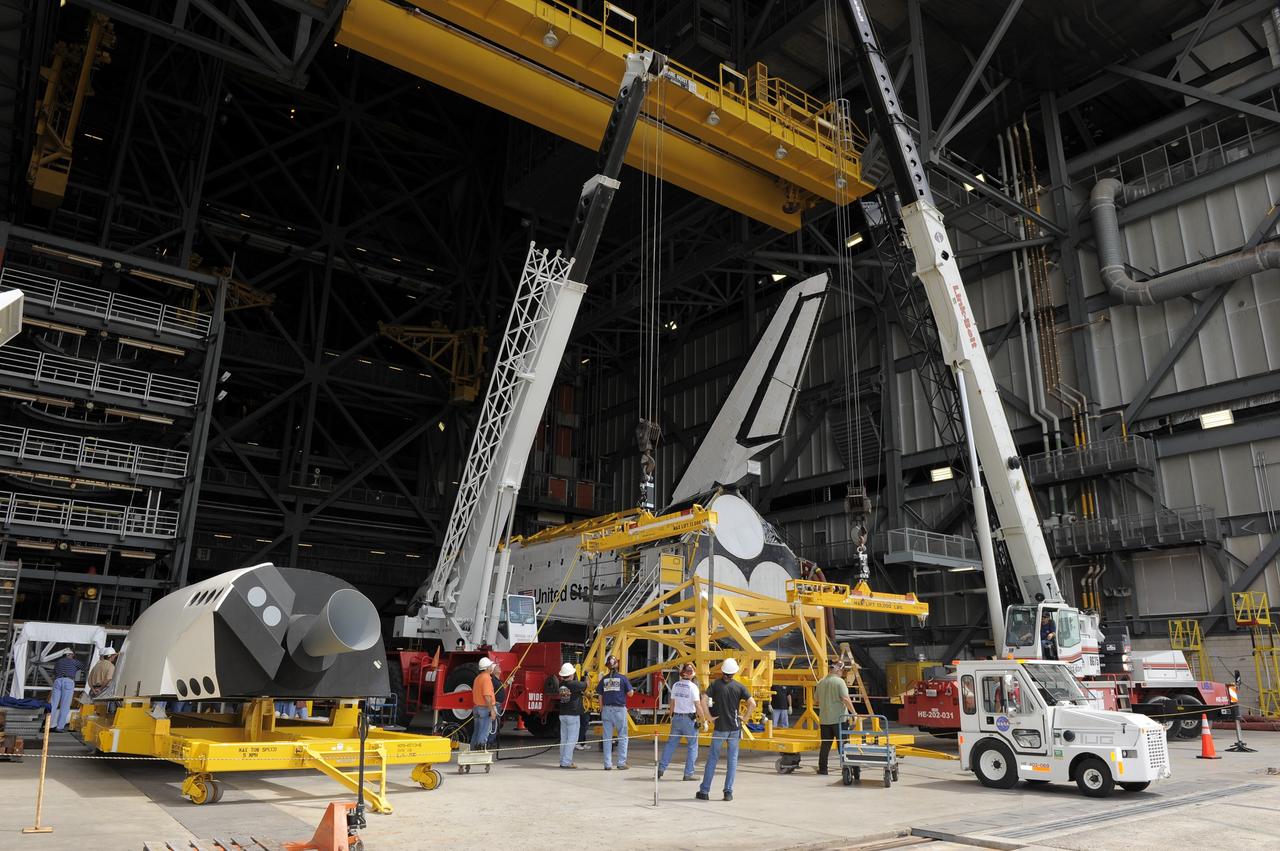
CAPE CANAVERAL, Fla. – In the Vehicle Assembly Building at NASA's Kennedy Space Center in Florida, workers, using overhead cranes, prepare to raise a cage over an Approach and Landing Test Assembly (ALTA) pod (to the left of the photo). The ALTA pod will be lifted for attachment to space shuttle Endeavour on the site once housing the orbital maneuvering system (OMS) pod. The demonstration test is being conducted to ensure the center’s equipment will fit into the hangar at the National Air and Space Museum when installing an ALTA pod on shuttle Enterprise. The pod must be reinstalled on a shuttle for transport on a 747 carrier aircraft. The simulation also tests procedures and timelines necessary to carry out the process. The work is part of the Space Shuttle Program’s transition and retirement processing. Enterprise, which was not equipped for space flight, was built as a test vehicle to demonstrate that the orbiter could fly in the atmosphere and land like an airplane. In 1985, Enterprise was ferried from the Kennedy Space Center to Dulles Airport, Washington, D.C., and became the property of the Smithsonian Institute. Enterprise will be moved from the Smithsonian Institution National Air and Space Museum's Steven F. Udvar-Hazy Center in Chantilly, Va., to the Intrepid Sea, Air and Space Museum in New York. For more information, visit http://www.nasa.gov/shuttle. Photo credit: NASA/Ken Shiflett
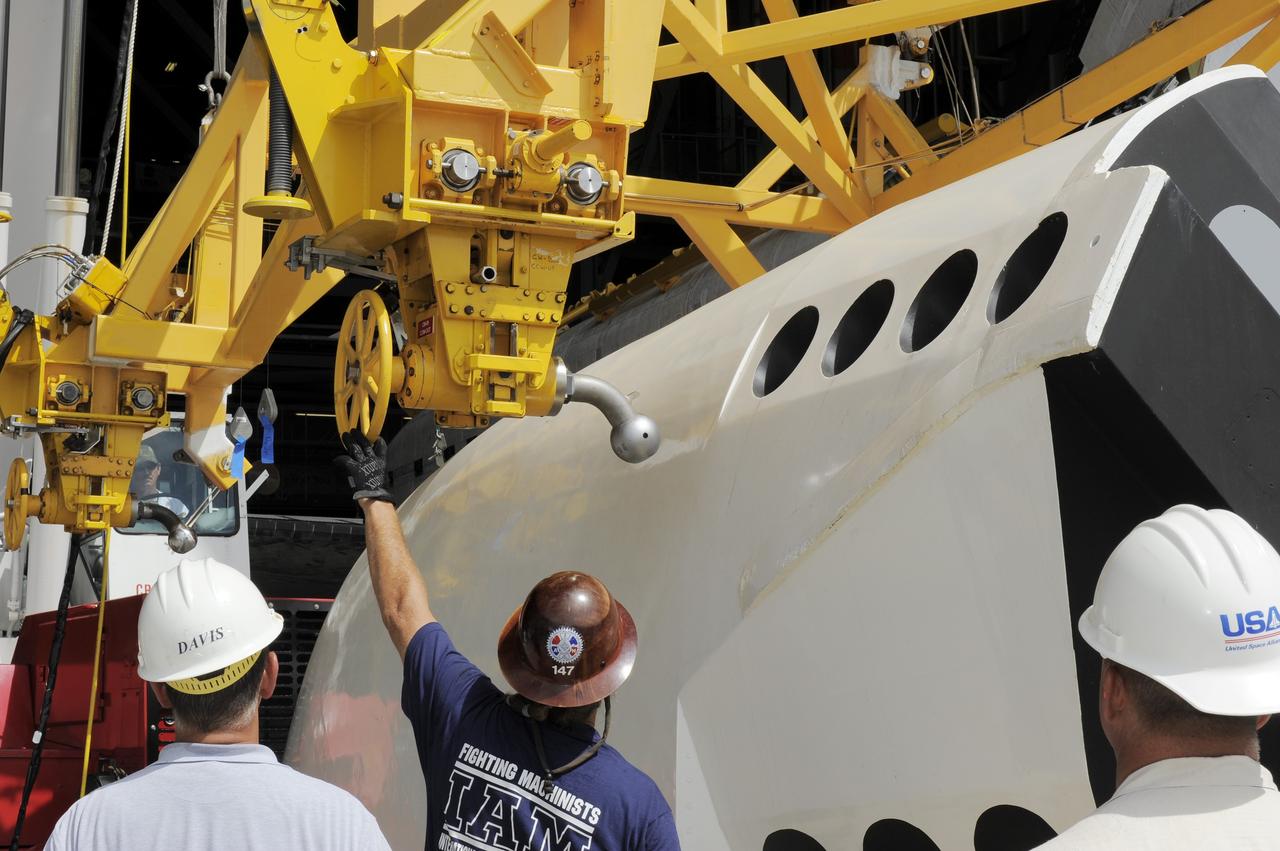
CAPE CANAVERAL, Fla. – In the Vehicle Assembly Building at NASA's Kennedy Space Center in Florida, workers, using overhead cranes, raise a cage over an Approach and Landing Test Assembly (ALTA) pod. The ALTA pod will be lifted for attachment to space shuttle Endeavour on the site once housing the orbital maneuvering system (OMS) pod. The demonstration test is being conducted to ensure the center’s equipment will fit into the hangar at the National Air and Space Museum when installing an ALTA pod on shuttle Enterprise. The pod must be reinstalled on a shuttle for transport on a 747 carrier aircraft. The simulation also tests procedures and timelines necessary to carry out the process. The work is part of the Space Shuttle Program’s transition and retirement processing. Enterprise, which was not equipped for space flight, was built as a test vehicle to demonstrate that the orbiter could fly in the atmosphere and land like an airplane. In 1985, Enterprise was ferried from the Kennedy Space Center to Dulles Airport, Washington, D.C., and became the property of the Smithsonian Institute. Enterprise will be moved from the Smithsonian Institution National Air and Space Museum's Steven F. Udvar-Hazy Center in Chantilly, Va., to the Intrepid Sea, Air and Space Museum in New York. For more information, visit http://www.nasa.gov/shuttle. Photo credit: NASA/Ken Shiflett
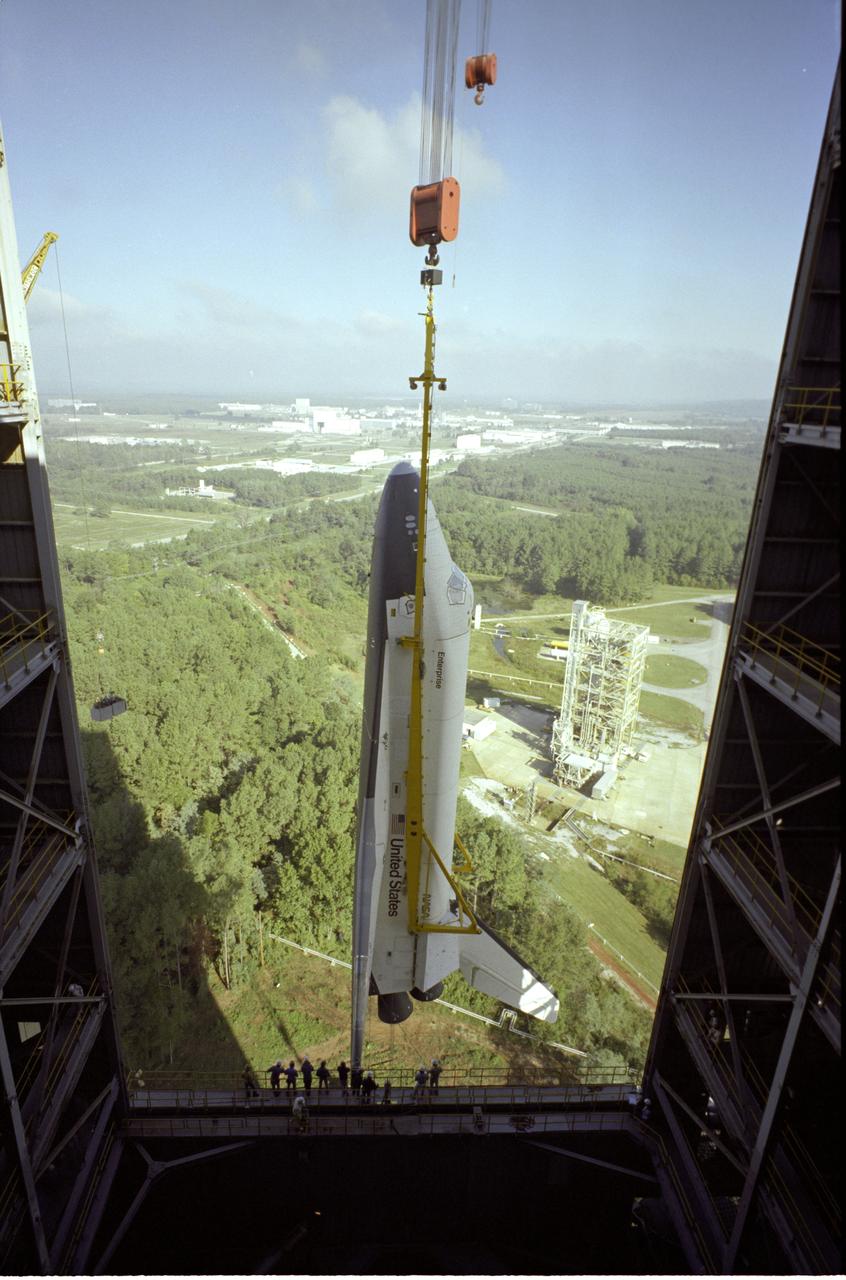
The Shuttle Orbiter Enterprise is being installed into liftoff configuration at Marshall Space Flight Center's Dynamic Test Stand for Mated Vertical Ground Vibration tests (MVGVT). The tests marked the first time ever that the entire shuttle complement (including Orbiter, external tank, and solid rocket boosters) were mated vertically.
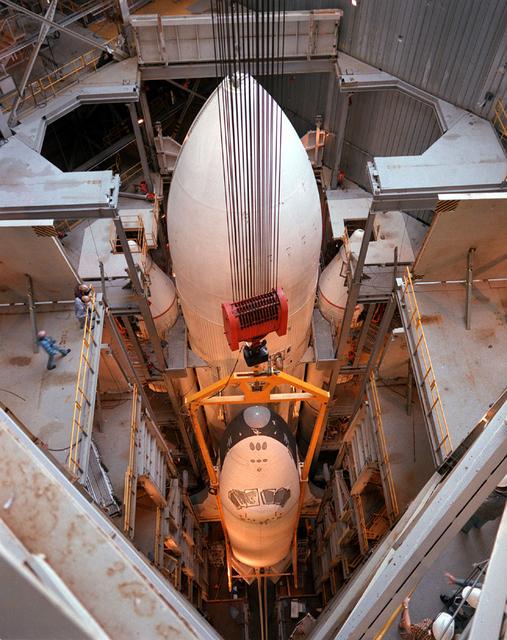
The Shuttle Orbiter Enterprise inside of Marshall Space Flight Center's Dynamic Test Stand for Mated Vertical Ground Vibration tests (MVGVT). The tests marked the first time ever that the entire shuttle complement including Orbiter, external tank, and solid rocket boosters were vertically mated.
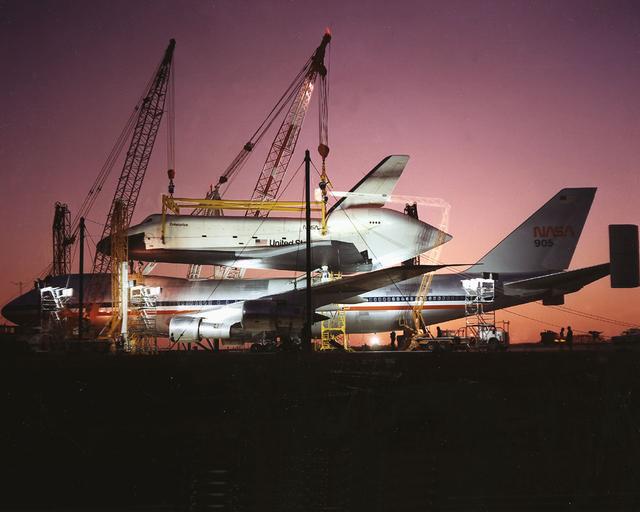
The Shuttle Orbiter Enterprise is off-loaded at Redstone Arsenal Airfield for later Mated Vertical Ground Vibration tests (MVGVT) at Marshall Space Flight Center's Dynamic Test Stand. The tests marked the first time ever that the entire shuttle complement (including orbiter, external tank, and solid rocket boosters) were mated vertically.
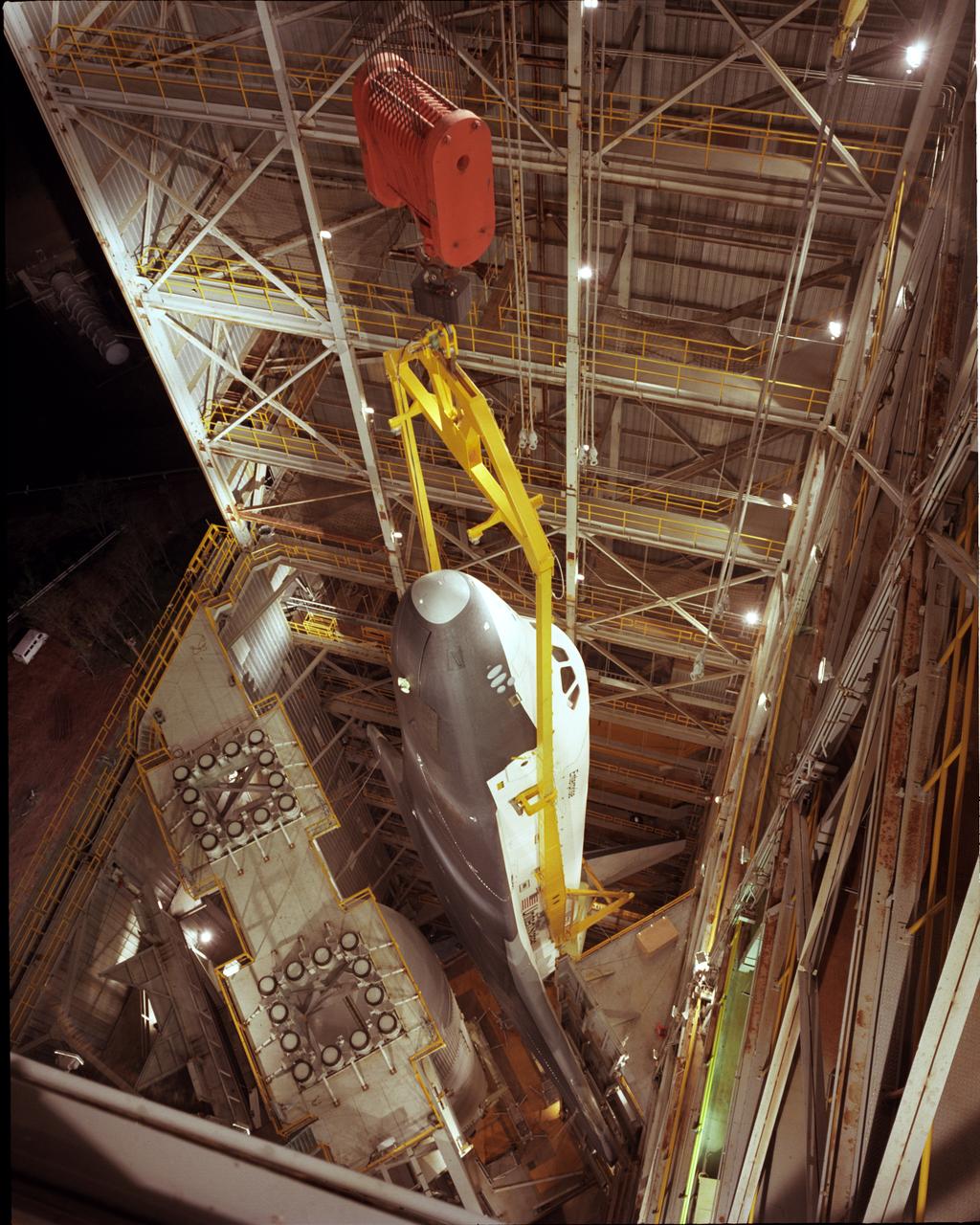
The Shuttle Orbiter Enterprise is lowered into the Dynamic Test Stand for Mated Vertical Ground Vibration tests (MVGVT) at the Marshall Space Flight Center. The tests marked the first time ever that the entire shuttle complement (including Orbiter, external tank, and solid rocket boosters) were mated vertically.
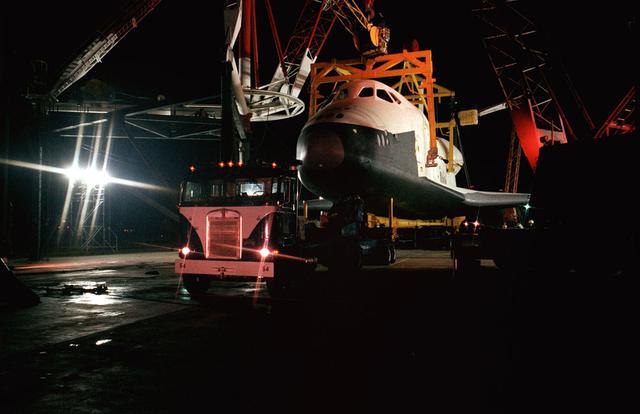
The Shuttle Orbiter Enterprise is off-loaded at Redstone Arsenal Airfield for later Mated Vertical Ground Vibration tests (MVGVT) at Marshall Space Flight Center's Dynamic Test Stand. The tests marked the first time ever that the entire shuttle complement including orbiter, external tank, and solid rocket boosters were vertically mated.
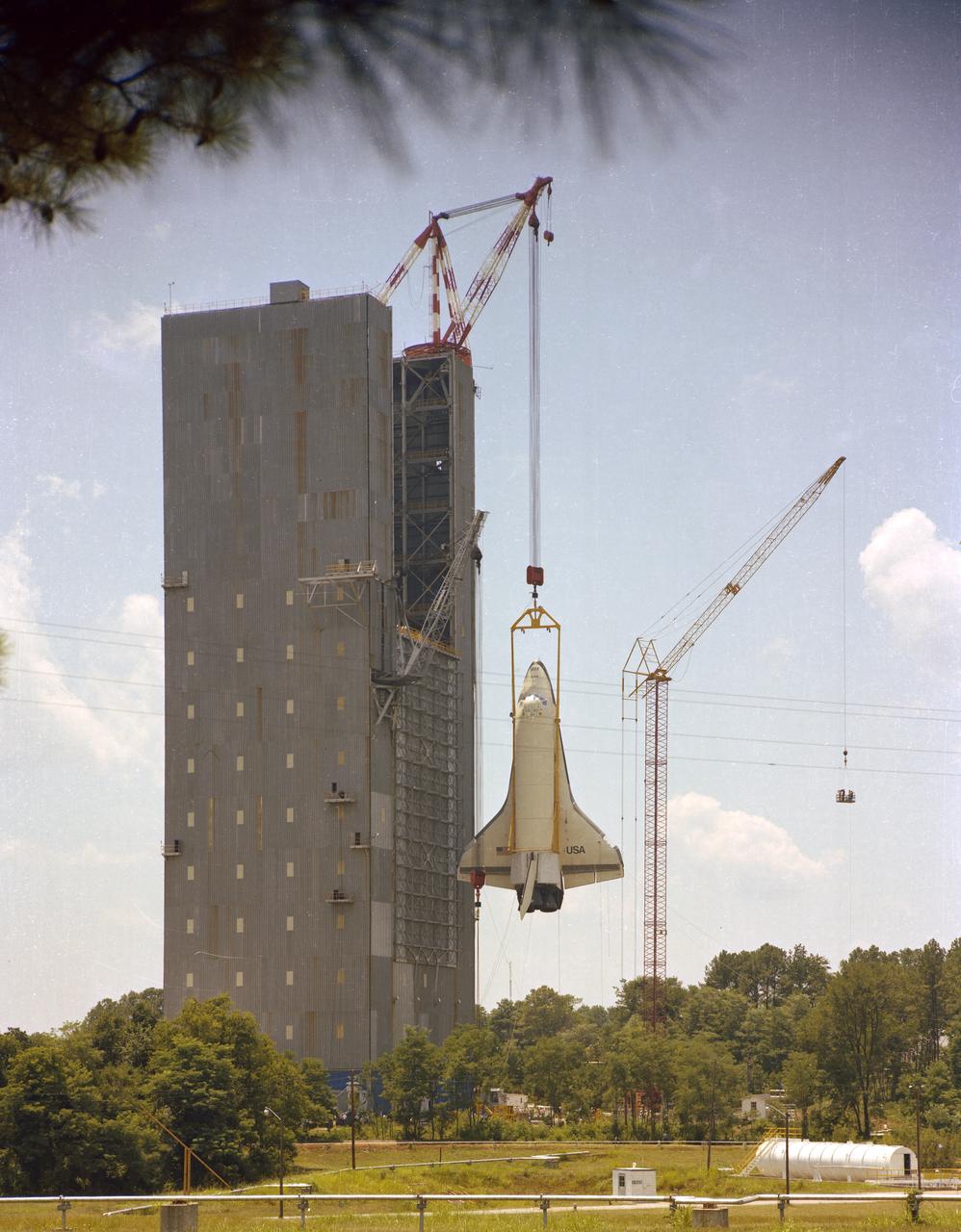
The Shuttle Orbiter Enterprise is removed from Marshall Space Flight Center's Dynamic Test Stand following its first Mated Vertical Ground Vibration test (MVGVT). The tests marked the first time ever that the entire shuttle complement (including Orbiter, external tank, and solid rocket boosters) were mated vertically.