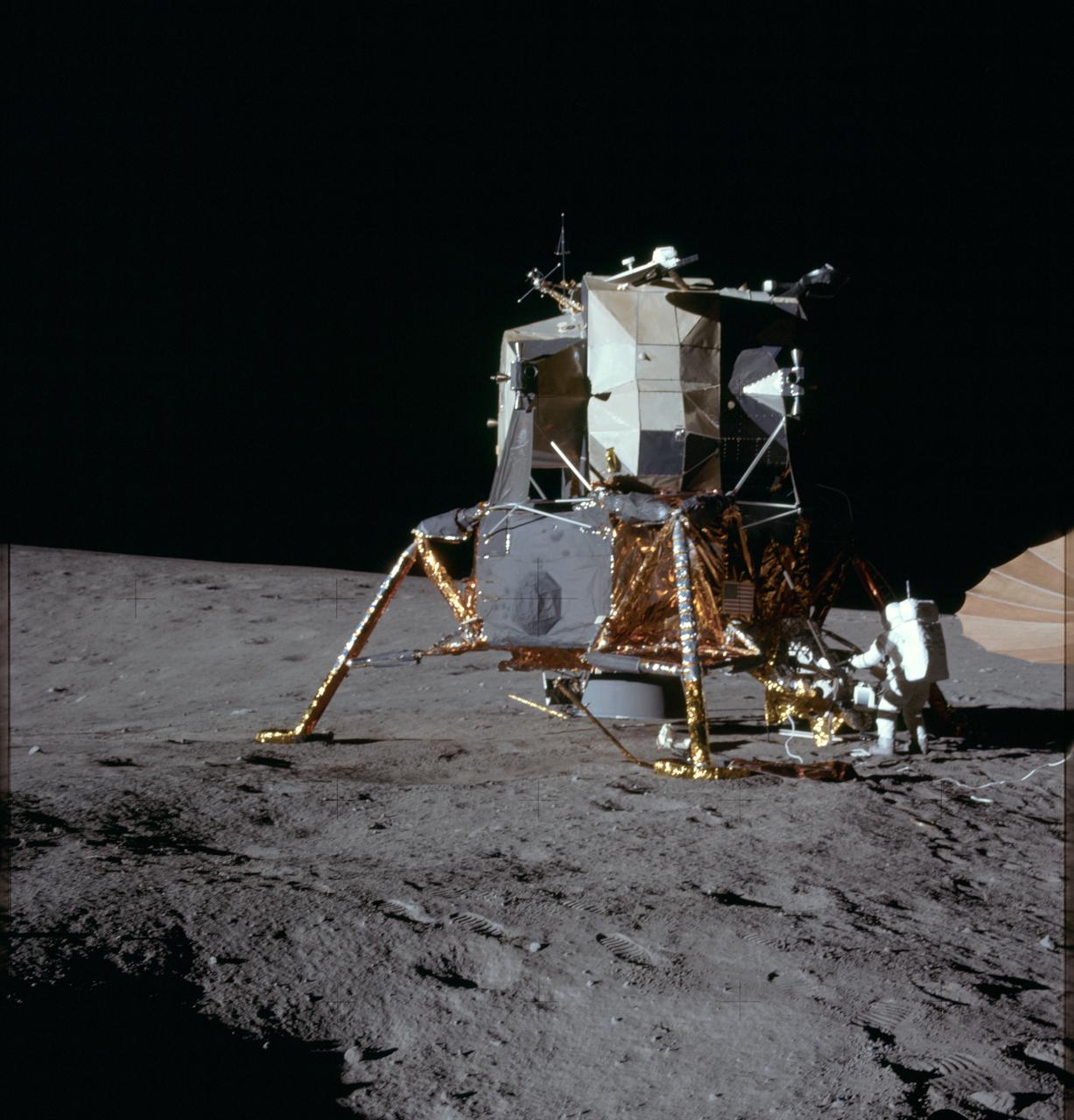
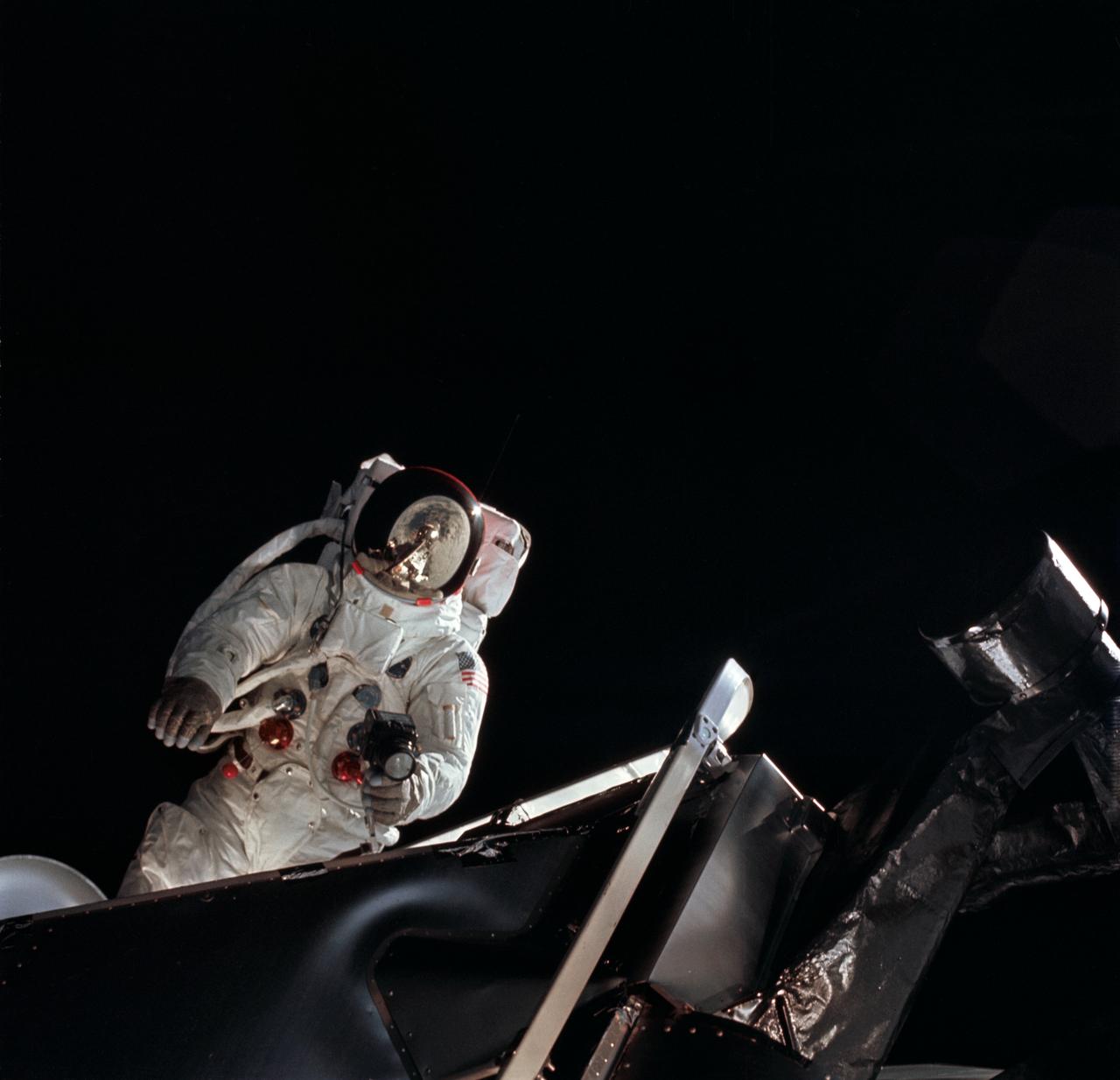
Astronaut Charles Conrad Jr., commander, uses the lunar equipment conveyer (LEC) at the Lunar Module during the Apollo 12 extravehicular activity on the lunar surface. This photograph was taken by Astronaut Alan L. Bean, lunar module pilot.
Astronaut Charles Conrad uses lunar equipment conveyer at Lunar Module
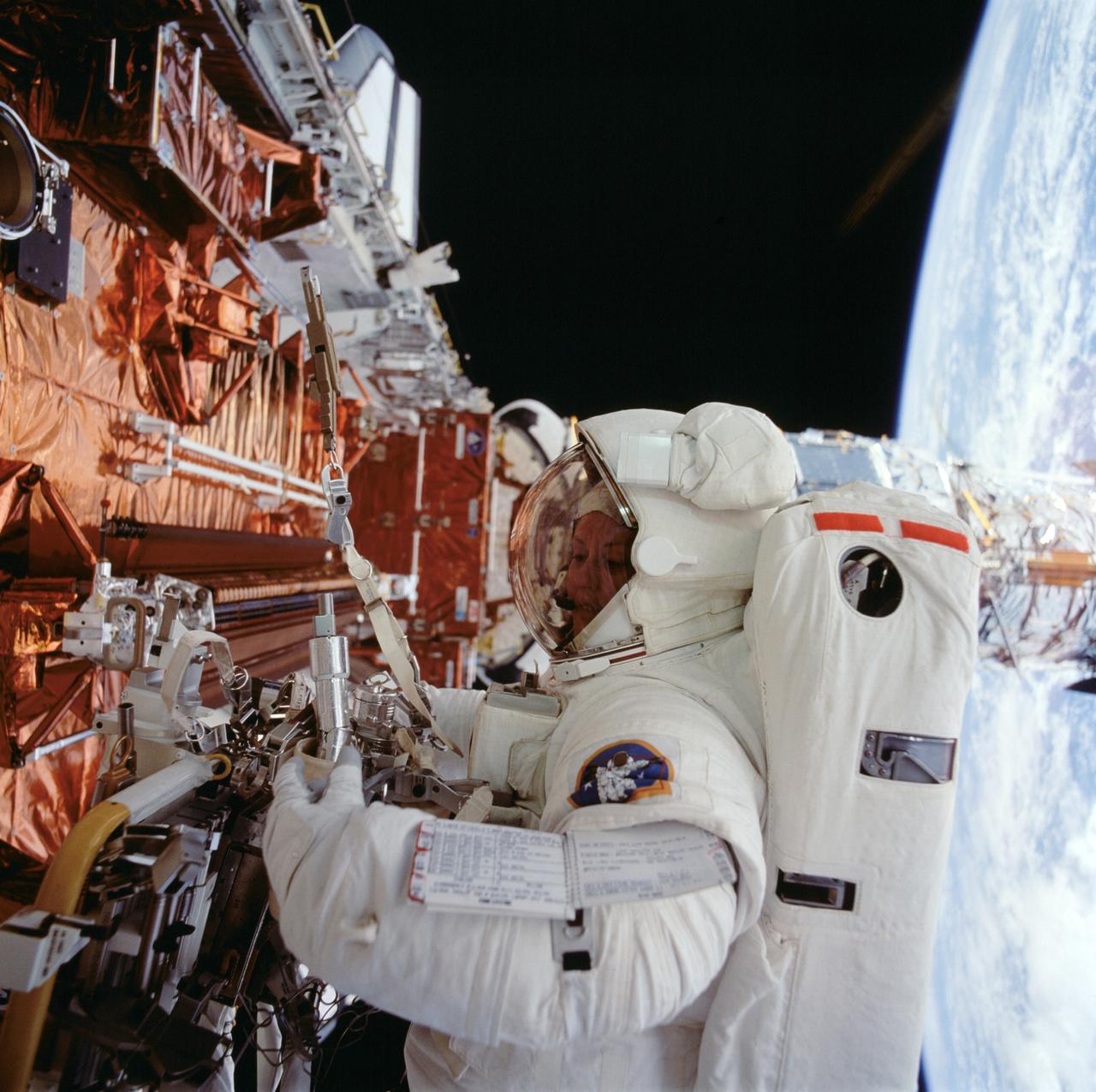
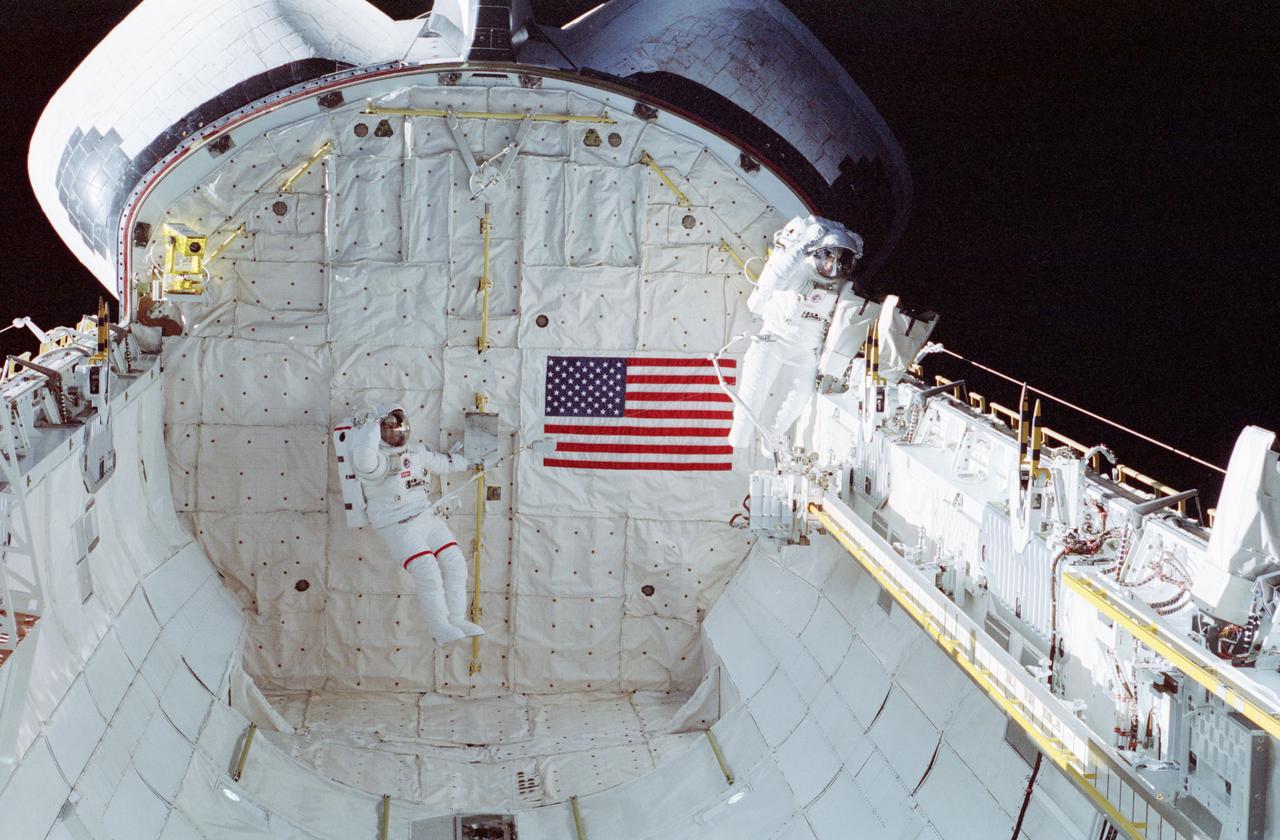
STS061-098-000K (8 Dec. 1993) --- Astronaut Kathryn C. Thornton works with equipment associated with servicing chores on the Hubble Space Telescope (HST) during the fourth extravehicular activity (EVA) on the eleven-day mission.
Astronaut Kathryn Thornton during servicing of HST
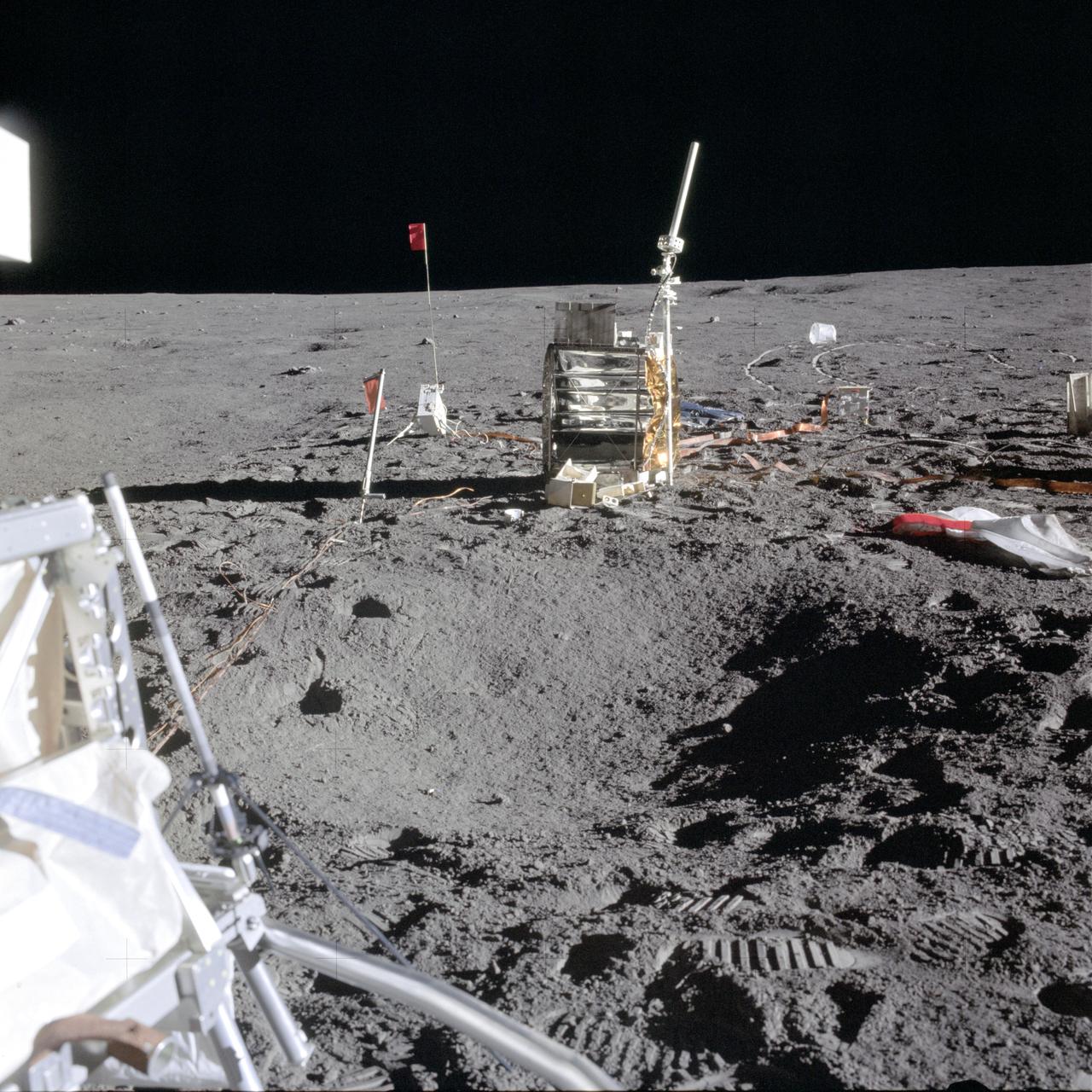
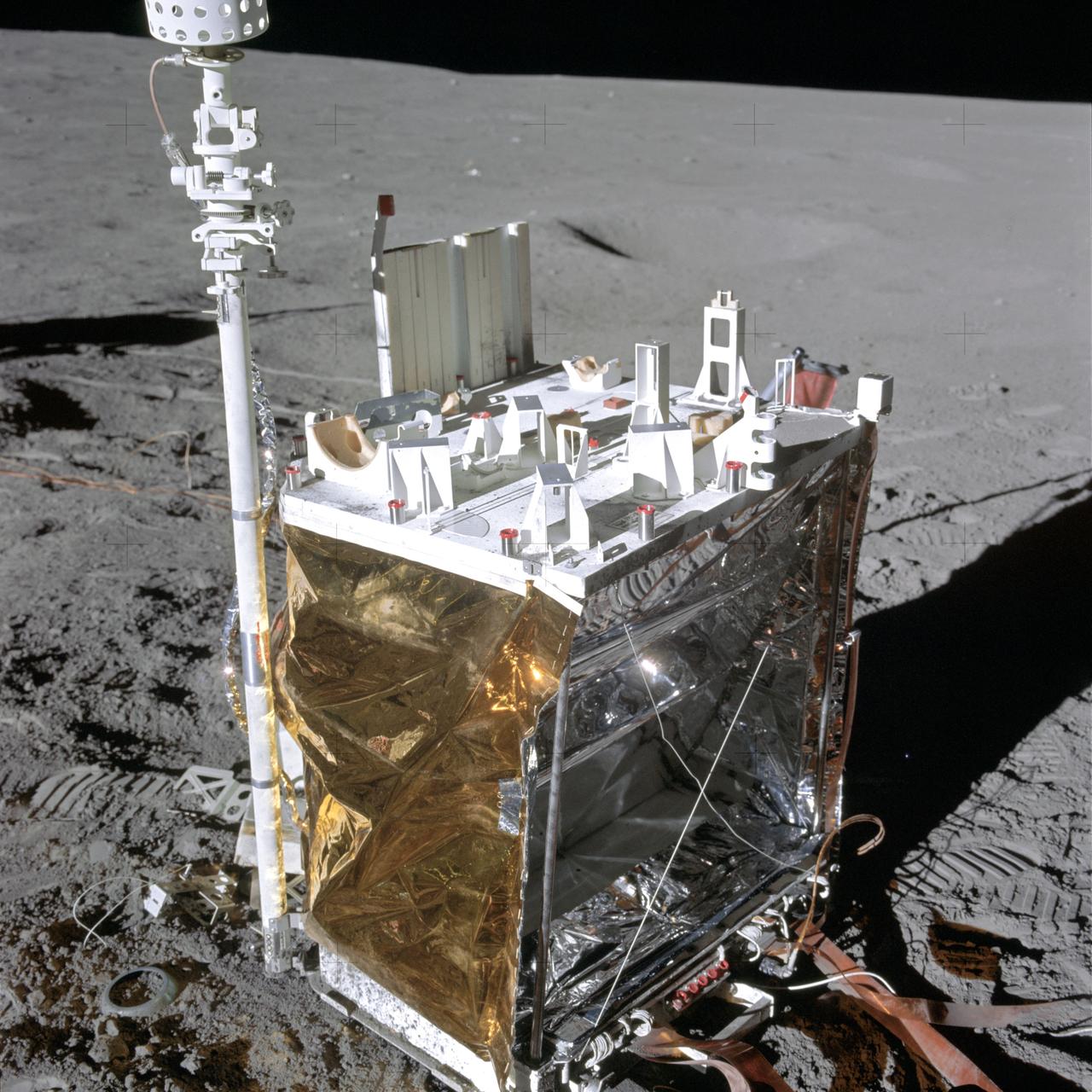
AS14-67-9376 (5 Feb. 1971) --- Several components of the Apollo lunar surface experiments package (ASLEP) are deployed in this photograph taken during the first Apollo 14 extravehicular activity (EVA). The larger object with antenna is the ALSEP central station (CS). The active seismic experiment (ASE) mortar package assembly is to the rear left of the CS. The charged particle lunar environment experiment (CPLEE) is to the right rear of the CS. A portion of the modularized equipment transporter (MET) can be seen in the left foreground.
Components of the ALSEP deployed during Apollo 14 first EVA
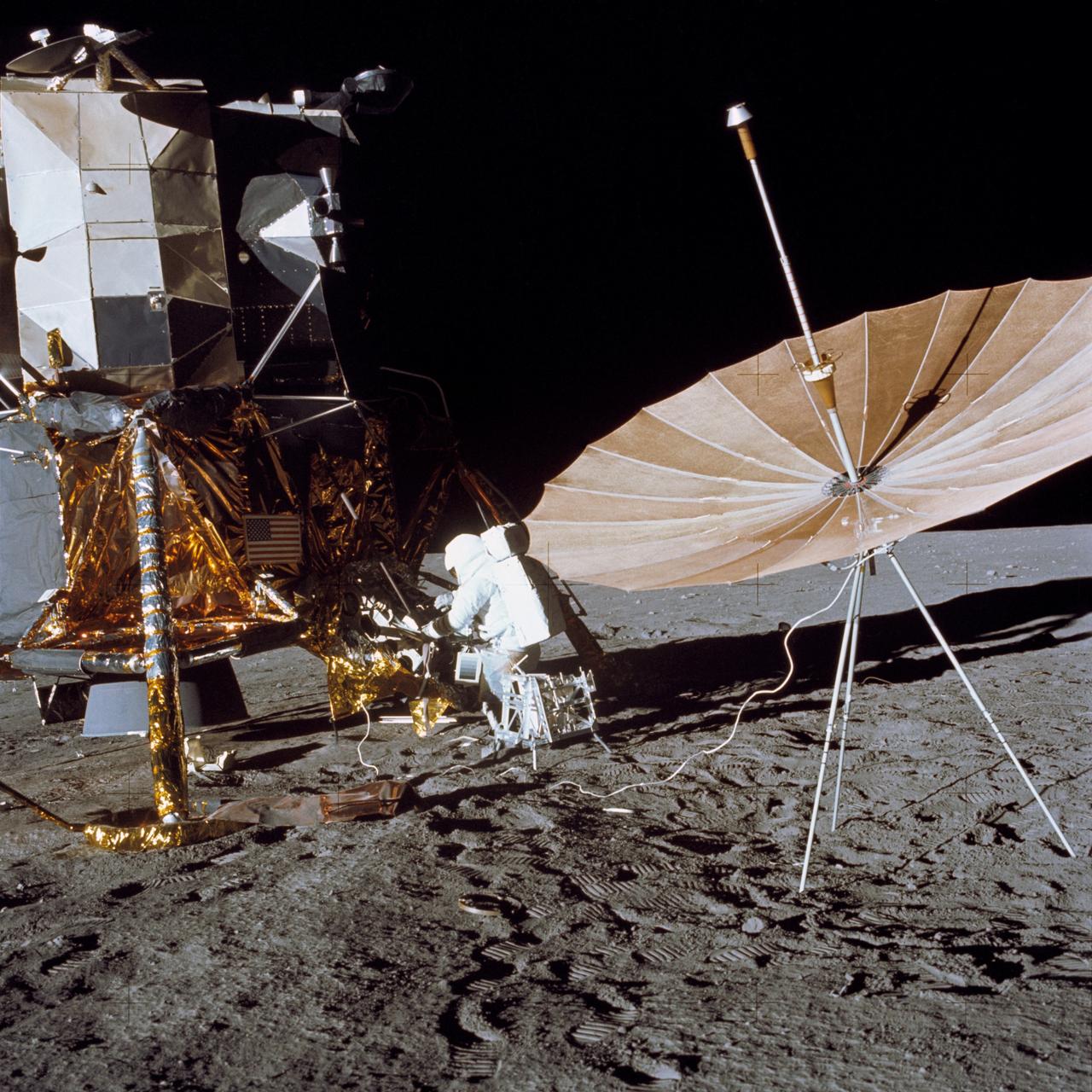
AS12-47-6988 (19 Nov. 1969) --- Astronaut Charles Conrad Jr., commander of the Apollo 12 lunar landing mission, stands at the Module Equipment Stowage Assembly (MESA) on the Lunar Module (LM) following the first Apollo 12 extravehicular activity (EVA) on the lunar surface. The erectable S-band antenna is already deployed at right. The carrier for the Apollo Lunar Hand Tools (ALHT) is near Conrad. While astronauts Conrad and Alan L. Bean, lunar module pilot, descended in the LM to explore the lunar surface, astronaut Richard F. Gordon Jr., command module pilot, remained with the Command and Service Modules (CSM) in lunar orbit.
Astronaut Charles Conrad stands at Modular Equipment Stowage Assemble
AS12-46-6749 (19 Nov. 1969) --- Astronaut Alan L. Bean, lunar module pilot for the Apollo 12 lunar landing mission, works at the Modular Equipment Stowage Assembly (MESA) on the Apollo 12 Lunar Module (LM) during the mission's first extravehicular activity, (EVA) on Nov. 19, 1969. Astronaut Charles Conrad Jr., commander, and Bean descended in the Apollo 12 LM to explore the moon while astronaut Richard F. Gordon Jr., command module pilot, remained with the Command and Service Modules (CSM) in lunar orbit.
Astronaut Alan Bean works on Modular Equipment Stowage Assembly
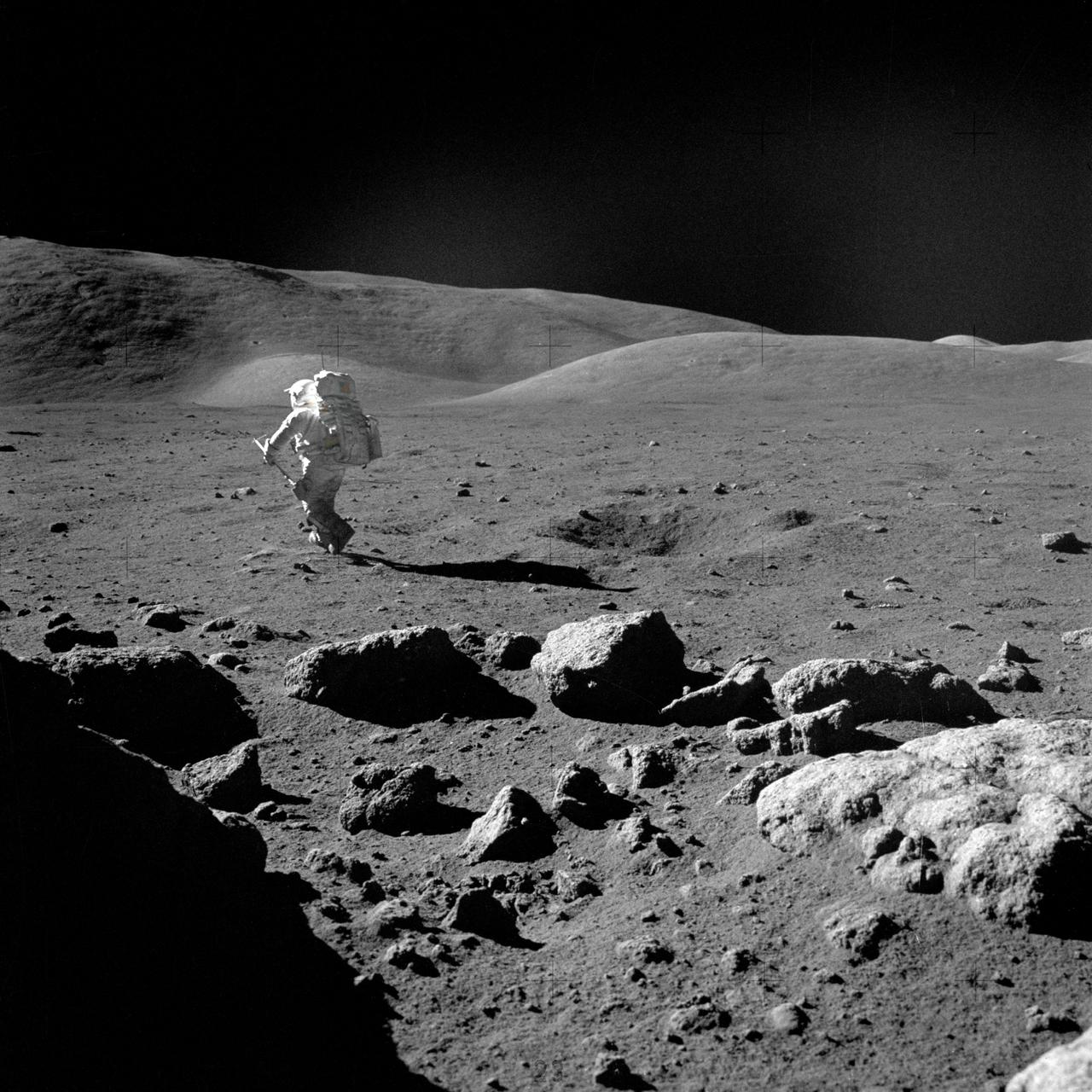
AS17-145-22165 (12 Dec. 1972) --- Scientist-astronaut Harrison H. Schmitt, lunar module pilot, with his adjustable sampling scoop, heads for a selected rock on the lunar surface to retrieve the sample for study. The action was photographed by Apollo 17 crew commander, astronaut Eugene A. Cernan on the mission's second extravehicular activity (EVA), at Station 5 at the Taurus-Littrow landing site. Cernan used a 70mm Hasselblad camera equipped with a 60mm lens and type SO-368 color film for this photograph. While astronauts Cernan and Schmitt descended in the Lunar Module (LM) "Challenger" to explore the Taurus-Littrow region of the moon, astronaut Ronald E. Evans, command module pilot, remained with the Command and Service Modules (CSM) "America" in lunar orbit.
Astronaut Harrison Schmitt retrieving lunar samples during EVA
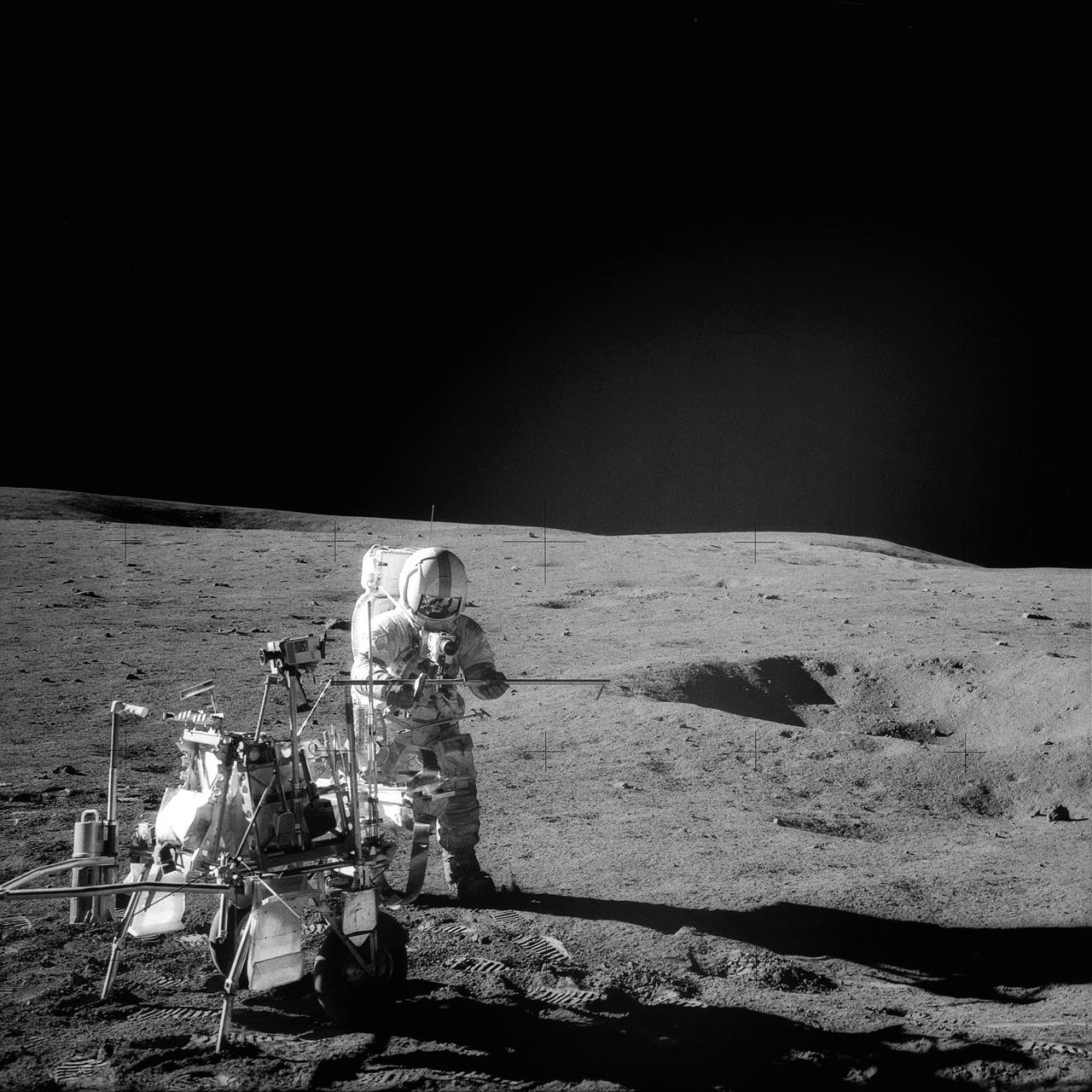
AS14-68-9405 (6 Feb. 1971) --- Astronaut Alan B. Shepard Jr., Apollo 14 commander, assembles a double core tube as he stands beside the rickshaw-type portable workbench or modularized equipment transporter (MET) unique to this mission. The photograph was taken by astronaut Edgar D. Mitchell, lunar module pilot, standing some 170 meters northeast of the Lunar Module (LM), during the mission's second extravehicular activity (EVA) on Feb. 6, 1971. While astronauts Shepard and Mitchell descended in the LM "Antares" to explore the Fra Mauro region of the moon, astronaut Stuart A. Roosa, command module pilot, remained with the Command and Service Modules (CSM) "Kitty Hawk" in lunar orbit.
View of the Central Station of the ALSEP deploy by Apollo 14 astronauts
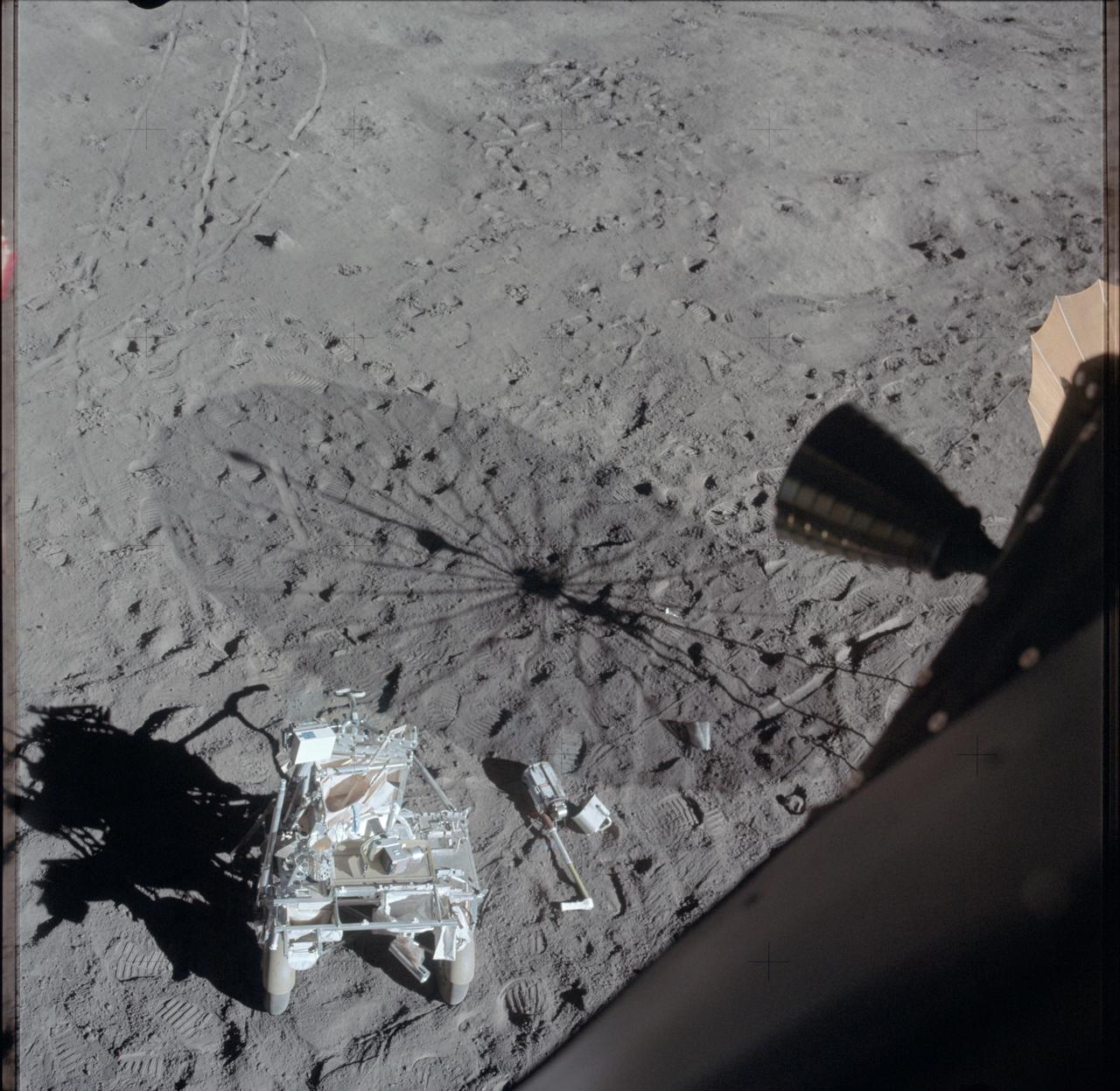
AS14-66-9340 (6 Feb. 1971) --- A view from inside the Lunar Module (LM) following the second Apollo 14 extravehicular activity (EVA). At the left foreground is the modularized equipment transporter (MET). Tracks made by the two-wheeled "Rickshaw"-type cart can be seen in the left background. The Apollo 35mm stereo close-up camera lies next to the MET, near a huge shadow of the erectable S-Band antenna. The area is largely covered with bootprints made by astronauts Alan B. Shepard Jr., commander, and Edgar D. Mitchell, lunar module pilot. While the pair explored the moon, astronaut Stuart A. Roosa, command module pilot, remained with the Command and Service Modules (CSM) in lunar orbit.
View of lunar surface from the inside of the Apollo 14 Lunar Module
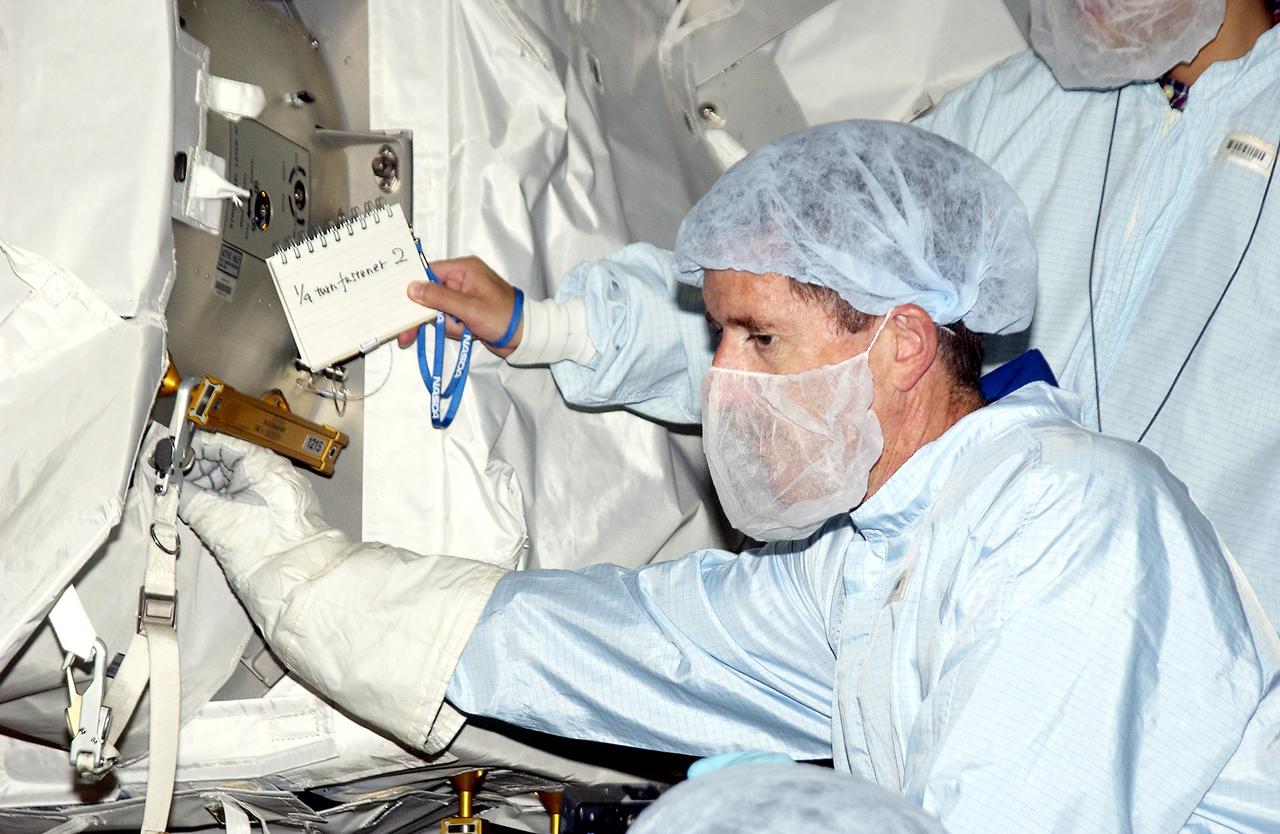
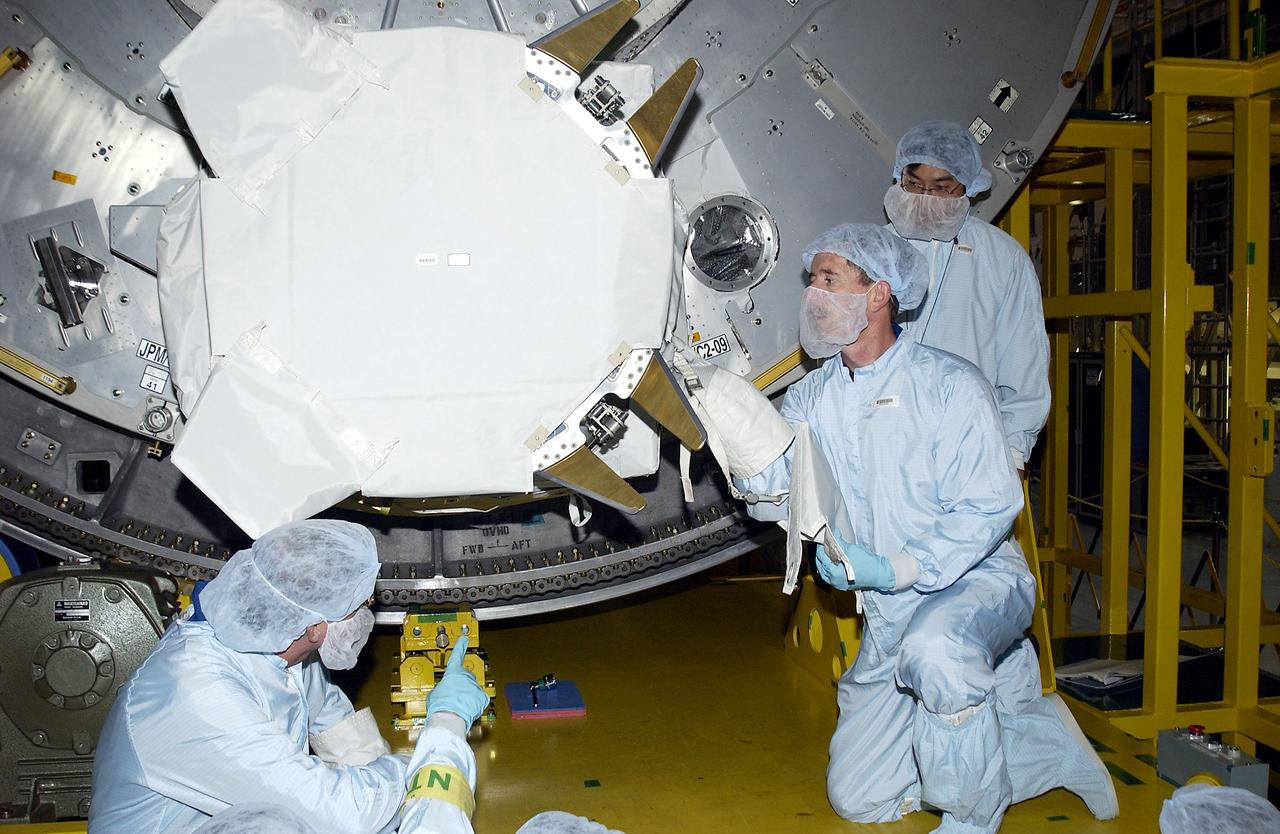
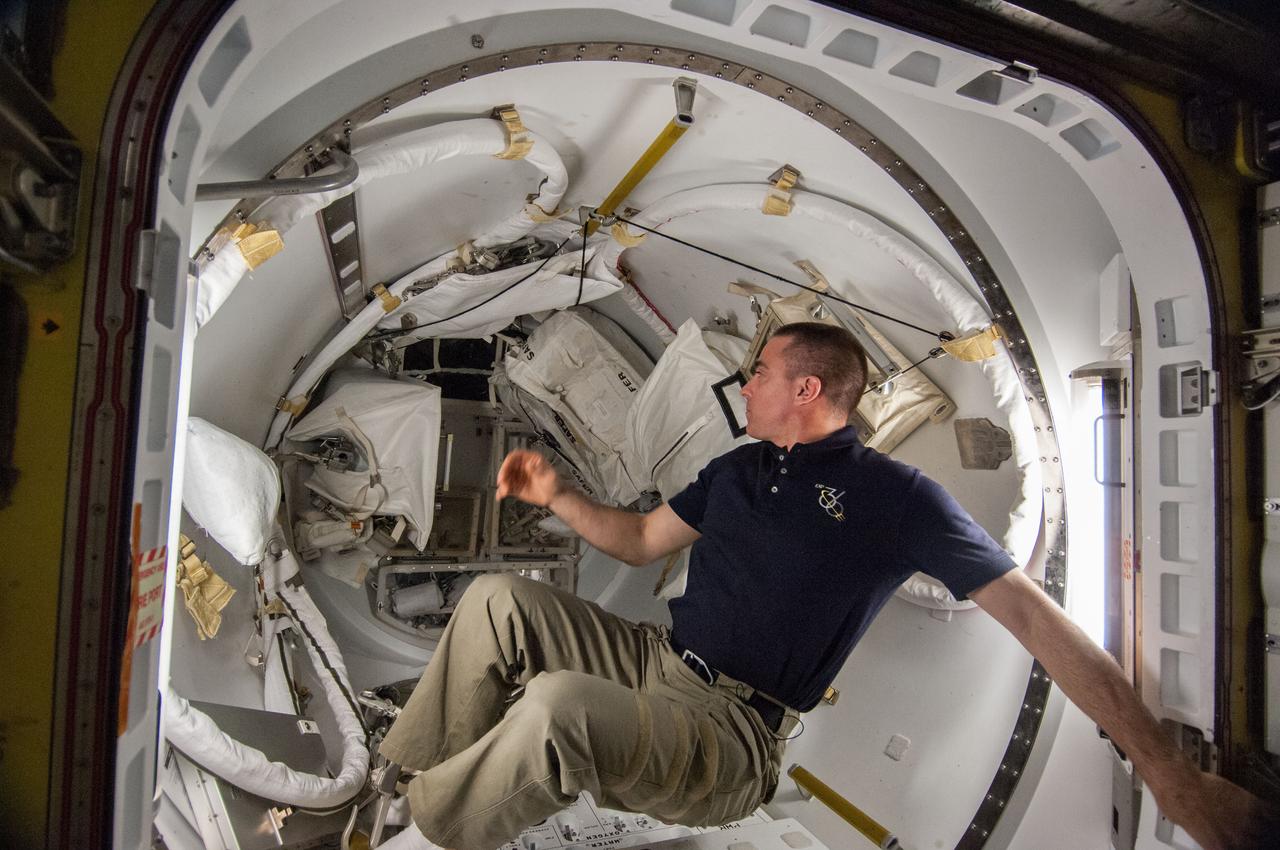
KENNEDY SPACE CENTER, FLA. - In the Space Station Processing Facility, STS-117 Mission Specialist James Reilly  works with equipment in the Japanese Experiment Module (JEM) as part of training for ExtraVehicular Activity (EVA).  Equipment familiarization is a routine part of astronaut training and launch preparations.
KENNEDY SPACE CENTER, FLA. - In the Space Station Processing Facility, STS-117 Mission Specialist James Reilly works with equipment in the Japanese Experiment Module (JEM) as part of training for ExtraVehicular Activity (EVA). Equipment familiarization is a routine part of astronaut training and launch preparations.
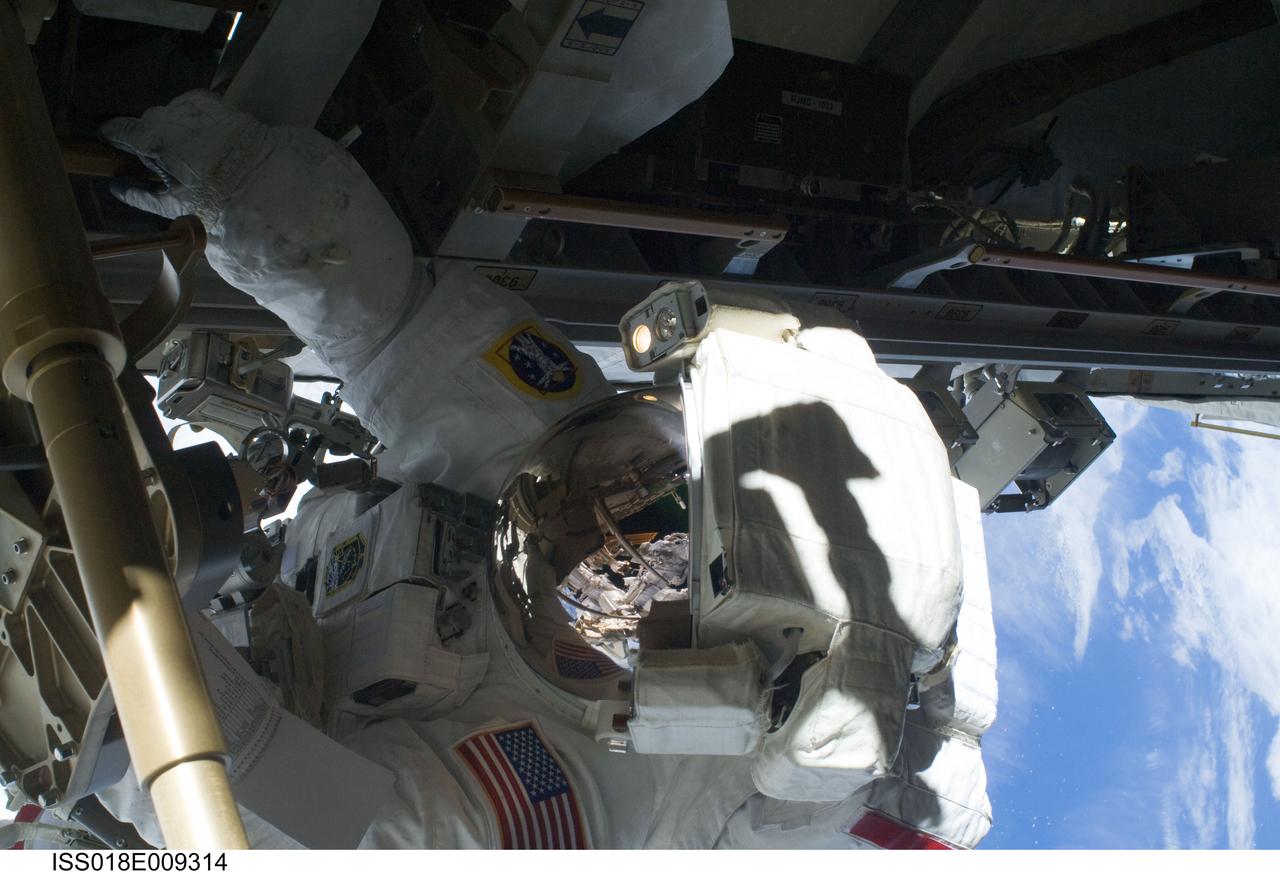
ISS018-E-009314 (20 Nov. 2008) --- Astronaut Shane Kimbrough, STS-126 mission specialist, participates in the mission's second scheduled session of extravehicular activity (EVA) as construction and maintenance continue on the International Space Station. During the six-hour, 45-minute spacewalk, Kimbrough and astronaut Heidemarie Stefanyshyn-Piper (out of frame), mission specialist, continued the process of removing debris and applying lubrication around the starboard Solar Alpha Rotary Joint (SARJ), replaced four more of the SARJ's 12 trundle bearing assemblies, relocated two equipment carts and applied lubrication to the station's robotic Canadarm2.
Expedition 18 STS-126 extravehicular activity (EVA) 2 crew and equipment translation assembly (CETA) Cart Relocation
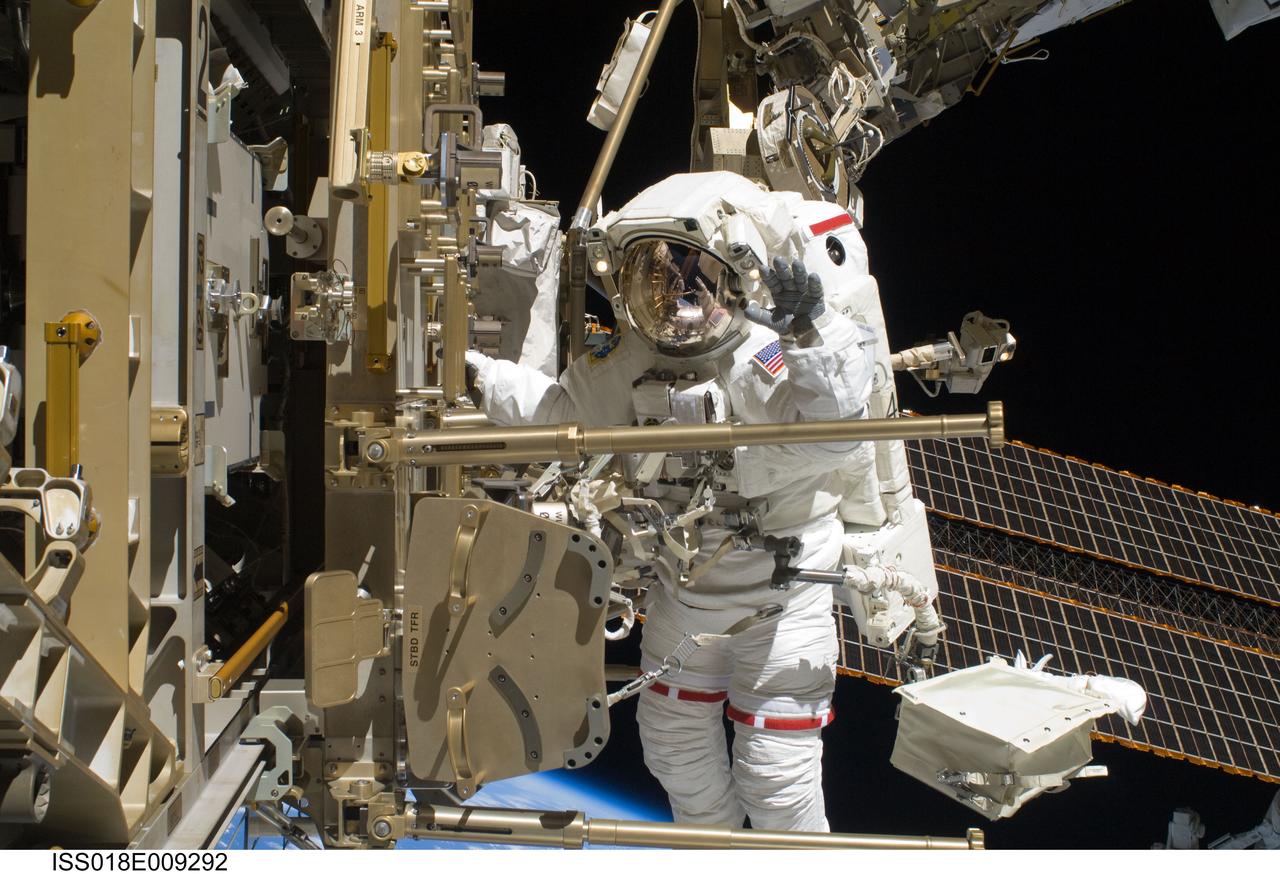
ISS018-E-009292 (20 Nov. 2008) --- Astronaut Shane Kimbrough, STS-126 mission specialist, participates in the mission's second scheduled session of extravehicular activity (EVA) as construction and maintenance continue on the International Space Station. During the six-hour, 45-minute spacewalk, Kimbrough and astronaut Heidemarie Stefanyshyn-Piper (out of frame), mission specialist, continued the process of removing debris and applying lubrication around the starboard Solar Alpha Rotary Joint (SARJ), replaced four more of the SARJ's 12 trundle bearing assemblies, relocated two equipment carts and applied lubrication to the station's robotic Canadarm2.
Expedition 18 STS-126 extravehicular activity (EVA) 2 crew and equipment translation assembly (CETA) Cart Relocation
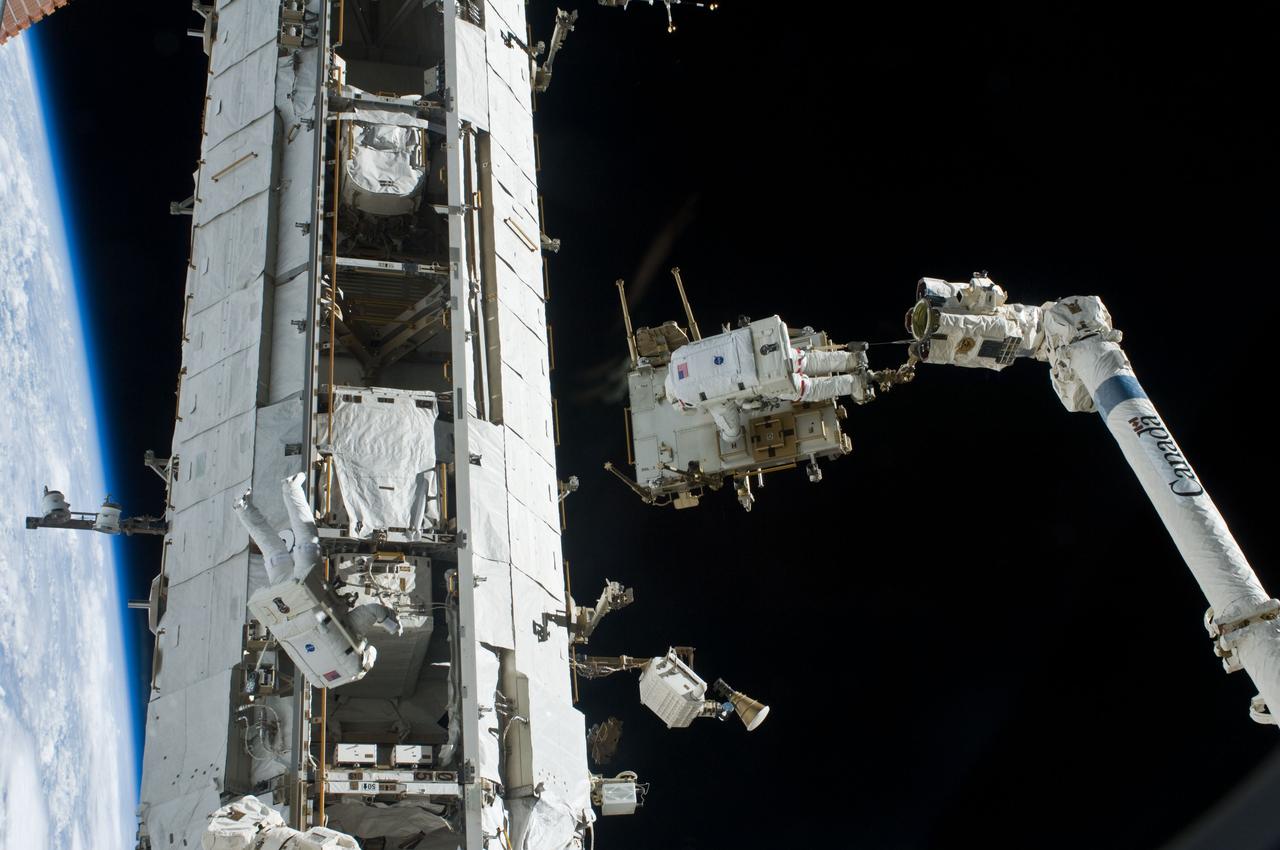
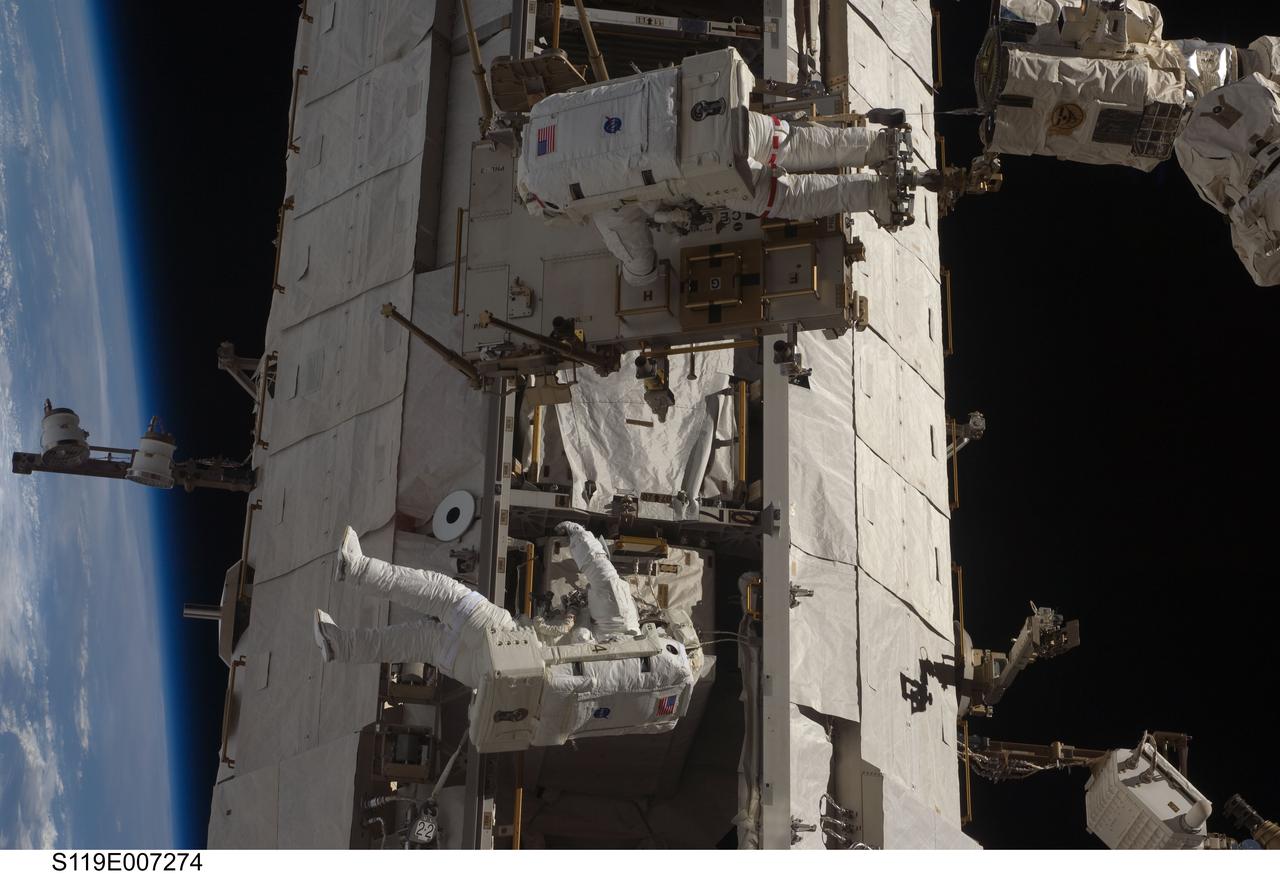
S119-E-007274 (23 March 2009) --- Astronauts Richard Arnold (bottom) and Joseph Acaba, both STS-119 mission specialists, participate in the mission's third scheduled session of extravehicular activity (EVA) as construction and maintenance continue on the International Space Station. During the six-hour, 27-minute spacewalk, Arnold and Acaba helped robotic arm operators relocate the Crew Equipment Translation Aid (CETA) cart from the Port 1 to Starboard 1 truss segment, installed a new coupler on the CETA cart, lubricated snares on the "B" end of the space station's robotic arm and performed a few "get ahead" tasks.
STS-119 Extravehicular Activity (EVA) 3 Crew and Equipment Translation Aid (CETA) Cart 2 Relocate OPS
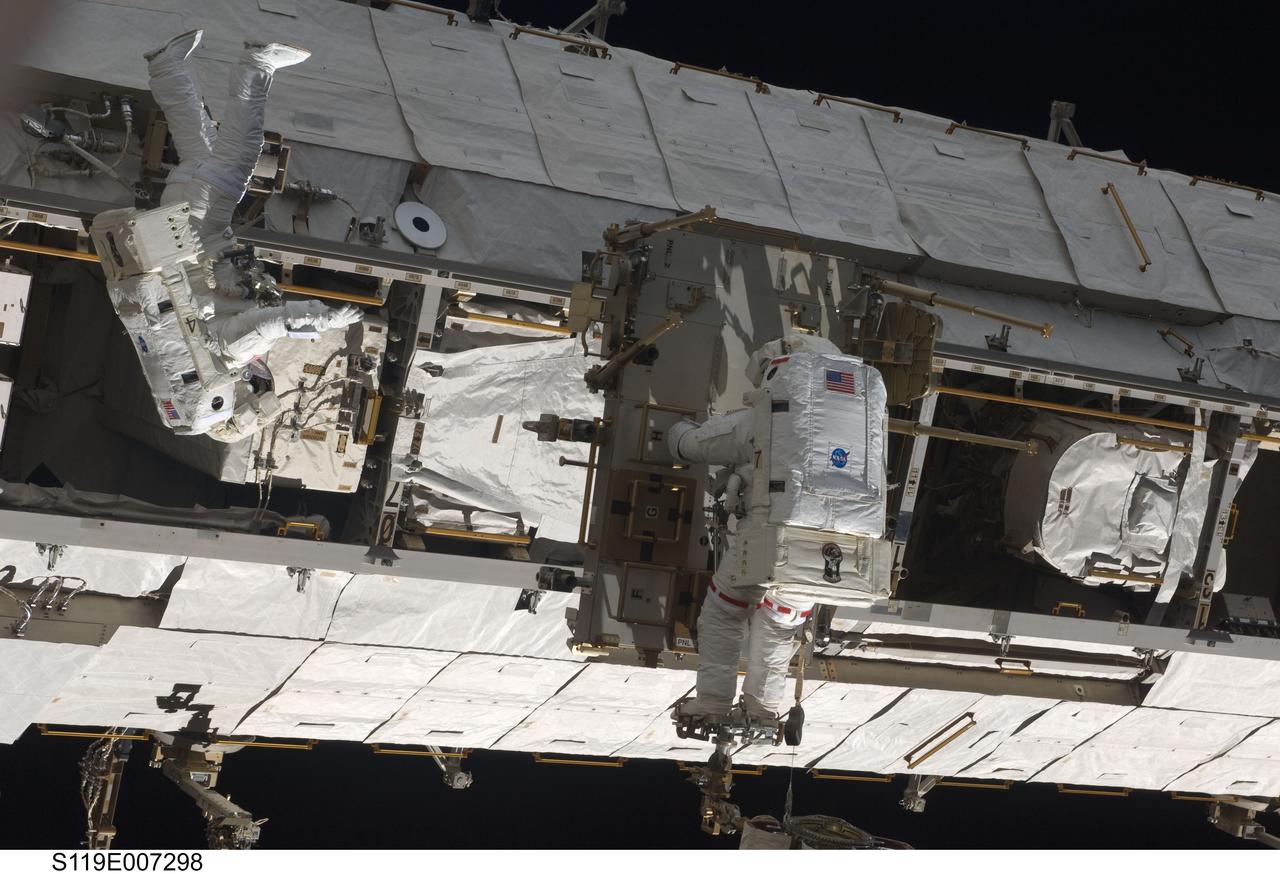
S119-E-007298 (23 March 2009) --- Astronauts Richard Arnold (left) and Joseph Acaba, both STS-119 mission specialists, participate in the mission's third scheduled session of extravehicular activity (EVA) as construction and maintenance continue on the International Space Station. During the six-hour, 27-minute spacewalk, Arnold and Acaba helped robotic arm operators relocate the Crew Equipment Translation Aid (CETA) cart from the Port 1 to Starboard 1 truss segment, installed a new coupler on the CETA cart, lubricated snares on the "B" end of the space station's robotic arm and performed a few "get ahead" tasks.
STS-119 Extravehicular Activity (EVA) 3 Crew and Equipment Translation Aid (CETA) Cart 2 Relocate OPS
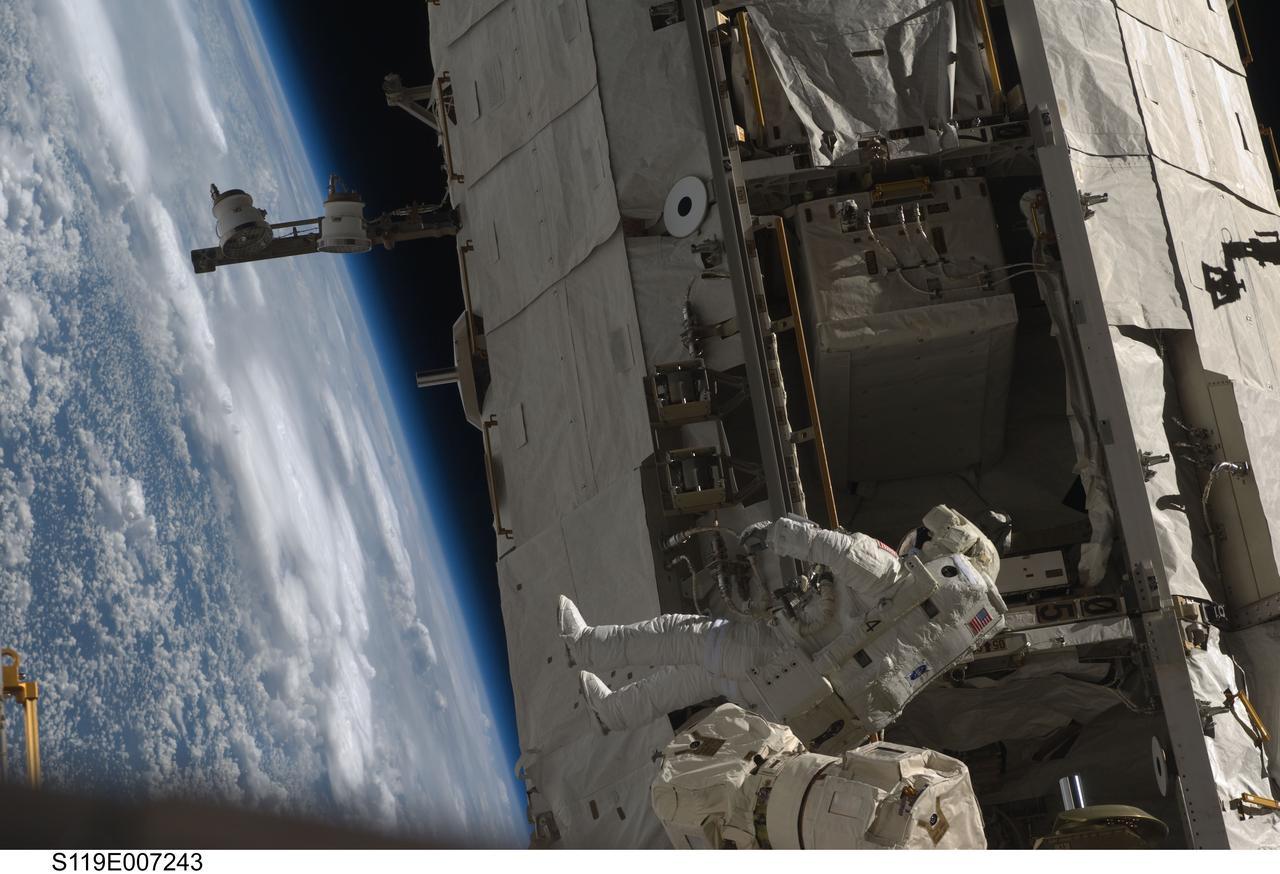
S119-E-007243 (23 March 2009) --- Astronaut Richard Arnold, STS-119 mission specialist, participates in the mission's third scheduled session of extravehicular activity (EVA) as construction and maintenance continue on the International Space Station. During the six-hour, 27-minute spacewalk, Arnold and Joseph Acaba (out of frame), mission specialist, helped robotic arm operators relocate the Crew Equipment Translation Aid (CETA) cart from the Port 1 to Starboard 1 truss segment, installed a new coupler on the CETA cart, lubricated snares on the "B" end of the space station's robotic arm and performed a few "get ahead" tasks.
STS-119 Extravehicular Activity (EVA) 3 Crew and Equipment Translation Aid (CETA) Cart 2 Relocate OPS
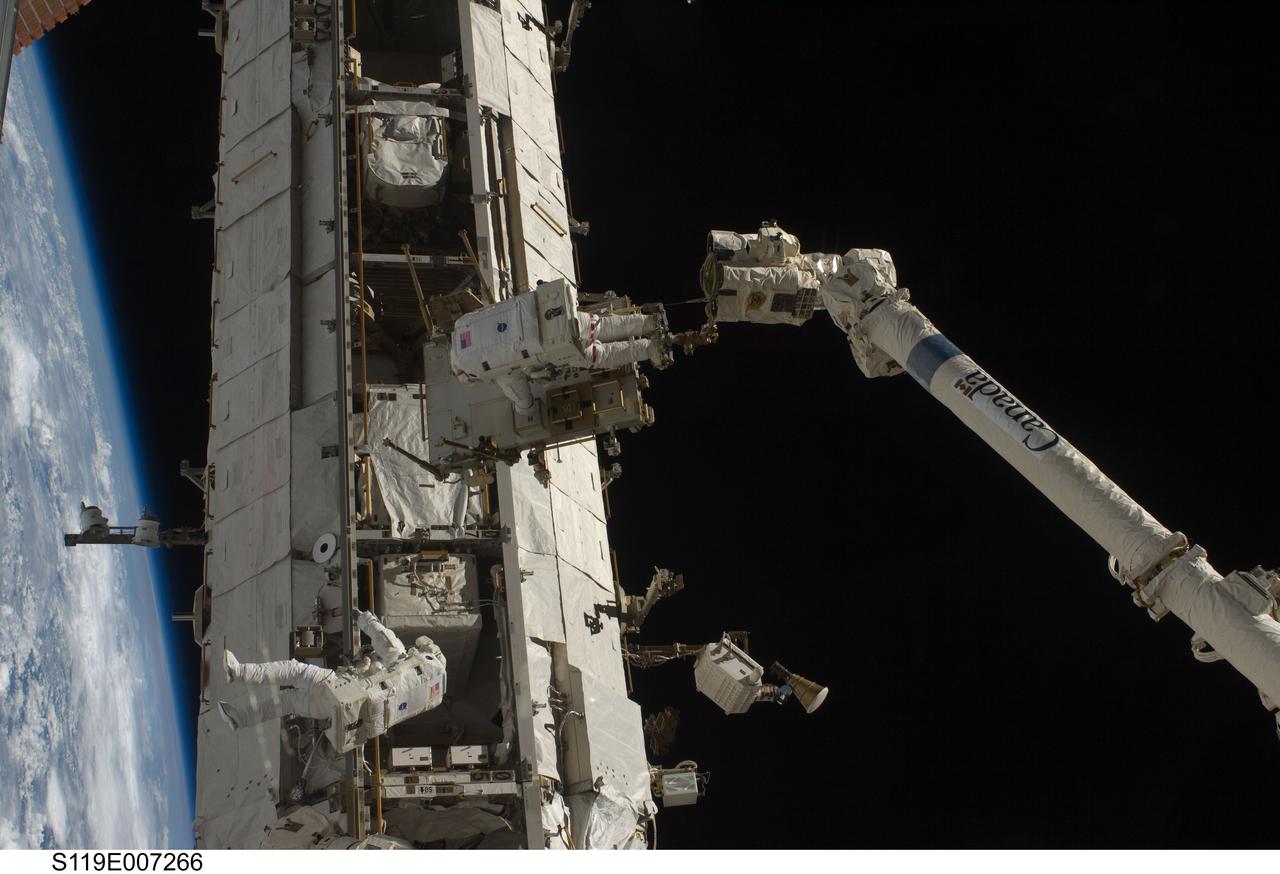
S119-E-007266 (23 March 2009) --- Astronauts Richard Arnold (bottom) and Joseph Acaba, both STS-119 mission specialists, participate in the mission's third scheduled session of extravehicular activity (EVA) as construction and maintenance continue on the International Space Station. During the six-hour, 27-minute spacewalk, Arnold and Acaba helped robotic arm operators relocate the Crew Equipment Translation Aid (CETA) cart from the Port 1 to Starboard 1 truss segment, installed a new coupler on the CETA cart, lubricated snares on the "B" end of the space station's robotic arm and performed a few "get ahead" tasks.
STS-119 Extravehicular Activity (EVA) 3 Crew and Equipment Translation Aid (CETA) Cart 2 Relocate OPS
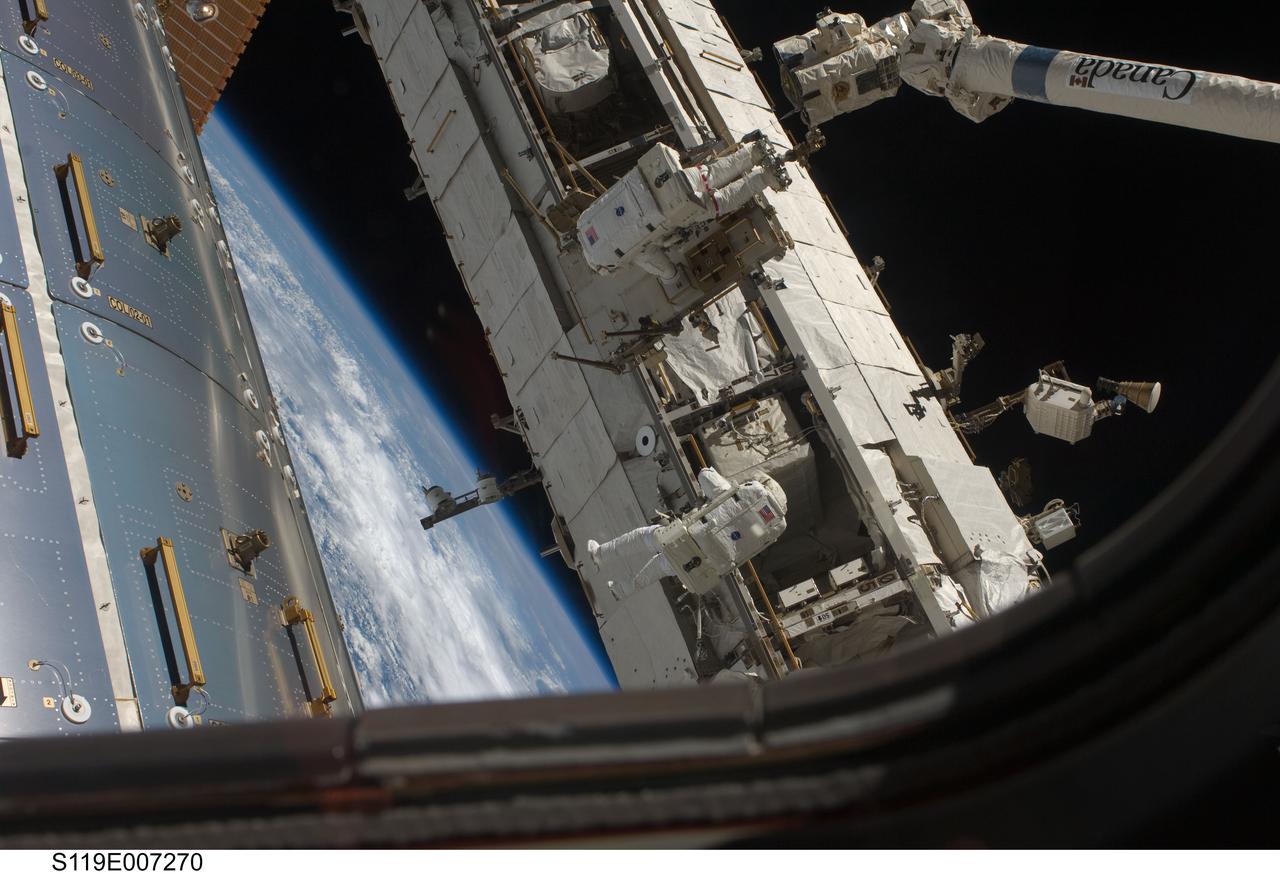
S119-E-007270 (23 March 2009) --- Astronauts Richard Arnold (bottom) and Joseph Acaba, both STS-119 mission specialists, participate in the mission's third scheduled session of extravehicular activity (EVA) as construction and maintenance continue on the International Space Station. During the six-hour, 27-minute spacewalk, Arnold and Acaba helped robotic arm operators relocate the Crew Equipment Translation Aid (CETA) cart from the Port 1 to Starboard 1 truss segment, installed a new coupler on the CETA cart, lubricated snares on the "B" end of the space station's robotic arm and performed a few "get ahead" tasks.
STS-119 Extravehicular Activity (EVA) 3 Crew and Equipment Translation Aid (CETA) Cart 2 Relocate OPS
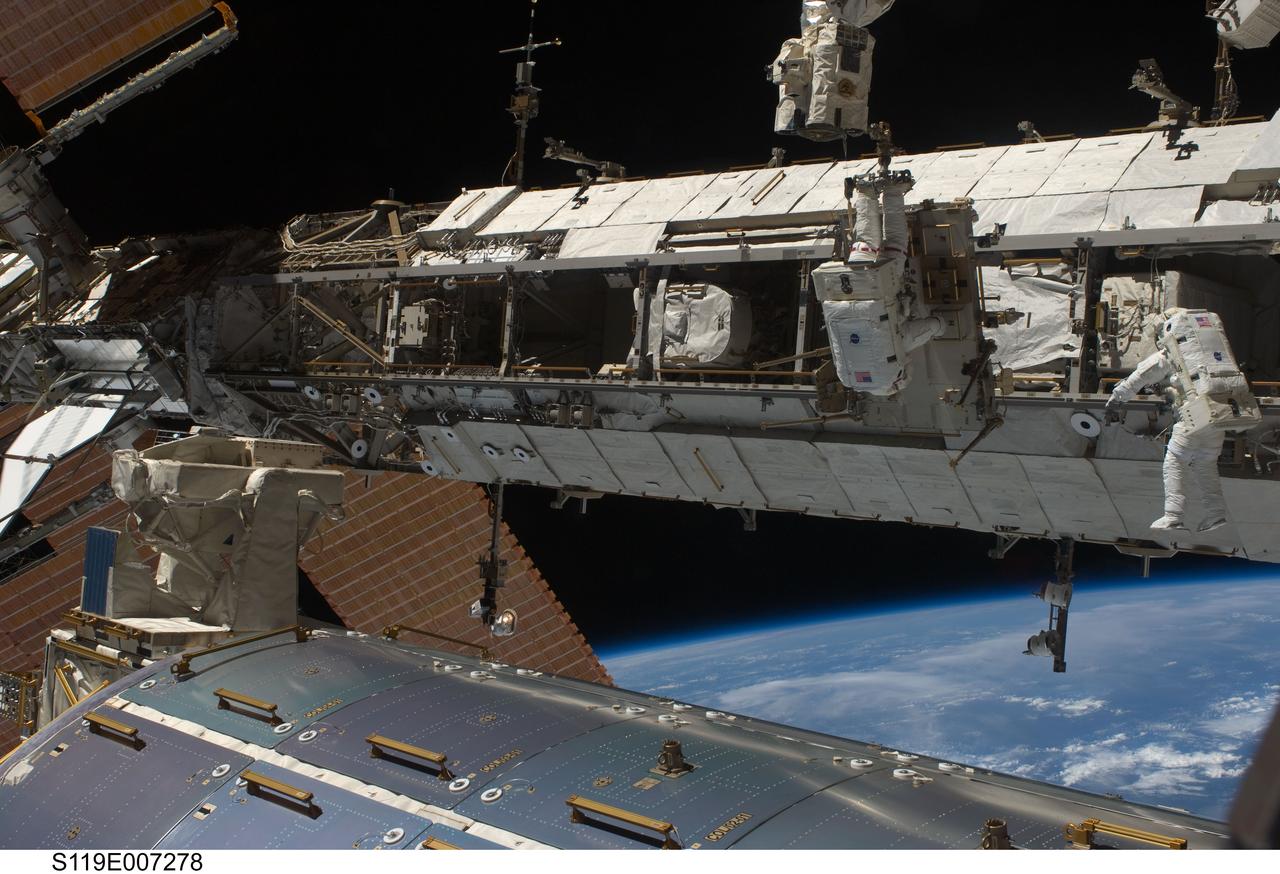
S119-E-007278 (23 March 2009) --- Astronauts Richard Arnold (right) and Joseph Acaba, both STS-119 mission specialists, participate in the mission's third scheduled session of extravehicular activity (EVA) as construction and maintenance continue on the International Space Station. During the six-hour, 27-minute spacewalk, Arnold and Acaba helped robotic arm operators relocate the Crew Equipment Translation Aid (CETA) cart from the Port 1 to Starboard 1 truss segment, installed a new coupler on the CETA cart, lubricated snares on the "B" end of the space station's robotic arm and performed a few "get ahead" tasks.
STS-119 Extravehicular Activity (EVA) 3 Crew and Equipment Translation Aid (CETA) Cart 2 Relocate OPS
S119-E-007332 (23 March 2009) --- Astronauts Richard Arnold (right) and Joseph Acaba, both STS-119 mission specialists, participate in the mission's third scheduled session of extravehicular activity (EVA) as construction and maintenance continue on the International Space Station. During the six-hour, 27-minute spacewalk, Arnold and Acaba helped robotic arm operators relocate the Crew Equipment Translation Aid (CETA) cart from the Port 1 to Starboard 1 truss segment, installed a new coupler on the CETA cart, lubricated snares on the "B" end of the space station's robotic arm and performed a few "get ahead" tasks.
STS-119 Extravehicular Activity (EVA) 3 Crew and Equipment Translation Aid (CETA) Cart 2 Relocate OPS
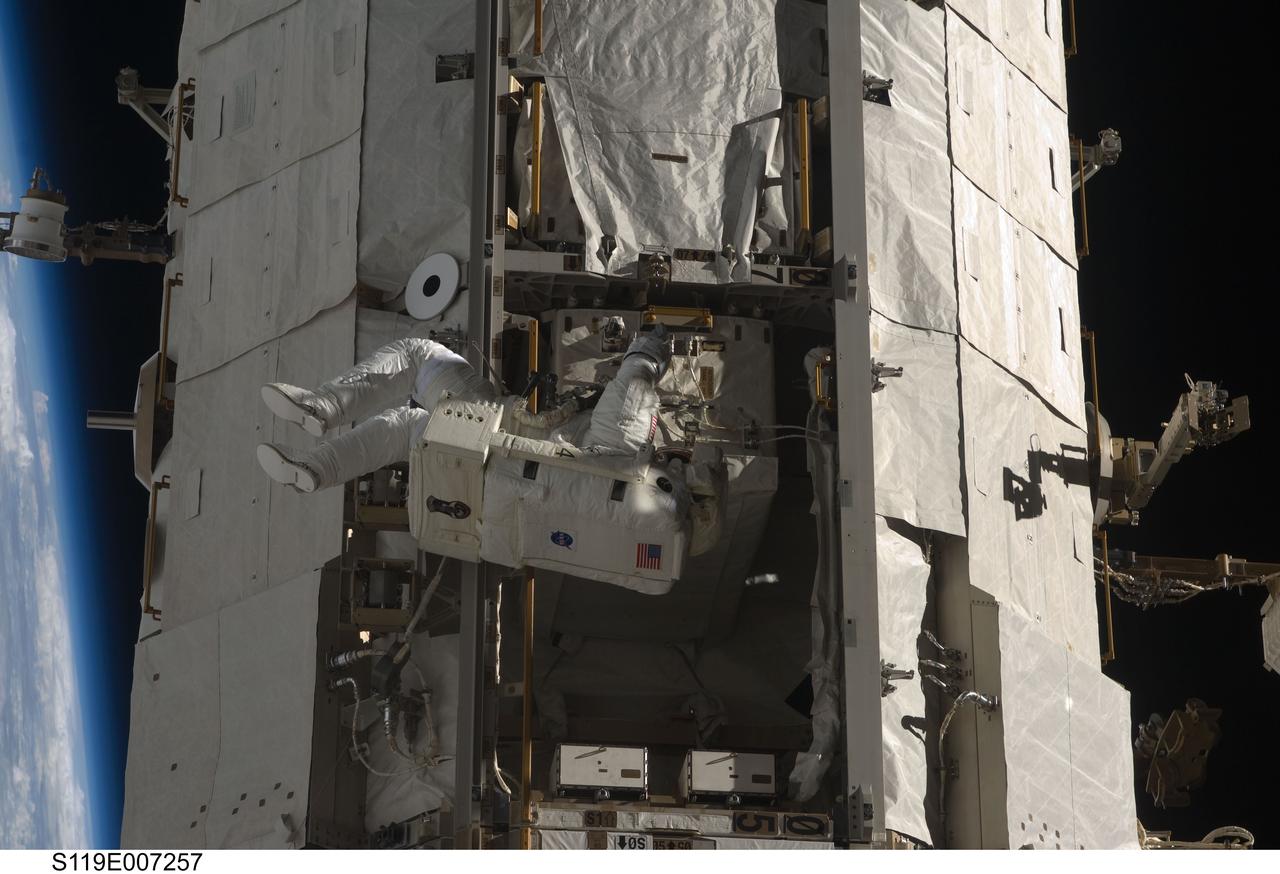
S119-E-007257 (23 March 2009) --- Astronaut Richard Arnold, STS-119 mission specialist, participates in the mission's third scheduled session of extravehicular activity (EVA) as construction and maintenance continue on the International Space Station. During the six-hour, 27-minute spacewalk, Arnold and Joseph Acaba (out of frame), mission specialist, helped robotic arm operators relocate the Crew Equipment Translation Aid (CETA) cart from the Port 1 to Starboard 1 truss segment, installed a new coupler on the CETA cart, lubricated snares on the "B" end of the space station's robotic arm and performed a few "get ahead" tasks.
STS-119 Extravehicular Activity (EVA) 3 Crew and Equipment Translation Aid (CETA) Cart 2 Relocate OPS
S119-E-007259 (23 March 2009) --- Astronauts Richard Arnold (left) and Joseph Acaba, both STS-119 mission specialists, participate in the mission's third scheduled session of extravehicular activity (EVA) as construction and maintenance continue on the International Space Station. During the six-hour, 27-minute spacewalk, Arnold and Acaba helped robotic arm operators relocate the Crew Equipment Translation Aid (CETA) cart from the Port 1 to Starboard 1 truss segment, installed a new coupler on the CETA cart, lubricated snares on the "B" end of the space station's robotic arm and performed a few "get ahead" tasks.
STS-119 Extravehicular Activity (EVA) 3 Crew and Equipment Translation Aid (CETA) Cart 2 Relocate OPS
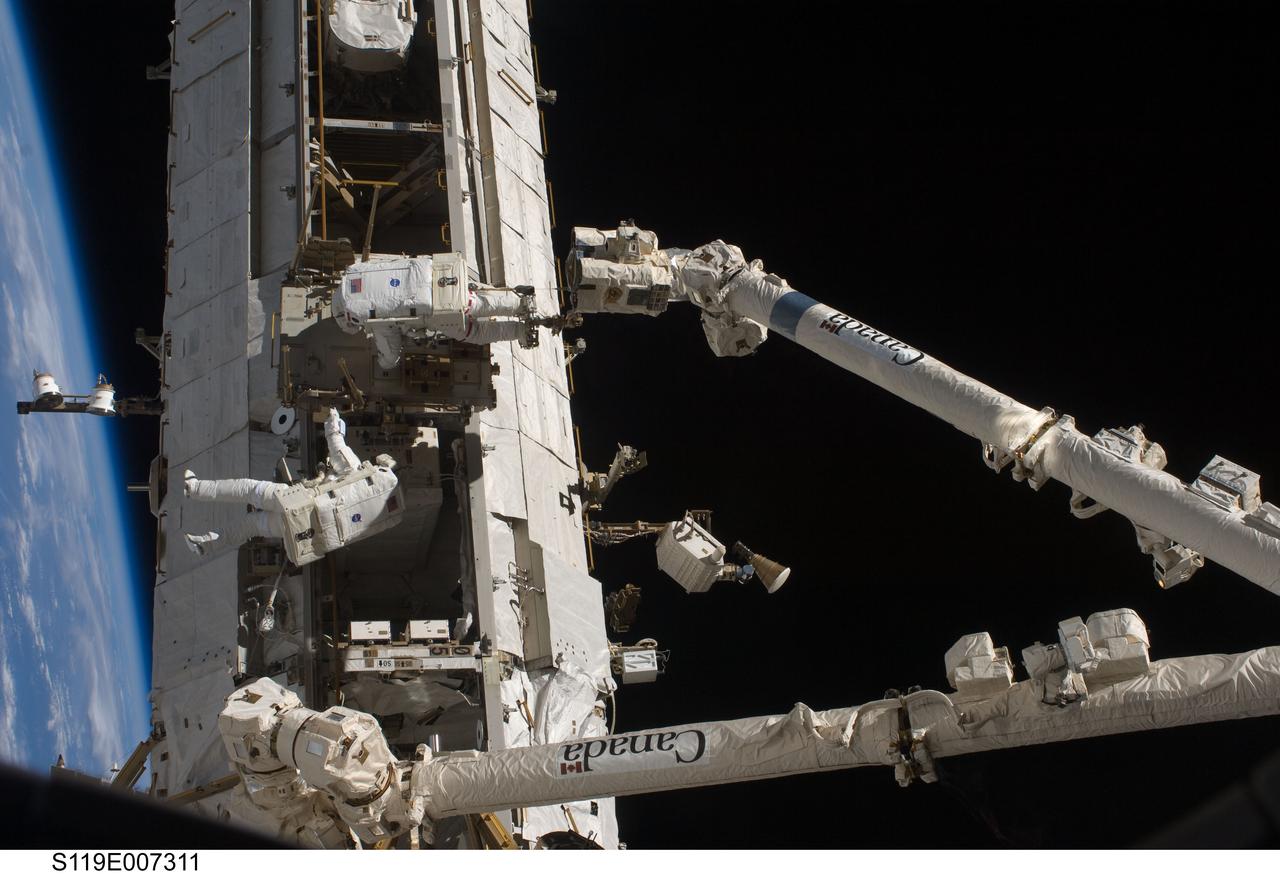
S119-E-007311 (23 March 2009) --- Astronauts Richard Arnold (bottom) and Joseph Acaba, both STS-119 mission specialists, participate in the mission's third scheduled session of extravehicular activity (EVA) as construction and maintenance continue on the International Space Station. During the six-hour, 27-minute spacewalk, Arnold and Acaba helped robotic arm operators relocate the Crew Equipment Translation Aid (CETA) cart from the Port 1 to Starboard 1 truss segment, installed a new coupler on the CETA cart, lubricated snares on the "B" end of the space station's robotic arm and performed a few "get ahead" tasks.
STS-119 Extravehicular Activity (EVA) 3 Crew and Equipment Translation Aid (CETA) Cart 2 Relocate OPS
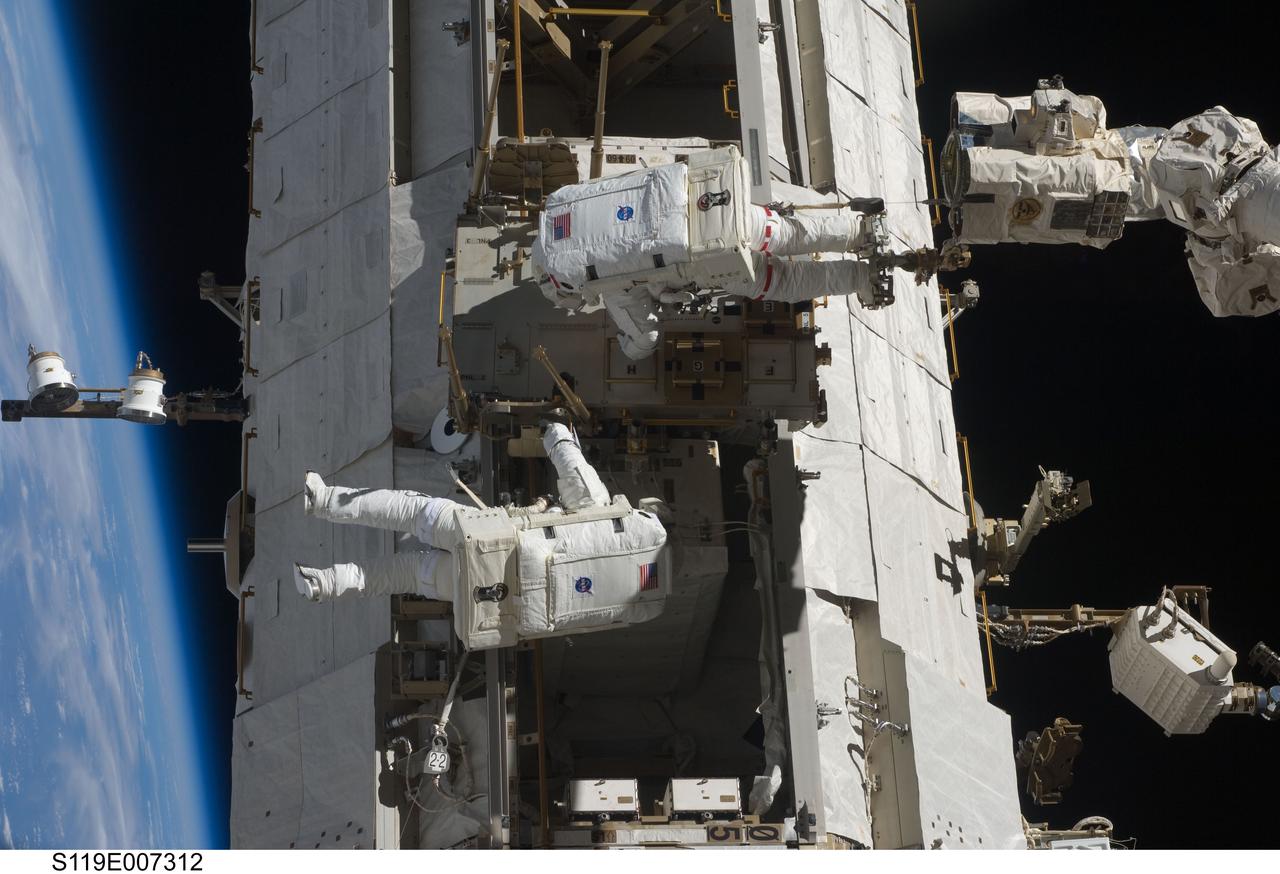
S119-E-007312 (23 March 2009) --- Astronauts Richard Arnold (bottom) and Joseph Acaba, both STS-119 mission specialists, participate in the mission's third scheduled session of extravehicular activity (EVA) as construction and maintenance continue on the International Space Station. During the six-hour, 27-minute spacewalk, Arnold and Acaba helped robotic arm operators relocate the Crew Equipment Translation Aid (CETA) cart from the Port 1 to Starboard 1 truss segment, installed a new coupler on the CETA cart, lubricated snares on the "B" end of the space station's robotic arm and performed a few "get ahead" tasks.
STS-119 Extravehicular Activity (EVA) 3 Crew and Equipment Translation Aid (CETA) Cart 2 Relocate OPS
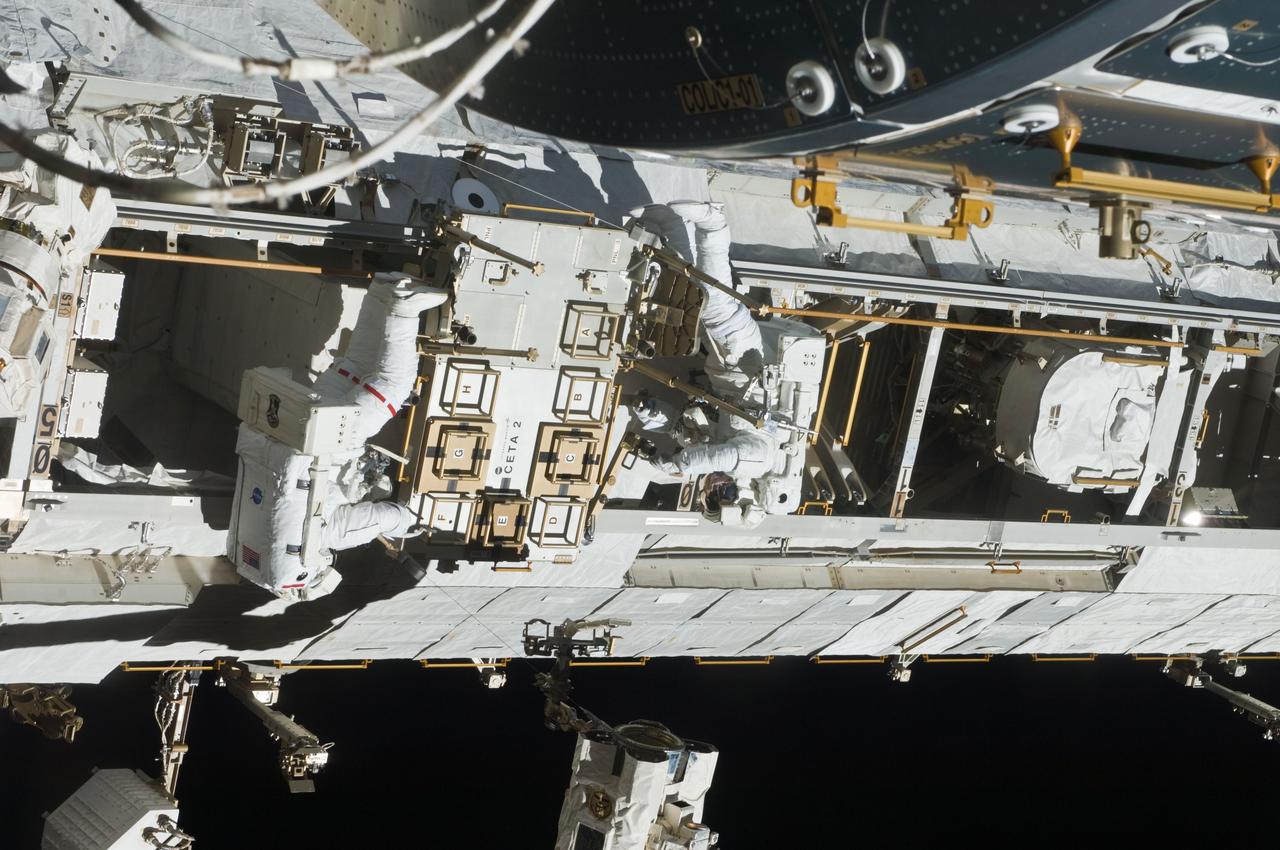
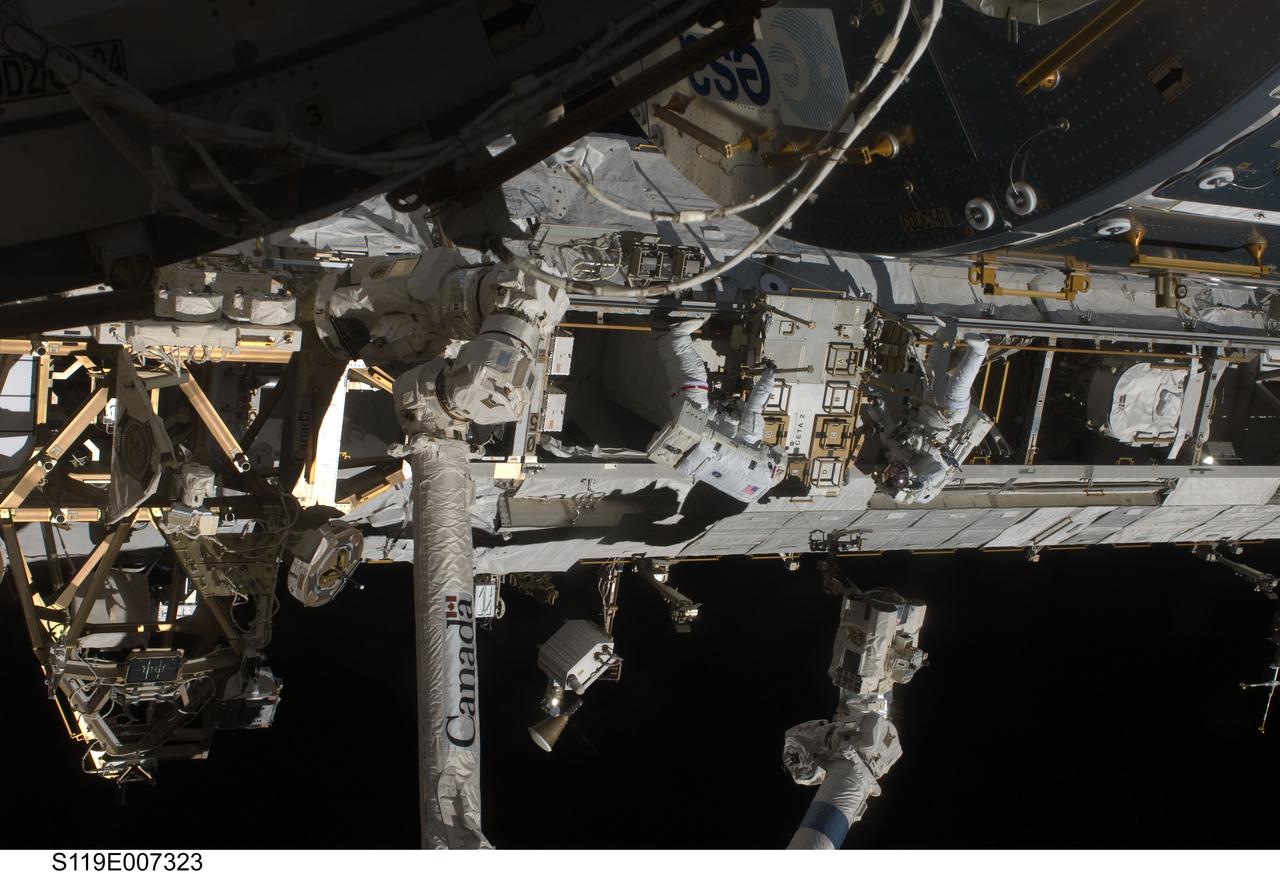
S119-E-007323 (23 March 2009) --- Astronauts Richard Arnold (right) and Joseph Acaba, both STS-119 mission specialists, participate in the mission's third scheduled session of extravehicular activity (EVA) as construction and maintenance continue on the International Space Station. During the six-hour, 27-minute spacewalk, Arnold and Acaba helped robotic arm operators relocate the Crew Equipment Translation Aid (CETA) cart from the Port 1 to Starboard 1 truss segment, installed a new coupler on the CETA cart, lubricated snares on the "B" end of the space station's robotic arm and performed a few "get ahead" tasks.
STS-119 Extravehicular Activity (EVA) 3 Crew and Equipment Translation Aid (CETA) Cart 2 Relocate OPS
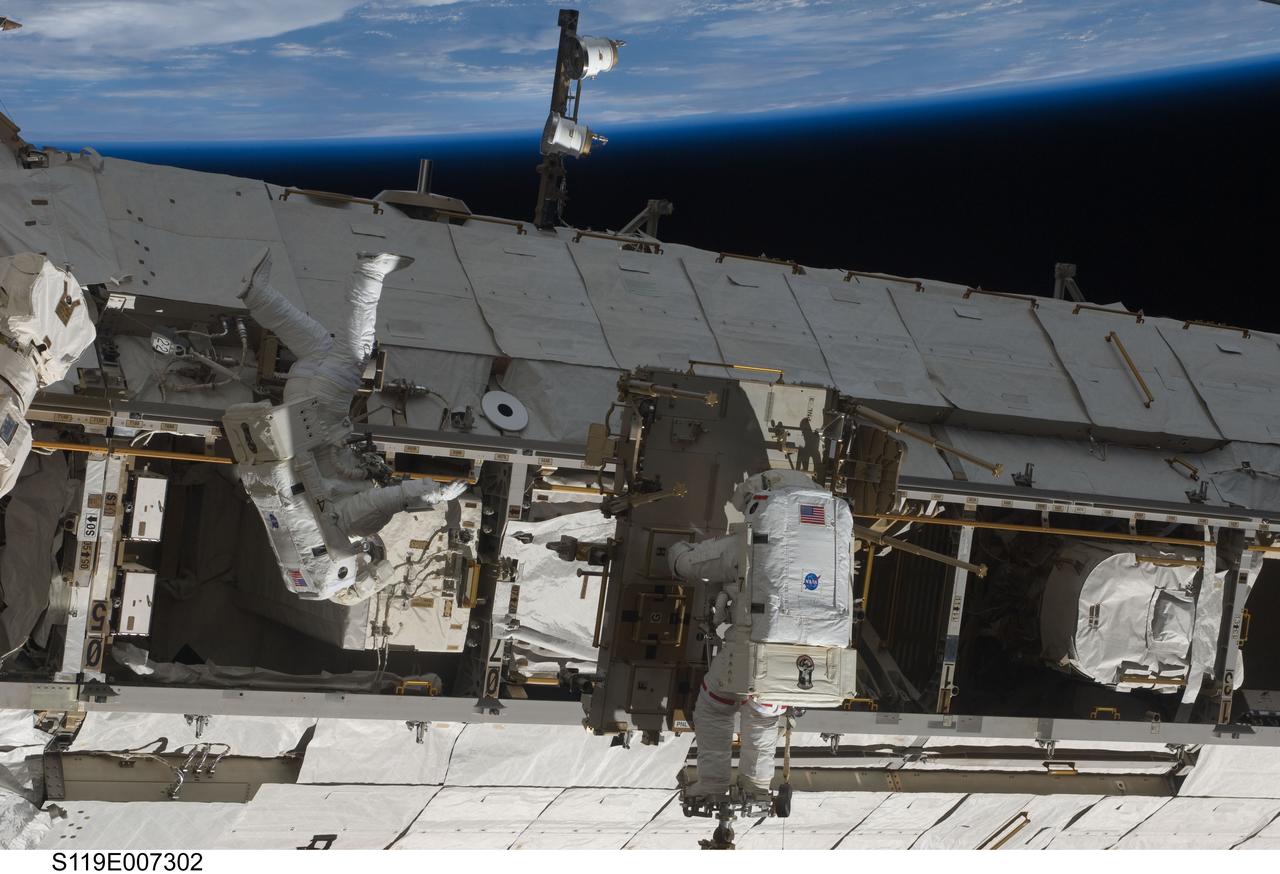
S119-E-007302 (23 March 2009) --- Astronauts Richard Arnold (left) and Joseph Acaba, both STS-119 mission specialists, participate in the mission's third scheduled session of extravehicular activity (EVA) as construction and maintenance continue on the International Space Station. During the six-hour, 27-minute spacewalk, Arnold and Acaba helped robotic arm operators relocate the Crew Equipment Translation Aid (CETA) cart from the Port 1 to Starboard 1 truss segment, installed a new coupler on the CETA cart, lubricated snares on the "B" end of the space station's robotic arm and performed a few "get ahead" tasks.
STS-119 Extravehicular Activity (EVA) 3 Crew and Equipment Translation Aid (CETA) Cart 2 Relocate OPS
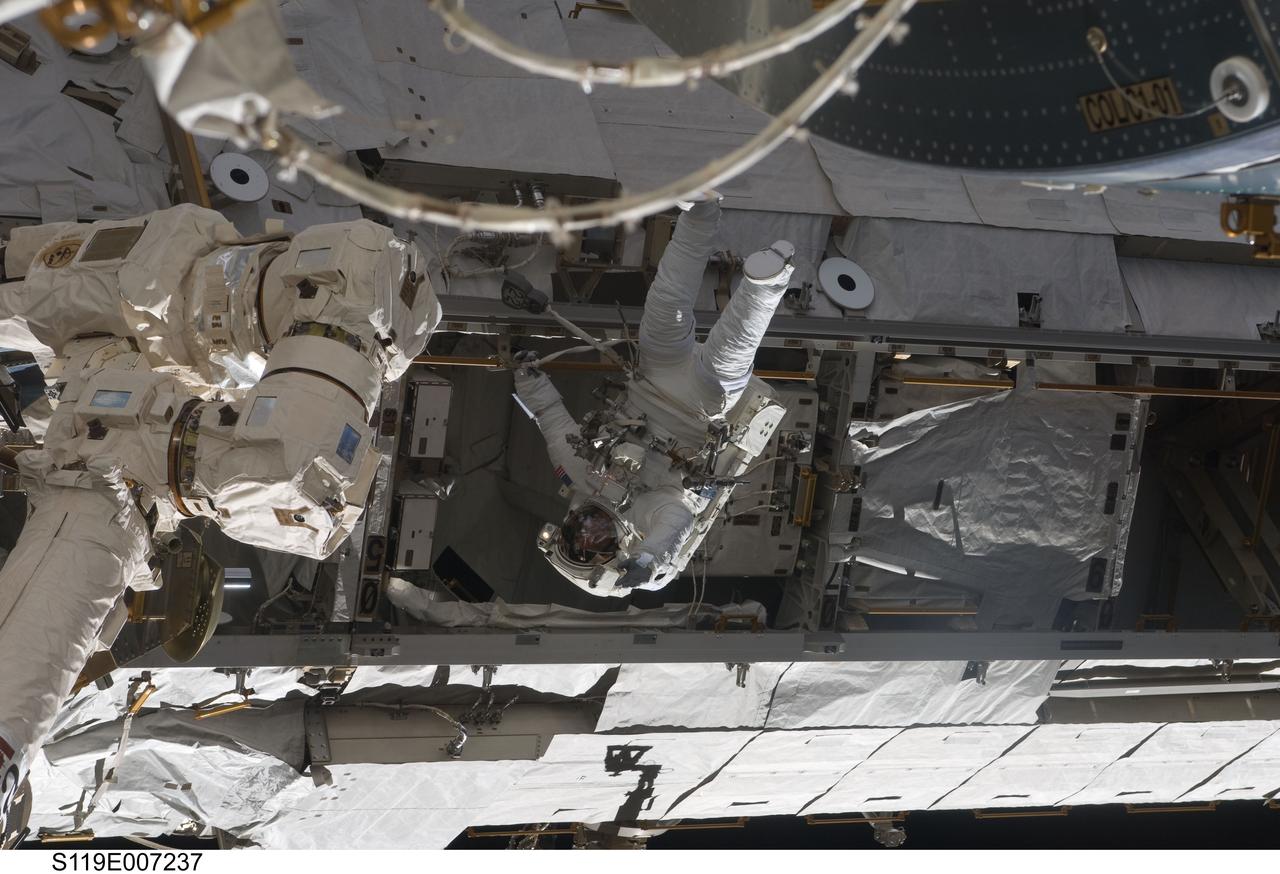
S119-E-007237 (23 March 2009) --- Astronaut Richard Arnold, STS-119 mission specialist, participates in the mission's third scheduled session of extravehicular activity (EVA) as construction and maintenance continue on the International Space Station. During the six-hour, 27-minute spacewalk, Arnold and Joseph Acaba (out of frame), mission specialist, helped robotic arm operators relocate the Crew Equipment Translation Aid (CETA) cart from the Port 1 to Starboard 1 truss segment, installed a new coupler on the CETA cart, lubricated snares on the "B" end of the space station's robotic arm and performed a few "get ahead" tasks.
STS-119 Extravehicular Activity (EVA) 3 Crew and Equipment Translation Aid (CETA) Cart 2 Relocate OPS
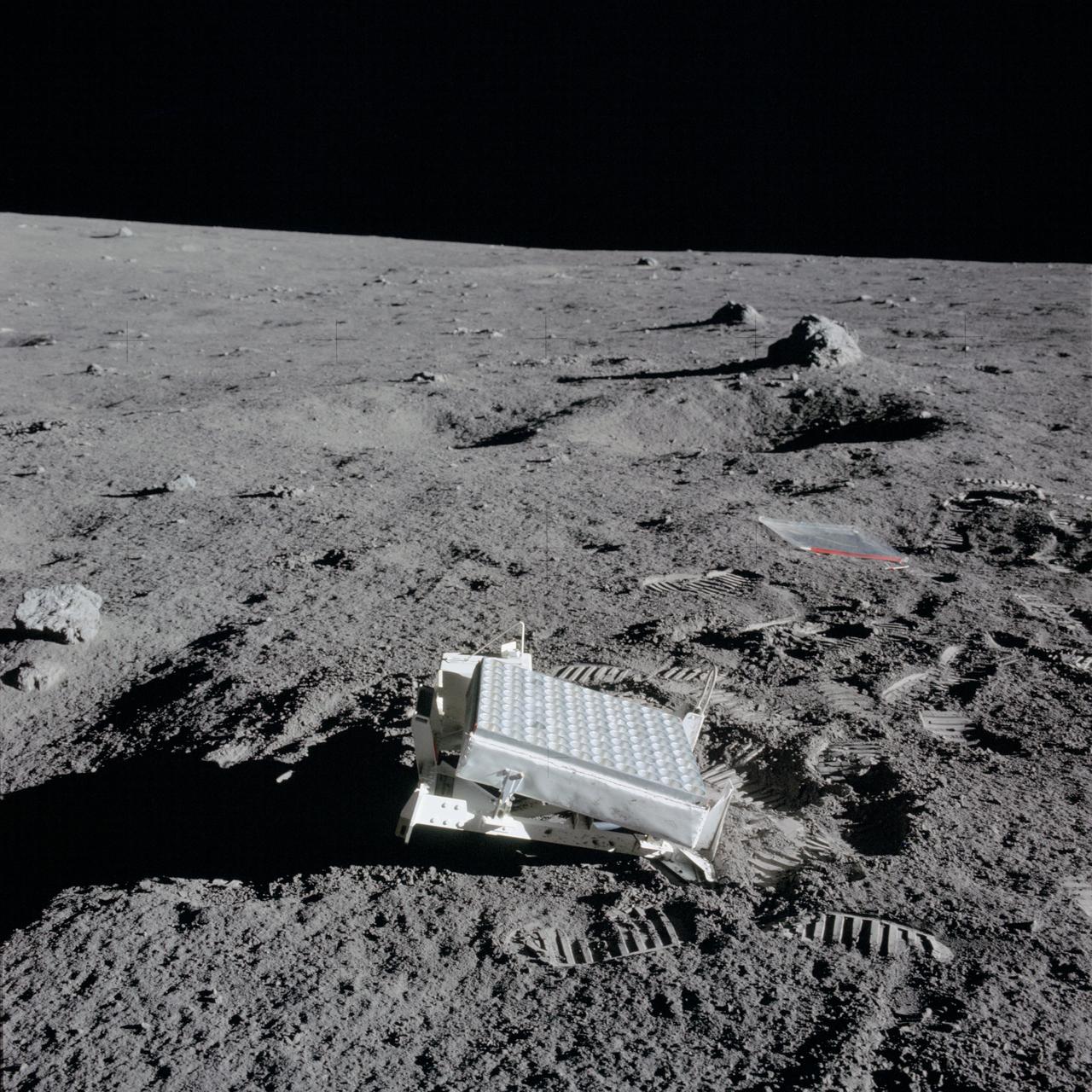
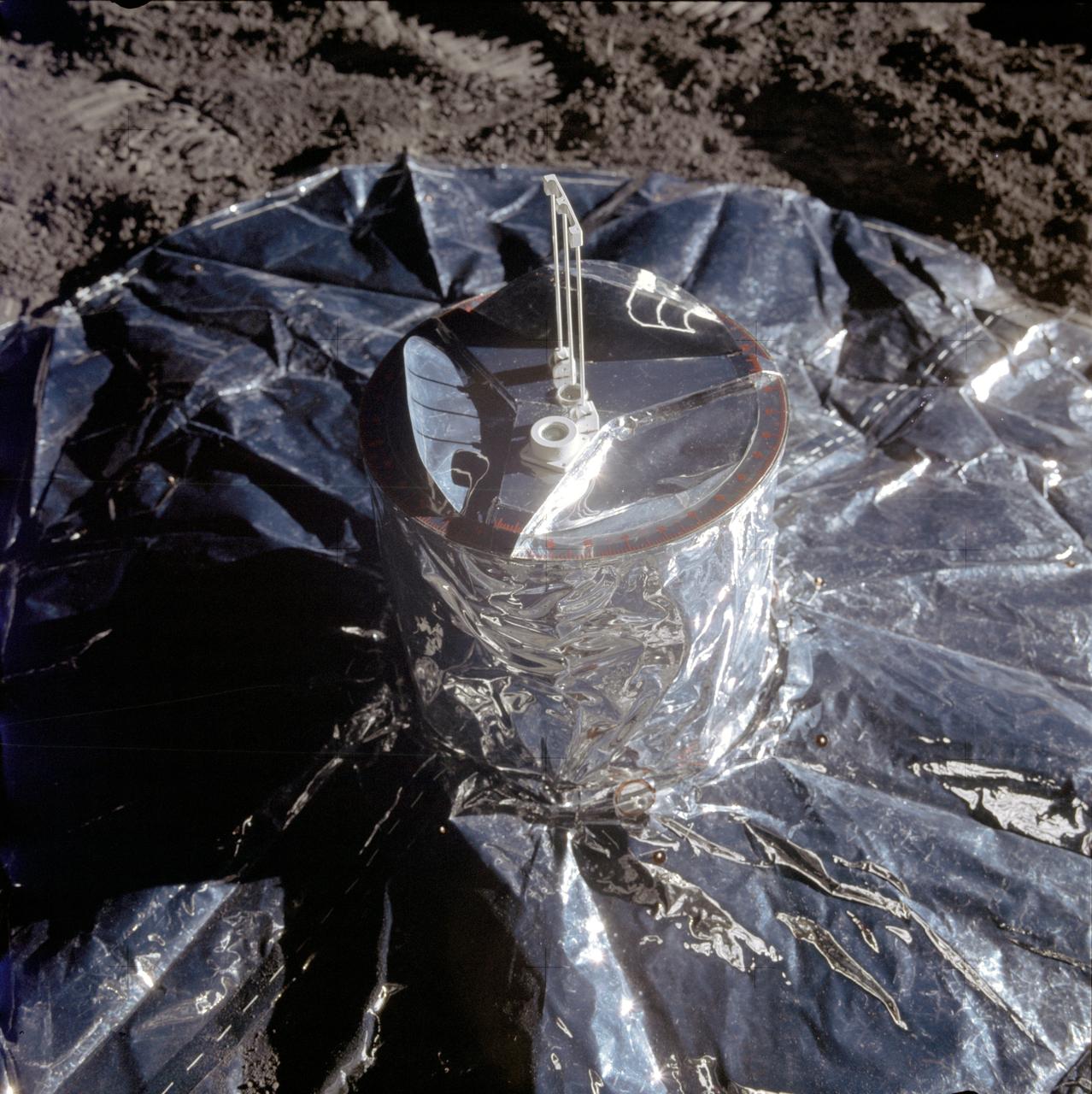
AS11-40-5948 (20 July 1969) --- Astronaut Edwin E. Aldrin Jr., lunar module pilot, is photographed during the Apollo 11 extravehicular activity (EVA) on the moon. He has just deployed the Early Apollo Scientific Experiments Package (EASEP). This is a good view of the deployed equipment. In the foreground is the Passive Seismic Experiment Package (PSEP); beyond it is the Laser Ranging Retro-Reflector (LR-3); in the center background is the United States flag; in the left background is the black and white lunar surface television camera; in the far right background is the Lunar Module (LM). Astronaut Neil A. Armstrong, commander, took this picture with a 70mm lunar surface camera. While astronauts Armstrong and Aldrin descended in the Lunar Module (LM) "Eagle" to explore the Sea of Tranquility region of the moon, astronaut Michael Collins, command module pilot, remained with the Command and Service Modules (CSM) "Columbia" in lunar orbit.
Astronaut Edwin Aldrin after deployment of EASEP on surface of moon
KENNEDY SPACE CENTER, FLA. - In the Space Station Processing Facility, STS-117 Mission Specialist James Reilly (right, in front) works with equipment in the Japanese Experiment Module (JEM) as part of training for ExtraVehicular Activity (EVA). At left is STS-115 Mission Specialist Joseph Tanner.  Equipment familiarization is a routine part of astronaut training and launch preparations.
KENNEDY SPACE CENTER, FLA. - In the Space Station Processing Facility, STS-117 Mission Specialist James Reilly (right, in front) works with equipment in the Japanese Experiment Module (JEM) as part of training for ExtraVehicular Activity (EVA). At left is STS-115 Mission Specialist Joseph Tanner. Equipment familiarization is a routine part of astronaut training and launch preparations.
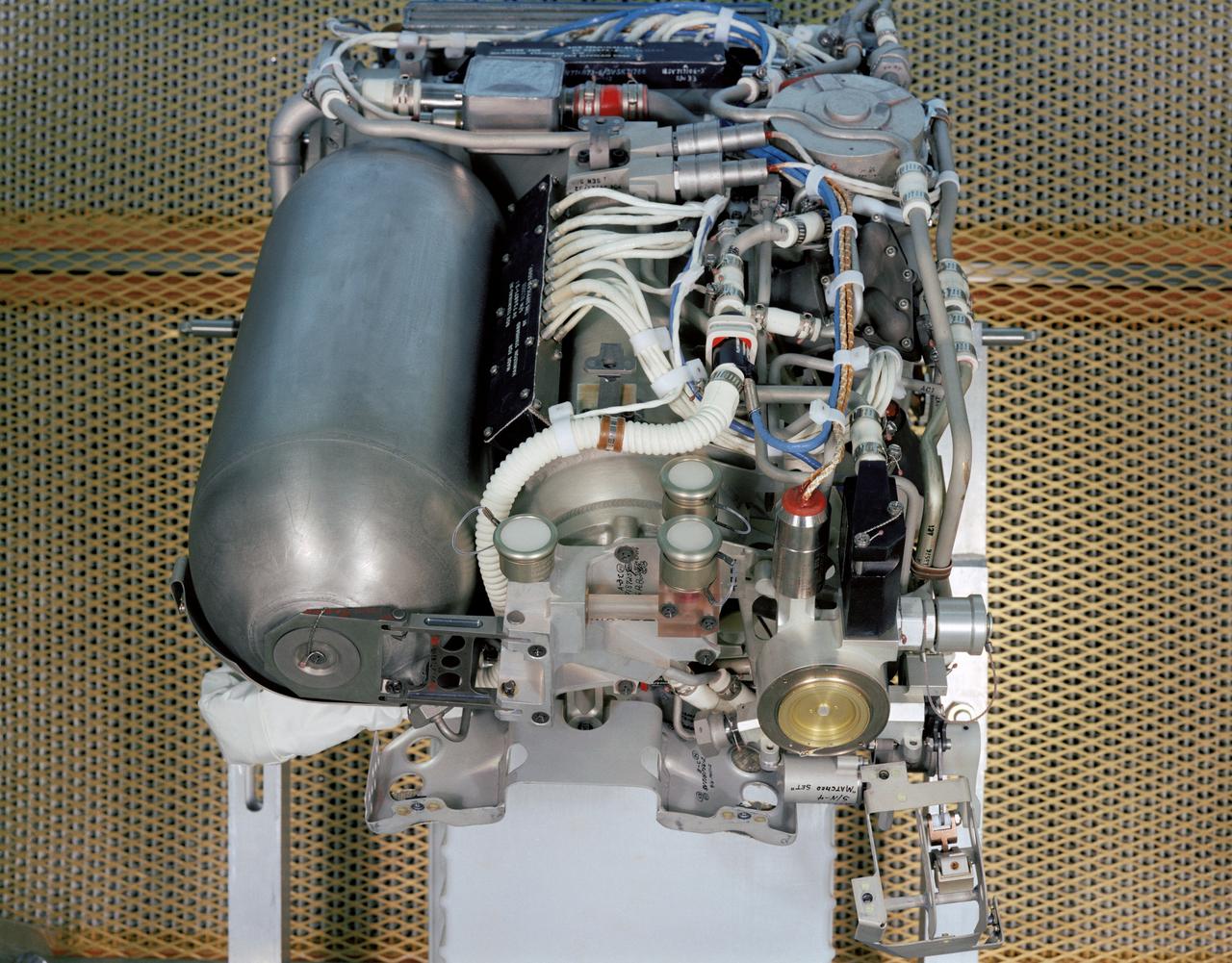
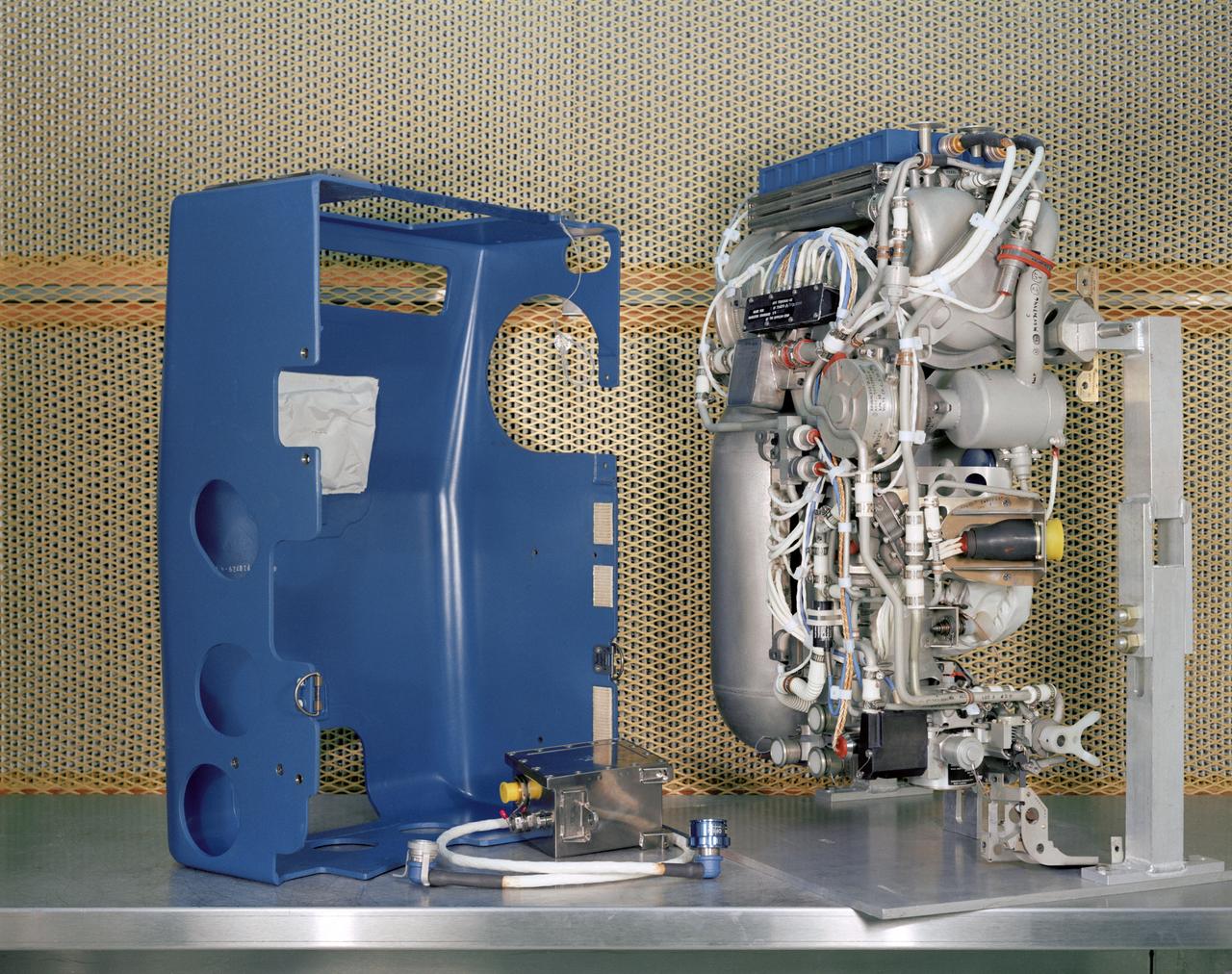
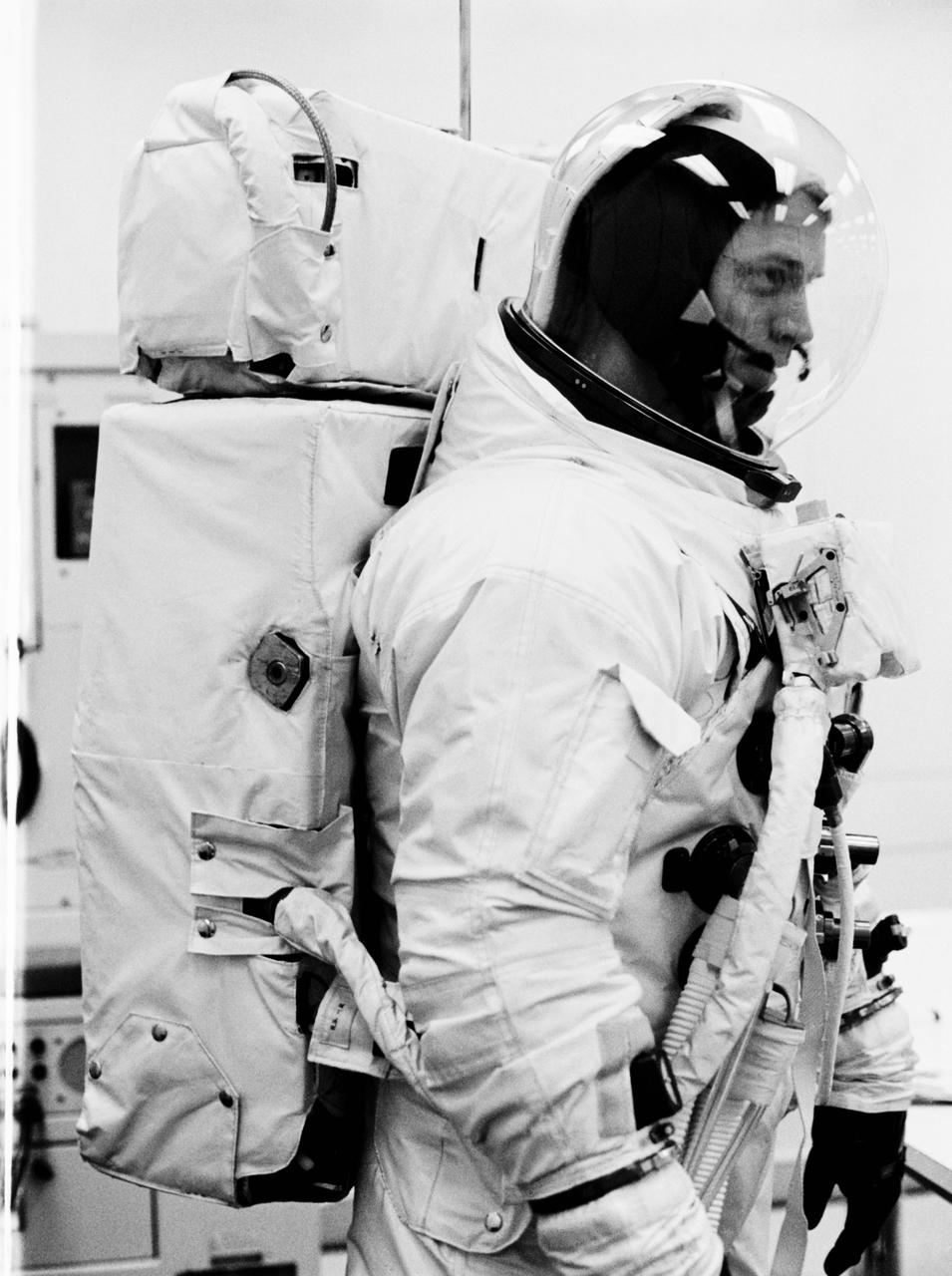
S68-34582 (1968) --- With its exterior removed, the Apollo portable life support system (PLSS) can be easily studied. The PLSS is worn as a backpack over the Extravehicular Mobility Unit (EMU) a multi-layered spacesuit used for outside-the-spacecraft activity. JSC photographic frame no. S68-34582 is a wider view of the exposed interior working parts of the PLSS and its removed cover.
Apollo Portable Life Support System
S68-34580 (1968) --- With its exterior removed, the Apollo portable life support system (PLSS) can be easily studied. The PLSS is worn as a backpack over the Extravehicular Mobility Unit (EMU), a multi-layered spacesuit used for outside-the-spacecraft activity. JSC photographic frame no. S68-34582 is a close-up view of the working parts of the PLSS.
Apollo Portable Life Support System
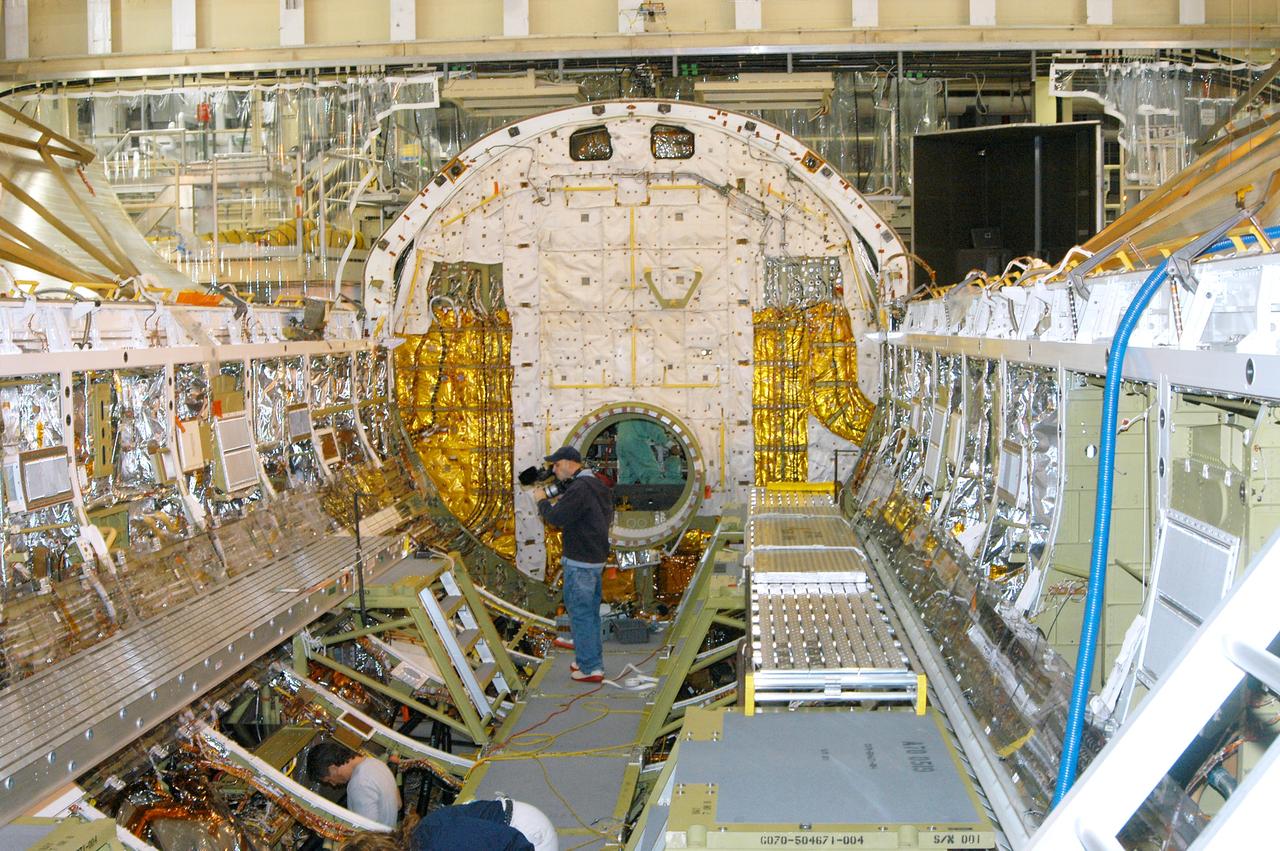
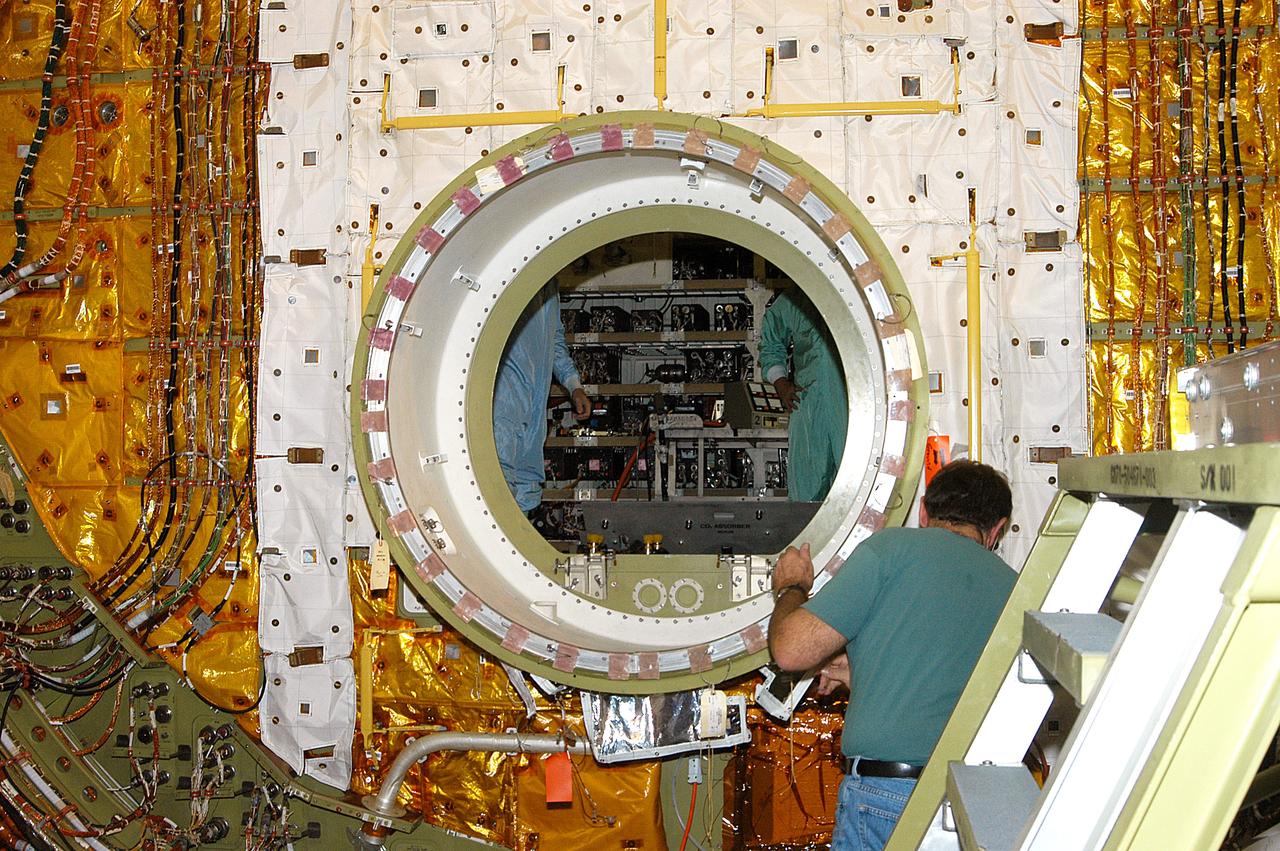
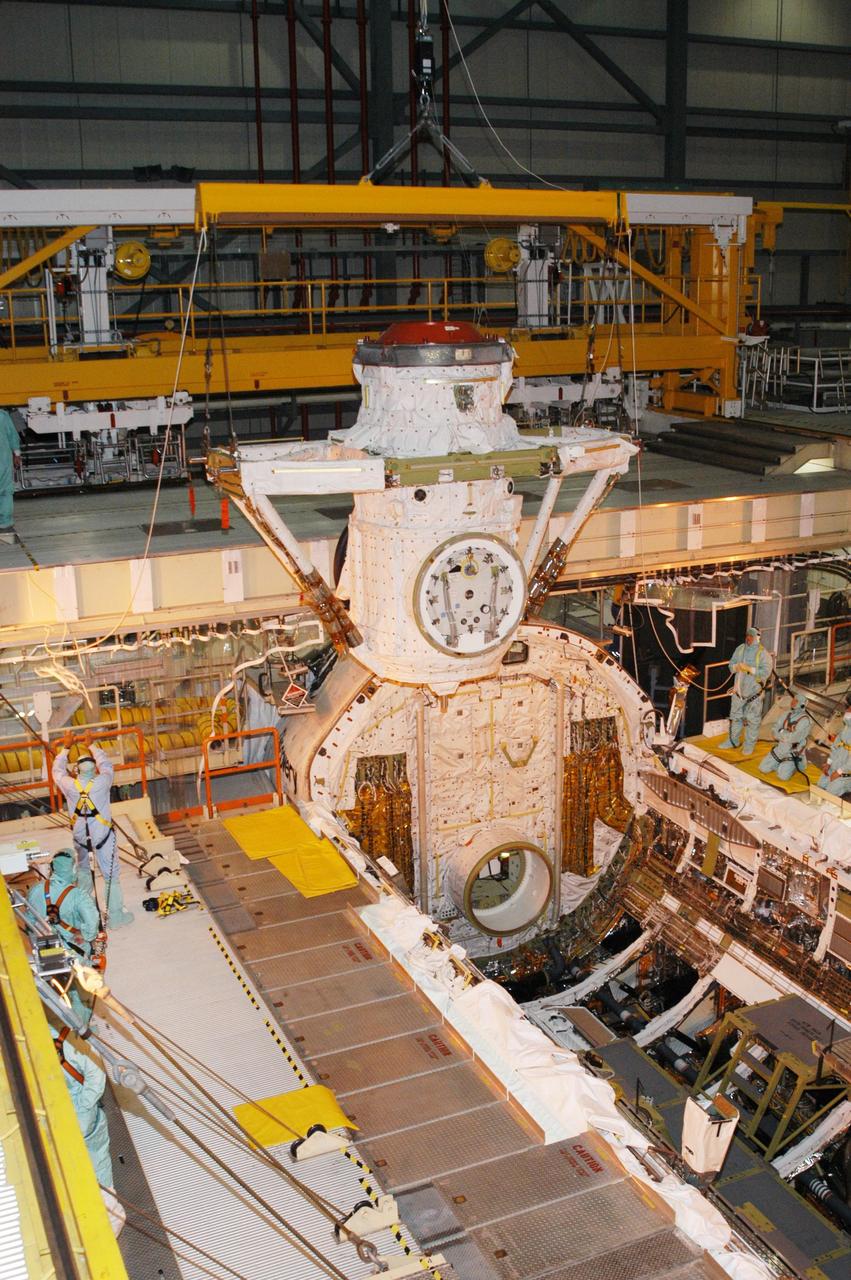
KENNEDY SPACE CENTER, FLA. -  In the Orbiter Processing Facility, a worker checks out part of the equipment in the airlock, at one end of Discovery’s payload bay.  The airlock is sized to accommodate two fully suited flight crew members simultaneously. Support functions include airlock depressurization and repressurization, extravehicular activity equipment recharge, liquid-cooled garment water cooling, EVA equipment checkout, donning and communications. The outer hatch isolates the airlock from the unpressurized payload bay when closed and permits the EVA crew members to exit from the airlock to the payload bay when open.
KENNEDY SPACE CENTER, FLA. - In the Orbiter Processing Facility, a worker checks out part of the equipment in the airlock, at one end of Discovery’s payload bay. The airlock is sized to accommodate two fully suited flight crew members simultaneously. Support functions include airlock depressurization and repressurization, extravehicular activity equipment recharge, liquid-cooled garment water cooling, EVA equipment checkout, donning and communications. The outer hatch isolates the airlock from the unpressurized payload bay when closed and permits the EVA crew members to exit from the airlock to the payload bay when open.
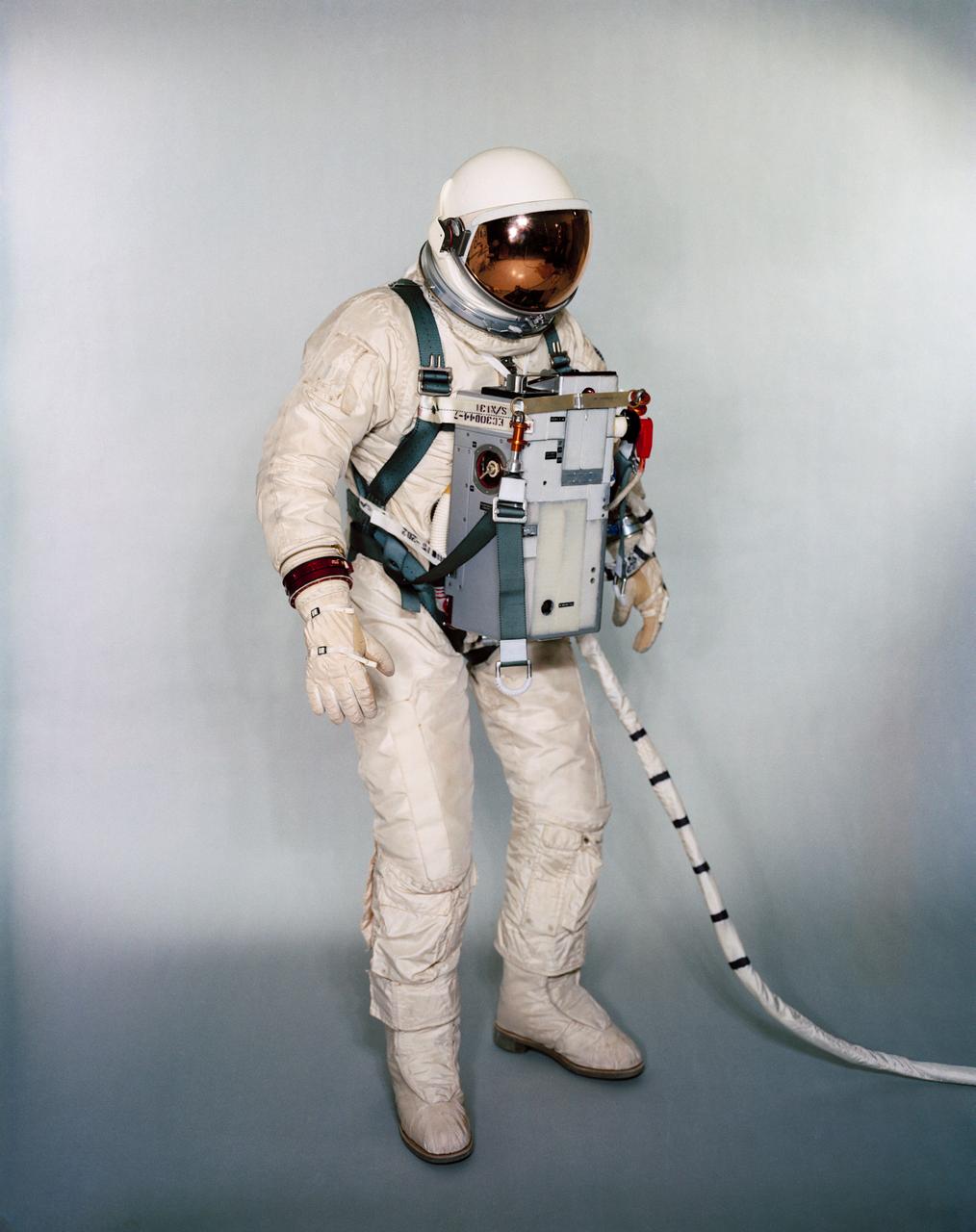
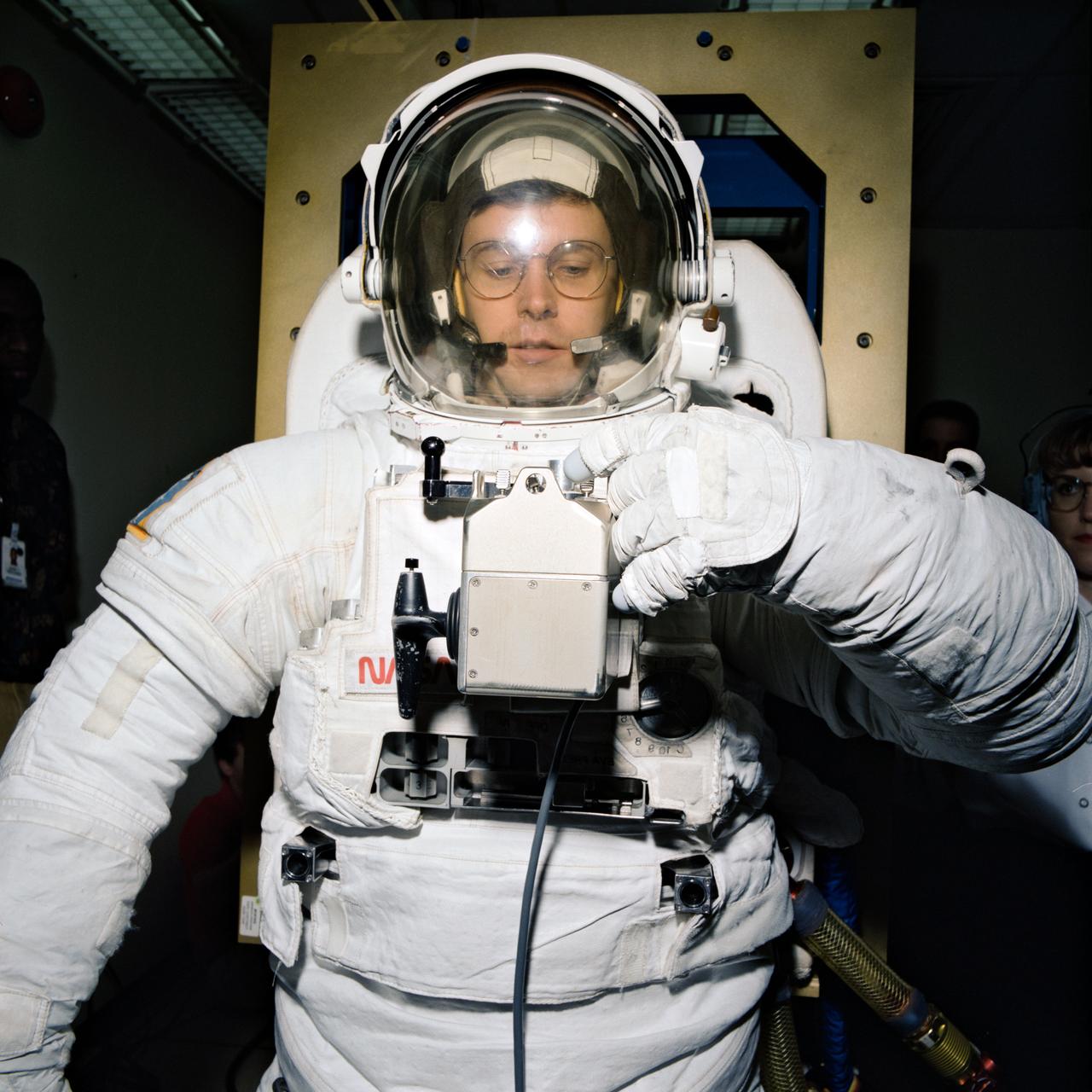
S67-24267 (1966) --- Suited test subject equipped with Gemini-12 Life Support System and waist tethers for extravehicular activity (EVA). Photo credit: NASA
Test subject equipped with Gemini 12 Life Support System and waist tethers
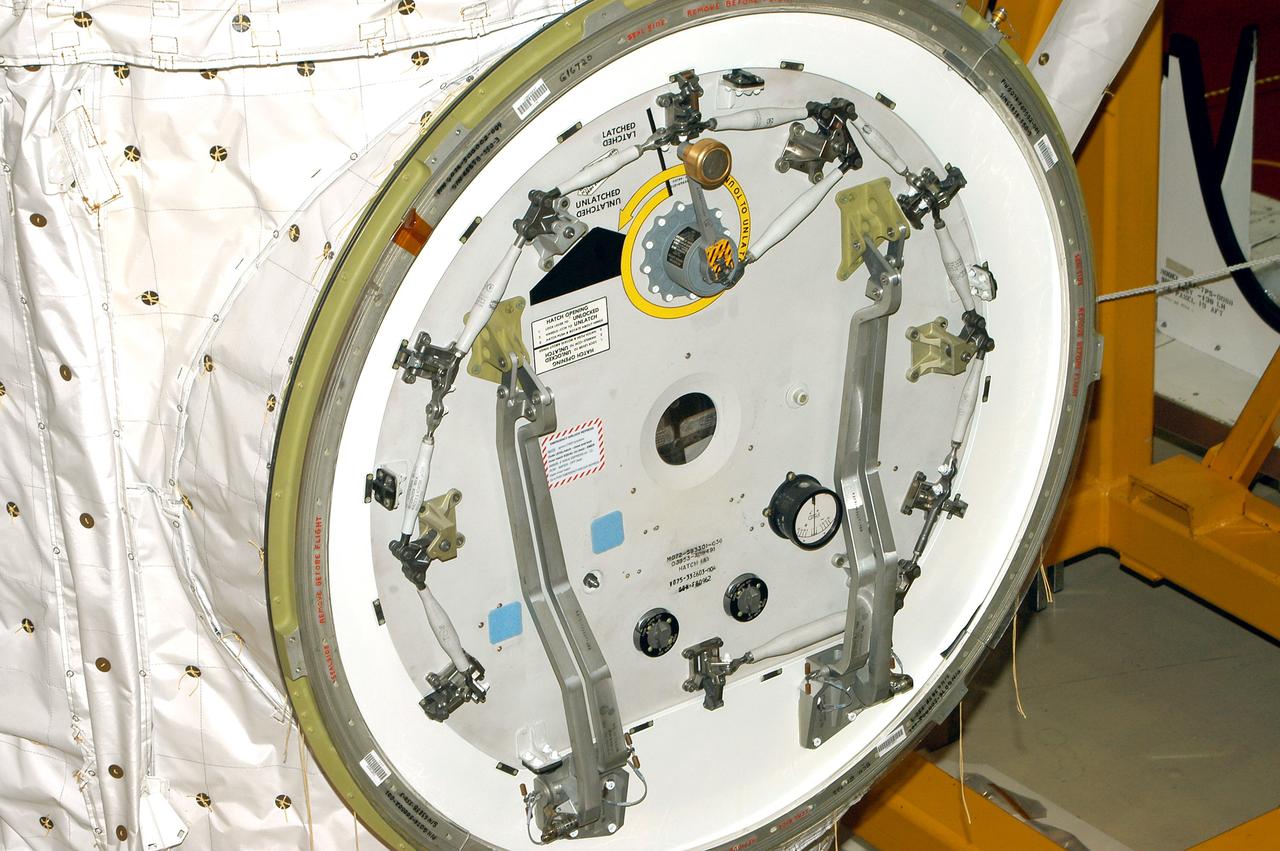
KENNEDY SPACE CENTER, FLA. -  Seen in the photo is one end of the airlock that is installed in the payload bay of orbiter Discovery.  The airlock is normally located inside the middeck of the spacecraft’s pressurized crew cabin. The airlock is sized to accommodate two fully suited flight crew members simultaneously. Support functions include airlock depressurization and repressurization, extravehicular activity equipment recharge, liquid-cooled garment water cooling, EVA equipment checkout, donning and communications. The outer hatch isolates the airlock from the unpressurized payload bay when closed and permits the EVA crew members to exit from the airlock to the payload bay when open.
KENNEDY SPACE CENTER, FLA. - Seen in the photo is one end of the airlock that is installed in the payload bay of orbiter Discovery. The airlock is normally located inside the middeck of the spacecraft’s pressurized crew cabin. The airlock is sized to accommodate two fully suited flight crew members simultaneously. Support functions include airlock depressurization and repressurization, extravehicular activity equipment recharge, liquid-cooled garment water cooling, EVA equipment checkout, donning and communications. The outer hatch isolates the airlock from the unpressurized payload bay when closed and permits the EVA crew members to exit from the airlock to the payload bay when open.
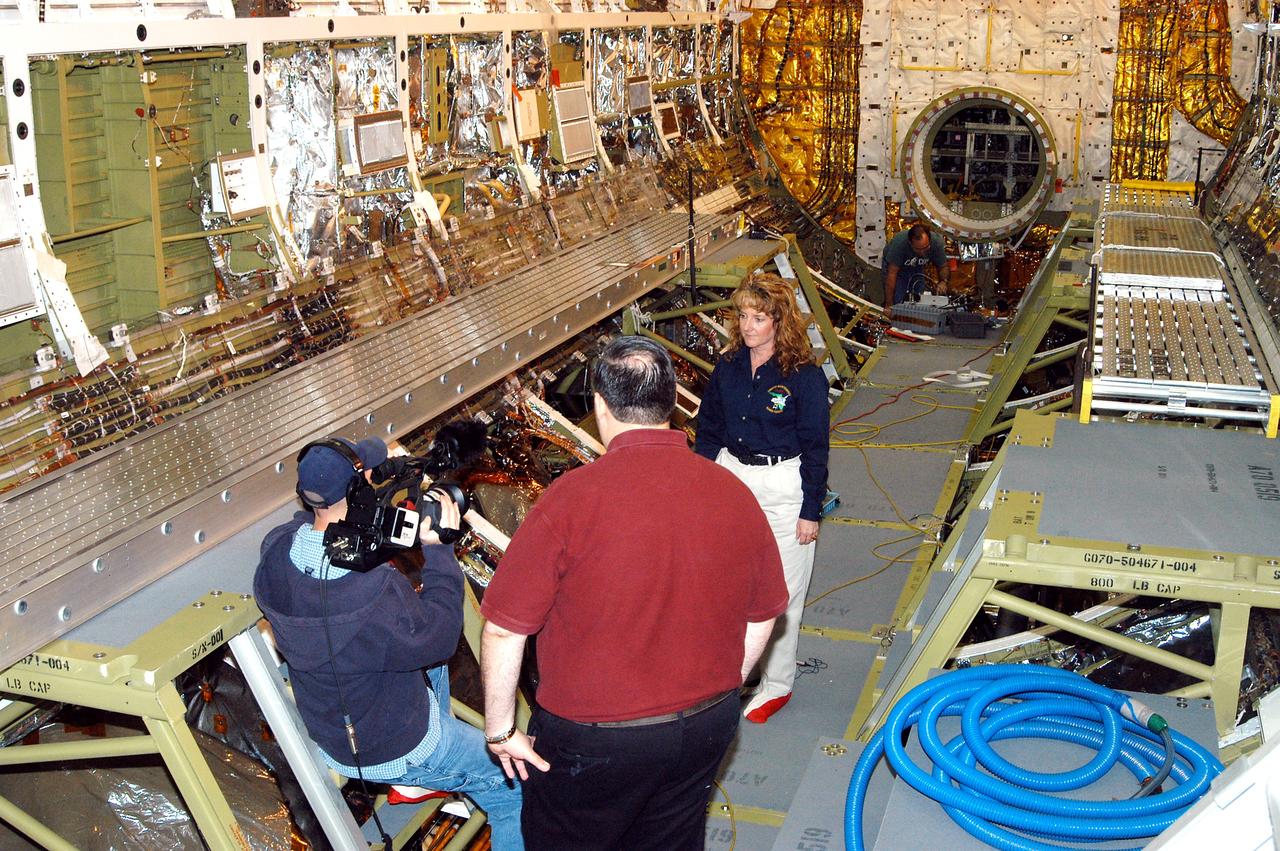
KENNEDY SPACE CENTER, FLA. -  In the Orbiter Processing Facility, a cameraman films part of Discovery’s payload bay for a special feature on the KSC Web.  In the background is the open hatch of the airlock, located inside the middeck of the spacecraft’s pressurized crew cabin. The airlock is sized to accommodate two fully suited flight crew members simultaneously. Support functions include airlock depressurization and repressurization, extravehicular activity equipment recharge, liquid-cooled garment water cooling, EVA equipment checkout, donning and communications. The outer hatch isolates the airlock from the unpressurized payload bay when closed and permits the EVA crew members to exit from the airlock to the payload bay when open.
KENNEDY SPACE CENTER, FLA. - In the Orbiter Processing Facility, a cameraman films part of Discovery’s payload bay for a special feature on the KSC Web. In the background is the open hatch of the airlock, located inside the middeck of the spacecraft’s pressurized crew cabin. The airlock is sized to accommodate two fully suited flight crew members simultaneously. Support functions include airlock depressurization and repressurization, extravehicular activity equipment recharge, liquid-cooled garment water cooling, EVA equipment checkout, donning and communications. The outer hatch isolates the airlock from the unpressurized payload bay when closed and permits the EVA crew members to exit from the airlock to the payload bay when open.
KENNEDY SPACE CENTER, FLA. -  A worker in the Orbiter Processing Facility checks the open hatch of the airlock in Discovery’s payload bay. The airlock is normally located inside the middeck of the spacecraft’s pressurized crew cabin. The airlock is sized to accommodate two fully suited flight crew members simultaneously. Support functions include airlock depressurization and repressurization, extravehicular activity equipment recharge, liquid-cooled garment water cooling, EVA equipment checkout, donning and communications. The outer hatch isolates the airlock from the unpressurized payload bay when closed and permits the EVA crew members to exit from the airlock to the payload bay when open.
KENNEDY SPACE CENTER, FLA. - A worker in the Orbiter Processing Facility checks the open hatch of the airlock in Discovery’s payload bay. The airlock is normally located inside the middeck of the spacecraft’s pressurized crew cabin. The airlock is sized to accommodate two fully suited flight crew members simultaneously. Support functions include airlock depressurization and repressurization, extravehicular activity equipment recharge, liquid-cooled garment water cooling, EVA equipment checkout, donning and communications. The outer hatch isolates the airlock from the unpressurized payload bay when closed and permits the EVA crew members to exit from the airlock to the payload bay when open.
KENNEDY SPACE CENTER, FLA. -  Standing inside Discovery’s payload bay, Carol Scott (right), lead orbiter engineer, talks about her job as part of a special feature for the KSC Web.  With his back to the camera is Bill Kallus, Media manager in the KSC Web Studio.  Behind Scott can be seen the open hatch of the airlock, which provides support functions such as airlock depressurization and repressurization, extravehicular activity equipment recharge, liquid-cooled garment water cooling, EVA equipment checkout, donning and communications. The outer hatch isolates the airlock from the unpressurized payload bay when closed and permits the EVA crew members to exit from the airlock to the payload bay when open.
KENNEDY SPACE CENTER, FLA. - Standing inside Discovery’s payload bay, Carol Scott (right), lead orbiter engineer, talks about her job as part of a special feature for the KSC Web. With his back to the camera is Bill Kallus, Media manager in the KSC Web Studio. Behind Scott can be seen the open hatch of the airlock, which provides support functions such as airlock depressurization and repressurization, extravehicular activity equipment recharge, liquid-cooled garment water cooling, EVA equipment checkout, donning and communications. The outer hatch isolates the airlock from the unpressurized payload bay when closed and permits the EVA crew members to exit from the airlock to the payload bay when open.
KENNEDY SPACE CENTER, FLA. -  Seen in the photo is one end of the airlock that is installed in the payload bay of orbiter Discovery.  The airlock is normally located inside the middeck of the spacecraft’s pressurized crew cabin. The airlock is sized to accommodate two fully suited flight crew members simultaneously. Support functions include airlock depressurization and repressurization, extravehicular activity equipment recharge, liquid-cooled garment water cooling, EVA equipment checkout, donning and communications. The outer hatch isolates the airlock from the unpressurized payload bay when closed and permits the EVA crew members to exit from the airlock to the payload bay when open.
KENNEDY SPACE CENTER, FLA. - Seen in the photo is one end of the airlock that is installed in the payload bay of orbiter Discovery. The airlock is normally located inside the middeck of the spacecraft’s pressurized crew cabin. The airlock is sized to accommodate two fully suited flight crew members simultaneously. Support functions include airlock depressurization and repressurization, extravehicular activity equipment recharge, liquid-cooled garment water cooling, EVA equipment checkout, donning and communications. The outer hatch isolates the airlock from the unpressurized payload bay when closed and permits the EVA crew members to exit from the airlock to the payload bay when open.
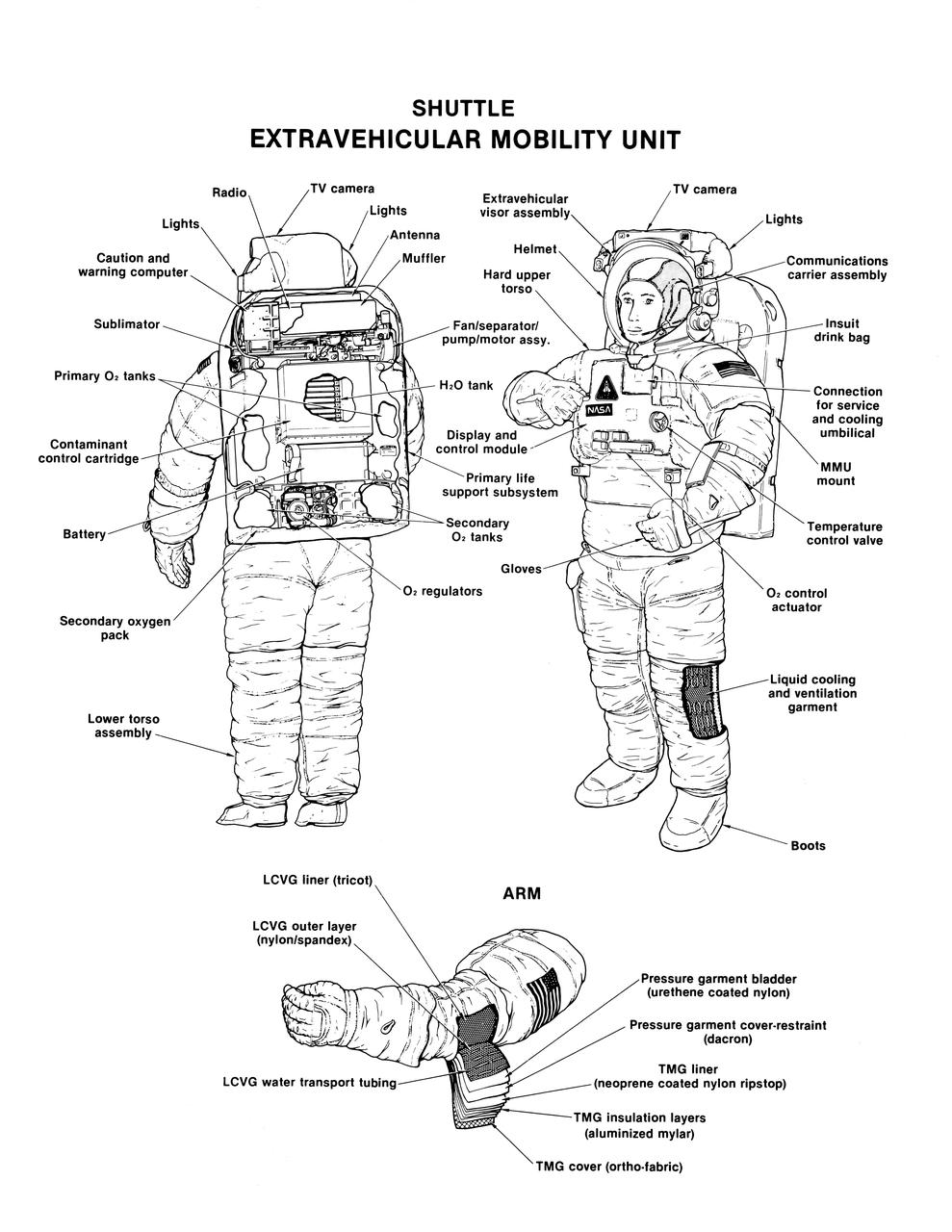
Labeled cutaway line drawing of the Shuttle extravehicular mobility unit (EMU) identifies its various components and equipment. The portable life support system (PLSS) and protective layers of fabric (thermal micrometeoroid garment (TMG)) incorporated in this extravehicular activity (EVA) space suit are shown.
Labeled cutaway line drawing of Shuttle Extravehicular Mobility Unit (EMU)
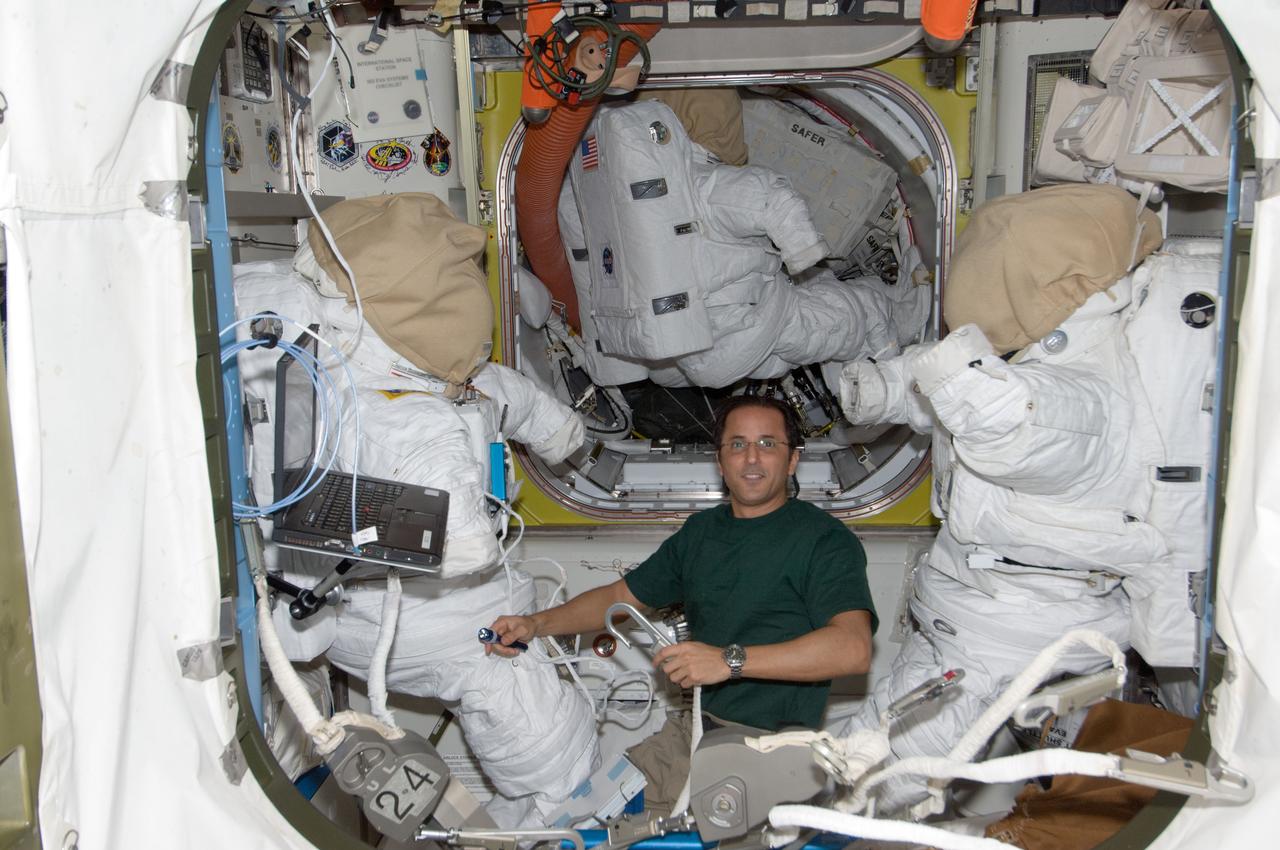
ISS032-E-006433 (9 July 2012) --- NASA astronaut Joe Acaba, Expedition 32 flight engineer, works with extravehicular activity (EVA) equipment between two Extravehicular Mobility Unit (EMU) spacesuits in the Quest airlock of the International Space Station.
FE Acaba works with EVA Equipment in the Airlock
AS17-145-22157 (12 Dec. 1972) --- Scientist-astronaut Harrison Schmitt, Apollo 17 lunar module pilot, uses an adjustable sampling scoop to retrieve lunar samples during the second Apollo 17 extravehicular activity (EVA), at Station 5 at the Taurus-Littrow landing site. A gnomon is atop the large rock in the foreground. The gnomon is a stadia rod mounted on a tripod, and serves as an indicator of the gravitational vector and provides accurate vertical reference and calibrated length for determining size and position of objects in near-field photographs. The color scale of blue, orange and green is used to accurately determine color for photography. The rod of it is 18 inches long. The scoop Dr. Schmitt is using is 11 3/4 inches long and is attached to a tool extension which adds a potential 30 inches of length to the scoop. The pan portion, obscured in this view, has a flat bottom, flanged on both sides with a partial cover on the top. It is used to retrieve sand, dust and lunar samples too small for the tongs, another geological tool used by the astronauts. The pan and the adjusting mechanism are made of stainless steel and the handle is made of aluminum. Within the foreground of this scene, three lunar samples were taken--numbers 75060, 75075 and 75080. Astronaut Eugene A. Cernan, crew commander, was using a 60mm lens on the 70mm Hasselblad camera and type SO-368 film to take this photograph.
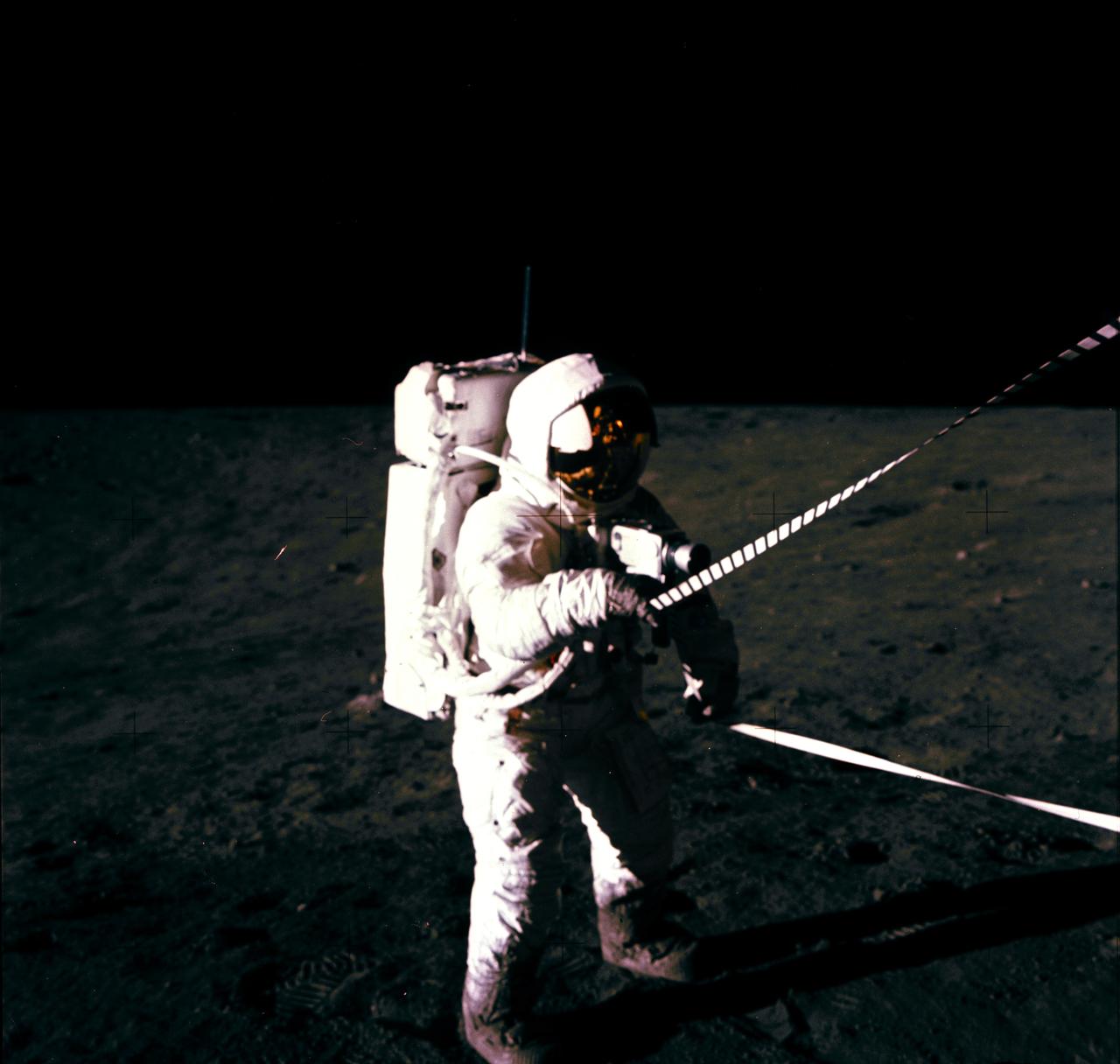
Astronaut Harrison Schmitt uses scoop to retrieve lunar samples during EVA
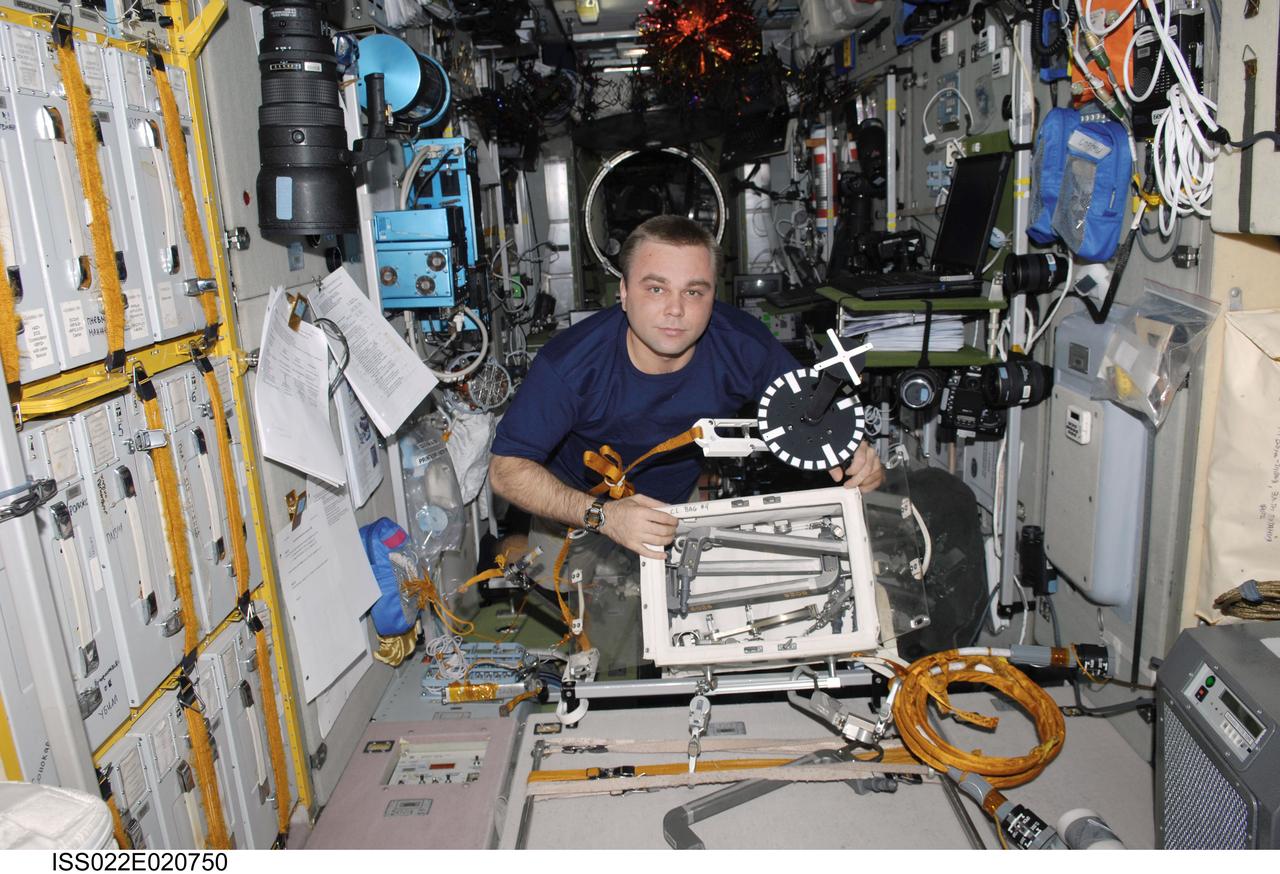
ISS022-E-020750 (6 Jan. 2010) --- Russian cosmonaut Maxim Suraev, Expedition 22 flight engineer, works with extravehicular activity (EVA) equipment in the Zvezda Service Module of the International Space Station.
Creamer looks through EVA Equipment in the SM during Expedition 22
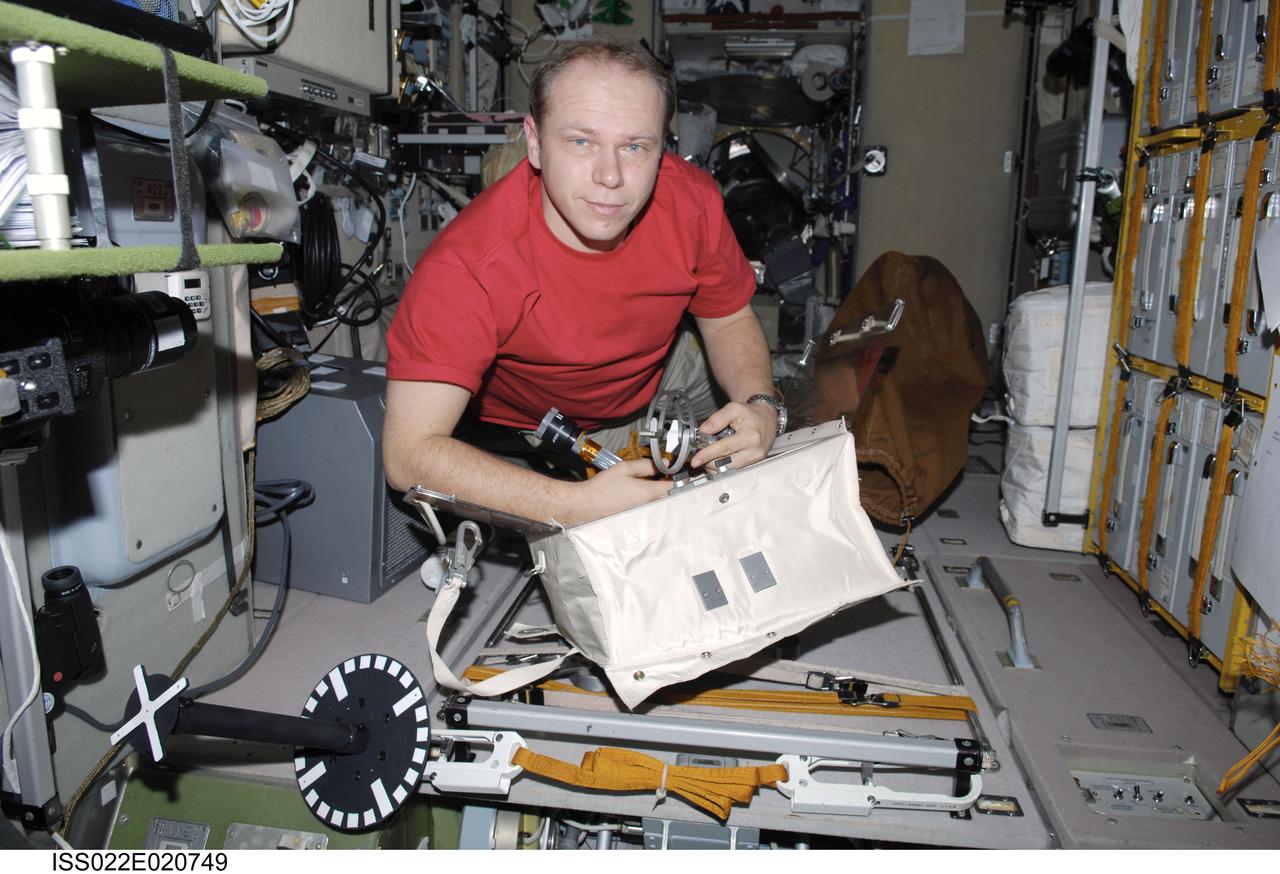
ISS022-E-020749 (6 Jan. 2010) --- Russian cosmonaut Oleg Kotov, Expedition 22 flight engineer, works with extravehicular activity (EVA) equipment in the Zvezda Service Module of the International Space Station.
Kotov looks through EVA Equipment in the SM during Expedition 22
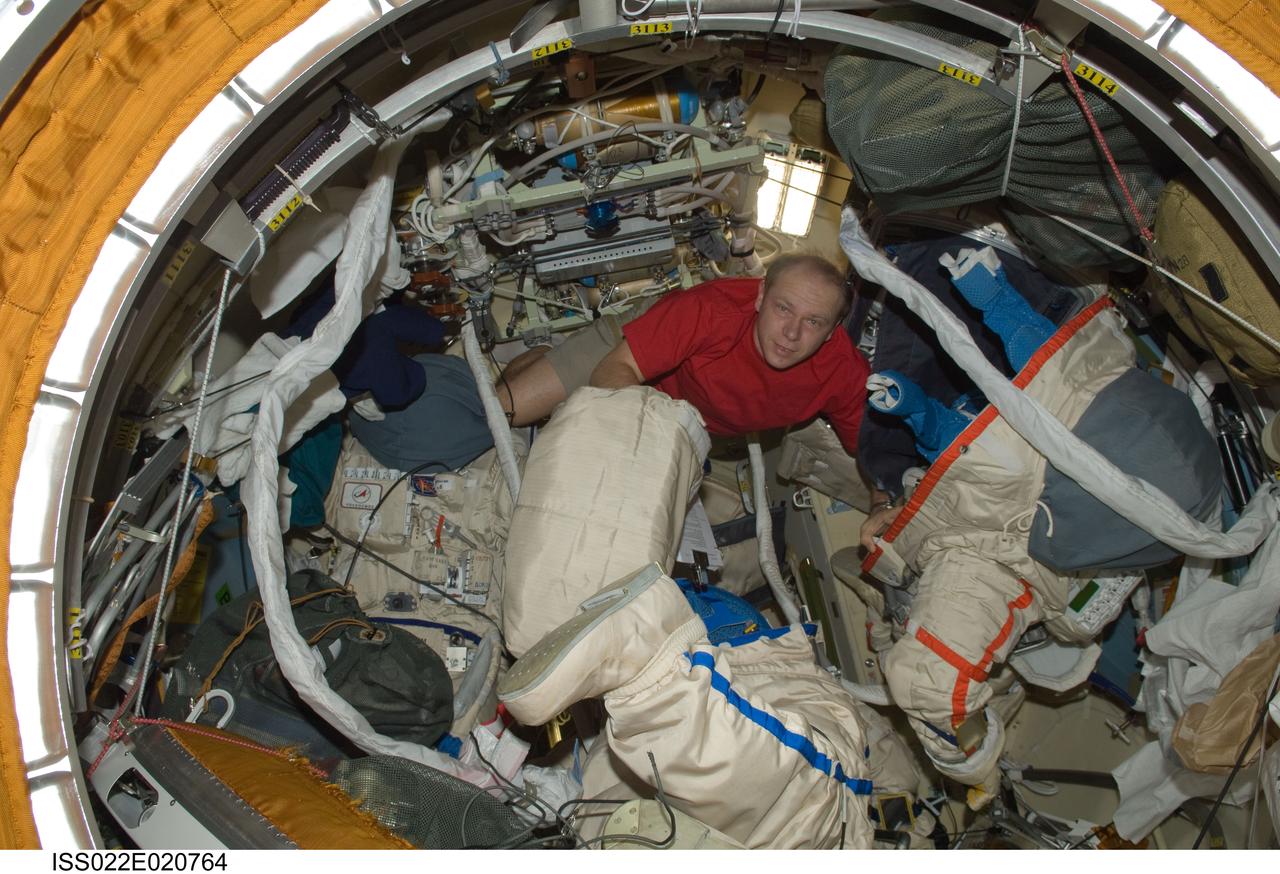
ISS022-E-020764 (7 Jan. 2010) --- Russian cosmonaut Oleg Kotov, Expedition 22 flight engineer, works with extravehicular activity (EVA) equipment and Russian Orlan spacesuits in the Pirs Docking Compartment of the International Space Station.
Kotov in the Pirs DC-1 during Expedition 22
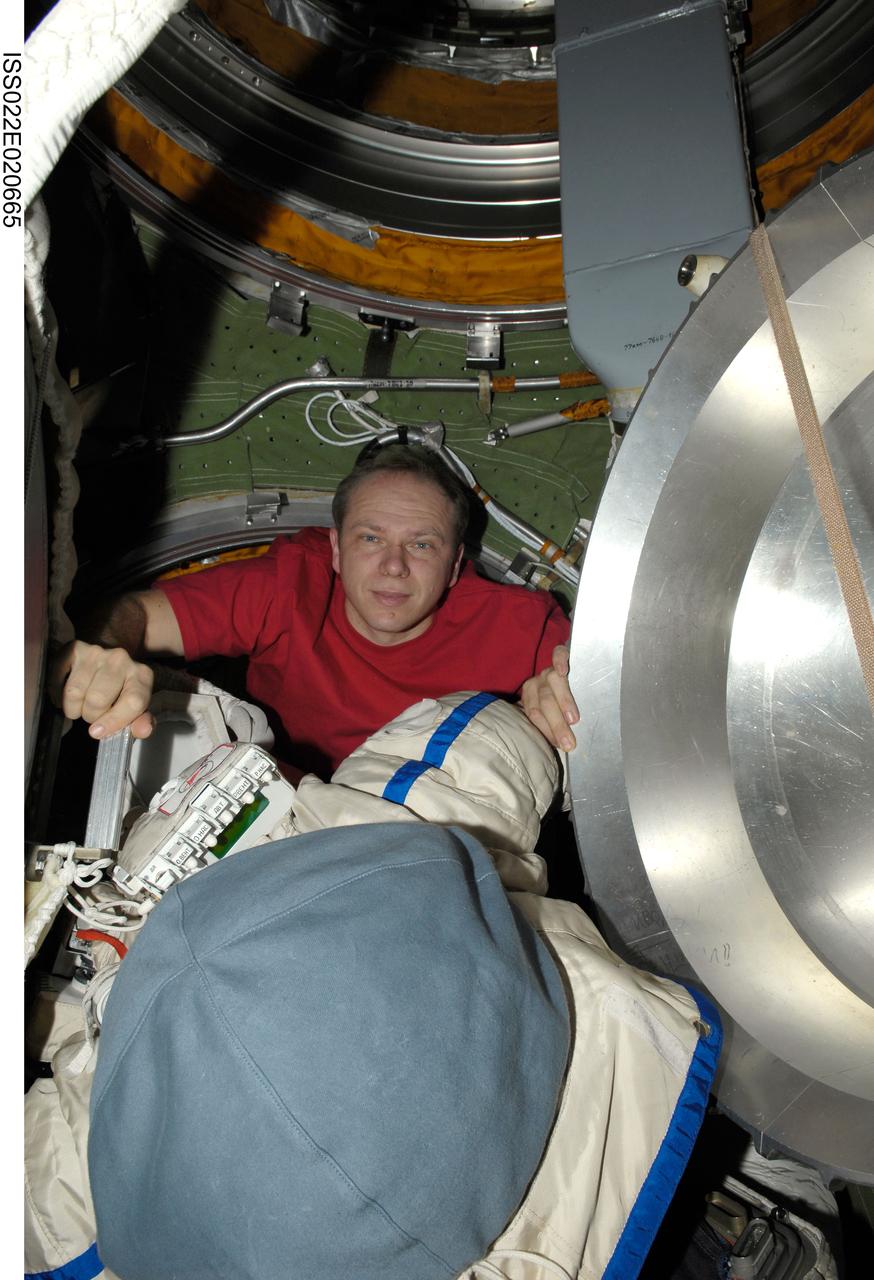
ISS022-E-020665 (7 Jan. 2010) --- Russian cosmonaut Oleg Kotov, Expedition 22 flight engineer, works with extravehicular activity (EVA) equipment in the Pirs Docking Compartment of the International Space Station.
Kotov in the Transfer Compartment of the SM during Expedition 22
ISS022-E-020762 (7 Jan. 2010) --- Russian cosmonaut Maxim Suraev, Expedition 22 flight engineer, works with extravehicular activity (EVA) equipment and Russian Orlan spacesuits in the Pirs Docking Compartment of the International Space Station.
Creamer in the Pirs DC-1 during Expedition 22
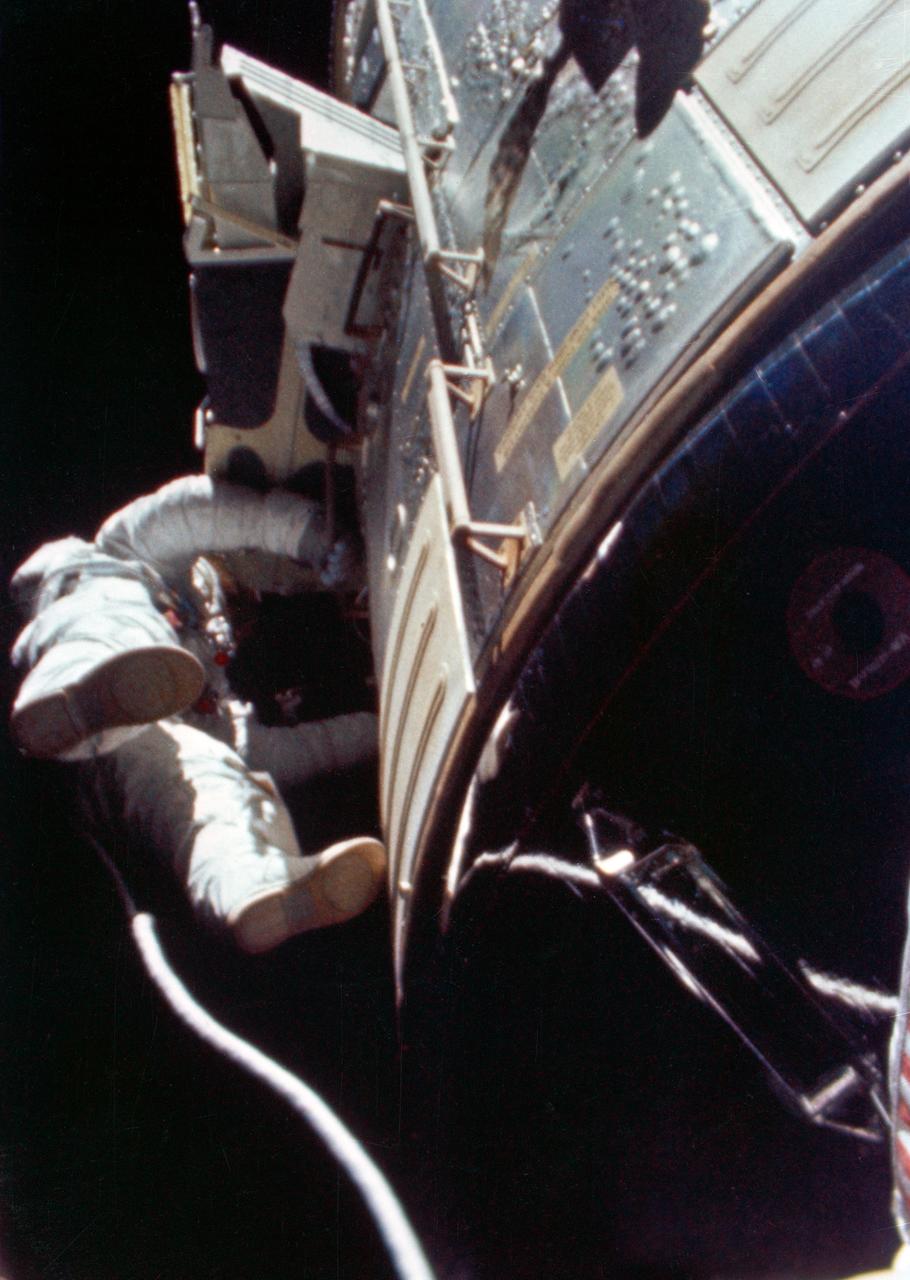
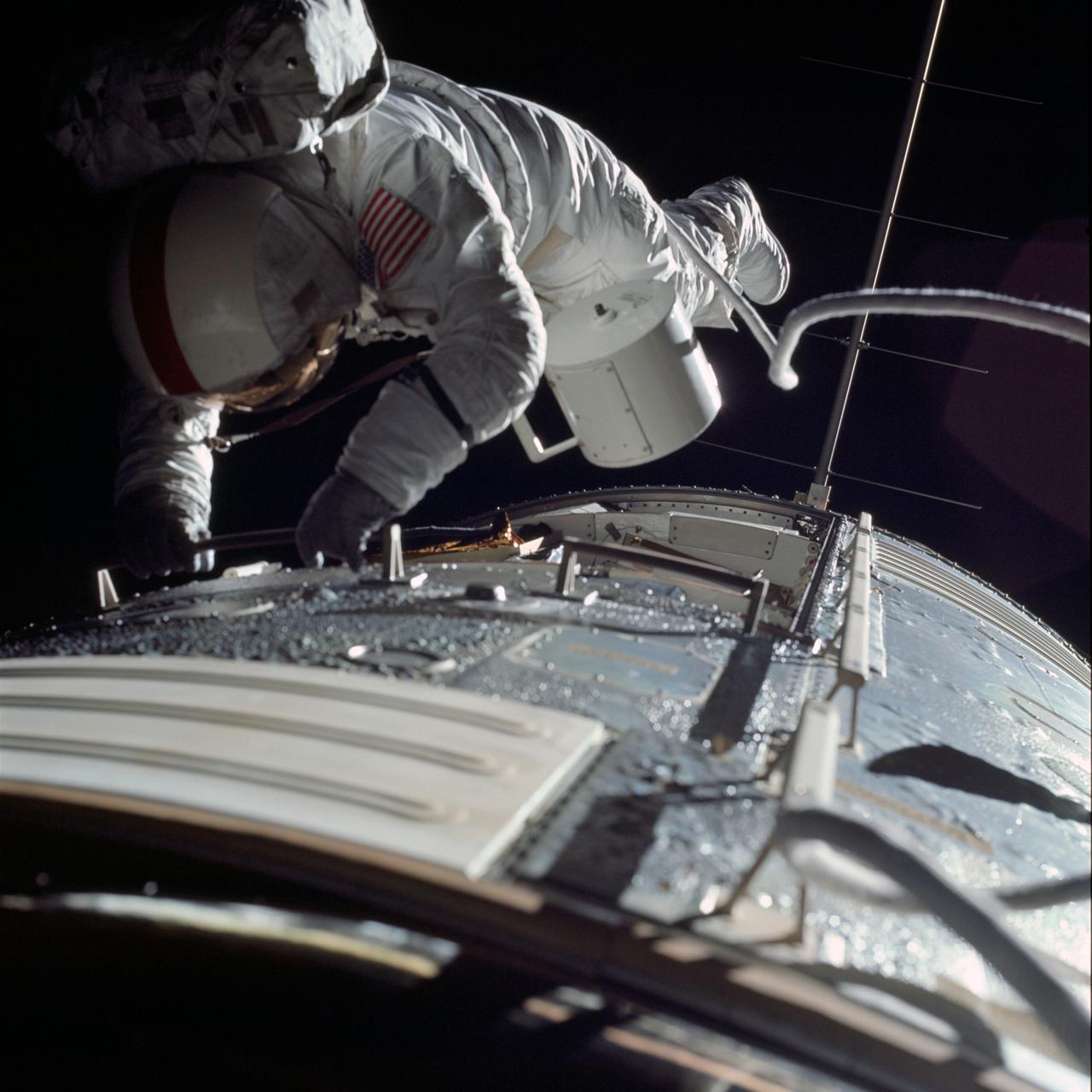
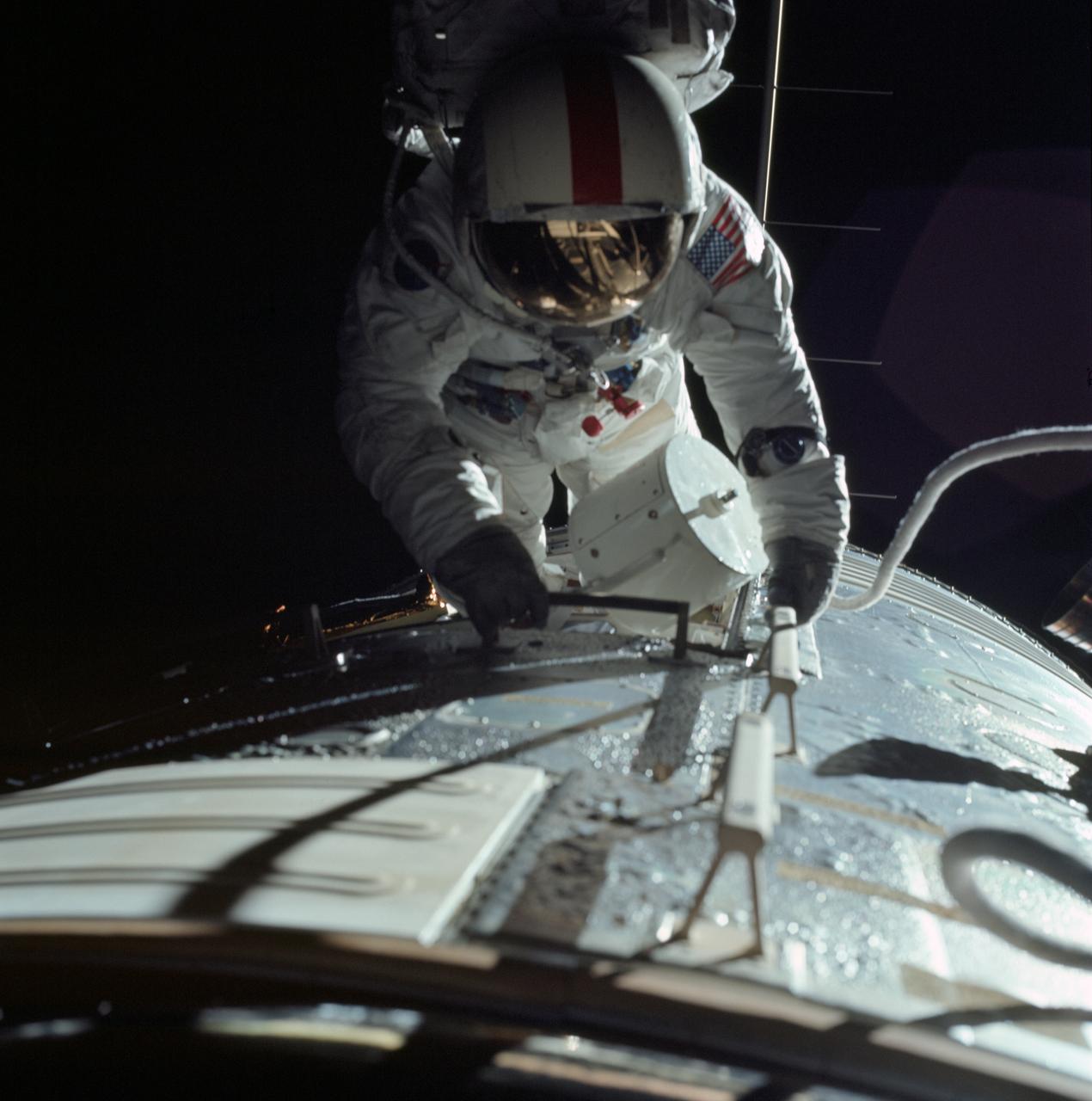
S71-43202 (5 Aug. 1971) --- Astronaut Alfred M. Worden, command module pilot of the Apollo 15 lunar landing mission, floats in space outside the spacecraft during his trans-Earth extravehicular activity (EVA). This photograph was taken from a frame of motion picture film exposed by the 16mm Maurer camera mounted in the hatch of the Command Module (CM). During his EVA, Worden made an inspection of the Service Module's (SM) Scientific Instrument Module (SIM) bay and retrieved the film cassettes from the Panoramic Camera and the Mapping Camera. The SIM bay holds eight orbital science experiments. The EVA occurred when the spacecraft was homeward bound approximately 171,000 nautical miles from Earth.
Astronaut Alfred Worden floats in space outside spacecraft during EVA
AS14-67-9362 (5 Feb. 1971) --- A close-up view of the passive seismic experiment (PSE), a component of the Apollo lunar surface experiments package (ALSEP), which was deployed on the moon by the Apollo 14 astronauts during their first extravehicular activity (EVA). While astronauts Alan B. Shepard Jr., commander, and Edgar D. Mitchell, lunar module pilot, descended in the Lunar Module (LM) to explore the moon, astronaut Stuart A. Roosa, command module pilot, remained with the Command and Service Modules (CSM) in lunar orbit.
View of the Passive Seismic Experiment deployed on Moon by Apollo 14
AS14-67-9386 (5 Feb. 1971) --- A close-up view of the laser ranging retro reflector (LR3) which the Apollo 14 astronauts deployed on the moon during their lunar surface extravehicular activity (EVA). While astronauts Alan B. Shepard Jr., commander, and Edgar D. Mitchell, lunar module pilot, descended in the Lunar Module (LM) to explore the moon, astronaut Stuart A. Roosa, command module pilot, remained with the Command and Service Modules (CSM) in lunar orbit.
View of the Laser Ranging Retro Reflector deployed by Apollo 14 astronauts
AS17-152-23393 (17 Dec. 1972) --- Astronaut Ronald E. Evans is photographed performing extravehicular activity during the Apollo 17 spacecraft's trans-Earth coast. During his EVA, command module pilot Evans retrieved film cassettes from the Lunar Sounder, Mapping Camera, and Panoramic Camera. The cylindrical object at Evans' left side is the Mapping Camera cassette. The total time for the trans-Earth EVA was one hour seven minutes 18 seconds, starting at ground elapsed time of 257:25 (2:28 p.m.) and ending at ground elapsed timed of 258:42 (3:35 p.m.) on Sunday, Dec. 17, 1972.
Astronaut Ronald Evans photographed during transearth coast EVA
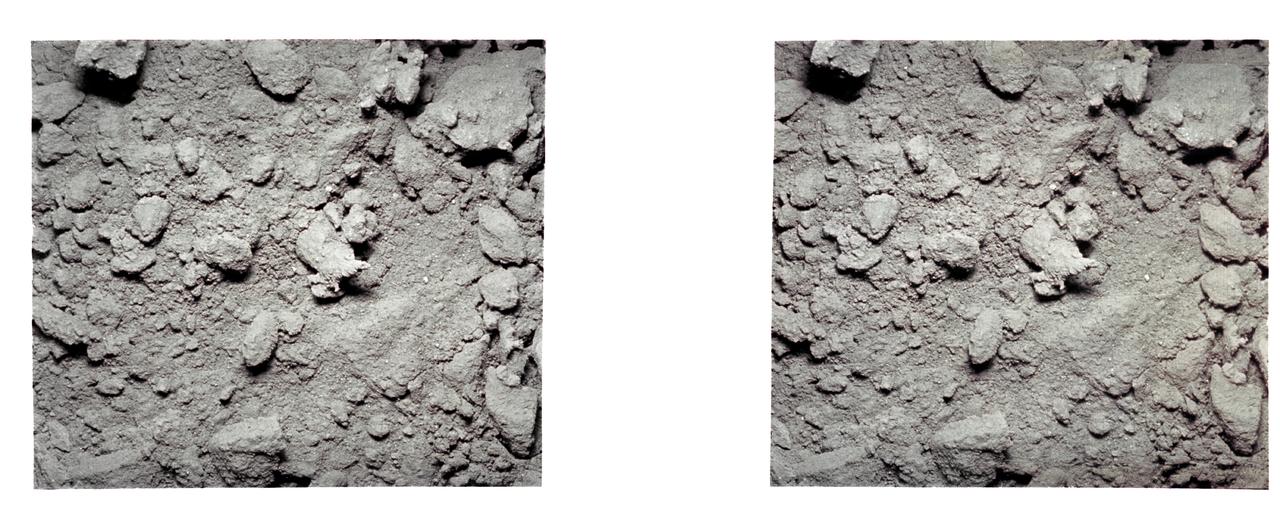
AS12-57-8455 (19-20 Nov. 1969) --- An Apollo 12 stereo view showing a three-inch square of the lunar surface. The exposure was made with an Apollo 35mm stereo close-up camera during extravehicular activity of the Apollo 12 lunar landing mission. The camera was developed to get the highest possible resolution of a small area. The three-inch square is photographed with a flash illumination and at a fixed distance. The camera is mounted on a walking stick, and the astronauts use it by holding it up against the object to be photographed and pulling the trigger. Astronauts Charles Conrad Jr., commander, and Alan L. Bean, lunar module pilot, descended in the Apollo 12 Lunar Module to explore the moon while astronaut Richard F. Gordon Jr. remained with the Command and Service Modules in lunar orbit in the capacity of command module pilot.
Apollo 12 stereo view of lunar surface
AS17-152-23391 (17 Dec. 1972) --- Astronaut Ronald E. Evans is photographed performing extravehicular activity during the Apollo 17 spacecraft's trans-Earth coast. During his EVA, Evans, command module pilot, retrieved film cassettes from the lunar sounder, mapping camera and panoramic camera. The cylindrical object at Evans' left side is the mapping camera cassette. The total time for the trans-Earth EVA was one hour, seven minutes, 18 seconds, starting at ground elapsed time of 257:25 (2:28 p.m.) and ending at G.E.T. of 258:42 (3:35 p.m.) on Sunday, Dec. 17, 1972.
Astronaut Ronald Evans photographed during transearth coast EVA
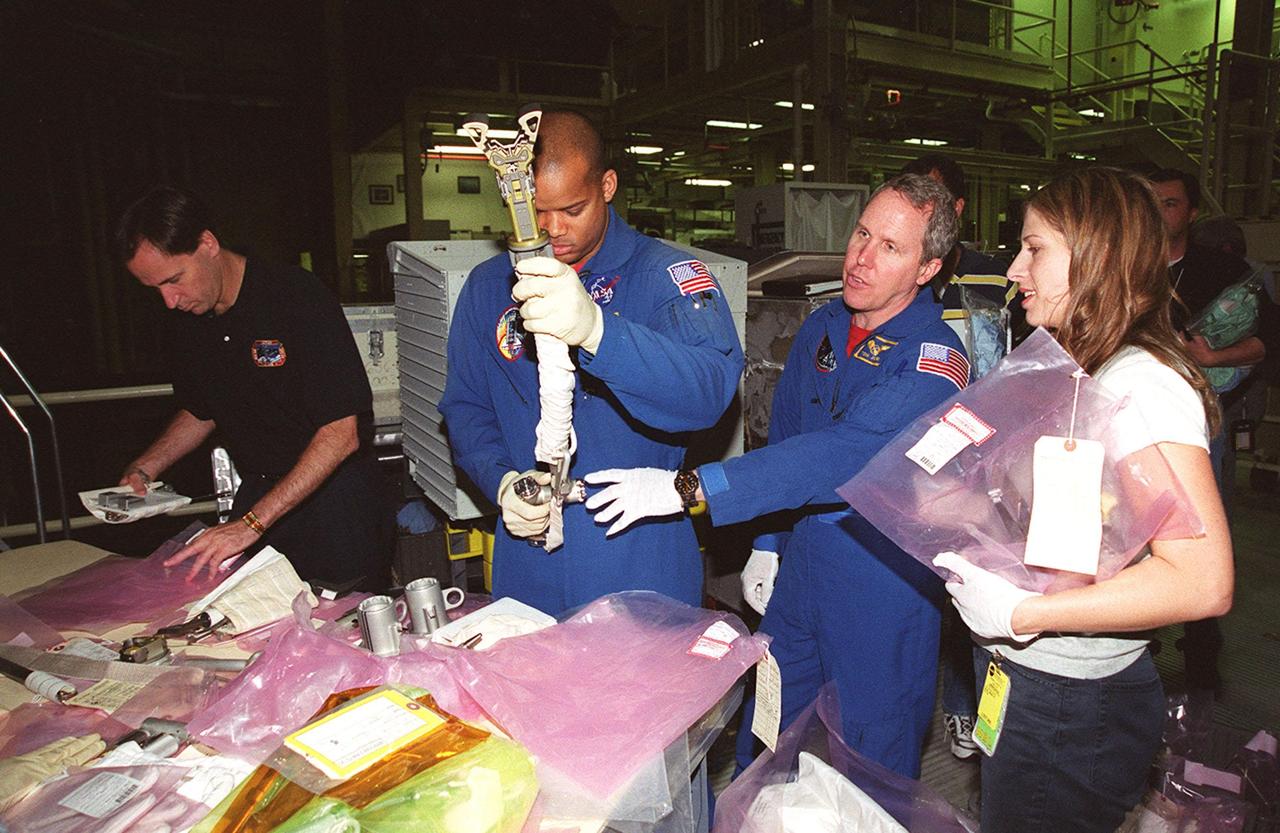
S93-26918 (8 Sept. 1994) --- Scott Bleisath, an extravehicular activity (EVA) engineer, demonstrates the hand control module for the Simplified Aid for EVA Rescue (SAFER) system making its first flight on the scheduled September STS-64 mission. Astronauts Mark C. Lee and Carl J. Meade are the spacewalkers assigned to test the system in space.  Unidentified technicians and engineers look on. Photo credit: NASA or National Aeronautics and Space Administration
STS-64 extravehicular activity (EVA) hardware view
S93-26920 (8 Sept. 1994) --- Scott Bleisath, an extravehicular activity (EVA) engineer, demonstrates the hand control module for the Simplified Aid for EVA Rescue (SAFER) system making its first flight on the scheduled September STS-64 mission. Astronauts Mark C. Lee and Carl J. Meade are the spacewalkers assigned to test the system in space. Photo credit: NASA or National Aeronautics and Space Administration
STS-64 extravehicular activity (EVA) hardware view
AS14-67-9379 (5 Feb. 1971) --- A close-up view of the central station (CS) of the Apollo lunar surface experiments package (ALSEP), which was deployed on the moon by the Apollo 14 astronauts during their first extravehicular activity (EVA). While astronauts Alan B. Shepard Jr., commander, and Edgar D. Mitchell, lunar module pilot, descended in the Lunar Module (LM) to explore the moon, astronaut Stuart A. Roosa, command module pilot, remained with the Command and Service Modules (CSM) in lunar orbit.
View of the Central Station of the ALSEP deploy by Apollo 14 astronauts
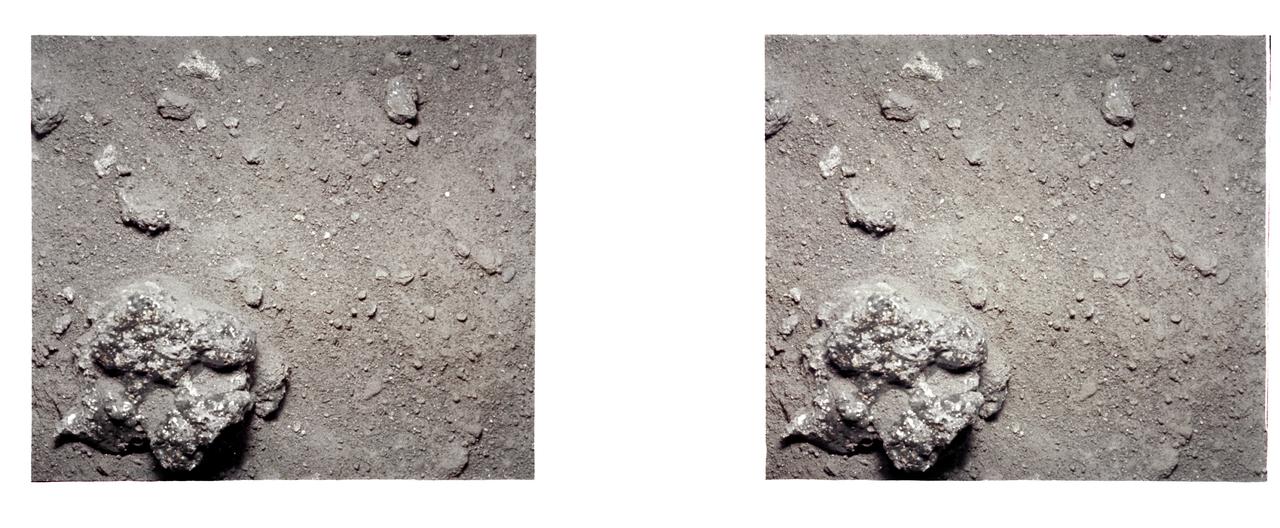
AS12-57-8452 (19-20 Nov. 1969) --- An Apollo 12 stereo view showing a three-inch square of the lunar surface. The exposure was made with an Apollo 35mm stereo close-up camera during extravehicular activity of the Apollo 12 lunar landing mission. The camera was developed to get the highest possible resolution of a small area. The three-inch square is photographed with a flash illumination and at a fixed distance. The camera is mounted on a walking stick, and the astronauts use it by holding it up against the object to be photographed and pulling the trigger. Astronauts Charles Conrad Jr., commander, and Alan L. Bean, lunar module pilot, descended in the Apollo 12 Lunar Module to explore the moon while astronaut Richard F. Gordon Jr. remained with the Command and Service Modules in lunar orbit in the capacity of command module pilot.
Apollo 12 stereo view of lunar surface
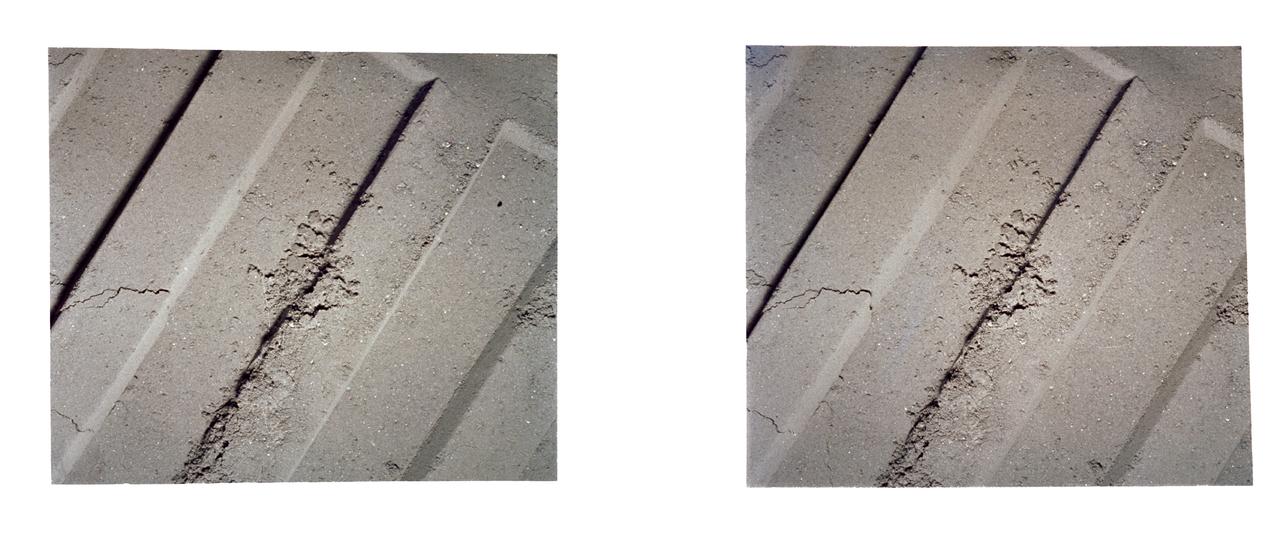
AS12-57-8448 (19-20 Nov. 1969) --- An Apollo 12 stereo view showing a three-inch square of the lunar surface upon which an astronaut had stepped. Taken during extravehicular activity of astronauts Charles Conrad Jr. and Alan L. Bean, the exposure of the boot imprint was made with an Apollo 35mm stereo close-up camera. The camera was developed to get the highest possible resolution of a small area. The three-inch square is photographed with a flash illumination and at a fixed distance. The camera is mounted on a walking stick, and the astronauts use it by holding it up against the object to be photographed and pulling the trigger. While astronauts Conrad and Bean descended in their Apollo 12 Lunar Module to explore the lunar surface, astronaut Richard F. Gordon Jr. remained with the Command and Service Modules in lunar orbit.
Apollo 12 stereo view of lunar surface upon which astronaut had stepped
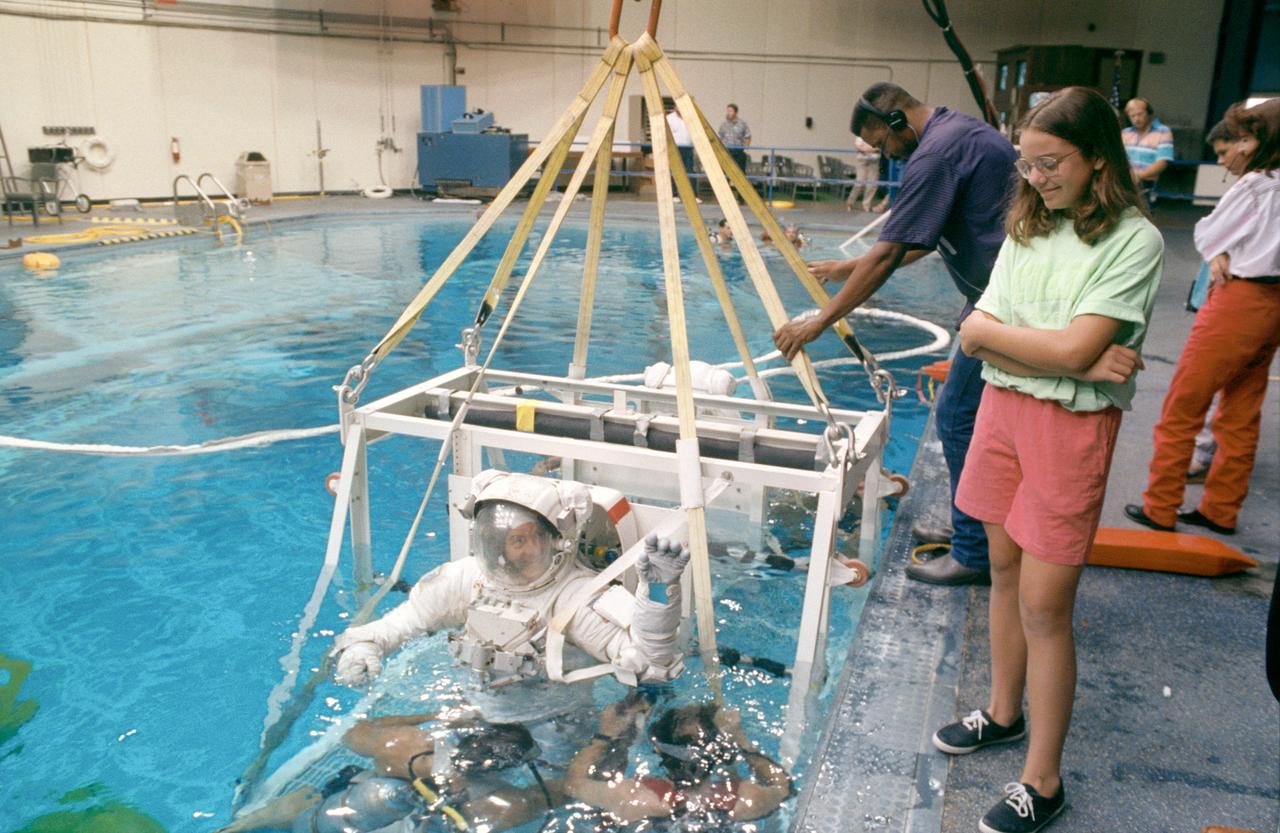
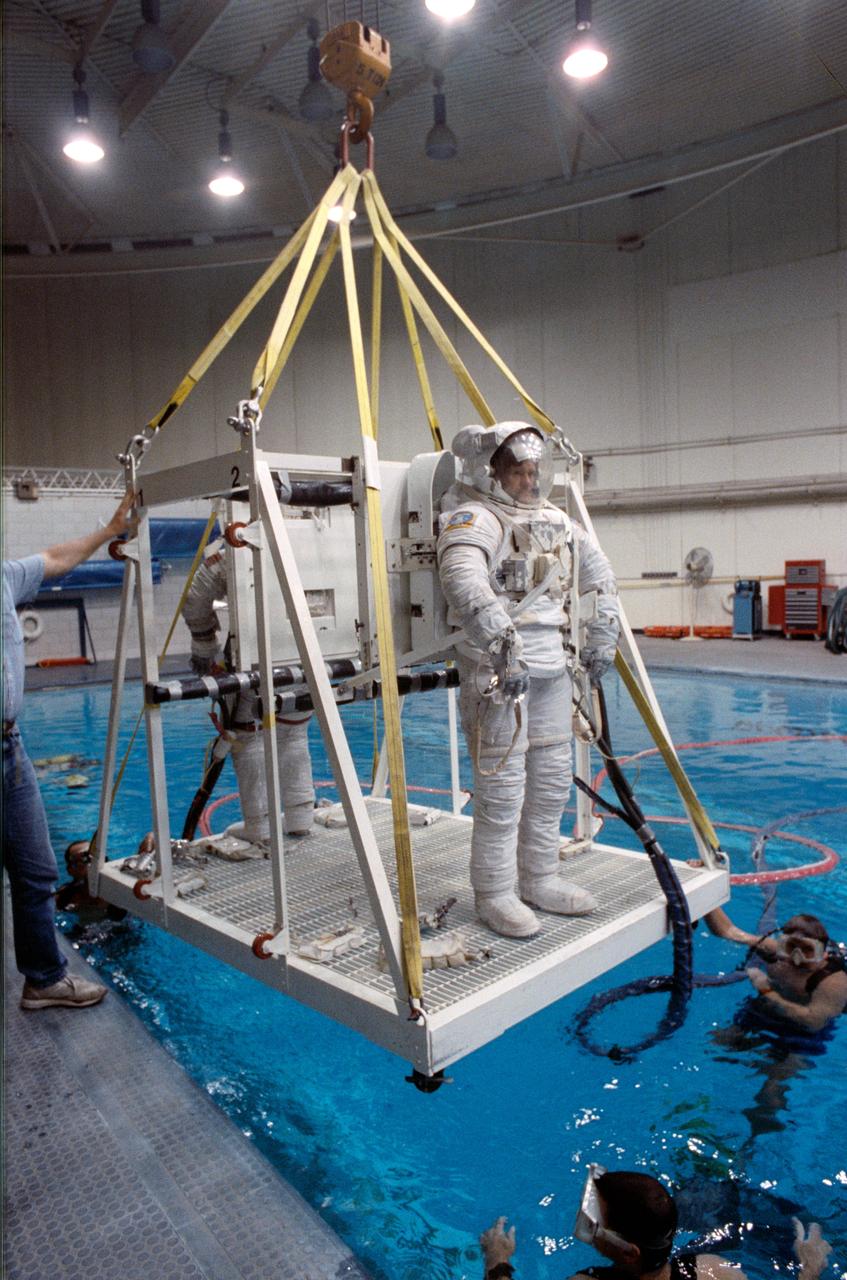
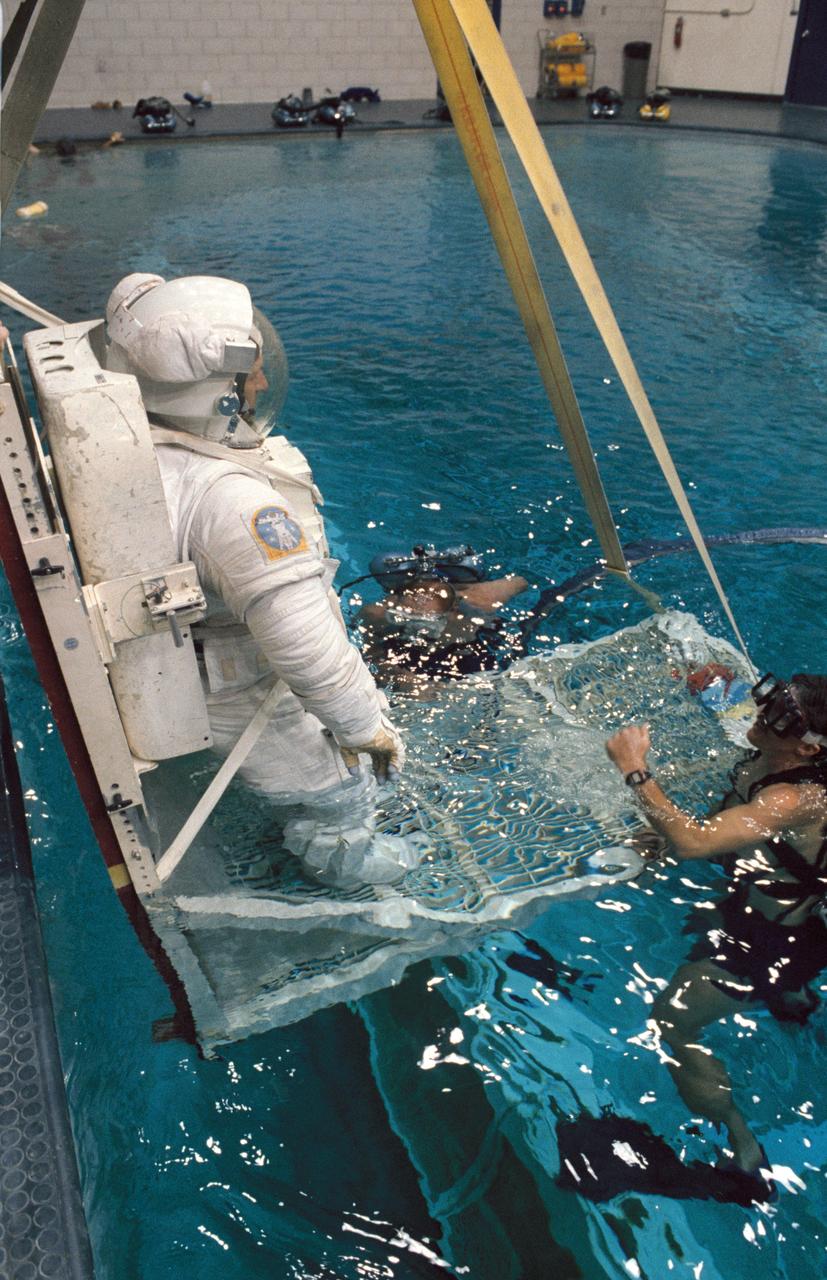
S92-43335 (28 July 1992) --- STS-53 Discovery, Orbiter Vehicle (OV) 103, Mission Specialist James S. Voss, wearing extravehicular mobility unit (EMU), is lowered into JSC?s Weightless Environment Training Facility (WETF) Bldg. 29 pool. Voss waves to his daughter standing on the poolside as the platform he is positioned in is submerged in the pool. Technicians on the poolside and scuba equipped divers in the water monitor activities. Once underwater, Voss will participate in contingency extravehicular activity (EVA) procedures.
STS-53 MS Voss, in EMU, in lowered into JSC's WETF pool for EVA simulation
AS09-19-2983 (6 March 1969) --- Astronaut Russell L. Schweickart, lunar module pilot, operates a 70mm Hasselblad camera during his extravehicular activity (EVA) on the fourth day of the Apollo 9 Earth-orbital mission. The Command and Service Modules (CSM) and Lunar Module (LM) "Spider" are docked. This view was taken from the Command Module (CM) "Gumdrop". Schweickart, wearing an Extravehicular Mobility Unit (EMU), is standing in "golden slippers" on the LM porch. On his back, partially visible, are a Portable Life Support System (PLSS) and an Oxygen Purge System (OPS). Astronaut James A. McDivitt, Apollo 9 commander, was inside the "Spider". Astronaut David R. Scott, command module pilot, remained at the controls in the CM.
Astronaut Russell Schweickart photographed during EVA
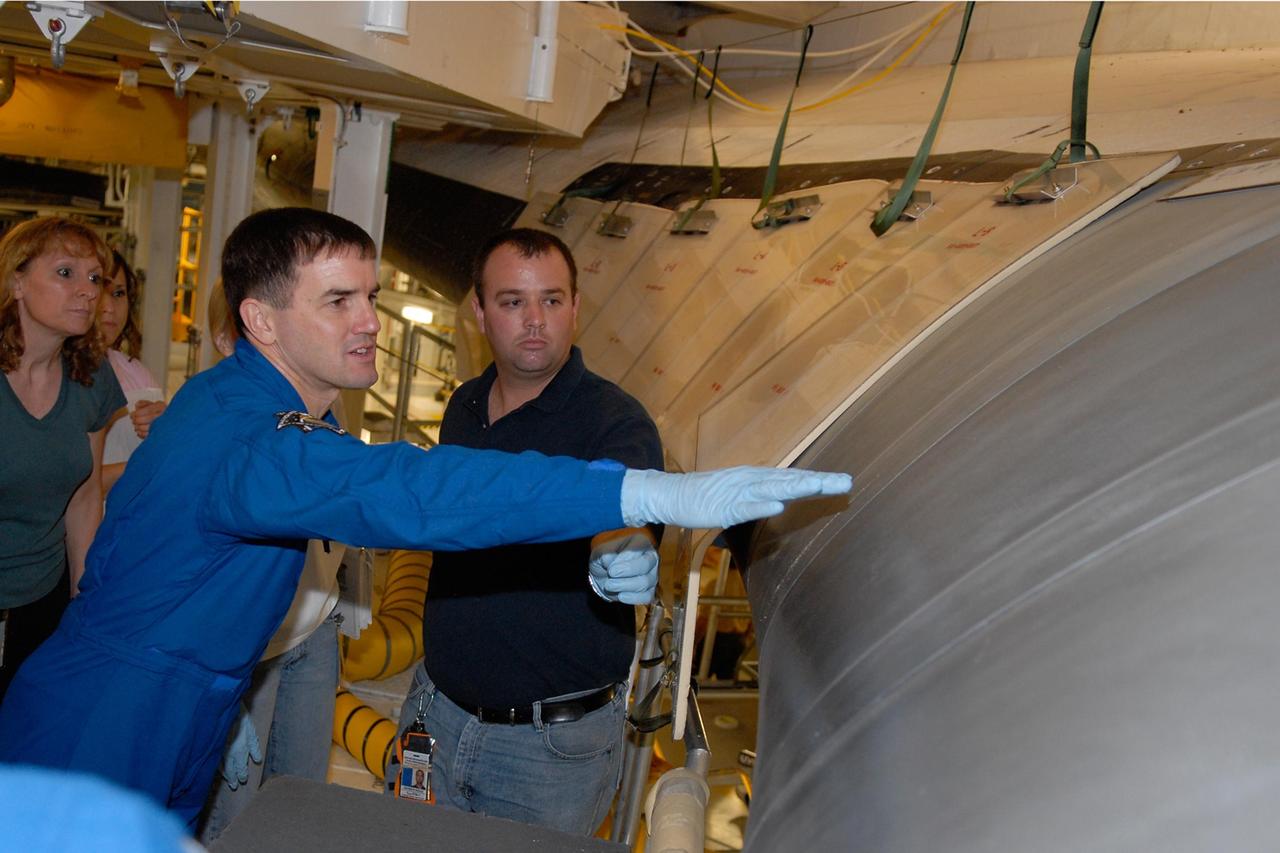
KENNEDY SPACE CENTER, FLA. -- In the Orbiter Processing Facility, STS-122 Mission Specialist Rex Walheim reaches toward the wing of space shuttle Atlantis.  The crew is at Kennedy to take part in a crew equipment interface test, or CEIT, which helps familiarize them with equipment and payloads for the mission.  Among the activities standard to a CEIT are harness training, inspection of the thermal protection system and camera operation for planned extravehicular activities, or EVAs.  STS-122 is targeted for launch in December.   Photo credit: NASA/Kim Shiflett
KSC-07pd2612
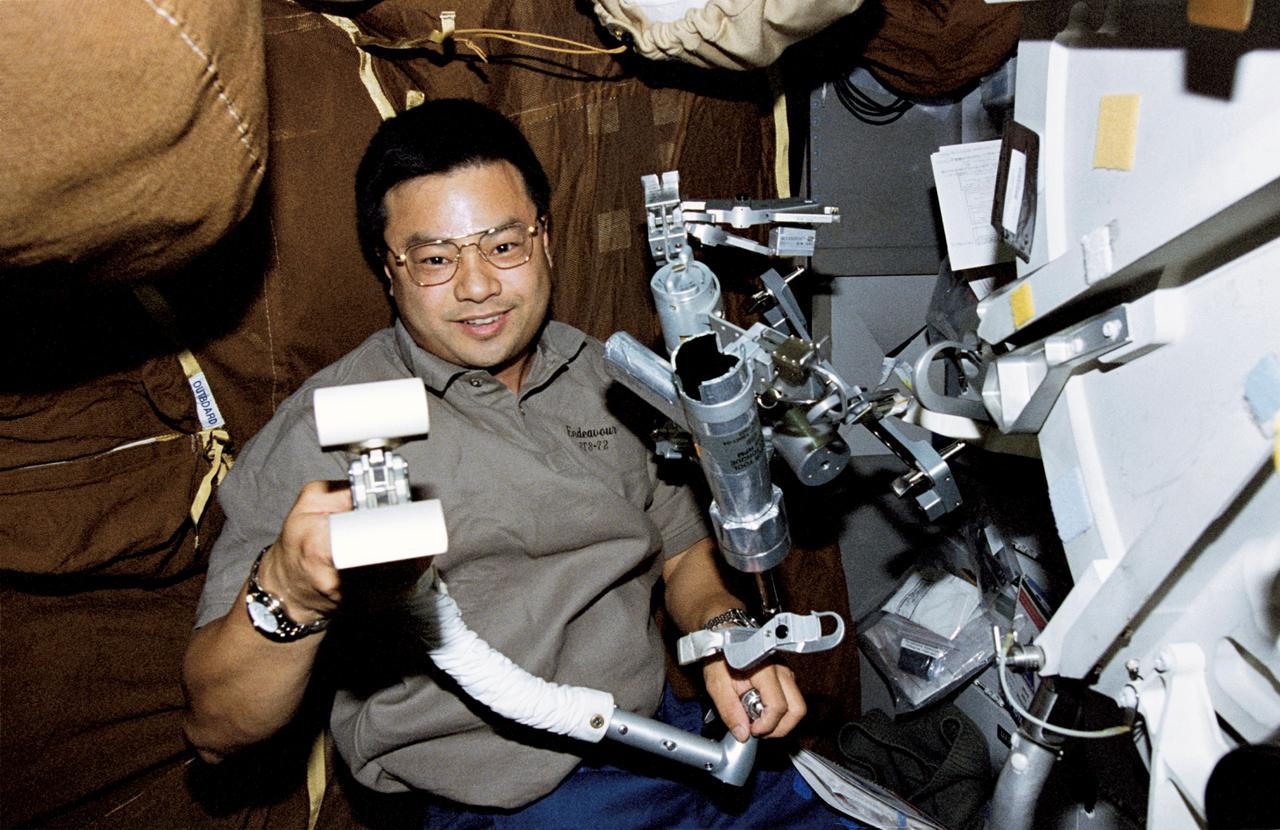
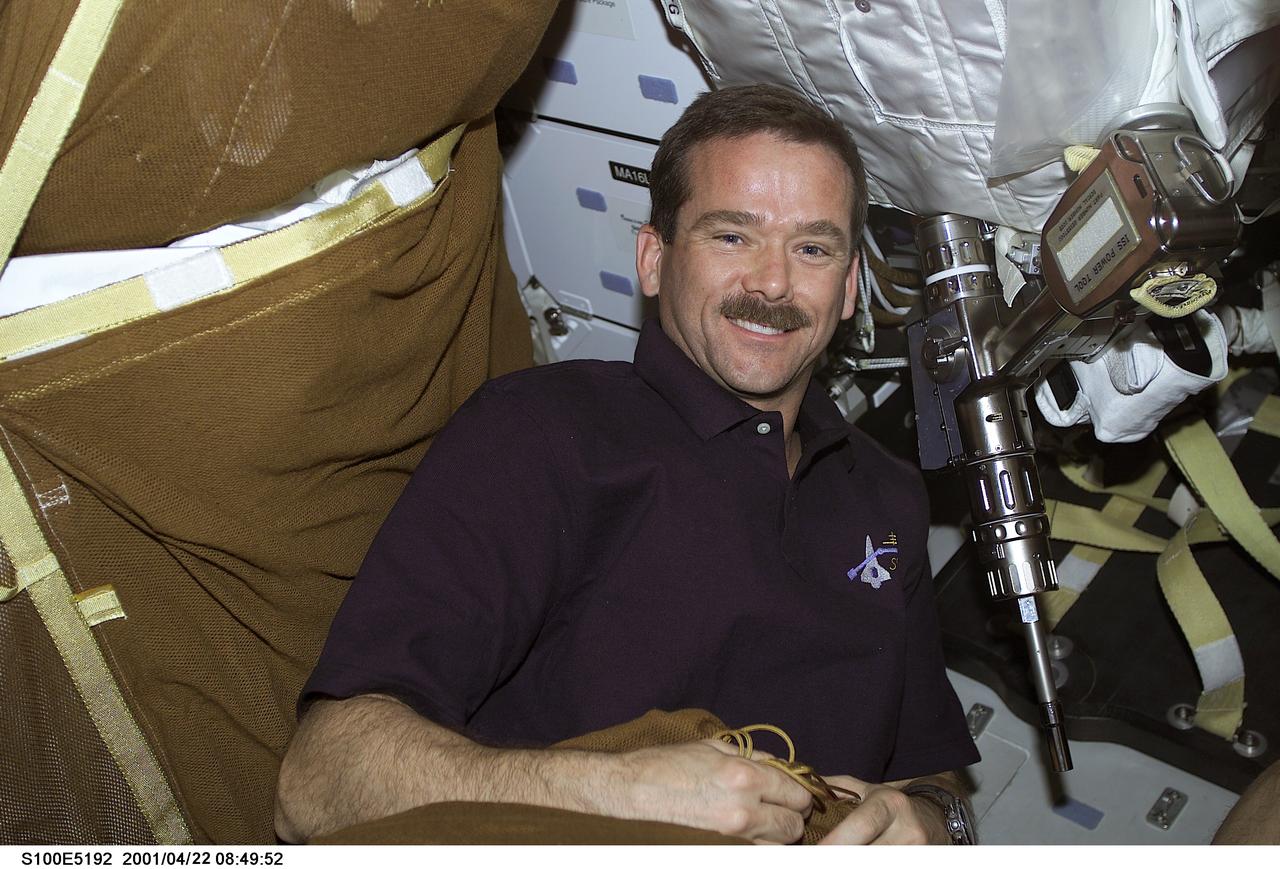
S100-E-5192 (21 April 2001) --- Astronaut Chris A. Hadfield of the Canadian Space Agency (CSA), scheduled as one of two mission specialist participants in April 22 extravehicular activity (EVA) with the International Space Station (ISS), inspects equipment on the middeck of the Space Shuttle Endeavour. The image was recorded with a digital still camera.
MS Hadfield checks out a Pistol Grip Tool on the middeck of Endeavour
ISS022-E-019986 (6 Jan. 2010) --- Russian cosmonaut Oleg Kotov, Expedition 22 flight engineer, holds a stowage box containing extravehicular activity (EVA) retractable equipment tethers in the Zvezda Service Module of the International Space Station.
Kotov holds Retractable Equipment Tethers in the SM during Expedition 22
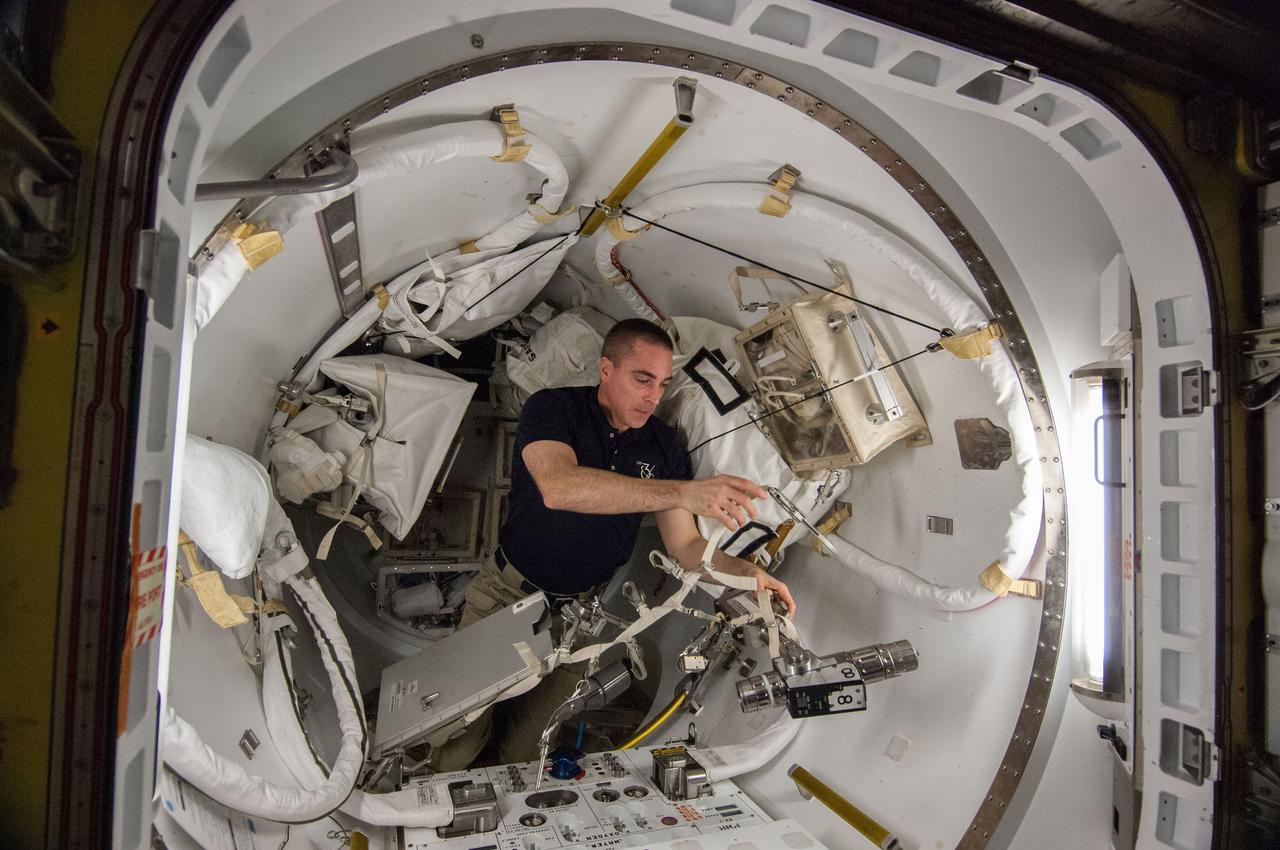
ISS036-E-013051 (30 June 2013) --- NASA astronaut Chris Cassidy, Expedition 36 flight engineer, works with spacewalk equipment in the Quest airlock of the International Space Station in preparation for the first of two sessions of extravehicular activity (EVA) scheduled for July 9 and July 16.
Cassidy in Airlock
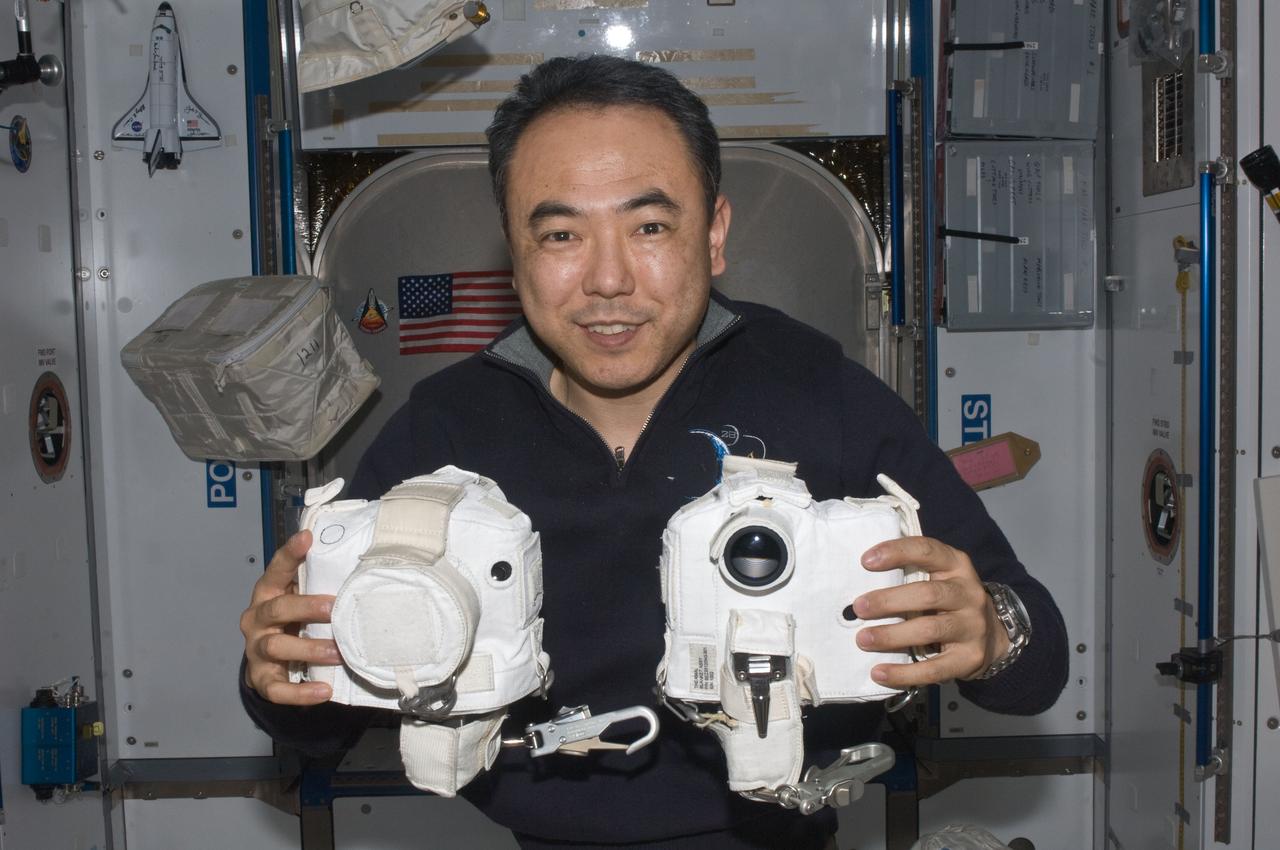
ISS028-E-020222 (1 Aug. 2011) ---  Japan Aerospace Exploration Agency astronaut Satoshi Furukawa, Expedition 28 flight engineer, poses for a photo while holding extravehicular activities (EVA) camera equipment in the Harmony node of the International Space Station.
FE Furukawa poses with EVA Cameras
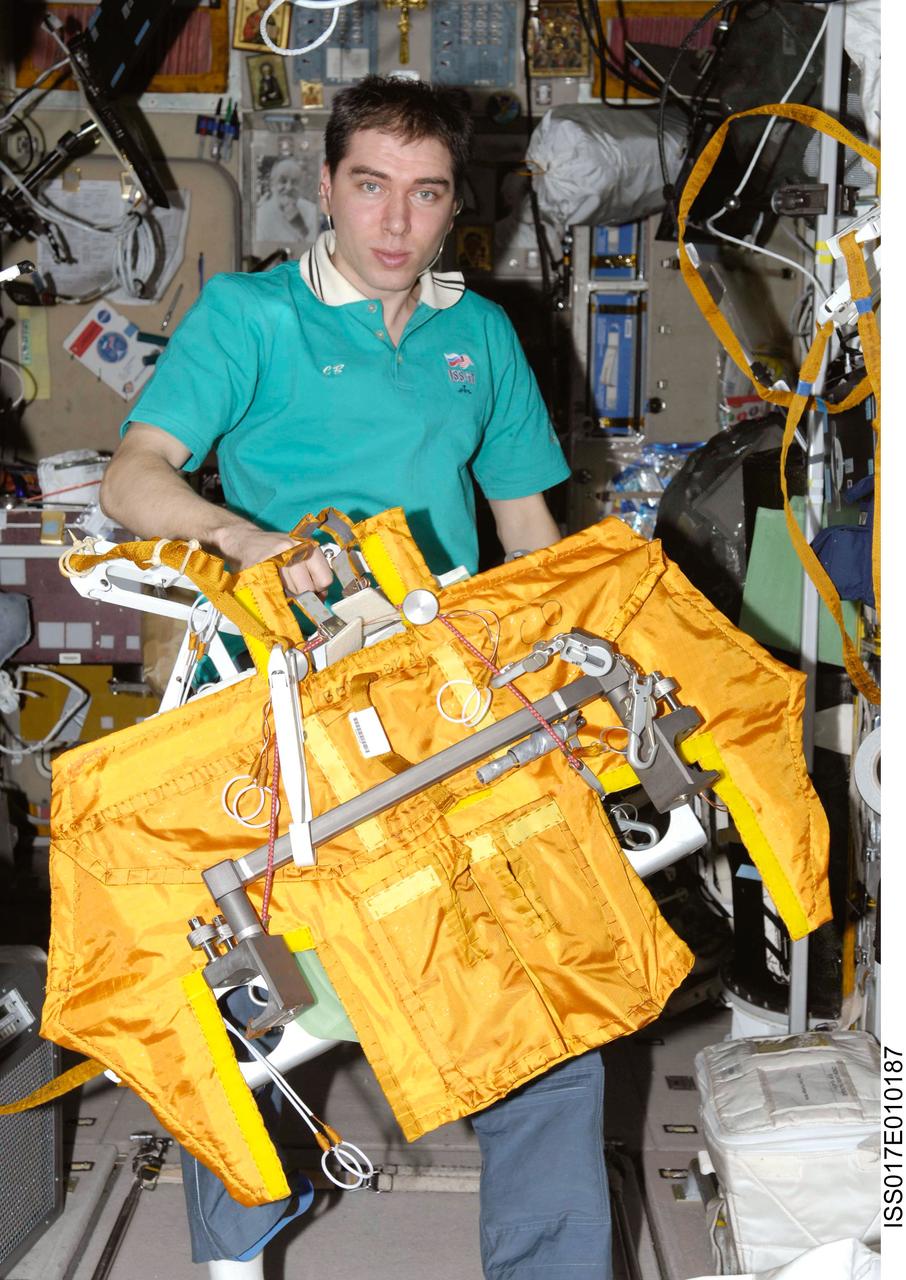
ISS017-E-010187 (1 July 2008) --- Russian Federal Space Agency cosmonaut Sergei Volkov, Expedition 17 commander, holds covered extravehicular activity (EVA) equipment and tools within a caddy in the Zvezda Service Module of the International Space Station.
Volkov holds EVA Tool Caddy in the SM during Expedition 17
ISS036-E-013069 (30 June 2013) --- NASA astronaut Chris Cassidy, Expedition 36 flight engineer, works with spacewalk equipment in the Quest airlock of the International Space Station in preparation for the first of two sessions of extravehicular activity (EVA) scheduled for July 9 and July 16.
Cassidy in Airlock
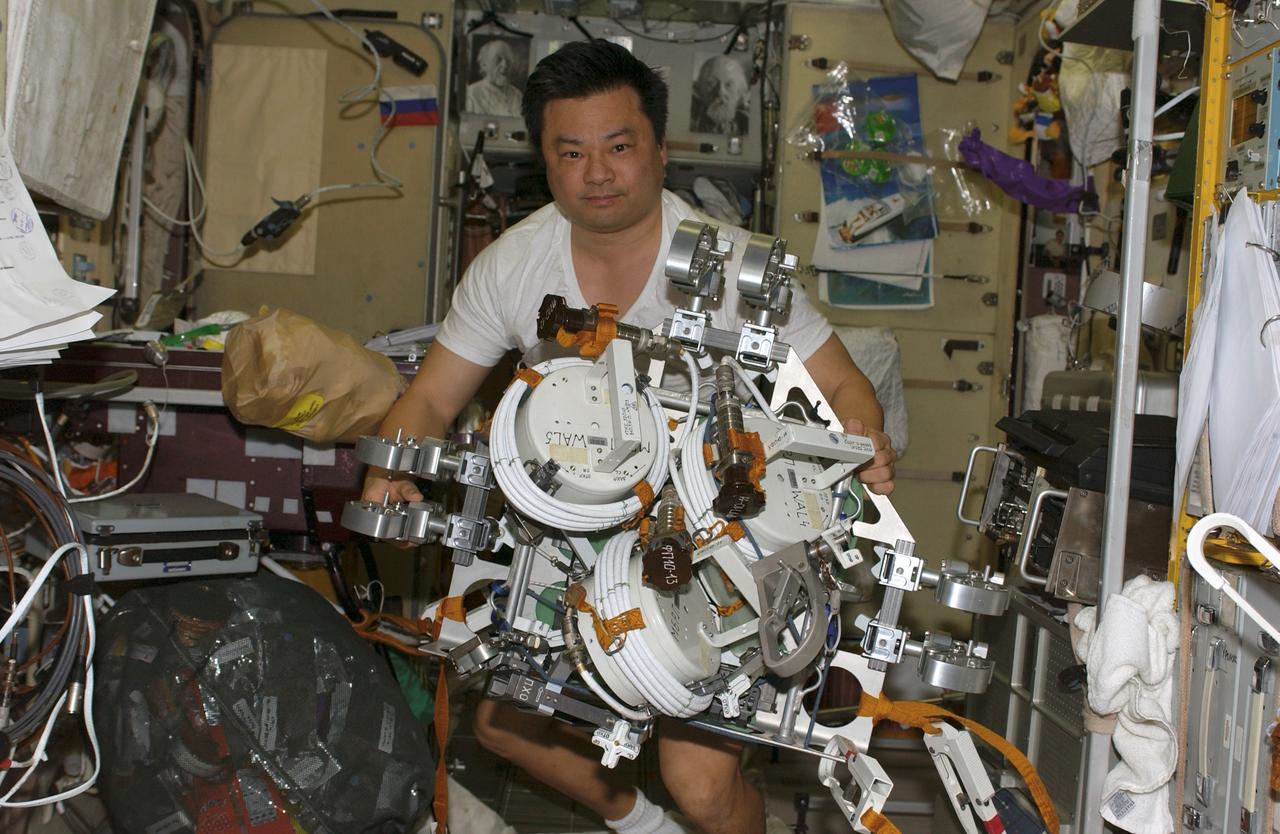
ISS010-E-20747 (21 March 2005) --- Astronaut Leroy Chiao, Expedition 10 commander and NASA ISS science officer, works with a tool caddy containing extravehicular activities (EVA) equipment and tools in the Zvezda Service Module of the International Space Station (ISS) in preparation for the spacewalk scheduled for March 28.
Chiao holds EVA holds tool caddy in the SM during Expedition 10
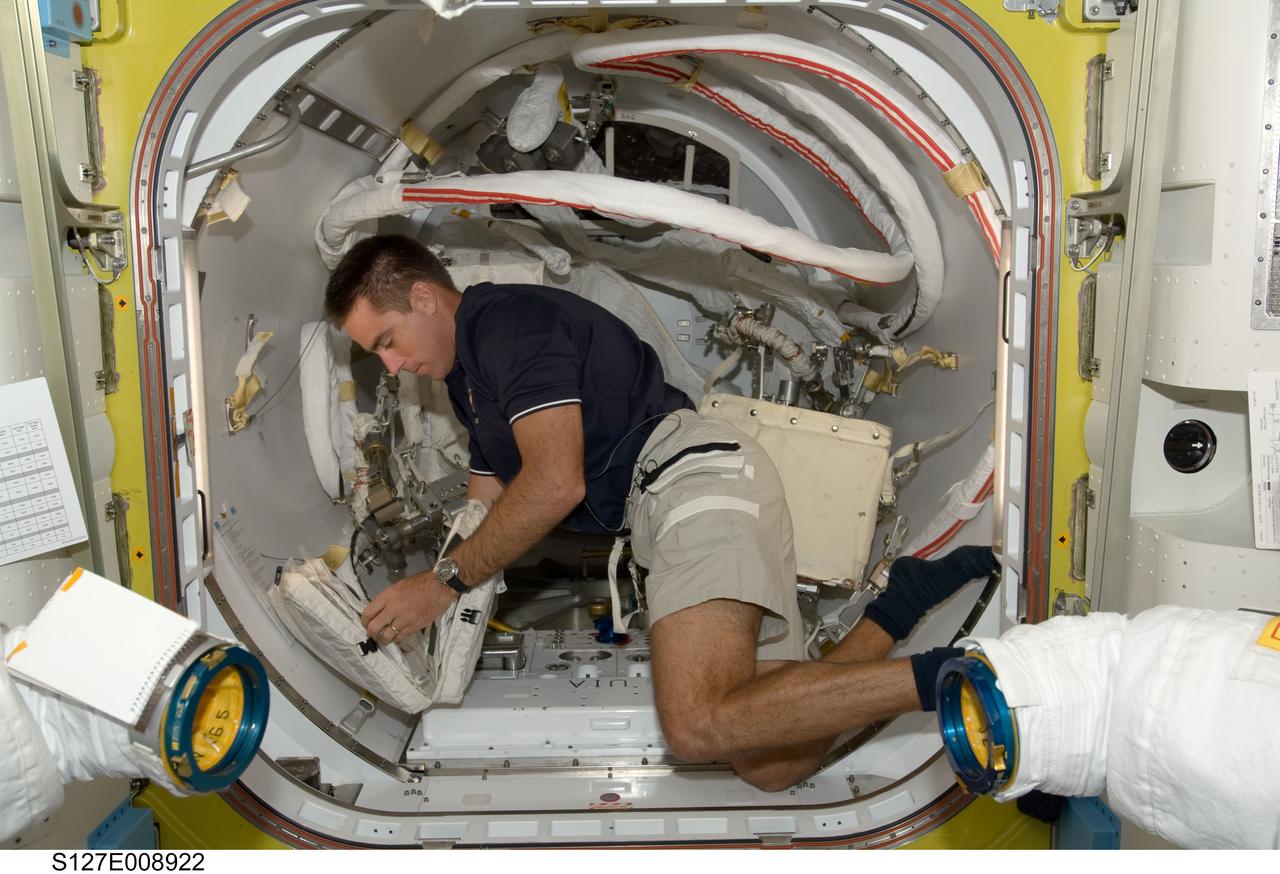
S127-E-008922 (26 July 2009) --- Astronaut Christopher Cassidy, STS-127 mission specialist, works with extravehicular activity (EVA) equipment in the Quest airlock of the International Space Station while Space Shuttle Endeavour remains docked with the station.
Cassidy works in the A/L during Joint Operations
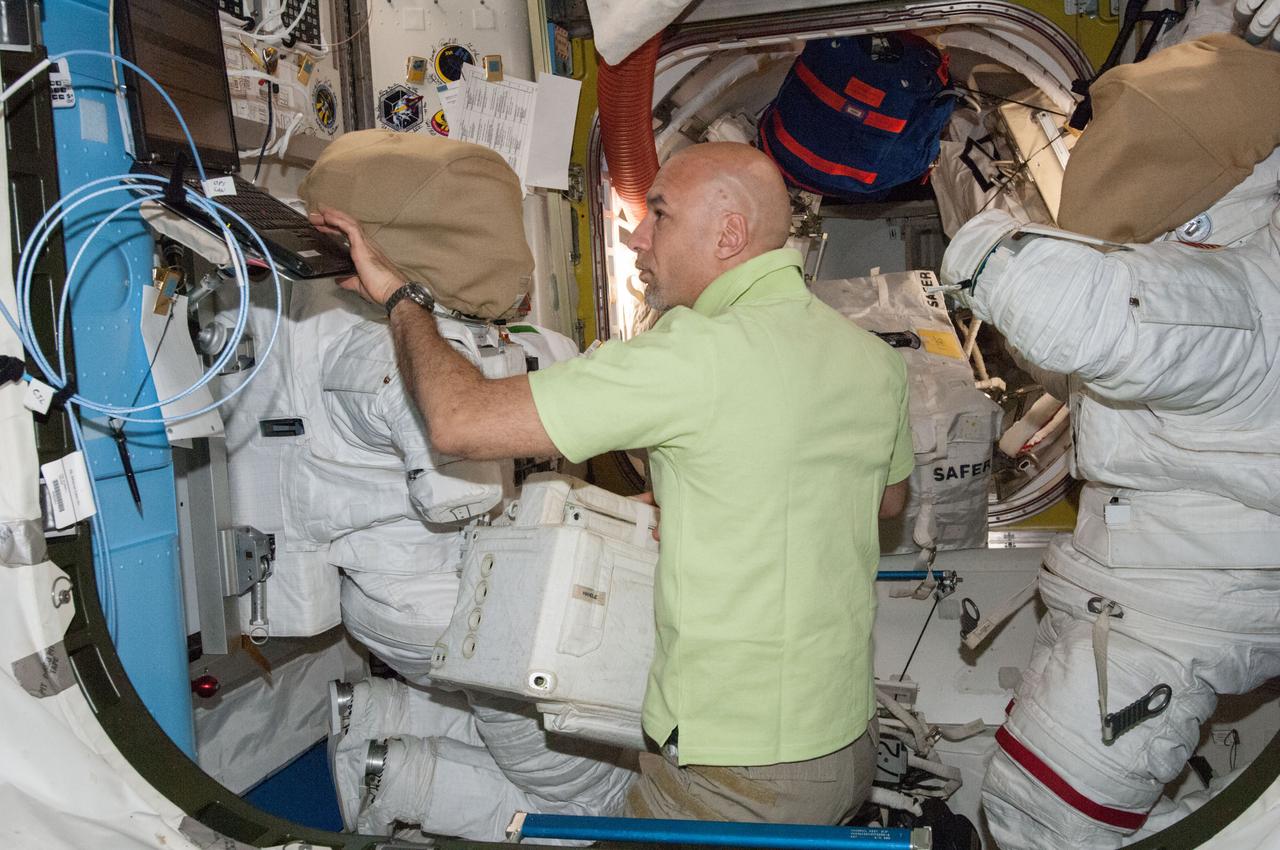
ISS036-E-014852 (3 July 2013) --- European Space Agency astronaut Luca Parmitano, Expedition 36 flight engineer, works with spacewalk equipment in the Quest airlock of the International Space Station in preparation for the first of two sessions of extravehicular activity (EVA) scheduled for July 9 and July 16.
Parmitano at work in airlock
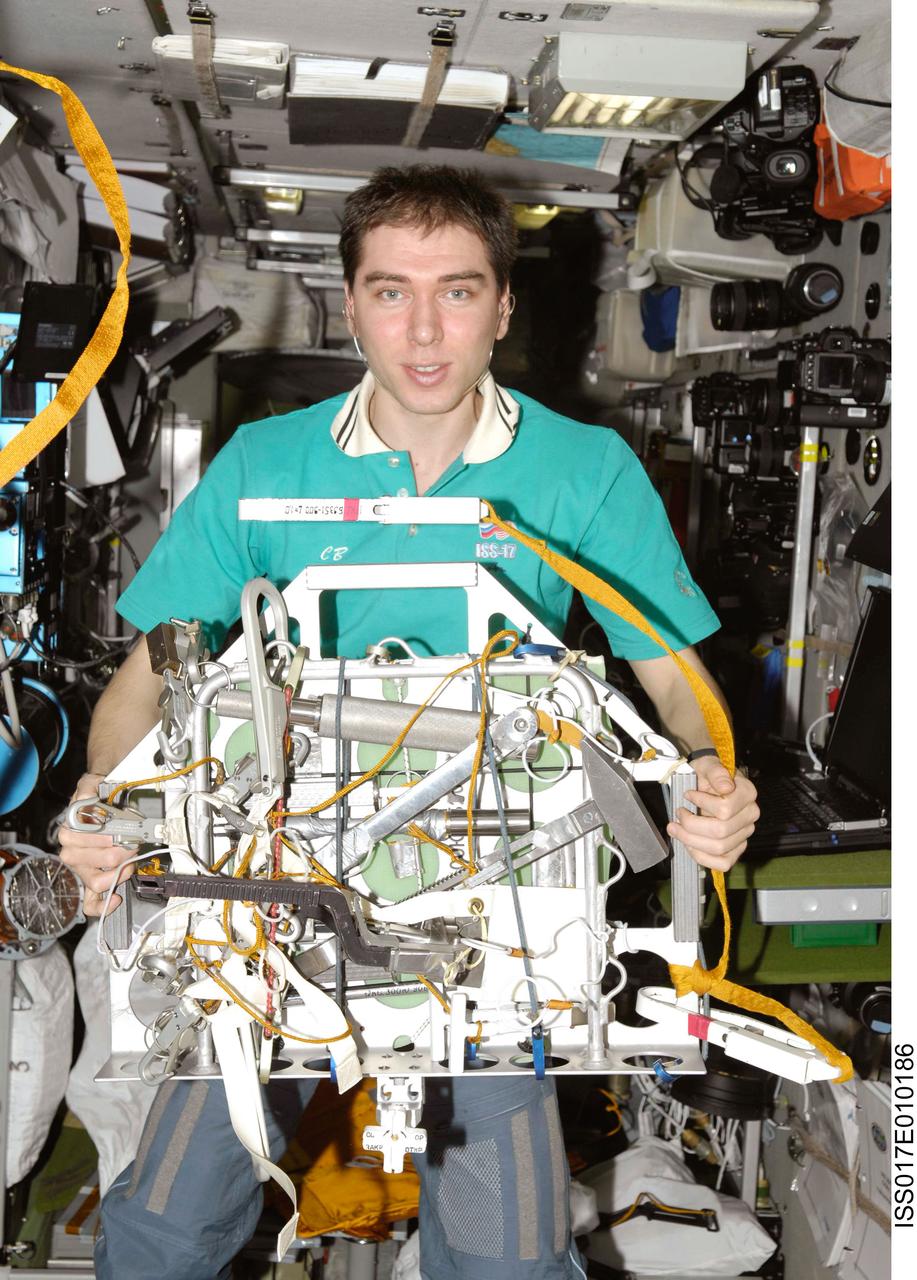
ISS017-E-010186 (1 July 2008) --- Russian Federal Space Agency cosmonaut Sergei Volkov, Expedition 17 commander, holds extravehicular activity (EVA) equipment and tools within a caddy in the Zvezda Service Module of the International Space Station.
Volkov holds EVA Tool Caddy in the SM during Expedition 17
STS072-320-004 (11-20 Jan. 1996) --- On the Space Shuttle Endeavour's middeck, astronaut Leroy Chiao checks equipment for his upcoming extravehicular activity (EVA). Chiao later joined astronaut Daniel T. Barry for the first of two EVA sessions.
Mission Specialist Leroy Chiao examine BRT
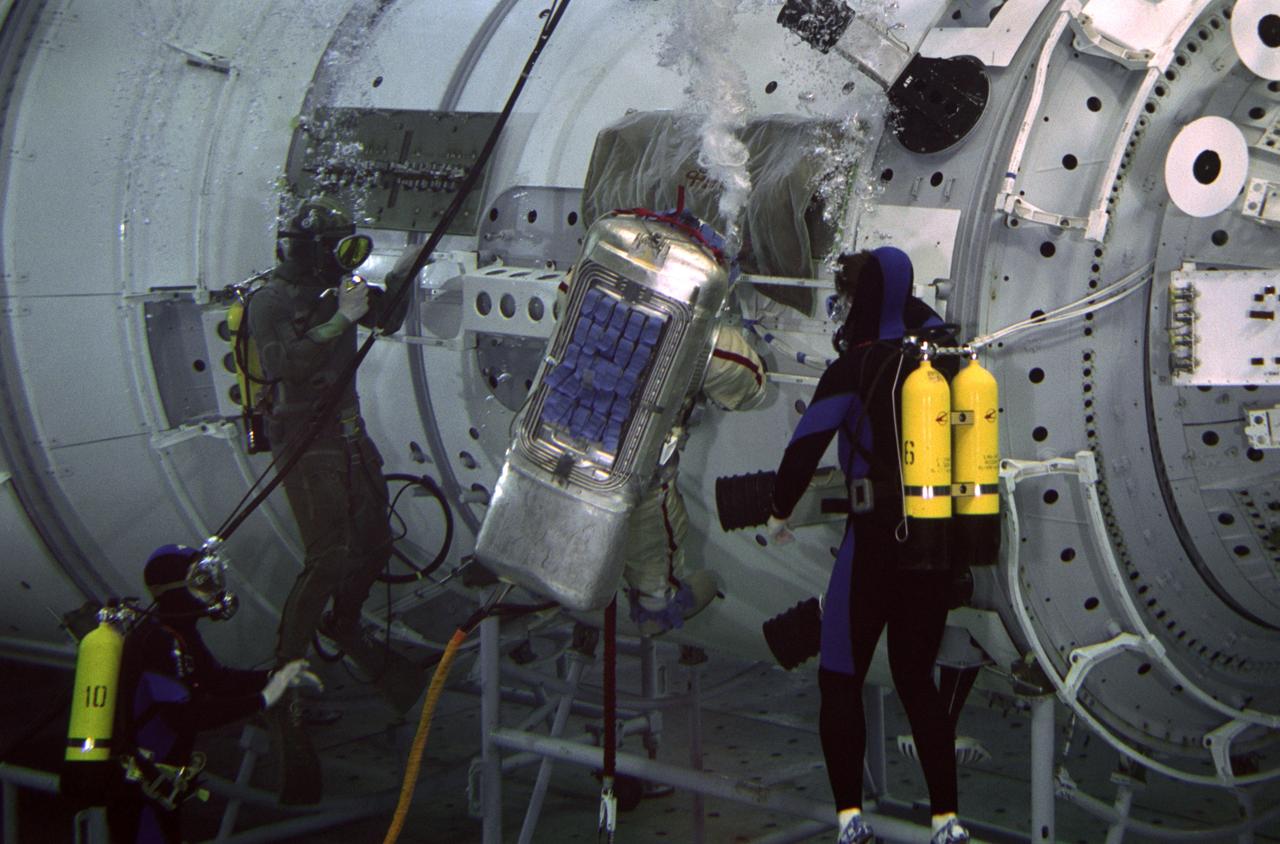
JSC2000-05367 (7 June 2000) --- Astronaut William Shepherd, ISS Expedition One commander, rehearses   an extravehicular activity (EVA) with a full scale training model of the Zvezda Service Module in the Hydrolab facility at the Gagarin Cosmonaut Training Center  in Russia.  SCUBA-equipped divers assist  in the spacewalk rehearsal.
Expedition 1 training
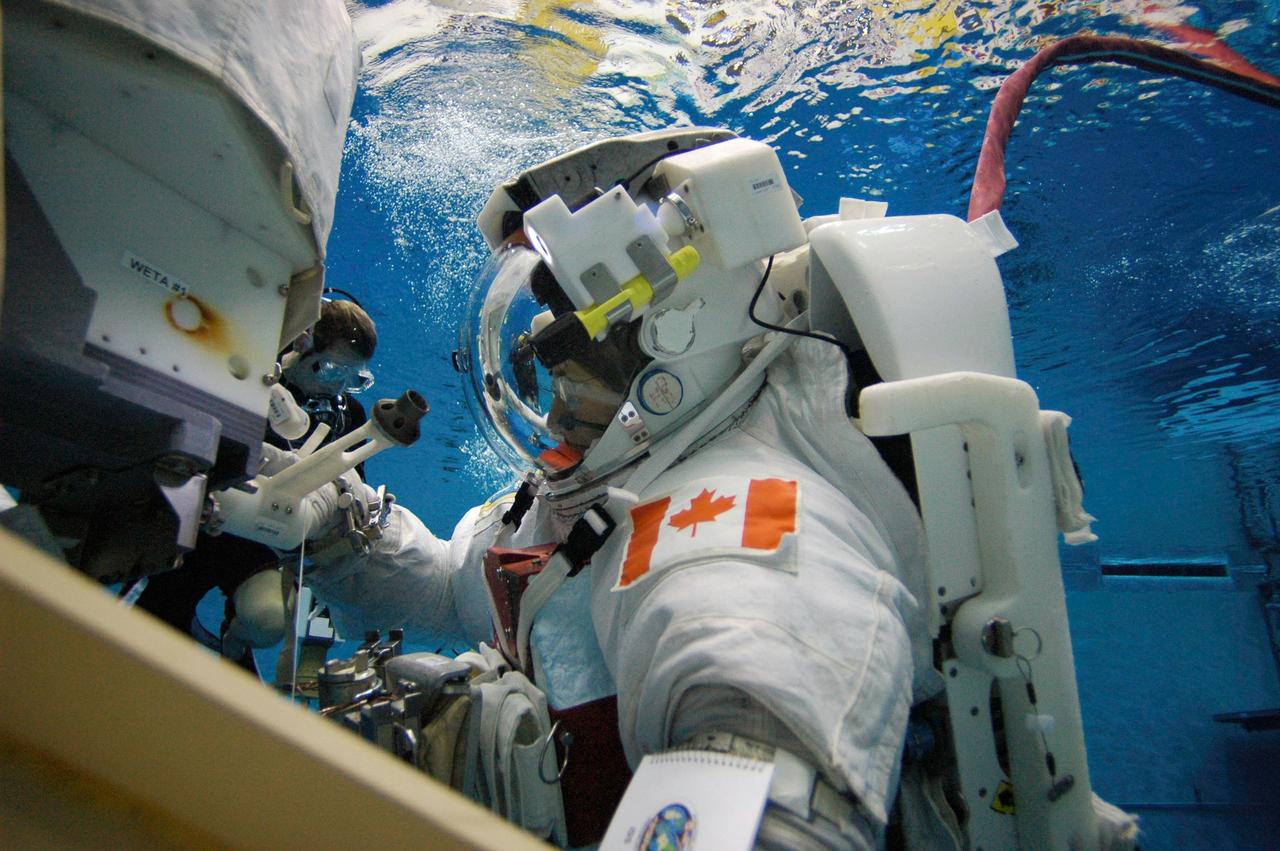
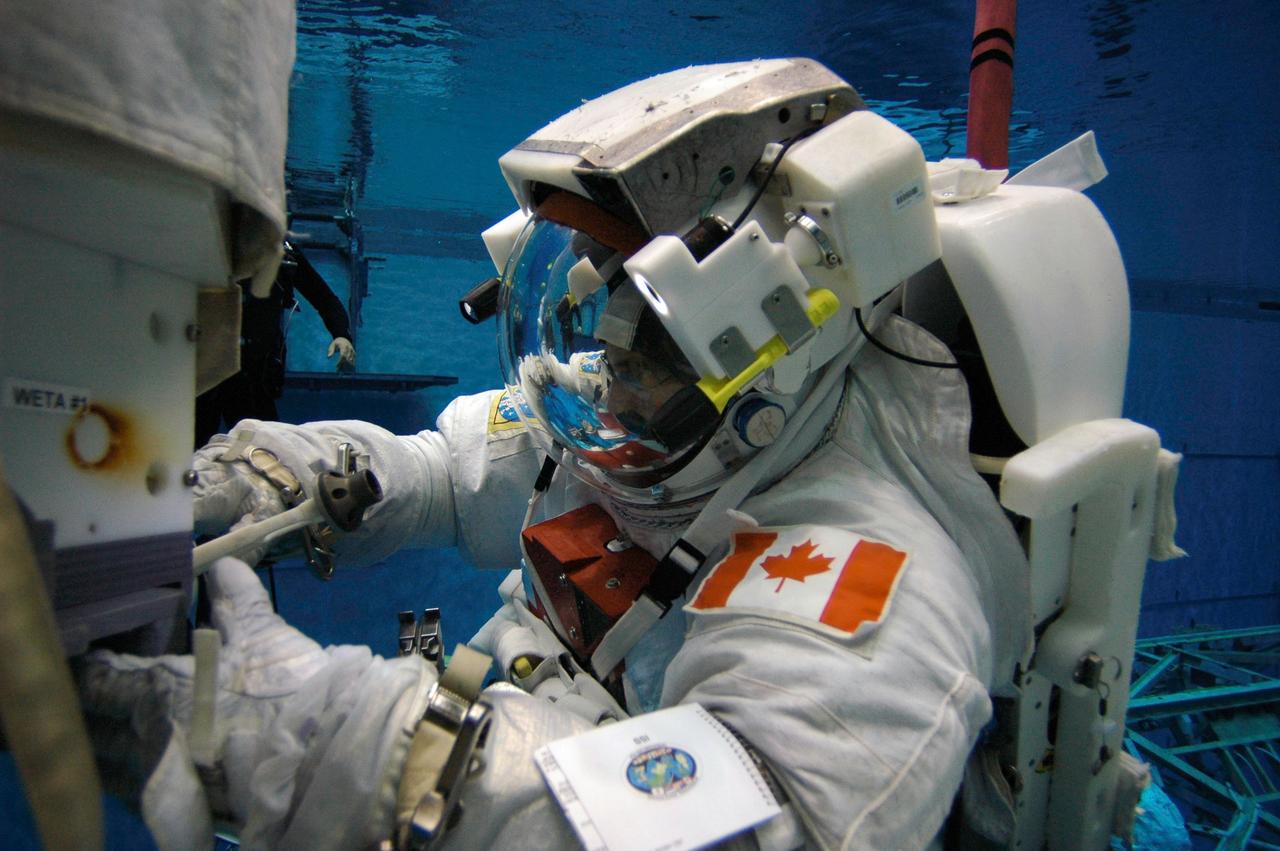
JSC2007-E-26261 (4 April 2007) --- Astronaut Dafydd R. (Dave) Williams, STS-118 mission specialist representing the Canadian Space Agency, wearing a training version of the Extravehicular Mobility Unit (EMU) spacesuit, participates in an underwater simulation of extravehicular activity (EVA) in the Neutral Buoyancy Laboratory (NBL) near Johnson Space Center. SCUBA-equipped divers are in the water to assist Williams in his rehearsal, intended to help prepare him for work on the exterior of the International Space Station.
Dave Williams underwater at NBL during STS-118 EVA Training
ISS036-E-012174 (25 June 2013) --- Between two Extravehicular Mobility Unit (EMU) spacesuits, European Space Agency astronaut Luca Parmitano, Expedition 36 flight engineer, works with spacewalk equipment in the Quest airlock of the International Space Station in preparation for two sessions of extravehicular activity (EVA) scheduled for July 9 and July 16.
EVA Prep
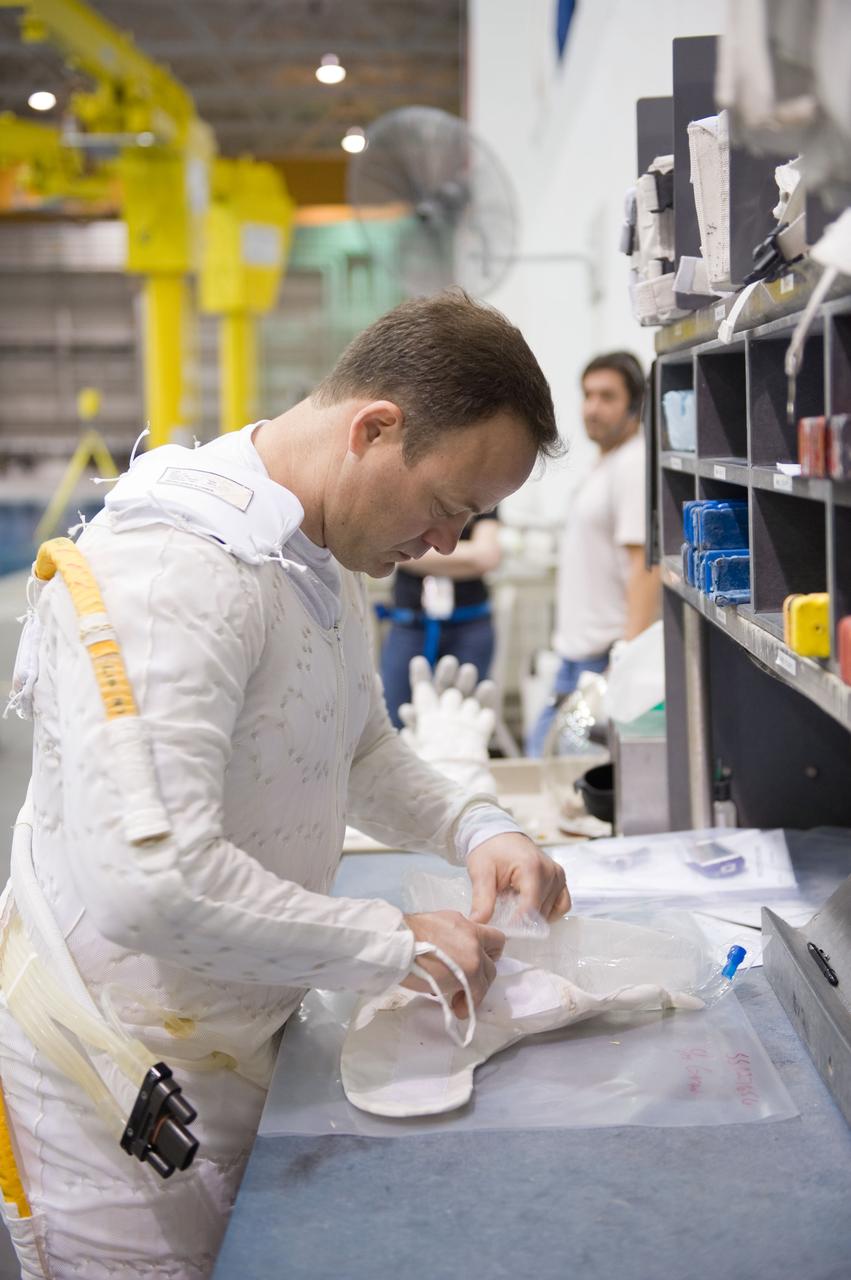
JSC2010-E-187196 (22 Nov. 2010) --- NASA astronaut Ron Garan, Expedition 27/28 flight engineer, works with extravehicular activity (EVA) equipment during a training session in the Neutral Buoyancy Laboratory (NBL) near NASA's Johnson Space Center. Garan is wearing a liquid cooling and ventilation garment that complements his Extravehicular Mobility Unit (EMU) spacesuit. Photo credit: NASA or National Aeronautics and Space Administration
Expedition 27 crew member Ron Garan with STS-335 crew member Rex Walheim
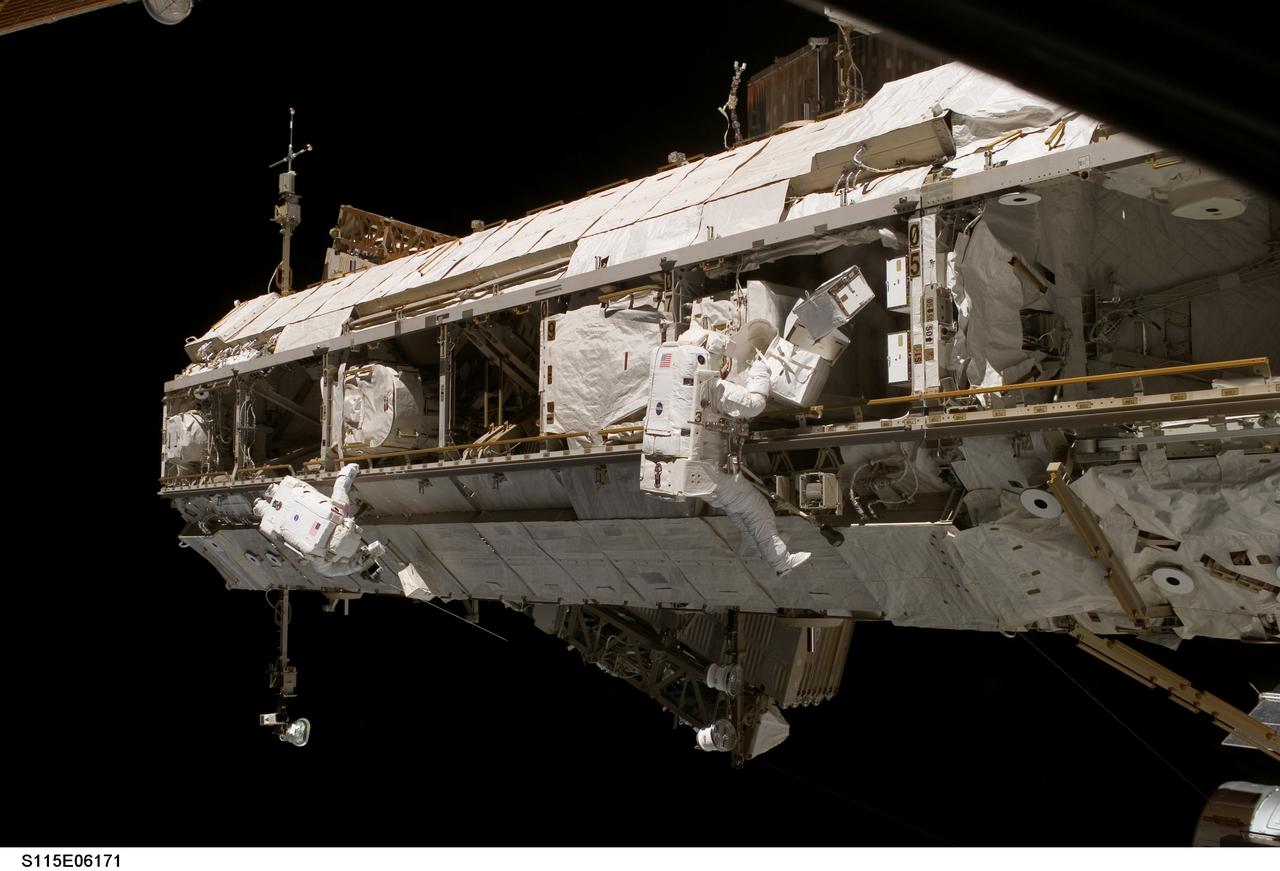
View of Astronaut Joseph R. (Joe) Tanner, STS-115 Mission Specialist (MS), in the red striped Extravehicular Mobility Unit (EMU), as he uses the Infrared (IR) CAM from the Forward (FWD) side of the S1 Truss to take image of the Starboard (STBD) Wing Leading Edge (WLE) of Atlantis for Detailed Test Objective (DTO) 851 while Astronaut Heidemarie M. Stefanyshyn-Piper, STS-115 MS, in the white striped EMU, removes stowed equipment during third Extravehicular Activity (EVA).
STS-115 MS Tanner and Stefanyshyn-Piper work on the S1 Truss during third EVA
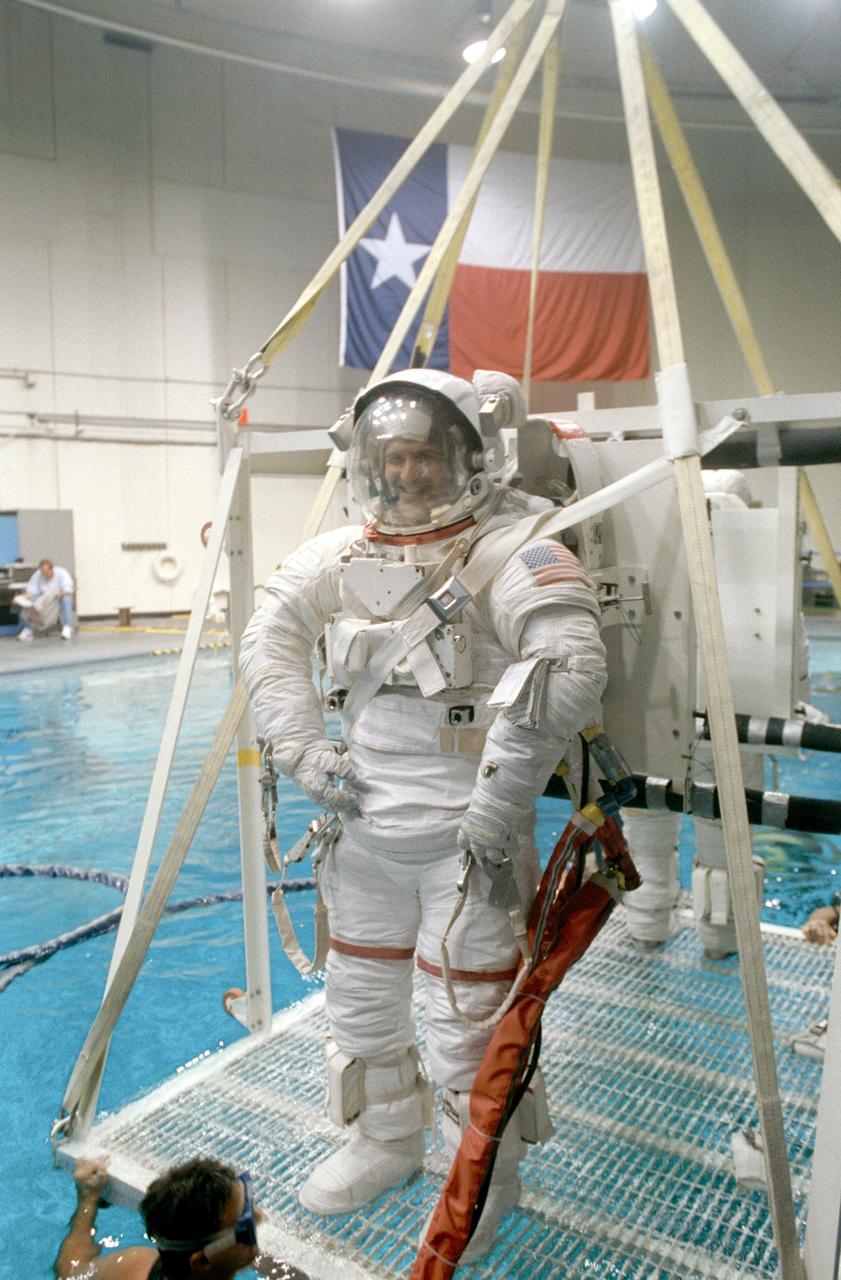
STS-48 Mission Specialist (MS) James F. Buchli, wearing an extravehicular mobility unit (EMU), is watched by SCUBA-equipped divers as the platform he is standing on is lowered into JSC's Weightless Environment Training Facility (WETF) Bldg 29 pool. When completely underwater, Buchli will be released from the platform and will perform contingency extravehicular activity (EVA) operations. This underwater simulation of a spacewalk is part of the training required for Buchli's upcoming mission aboard Discovery, Orbiter Vehicle (OV) 103.
STS-48 MS Buchli, in EMU, is lowered into JSC's WETF pool for EVA simulation
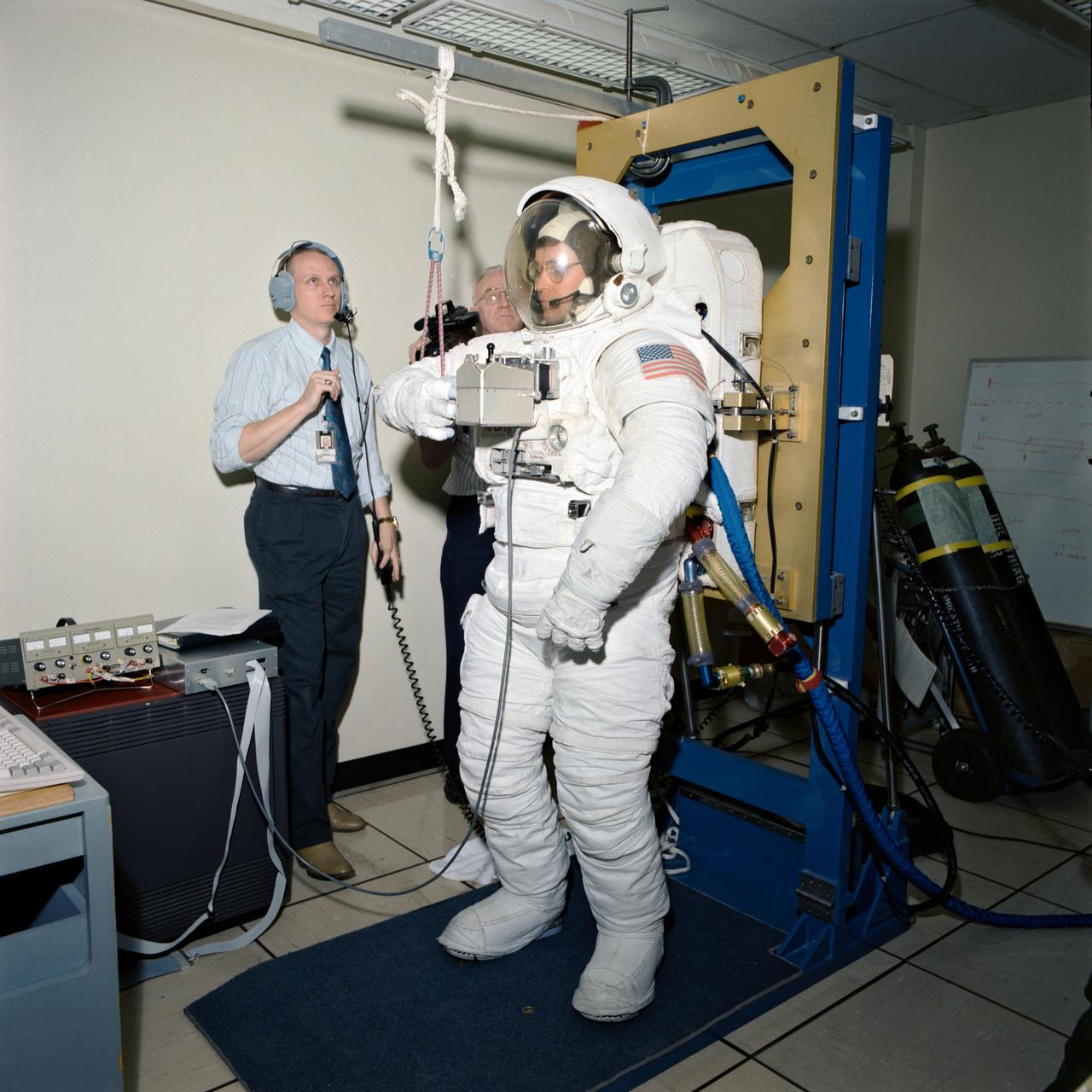
S90-46030 (Aug 1990) --- Astronaut Donald R. McMonagle (foreground) wears an extravehicular mobility unit (EMU) spacesuit as he prepares to be lowered into a 25-ft. deep pool at the Johnson Space Center's weightless environment training facility (WET-F). Astronaut Gregory J. Harbaugh, a fellow STS 39 mission specialist, shares the moveable platform with McMonagle and prepares to join him in the simulation of a contingency extravehicular activity (EVA) for the mission, scheduled for Discovery in the spring of 1991.  A number of SCUBA-equipped divers assist in the training session.
STS-39 EMU suited crewmembers are lowered into JSC's WETF Bldg 29 pool
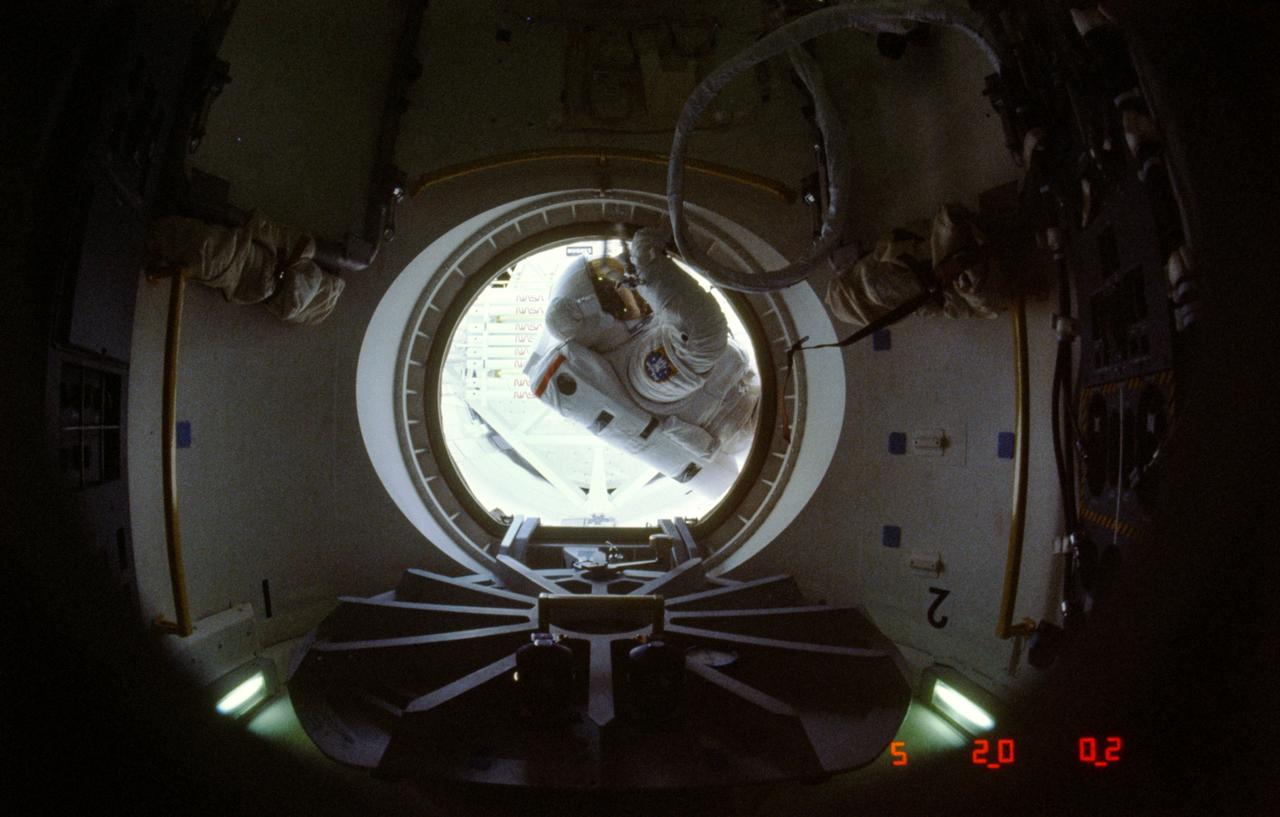
61B-08-026 (1 Dec 1985) --- Astronaut Jerry L. Ross was photographed by astronaut Bryan D. O'Connor through Atlantis's airlock as the mission specialist, fully equipped with his red-striped, white extravehicular mobility unit (EMU), moved out into the cargo bay to begin one of two lengthy extravehicular activities (EVA) on the week-long STS 61-B mission.
Astronaut Jerry Ross at threshold of airlock compartment following EVA
S92-40378  (1 July 1992) ---   Astronaut Peter J.K. Wisoff, STS-57 mission specialist, fully suited in an extravehicular mobility unit (EMU) and helmet and standing on a platform, is lowered into the 25 foot deep pool of Johnson Space Center?s (JSC) Weightless Environment Training Facility (WETF) Bldg 29. Once underwater, Wisoff will participate in an underwater extravehicular activity (EVA) simulation. A scuba-equipped diver already in the pool guides the platform into the water.
STS-57 MS3 Wisoff in EMU is lowered into JSC's WETF pool for EVA simulation
JSC2007-E-26262 (4 April 2007) --- Astronaut Dafydd R. (Dave) Williams, STS-118 mission specialist representing the Canadian Space Agency, wearing a training version of the Extravehicular Mobility Unit (EMU) spacesuit, participates in an underwater simulation of extravehicular activity (EVA) in the Neutral Buoyancy Laboratory (NBL) near Johnson Space Center. SCUBA-equipped divers are in the water to assist Williams in his rehearsal, intended to help prepare him for work on the exterior of the International Space Station.
Dave Williams underwater at NBL during STS-118 EVA Training
ISS036-E-012159 (25 June 2013) --- Between two Extravehicular Mobility Unit (EMU) spacesuits, European Space Agency astronaut Luca Parmitano and NASA astronaut Chris Cassidy (partly out of frame at right), both Expedition 36 flight engineers, work with spacewalk equipment in the Quest airlock of the International Space Station in preparation for two sessions of extravehicular activity (EVA) scheduled for July 9 and July 16.
EVA Prep
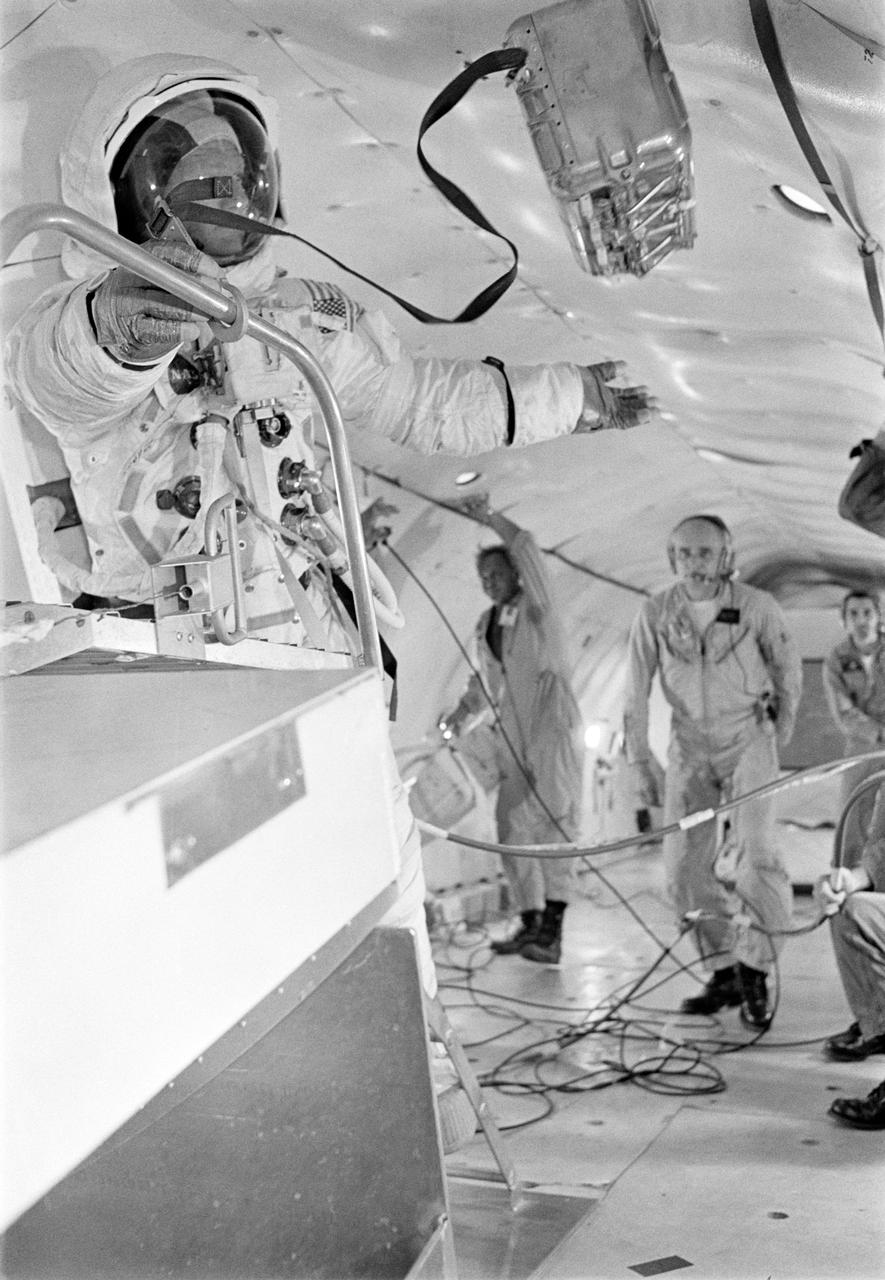
S69-39270 (10 July 1969)  --- Astronaut Edwin E. Aldrin Jr., lunar module pilot of the Apollo 11 lunar landing mission, participates in lunar extravehicular activity training under weightlessness conditions aboard a U.S. Air Force KC-135 jet aircraft from nearby Patrick Air Force Base.  Aldrin is wearing an Extravehicular Mobility Unit, the type of equipment which he will wear on the lunar surface.
APOLLO 12 - LUNAR MODULE (LM)-6 - RELOCATION - KSC
S87-44061 (25 Sept 1987)  ---  Dr. Claude Nicollier, equipped with a pressurized extravehicular mobility unit (EMU), is in the process of being submerged in the 25-ft. deep pool of JSC's weightless environment training facility (WET-F) for a familiarization session.  Dr. Nicollier's suit is weighted to facilitate a neutrally buoyant condition.  He is assisted by two SCUBA-equipped divers.  Dr. Nicollier, a Swiss scientist assigned to the STS-46 mission as a payload specialist, first came to the Johnson Space Center in July 1980. Along with Dr. Wubbo Ockels, another European Scientist, Dr. Nicollier underwent survival training and other basic astronaut-type training alongside the 1980 class of astronaut candidates. Some photos in this series show Dr. Nicollier in an extravehicular mobility unit (EMU).  This is for familiarization purposes only as the scientist is not scheduled for any extravehicular activity.
Documentation of preparations for WETF EVA training exercise by ESA Astronaut
KENNEDY SPACE CENTER, FLA. -- In the Orbiter Processing Facility, STS-122 crew members are introduced to part of the LESS.  From left are Mission Specialists Stanley Love, Hans Schlegel and Rex Walheim.  The crew is at Kennedy to take part in a crew equipment interface test, or CEIT, which helps familiarize them with equipment and payloads for the mission.  Among the activities standard to a CEIT are harness training, inspection of the thermal protection system and camera operation for planned extravehicular activities, or EVAs.  STS-122 is targeted for launch in December.   Photo credit: NASA/Kim Shiflett
KSC-07pd2615
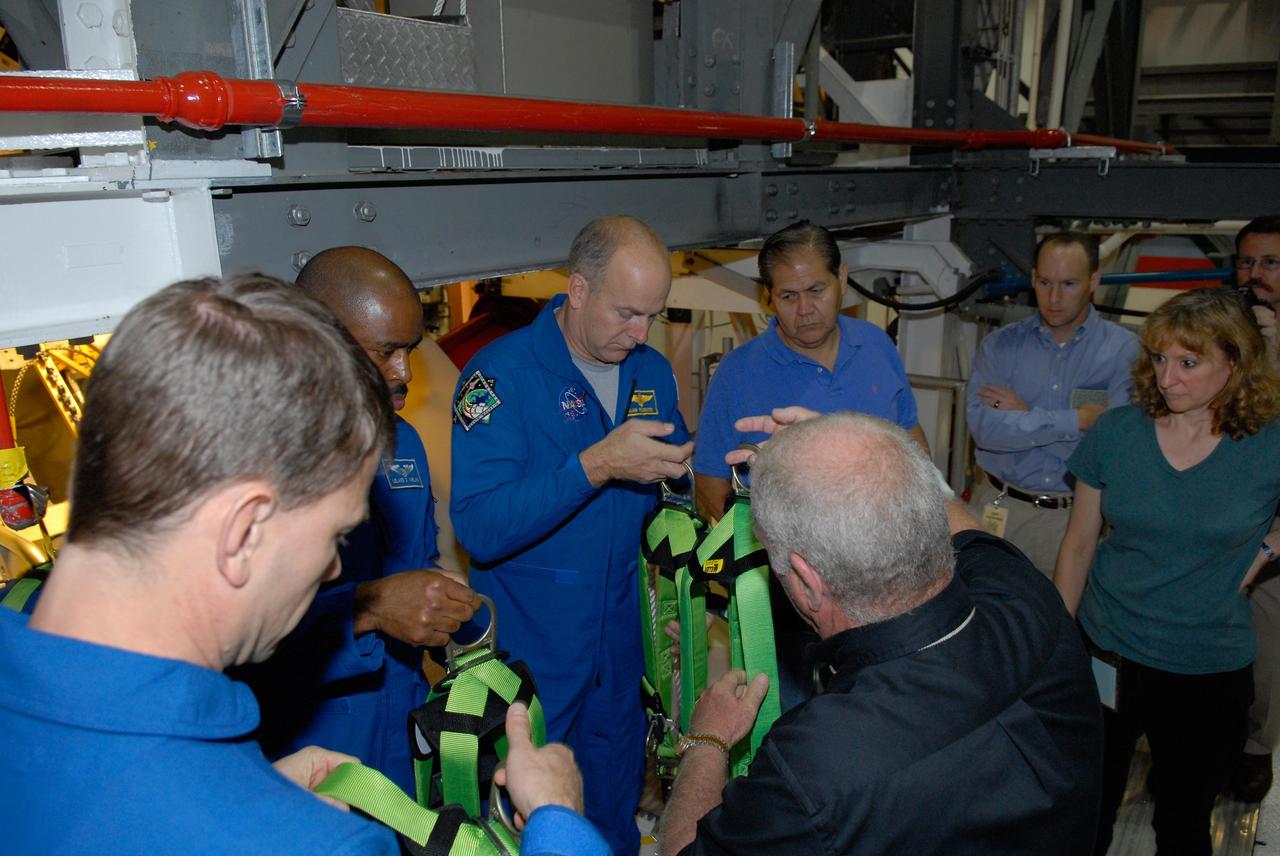
KENNEDY SPACE CENTER, FLA. --  Members of the STS-122 crew take part in harness training in the Orbiter Processing Facility at NASA's Kennedy Space Center.  Seen from left are Mission Specialists Stanley Love and Leland Melvin and Pilot Alan Poindexter. The crew is at Kennedy to take part in a crew equipment interface test, or CEIT, which helps familiarize them with equipment and payloads for the mission.  Among the activities standard to a CEIT are harness training, inspection of the thermal protection system and camera operation for planned extravehicular activities, or EVAs.  STS-122 is targeted for launch in December.   Photo credit: NASA/Kim Shiflett
KSC-07pd2605
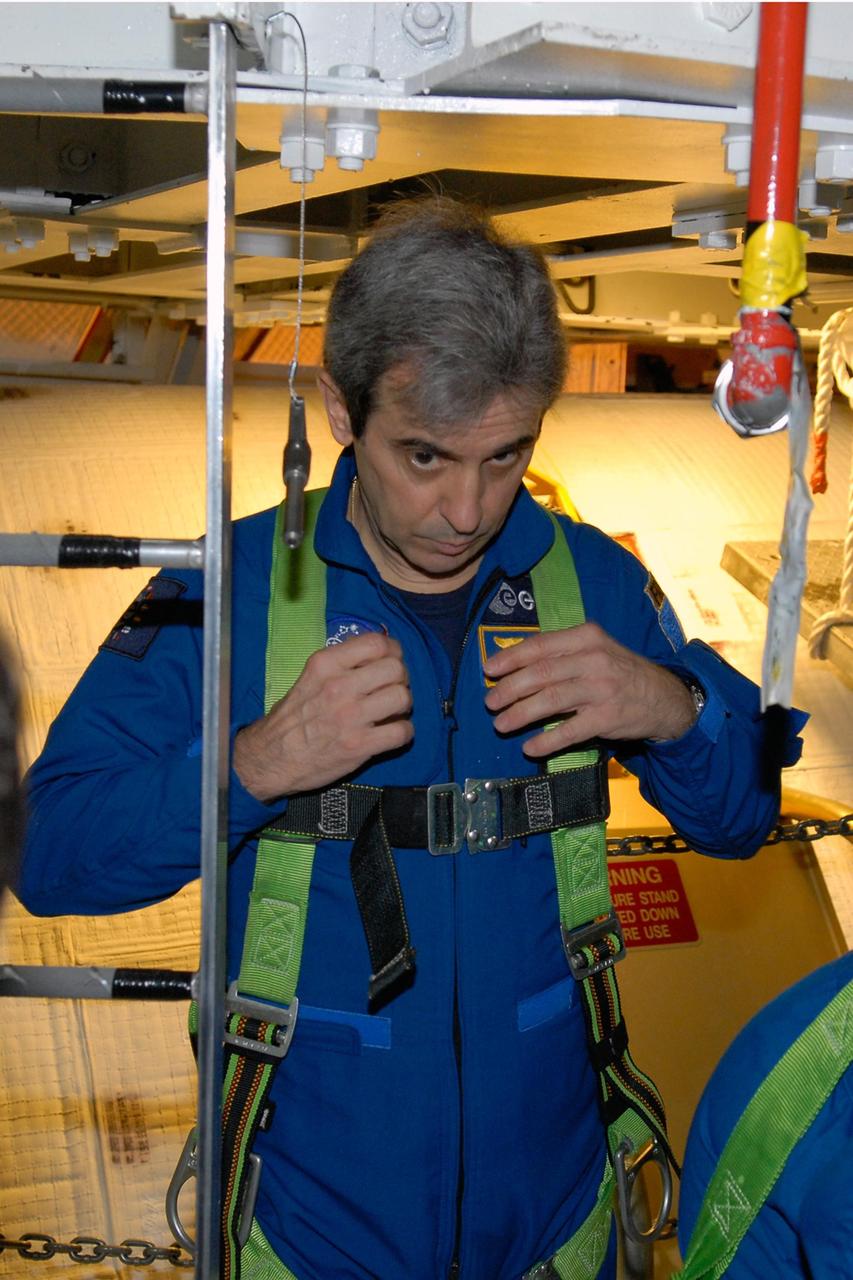
KENNEDY SPACE CENTER, FLA. -- Astronaut Leopold Eyharts, who represents the European Space Agency, tries on a harness in the Orbiter Processing Facility.  Eyharts will be traveling to the International Space Station to join the Expedition 16 crew as a flight engineer. The crew is at Kennedy to take part in a crew equipment interface test, or CEIT, which helps familiarize them with equipment and payloads for the mission.  Among the activities standard to a CEIT are harness training, inspection of the thermal protection system and camera operation for planned extravehicular activities, or EVAs.  STS-122 is targeted for launch in December.   Photo credit: NASA/Kim Shiflett
KSC-07pd2606
KENNEDY SPACE CENTER, FLA. -- In the Orbiter Processing Facility, STS-122 crew members are introduced to part of the LESS.  From left are Mission Specialists Hans Schlegel, Rex Walheim and European Space Agency astronaut Leopold Eyharts, Commander Stephen Frick, Mission Specialist Leland Melvin and Pilot Alan Poindexter.   The crew is at Kennedy to take part in a crew equipment interface test, or CEIT, which helps familiarize them with equipment and payloads for the mission.  Among the activities standard to a CEIT are harness training, inspection of the thermal protection system and camera operation for planned extravehicular activities, or EVAs.  STS-122 is targeted for launch in December.   Photo credit: NASA/Kim Shiflett
KSC-07pd2616
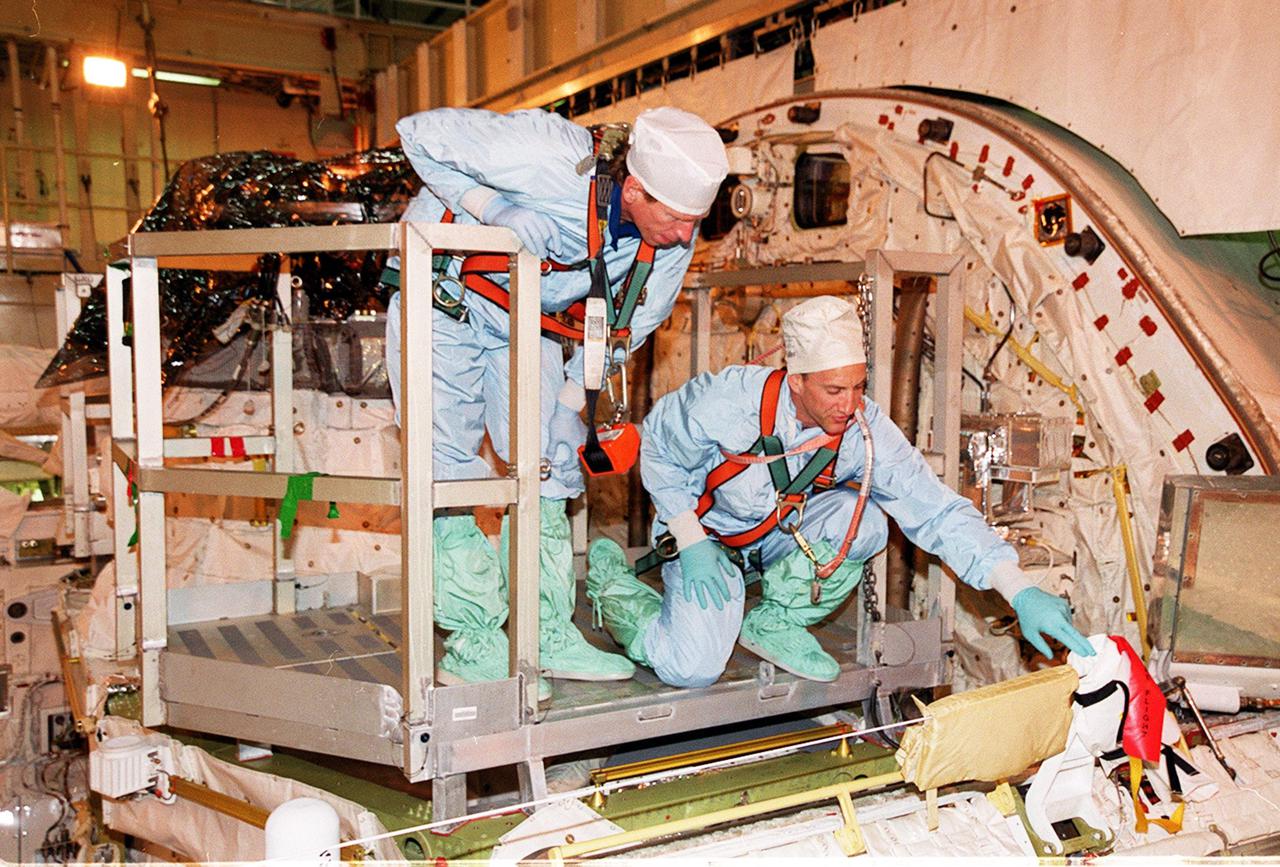
KENNEDY SPACE CENTER, FLA. -- In the Orbiter Processing Facility, STS-104 Mission Specialist Michael Gernhardt (left) and Pilot Charles Hobaugh (right) check out the slidewire used during extravehicular activities to keep the astronauts tethered to the orbiter. The STS-104 crew is at KSC to continue Crew Equipment Interface Test activities such as payload familiarization. The Joint Airlock Module is the primary payload on their mission, scheduled to launch no earlier than June 14, 2001, from Launch Pad 39B
KSC-01PP-0937
During their STS-37 extravehicular activity (EVA), Mission Specialist (MS) Jerry L. Ross (left) and MS Jerome Apt, in the aft section of Atlantis', Orbiter Vehicle (OV) 104's, payload bay (PLB), turn and wave to their fellow crewmembers who are overseeing the activity from inside the crew compartment. Ross is tethered to the guidewire running along the PLB port side. Apt has reached the end of the Crew and Equipment Translation Aid (CETA) deployable track via the manual hand over hand cart.
STS-37 EVA astronauts in PLB wave to fellow crewmembers in crew compartment
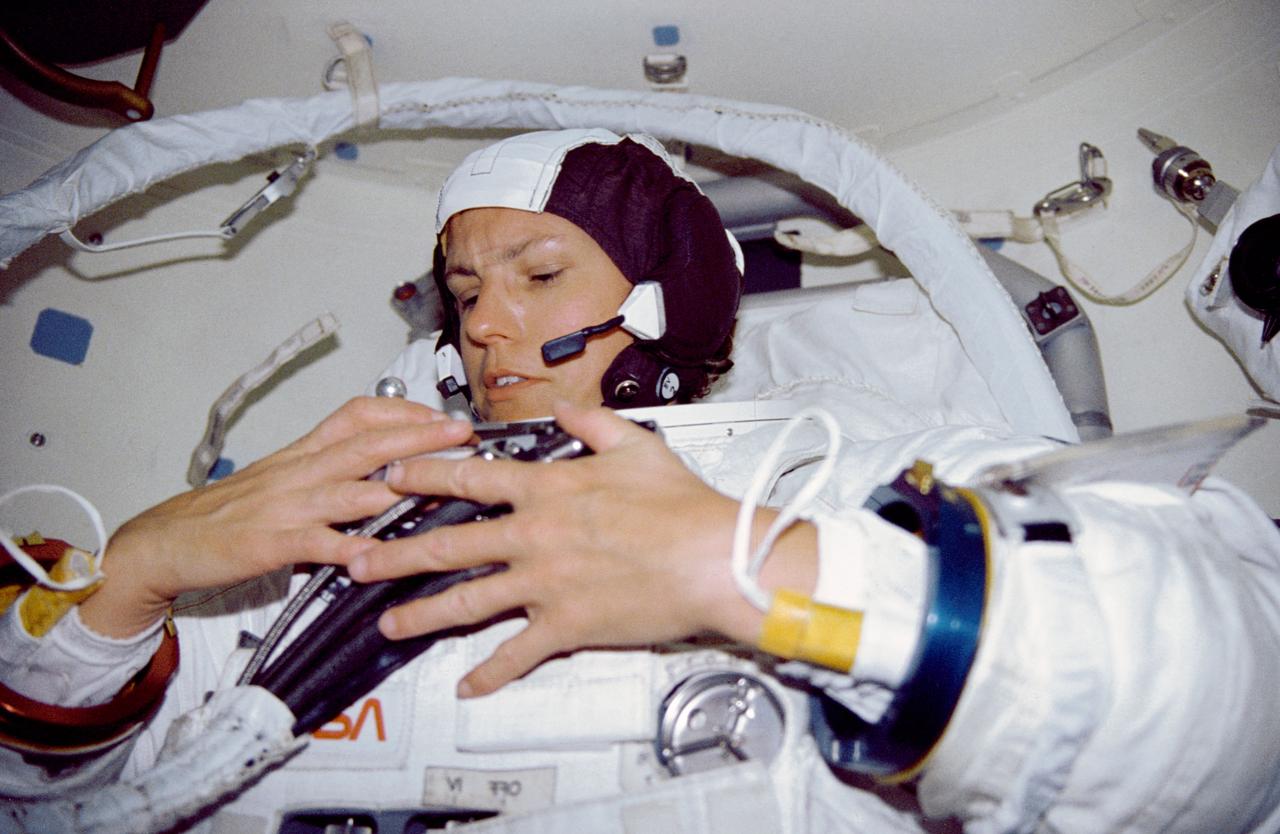
STS-31 Mission Specialist (MS) Kathryn D. Sullivan, wearing extravehicular mobility unit (EMU) & communications carrier assembly (CCA), attaches service and cooling umbilical (SCU) to the EMU connection on the display & control module (DCM) during contingency extravehicular activity (EVA) preparations in the airlock of Discovery, Orbiter Vehicle (OV) 103. The procedure was completed in case an EVA was required to support Hubble Space Telescope (HST) deployment.
STS-31 Mission Specialist (MS) Sullivan dons EMU in OV-103's airlock
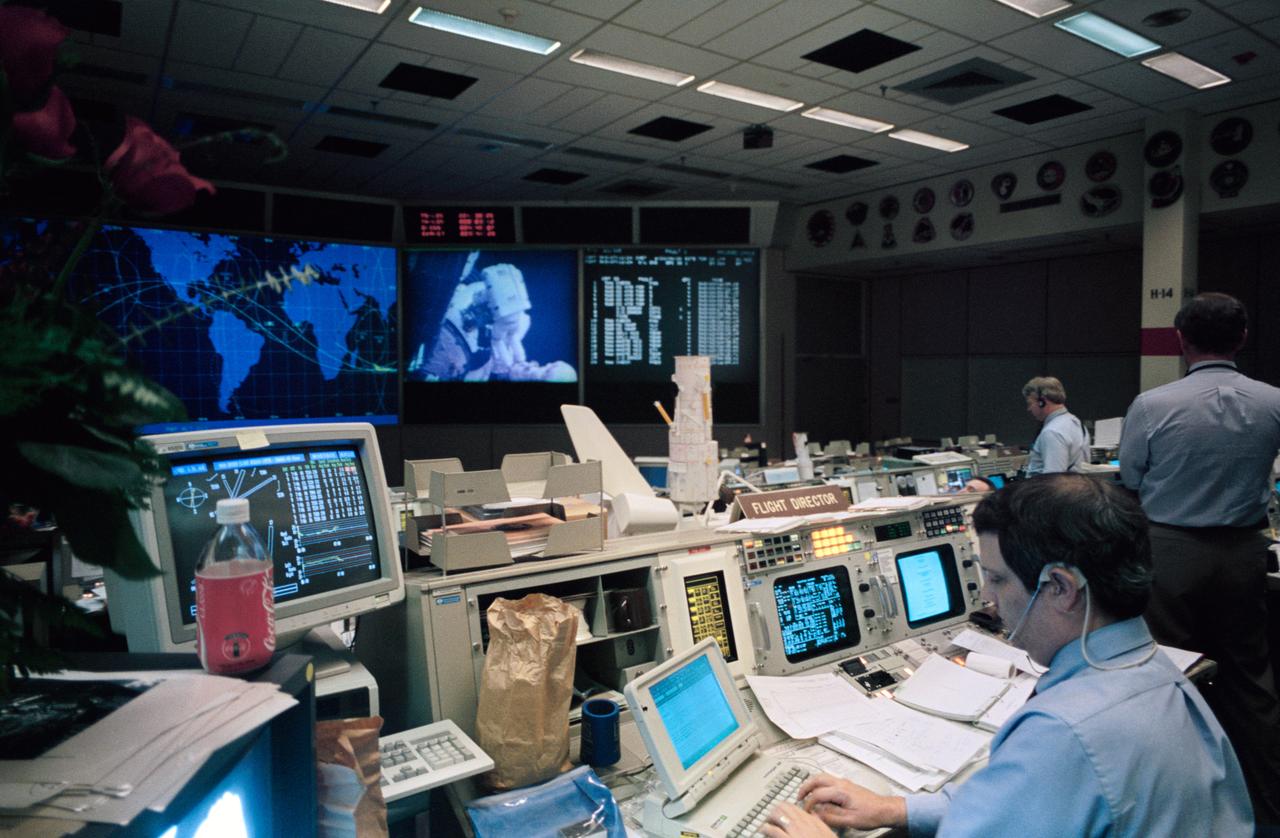
STS061-S-103 (2-13 DEC 1993) --- Flight director Robert E. Castle uses a lap top computer to aid his busy tasks during one of the five space walks performed to service the Hubble Space Telescope (HST) temporarily berthed in the Space Shuttle Endeavour's cargo bay.  STS-61 lead flight director Milt Heflin is at right edge of frame.
Flight Director Robert Castle uses laptop while monitoring space walk
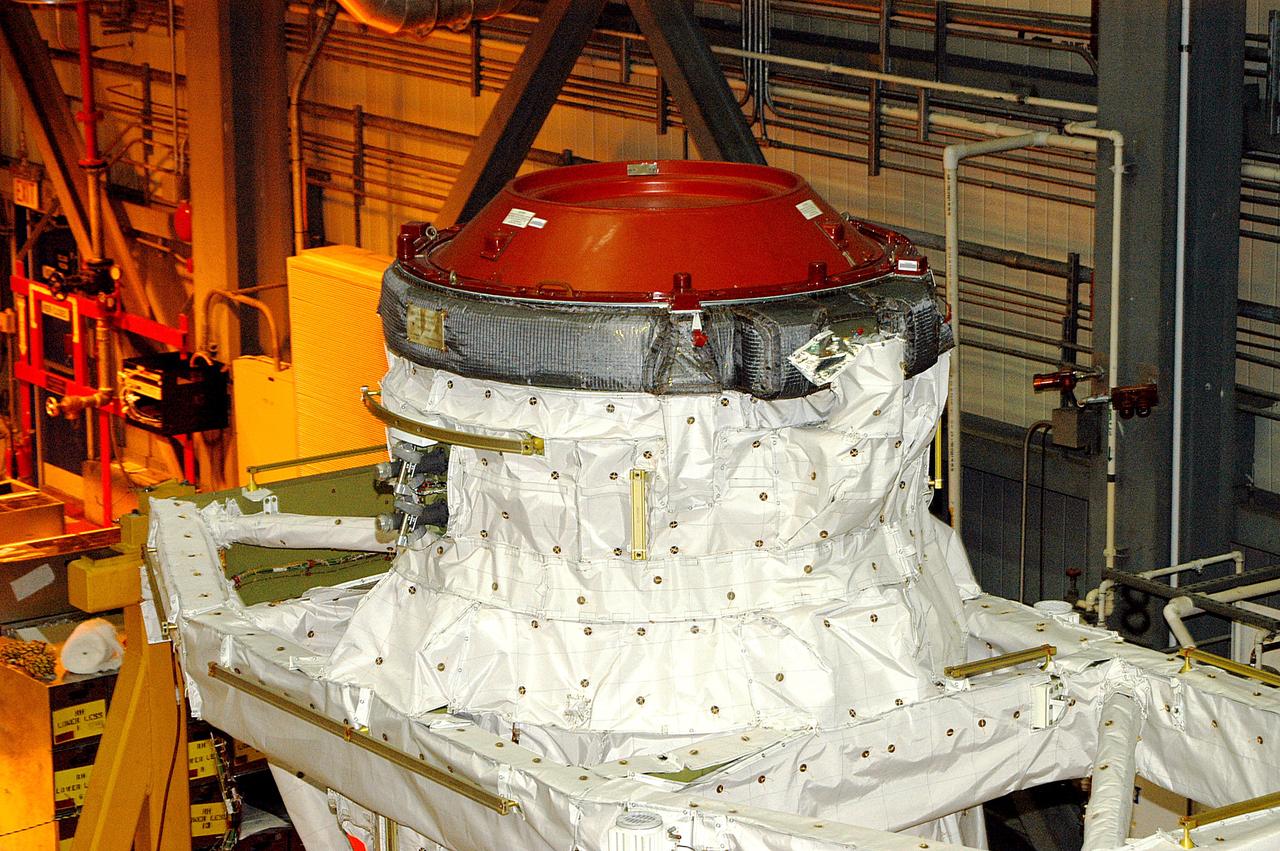
KENNEDY SPACE CENTER, FLA. -- Discovery’s airlock is ready for installation.  Located inside the orbiter’s payload bay, the airlock is sized to accommodate two fully suited flight crew members simultaneously. Support functions include airlock depressurization and repressurization, extravehicular activity equipment recharge, liquid-cooled garment water cooling, EVA equipment checkout, and communications.  Discovery is designated as the Return to Flight vehicle for mission STS-114, no earlier than March 2005.  STS-114 mission is Logistics Flight 1, which is scheduled to deliver supplies and equipment plus the external stowage platform to the International Space Station.
KSC-04pd1132
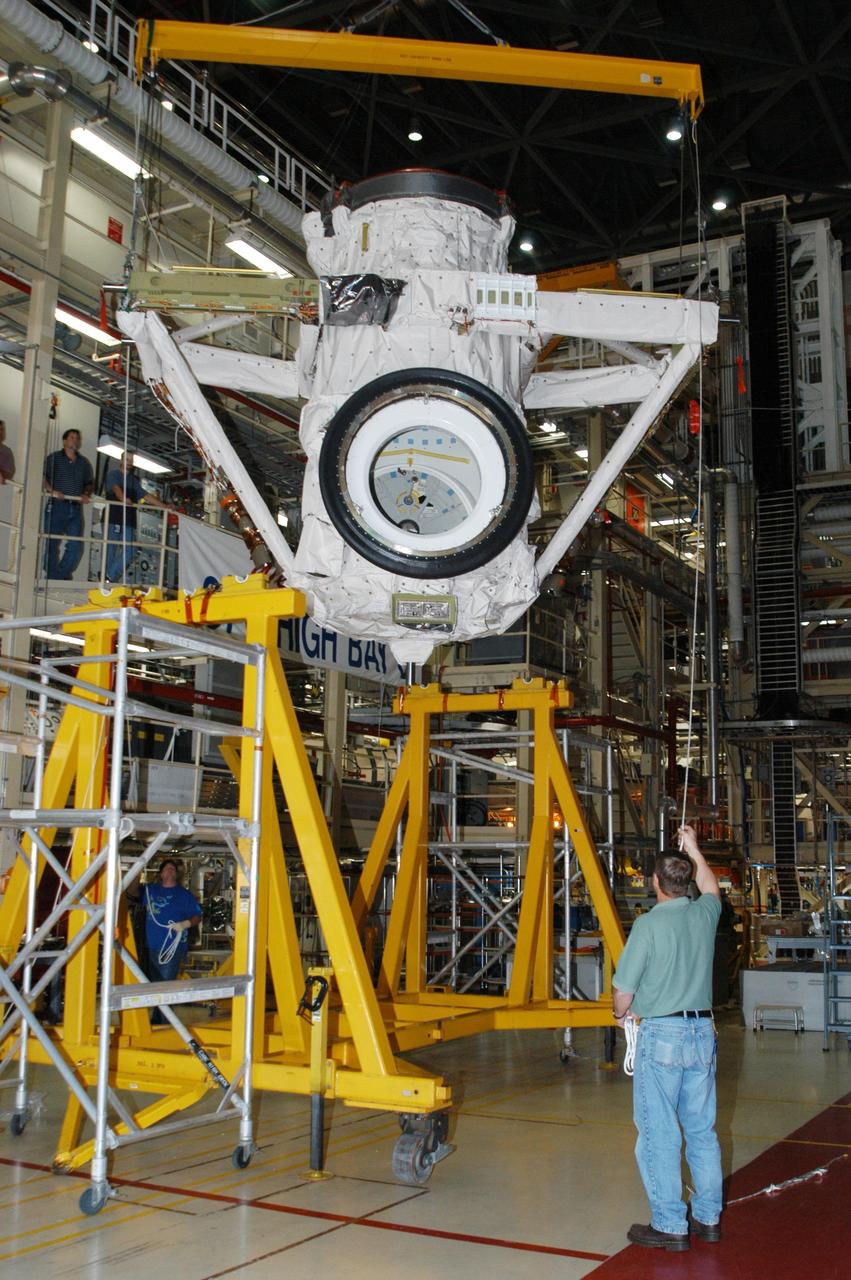
KENNEDY SPACE CENTER, FLA. -- Discovery’s airlock is lifted toward the orbiter for installation inside the orbiter’s payload bay.  The airlock is sized to accommodate two fully suited flight crew members simultaneously.  Support functions include airlock depressurization and repressurization, extravehicular activity equipment recharge, liquid-cooled garment water cooling, EVA equipment checkout, and communications.  Discovery is designated as the Return to Flight vehicle for mission STS-114, no earlier than March 2005.  STS-114 mission is Logistics Flight 1, which is scheduled to deliver supplies and equipment plus the external stowage platform to the International Space Station.
KSC-04pd1134
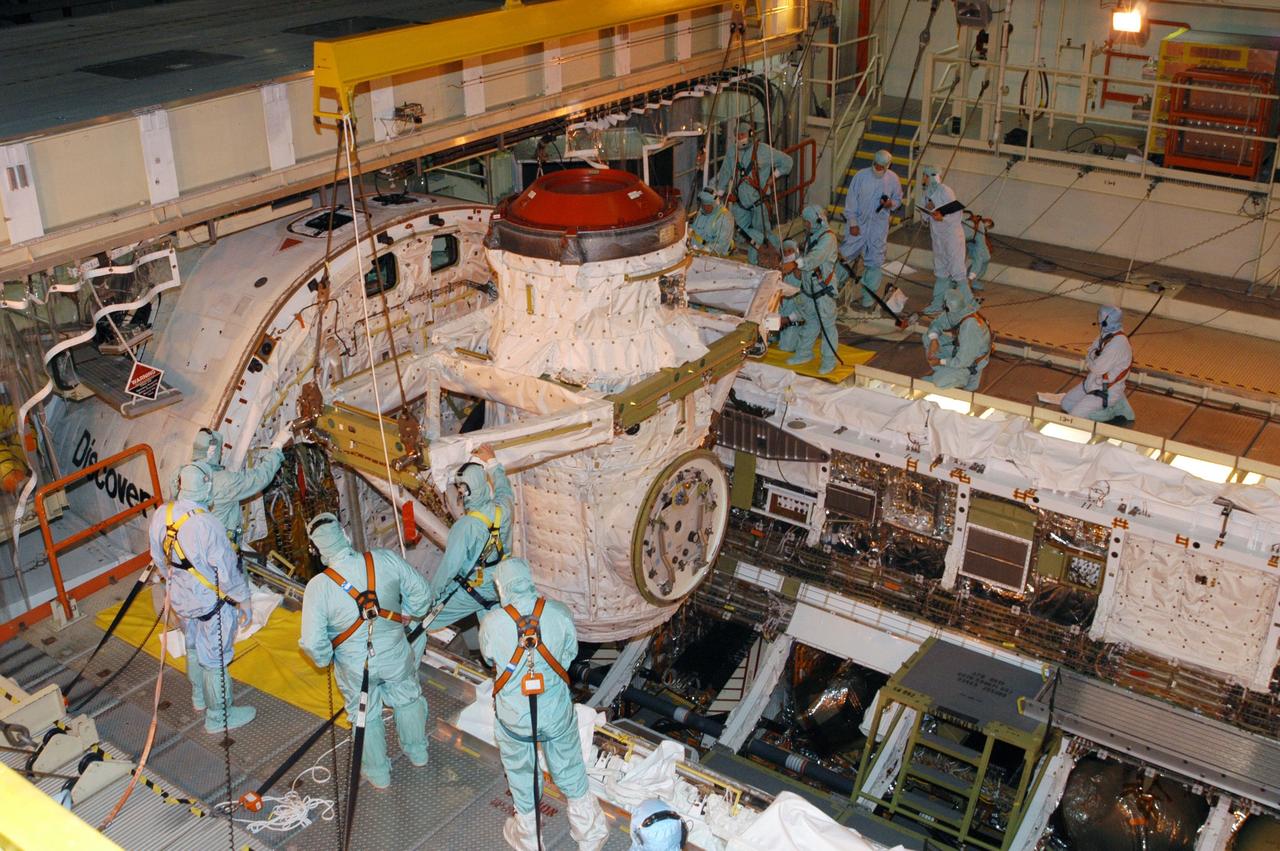
KENNEDY SPACE CENTER, FLA. -- Technicians in the Orbiter Processing Facility help guide Discovery’s airlock as a crane lowers it into the orbiter’s payload bay for installation.  The airlock is sized to accommodate two fully suited flight crew members simultaneously.  Support functions include airlock depressurization and repressurization, extravehicular activity equipment recharge, liquid-cooled garment water cooling, EVA equipment checkout, and communications.  Discovery is designated as the Return to Flight vehicle for mission STS-114, no earlier than March 2005.  STS-114 mission is Logistics Flight 1, which is scheduled to deliver supplies and equipment plus the external stowage platform to the International Space Station.
KSC-04pd1137
KENNEDY SPACE CENTER, FLA. -- Technicians in the Orbiter Processing Facility attach a crane to Discovery’s airlock before lifting it for installation.  The airlock is located inside the orbiter’s payload bay and is sized to accommodate two fully suited flight crew members simultaneously.  Support functions include airlock depressurization and repressurization, extravehicular activity equipment recharge, liquid-cooled garment water cooling, EVA equipment checkout, and communications.  Discovery is designated as the Return to Flight vehicle for mission STS-114, no earlier than March 2005.  STS-114 mission is Logistics Flight 1, which is scheduled to deliver supplies and equipment plus the external stowage platform to the International Space Station.
KSC-04pd1133
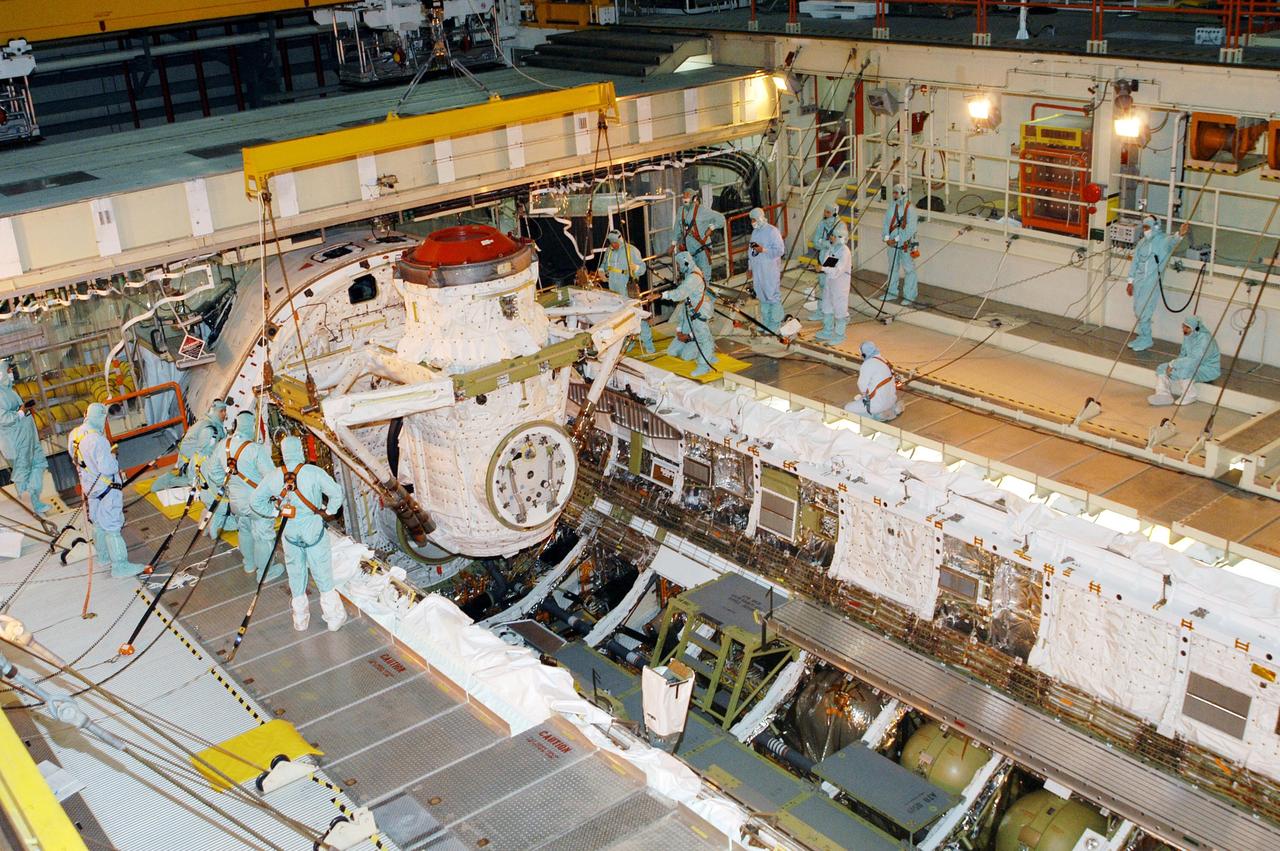
KENNEDY SPACE CENTER, FLA. -- Discovery’s airlock is lowered into the orbiter’s payload bay for installation.  The airlock is sized to accommodate two fully suited flight crew members simultaneously.  Support functions include airlock depressurization and repressurization, extravehicular activity equipment recharge, liquid-cooled garment water cooling, EVA equipment checkout, and communications.  Discovery is designated as the Return to Flight vehicle for mission STS-114, no earlier than March 2005.  STS-114 mission is Logistics Flight 1, which is scheduled to deliver supplies and equipment plus the external stowage platform to the International Space Station.
KSC-04pd1136
KENNEDY SPACE CENTER, FLA. -- Discovery’s airlock is lowered toward the orbiter’s payload bay for installation.  The airlock is sized to accommodate two fully suited flight crew members simultaneously.  Support functions include airlock depressurization and repressurization, extravehicular activity equipment recharge, liquid-cooled garment water cooling, EVA equipment checkout, and communications.  Discovery is designated as the Return to Flight vehicle for mission STS-114, no earlier than March 2005.  STS-114 mission is Logistics Flight 1, which is scheduled to deliver supplies and equipment plus the external stowage platform to the International Space Station.
KSC-04pd1135
KENNEDY SPACE CENTER, FLA. -- Technicians in the Orbiter Processing Facility help guide Discovery’s airlock into the orbiter’s payload bay for installation.  The airlock is sized to accommodate two fully suited flight crew members simultaneously.  Support functions include airlock depressurization and repressurization, extravehicular activity equipment recharge, liquid-cooled garment water cooling, EVA equipment checkout, and communications.  Discovery is designated as the Return to Flight vehicle for mission STS-114, no earlier than March 2005.  STS-114 mission is Logistics Flight 1, which is scheduled to deliver supplies and equipment plus the external stowage platform to the International Space Station.
KSC-04pd1138
KENNEDY SPACE CENTER, FLA. -- In the Orbiter Processing Facility, STS-98 Mission Specialists Robert Curbeam (center left) and Tom Jones (center right) practice with tools that will be used on extravehicular activities on their mission. The STS-98 crew is at KSC for Crew Equipment Interface Test activities. Launch on mission STS-98 is scheduled for Jan. 18, 2001. It will be transporting the U.S. Lab, Destiny, to the International Space Station with five system racks already installed inside of the module. After delivery of electronics in the lab, electrically powered attitude control for Control Moment Gyroscopes will be activated
KSC-00pp1772
KENNEDY SPACE CENTER, FLA. -- In the Orbiter Processing Facility, STS-98 Mission Specialists Robert Curbeam (center left) and Tom Jones (center right) practice with tools that will be used on extravehicular activities on their mission. The STS-98 crew is at KSC for Crew Equipment Interface Test activities. Launch on mission STS-98 is scheduled for Jan. 18, 2001. It will be transporting the U.S. Lab, Destiny, to the International Space Station with five system racks already installed inside of the module. After delivery of electronics in the lab, electrically powered attitude control for Control Moment Gyroscopes will be activated
KSC00pp1772
S93-33104 (7 Apr 1993) --- Wearing a training version of Space Shuttle Extravehicular Mobility Unit (EMU), astronaut Jeffrey A. Hoffman uses the giant pool of the Johnson Space Center's (JSC) Weightless Environment Training Facility (WET-F) to rehearse for the Hubble Space Telescope (HST) repair mission.  Out of frame is astronaut F. Story Musgrave, who will join Hoffman in STS-61 EVA.  The hand at top frame belongs to a SCUBA-equipped diver.  A number of divers are on hand for all training sessions in the WET-F.  A total of five extravehicular activity (EVA) sessions will be conducted during the scheduled December mission of the Endeavour.
STS-61 crewmembers in the WETF rehearsing for HST repair mission