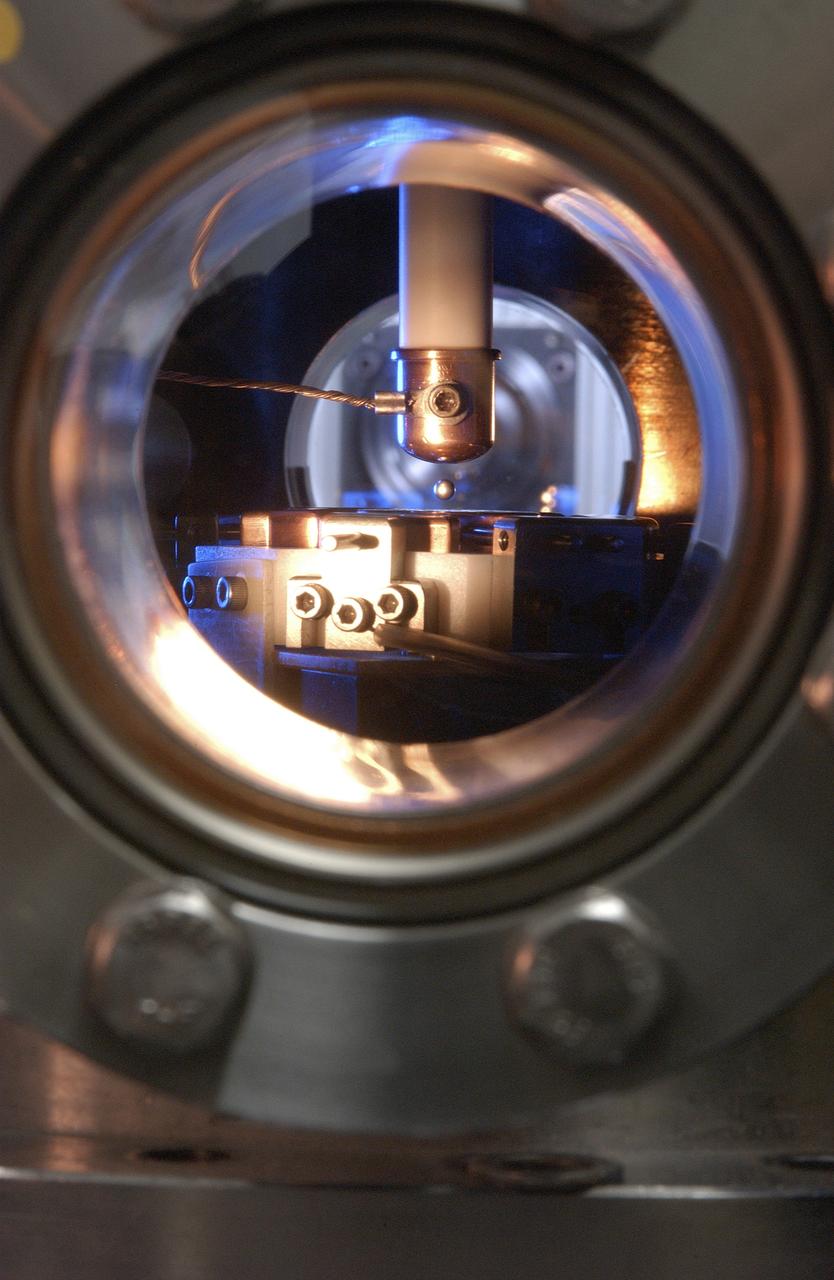
This Photo, which appeared on the July cover of `Physics Today', is of the Electrostatic Levitator (ESL) at NASA's Marshall Space Flight Center (MSFC). The ESL uses static electricity to suspend an object (about 3-4 mm in diameter) inside a vacuum chamber allowing scientists to record a wide range of physical properties without the sample contracting the container or any instruments, conditions that would alter the readings. Once inside the chamber, a laser heats the sample until it melts. The laser is then turned off and the sample cools, changing from a liquid drop to a solid sphere. In this particular shot, the ESL contains a solid metal sample of titanium-zirconium-nickel alloy. Since 1977, the ESL has been used at MSFC to study the characteristics of new metals, ceramics, and glass compounds. Materials created as a result of these tests include new optical materials, special metallic glasses, and spacecraft components.
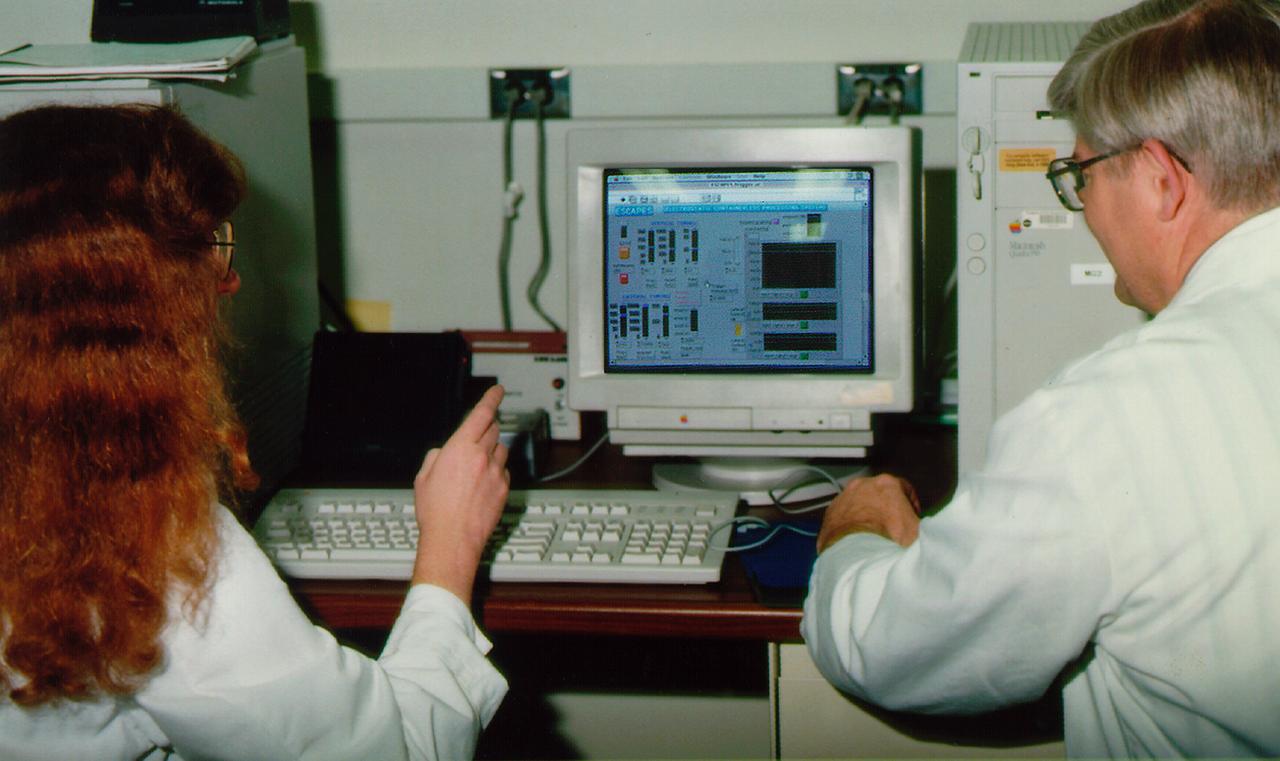
Dr. Jan Rogers and Dr. Michael Robinson operate the Electrostatic Levitator (ESL) at NASA's Marshall Space Flight Center (MSFC). The ESL uses static electricity to suspend an object (about 2-3 mm in diameter) inside a vacuum chamber while a laser heats the sample until it melts. This lets scientists record a wide range of physical properties without the sample contacting the container or any instruments, conditions that would alter the readings. The Electrostatic Levitator is one of several tools used in NASA's microgravity materials science program.
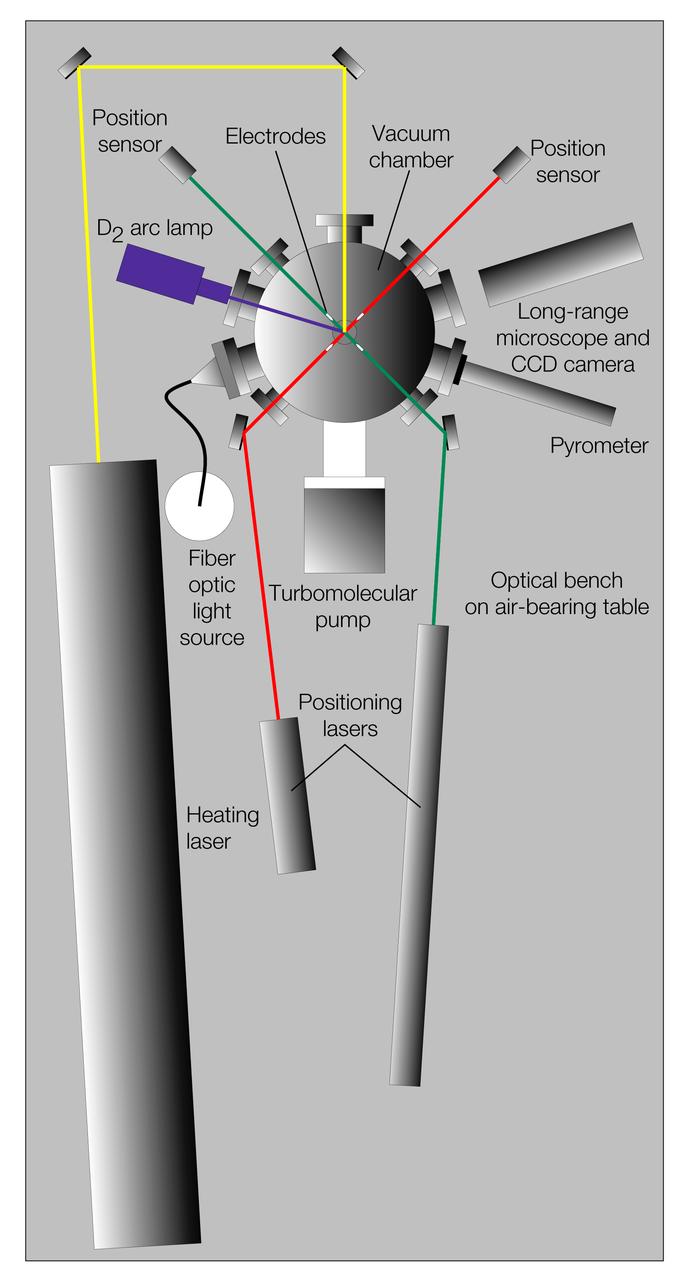
General oayout of Electrostatic Levitator (ESL). The ESL uses static electricity to suspend an object (about 2-3 mm in diameter) inside a vacuum chamber while a laser heats the sample until it melts. This lets scientists record a wide range of physical properties without the sample contacting the container or any instruments, conditions that would alter the readings. The Electrostatic Levitator is one of several tools used in NASA's microgravity materials science program.
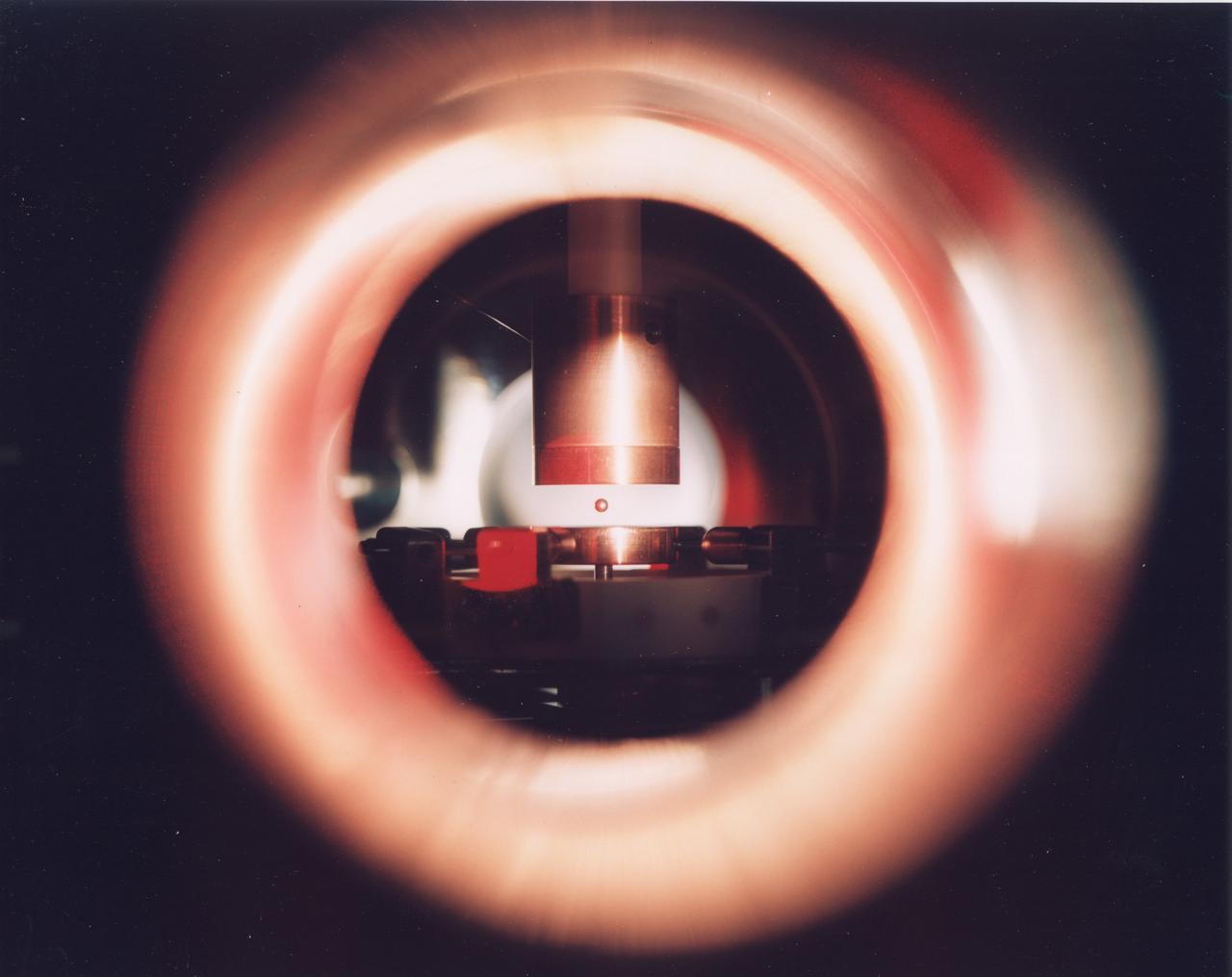
Metal droplet levitated inside the Electrostatic Levitator (ESL). The ESL uses static electricity to suspend an object (about 2-3 mm in diameter) inside a vacuum chamber while a laser heats the sample until it melts. This lets scientists record a wide range of physical properties without the sample contacting the container or any instruments, conditions that would alter the readings. The Electrostatic Levitator is one of several tools used in NASA's microgravity materials science program.
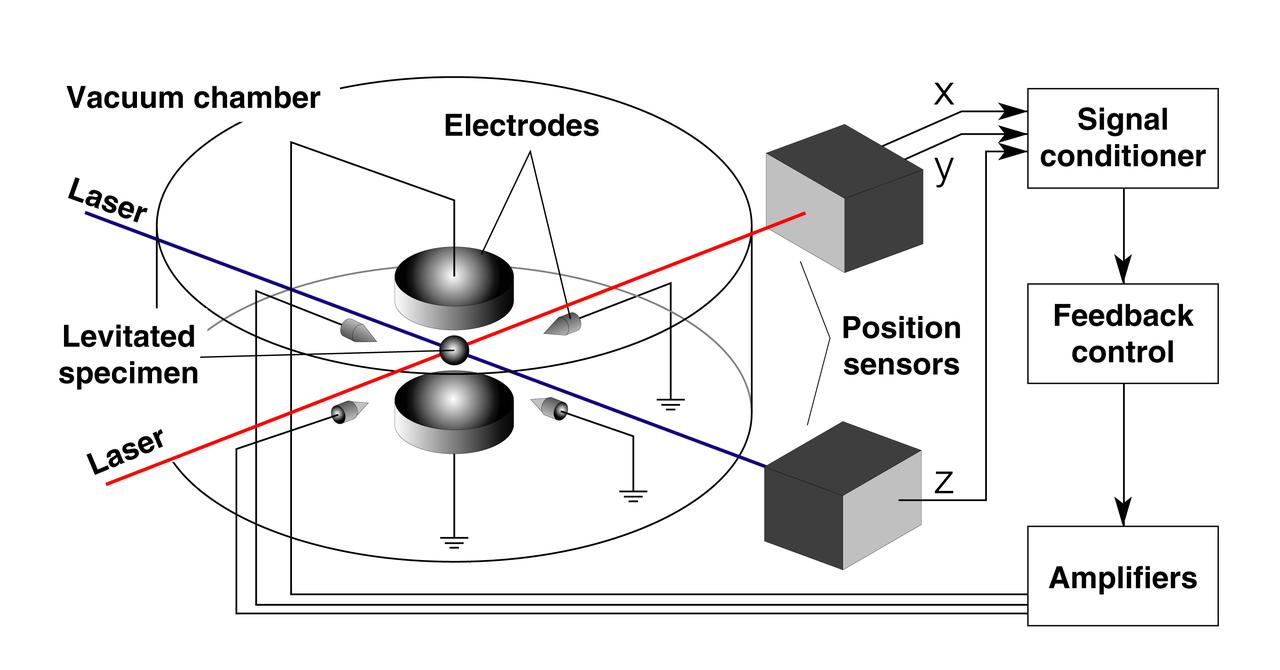
Schematic of Electrostatic Levitator (ESL) electrodes and controls system. The ESL uses static electricity to suspend an object (about 2-3 mm in diameter) inside a vacuum chamber while a laser heats the sample until it melts. This lets scientists record a wide range of physical properties without the sample contacting the container or any instruments, conditions that would alter the readings. The Electrostatic Levitator is one of several tools used in NASA's microgravity materials science program.
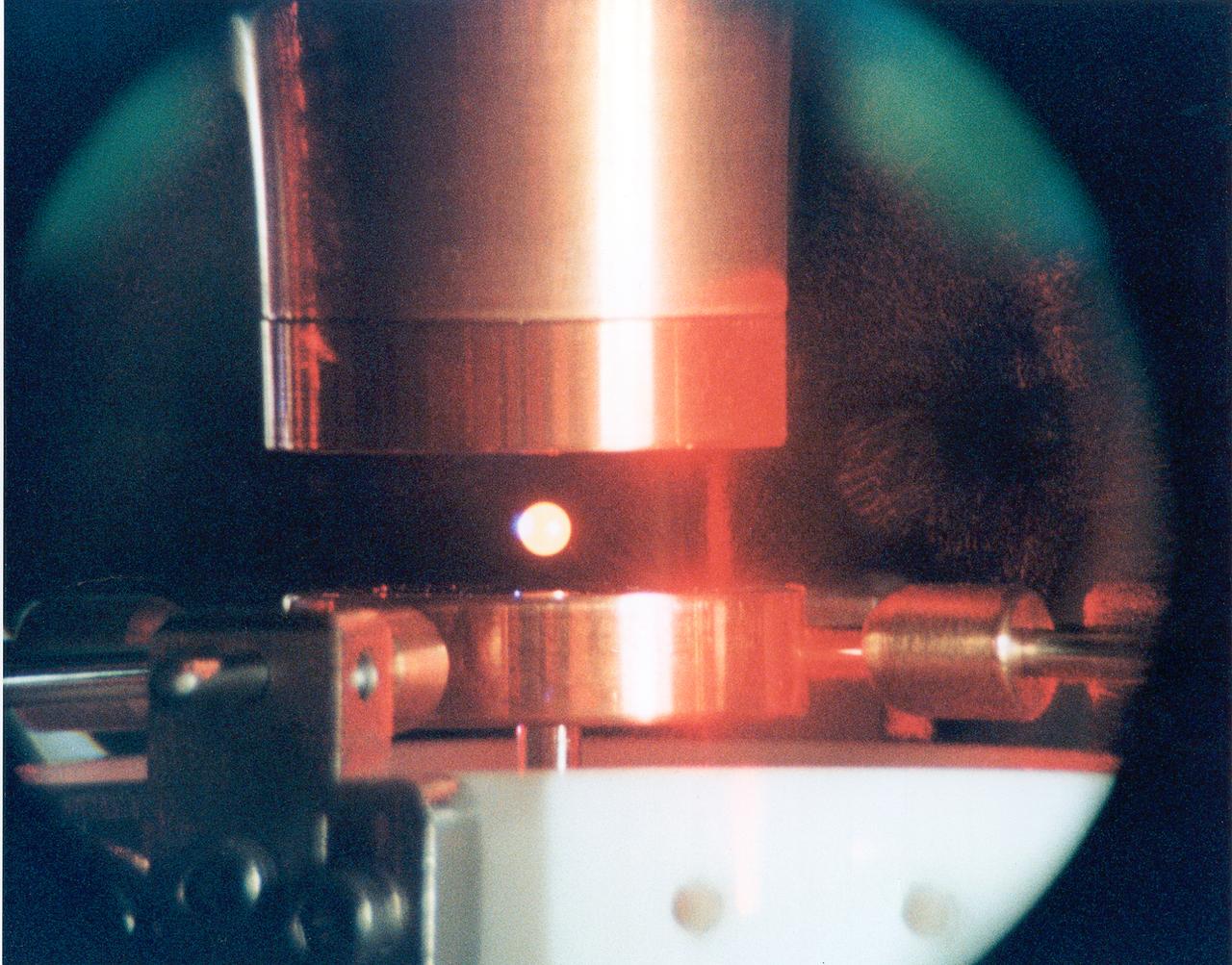
A 3 mm drop of nickel-zirconium, heated to incandescence, hovers between electrically charged plates inside the Electrostatic Levitator (ESL). The ESL uses static electricity to suspend an object (about 2-3 mm in diameter) inside a vacuum chamber while a laser heats the sample until it melts. This lets scientists record a wide range of physical properties without the sample contacting the container or any instruments, conditions that would alter the readings. The Electrostatic Levitator is one of several tools used in NASA's microgravity materials science program.

The Electrostatic Levitator (ESL) Facility established at Marshall Space Flight Center (MSFC) supports NASA's Microgravity Materials Science Research Program. NASA materials science investigations include ground-based, flight definition and flight projects. Flight definition projects, with demanding science concept review schedules, receive highest priority for scheduling experiment time in the Electrostatic Levitator (ESL) Facility.
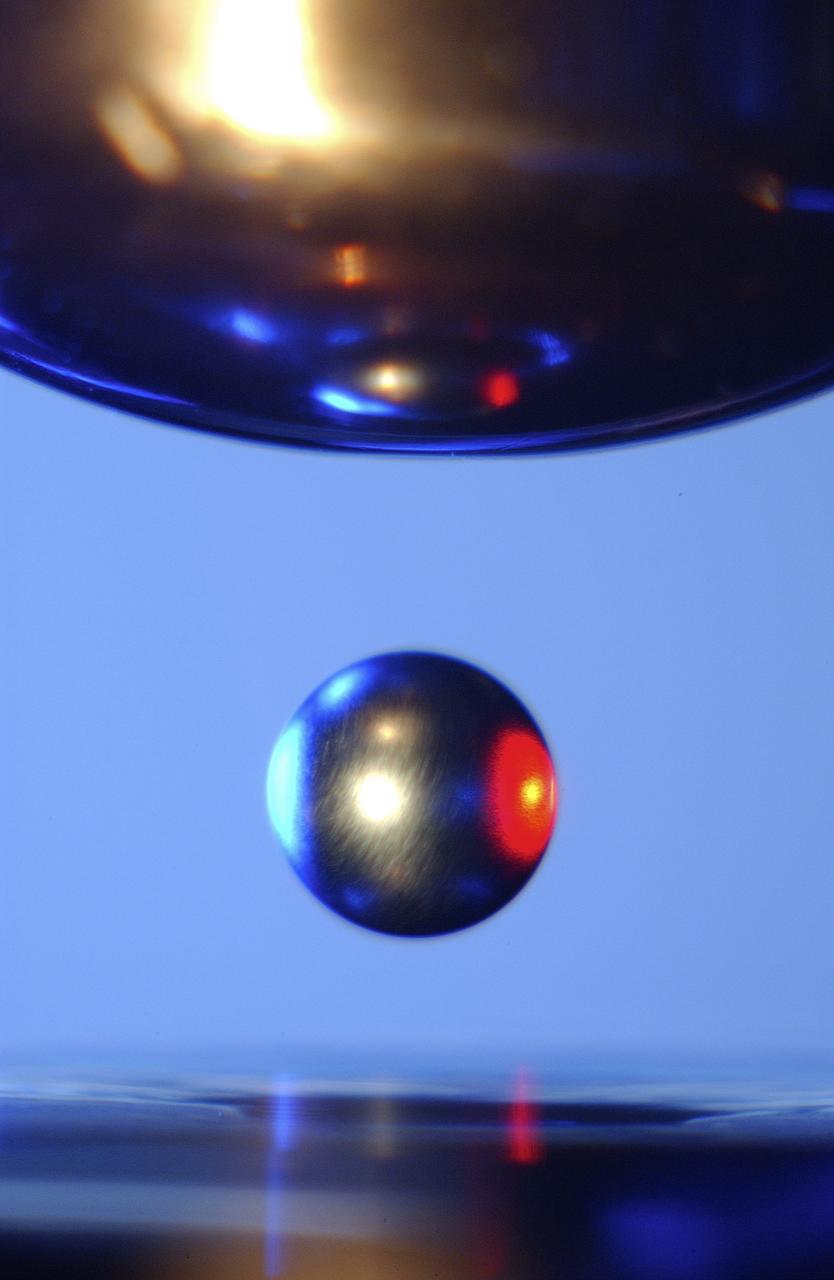
This is a close-up of a sample of titanium-zirconium-nickel alloy inside the Electrostatic Levitator (ESL) vacuum chamber at NASA's Marshall Space Flight Center (MSFC). The ESL uses static electricity to suspend an object (about 3-4 mm in diameter) inside a vacuum chamber allowing scientists to record a wide range of physical properties without the sample contracting the container or any instruments, conditions that would alter the readings. Once inside the chamber, a laser heats the sample until it melts. The laser is then turned off and the sample cools, changing from a liquid drop to a solid sphere. Since 1977, the ESL has been used at MSFC to study the characteristics of new metals, ceramics, and glass compounds. Materials created as a result of these tests include new optical materials, special metallic glasses, and spacecraft components.
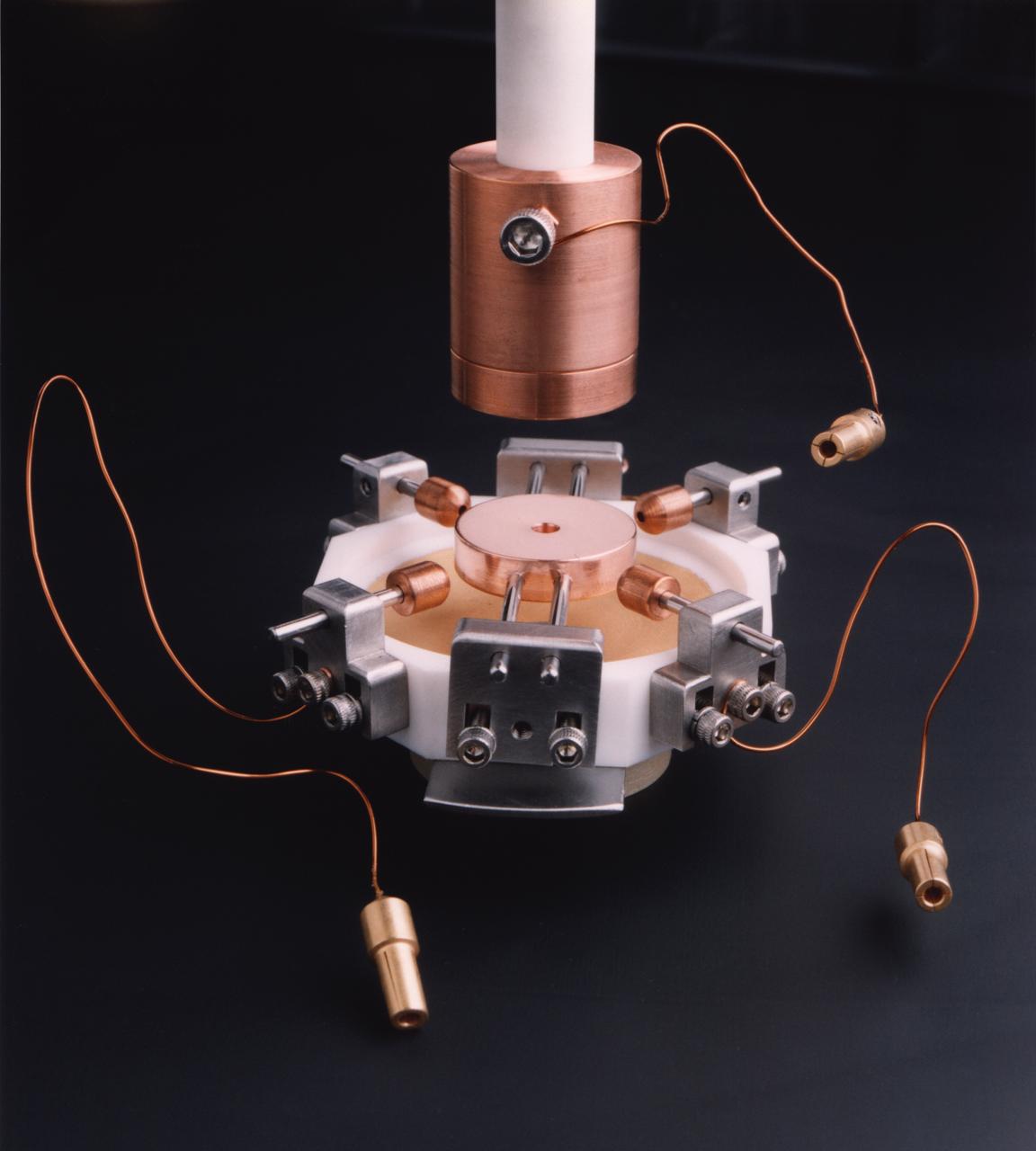
Electrostatic levitation system inside Electrostatic Levitator (ESL) vacuum chamber. The ESL uses static electricity to suspend an object (about 2-3 mm in diameter) inside a vacuum chamber while a laser heats the sample until it melts. This lets scientists record a wide range of physical properties without the sample contacting the container or any instruments, conditions that would alter the readings. The Electrostatic Levitator is one of several tools used in NASA's microgravity materials science program.

Dr. Jan Rogers, project scientist for the Electrostatic Levitator (ESL) at NASA's Marshall Space Flight Center(MSFC). The ESL uses static electricity to suspend an obejct (about 2-3 mm in diameter) inside a vacuum chamber while a laser heats the sample until it melts. This lets scientists record a wide range of physical properties without the sample contacting the container or any instruments, conditions that would alter the readings. The Electrostatic Levitator is one of several tools used in NASA's microgravity materials sciences program.
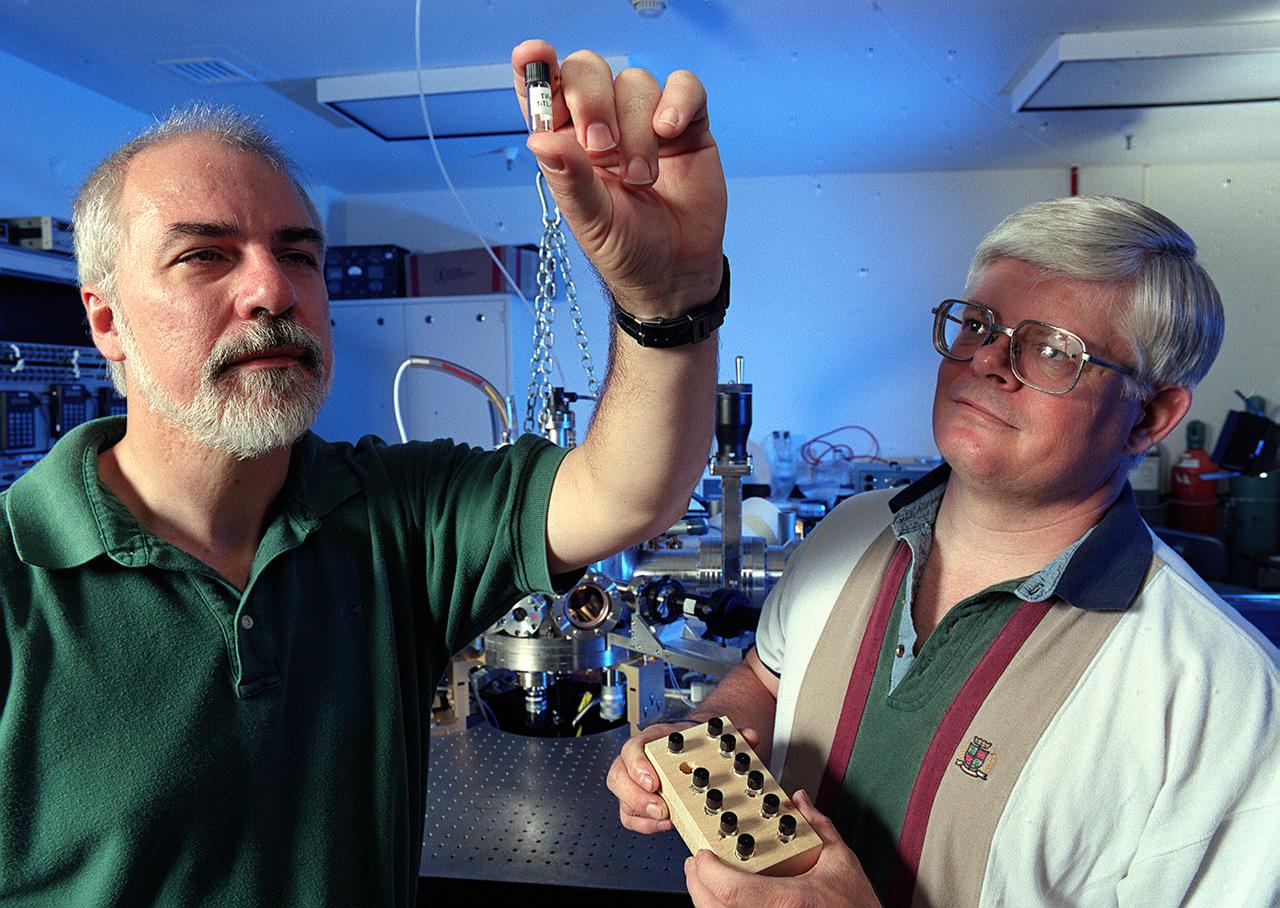
Prof. Kerneth Kelton of Washington University in St. Lous, MO, (L) and Dr. Michael Robinson of NASA's Marshall Space Flight Center (MSFC) examine a titanium-iron silicate (TiFeSiO)sample processed in MSFC's Electrostatic Levitator (ESL) Facility (background). Kelton is investigating undercooling of polytetrahedral phase-forming liquids.
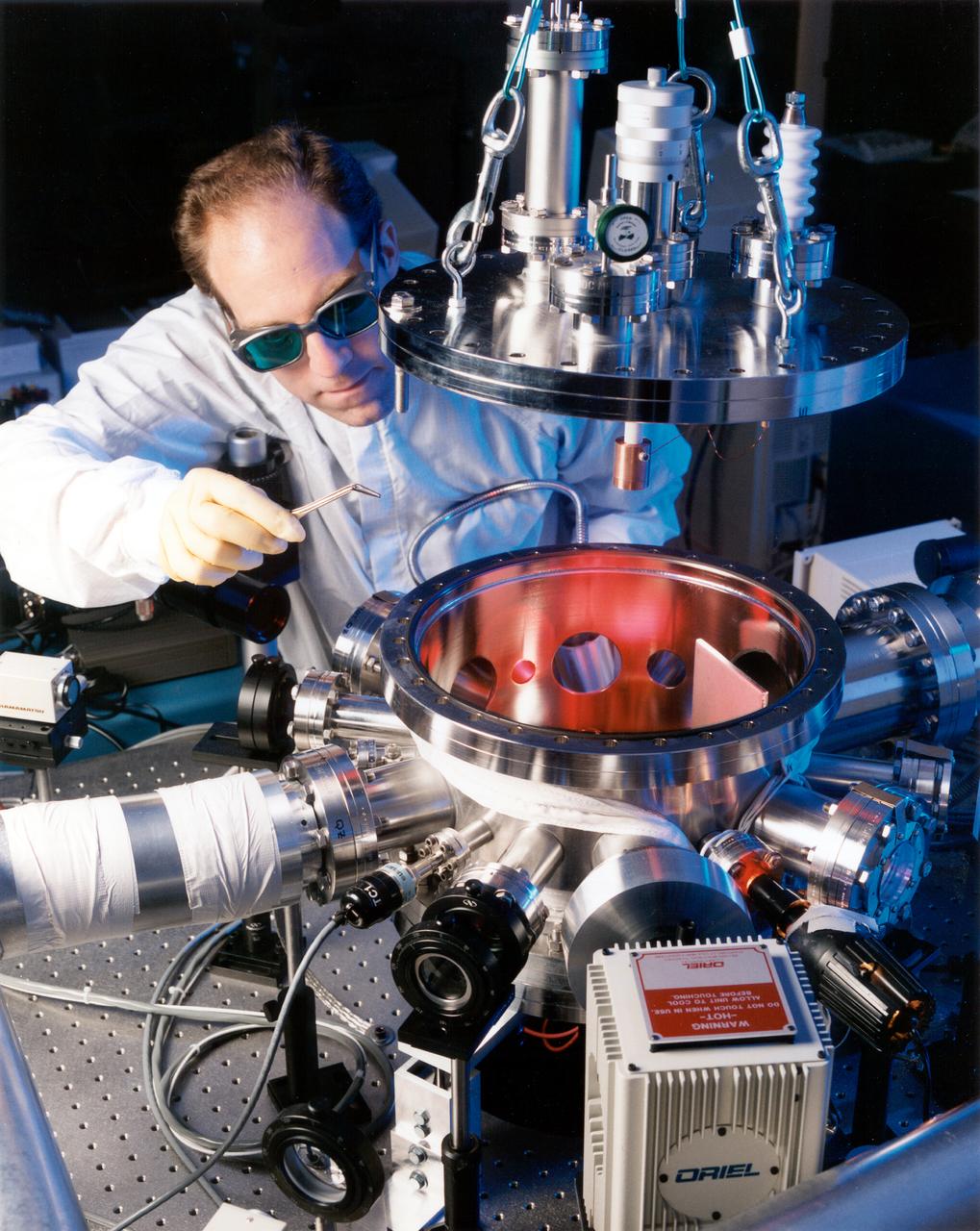
Dr. Rulison of Space System LORAl working with the Electrostatic Levitation (ESL) prior to the donation. Space System/LORAL donated the electrostatic containerless processing system to NASA's Marshall Space Flight Center (MSFC). The official hand over took place in July 1998.
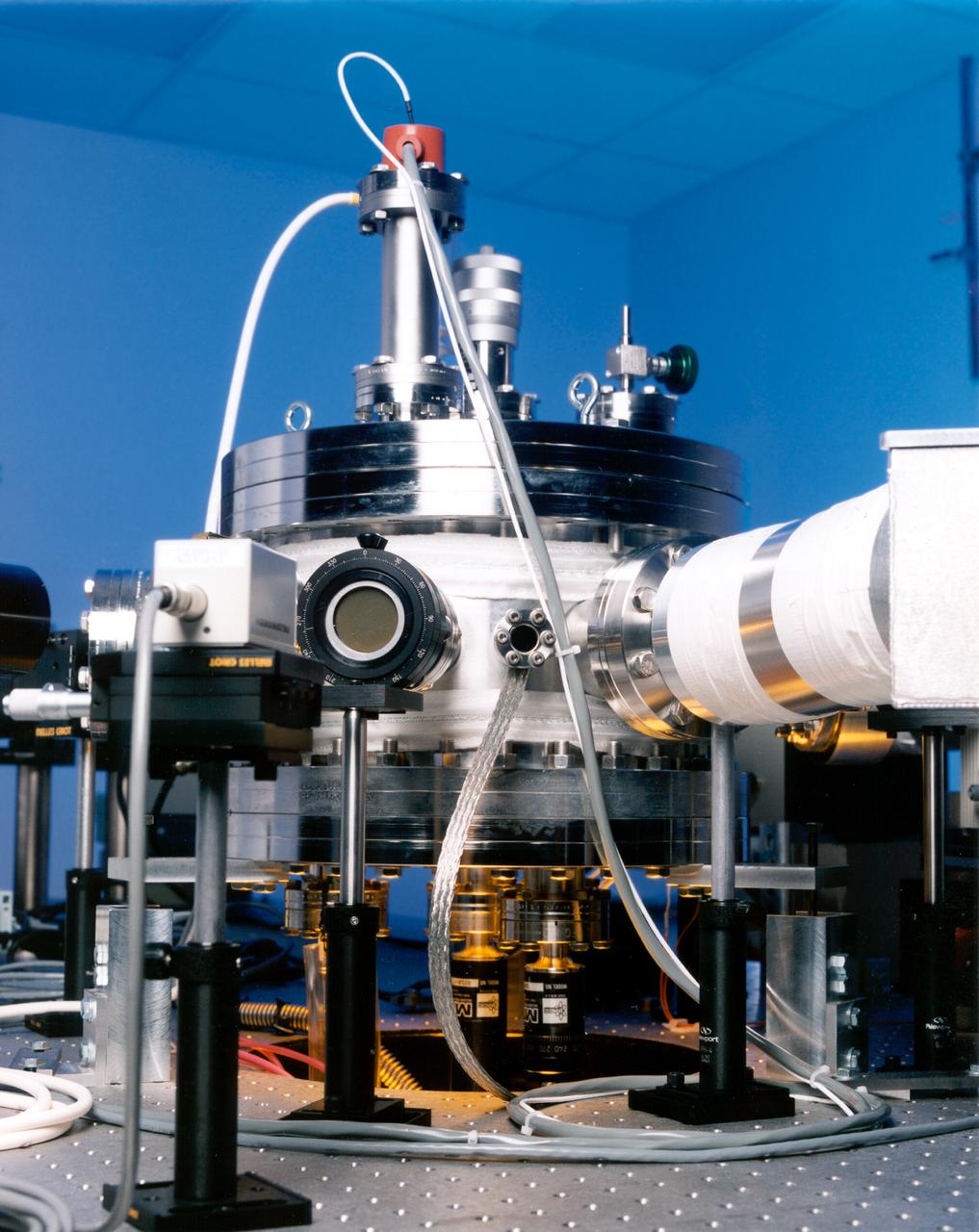
Optical prots ring the Electrostatic Levitator (ESL) vacuum chamber to admit light from the heating laser (the beam passes through the window at left), poisitioning lasers (one port is at center), and lamps (such as the deuterium arc lamp at right), and to allow diagnostic instruments to view the sample. The ESL uses static electricity to suspend an object (about 2-3 mm in diameter) inside a vacuum chamber while a laser heats the sample until it melts. This lets scientists record a wide range of physical properties without the sample contacting the container or any instruments, conditions that would alter the readings. The Electrostatic Levitator is one of several tools used in NASA's microgravity materials science program.
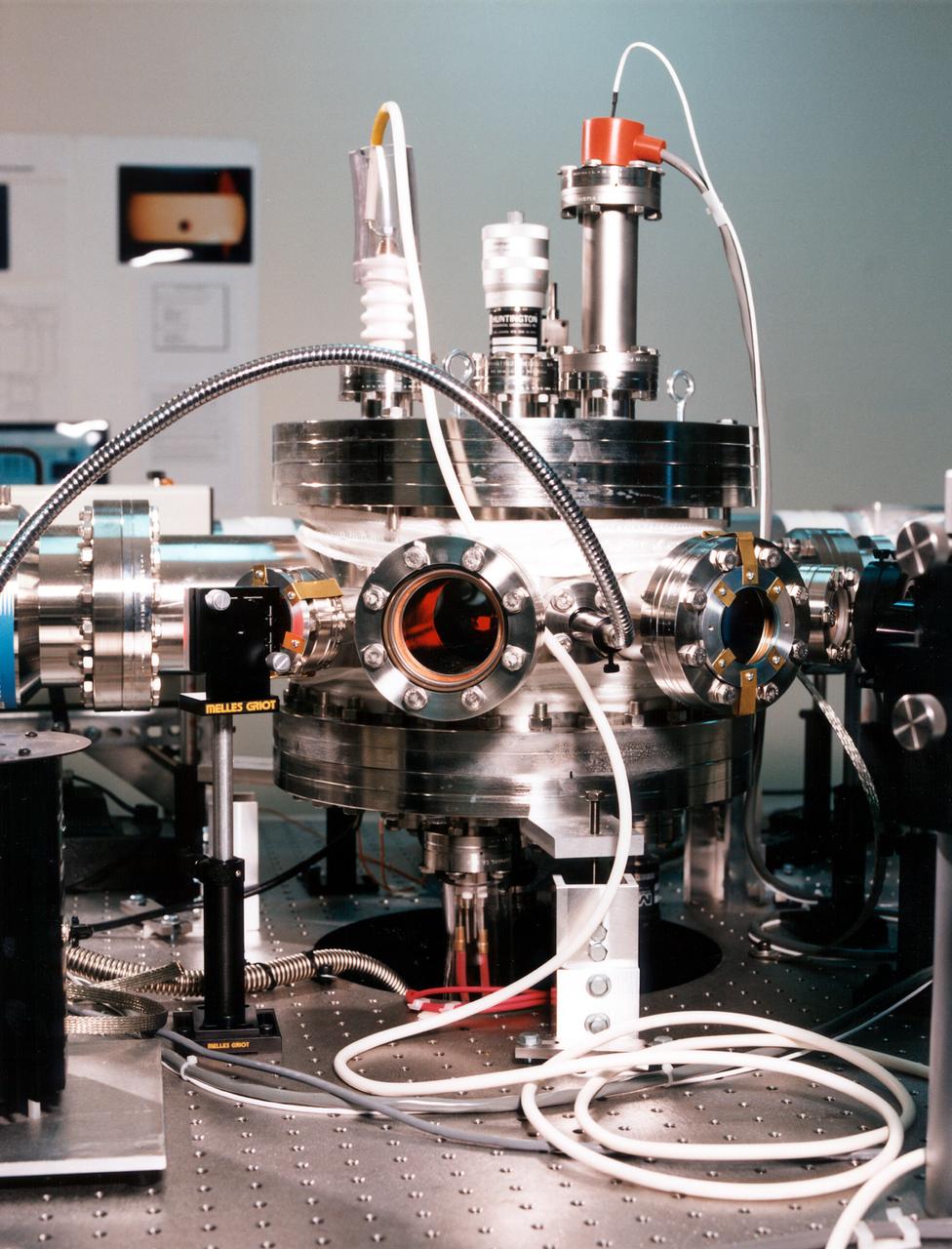
Optical prots ring the Electrostatic Levitator (ESL) vacuum chamber to admit light from the heating laser (the beam passes through the window at left), poisitioning lasers (one port is at center), and lamps (arc lamp at right), and to allow diagnostic instruments to view the sample. The ESL uses static electricity to suspend an object (about 2-3 mm in diameter) inside a vacuum chamber while a laser heats the sample until it melts. This lets scientists record a wide range of physical properties without the sample contacting the container or any instruments, conditions that would alter the readings. The Electrostatic Levitator is one of several tools used in NASA's microgravity materials science program.
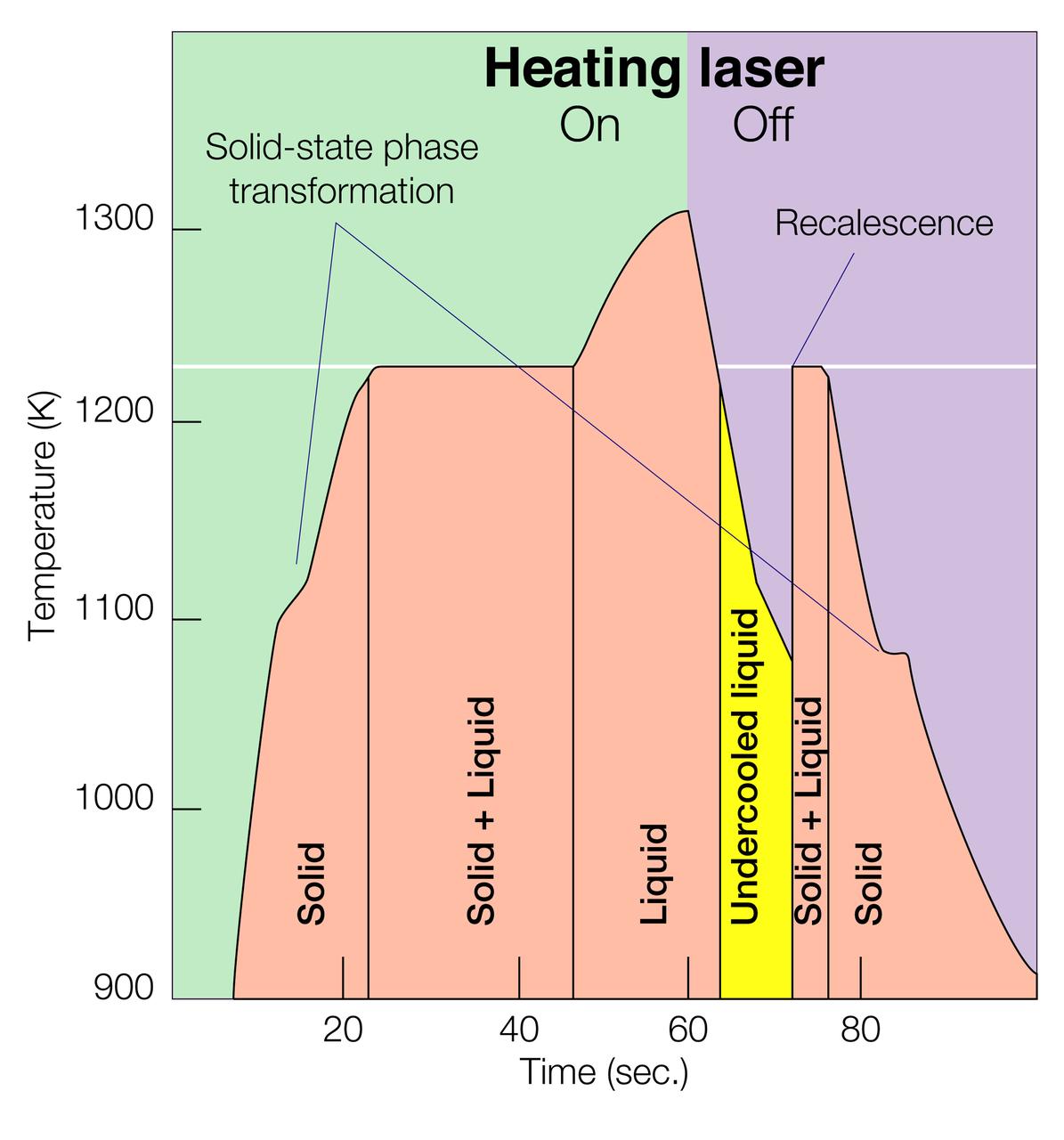
Graph depicting Electrostatic Levitator (ESL) heating and cooling cycle to achieve undercooling of liquid metals. The ESL uses static electricity to suspend an object (about 3-4 mm in diameter) inside a vacuum chamber while a laser heats the sample until it melts. This lets scientists record a wide range of physical properties without the sample contracting the container or any instruments, conditions that would alter the readings. The electrostatic Levitator is one of several tools used in NASA's microgravity matierials sciences program.
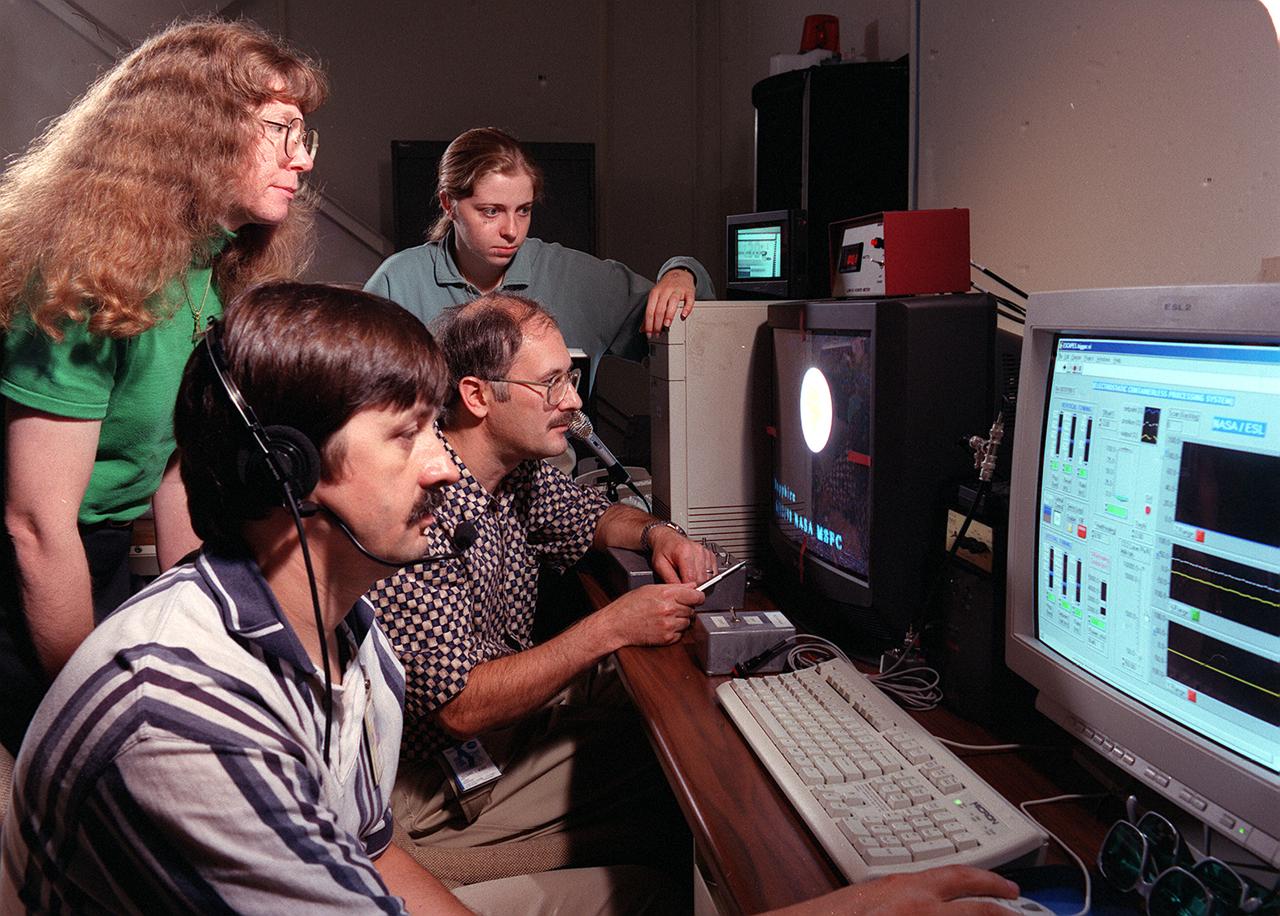
Dr. Jan Rogers (left) and Larry Savage (foreground) of the Science Directorate at NASA's Marshall Space Flight Center (MSFC) are joined by Dr. Richard Weber (center) and April Hixon of Containerless Research Inc. of Evanston, Ill., in conducting an experiment run of the Electrostatic Levitator (ESL) using insulating materials. Materials researchers use unique capabilities of the facility to levitate and study the properties of various materials important in manufacturing processes.
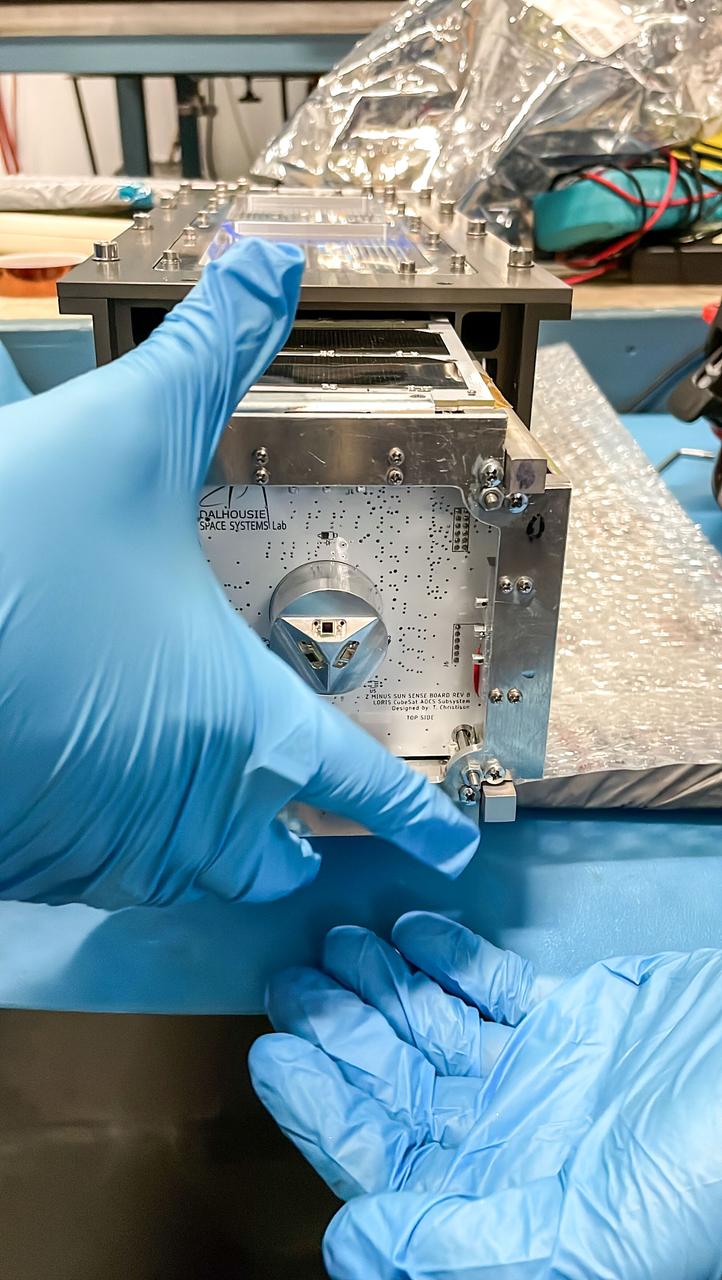
jsc2022e084489 (5/31/2022) --- A preflight view of the Low Orbit Reconnaissance Imagery Satellite (LORIS) being fitted into the fit gauge before the vibration test. Image courtesy of ESL Technologies, Nova Scotia, Canada.
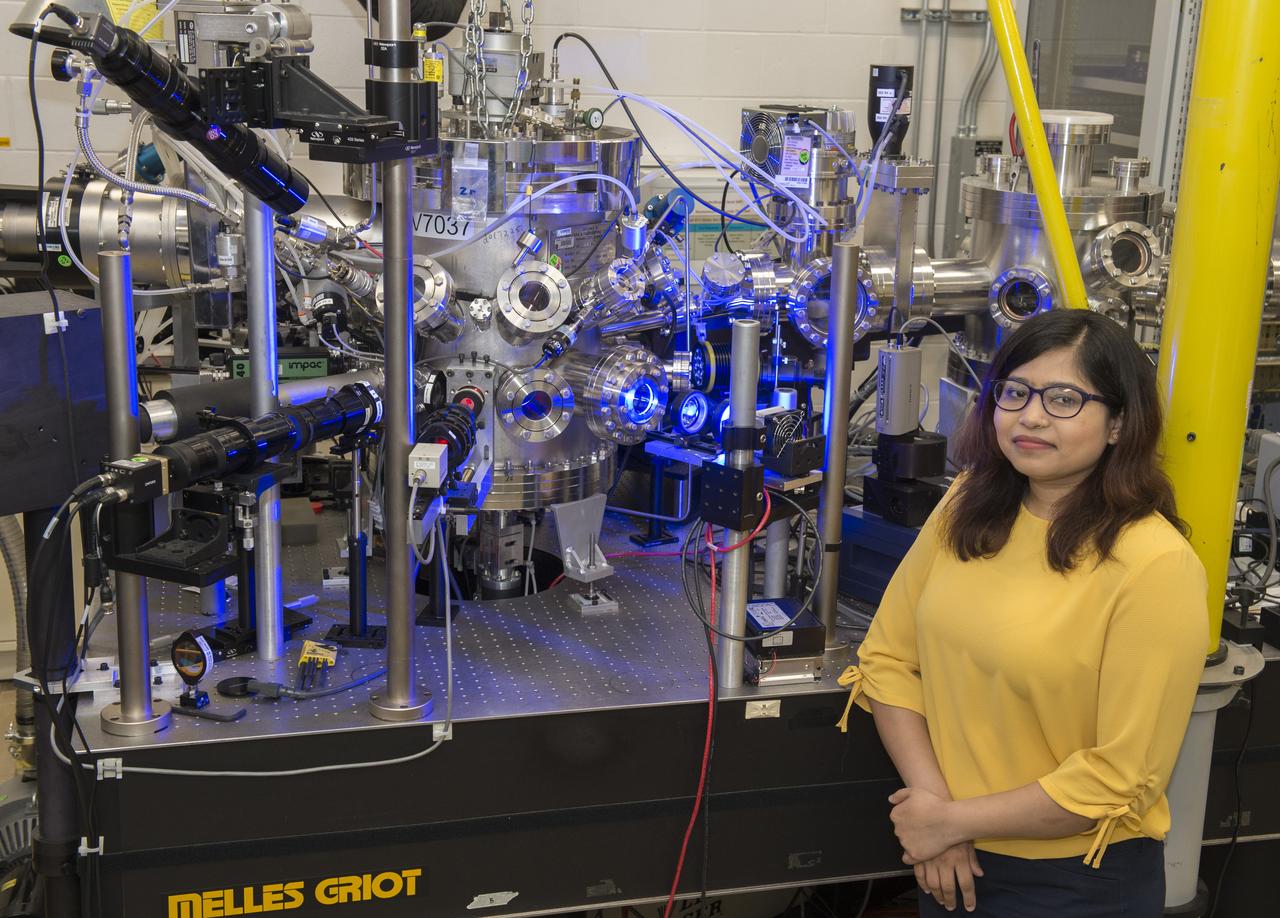
Jannatun Nawer (graduate student from Tufts University) visited the MSFC electrostatic levitation (ESL) laboratory is support of Dr. Douglas Matson’s (Tufts University) grant, “Round Robin - Thermophysical Property Measurement†(NNX17AH41G). Ms. Nawer is researching CMSX-4 Plus, a nickel-based superalloy, in support of future experiments on the International Space Station (ISS).
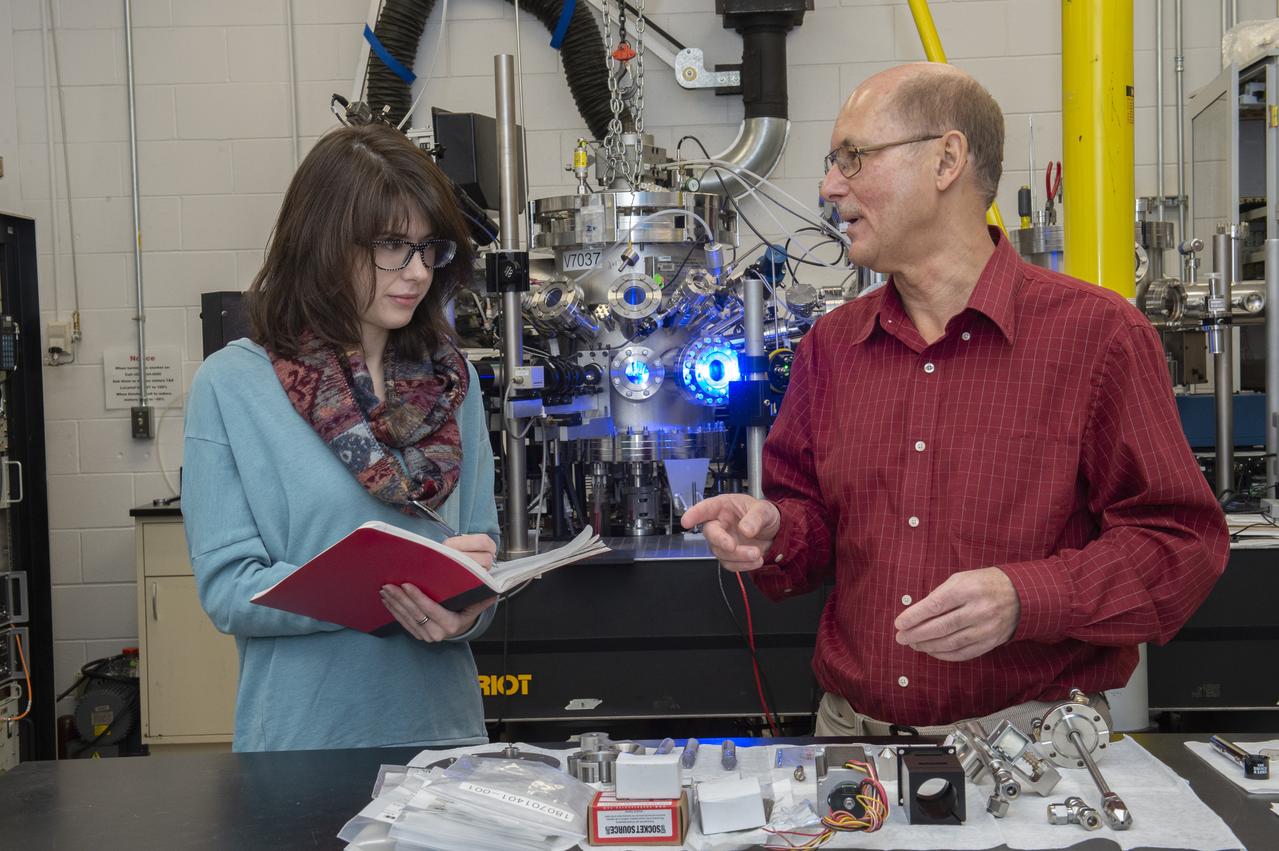
Dr. Richard Weber and Ms. Emma Clark from Materials Development Inc. during a visit to the MSFC electrostatic levitation (ESL) laboratory. Here they are preparing for ESL tests in support of Dr. Weber's NASA grant "Microgravity Investigation of Thermophysical Properties of Supercooled Molten Metal Oxides" (NNX17AH73G).
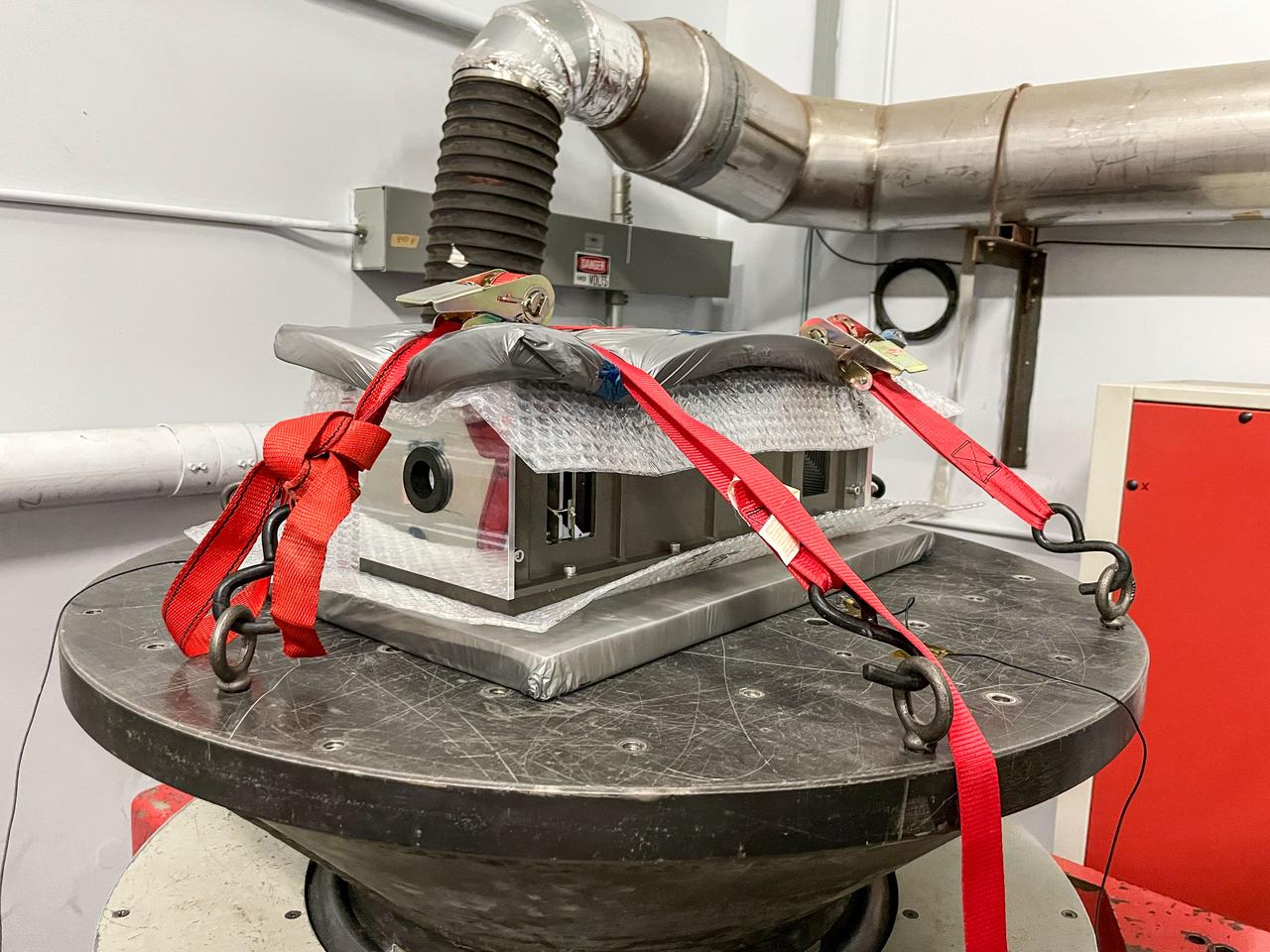
jsc2022e084488 (5/31/2022) --- A prefliight view of the Low Orbit Reconnaissance Imagery Satellite (LORIS) vibration test before integration at the ESL Environmental Technologies lab in Nova Scotia. Image courtesy of GALAXIA Mission Systems, Inc.
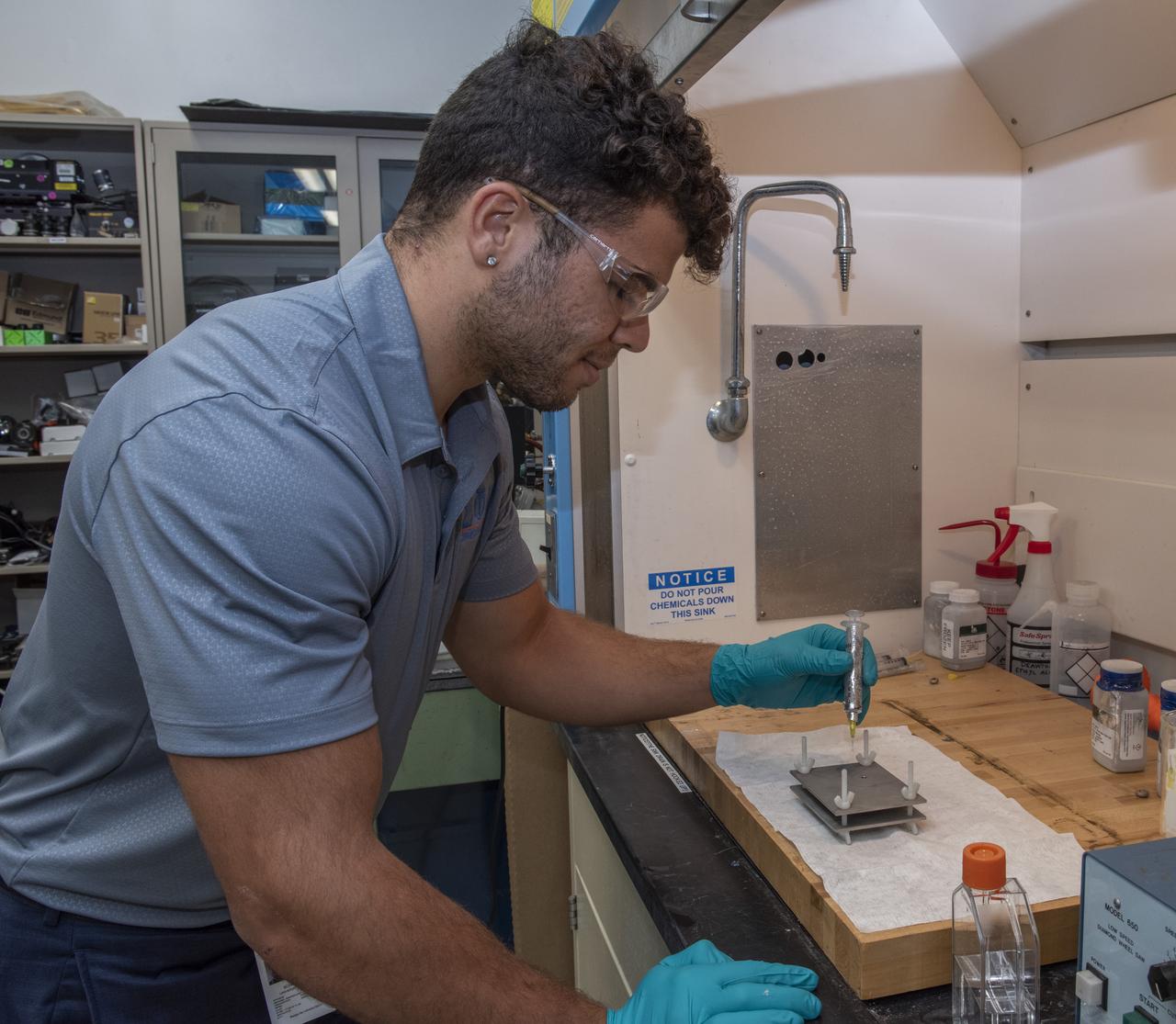
Allan Bonet (undergraduate student, University of Florida) prepares a test cell for ground-based testing in support of Dr. Ranga Narayanan’s (University of Florida) NASA grant “A Novel Way to Measure Interfacial Tension Using the Electrostatic Levitation Furnace (ELF)†(NNX17AL27G).
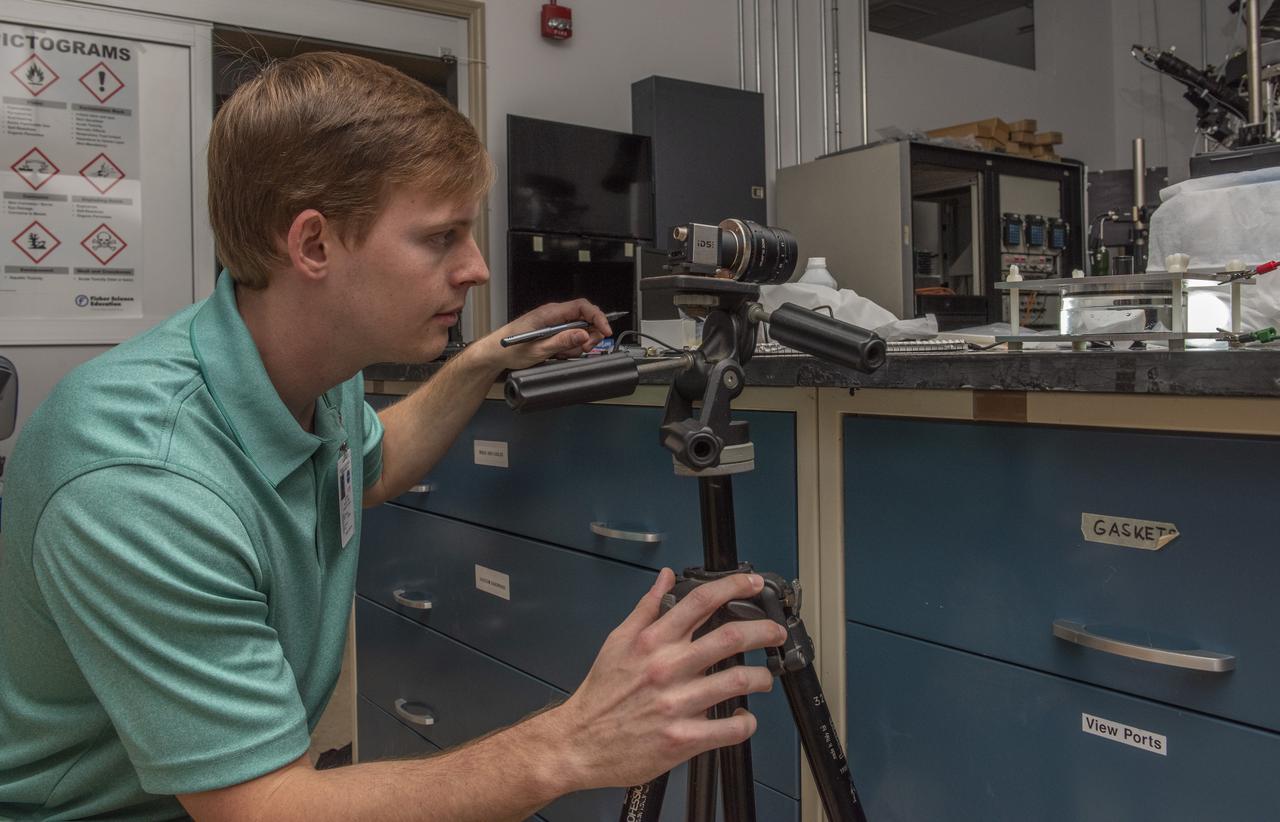
Evan Wilson (undergraduate student, University of Florida) observes a test apparatus to measure interfacial tension in support of Dr. Ranga Narayanan’s (University of Florida) NASA grant “A Novel Way to Measure Interfacial Tension Using the Electrostatic Levitation Furnace (ELF)†(NNX17AL27G).

3199: Molly Pleskus (undergraduate student from Tufts University) visited the MSFC electrostatic levitation (ESL) laboratory is support of Dr. Douglas Matson’s (Tufts University) grant, “Round Robin - Thermophysical Property Measurement†(NNX17AH41G). Ms. Pleskus is researching Inconel 718 in support of future experiments on the International Space Station (ISS).