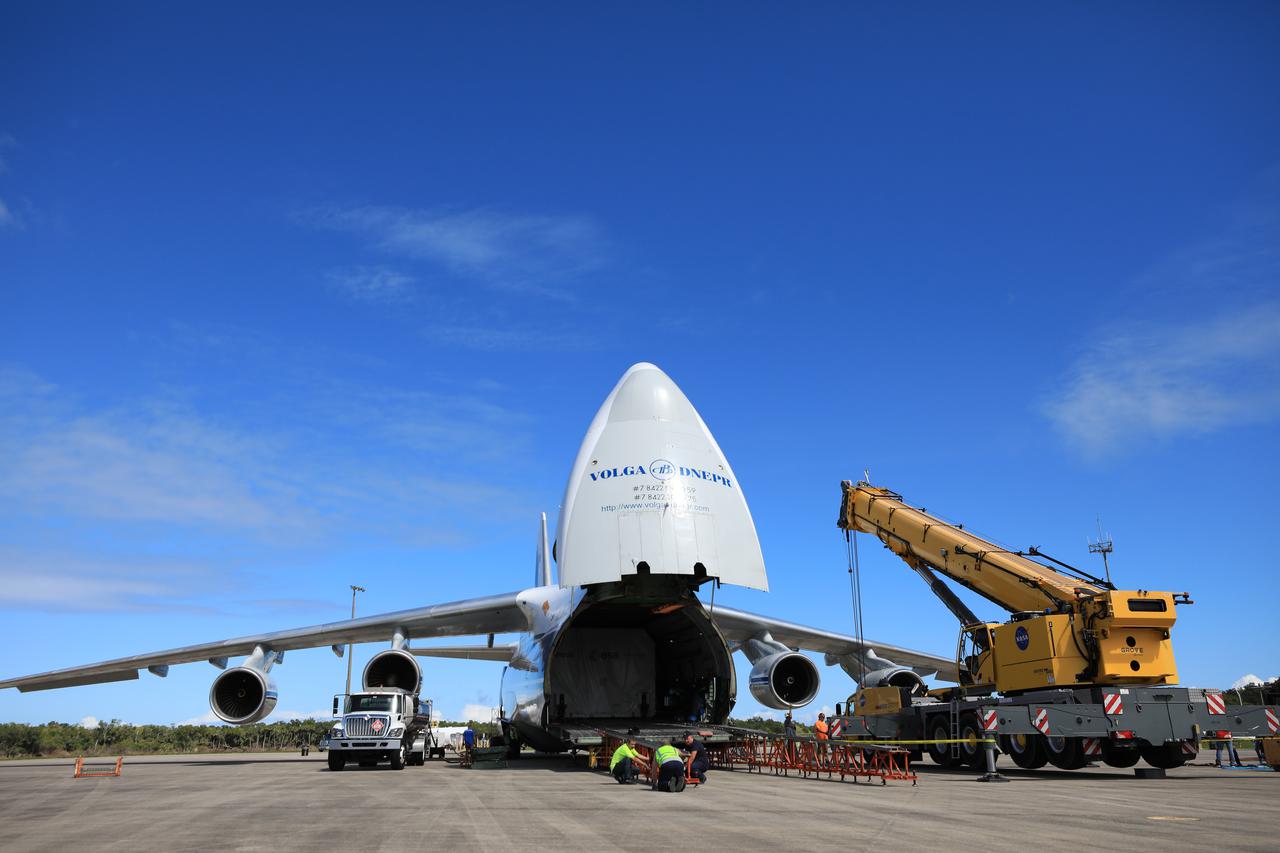
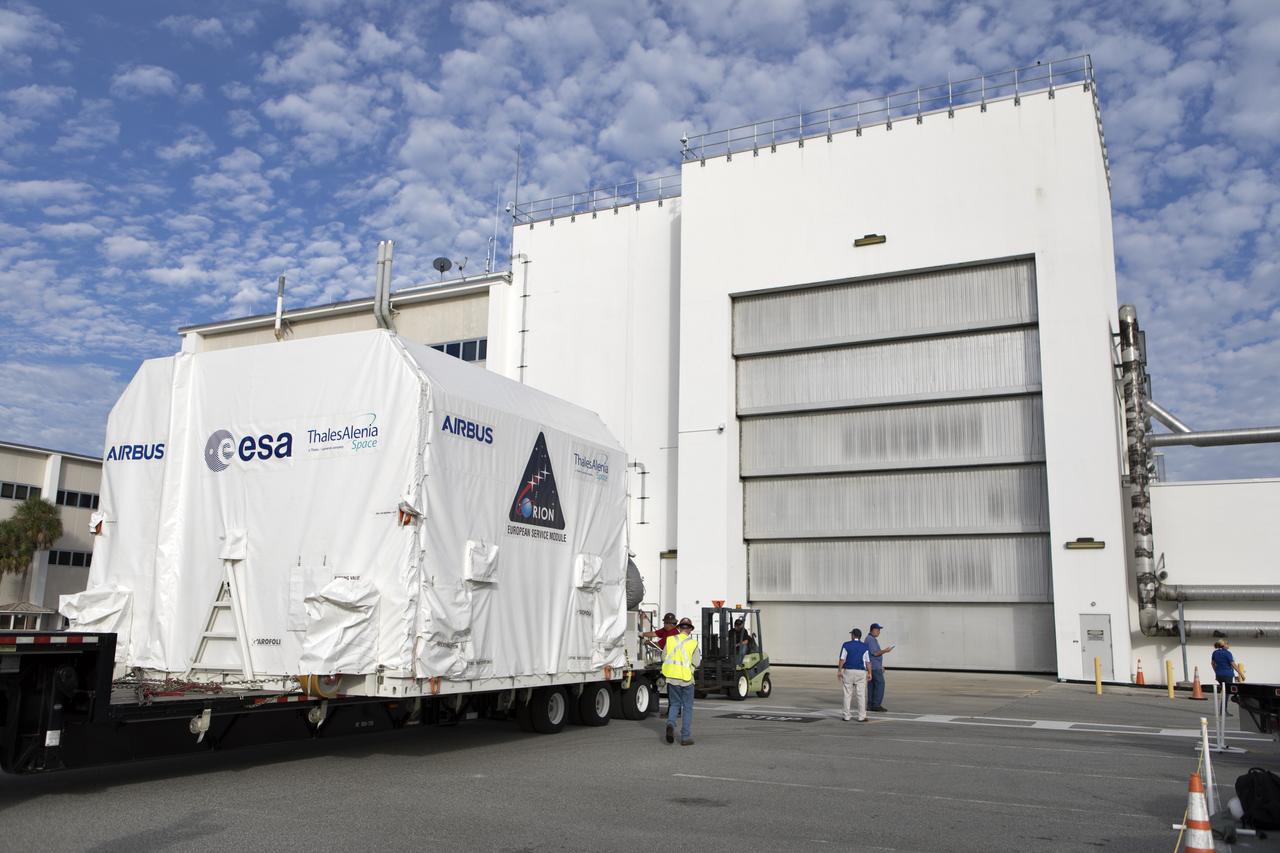
The European Service Module (ESM) for NASA’s Orion spacecraft arrives at the Launch and Landing Facility at NASA’s Kennedy Space Center in Florida on Thursday, Oct. 14, 2021. Making the journey from the Airbus Facility in Bremen, Germany, aboard a Russian Antonov aircraft, the ESM will be transferred to Kennedy’s Neil A. Armstrong Operations and Checkout Facility. There, teams from NASA and Lockheed Martin will integrate the service module with the crew module adapter and crew module, already housed in the facility. The powerhouse that will fuel and propel Orion in space, the ESM will be used for Artemis II, the first Artemis mission flying crew aboard Orion.
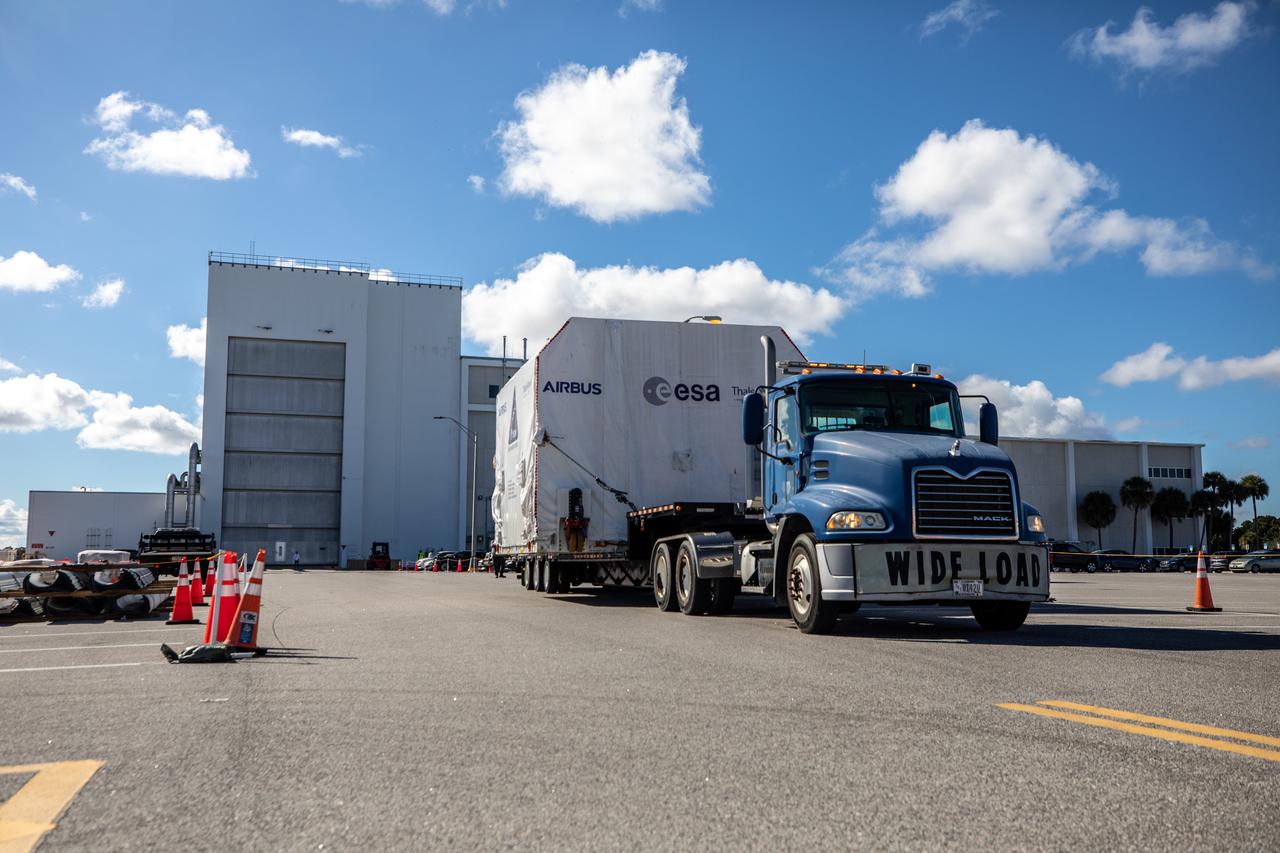
The European Service Module (ESM) for NASA’s Orion spacecraft arrived at the Neil A. Armstrong Operations and Checkout Facility at Kennedy Space Center in Florida on Oct 14, 2021. Earlier in the day the ESM arrived at the Launch and Landing Facility at Kennedy after making the journey from the Airbus Facility in Bremen, Germany, aboard a Russian Antonov aircraft. There, teams from NASA and Lockheed Martin will integrate the service module with the crew module adapter and crew module, already housed in the facility. The powerhouse that will fuel and propel Orion in space, the ESM will be used for Artemis II, the first Artemis mission flying crew aboard Orion. Teams with the European Space Agency and Airbus built the service module.
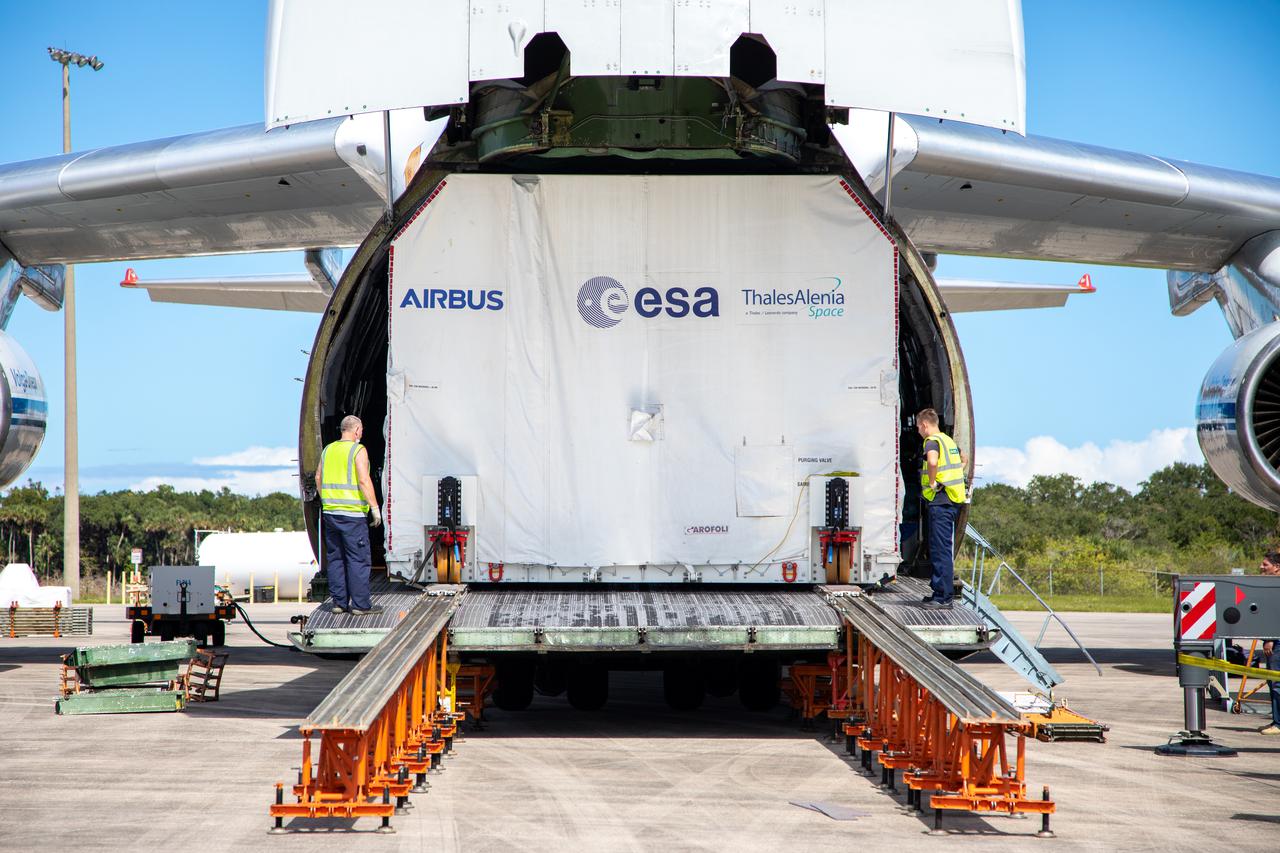
The European Service Module (ESM) for NASA’s Orion spacecraft arrived at the Launch and Landing Facility at NASA’s Kennedy Space Center in Florida on Thursday, Oct. 14, 2021, and was offloaded. Making the journey from the Airbus Facility in Bremen, Germany, aboard a Russian Antonov aircraft, the ESM will be transferred to Kennedy’s Neil A. Armstrong Operations and Checkout Facility. There, teams from NASA and Lockheed Martin will integrate the service module with the crew module adapter and crew module, already housed in the facility. The powerhouse that will fuel and propel Orion in space, the ESM will be used for Artemis II, the first Artemis mission flying crew aboard Orion. Teams with the European Space Agency and Airbus built the service module.
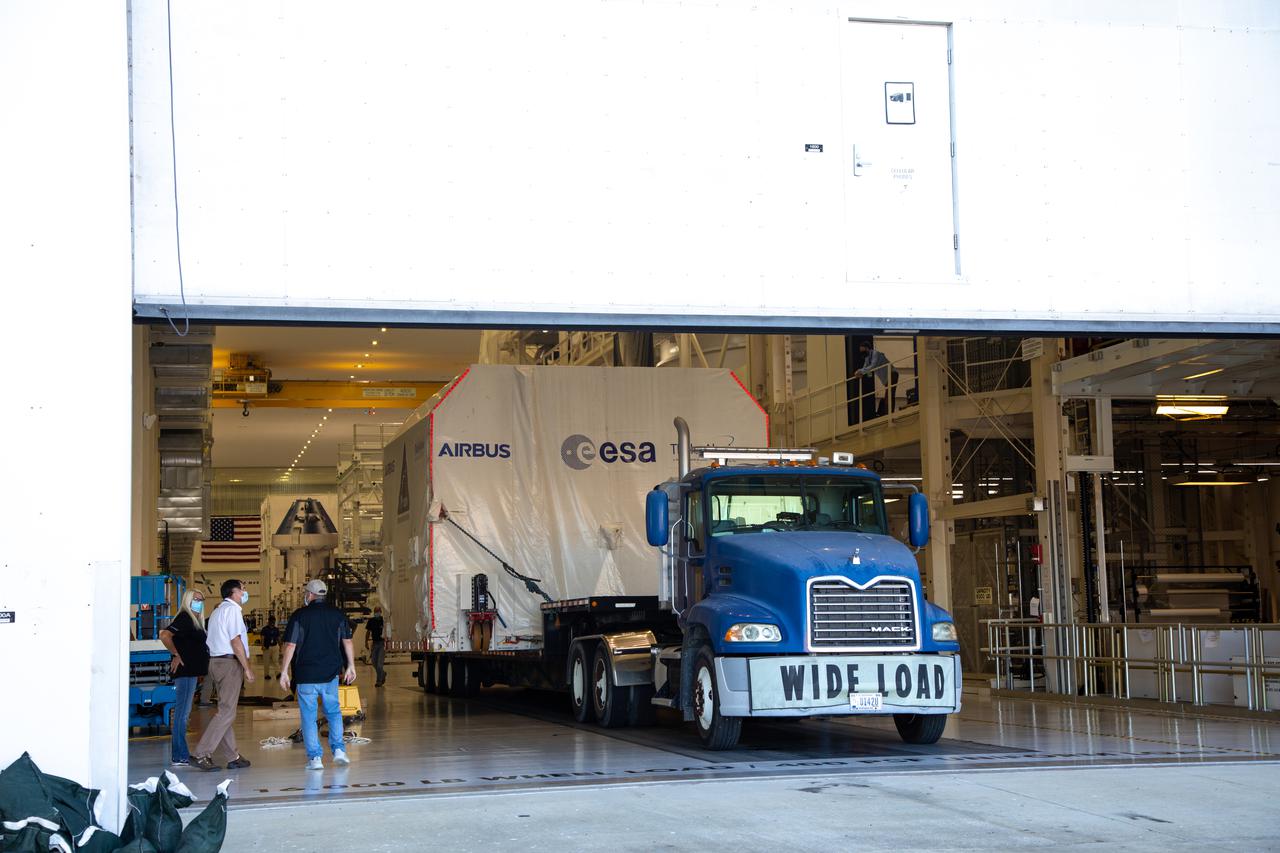
The European Service Module (ESM) for NASA’s Orion spacecraft arrived at the Neil A. Armstrong Operations and Checkout Facility at Kennedy Space Center in Florida on Oct 14, 2021. Earlier in the day the ESM arrived at the Launch and Landing Facility at Kennedy after making the journey from the Airbus Facility in Bremen, Germany, aboard a Russian Antonov aircraft. There, teams from NASA and Lockheed Martin will integrate the service module with the crew module adapter and crew module, already housed in the facility. The powerhouse that will fuel and propel Orion in space, the ESM will be used for Artemis II, the first Artemis mission flying crew aboard Orion. Teams with the European Space Agency and Airbus built the service module.
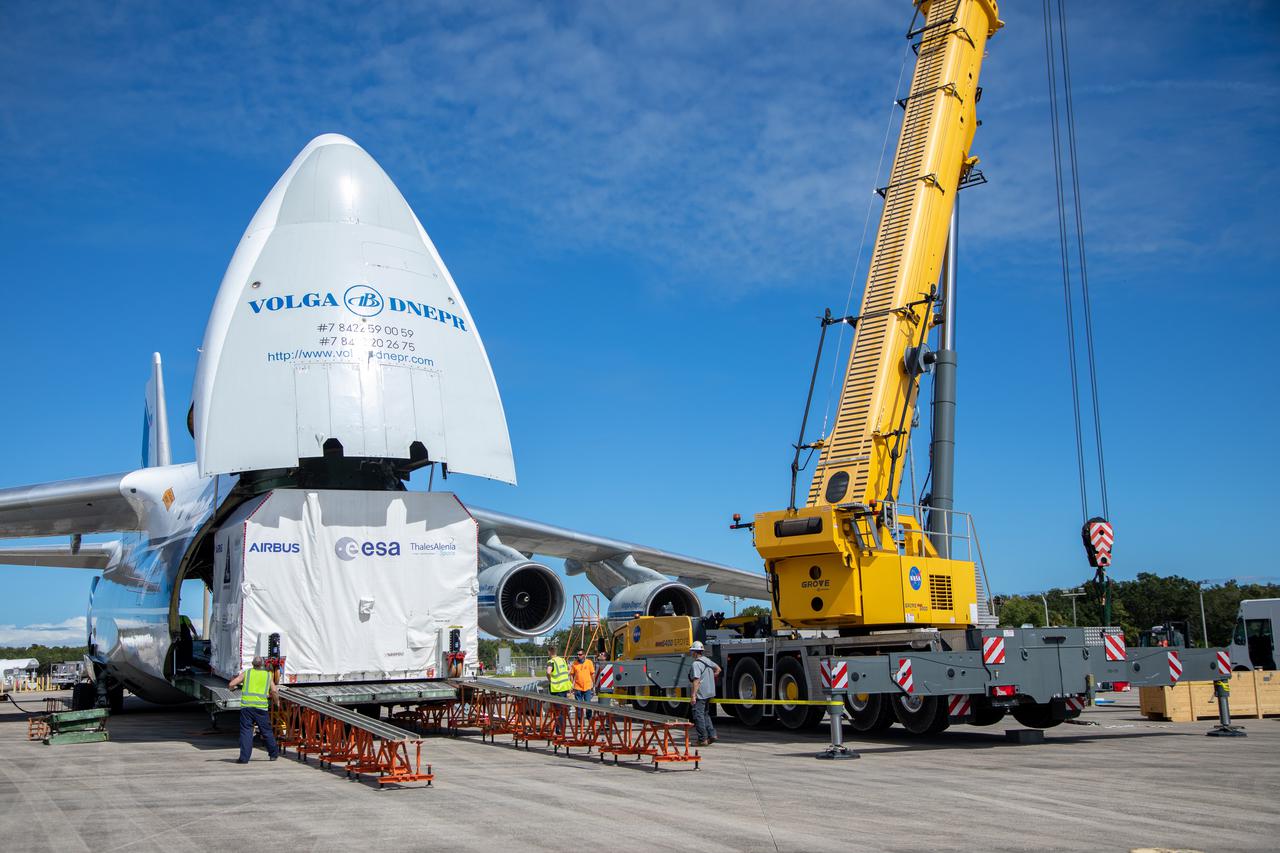
The European Service Module (ESM) for NASA’s Orion spacecraft arrived at the Launch and Landing Facility at NASA’s Kennedy Space Center in Florida on Thursday, Oct. 14, 2021, and was offloaded. Making the journey from the Airbus Facility in Bremen, Germany, aboard a Russian Antonov aircraft, the ESM will be transferred to Kennedy’s Neil A. Armstrong Operations and Checkout Facility. There, teams from NASA and Lockheed Martin will integrate the service module with the crew module adapter and crew module, already housed in the facility. The powerhouse that will fuel and propel Orion in space, the ESM will be used for Artemis II, the first Artemis mission flying crew aboard Orion. Teams with the European Space Agency and Airbus built the service module.
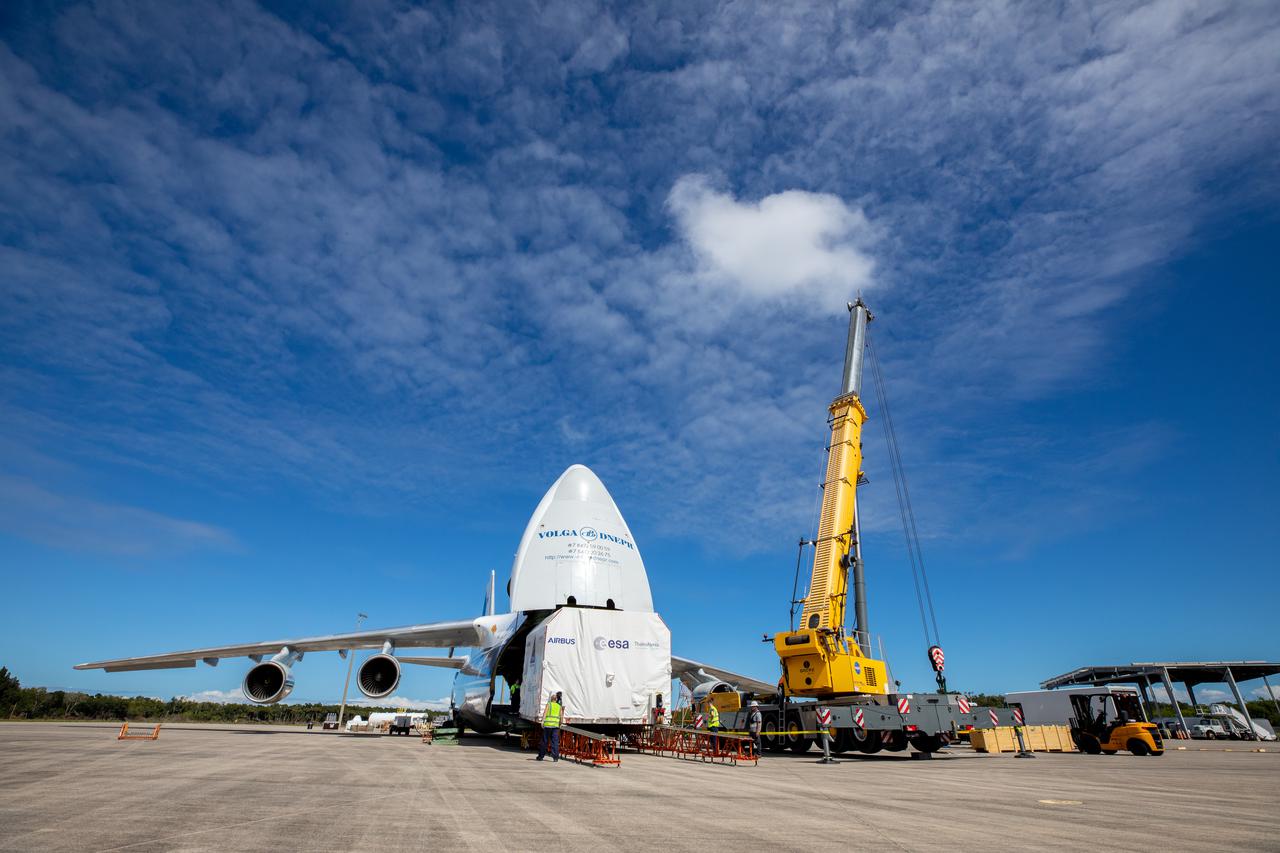
The European Service Module (ESM) for NASA’s Orion spacecraft arrived at the Launch and Landing Facility at NASA’s Kennedy Space Center in Florida on Thursday, Oct. 14, 2021, and was offloaded. Making the journey from the Airbus Facility in Bremen, Germany, aboard a Russian Antonov aircraft, the ESM will be transferred to Kennedy’s Neil A. Armstrong Operations and Checkout Facility. There, teams from NASA and Lockheed Martin will integrate the service module with the crew module adapter and crew module, already housed in the facility. The powerhouse that will fuel and propel Orion in space, the ESM will be used for Artemis II, the first Artemis mission flying crew aboard Orion. Teams with the European Space Agency and Airbus built the service module.
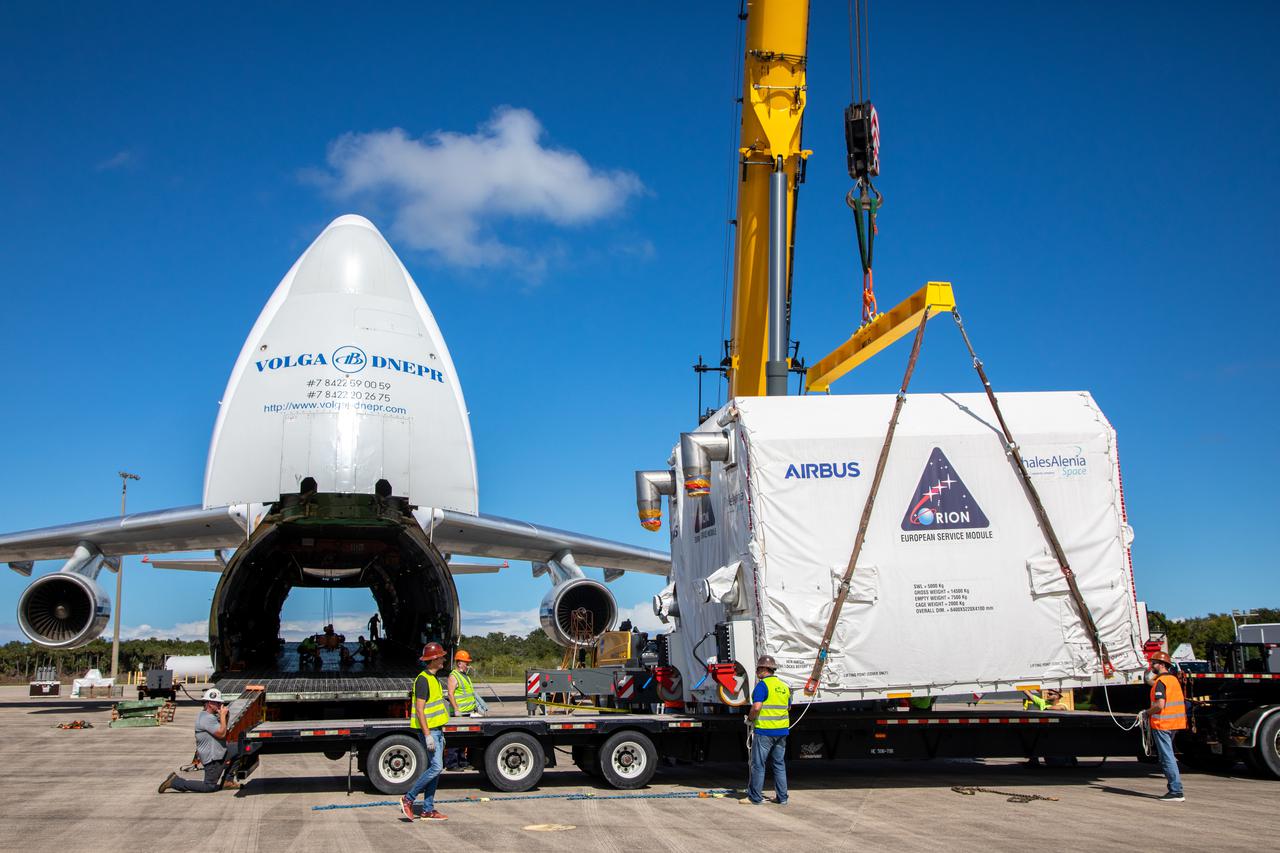
The European Service Module (ESM) for NASA’s Orion spacecraft arrived at the Launch and Landing Facility at NASA’s Kennedy Space Center in Florida on Thursday, Oct. 14, 2021, and was offloaded. Making the journey from the Airbus Facility in Bremen, Germany, aboard a Russian Antonov aircraft, the ESM will be transferred to Kennedy’s Neil A. Armstrong Operations and Checkout Facility. There, teams from NASA and Lockheed Martin will integrate the service module with the crew module adapter and crew module, already housed in the facility. The powerhouse that will fuel and propel Orion in space, the ESM will be used for Artemis II, the first Artemis mission flying crew aboard Orion. Teams with the European Space Agency and Airbus built the service module.
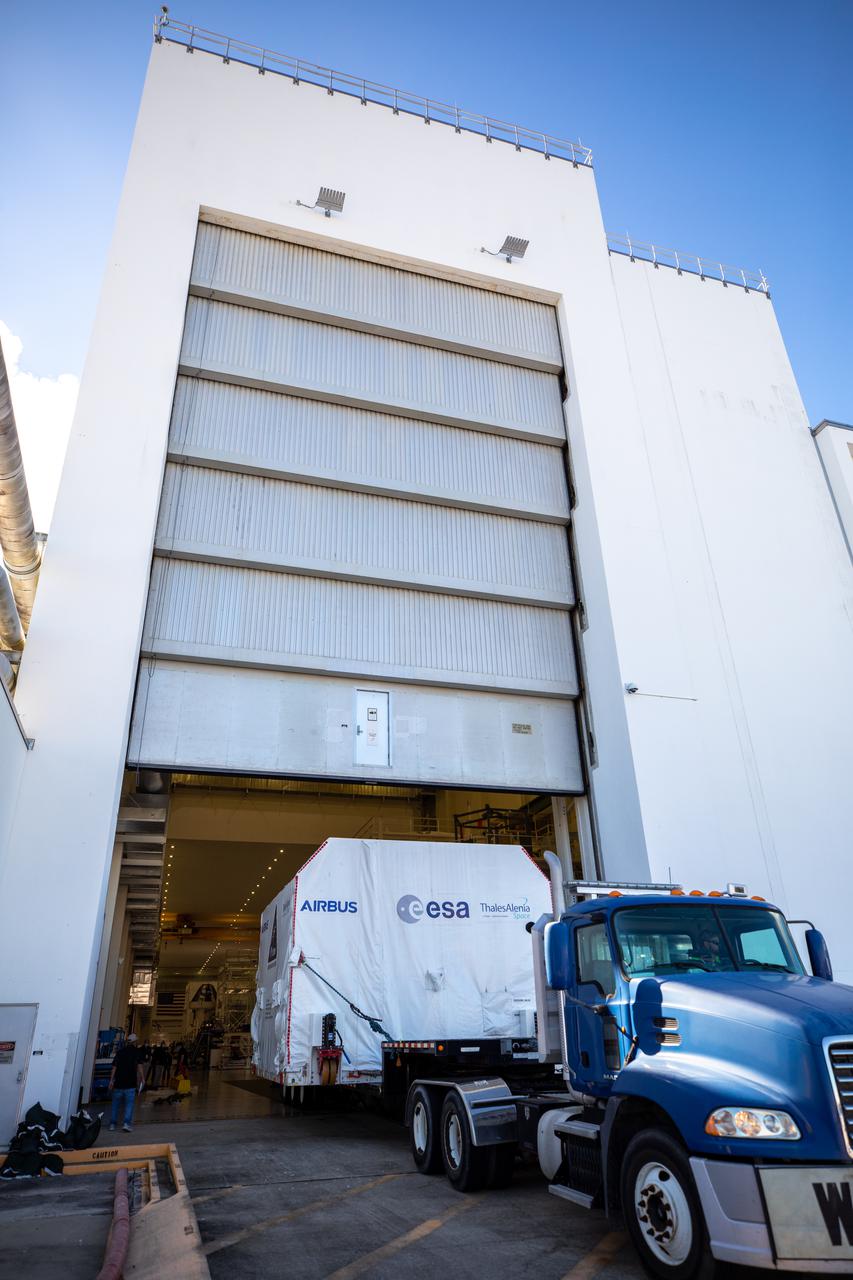
The European Service Module (ESM) for NASA’s Orion spacecraft arrived at the Neil A. Armstrong Operations and Checkout Facility at Kennedy Space Center in Florida on Oct 14, 2021. Earlier in the day the ESM arrived at the Launch and Landing Facility at Kennedy after making the journey from the Airbus Facility in Bremen, Germany, aboard a Russian Antonov aircraft. There, teams from NASA and Lockheed Martin will integrate the service module with the crew module adapter and crew module, already housed in the facility. The powerhouse that will fuel and propel Orion in space, the ESM will be used for Artemis II, the first Artemis mission flying crew aboard Orion. Teams with the European Space Agency and Airbus built the service module.
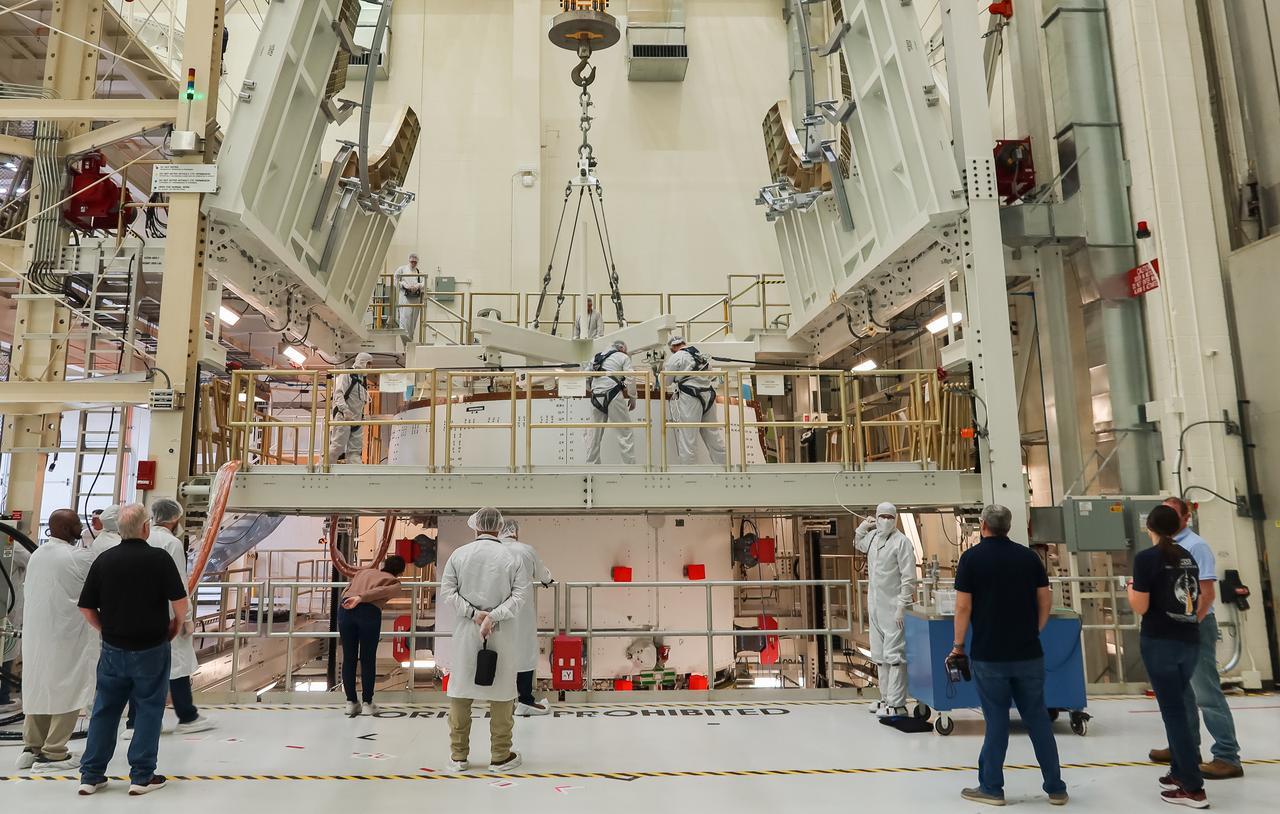
The European Service Module (ESM) for NASA’s Artemis II mission is secured inside the FAST (final assembly and system testing) cell in the high bay of the Neil A. Armstrong Operations and Checkout Building at NASA’s Kennedy Space Center in Florida on May 22, 2023. The ESM is in the FAST cell for final checkouts before it is stacked with the Orion crew module. Technicians are removing the crane that was used to move the ESM. The powerhouse that will fuel and propel Orion in space, the ESM will be used for Artemis II, the first Artemis mission flying crew aboard Orion.
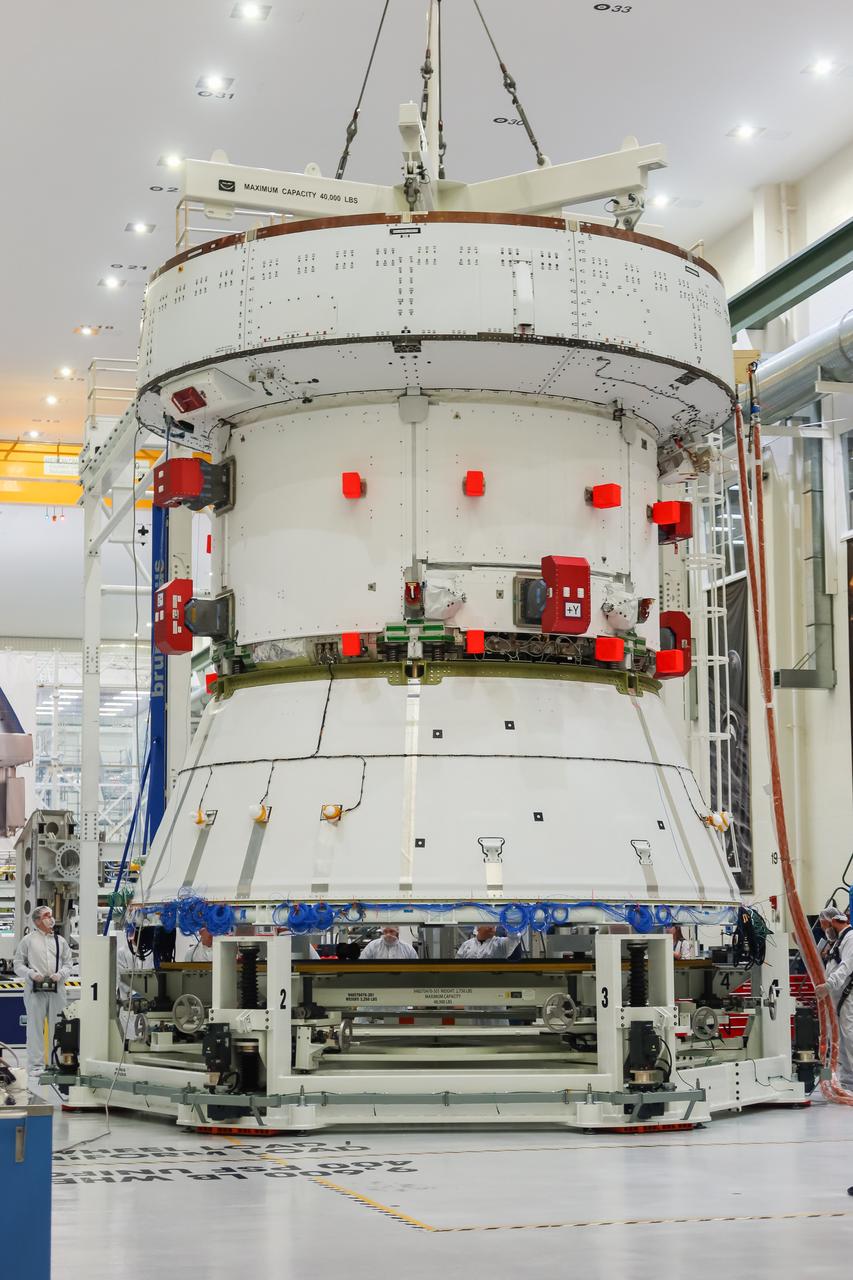
The European Service Module (ESM) for NASA’s Artemis II mission is lifted by crane inside the high bay of the Neil A. Armstrong Operations and Checkout Building at NASA’s Kennedy Space Center in Florida on May 22, 2023. Teams from NASA and Lockheed Martin are preparing the service module for transfer to the FAST (final assembly and system testing) cell for final checkouts before it is stacked with the Orion crew module. The powerhouse that will fuel and propel Orion in space, the ESM will be used for Artemis II, the first Artemis mission flying crew aboard Orion.
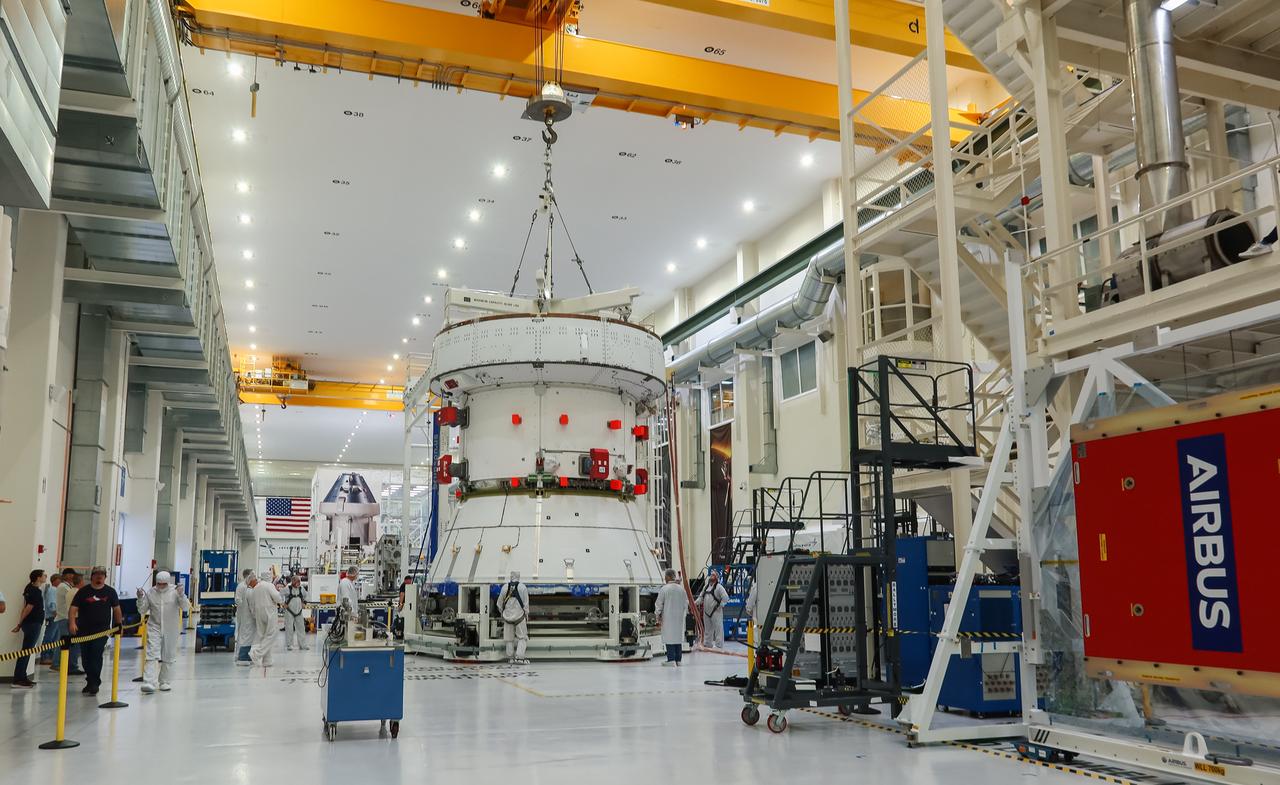
The European Service Module (ESM) for NASA’s Artemis II mission is lifted by crane inside the high bay of the Neil A. Armstrong Operations and Checkout Building at NASA’s Kennedy Space Center in Florida on May 22, 2023. Teams from NASA and Lockheed Martin are preparing the service module for transfer to the FAST (final assembly and system testing) cell for final checkouts before it is stacked with the Orion crew module. The powerhouse that will fuel and propel Orion in space, the ESM will be used for Artemis II, the first Artemis mission flying crew aboard Orion.
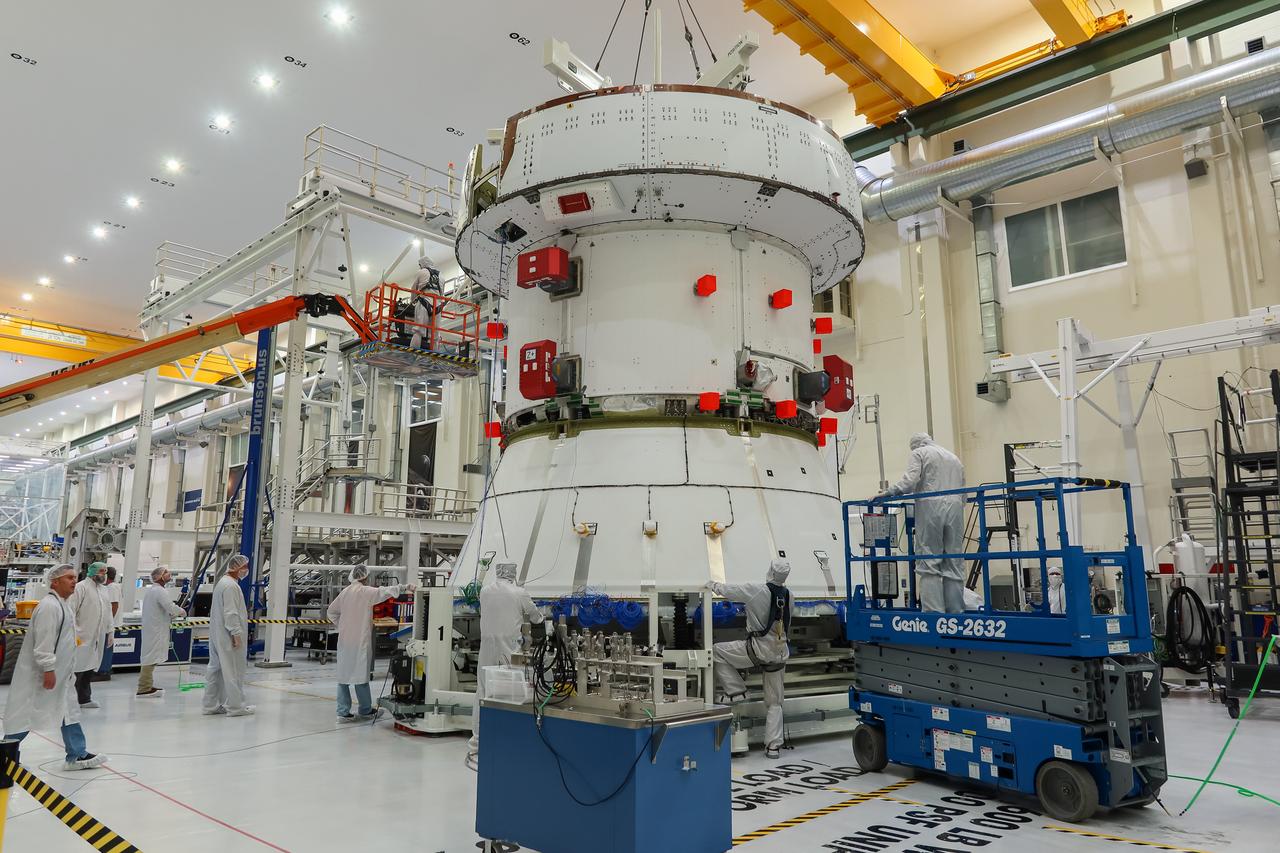
Preparations are underway to lift the European Service Module (ESM) for NASA’s Artemis II mission by crane inside the high bay of the Neil A. Armstrong Operations and Checkout Building at NASA’s Kennedy Space Center in Florida on May 22, 2023. Teams from NASA and Lockheed Martin are preparing the service module for transfer to the FAST (final assembly and system testing) cell for final checkouts before it is stacked with Orion crew module. The powerhouse that will fuel and propel Orion in space, the ESM will be used for Artemis II, the first Artemis mission flying crew aboard Orion.
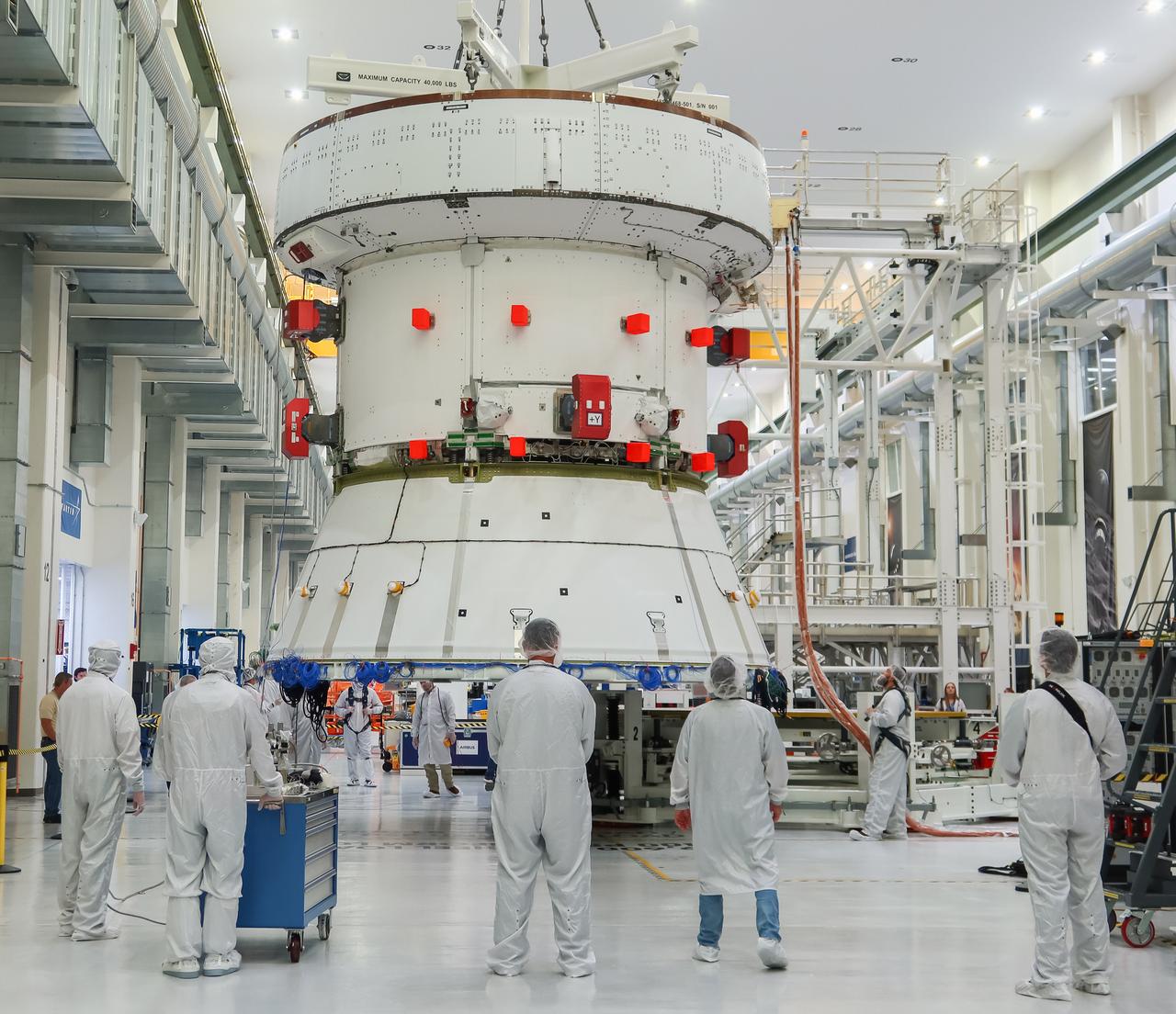
Engineers and technicians monitor the progress as the European Service Module (ESM) for NASA’s Artemis II mission is lifted by crane inside the high bay of the Neil A. Armstrong Operations and Checkout Building at NASA’s Kennedy Space Center in Florida on May 22, 2023. Teams from NASA and Lockheed Martin are preparing the service module for transfer to the FAST (final assembly and system testing) cell for final checkouts before it is stacked with the Orion crew module.. The powerhouse that will fuel and propel Orion in space, the ESM will be used for Artemis II, the first Artemis mission flying crew aboard Orion.
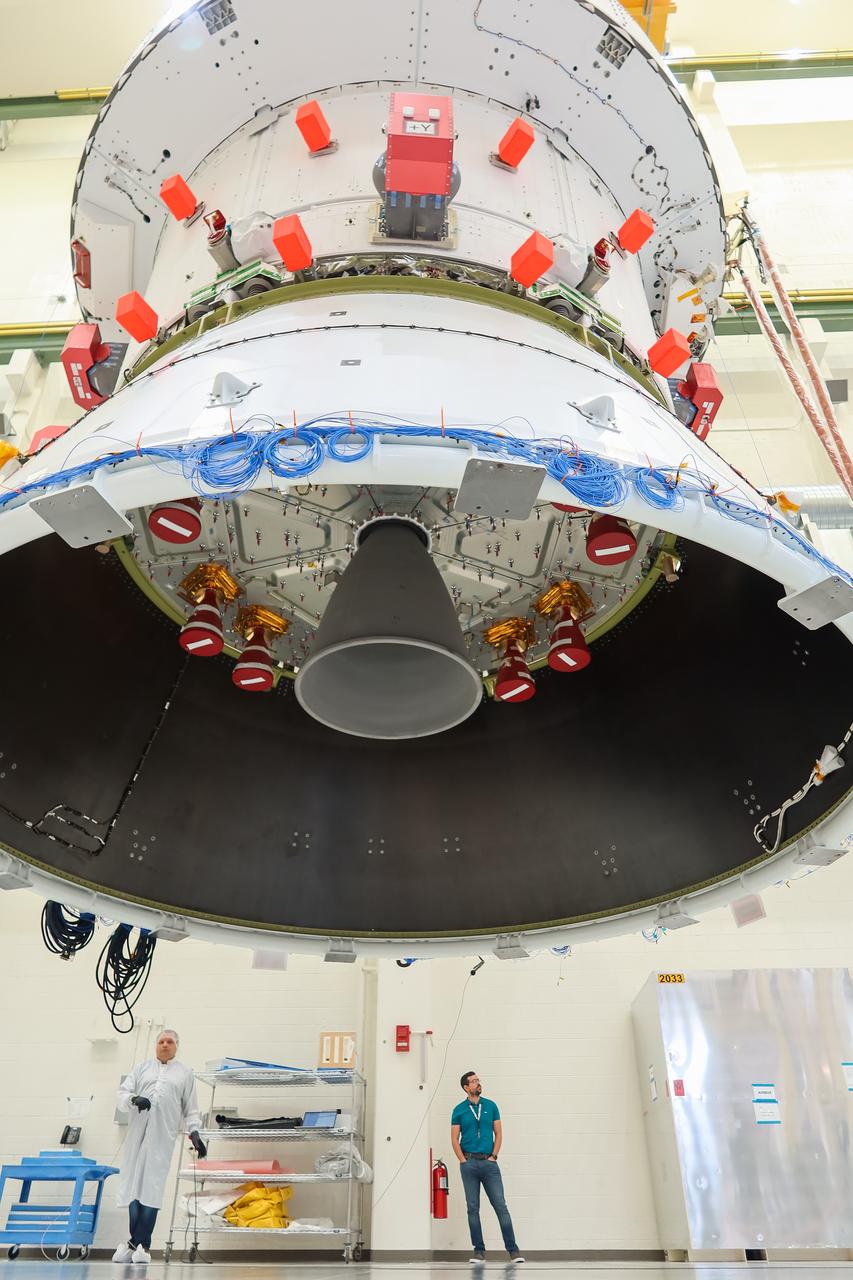
A view looking up from beneath the European Service Module (ESM) for NASA’s Artemis II mission as it is moved by crane along the center aisle of the high bay inside the Neil A. Armstrong Operations and Checkout Building at NASA’s Kennedy Space Center in Florida on May 22, 2023. Teams from NASA and Lockheed Martin are transferring the service module to the FAST (final assembly and system testing) cell for final checkouts before it is stacked with the Orion crew module.. The powerhouse that will fuel and propel Orion in space, the ESM will be used for Artemis II, the first Artemis mission flying crew aboard Orion.
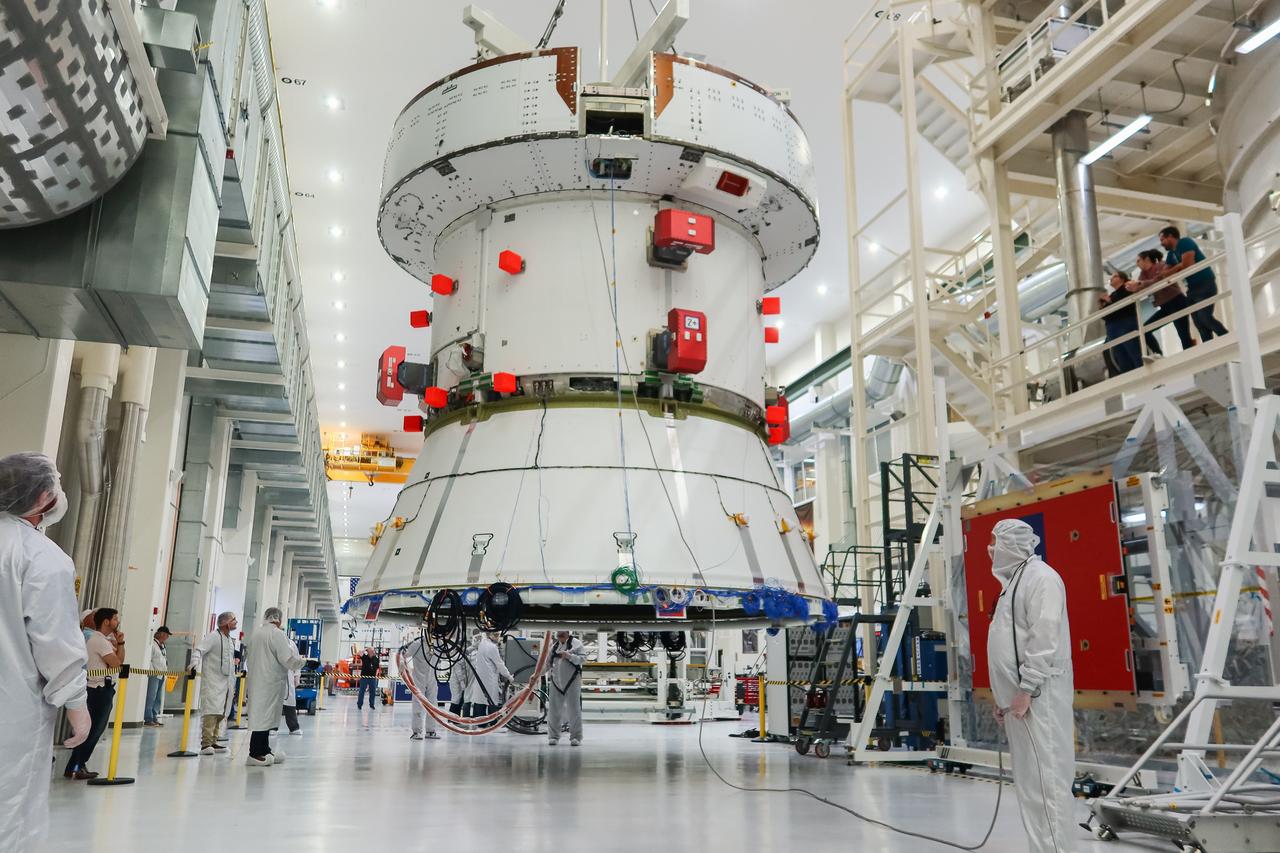
The European Service Module (ESM) for NASA’s Artemis II mission is lifted by crane and moved along the center aisle of the high bay inside the Neil A. Armstrong Operations and Checkout Building at NASA’s Kennedy Space Center in Florida on May 22, 2023. Teams from NASA and Lockheed Martin are preparing the service module for transfer to the FAST (final assembly and system testing) cell for final checkouts before it is stacked with the Orion crew module.. The powerhouse that will fuel and propel Orion in space, the ESM will be used for Artemis II, the first Artemis mission flying crew aboard Orion.
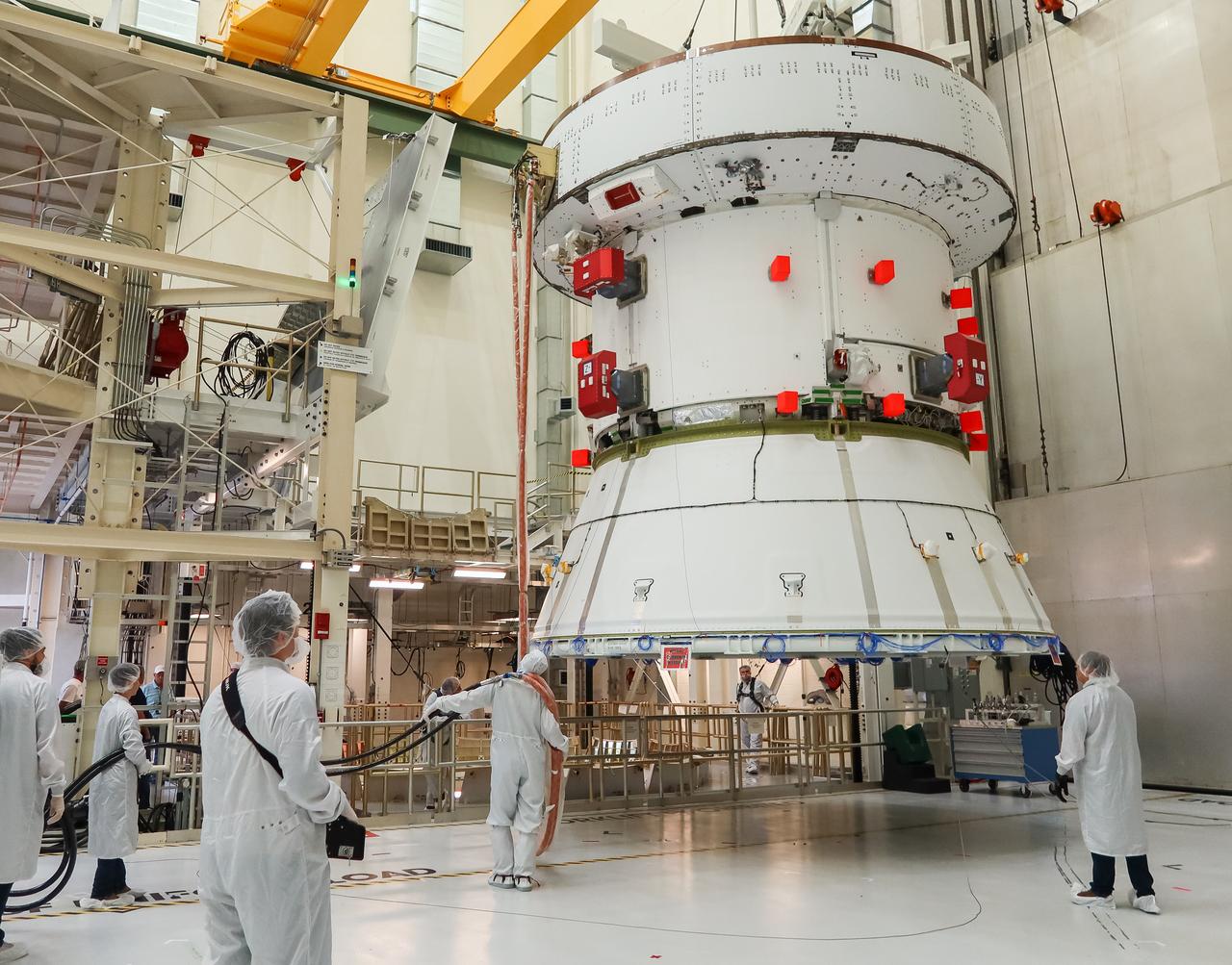
A crane moves the European Service Module (ESM) for NASA’s Artemis II mission along the center aisle of the high bay inside the Neil A. Armstrong Operations and Checkout Building at NASA’s Kennedy Space Center in Florida on May 22, 2023. Teams from NASA and Lockheed Martin are transferring the service module to the FAST (final assembly and system testing) cell for final checkouts before it is stacked with the Orion crew module.. The powerhouse that will fuel and propel Orion in space, the ESM will be used for Artemis II, the first Artemis mission flying crew aboard Orion.
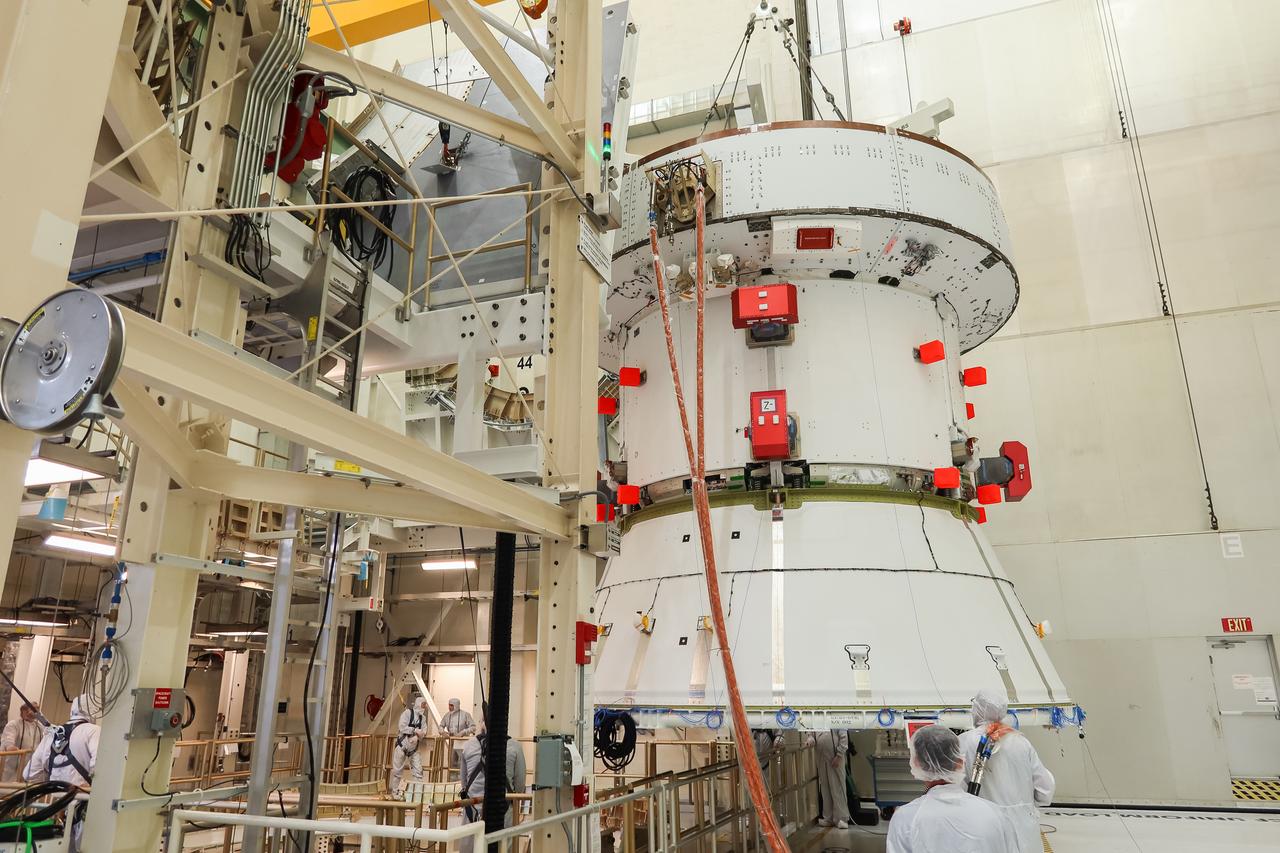
A crane slowly moves the European Service Module (ESM) for NASA’s Artemis II mission into the FAST (final assembly and system testing) cell inside the high bay of the Neil A. Armstrong Operations and Checkout Building at NASA’s Kennedy Space Center in Florida on May 22, 2023. Teams from NASA and Lockheed Martin are transferring the service module to the FAST cell for final checkouts before it is stacked with the Orion crew module.. The powerhouse that will fuel and propel Orion in space, the ESM will be used for Artemis II, the first Artemis mission flying crew aboard Orion.

Engineers and technicians monitor the progress as the European Service Module (ESM) for NASA’s Artemis II mission is lifted by crane inside the high bay of the Neil A. Armstrong Operations and Checkout Building at NASA’s Kennedy Space Center in Florida on May 22, 2023. Teams from NASA and Lockheed Martin are preparing the service module for transfer to the FAST (final assembly and system testing) cell for final checkouts before it is stacked with the Orion crew module.. The powerhouse that will fuel and propel Orion in space, the ESM will be used for Artemis II, the first Artemis mission flying crew aboard Orion.
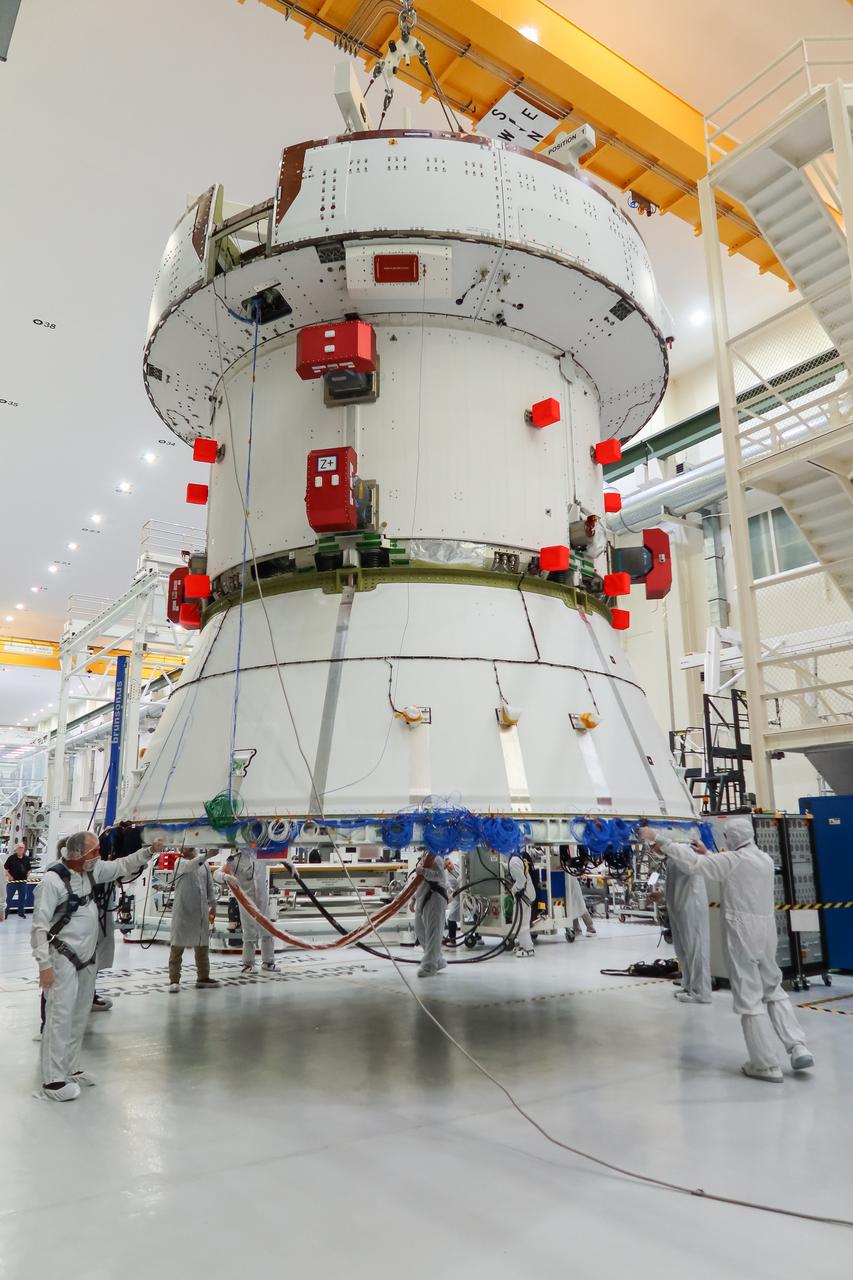
The European Service Module (ESM) for NASA’s Artemis II mission is lifted by crane and moved along the center aisle of the high bay inside the Neil A. Armstrong Operations and Checkout Building at NASA’s Kennedy Space Center in Florida on May 22, 2023. Teams from NASA and Lockheed Martin are preparing the service module for transfer to the FAST (final assembly and system testing) cell for final checkouts before it is stacked with the Orion crew module.. The powerhouse that will fuel and propel Orion in space, the ESM will be used for Artemis II, the first Artemis mission flying crew aboard Orion.
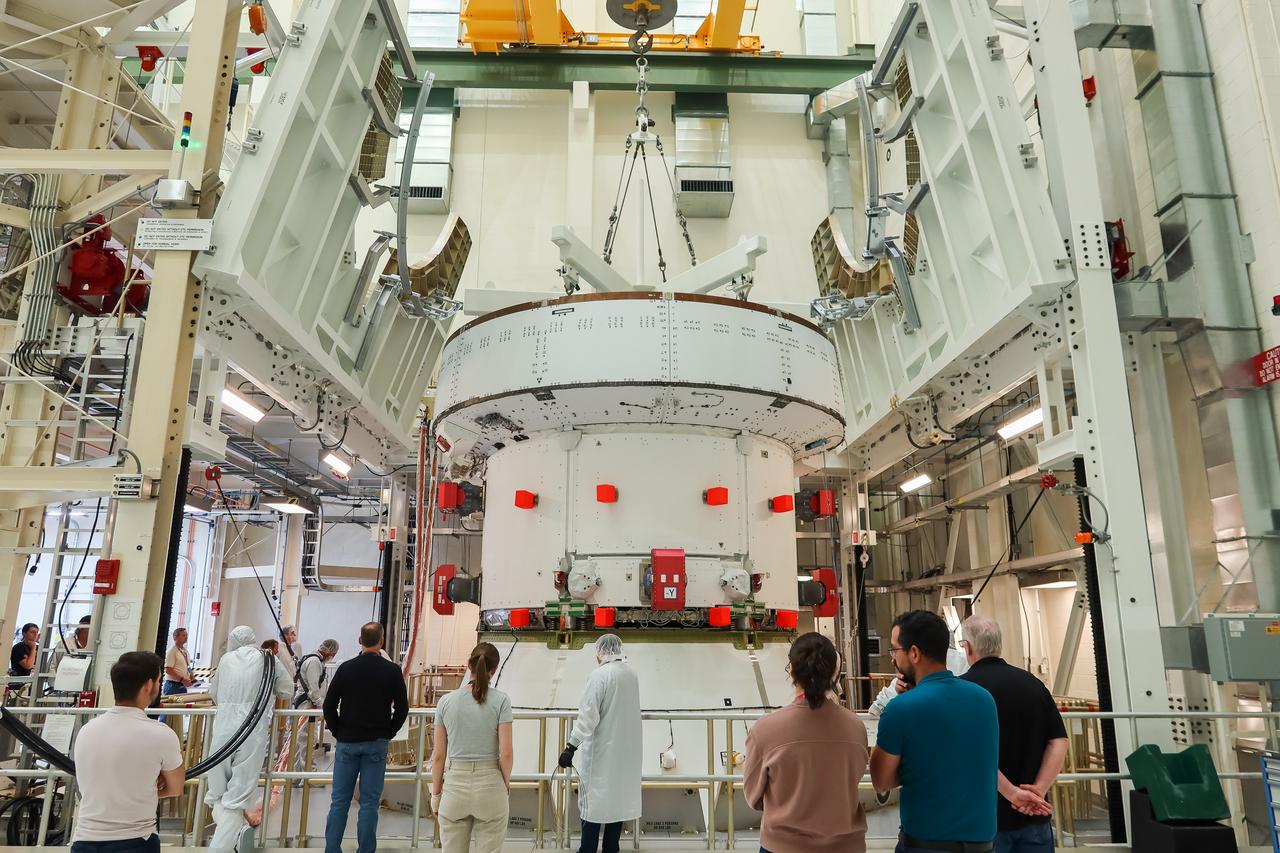
A crane lowers the European Service Module (ESM) for NASA’s Artemis II mission into the FAST (final assembly and system testing) cell inside the high bay of the Neil A. Armstrong Operations and Checkout Building at NASA’s Kennedy Space Center in Florida on May 22, 2023. Teams from NASA and Lockheed Martin are transferring the service module to the FAST cell for final checkouts before it is stacked with the Orion crew module. The powerhouse that will fuel and propel Orion in space, the ESM will be used for Artemis II, the first Artemis mission flying crew aboard Orion.
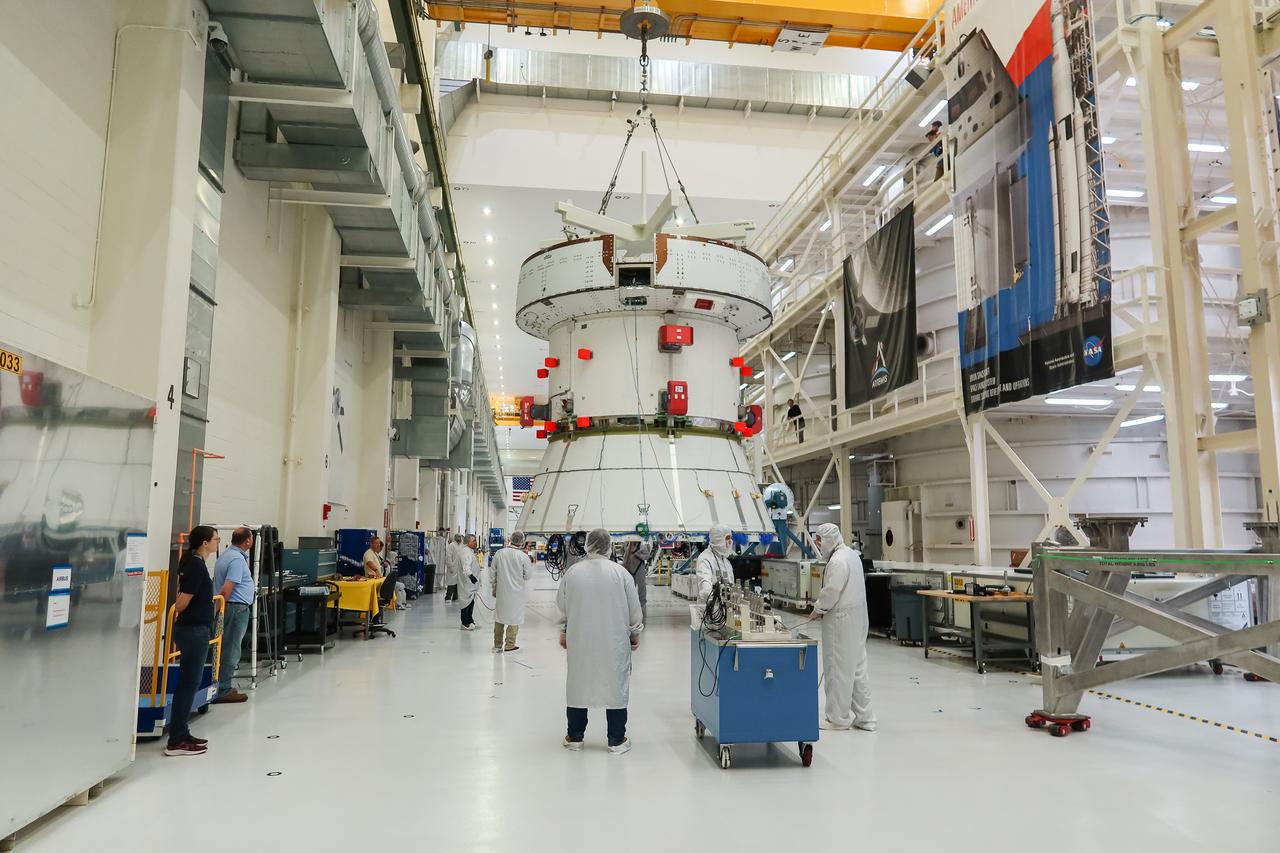
A crane moves the European Service Module (ESM) for NASA’s Artemis II mission along the center aisle of the high bay inside the Neil A. Armstrong Operations and Checkout Building at NASA’s Kennedy Space Center in Florida on May 22, 2023. Teams from NASA and Lockheed Martin are preparing the service module for transfer to the FAST (final assembly and system testing) cell for final checkouts before it is stacked with the Orion crew module.. The powerhouse that will fuel and propel Orion in space, the ESM will be used for Artemis II, the first Artemis mission flying crew aboard Orion.
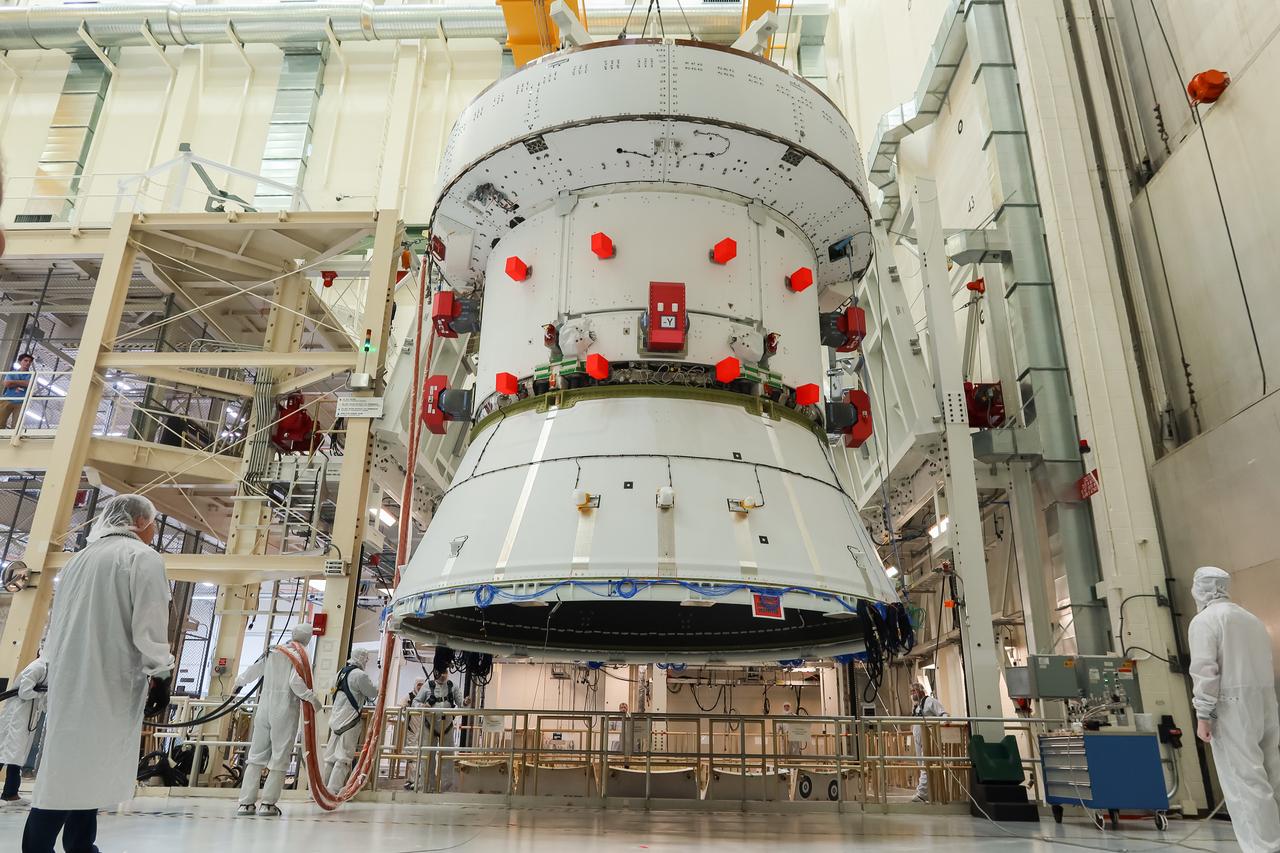
The European Service Module (ESM) for NASA’s Artemis II mission arrives at the Final Assembly and System Testing (FAST) cell inside the high bay of the Neil A. Armstrong Operations and Checkout Building at NASA’s Kennedy Space Center in Florida on May 22, 2023. Teams from NASA and Lockheed Martin are transferring the service module to the FAST (final assembly and system testing) cell for final checkouts before it is stacked with the Orion crew module.. The powerhouse that will fuel and propel Orion in space, the ESM will be used for Artemis II, the first Artemis mission flying crew aboard Orion.
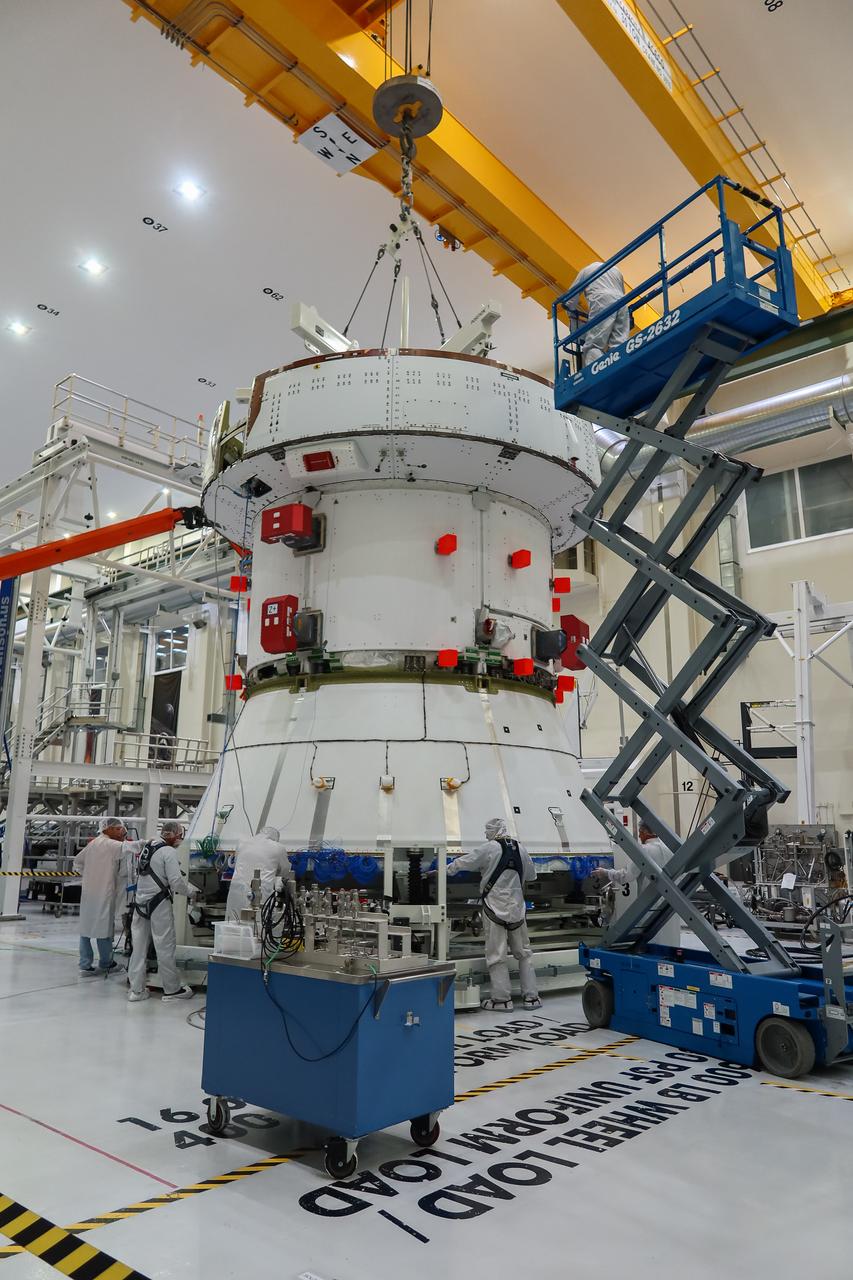
Preparations are underway to lift the European Service Module (ESM) for NASA’s Artemis II mission by crane inside the high bay of the Neil A. Armstrong Operations and Checkout Building at NASA’s Kennedy Space Center in Florida on May 22, 2023. Teams from NASA and Lockheed Martin are preparing the service module for transfer to the FAST (final assembly and system testing) cell for final checkouts before it is stacked with the Orion crew module. The powerhouse that will fuel and propel Orion in space, the ESM will be used for Artemis II, the first Artemis mission flying crew aboard Orion.
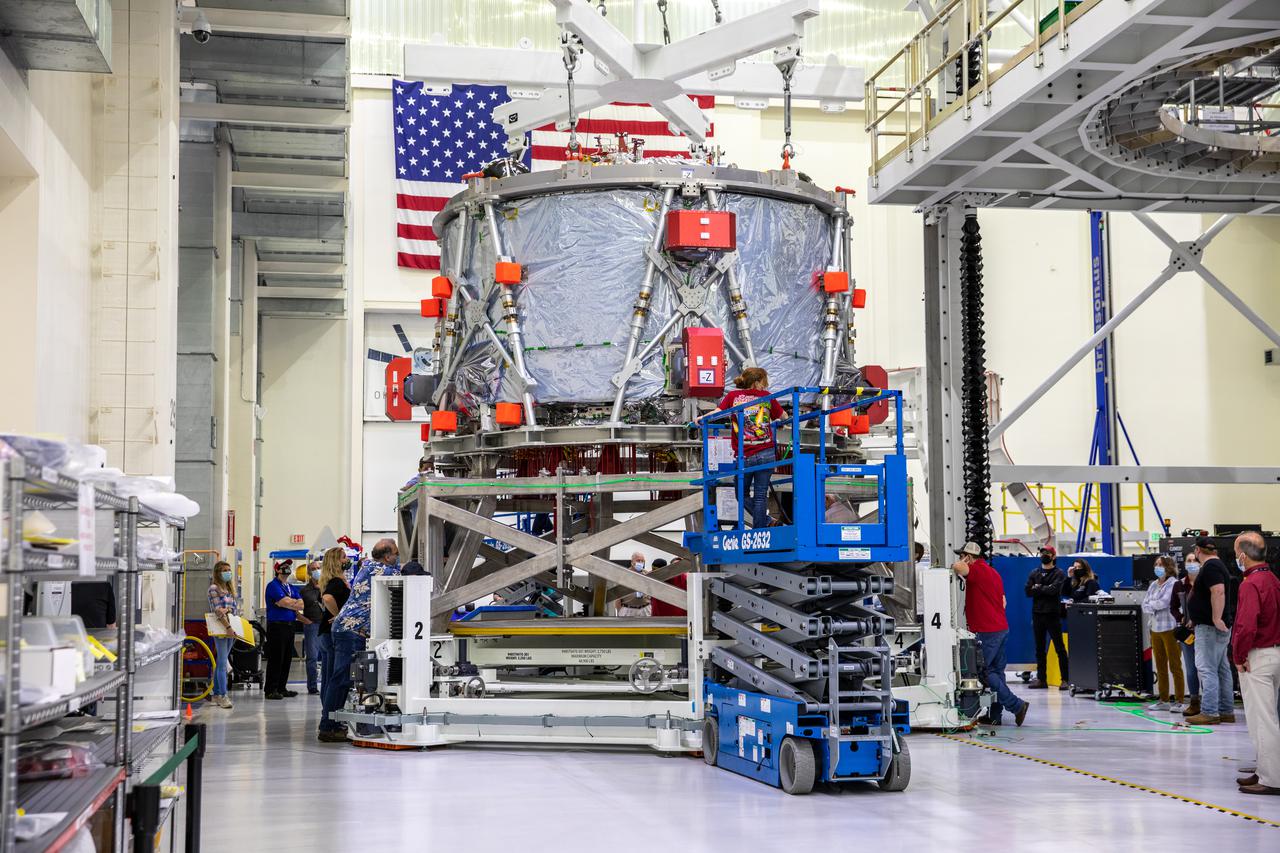
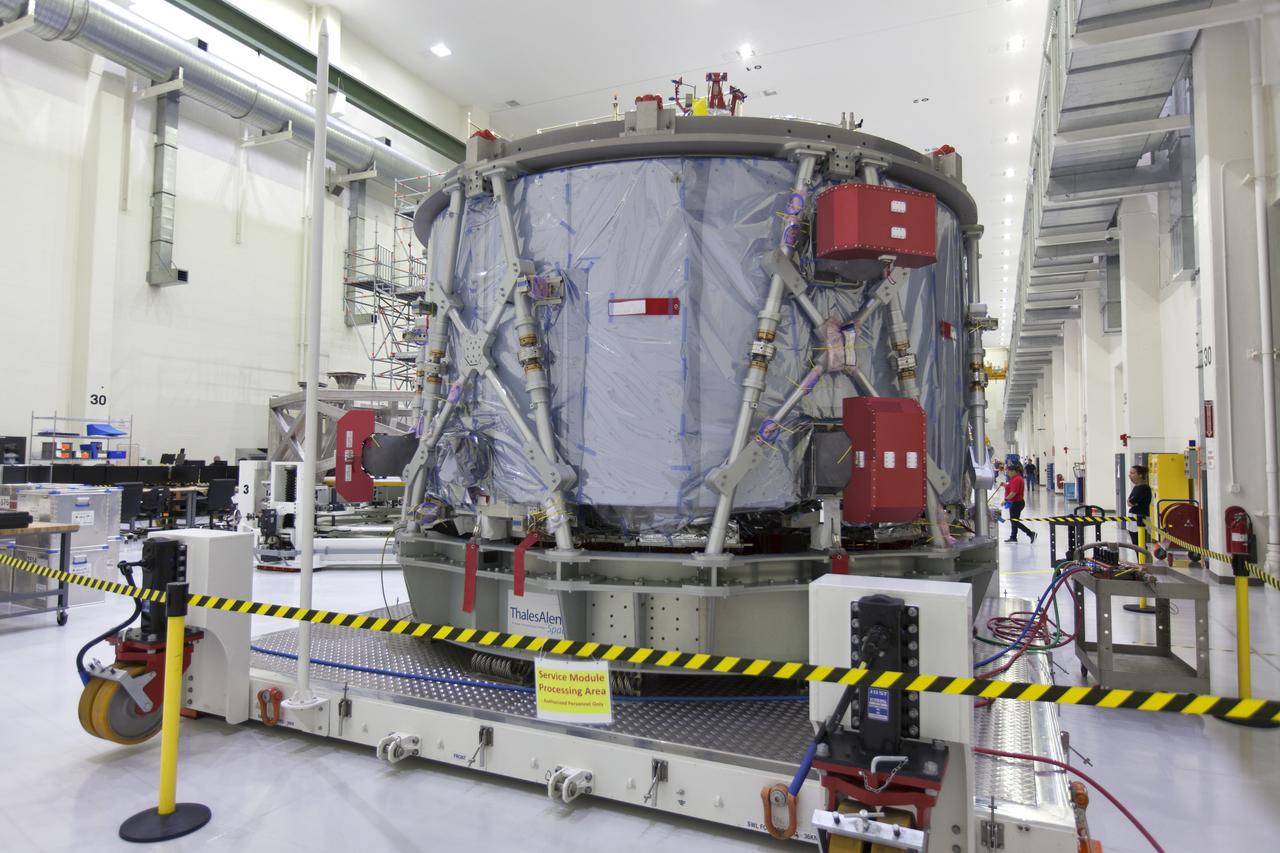
The European-built Service Module (ESM) for NASA’s Artemis II mission is shown in a work stand inside the high bay of the Neil A. Armstrong Operations and Checkout Building at NASA’s Kennedy Space Center in Florida on Oct. 15, 2021. Teams from NASA, Lockheed Martin, the European Space Agency and Airbus prepare the service module to be integrated with the Orion crew module adapter and crew module, already housed in the facility. The powerhouse that will fuel and propel Orion in space, the ESM for Artemis II will be the first Artemis mission flying crew aboard Orion.
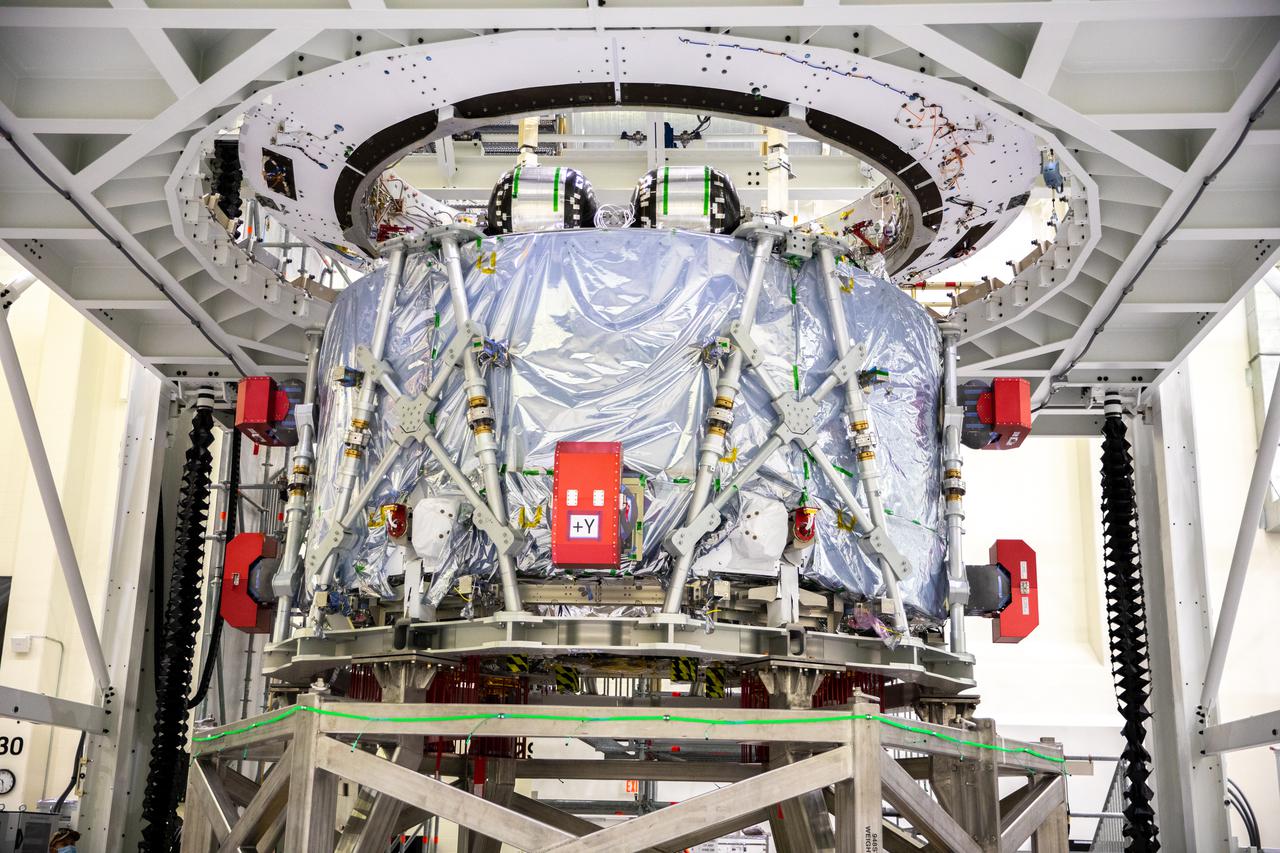
The European-built Service Module (ESM) for NASA’s Artemis II mission shown in a work stand inside the high bay of the Neil A. Armstrong Operations and Checkout Building at NASA’s Kennedy Space Center in Florida on Oct. 15, 2021. Teams from NASA, Lockheed Martin, the European Space Agency and Airbus prepare the service module to be integrated with the Orion crew module adapter and crew module, already housed in the facility. The powerhouse that will fuel and propel Orion in space, the ESM for Artemis II will be the first Artemis mission flying crew aboard Orion.
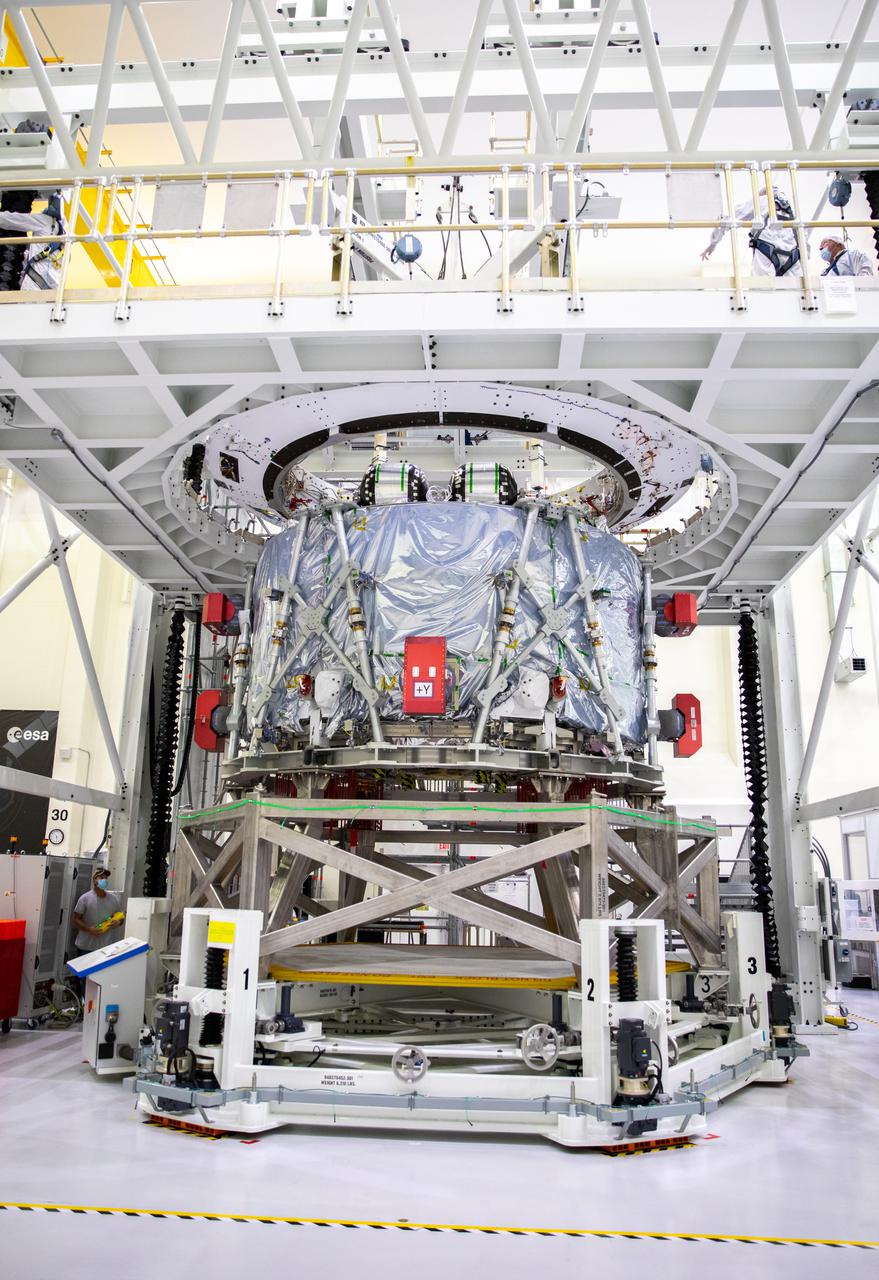
The European-built Service Module (ESM) for NASA’s Artemis II mission shown in a work stand inside the high bay of the Neil A. Armstrong Operations and Checkout Building at NASA’s Kennedy Space Center in Florida on Oct. 15, 2021. Teams from NASA, Lockheed Martin, the European Space Agency and Airbus prepare the service module to be integrated with the Orion crew module adapter and crew module, already housed in the facility. The powerhouse that will fuel and propel Orion in space, the ESM for Artemis II will be the first Artemis mission flying crew aboard Orion. Teams with the European Space Agency and Airbus built the service module.
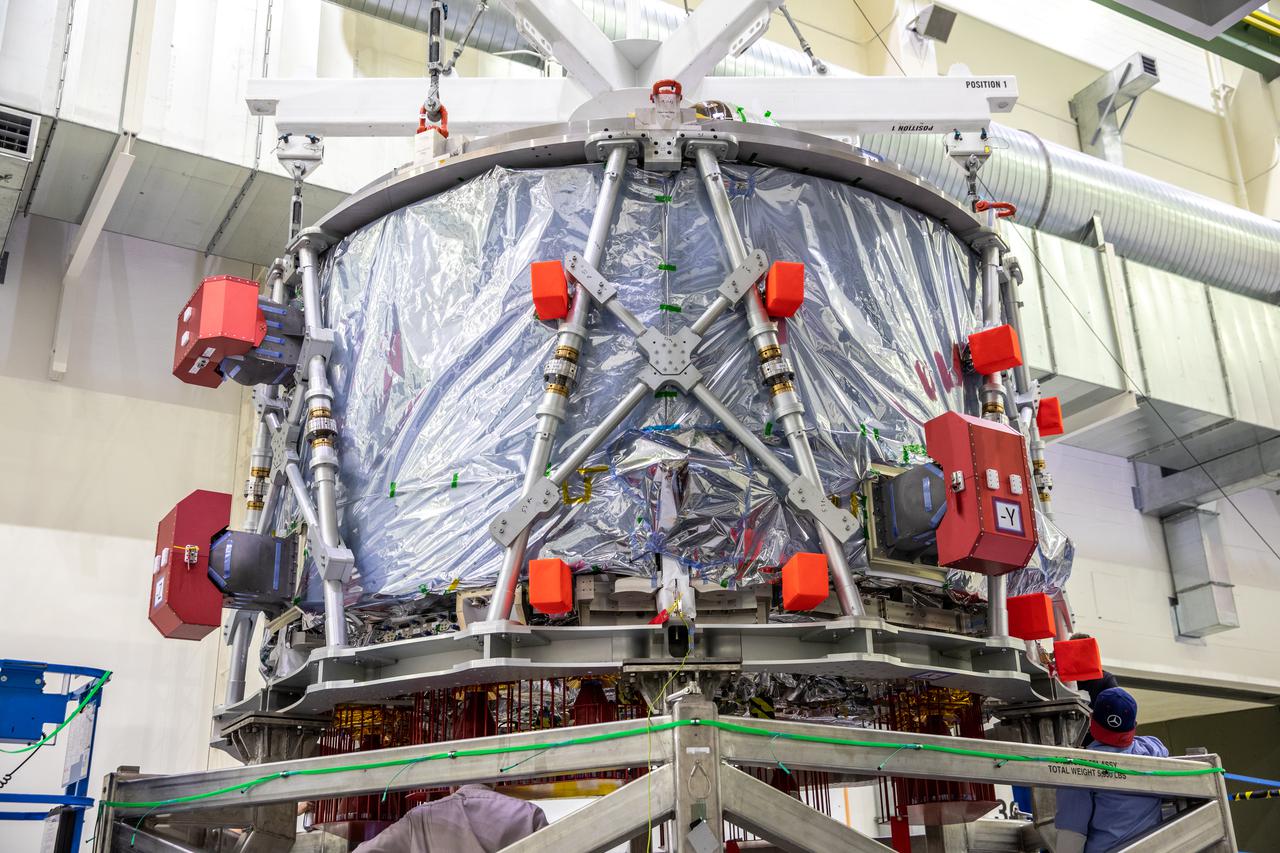
The European-built Service Module (ESM) for NASA’s Artemis II mission is shown in a work stand inside the high bay of the Neil A. Armstrong Operations and Checkout Building at NASA’s Kennedy Space Center in Florida on Oct. 15, 2021. Teams from NASA, Lockheed Martin, the European Space Agency and Airbus prepare the service module to be integrated with the Orion crew module adapter and crew module, already housed in the facility. The powerhouse that will fuel and propel Orion in space, the ESM for Artemis II will be the first Artemis mission flying crew aboard Orion.
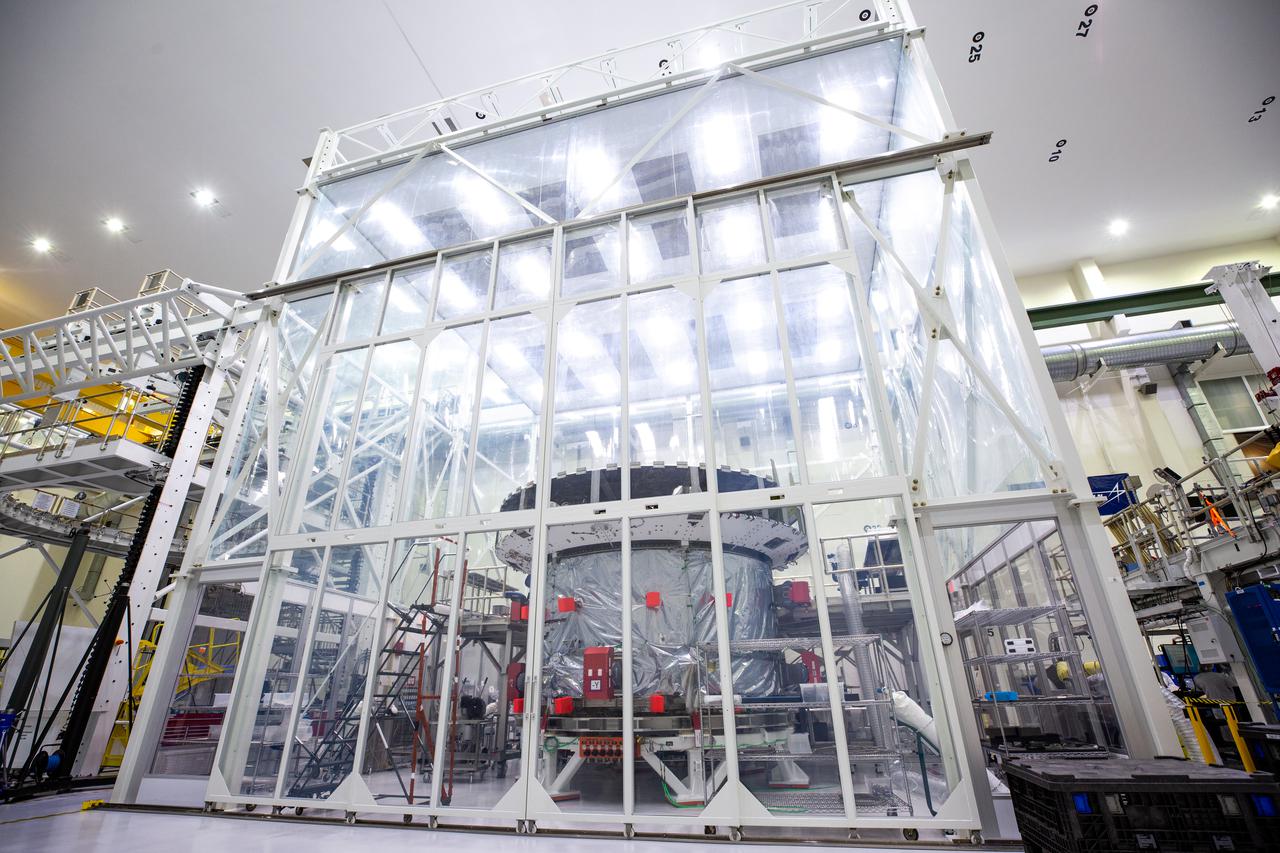
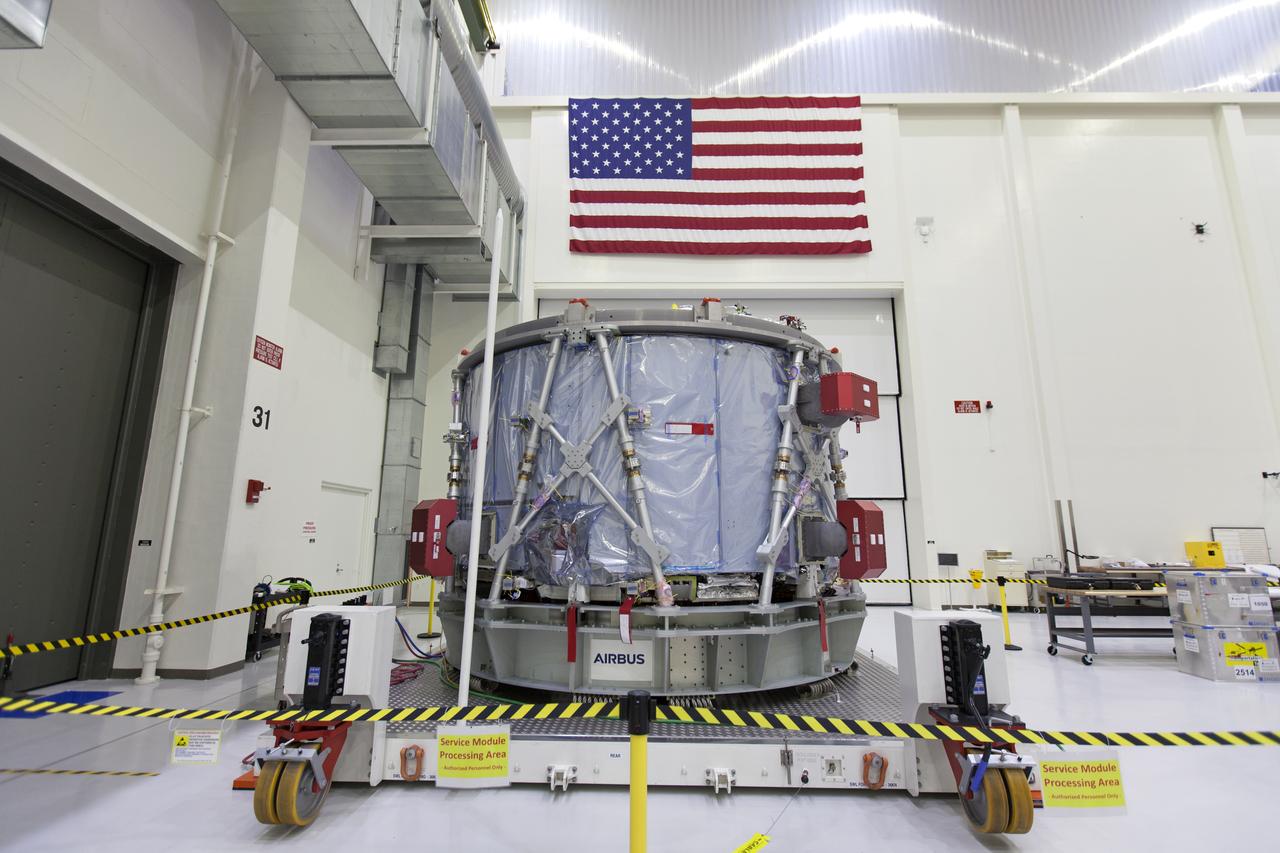
The European-built Service Module (ESM) for NASA’s Artemis II mission is on a work stand inside a clean room inside the high bay of the Neil A. Armstrong Operations and Checkout Building at NASA’s Kennedy Space Center in Florida on Jan. 12, 2022. Teams from NASA, Lockheed Martin, the European Space Agency and Airbus will prepare the service module to be integrated with the Orion crew module adapter and crew module, already housed in the facility. The powerhouse that will fuel and propel Orion in space, the ESM for Artemis II will be the first Artemis mission flying crew aboard Orion.
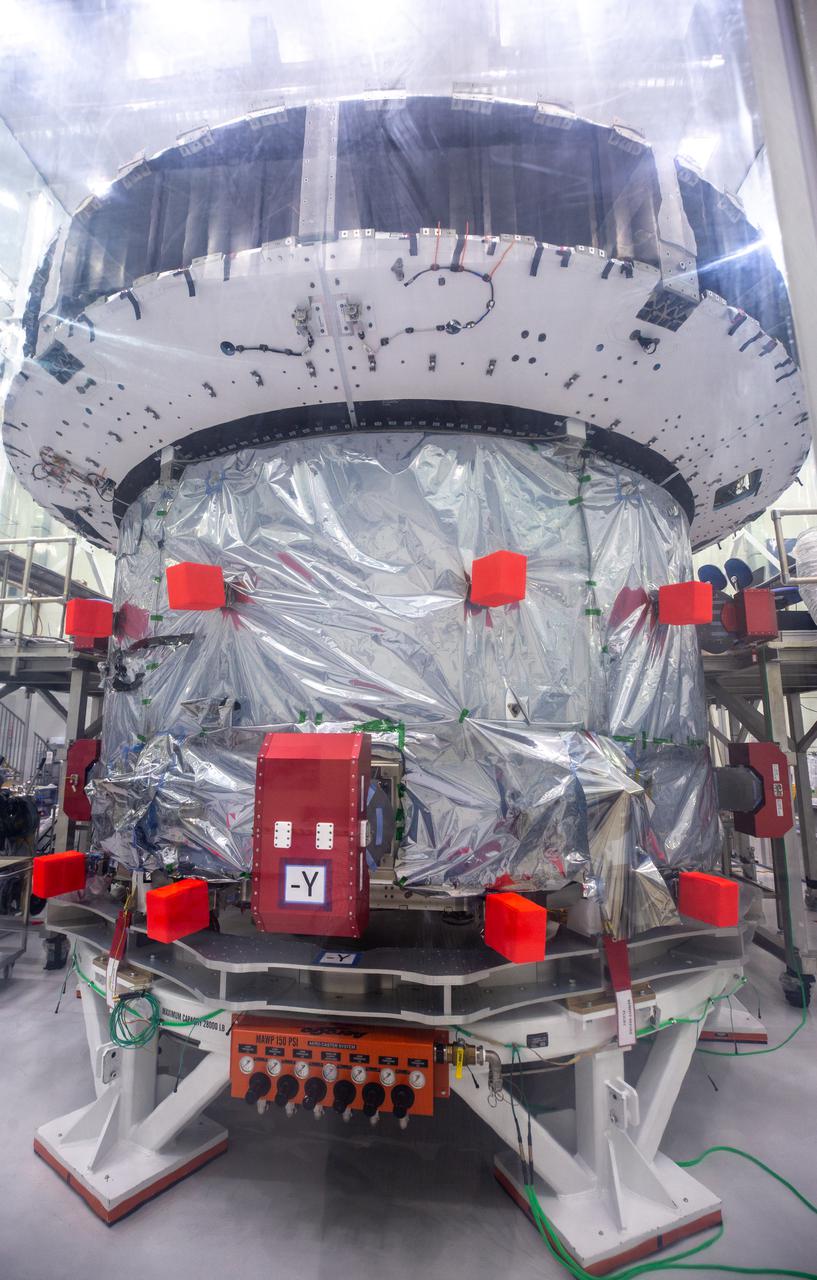
The European-built Service Module (ESM) for NASA’s Artemis II mission is on a work stand inside a clean room inside the high bay of the Neil A. Armstrong Operations and Checkout Building at NASA’s Kennedy Space Center in Florida on Jan. 12, 2022. Teams from NASA, Lockheed Martin, the European Space Agency and Airbus will prepare the service module to be integrated with the Orion crew module adapter and crew module, already housed in the facility. The powerhouse that will fuel and propel Orion in space, the ESM for Artemis II will be the first Artemis mission flying crew aboard Orion.
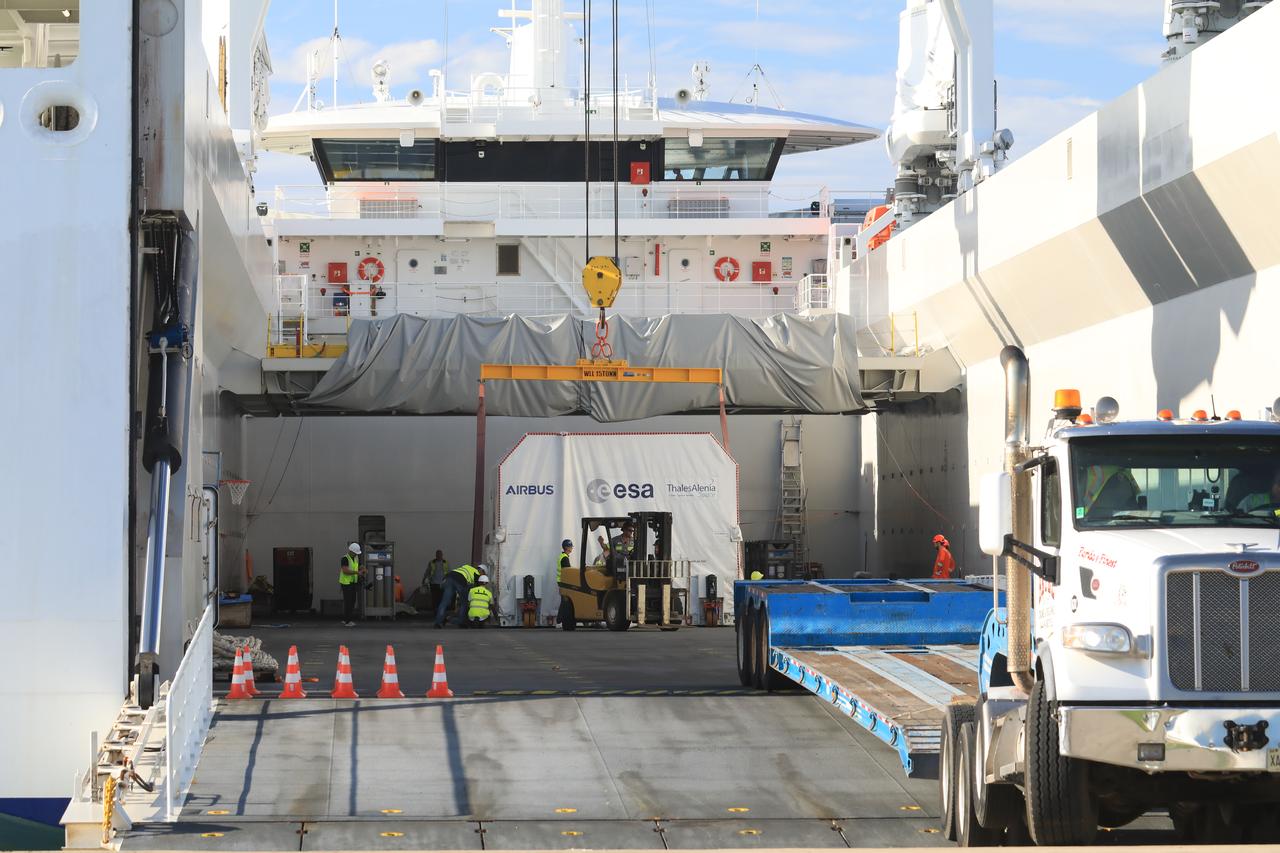
The transport carrier containing the European Service Module 3 for NASA’s Artemis III mission arrives at Port Canaveral on Tuesday, Sept. 3, 2024, awaiting transportation to NASA’s Kennedy Space Center in Florida. The European Service Module 3, which is assembled by Airbus in Bremen, Germany, traveled 10 days across the Atlantic Ocean via the Canopee ship. The European Service Module 3 provides the spacecraft’s propulsion, thermal control, electrical power, and life support systems. Artemis III will send four astronauts to the lunar orbit where two crew members will spend a week near the South Pole of the Moon conducting new science.
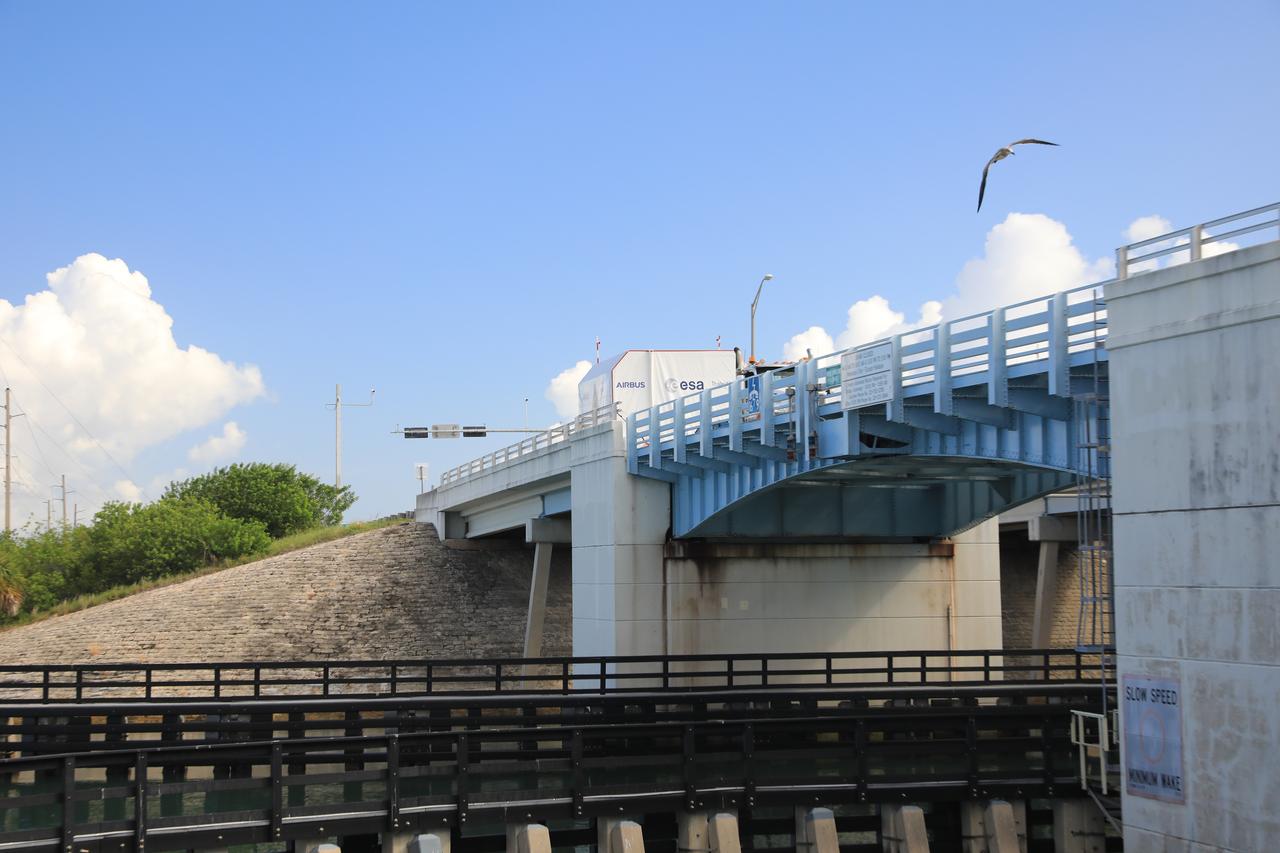
The transport carrier containing the European Service Module 3 for NASA’s Artemis III mission arrives at Port Canaveral on Tuesday, Sept. 3, 2024, awaiting transportation to NASA’s Kennedy Space Center in Florida. The European Service Module 3, which is assembled by Airbus in Bremen, Germany, traveled 10 days across the Atlantic Ocean via the Canopee ship. The European Service Module 3 provides the spacecraft’s propulsion, thermal control, electrical power, and life support systems. Artemis III will send four astronauts to the lunar orbit where two crew members will spend a week near the South Pole of the Moon conducting new science.
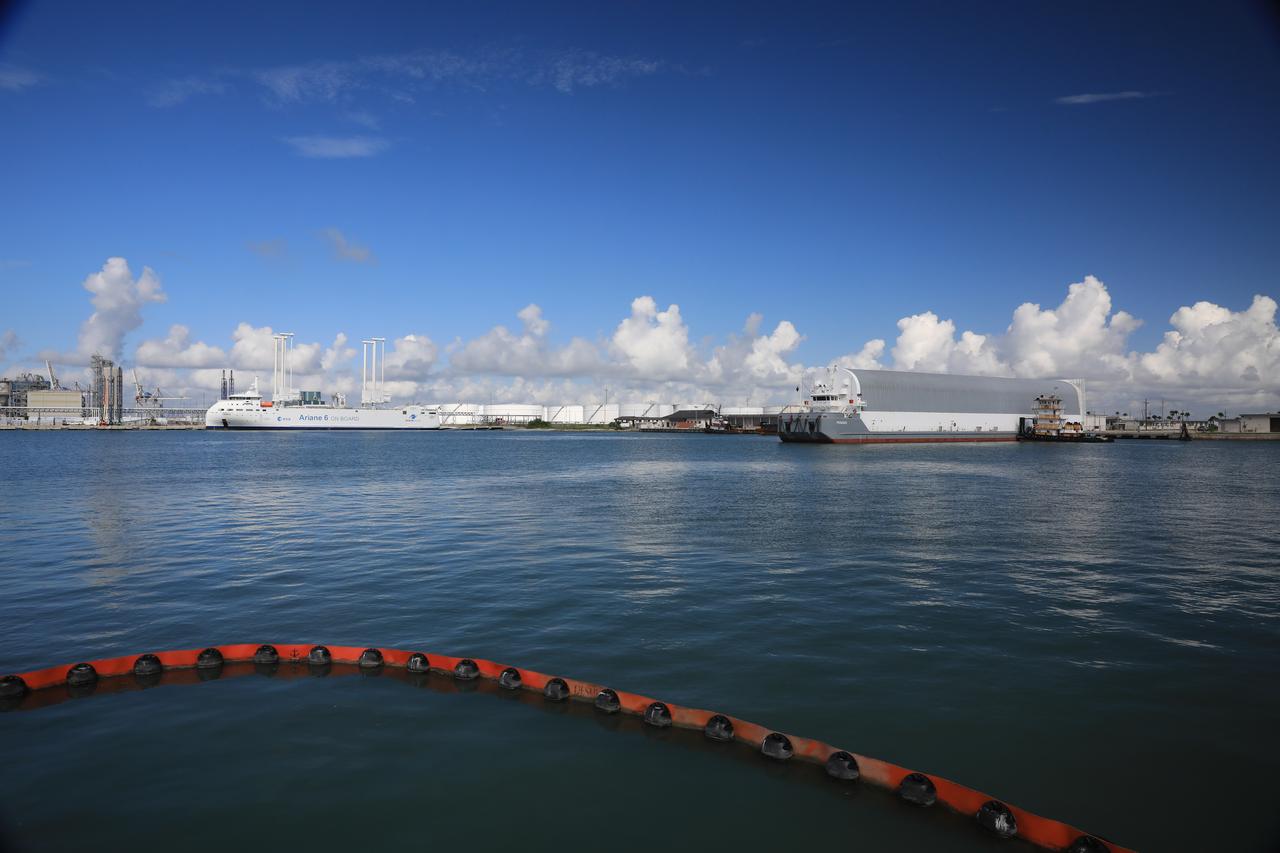
NASA’s Pegasus barge, carrying several pieces of the Artemis campaign hardware, along with the ESA (European Space Agency) ship carrying European Service Module 3 for NASA’s Artemis III mission arrives at Port Canaveral on Tuesday, Sept. 3, 2024, awaiting transportation to NASA’s Kennedy Space Center in Florida. Through the Artemis campaign, we are exploring the Moon for scientific discovery, technology advancement, and to learn how to live and work on another world.
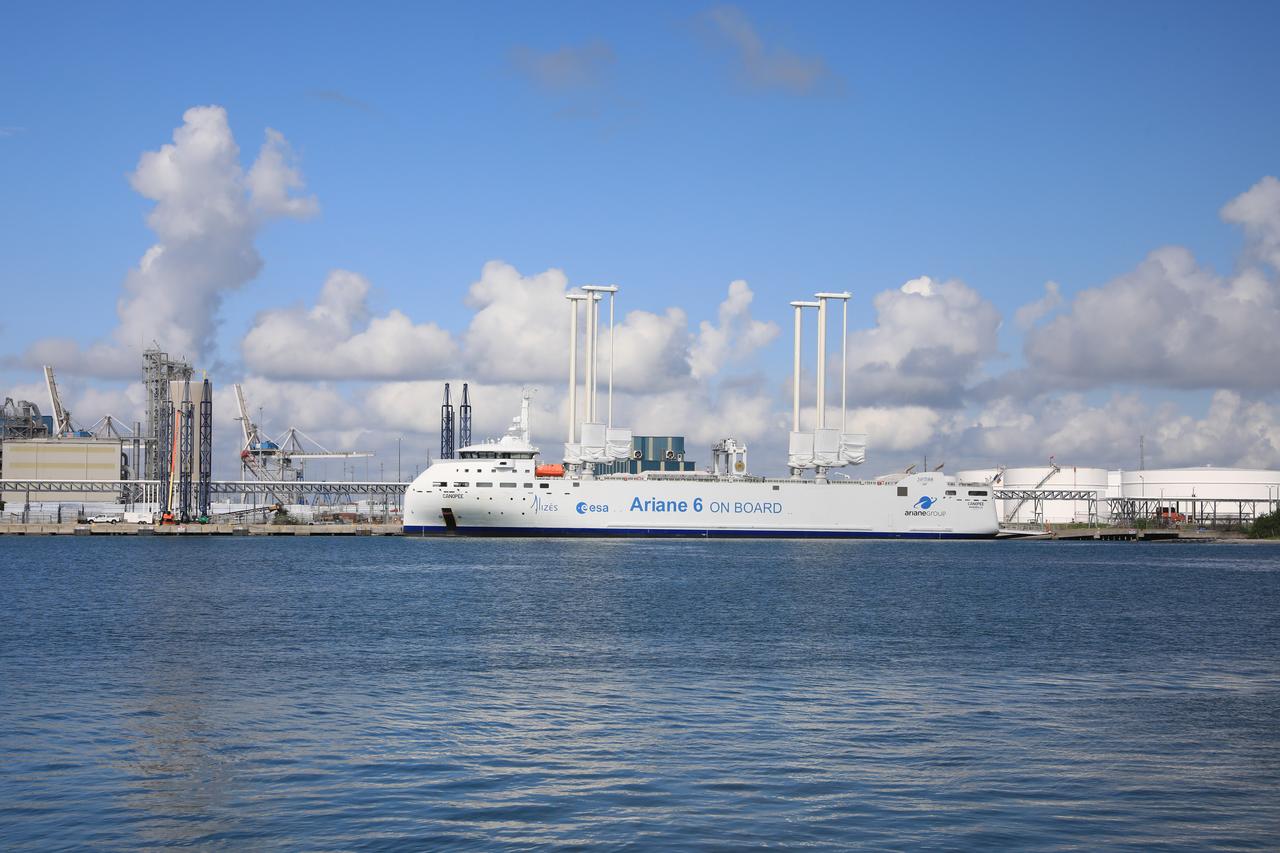
The European Service Module 3 for NASA’s Artemis III mission arrives at Port Canaveral on Tuesday, Sept. 3, 2024, awaiting transportation to NASA’s Kennedy Space Center in Florida. The European Service Module 3, which is assembled by Airbus in Bremen, Germany, traveled across the Atlantic Ocean by the ESA (European Space Agency) aboard the Canopee ship. The European Service Module 3 provides the spacecraft’s propulsion, thermal control, electrical power, and life support systems. Artemis III will send four astronauts to the lunar orbit where two crew members will spend a week near the South Pole of the Moon conducting new science.
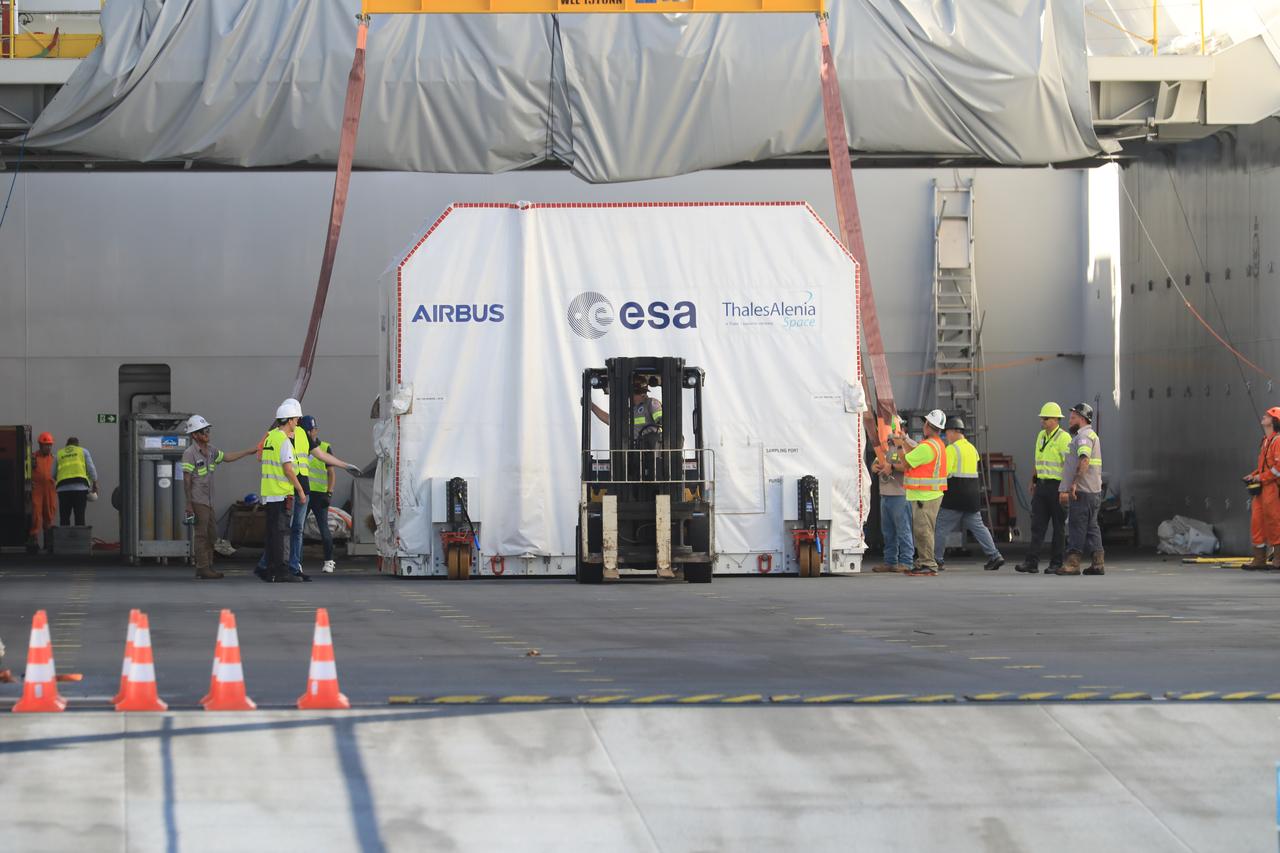
The transport carrier containing the European Service Module 3 for NASA’s Artemis III mission arrives at Port Canaveral on Tuesday, Sept. 3, 2024, awaiting transportation to NASA’s Kennedy Space Center in Florida. The European Service Module 3, which is assembled by Airbus in Bremen, Germany, traveled 10 days across the Atlantic Ocean via the Canopee ship. The European Service Module 3 provides the spacecraft’s propulsion, thermal control, electrical power, and life support systems. Artemis III will send four astronauts to the lunar orbit where two crew members will spend a week near the South Pole of the Moon conducting new science.
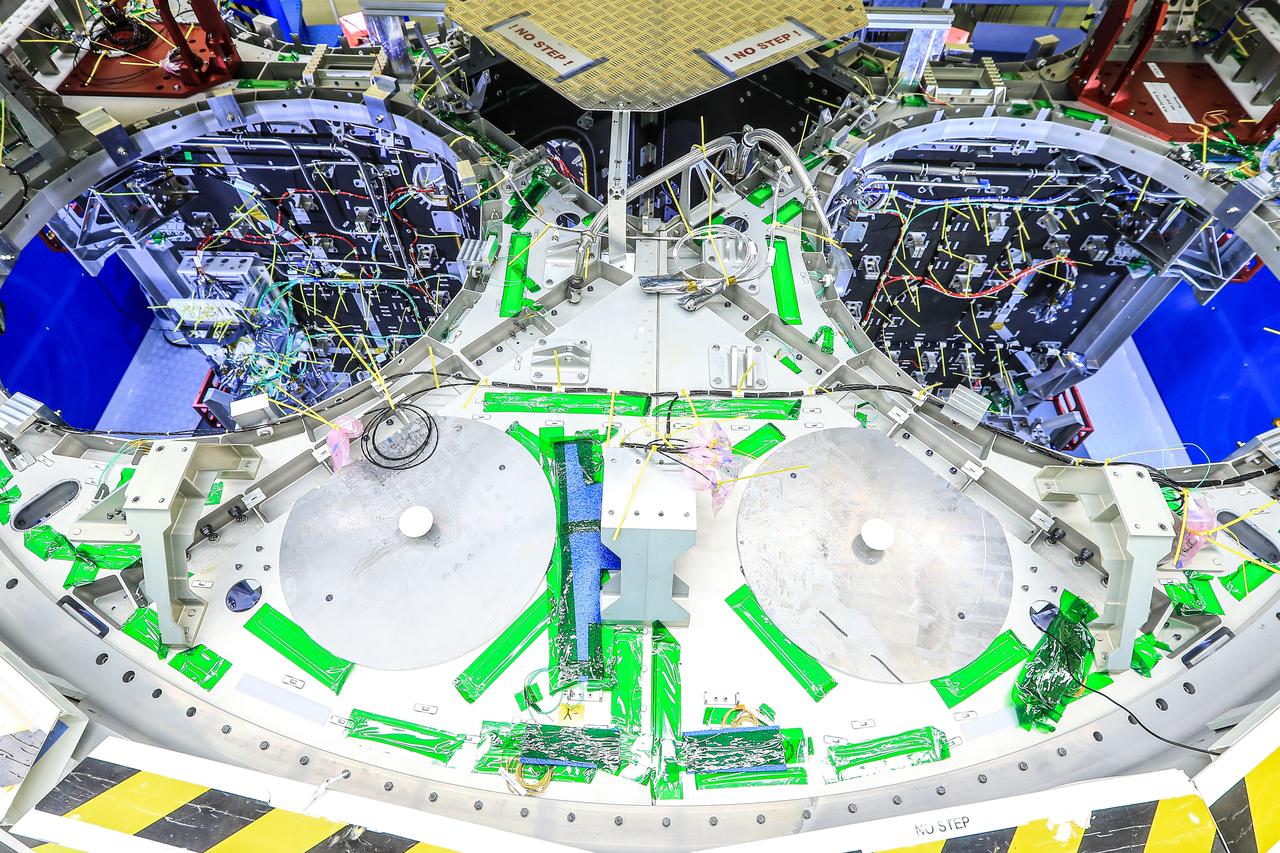
Airbus - Orion-ESM 3 am 08.02.2022
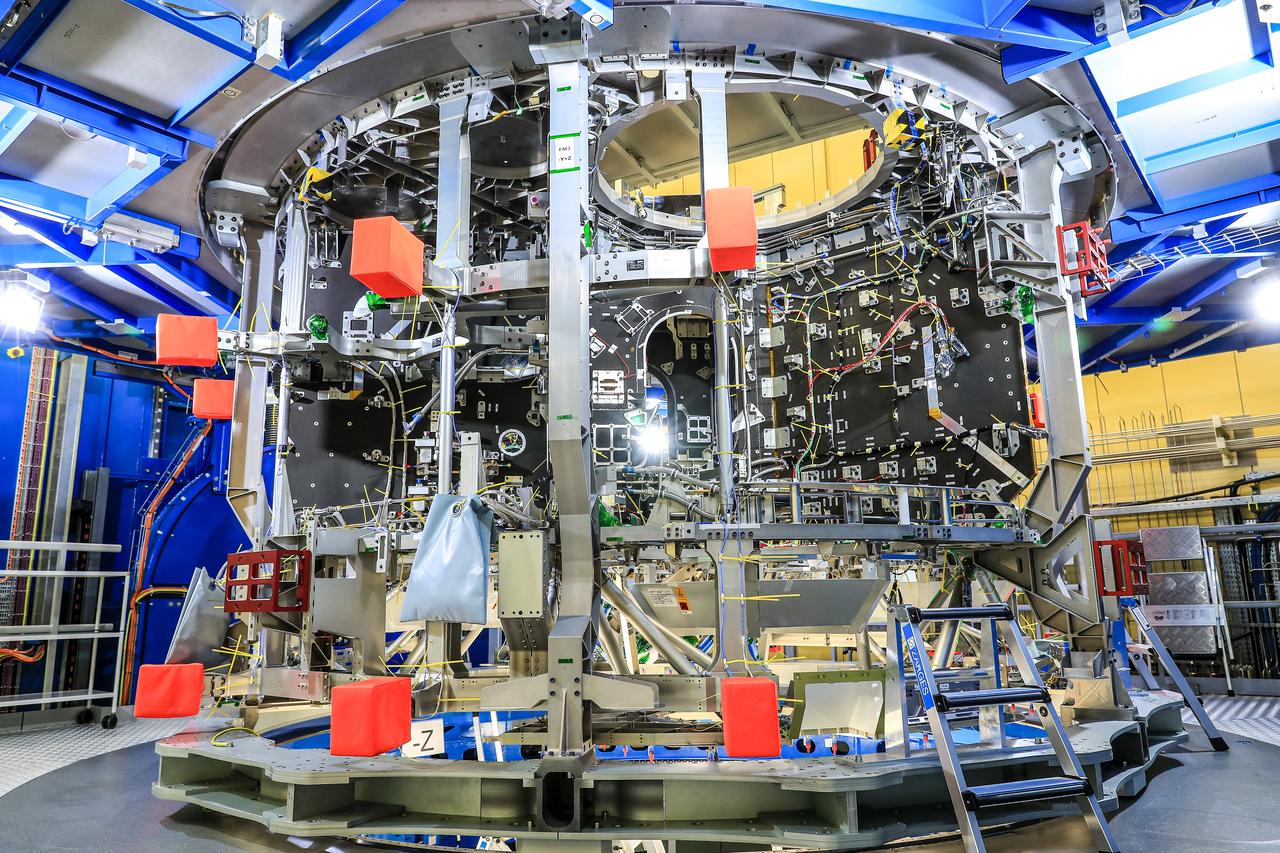
Airbus - Orion-ESM 3 am 08.02.2022
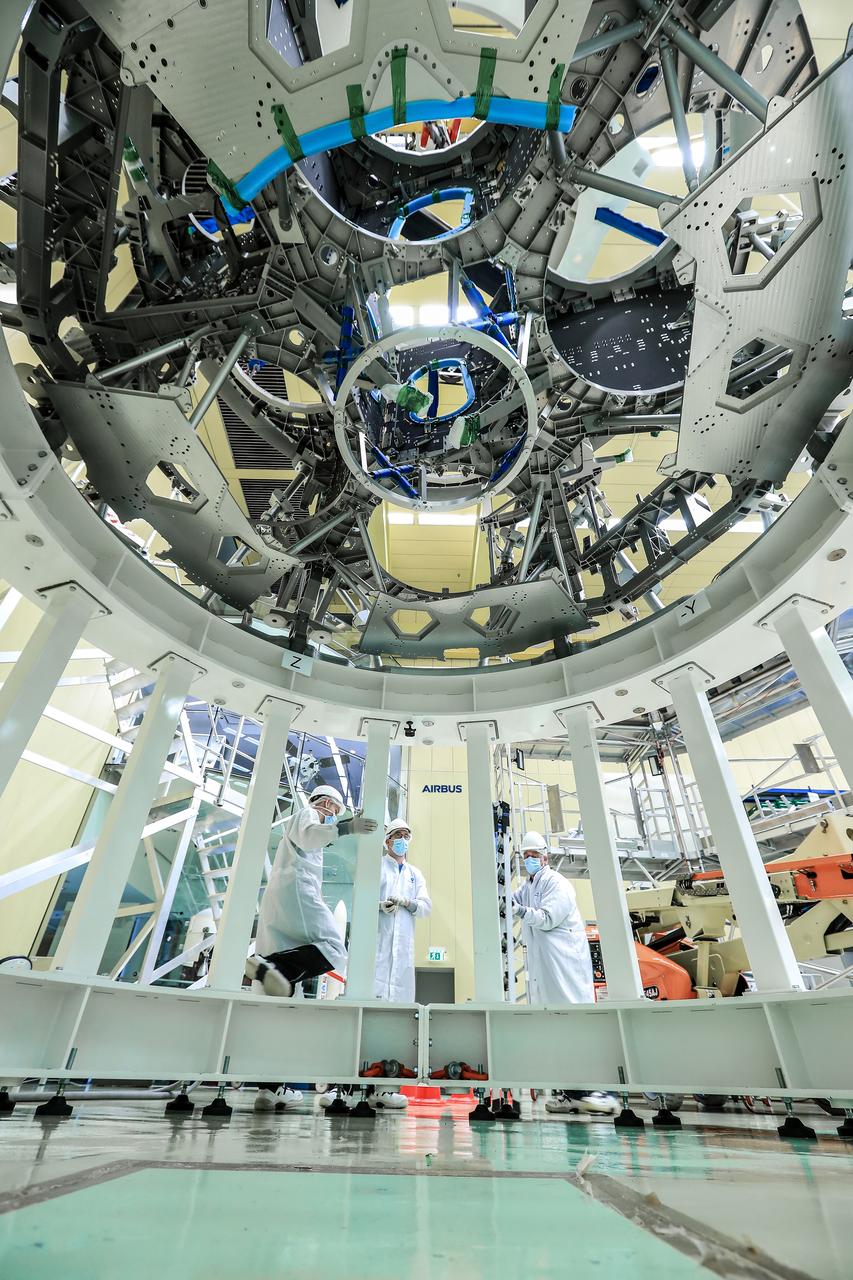
Airbus - Orion, Service-Modul ESM 09.10.2020
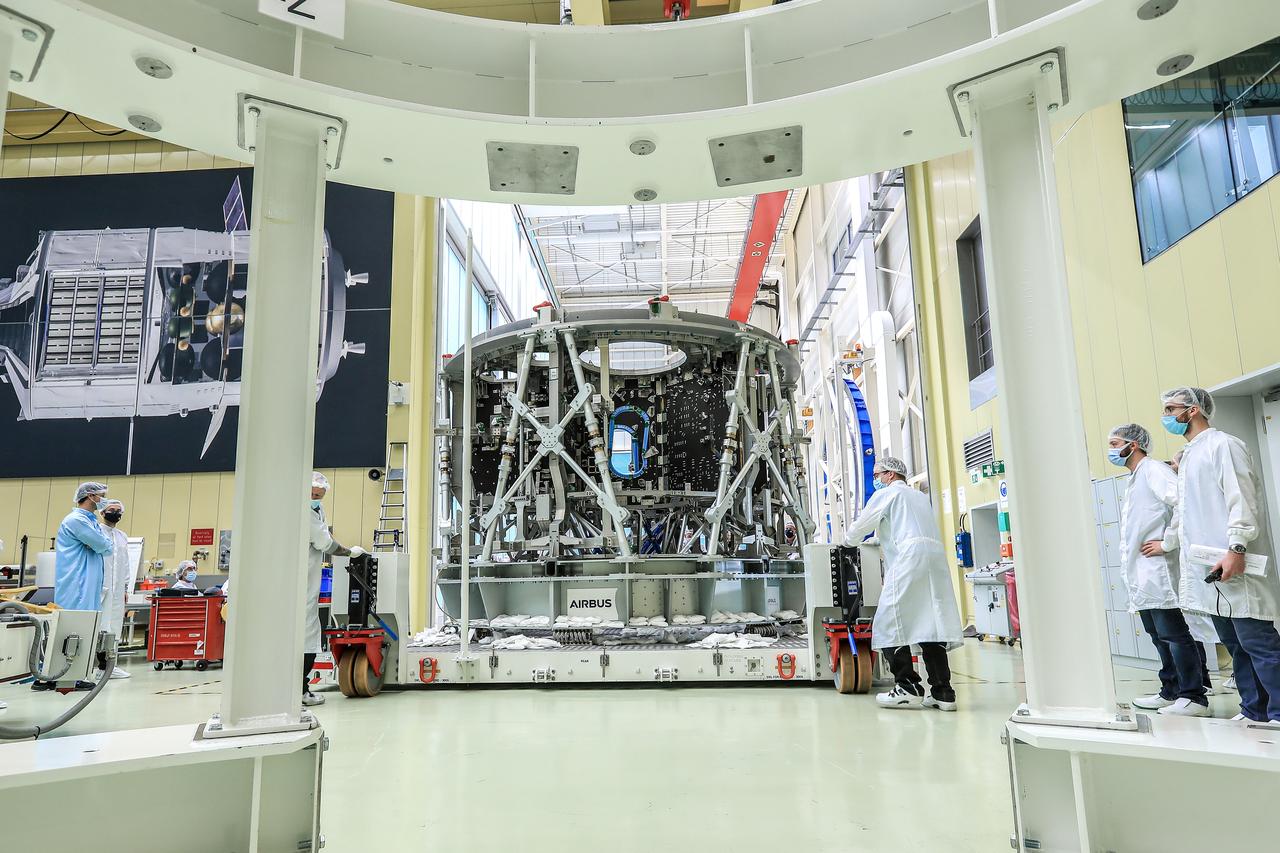
Airbus - Orion, Service-Modul ESM 09.10.2020
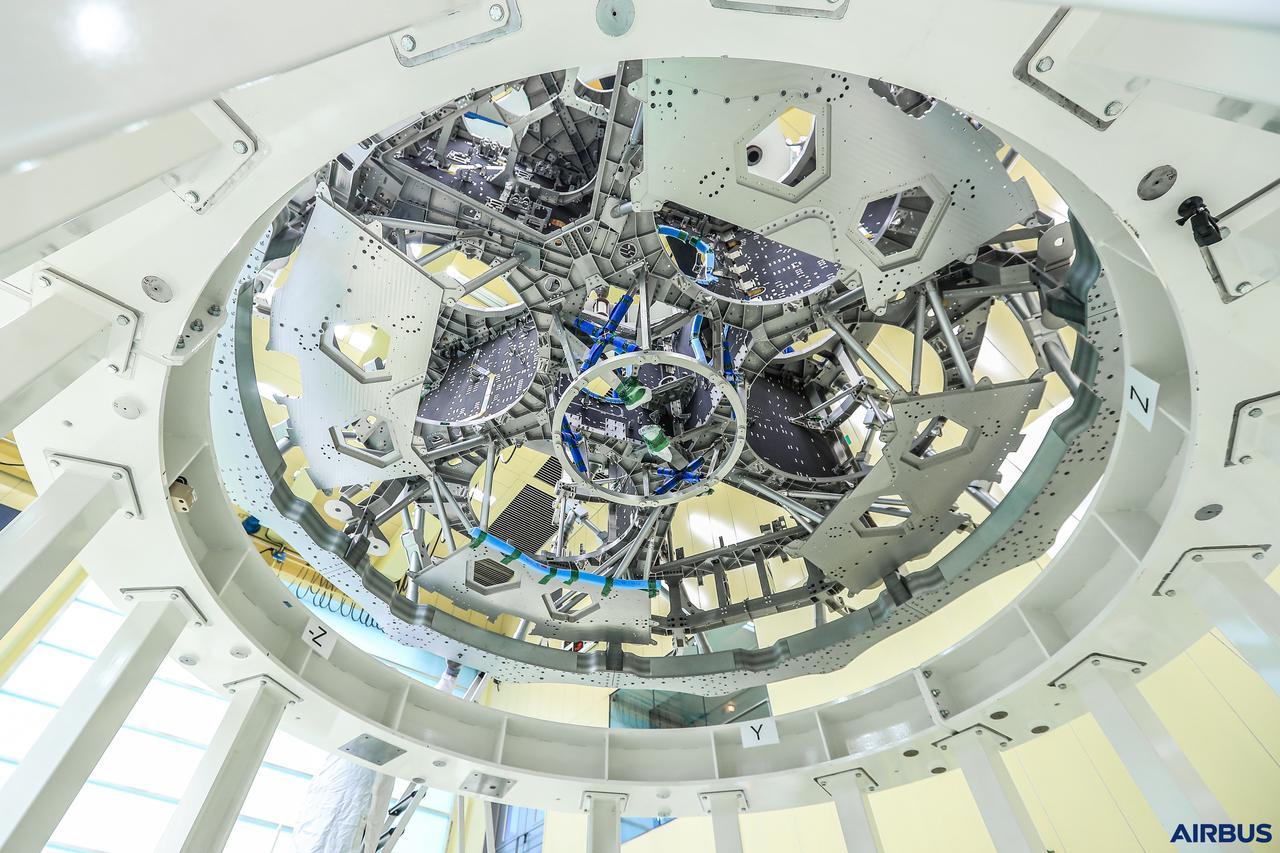
Airbus - Orion, Service-Modul ESM 09.10.2020
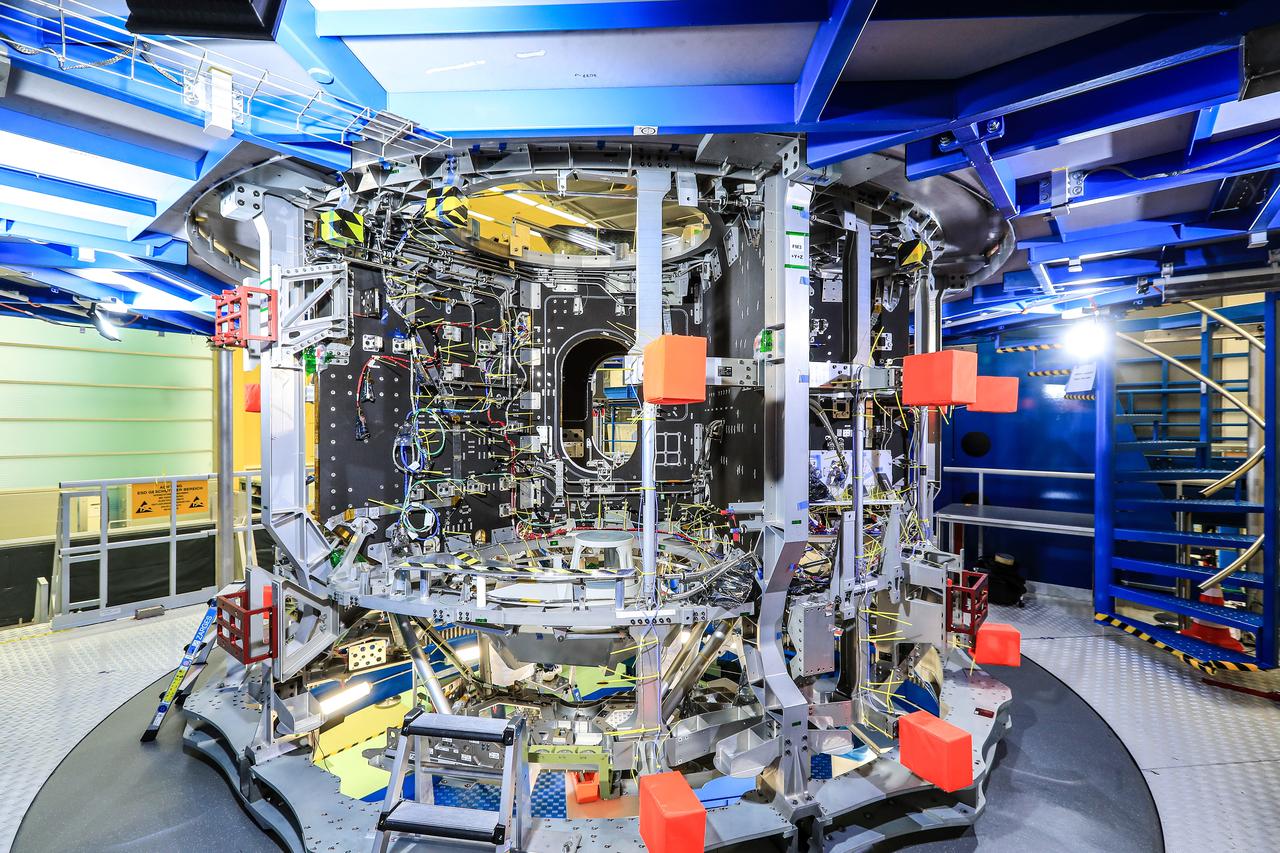
Airbus - Orion-ESM 3 am 08.02.2022
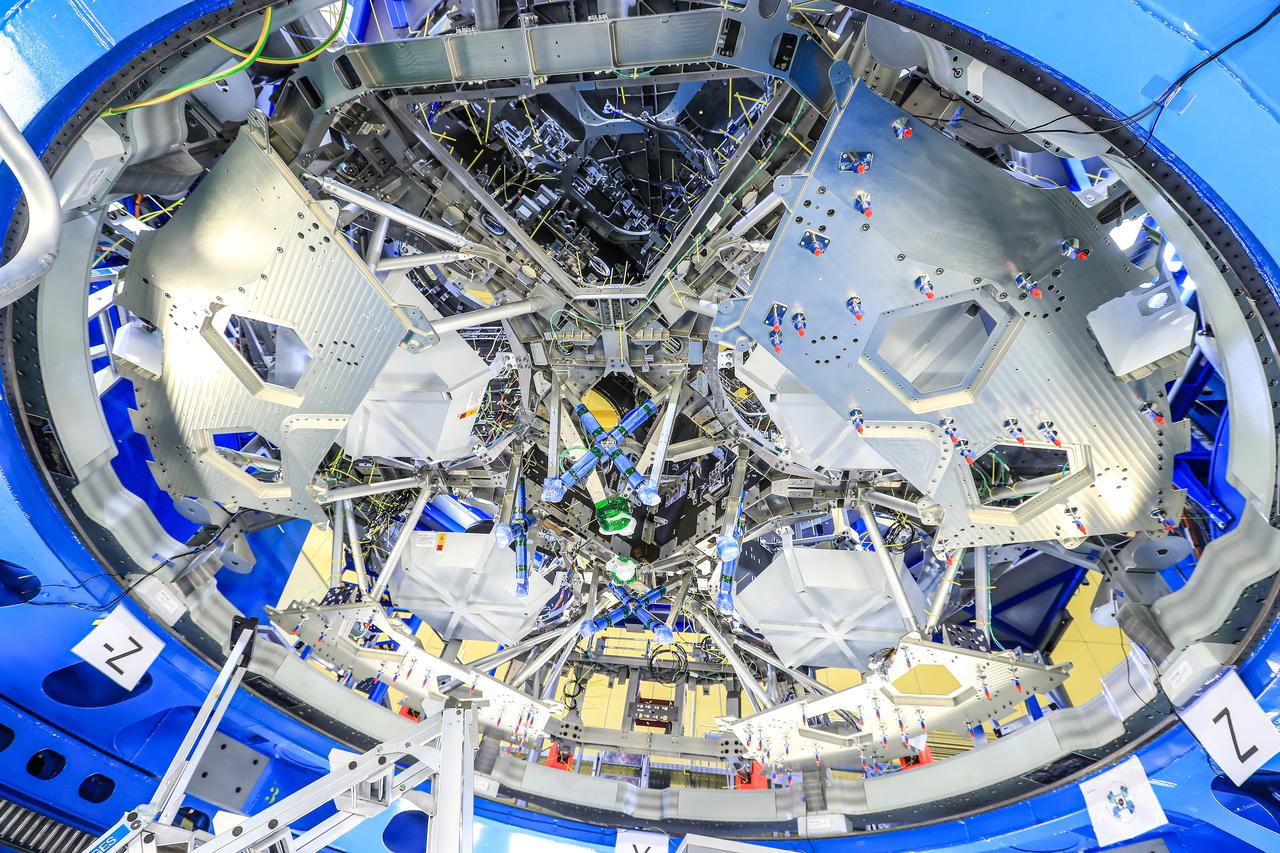
Airbus - Orion-ESM 3 am 08.02.2022
Airbus - Orion, Service-Modul ESM 09.10.2020
Airbus - Orion, Service-Modul ESM 09.10.2020
Airbus - Orion-ESM 3 am 08.02.2022
Airbus - Orion, Service-Modul ESM 09.10.2020
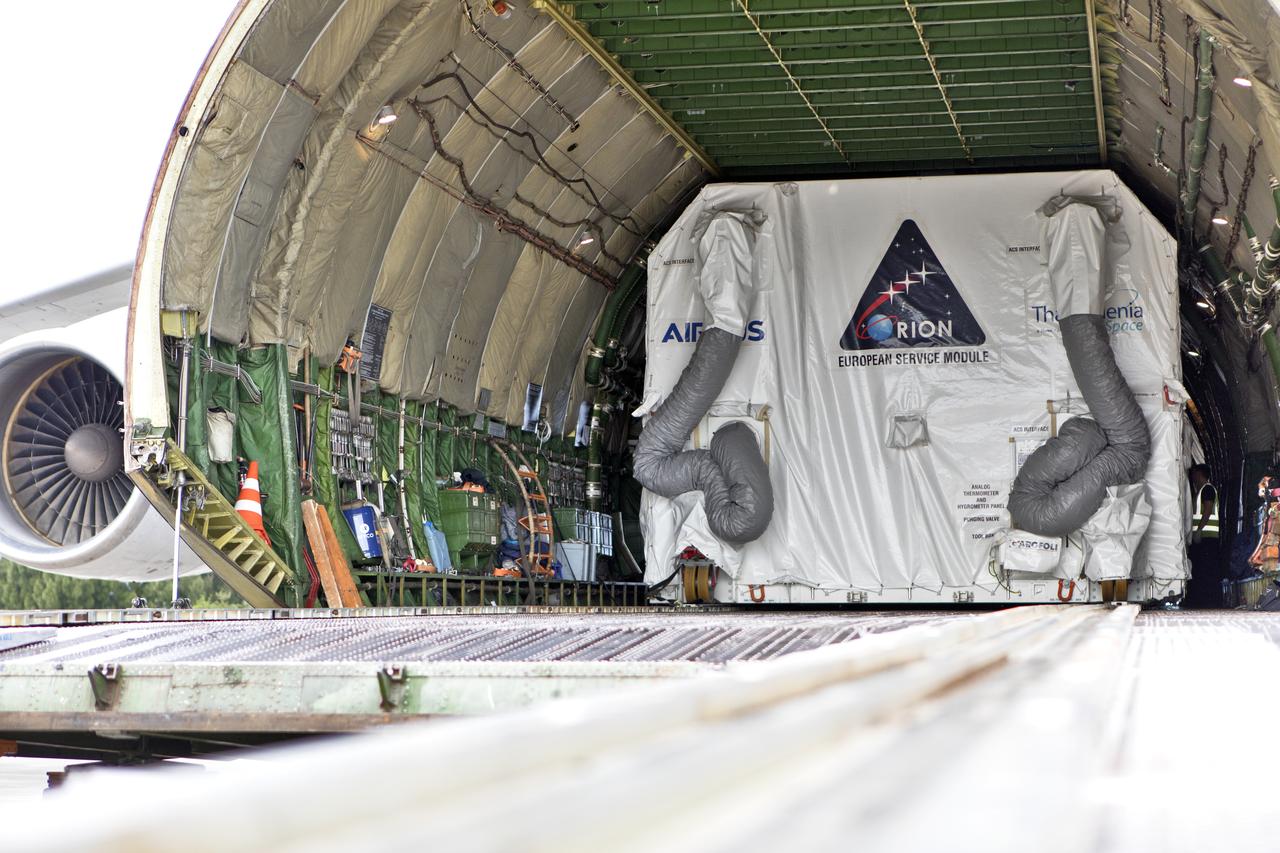
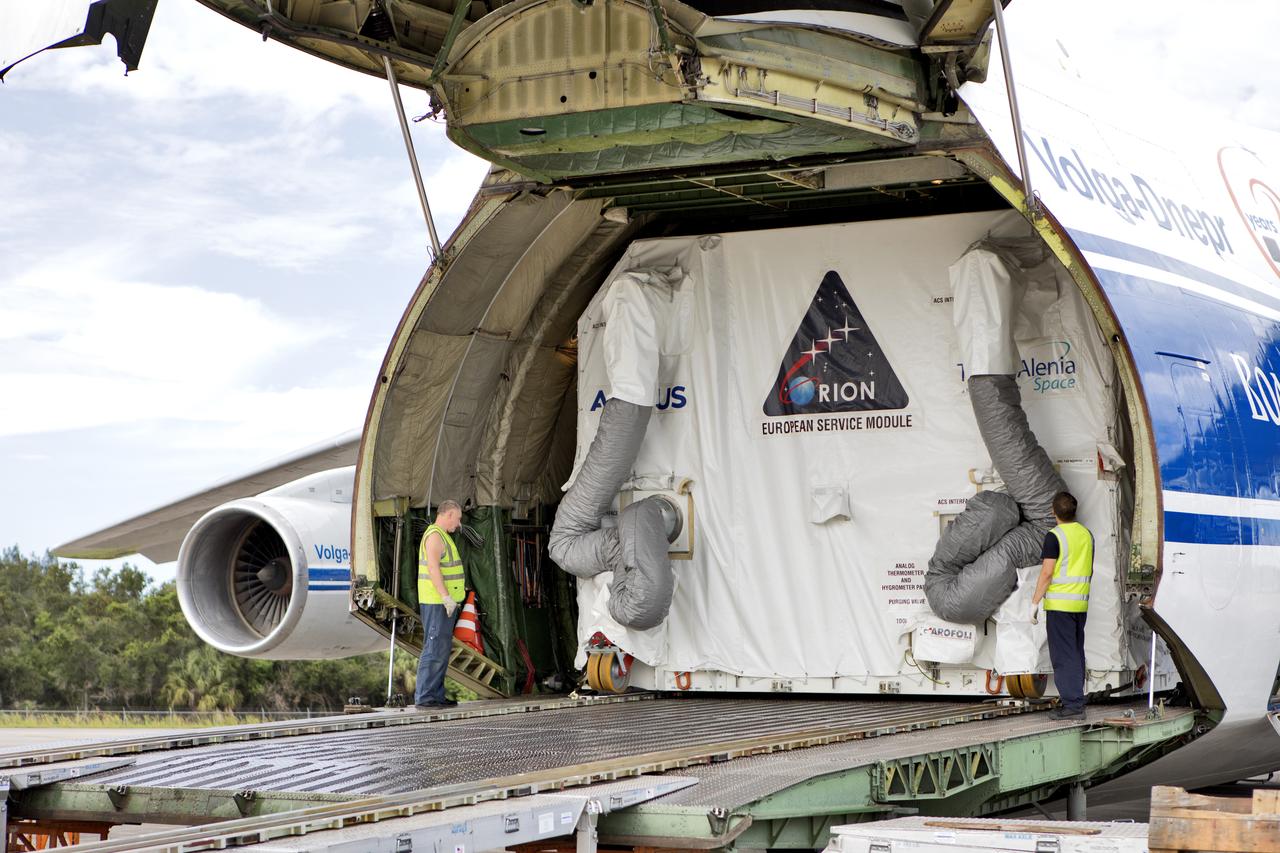
The shipping container holding the European Service Module (ESM) is in view inside the cargo hold of the Antonov cargo aircraft at the Shuttle Landing Facility at NASA's Kennedy Space Center in Florida on Nov. 6, 2018. The ESM for Exploration Mission-1 (EM-1) will be offloaded from the cargo hold. The ESM, built by the European Space Agency, will supply the main propulsion system and power to the Orion spacecraft for Exploration Mission-1 (EM-1), a mission to the Moon. The ESM also will house air and water for astronauts on future missions. EM-1 will be an uncrewed flight test that will provide a foundation for human deep space exploration to destinations beyond Earth orbit. EM-1 will be the first integrated test of NASA's Space Launch System, Orion and the ground systems at Kennedy.
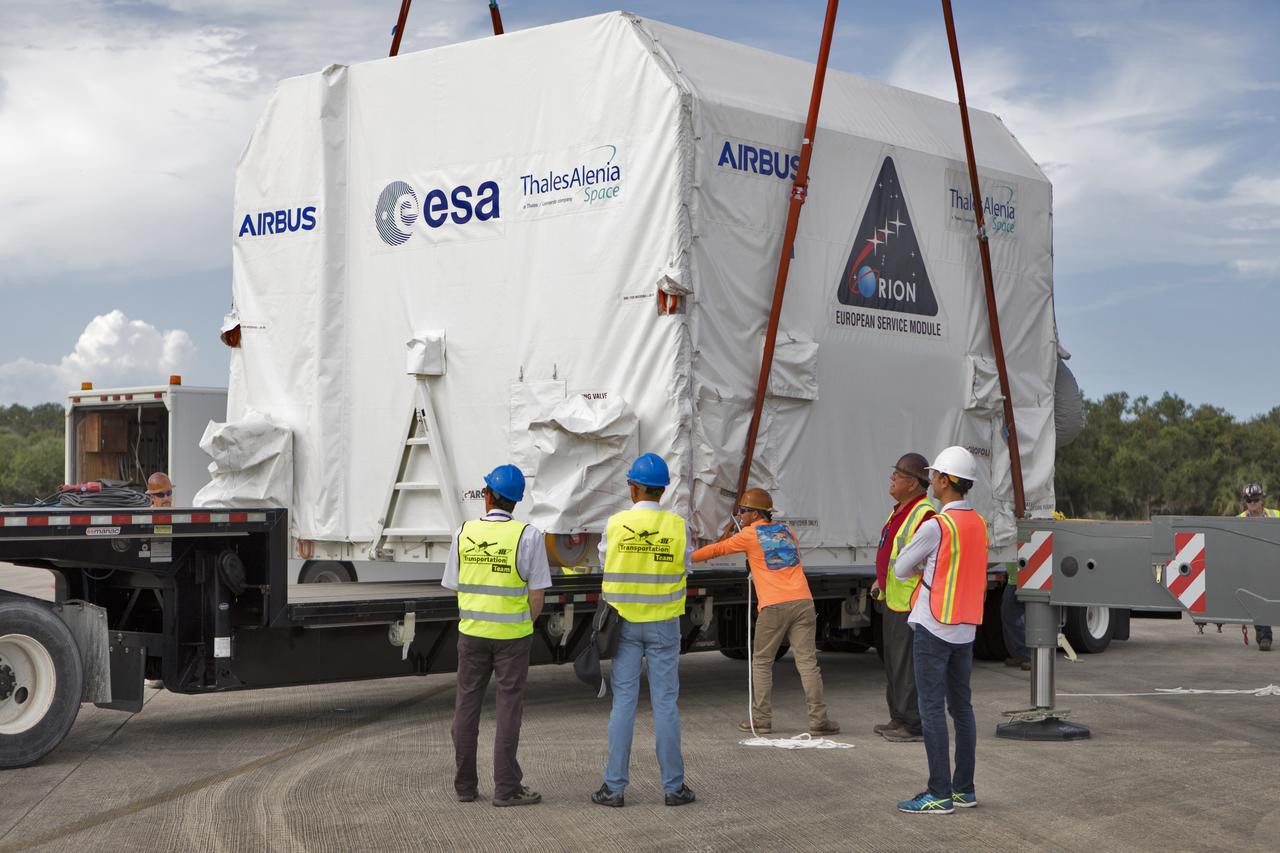
A crane lowers the shipping container holding the European Service Module (ESM) onto a flatbed truck at the Shuttle Landing Facility at NASA's Kennedy Space Center in Florida on Nov. 6, 2018. The ESM, built by the European Space Agency, will supply the main propulsion system and power to the Orion spacecraft for Exploration Mission-1 (EM-1), a mission to the Moon. The ESM also will house air and water for astronauts on future missions. EM-1 will be an uncrewed flight test that will provide a foundation for human deep space exploration to destinations beyond Earth orbit. EM-1 will be the first integrated test of NASA's Space Launch System, Orion and the ground systems at Kennedy.
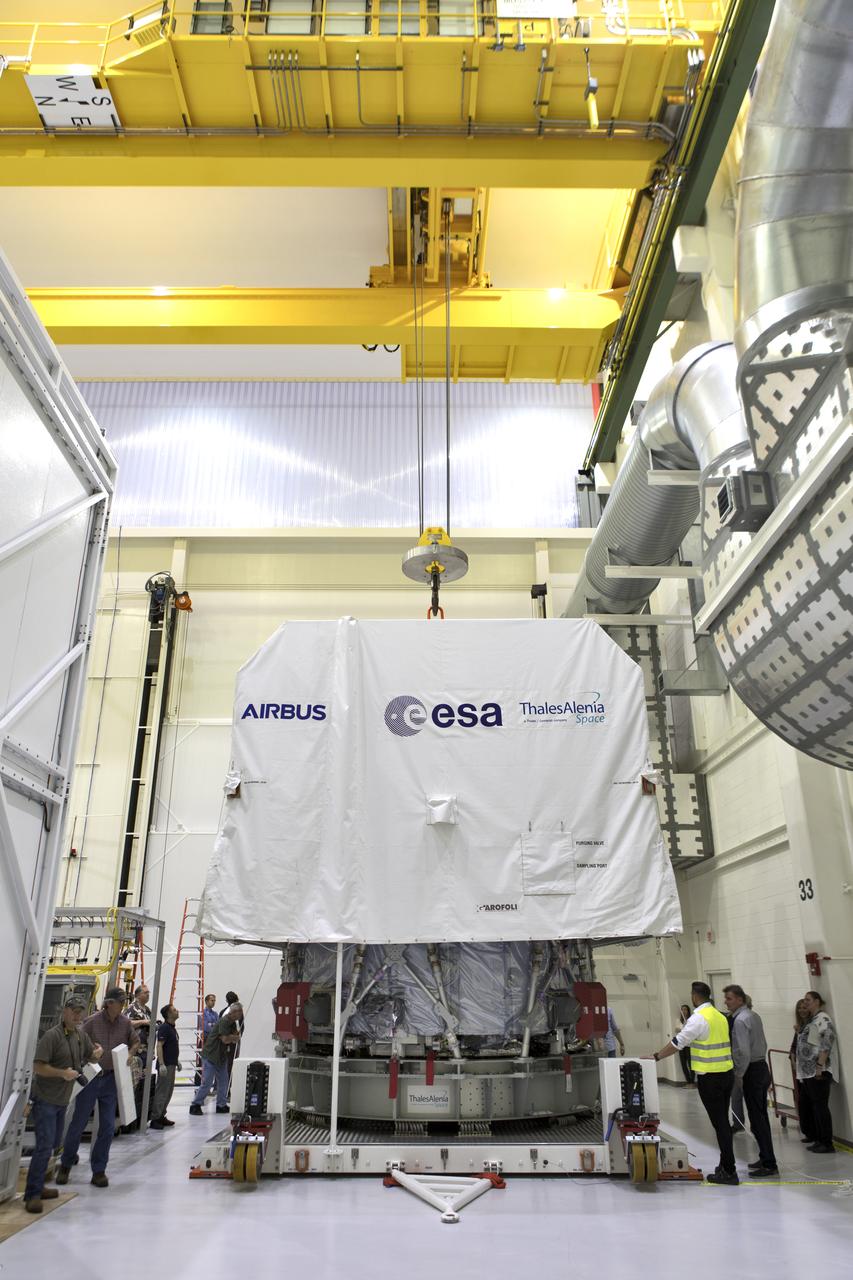
Inside the airlock in the Neil Armstrong Operations and Checkout Building high bay On Nov. 6, 2018, a crane is used to uncrate the European Space Agency's European Service Module (ESM) at NASA's Kennedy Space Center in Florida. The ESM will supply the main propulsion system and power to the Orion spacecraft for Exploration Mission-1 (EM-1), a mission to the Moon. The ESM also will house air and water for astronauts on future missions. EM-1 will be an uncrewed flight test that will provide a foundation for human deep space exploration to destinations beyond Earth orbit. EM-1 will be the first integrated test of NASA's Space Launch System, Orion and the ground systems at Kennedy.
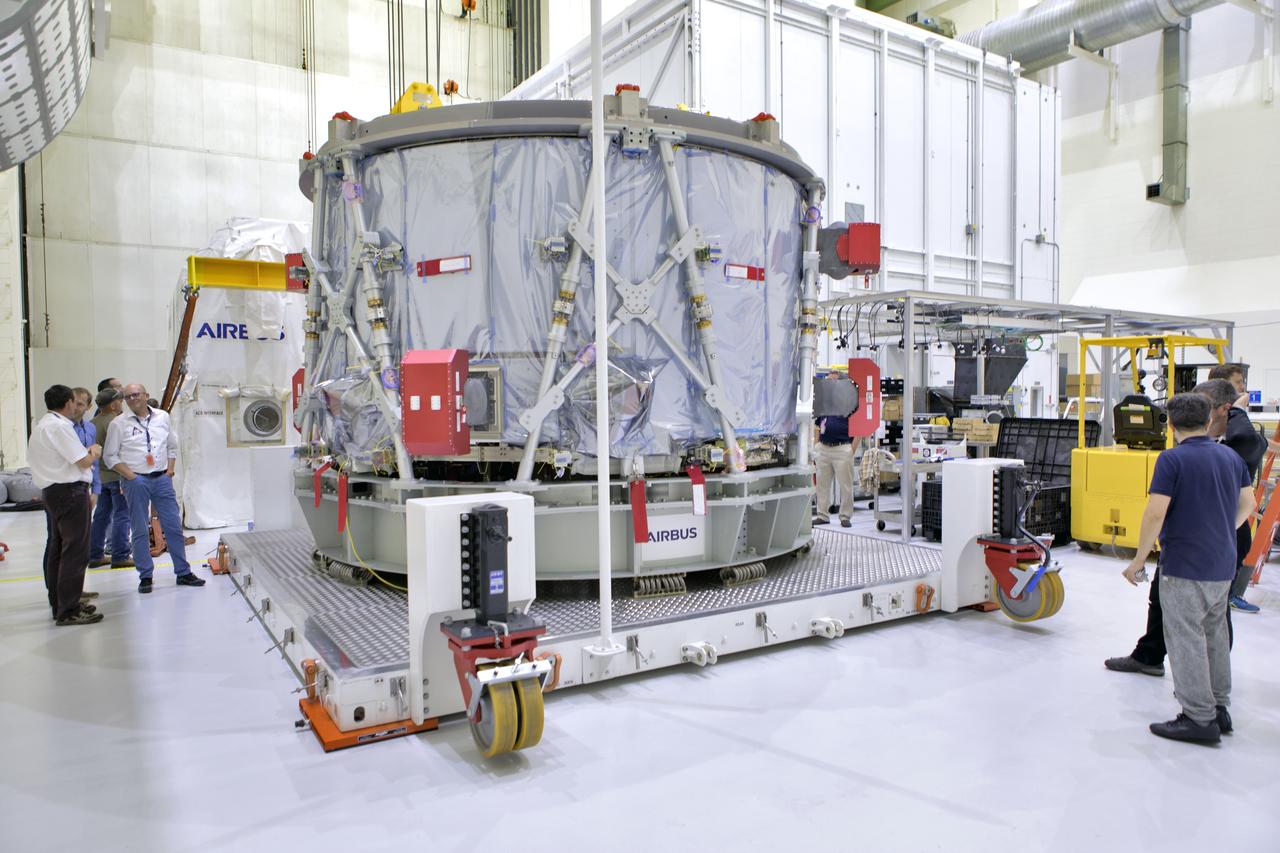
Inside the airlock in the Neil Armstrong Operations and Checkout Building high bay on Nov. 6, 2018, the European Space Agency's European Service Module (ESM) is uncrated and ready for its move to the high bay at NASA's Kennedy Space Center in Florida. The ESM will supply the main propulsion system and power to the Orion spacecraft for Exploration Mission-1 (EM-1), a mission to the Moon. The ESM also will house air and water for astronauts on future missions. EM-1 will be an uncrewed flight test that will provide a foundation for human deep space exploration to destinations beyond Earth orbit. EM-1 will be the first integrated test of NASA's Space Launch System, Orion and the ground systems at Kennedy.
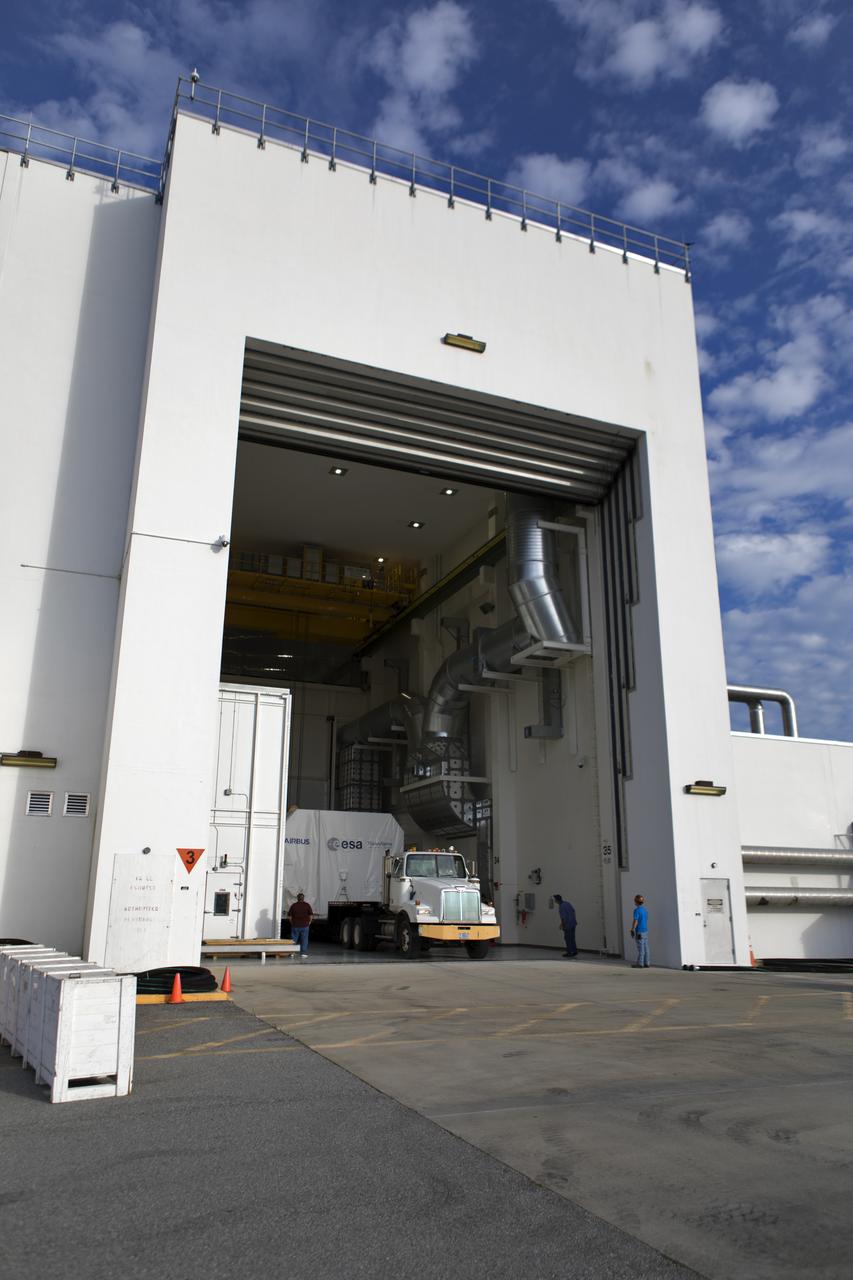
A flatbed truck carrying the European Space Agency's European Service Module (ESM) in its shipping container backs into the airlock of the Neil Armstrong Operations and Checkout Building on Nov. 6, 2018, at NASA's Kennedy Space Center in Florida. The ESM will supply the main propulsion system and power to the Orion spacecraft for Exploration Mission-1 (EM-1), a mission to the Moon. The ESM also will house air and water for astronauts on future missions. EM-1 will be an uncrewed flight test that will provide a foundation for human deep space exploration to destinations beyond Earth orbit. EM-1 will be the first integrated test of NASA's Space Launch System, Orion and the ground systems at Kennedy.
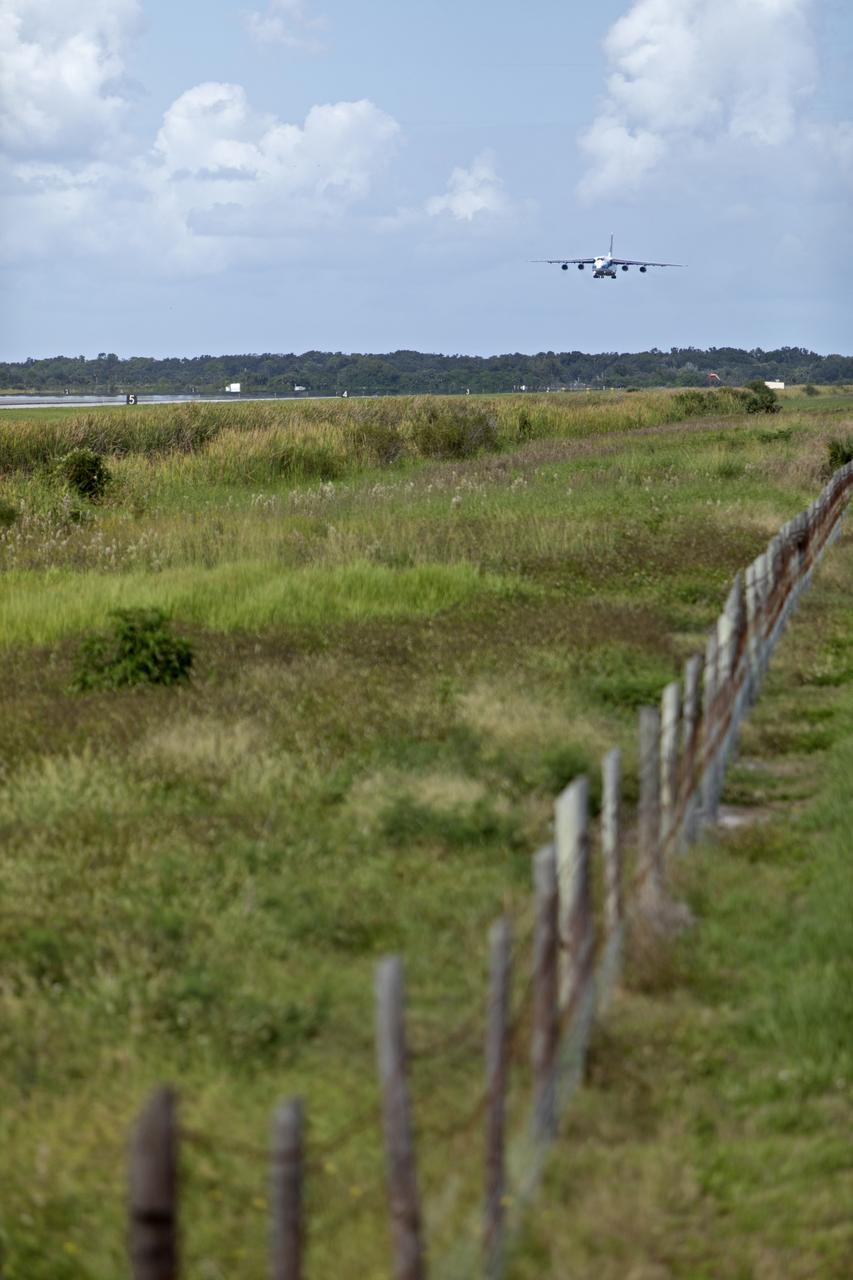
The Antonov cargo aircraft descends toward the Shuttle Landing Facility at NASA's Kennedy Space Center in Florida on Nov. 6, 2018, carrying the European Service Module (ESM) for Exploration Mission-1 (EM-1). The ESM, built by the European Space Agency, will supply the main propulsion system and power to the Orion spacecraft for Exploration Mission-1 (EM-1), a mission to the Moon. The ESM also will house air and water for astronauts on future missions. EM-1 will be an uncrewed flight test that will provide a foundation for human deep space exploration to destinations beyond Earth orbit. EM-1 will be the first integrated test of NASA's Space Launch System, Orion and the ground systems at Kennedy.
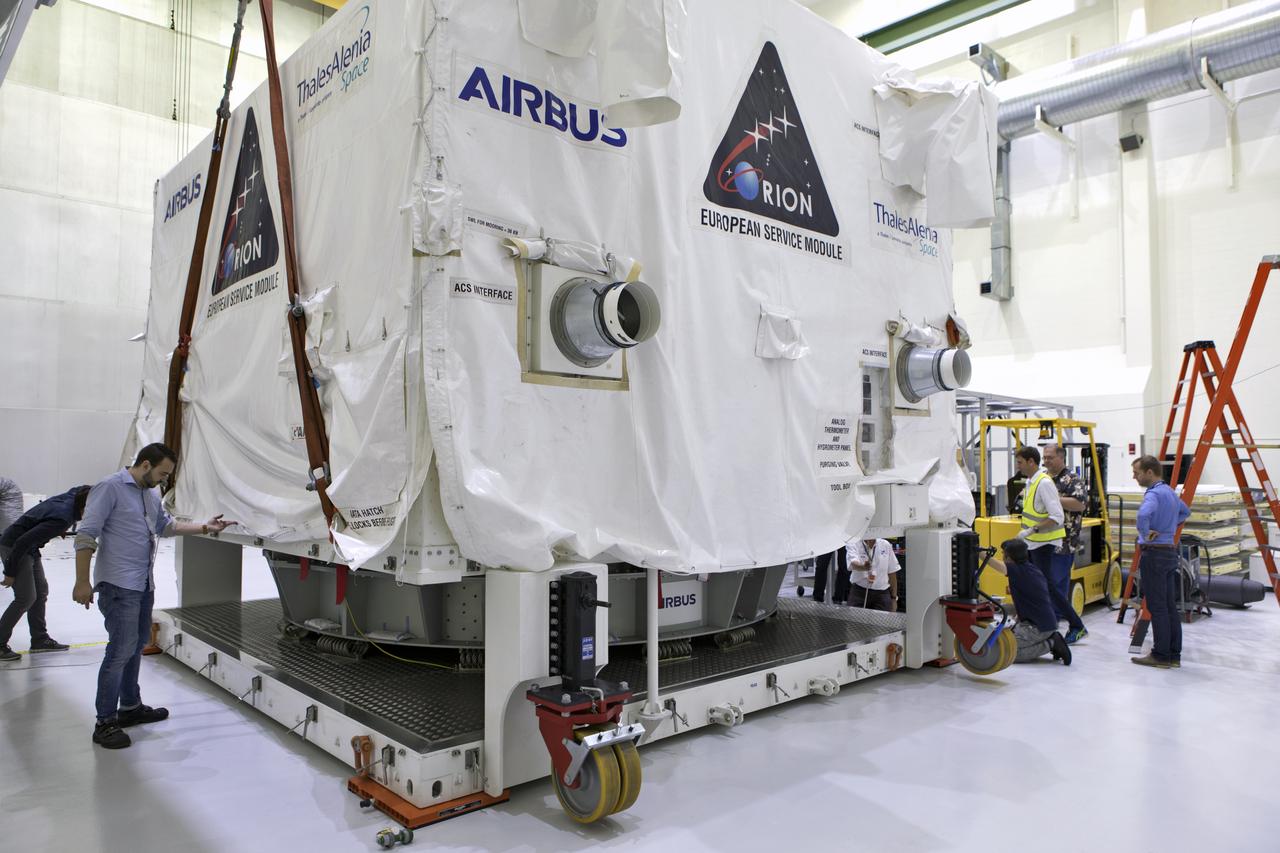
The European Space Agency's European Service Module (ESM), in its shipping container, is inside the airlock at the Neil Armstrong Operations and Checkout Building high bay on Nov. 6, 2018, at NASA's Kennedy Space Center in Florida. The ESM will supply the main propulsion system and power to the Orion spacecraft for Exploration Mission-1 (EM-1), a mission to the Moon. The ESM also will house air and water for astronauts on future missions. EM-1 will be an uncrewed flight test that will provide a foundation for human deep space exploration to destinations beyond Earth orbit. EM-1 will be the first integrated test of NASA's Space Launch System, Orion and the ground systems at Kennedy.
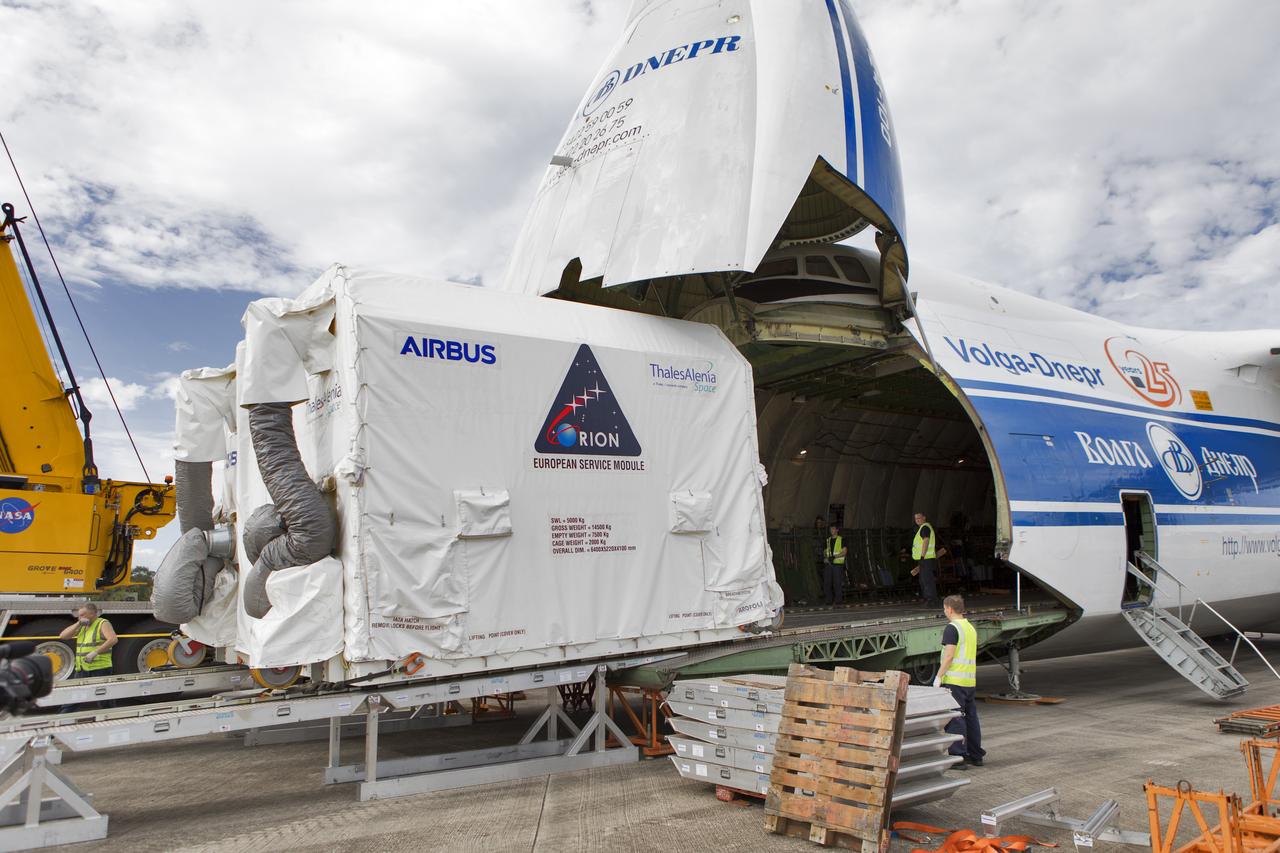
The shipping container holding the European Service Module (ESM) is moved out of the cargo hold of the Antonov cargo aircraft at the Shuttle Landing Facility at NASA's Kennedy Space Center in Florida on Nov. 6, 2018. The ESM, built by the European Space Agency, will supply the main propulsion system and power to the Orion spacecraft for Exploration Mission-1 (EM-1), a mission to the Moon. The ESM also will house air and water for astronauts on future missions. EM-1 will be an uncrewed flight test that will provide a foundation for human deep space exploration to destinations beyond Earth orbit. EM-1 will be the first integrated test of NASA's Space Launch System, Orion and the ground systems at Kennedy.
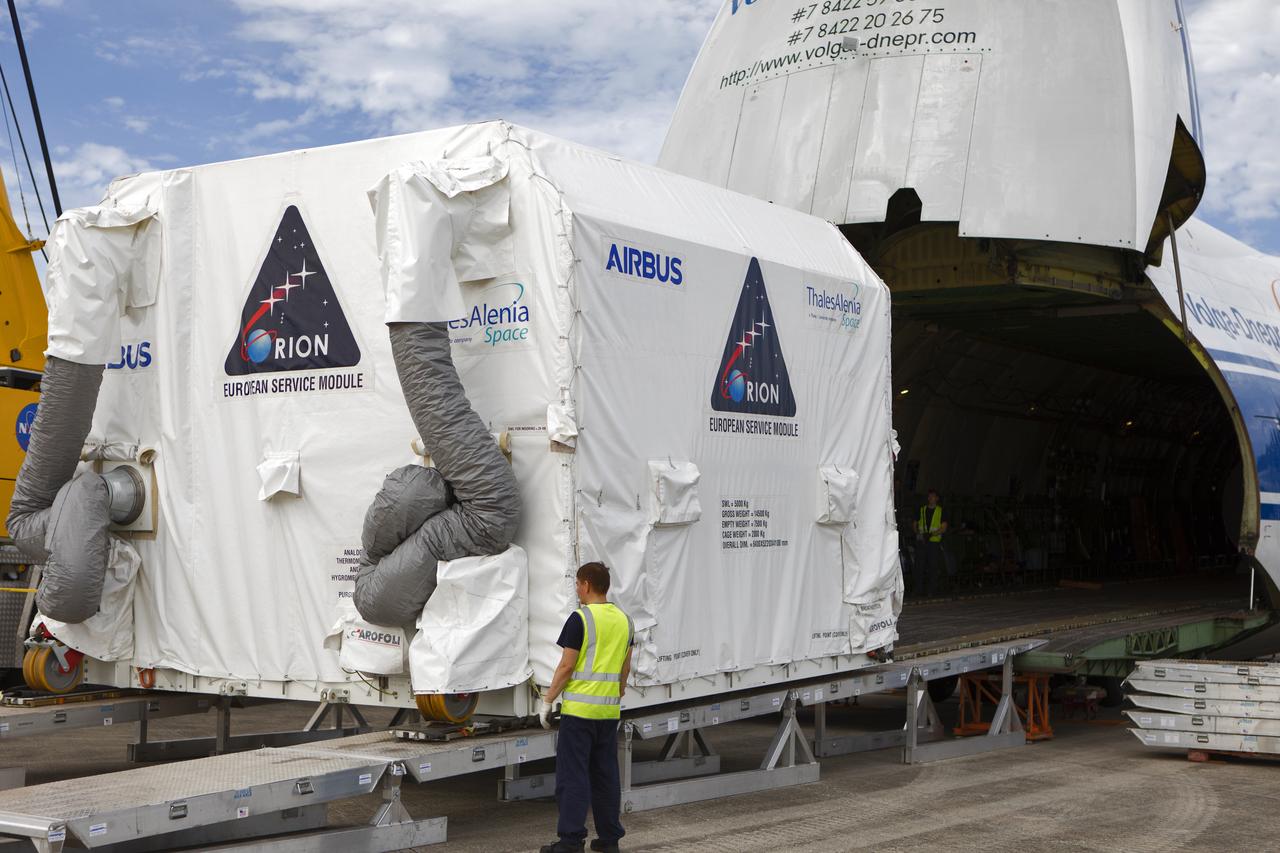
The shipping container holding the European Service Module (ESM) is moved out of the cargo hold of the Antonov cargo aircraft at the Shuttle Landing Facility at NASA's Kennedy Space Center in Florida on Nov. 6, 2018. The ESM, built by the European Space Agency, will supply the main propulsion system and power to the Orion spacecraft for Exploration Mission-1 (EM-1), a mission to the Moon. The ESM also will house air and water for astronauts on future missions. EM-1 will be an uncrewed flight test that will provide a foundation for human deep space exploration to destinations beyond Earth orbit. EM-1 will be the first integrated test of NASA's Space Launch System, Orion and the ground systems at Kennedy.

Inside the airlock in the Neil Armstrong Operations and Checkout Building high bay on Nov. 6, 2018, European Space Agency (ESA) and Airbus technicians begin to uncrate the ESA's European Service Module (ESM) at NASA's Kennedy Space Center in Florida. The ESM will supply the main propulsion system and power to the Orion spacecraft for Exploration Mission-1 (EM-1), a mission to the Moon. The ESM also will house air and water for astronauts on future missions. EM-1 will be an uncrewed flight test that will provide a foundation for human deep space exploration to destinations beyond Earth orbit. EM-1 will be the first integrated test of NASA's Space Launch System, Orion and the ground systems at Kennedy.
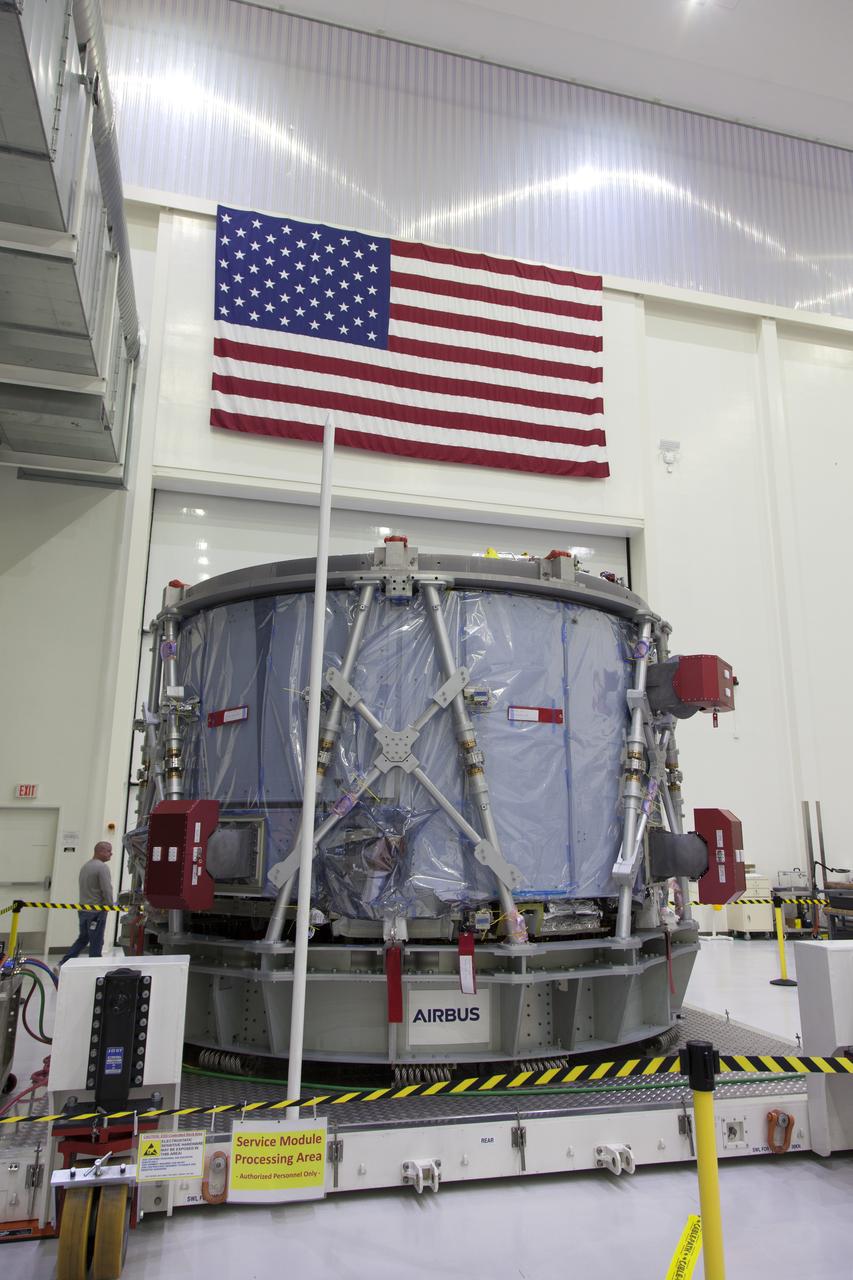
The European Service Module (ESM) is unpacked inside the Neil Armstrong Operations and Checkout Building high bay on Nov. 7, 2018, at NASA's Kennedy Space Center in Florida. The ESM is provided by the European Space Agency, and built by ESA contractor Airbus Defence and Space. It will supply the main propulsion system and power to the Orion spacecraft for Exploration Mission-1 (EM-1), a mission around the Moon. The ESM also will house air and water for astronauts on future missions. EM-1 will be an uncrewed flight test that will provide a foundation for human deep space exploration to destinations beyond Earth orbit. EM-1 will be the first integrated test of NASA's Space Launch System, Orion and the ground systems at Kennedy.
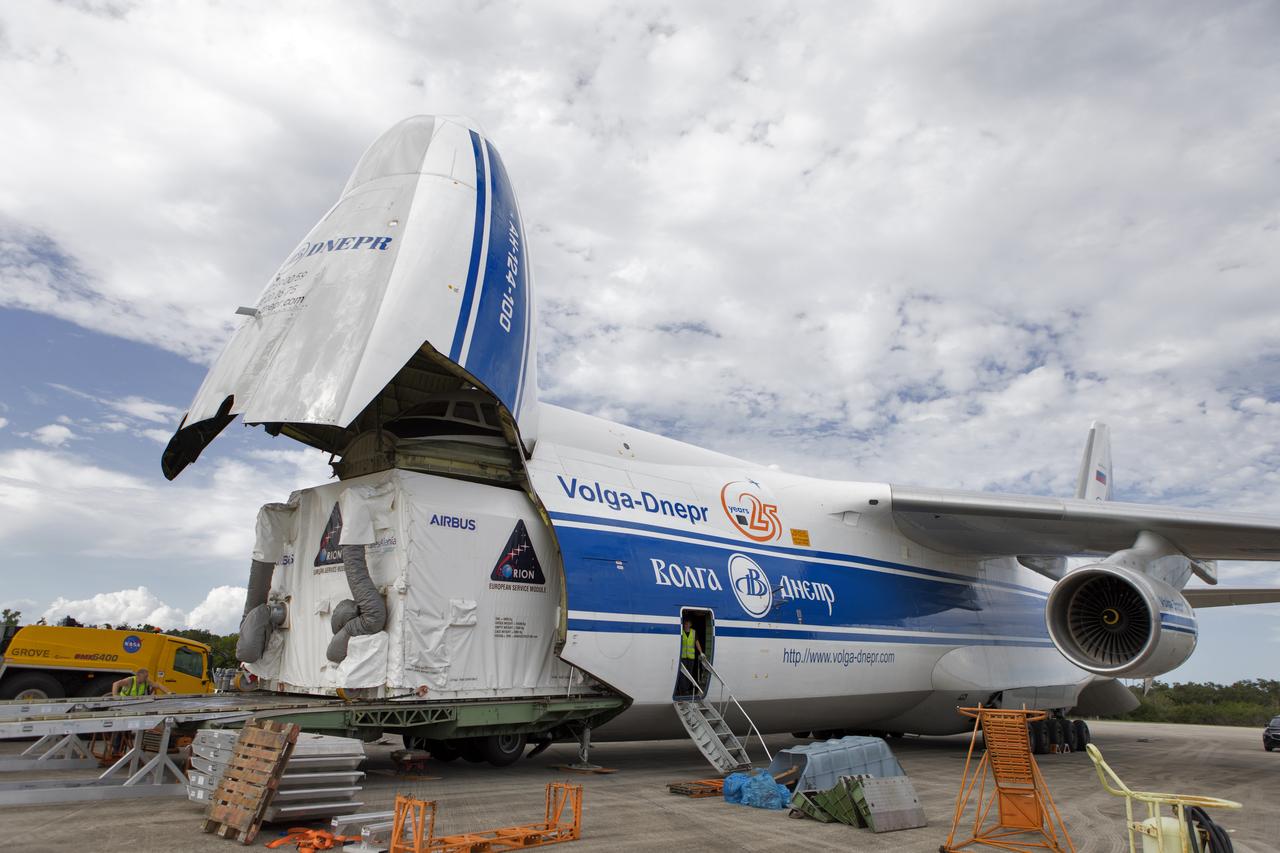
The shipping container holding the European Service Module (ESM) is moved out of the cargo hold of the Antonov cargo aircraft at the Shuttle Landing Facility at NASA's Kennedy Space Center in Florida on Nov. 6, 2018. The ESM, built by the European Space Agency, will supply the main propulsion system and power to the Orion spacecraft for Exploration Mission-1 (EM-1), a mission to the Moon. The ESM also will house air and water for astronauts on future missions. EM-1 will be an uncrewed flight test that will provide a foundation for human deep space exploration to destinations beyond Earth orbit. EM-1 will be the first integrated test of NASA's Space Launch System, Orion and the ground systems at Kennedy.
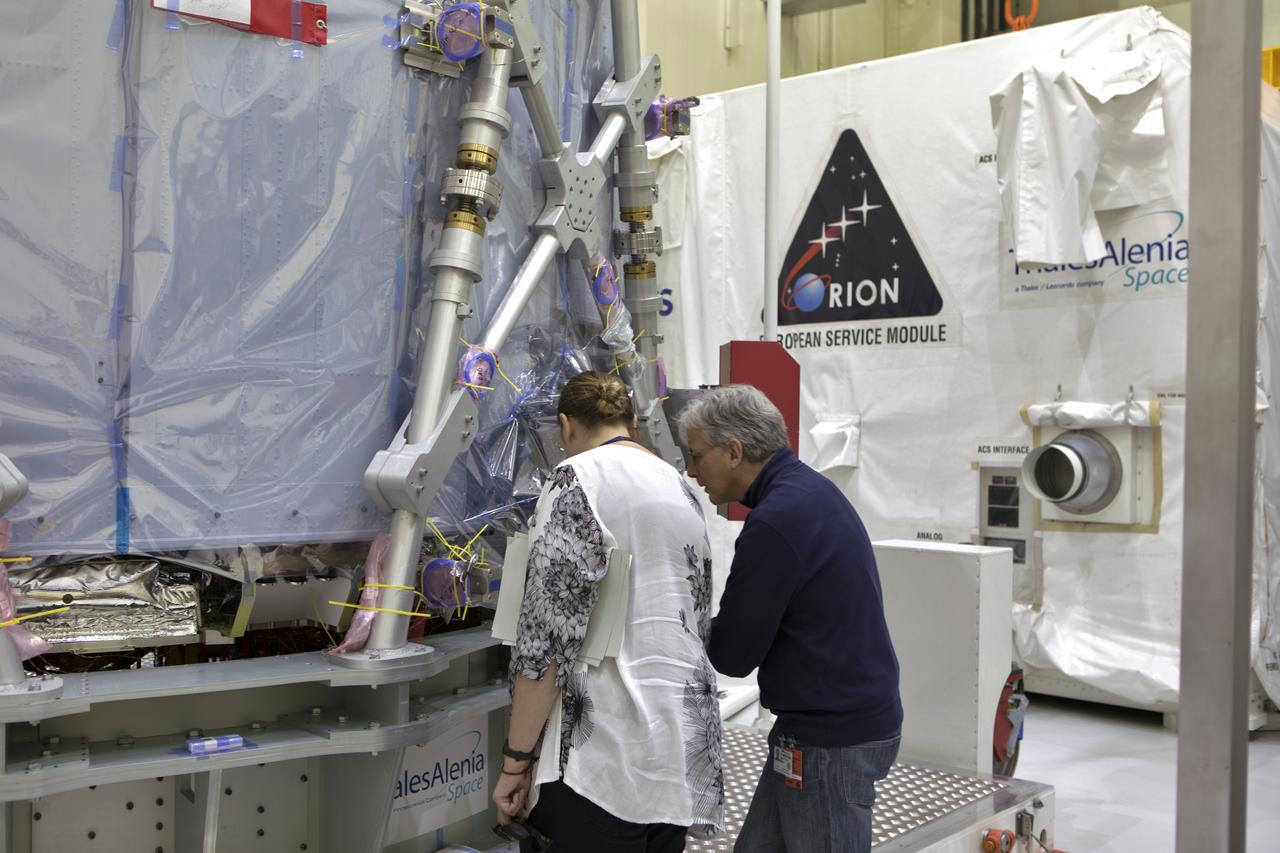
Inside the airlock in the Neil Armstrong Operations and Checkout Building high bay on Nov. 6, 2018, European Space Agency (ESA) and Airbus engineers check the ESA European Service Module (ESM) after it is uncrated at NASA's Kennedy Space Center in Florida. The ESM will supply the main propulsion system and power to the Orion spacecraft for Exploration Mission-1 (EM-1), a mission to the Moon. The ESM also will house air and water for astronauts on future missions. EM-1 will be an uncrewed flight test that will provide a foundation for human deep space exploration to destinations beyond Earth orbit. EM-1 will be the first integrated test of NASA's Space Launch System, Orion and the ground systems at Kennedy.
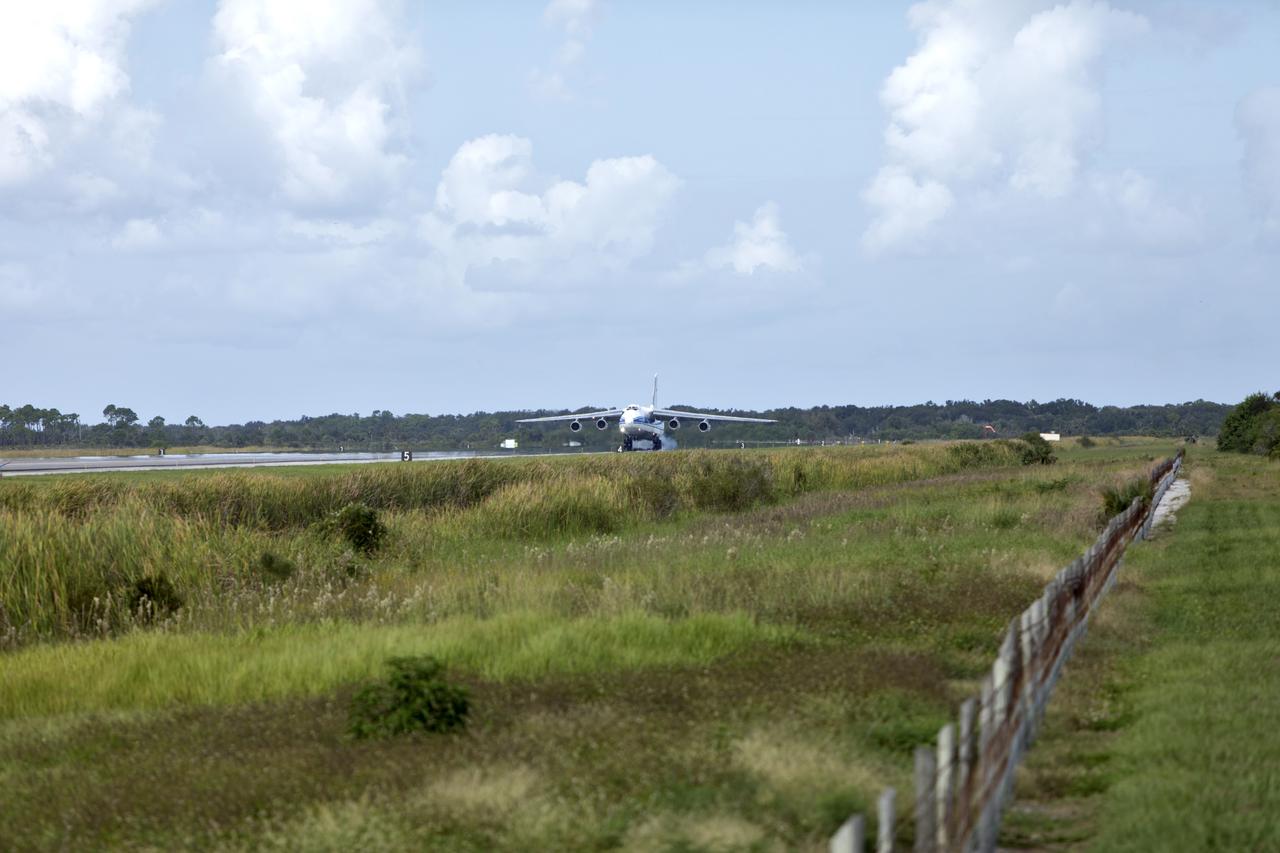
The Antonov cargo aircraft touches down at the Shuttle Landing Facility at NASA's Kennedy Space Center in Florida on Nov. 6, 2018, carrying the European Service Module (ESM) for Exploration Mission-1 (EM-1). The ESM, built by the European Space Agency, will supply the main propulsion system and power to the Orion spacecraft for Exploration Mission-1 (EM-1), a mission to the Moon. The ESM also will house air and water for astronauts on future missions. EM-1 will be an uncrewed flight test that will provide a foundation for human deep space exploration to destinations beyond Earth orbit. EM-1 will be the first integrated test of NASA's Space Launch System, Orion and the ground systems at Kennedy.
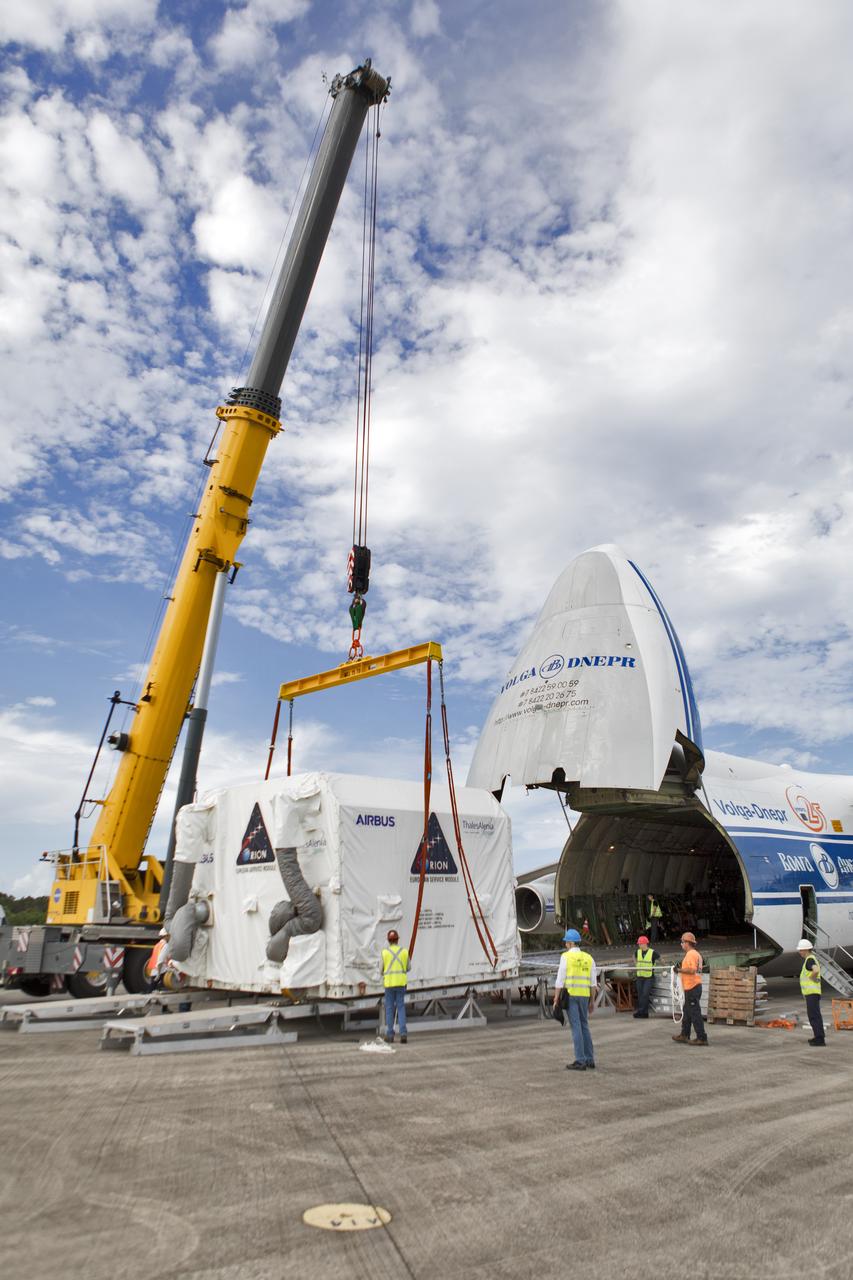
A crane is attached to the shipping container holding the European Service Module (ESM) after it was moved out of the cargo hold of the Antonov cargo aircraft at the Shuttle Landing Facility at NASA's Kennedy Space Center in Florida on Nov. 6, 2018. The ESM, built by the European Space Agency, will supply the main propulsion system and power to the Orion spacecraft for Exploration Mission-1 (EM-1), a mission to the Moon. The ESM also will house air and water for astronauts on future missions. EM-1 will be an uncrewed flight test that will provide a foundation for human deep space exploration to destinations beyond Earth orbit. EM-1 will be the first integrated test of NASA's Space Launch System, Orion and the ground systems at Kennedy.
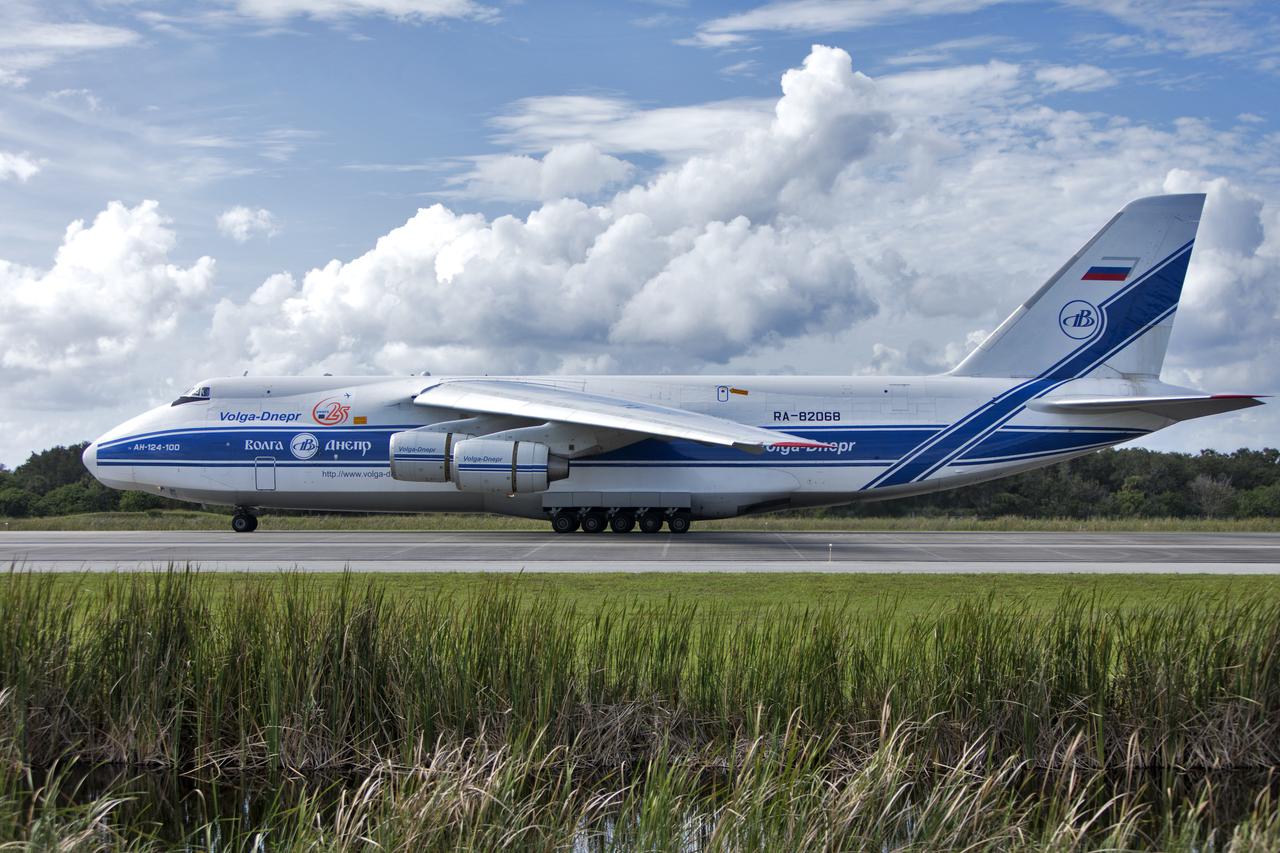
The Antonov cargo aircraft arrives at the Shuttle Landing Facility at NASA's Kennedy Space Center in Florida on Nov. 6, 2018, carrying the European Service Module (ESM) for Exploration Mission-1 (EM-1). The ESM, built by the European Space Agency, will supply the main propulsion system and power to the Orion spacecraft for Exploration Mission-1 (EM-1), a mission to the Moon. The ESM also will house air and water for astronauts on future missions. EM-1 will be an uncrewed flight test that will provide a foundation for human deep space exploration to destinations beyond Earth orbit. EM-1 will be the first integrated test of NASA's Space Launch System, Orion and the ground systems at Kennedy.
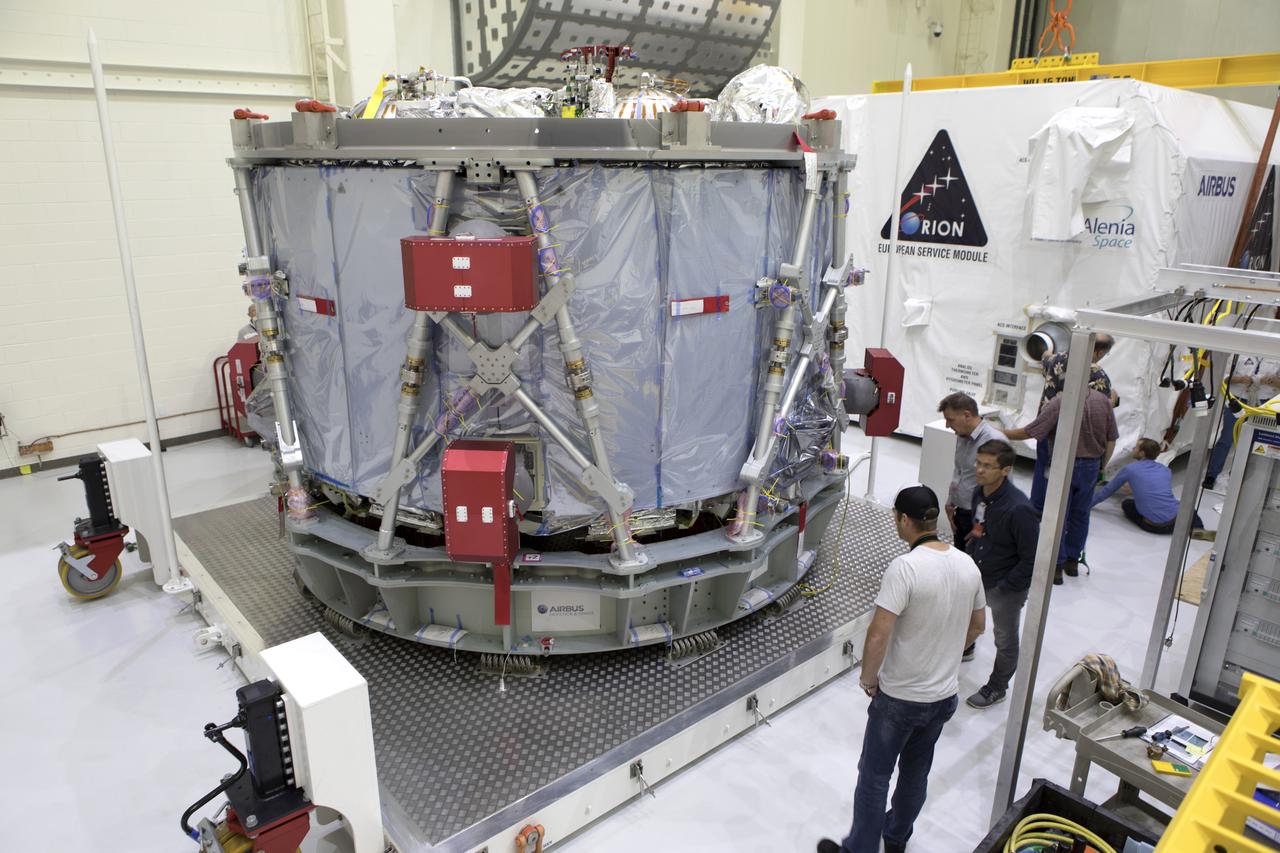
Inside the airlock in the Neil Armstrong Operations and Checkout Building high bay on Nov. 6, 2018, the European Space Agency's European Service Module (ESM) is uncrated at NASA's Kennedy Space Center in Florida. The ESM will supply the main propulsion system and power to the Orion spacecraft for Exploration Mission-1 (EM-1), a mission to the Moon. The ESM also will house air and water for astronauts on future missions. EM-1 will be an uncrewed flight test that will provide a foundation for human deep space exploration to destinations beyond Earth orbit. EM-1 will be the first integrated test of NASA's Space Launch System, Orion and the ground systems at Kennedy.
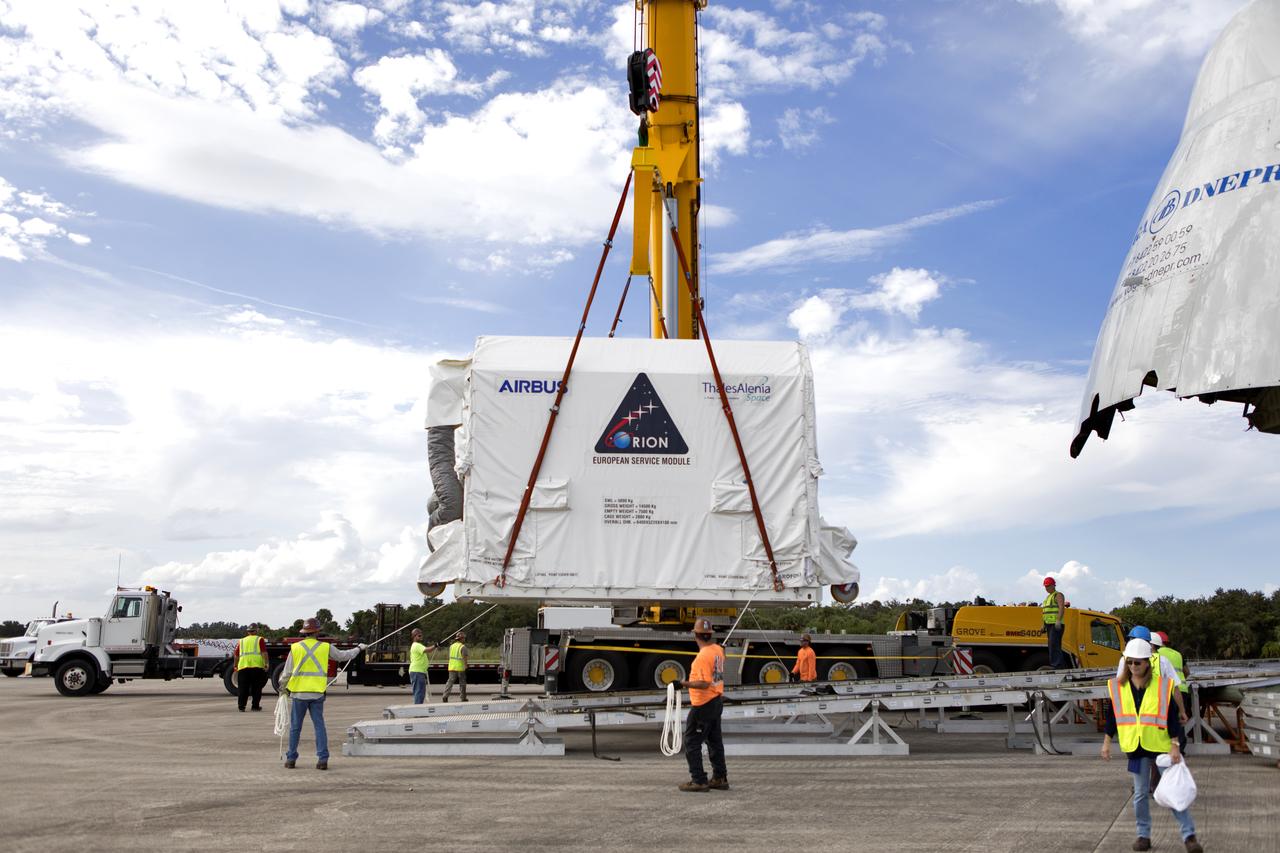
A crane lifts the shipping container holding the European Service Module (ESM) after it was moved out of the cargo hold of the Antonov cargo aircraft at the Shuttle Landing Facility at NASA's Kennedy Space Center in Florida on Nov. 6, 2018. The ESM, built by the European Space Agency, will supply the main propulsion system and power to the Orion spacecraft for Exploration Mission-1 (EM-1), a mission to the Moon. The ESM also will house air and water for astronauts on future missions. EM-1 will be an uncrewed flight test that will provide a foundation for human deep space exploration to destinations beyond Earth orbit. EM-1 will be the first integrated test of NASA's Space Launch System, Orion and the ground systems at Kennedy.
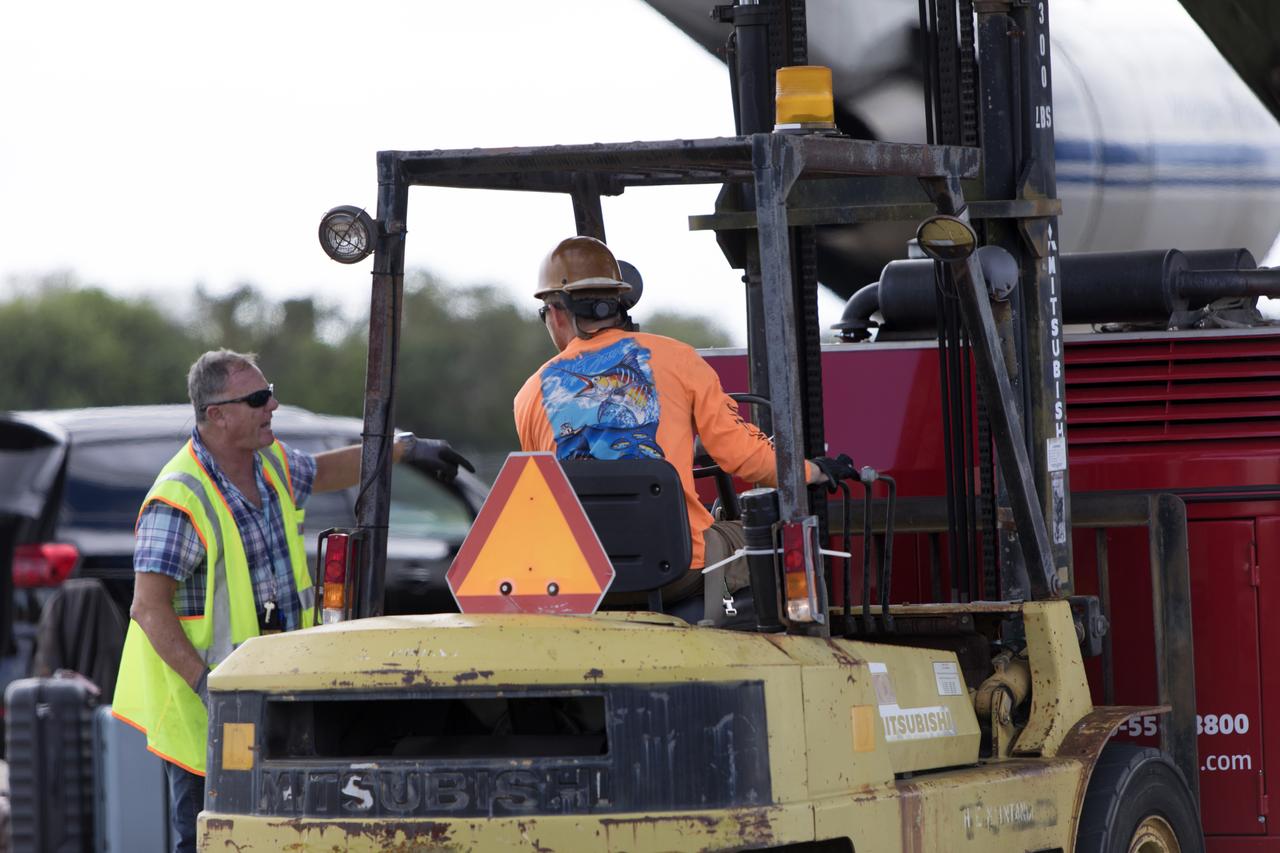
Technicians operate a forklift to lift the European Service Module (ESM) out of the cargo hold of the Antonov cargo aircraft at the Shuttle Landing Facility at NASA's Kennedy Space Center in Florida on Nov. 6, 2018. The ESM, built by the European Space Agency, will supply the main propulsion system and power to the Orion spacecraft for Exploration Mission-1 (EM-1), a mission to the Moon. The ESM also will house air and water for astronauts on future missions. EM-1 will be an uncrewed flight test that will provide a foundation for human deep space exploration to destinations beyond Earth orbit. EM-1 will be the first integrated test of NASA's Space Launch System, Orion and the ground systems at Kennedy.
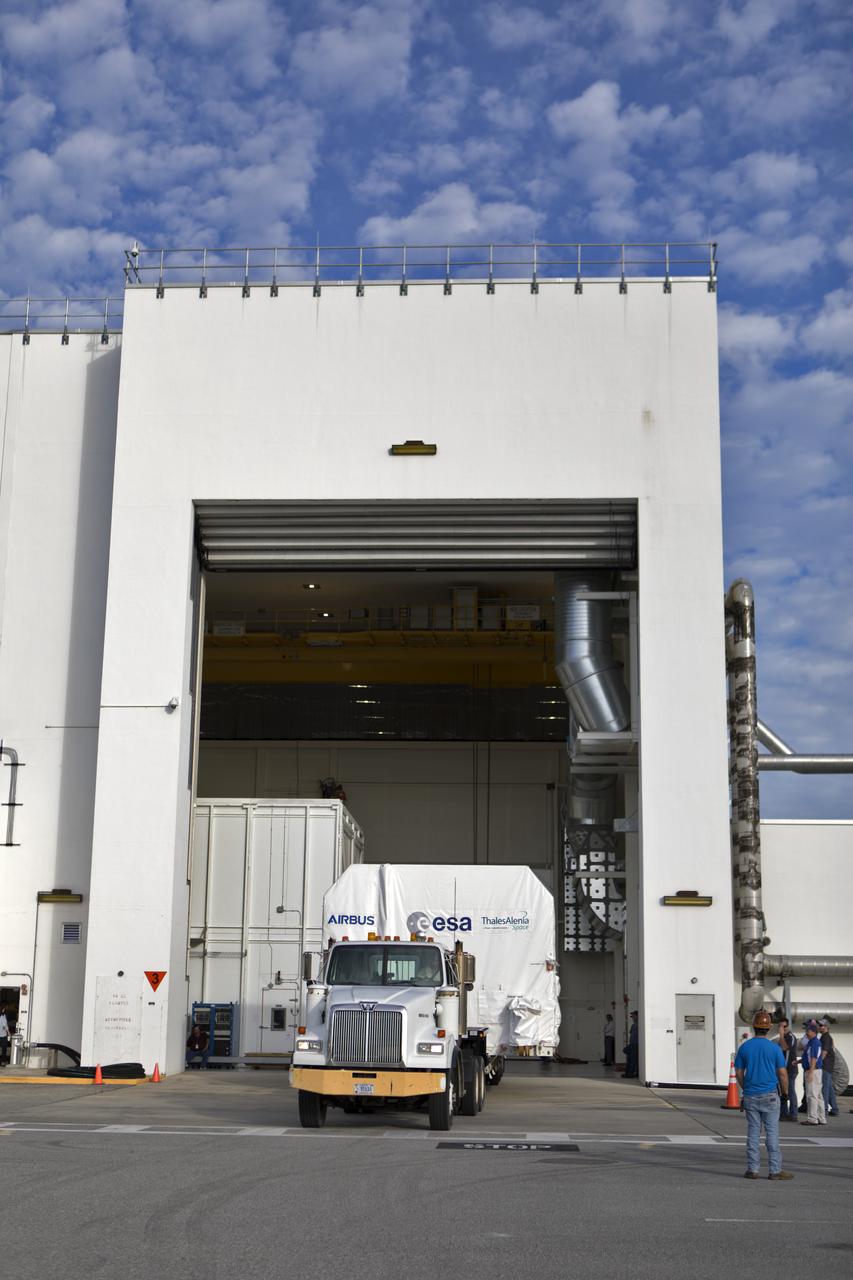
A flatbed truck carrying the European Space Agency's European Service Module (ESM) in its shipping container backs into the airlock of the Neil Armstrong Operations and Checkout Building on Nov. 6, 2018, at NASA's Kennedy Space Center in Florida. The ESM will supply the main propulsion system and power to the Orion spacecraft for Exploration Mission-1 (EM-1), a mission to the Moon. The ESM also will house air and water for astronauts on future missions. EM-1 will be an uncrewed flight test that will provide a foundation for human deep space exploration to destinations beyond Earth orbit. EM-1 will be the first integrated test of NASA's Space Launch System, Orion and the ground systems at Kennedy.
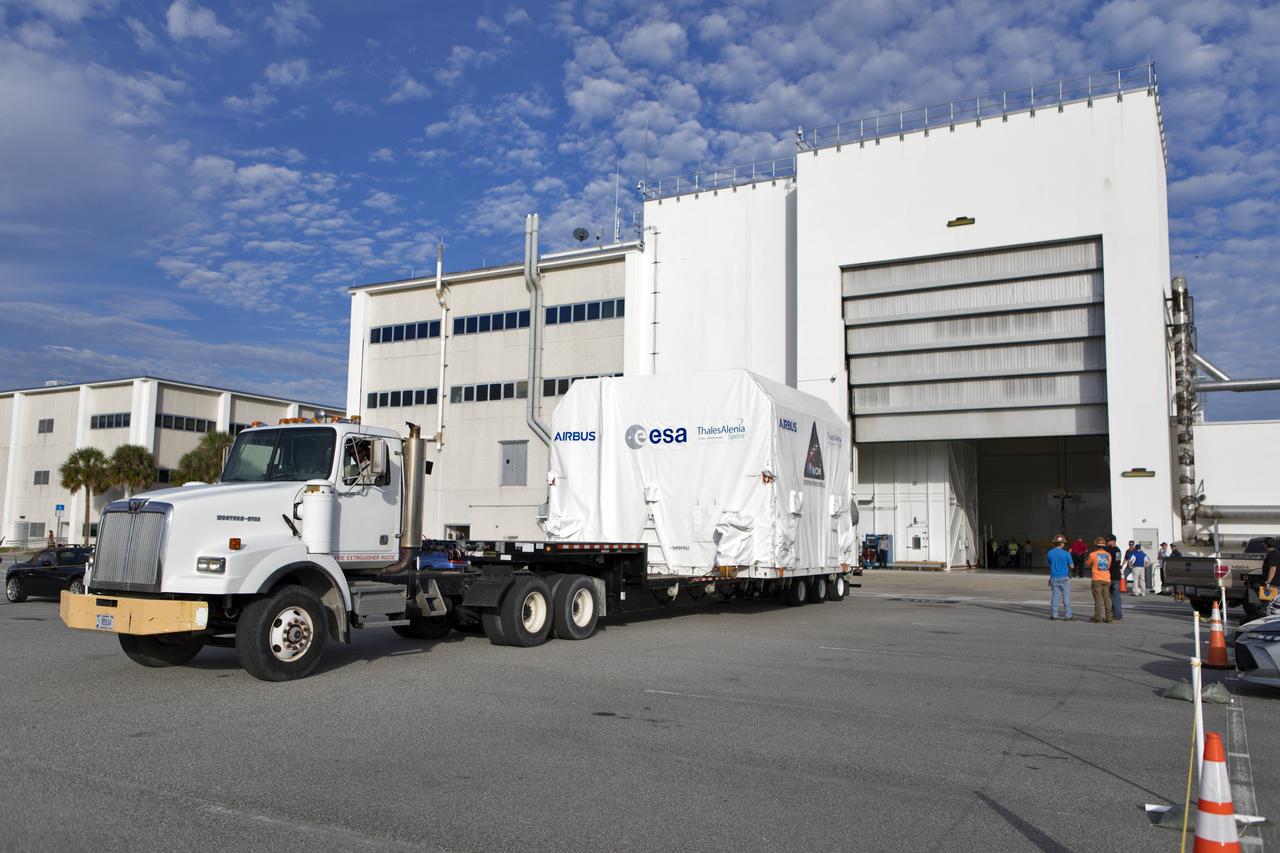
A flatbed truck carrying the European Space Agency's European Service Module (ESM) in its shipping container begins to back into the airlock of the Neil Armstrong Operations and Checkout Building on Nov. 6, 2018, at NASA's Kennedy Space Center in Florida. The ESM will supply the main propulsion system and power to the Orion spacecraft for Exploration Mission-1 (EM-1), a mission to the Moon. The ESM also will house air and water for astronauts on future missions. EM-1 will be an uncrewed flight test that will provide a foundation for human deep space exploration to destinations beyond Earth orbit. EM-1 will be the first integrated test of NASA's Space Launch System, Orion and the ground systems at Kennedy.
The European Service Module (ESM) is unpacked inside the Neil Armstrong Operations and Checkout Building high bay on Nov. 7, 2018, at NASA's Kennedy Space Center in Florida. The ESM is provided by the European Space Agency, and built by ESA contractor Airbus Defence and Space. It will supply the main propulsion system and power to the Orion spacecraft for Exploration Mission-1 (EM-1), a mission around the Moon. The ESM also will house air and water for astronauts on future missions. EM-1 will be an uncrewed flight test that will provide a foundation for human deep space exploration to destinations beyond Earth orbit. EM-1 will be the first integrated test of NASA's Space Launch System, Orion and the ground systems at Kennedy.
A flatbed truck carrying the European Space Agency's European Service Module (ESM) in its shipping container arrives at the Neil Armstrong Operations and Checkout Building on Nov. 6, 2018, at NASA's Kennedy Space Center in Florida. The ESM will supply the main propulsion system and power to the Orion spacecraft for Exploration Mission-1 (EM-1), a mission to the Moon. The ESM also will house air and water for astronauts on future missions. EM-1 will be an uncrewed flight test that will provide a foundation for human deep space exploration to destinations beyond Earth orbit. EM-1 will be the first integrated test of NASA's Space Launch System, Orion and the ground systems at Kennedy.
The European Service Module (ESM) is unpacked inside the Neil Armstrong Operations and Checkout Building high bay on Nov. 7, 2018, at NASA's Kennedy Space Center in Florida. The ESM is provided by the European Space Agency, and built by ESA contractor Airbus Defence and Space. It will supply the main propulsion system and power to the Orion spacecraft for Exploration Mission-1 (EM-1), a mission around the Moon. The ESM also will house air and water for astronauts on future missions. EM-1 will be an uncrewed flight test that will provide a foundation for human deep space exploration to destinations beyond Earth orbit. EM-1 will be the first integrated test of NASA's Space Launch System, Orion and the ground systems at Kennedy.
The shipping container holding the European Service Module (ESM) is moved out of the cargo hold of the Antonov cargo aircraft at the Shuttle Landing Facility at NASA's Kennedy Space Center in Florida on Nov. 6, 2018. The ESM, built by the European Space Agency, will supply the main propulsion system and power to the Orion spacecraft for Exploration Mission-1 (EM-1), a mission to the Moon. The ESM also will house air and water for astronauts on future missions. EM-1 will be an uncrewed flight test that will provide a foundation for human deep space exploration to destinations beyond Earth orbit. EM-1 will be the first integrated test of NASA's Space Launch System, Orion and the ground systems at Kennedy.
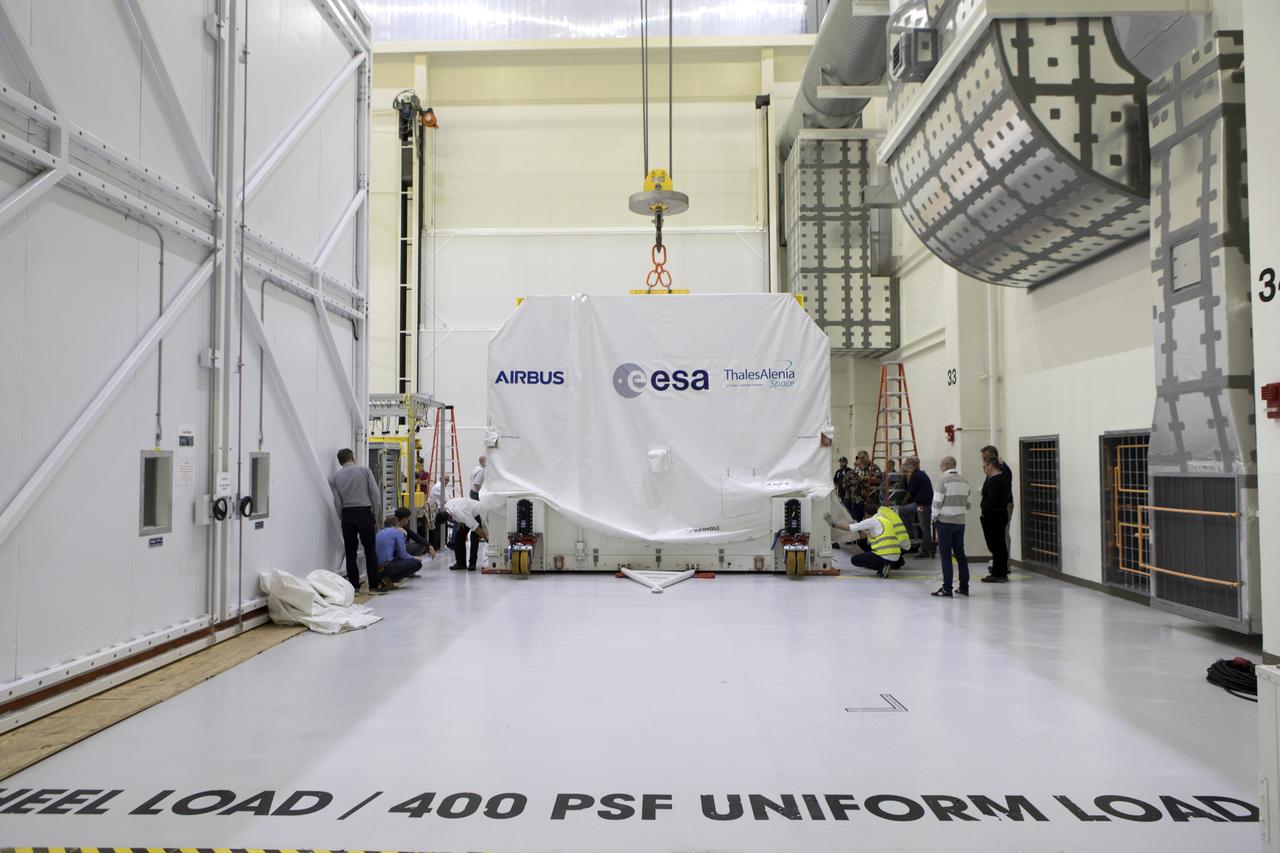
The European Space Agency's European Service Module (ESM), in its shipping container, is inside the airlock at the Neil Armstrong Operations and Checkout Building high bay on Nov. 6, 2018, at NASA's Kennedy Space Center in Florida. The ESM will supply the main propulsion system and power to the Orion spacecraft for Exploration Mission-1 (EM-1), a mission to the Moon. The ESM also will house air and water for astronauts on future missions. EM-1 will be an uncrewed flight test that will provide a foundation for human deep space exploration to destinations beyond Earth orbit. EM-1 will be the first integrated test of NASA's Space Launch System, Orion and the ground systems at Kennedy.
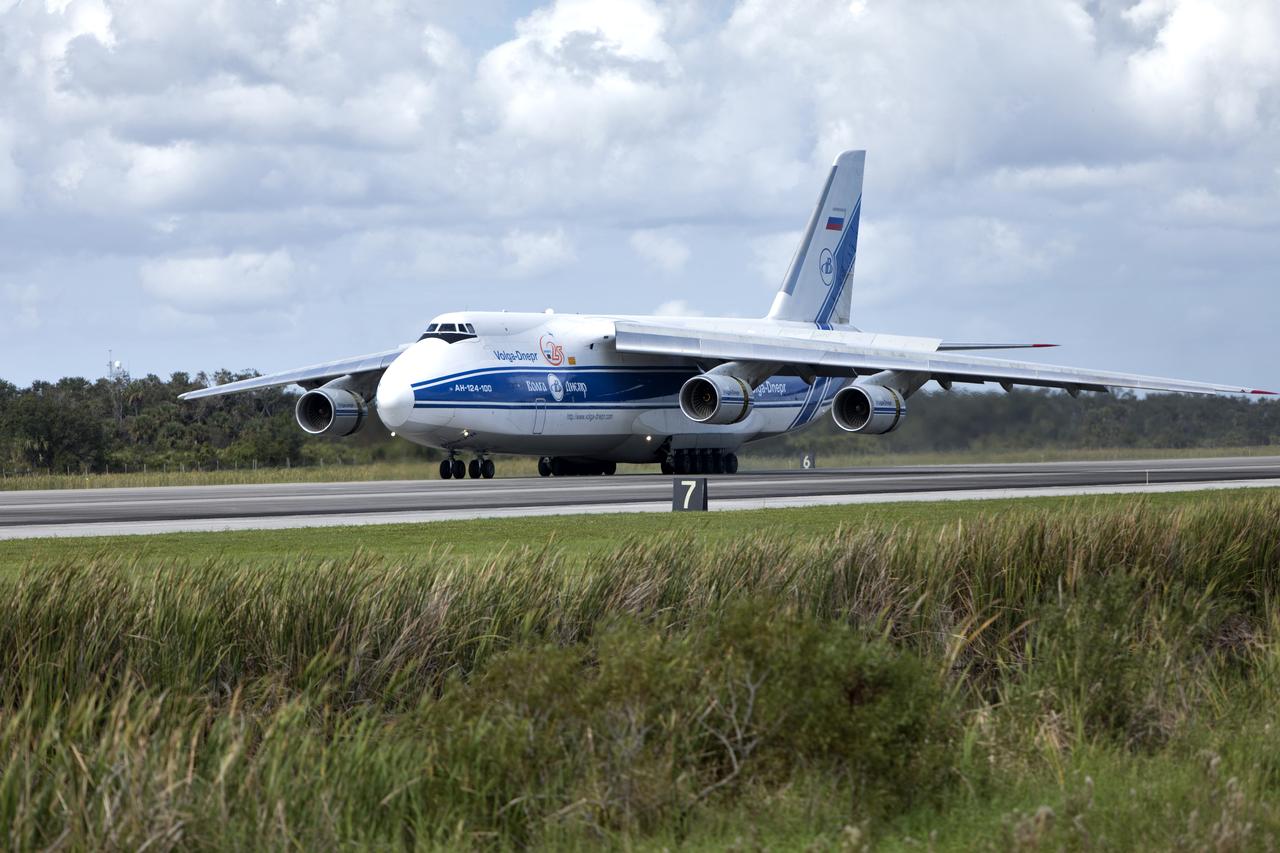
The Antonov cargo aircraft touches down at the Shuttle Landing Facility at NASA's Kennedy Space Center in Florida on Nov. 6, 2018, carrying the European Service Module (ESM) for Exploration Mission-1 (EM-1). The ESM, built by the European Space Agency, will supply the main propulsion system and power to the Orion spacecraft for Exploration Mission-1 (EM-1), a mission to the Moon. The ESM also will house air and water for astronauts on future missions. EM-1 will be an uncrewed flight test that will provide a foundation for human deep space exploration to destinations beyond Earth orbit. EM-1 will be the first integrated test of NASA's Space Launch System, Orion and the ground systems at Kennedy.
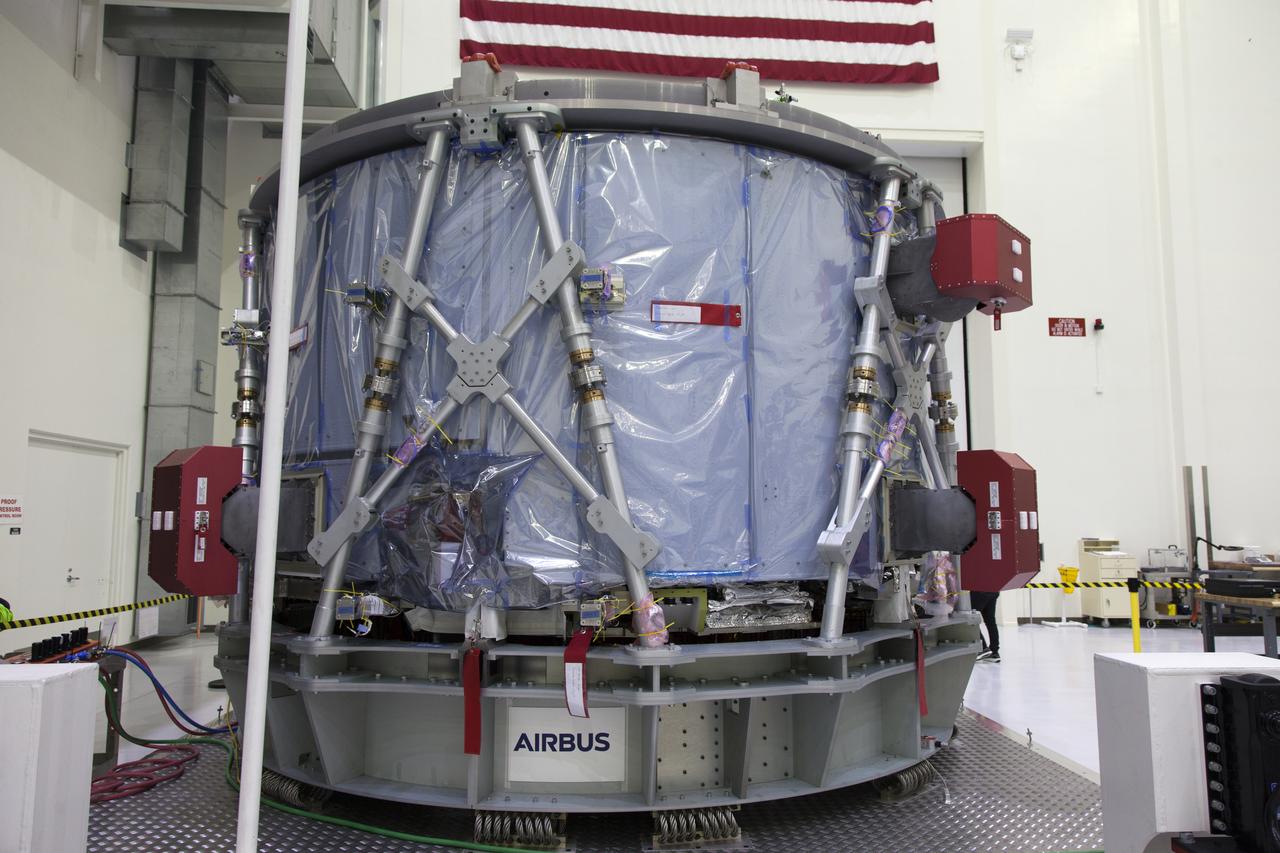
The European Service Module (ESM) is unpacked inside the Neil Armstrong Operations and Checkout Building high bay on Nov. 7, 2018, at NASA's Kennedy Space Center in Florida. The ESM is provided by the European Space Agency, and built by ESA contractor Airbus Defence and Space. It will supply the main propulsion system and power to the Orion spacecraft for Exploration Mission-1 (EM-1), a mission around the Moon. The ESM also will house air and water for astronauts on future missions. EM-1 will be an uncrewed flight test that will provide a foundation for human deep space exploration to destinations beyond Earth orbit. EM-1 will be the first integrated test of NASA's Space Launch System, Orion and the ground systems at Kennedy.
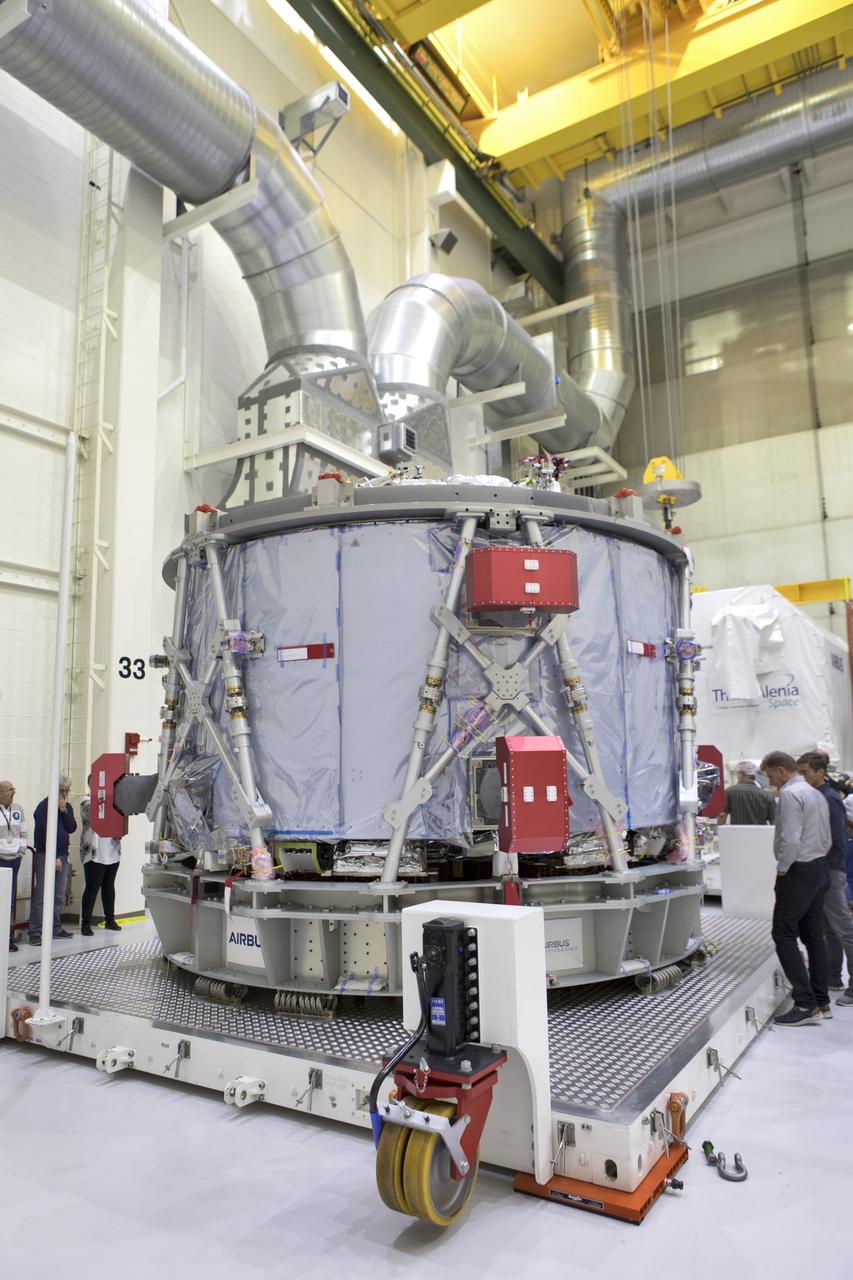
Inside the airlock in the Neil Armstrong Operations and Checkout Building high bay on Nov. 6, 2018, the European Space Agency's European Service Module (ESM) is uncrated at NASA's Kennedy Space Center in Florida. The ESM will supply the main propulsion system and power to the Orion spacecraft for Exploration Mission-1 (EM-1), a mission to the Moon. The ESM also will house air and water for astronauts on future missions. EM-1 will be an uncrewed flight test that will provide a foundation for human deep space exploration to destinations beyond Earth orbit. EM-1 will be the first integrated test of NASA's Space Launch System, Orion and the ground systems at Kennedy.
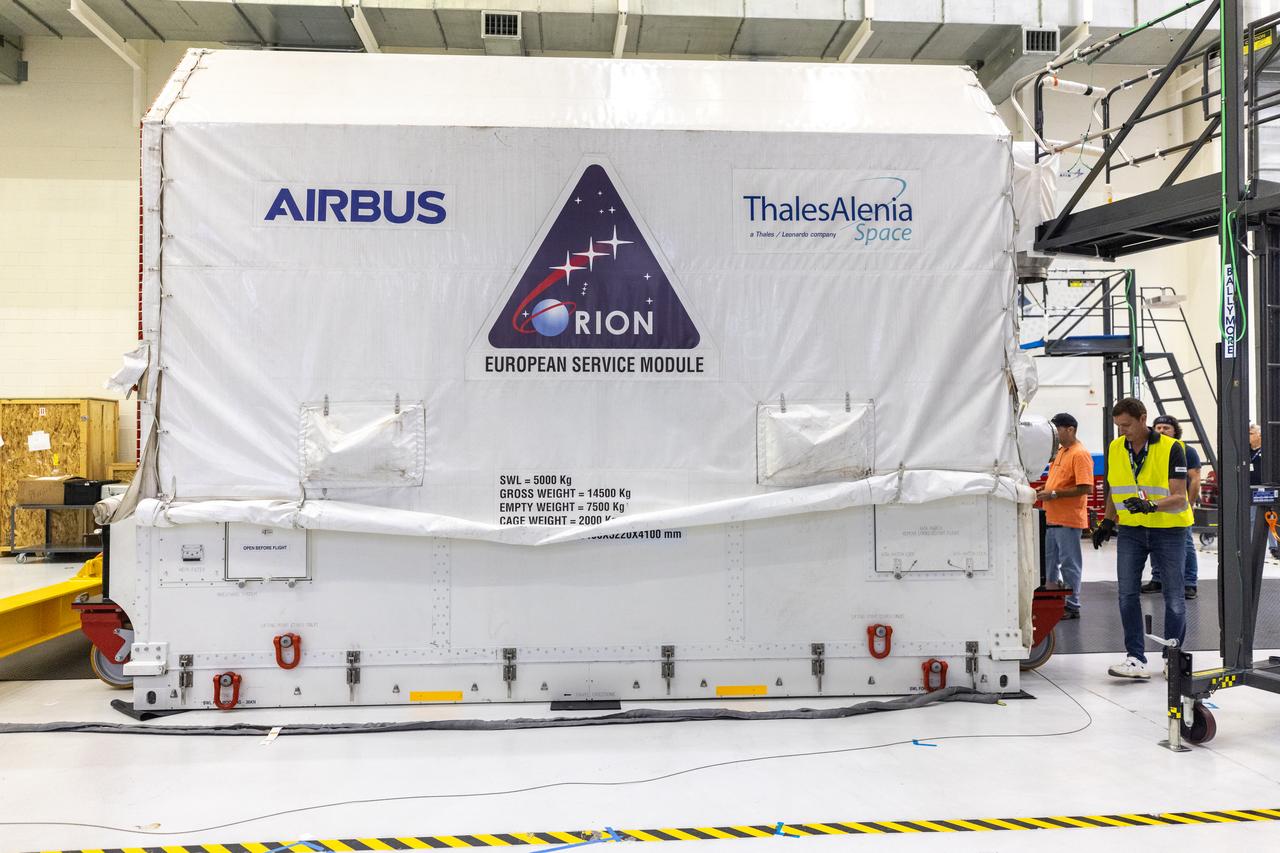
The transport carrier containing the European Service Module for NASA’s Artemis III mission arrives at the Neil A. Armstrong Operations and Checkout Building at NASA’s Kennedy Space Center in Florida on Tuesday, Sept. 3, 2024. The European Service Module, which is assembled by Airbus in Bremen, Germany, from parts made in 10 European countries and the United States, acts as the driving force behind Orion for deep space exploration, providing essential propulsion, thermal control, and electrical power.
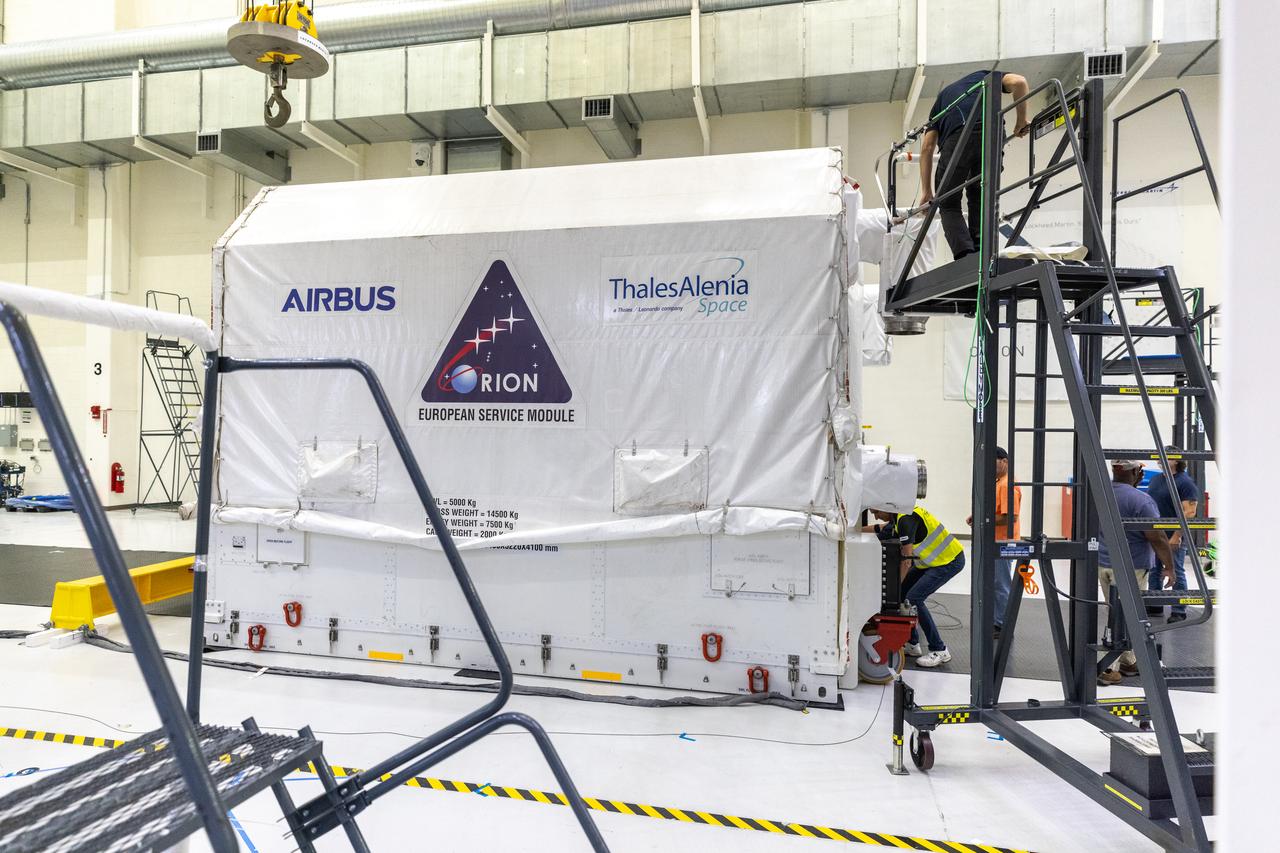
The transport carrier containing the European Service Module for NASA’s Artemis III mission arrives at the Neil A. Armstrong Operations and Checkout Building at NASA’s Kennedy Space Center in Florida on Tuesday, Sept. 3, 2024. The European Service Module, which is assembled by Airbus in Bremen, Germany, from parts made in 10 European countries and the United States, acts as the driving force behind Orion for deep space exploration, providing essential propulsion, thermal control, and electrical power.
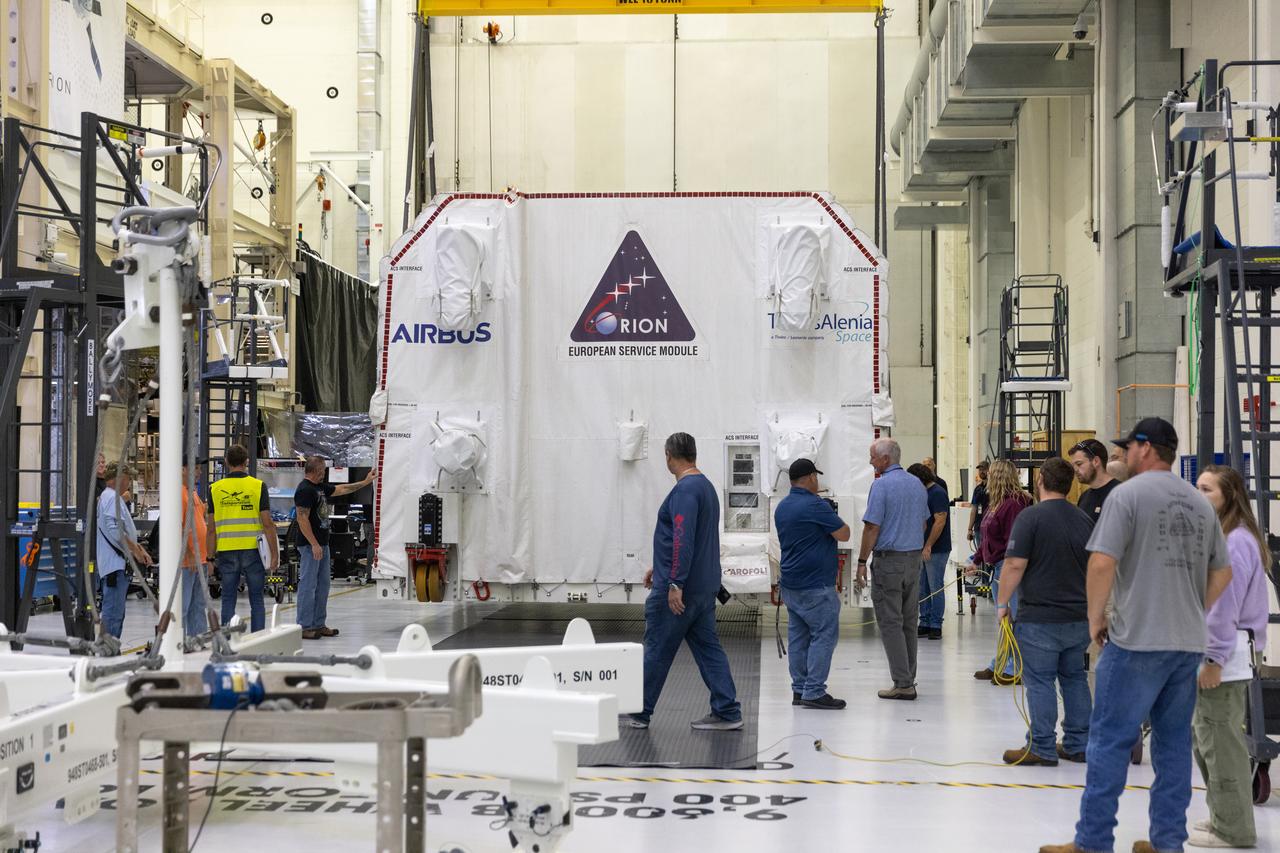
The transport carrier containing the European Service Module for NASA’s Artemis III mission arrives at the Neil A. Armstrong Operations and Checkout Building at NASA’s Kennedy Space Center in Florida on Tuesday, Sept. 3, 2024. The European Service Module, which is assembled by Airbus in Bremen, Germany, from parts made in 10 European countries and the United States, acts as the driving force behind Orion for deep space exploration, providing essential propulsion, thermal control, and electrical power.

The transport carrier containing the European Service Module for NASA’s Artemis III mission arrives at the Neil A. Armstrong Operations and Checkout Building at NASA’s Kennedy Space Center in Florida on Tuesday, Sept. 3, 2024. The European Service Module, which is assembled by Airbus in Bremen, Germany, from parts made in 10 European countries and the United States, acts as the driving force behind Orion for deep space exploration, providing essential propulsion, thermal control, and electrical power.
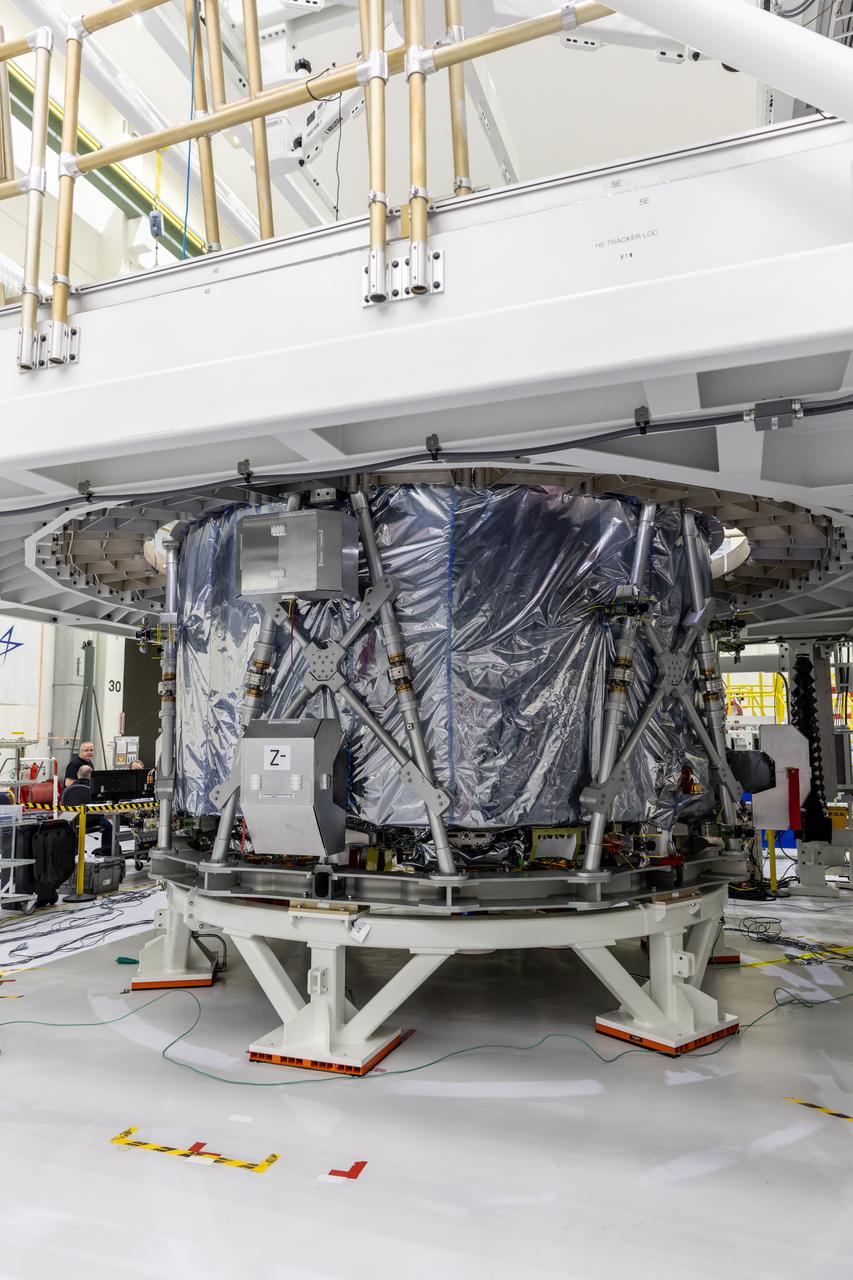
The transport carrier containing the European Service Module for NASA’s Artemis III mission arrives at the Neil A. Armstrong Operations and Checkout Building at NASA’s Kennedy Space Center in Florida on Tuesday, Sept. 3, 2024. The European Service Module, which is assembled by Airbus in Bremen, Germany, from parts made in 10 European countries and the United States, acts as the driving force behind Orion for deep space exploration, providing essential propulsion, thermal control, and electrical power.
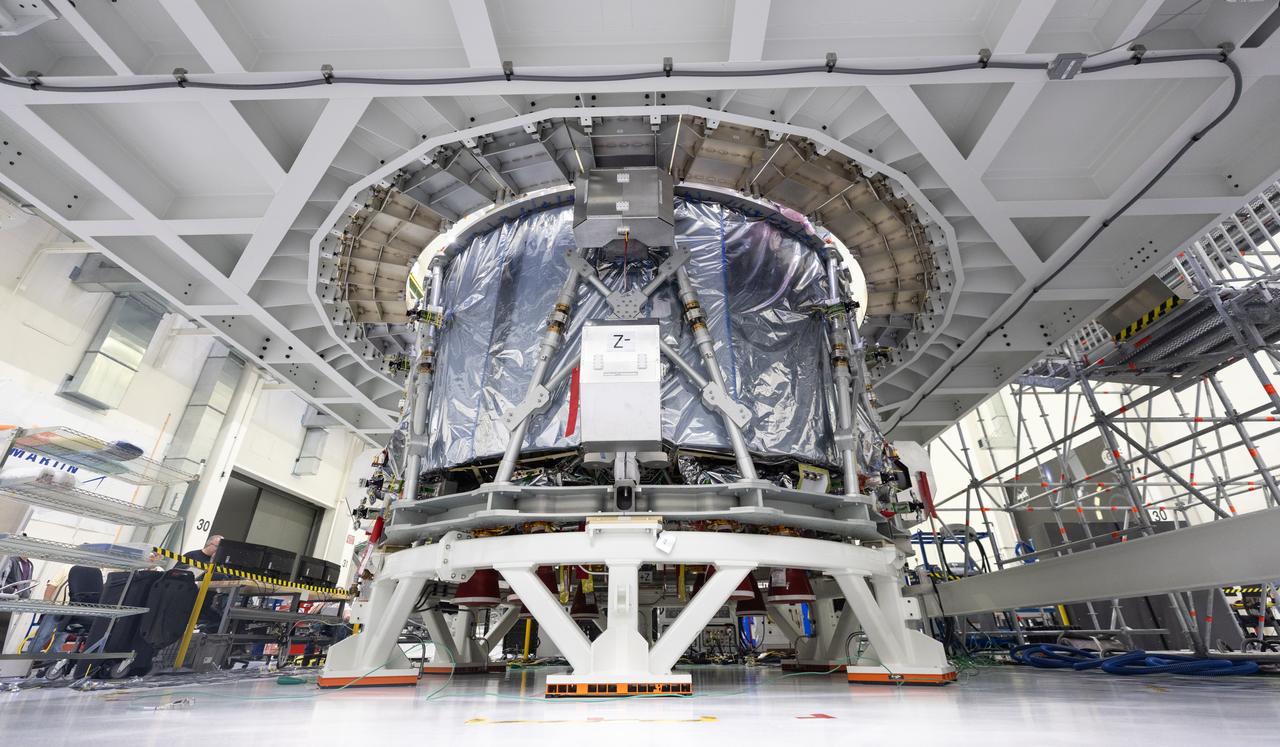
The transport carrier containing the European Service Module for NASA’s Artemis III mission arrives at the Neil A. Armstrong Operations and Checkout Building at NASA’s Kennedy Space Center in Florida on Tuesday, Sept. 3, 2024. The European Service Module, which is assembled by Airbus in Bremen, Germany, from parts made in 10 European countries and the United States, acts as the driving force behind Orion for deep space exploration, providing essential propulsion, thermal control, and electrical power.

The Orion crew module adapter for NASA’s Artemis III campaign undergoes wiring installs inside the Neil A. Armstrong Operations and Checkout Building at NASA’s Kennedy Space Center on Wednesday, Sept. 4, 2024. In Orion’s final configuration before launch, the crew module adapter connects the capsule to the European Service Module 3. The crew module adapter houses electronic equipment for communications, power, and control, and includes an umbilical connector that bridges the electrical, data, and fluid systems between the main modules.
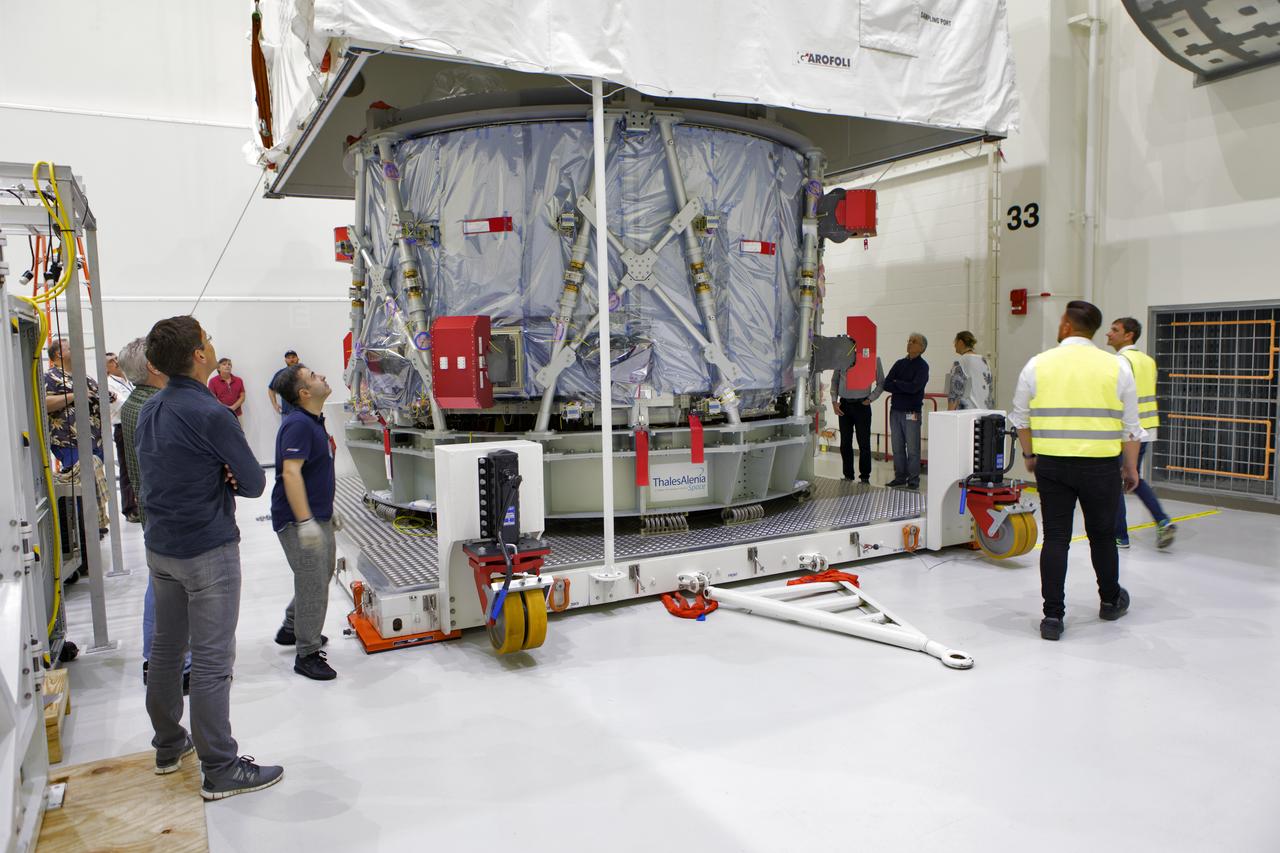
Inside the airlock in the Neil Armstrong Operations and Checkout Building high bay On Nov. 6, 2018, European Space Agency (ESA) and Airbus engineers and technicians watch as a crane is used to uncrate the ESA's European Service Module (ESM) at NASA's Kennedy Space Center in Florida. The ESM will supply the main propulsion system and power to the Orion spacecraft for Exploration Mission-1 (EM-1), a mission to the Moon. The ESM also will house air and water for astronauts on future missions. EM-1 will be an uncrewed flight test that will provide a foundation for human deep space exploration to destinations beyond Earth orbit. EM-1 will be the first integrated test of NASA's Space Launch System, Orion and the ground systems at Kennedy.
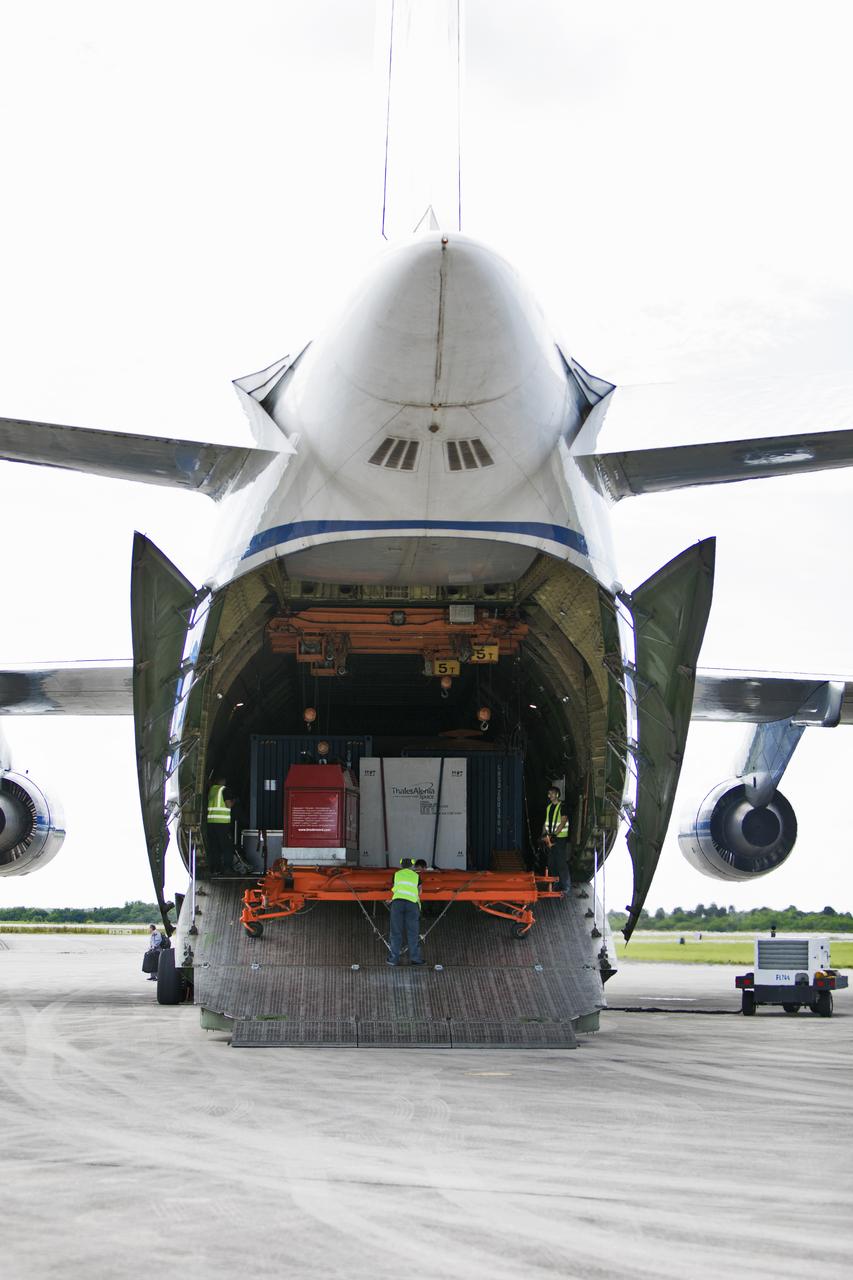
The Antonov cargo aircraft is open on the tarmac at the Shuttle Landing Facility at NASA's Kennedy Space Center in Florida on Nov. 6, 2018. The European Service Module (ESM) for Exploration Mission-1 (EM-1) will be offloaded from the cargo hold. The ESM, built by the European Space Agency, will supply the main propulsion system and power to the Orion spacecraft for Exploration Mission-1 (EM-1), a mission to the Moon. The ESM also will house air and water for astronauts on future missions. EM-1 will be an uncrewed flight test that will provide a foundation for human deep space exploration to destinations beyond Earth orbit. EM-1 will be the first integrated test of NASA's Space Launch System, Orion and the ground systems at Kennedy.
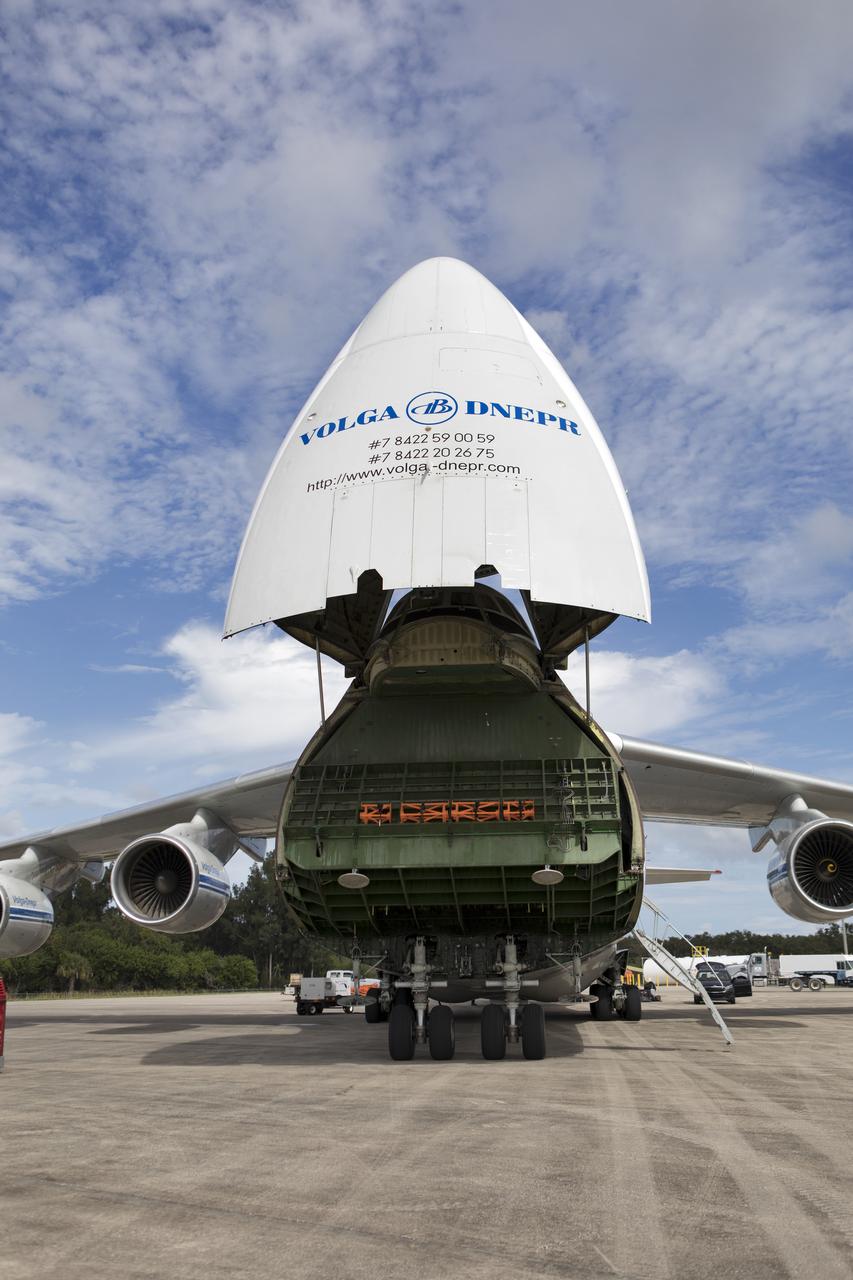
The Antonov cargo aircraft is open on the tarmac at the Shuttle Landing Facility at NASA's Kennedy Space Center in Florida on Nov. 6, 2018. The European Service Module (ESM) for Exploration Mission-1 (EM-1) will be offloaded from the cargo hold. The ESM, built by the European Space Agency, will supply the main propulsion system and power to the Orion spacecraft for Exploration Mission-1 (EM-1), a mission to the Moon. The ESM also will house air and water for astronauts on future missions. EM-1 will be an uncrewed flight test that will provide a foundation for human deep space exploration to destinations beyond Earth orbit. EM-1 will be the first integrated test of NASA's Space Launch System, Orion and the ground systems at Kennedy.
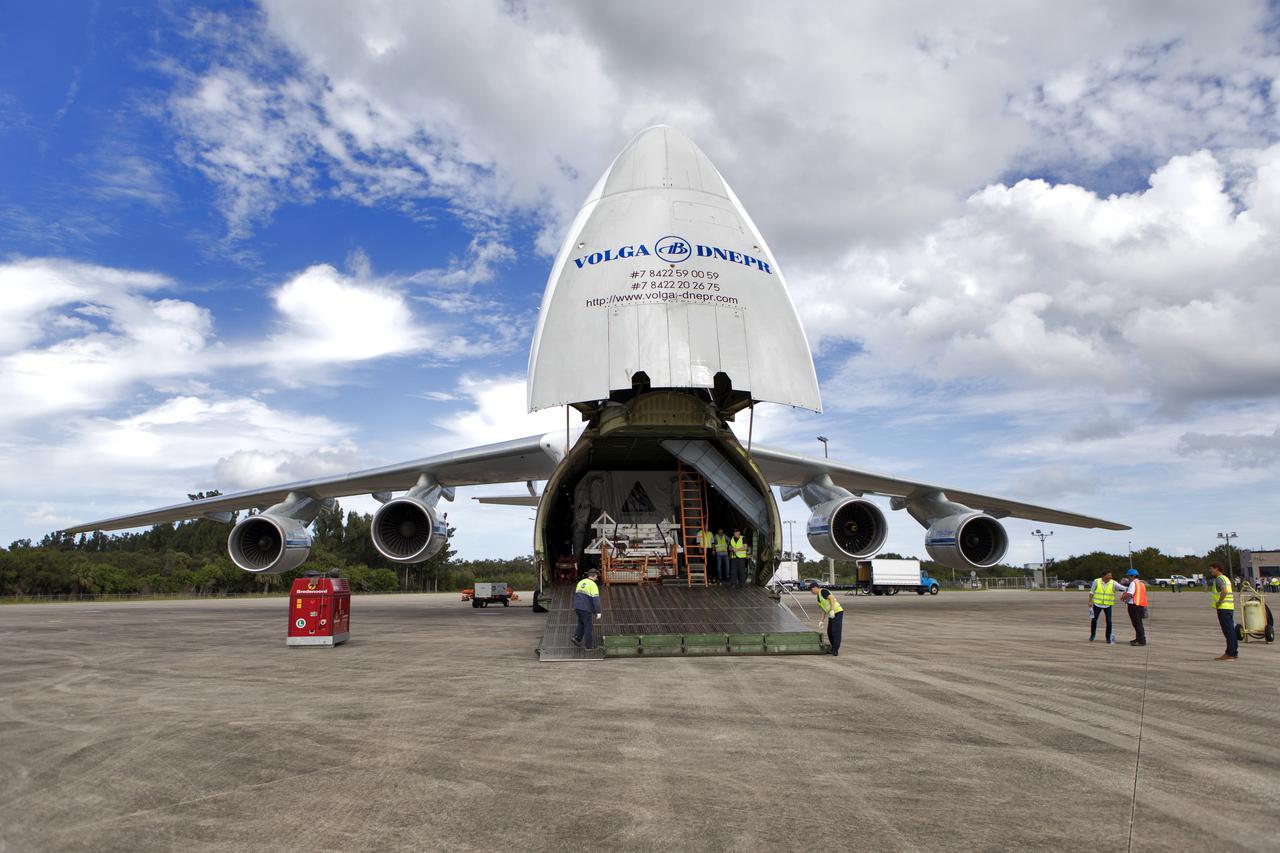
The Antonov cargo aircraft is open on the tarmac at the Shuttle Landing Facility at NASA's Kennedy Space Center in Florida on Nov. 6, 2018. The European Service Module (ESM) for Exploration Mission-1 (EM-1) will be offloaded from the cargo hold. The ESM, built by the European Space Agency, will supply the main propulsion system and power to the Orion spacecraft for Exploration Mission-1 (EM-1), a mission to the Moon. The ESM also will house air and water for astronauts on future missions. EM-1 will be an uncrewed flight test that will provide a foundation for human deep space exploration to destinations beyond Earth orbit. EM-1 will be the first integrated test of NASA's Space Launch System, Orion and the ground systems at Kennedy.
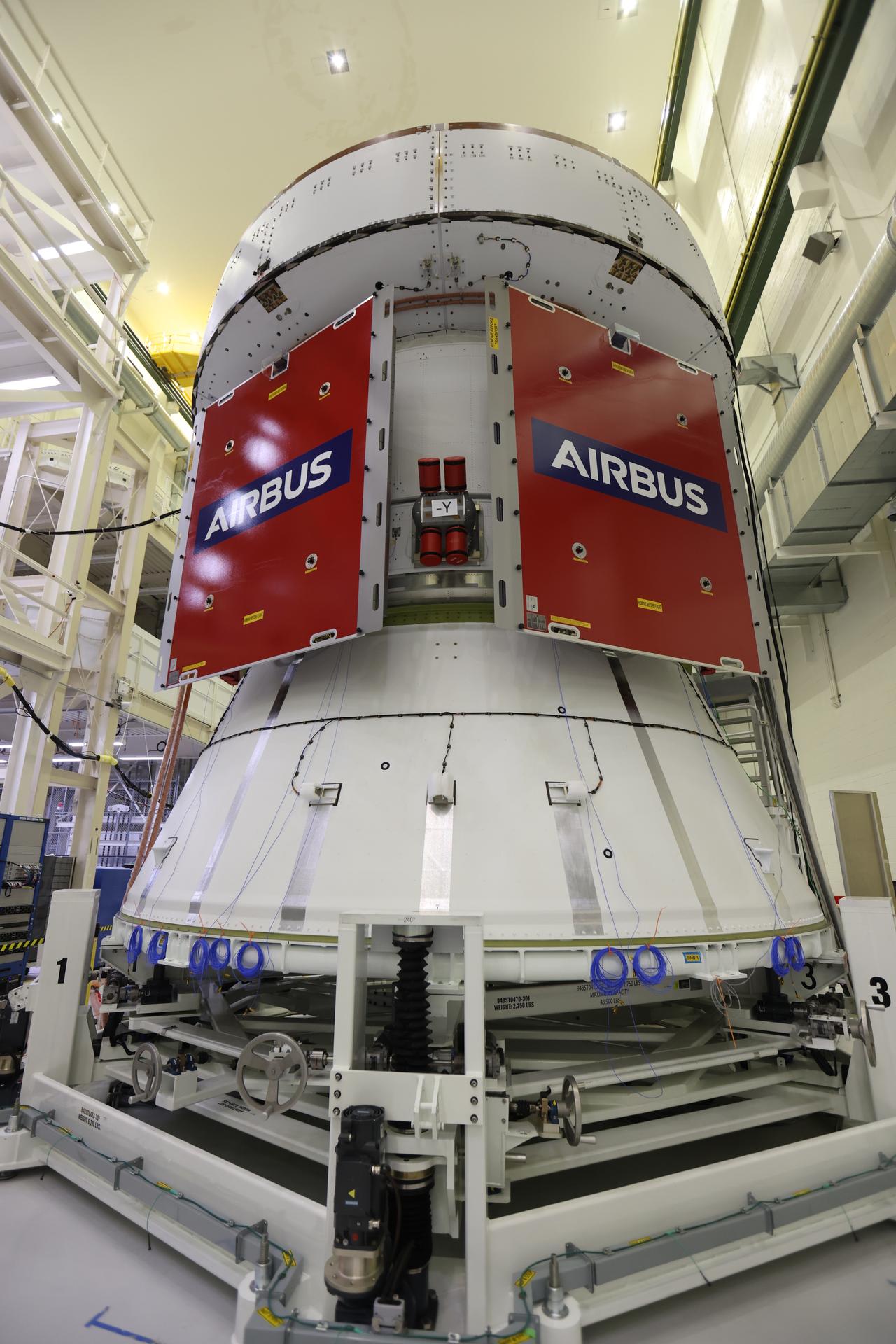
NASA and its partners work on the solar array wings for the agency’s Artemis III Orion spacecraft on Thursday, April 30, 2026, inside the Neil A. Armstrong Operations and Checkout Building at NASA’s Kennedy Space Center in Florida. Orion’s solar arrays, manufactured and installed by ESA (European Space Agency) and its contractor Airbus, have been temporarily installed ahead of acoustic testing on the spacecraft. The Artemis III mission will launch astronauts in 2027 to Earth’s orbit aboard the Orion spacecraft on top of the SLS (Space Launch System) rocket to test rendezvous and docking capabilities between Orion and commercial spacecraft needed to land Artemis IV astronauts on the Moon in 2028.
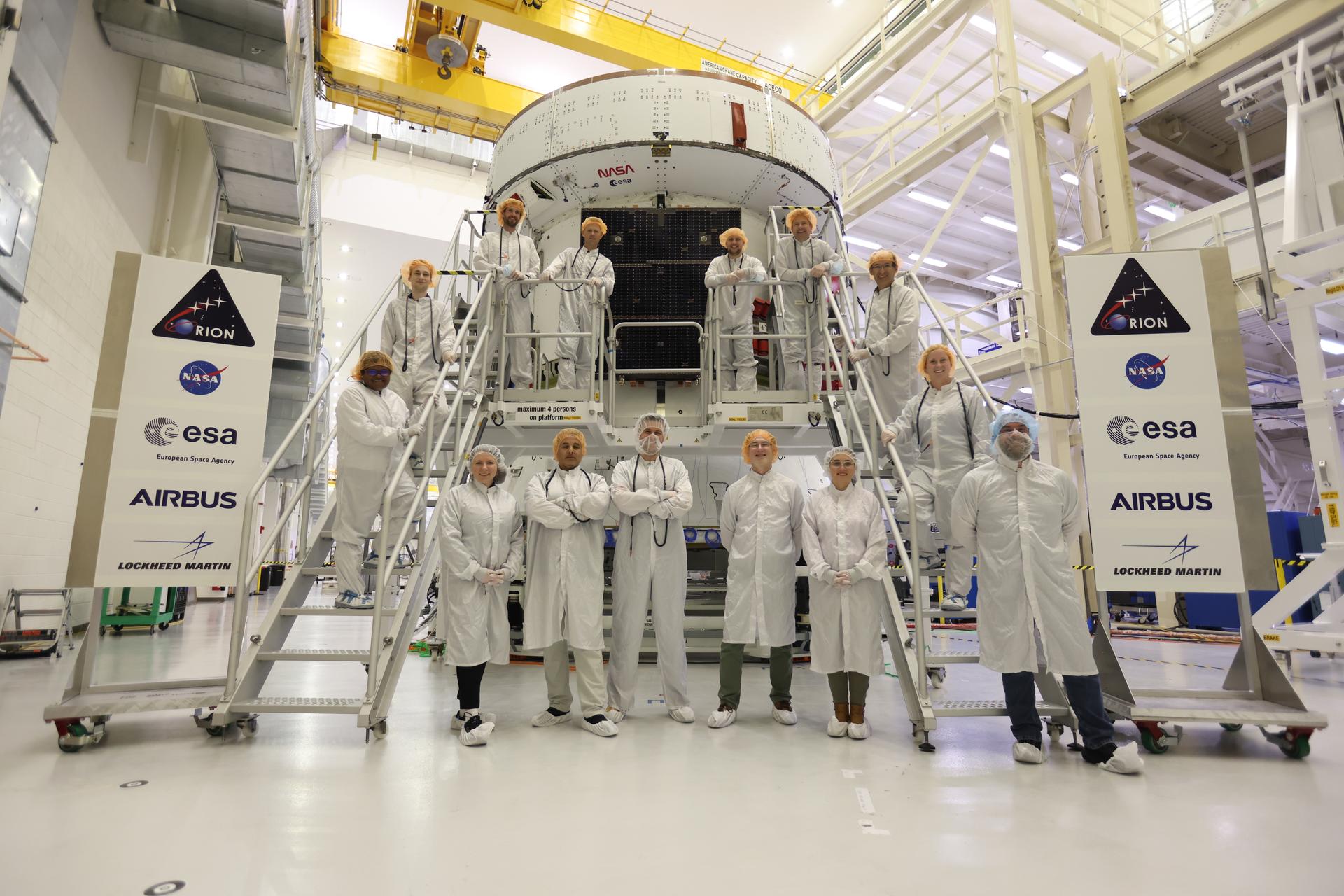
NASA and its partners work on the solar array wings for the agency’s Artemis III Orion spacecraft on Thursday, April 30, 2026, inside the Neil A. Armstrong Operations and Checkout Building at NASA’s Kennedy Space Center in Florida. Orion’s solar arrays, manufactured and installed by ESA (European Space Agency) and its contractor Airbus, have been temporarily installed ahead of acoustic testing on the spacecraft. The Artemis III mission will launch astronauts in 2027 to Earth’s orbit aboard the Orion spacecraft on top of the SLS (Space Launch System) rocket to test rendezvous and docking capabilities between Orion and commercial spacecraft needed to land Artemis IV astronauts on the Moon in 2028.

NASA and its partners work on the solar array wings for the agency’s Artemis III Orion spacecraft on Thursday, April 30, 2026, inside the Neil A. Armstrong Operations and Checkout Building at NASA’s Kennedy Space Center in Florida. Orion’s solar arrays, manufactured and installed by ESA (European Space Agency) and its contractor Airbus, have been temporarily installed ahead of acoustic testing on the spacecraft. The Artemis III mission will launch astronauts in 2027 to Earth’s orbit aboard the Orion spacecraft on top of the SLS (Space Launch System) rocket to test rendezvous and docking capabilities between Orion and commercial spacecraft needed to land Artemis IV astronauts on the Moon in 2028.
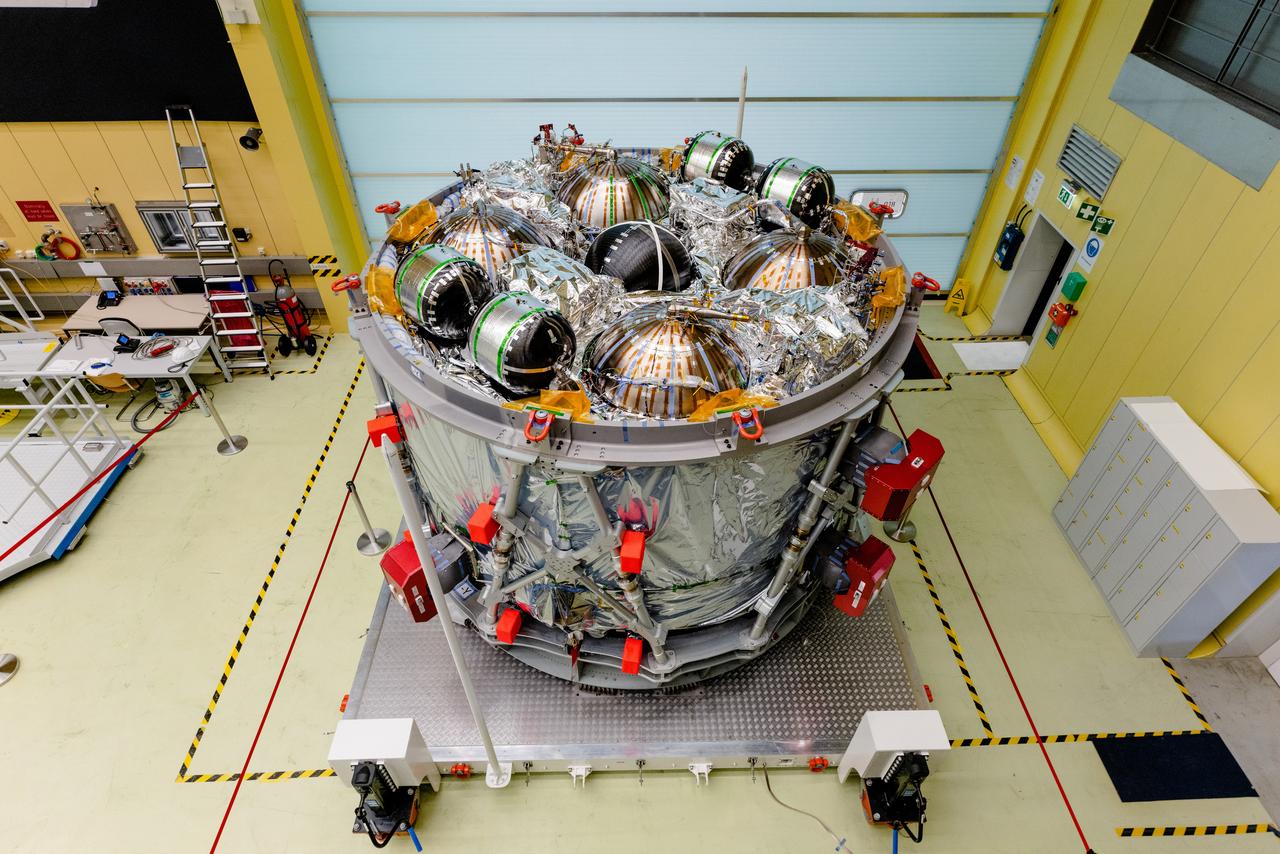
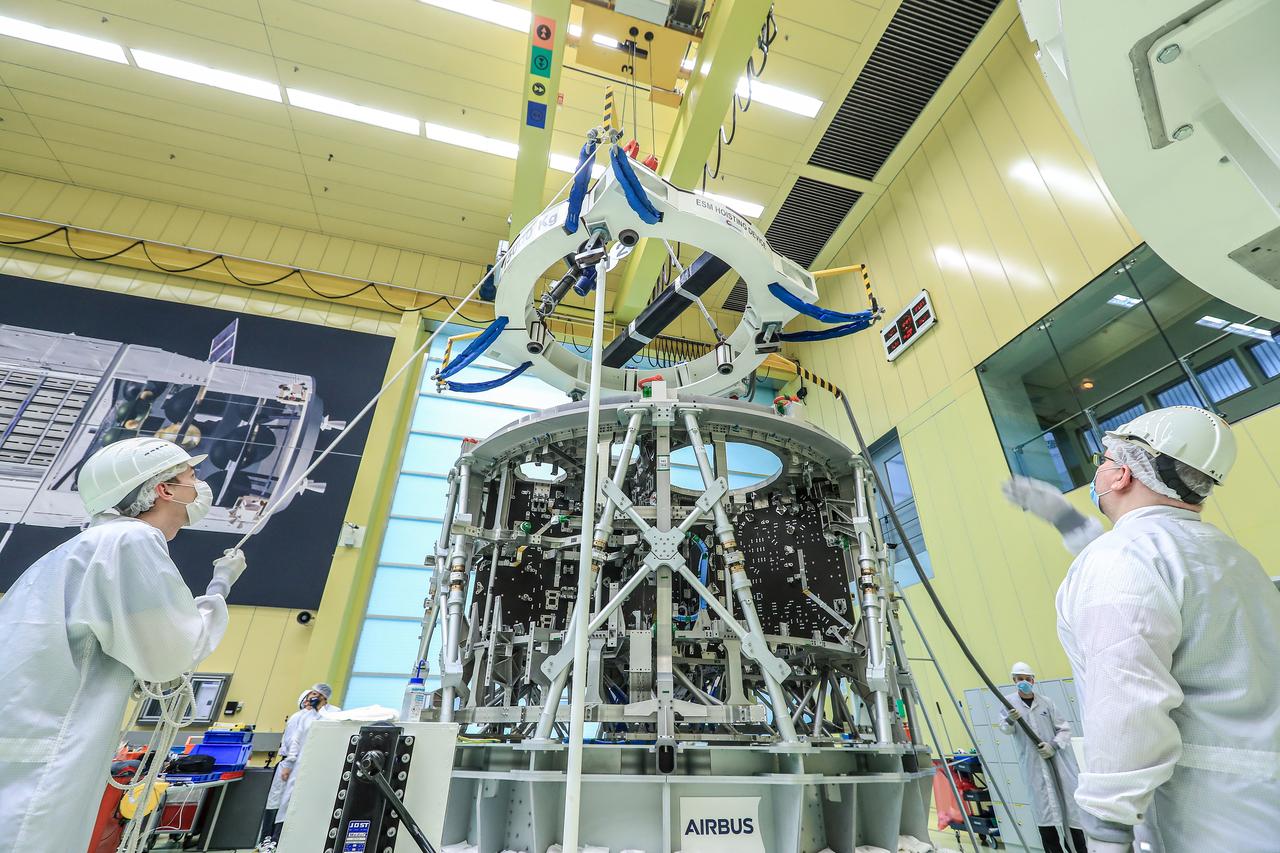
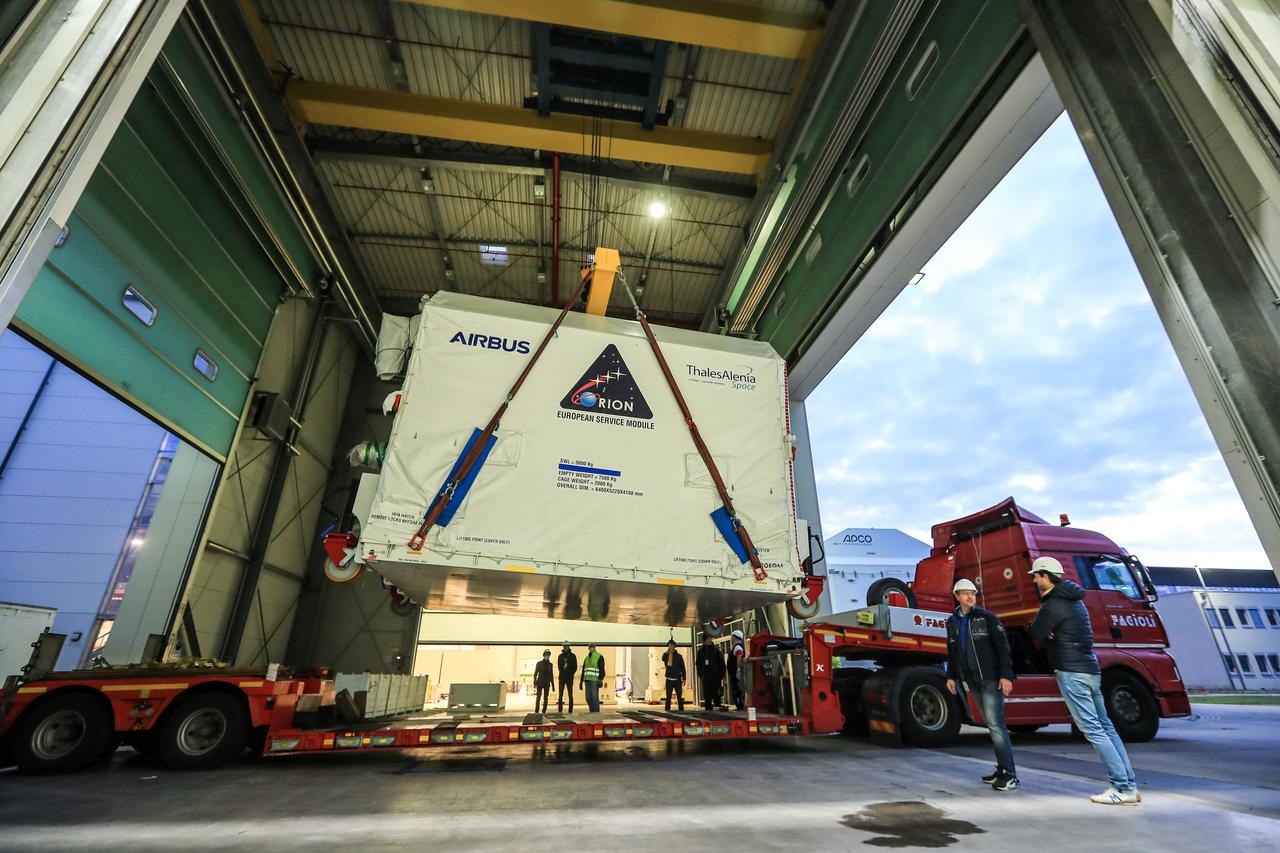
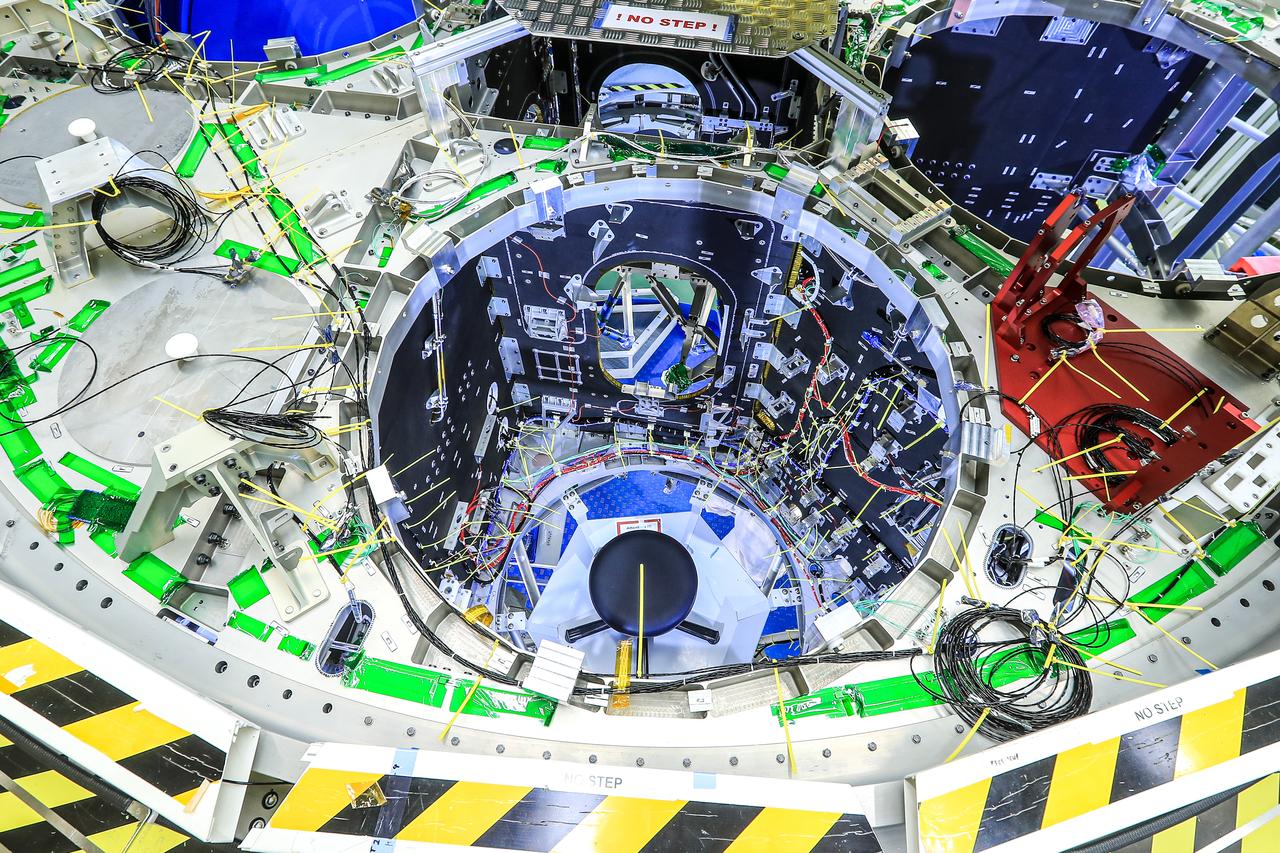
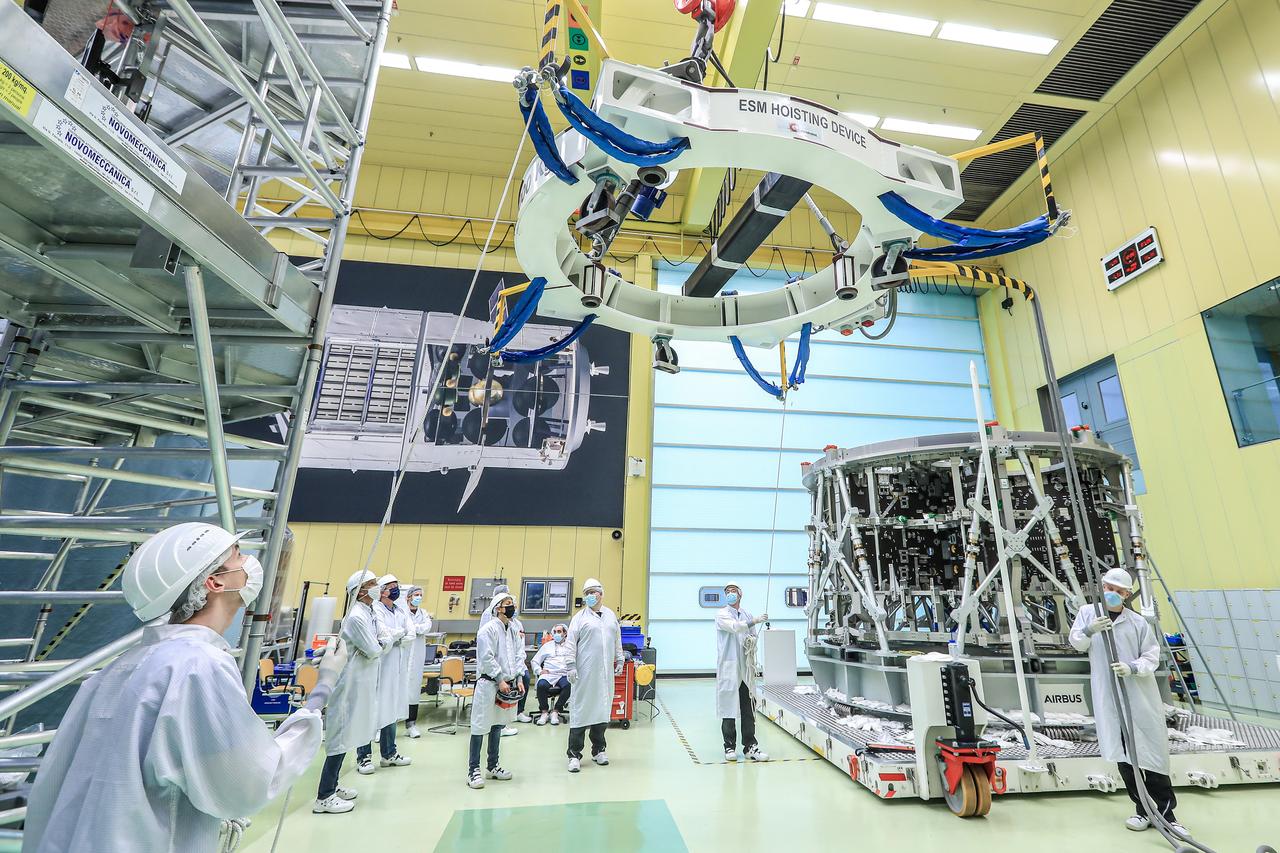
In Bremen, Germany the Airbus Space team prepares the Orion European Service Module-2 for shipment to Kennedy Space Center on Oct. 7, 2021. ESM-2 will power Orion on Artemis II, Orion's first flight with crew.
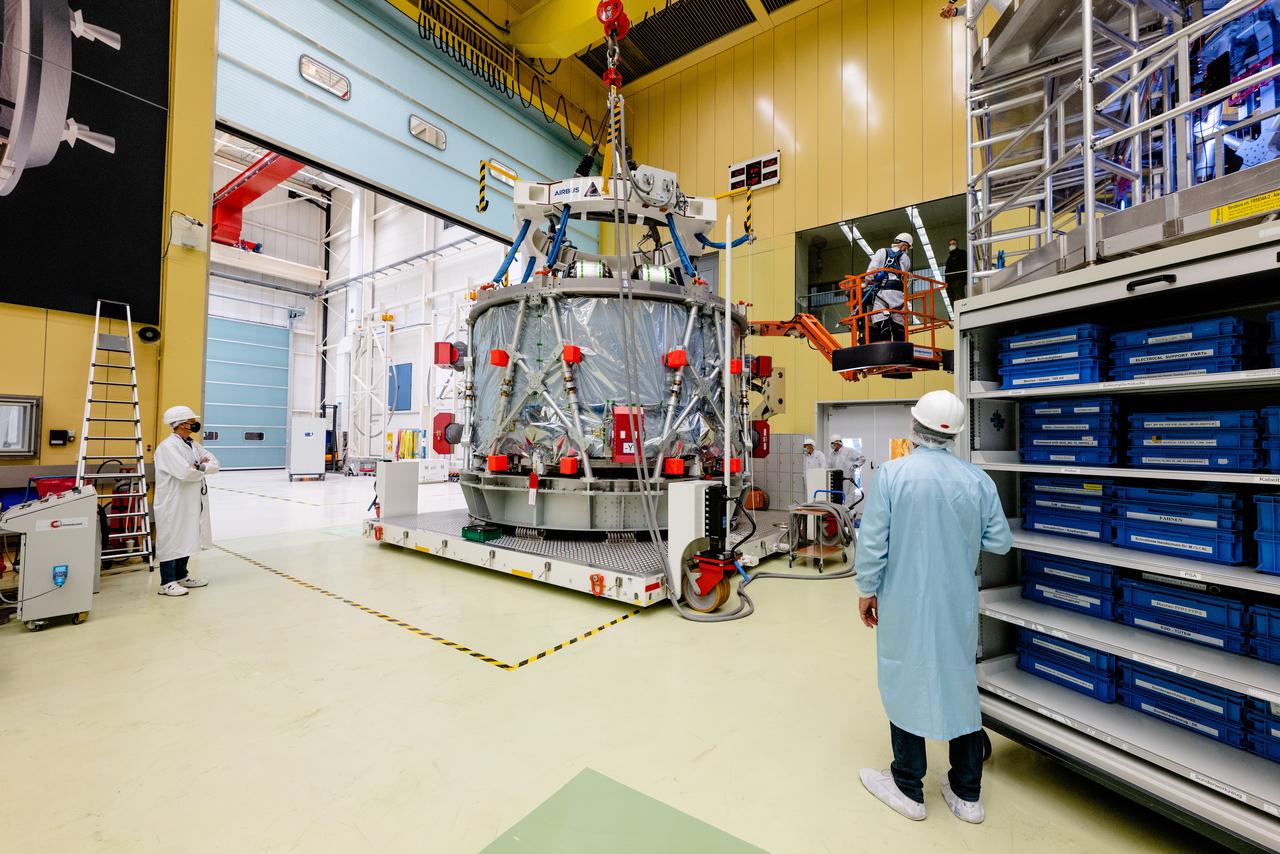
In Bremen, Germany the Airbus Space team prepares the Orion European Service Module-2 for shipment to Kennedy Space Center on Oct. 7, 2021. ESM-2 will power Orion on Artemis II, Orion's first flight with crew.
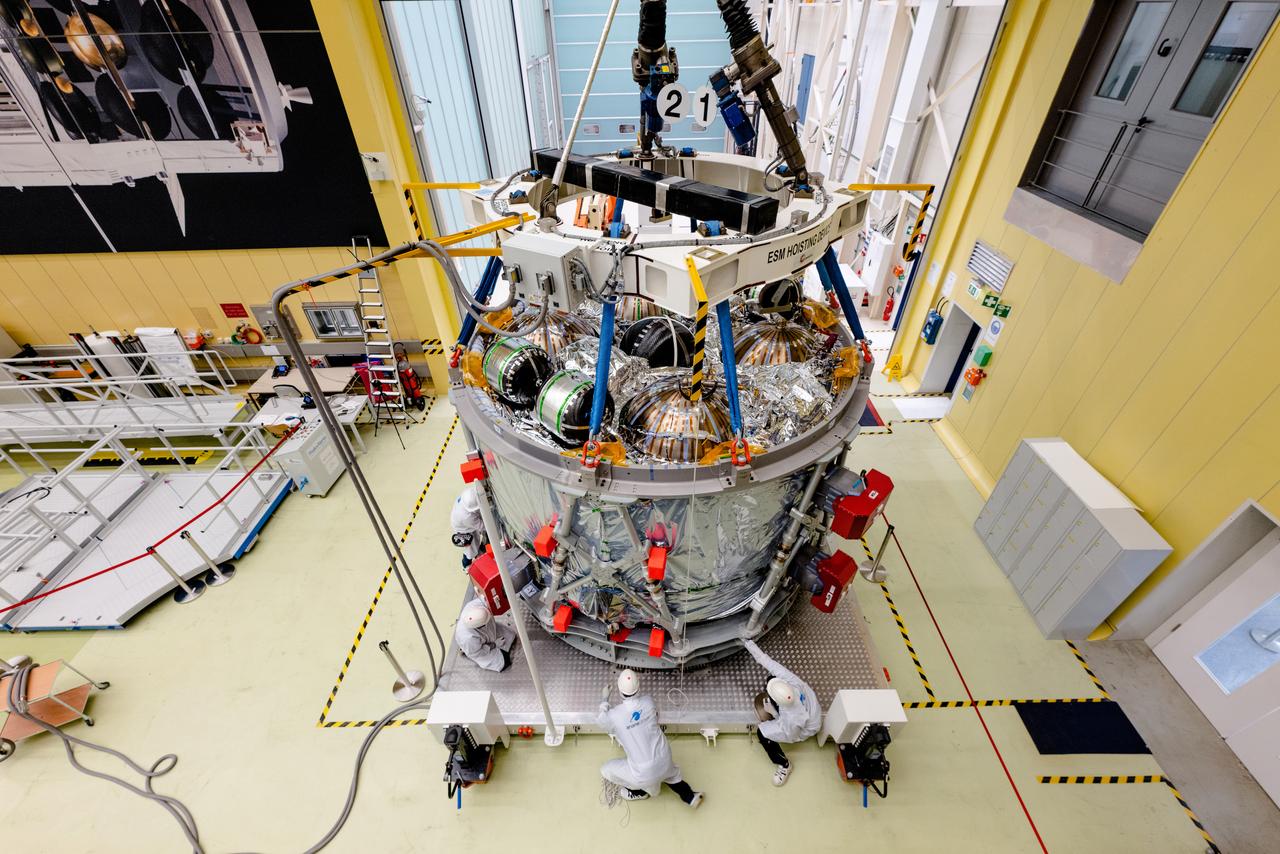
In Bremen, Germany the Airbus Space team prepares the Orion European Service Module-2 for shipment to Kennedy Space Center on Oct. 7, 2021. ESM-2 will power Orion on Artemis II, Orion's first flight with crew.
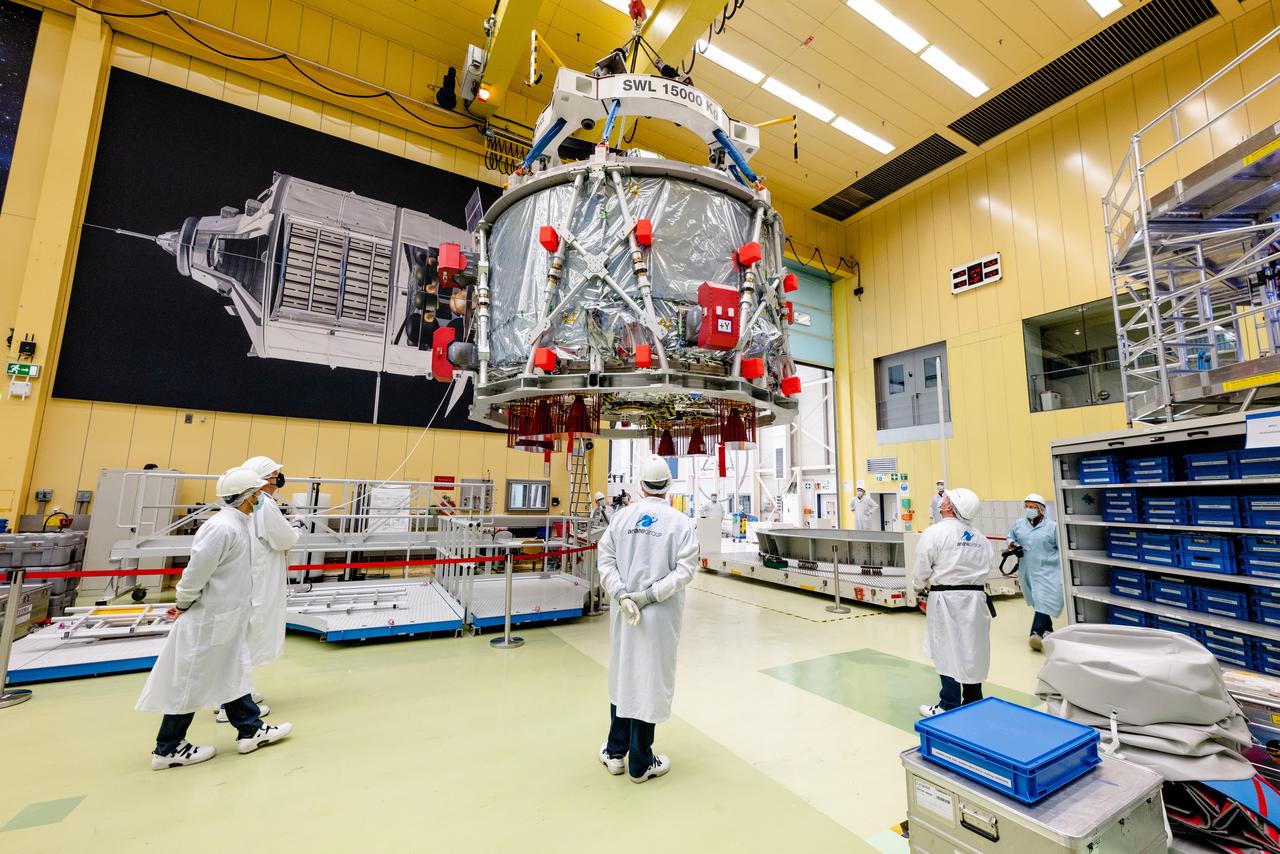
In Bremen, Germany the Airbus Space team prepares the Orion European Service Module-2 for shipment to Kennedy Space Center on Oct. 7, 2021. ESM-2 will power Orion on Artemis II, Orion's first flight with crew.
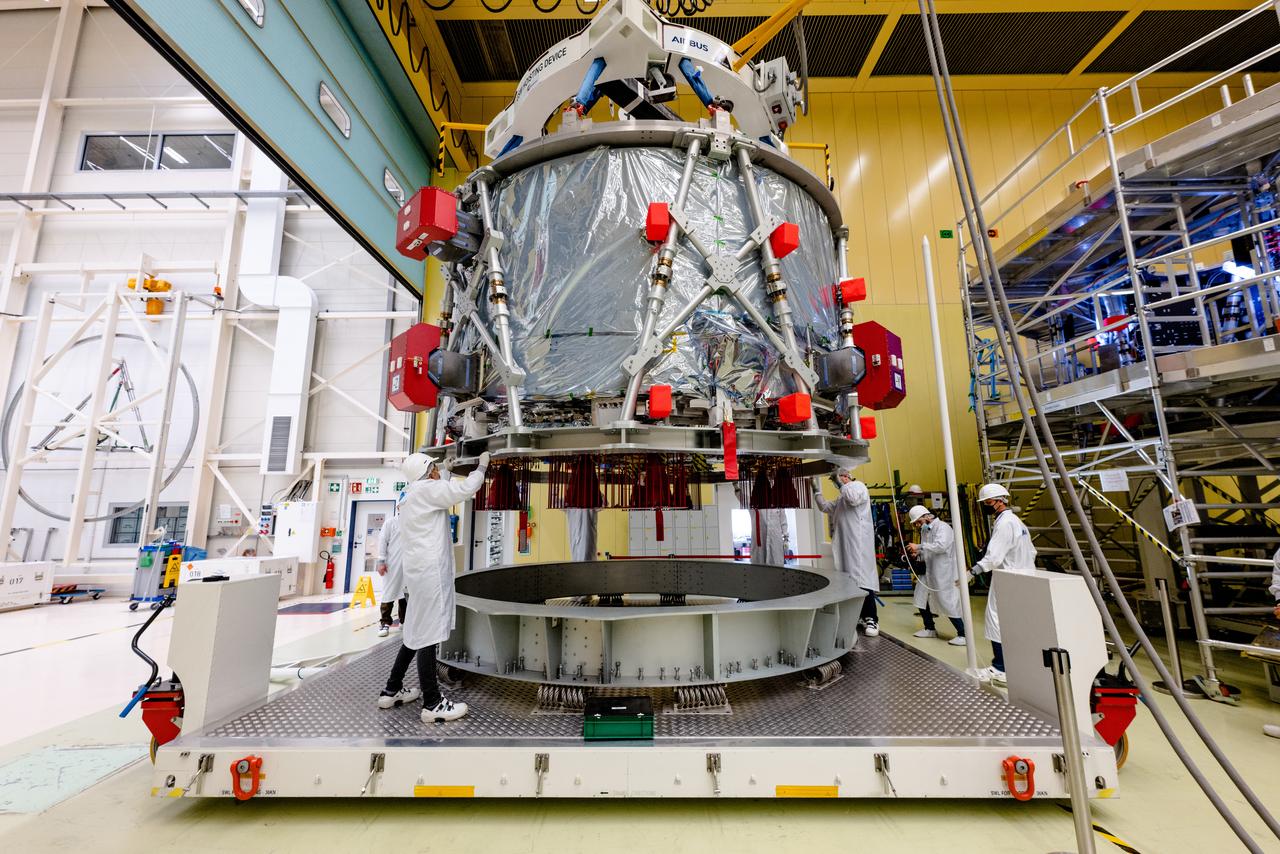
In Bremen, Germany the Airbus Space team prepares the Orion European Service Module-2 for shipment to Kennedy Space Center on Oct. 7, 2021. ESM-2 will power Orion on Artemis II, Orion's first flight with crew.
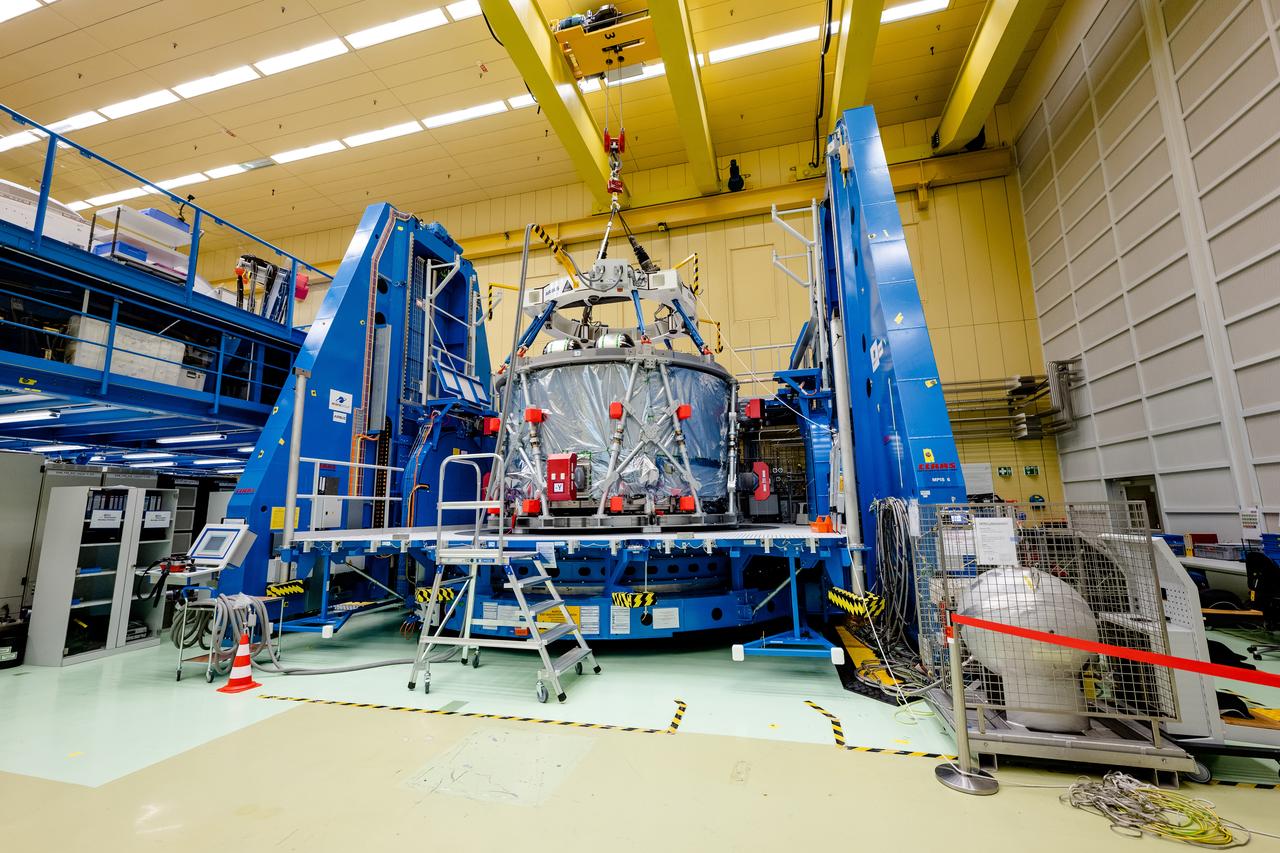
In Bremen, Germany, the Airbus Space team prepares the European Service Module-2 for shipment to Kennedy Space Center on Jan. 29, 2020. ESM-2 will power Orion on Artemis II, Orion's first flight with crew.
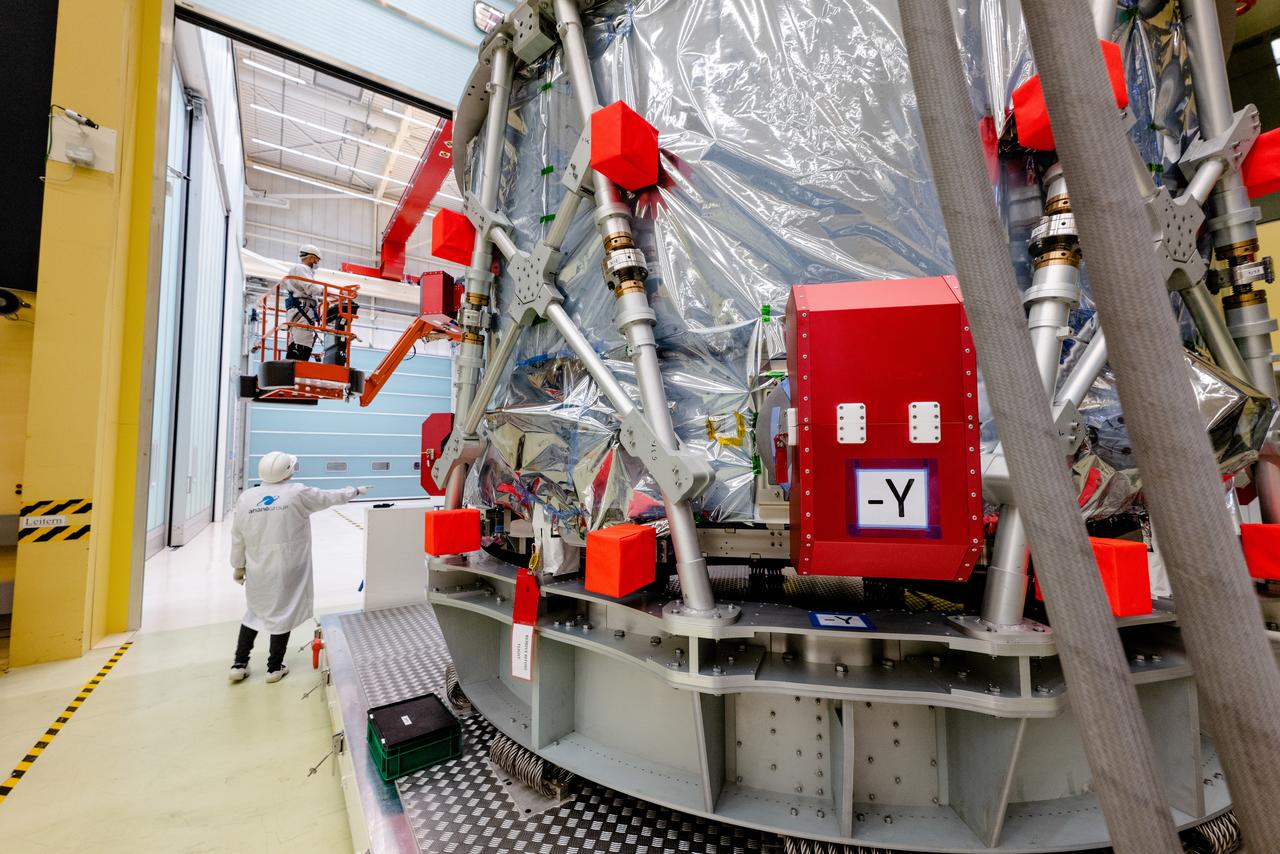
In Bremen, Germany the Airbus Space team prepares the Orion European Service Module-2 for shipment to Kennedy Space Center on Oct. 7, 2021. ESM-2 will power Orion on Artemis II, Orion's first flight with crew.

In Bremen, Germany the Airbus Space team prepares the Orion European Service Module-2 for shipment to Kennedy Space Center on Oct. 7, 2021. ESM-2 will power Orion on Artemis II, Orion's first flight with crew.
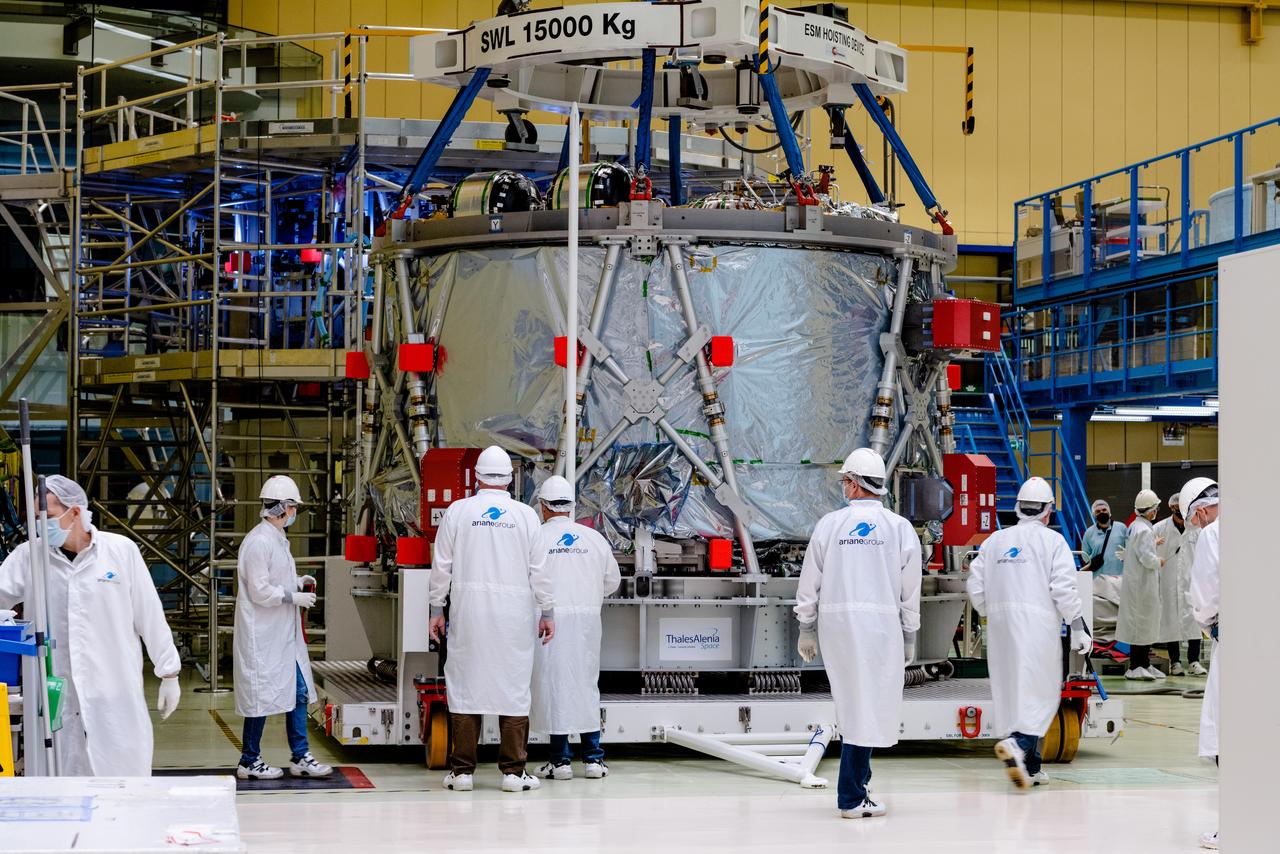
In Bremen, Germany the Airbus Space team prepares the Orion European Service Module-2 for shipment to Kennedy Space Center on Oct. 7, 2021. ESM-2 will power Orion on Artemis II, Orion's first flight with crew.
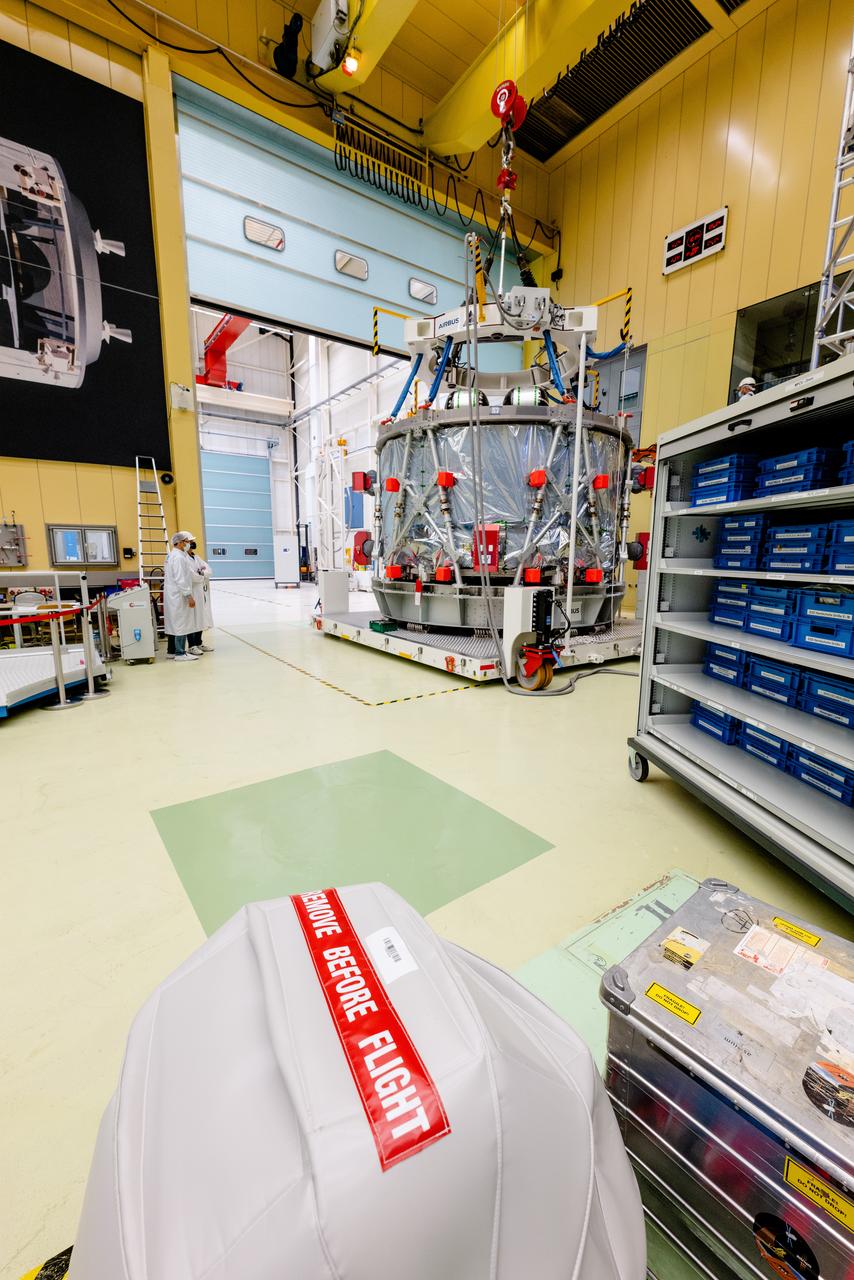
In Bremen, Germany the Airbus Space team prepares the Orion European Service Module-2 for shipment to Kennedy Space Center on Oct. 7, 2021. ESM-2 will power Orion on Artemis II, Orion's first flight with crew.
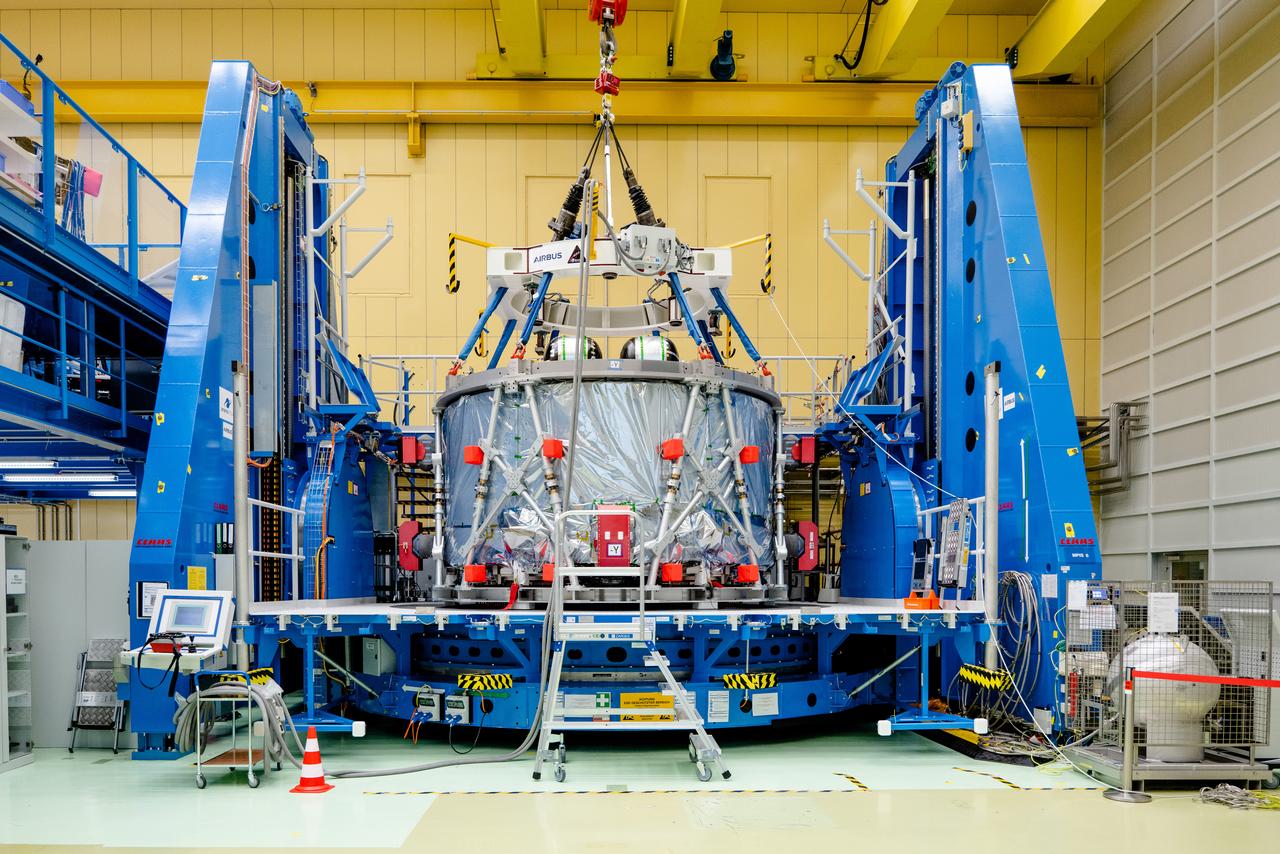
In Bremen, Germany the Airbus Space team prepares the Orion European Service Module-2 for shipment to Kennedy Space Center on Oct. 7, 2021. ESM-2 will power Orion on Artemis II, Orion's first flight with crew.
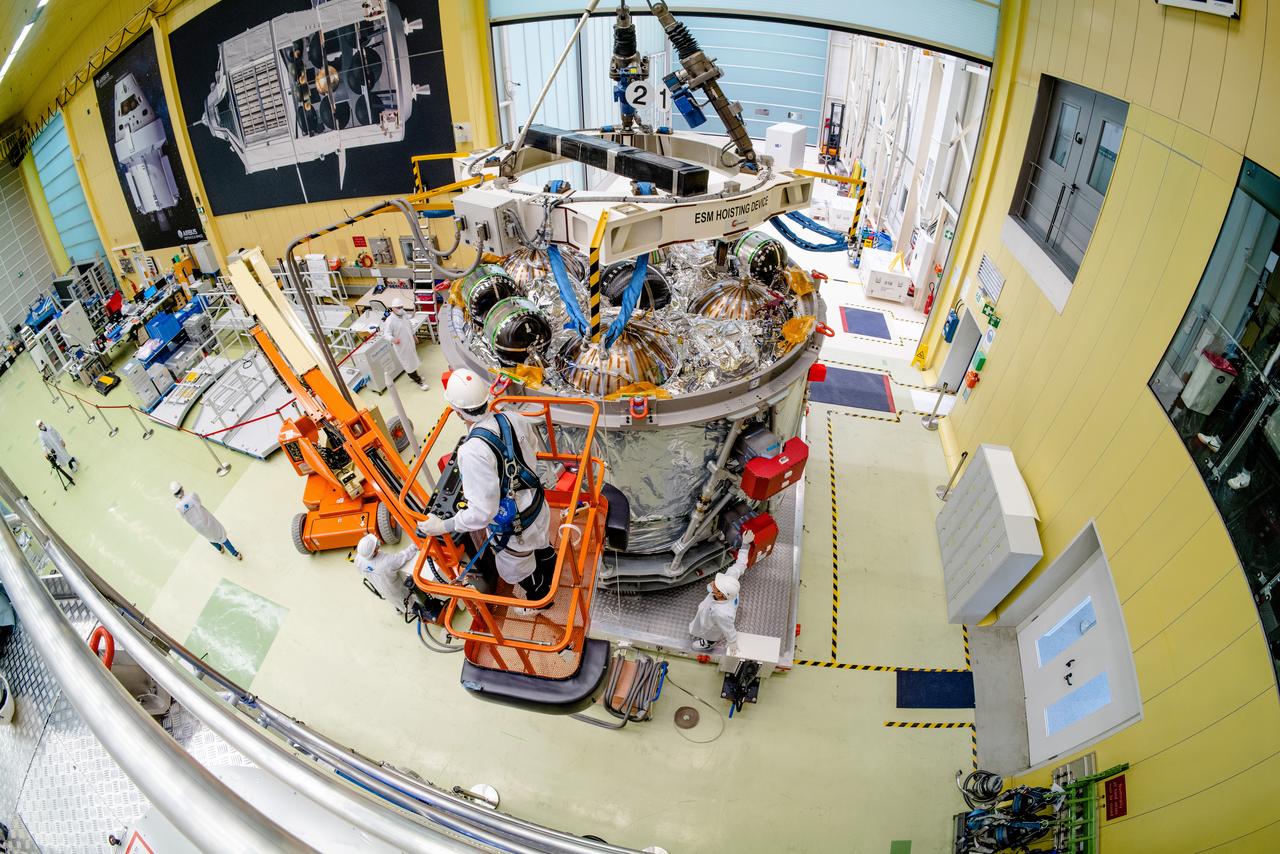
In Bremen, Germany the Airbus Space team prepares the Orion European Service Module-2 for shipment to Kennedy Space Center on Oct. 7, 2021. ESM-2 will power Orion on Artemis II, Orion's first flight with crew.