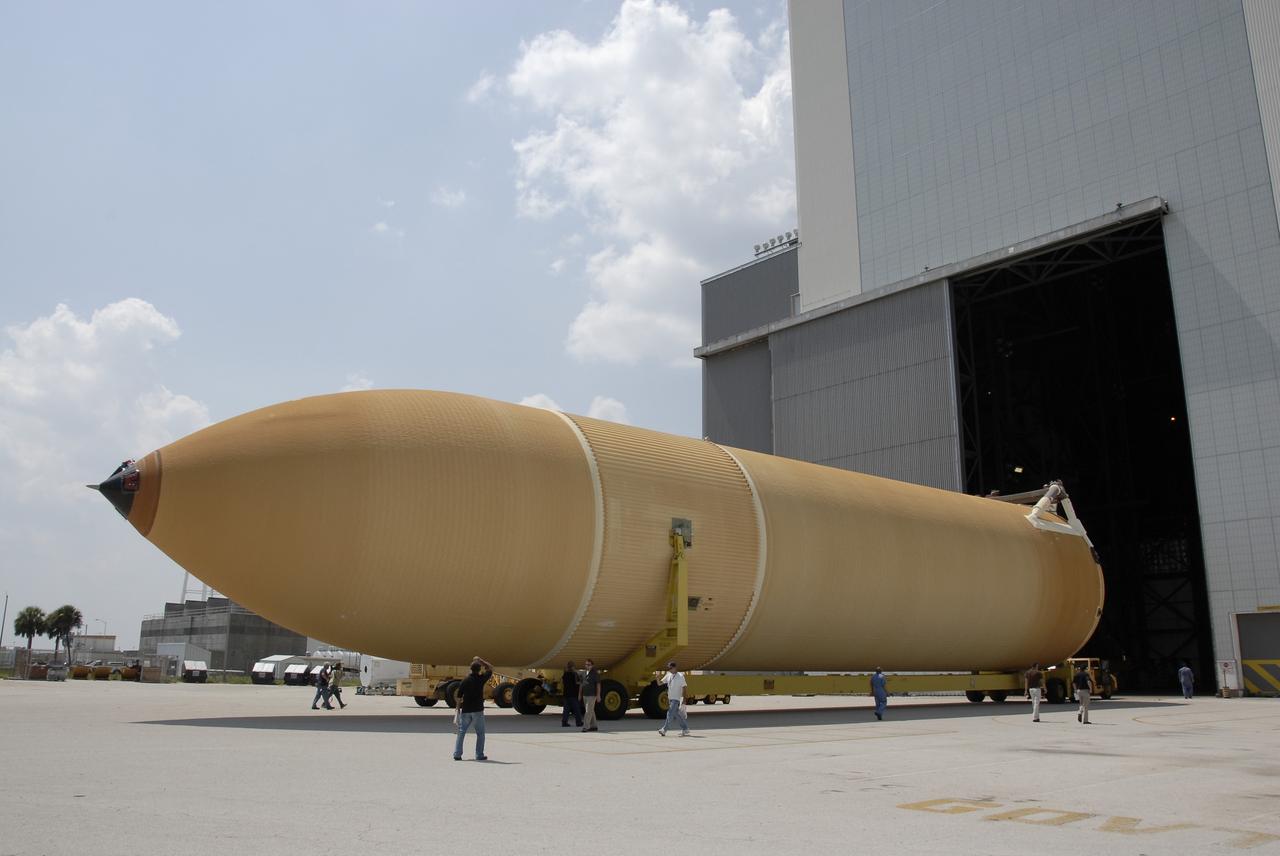
CAPE CANAVERAL, Fla. – The external fuel tank for space shuttle Endeavour's STS-126 mission to the International Space Station heads through the open door of the Vehicle Assembly Building at NASA's Kennedy Space Center. The tank arrived earlier after a six-day ocean voyage towed by a solid rocket booster retrieval ship from the Michoud Assembly Facility near New Orleans. The tank will be moved into the VAB transfer aisle, lifted and lowered into a checkout cell. The STS-126 mission will deliver a Multi-Purpose Logistics Module to the International Space Station. Launch is targeted for Nov. 10. Photo credit: NASA/Kim Shiflett
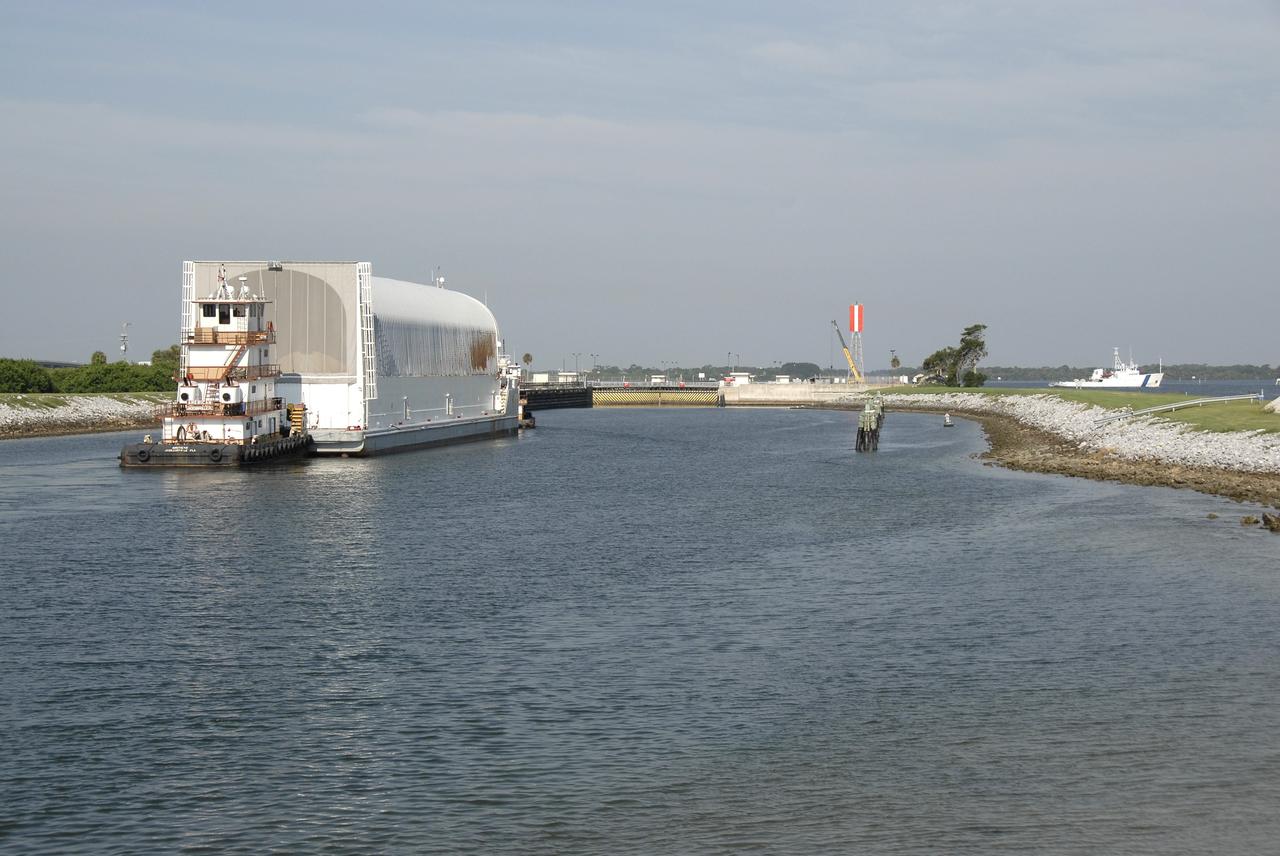
CAPE CANAVERAL, Fla. – The Pegasus barge containing the external fuel tank for space shuttle Endeavour's STS-126 mission to the International Space Station is towed by a tugboat from Port Canaveral, Fla., for its trip on the Banana River to the Launch Complex 39 Area at NASA's Kennedy Space Center. The tank will be offloaded at the turn basin near the Vehicle Assembly Building and transported to the VAB. There it will be lifted and lowered into a checkout cell. The STS-126 mission will deliver a Multi-Purpose Logistics Module to the International Space Station. Launch is targeted for Nov. 10. Photo credit: NASA/Kim Shiflett
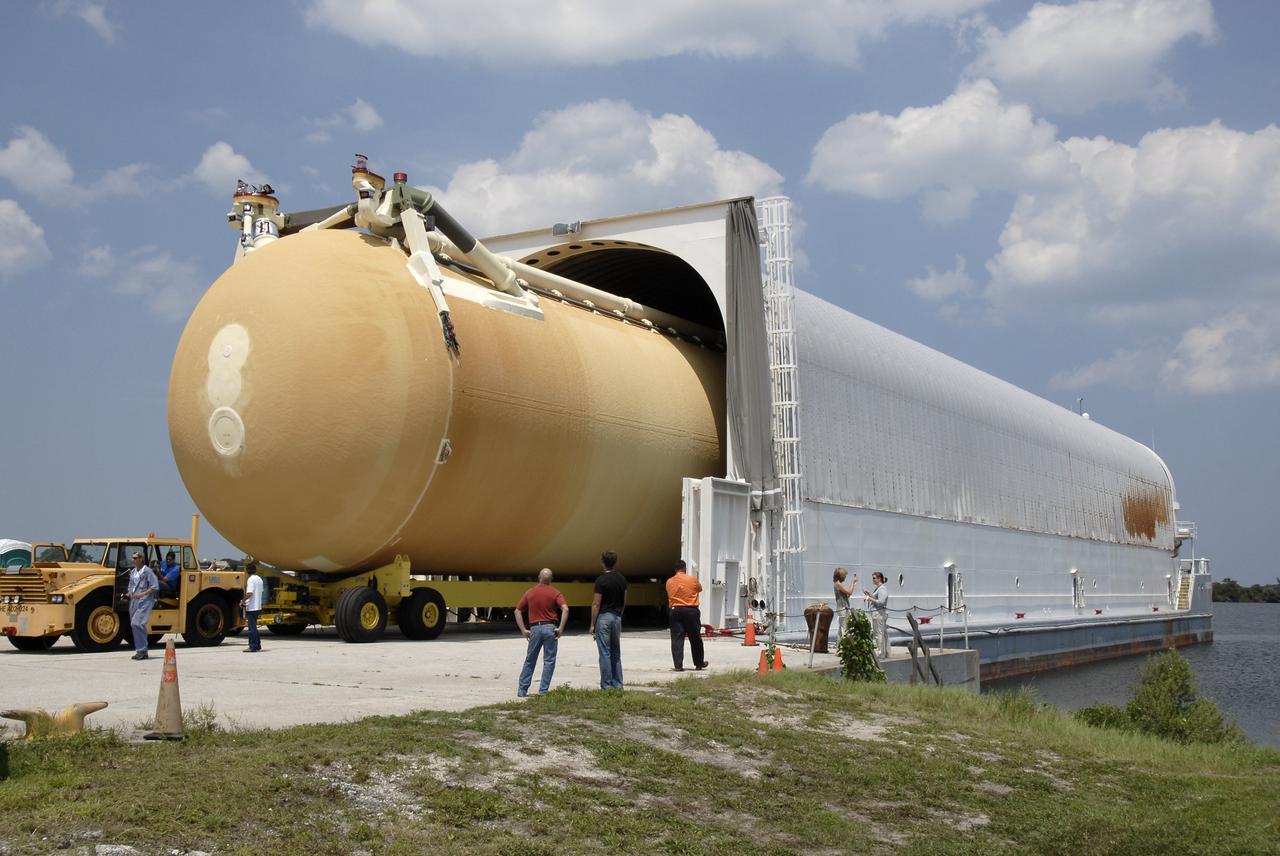
CAPE CANAVERAL, Fla. – The external fuel tank for space shuttle Endeavour's STS-126 mission to the International Space Station is offloaded from the Pegasus barge at the turn basin dock near the Vehicle Assembly Building at NASA's Kennedy Space Center. The tank arrived earlier after a six-day ocean voyage towed by a solid rocket booster retrieval ship from the Michoud Assembly Facility near New Orleans. The tank will be transported to the VAB transfer aisle, lifted and lowered into a checkout cell. The STS-126 mission will deliver a Multi-Purpose Logistics Module to the International Space Station. Launch is targeted for Nov. 10. Photo credit: NASA/Kim Shiflett
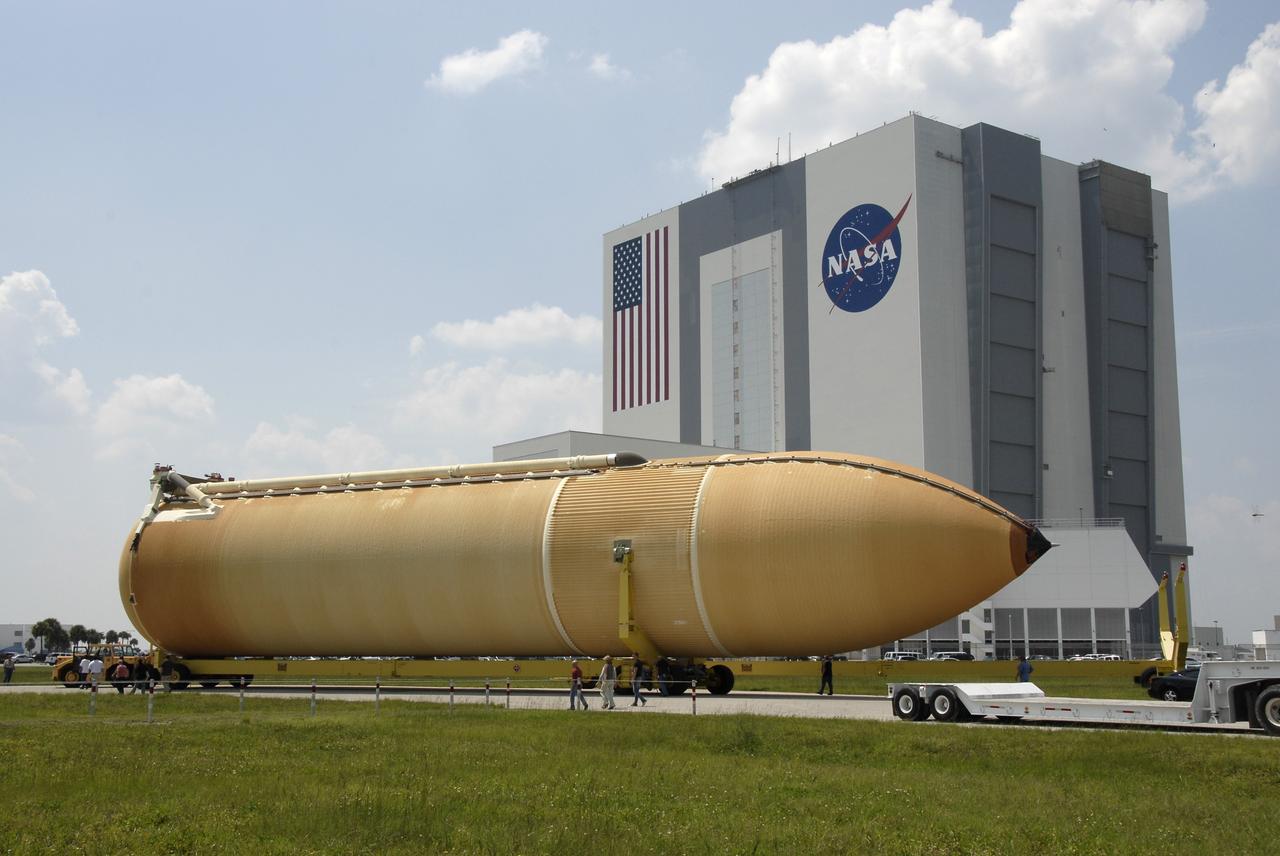
CAPE CANAVERAL, Fla. – After being offloaded from the Pegasus barge at the turn basin dock, the external fuel tank for space shuttle Endeavour's STS-126 mission to the International Space Station is transported to the Vehicle Assembly Building, seen behind it, at NASA's Kennedy Space Center. The tank arrived earlier after a six-day ocean voyage towed by a solid rocket booster retrieval ship from the Michoud Assembly Facility near New Orleans. The tank will be transported to the VAB transfer aisle, lifted and lowered into a checkout cell. The STS-126 mission will deliver a Multi-Purpose Logistics Module to the International Space Station. Launch is targeted for Nov. 10. Photo credit: NASA/Kim Shiflett
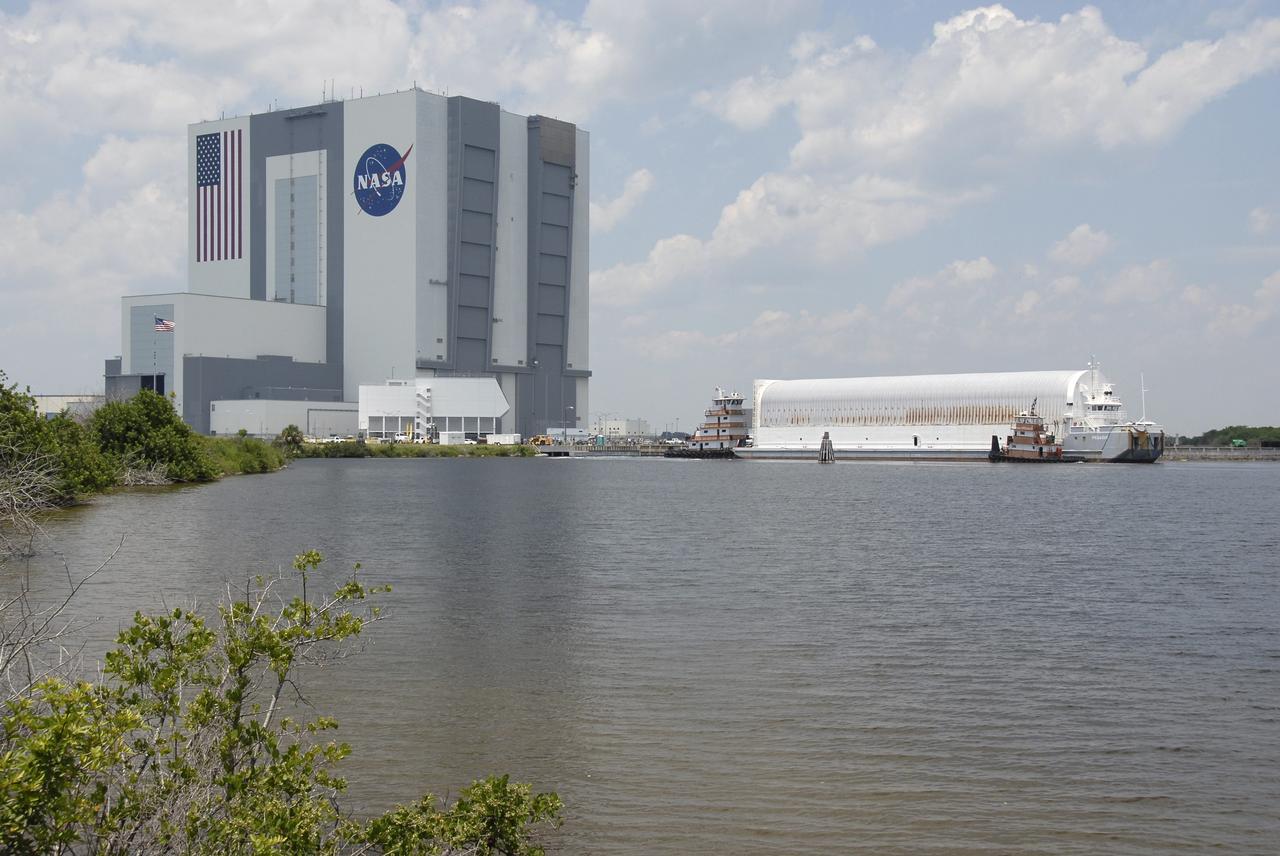
CAPE CANAVERAL, Fla. – Two tugboats maneuver the Pegasus barge toward the dock in the turn basin at the Launch Complex 39 Area at NASA's Kennedy Space Center. The barge contains the external fuel tank for space shuttle Endeavour's STS-126 mission to the International Space Station. The tank will be offloaded at the turn basin near the Vehicle Assembly Building and transported to the VAB. There it will be lifted and lowered into a checkout cell. The STS-126 mission will deliver a Multi-Purpose Logistics Module to the International Space Station. Launch is targeted for Nov. 10. Photo credit: NASA/Kim Shiflett
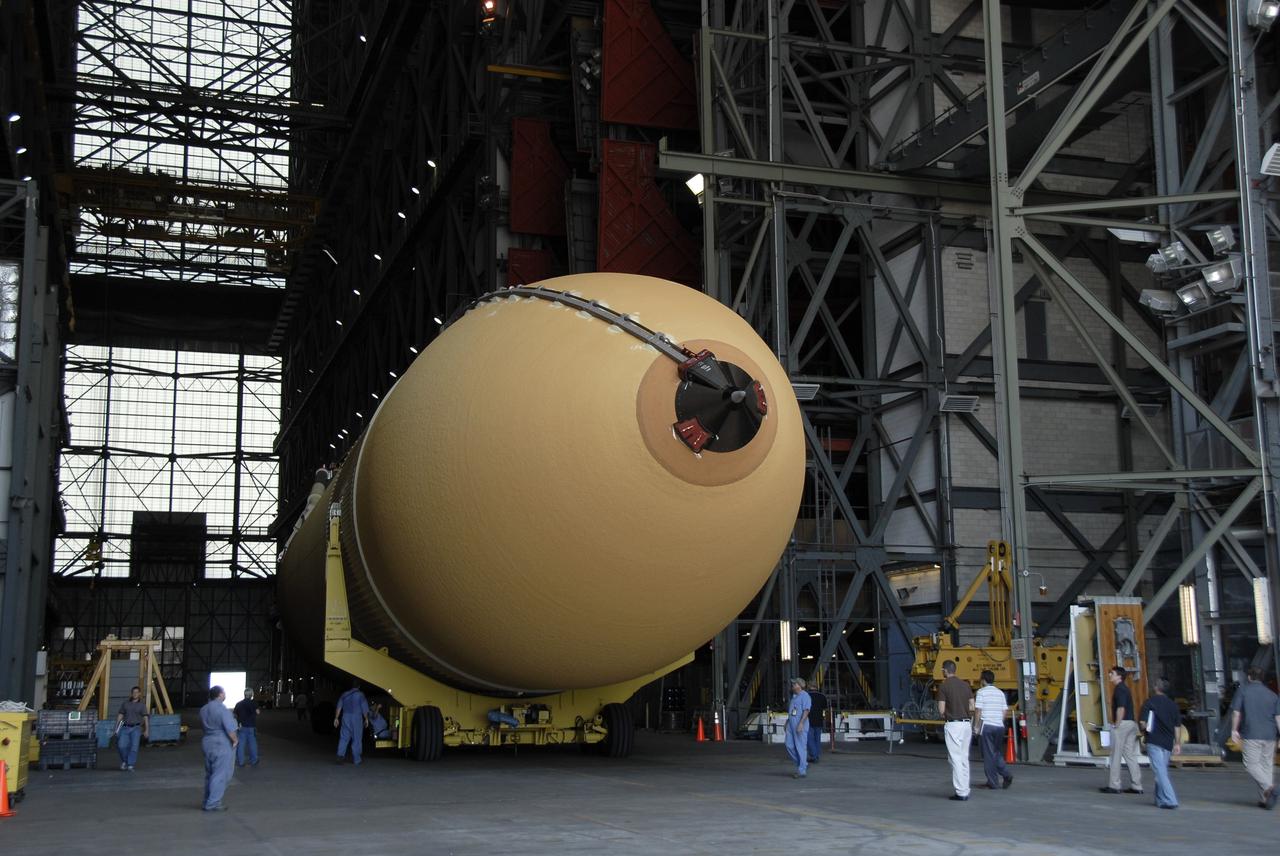
CAPE CANAVERAL, Fla. – The external fuel tank for space shuttle Endeavour's STS-126 mission to the International Space Station comes to rest in the transfer aisle of the Vehicle Assembly Building at NASA's Kennedy Space Center. The tank arrived earlier after a six-day ocean voyage towed by a solid rocket booster retrieval ship from the Michoud Assembly Facility near New Orleans. The tank will be lifted and lowered into a checkout cell. The STS-126 mission will deliver a Multi-Purpose Logistics Module to the International Space Station. Launch is targeted for Nov. 10. Photo credit: NASA/Kim Shiflett
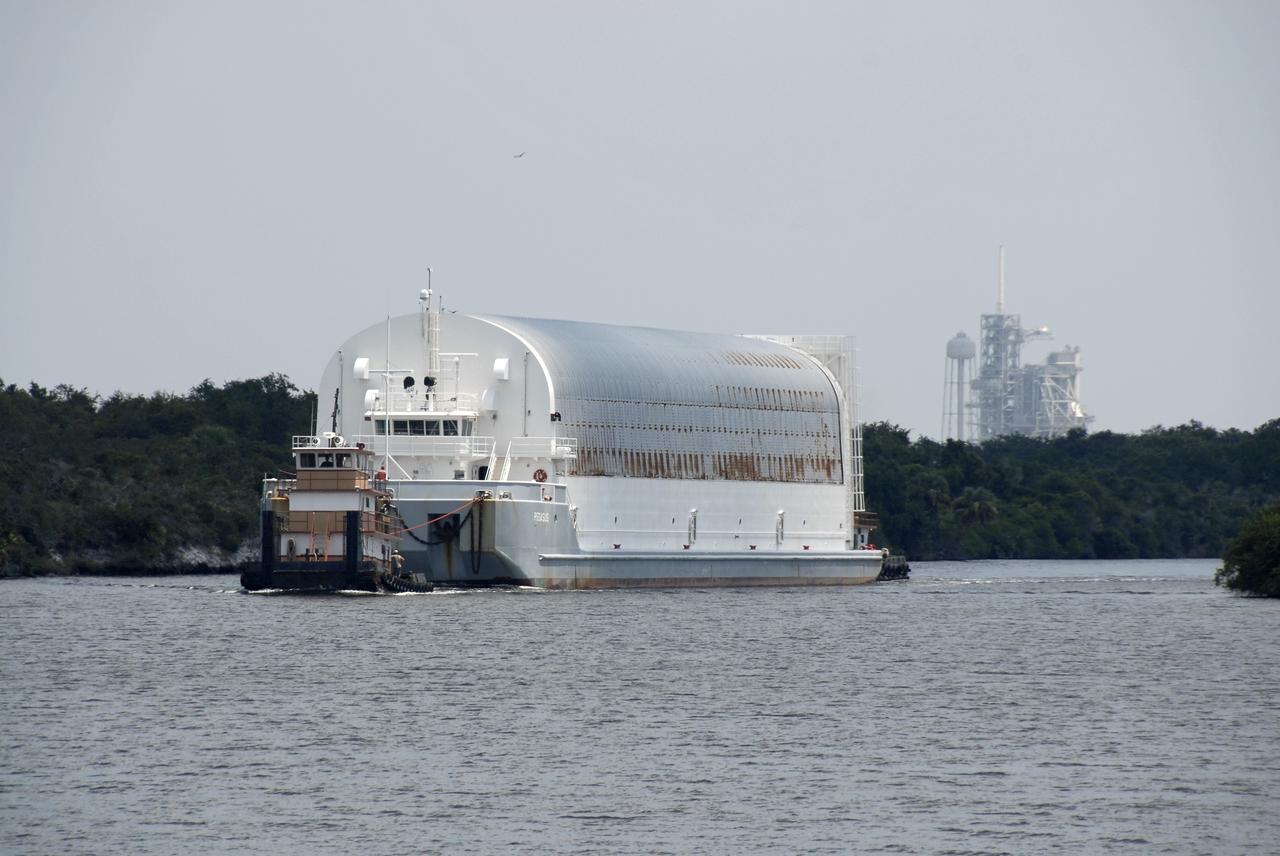
CAPE CANAVERAL, Fla. – Towed by a tugboat, the Pegasus barge containing the external fuel tank for space shuttle Endeavour's STS-126 mission to the International Space Station arrives in the turn basin at the Launch Complex 39 Area at NASA's Kennedy Space Center. The tank will be offloaded at the turn basin near the Vehicle Assembly Building and transported to the VAB. There it will be lifted and lowered into a checkout cell. The STS-126 mission will deliver a Multi-Purpose Logistics Module to the International Space Station. Launch is targeted for Nov. 10. Photo credit: NASA/Kim Shiflett
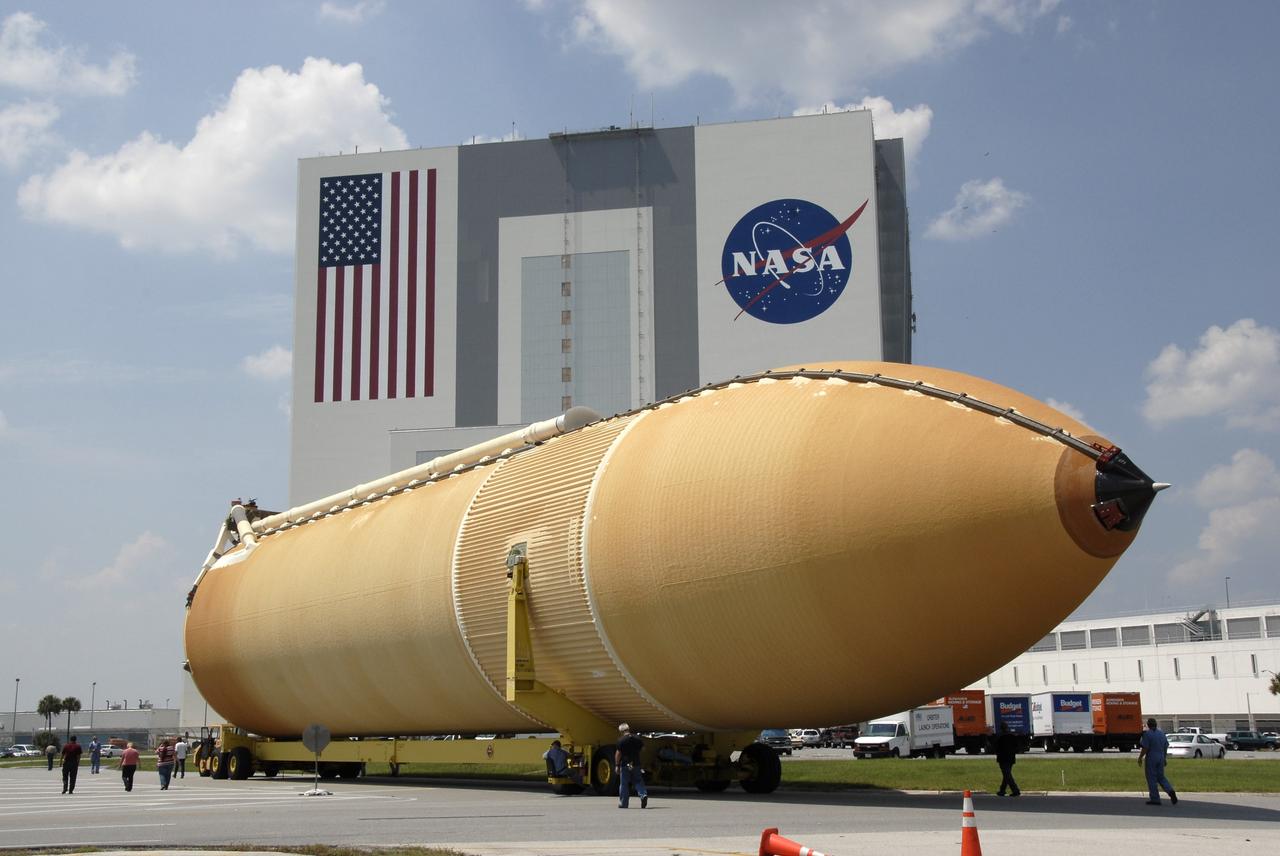
CAPE CANAVERAL, Fla. – The external fuel tank for space shuttle Endeavour's STS-126 mission to the International Space Station makes the turn toward the Vehicle Assembly Building, seen behind it, at NASA's Kennedy Space Center. The tank arrived earlier after a six-day ocean voyage towed by a solid rocket booster retrieval ship from the Michoud Assembly Facility near New Orleans. The tank will be transported to the VAB transfer aisle, lifted and lowered into a checkout cell. The STS-126 mission will deliver a Multi-Purpose Logistics Module to the International Space Station. Launch is targeted for Nov. 10. Photo credit: NASA/Kim Shiflett
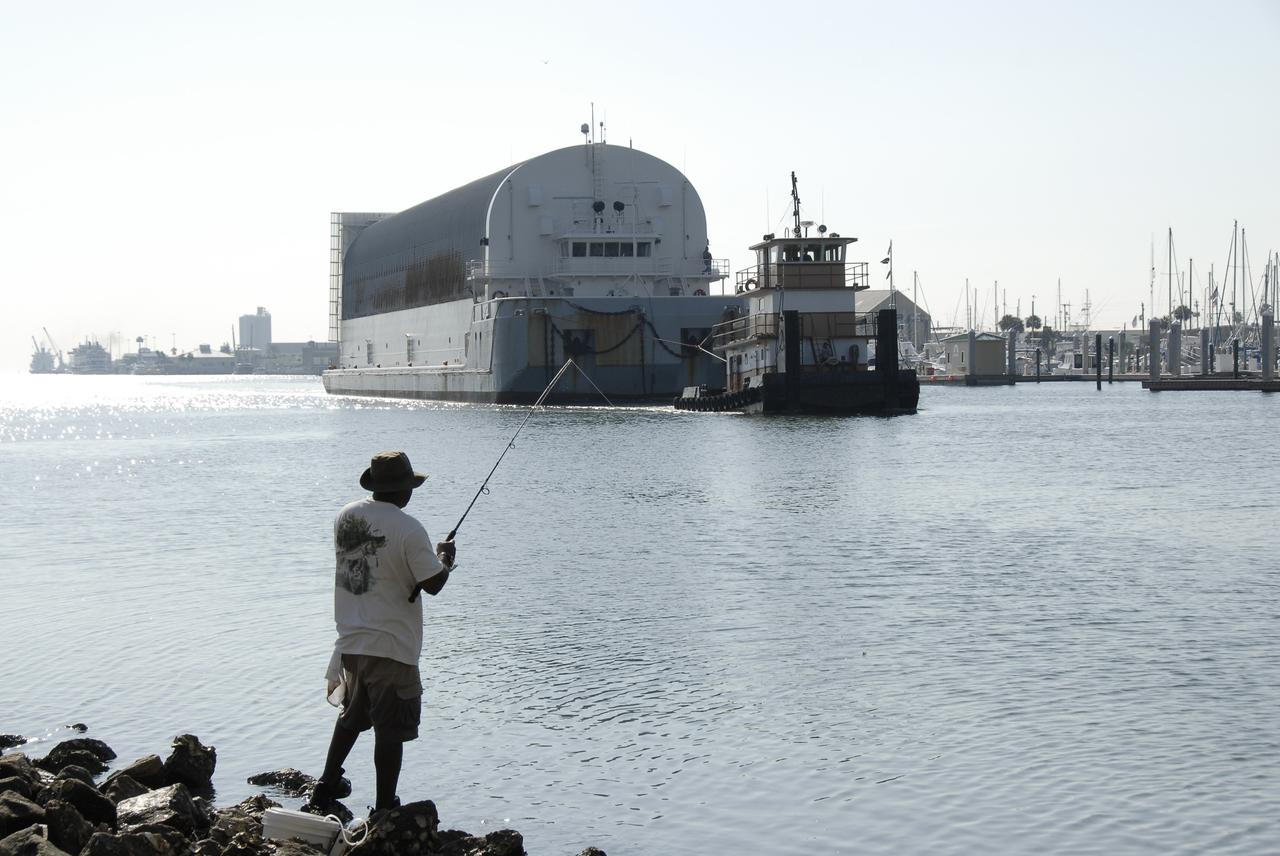
CAPE CANAVERAL, Fla. – The Pegasus barge containing the external fuel tank for space shuttle Endeavour's STS-126 mission to the International Space Station is towed by a tugboat from Port Canaveral, Fla., for its trip on the Banana River to the Launch Complex 39 Area at NASA's Kennedy Space Center. The tank will be offloaded at the turn basin near the Vehicle Assembly Building and transported to the VAB. There it will be lifted and lowered into a checkout cell. The STS-126 mission will deliver a Multi-Purpose Logistics Module to the International Space Station. Launch is targeted for Nov. 10. Photo credit: NASA/Kim Shiflett
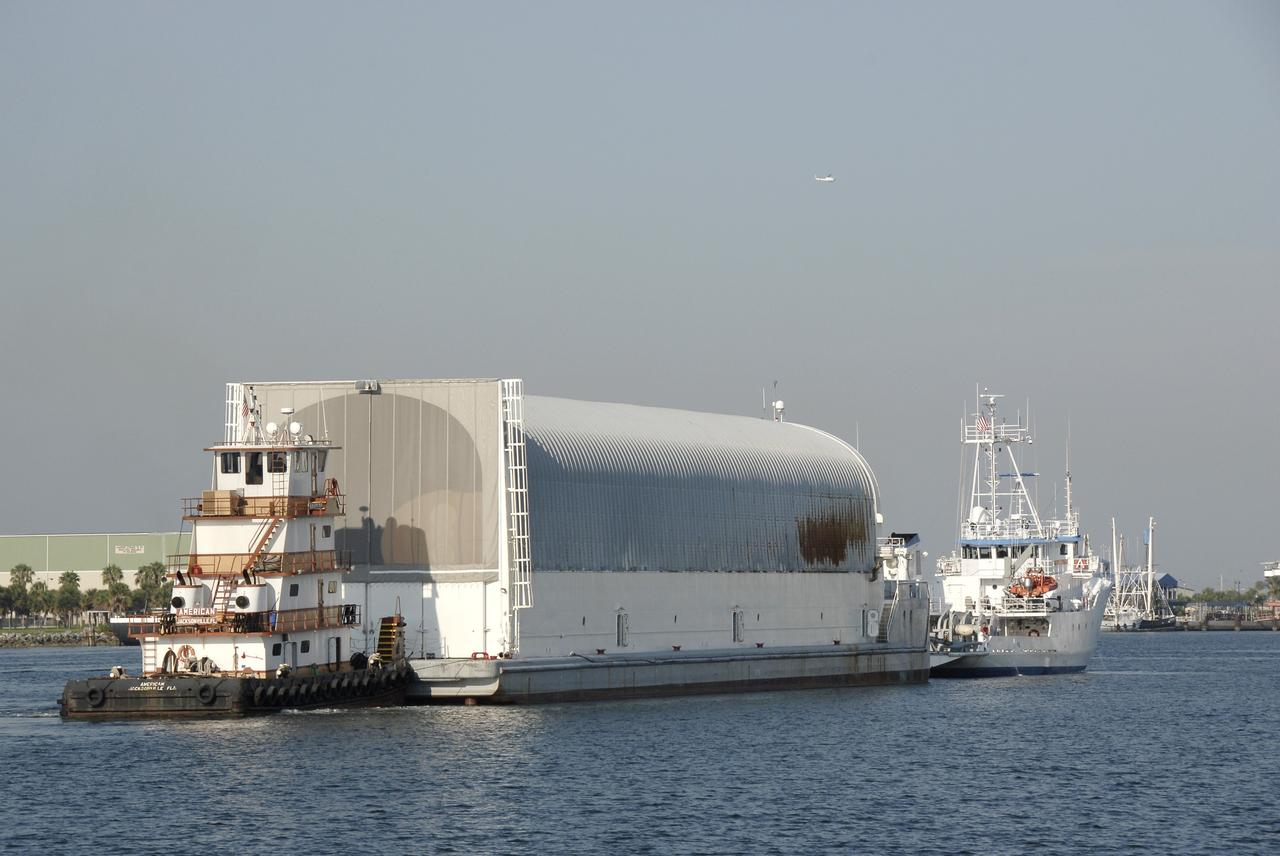
CAPE CANAVERAL, Fla. – The Pegasus barge containing the external fuel tank for space shuttle Endeavour's STS-126 mission to the International Space Station arrives in Port Canaveral, Fla., after an ocean voyage under tow by one of the solid rocket booster retrieval ships (at right) from the Michoud Assembly Facility near New Orleans. The barge is heading for the Launch Complex 39 Area at NASA's Kennedy Space Center. The tank will be offloaded at the turn basin near the Vehicle Assembly Building and transported to the VAB. There it will be lifted and lowered into a checkout cell. The STS-126 mission will deliver a Multi-Purpose Logistics Module to the International Space Station. Launch is targeted for Nov. 10. Photo credit: NASA/Kim Shiflett
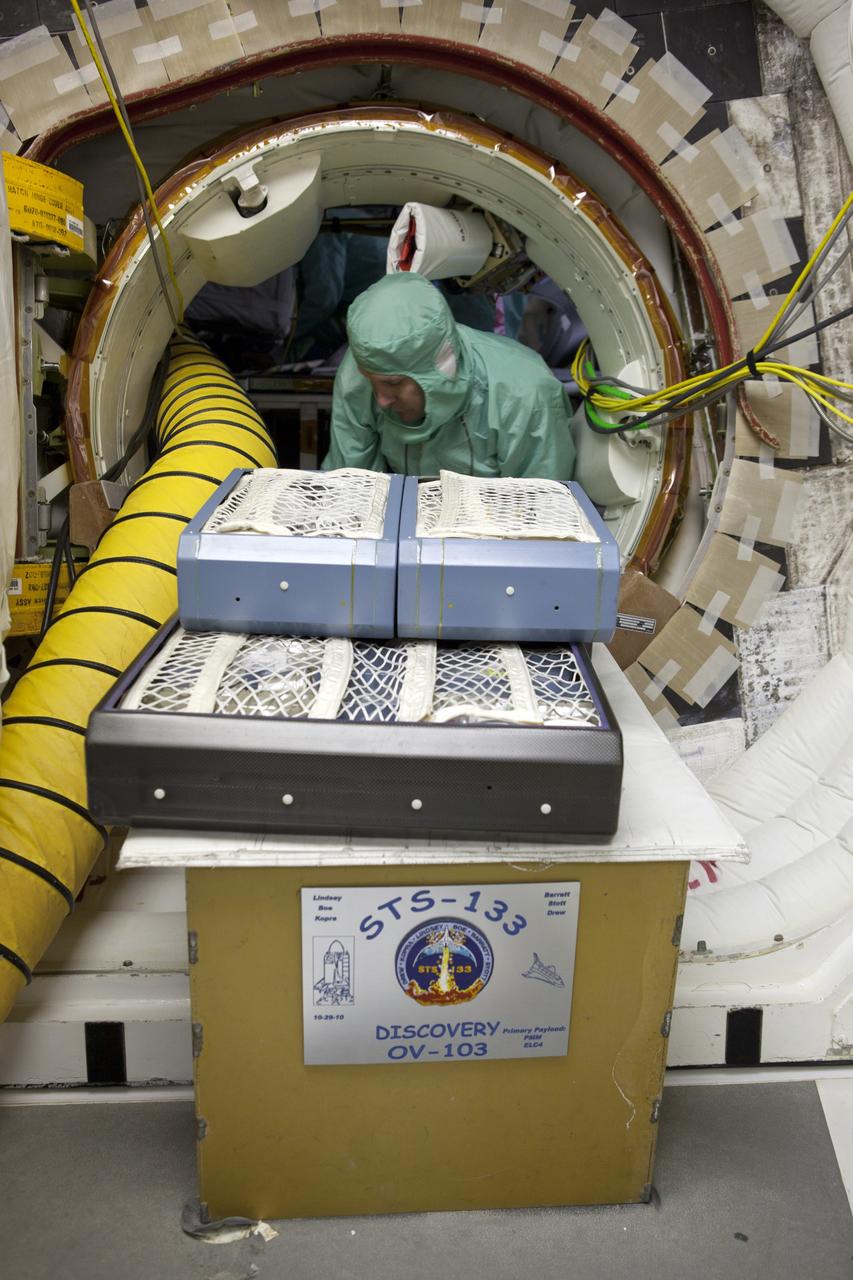
CAPE CANAVERAL, Fla. -- On Launch Pad 39A at NASA's Kennedy Space Center in Florida, technicians remove a few items from space shuttle Discovery's middeck payload, including food, prior to a tanking test planned for no earlier than Dec. 15. During the test, engineers will monitor what happens to the external fuel tank's newly replaced ground umbilical carrier plate (GUCP) and the intertank's stringers, which are 21-foot long, U-shaped aluminum brackets located on the intertank, during loading of cryogenic propellants. Technicians already installed environmental enclosures on the tank, removed foam and prepared the tank's skin for approximately 89 strain gauges and thermocouples. Discovery's first launch attempt for STS-133 was scrubbed in early November due to a hydrogen gas leak at GUCP. The next launch opportunity is no earlier than Feb. 3, 2011. For more information on STS-133, visit www.nasa.gov/mission_pages/shuttle/shuttlemissions/sts133/. Photo credit: NASA/Ben Smegelsky

CAPE CANAVERAL, Fla. -- Technicians outfit space shuttle Discovery's external fuel tank with approximately 89 strain gauges, thermocouples and wiring in preparation for a tanking test no earlier than Dec. 17 on Launch Pad 39A at NASA's Kennedy Space Center in Florida. During the test, engineers will monitor what happens to 21-foot long, U-shaped aluminum brackets, called stringers, located at the external tank's intertank area, as well as the newly replaced ground umbilical carrier plate (GUCP), during the loading of cryogenic propellants. Discovery's first launch attempt for STS-133 was scrubbed in early November due to a hydrogen gas leak at GUCP. The next launch opportunity is no earlier than Feb. 3, 2011. For more information on STS-133, visit www.nasa.gov/mission_pages/shuttle/shuttlemissions/sts133/. Photo credit: NASA/Jim Grossmann
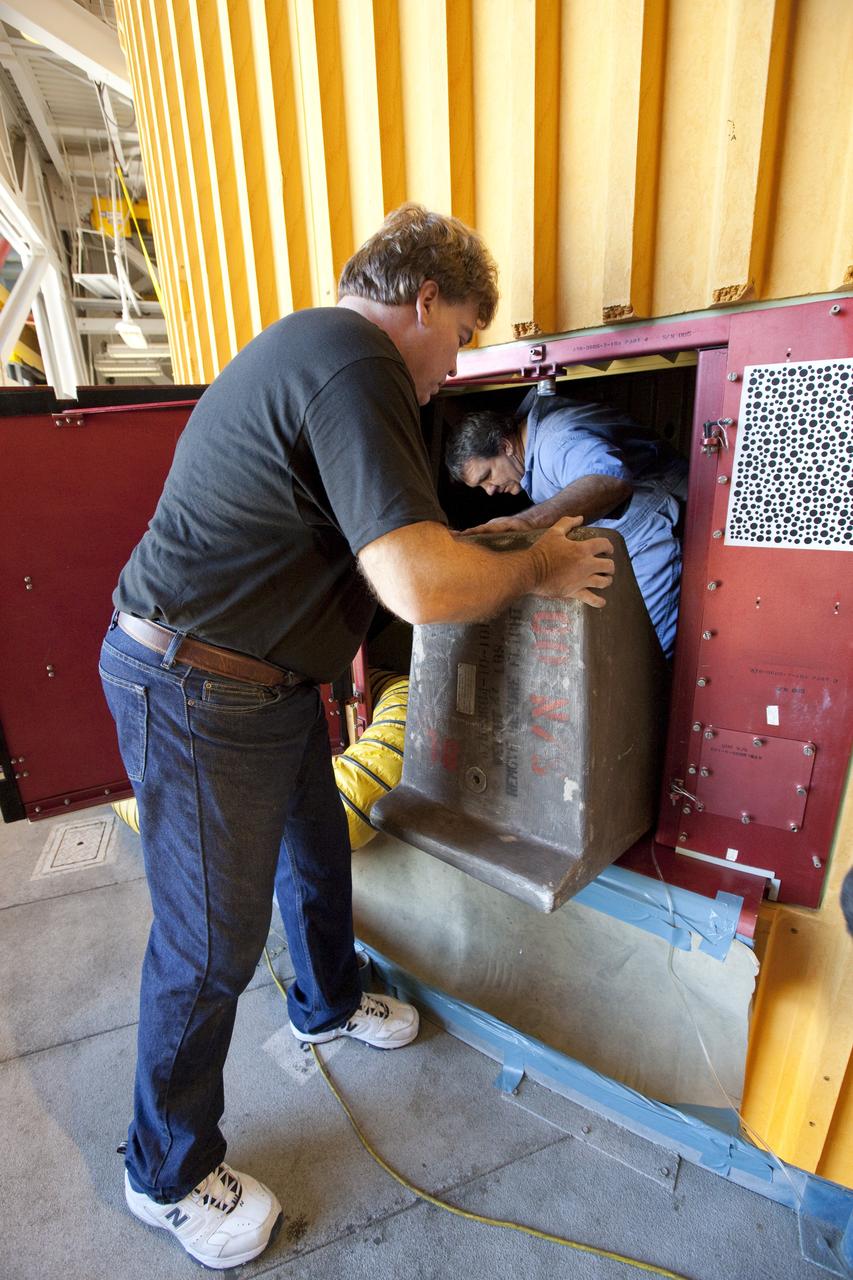
CAPE CANAVERAL, Fla. -- Preparations are under way in the Vehicle Assembly Building at NASA's Kennedy Space Center in Florida to examine space shuttle Discovery's external fuel tank. Technicians will begin to remove thermal sensors that will give engineers data about the changes the tank went through during the loading and draining of super-cold propellants during a tanking test on Dec. 17. Engineers also will examine 21-foot-long support beams, called stringers, on the outside of the tank's intertank region. Also on the agenda, is to re-apply foam to the outside of the tank. Discovery's next launch opportunity to the International Space Station on the STS-133 mission is no earlier than Feb. 3, 2011. For more information on STS-133, visit www.nasa.gov/mission_pages/shuttle/shuttlemissions/sts133/. Photo credit: NASA/Dimitri Gerondidakis

CAPE CANAVERAL, Fla. -- Technicians prepare space shuttle Discovery's external fuel tank for a tanking test no earlier than Dec. 15 on Launch Pad 39A at NASA's Kennedy Space Center in Florida. During the test, engineers will monitor what happens to 21-foot long, U-shaped aluminum brackets, called stringers, located at the intertank, as well as the newly replaced ground umbilical carrier plate (GUCP), during the loading of cryogenic propellants. Teams already have installed environmental enclosures on the tank, removed foam and prepared the tank's skin for approximately 89 strain gauges and thermocouples. Discovery's first launch attempt for STS-133 was scrubbed in early November due to a hydrogen gas leak at GUCP. The next launch opportunity is no earlier than Feb. 3, 2011. For more information on STS-133, visit www.nasa.gov/mission_pages/shuttle/shuttlemissions/sts133/. Photo credit: NASA/Frank Michaux
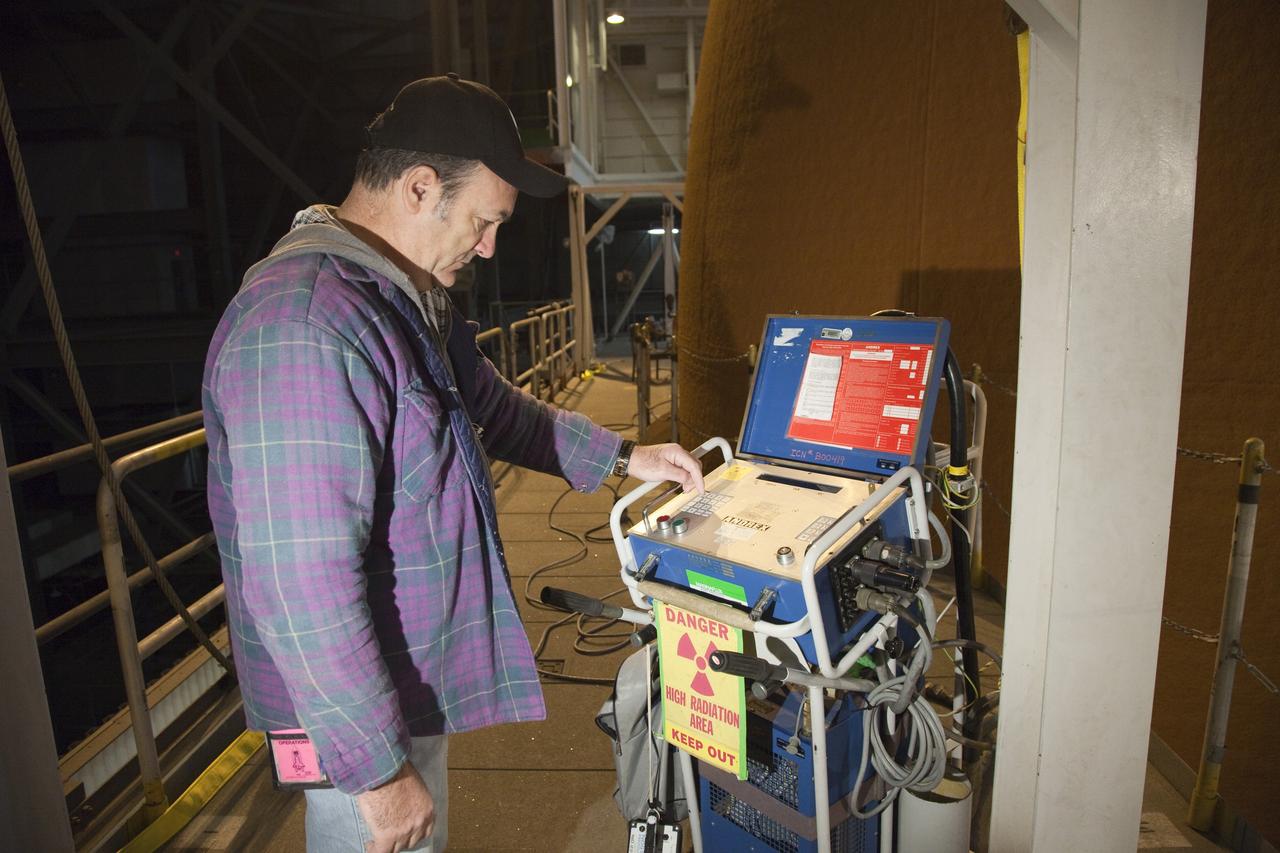
CAPE CANAVERAL, Fla. -- A technician takes computed radiography scans of space shuttle Discovery's external fuel tank. The shuttle stack, consisting of the shuttle, external tank and solid rocket boosters, was moved from Launch Pad 39A to the Vehicle Assembly Building at NASA's Kennedy Space Center in Florida so technicians could examine 21-foot-long support beams, called stringers, on the outside of the tank's intertank and re-apply foam insulation. Discovery's next launch opportunity to the International Space Station on the STS-133 mission is no earlier than Feb. 3, 2011. For more information on STS-133, visit www.nasa.gov/mission_pages/shuttle/shuttlemissions/sts133/. Photo credit: NASA/Frankie Martin
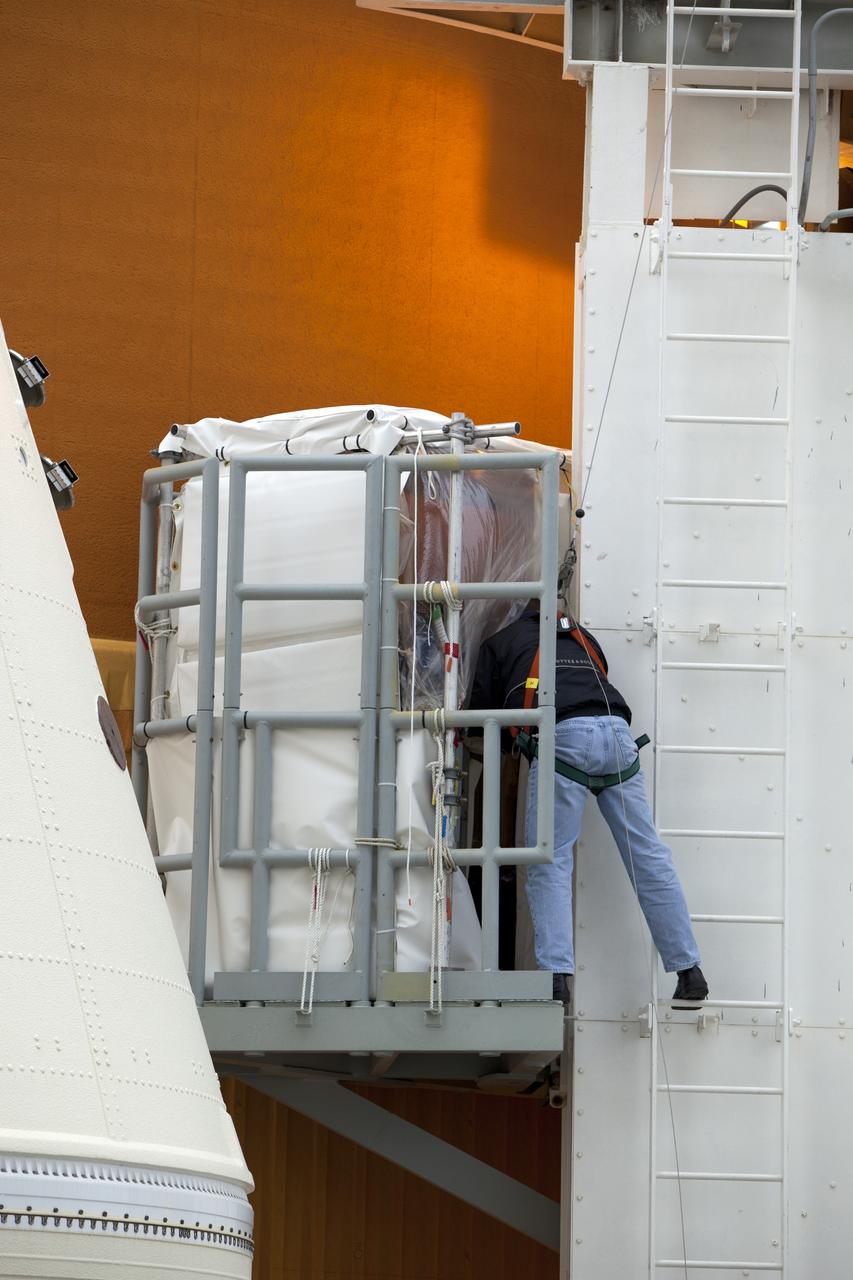
CAPE CANAVERAL, Fla. -- Technicians prepare space shuttle Discovery's external fuel tank for a tanking test no earlier than Dec. 15 on Launch Pad 39A at NASA's Kennedy Space Center in Florida. During the test, engineers will monitor what happens to 21-foot long, U-shaped aluminum brackets, called stringers, located at the intertank, as well as the newly replaced ground umbilical carrier plate (GUCP), during the loading of cryogenic propellants. Teams already have installed environmental enclosures on the tank, removed foam and prepared the tank's skin for approximately 89 strain gauges and thermocouples. Discovery's first launch attempt for STS-133 was scrubbed in early November due to a hydrogen gas leak at GUCP. The next launch opportunity is no earlier than Feb. 3, 2011. For more information on STS-133, visit www.nasa.gov/mission_pages/shuttle/shuttlemissions/sts133/. Photo credit: NASA/Ben Smegelsky
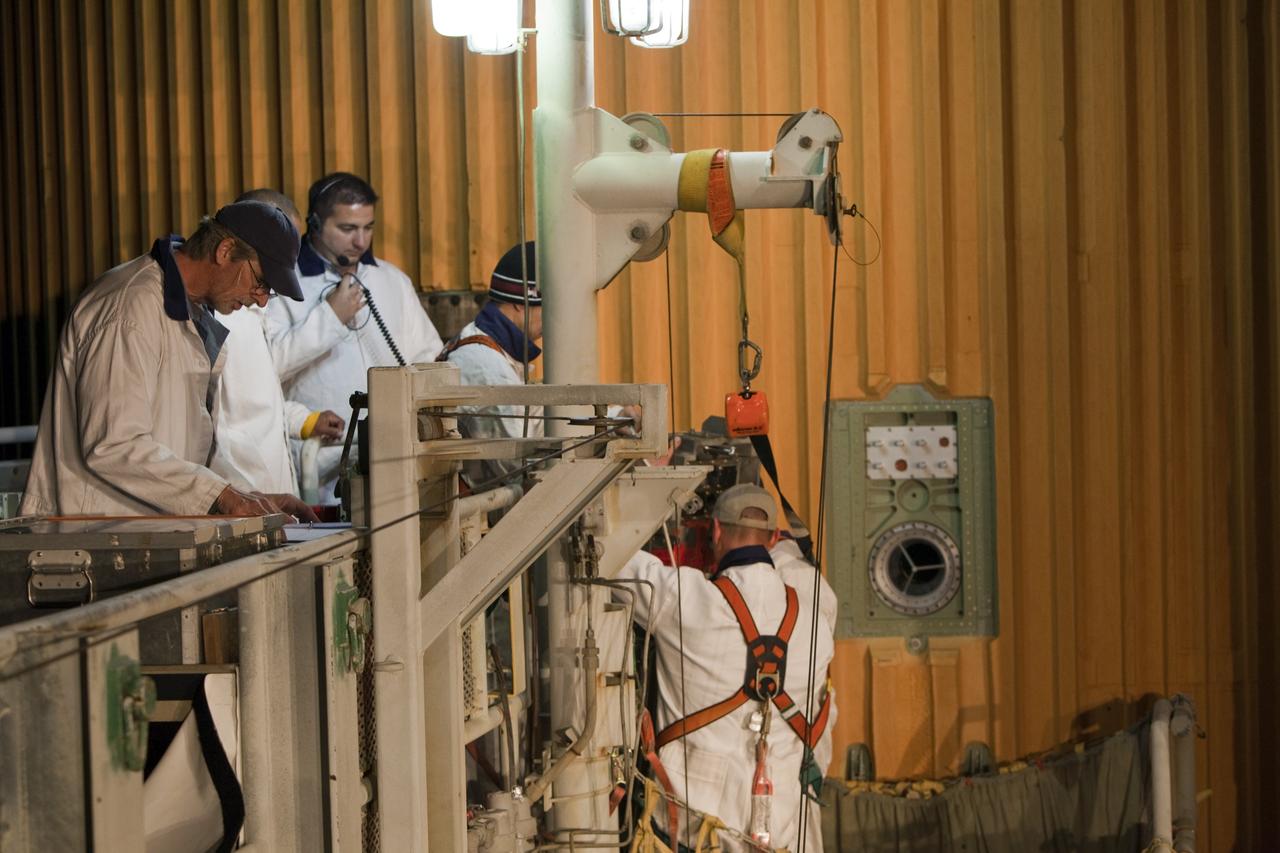
CAPE CANAVERAL, Fla. -- On Launch Pad 39A at NASA's Kennedy Space Center in Florida, the ground umbilical carrier plate (GUCP) is removed from space shuttle Discovery's external fuel tank. A hydrogen gas leak at that location during tanking for Discovery's STS-133 mission to the International Space Station caused the launch attempt to be scrubbed Nov. 5. The GUCP will be examined to determine the cause of the hydrogen leak and then repaired. The GUCP is the overboard vent to the pad and the flame stack where the excess hydrogen is burned off. For more information on STS-133, visit www.nasa.gov/mission_pages/shuttle/shuttlemissions/sts133/. Photo credit: NASA/Dimitri Gerondidakis

CAPE CANAVERAL, Fla. -- On Launch Pad 39A at NASA's Kennedy Space Center in Florida, technicians reattach the vent line to the ground umbilical carrier plate (GUCP) on space shuttle Discovery's external fuel tank. A hydrogen gas leak at that location during tanking for Discovery's STS-133 mission to the International Space Station caused the launch attempt to be scrubbed Nov. 5. The GUCP is the overboard vent to the pad and the flame stack where the excess hydrogen is burned off. Discovery's next launch attempt is no earlier than Nov. 30 at 4:02 a.m. EST. For more information on STS-133, visit www.nasa.gov/mission_pages/shuttle/shuttlemissions/sts133/. Photo credit: NASA/Ben Smegelsky
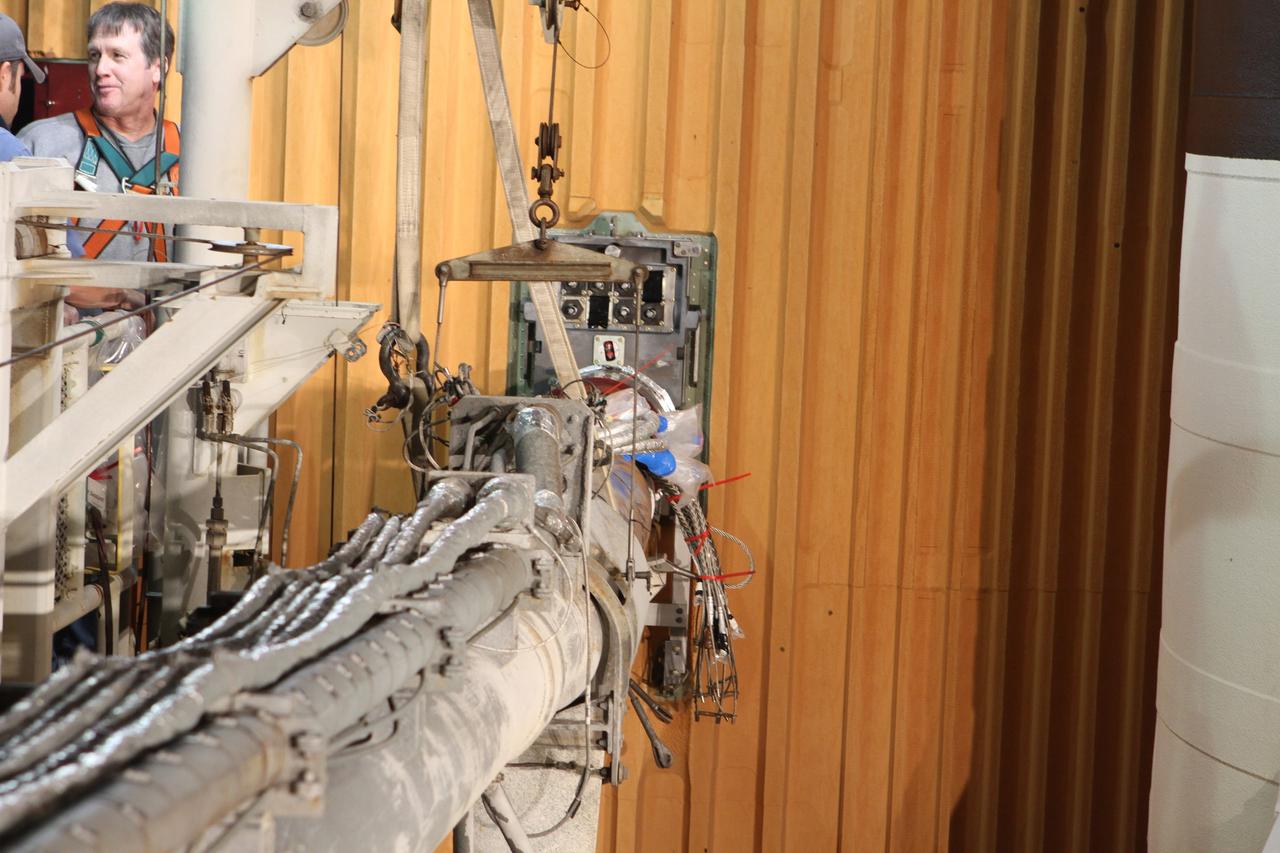
CAPE CANAVERAL, Fla. -- On Launch Pad 39A at NASA's Kennedy Space Center in Florida, preparations are under way to reattach the vent line to the ground umbilical carrier plate (GUCP) on space shuttle Discovery's external fuel tank. A hydrogen gas leak at that location during tanking for Discovery's STS-133 mission to the International Space Station caused the launch attempt to be scrubbed Nov. 5. The GUCP is the overboard vent to the pad and the flame stack where the excess hydrogen is burned off. Discovery's next launch attempt is no earlier than Nov. 30 at 4:02 a.m. EST. For more information on STS-133, visit www.nasa.gov/mission_pages/shuttle/shuttlemissions/sts133/. Photo credit: NASA/Ben Smegelsky

CAPE CANAVERAL, Fla. -- Space shuttle Discovery's external fuel tank is outfitted with approximately 89 strain gauges, thermocouples and wiring in preparation for a tanking test no earlier than Dec. 17 on Launch Pad 39A at NASA's Kennedy Space Center in Florida. During the test, engineers will monitor what happens to 21-foot long, U-shaped aluminum brackets, called stringers, located at the external tank's intertank area, as well as the newly replaced ground umbilical carrier plate (GUCP), during the loading of cryogenic propellants. Discovery's first launch attempt for STS-133 was scrubbed in early November due to a hydrogen gas leak at GUCP. The next launch opportunity is no earlier than Feb. 3, 2011. For more information on STS-133, visit www.nasa.gov/mission_pages/shuttle/shuttlemissions/sts133/. Photo credit: NASA/Jim Grossmann
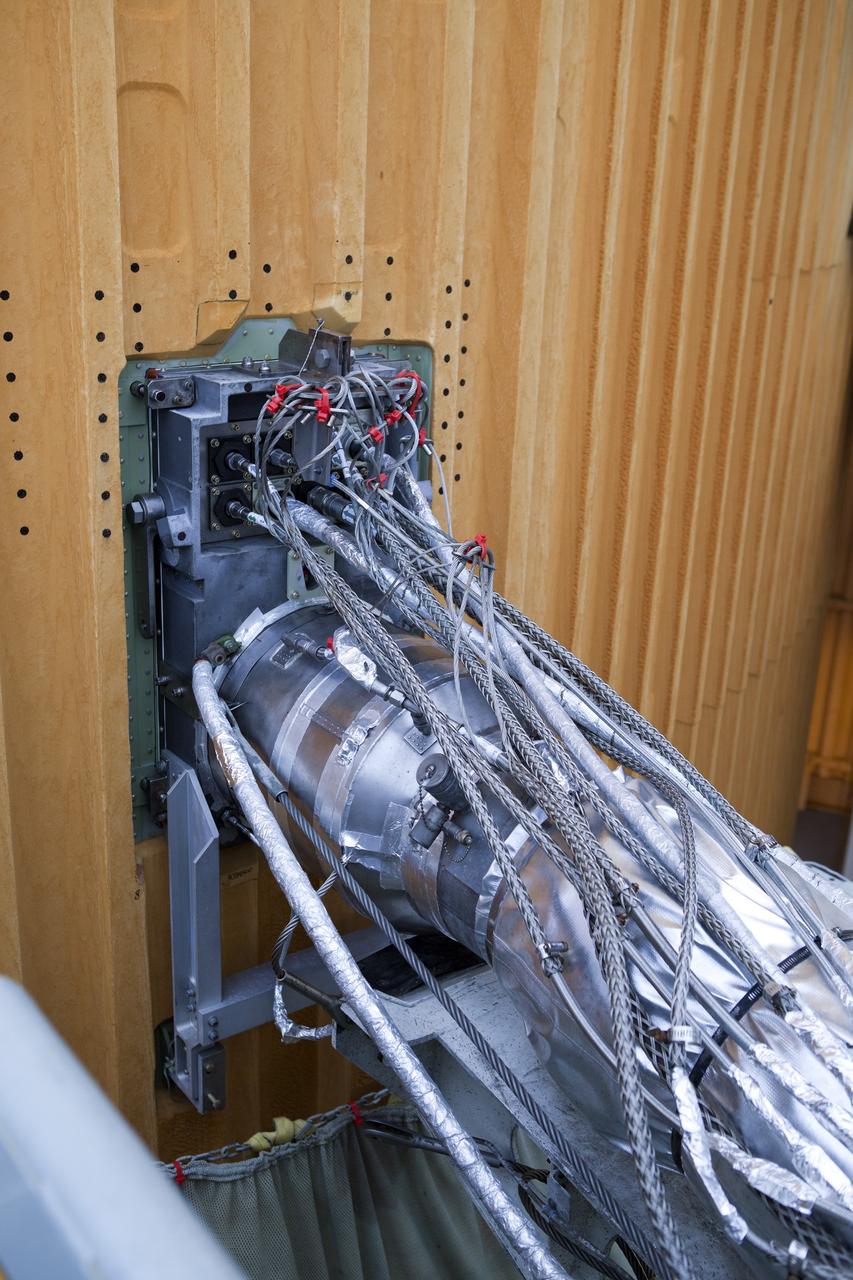
CAPE CANAVERAL, Fla. -- Space shuttle Discovery's external fuel tank is being prepared for a tanking test no earlier than Dec. 15 on Launch Pad 39A at NASA's Kennedy Space Center in Florida. During the test, engineers will monitor what happens to the newly replaced ground umbilical carrier plate (GUCP) and the intertank's stringers, which are 21-foot long, U-shaped aluminum brackets, during loading of cryogenic propellants. Discovery's first launch attempt for STS-133 was scrubbed in early November due to a hydrogen gas leak at GUCP. The next launch opportunity is no earlier than Feb. 3, 2011. For more information on STS-133, visit www.nasa.gov/mission_pages/shuttle/shuttlemissions/sts133/. Photo credit: NASA/Ben Smegelsky
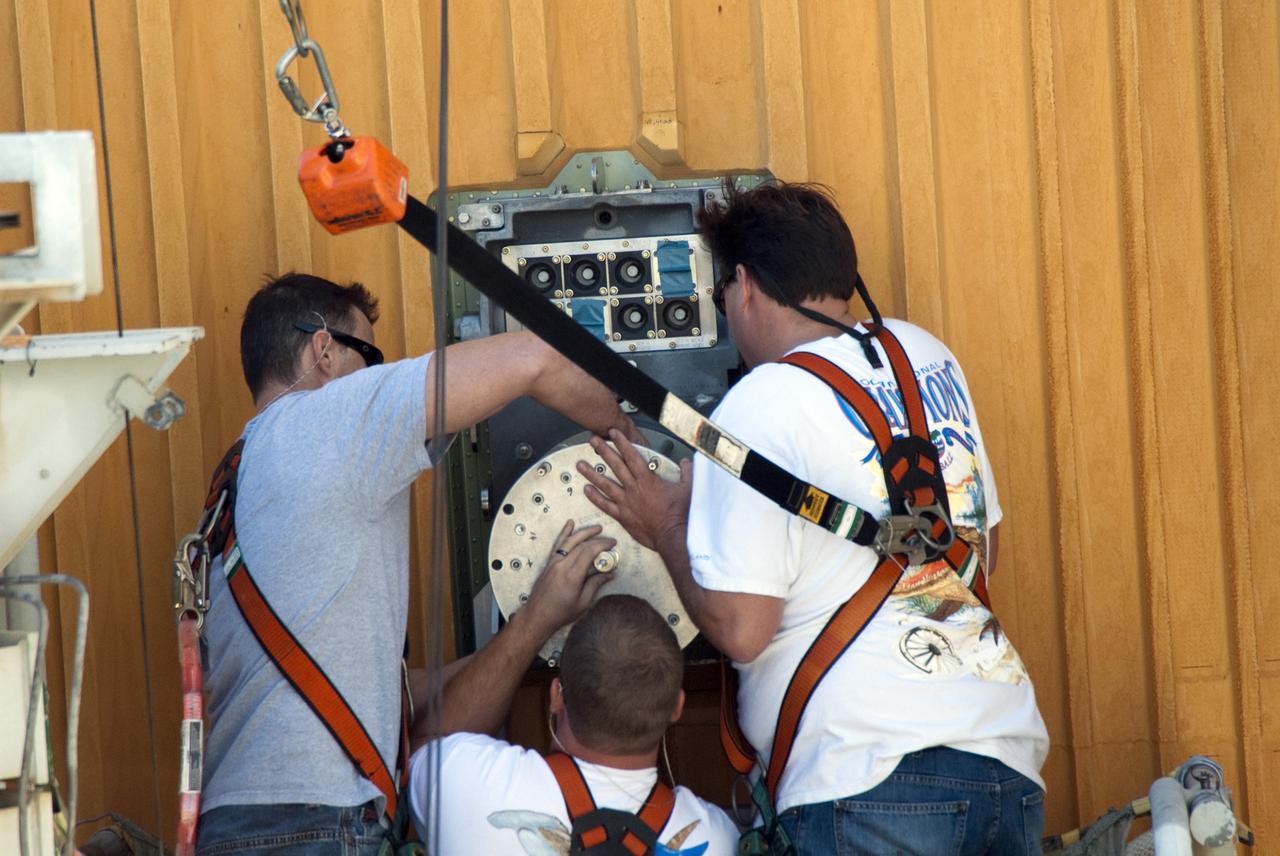
CAPE CANAVERAL, Fla. -- On Launch Pad 39A at NASA's Kennedy Space Center in Florida, workers install a new 7-inch quick disconnect on the ground umbilical carrier plate (GUCP) of space shuttle Discovery's external fuel tank. A hydrogen gas leak at that location during tanking for Discovery's STS-133 mission to the International Space Station caused the launch attempt to be scrubbed Nov. 5. The GUCP is the overboard vent to the pad and the flame stack where the excess hydrogen is burned off. For more information on STS-133, visit www.nasa.gov/mission_pages/shuttle/shuttlemissions/sts133/. Photo credit: NASA/Charisse Nahser
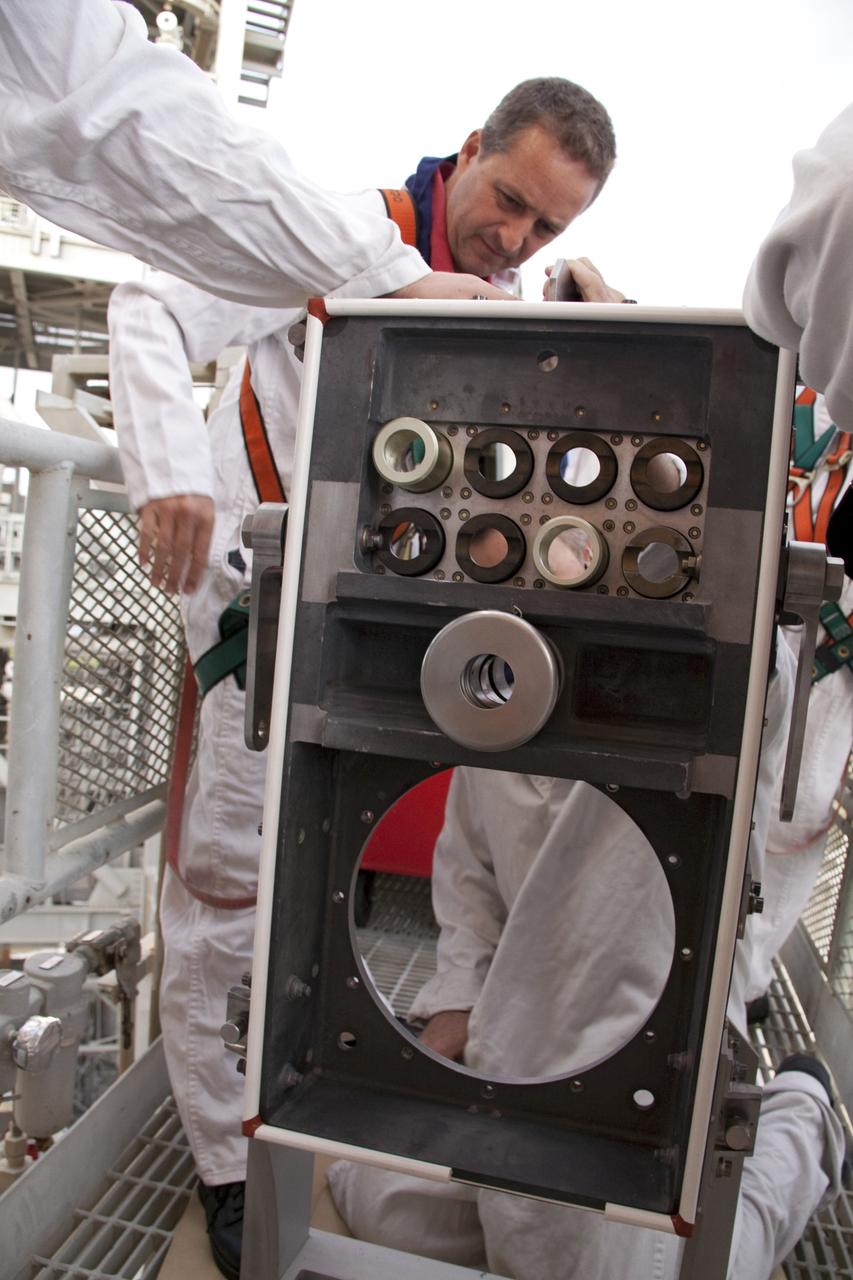
CAPE CANAVERAL, Fla. -- On Launch Pad 39A at NASA's Kennedy Space Center in Florida, workers prepare to install a new ground umbilical carrier plate (GUCP) on space shuttle Discovery's external fuel tank. A hydrogen gas leak at that location during tanking for Discovery's STS-133 mission to the International Space Station caused the launch attempt to be scrubbed Nov. 5. The GUCP is the overboard vent to the pad and the flame stack where the excess hydrogen is burned off. For more information on STS-133, visit www.nasa.gov/mission_pages/shuttle/shuttlemissions/sts133/. Photo credit: NASA/Troy Cryder
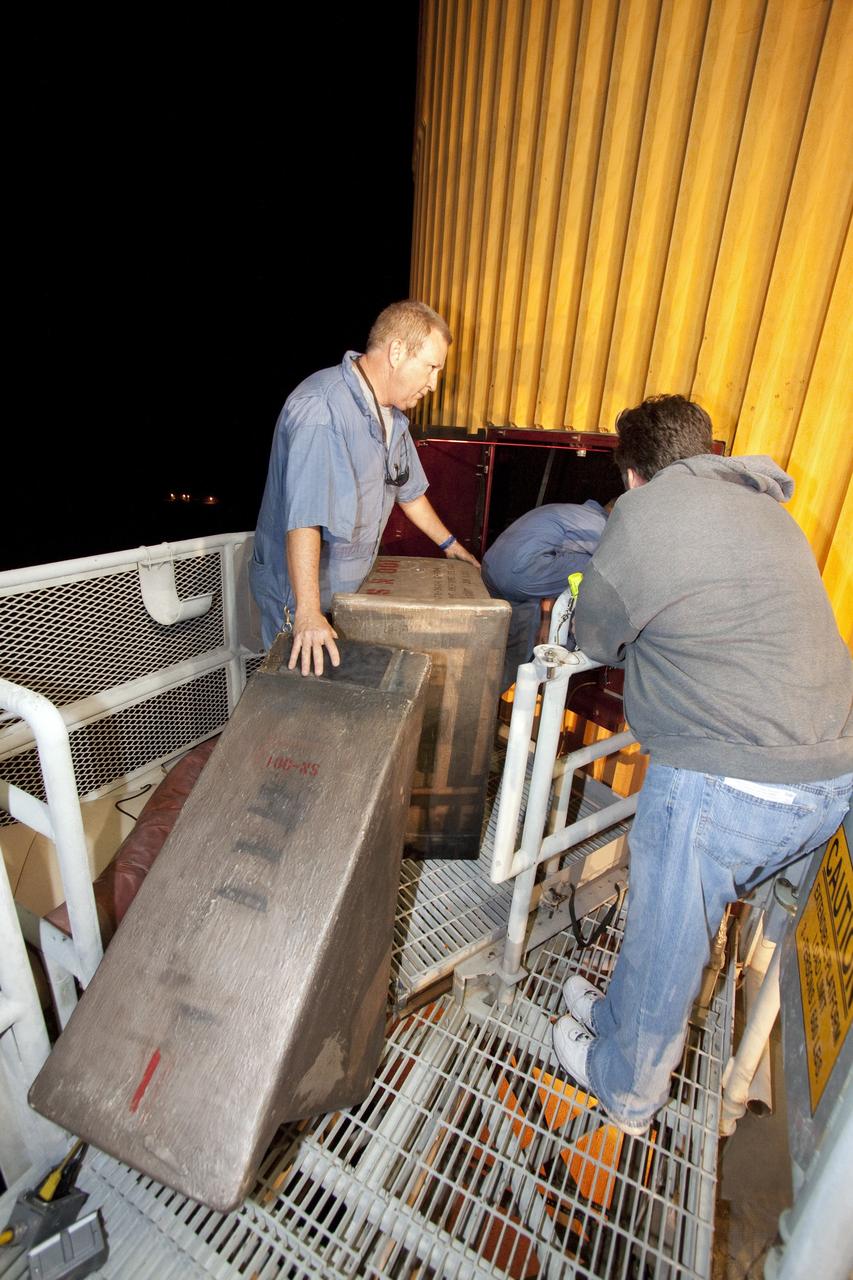
CAPE CANAVERAL, Fla. -- On Launch Pad 39A at NASA's Kennedy Space Center in Florida, technicians take temporary step pads into the intertank of space shuttle Discovery's external fuel tank. The intertank is unpressurized and holds most of the tank's electrical components. It sits between the liquid hydrogen tank and liquid oxygen tank. Technicians will be working inside the intertank to further analyze two cracks that were found on the tank’s metal exterior. The foam cracked during initial loading operations for space shuttle Discovery’s launch attempt on Nov. 5. The cracks are on one of the stringers, which are the composite aluminum ribs located vertically on the intertank area. Discovery's next launch attempt is no earlier than Nov. 30 at 4:02 a.m. EST. For more information on STS-133, visit www.nasa.gov/mission_pages/shuttle/shuttlemissions/sts133/. Photo credit: NASA/Jack Pfaller
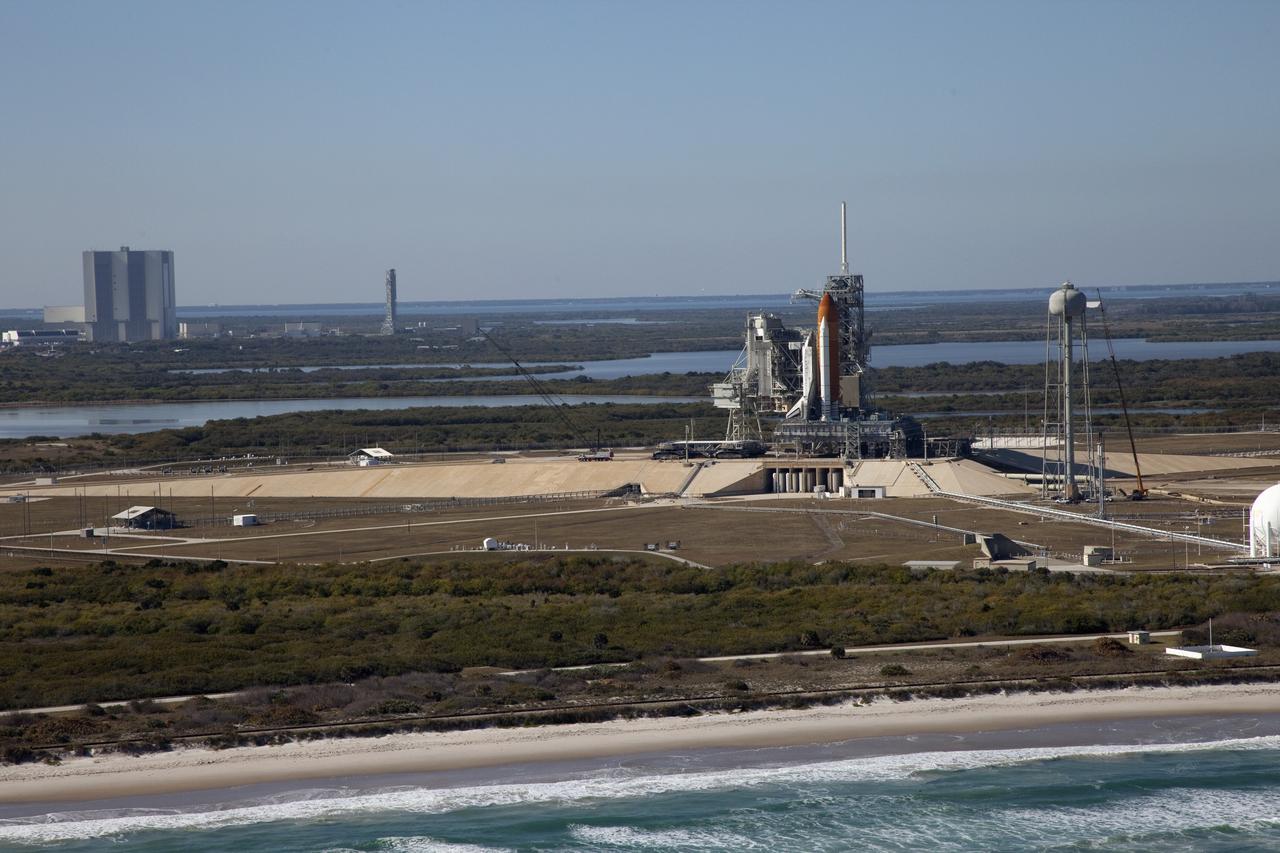
CAPE CANAVERAL, Fla. -- Space shuttle Discovery awaits its move, called rollback, from Launch Pad 39A to the Vehicle Assembly Building (VAB) at NASA's Kennedy Space Center in Florida. Rollback was scheduled for 12:30 a.m., but was postponed until 10 p.m. so technicians could resolve an issue with a leveling system on the crawler-transporter. Once inside the VAB, Discovery's external fuel tank will be examined and foam reapplied where 89 sensors were installed on the tank's aluminum skin for an instrumented tanking test on Dec. 17. The sensors were used to measure changes in the tank as super-cold propellants were pumped in and drained out. Data and analysis from the test will be used to determine what caused the tops of two, 21-foot-long support beams, called stringers, on the outside of the intertank to crack during fueling on Nov. 5. Discovery's next launch opportunity to the International Space Station on the STS-133 mission is no earlier than Feb. 3, 2011. For more information on STS-133, visit www.nasa.gov/mission_pages/shuttle/shuttlemissions/sts133/. Photo credit: NASA/Frank Michaux
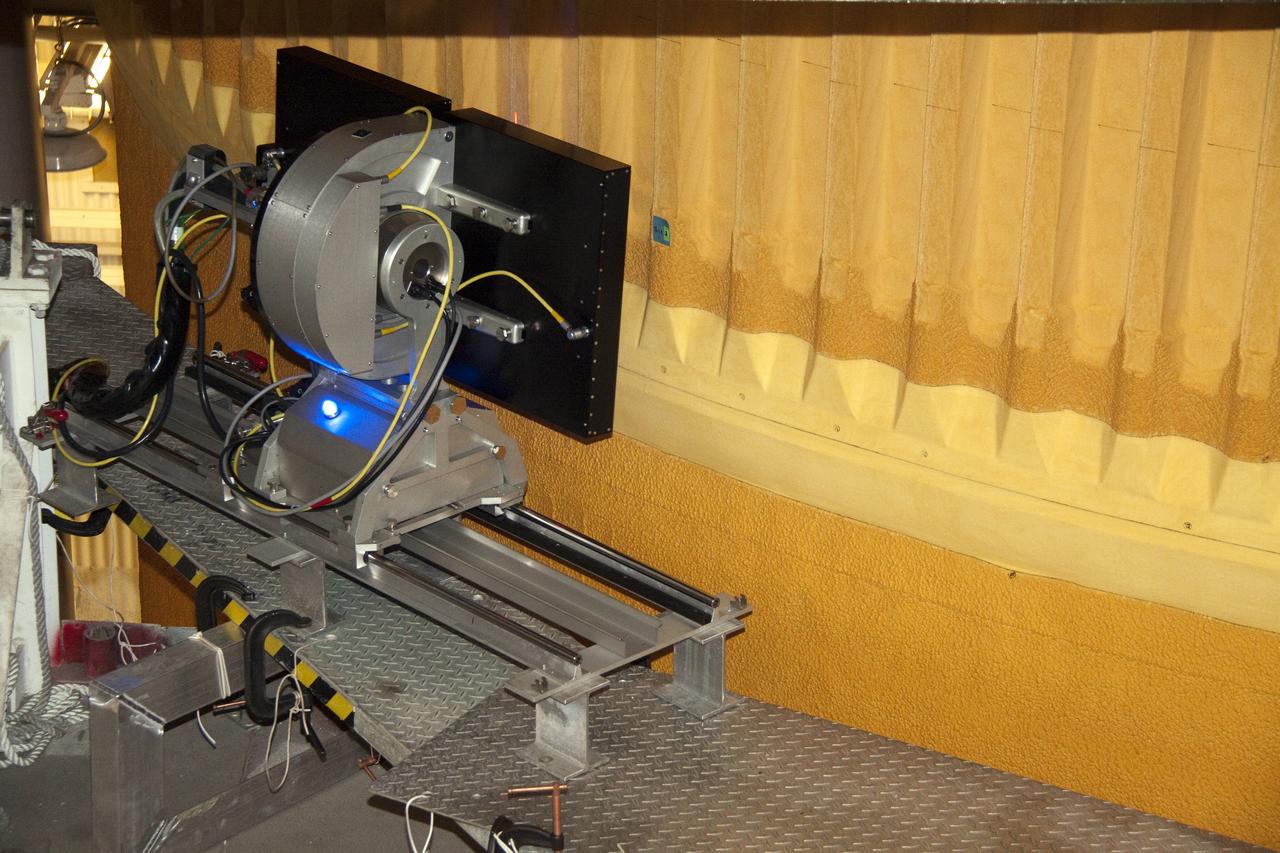
CAPE CANAVERAL, Fla. -- A backscatter device continues to give engineers data on the intertank region of space shuttle Discovery's external fuel tank while it is in the Vehicle Assembly Building at NASA's Kennedy Space Center in Florida. Engineers at various NASA centers are analyzing, testing and imaging the intertank's support beams, called stringers, to make sure the tank is structurally sound for flight. Discovery's next launch opportunity to the International Space Station on the STS-133 mission is no earlier than Feb. 3, 2011. For more information on STS-133, visit www.nasa.gov/mission_pages/shuttle/shuttlemissions/sts133/. Photo credit: NASA/Jack Pfaller

CAPE CANAVERAL, Fla. -- On Launch Pad 39A at NASA's Kennedy Space Center in Florida, workers begin to remove the seal from the ground umbilical carrier plate (GUCP). A hydrogen gas leak at that location on the external fuel tank during tanking for space shuttle Discovery's STS-133 mission to the International Space Station caused the launch attempt to be scrubbed Nov. 5. The GUCP will be examined to determine the cause of the hydrogen leak and then repaired. The GUCP is the overboard vent to the pad and the flame stack where the excess hydrogen is burned off. For more information on STS-133, visit www.nasa.gov/mission_pages/shuttle/shuttlemissions/sts133/. Photo credit: NASA/Jack Pfaller
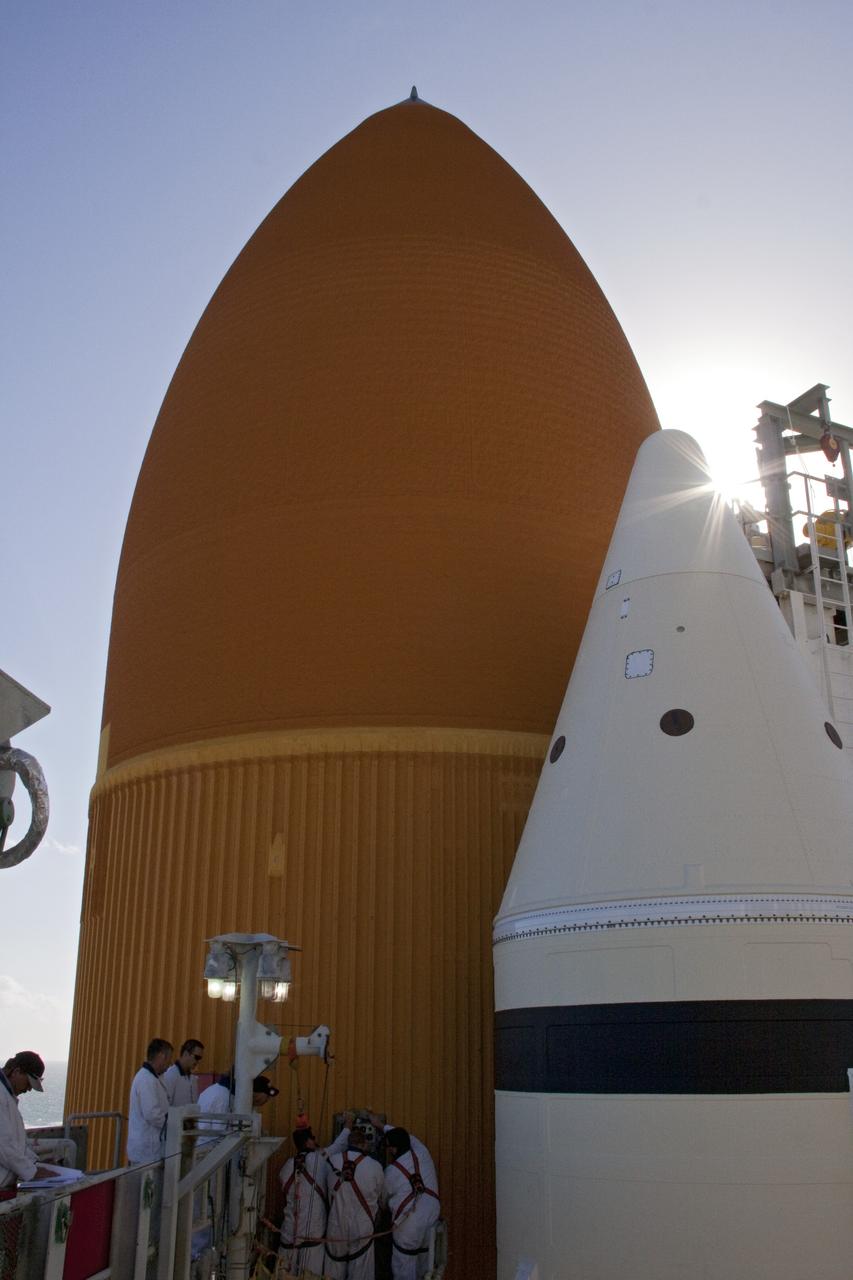
CAPE CANAVERAL, Fla. -- On Launch Pad 39A at NASA's Kennedy Space Center in Florida, workers begin to install a new ground umbilical carrier plate (GUCP) on space shuttle Discovery's external fuel tank. A hydrogen gas leak at that location during tanking for Discovery's STS-133 mission to the International Space Station caused the launch attempt to be scrubbed Nov. 5. The GUCP is the overboard vent to the pad and the flame stack where the excess hydrogen is burned off. For more information on STS-133, visit www.nasa.gov/mission_pages/shuttle/shuttlemissions/sts133/. Photo credit: NASA/Troy Cryder
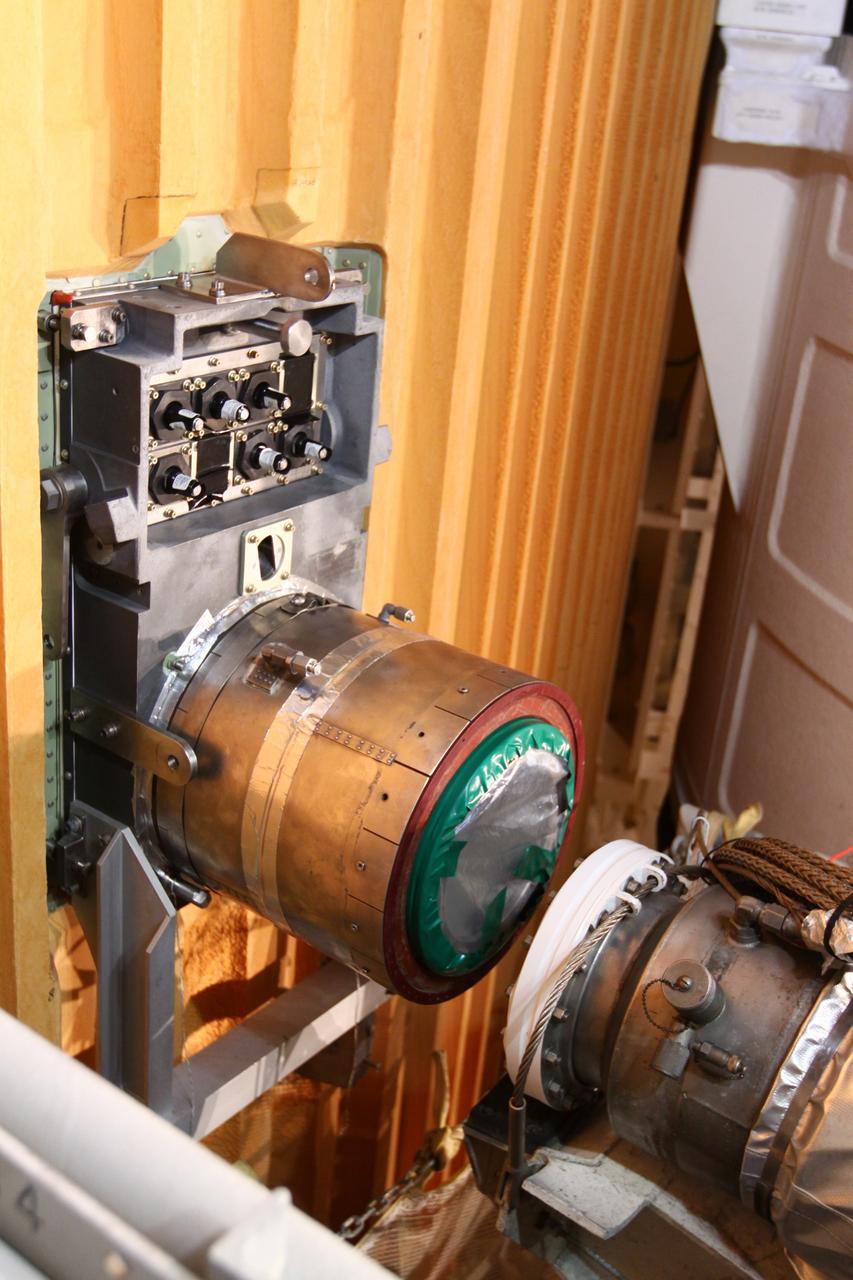
CAPE CANAVERAL, Fla. -- On Launch Pad 39A at NASA's Kennedy Space Center in Florida, preparations are under way to reattach the vent line to the ground umbilical carrier plate (GUCP) on space shuttle Discovery's external fuel tank. A hydrogen gas leak at that location during tanking for Discovery's STS-133 mission to the International Space Station caused the launch attempt to be scrubbed Nov. 5. The GUCP is the overboard vent to the pad and the flame stack where the excess hydrogen is burned off. Discovery's next launch attempt is no earlier than Nov. 30 at 4:02 a.m. EST. For more information on STS-133, visit www.nasa.gov/mission_pages/shuttle/shuttlemissions/sts133/. Photo credit: NASA/Ben Smegelsky
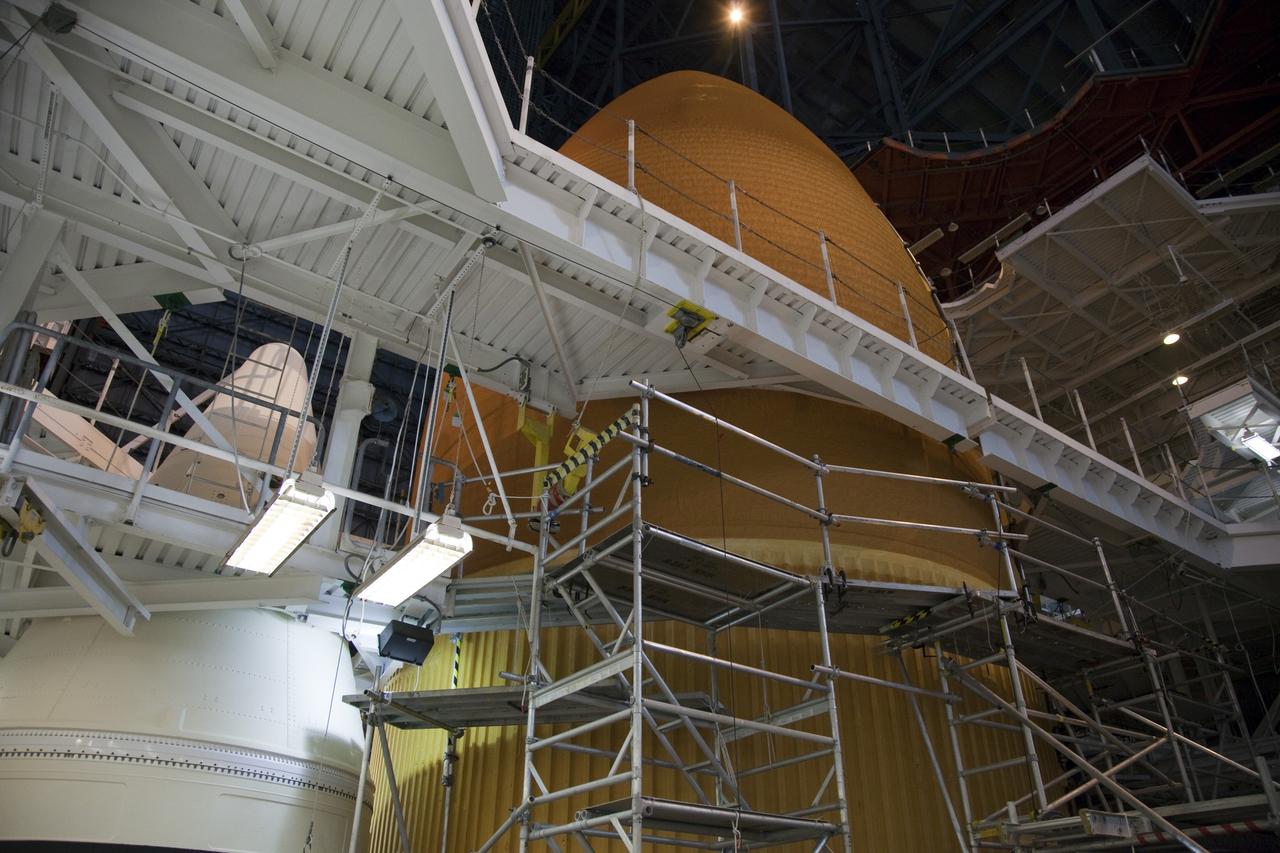
CAPE CANAVERAL, Fla. -- Space shuttle Discovery's external fuel tank is being prepared for computed radiography scans inside the Vehicle Assembly Building at NASA's Kennedy Space Center in Florida. The shuttle stack, consisting of the shuttle, external tank and solid rocket boosters, was moved off Launch Pad 39A so technicians could examine 21-foot-long support beams, called stringers, on the outside of the tank's intertank and re-apply foam insulation. Discovery's next launch opportunity to the International Space Station on the STS-133 mission is no earlier than Feb. 3, 2011. For more information on STS-133, visit www.nasa.gov/mission_pages/shuttle/shuttlemissions/sts133/. Photo credit: NASA/Frankie Martin
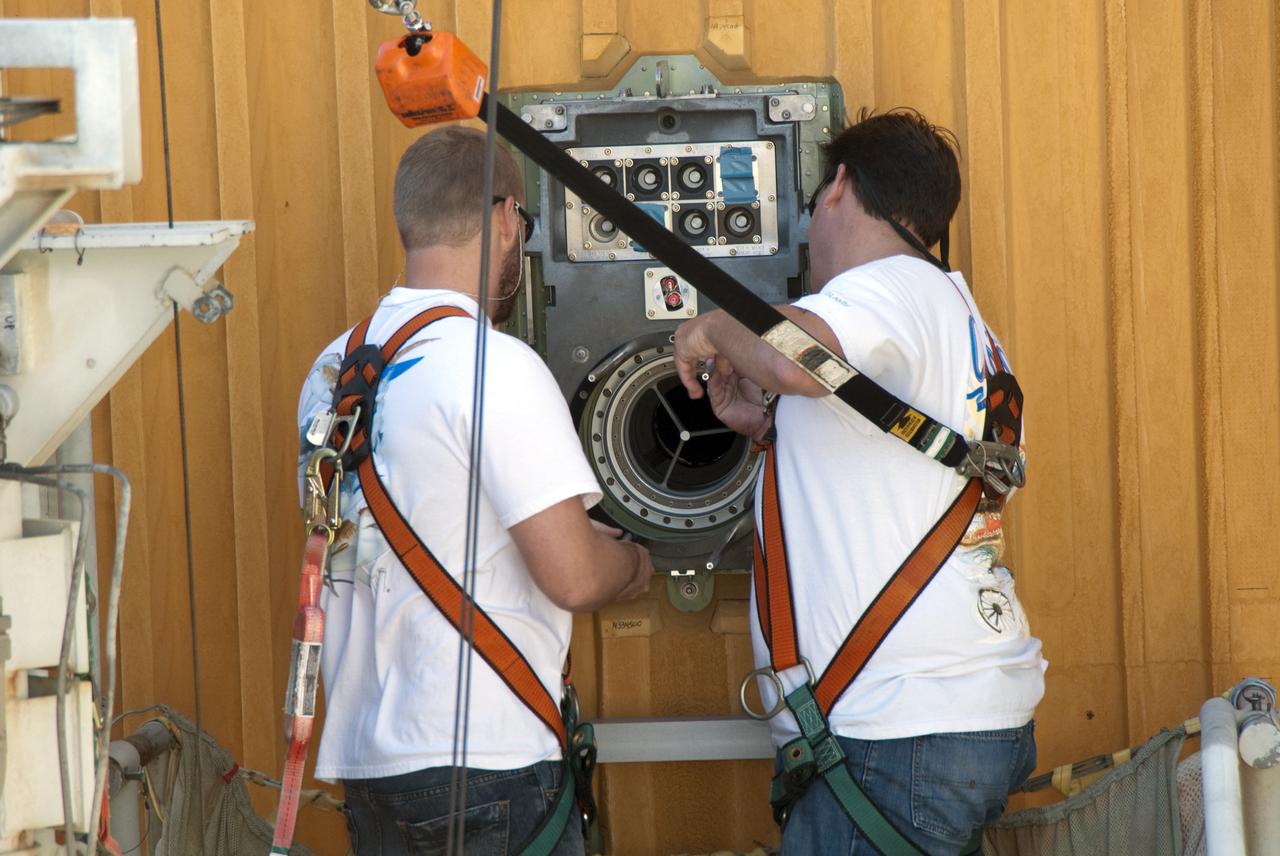
CAPE CANAVERAL, Fla. -- On Launch Pad 39A at NASA's Kennedy Space Center in Florida, workers prepare to install a new 7-inch quick disconnect on the ground umbilical carrier plate (GUCP) of space shuttle Discovery's external fuel tank. A hydrogen gas leak at that location during tanking for Discovery's STS-133 mission to the International Space Station caused the launch attempt to be scrubbed Nov. 5. The GUCP is the overboard vent to the pad and the flame stack where the excess hydrogen is burned off. For more information on STS-133, visit www.nasa.gov/mission_pages/shuttle/shuttlemissions/sts133/. Photo credit: NASA/Charisse Nahser
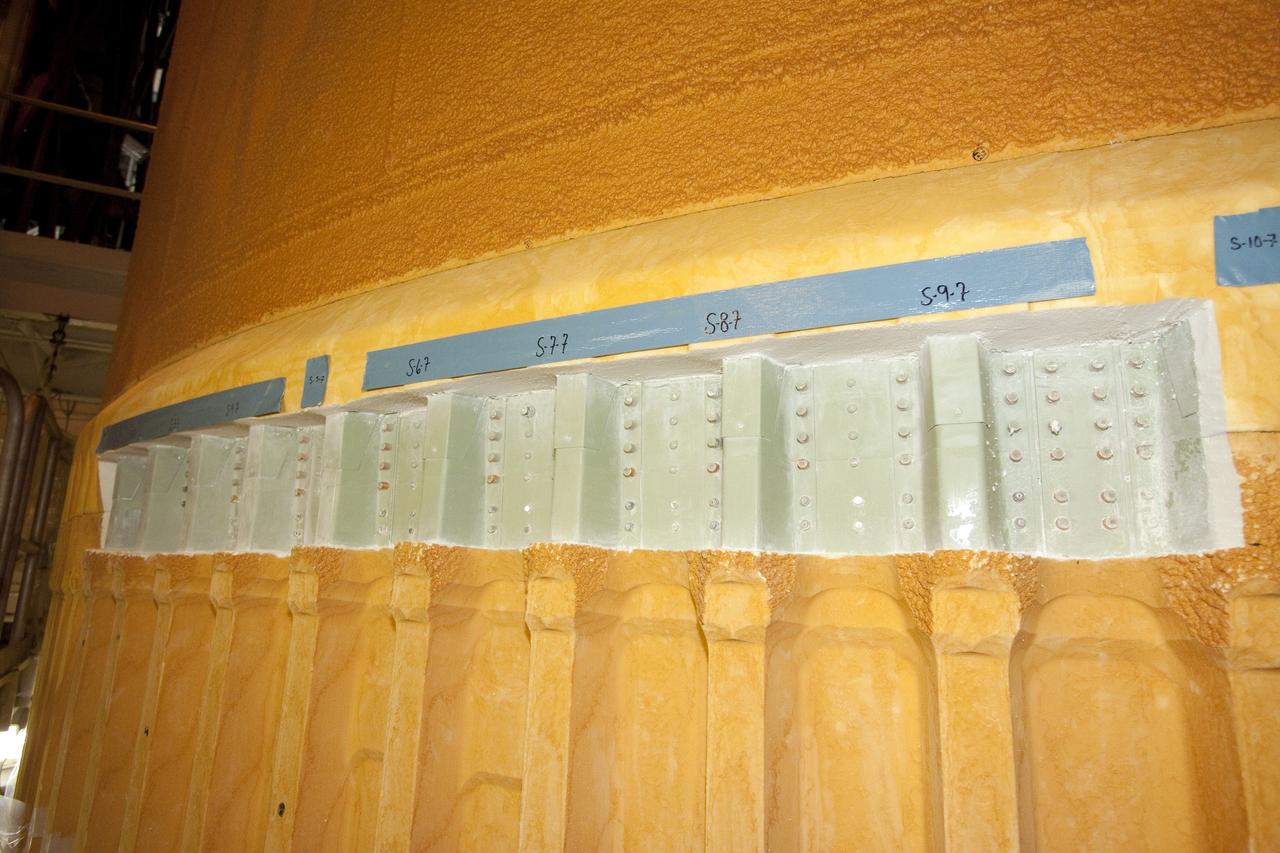
CAPE CANAVERAL, Fla. -- Repair work to space shuttle Discovery's external fuel tank begins in the Vehicle Assembly Building at NASA's Kennedy Space Center in Florida. Technicians will modify 32 support beams, called stringers, on the tank's intertank region by fitting pieces of metal, called radius blocks, over the stringers' edges where they attach to the thrust panel area. The thrust panel is where the tank meets the two solid rocket boosters and sees the most stress during the flight into orbit. After the modifications and additional scans of the stringers are complete, foam insulation will be re-applied. Discovery's next launch opportunity to the International Space Station on the STS-133 mission is no earlier than Feb. 3, 2011. For more information on STS-133, visit www.nasa.gov/mission_pages/shuttle/shuttlemissions/sts133/. Photo credit: NASA/Jack Pfaller
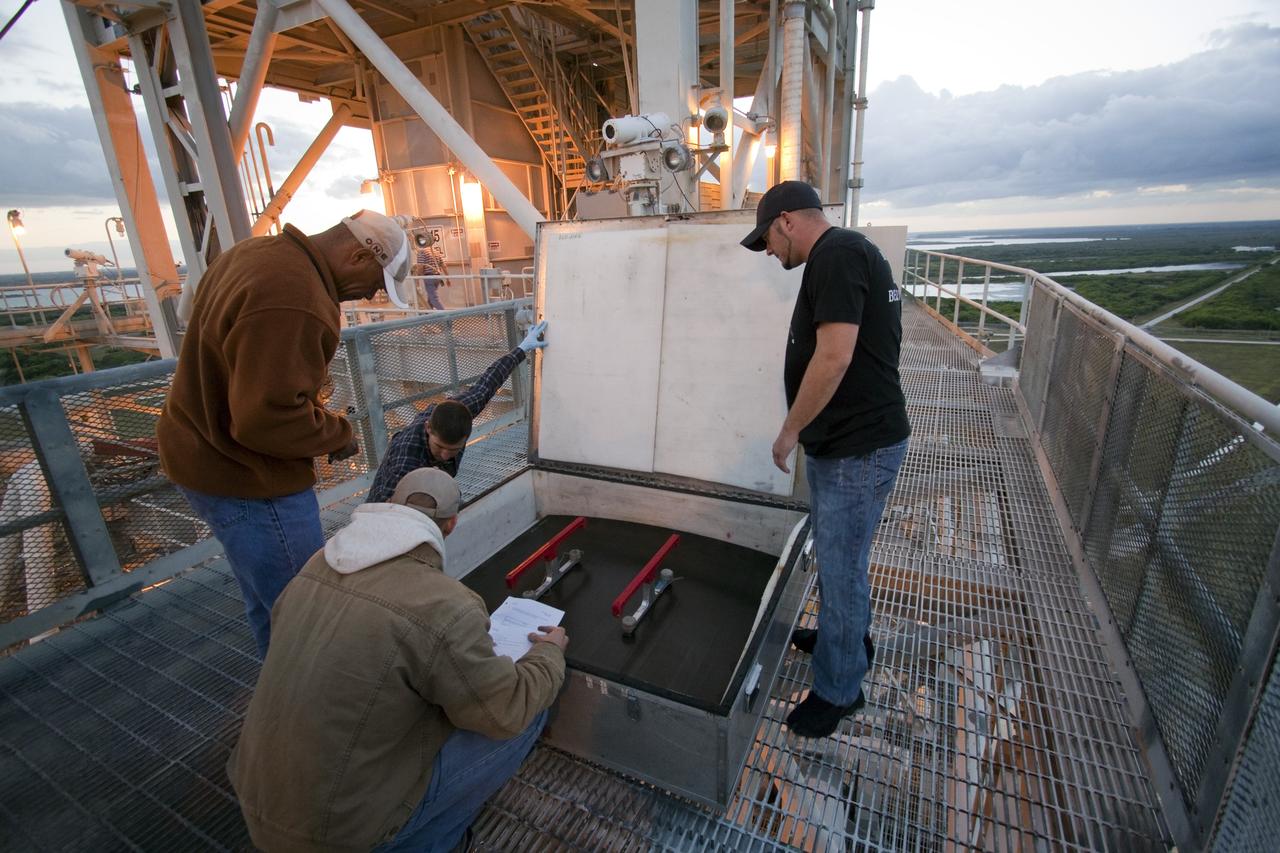
CAPE CANAVERAL, Fla. -- On Launch Pad 39A at NASA's Kennedy Space Center in Florida, technicians prepare to work inside the intertank of space shuttle Discovery's external fuel tank. Seen here are step pads that will be temporarily installed in the intertank. The intertank is unpressurized and holds most of the tank's electrical components. It sits between the liquid hydrogen tank and liquid oxygen tank. Technicians will be working inside the intertank to further analyze two cracks that were found on the tank’s metal exterior. The foam cracked during initial loading operations for space shuttle Discovery’s launch attempt on Nov. 5. The cracks are on one of the stringers, which are the composite aluminum ribs located vertically on the intertank area. Discovery's next launch attempt is no earlier than Nov. 30 at 4:02 a.m. EST. For more information on STS-133, visit www.nasa.gov/mission_pages/shuttle/shuttlemissions/sts133/. Photo credit: NASA/Jack Pfaller
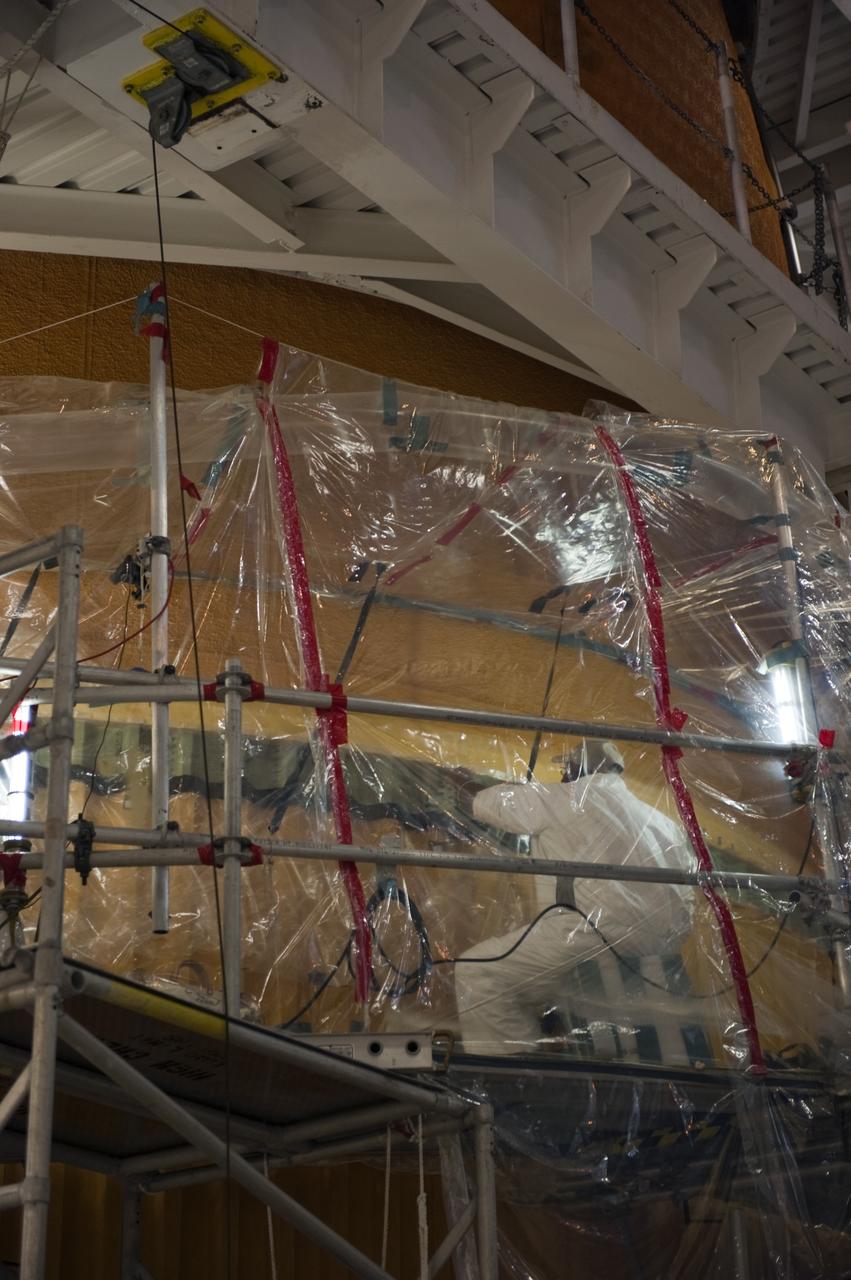
CAPE CANAVERAL, Fla. -- Repair work to space shuttle Discovery's external fuel tank continues in the Vehicle Assembly Building at NASA's Kennedy Space Center in Florida. Technicians are modifying 94 support beams, called stringers, on the tank's intertank region by fitting pieces of metal, called radius blocks, over the stringers' edges. After the modifications of the stringers are complete, foam insulation will be re-applied to the tank. Discovery's next launch opportunity to the International Space Station on the STS-133 mission is targeted for Feb. 24, 2011. For more information on STS-133, visit www.nasa.gov/mission_pages/shuttle/shuttlemissions/sts133/. Photo credit: NASA/Kim Shiflett
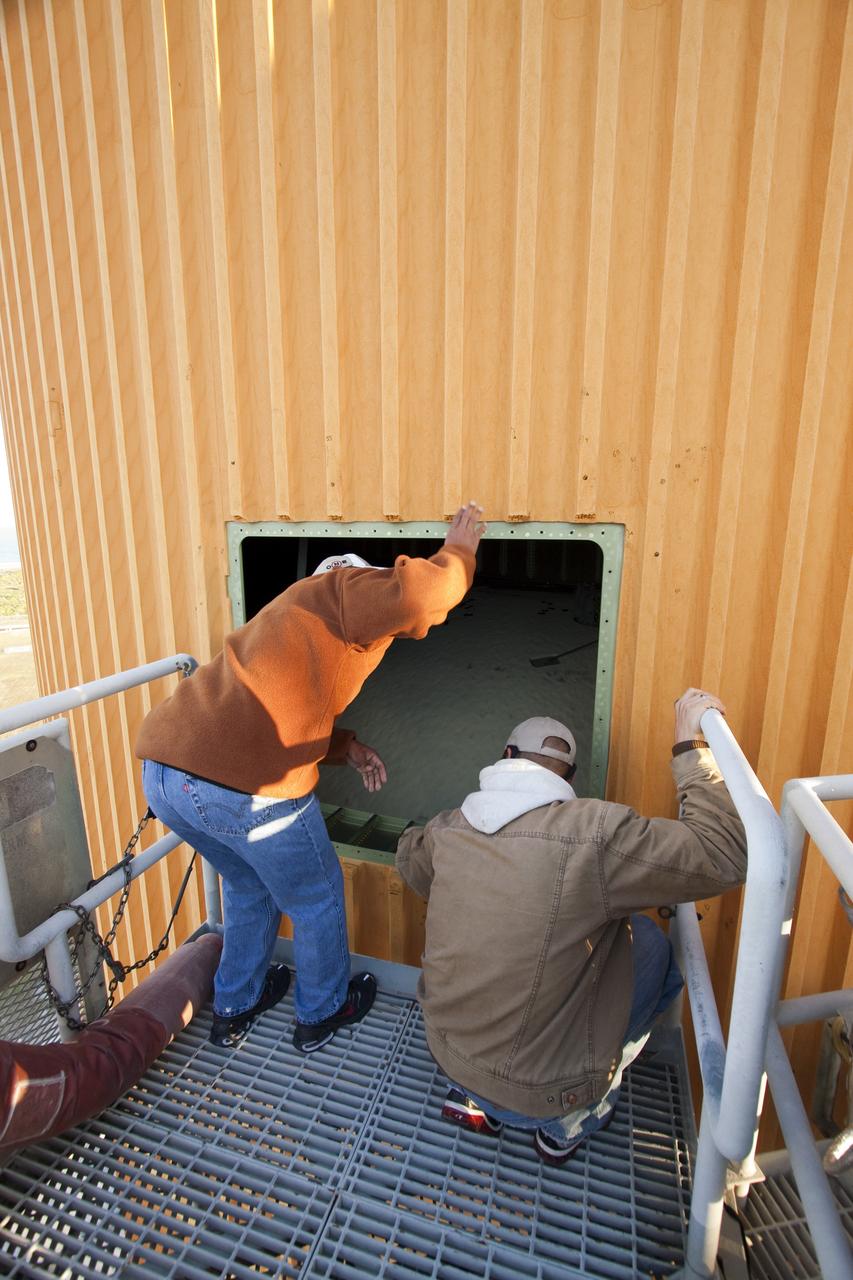
CAPE CANAVERAL, Fla. -- On Launch Pad 39A at NASA's Kennedy Space Center in Florida, technicians prepare to work inside the intertank of space shuttle Discovery's external fuel tank, which is accessible through this door. The intertank is unpressurized and holds most of the tank's electrical components. It sits between the liquid hydrogen tank and liquid oxygen tank. Technicians will be working inside the intertank to further analyze two cracks that were found on the tank’s metal exterior. The foam cracked during initial loading operations for space shuttle Discovery’s launch attempt on Nov. 5. The cracks are on one of the stringers, which are the composite aluminum ribs located vertically on the intertank area. Discovery's next launch attempt is no earlier than Nov. 30 at 4:02 a.m. EST. For more information on STS-133, visit www.nasa.gov/mission_pages/shuttle/shuttlemissions/sts133/. Photo credit: NASA/Jack Pfaller

CAPE CANAVERAL, Fla. -- On Launch Pad 39A at NASA's Kennedy Space Center in Florida, the ground umbilical carrier plate (GUCP) of space shuttle Discovery's external fuel tank has been repaired. A hydrogen gas leak at that location during tanking for Discovery's STS-133 mission to the International Space Station caused the launch attempt to be scrubbed Nov. 5. The GUCP is the overboard vent to the pad and the flame stack where the excess hydrogen is burned off. Discovery's next launch attempt is no earlier than Dec. 17 at 8:51 p.m. EST. Until then, engineers will continue to analyze data from the GUCP and stringer crack repairs. For more information on STS-133, visit www.nasa.gov/mission_pages/shuttle/shuttlemissions/sts133/. Photo credit: NASA/Cory Huston
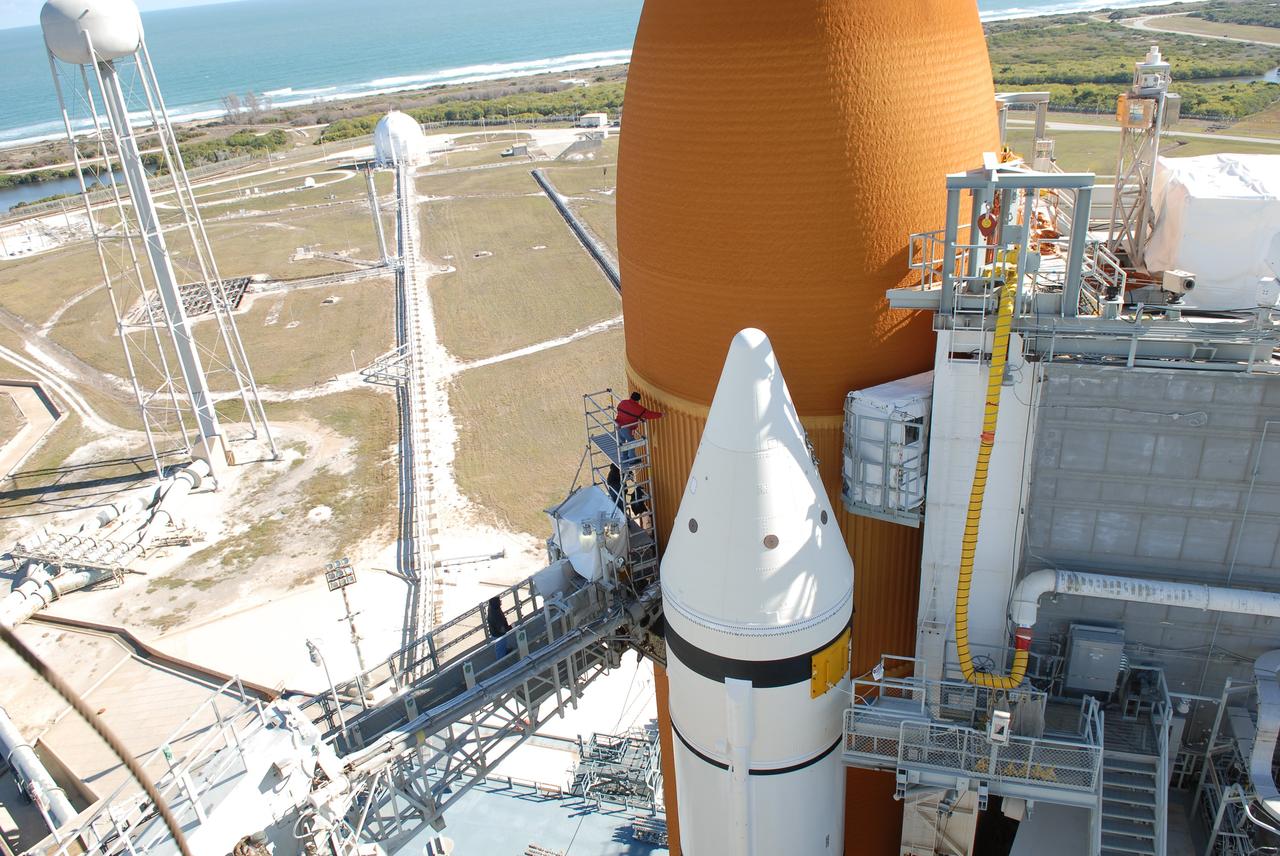
CAPE CANAVERAL, Fla. -- Technicians outfit space shuttle Discovery's external fuel tank with approximately 89 strain gauges, thermocouples and wiring in preparation for a tanking test no earlier than Dec. 17 on Launch Pad 39A at NASA's Kennedy Space Center in Florida. During the test, engineers will monitor what happens to 21-foot long, U-shaped aluminum brackets, called stringers, located at the external tank's intertank area, as well as the newly replaced ground umbilical carrier plate (GUCP), during the loading of cryogenic propellants. Discovery's first launch attempt for STS-133 was scrubbed in early November due to a hydrogen gas leak at GUCP. The next launch opportunity is no earlier than Feb. 3, 2011. For more information on STS-133, visit www.nasa.gov/mission_pages/shuttle/shuttlemissions/sts133/. Photo credit: NASA/Jim Grossmann

CAPE CANAVERAL, Fla. -- Space shuttle Discovery's external fuel tank is visible on Launch Pad 39A at NASA's Kennedy Space Center in Florida. Discovery's next mission is STS-133, which will deliver the Permanent Multipurpose Module (PMM), packed with supplies and critical spare parts, as well as Robonaut 2 (R2), to the International Space Station. For more information on STS-133, visit www.nasa.gov/mission_pages/shuttle/shuttlemissions/sts133/. Photo credit: NASA/Frank Michaux
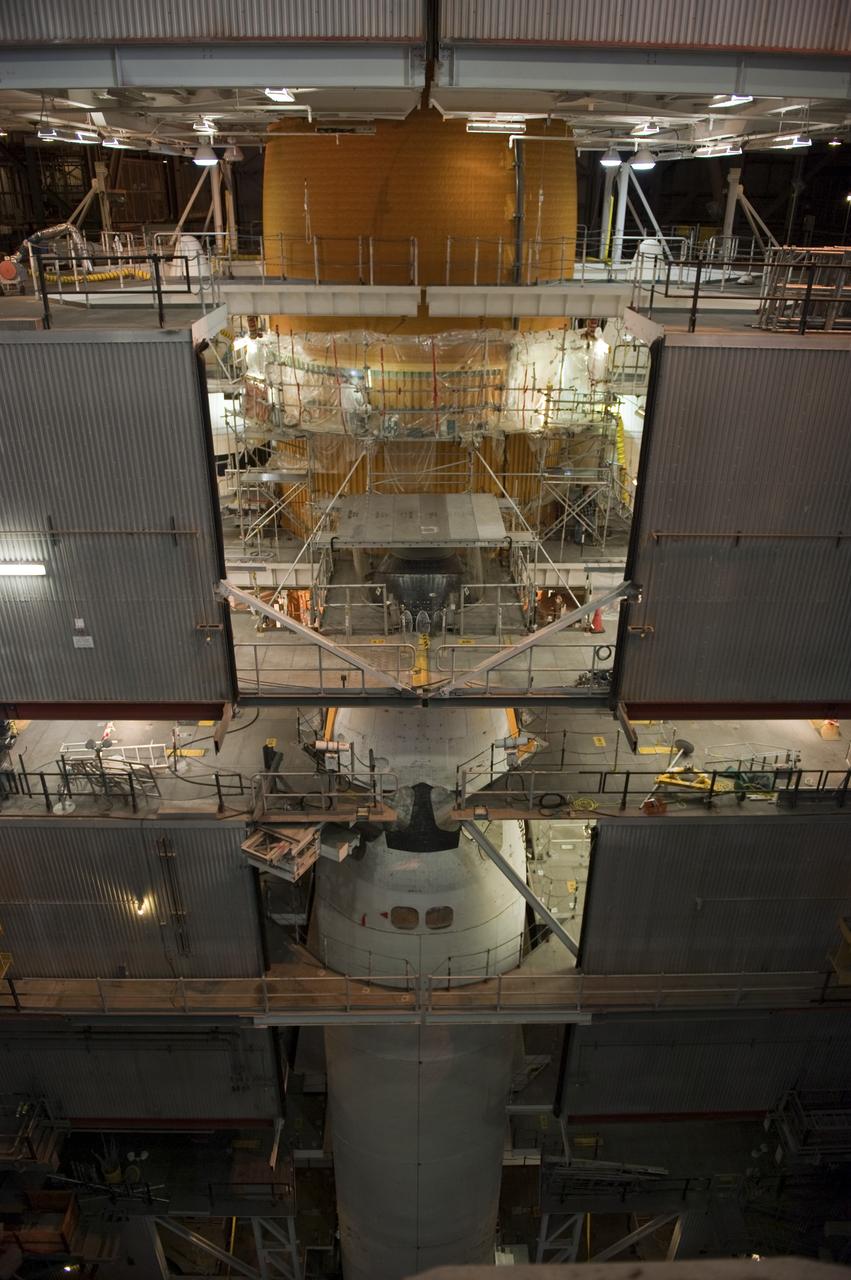
CAPE CANAVERAL, Fla. -- Repair work to space shuttle Discovery's external fuel tank continues in the Vehicle Assembly Building at NASA's Kennedy Space Center in Florida. Technicians are modifying 94 support beams, called stringers, on the tank's intertank region by fitting pieces of metal, called radius blocks, over the stringers' edges. After the modifications of the stringers are complete, foam insulation will be re-applied to the tank. Discovery's next launch opportunity to the International Space Station on the STS-133 mission is targeted for Feb. 24, 2011. For more information on STS-133, visit www.nasa.gov/mission_pages/shuttle/shuttlemissions/sts133/. Photo credit: NASA/Kim Shiflett
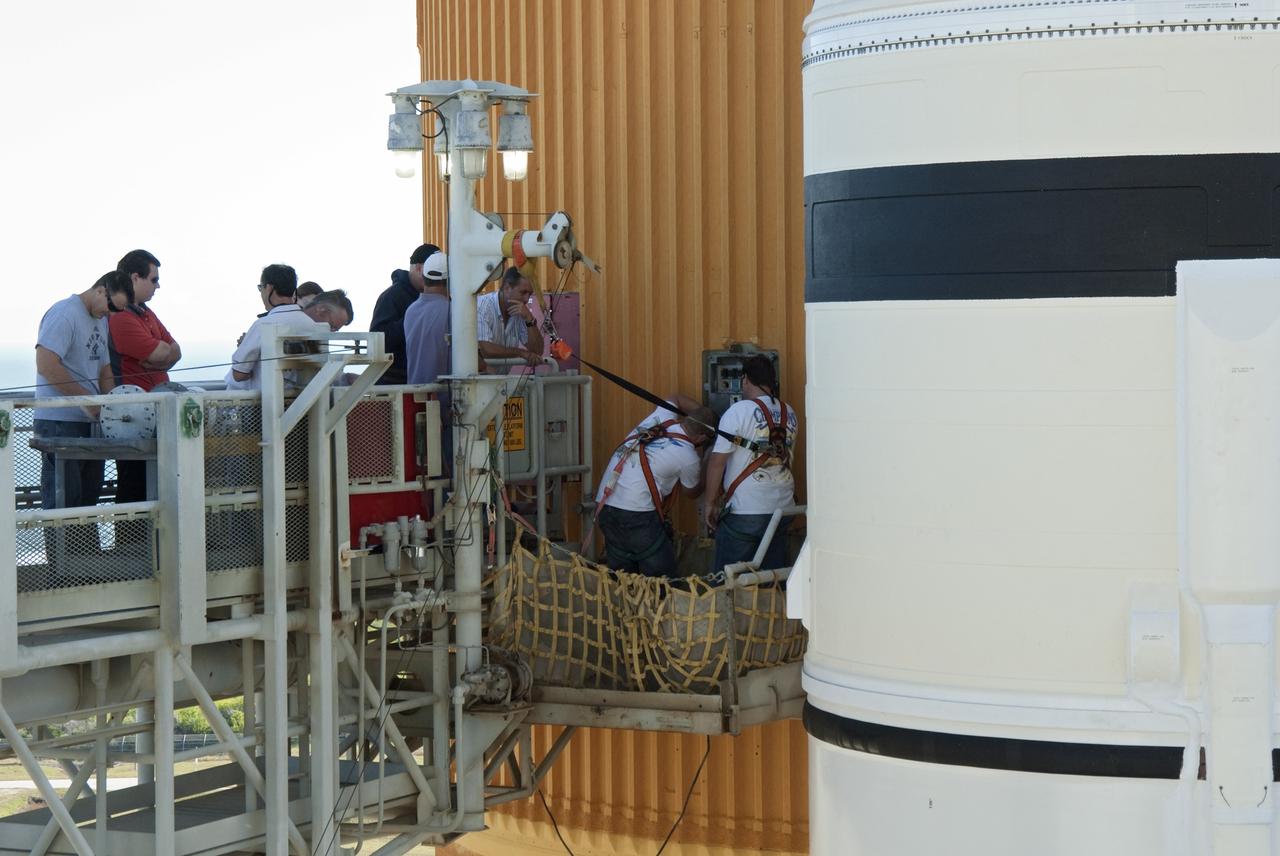
CAPE CANAVERAL, Fla. -- On Launch Pad 39A at NASA's Kennedy Space Center in Florida, workers prepare to install a new 7-inch quick disconnect on the ground umbilical carrier plate (GUCP) of space shuttle Discovery's external fuel tank. A hydrogen gas leak at that location during tanking for Discovery's STS-133 mission to the International Space Station caused the launch attempt to be scrubbed Nov. 5. The GUCP is the overboard vent to the pad and the flame stack where the excess hydrogen is burned off. For more information on STS-133, visit www.nasa.gov/mission_pages/shuttle/shuttlemissions/sts133/. Photo credit: NASA/Charisse Nahser

CAPE CANAVERAL, Fla. -- Technician will remove thermal sensors and foam insulation from space shuttle Discovery's external fuel tank in the Vehicle Assembly Building. The sensors will give engineers data about the changes the tank went through with the loading and draining of super-cold propellants during a tanking test on Dec. 17. Discovery's next launch opportunity to the International Space Station on the STS-133 mission is no earlier than Feb. 3, 2011. For more information on STS-133, visit www.nasa.gov/mission_pages/shuttle/shuttlemissions/sts133/. Photo credit: NASA/Frank Michaux

CAPE CANAVERAL, Fla. -- On Launch Pad 39A at NASA's Kennedy Space Center in Florida, technicians reattach the vent line to the ground umbilical carrier plate (GUCP) on space shuttle Discovery's external fuel tank. A hydrogen gas leak at that location during tanking for Discovery's STS-133 mission to the International Space Station caused the launch attempt to be scrubbed Nov. 5. The GUCP is the overboard vent to the pad and the flame stack where the excess hydrogen is burned off. Discovery's next launch attempt is no earlier than Nov. 30 at 4:02 a.m. EST. For more information on STS-133, visit www.nasa.gov/mission_pages/shuttle/shuttlemissions/sts133/. Photo credit: NASA/Ben Smegelsky
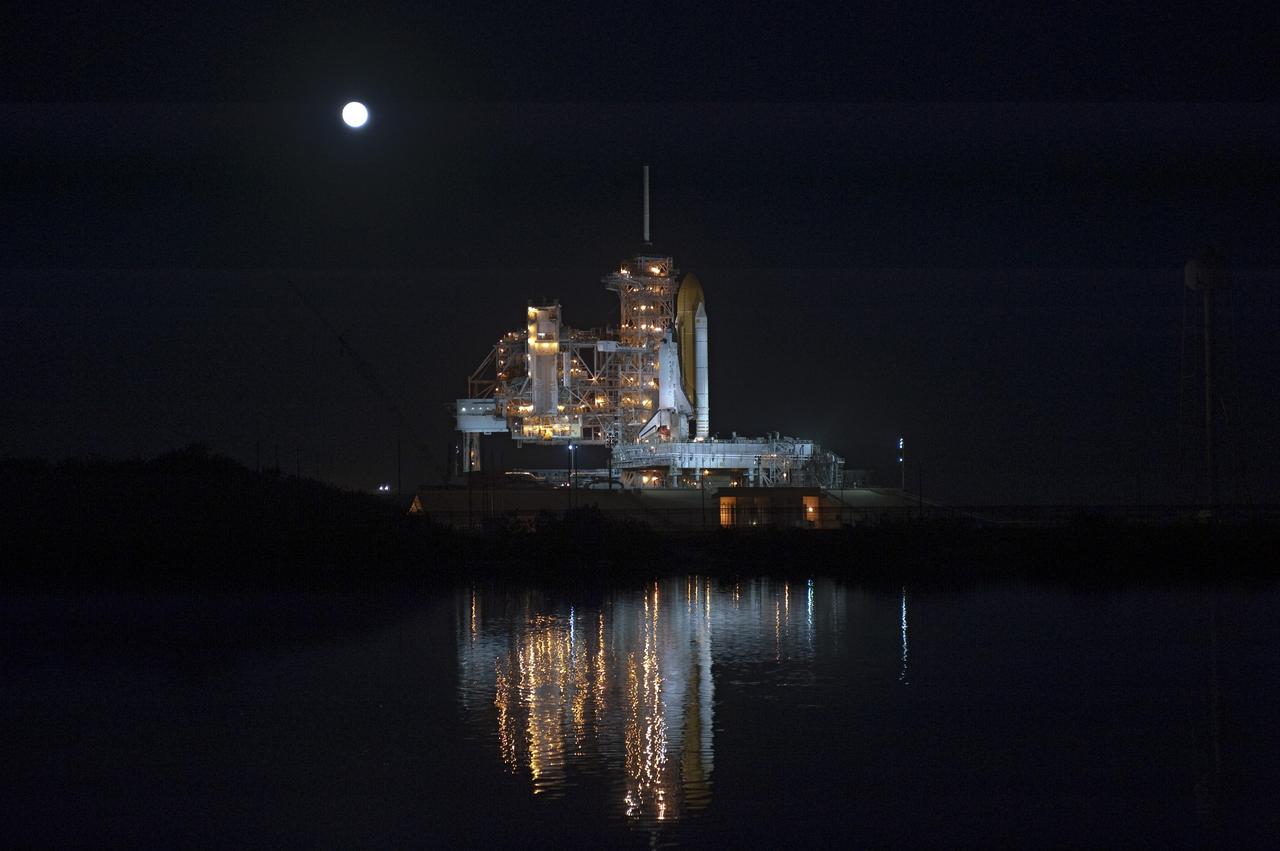
CAPE CANAVERAL, Fla. -- The moon shines brightly over space shuttle Discovery following a total lunar eclipse as the spacecraft waits to roll back from Launch Pad 39A to the Vehicle Assembly Building (VAB) at NASA's Kennedy Space Center in Florida. The move was scheduled for 12:30 a.m., but was postponed until 10 p.m. so technicians could resolve an issue with a leveling system on the crawler-transporter. Once inside the VAB, Discovery's external fuel tank will be examined and foam reapplied where 89 sensors were installed on the tank's aluminum skin for an instrumented tanking test on Dec. 17. The sensors were used to measure changes in the tank as super-cold propellants were pumped in and drained out. Data and analysis from the test will be used to determine what caused the tops of two, 21-foot-long support beams, called stringers, on the outside of the intertank to crack during fueling on Nov. 5. Discovery's next launch opportunity is no earlier than Feb. 3, 2011. For more information on STS-133, visit www.nasa.gov/mission_pages/shuttle/shuttlemissions/sts133/. Photo credit: NASA/Kim Shiflett
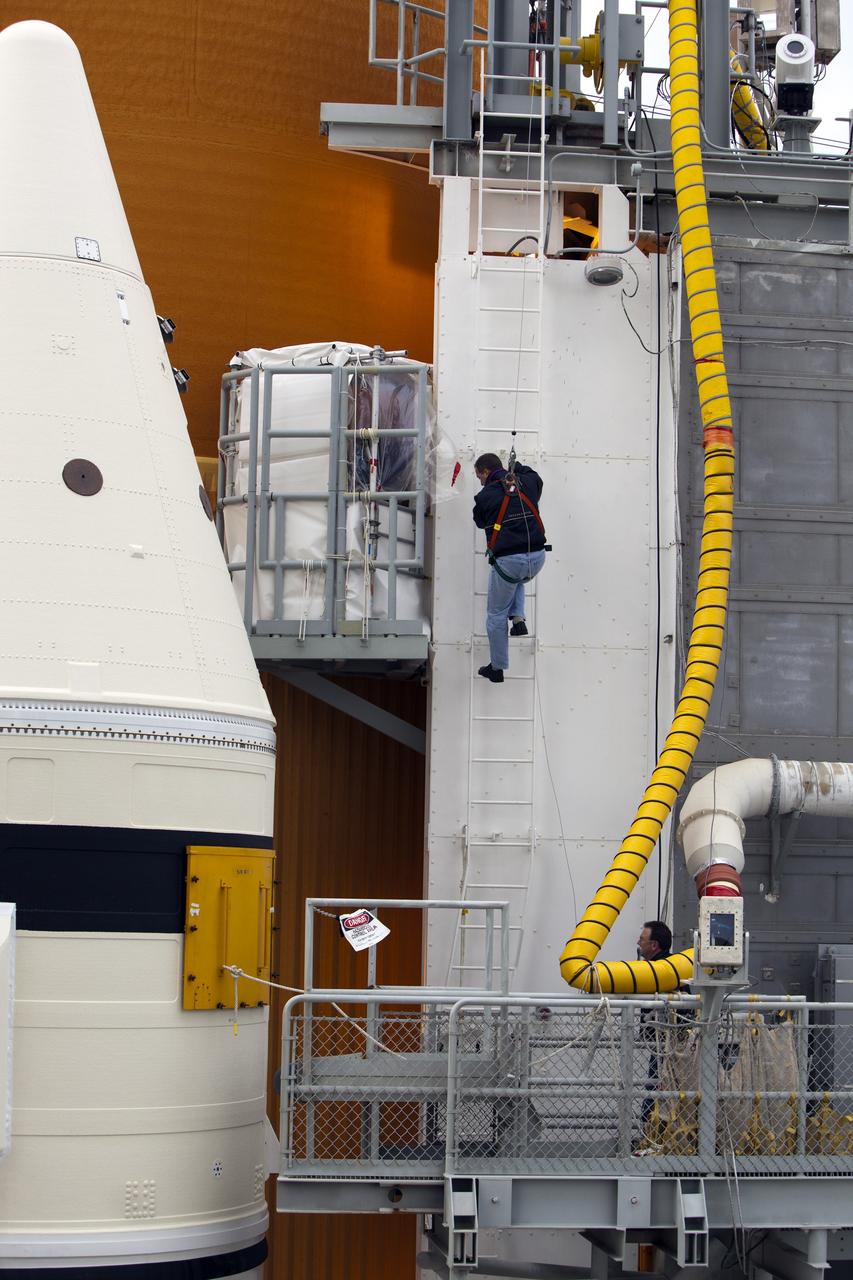
CAPE CANAVERAL, Fla. -- Technicians prepare space shuttle Discovery's external fuel tank for a tanking test no earlier than Dec. 15 on Launch Pad 39A at NASA's Kennedy Space Center in Florida. During the test, engineers will monitor what happens to 21-foot long, U-shaped aluminum brackets, called stringers, located at the intertank, as well as the newly replaced ground umbilical carrier plate (GUCP), during the loading of cryogenic propellants. Teams already have installed environmental enclosures on the tank, removed foam and prepared the tank's skin for approximately 89 strain gauges and thermocouples. Discovery's first launch attempt for STS-133 was scrubbed in early November due to a hydrogen gas leak at GUCP. The next launch opportunity is no earlier than Feb. 3, 2011. For more information on STS-133, visit www.nasa.gov/mission_pages/shuttle/shuttlemissions/sts133/. Photo credit: NASA/Ben Smegelsky
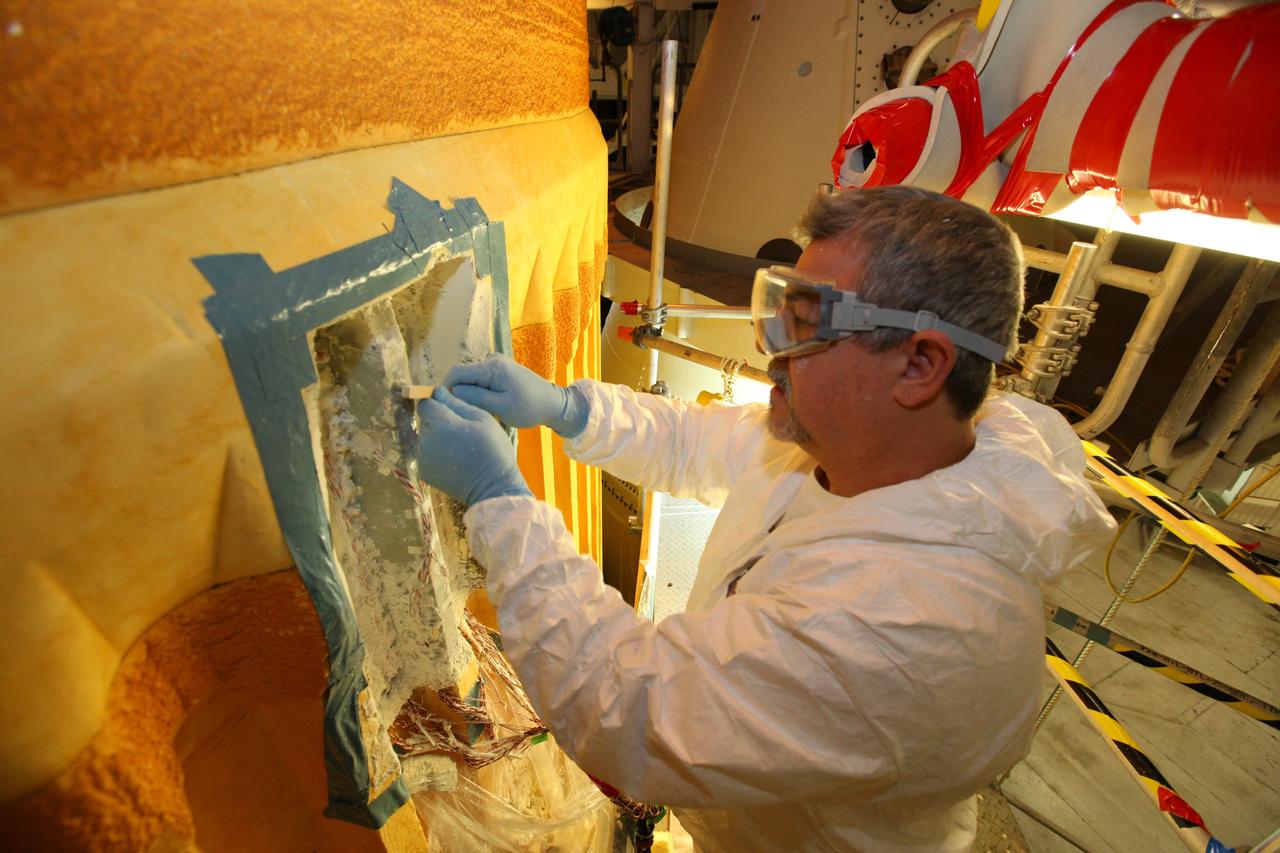
CAPE CANAVERAL, Fla. -- Technician will remove thermal sensors and foam insulation from space shuttle Discovery's external fuel tank in the Vehicle Assembly Building. The sensors will give engineers data about the changes the tank went through with the loading and draining of super-cold propellants during a tanking test on Dec. 17. Discovery's next launch opportunity to the International Space Station on the STS-133 mission is no earlier than Feb. 3, 2011. For more information on STS-133, visit www.nasa.gov/mission_pages/shuttle/shuttlemissions/sts133/. Photo credit: NASA/Frank Michaux
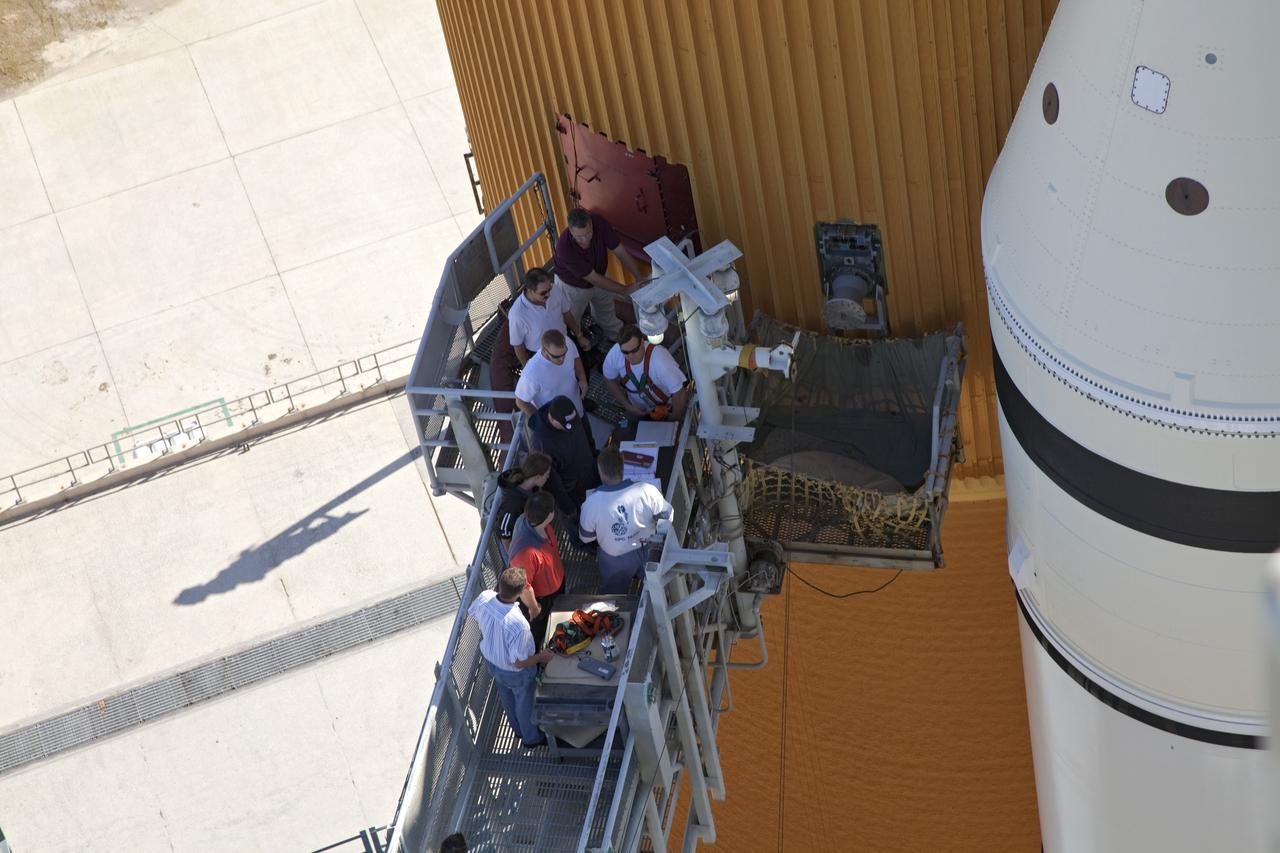
CAPE CANAVERAL, Fla. -- On Launch Pad 39A at NASA's Kennedy Space Center in Florida, a new 7-inch quick disconnect is installed on the ground umbilical carrier plate (GUCP) of space shuttle Discovery's external fuel tank. A hydrogen gas leak at that location during tanking for Discovery's STS-133 mission to the International Space Station caused the launch attempt to be scrubbed Nov. 5. The GUCP is the overboard vent to the pad and the flame stack where the excess hydrogen is burned off. For more information on STS-133, visit www.nasa.gov/mission_pages/shuttle/shuttlemissions/sts133/. Photo credit: NASA/Frankie Martin
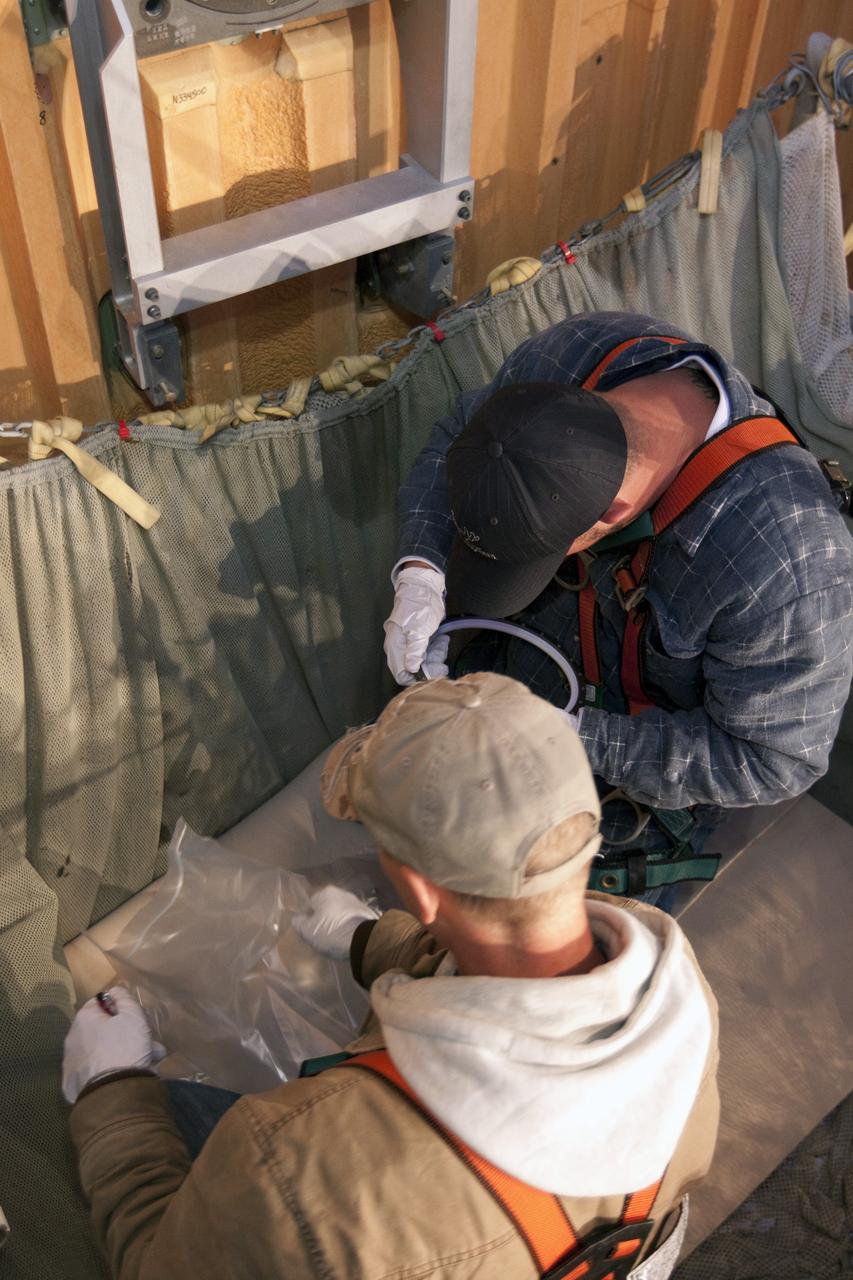
CAPE CANAVERAL, Fla. -- On Launch Pad 39A at NASA's Kennedy Space Center in Florida, workers examine the seal from the ground umbilical carrier plate (GUCP). A hydrogen gas leak at that location on the external fuel tank during tanking for space shuttle Discovery's STS-133 mission to the International Space Station caused the launch attempt to be scrubbed Nov. 5. The GUCP will be examined to determine the cause of the hydrogen leak and then repaired. The GUCP is the overboard vent to the pad and the flame stack where the excess hydrogen is burned off. For more information on STS-133, visit www.nasa.gov/mission_pages/shuttle/shuttlemissions/sts133/. Photo credit: NASA/Jack Pfaller
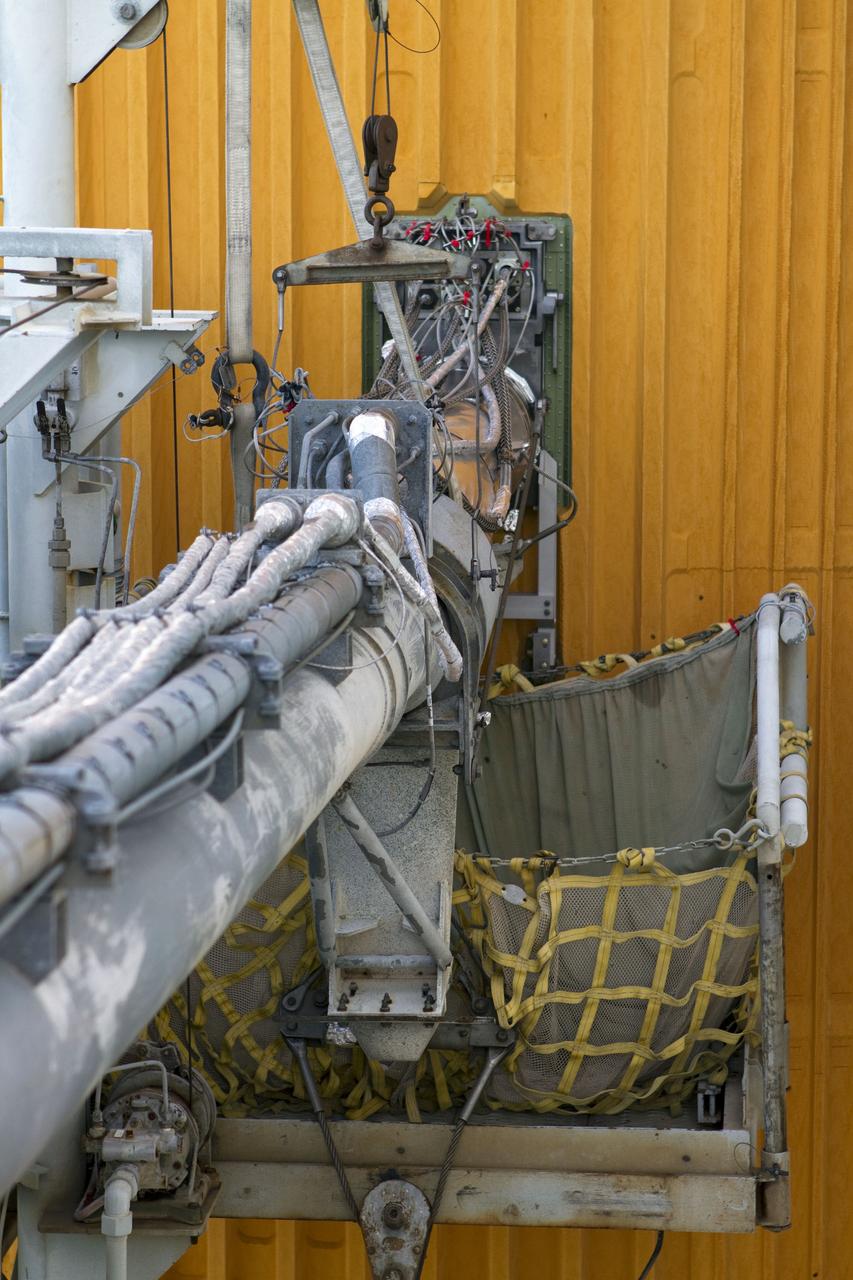
CAPE CANAVERAL, Fla. -- On Launch Pad 39A at NASA's Kennedy Space Center in Florida, the ground umbilical carrier plate (GUCP) of space shuttle Discovery's external fuel tank has been repaired. A hydrogen gas leak at that location during tanking for Discovery's STS-133 mission to the International Space Station caused the launch attempt to be scrubbed Nov. 5. The GUCP is the overboard vent to the pad and the flame stack where the excess hydrogen is burned off. Discovery's next launch attempt is no earlier than Dec. 17 at 8:51 p.m. EST. Until then, engineers will continue to analyze data from the GUCP and stringer crack repairs. For more information on STS-133, visit www.nasa.gov/mission_pages/shuttle/shuttlemissions/sts133/. Photo credit: NASA/Cory Huston

CAPE CANAVERAL, Fla. -- Technicians outfit space shuttle Discovery's external fuel tank with approximately 89 strain gauges, thermocouples and wiring in preparation for a tanking test no earlier than Dec. 17 on Launch Pad 39A at NASA's Kennedy Space Center in Florida. During the test, engineers will monitor what happens to 21-foot long, U-shaped aluminum brackets, called stringers, located at the external tank's intertank area, as well as the newly replaced ground umbilical carrier plate (GUCP), during the loading of cryogenic propellants. Discovery's first launch attempt for STS-133 was scrubbed in early November due to a hydrogen gas leak at GUCP. The next launch opportunity is no earlier than Feb. 3, 2011. For more information on STS-133, visit www.nasa.gov/mission_pages/shuttle/shuttlemissions/sts133/. Photo credit: NASA/Jim Grossmann
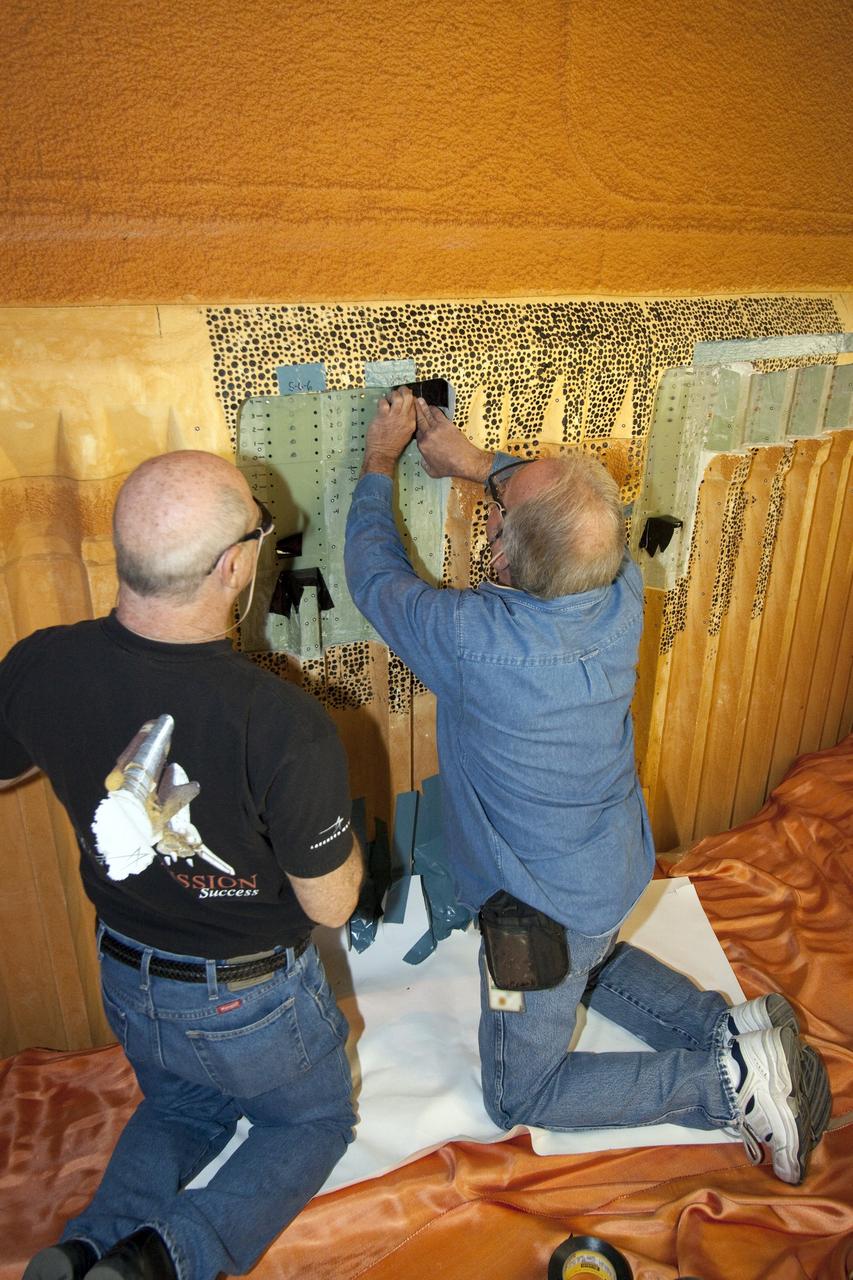
CAPE CANAVERAL, Fla. -- Repair work to space shuttle Discovery's external fuel tank begins in the Vehicle Assembly Building at NASA's Kennedy Space Center in Florida. Technicians will modify 32 support beams, called stringers, on the tank's intertank region by fitting pieces of metal, called radius blocks, over the stringers' edges where they attach to the thrust panel area. The thrust panel is where the tank meets the two solid rocket boosters and sees the most stress during the flight into orbit. After the modifications and additional scans of the stringers are complete, foam insulation will be re-applied. Discovery's next launch opportunity to the International Space Station on the STS-133 mission is no earlier than Feb. 3, 2011. For more information on STS-133, visit www.nasa.gov/mission_pages/shuttle/shuttlemissions/sts133/. Photo credit: NASA/Jack Pfaller
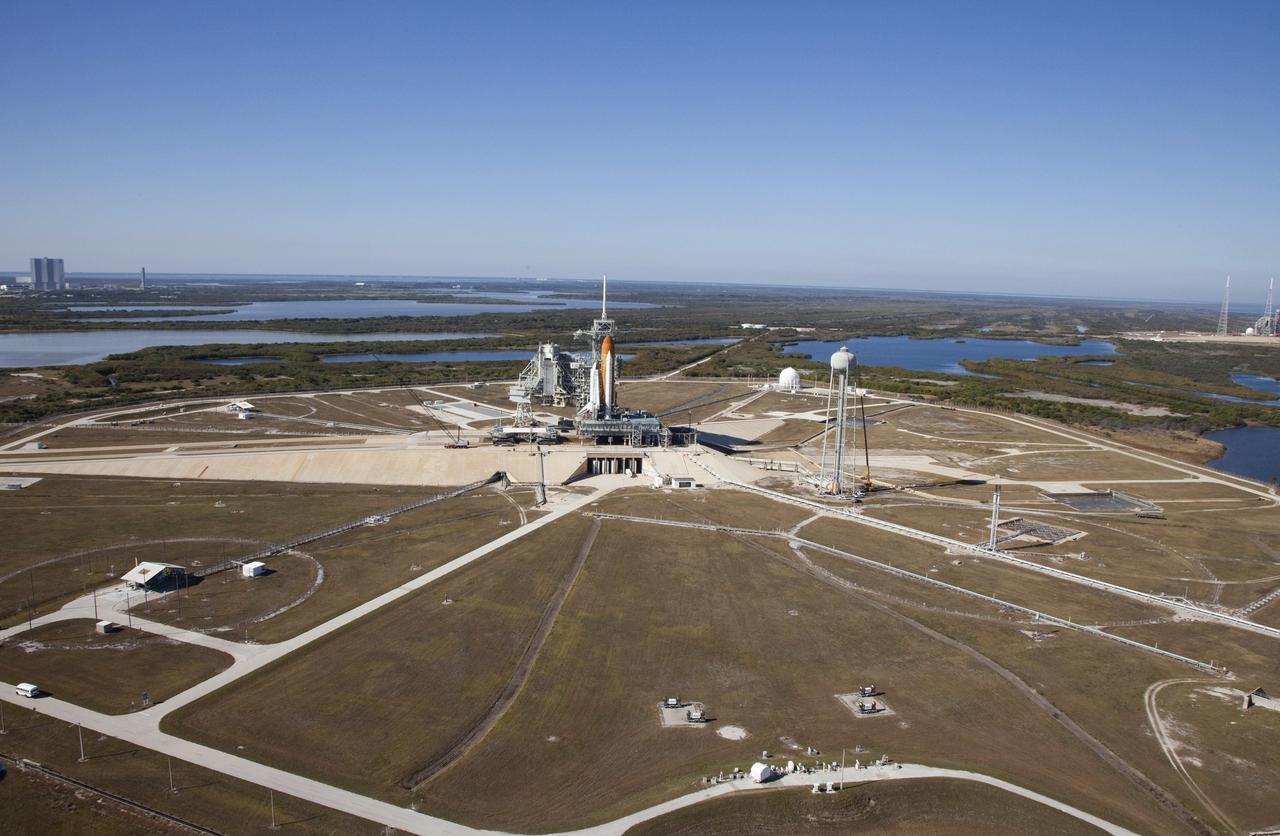
CAPE CANAVERAL, Fla. -- Space shuttle Discovery awaits its move, called rollback, from Launch Pad 39A to the Vehicle Assembly Building (VAB) at NASA's Kennedy Space Center in Florida. Rollback was scheduled for 12:30 a.m., but was postponed until 10 p.m. so technicians could resolve an issue with a leveling system on the crawler-transporter. Once inside the VAB, Discovery's external fuel tank will be examined and foam reapplied where 89 sensors were installed on the tank's aluminum skin for an instrumented tanking test on Dec. 17. The sensors were used to measure changes in the tank as super-cold propellants were pumped in and drained out. Data and analysis from the test will be used to determine what caused the tops of two, 21-foot-long support beams, called stringers, on the outside of the intertank to crack during fueling on Nov. 5. Discovery's next launch opportunity to the International Space Station on the STS-133 mission is no earlier than Feb. 3, 2011. For more information on STS-133, visit www.nasa.gov/mission_pages/shuttle/shuttlemissions/sts133/. Photo credit: NASA/Frank Michaux
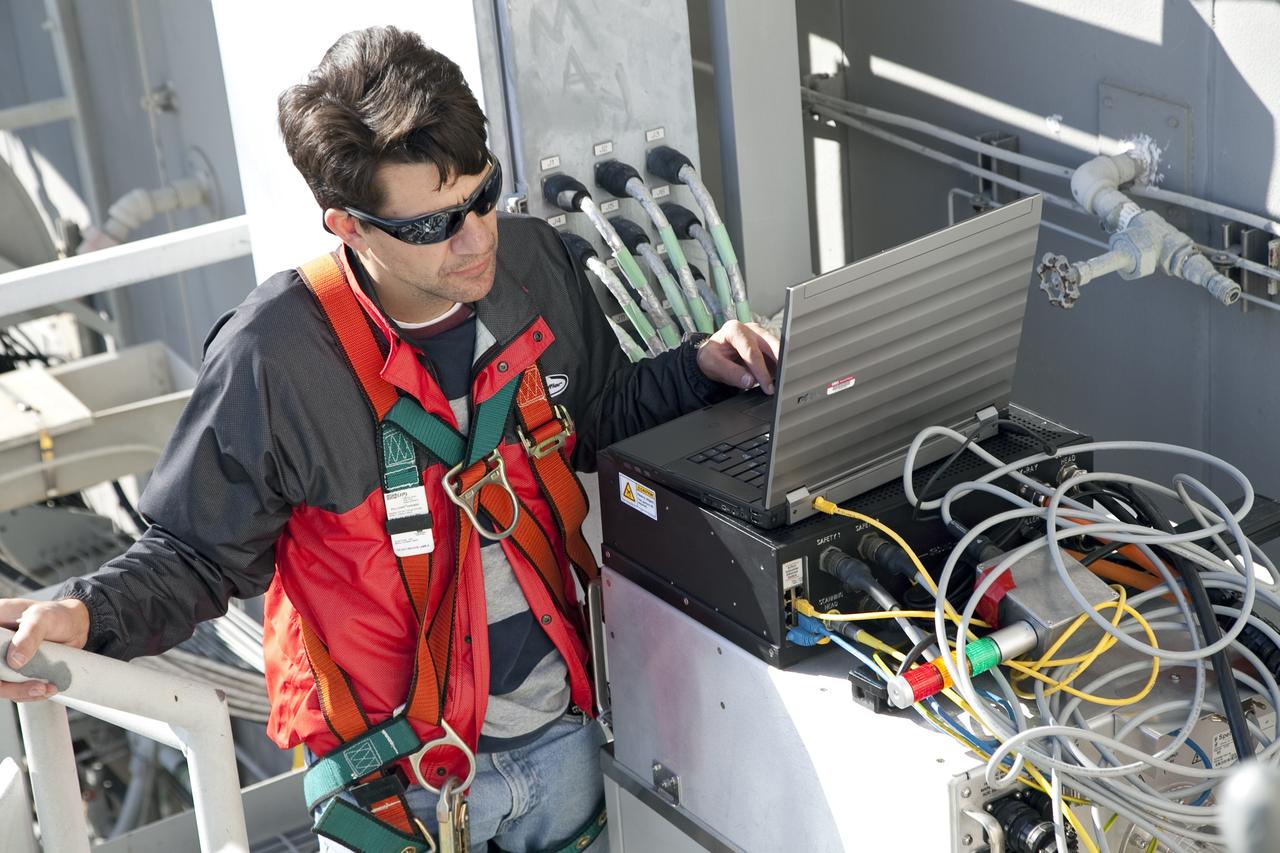
CAPE CANAVERAL, Fla. -- An engineer examines images of space shuttle Discovery's external fuel tank taken from a backscatter device on Launch Pad 39A at NASA's Kennedy Space Center in Florida. The device bounces radiation off the tank, allowing technicians to see under the tank's foam insulation. The foam cracked during initial loading operations for Discovery’s STS-133 launch attempt on Nov. 5, and technicians later identified two cracked stringers, which are the composite aluminum ribs located vertically on the tank’s intertank area. Those two stringers have been replaced and reinforced with doublers, which are shaped metal pieces twice as thick as the original stringers. Launch is no earlier than Dec. 17 at 8:51 p.m. EST. For more information on STS-133, visit www.nasa.gov/mission_pages/shuttle/shuttlemissions/sts133/. Photo credit: NASA/Frank Michaux
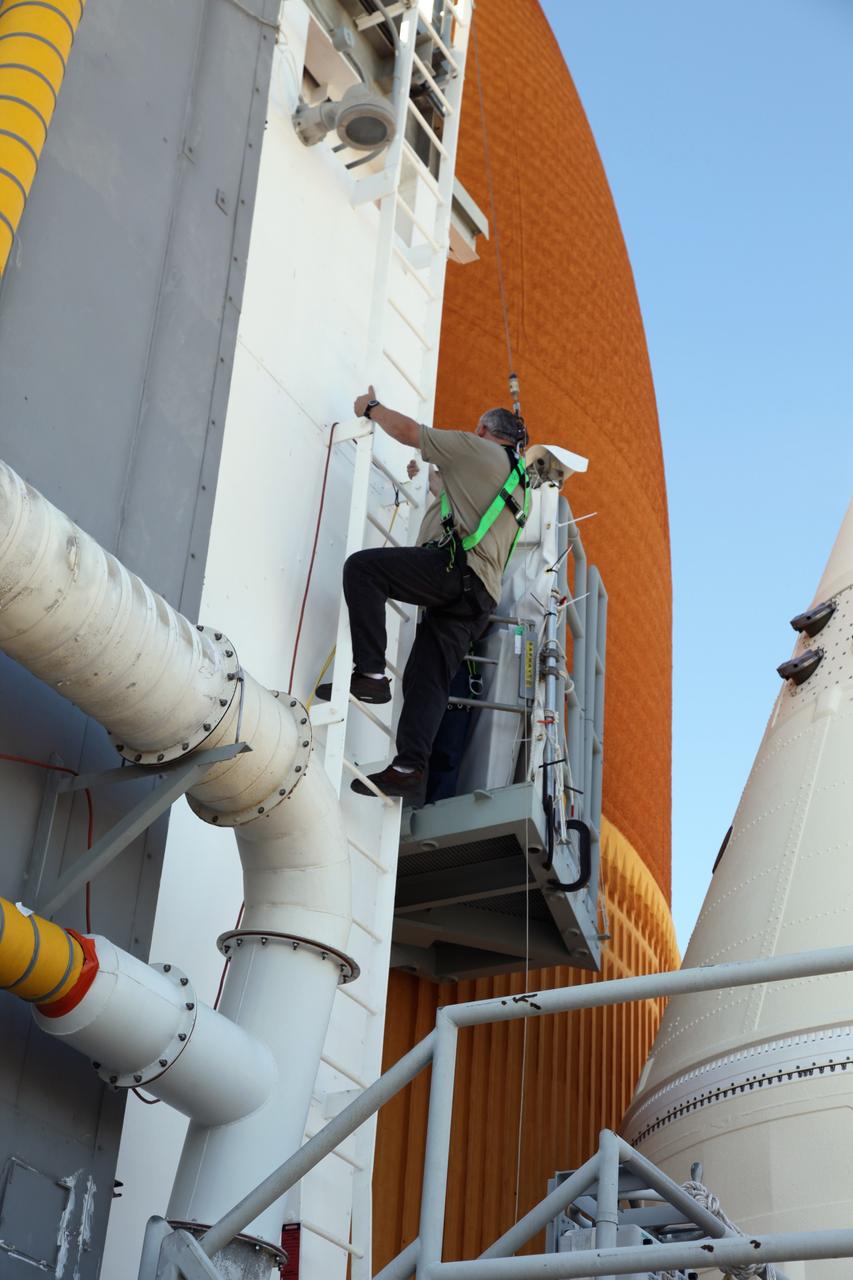
CAPE CANAVERAL, Fla. -- Technicians prepare space shuttle Discovery's external fuel tank for a tanking test no earlier than Dec. 15 on Launch Pad 39A at NASA's Kennedy Space Center in Florida. During the test, engineers will monitor what happens to 21-foot long, U-shaped aluminum brackets, called stringers, located at the intertank, as well as the newly replaced ground umbilical carrier plate (GUCP), during the loading of cryogenic propellants. Teams already have installed environmental enclosures on the tank, removed foam and prepared the tank's skin for approximately 89 strain gauges and thermocouples. Discovery's first launch attempt for STS-133 was scrubbed in early November due to a hydrogen gas leak at GUCP. The next launch opportunity is no earlier than Feb. 3, 2011. For more information on STS-133, visit www.nasa.gov/mission_pages/shuttle/shuttlemissions/sts133/. Photo credit: NASA/Frank Michaux
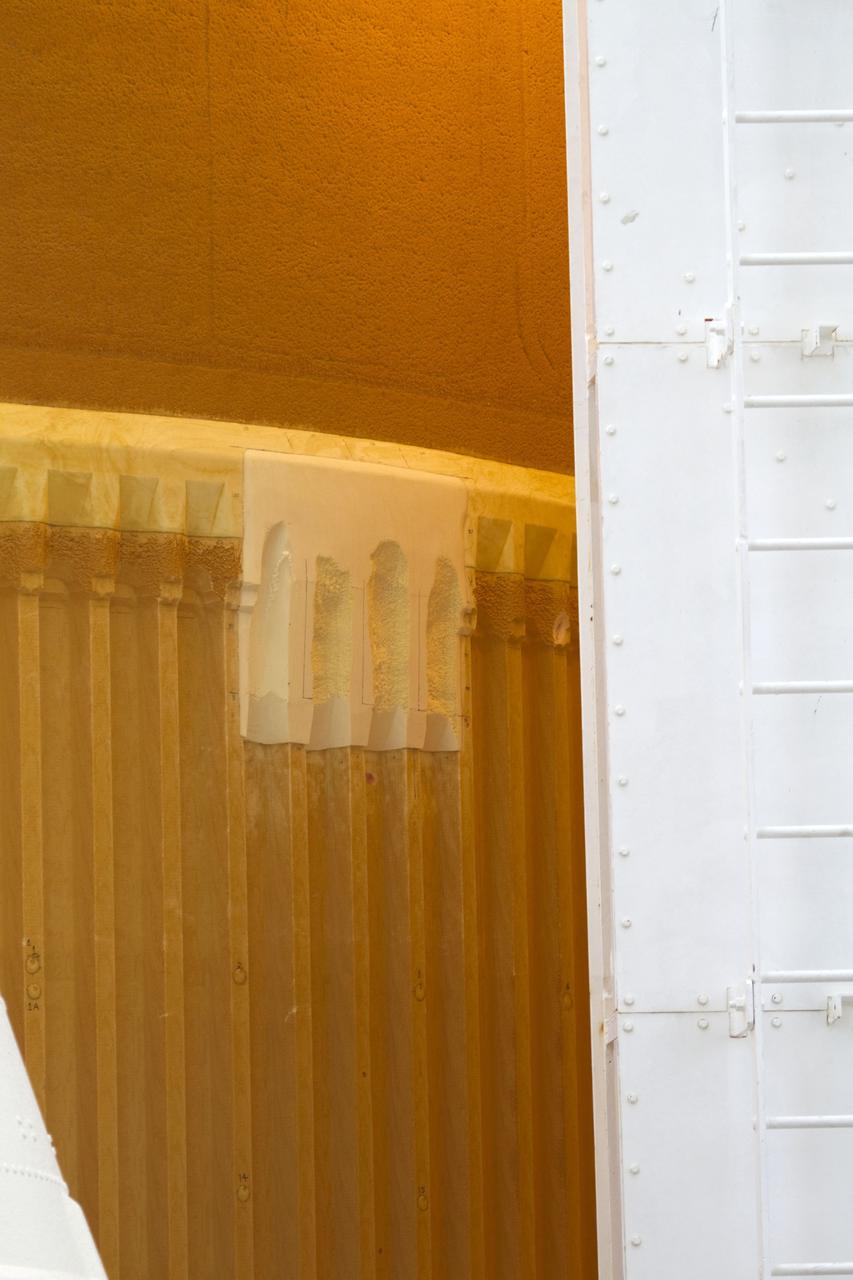
CAPE CANAVERAL, Fla. -- On Launch Pad 39A at NASA's Kennedy Space Center in Florida, the cracks on space shuttle Discovery's external fuel tank have been repaired. The foam cracked during initial loading operations for Discovery’s STS-133 mission to the International Space Station on Nov. 5. The cracks were on two of the 108 stringers, which are the composite aluminum ribs located vertically on the intertank area. Discovery's next launch attempt is no earlier than Dec. 17 at 8:51 p.m. EST. Until then, engineers will continue to analyze data from the GUCP and stringer crack repairs. For more information on STS-133, visit www.nasa.gov/mission_pages/shuttle/shuttlemissions/sts133/. Photo credit: NASA/Cory Huston
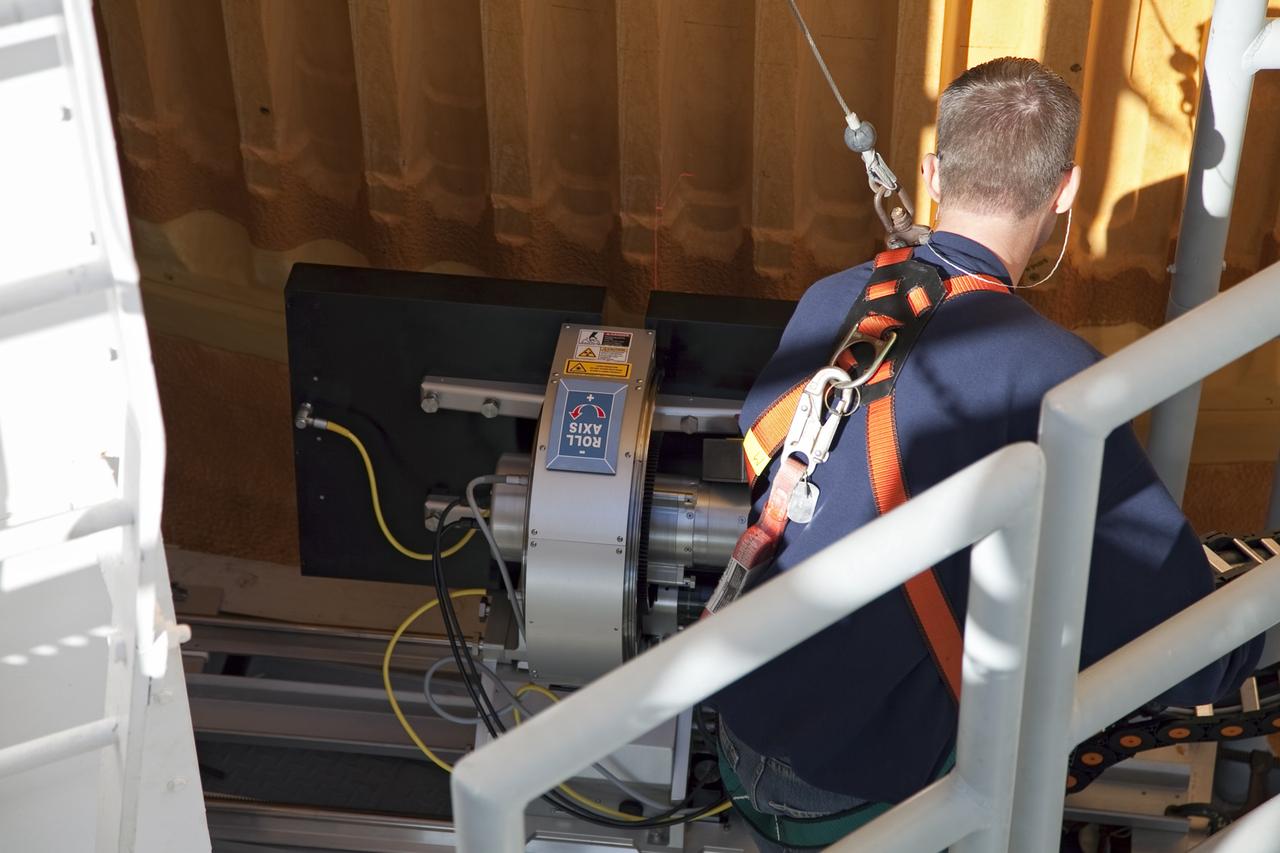
CAPE CANAVERAL, Fla. -- An engineer uses a backscatter device to examine space shuttle Discovery's external fuel tank on Launch Pad 39A at NASA's Kennedy Space Center in Florida. The device bounces radiation off the tank, allowing technicians to see under the tank's foam insulation. The foam cracked during initial loading operations for Discovery’s STS-133 launch attempt on Nov. 5, and technicians later identified two cracked stringers, which are the composite aluminum ribs located vertically on the tank’s intertank area. Those two stringers have been replaced and reinforced with doublers, which are shaped metal pieces twice as thick as the original stringers. Launch is no earlier than Dec. 17 at 8:51 p.m. EST. For more information on STS-133, visit www.nasa.gov/mission_pages/shuttle/shuttlemissions/sts133/. Photo credit: NASA/Frank Michaux

CAPE CANAVERAL, Fla. -- On Launch Pad 39A at NASA's Kennedy Space Center in Florida, workers install a cap over the hole in space shuttle Discovery's external fuel tank where the ground umbilical carrier plate (GUCP) was removed. A hydrogen gas leak at that location during tanking for Discovery's STS-133 mission to the International Space Station caused the launch attempt to be scrubbed Nov. 5. The GUCP will be examined to determine the cause of the hydrogen leak and then repaired. The GUCP is the overboard vent to the pad and the flame stack where the excess hydrogen is burned off. For more information on STS-133, visit www.nasa.gov/mission_pages/shuttle/shuttlemissions/sts133/. Photo credit: NASA/Dimitri Gerondidakis
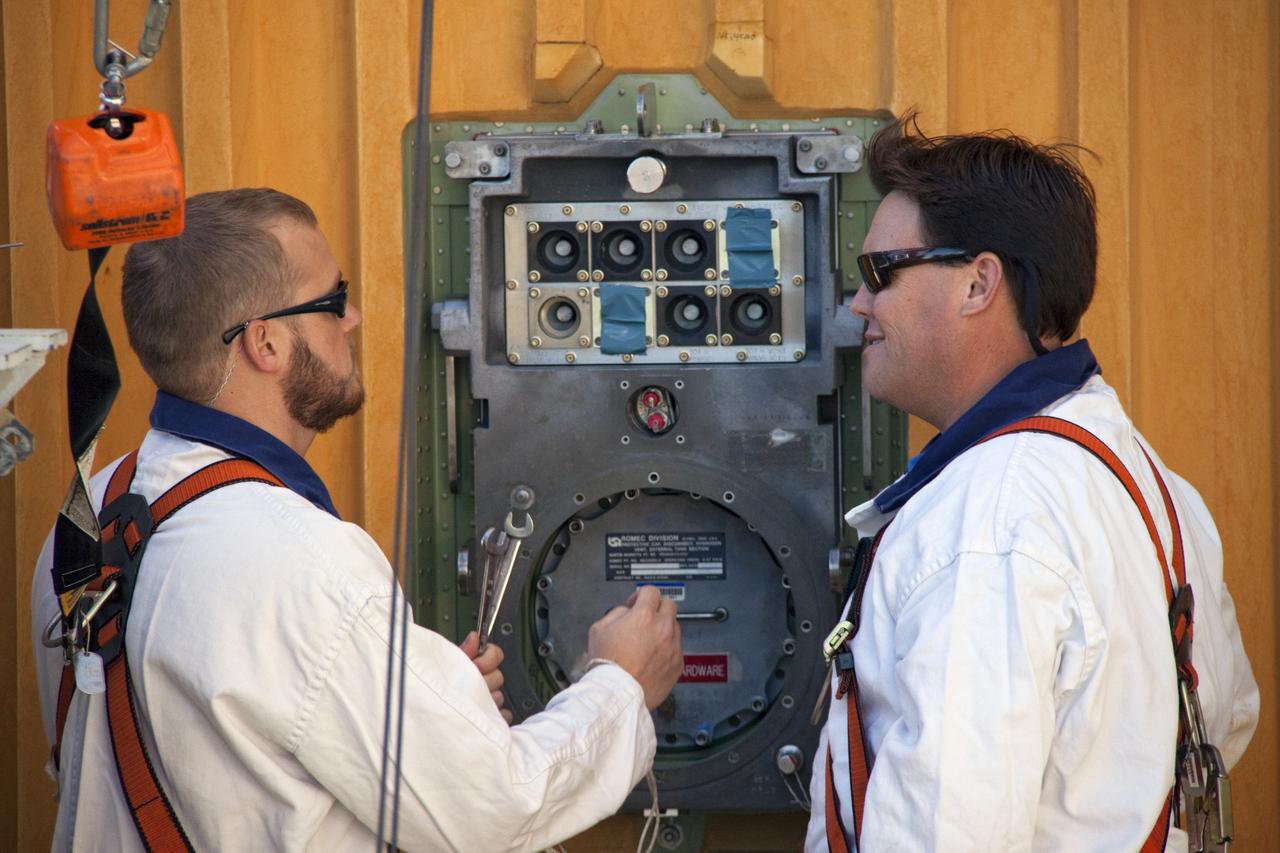
CAPE CANAVERAL, Fla. -- On Launch Pad 39A at NASA's Kennedy Space Center in Florida, workers begin to install a new ground umbilical carrier plate (GUCP) on space shuttle Discovery's external fuel tank. A hydrogen gas leak at that location during tanking for Discovery's STS-133 mission to the International Space Station caused the launch attempt to be scrubbed Nov. 5. The GUCP is the overboard vent to the pad and the flame stack where the excess hydrogen is burned off. For more information on STS-133, visit www.nasa.gov/mission_pages/shuttle/shuttlemissions/sts133/. Photo credit: NASA/Troy Cryder
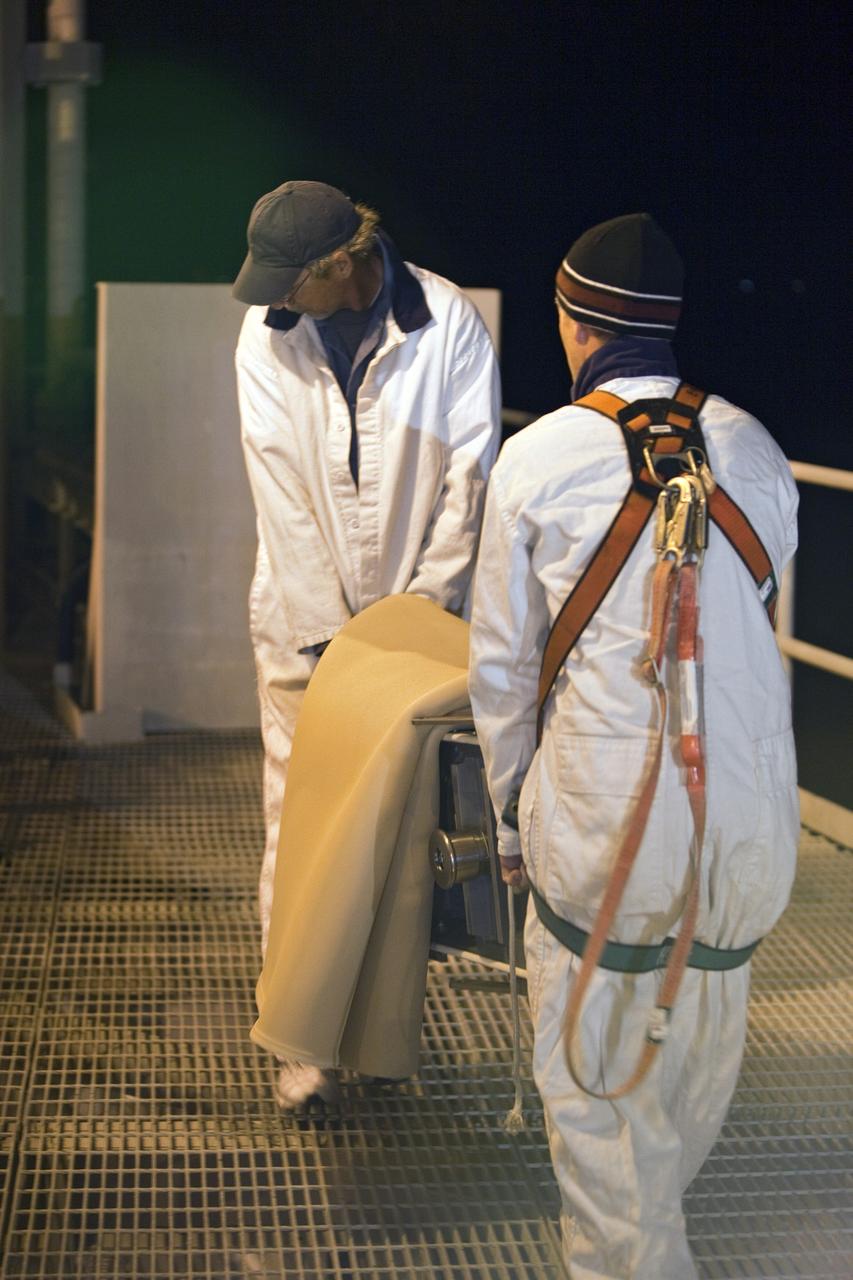
CAPE CANAVERAL, Fla. -- On Launch Pad 39A at NASA's Kennedy Space Center in Florida, workers move the ground umbilical carrier plate (GUCP) to a location where it can be examined. A hydrogen gas leak at that location on the external fuel tank during tanking for space shuttle Discovery's STS-133 mission to the International Space Station caused the launch attempt to be scrubbed Nov. 5. The GUCP will be examined to determine the cause of the hydrogen leak and then repaired. The GUCP is the overboard vent to the pad and the flame stack where the excess hydrogen is burned off. For more information on STS-133, visit www.nasa.gov/mission_pages/shuttle/shuttlemissions/sts133/. Photo credit: NASA/Dimitri Gerondidakis
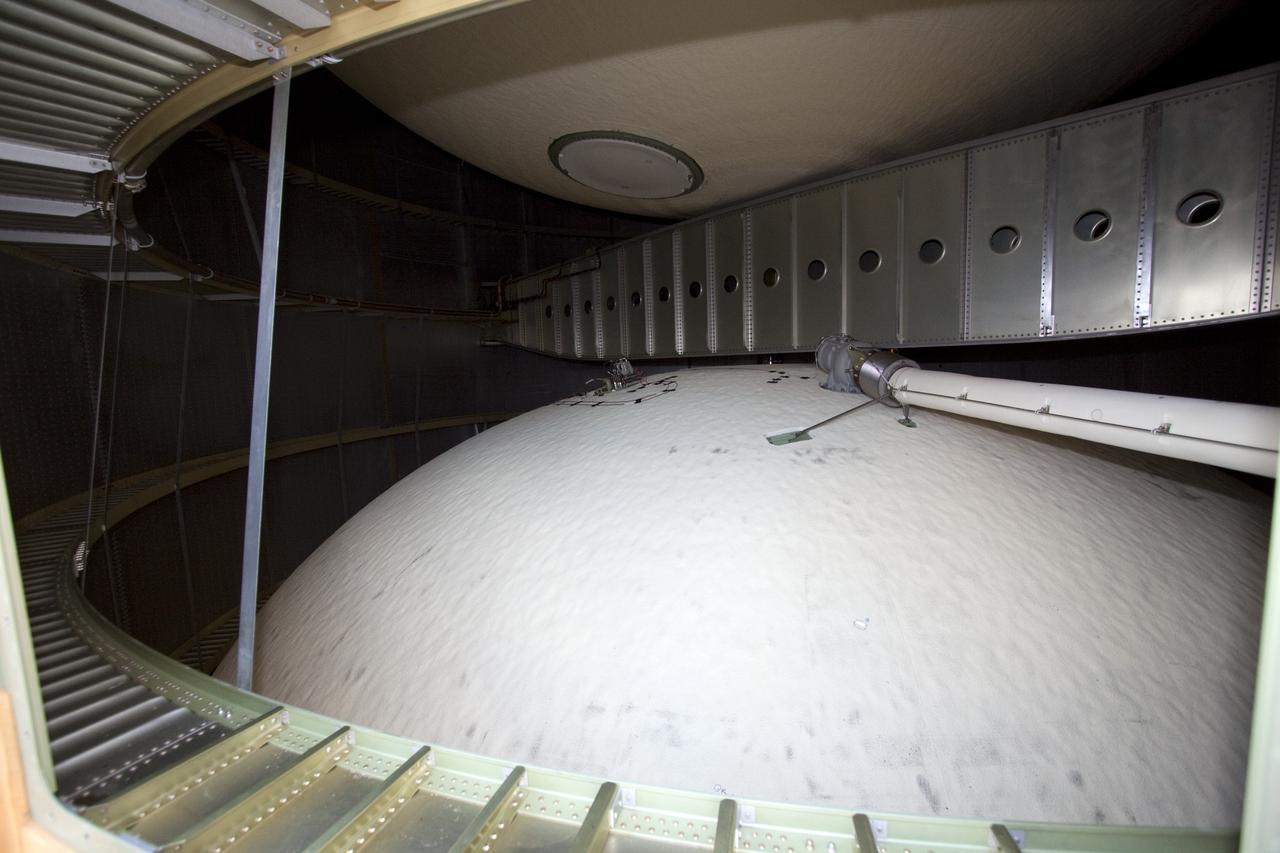
CAPE CANAVERAL, Fla. -- On Launch Pad 39A at NASA's Kennedy Space Center in Florida, this view gives a look inside the intertank of space shuttle Discovery's external fuel tank. The intertank is unpressurized and holds most of the tank's electrical components. It sits between the liquid hydrogen tank, below, and liquid oxygen tank, above. Technicians will be working inside the intertank to further analyze two cracks that were found on the tank’s metal exterior. The foam cracked during initial loading operations for space shuttle Discovery’s launch attempt on Nov. 5. The cracks are on one of the stringers, which are the composite aluminum ribs located vertically on the intertank area. Discovery's next launch attempt is no earlier than Nov. 30 at 4:02 a.m. EST. For more information on STS-133, visit www.nasa.gov/mission_pages/shuttle/shuttlemissions/sts133/. Photo credit: NASA/Jack Pfaller

CAPE CANAVERAL, Fla. -- On Launch Pad 39A at NASA's Kennedy Space Center in Florida, workers install a new 7-inch quick disconnect on the ground umbilical carrier plate (GUCP) of space shuttle Discovery's external fuel tank. A hydrogen gas leak at that location during tanking for Discovery's STS-133 mission to the International Space Station caused the launch attempt to be scrubbed Nov. 5. The GUCP is the overboard vent to the pad and the flame stack where the excess hydrogen is burned off. For more information on STS-133, visit www.nasa.gov/mission_pages/shuttle/shuttlemissions/sts133/. Photo credit: NASA/Charisse Nahser
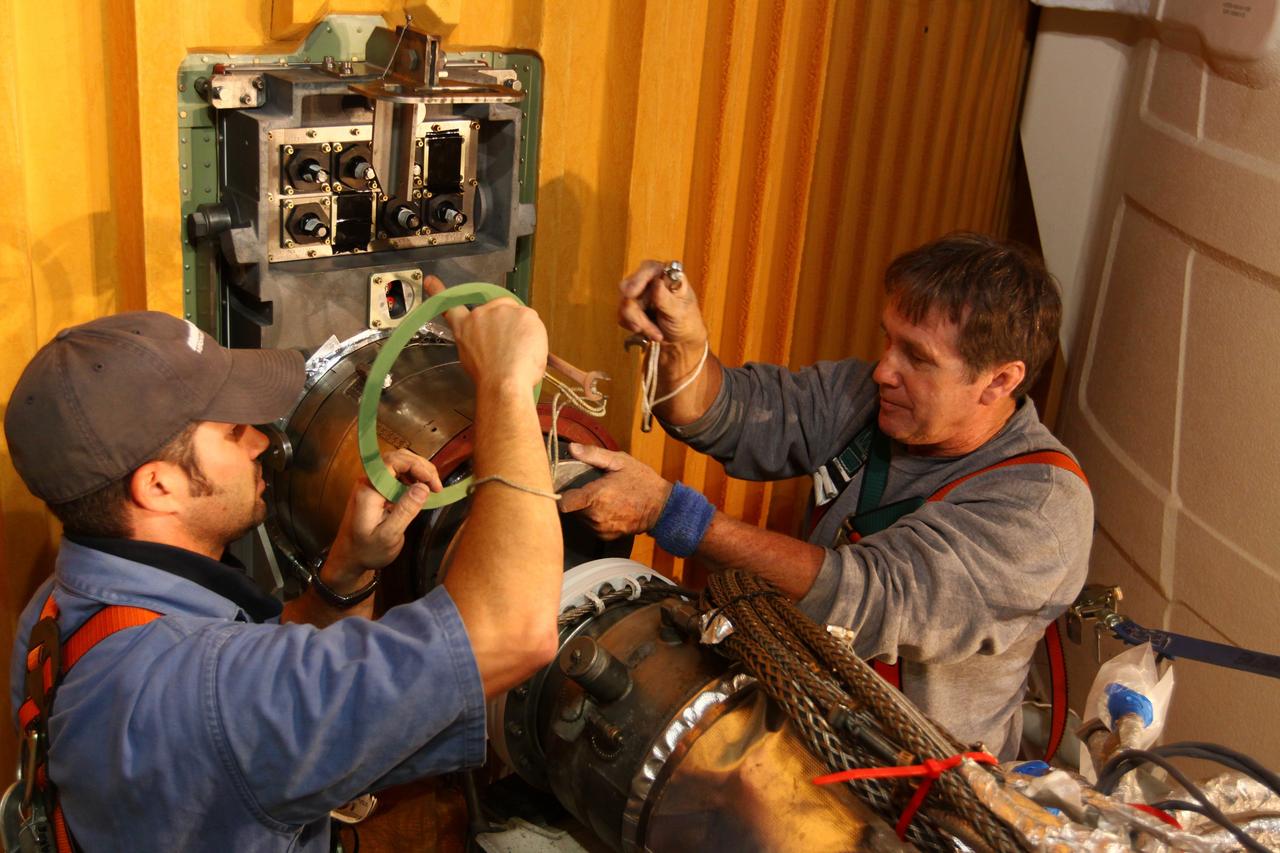
CAPE CANAVERAL, Fla. -- On Launch Pad 39A at NASA's Kennedy Space Center in Florida, technicians reattach the vent line to the ground umbilical carrier plate (GUCP) on space shuttle Discovery's external fuel tank. A hydrogen gas leak at that location during tanking for Discovery's STS-133 mission to the International Space Station caused the launch attempt to be scrubbed Nov. 5. The GUCP is the overboard vent to the pad and the flame stack where the excess hydrogen is burned off. Discovery's next launch attempt is no earlier than Nov. 30 at 4:02 a.m. EST. For more information on STS-133, visit www.nasa.gov/mission_pages/shuttle/shuttlemissions/sts133/. Photo credit: NASA/Ben Smegelsky
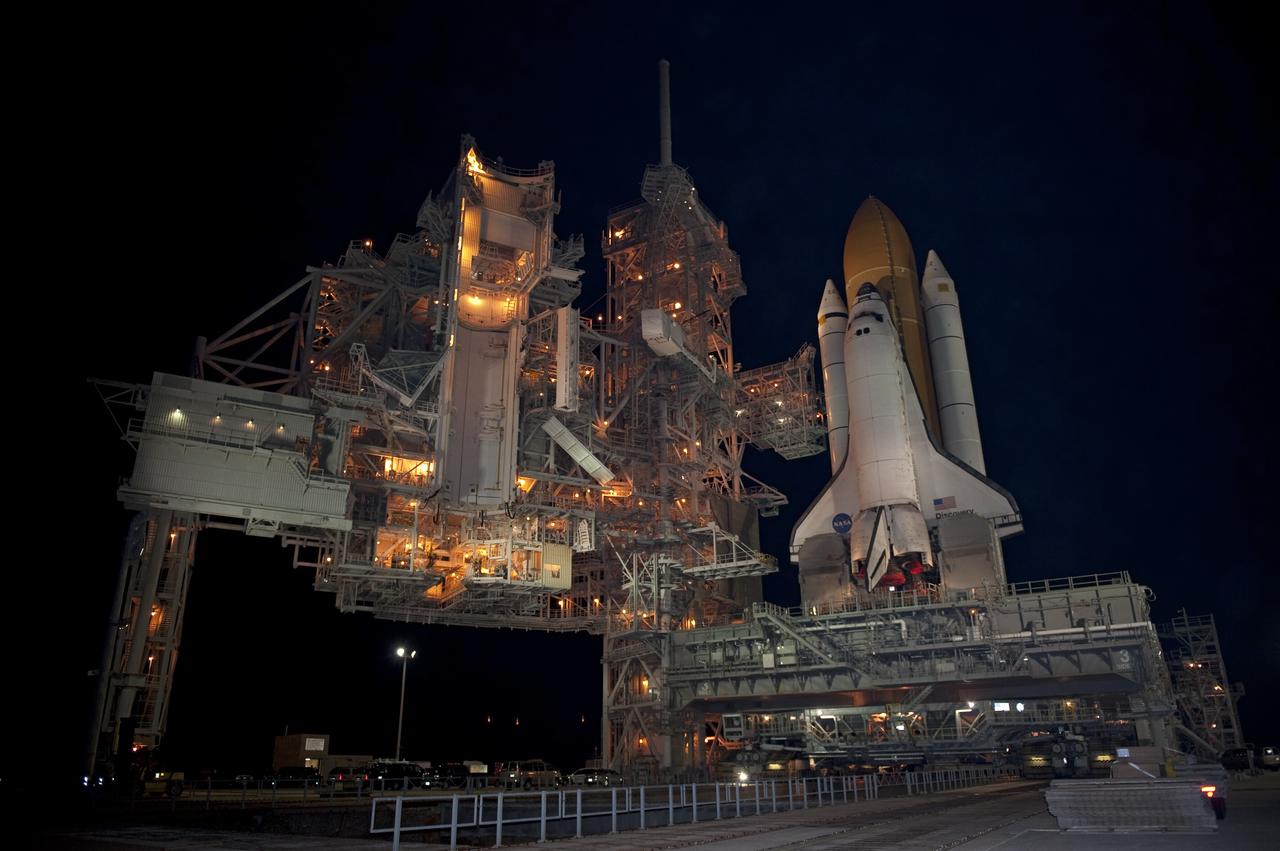
CAPE CANAVERAL, Fla. -- Space shuttle Discovery awaits its move, called rollback, from Launch Pad 39A to the Vehicle Assembly Building (VAB) at NASA's Kennedy Space Center in Florida. Rollback was scheduled for 12:30 a.m., but was postponed until 10 p.m. so technicians could resolve an issue with a leveling system on the crawler-transporter. Once inside the VAB, Discovery's external fuel tank will be examined and foam reapplied where 89 sensors were installed on the tank's aluminum skin for an instrumented tanking test on Dec. 17. The sensors were used to measure changes in the tank as super-cold propellants were pumped in and drained out. Data and analysis from the test will be used to determine what caused the tops of two, 21-foot-long support beams, called stringers, on the outside of the intertank to crack during fueling on Nov. 5. Discovery's next launch opportunity is no earlier than Feb. 3, 2011. For more information on STS-133, visit www.nasa.gov/mission_pages/shuttle/shuttlemissions/sts133/. Photo credit: NASA/Kim Shiflett

CAPE CANAVERAL, Fla. -- A technician begins to remove thermal sensors and foam insulation from space shuttle Discovery's external fuel tank in the Vehicle Assembly Building. The sensors will give engineers data about the changes the tank went through with the loading and draining of super-cold propellants during a tanking test on Dec. 17. Discovery's next launch opportunity to the International Space Station on the STS-133 mission is no earlier than Feb. 3, 2011. For more information on STS-133, visit www.nasa.gov/mission_pages/shuttle/shuttlemissions/sts133/. Photo credit: NASA/Frank Michaux
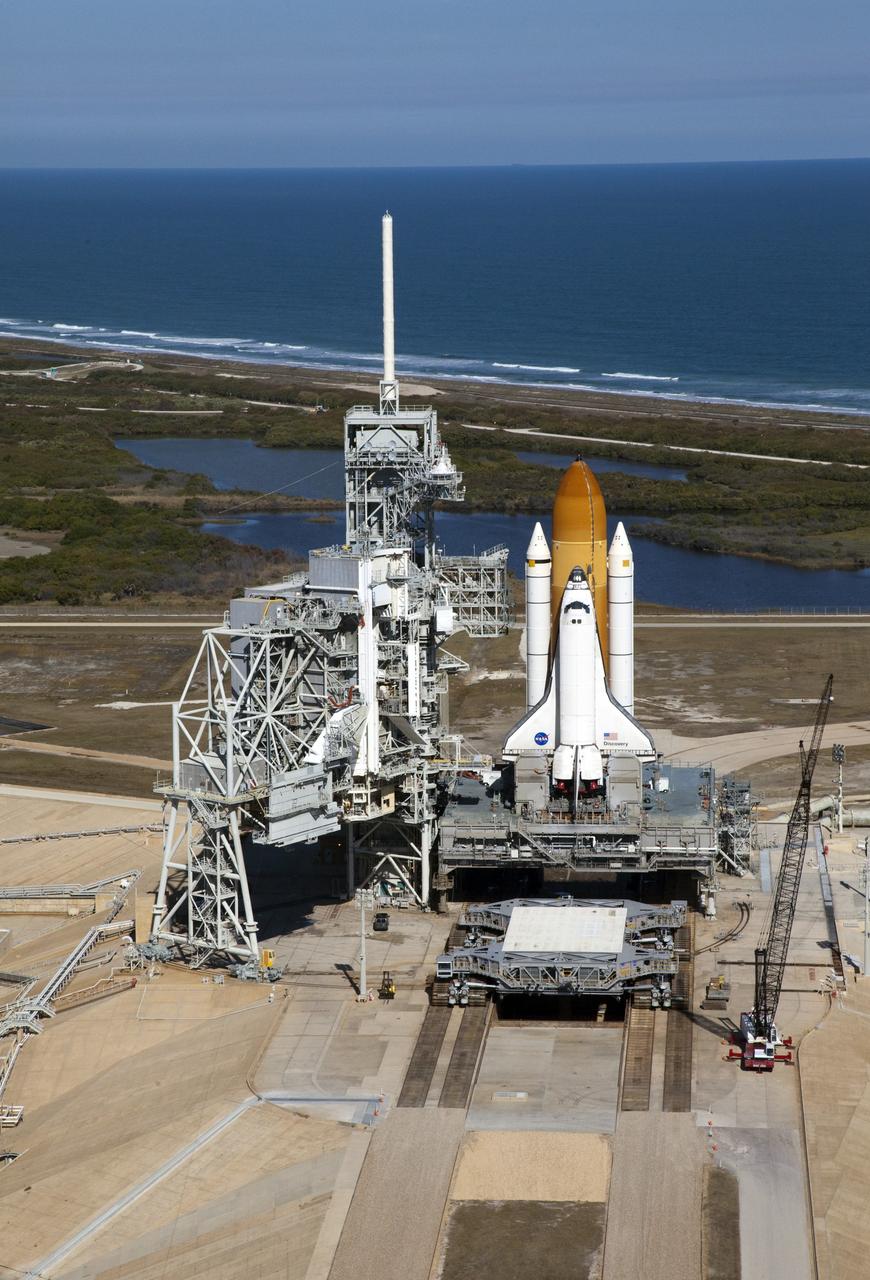
CAPE CANAVERAL, Fla. -- Space shuttle Discovery awaits its move, called rollback, from Launch Pad 39A to the Vehicle Assembly Building (VAB) at NASA's Kennedy Space Center in Florida. Rollback was scheduled for 12:30 a.m., but was postponed until 10 p.m. so technicians could resolve an issue with a leveling system on the crawler-transporter, which is in front of the shuttle. Once inside the VAB, Discovery's external fuel tank will be examined and foam reapplied where 89 sensors were installed on the tank's aluminum skin for an instrumented tanking test on Dec. 17. The sensors were used to measure changes in the tank as super-cold propellants were pumped in and drained out. Data and analysis from the test will be used to determine what caused the tops of two, 21-foot-long support beams, called stringers, on the outside of the intertank to crack during fueling on Nov. 5. Discovery's next launch opportunity to the International Space Station on the STS-133 mission is no earlier than Feb. 3, 2011. For more information on STS-133, visit www.nasa.gov/mission_pages/shuttle/shuttlemissions/sts133/. Photo credit: NASA/Frank Michaux
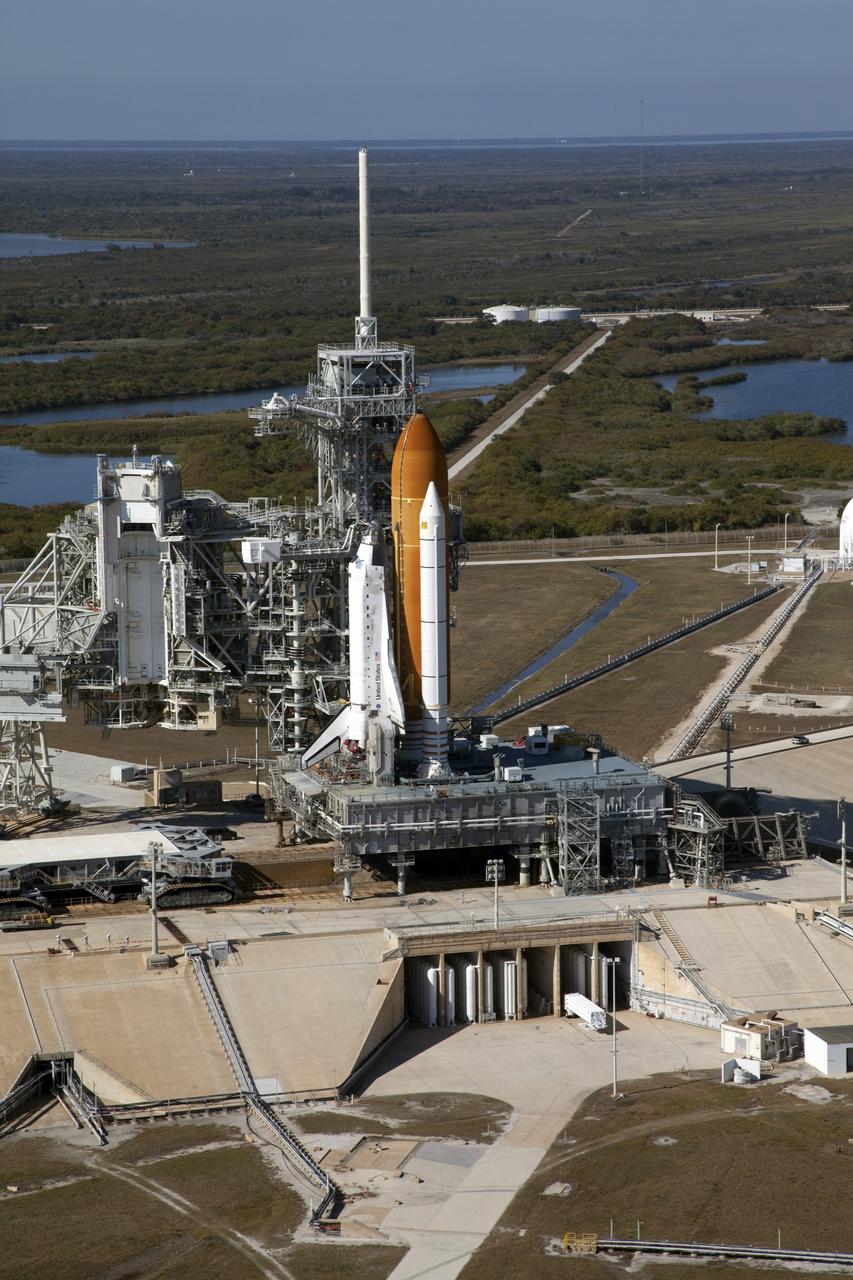
CAPE CANAVERAL, Fla. -- Space shuttle Discovery awaits its move, called rollback, from Launch Pad 39A to the Vehicle Assembly Building (VAB) at NASA's Kennedy Space Center in Florida. Rollback was scheduled for 12:30 a.m., but was postponed until 10 p.m. so technicians could resolve an issue with a leveling system on the crawler-transporter, which is to the left of the shuttle. Once inside the VAB, Discovery's external fuel tank will be examined and foam reapplied where 89 sensors were installed on the tank's aluminum skin for an instrumented tanking test on Dec. 17. The sensors were used to measure changes in the tank as super-cold propellants were pumped in and drained out. Data and analysis from the test will be used to determine what caused the tops of two, 21-foot-long support beams, called stringers, on the outside of the intertank to crack during fueling on Nov. 5. Discovery's next launch opportunity to the International Space Station on the STS-133 mission is no earlier than Feb. 3, 2011. For more information on STS-133, visit www.nasa.gov/mission_pages/shuttle/shuttlemissions/sts133/. Photo credit: NASA/Frank Michaux

CAPE CANAVERAL, Fla. -- A backscatter device is being used to examine space shuttle Discovery's external fuel tank on Launch Pad 39A at NASA's Kennedy Space Center in Florida. The device bounces radiation off the tank, allowing technicians to see under the tank's foam insulation. The foam cracked during initial loading operations for Discovery’s STS-133 launch attempt on Nov. 5, and technicians later identified two cracked stringers, which are the composite aluminum ribs located vertically on the tank’s intertank area. Those two stringers have been replaced and reinforced with doublers, which are shaped metal pieces twice as thick as the original stringers. Launch is no earlier than Dec. 17 at 8:51 p.m. EST. For more information on STS-133, visit www.nasa.gov/mission_pages/shuttle/shuttlemissions/sts133/. Photo credit: NASA/Frank Michaux
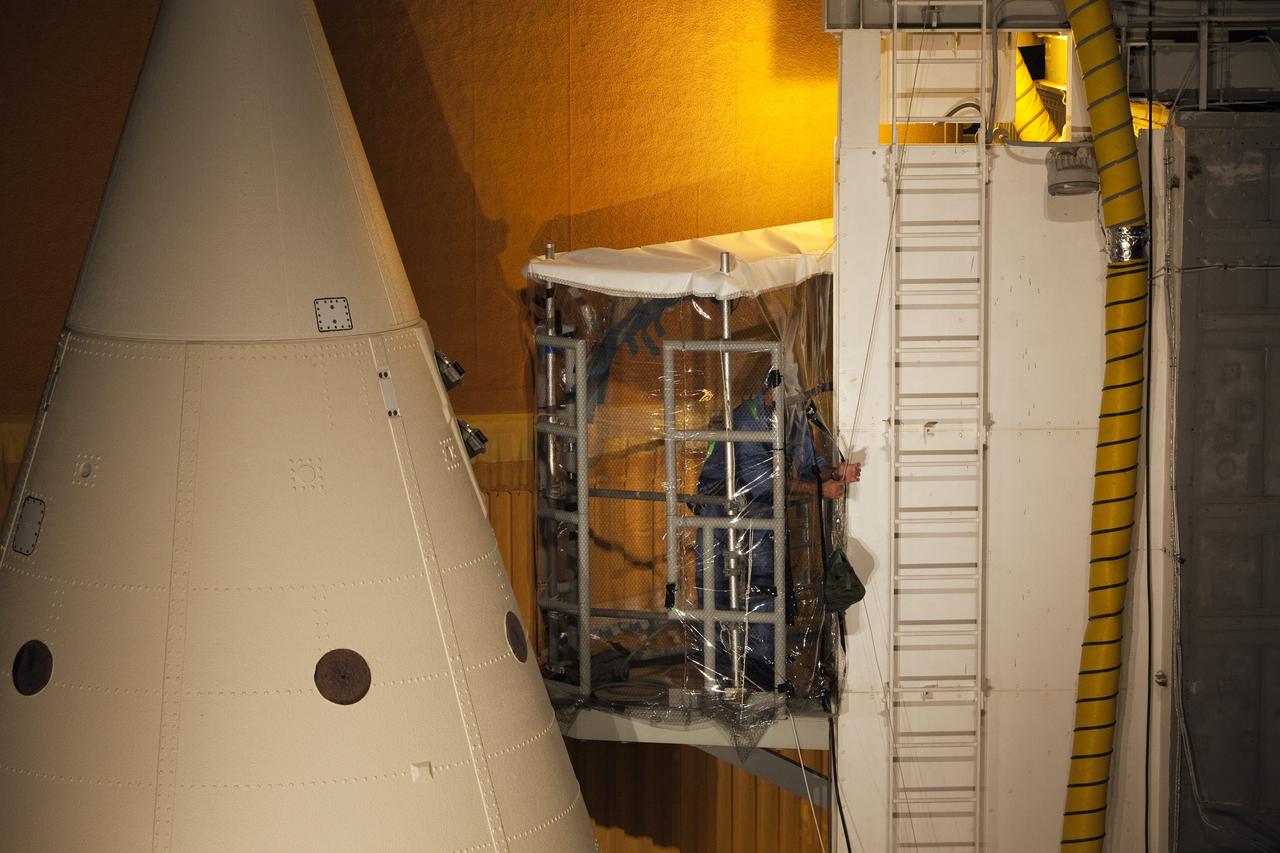
CAPE CANAVERAL, Fla. -- On Launch Pad 39A at NASA's Kennedy Space Center in Florida, a technician climbs into an environmental enclosure on space shuttle Discovery's external fuel tank. The enclosure will provide protection from wind, temperature and humidity changes while foam is re-applied and cured on the tank. The foam cracked during initial loading operations for Discovery’s launch attempt on Nov. 5. The cracks are on one of the 108 stringers, which are the composite aluminum ribs located vertically on the intertank area. Discovery's next launch attempt is no earlier than Nov. 30 at 4:02 a.m. EST. For more information on STS-133, visit www.nasa.gov/mission_pages/shuttle/shuttlemissions/sts133/. Photo credit: NASA/Dimitri Gerondidakis
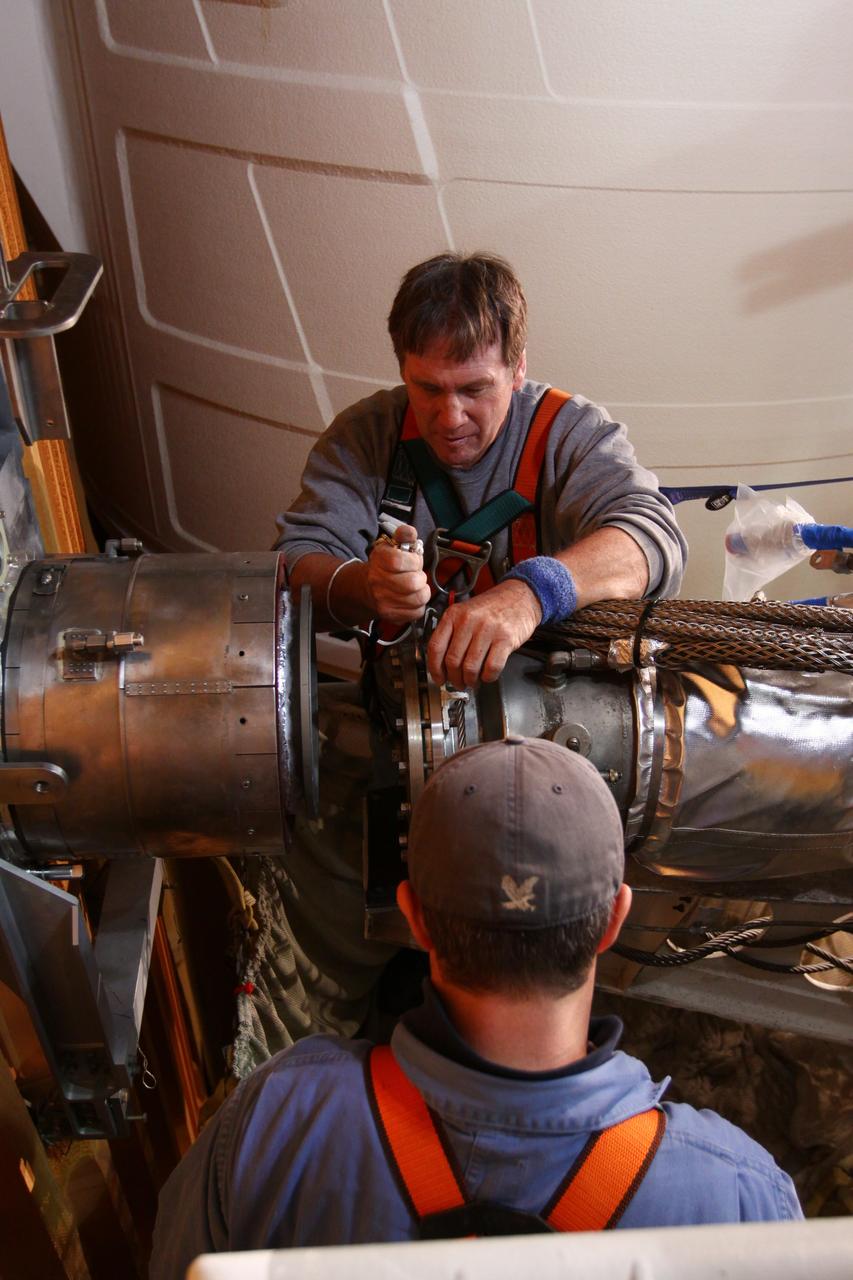
CAPE CANAVERAL, Fla. -- On Launch Pad 39A at NASA's Kennedy Space Center in Florida, technicians reattach the vent line to the ground umbilical carrier plate (GUCP) on space shuttle Discovery's external fuel tank. A hydrogen gas leak at that location during tanking for Discovery's STS-133 mission to the International Space Station caused the launch attempt to be scrubbed Nov. 5. The GUCP is the overboard vent to the pad and the flame stack where the excess hydrogen is burned off. Discovery's next launch attempt is no earlier than Nov. 30 at 4:02 a.m. EST. For more information on STS-133, visit www.nasa.gov/mission_pages/shuttle/shuttlemissions/sts133/. Photo credit: NASA/Ben Smegelsky
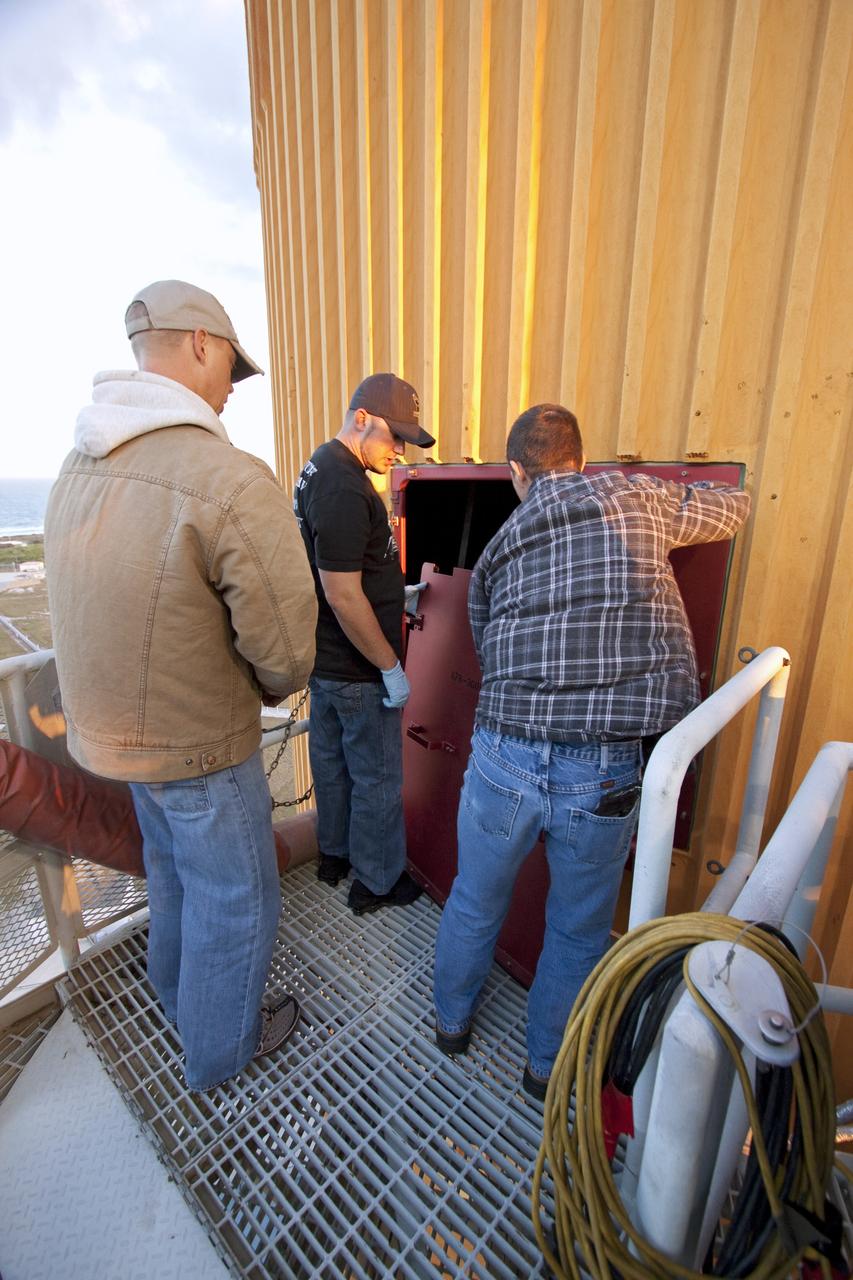
CAPE CANAVERAL, Fla. -- On Launch Pad 39A at NASA's Kennedy Space Center in Florida, technicians prepare to work inside the intertank of space shuttle Discovery's external fuel tank, which is accessible through this door. The intertank is unpressurized and holds most of the tank's electrical components. It sits between the liquid hydrogen tank and liquid oxygen tank. Technicians will be working inside the intertank to further analyze two cracks that were found on the tank’s metal exterior. The foam cracked during initial loading operations for space shuttle Discovery’s launch attempt on Nov. 5. The cracks are on one of the stringers, which are the composite aluminum ribs located vertically on the intertank area. Discovery's next launch attempt is no earlier than Nov. 30 at 4:02 a.m. EST. For more information on STS-133, visit www.nasa.gov/mission_pages/shuttle/shuttlemissions/sts133/. Photo credit: NASA/Jack Pfaller
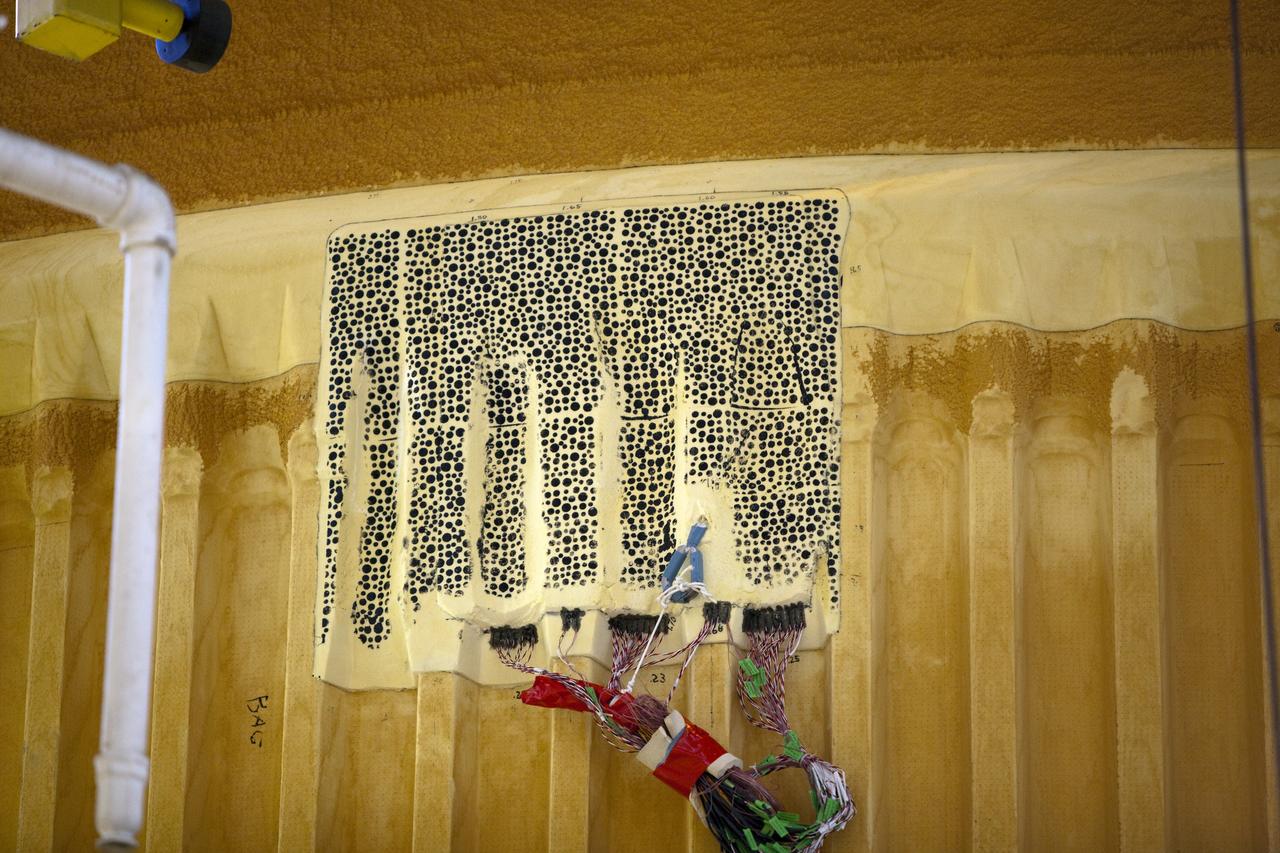
CAPE CANAVERAL, Fla. -- Technicians in the Vehicle Assembly Building at NASA's Kennedy Space Center in Florida will begin to remove thermal sensors that will give engineers data about the changes space shuttle Discovery's external fuel tank went through during the loading and draining of super-cold propellants during a tanking test on Dec. 17. Engineers also will examine 21-foot-long support beams, called stringers, on the outside of the tank's intertank region. Also on the agenda, is to re-apply foam to the outside of the tank. Discovery's next launch opportunity to the International Space Station on the STS-133 mission is no earlier than Feb. 3, 2011. For more information on STS-133, visit www.nasa.gov/mission_pages/shuttle/shuttlemissions/sts133/. Photo credit: NASA/Dimitri Gerondidakis
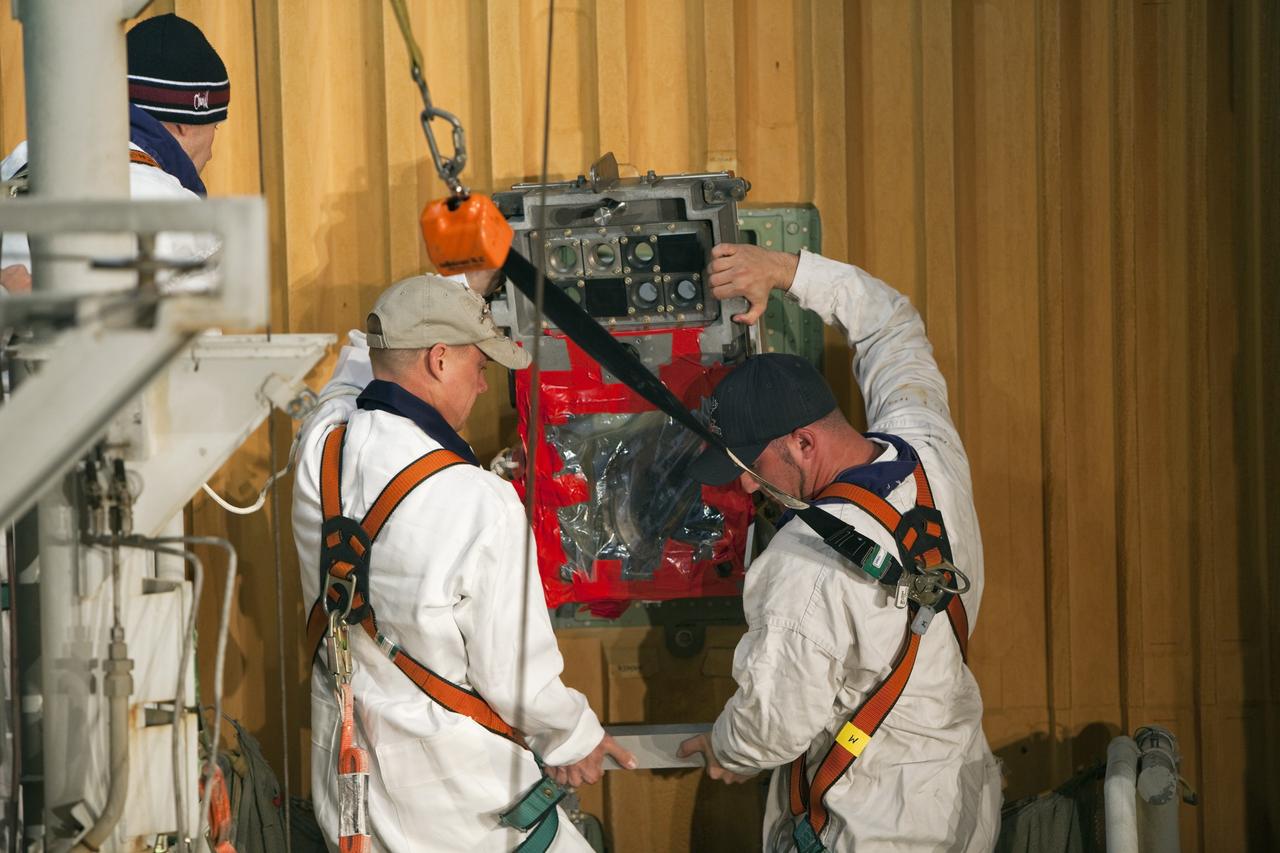
CAPE CANAVERAL, Fla. -- On Launch Pad 39A at NASA's Kennedy Space Center in Florida, workers remove the ground umbilical carrier plate (GUCP) from space shuttle Discovery's external fuel tank. A hydrogen gas leak at that location during tanking for Discovery's STS-133 mission to the International Space Station caused the launch attempt to be scrubbed Nov. 5. The GUCP will be examined to determine the cause of the hydrogen leak and then repaired. The GUCP is the overboard vent to the pad and the flame stack where the excess hydrogen is burned off. For more information on STS-133, visit www.nasa.gov/mission_pages/shuttle/shuttlemissions/sts133/. Photo credit: NASA/Dimitri Gerondidakis
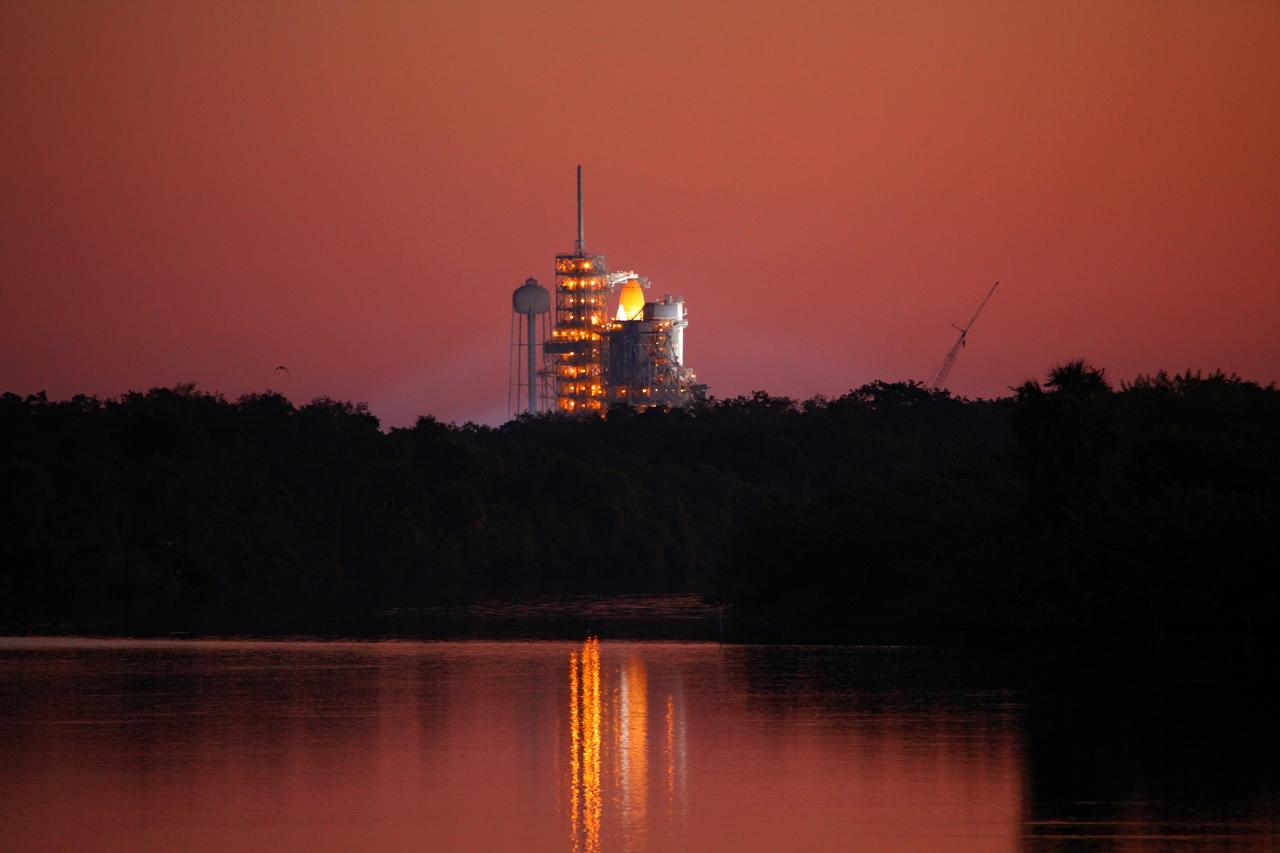
CAPE CANAVERAL, Fla. -- Space shuttle Discovery's external fuel tank is being filled with more than 535,000 gallons of super-cold liquid hydrogen and liquid oxygen during a tanking test on Launch Pad 39A at NASA's Kennedy Space Center in Florida. Engineers are closely monitoring what happens to 21-foot long, U-shaped aluminum brackets, called stringers, located at the tank's intertank region, as well as the newly replaced ground umbilical carrier plate (GUCP). Data from 89 sensors will be evaluated after the tank returns to ambient temperature. In order to perform additional analysis on the tank, Discovery will be rolled back to the Vehicle Assembly Building, a move that is planned for next week. Discovery's first launch attempt for STS-133 was scrubbed in early November due to a hydrogen gas leak at GUCP. The next launch opportunity is no earlier than Feb. 3, 2011. For more information on STS-133, visit www.nasa.gov/mission_pages/shuttle/shuttlemissions/sts133/. Photo credit: NASA/Frank Michaux

CAPE CANAVERAL, Fla. -- On Launch Pad 39A at NASA's Kennedy Space Center in Florida, a technician brings tools into an environmental enclosure on space shuttle Discovery's external fuel tank. The enclosure will provide protectiong from wind, temperature and humidity changes while foam is re-applied and cured on the tank. The foam cracked during initial loading operations for Discovery’s launch attempt on Nov. 5. The cracks are on one of the 108 stringers, which are the composite aluminum ribs located vertically on the intertank area. Discovery's next launch attempt is no earlier than Nov. 30 at 4:02 a.m. EST. For more information on STS-133, visit www.nasa.gov/mission_pages/shuttle/shuttlemissions/sts133/. Photo credit: NASA/Dimitri Gerondidakis
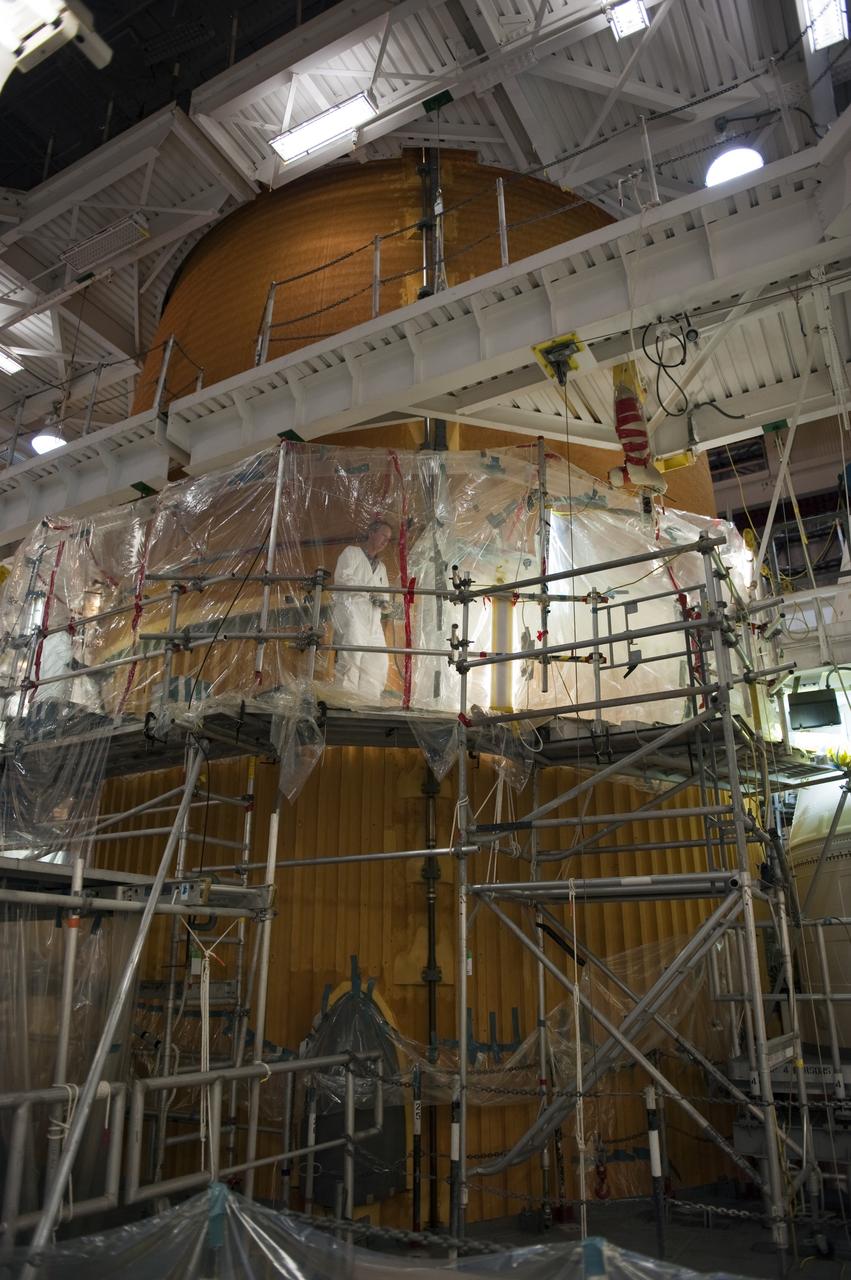
CAPE CANAVERAL, Fla. -- Repair work to space shuttle Discovery's external fuel tank continues in the Vehicle Assembly Building at NASA's Kennedy Space Center in Florida. Technicians are modifying 94 support beams, called stringers, on the tank's intertank region by fitting pieces of metal, called radius blocks, over the stringers' edges. After the modifications of the stringers are complete, foam insulation will be re-applied to the tank. Discovery's next launch opportunity to the International Space Station on the STS-133 mission is targeted for Feb. 24, 2011. For more information on STS-133, visit www.nasa.gov/mission_pages/shuttle/shuttlemissions/sts133/. Photo credit: NASA/Kim Shiflett
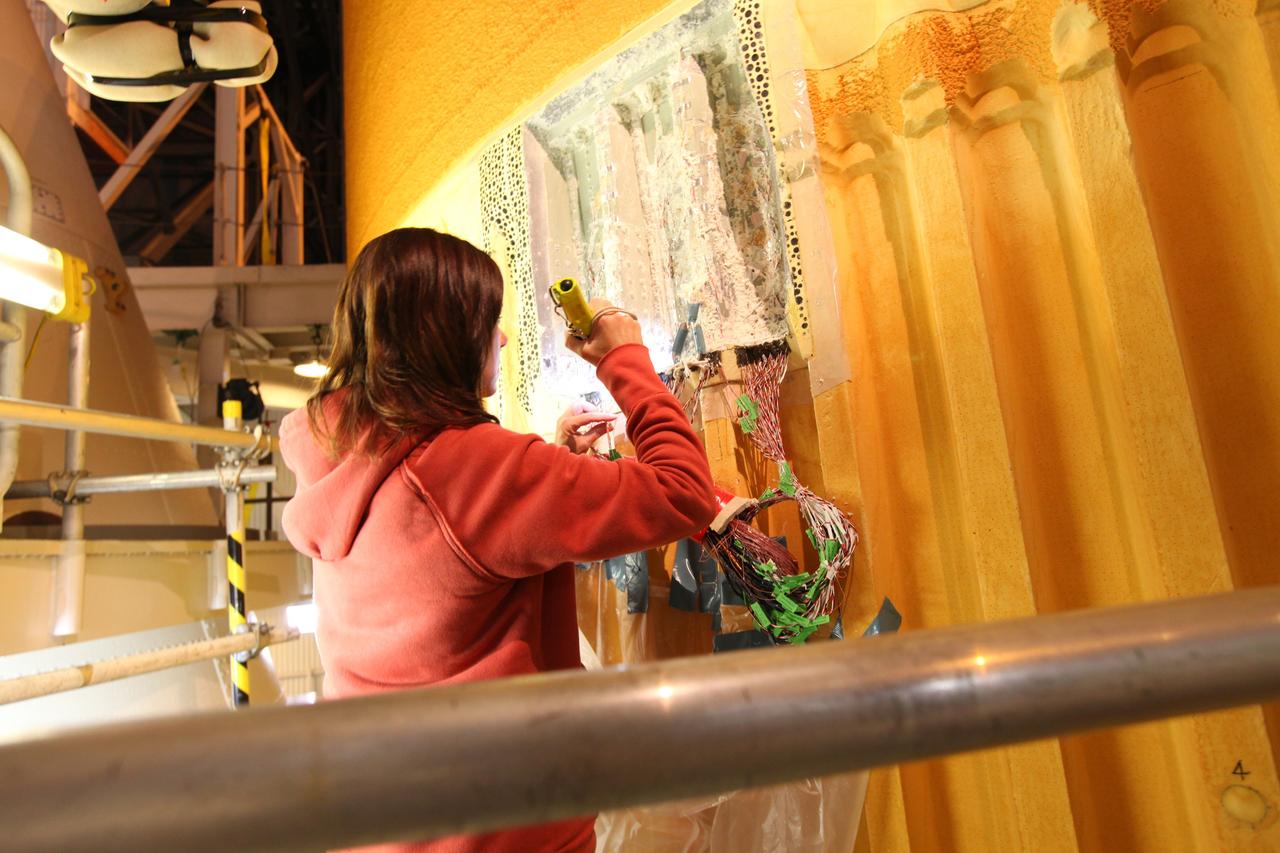
CAPE CANAVERAL, Fla. -- A technician begins to remove thermal sensors and foam insulation from space shuttle Discovery's external fuel tank in the Vehicle Assembly Building. The sensors will give engineers data about the changes the tank went through with the loading and draining of super-cold propellants during a tanking test on Dec. 17. Discovery's next launch opportunity to the International Space Station on the STS-133 mission is no earlier than Feb. 3, 2011. For more information on STS-133, visit www.nasa.gov/mission_pages/shuttle/shuttlemissions/sts133/. Photo credit: NASA/Frank Michaux

CAPE CANAVERAL, Fla. -- Space shuttle Discovery's external fuel tank is outfitted with approximately 89 strain gauges, thermocouples and wiring in preparation for a tanking test no earlier than Dec. 17 on Launch Pad 39A at NASA's Kennedy Space Center in Florida. During the test, engineers will monitor what happens to 21-foot long, U-shaped aluminum brackets, called stringers, located at the external tank's intertank area, as well as the newly replaced ground umbilical carrier plate (GUCP), during the loading of cryogenic propellants. Discovery's first launch attempt for STS-133 was scrubbed in early November due to a hydrogen gas leak at GUCP. The next launch opportunity is no earlier than Feb. 3, 2011. For more information on STS-133, visit www.nasa.gov/mission_pages/shuttle/shuttlemissions/sts133/. Photo credit: NASA/Jim Grossmann
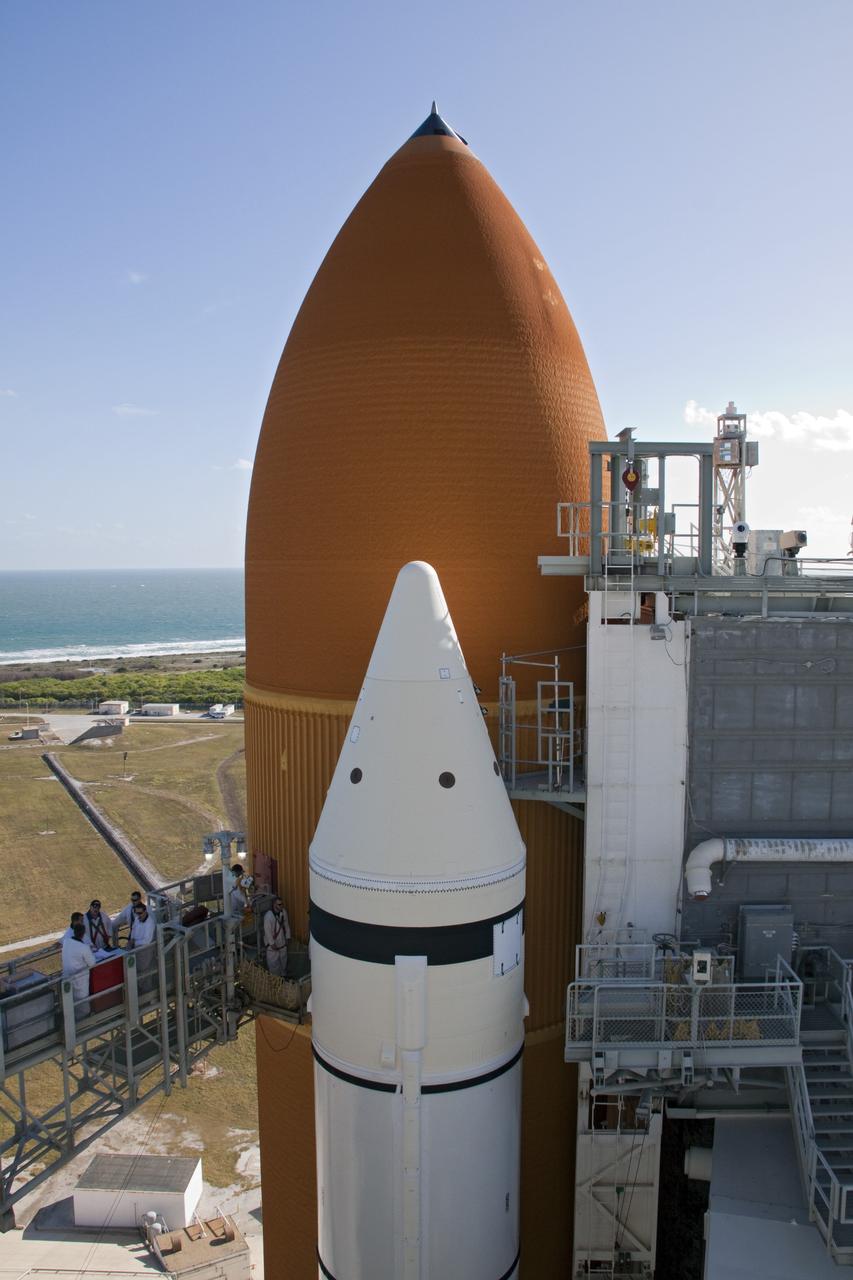
CAPE CANAVERAL, Fla. -- On Launch Pad 39A at NASA's Kennedy Space Center in Florida, workers begin to install a new ground umbilical carrier plate (GUCP) on space shuttle Discovery's external fuel tank. A hydrogen gas leak at that location during tanking for Discovery's STS-133 mission to the International Space Station caused the launch attempt to be scrubbed Nov. 5. The GUCP is the overboard vent to the pad and the flame stack where the excess hydrogen is burned off. For more information on STS-133, visit www.nasa.gov/mission_pages/shuttle/shuttlemissions/sts133/. Photo credit: NASA/Troy Cryder

CAPE CANAVERAL, Fla. -- On Launch Pad 39A at NASA's Kennedy Space Center in Florida, technicians reattach the vent line to the ground umbilical carrier plate (GUCP) on space shuttle Discovery's external fuel tank. A hydrogen gas leak at that location during tanking for Discovery's STS-133 mission to the International Space Station caused the launch attempt to be scrubbed Nov. 5. The GUCP is the overboard vent to the pad and the flame stack where the excess hydrogen is burned off. Discovery's next launch attempt is no earlier than Nov. 30 at 4:02 a.m. EST. For more information on STS-133, visit www.nasa.gov/mission_pages/shuttle/shuttlemissions/sts133/. Photo credit: NASA/Ben Smegelsky
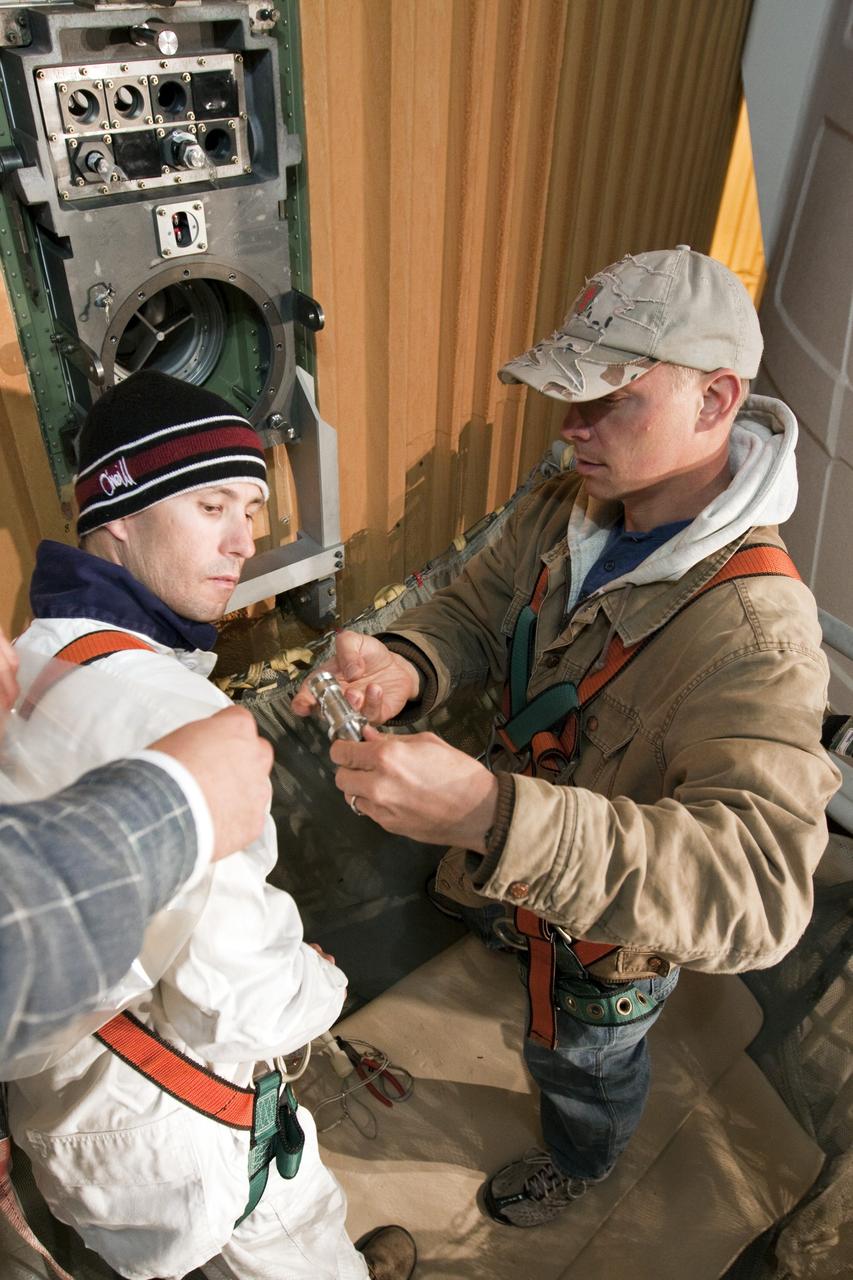
CAPE CANAVERAL, Fla. -- On Launch Pad 39A at NASA's Kennedy Space Center in Florida, workers examine one of the ground umbilical carrier plate's (GUCP) quick disconnects. A hydrogen gas leak at that location on the external fuel tank during tanking for space shuttle Discovery's STS-133 mission to the International Space Station caused the launch attempt to be scrubbed Nov. 5. The GUCP will be examined to determine the cause of the hydrogen leak and then repaired. The GUCP is the overboard vent to the pad and the flame stack where the excess hydrogen is burned off. Discovery's next launch attempt is no earlier than Nov. 30 at 4:02 a.m. EST. For more information on STS-133, visit www.nasa.gov/mission_pages/shuttle/shuttlemissions/sts133/. Photo credit: NASA/Jack Pfaller
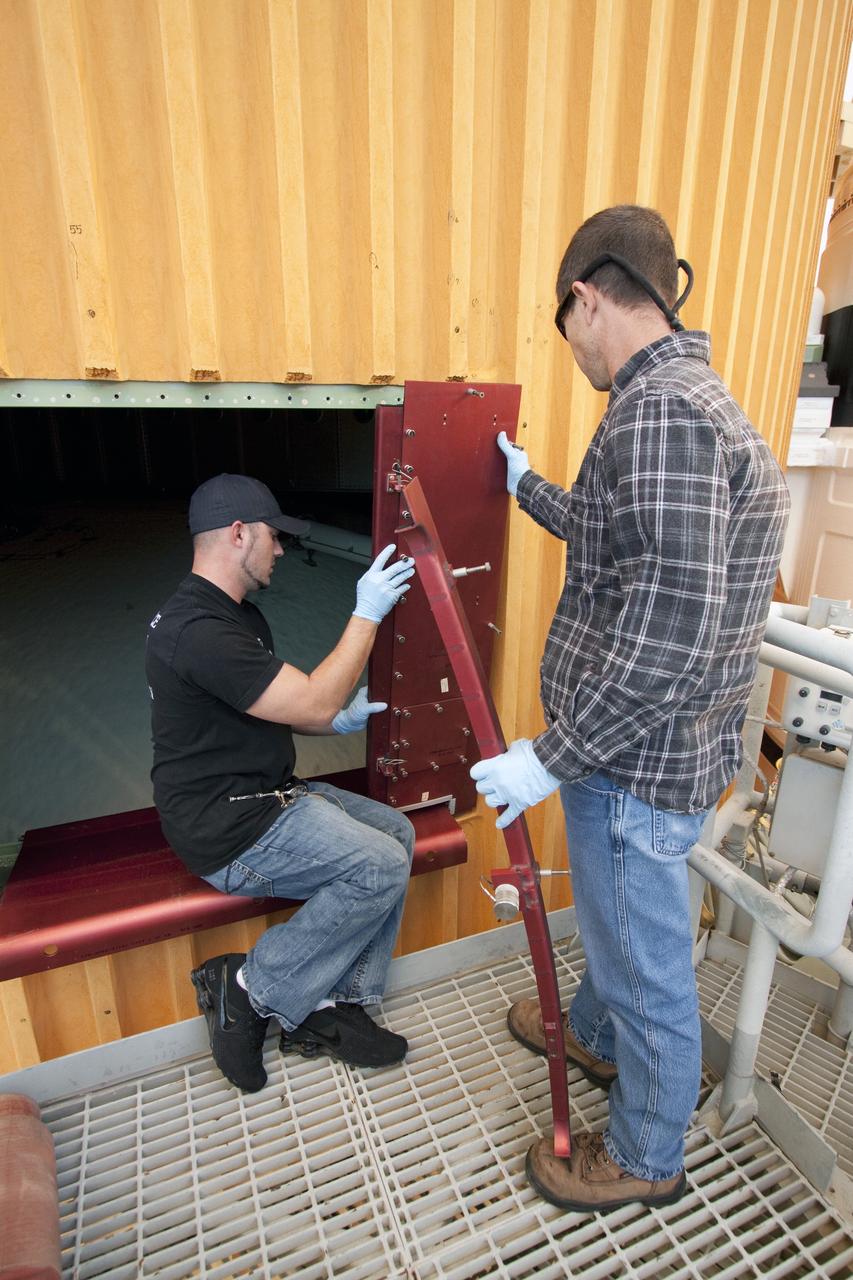
CAPE CANAVERAL, Fla. -- On Launch Pad 39A at NASA's Kennedy Space Center in Florida, technicians prepare to work inside the intertank of space shuttle Discovery's external fuel tank, which is accessible through this door. The intertank is unpressurized and holds most of the tank's electrical components. It sits between the liquid hydrogen tank and liquid oxygen tank. Technicians will be working inside the intertank to further analyze two cracks that were found on the tank’s metal exterior. The foam cracked during initial loading operations for space shuttle Discovery’s launch attempt on Nov. 5. The cracks are on one of the stringers, which are the composite aluminum ribs located vertically on the intertank area. Discovery's next launch attempt is no earlier than Nov. 30 at 4:02 a.m. EST. For more information on STS-133, visit www.nasa.gov/mission_pages/shuttle/shuttlemissions/sts133/. Photo credit: NASA/Jack Pfaller

CAPE CANAVERAL, Fla. -- On Launch Pad 39A at NASA's Kennedy Space Center in Florida, technicians reattach the vent line to the ground umbilical carrier plate (GUCP) on space shuttle Discovery's external fuel tank. A hydrogen gas leak at that location during tanking for Discovery's STS-133 mission to the International Space Station caused the launch attempt to be scrubbed Nov. 5. The GUCP is the overboard vent to the pad and the flame stack where the excess hydrogen is burned off. Discovery's next launch attempt is no earlier than Nov. 30 at 4:02 a.m. EST. For more information on STS-133, visit www.nasa.gov/mission_pages/shuttle/shuttlemissions/sts133/. Photo credit: NASA/Ben Smegelsky
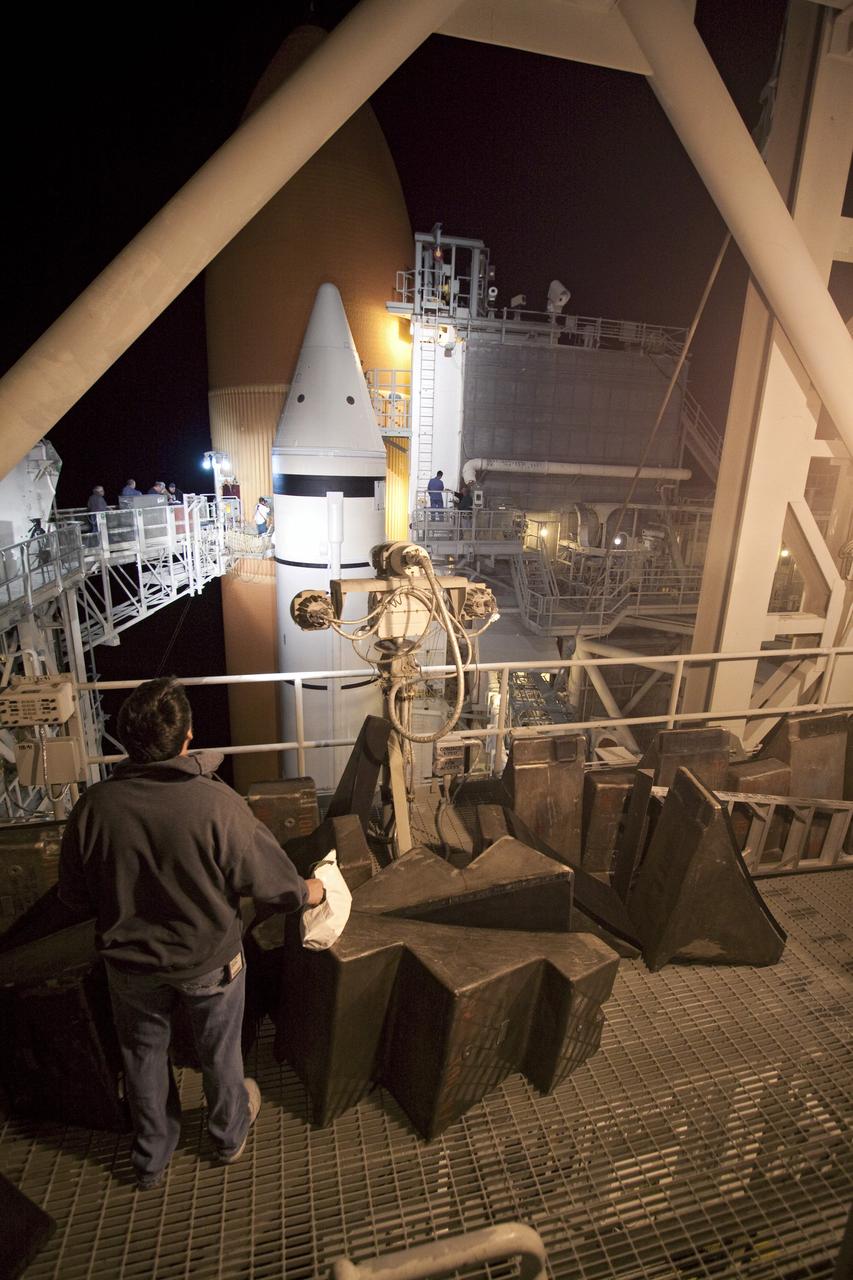
CAPE CANAVERAL, Fla. -- On Launch Pad 39A at NASA's Kennedy Space Center in Florida, technicians prepare to work inside the intertank of space shuttle Discovery's external fuel tank. Seen here are step pads that will be temporarily installed in the intertank. The intertank is unpressurized and holds most of the tank's electrical components. It sits between the liquid hydrogen tank and liquid oxygen tank. Technicians will be working inside the intertank to further analyze two cracks that were found on the tank’s metal exterior. The foam cracked during initial loading operations for space shuttle Discovery’s launch attempt on Nov. 5. The cracks are on one of the stringers, which are the composite aluminum ribs located vertically on the intertank area. Discovery's next launch attempt is no earlier than Nov. 30 at 4:02 a.m. EST. For more information on STS-133, visit www.nasa.gov/mission_pages/shuttle/shuttlemissions/sts133/. Photo credit: NASA/Jack Pfaller
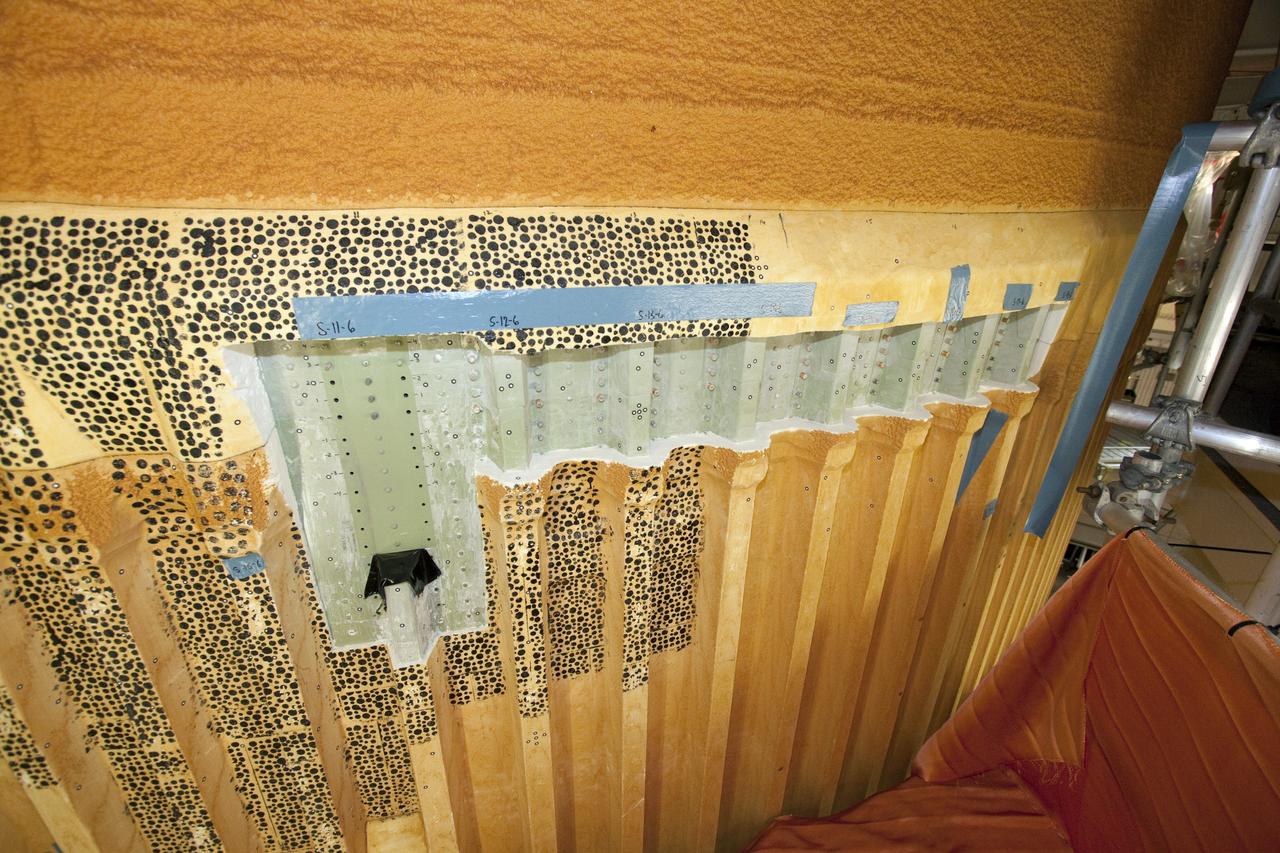
CAPE CANAVERAL, Fla. -- Repair work to space shuttle Discovery's external fuel tank begins in the Vehicle Assembly Building at NASA's Kennedy Space Center in Florida. Technicians will modify 32 support beams, called stringers, on the tank's intertank region by fitting pieces of metal, called radius blocks, over the stringers' edges where they attach to the thrust panel area. The thrust panel is where the tank meets the two solid rocket boosters and sees the most stress during the flight into orbit. After the modifications and additional scans of the stringers are complete, foam insulation will be re-applied. Discovery's next launch opportunity to the International Space Station on the STS-133 mission is no earlier than Feb. 3, 2011. For more information on STS-133, visit www.nasa.gov/mission_pages/shuttle/shuttlemissions/sts133/. Photo credit: NASA/Jack Pfaller
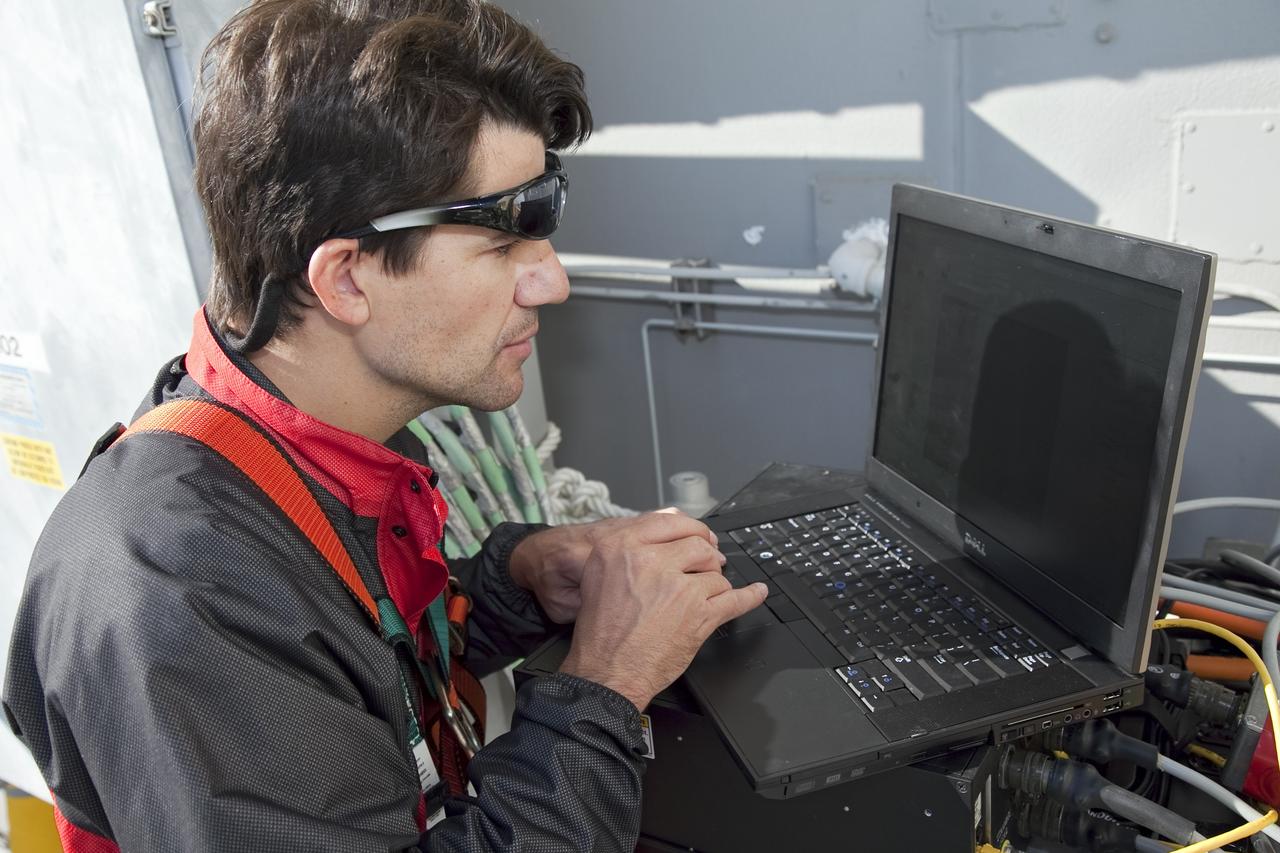
CAPE CANAVERAL, Fla. -- An engineer examines images of space shuttle Discovery's external fuel tank taken from a backscatter device on Launch Pad 39A at NASA's Kennedy Space Center in Florida. The device bounces radiation off the tank, allowing technicians to see under the tank's foam insulation. The foam cracked during initial loading operations for Discovery’s STS-133 launch attempt on Nov. 5, and technicians later identified two cracked stringers, which are the composite aluminum ribs located vertically on the tank’s intertank area. Those two stringers have been replaced and reinforced with doublers, which are shaped metal pieces twice as thick as the original stringers. Launch is no earlier than Dec. 17 at 8:51 p.m. EST. For more information on STS-133, visit www.nasa.gov/mission_pages/shuttle/shuttlemissions/sts133/. Photo credit: NASA/Frank Michaux
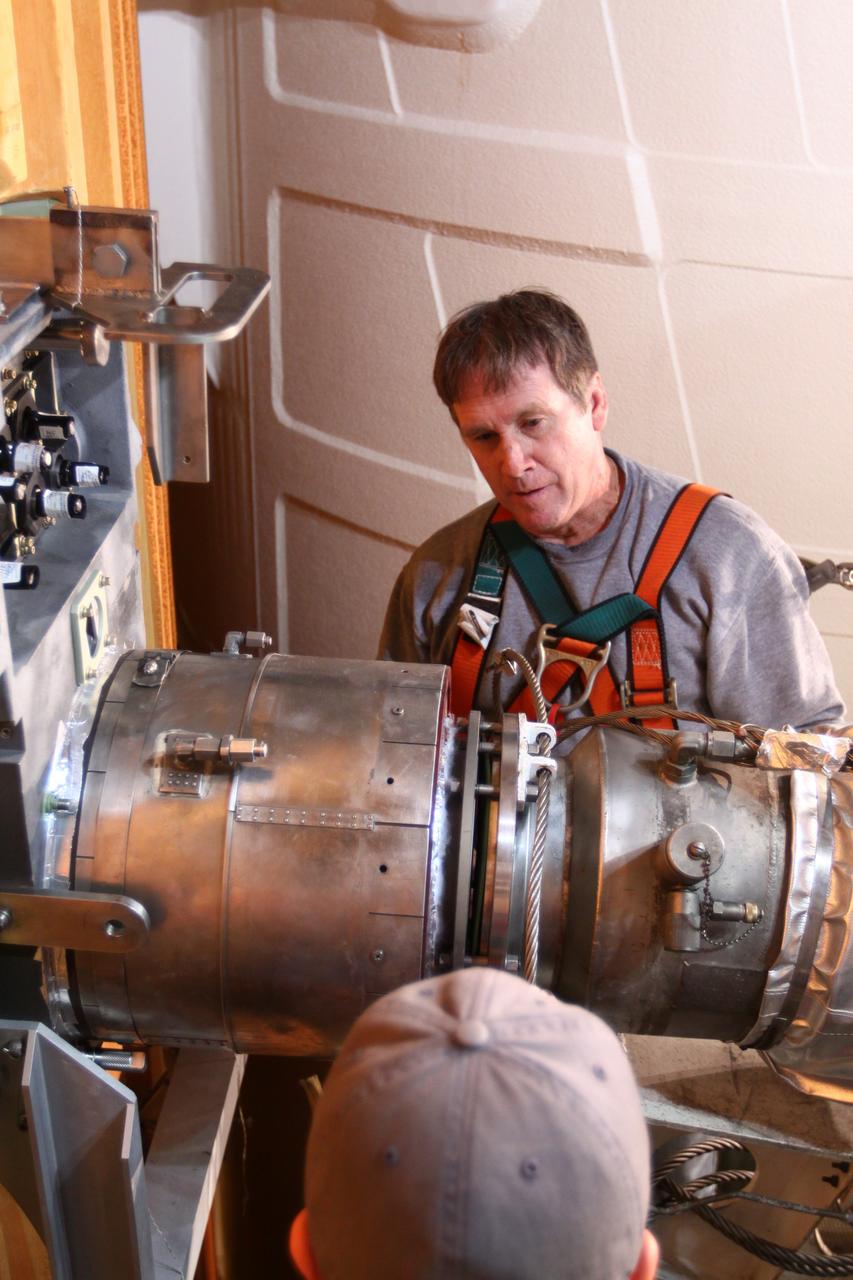
CAPE CANAVERAL, Fla. -- On Launch Pad 39A at NASA's Kennedy Space Center in Florida, technicians reattach the vent line to the ground umbilical carrier plate (GUCP) on space shuttle Discovery's external fuel tank. A hydrogen gas leak at that location during tanking for Discovery's STS-133 mission to the International Space Station caused the launch attempt to be scrubbed Nov. 5. The GUCP is the overboard vent to the pad and the flame stack where the excess hydrogen is burned off. Discovery's next launch attempt is no earlier than Nov. 30 at 4:02 a.m. EST. For more information on STS-133, visit www.nasa.gov/mission_pages/shuttle/shuttlemissions/sts133/. Photo credit: NASA/Ben Smegelsky

CAPE CANAVERAL, Fla. -- Preparations are under way in the Vehicle Assembly Building at NASA's Kennedy Space Center in Florida to examine space shuttle Discovery's external fuel tank. Technicians will begin to remove thermal sensors that will give engineers data about the changes the tank went through during the loading and draining of super-cold propellants during a tanking test on Dec. 17. Engineers also will examine 21-foot-long support beams, called stringers, on the outside of the tank's intertank region. Also on the agenda, is to re-apply foam to the outside of the tank. Discovery's next launch opportunity to the International Space Station on the STS-133 mission is no earlier than Feb. 3, 2011. For more information on STS-133, visit www.nasa.gov/mission_pages/shuttle/shuttlemissions/sts133/. Photo credit: NASA/Dimitri Gerondidakis
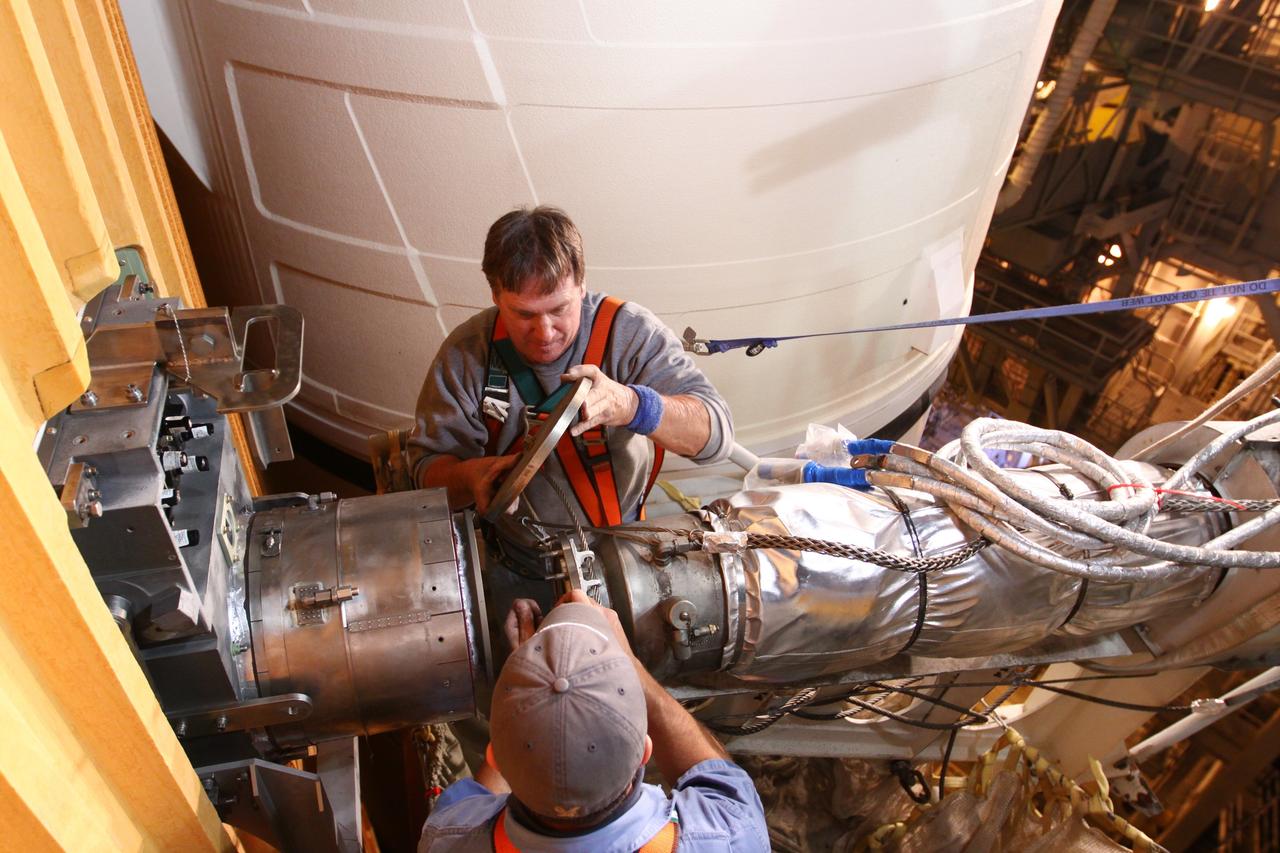
CAPE CANAVERAL, Fla. -- On Launch Pad 39A at NASA's Kennedy Space Center in Florida, technicians reattach the vent line to the ground umbilical carrier plate (GUCP) on space shuttle Discovery's external fuel tank. A hydrogen gas leak at that location during tanking for Discovery's STS-133 mission to the International Space Station caused the launch attempt to be scrubbed Nov. 5. The GUCP is the overboard vent to the pad and the flame stack where the excess hydrogen is burned off. Discovery's next launch attempt is no earlier than Nov. 30 at 4:02 a.m. EST. For more information on STS-133, visit www.nasa.gov/mission_pages/shuttle/shuttlemissions/sts133/. Photo credit: NASA/Ben Smegelsky
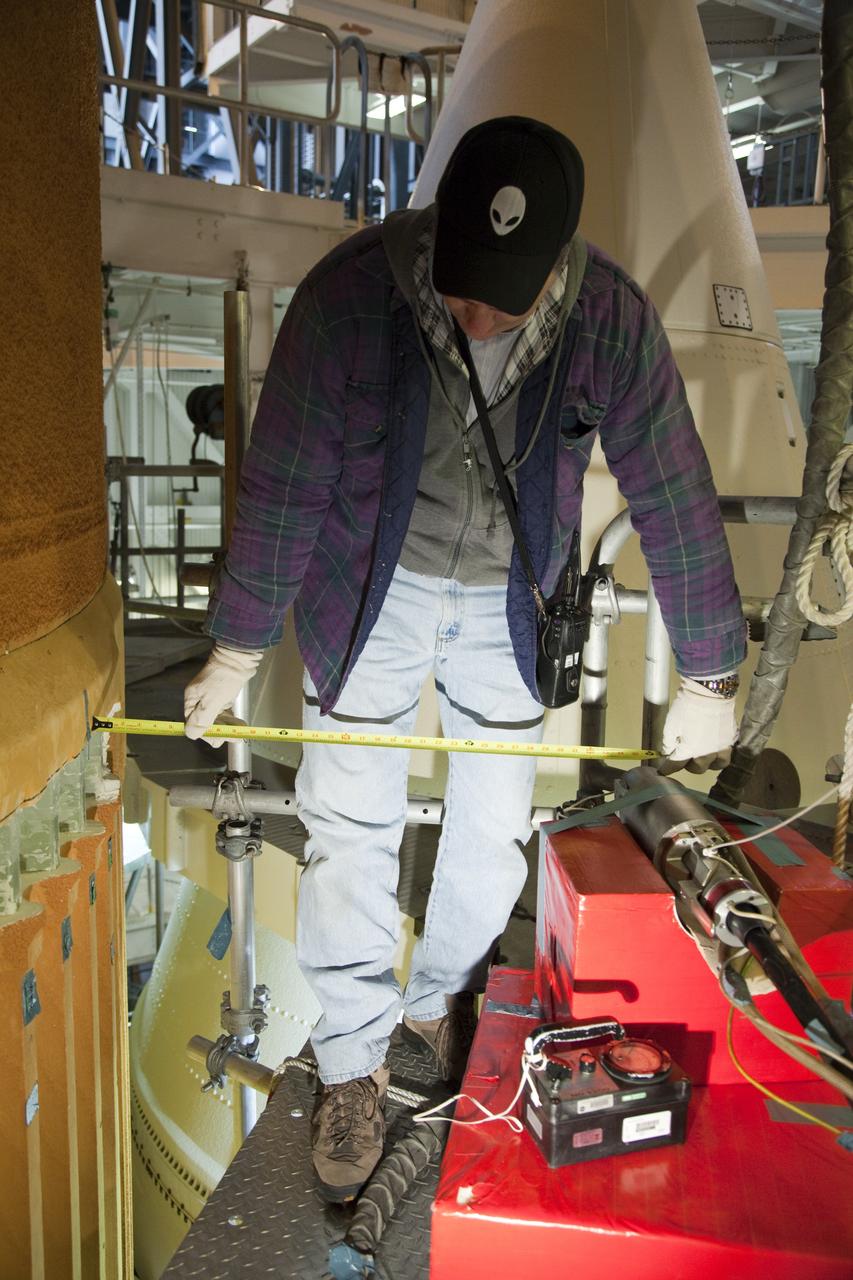
CAPE CANAVERAL, Fla. -- A technician measures the distance between space shuttle Discovery's external fuel tank and a computed radiography scanning device. The shuttle stack, consisting of the shuttle, external tank and solid rocket boosters, was moved from Launch Pad 39A to the Vehicle Assembly Building at NASA's Kennedy Space Center in Florida so technicians could examine 21-foot-long support beams, called stringers, on the outside of the tank's intertank and re-apply foam insulation. Discovery's next launch opportunity to the International Space Station on the STS-133 mission is no earlier than Feb. 3, 2011. For more information on STS-133, visit www.nasa.gov/mission_pages/shuttle/shuttlemissions/sts133/. Photo credit: NASA/Frankie Martin

CAPE CANAVERAL, Fla. -- The moon shines brightly over space shuttle Discovery following a total lunar eclipse as the spacecraft waits to roll back from Launch Pad 39A to the Vehicle Assembly Building (VAB) at NASA's Kennedy Space Center in Florida. The move was scheduled for 12:30 a.m., but was postponed until 10 p.m. so technicians could resolve an issue with a leveling system on the crawler-transporter. Once inside the VAB, Discovery's external fuel tank will be examined and foam reapplied where 89 sensors were installed on the tank's aluminum skin for an instrumented tanking test on Dec. 17. The sensors were used to measure changes in the tank as super-cold propellants were pumped in and drained out. Data and analysis from the test will be used to determine what caused the tops of two, 21-foot-long support beams, called stringers, on the outside of the intertank to crack during fueling on Nov. 5. Discovery's next launch opportunity is no earlier than Feb. 3, 2011. For more information on STS-133, visit www.nasa.gov/mission_pages/shuttle/shuttlemissions/sts133/. Photo credit: NASA/Kim Shiflett
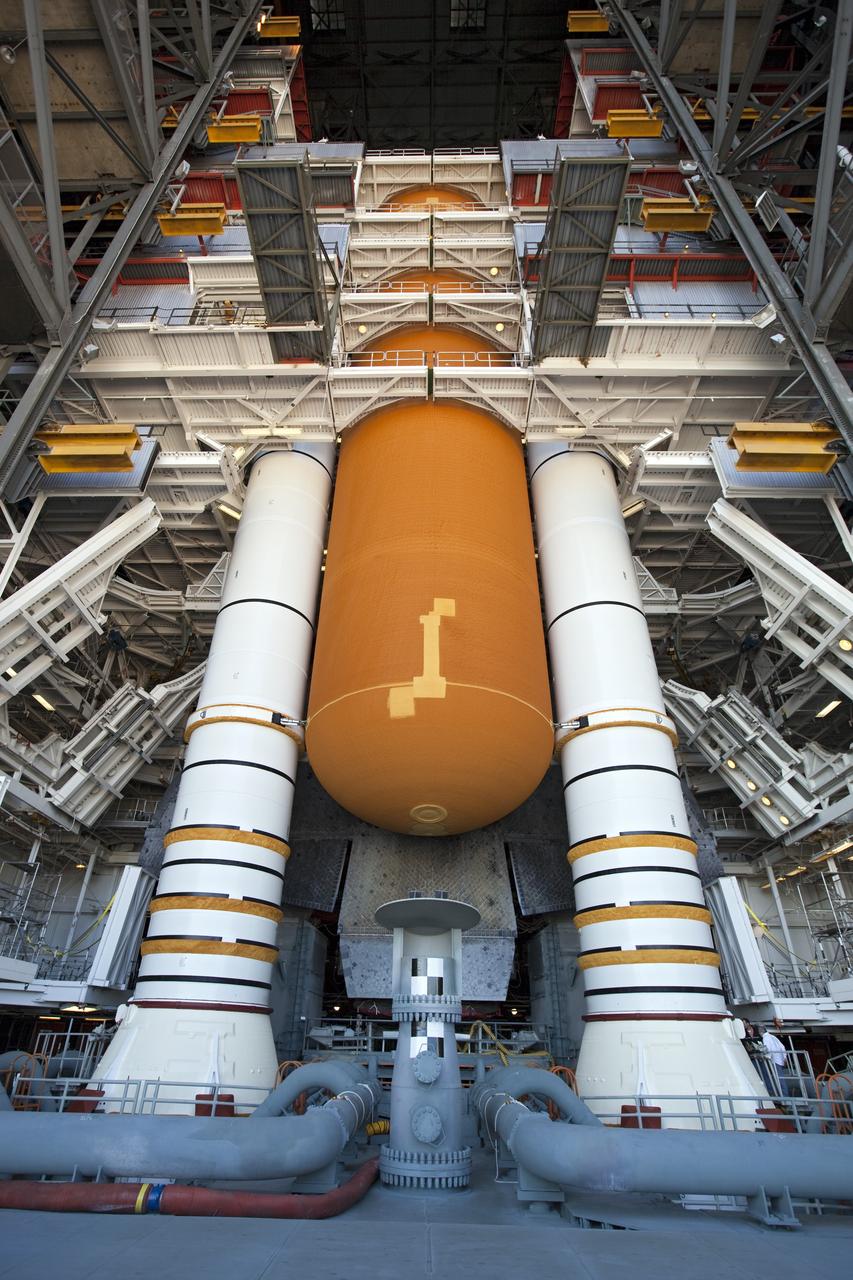
CAPE CANAVERAL, Fla. -- Preparations are under way in the Vehicle Assembly Building at NASA's Kennedy Space Center in Florida to examine space shuttle Discovery's external fuel tank. Technicians will begin to remove thermal sensors that will give engineers data about the changes the tank went through during the loading and draining of super-cold propellants. Engineers also will examine 21-foot-long support beams, called stringers, on the outside of the tank's intertank region. Also on the agenda, is to re-apply foam to the outside of the tank. Discovery's next launch opportunity to the International Space Station on the STS-133 mission is no earlier than Feb. 3, 2011. For more information on STS-133, visit www.nasa.gov/mission_pages/shuttle/shuttlemissions/sts133/. Photo credit: NASA/Dimitri Gerondidakis
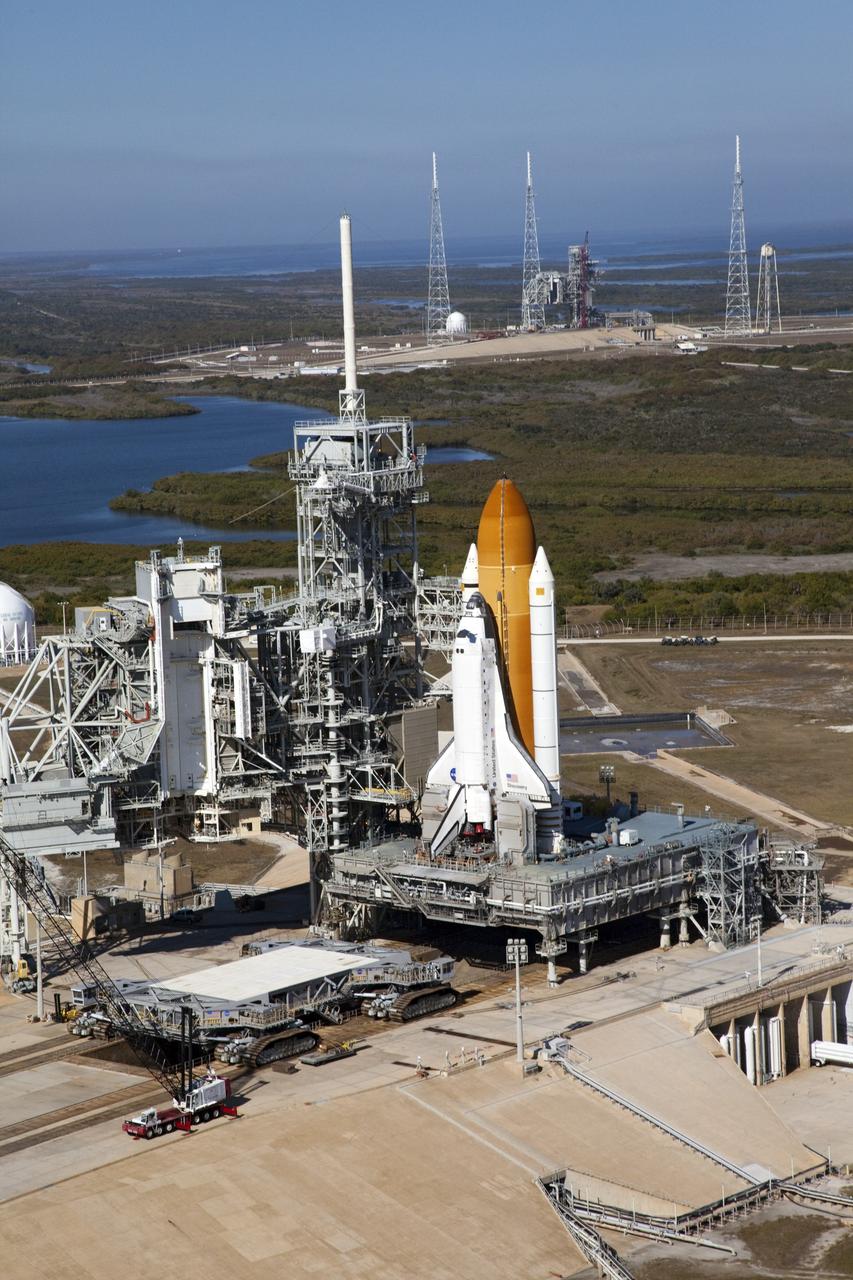
CAPE CANAVERAL, Fla. -- Space shuttle Discovery awaits its move, called rollback, from Launch Pad 39A to the Vehicle Assembly Building (VAB) at NASA's Kennedy Space Center in Florida. Rollback was scheduled for 12:30 a.m., but was postponed until 10 p.m. so technicians could resolve an issue with a leveling system on the crawler-transporter, which is to the left of the shuttle. Once inside the VAB, Discovery's external fuel tank will be examined and foam reapplied where 89 sensors were installed on the tank's aluminum skin for an instrumented tanking test on Dec. 17. The sensors were used to measure changes in the tank as super-cold propellants were pumped in and drained out. Data and analysis from the test will be used to determine what caused the tops of two, 21-foot-long support beams, called stringers, on the outside of the intertank to crack during fueling on Nov. 5. Discovery's next launch opportunity to the International Space Station on the STS-133 mission is no earlier than Feb. 3, 2011. For more information on STS-133, visit www.nasa.gov/mission_pages/shuttle/shuttlemissions/sts133/. Photo credit: NASA/Frank Michaux
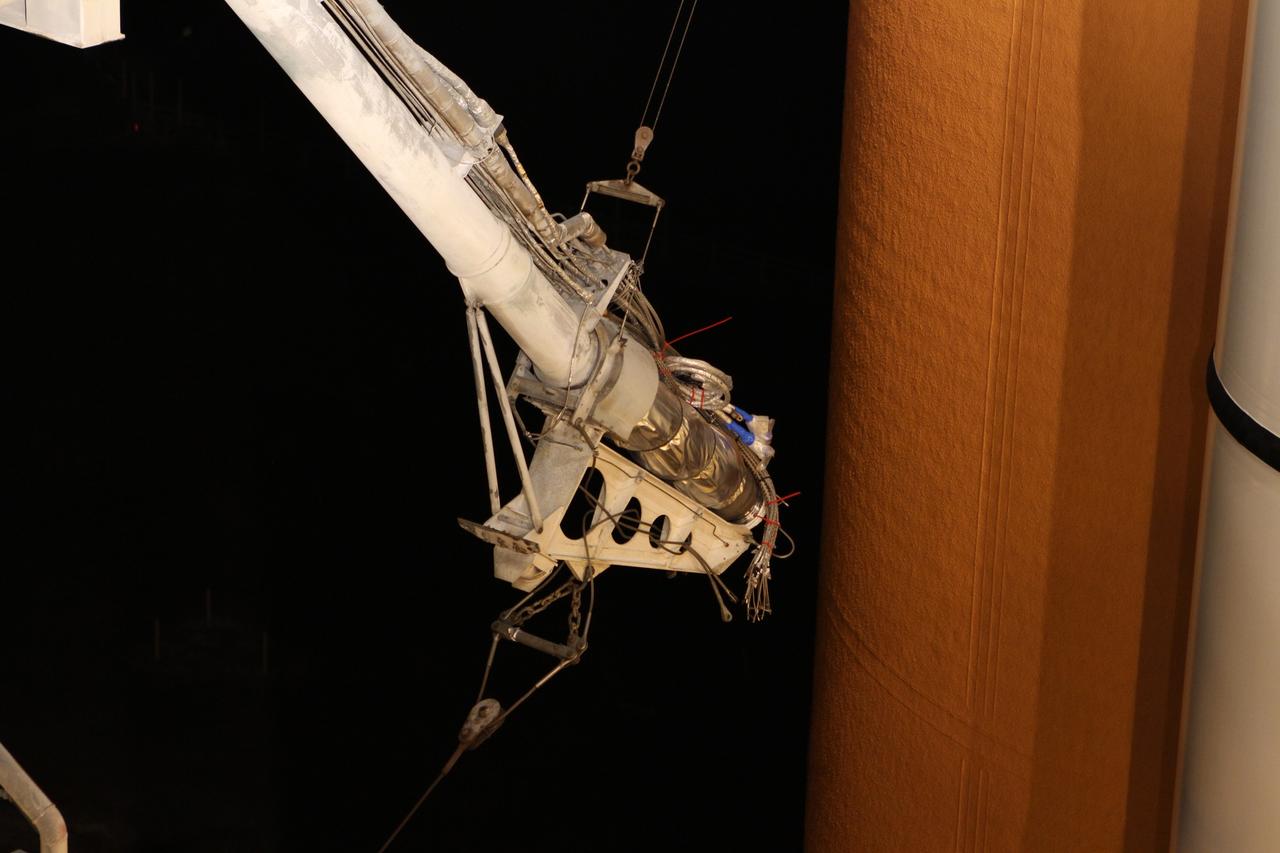
CAPE CANAVERAL, Fla. -- On Launch Pad 39A at NASA's Kennedy Space Center in Florida, preparations are under way to reattach the vent line to the ground umbilical carrier plate (GUCP) on space shuttle Discovery's external fuel tank. A hydrogen gas leak at that location during tanking for Discovery's STS-133 mission to the International Space Station caused the launch attempt to be scrubbed Nov. 5. The GUCP is the overboard vent to the pad and the flame stack where the excess hydrogen is burned off. Discovery's next launch attempt is no earlier than Nov. 30 at 4:02 a.m. EST. For more information on STS-133, visit www.nasa.gov/mission_pages/shuttle/shuttlemissions/sts133/. Photo credit: NASA/Ben Smegelsky
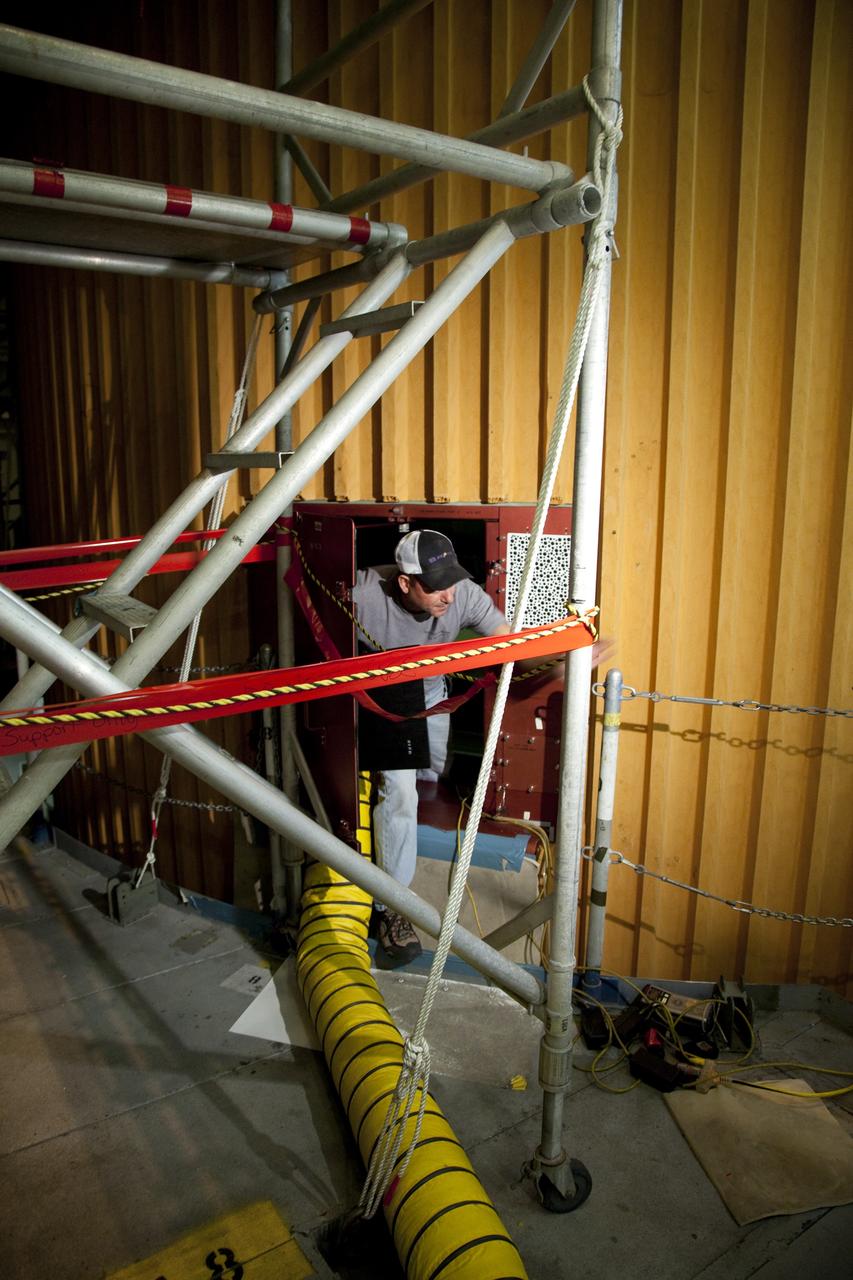
CAPE CANAVERAL, Fla. -- A technician exits the intertank of space shuttle Discovery's external fuel tank holding the film used to project computed radiography scans. The shuttle stack was moved from Launch Pad 39A to the Vehicle Assembly Building at NASA's Kennedy Space Center in Florida so technicians could examine 21-foot-long support beams, called stringers, on the outside of the tank's intertank and re-apply foam insulation. Discovery's next launch opportunity to the International Space Station on the STS-133 mission is no earlier than Feb. 3, 2011. For more information on STS-133, visit www.nasa.gov/mission_pages/shuttle/shuttlemissions/sts133/. Photo credit: NASA/Frankie Martin
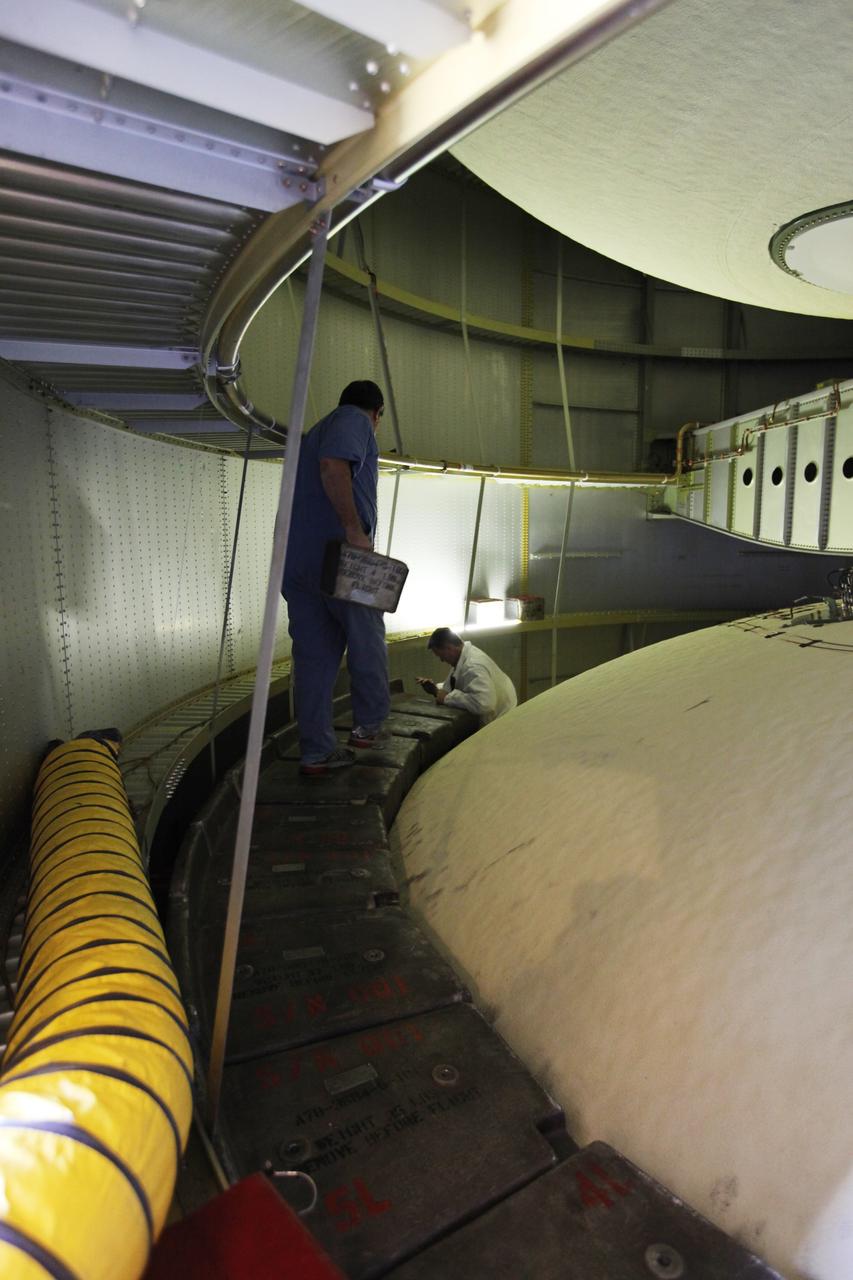
CAPE CANAVERAL, Fla. -- Preparations are under way in the Vehicle Assembly Building at NASA's Kennedy Space Center in Florida to examine space shuttle Discovery's external fuel tank. Shown here, is the inside of the tank's intertank region. Technicians will begin to remove thermal sensors that will give engineers data about the changes the tank went through during the loading and draining of super-cold propellants during a tanking test on Dec. 17. Engineers also will examine 21-foot-long support beams, called stringers, on the outside of the tank's intertank region. Also on the agenda, is to re-apply foam to the outside of the tank. Discovery's next launch opportunity to the International Space Station on the STS-133 mission is no earlier than Feb. 3, 2011. For more information on STS-133, visit www.nasa.gov/mission_pages/shuttle/shuttlemissions/sts133/. Photo credit: NASA/Dimitri Gerondidakis
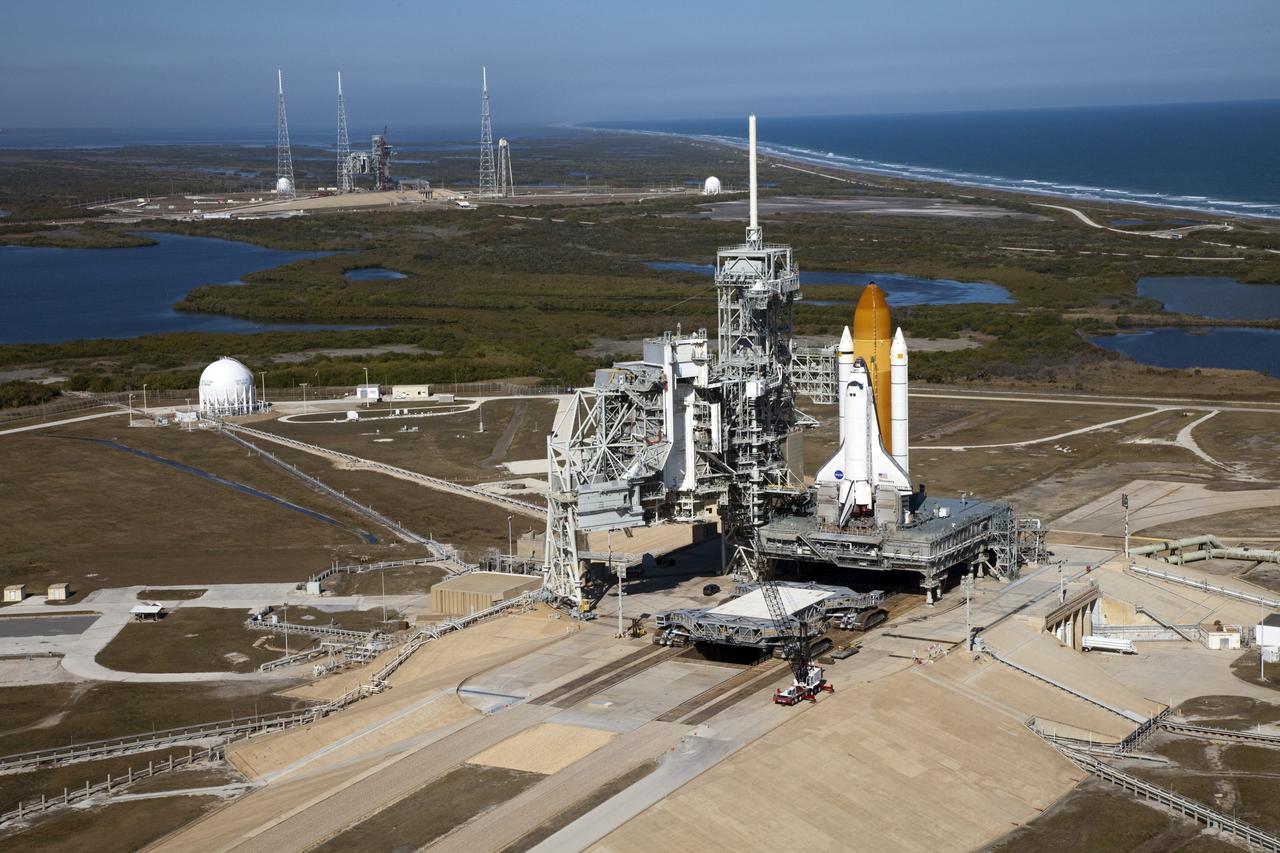
CAPE CANAVERAL, Fla. -- Space shuttle Discovery awaits its move, called rollback, from Launch Pad 39A to the Vehicle Assembly Building (VAB) at NASA's Kennedy Space Center in Florida. Rollback was scheduled for 12:30 a.m., but was postponed until 10 p.m. so technicians could resolve an issue with a leveling system on the crawler-transporter, which is in front of the shuttle. Once inside the VAB, Discovery's external fuel tank will be examined and foam reapplied where 89 sensors were installed on the tank's aluminum skin for an instrumented tanking test on Dec. 17. The sensors were used to measure changes in the tank as super-cold propellants were pumped in and drained out. Data and analysis from the test will be used to determine what caused the tops of two, 21-foot-long support beams, called stringers, on the outside of the intertank to crack during fueling on Nov. 5. Discovery's next launch opportunity to the International Space Station on the STS-133 mission is no earlier than Feb. 3, 2011. For more information on STS-133, visit www.nasa.gov/mission_pages/shuttle/shuttlemissions/sts133/. Photo credit: NASA/Frank Michaux
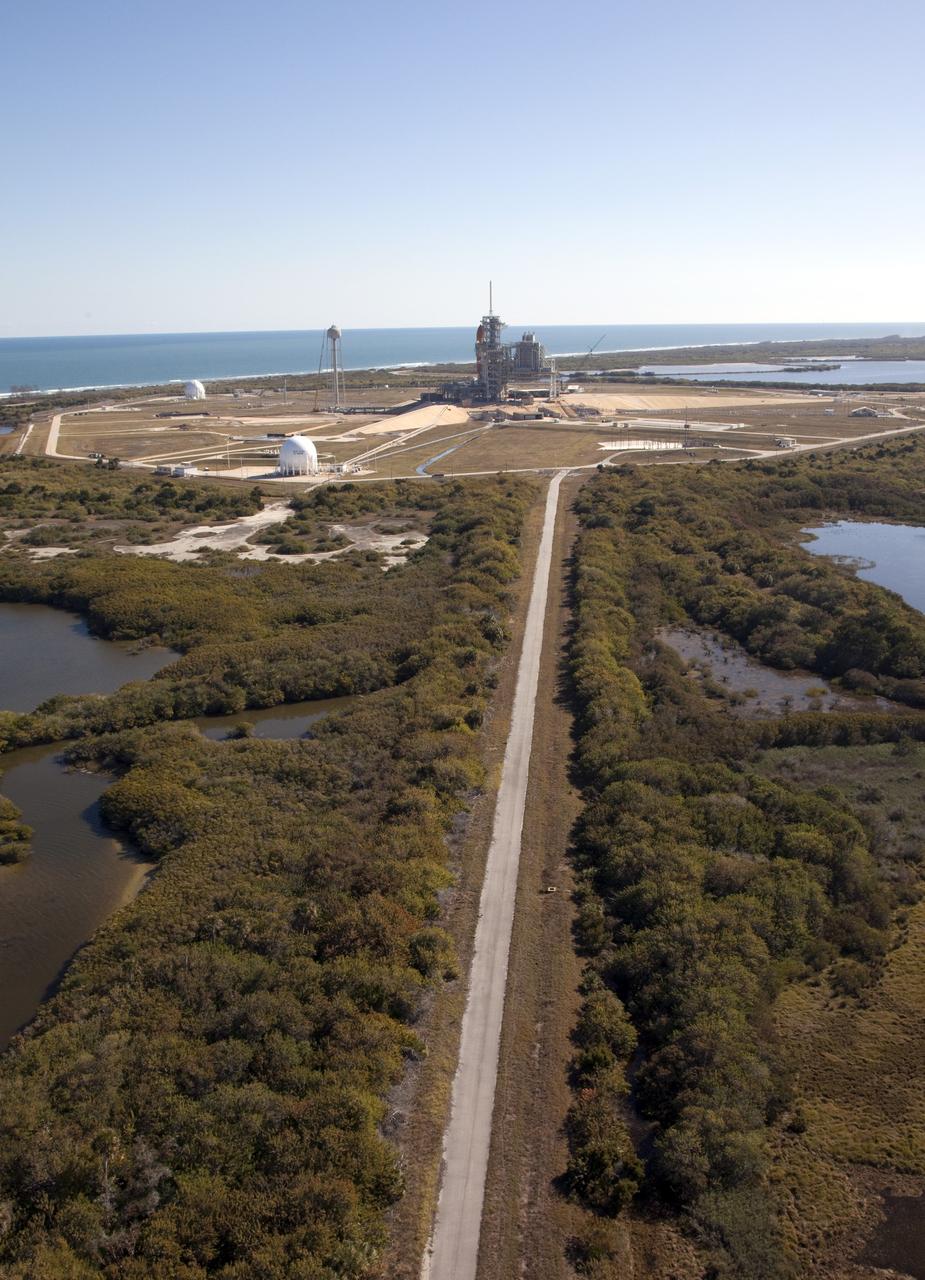
CAPE CANAVERAL, Fla. -- Space shuttle Discovery awaits its move, called rollback, from Launch Pad 39A to the Vehicle Assembly Building (VAB) at NASA's Kennedy Space Center in Florida. Rollback was scheduled for 12:30 a.m., but was postponed until 10 p.m. so technicians could resolve an issue with a leveling system on the crawler-transporter. Once inside the VAB, Discovery's external fuel tank will be examined and foam reapplied where 89 sensors were installed on the tank's aluminum skin for an instrumented tanking test on Dec. 17. The sensors were used to measure changes in the tank as super-cold propellants were pumped in and drained out. Data and analysis from the test will be used to determine what caused the tops of two, 21-foot-long support beams, called stringers, on the outside of the intertank to crack during fueling on Nov. 5. Discovery's next launch opportunity to the International Space Station on the STS-133 mission is no earlier than Feb. 3, 2011. For more information on STS-133, visit www.nasa.gov/mission_pages/shuttle/shuttlemissions/sts133/. Photo credit: NASA/Frank Michaux
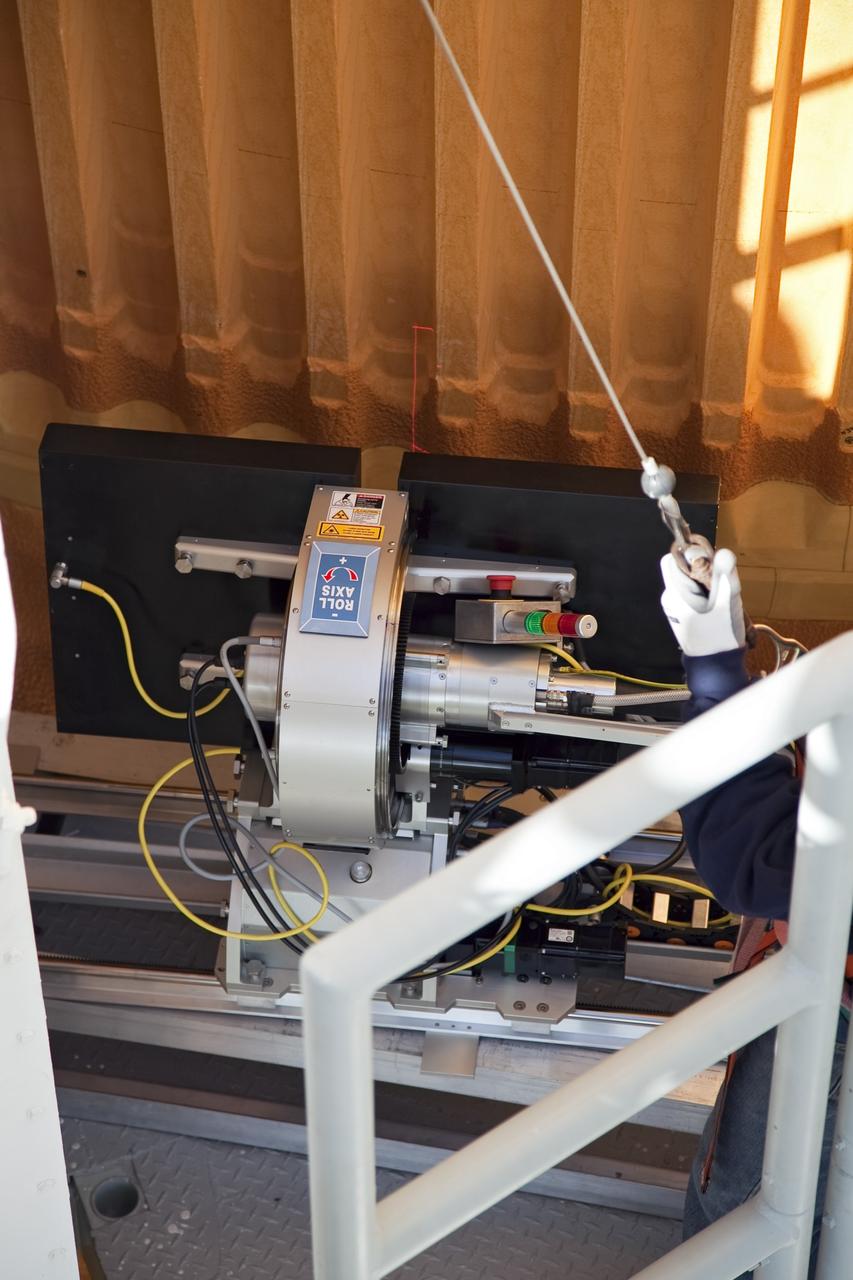
CAPE CANAVERAL, Fla. -- An engineer uses a backscatter device to examine space shuttle Discovery's external fuel tank on Launch Pad 39A at NASA's Kennedy Space Center in Florida. The device bounces radiation off the tank, allowing technicians to see under the tank's foam insulation. The foam cracked during initial loading operations for Discovery’s STS-133 launch attempt on Nov. 5, and technicians later identified two cracked stringers, which are the composite aluminum ribs located vertically on the tank’s intertank area. Those two stringers have been replaced and reinforced with doublers, which are shaped metal pieces twice as thick as the original stringers. Launch is no earlier than Dec. 17 at 8:51 p.m. EST. For more information on STS-133, visit www.nasa.gov/mission_pages/shuttle/shuttlemissions/sts133/. Photo credit: NASA/Frank Michaux
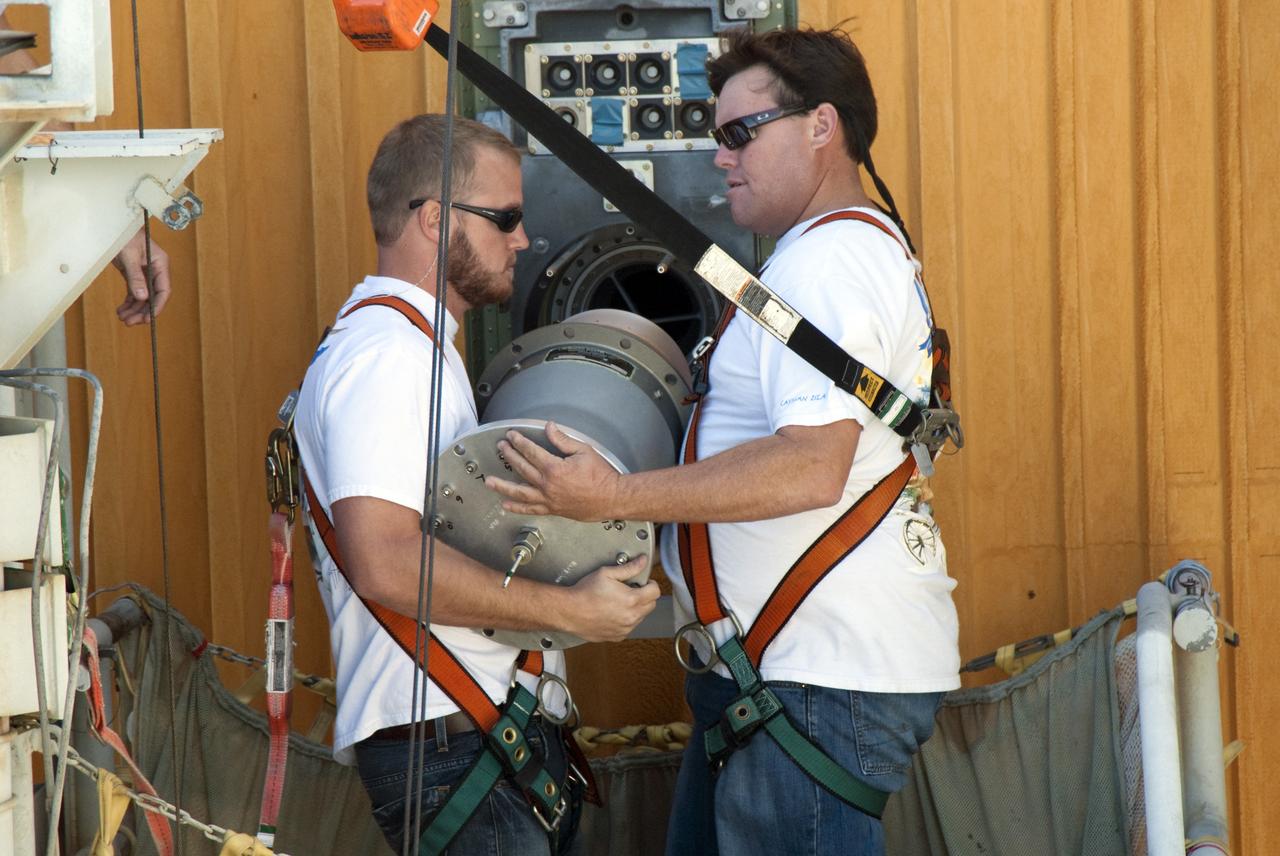
CAPE CANAVERAL, Fla. -- On Launch Pad 39A at NASA's Kennedy Space Center in Florida, workers install a new 7-inch quick disconnect on the ground umbilical carrier plate (GUCP) of space shuttle Discovery's external fuel tank. A hydrogen gas leak at that location during tanking for Discovery's STS-133 mission to the International Space Station caused the launch attempt to be scrubbed Nov. 5. The GUCP is the overboard vent to the pad and the flame stack where the excess hydrogen is burned off. For more information on STS-133, visit www.nasa.gov/mission_pages/shuttle/shuttlemissions/sts133/. Photo credit: NASA/Charisse Nahser
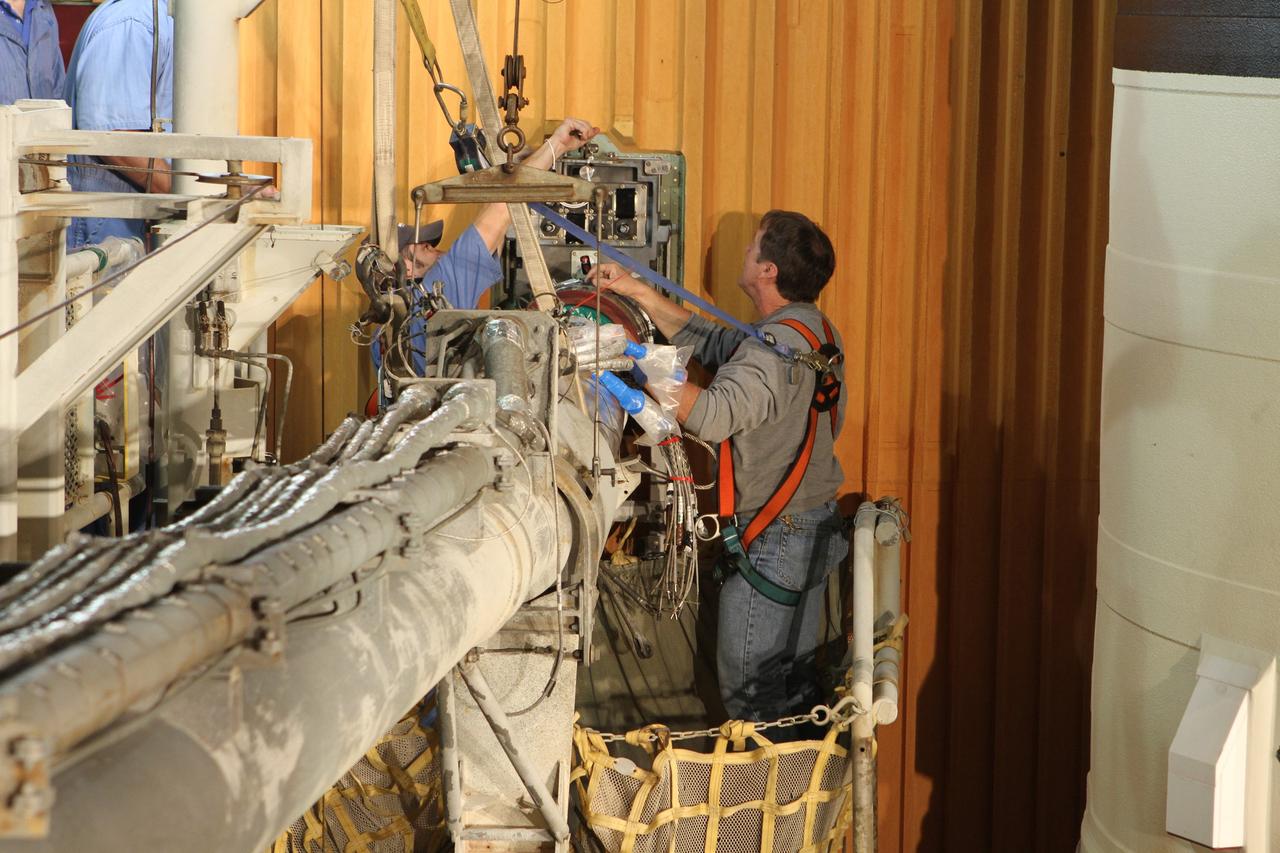
CAPE CANAVERAL, Fla. -- On Launch Pad 39A at NASA's Kennedy Space Center in Florida, technicians are begin to reattach the vent line to the ground umbilical carrier plate (GUCP) on space shuttle Discovery's external fuel tank. A hydrogen gas leak at that location during tanking for Discovery's STS-133 mission to the International Space Station caused the launch attempt to be scrubbed Nov. 5. The GUCP is the overboard vent to the pad and the flame stack where the excess hydrogen is burned off. Discovery's next launch attempt is no earlier than Nov. 30 at 4:02 a.m. EST. For more information on STS-133, visit www.nasa.gov/mission_pages/shuttle/shuttlemissions/sts133/. Photo credit: NASA/Ben Smegelsky
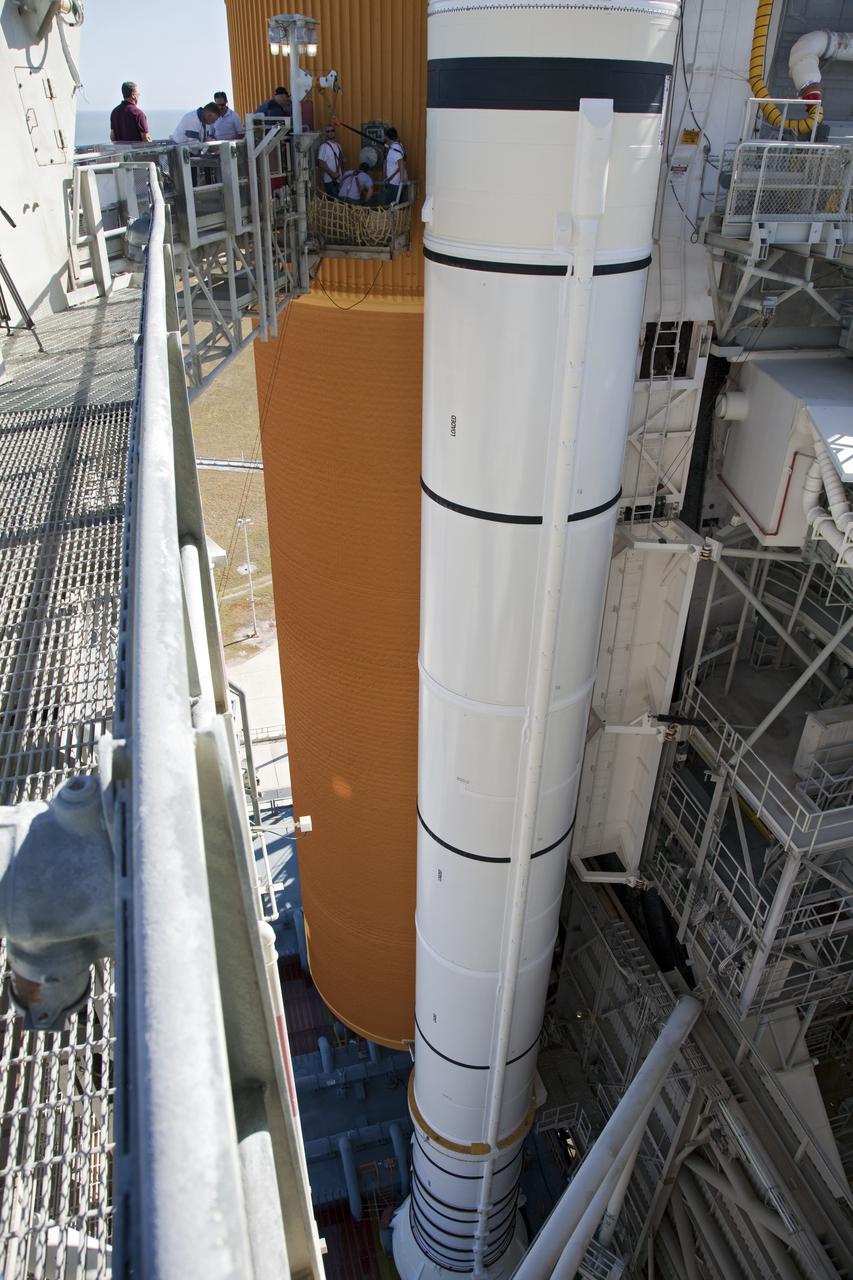
CAPE CANAVERAL, Fla. -- On Launch Pad 39A at NASA's Kennedy Space Center in Florida, workers install a new 7-inch quick disconnect on the ground umbilical carrier plate (GUCP) of space shuttle Discovery's external fuel tank. A hydrogen gas leak at that location during tanking for Discovery's STS-133 mission to the International Space Station caused the launch attempt to be scrubbed Nov. 5. The GUCP is the overboard vent to the pad and the flame stack where the excess hydrogen is burned off. For more information on STS-133, visit www.nasa.gov/mission_pages/shuttle/shuttlemissions/sts133/. Photo credit: NASA/Frankie Martin