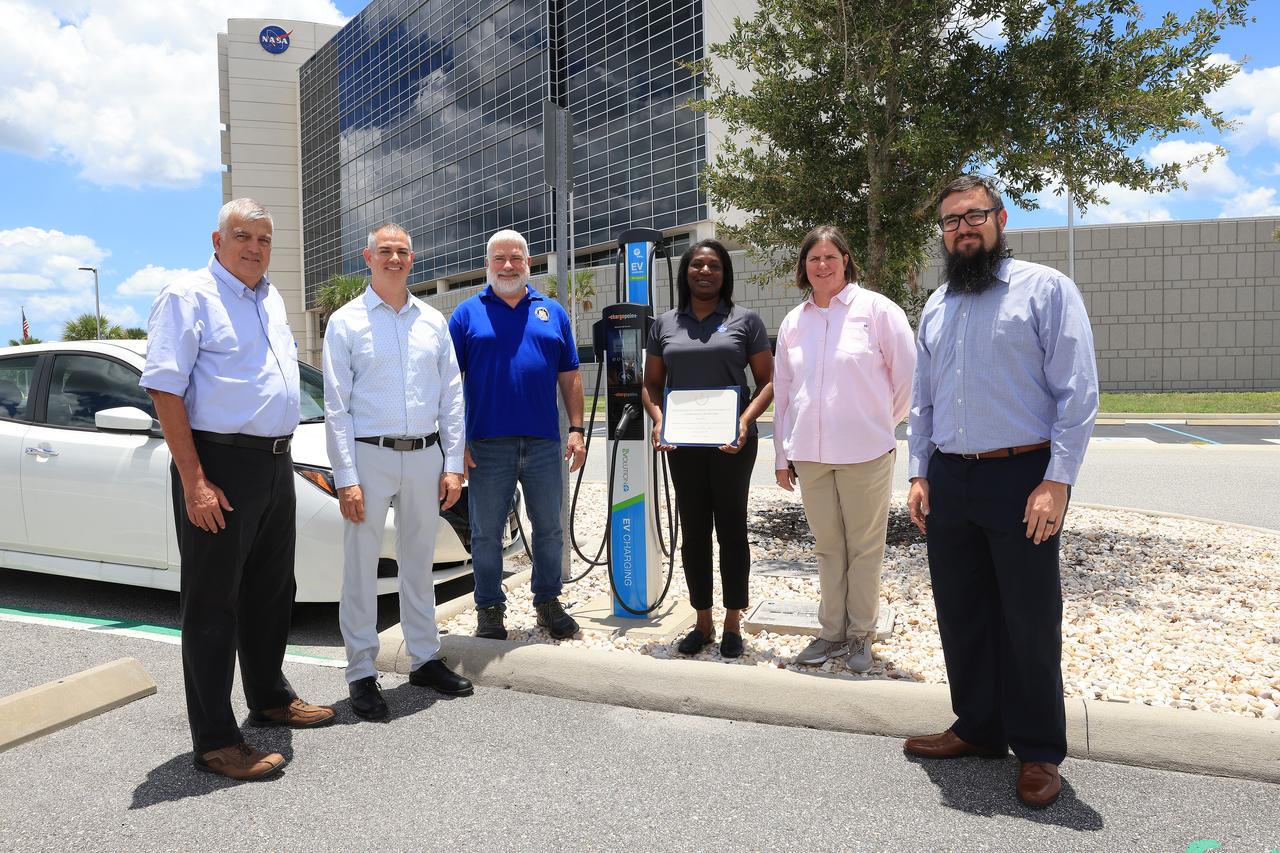
Six of the seven members of the NASA Kennedy Space Center team recognized by the White House on Tuesday, June 25, 2024, during the Presidential Federal Sustainability Awards stand next to an electric vehicle (EV) charging station in front of Kennedy's Central Campus Headquarters Building. Those members are, from left to right, center services division chief Gustavo Diaz, partnership development office chief Matthew Jimenez, then branch chief Gerald “Jay” Green, sustainability lead Lashanda Battle, transportation officer Melissa Coleman, and then transportation specialist Spencer Davis. This EV station is one of 28 installed on center through a partnership with local utility provider Florida Power & Light, allowing up to 56 electric vehicles to be charged at the same time. An additional 31 EV stations are planned at Kennedy by fall 2024, increasing the center's vehicle charging capacity by up to 118 vehicles simultaneously once they're operational.
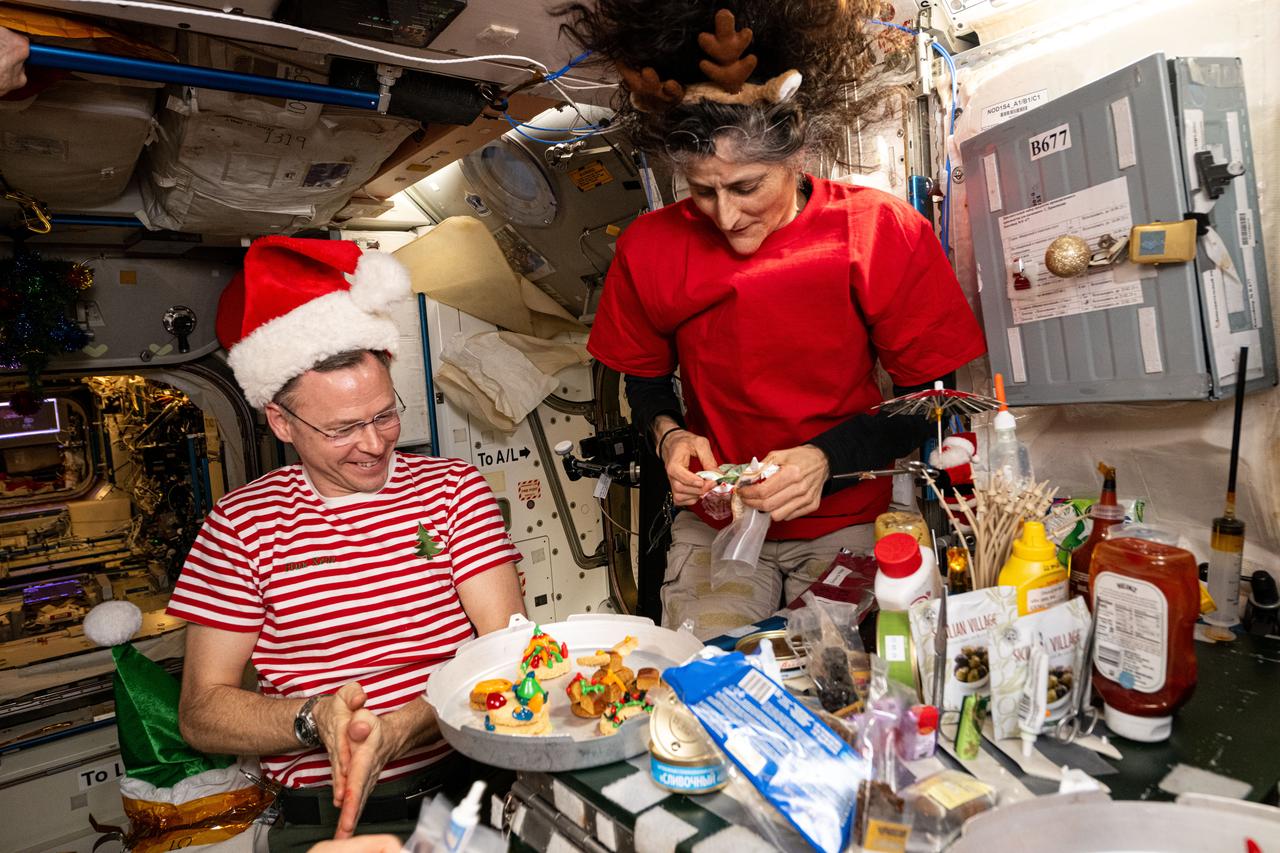
iss072e403985 (Dec. 24, 2024) --- NASA astronauts Nick Hague and Suni Williams, Expedition 72 flight engineer and commander respectively, share snacks and goodies on Christmas Eve inside the gallery of the International Space Station's Unity module.
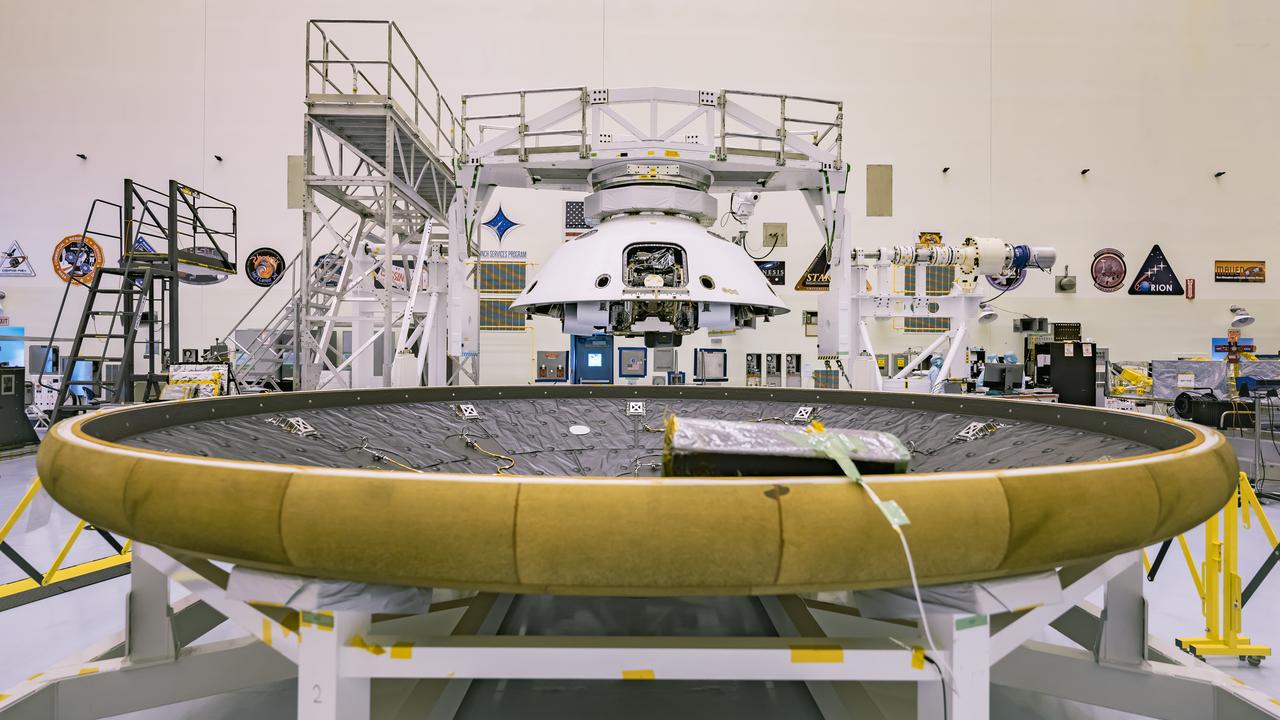
Inside the Payload Hazardous Servicing Facility at NASA’s Kennedy Space Center in Florida, the Backshell-Powered Descent Vehicle and Entry Vehicle assemblies are being prepared to be attached to the Mars Perseverance rover on May 5, 2020. The cone-shaped backshell contains the parachute, and along with the mission’s heat shield, provides protection for the rover and descent stage during Martian atmospheric entry. The Mars Perseverance rover is scheduled to launch in mid-July atop a United Launch Alliance Atlas V 541 rocket from Pad 41 at nearby Cape Canaveral Air Force Station. The rover is part of NASA’s Mars Exploration Program, a long-term effort of robotic exploration of the Red Planet. The rover will search for habitable conditions in the ancient past and signs of past microbial life on Mars. The Launch Services Program at Kennedy is responsible for launch management.
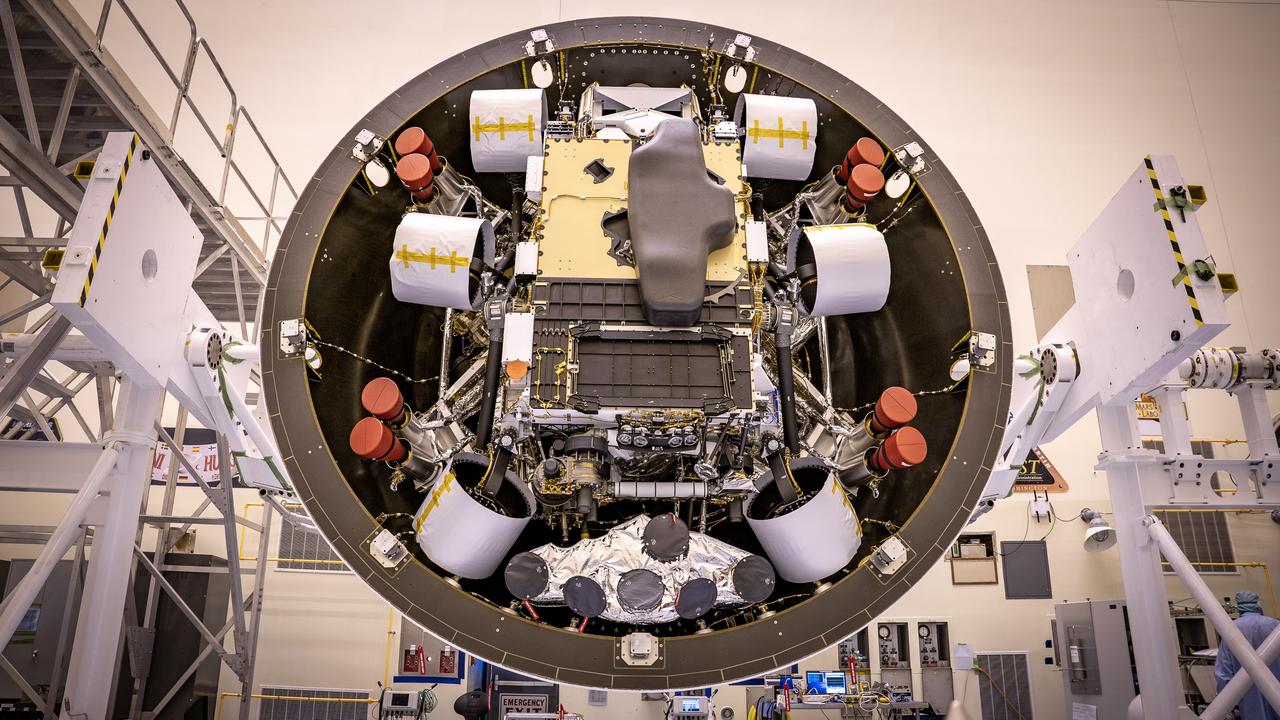
Inside the Payload Hazardous Servicing Facility at NASA’s Kennedy Space Center in Florida, the Backshell-Powered Descent Vehicle and Entry Vehicle assemblies are being prepared to be attached to the Mars Perseverance rover on May 4, 2020. The cone-shaped backshell contains the parachute, and along with the mission’s heat shield, provides protection for the rover and descent stage during Martian atmospheric entry. The Mars Perseverance rover is scheduled to launch in mid-July atop a United Launch Alliance Atlas V 541 rocket from Pad 41 at nearby Cape Canaveral Air Force Station. The rover is part of NASA’s Mars Exploration Program, a long-term effort of robotic exploration of the Red Planet. The rover will search for habitable conditions in the ancient past and signs of past microbial life on Mars. The Launch Services Program at Kennedy is responsible for launch management.
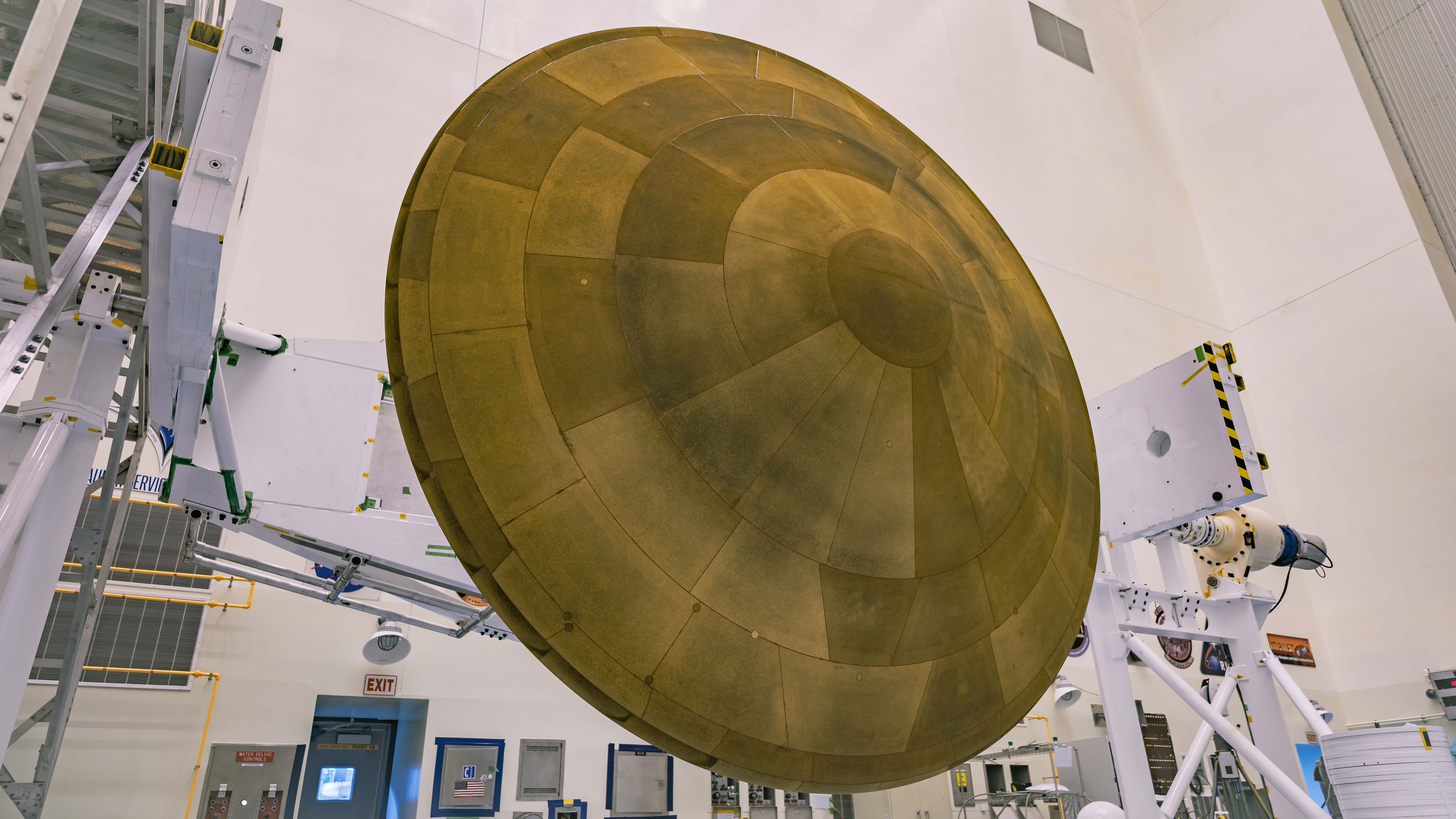
Inside the Payload Hazardous Servicing Facility at NASA’s Kennedy Space Center in Florida, the Backshell-Powered Descent Vehicle and Entry Vehicle assemblies are attached to the Mars Perseverance rover on May 6, 2020. The cone-shaped backshell contains the parachute, and along with the mission’s heat shield, provides protection for the rover and descent stage during Martian atmospheric entry. The Mars Perseverance rover is scheduled to launch in mid-July atop a United Launch Alliance Atlas V 541 rocket from Pad 41 at nearby Cape Canaveral Air Force Station. The rover is part of NASA’s Mars Exploration Program, a long-term effort of robotic exploration of the Red Planet. The rover will search for habitable conditions in the ancient past and signs of past microbial life on Mars. The Launch Services Program at Kennedy is responsible for launch management.
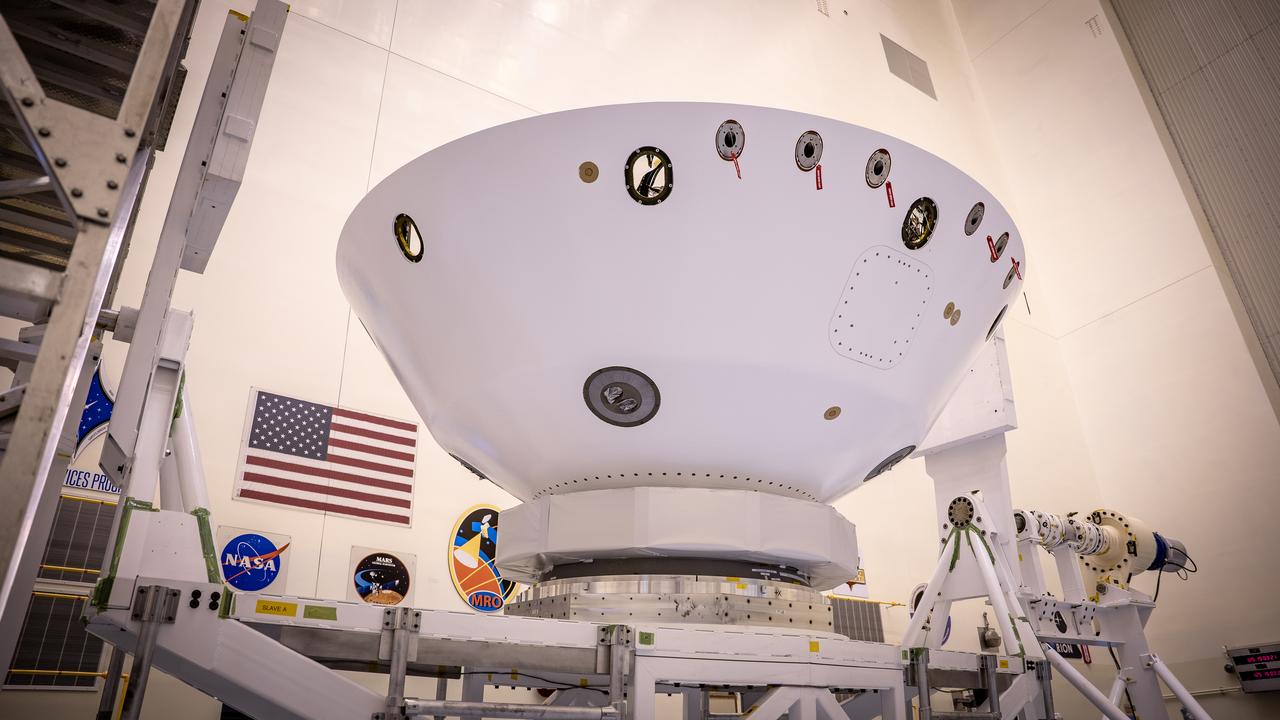
Inside the Payload Hazardous Servicing Facility at NASA’s Kennedy Space Center in Florida, the Mars Perseverance rover is rotated to prepare for the Backshell-Powered Descent Vehicle and Entry Vehicle assemblies to be attached on May 4, 2020. The cone-shaped backshell contains the parachute, and along with the mission’s heat shield, provides protection for the rover and descent stage during Martian atmospheric entry. The Mars Perseverance rover is scheduled to launch in mid-July atop a United Launch Alliance Atlas V 541 rocket from Pad 41 at nearby Cape Canaveral Air Force Station. The rover is part of NASA’s Mars Exploration Program, a long-term effort of robotic exploration of the Red Planet. The rover will search for habitable conditions in the ancient past and signs of past microbial life on Mars. The Launch Services Program at Kennedy is responsible for launch management.
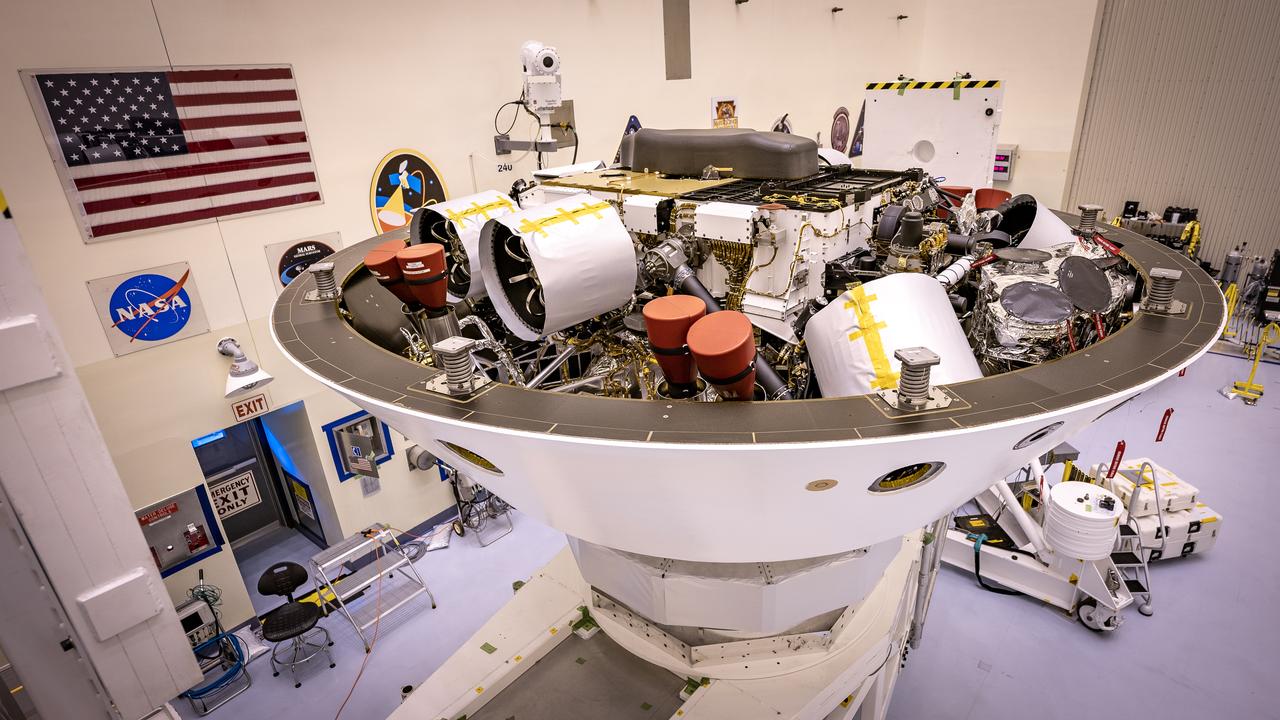
Inside the Payload Hazardous Servicing Facility at NASA’s Kennedy Space Center in Florida, the Mars Perseverance rover is rotated to prepare for the Backshell-Powered Descent Vehicle and Entry Vehicle assemblies to be attached on May 4, 2020. The cone-shaped backshell contains the parachute, and along with the mission’s heat shield, provides protection for the rover and descent stage during Martian atmospheric entry. The Mars Perseverance rover is scheduled to launch in mid-July atop a United Launch Alliance Atlas V 541 rocket from Pad 41 at nearby Cape Canaveral Air Force Station. The rover is part of NASA’s Mars Exploration Program, a long-term effort of robotic exploration of the Red Planet. The rover will search for habitable conditions in the ancient past and signs of past microbial life on Mars. The Launch Services Program at Kennedy is responsible for launch management.
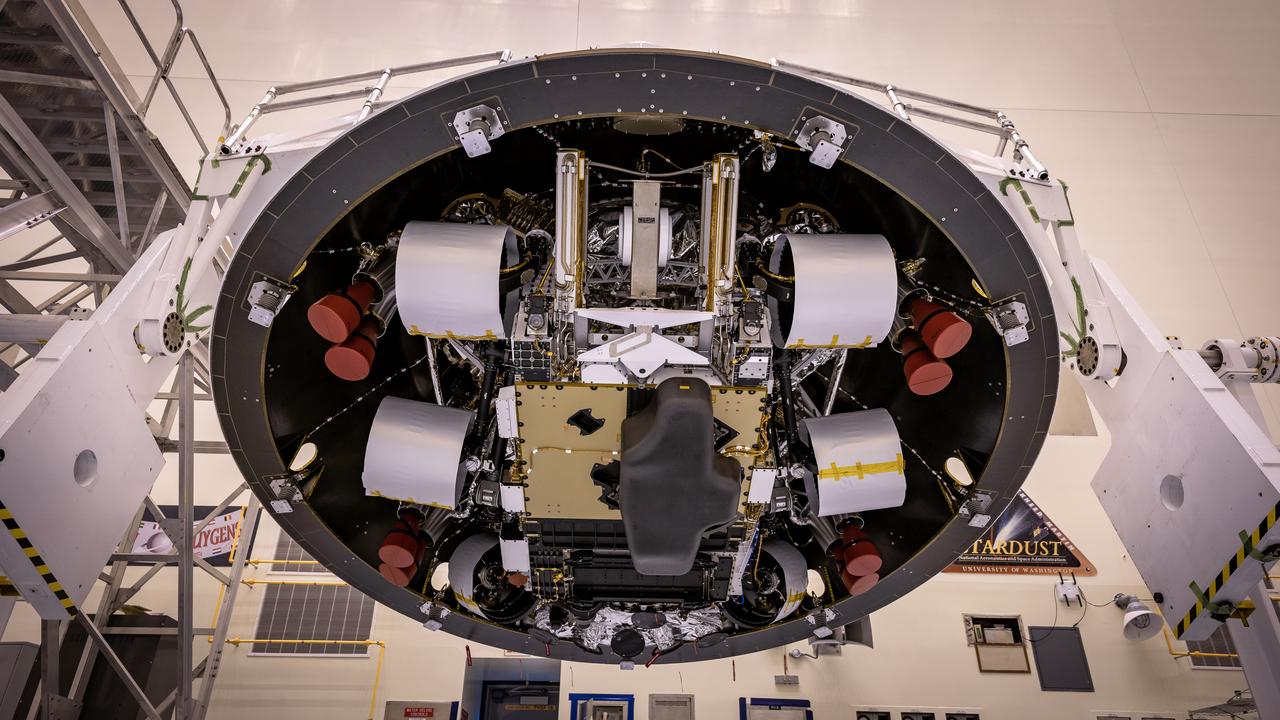
Inside the Payload Hazardous Servicing Facility at NASA’s Kennedy Space Center in Florida, the Backshell-Powered Descent Vehicle and Entry Vehicle assemblies are being prepared to be attached to the Mars Perseverance rover on May 4, 2020. The cone-shaped backshell contains the parachute, and along with the mission’s heat shield, provides protection for the rover and descent stage during Martian atmospheric entry. The Mars Perseverance rover is scheduled to launch in mid-July atop a United Launch Alliance Atlas V 541 rocket from Pad 41 at nearby Cape Canaveral Air Force Station. The rover is part of NASA’s Mars Exploration Program, a long-term effort of robotic exploration of the Red Planet. The rover will search for habitable conditions in the ancient past and signs of past microbial life on Mars. The Launch Services Program at Kennedy is responsible for launch management.
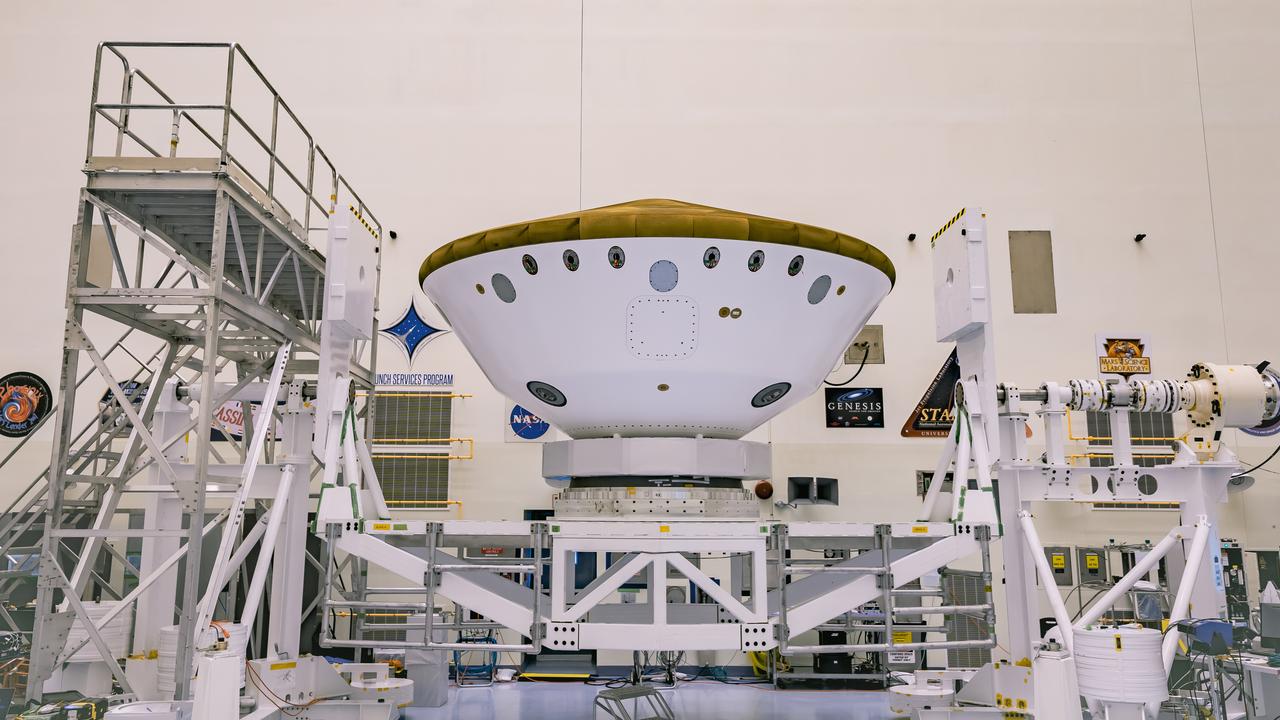
Inside the Payload Hazardous Servicing Facility at NASA’s Kennedy Space Center in Florida, the Backshell-Powered Descent Vehicle and Entry Vehicle assemblies are attached to the Mars Perseverance rover on May 6, 2020. The cone-shaped backshell contains the parachute, and along with the mission’s heat shield, provides protection for the rover and descent stage during Martian atmospheric entry. The Mars Perseverance rover is scheduled to launch in mid-July atop a United Launch Alliance Atlas V 541 rocket from Pad 41 at nearby Cape Canaveral Air Force Station. The rover is part of NASA’s Mars Exploration Program, a long-term effort of robotic exploration of the Red Planet. The rover will search for habitable conditions in the ancient past and signs of past microbial life on Mars. The Launch Services Program at Kennedy is responsible for launch management.
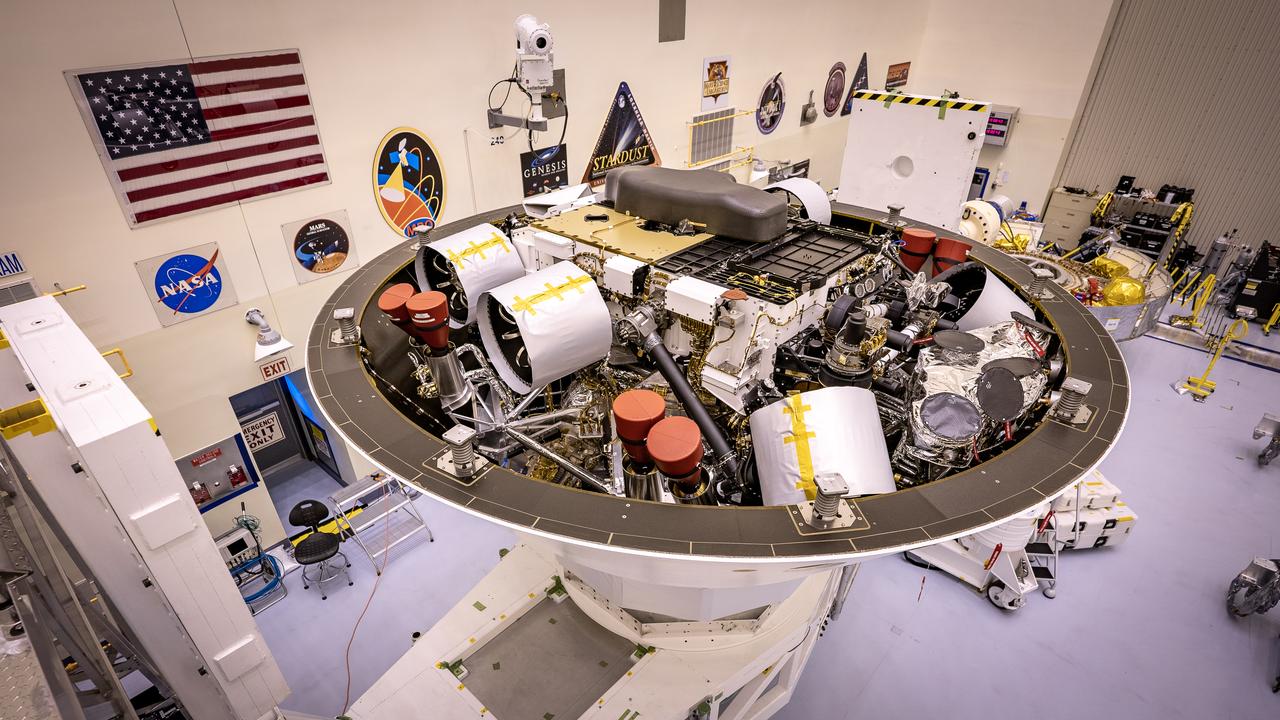
Inside the Payload Hazardous Servicing Facility at NASA’s Kennedy Space Center in Florida, the Mars Perseverance rover is rotated to prepare for the Backshell-Powered Descent Vehicle and Entry Vehicle assemblies to be attached on May 4, 2020. The cone-shaped backshell contains the parachute, and along with the mission’s heat shield, provides protection for the rover and descent stage during Martian atmospheric entry. The Mars Perseverance rover is scheduled to launch in mid-July atop a United Launch Alliance Atlas V 541 rocket from Pad 41 at nearby Cape Canaveral Air Force Station. The rover is part of NASA’s Mars Exploration Program, a long-term effort of robotic exploration of the Red Planet. The rover will search for habitable conditions in the ancient past and signs of past microbial life on Mars. The Launch Services Program at Kennedy is responsible for launch management.
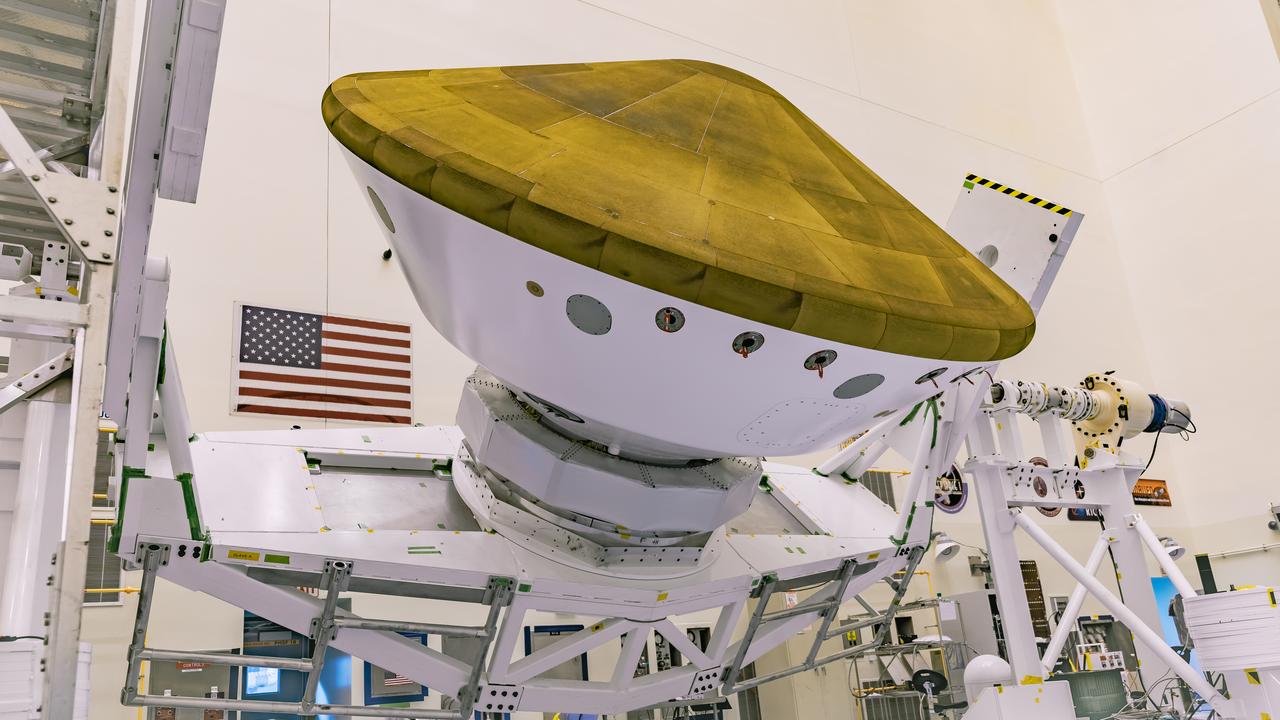
Inside the Payload Hazardous Servicing Facility at NASA’s Kennedy Space Center in Florida, the Backshell-Powered Descent Vehicle and Entry Vehicle assemblies are attached to the Mars Perseverance rover on May 6, 2020. The cone-shaped backshell contains the parachute, and along with the mission’s heat shield, provides protection for the rover and descent stage during Martian atmospheric entry. The Mars Perseverance rover is scheduled to launch in mid-July atop a United Launch Alliance Atlas V 541 rocket from Pad 41 at nearby Cape Canaveral Air Force Station. The rover is part of NASA’s Mars Exploration Program, a long-term effort of robotic exploration of the Red Planet. The rover will search for habitable conditions in the ancient past and signs of past microbial life on Mars. The Launch Services Program at Kennedy is responsible for launch management.
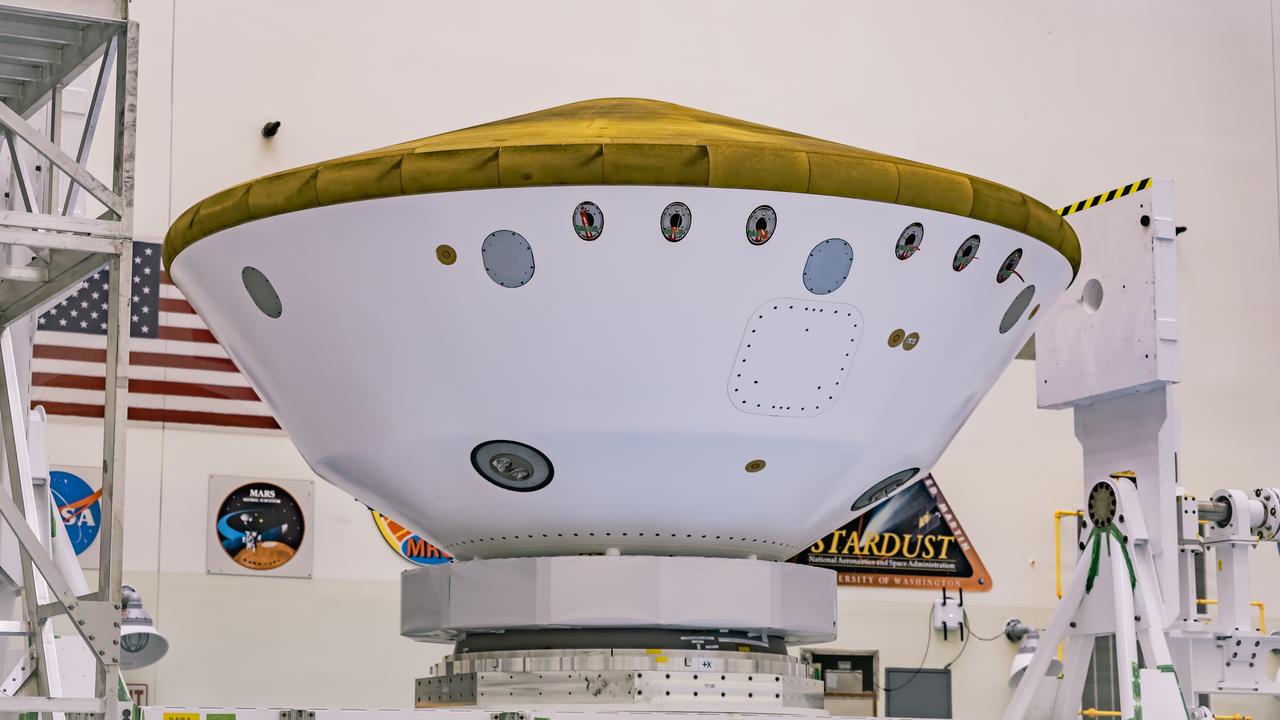
Inside the Payload Hazardous Servicing Facility at NASA’s Kennedy Space Center in Florida, the Backshell-Powered Descent Vehicle and Entry Vehicle assemblies are attached to the Mars Perseverance rover on May 6, 2020. The cone-shaped backshell contains the parachute, and along with the mission’s heat shield, provides protection for the rover and descent stage during Martian atmospheric entry. The Mars Perseverance rover is scheduled to launch in mid-July atop a United Launch Alliance Atlas V 541 rocket from Pad 41 at nearby Cape Canaveral Air Force Station. The rover is part of NASA’s Mars Exploration Program, a long-term effort of robotic exploration of the Red Planet. The rover will search for habitable conditions in the ancient past and signs of past microbial life on Mars. The Launch Services Program at Kennedy is responsible for launch management.
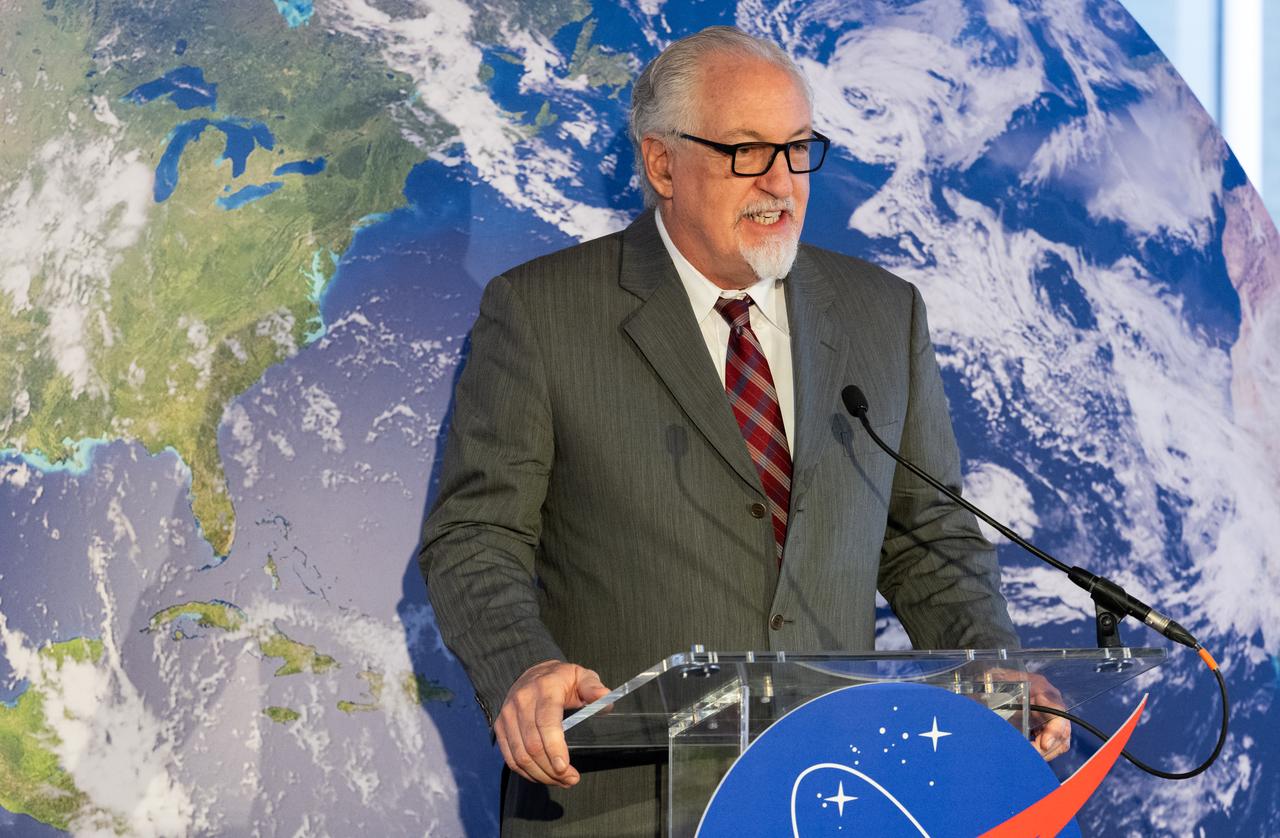
Marlen Eve, Deputy Administrator for the Agricultural Research Service at the U.S. Department of Agriculture (USDA), speaks before the ribbon cutting ceremony to open NASA’s Earth Information Center, Wednesday, June 21, 2023, at the Mary W. Jackson NASA Headquarters building in Washington. The Earth Information Center is new immersive experience that combines live data sets with cutting-edge data visualization and storytelling to allow visitors to see how our planet is changing. Photo Credit: (NASA/Joel Kowsky)
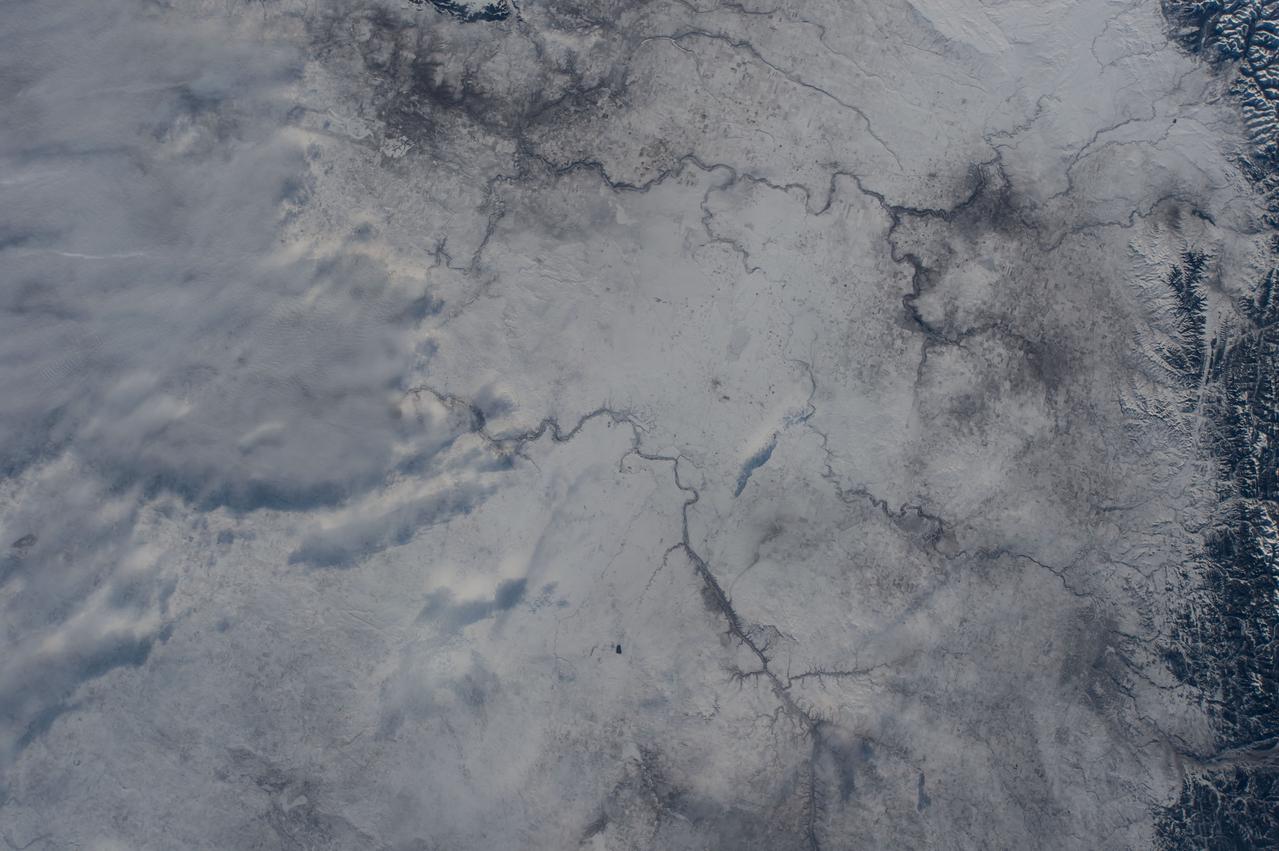
GMT001_00_19_Terry Virts_cold new years eve nebraska to pacific_123
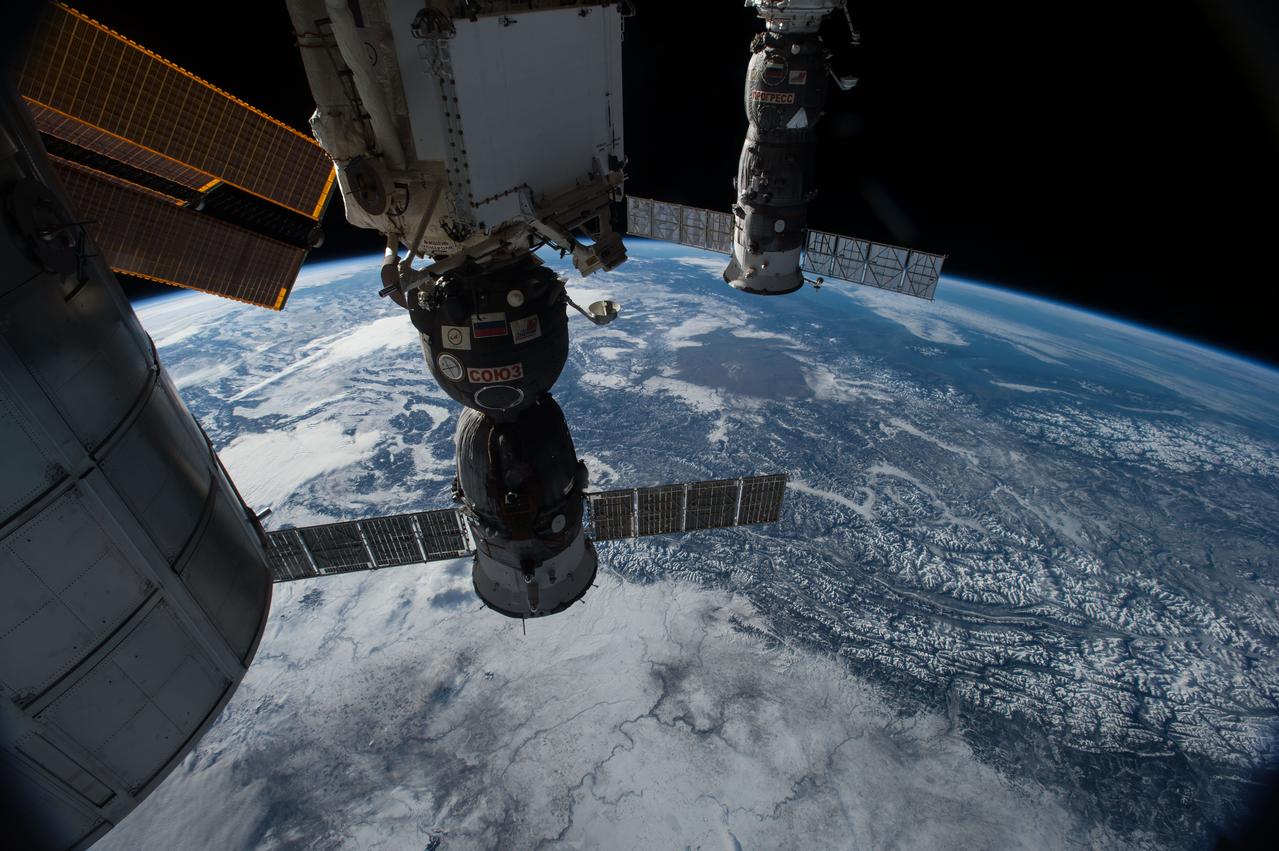
GMT001_00_19_Terry Virts_cold new years eve nebraska to pacific_123

iss058e001781 (Dec. 31, 2018) --- The SpaceX Dragon cargo craft is pictured attached to the International Space Station almost 257 miles above Quebec on New Year's Eve. The complex was flying into an orbital sunrise on a northwest to southeast track about to cross the Atlantic Ocean.

Testing of the External Vision System (EVS) Software on the B200 King Air
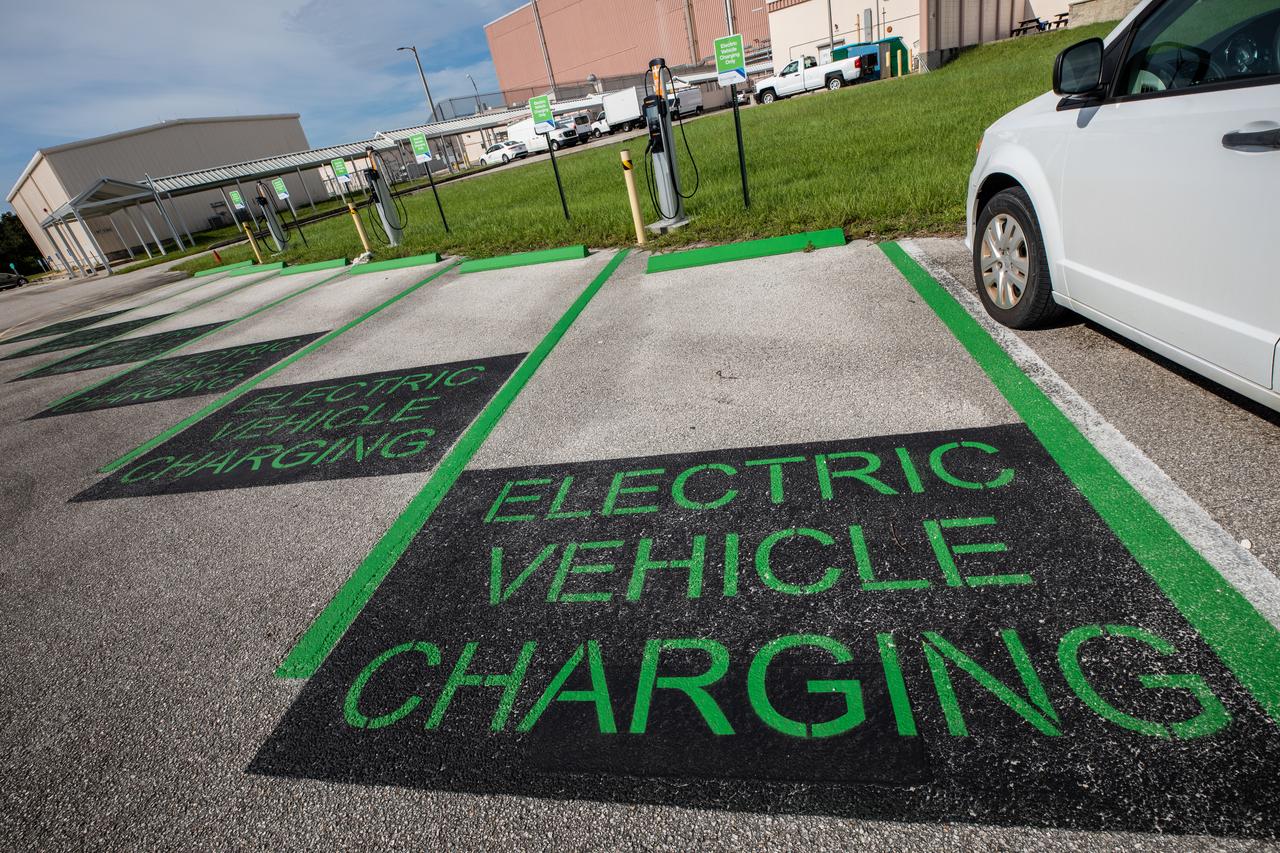
Several newly installed electric vehicle (EV) charging stations are in view near the Neil Armstrong Operations and Checkout Building at NASA’s Kennedy Space Center in Florida on Sept. 14, 2022. Part of a partnership between Kennedy and Florida Power & Light (FPL) to bring 23 EV charging stations to the spaceport, the ChargePoint CT4000, Level 2 chargers are capable of charging electric vehicles at a rate of 15-30 miles of range per hour. This partnership was set up under FPL’s EV program and provides a charging infrastructure that includes a simple way for businesses and employees to pay for usage.

A newly installed electric vehicle (EV) charging station is in view near the Central Campus Headquarters Building at NASA’s Kennedy Space Center in Florida on Sept. 14, 2022. Part of a partnership between Kennedy and Florida Power & Light (FPL) to bring 23 EV charging stations to the spaceport, the ChargePoint CT4000, Level 2 chargers are capable of charging electric vehicles at a rate of 15-30 miles of range per hour. This partnership was set up under FPL’s EV program and provides a charging infrastructure that includes a simple way for businesses and employees to pay for usage.
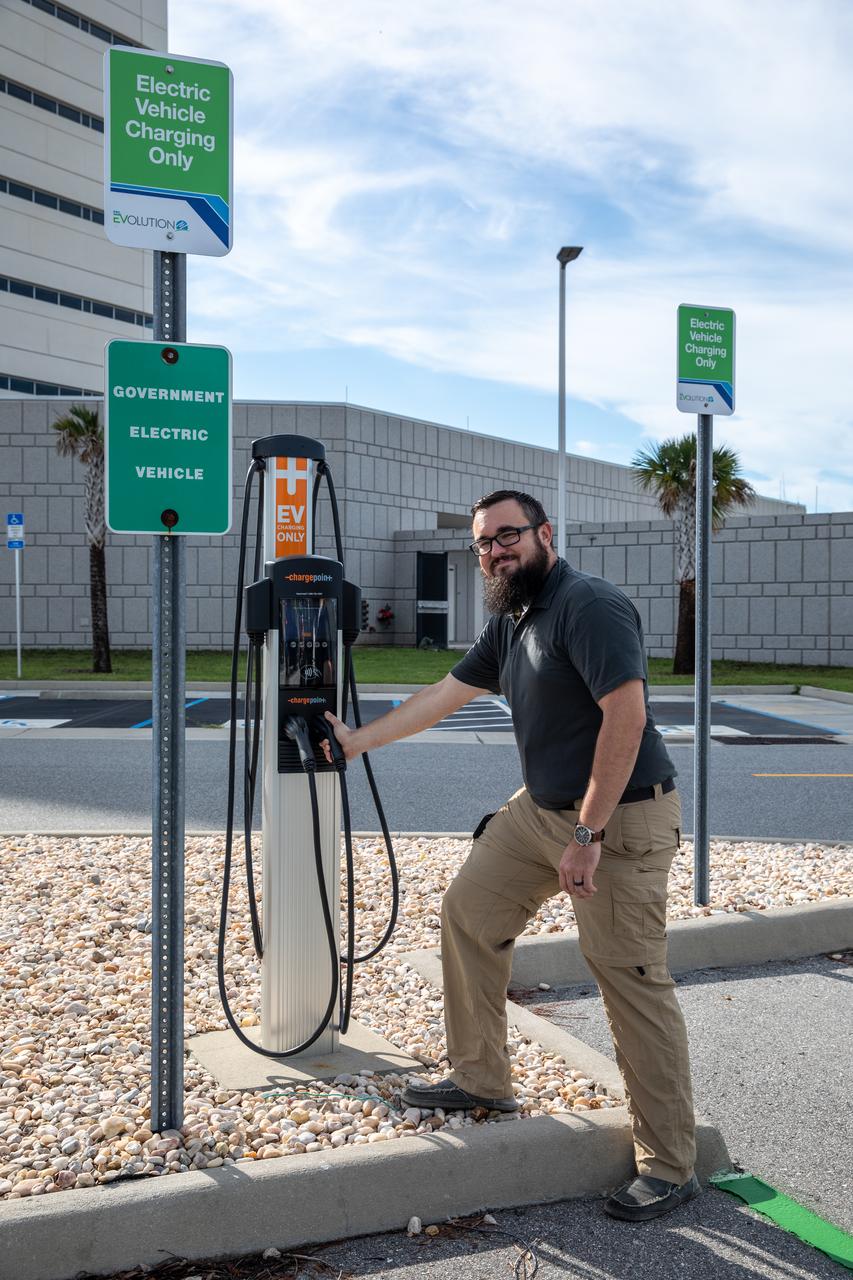
Spencer Davis, a NASA Traffic Management specialist in the Spaceport Integration Directorate at NASA’s Kennedy Space Center in Florida, stands near a newly installed electric vehicle (EV) charging station near the Central Campus Headquarters Building at Kennedy on Sept. 14, 2022. Part of a partnership between Kennedy and Florida Power & Light (FPL) to bring 23 EV charging stations to the spaceport, the ChargePoint CT4000, Level 2 chargers are capable of charging electric vehicles at a rate of 15-30 miles of range per hour. This partnership was set up under FPL’s EV program and provides a charging infrastructure that includes a simple way for businesses and employees to pay for usage.
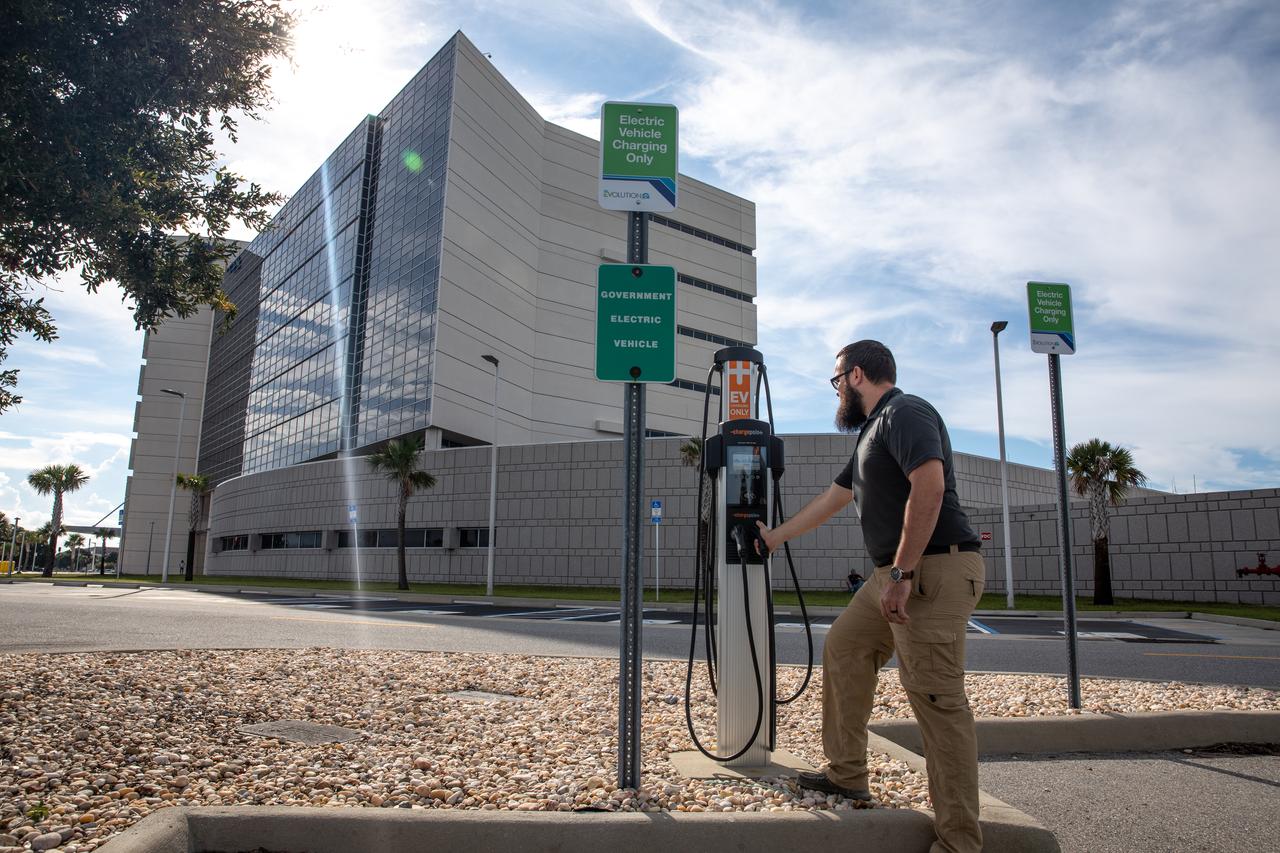
Spencer Davis, a NASA Traffic Management specialist in the Spaceport Integration Directorate at NASA’s Kennedy Space Center in Florida, stands near a newly installed electric vehicle (EV) charging station near the Central Campus Headquarters Building at Kennedy on Sept. 14, 2022. Part of a partnership between Kennedy and Florida Power & Light (FPL) to bring 23 EV charging stations to the spaceport, the ChargePoint CT4000, Level 2 chargers are capable of charging electric vehicles at a rate of 15-30 miles of range per hour. This partnership was set up under FPL’s EV program and provides a charging infrastructure that includes a simple way for businesses and employees to pay for usage.
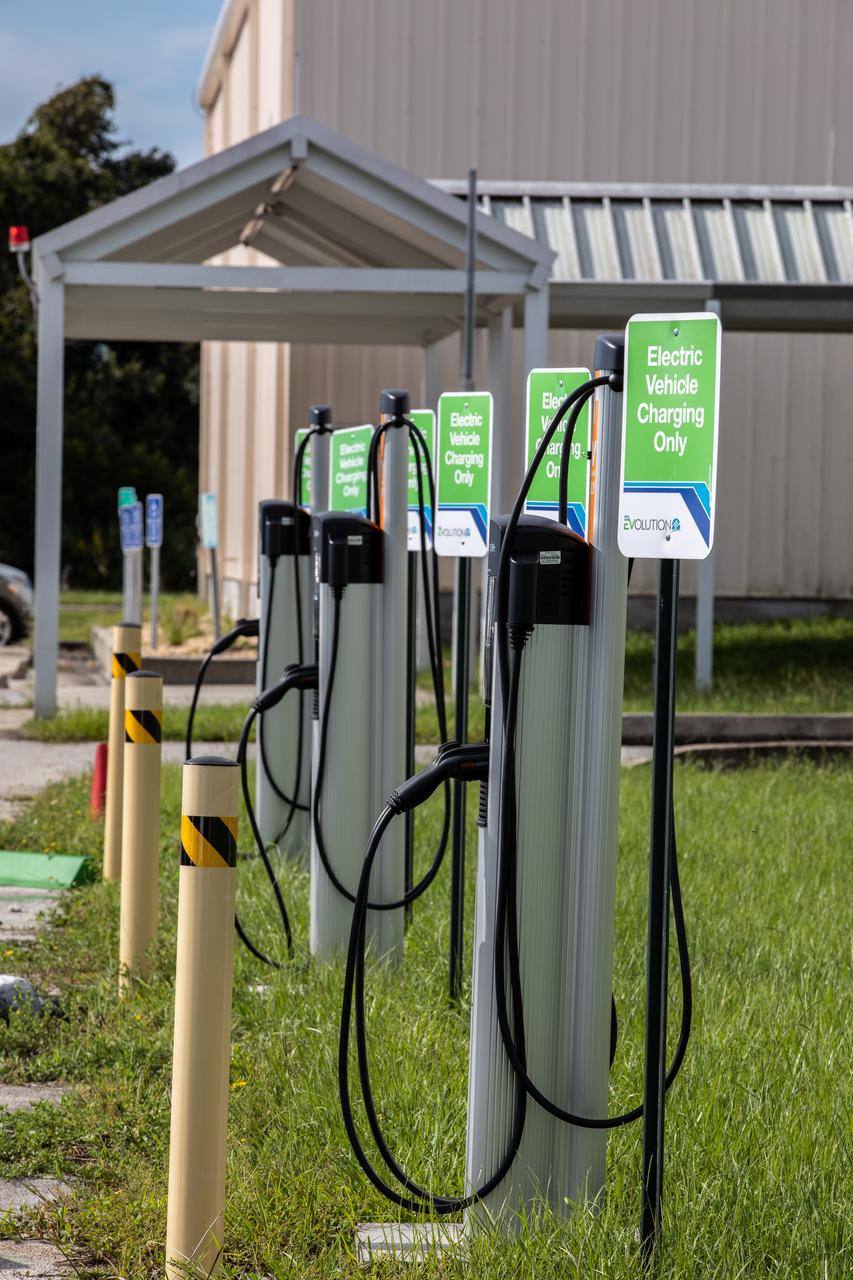
Several newly installed electric vehicle (EV) charging stations are in view near the Neil Armstrong Operations and Checkout Building at NASA’s Kennedy Space Center in Florida on Sept. 14, 2022. Part of a partnership between Kennedy and Florida Power & Light (FPL) to bring 23 EV charging stations to the spaceport, the ChargePoint CT4000, Level 2 chargers are capable of charging electric vehicles at a rate of 15-30 miles of range per hour. This partnership was set up under FPL’s EV program and provides a charging infrastructure that includes a simple way for businesses and employees to pay for usage.
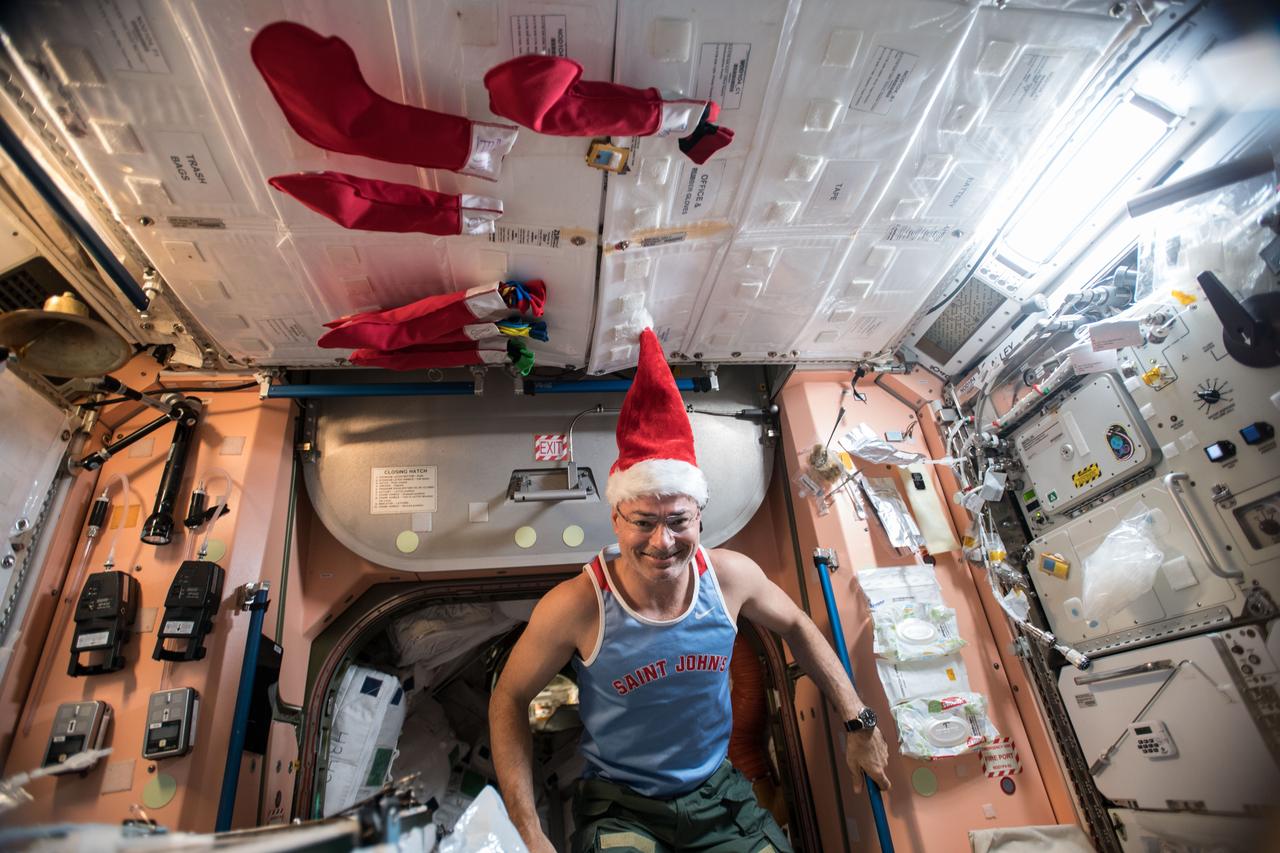
iss054e005591 (Dec. 24, 2017) --- NASA astronaut Mark Vande Hei "stirs" in the orbital house that is the International Space Station on Christmas Eve.
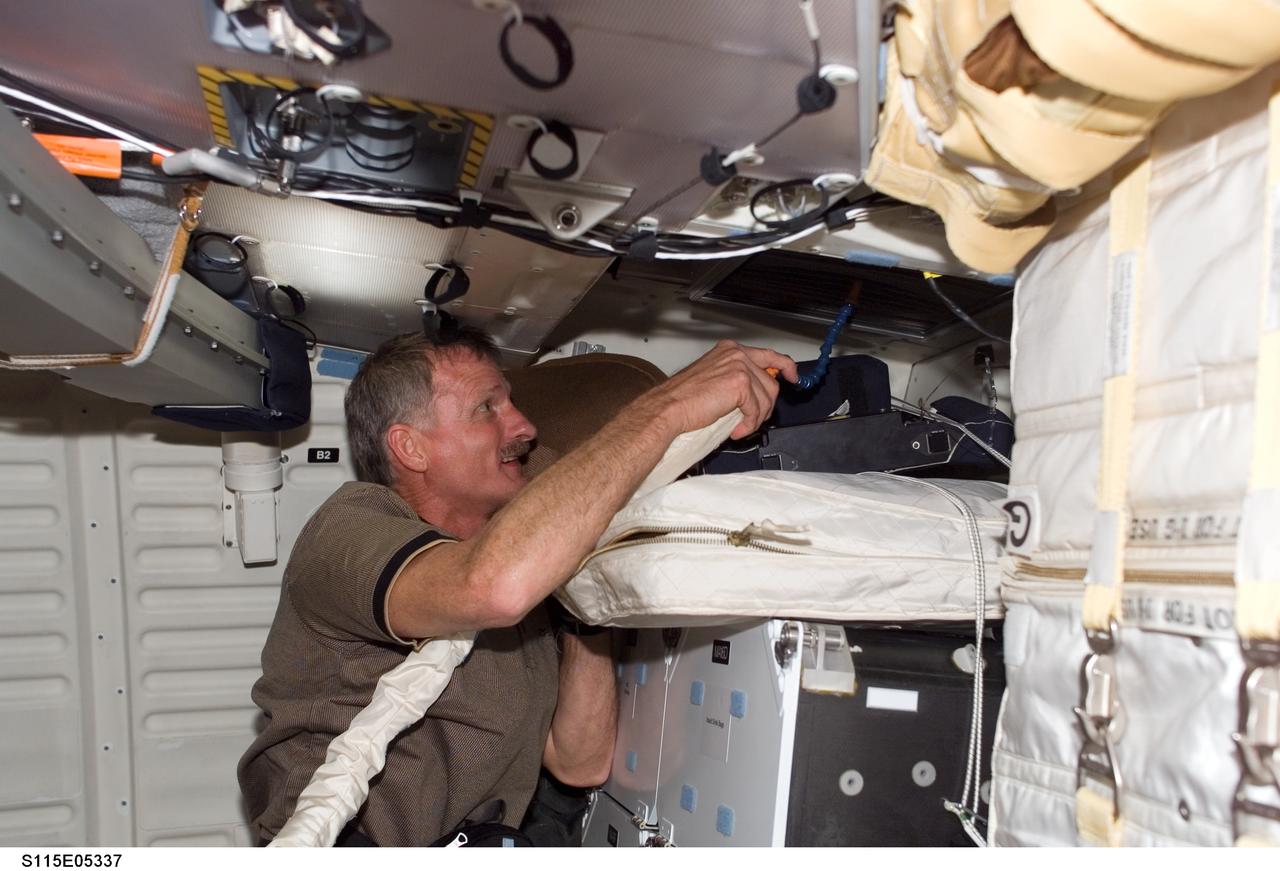
S115-E-05337 (10 Sept. 2006) --- Astronaut Joseph R. Tanner, STS-115 mission specialist, works on the middeck of the Space Shuttle Atlantis on the eve of docking day with the International Space Station.
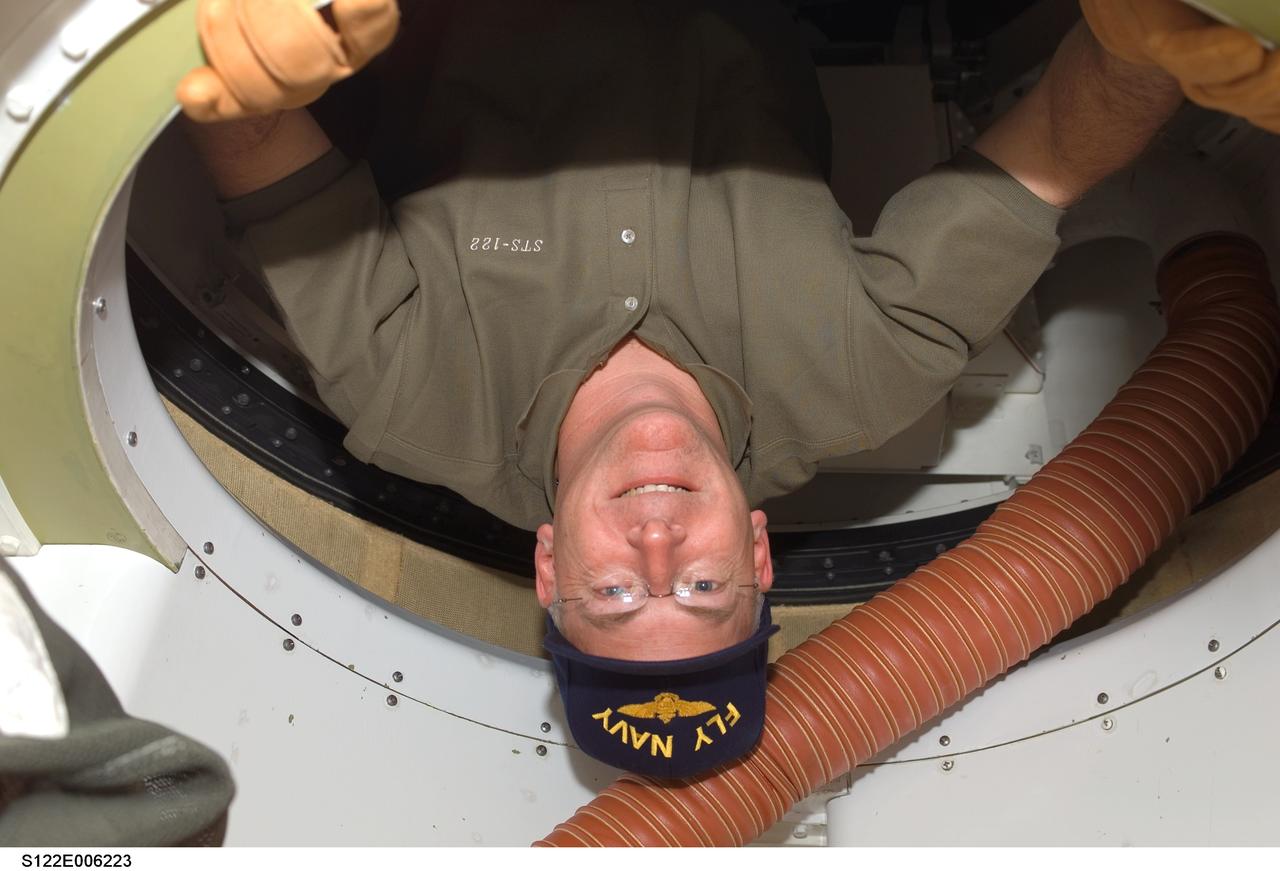
S122-E-006223 (8 Feb. 2008) --- Astronaut Alan Poindexter, STS-122 pilot, passes through a tunnel on the Space Shuttle Atlantis on the eve of the docking of the shuttle to the International Space Station.

Blazar 3C 279's historic gamma-ray flare can be seen in this image from the Large Area Telescope (LAT) on NASA's Fermi satellite. Gamma rays with energies from 100 million to 100 billion electron volts (eV) are shown; for comparison, visible light has energies between 2 and 3 eV. The image spans 150 degrees, is shown in a stereographic projection, and represents an exposure from June 11 at 00:28 UT to June 17 at 08:17 UT. Credit: NASA/DOE/Fermi LAT Collaboration
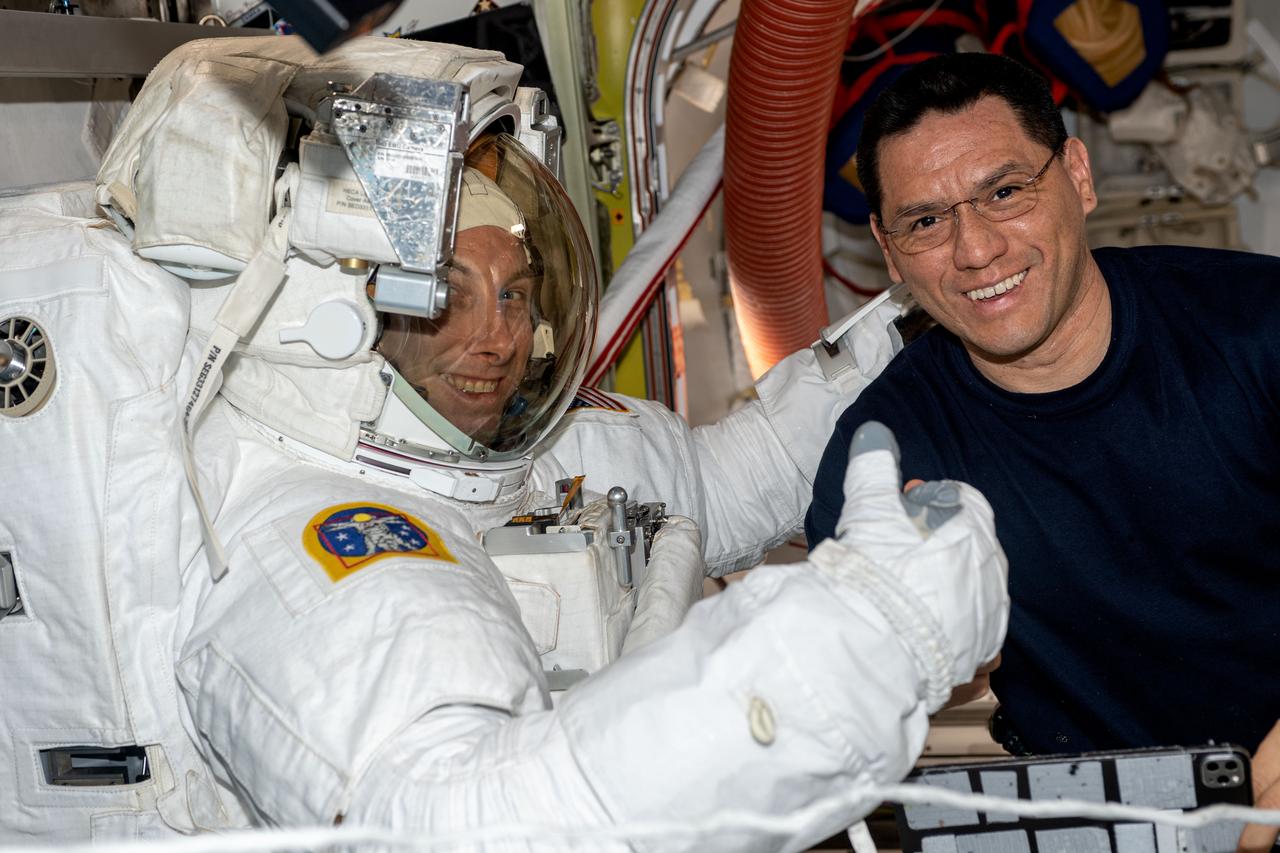
iss069e017126 (June 2, 2023) --- NASA astronaut Frank Rubio (right) assists NASA astronaut Woody Hoburg during a fit check of his spacesuit inside the International Space Station's Quest airlock.
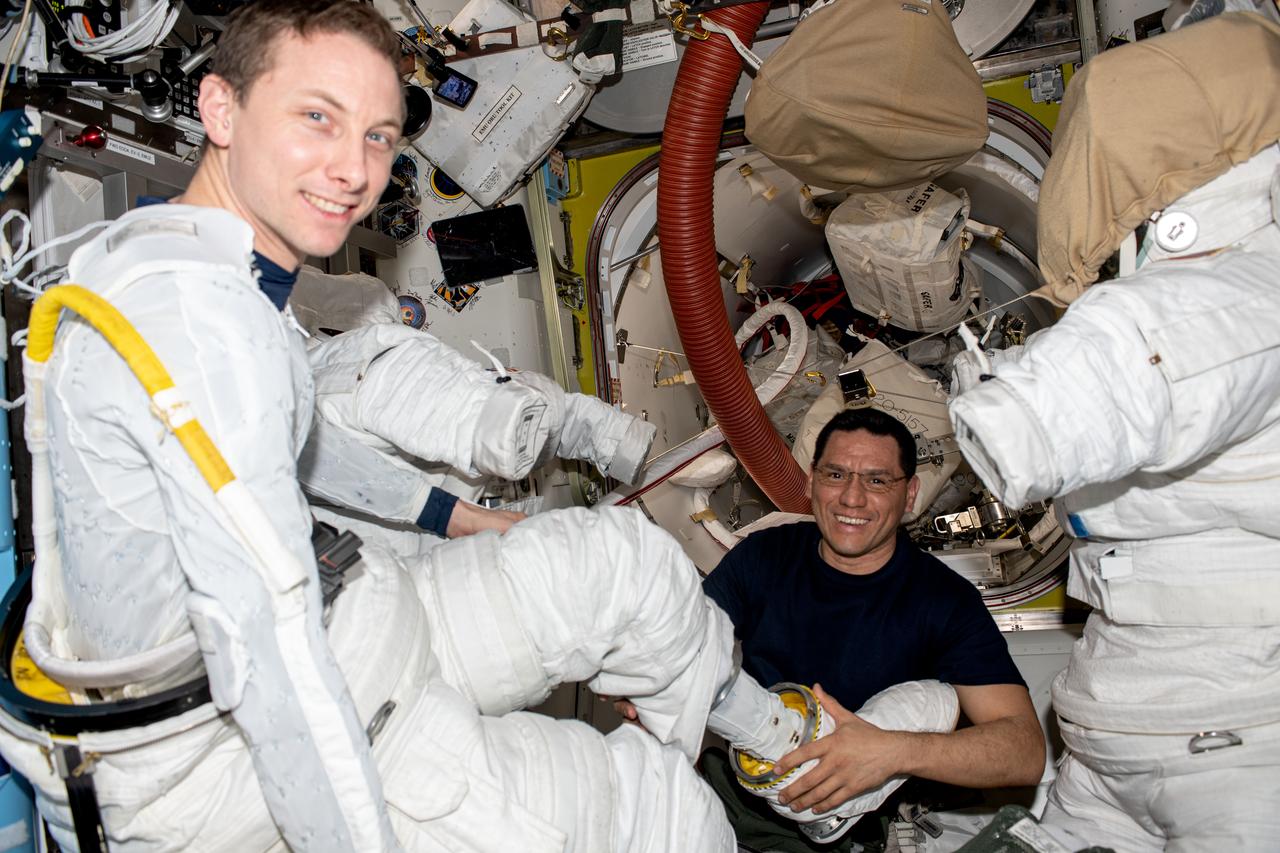
iss069e017116 (June 2, 2023) --- NASA astronaut Frank Rubio (right) assists NASA astronaut Woody Hoburg during a fit check of his spacesuit inside the International Space Station's Quest airlock.
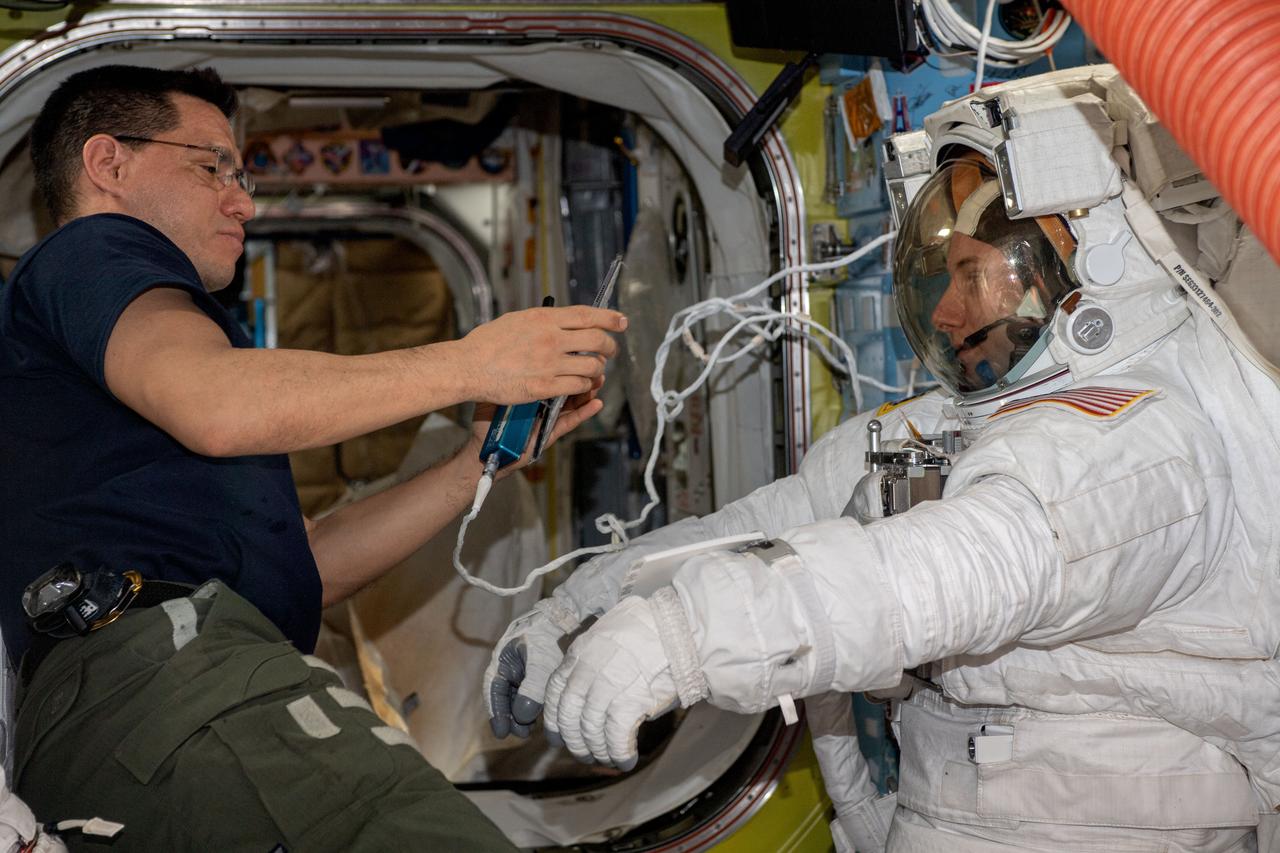
iss069e017149 (June 2, 2023) --- NASA astronaut Frank Rubio (left) assists NASA astronaut Woody Hoburg during a fit check of his spacesuit inside the International Space Station's Quest airlock.
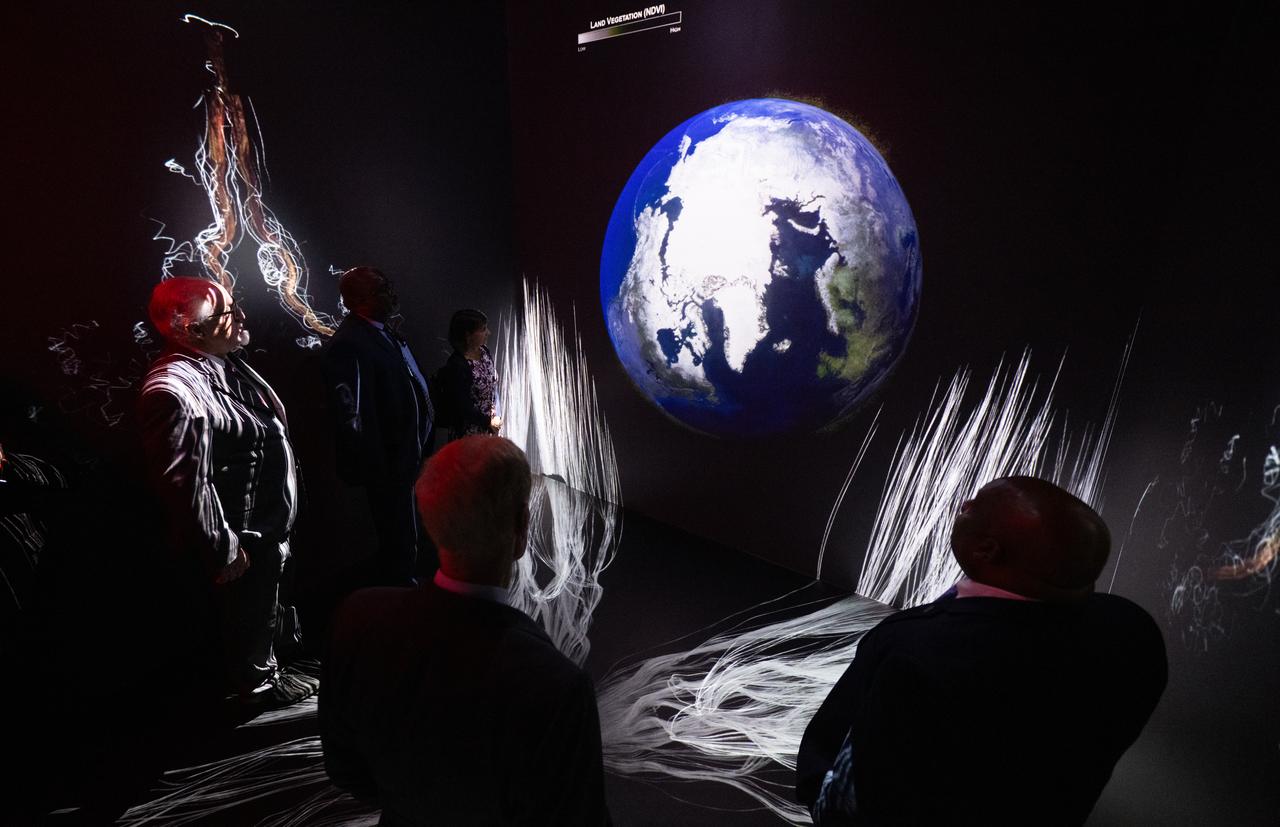
NASA Administrator Bill Nelson, Michael Morgan, Assistant Secretary of Commerce for Environmental Observation and Prediction at the National Oceanic and Atmospheric Administration (NOAA), Marlen Eve, Deputy Administrator for the Agricultural Research Service at the U.S. Department of Agriculture (USDA), and Eric Hooks, Deputy Administrator of the Federal Emergency Management Agency (FEMA), are seen as they watch “Space for Earth,” the immersive audio-visual installation in NASA’s Earth Information Center, following the ribbon cutting ceremony, Wednesday, June 21, 2023, at the Mary W. Jackson NASA Headquarters building in Washington. The Earth Information Center is new immersive experience that combines live data sets with cutting-edge data visualization and storytelling to allow visitors to see how our planet is changing. Photo Credit: (NASA/Joel Kowsky)
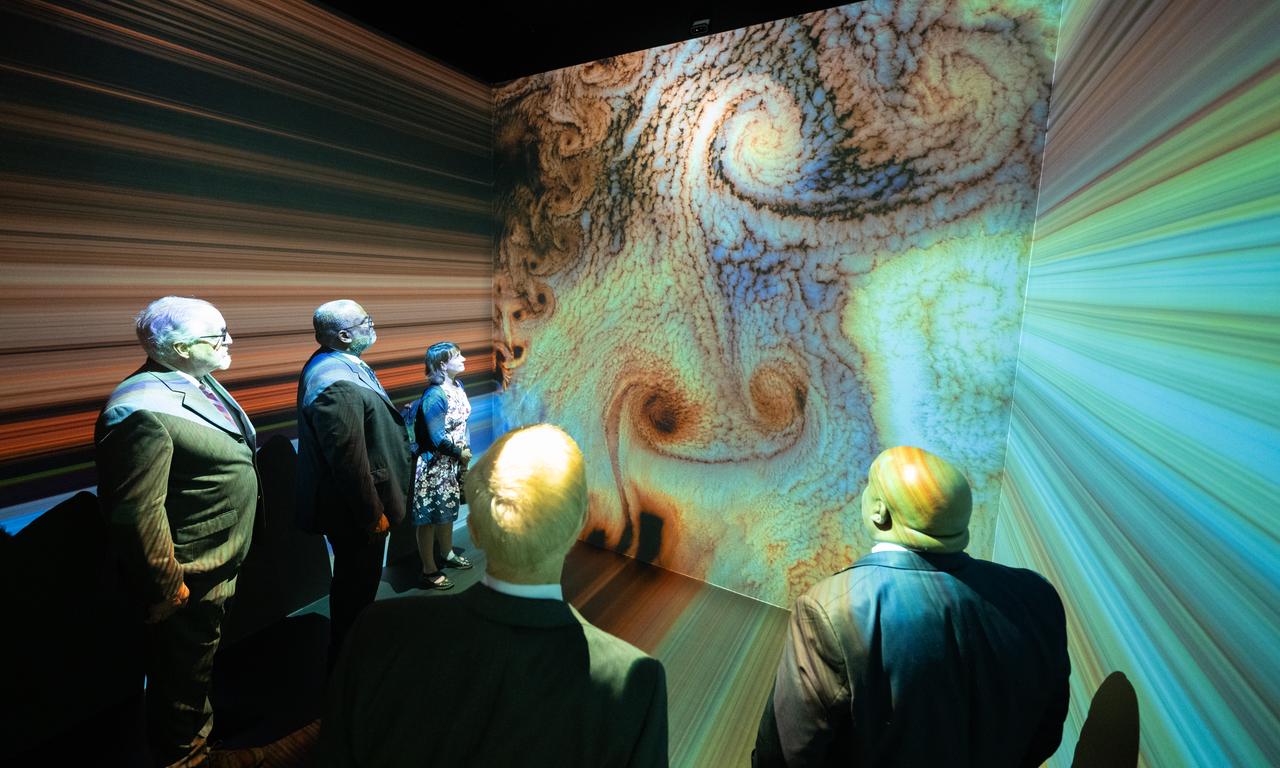
NASA Administrator Bill Nelson, Michael Morgan, Assistant Secretary of Commerce for Environmental Observation and Prediction at the National Oceanic and Atmospheric Administration (NOAA), Marlen Eve, Deputy Administrator for the Agricultural Research Service at the U.S. Department of Agriculture (USDA), and Eric Hooks, Deputy Administrator of the Federal Emergency Management Agency (FEMA), are seen as they watch “Space for Earth,” the immersive audio-visual installation in NASA’s Earth Information Center, following the ribbon cutting ceremony, Wednesday, June 21, 2023, at the Mary W. Jackson NASA Headquarters building in Washington. The Earth Information Center is new immersive experience that combines live data sets with cutting-edge data visualization and storytelling to allow visitors to see how our planet is changing. Photo Credit: (NASA/Joel Kowsky)
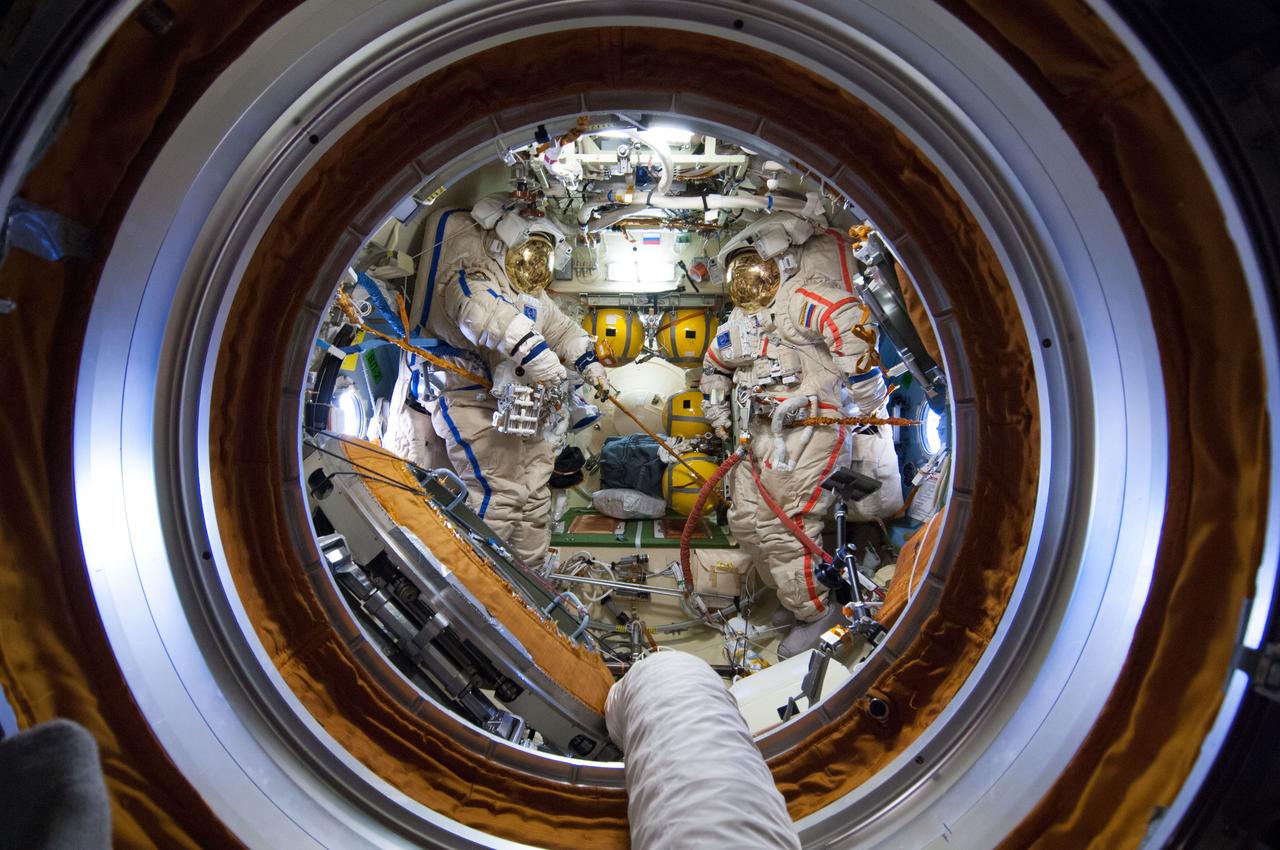
ISS040-E-095615 (17 Aug. 2014) --- Unoccupied Russian Orlan spacesuits for Russian cosmonauts Oleg Artemyev (blue stripes) and Alexander Skvortsov (red stripes), both Expedition 40 flight engineers, are pictured in the Pirs Docking Compartment of the International Space Station on the eve of the spacewalk scheduled for Aug. 18, 2014.
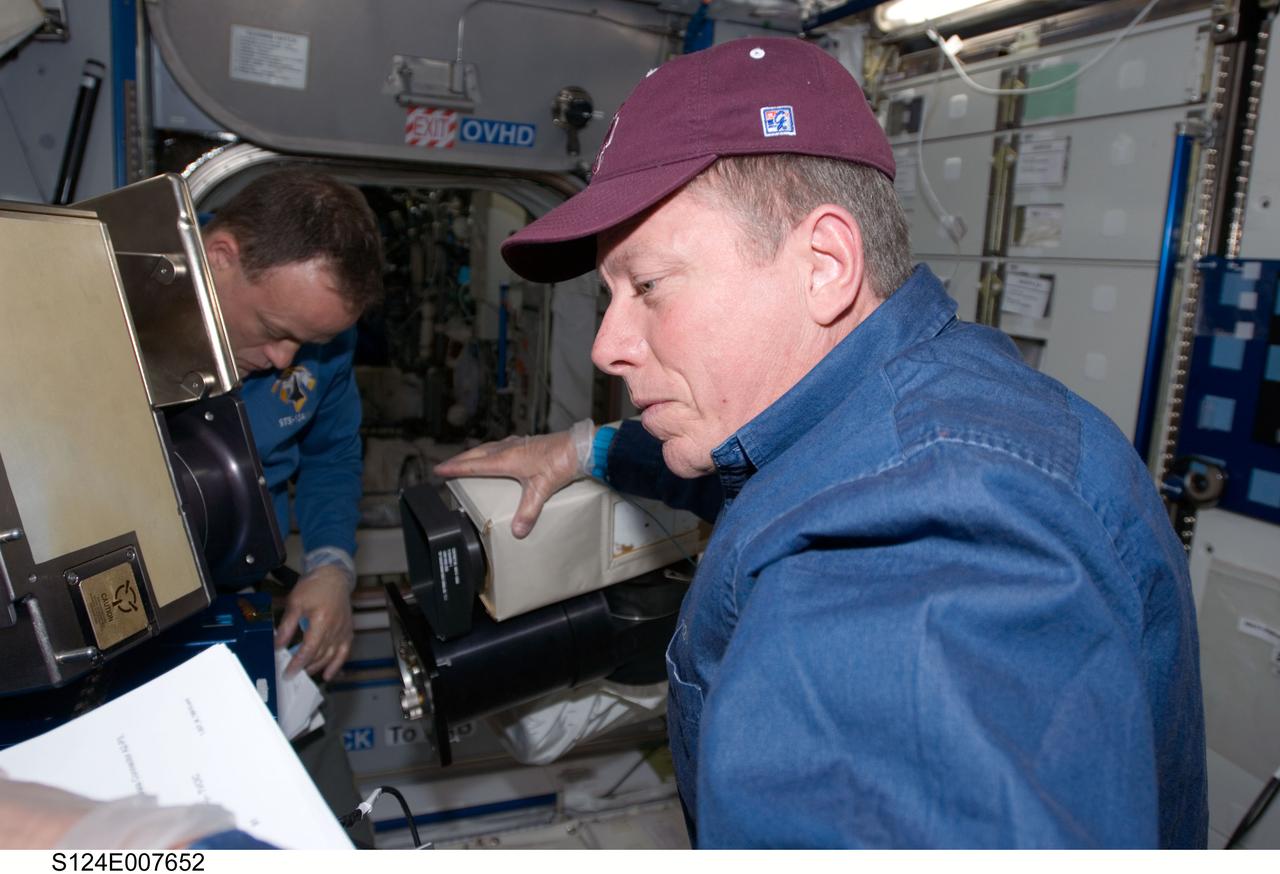
S124-E-007652 (7 June 2008) --- Astronauts Mike Fossum (foreground) and Ron Garan, both mission specialists, are busy in the Harmony node on the eve of STS-124's third and final session of extravehicular activity (EVA) to perform work on the International Space Station.
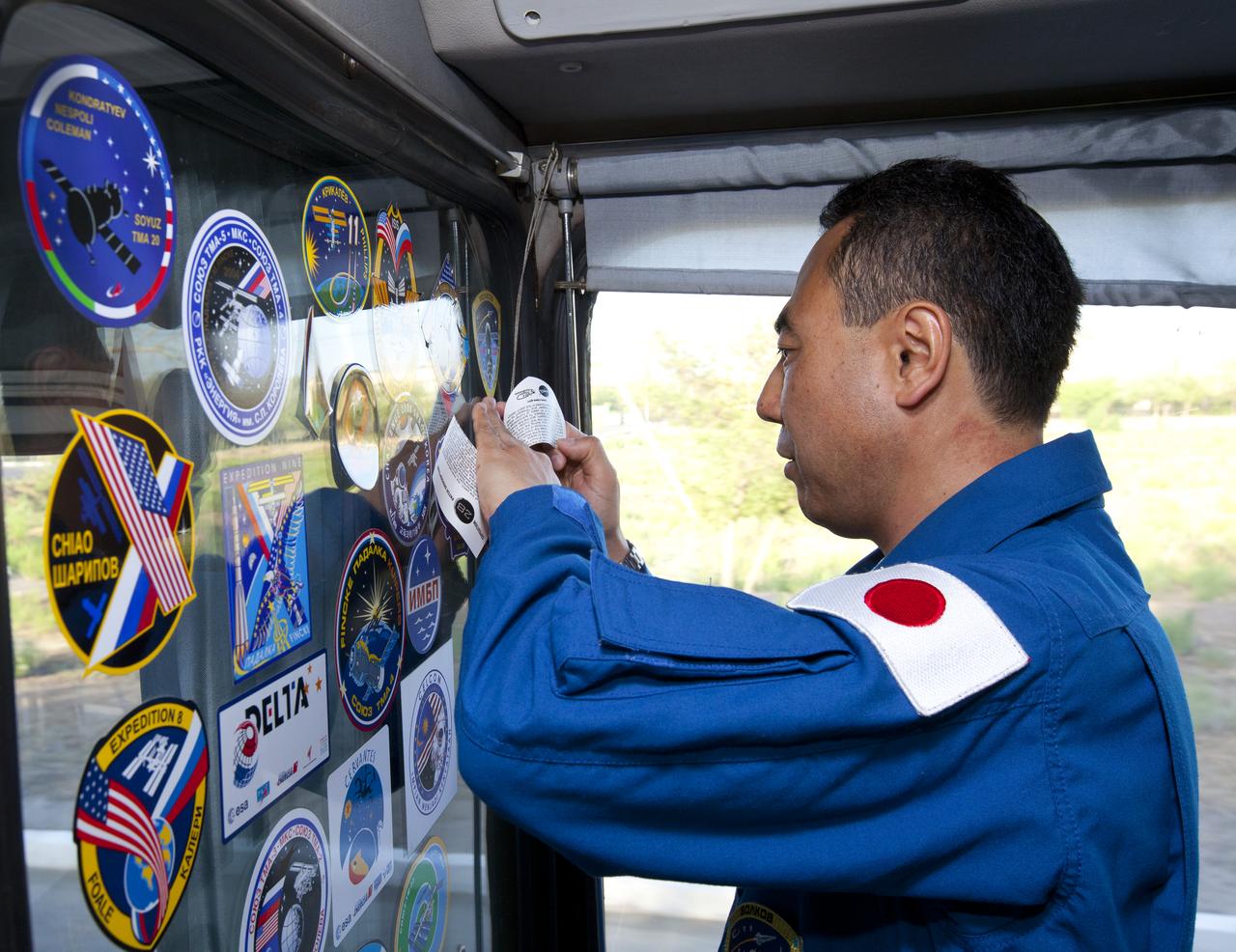
Expedition 28 JAXA (Japan Aerospace Exploration Agency) Flight Engineer Satoshi Furukawa places a mission sticker on the inside wall of the prime crew bus on the eve of his launch to the International Space Station, Tuesday, June 7, 2011 at the Baikonur Cosmodrome in Kazakhstan. Photo Credit: (NASA/Roscosmos/Andrey Shelepin)
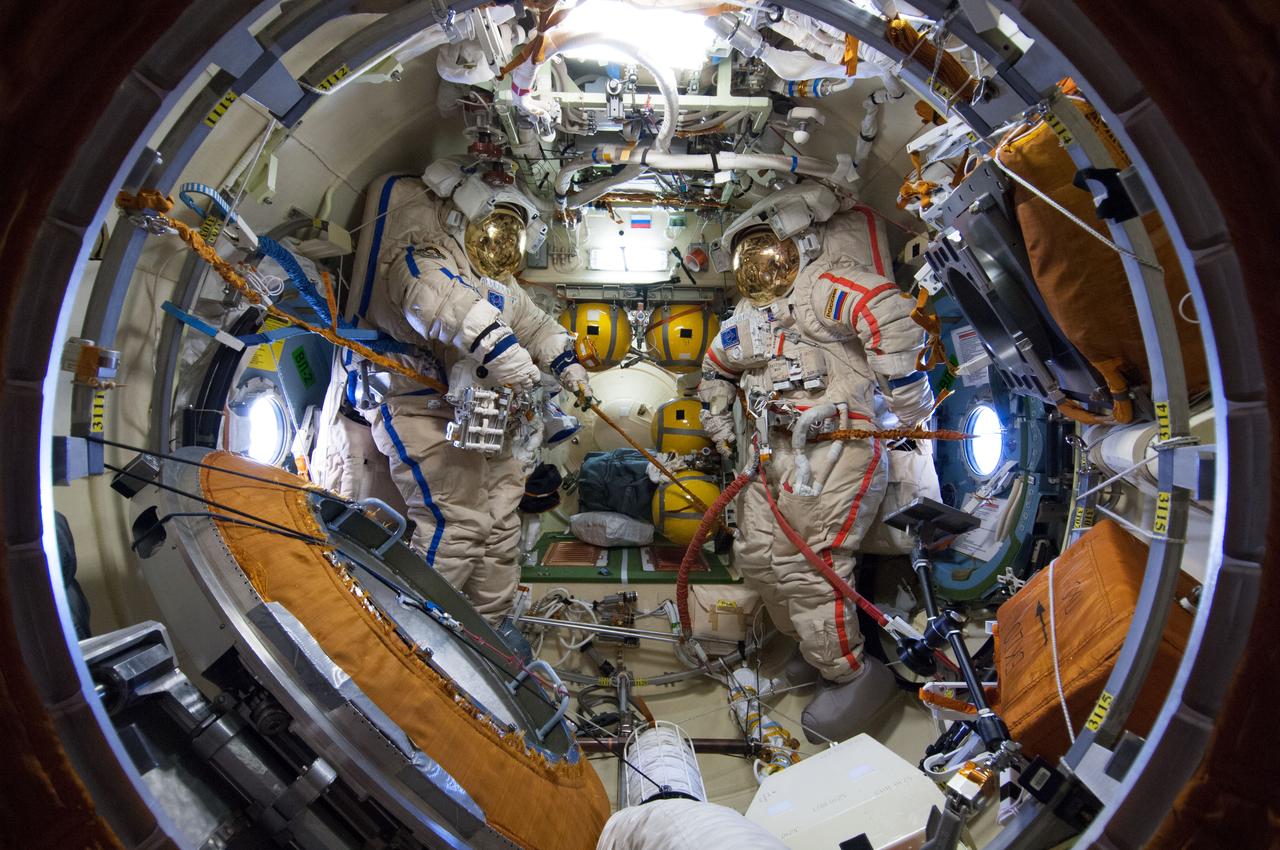
ISS040-E-095617 (17 Aug. 2014) --- Unoccupied Russian Orlan spacesuits for Russian cosmonauts Oleg Artemyev (blue stripes) and Alexander Skvortsov (red stripes), both Expedition 40 flight engineers, are pictured in the Pirs Docking Compartment of the International Space Station on the eve of the spacewalk scheduled for Aug. 18, 2014.
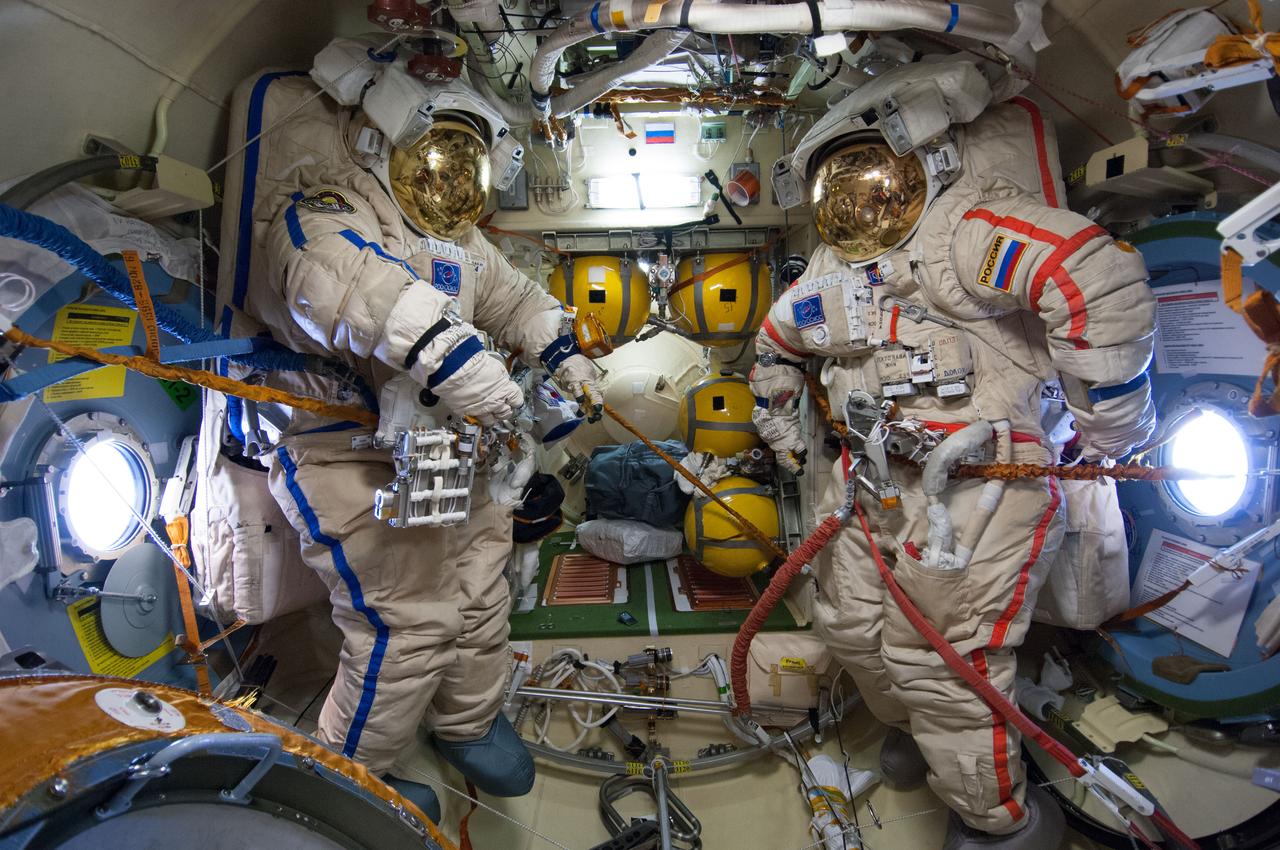
ISS040-E-095619 (17 Aug. 2014) --- Unoccupied Russian Orlan spacesuits for Russian cosmonauts Oleg Artemyev (blue stripes) and Alexander Skvortsov (red stripes), both Expedition 40 flight engineers, are pictured in the Pirs Docking Compartment of the International Space Station on the eve of the spacewalk scheduled for Aug. 18, 2014.
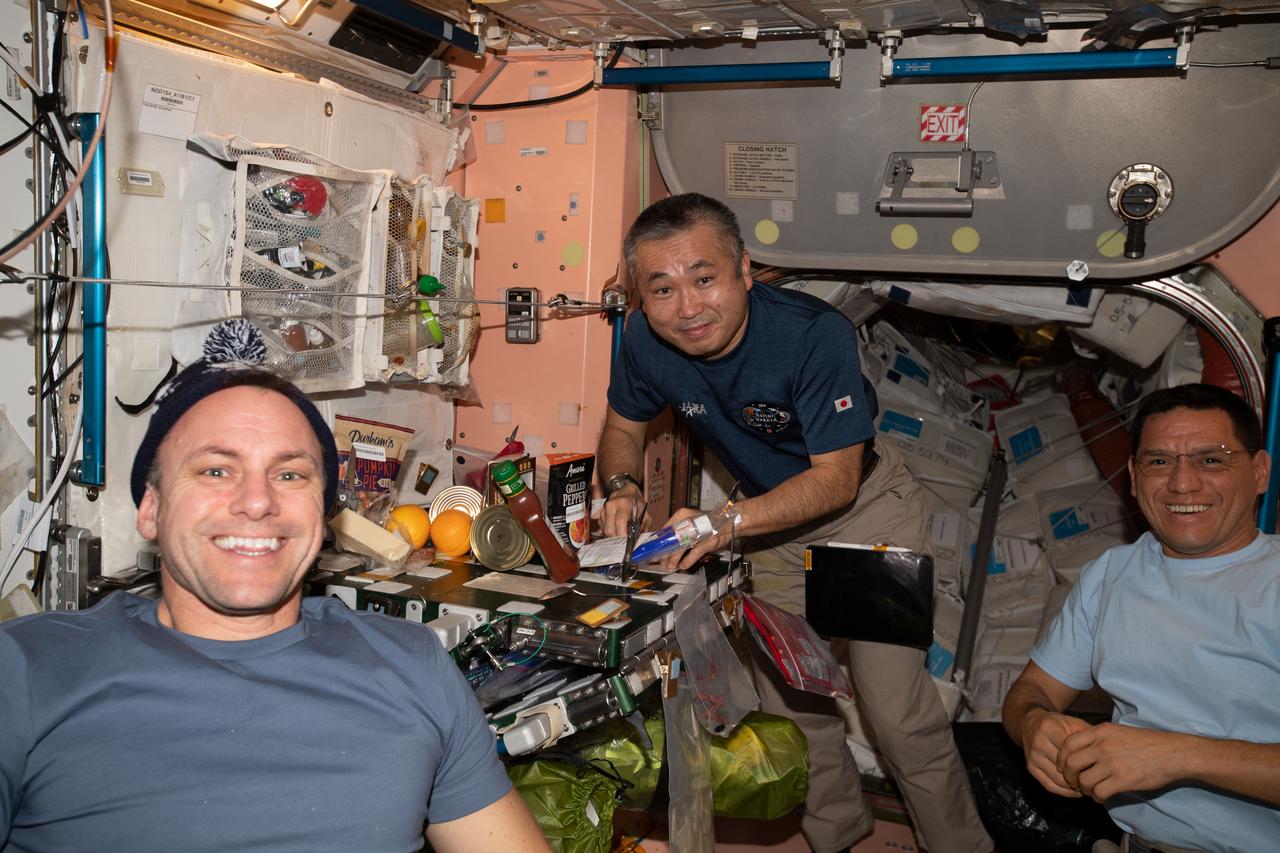
iss068e032600 (Dec. 24, 2022) --- Expedition 68 Flight Engineers (from left) Josh Cassada of NASA, Koichi Wakata of the Japan Aerospace Exploration Agency (JAXA), and Frank Rubio of NASA, pose for a photograph while sharing a meal on Christmas Eve inside the International Space Station's Unity module.
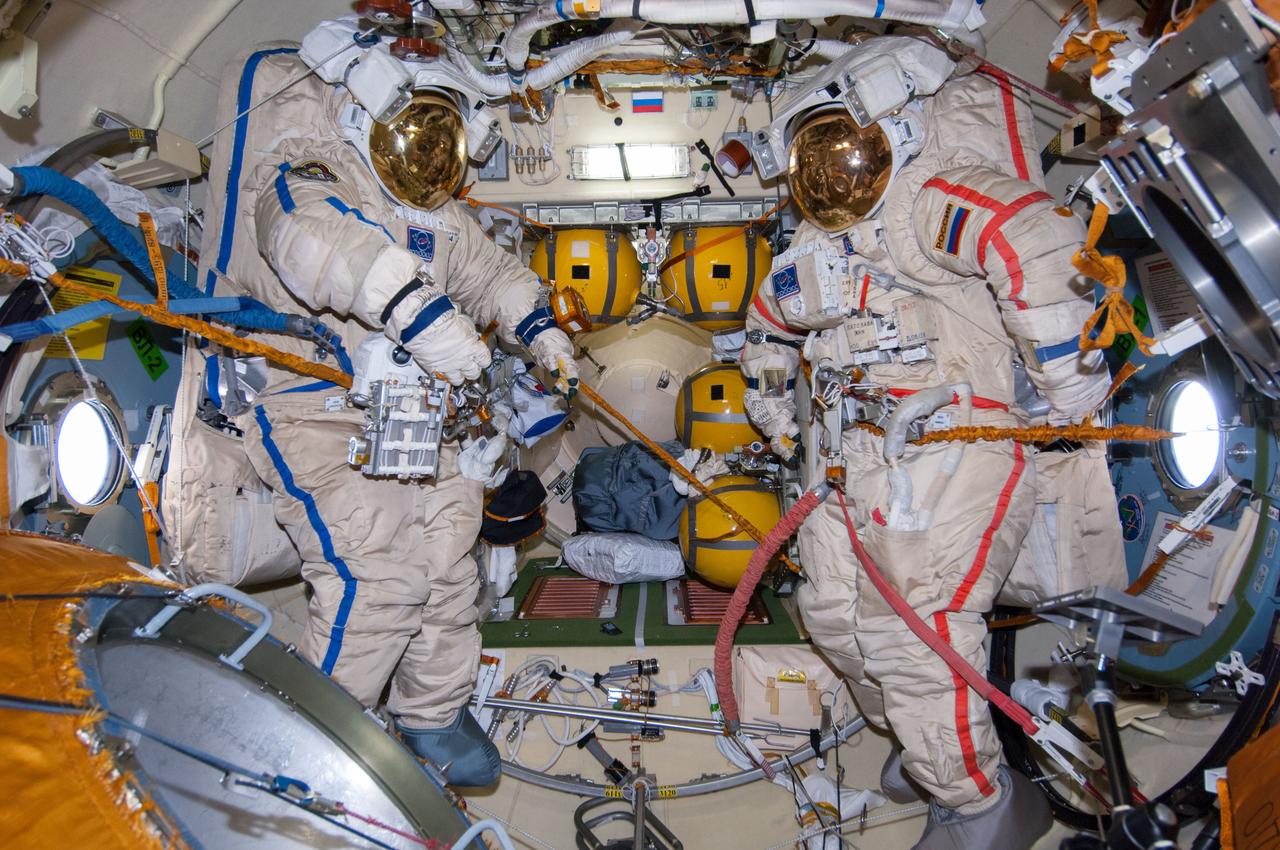
ISS040-E-095609 (17 Aug. 2014) --- Unoccupied Russian Orlan spacesuits for Russian cosmonauts Oleg Artemyev (blue stripes) and Alexander Skvortsov (red stripes), both Expedition 40 flight engineers, are pictured in the Pirs Docking Compartment of the International Space Station on the eve of the spacewalk scheduled for Aug. 18, 2014.
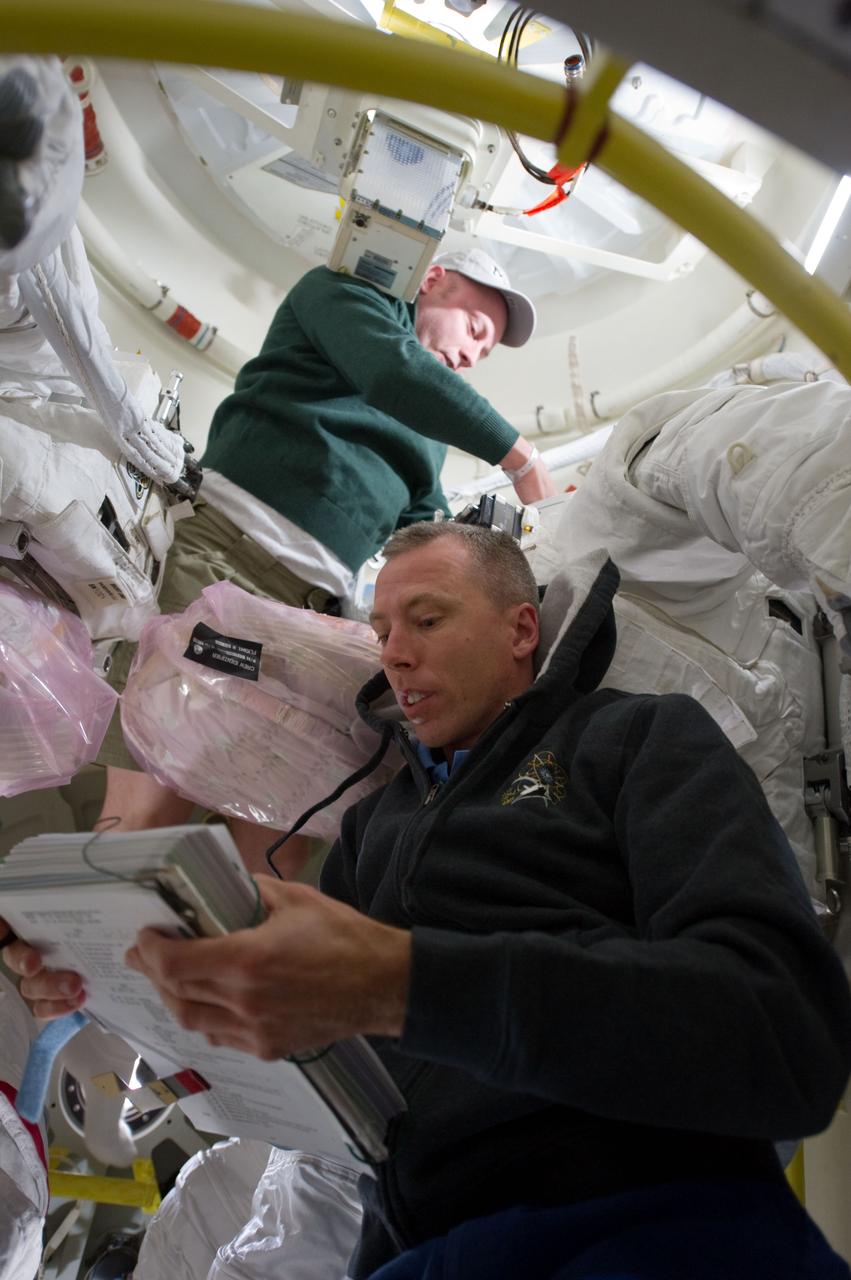
S134-E-006520 (17 May 2011) --- Astronauts Andrew Feustel (foreground) and Michael Fincke, both STS-134 mission specialists, work to keep order with the large inventory of supplies and equipment on Endeavour's middeck and airlock on the eve of docking day with the International Space Station. Photo credit: NASA.

S129-E-009497 (24 Nov. 2009) --- Astronaut Nicole Stott, STS-129 mission specialist, takes one of her final “strolls” through the modules and hatchways of the International Space Station on the eve of her departure from the orbital outpost.
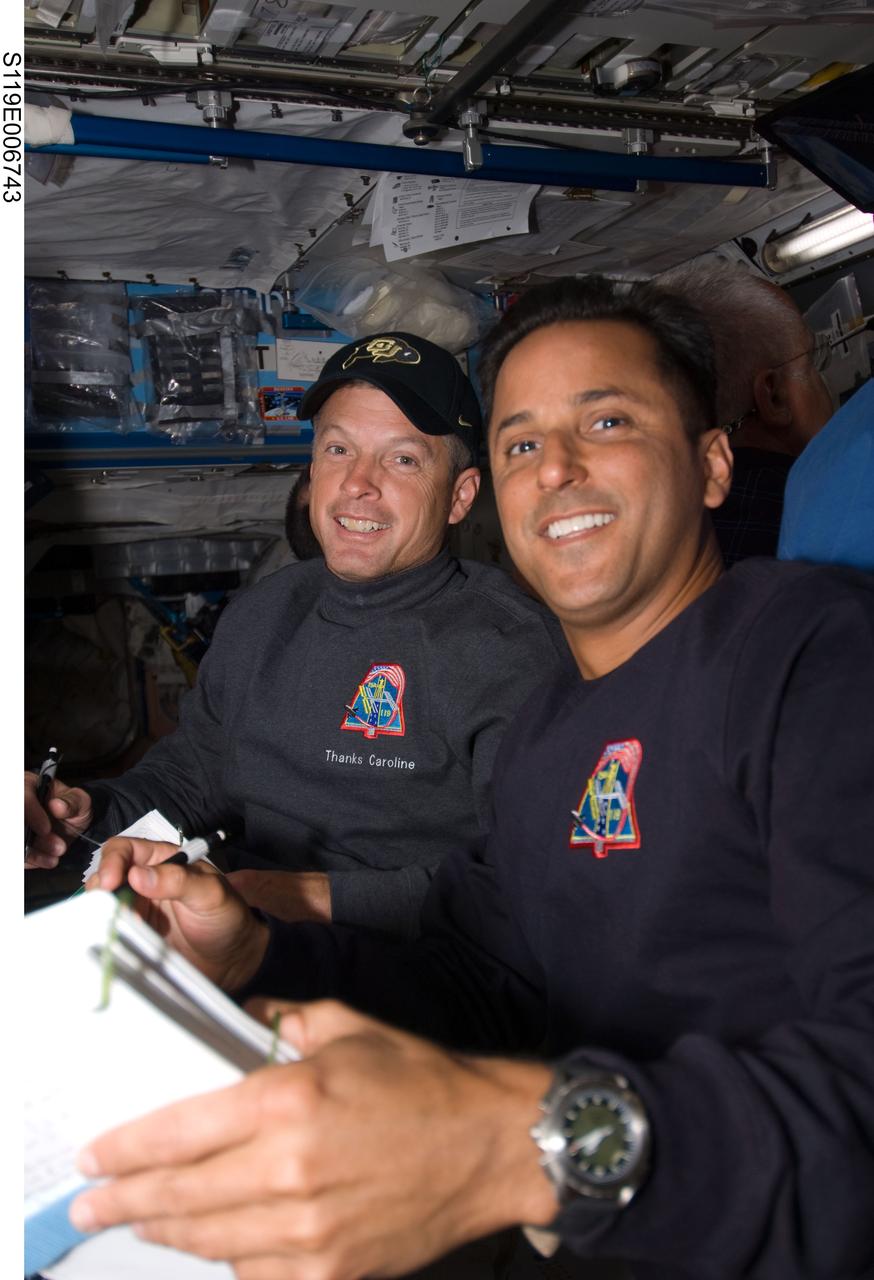
S119-E-006743 (20 March 2009) --- On the eve of a planned shared spacewalk, astronauts Steve Swanson (left) and Joseph Acaba, both STS-119 mission specialists, have a meeting in the Joint Airlock aboard the International Space Station, while linked to the Space Shuttle Discovery.
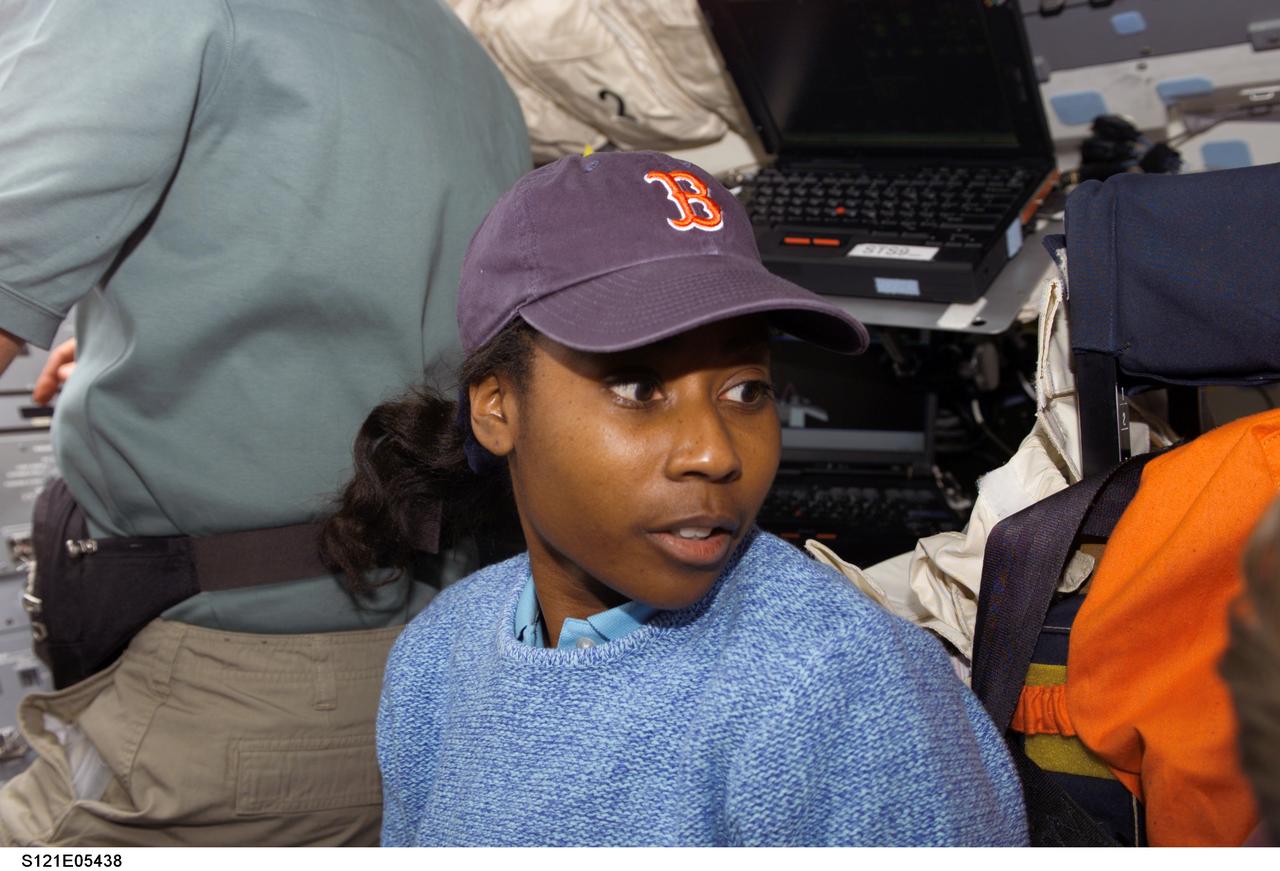
S121-E-05438 (5 July 2006) --- Astronaut Stephanie D. Wilson, STS-121 mission specialist, on Discovery's flight deck during flight day two activities, on the eve of one of the mission's busiest days -- docking day with the International Space Station.
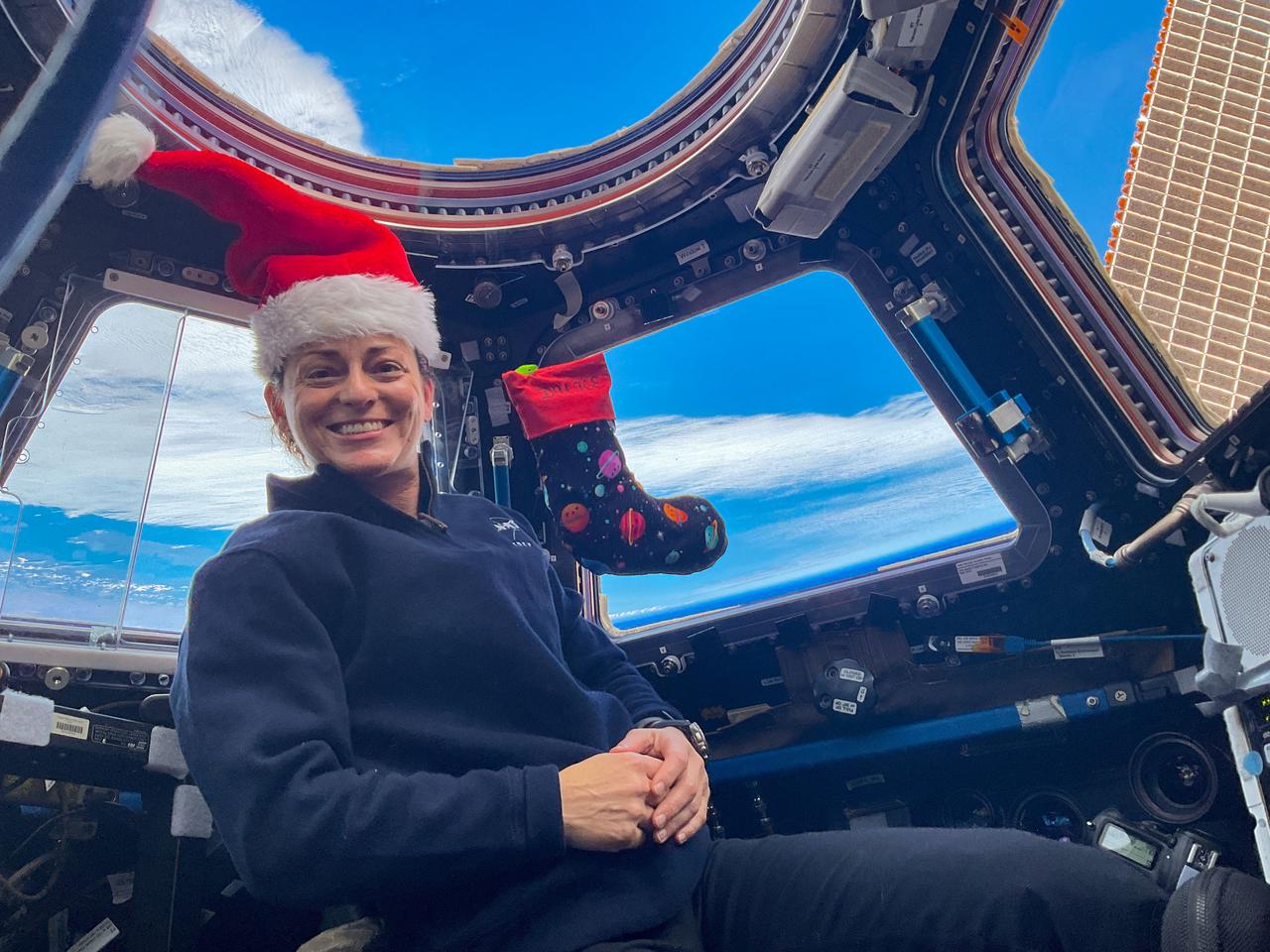
iss068e032470 (Dec. 24, 2022) --- Expedition 68 Flight Engineer Nicole Mann of NASA poses for a festive portrait on Christmas Eve inside the cupola as the International Space Station orbited 268 miles above the Pacific Ocean off the coast of southern Chile.
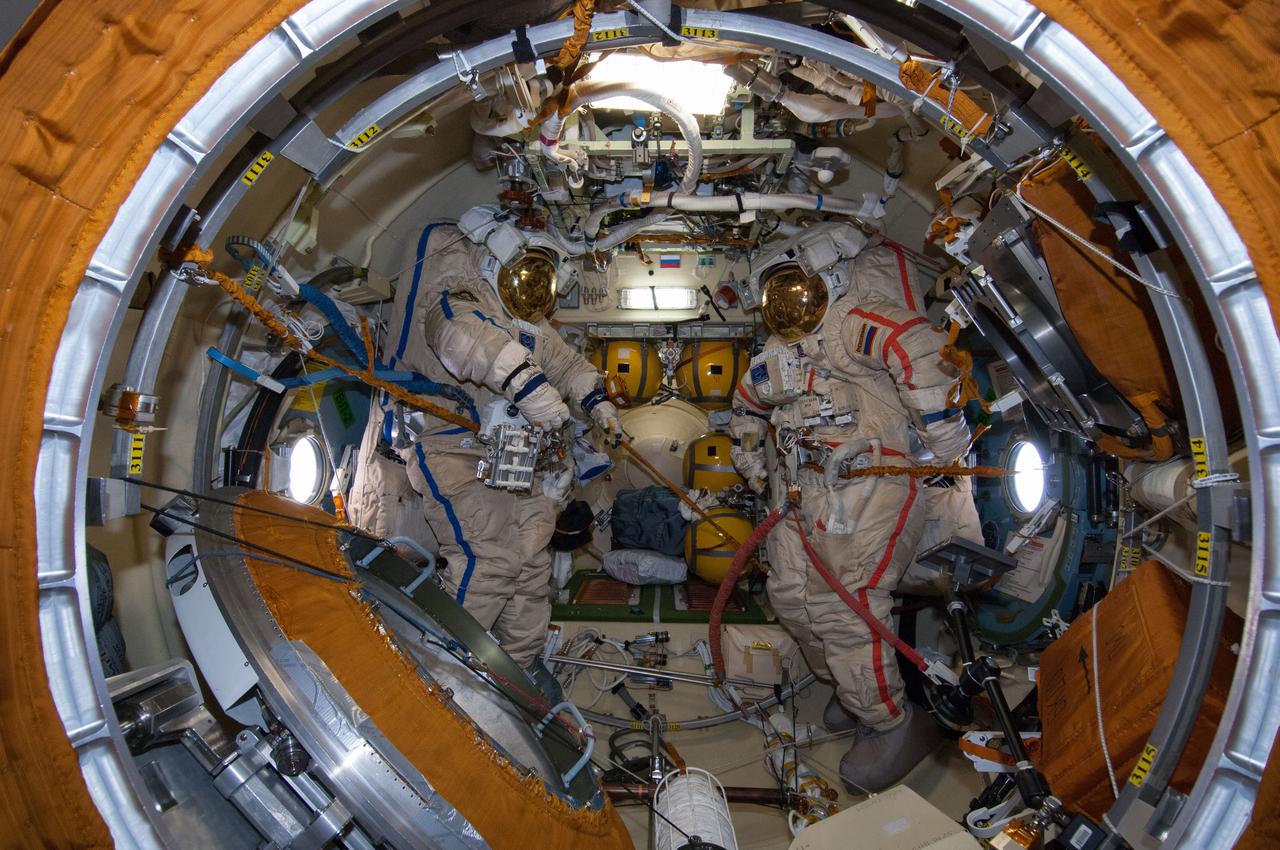
ISS040-E-095612 (17 Aug. 2014) --- Unoccupied Russian Orlan spacesuits for Russian cosmonauts Oleg Artemyev (blue stripes) and Alexander Skvortsov (red stripes), both Expedition 40 flight engineers, are pictured in the Pirs Docking Compartment of the International Space Station on the eve of the spacewalk scheduled for Aug. 18, 2014.
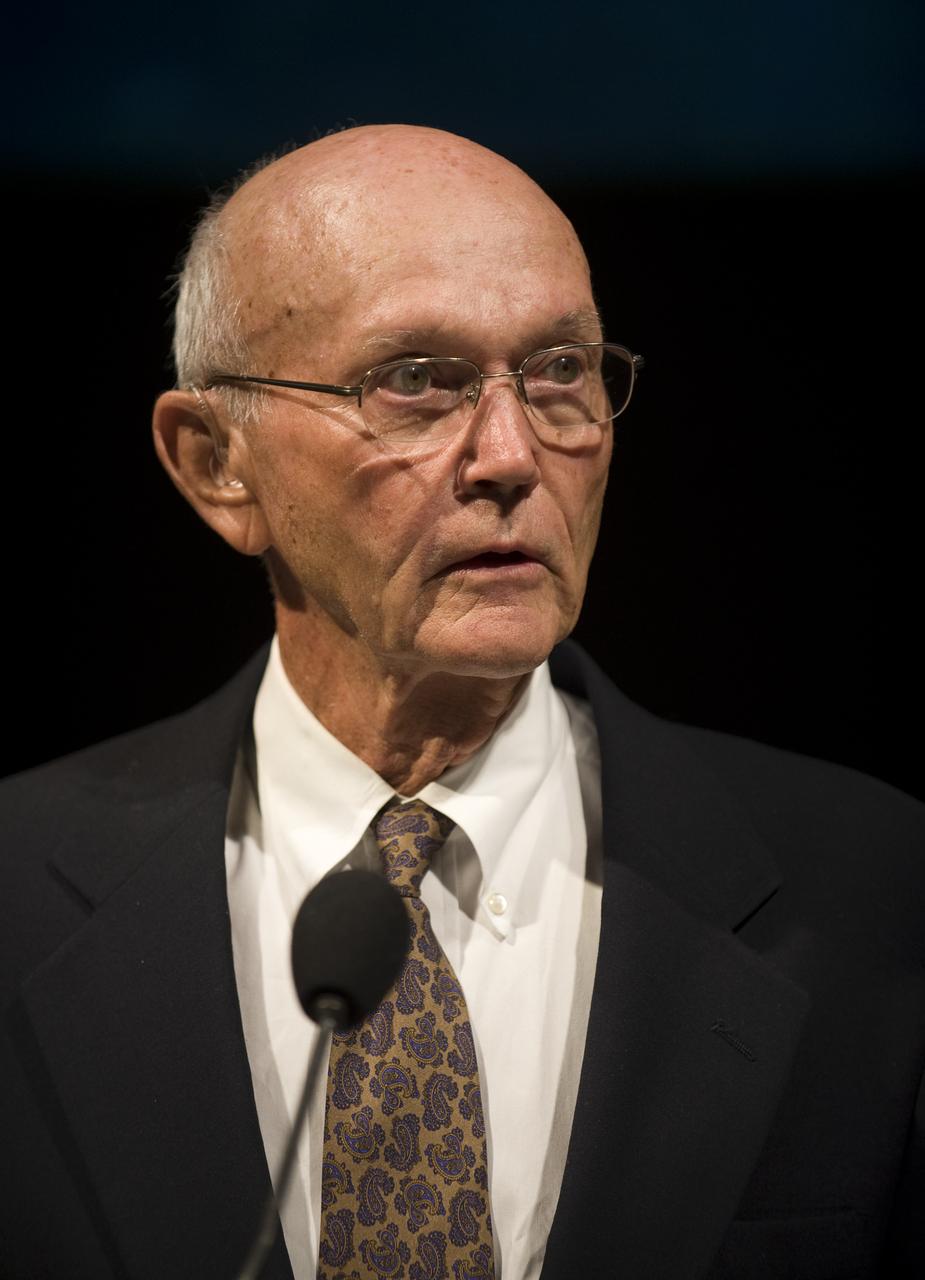
On the eve of the fortieth anniversary of Apollo 11's first human landing on the Moon, Apollo 11 crew member, Michael Collins speaks during a lecture in honor of Apollo 11 at the National Air and Space Museum in Washington, Sunday, July 19, 2009. Guest speakers included Former NASA Astronaut and U.S. Senator John Glenn, NASA Mission Control creator and former NASA Johnson Space Center director Chris Kraft and the crew of Apollo 11. Photo Credit: (NASA/Bill Ingalls)
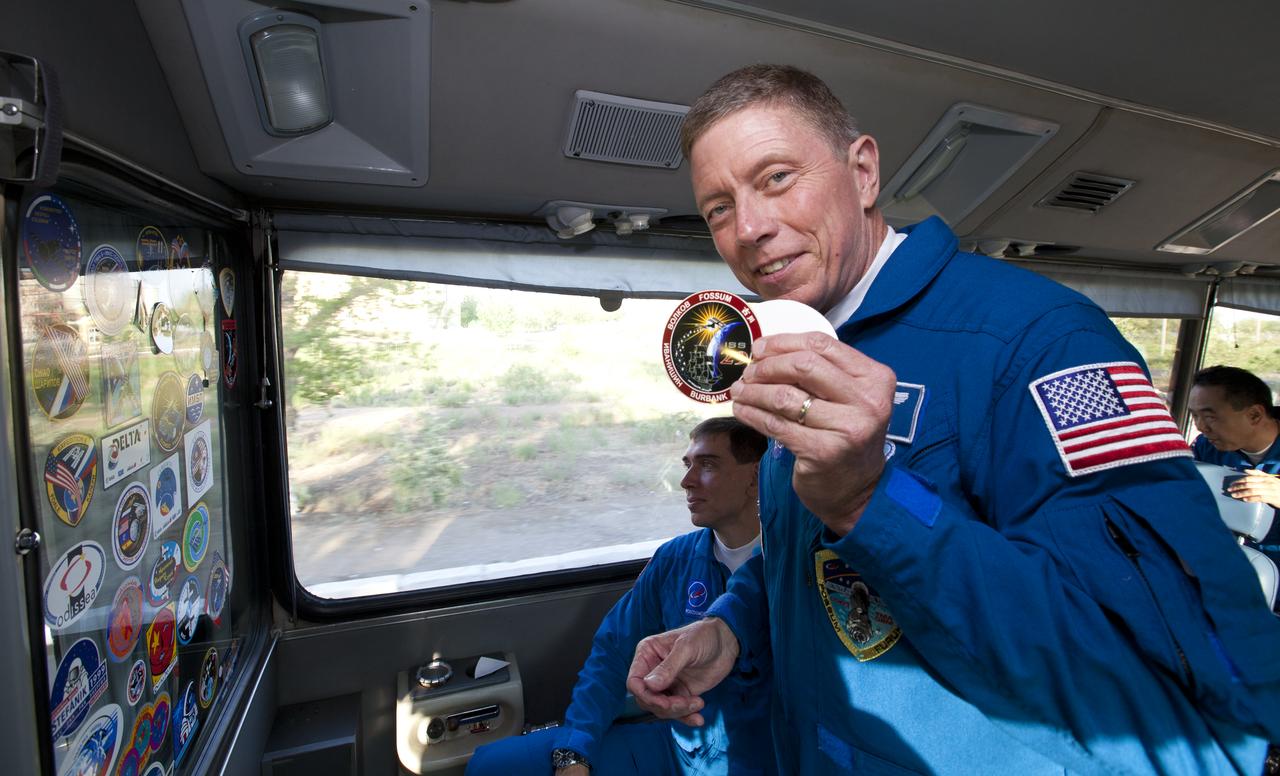
Expedition 28 NASA Flight Engineer displays the Expedition 29 crew sticker while riding on the prime crew bus to Building 254 the eve of his launch to the International Space Station, Tuesday, June June 7, 2011 at the Baikonur Cosmodrome in Kazakhstan. Fossum will be the ISS Commander for Expedition 29. Photo Credit: (NASA/Roscosmos/Andrey Shelepin)
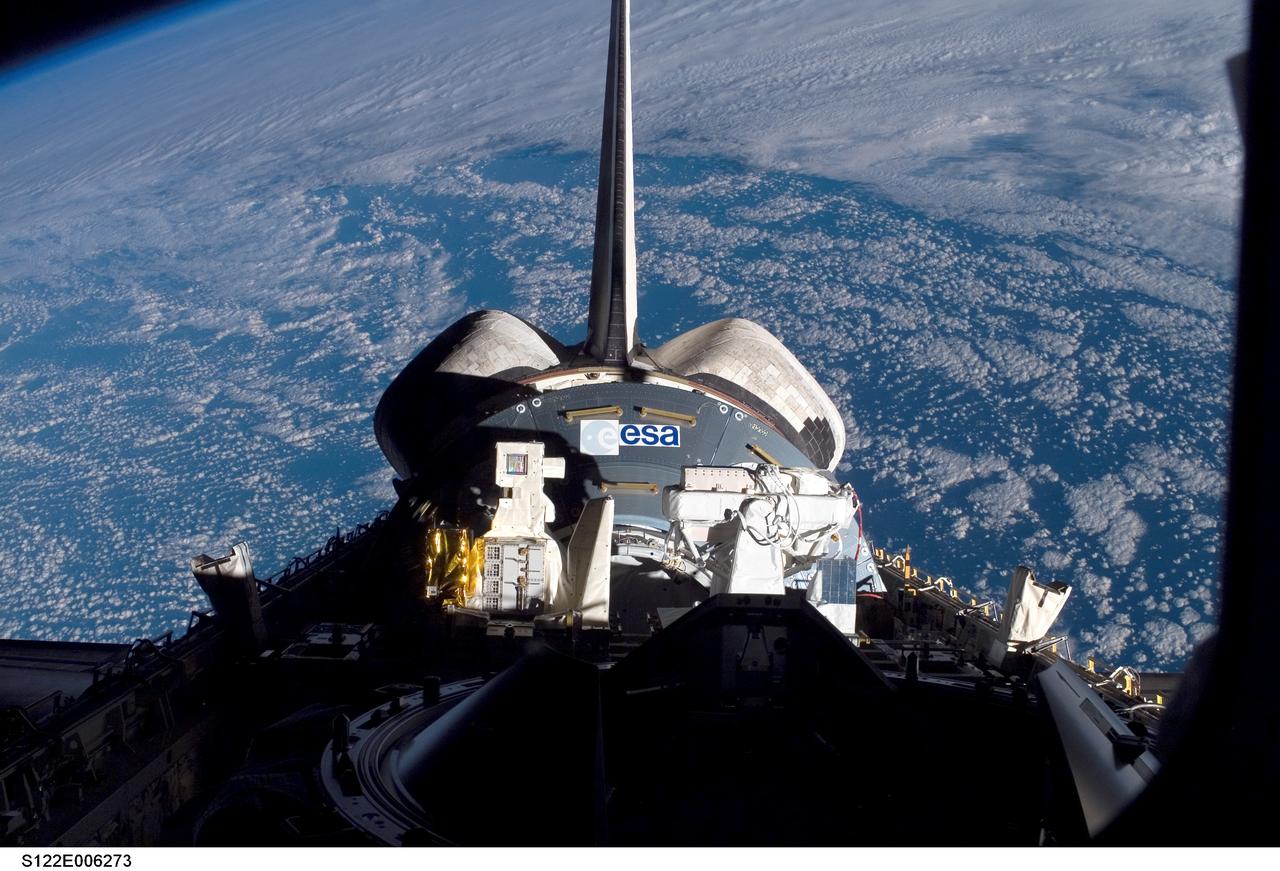
S122-E-006273 (8 Feb. 2008) --- Backdropped against a cloud-covered portion of Earth, the European Space Agency's Columbus laboratory and associated ESA hardware sit in the aft section of Space Shuttle Atlantis' cargo bay on the eve of the shuttle's scheduled docking to the International Space Station. The addition of Columbus to the orbital outpost is one of the primary tasks of the STS-122 mission.
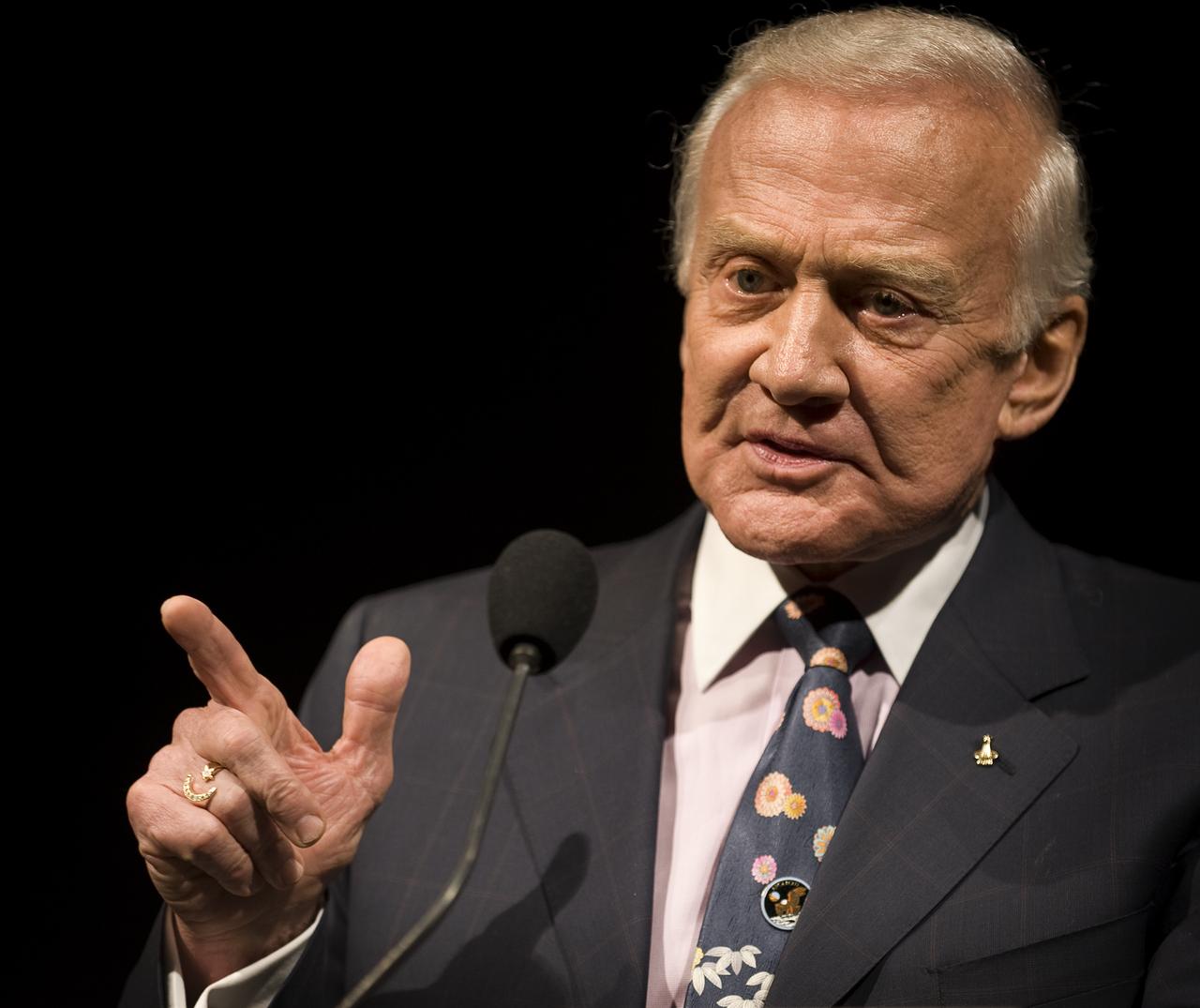
On the eve of the fortieth anniversary of Apollo 11's first human landing on the Moon, Apollo 11 crew member, Buzz Aldrin speaks during a lecture in honor of Apollo 11 at the National Air and Space Museum in Washington, Sunday, July 19, 2009. Guest speakers included Former NASA Astronaut and U.S. Senator John Glenn, NASA Mission Control creator and former NASA Johnson Space Center director Chris Kraft and the crew of Apollo 11. Photo Credit: (NASA/Bill Ingalls)
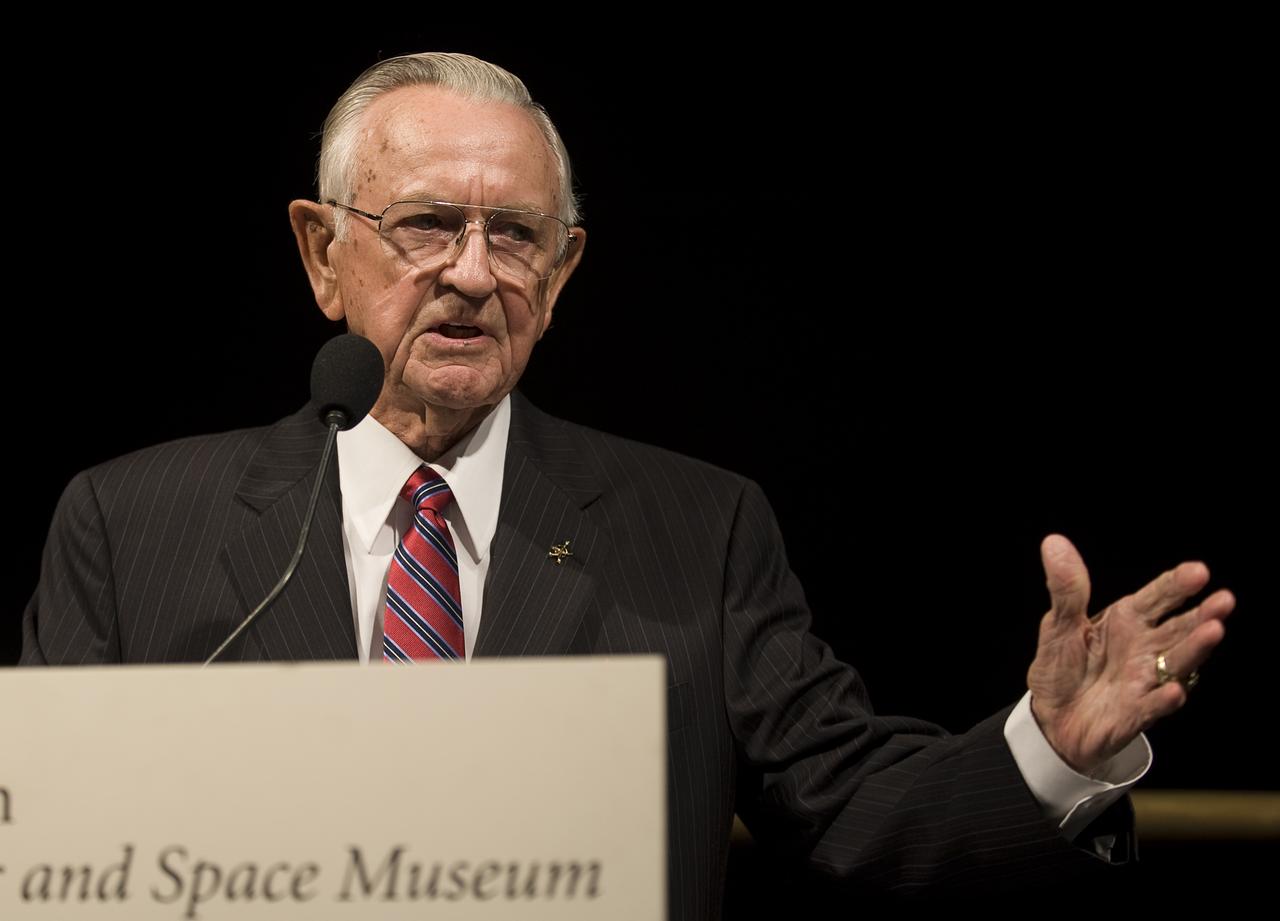
On the eve of the fortieth anniversary of Apollo 11's first human landing on the Moon, NASA Mission Control creator and former NASA Johnson Space Center director Chris Kraft speaks during a lecture in honor of Apollo 11 at the National Air and Space Museum in Washington, Sunday, July 19, 2009. Guest speakers included Former NASA Astronaut and U.S. Senator John Glenn, Apollo 11 crew members, Buzz Aldrin, Neil Armstrong, and Michael Collins. Photo Credit: (NASA/Bill Ingalls)
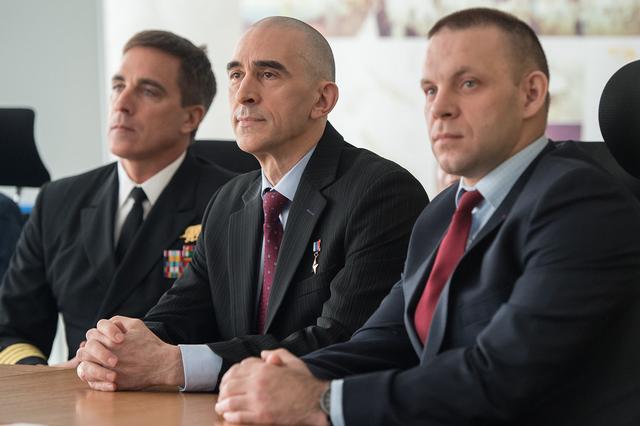
jsc2020e016783 - At the Gagarin Cosmonaut Training Center in Star City, Russia, Expedition 63 crewmembers Chris Cassidy of NASA (left) and Anatoly Ivanishin (center) and Ivan Vagner of Roscosmos (right) listen as the Russian State Commission approves them for launch March 23 on the eve of their departure for their launch site at the Baikonur Cosmodrome in Kazakhstan. Cassidy, Ivanishin and Vagner will launch April 9 on the Soyuz MS-16 spacecraft from Baikonur for a six-and-a-half month mission on the International Space Station...Andrey Shelepin/Gagarin Cosmonaut Training Center.
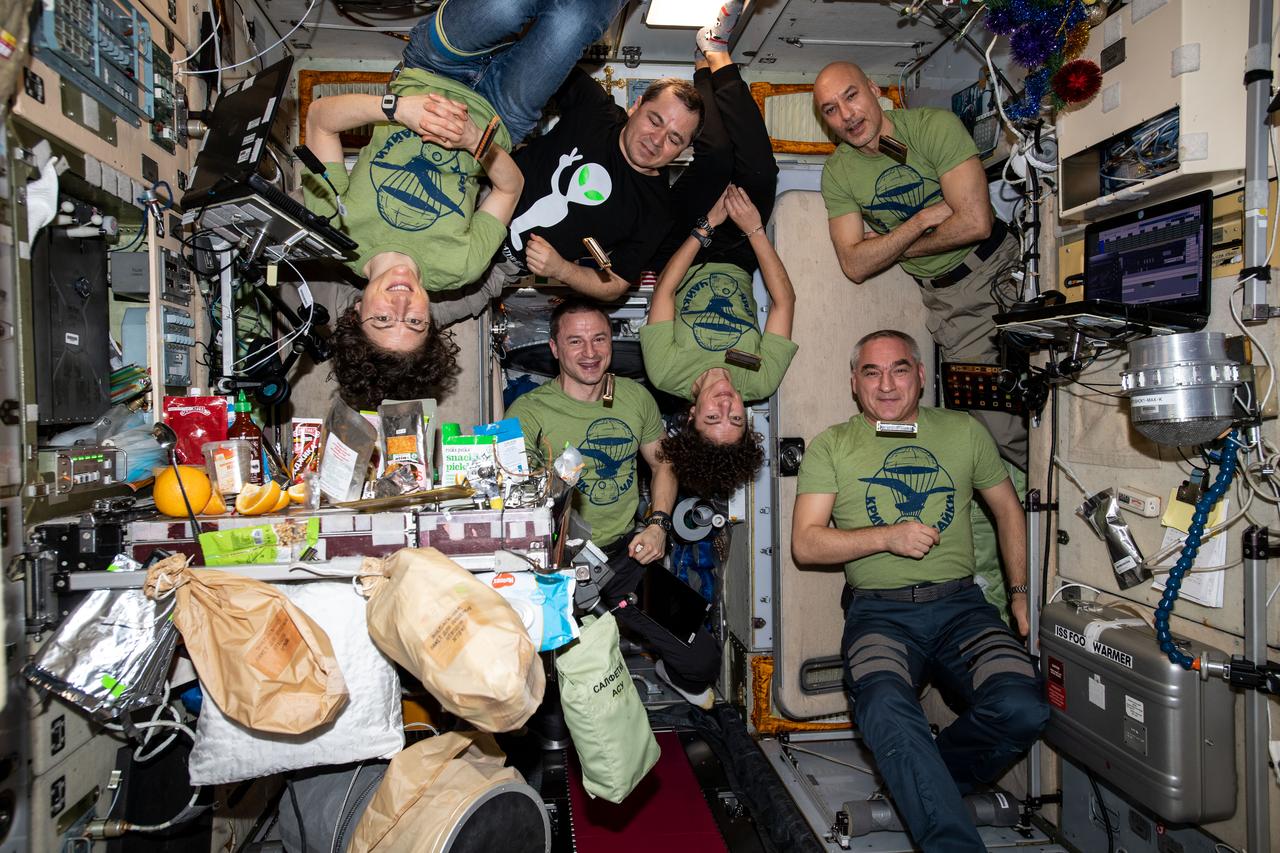
iss061e112462 (Dec. 31, 2019) --- The six-member Expedition 61 crew is gathered together inside the Zvezda service module for a New Year's Eve meal. Clockwise from top left are, Flight Engineers Christina Koch of NASA and Oleg Skripochka of Roscosmos; Commander Luca Parmitano of ESA (European Space Agency); Flight Engineers Alexander Skvortsov of Roscosmos and Jessica Meir and Andrew Morgan, both from NASA.
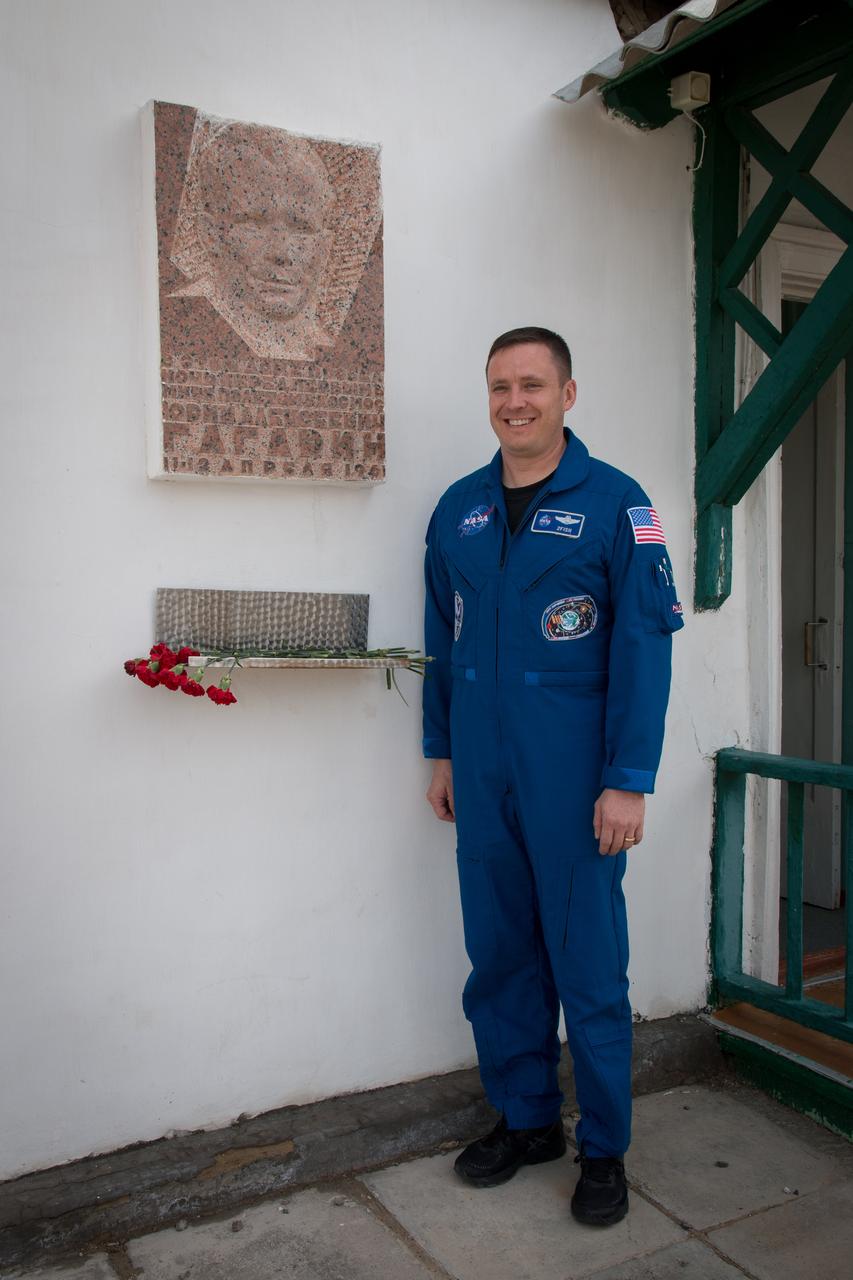
jsc2017e043855 (April 14, 2017) --- At the Baikonur Cosmodrome in Kazakhstan, Expedition 51 crewmember Jack Fischer of NASA poses for pictures April 14 in front of the cottage where Yuri Gagarin slept on the eve of his historic launch on April 12, 1961 to become the first human to fly in space. Fischer and Fyodor Yurchikhin of the Russian Federal Space Agency (Roscosmos) will launch April 20 on the Soyuz MS-04 spacecraft for a four and a half month mission on the International Space Station. Credit: NASA/Victor Zelentsov
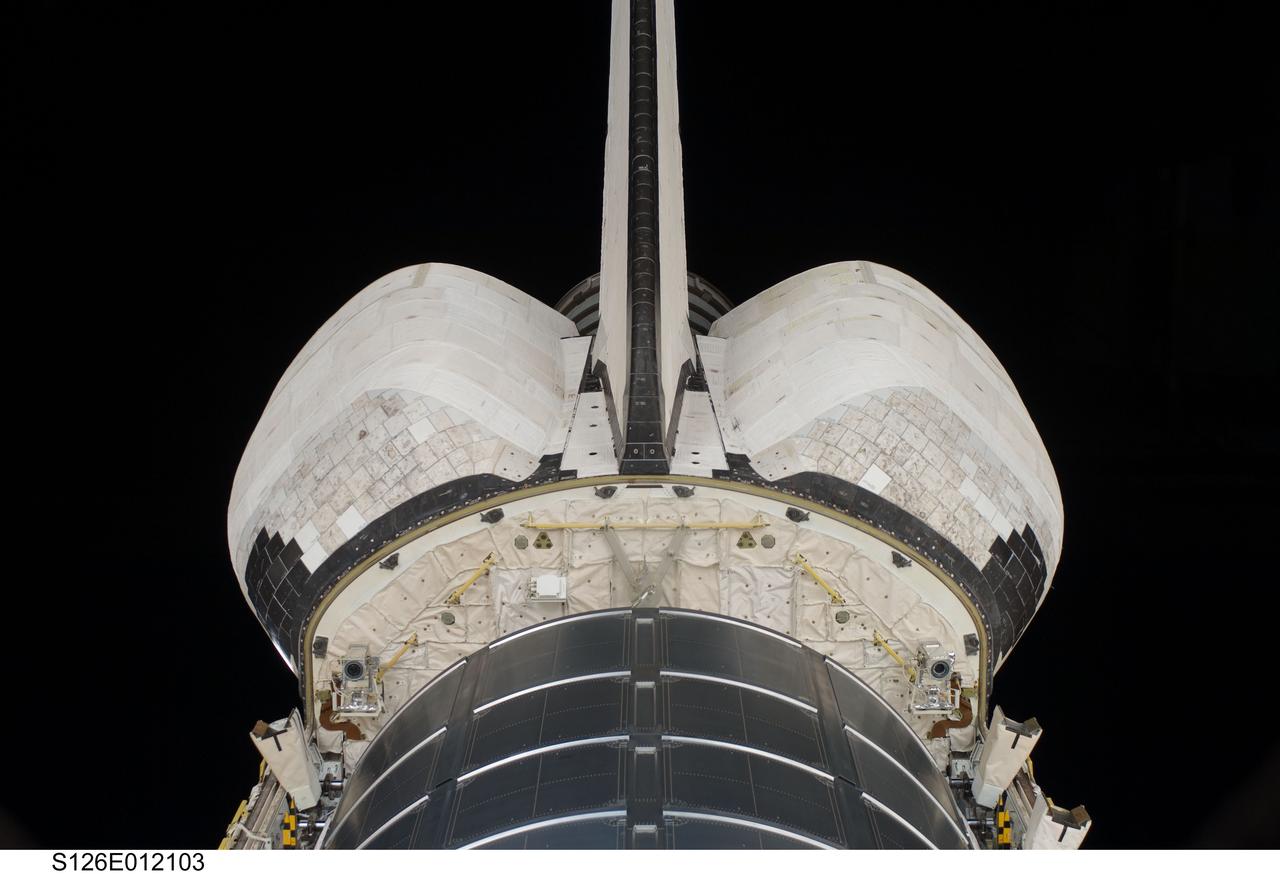
S126-E-012103 (27 Nov. 2008) --- --- Backdropped against the blackness of space, the aft portion of the Space Shuttle Endeavour, with the multi-purpose logistics module Leonardo in stow mode, was captured in a series of photographs by one of the STS-126 crewmembers on Nov. 27, Thanksgiving day, also the eve of departure from the International Space Station on Nov. 28.
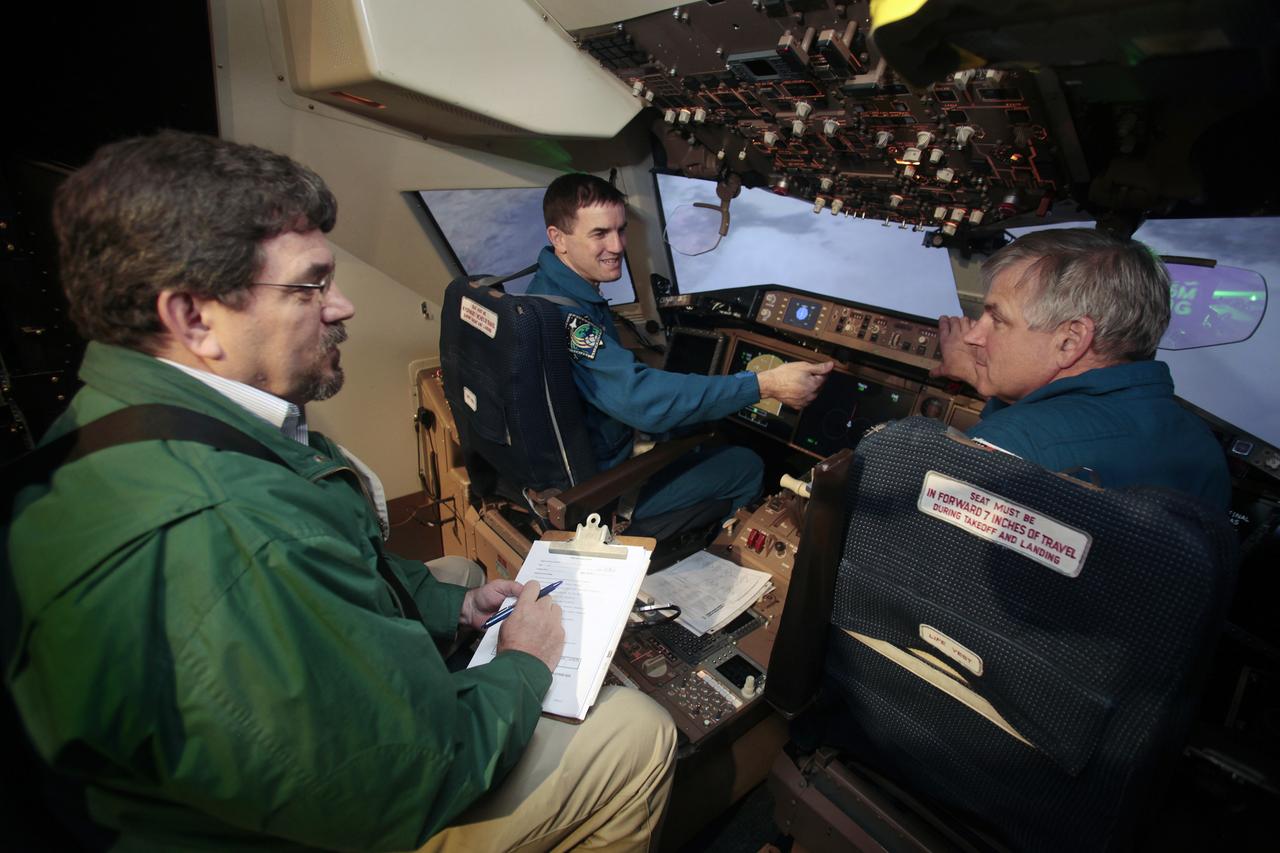
(left to right) NASA Langley aerospace engineer Bruce Jackson briefs astronauts Rex Walheim and Gregory Johnson about the Synthetic Vision (SV) and Enhanced Vision (EV) systems in a flight simulator at the center's Cockpit Motion Facility. The astronauts were training to land the Dream Chaser spacecraft May 15th 2013. credit NASA/David C. Bowman

S129-E-009492 (24 Nov. 2009) --- NASA astronauts Randy Bresnik (left), STS-129 mission specialist, and Jeffrey Williams, holding a camcorder, talk "International Space Station" on the eve of going separate directions when the space shuttle Atlantis and the orbital outpost are scheduled to undock. Williams assumes command today of the station crew.
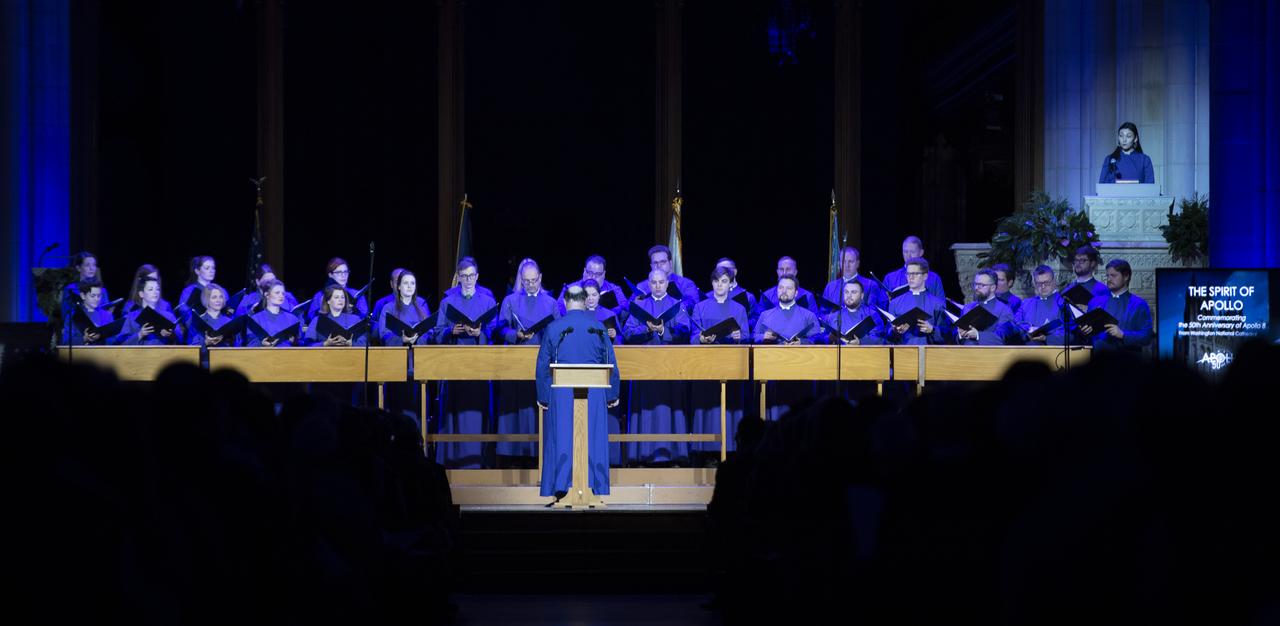
The Washington National Cathedral Choir performs a choral performance of Apollo 8's Christmas Eve broadcast during the Smithsonian National Air and Space Museum's Spirit of Apollo event commemorating the 50th anniversary of Apollo 8, Tuesday, Dec. 11, 2018 at the Washington National Cathedral in Washington, DC. Apollo 8 was humanity's first journey to another world, taking astronauts Frank Borman, Jim Lovell, and William Anders to the Moon and back in December of 1968. Photo Credit: (NASA/Joel Kowsky)
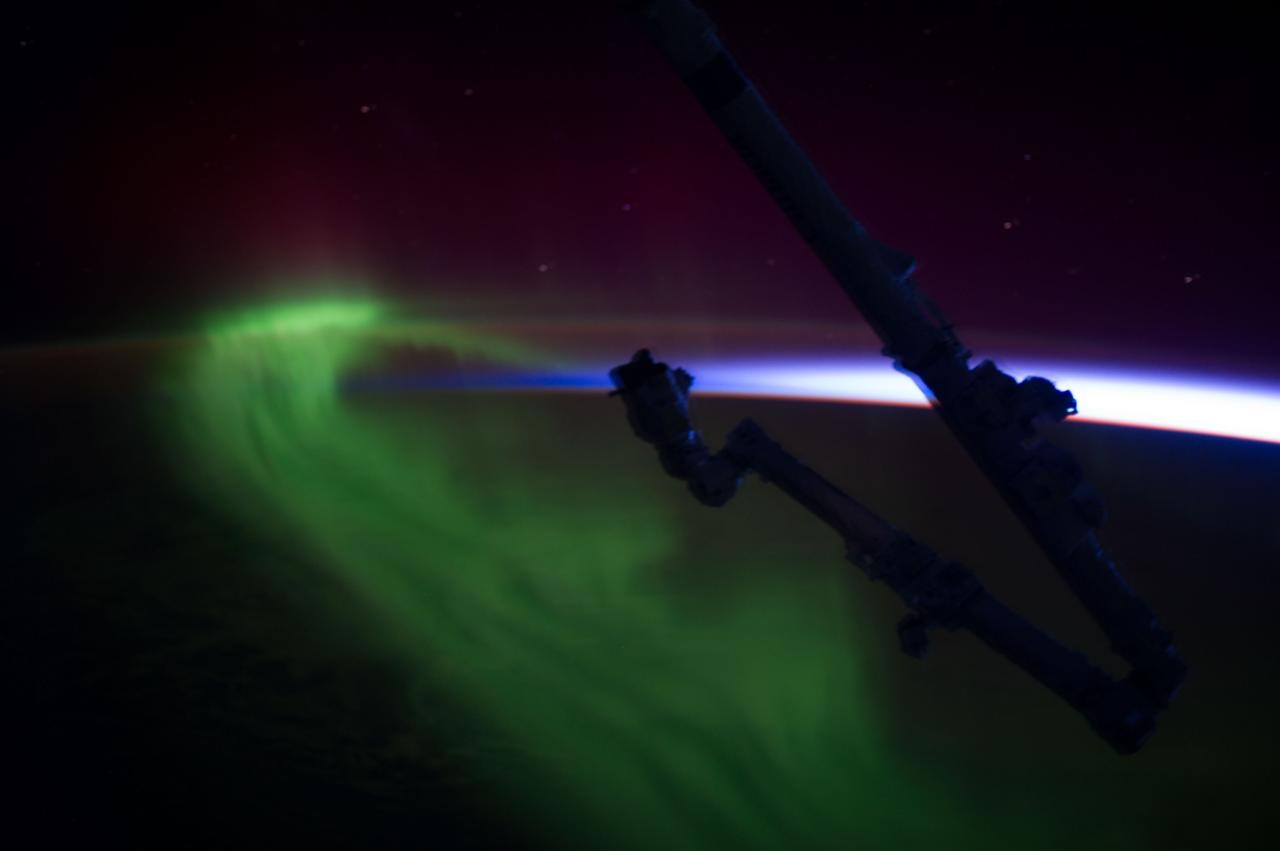
ISS037-E-022828 (30 Oct. 2013) --- This isn?t someone?s frame grab of a decorative Halloween scene, although it was photographed on Halloween eve. It is actually a picture of the Aurora Australis or Southern Lights, photographed by one of the Expedition 37 crew members on the International Space Station as the orbital complex flew over Tasmania on Oct. 30. The human-produced hardware in the picture is part of the outpost?s robotic arm system.
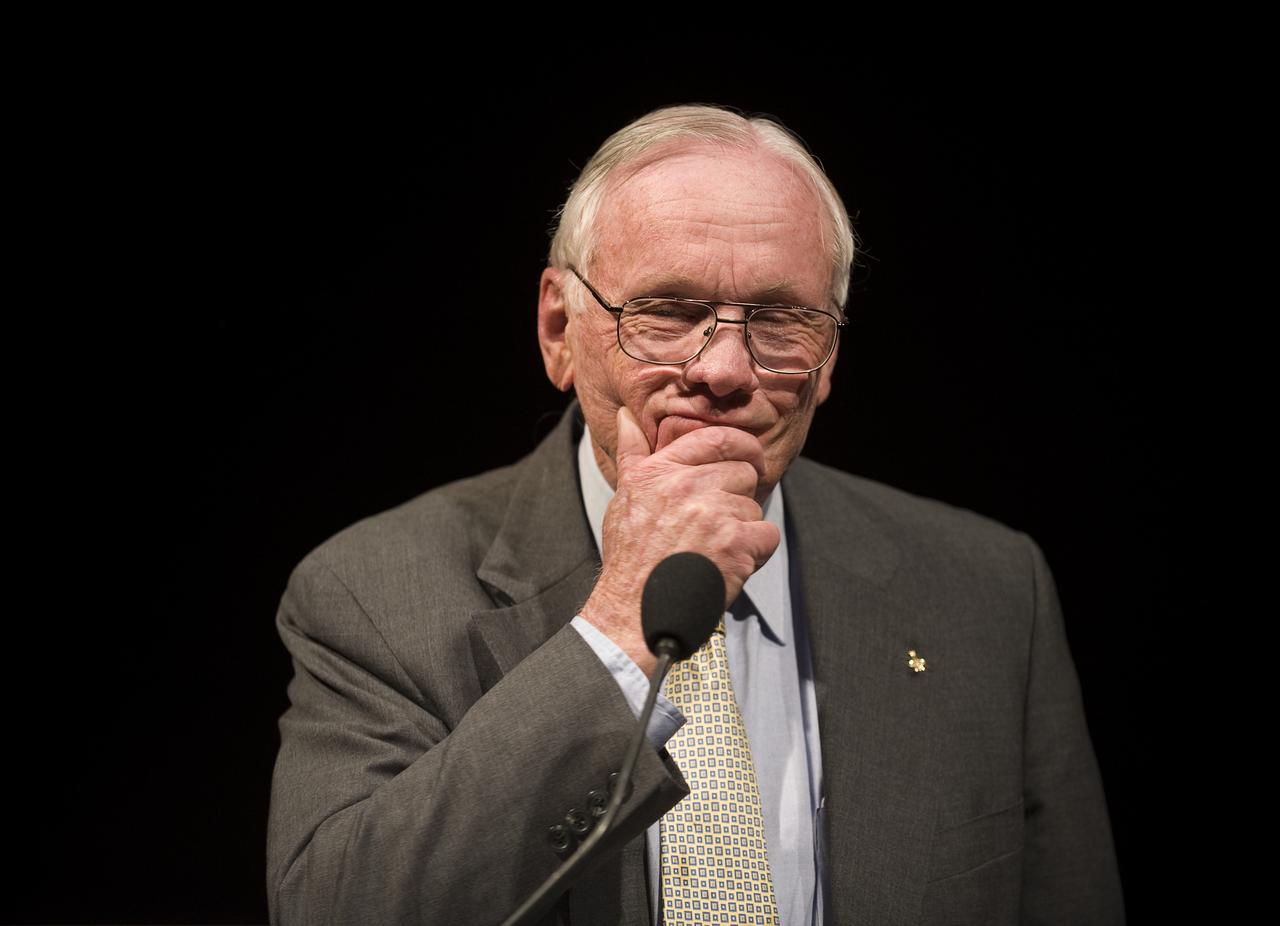
On the eve of the fortieth anniversary of the first human landing on the Moon, Apollo 11 Astronaut Neil Armstrong speaks during a lecture in honor of Apollo 11 at the National Air and Space Museum in Washington, Sunday, July 19, 2009. Guest speakers included Former NASA Astronaut and U.S. Senator John Glenn, NASA Mission Control creator and former NASA Johnson Space Center director Chris Kraft and the crew of Apollo 11. Photo Credit: (NASA/Bill Ingalls)
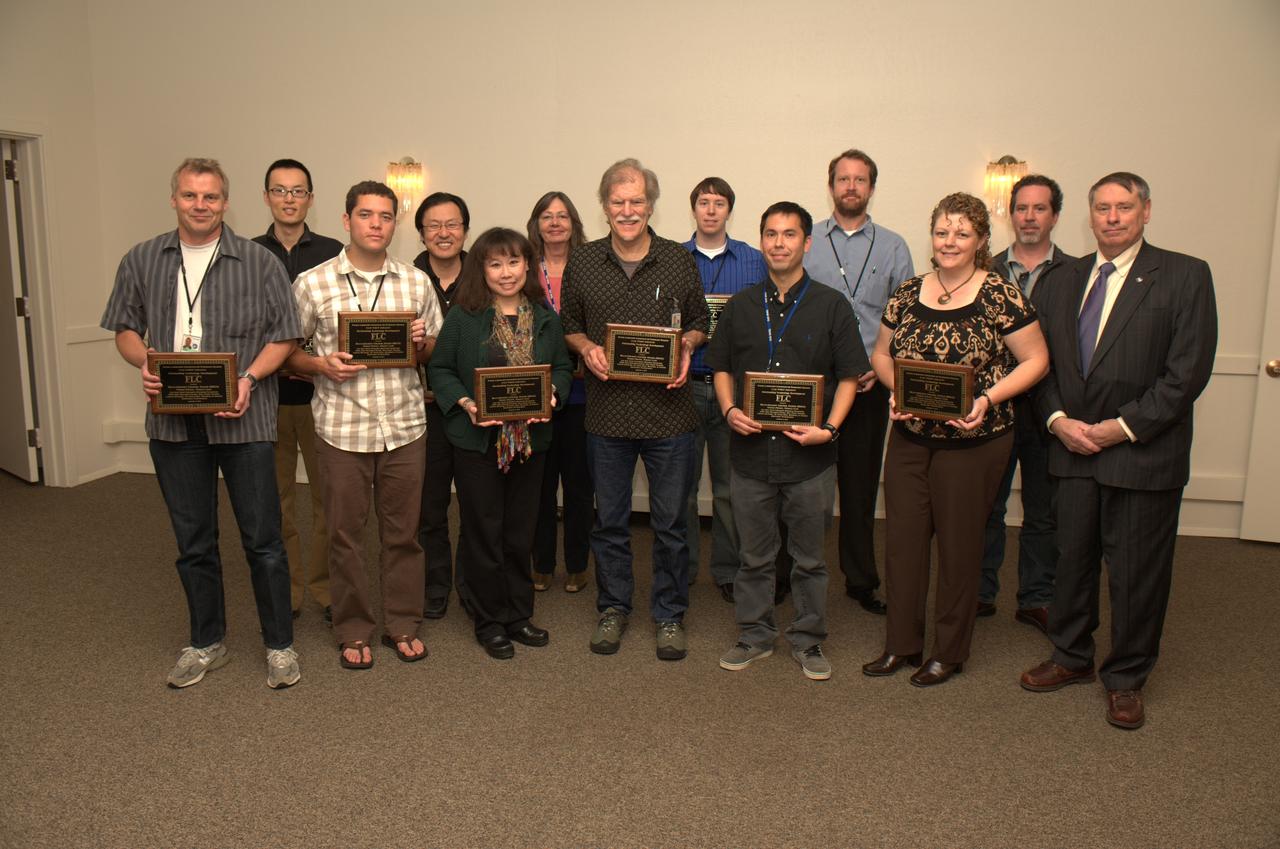
Technology Partnerships awards: Federal Laboratory Consortium Far West Region Award for Outstanding Technology Development for Multi-Aircraft Control System. In particular order are Connie Brasil, Todd Callantine, Al Globus, Jeff Homola, Rich Jacoby, George Lawton, Paul Lee, Matt Mainini, Joey Mercer, Ev Palmer, Tom Prevot, Nancy Smith, Easter Wang, James Wong.
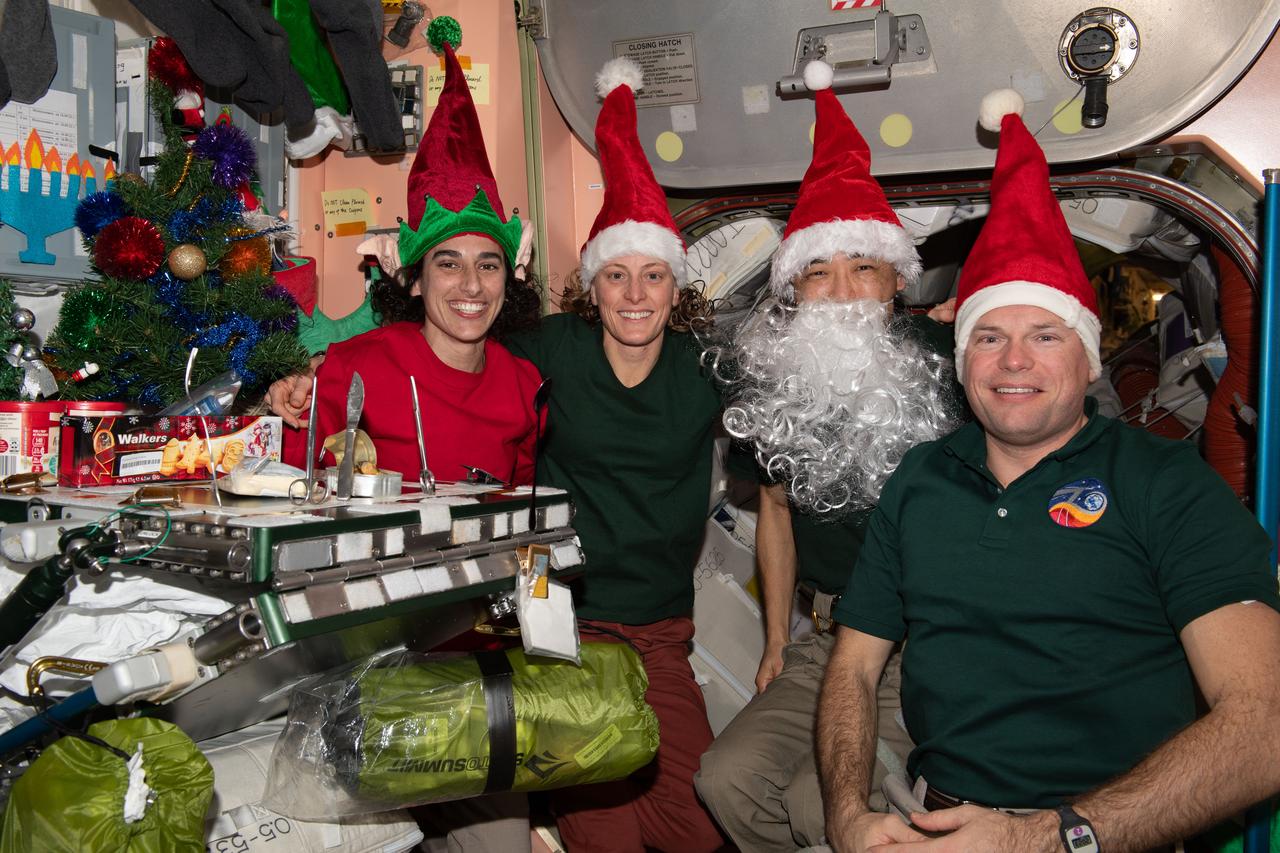
iss070e045419 (Dec. 24, 2023) --- Four Expedition 70 crewmates join each other inside the International Space Station's Unity module for Christmas Eve festivities. From left are, NASA Flight Engineers Jasmin Moghbeli and Loral O'Hara; Flight Engineer Koichi Wakata from JAXA (Japan Aerospace Exploration Agency); and Commander Andreas Mogensen from ESA (European Space Agency).
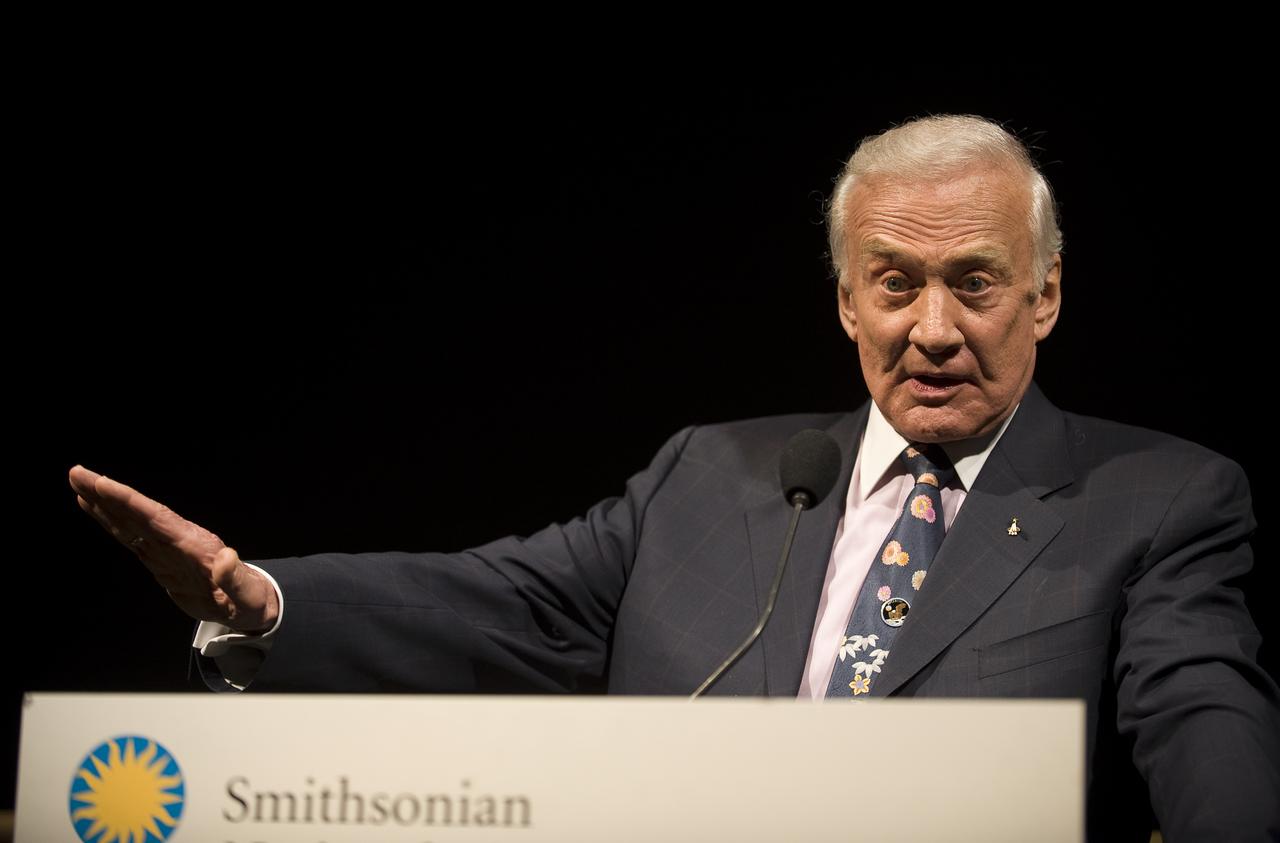
On the eve of the fortieth anniversary of Apollo 11's first human landing on the Moon, Apollo 11 crew member, Buzz Aldrin speaks during a lecture in honor of Apollo 11 at the National Air and Space Museum in Washington, Sunday, July 19, 2009. Guest speakers included Former NASA Astronaut and U.S. Senator John Glenn, NASA Mission Control creator and former NASA Johnson Space Center director Chris Kraft and the crew of Apollo 11. Photo Credit: (NASA/Bill Ingalls)
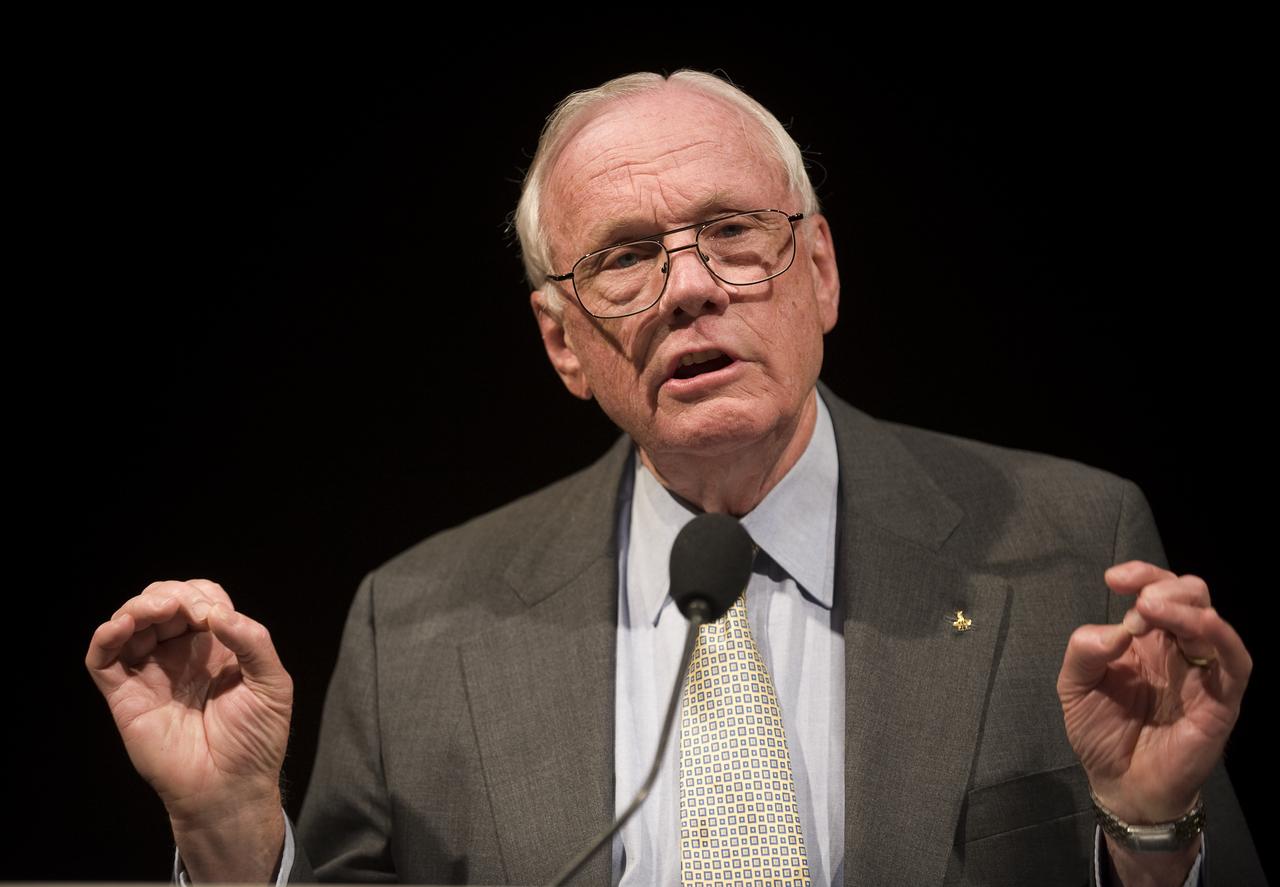
On the eve of the fortieth anniversary of the first human landing on the Moon, Apollo 11 Astronaut Neil Armstrong speaks during a lecture in honor of Apollo 11 at the National Air and Space Museum in Washington, Sunday, July 19, 2009. Guest speakers included Former NASA Astronaut and U.S. Senator John Glenn, NASA Mission Control creator and former NASA Johnson Space Center director Chris Kraft and the crew of Apollo 11. Photo Credit: (NASA/Bill Ingalls)
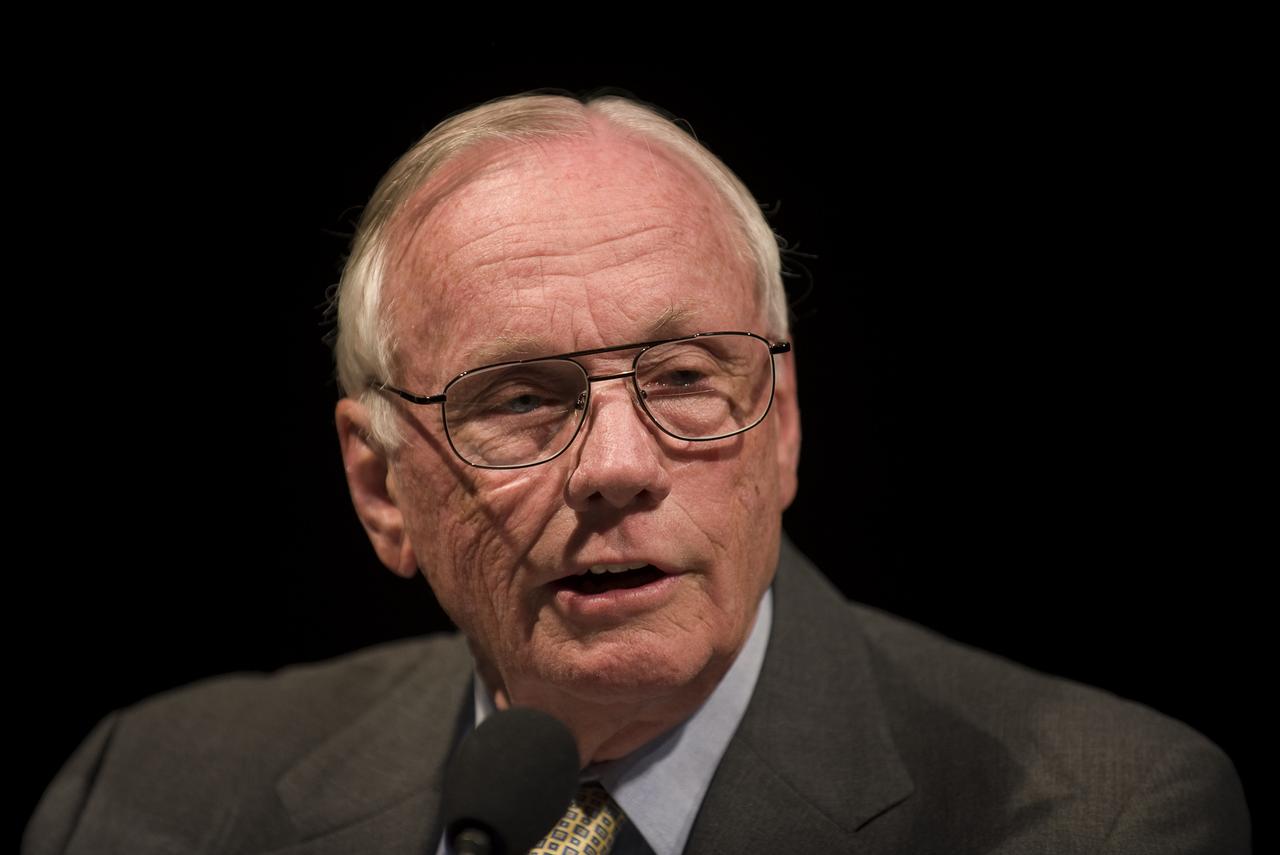
On the eve of the fortieth anniversary of the first human landing on the Moon, Apollo 11 Astronaut Neil Armstrong speaks during a lecture in honor of Apollo 11 at the National Air and Space Museum in Washington, Sunday, July 19, 2009. Guest speakers included Former NASA Astronaut and U.S. Senator John Glenn, NASA Mission Control creator and former NASA Johnson Space Center director Chris Kraft and the crew of Apollo 11. Photo Credit: (NASA/Bill Ingalls)
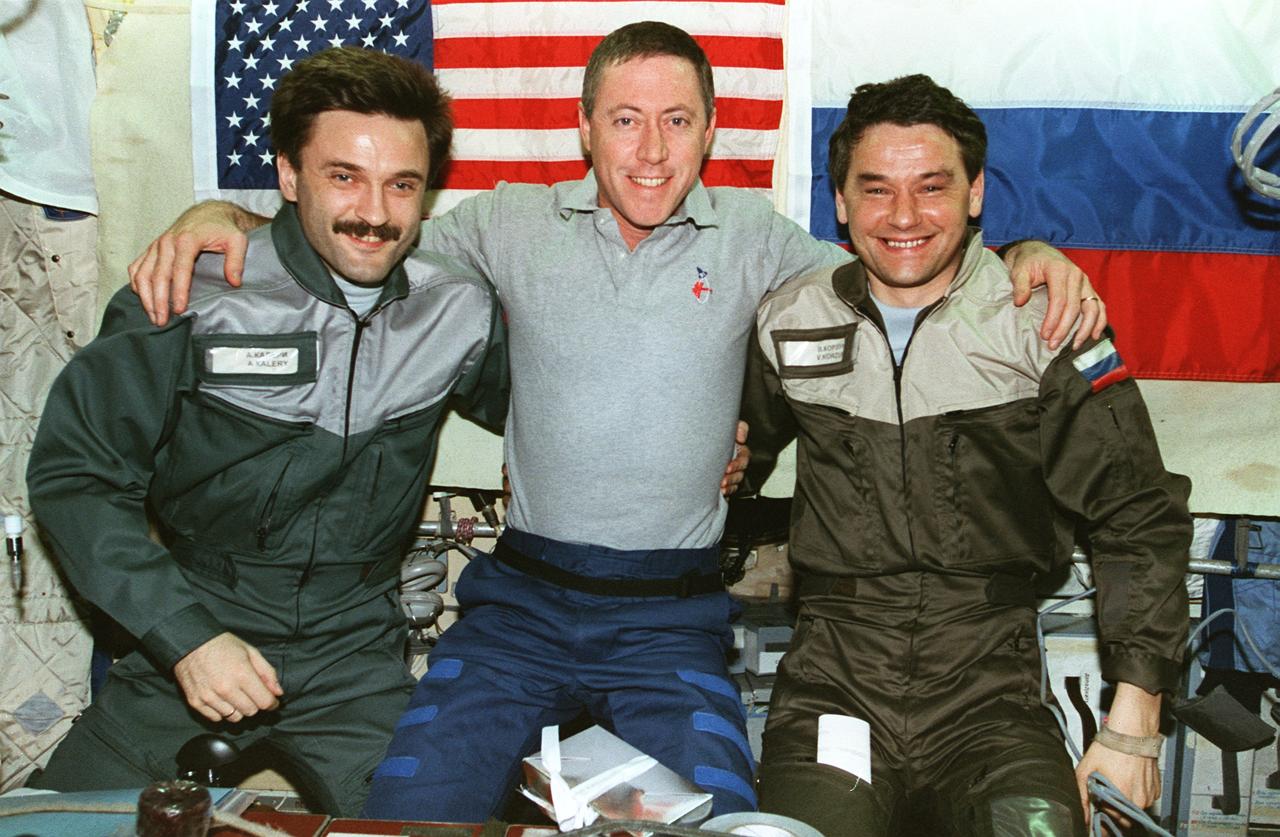
STS081-369-028 (12-22 Jan. 1997) --- On the eve of undocking of the Space Shuttle Atlantis and Russia's Mir Space Station, astronaut Michael A. Baker (center), STS-81 mission commander, bids farewell to cosmonauts Aleksandr Y. Kaleri (left), Mir-22 flight engineer, and Valeri G. Korzun, Mir-22 mission commander. The three are in the Base Block Module of the Mir complex.
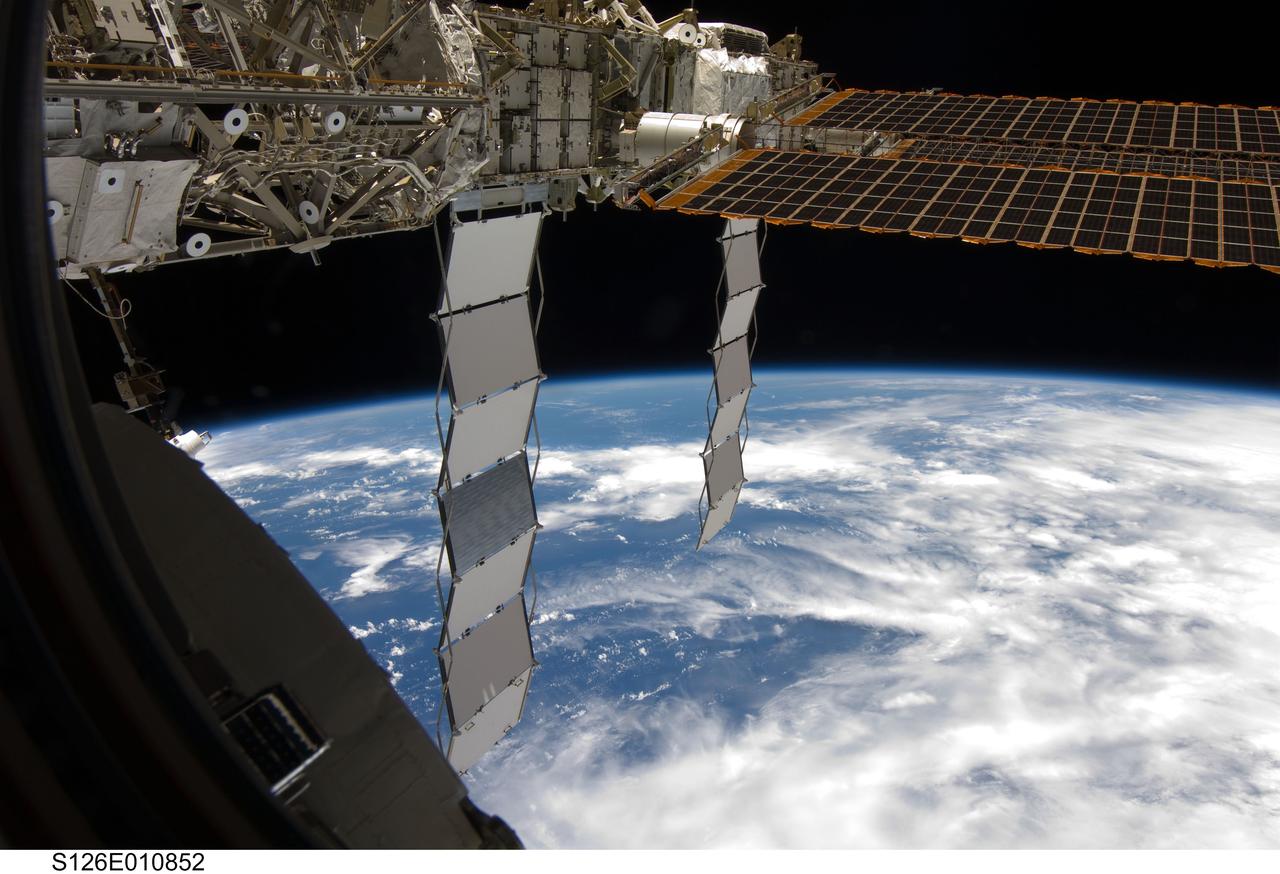
S126-E-010852 (26 Nov. 2008) --- From inside Endeavour, one of the STS-126 astronauts recorded this view of part of one of the International Space Station trusses and part of a solar panel, backdropped against a blue and white Earth on the eve of Thanksgiving. The ISS and Endeavour crewmembers, after spending almost two weeks together in space, will go separate ways in a couple of days when the two spacecraft undock.
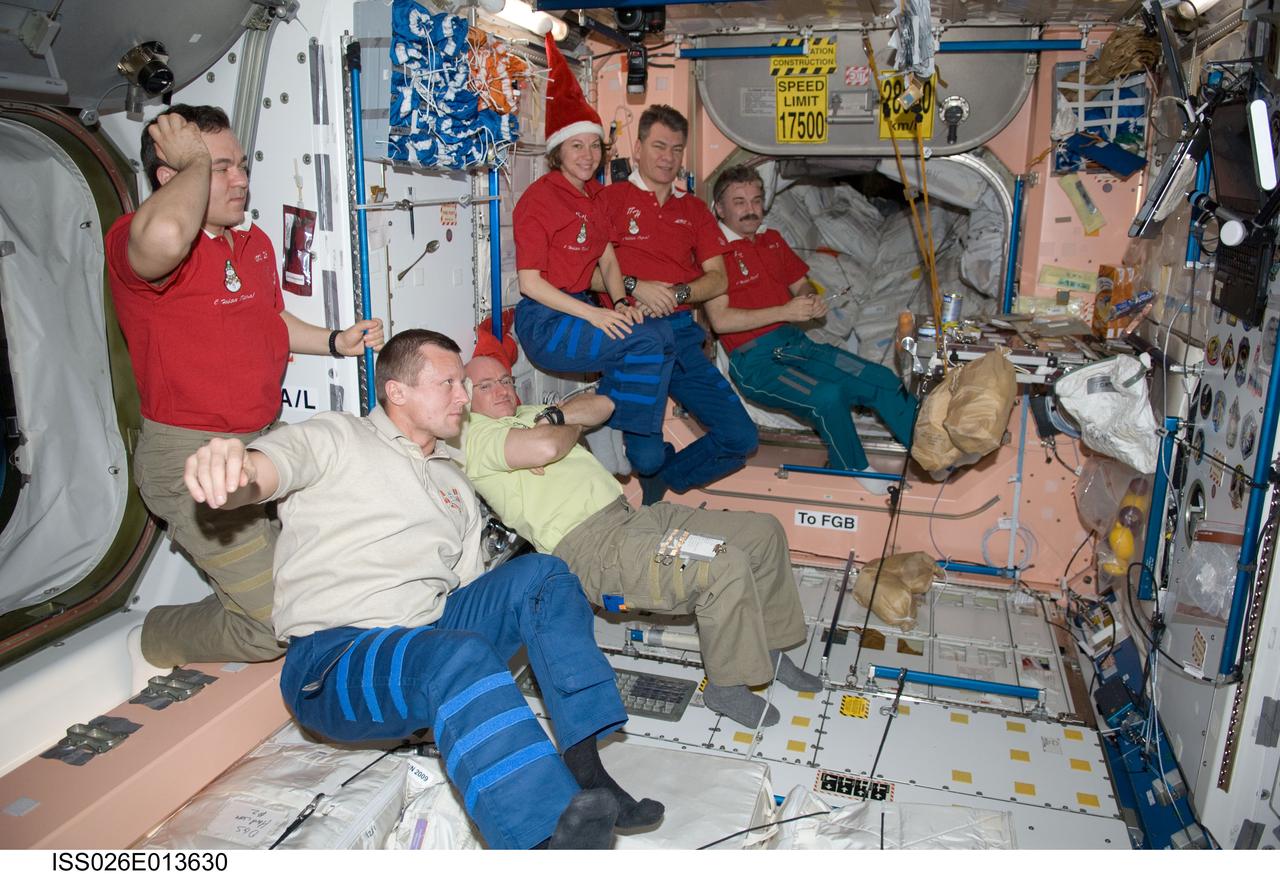
ISS026-E-013630 (31 Dec. 2010) --- Expedition 26 crew members are pictured in the Unity node of the International Space Station on New Year’s Eve. From the left are Russian cosmonauts Oleg Skripochka and Dmitry Kondratyev, both flight engineers; NASA astronaut Scott Kelly, commander; NASA astronaut Catherine (Cady) Coleman, European Space Agency astronaut Paolo Nespoli and Russian cosmonaut Alexander Kaleri, all flight engineers.
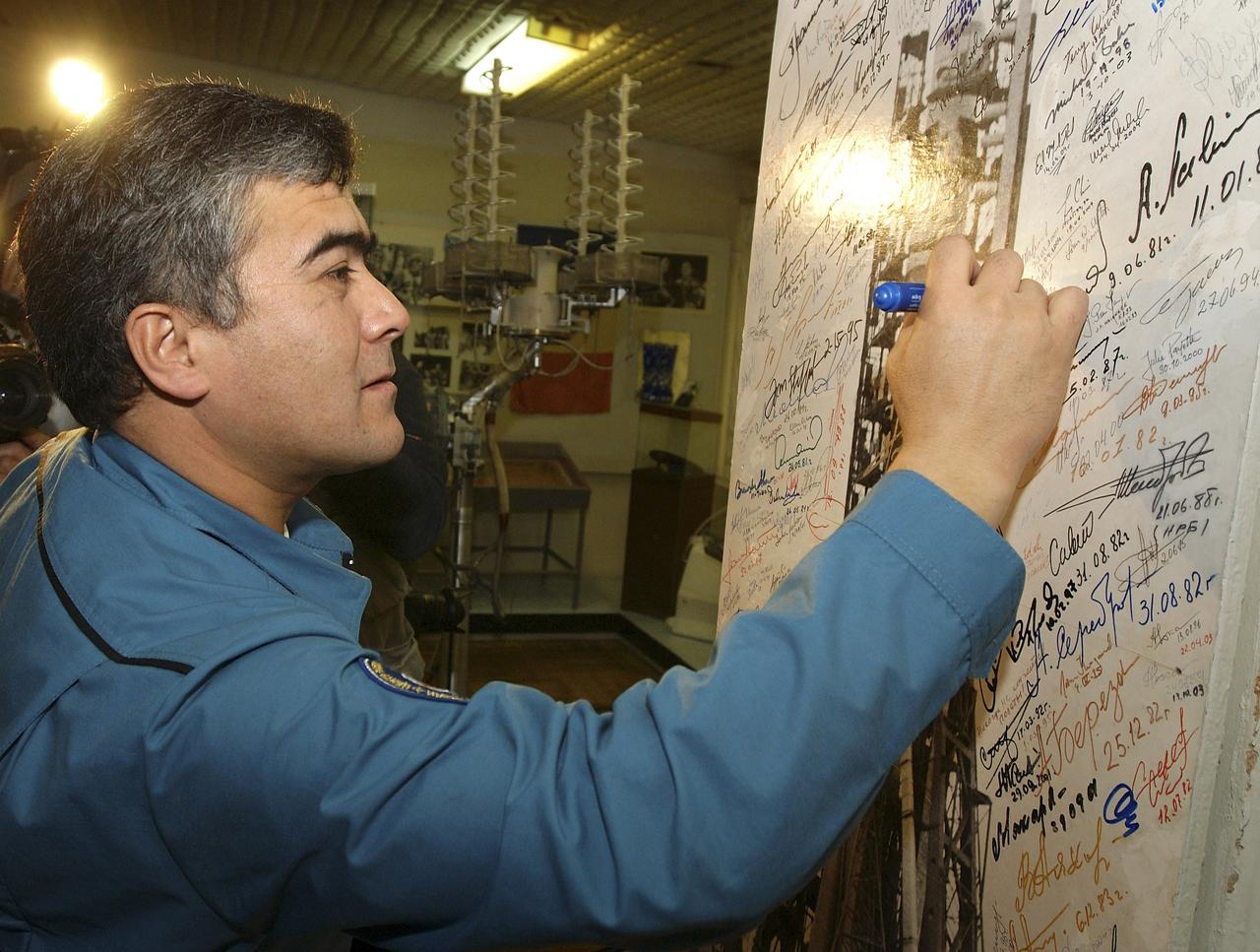
Flight Engineer and Soyuz Commander Salizhan Sharipov tours a museum bearing the name of historic Russian rocket designer Sergei Korolev, Saturday, October 9, 2004, at the Baikonur Cosmodrome in Kazakhstan in advance of their liftoff to the International Space Station October 14. The traditional visit included the signing of their names in commemorative books and a wall at the museum, and touring the cottages nearby where Korolev and Yuri Gagarin slept on the eve of Gagarin's launch April 12, 1961 to become the first human in space. Photo Credit: (NASA/Bill Ingalls)
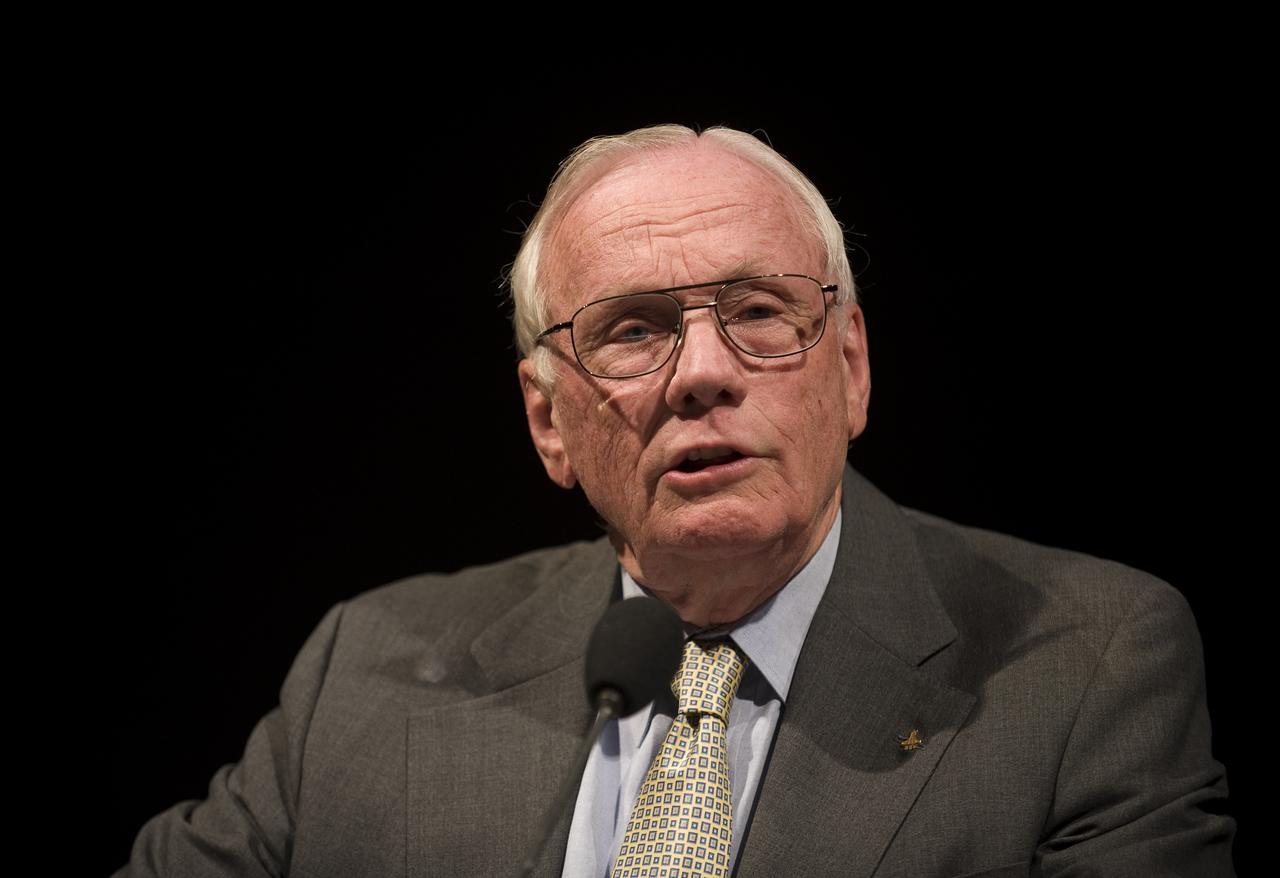
On the eve of the fortieth anniversary of the first human landing on the Moon, Apollo 11 Astronaut Neil Armstrong speaks during a lecture in honor of Apollo 11 at the National Air and Space Museum in Washington, Sunday, July 19, 2009. Guest speakers included Former NASA Astronaut and U.S. Senator John Glenn, NASA Mission Control creator and former NASA Johnson Space Center director Chris Kraft and the crew of Apollo 11. Photo Credit: (NASA/Bill Ingalls)

S126-E-012093 (27 Nov. 2008) --- Backdropped against a massive cloud cover, the aft portion of the Space Shuttle Endeavour, with the multi-purpose logistics module Leonardo in stow mode, was captured in a series of photographs by one of the STS-126 crewmembers on Nov. 27, Thanksgiving day, also the eve of departure from the International Space Station on Nov. 28.

S135-E-006268 (9 July 2011) --- A nadir view from the Earth-orbiting space shuttle Atlantis, photographed by one of four STS-135 crewmembers, shows the area of Italy referred to as the "boot." Part of Sicily is at frame's bottom center. The astronauts were on the mission's second day of activity in Earth orbit, and the eve of docking day with the International Space Station. Photo credit: NASA
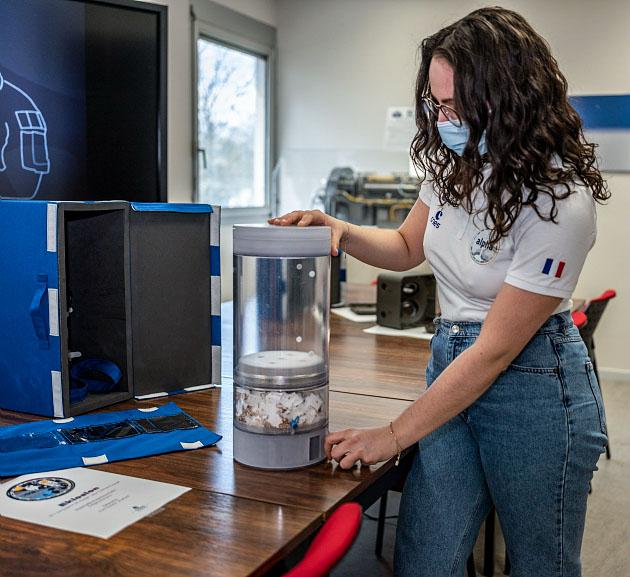
jsc2021e029981 (3/18/2021) --- A Picture of the EKLOSION pot manipulated by Eve Teyssier at CNES Toulouse. The Eklosion investigation consist of a vase that is utilized by a crew member to grow a Marigold flower (Tagetes patula) aboard the ISS. The investigation takes place at the leisure of the crew member and helps to study the process of plant growth in space, as well as using a personally tended house plant in space to help establish a psychological link between the crew member aboard the ISS and Earth. Image courtesy of CNES.
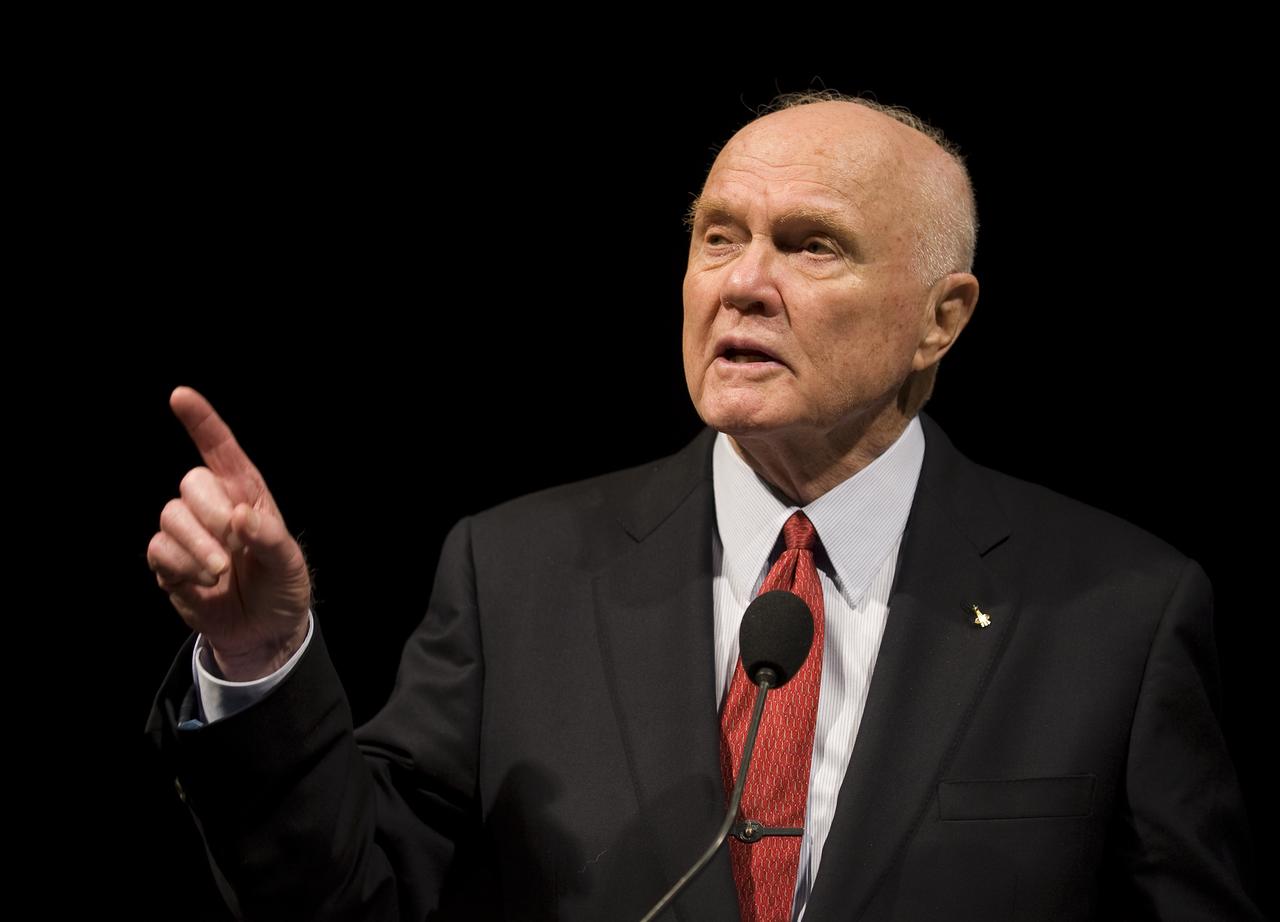
On the eve of the fortieth anniversary of Apollo 11's first human landing on the Moon, Former NASA Astronaut and U.S. Senator John Glenn speaks during a lecture in honor of Apollo 11 at the National Air and Space Museum in Washington, Sunday, July 19, 2009. Guest speakers included NASA Mission Control creator and former NASA Johnson Space Center director Chris Kraft, Apollo 11 crew members, Buzz Aldrin, Neil Armstrong, and Michael Collins. Photo Credit: (NASA/Bill Ingalls)
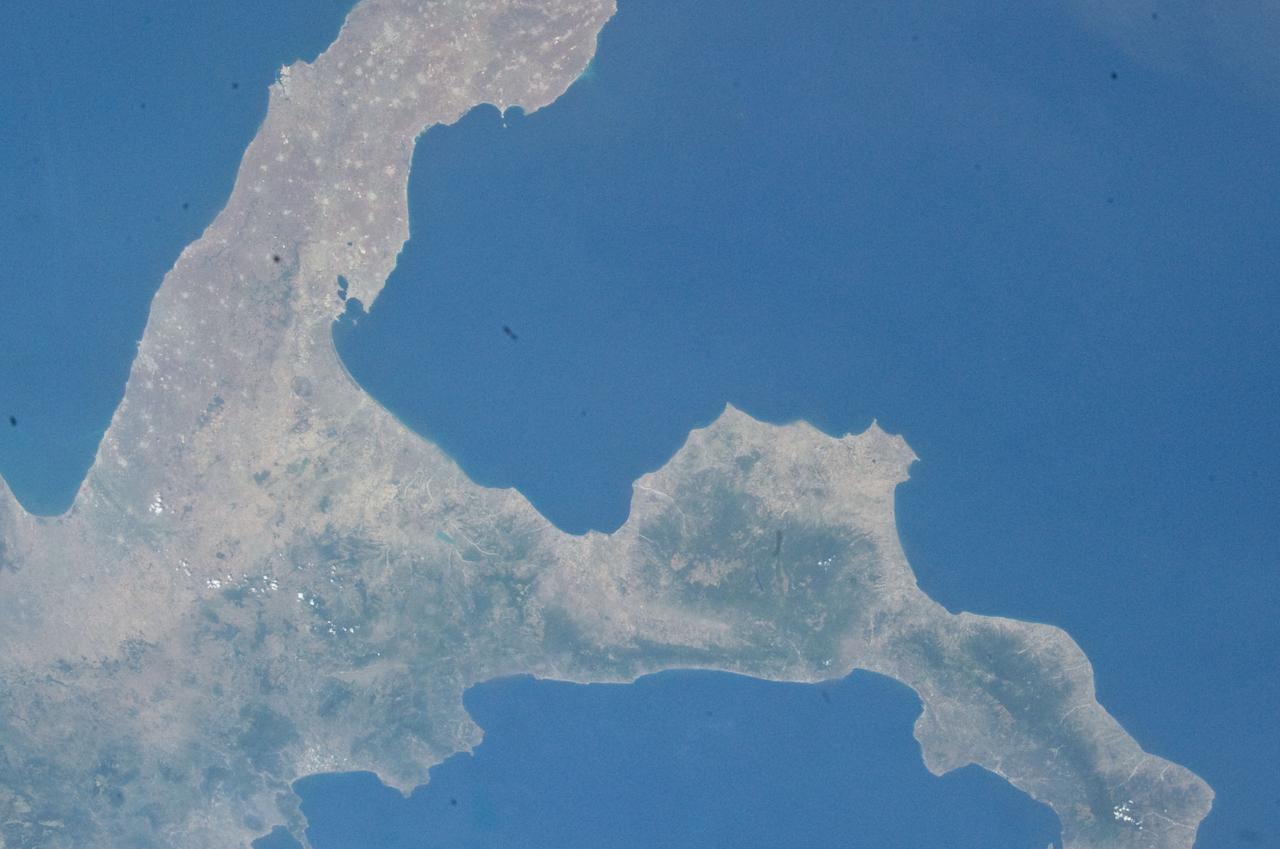
S135-E-006265 (9 July 2011) --- A nadir view from the Earth-orbiting space shuttle Atlantis, photographed by one of four STS-135 crewmembers, shows the southernmost part of Italy, referred to as the "boot." The astronauts were on the mission's second day of activity in Earth orbit, and the eve of docking day with the International Space Station. Photo credit: NASA
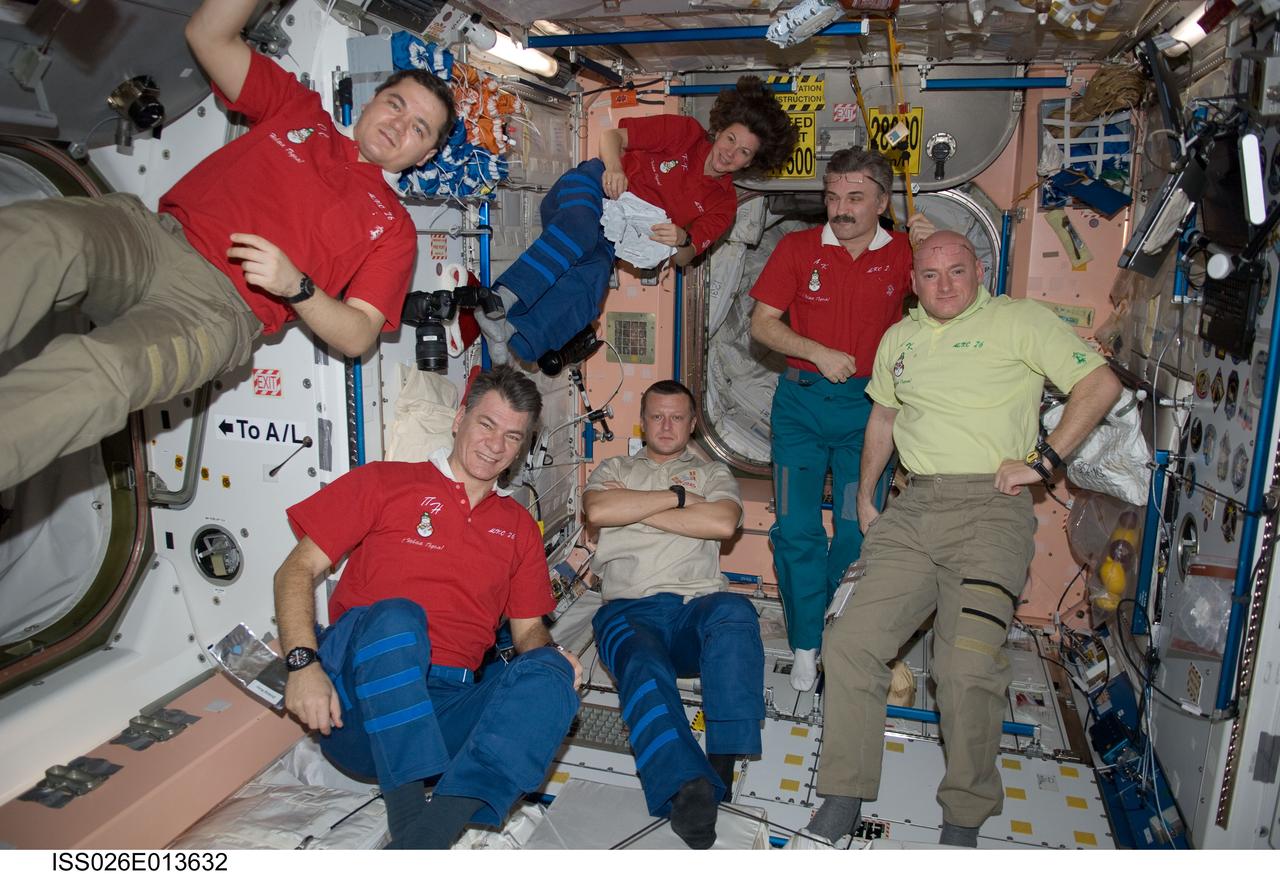
ISS026-E-013632 (31 Dec. 2010) --- Expedition 26 crew members are pictured in the Unity node of the International Space Station on New Year’s Eve. Clockwise from the left are Russian cosmonaut Oleg Skripochka, NASA astronaut Catherine (Cady) Coleman, Russian cosmonaut Alexander Kaleri, all flight engineers; NASA astronaut Scott Kelly, commander; Russian cosmonaut Dmitry Kondratyev and European Space Agency astronaut Paolo Nespoli, both flight engineers.
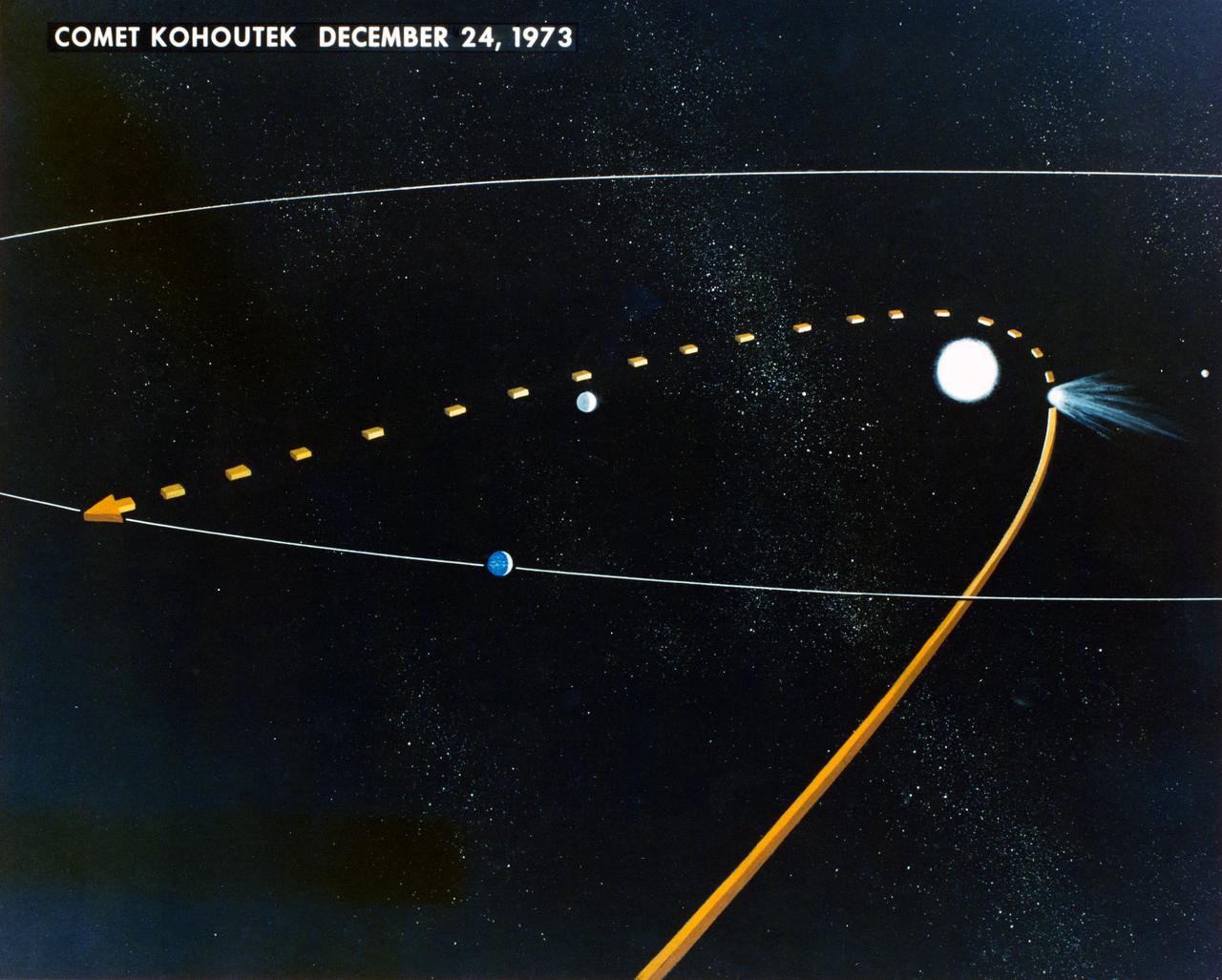
S73-37273 (24 Dec. 1973) --- An artist's concept illustrating the trajectory of the newly-discovered Comet Kohoutek in relation to the sun and to Earth and the plane of Earth's orbit. The picture show's the position of Kohoutek on Christmas Eve, 1973. The Skylab space station in Earth orbit will provide a favorable location from which to observe the passing of the comet. Photo credit: NASA
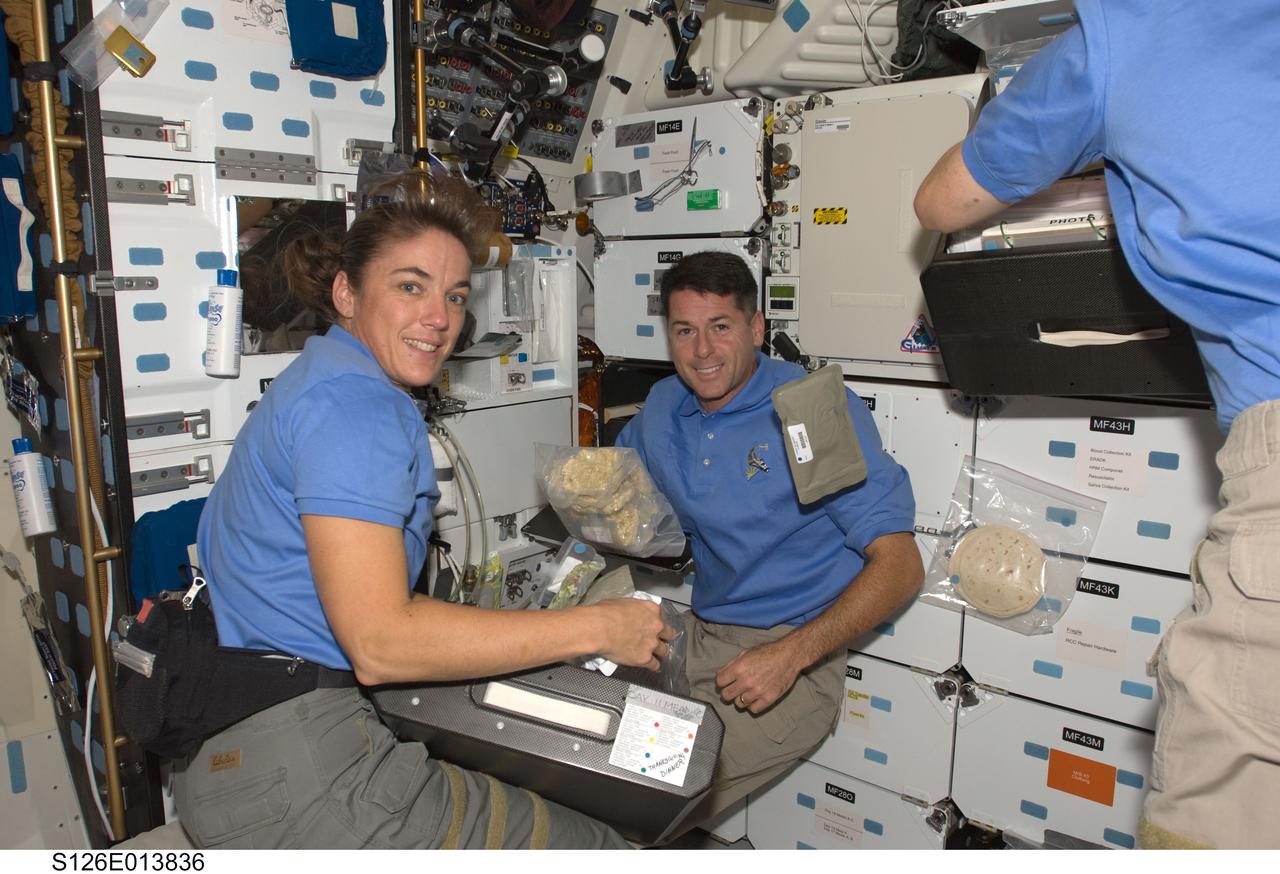
S126-E-013836 (27 Nov. 2008) --- Stationed near the shuttle's galley and stowage lockers, astronauts Heidemarie Stefanyshyn-Piper and Shane Kimbrough, STS-126 mission specialists, assemble the elements of Thanksgiving dinner on the middeck of the Space Shuttle Endeavour, while the orbiter is docked with the International Space Station. A Russian cosmonaut and seven other astronauts are not far away from the scene and all ten shared the meal and observance at a common place and time, on the eve of the scheduled Nov. 28 undocking of the shuttle and station.
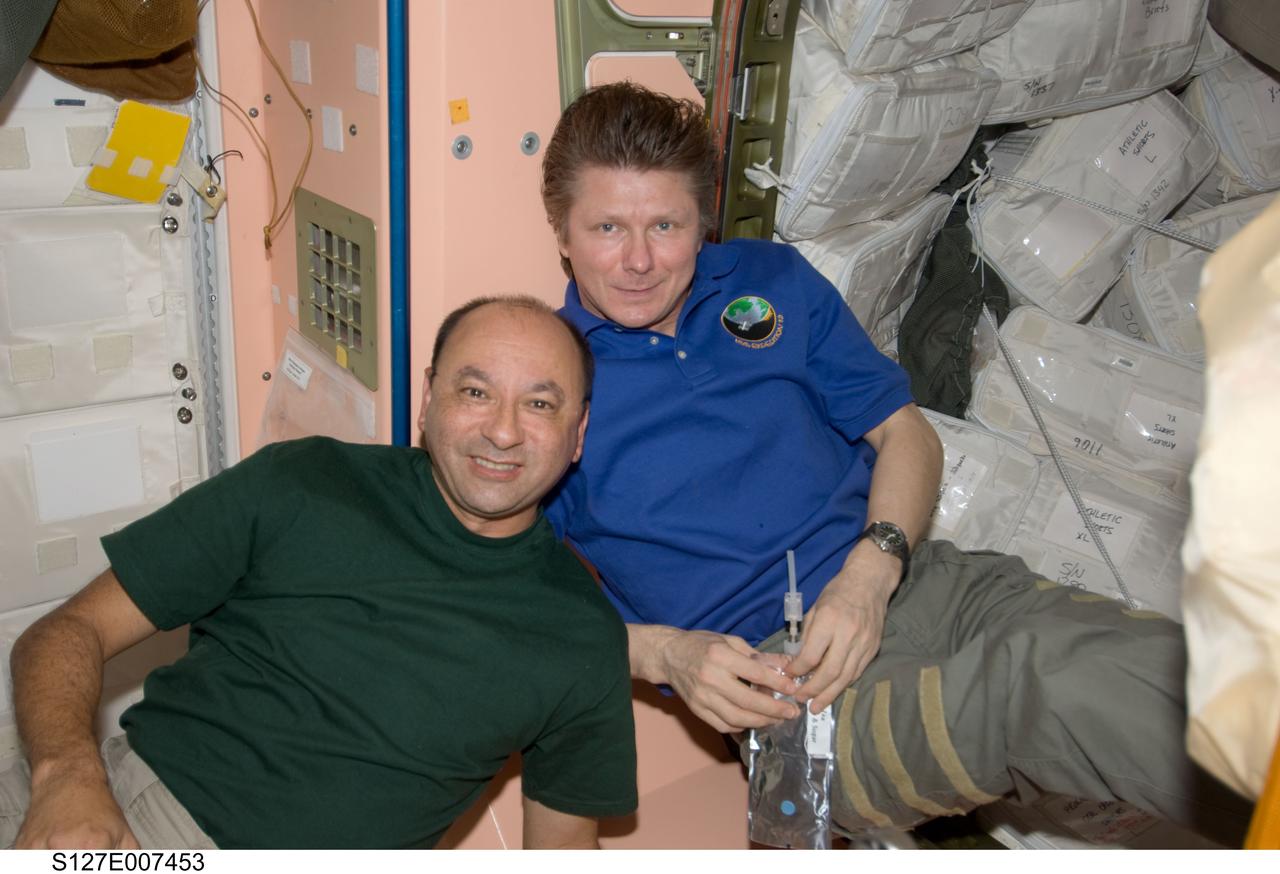
S127-E-007453 (21 July 2009) --- Astronaut Mark Polansky (left) and Russian Federal Space Agency cosmonaut Gennady Padalka take a break from a busy agenda onboard the International Space Station on the eve of the third of five spacewalks scheduled as part of more than a week's worth of joint activities for Endeavour and ISS crewmembers. Polansky is STS-127 commander, and Padalka is the station commander.
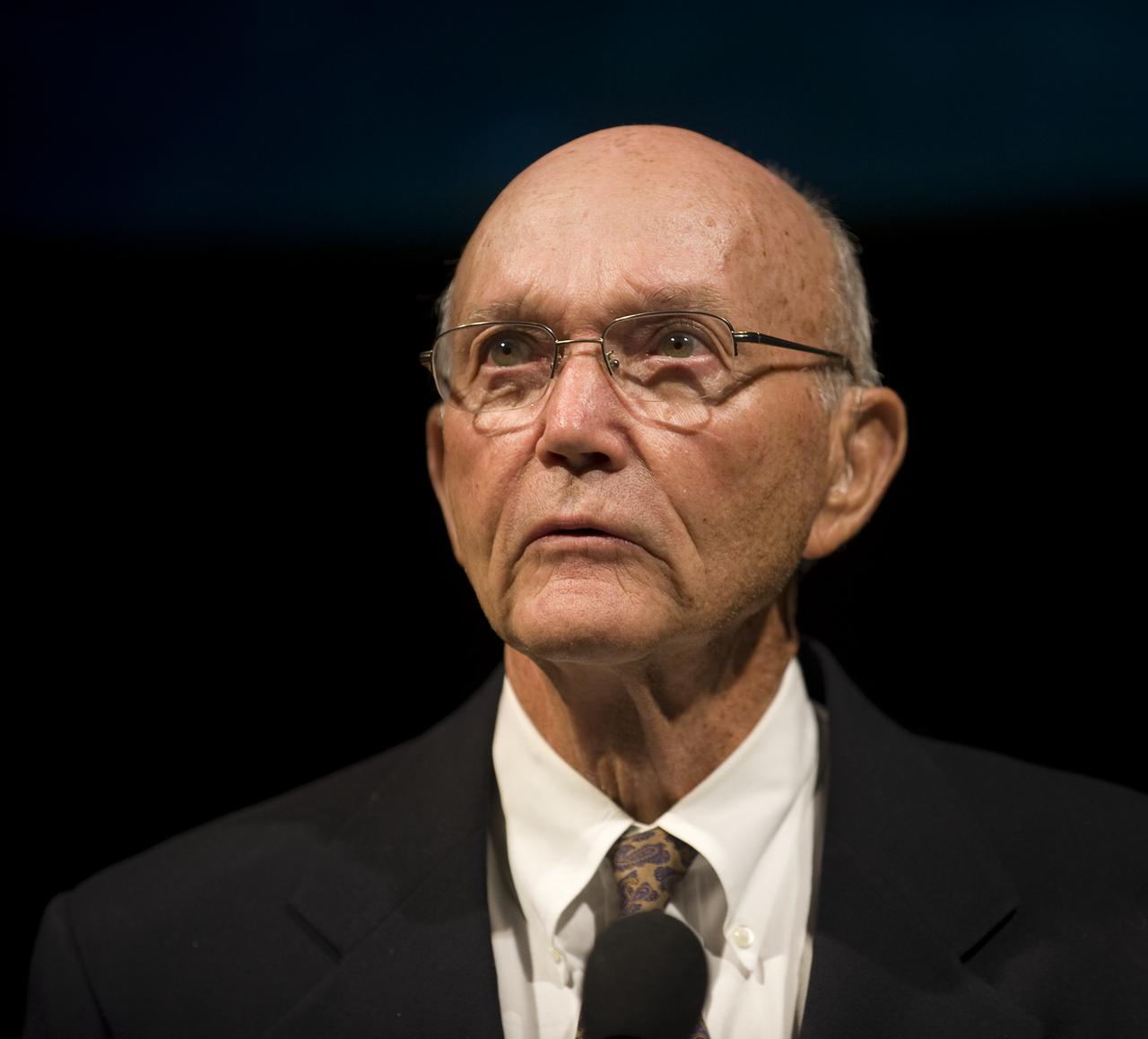
On the eve of the fortieth anniversary of Apollo 11's first human landing on the Moon, Apollo 11 crew member, Michael Collins speaks during a lecture in honor of Apollo 11 at the National Air and Space Museum in Washington, Sunday, July 19, 2009. Guest speakers included Former NASA Astronaut and U.S. Senator John Glenn, NASA Mission Control creator and former NASA Johnson Space Center director Chris Kraft and the crew of Apollo 11. Photo Credit: (NASA/Bill Ingalls)
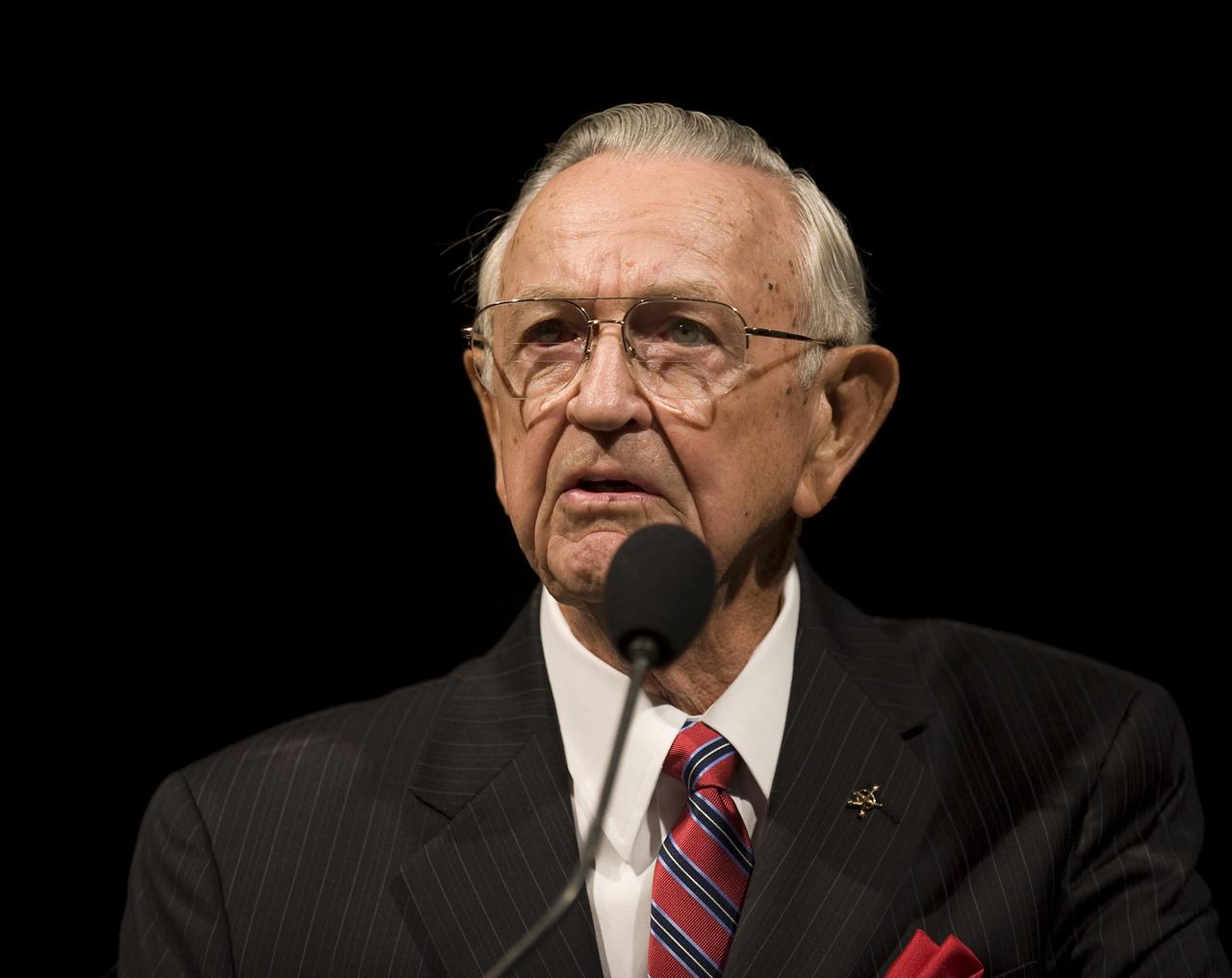
On the eve of the fortieth anniversary of Apollo 11's first human landing on the Moon, NASA Mission Control creator and former NASA Johnson Space Center director Chris Kraft speaks during a lecture in honor of Apollo 11 at the National Air and Space Museum in Washington, Sunday, July 19, 2009. Guest speakers included Former NASA Astronaut and U.S. Senator John Glenn, Apollo 11 crew members, Buzz Aldrin, Neil Armstrong, and Michael Collins. Photo Credit: (NASA/Bill Ingalls)
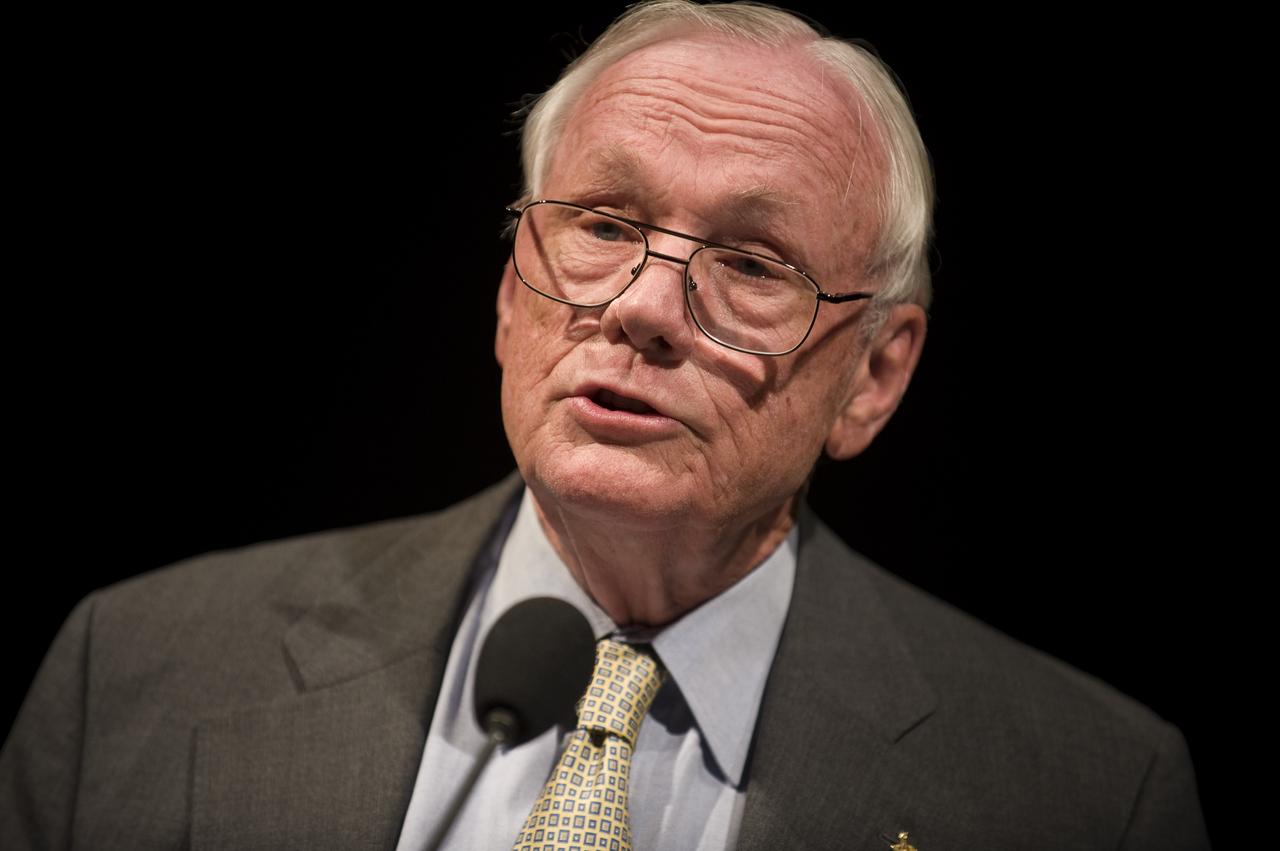
On the eve of the fortieth anniversary of the first human landing on the Moon, Apollo 11 Astronaut Neil Armstrong speaks during a lecture in honor of Apollo 11 at the National Air and Space Museum in Washington, Sunday, July 19, 2009. Guest speakers included Former NASA Astronaut and U.S. Senator John Glenn, NASA Mission Control creator and former NASA Johnson Space Center director Chris Kraft and the crew of Apollo 11. Photo Credit: (NASA/Bill Ingalls)
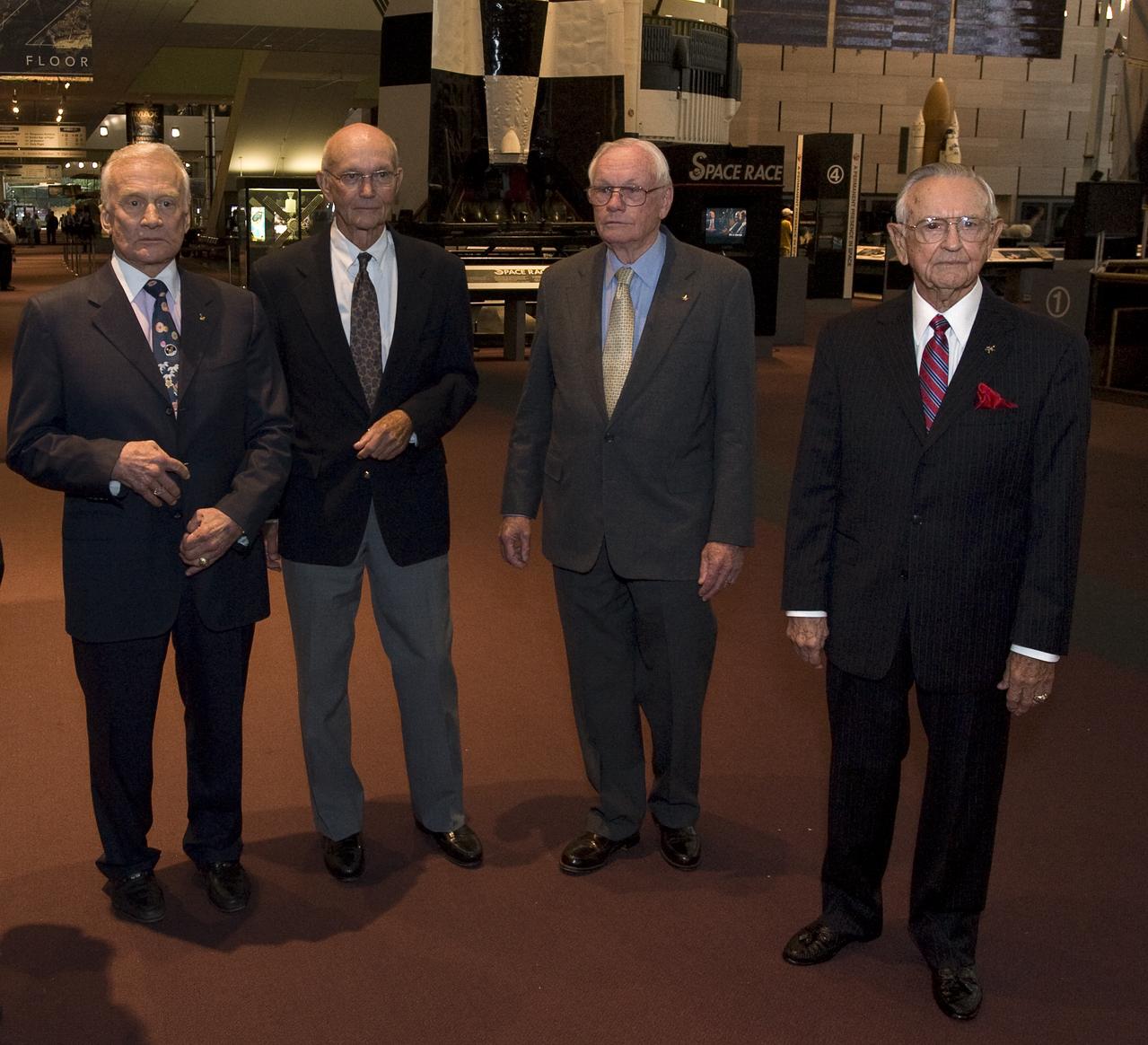
On the eve of the fortieth anniversary of Apollo 11's first human landing on the Moon, Apollo 11 crew members, Buzz Aldrin, left, Michael Collins, 2nd from left, Neil Armstrong and NASA Mission Control creator and former NASA Johnson Space Center director Chris Kraft, right, gathered at the National Air and Space Museum in Washington, Sunday, July 19, 2009. The four were speakers at the Museum's 2009 John H. Glenn lecture in space history. Photo Credit: (NASA/Bill Ingalls)
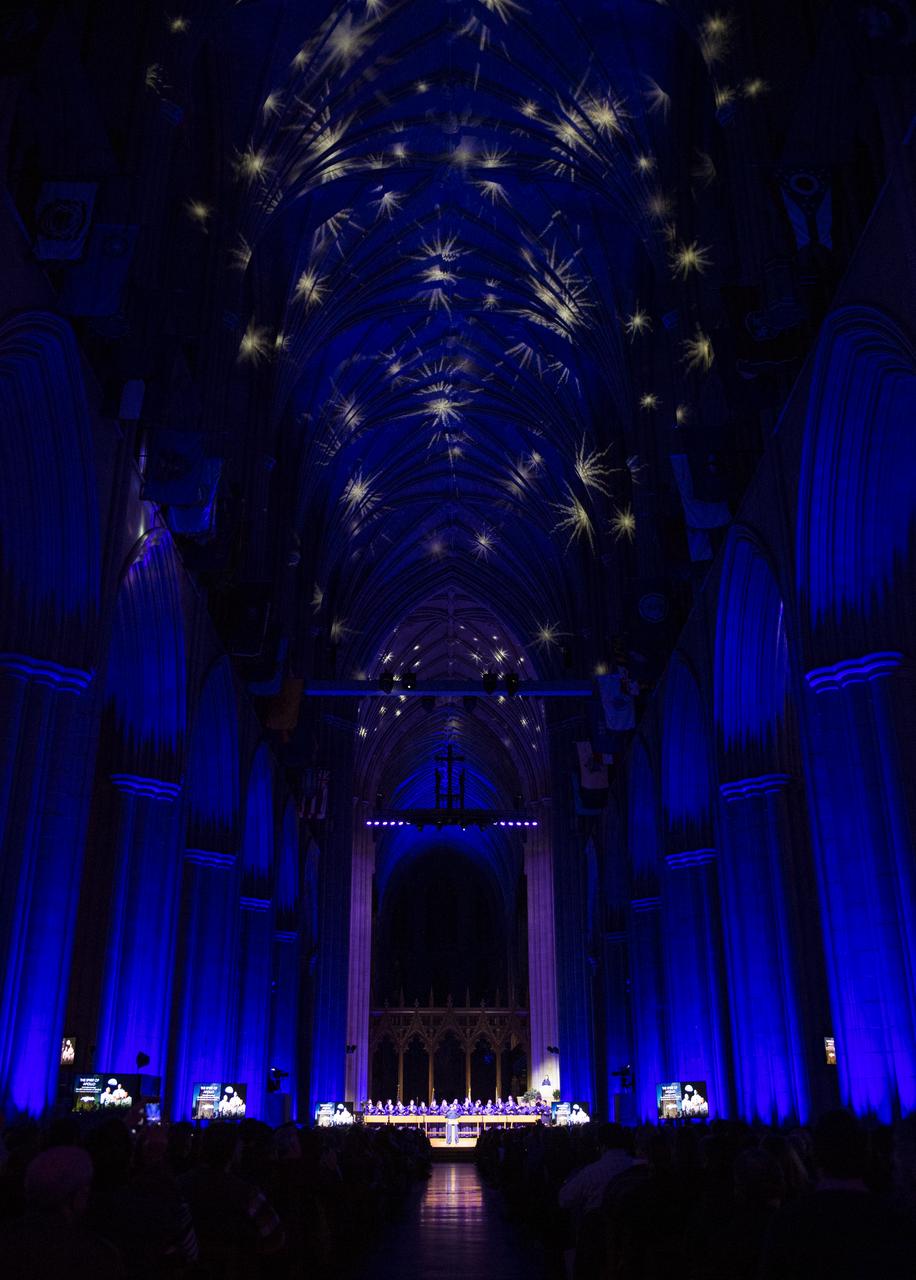
The Washington National Cathedral Choir performs a choral performance of Apollo 8's Christmas Eve broadcast during the Smithsonian National Air and Space Museum's Spirit of Apollo event commemorating the 50th anniversary of Apollo 8, Tuesday, Dec. 11, 2018 at the Washington National Cathedral in Washington, DC. Apollo 8 was humanity's first journey to another world, taking astronauts Frank Borman, Jim Lovell, and William Anders to the Moon and back in December of 1968. Photo Credit: (NASA/Joel Kowsky)
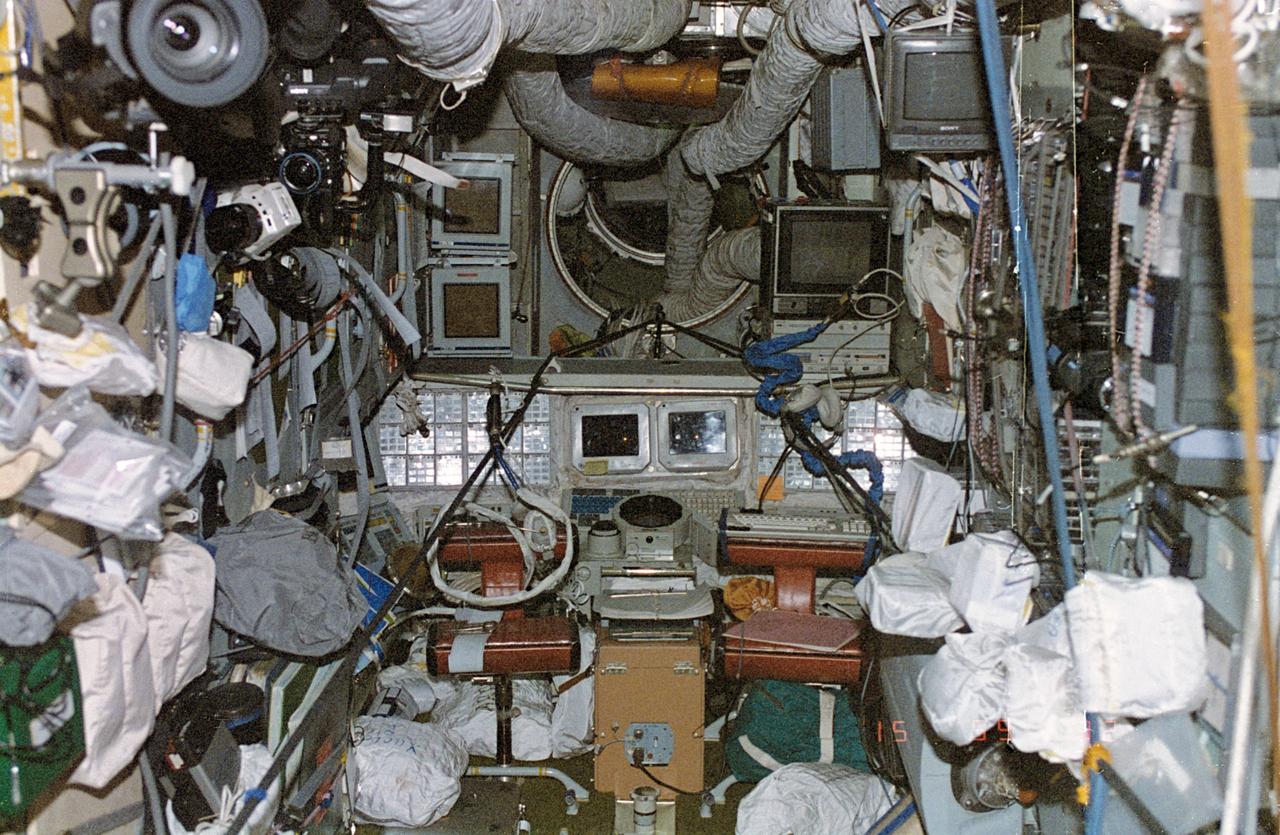
NM18-302-038 (28 June 1995) --- Astronaut Norman E. Thagard, Mir-18 cosmonaut researcher, took this picture aboard Mir on the eve of the targeted arrival day of Atlantis. Thagard told a July 18 press conference audience in Houston that he worked to clean the area prior to the Mir-19 crew and the STS-71 crew arrival and that his showing of this slide represented the first time the crew would have seen the area "in this condition."
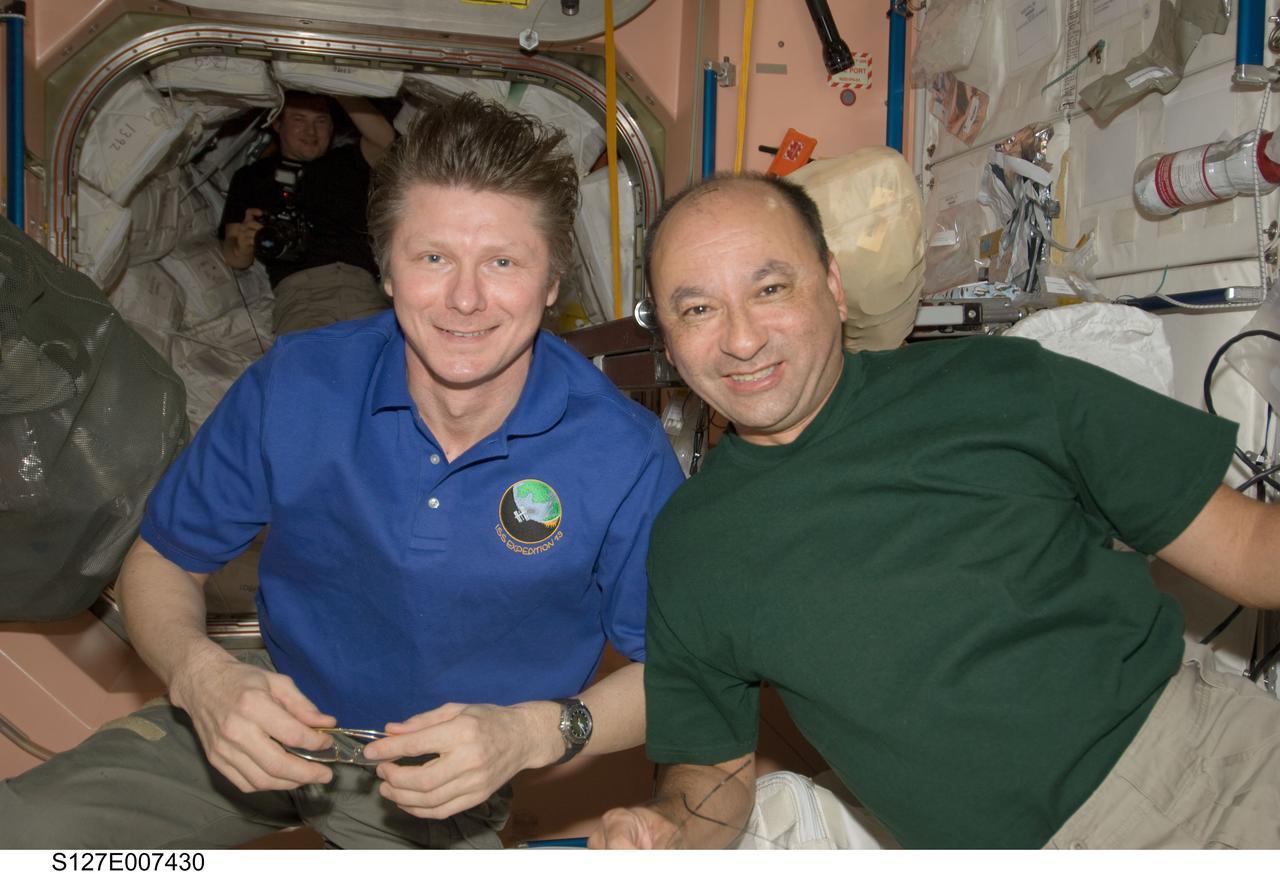
S127-E-007430 (21 July 2009) --- Astronaut Mark Polansky (right) and Russian Federal Space Agency cosmonaut Gennady Padalka take a break from a busy agenda onboard the International Space Station on the eve of the third of five spacewalks scheduled as part of more than a week's worth of joint activities for Endeavour and ISS crewmembers. Polansky is STS-127 commander, and Padalka is the station commander.
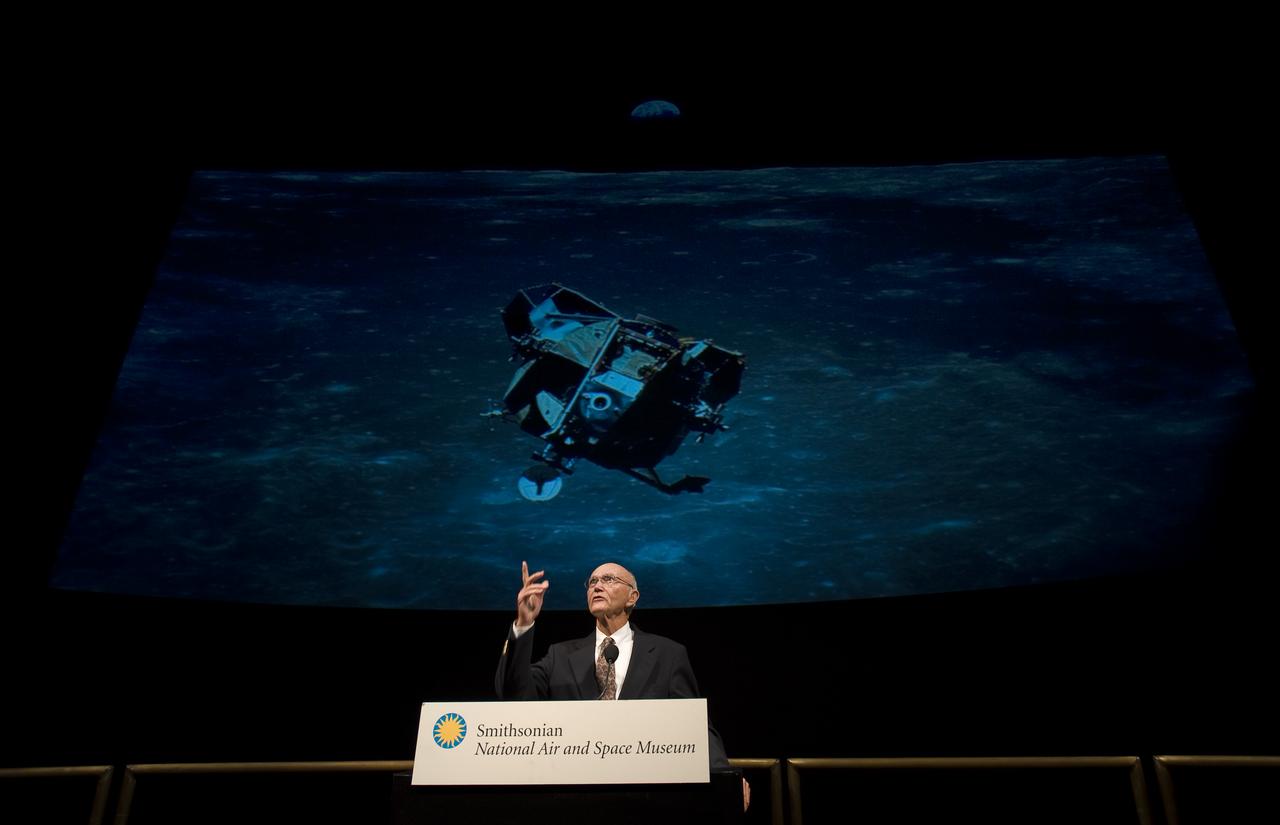
On the eve of the fortieth anniversary of Apollo 11's first human landing on the Moon, Apollo 11 crew member, Michael Collins speaks during a lecture in honor of Apollo 11 at the National Air and Space Museum in Washington, Sunday, July 19, 2009. Guest speakers included Former NASA Astronaut and U.S. Senator John Glenn, NASA Mission Control creator and former NASA Johnson Space Center director Chris Kraft and the crew of Apollo 11. Photo Credit: (NASA/Bill Ingalls)
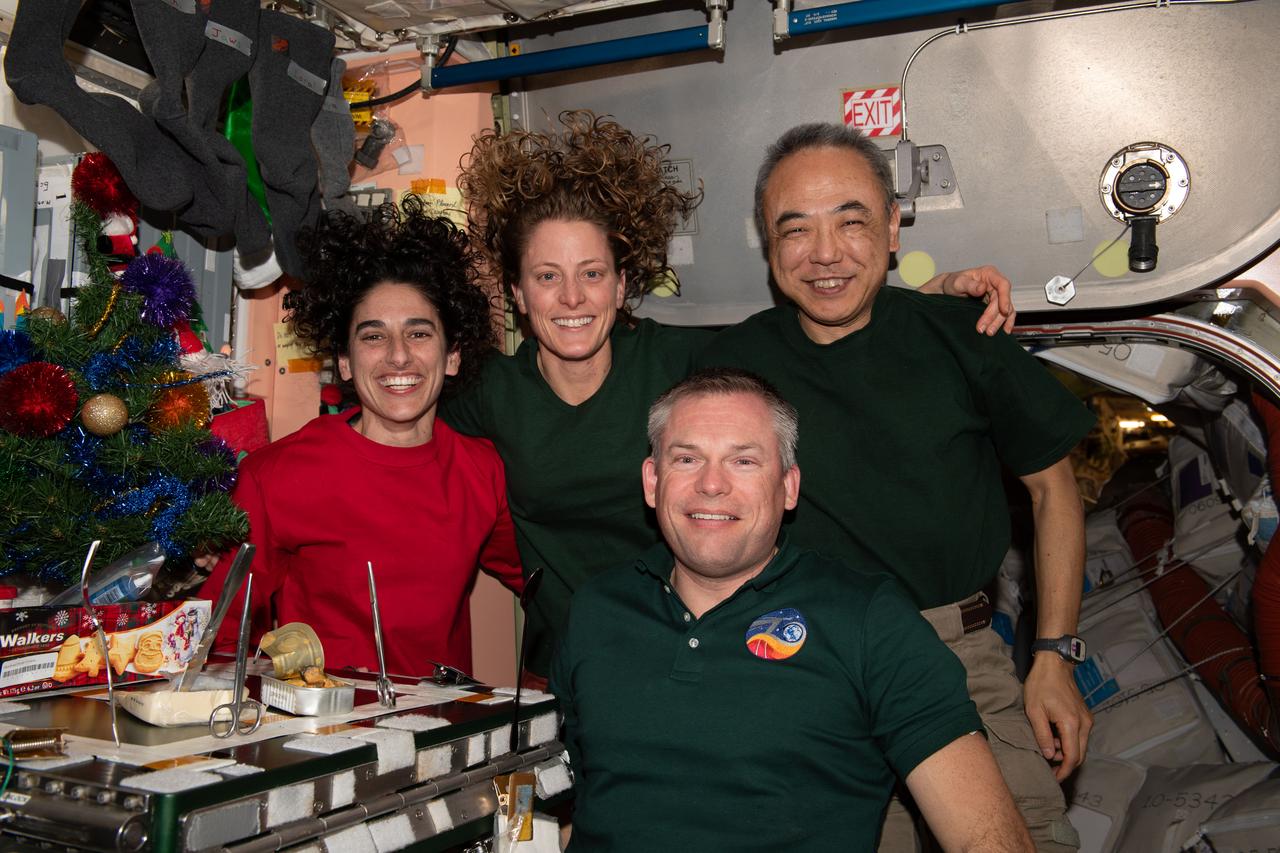
iss070e045409 (Dec. 24, 2023) --- Four Expedition 70 crewmates join each other inside the International Space Station's Unity module for a Christmas Eve portrait. Clockwise from left are, NASA Flight Engineers Jasmin Moghbeli and Loral O'Hara; Flight Engineer Koichi Wakata from JAXA (Japan Aerospace Exploration Agency); and Commander Andreas Mogensen from ESA (European Space Agency).
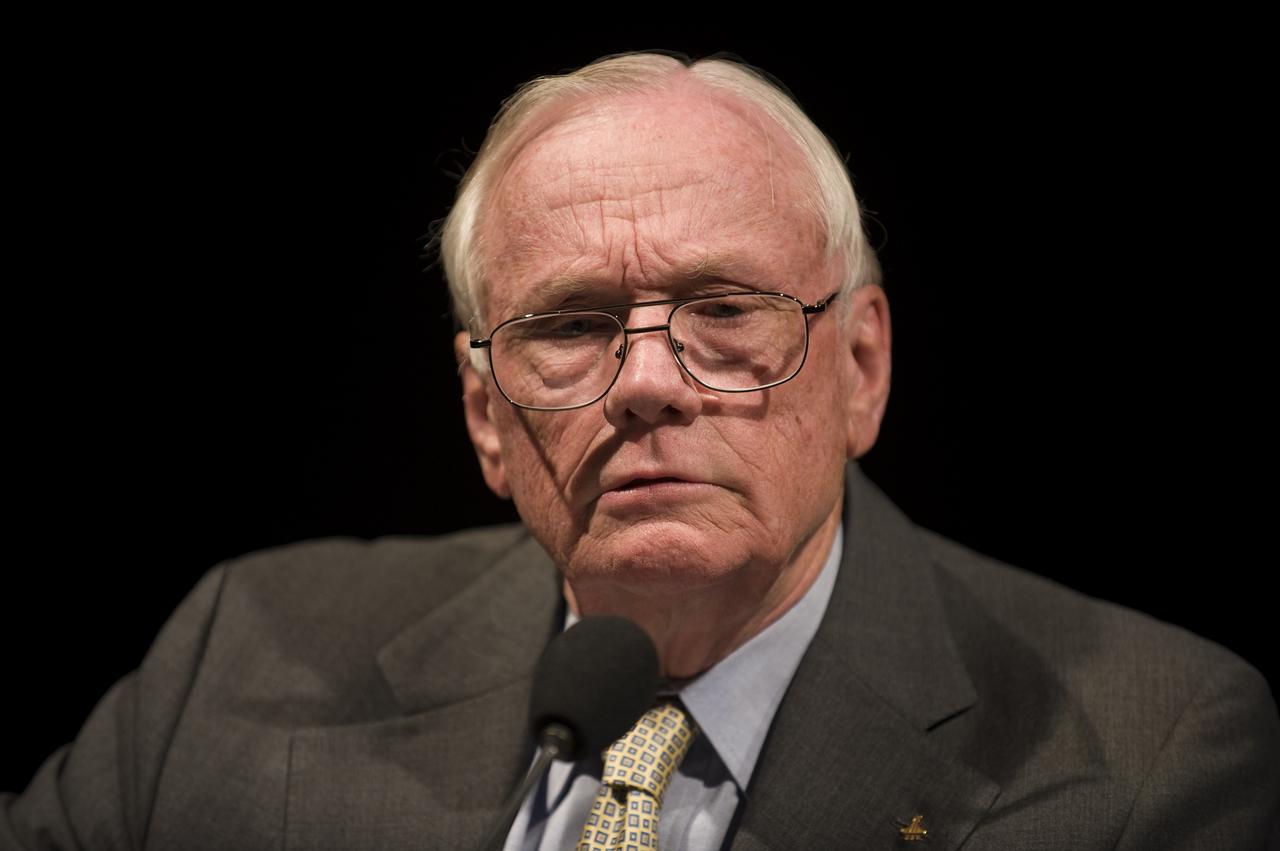
On the eve of the fortieth anniversary of the first human landing on the Moon, Apollo 11 Astronaut Neil Armstrong speaks during a lecture in honor of Apollo 11 at the National Air and Space Museum in Washington, Sunday, July 19, 2009. Guest speakers included Former NASA Astronaut and U.S. Senator John Glenn, NASA Mission Control creator and former NASA Johnson Space Center director Chris Kraft and the crew of Apollo 11. Photo Credit: (NASA/Bill Ingalls)
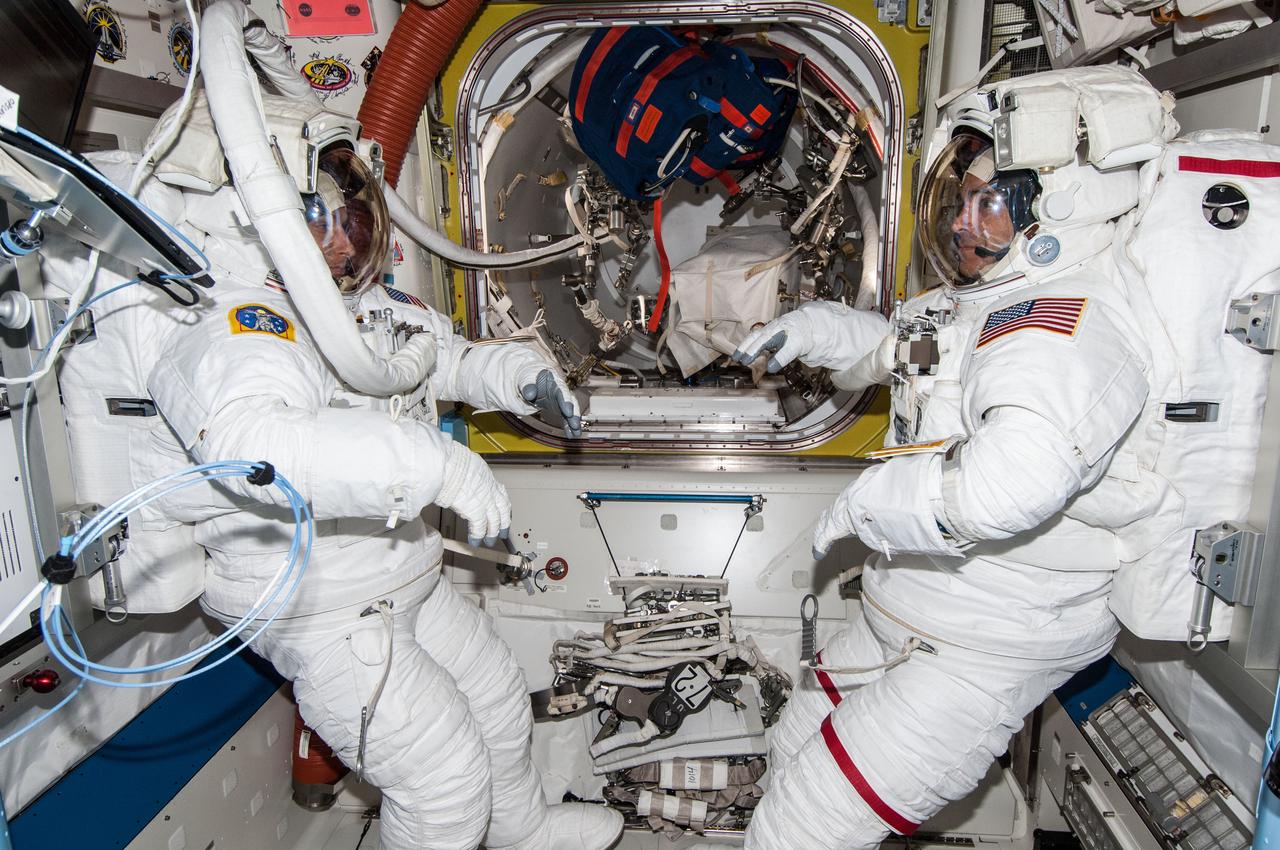
ISS038-E-019271 (20 Dec. 2013) --- In the Quest airlock onboard the Earth-orbiting International Space Station, on the eve of their first spacewalk together, NASA astronauts Rick Mastracchio, right, and Mike Hopkins are completely suited in their extravehicular mobility unit spacesuits. NASA has scheduled at least two sessions of extravehicular activity for the two flight engineers to troubleshoot a faulty coolant pump on the orbital outpost.
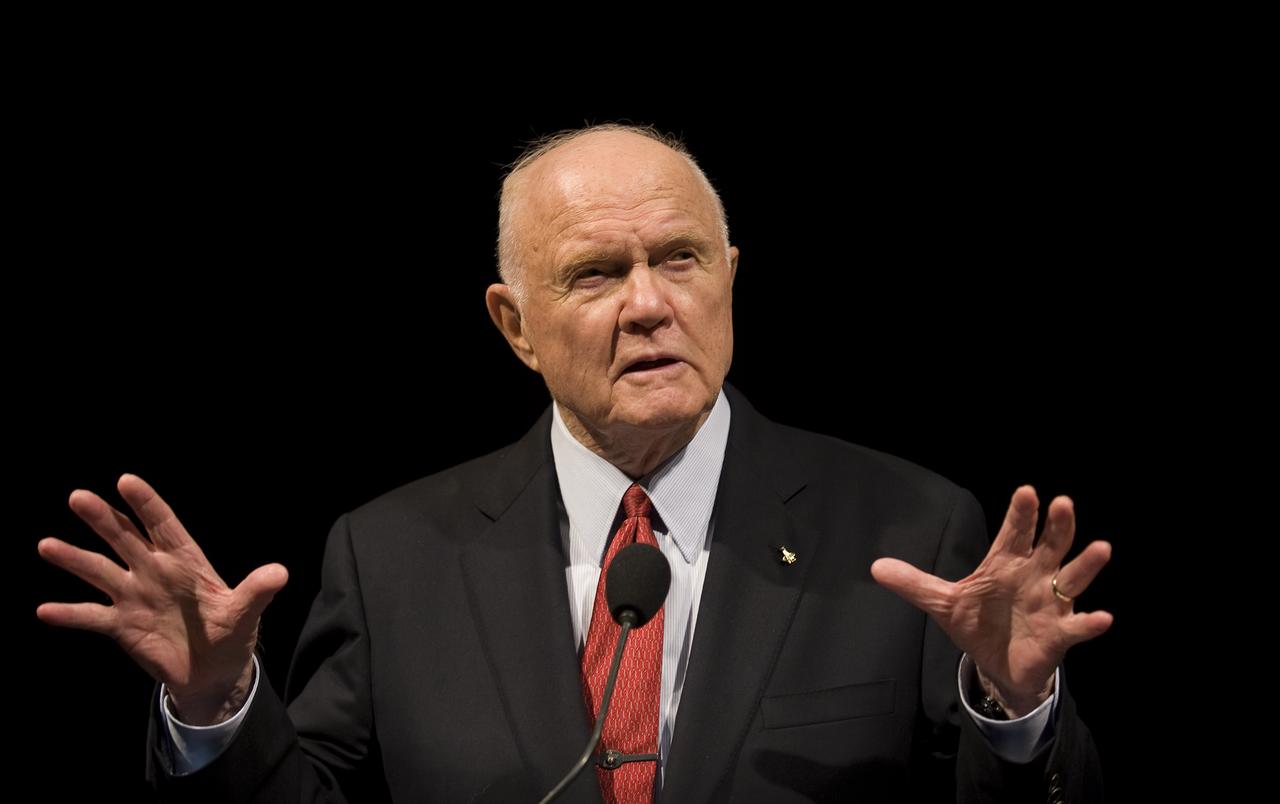
On the eve of the fortieth anniversary of Apollo 11's first human landing on the Moon, Former NASA Astronaut and U.S. Senator John Glenn speaks during a lecture in honor of Apollo 11 at the National Air and Space Museum in Washington, Sunday, July 19, 2009. Guest speakers included NASA Mission Control creator and former NASA Johnson Space Center director Chris Kraft, Apollo 11 crew members, Buzz Aldrin, Neil Armstrong, and Michael Collins. Photo Credit: (NASA/Bill Ingalls)
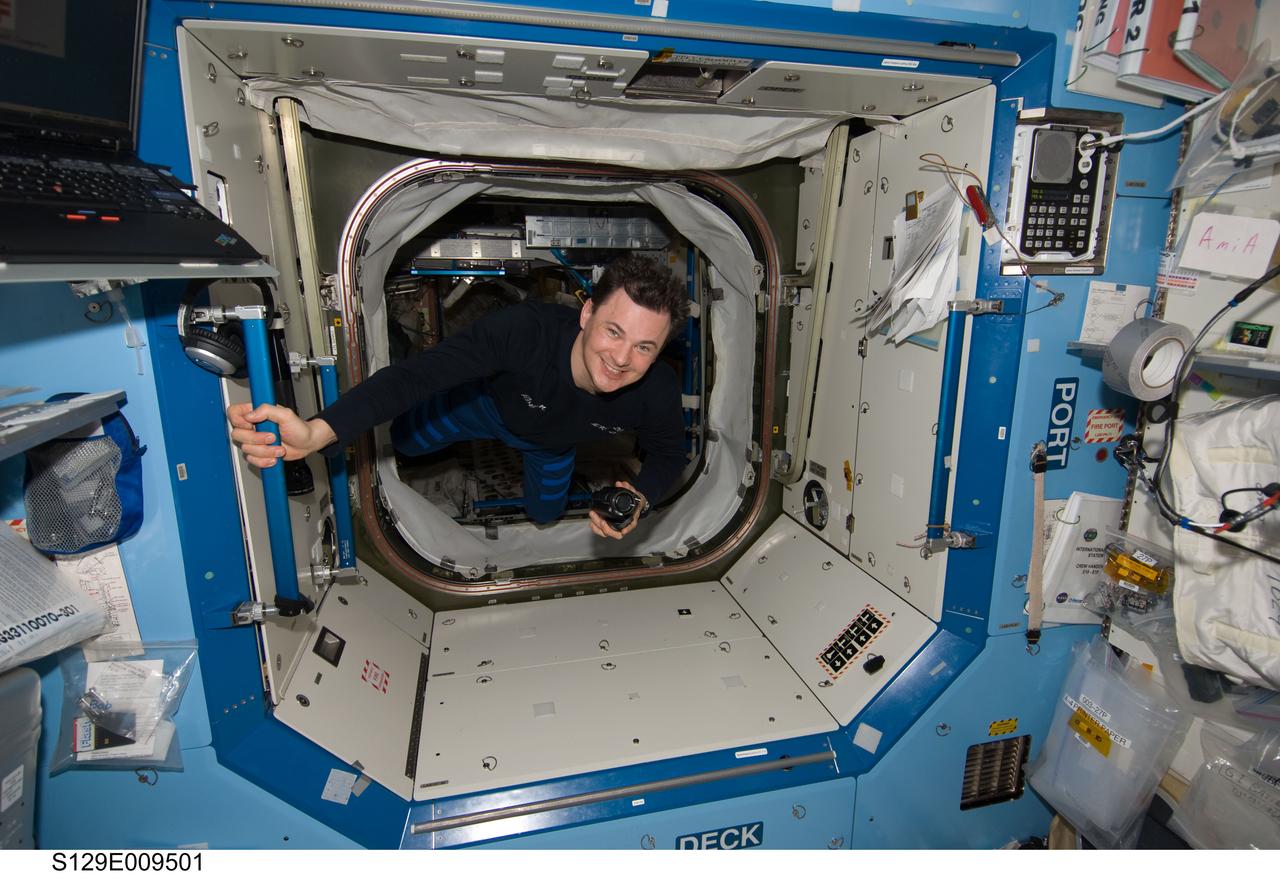
S129-E-009501 (24 Nov. 2009) --- Cosmonaut Roman Romanenko, Expedition 20/21 flight engineer, is pictured onboard the International Space Station on the eve of the undocking of the orbital outpost and the space shuttle Atlantis and the departure of the STS-129 crew. Romanenko's tenure onboard the station is winding down, also, as he is scheduled to return to Earth in less than a week onboard a Soyuz spacecraft, along with two crewmates.
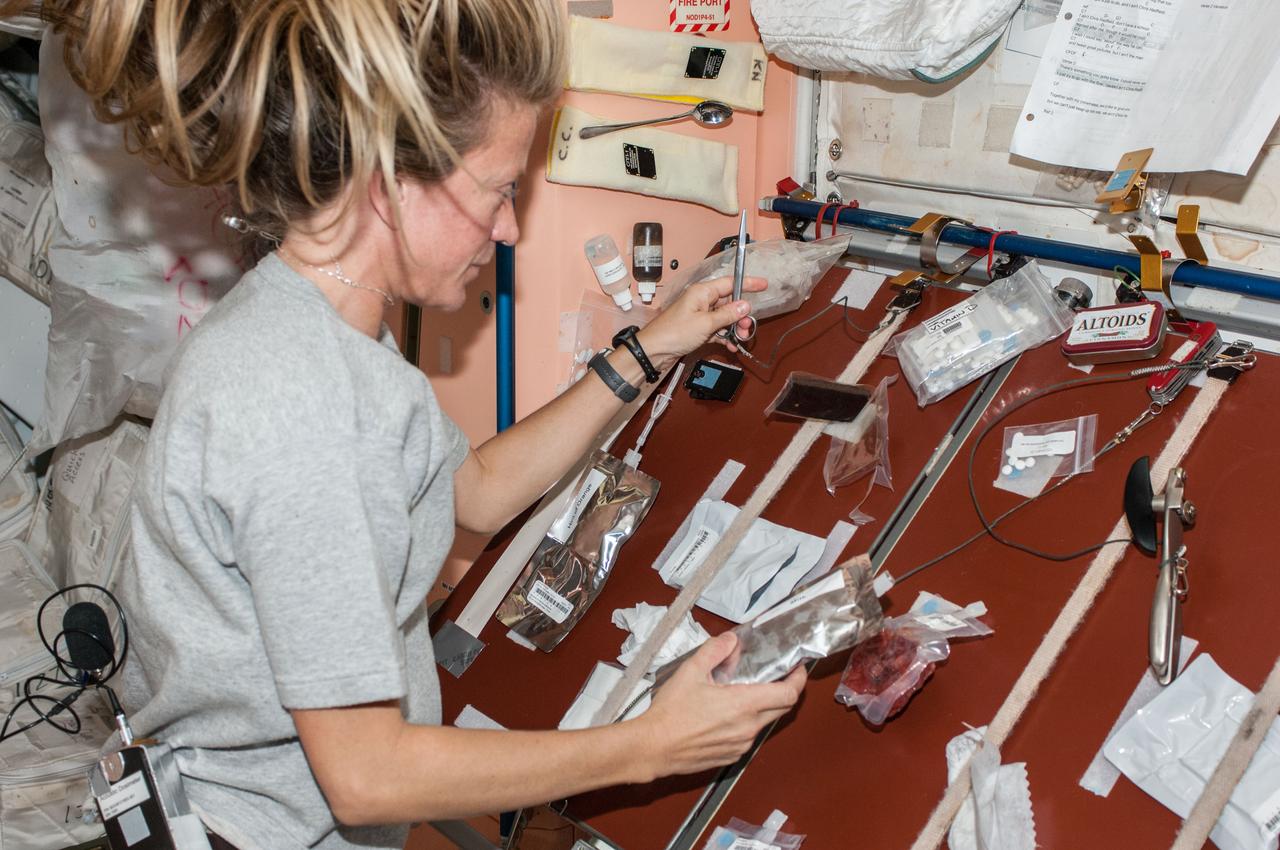
ISS036-E-008126 (14 June 2013) --- Expedition 36 Flight Engineer Karen Nyberg of NASA puts together a meal in the Unity node of the International Space Station on the eve of a special but busy day for the six person crew aboard the outpost. The European Space Agency's Automated Transfer Vehicle-4 (ATV-4) “Albert Einstein” is scheduled to dock to the orbital outpost June 15, 2013, following a ten-day period of free-flight.
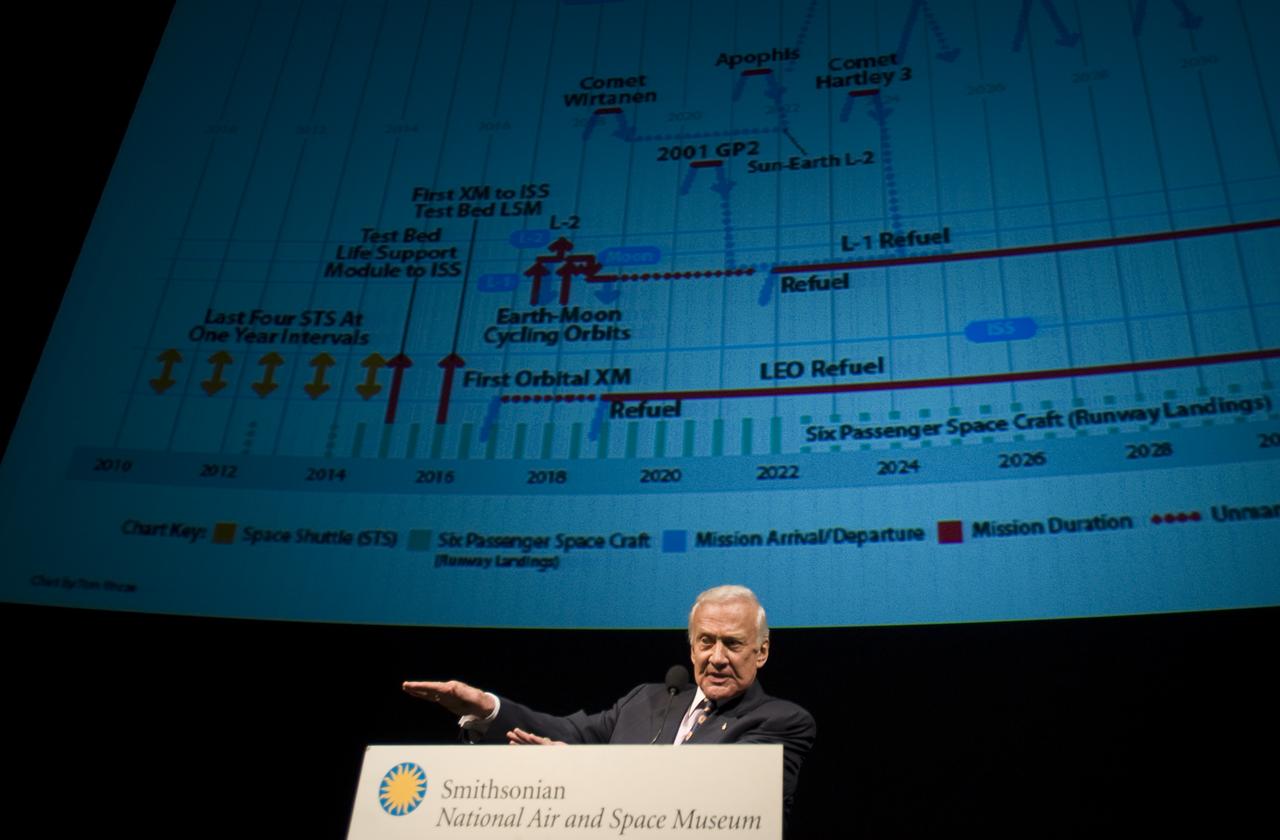
On the eve of the fortieth anniversary of Apollo 11's first human landing on the Moon, Apollo 11 crew member, Buzz Aldrin speaks during a lecture in honor of Apollo 11 at the National Air and Space Museum in Washington, Sunday, July 19, 2009. Guest speakers included Former NASA Astronaut and U.S. Senator John Glenn, NASA Mission Control creator and former NASA Johnson Space Center director Chris Kraft and the crew of Apollo 11. Photo Credit: (NASA/Bill Ingalls)
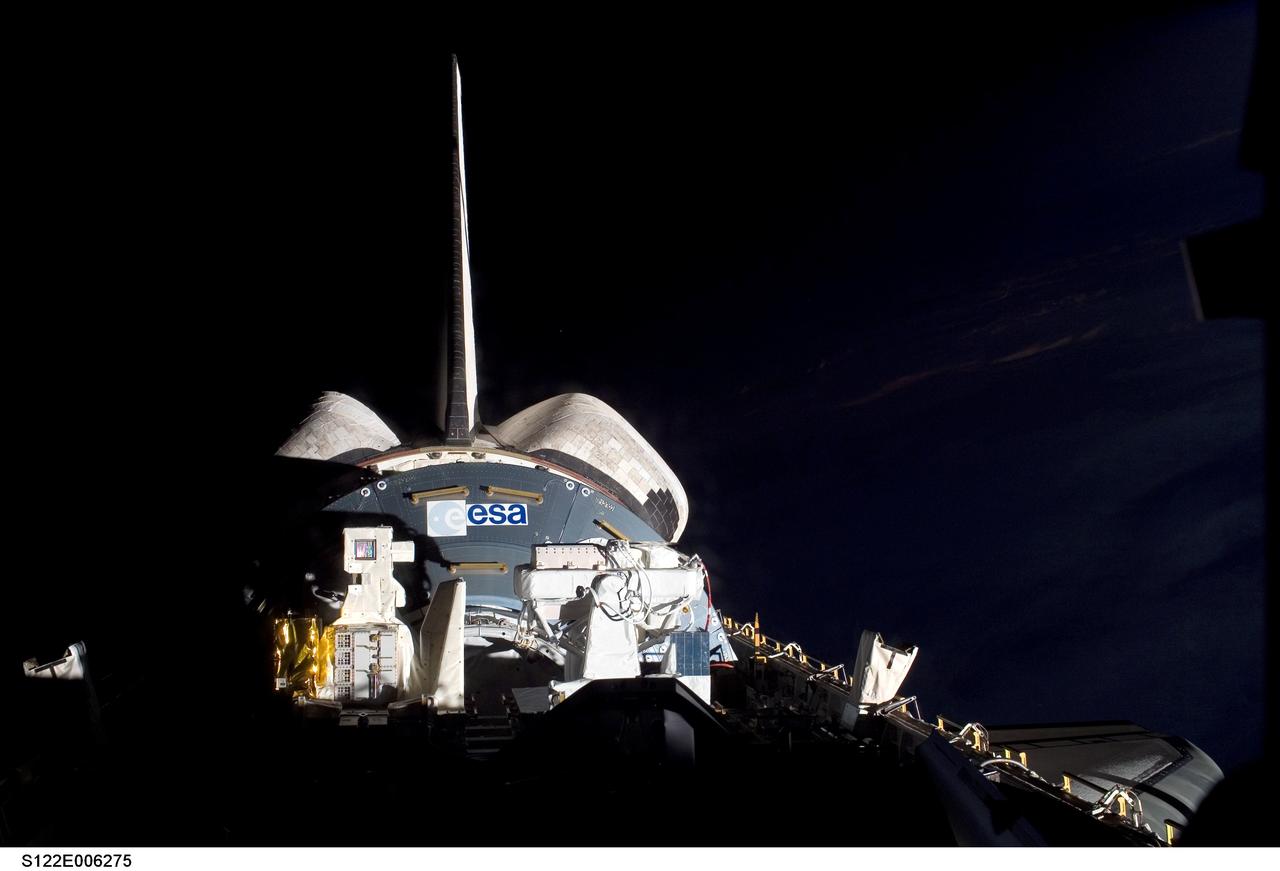
S122-E-006275 (8 Feb. 2008) --- Backdropped against the blackness of space, the European Space Agency's Columbus laboratory and associated ESA hardware sit in the aft portion of Space Shuttle Atlantis' cargo bay on the eve of the shuttle's scheduled docking to the International Space Station. The addition of Columbus to the orbital outpost is one of the primary tasks of the STS-122 mission.
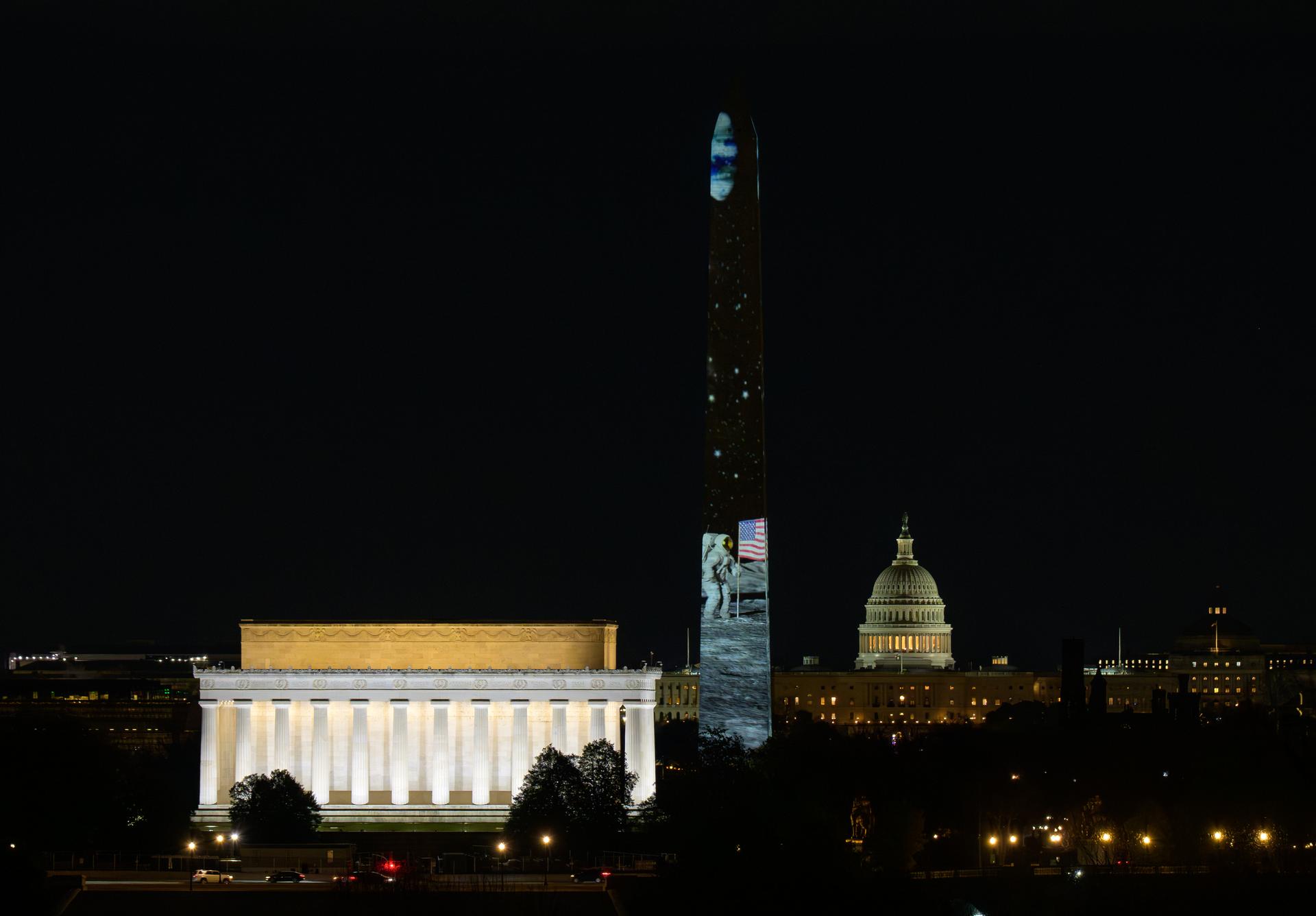
Images depicting NASA Moon missions are projected onto the Washington Monument as part of an event to kick off the nation's 250th birthday year, Wednesday, Dec. 31, 2025, in Washington. Photo Credit: (NASA/Bill Ingalls)
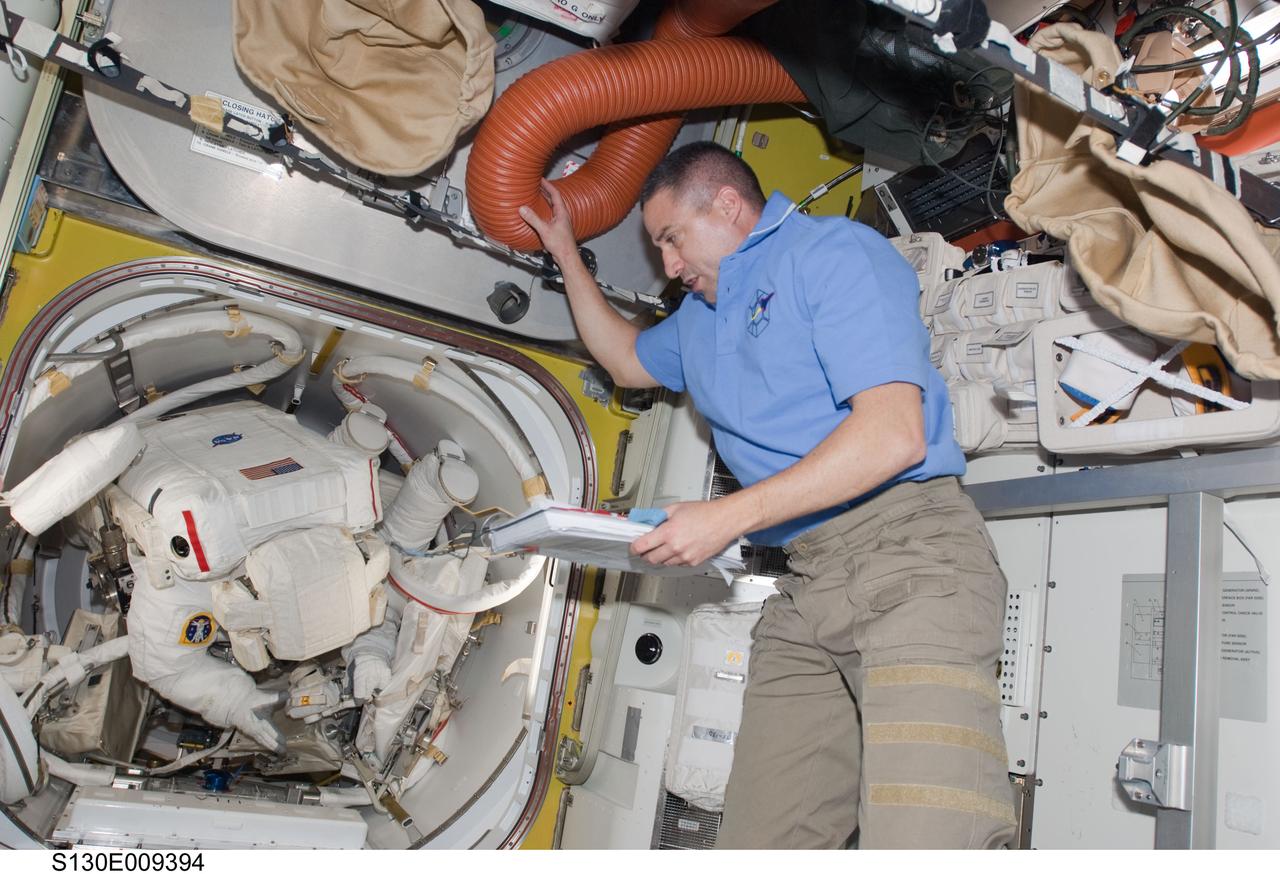
S130-E-009394 (16 Feb. 2010) --- NASA astronaut George Zamka, STS-130 commander, is pictured in the Quest airlock of the International Space Station as astronauts Robert Behnken and Nicholas Patrick, both mission specialists, prepare to exit the airlock to begin the mission’s third and final session of extravehicular activity (EVA).
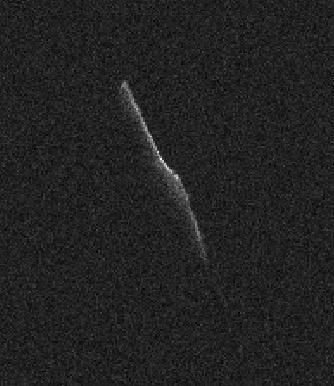
The elongated asteroid in this radar image, named 2003 SD220, will safely fly past Earth on Thursday, Dec. 24, 2015, at a distance of 6.8 million miles (11 million kilometers). The image was taken on Dec. 22 by scientists using NASA's 230-foot (70-meter) Deep Space Network antenna at Goldstone, California, when the asteroid was approaching its flyby distance. This asteroid is at least 3,600 feet (1,100 meters) long. In 2018, it will safely pass Earth at a distance of 1.8 million miles (2.8 million kilometers). http://photojournal.jpl.nasa.gov/catalog/PIA20280
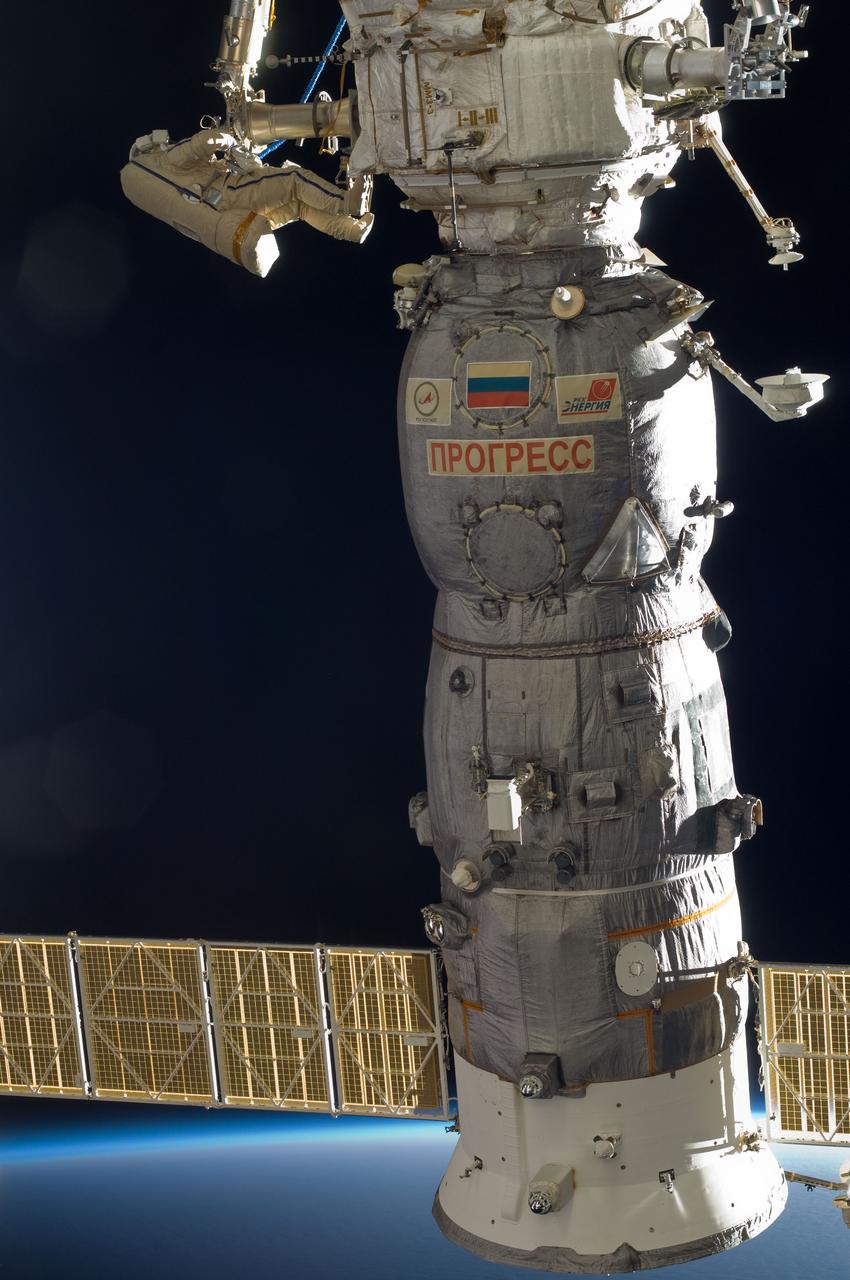
ISS028-E-020969 (3 Aug. 2011) --- Russian cosmonauts Sergei Volkov and Alexander Samokutyaev (out of frame), both Expedition 28 flight engineers, attired in Russian Orlan spacesuits, participate in a session of extravehicular activity (EVA) on the Russian segment of the International Space Station. During the six-hour, 23-minute spacewalk, Volkov and Samokutyaev moved a cargo boom from one airlock to another, installed a prototype laser communications system and deployed an amateur radio micro-satellite.
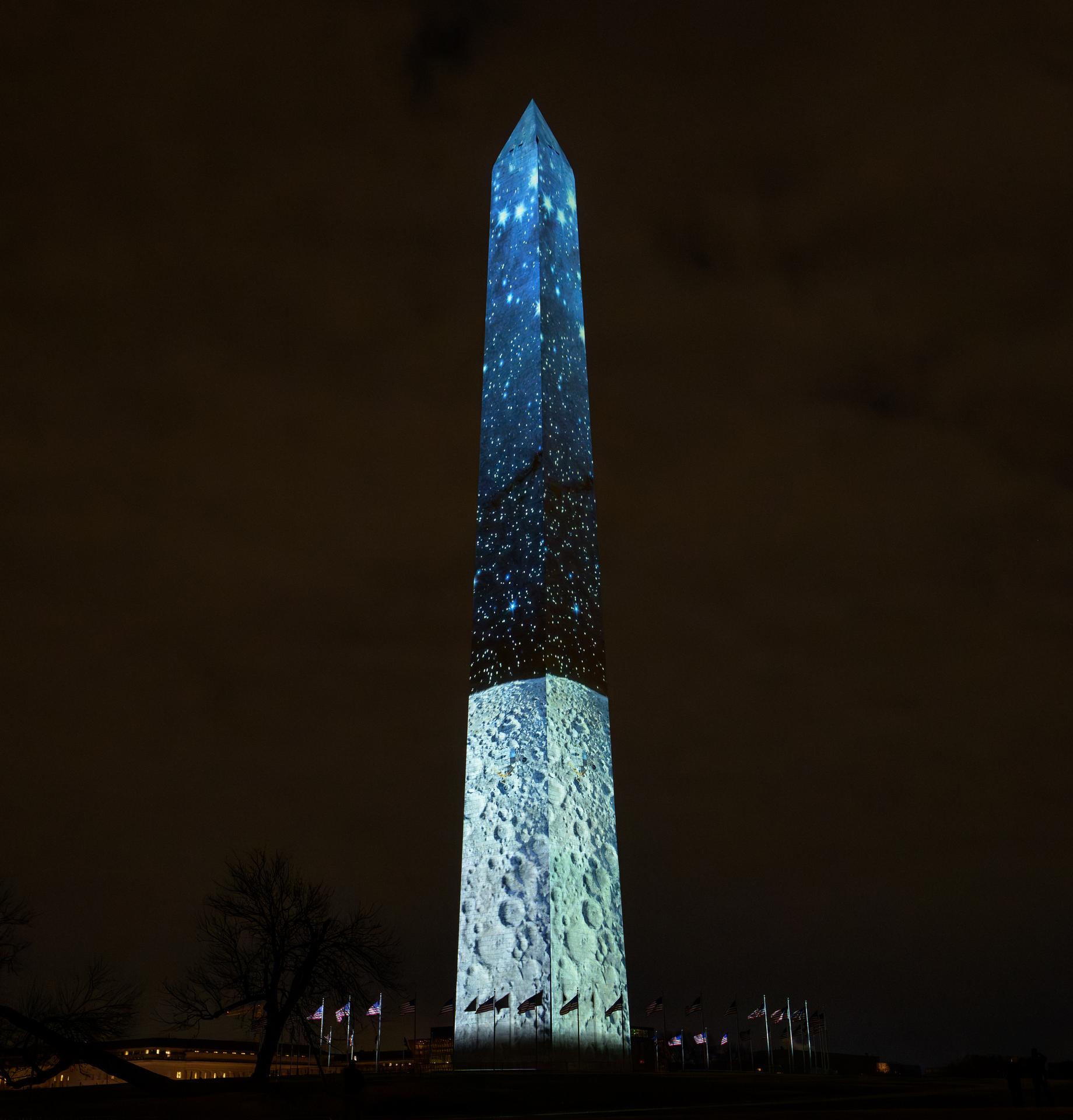
Images depicting NASA Moon missions are projected onto the Washington Monument as part of an event to kick off the nation's 250th birthday year, Wednesday, Dec. 31, 2025, in Washington. Photo Credit: (NASA/Bill Ingalls)
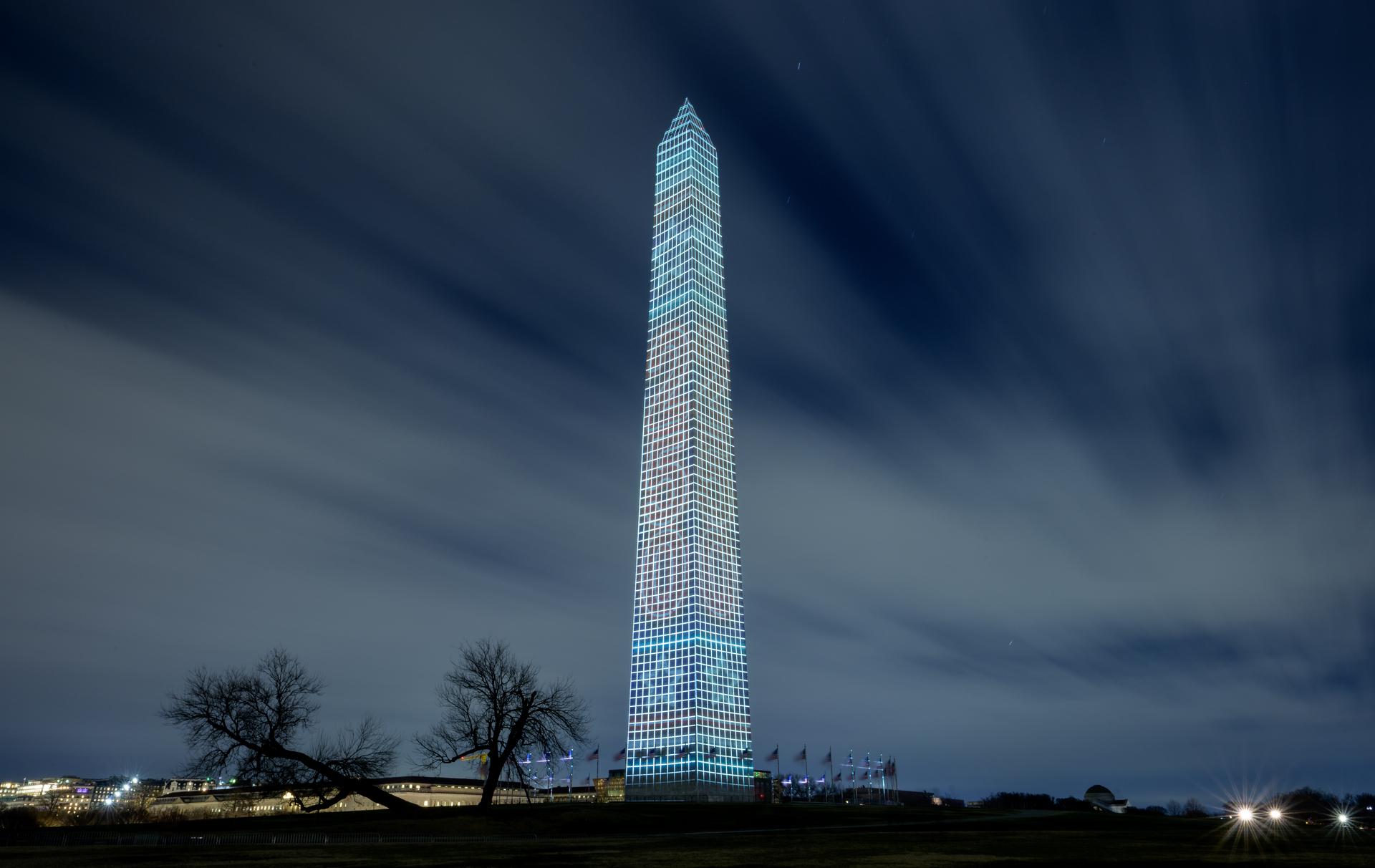
The Washington Monument is seen lit in this long exposure photograph as part of an event to kick off the nation's 250th birthday year, Wednesday, Dec. 31, 2025, in Washington. Photo Credit: (NASA/Bill Ingalls)
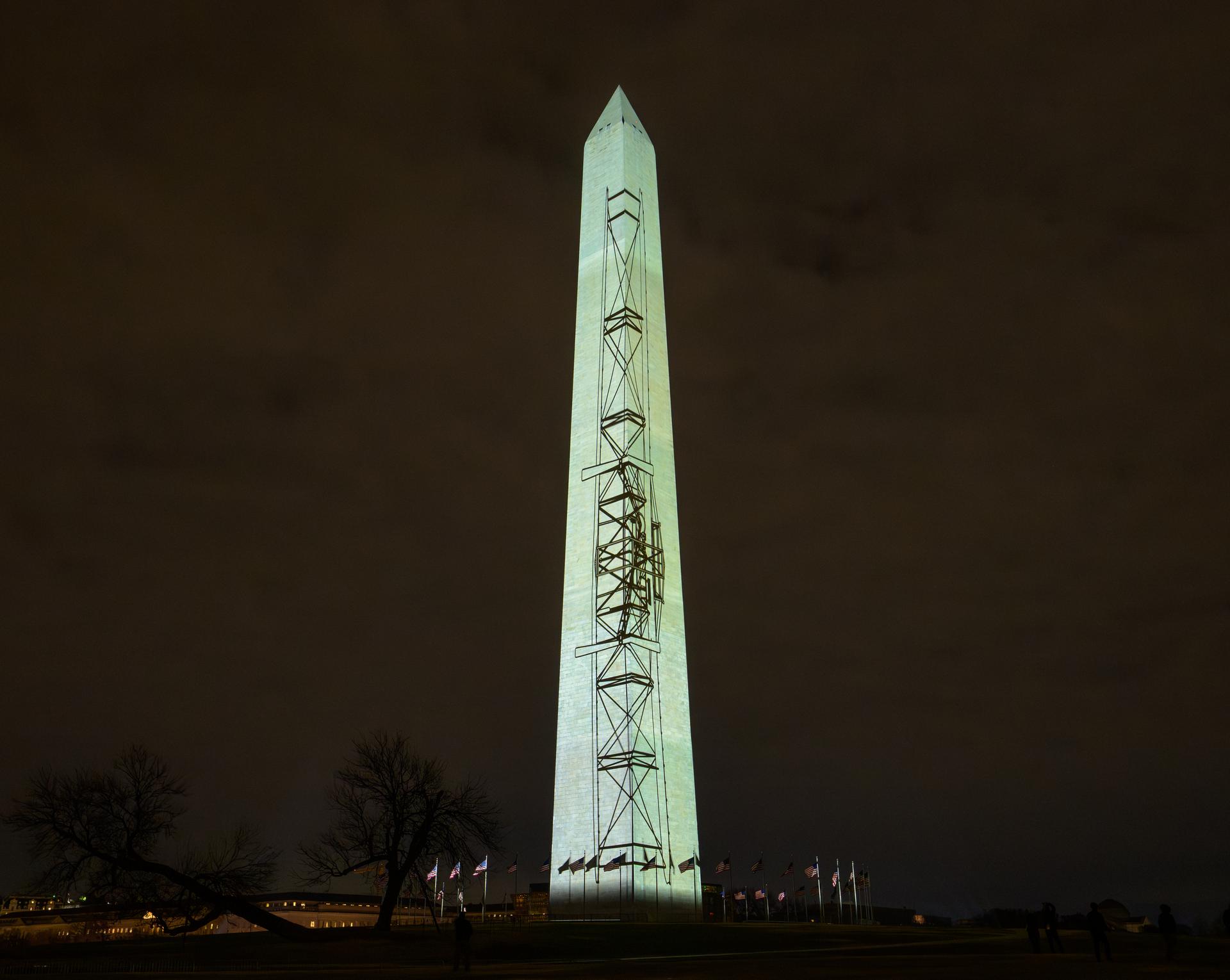
Images depicting the Wright brothers aircraft are projected onto the Washington Monument as part of an event to kick off the nation's 250th birthday year, Wednesday, Dec. 31, 2025, in Washington. Photo Credit: (NASA/Bill Ingalls)