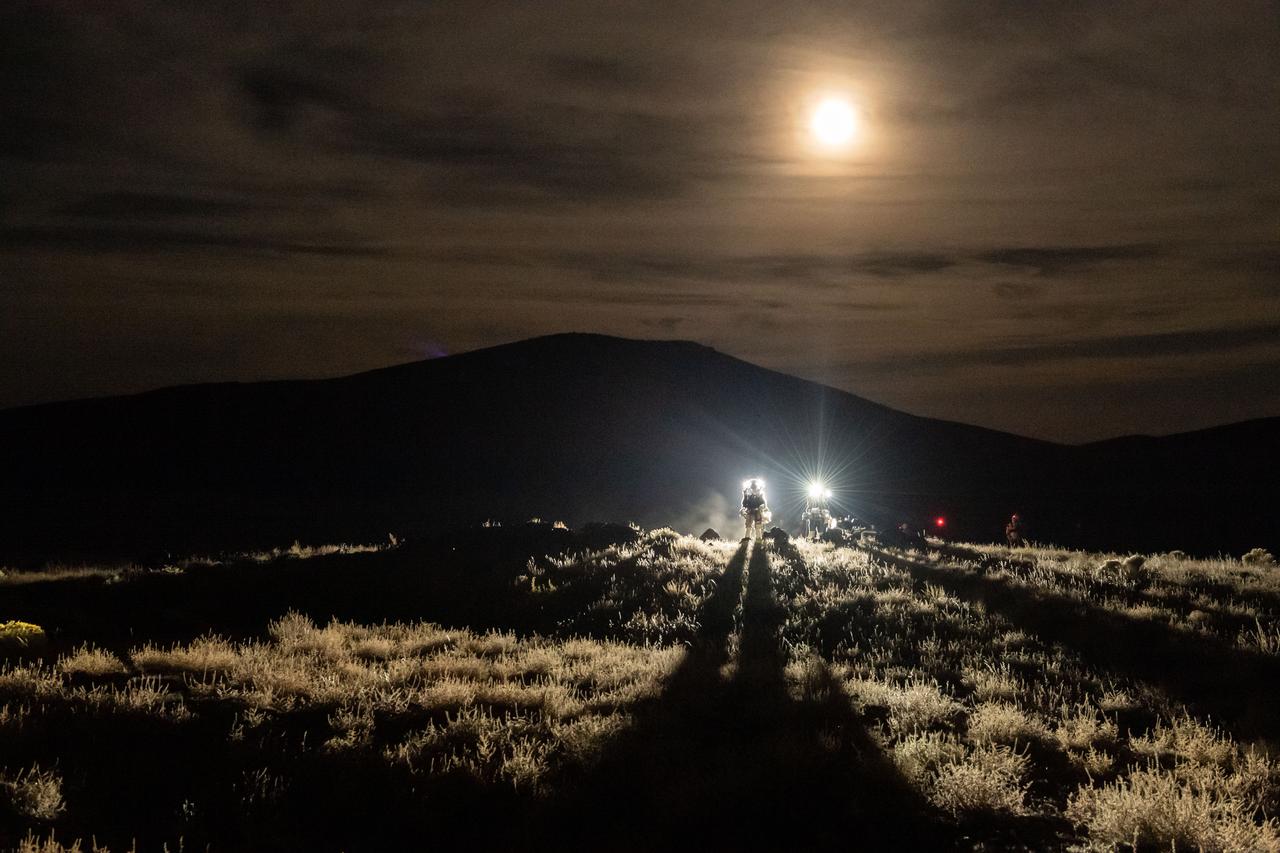
PHOTO DATE: 10-20-21 LOCATION: Flagstaff, Arizona - Field Location SUBJECT: Photographic support and coverage of night field evaluation. EVA Test #1 PHOTOGRAPHER: BILL STAFFORD
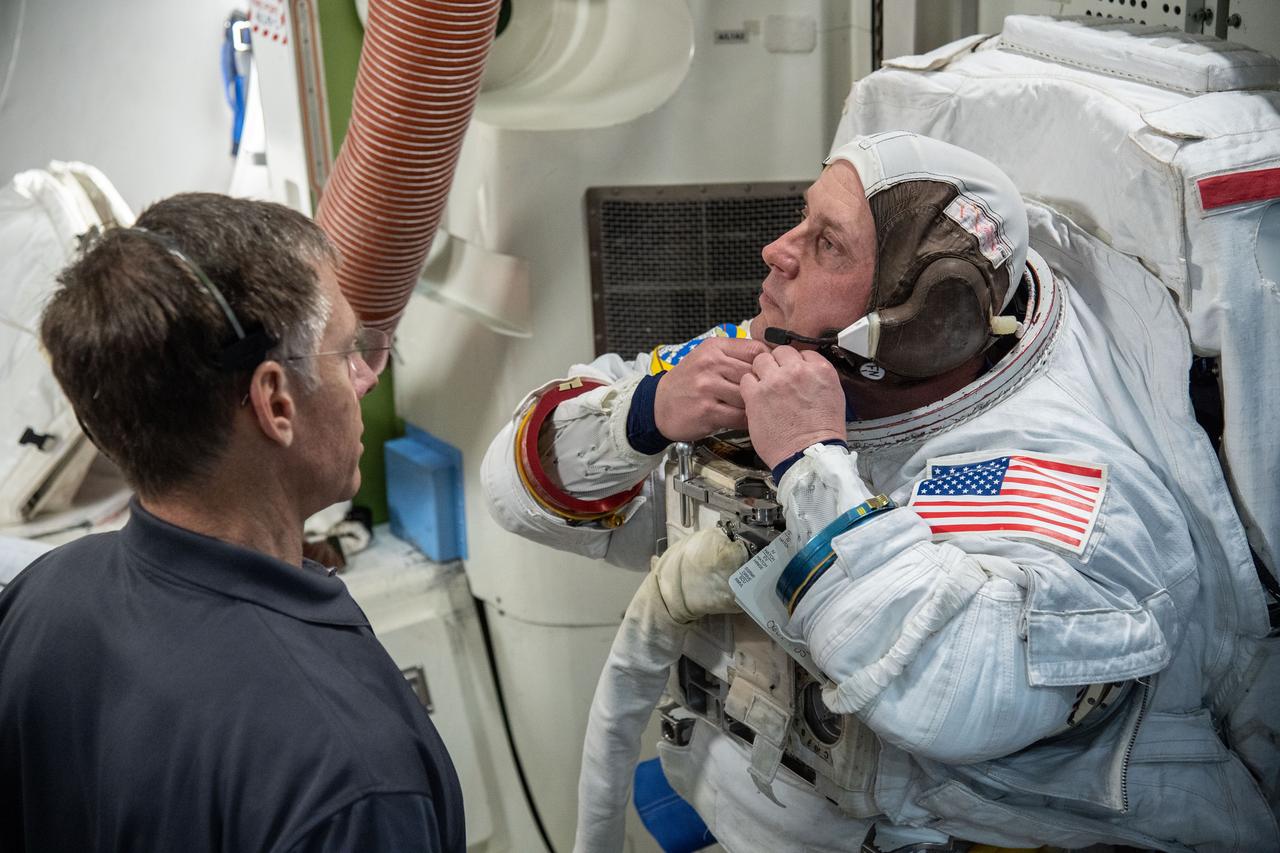
Boeing Crew Flight Test (CFT) with NASA astronauts Mike Fincke and Nicole Mann and Boeing Astronaut Chris Ferguson during ISS EVA Prep & Post 1 training.
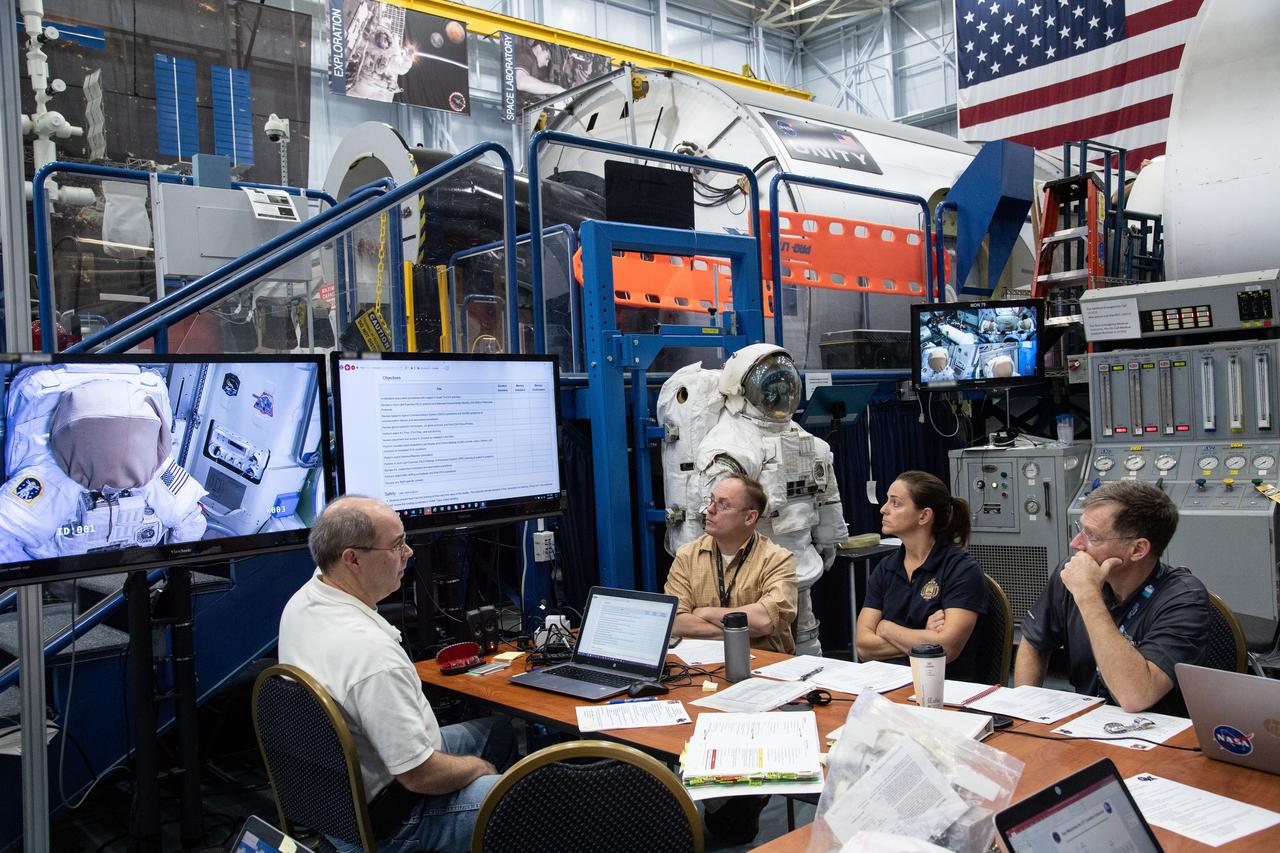
Boeing Crew Flight Test (CFT) with NASA astronauts Mike Fincke and Nicole Mann and Boeing Astronaut Chris Ferguson during ISS EVA Prep & Post 1 training.
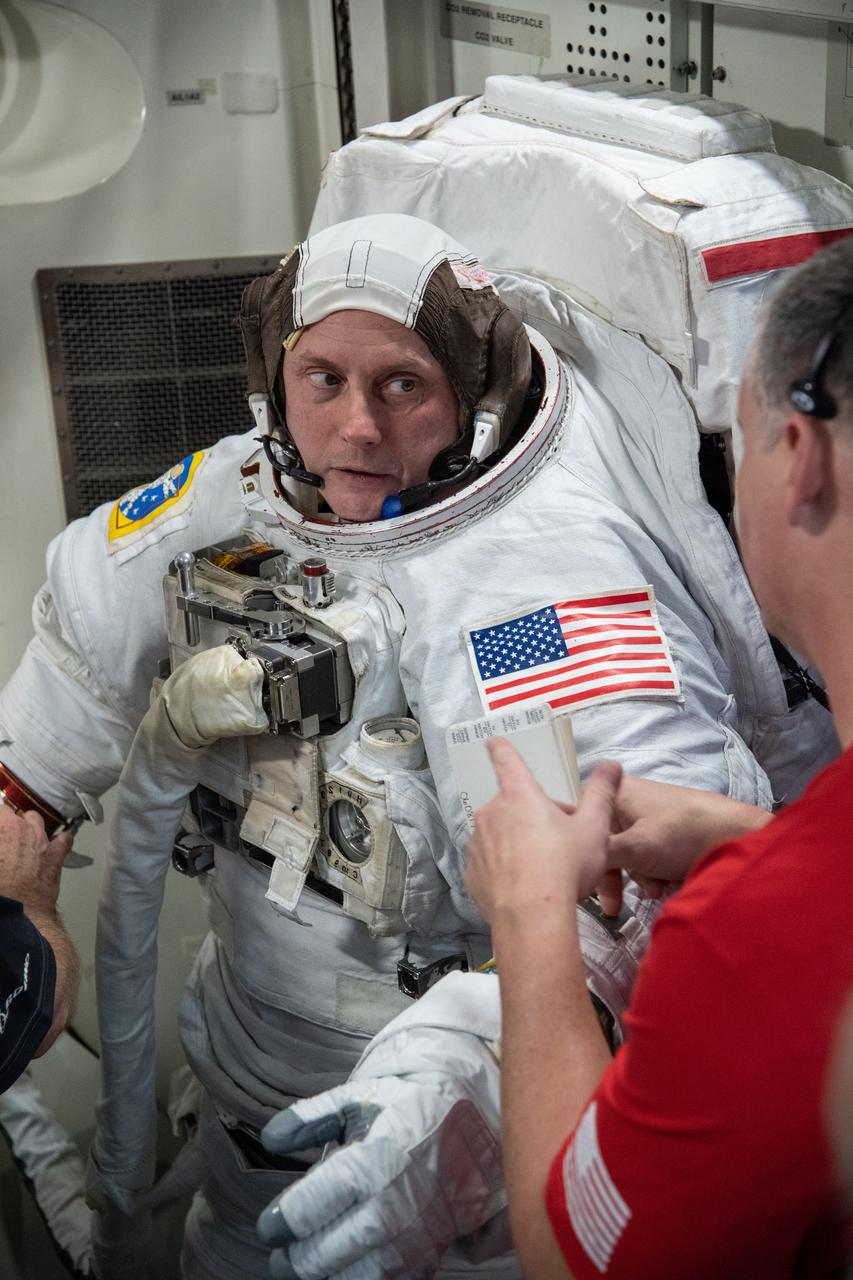
Boeing Crew Flight Test (CFT) with NASA astronauts Mike Fincke and Nicole Mann and Boeing Astronaut Chris Ferguson during ISS EVA Prep & Post 1 training.
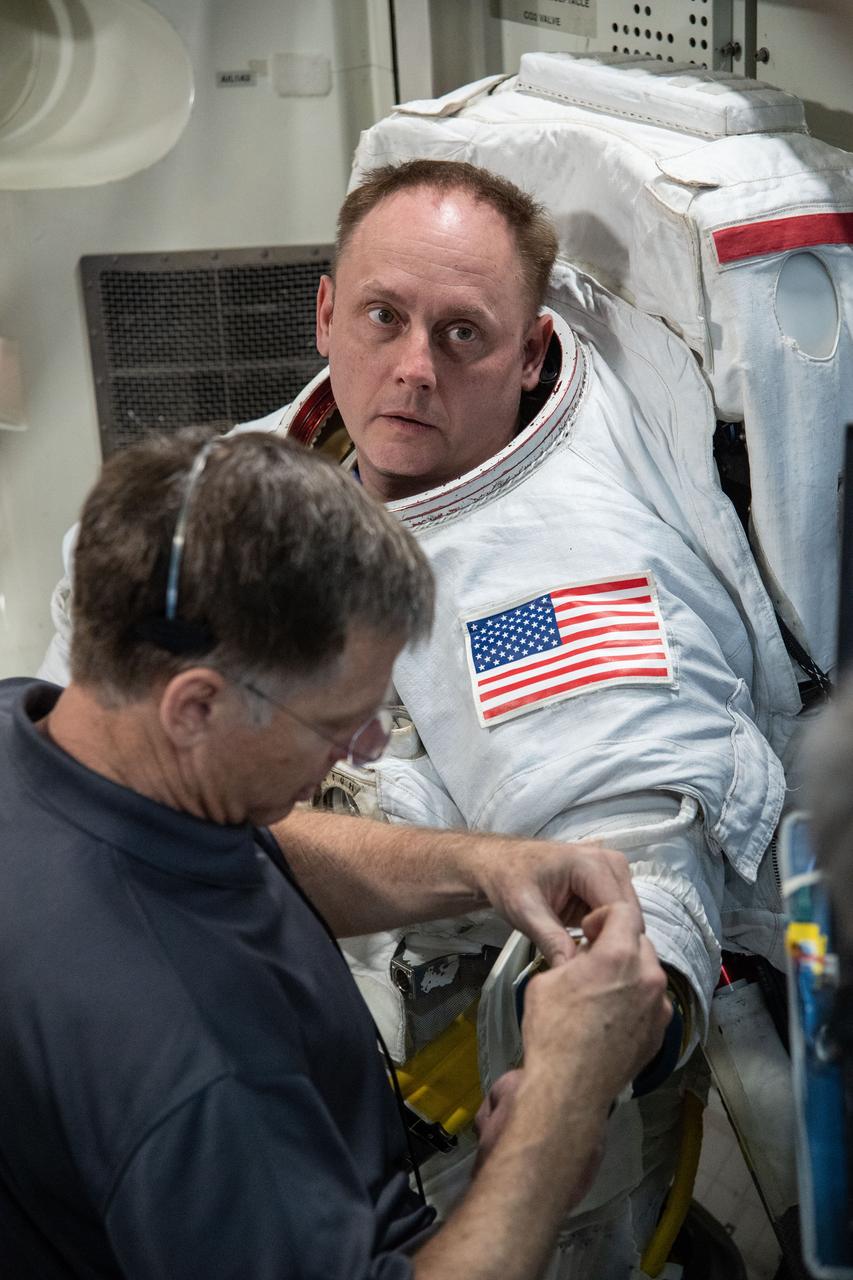
Boeing Crew Flight Test (CFT) with NASA astronauts Mike Fincke and Nicole Mann and Boeing Astronaut Chris Ferguson during ISS EVA Prep & Post 1 training.
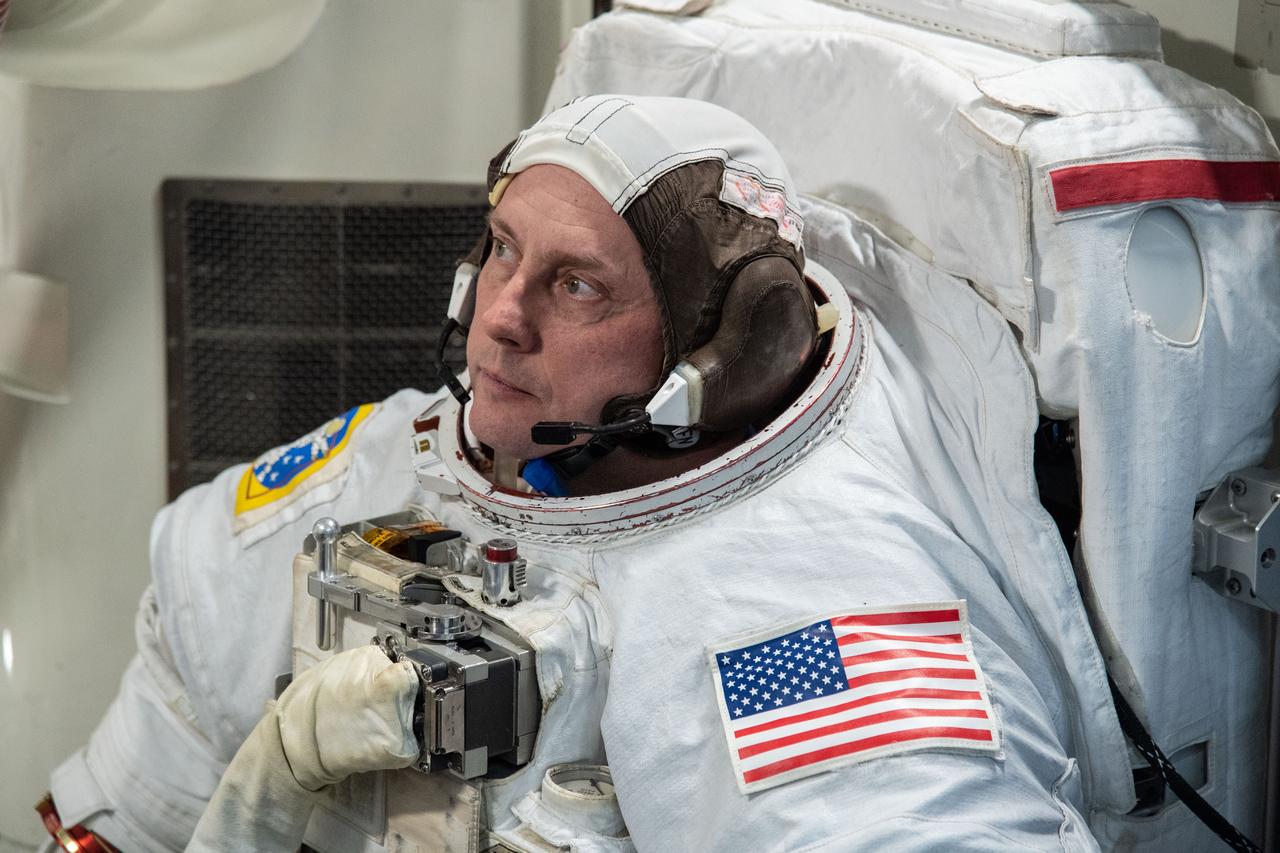
Boeing Crew Flight Test (CFT) with NASA astronauts Mike Fincke and Nicole Mann and Boeing Astronaut Chris Ferguson during ISS EVA Prep & Post 1 training.
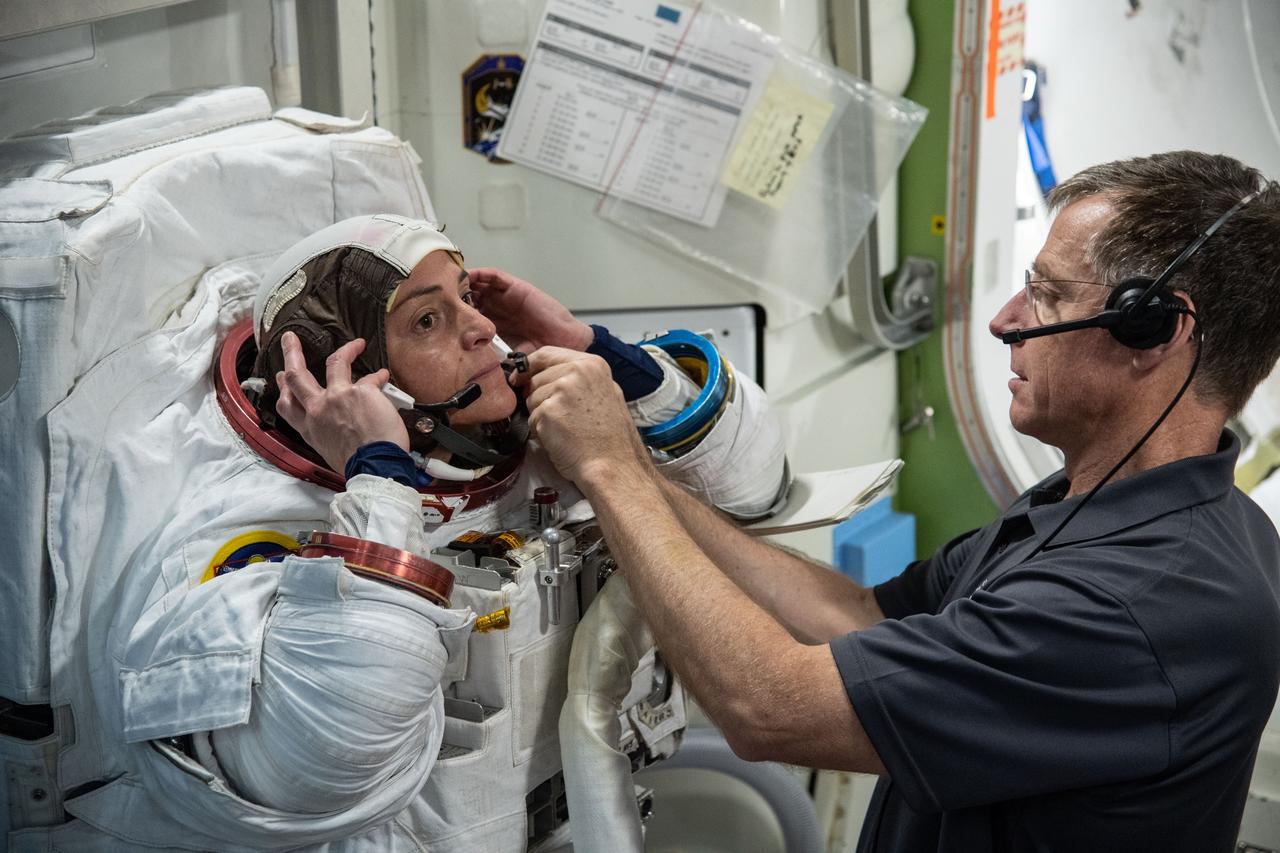
Boeing Crew Flight Test (CFT) with NASA astronauts Mike Fincke and Nicole Mann and Boeing Astronaut Chris Ferguson during ISS EVA Prep & Post 1 training.
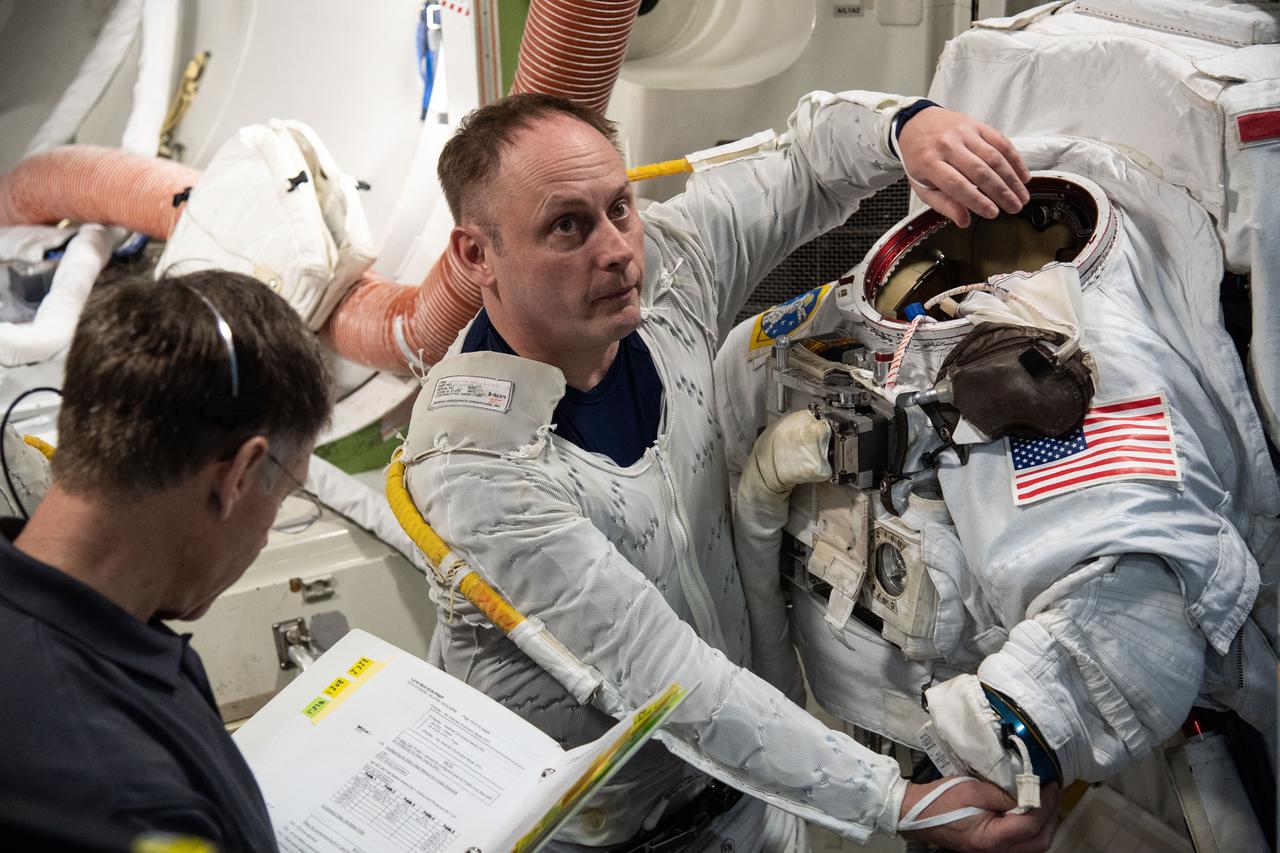
Boeing Crew Flight Test (CFT) with NASA astronauts Mike Fincke and Nicole Mann and Boeing Astronaut Chris Ferguson during ISS EVA Prep & Post 1 training.
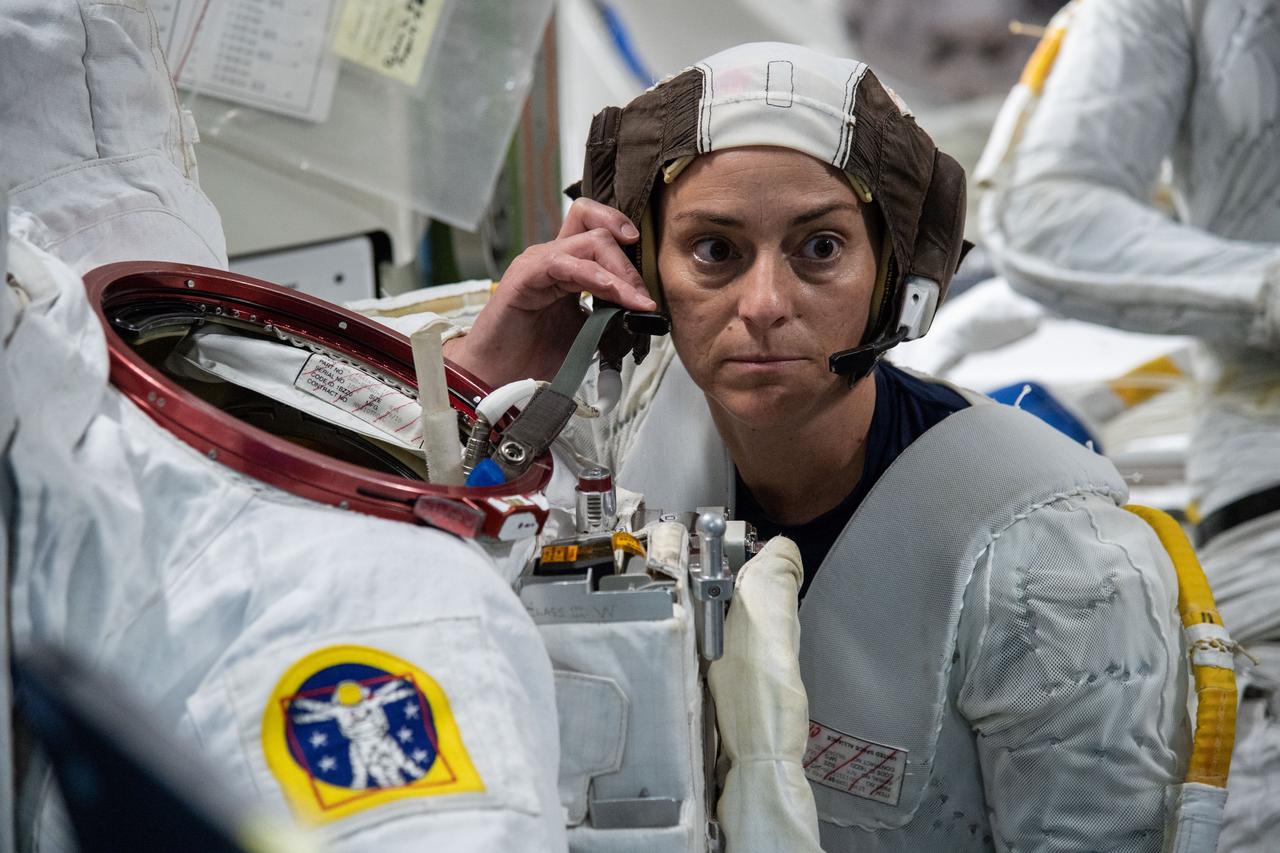
Boeing Crew Flight Test (CFT) with NASA astronauts Mike Fincke and Nicole Mann and Boeing Astronaut Chris Ferguson during ISS EVA Prep & Post 1 training.
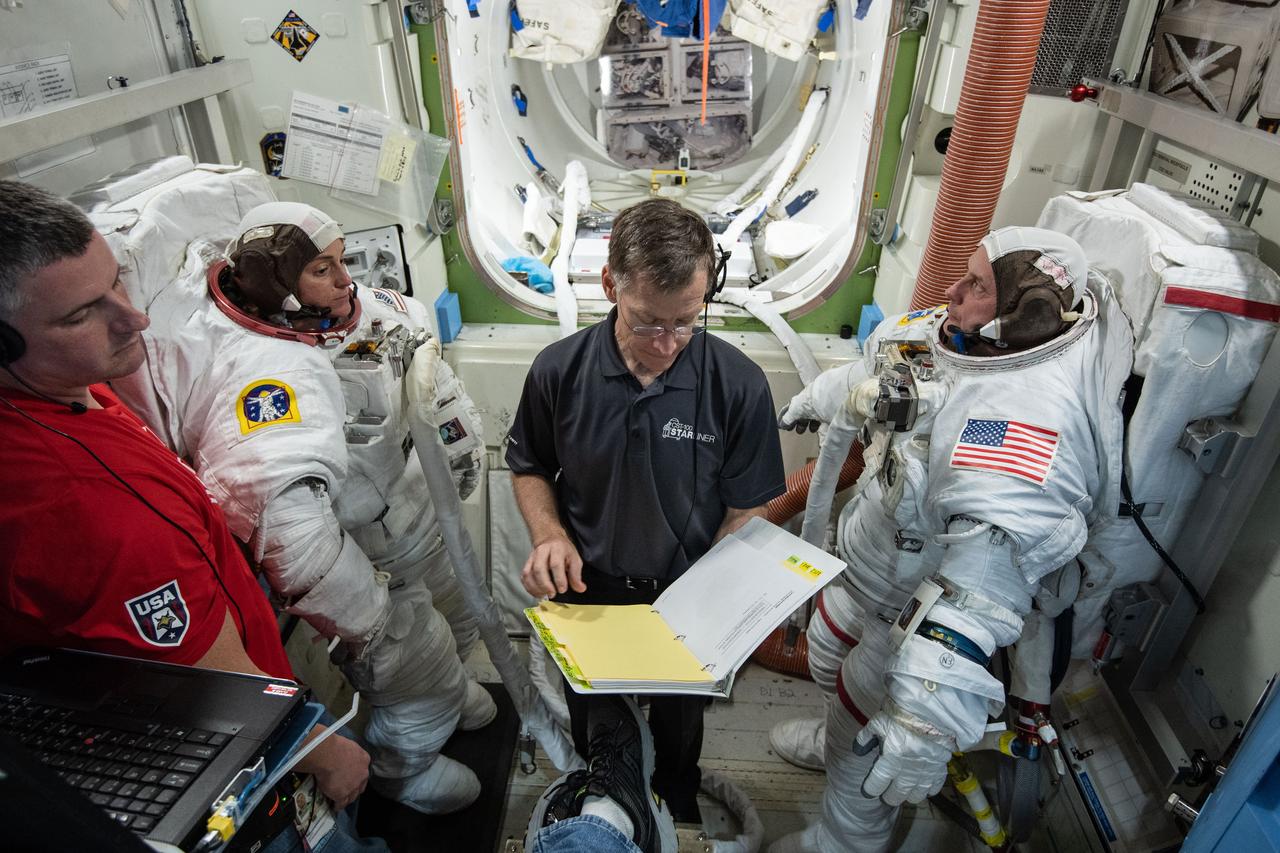
Boeing Crew Flight Test (CFT) with NASA astronauts Mike Fincke and Nicole Mann and Boeing Astronaut Chris Ferguson during ISS EVA Prep & Post 1 training.
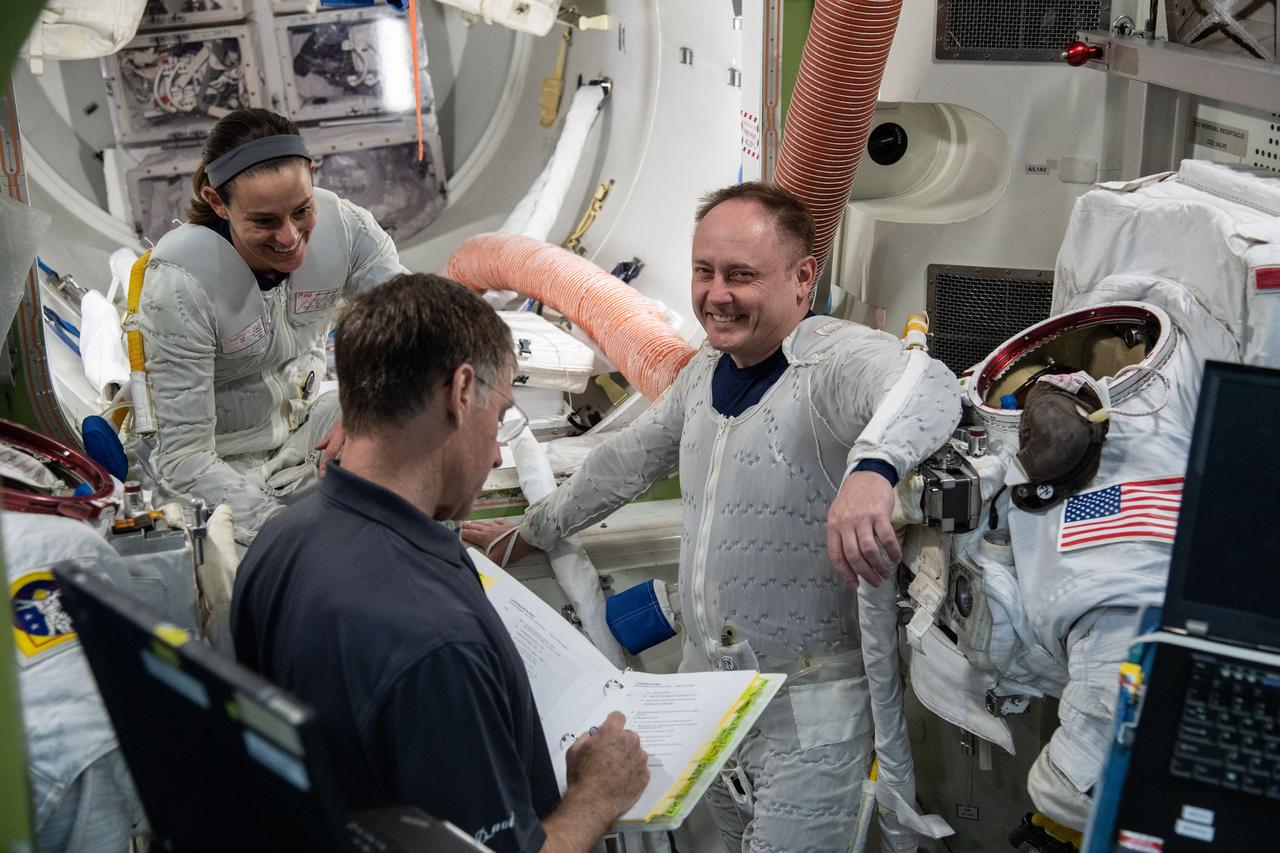
Boeing Crew Flight Test (CFT) with NASA astronauts Mike Fincke and Nicole Mann and Boeing Astronaut Chris Ferguson during ISS EVA Prep & Post 1 training.
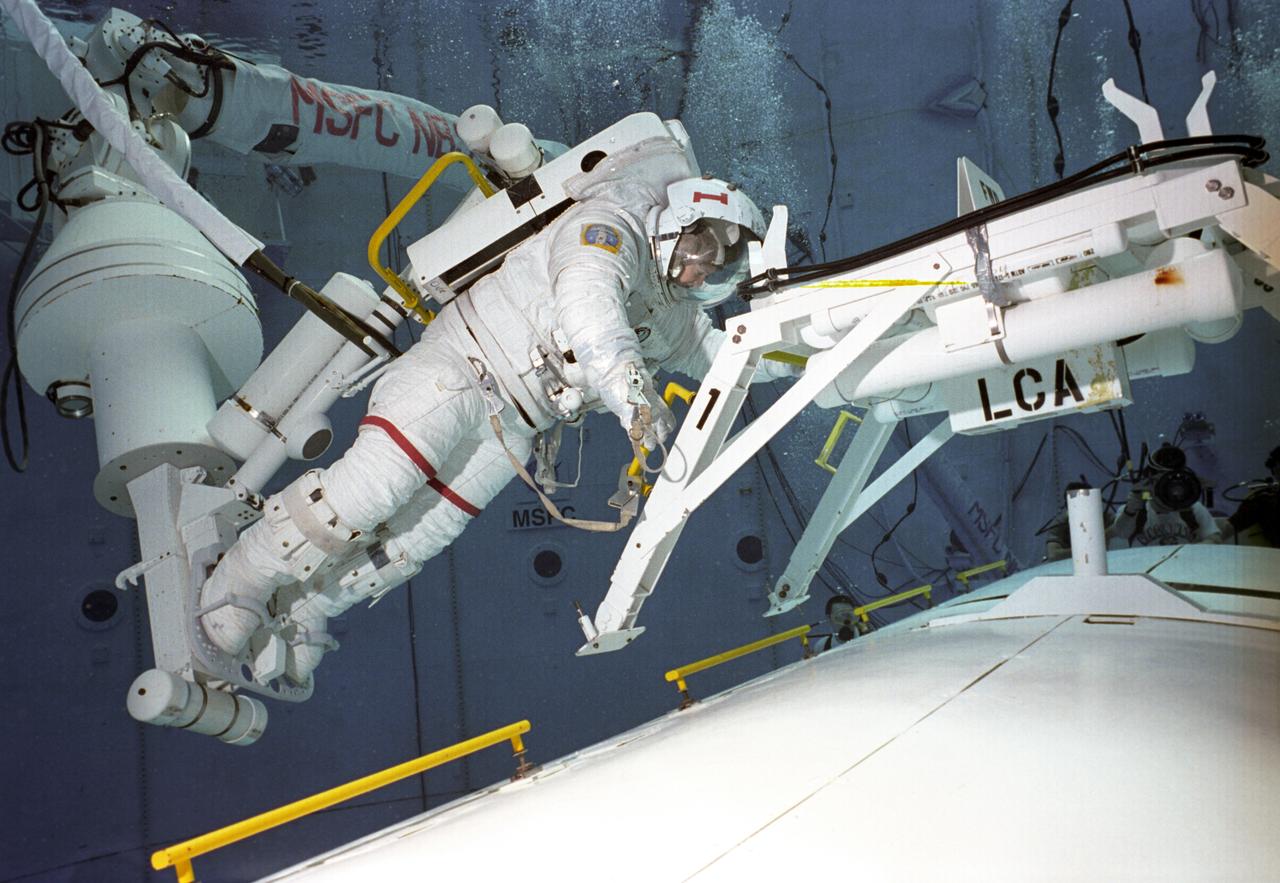
Astronauts Susan Helms (#1) and Carl Walz (#2) are training in the Neutral Buoyancy Simulator (NBS) at Marshall Space Flight center with an exercise for International Space Station Alpha. The NBS provided the weightless environment encountered in space needed for testing and the practices of Extravehicular Activities (EVA).
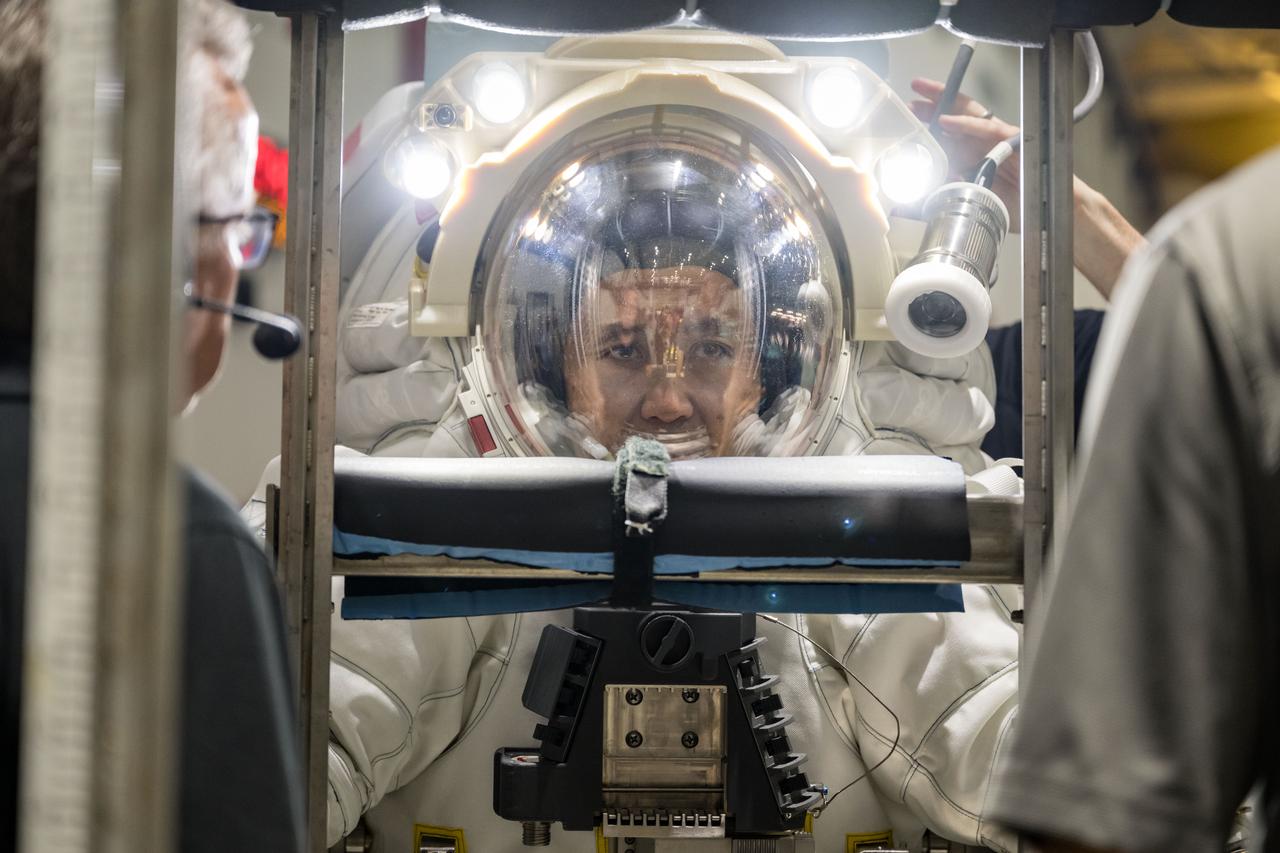
PHOTO DATE: May 29, 2025.LOCATION: NBL - Pool Topside SUBJECT: EVA & Human Surface Mobility Program's Axiom Space xEVA System - NBL Integration Testing - Lunar Integration Run 1 - Subject: Koichi Wakata 29 May 2025. PHOTOGRAPHER: Josh Valcarcel
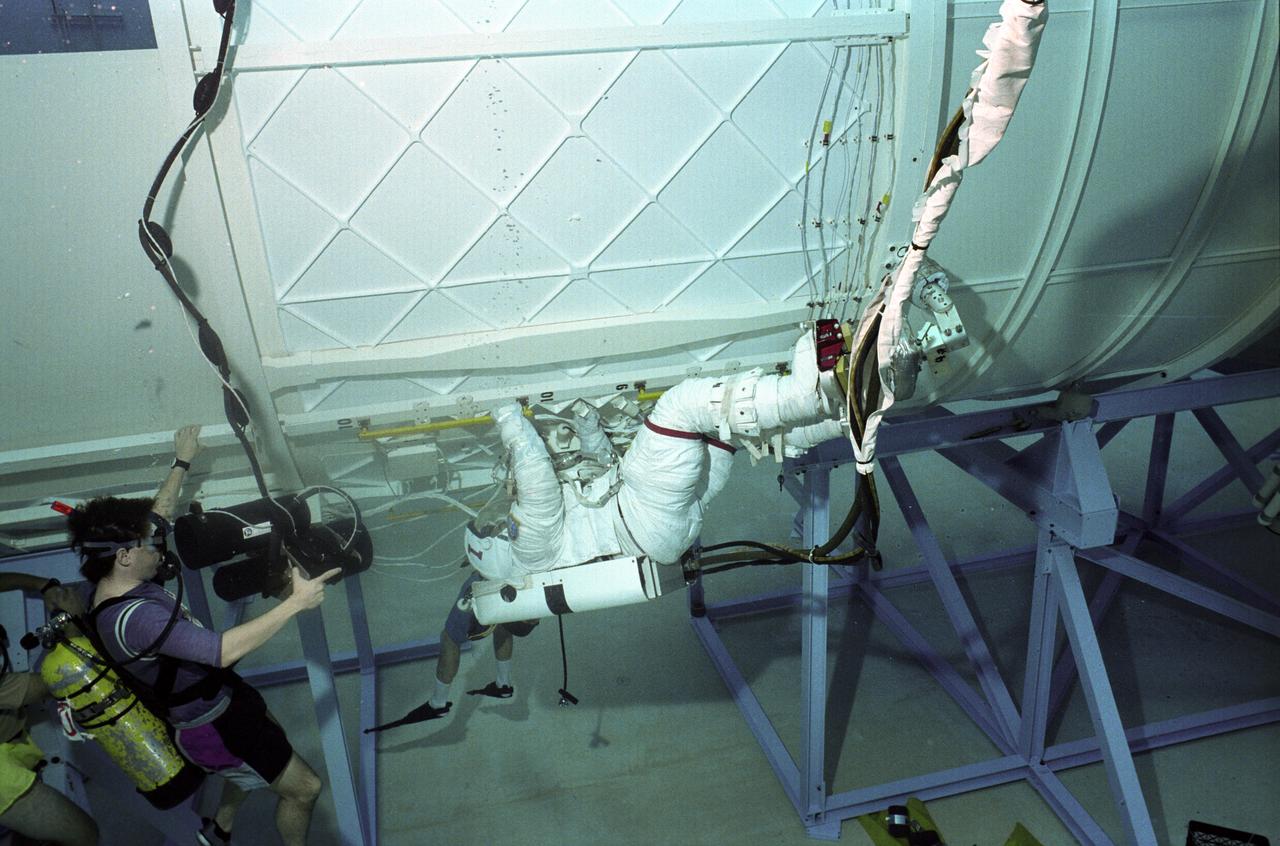
Astronauts Tamara Jernigan (#1) and David Wolf (#2) are training in the Neutral Buoyancy Simulator (NBS) at Marshall Space Flight center with an exercise for International Space Station Alpha. The NBS provided the weightless environment encountered in space needed for testing and the practices of Extravehicular Activities (EVA).
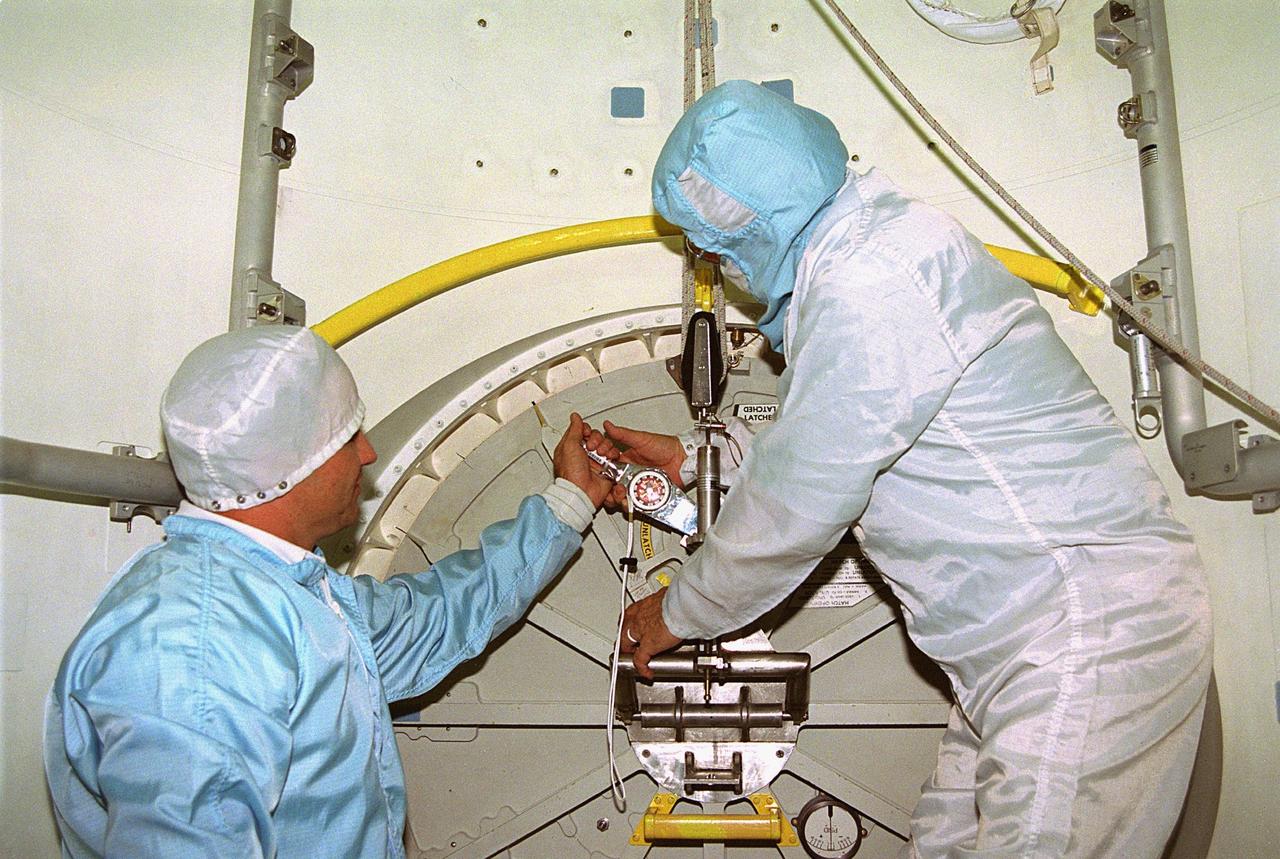
KENNEDY SPACE CENTER, FLA. -- In Orbiter Processing Facility Bay 1, United Space Alliance (USA) technicians Dave Lawrence, at left, and James Cullop troubleshoot the orbiter Columbia’s outer hatch of the airlock, which failed to open during the recent STS-80 Space Shuttle mission. Mission Specialists Tamara E. Jernigan and Thomas D. Jones did not perform the mission’s planned two extravehicular activities (EVAs) or spacewalks because the hatch would not open on orbit. The spacewalks were to be part of the continuing series of EVA Development Flight Tests to evaluate equipment and procedures and to build spacewalking experience in preparation for the International Space Station.
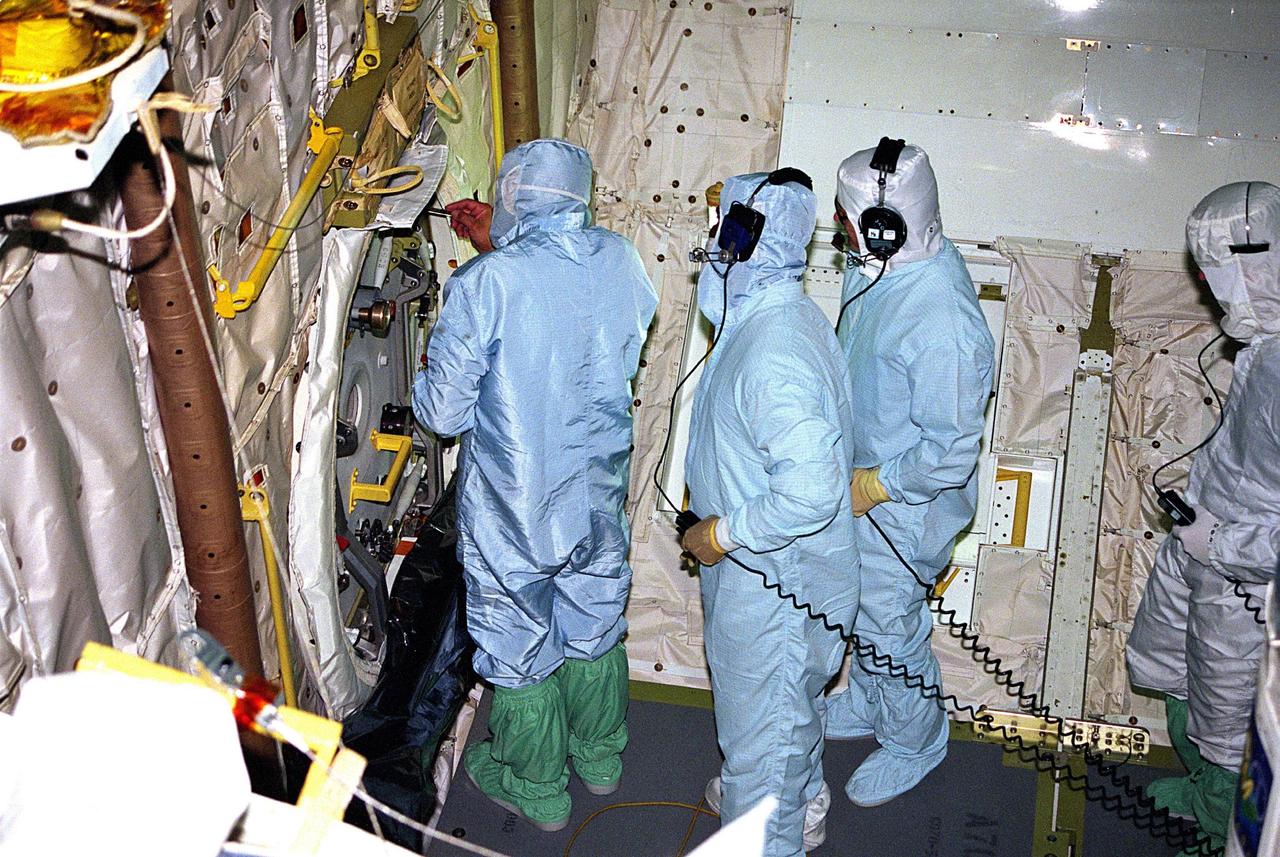
KENNEDY SPACE CENTER, FLA. -- United Space Alliance (USA) technicians in Orbiter Processing Facility Bay 1 troubleshoot the orbiter Columbia’s outer hatch of the airlock, which failed to open during the recent STS-80 Space Shuttle mission. Mission Specialists Tamara E. Jernigan and Thomas D. Jones did not perform the mission’s planned two extravehicular activities (EVAs) or spacewalks because the hatch would not open on orbit. The spacewalks were to be part of the continuing series of EVA Development Flight Tests to evaluate equipment and procedures and to build spacewalking experience in preparation for the International Space Station.
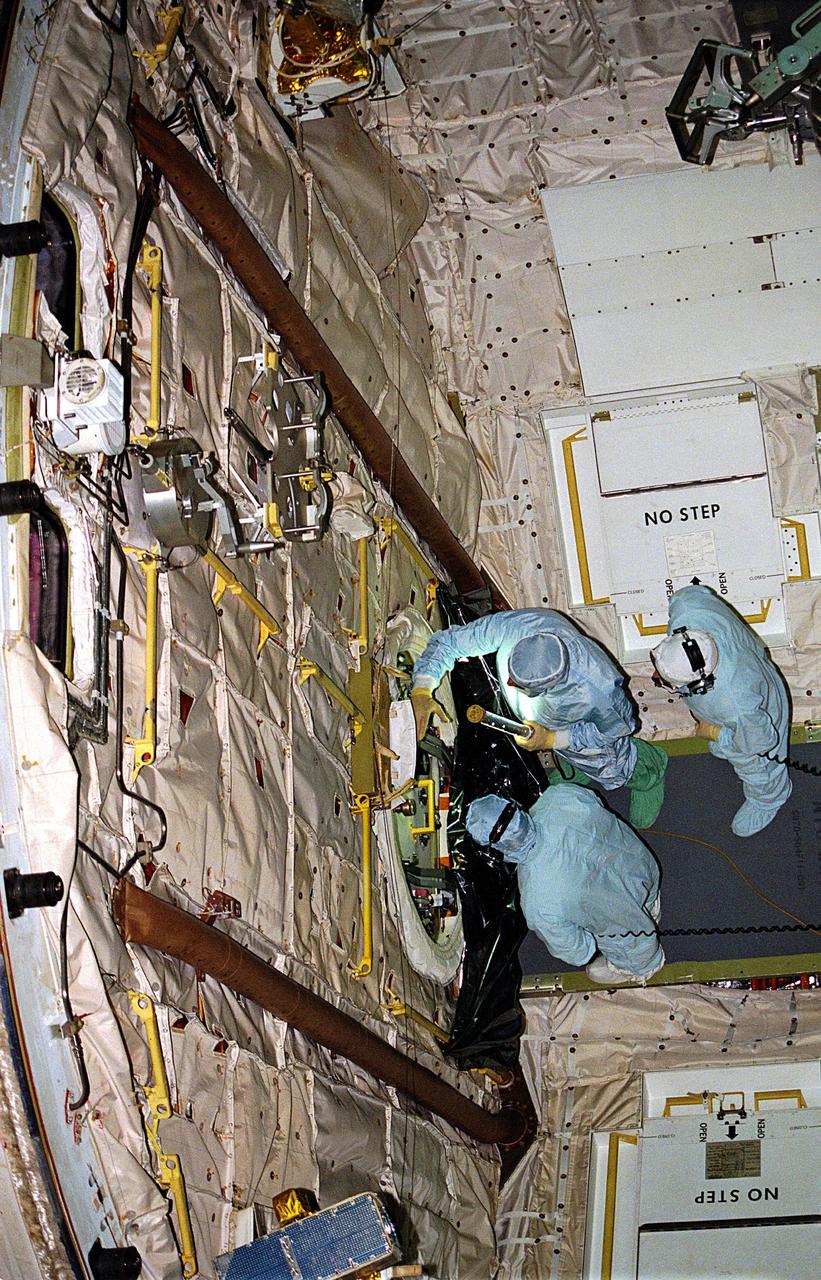
KENNEDY SPACE CENTER, FLA. -- United Space Alliance (USA) technicians in Orbiter Processing Facility Bay 1 troubleshoot the orbiter Columbia’s outer hatch of the airlock, which failed to open during the recent STS-80 Space Shuttle mission. Mission Specialists Tamara E. Jernigan and Thomas D. Jones did not perform the mission’s planned two extravehicular activities (EVAs) or spacewalks because the hatch would not open on orbit. The spacewalks were to be part of the continuing series of EVA Development Flight Tests to evaluate equipment and procedures and to build spacewalking experience in preparation for the International Space Station.
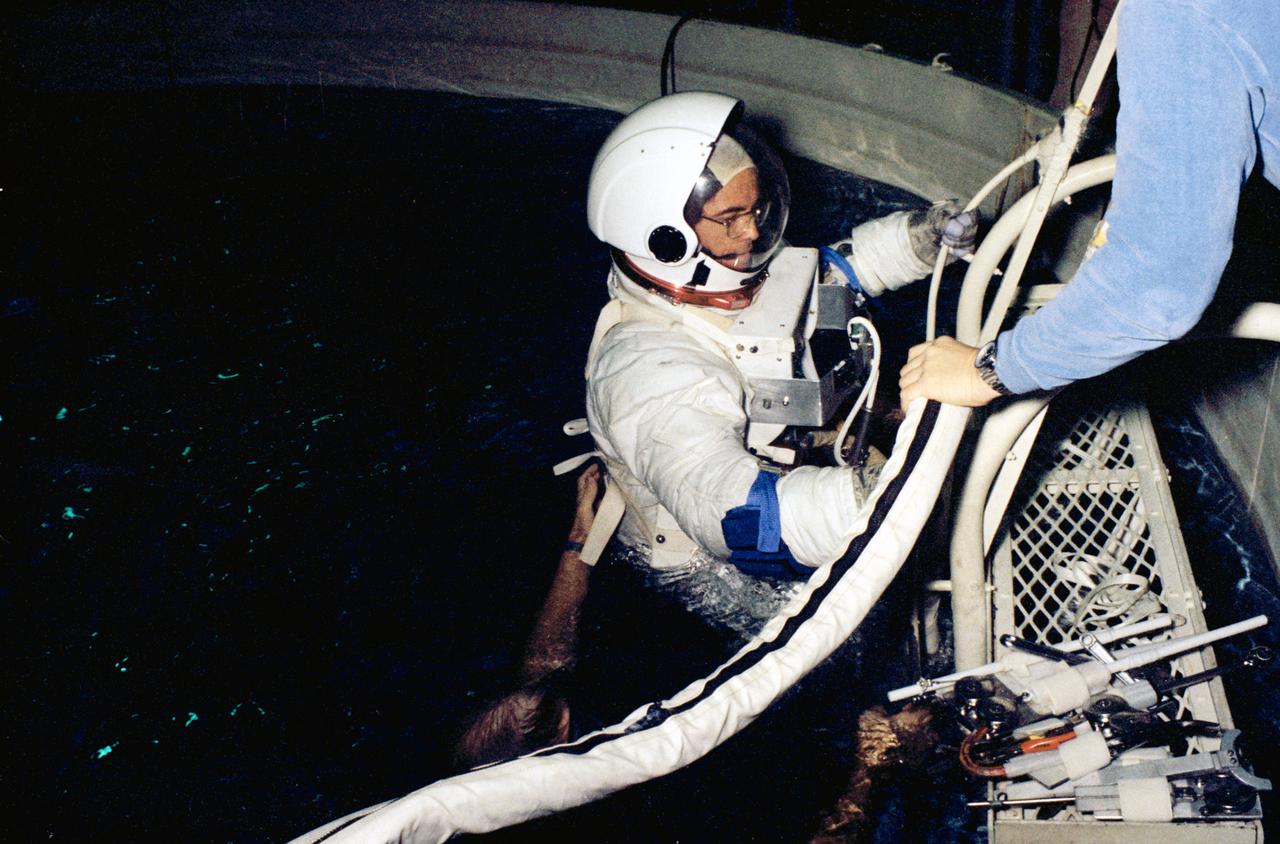
S79-25014 (13 Dec. 1978) --- Astronaut Robert L. Crippen, pilot of the first space shuttle orbital flight test (STS-1), eases into a water immersion facility (WIF) during a training session in the Johnson Space Center?s training and test facility (Bldg. 260). The WIF affords one of two ways to simulate the feeling of weightlessness experienced during space extravehicular activity (EVA), the other being inside aircraft flying a parabolic curve. Crippen will be joined by astronaut John W. Young, commander for the STS-1 flight. Photo credit: NASA
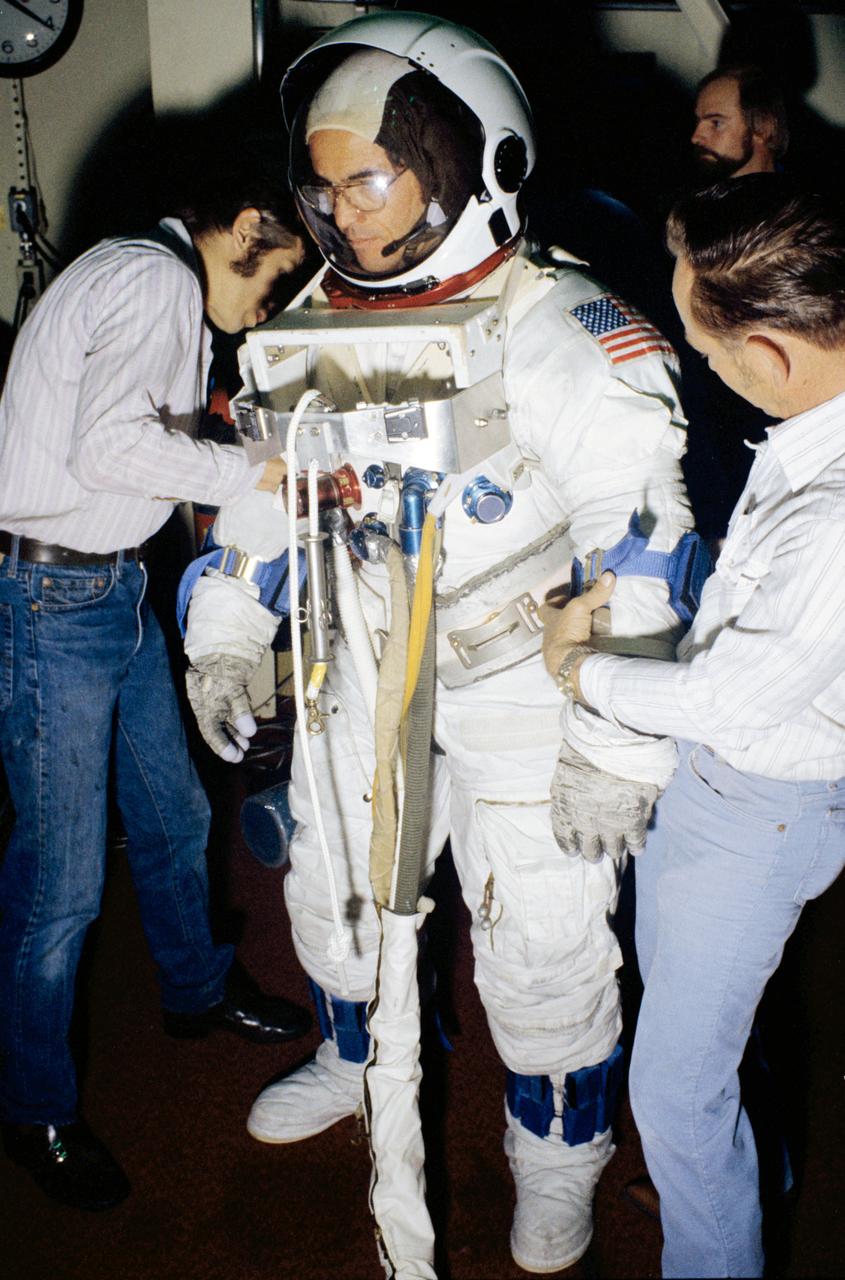
S79-25007 (13 Dec. 1978) --- Astronaut Robert L. Crippen, pilot for the first space shuttle orbital flight test (STS-1), is assisted by technicians prior to entering a water immersion facility (WIF) during a training session. The zero-gravity familiarization took place in the Johnson Space Center?s training and test center (Building 260). The WIF afford one of two ways to simulate the feeling of weightlessness experienced during space extravehicular activity (EVA), the other being inside aircraft flying a parabolic curve. Crippen will be joined by astronaut John W. Young for the STS-1 flight. Photo credit: NASA
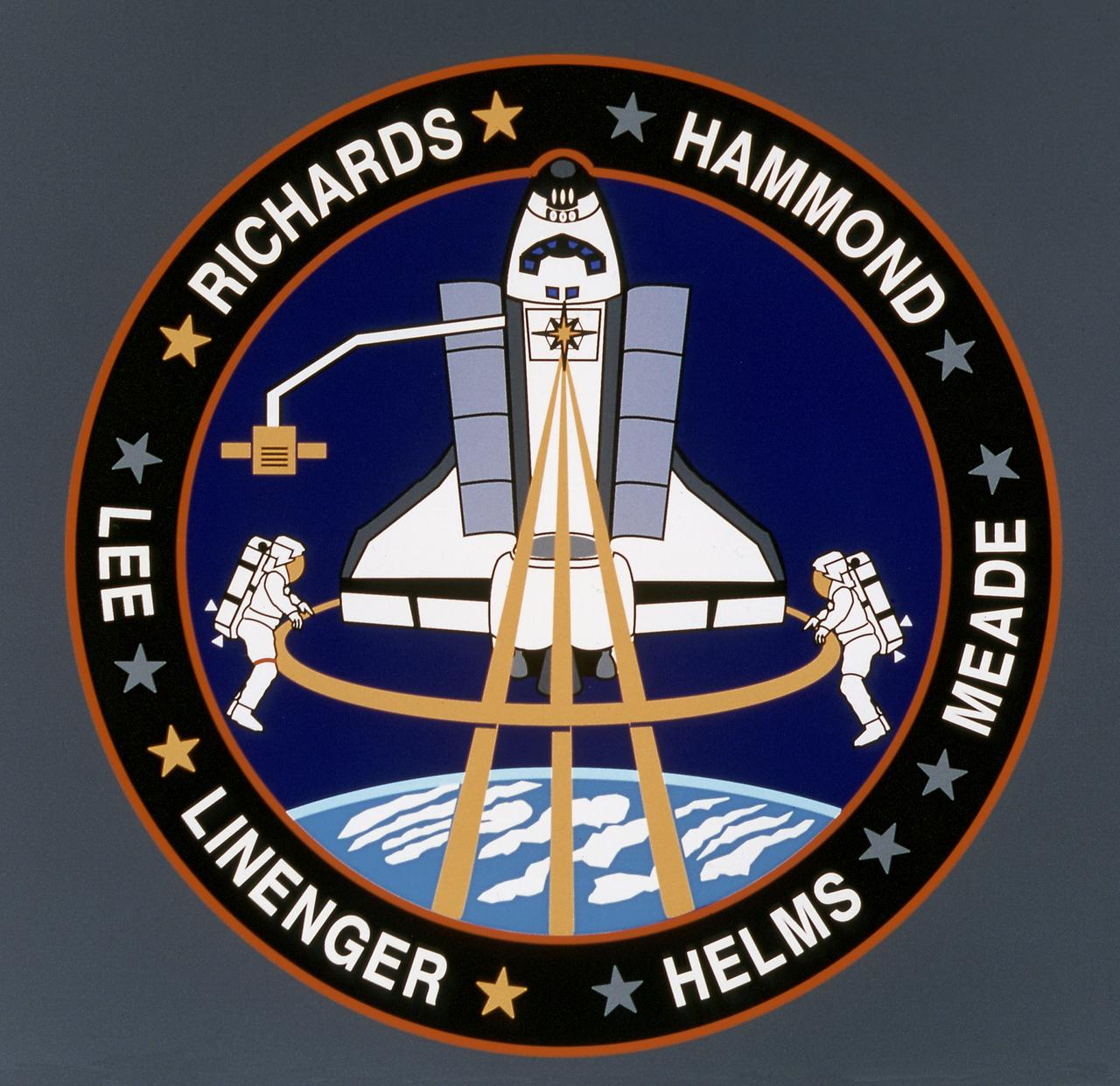
The STS-64 patch depicts the Space Shuttle Discovery in a payload-bay-to-Earth attitude with its primary payload, Lidar In-Space Technology Experiment (LITE-1) operating in support of Mission to Planet Earth. LITE-1 is a lidar system that uses a three-wavelength laser, symbolized by the three gold rays emanating from the star in the payload bay that form part of the astronaut symbol. The major objective of the LITE-1 is to gather data about the Earth's troposphere and stratosphere, represented by the clouds and dual-colored Earth limb. A secondary payload on STS-64 is the free-flier SPARTAN 201 satellite shown on the Remote Manipulator System (RMS) arm post-retrieval. The RMS also operated another payload, Shuttle Plume Impingement Flight Experiment (SPIFEX). A newly tested extravehicular activity (EVA) maneuvering device, Simplified Aid for EVA Rescue (SAFER), represented symbolically by the two small nozzles on the backpacks of the two untethered EVA crew men. The names of the crew members encircle the patch: Astronauts Richard N. Richards, L. Blaine Hammond, Jr., Jerry M. Linenger, Susan J. Helms, Carl J. Meade and Mark C. Lee. The gold or silver stars by each name represent that person's parent service.
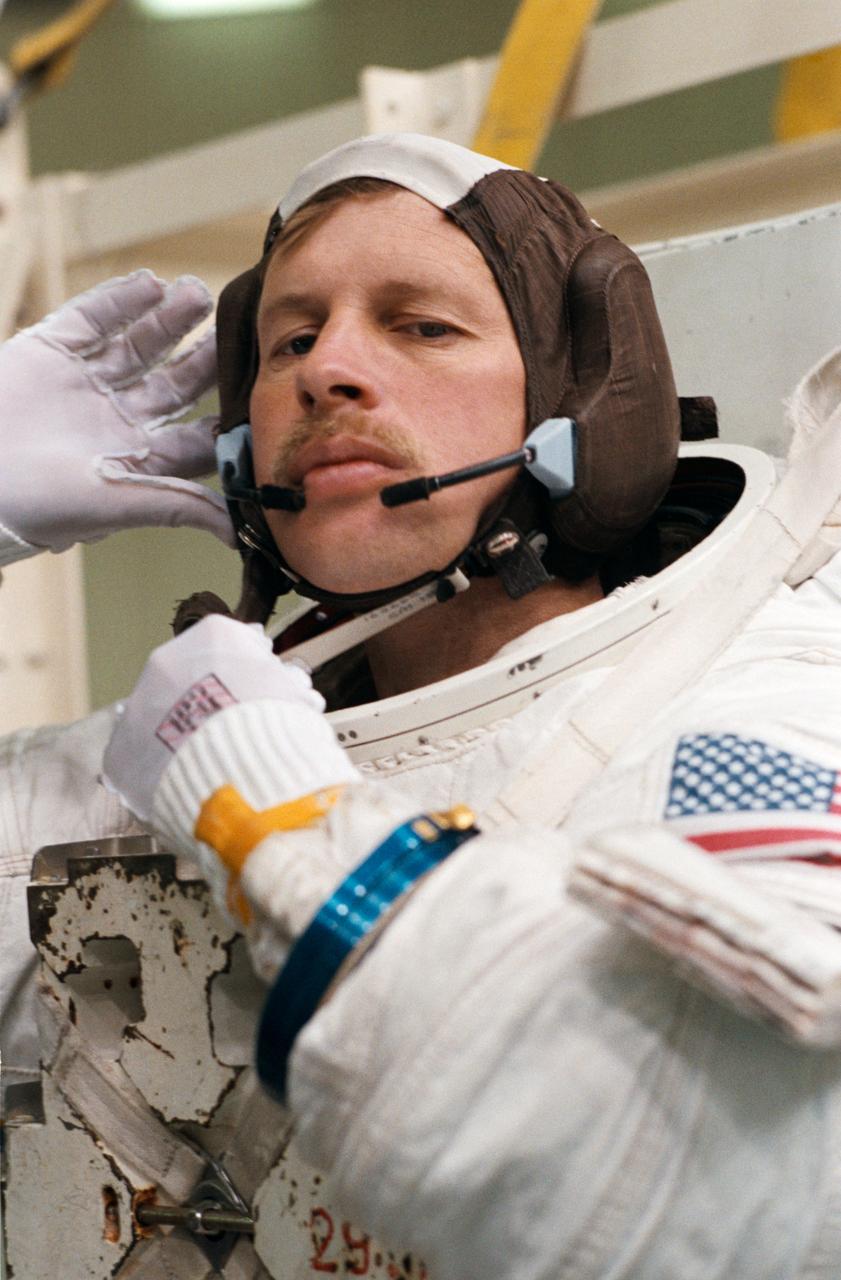
Astronaut Sherwood Springer prepares for an underwater test at Weightless Environment Training Facility (WETF) in response to the discovery of problems with the 04/13 deployed Syncom IV (LEASAT) communications satellite. Activities, Bldg. 29, WETF for the STS-23/51D Extravehicular Activity (EVA) Simulation for Syncom IV, 04/14/1985. 1. Shuttle - Simulation (SYNCOM IV) 2. Astronaut Jerry L. Ross - Simulation (SYNCOM) 3. Astronaut Sherwood C. Spring - Simulation (SYNCOM IV) JSC, Houston, TX
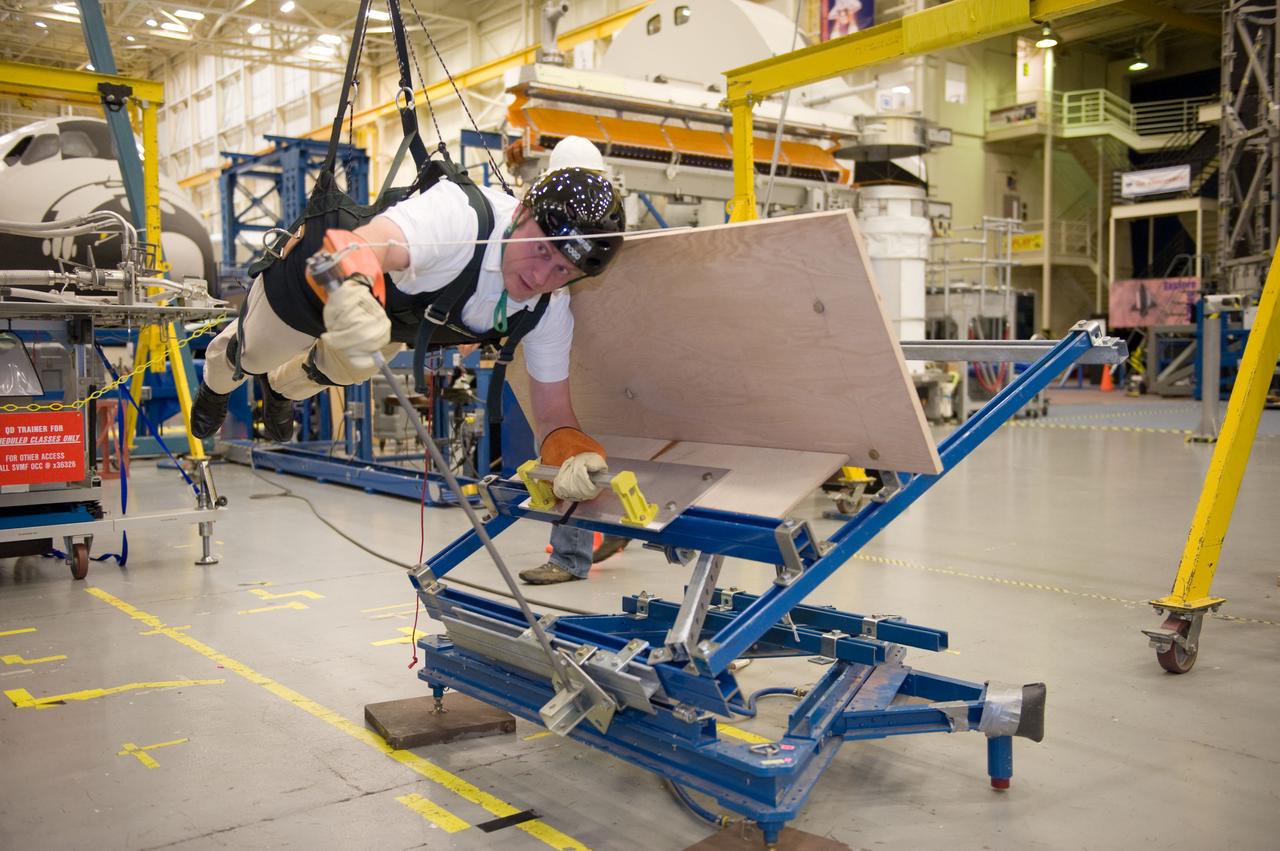
JSC2010-E-193872 (1 Dec. 2010) --- NASA astronaut Michael Fincke, STS-134 mission specialist, participates in an extravehicular activity (EVA) training session in the Partial Gravity Simulator (POGO) test area in the Space Vehicle Mock-up Facility at NASA?s Johnson Space Center. Photo credit: NASA or National Aeronautics and Space Administration
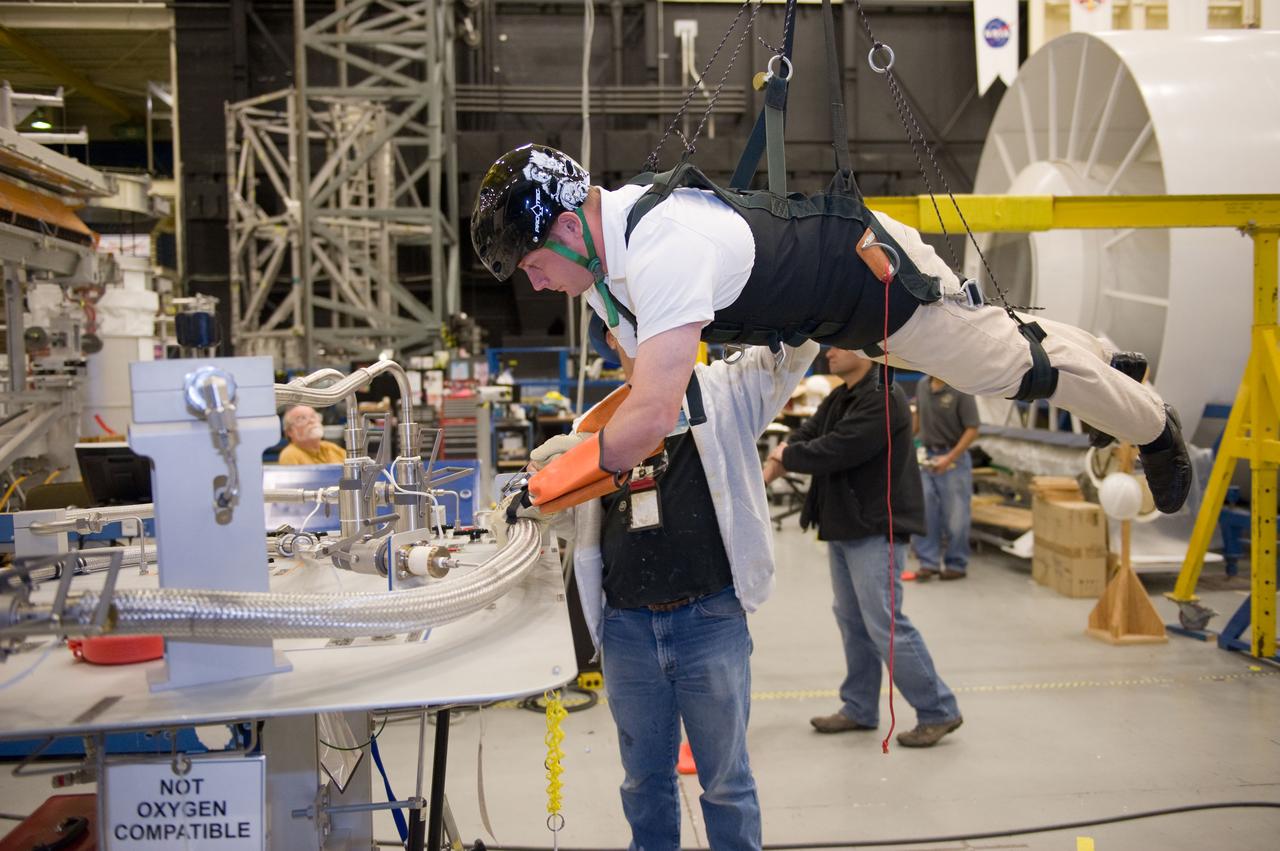
JSC2010-E-193879 (1 Dec. 2010) --- NASA astronaut Michael Fincke, STS-134 mission specialist, participates in an extravehicular activity (EVA) training session in the Partial Gravity Simulator (POGO) test area in the Space Vehicle Mock-up Facility at NASA?s Johnson Space Center. Photo credit: NASA or National Aeronautics and Space Administration
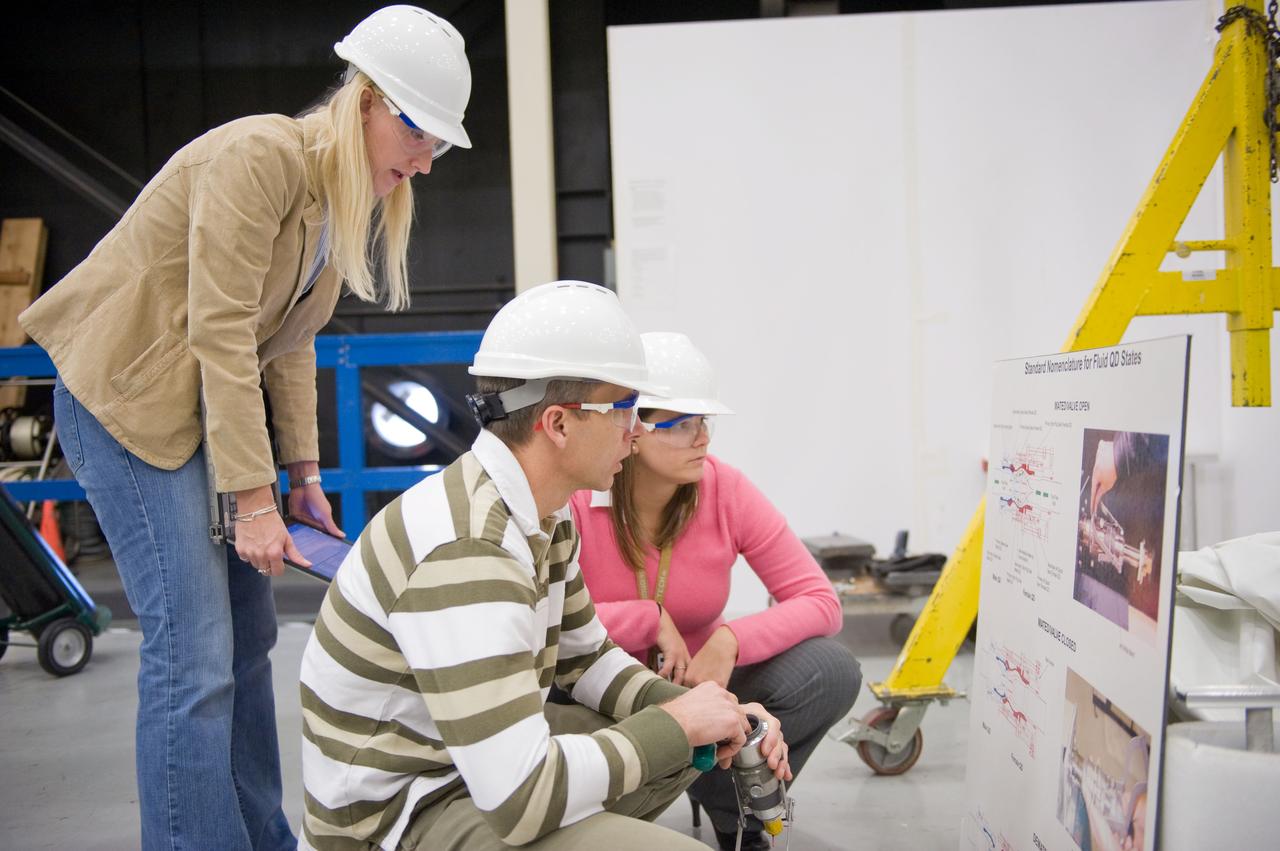
JSC2010-E-193913 (1 Dec. 2010) --- NASA astronaut Andrew Feustel, STS-134 mission specialist, participates in an extravehicular activity (EVA) training session in the Partial Gravity Simulator (POGO) test area in the Space Vehicle Mock-up Facility at NASA?s Johnson Space Center. Crew instructors Allison Bolinger (standing) and Vickie Otto assisted Feustel. Photo credit: NASA or National Aeronautics and Space Administration
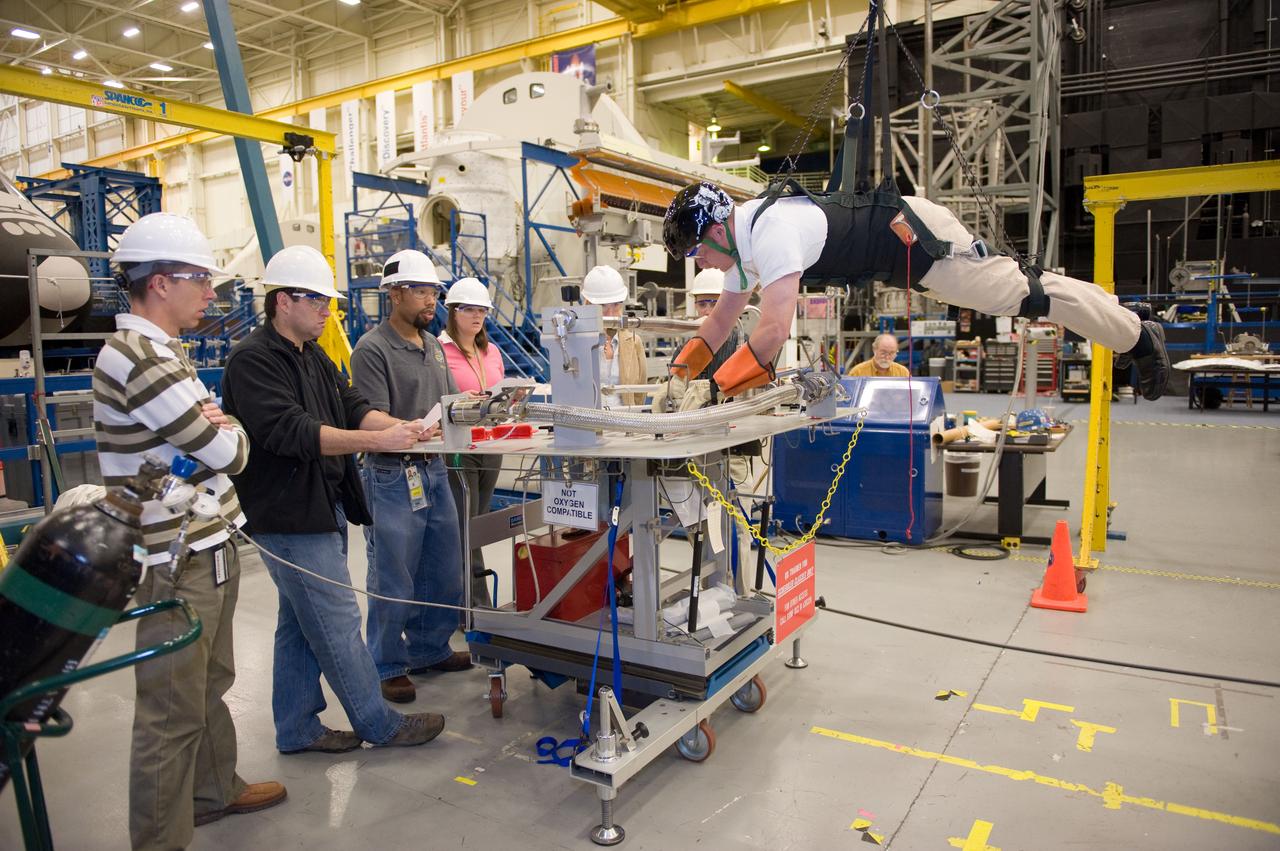
JSC2010-E-193887 (1 Dec. 2010) --- NASA astronaut Michael Fincke, STS-134 mission specialist, participates in an extravehicular activity (EVA) training session in the Partial Gravity Simulator (POGO) test area in the Space Vehicle Mock-up Facility at NASA?s Johnson Space Center. NASA astronauts Andrew Feustel (left) and Greg Chamitoff (second left), both mission specialists, look on. Photo credit: NASA or National Aeronautics and Space Administration
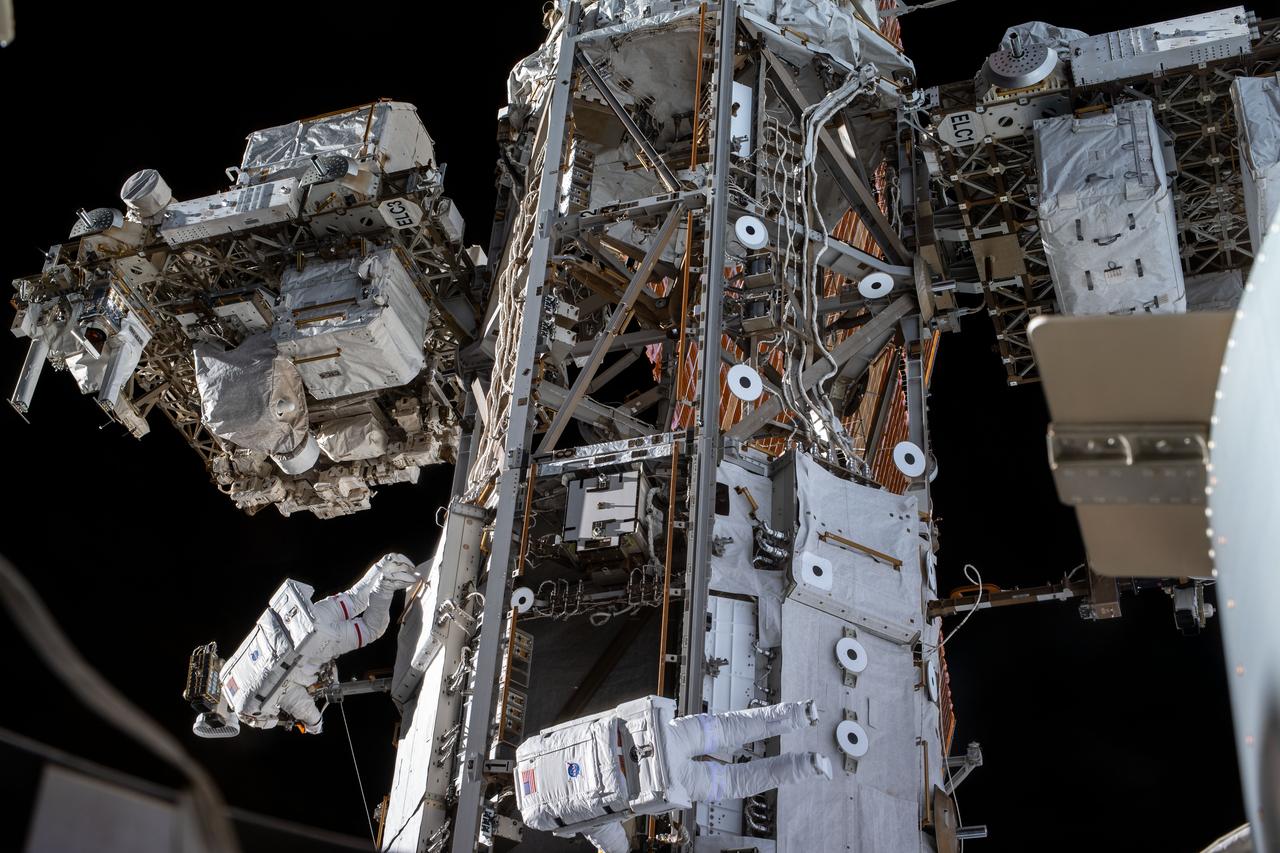
iss061e142328 (1/25/2020) --- A view of NASA astronaut Andrew Morgan and European Space Agency (ESA) astronaut Luca Parmitano during EVA-64 abroad the International Space Station (ISS). The Space Test Program-Houston 6 (STP-H6) payload, can be seen atop of the EXPRESS Logistics Carrier-3 (ELC-3) at the far left of the image.
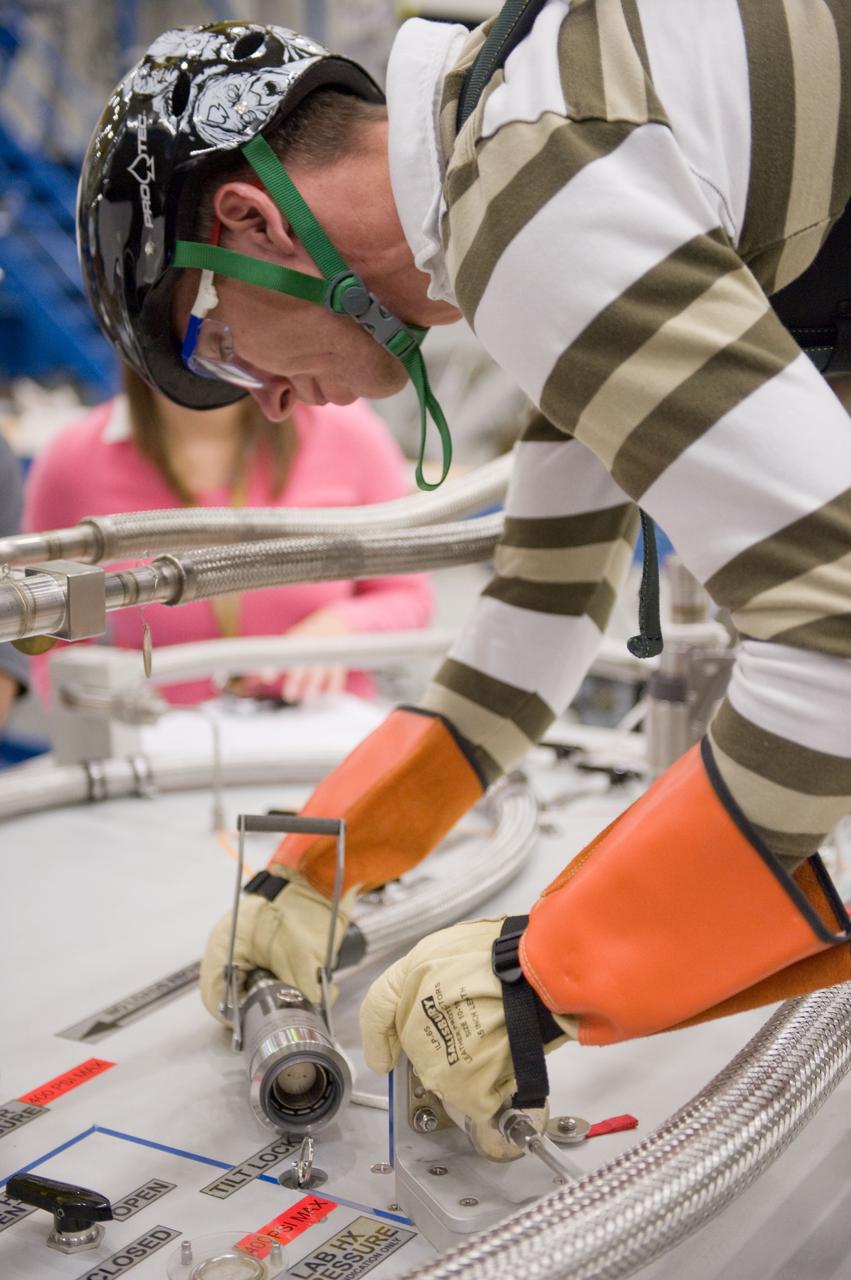
JSC2010-E-193901 (1 Dec. 2010) --- NASA astronaut Andrew Feustel, STS-134 mission specialist, participates in an extravehicular activity (EVA) training session in the Partial Gravity Simulator (POGO) test area in the Space Vehicle Mock-up Facility at NASA?s Johnson Space Center. Photo credit: NASA or National Aeronautics and Space Administration
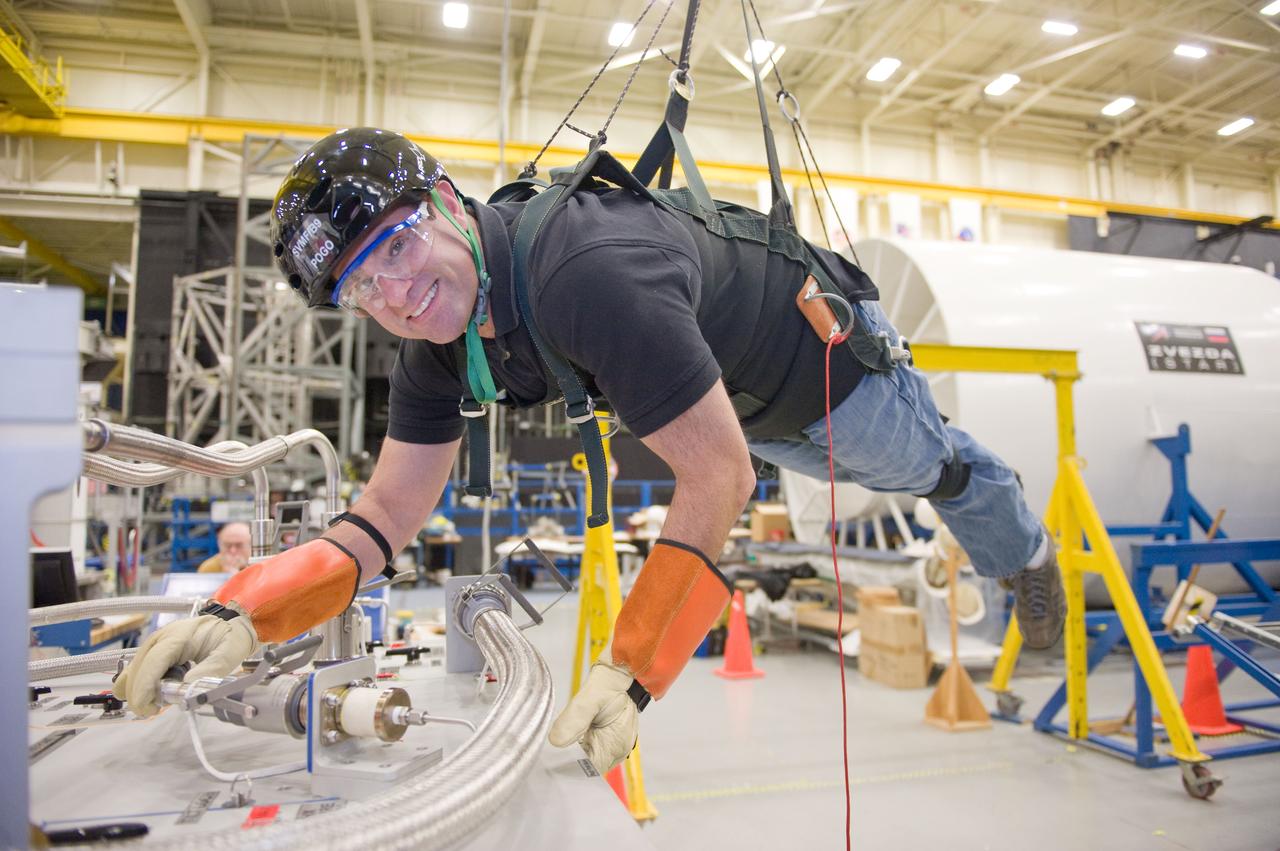
JSC2010-E-193910 (1 Dec. 2010) --- NASA astronaut Greg Chamitoff, STS-134 mission specialist, participates in an extravehicular activity (EVA) training session in the Partial Gravity Simulator (POGO) test area in the Space Vehicle Mock-up Facility at NASA?s Johnson Space Center. Photo credit: NASA or National Aeronautics and Space Administration
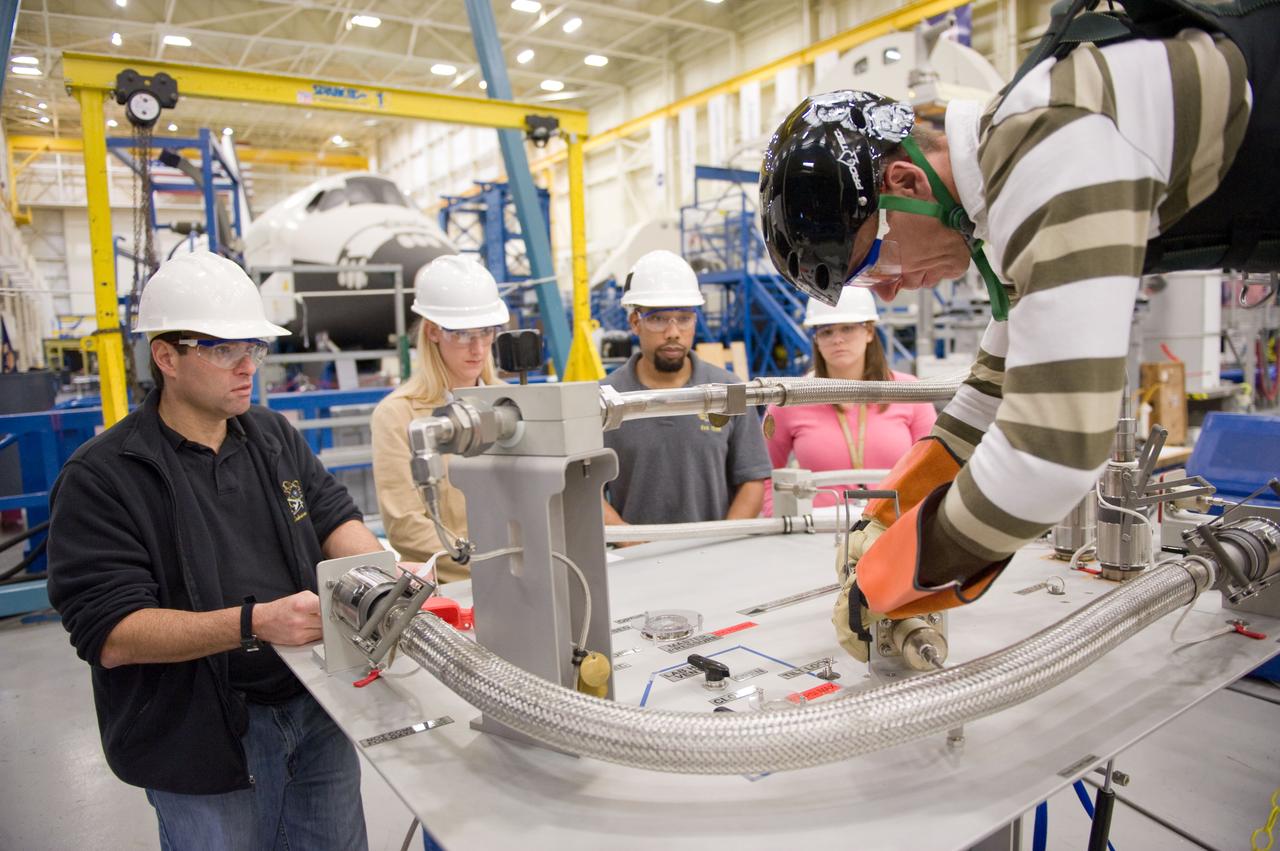
JSC2010-E-193900 (1 Dec. 2010) --- NASA astronaut Andrew Feustel (right), STS-134 mission specialist, participates in an extravehicular activity (EVA) training session in the Partial Gravity Simulator (POGO) test area in the Space Vehicle Mock-up Facility at NASA?s Johnson Space Center. NASA astronaut Greg Chamitoff (left), mission specialist, looks on. Photo credit: NASA or National Aeronautics and Space Administration
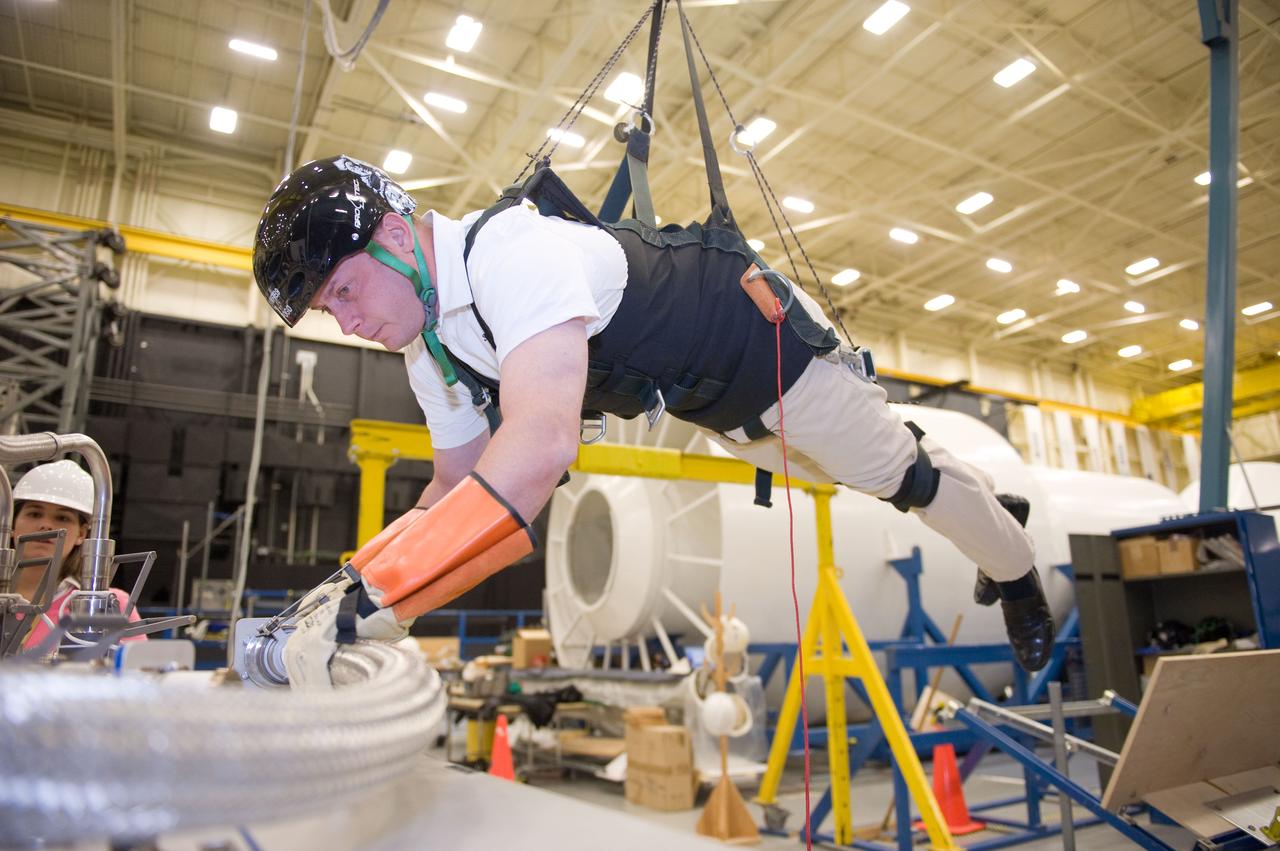
JSC2010-E-193881 (1 Dec. 2010) --- NASA astronaut Michael Fincke, STS-134 mission specialist, participates in an extravehicular activity (EVA) training session in the Partial Gravity Simulator (POGO) test area in the Space Vehicle Mock-up Facility at NASA?s Johnson Space Center. Photo credit: NASA or National Aeronautics and Space Administration
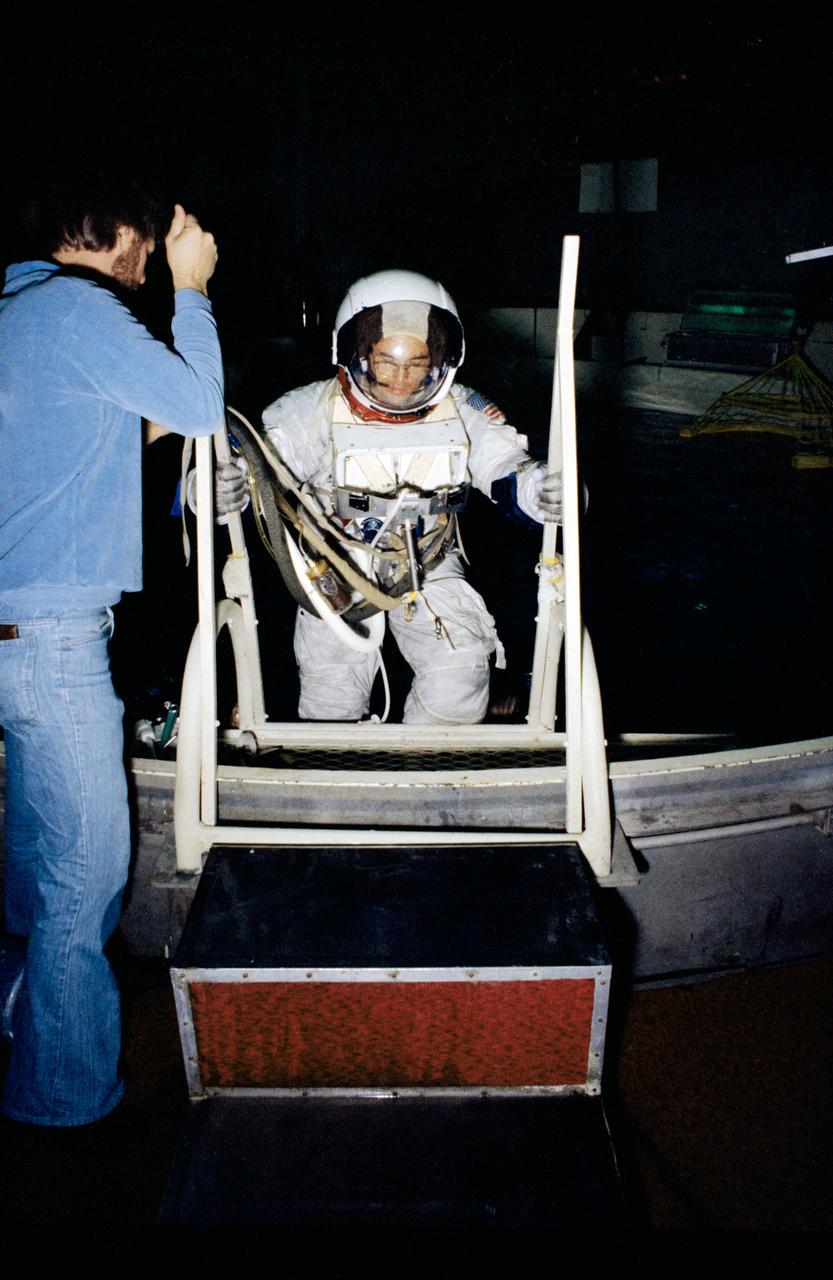
S79-25016 (13 Dec. 1978) --- Astronaut Robert L. Crippen, pilot for the first space shuttle orbital flight test, descends steps leading into the water immersion facility (WIF) during a training session in the Johnson Space Center?s training and test facility (Bldg. 260). The WIF affords one of two ways to simulate space extravehicular activity (EVA), the other being inside aircraft flying a parabolic curve. Crippen will be joined by astronaut John W. Young, commander for the first space shuttle flight (STS-1). Photo credit: NASA
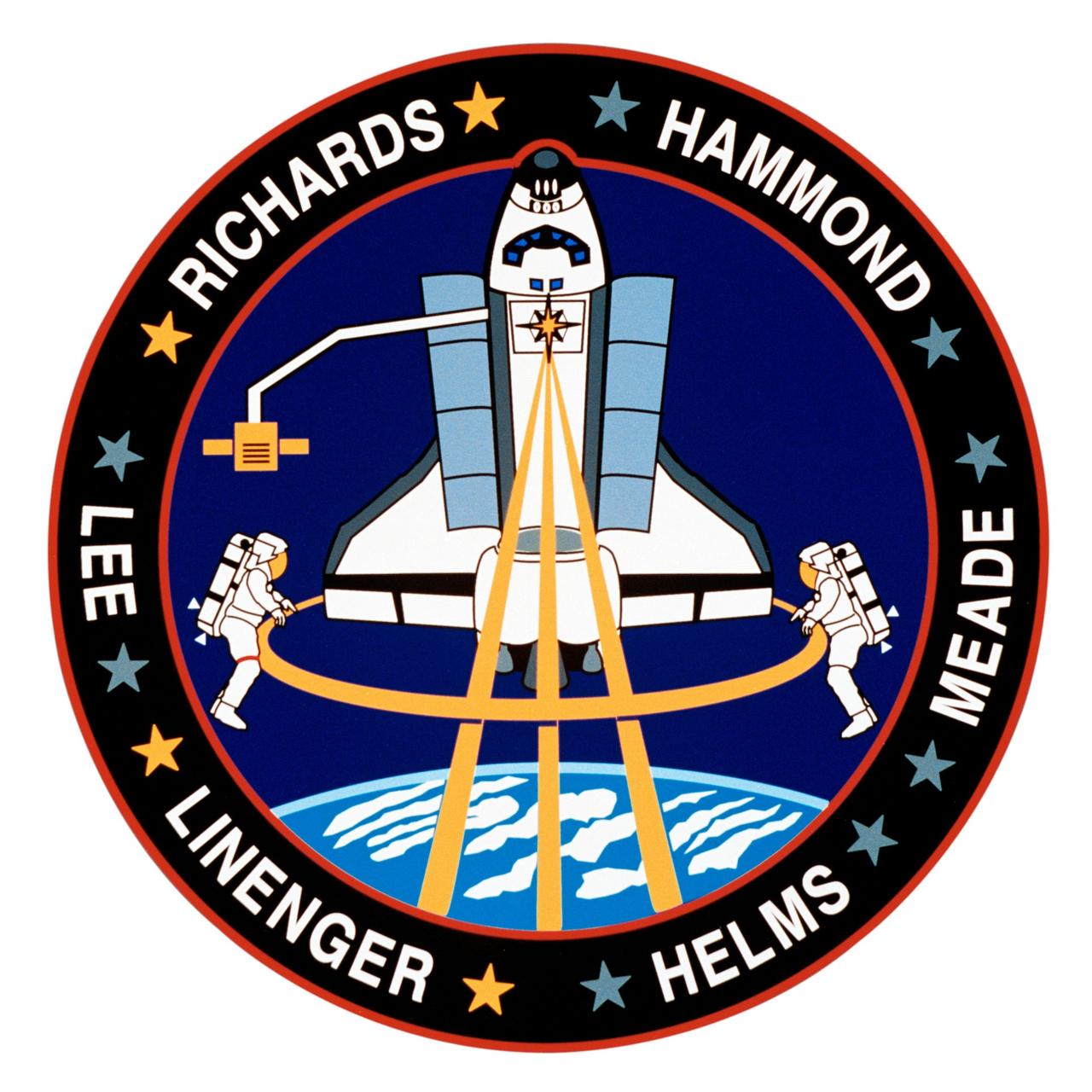
STS064-S-001 (July 1994) --- The patch depicts the space shuttle Discovery in a payload-bay-to-Earth attitude with its primary payload, Lidar In-Space Technology Experiment (LITE-1) operating in support of Mission to Planet Earth. LITE-1 is a lidar (light detection and ranging) system that uses a three-wavelength laser, symbolized by the three gold rays emanating from the star in the payload bay that form part of the astronaut symbol. The major objective of this first flight of LITE-1 is to validate its design and operating characteristics by gathering data about the Earth's troposphere and stratosphere, represented by the clouds and dual-colored Earth limb. A secondary payload on STS-64 is the free-flier SPARTAN-201 satellite shown on the Remote Manipulator System (RMS) arm post-retrieval. The objective of SPARTAN-201 is to investigate the physics of the solar wind and complement data being obtained from the ULYSSES satellite launched on STS-41. The RMS will also operate another secondary payload, Shuttle Plume Impingement Flight Experiment (SPIFEX), which will assess the plume effects from the Orbiter's Reaction Control System thrusters. Additionally, STS-64 will test a new extravehicular activity (EVA) maneuvering device, Simplified Aid for EVA Rescue (SAFER), represented symbolically by the two small nozzles on the backpacks of the two untethered EVA crew men. The names of the crew members encircle the patch: astronauts Richard N. Richards, commander; L. Blaine Hammond Jr., pilot; Jerry M. Linenger; Susan J. Helms, Carl J. Meade and Mark C. Lee, all mission specialists. The gold or silver stars by each name represent that person's parent service. The NASA insignia design for space shuttle flights is reserved for use by the astronauts and for other official use as the NASA Administrator may authorize. Public availability has been approved only in the forms of illustrations by the various news media. When and if there is any change in this policy, which is not anticipated, the change will be publicly announced. Photo credit: NASA
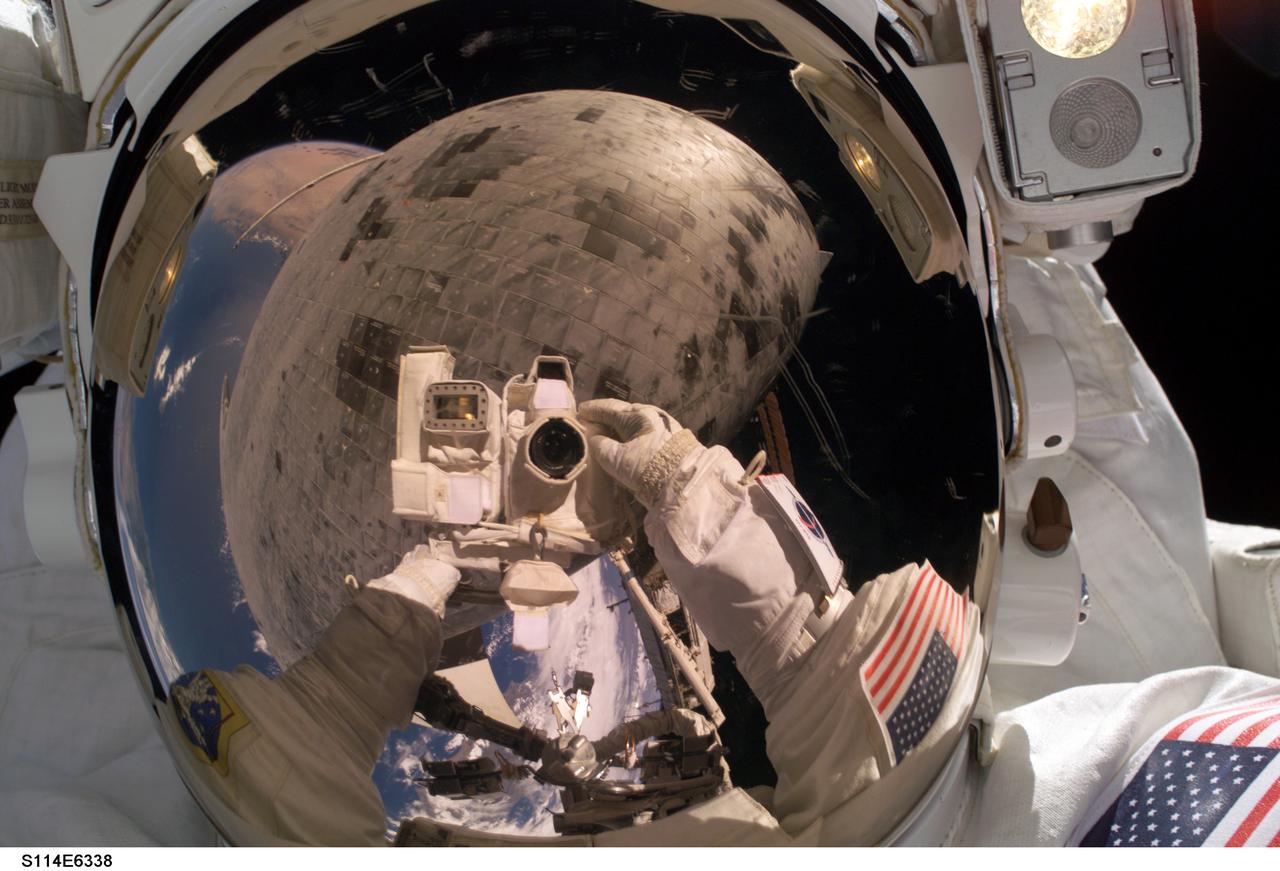
Launched on July 26, 2005 from the Kennedy Space Center in Florida, STS-114 was classified as Logistics Flight 1. Among the Station-related activities of the mission were the delivery of new supplies and the replacement of one of the orbital outpost's Control Moment Gyroscopes (CMGs). STS-114 also carried the Raffaello Multi-Purpose Logistics Module and the External Stowage Platform-2. A major focus of the mission was the testing and evaluation of new Space Shuttle flight safety, which included new inspection and repair techniques. Upon its approach to the International Space Station (ISS), the Space Shuttle Discovery underwent a photography session in order to assess any damages that may have occurred during its launch and/or journey through Space. The mission’s third and final Extra Vehicular Activity (EVA) included taking a close-up look and the repair of the damaged heat shield. Gap fillers were removed from between the orbiter’s heat-shielding tiles located on the craft’s underbelly. Never before had any repairs been done to an orbiter while still in space. Astronaut Stephen K. Robinson, STS-114 mission specialist, used the pictured still digital camera to expose a photo of his helmet visor during the EVA. Also visible in the reflection are thermal protection tiles on Discovery’s underside.
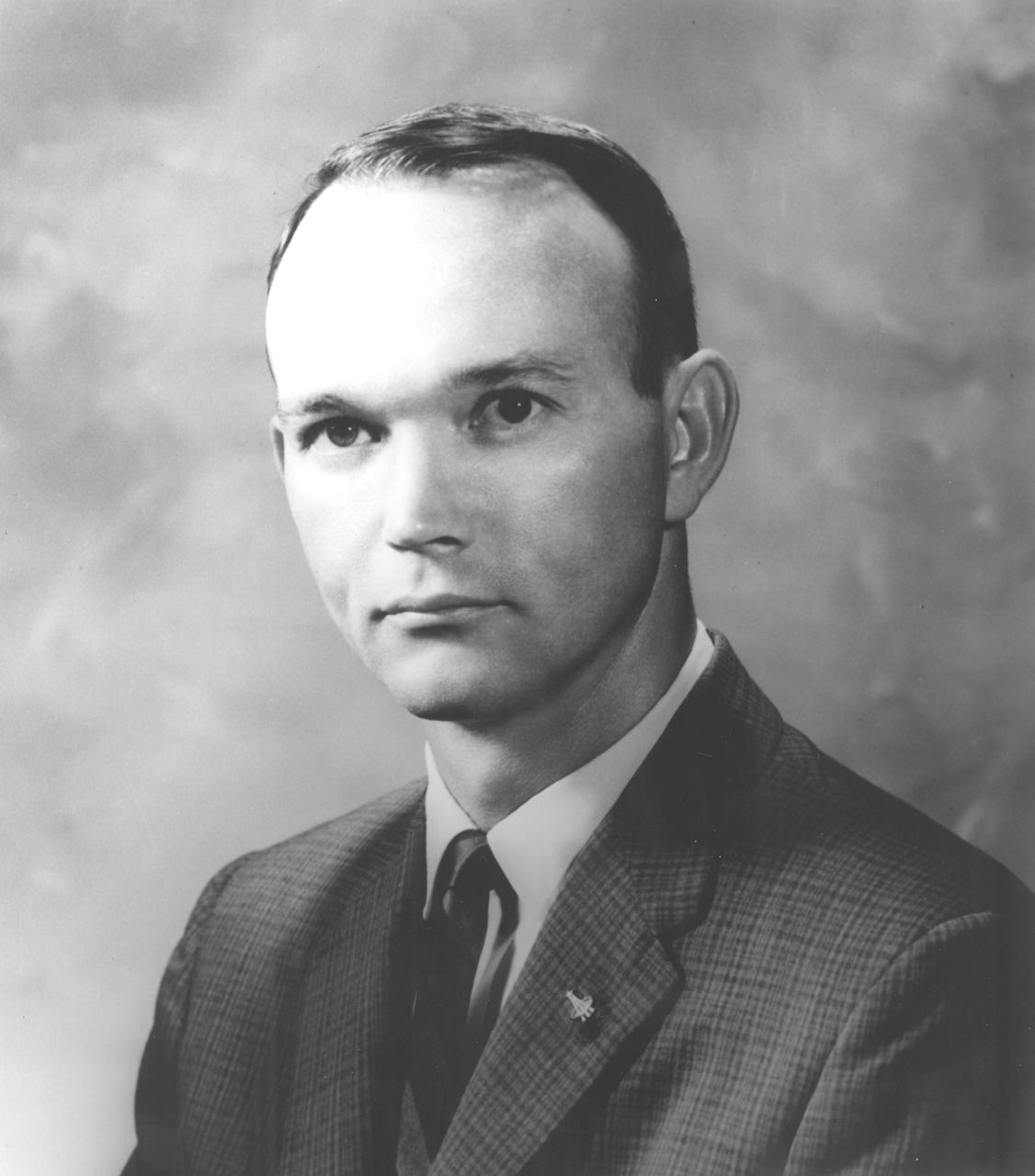
This is the official NASA portrait of astronaut Michael Collins. Collins chose an Air Force career following graduation from West Point. He served as an experimental flight test officer at the Air Force Flight Test Center, Edwards Air Force Base, California, and, in that capacity, tested performance and stability and control characteristics of Air Force aircraft, primarily jet fighters. Having logged approximately 5,000 hours flying time, Collins was one of the third group of astronauts named by NASA in October 1963. Collins completed two space flights, logging 266 hours in space, of which, 1 hour and 27 minutes was spent in Extra Vehicular Activity (EVA). On July 18, 1966, he served as backup pilot for the Gemini VII mission which included a successful rendezvous and docking with a separately launched Agena target vehicle and, using the power of the Agena, maneuvered the Gemini spacecraft into another orbit for a rendezvous with a second, passive Agena. His skillful performance in completing two periods of EVA included the recovery of a micrometeorite detection experiment from the passive Agena. July 16-24, 1969, Collins served as command module (CM) pilot on Apollo 11, the historic first lunar landing mission. He remained aboard the CM, Columbia, on station in lunar orbit and performed the final re-docking maneuvers following a successful lunar orbit rendezvous with the Lunar Module (LM), Eagle. Collins left NASA in January 1970.
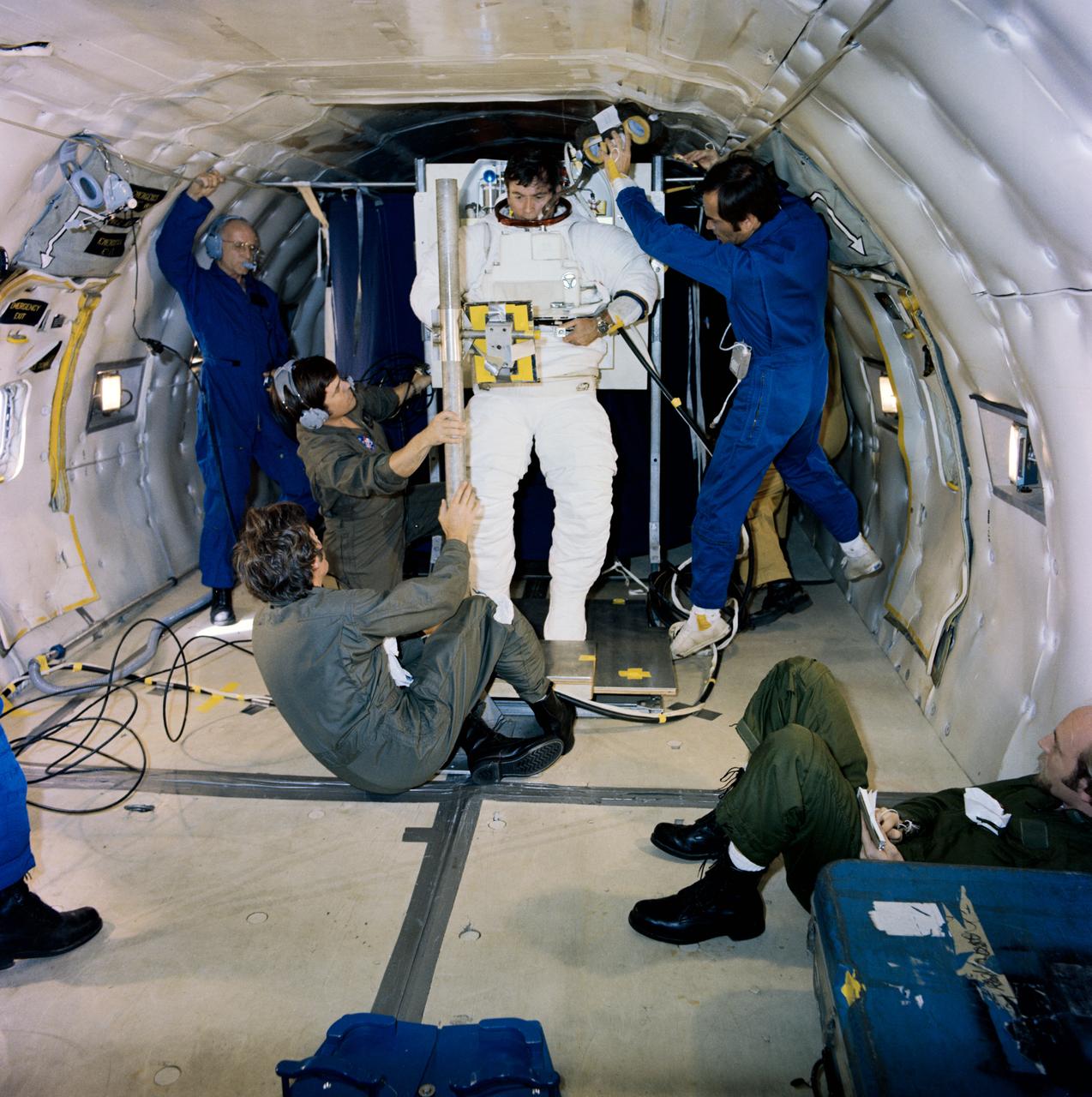
S79-30347 (31 March 1979) --- Taking advantage of a brief period of zero-gravity afforded aboard a KC-135 flying a parabolic curve, the flight crew of the first space shuttle orbital flight test (STS-1) goes through a spacesuit donning exercise. Astronaut John W. Young has just entered the hard-material torso of the shuttle spacesuit by approaching it from below. He is assisted by astronaut Robert L. Crippen. The torso is held in place by a special stand here, simulating the function provided by the airlock wall aboard the actual shuttle craft. The life support system is mated to the torso on Earth and remains so during the flight, requiring this type of donning and doffing exercise. Note Crippen?s suit is the type to be used for intravehicular activity in the shirt sleeve environment to be afforded aboard shuttle. The suit worn by Young is for extravehicular activity (EVA). Young will be STS-1 commander and Crippen, pilot. They will man the space shuttle orbiter 102 Columbia. Photo credit: NASA
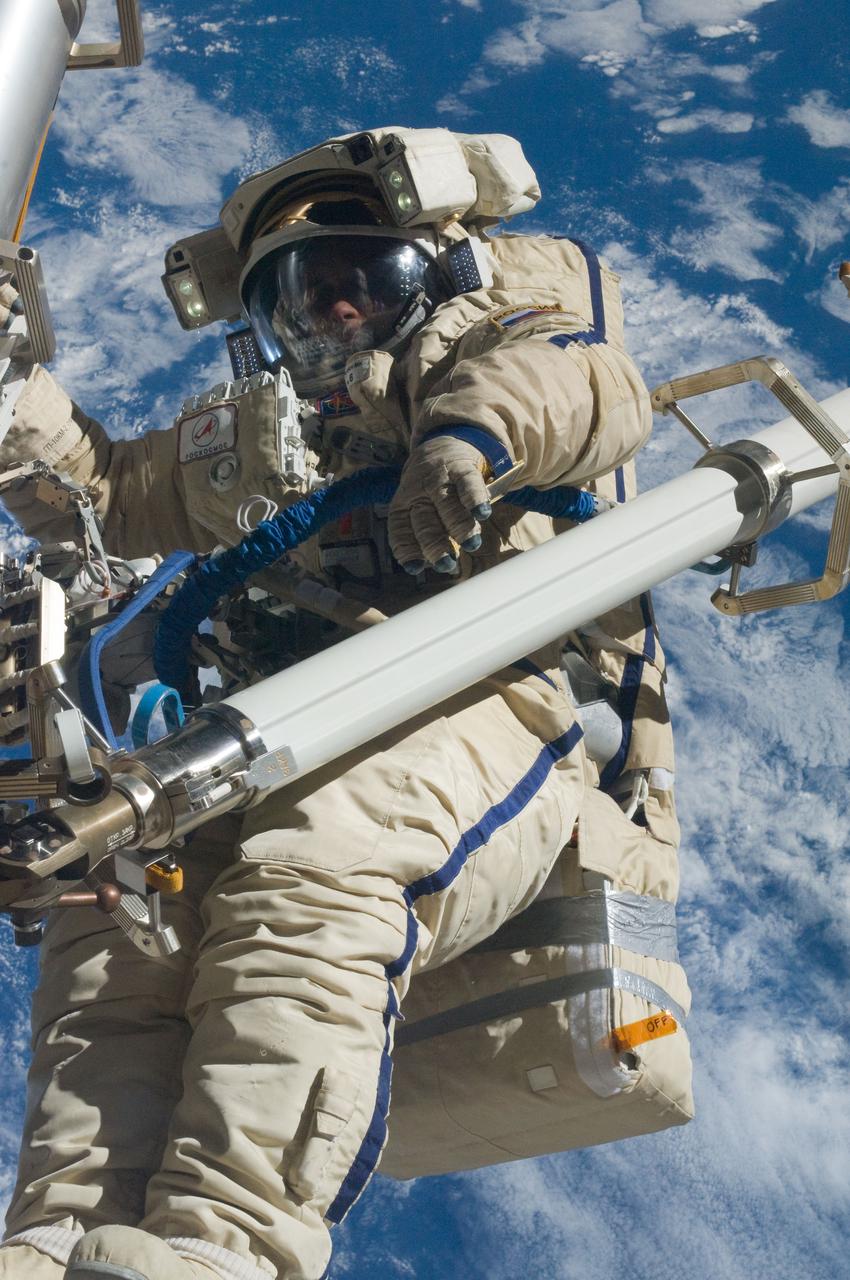
ISS030-E-079949 (16 Feb. 2012) --- Russian cosmonaut Anton Shkaplerov, Expedition 30 flight engineer, participates in a session of extravehicular activity (EVA) to continue outfitting the International Space Station. During the six-hour, 15-minute spacewalk, Shkaplerov and Russian cosmonaut Oleg Kononenko (out of frame), flight engineer, moved the Strela-1 crane from the Pirs Docking Compartment to begin preparing the Pirs for its replacement next year with a new laboratory and docking module. The duo used another boom, the Strela-2, to move the hand-operated crane to the Poisk module for future assembly and maintenance work. Both telescoping booms extend like fishing rods and are used to move massive components outside the station. On the exterior of the Poisk Mini-Research Module 2 (MRM2), they also installed the Vinoslivost Materials Sample Experiment, which will investigate the influence of space on the mechanical properties of the materials. The spacewalkers also collected a test sample from underneath the insulation on the Zvezda Service Module to search for any signs of living organisms. Both spacewalkers wore Russian Orlan spacesuits bearing blue stripes and equipped with NASA helmet cameras.
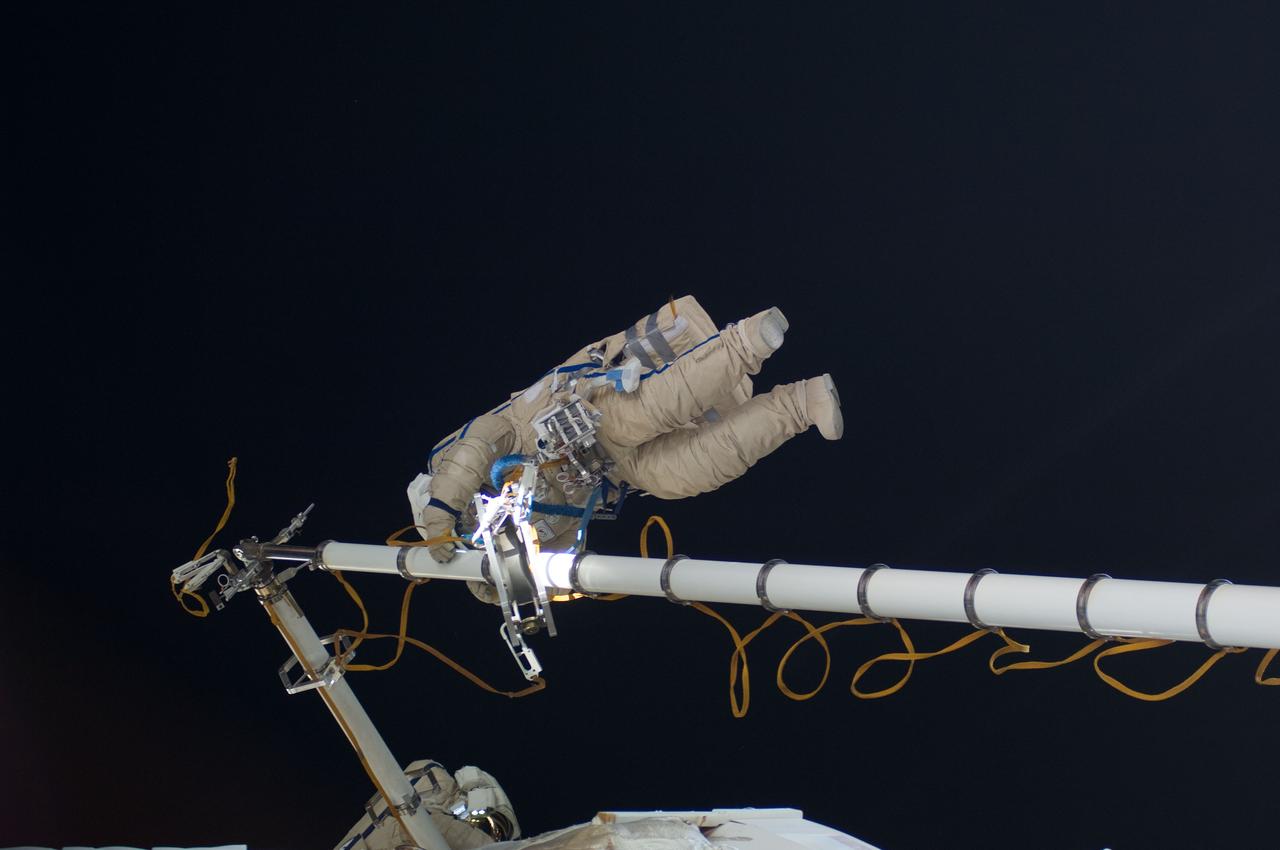
ISS030-E-078488 (16 Feb. 2012) --- Russian cosmonauts Oleg Kononenko and Anton Shkaplerov, both Expedition 30 flight engineers, participate in a session of extravehicular activity (EVA) to continue outfitting the International Space Station. During the six-hour, 15-minute spacewalk, Kononenko and Shkaplerov moved the Strela-1 crane from the Pirs Docking Compartment to begin preparing the Pirs for its replacement next year with a new laboratory and docking module. The duo used another boom, the Strela-2, to move the hand-operated crane to the Poisk module for future assembly and maintenance work. Both telescoping booms extend like fishing rods and are used to move massive components outside the station. On the exterior of the Poisk Mini-Research Module 2 (MRM2), they also installed the Vinoslivost Materials Sample Experiment, which will investigate the influence of space on the mechanical properties of the materials. The spacewalkers also collected a test sample from underneath the insulation on the Zvezda Service Module to search for any signs of living organisms. Both spacewalkers wore Russian Orlan spacesuits bearing blue stripes and equipped with NASA helmet cameras.
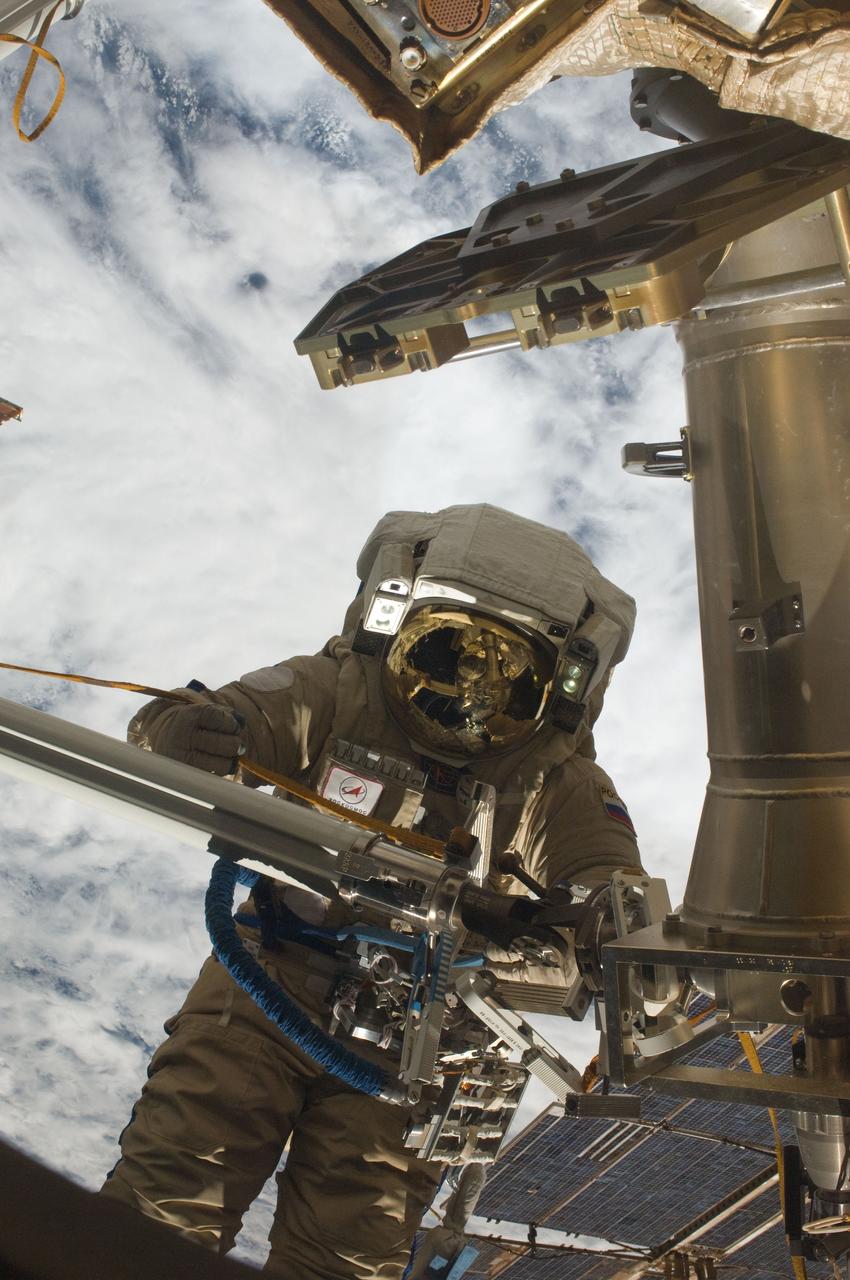
ISS030-E-079991 (16 Feb. 2012) --- Russian cosmonaut Oleg Kononenko, Expedition 30 flight engineer, participates in a session of extravehicular activity (EVA) to continue outfitting the International Space Station. During the six-hour, 15-minute spacewalk, Kononenko and Russian cosmonaut Anton Shkaplerov (out of frame), flight engineer, moved the Strela-1 crane from the Pirs Docking Compartment to begin preparing the Pirs for its replacement next year with a new laboratory and docking module. The duo used another boom, the Strela-2, to move the hand-operated crane to the Poisk module for future assembly and maintenance work. Both telescoping booms extend like fishing rods and are used to move massive components outside the station. On the exterior of the Poisk Mini-Research Module 2 (MRM2), they also installed the Vinoslivost Materials Sample Experiment, which will investigate the influence of space on the mechanical properties of the materials. The spacewalkers also collected a test sample from underneath the insulation on the Zvezda Service Module to search for any signs of living organisms. Both spacewalkers wore Russian Orlan spacesuits bearing blue stripes and equipped with NASA helmet cameras.

ISS030-E-078532 (16 Feb. 2012) --- Russian cosmonauts Oleg Kononenko and Anton Shkaplerov, both Expedition 30 flight engineers, participate in a session of extravehicular activity (EVA) to continue outfitting the International Space Station. During the six-hour, 15-minute spacewalk, Kononenko and Shkaplerov moved the Strela-1 crane from the Pirs Docking Compartment to begin preparing the Pirs for its replacement next year with a new laboratory and docking module. The duo used another boom, the Strela-2, to move the hand-operated crane to the Poisk module for future assembly and maintenance work. Both telescoping booms extend like fishing rods and are used to move massive components outside the station. On the exterior of the Poisk Mini-Research Module 2 (MRM2), they also installed the Vinoslivost Materials Sample Experiment, which will investigate the influence of space on the mechanical properties of the materials. The spacewalkers also collected a test sample from underneath the insulation on the Zvezda Service Module to search for any signs of living organisms. Both spacewalkers wore Russian Orlan spacesuits bearing blue stripes and equipped with NASA helmet cameras.
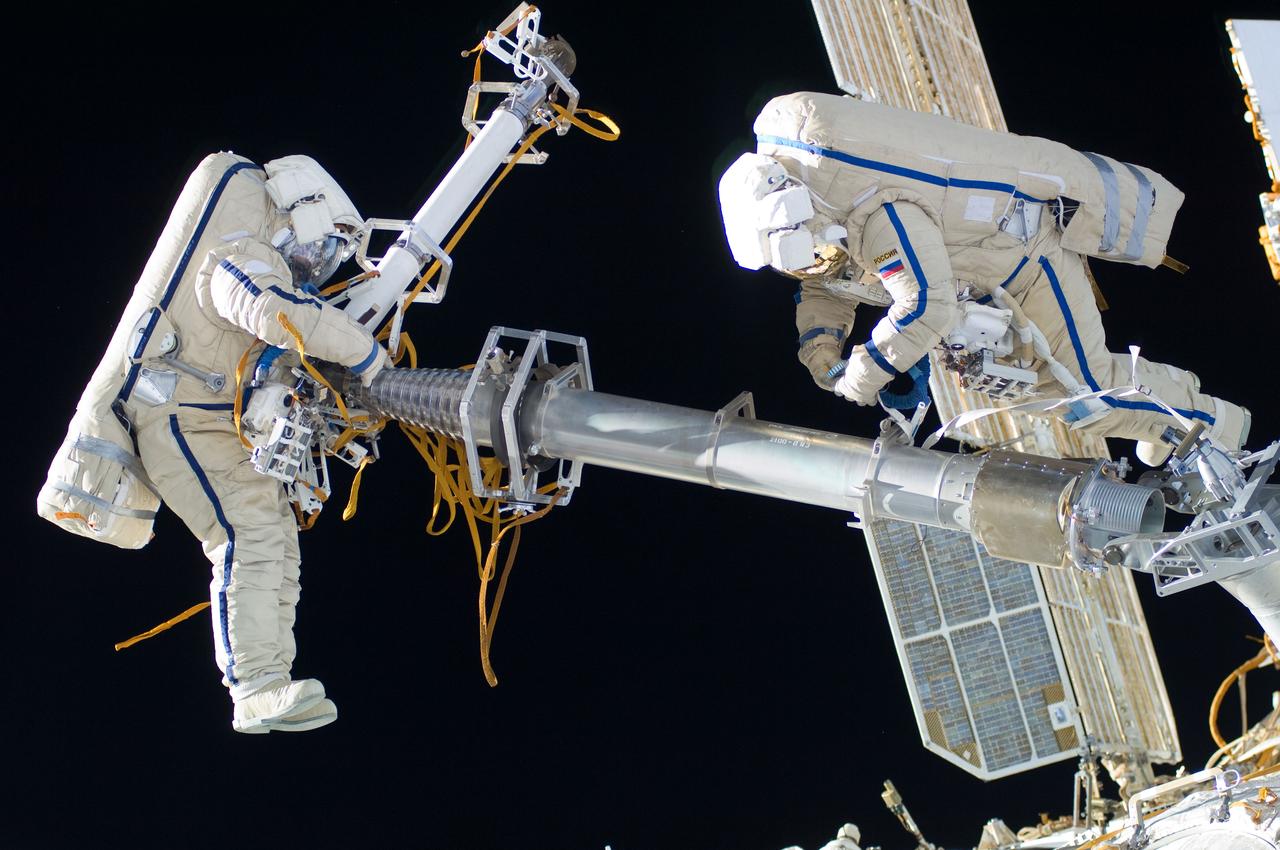
ISS030-E-078533 (16 Feb. 2012) --- Russian cosmonauts Oleg Kononenko and Anton Shkaplerov, both Expedition 30 flight engineers, participate in a session of extravehicular activity (EVA) to continue outfitting the International Space Station. During the six-hour, 15-minute spacewalk, Kononenko and Shkaplerov moved the Strela-1 crane from the Pirs Docking Compartment to begin preparing the Pirs for its replacement next year with a new laboratory and docking module. The duo used another boom, the Strela-2, to move the hand-operated crane to the Poisk module for future assembly and maintenance work. Both telescoping booms extend like fishing rods and are used to move massive components outside the station. On the exterior of the Poisk Mini-Research Module 2 (MRM2), they also installed the Vinoslivost Materials Sample Experiment, which will investigate the influence of space on the mechanical properties of the materials. The spacewalkers also collected a test sample from underneath the insulation on the Zvezda Service Module to search for any signs of living organisms. Both spacewalkers wore Russian Orlan spacesuits bearing blue stripes and equipped with NASA helmet cameras.
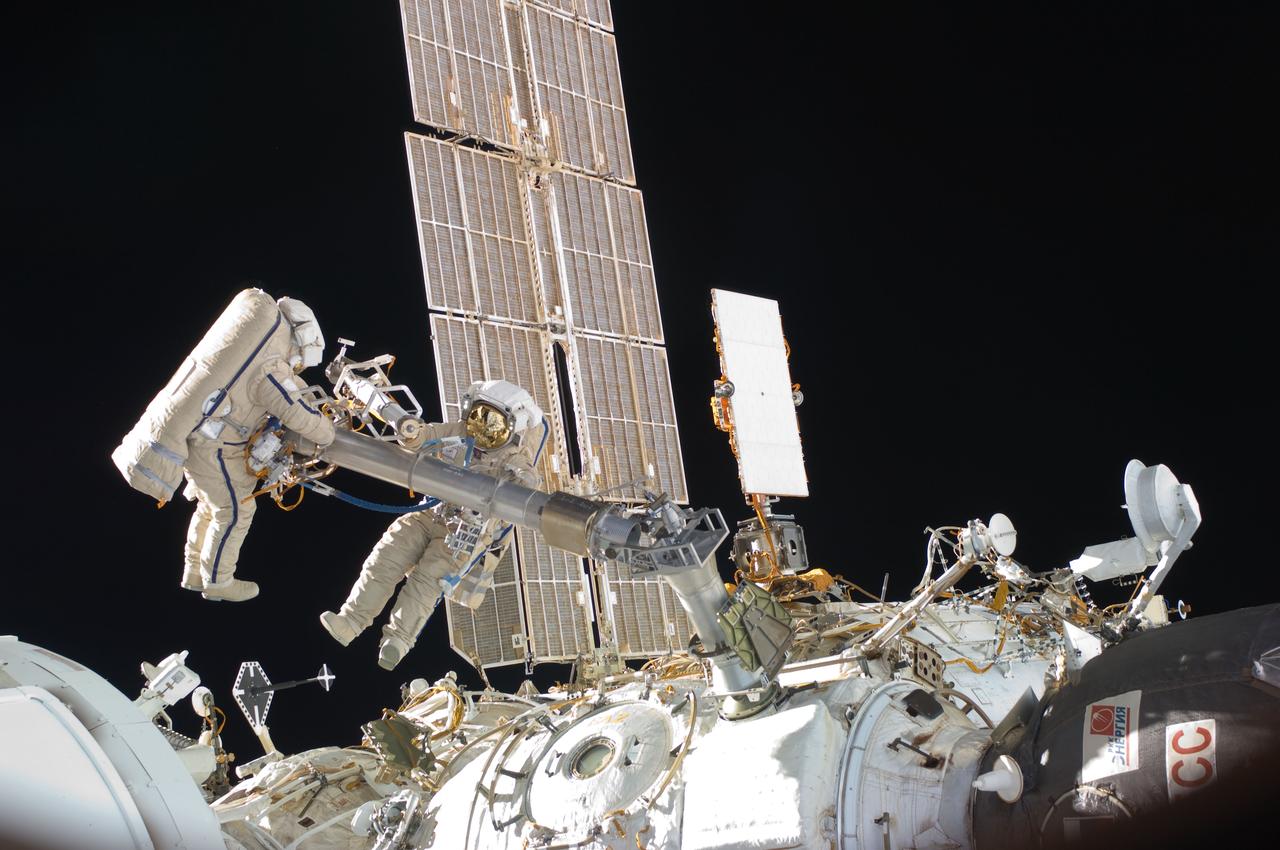
ISS030-E-078385 (16 Feb. 2012) --- Russian cosmonauts Oleg Kononenko and Anton Shkaplerov, both Expedition 30 flight engineers, participate in a session of extravehicular activity (EVA) to continue outfitting the International Space Station. During the six-hour, 15-minute spacewalk, Kononenko and Shkaplerov moved the Strela-1 crane from the Pirs Docking Compartment to begin preparing the Pirs for its replacement next year with a new laboratory and docking module. The duo used another boom, the Strela-2, to move the hand-operated crane to the Poisk module for future assembly and maintenance work. Both telescoping booms extend like fishing rods and are used to move massive components outside the station. On the exterior of the Poisk Mini-Research Module 2 (MRM2), they also installed the Vinoslivost Materials Sample Experiment, which will investigate the influence of space on the mechanical properties of the materials. The spacewalkers also collected a test sample from underneath the insulation on the Zvezda Service Module to search for any signs of living organisms. Both spacewalkers wore Russian Orlan spacesuits bearing blue stripes and equipped with NASA helmet cameras.
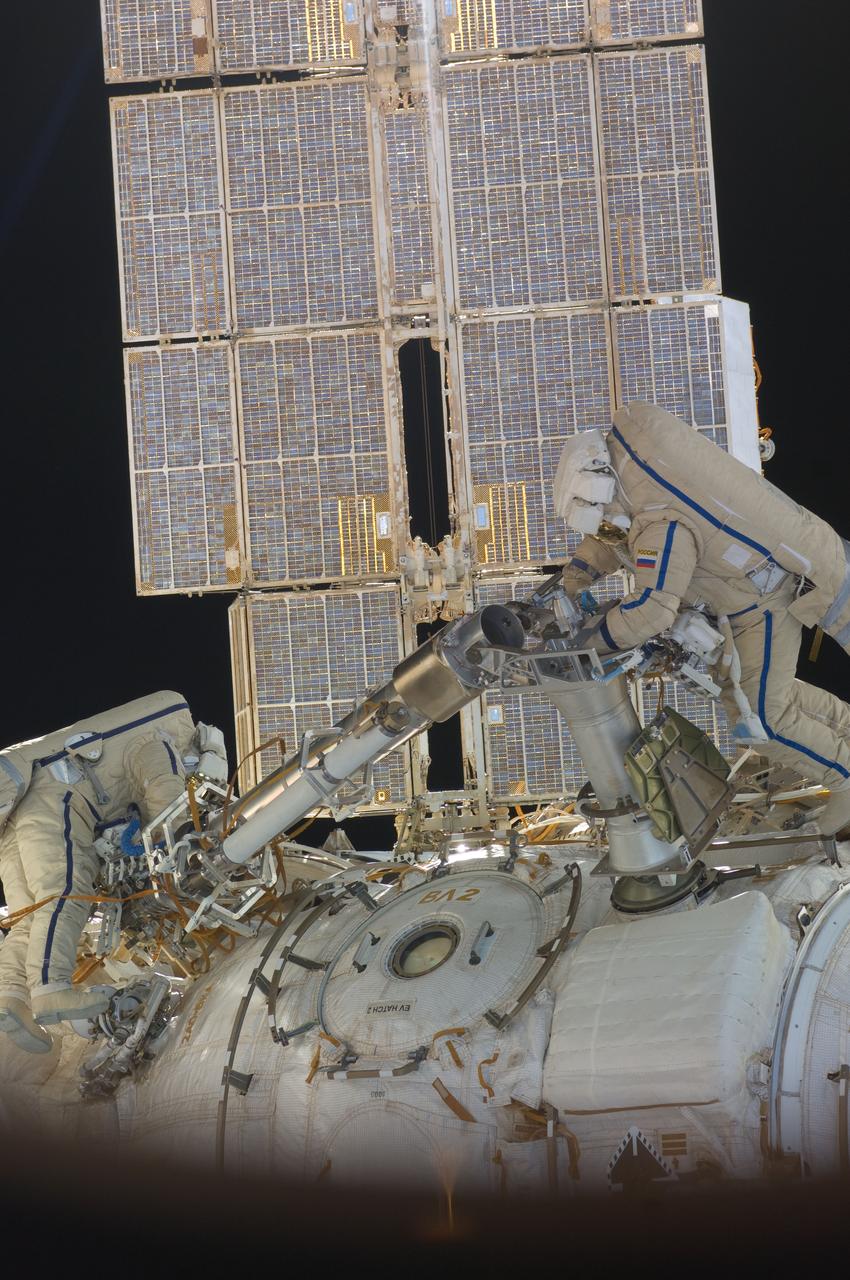
ISS030-E-078393 (16 Feb. 2012) --- Russian cosmonauts Oleg Kononenko and Anton Shkaplerov, both Expedition 30 flight engineers, participate in a session of extravehicular activity (EVA) to continue outfitting the International Space Station. During the six-hour, 15-minute spacewalk, Kononenko and Shkaplerov moved the Strela-1 crane from the Pirs Docking Compartment to begin preparing the Pirs for its replacement next year with a new laboratory and docking module. The duo used another boom, the Strela-2, to move the hand-operated crane to the Poisk module for future assembly and maintenance work. Both telescoping booms extend like fishing rods and are used to move massive components outside the station. On the exterior of the Poisk Mini-Research Module 2 (MRM2), they also installed the Vinoslivost Materials Sample Experiment, which will investigate the influence of space on the mechanical properties of the materials. The spacewalkers also collected a test sample from underneath the insulation on the Zvezda Service Module to search for any signs of living organisms. Both spacewalkers wore Russian Orlan spacesuits bearing blue stripes and equipped with NASA helmet cameras.
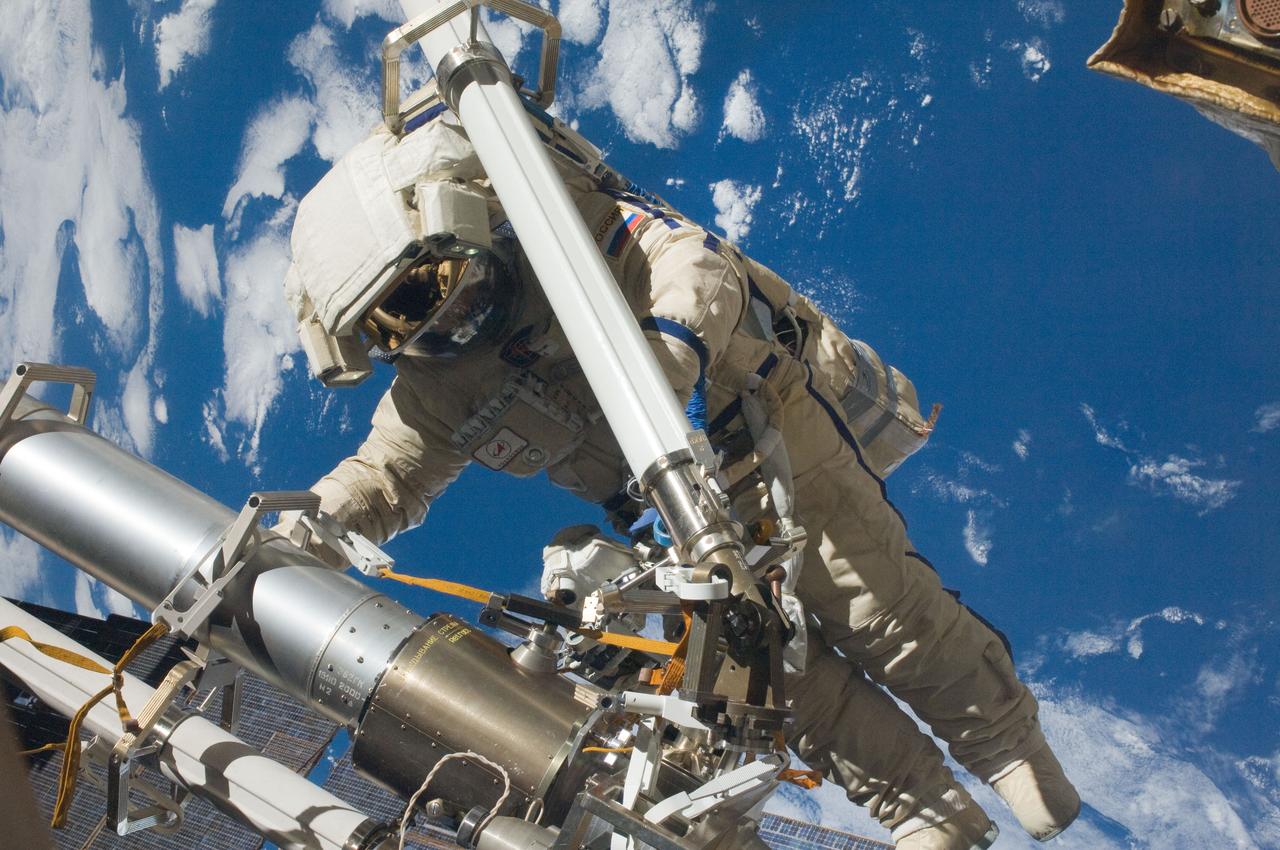
ISS030-E-079956 (16 Feb. 2012) --- Russian cosmonaut Anton Shkaplerov, Expedition 30 flight engineer, participates in a session of extravehicular activity (EVA) to continue outfitting the International Space Station. During the six-hour, 15-minute spacewalk, Shkaplerov and Russian cosmonaut Oleg Kononenko (out of frame), flight engineer, moved the Strela-1 crane from the Pirs Docking Compartment to begin preparing the Pirs for its replacement next year with a new laboratory and docking module. The duo used another boom, the Strela-2, to move the hand-operated crane to the Poisk module for future assembly and maintenance work. Both telescoping booms extend like fishing rods and are used to move massive components outside the station. On the exterior of the Poisk Mini-Research Module 2 (MRM2), they also installed the Vinoslivost Materials Sample Experiment, which will investigate the influence of space on the mechanical properties of the materials. The spacewalkers also collected a test sample from underneath the insulation on the Zvezda Service Module to search for any signs of living organisms. Both spacewalkers wore Russian Orlan spacesuits bearing blue stripes and equipped with NASA helmet cameras.
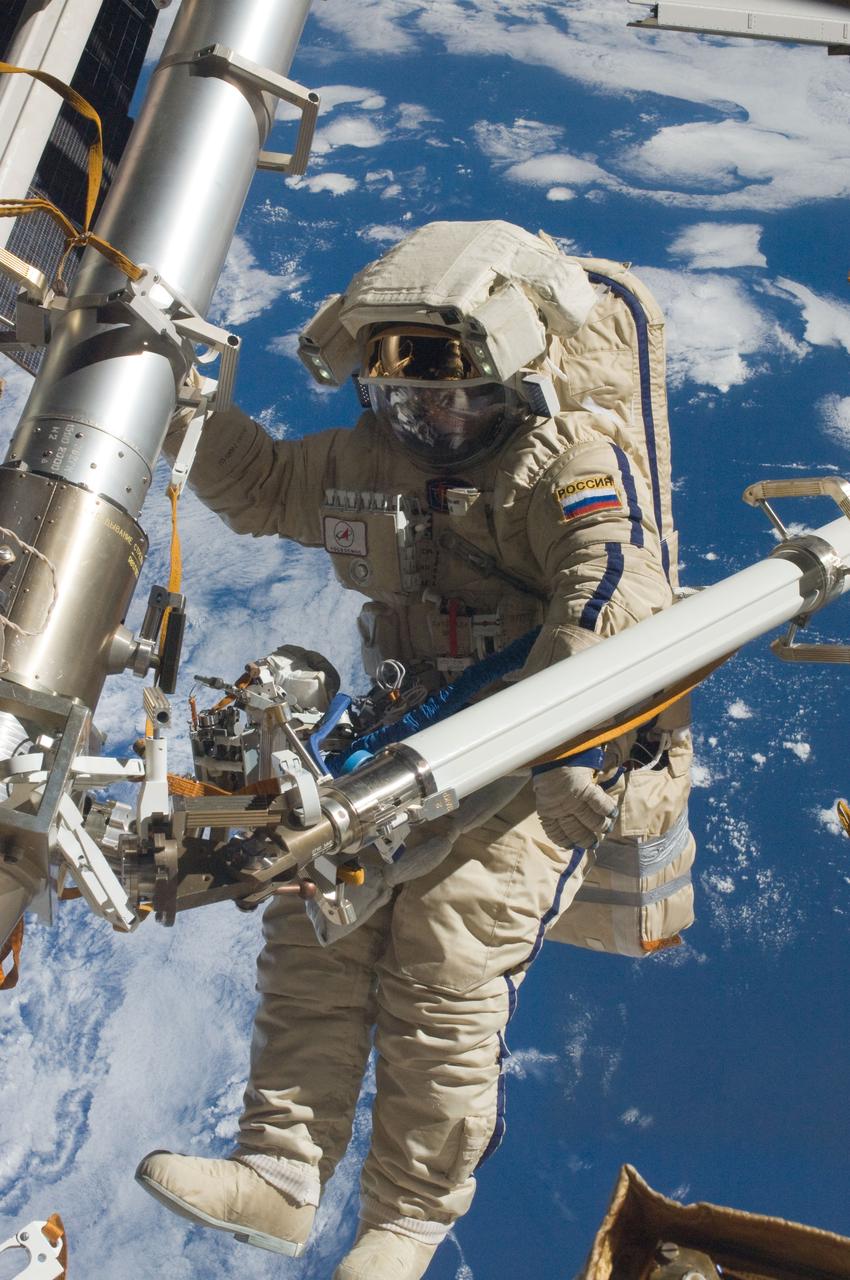
ISS030-E-079955 (16 Feb. 2012) --- Russian cosmonaut Anton Shkaplerov, Expedition 30 flight engineer, participates in a session of extravehicular activity (EVA) to continue outfitting the International Space Station. During the six-hour, 15-minute spacewalk, Shkaplerov and Russian cosmonaut Oleg Kononenko (out of frame), flight engineer, moved the Strela-1 crane from the Pirs Docking Compartment to begin preparing the Pirs for its replacement next year with a new laboratory and docking module. The duo used another boom, the Strela-2, to move the hand-operated crane to the Poisk module for future assembly and maintenance work. Both telescoping booms extend like fishing rods and are used to move massive components outside the station. On the exterior of the Poisk Mini-Research Module 2 (MRM2), they also installed the Vinoslivost Materials Sample Experiment, which will investigate the influence of space on the mechanical properties of the materials. The spacewalkers also collected a test sample from underneath the insulation on the Zvezda Service Module to search for any signs of living organisms. Both spacewalkers wore Russian Orlan spacesuits bearing blue stripes and equipped with NASA helmet cameras.
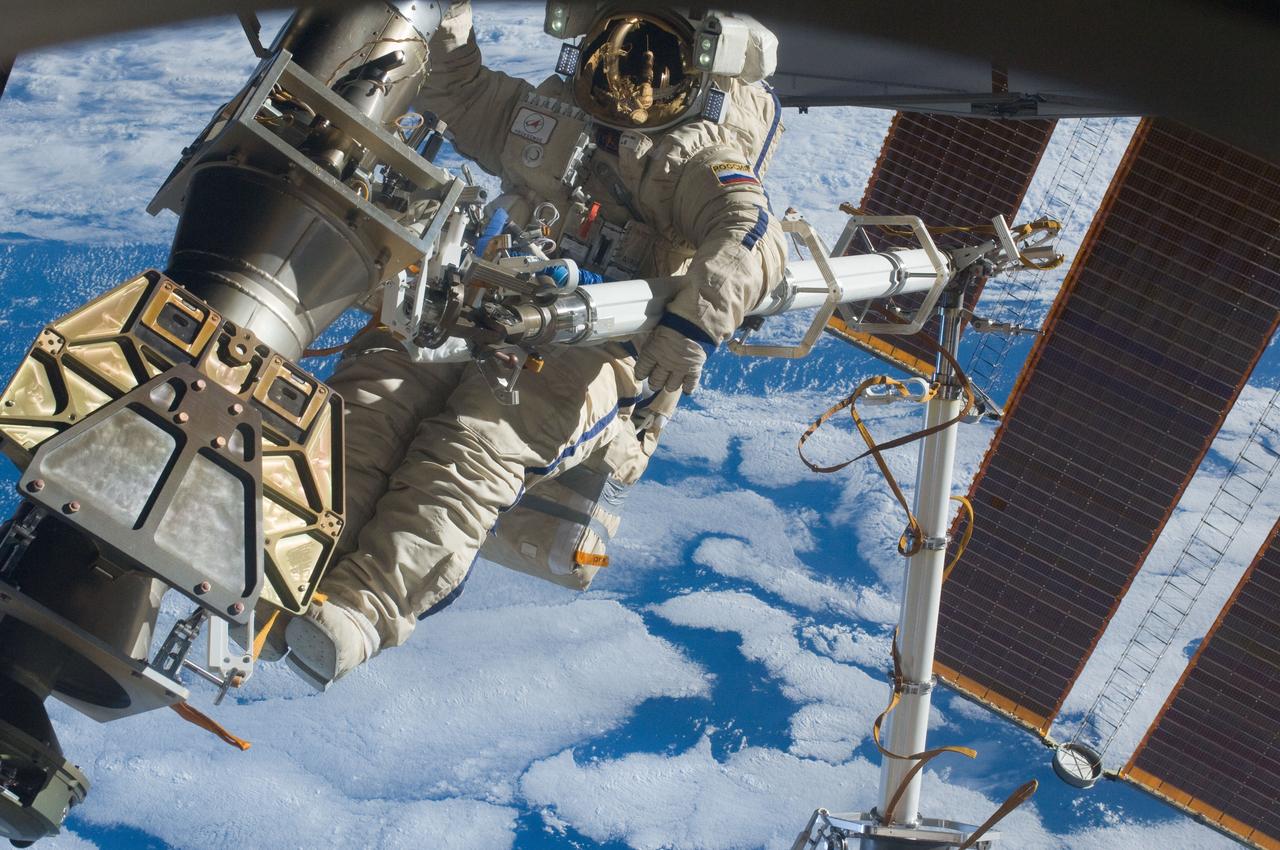
ISS030-E-079930 (16 Feb. 2012) --- Russian cosmonaut Anton Shkaplerov, Expedition 30 flight engineer, participates in a session of extravehicular activity (EVA) to continue outfitting the International Space Station. During the six-hour, 15-minute spacewalk, Shkaplerov and Russian cosmonaut Oleg Kononenko (out of frame), flight engineer, moved the Strela-1 crane from the Pirs Docking Compartment to begin preparing the Pirs for its replacement next year with a new laboratory and docking module. The duo used another boom, the Strela-2, to move the hand-operated crane to the Poisk module for future assembly and maintenance work. Both telescoping booms extend like fishing rods and are used to move massive components outside the station. On the exterior of the Poisk Mini-Research Module 2 (MRM2), they also installed the Vinoslivost Materials Sample Experiment, which will investigate the influence of space on the mechanical properties of the materials. The spacewalkers also collected a test sample from underneath the insulation on the Zvezda Service Module to search for any signs of living organisms. Both spacewalkers wore Russian Orlan spacesuits bearing blue stripes and equipped with NASA helmet cameras.
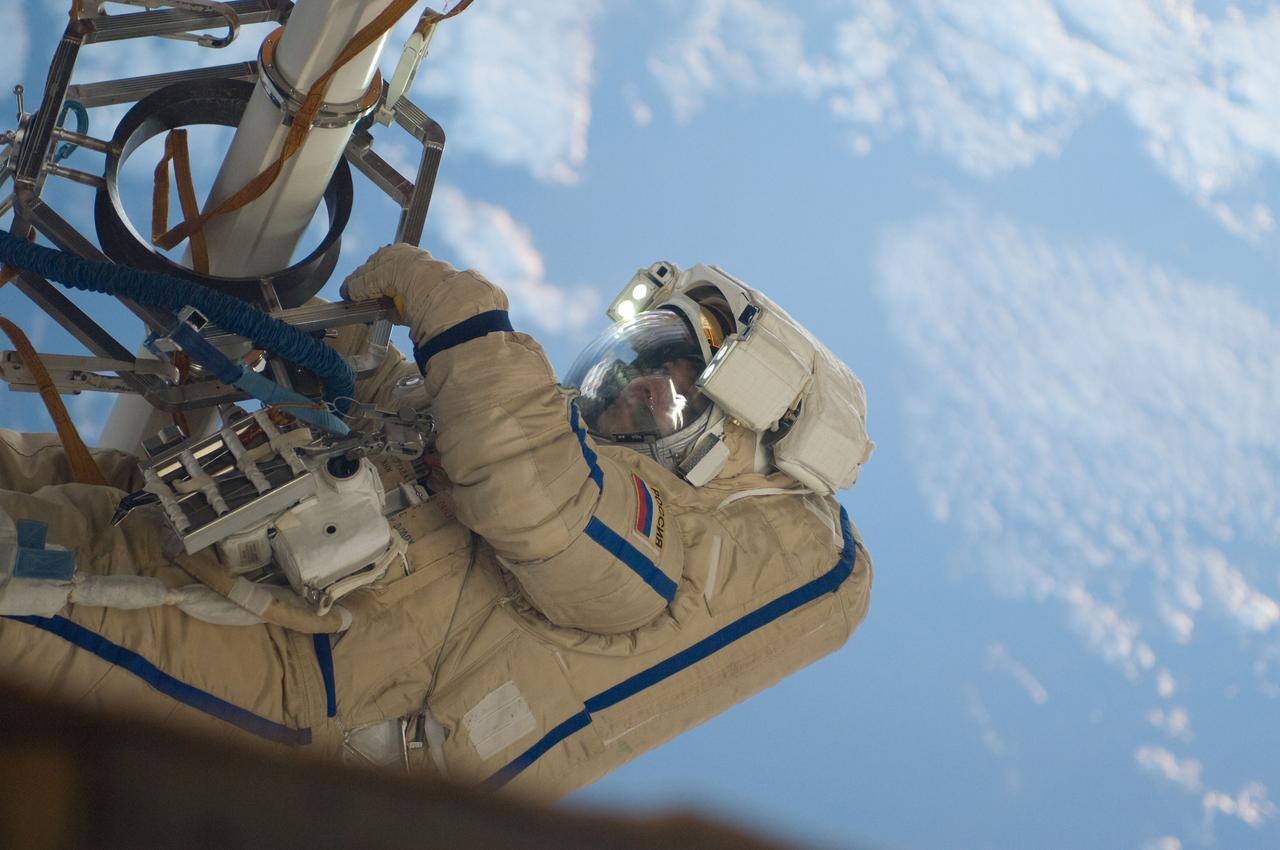
ISS030-E-080048 (16 Feb. 2012) --- Russian cosmonaut Oleg Kononenko, Expedition 30 flight engineer, participates in a session of extravehicular activity (EVA) to continue outfitting the International Space Station. During the six-hour, 15-minute spacewalk, Kononenko and Russian cosmonaut Anton Shkaplerov (out of frame), flight engineer, moved the Strela-1 crane from the Pirs Docking Compartment to begin preparing the Pirs for its replacement next year with a new laboratory and docking module. The duo used another boom, the Strela-2, to move the hand-operated crane to the Poisk module for future assembly and maintenance work. Both telescoping booms extend like fishing rods and are used to move massive components outside the station. On the exterior of the Poisk Mini-Research Module 2 (MRM2), they also installed the Vinoslivost Materials Sample Experiment, which will investigate the influence of space on the mechanical properties of the materials. The spacewalkers also collected a test sample from underneath the insulation on the Zvezda Service Module to search for any signs of living organisms. Both spacewalkers wore Russian Orlan spacesuits bearing blue stripes and equipped with NASA helmet cameras.

ISS030-E-078511 (16 Feb. 2012) --- Russian cosmonauts Oleg Kononenko and Anton Shkaplerov, both Expedition 30 flight engineers, participate in a session of extravehicular activity (EVA) to continue outfitting the International Space Station. During the six-hour, 15-minute spacewalk, Kononenko and Shkaplerov moved the Strela-1 crane from the Pirs Docking Compartment to begin preparing the Pirs for its replacement next year with a new laboratory and docking module. The duo used another boom, the Strela-2, to move the hand-operated crane to the Poisk module for future assembly and maintenance work. Both telescoping booms extend like fishing rods and are used to move massive components outside the station. On the exterior of the Poisk Mini-Research Module 2 (MRM2), they also installed the Vinoslivost Materials Sample Experiment, which will investigate the influence of space on the mechanical properties of the materials. The spacewalkers also collected a test sample from underneath the insulation on the Zvezda Service Module to search for any signs of living organisms. Both spacewalkers wore Russian Orlan spacesuits bearing blue stripes and equipped with NASA helmet cameras.
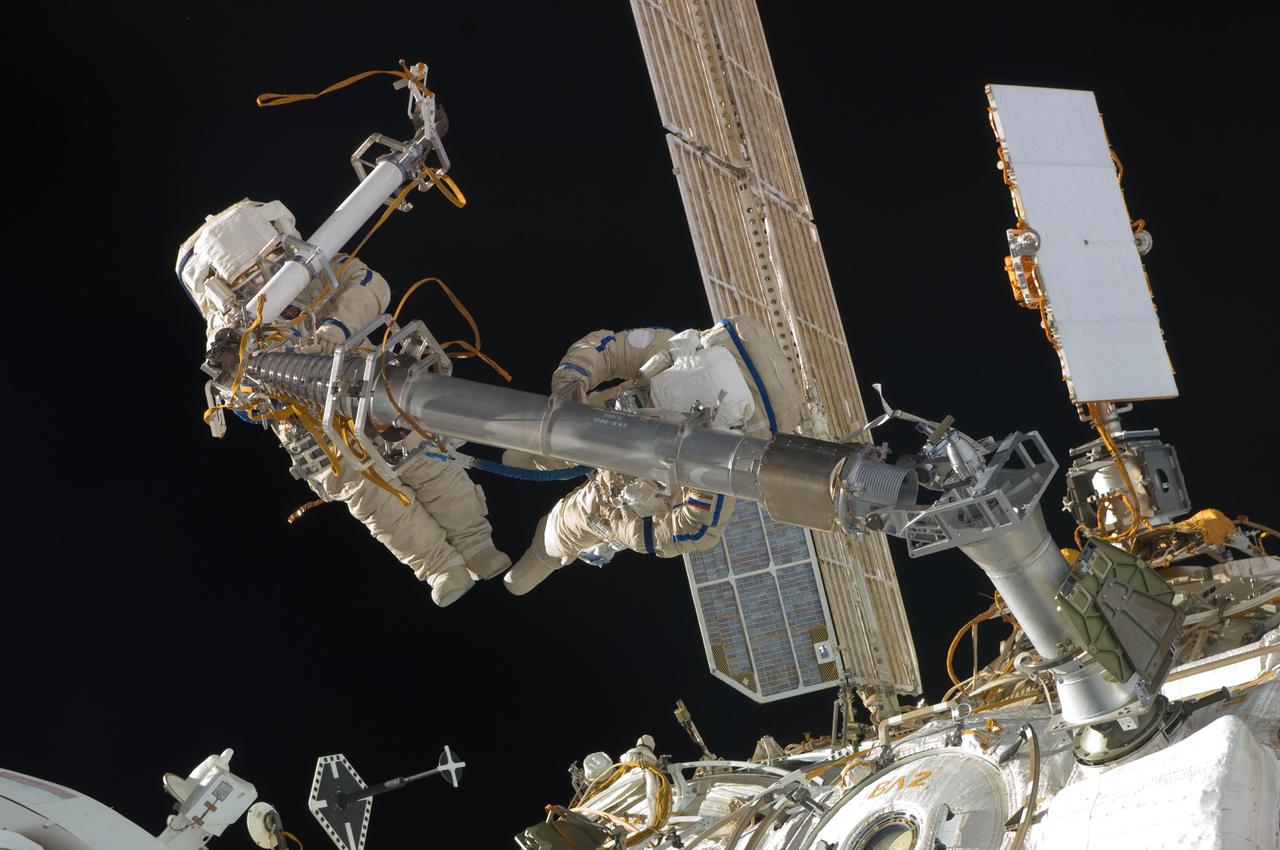
ISS030-E-078381 (16 Feb. 2012) --- Russian cosmonauts Oleg Kononenko and Anton Shkaplerov, both Expedition 30 flight engineers, participate in a session of extravehicular activity (EVA) to continue outfitting the International Space Station. During the six-hour, 15-minute spacewalk, Kononenko and Shkaplerov moved the Strela-1 crane from the Pirs Docking Compartment to begin preparing the Pirs for its replacement next year with a new laboratory and docking module. The duo used another boom, the Strela-2, to move the hand-operated crane to the Poisk module for future assembly and maintenance work. Both telescoping booms extend like fishing rods and are used to move massive components outside the station. On the exterior of the Poisk Mini-Research Module 2 (MRM2), they also installed the Vinoslivost Materials Sample Experiment, which will investigate the influence of space on the mechanical properties of the materials. The spacewalkers also collected a test sample from underneath the insulation on the Zvezda Service Module to search for any signs of living organisms. Both spacewalkers wore Russian Orlan spacesuits bearing blue stripes and equipped with NASA helmet cameras.
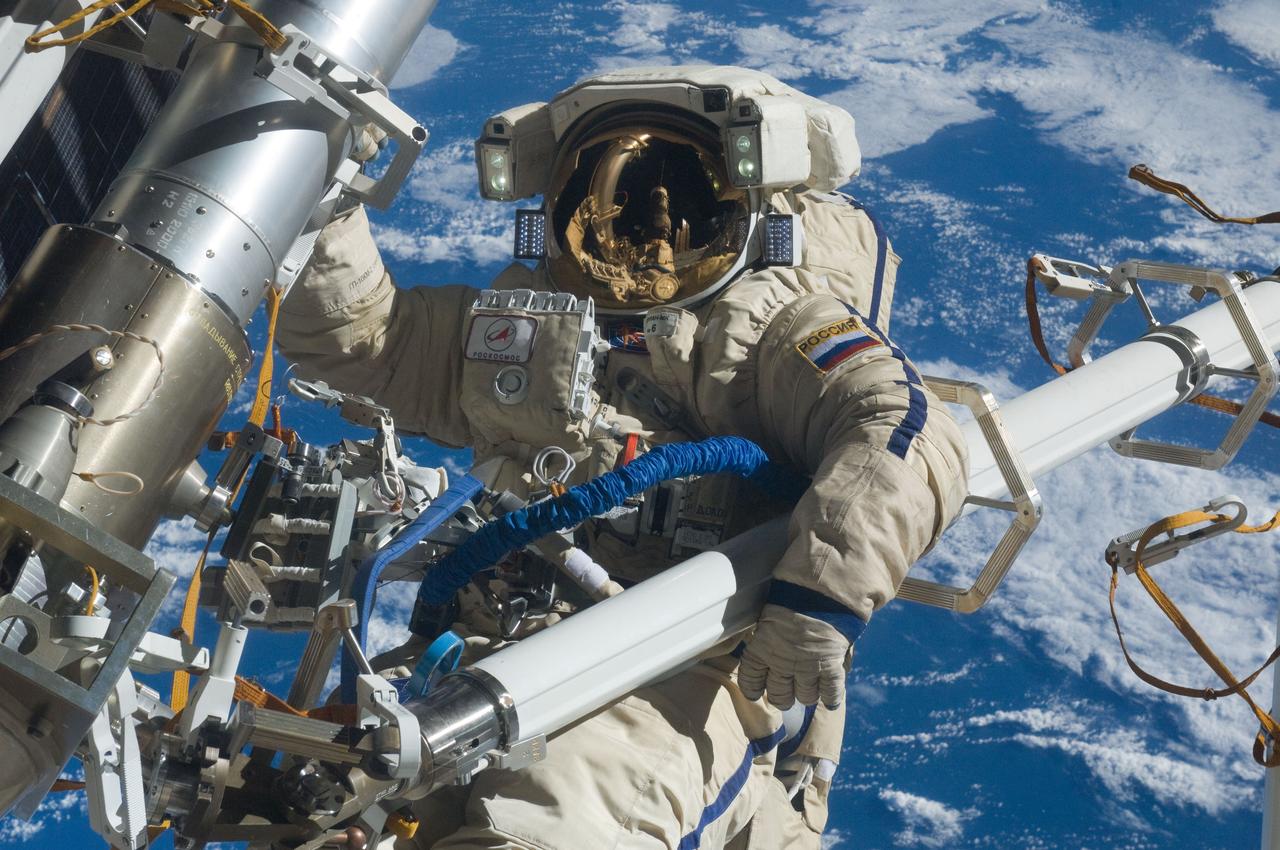
ISS030-E-079939 (16 Feb. 2012) --- Russian cosmonaut Anton Shkaplerov, Expedition 30 flight engineer, participates in a session of extravehicular activity (EVA) to continue outfitting the International Space Station. During the six-hour, 15-minute spacewalk, Shkaplerov and Russian cosmonaut Oleg Kononenko (out of frame), flight engineer, moved the Strela-1 crane from the Pirs Docking Compartment to begin preparing the Pirs for its replacement next year with a new laboratory and docking module. The duo used another boom, the Strela-2, to move the hand-operated crane to the Poisk module for future assembly and maintenance work. Both telescoping booms extend like fishing rods and are used to move massive components outside the station. On the exterior of the Poisk Mini-Research Module 2 (MRM2), they also installed the Vinoslivost Materials Sample Experiment, which will investigate the influence of space on the mechanical properties of the materials. The spacewalkers also collected a test sample from underneath the insulation on the Zvezda Service Module to search for any signs of living organisms. Both spacewalkers wore Russian Orlan spacesuits bearing blue stripes and equipped with NASA helmet cameras.
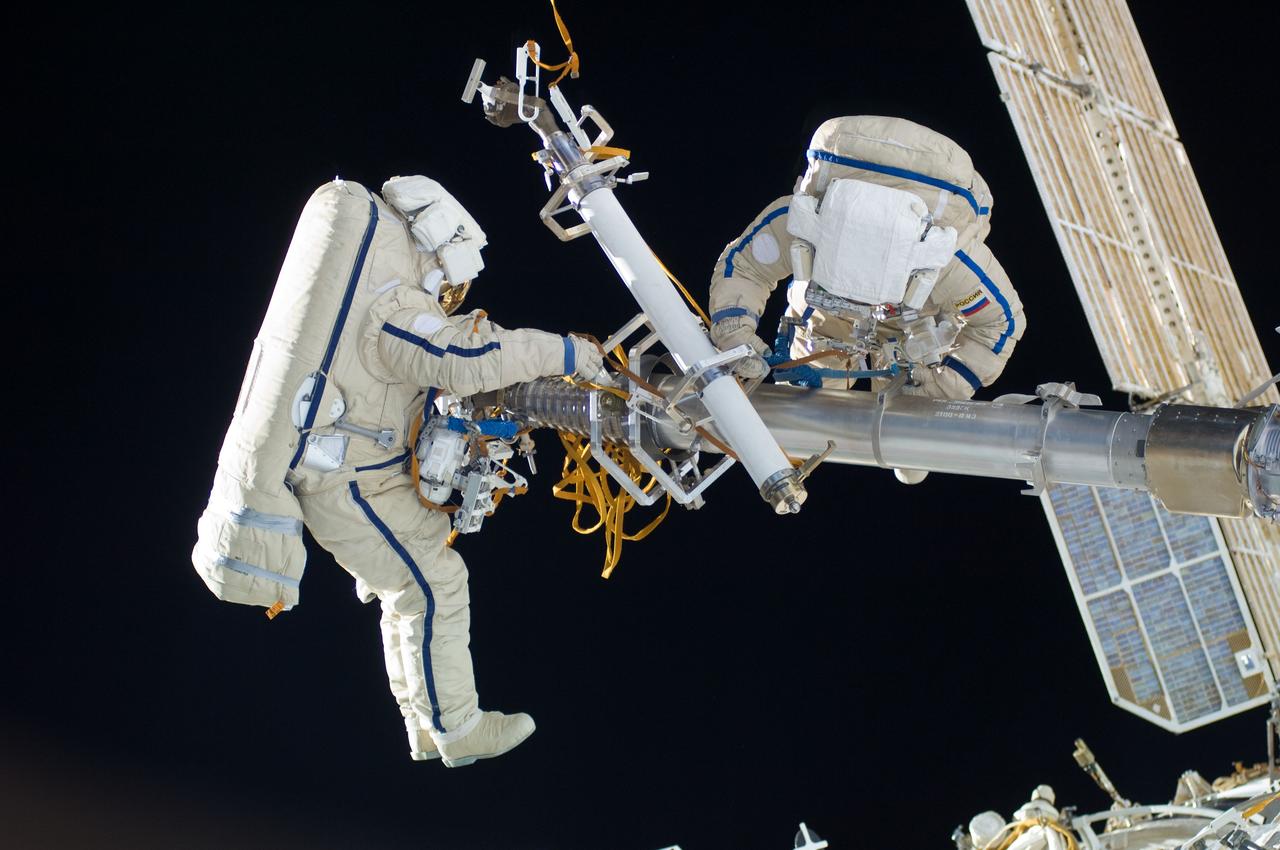
ISS030-E-078537 (16 Feb. 2012) --- Russian cosmonauts Oleg Kononenko and Anton Shkaplerov, both Expedition 30 flight engineers, participate in a session of extravehicular activity (EVA) to continue outfitting the International Space Station. During the six-hour, 15-minute spacewalk, Kononenko and Shkaplerov moved the Strela-1 crane from the Pirs Docking Compartment to begin preparing the Pirs for its replacement next year with a new laboratory and docking module. The duo used another boom, the Strela-2, to move the hand-operated crane to the Poisk module for future assembly and maintenance work. Both telescoping booms extend like fishing rods and are used to move massive components outside the station. On the exterior of the Poisk Mini-Research Module 2 (MRM2), they also installed the Vinoslivost Materials Sample Experiment, which will investigate the influence of space on the mechanical properties of the materials. The spacewalkers also collected a test sample from underneath the insulation on the Zvezda Service Module to search for any signs of living organisms. Both spacewalkers wore Russian Orlan spacesuits bearing blue stripes and equipped with NASA helmet cameras.
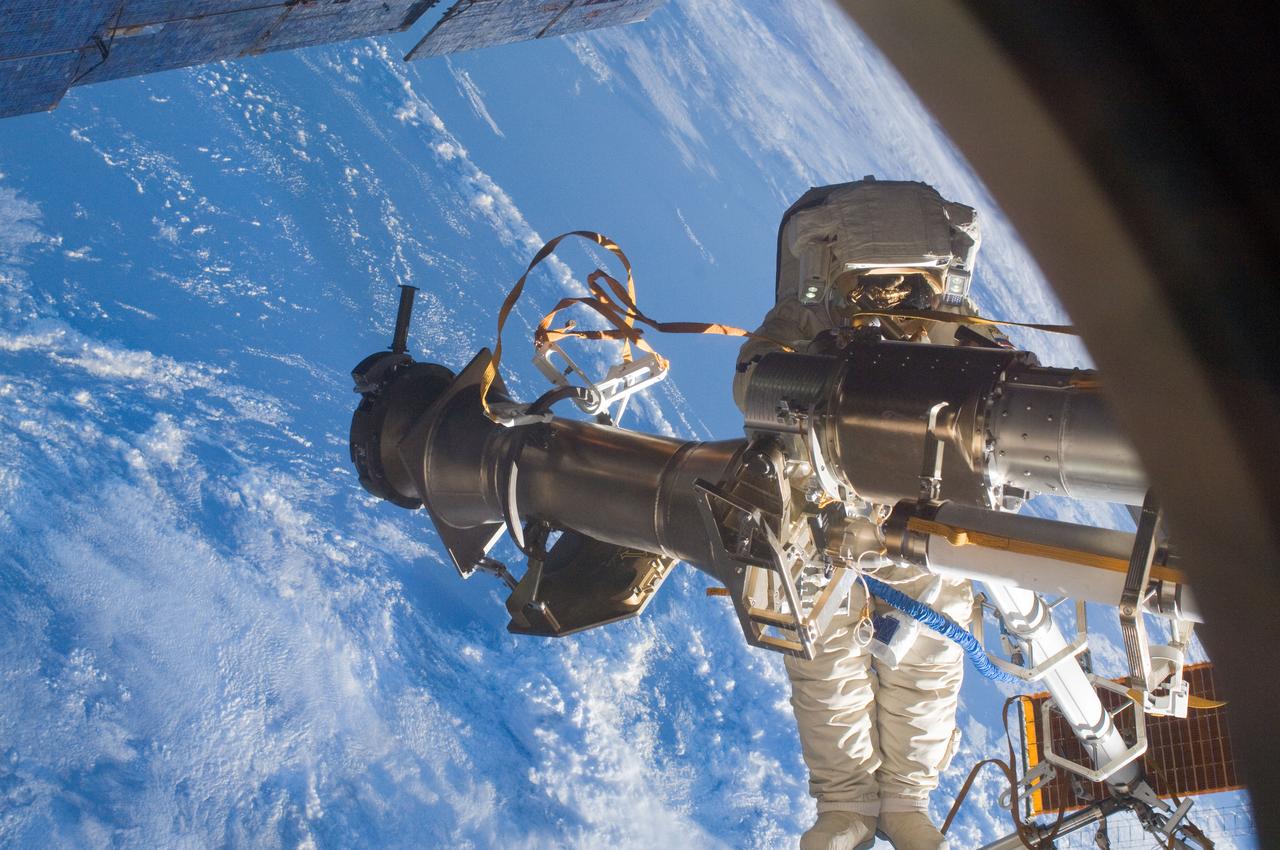
ISS030-E-079919 (16 Feb. 2012) --- Russian cosmonaut Anton Shkaplerov, Expedition 30 flight engineer, participates in a session of extravehicular activity (EVA) to continue outfitting the International Space Station. During the six-hour, 15-minute spacewalk, Shkaplerov and Russian cosmonaut Oleg Kononenko (out of frame), flight engineer, moved the Strela-1 crane from the Pirs Docking Compartment to begin preparing the Pirs for its replacement next year with a new laboratory and docking module. The duo used another boom, the Strela-2, to move the hand-operated crane to the Poisk module for future assembly and maintenance work. Both telescoping booms extend like fishing rods and are used to move massive components outside the station. On the exterior of the Poisk Mini-Research Module 2 (MRM2), they also installed the Vinoslivost Materials Sample Experiment, which will investigate the influence of space on the mechanical properties of the materials. The spacewalkers also collected a test sample from underneath the insulation on the Zvezda Service Module to search for any signs of living organisms. Both spacewalkers wore Russian Orlan spacesuits bearing blue stripes and equipped with NASA helmet cameras.
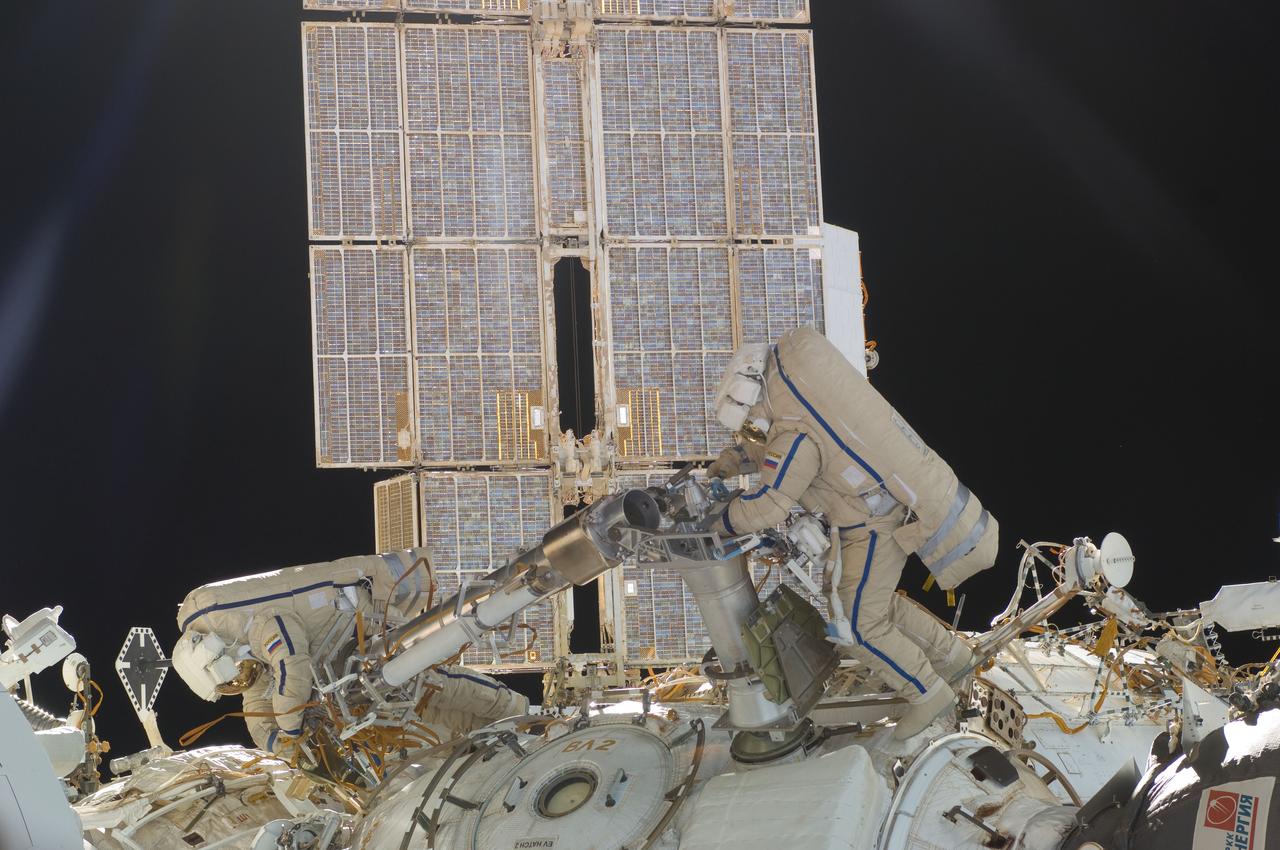
ISS030-E-078388 (16 Feb. 2012) --- Russian cosmonauts Oleg Kononenko and Anton Shkaplerov, both Expedition 30 flight engineers, participate in a session of extravehicular activity (EVA) to continue outfitting the International Space Station. During the six-hour, 15-minute spacewalk, Kononenko and Shkaplerov moved the Strela-1 crane from the Pirs Docking Compartment to begin preparing the Pirs for its replacement next year with a new laboratory and docking module. The duo used another boom, the Strela-2, to move the hand-operated crane to the Poisk module for future assembly and maintenance work. Both telescoping booms extend like fishing rods and are used to move massive components outside the station. On the exterior of the Poisk Mini-Research Module 2 (MRM2), they also installed the Vinoslivost Materials Sample Experiment, which will investigate the influence of space on the mechanical properties of the materials. The spacewalkers also collected a test sample from underneath the insulation on the Zvezda Service Module to search for any signs of living organisms. Both spacewalkers wore Russian Orlan spacesuits bearing blue stripes and equipped with NASA helmet cameras.
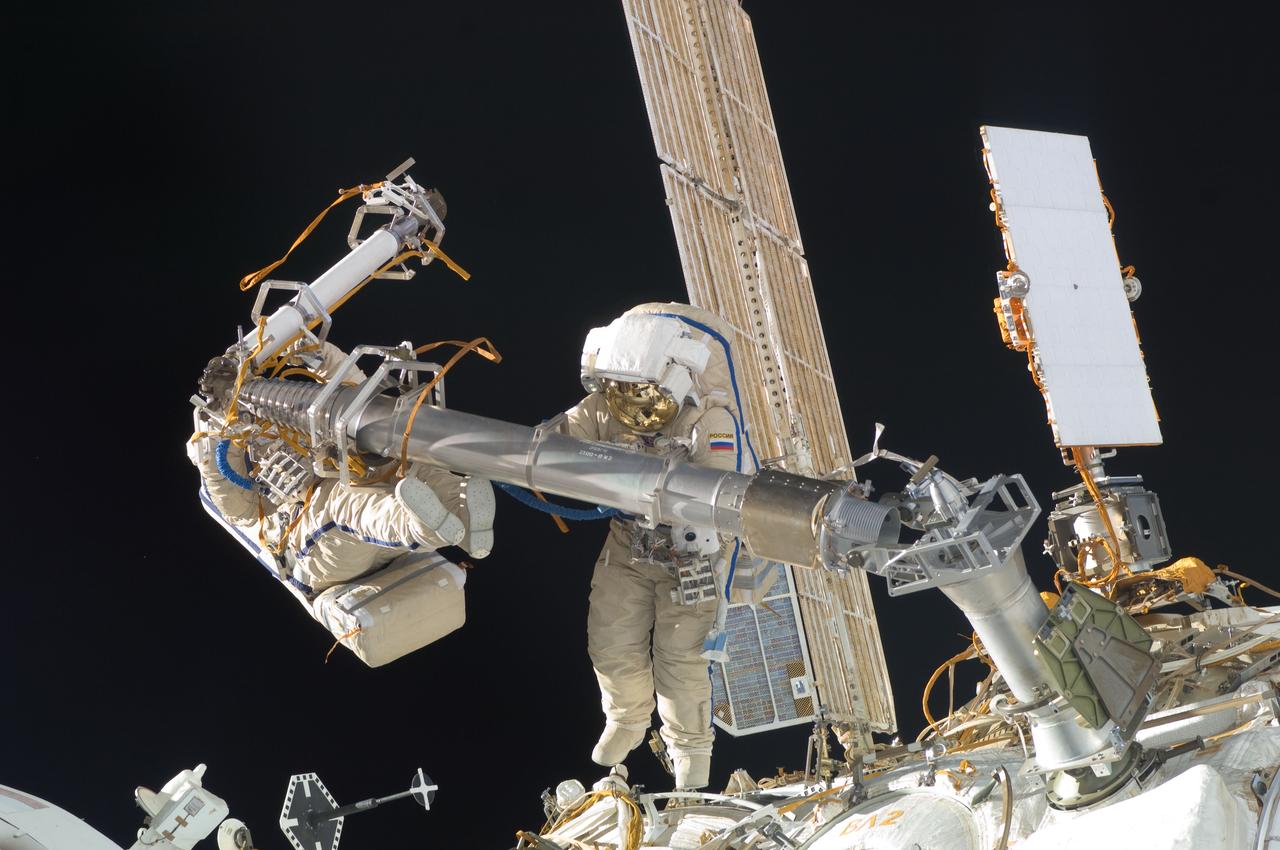
ISS030-E-078377 (16 Feb. 2012) --- Russian cosmonauts Oleg Kononenko and Anton Shkaplerov, both Expedition 30 flight engineers, participate in a session of extravehicular activity (EVA) to continue outfitting the International Space Station. During the six-hour, 15-minute spacewalk, Kononenko and Shkaplerov moved the Strela-1 crane from the Pirs Docking Compartment to begin preparing the Pirs for its replacement next year with a new laboratory and docking module. The duo used another boom, the Strela-2, to move the hand-operated crane to the Poisk module for future assembly and maintenance work. Both telescoping booms extend like fishing rods and are used to move massive components outside the station. On the exterior of the Poisk Mini-Research Module 2 (MRM2), they also installed the Vinoslivost Materials Sample Experiment, which will investigate the influence of space on the mechanical properties of the materials. The spacewalkers also collected a test sample from underneath the insulation on the Zvezda Service Module to search for any signs of living organisms. Both spacewalkers wore Russian Orlan spacesuits bearing blue stripes and equipped with NASA helmet cameras.
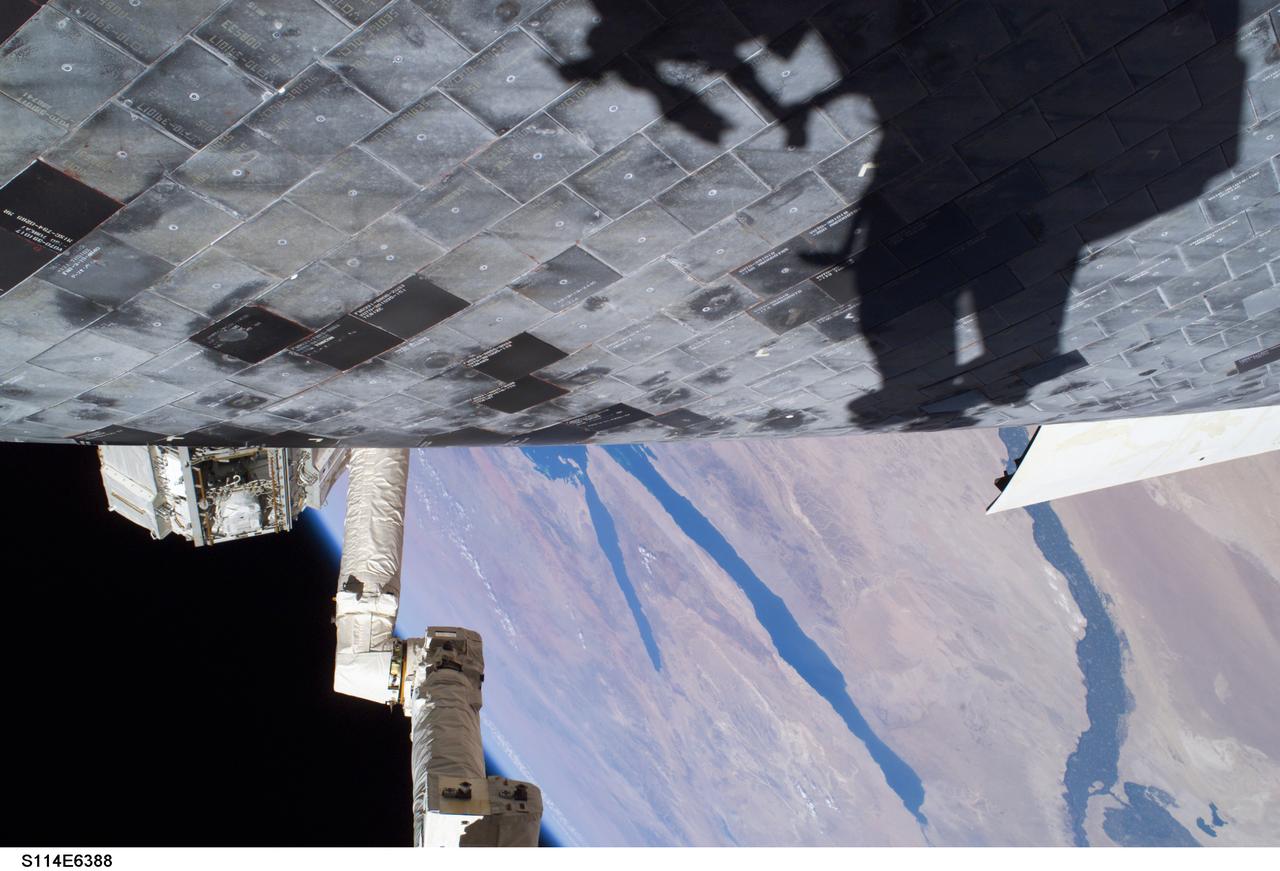
Launched on July 26, 2005 from the Kennedy Space Center in Florida, STS-114 was classified as Logistics Flight 1. Among the Station-related activities of the mission were the delivery of new supplies and the replacement of one of the orbital outpost's Control Moment Gyroscopes (CMGs). STS-114 also carried the Raffaello Multi-Purpose Logistics Module and the External Stowage Platform-2. A major focus of the mission was the testing and evaluation of new Space Shuttle flight safety, which included new inspection and repair techniques. Upon its approach to the International Space Station (ISS), the Space Shuttle Discovery underwent a photography session in order to assess any damages that may have occurred during its launch and/or journey through Space. The mission’s third and final Extra Vehicular Activity (EVA) included taking a close-up look and the repair of the damaged heat shield. Gap fillers were removed from between the orbiter’s heat-shielding tiles located on the craft’s underbelly. Never before had any repairs been done to an orbiter while still in space. This particular photo was taken by astronaut Stephen K. Robinson, STS-114 mission specialist, whose shadow is visible on the thermal protection tiles, and a portion of the Canadian built Remote Manipulator System (RMS) robotic arm and the Nile River is visible at the bottom.
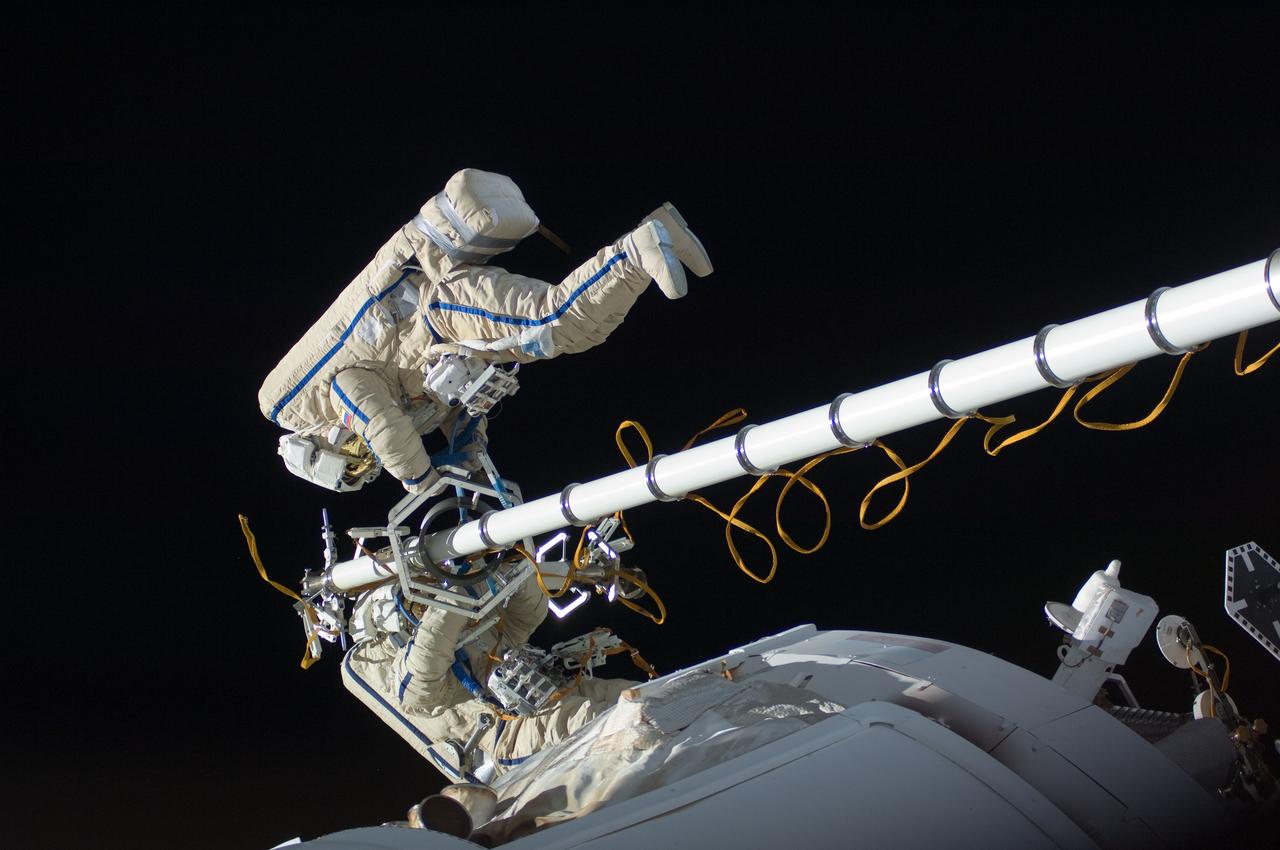
ISS030-E-078522 (16 Feb. 2012) --- Russian cosmonauts Oleg Kononenko and Anton Shkaplerov, both Expedition 30 flight engineers, participate in a session of extravehicular activity (EVA) to continue outfitting the International Space Station. During the six-hour, 15-minute spacewalk, Kononenko and Shkaplerov moved the Strela-1 crane from the Pirs Docking Compartment to begin preparing the Pirs for its replacement next year with a new laboratory and docking module. The duo used another boom, the Strela-2, to move the hand-operated crane to the Poisk module for future assembly and maintenance work. Both telescoping booms extend like fishing rods and are used to move massive components outside the station. On the exterior of the Poisk Mini-Research Module 2 (MRM2), they also installed the Vinoslivost Materials Sample Experiment, which will investigate the influence of space on the mechanical properties of the materials. The spacewalkers also collected a test sample from underneath the insulation on the Zvezda Service Module to search for any signs of living organisms. Both spacewalkers wore Russian Orlan spacesuits bearing blue stripes and equipped with NASA helmet cameras.
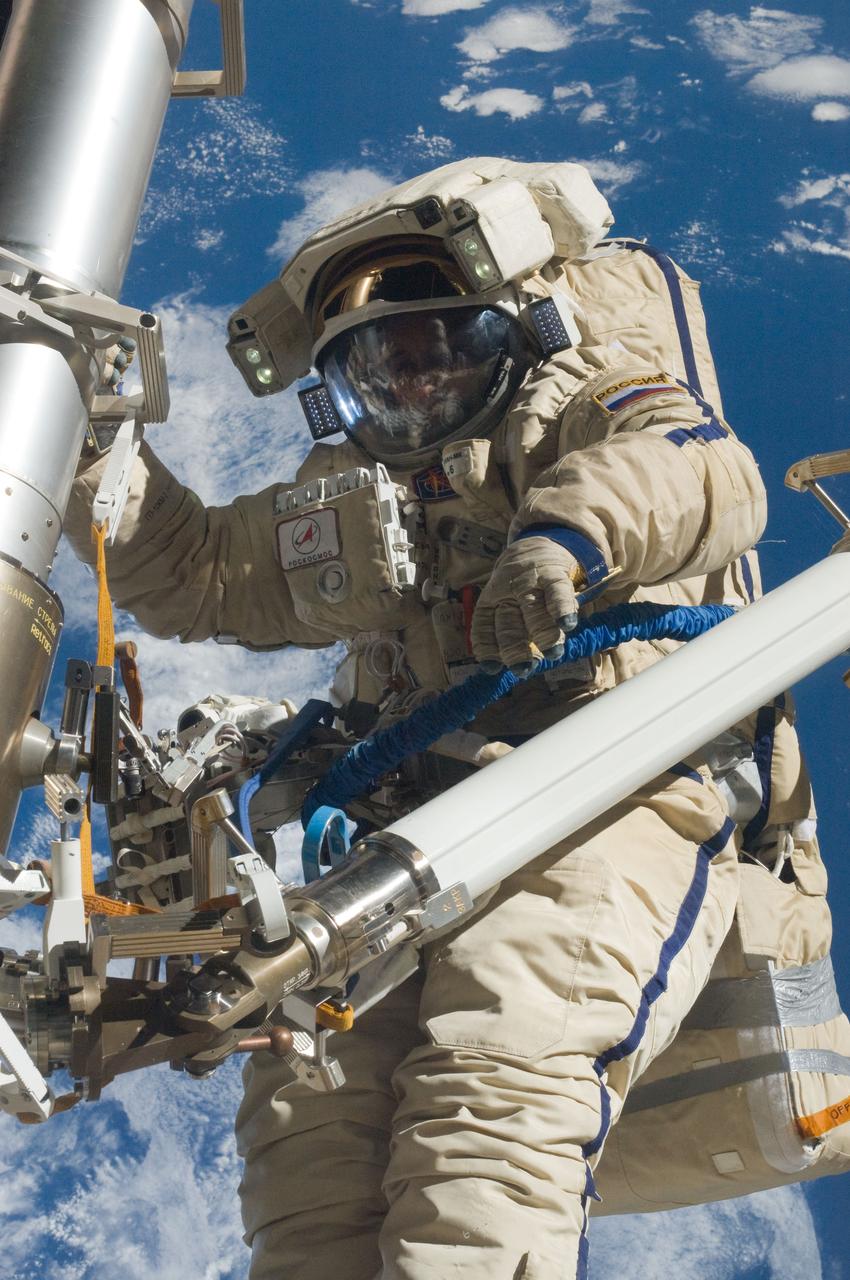
ISS030-E-079953 (16 Feb. 2012) --- Russian cosmonaut Anton Shkaplerov, Expedition 30 flight engineer, participates in a session of extravehicular activity (EVA) to continue outfitting the International Space Station. During the six-hour, 15-minute spacewalk, Shkaplerov and Russian cosmonaut Oleg Kononenko (out of frame), flight engineer, moved the Strela-1 crane from the Pirs Docking Compartment to begin preparing the Pirs for its replacement next year with a new laboratory and docking module. The duo used another boom, the Strela-2, to move the hand-operated crane to the Poisk module for future assembly and maintenance work. Both telescoping booms extend like fishing rods and are used to move massive components outside the station. On the exterior of the Poisk Mini-Research Module 2 (MRM2), they also installed the Vinoslivost Materials Sample Experiment, which will investigate the influence of space on the mechanical properties of the materials. The spacewalkers also collected a test sample from underneath the insulation on the Zvezda Service Module to search for any signs of living organisms. Both spacewalkers wore Russian Orlan spacesuits bearing blue stripes and equipped with NASA helmet cameras.
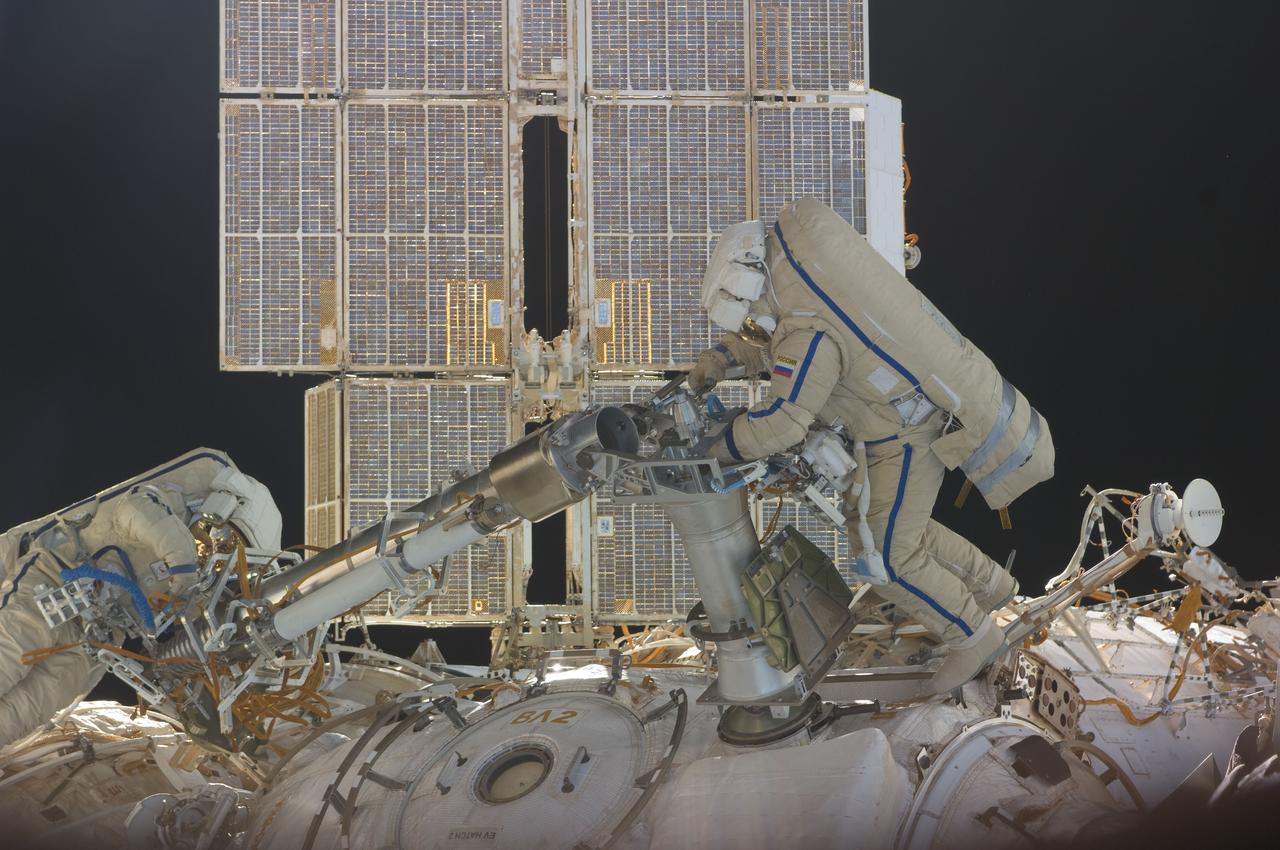
ISS030-E-078391 (16 Feb. 2012) --- Russian cosmonauts Oleg Kononenko and Anton Shkaplerov, both Expedition 30 flight engineers, participate in a session of extravehicular activity (EVA) to continue outfitting the International Space Station. During the six-hour, 15-minute spacewalk, Kononenko and Shkaplerov moved the Strela-1 crane from the Pirs Docking Compartment to begin preparing the Pirs for its replacement next year with a new laboratory and docking module. The duo used another boom, the Strela-2, to move the hand-operated crane to the Poisk module for future assembly and maintenance work. Both telescoping booms extend like fishing rods and are used to move massive components outside the station. On the exterior of the Poisk Mini-Research Module 2 (MRM2), they also installed the Vinoslivost Materials Sample Experiment, which will investigate the influence of space on the mechanical properties of the materials. The spacewalkers also collected a test sample from underneath the insulation on the Zvezda Service Module to search for any signs of living organisms. Both spacewalkers wore Russian Orlan spacesuits bearing blue stripes and equipped with NASA helmet cameras.
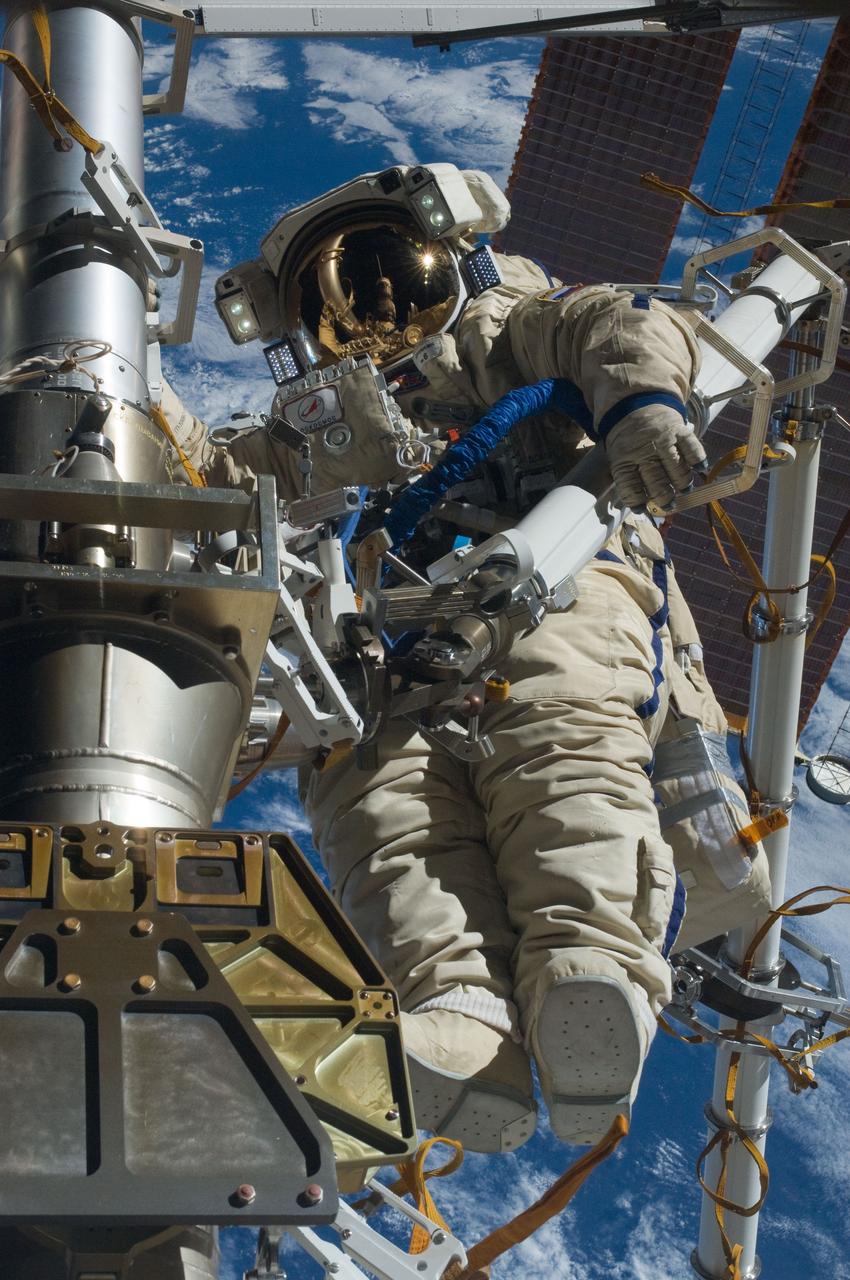
ISS030-E-079943 (16 Feb. 2012) --- Russian cosmonaut Anton Shkaplerov, Expedition 30 flight engineer, participates in a session of extravehicular activity (EVA) to continue outfitting the International Space Station. During the six-hour, 15-minute spacewalk, Shkaplerov and Russian cosmonaut Oleg Kononenko (out of frame), flight engineer, moved the Strela-1 crane from the Pirs Docking Compartment to begin preparing the Pirs for its replacement next year with a new laboratory and docking module. The duo used another boom, the Strela-2, to move the hand-operated crane to the Poisk module for future assembly and maintenance work. Both telescoping booms extend like fishing rods and are used to move massive components outside the station. On the exterior of the Poisk Mini-Research Module 2 (MRM2), they also installed the Vinoslivost Materials Sample Experiment, which will investigate the influence of space on the mechanical properties of the materials. The spacewalkers also collected a test sample from underneath the insulation on the Zvezda Service Module to search for any signs of living organisms. Both spacewalkers wore Russian Orlan spacesuits bearing blue stripes and equipped with NASA helmet cameras.
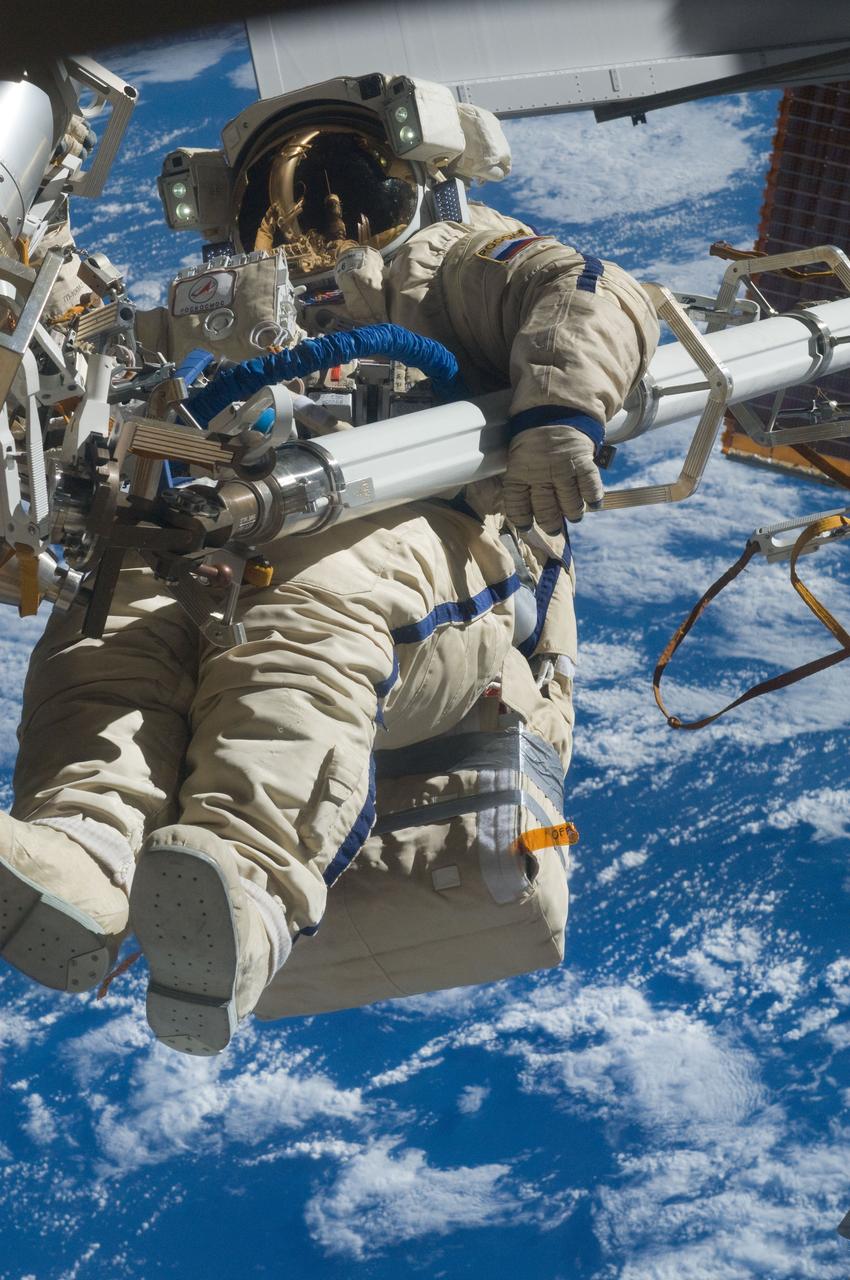
ISS030-E-079937 (16 Feb. 2012) --- Russian cosmonaut Anton Shkaplerov, Expedition 30 flight engineer, participates in a session of extravehicular activity (EVA) to continue outfitting the International Space Station. During the six-hour, 15-minute spacewalk, Shkaplerov and Russian cosmonaut Oleg Kononenko (out of frame), flight engineer, moved the Strela-1 crane from the Pirs Docking Compartment to begin preparing the Pirs for its replacement next year with a new laboratory and docking module. The duo used another boom, the Strela-2, to move the hand-operated crane to the Poisk module for future assembly and maintenance work. Both telescoping booms extend like fishing rods and are used to move massive components outside the station. On the exterior of the Poisk Mini-Research Module 2 (MRM2), they also installed the Vinoslivost Materials Sample Experiment, which will investigate the influence of space on the mechanical properties of the materials. The spacewalkers also collected a test sample from underneath the insulation on the Zvezda Service Module to search for any signs of living organisms. Both spacewalkers wore Russian Orlan spacesuits bearing blue stripes and equipped with NASA helmet cameras.
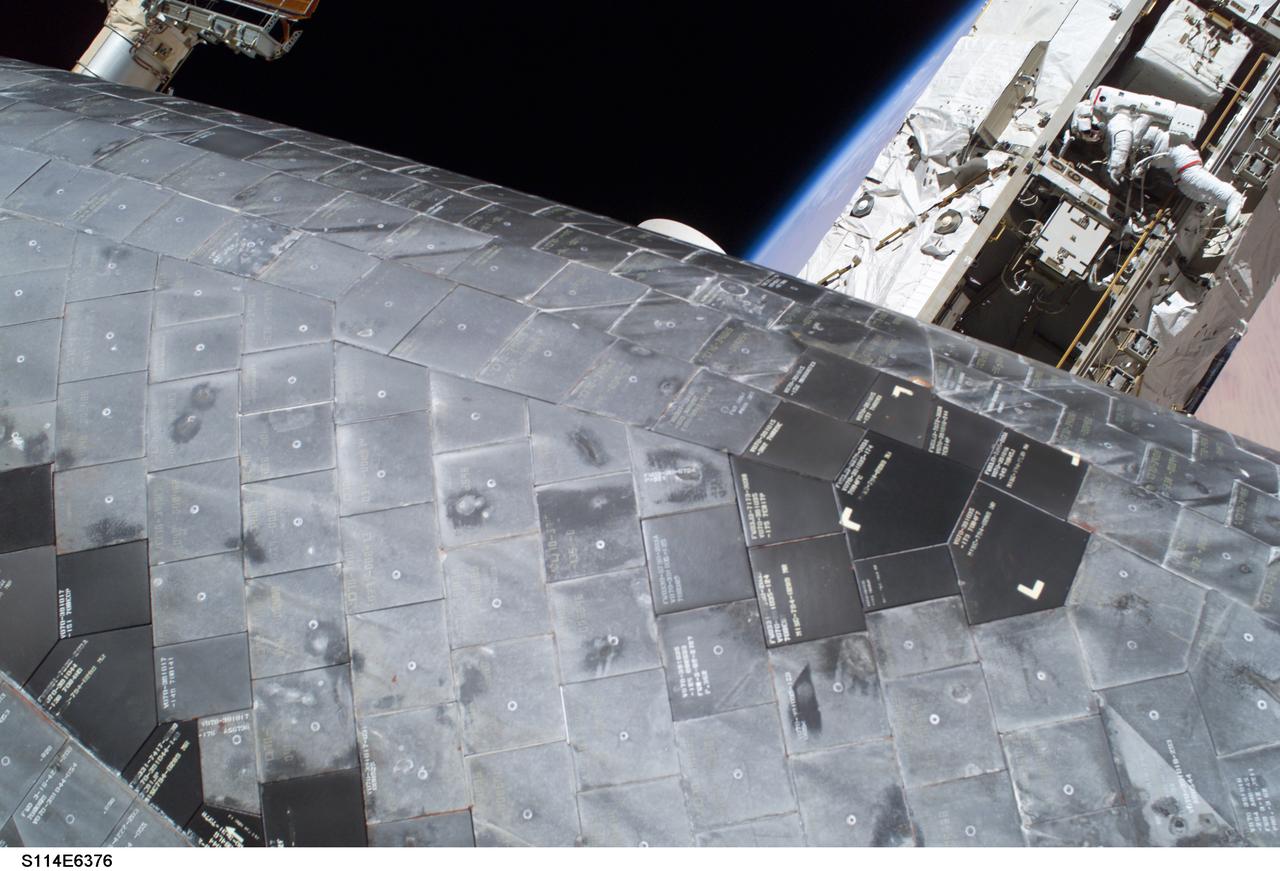
Launched on July 26 2005, from the Kennedy Space Center in Florida, STS-114 was classified as Logistics Flight 1. Among the Station-related activities of the mission were the delivery of new supplies and the replacement of one of the orbital outpost's Control Moment Gyroscopes (CMGs). STS-114 also carried the Raffaello Multi-Purpose Logistics Module and the External Stowage Platform-2. A major focus of the mission was the testing and evaluation of new Space Shuttle flight safety, which included new inspection and repair techniques. Upon its approach to the International Space Station (ISS), the Space Shuttle Discovery underwent a photography session in order to assess any damages that may have occurred during its launch and/or journey through Space. The mission’s third and final Extra Vehicular Activity (EVA) included taking a close-up look and the repair of the damaged heat shield. Gap fillers were removed from between the orbiter’s heat-shielding tiles located on the craft’s underbelly. Never before had any repairs been done to an orbiter while still in space. This close up of the thermal tiles was taken by astronaut Stephen K. Robinson, STS-114 mission specialist (out of frame). Astronaut Soichi Noguchi, STS-114 mission specialist representing the Japan Aerospace Exploration (JAXA), can be seen in the background perched on a Space Station truss.
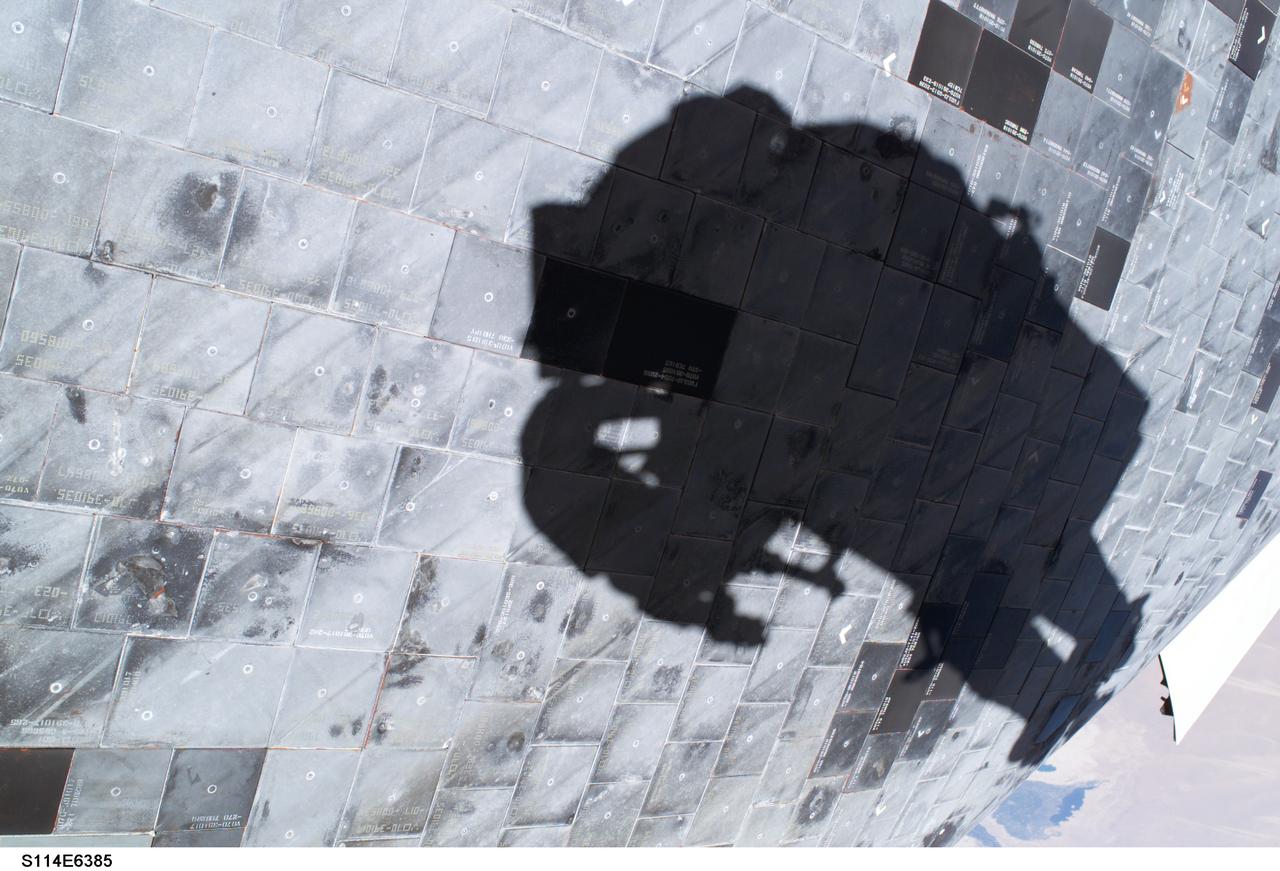
Launched on July 26, 2005 from the Kennedy Space Center in Florida, STS-114 was classified as Logistics Flight 1. Among the Station-related activities of the mission were the delivery of new supplies and the replacement of one of the orbital outpost's Control Moment Gyroscopes (CMGs). STS-114 also carried the Raffaello Multi-Purpose Logistics Module and the External Stowage Platform-2. A major focus of the mission was the testing and evaluation of new Space Shuttle flight safety, which included new inspection and repair techniques. Upon its approach to the International Space Station (ISS), the Space Shuttle Discovery underwent a photography session in order to assess any damages that may have occurred during its launch and/or journey through Space. The mission’s third and final Extra Vehicular Activity (EVA) included taking a close-up look and the repair of the damaged heat shield. Gap fillers were removed from between the orbiter’s heat-shielding tiles located on the craft’s underbelly. Never before had any repairs been done to an orbiter while still in space. This particular photo was taken by astronaut Stephen K. Robinson, STS-114 mission specialist, whose shadow is visible on the thermal protection tiles.
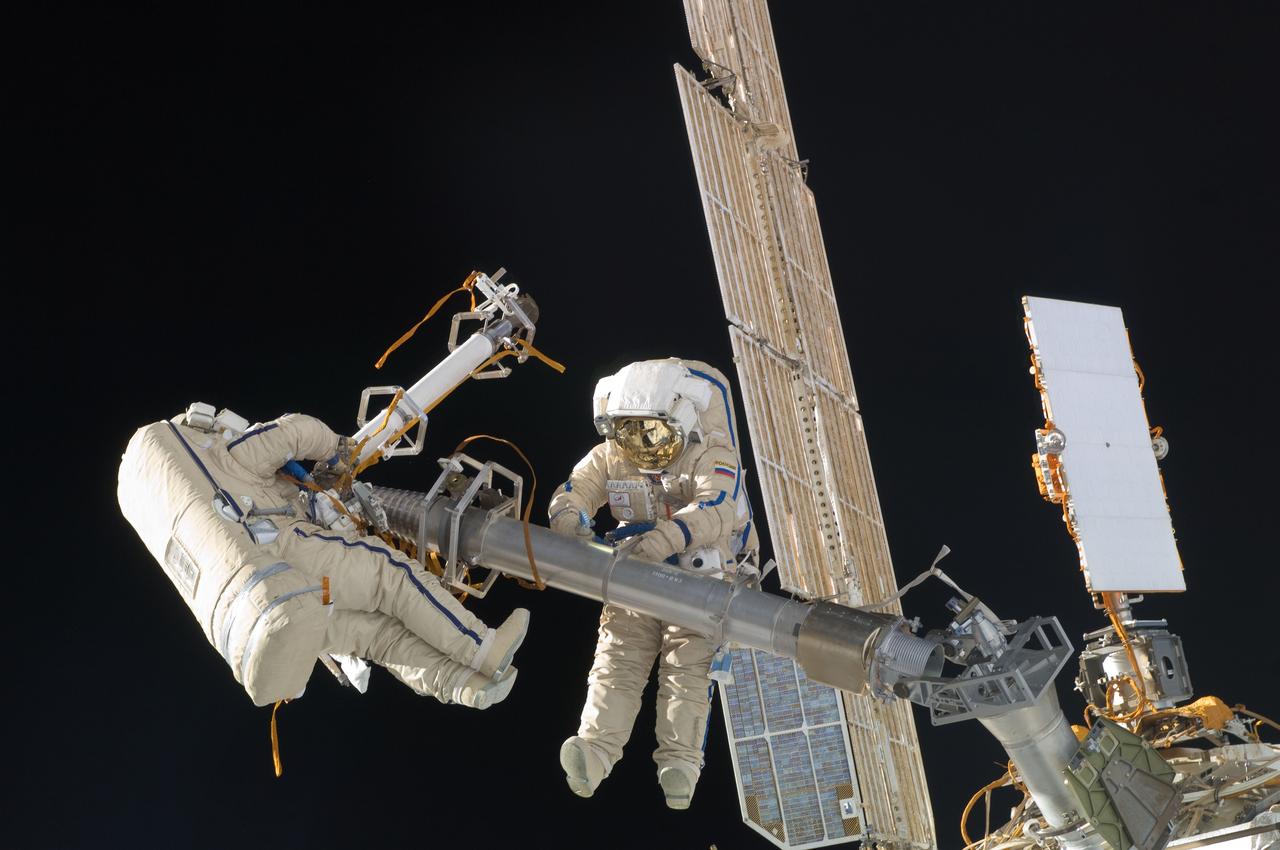
ISS030-E-078372 (16 Feb. 2012) --- Russian cosmonauts Oleg Kononenko and Anton Shkaplerov, both Expedition 30 flight engineers, participate in a session of extravehicular activity (EVA) to continue outfitting the International Space Station. During the six-hour, 15-minute spacewalk, Kononenko and Shkaplerov moved the Strela-1 crane from the Pirs Docking Compartment to begin preparing the Pirs for its replacement next year with a new laboratory and docking module. The duo used another boom, the Strela-2, to move the hand-operated crane to the Poisk module for future assembly and maintenance work. Both telescoping booms extend like fishing rods and are used to move massive components outside the station. On the exterior of the Poisk Mini-Research Module 2 (MRM2), they also installed the Vinoslivost Materials Sample Experiment, which will investigate the influence of space on the mechanical properties of the materials. The spacewalkers also collected a test sample from underneath the insulation on the Zvezda Service Module to search for any signs of living organisms. Both spacewalkers wore Russian Orlan spacesuits bearing blue stripes and equipped with NASA helmet cameras.
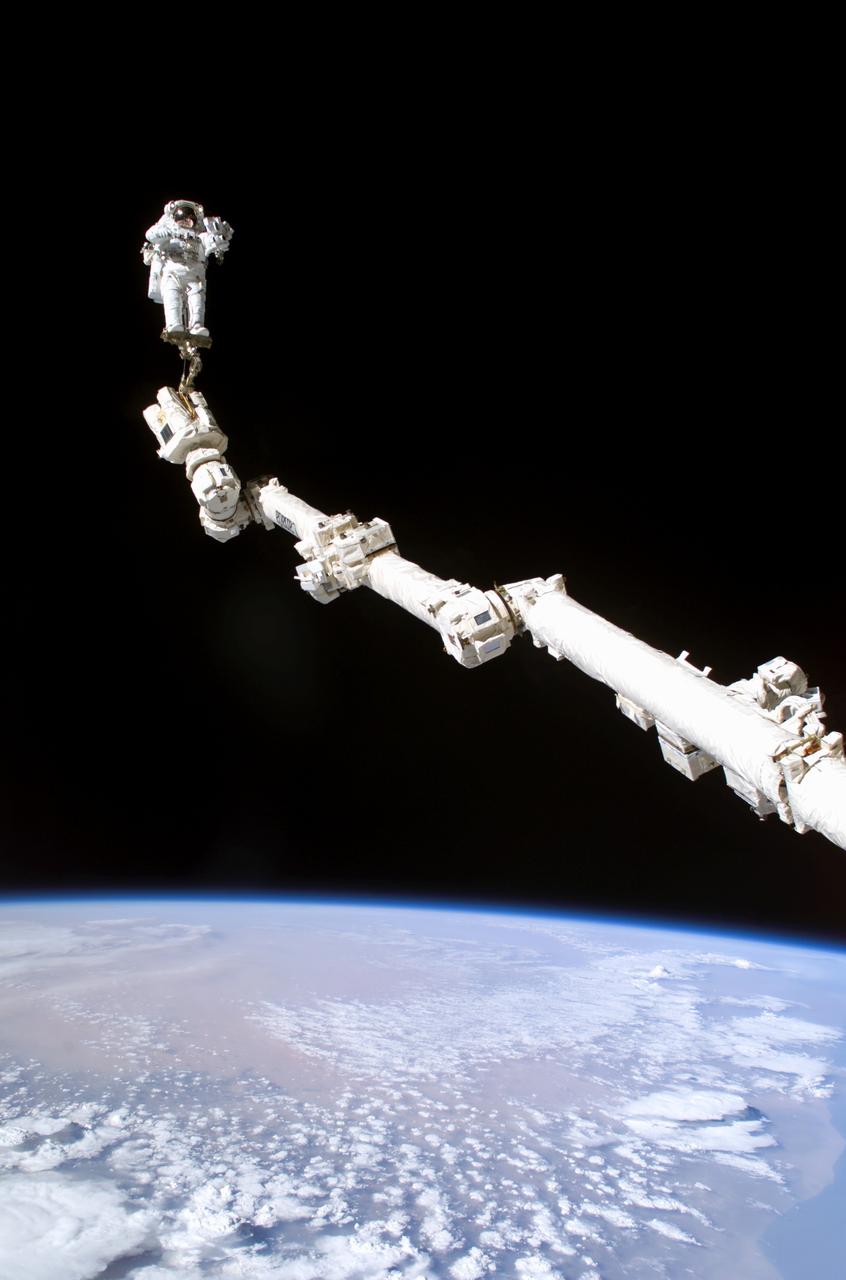
Launched on July 26, 2005 from the Kennedy Space Center in Florida, STS-114 was classified as Logistics Flight 1. Among the Station-related activities of the mission were the delivery of new supplies and the replacement of one of the orbital outpost's Control Moment Gyroscopes (CMGs). STS-114 also carried the Raffaello Multi-Purpose Logistics Module and the External Stowage Platform-2. A major focus of the mission was the testing and evaluation of new Space Shuttle flight safety, which included new inspection and repair techniques. Upon its approach to the International Space Station (ISS), the Space Shuttle Discovery underwent a photography session in order to assess any damages that may have occurred during its launch and/or journey through Space. The mission’s third and final Extra Vehicular Activity (EVA) included taking a close-up look and the repair of the damaged heat shield. Gap fillers were removed from between the orbiter’s heat-shielding tiles located on the craft’s underbelly. Never before had any repairs been done to an orbiter while still in space. Back dropped by the blackness of space and Earth’s horizon, astronaut Stephen K. Robinson, STS-114 mission specialist, is anchored to a foot restraint on the extended ISS’s Canadarm-2.

Photographs documenting International Space Station (ISS) Phase One activities at the Russian Space Agency's (RSA) Gagarin Cosmonaut Training Center, Korolov Mission Control Center and Zvezda; and ISS and Soyuz manufacturing at RSA's Khrunichev Design Center and RSC Energiya in Moscow, Russia, the French Space Agency's (CNES) INTESPACE facility in Toulouse, France, and the Italian Space Agency's (ASI) Alenia Spazio facility in Torino, Italy. Photographs were taken by Johnson Space Center Imagery and Publications Office contractors travelling from October 7 to November 4, 1996. Includes: VIEWS FROM RSC ENERGIYA'S SPACE MUSEUM: Room with a Buran model and photographic displays (17372-374). Salyut Space Station mock-up (17376). Russian propulsion engines on display (17377-378). Russian spacecraft on display (17375, 17387-398). Graphic displays (17399-405). VIEWS FROM RSC ENERGIYA MANUFACTURING FACILITIES: Unidentified facility (17379). Mir 24 crew member Michael C. Foale, suited in a Soyuz pressure suit, ingresses the Soyuz TM-26 flight article at RSC Energiya for a fit check (17380-381). Closeups of Foale inside the Soyuz during the fit check (17382-383, 17466-467). Overhead views of RSC Energiya's Building 444 manufacturing floor where docking modules and Soyuz TM spacecraft are built (17495-498). Technicians on the Building 444 manufacturing floor assembling probe and drogue docking modules (17499-500, 17504). Technicians assembling Soyuz spacecraft (17437-439). Views of other Soyuz spacecraft (17440-441). Androgynous Peripheral Docking System (APDS) mock-up (17501-503). Closeups of a control panel, possibly for the APDS mock-up (17519-528). VIEWS FROM ZVEZDA, RSA CONTRACTOR FOR SUIT DESIGN AND SOYUZ SEAT LINERS: Mir 24 crew member Foale dons a "penguin" flight suit for a fit check (17454-456). Zvezda personnel adjust Foale's Soyuz seat and seat liner (17442). Closeup of Foale, suited in a Soyuz pressure suit, sitting on a chair (17444). Zvezda personnel strap pressure-suited Foale into his Soyuz seat (17443, 17445, 17450). Views of Foale in his Soyuz seat during a pressurized pressure suit fit check (17451-453). Views looking into a vacuum chamber where Foale, wearing pressure suit, is strapped into his Soyuz seat (17466-467). Views of Zvezda personnel working at the vacuum chamber control station during the vacuum chamber suit test (17468-471). VIEWS FROM KHRUNICHEV DESIGN CENTER: Views of a green ISS Functional Cargo Block (FGB) test article on the manufacturing floor (17529, 17532-536, 17540-544). Views of an ISS Service Module (SM) test article on the manufacturing floor (17530-531, 17537, 17539). Closeup of the SM test article docking sphere (17538). Views of the FGB flight article on the manufacturing floor during systems tests (17545-548, 17550-567). Views of technicians conducting the FGB systems tests (17549, 17557). VIEWS FROM GAGARIN COSMONAUT TRAINING CENTER: NASA astronauts work out in the cosmonaut gym at Gagarin: Closeup of ISS 2R Expedition Commander William Shepherd on a weight machine (17384). Shepherd and an unidentified man with back to camera work out with dumbbells (17386). Shepherd does pull-ups (17447). Closeup of Foale on an exercise machine (17385). Closeups of Foale exercising arms on a cycle ergometer and a weight machine (17415, 17448-449). Foale exercises on a Nordic Track (17416). Closeup of Mir 23 crew member Jerry Linenger exercising arms (17417). Wendy Lawrence exercises with dumbbells (17418). Closeup of Lawrence in a handstand position (17419). David Wolf works out on a leg press machine (17446). Views of the Mir Space Station mock-up at Gagarin: Interior views of the Mir Base Module mock-up looking toward the transfer compartment (17421-425). Mir Base Module living area mock-up (17420). Overall views of the Base Module mock-up central control station (17426-427, 17505). Closeups of switch panels on the central control station (17428-436, 17506-518). Other views from Gagarin: Personnel work at an unidentified test/trainer control station (17472-473). Linenger sits at a table next to an RSA trainer during a Mir 23 meeting (17475-476). Out-of-focus view of two subjects in the Soyuz trainer (17474). Foale examines a Mir Complex EVA Suit (Orlan) with RSA trainers during an EVA suit training class (17492-494). VIEWS FROM KOROLOV MISSION CONTROL CENTER: Various views of personnel working in the NASA Consulting Room and/or PAO Consulting Room at Korolov Mission Control Center (17457-463). VIEWS FROM INTESPACE: Exterior views of an ISS Mini Pressurized Logistics Module (MPLM) structural test article (STA) during testing at INTESPACE (17406-409, 17477, 17482-484). Technicians install hatch on the MPLM STA (17410-414). Interior views of the MPLM STA (17478-481). VIEWS FROM ALENIA SPAZIO: Closeups of MPLM flight article #1 side panels during milling and refining at Alenia Spazio (17485-488). Workers process MPLM parts at milling machines (17489-491).
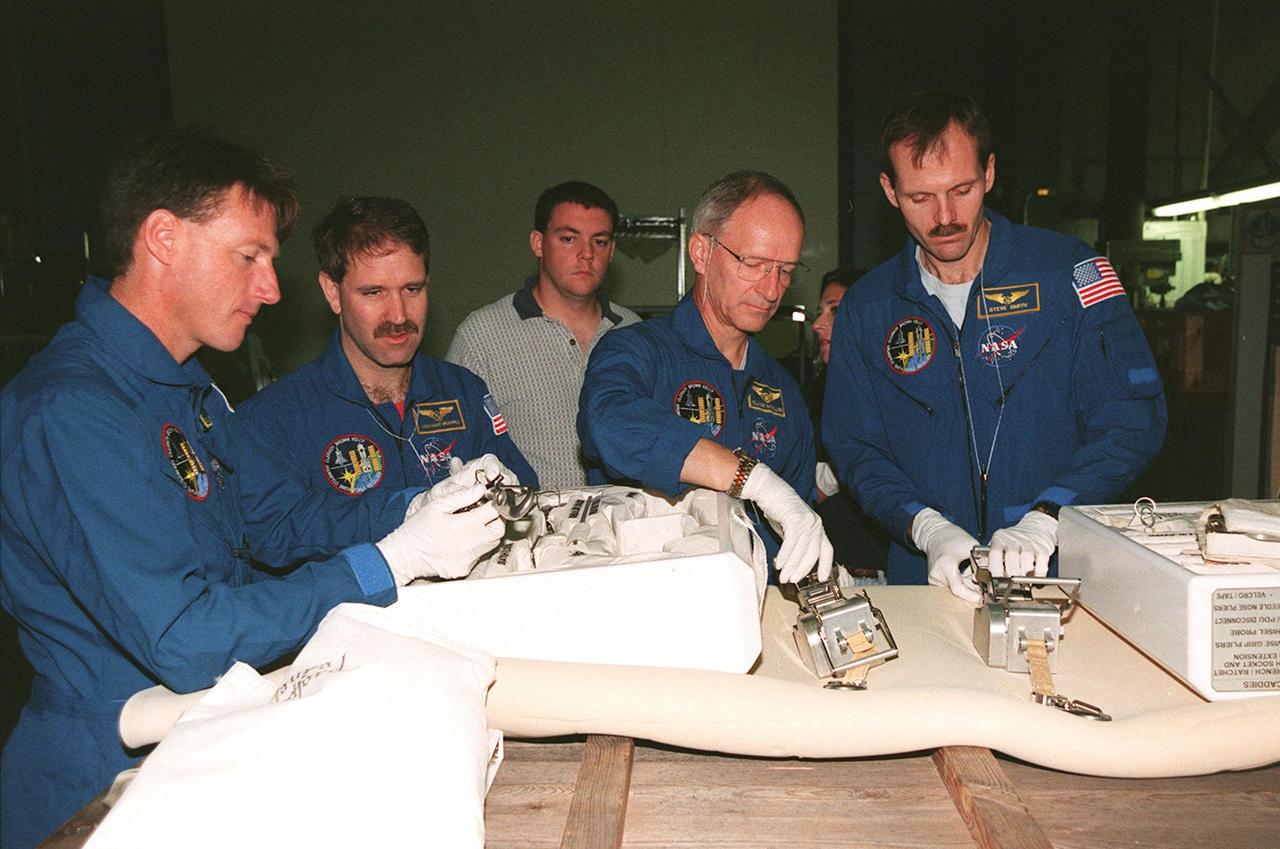
In the Orbiter Processing Facility (OPF) bay 1, STS-103 crew members check out equipment to be used on planned Extravehicular Activities (EVAs) on the mission for repair of the Hubble Space Telescope. They are taking part in a Crew Equipment Interface Test (CEIT) at KSC. From left are Mission Specialists C. Michael Foale (Ph.D.), John M. Grunsfeld (Ph.D.), Claude Nicollier of Switzerland, and Steven L. Smith. Other crew members at KSC for the CEIT are Commander Curtis L. Brown Jr., Pilot Scott J. Kelly, and Jean-François Clervoy of France. Nicollier and Clervoy are with the European Space Agency. Mission STS-103 is a "call-up" due to the need to replace portions of the pointing system, the gyros, which have begun to fail on the Hubble Space Telescope. Although Hubble is operating normally and conducting its scientific observations, only three of its six gyroscopes are working properly. The gyroscopes allow the telescope to point at stars, galaxies and planets. The STS-103 crew will not only replace gyroscopes, it will also replace a Fine Guidance Sensor and an older computer with a new enhanced model, an older data tape recorder with a solid-state digital recorder, a failed spare transmitter with a new one, and degraded insulation on the telescope with new thermal insulation. The crew will also install a Battery Voltage/Temperature Improvement Kit to protect the spacecraft batteries from overcharging and overheating when the telescope goes into a safe mode. The scheduled launch date in October is under review
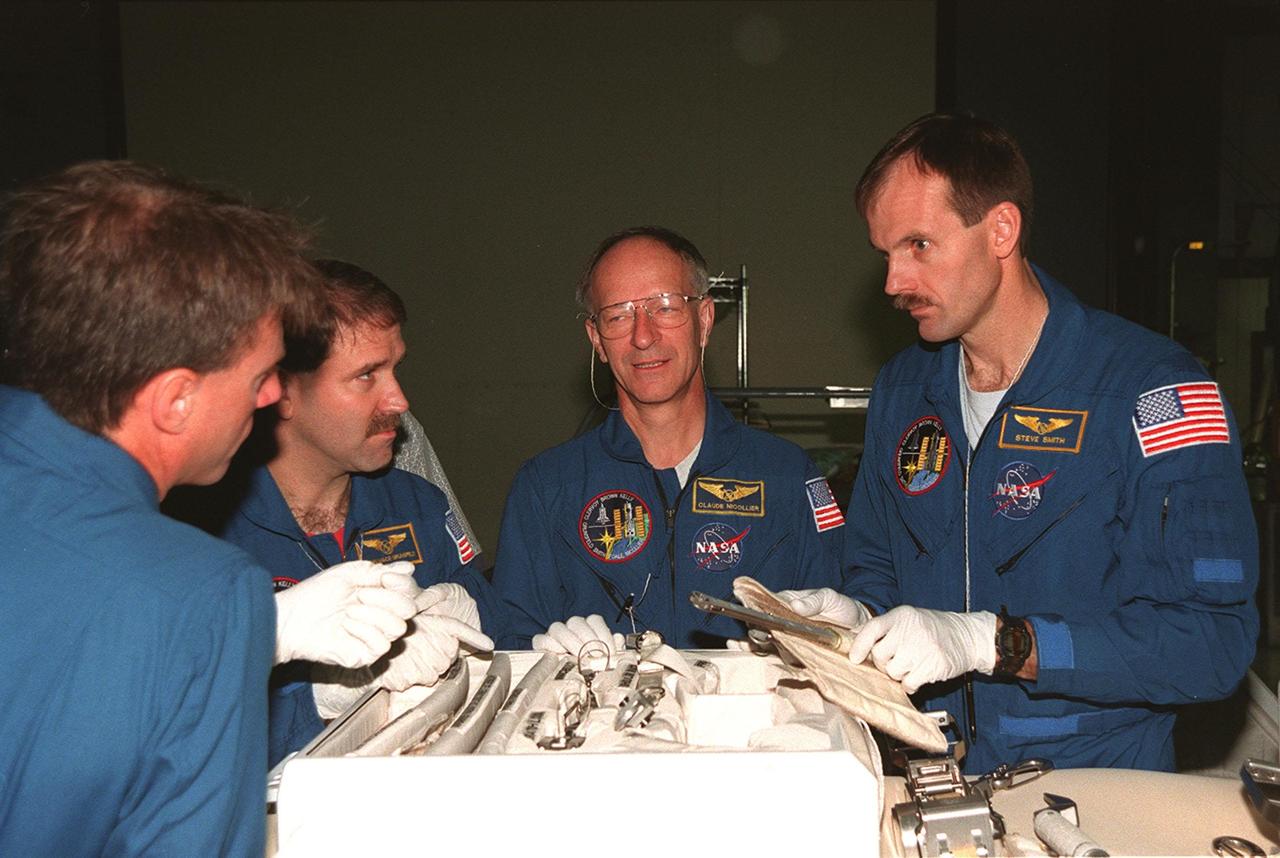
In the Orbiter Processing Facility (OPF) bay 1, STS-103 crew members look over equipment to be used on planned Extravehicular Activities (EVAs) on the mission for repair of the Hubble Space Telescope. They are taking part in a Crew Equipment Interface Test (CEIT) at KSC. From left are Mission Specialists C. Michael Foale (Ph.D.), John M. Grunsfeld (Ph.D.) Claude Nicollier of Switzerland, and Steven L. Smith. Other crew members at KSC for the CEIT are Commander Curtis L. Brown Jr., Pilot Scott J. Kelly, and Jean-François Clervoy of France. Nicollier and Clervoy are with the European Space Agency. Mission STS-103 is a "call-up" due to the need to replace portions of the pointing system, the gyros, which have begun to fail on the Hubble Space Telescope. Although Hubble is operating normally and conducting its scientific observations, only three of its six gyroscopes are working properly. The gyroscopes allow the telescope to point at stars, galaxies and planets. The STS-103 crew will not only replace gyroscopes, it will also replace a Fine Guidance Sensor and an older computer with a new enhanced model, an older data tape recorder with a solid-state digital recorder, a failed spare transmitter with a new one, and degraded insulation on the telescope with new thermal insulation. The crew will also install a Battery Voltage/Temperature Improvement Kit to protect the spacecraft batteries from overcharging and overheating when the telescope goes into a safe mode. The scheduled launch date in October is under review