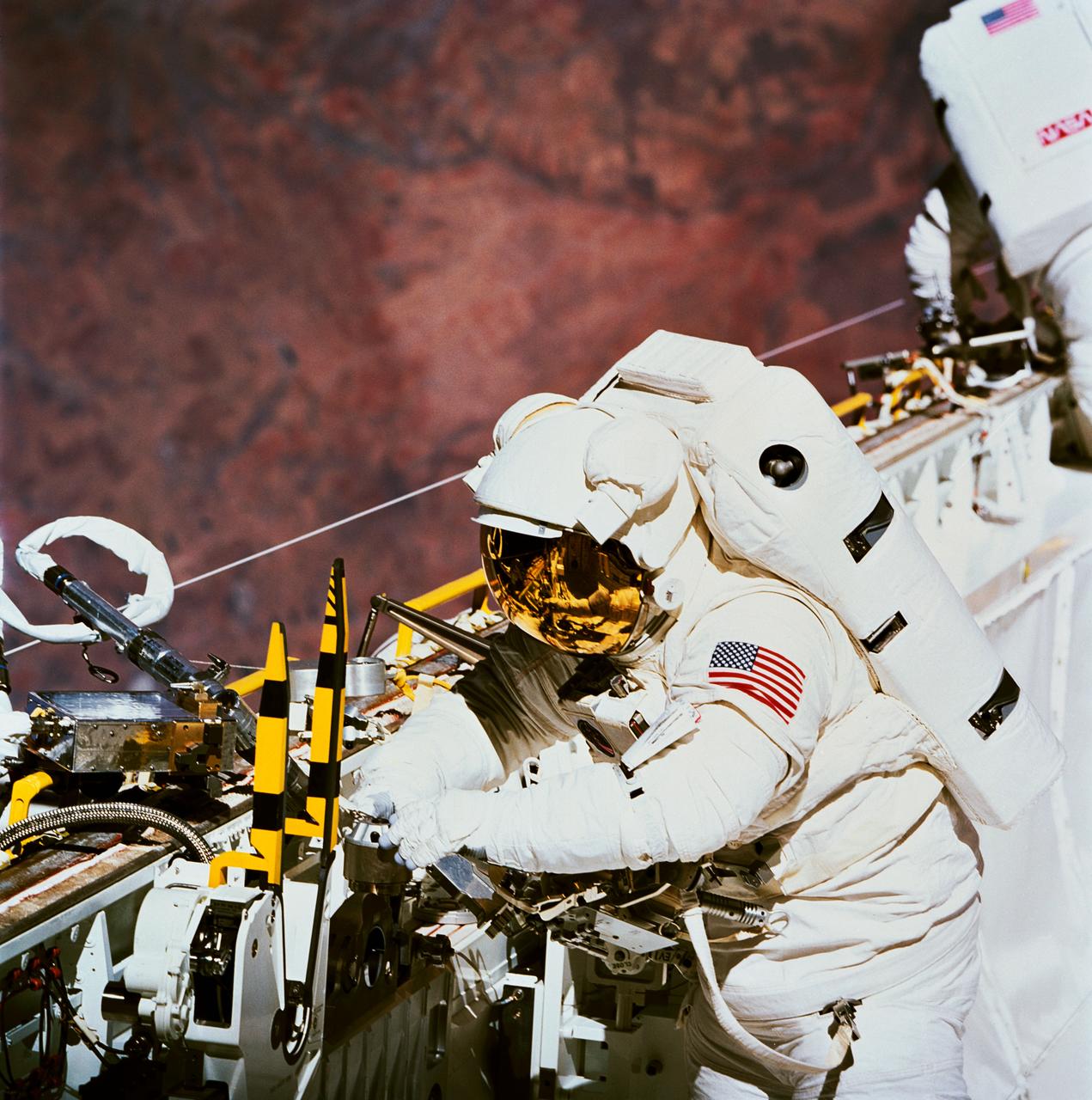
In Discovery's cargo bay, astronaut James H. Newman works with the power ratchet tool (PRT). Astronaut Carl E. Walz, who joined Newman for the lengthy period of extravehicular activity (EVA), is partially visible in the background. The two mission specialists devoted part of their EVA to evaluating tools and equipment expected to be used in the Hubble Space Telescope servicing. A desert area in Africa forms the backdrop for the 70mm scene.
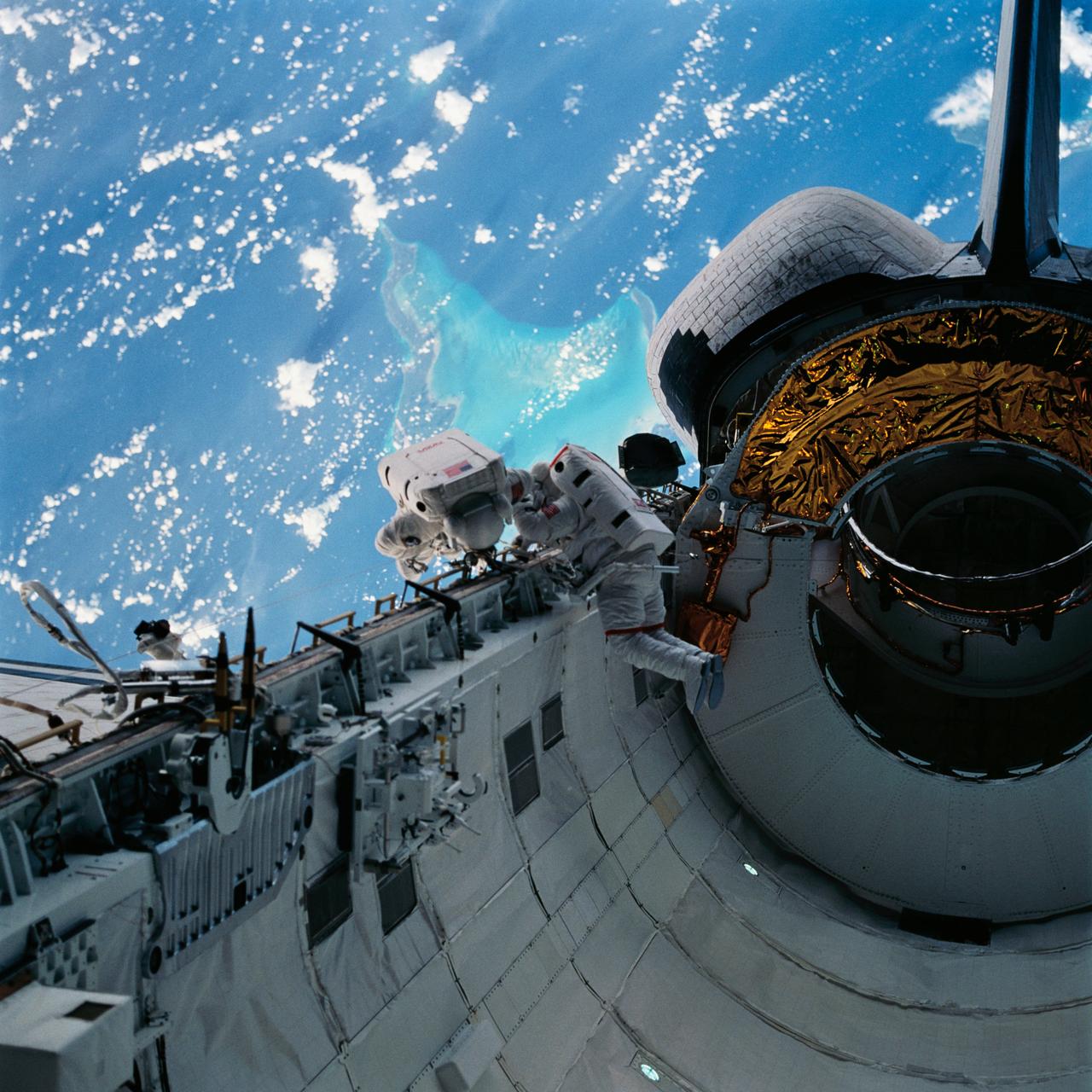
With the Caribbean Sea and part of the Bahama Islands chain as a backdrop, two STS-51 crewmembers evaluate procedures and gear to be used on the upcoming Hubble Space Telescope (HST)-servicing mission. Sharing the lengthy extravehicular activity in and around Discovery's cargo bay were astronauts James H. Newman (left), and Carl E. Walz, mission specialists.
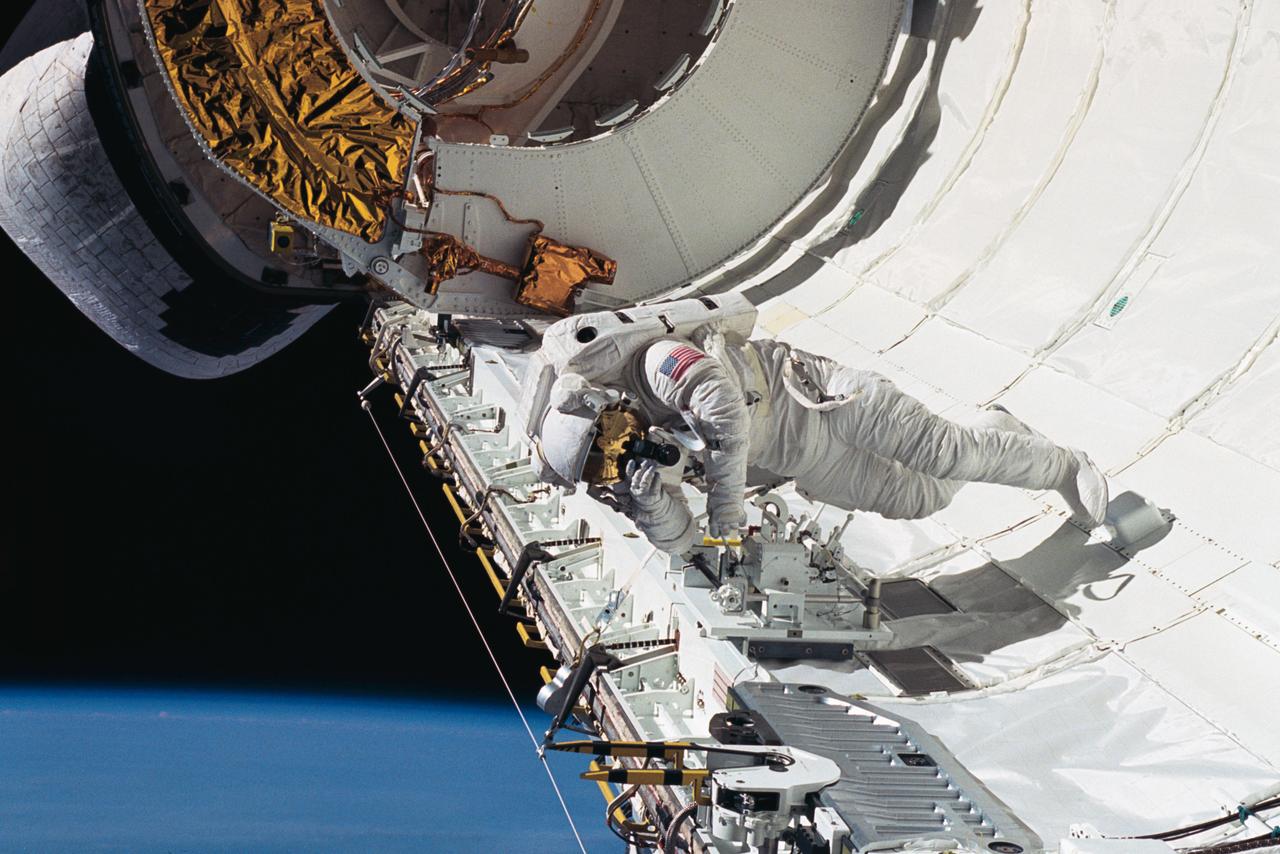
Astronaut James H. Newman, mission specialist, uses a 35mm camera to take a picture of fellow astronaut Carl E. Walz (out of frame) in Discovery's cargo bay. The two were engaged in an extravehicular activity (EVA) to test equipment to be used on future EVA's. Newman is tethered to the starboard side, with the orbital maneuvering system (OMS) pod just behind him.
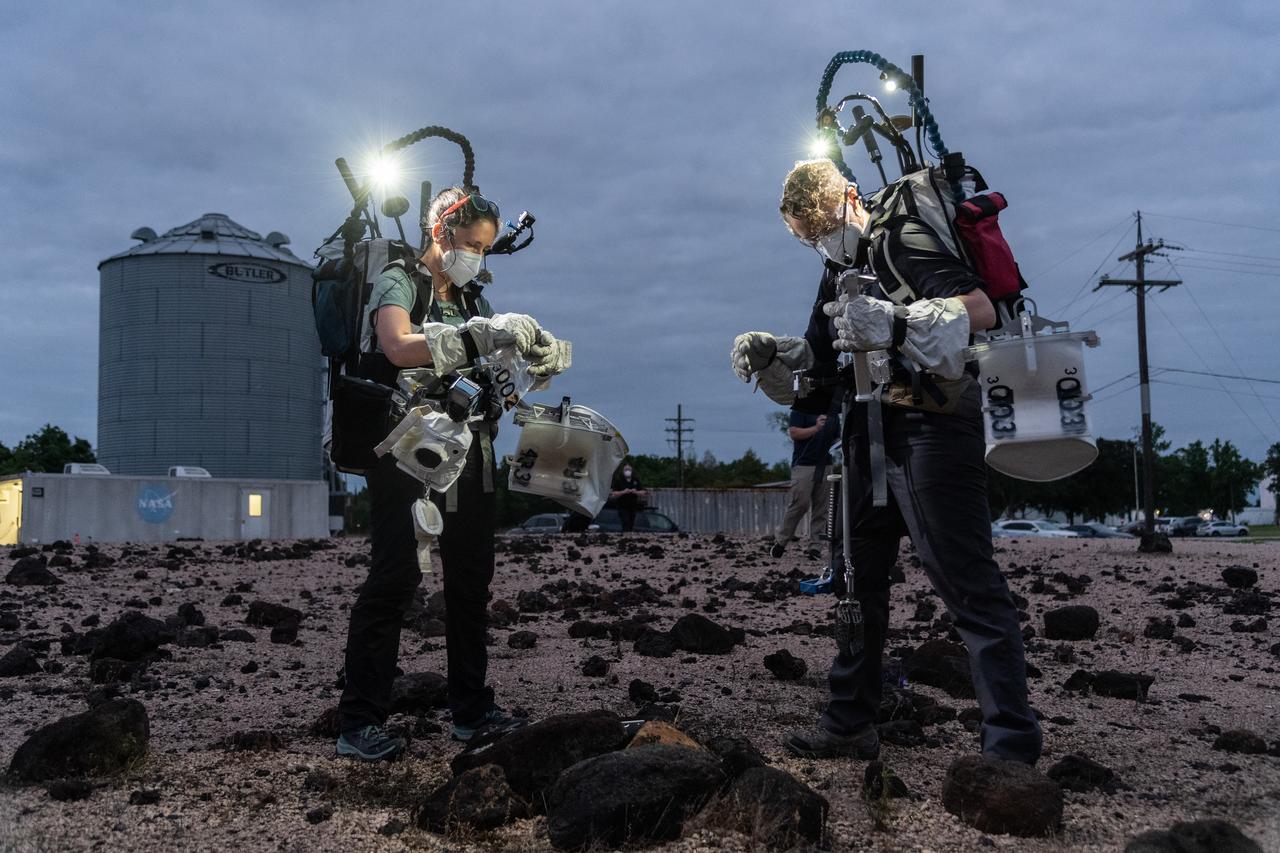
Test subjects Kelsey Young and Tess Caswell evaluate lunar field geology tasks as part of the Exploration Extravehicular Activity (xEVA) night operations development tests conducted at Johnson Space Center’s Rock Yard.
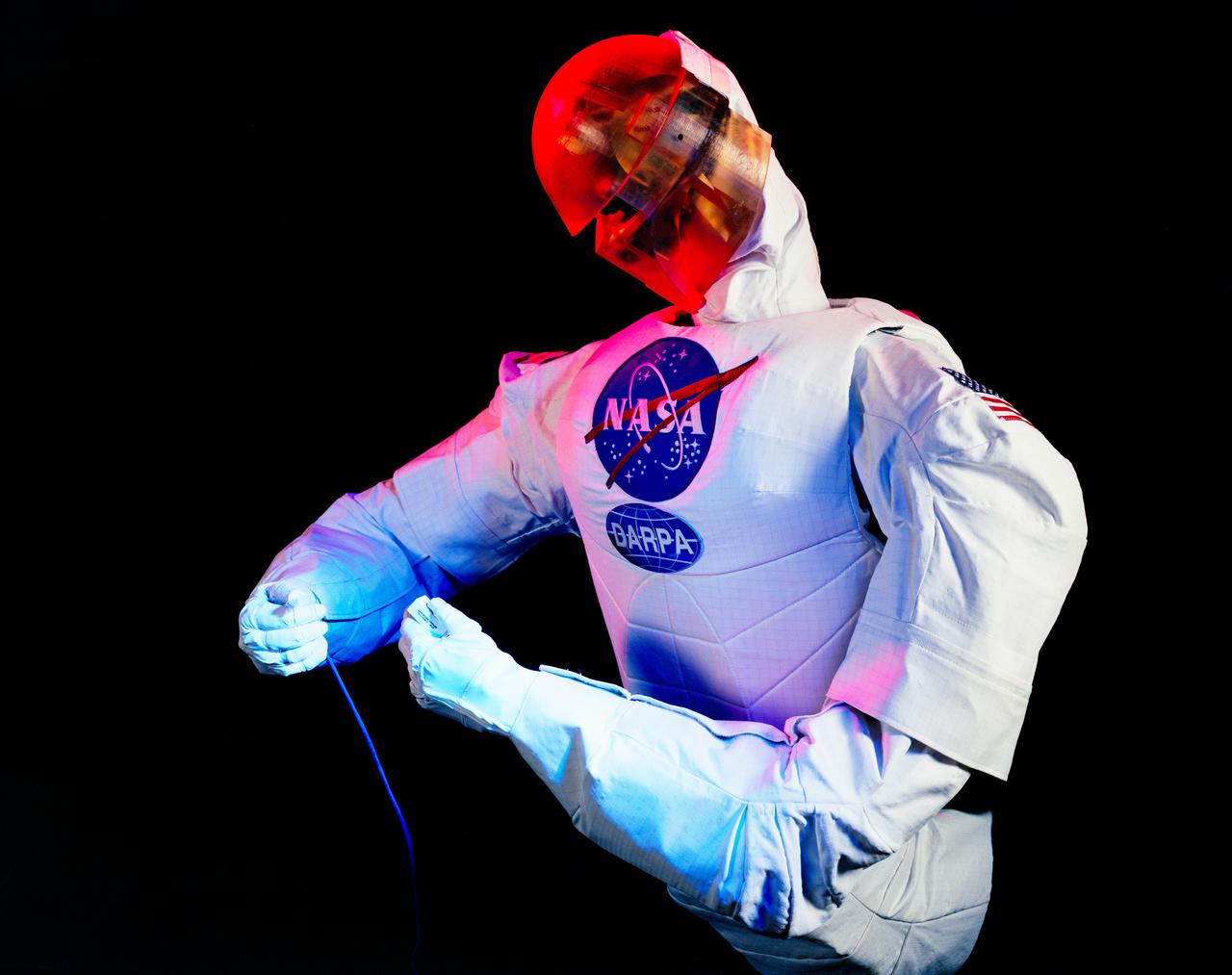
JSC2003-00263 (June 2003) --- This is Robonaut B, the newer of two NASA robots used in recent hand-in-hand testing at the Johnson Space Center with human beings to evaluate their shared ability to perform certain types of extravehicular activity.
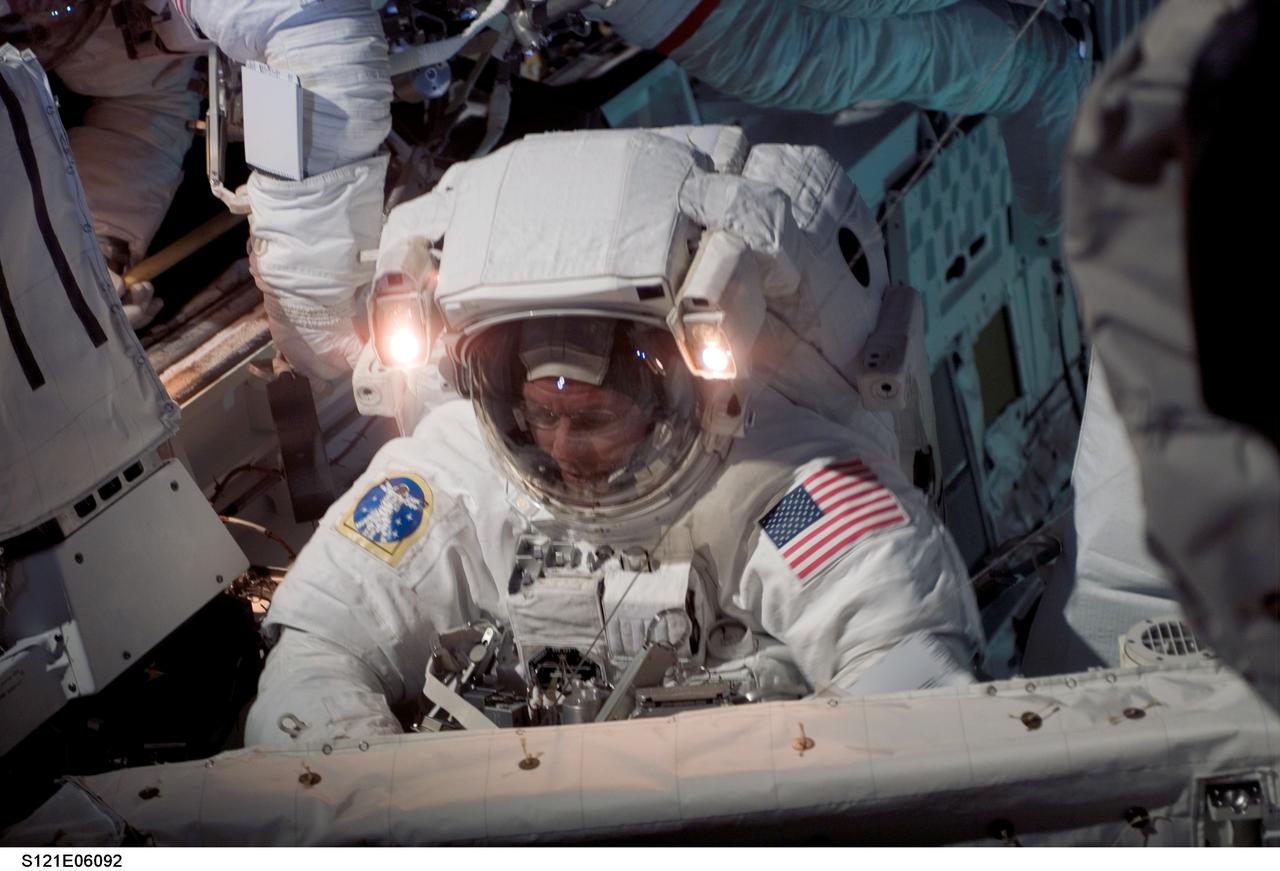
S121-E-06092 (8 July 2006) --- Astronaut Michael E. Fossum, STS-121 mission specialist, repositions tethers at the forward bulkhead of the Space Shuttle Discovery after completing the Orbiter Boom Sensor System (OBSS) evaluations during the mission's first session of extravehicular activity (EVA).
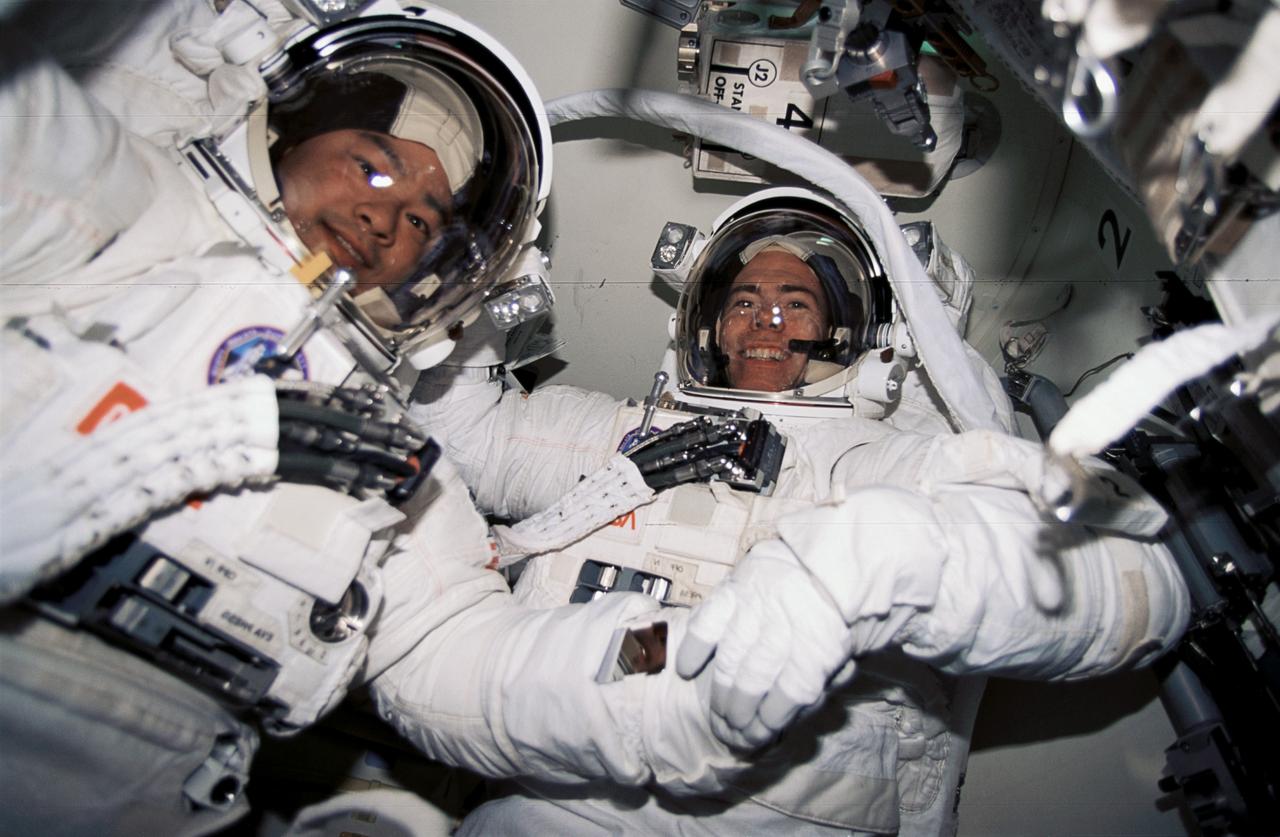
STS072-391-009 (15 Jan. 1996) --- In the Space Shuttle Endeavour's airlock, astronauts Leroy Chiao (left) and Daniel T. Barry prepare for the first extravehicular activity (EVA) scheduled on the mission. The two EVA's were scheduled to evaluate space station assembly techniques.
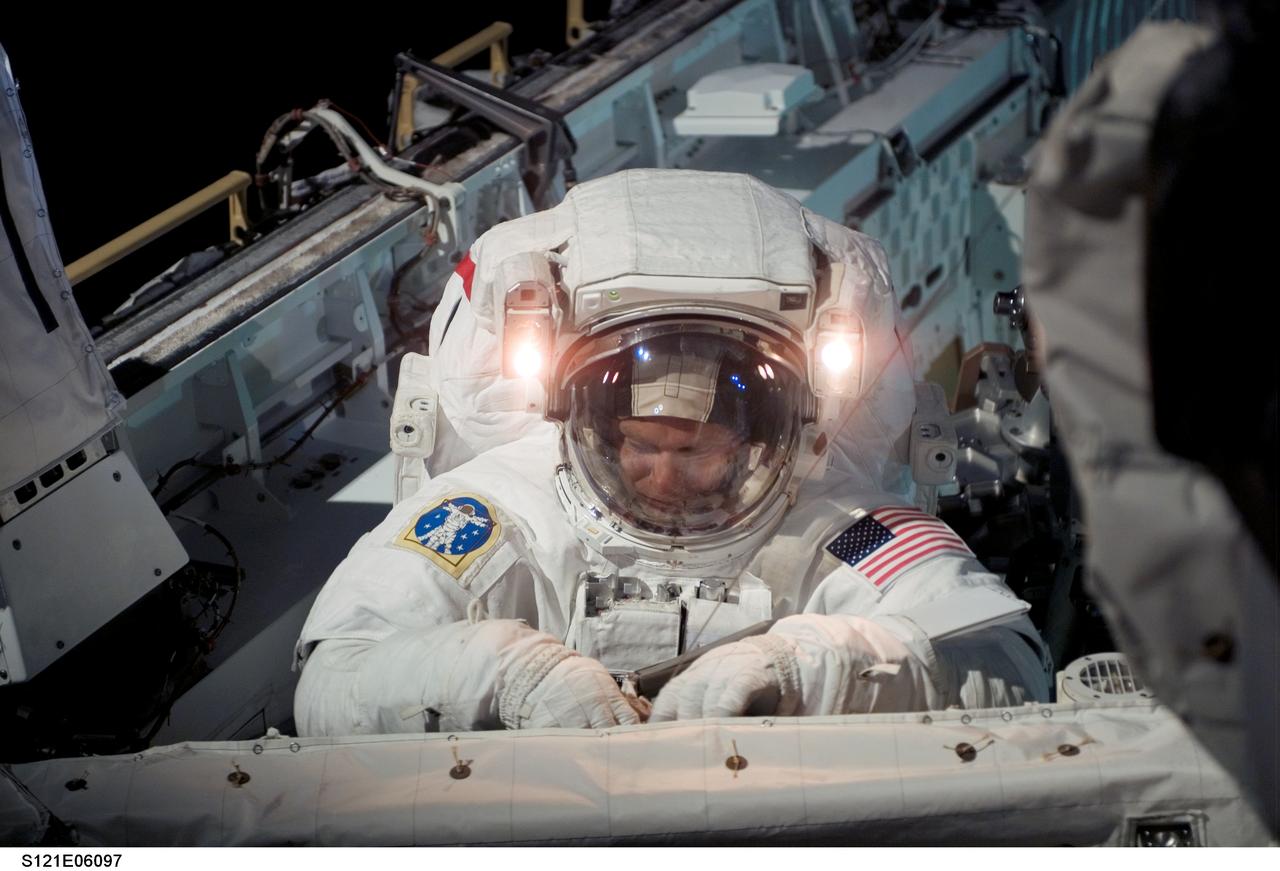
S121-E-06097 (8 July 2006) --- Astronaut Piers J. Sellers, STS-121 mission specialist, repositions tethers at the forward bulkhead of the Space Shuttle Discovery after completing the Orbiter Boom Sensor System (OBSS) evaluations during the mission's first session of extravehicular activity (EVA).
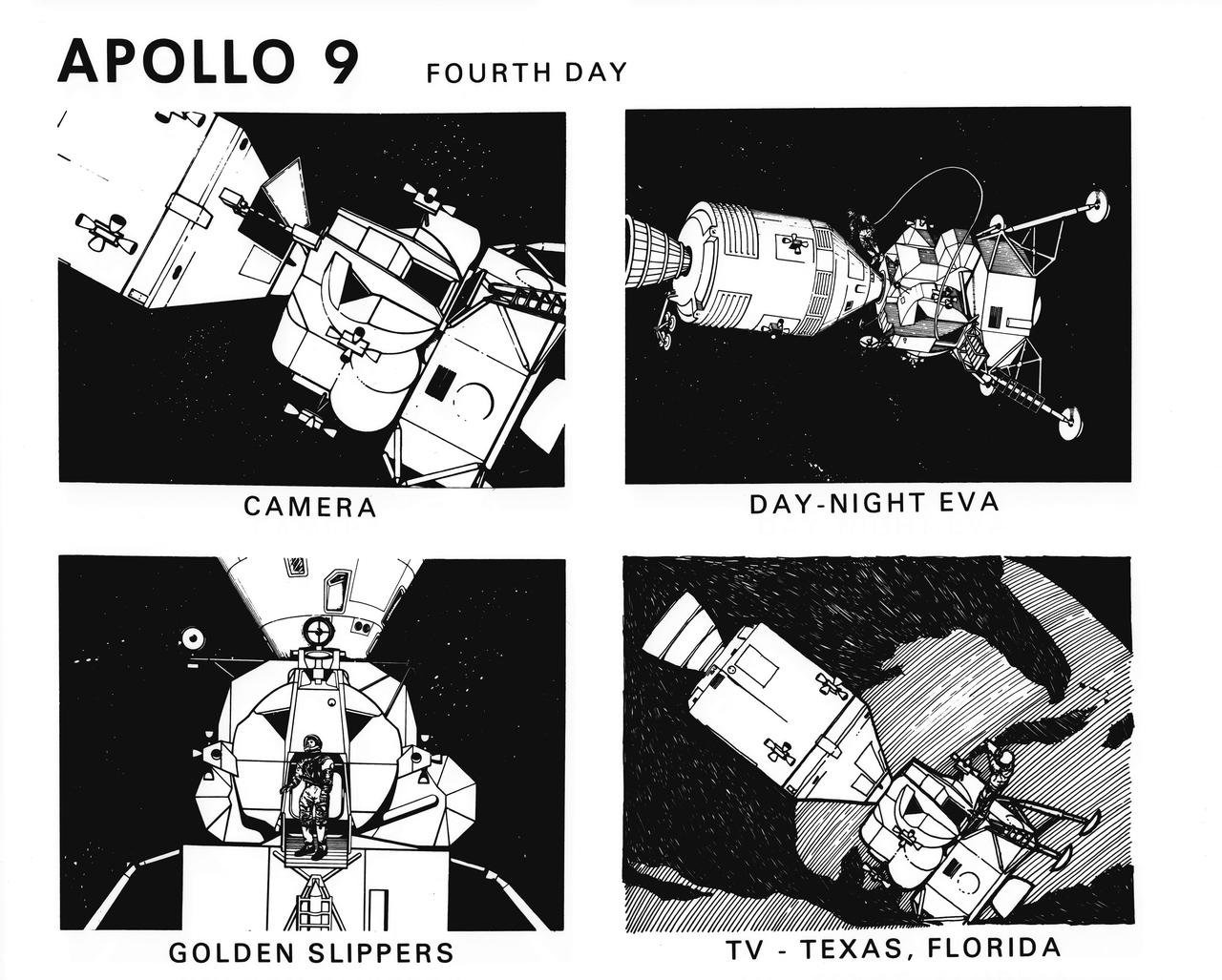
S69-19795 (February 1969) --- Composite of four artist's concepts illustrating key events, tasks and activities on the fourth day of the Apollo 9 mission, including use of camera, day-night extravehicular activity, use of golden slippers, and television over Texas and Florida. The Apollo 9 mission will evaluate spacecraft lunar module systems performance during manned Earth-orbital flight.

STS051-98-010 (16 Sept 1993) --- Astronaut James H. Newman, mission specialist, conducts an in-space evaluation of the Portable Foot Restraint (PFR) which will be used operationally on the first Hubble Space Telescope (HST) STS-61 servicing mission and future Shuttle missions. Astronauts Newman and Carl E. Walz spent part of their lengthy extravehicular activity (EVA) evaluating gear to be used on the STS-61 HST servicing mission. The frame was exposed with a 70mm handheld Hasselblad camera from the Space Shuttle Discovery's flight deck.
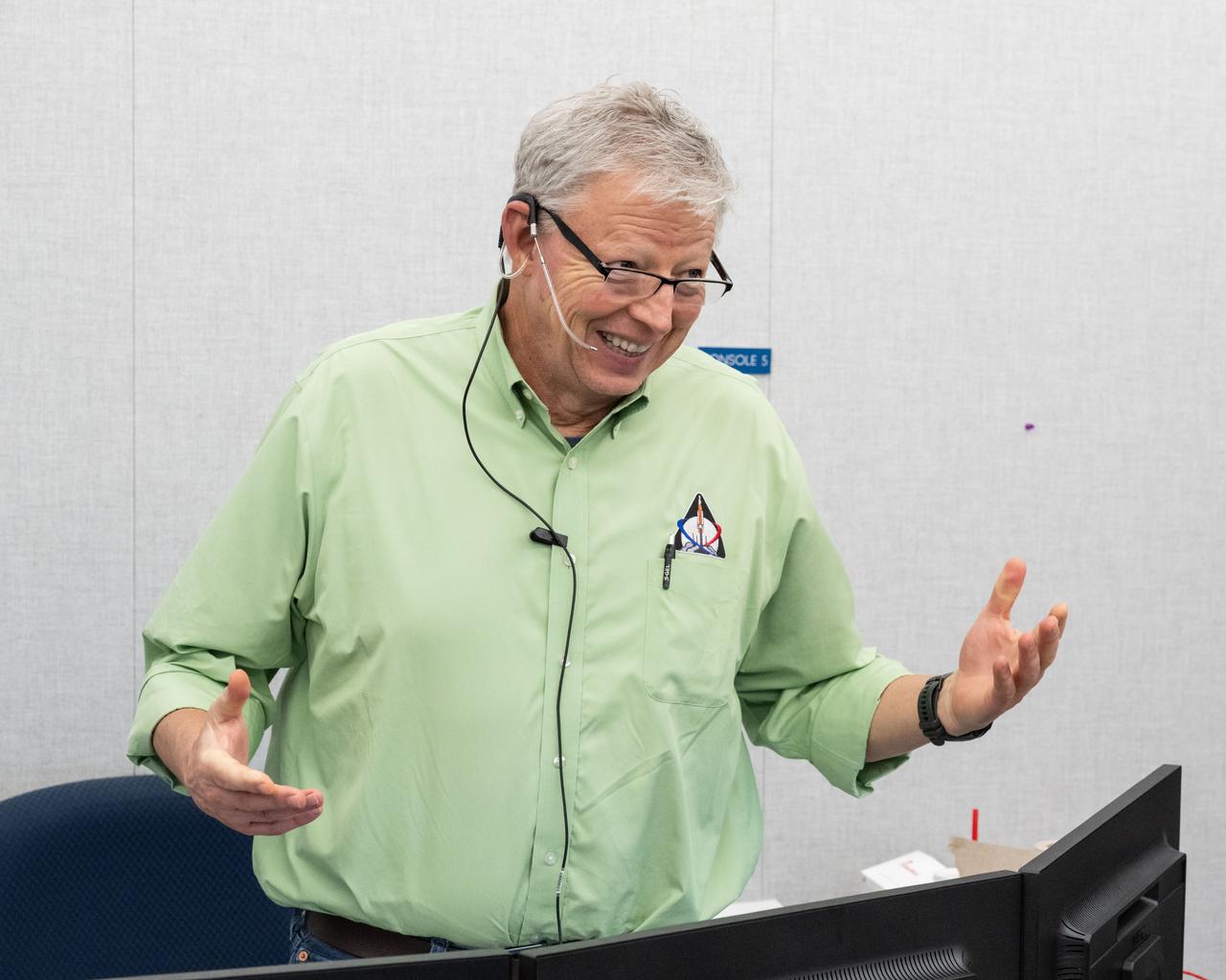
Chief training officer John Ray works in the flight control support room during the JETT 5 field test. JETT 5 was a week-long field test in the lunar-like landscape of San Francisco Volcanic Field near Flagstaff, Arizona while a team of flight controllers and scientists at Johnson monitor and guide their activities. Credit: NASA/James Blair
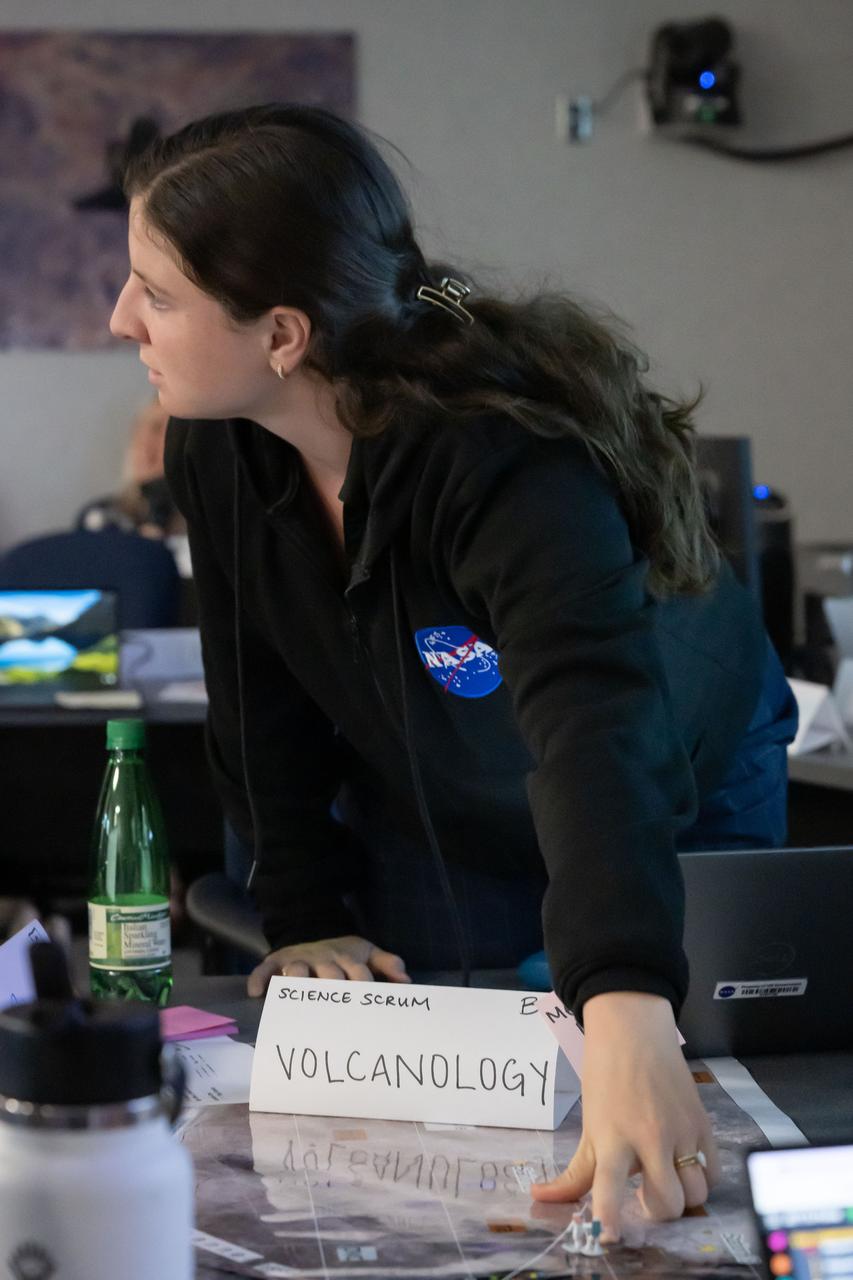
Megan Borel of NASA’s Goddard Space Flight Center points to a location on a map of the San Francisco Volcanic Field in Northern Arizona during a discussion in the Science Evaluation Room (SER) during the JETT 5 field test. JETT 5 was a week-long field test in the lunar-like landscape of San Francisco Volcanic Field near Flagstaff, Arizona while a team of flight controllers and scientists at Johnson monitor and guide their activities. Credit: NASA/Helen Arase Vargas

A group of scientists are gathered around a table covered in large maps in the Science Evaluation Room (SER) at NASA’s Johnson Space Center in Houston during the JETT 5 field test. JETT 5 was a week-long field test in the lunar-like landscape of San Francisco Volcanic Field near Flagstaff, Arizona while a team of flight controllers and scientists at Johnson monitor and guide their activities. Credit: NASA/Robert Markowitz
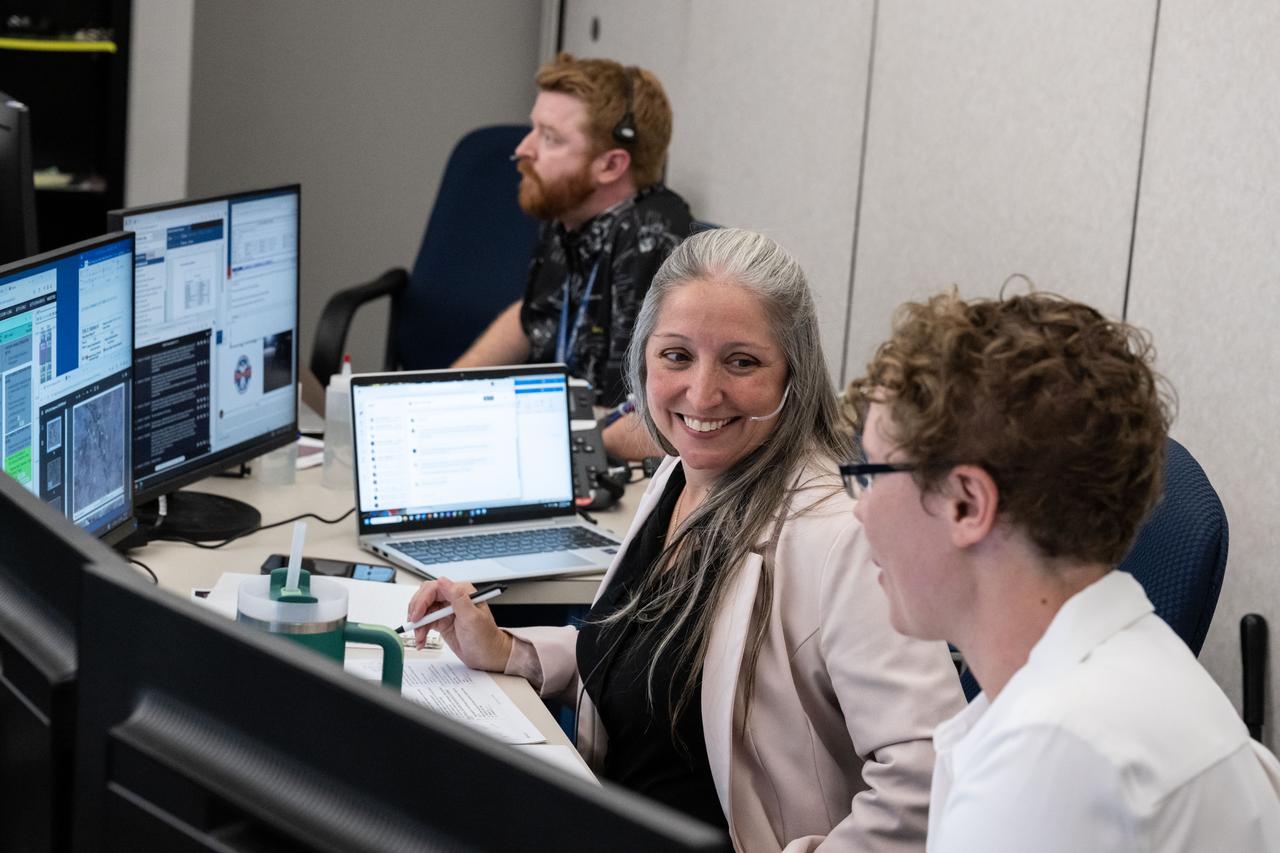
Extravehicular flight controller Jaclyn Kagey, left, and Tess Caswell work in the JETT 5 flight control room during the JETT 5 field test. JETT 5 was a week-long field test in the lunar-like landscape of San Francisco Volcanic Field near Flagstaff, Arizona while a team of flight controllers and scientists at Johnson monitor and guide their activities. Credit NASA/James Blair
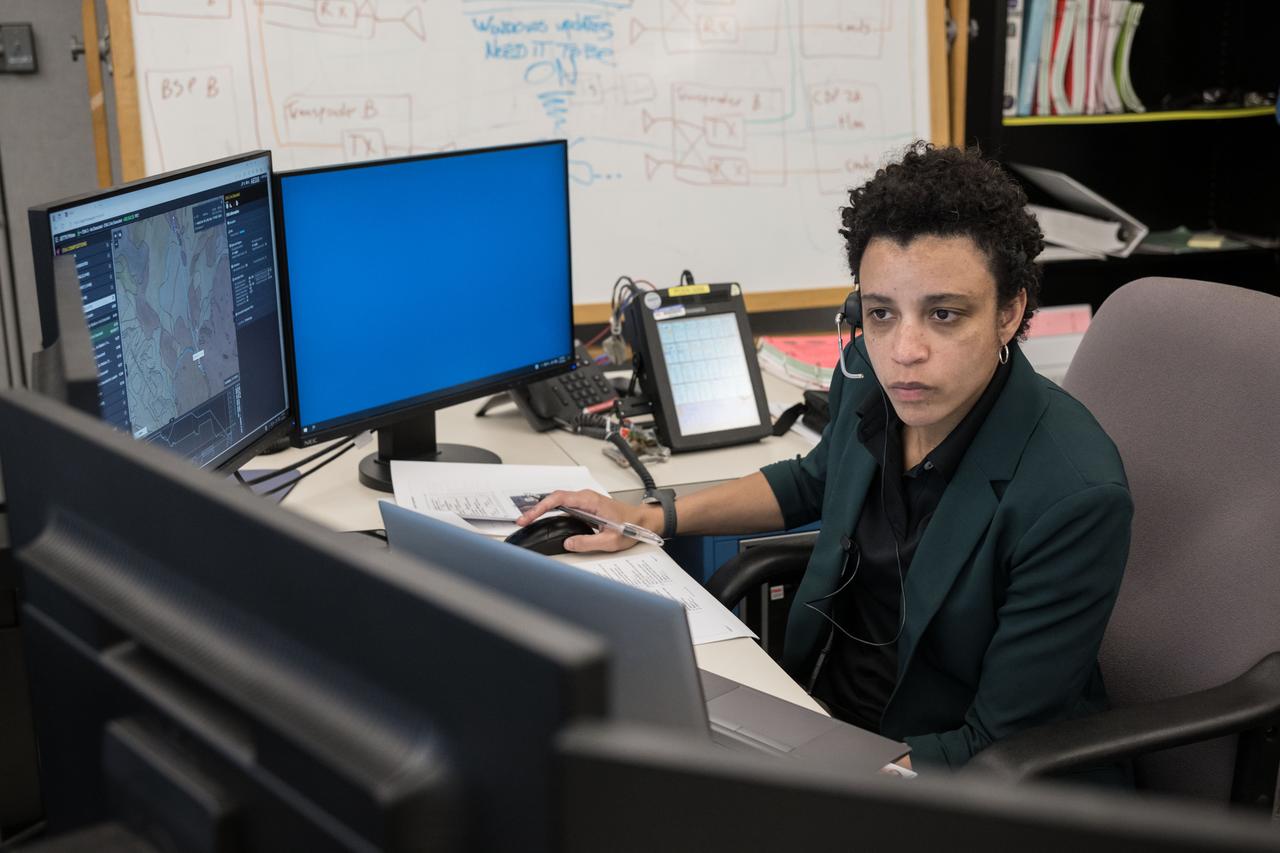
NASA astronaut Jessica Watkins served as the Ground IV for the JETT 5 field test and was the sole point of communications to NASA astronauts Andre Douglas and Kate Rubins who performed simulated moonwalks in the Arizona desert. JETT 5 was a week-long field test in the lunar-like landscape of San Francisco Volcanic Field near Flagstaff, Arizona while a team of flight controllers and scientists at Johnson monitor and guide their activities. Credit: NASA/Robert Markowitz

Artemis Curation Lead Julianne Gross, left, and Brett Denevi, Artemis III Geology Team principal investigator for NASA’s Science Mission Directorate, work in the Science Evaluation Room (SER) during the JETT 5 field test. JETT 5 was a week-long field test in the lunar-like landscape of San Francisco Volcanic Field near Flagstaff, Arizona while a team of flight controllers and scientists at Johnson monitor and guide their activities. Credit: NASA/Helen Arase Vargas
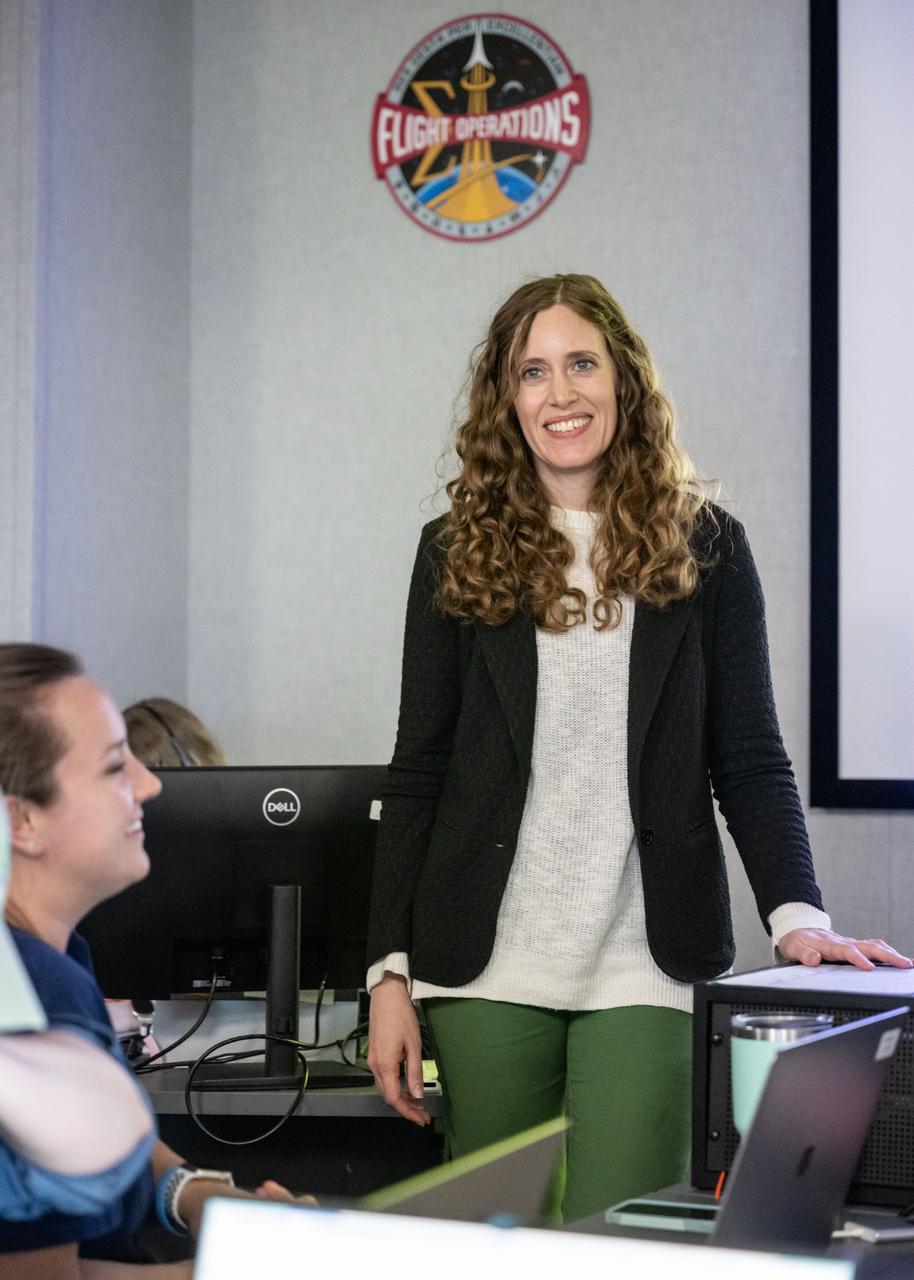
Science Evaluation Room Lead Brett Denevi, Artemis III Geology Team principal investigator for NASA’s Science Mission Directorate, looks over the Science Evaluation Room (SER) during the JETT 5 field test. JETT 5 was a week-long field test in the lunar-like landscape of San Francisco Volcanic Field near Flagstaff, Arizona while a team of flight controllers and scientists at Johnson monitor and guide their activities. Credit: NASA/James Blair
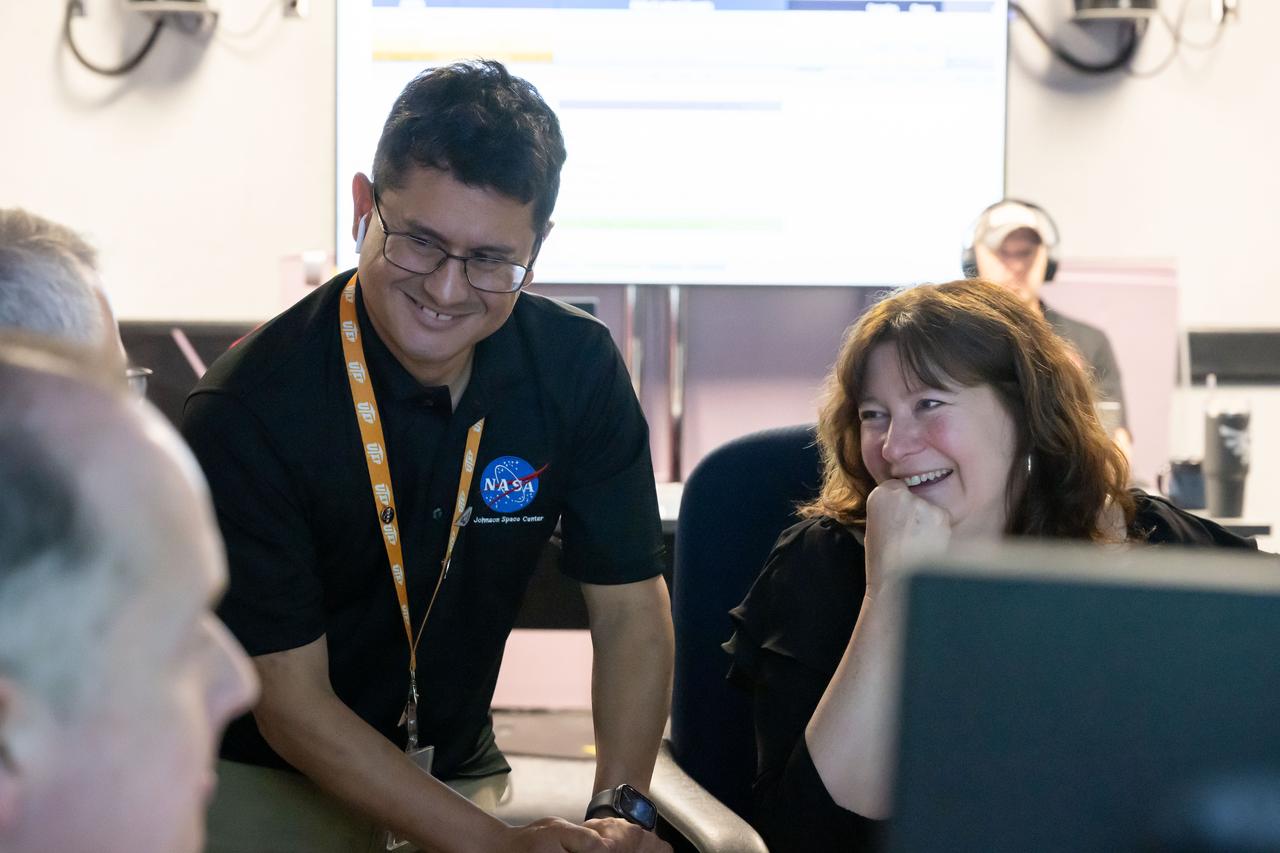
Artemis III Geology Team member, Jose Hurtado from the University of Texas at El Paso, left, and Maria Banks of NASA’s Goddard Spaceflight Center work in the Science Evaluation Room (SER) during the JETT 5 field test. JETT 5 was a week-long field test in the lunar-like landscape of San Francisco Volcanic Field near Flagstaff, Arizona while a team of flight controllers and scientists at Johnson monitor and guide their activities. Credit: NASA/Helen Arase Vargas
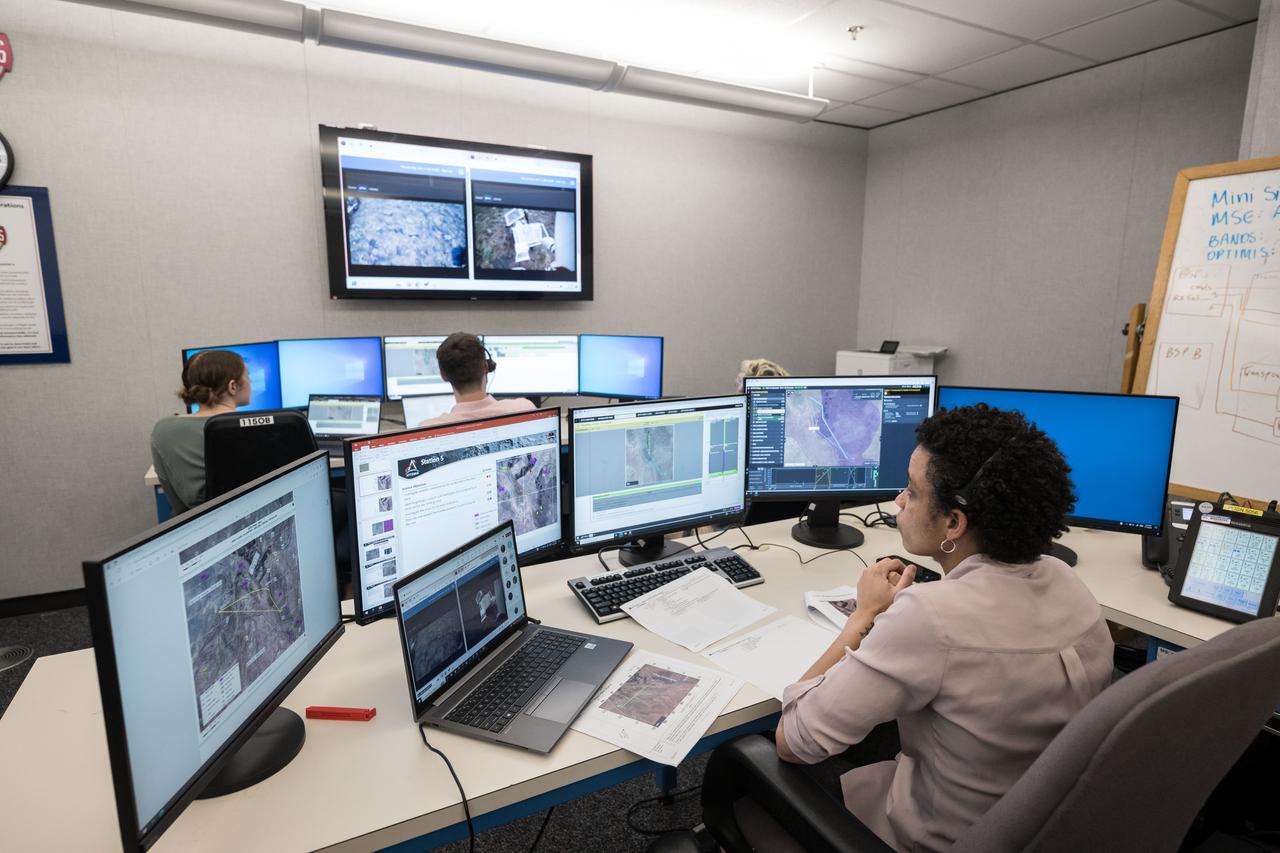
NASA astronaut Jessica Watkins served as the Ground IV for the JETT 5 field test and was the sole point of communications to NASA astronauts Andre Douglas and Kate Rubins who performed simulated moonwalks in the Arizona desert. JETT 5 was a week-long field test in the lunar-like landscape of San Francisco Volcanic Field near Flagstaff, Arizona while a team of flight controllers and scientists at Johnson monitor and guide their activities. Credit: NASA/Robert Markowitz
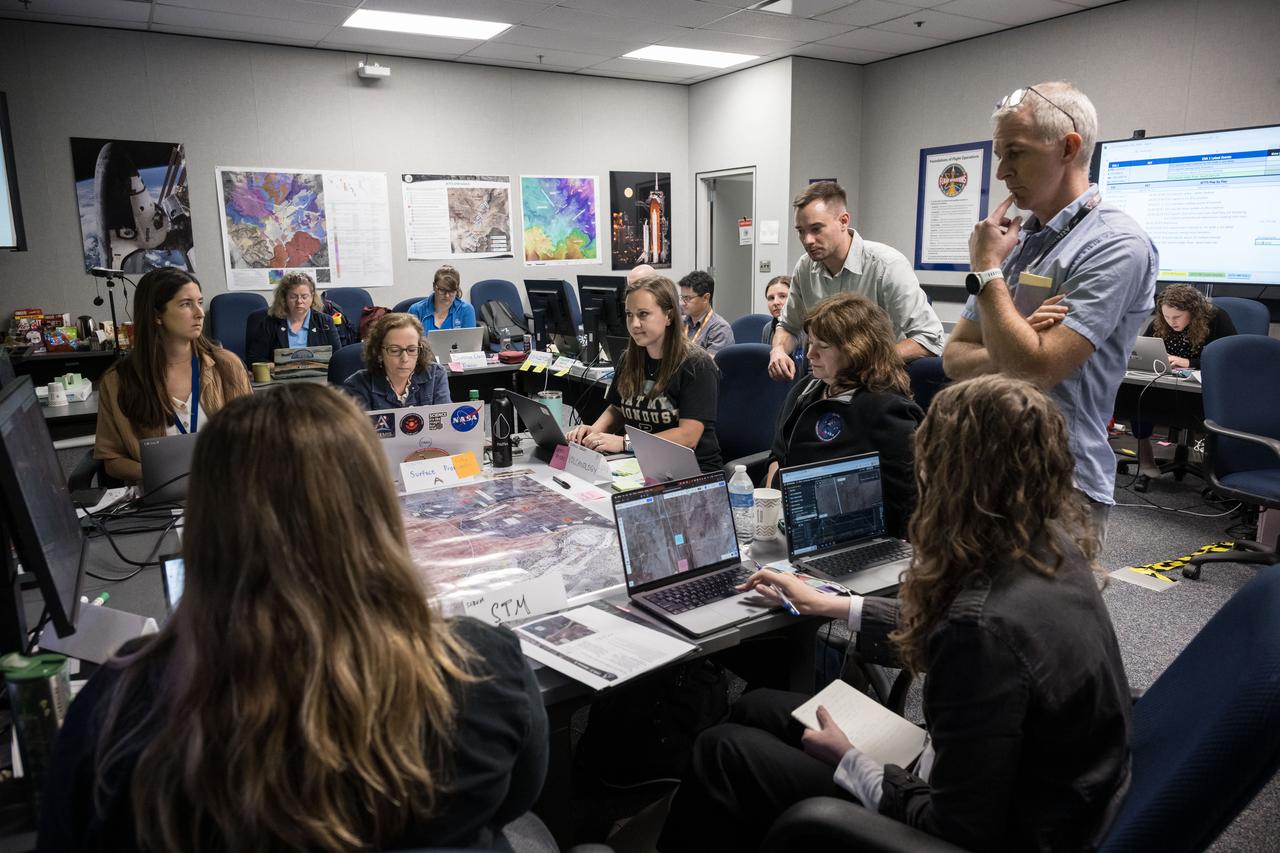
A group of scientists are gathered around a table covered in large maps in the Science Evaluation Room (SER) at NASA’s Johnson Space Center in Houston during the JETT 5 field test. JETT 5 was a week-long field test in the lunar-like landscape of San Francisco Volcanic Field near Flagstaff, Arizona while a team of flight controllers and scientists at Johnson monitor and guide their activities. Credit: NASA/Robert Markowitz
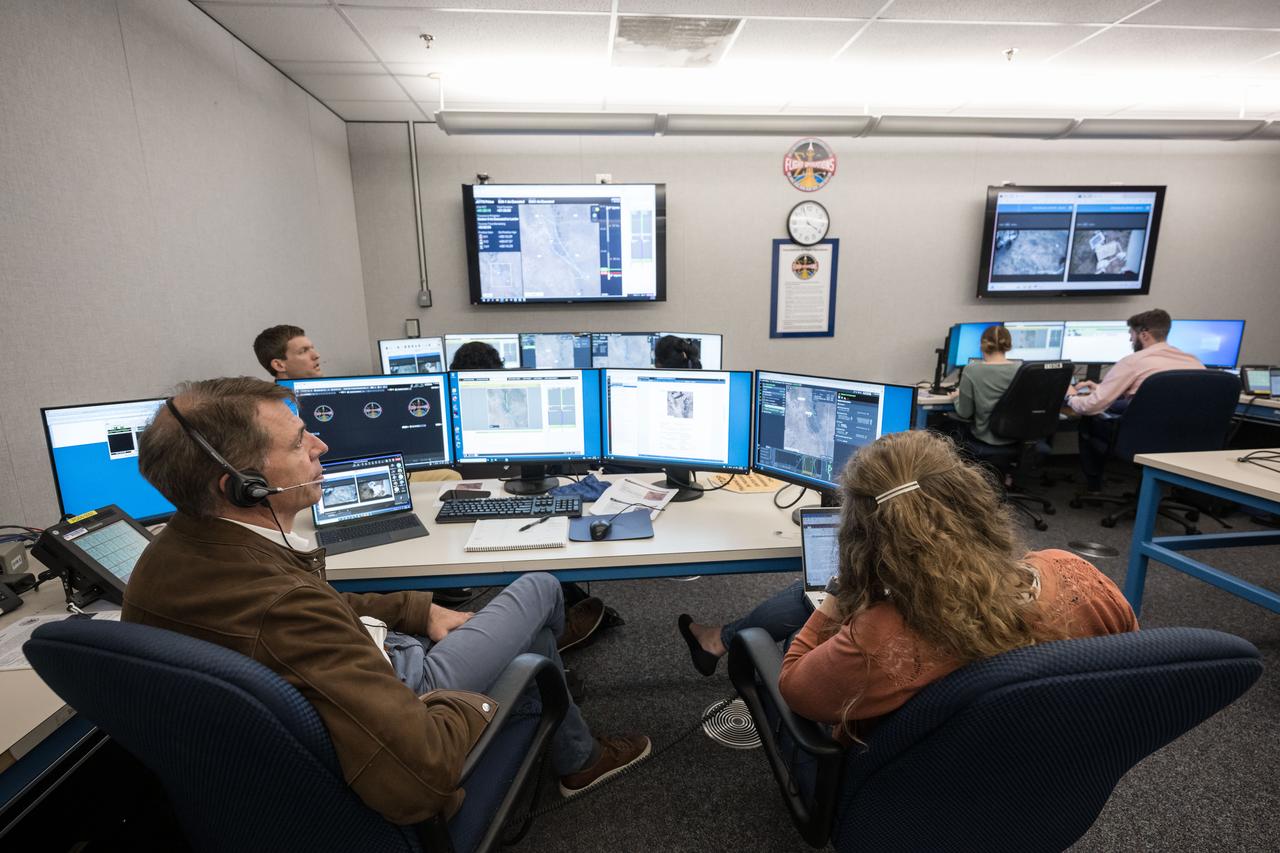
Flight Director Zebulon Scoville, left, and team monitor the JETT 5 extravehicular activities from a mock Mission Control at NASA’s Johnson Space Center in Houston. JETT 5 was a week-long field test in the lunar-like landscape of San Francisco Volcanic Field near Flagstaff, Arizona while a team of flight controllers and scientists at Johnson monitor and guide their activities. Credit: NASA/Robert Markowitz
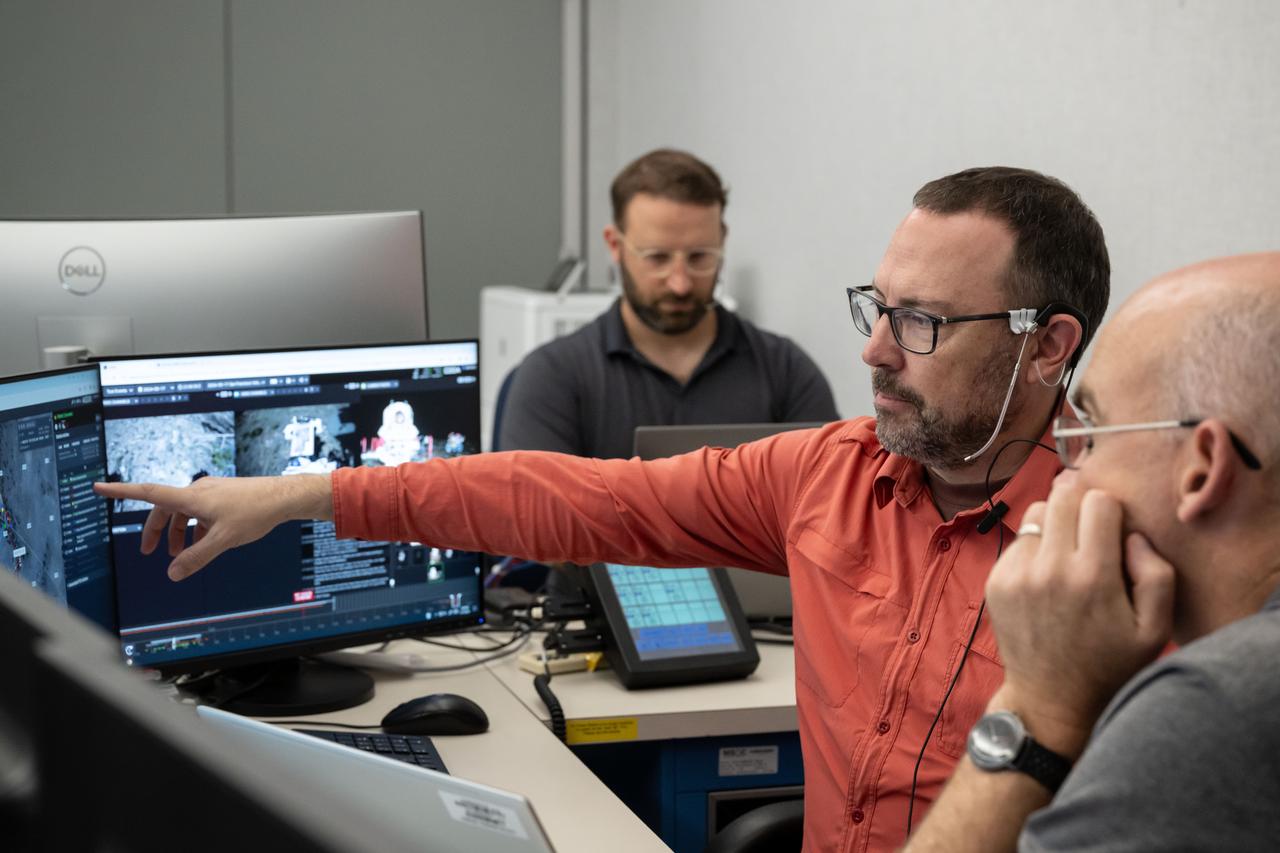
Ben Feist, software engineer on the Extravehicular Activity Mission System Software (EMSS) team, uses the suite of software he and other members of the Astromaterials Research and Exploration Science (ARES) division at NASA's Johnson Space Center in Houston developed to plan and monitor spacewalks. The JETT 5 field test was the first time this software was fully integrated into a simulated mission, supporting both science and mission control operations. JETT 5 was a week-long field test conducted in the lunar-like landscape of the San Francisco Volcanic Field near Flagstaff, Arizona, with a team of flight controllers and scientists at Johnson monitoring and guiding the activities. Credit: NASA/Helen Arase Vargas
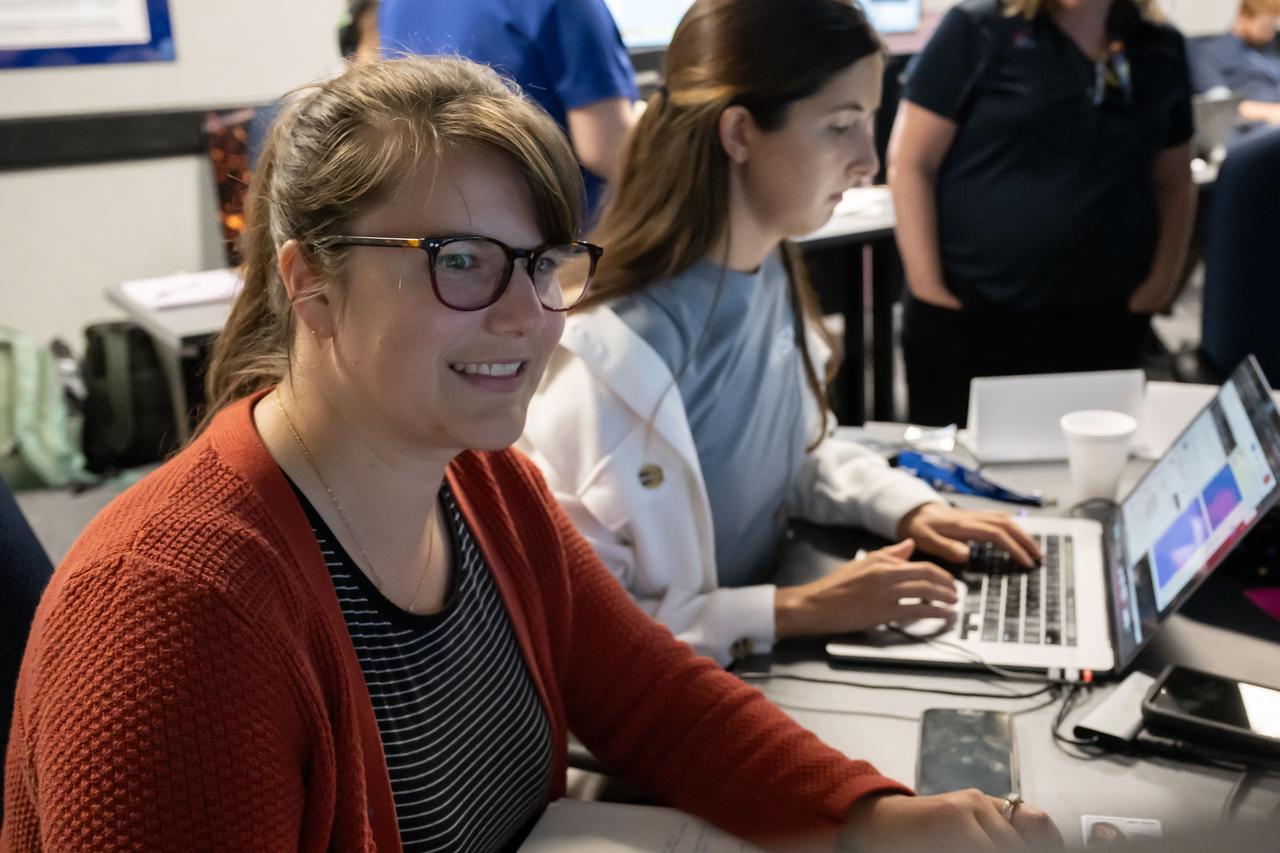
Marie Henderson, from NASA’s Goddard Space Flight Center, foreground, and Ariel Deutsch, from NASA Ames, follow the geology traverses during the JETT 5 field test. JETT 5 was a week-long field test in the lunar-like landscape of San Francisco Volcanic Field near Flagstaff, Arizona while a team of flight controllers and scientists at Johnson monitor and guide their activities. Credit: NASA/Helen Arase Vargas
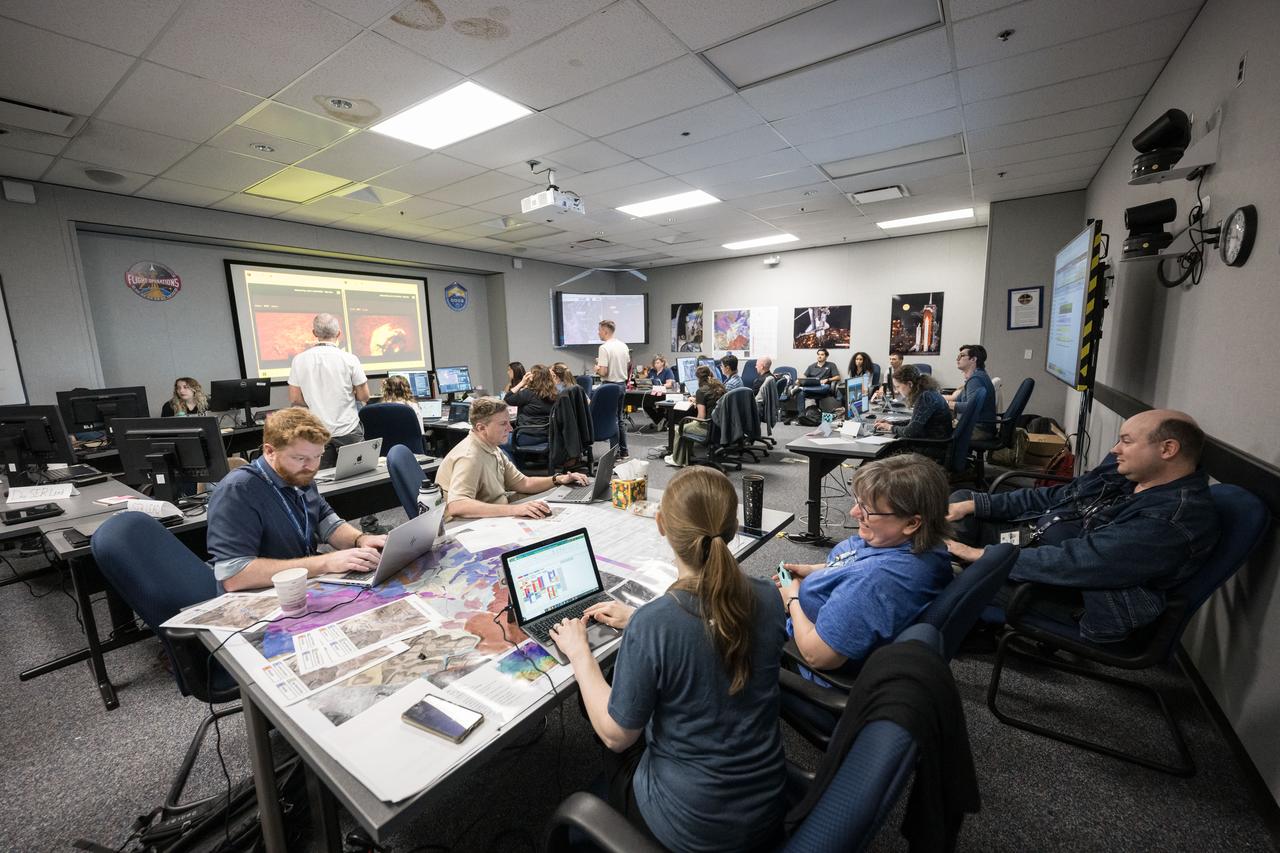
A large group of scientists work in the Science Evaluation Room (SER) at NASA’s Johnson Space Center in Houston during the JETT 5 field test. The SER is the science backroom to mission control during Artemis operations. JETT 5 was a week-long field test in the lunar-like landscape of San Francisco Volcanic Field near Flagstaff, Arizona while a team of flight controllers and scientists at Johnson monitor and guide their activities. Credit: NASA/Robert Markowitz
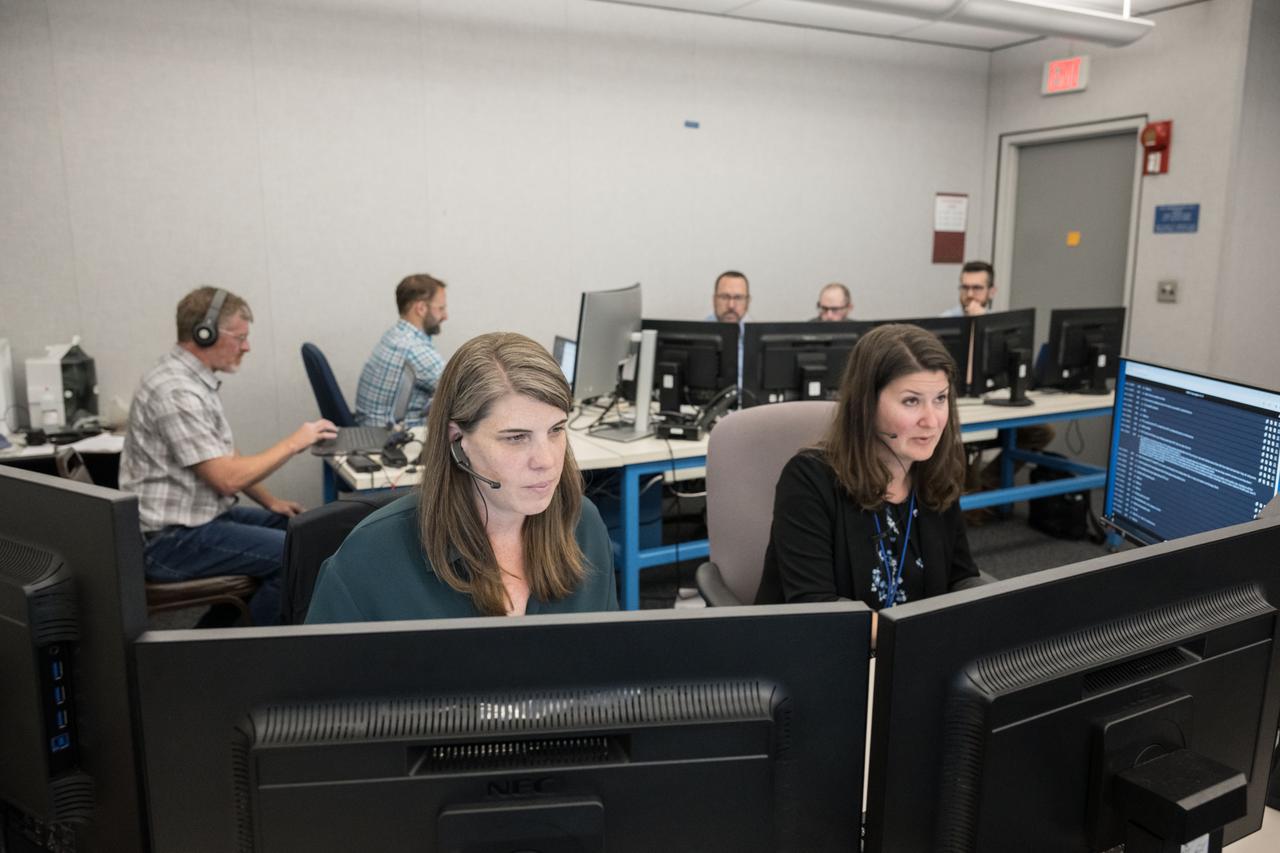
Science Officers Cherie Achilles and Lauren Edgar monitor science operations from a flight control room at NASA’s Johnson Space Center in Houston during a simulated moonwalk field test. JETT 5 was a week-long field test in the lunar-like landscape of San Francisco Volcanic Field near Flagstaff, Arizona while a team of flight controllers and scientists at Johnson monitor and guide their activities. ¬¬ Credit: NASA/Robert Markowitz
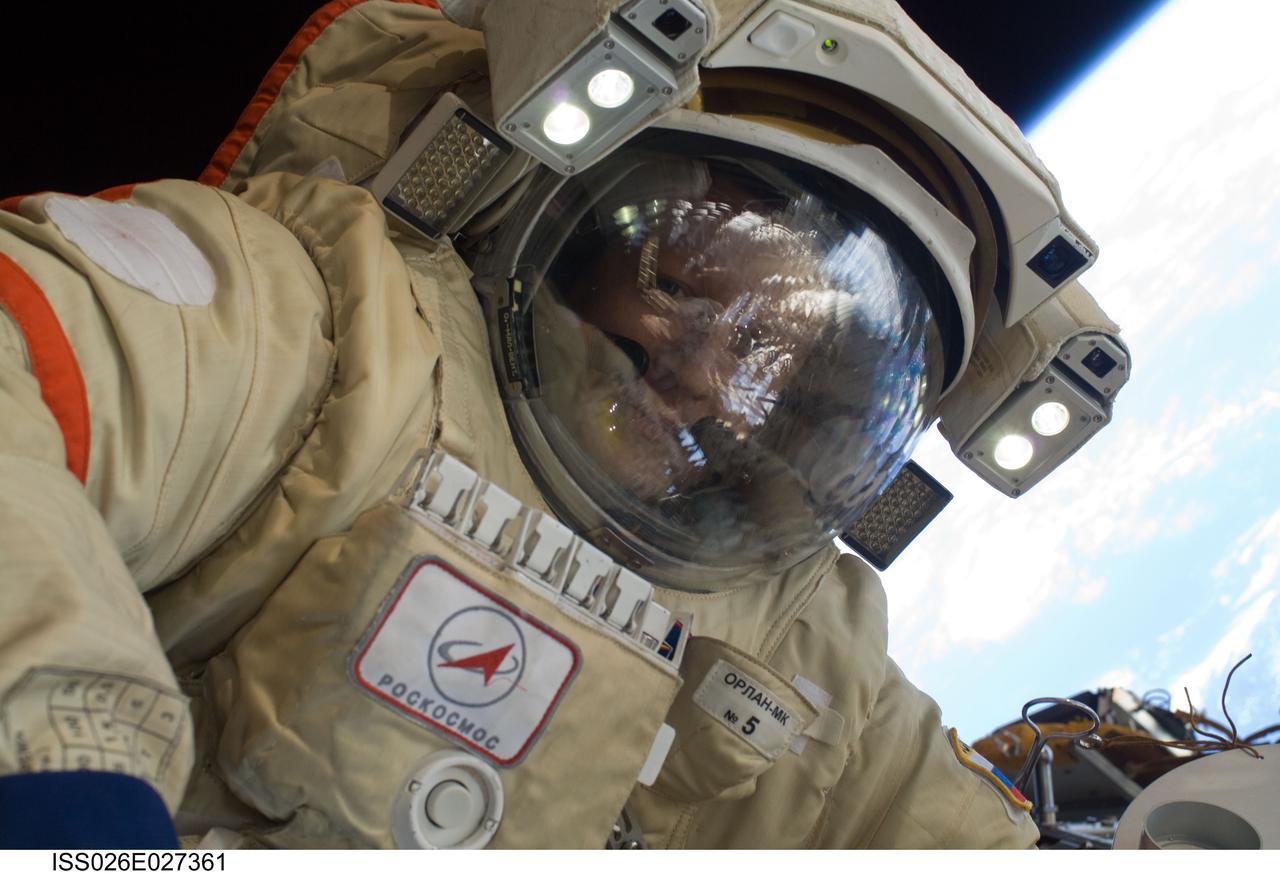
ISS026-E-027361 (16 Feb. 2011) --- Russian cosmonaut Dmitry Kondratyev, Expedition 26 flight engineer, wearing a Russian Orlan-MK spacesuit, participates in a session of extravehicular activity (EVA) focused on the installation of two scientific experiments outside the Zvezda Service Module of the International Space Station. During the four-hour, 51-minute spacewalk, Kondratyev and Russian cosmonaut Oleg Skripochka (out of frame), flight engineer, installed a pair of earthquake and lightning sensing experiments and retrieved a pair of spacecraft material evaluation panels.
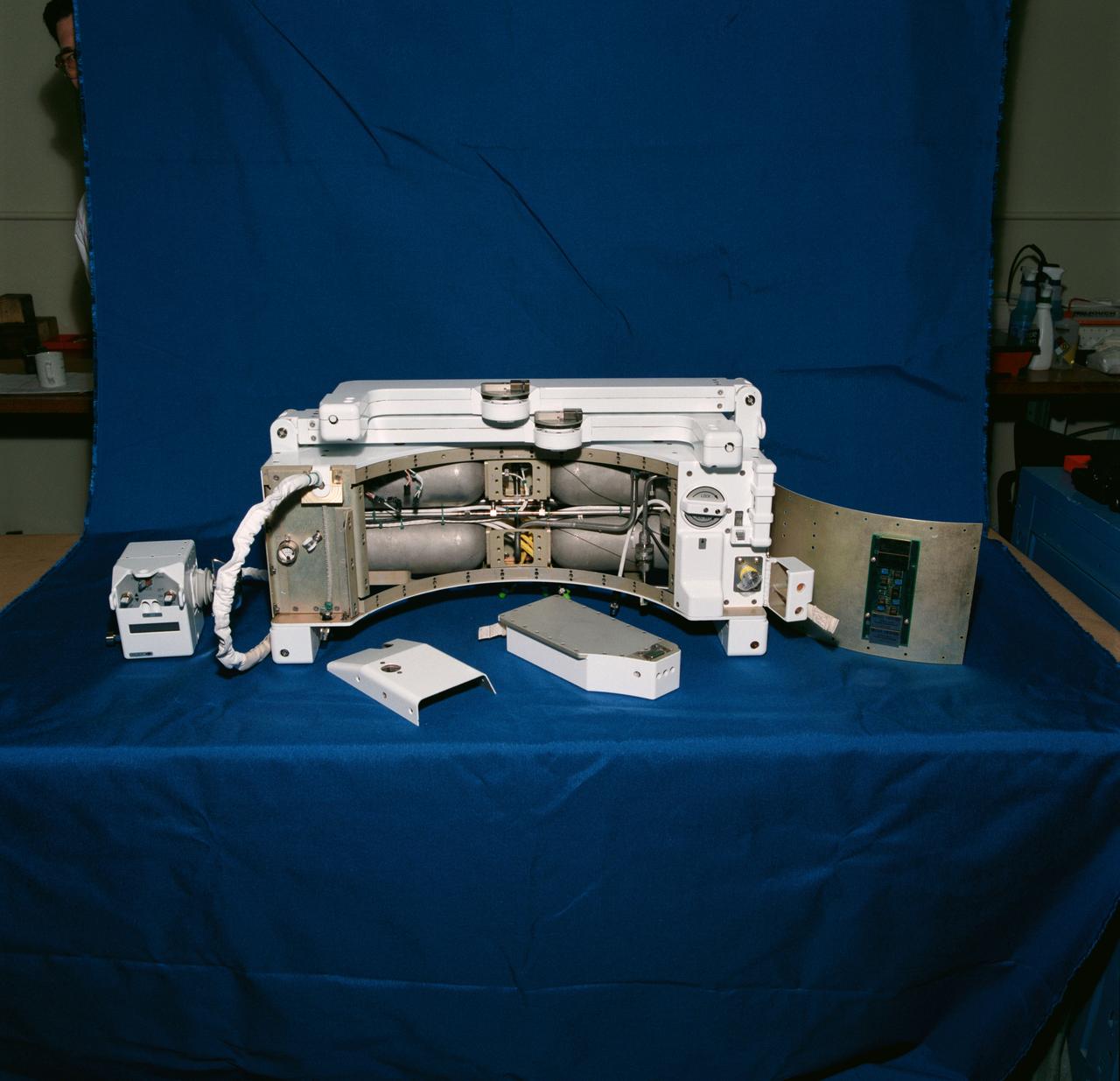
S93-50137 (December 1993) --- This small mobility-aiding back harness, complemented in extravehicular activity (EVA) with a hand controller unit and called the Simplified Aid for EVA Rescue (SAFER) system, will get extensive in-space evaluation and testing during the STS-64 mission. In this view the SAFER is open to reveal the gas supply and thrusters. SAFER is to fly on STS-76 as well.
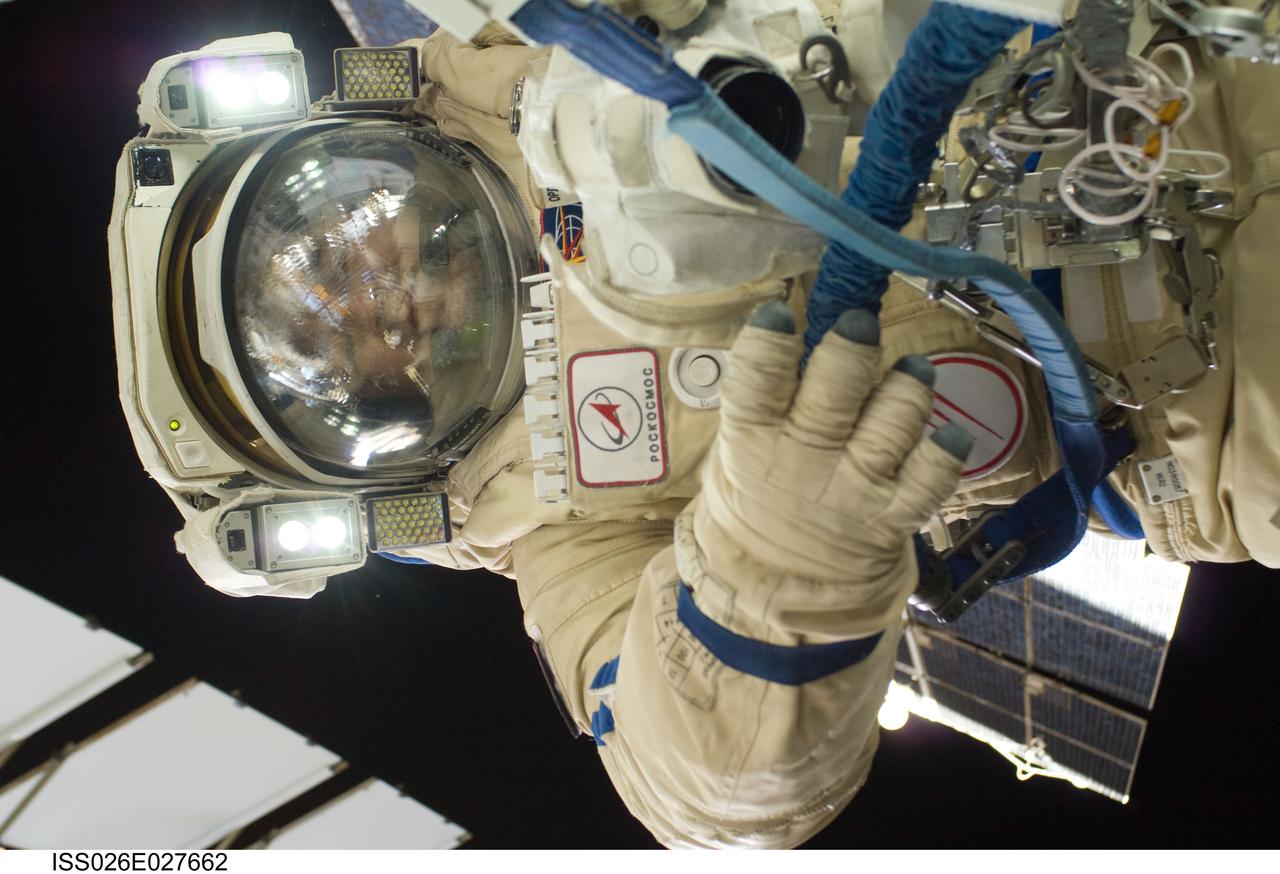
ISS026-E-027662 (16 Feb. 2011) --- Russian cosmonaut Oleg Skripochka, Expedition 26 flight engineer, wearing a Russian Orlan-MK spacesuit, participates in a session of extravehicular activity (EVA) focused on the installation of two scientific experiments outside the Zvezda Service Module of the International Space Station. During the four-hour, 51-minute spacewalk, Skripochka and Russian cosmonaut Dmitry Kondratyev (out of frame), flight engineer, installed a pair of earthquake and lightning sensing experiments and retrieved a pair of spacecraft material evaluation panels.
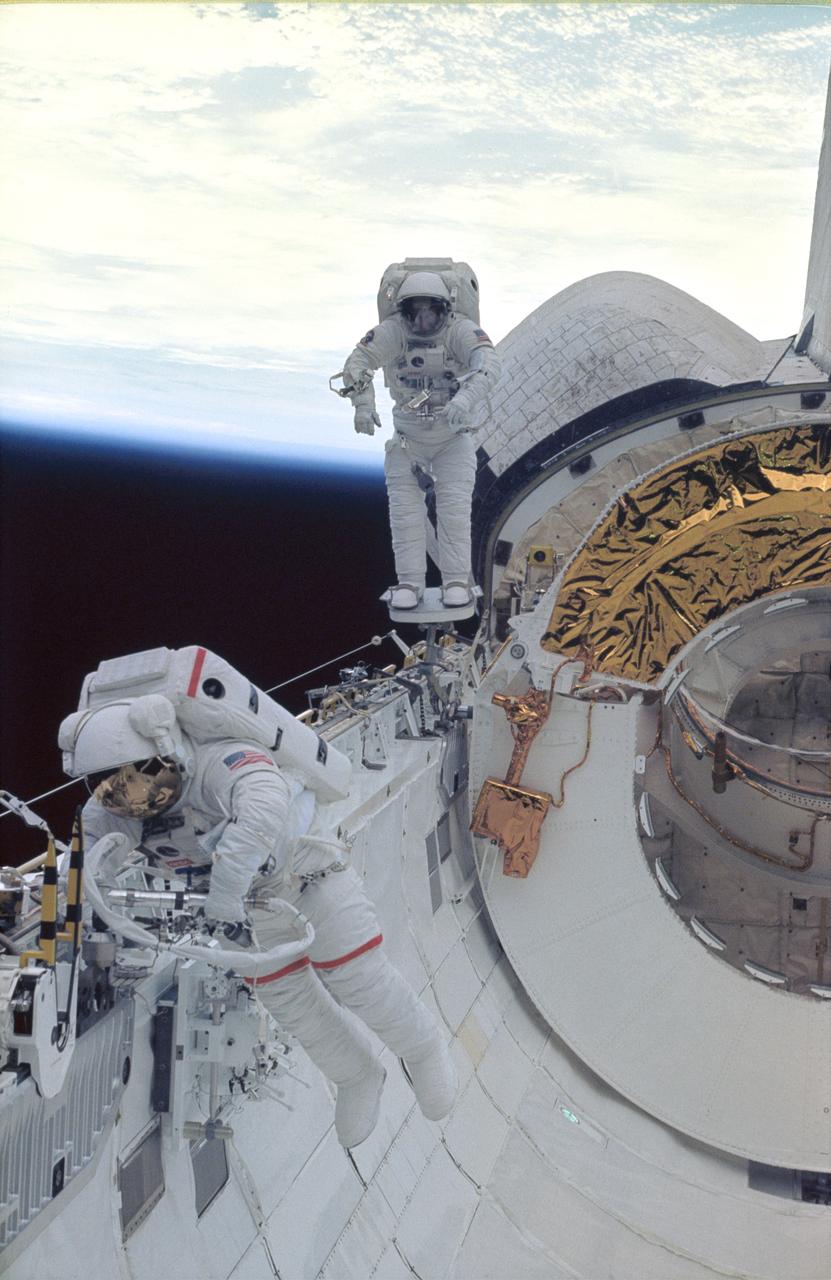
STS051-06-037 (16 Sept 1993) --- Astronauts Carl E. Walz (foreground) and James H. Newman evaluate some important gear. Walz reaches for the Power Ratchet Tool (PRT) while Newman checks out mobility on the Portable Foot Restraint (PFR) near the Space Shuttle Discovery's starboard Orbital Maneuvering System (OMS) pod. The tools and equipment will be instrumental on some of the five periods of extravehicular activity (EVA) scheduled for the Hubble Space Telescope (HST) STS-61 servicing mission later this year.
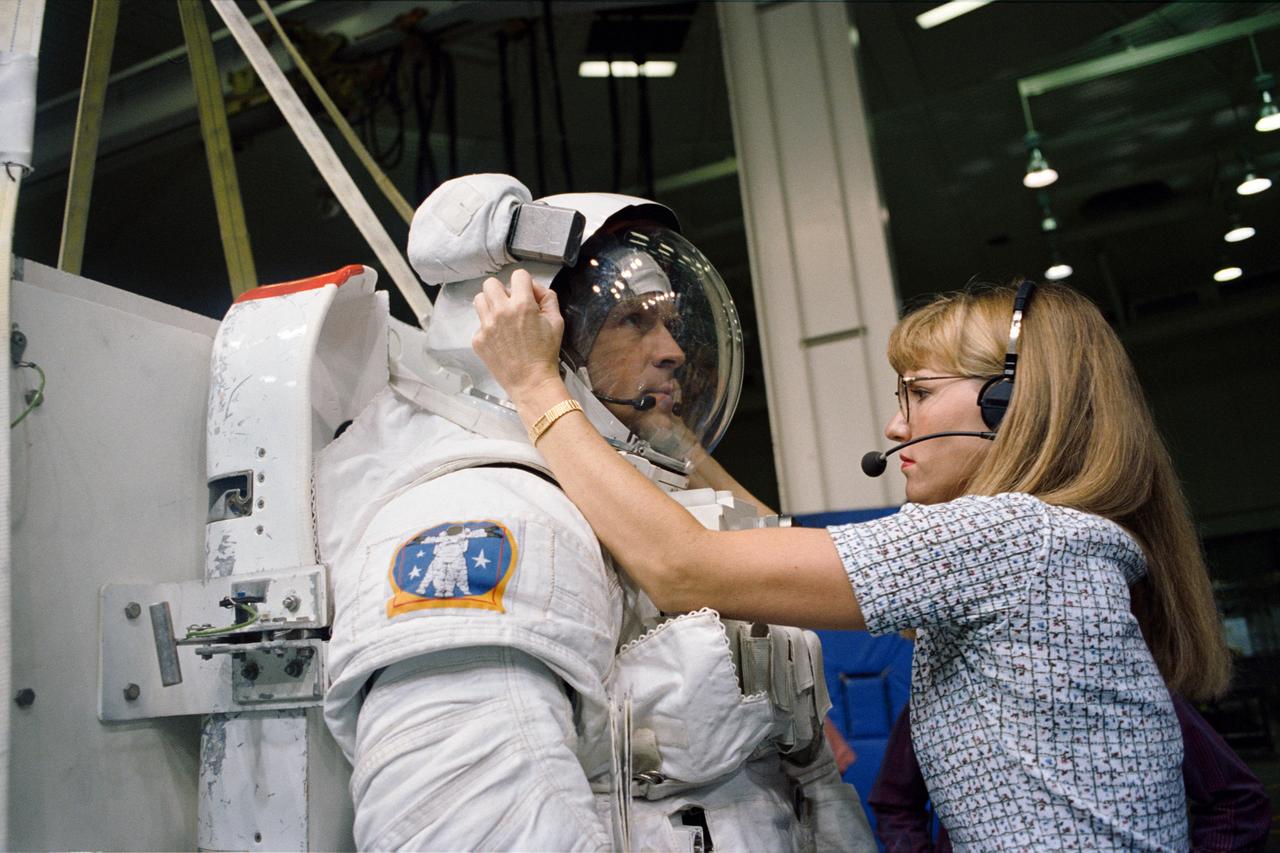
S94-39774 (August 1994) --- Boeing's Kari Rueter checks the helmet of astronaut Mark C. Lee prior to the mission specialist's participation in an underwater rehearsal for an extravehicular activity (EVA). Lee's spacewalk is scheduled for the September STS-64 mission. New rescue gear for use on future space shuttle missions will be evaluated during the mission's single spacewalk, involving astronauts Lee and Carl J. Meade, mission specialists. Photo credit: NASA or National Aeronautics and Space Administration
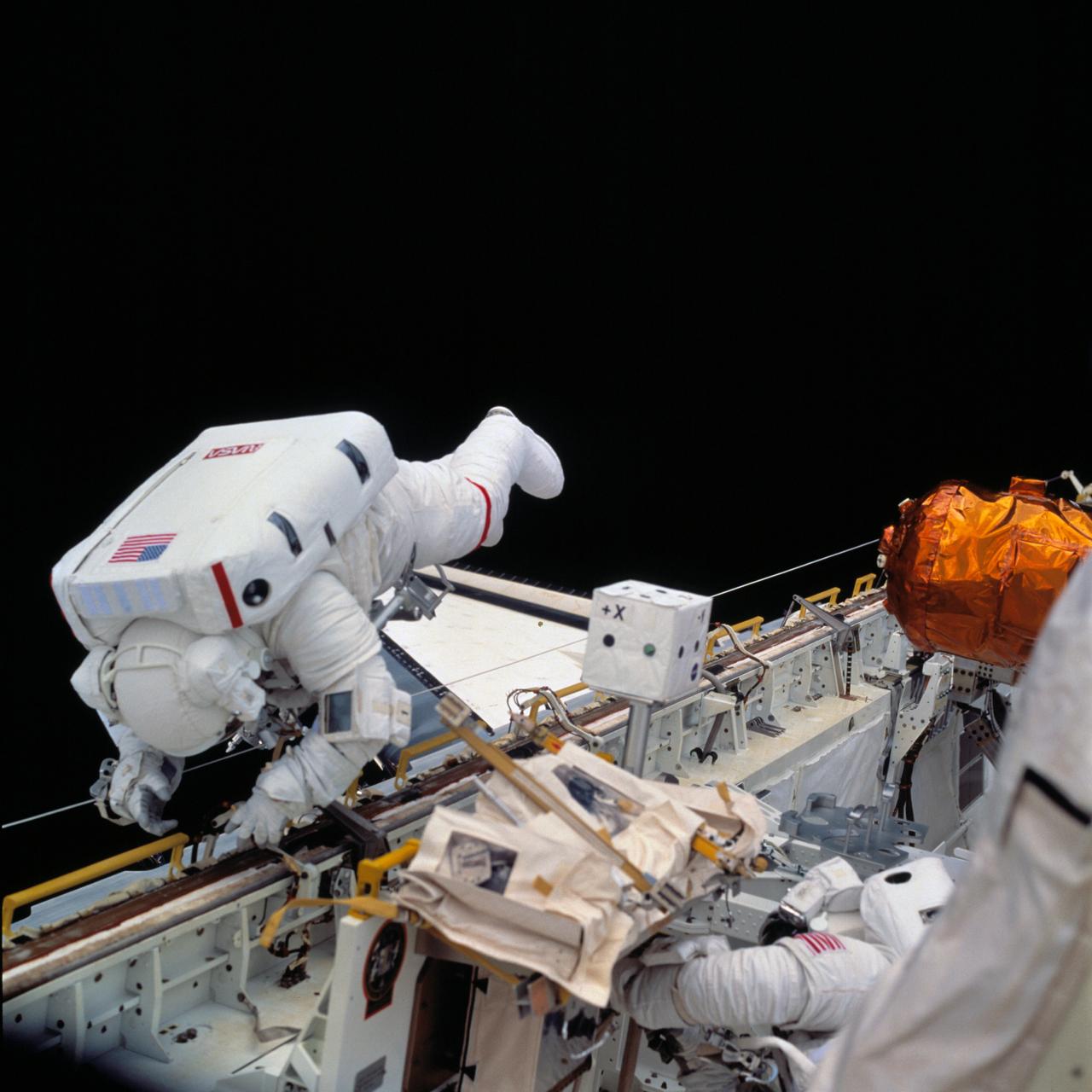
STS069-714-042 (16 September 1995) --- Astronauts James S. Voss, (red stripe on space suit) and Michael L. Gernhardt work together at the Extravehicular Activity (EVA) Assembly and Maintenance Task Board in the Space Shuttle Endeavour’s cargo bay. The EVA task board, with an approximate volume of 64 inches by 69 inches 27 inches and an Earth-bound weight of 450 pounds, helped the two space walkers evaluate work that will be done in the relatively near future on the International Space Station (ISS).
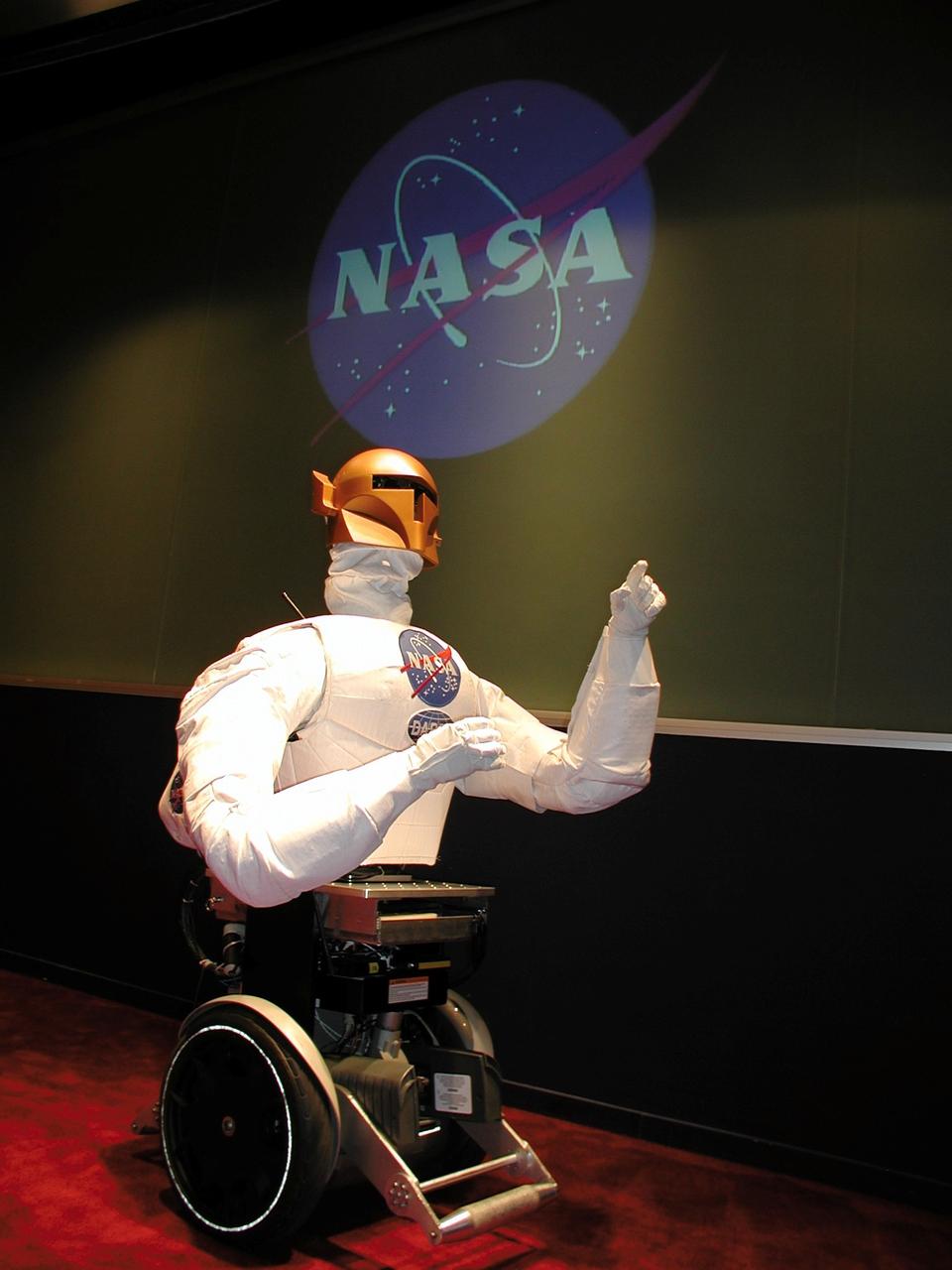
JSC2005-E-11678 (December 2003) --- This is Robonaut B, the newer of two NASA robots used in recent hand-in-hand testing at the Johnson Space Center with human beings to evaluate their shared ability to perform certain types of extravehicular activity. In late 2003 Robonaut Unit B was retrofitted with a mobile platform. This new base, called the Robonaut Mobility Platform (RMP), adds an entirely new capability to the functionality of Unit B.
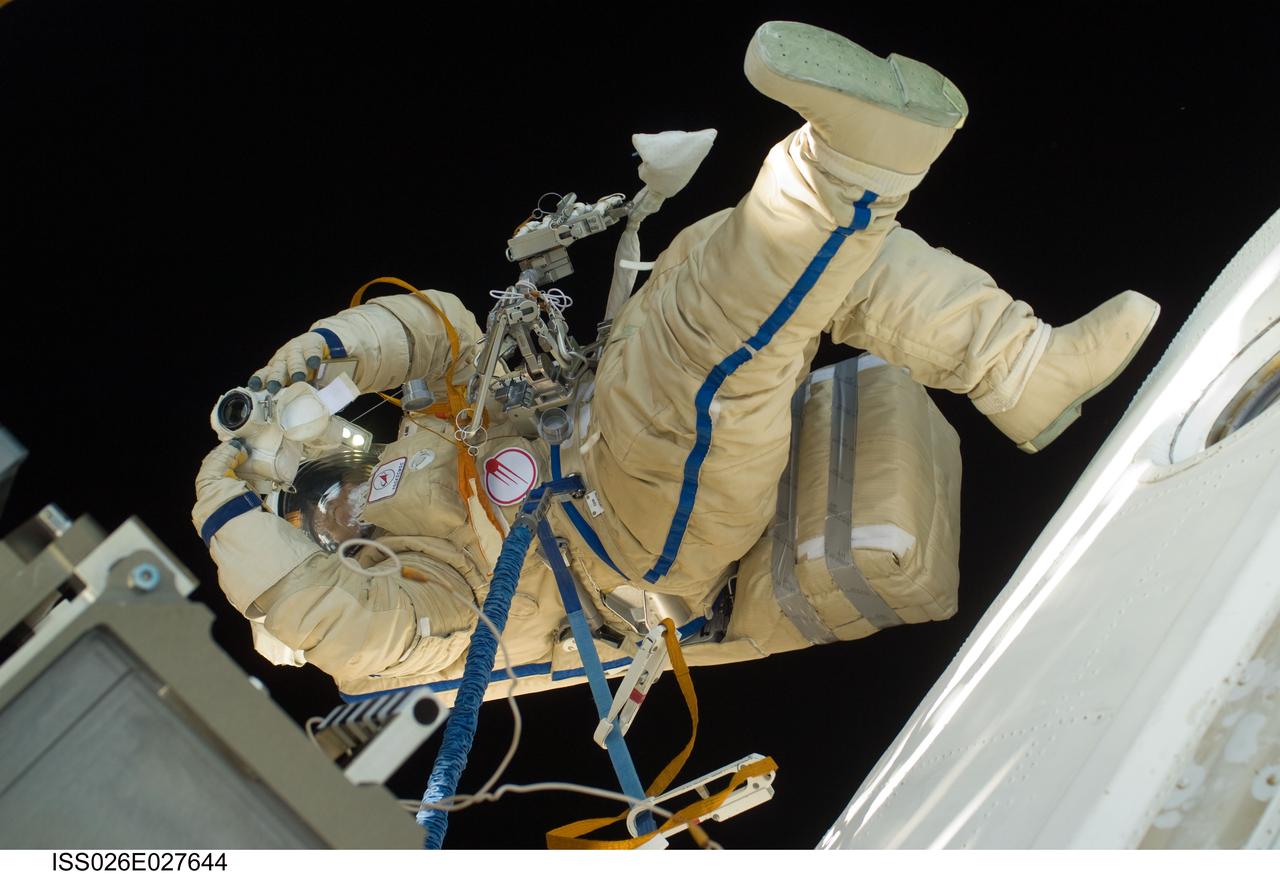
ISS026-E-027644 (16 Feb. 2011) --- Russian cosmonaut Oleg Skripochka, Expedition 26 flight engineer, wearing a Russian Orlan-MK spacesuit, participates in a session of extravehicular activity (EVA) focused on the installation of two scientific experiments outside the Zvezda Service Module of the International Space Station. During the four-hour, 51-minute spacewalk, Skripochka and Russian cosmonaut Dmitry Kondratyev (out of frame), flight engineer, installed a pair of earthquake and lightning sensing experiments and retrieved a pair of spacecraft material evaluation panels.
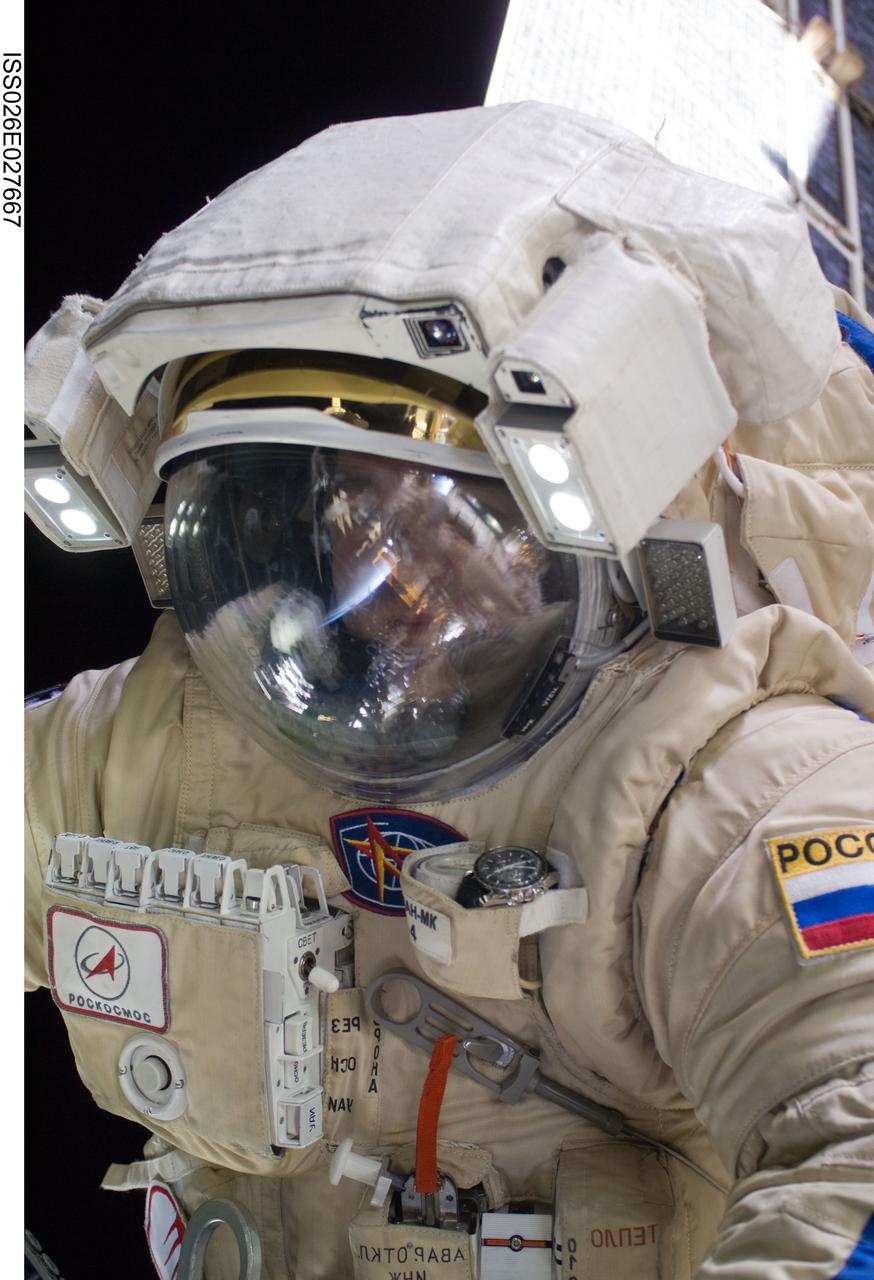
ISS026-E-027667 (16 Feb. 2011) --- Russian cosmonaut Oleg Skripochka, Expedition 26 flight engineer, wearing a Russian Orlan-MK spacesuit, participates in a session of extravehicular activity (EVA) focused on the installation of two scientific experiments outside the Zvezda Service Module of the International Space Station. During the four-hour, 51-minute spacewalk, Skripochka and Russian cosmonaut Dmitry Kondratyev (out of frame), flight engineer, installed a pair of earthquake and lightning sensing experiments and retrieved a pair of spacecraft material evaluation panels.
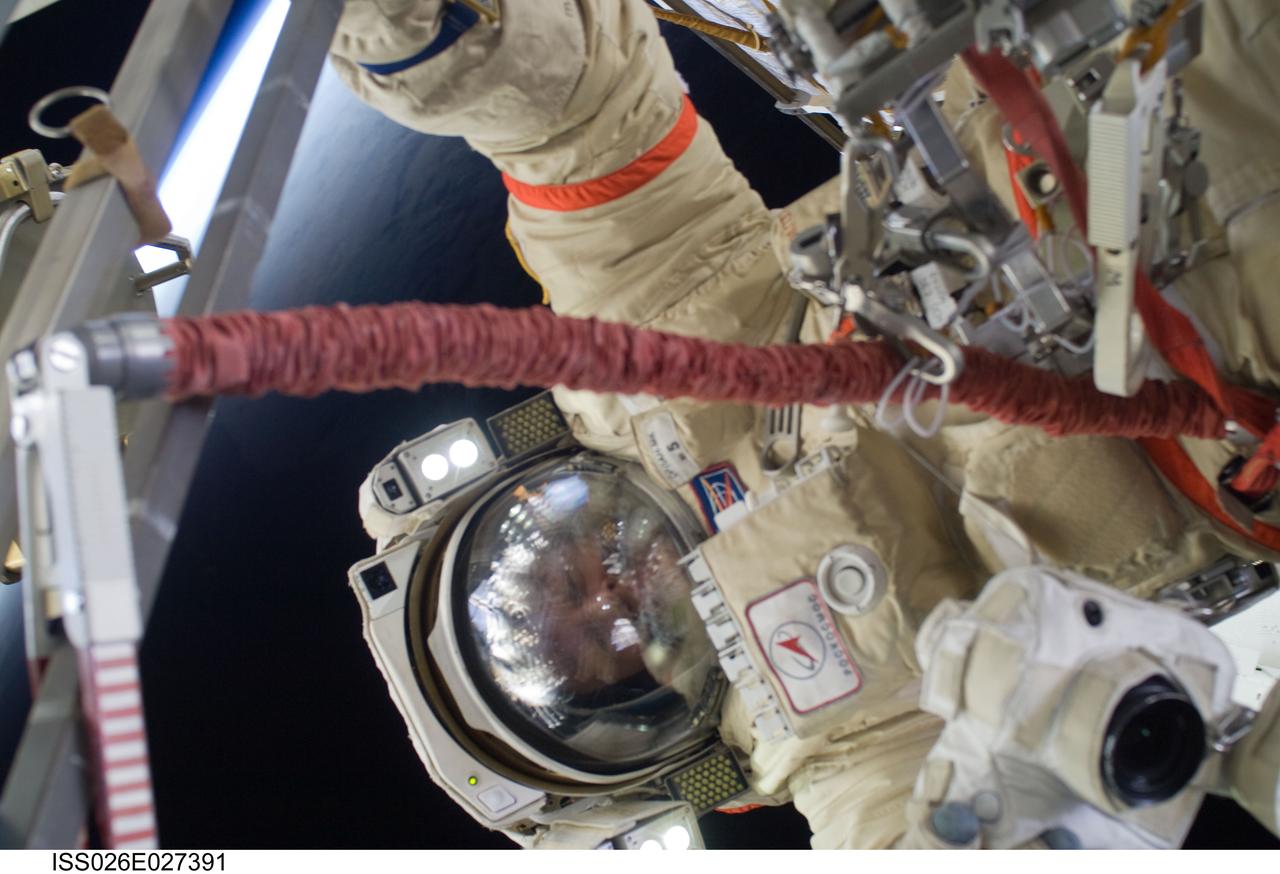
ISS026-E-027391 (16 Feb. 2011) --- Russian cosmonaut Dmitry Kondratyev, Expedition 26 flight engineer, wearing a Russian Orlan-MK spacesuit, participates in a session of extravehicular activity (EVA) focused on the installation of two scientific experiments outside the Zvezda Service Module of the International Space Station. During the four-hour, 51-minute spacewalk, Kondratyev and Russian cosmonaut Oleg Skripochka (out of frame), flight engineer, installed a pair of earthquake and lightning sensing experiments and retrieved a pair of spacecraft material evaluation panels.
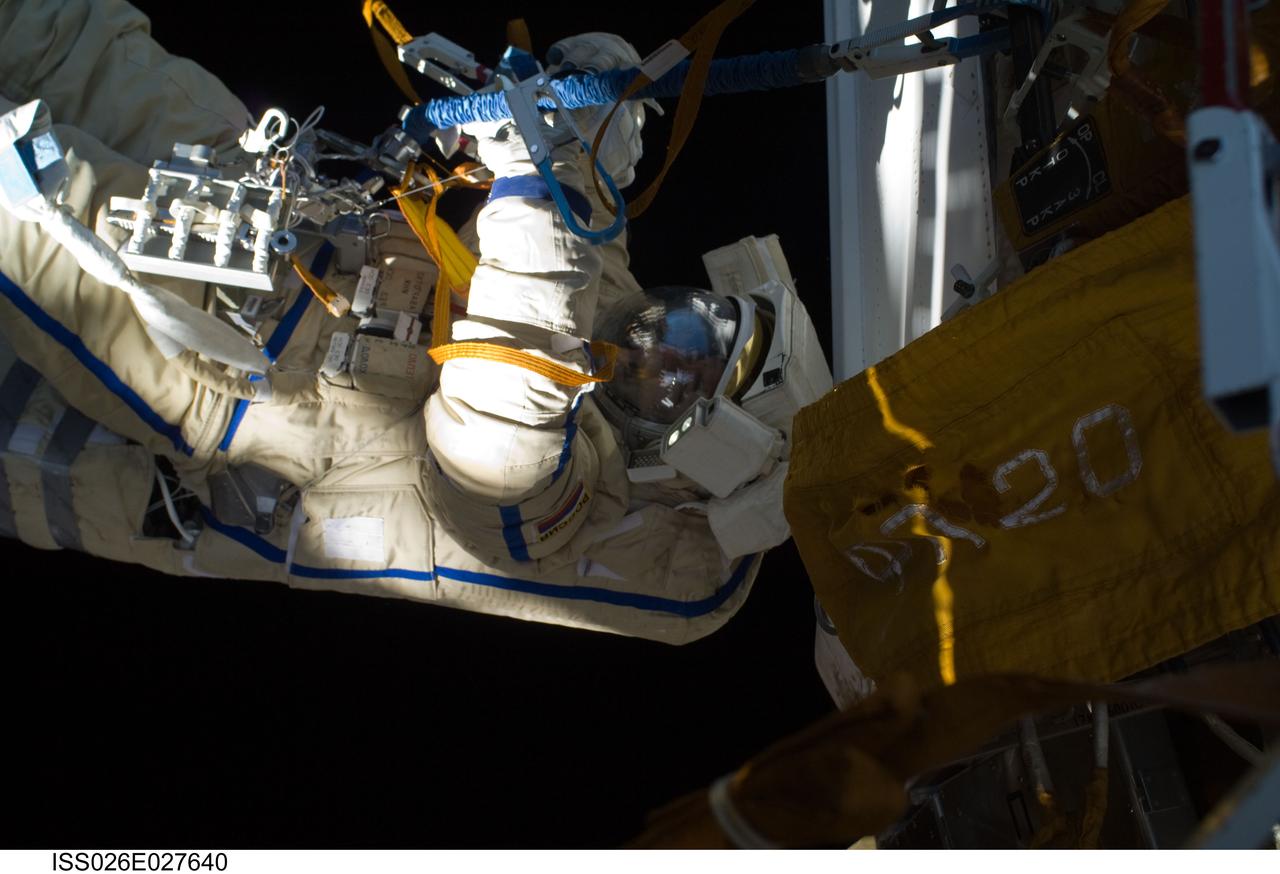
ISS026-E-027640 (16 Feb. 2011) --- Russian cosmonaut Oleg Skripochka, Expedition 26 flight engineer, wearing a Russian Orlan-MK spacesuit, participates in a session of extravehicular activity (EVA) focused on the installation of two scientific experiments outside the Zvezda Service Module of the International Space Station. During the four-hour, 51-minute spacewalk, Skripochka and Russian cosmonaut Dmitry Kondratyev (out of frame), flight engineer, installed a pair of earthquake and lightning sensing experiments and retrieved a pair of spacecraft material evaluation panels.
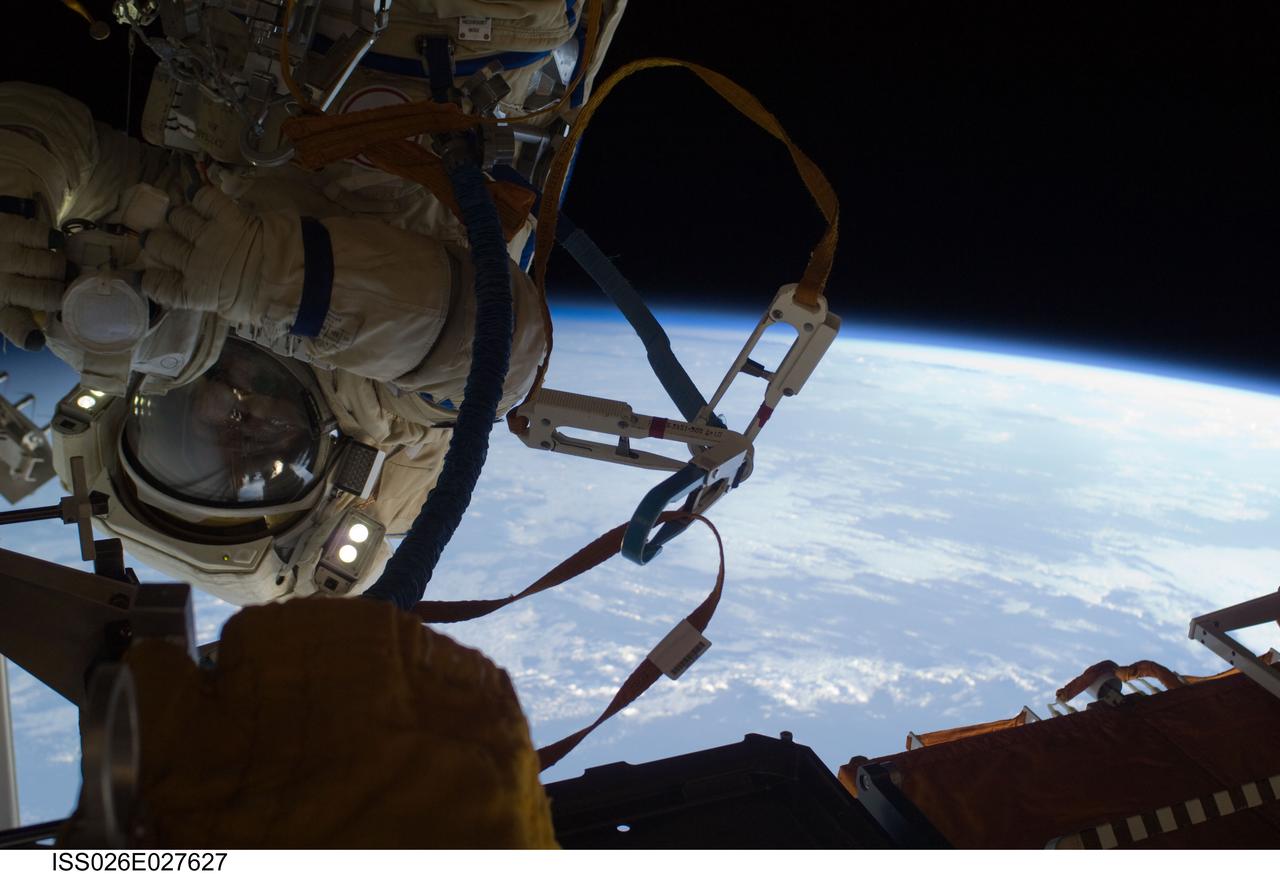
ISS026-E-027627 (16 Feb. 2011) --- Russian cosmonaut Oleg Skripochka, Expedition 26 flight engineer, wearing a Russian Orlan-MK spacesuit, participates in a session of extravehicular activity (EVA) focused on the installation of two scientific experiments outside the Zvezda Service Module of the International Space Station. During the four-hour, 51-minute spacewalk, Skripochka and Russian cosmonaut Dmitry Kondratyev (out of frame), flight engineer, installed a pair of earthquake and lightning sensing experiments and retrieved a pair of spacecraft material evaluation panels.
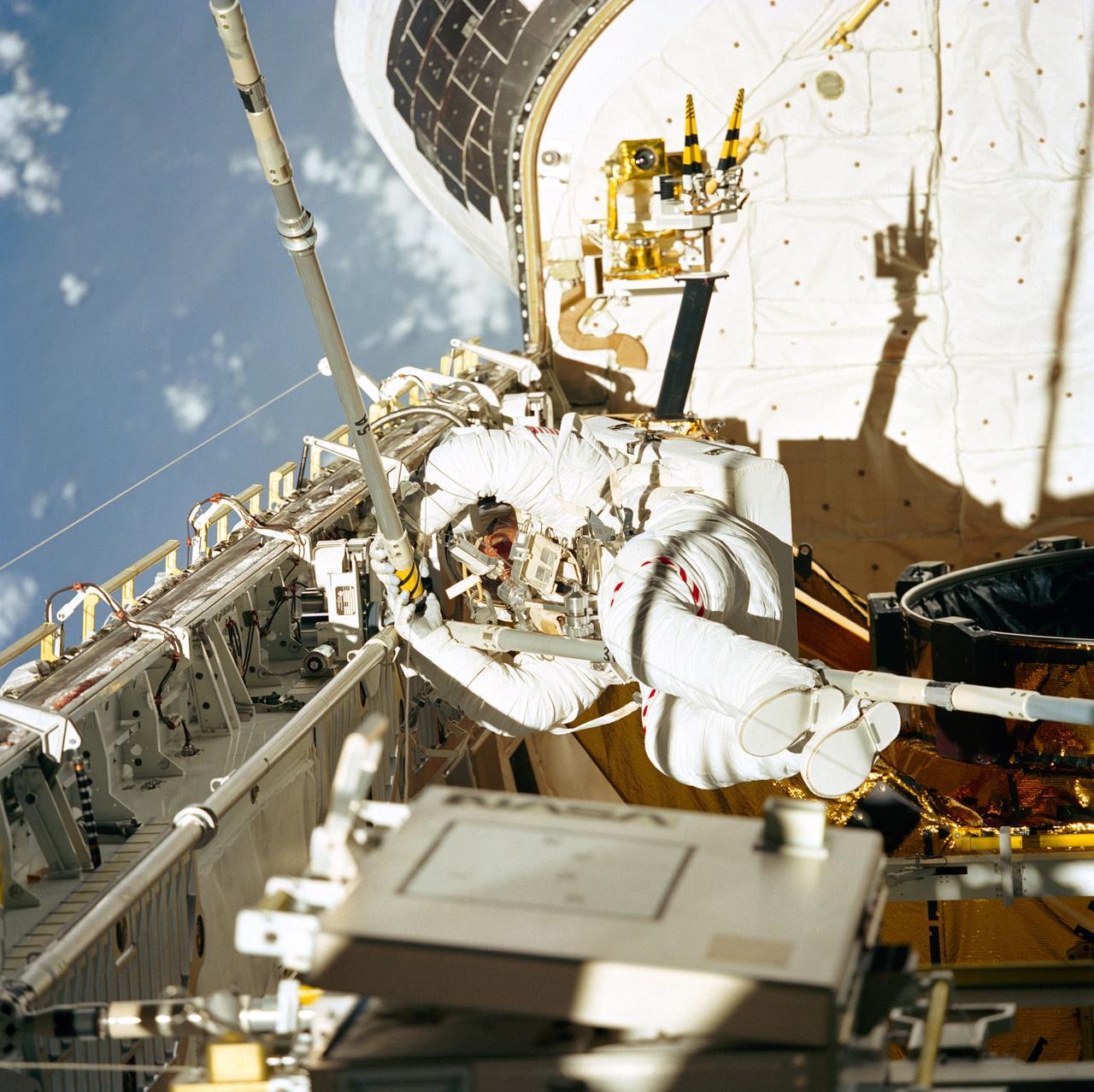
STS049-77-023 (14 May 1992) --- Astronaut Thomas D. Akers joins three struts together, as fourth period of extravehicular activity (EVA) proceeds in the Space Shuttle Endeavour's cargo bay. The purpose of the final EVA on this nine-day mission was the evaluation of Assembly of Station by EVA Methods (ASEM). The scene was recorded on 70mm film by a fellow crew member in the Space Shuttle's cabin. Astronaut Kathryn C. Thornton (out of frame) joined Akers on the 7 1/2 hour EVA.
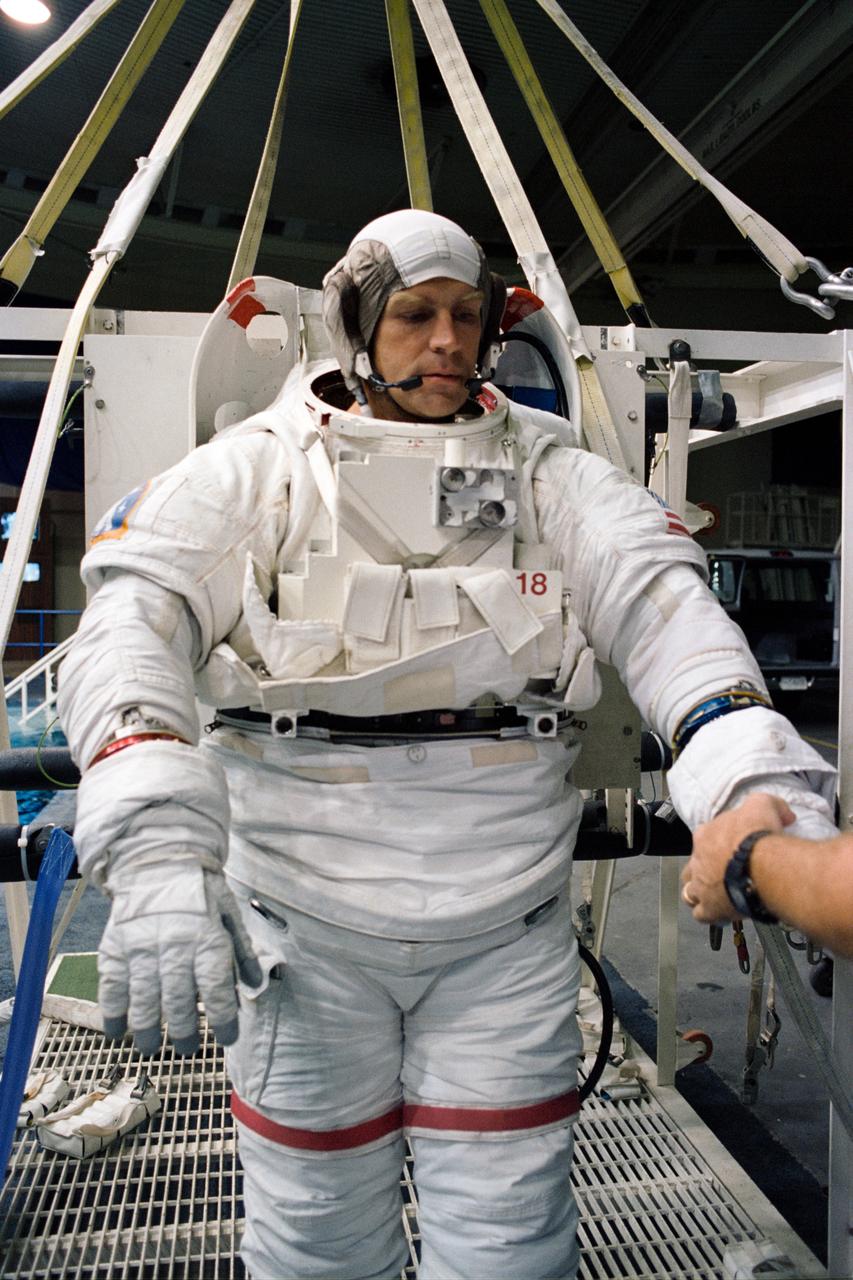
S94-39771 (August 1994) --- Astronaut Mark C. Lee is pictured prior to the mission specialist's participation in an underwater rehearsal for an extravehicular activity (EVA). Lee's spacewalk is scheduled for the September STS-64 mission. New rescue gear for use on future space shuttle missions will be evaluated during the mission's single spacewalk, involving astronauts Lee and Carl J. Meade, mission specialist. Photo credit: NASA or National Aeronautics and Space Administration
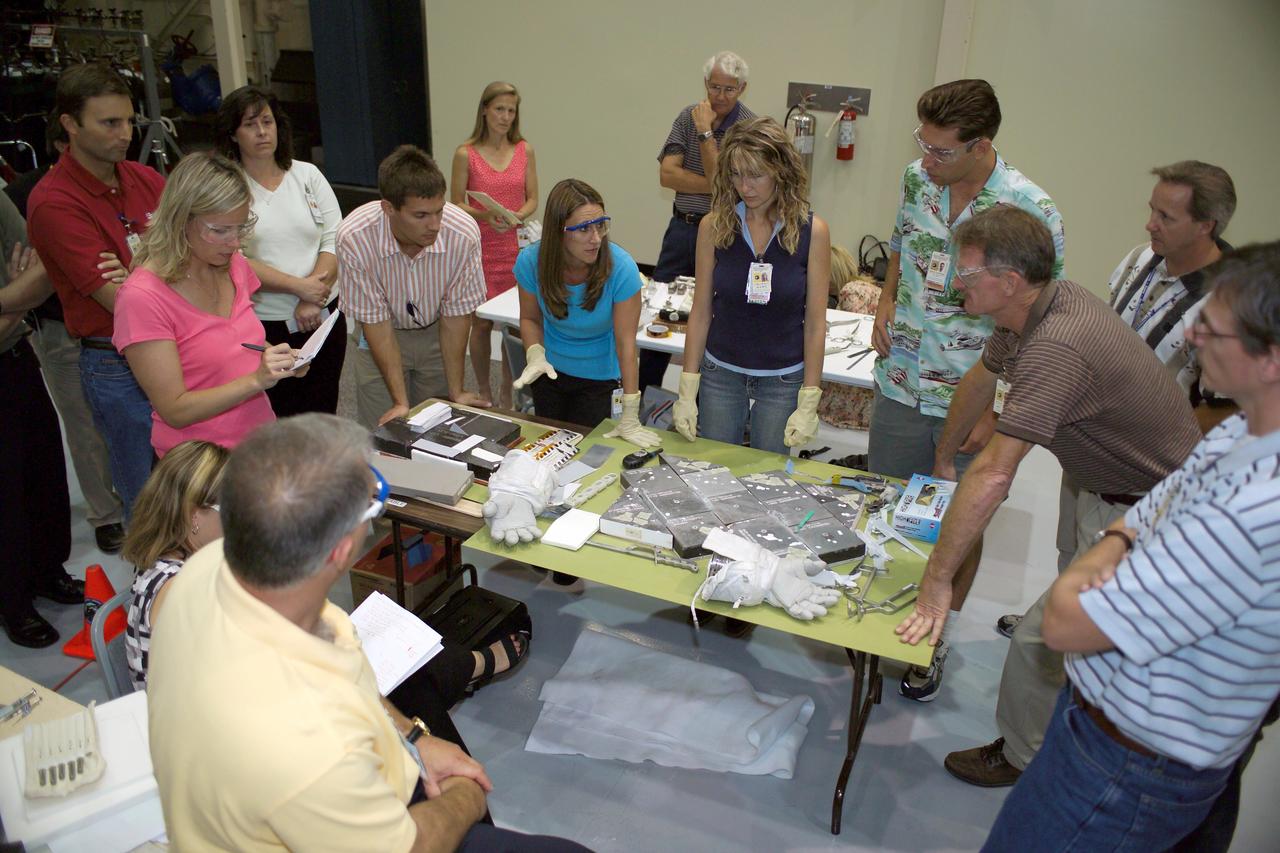
JSC2005-E-30949 (2005) --- NASA engineers Dana Weigel and Lora Bailey, along with astronauts David Wolf and Joe Tanner and other engineers evaluate techniques to eliminate or trim protruding gap fillers as a possible contingency plan for an STS-114 extravehicular activity (EVA). Photo credit: NASA Note: This image does not appear on public sites
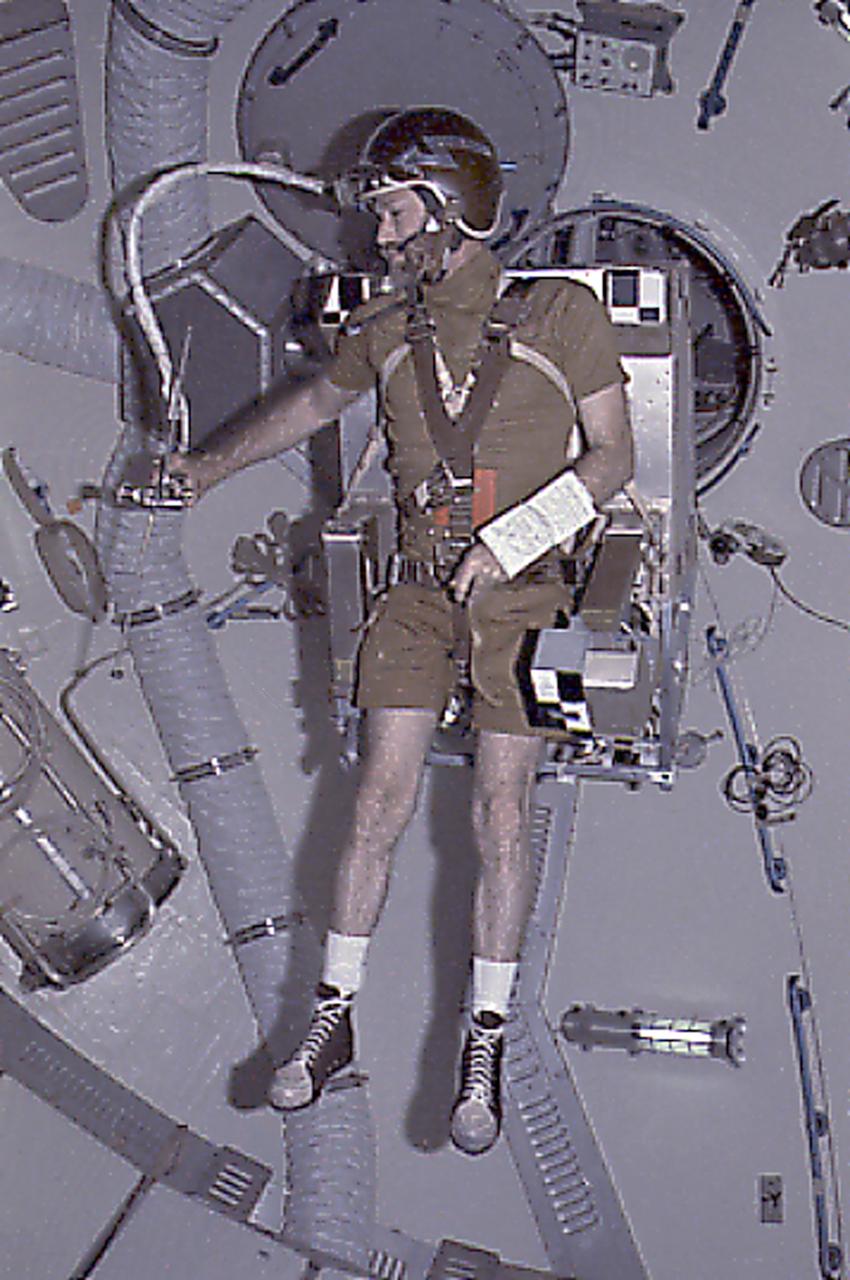
This Skylab-4 onboard photograph depicts Astronaut Gerald Carr testing Astronaut Maneuvering Equipment (M509) by flying it around under weightless conditions in the Orbital Workshop. The M509 experiment was an operational study to evaluate and conduct an in-orbit verification of the utility of various maneuvering techniques to assist astronauts in performing tasks that were representative of future extravehicular activity requirements.

ISS026-E-027633 (16 Feb. 2011) --- Russian cosmonaut Oleg Skripochka, Expedition 26 flight engineer, wearing a Russian Orlan-MK spacesuit, participates in a session of extravehicular activity (EVA) focused on the installation of two scientific experiments outside the Zvezda Service Module of the International Space Station. During the four-hour, 51-minute spacewalk, Skripochka and Russian cosmonaut Dmitry Kondratyev (out of frame), flight engineer, installed a pair of earthquake and lightning sensing experiments and retrieved a pair of spacecraft material evaluation panels.
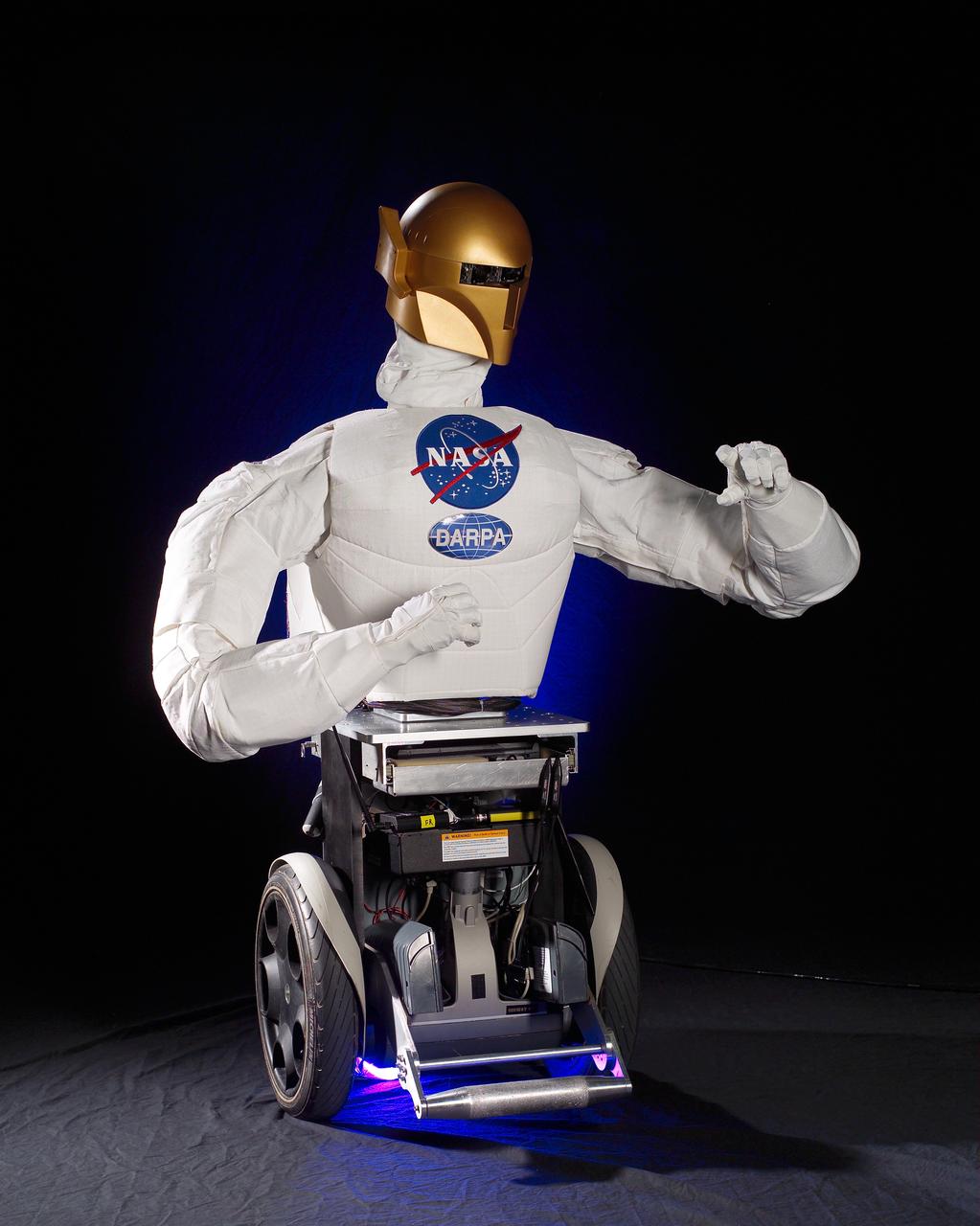
JSC2003-E-62444 (December 2003) --- This is Robonaut B, the newer of two NASA robots used in recent hand-in-hand testing at the Johnson Space Center with human beings to evaluate their shared ability to perform certain types of extravehicular activity. In late 2003 Robonaut Unit B was retrofitted with a mobile platform. This new base, called the Robonaut Mobility Platform (RMP), adds an entirely new capability to the functionality of Unit B.
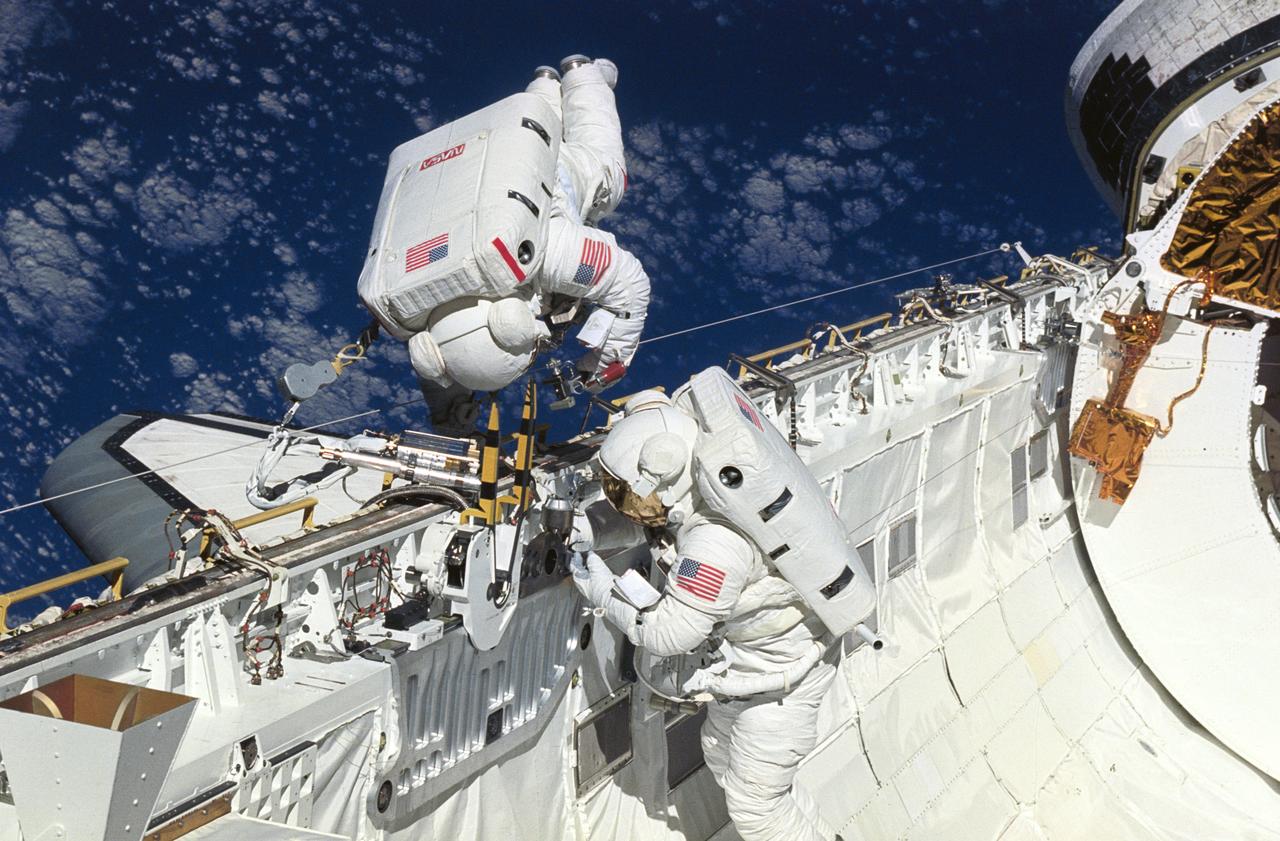
STS051-06-023 (16 Sept 1993) --- Astronauts James H. Newman (in bay) and Carl E. Walz, mission specialists, practice space walking techniques and evaluate tools to be used on the first Hubble Space Telescope (HST) servicing mission scheduled for later this year. Walz rehearses using the Power Ratchet Tool (PRT), one of several special pieces of gear to be put to duty during the scheduled five periods of extravehicular activity (EVA) on the STS-61 mission.
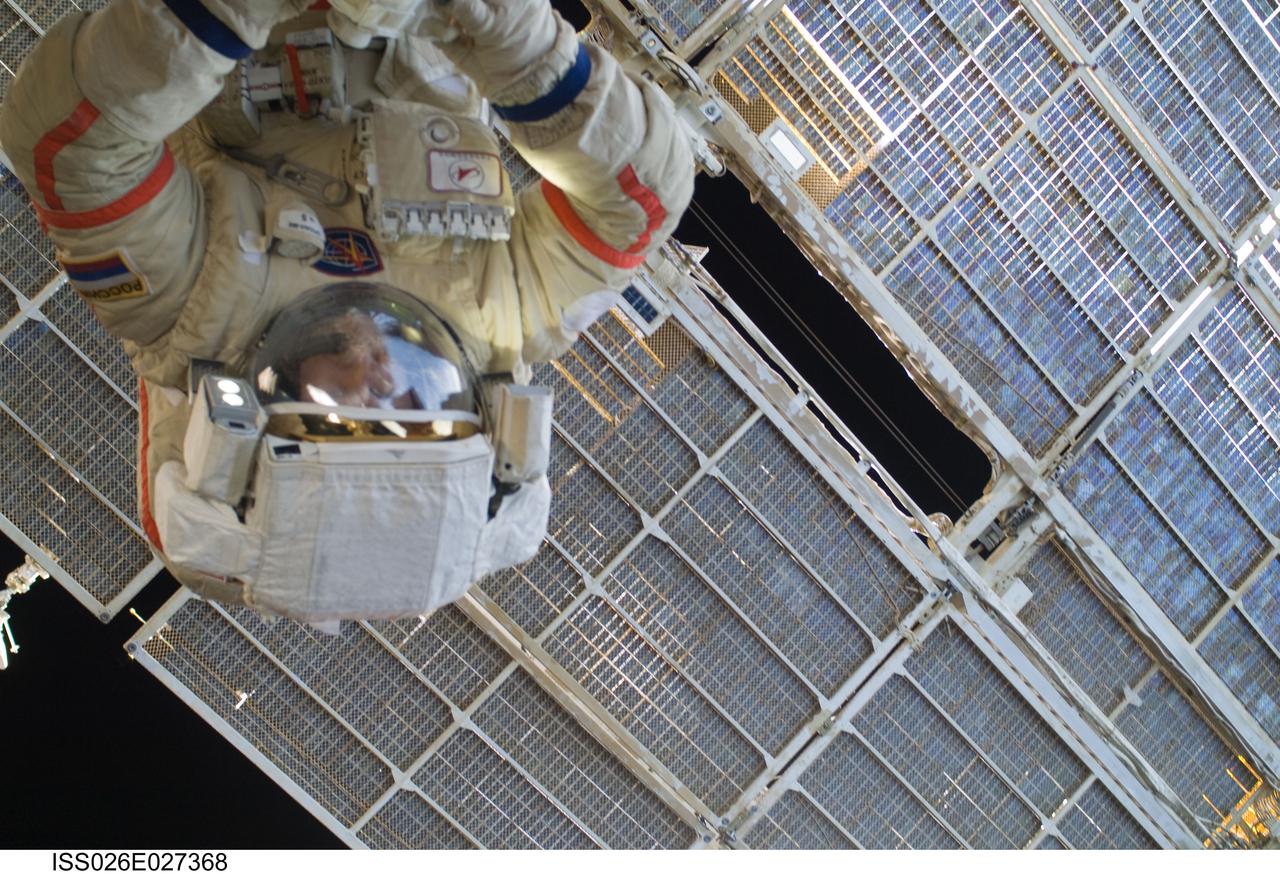
ISS026-E-027368 (16 Feb. 2011) --- Russian cosmonaut Dmitry Kondratyev, Expedition 26 flight engineer, wearing a Russian Orlan-MK spacesuit, participates in a session of extravehicular activity (EVA) focused on the installation of two scientific experiments outside the Zvezda Service Module of the International Space Station. During the four-hour, 51-minute spacewalk, Kondratyev and Russian cosmonaut Oleg Skripochka (out of frame), flight engineer, installed a pair of earthquake and lightning sensing experiments and retrieved a pair of spacecraft material evaluation panels.
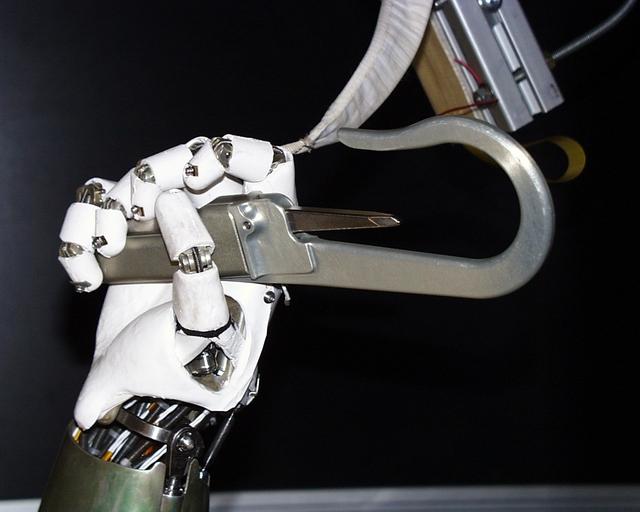
JSC2004-E-03468 (March 2004) --- This closeup view, photographed during a series of evaluations, shows the hand of a Robonaut grasping a tether hook. Joint travel for the wrist pitch and yaw is designed to meet or exceed that of the human hand in a pressurized glove and the hand and wrist parts are sized to reproduce the necessary strength to meet maximum crew requirements for extravehicular activity. Future robots like the Robonaut prototype may some day help astronauts perform important spacewalk tasks.
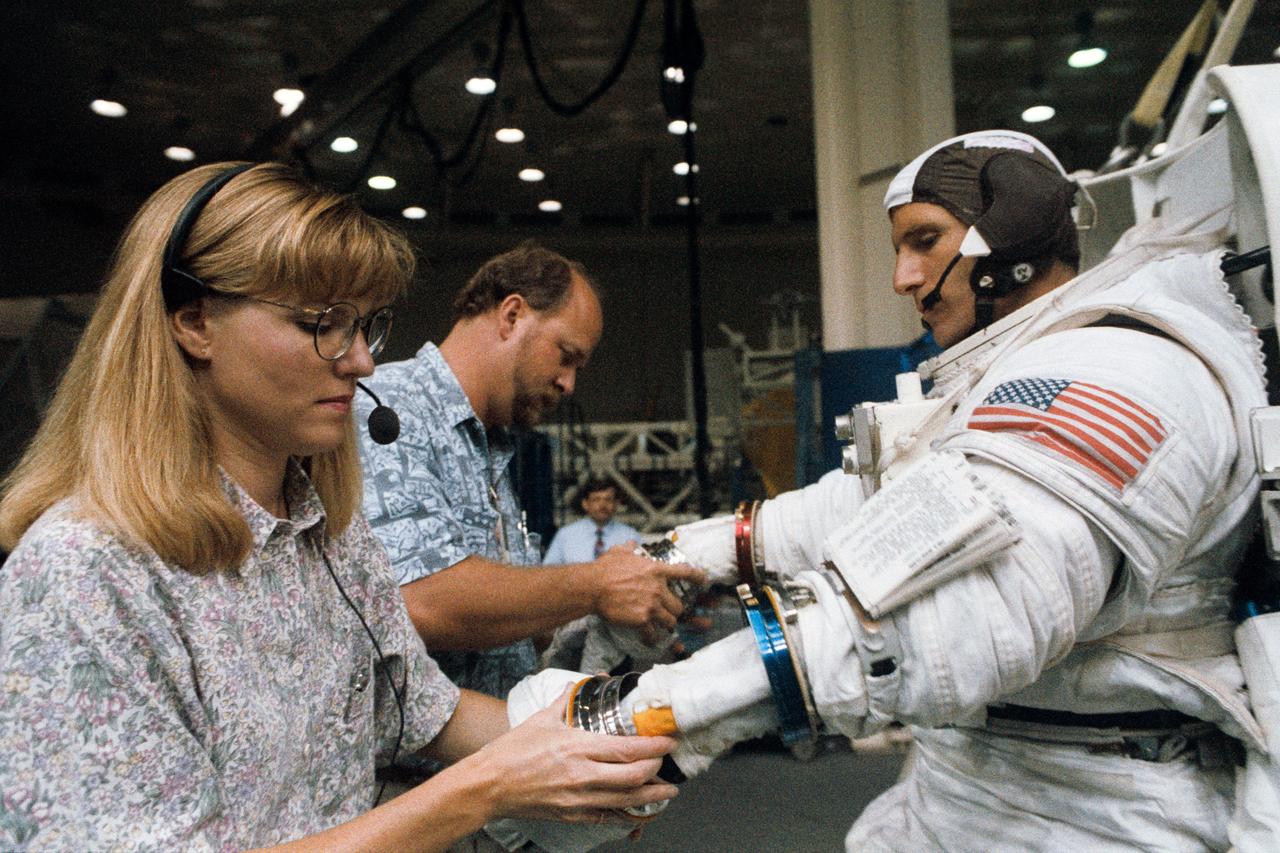
S93-37890 (October 1993) --- Astronaut Jerry M. Linenger, STS-64 mission specialist, is assisted by Steve Voyles and Kari Rueter of Boeing Aerospace prior to participating in a rehearsal for a contingency extravehicular activity (EVA). Crewmates Mark C. Lee and Carl J. Meade have used the nearby 25-feet deep pool to rehearse a spacewalk designed to test and evaluate new EVA equipment. Photo credit: NASA or National Aeronautics and Space Administration
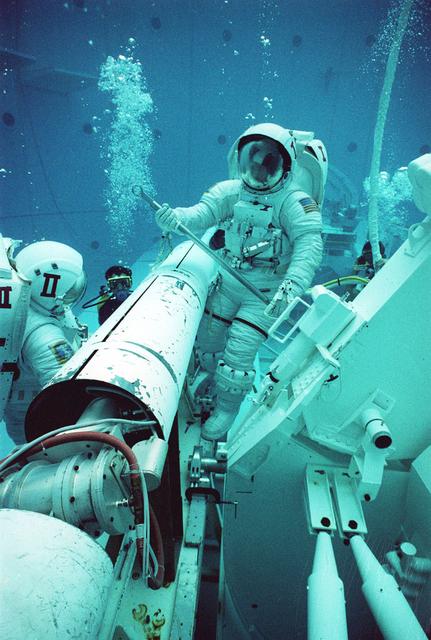
Two years prior to being used during a shuttle mission, the Transfer to Orbit System (TOS) is being demonstrated at Marshall Space Flight Center's (MSFC) Neutral Buoyancy Simulator (NBS). TOS is an upper stage launch system used to place satellites into higher orbits. TOS was used only once, on September 12, 1993 when the Space Shuttle Discovery (STS51) deployed ACTS (Advanced Communications Technology Satellite). The test pictured was to provide an evaluation of the extravehicular activity (EVA) tools that were to be used by future shuttle crews.
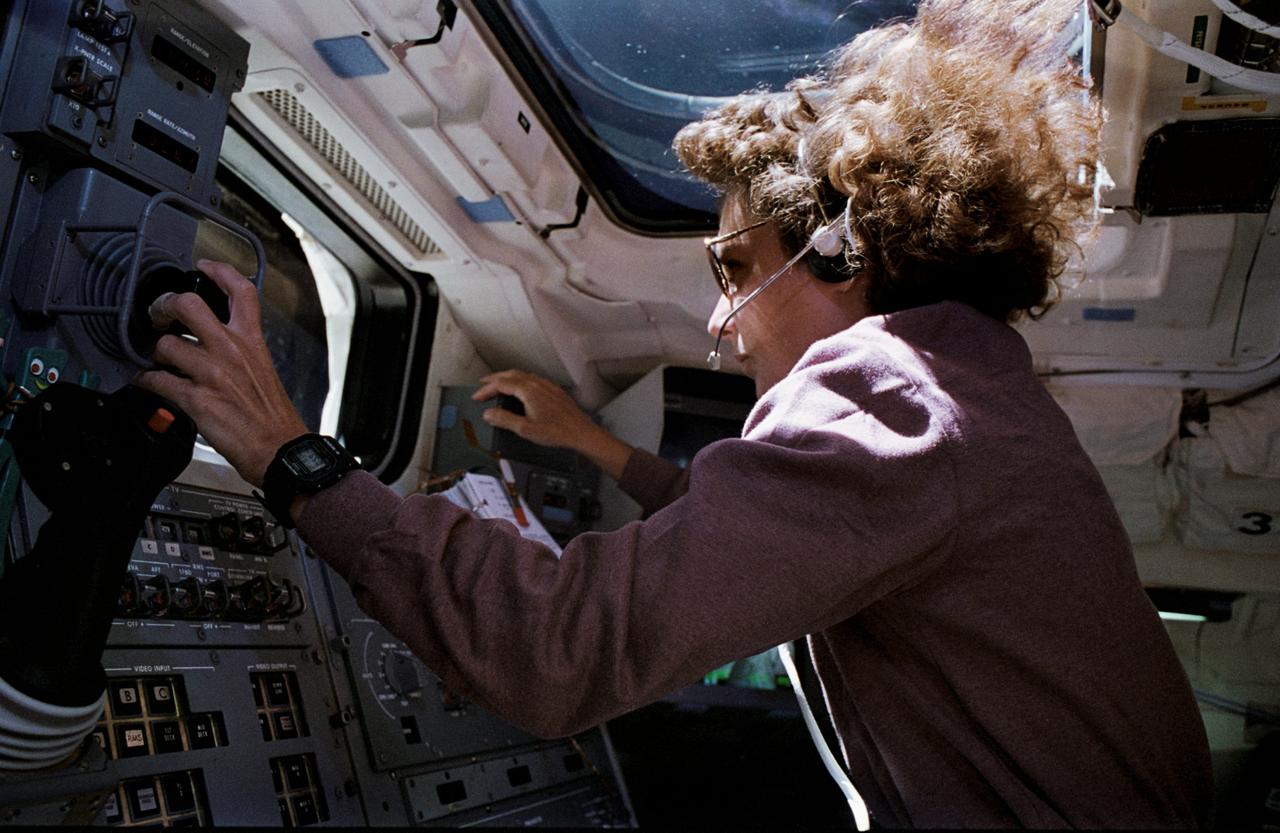
STS057-31-030 (25 June 1993) --- Astronaut Nancy J. Sherlock operates Endeavour's remote manipulator system (RMS) during the June 25 extravehicular activity of two crewmates. At one point, astronaut G. David Low, while his feet were anchored to a special restraint device on the end of the RMS arm, moved about, with Sherlock's aid, while holding astronaut Peter J. K. (Jeff) Wisoff. The activity represented an evaluation of techniques which might be used on planned future missions -- a 1993 servicing visit to the Hubble Space Telescope and later space station work -- which will require astronauts to frequently lift objects of similar sized bulk.
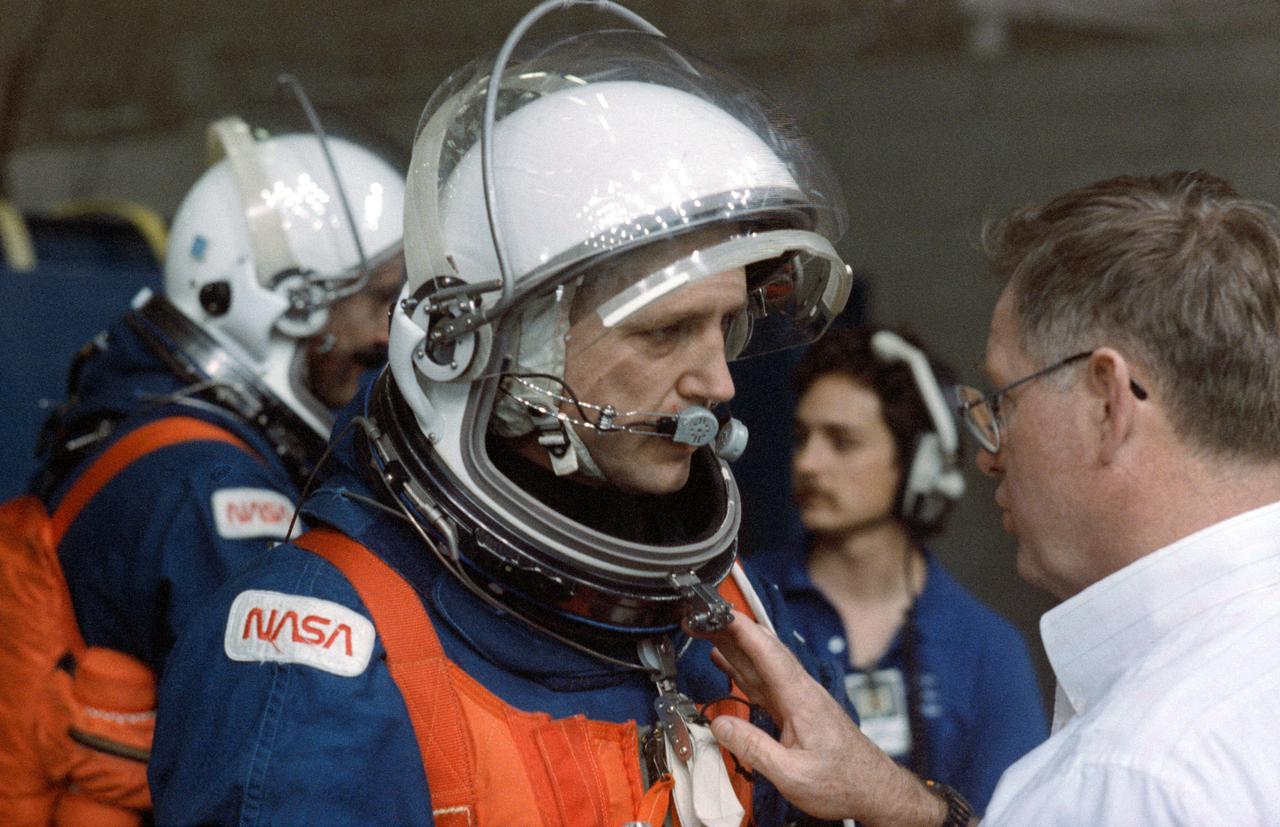
S92-26413 (March 1992) --- Astronaut Thomas D. Akers, left, is briefed by suit technician Alan M. Rochford of JSC's EVA branch office during a bailout training exercise in the Johnson Space Center's weightless environment training facility (WET-F). Akers was joined by six crewmates for the training session in the Johnson Space Center's Shuttle Mockup and Integration Laboratory. The seven will be aboard Endeavour in May for a week-long mission, during which a satellite will be retrieved and boosted toward a higher orbit, and extravehicular activity evaluations for Space Station Freedom assembly techniques will be conducted.
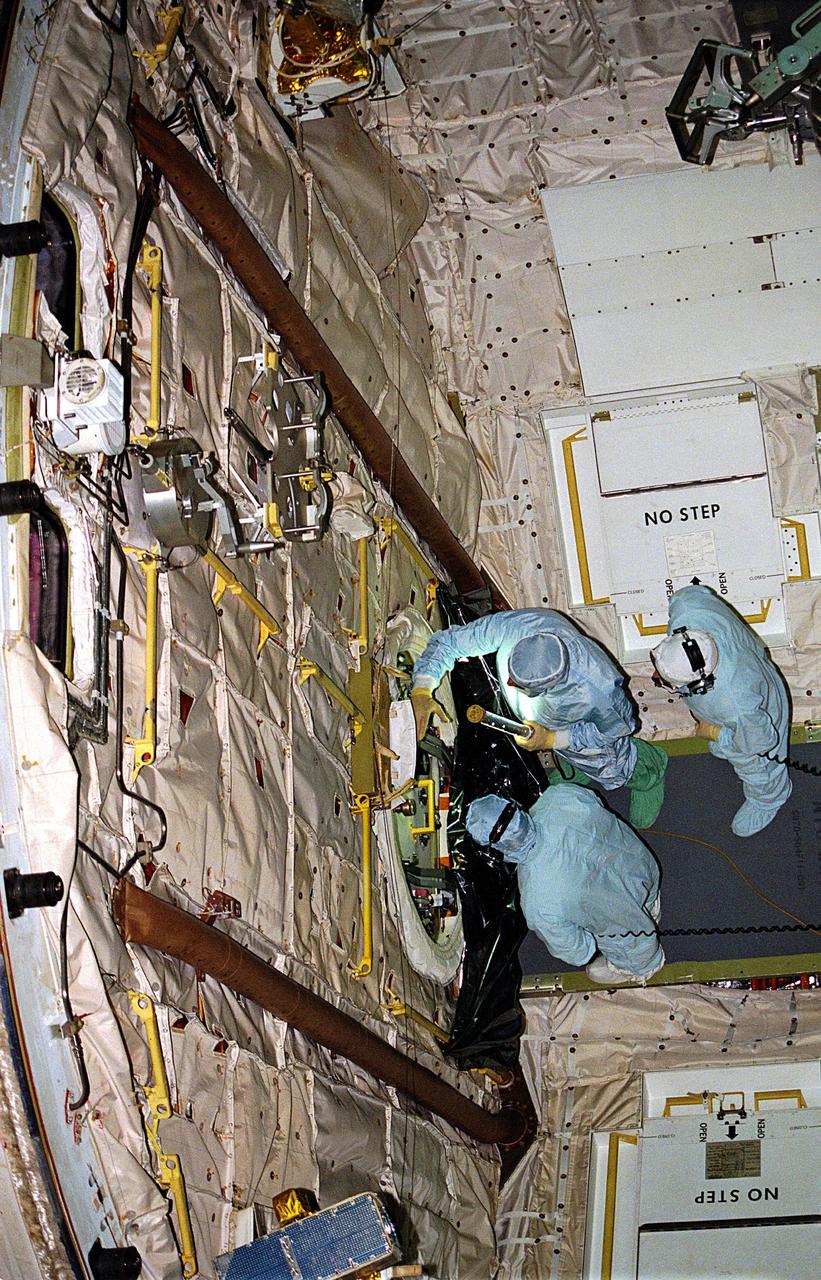
KENNEDY SPACE CENTER, FLA. -- United Space Alliance (USA) technicians in Orbiter Processing Facility Bay 1 troubleshoot the orbiter Columbia’s outer hatch of the airlock, which failed to open during the recent STS-80 Space Shuttle mission. Mission Specialists Tamara E. Jernigan and Thomas D. Jones did not perform the mission’s planned two extravehicular activities (EVAs) or spacewalks because the hatch would not open on orbit. The spacewalks were to be part of the continuing series of EVA Development Flight Tests to evaluate equipment and procedures and to build spacewalking experience in preparation for the International Space Station.
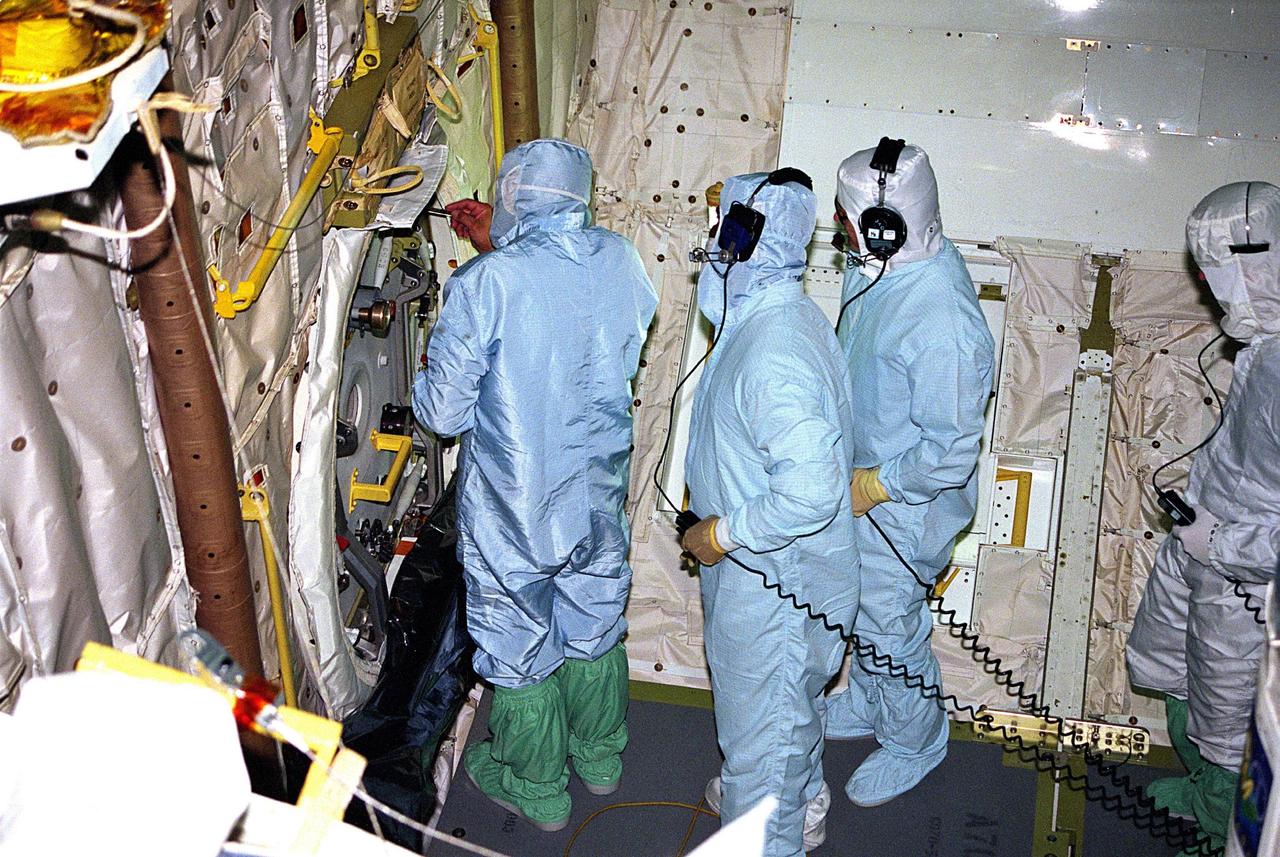
KENNEDY SPACE CENTER, FLA. -- United Space Alliance (USA) technicians in Orbiter Processing Facility Bay 1 troubleshoot the orbiter Columbia’s outer hatch of the airlock, which failed to open during the recent STS-80 Space Shuttle mission. Mission Specialists Tamara E. Jernigan and Thomas D. Jones did not perform the mission’s planned two extravehicular activities (EVAs) or spacewalks because the hatch would not open on orbit. The spacewalks were to be part of the continuing series of EVA Development Flight Tests to evaluate equipment and procedures and to build spacewalking experience in preparation for the International Space Station.
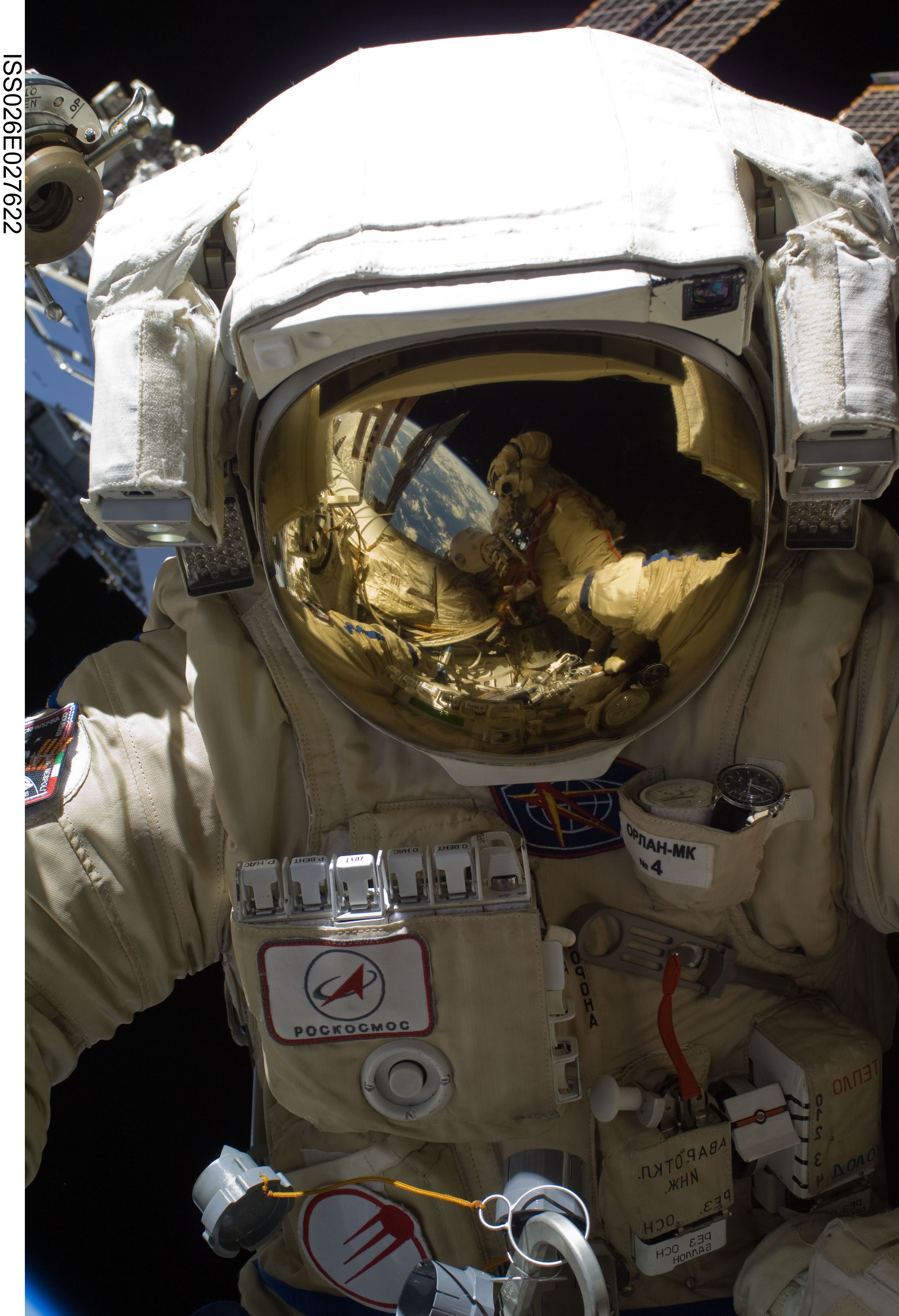
ISS026-E-027622 (16 Feb. 2011) --- Russian cosmonaut Oleg Skripochka, Expedition 26 flight engineer, wearing a Russian Orlan-MK spacesuit, participates in a session of extravehicular activity (EVA) focused on the installation of two scientific experiments outside the Zvezda Service Module of the International Space Station. During the four-hour, 51-minute spacewalk, Skripochka and Russian cosmonaut Dmitry Kondratyev (visible in the reflections in Skripochka’s helmet visor), flight engineer, installed a pair of earthquake and lightning sensing experiments and retrieved a pair of spacecraft material evaluation panels.
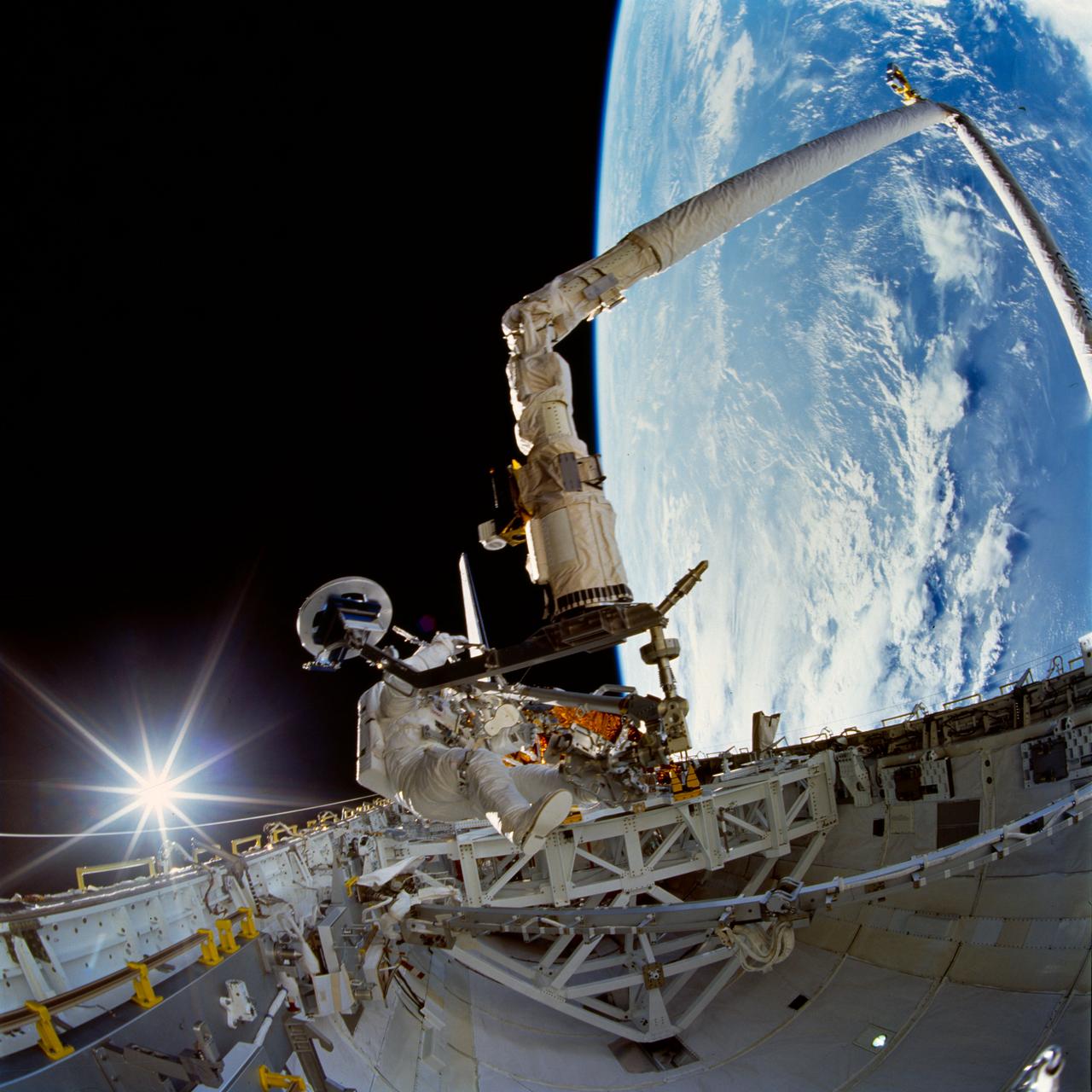
STS072-742-004 (15 Jan. 1996) --- Astronaut Daniel T. Barry, STS-72 mission specialist, tests a Temporary Equipment Restraint Aid (TERA) in the cargo bay of the Earth-orbiting space shuttle Endeavour. A reflection of the sun’s rays beam off Endeavour’s aft flight deck window in the “fish-eye” image. Barry was joined by astronaut Leroy Chiao for this first of two extravehicular activities (EVA) on the mission. A good part of the EVA was spent evaluating EVA hardware for future scheduled missions. Astronauts Chiao and Winston E. Scott participated in the second EVA two days later. Photo credit: NASA
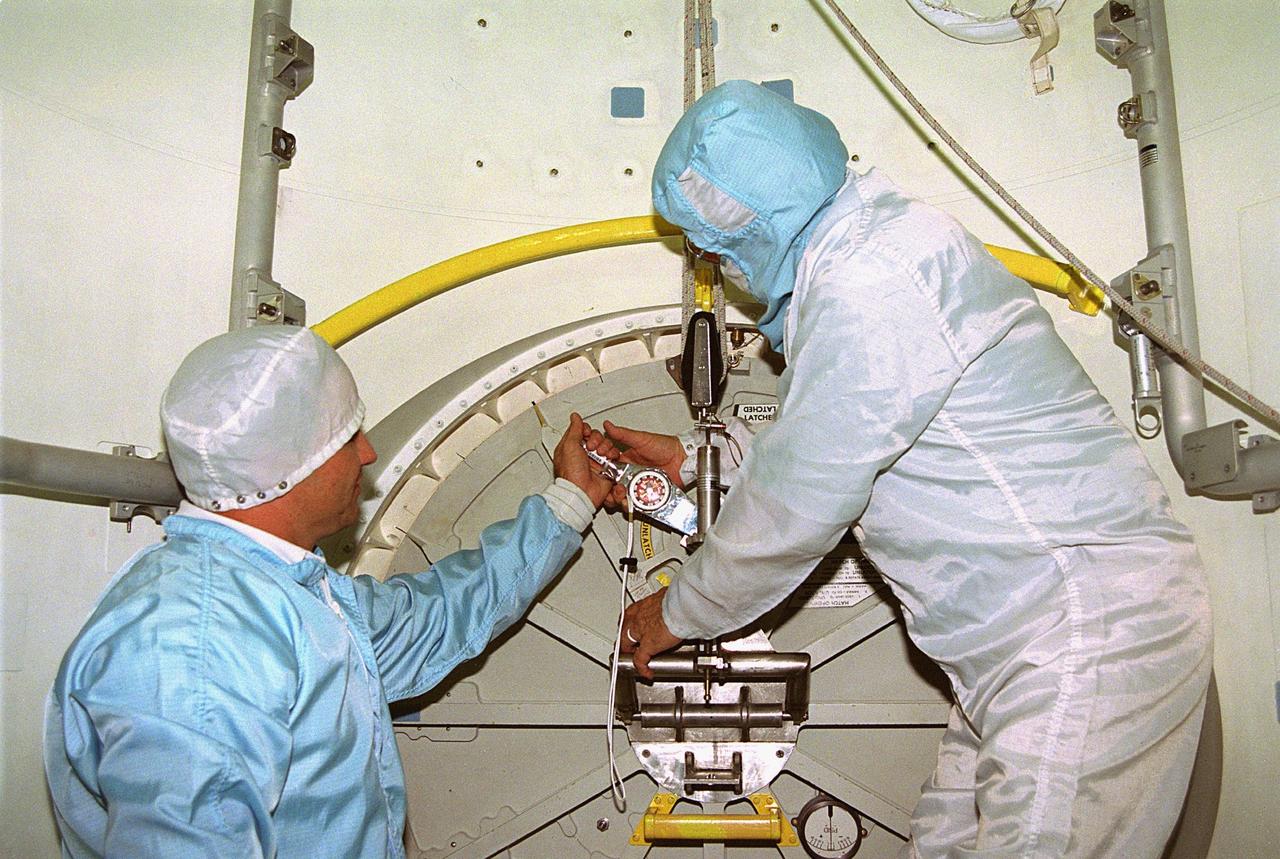
KENNEDY SPACE CENTER, FLA. -- In Orbiter Processing Facility Bay 1, United Space Alliance (USA) technicians Dave Lawrence, at left, and James Cullop troubleshoot the orbiter Columbia’s outer hatch of the airlock, which failed to open during the recent STS-80 Space Shuttle mission. Mission Specialists Tamara E. Jernigan and Thomas D. Jones did not perform the mission’s planned two extravehicular activities (EVAs) or spacewalks because the hatch would not open on orbit. The spacewalks were to be part of the continuing series of EVA Development Flight Tests to evaluate equipment and procedures and to build spacewalking experience in preparation for the International Space Station.
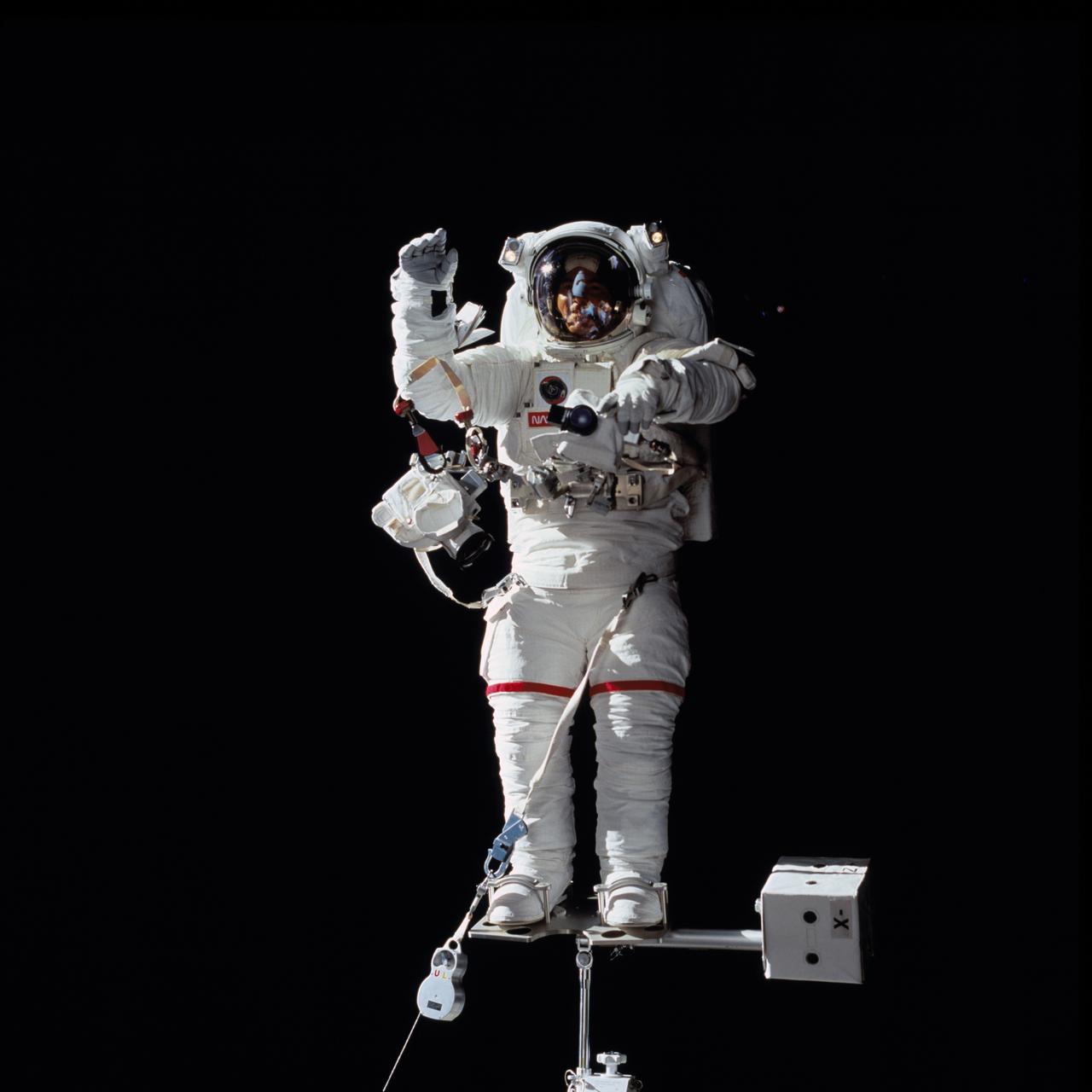
STS069-714-063 (16 September 1995) --- Astronaut James S. Voss, payload commander, is pictured during the September 16, 1995, Extravehicular Activity (EVA) which was conducted in and around Space Shuttle Endeavour's cargo bay. Voss, whose visor reflects Endeavour's forward section, was standing on a mobile foot restraint attached to the arm of the Remote Manipulator System (RMS). As evidenced by the thin white cable, Voss was tethered to the end of the RMS as well. Evaluations for Space Station-era tools and various elements of the space suits were performed by Voss and his space walking crewmate, astronaut Michael L. Gernhardt, mission specialist.
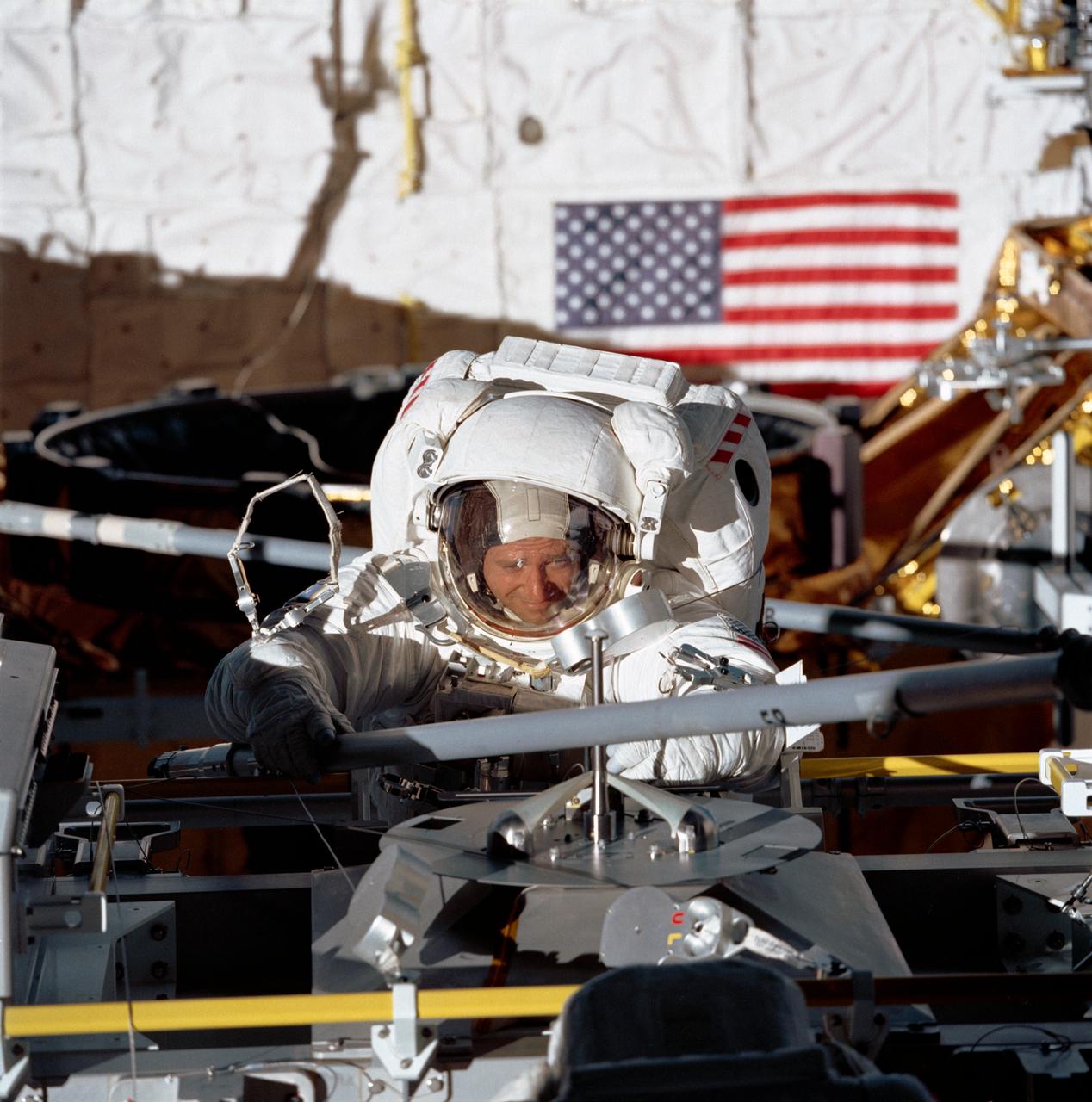
STS049-77-028 (14 May 1992) --- Astronaut Thomas D. Akers, STS-49 mission specialist, grabs a strut device as fourth period of extravehicular activity (EVA) gets underway in the Space Shuttle Endeavour's cargo bay. Akers is positioned near the Multi-purpose Support Structure (MPESS). The purpose of the final EVA on this nine-day mission was the evaluation of Assembly of Station by EVA Methods (ASEM). The scene was recorded on 70mm film by a fellow crew member in the space shuttle's cabin. Astronaut Kathryn C. Thornton (out of frame) joined Akers on the 7 1/2 hour EVA.
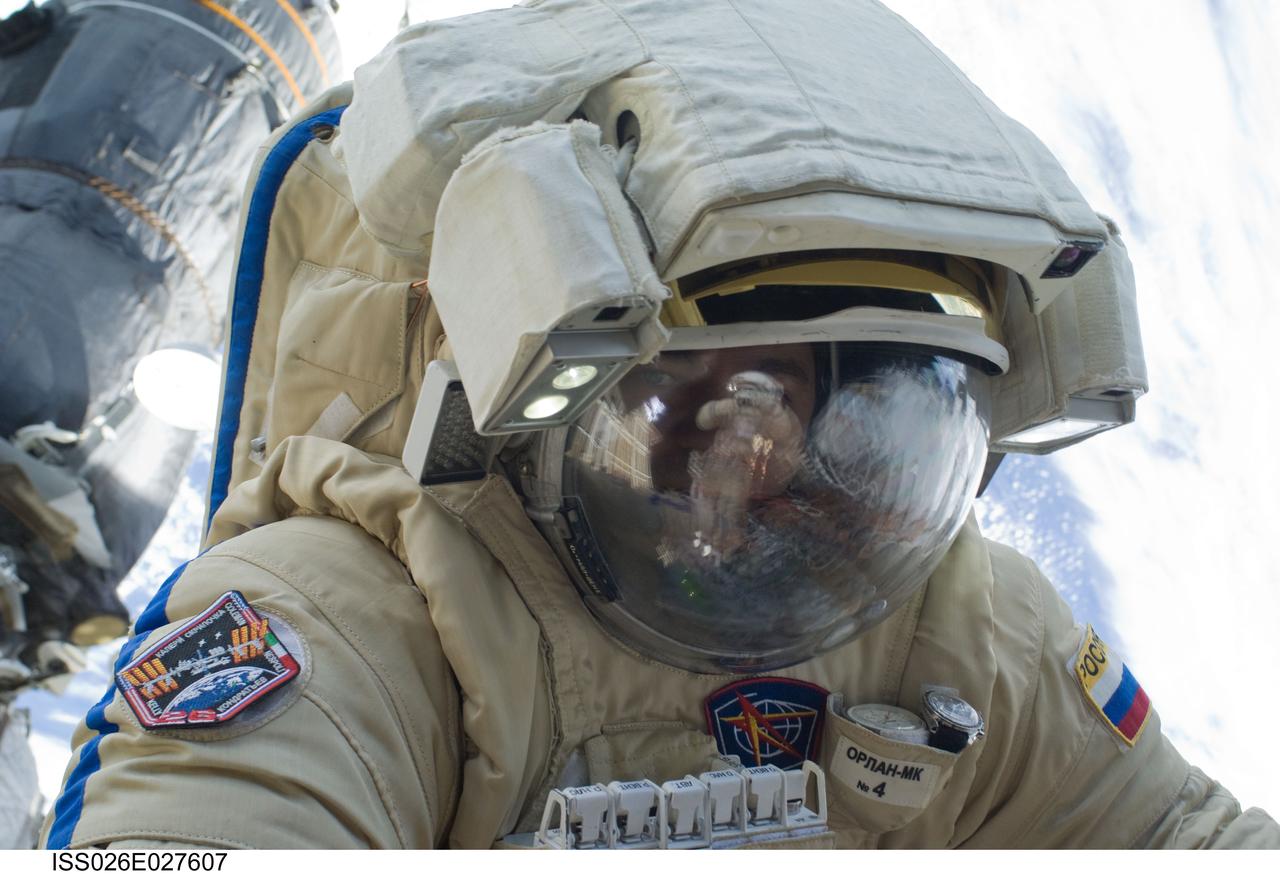
ISS026-E-027607 (16 Feb. 2011) --- Russian cosmonaut Oleg Skripochka, Expedition 26 flight engineer, wearing a Russian Orlan-MK spacesuit, participates in a session of extravehicular activity (EVA) focused on the installation of two scientific experiments outside the Zvezda Service Module of the International Space Station. During the four-hour, 51-minute spacewalk, Skripochka and Russian cosmonaut Dmitry Kondratyev (visible in the reflections in Skripochka’s helmet visor), flight engineer, installed a pair of earthquake and lightning sensing experiments and retrieved a pair of spacecraft material evaluation panels.
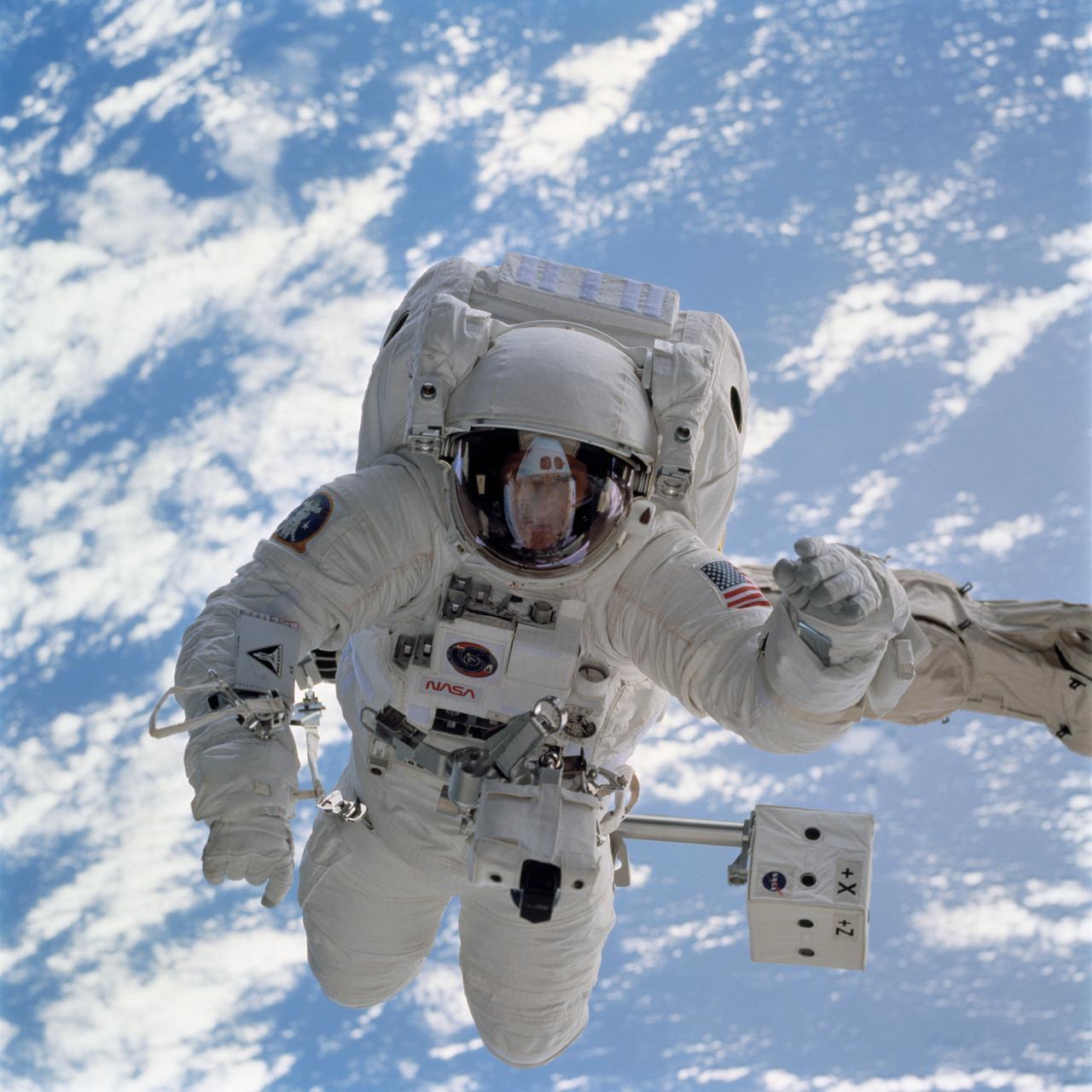
STS069-714-046 (16 Sept. 1995) --- Astronaut Michael L. Gernhardt, STS-69 mission specialist, is pictured during the Sept. 16, 1995, Extravehicular Activity (EVA) which was conducted in and around space shuttle Endeavour's cargo bay. Gernhardt, whose visor reflects Endeavour's forward section, was standing on a mobile foot restraint attached to the arm of the Remote Manipulator System (RMS). Unlike earlier spacewalking astronauts, Gernhardt was able to use an Electronic Cuff Checklist (ECC), forerunner for Space Station. Evaluations for Space Station-era tools and various elements of the spacesuits were performed by Gernhardt and his spacewalking crewmate, astronaut James S. Voss, payload commander.
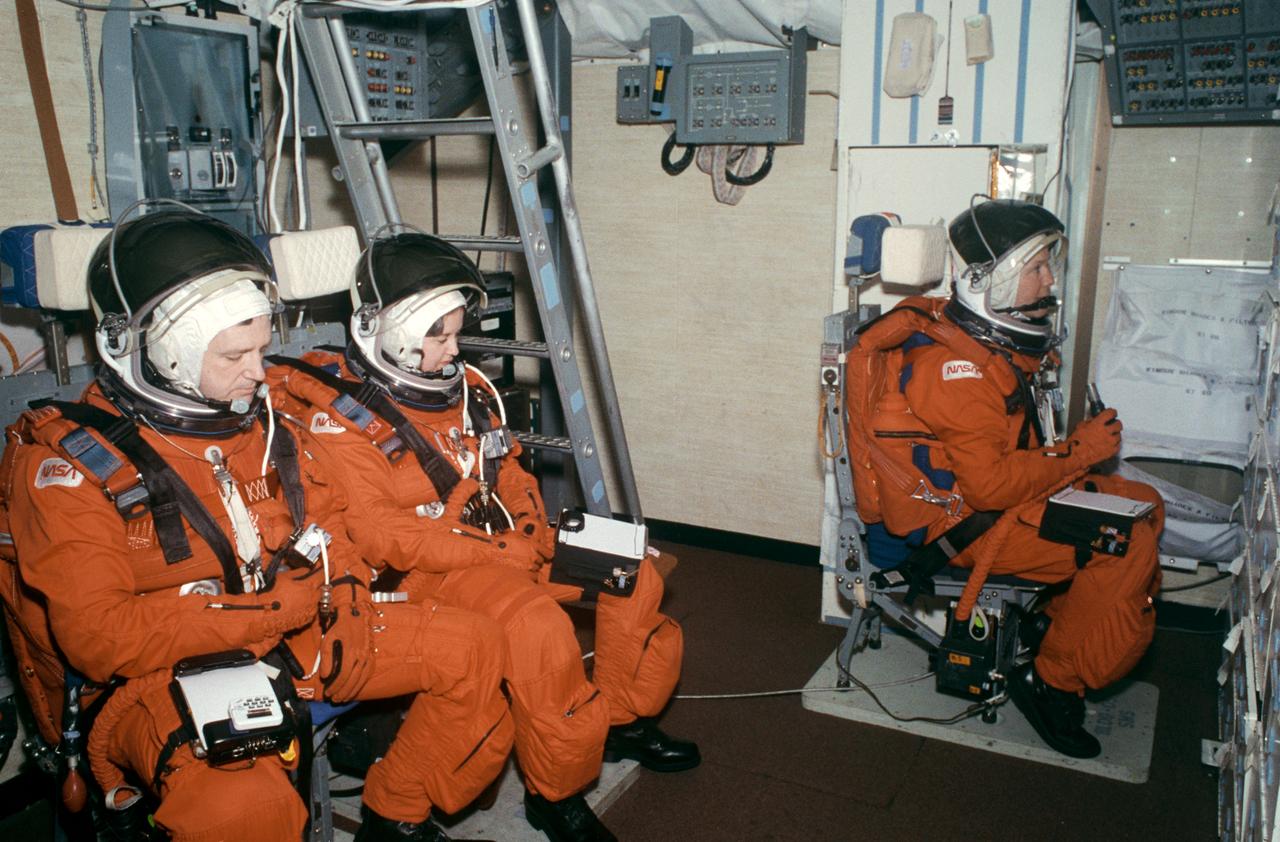
S92-29406 (Feb 1992) --- Three mission specialists assigned to the STS-49 flight occupy temporary stations on the "middeck" of a Johnson Space Center (JSC) Shuttle trainer during a rehearsal of Endeavour's launch and entry phases. Left to right are astronauts Thomas D. Akers, Kathryn C. Thornton and Pierre J. Thuot. The three, along with four other NASA astronauts, will be aboard Endeavour in May for a week-long mission during which a satellite will be retrieved and boosted toward a higher orbit and extravehicular activity evaluations for Space Station Freedom assembly techniques will be conducted.
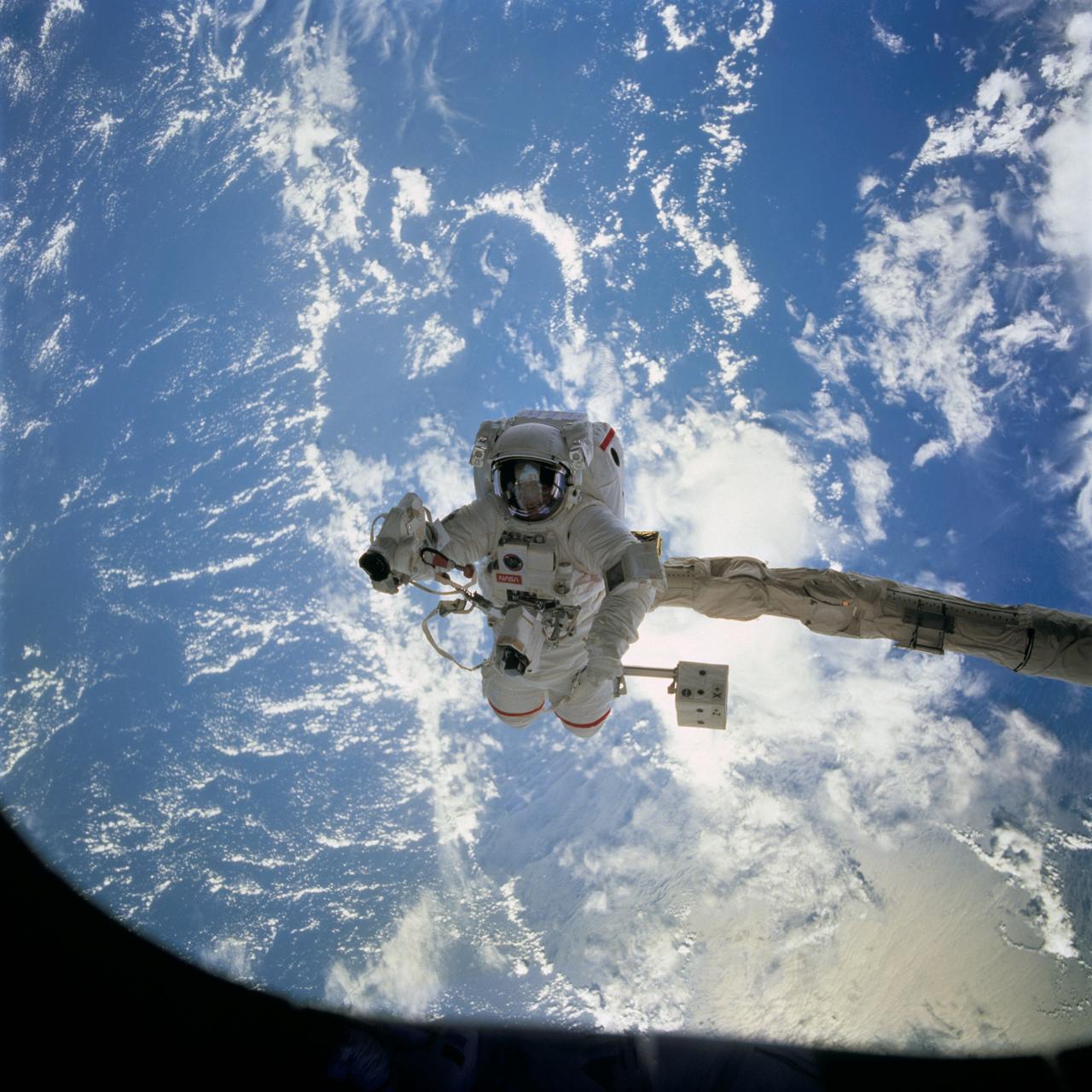
STS069-715-086 (16 September 1995) --- Astronaut James S. Voss, payload commander, is pictured during the September 16, 1995, Extravehicular Activity (EVA) which was conducted in and around Space Shuttle Endeavour's cargo bay. Voss, whose visor reflects Endeavour's forward section, was standing on a mobile foot restraint attached to the arm of the Remote Manipulator System (RMS). Voss is holding a camera, which he used to record some of the EVA, as well as snapshots of Endeavour's cabin. Evaluations for Space Station-era tools and various elements of the space suits were performed by Voss and his space walking crewmate, astronaut Michael L. Gernhardt, mission specialist.
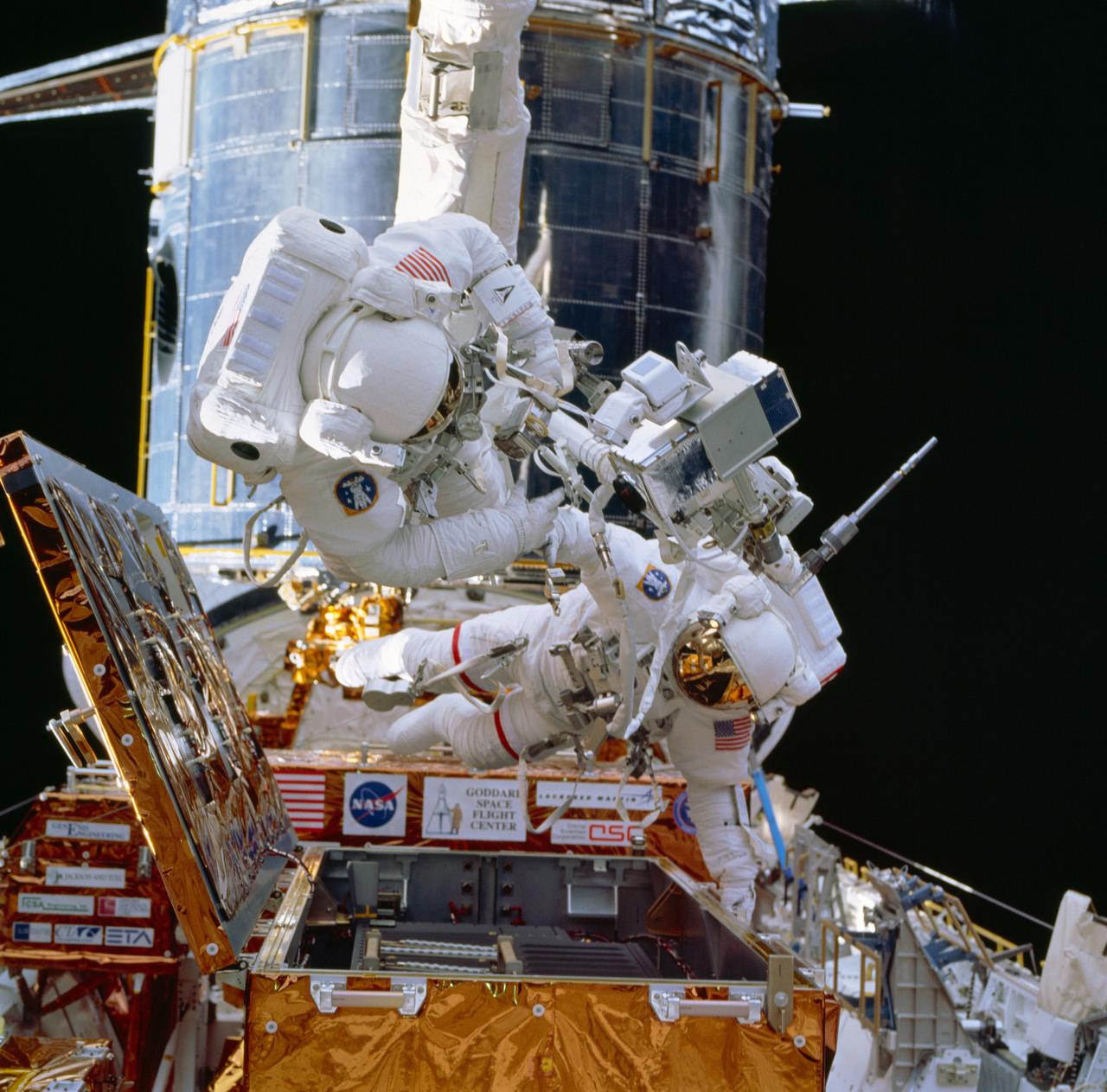
STS049-81-093 (14 May 1992) --- Astronaut Kathryn C. Thornton joins three struts together, as fourth period of extravehicular activity (EVA) proceeds in the Space Shuttle Endeavour's cargo bay. The purpose of the final EVA on this nine-day mission was the evaluation of Assembly of Station by EVA Methods (ASEM). Clouds over the ocean share the background with part of Endeavour's Remote Manipulator System (RMS). The scene was recorded on 70mm film from the Space Shuttle's flight deck. Astronaut Thomas D. Akers (out of frame) joined Thornton on the 7 1/2 hour EVA.
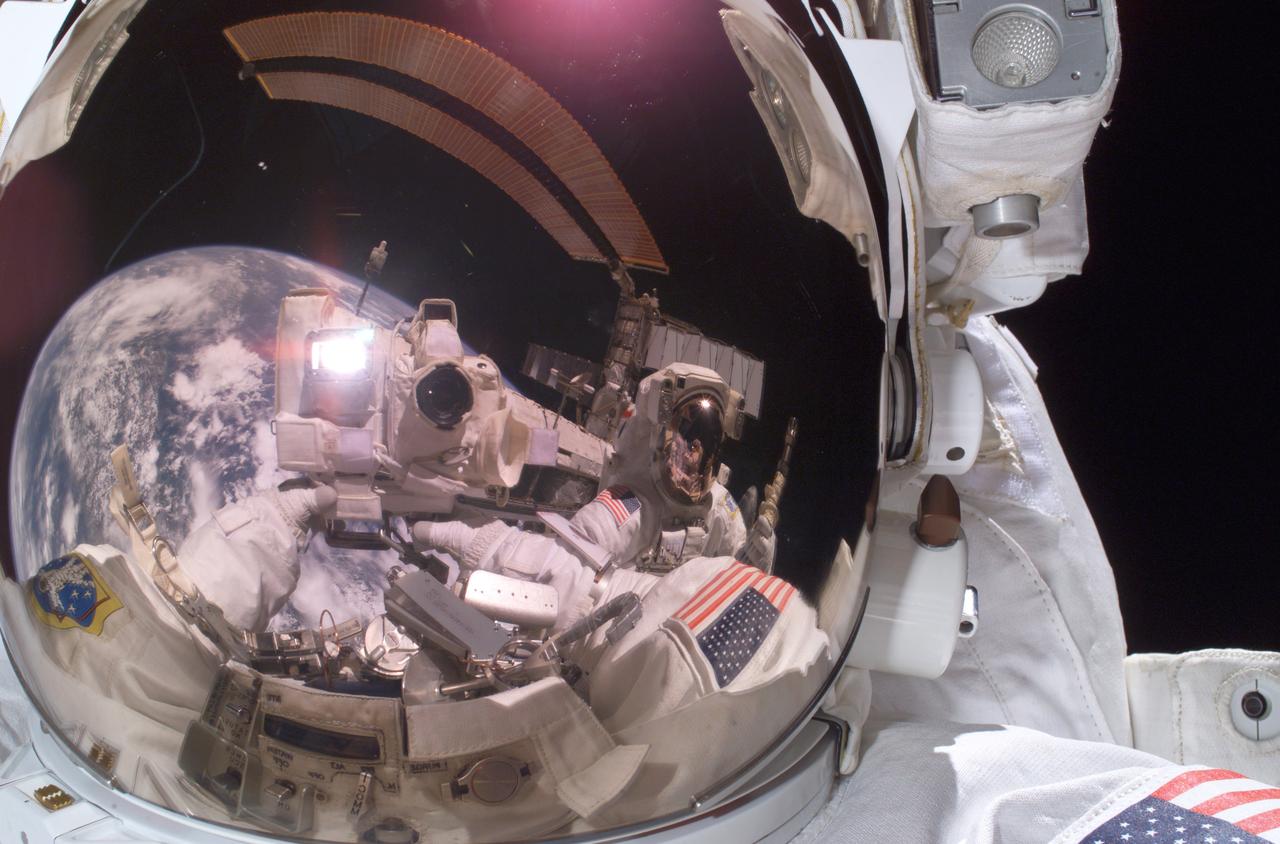
Astronaut Michael E. Fossum, STS-121 mission specialist, used a digital still camera to expose a photo of his helmet visor during a session of extravehicular activity (EVA) while Space Shuttle Discovery was docked with the International Space Station (ISS). Also visible in the visor reflections are fellow space walker Piers J. Sellers, mission specialist, Earth's horizon, and a station solar array. During its 12-day mission, this utilization and logistics flight delivered a multipurpose logistics module (MPLM) to the ISS with several thousand pounds of new supplies and experiments. In addition, some new orbital replacement units (ORUs) were delivered and stowed externally on the ISS on a special pallet. These ORUs are spares for critical machinery located on the outside of the ISS. During this mission the crew also carried out testing of Shuttle inspection and repair hardware, as well as evaluated operational techniques and concepts for conducting on-orbit inspection and repair.
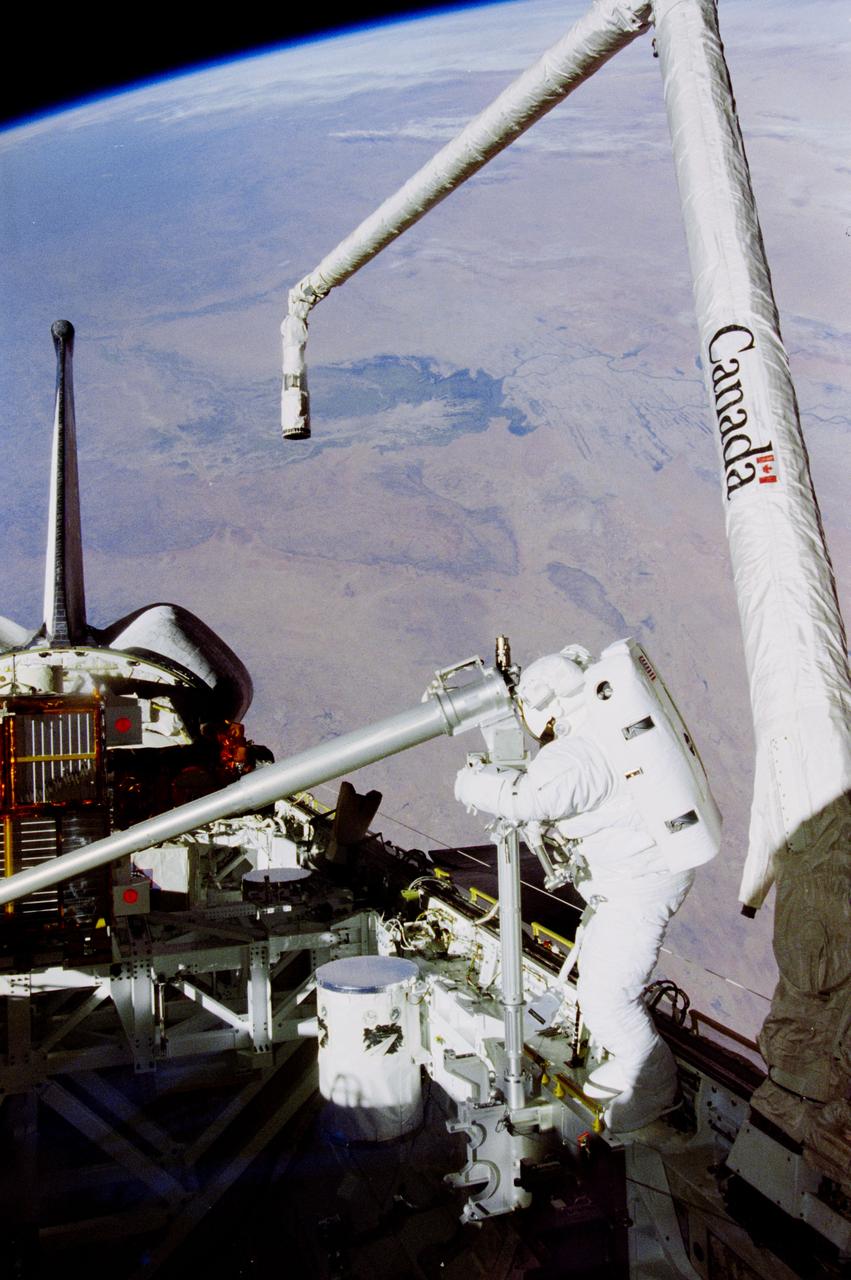
STS087-341-004 (3 Dec. 1997) --- Backdropped over Africa, Takao Doi, international mission specialist representing Japan’s National Space Development Agency (NASDA), works with a crane device during a second extravehicular activity (EVA) designed to help evaluate techniques and hardware to be used in constructing the International Space Station (ISS). Takao Doi and astronaut Winston E. Scott (out of frame) were involved in the mission's second EVA in the cargo bay of the Earth-orbiting Space Shuttle Columbia. Takao Doi is working with a 156-pound crane designed to aid spacewalkers in transporting Orbital Replacement Units (ORU) from translation carts on the exterior of the ISS to various worksites on the truss structure. The view of Earth below features an inland delta in Mali (frame center). This view is from the east toward the west and was taken with a 35mm camera.
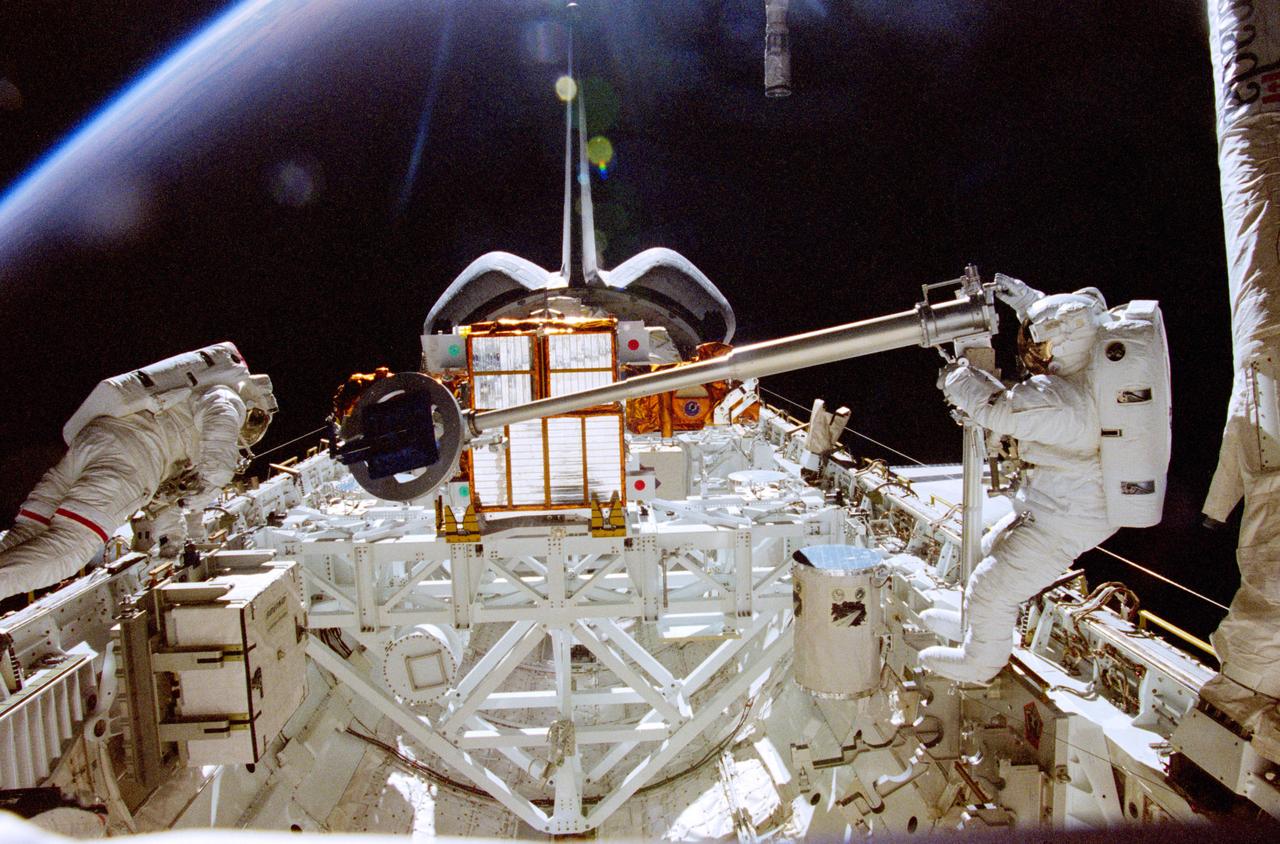
STS087-341-036 (3 Dec. 1997) --- Backdropped against a dark Earth and a light blue horizon, astronaut Takao Doi (right), international mission specialist representing Japan's National Space Development Agency (NASDA), works with a crane while astronaut Winston E. Scott looks on. This second extravehicular activity (EVA) of the mission continued the evaluation of techniques and hardware to be used in constructing the International Space Station (ISS). Near Scott can be seen the representation of a small Orbital Replacement Unit (ORU) in the grasp of the 156-pound crane operated by Doi. A similar crane could be used to transport various sized ORU’s from translation carts on the exterior of the ISS to various worksites on the truss structure. This view was captured, on 35mm film, by a crew mate in the shirt sleeve environment of the Space Shuttle Columbia's cabin. The SPARTAN-201 satellite is in its stowed position at frame center.
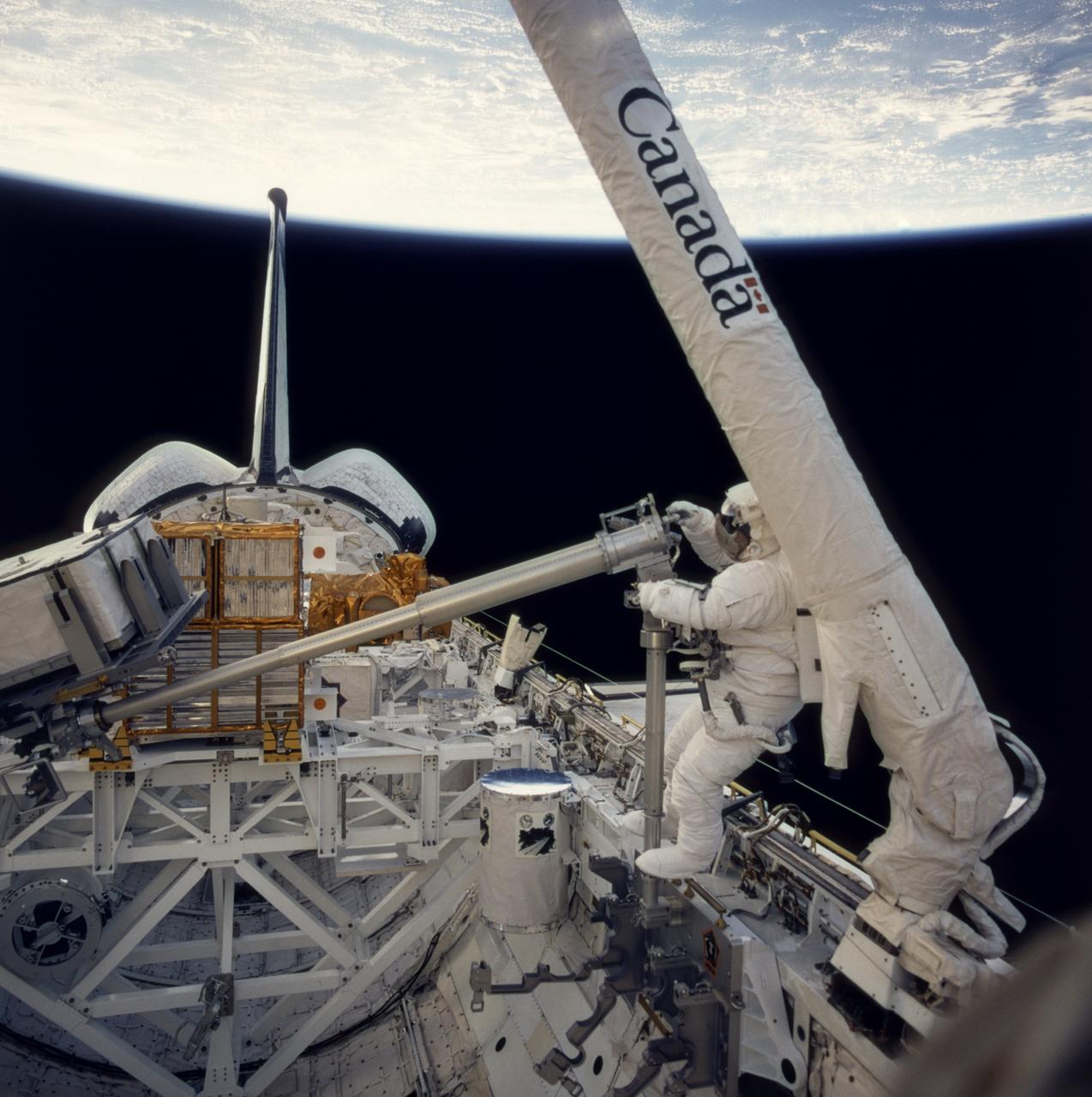
Onboard Space Shuttle Columbia's (STS-87) first ever Extravehicular Activity (EVA), astronaut Takao Doi works with a 156-pound crane carried onboard for the first time. The crane's inclusion and the work with it are part of a continuing preparation effort for future work on the International Space Station (ISS). The ongoing project allows for evaluation of tools and operating methods to be applied to the construction of the Space Station. This crane device is designed to aid future space walkers in transporting Orbital Replacement Units (ORU), with a mass up to 600 pounds (like the simulated battery pictured here), from translating carts on the exterior of ISS to various worksites on the truss structure. Earlier Doi, an international mission specialist representing Japan, and astronaut Winston E. Scott, mission specialist, had installed the crane in a socket along the middle port side of Columbia's cargo bay for the evaluation. The two began the crane operations after completing a contingency EVA to snag the free-flying Spartan 201 and berth it in the payload bay (visible in the background).
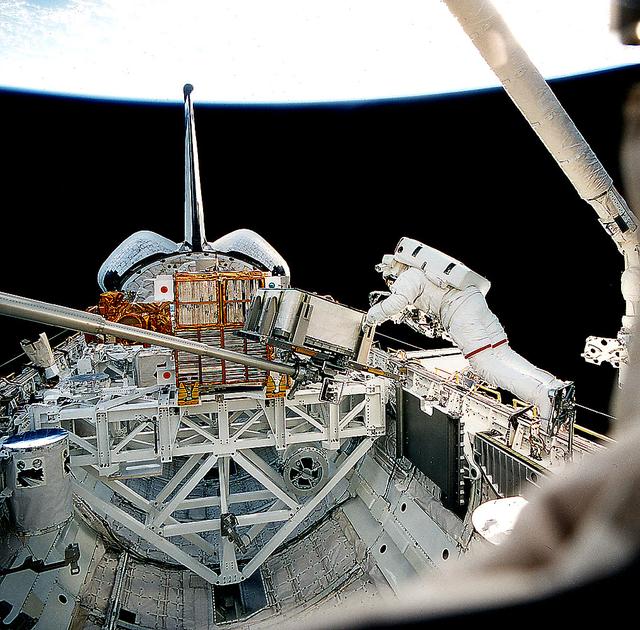
Onboard Space Shuttle Columbia's (STS-87) first ever Extravehicular Activity (EVA), astronaut Takao Doi works with a 156-pound crane carried onboard for the first time. The crane's inclusion and the work with it are part of a continuing preparation effort for future work on the International Space Station (ISS). The ongoing project allows for evaluation of tools and operating methods to be applied to the construction of the Space Station. This crane device is designed to aid future space walkers in transporting Orbital Replacement Units (ORU), with a mass up to 600 pounds (like the simulated battery pictured here), from translating carts on the exterior of ISS to various worksites on the truss structure. Earlier Doi, an international mission specialist representing Japan, and astronaut Winston E. Scott, mission specialist, had installed the crane in a socket along the middle port side of Columbia's cargo bay for the evaluation. The two began the crane operations after completing a contingency EVA to snag the free-flying Spartan 201 and berth it in the payload bay (visible in the background).
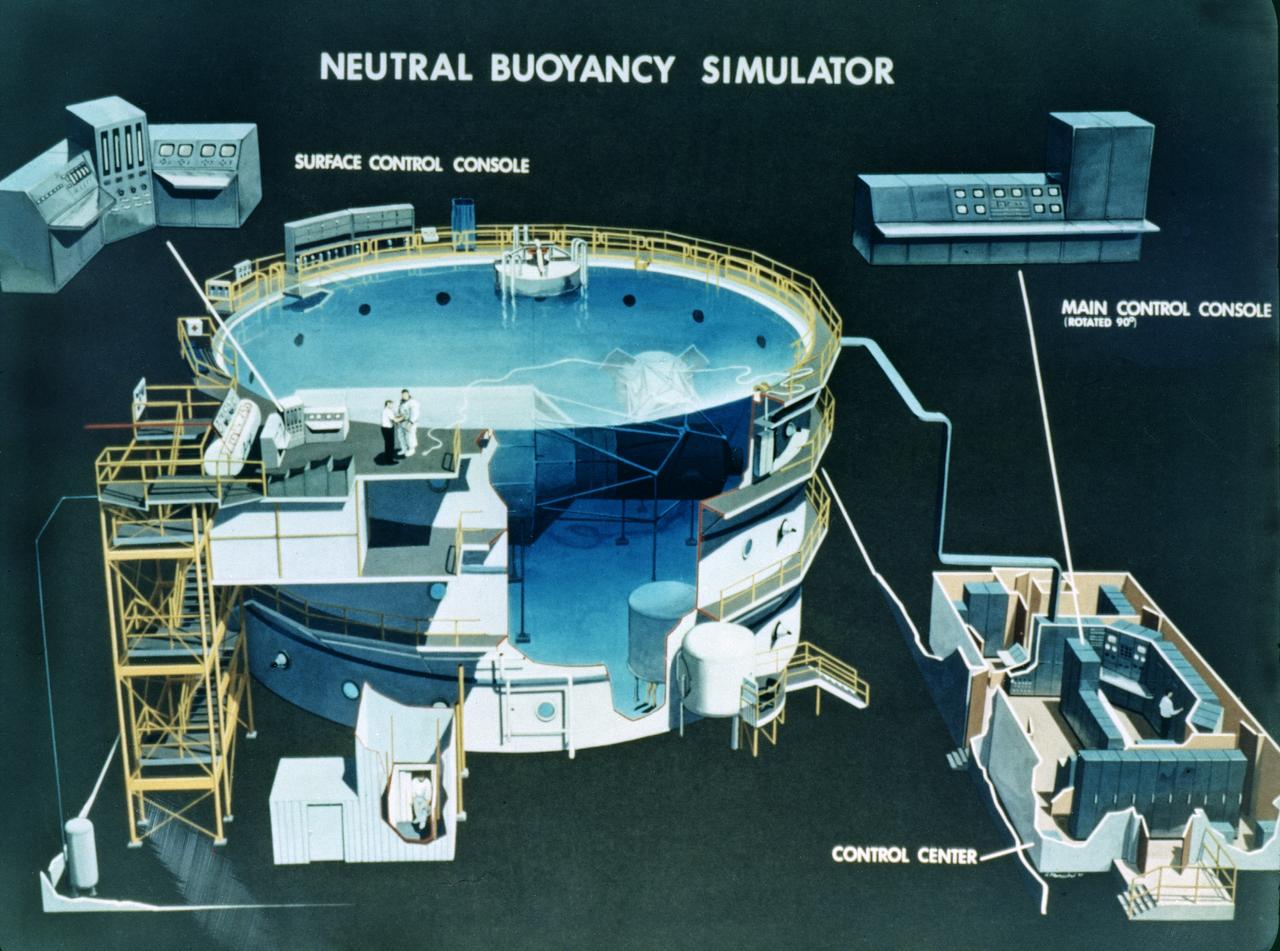
This is a cutaway illustration of the Neutral Buoyancy Simulator (NBS) at the Marshall Space Flight Center (MSFC ). The MSFC NBS provided an excellent environment for testing hardware to examine how it would operate in space and for evaluating techniques for space construction and spacecraft servicing. Here, engineers, designers, and astronauts performed various tests to develop basic concepts, preliminary designs, final designs, and crew procedures. The NBS was constructed of welded steel with polyester-resin coating. The water tank was 75-feet (22.9- meters) in diameter, 40-feet (12.2-meters) deep, and held 1.32 million gallons of water. Since it opened for operation in 1968, the NBS had supported a number of successful space missions, such as the Skylab, Solar Maximum Mission Satellite, Marned Maneuvering Unit, Experimental Assembly of Structures in Extravehicular Activity/Assembly Concept for Construction of Erectable Space Structures (EASE/ACCESS), the Hubble Space Telescope, and the Space Station. The function of the MSFC NBS was moved to the larger simulator at the Johnson Space Center and is no longer operational.
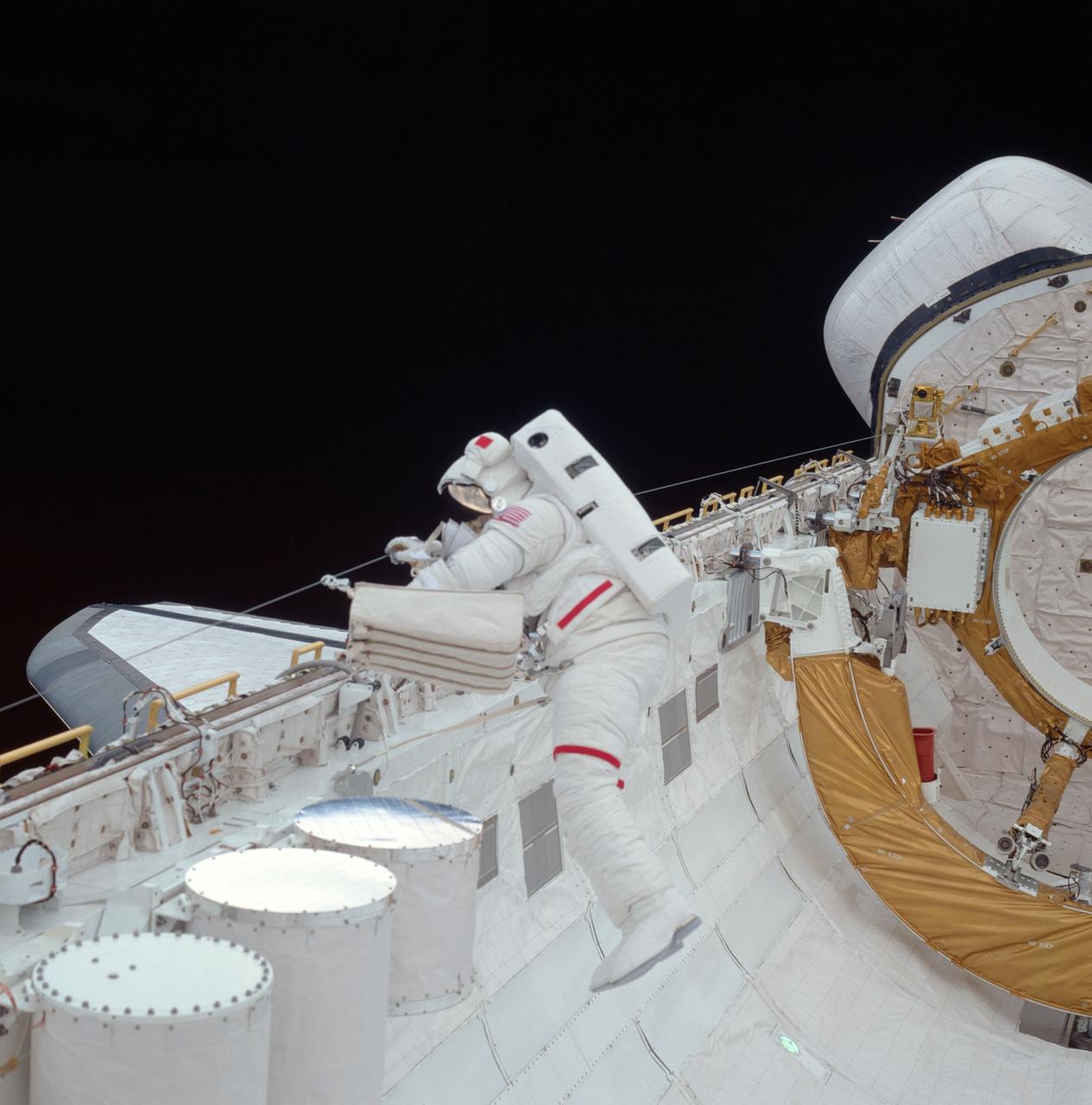
STS006-45-124 (7 April 1983) --- Astronaut F. Story Musgrave, STS-6 mission specialist, translates down the Earth-orbiting space shuttle Challenger’s payload bay door hinge line with a bag of latch tools. This photograph is among the first five still frames that recorded the April 7 extravehicular activity (EVA) of Dr. Musgrave and Donald H. Peterson, the flight’s other mission specialist. It was photographed with a handheld 70mm camera from inside the cabin by one of two crew members who remained on the flight deck during the EVA. Dr. Musgrave’s task here was to evaluate the techniques required to move along the payload bay’s edge with tools. In the lower left foreground are three canisters containing three getaway special (GAS) experiments. Part of the starboard wind and orbital maneuvering system (OMS) pod are seen back dropped against the blackness of space. The gold-foil protected object partially out of frame on the right is the airborne support equipment for the now vacated inertial upper stage (IUS) which aided the deployment of the tracking and data relay satellite on the flight’s first day. Astronauts Paul J. Weitz, command and Karol J. Bobko, pilot, remained inside the Challenger during the EVA. Photo credit: NASA
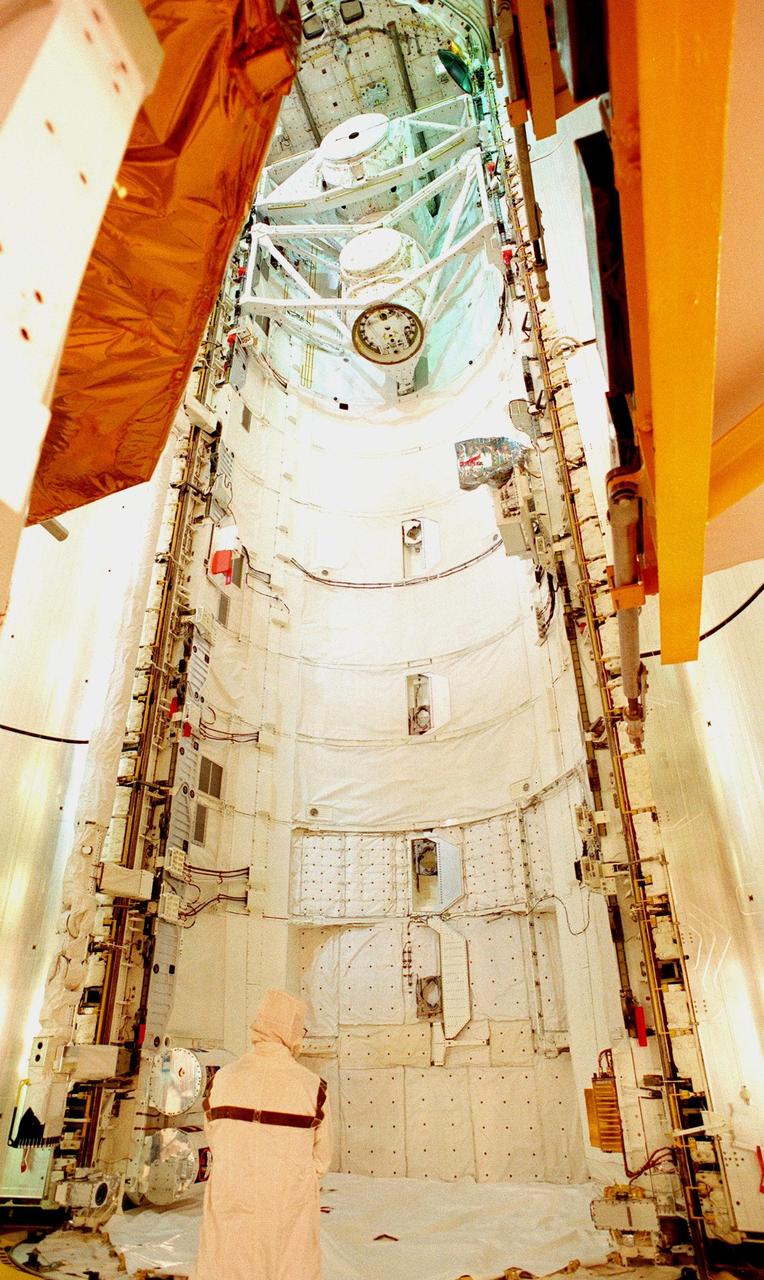
The open doors of the payload bay on Space Shuttle Discovery await the transfer of four of the payloads on mission STS-95: the SPACEHAB single module, Spartan, the Hubble Space Telescope Orbiting Systems Test Platform (HOST), and the International Extreme Ultraviolet Hitchhiker (IEH-3). At the top of bay are the airlock (used for depressurization and repressurization during extravehicular activity and transfer to Mir) and the tunnel adapter (enables the flight crew members to transfer from the pressurized middeck crew compartment to Spacelab's pressurized shirt-sleeve environment). SPACEHAB involves experiments on space flight and the aging process. Spartan is a solar physics spacecraft designed to perform remote sensing of the hot outer layers of the sun's atmosphere or corona. HOST carries four experiments to validate components planned for installation during the third Hubble Space Telescope servicing mission and to evaluate new technologies in an Earth-orbiting environment. IEH-3 comprises several experiments that will study the Jovian planetary system, hot stars, planetary and reflection nebulae, other stellar objects and their environments through remote observation of EUV/FUV emissions; study spacecraft interactions, Shuttle glow, thruster firings, and contamination; and measure the solar constant and identify variations in the value during a solar cycle. Discovery is scheduled to launch on Oct. 29, 1998
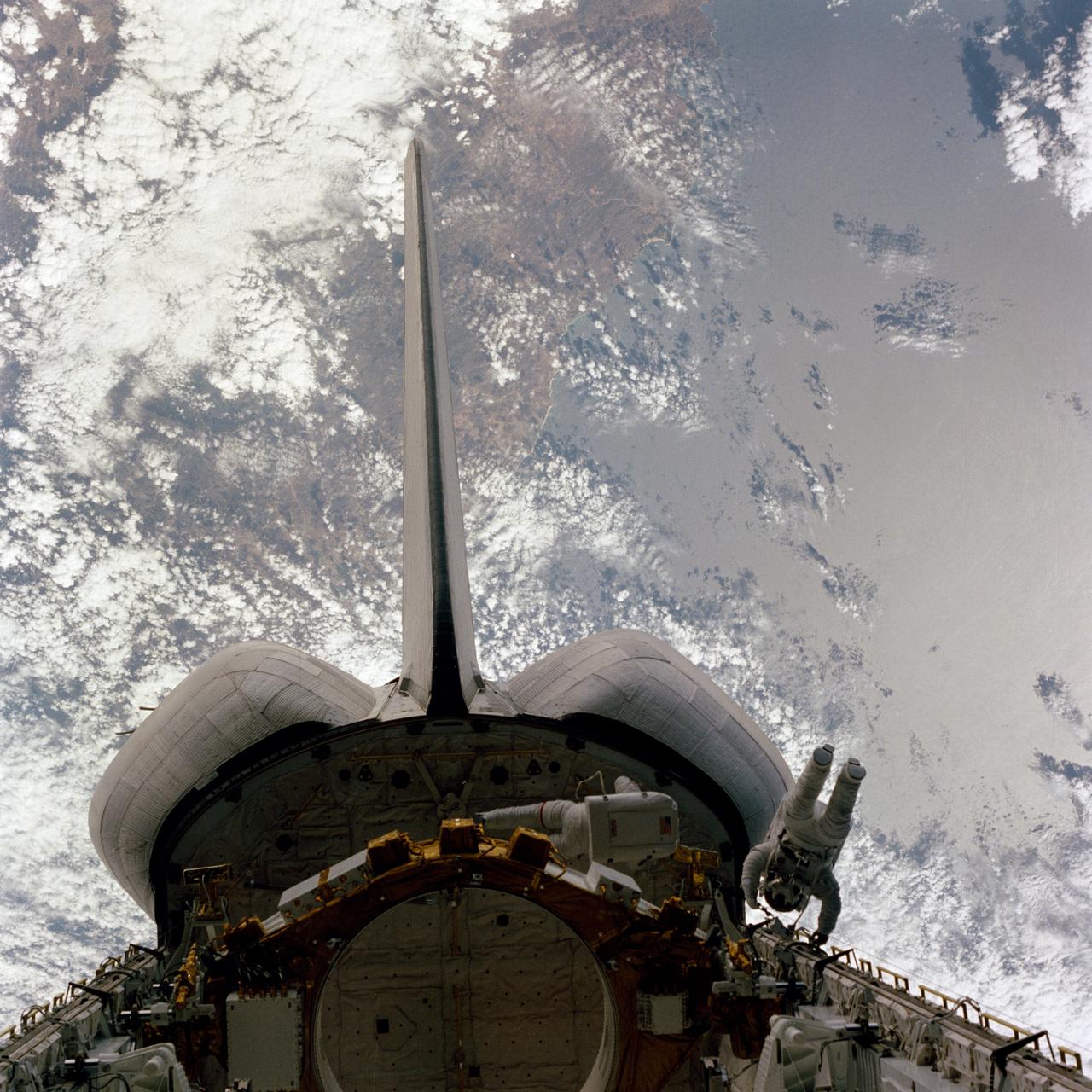
STS006-45-111 (7 April 1983) --- Astronaut Donald H. Peterson (port side) and F. Story Musgrave, STS-6 mission specialists, evaluate the handrail system on the starboard longeron and aft bulkhead, respectively, during a long extravehicular activity (EVA) aboard the Earth-orbiting space shuttle Challenger. The vertical stabilizer and orbital maneuvering system (OMS) pods frame a portion of Mexico?s state of Jalisco below. Punta Farallon and Sahta da Tencatita, about 120 kilometers (75 miles) south of Puerto Vallarta, are visible. Pacific waters form about half of the backdrop for this scene, photographed by one of two crew members who remained inside the spacecraft during the EVA. Astronaut Karol J. Bobko, pilot, took a number of pictures of his fellow crew members during their outside tasks and astronaut Paul J. Weitz, commander, took some photographs while remaining in command of the reusable vehicle. Photo credit: NASA
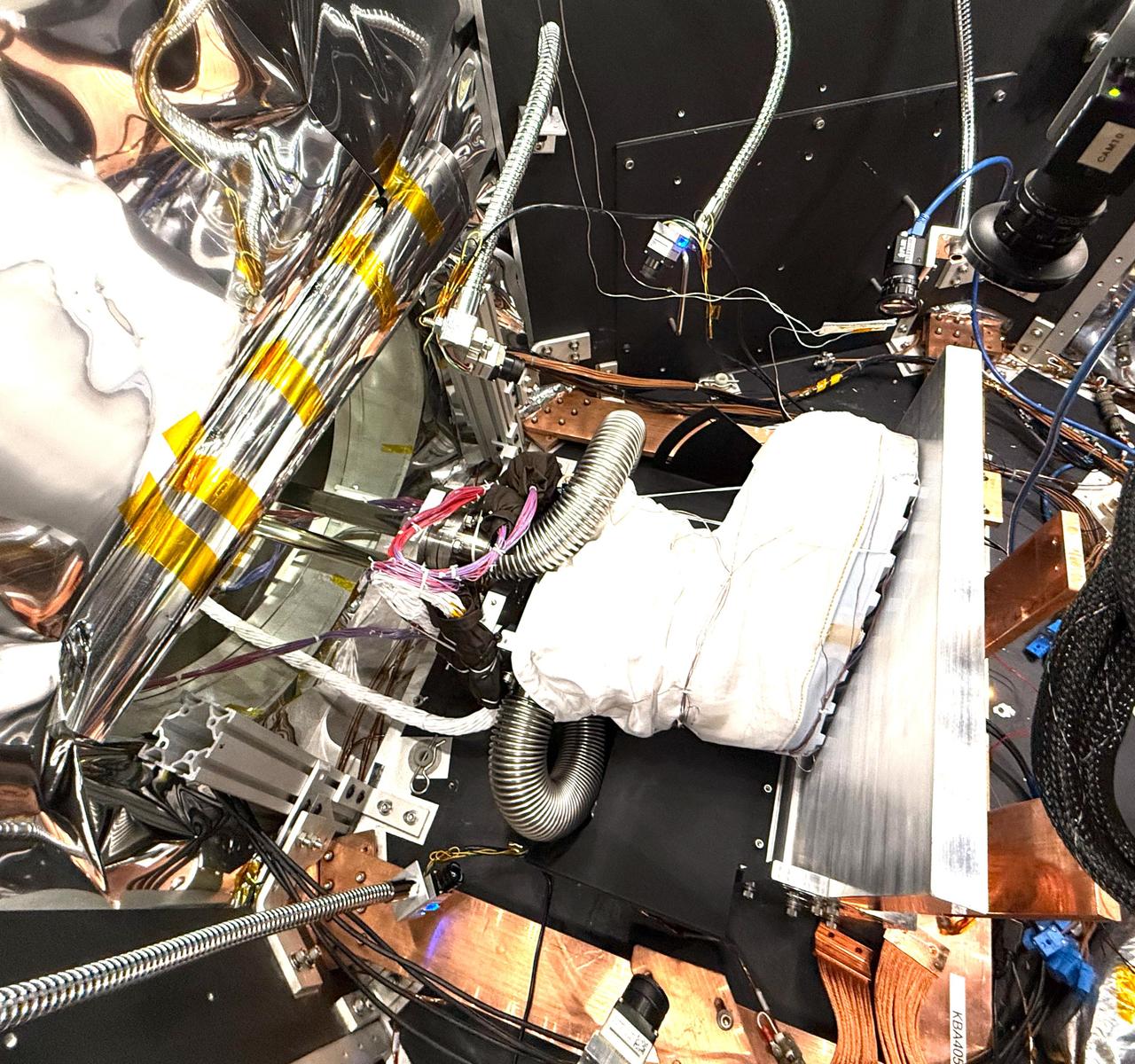
A boot that's part of a NASA lunar surface spacesuit prototype is readied for testing inside a thermal vacuum chamber called CITADEL at the agency's Jet Propulsion Laboratory in Southern California on Nov. 8, 2024. The thick aluminum plate at right stands in for the frigid surface of the lunar South Pole, where Artemis III astronauts will confront conditions more extreme than any previously experienced by humans. Built to prepare potential future robotic spacecraft for the frosty, low-pressure conditions on ocean worlds like Jupiter's frozen moon Europa, CITADEL (Cryogenic Ice Testing, Acquisition Development, and Excavation Laboratory) has also proven key to evaluating how astronaut gloves and boots hold up in extraordinary cold. It can reach temperatures as low as low as minus 370 degrees Fahrenheit (minus 223 degrees Celsius), approximating conditions in permanently shadowed regions that astronauts will explore. Figure A, showing the outer boot sole, was taken from inside CITADEL on Nov. 13, 2024. The boot is positioned in a load lock, one of four small drawer-like chambers through which test materials are inserted into the larger chamber. Initiated by the Extravehicular Activity and Human Surface Mobility Program at NASA's Johnson Space Center, the boot testing took place from October 2024 to January 2025. The boot is part of a NASA spacesuit called the Exploration Extravehicular Mobility Unit, or xEMU. Results haven't yet been fully analyzed. In addition to spotting vulnerabilities with existing suits, the experiments are intended to help NASA develop this unique test capability and prepare criteria for standardized, repeatable, and inexpensive test methods for the next-generation lunar suit being built by Axiom Space. https://photojournal.jpl.nasa.gov/catalog/PIA26592
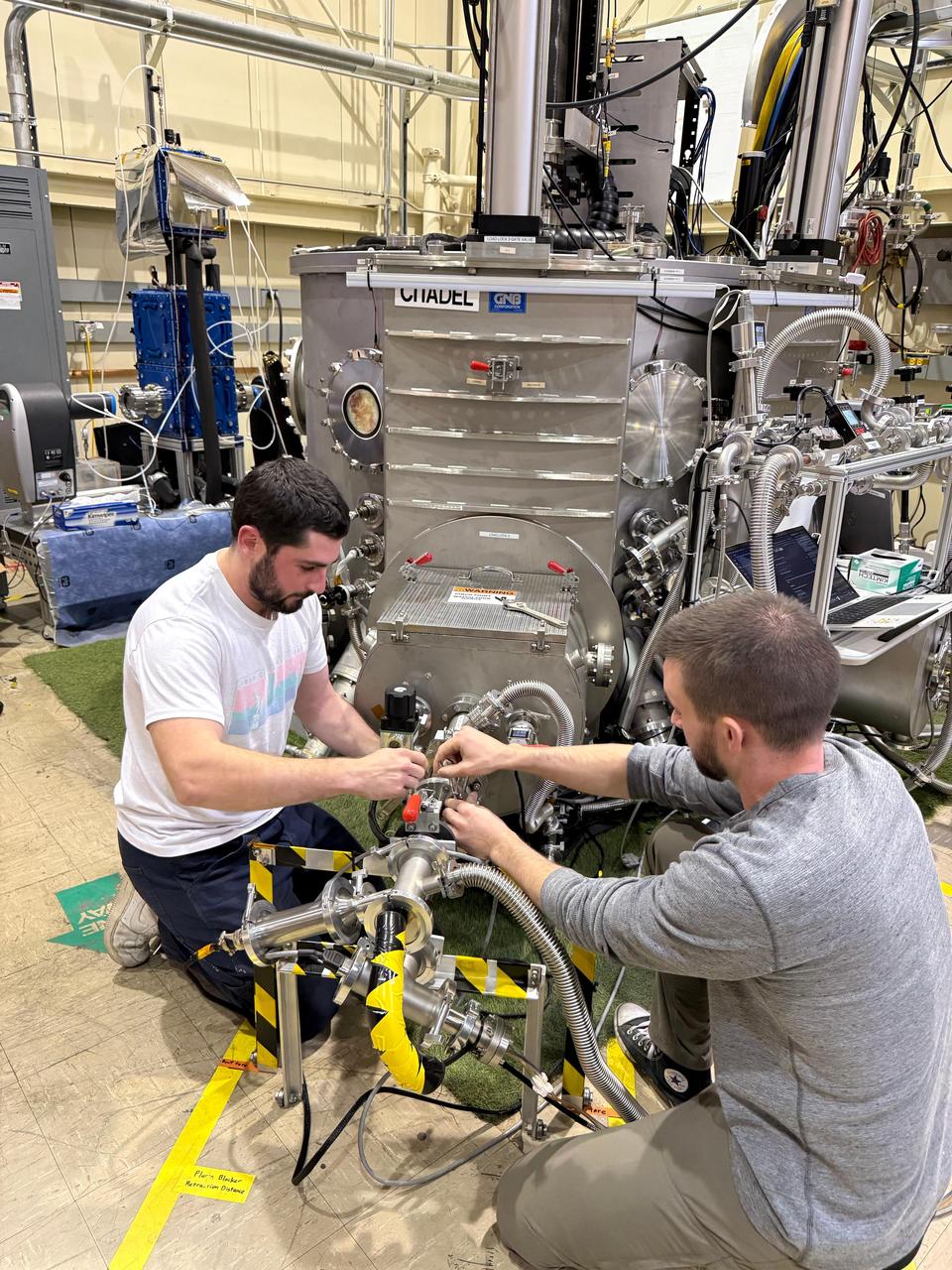
Robotics technologist Brendan Chamberlain-Simon, left, of NASA's Jet Propulsion Laboratory and spacesuit engineer Zach Fester of the agency's Johnson Space Center adjust a thermal vacuum chamber called CITADEL at JPL on Nov. 12, 2024, before testing an astronaut boot inside the chamber. Built to prepare potential robotic explorers for the frosty, low-pressure conditions on ocean worlds like Jupiter's frozen moon Europa, CITADEL (Cryogenic Ice Testing, Acquisition Development, and Excavation Laboratory) has also proven key to evaluating how astronaut gloves and boots hold up in extraordinary cold. It can reach temperatures as low as low as minus 370 degrees Fahrenheit (minus 223 degrees Celsius), approximating extreme conditions Artemis III astronauts will confront in permanently shadowed regions of the lunar South Pole. The boot testing was initiated by the Extravehicular Activity and Human Surface Mobility Program at NASA Johnson and took place from October 2024 to January 2025. The boot is part of a NASA spacesuit called the Exploration Extravehicular Mobility Unit, or xEMU. Test results haven't yet been fully analyzed. In addition to spotting vulnerabilities with existing suits, the experiments are intended to help NASA develop this unique test capability and prepare criteria for standardized, repeatable, and inexpensive test methods for the next-generation lunar suit being built by Axiom Space. https://photojournal.jpl.nasa.gov/catalog/PIA26593
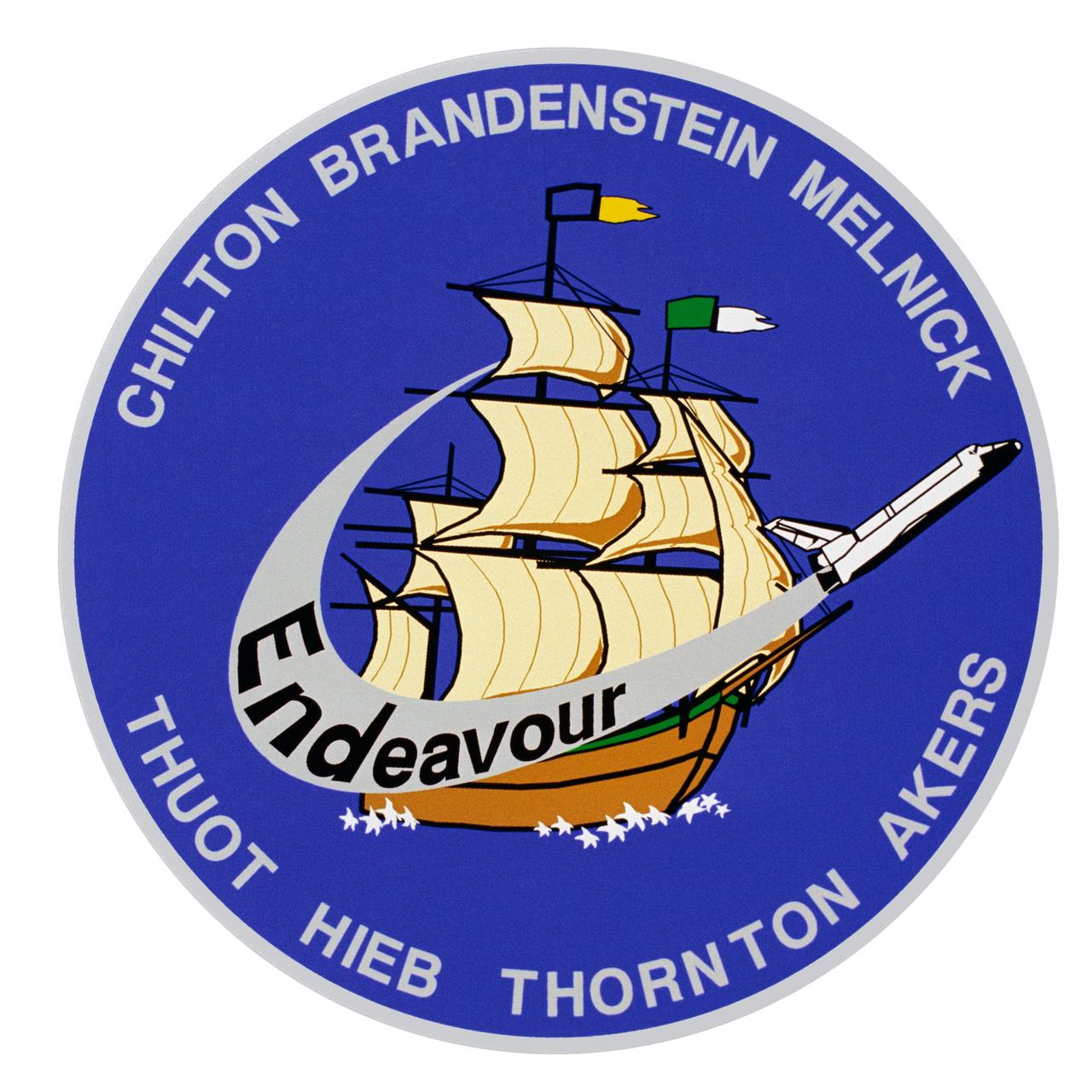
STS049-S-001 (March 1991) --- The patch, designed by its crew members, captures spaceflight's spirit of exploration which has its origins in the early seagoing vessels that explored the uncharted reaches of Earth and its oceans. The ship depicted on the patch is HMS Endeavour, the sailing vessel which Captain James Cook commanded on his first scientific expedition to the South Pacific. Just as Captain Cook engaged in unprecedented feats of exploration during his voyage, on the space shuttle Endeavour's maiden flight, its crew will expand the horizons of space operations with an unprecedented rendezvous and series of three spacewalks. During three consecutive days of extravehicular activity (EVA), the crew will conduct one spacewalk to retrieve, repair and deploy the Intelsat IV-F3 communications satellite, and two additional EVA's to evaluate potential Space Station Freedom assembly concepts. The flags flying high on Endeavour's masts wear the colors of the two schools that won the nationwide contest when Endeavour was chosen as the name of NASA's newest space shuttle: Senatobia (Mississippi) Middle School and Tallulah Falls (Georgia) School. The NASA insignia design for space shuttle flights is reserved for use by the astronauts and for other official use as the NASA Administrator may authorize. Public availability has been approved only in the form of illustrations by the various news media. When and if there is any change in this policy, which is not anticipated, it will be publicly announced. Photo credit: NASA