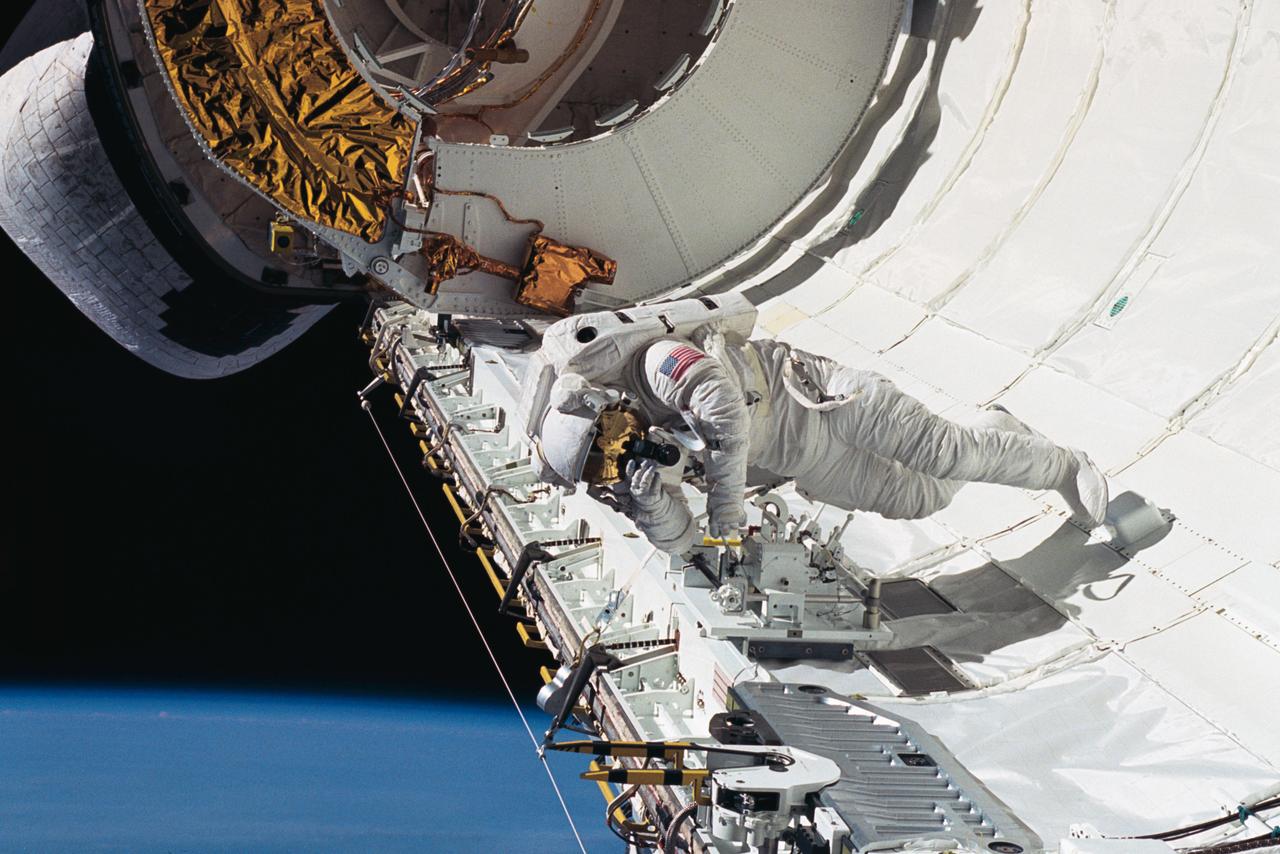
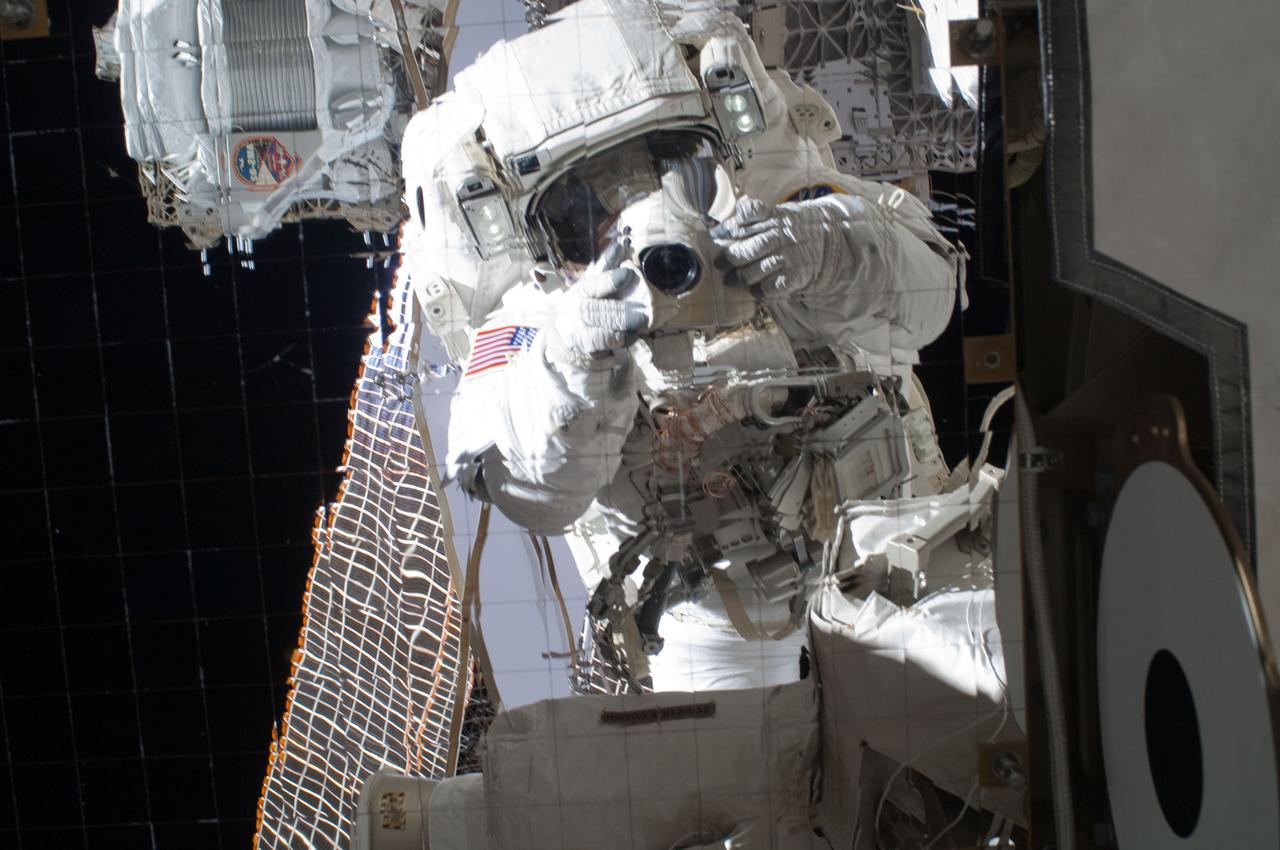
Astronaut James H. Newman, mission specialist, uses a 35mm camera to take a picture of fellow astronaut Carl E. Walz (out of frame) in Discovery's cargo bay. The two were engaged in an extravehicular activity (EVA) to test equipment to be used on future EVA's. Newman is tethered to the starboard side, with the orbital maneuvering system (OMS) pod just behind him.
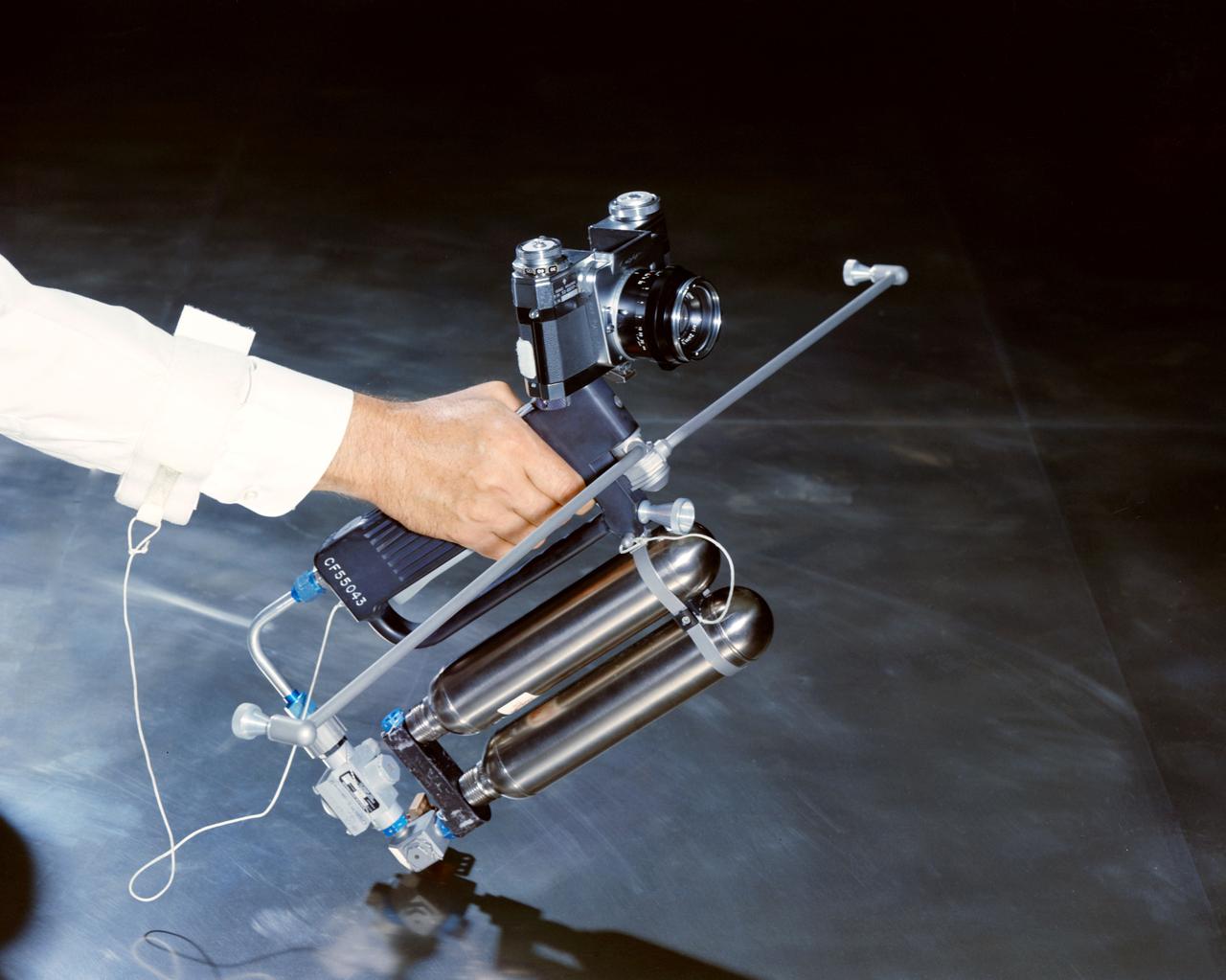
Hand-Held Self-Maneuvering Unit to be used during extravehicular activity (EVA) on Gemini 4 flight. It is an integral unit that contains its own high pressure metering valves and nozzles required to produce controlled thrust. A camera is mounted on the front of the unit.
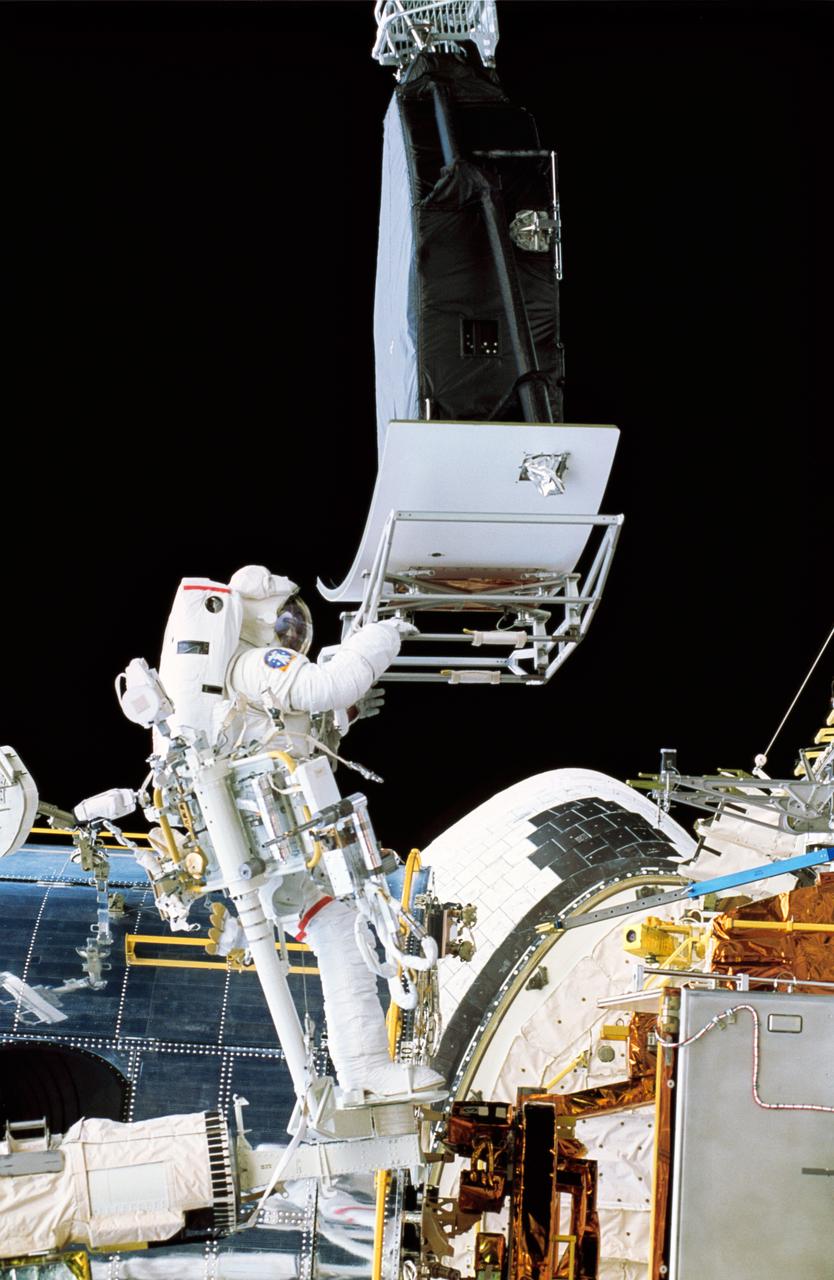
STS061-37-011 (7 Dec 1993) --- Astronaut Jeffrey A. Hoffman with Wide Field/Planetary Camera (WF/PC 1) during changeout operations. WF/PC-2 has already been installed in cavity (out of frame). Astronauts Hoffman and Story Musgrave are performing Extravehicular Activities (EVA) to repair the Hubble Space Telescope (HST).
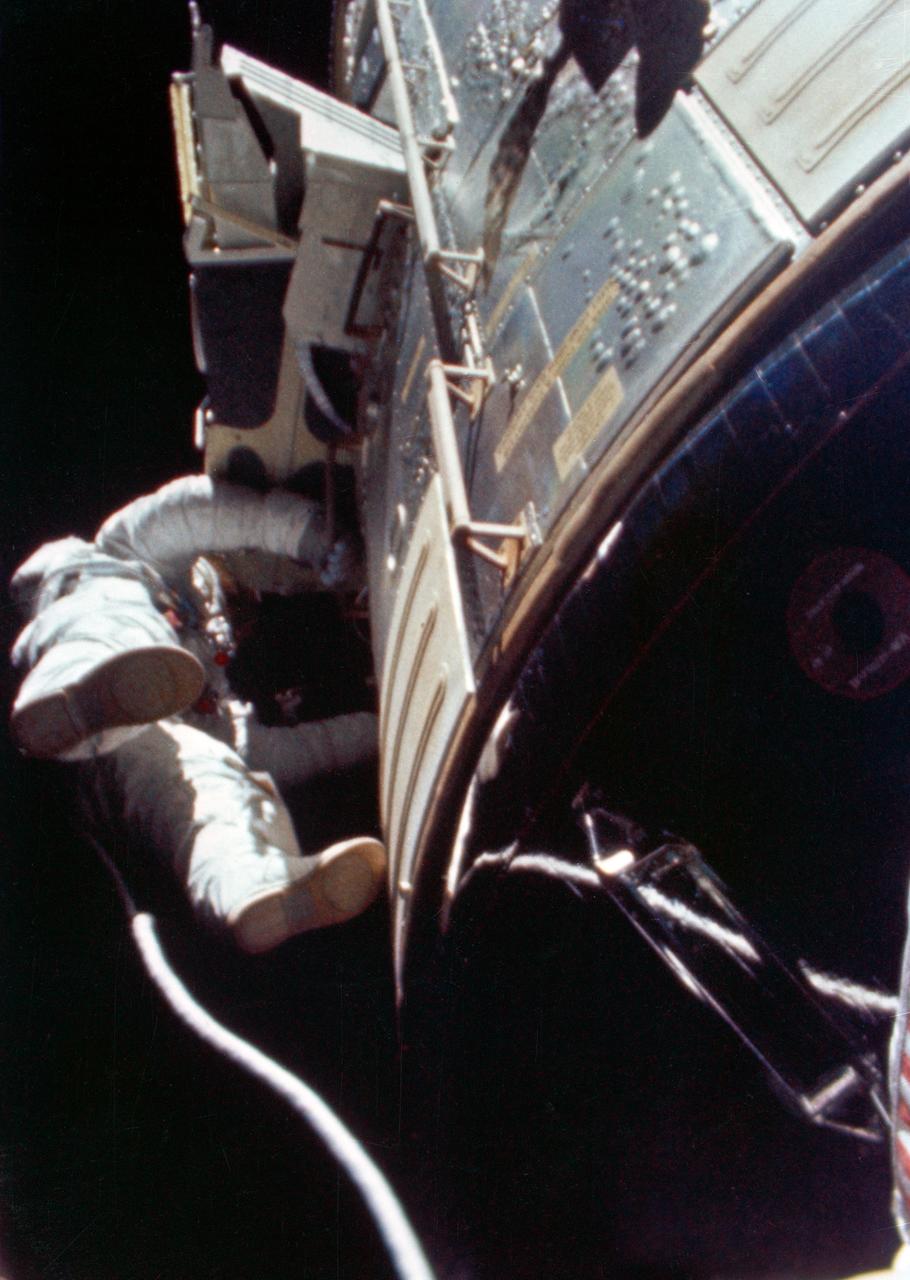
S71-43202 (5 Aug. 1971) --- Astronaut Alfred M. Worden, command module pilot of the Apollo 15 lunar landing mission, floats in space outside the spacecraft during his trans-Earth extravehicular activity (EVA). This photograph was taken from a frame of motion picture film exposed by the 16mm Maurer camera mounted in the hatch of the Command Module (CM). During his EVA, Worden made an inspection of the Service Module's (SM) Scientific Instrument Module (SIM) bay and retrieved the film cassettes from the Panoramic Camera and the Mapping Camera. The SIM bay holds eight orbital science experiments. The EVA occurred when the spacecraft was homeward bound approximately 171,000 nautical miles from Earth.
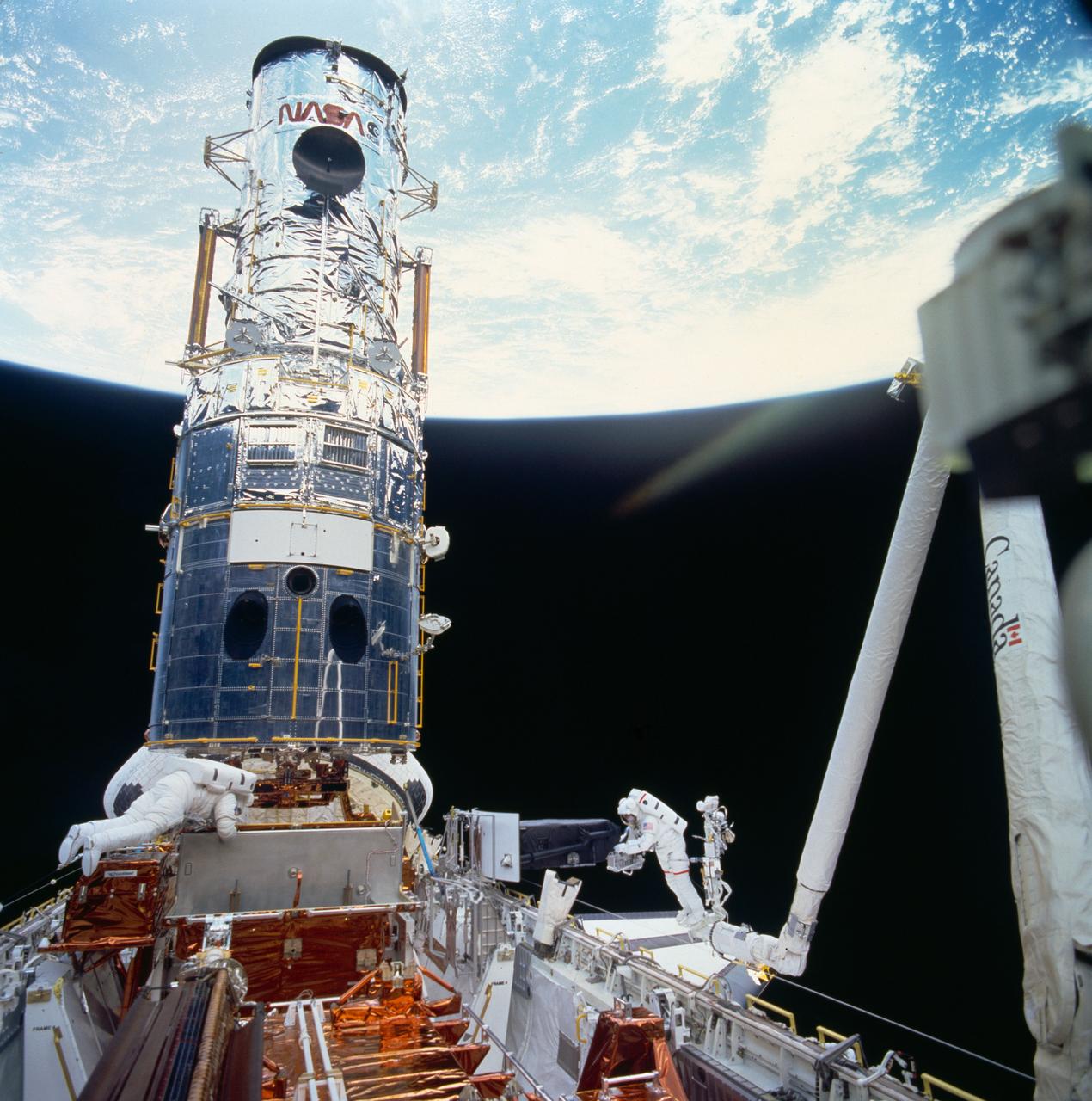
STS061-77-078 (7 Dec 1993) --- Astronaut Jeffrey A. Hoffman, anchored on the end of the Remote Manipulator System (RMS) arm, is pictured with the Wide Field/Planetary Camera (WF/PC I) during the third of five extravehicular activity?s (EVA). Astronauts Hoffman and F. Story Musgrave, seen near the stowage area for the WF/PC, had earlier installed the new camera (note white rectangle) on lower portion of telescope.
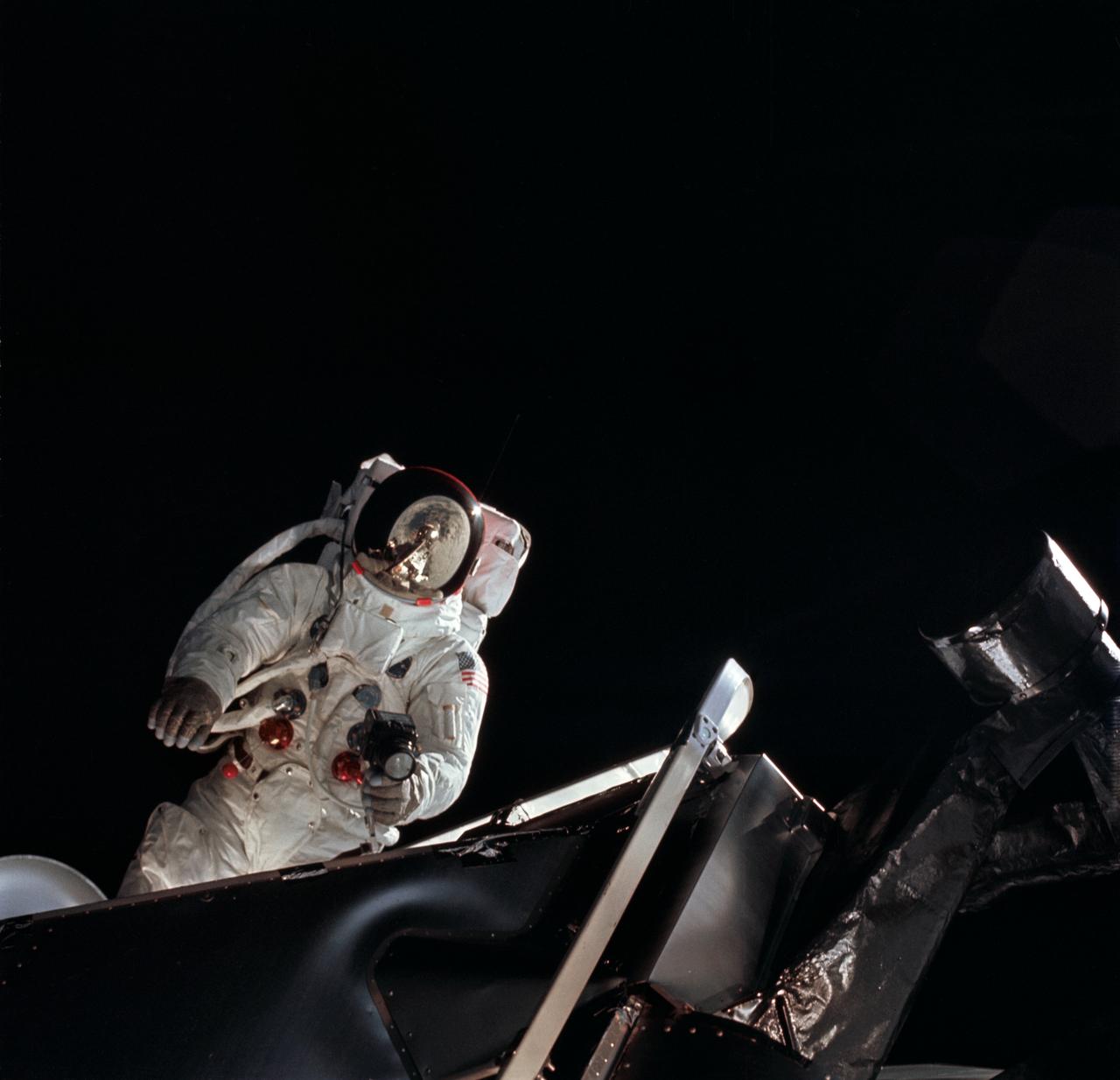
AS09-19-2983 (6 March 1969) --- Astronaut Russell L. Schweickart, lunar module pilot, operates a 70mm Hasselblad camera during his extravehicular activity (EVA) on the fourth day of the Apollo 9 Earth-orbital mission. The Command and Service Modules (CSM) and Lunar Module (LM) "Spider" are docked. This view was taken from the Command Module (CM) "Gumdrop". Schweickart, wearing an Extravehicular Mobility Unit (EMU), is standing in "golden slippers" on the LM porch. On his back, partially visible, are a Portable Life Support System (PLSS) and an Oxygen Purge System (OPS). Astronaut James A. McDivitt, Apollo 9 commander, was inside the "Spider". Astronaut David R. Scott, command module pilot, remained at the controls in the CM.
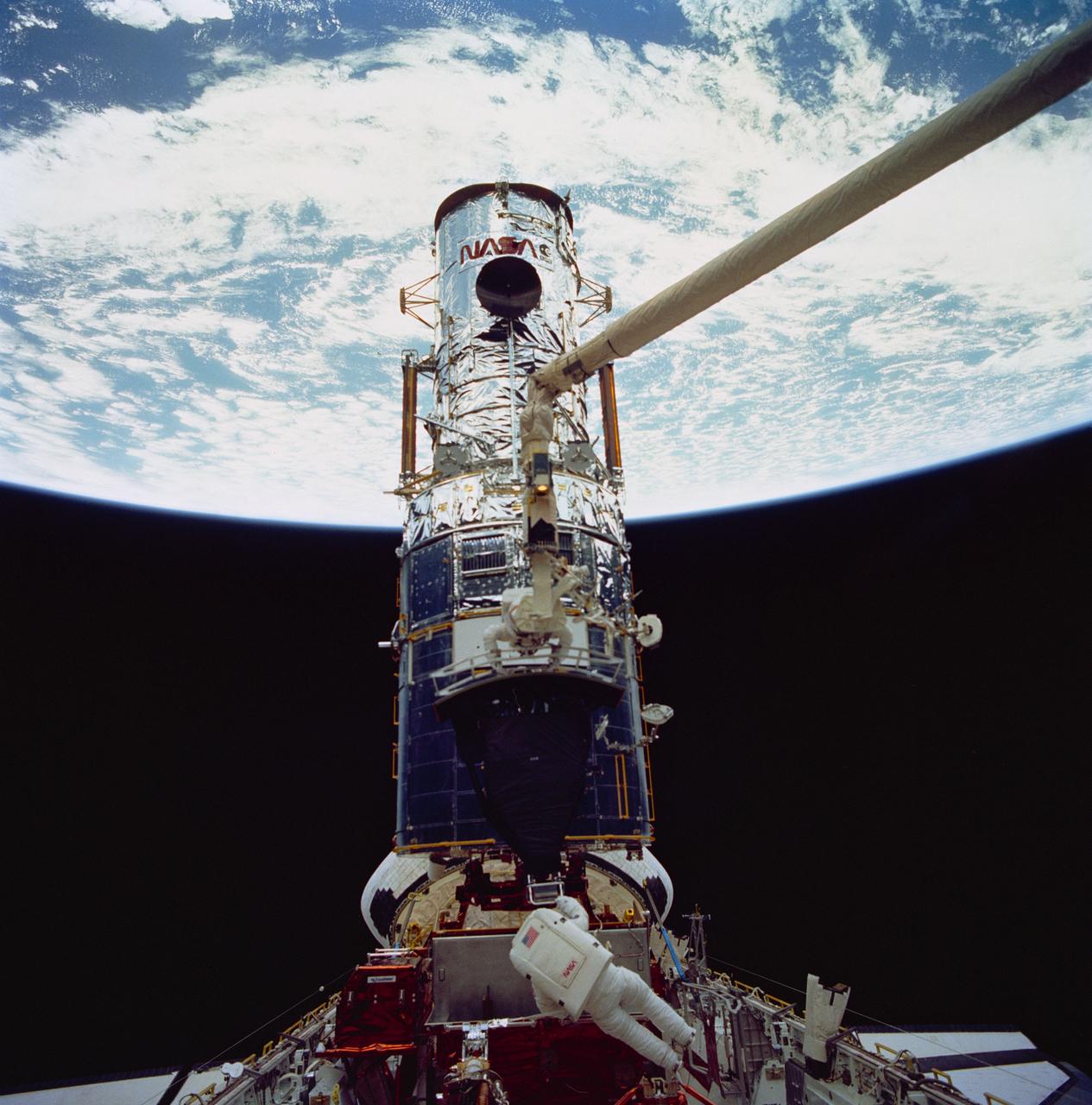
STS061-77-094 (7 Dec 1993) --- Astronaut Jeffrey A. Hoffman, anchored to the end of the Remote Manipulator System (RMS) arm, prepares to stow the Wide Field\Planetary Camera (WF\PC I) for the Hubble Space Telescope (HST), during their extravehicular activity (EVA). Astronaut F. Story Musgrave, stationed at the stowage area at bottom of frame, assists. WF/PC II is in place on the HST.
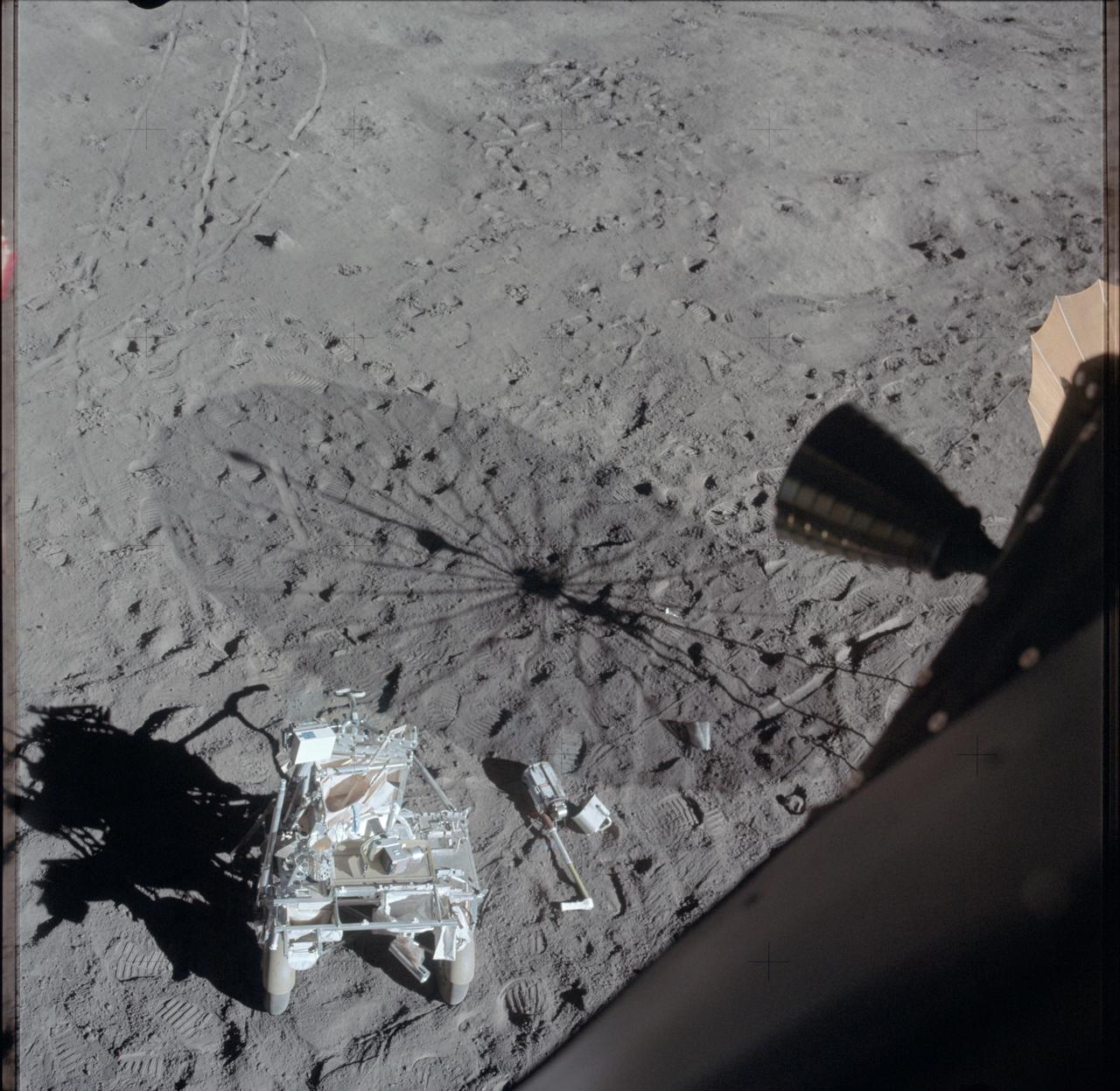
AS14-66-9340 (6 Feb. 1971) --- A view from inside the Lunar Module (LM) following the second Apollo 14 extravehicular activity (EVA). At the left foreground is the modularized equipment transporter (MET). Tracks made by the two-wheeled "Rickshaw"-type cart can be seen in the left background. The Apollo 35mm stereo close-up camera lies next to the MET, near a huge shadow of the erectable S-Band antenna. The area is largely covered with bootprints made by astronauts Alan B. Shepard Jr., commander, and Edgar D. Mitchell, lunar module pilot. While the pair explored the moon, astronaut Stuart A. Roosa, command module pilot, remained with the Command and Service Modules (CSM) in lunar orbit.
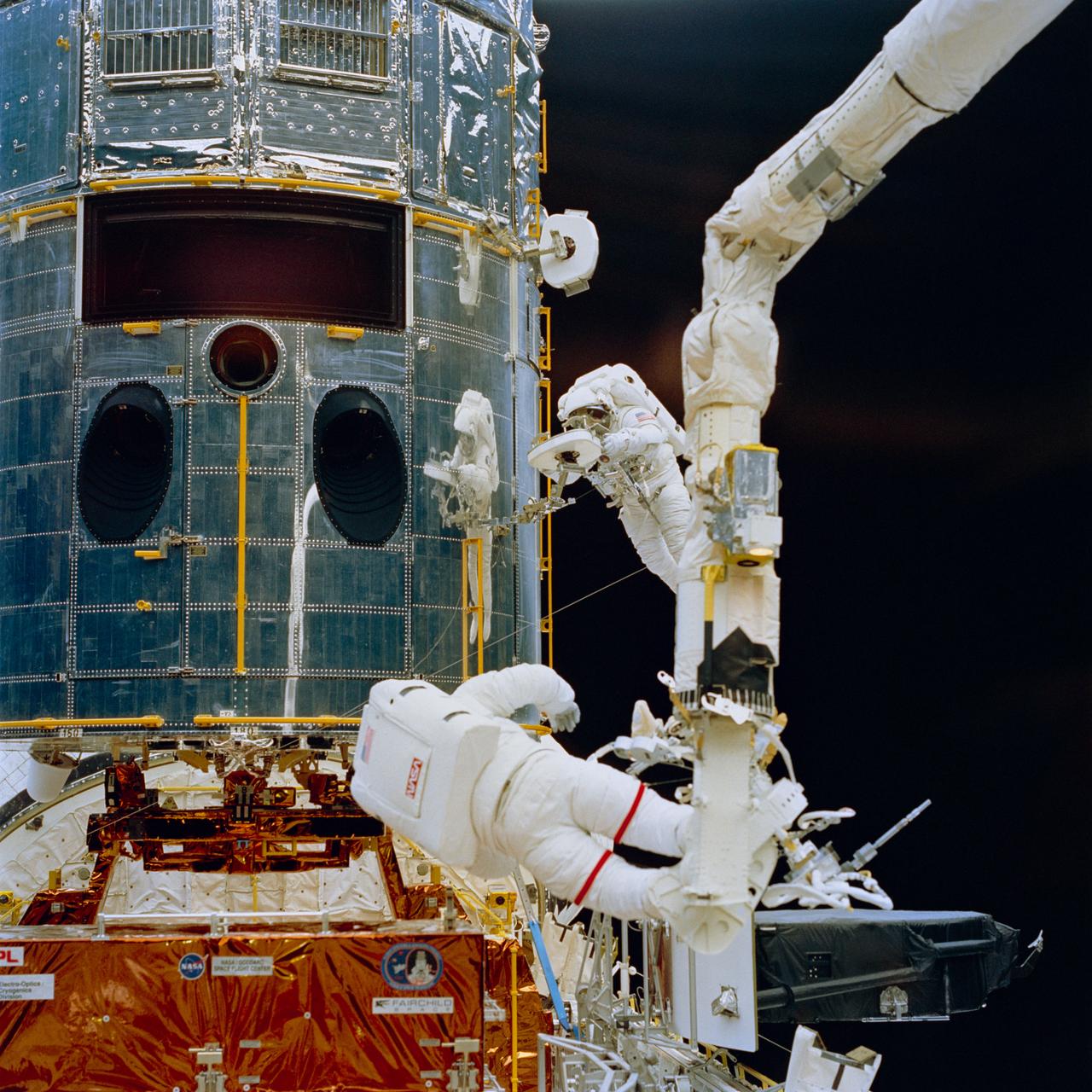
STS061-74-046 (7 Dec 1993) --- Anchored on the end of the Space Shuttle Endeavour's Remote Manipulator System (RMS) arm, astronaut Jeffrey A. Hoffman (foreground) prepares to install the new Wide Field\Planetary Camera (WFPC II) into the empty cavity (top left) on the Hubble Space Telescope (HST). WFPC I is seen temporarily stowed at bottom right. Astronaut F. Story Musgrave works with a Portable Foot Restraint (PFR) at frame center, as his image is reflected in the shiny surface of the telescope. Hoffman and Musgrave shared chores on three of the five extravehicular activity?s (EVA) during the mission.
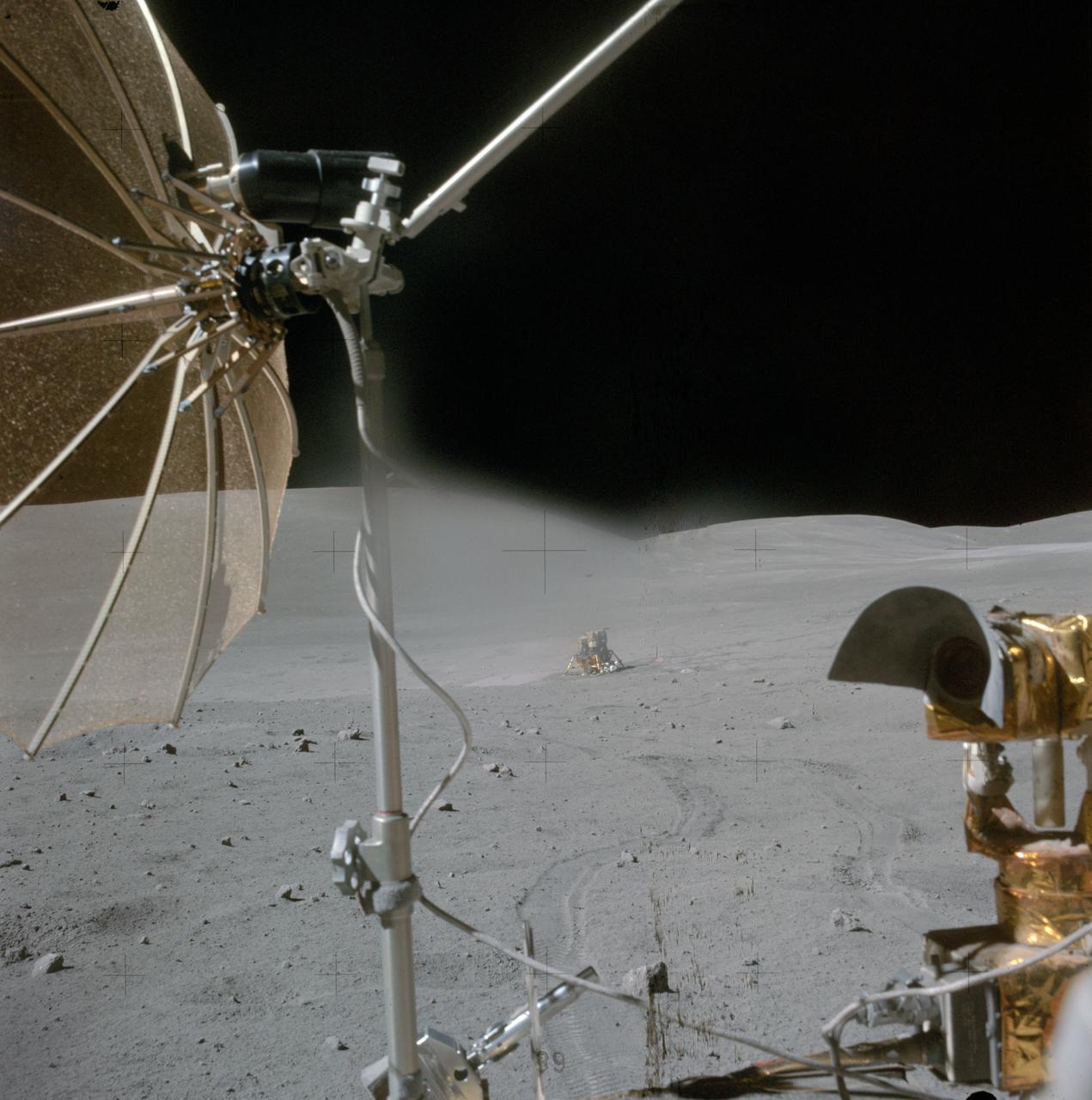
AS16-116-18678 (23 April 1972) --- A view from the moving Apollo 16 Lunar Roving Vehicle (LRV) as the crew men headed "home" at the end of the mission's third and final extravehicular activity (EVA). Astronaut John W. Young called attention to the series of block fields between the Lunar Module (LM) and LRV. Young also noted that, "The LM was obviously sitting in the only flat place around." Stone Mountain stretches about half way across the background. The high gain antenna and the RCA television camera on the LRV are in the foreground. While astronauts Young, commander; and Charles M. Duke Jr., lunar module pilot; descended in the Apollo 16 LM "Orion" to explore the Descartes highlands landing site on the moon, astronaut Thomas K. Mattingly II, command module pilot, remained with the Command and Service Modules (CSM) "Casper" in lunar orbit.
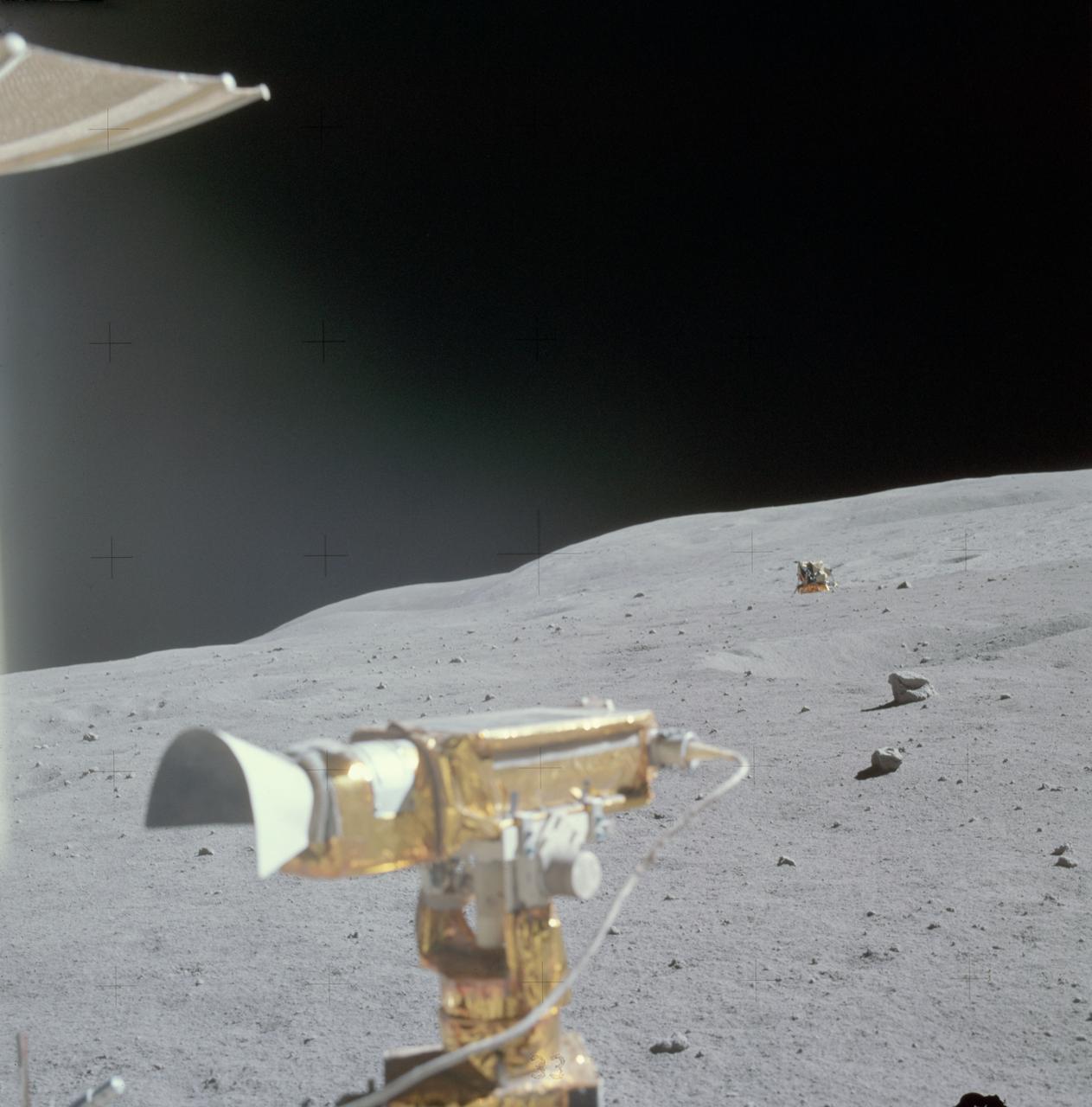
AS16-115-18549 (22 April 1972) --- The Apollo 16 Lunar Module (LM) "Orion" is photographed from a distance by astronaut Charles M. Duke Jr., lunar module pilot, aboard the moving Lunar Roving Vehicle (LRV). Astronauts Duke and John W. Young, commander, were returning from their excursion to Stone Mountain during the second Apollo 16 extravehicular activity (EVA). The RCA color television camera mounted on the LRV is in the foreground. A portion of the LRV's high-gain antenna is at top left. Smoky Mountain rises behind the LM in this north-looking view at the Descartes landing site. While astronauts Young and Duke descended in the "Orion" to explore the Descartes highlands landing site on the moon, astronaut Thomas K. Mattingly II, command module pilot, remained with the Command and Service Modules (CSM) "Casper" in lunar orbit.
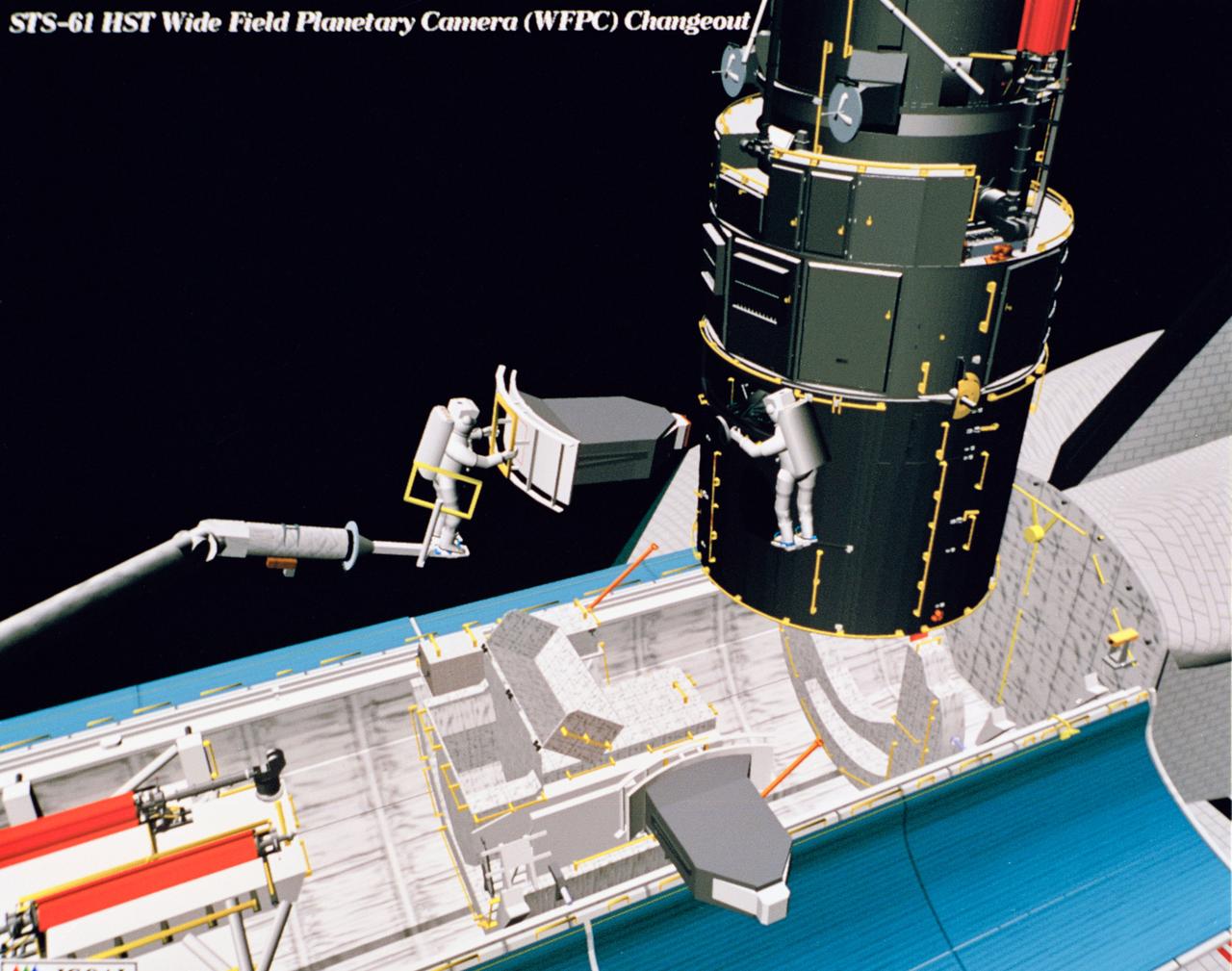
Computer generated scenes depicting the Hubble Space Telescope capture and a sequence of planned events on the planned extravehicular activity (EVA). Scenes include the Remote Manipulator System (RMS) arm assisting two astronauts changing out the Wide Field/Planetary Camera (WF/PC) (48699); RMS arm assisting in the temporary mating of the orbiting telescope to the flight support system in Endeavour's cargo bay (48700); Endeavour's RMS arm assisting in the "capture" of the orbiting telescope (48701); Two astronauts changing out the telescope's coprocessor (48702); RMS arm assistign two astronauts replacing one of the telescope's electronic control units (48703); RMS assisting two astronauts replacing the fuse plugs on the telescope's Power Distribution Unit (PDU) (48704); The telescope's High Resolution Spectrograph (HRS) kit is depicted in this scene (48705); Two astronauts during the removal of the high speed photometer and the installation of the COSTAR instrument (48706); Two astronauts, standing on the RMS, during installation of one of the Magnetic Sensing System (MSS) (48707); High angle view of the orbiting Space Shuttle Endeavour with its cargo bay doors open, revealing the bay's pre-capture configuration. Seen are, from the left, the Solar Array Carrier, the ORU Carrier and the flight support system (48708); Two astronauts performing the replacement of HST's Rate Sensor Units (RSU) (48709); The RMS arm assisting two astronauts with the replacement of the telescope's solar array panels (48710); Two astronauts replacing the telescope's Solar Array Drive Electronics (SADE) (48711).
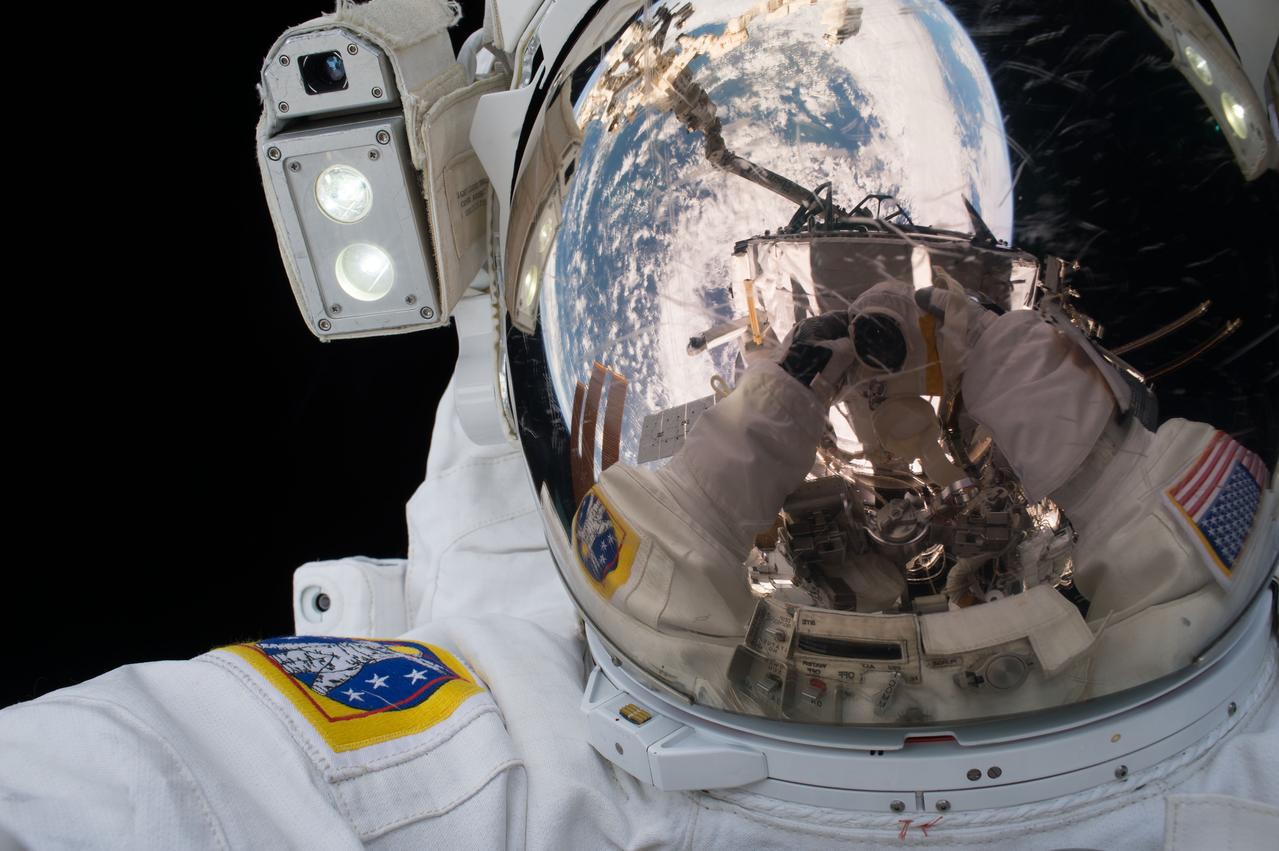
The camera is reflected in his helmet visor as Extravehicular crewmember 1 (EV1) Jeff Williams takes a self-portrait during Extravehicular Activity 36 (EVA 36).
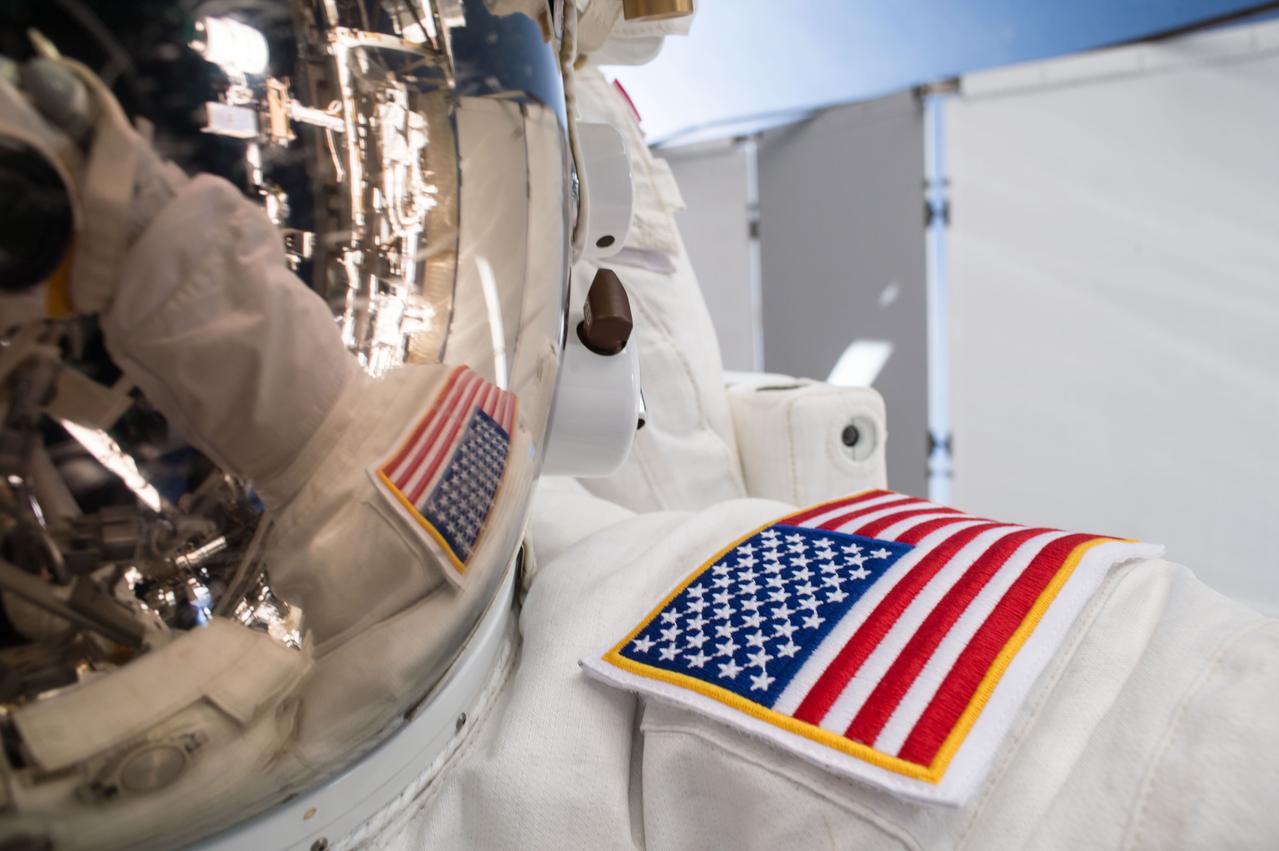
Extravehicular crewmember 1 (EV1) Jeff Williams' camera view of the American flag on his Extravehicular Mobility Unit (EMU). Image was taken during Extravehicular Activity 37 (EVA 37).
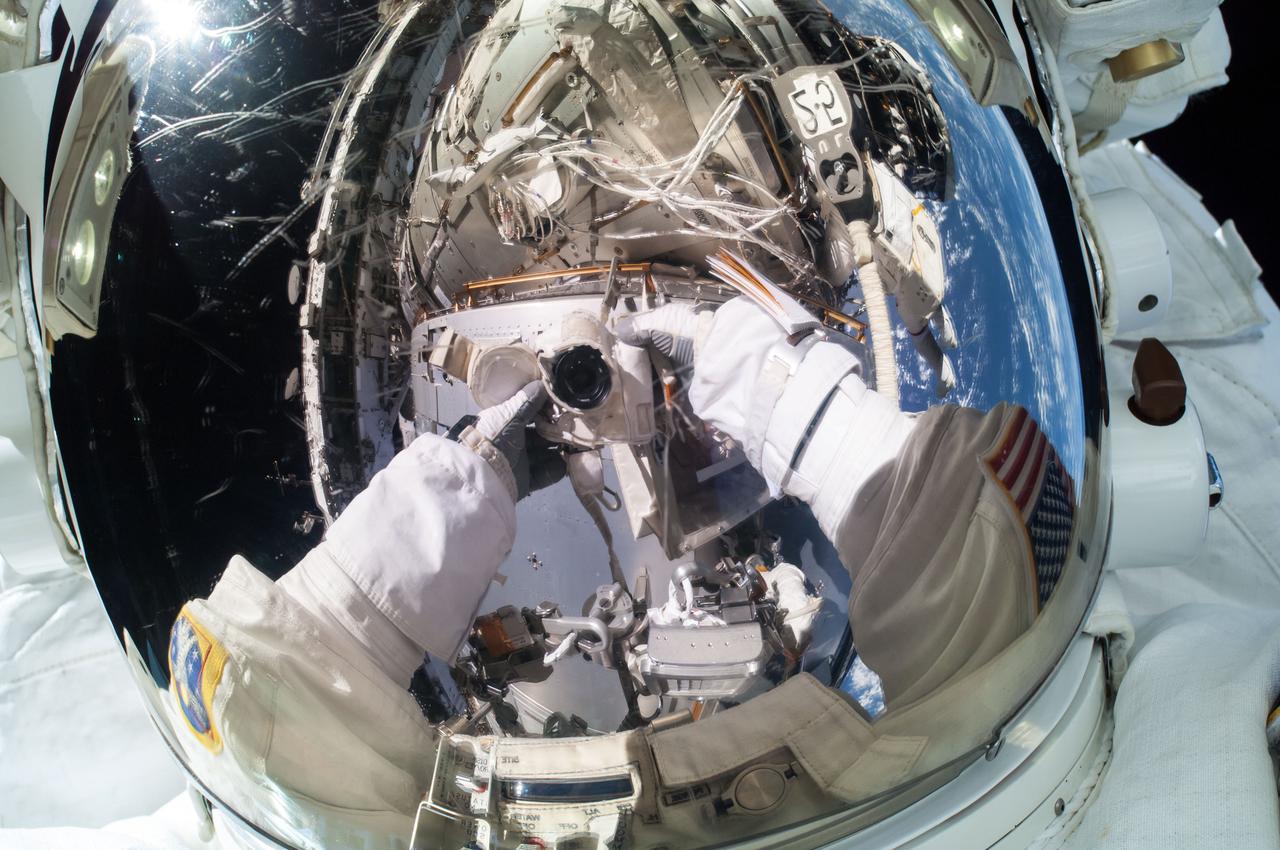
The camera is reflected in his helmet visor as Extravehicular crewmember 2 (EV2) Terry Virts takes a self-portrait during Extravehicular Activity 29 (EVA 29). Image was released by astronaut on Twitter.
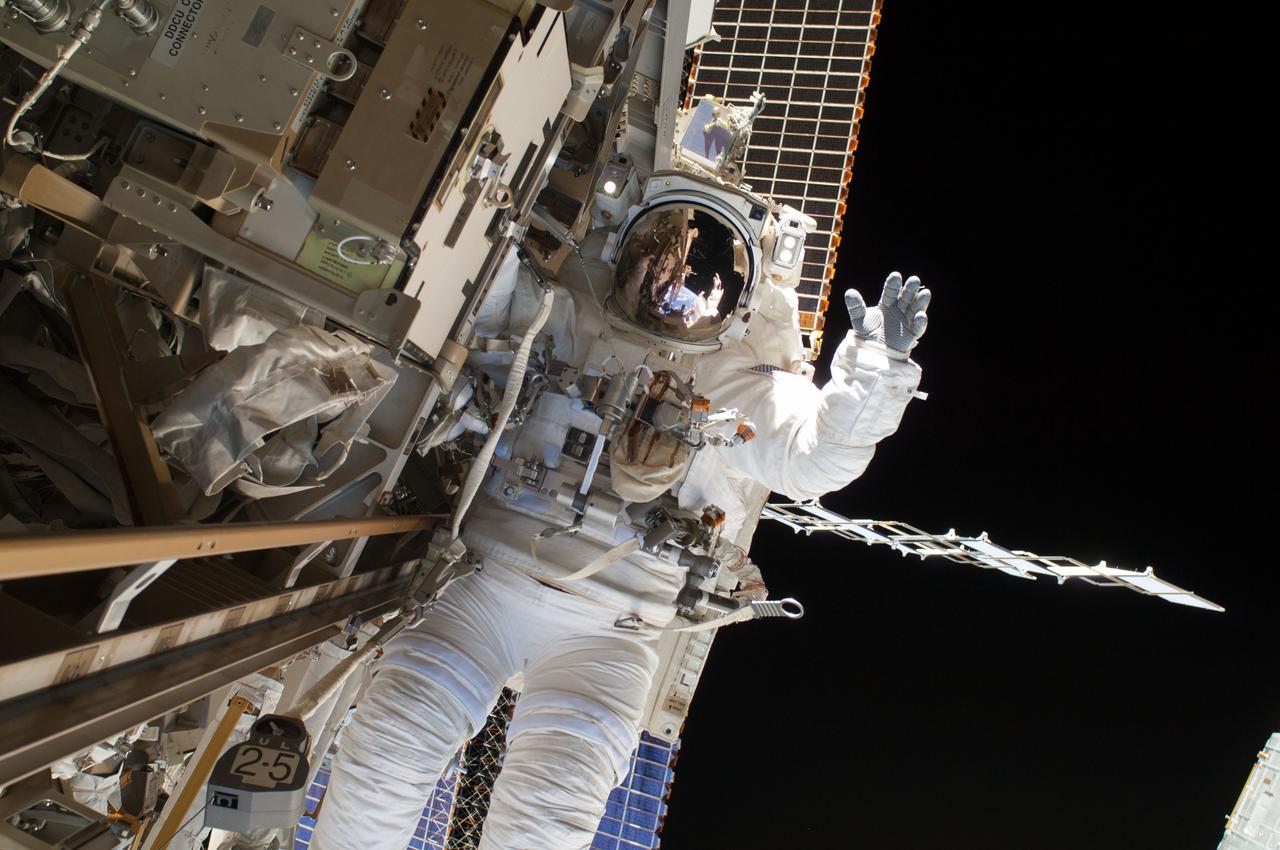
Expedition 39 flight engineer Steve Swanson waves to the camera during Extravehicular Activity 26 (EVA 26) cleanup operations at the S0 Truss.

STS087-369-032 (3 Dec. 1997) --- Astronaut Winston E. Scott, mission specialist, during the second extravehicular activity (EVA) in the cargo bay of the Earth-orbiting Space Shuttle Columbia, lets loose a prototype free-flying experiment, the Autonomous Extravehicular Activity Robotic Camera Sprint (AERCam Sprint). AERCam Sprint is a spherically-shaped television camera that could be used for remote inspections of the exterior of the International Space Station (ISS).
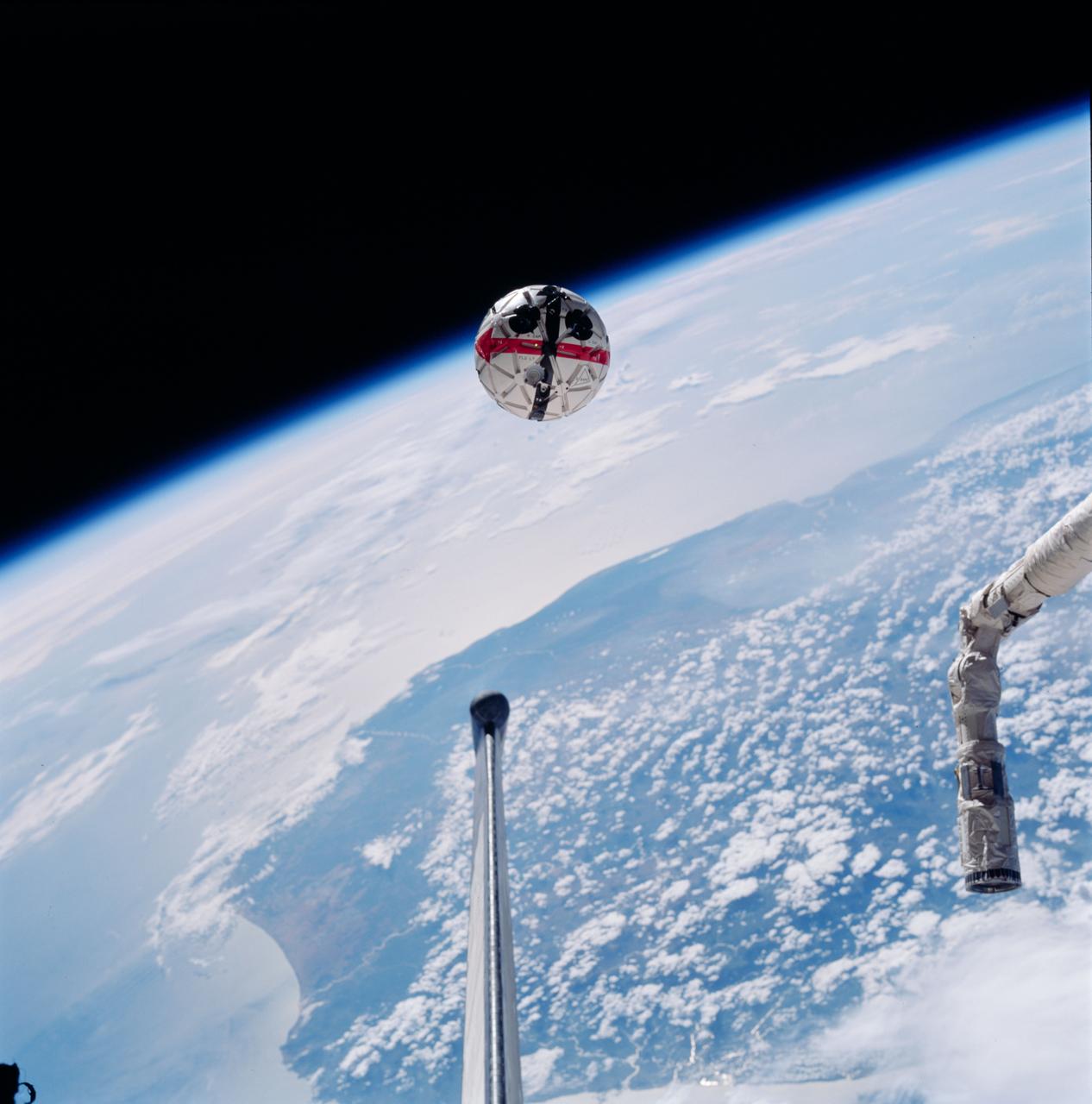
STS087-752-035 (19 November – 5 December 1997) --- This out-the-window view shows the Autonomous Extravehicular Activity Robotic Camera Sprint (AERCam Sprint) free-flying in the vicinity of the cargo bay of the Earth-orbiting Space Shuttle Columbia. The AERCam Sprint is a prototype free-flying television camera that could be used for remote inspections of the exterior of the International Space Station (ISS). This view, backdropped over southern Madagascar, was taken during this flight's second Extravehicular Activity (EVA), on December 3, 1997.
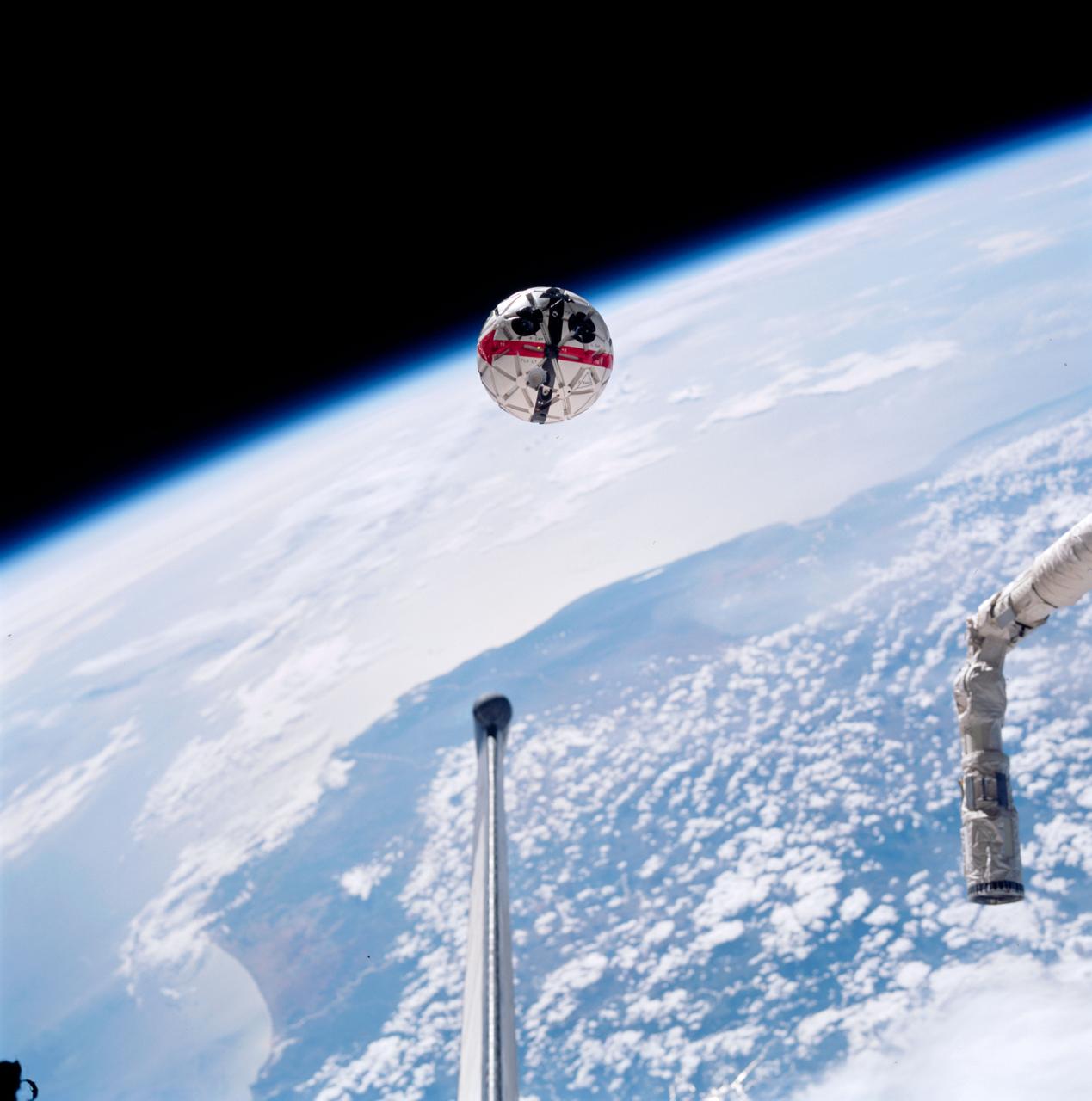
STS087-752-034 (19 November - 5 December 1997) --- This out-the-window view shows the Autonomous Extravehicular Activity Robotic Camera Sprint (AERCam Sprint) free-flying in the vicinity of the cargo bay of the Earth-orbiting Space Shuttle Columbia. The AERCam Sprint is a prototype free-flying television camera that could be used for remote inspections of the exterior of the International Space Station (ISS). This view, backdropped over southern Madagascar, was taken during this flight's second extravehicular activity (EVA), on December 3, 1997.
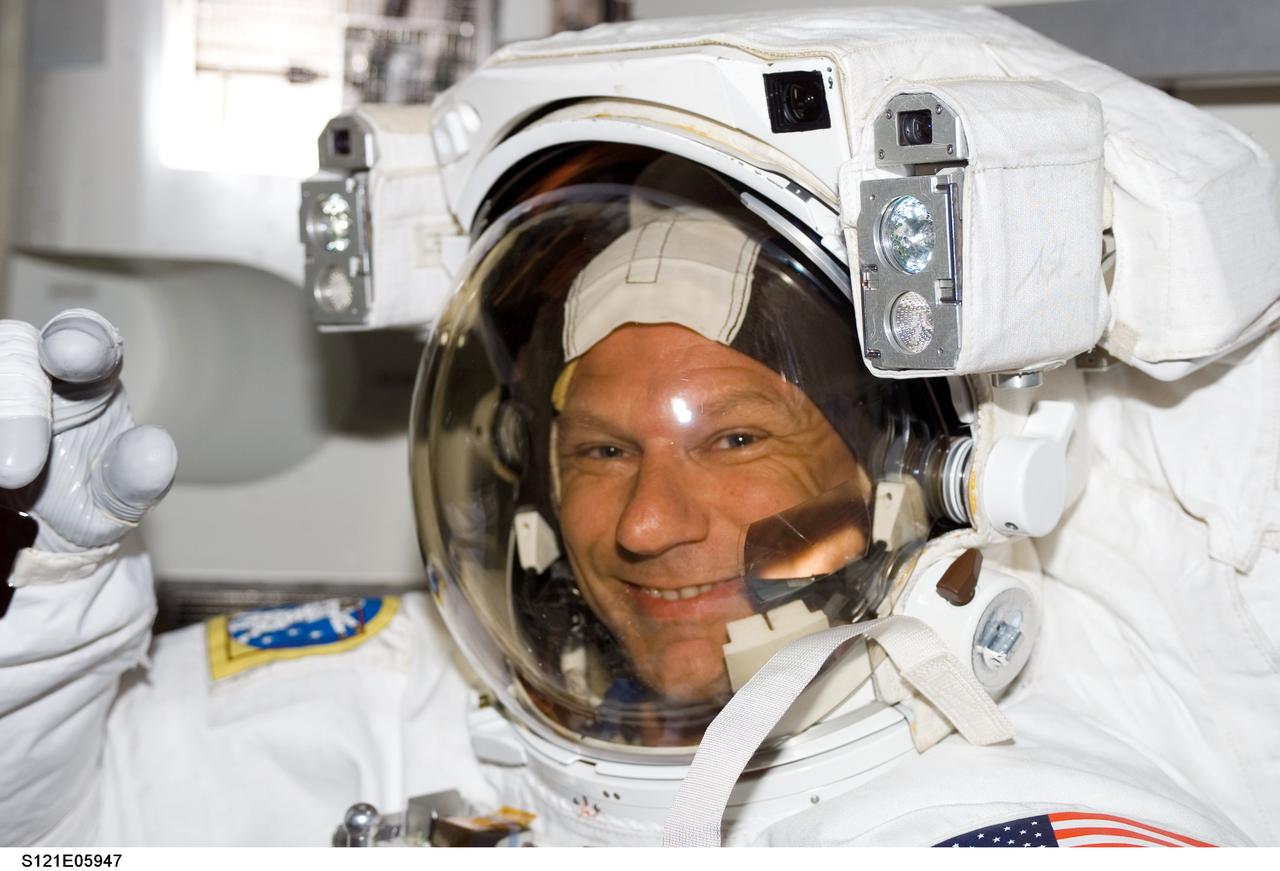
S121-E-05947 (8 July 2006) --- Astronaut Piers J. Sellers, STS-121 mission specialist, attired in his Extravehicular Mobility Unit (EMU) spacesuit, waves to the camera in the Quest Airlock of the International Space Station prior to the start of the first scheduled session of extravehicular activity (EVA).
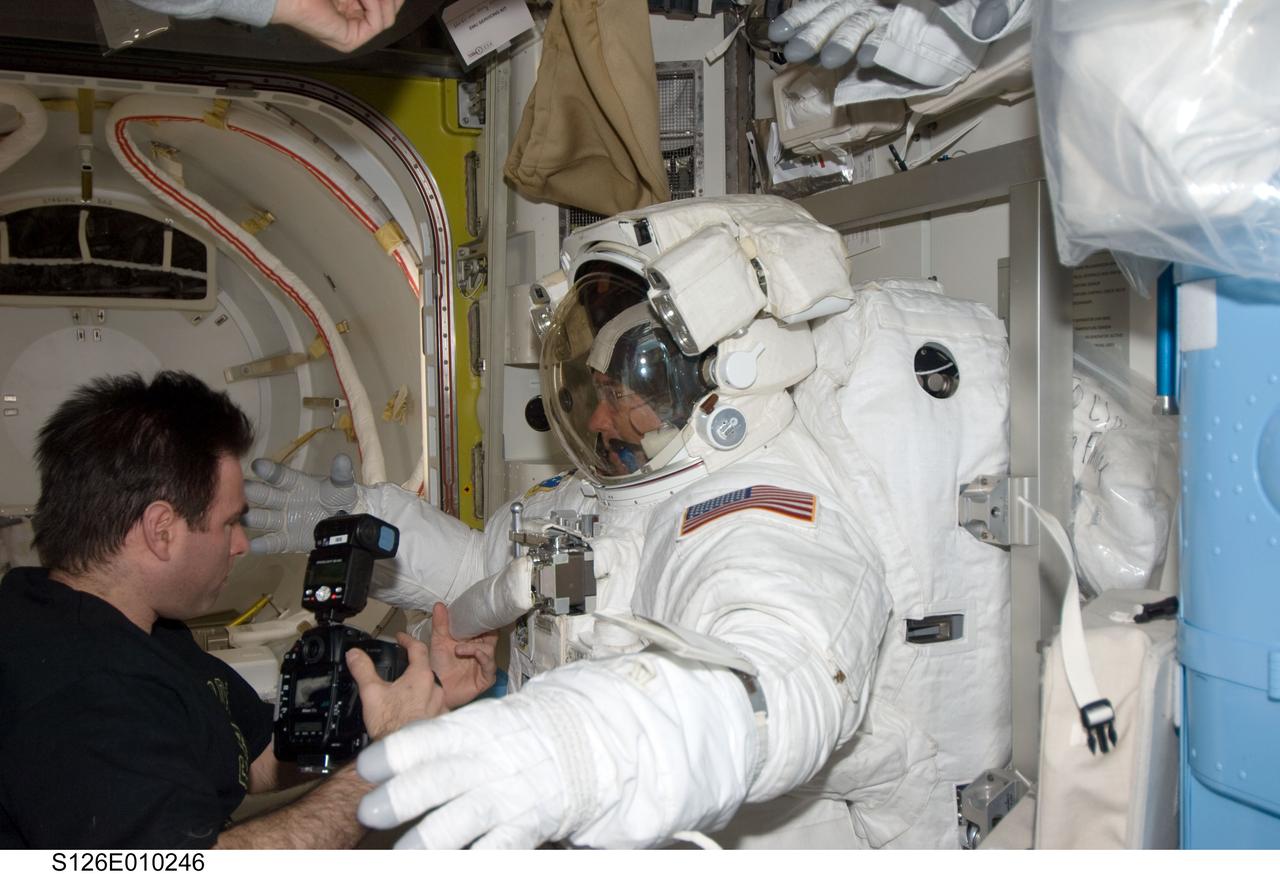
S126-E-010246 (24 Nov. 2008) --- Astronaut Greg Chamitoff, STS-126 mission specialist, uses a still camera to photograph sections of astronaut Steve Bowen's Extravehicular Mobility Unit (EMU) spacesuit in the Quest Airlock of the International Space Station as the mission's fourth session of extravehicular activity (EVA) draws to a close.
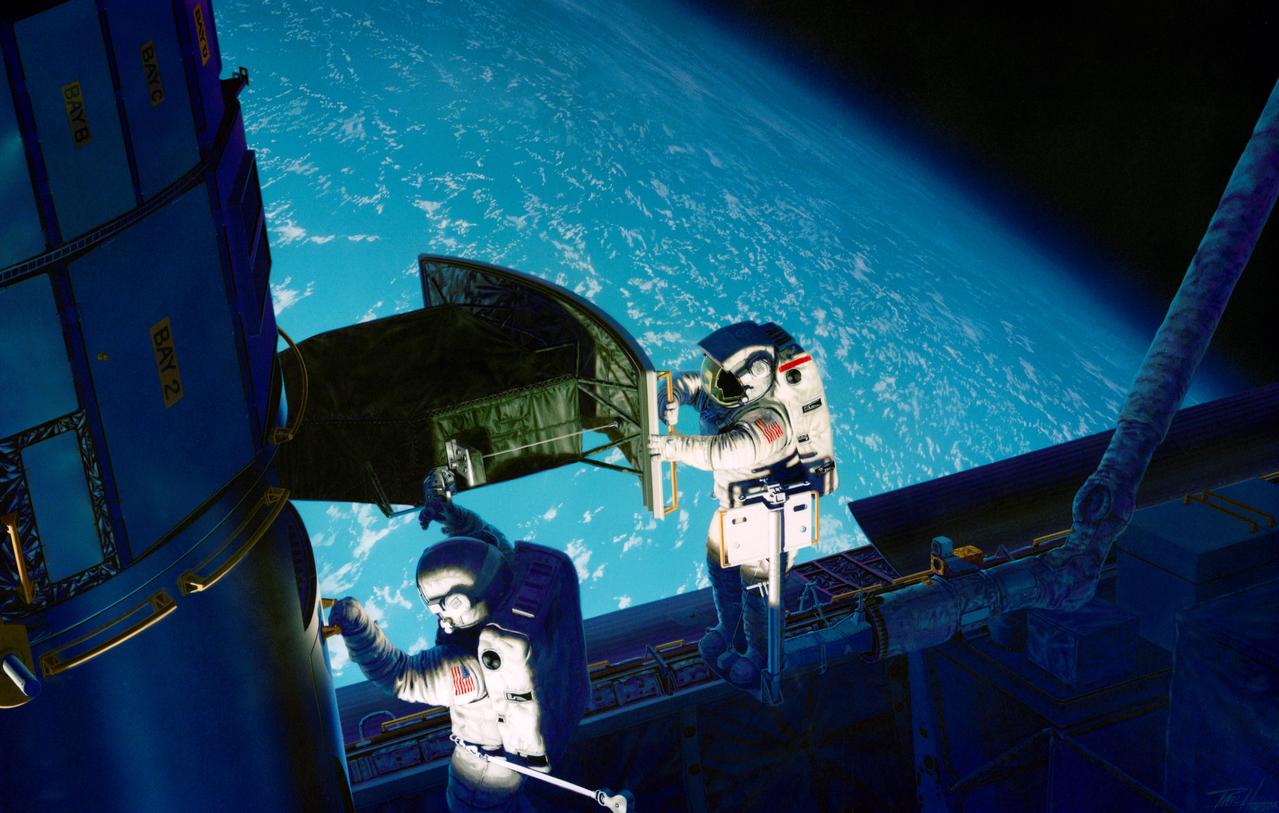
S93-48826 (November 1993) --- This artist's rendition of the 1993 Hubble Space Telescope (HST) servicing mission shows astronauts installing the new Wide Field/Planetary Camera (WF/PC 2). The instruments to replace the original camera and contains corrective optics that compensate for the telescope's flawed primary mirror. During the 11-plus day mission, astronauts are also scheduled to install the Corrective Optics Space Telescope Axial Replacement (COSTAR) -- an optics package that focuses and routes light to the other three instruments aboard the observatory -- a new set of solar array panels, and other hardware and components. The artwork was done for JPL by Paul Hudson.
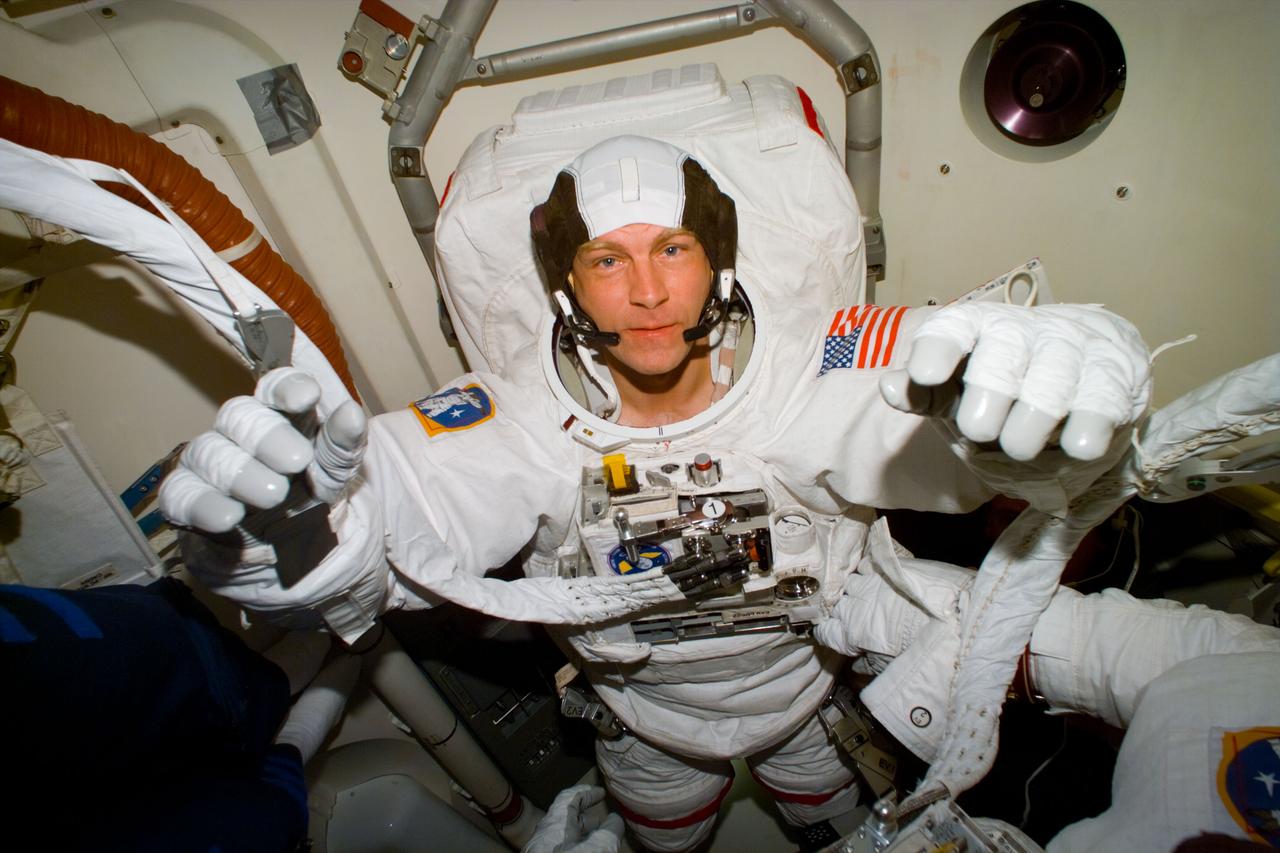
S82-E-5290 (14 Feb. 1997) --- Astronaut Mark C. Lee after his Extravehicular Activity (EVA) - unsuiting. This view was taken with an Electronic Still Camera (ESC).
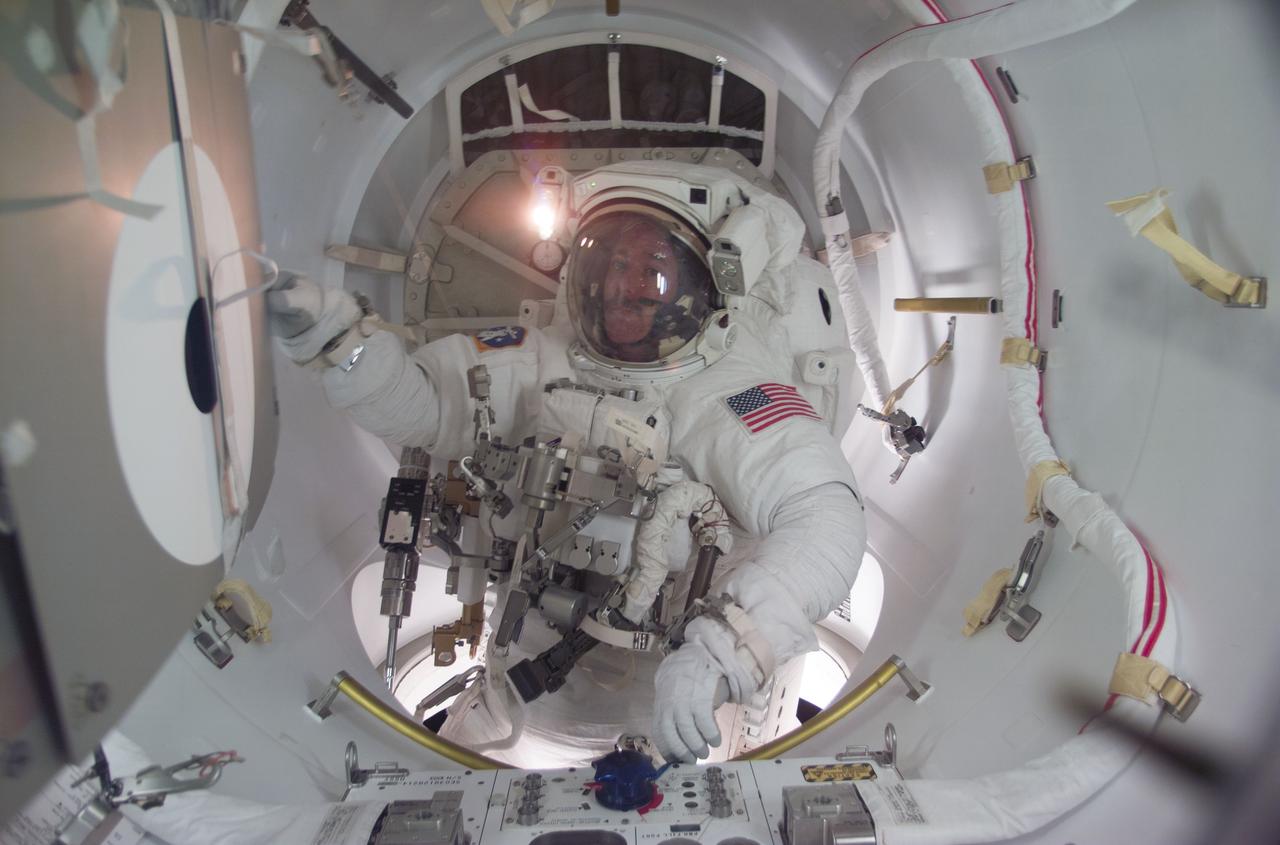
STS104-E-5232 (21 July 2001) --- A crew member used a digital still camera to take a picture of astronaut James F. Reilly in the airlock at the completion of the final STS-104 extravehicular activity (EVA).
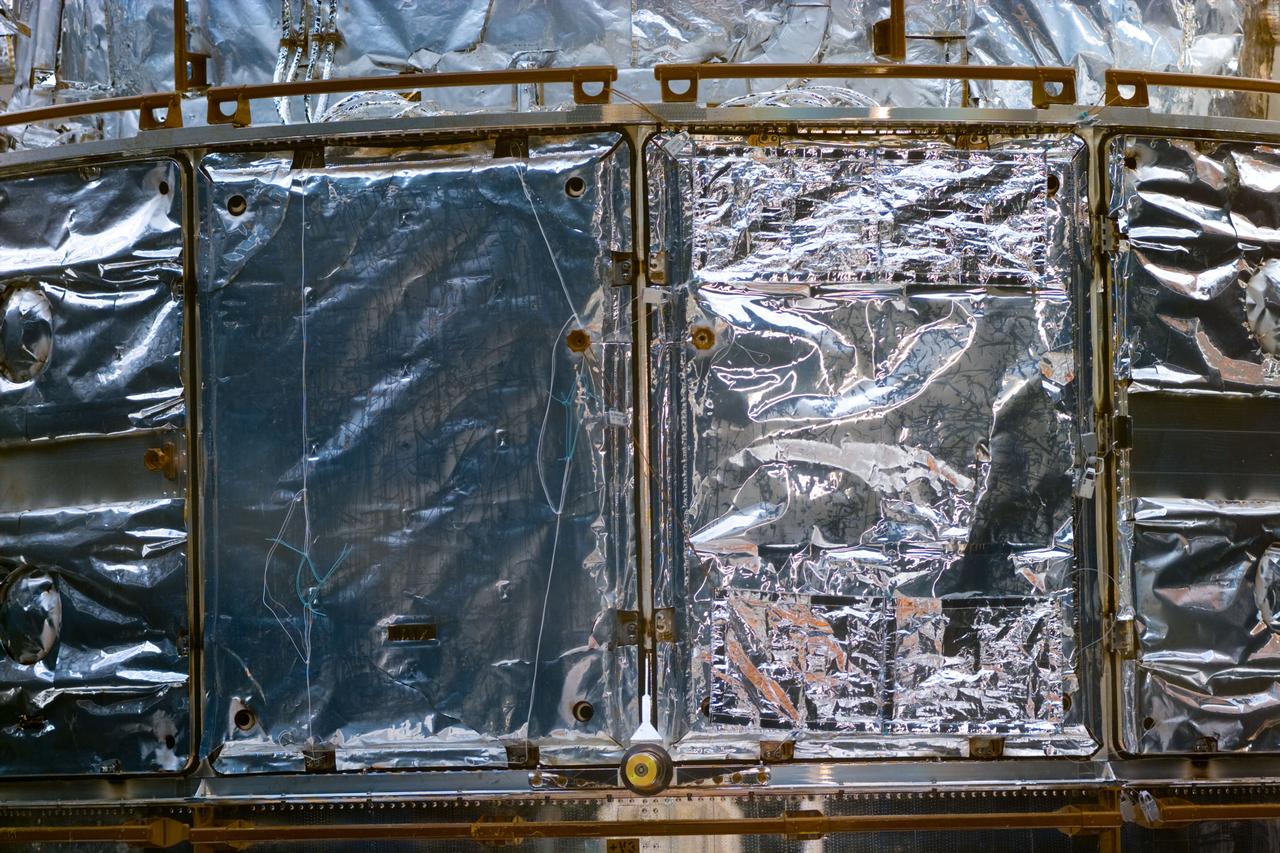
S82-E-5891 (11-21 Feb. 1997) --- Several patchwork pieces on bay doors accomplished on fifth Extravehicular Activity (EVA). This view was taken with an Electronic Still Camera (ESC).
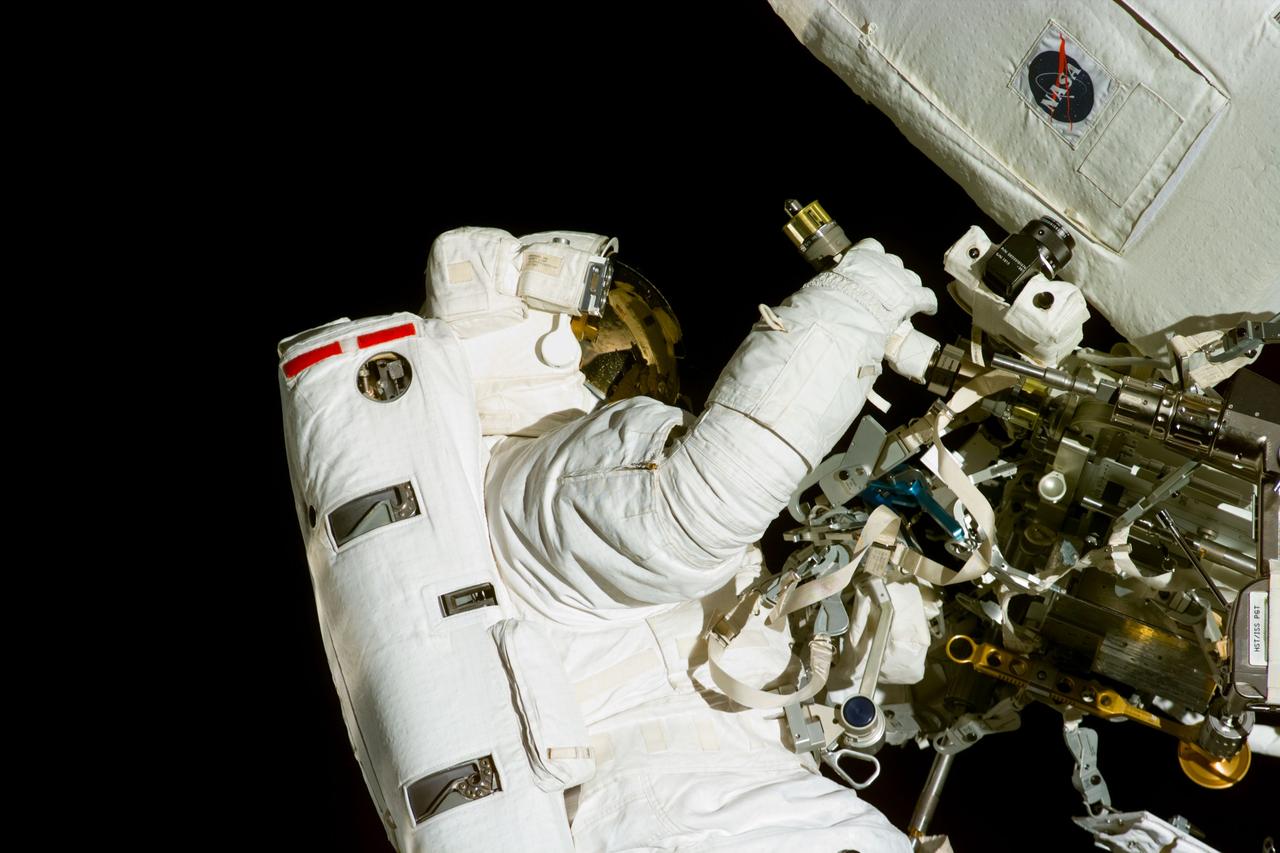
S82-E-5419 (15 Feb. 1997) --- Close-up of astronaut Gregory J. Harbaugh during Extravehicular Activity (EVA) for repair of the Hubble Space Telescope (HST). This view was taken with an Electronic Still Camera (ESC).
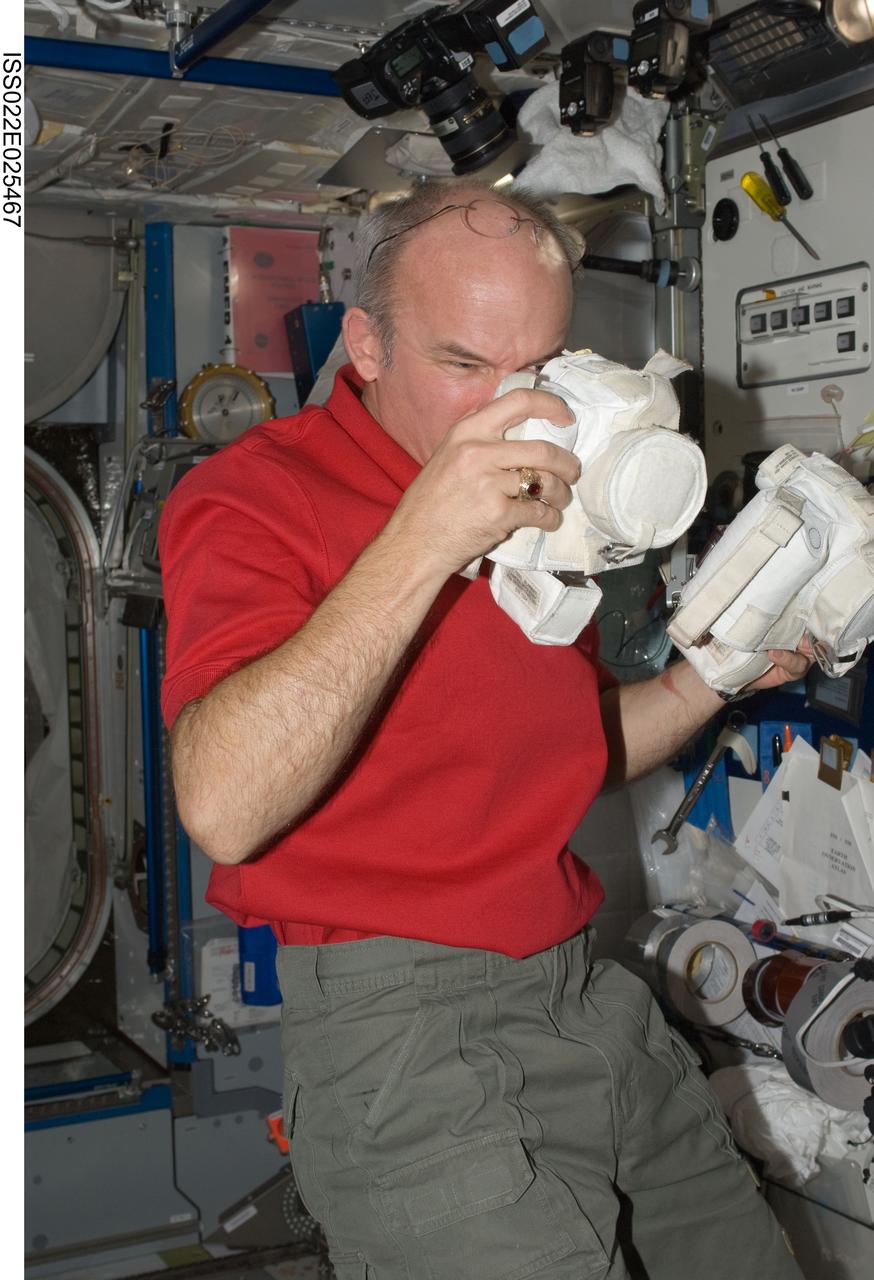
ISS022-E-025467 (13 Jan. 2010) --- NASA astronaut Jeffrey Williams, Expedition 22 commander, holds extravehicular activity (EVA) cameras in the Harmony node of the International Space Station.
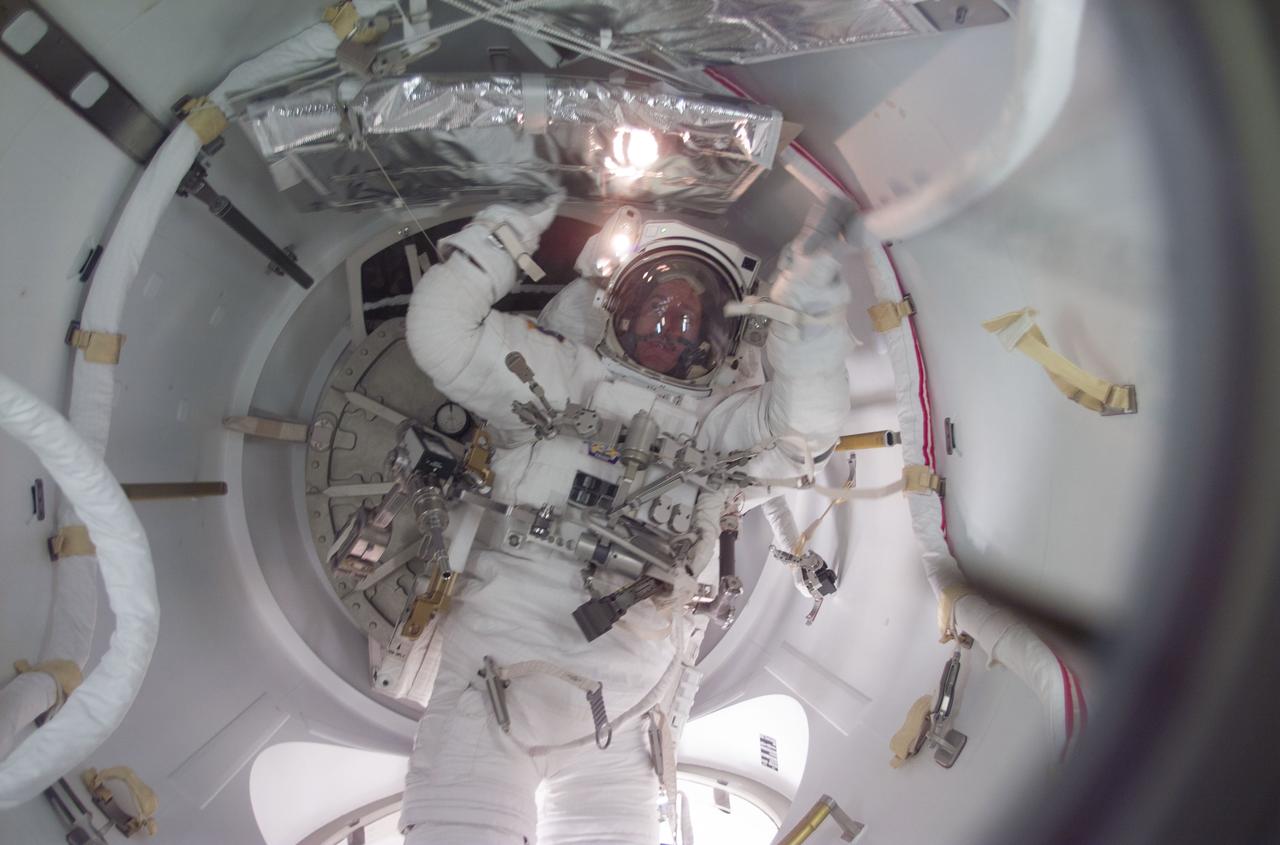
STS104-E-5234 (21 July 2001) --- A crew member used a digital still camera to take a picture of astronaut James F. Reilly in the airlock at the completion of the final STS-104 extravehicular activity (EVA).
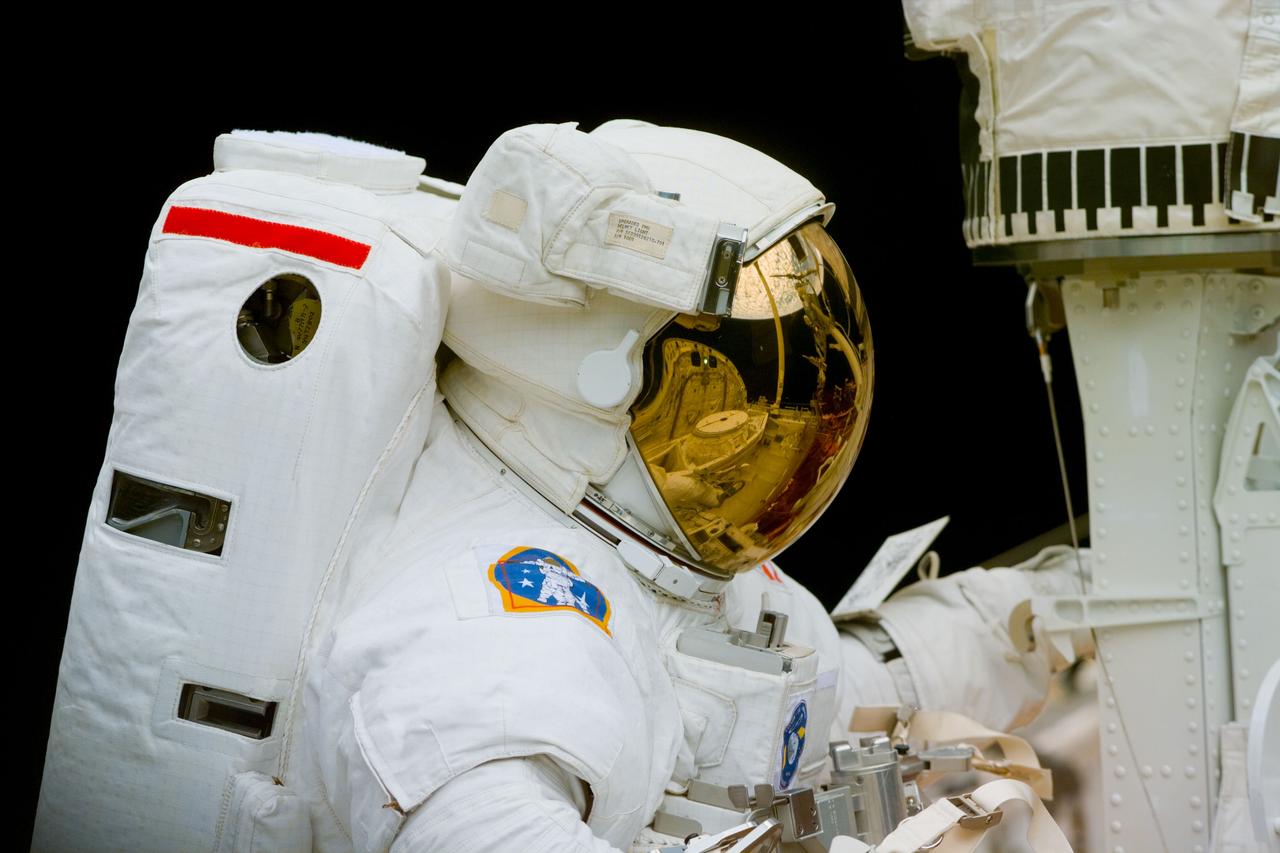
S82-E-5283 (14 Feb. 1997) --- Close-up of astronaut Mark C. Lee during Extravehicular Activity (EVA) of the Hubble Space Telescope (HST) repair mission. This view was taken with an Electronic Still Camera (ESC).
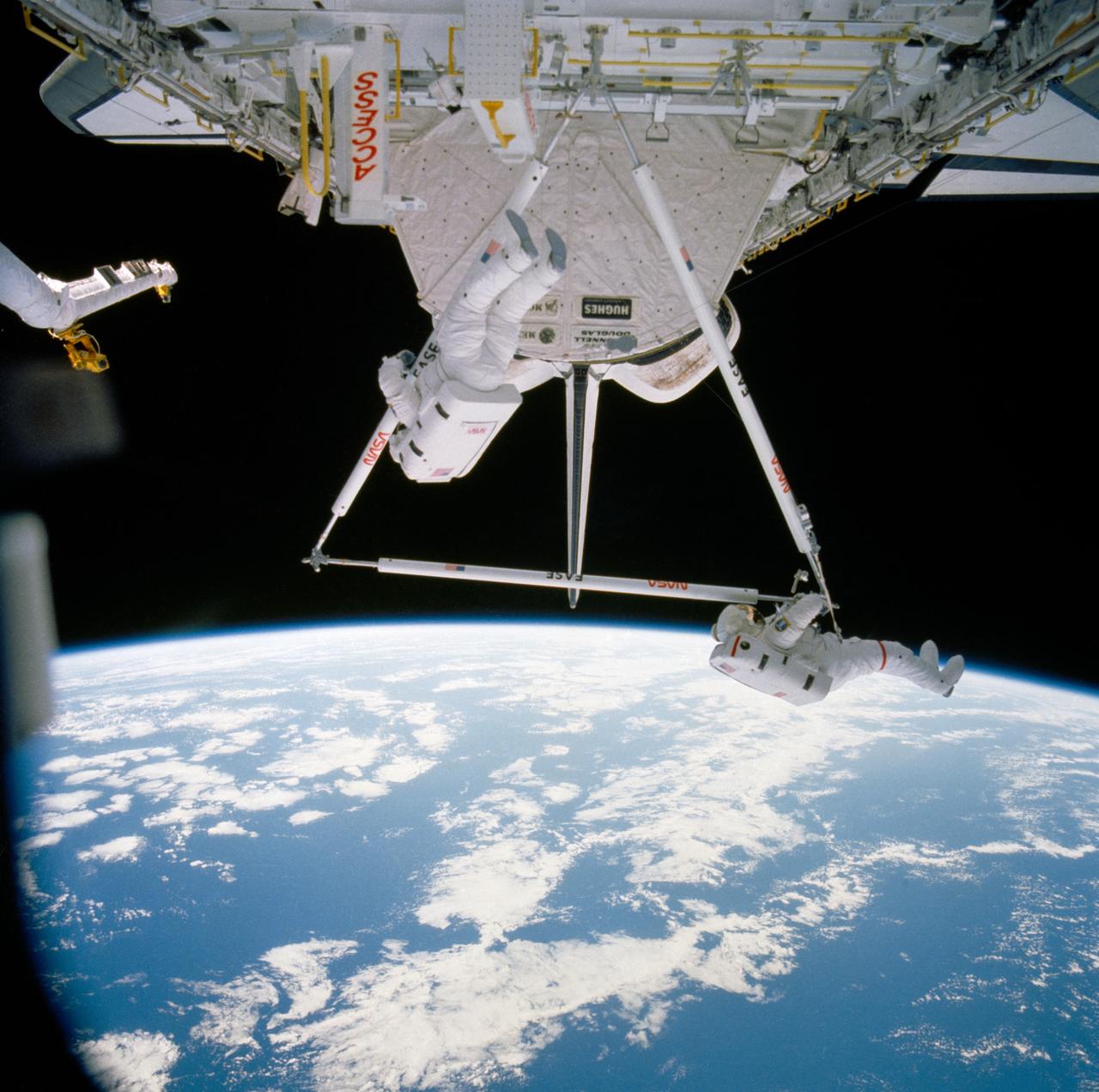
Astronauts Jerry L. Ross (left) and Sherwood C. (Woody) Spring are photographed as they assemble pieces of the Experimental Assembly of Structures in Extravehicular Activities (EASE) device in the open payload bay. The Canadian-built remote manipulator system (RMS) arm (partially obscured in the right portion of the frame) is in position to allow television cameras to record the activity.
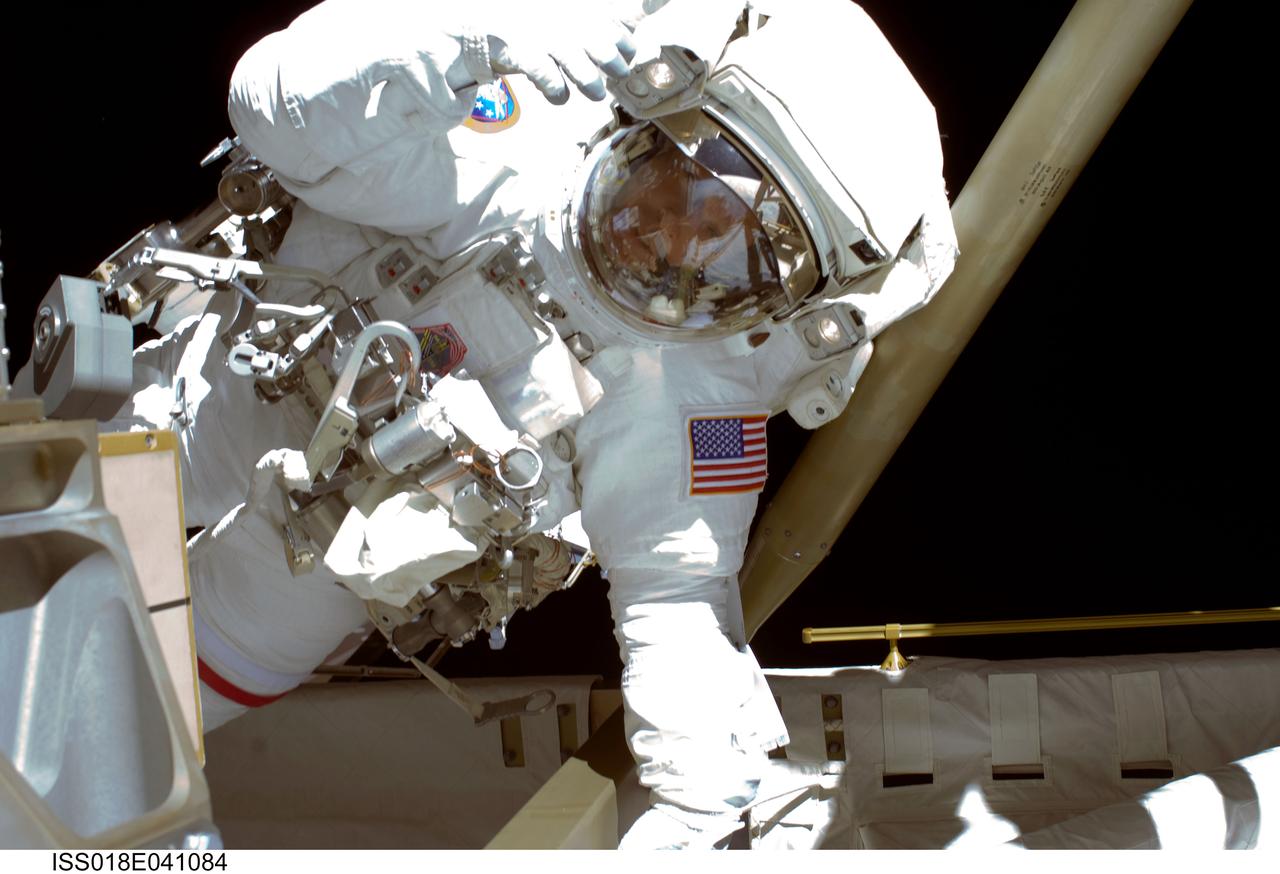
ISS018-E-041084 (19 March 2009) --- Astronaut Steve Swanson, STS-119 mission specialist, participates in the mission's first scheduled session of extravehicular activity (EVA) as construction and maintenance continue on the International Space Station. During the six-hour, seven-minute spacewalk, Swanson and astronaut Richard Arnold (out of frame), mission specialist, connected bolts to permanently attach the S6 truss segment to S5. The spacewalkers plugged in power and data connectors to the truss, prepared a radiator to cool it, opened boxes containing the new solar arrays and deployed the Beta Gimbal Assemblies containing masts that support the solar arrays.
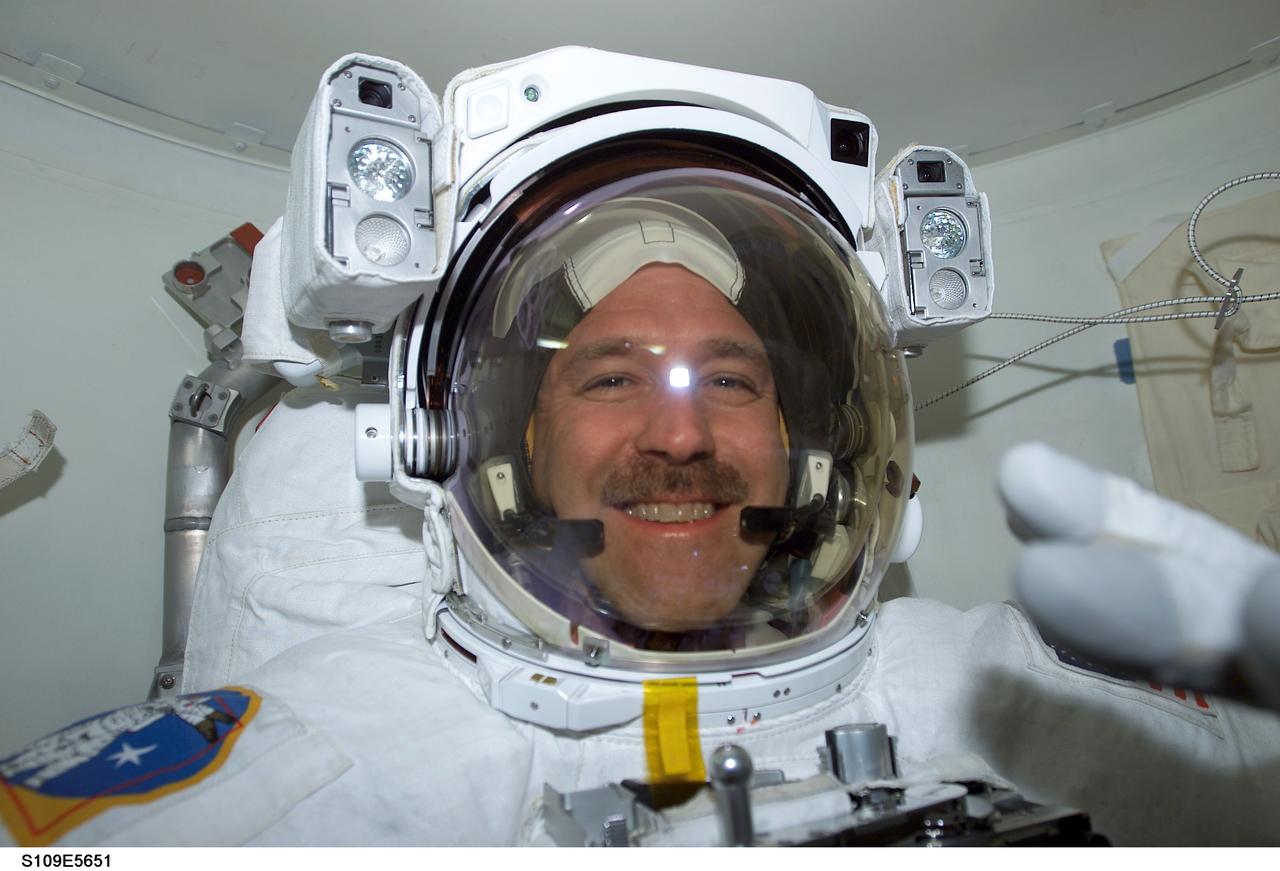
STS109-E-5651 (6 March 2002) --- Astronaut John M. Grunsfeld, payload commander, has donned his extravehicular mobility unit (EMU) space suit and appears ready to begin the middle of five scheduled STS-109 space walks to perform work on the Hubble Space Telescope (HST). Astronauts Grunsfeld and Richard M. Linnehan are scheduled for three shared days of extravehicular activity (EVA). The two mission specialists shared an extravehicular activity (EVA) just two days ago, successfully replacing the starboard solar array on the Hubble. This image was recorded with a digital still camera.
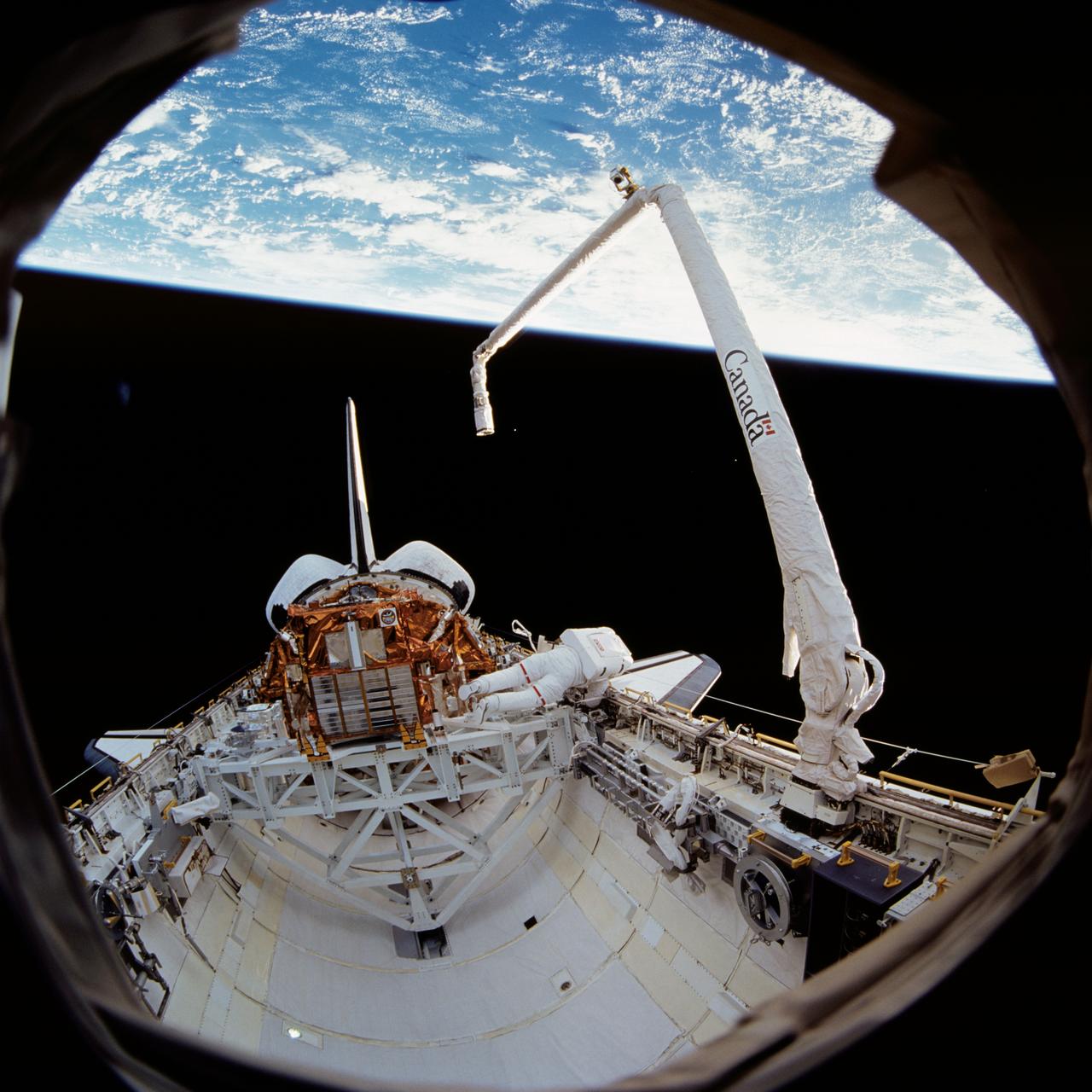
STS072-722-041 (17 Jan. 1996) --- Astronaut Winston E. Scott traverses the portside of the Space Shuttle Endeavour's cargo bay during the second of two Extravehicular Activities (EVA) to demonstrate space station assembly techniques. A 30mm lens on a 70mm handheld camera gives a "fish-eye" effect to the scene. Both the Japanese Space Flyer Unit (SFU) and the Office of Aeronautics and Space Technology (OAST) Flyer satellite are in their stowed positions. TV cameras on the Remote Manipulator System (RMS) provided live coverage of the activity.
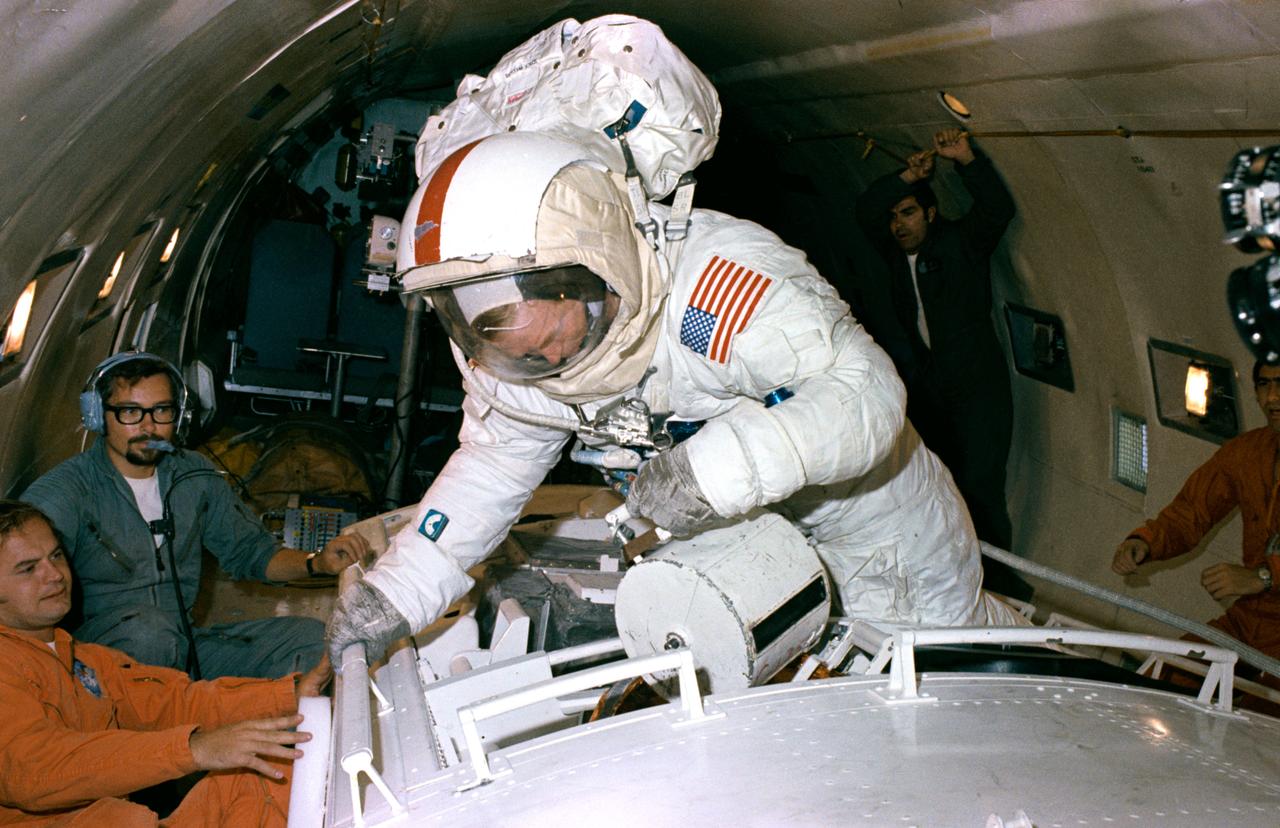
S72-50271 (September 1972) --- Astronaut Stuart A. Roosa, backup crew command module pilot of the Apollo 17 lunar landing mission, participates in extravehicular activity simulation training under zero-gravity conditions aboard a U. S. Air Force KC-135 aircraft. A mock-up of the Scientific Instrument Module (SIM) bay of the Apollo 17 Service Module is used in the exercise. Here, Roosa simulates retrieving the film cassette of the Mapping Camera from the SIM bay. Astronaut Ronald E. Evans, Apollo 17 prime crew command module pilot, is scheduled to receive film cassettes from the Mapping Camera, Panoramic Camera, and Lunar Sounder during Apollo 17 trans-Earth extravehicular activity.
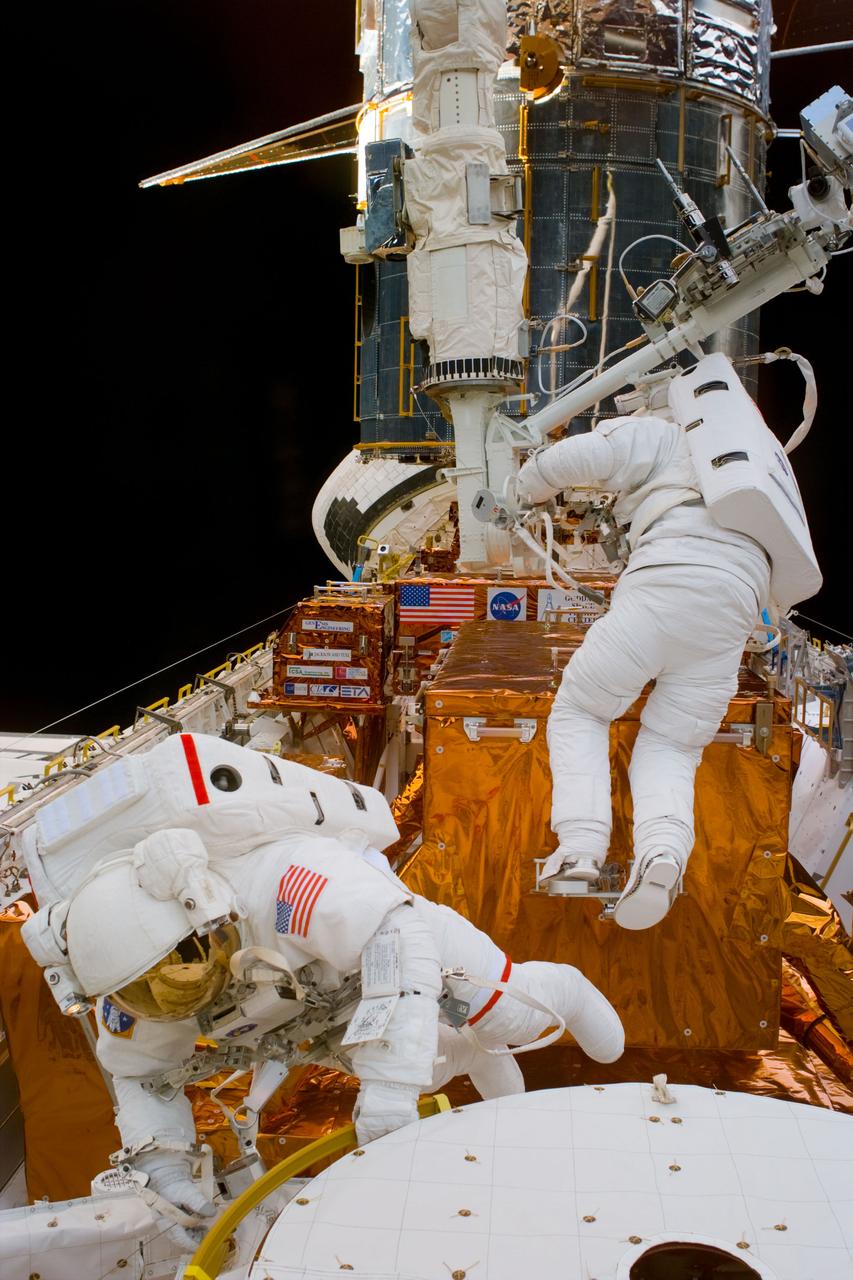
S82-E-5279 (14 Feb. 1997) --- Astronaut Mark C. Lee, STS-82 payload commander (in foreground) and Steven L. Smith during Extravehicular Activity (EVA) setup. This view was taken with an Electronic Still Camera (ESC).
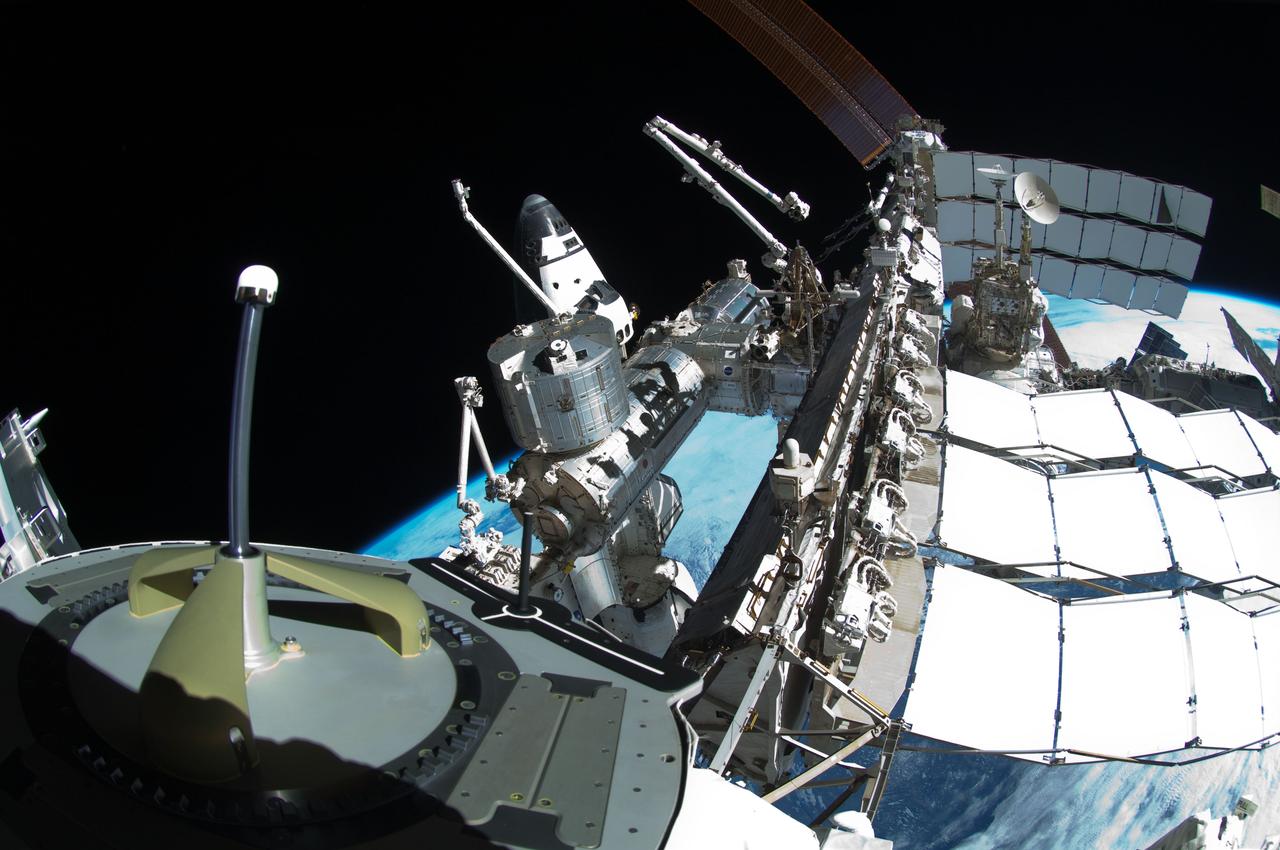
ISS028-E-005680 (27 May 2011) --- A portion of the International Space Station and the docked space shuttle Endeavour are featured in this image photographed by a spacewalker, using a fish-eye lens attached to an electronic still camera, during the STS-134 mission?s fourth session of extravehicular activity (EVA).
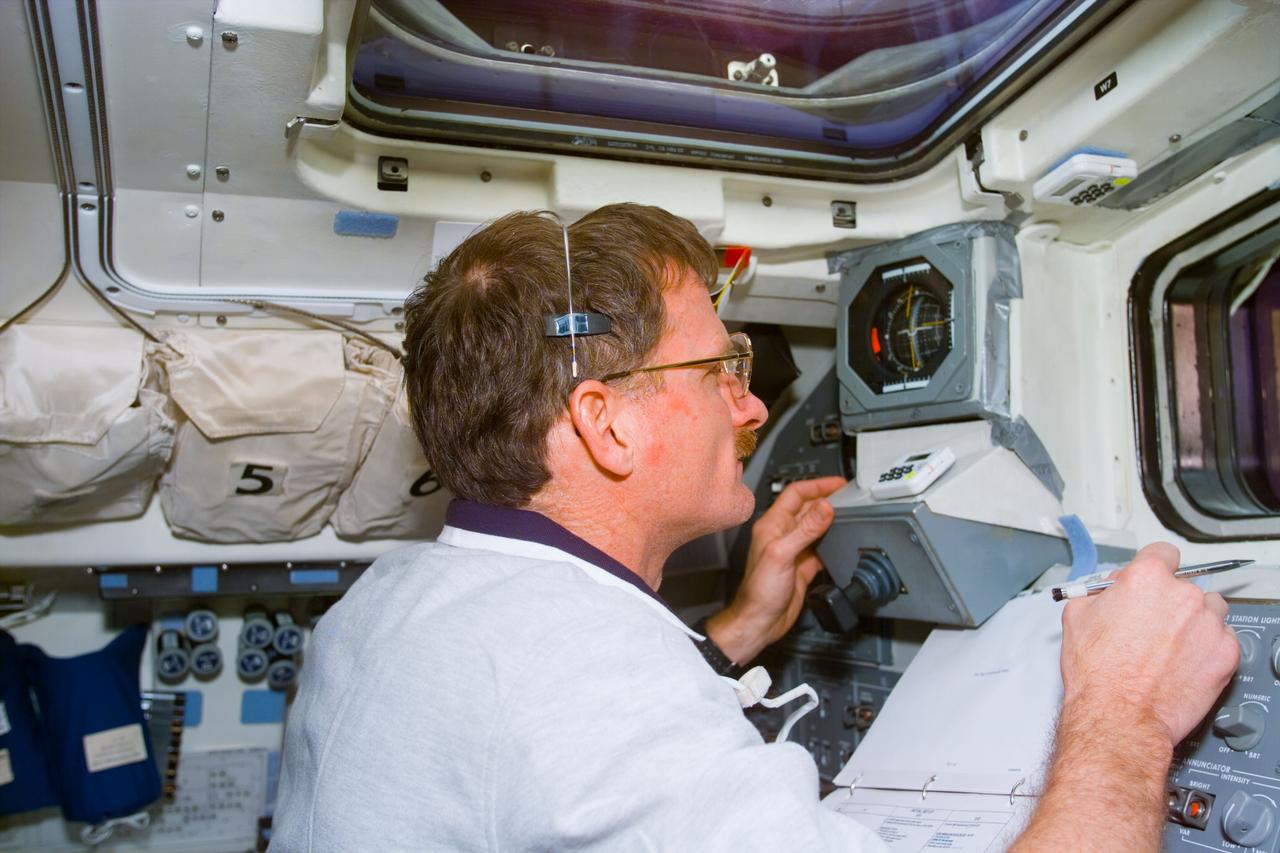
S82-E-5694 (18 Feb. 1997) --- Astronaut Joseph R. Tanner watches two astronauts at work in the Space Shuttle Discovery's cargo bay from aft flight deck during final Extravehicular Activity (EVA-5). This view was taken with an Electronic Still Camera (ESC).
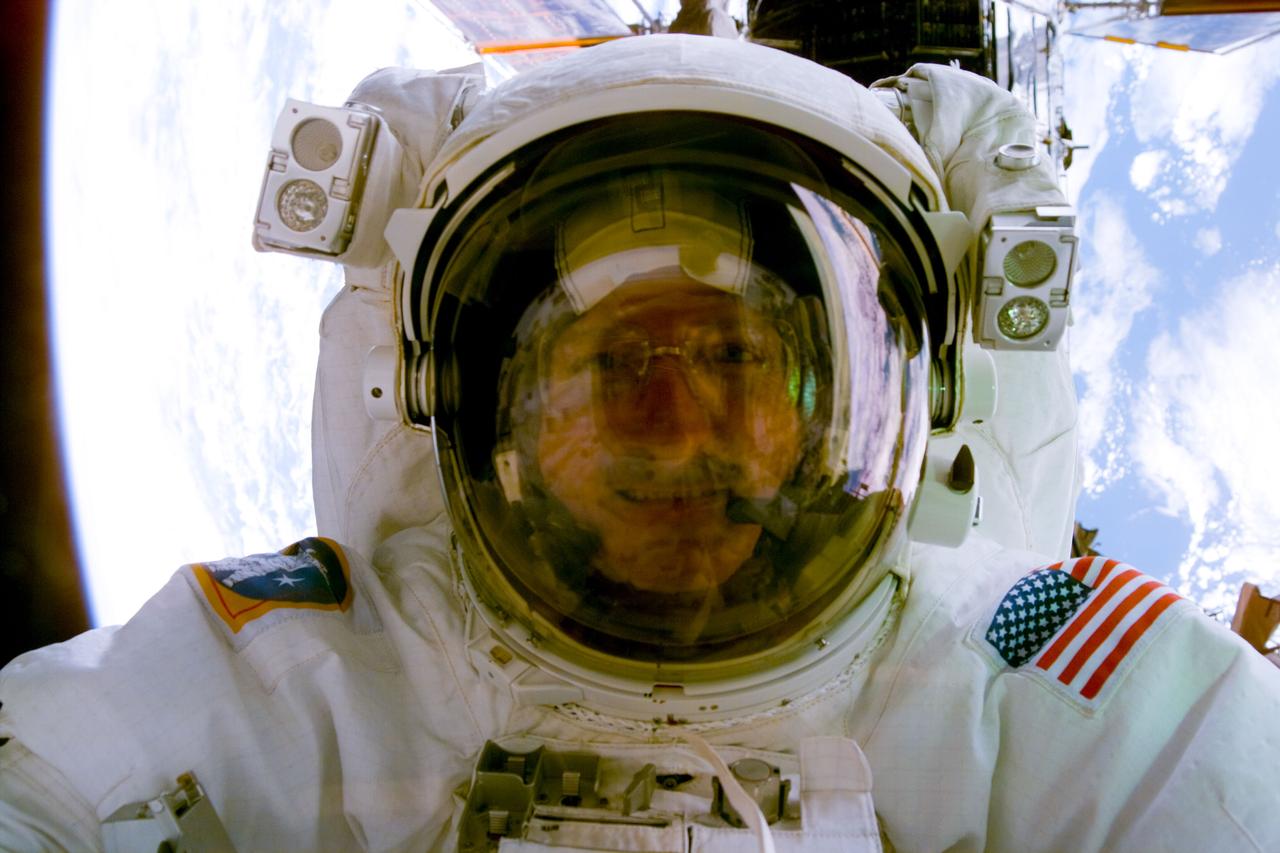
ISS028-E-005584 (25 May 2011) --- NASA astronaut Michael Fincke, STS-134 mission specialist, uses a digital still camera during the STS-134 mission’s third session of extravehicular activity (EVA) as construction and maintenance continue on the International Space Station.
S82-E-5435 (15 Feb. 1997) --- Close-up view shows face of astronaut Joseph R. Tanner through his helmet visor on second Extravehicular Activity (EVA). This view was taken with an Electronic Still Camera (ESC).
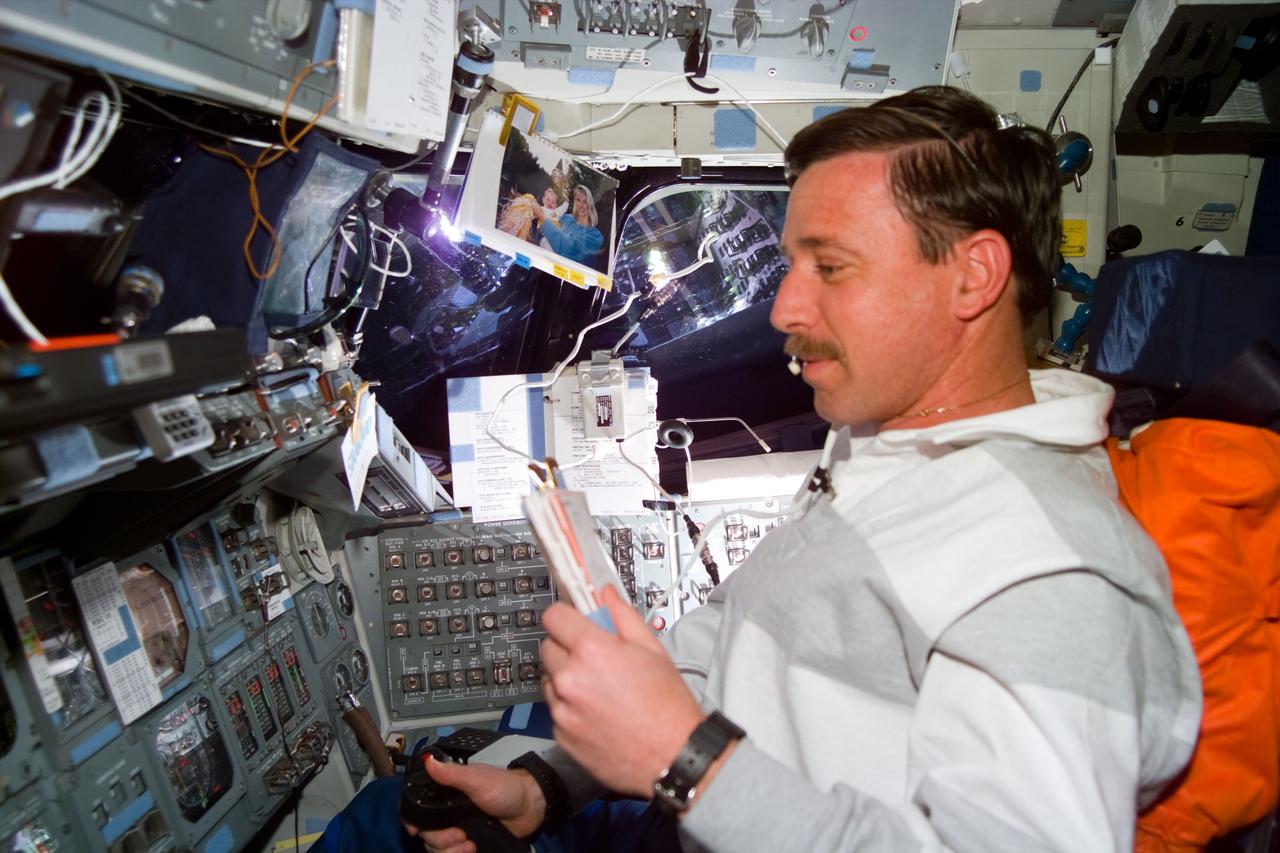
S82-E-5436 (15 Feb. 1997) --- Astronaut Scott J. Horowitz, STS-82 pilot, at pilot's station during second Extravehicular Activity (EVA) by two of his crew mates. This view was taken with an Electronic Still Camera (ESC).
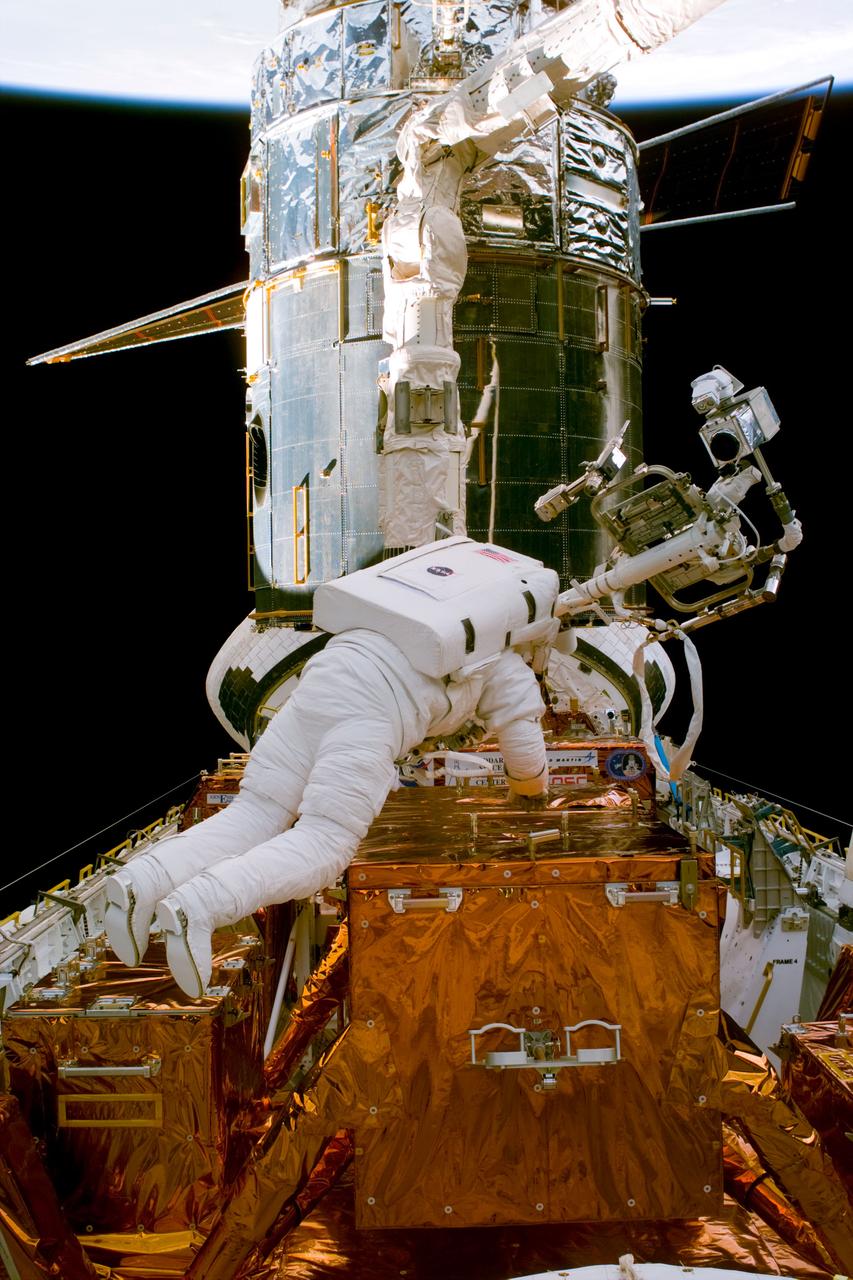
S82-E-5278 (14 Feb. 1997) --- Astronaut Steven L. Smith, STS-82 mission specialist, during Extravehicular Activity (EVA) setup, for the Hubble Space Telescope (HST) repair. This view was taken with an Electronic Still Camera (ESC).
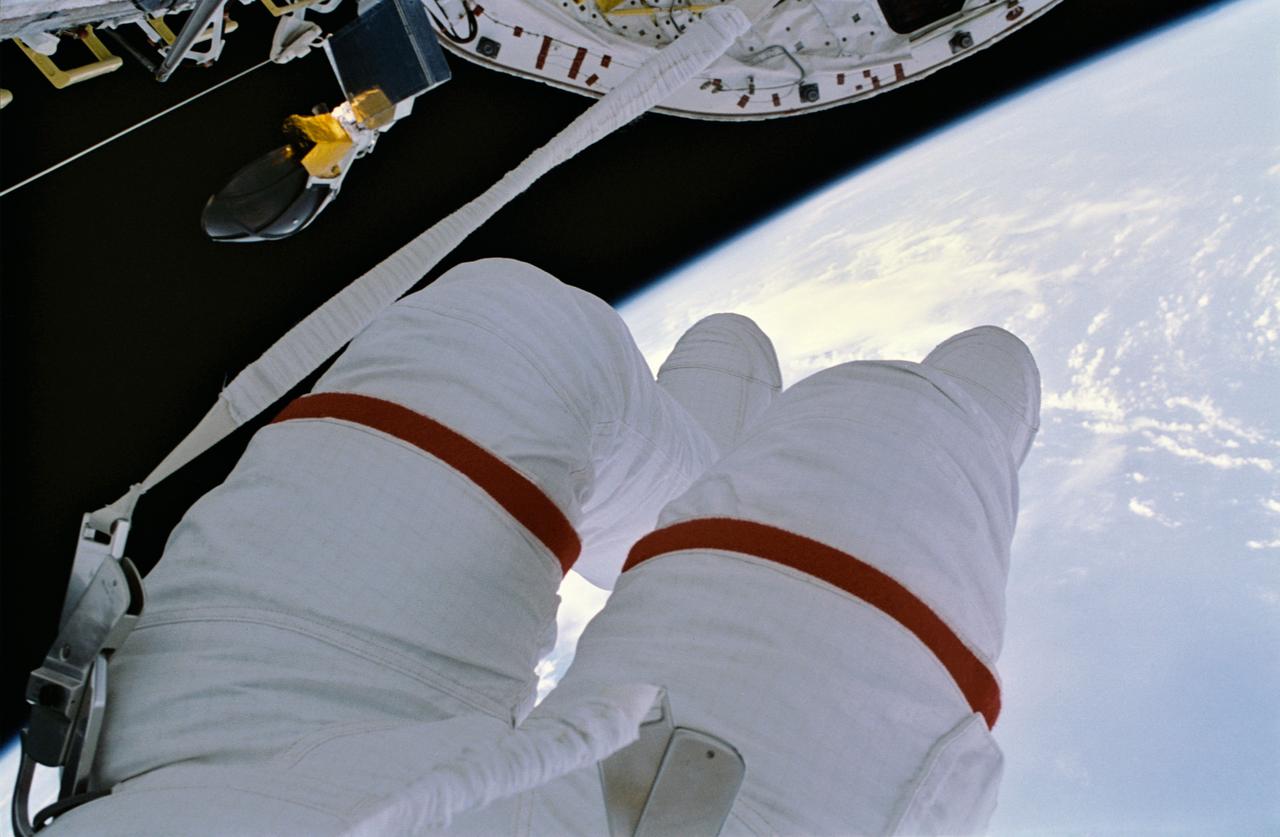
STS054-29-028 (17 Jan 1993) --- Astronaut Gregory J. Harbaugh, mission specialist, used a 35mm camera to photograph his legs and feet during the four-plus hours extravehicular activity (EVA) to depict the vast void below. Harbaugh was joined on the EVA by astronaut Mario Runco Jr., mission specialist.
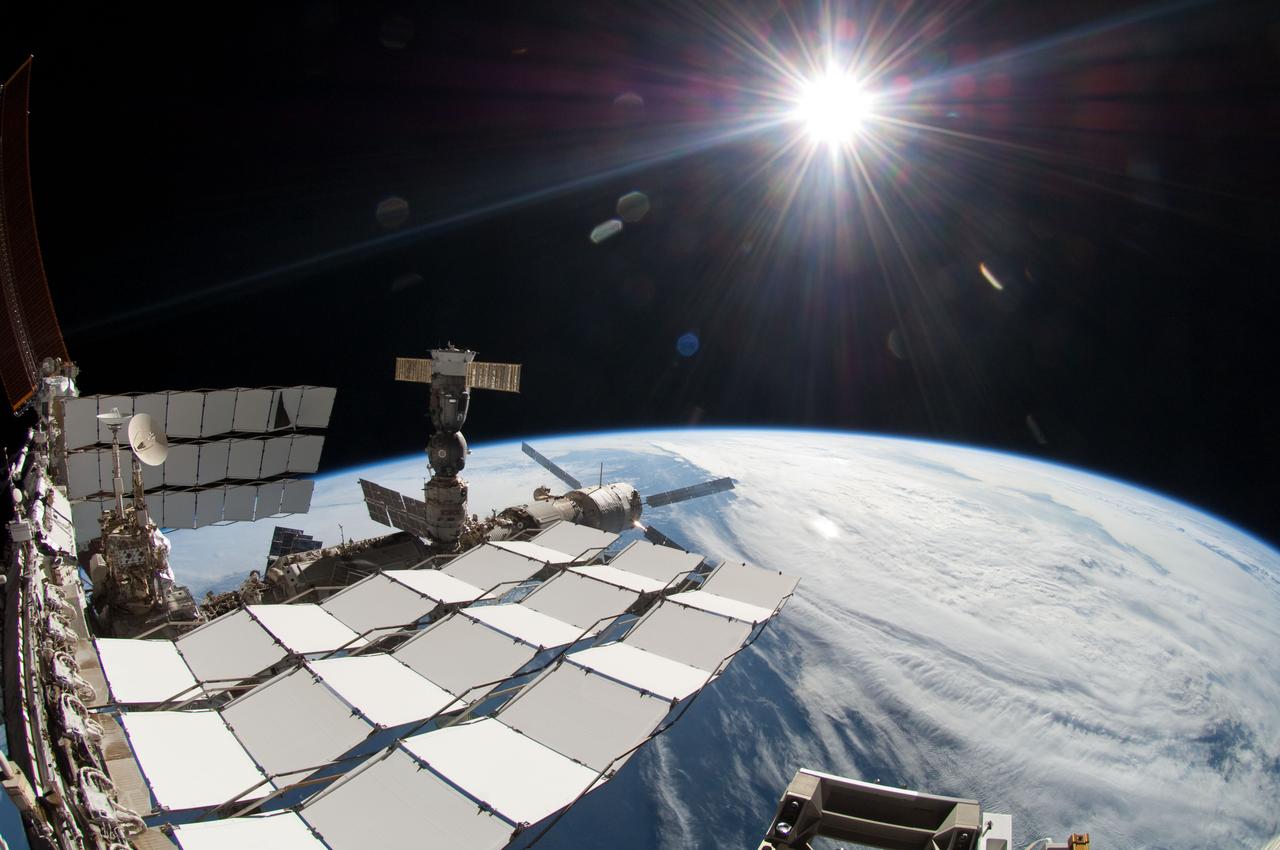
ISS028-E-005671 (27 May 2011) --- A bright sun, a portion of the International Space Station and Earth?s horizon are featured in this image photographed by a spacewalker, using a fish-eye lens attached to an electronic still camera, during the STS-134 mission?s fourth session of extravehicular activity (EVA).
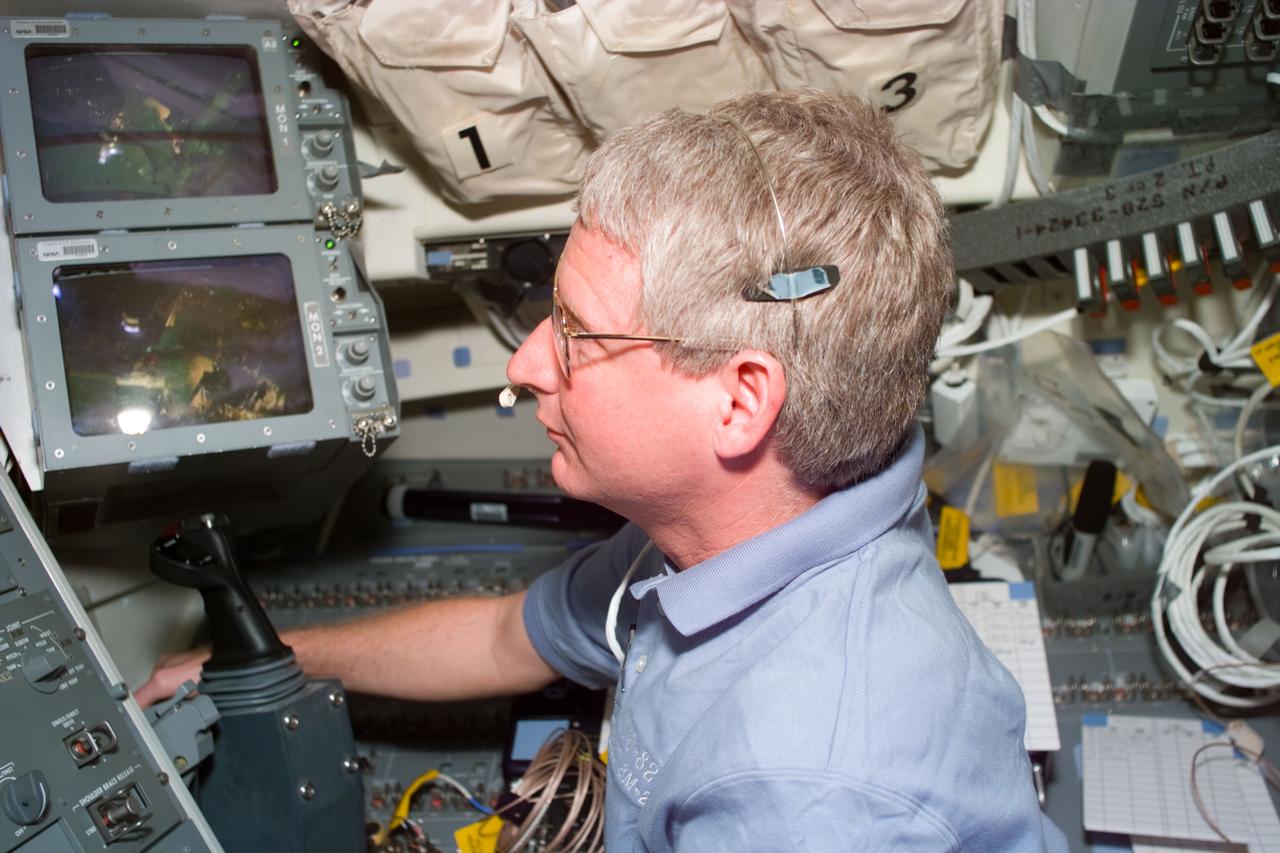
S82-E-5568 (16 Feb. 1997) --- Astronaut Steven A. Hawley, at controls for Remote Manipulator System (RMS), during third Extravehicular Activity (EVA). Hawley had been a mission specialist for the NASA mission which deployed the giant HST in 1990. This view was taken with an Electronic Still Camera (ESC).
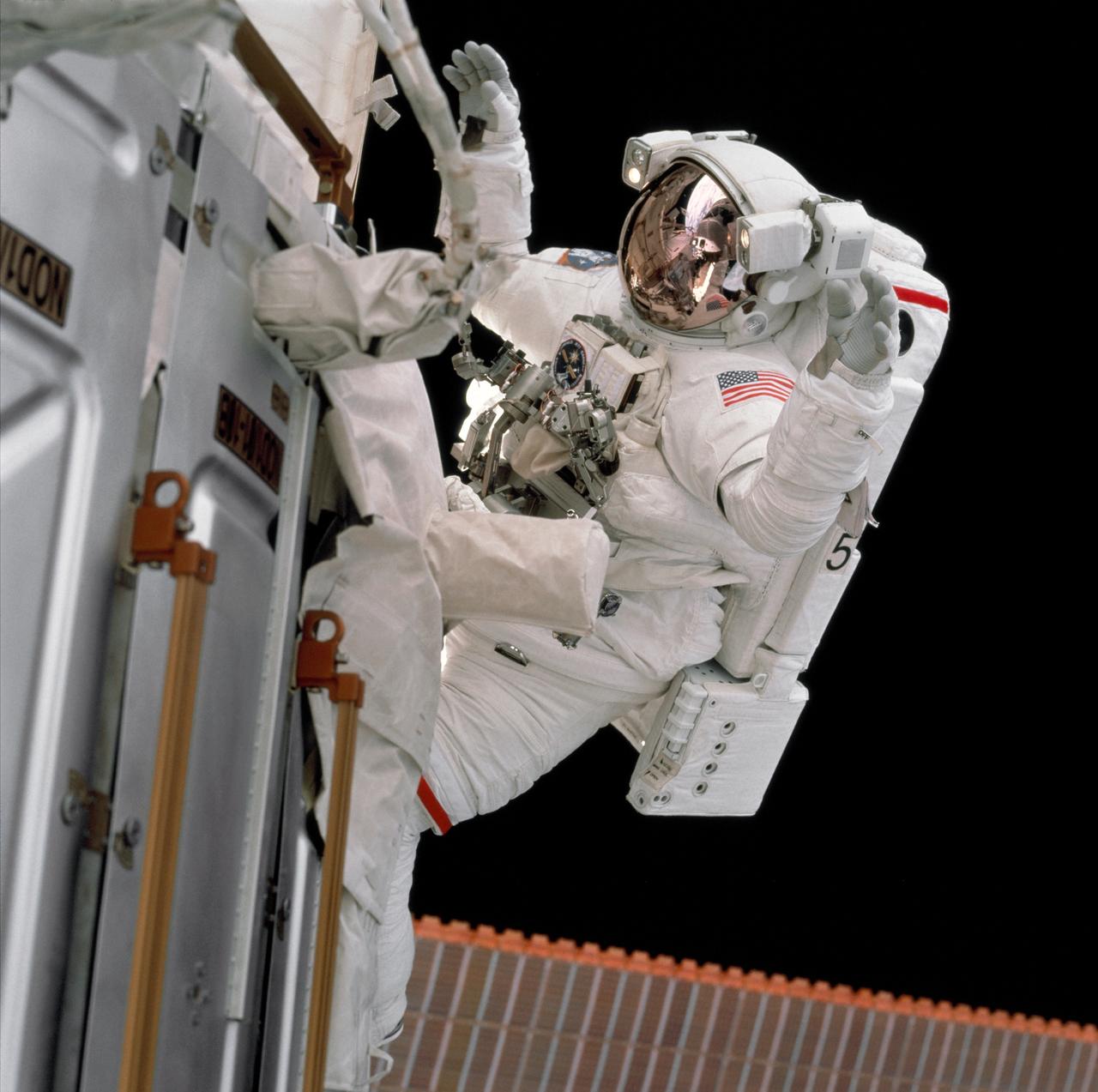
STS097-703-001 (7 December 2000) --- Astronaut Joseph R. Tanner participates in the December 7 extravehicular activity (EVA), one of three space walks involving him and astronaut Carlos I. Noriega. The photograph was taken by one of the non-EVA STS-97 crew members, using a 70mm camera.
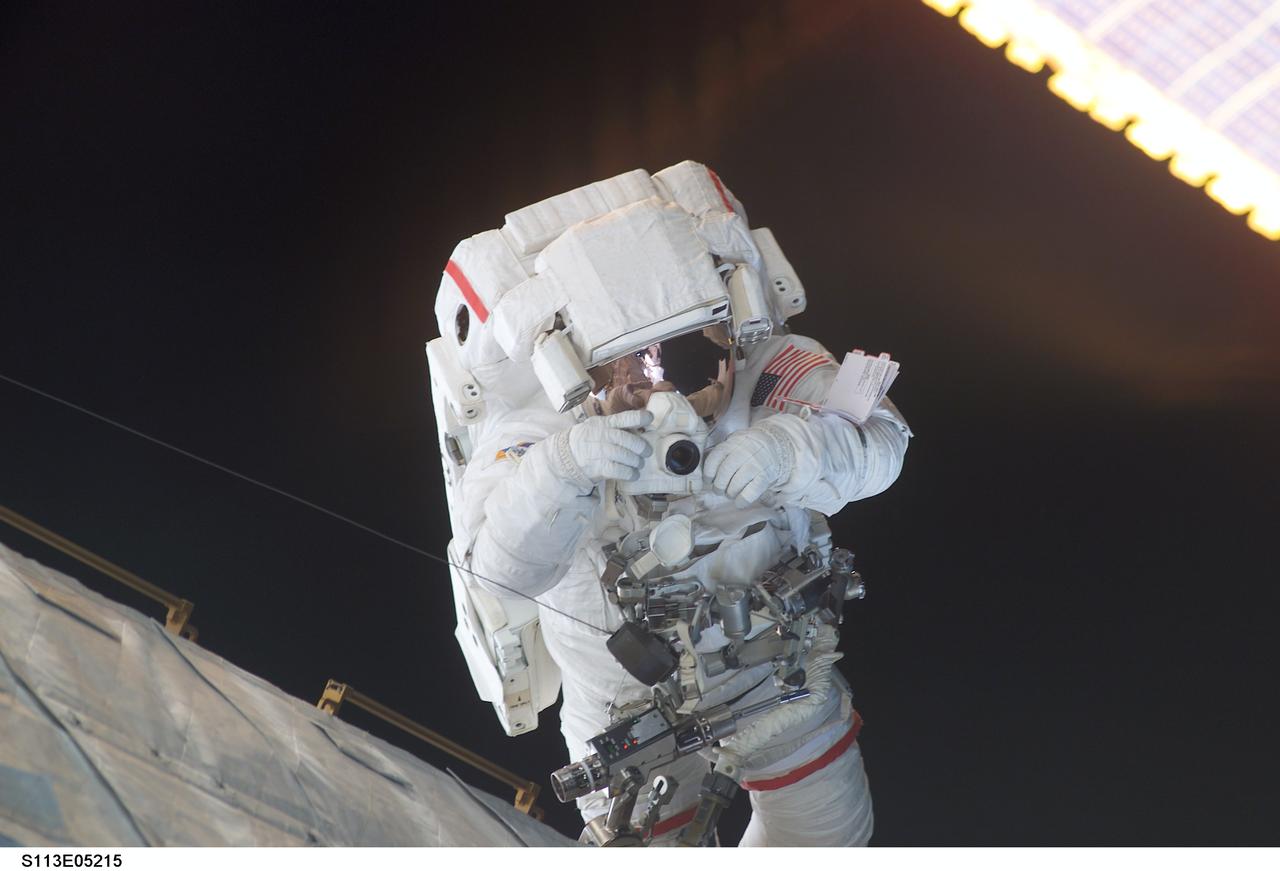
STS113-E-05215 (28 November 2002) --- Astronaut Michael E. Lopez-Alegria, STS-113 mission specialist, uses a camera during the mission’s second scheduled session of extravehicular activity (EVA). The spacewalk lasted 6 hours, 10 minutes.
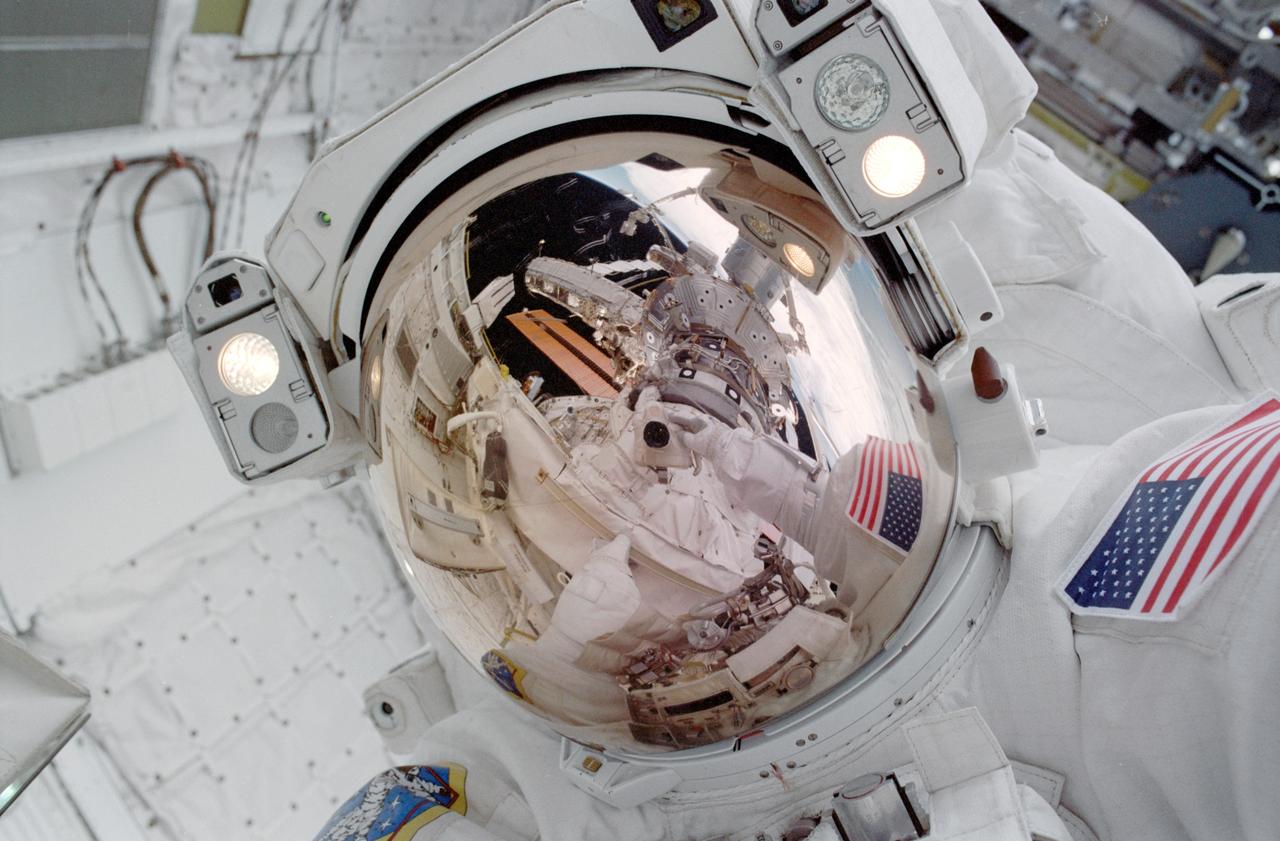
STS114-323-007 (30 July 2005) --- Astronaut Stephen K. Robinson, STS-114 mission specialist, used the pictured 35mm camera to expose a photo of his helmet visor during today;s session of extravehicular activity (EVA). A portion of the International Space Station is also visible in the reflection.
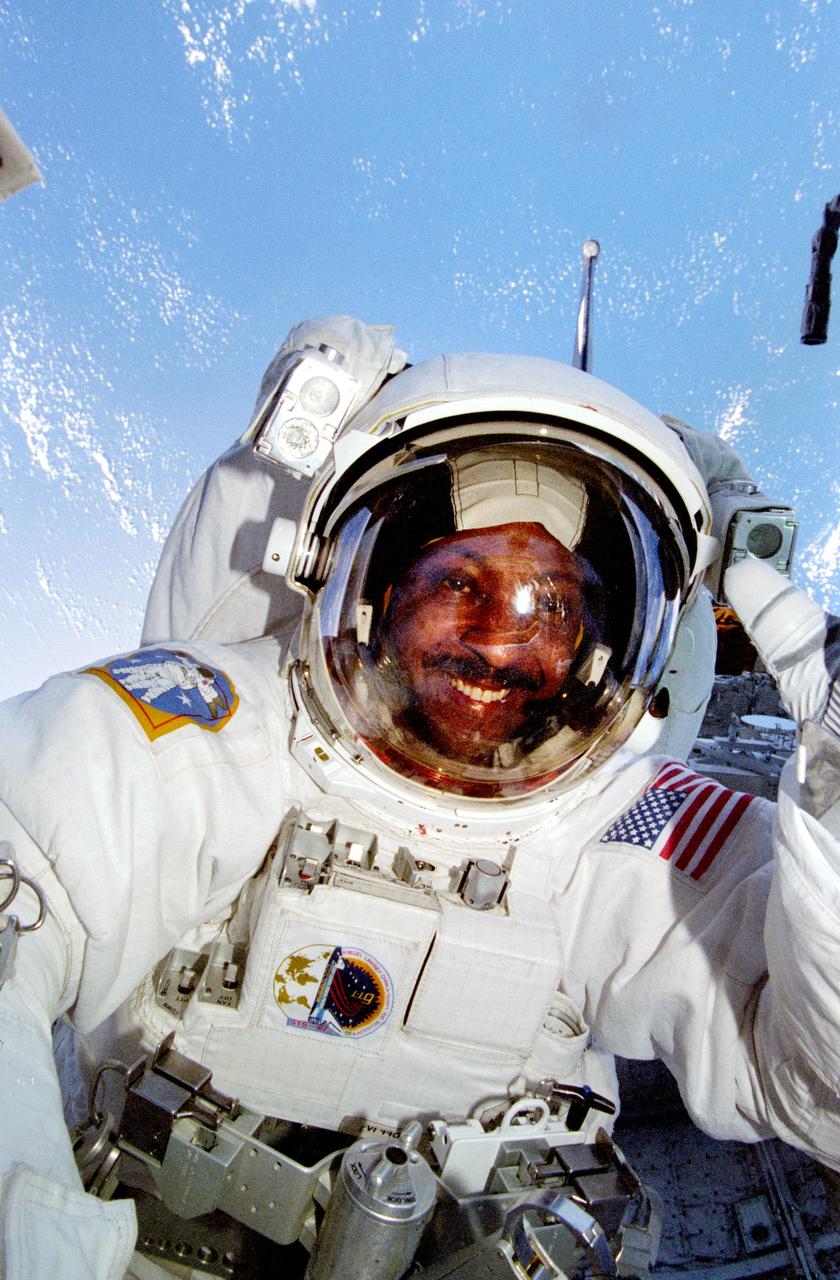
STS087-375-015 (19 November – 5 December 1997) --- Astronaut Winston E. Scott, mission specialist, during one of two extravehicular activities (EVA) in the cargo bay of the Earth-orbiting Space Shuttle Columbia, is backdropped against a blue “blanket” of ocean water. This view was taken with a 35mm camera.
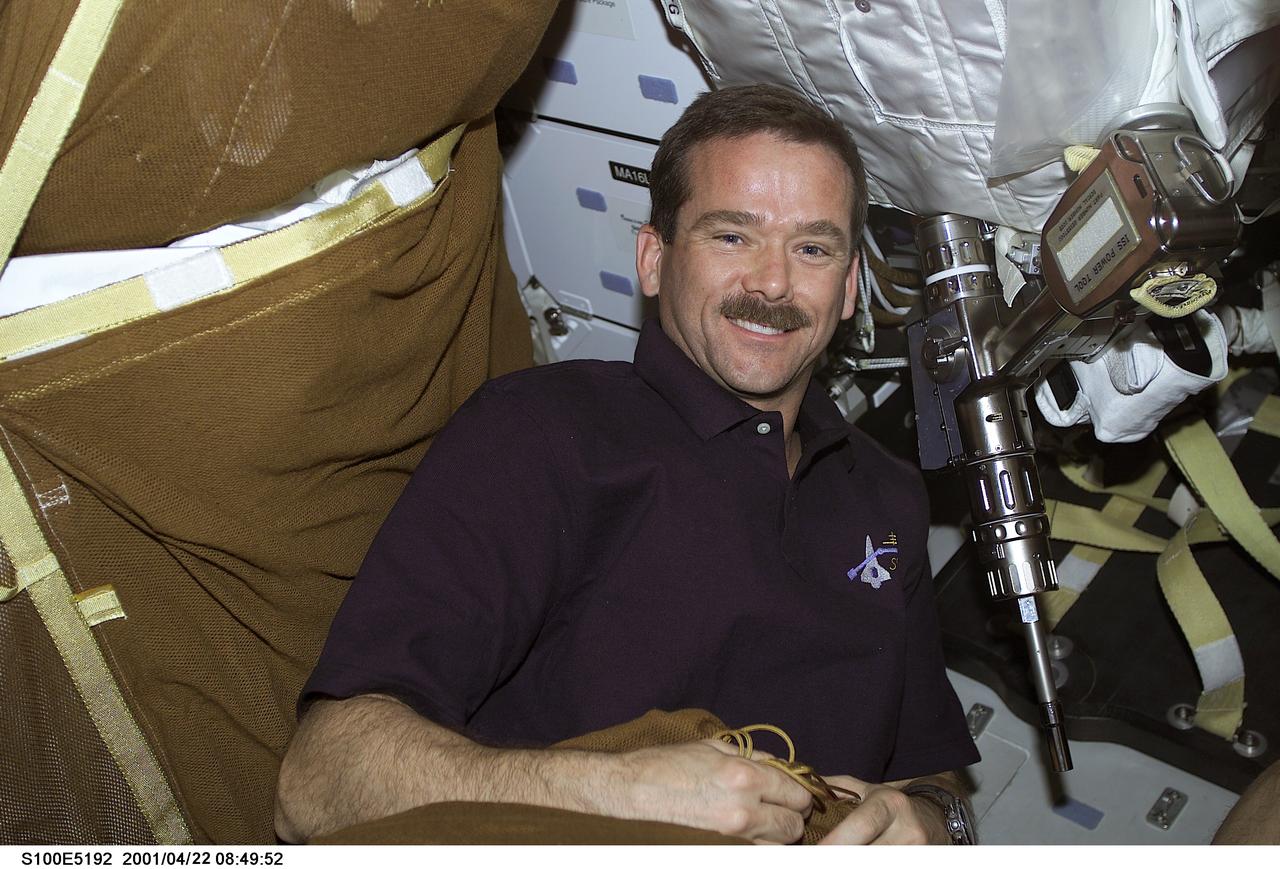
S100-E-5192 (21 April 2001) --- Astronaut Chris A. Hadfield of the Canadian Space Agency (CSA), scheduled as one of two mission specialist participants in April 22 extravehicular activity (EVA) with the International Space Station (ISS), inspects equipment on the middeck of the Space Shuttle Endeavour. The image was recorded with a digital still camera.
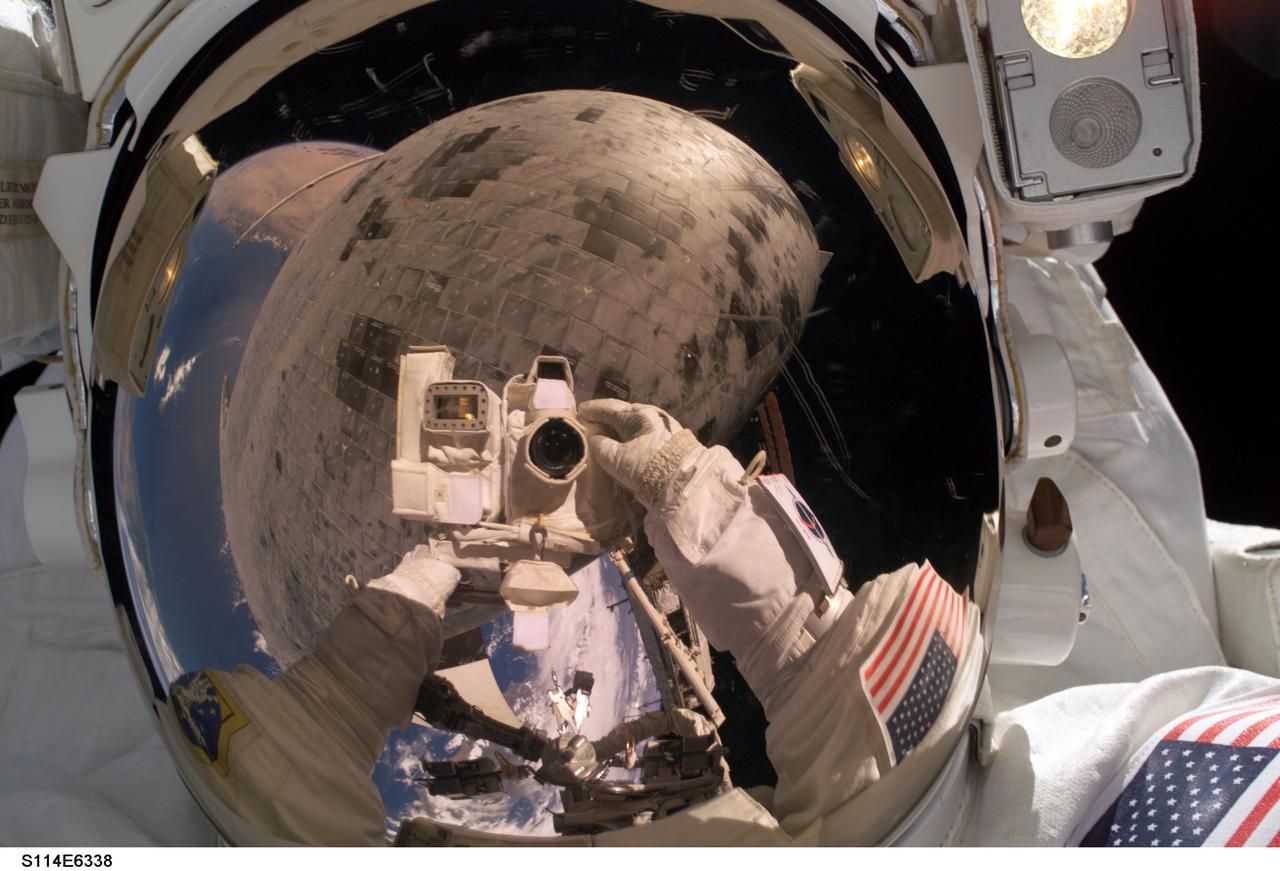
S114-E-6338 (3 August 2005) --- Astronaut Stephen K. Robinson, STS-114 mission specialist, used the pictured digital camera to expose a photo of his helmet visor during today;s extravehicular activities (EVA). Also visible in the reflection are thermal protection tiles on Space Shuttle Discovery;s underside.
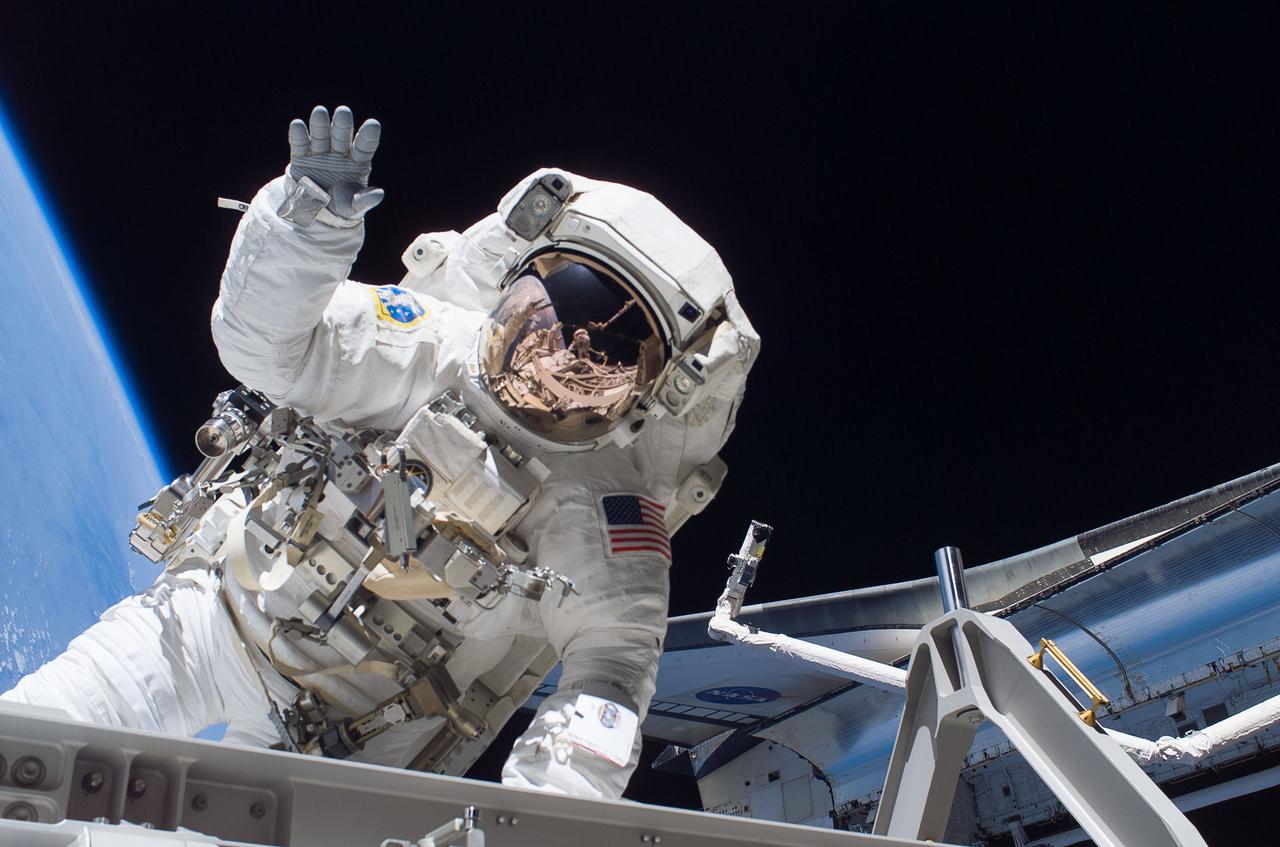
S115-E-05760 (12 Sept. 2006) --- Astronaut Heidemarie M. Stefanyshyn-Piper, STS-115 mission specialist, waves to the camera while participating in the first of three sessions of extravehicular activity (EVA) as construction resumes on the International Space Station.
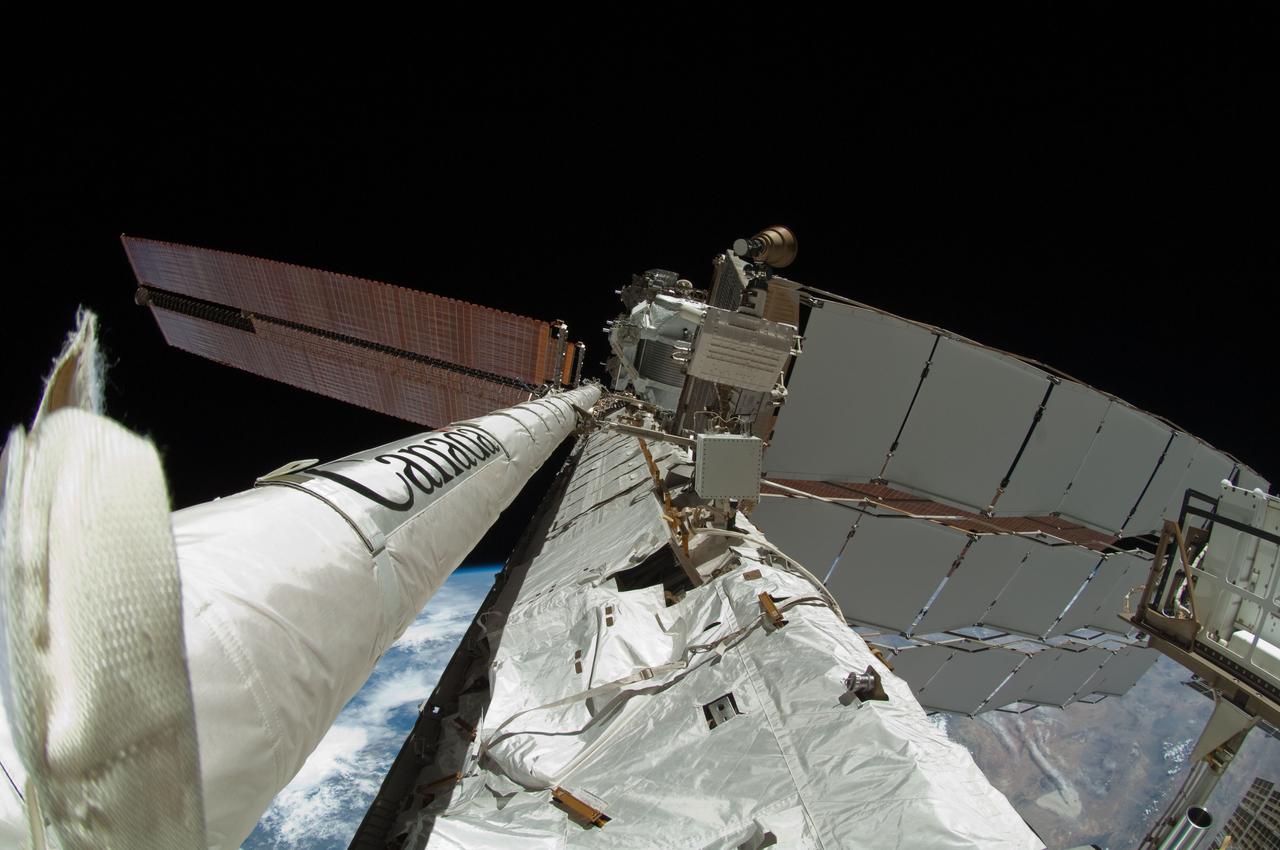
ISS028-E-005646 (27 May 2011) --- The newly-attached 50-foot-long Enhanced International Space Station Boom Assembly (left) is featured in this image photographed by a spacewalker, using a fish-eye lens attached to an electronic still camera, during the STS-134 mission?s fourth session of extravehicular activity (EVA).
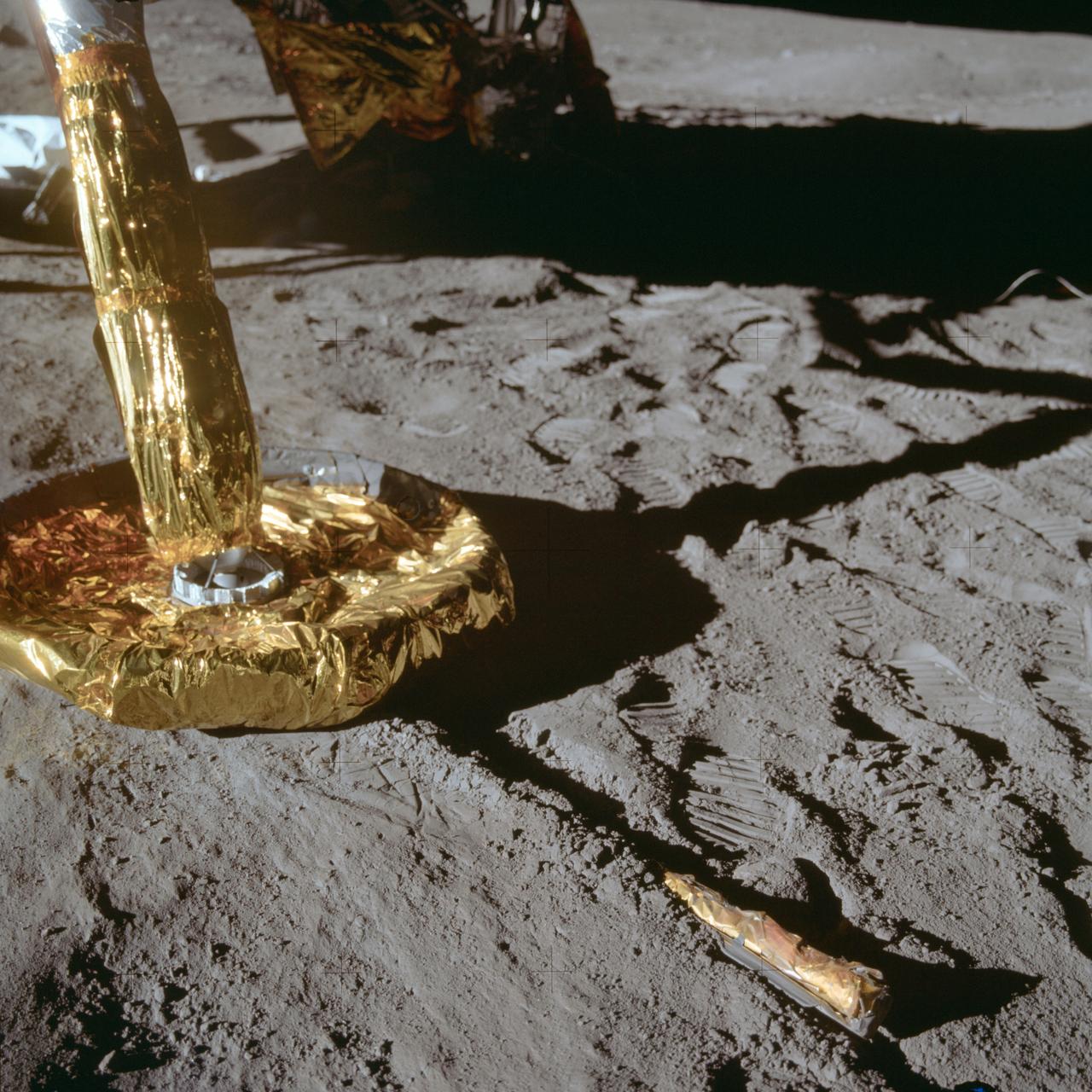
A close-up view of a footpad of the Apollo 11 Lunar Module as it rested on the surface of the Moon. The stick-like protruding object is a lunar surface sensing probe. This photograph was take with a 70mm lunar surface camera during the extravehicular activity of Astronauts Neil Armstrong and Edwin Aldrin on July 20, 1969.
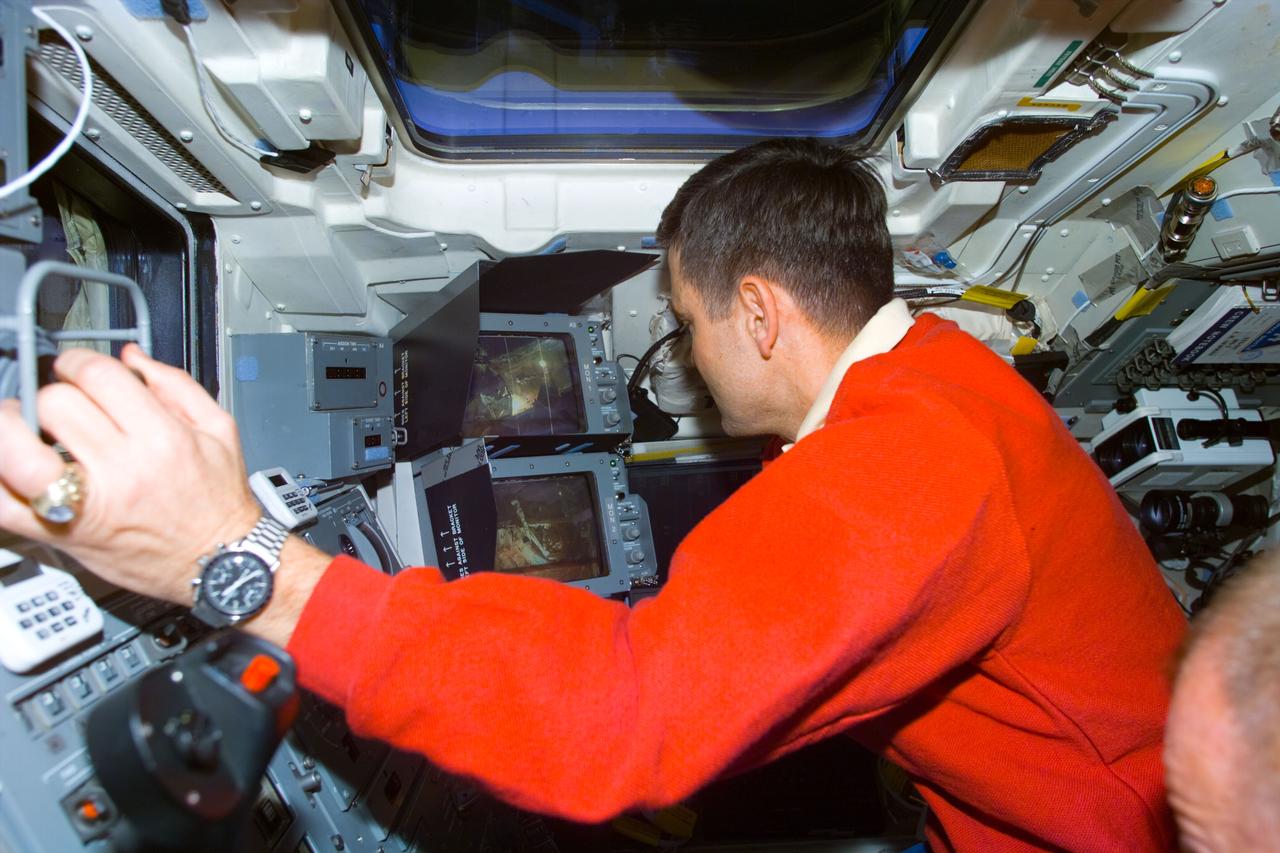
S88-E-5141 (12-12-98) --- In support of the STS-88 mission's final extravehicular activity (EVA), astronaut Robert D. Cabana, mission commander, operates controls on Endeavour's aft flight deck. The photo was taken with an electronic still camera (ESC) at 21:15:26 GMT, Dec. 12.
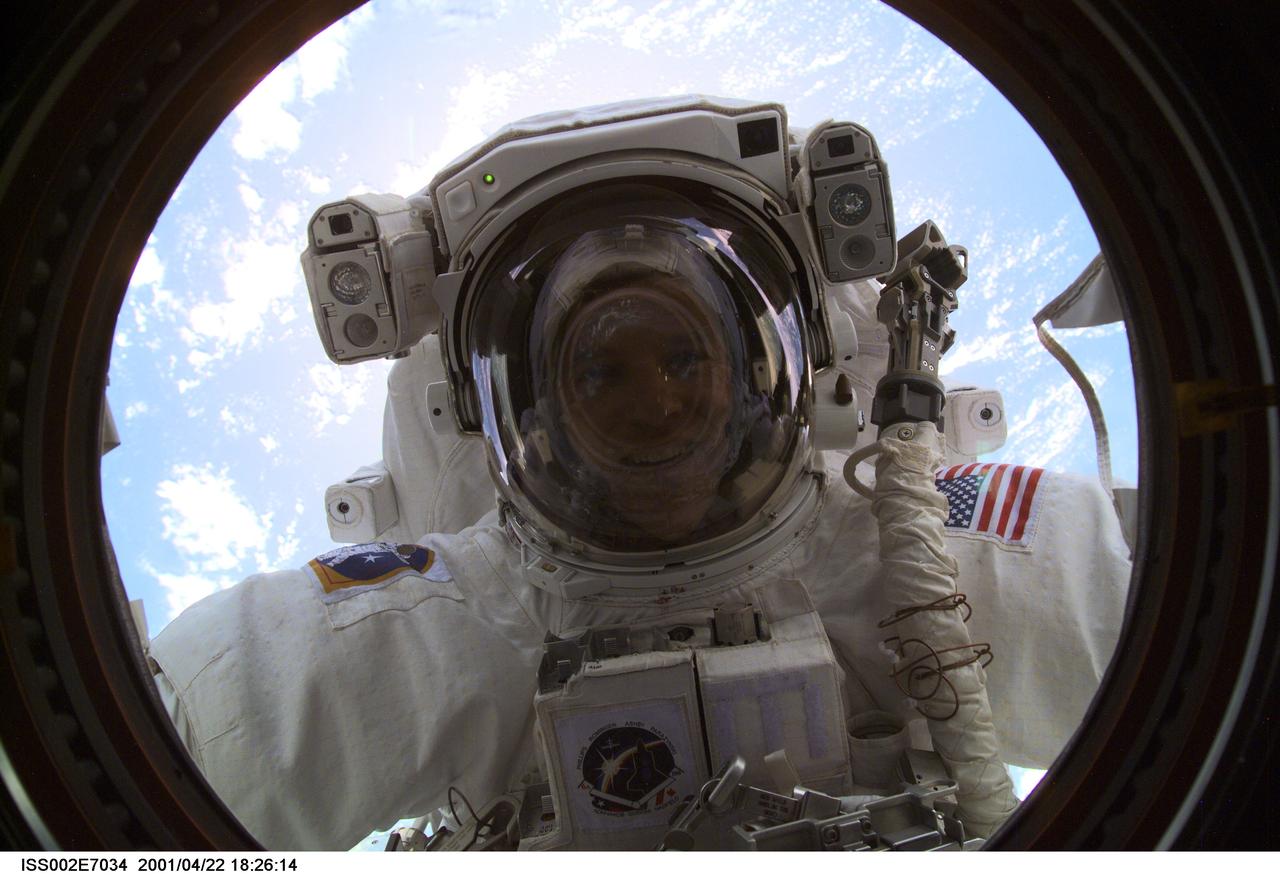
ISS002-E-7034 (22 April 2001) --- Astronaut Scott E. Parazynski, STS-100 mission specialist, peers into the Destiny Laboratory's nadir window during the first extravehicular activity of the STS-100 mission. This image was recorded with a digital still camera by an Expedition Two crew member.
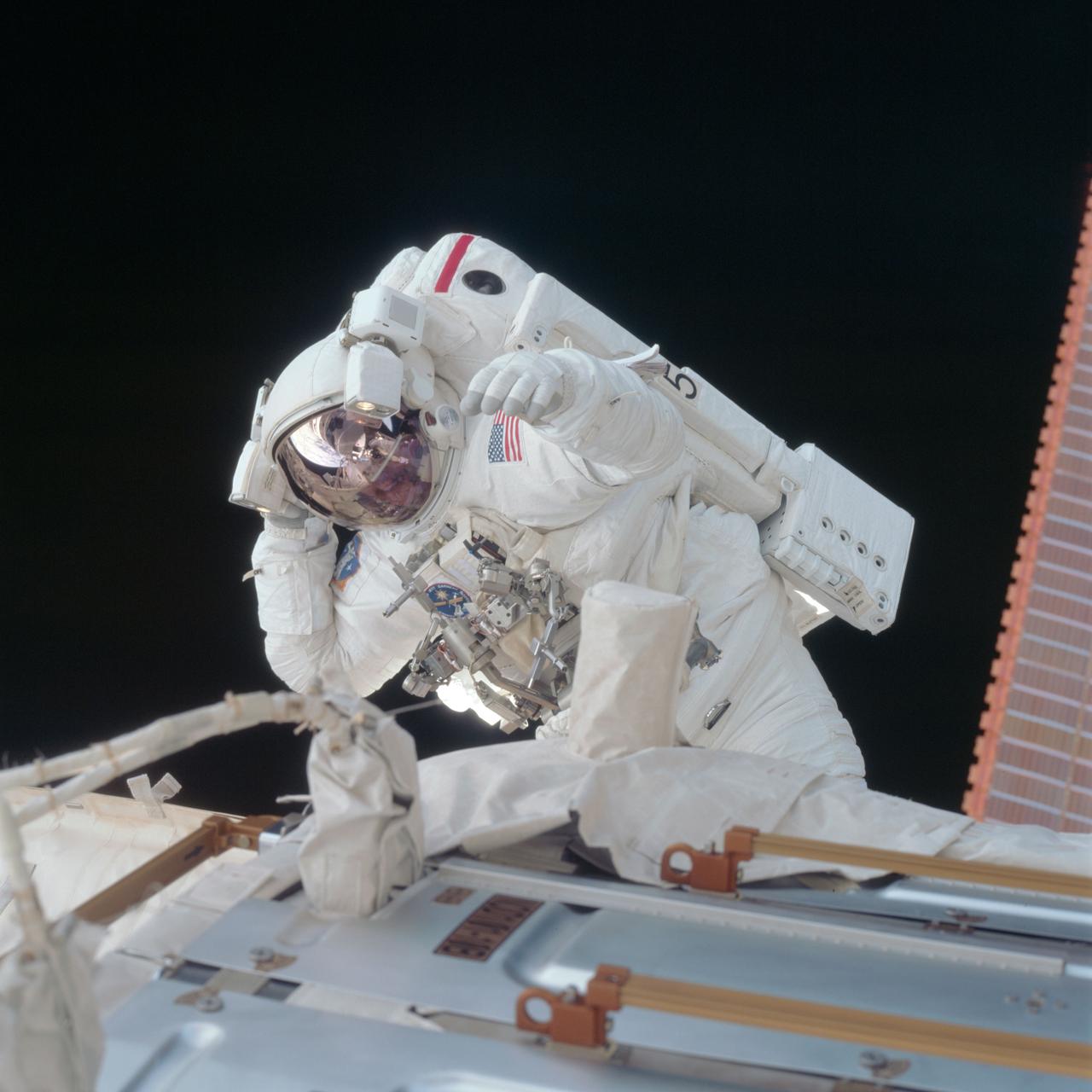
STS097-703-004 (7 December 2000) --- Astronaut Joseph R. Tanner participates in the December 7 extravehicular activity (EVA), one of three space walks involving him and astronaut Carlos I. Noriega. The photograph was taken by one of the non-EVA STS-97 crew members, using a 70mm camera.
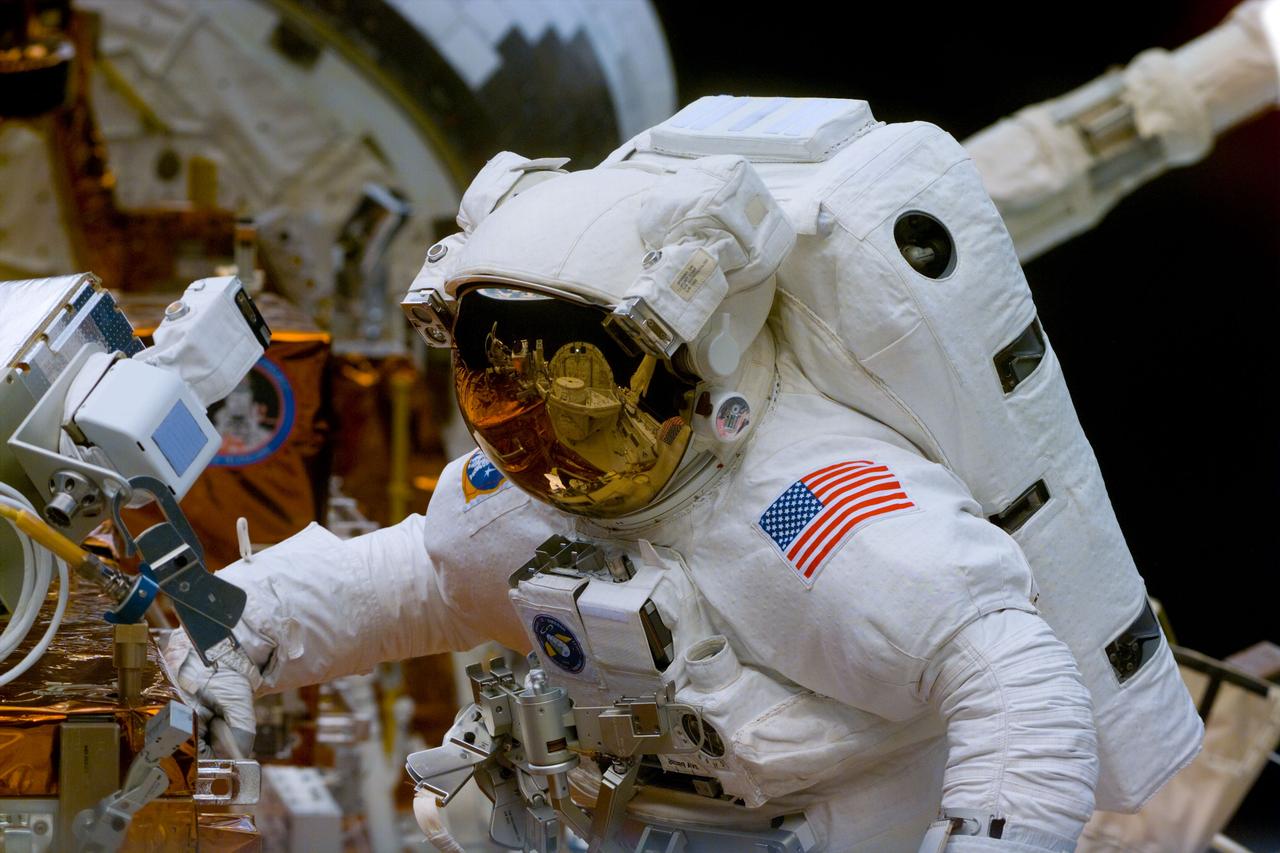
S82-E-5303 (14 Feb. 1997) --- Close-up of astronaut Steven L. Smith, STS-82 mission specialist, during Extravehicular Activity (EVA), for the Hubble Space Telescope (HST) repair. This view was taken with an Electronic Still Camera (ESC).
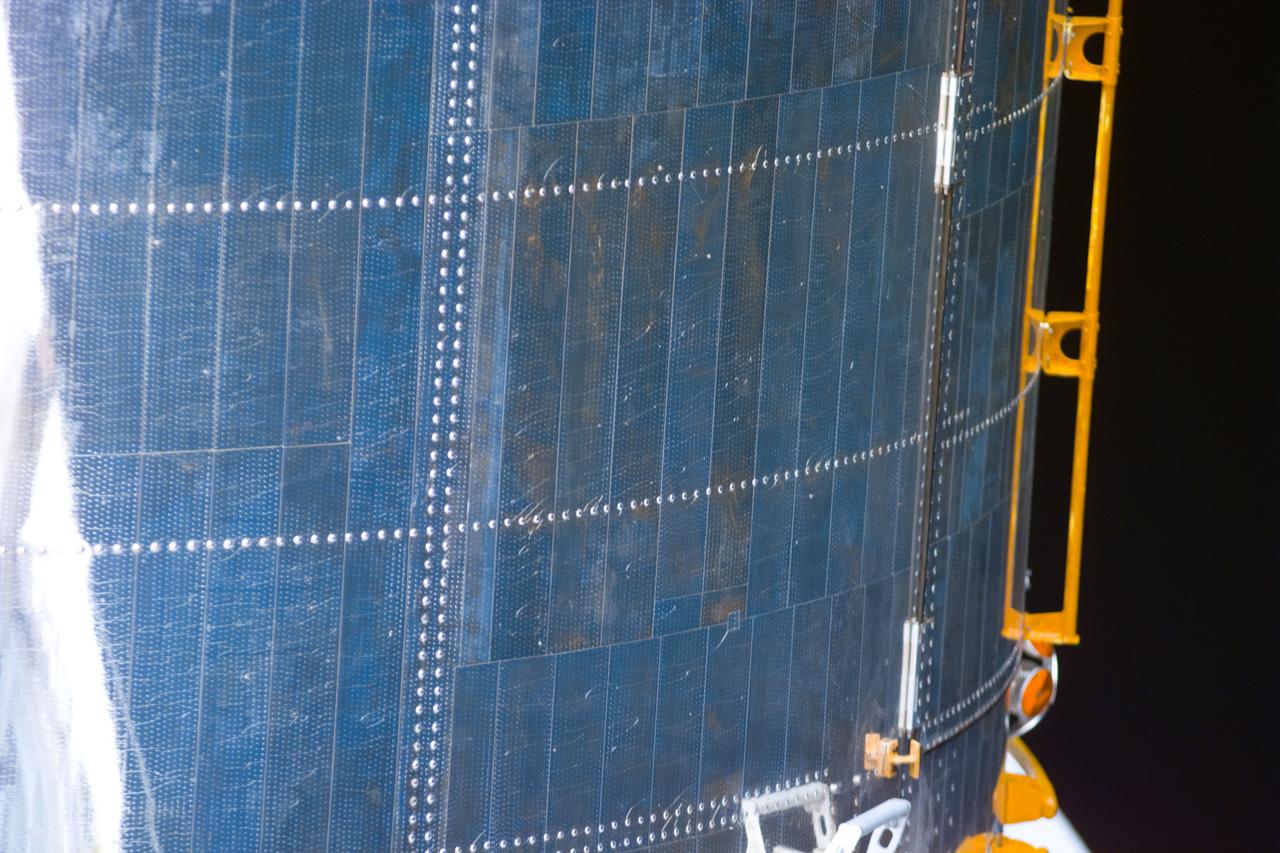
S82-E-5471 (15 Feb. 1997) --- Close-up view showing a small section of Hubble Space Telescope's (HST) protective covering and hand rail used to support Extravehicular Activity (EVA). This view was taken with an Electronic Still Camera (ESC).
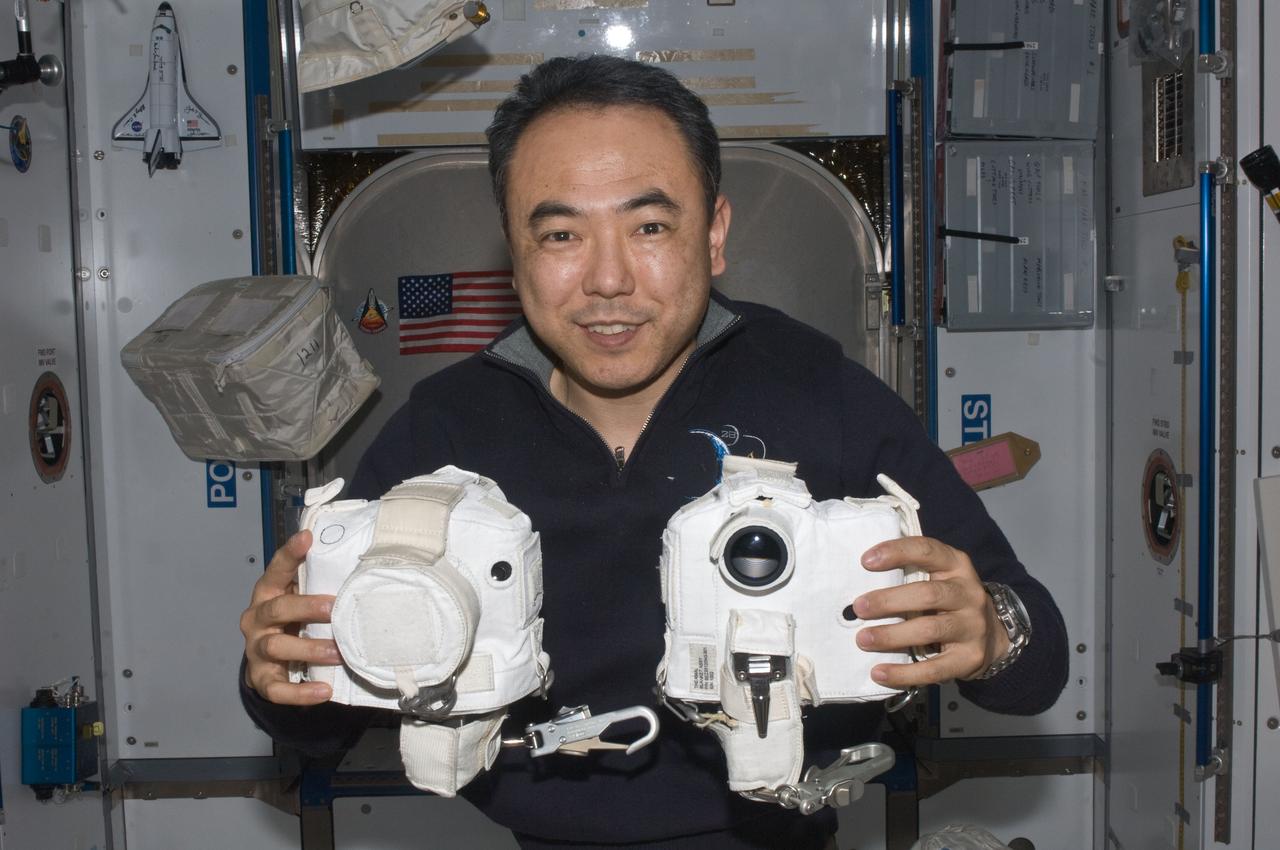
ISS028-E-020222 (1 Aug. 2011) --- Japan Aerospace Exploration Agency astronaut Satoshi Furukawa, Expedition 28 flight engineer, poses for a photo while holding extravehicular activities (EVA) camera equipment in the Harmony node of the International Space Station.
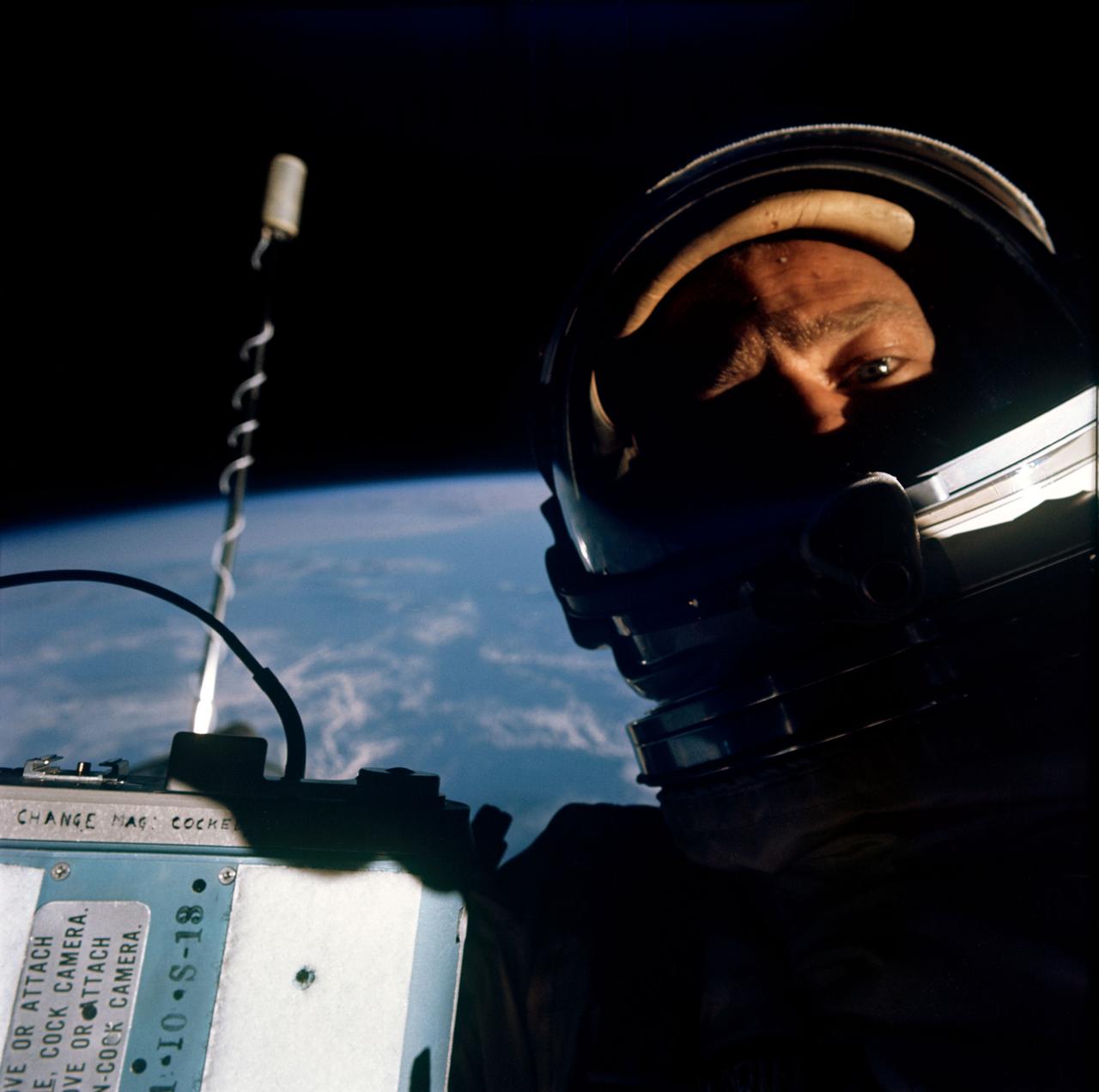
S66-62926 (12 Nov. 1966) --- Astronaut Edwin E. Aldrin Jr., pilot of the Gemini-12 spaceflight, is photographed with pilot's hatch of the spacecraft open. Note: J.A. Maurer camera which was used to photograph some of his extravehicular activity (EVA). Astronaut James A. Lovell Jr. was the command pilot. Photo credit: NASA
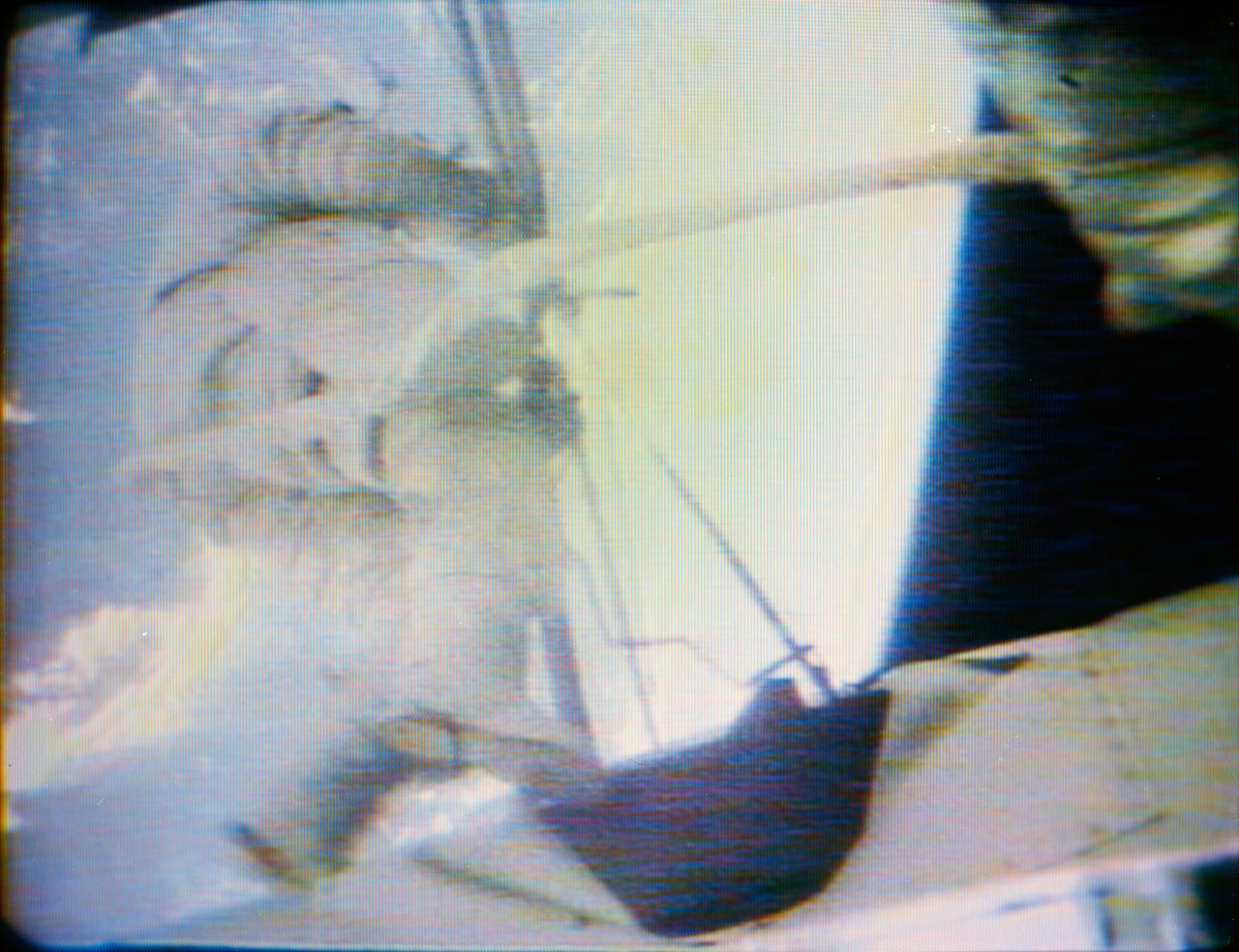
S73-27734 (11 June 1973) --- Skylab 2 astronaut performs extravehicular activity (EVA) at the Skylab 1 and 2 space station cluster in Earth orbit, as seen in this reproduction taken from a color television transmission made by a TV camera aboard the station. Kerwin is just outside the Airlock Module. Photo credit: NASA
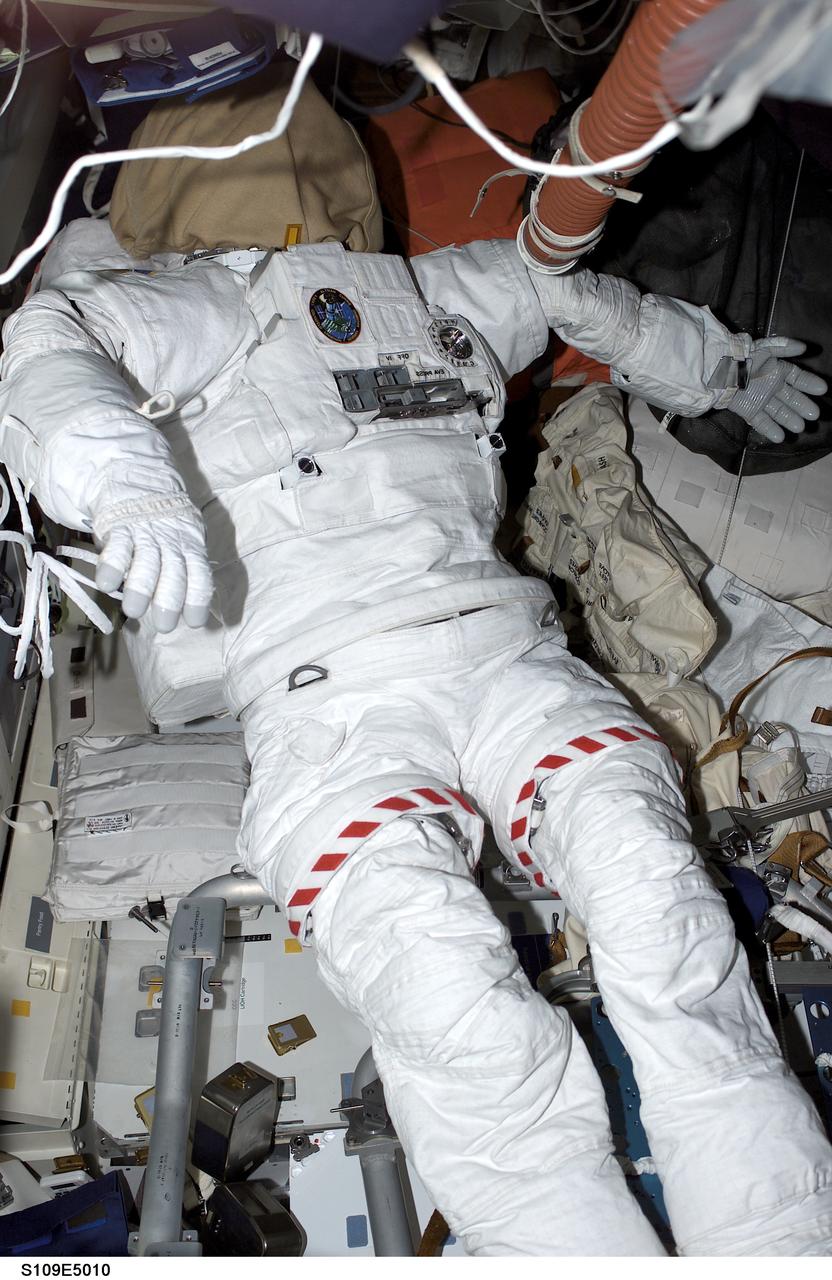
STS109-E-5010 (3 March 2002) --- On the mid deck of the Space Shuttle Columbia, the extravehicular mobility unit (EMU) space suit for astronaut Michael J. Massimino, mission specialist, appears ready for duty. The suit will be initially called on for support on the second day of extravehicular activity (EVA), as the second pair of STS-109 space walking astronauts gets into the act of working on the Hubble Space Telescope. The image was recorded with a digital still camera.
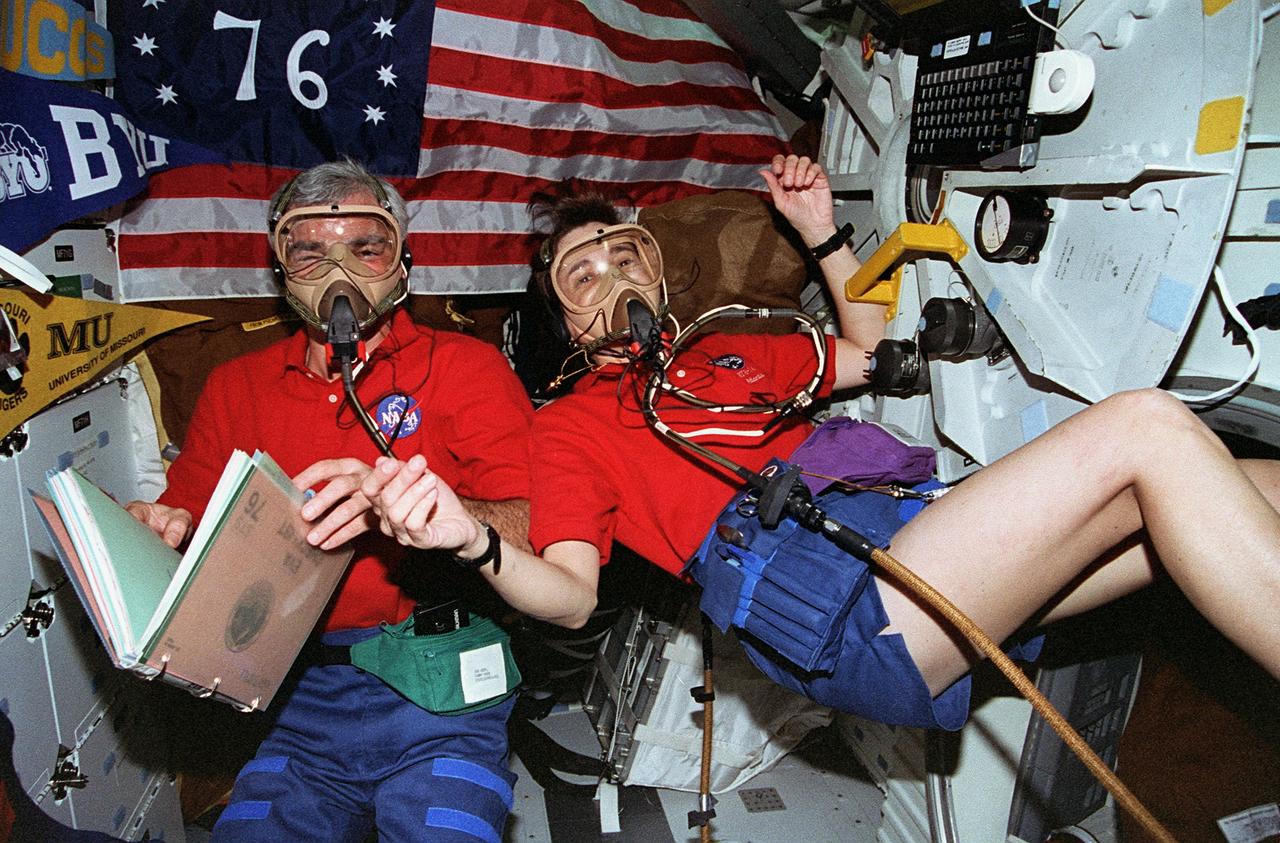
STS076-346-017 (22-31 March 1996) --- Astronauts Michael R. (Rich) Clifford and Linda M. Godwin, the assigned space-walking mission specialists for STS-76, go through a "pre-breathing" period on the Space Shuttle Atlantis' middeck. This practice is normal procedure for space-walkers in preparation for their Extravehicular Activity (EVA) and the wearing of their Extravehicular Mobility Units (EMU). The photograph was taken with a 35mm camera by one of the crew members.
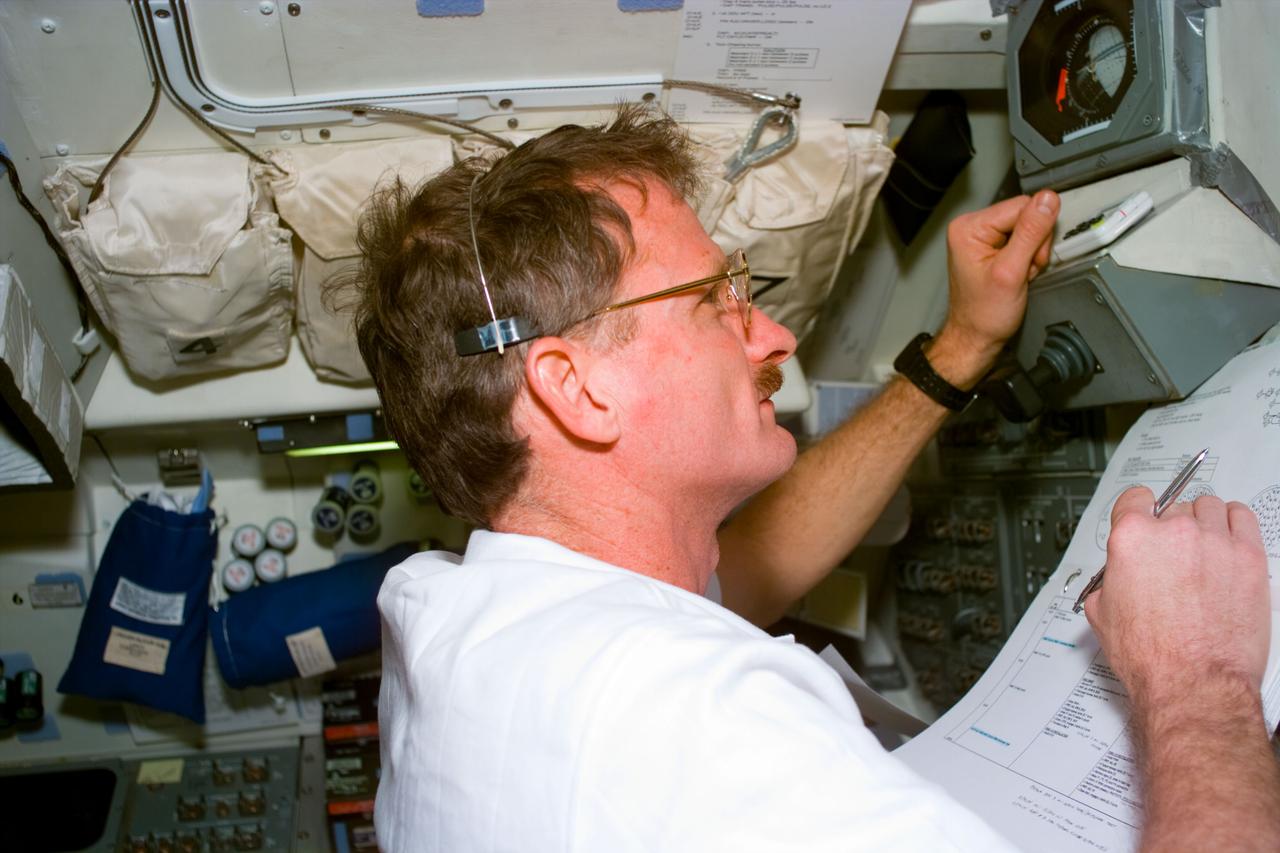
S82-E-5560 (16 Feb. 1997) --- On the Space Shuttle Discovery's aft flight deck, astronaut Joseph R. Tanner keeps up with the progress of his crew's third Extravehicular Activity (EVA) to service the Hubble Space Telescope (HST). Earlier, wearing an Extravehicular Mobility Unit (EMU), he participated in the second EVA, and he will join Gregory J. Harbaugh on the fourth tomorrow. This view was taken with an Electronic Still Camera (ESC).
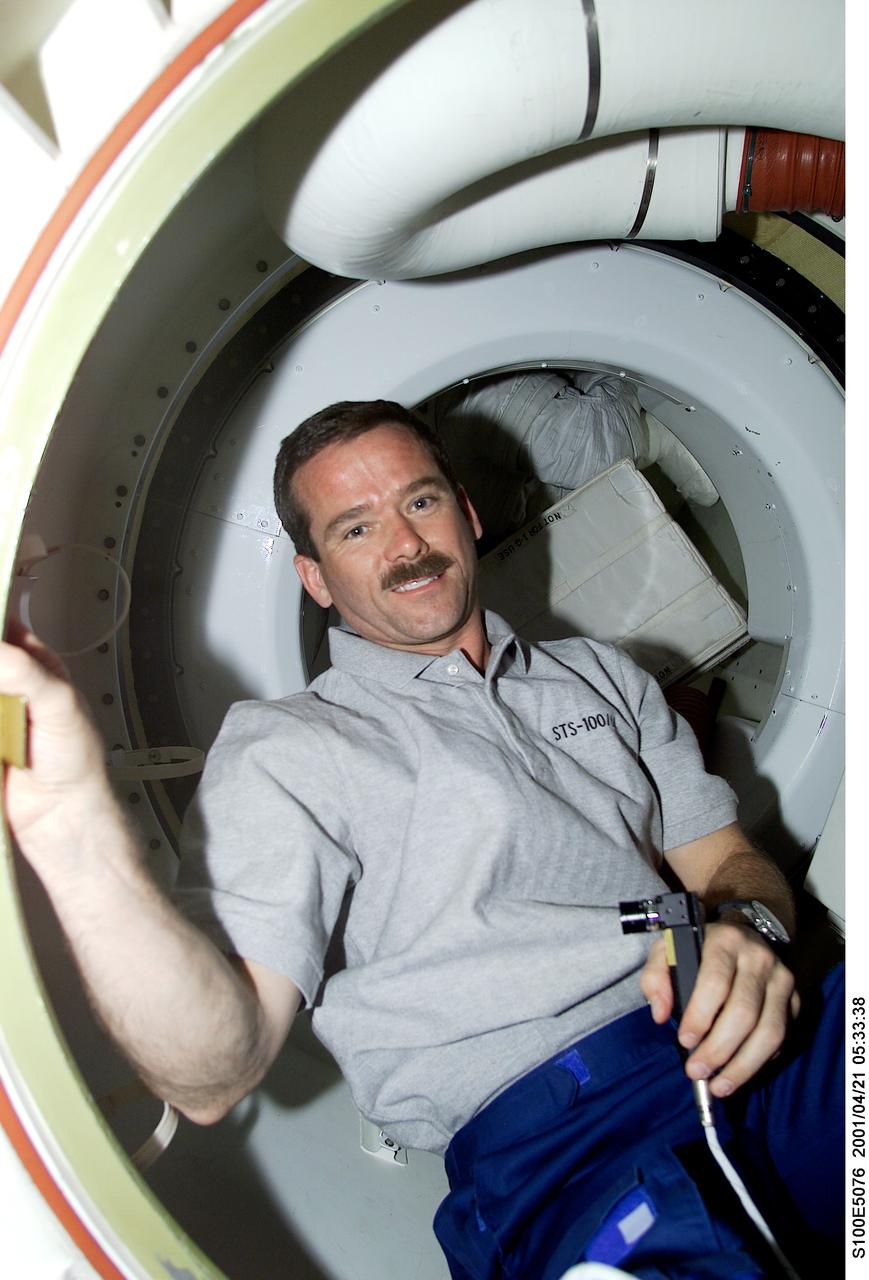
S100-E-5076 (21 April 2001) --- Not far away from his extravehicular mobility unit (EMU) space suit on Endeavour's middeck and not far away in time (less than a day) from a scheduled space walk, it's a relatively sure bet that astronaut Chris A. Hadfield, mission specialist representing the Canadian Space Agency (CSA), is thinking about extravehicular activity (EVA). The photo was recorded with a digital still camera.
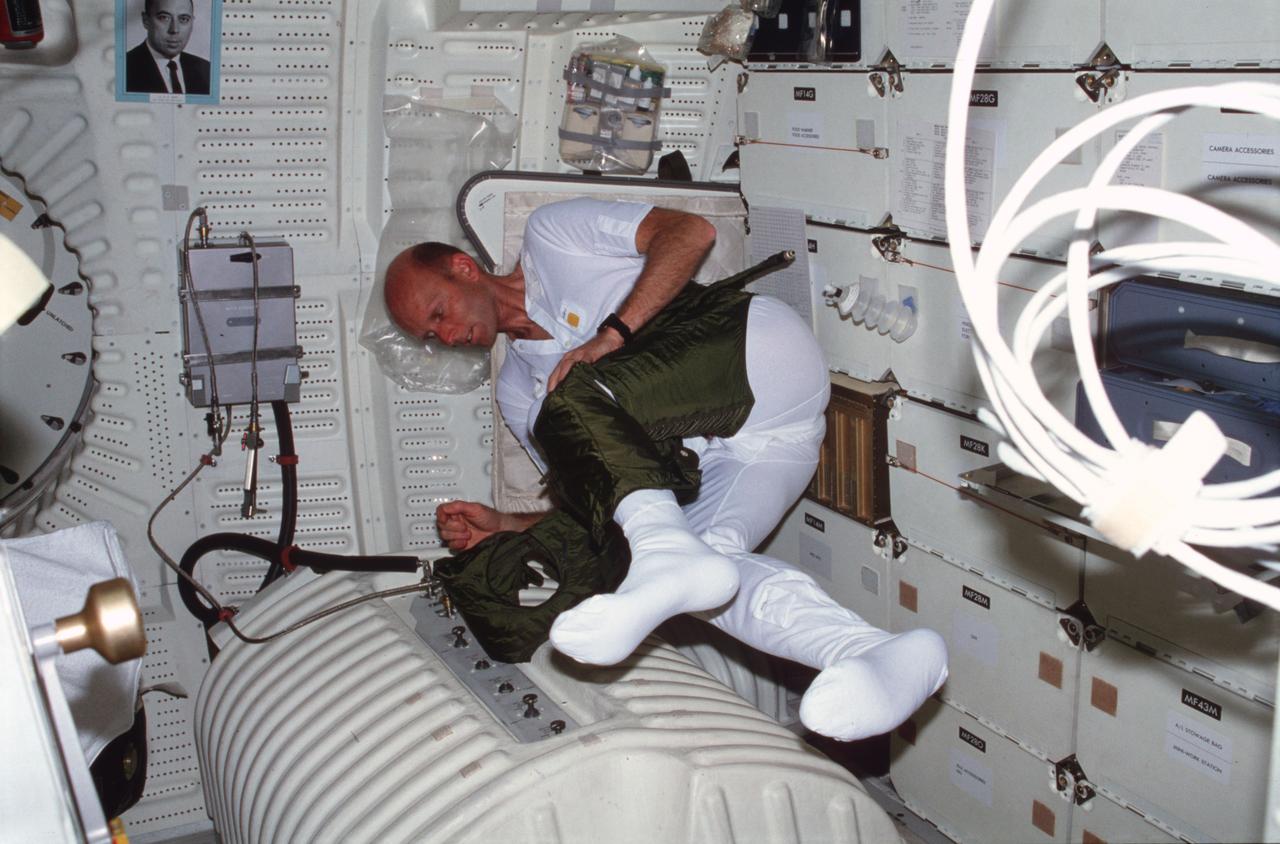
STS003-23-161 (24 March 1982) --- Astronaut C. Gordon Fullerton, STS-3 pilot, dons an olive drab inner garment which complements the space shuttle Extravehicular Mobility Unit (EMU) spacesuit. Since there are no plans for an extravehicular activity (EVA) on the flight, Fullerton is just getting some practice time ?in the field? as he is aboard the Earth-orbiting Columbia. He is in the middeck area of the vehicle. The photograph was taken with a 35mm camera by astronaut Jack R. Lousma, STS-3 commander. Photo credit: NASA
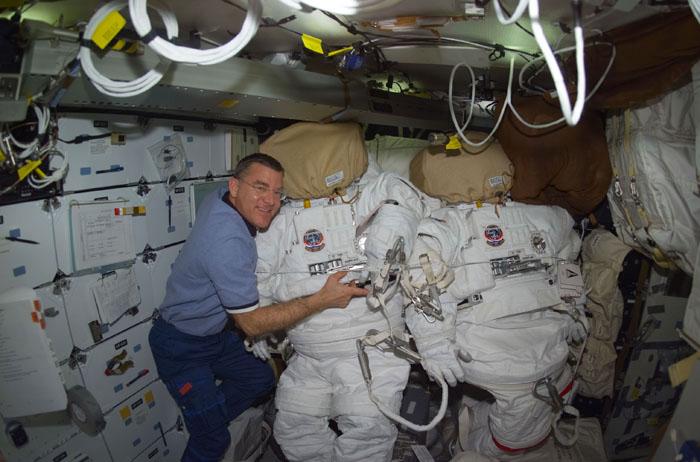
STS102-E-5070 (10 March 2001) --- Astronaut James S. Voss, STS-102 mission specialist, is pictured with both Extravehicular Mobility Unit (EMU) space suits designated for this flight's extravehicular activity (EVA). Voss is one of two astronauts assigned to space walk duties after the Space Shuttle Discovery and the International Space Station (ISS) link in Earth orbit. The photograph was recorded with a digital still camera on Discovery's mid deck.
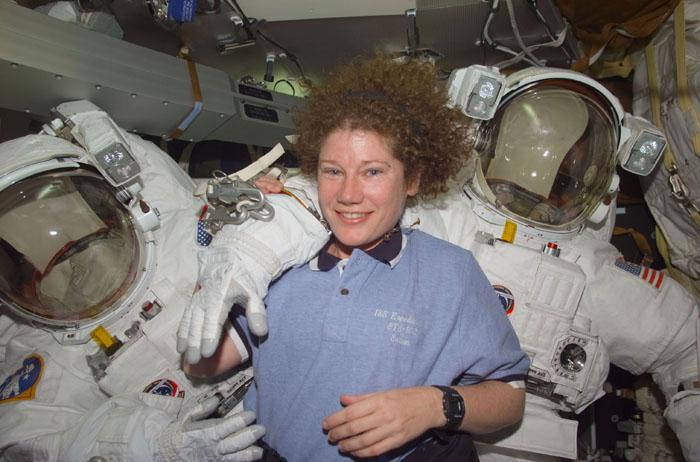
TS102-E-5054 (10 March 2001) --- Astronaut Susan J. Helms, STS-102 mission specialist, is pictured on the mid deck with both Extravehicular Mobility Unit (EMU) space suits designated for extravehicular activity (EVA). Helms is one of two astronauts assigned to space walk duties after the Space Shuttle Discovery and the International Space Station (ISS) link in Earth orbit. The photograph was recorded with a digital still camera.
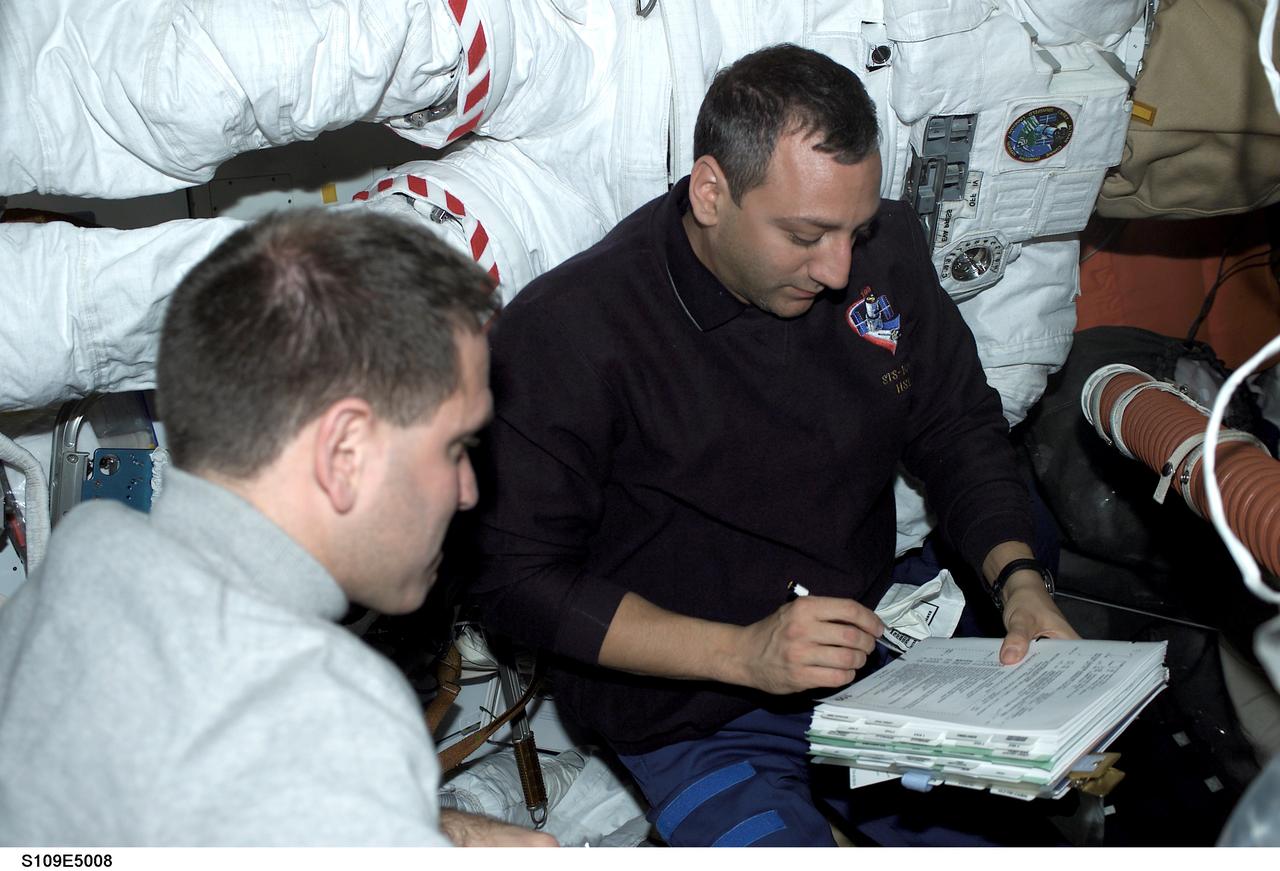
STS109-E-5008 (3 March 2002) --- On the mid deck of the Space Shuttle Columbia, astronauts John M. Grunsfeld (foreground), payload commander, and Michael J. Massimino, mission specialist, go over a checklist concerning the next few days' scheduled space walks. Massimino's extravehicular mobility unit (EMU) space suit, which will be called into duty for the second day of extravehicular activity (EVA), is in the background. The image was recorded with a digital still camera.
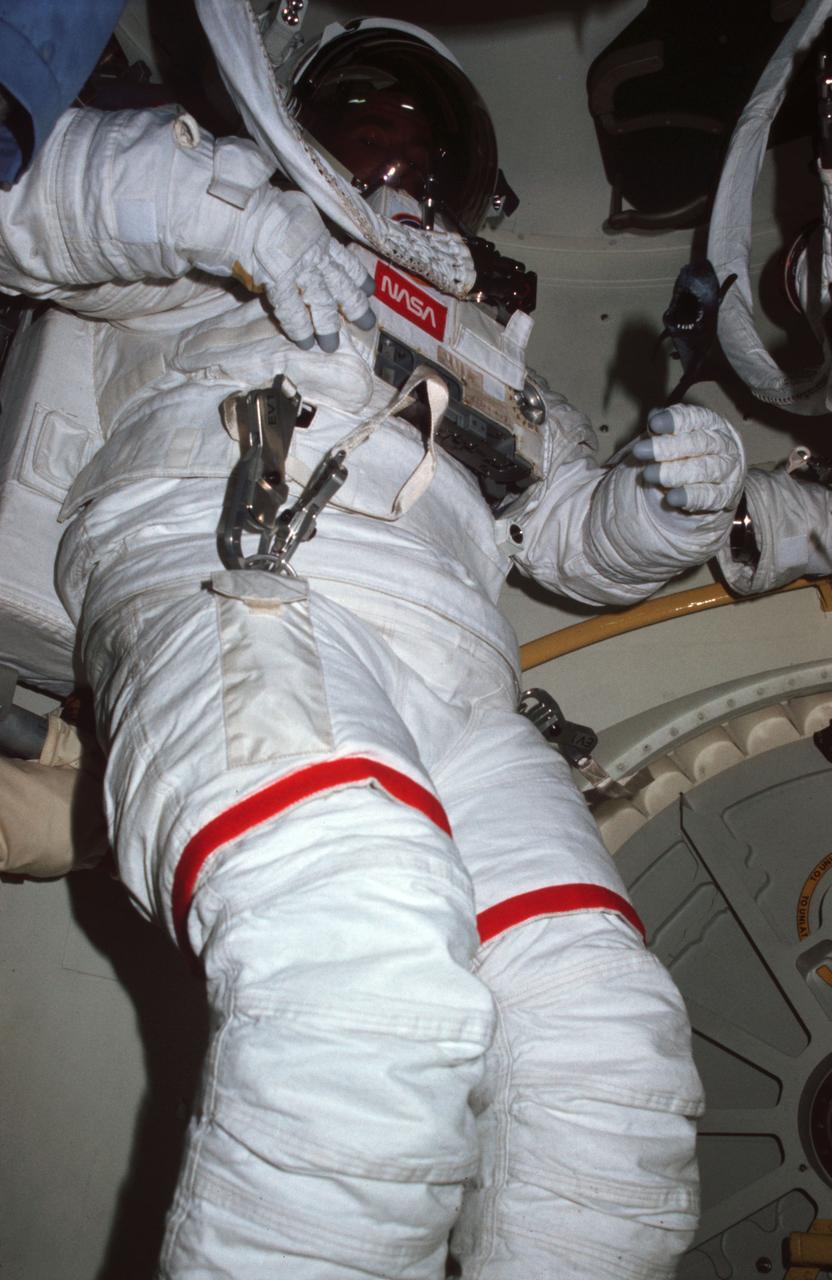
STS005-15-548 (11-16 Nov. 1982) --- Astronaut William B. Lenoir, STS-5 mission specialist, has donned the complete Extravehicular Mobility Unit (EMU) spacesuit in the airlock of the Earth-orbiting space shuttle Columbia. Dr. Lenoir and astronaut Joseph P. Allen IV, the flight?s other mission specialist, were to have participated in an extravehicular activity (EVA) today but problems with both EMU?s caused cancellation of the activity. The photograph was made by Dr. Allen using a 35mm camera. Photo credit: NASA
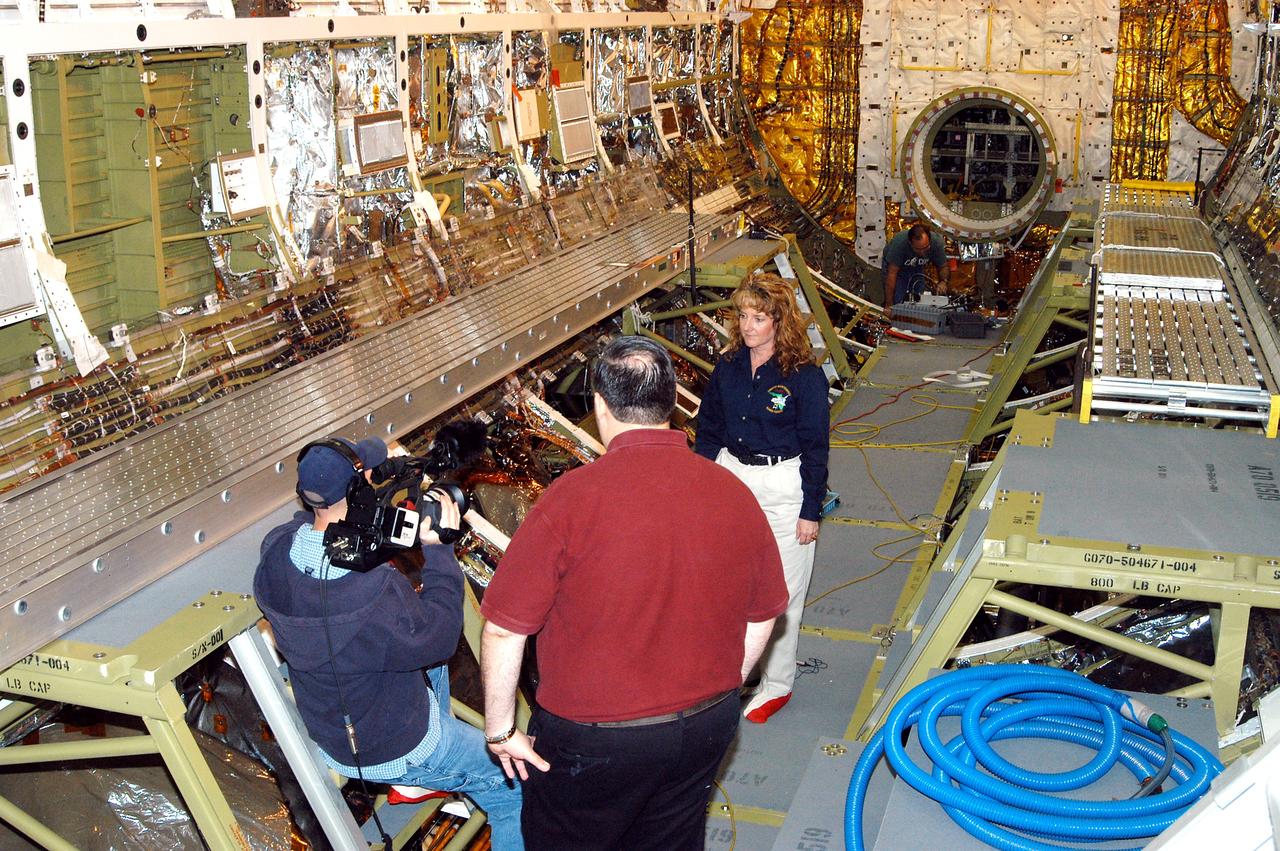
KENNEDY SPACE CENTER, FLA. - Standing inside Discovery’s payload bay, Carol Scott (right), lead orbiter engineer, talks about her job as part of a special feature for the KSC Web. With his back to the camera is Bill Kallus, Media manager in the KSC Web Studio. Behind Scott can be seen the open hatch of the airlock, which provides support functions such as airlock depressurization and repressurization, extravehicular activity equipment recharge, liquid-cooled garment water cooling, EVA equipment checkout, donning and communications. The outer hatch isolates the airlock from the unpressurized payload bay when closed and permits the EVA crew members to exit from the airlock to the payload bay when open.
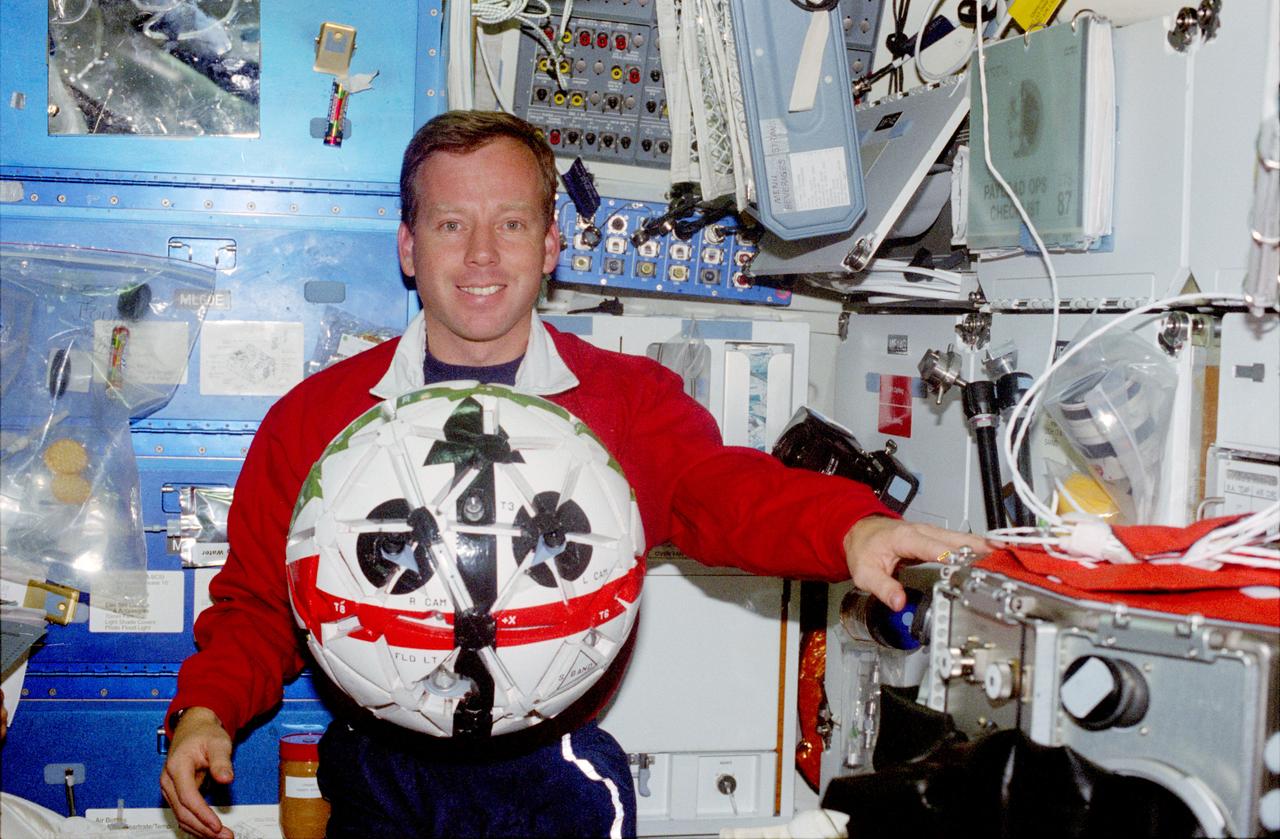
STS087-371-013 (19 November - 5 December 1997) --- On the Space Shuttle Columbia's mid-deck, astronaut Steven W. Lindsey proves that the Autonomous Extravehicular Activity Robotic Camera/Sprint (AERCam/Sprint) experiment is in fact bigger than a soccer ball, to which it is often erroneously compared for dimensional frame of reference, as he allows the Sprint to float near him. The AERCam is a prototype free-flying television camera that could be used for remote inspections of the exterior of the International Space Station (ISS). Later, astronauts Winston E. Scott and Takao Doi took the experiment outside for a brief test during the mission's second Extravehicular Activity (EVA). Lindsey, pilot, is standing with his back to the galley and his left hand on the microgravity glovebox, used extensively during the mission to support the United States Microgravity Payload (USMP-4) mission.
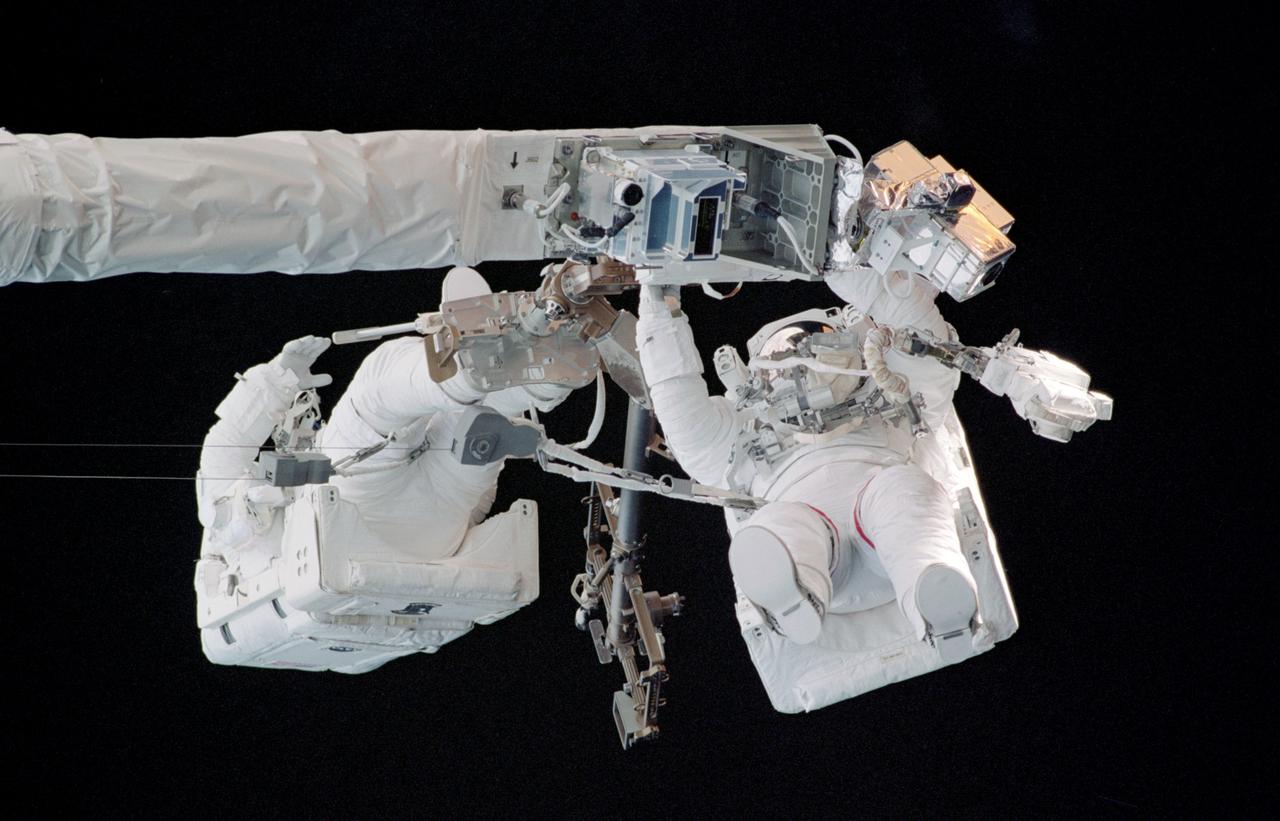
STS121-323-011 (8 July 2006) --- Astronauts Piers J. Sellers and Michael E. Fossum, STS-121 mission specialists, work in tandem on Space Shuttle Discovery's Remote Manipulator System/Orbiter Boom Sensor System (RMS/OBSS) during the mission's first scheduled session of extravehicular activity (EVA). Also visible on the OBSS are the Laser Dynamic Range Imager (LDRI), Intensified Television Camera (ITVC) and Laser Camera System (LCS).
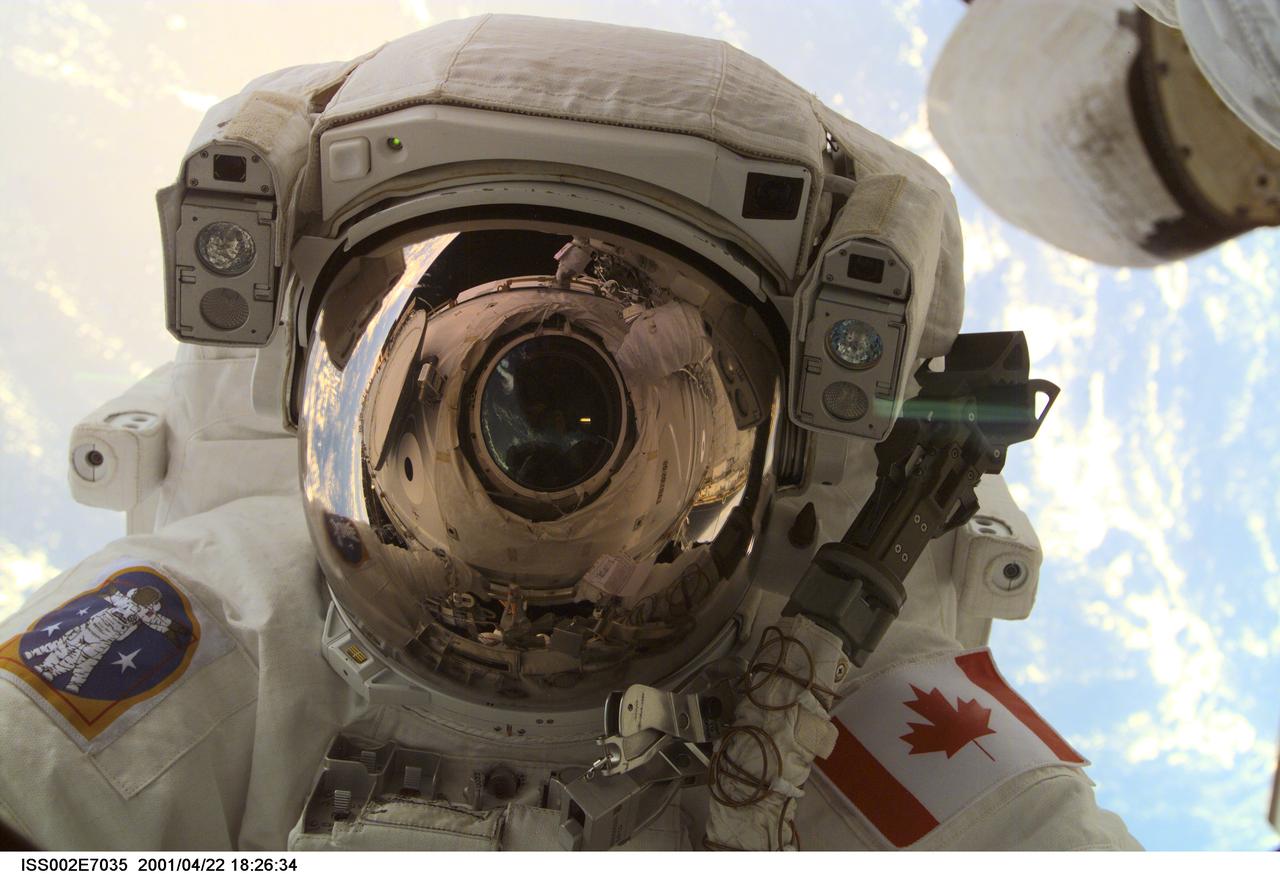
ISS002-E-7035 (22 April 2001) --- A through-the-window view of astronaut Chris A. Hadfield, STS-100 mission specialist representing the Canadian Space Agency (CSA), was taken during the first extravehicular activity (EVA) of the STS-100 mission. This digital still camera's image was captured by the Expedition Two crew through the nadir window of the Destiny Laboratory with a digital still camera. The window and much of Destiny can be seen in the visor of Hadfield's helmet.
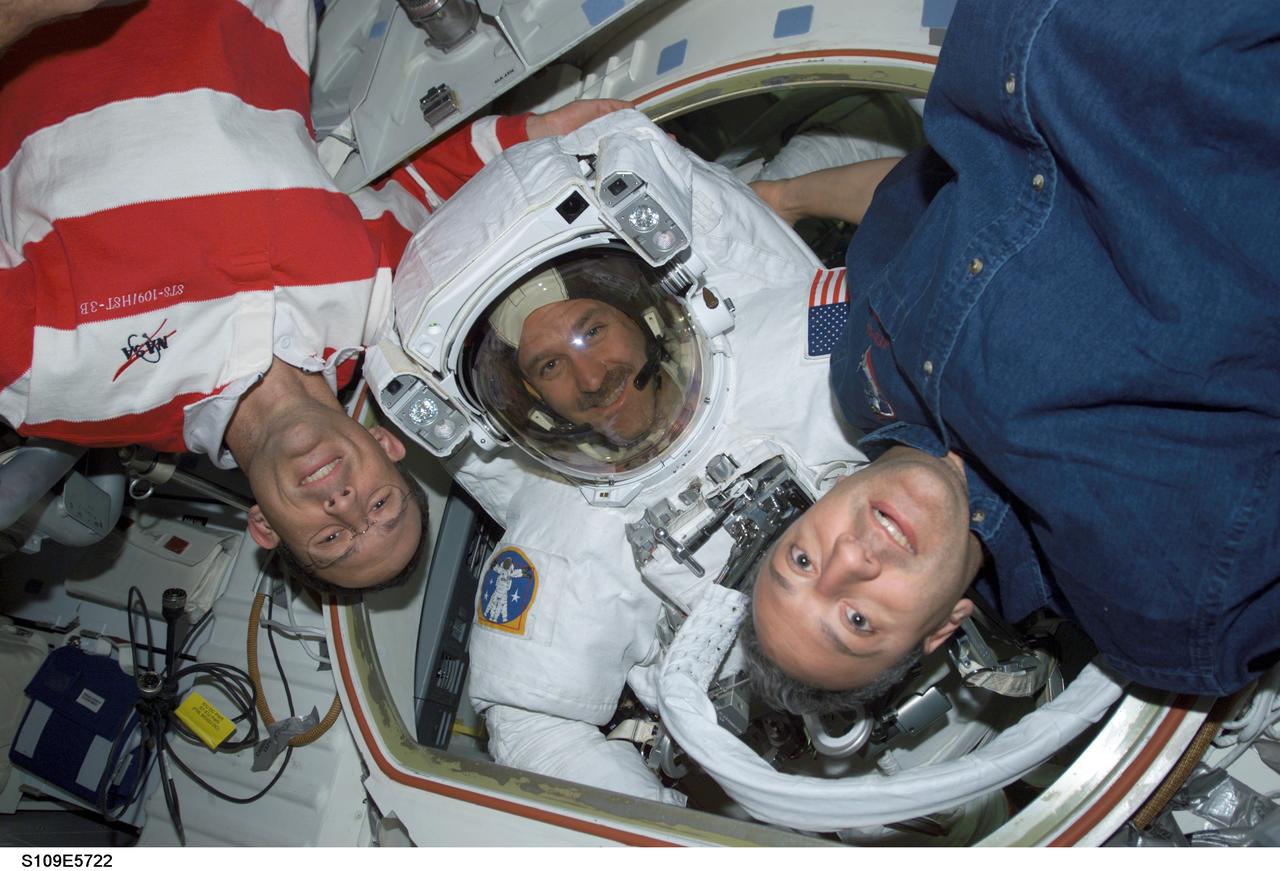
STS109-E-5722 (8 March 2002) --- Astronaut John M. Grunsfeld (center), STS-109 payload commander, attired in the extravehicular mobility unit (EMU) space suit, is photographed with astronauts James H. Newman (left) and Michael J. Massimino, both mission specialists, prior to the fifth space walk. Activities for EVA-5 centered around the Near-Infrared Camera and Multi-Object Spectrometer (NICMOS) to install a Cryogenic Cooler and its Cooling System Radiator. The image was recorded with a digital still camera.
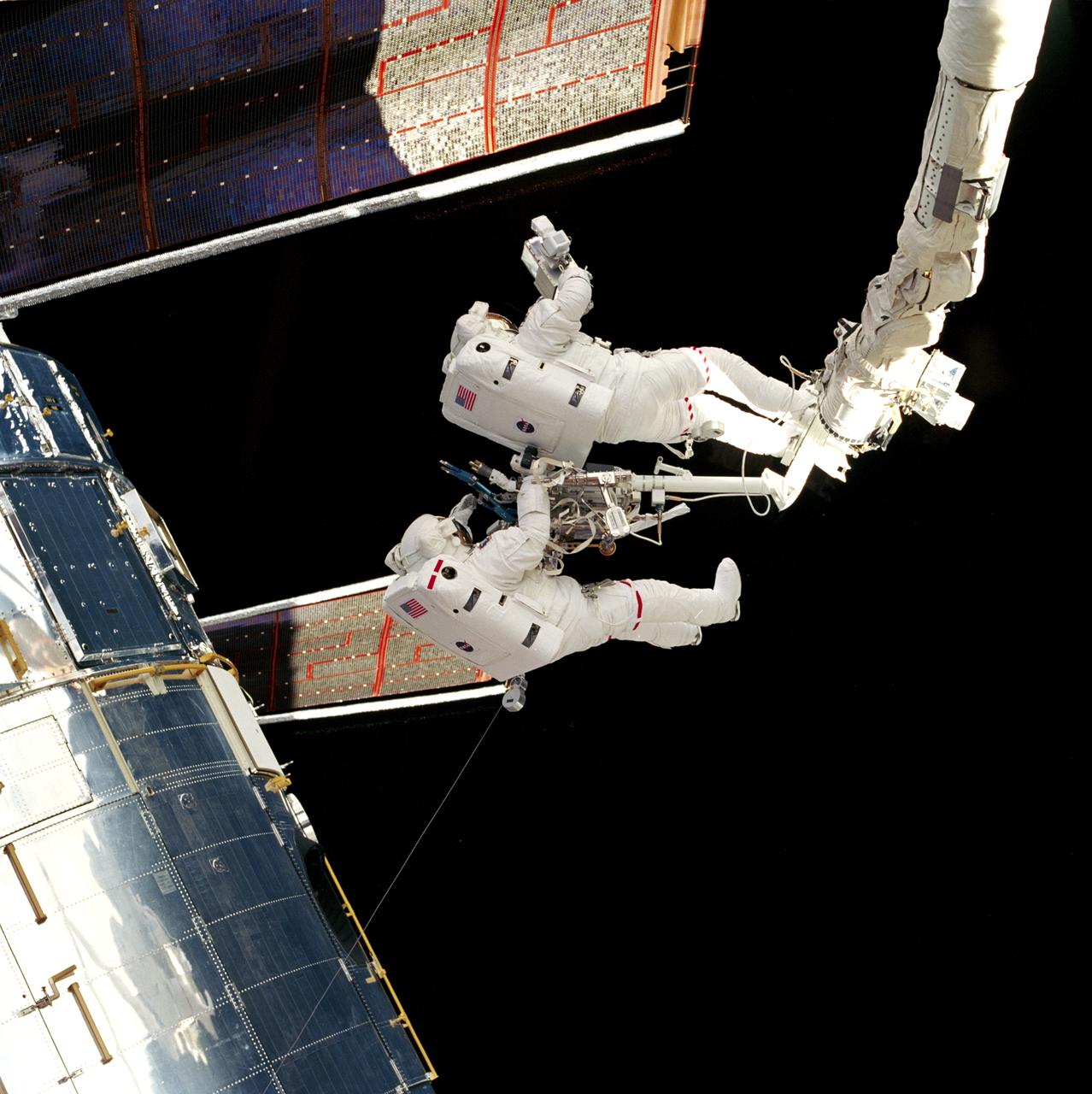
STS082-719-002 (14 Feb. 1997) --- Astronaut Joseph R. Tanner (right) stands on the end of Discovery's Remote Manipulator System (RMS) arm and aims a camera at the solar array panels on the Hubble Space Telescope (HST) as astronaut Gregory J. Harbaugh assists. The second Extravehicular Activity (EVA) photograph was taken with a 70mm camera from inside Discovery's cabin.
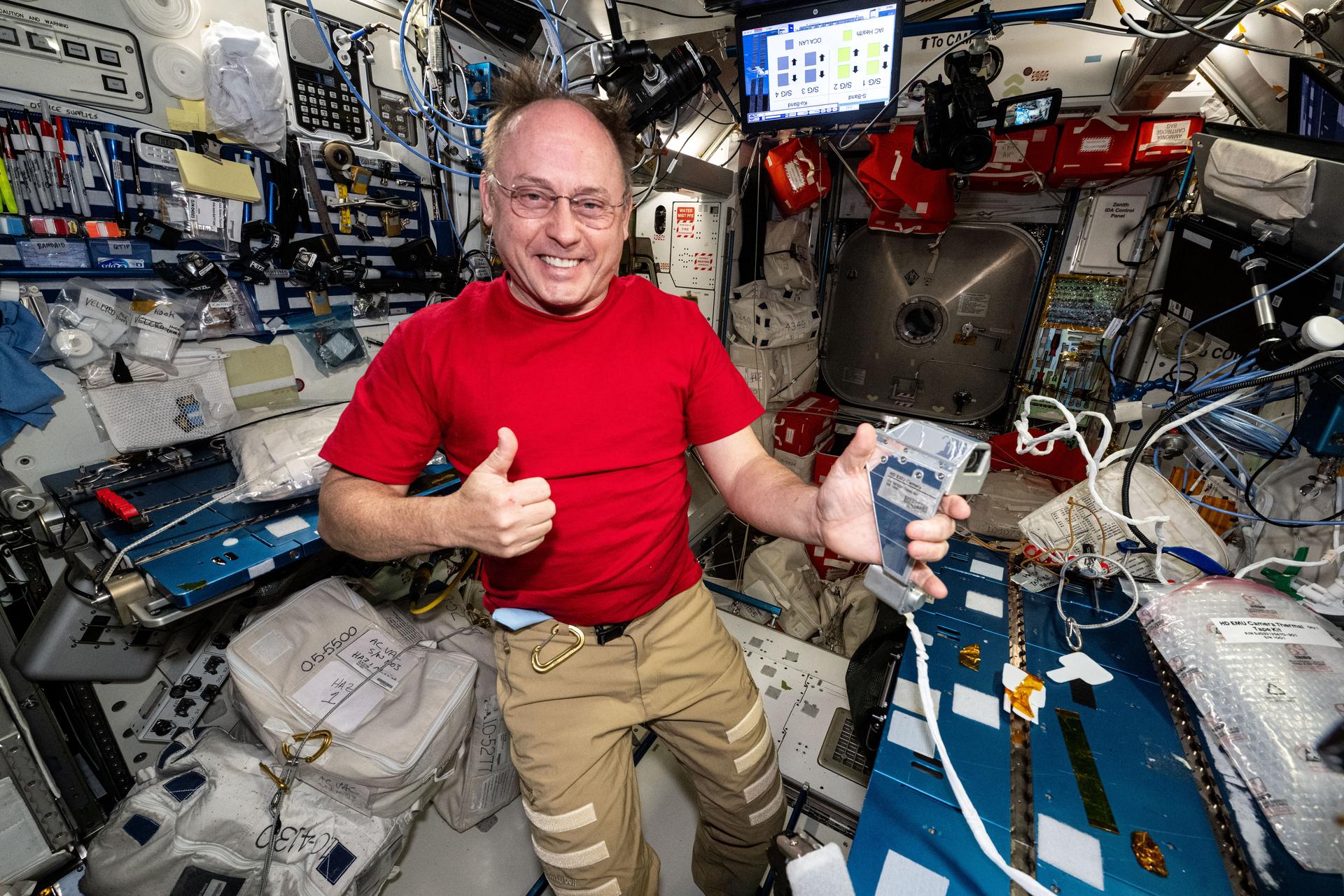
iss073e0510684 (Aug. 18, 2025) --- NASA astronaut and Expedition 73 Flight Engineer Mike Fincke gives a “thumbs up” while holding a High Definition Extravehicular Mobility Unit Camera, or HECA. The spacesuit helmet-mounted camera streams real-time, high-definition video of spacewalk activities to mission controllers on the ground. Earlier, Fincke replaced the thermal tape that shields the HECA from the harsh environment of space.
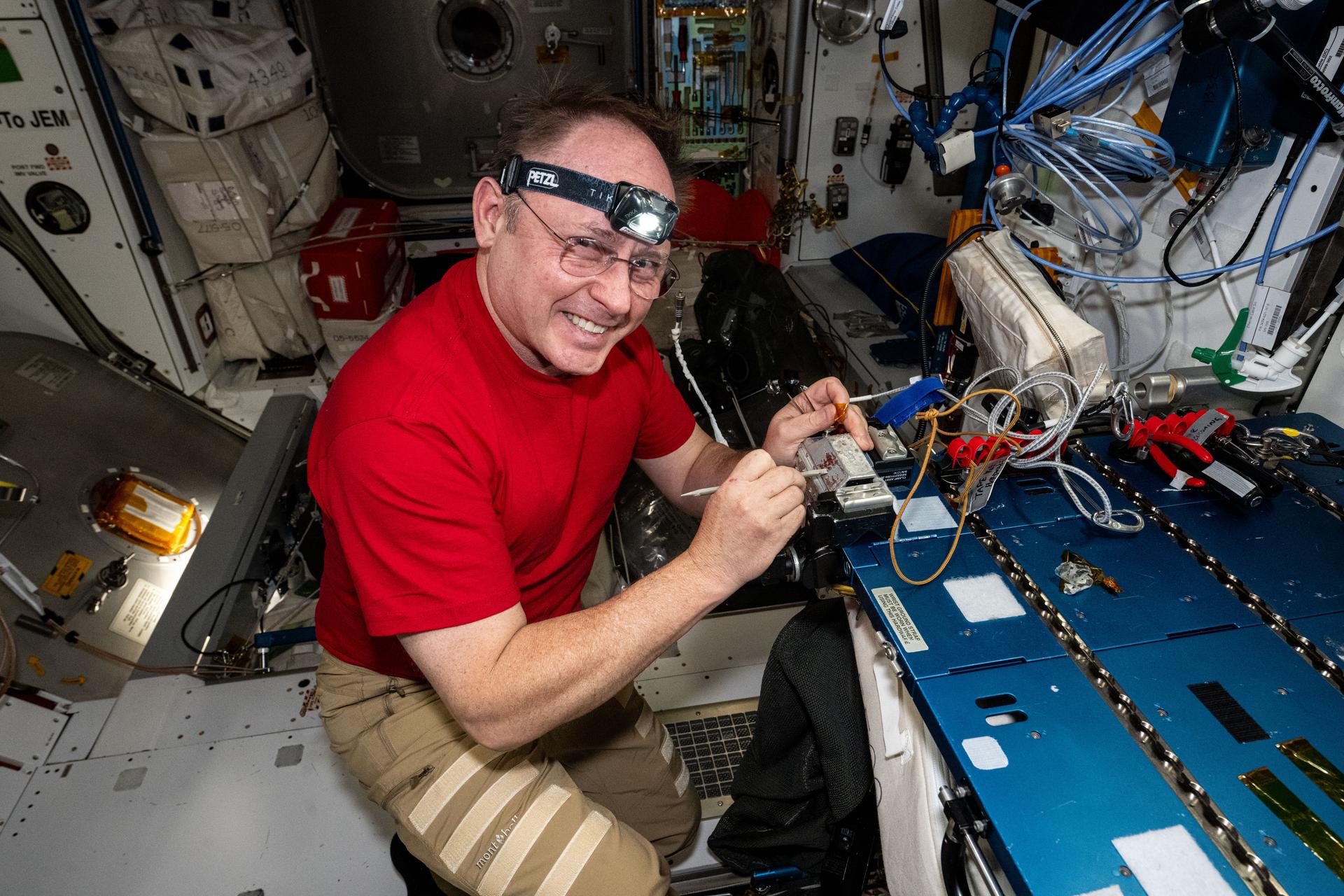
iss073e0510683 (Aug. 18, 2025) --- NASA astronaut and Expedition 73 Flight Engineer Mike Fincke replaces thermal tape on a High Definition Extravehicular Mobility Unit Camera, or HECA. The spacesuit helmet-mounted camera streams real-time, high-definition video of spacewalk activities to mission controllers on the ground, while the thermal tape shields the HECA from the harsh environment of space.
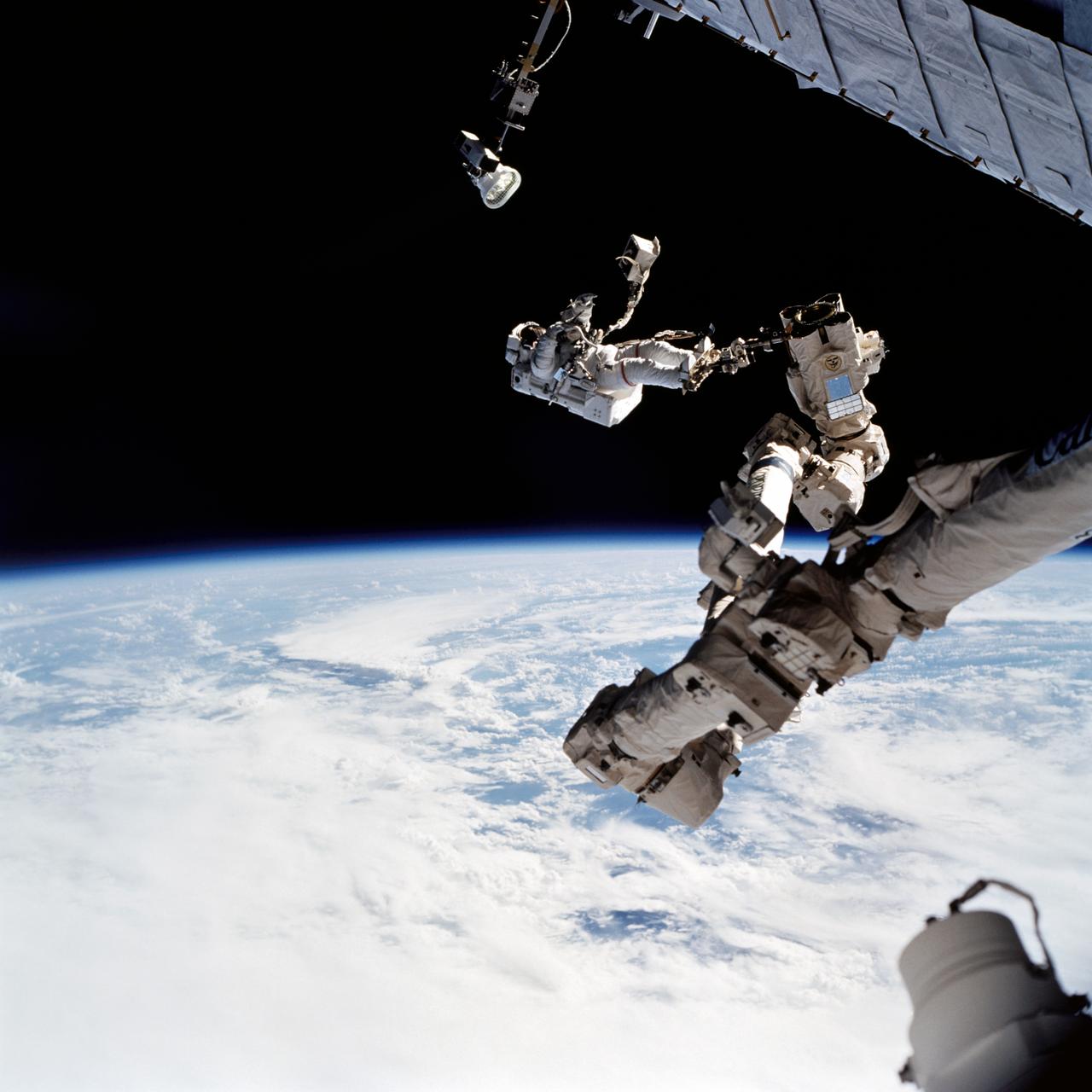
STS112-709-073N (10 October 2002) --- Astronaut David A. Wolf, STS-112 mission specialist, anchored to a foot restraint on the Space Station Remote Manipulator System (SSRMS) or Canadarm2, carries the Starboard One (S1) outboard nadir external camera. The camera was installed on the end of the S1 Truss on the International Space Station (ISS) during the mission’s first scheduled session of extravehicular activity (EVA).
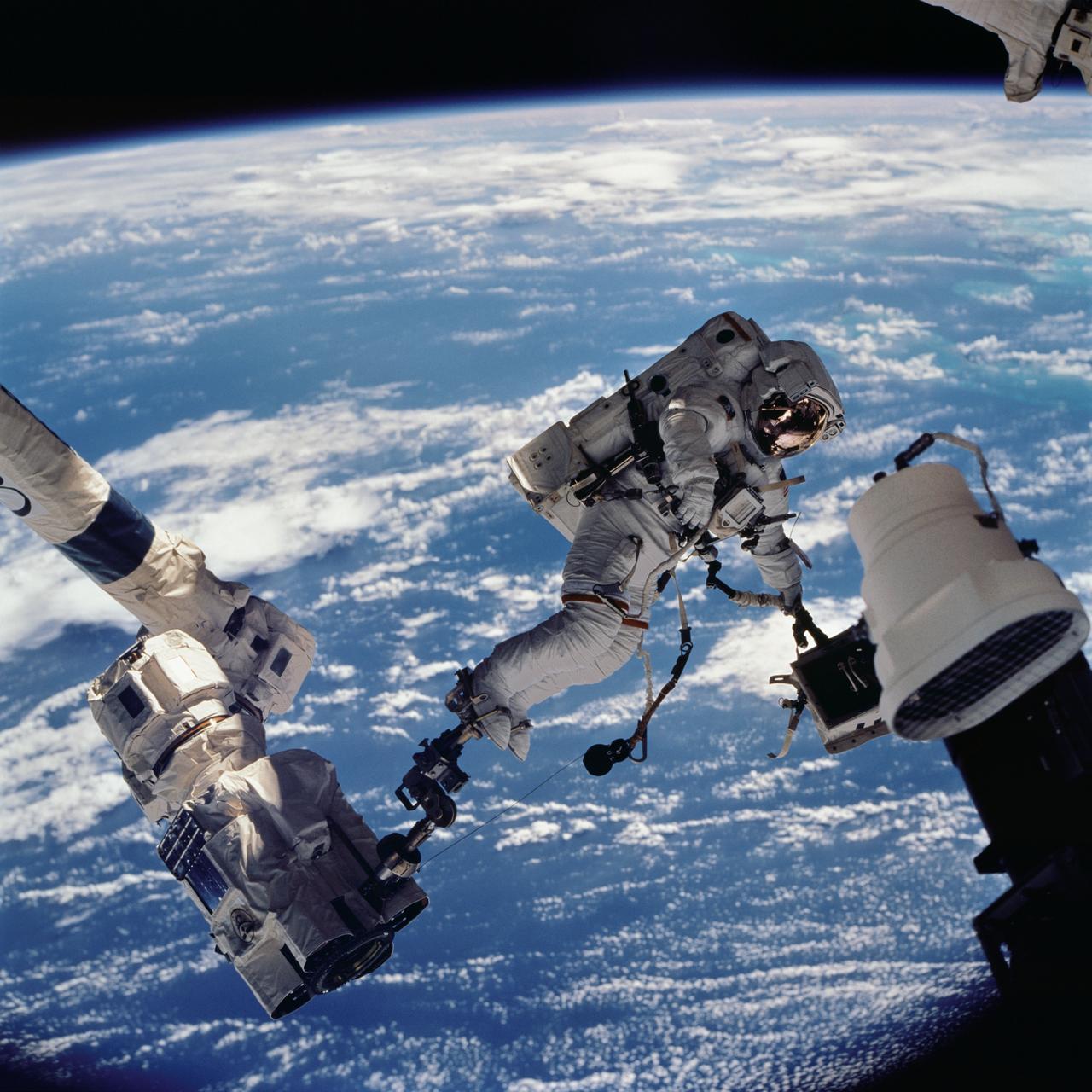
STS112-709-073K (10 October 2002) --- Astronaut David A. Wolf, STS-112 mission specialist, anchored to a foot restraint on the Space Station Remote Manipulator System (SSRMS) or Canadarm2, carries the Starboard One (S1) outboard nadir external camera. The camera was installed on the end of the S1 Truss on the International Space Station (ISS) during the mission’s first scheduled session of extravehicular activity (EVA).

STS087-338-003 (19 November - 5 December 1997) --- Astronaut Kalpana Chawla, mission specialist, aims a 70mm camera through the Space Shuttle Columbia's overhead window. Crew members used the camera for the ongoing Earth observations project but they used it as well to document operations with the Spartan-201 satellite and the two Extravehicular Activities (EVA) performed by astronauts Winston E. Scott and Takao Doi.
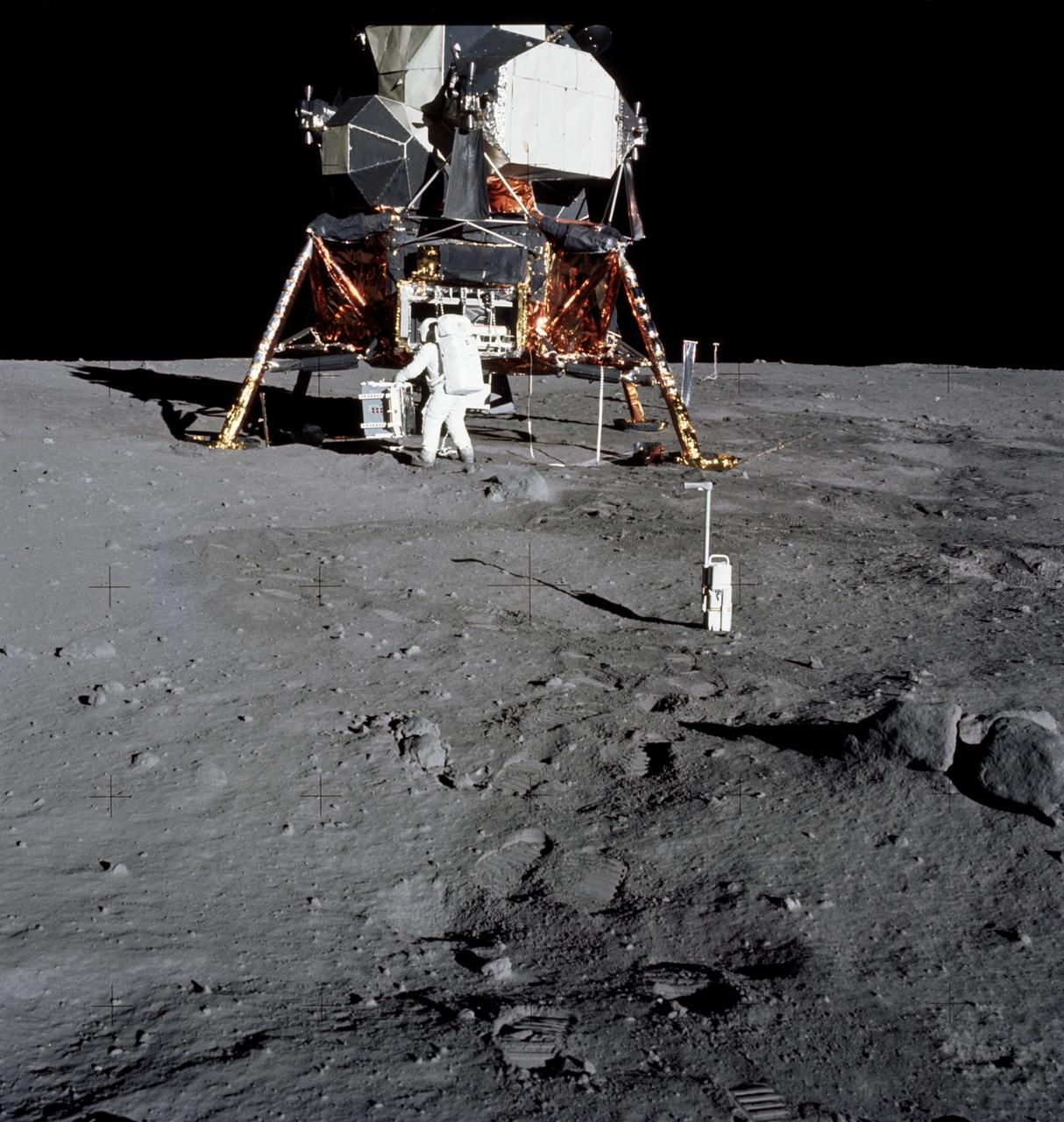
AS11-40-5931 (20 July 1969) --- Astronaut Edwin E. Aldrin Jr., lunar module pilot, prepares to deploy the Early Apollo Scientific Experiments Package (EASEP) on the surface of the moon during the Apollo 11 extravehicular activity. Astronaut Neil A. Armstrong, commander, took this photograph with a 70mm lunar surface camera. In the foreground is the Apollo 11 35mm stereo close-up camera.
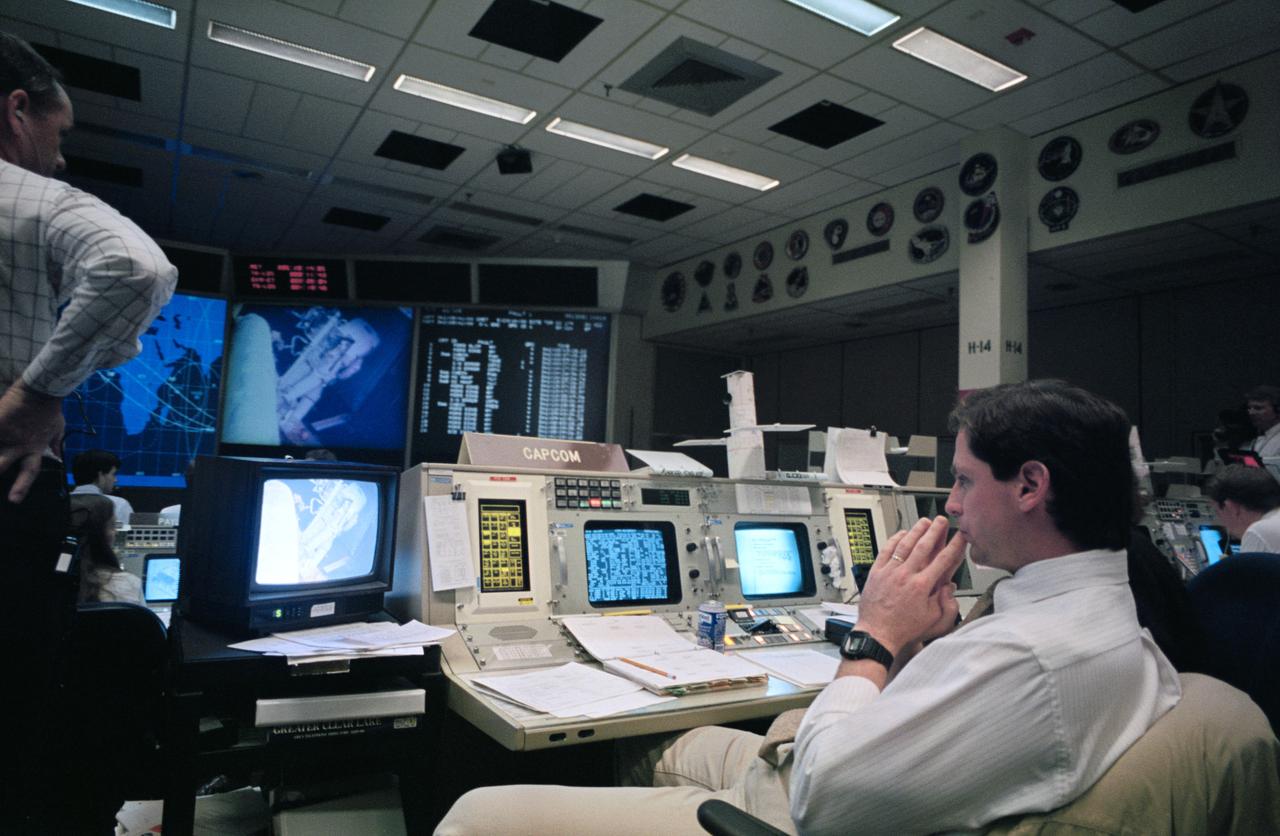
STS61-S-101 (8 Dec 1993) --- Astronaut Gregory J. Harbaugh, spacecraft communicator (CAPCOM), observes as two astronauts work through a lengthy period of extravehicular activity (EVA) in the cargo bay of the Earth-orbiting Space Shuttle Endeavour. Seen on the screen in the front of the flight control room, preparing to work with the Hubble Space Telescope's (HST) magnetometers, are astronauts F. Story Musgrave and Jeffrey A. Hoffman. Harbaugh stayed busy passing up flight controllers suggestions and directions during the record-breaking battery of in-space servicing sessions. Lead flight director Milt Heflin is partially visible at left edge of frame.
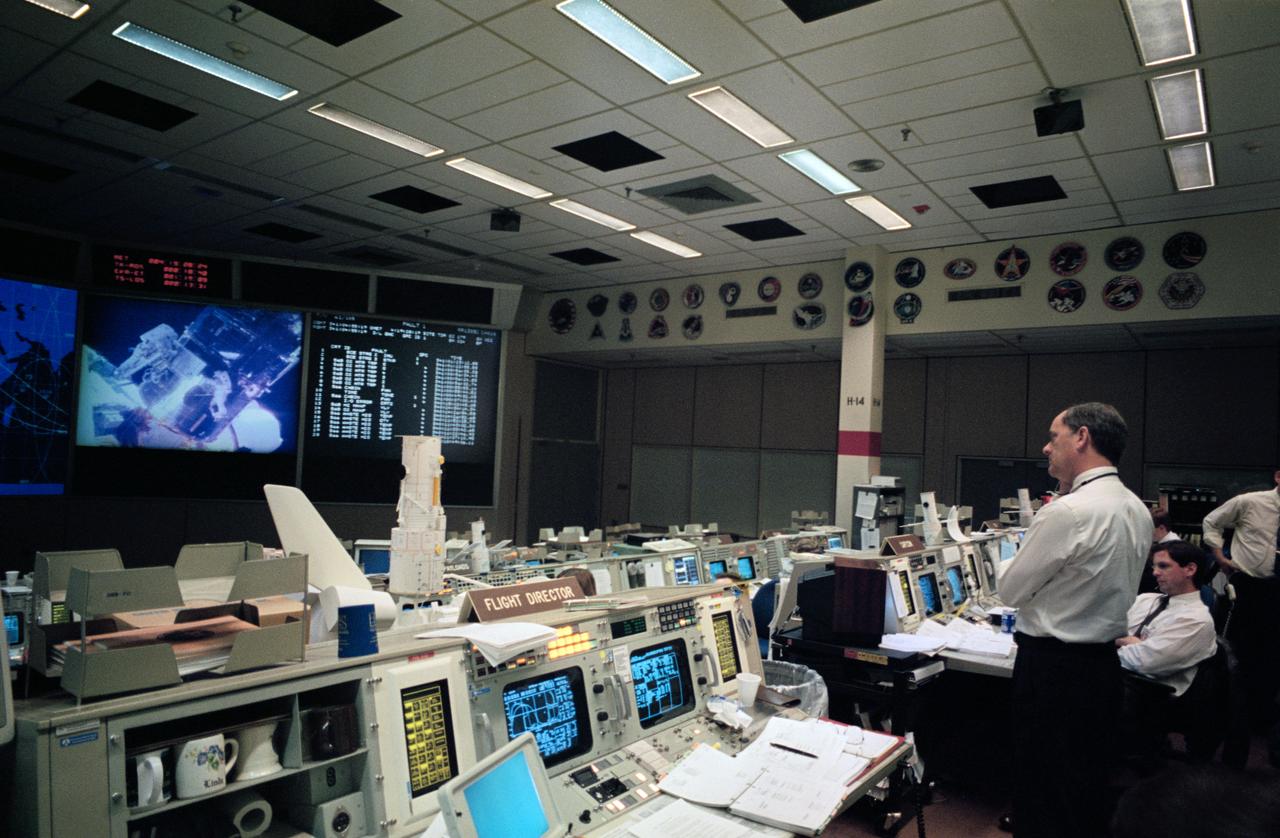
STS61-S-098 (6 DEC 1993) --- Flight director Milton Heflin monitors two space walkers as they change out the Wife Field/Planetary Camera (WFPC) on the Hubble Space Telescope (HST), temporarily berthed in the Space Shuttle Endeavour's cargo bay. Astronaut Gregory J. Harbaugh, spacecraft communicator (CAPCOM), is at right edge. Astronauts F. Story Musgrave and Jeffrey A. Hoffman can be seen with the large camera on the screen in the front of the flight control room.
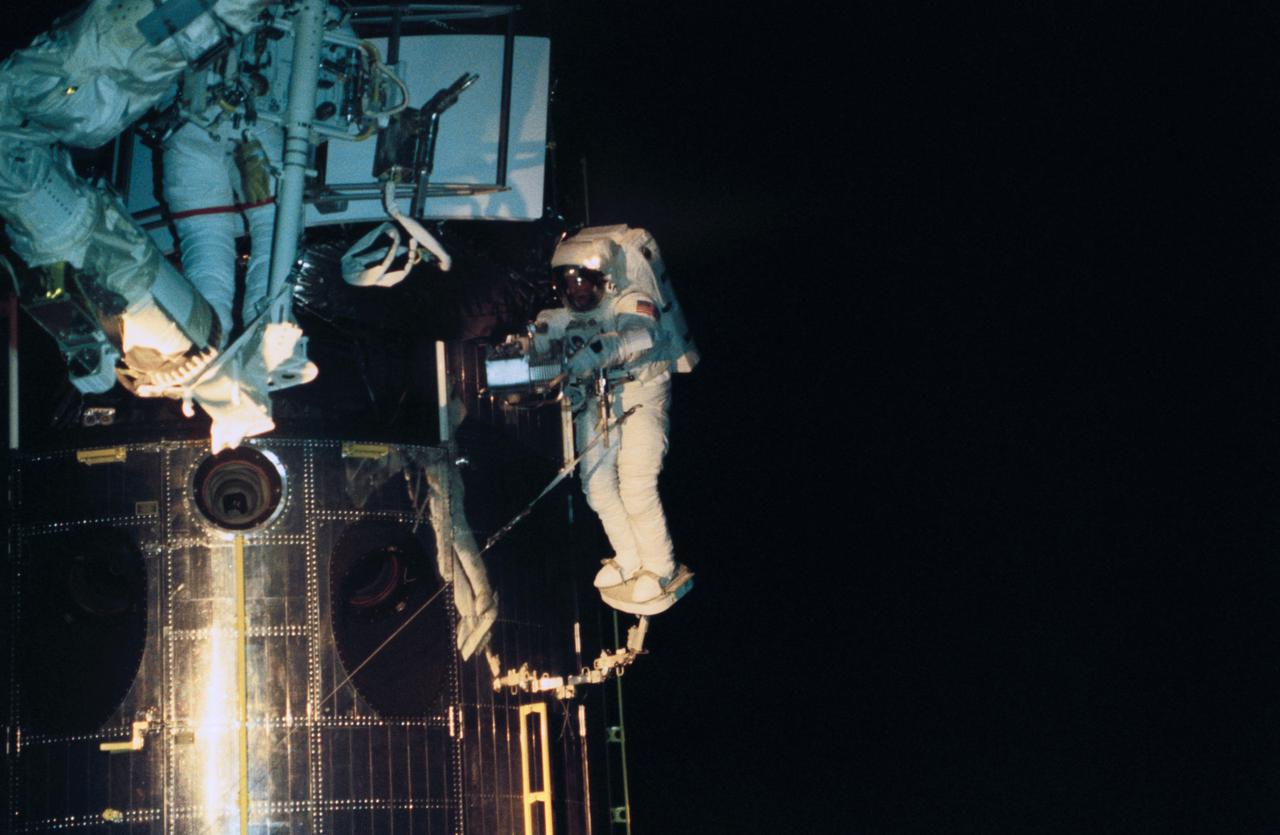
STS061-58-033 (7 Dec 1993) --- Anchored to the Space Shuttle Endeavour's Remote Manipulator System (RMS) arm, astronaut Jeffrey A. Hoffman works with the replacement Wide Field/Planetary Camera (WF/PC II) for the Hubble Space Telescope (HST) during the third of five space walks. Astronaut F. Story Musgrave, who joined Hoffman for three of the five space walks, helps with alignment at center frame.
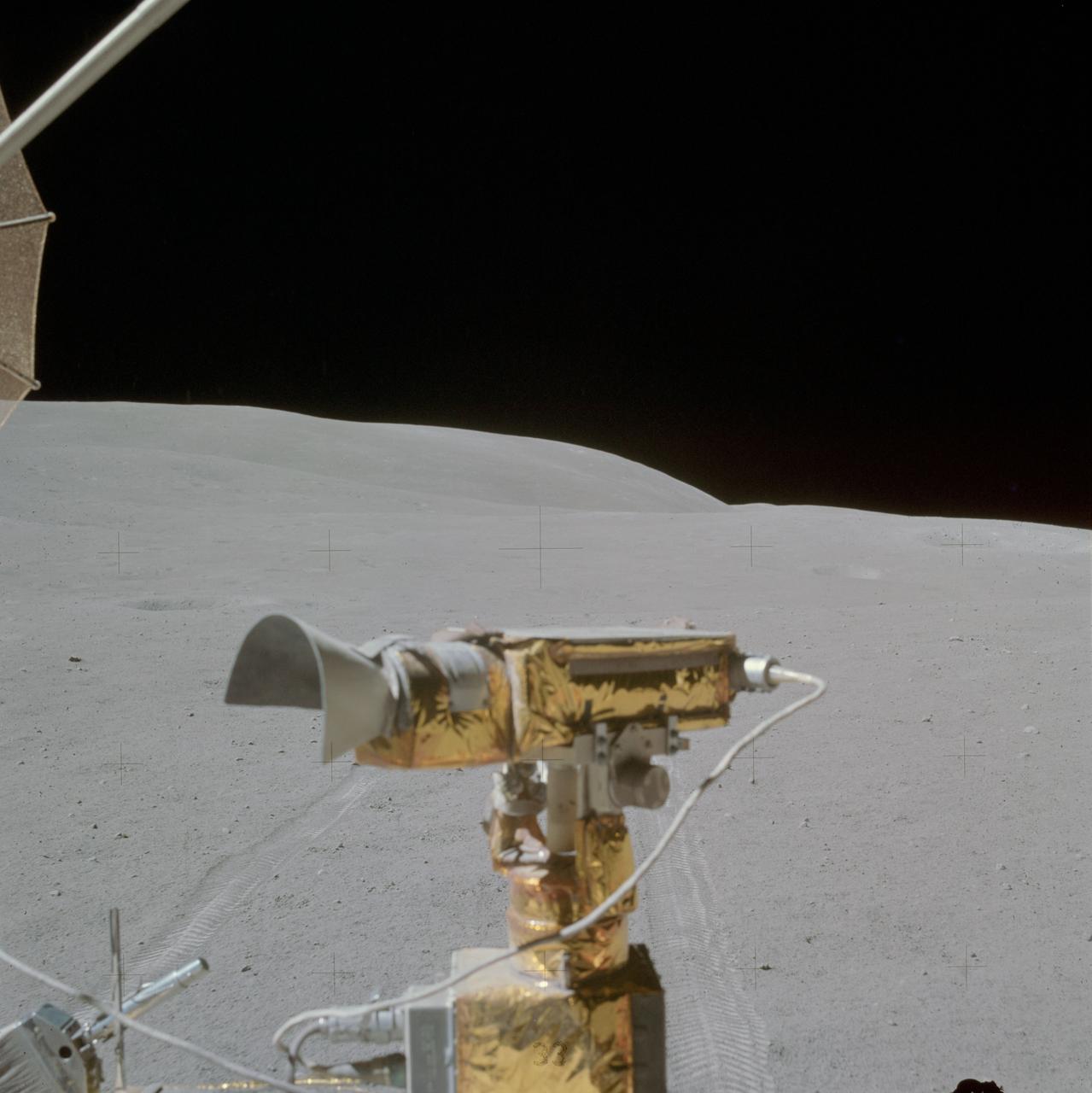
AS16-117-18754 (23 April 1972) --- A view of the smooth terrain in the general area of the North Ray Crater geological site, photographed by the Apollo 16 crew from the Lunar Roving Vehicle (LRV) shortly after leaving the immediate area of the geology site. The RCA color television camera is mounted on the front of the LRV and can be seen in the foreground, along with a small part of the high gain antenna, upper left. The tracks were made on the earlier trip to the North Ray Crater site. Astronaut Charles M. Duke Jr., lunar module pilot, exposed this view with his 70mm Hasselblad camera. Astronaut John W. Young, commander, said that this area was much smoother than the region around South Ray Crater. While astronauts Young and Duke descended in the Apollo 16 Lunar Module (LM) "Orion" to explore the Descartes highlands landing site on the moon, astronaut Thomas K. Mattingly II, command module pilot, remained with the Command and Service Modules (CSM) "Casper" in lunar orbit.
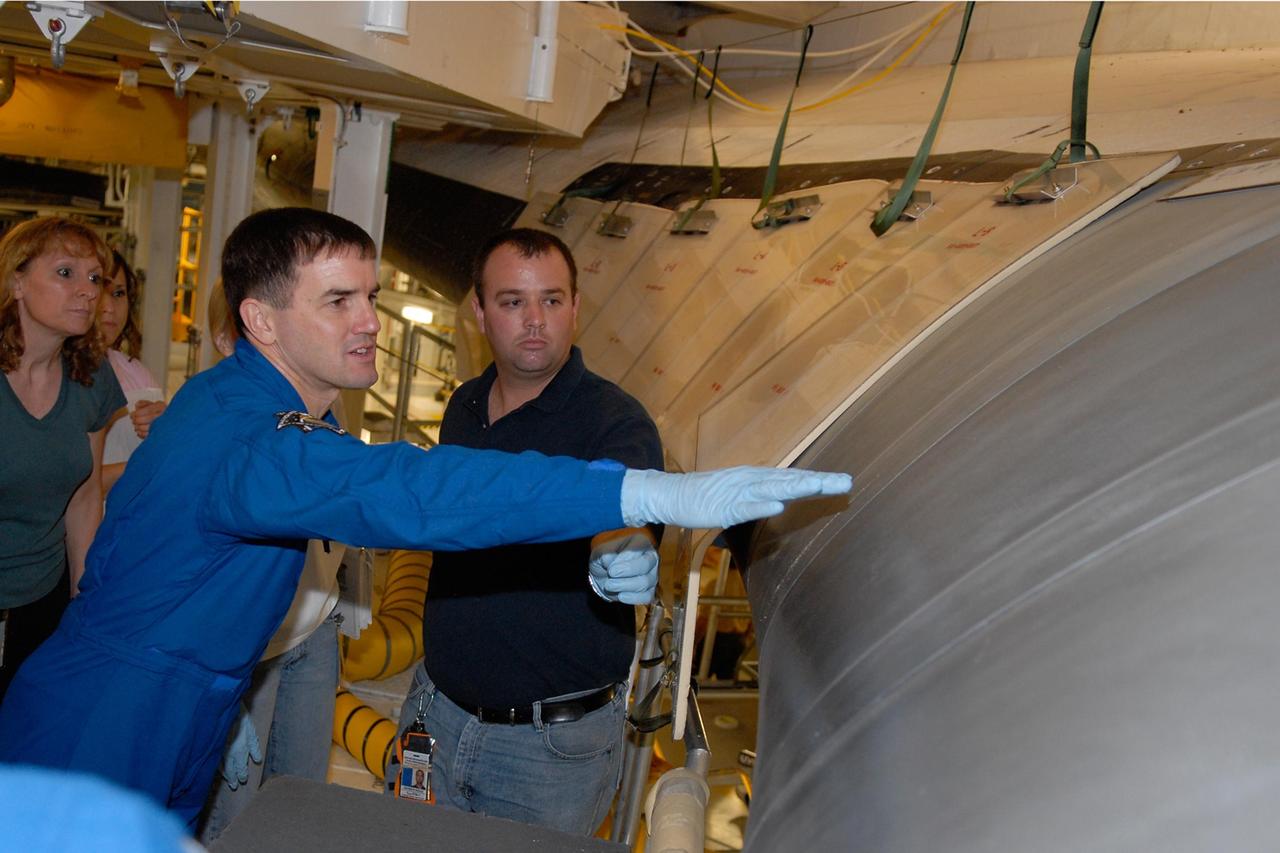
KENNEDY SPACE CENTER, FLA. -- In the Orbiter Processing Facility, STS-122 Mission Specialist Rex Walheim reaches toward the wing of space shuttle Atlantis. The crew is at Kennedy to take part in a crew equipment interface test, or CEIT, which helps familiarize them with equipment and payloads for the mission. Among the activities standard to a CEIT are harness training, inspection of the thermal protection system and camera operation for planned extravehicular activities, or EVAs. STS-122 is targeted for launch in December. Photo credit: NASA/Kim Shiflett
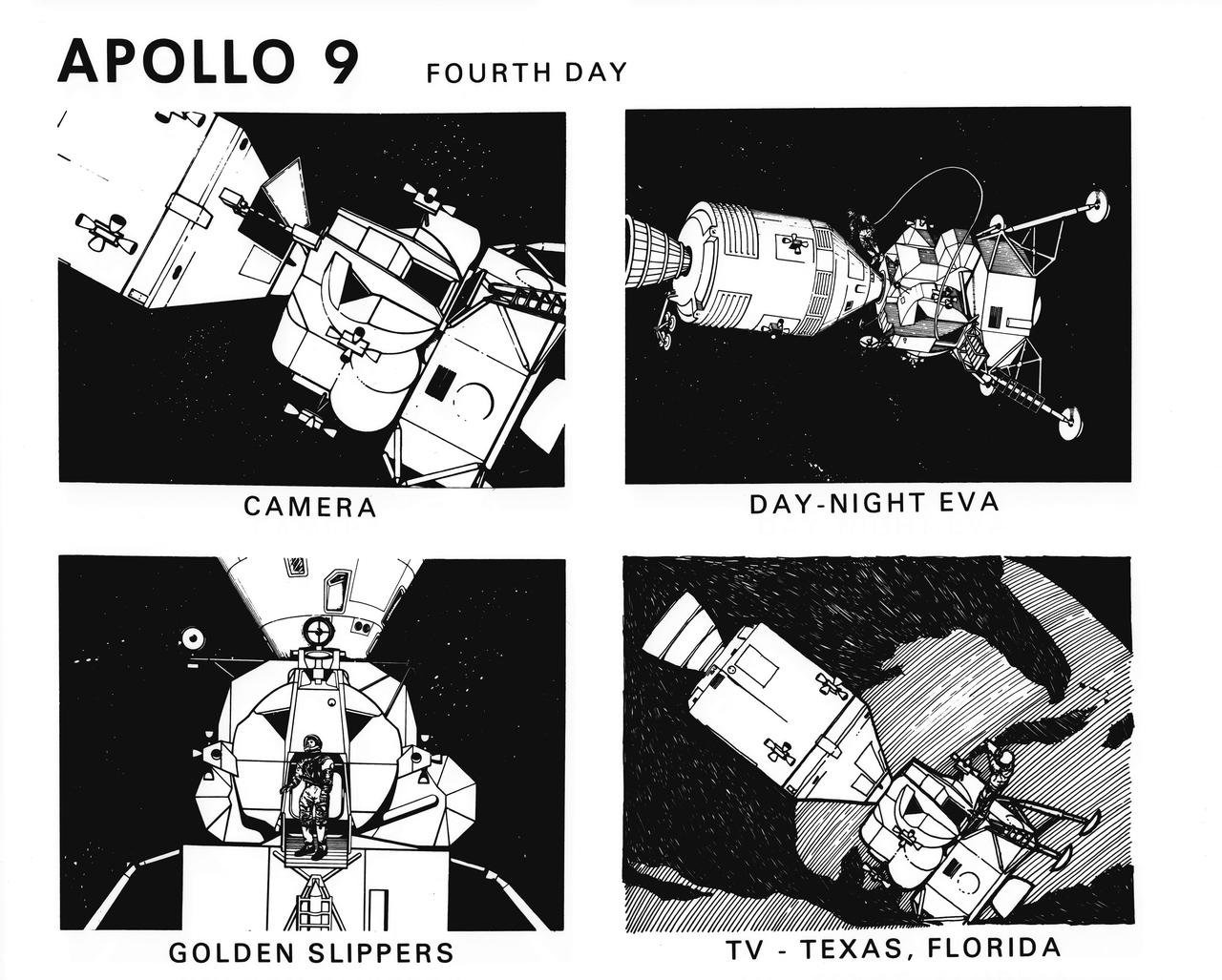
S69-19795 (February 1969) --- Composite of four artist's concepts illustrating key events, tasks and activities on the fourth day of the Apollo 9 mission, including use of camera, day-night extravehicular activity, use of golden slippers, and television over Texas and Florida. The Apollo 9 mission will evaluate spacecraft lunar module systems performance during manned Earth-orbital flight.
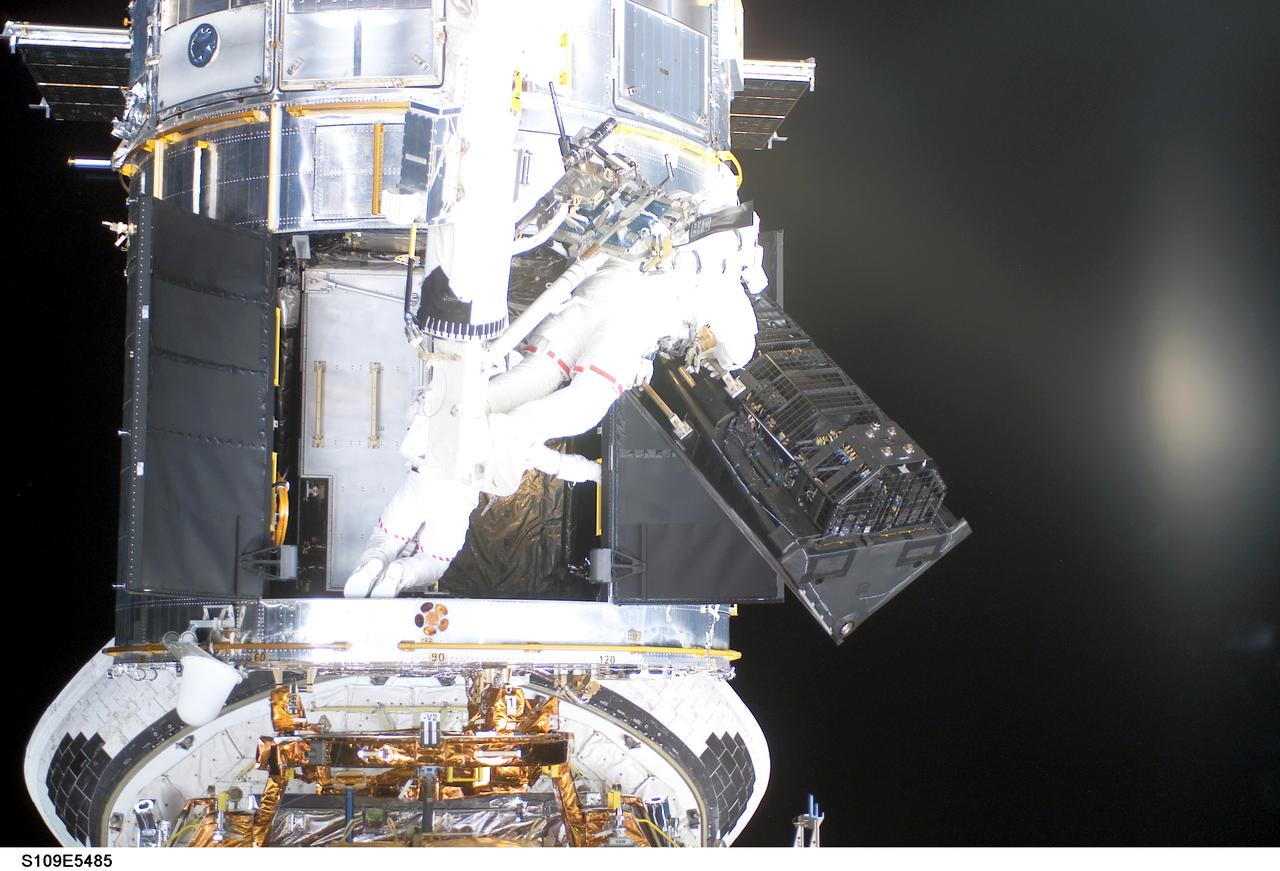
STS109-E-5485 (7 March 2002) --- Two of Columbia's four spacewalkers--astronauts James H. Newman and Michael J. Massimino--participate in the first science instrument upgrade of the fourth Hubble Space Telescope (HST) servicing mission during the flight's fourth day of extravehicular activity (EVA). The two, with Newman on Columbia's remote manipulator system (RMS) robotic arm, remove the Faint Object Camera to make room for the new Advanced Camera for Surveys (ACS). This image was recorded with a digital still camera by one of the duo's crewmates on the aft flight deck.
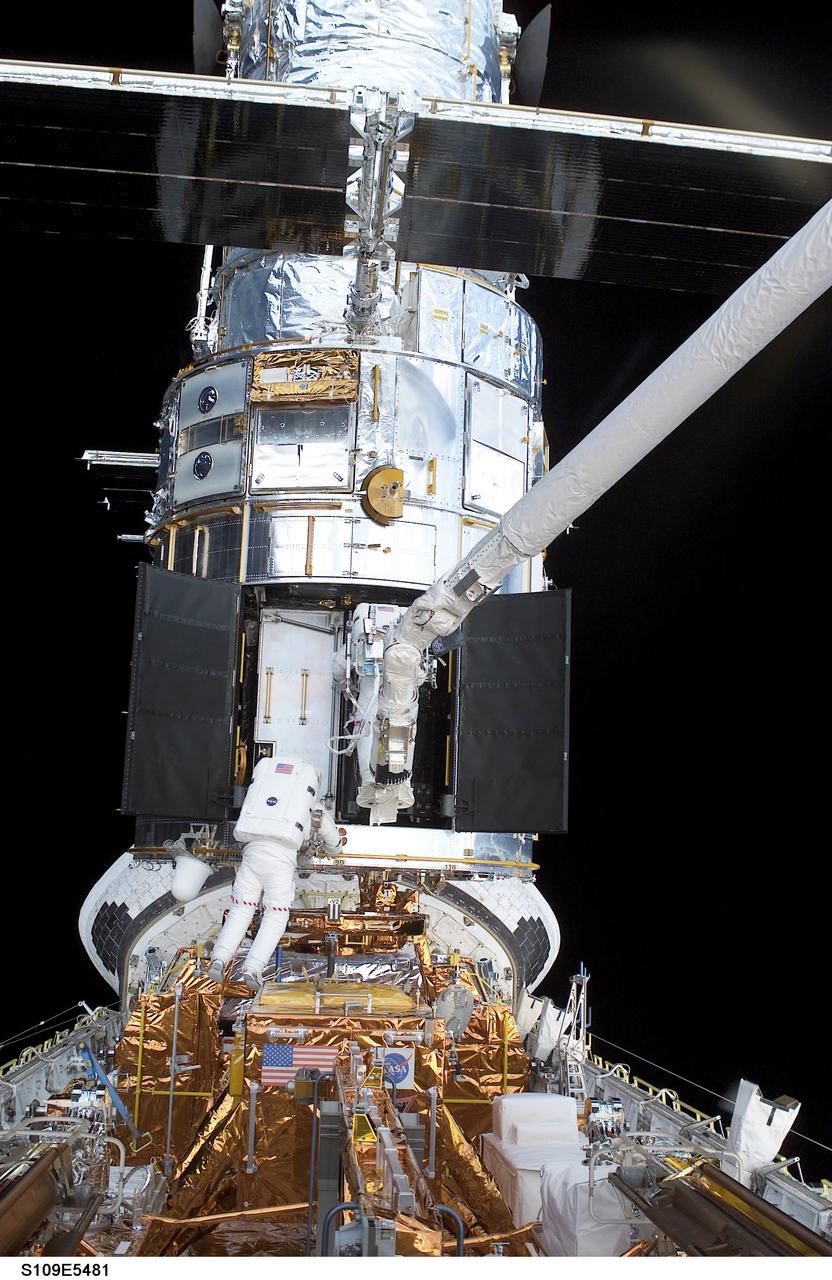
STS109-E-5481 (7 March 2002) --- Two of Columbia's four spacewalkers--astronauts James H. Newman and Michael J. Massimino--participate in the first science instrument upgrade of the fourth Hubble Space Telescope (HST) servicing mission during the flight's fourth day of extravehicular activity (EVA). The two, with Newman on Columbia's remote manipulator system (RMS) robotic arm, removed the Faint Object Camera to make room for the new Advanced Camera for Surveys (ACS). This image was recorded with a digital still camera by one of the duo's crewmates on the aft flight deck.
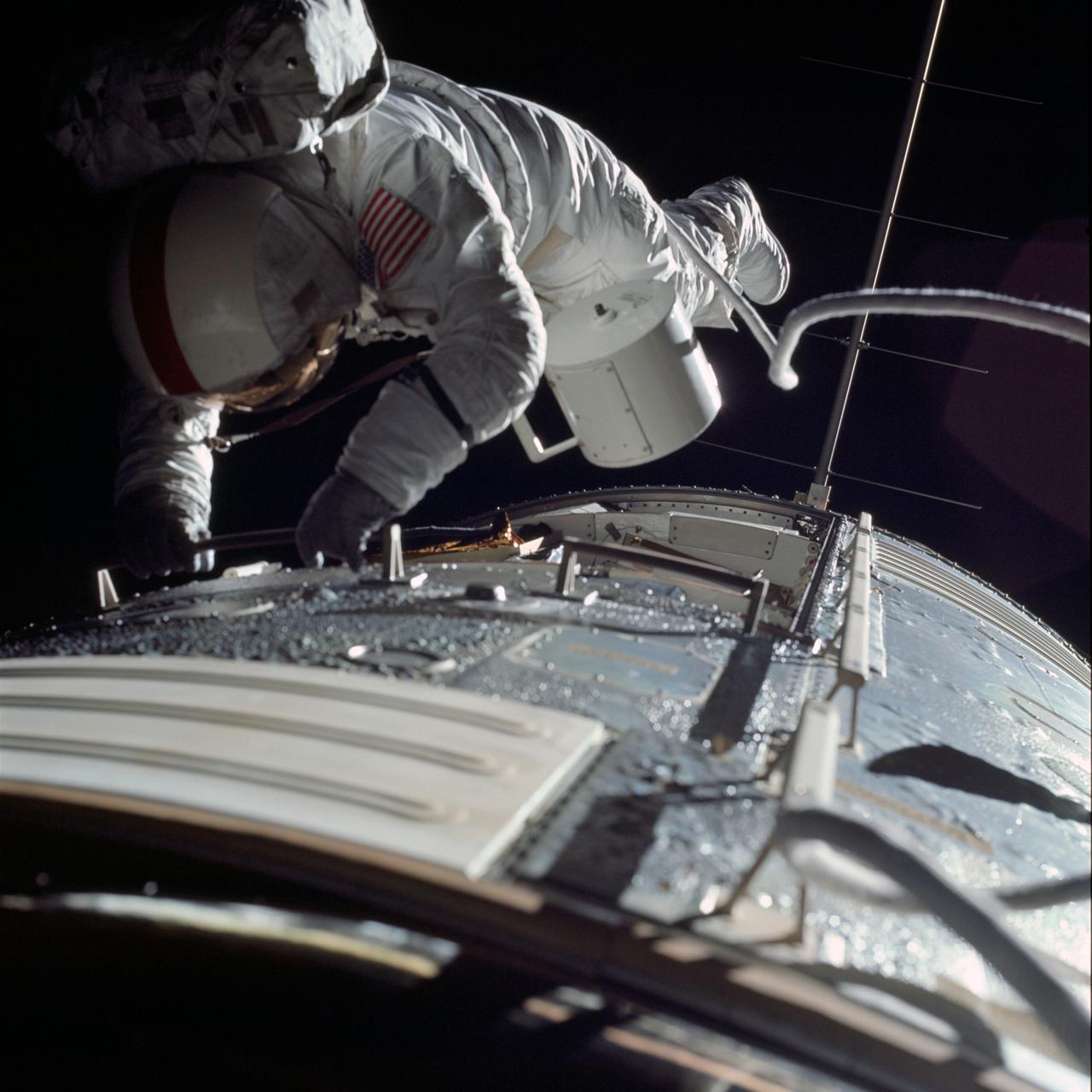
AS17-152-23391 (17 Dec. 1972) --- Astronaut Ronald E. Evans is photographed performing extravehicular activity during the Apollo 17 spacecraft's trans-Earth coast. During his EVA, Evans, command module pilot, retrieved film cassettes from the lunar sounder, mapping camera and panoramic camera. The cylindrical object at Evans' left side is the mapping camera cassette. The total time for the trans-Earth EVA was one hour, seven minutes, 18 seconds, starting at ground elapsed time of 257:25 (2:28 p.m.) and ending at G.E.T. of 258:42 (3:35 p.m.) on Sunday, Dec. 17, 1972.
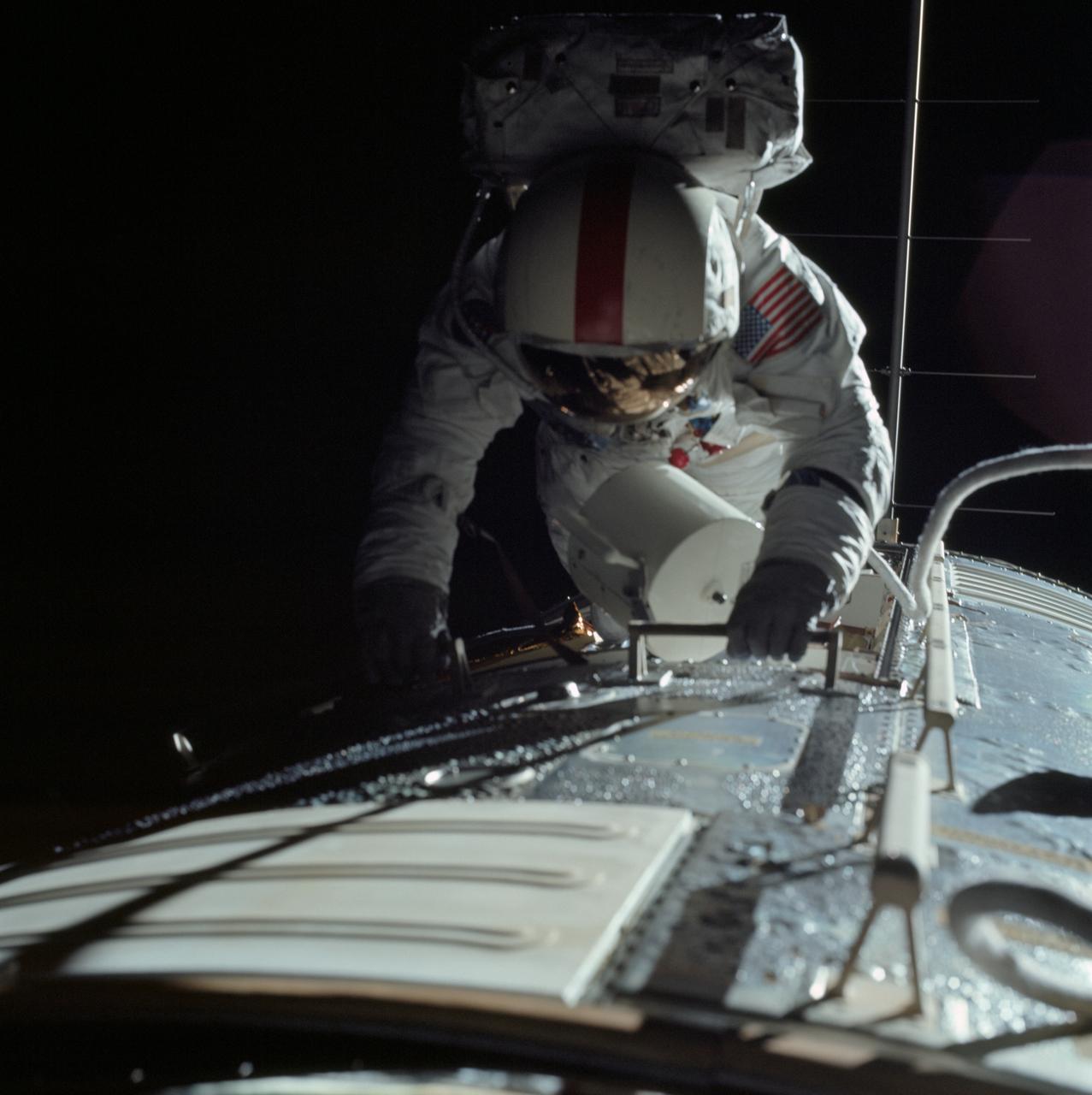
AS17-152-23392 (17 Dec. 1972) --- Astronaut Ronald E. Evans is photographed performing extravehicular activity during the Apollo 17 spacecraft's trans-Earth coast. During his EVA, command module pilot Evans retrieved film cassettes from the Lunar Sounder, Mapping Camera, and Panoramic Camera. The cylindrical object at Evans' left side is the Mapping Camera cassette. The total time for the trans-Earth EVA was one hour seven minutes 18 seconds, starting at ground elapsed time of 257:25 (2:28 p.m.) and ending at ground elapsed timed of 258:42 (3:35 p.m.) on Sunday, Dec. 17, 1972.
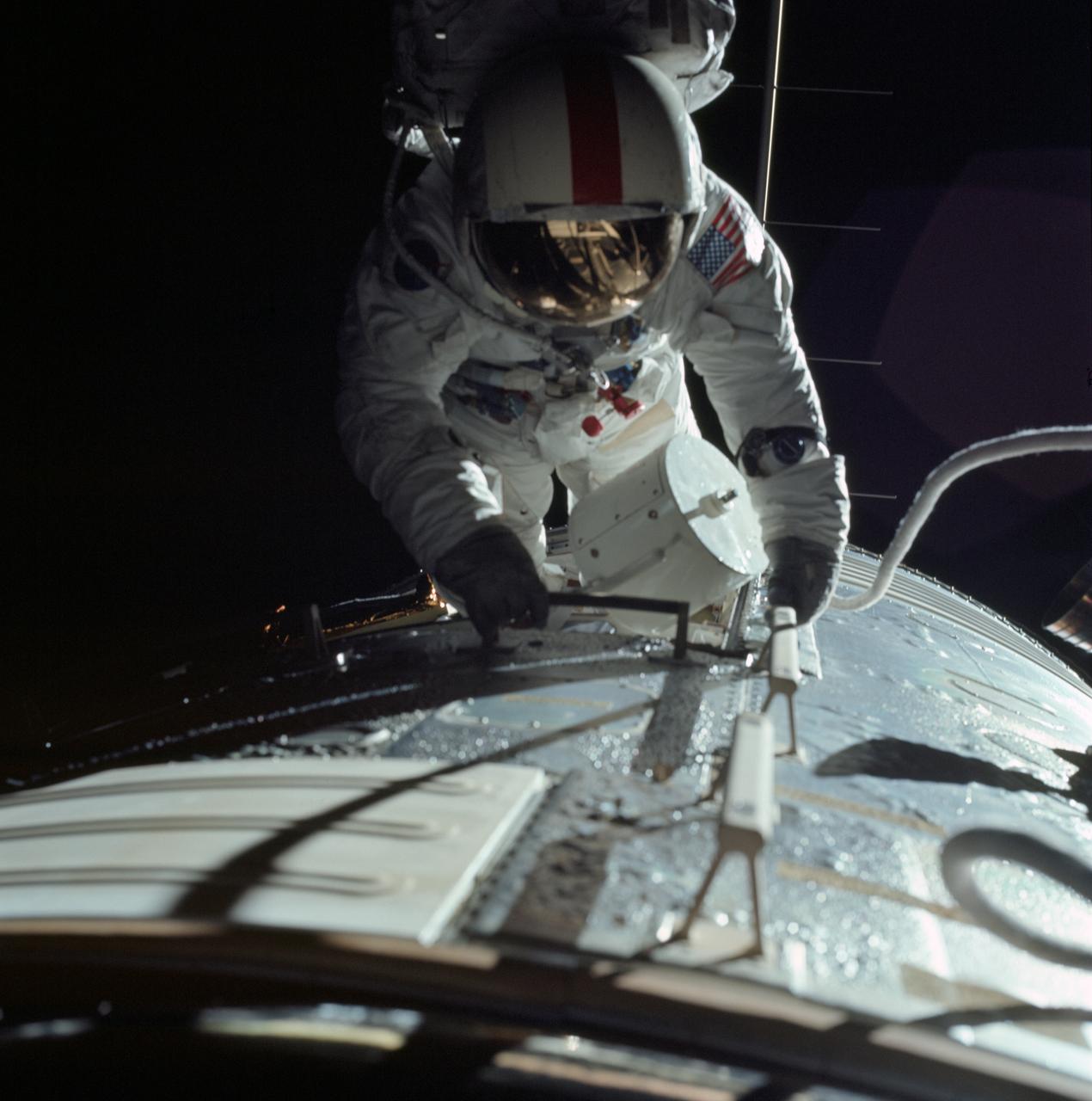
AS17-152-23393 (17 Dec. 1972) --- Astronaut Ronald E. Evans is photographed performing extravehicular activity during the Apollo 17 spacecraft's trans-Earth coast. During his EVA, command module pilot Evans retrieved film cassettes from the Lunar Sounder, Mapping Camera, and Panoramic Camera. The cylindrical object at Evans' left side is the Mapping Camera cassette. The total time for the trans-Earth EVA was one hour seven minutes 18 seconds, starting at ground elapsed time of 257:25 (2:28 p.m.) and ending at ground elapsed timed of 258:42 (3:35 p.m.) on Sunday, Dec. 17, 1972.
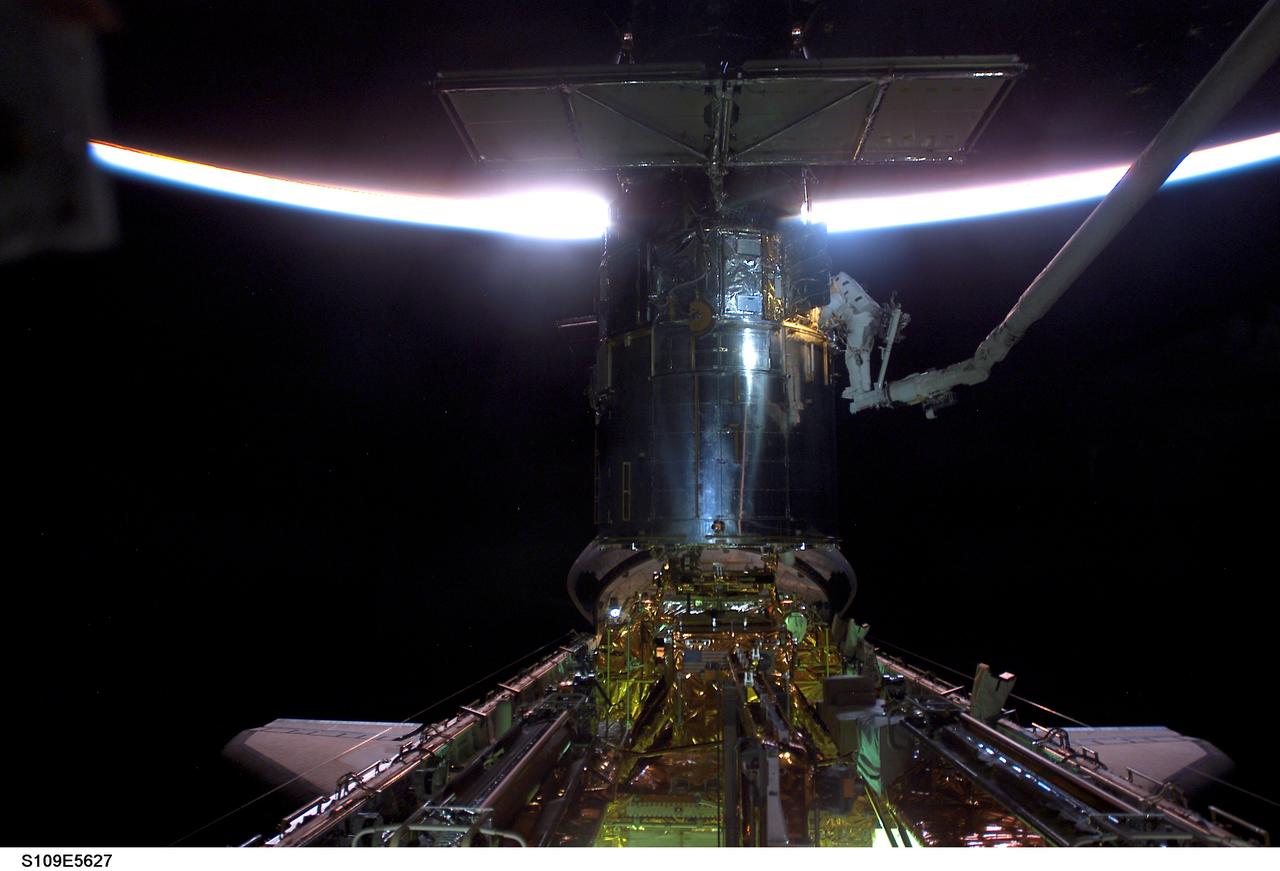
STS109-E-5627 (5 March 2002) --- With the Space Shuttle Columbia in limited natural light, two astronauts work on the Hubble Space Telescope (HST) during the flight's second of five scheduled space walks. A thin slice of reflected sunlight and airglow can be seen at Earth's horizon. Astronauts James H. Newman and Michael J. Massimino, mission specialists, are making their first extravehicular activity (EVA) of the mission, following the act of two other crewmembers on the previous day. Massimino can be identified on the end of the arm by the diagonal stripes on the pant legs of his extravehicular mobility unit (EMU) space suit. The image was recorded with a digital still camera.
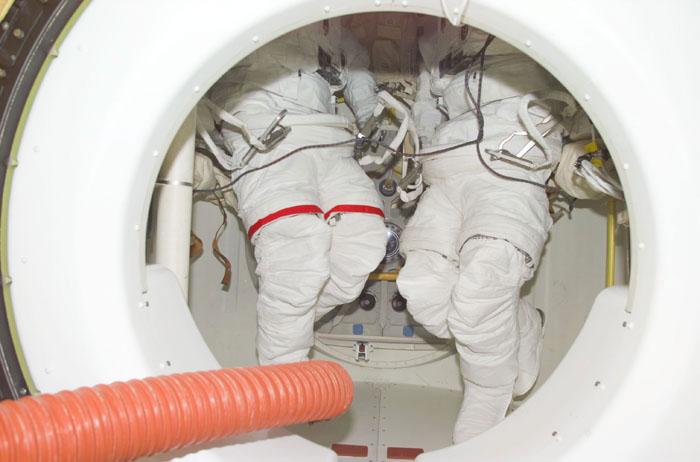
STS98-E-5012 (8 February 2001) --- The bottom portions of the extravehicular mobility units (EMU) for STS-98's two space walkers are seen in the airlock aboard the Space Shuttle Atlantis during early stages of the STS-98 mission. Astronaut Thomas D. Jones will be using the suit on the left, and astronaut Robert L. Curbeam will don the one on the right. The two mission specialists are scheduled for extravehicular activity (EVA) once the shuttle is docked with the International Space Station (ISS) later in the week. The scene was recorded with a digital still camera.
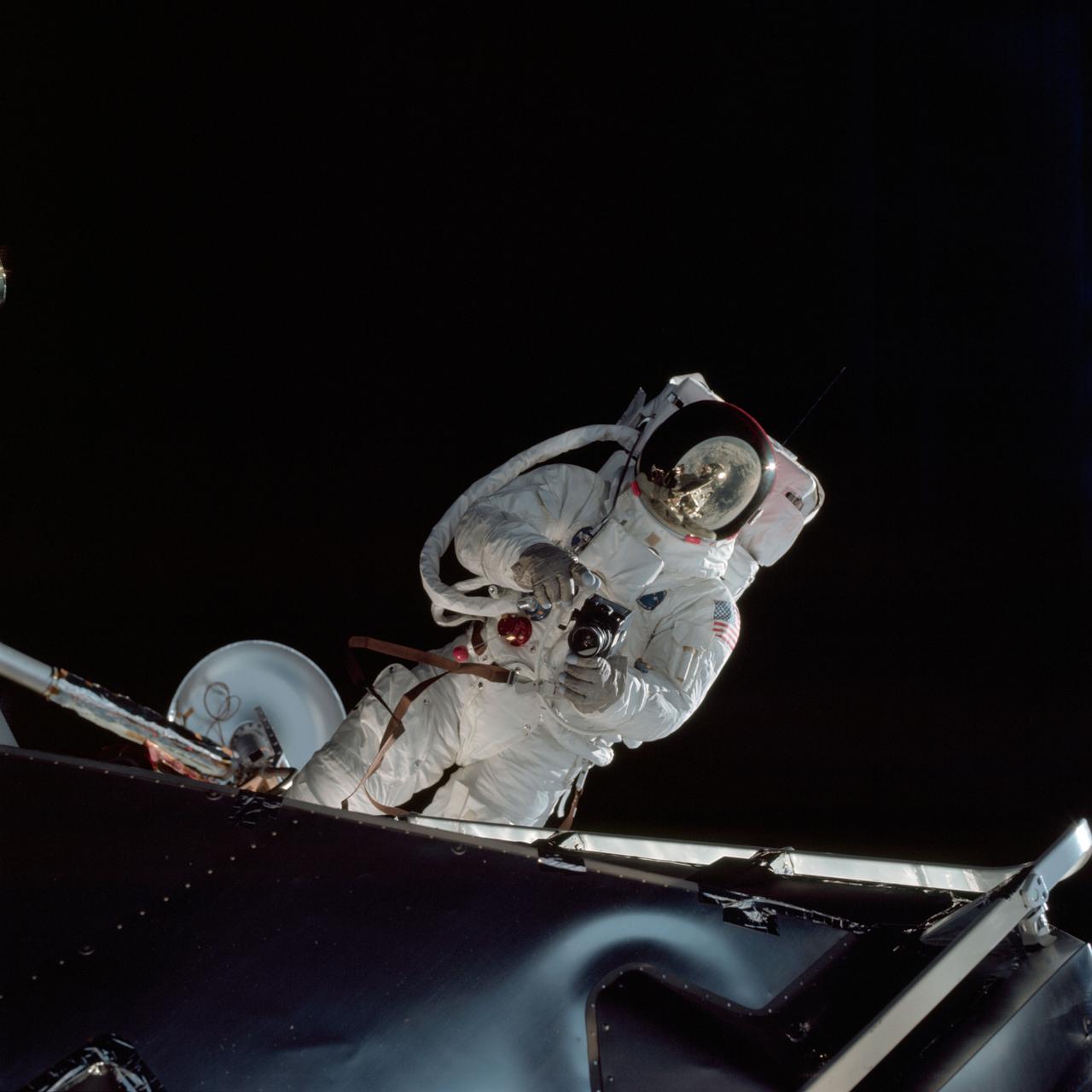
Astronaut Russell L. Schweickart, lunar module pilot, operates a 70mm Hasselblad camera during his extravehicular activity on the fourth day of the Apollo 9 earth-orbital mission. The Command/Service Module and the Lunar Module 3 "Spider" are docked. This view was taken form the Command Module "Gumdrop". Schweickart, wearing an Extravehicular Mobility Unit (EMU), is standing in "golden slippers" on the Lunar Module porch. On his back, partially visible, are a Portable Life Support System (PLSS) and an Oxygen Purge System (OPS). Film magazine was A,film type was SO-368 Ektachrome with 0.460 - 0.710 micrometers film / filter transmittance response and haze filter,80mm lens.
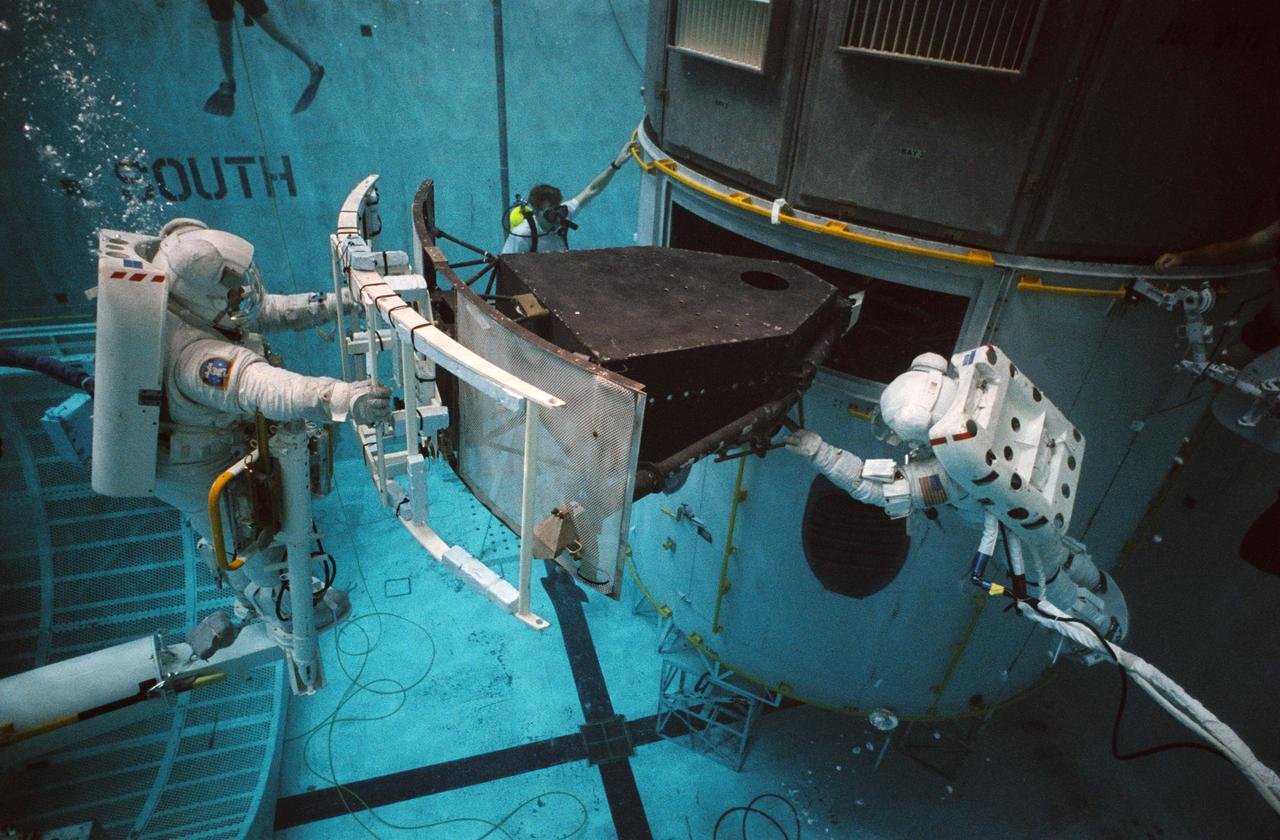
S93-33103 (2 Apr 1993) --- Wearing training versions of Space Shuttle Extravehicular Mobility Units (EMU), astronauts F. Story Musgrave and Jeffrey A. Hoffman use the giant pool of the Johnson Space Center's (JSC) Weightless Environment Training Facility (WET-F) to rehearse for the Hubble Space Telescope (HST) repair mission. The two are working with a full-scale training version of the Wide Field/Planetary Camera (WF/PC). The current WF/PC will be replaced with WF/PC-2. A total of five extravehicular activity (EVA) sessions will be conducted during the scheduled December mission of the Endeavour.
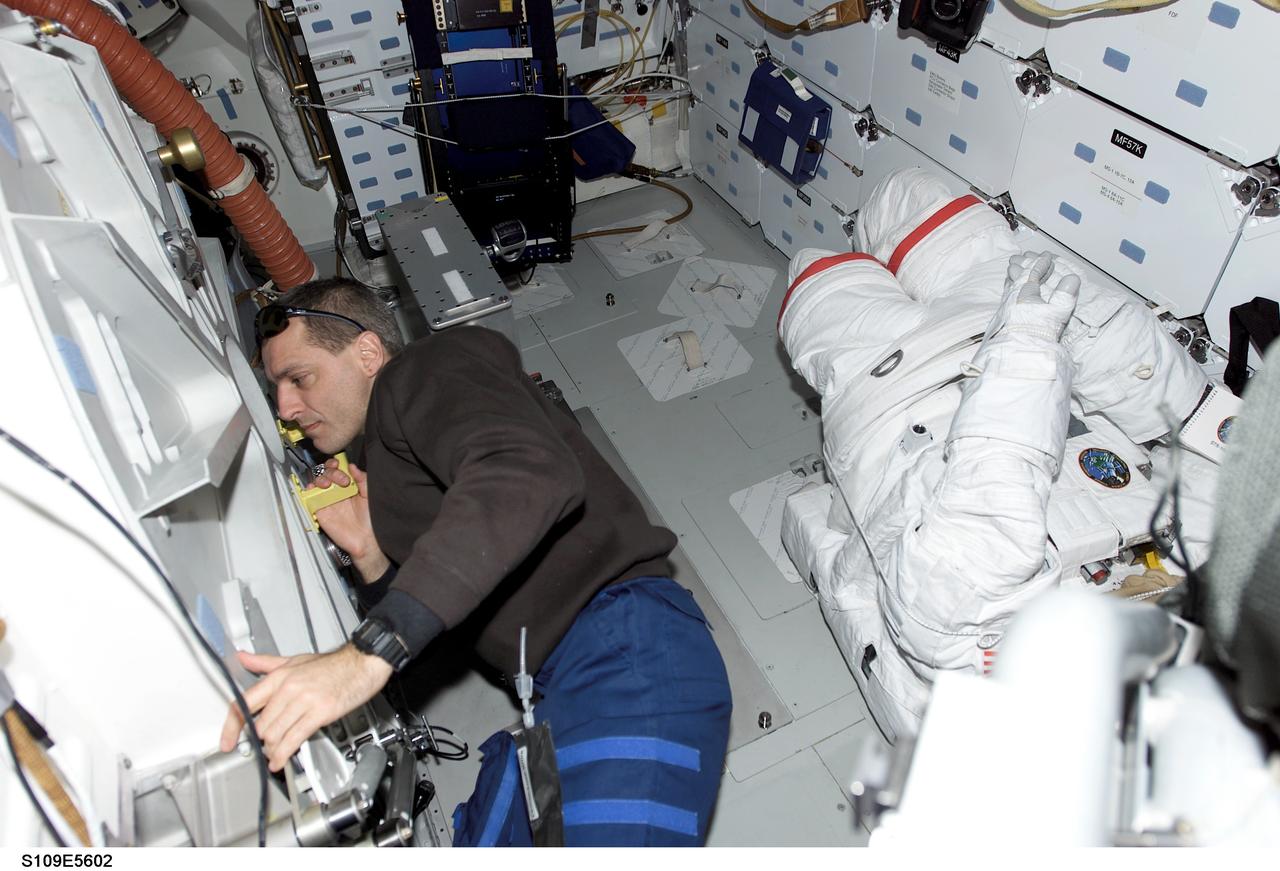
STS109-E-5602 (5 March 2002) --- Astronaut Richard M. Linnehan, mission specialist, checks the airlock hatch as two crewmates on the other side, equipped with extravehicular mobility units (EMU) space suits, start their extravehicular activity (EVA). On the previous day astronauts Linnehan and John M. Grunsfeld replaced the starboard solar array on the Hubble Space Telescope (HST). This day's space walk went on to see astronauts James H. Newman and Michael J. Massimino replace the port solar array. Grunsfeld's suit, scheduled for two more space walks, is temporarily stowed on the mid deck floor at right. The image was recorded with a digital still camera.
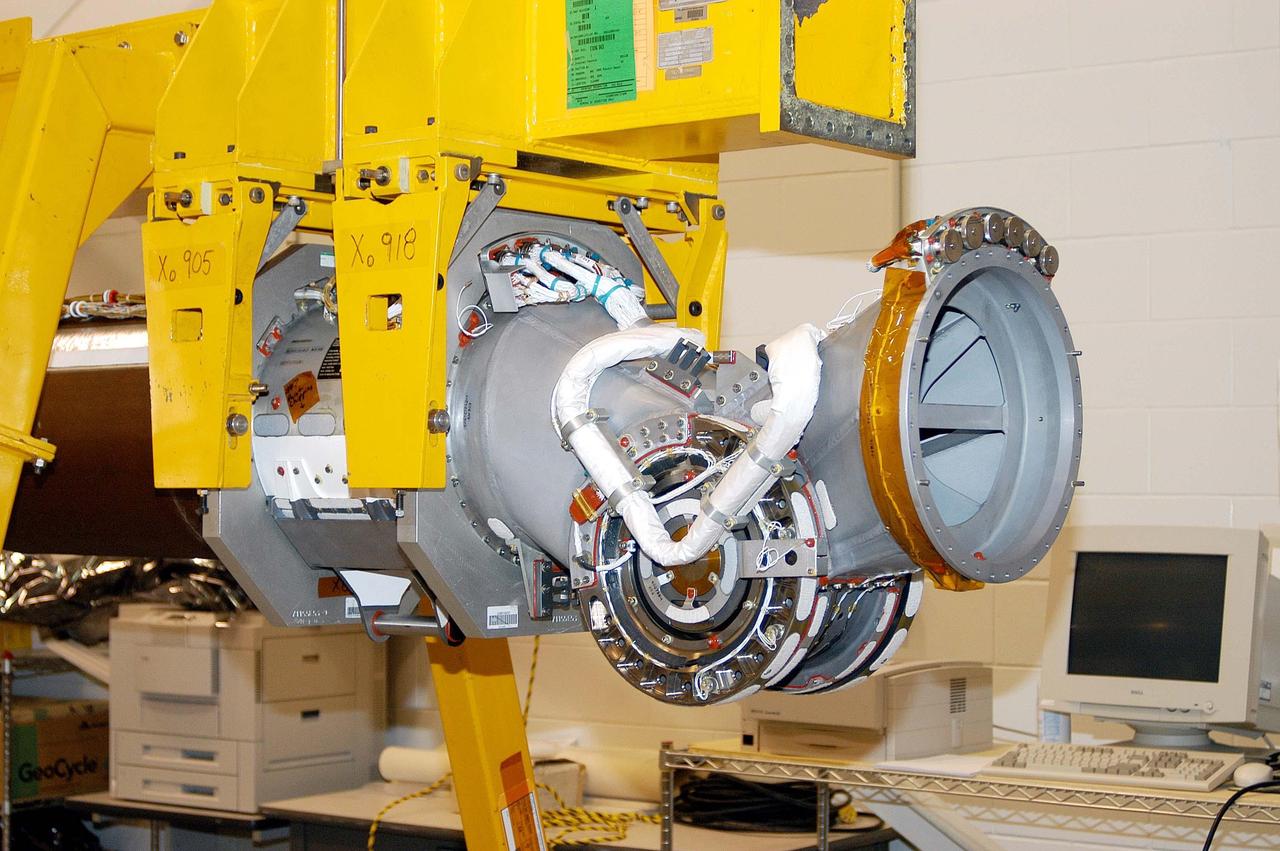
KENNEDY SPACE CENTER, FLA. - The Remote Manipulator System (RMS), also known as the Canadian robotic arm, for the orbiter Discovery has arrived at KSC’s Vehicle Assembly Building Lab. The part seen on the end is one of the joints that allow the basic structure of the arm to maneuver similar to a human arm. The RMS is used to deploy and retrieve payloads, provide a mobile extension ladder or foot restraints for crew members during extravehicular activities; and to aid the flight crew members in viewing surfaces of the orbiter or payloads through a television camera on the RMS. The arm The RMS is used to deploy and retrieve payloads, provide a mobile extension ladder or foot restraints for crew members during extravehicular activities; and to aid the flight crew members in viewing surfaces of the orbiter or payloads through a television camera on the RMS. The arm is also serving as the base for the new Orbiter Boom Sensor System (OBSS), one of the safety measures for Return to Flight, equipping the Shuttle with cameras and laser systems to inspect the Shuttle’s Thermal Protection System while in space. Discovery is scheduled for a launch planning window of March 2005 on mission STS-114.
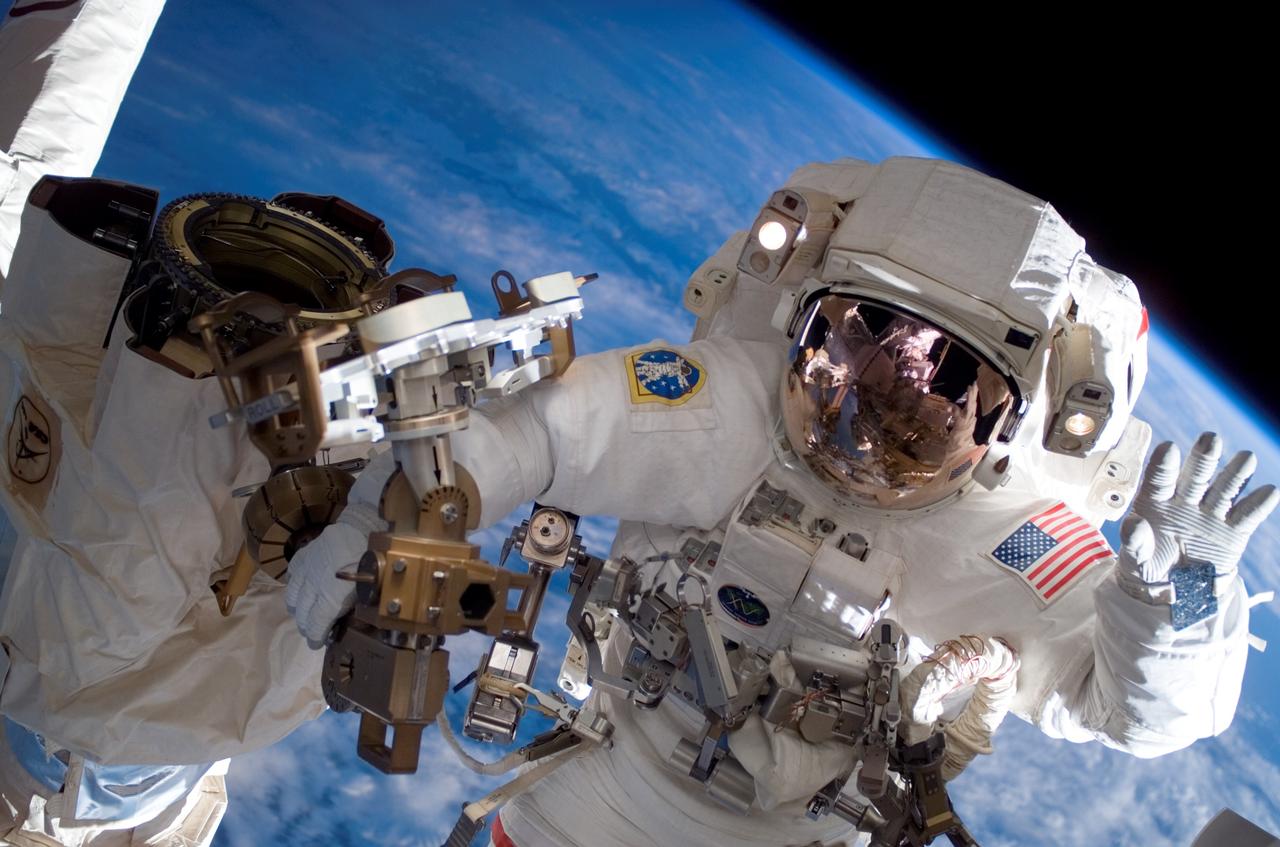
ISS015-E-18958 (23 July 2007) --- Astronaut Clay Anderson, Expedition 15 flight engineer, waves to the camera while participating in a session of extravehicular activity (EVA) as construction continues on the International Space Station. During the 7-hour 41-minute spacewalk, Anderson and cosmonaut Fyodor N. Yurchikhin (out of frame), commander representing Russia's Federal Space Agency, installed a television camera stanchion, reconfigured a power supply for an antenna assembly, and performed several get-ahead tasks. Also, while riding on the end of the Canadarm2, Anderson jettisoned the Early Ammonia Servicer (EAS) by shoving it opposite of the station's direction of travel. The station's robotic arm end effector is at left.