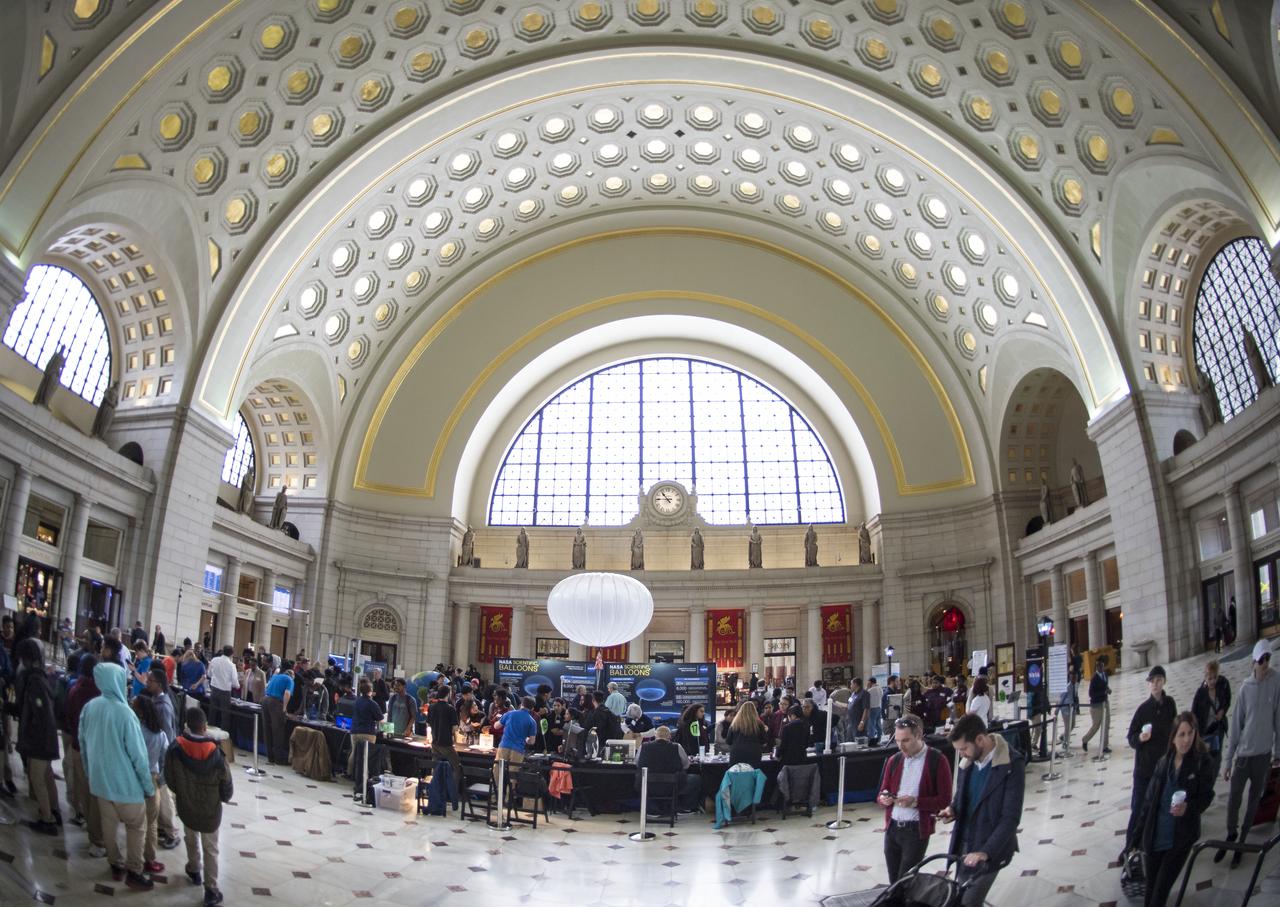
A view of the exhibits at NASA's Earth Day event on Thursday, April 19, 2018 at Union Station in Washington, D.C. Photo Credit: (NASA/Aubrey Gemignani)
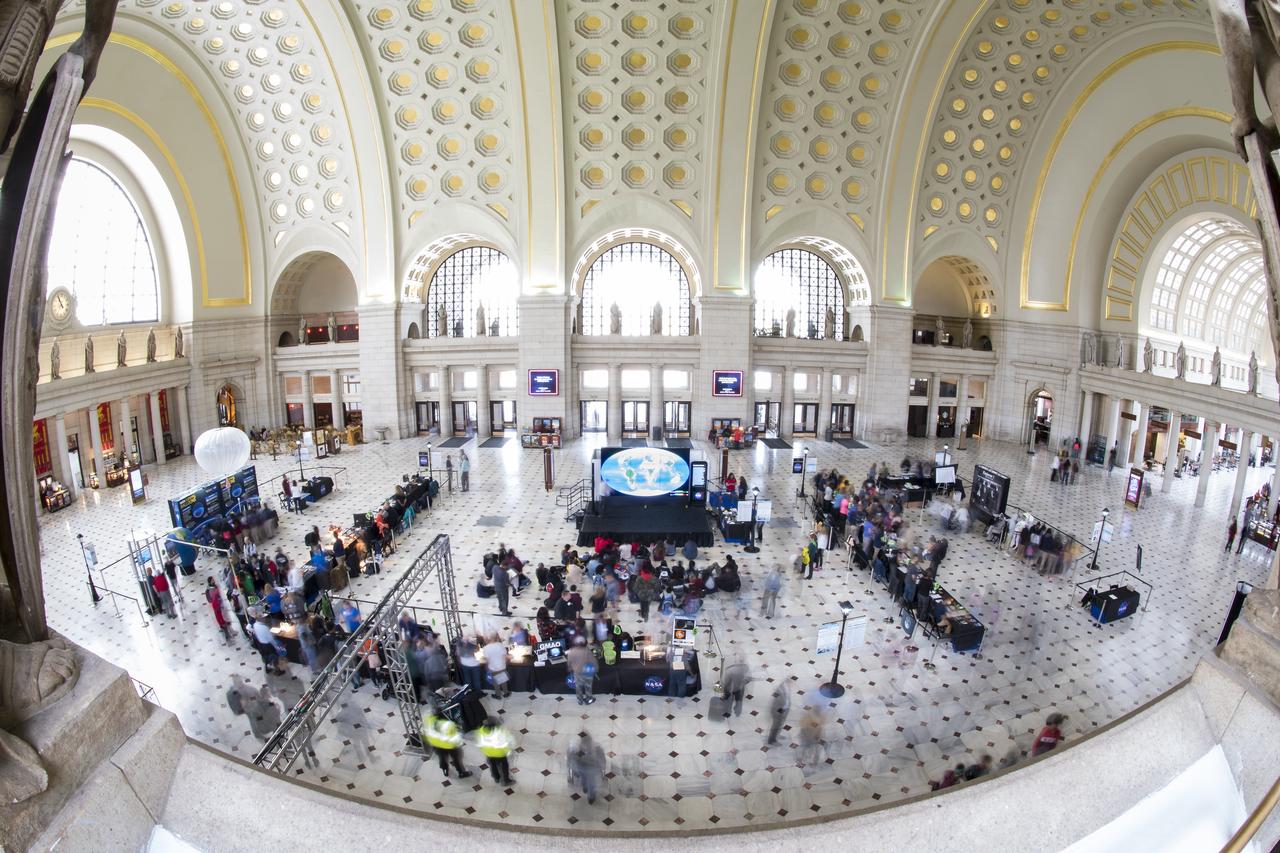
A view of the exhibits at NASA's Earth Day event on Thursday, April 19, 2018 at Union Station in Washington, D.C. Photo Credit: (NASA/Aubrey Gemignani)

A visitor learns about Earth at one of NASA's exhibits at the Earth Day event on Thursday, April 19, 2018 at Union Station in Washington, D.C. Photo Credit: (NASA/Aubrey Gemignani)
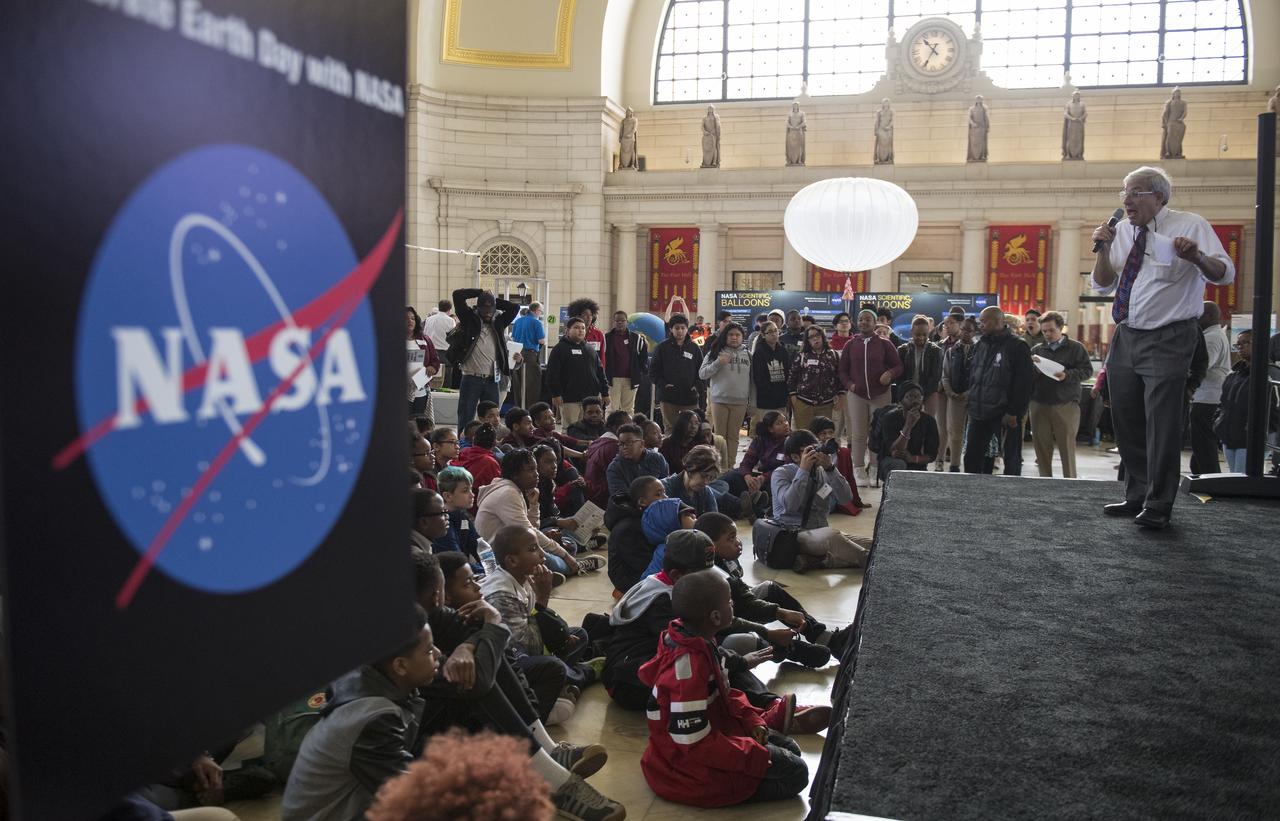
Dr. Michael Freilich, director, Earth Science Division, NASA Headquarters, speaks about the benefits of studying the Earth at NASA's Earth Day event on Thursday, April 19, 2018 at Union Station in Washington, D.C. Photo Credit: (NASA/Aubrey Gemignani)
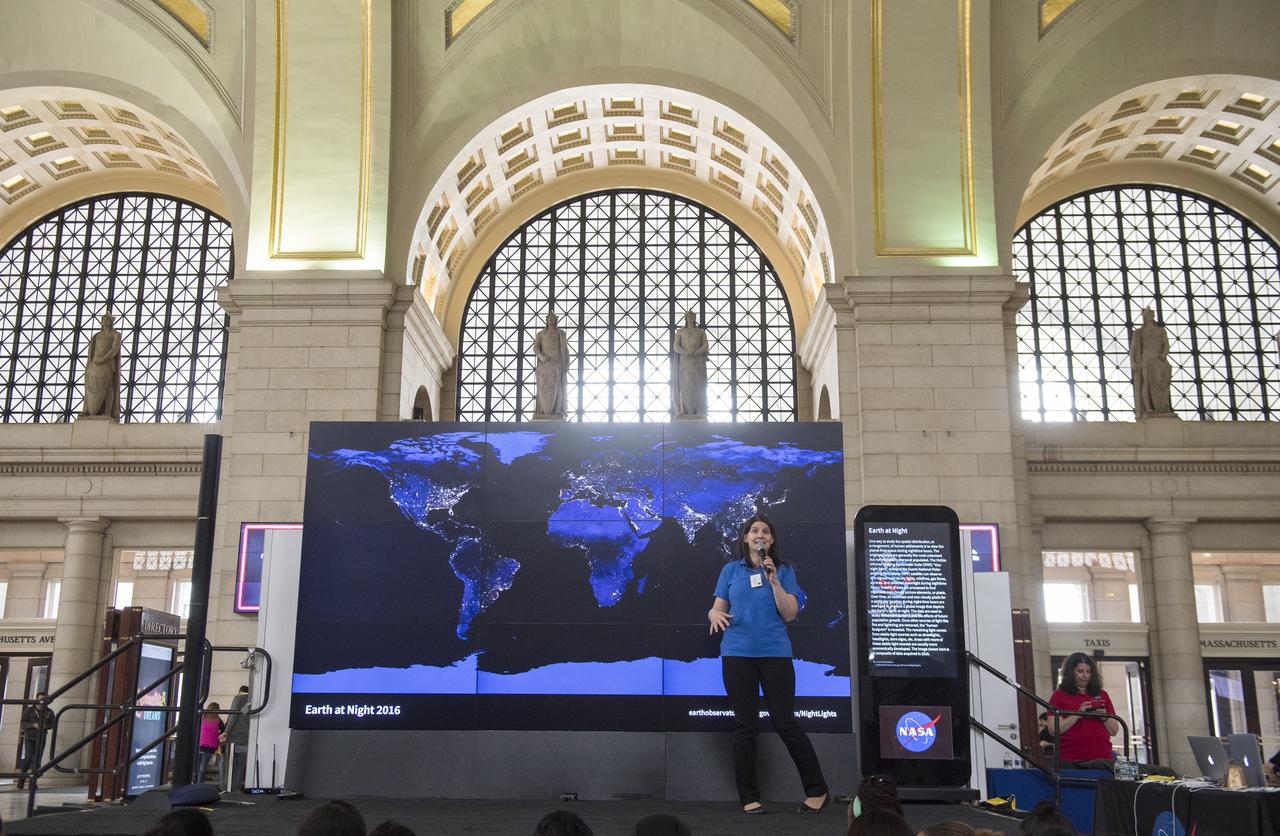
Dr. Allison Leidner, scientist, Earth Science Division, NASA Headquarters, speaks about Earth’s biodiversity at NASA's Earth Day event on Thursday, April 19, 2018 at Union Station in Washington, D.C. Photo Credit: (NASA/Aubrey Gemignani)
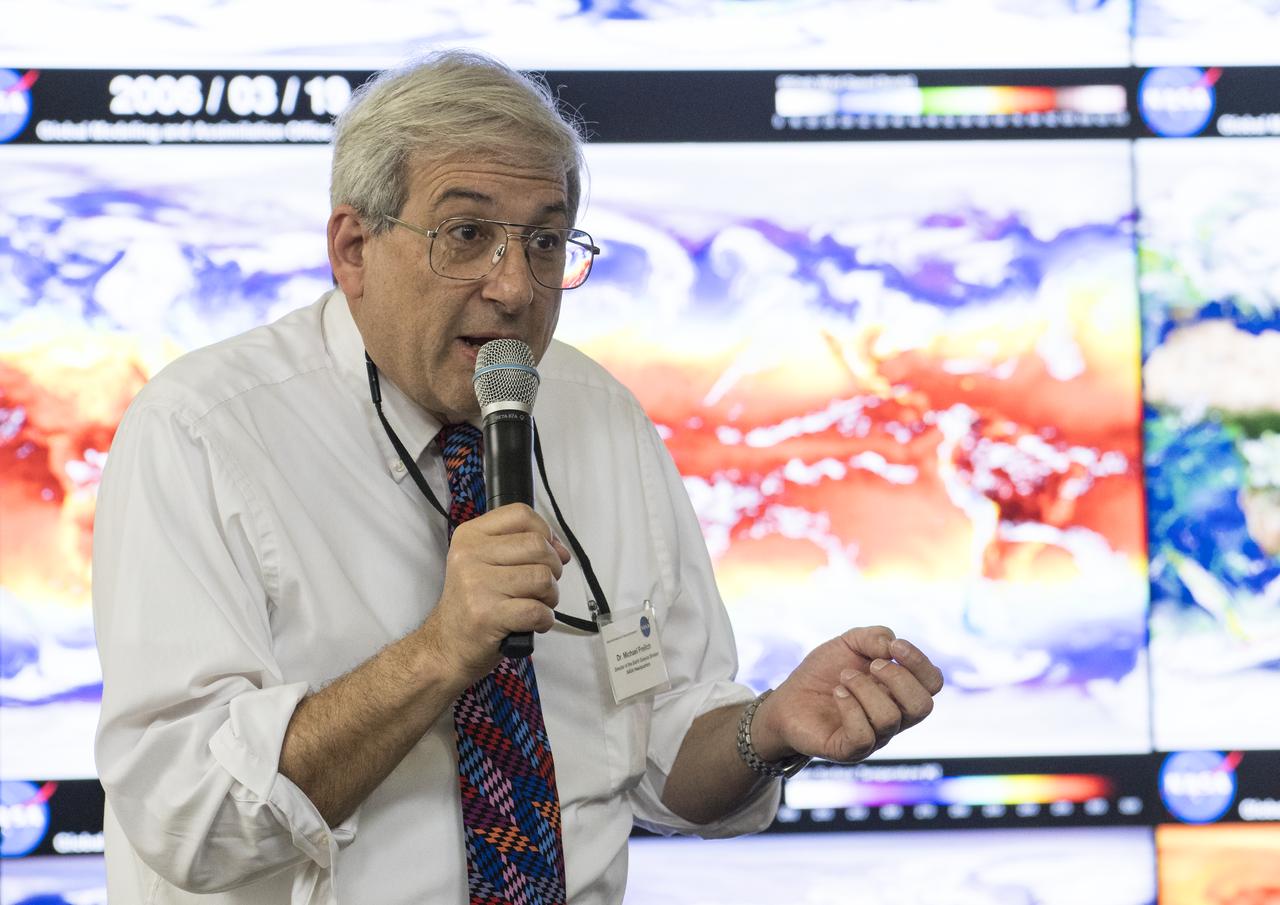
Dr. Michael Freilich, director, Earth Science Division, NASA Headquarters, speaks about the benefits of studying the Earth at NASA's Earth Day event on Thursday, April 19, 2018 at Union Station in Washington, D.C. Photo Credit: (NASA/Aubrey Gemignani)
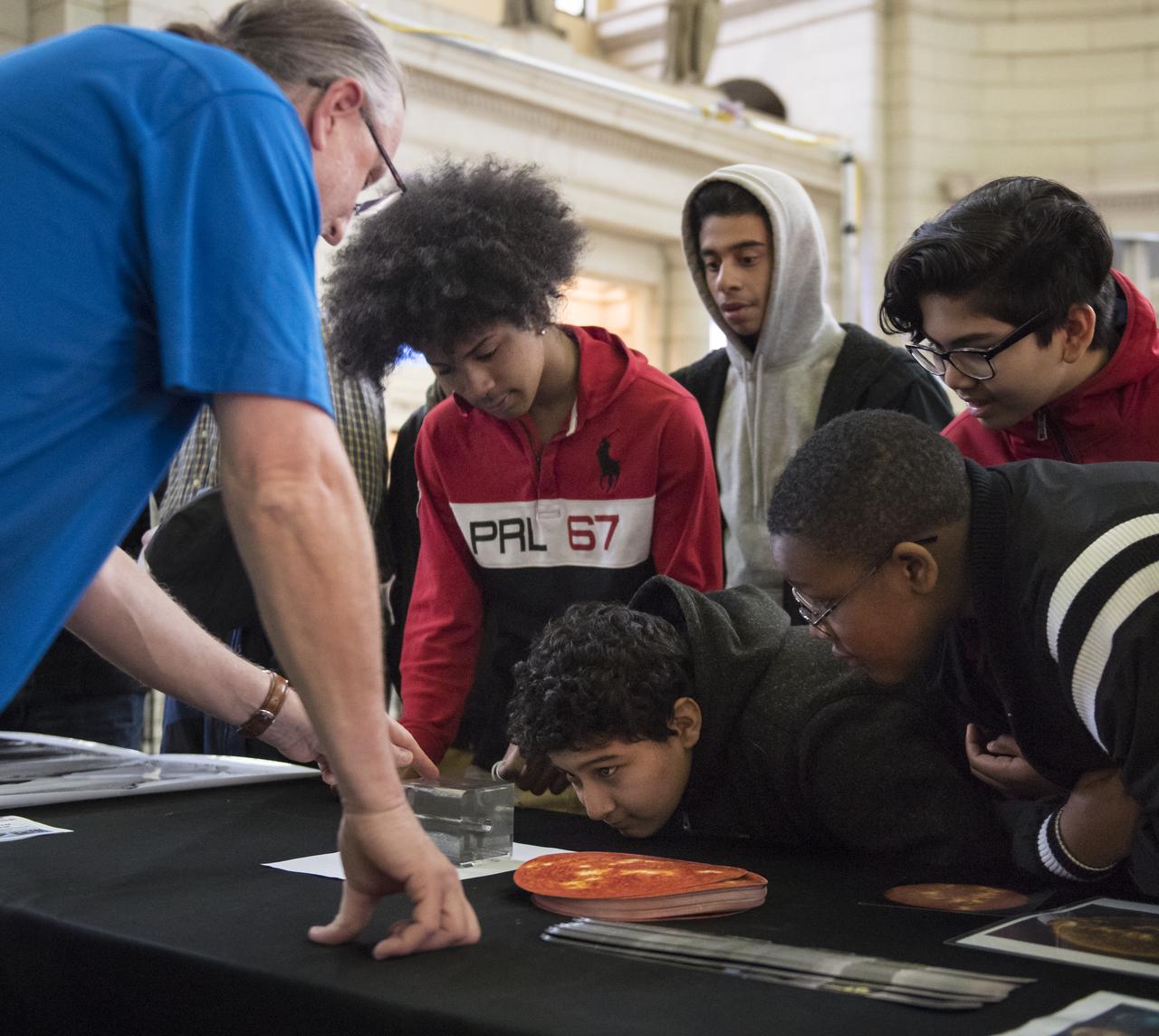
Visitors explore one of NASA's exhibits at the Earth Day event on Thursday, April 19, 2018 at Union Station in Washington, D.C. Photo Credit: (NASA/Aubrey Gemignani)
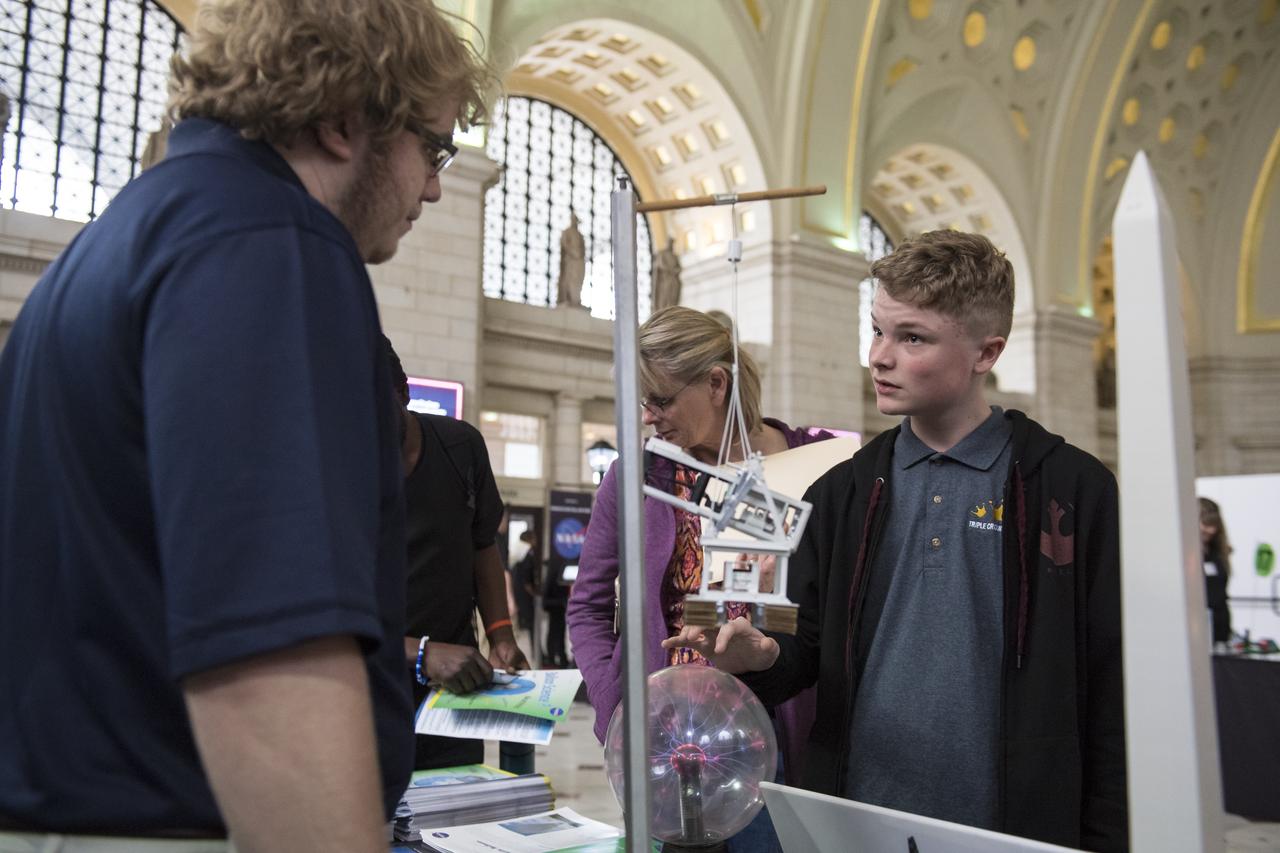
A visitor explores one of NASA's exhibits at the Earth Day event on Thursday, April 19, 2018 at Union Station in Washington, D.C. Photo Credit: (NASA/Aubrey Gemignani)
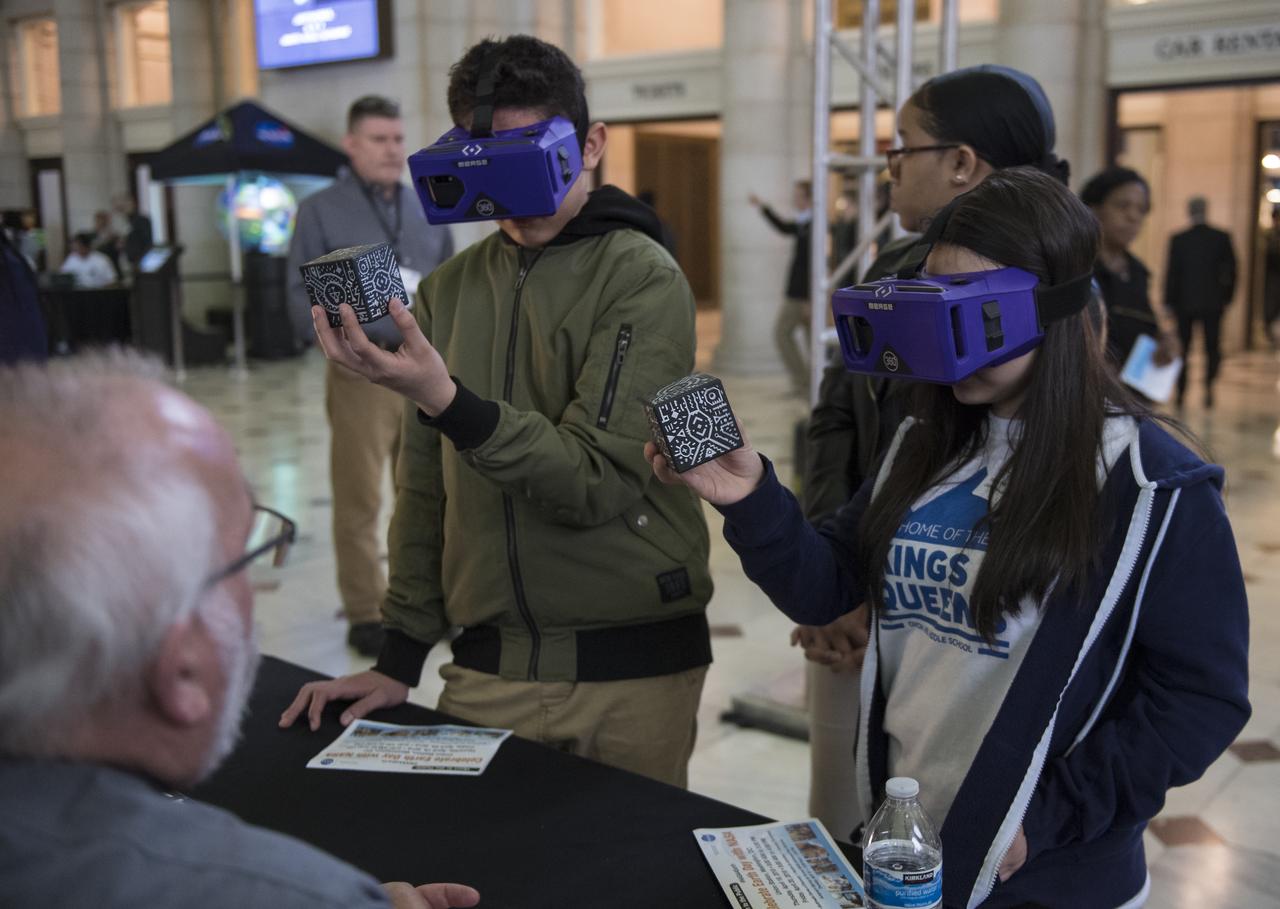
Visitors look through virtual reality goggles at one of NASA's exhibits at the Earth Day event on Thursday, April 19, 2018 at Union Station in Washington, D.C. Photo Credit: (NASA/Aubrey Gemignani)
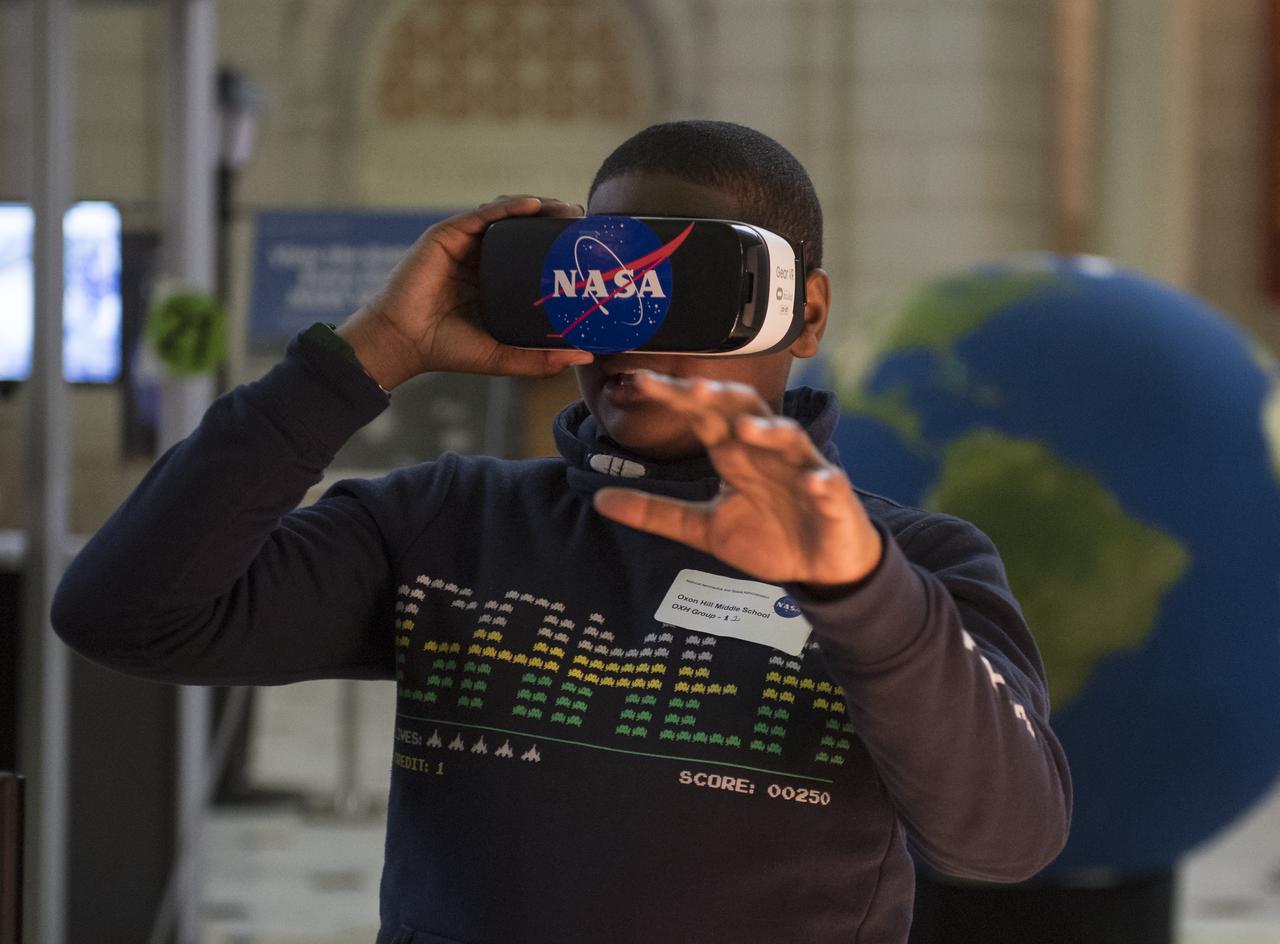
A visitor looks through virtual reality viewers at one of NASA's exhibits at the Earth Day event on Thursday, April 19, 2018 at Union Station in Washington, D.C. Photo Credit: (NASA/Aubrey Gemignani)
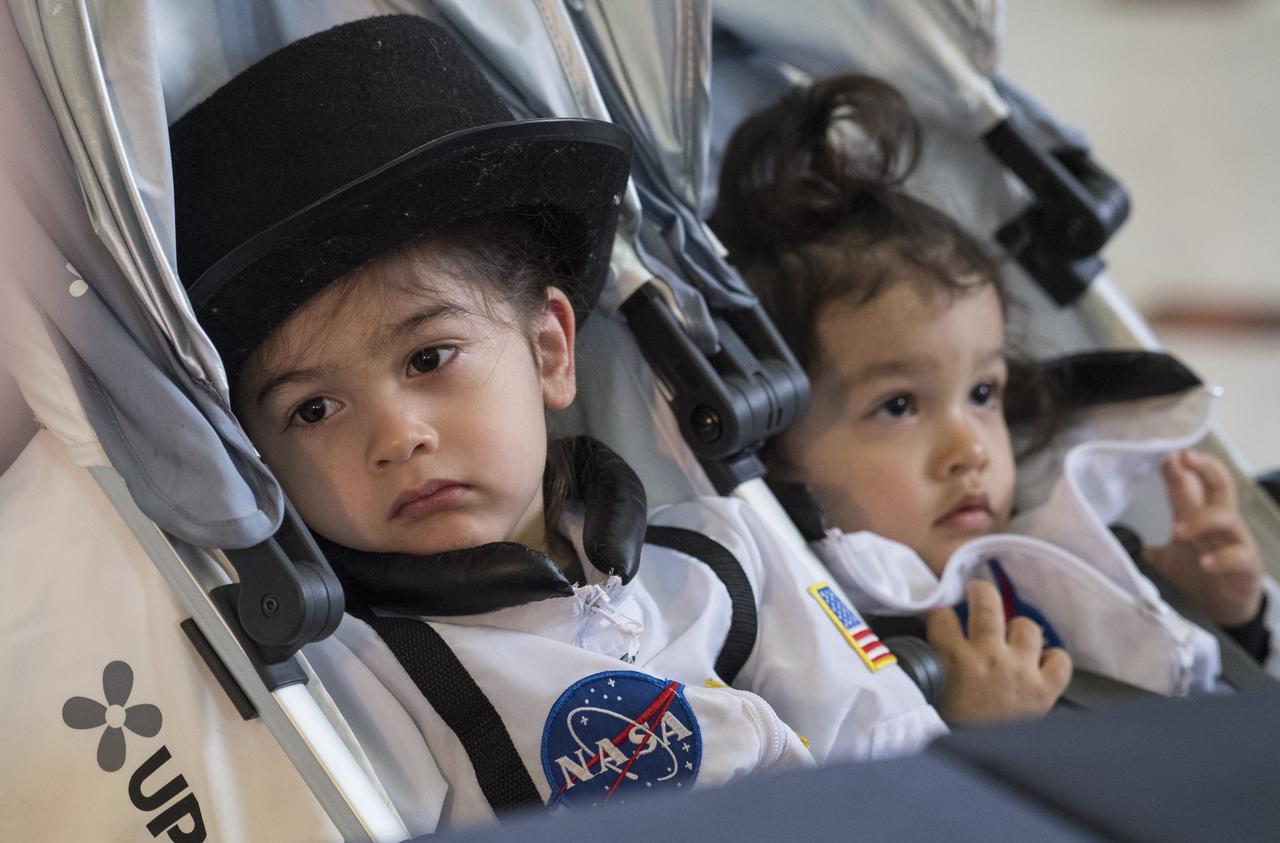
Some young visitors are seen at one of NASA's exhibits at the Earth Day event on Thursday, April 19, 2018 at Union Station in Washington, D.C. Photo Credit: (NASA/Aubrey Gemignani)

Visitors pose for a photo with former NASA astronaut Paul Richards at the Earth Day event on Thursday, April 19, 2018 at Union Station in Washington, D.C. Photo Credit: (NASA/Aubrey Gemignani)
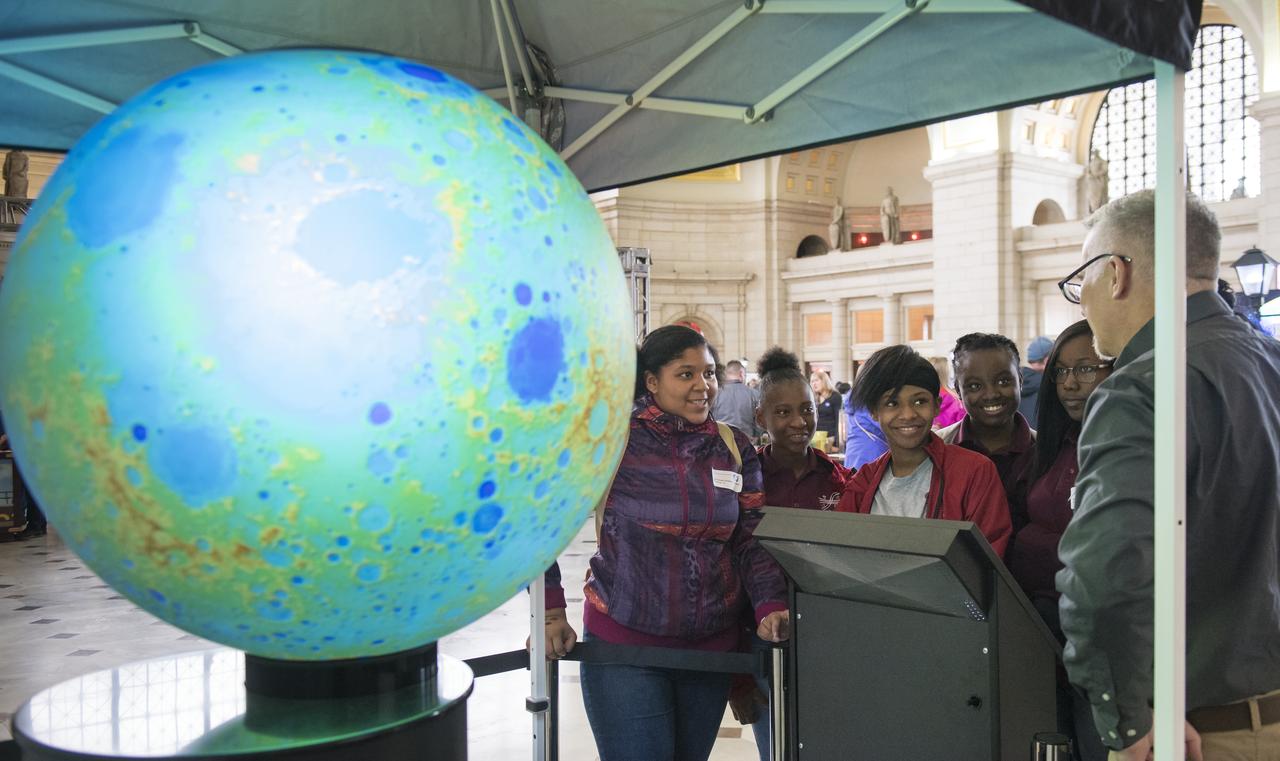
Visitors explore one of NASA's exhibits at the Earth Day event on Thursday, April 19, 2018 at Union Station in Washington, D.C. Photo Credit: (NASA/Aubrey Gemignani)

A visitor looks through virtual reality viewers at one of NASA's exhibits at the Earth Day event on Thursday, April 19, 2018 at Union Station in Washington, D.C. Photo Credit: (NASA/Aubrey Gemignani)
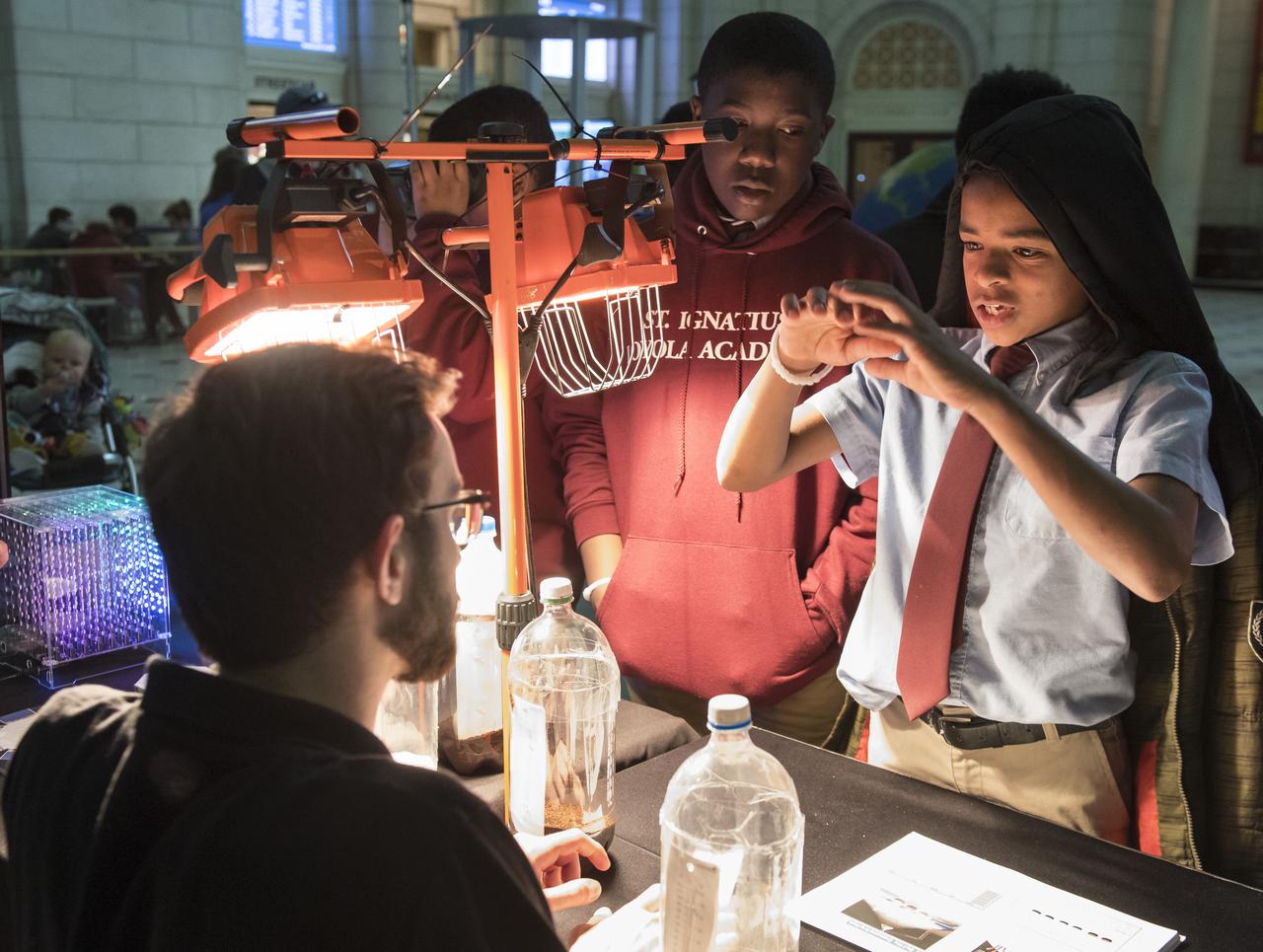
Visitors explore one of NASA's exhibits at the Earth Day event on Thursday, April 19, 2018 at Union Station in Washington, D.C. Photo Credit: (NASA/Aubrey Gemignani)

Visitors explore one of NASA's exhibits at the Earth Day event on Thursday, April 19, 2018 at Union Station in Washington, D.C. Photo Credit: (NASA/Aubrey Gemignani)
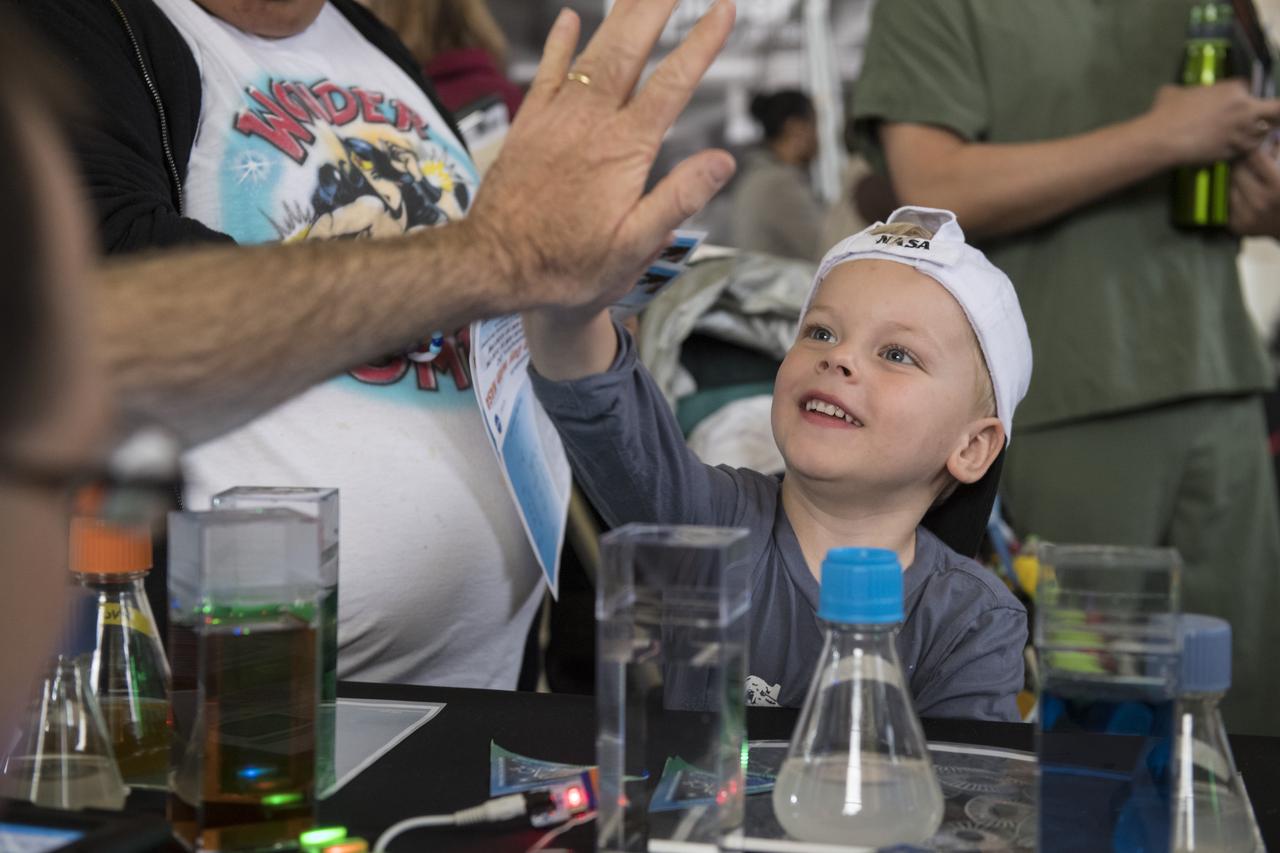
A visitor gives a high five after learning about oceans at one of NASA's exhibits at the Earth Day event on Thursday, April 19, 2018 at Union Station in Washington, D.C. Photo Credit: (NASA/Aubrey Gemignani)
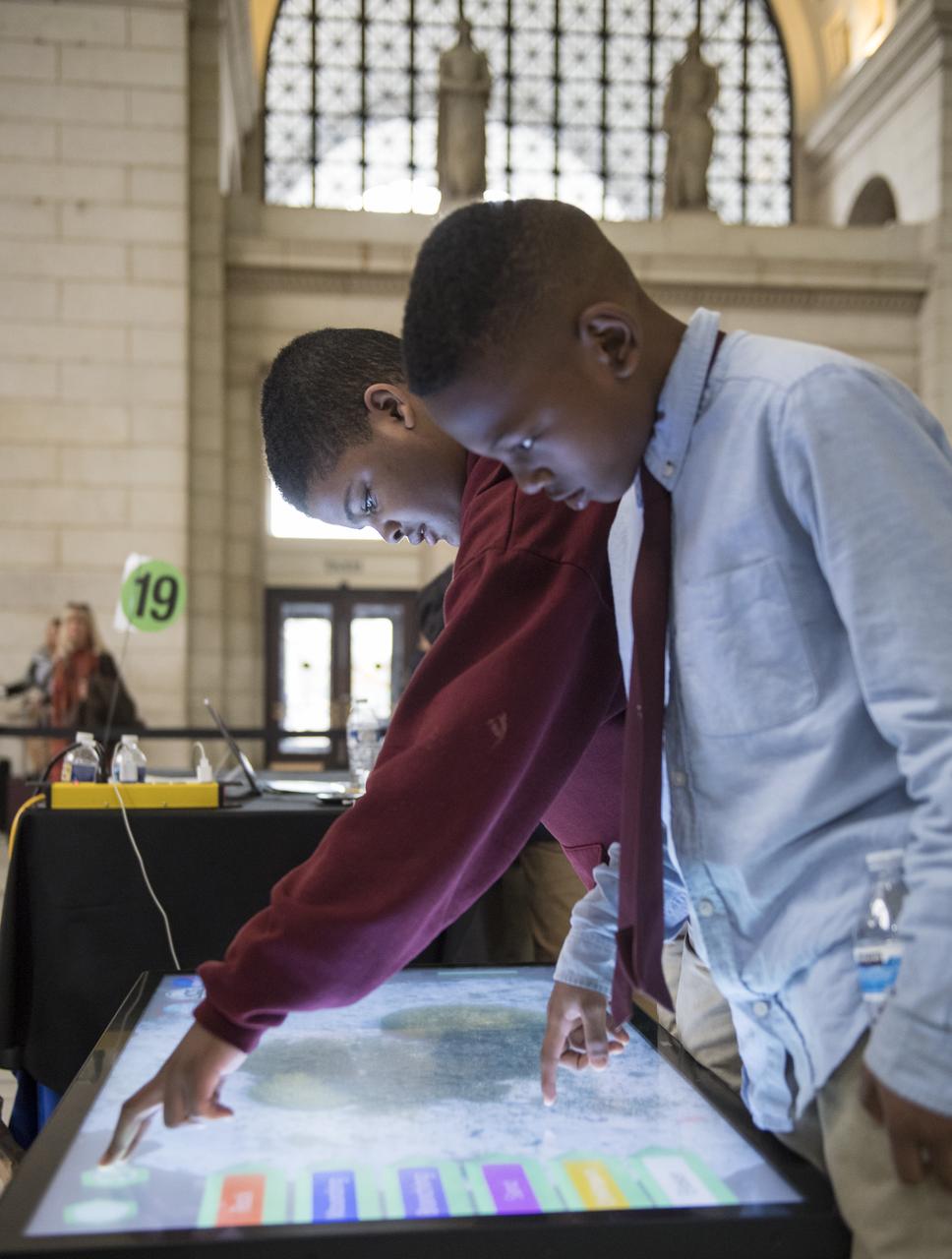
Visitors explore one of NASA's exhibits at the Earth Day event on Thursday, April 19, 2018 at Union Station in Washington, D.C. Photo Credit: (NASA/Aubrey Gemignani)

Visitors explore one of NASA's exhibits at the Earth Day event on Thursday, April 19, 2018 at Union Station in Washington, D.C. Photo Credit: (NASA/Aubrey Gemignani)

A visitor explores one of NASA's exhibits at the Earth Day event on Thursday, April 19, 2018 at Union Station in Washington, D.C. Photo Credit: (NASA/Aubrey Gemignani)
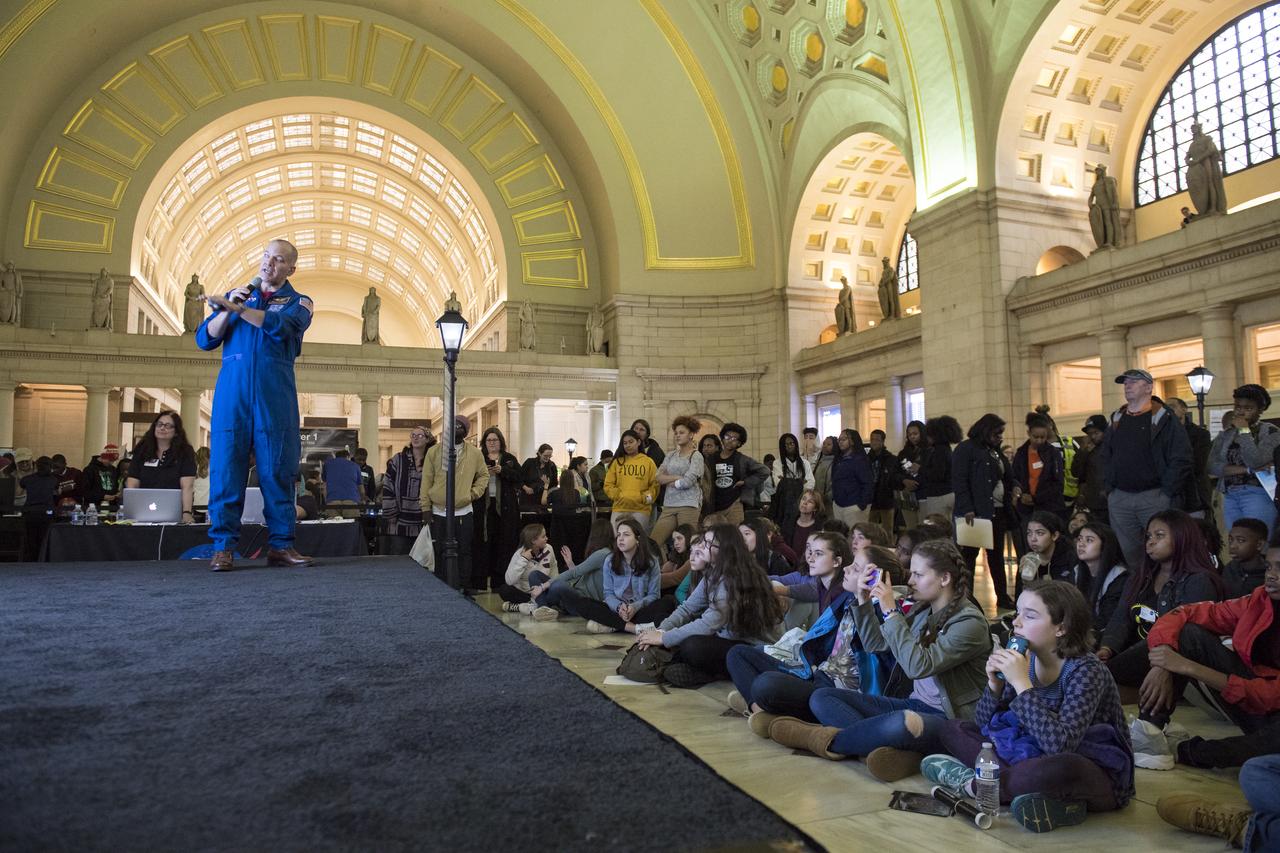
Former NASA astronaut, Paul Richards, speaks about his experience viewing Earth from space at NASA's Earth Day event on Thursday, April 19, 2018 at Union Station in Washington, D.C. Photo Credit: (NASA/Aubrey Gemignani)
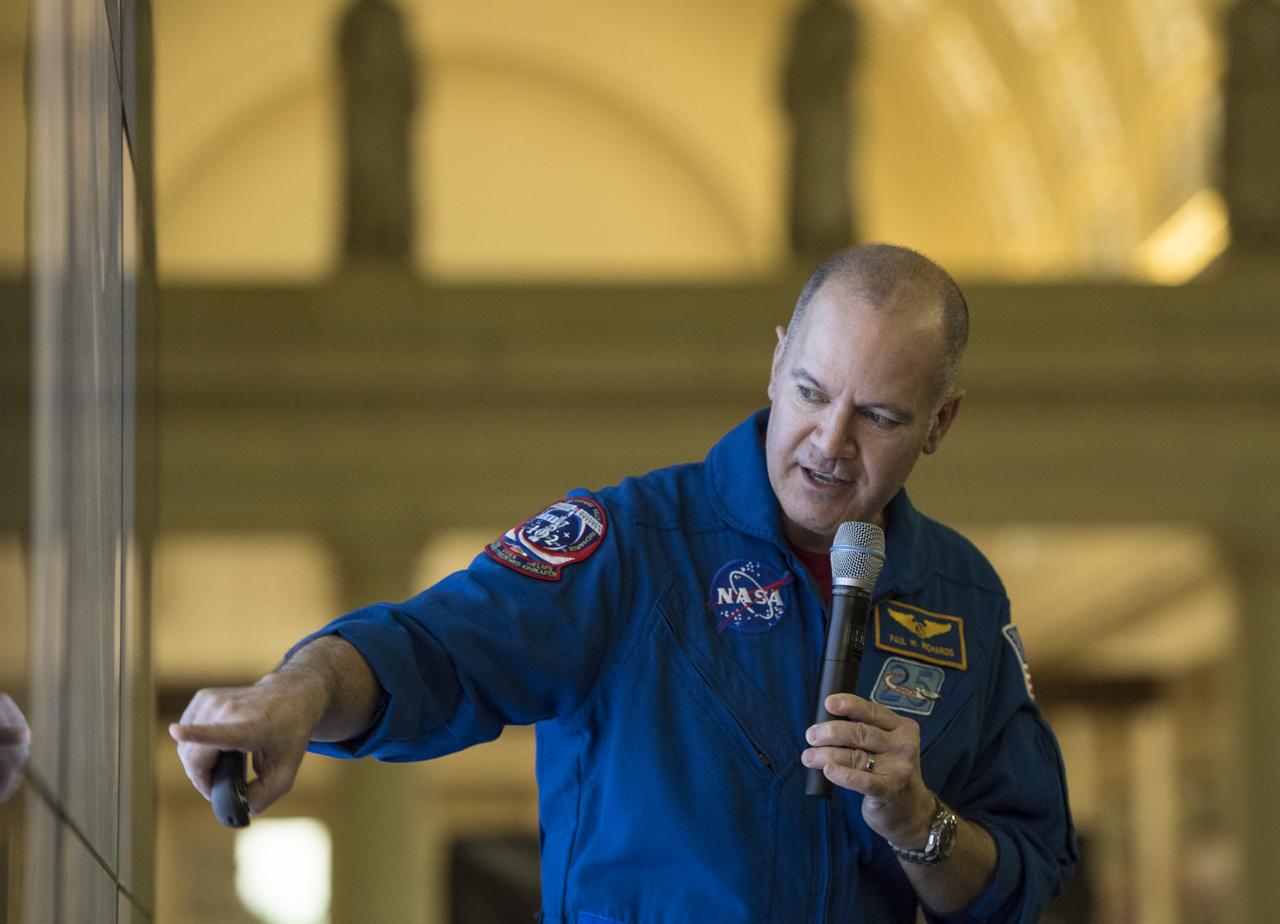
Former NASA astronaut, Paul Richards, speaks about his experience viewing Earth from space at NASA's Earth Day event on Thursday, April 19, 2018 at Union Station in Washington, D.C. Photo Credit: (NASA/Aubrey Gemignani)
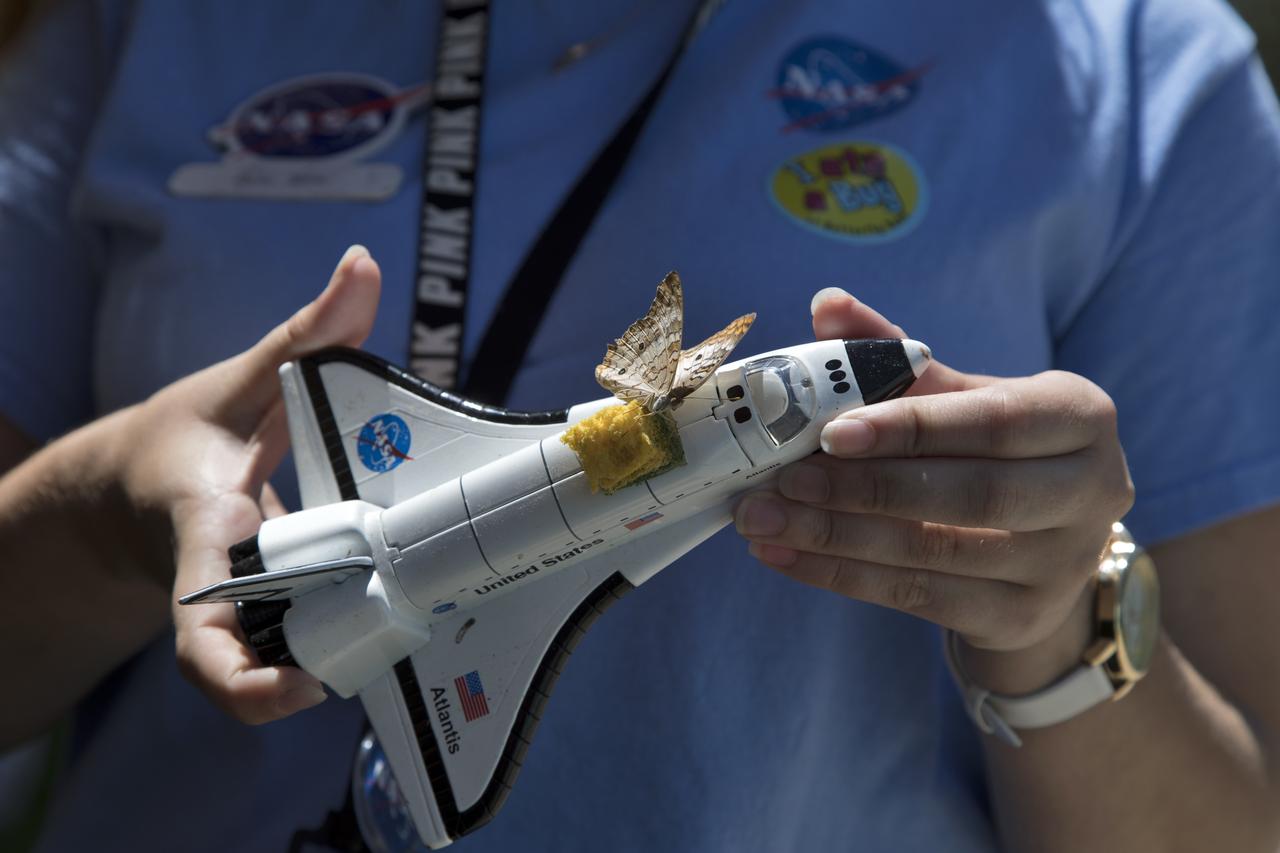
During the annual Earth Day celebration at the Kennedy Space Center Visitor Complex, guests have an opportunity to learn about the environment. The two-day event featured approximately 50 exhibitors offering information on a variety of topics, including electric vehicles, sustainable lighting, renewable energy, Florida-friendly landscaping tips, Florida’s biking trails and more.
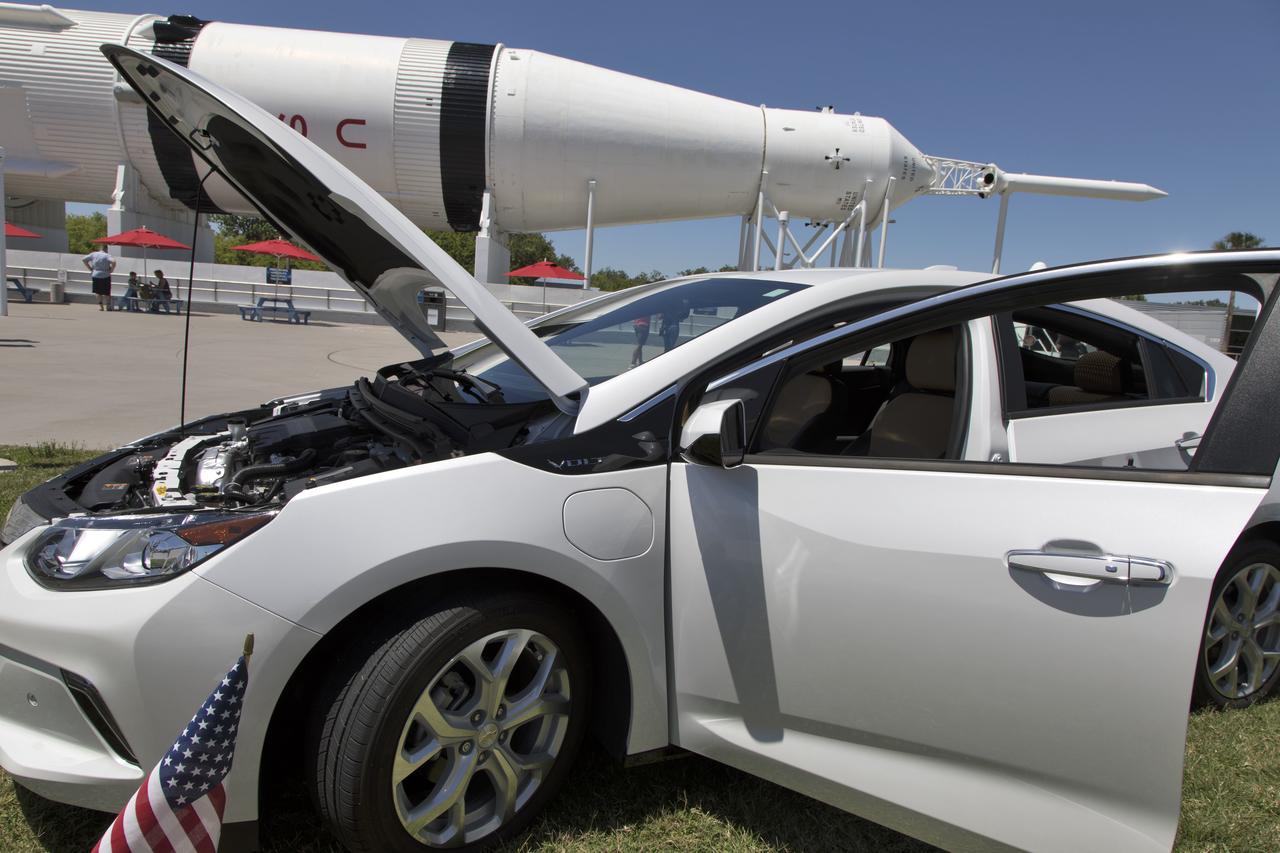
During the annual Earth Day celebration at the Kennedy Space Center Visitor Complex, guests have an opportunity to get an up-close look at experimental electric vehicles. The two-day event featured approximately 50 exhibitors offering information on a variety of topics, including electric vehicles, sustainable lighting, renewable energy, Florida-friendly landscaping tips, Florida’s biking trails and more.
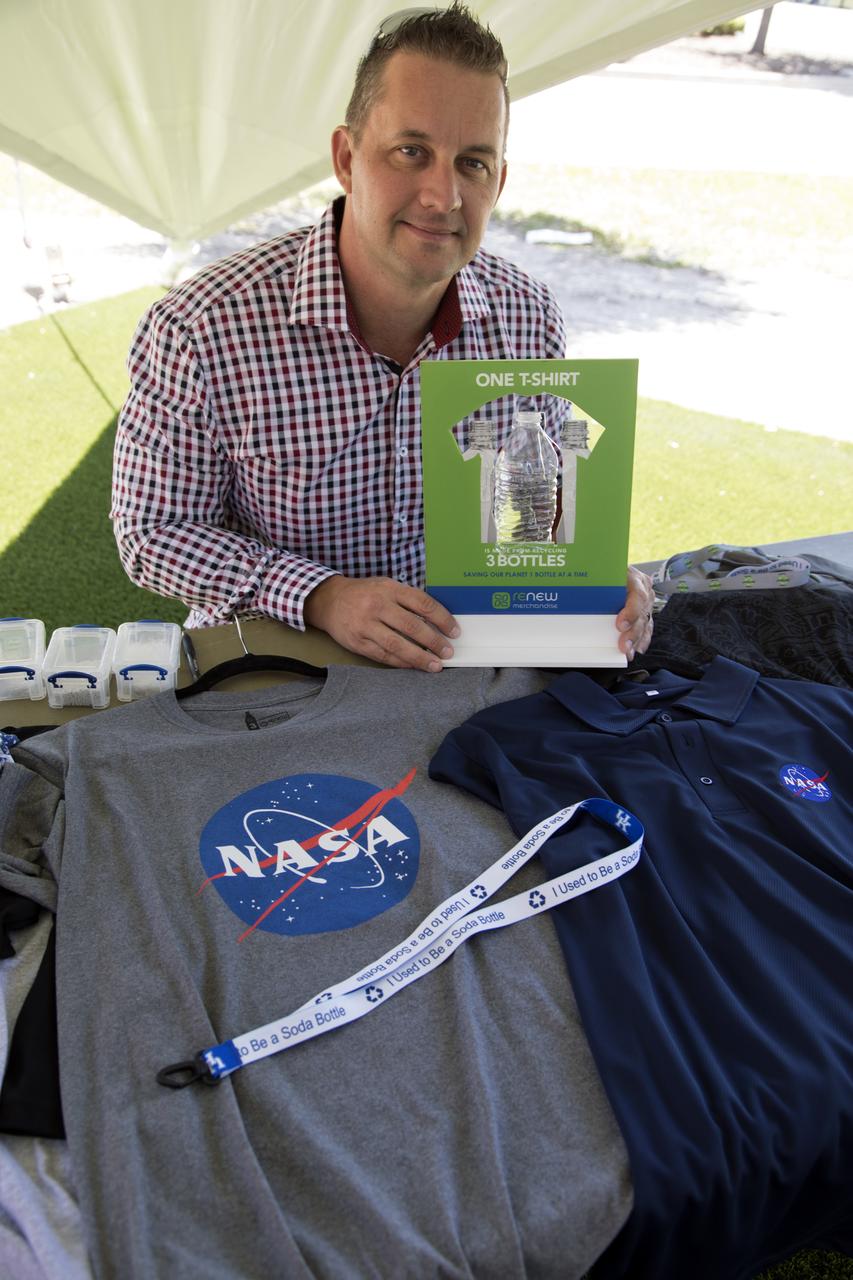
David Bell of Renew Merchandise was one of 50 exhibitors offering information on a variety of topics, including electric vehicles, sustainable lighting, renewable energy, Florida-friendly landscaping tips, Florida’s biking trails and more. The event took place during the annual Earth Day celebration at the Kennedy Space Center Visitor Complex, guests have an opportunity to learn more about energy awareness, the environment and sustainability.

Students from Rockledge High School in Rockledge, Fla., make “plarn” – plastic yarn -- out of used plastic bags during Kennedy Space Center’s annual Earth Day celebration. The plarn was donated to be woven into mats for homeless veterans. The two-day Earth Day event featured approximately 50 exhibitors offering information on a variety of topics, including electric vehicles, sustainable lighting, renewable energy, Florida-friendly landscaping tips, Florida’s biking trails and more.
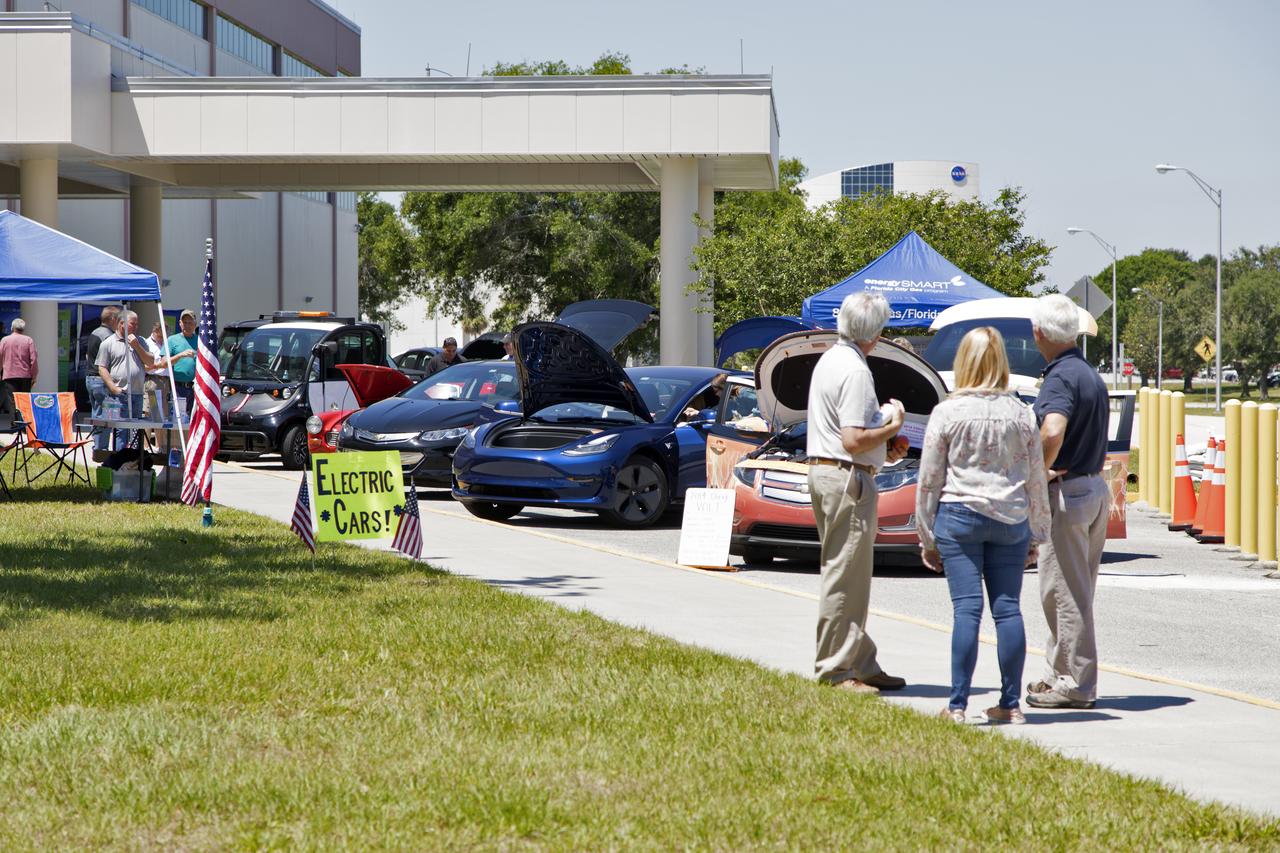
An array of electric vehicles are on display for Kennedy Space Center employees during the center’s annual Earth Day celebration. The two-day event featured approximately 50 exhibitors offering information on a variety of topics, including electric vehicles, sustainable lighting, renewable energy, Florida-friendly landscaping tips, Florida’s biking trails and more.
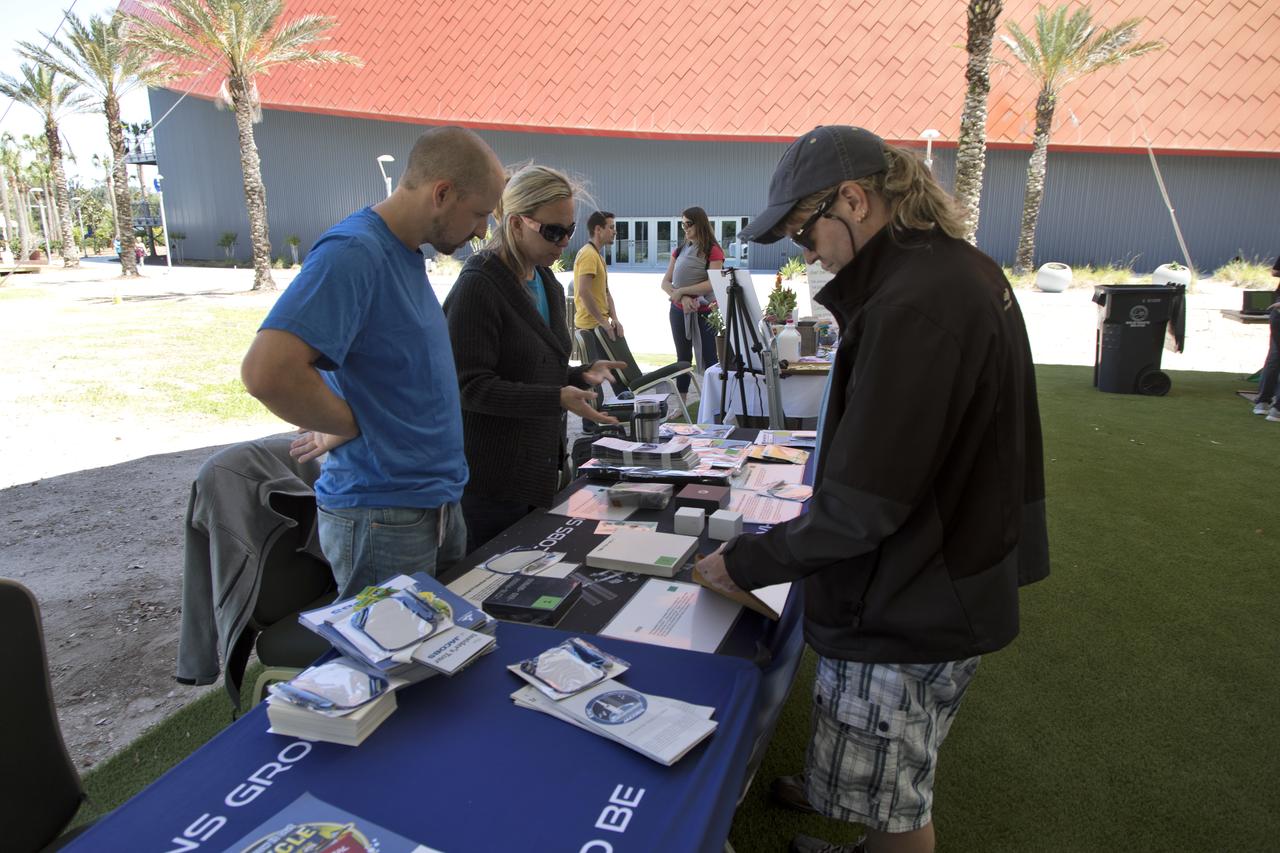
During the annual Earth Day celebration at the Kennedy Space Center Visitor Complex, guests have an opportunity to learn more about energy awareness, the environment and sustainability. The two-day event featured approximately 50 exhibitors offering information on a variety of topics, including electric vehicles, sustainable lighting, renewable energy, Florida-friendly landscaping tips, Florida’s biking trails and more.
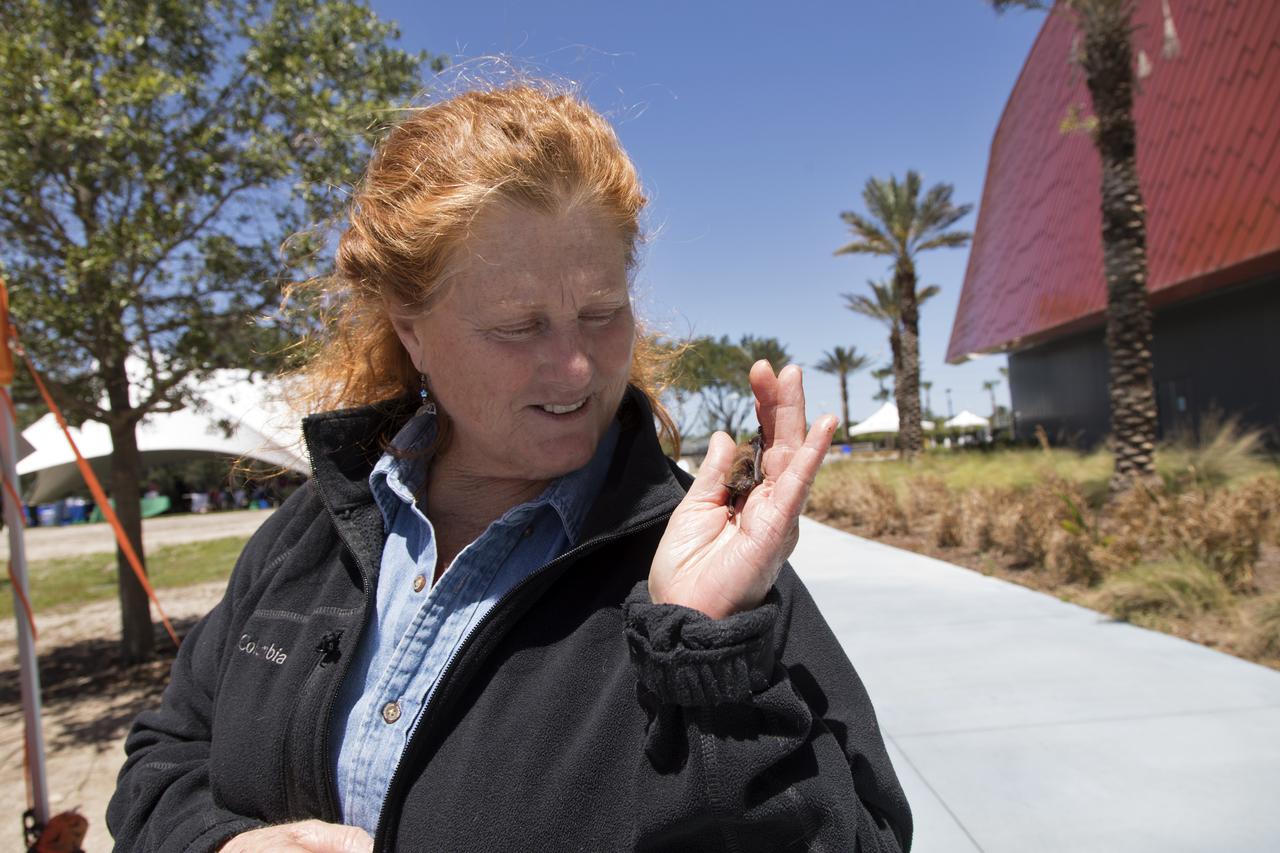
During the annual Earth Day celebration at the Kennedy Space Center Visitor Complex, Shari Blissett-Clark of the Florida Bat Conservancy displays one of the mammals. The event took place during the annual Earth Day celebration at the Kennedy Space Center Visitor Complex, guests have an opportunity to learn more about energy awareness, the environment and sustainability.
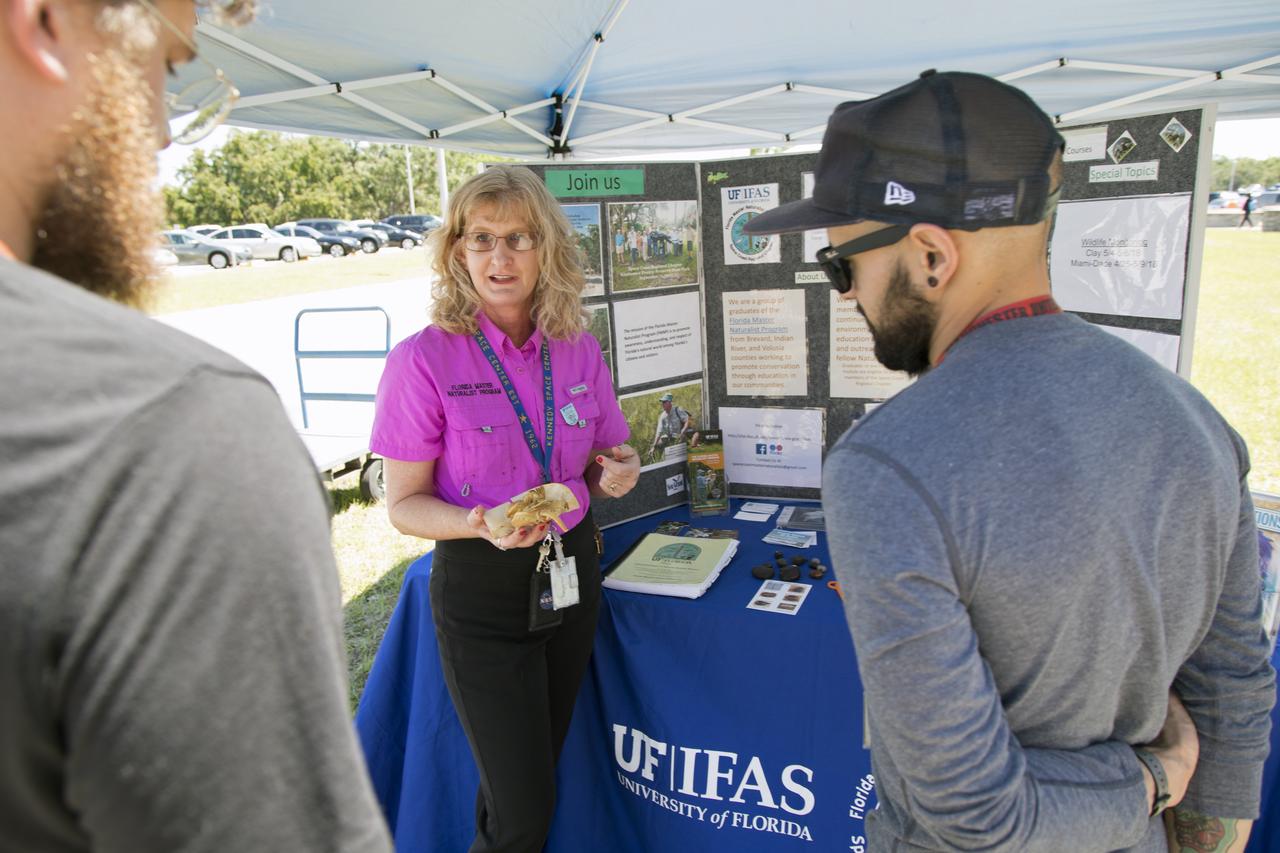
Employees get an up-close look at some Florida marine life during a visit to the University of Florida's Institute of Food and Agricultural Sciences booth at Kennedy Space Center’s annual Earth Day celebration. The two-day event featured approximately 50 exhibitors offering information on a variety of topics, including electric vehicles, sustainable lighting, renewable energy, Florida-friendly landscaping tips, Florida’s biking trails and more.

During the annual Earth Day celebration at the Kennedy Space Center Visitor Complex, guests have an opportunity to learn about the environment and meet Butterfly Dan” Dunwoody. The two-day event featured approximately 50 exhibitors offering information on a variety of topics, including electric vehicles, sustainable lighting, renewable energy, Florida-friendly landscaping tips, Florida’s biking trails and more.
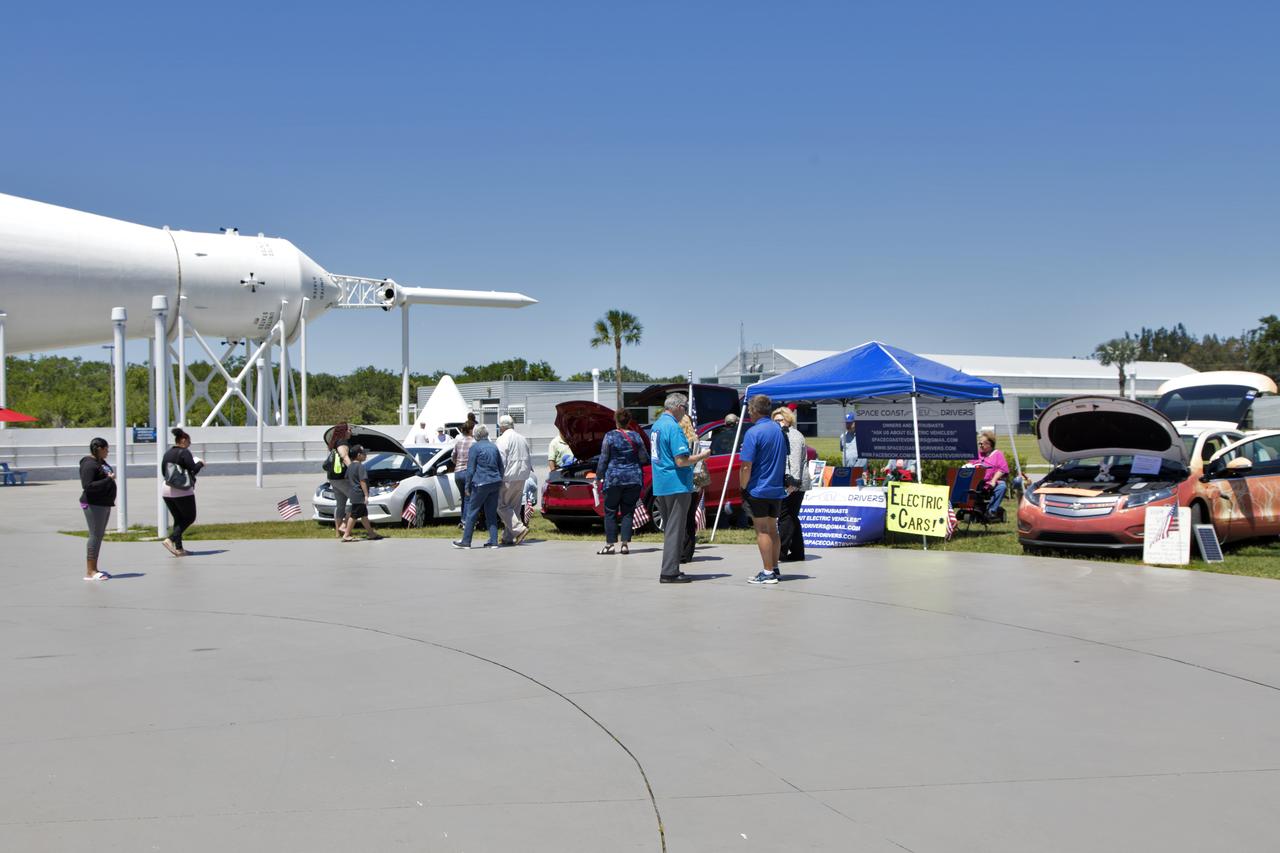
During the annual Earth Day celebration at the Kennedy Space Center Visitor Complex, guests have an opportunity to get an up-close look at experimental electric vehicles. The two-day event featured approximately 50 exhibitors offering information on a variety of topics, including electric vehicles, sustainable lighting, renewable energy, Florida-friendly landscaping tips, Florida’s biking trails and more.
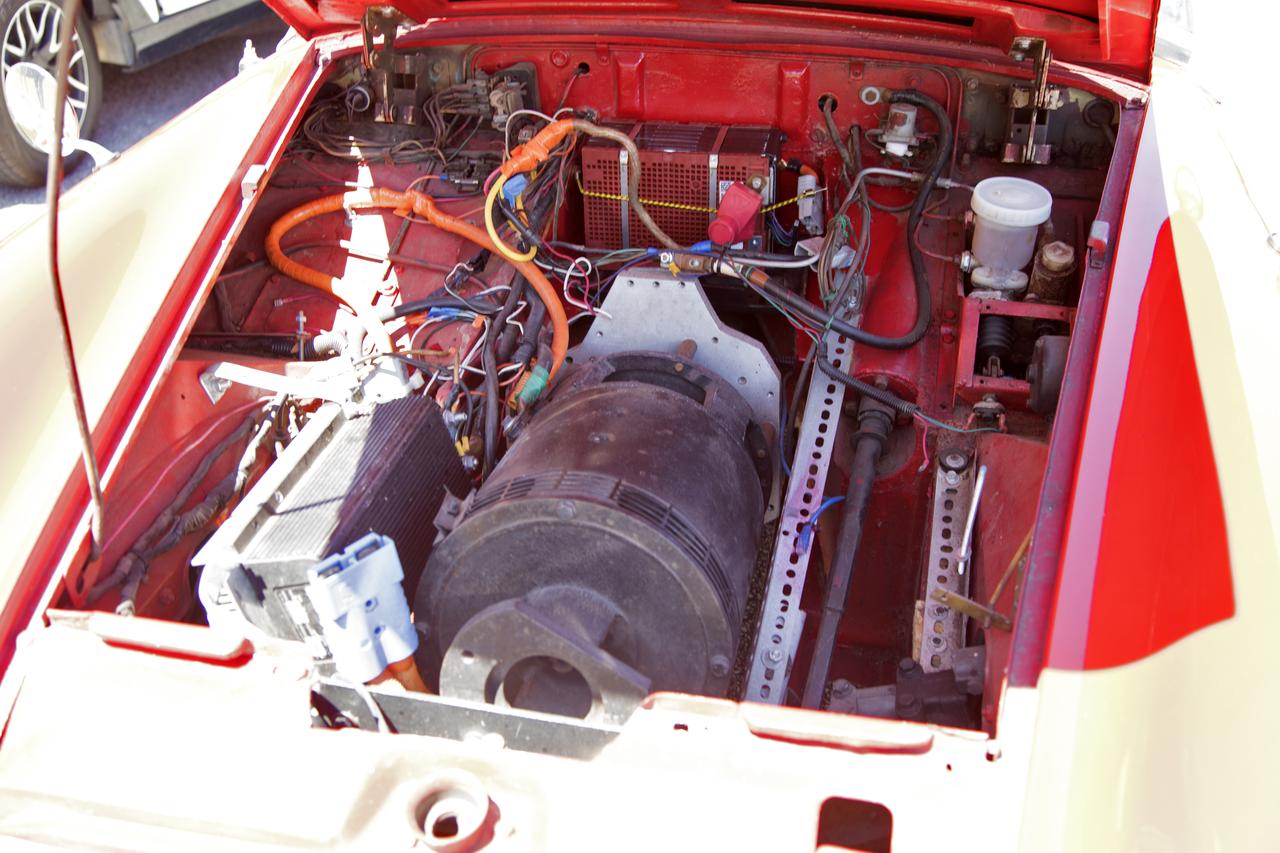
Employees had the opportunity to take a look under the hood of an electric vehicle on display during Kennedy Space Center’s annual Earth Day celebration. The two-day event featured approximately 50 exhibitors offering information on a variety of topics, including electric vehicles, sustainable lighting, renewable energy, Florida-friendly landscaping tips, Florida’s biking trails and more.

During the annual Earth Day celebration at the Kennedy Space Center Visitor Complex, Shari Blissett-Clark of the Florida Bat Conservancy displays one of the mammals. The event took place during the annual Earth Day celebration at the Kennedy Space Center Visitor Complex, guests have an opportunity to learn more about energy awareness, the environment and sustainability.
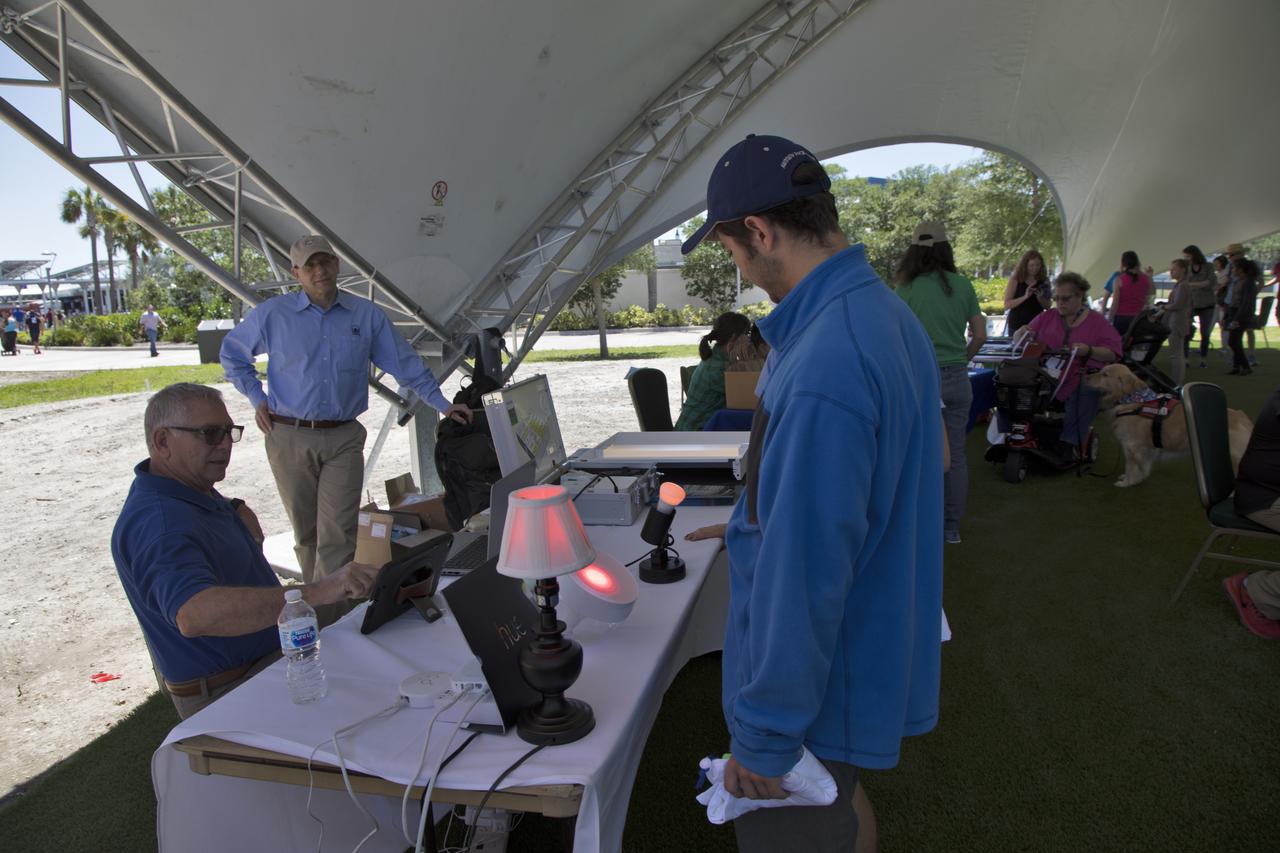
During the annual Earth Day celebration at the Kennedy Space Center Visitor Complex, guests have an opportunity to learn more about energy awareness, the environment and sustainability. The two-day event featured approximately 50 exhibitors offering information on a variety of topics, including electric vehicles, sustainable lighting, renewable energy, Florida-friendly landscaping tips, Florida’s biking trails and more.
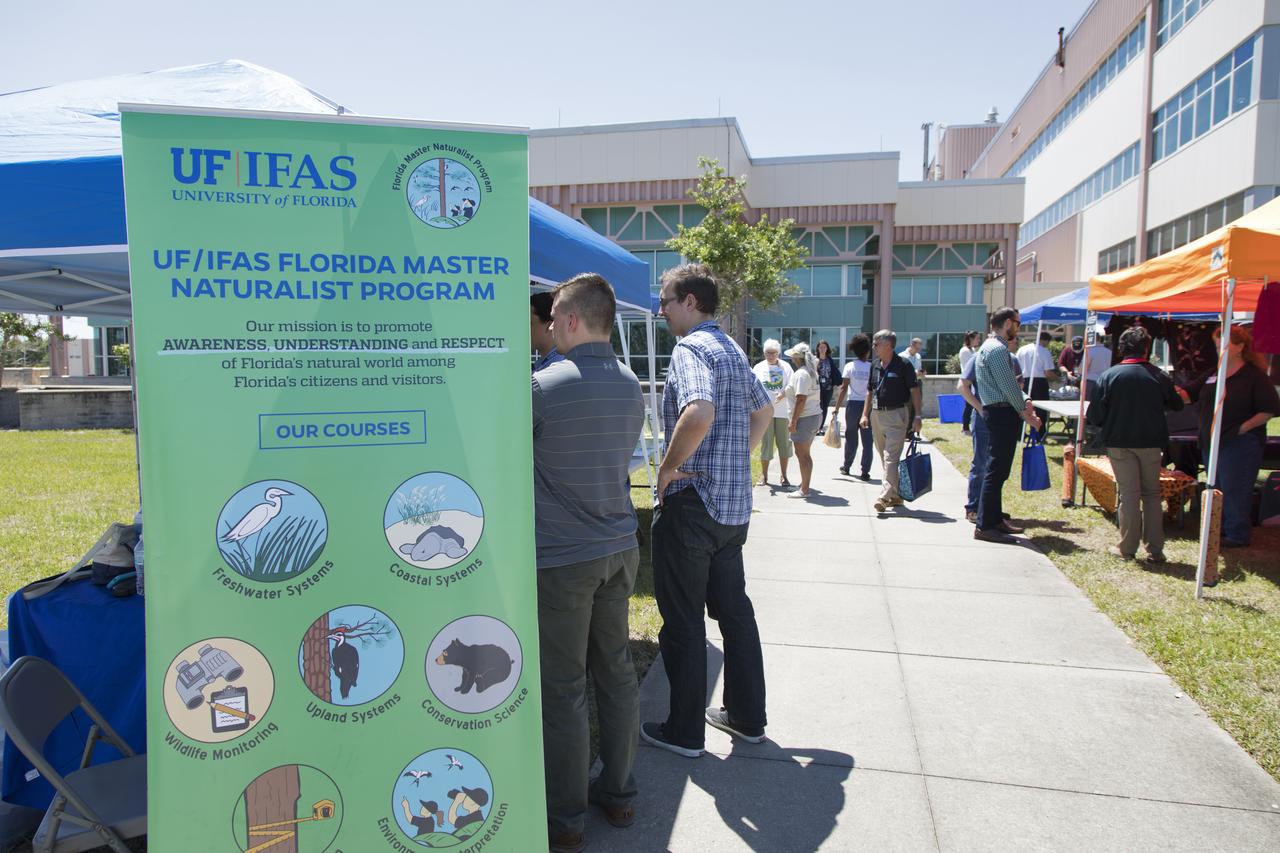
Employees stop by the University of Florida's Institute of Food and Agricultural Sciences booth at Kennedy Space Center’s annual Earth Day celebration. The two-day event featured approximately 50 exhibitors offering information on a variety of topics, including electric vehicles, sustainable lighting, renewable energy, Florida-friendly landscaping tips, Florida’s biking trails and more.
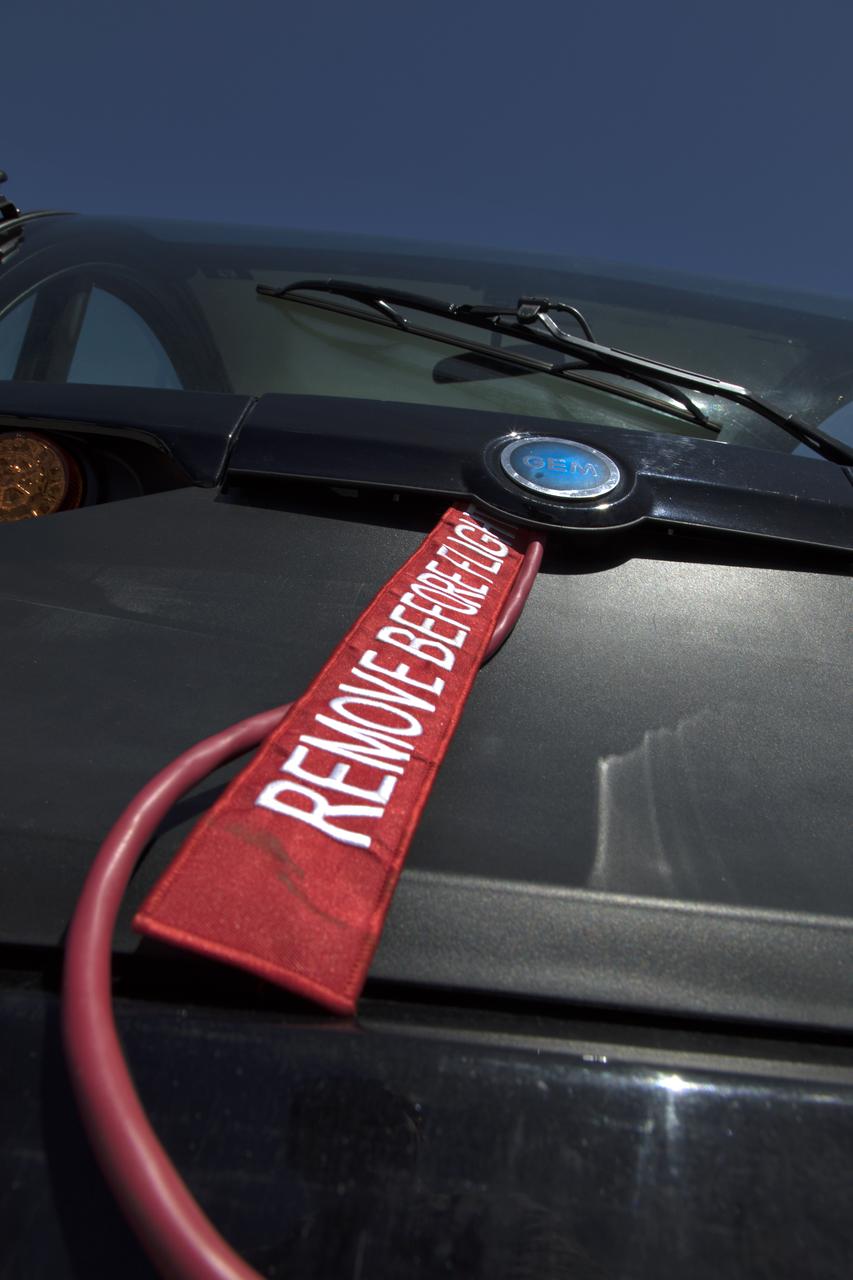
During the annual Earth Day celebration at the Kennedy Space Center Visitor Complex, guests have an opportunity to get an up-close look at experimental electric vehicles. The "Remove Before Flight" tag is on a Polaris GEM electric car. The two-day event featured approximately 50 exhibitors offering information on a variety of topics, including electric vehicles, sustainable lighting, renewable energy, Florida-friendly landscaping tips, Florida’s biking trails and more.
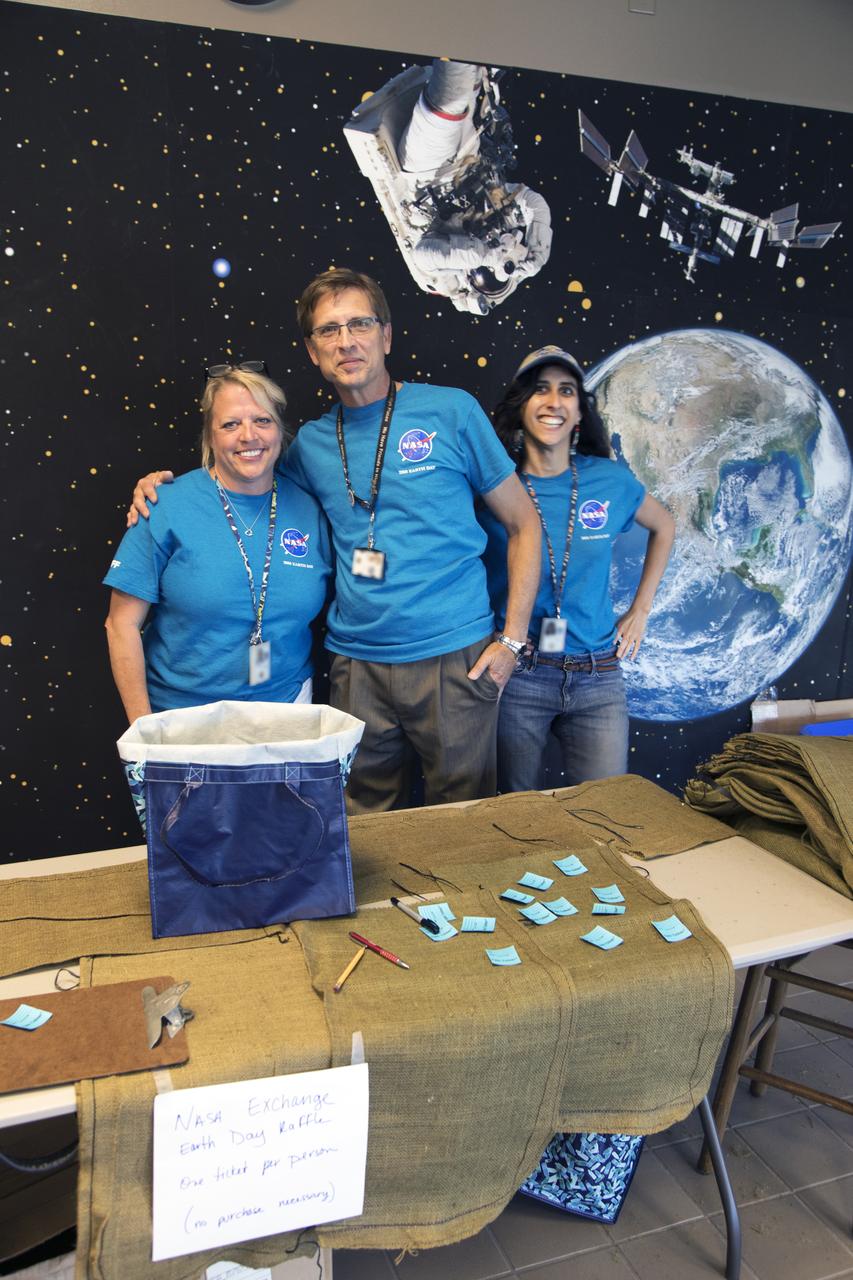
Organizers and volunteers for Kennedy Space Center’s Earth Day celebration gather for a photo at the NASA Exchange raffle booth. From left to right are Jeanne Ryba, Environmental Sustainability program specialist; Robert Smith, Earth Day volunteer; and Natasha Darre, Cultural Resources Specialist. The two-day event featured approximately 50 exhibitors offering information on a variety of topics, including electric vehicles, sustainable lighting, renewable energy, Florida-friendly landscaping tips, Florida’s biking trails and more.
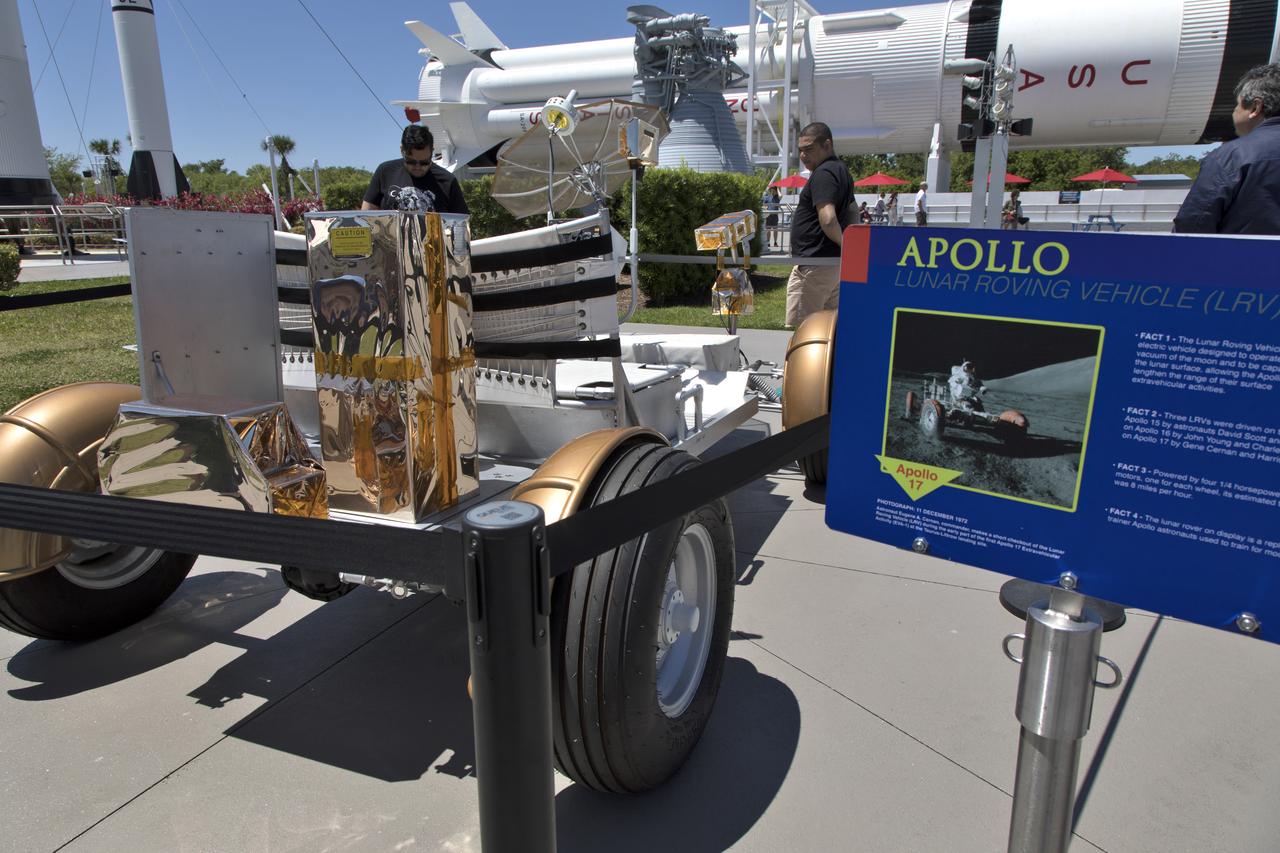
During the annual Earth Day celebration at the Kennedy Space Center Visitor Complex, guests have an opportunity to get an up-close look at experimental electric vehicles and see and Apollo era Lunar Roving Vehicle used in astronaut training. The battery-operated car was used on Apollos 15, 16 and 17 in 1971 and 1972. The two-day event featured approximately 50 exhibitors offering information on a variety of topics, including electric vehicles, sustainable lighting, renewable energy, Florida-friendly landscaping tips, Florida’s biking trails and more.
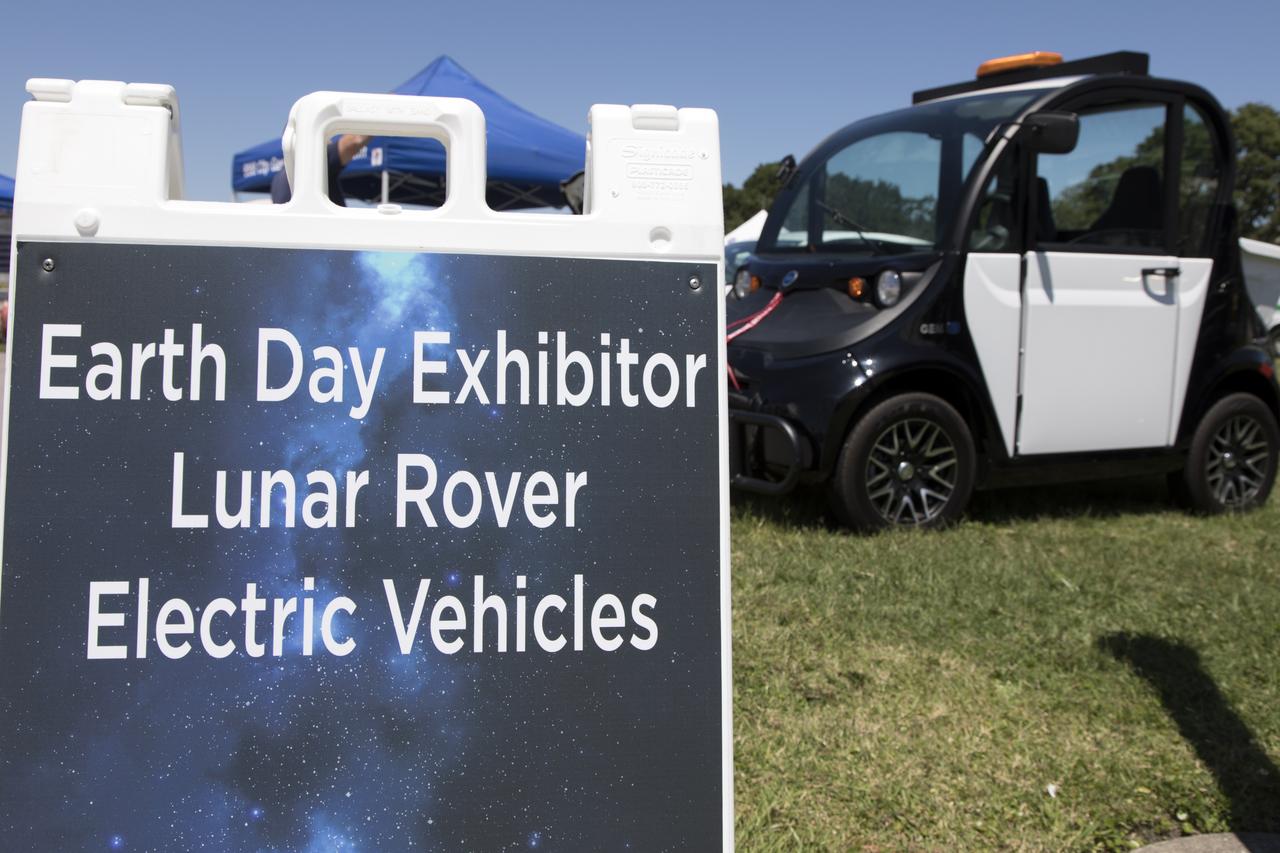
During the annual Earth Day celebration at the Kennedy Space Center Visitor Complex, guests have an opportunity to get an up-close look at experimental electric vehicles. The two-day event featured approximately 50 exhibitors offering information on a variety of topics, including electric vehicles, sustainable lighting, renewable energy, Florida-friendly landscaping tips, Florida’s biking trails and more.
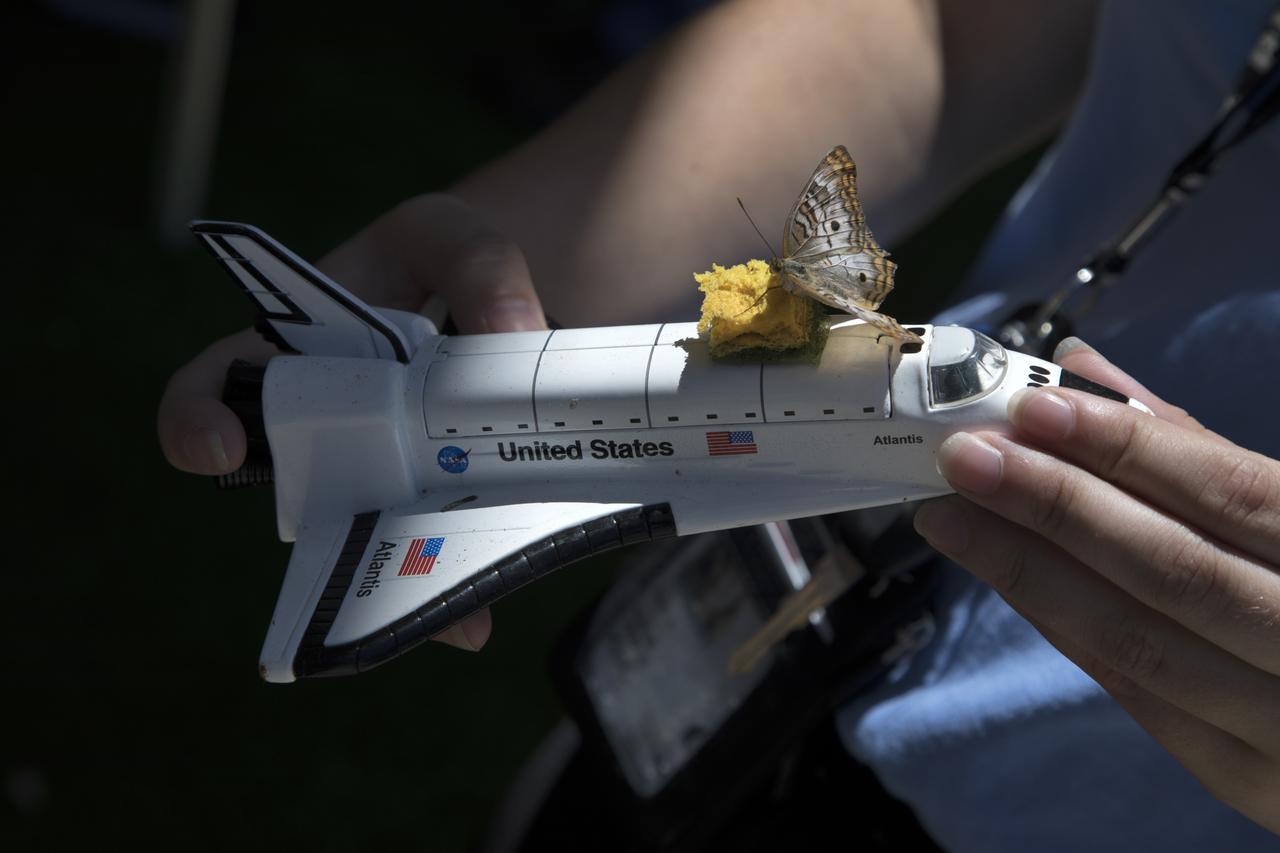
During the annual Earth Day celebration at the Kennedy Space Center Visitor Complex, guests have an opportunity to learn about the environment. The two-day event featured approximately 50 exhibitors offering information on a variety of topics, including electric vehicles, sustainable lighting, renewable energy, Florida-friendly landscaping tips, Florida’s biking trails and more.
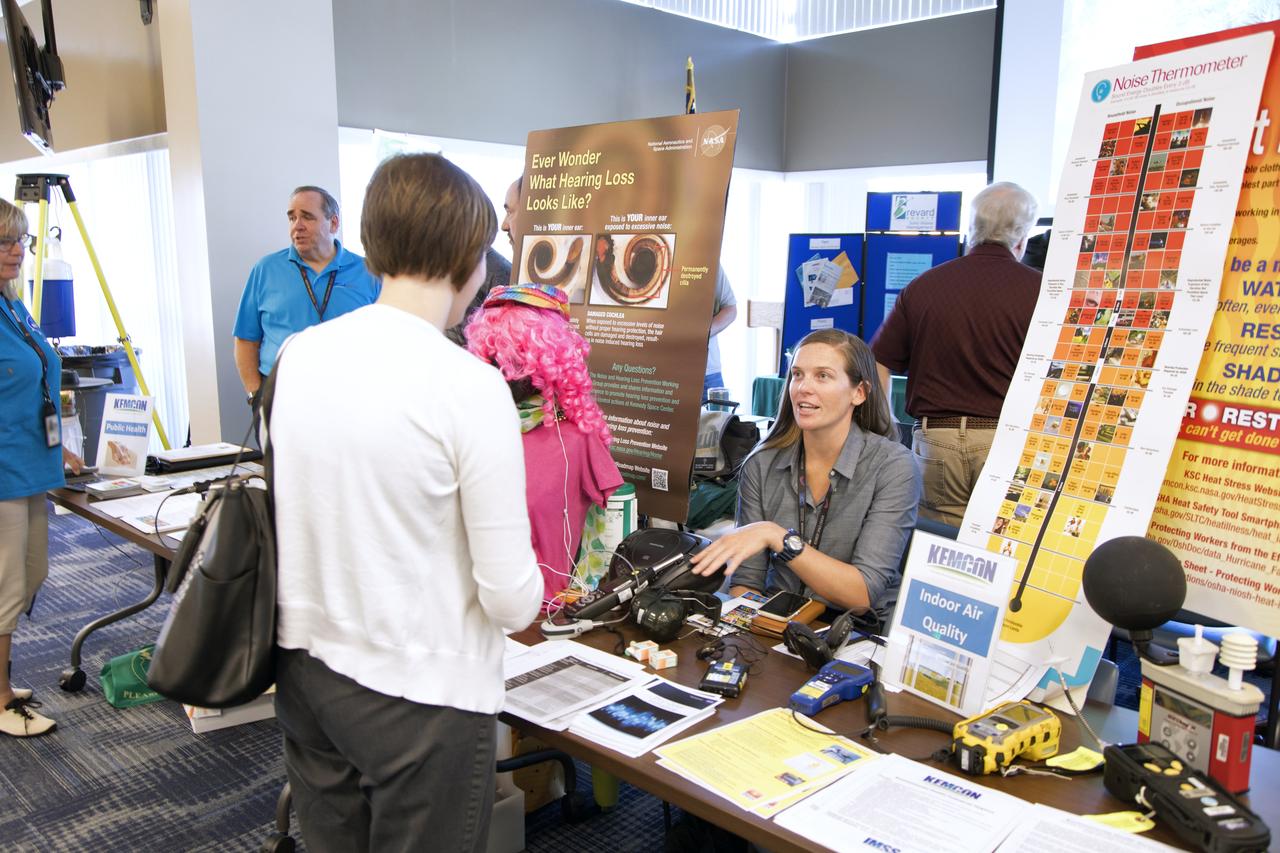
An employee learns about indoor air quality at the Kennedy Space Center (KSC) Environmental and Medical Contract (KEMCON) booth at the center’s annual Earth Day celebration. The two-day event featured approximately 50 exhibitors offering information on a variety of topics, including electric vehicles, sustainable lighting, renewable energy, Florida-friendly landscaping tips, Florida’s biking trails and more.
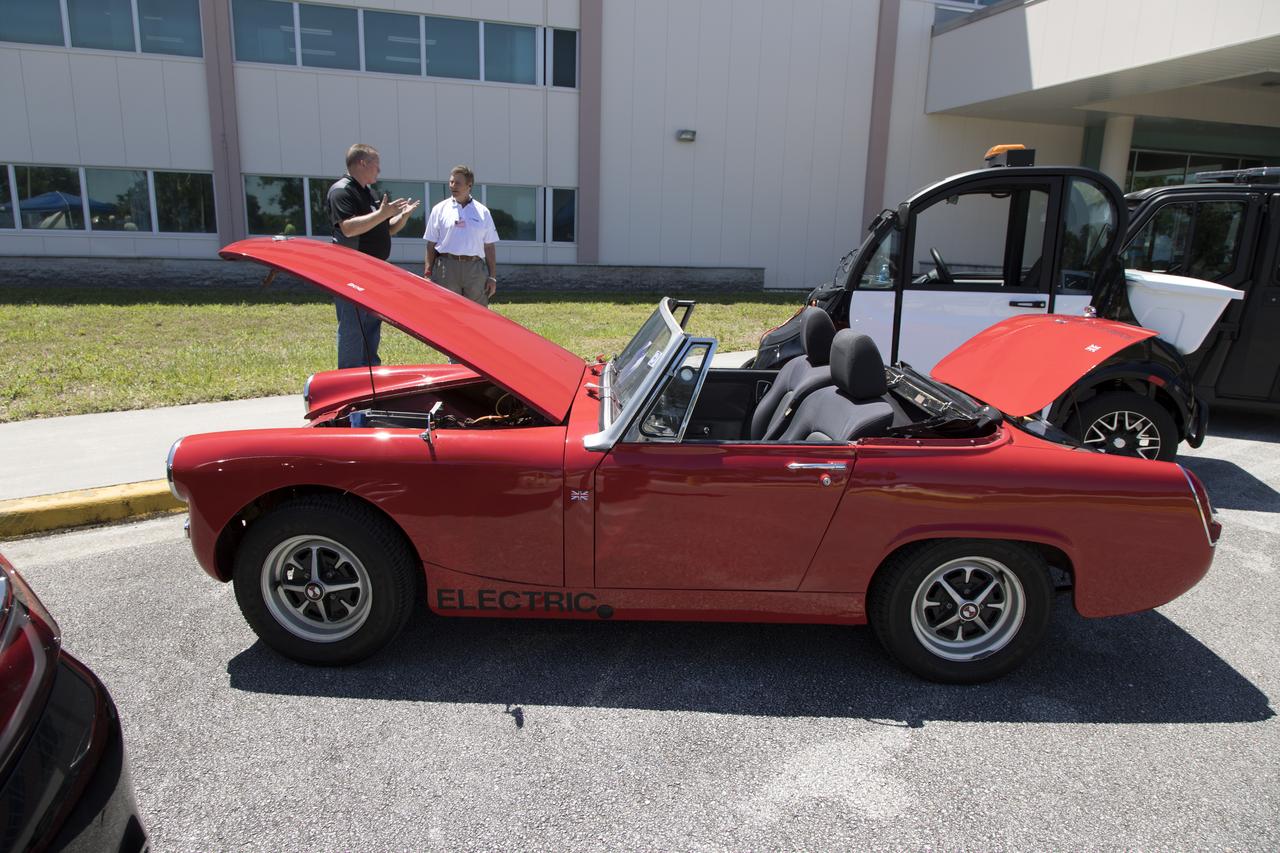
Employees discuss one of the electric vehicles on display during Kennedy Space Center’s annual Earth Day celebration. The two-day event featured approximately 50 exhibitors offering information on a variety of topics, including electric vehicles, sustainable lighting, renewable energy, Florida-friendly landscaping tips, Florida’s biking trails and more.
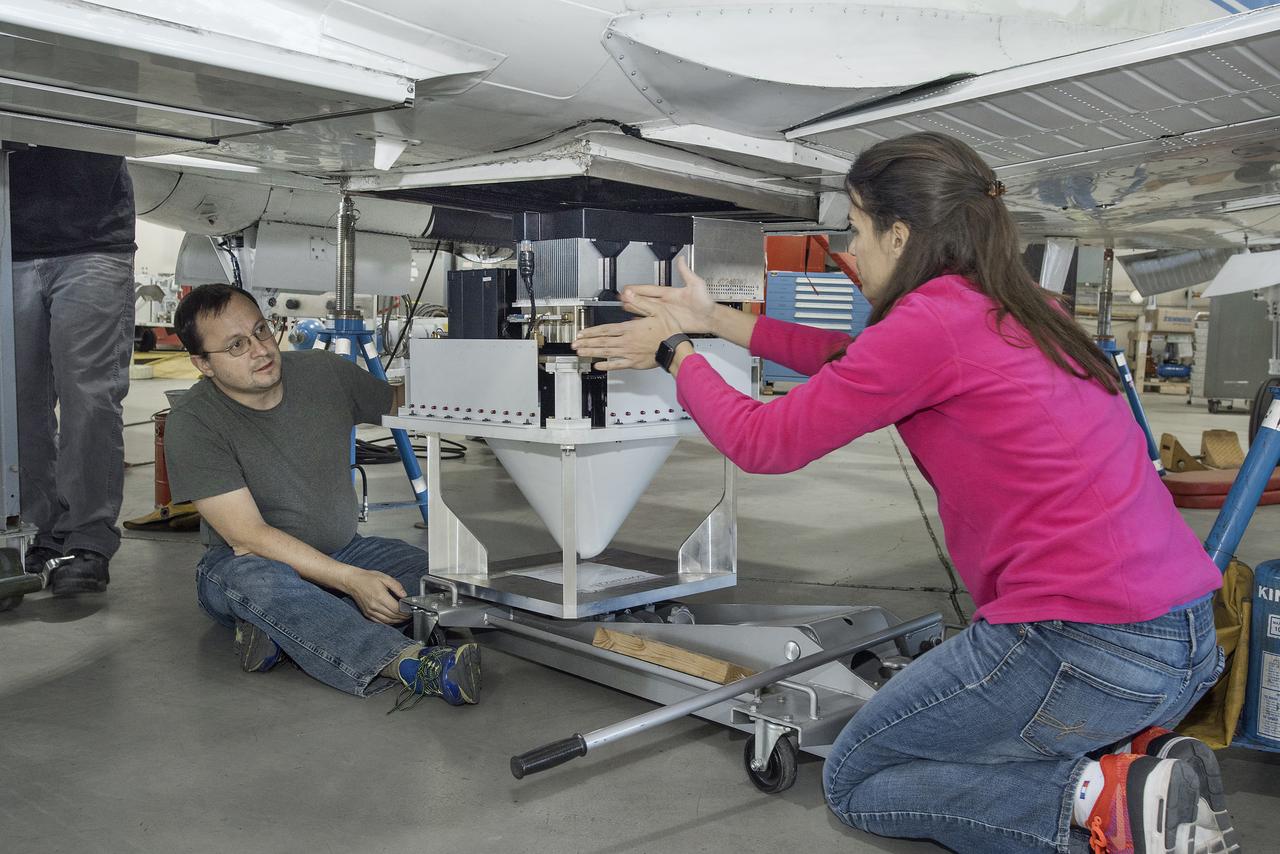
Engineers Raquel Rodriguez Monje and Fabien Nicaise discuss placement of the DopplerScatt radar instrument on the NASA B200 before its final installation onto the aircraft’s fuselage.
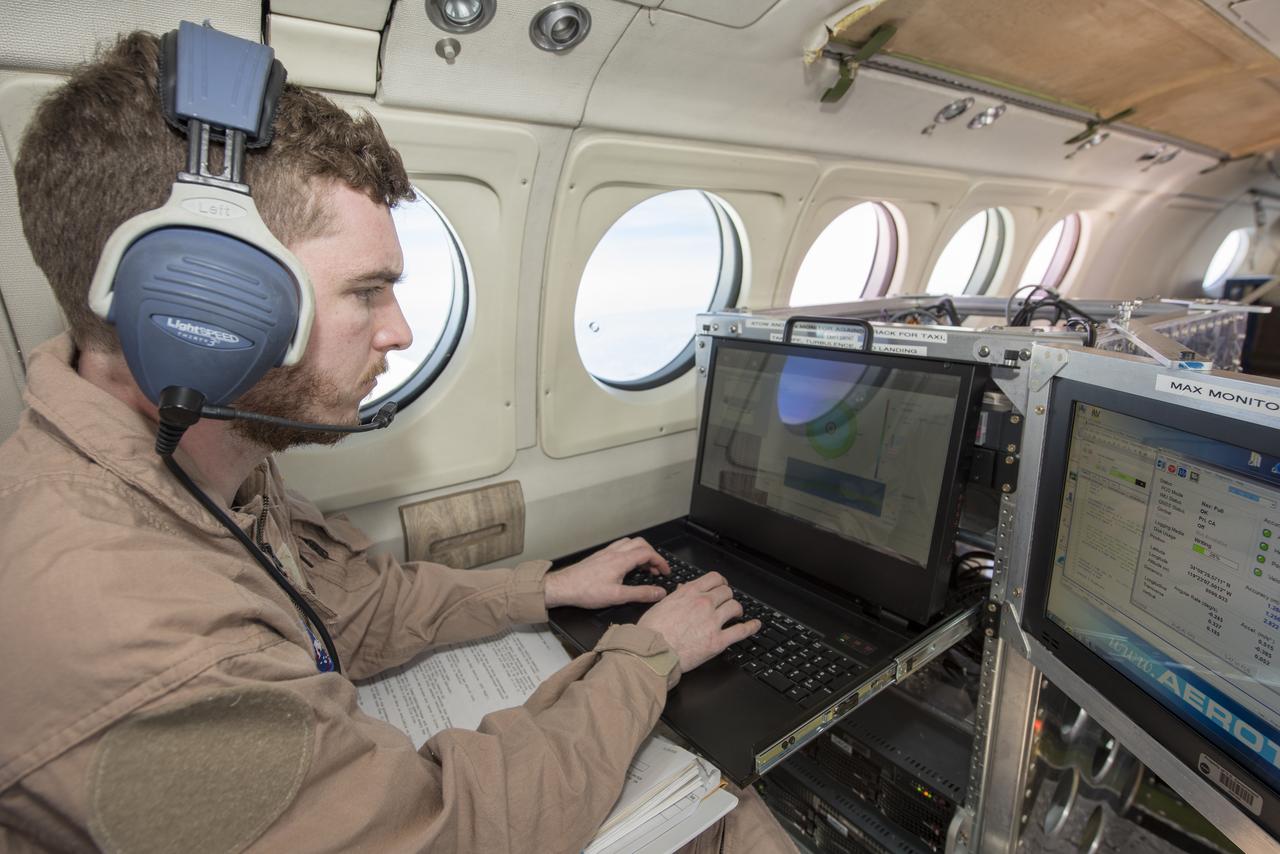
Radar operator Alexander Winteer monitors incoming wind data from the DopplerScatt radar instrument during a science flight off the California Coast on March 5, 2018.

NASA’s B200 taking off for an eight-hour science flight on March 5. Located on the center of the aircraft’s fuselage is the DopplerScatt radar instrument, developed by NASA’s Jet Propulsion Laboratory in California.
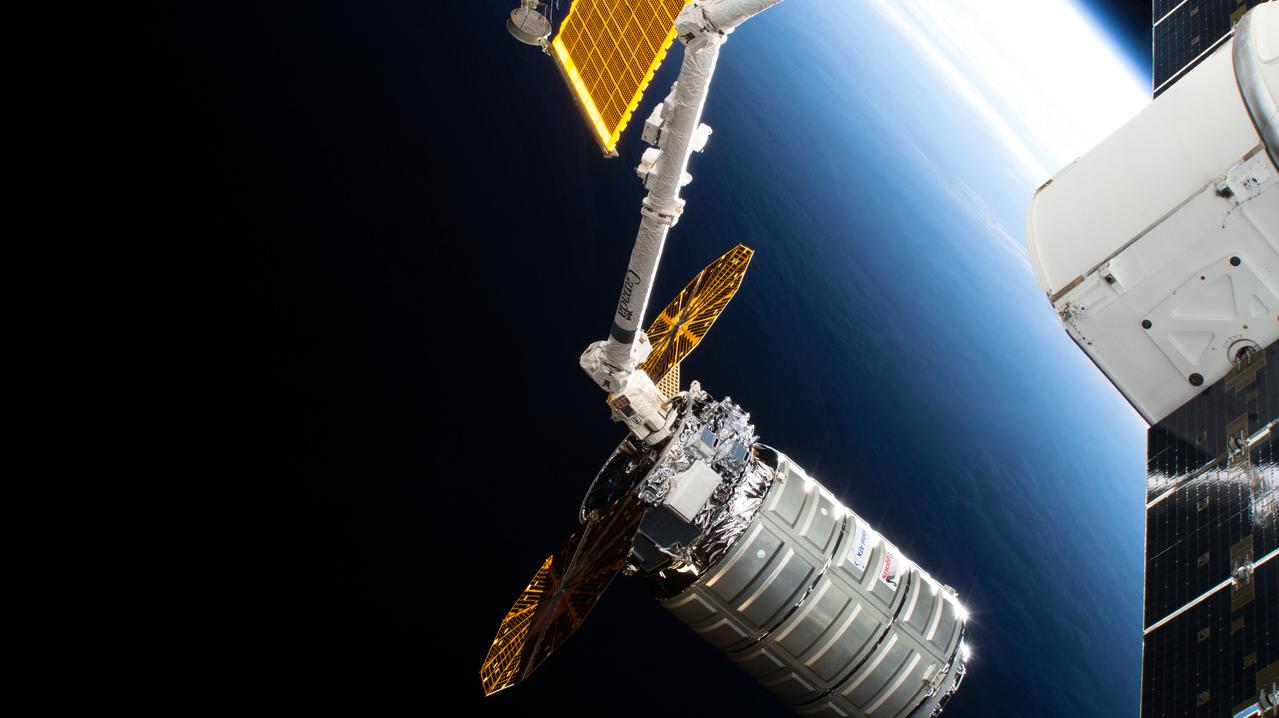
iss056e096531 (July 15, 2018) --- The Cygnus space freighter from Northrop Grumman, formerly Orbital ATK, was pictured July 15 , 2018, poised for release from the Canadarm2 robotic arm back into Earth orbit ending a 52-day cargo mission at the International Space Station.
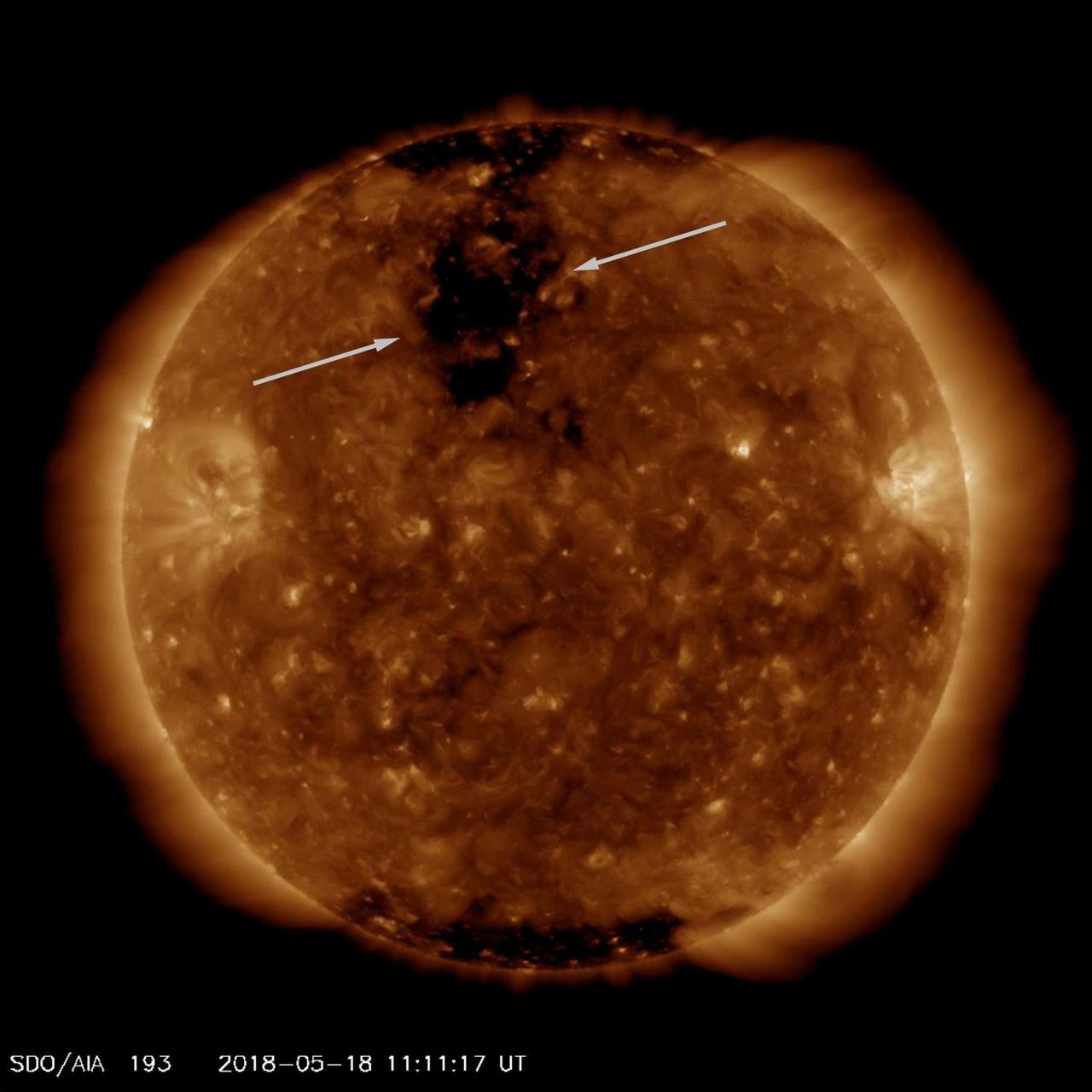
A good-sized coronal hole came around to where it is just about facing Earth (May 16-18, 2018). Coronal holes are areas of open magnetic field from which solar wind (consisting of charged particles) streams into space. The video clip covers two days and was taken in a wavelength of extreme ultraviolet light. Such streams of particles take several days to reach Earth, but they can generate aurora, particularly nearer the poles. An animation is available at https://photojournal.jpl.nasa.gov/catalog/PIA00575
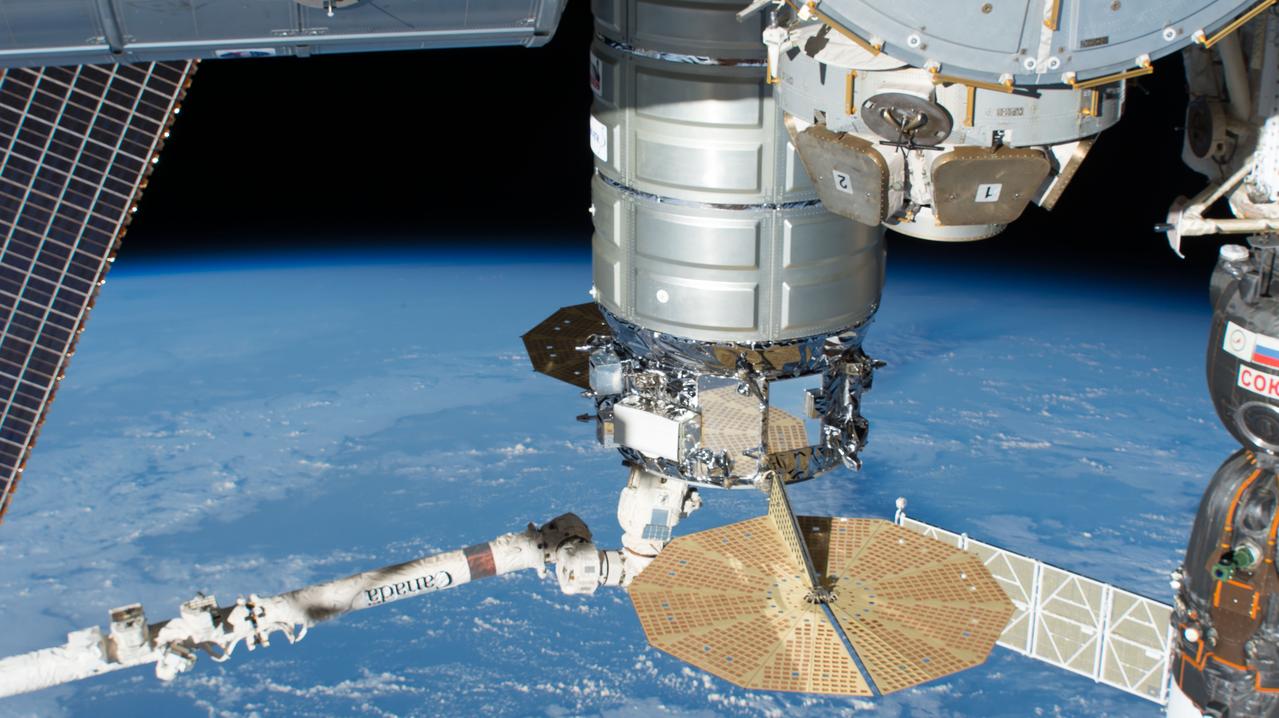
iss056e096470 (July 15, 2018) --- The Cygnus space freighter from Northrop Grumman, formerly Orbital ATK, is grappled by the Canadarm2 robotic arm while still attached to the Harmony module. Cygnus would soon be uninstalled from Harmony and released back into Earth orbit ending a 52-day cargo mission at the International Space Station.
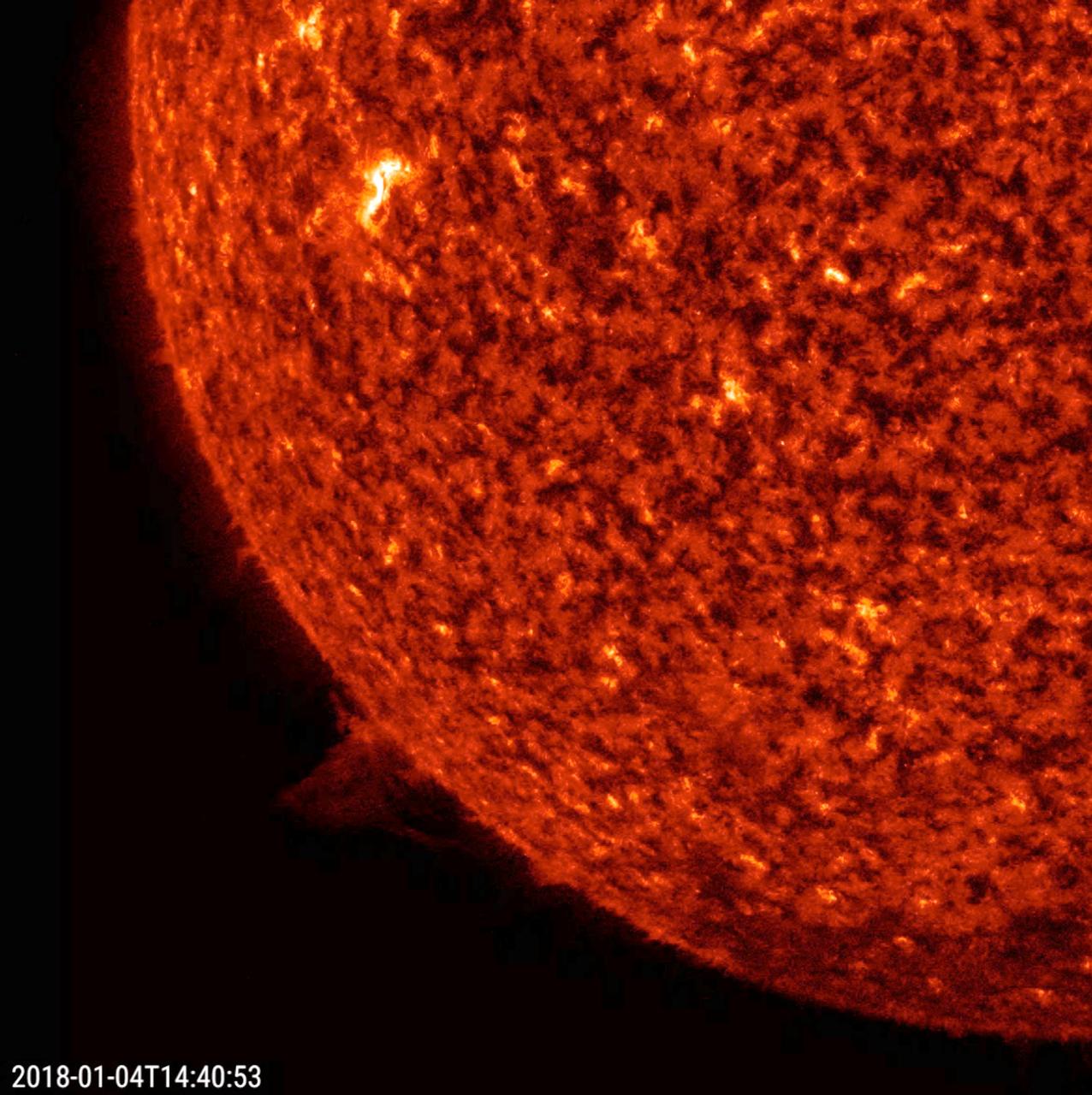
A small prominence rose up above the sun, appeared to twist around for several hours, and then began to send some streams of plasma back into the sun (Jan. 3-4, 2018). The action, observed in a wavelength of extreme ultraviolet light, lasted just about one day. Prominences like this one are quite common. In fact, there were several over the past few days. For a sense of scale, the prominence reached up more than several times the size of Earth. Movies are available at https://photojournal.jpl.nasa.gov/catalog/PIA22198
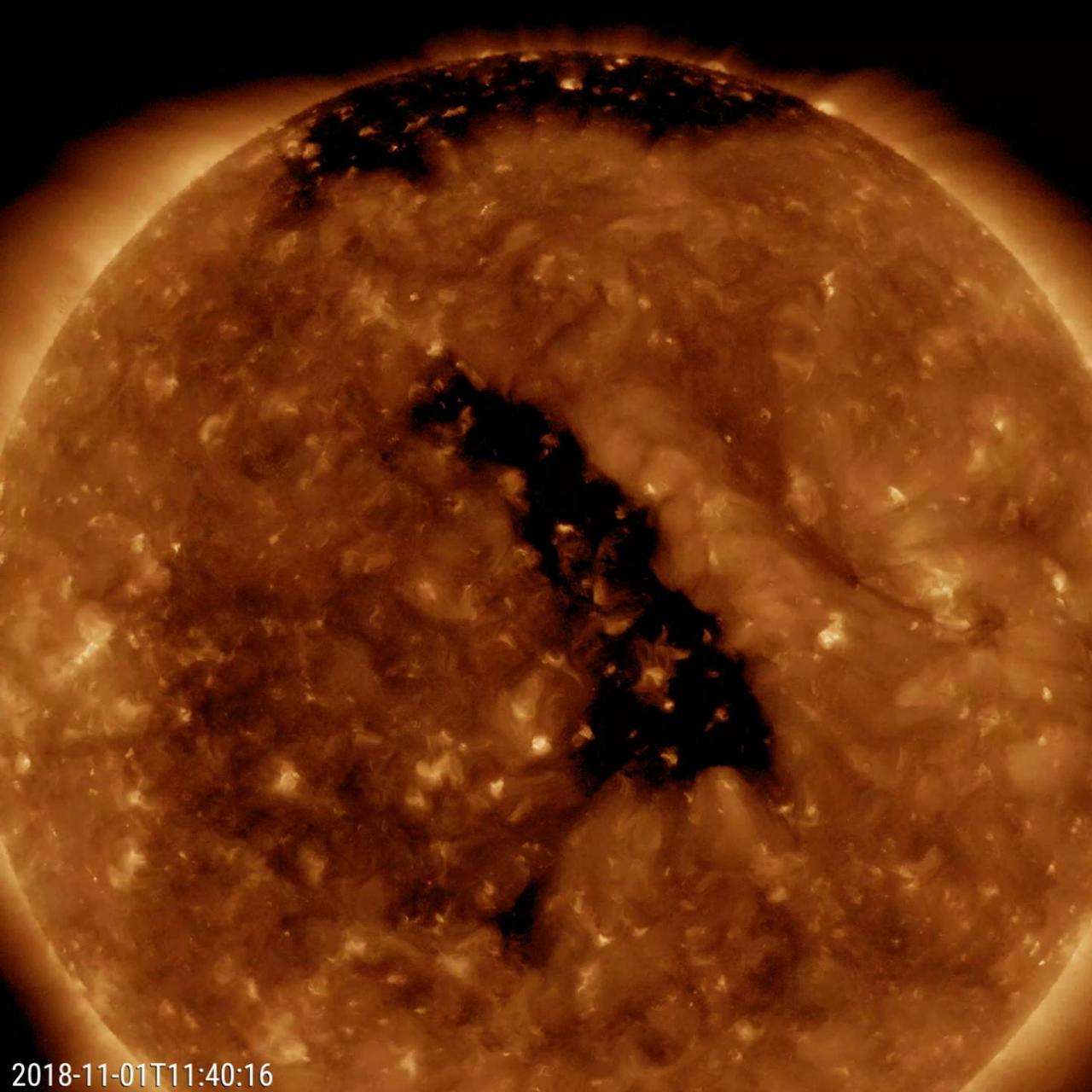
The most distinctive feature on the Sun this week was a good-sized coronal hole at a slanted angle nearly centered on the face of the sun (Oct. 31 - Nov. 2, 2018). Coronal holes are magnetically open areas from which solar wind particles speed into space. They appear darker in this wavelength of extreme ultraviolet light. If these particles impact Earth's magnetosphere, they will likely generate aurora near the Earth's poles regions. The video clip covers about two days of activity. Movies available at https://photojournal.jpl.nasa.gov/catalog/PIA18141
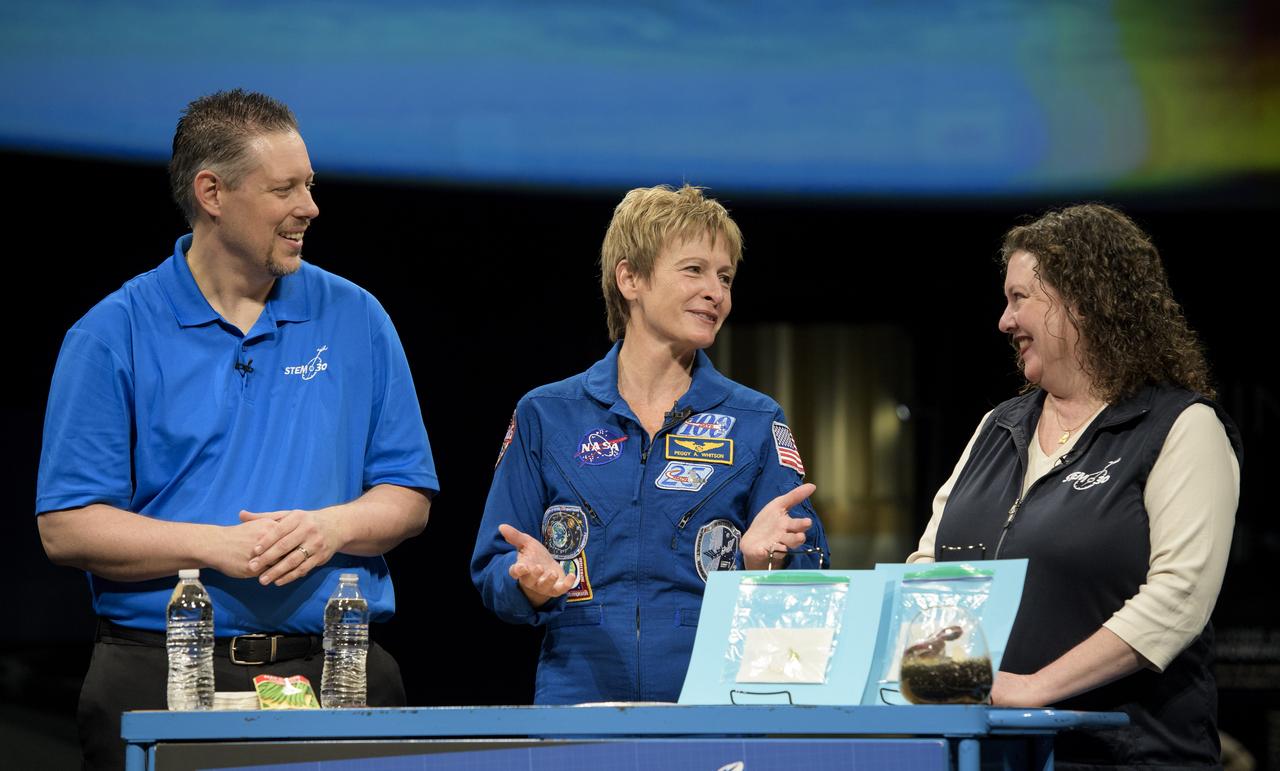
NASA astronaut Peggy Whitson tapes a segment for STEM in 30 with Marty Kelsey, left, and Beth Wilson, Friday, March 2, 2018 at the Smithsonian's National Air and Space Museum in Washington. Whitson spent 288 days onboard the International Space Station as a member of Expedition 50, 51, and 52, conducting four spacewalks and contributing to hundreds of experiments in biology, biotechnology, physical science and Earth science during her stay. Photo Credit: (NASA/Joel Kowsky)
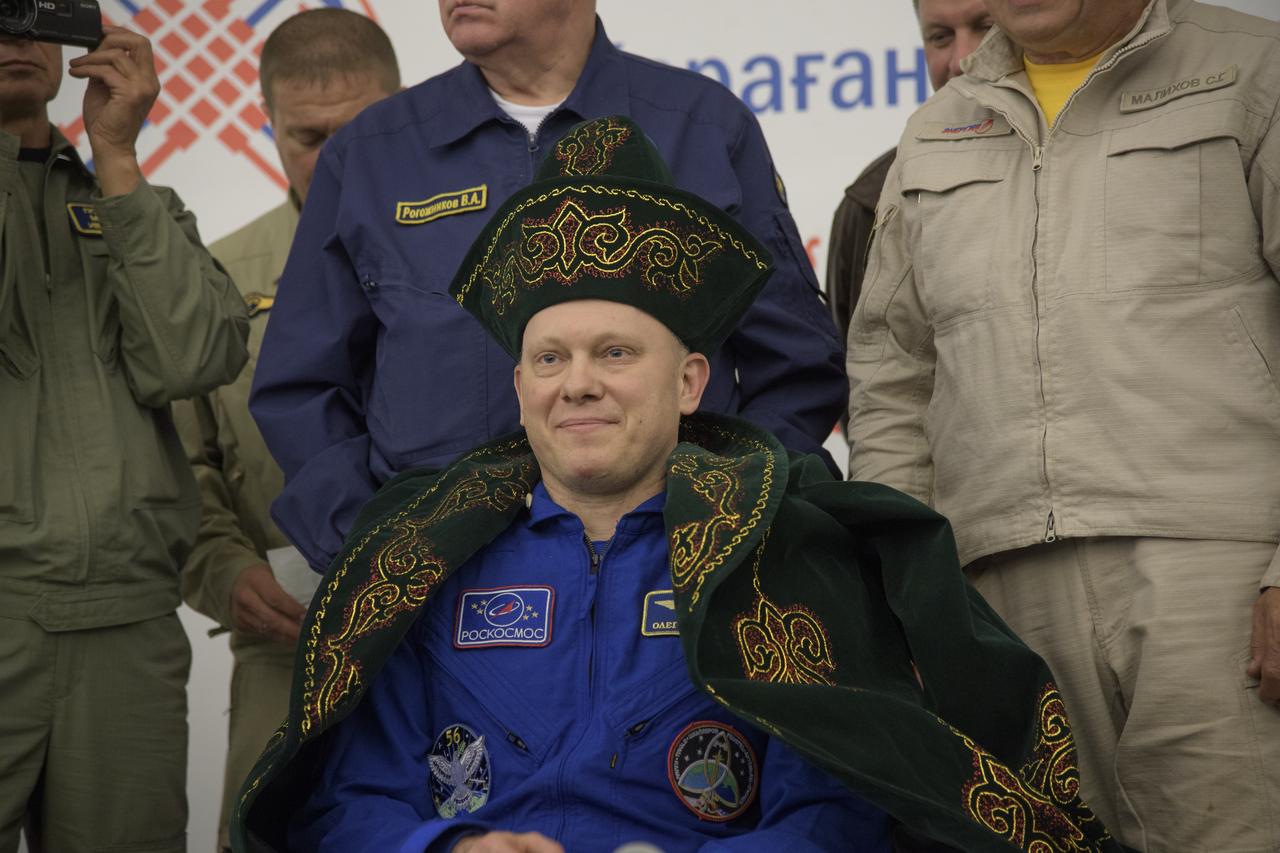
Expedition 56 Flight Engineer and Soyuz Commander Oleg Artemyev of Roscosmos attends a Karaganda Airport welcome ceremony in Kazakhstan on Thursday, Oct. 4, 2018. Artemyev returned to Earth after 197 days in space with Expedition 56 Commander Drew Feustel and Flight Engineer Ricky Arnold of NASA where they served as members of the Expedition 55 and 56 crews onboard the International Space Station. Photo Credit: (NASA/Bill Ingalls)
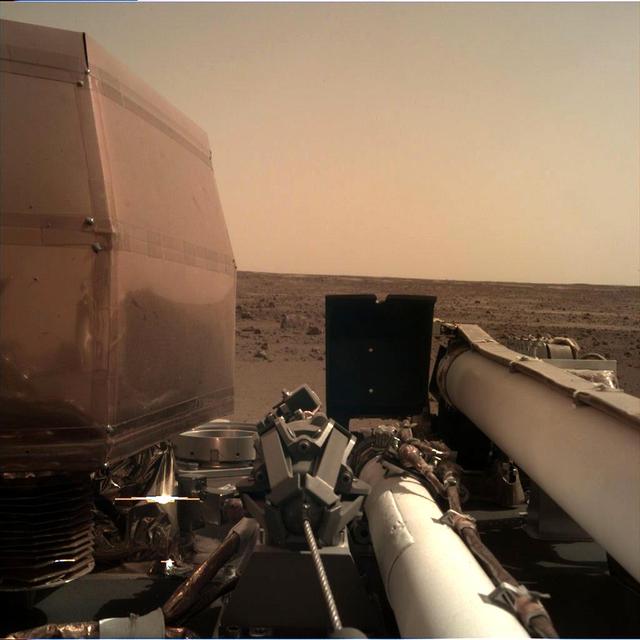
The Instrument Deployment Camera (IDC), located on the robotic arm of NASA's InSight lander, took this picture of the Martian surface on Nov. 26, 2018, the same day the spacecraft touched down on the Red Planet. The camera's transparent dust cover is still on in this image, to prevent particulates kicked up during landing from settling on the camera's lens. This image was relayed from InSight to Earth via NASA's Odyssey spacecraft, currently orbiting Mars. https://photojournal.jpl.nasa.gov/catalog/PIA22575

On Oct. 24-25, 2018 a solar prominence rose up above the Sun's surface, twisted and spun around, then became elongated and broke away. Prominences are unstable clouds of cooler plasma suspended above the Sun by strong magnetic forces. They often fall apart after a few days. Although tiny on the scale of the Sun, this prominence stretched out about ten times the diameter of Earth (see inset). Images were taken in a wavelength of extreme ultraviolet light. Animations are available at https://photojournal.jpl.nasa.gov/catalog/PIA18140
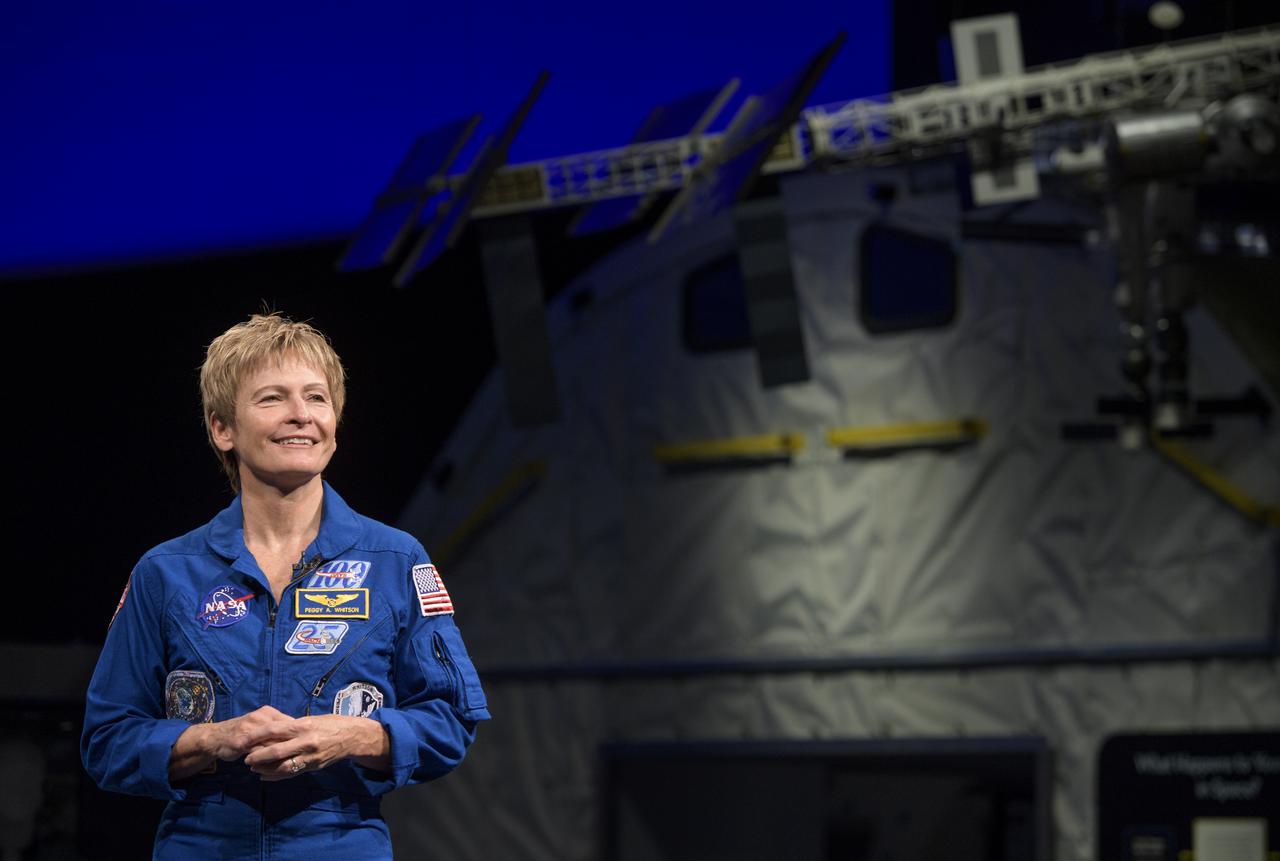
NASA astronaut Peggy Whitson is seen during an interview, Friday, March 2, 2018 at the Smithsonian's National Air and Space Museum in Washington. Whitson spent 288 days onboard the International Space Station as a member of Expedition 50, 51, and 52, conducting four spacewalks and contributing to hundreds of experiments in biology, biotechnology, physical science and Earth science during her stay. Photo Credit: (NASA/Joel Kowsky)
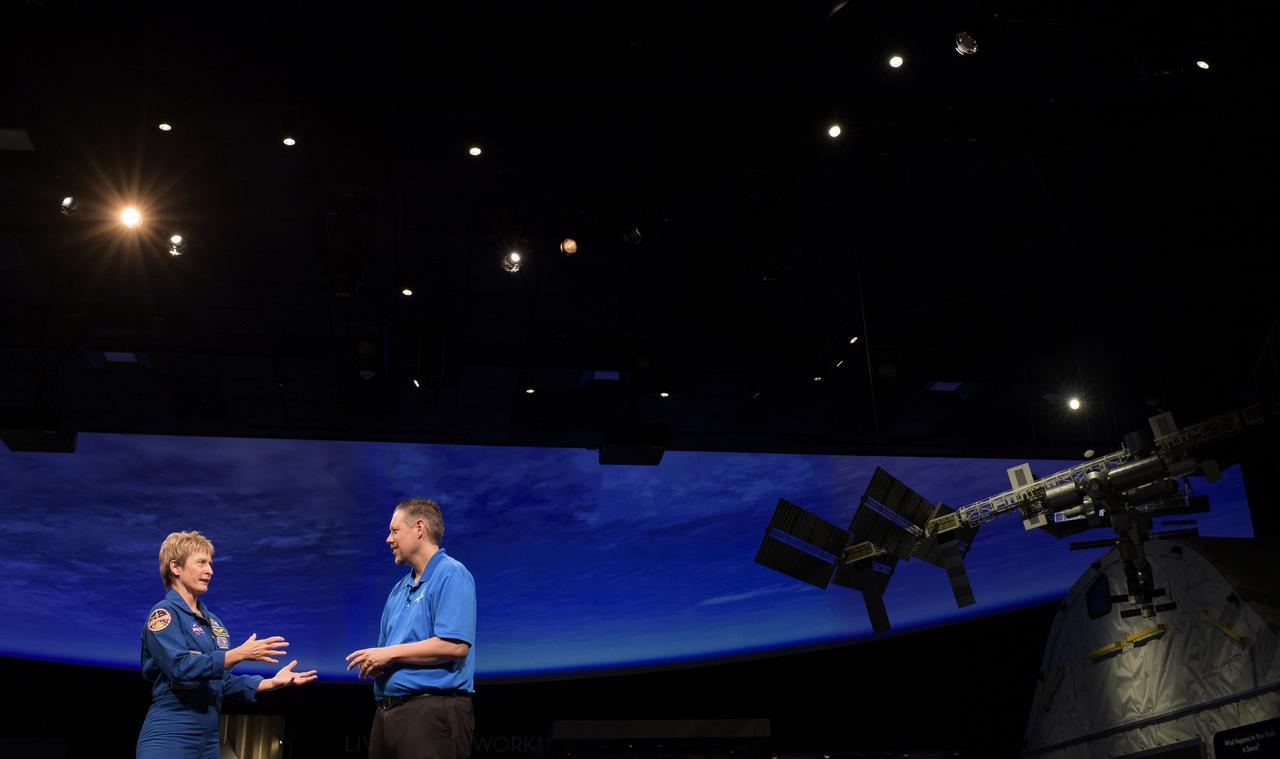
NASA astronaut Peggy Whitson is interviewed by Marty Kelsey, Friday, March 2, 2018 at the Smithsonian's National Air and Space Museum in Washington. Whitson spent 288 days onboard the International Space Station as a member of Expedition 50, 51, and 52, conducting four spacewalks and contributing to hundreds of experiments in biology, biotechnology, physical science and Earth science during her stay. Photo Credit: (NASA/Joel Kowsky)
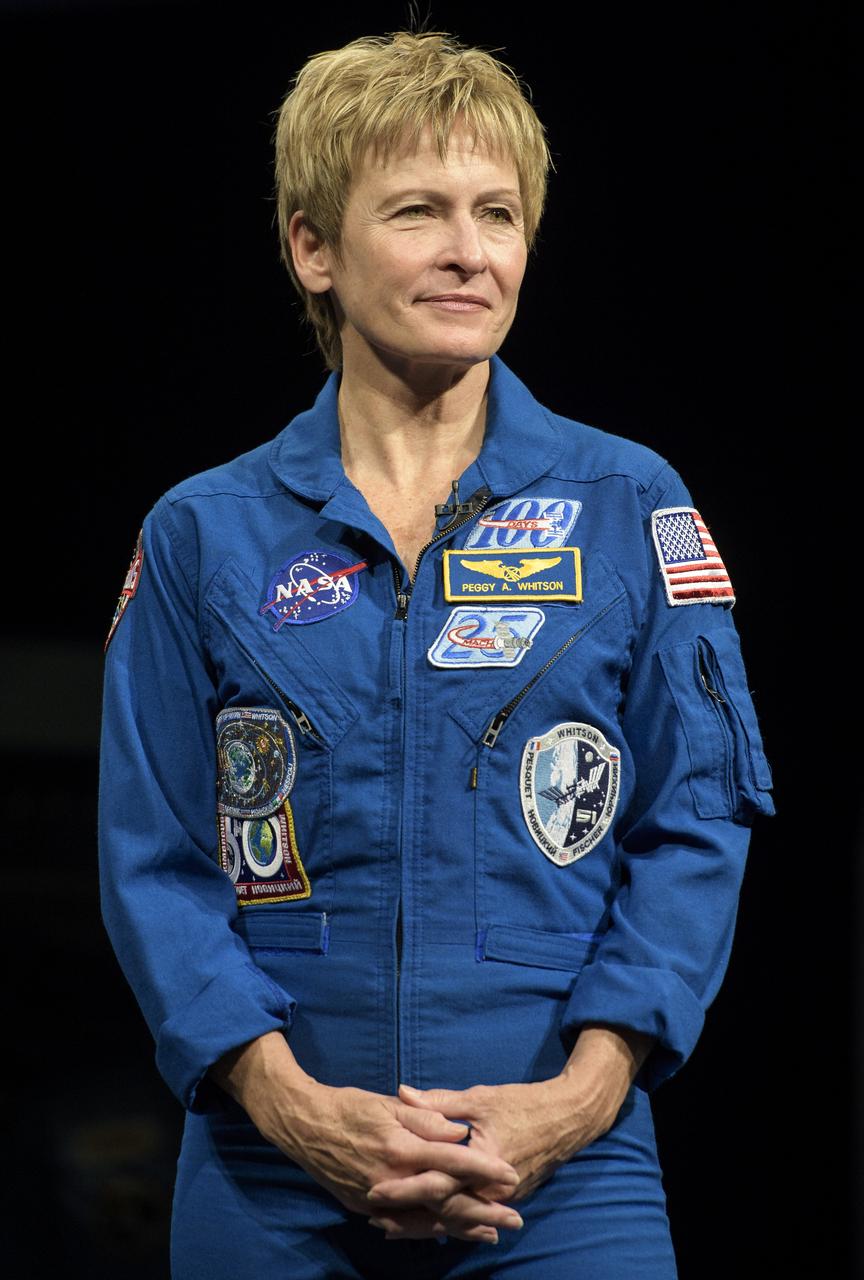
NASA astronaut Peggy Whitson is seen during an interview, Friday, March 2, 2018 at the Smithsonian's National Air and Space Museum in Washington. Whitson spent 288 days onboard the International Space Station as a member of Expedition 50, 51, and 52, conducting four spacewalks and contributing to hundreds of experiments in biology, biotechnology, physical science and Earth science during her stay. Photo Credit: (NASA/Joel Kowsky)
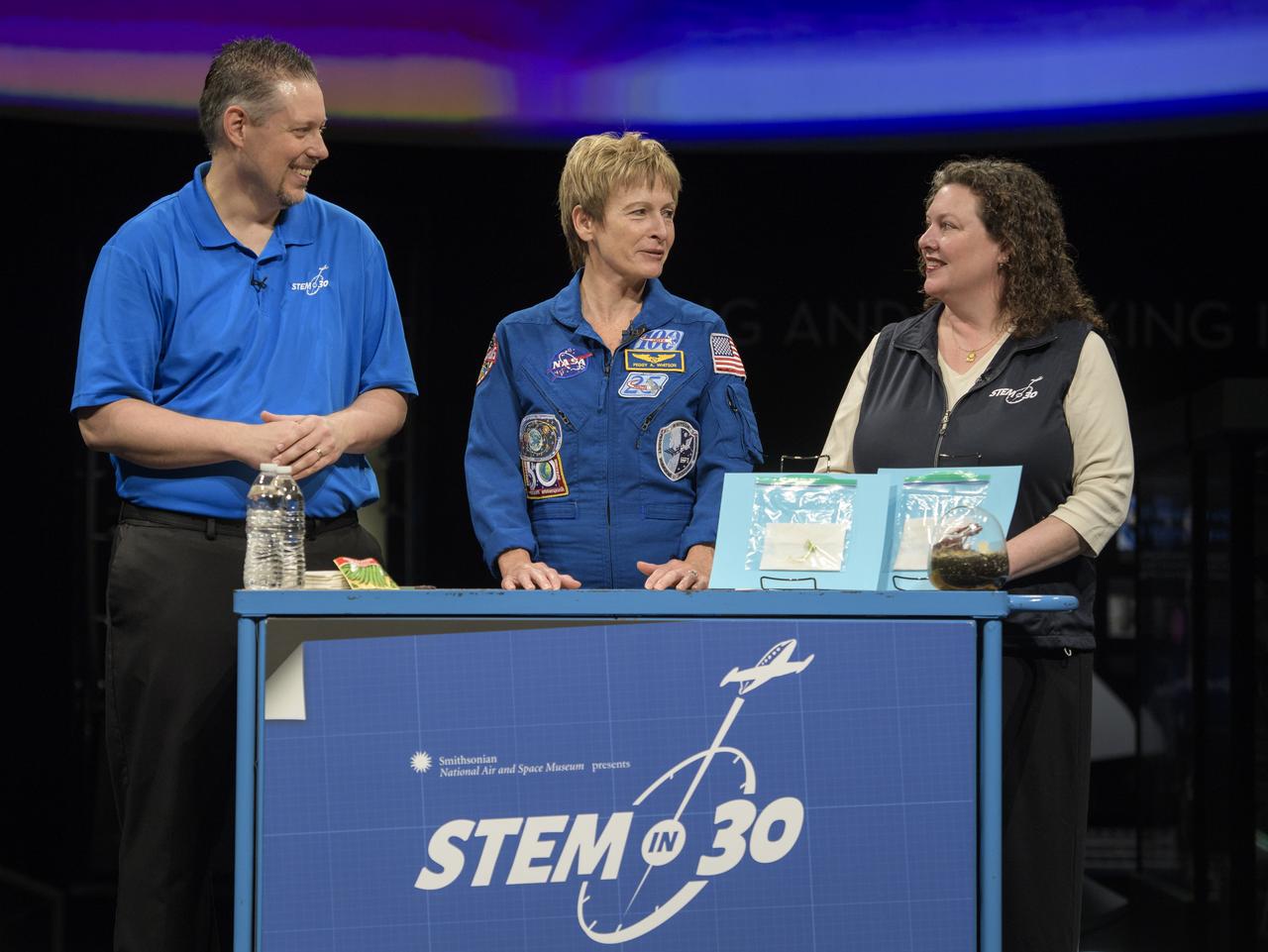
NASA astronaut Peggy Whitson tapes a segment for STEM in 30 with Marty Kelsey, left, and Beth Wilson, Friday, March 2, 2018 at the Smithsonian's National Air and Space Museum in Washington. Whitson spent 288 days onboard the International Space Station as a member of Expedition 50, 51, and 52, conducting four spacewalks and contributing to hundreds of experiments in biology, biotechnology, physical science and Earth science during her stay. Photo Credit: (NASA/Joel Kowsky)
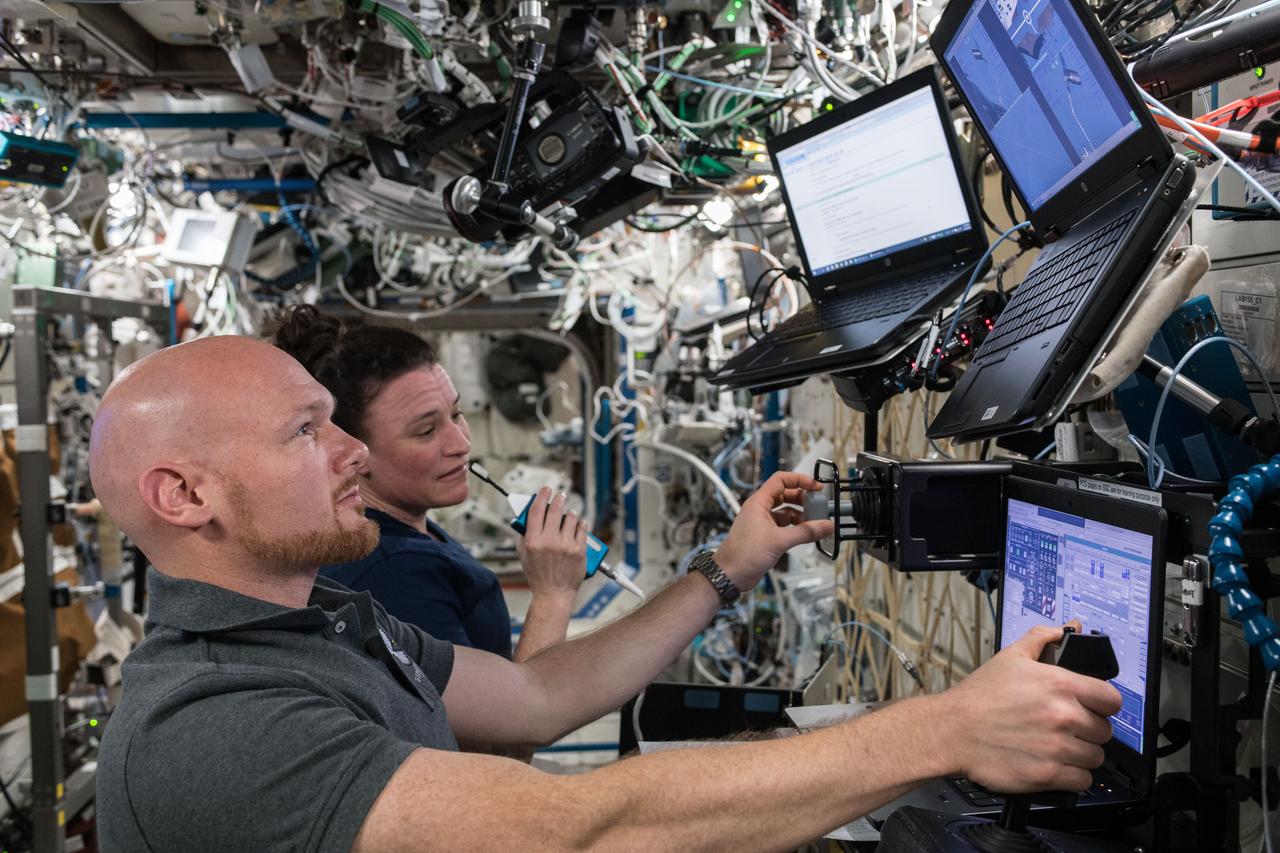
iss056e095057 (July 13, 2018) --- Astronauts Alexander Gerst and Serena Auñón-Chancellor train on computers for the release of the Northrop Grumman (formerly Orbital ATK) Cygnus space freighter. The duo would command the Canadarm2 robotic arm to release Cygnus back into Earth orbit on July 15 after 52 days of cargo transfers at the International Space Station.
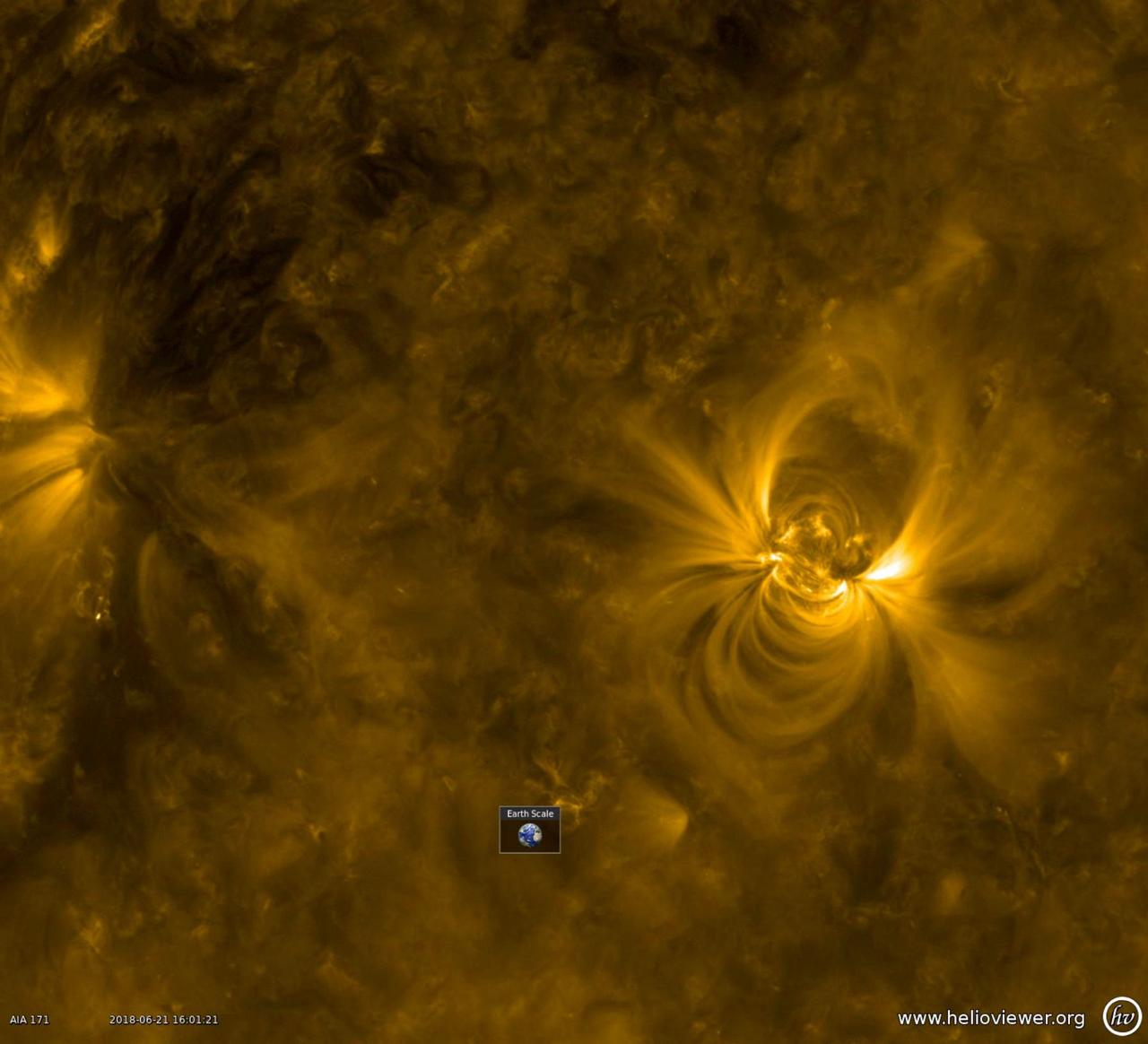
A new active region appeared on June 19th, quickly growing in size over two days (June 20-22, 2018). Active regions are areas of enhanced magnetic activity on the Sun's surface, generating the huge loops and dynamic surges observed here. Charged particles spinning along the field lines above the active region are illuminated in this wavelength of extreme ultraviolet light. The superimposed Earth icon gives a sense of just how large these loops are. Movies are available at https://photojournal.jpl.nasa.gov/catalog/PIA22582

RainCube was deployed into low-Earth orbit from the International Space Station in July, 2018, where it has been measuring rain and snowfall from space. The size of the tiny weather satellite can be seen in comparison to the Space Station. RainCube is a prototype for a possible fleet of small satellites that could one day help monitor severe storms, lead to improving the accuracy of weather forecasts and track climate change over time. A closer look at these images reveals there are two CubeSats very close together -- RainCube is the bottom CubeSat closer to Earth, while the one above it is HaloSat, used to map the distribution of hot gas in the Milky Way. https://photojournal.jpl.nasa.gov/catalog/PIA22653
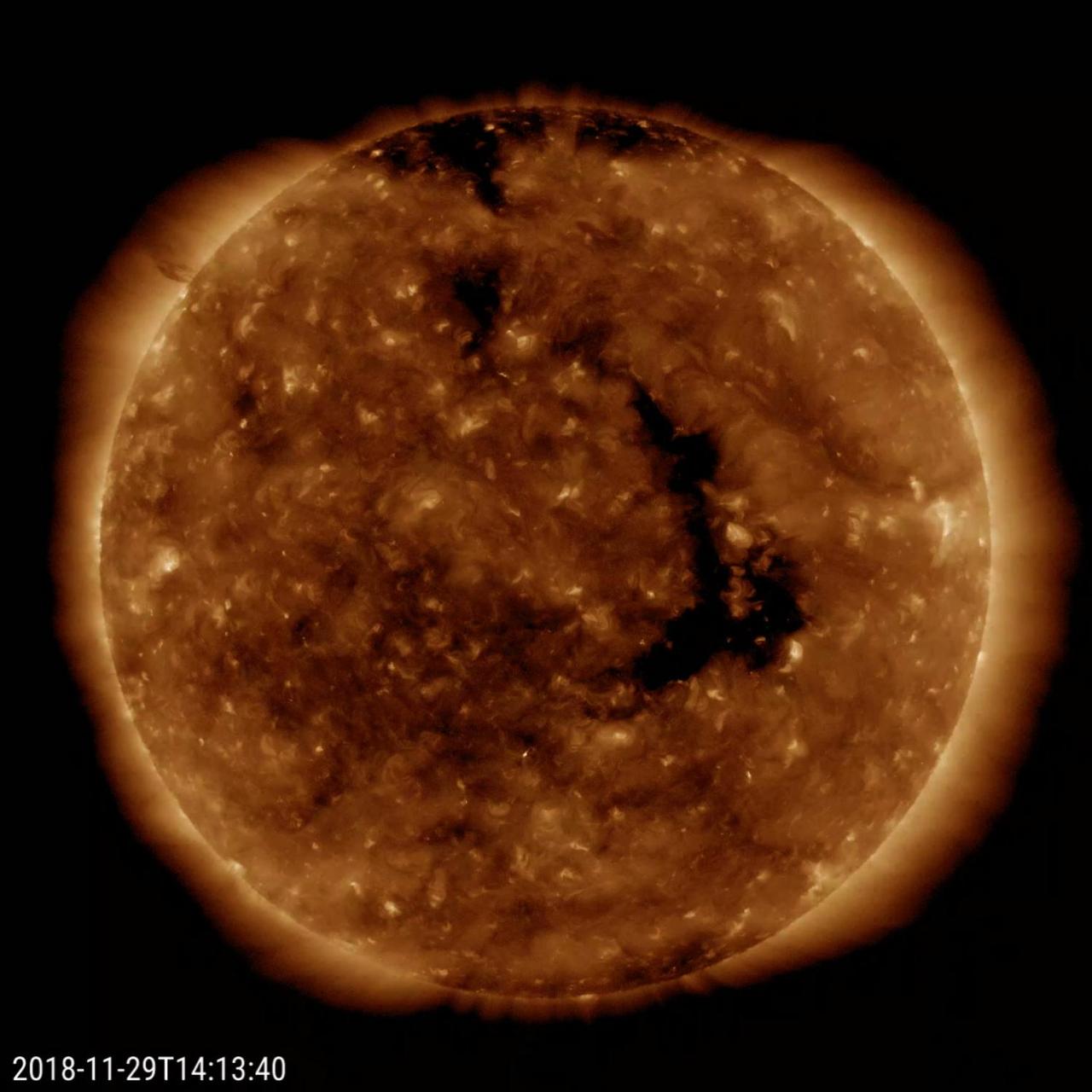
A long-lasting coronal hole has again rotated around to face the Earth (Nov. 28-30, 2018). This persistent hole - the elongated dark region seen in the still image - first appeared in July and has been observed each rotation of the Sun since. Coronal holes are the source of high-speed solar wind; when this one faced Earth, it sparked outbursts of aurora some of which were observed in our northern tier states. Coronal holes are magnetically open regions on the Sun that can last from days to months, although this one has lasted longer than most. The time-lapse video, taken in a wavelength of extreme ultraviolet light, covers about two days of activity. Movies available at https://photojournal.jpl.nasa.gov/catalog/PIA18144

Expedition 56 Flight Engineer Ricky Arnold of NASA signs photos inside a helicopter after being flown form the Soyuz MS-08 landing zone to the Karaganda Airport in Kazakhstan Thursday, Oct. 4, 2018. Arnold, Expedition 56 Commander Drew Feustel of NASA and Expedition 56 Flight Engineer and Soyuz Commander Oleg Artemyev of Roscosmos returned to Earth after 197 days in space where they served as members of the Expedition 55 and 56 crews onboard the International Space Station. Photo Credit: (NASA/Bill Ingalls)
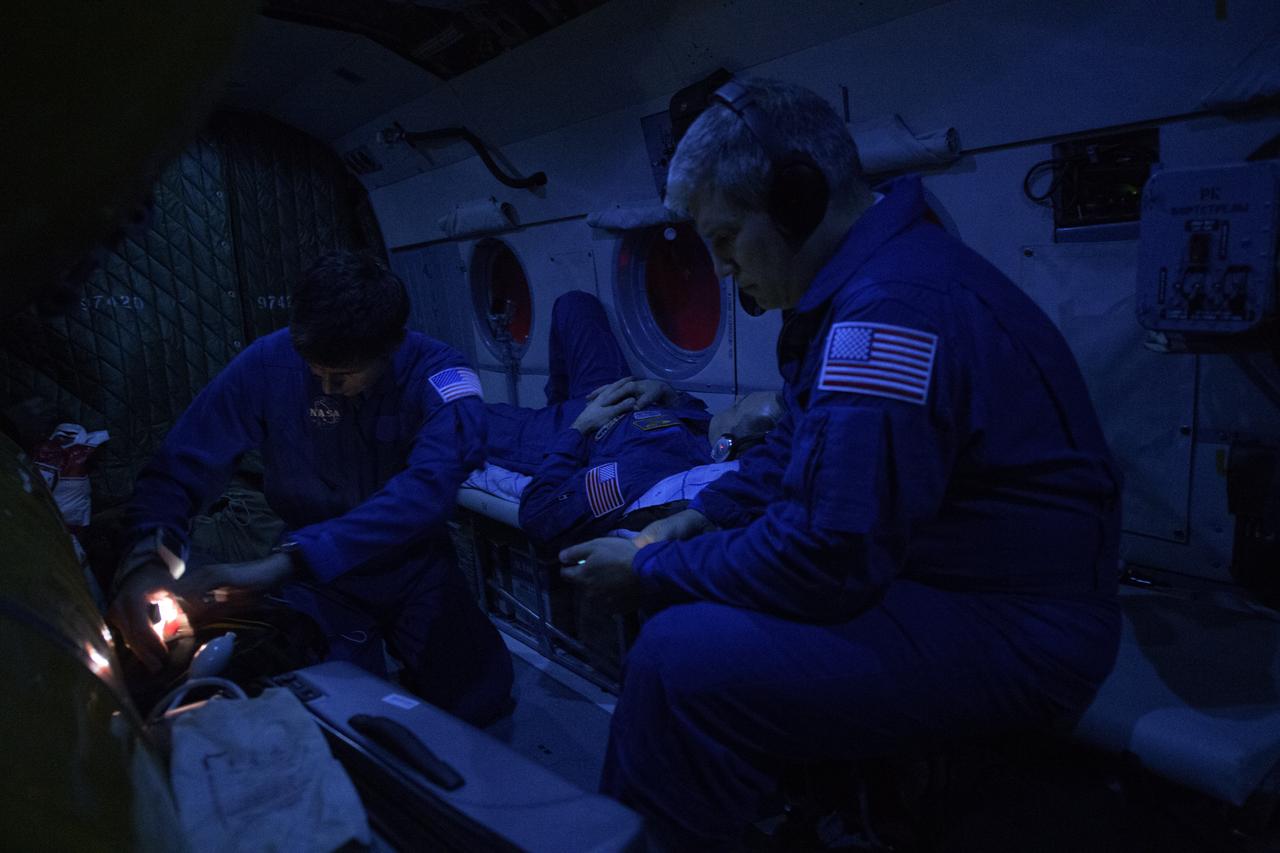
Expedition 56 Flight Engineer Ricky Arnold of NASA restss in a helicopter as Russian Nurse Artiom Kharchikov, left, and NASA Flight Surgeon Steven Piper, right look after him near the town of Zhezkazgan, Kazakhstan on Thursday, Oct. 4, 2018. Arnold, Expedition 56 Commander Drew Feustel of NASA and Expedition 56 Flight Engineer and Soyuz Commander Oleg Artemyev of Roscosmos returned to Earth after 197 days in space where they served as members of the Expedition 55 and 56 crews onboard the International Space Station. Photo Credit: (NASA/Bill Ingalls)
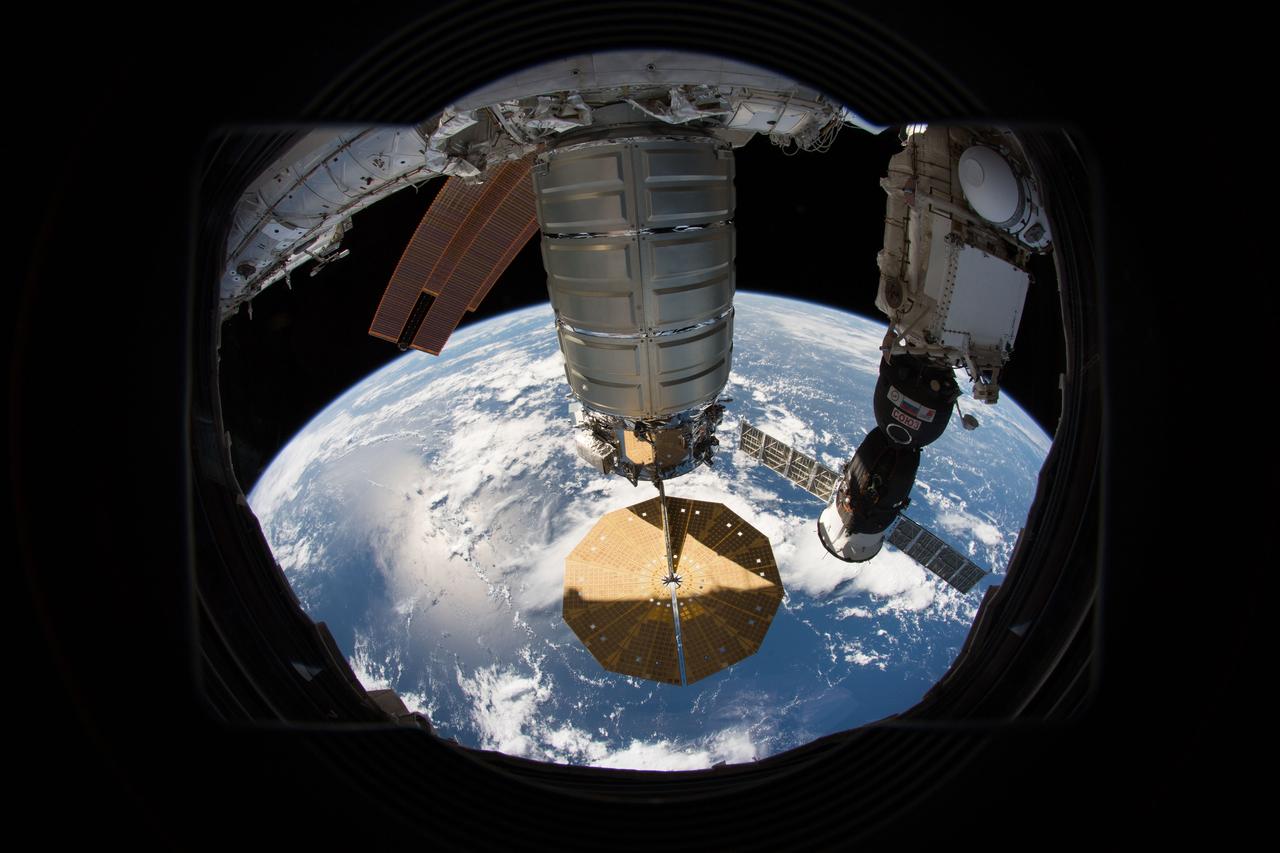
iss056e025135 (June 19, 2018) --- This fish-eye lens view from a window on the International Space Station shows the Northrop Grumman (formerly Orbital ATK) Cygnus commercial space freighter with its cymbal-like Ultra-Flex solar arrays attached to the Unity module. To its right is the Soyuz MS-09 spacecraft docked to the Rassvet module. Cygnus is due to end its mission July 15. The Soyuz MS-09 is planned to return to Earth Dec. 13, carrying Sergey Prokopyev, Alexander Gerst and Serena Auñón-Chancellor home after 192 days in space.
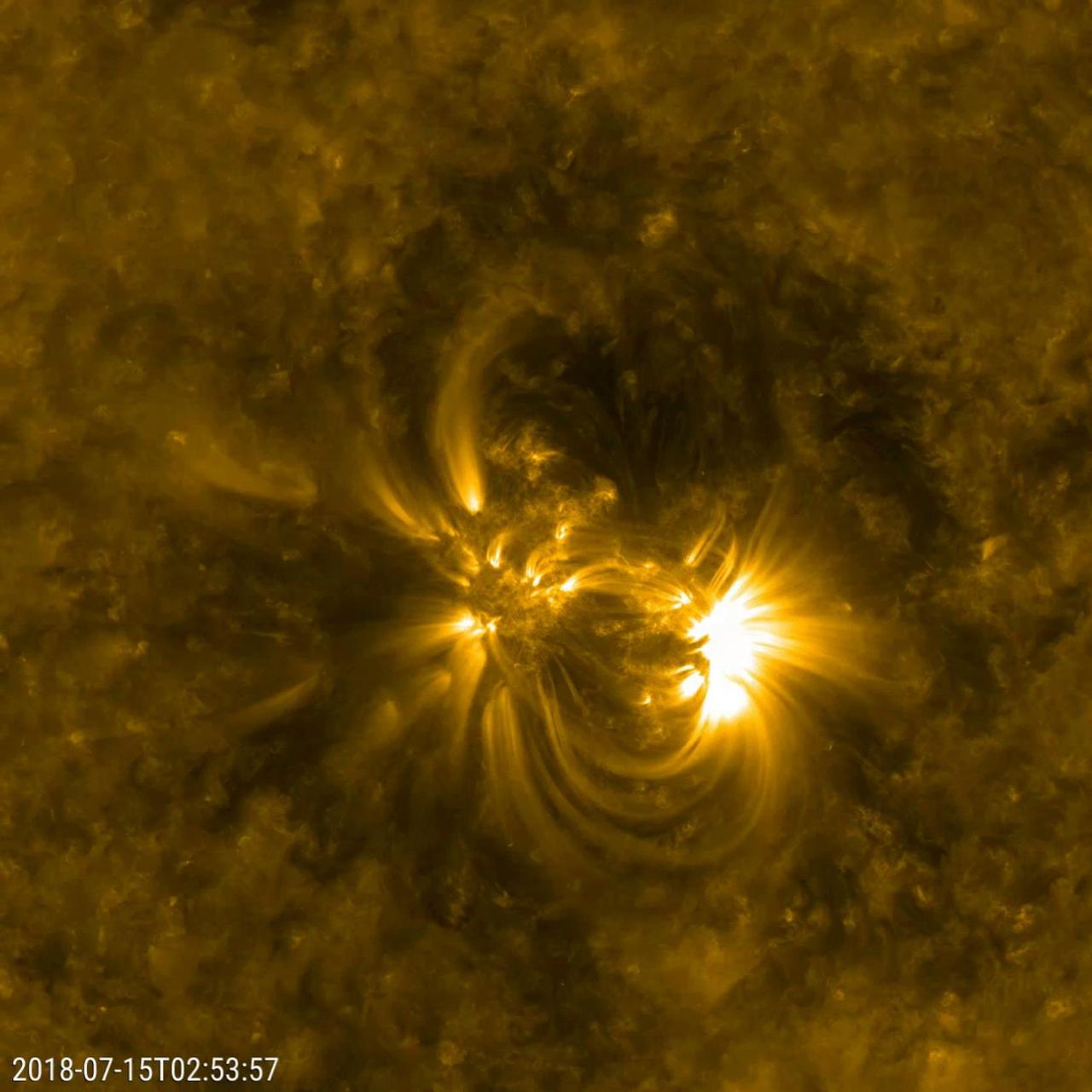
NASA's Solar Dynamics Observatory (SDO) zoomed in to watch close-up the dynamics of this single active region on the sun over a two-day period (July 14-16, 2018). The loops SDO observed in extreme ultraviolet light are illuminated by charged particles spinning along the magnetic field lines above an active region. Active regions are magnetically intense areas that are pushed up to the surface of the sun from below. These regions are often the sources of large eruptions that cause solar storms, though no large eruptions seem to have occurred during this period. To give a sense of scale, these loops are rising up many times the diameter of Earth. Movies are available at https://photojournal.jpl.nasa.gov/catalog/PIA22645
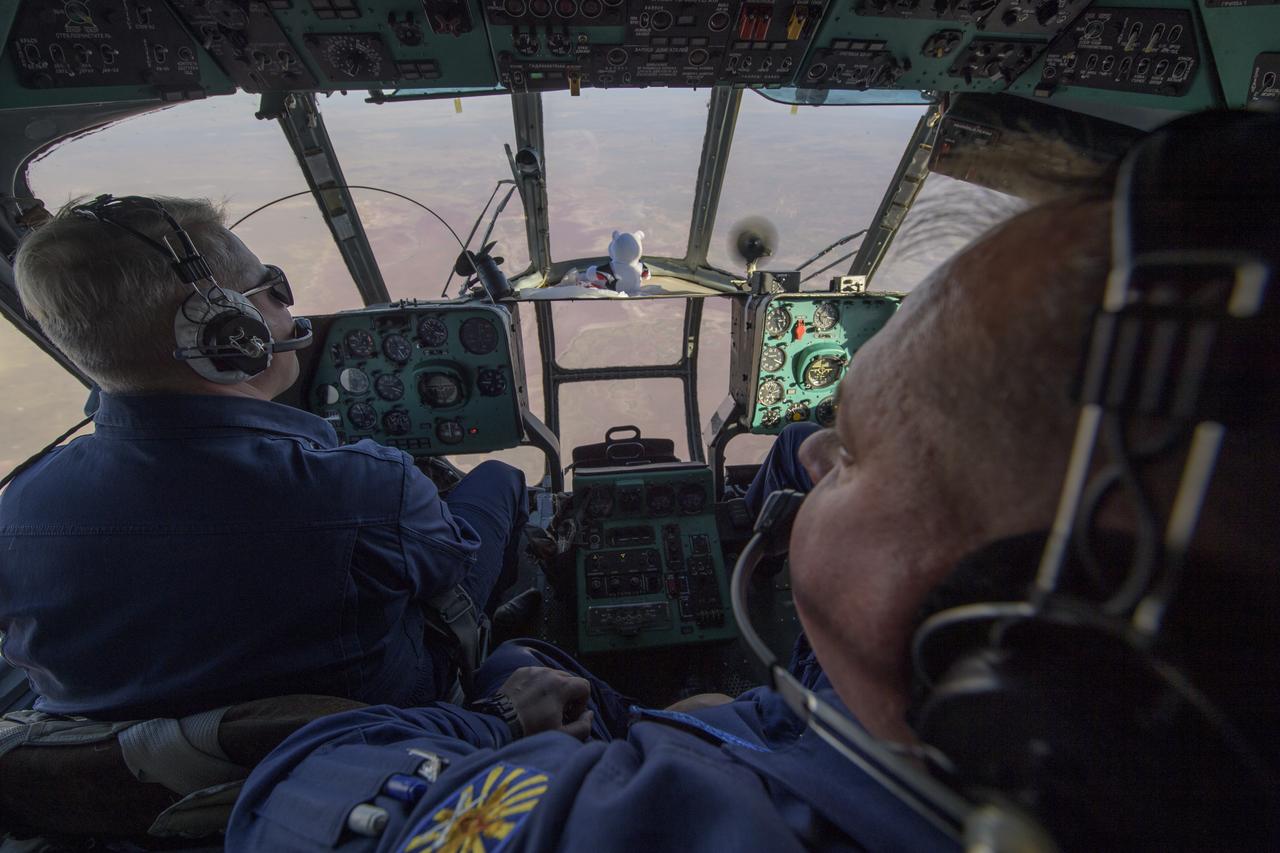
Russian MI-8 pilots scan the horizon for the Soyuz MS-08 spacecraft in the predicted landing zone near the town of Zhezkazgan, Kazakhstan on Thursday, Oct. 4, 2018. The spacecraft landed with Expedition 56 Commander Drew Feustel and Flight Engineer Ricky Arnold of NASA, along with Flight Engineer and Soyuz Commander Oleg Artemyev of Roscosmos. Feustel, Arnold, and Artemyev returned to Earth after having spent 197 days in space where they served as members of the Expedition 55 and 56 crews onboard the International Space Station. Photo Credit: (NASA/Bill Ingalls)
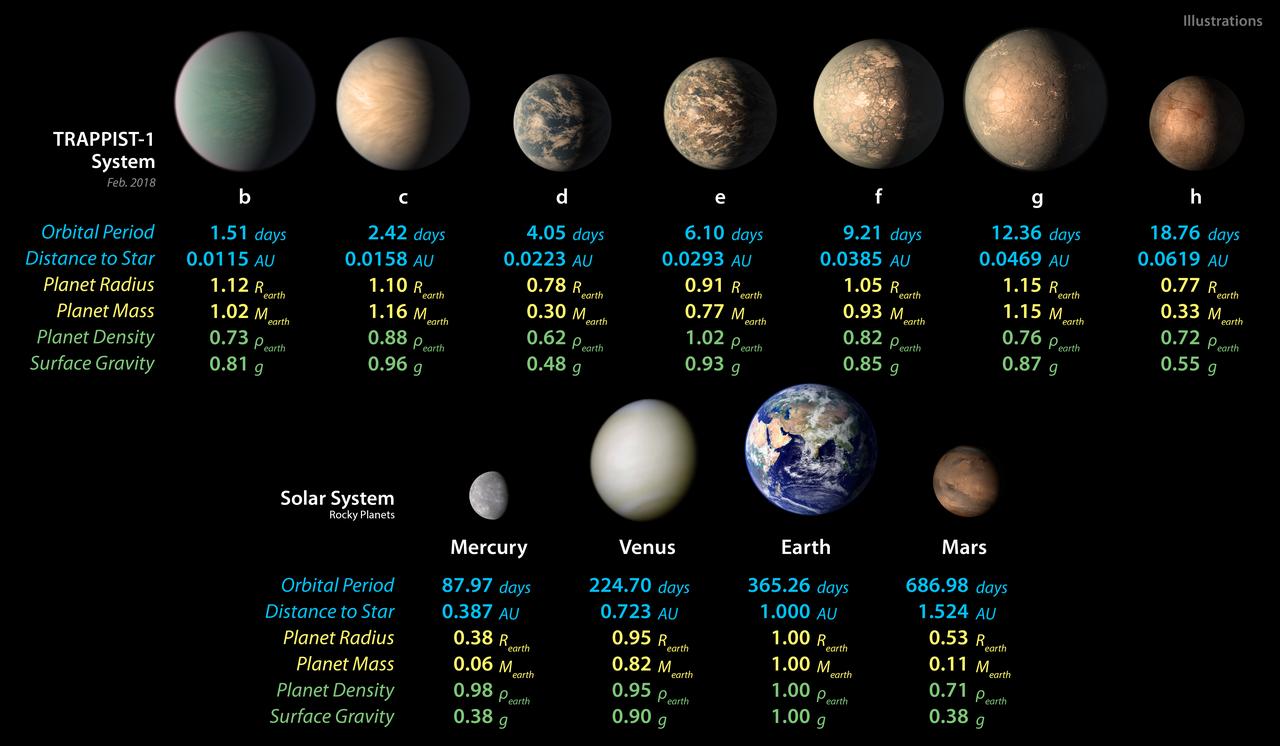
This chart shows, on the top row, artist concepts of the seven planets of TRAPPIST-1 with their orbital periods, distances from their star, radii, masses, densities and surface gravity as compared to those of Earth. These numbers are current as of February 2018. On the bottom row, the same numbers are displayed for the bodies of our inner solar system: Mercury, Venus, Earth and Mars. The TRAPPIST-1 planets orbit their star extremely closely, with periods ranging from 1.5 to only about 20 days. This is much shorter than the period of Mercury, which orbits our sun in about 88 days. The masses and densities of the TRAPPIST-1 planets were determined by careful measurements of slight variations in the timings of their orbits using extensive observations made by NASA's Spitzer and Kepler space telescopes, in combination with data from Hubble and a number of ground-based telescopes. These measurements are the most precise to date for any system of exoplanets. In this illustration, the relative sizes of the planets are all shown to scale. https://photojournal.jpl.nasa.gov/catalog/PIA22094
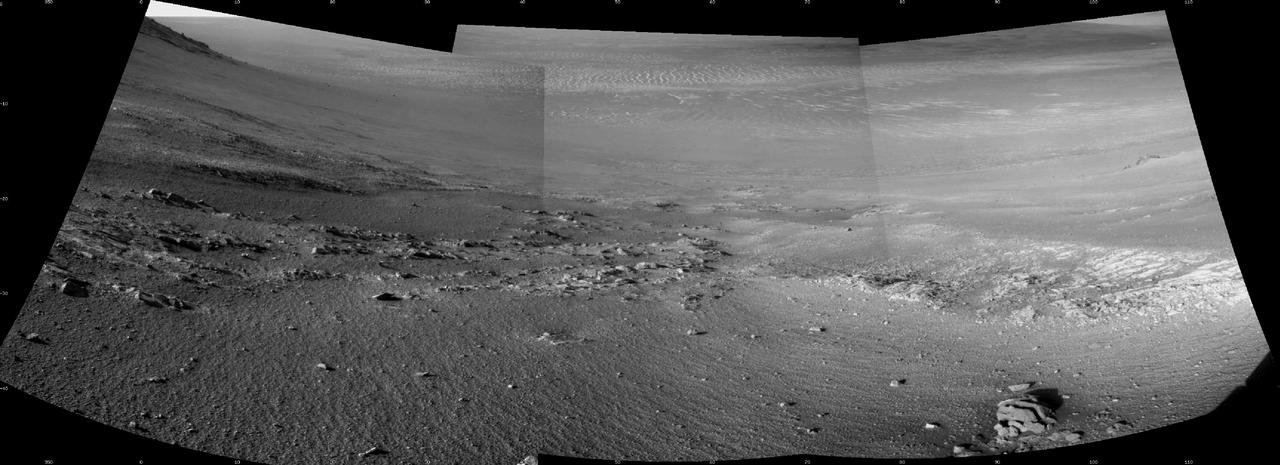
Textured rows on the ground in this portion of "Perseverance Valley" are under investigation by NASA's Mars Exploration Rover Opportunity, which used its Navigation Camera (Navcam) to take the component images of this downhill-looking scene. The rover took this image on Jan. 4, 2018, during the 4,958th Martian day, or sol, of its work on Mars, looking downhill from a position about one-third of the way down the valley. Perseverance Valley descends the inboard slope of the western rim of Endeavour Crater. A view on the same sol with the rover's front Hazard Avoidance Camera includes ground even closer to the rover at this site. Opportunity was still working close by as it reached the mission's Sol 5,000 (Feb. 16, 2018). In the portion of the valley seen here, soil and gravel have been shaped into a striped pattern in the foreground and partially bury outcrops visible in the midfield. The long dimensions of the stripes are approximately aligned with the downhill direction. The striped pattern resembles a type of feature on Earth (such as on Hawaii's Mauna Kea) that is caused by repeated cycles of freezing and thawing, though other possible origins are also under consideration for the pattern in Perseverance Valley. The view is spans from north on the left to east-southeast on the right. For scale, the foreground rock clump in the lower right is about 11 inches (28 centimeters) in width. https://photojournal.jpl.nasa.gov/catalog/PIA22217
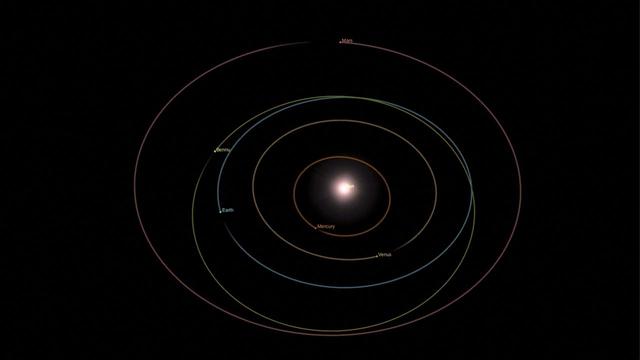
Using data collected by NASA's OSIRIS-REx mission, this animation shows the trajectories of rocky particles after being ejected from asteroid (101955) Bennu's surface. The animation emphasizes the four largest particle-ejection events detected at Bennu between December 2018 and September 2019. Additional particles not related to the ejections are also visible. Most of these pebble-size pieces of rock, typically measuring around a quarter inch (7 millimeters), were pulled back to Bennu under the asteroid's weak gravity after a short hop, sometimes even ricocheting back into space after colliding with the surface. Others remained in orbit for a few days and up to 16 revolutions. And some were ejected with enough force to completely escape from the Bennu environs. OSIRIS-REx — which stands for Origins, Spectral Interpretation, Resource Identification, and Security-Regolith Explorer — arrived at Bennu in December 2018. On Oct. 20, 2020, the mission will attempt to briefly touch down on the asteroid to scoop up material likely to include particles that were ejected before dropping back to the surface. If all goes as planned, the spacecraft will return to Earth in September 2023 with a cache of Bennu's particles for further study, including of which may even hold the physical clues as to what ejection mechanisms are at play. Movie available at https://photojournal.jpl.nasa.gov/catalog/PIA24101
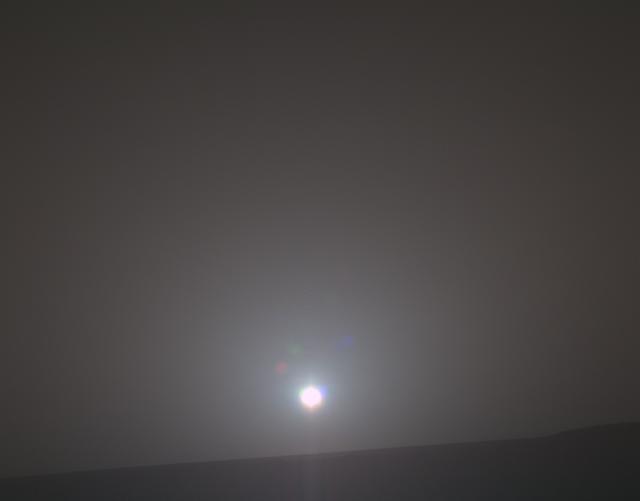
NASA's Mars Exploration Rover Opportunity recorded the dawn of the rover's 4,999th Martian day, or sol, with its Panoramic Camera (Pancam) on Feb. 15, 2018, yielding this processed, approximately true-color scene. The view looks across Endeavour Crater, which is about 14 miles (22 kilometers) in diameter, from the inner slope of the crater's western rim. Opportunity has driven a little over 28.02 miles (45.1 kilometers) since it landed in the Meridiani Planum region of Mars in January, 2004, for what was planned as a 90-sol mission. A sol lasts about 40 minutes longer than an Earth day. This view combines three separate Pancam exposures taken through filters centered on wavelengths of 601 microns (red), 535 microns (green) and 482 microns (blue). It was processed at Texas A&M University to correct for some of the oversaturation and glare, though it still includes some artifacts from pointing a camera with a dusty lens at the Sun. The processing includes radiometric correction, interpolation to fill in gaps in the data caused by saturation due to Sun's brightness, and warping the red and blue images to undo the effects of time passing between each of the exposures through different filters. https://photojournal.jpl.nasa.gov/catalog/PIA22221
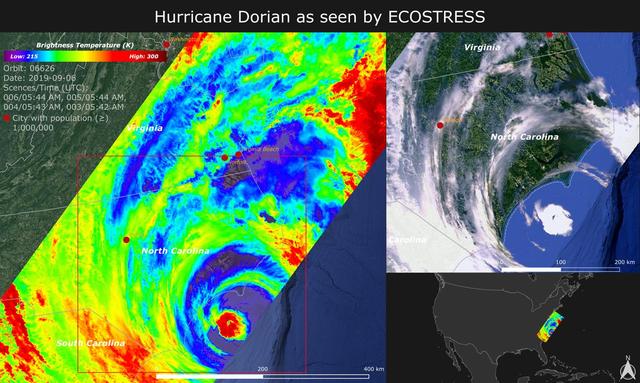
NASA's ECOsystem Spaceborne Thermal Radiometer Experiment on Space Station (ECOSTRESS) imaged the temperature of Hurricane Dorian from the International Space Station on Sept. 6, 2019 as the storm made landfall in North Carolina. ECOSTRESS senses the amount of emitted infrared radiation from Earth, which is converted into an equivalent temperature scale in units of degrees Kelvin. In the image, red colors such as the well-defined eye represent warmer temperatures while purple/blue represent the cooler cloud top temperatures of strong storm clouds with the potential of producing heavy rain. The temperature patterns reveal fine cloud structures that contribute to the formation of the larger hurricane. The width of the image (~400 km) is based on what ECOSTRESS sees as the Space Station flies over any given spot on Earth. ECOSTRESS launched to the space station in June 2018. It can measure variations in temperature to within a few tenths of a degree and is able to detect temperature changes at various times of day over areas as small as a football field. ECOSTRESS' primary mission is to detect plant health from space; however, its measurements can be used to detect other heat-related phenomena — including urban heat, fires, and volcanic activity — as well. Although disaster response is not one of its primary objectives, these highly detailed hurricane temperature estimates can be used to improve weather models. https://photojournal.jpl.nasa.gov/catalog/PIA23422
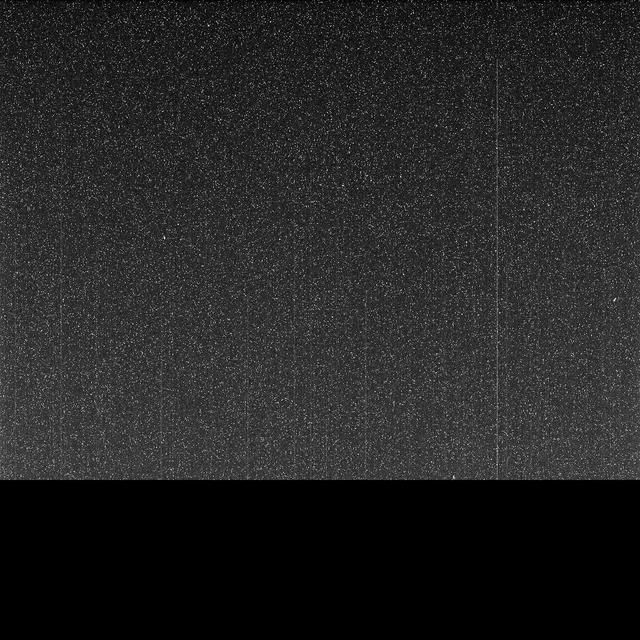
Taken on June 10, 2018 (the 5,111th Martian day, or sol, of the mission) this "noisy", incomplete image was the last data NASA's Opportunity rover sent back from Perseverance Valley on Mars. The partial, full-frame image from the Panoramic Camera (Pancam) was sent up to NASA's Mars Reconnaissance Orbiter around 9:45 a.m. PDT (12:45 p.m. EDT) to relay back to Earth as an intense dust storm darkened the skies around the solar-powered rover. The image was received on Earth at around 10:05 a.m. PDT (1:05 p.m. EDT). Opportunity took this image with the left eye of the Pancam, with its solar filter pointed at the Sun. But since the dust storm blotted out the Sun, the image is dark. The white speckles are noise from the camera. All Pancam images have noise in them, but the darkness makes it more apparent. The transmission stopped before the full image was transmitted, leaving the bottom of the image incomplete, represented here as black pixels. While this partial full-frame image was the last that Opportunity transmitted, it was not actually the last set of images from Opportunity. This image was taken at around 9:30 a.m. PDT (12:30 p.m. EDT) on June 10, 2018. Another set of images (PIA22930) was taken about three minutes later. The thumbnail versions of the last images taken were transmitted, but the rover lost contact before transmitting the full-frame versions. https://photojournal.jpl.nasa.gov/catalog/PIA22929
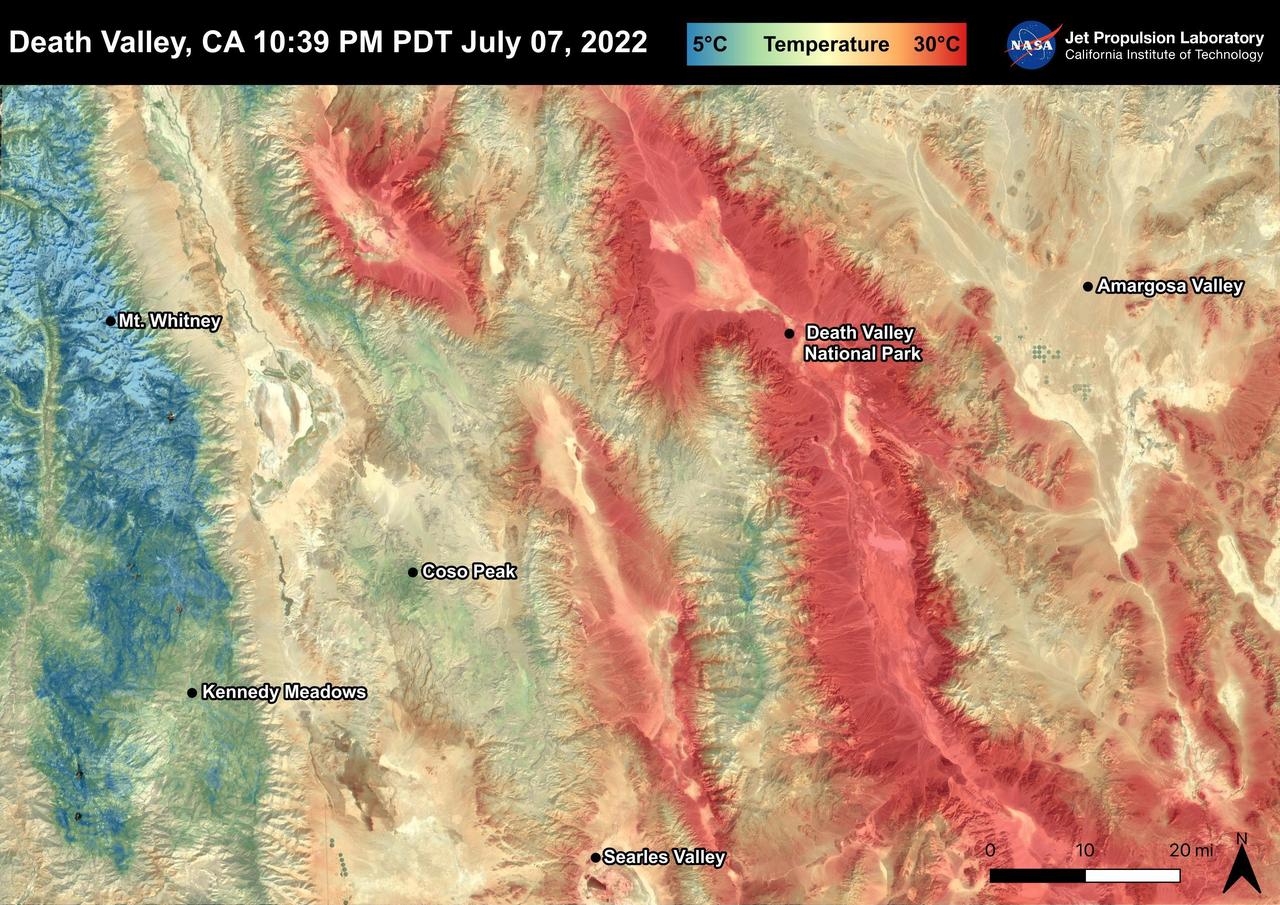
Death Valley, California is a desert valley in the Northern Mojave Desert. During the summer months, Death Valley can become one of the hottest places on Earth. Death Valley is about 85 miles from Mt. Whitney, the highest point in the contiguous United States with an elevation of 14,505 ft. This Land Surface Temperature image captured by ECOSTRESS on July 07, 2022 shows temperatures exceeding 90 degrees Fahrenheit in Death Valley and temperatures below 40 degrees Fahrenheit in the Sierra Nevada Mountain Range. ECOSTRESS is a thermal instrument on the International Space Station that measures the temperature of the ground, which is hotter than the air temperature during the day. It was launched to the space station in 2018. Its primary mission is to identify critical thresholds of water use and water stress in plants and to detect the timing, location, and predictive factors leading to plant water uptake decline and/or cessation. The nature of the high-resolution data provided by ECOSTRESS allows it to record heat related phenomena such as heat waves and wildfires. https://photojournal.jpl.nasa.gov/catalog/PIA25482
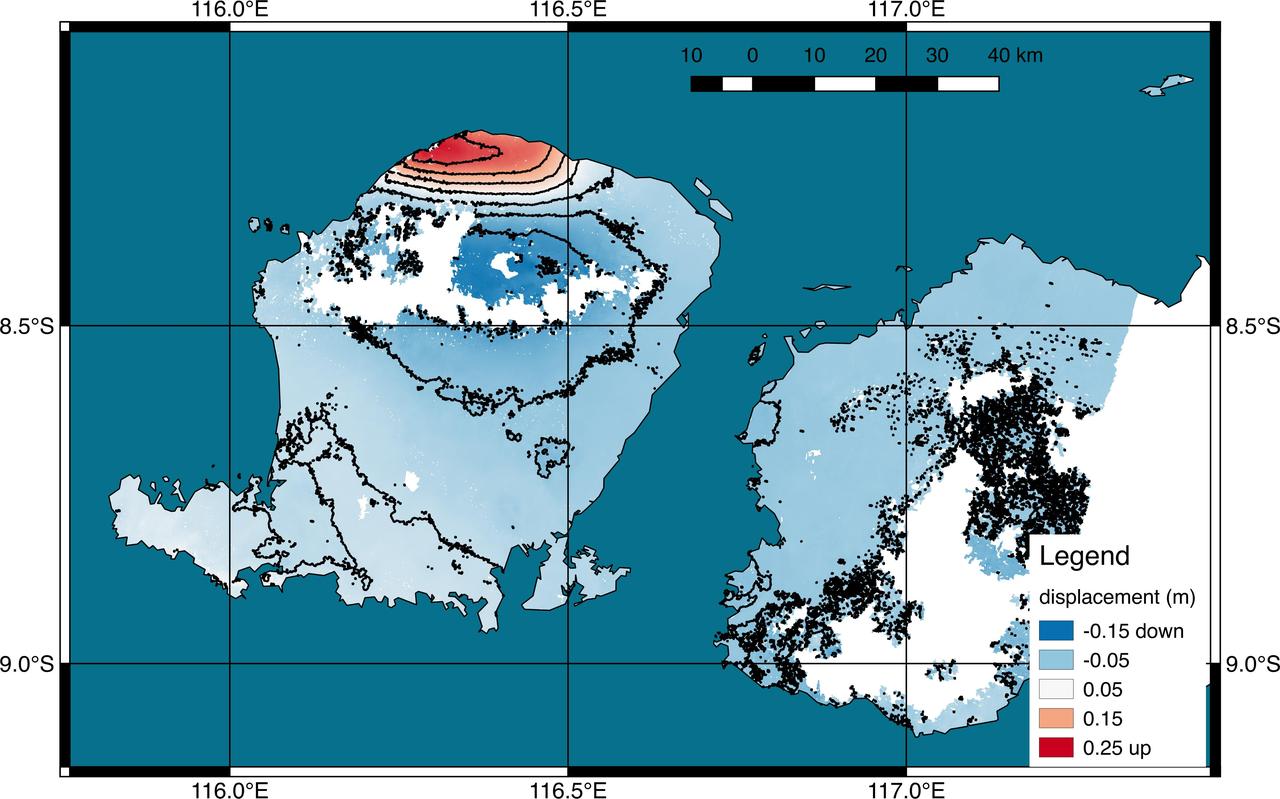
Scientists with the Advanced Rapid Imaging and Analysis project (ARIA), a collaboration between NASA's Jet Propulsion Laboratory in Pasadena, California, and Caltech, also in Pasadena, used synthetic aperture radar (SAR) data from the European Union's Copernicus Sentinel-1A and -1B satellites, operated by the European Space Agency. They generated a map of the deformation of Earth's surface caused by the Aug. 5, 2018 magnitude 6.9 earthquake under Lombok island, Indonesia. The deformation map is produced from automated interferometric processing of the SAR data using the JPL-Caltech ARIA data system in response to a signal received from the U.S. Geological Survey. The false-color map shows the amount of permanent surface movement that occurred almost entirely due to the quake, as viewed by the satellite, during a 6-day interval between two Sentinel-1 images acquired on July 30 and Aug. 5, 2018. The map shows that the earthquake fault was under the northwest corner of Lombok island, probably extending offshore to the west. Through these maps, NASA and its partners are contributing observations and expertise that can assist with response to earthquakes and other natural or human-produced hazards. From the pattern of deformation in the map, scientists have determined that the earthquake fault slip was on a fault beneath the northwestern part of Lombok Island and caused as much as 10 inches (25 centimeters) of uplift of the ground surface. The map depicts motion towards the satellite (up and west) in the direction of the radar's line-of-sight, with contours every 2 inches (5 centimeters). White areas are places where the radar measurement was not possible, largely due to dense forests in the middle of the islands. https://photojournal.jpl.nasa.gov/catalog/PIA22491

Super typhoon Mangkhut slammed into the northern Philippines on September 15 with wind speeds equivalent to a category 5 hurricane. South of where the eye made landfall, the storm's effects could be seen clearly five days later. The ASTER image of Dagupan and the Lingayen Gulf shows flooded and water-saturated areas in dark blue. Sediment-laden waters from swollen rivers enter the ocean and appear as blue-green plumes. The image was acquired September 22, 2018, covers an area of 51.4 by 61.2 kilometers, and is located at 16.2 degrees north, 120.3 degrees east. With its 14 spectral bands from the visible to the thermal infrared wavelength region and its high spatial resolution of about 50 to 300 feet (15 to 90 meters), ASTER images Earth to map and monitor the changing surface of our planet. ASTER is one of five Earth-observing instruments launched Dec. 18, 1999, on Terra. The instrument was built by Japan's Ministry of Economy, Trade and Industry. A joint U.S./Japan science team is responsible for validation and calibration of the instrument and data products. The broad spectral coverage and high spectral resolution of ASTER provides scientists in numerous disciplines with critical information for surface mapping and monitoring of dynamic conditions and temporal change. Example applications are monitoring glacial advances and retreats; monitoring potentially active volcanoes; identifying crop stress; determining cloud morphology and physical properties; wetlands evaluation; thermal pollution monitoring; coral reef degradation; surface temperature mapping of soils and geology; and measuring surface heat balance. https://photojournal.jpl.nasa.gov/catalog/PIA22705
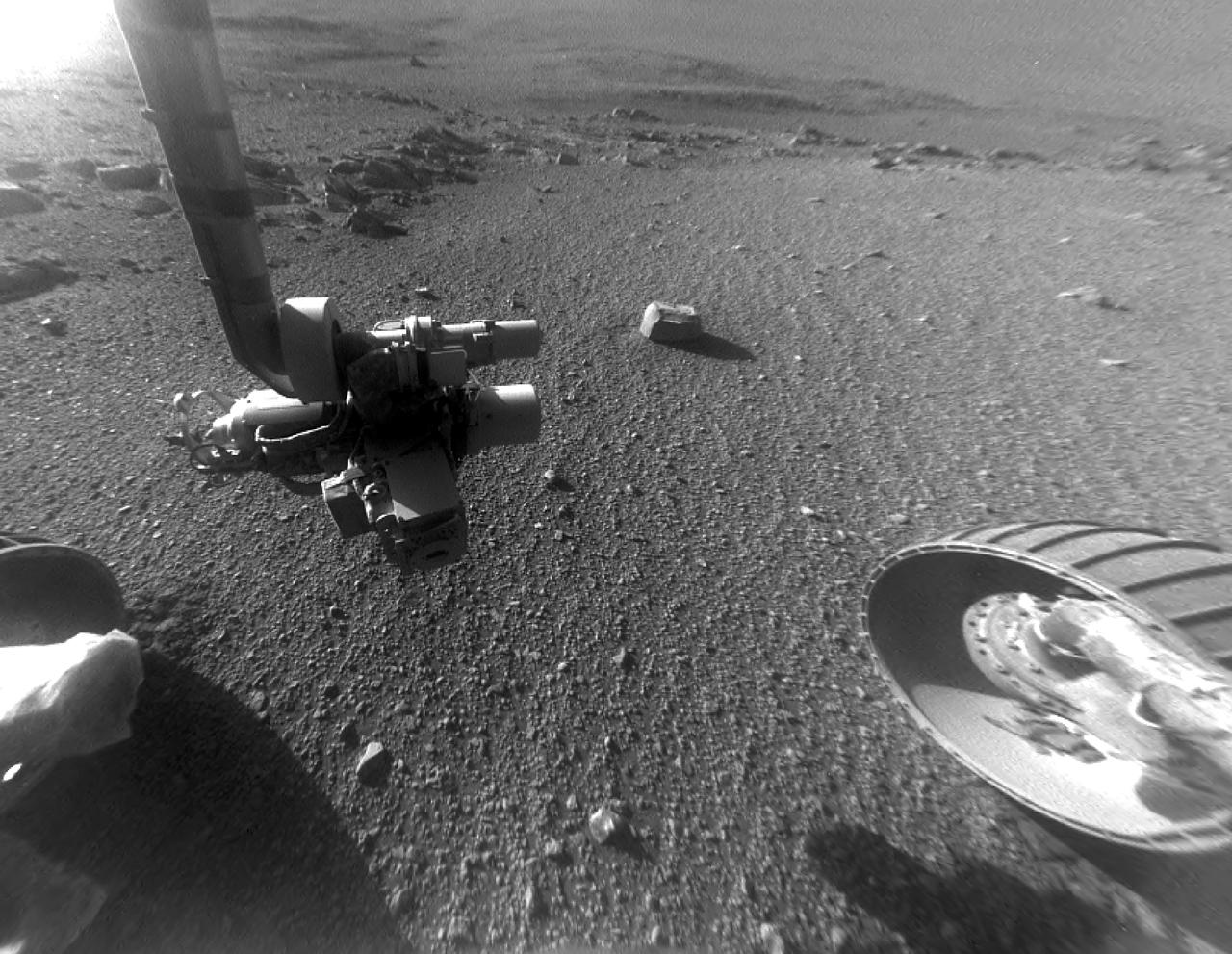
This late-afternoon view from the front Hazard Avoidance Camera on NASA's Mars Exploration Rover Opportunity shows a pattern of rock stripes on the ground, a surprise to scientists on the rover team. Approaching the 5,000th Martian day or sol, of what was planned as a 90-sol mission, Opportunity is still providing new discoveries. This image was taken inside "Perseverance Valley," on the inboard slope of the western rim of Endeavour Crater, on Sol 4958 (Jan. 4, 2018). Both this view and one taken the same sol by the rover's Navigation Camera look downhill toward the northeast from about one-third of the way down the valley, which extends about the length of two football fields from the crest of the rim toward the crater floor. The lighting, with the Sun at a low angle, emphasizes the ground texture, shaped into stripes defined by rock fragments. The stripes are aligned with the downhill direction. The rock to the upper right of the rover's robotic arm is about 2 inches (5 centimeters) wide and about 3 feet (1 meter) from the centerline of the rover's two front wheels. This striped pattern resembles features seen on Earth, including on Hawaii's Mauna Kea, that are formed by cycles of freezing and thawing of ground moistened by melting ice or snow. There, fine-grained fraction of the soil expands as it freezes, and this lifts the rock fragments up and to the sides. If such a process formed this pattern in Perseverance Valley, those conditions might have been present locally during a period within the past few million years when Mars' spin axis was at a greater tilt than it is now, and some of the water ice now at the poles was redistributed to lower latitudes. Other hypotheses for how these features formed are also under consideration, including high-velocity slope winds. https://photojournal.jpl.nasa.gov/catalog/PIA22218